WO2000024931A2 - Detection of analytes - Google Patents
Detection of analytes Download PDFInfo
- Publication number
- WO2000024931A2 WO2000024931A2 PCT/IL1999/000557 IL9900557W WO0024931A2 WO 2000024931 A2 WO2000024931 A2 WO 2000024931A2 IL 9900557 W IL9900557 W IL 9900557W WO 0024931 A2 WO0024931 A2 WO 0024931A2
- Authority
- WO
- WIPO (PCT)
- Prior art keywords
- nucleic acid
- analyte
- ribozyme
- acid sequence
- substrate
- Prior art date
- Legal status (The legal status is an assumption and is not a legal conclusion. Google has not performed a legal analysis and makes no representation as to the accuracy of the status listed.)
- Ceased
Links
Classifications
-
- C—CHEMISTRY; METALLURGY
- C12—BIOCHEMISTRY; BEER; SPIRITS; WINE; VINEGAR; MICROBIOLOGY; ENZYMOLOGY; MUTATION OR GENETIC ENGINEERING
- C12Q—MEASURING OR TESTING PROCESSES INVOLVING ENZYMES, NUCLEIC ACIDS OR MICROORGANISMS; COMPOSITIONS OR TEST PAPERS THEREFOR; PROCESSES OF PREPARING SUCH COMPOSITIONS; CONDITION-RESPONSIVE CONTROL IN MICROBIOLOGICAL OR ENZYMOLOGICAL PROCESSES
- C12Q1/00—Measuring or testing processes involving enzymes, nucleic acids or microorganisms; Compositions therefor; Processes of preparing such compositions
- C12Q1/68—Measuring or testing processes involving enzymes, nucleic acids or microorganisms; Compositions therefor; Processes of preparing such compositions involving nucleic acids
- C12Q1/6844—Nucleic acid amplification reactions
- C12Q1/686—Polymerase chain reaction [PCR]
-
- C—CHEMISTRY; METALLURGY
- C12—BIOCHEMISTRY; BEER; SPIRITS; WINE; VINEGAR; MICROBIOLOGY; ENZYMOLOGY; MUTATION OR GENETIC ENGINEERING
- C12Q—MEASURING OR TESTING PROCESSES INVOLVING ENZYMES, NUCLEIC ACIDS OR MICROORGANISMS; COMPOSITIONS OR TEST PAPERS THEREFOR; PROCESSES OF PREPARING SUCH COMPOSITIONS; CONDITION-RESPONSIVE CONTROL IN MICROBIOLOGICAL OR ENZYMOLOGICAL PROCESSES
- C12Q1/00—Measuring or testing processes involving enzymes, nucleic acids or microorganisms; Compositions therefor; Processes of preparing such compositions
- C12Q1/68—Measuring or testing processes involving enzymes, nucleic acids or microorganisms; Compositions therefor; Processes of preparing such compositions involving nucleic acids
- C12Q1/6804—Nucleic acid analysis using immunogens
-
- C—CHEMISTRY; METALLURGY
- C12—BIOCHEMISTRY; BEER; SPIRITS; WINE; VINEGAR; MICROBIOLOGY; ENZYMOLOGY; MUTATION OR GENETIC ENGINEERING
- C12Q—MEASURING OR TESTING PROCESSES INVOLVING ENZYMES, NUCLEIC ACIDS OR MICROORGANISMS; COMPOSITIONS OR TEST PAPERS THEREFOR; PROCESSES OF PREPARING SUCH COMPOSITIONS; CONDITION-RESPONSIVE CONTROL IN MICROBIOLOGICAL OR ENZYMOLOGICAL PROCESSES
- C12Q1/00—Measuring or testing processes involving enzymes, nucleic acids or microorganisms; Compositions therefor; Processes of preparing such compositions
- C12Q1/68—Measuring or testing processes involving enzymes, nucleic acids or microorganisms; Compositions therefor; Processes of preparing such compositions involving nucleic acids
- C12Q1/6844—Nucleic acid amplification reactions
- C12Q1/6862—Ligase chain reaction [LCR]
-
- C—CHEMISTRY; METALLURGY
- C12—BIOCHEMISTRY; BEER; SPIRITS; WINE; VINEGAR; MICROBIOLOGY; ENZYMOLOGY; MUTATION OR GENETIC ENGINEERING
- C12Q—MEASURING OR TESTING PROCESSES INVOLVING ENZYMES, NUCLEIC ACIDS OR MICROORGANISMS; COMPOSITIONS OR TEST PAPERS THEREFOR; PROCESSES OF PREPARING SUCH COMPOSITIONS; CONDITION-RESPONSIVE CONTROL IN MICROBIOLOGICAL OR ENZYMOLOGICAL PROCESSES
- C12Q1/00—Measuring or testing processes involving enzymes, nucleic acids or microorganisms; Compositions therefor; Processes of preparing such compositions
- C12Q1/68—Measuring or testing processes involving enzymes, nucleic acids or microorganisms; Compositions therefor; Processes of preparing such compositions involving nucleic acids
- C12Q1/6844—Nucleic acid amplification reactions
- C12Q1/6865—Promoter-based amplification, e.g. nucleic acid sequence amplification [NASBA], self-sustained sequence replication [3SR] or transcription-based amplification system [TAS]
Definitions
- the present invention concerns methods for detection of analytes in a sample and kit for use in said methods. More specifically, the invention concerns methods where the signal is amplified using conventional amplification technologies such as RT-PCR.
- Ribozymes have been shown to mirror many of the catalytic properties of their protein counterparts, including the ability to be regulated by specific effector molecules.
- the hammerhead ribozyme has been designed to act as an allosteric ribozyme with a nucleic acid effector and, more recently, aptamers grafted to the hammerhead ribozyme have served as allosteric sites for non-nucleic acid effectors .
- the rational design of chimeric 'aptazymes ' has proven to be remarkably facile, and aptazymes that can sense analytes such as ATP, FMN, and theophylline have been created (2-5) .
- most allosteric ribozymes which have been designed have been activated only 10- to 100-fold by their effectors, hampering their potential use in biotechnology or diagnostic applications.
- Ribozymes selected from random sequence populations have been shown to catalyze a variety of chemical reactions, to exhibitaki specificities for their substrates, and to turnover substrates ax rai ⁇ s ⁇ .p X 100/minute ( " It is likely that regulatory mechanisms such as allosier should also arise as a consequence of evolution for catalytic function.
- ribozymes such as the Group I and Group II self-splicing introns
- Several methods are known in the art for amplification of nucleic acid sequences, the best known are PCR, LCR, 3SR and NASBA. While these methods dramatically increase the number of nucleic acid sequences in the sample thus creating a detectable signal, not all nucleic acid sequences can be amplified using these techniques for various reasons such as nucleic acid sequences which have a GC-rich region and a complicated secondary structure which hinders their amplification by state of the art amplification techniques.
- these amplification techniques are suitable only for the detection of nucleic acid sequences and not for detection of molecules other than nucleic acids such as for the detection of proteins.
- Non-nucleic acid molecules are routinely detected by immunoassays and where the analyte is in minute quantities a large effort is required in order to produce a detectable signal.
- the present invention is based on the realization that it is possible to use allosteric nucleic acid sequences, which become catalytically active only in the presence of analytes, so that the product of the catalytic activaty of these seqences is produced only in the presence of an analyte, and then amplify said product, by state of the art nucleic acid amplification mechanisms such as PCR, LCR, NASBA and 3SR.
- nucleic acid sequences are used which produce a product only in the presence of the analyte and the product is amplified.
- state of the art amplification techniques By state of the art amplification techniques.
- the allosteric nucleic acid sequences and the products produced by their catalytic activity serve as mediators between the analyte and the amplification machinery.
- the present invention concerns a method for the detection of an analyte in a sample comprising:
- the detection of the analyte may be qualitative, i.e. giving yes/no binary answer to the presence of analyte, or may be quantitative, giving an indication of the amount of analyte in the sample as will be explained hereinbelow.
- the analyte may be a nucleic acid sequence, such as a cDNA or RNA sequence indicative of the presence of a mutation, the presence of an infectious organism, etc.
- the nucleic acid analyte may be in the form which is unsuitable for direct amplification for example due to secondary structure which can hinder direct amplification for example by PCR.
- the analyte may be a non-nucleic acid analyte.
- non-nucleic acid analytes are proteins, peptides, glycoproteins, glycopeptides, membranal fragments, phosphorylated nucleosides, hormones, drugs, organic or non- organic contaminants, noxious agents, etc.
- the sample may be any liquid sample in which the analyte should be determined, examples of which are blood, serum, urine, water (for the detection of contaminants or infectious agents), milk, suspension of food, soils, etc. (for the detection of contaminants, noxious agents or infectious agents).
- the nucleic acid sequence may be composed of any type of nucleotides, i.e. may be composed of rNTPs, dNTPs, a mixture of rNTPs and dNTPs, and may include also some non-naturally occurring nucleotides.
- the nucleic acid sequence is composed of rNTPs, i.e. is a ribozyme, or as will be termed hereinafter at times "an allosteric ribozyme ".
- the catalytic nucleic acid sequence In the absence of the analyte, the catalytic nucleic acid sequence is essentially inactive, i.e. has either no catalytic activity, or has a very low level of catalytic activity, which increases in the presence of the analyte.
- the catalytic activity of the nucleic acid sequence is initiated, or substantially up-regulated.
- the analtye may induce such inactivity by a number of different mechanisms.
- the analyte may induce a conformational change in the nucleic acid sequence.
- the nucleic acid sequence may contain a portion which at its native state (i.e.
- this inhibitory sequence binds to the analyte, changing its conformational change and unmasking the catalytic region, thus relieving the nucleic acid sequence from its inhibitory constraint and allowing it to become catalytically active.
- the effector (which may be a nucleic acid sequence or non-nucleic acid molecule) provides a missing component which is required for catalytic activit of the nucleic acid sequence (termed: "protonucleozyme' ' '), not necessarily by conformational change of the latter but by other mechanisms.
- the effector may complete a missing segment of one or more nucleotides in the protonucleozyme thus rendering it active.
- the effector is a non-nucleic acid molecule it can provide the protonucleozyme with a component required for its catalytic activity thus rendering it active.
- the method of the invention also comprises a step of providing a substrate for the catalytic activity of the nucleic acid sequence.
- a substrate for the catalytic activity of the nucleic acid sequence.
- the substrate and consequently the catalytic product as will be explained below, have to be nucleic acid sequence in order to be amplified at later stages
- the substrate nucleic acid sequence may be a separate sequence than the nucleic acid sequence of step (i), and then when the nucleic acid sequence is catalytically active, it acts in trans on the substrate.
- the substrate may be a part of the nucleic acid sequence, and in that case the nucleic acid sequence acts in cis .
- the catalytic activity of the catalytically active nucleic acid sequence should be such which can produce a nucleic acid catalytic product, capable of being amplified by various amplification systems. This means that the catalytic activity, converts the substrate, which is in a form not suitable for amplification, into a catalytic product which is in a form suitable for amplification.
- the catalytic activity may be ligation, and in that case can bring together two substrate nucleic acid molecules, thus forming together a suitable template for PCR, capable of hybridizing with two PCR primers present in the detection regents.
- the substrate may have a sequence which, due to some secondary structure such as folding or hybridization renders the substrate unsuitable for PCR amplification.
- the catalytic activity may be cleavage, (where said secondary structure is at one terminal of the substrate) or splicing out (where this region is at the middle of the substrate), thus forming a suitable template for amplification.
- the template may have a primer-binding region which is split to two parts separated from each other by an additional sequence. Only upon removal of the additional sequence by splicing is a correct primer binding site formed in the product and the catalytic product can be amplified.
- a substrate which is immobilized in such a manner in which it is not accessible to primers for amplification, such as primers required for PCR amplification.
- primers for amplification such as primers required for PCR amplification.
- cleavage or splicing out by the catalytically active nucleic acid sequence can convert the substrate tc- a catalytic product.
- catalytic product refers to a substrate which has been catalytically modified in such a way which renders it suitable for amplification.
- Amplification systems may be PCR, LCR, 3RS, and NASBA.
- the method of the present invention is not only suitable for detection of the presence of an analyte in a sample, but also for determination, or estimation, of the amount of the analyte in the sample.
- the method of the present invention transforms, by use of the catalytic activity of the nucleic acid sequence, a signal supplied by a non- nucleic acid analyte, to a signal (i.e. the catalytic product) which can be read and amplified by a nucleic acid amplification system.
- nucleic acid sequences which serves as an analtye, although not suitable for amplification, can serve as an allosteric effector for the nucleic acid sequence of the invention, which can in fact "transform it" by mediation of the cataytic product, to a form suitable for amplification by amplification systems.
- the allosteric nucleic acid sequence used is a DNA sequence than it is possible to immobilize these sequences on solid support and use several rinsing steps and thus increase the sensitivity of the method.
- Fig. 1A shows the design ribozyme N90 design and selection scheme. Pool RNA substrate binding site, substrate oligo and primer binding sites are all indicated.
- Fig. IB shows the selection scheme used to isolate ligase ribozymes from the N90 pool
- Fig. 2A shows proposed secondary structural models for active and conformations of the LI ribozyme and Fig. 2B shows proposed conformations for inactive ribozyme.
- the effector oligonucleotide is italicized.
- Fig. 3 shows nuclease probing of the LI ribozyme.
- RNase A or RNase Tl digests were carried out in either the presence (+) or absence (-) of the wild-type substrate and/or effector described in the "Detailed Description " .
- the sizes of bands were determined in relation to standards of the same sequence (not shown).
- Alkaline hydrolysis (ah) ladders allow the nucleotide differences between bands to be determined.
- Nucleotides listed along the sides of the autoradiogram indicate positions that show differential cleavage in the presence orange or absence green of the oligonucleotide effector. Digestions under denaturing conditions (denat) reveal most of the structurally sequestered sites on the ribozyme;
- Fig. 4A shows detection of an oligonucleotide effector. Internally labeled LI ribozyme was mixed with a substrate in the presence of varying concentrations of its cognate oligonucleotide effector, and ligated and unligated RNAs were separated by gel electrophoresis and quantified. Ligation products can be detected down to 10 nM effector.
- Fig. 4B shows detection of an oligonucleotide effector by RT-PCR. Reactions similar to those described in Fig. 4A were carried out, but the ligation products were amplified by PCR in the presence of a radiolabeled primer prior to detection. "Background" is a no template control for RT-PCR, and a time zero reaction for ligation. ;
- Fig. 5 shows detection of a non-oligonucleotide effector.
- Fig. 5A shows adenosine aptazyme design. Some residues are an anti-adenosine aptamer grafted onto the LI ribozyme in place of non-conserved residues to generate LI -ATP. Primer-binding regions are in bold.
- Fig. 5B shows detection of a non-oligonucleotide effector by ligation. Reactions similar to those described in Fig. 4A were carried out in the presence or varying concentrations of ATP and quantitated.
- Fig. 5C shows optimization of an adenosine aptazyme.
- Ll.dB2-ATPml The adenosine aptazyme Ll.dB2-ATPml was generated by truncation and sequence substitution (shown in blue) of LI -ATP.
- the activation of Ll.dB2-ATPml in the presence of 1 mM ATP improved from 30-fold to 800-fold; and
- Fig 6. shows a schematic representation of the method of the invention.
- Fig. 6 shows a schematic representation of the method of the invention with several modes of catalytic activity.
- the analyte 1 is a protein which presence should be determined in a sample.
- the sample containing analyte 1 is brought into contact with a nucleic acid sequence 2 having initially no catalytic activity.
- the binding of analyte 1 to nucleic acid sequence 2 gives rise to a catalytically active nucleic acid-analyte complex 3 which features catalytic activity on the substrate.
- substrate 4 shows a PCR template, having regions appropriate for primer 1 (PI) and for primer 2 (P2), the template being broken into two parts.
- the complex nucleic acid-anayte 3 is capable of ligating to the two substrates 4 to give rise to cataytic product 5.
- the substrate 4' is incapable of amplification, since in the proximity of its primer 1 binding site (P'l), is a double-stranded region serving as a secondary structure constraint due to presence of extra sequence 6. In that case, the catalytic activity of the complex 3 is cleavage. Once the extra strand 6 of substrate 4' is cleaved, a suitable template for PCR amplification 5 is produced.
- substrate 4" has primer " 1 broken into two parts (shown schematically as Pl">/ 2 and P1'V 2 ) separated by an extra sequence 6'.
- the catalytic activity of complex 3 in that place is splicing, and upon splicing extra sequence 6' is spliced out, and a suitable template 5 is formed.
- Template 5 of any of these options is in fact the "catalytic product" and in the presence of suitable reagents for PCR, can be amplified to give a detectable amount of copies, and even quantitize.
- nucleic acid sequence 2 should be in an access to analyte 1.
- the amount of complexes 3 which will be formed will be directly proportional to the amount of analyte 1 produced..
- the amount of product 5 produced by catalytic activity on substrate 4, 4' or 4" will be again proportional to the number of complex 3, and of course the amount of amplified product 5 by PCR will again be proportional to the amount of original product 5 produced.
- the said amount of amplified product 5 can be compared to a calibrated scale prepared beforehand, which correlate known amounts of analyte, with the amount of amplified product 5 produced by PCR.
- the pool contained a central randomized region 90 nt in length (N90) flanked on both sides by constant sequence regions (5' CTTCGGTCCAGTGCTCGTG-N90-CTCGTGATGTCCAGTCGC 3').
- the randomized region was drawn from a mixture containing a 3:3:2:2 ratio of dA:dC:dG:dT phosphoramidites to avoid the preferential incorporation of dG and dT (lj) .
- a roughly equal representation of nucleotides (27:28:23:22) was verified by dideoxy sequencing of 12 N90 clones. DNA corresponding to the full-length N90 pool was isolated from a 8% denaturing polyacrylamide gel.
- the yield of the purified oligonucleotide was 13.8 nmol, but only 15% of these molecules were sufficiently free of chemical lesions to allow primer extension by Taq polymerase.
- the pool was amplified in a 167 mL PCR reaction using primers that extended the 5' constant region and added the promoter sequence for T7 RNA polymerase (5' TTCTAATACGACTCACTATAGGACTTCGGTCCAGTGCTCGTG and 5' GCGACTGGACATCACGAG, T7 promoter underlined).
- the final complexity of the population should have been ca. 1.2 x 10 , and one pool equivalent was transcribed with T7 RNA polymerase (Epicentre, Madison, WI) in a 1.5 mL reaction and then purified on a 6% denaturing polyacrylamide gel.
- RNA was annealed to a biotinylated DNA primer complementary to its 3' constant region (5' biotin- GCGACTGGACATCACGAG) and captured on streptavidin-agarose (Gibco BRL, Gaithersburg, MD). The beads were washed and immersed in selection buffer (30 mM Tris pH 7.4, 600 niM NaCl, 1 rnM EDTA, 0.1% NP40) and MgCl 2 added to a final concentration of 60 mM.
- selection buffer (30 mM Tris pH 7.4, 600 niM NaCl, 1 rnM EDTA, 0.1% NP40
- dA 2 and dT 2 sequences were isolated on oligo (dT) 12-18 cellulose and oligo (dA) cellulose Type 7 (Pharmacia, Piscataway, NJ) respectively.
- the mixed sequence substrate was annealed to a biotinylated DNA primer complementary to the tag (5' AGCGATCAAGCGATCA-biotin) and captured on streptavidin-agarose. Columns were washed to remove members of the RNA pool that had not reacted with the substrate; ribozymes were eluted with base. Selected populations were reverse transcribed with Superscript II reverse transcriptase (Gibco BRL) using the 3' DNA primer used in PCR amplification (5' GCGACTGGACATCACGAG).
- the cDNA was then PCR amplified with a 5' DNA primer identical in sequence to the specific substrate used for that round of selection and the usual 3' primer. This DNA was gel-purified on 3% agarose, eluted, and used as the input for an additional, regenerative PCR amplification. The DNA was then transcribed, and the resulting RNA was gel-purified on 6% denaturing polyacrylamide, and used as the input for the next round of selection.
- D90 pool construction and selection The D90 pool was prepared using the same solid phase DNA synthesis methodologies used to create N90.
- the D90 sequence was based upon the sequence of clone LI, with the flanking primer-binding sites reproduced exactly and the internal 90 nucleotide region synthesized with a 30% degeneracy (TTCGGTCCAGTGCTCGTG-cac tag gcc gtt cga cca tgt ggg tec get gcc age ggc aat ctg gca tgc tat gcg gaa cct tea cat ctt aga cag gag gtt agg tgc-CTCGTGATGTCCAGTCGC, degenerate bases in lowercase).
- the phosphoramidite ratios again included a correction against the biased incorporation of dG and dT).
- the degeneracy of the pool was examined by sequencing eight D90 clones. Wild-type bases accounted for 63% of the positions sampled, with non-wild type incorporation of G, A, T, and C being 7.5%o, 8.0%, 11.7%, and 9.5% respectively.
- Synthetic D90 DNA was gel-purified, quantitated, amplified in a 15 mL PCR reaction with standard primers. A RNA pool was transcribed and gel-purified.
- the selection was carried out in a manner similar to the N90 selection using an input of 332 pmol (2.0 x 10 14 molecules) in the first round and 123 pmol (1.3 x 10 14 molecules) in each of the six subsequent rounds. Reactions were incubated at 25°C for 16 hours in the first and second rounds of selection. As activity increased, the incubation times were steadily decreased to 1 hr, 15 min, 5 min, and 2.5 min in the third, fourth, fifth, and sixth rounds respectively. As a further degree of selection stringency, the concentration of MgCl 2 was reduced to 30 mM in the fourth round and 10 mM in both the fifth and sixth rounds. The most notable differences between this selection and the N90 selection is that only the dA 22 tagged substrate was used and that pool RNA was annealed to primer but was not immobilized on streptavidin during the reaction.
- PCR products from the first, third, fourth, and fifth rounds of the initial selection and from the fifth round of the doped reselection were cloned into the pCR2.1 vector using the TA cloning kit (Invitrogen, Carlsbad, CA) and sequenced using standard dideoxy methods (Sequenase 2.0; USB, Cleveland, OH). Ribozyme templates were amplified from individual clones, transcribed, gel-purified, and assayed individually. E. Assays for activity
- reaction was stopped by the addition of 3 ⁇ L 0.5M EDTA and 18 ⁇ L 2x gel loading buffer (7 M urea, 0.1% bromophenol blue). The reaction components were separated on a 8% denaturing polyacrylamide gel and quantitated with a Molecular Dynamics Phosphorimager.
- RNA Digestion reactions were carried out by first heat denaturing 2.5 pmol labeled RNA (170 nM final concentration), 2.5 pmol unlabeled RNA (170 nM), and 10 pmol oligonucleotide effector (670 nM; omitted in some samples) in 5 ⁇ L water and then cooling to room temperature.
- LI ribozyme 2 5 population during selection collapsed to only a few variants, one of which (LI) predominated which is shown in Fig. 2.
- the velocity of the selected LI ribozyme was 0.71 hr "1 under optimal conditions, roughly as fast as ribozyme ligases initially selected by Bartel and Szostak (13) (8 hr "1 ), Hager and Szostak (14) (0.4 hr "1 ), and Cuenoud and Szostak (3.4 hr " ).
- the LI ribozyme was partially mutagenized by carrying out dopping with (37% non-wild type residues) and the resultant population was re-selected for ligation function.
- the LI ribozyme was assayed and was found to be far more dependent on its oligonucleotide effector than ribozymes selected by Bartel and Szostak( which show a 2- to 20-fold dependence of their effector (cDNA process). Extended incubations in the absence of the effector indicated that the background reaction was more than 10,000-fold slower than in the presence of the effector. This figure favorably compares with typical allosteric enzymes, such as aspartate transcarbamoylase, which are activated only two- to ten-fold by their small molecule effectors .
- deletion of the inhibitory 3' primer-binding site should allow the ribozyme to remain active.
- a variant of the ribozyme was constructed that lacked the 3' primer-binding site.
- the deletion variant proved to be extremely active (within three-fold of wild-type in a standard assay).
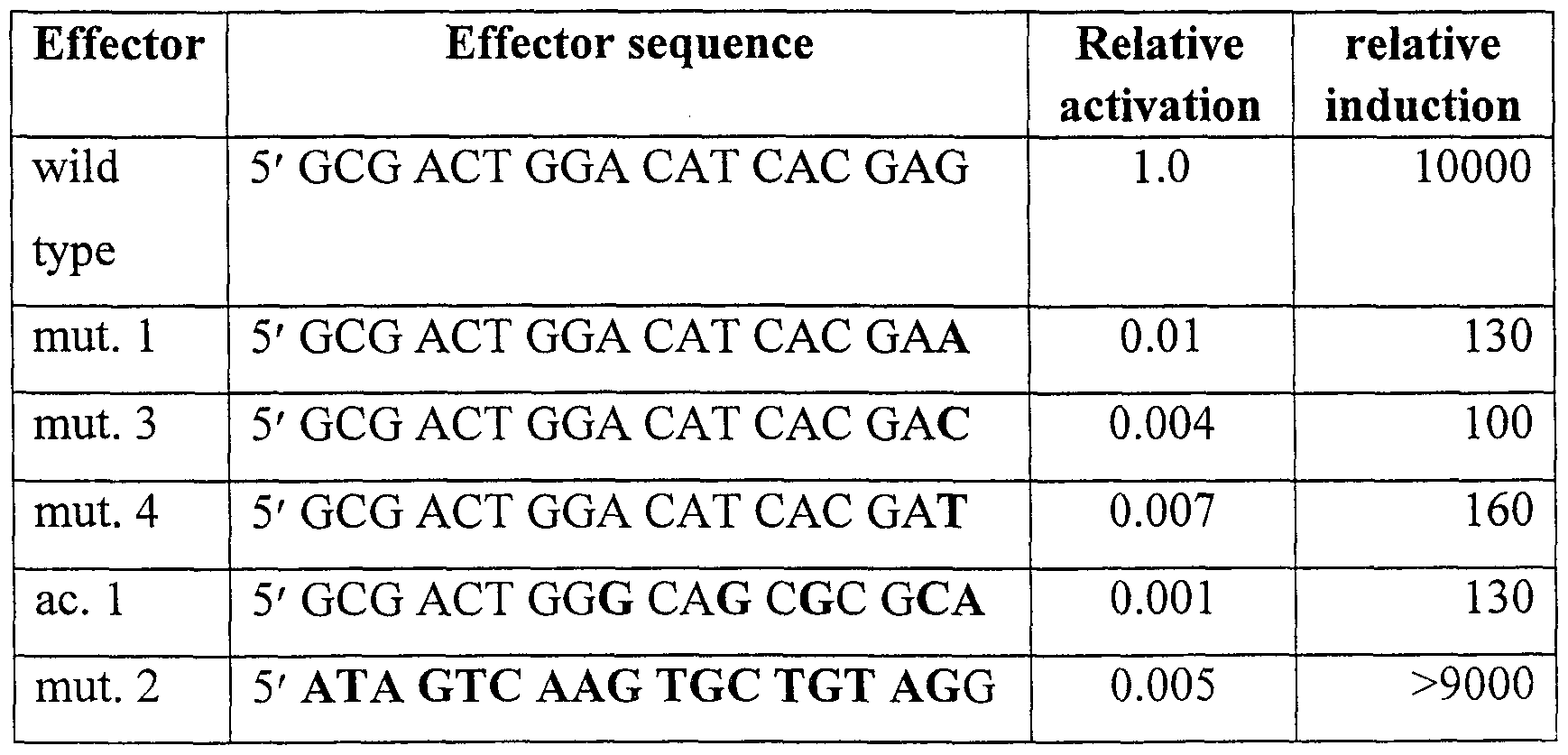
- Relative activation values indicate the extent to which the effector is able to activate the wild-type LI ribozyme.
- Relative induction values refer to the activity of a mutated ribozyme assayed with a complementary effector relative to activity without effector.
- the LI ribozyme is in fact an allosteric enzyme it should be possible to detect the proposed effector-dependent conformational changes.
- the ribozyme was probed with nucleases in the presence and absence of its oligonucleotide substrate and effector (Fig. 3). No substrate-dependent changes in nuclease accessibility were identified. However, the patterns of digestion were consistent with the effector-dependent secondary structural models proposed in Fig. 2.
- ribozymes can be generated by appending aptamers (nucleic acid sequences capable of binding proteins) to a hammerhead ribozyme .
- the anti-adenosine aptamer was swapped for a segment of the LI ribozyme that was not conserved during partial randomization and re-selection (Fig. 2; Fig. 5A).
- the catalytic activity for reporting activation of the ribozyme was ligation.
- the L I aptazyme i.e. ribozyme containing the aptamer sensed different concentrations of ATP (Fig.
- the activation of the allosteric ribozyme is sensitive to the presence of at least some mismatches as shown in Table 1 above. To determine whether background sequences might yield false positives, the activity of the LI ribozyme was also assayed in the presence of either a random sequence pool or the cognate oligonucleotide effector mixed with a random sequence pool. Activation was detected only when the cognate oligonucleotide effector was present (data not shown).
- Protein kinase C contains a pseudosubstrate prototope in its regulatory domain. Science
Landscapes
- Chemical & Material Sciences (AREA)
- Life Sciences & Earth Sciences (AREA)
- Organic Chemistry (AREA)
- Health & Medical Sciences (AREA)
- Engineering & Computer Science (AREA)
- Zoology (AREA)
- Wood Science & Technology (AREA)
- Proteomics, Peptides & Aminoacids (AREA)
- Immunology (AREA)
- Analytical Chemistry (AREA)
- Chemical Kinetics & Catalysis (AREA)
- Microbiology (AREA)
- Molecular Biology (AREA)
- Biophysics (AREA)
- Physics & Mathematics (AREA)
- Biotechnology (AREA)
- Biochemistry (AREA)
- Bioinformatics & Cheminformatics (AREA)
- General Engineering & Computer Science (AREA)
- General Health & Medical Sciences (AREA)
- Genetics & Genomics (AREA)
- Pathology (AREA)
- Measuring Or Testing Involving Enzymes Or Micro-Organisms (AREA)
Abstract
Description
Claims
Priority Applications (1)
| Application Number | Priority Date | Filing Date | Title |
|---|---|---|---|
| AU63646/99A AU6364699A (en) | 1998-10-23 | 1999-10-22 | Detection of analytes |
Applications Claiming Priority (2)
| Application Number | Priority Date | Filing Date | Title |
|---|---|---|---|
| IL12673198A IL126731A0 (en) | 1998-10-23 | 1998-10-23 | A method of detection |
| IL126731 | 1998-10-23 |
Publications (2)
| Publication Number | Publication Date |
|---|---|
| WO2000024931A2 true WO2000024931A2 (en) | 2000-05-04 |
| WO2000024931A3 WO2000024931A3 (en) | 2000-08-17 |
Family
ID=11072060
Family Applications (1)
| Application Number | Title | Priority Date | Filing Date |
|---|---|---|---|
| PCT/IL1999/000557 Ceased WO2000024931A2 (en) | 1998-10-23 | 1999-10-22 | Detection of analytes |
Country Status (3)
| Country | Link |
|---|---|
| AU (1) | AU6364699A (en) |
| IL (1) | IL126731A0 (en) |
| WO (1) | WO2000024931A2 (en) |
Cited By (28)
| Publication number | Priority date | Publication date | Assignee | Title |
|---|---|---|---|---|
| WO2001000869A3 (en) * | 1999-06-23 | 2001-05-10 | Intelligene Ltd | Arrays of catalytic or pre-catalytic nucleic acids |
| US6482932B1 (en) | 1997-11-05 | 2002-11-19 | Ribozyme Pharmaceuticals, Incorporated | Nucleoside triphosphates and their incorporation into oligonucleotides |
| US6506887B1 (en) | 1999-07-29 | 2003-01-14 | Somalogic, Incorporated | Conditional-selex |
| US6617438B1 (en) | 1997-11-05 | 2003-09-09 | Sirna Therapeutics, Inc. | Oligoribonucleotides with enzymatic activity |
| US6995259B1 (en) | 1998-10-23 | 2006-02-07 | Sirna Therapeutics, Inc. | Method for the chemical synthesis of oligonucleotides |
| US7022828B2 (en) | 2001-04-05 | 2006-04-04 | Sirna Theraputics, Inc. | siRNA treatment of diseases or conditions related to levels of IKK-gamma |
| US7034009B2 (en) | 1995-10-26 | 2006-04-25 | Sirna Therapeutics, Inc. | Enzymatic nucleic acid-mediated treatment of ocular diseases or conditions related to levels of vascular endothelial growth factor receptor (VEGF-R) |
| US7071311B2 (en) | 2002-02-13 | 2006-07-04 | Sirna Therapeutics, Inc. | Antibodies having specificity for 2′-C-allyl nucleic acids |
| US7205399B1 (en) | 2001-07-06 | 2007-04-17 | Sirna Therapeutics, Inc. | Methods and reagents for oligonucleotide synthesis |
| US7491805B2 (en) | 2001-05-18 | 2009-02-17 | Sirna Therapeutics, Inc. | Conjugates and compositions for cellular delivery |
| US7833992B2 (en) | 2001-05-18 | 2010-11-16 | Merck Sharpe & Dohme | Conjugates and compositions for cellular delivery |
| US7858625B2 (en) | 2001-05-18 | 2010-12-28 | Sirna Therapeutics, Inc. | Conjugates and compositions for cellular delivery |
| US7960102B2 (en) | 2002-07-25 | 2011-06-14 | Archemix Corp. | Regulated aptamer therapeutics |
| WO2011076807A2 (en) | 2009-12-23 | 2011-06-30 | Novartis Ag | Lipids, lipid compositions, and methods of using them |
| EP2415486A2 (en) | 2001-05-18 | 2012-02-08 | Sirna Therapeutics, Inc. | Conjugates and compositions for cellular delivery |
| EP2471815A1 (en) | 2006-07-11 | 2012-07-04 | University Of Medicine And Dentistry Of New Jersey | Proteins, nucleic acids encoding the same and associated methods of use |
| WO2014136086A1 (en) | 2013-03-08 | 2014-09-12 | Novartis Ag | Lipids and lipid compositions for the delivery of active agents |
| WO2015095346A1 (en) | 2013-12-19 | 2015-06-25 | Novartis Ag | Lipids and lipid compositions for the delivery of active agents |
| WO2015095340A1 (en) | 2013-12-19 | 2015-06-25 | Novartis Ag | Lipids and lipid compositions for the delivery of active agents |
| US9181551B2 (en) | 2002-02-20 | 2015-11-10 | Sirna Therapeutics, Inc. | RNA interference mediated inhibition of gene expression using chemically modified short interfering nucleic acid (siNA) |
| WO2016010840A1 (en) | 2014-07-16 | 2016-01-21 | Novartis Ag | Method of encapsulating a nucleic acid in a lipid nanoparticle host |
| US9260471B2 (en) | 2010-10-29 | 2016-02-16 | Sirna Therapeutics, Inc. | RNA interference mediated inhibition of gene expression using short interfering nucleic acids (siNA) |
| WO2016037053A1 (en) | 2014-09-05 | 2016-03-10 | Novartis Ag | Lipids and lipid compositions for the delivery of active agents |
| US9657294B2 (en) | 2002-02-20 | 2017-05-23 | Sirna Therapeutics, Inc. | RNA interference mediated inhibition of gene expression using chemically modified short interfering nucleic acid (siNA) |
| EP3222294A1 (en) | 2003-04-30 | 2017-09-27 | Sirna Therapeutics, Inc. | Conjugates and compositions for cellular delivery |
| US9994853B2 (en) | 2001-05-18 | 2018-06-12 | Sirna Therapeutics, Inc. | Chemically modified multifunctional short interfering nucleic acid molecules that mediate RNA interference |
| US10508277B2 (en) | 2004-05-24 | 2019-12-17 | Sirna Therapeutics, Inc. | Chemically modified multifunctional short interfering nucleic acid molecules that mediate RNA interference |
| US12458604B2 (en) | 2020-10-14 | 2025-11-04 | The Trustees Of The University Of Pennsylvania | Methods of lipid nanoparticle manufacture and compositions derived therefrom |
Families Citing this family (1)
| Publication number | Priority date | Publication date | Assignee | Title |
|---|---|---|---|---|
| US7517864B2 (en) | 2001-05-18 | 2009-04-14 | Sirna Therapeutics, Inc. | RNA interference mediated inhibition of vascular endothelial growth factor and vascular endothelial growth factor receptor gene expression using short interfering nucleic acid (siNA) |
Family Cites Families (4)
| Publication number | Priority date | Publication date | Assignee | Title |
|---|---|---|---|---|
| AU675482B2 (en) * | 1992-12-04 | 1997-02-06 | Innovir Laboratories, Inc. | Ribozyme amplified diagnostics |
| JPH08505531A (en) * | 1993-01-15 | 1996-06-18 | ザ パブリック ヘルス リサーチ インスティチュート オブ ザ シティー オブ ニューヨーク インク | RNA assay method using RNA binary probe and ribozyme ligase |
| CN1232509A (en) * | 1996-08-26 | 1999-10-20 | 音坦里吉有限公司 | Catalytic nucleic acid and its medical use |
| EP0958303A4 (en) * | 1996-12-19 | 2004-03-31 | Univ Yale | BIOREACTIVE ALLOSTER POLYNUCLEOTIDES |
-
1998
- 1998-10-23 IL IL12673198A patent/IL126731A0/en unknown
-
1999
- 1999-10-22 WO PCT/IL1999/000557 patent/WO2000024931A2/en not_active Ceased
- 1999-10-22 AU AU63646/99A patent/AU6364699A/en not_active Abandoned
Cited By (57)
| Publication number | Priority date | Publication date | Assignee | Title |
|---|---|---|---|---|
| US7034009B2 (en) | 1995-10-26 | 2006-04-25 | Sirna Therapeutics, Inc. | Enzymatic nucleic acid-mediated treatment of ocular diseases or conditions related to levels of vascular endothelial growth factor receptor (VEGF-R) |
| US6482932B1 (en) | 1997-11-05 | 2002-11-19 | Ribozyme Pharmaceuticals, Incorporated | Nucleoside triphosphates and their incorporation into oligonucleotides |
| US6617438B1 (en) | 1997-11-05 | 2003-09-09 | Sirna Therapeutics, Inc. | Oligoribonucleotides with enzymatic activity |
| US7777023B2 (en) | 1998-10-23 | 2010-08-17 | Sirna Therapeutics, Inc. | Method for the chemical synthesis of oligonucleotides |
| US6995259B1 (en) | 1998-10-23 | 2006-02-07 | Sirna Therapeutics, Inc. | Method for the chemical synthesis of oligonucleotides |
| WO2001000869A3 (en) * | 1999-06-23 | 2001-05-10 | Intelligene Ltd | Arrays of catalytic or pre-catalytic nucleic acids |
| US6506887B1 (en) | 1999-07-29 | 2003-01-14 | Somalogic, Incorporated | Conditional-selex |
| US6706482B2 (en) | 1999-07-29 | 2004-03-16 | Somalogic, Inc. | Conditional-selex |
| US7022828B2 (en) | 2001-04-05 | 2006-04-04 | Sirna Theraputics, Inc. | siRNA treatment of diseases or conditions related to levels of IKK-gamma |
| US7833992B2 (en) | 2001-05-18 | 2010-11-16 | Merck Sharpe & Dohme | Conjugates and compositions for cellular delivery |
| US7491805B2 (en) | 2001-05-18 | 2009-02-17 | Sirna Therapeutics, Inc. | Conjugates and compositions for cellular delivery |
| US7858625B2 (en) | 2001-05-18 | 2010-12-28 | Sirna Therapeutics, Inc. | Conjugates and compositions for cellular delivery |
| US9994853B2 (en) | 2001-05-18 | 2018-06-12 | Sirna Therapeutics, Inc. | Chemically modified multifunctional short interfering nucleic acid molecules that mediate RNA interference |
| US7964578B2 (en) | 2001-05-18 | 2011-06-21 | Sirna Therapeutics, Inc. | Conjugates and compositions for cellular delivery |
| EP3231445A1 (en) | 2001-05-18 | 2017-10-18 | Sirna Therapeutics, Inc. | Conjugates and compositions for cellular delivery |
| EP2415486A2 (en) | 2001-05-18 | 2012-02-08 | Sirna Therapeutics, Inc. | Conjugates and compositions for cellular delivery |
| US7205399B1 (en) | 2001-07-06 | 2007-04-17 | Sirna Therapeutics, Inc. | Methods and reagents for oligonucleotide synthesis |
| US7071311B2 (en) | 2002-02-13 | 2006-07-04 | Sirna Therapeutics, Inc. | Antibodies having specificity for 2′-C-allyl nucleic acids |
| US9732344B2 (en) | 2002-02-20 | 2017-08-15 | Sirna Therapeutics, Inc. | RNA interference mediated inhibition of gene expression using chemically modified short interfering nucleic acid (siNA) |
| US10000754B2 (en) | 2002-02-20 | 2018-06-19 | Sirna Therapeutics, Inc. | RNA interference mediated inhibition of gene expression using chemically modified short interfering nucleic acid (siNA) |
| US10889815B2 (en) | 2002-02-20 | 2021-01-12 | Sirna Therapeutics, Inc. | RNA interference mediated inhibition of gene expression using chemically modified short interfering nucleic acid (siNA) |
| US10662428B2 (en) | 2002-02-20 | 2020-05-26 | Sirna Therapeutics, Inc. | RNA interference mediated inhibition of gene expression using chemically modified short interfering nucleic acid (siNA) |
| US10351852B2 (en) | 2002-02-20 | 2019-07-16 | Sirna Therapeutics, Inc. | RNA interference mediated inhibition of gene expression using chemically modified short interfering nucleic acid (siNA) |
| US9181551B2 (en) | 2002-02-20 | 2015-11-10 | Sirna Therapeutics, Inc. | RNA interference mediated inhibition of gene expression using chemically modified short interfering nucleic acid (siNA) |
| US9957517B2 (en) | 2002-02-20 | 2018-05-01 | Sirna Therapeutics, Inc. | RNA interference mediated inhibition of gene expression using chemically modified short interfering nucleic acid (siNA) |
| US9771588B2 (en) | 2002-02-20 | 2017-09-26 | Sirna Therapeutics, Inc. | RNA interference mediated inhibition of gene expression using chemically modified short interfering nucleic acid (siNA) |
| US9738899B2 (en) | 2002-02-20 | 2017-08-22 | Sirna Therapeutics, Inc. | RNA interference mediated inhibition of gene expression using chemically modified short interfering nucleic acid (siNA) |
| US9657294B2 (en) | 2002-02-20 | 2017-05-23 | Sirna Therapeutics, Inc. | RNA interference mediated inhibition of gene expression using chemically modified short interfering nucleic acid (siNA) |
| US7960102B2 (en) | 2002-07-25 | 2011-06-14 | Archemix Corp. | Regulated aptamer therapeutics |
| EP3222294A1 (en) | 2003-04-30 | 2017-09-27 | Sirna Therapeutics, Inc. | Conjugates and compositions for cellular delivery |
| US10508277B2 (en) | 2004-05-24 | 2019-12-17 | Sirna Therapeutics, Inc. | Chemically modified multifunctional short interfering nucleic acid molecules that mediate RNA interference |
| EP2471815A1 (en) | 2006-07-11 | 2012-07-04 | University Of Medicine And Dentistry Of New Jersey | Proteins, nucleic acids encoding the same and associated methods of use |
| EP2471809A1 (en) | 2006-07-11 | 2012-07-04 | University Of Medicine And Dentistry Of New Jersey | Proteins, nucleic acids encoding the same and associated methods of use |
| EP3721943A1 (en) | 2009-12-23 | 2020-10-14 | Novartis AG | Lipids, lipid compositions and methods of using them |
| WO2011076807A2 (en) | 2009-12-23 | 2011-06-30 | Novartis Ag | Lipids, lipid compositions, and methods of using them |
| US9301923B2 (en) | 2009-12-23 | 2016-04-05 | Novartis Ag | Lipids, lipid compositions, and methods of using them |
| US9970005B2 (en) | 2010-10-29 | 2018-05-15 | Sirna Therapeutics, Inc. | RNA interference mediated inhibition of gene expression using short interfering nucleic acids (siNA) |
| US12516321B2 (en) | 2010-10-29 | 2026-01-06 | Sirna Therapeutics, Inc. | RNA interference mediated inhibition of gene expression using short interfering nucleic acids (siNA) |
| US11932854B2 (en) | 2010-10-29 | 2024-03-19 | Sirna Therapeutics, Inc. | RNA interference mediated inhibition of gene expression using short interfering nucleic acids (siNA) |
| US11193126B2 (en) | 2010-10-29 | 2021-12-07 | Sirna Therapeutics, Inc. | RNA interference mediated inhibition of gene expression using short interfering nucleic acids (siNA) |
| US9260471B2 (en) | 2010-10-29 | 2016-02-16 | Sirna Therapeutics, Inc. | RNA interference mediated inhibition of gene expression using short interfering nucleic acids (siNA) |
| EP3608308A1 (en) | 2013-03-08 | 2020-02-12 | Novartis AG | Lipids and lipid compositions for the delivery of active agents |
| WO2014136086A1 (en) | 2013-03-08 | 2014-09-12 | Novartis Ag | Lipids and lipid compositions for the delivery of active agents |
| US10906867B2 (en) | 2013-12-19 | 2021-02-02 | Novartis Ag | Lipids and lipid compositions for the delivery of active agents |
| US11420933B2 (en) | 2013-12-19 | 2022-08-23 | Novartis Ag | Lipids and lipid compositions for the delivery of active agents |
| US10059655B2 (en) | 2013-12-19 | 2018-08-28 | Novartis Ag | Lipids and lipid compositions for the delivery of active agents |
| US10426737B2 (en) | 2013-12-19 | 2019-10-01 | Novartis Ag | Lipids and lipid compositions for the delivery of active agents |
| WO2015095346A1 (en) | 2013-12-19 | 2015-06-25 | Novartis Ag | Lipids and lipid compositions for the delivery of active agents |
| US11013696B2 (en) | 2013-12-19 | 2021-05-25 | Novartis Ag | Lipids and lipid compositions for the delivery of active agents |
| EP3872066A1 (en) | 2013-12-19 | 2021-09-01 | Novartis AG | Lipids and lipid compositions for the delivery of active agents |
| WO2015095340A1 (en) | 2013-12-19 | 2015-06-25 | Novartis Ag | Lipids and lipid compositions for the delivery of active agents |
| EP4019506A1 (en) | 2013-12-19 | 2022-06-29 | Novartis AG | Lipids and lipid compositions for the delivery of active agents |
| WO2016010840A1 (en) | 2014-07-16 | 2016-01-21 | Novartis Ag | Method of encapsulating a nucleic acid in a lipid nanoparticle host |
| EP4223285A2 (en) | 2014-07-16 | 2023-08-09 | Novartis AG | Method of encapsulating a nucleic acid in a lipid nanoparticle host |
| US10342761B2 (en) | 2014-07-16 | 2019-07-09 | Novartis Ag | Method of encapsulating a nucleic acid in a lipid nanoparticle host |
| WO2016037053A1 (en) | 2014-09-05 | 2016-03-10 | Novartis Ag | Lipids and lipid compositions for the delivery of active agents |
| US12458604B2 (en) | 2020-10-14 | 2025-11-04 | The Trustees Of The University Of Pennsylvania | Methods of lipid nanoparticle manufacture and compositions derived therefrom |
Also Published As
| Publication number | Publication date |
|---|---|
| AU6364699A (en) | 2000-05-15 |
| IL126731A0 (en) | 1999-08-17 |
| WO2000024931A3 (en) | 2000-08-17 |
Similar Documents
| Publication | Publication Date | Title |
|---|---|---|
| WO2000024931A2 (en) | Detection of analytes | |
| Robertson et al. | In vitro selection of an allosteric ribozyme that transduces analytes to amplicons | |
| EP0592626B1 (en) | METHODS TO CLONE mRNA | |
| US5688670A (en) | Self-modifying RNA molecules and methods of making | |
| US5910408A (en) | Catalytic DNA having ligase activity | |
| Ekland et al. | The secondary structure and sequence optimization of an RNA ligase ribozyme | |
| Bartel et al. | Isolation of new ribozymes from a large pool of random sequences | |
| EP1350854B1 (en) | Catalytic nucleic acid and its medical use | |
| JPH07509371A (en) | Methods, reagents and kits for detection and amplification of nucleic acid sequences | |
| EP3568493B1 (en) | Methods and compositions for reducing redundant molecular barcodes created in primer extension reactions | |
| JP2002509703A (en) | Rolling circle replication of padlock probe | |
| JPH05503423A (en) | Nucleic acid enzyme for DNA cutting | |
| Szostak et al. | In vitro selection of functional RNA sequences | |
| JP2002514080A (en) | Enzyme DNA molecule | |
| WO2007123742A2 (en) | Methods and compositions for increasing the fidelity of multiplex nucleic acid assembly | |
| Carrigan et al. | Quantitative analysis of a RNA-cleaving DNA catalyst obtained via in vitro selection | |
| Hartig et al. | Small circular DNAs for synthesis of the human telomere repeat: varied sizes, structures and telomere-encoding activities | |
| Maillard et al. | Isolation of New Ribozymes from Sequences | |
| Robertson | Engineered regulation of an RNA ligase ribozyme | |
| Joyce | Nucleic acid enzymes for cleaving DNA | |
| HK40009932B (en) | Methods and compositions for reducing redundant molecular barcodes created in primer extension reactions | |
| HK40009932A (en) | Methods and compositions for reducing redundant molecular barcodes created in primer extension reactions | |
| MXPA97009596A (en) | Dna catalöt |
Legal Events
| Date | Code | Title | Description |
|---|---|---|---|
| ENP | Entry into the national phase |
Ref country code: AU Ref document number: 1999 63646 Kind code of ref document: A Format of ref document f/p: F |
|
| AK | Designated states |
Kind code of ref document: A2 Designated state(s): AE AL AM AT AU AZ BA BB BG BR BY CA CH CN CR CU CZ DE DK DM EE ES FI GB GD GE GH GM HR HU ID IL IN IS JP KE KG KP KR KZ LC LK LR LS LT LU LV MA MD MG MK MN MW MX NO NZ PL PT RO RU SD SE SG SI SK SL TJ TM TR TT TZ UA UG US UZ VN YU ZA ZW |
|
| AL | Designated countries for regional patents |
Kind code of ref document: A2 Designated state(s): GH GM KE LS MW SD SL SZ TZ UG ZW AM AZ BY KG KZ MD RU TJ TM AT BE CH CY DE DK ES FI FR GB GR IE IT LU MC NL PT SE BF BJ CF CG CI CM GA GN GW ML MR NE SN TD TG |
|
| DFPE | Request for preliminary examination filed prior to expiration of 19th month from priority date (pct application filed before 20040101) | ||
| 121 | Ep: the epo has been informed by wipo that ep was designated in this application | ||
| AK | Designated states |
Kind code of ref document: A3 Designated state(s): AE AL AM AT AU AZ BA BB BG BR BY CA CH CN CR CU CZ DE DK DM EE ES FI GB GD GE GH GM HR HU ID IL IN IS JP KE KG KP KR KZ LC LK LR LS LT LU LV MA MD MG MK MN MW MX NO NZ PL PT RO RU SD SE SG SI SK SL TJ TM TR TT TZ UA UG US UZ VN YU ZA ZW |
|
| AL | Designated countries for regional patents |
Kind code of ref document: A3 Designated state(s): GH GM KE LS MW SD SL SZ TZ UG ZW AM AZ BY KG KZ MD RU TJ TM AT BE CH CY DE DK ES FI FR GB GR IE IT LU MC NL PT SE BF BJ CF CG CI CM GA GN GW ML MR NE SN TD TG |
|
| REG | Reference to national code |
Ref country code: DE Ref legal event code: 8642 |
|
| 122 | Ep: pct application non-entry in european phase |