WO1999040916A1 - Use of n-substituted-1,5-dideoxy-1,5-imino-d-glucitol compounds for treating hepatitis virus infections - Google Patents
Use of n-substituted-1,5-dideoxy-1,5-imino-d-glucitol compounds for treating hepatitis virus infections Download PDFInfo
- Publication number
- WO1999040916A1 WO1999040916A1 PCT/US1999/001874 US9901874W WO9940916A1 WO 1999040916 A1 WO1999040916 A1 WO 1999040916A1 US 9901874 W US9901874 W US 9901874W WO 9940916 A1 WO9940916 A1 WO 9940916A1
- Authority
- WO
- WIPO (PCT)
- Prior art keywords
- dideoxy
- glucitol
- imino
- tetrabutyrate
- oxa
- Prior art date
- Legal status (The legal status is an assumption and is not a legal conclusion. Google has not performed a legal analysis and makes no representation as to the accuracy of the status listed.)
- Ceased
Links
- 0 C[C@]([C@](*)[C@](C*1*)O)[C@@]1C=[N+][O-] Chemical compound C[C@]([C@](*)[C@](C*1*)O)[C@@]1C=[N+][O-] 0.000 description 3
Classifications
-
- C—CHEMISTRY; METALLURGY
- C07—ORGANIC CHEMISTRY
- C07D—HETEROCYCLIC COMPOUNDS
- C07D211/00—Heterocyclic compounds containing hydrogenated pyridine rings, not condensed with other rings
- C07D211/04—Heterocyclic compounds containing hydrogenated pyridine rings, not condensed with other rings with only hydrogen or carbon atoms directly attached to the ring nitrogen atom
- C07D211/06—Heterocyclic compounds containing hydrogenated pyridine rings, not condensed with other rings with only hydrogen or carbon atoms directly attached to the ring nitrogen atom having no double bonds between ring members or between ring members and non-ring members
- C07D211/36—Heterocyclic compounds containing hydrogenated pyridine rings, not condensed with other rings with only hydrogen or carbon atoms directly attached to the ring nitrogen atom having no double bonds between ring members or between ring members and non-ring members with hetero atoms or with carbon atoms having three bonds to hetero atoms with at the most one bond to halogen, e.g. ester or nitrile radicals, directly attached to ring carbon atoms
- C07D211/40—Oxygen atoms
- C07D211/44—Oxygen atoms attached in position 4
- C07D211/46—Oxygen atoms attached in position 4 having a hydrogen atom as the second substituent in position 4
-
- A—HUMAN NECESSITIES
- A61—MEDICAL OR VETERINARY SCIENCE; HYGIENE
- A61K—PREPARATIONS FOR MEDICAL, DENTAL OR TOILETRY PURPOSES
- A61K31/00—Medicinal preparations containing organic active ingredients
- A61K31/33—Heterocyclic compounds
- A61K31/395—Heterocyclic compounds having nitrogen as a ring hetero atom, e.g. guanethidine or rifamycins
- A61K31/435—Heterocyclic compounds having nitrogen as a ring hetero atom, e.g. guanethidine or rifamycins having six-membered rings with one nitrogen as the only ring hetero atom
- A61K31/44—Non condensed pyridines; Hydrogenated derivatives thereof
- A61K31/445—Non condensed piperidines, e.g. piperocaine
-
- A—HUMAN NECESSITIES
- A61—MEDICAL OR VETERINARY SCIENCE; HYGIENE
- A61K—PREPARATIONS FOR MEDICAL, DENTAL OR TOILETRY PURPOSES
- A61K45/00—Medicinal preparations containing active ingredients not provided for in groups A61K31/00 - A61K41/00
- A61K45/06—Mixtures of active ingredients without chemical characterisation, e.g. antiphlogistics and cardiaca
-
- A—HUMAN NECESSITIES
- A61—MEDICAL OR VETERINARY SCIENCE; HYGIENE
- A61P—SPECIFIC THERAPEUTIC ACTIVITY OF CHEMICAL COMPOUNDS OR MEDICINAL PREPARATIONS
- A61P1/00—Drugs for disorders of the alimentary tract or the digestive system
- A61P1/16—Drugs for disorders of the alimentary tract or the digestive system for liver or gallbladder disorders, e.g. hepatoprotective agents, cholagogues, litholytics
-
- A—HUMAN NECESSITIES
- A61—MEDICAL OR VETERINARY SCIENCE; HYGIENE
- A61P—SPECIFIC THERAPEUTIC ACTIVITY OF CHEMICAL COMPOUNDS OR MEDICINAL PREPARATIONS
- A61P31/00—Antiinfectives, i.e. antibiotics, antiseptics, chemotherapeutics
- A61P31/12—Antivirals
- A61P31/14—Antivirals for RNA viruses
-
- A—HUMAN NECESSITIES
- A61—MEDICAL OR VETERINARY SCIENCE; HYGIENE
- A61P—SPECIFIC THERAPEUTIC ACTIVITY OF CHEMICAL COMPOUNDS OR MEDICINAL PREPARATIONS
- A61P31/00—Antiinfectives, i.e. antibiotics, antiseptics, chemotherapeutics
- A61P31/12—Antivirals
- A61P31/20—Antivirals for DNA viruses
Definitions
- the present invention relates to methods and compositions for treating hepatitis virus infections, especially hepatitis B virus infections, in mammals, especially humans.
- the methods comprise (1) administering N-substituted- 1 ,5-dideoxy- 1 , 5-imino-D-glucitol compounds alone or in combination with nucleoside antiviral agents, nucleotide antiviral agents, mixtures thereof, or immunomodulating/-immunostimulating agents, or (2) administering N-substituted-l,5-dideoxy-l,5-imino-D-glucitol compounds alone or in combination with nucleoside antiviral agents, nucleotide antiviral agents, or mixtures thereof, and iimnunomodulating/immunostimulating agents.
- Such combinations of anti- hepatitis viral agents show unexpected efficacy in inhibiting replication and secretion of hepatitis viruses in cells of mammals infected with these viruses ,
- Hepatitis B Virus is a causative agent of acute and chronic liver disease including liver fibrosis, cirrhosis, inflammatory liver disease, and hepatic cancer that can lead to death in some patients (Joklik, Wolfgang K. , Virology, Third Edition, Appleton & Lange, ⁇ orwalk, Connecticut, 1988 (ISBN 0-8385-9462-X)).
- effective vaccines are available, there are still more than 300 million people worldwide, i.e. , 5 % of the world's population, chronically infected with the virus (Locarnini, S. A. , ct.
- liver cirrhosis Once liver cirrhosis is established, morbidity and mortality are substantial, with about a 5-year patient survival period (Blume, H., E., et.al., Advanced Drug Delivery Reviews (1995) 17:321-331). It is therefore necessary and of high priority to find improved and effective anti-HBV anti-hepatitis therapies (Locarnini, S. A. , et. al. , Antiviral Chemistry ⁇ Chemotherapy (1996) 7(2): 53-64).
- hepatitis viruses significant as agents of human disease include Hepatitis A, Hepatitis B, Hepatitis C, Hepatitis Delta, Hepatitis E, Hepatitis F, and Hepatitis G (Coates, J. A. V., et.al., Exp. Opin. Ther. Patents (1995) 5(8):747-756).
- animal hepatitis viruses that are species-specific. These include, for example, those infecting ducks, woodchucks, and mice.
- Glucosidase inhibitors such as N-alkyl-l,5-dideoxy-l,5-imino-D-glucitol compounds wherein the alkyl group contains between three and six carbon atoms have been shown to be effective in the treatment of Hepatitis B infection (PCT International Publication WO 95/19172).
- N(n-butyl)-deoxynojirimycin N-butyl-D ⁇ J; /V-(n-bu ⁇ yl)-l-5-didcoxy- 1 ,5-imino-D-glucitol
- Block, T. M. N(n-butyl)-deoxynojirimycin
- N-butyl-D ⁇ J has also been tested as an anti-HIV-1 agent in HIV infected patients, and is known to be well tolerated.
- Another alpha glucosidase inhibitor, deoxynojirimycin (D ⁇ J) has been suggested as an antiviral agent for use in combination with N-(phosphonoaceiyl)-L-aspartic acid (PAL A) (WO 93/ 18763) .
- Reverse transcriptasc inhibitors including the class of nucleoside and nucleotide analogs, were first developed as drugs for the treatment of retroviruses such as human immunodeficiency virus (HIV), the causative agent of AIDS. Increasingly, these compounds have found use against other viruses, including both RNA and DNA viruses, via viral screening and chemical modification strategies. Nucleoside and nucleotide analogs exert their antiviral activities by inhibiting the corresponding DNA and RNA polymerases responsible for synthesis of viral DNA and RN ⁇ , respectively. Because viruses contain different forms of polymerases, the same nucleoside/nuclcotidc compound can have a dramatically different effect against different viruses.
- retroviruses such as human immunodeficiency virus (HIV)
- HIV human immunodeficiency virus
- Nucleoside and nucleotide analogs exert their antiviral activities by inhibiting the corresponding DNA and RNA polymerases responsible for synthesis of viral DNA and RN ⁇ , respectively. Because viruses contain different
- lamivudine (3TCTM) appears to be useful against HBV infection
- zidovudinc ( ⁇ ZTTM) appears to have little use against the same virus (Gish, R.G., et al., Exp. Opin. Invest. Drugs (1995) 4(2):95-115).
- Toxicity has been significant with some nucleoside analog antivirals.
- nucleoside analog antivirals For example, clinical tests on the use of the nucleoside analog fialuridine (FIAU) for treatment of chronic hepatitis B were suspended recently due to drug-related liver failure leading to death in some patients. Consequently, there is slill a need for safer drug regimens for the treatment of hepatitis B infections and hepatitis (Mutchnick, M. G., et. al., Antiviral Research (1994) 24:245-257).
- FIAU fialuridine
- Immunomodulators and Immunostimulants such as interferon alfa and other cytokines have been used for the treatment of HBV infection with promising results . Unfortunately , the response rates are lower than desired. Interferon treatment is currently approved by the FDA for the treatment of Hepatitis B, Other immune system-affecting drug candidates are presently being investigated. These include thymic peptides for use in the treatment of chronic hepatitis B (CHB), isoprinosine, steroids, Shiff base-forming salicylaldehyde derivatives such as Tucaresol, levamisol, and the like (Gish, R. G. , et.al. , Exp. Opin. Invest. Drugs (1995) 4(2):95-115; Coates, J.A.V., et.al., Exp. Opin. Ther. Patents (1995) 5(8):747-765).
- CHB chronic hepatitis B
- isoprinosine steroids
- the present inventors have surprisingly discovered that the use of the N- substituted-l,5-dideoxy-l,5-imino-D-glucitol compounds disclosed herein are effective in treating hepatitis virus infections, Furthermore, the use of these compounds in combination with nucleoside or nucleotide antiviral compounds . or combinations thereof, and/or immunomodulators/immunostimulants, results in unexpectedly greater anti- hepatitis virus effectiveness of the compounds compared to the combined antiviral activities expected of the individual compounds alone, Whether this is due to different mechanisms of action of the different classes of drugs employed or some other biological phenomenon is presently unclear.
- the present invention provides a method for treating a hepatitis virus infection in a mammal, comprising administering to said mammal an anti- hepatitis virus effective amount of at least one N-substituted-l,5-didcoxy-l ,5-imino-D- glucitol compound of Formula I or a pharmaceutically acceptable salt thereof:
- R is selected from the group consisting of straight chain alkyl having a chain length of C 7 to C 20 , branched chain alkyl having a chain length of C 3 to C 20 in the main chain, alkoxyalkyl, arylalkyl, and cycloalkylalkyl, and wherein W, X, Y and Z are each independently selected from the group consisting of hydrogen, alkanoyl, aroyl, and trifiuoroalkanoyl.
- the present invention provides a method for treating a hepatitis virus infection in a mammal, comprising administering to said mammal an antiviral composition comprising an antiviral effective amount of at least one N-substituted-1,5- didcoxy-l ,5-imiuo-D-glucitol compound of Formula I or a pharmaceutically acceptable salt thereof, as above.
- the present invention provides a method for treating a hepatitis virus infection in a mammal, comprising administering to said mammal an antiviral composition consisting essentially of an antiviral effective amount of at least one N- substituted-l,5-dideoxy-l,5-imino-D-glucitol compound of Formula I or a pharmaceutically acceptable salt thereof, as above.
- the present invention provides a method for treating a hepatitis virus infection in a mammal, consisting essentially of administering to said mammal an antiviral effective amount of at least one N-substituted- 1 ,5-dideoxy- 1 ,5-imino-D-glucitol compound of Formula I or a pharmaceutically acceptable salt thereof, as above.
- the present invention provides a method for treating a hepatitis virus infection in a mammal, consisting essentially of administering to said mammal an antiviral effective amount of an antiviral compound consisting essentially of at least one N-substituted- l,5-dideoxy-l,5-imino-D-glucitol compound of Formula I or a pharmaceutically acceptable salt thereof, as above.
- the present invention provides a method for treating a hepatitis virus infection in a mammal, consisting essentially of administering to said mammal a first amount of at least one /V-substituted-l,5-dideoxy-l,5-in ⁇ no-D-glucitol compound of Formula 1 or a pharmaceutically acceptable salt thereof, as above, and a second amount of an antiviral compound selected from the group consisting of a nucleoside antiviral compound, a nucleotide antiviral compound, an immunomodulator, an immunostimulant, and mixtures thereof, wherein said first and second amounts of said compounds together comprise an anti-hepatitis virus effective amount of said compounds.
- the present invention provides a method for treating a hepatitis B virus infection in a mammal, comprising administering to said mammal from about 0.1 mg/kg/day to about 100 mg/kg/day of at least one N-substituted- l,5-dideoxy-l,5-imino- D-giucitol compound of Formula I or a pharmaceutically acceptable salt thereof, as above, and from about 0.1 mg/person/day to about 500 mg/person/day of a compound selected from the group consisting of a nucleoside antiviral compound, a nucleotide antiviral compound, and a mixture thereof.
- the present invention provides a method for treating a hepatitis B virus infection in a human patient, comprising administering to said human patient from about 0.1 mg/kg/day to about 100 g/kg/day of an N-substituted- l,5-dideoxy-l,5-imino- D-glucitol compound selected from the group consisting ⁇ /-(n-nonyl-)-l ,5-dideoxy-l,5- irnino-D-glucitol or a pharmaceutically acceptable salt thereof, /V-(n-nonyl-)- 1 ,5-dideoxy- 1,5-imino-D-glucitol, tetrabutyrate or a pharmaceutically acceptable salt thereof, and mixnircs thereof, and from about 0.1 mg/person day to about 500 mg/person/day of (-)-
- the present invention provides a method for treating a hepatitis virus infection in a mammal, comprising administering to said mammal an antiviral effective amount of at least one tV-substituted-1 ,5-dideoxy-l ,5-imino-D-glucitol compound of Formula I or a pharmaceutically acceptable salt thereof, as above, substantially exclusive of the administration of an antiviral composition comprising a nucleoside, a nucleotide, an iminunoraodulator, or an immunostimulant.
- die present invention provides a method for treating a hepatitis virus infection in a mammal, comprising administering to said mammal an antiviral effective amount of at least one /V-substitut ⁇ d-1 ,5-dideoxy- 1 ,5-imino-D-glucitol compound of Formula I or a pharmaceutically acceptable salt thereof, as above, substantially exclusive of the administration of antiviral compounds other than compounds of Formula I,
- the present invention provides a pharmaceutical composition, comprising an antiviral effective amount of at least one N-substituted-l,5-dideoxy-l,5- imino-D-glucitol compound of Formula I or a pharmaceutically acceptable salt thereof, as above, and a pharmaceutically acceptable carrier, excipient.or diluent.
- the present invention provides a pharmaceutical composition, consisting essentially of an antiviral effective amount of at least one N-substituted-1,5- dideoxy-l,5-imino-D-glucitol compound of Formula I or a pharmaceutically acceptable salt thereof, as above, and a pharmaceutically acceptable carrier, diluent, or excipient.
- the present invention provides a pharmaceutical composition, comprising an antiviral effective amount of at least one N-substituted- 1,5-dideoxy- 1 ,5- imino-D-g(uciiol compound of Formula I or a pharmaceutically acceptable salt thereof, as above, substantially free of a nucleoside, nucleotide, immunomodulator, or immunostimulant, and a pharmaceutically acceptable, carrier, diluent, or excipient.
- the present invention provides a pharmaceutical composition, comprising an antiviral effective amount of at least one N-substituted-l,5-dideoxy-l,5- imino-D-glucitol compound of Formula I or a pharmaceutically acceptable salt thereof, as above, substantially free of antiviral compounds other than compounds of Formula 1, and a pharmaceutically acceptable, carrier, diluent, or excipient.
- the present invention provides a composition, comprising at least one N-substitutcd-l,5-dideoxy-l,5-imino-D-glucitol compound of Formula I or a pharmaceutically acceptable salt thereof, as above, and an antiviral compound selected from the group consisting of a nucleoside antiviral compound, a nucleotide antiviral compound, an immunomodulator, an immunostimulant, and mixtures thereof.
- the present invention provides a pharmaceutical composition, comprising a first amount of at least one N-substitutcd-l,5-dideoxy-l,5- ⁇ mino-D-glucitol compound of Formula I or a pharmaceutically acceptable salt thereof, as above; a second amount of an antiviral compound selected from the group consisting of a nucleoside antiviral compound, a nucleotide antiviral compound, an immunomodulator, an immunostimulant, and mixtures thereof; and a pharmaceutically acceptable carrier, diluent, or excipient, wherein said first and second amounts of said compounds together comprise an antiviral effective amount of said compounds ,
- the present invention provides a pharmaceutical composition for treating a hepatitis B virus infection in a mammal, comprising from about 0.1 mg to about 100 mg of at least one Nsubstituted-l,5-dideoxy-l,5-imino-D-glucitol compound of Formula I or a pharmaceutically acceptable salt thereof, as above; from about 0.1 mg to about 500 mg of a compound selected from the group consisting of a nucleoside antiviral compound, a nucleotide antiviral, and mixtures thereof; and a pharmaceutically acceptable carrier, diluent, or excipient.
- the present invention provides a pharmaceutical composition for treating a hepatitis B virus infection in a human patient, comprising from about 0.1 mg to about 100 mg of an N-substituted- 1 ,5-dideoxy- 1 ,5-imino-D-glucitol compound selected from the group consisting of N-(n-nonyl)-l,5-dideoxy-l,5-imino-D-glucitol or a pharmaceutically acceptable salt thereof, /V-(n-nonyl)-l ,5-dideoxy-l ,5-imino-D-glucitol, tetrabutyrate or a pharmaceutically acceptable salt thereof, and mixtures thereof; from about 0.1 mg to about 500 mg of (-)-2'-deoxy-3'-tbiocytidine-5'-triphosphate; and a pharmaceutically acceptable carrier, diluent, or excipient,
- the present invention provides a salt, comprising an N-substitutcd ,5-didcoxy-l,5-imino-D-glucitol compound of Formula I, as above, and a compound selected from the group consisting of a nucleoside having an acidic moiety and a nucleotide.
- the present invention provides a method, comprising reacting N-(n-nonyl)-l ,5-didcoxy-l ,5-imino-D-glucitol and (-)-2'-deoxy-3 '-thiocytidine-5 '- triphosphate under salt-forming conditions, as well as a salt produced tiiereby.
- Figure 1 shows the anti-hepatitis B virus activity of (-)-2'-deoxy-3'-thiocytidinc-5 '- triphosphate (3TC) alone and in combination with N-nonyl-DNJ in vitro.
- Figure 2 shows the plasma concentration of N-nonyl-DNJ versus dose of N-nonyl-
- Figure 3 shows the slope of Log(lPDNA + 10) to week versus dose. A distinct letter is used for each animal. The fitted line is from a four parameter logistic model.
- the present inventors have discovered that the use of /V-substitutcd-l,5-didcoxy- 1 ,5- nino-D-glucitol compounds are effective when used alone for treating hepatitis virus infections, They have additionally discovered that combinations of Nsubstituted-1,5- dideoxy-l,5-imino-D-glucitol compounds with anti-hepatitis virus nucleosides or nucleotides, and/ or immunomodulators/immunostimulants, are also effective for this purpose. There is some evidence that certain combinations may be more effective in inhibiting hepatitis virus replication than would have been expected via the combined use of the individual compounds.
- the present invention thus provides pharmaceutical compositions and methods of treating hepatitis virus infections, especially hepatitis B virus infections, in humans, other mammals, and cells using N-substiruted-l,5-dideoxy-l,5-imino-D-glucitol compounds alone or in combination with either an antiviral nucleoside, an antiviral nucleotide, mixtures thereof, and/or an immunomodulating or immunostimulating agent.
- the N- substituted-l,5-dideoxy-l,5-imino-D-glucitol compounds have basic nitrogen atoms and may be used in the form of a pharmaceutically acceptable salt.
- Nucleosides and nucleotides useful in the present invention are substituted purine or pyrmidine heterocycles further substituted with R 1 in Formulas II- VI at the 9 position in the case of purin ⁇ s or with R 1 at the 1 position in the case of pyrimidines.
- the immunomodulating and immunostimulating agents useful in the present invention include diose that stimulate immune responses effective in controlling or eliminating viruses or other infectious agent .
- Non-limiting examples of such immunomodulating and immunostimulating agents include cytokines, peptide agonists, steroids, and classic drugs such as lcvamisol.
- the drug combinations of this invention may be provided to a cell or cells, or to a human or other mammalian patient, either in separate pharmaceutically acceptable formulations administered simultaneously or sequentially, formulations containing more than one therapeutic agent, or by an assortment of single agent and multiple agent formulations. However administered, Utese drug combinations form an anti-hepatitis virus effective amount of components. 12
- anti-hepatitis-virus effective amount refers to an amount of an /V-substituted-l,5-dideoxy-l,5-imino-D-glucitol compound alone, or a combined amount of (1) an N-substituted- l ,5-dideoxy ,5-imino-D-glucitol compound with either an antiviral nucleoside, an antiviral nucleotide, a mixture of an antiviral nucleoside and an antiviral nucleotide, or an immunomodulating/-immunostimulating agent (or mixtures thereof), or (2) a combined amount of an N-substituted- 1,5 -didcoxy- 1 ,5-imino-D-glucitol compound with an antiviral nucleoside, an antiviral nucleotide, or a mixture thereof, and an immunomodulating/-immunostimulating agent (or mixtures thereof) effective in treating he
- the antiviral effectiveness of the aforementioned combinations may involve a variety of different phenomena associated with viral replication and assembly, These may include, for example, blocking hepatitis viral D ⁇ A synthesis; blocking viral transcription; blocking virion assembly; blocking virion release or secretion from infected cells; blocking or altering viral protein function, including the function of viral envelope protein(s); and/or the production of immature or otherwise non-functional virions.
- the overall effect is an inhibition of viral replication and infection of additional cells, and therefore inhibition of the progress of infection in the patient.
- N-substituted- l,5-dideoxy-l,5-imino-D-glucitol compounds useful in the present invention arc represented by structure I below: ox
- R is selected from straight chain alkyl having a chain length of C 7 to C 20 , more preferably C 8 to C 20 , more preferably C 8 to C, 6 , more preferably C f to C ⁇ 2 , even more 13
- branched chain alkyl having a chain length of C 3 to C ⁇ in the main chain, preferably C 3 to C )(; . more preferably C 3 to C H , more preferably C 4 to C 12 , more preferably to C 12 , and even more preferably C 8 to C 10 ; alkoxyalkyl; arylalkyl; and cycloalkylalkyl.
- W, X, Y and Z are independently selected from hydrogen, alkanoyl, aroyl, and trifluoroalkanoyl.
- the phrase "in the main chain” refers to the longest contiguous or adjacent chain of carbon atoms starting at the point of attachment of a branched chain alkyl group to the nitrogen atom in the compounds of Formula I.
- alkoxy and alkyloxy embrace linear or branched oxygen-containing radicals each having alkyl portions of one to about ten carbon atoms .
- alkylether or "oxa” derivatives
- useful in the present invention can be C 3 to C ⁇ , preferably Q to C 1B , more preferably C 5 to C ⁇ 6 , more preferably C 6 to C ⁇ , and even more preferably C g to C 12 , wherein one to five non-terminal carbon atoms, preferably one to three non-terminal carbon atoms, more preferably one to two non-terminal carbon atoms, most preferably one non-terminal carbon atom, can be replaced with oxygen.
- aryl alone or in combination with another radical, means a carbocyclic aromatic system containing one, two or three rings wherein such rings may be attached together in a pendent manner or may be fused
- aryl embraces aromatic radicals such as phenyl, naphthyl, tetrahydronaphthyl, indyl, and biphenyl.
- arylalkyl embraces aryl-substituted alkyl radicals such as benzyl, diphenylmethyl, triphcnylmethyl, phenylethyl, and diphenylethyl.
- cycloalkyl embraces saturated carbocyclic radicals having three to about twelve carbon atoms
- More preferred cycloalkyl radicals are “lower cycloalkyl” radicals having three to about eight carbon atoms. Examples of such radicals include cyclopropyl, cyclobutyl, cyclopentyl and cyclohexyl.
- Cycloalkylalkyl means an alkyl group susbstitutcd with a cycloalkyl group
- acyl denotes a radical provided by the residue after removal of hydroxyl from an organic acid.
- examples of such acyl radicals include alkanoyl and aroyl radicals.
- Alkanoyl means branched or straight chain alkanecarbonyl having a 14
- alkanoyl radicals include formyl, acetyl, propionyl, butyryl, isobutyryl, valcryl, isovaleryl, pivaloyl, hexanoyl, and radicals formed from succinic, glycolic, gluconic, lactic, malic, tartaric, citric, ascorbic, glucuronic, aleic, fumaric, pyruvic, mandelic, pantothc ⁇ ic, ⁇ -hydroxybutyric, galactaric and galacruronic acids,
- alkyl When used in combination with another radical when referring to the imino sugars useful in die present invention, the term "alkyl” means a straight or branched chain hydrocarbon radical containing from 1 to about 20 carbon atoms, preferably 1 to about 16 carbon atoms, more preferably from about 2 to about 12 carbon atoms, more preferably from about 3 to about 10 carbon atoms.
- alkenyl embraces radicals having "cis” and “trans” orientations, or alternatively, "E” and “Z” orientations.
- alkynyl embraces linear or branched radicals having at least one carbon-carbon triple bond of two to about twenty carbon atoms or, preferably, two to about twelve carbon atoms. More preferred alkynyl radicals are "lower alkynyl” radicals having two to about six carbon atoms. Examples of alkynyl radicals include propargyl, 1-propynyl, 2-propynyl, 1-buty ⁇ e, 2-butenyl and 1-pentynyl.
- cycloalkylalkyl embraces alkyl radicals substituted with a cycloalkyl radical
- Preferred cycloalkylalkyl radicals are C 4 to C ⁇ ; more preferred cycloalkylalkyl radicals are C, to C 1 .
- "lower cycloalkylalkyl” which embrace lower alkyl radicals substituted with a lower cycloalkyl radical as defined above. Examples of such radicals include cyclopropylmethyl, cyclobutylmethyl, cyclopentylmethyl and cyclohexylmethyl.
- the present invention comprises any tautomeric forms of compounds of Formula
- the present invention also comprises compounds of Formula I having one or more asymmetric carbons, It is known to those skilled in the art that those imino sugars of the present invention having asymmetric carbon atoms may exist in diastereomeric, raccmic, or optically active forms. All of these forms are contemplated within the scope of this invention. More specifically, the present invention includes enantiomers, diastereomers, raccmic mixtures, and other mixtures thereof. 15
- N-substituted-imino-D-glucilol compounds useful in the present invention include, but are not limited to:
- Preferred compounds are N-(n-nonyl-)-l ,5-dideoxy-l ,5-imino-D-glucitol and N-(n- nonyl-) l ,5-didcoxy-l ,5-imino-D-glucitol, tetrabutyrate.
- N-substituted-imino-D-glucitol compounds can be prepared by methods well known in the art.
- Example 13 of U.S. Patent 5, 144,037 discloses a method for the preparation of N-nonyl D ⁇ J
- U.S. Patent 4,806,650 discloses the preparation of various alkoxy compounds, i.e., with alkyl chains substituted with alkoxy groups.
- U.S. Patent 4,260,622 discloses the preparation of numerous compounds. Additional documents relevant to the preparation of Nsubstitutcd-imino-D-glucitol compounds and pro-drugs include U.S. Patents ⁇ os.
- salts include but are not limited to the following: acetate, adipate, alginate, citrate, aspartate, benzoatc, benzenesulfonaie, bisulfate, butyrate, camphorate, camphorsulfonate, digiuconate, cyclopentancpropionate, dodecylsul ate, emanesulfonate, glucoheptanoatc, glycerophosphate, hemisulfate, heptanoate, hexanoate, fumaratc, hydrochloride, hydrobromide, hydroiodidc, 2-hydroxy- ethanesulfonatc, lactatc, maleate, methanesulfonate, nicotinate, 2-na ⁇ hthalenesulfonate, oxalatc, palmoate, pectinate, persulfate, 3-phenylpropionate, picrate, pivalat ⁇ , prop
- the basic nitrogen-containing groups can be quaternized with agents such as lower alkyl halides, such as methyl, ethyl, propyl, and butyl chloride, bromides, and iodides; dialkyl sulfates such as dimethyl, dicthyl, dibuyll, and diamyl sulfates; long chain halides such as decyl, lauryl, myristyl, and stearyl chlorides, bromides, and iodides; aralkyl halides such as benzyl and phenethyl bromides, and others, Water- or oil-soluble or dispersiblc products are thereby obtained as desired.
- the salts are formed by combining the basic compounds with the desired acid.
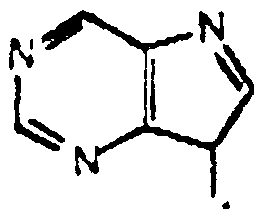
- Nucleosides and nucleotides are purinc (II) base compounds or pyrimidine (III) base compounds, or analogs such as compounds IV or V. 19
- R 1 can be selected from hydroxyalkyl, hydroxyalkenyl, carboxyalkyl, carboxyalkenyl, thiolalkyl, alkylthioalkyi, alkoxyalkyl, alkoxyalkenyl, heterocycle, heterocyclo-alkyl, hydroxyalkylalkoxyalkyl, alkoxyalkylalkoxyalkyl, and cycloalkylalkyl,
- the purin ⁇ compounds can be further substituted at positions 1, 2, 3, 6, 7, or 8 of the purine heterocycle, and the pyrimidine compounds can be substituted at positions 2, 3, 4, 5, or 6 of the pyrimidine heterocycle.
- substituents can be selected from hydroxy, alkoxy, halo, diiol, amino, carboxyl, mono-substituted amino, di-substituted amino, and alkyl.
- alkyl means a straight or branched chain hydrocarbon radical containing from 1 to 8 carbon atoms, preferably 1 to 4 carbon atoms.
- alkenyl means a straight or branched chain hydrocarbon radical having 1 or more double bonds , containing from 2 to 8 carbon atoms , preferably 1 to 4 carbon atoms .
- alkyl means a straight or branched chain alkyl radical containing from six to 14 carbon atoms, preferably seven to 12 carbon atoms, and most preferably 20
- aryl alone or in combination with another radical means a phenyl, naphthyl, or indenyl ring, optionally substituted with one or more substituents selected from alkyl, alkoxy, halogen, hydroxy, or nitro.
- alkanoyl means branched or straight chain alkanecarbonyl having a chain length of C, to C 20 , preferably C 2 to C 14 , more preferably C Pain to C ] ⁇ ;
- aroyl means arylcarbonyl; and
- trifluoroalkanoyl means alkyl containing three fluoro substituents.
- Halogen means fluorine, chlorine, bromine, or iodine
- Thiol means sulfur substituted with hydrogen (-SH).
- Amino means nitrogen with two hydrogen atoms; “monosubstituted amino” and “disubstituted amino” mean amino groups further independently substituted with one or more alkyl or arylalkyl groups.
- Hydroxyalkyl means an alkyl group substituted with one or more hydroxy 1 groups ; "hydroxy-alkcnyl “ means an alkenyl group substituted with one or more hydroxyl groups; “thioalkyl” means an alkyl substituted with one or more thiol (SH) groups; “alkoxyalkyl” means an alkyl substituted with one or more alkyl ether groups; “alkoxyalkenyl” means an alkenyl group substituted with one or more alkyl ether groups; “hydroxyalkylalkoxyalkyl” means an alkoxyalkyl group substituted with a hydroxyalkyl group; “alkoxyalkyl-alkoxyalkyl” means an alkoxyalkyl group substituted with an alkoxyalkyl group; “cycloalkylalkyl” means an alkyl group substituted with a cycloalkyl group.
- heterocycle means a saturated or partially unsaturated 5 or 6-mcmbered ring containing one or more oxygen, nitrogen, and/or sulfur heteroatoms.
- Said heterocycle can further be substituted with one to four substituents, which can be independently, hydroxy, hydroxyalkyl, thiol, alkoxy, azido, nitro, ahalogen atom, amino, mono-substituted amino, or disubstituted amino.
- Heterocycloalkyl means an alkyl group wherein one or more hydrogen atoms are replaced by a substituted or unsubstituted heterocyclic ring. Also included are the tautomers of the substituents on the compounds of the invention.
- Non-limiting examples of tautomers are ketone/enol tautomers, imino/amino tautomers, /V-substituted imino/N-substituted amino tautomers, thiol/thiacarbonyl tautomers, and ring -chain tautomers such as the five and six membered ring oxygen, nitrogen, sulfur, or oxygen- and sulfur- containing hcterocycles also containing 21
- nucleoside and nucleotide compounds useful in the present invention include, but are not limited to:
- a preferred compound is (-)-2'-deoxy-3'-thiocytidine-5'-triphosphate (3TC).
- nucleoside analogs are generally employed as antiviral agents as is, nucleotides (nucleoside phosphates) must sometimes have to be converted to nucleosides in order to facilitate their transport across cell membranes.
- An example of a chemically modified nucleotide capable of entering cells is S-l -3-hydroxy-2- phosphonylmethoxypropyl cytosine (HPMPC, Gilead Sciences).
- Nucleoside and nucleotide compounds of this invention that are acids can form salts. Examples include salts with alkali metals or alkaline earth metals, such as sodium, potassium, calcium, or magnesium, or with organic bases or basic quaternary ammonium salts.
- Immunomodulators and Immunostimulants A large number of immunomodulators and immuno-stimulants that can be used in the methods of tlie present invention are currently available, A list of these compounds is provided in Table 1, below. 24
- the /V-substitutcd-l,5-didcoxy-l,5-imino-D-glucitol compounds useful in the present invention can be administered to humans in an amount in die range of from about
- the nucleoside or nucleotide antiviral compound, or mixtures thereof, can be administered to humans in an amount in the range of from about 0.1 mg/person/day to about 500 mg/person/day, preferably from about 10 mg/person/day to about 300 33
- Immunomodulators and immunostimulants useful in the present invention can be administered in amounts lower than those conventional in the art.
- thymosin alpha 1 and thymosin fra ⁇ ion 5 are typically administered to humans for the treatment of HepB infections in an amount of about 900 ⁇ g/m 2 , two times per week (Hepatology (1988) 8:1270; Hepatology (1989) 10:575; Hepatology (1991) 14:409; Gastroenterohgy (1995) 108:A1127).
- this dose can be in tlie range of from about 10 ⁇ g/m 2 , two times per week to about 750 g/m 2 , two times per week, more preferably from about 100 ⁇ g/m 2 , two times per week to about 600 ⁇ g/m 2 , two times per week, most preferably from about 200 ⁇ g/m 2 , two times per week to about 400 ⁇ g/ ⁇ , two times per week.
- Interferon alfa is typically administered to humans for the treatment of HepC infections in an amount of from about 1 X 10 6 units/person, three times per week to about 10 X 10 6 units/person, three times per week (Simon et al, , (1997) Hepatology 25:445-448).
- this dose can be in the range of from about 0, 1 X 10 6 units/person, three times per week to about 7.5 X 10 6 units/person, three times per week, more preferably from about 0.5 X 10 ⁇ units/person, three times per week to about 5 X 10° units/person, three times per week, most preferably from about 1 X 10 6 units/person, three times per week to about 3 X 10 6 units/person, three times per week.
- Patients can be similarly monitored during combination therapy employing N- substiruted- 1 ,5-dideoxy- 1 ,5-imino-D-glucitol compounds and nucleoside and/ or nucleotide antiviral agents to determine the lowest effective doses of each.
- doses described above can be administered to a patient in a single dose or in proportionate multiple subdoses.
- dosage unit compositions can contain such amounts of submultiples thereof to make up the daily dose. Multiple doses per day can also increase the total daily dose should this be desired by the person prescribing the drug.
- compositions can be formulated as pharmaceutical compositions. Such compositions can be administered orally, parenterally, by inhalation spray, recially, jntradcrmally, transdermally, or topically in dosage unit formulations containing conventional nontoxic pharmaceutically acceptable carriers, adjuvants, and vehicles as desired. Topical administration may also involve the use of transdermal administration such as transdermal patches or iontophoresis devices .
- parenteral as used herein includes subcutaneous, intravenous, intramuscular, or intrastcrnal injection, or infusion techniques.
- Injectable preparations for example, sterile injectable aqueous or oleaginous suspensions, can be formulated according to the known art using suitable dispersing or wetting agents and suspending agents.
- the sterile injectable preparation may also be a 35
- sterile injectable solution or suspension in a nontoxic parenterally acceptable diluent or solvent for example, as a solution in 1,3-buta ⁇ ediol.
- acceptable vehicles and solvents that may be employed are water, Ringer's solution, and isotonic sodium chloride solution.
- sterile, fixed oils are conventionally employed as a solvent or suspending medium.
- any bland fixed oil may be employed, including synthetic mono- or diglycerides.
- fatty acids such as oleic acid are useful in the preparation of injcctablcs.
- Dimethyl acetamide, surfactants including ionic and non- ionic detergents, and polyethylene glycols can be used.
- Suppositories for rectal administration of the compounds discussed herein can be prepared by mixing the active agent with a suitable non-irritating excipient such as cocoa butter, synthetic mono-, di-, or triglycerides, fatty acids, or polyethylene glycols which are solid at ordinary temperatures but liquid at the rectal temperature, and which will therefore melt in the rectum and release the drug.
- Solid dosage forms for oral administration may include capsules, tablets, pills, powders, and granules. In such solid dosage forms, the compounds of this invention arc ordinarily combined with one or more adjuvants appropriate to the indicated route of administration.
- the compounds can be admixed with lactose, sucrose, starch powder, cellulose esters of alkanoic acids, cellulose alkyl esters, talc, stcaric acid, magnesium stearate, magnesium oxide, sodium and calcium salts of phosphoric and sulfuric acids, gelatin, acacia gum, sodium alginate, poly vi ⁇ ylpyrrolidone, and/or poly vinyl alcohol, and then tableted or encapsulated for convenient administration.
- Such capsules or tablets can contain a controlled-release formulation as can be provided in a dispersion of active compound in hydroxypropylmethyl cellulose,
- the dosage forms can also comprise buffering agents such as sodium citrate, or magnesium or calcium carbonate or bicarbonate. Tablets and pills can additionally be prepared with enteric coatings.
- formulations for parenteral administration can be in the form of aqueous or non-aqueous isotonic sterile injection solutions or suspensions .
- solutions and suspensions can be prepared from sterile powders or granules having one or more of the carriers or diluents mentioned for use in the formulations for oral administration.
- the compounds can be dissolved in water, polyethylene glycol, propylene glycol, ethanol, corn oil, cottonseed oil, peanut oil, sesame oil, benzyl alcohol, sodium chloride, and/or various buffers.
- Other adjuvants and modes of administration arc well and widely known in the pharmaceutical art.
- Liquid dosage forms for oral adudinistration can include pharmaceutically acceptable emulsions, solutions, suspensions, syrups, and elixirs containing inert diluents commonly used in the art, such as water .
- Such compositions can also comprise adjuvants, such as wetting agents, emulsifying and suspending agents, and sweetening, flavoring, and perfuming agents.
- the amount of active ingredient that can be combined with the carrier materials to produce a single dosage form will vary depending upon the patient and die particular mode of administration.
- Certain of the pharmaceutical compounds of this invention which are administered in accordance with the methods of the invention can serve as prodrugs to other compounds of this invention.
- Prodrugs are drugs that can be chemically converted in vivo or in vitro by biological systems into an active derivative or derivatives.
- Prodrugs are administered in essentially the same fashion as the other pharmaceutical compounds of the invention.
- Non-limiting examples are the esters of the N-substituted-l,5-dideoxy-l,5- imino-D-glucitol compounds of this invention.
- N-(n-nonyl)-l,5- didcoxy-l,5-imino-D-glucitol and various nucleosides or nucleotides may be acids or bases. As such, they may be used to form salts with one another. Nucleosides are purine or pyrimidine compounds lacking a phosphate ester. Compounds of Formulas II, III, IV,
- Nucleotides are purine or pyrimidine compounds that are mono-, di-, or triphosphate esters. These phosphate esters contain free -OH groups that are acidic, 37
- salt formation with organic bases depends on the pKa of the acid and base.
- the ⁇ r -substituted-l ,5-dideoxy-l ,5-imino- D-glucitol compounds disclosed herein are basic, and form pharmaceutically acceptable salts.
- useful salts can be formed not only with pharmaceutically acceptable acids, but also with biologically active acids such as the nucelosides and nucleotides disclosed herein.
- salts can be prepared in the conventional manner for preparing salts, as is well known in the art, For example, one can treat the free base of an N-substituted- 1 ,5-dideoxy-l ,5-imino-D-glucitol compound with a nucleotide analog of Formula II, III, IV, V, or VI to form a salt. This can be performed as a separate chemical reaction, or as part of the formulation process.
- the limiting reagent in the salt forming reaction is either the acid or base, as selected by the artisan to obtain a suitable biological result.
- the formulation can contain mixtures of different salts, acids, or free bases as desired.
- the phosphoric acid form of (-)-2'-deoxy-3'-thiocytidine- '-triphosphate will form a salt with the base form of ⁇ f-(n- ⁇ onyl)-l ,5-didcoxy-l ,5-imino- D-glucitol or N-(n-nonyl)-l,5-dideoxy-l,5-imino-D-glucitol, tetrabutyrate.
- This type of salt can then be provided to the patient in a pharmaceutically acceptable formulation, as a pure single salt, or as part of a mixture.
- the salts can also be used as an aid in the isolation, purification, or resolution of the compounds of this invention.
- the regimen for treating a patient suffering from a hepatitis virus infection with the compounds and/or compositions of the present invention is selected in accordance with a variety of factors, including the age, weight, sex, diet, and medical condition of the patient, the severity of the infection, the route of administration, pharmacological considerations such as the activity, efficacy, pharmacokinetic, and toxicology profiles of the particular compounds employed, and whether a drug delivery system is utilized,
- Administration of the drug combinations disclosed herein should generally be continued over a period of several weeks to several months or years until virus titers 38
- hepatitis viral DNA in patients' serum by slot- blot, dot-blot, or PCR techniques, or by measurement of hepatitis antigens, such as hepatitis B surface antigen (HBsAg) and hepatitis B e antigen (HBeAg), in serum to determine the effectiveness of therapy.
- hepatitis B surface antigen HBsAg
- HBeAg hepatitis B e antigen
- remissions are characterized by the disappearance of hepatitis B viral DNA, i.e., reduction to undetectable levels as measured by hybridization tests capable of detecting levels ⁇ 10 5 genomes per ml of serum, and HBeAg from serum despite the continued presence of HBsAg.
- These serologic events are followed by improvement in the biochemical and histologic features of the disease.
- the end point of successful treatment in most trials of antiviral therapy is the disappearance of HBeAg and viral DNA from serum.
- remission is usually sustained, and results in an inactive HBsAg carrier state. Many patients eventually become HBsAg-negative (see Hoofnagle et al., (1997) New Engl. Jour. Med. 336(5):347-356 for a review).
- Continuous analysis of the data obtained by these methods permits modification of tlie treatment regimen during therapy so that optimal amounts of each component in the combination are administered, and so that the duration of treatment can be determined as well.
- the treatment regimen/dosing schedule can be rationally modified over the course of therapy so that the lowest amounts of each of the antiviral compounds used in combination which together exhibit satisfactory anti-hepatitis virus effectiveness arc administered, and so that administration of such antiviral compounds in combination is continued only so long as is necessary to successfully treat the infection.
- Example 1 (0.50 g, 0.0023 mole) in 5 ml pyridine and stirred for 17 days at room temperature. The product was evaporated under nitrogen gas. The resulting title compound was purified by silica gel chromatography. Structure assignment was supported by NMR, infrared spectra and elemental analysis. Analysis calcd. for C, 8 H 29 NO ⁇ : C, 55.80; H, 7.54; N, 3.62. Found: C, 55.42; H,
- the anti-hepatitis B virus activity and effect on cell viability of a number of different N-substituted- 1 ,5-didcoxy-l ,5-imino-D-glucitol compounds were assessed using 40
- Viral DNA present in the immunoprecipitates was detected by densitromctric quantification of the DNA fragment of the correct size resulting from a polymerase chain reaction.
- the amount of DNA amplified from control is assumed to be 100% .
- NBDNJ N-(n-butyl-)-l,5-dideoxy-l,5-imino-D-glucitol; ⁇ -butyl D ⁇ J.
- the MTT-based coloritnetric assay is a measurement of cell viability (Heo et al. (1990) Cancer Research 50:3681-3690), 3 Not determined. *lowcst concentration tested. **there was no inhibition seen at the highest concentration used (200 ⁇ gs/ml).
- the combostat method involves serially diluting the IC-90 of each compound,
- the IC-90 of N-nonyl-D ⁇ J has been determined to be between 4 and 10 ⁇ g/ml (T. Block and G. Jacob, unpublished observation).
- the accepted IC-90 for 3TC in HepG 2.2, 15 (2.2.15) cells is 300nM to 500nM (Doong ct al. (1991) Proc. Natl. Acad. Sci. USA 88:8495-8499).
- 2.2.15 cells described in Sells etal. (1987) Proc. Natl. Acad. Sci. USA 84:1005- 1009, were maintained in RPMI 1640 medium (Gibco BRL, #31800-022) supplemented with 10% fetal bovine scrum, 200 ⁇ g/ml G418 (Gibco BRL 066-1811).
- Cells were seeded into 25 cm 2 flasks at 80% confluency, Five days later, flasks in triplicate received either no compound, serial dilutions of 3TC alone, or serial dilutions of 3TC plus N-nonyl-D ⁇ J. At 2, 4, and 6 days after addition of compound (witii medium replacement on those days), the amount of hepatitis B virus (HBV) D A in the culture medium was determined by PCR analysis of polyethyleneglycol-sedimented particles. 43
- enveloped particles were not distinguished from nuclcocapsids.
- PCR-amplified products were resolved by agarose gel electrophoresis (1.5% agarose), and the 538 nucleotide fragment was quantified by band scanning (HP Jet Imagcr), The amount of HBV recovered from untreated cells is assumed to be 100% .
- Data from the 6-day time point arc presented in Figure 1 as the average values from at least three separate flasks, and the standard error was never greater than 20%, with an average error of 12%.
- IPDNA assay is quite variable; as a partial compensation for this, four assay runs were conducted, each containing samples from all animals, but different subsets of the study weeks, To summarize the results, N-nonyl-DNJ had no effect on total HBV DNA measurements, which were essentially constant for all dose levels over the pre-dose and dosed portions of the study. On the other hand, IPDNA levels were not constant over the study period. The low dose animals tended to have increasing levels of IPDNA over the dosing period (weeks 0-4), while high dose arhmals tended to have decreasing levels of IPDNA over the same period.
- the nonlinear model yields an EC50 of 7.88 mg/kg/BID dose.
- the average maximum slope observed was 2.71 additional Log(IPDN ⁇ ⁇ g/mL)/week, or an increase of about 150 %/week, the average minimum slope observed with Nnonyl-DNJ is 0.31 fewer Log(IPDNA ⁇ g/mL)/week), or about a decrease of about 25% /week.
- the slopes, the fitted model, the parameter estimates from the model, and the approximate standard errors for these parameters are all shown in Figure 3.
- the data indicate an approximate effective monotherapy dose of N-nonyl-DNJ in woodchucks of 47
- the effective dose of both the N-alkyl-DNJ and nucleoside or nucleotide antiviral agent administered in combination therewith can be administered in two equal daily subdoses (i.e., B.I.D.).
- Figures 2 and 3 show letters to indicate animals, Table 4 shows two of the animal codes, the sex, and the dose.
- N-nonyl-DNJ in Combination with 3TC in a Woodchuck Model of Hepatitis B Virus Infection
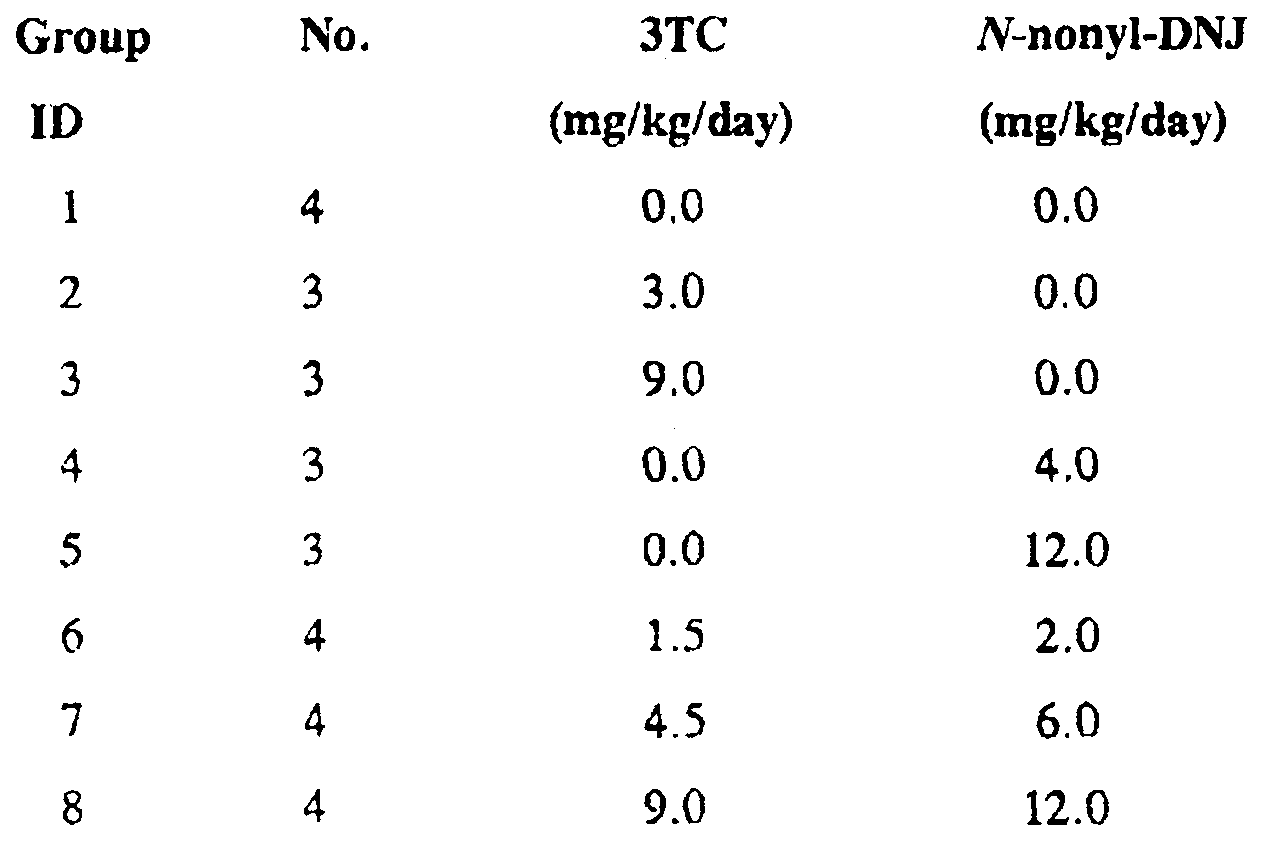
- the combined activity of N-nonyl-DNJ and the nucleoside analog 3TC can be assessed using the woodchuck model of hepatitis B virus infection. Twenty-eight woodchucks with persistent woodchuck hepatitis virus (WHV) infection can be utilized. Groups of woodchucks can be treated orally with 3TC alone (s.i.d.), with N-nonyl-DNJ alone (b.i.d.), or with combinations of the two drugs. The antiviral activity of the individual drugs and combinations can be assessed by measuring serum WHV DNA duriug treatment, and comparing the results of treated groups to placebo treated controls,
- Twenty-eight woodchucks with established persistent WHV infection can be used, all of which were experimentally infected with WHV during the first week of life. All can be WHsAg positive at the time the study is initiated. A total of eight experimental groups can be used. Woodchucks in each group can be stratified on the basis of gender, body weight, and age. 3TC can be administered orally as an aqueous suspension of Epivir (Glaxo-Wellcome) tablets one time per day. N-nonyl-DNJ can also be administered orally in aqueous solution, in two divided doses. Treatment with both drugs can be followed by the administration of 4 to 5 mis of semisynthetic liquid woodchuck diet to insure complete ingestion of the drugs.
- the experimental groups can be as follows: 49
- Woodchucks can be anesthetized (50mg/kg ketamine, 5mg/kg zylazine), weighed , and blood samples obtained prior to initial treatment, at weekly intervals during the six week period of treatment, and at 1, 2, and 4 weeks following treatment.
- Serum can be harvested and divided into aliquots.
- One aliquot can be used for analysis of WHV DNA by dot blot hybridization and for WHsAg by ELISA.
- CBCs and clinical biochemical profiles can be obtained prior to treatment and at the end of treatment.
- a second aliquot can be maintained as an archive sample.
- Other aliquots of serum can be used for drug analysis and special WHV DNA analyses.
Landscapes
- Health & Medical Sciences (AREA)
- Chemical & Material Sciences (AREA)
- Life Sciences & Earth Sciences (AREA)
- Organic Chemistry (AREA)
- Pharmacology & Pharmacy (AREA)
- Animal Behavior & Ethology (AREA)
- Veterinary Medicine (AREA)
- Public Health (AREA)
- Medicinal Chemistry (AREA)
- General Health & Medical Sciences (AREA)
- Epidemiology (AREA)
- Virology (AREA)
- Nuclear Medicine, Radiotherapy & Molecular Imaging (AREA)
- General Chemical & Material Sciences (AREA)
- Chemical Kinetics & Catalysis (AREA)
- Molecular Biology (AREA)
- Oncology (AREA)
- Engineering & Computer Science (AREA)
- Communicable Diseases (AREA)
- Gastroenterology & Hepatology (AREA)
- Bioinformatics & Cheminformatics (AREA)
- Biotechnology (AREA)
- Pharmaceuticals Containing Other Organic And Inorganic Compounds (AREA)
- Hydrogenated Pyridines (AREA)
- Saccharide Compounds (AREA)
- Acyclic And Carbocyclic Compounds In Medicinal Compositions (AREA)
Abstract
Description




Claims


Priority Applications (9)
| Application Number | Priority Date | Filing Date | Title |
|---|---|---|---|
| KR1020007008852A KR20010040937A (en) | 1998-02-12 | 1999-02-12 | Use of n-substituted-1,5-dideoxy-1,5-imino-d-glucitol compounds for treating hepatitis virus infections |
| EA200000836A EA004705B1 (en) | 1998-02-12 | 1999-02-12 | Use of n-substituted 1,5-dideoxy-1,5-imino-d-glucitol compounds for treating infections caused by hepatitis virus |
| AU27595/99A AU762125B2 (en) | 1998-02-12 | 1999-02-12 | Use of (N)-substituted-1,5-dideoxy-1,5-imino-D-glucitol compounds for treating hepatitis virus infections |
| JP2000531168A JP2002502875A (en) | 1998-02-12 | 1999-02-12 | Use of N-substituted-1,5-dideoxy-1,5-imino-D-glucitol compounds for treating hepatitis virus infection |
| BR9907882-1A BR9907882A (en) | 1998-02-12 | 1999-02-12 | Use of unsubstituted 1,5-dideoxy-1,5-imino-d-glucitol compounds for the treatment of hepatitis virus infections |
| DE69932154T DE69932154T2 (en) | 1998-02-12 | 1999-02-12 | USE OF N-SUBSTITUIRTE 1,5-DIDEOXY-1,5-IMINO-D-GLUCITOLS FOR THE TREATMENT OF HEPATITIS INFECTIONS |
| EP99908079A EP1061922B9 (en) | 1998-02-12 | 1999-02-12 | Use of n-substituted-1,5-dideoxy-1,5-imino-d-glucitol compounds for treating hepatitis virus infections |
| CA2319713A CA2319713C (en) | 1998-02-12 | 1999-02-12 | Use of n-substituted-1,5-dideoxy-1,5-imino-d-glucitol compounds for treating hepatitis virus infections |
| AU2003248024A AU2003248024A1 (en) | 1998-02-12 | 2003-09-18 | Use of N-substituted-1,5-di deoxy-1,5-imino-D-glucitol compounds for treating hepatitis virus infections |
Applications Claiming Priority (4)
| Application Number | Priority Date | Filing Date | Title |
|---|---|---|---|
| US7450898P | 1998-02-12 | 1998-02-12 | |
| US09/023,401 | 1998-02-12 | ||
| US09/023,401 US20030100532A1 (en) | 1997-02-14 | 1998-02-12 | Use of n-substituted-1,5-dideoxy-1,5-imino-d-glucitol compounds in combination therapy for treating hepatitis virus infections |
| US60/074,508 | 1998-02-12 |
Publications (1)
| Publication Number | Publication Date |
|---|---|
| WO1999040916A1 true WO1999040916A1 (en) | 1999-08-19 |
Family
ID=26697090
Family Applications (1)
| Application Number | Title | Priority Date | Filing Date |
|---|---|---|---|
| PCT/US1999/001874 Ceased WO1999040916A1 (en) | 1998-02-12 | 1999-02-12 | Use of n-substituted-1,5-dideoxy-1,5-imino-d-glucitol compounds for treating hepatitis virus infections |
Country Status (16)
| Country | Link |
|---|---|
| US (2) | US6809083B1 (en) |
| EP (1) | EP1061922B9 (en) |
| JP (1) | JP2002502875A (en) |
| KR (1) | KR20010040937A (en) |
| AT (1) | ATE331515T1 (en) |
| AU (2) | AU762125B2 (en) |
| BR (1) | BR9907882A (en) |
| CA (1) | CA2319713C (en) |
| DE (1) | DE69932154T2 (en) |
| EA (1) | EA004705B1 (en) |
| ES (1) | ES2272054T3 (en) |
| ID (1) | ID27290A (en) |
| MY (1) | MY122185A (en) |
| TR (1) | TR200002323T2 (en) |
| TW (1) | TWI222867B (en) |
| WO (1) | WO1999040916A1 (en) |
Cited By (10)
| Publication number | Priority date | Publication date | Assignee | Title |
|---|---|---|---|---|
| WO2000047198A3 (en) * | 1999-02-12 | 2001-02-15 | Searle & Co | Use of substituted-1,5-dideoxy-1,5-imino-d-glucitol compounds for treating hepatitis virus infections |
| WO2001060366A1 (en) * | 2000-02-14 | 2001-08-23 | Pharmacia Corporation | Use of n-substituted-1,5-dideoxy-1,5-imino-d-glucitol compounds for treating hepatitis virus infections |
| WO2001008672A3 (en) * | 1999-02-12 | 2001-11-15 | Searle & Co | Glucamine compounds for treating hepatitis virus infections |
| US6689759B1 (en) | 1998-02-12 | 2004-02-10 | G. D. Searle & Co. | Methods of Treating hepatitis virus infections with N-substituted-1,5-dideoxy-1,5-imino-d-glucitol compounds in combination therapy |
| US6809083B1 (en) | 1998-02-12 | 2004-10-26 | Richard A. Mueller | Use of N-substituted-1, 5-dideoxy-1, 5-imino-D-glucitol compounds for treating hepatitis virus infections |
| US7612093B2 (en) | 1997-02-14 | 2009-11-03 | United Therapeutics Corporation | Compositions of treating hepatitis virus infections with N-substituted-1,5-dideoxy-1,5-imino-D-glucitol compounds in combination therapy |
| US7816560B1 (en) | 1999-08-10 | 2010-10-19 | Thomas Jefferson University | Long chain n-alkyl compounds and oxa-derivatives thereof |
| WO2016073652A1 (en) | 2014-11-05 | 2016-05-12 | Unither Virology, Llc | Iminosugars useful for the treatment of viral diseases |
| AU2013203974B2 (en) * | 2000-05-23 | 2016-06-02 | Idenix Pharmaceuticals, Inc. | Methods and compositions for treating hepatitis C virus |
| US9968628B2 (en) | 2000-05-26 | 2018-05-15 | Idenix Pharmaceuticals Llc | Methods and compositions for treating flaviviruses and pestiviruses |
Families Citing this family (16)
| Publication number | Priority date | Publication date | Assignee | Title |
|---|---|---|---|---|
| US20050053625A1 (en) * | 2001-10-30 | 2005-03-10 | Block Timothy M | Method of treating viral infections |
| WO2006085141A2 (en) * | 2004-08-13 | 2006-08-17 | Migenix Inc. | Compositions and methods for treating or preventing hepadnaviridae infection |
| BRPI0613221A2 (en) * | 2005-06-08 | 2010-12-28 | Amicus Therapeutics Inc | crystalline furanosis and method for producing crystalline furanosis |
| BRPI0613224A2 (en) * | 2005-06-08 | 2010-12-28 | Amicus Therapeutics Inc | method for stabilizing a tri-canned sugar, method for increasing reaction yield of a sugar product and stabilized tri-canned sugar composition |
| BRPI0613222A2 (en) * | 2005-06-08 | 2010-12-28 | Amicus Therapeutic Inc | method for purifying a nitrogen-containing raw sugar and method for purifying crude d-1-deoxygalactonojirimycin (dgj) |
| US7473683B2 (en) | 2005-09-14 | 2009-01-06 | The Board Of Trustees Of The Leland Stanford Junior University | Nonpolar thymidine analogs |
| US8975280B2 (en) * | 2006-05-24 | 2015-03-10 | The Chancellor, Masters And Scholars Of The University Of Oxford | Deoxynojirimycin and D-arabinitol analogs and methods of using |
| JP2009545621A (en) | 2006-08-02 | 2009-12-24 | ユナイテッド セラピューティクス コーポレーション | Liposome treatment of viral infections |
| US8097728B2 (en) * | 2007-04-30 | 2012-01-17 | Philadelphia Health & Education Corporation | Iminosugar compounds with antiflavirus activity |
| CN102046151A (en) * | 2008-03-26 | 2011-05-04 | 牛津大学 | Endoplasmic reticulum targeting liposomes |
| EP2398321B1 (en) | 2009-02-23 | 2015-11-25 | United Therapeutics Corporation | Iminosugars and methods of treating viral diseases |
| KR20120059447A (en) * | 2009-03-27 | 2012-06-08 | 더 챈슬러 마스터즈 앤드 스칼라스 오브 더 유니버시티 오브 옥스포드 | Cholesterol level lowering liposomes |
| KR101463661B1 (en) | 2009-06-12 | 2014-11-19 | 유나이티드 세러퓨틱스 코오포레이션 | Iminosugars and methods of treating bunyaviral and togaviral diseases |
| JP5575246B2 (en) * | 2009-09-04 | 2014-08-20 | ユナイテッド セラピューティクス コーポレイション | How to treat poxvirus infection |
| WO2013184780A1 (en) | 2012-06-06 | 2013-12-12 | Unither Virology, Llc | Novel iminosugars and their applications |
| SG11201805729SA (en) * | 2016-01-08 | 2018-08-30 | Arbutus Biopharma Corp | Therapeutic compositions and methods for treating hepatitis b |
Citations (7)
| Publication number | Priority date | Publication date | Assignee | Title |
|---|---|---|---|---|
| EP0350012A2 (en) * | 1988-07-08 | 1990-01-10 | Meiji Seika Kaisha Ltd. | Antiviral composition |
| EP0367748A2 (en) * | 1988-11-03 | 1990-05-09 | G.D. SEARLE & COMPANY | Novel antiviral compounds |
| US5030638A (en) * | 1990-02-26 | 1991-07-09 | G. D. Searle & Co. | Method of antiviral enhancement |
| EP0449026A2 (en) * | 1990-03-24 | 1991-10-02 | Bayer Ag | Desoxynojirimycin derivatives, process for their preparation and their use in drugs |
| WO1995019172A1 (en) * | 1994-01-13 | 1995-07-20 | G.D. Searle & Co. | Use of n-alkyl derivatives of 1,5-dideoxy-1,5-imino-d-glucitol for the treatment of hepatitis b virus infections |
| WO1995022975A1 (en) * | 1994-02-25 | 1995-08-31 | G.D. Searle & Co. | Use of 1-deoxynojirimycin and its derivatives for treating mammals infected with respiratory syncytial virus |
| WO1998035685A1 (en) * | 1997-02-14 | 1998-08-20 | G.D. Searle And Co. | Use of n-substituted-1,5-dideoxy-1,5-imino-d-glucitol compounds in combination therapy for treating hepatitis virus infections |
Family Cites Families (47)
| Publication number | Priority date | Publication date | Assignee | Title |
|---|---|---|---|---|
| YU33730B (en) | 1967-04-18 | 1978-02-28 | Farmaceutici Italia | Process for preparing a novel antibiotic substance and salts thereof |
| GB1555654A (en) | 1977-06-25 | 1979-11-14 | Exxon Research Engineering Co | Agricultural burner apparatus |
| US4065562A (en) | 1975-12-29 | 1977-12-27 | Nippon Shinyaku Co., Ltd. | Method and composition for reducing blood glucose levels |
| US4012448A (en) | 1976-01-15 | 1977-03-15 | Stanford Research Institute | Synthesis of adriamycin and 7,9-epiadriamycin |
| NO154918C (en) | 1977-08-27 | 1987-01-14 | Bayer Ag | ANALOGUE PROCEDURE FOR THE PREPARATION OF THERAPEUTIC ACTIVE DERIVATIVES OF 3,4,5-TRIHYDROXYPIPERIDINE. |
| GB2020278B (en) | 1978-05-03 | 1983-02-23 | Nippon Shinyaku Co Ltd | Moranoline dervitives |
| JPS5562004A (en) | 1978-11-02 | 1980-05-10 | Kureha Chem Ind Co Ltd | Control agent against plant viral disease |
| US4327725A (en) | 1980-11-25 | 1982-05-04 | Alza Corporation | Osmotic device with hydrogel driving member |
| DE3049446A1 (en) | 1980-12-30 | 1982-07-29 | Bayer Ag, 5090 Leverkusen | METHOD FOR PRODUCING 1,5-DIDESOXY-1,5-IMINO-D-GLUCITOL AND ITS N-DERIVATIVES |
| ZA822995B (en) | 1981-05-21 | 1983-12-28 | Wyeth John & Brother Ltd | Slow release pharmaceutical composition |
| US4783337A (en) | 1983-05-11 | 1988-11-08 | Alza Corporation | Osmotic system comprising plurality of members for dispensing drug |
| US4612008A (en) | 1983-05-11 | 1986-09-16 | Alza Corporation | Osmotic device with dual thermodynamic activity |
| US4765989A (en) | 1983-05-11 | 1988-08-23 | Alza Corporation | Osmotic device for administering certain drugs |
| EP0252962B1 (en) | 1985-12-23 | 1995-08-23 | Fred Hutchinson Cancer Research Center | Regulating retroviral replication, infection, and pathogenesis |
| GB2186485B (en) | 1986-02-13 | 1988-09-07 | Ethical Pharma Ltd | Slow release formulation |
| DE3611841A1 (en) | 1986-04-09 | 1987-10-15 | Bayer Ag | METHOD FOR PRODUCING 1-DESOXYNOJIRIMYCIN AND ITS N-DERIVATIVES |
| PT89266B (en) | 1987-12-21 | 1993-11-30 | Monsanto Co | METHOD FOR INHIBITING VIRUSES OF HUMAN IMMUNODEFICIENCY USING A D-N-N-BUTOTE OF DESOXYJYRIMYCIN |
| US4849430A (en) * | 1988-03-09 | 1989-07-18 | Monsanto Company | Method of inhibiting virus |
| FI101344B1 (en) | 1988-03-31 | 1998-06-15 | Tanabe Seiyaku Co | Process for the preparation of a composition for controlled release of a pharmaceutically active substance |
| US5041441A (en) | 1988-04-04 | 1991-08-20 | The Regents Of The University Of Michigan | Method of chemotherapy using 1-phenyl-2-decanoylamino-3-morpholino-1-propanol |
| US5144037A (en) | 1988-11-03 | 1992-09-01 | G. D. Searle & Co. | 1,5-dideoxy-1,5-imino-d-glucitol derivatives |
| US5221746A (en) * | 1988-11-03 | 1993-06-22 | G. D. Searle & Co. | 1,5-dideoxy-1,5-imino-D-glucitol derivatives |
| US5310745A (en) | 1988-11-03 | 1994-05-10 | G. D. Searle & Co. | Antiviral compounds |
| US4957926A (en) | 1988-12-22 | 1990-09-18 | Monsanto Company | Method of treating herpesviruses |
| US5011829A (en) | 1989-06-02 | 1991-04-30 | G. D. Searle & Co. | Pharmaceutical composition and method of inhibiting virus |
| US5536732A (en) | 1990-04-27 | 1996-07-16 | Merrell Pharmaceuticals Inc. | N-derivatives of 1-deoxy nojirimycin |
| US5151519A (en) | 1990-05-07 | 1992-09-29 | G. D. Searle & Co. | Process for the preparation of 1,5-(alkylimino)-1,5-dideoxy-d-glucitol and derivatives thereof |
| EP0477160B1 (en) | 1990-09-20 | 1996-04-24 | Monsanto Company | Process for producing N-substituted-1-deoxynojirimycin |
| US5444063A (en) * | 1990-12-05 | 1995-08-22 | Emory University | Enantiomerically pure β-D-dioxolane nucleosides with selective anti-Hepatitis B virus activity |
| US5190765A (en) | 1991-06-27 | 1993-03-02 | Alza Corporation | Therapy delayed |
| IL105090A (en) | 1992-03-18 | 1998-08-16 | Us Bioscience | N-(phosphonoacetyl)-l-aspartic acid as broad spectrum antiviral |
| ZA931934B (en) | 1992-03-18 | 1993-03-18 | Us Bioscience | Compostitions of N-(phosphonoacetyl)-L-aspartic acid and methods of their use as broad spectrum antivirals |
| US5258518A (en) | 1992-04-01 | 1993-11-02 | G. D. Searle & Co. | 2-substituted tertiary carbinol derivatives of deoxynojirimycin |
| US5331096A (en) | 1992-04-01 | 1994-07-19 | G. D. Searle & Co. | 2- and 3-sulfur derivatives of 1,5-iminosugars |
| WO1994004546A1 (en) | 1992-08-14 | 1994-03-03 | Nippon Shinyaku Co., Ltd. | Moranoline derivative |
| FR2700267B1 (en) | 1993-01-13 | 1995-03-17 | Oreal | N-acyl amino deoxy alditols, and their use in cosmetic or dermopharmaceutical compositions. |
| DE69419601T2 (en) | 1993-03-17 | 1999-12-02 | Kao Corp., Tokio/Tokyo | AMINE DERIVATIVES AND DERMATOLOGICAL PREPARATIONS CONTAINING THEM |
| US5399567A (en) | 1993-05-13 | 1995-03-21 | Monsanto Company | Method of treating cholera |
| WO1995006061A1 (en) | 1993-08-20 | 1995-03-02 | G.D. Searle & Co. | Retroviral protease inhibitors and combinations thereof |
| US6093702A (en) * | 1993-12-20 | 2000-07-25 | The United States Of America As Represented By The Department Of Health And Human Services | Mixtures of dideoxy-nucleosides and hydroxycarbamide for inhibiting retroviral spread |
| US5451679A (en) | 1994-03-08 | 1995-09-19 | G. D. Searle & Co. | 2-chloro and 2-bromo derivatives of 1,5-iminosugars |
| US5703058A (en) * | 1995-01-27 | 1997-12-30 | Emory University | Compositions containing 5-fluoro-2',3'-didehydro-2',3'-dideoxycytidine or a mono-, di-, or triphosphate thereof and a second antiviral agent |
| FR2731150B1 (en) | 1995-03-03 | 1997-04-18 | Oreal | USE OF AMPHIPHILIC COMPOUNDS AS A THICKENING AGENT FOR NON-AQUEOUS MEDIA |
| US5763470A (en) | 1995-06-07 | 1998-06-09 | Sugen Inc. | Benzopyran compounds and methods for their use |
| WO1997000881A1 (en) | 1995-06-22 | 1997-01-09 | Nippon Shinyaku Co., Ltd. | Moranoline derivatives |
| CN1290168A (en) | 1997-12-11 | 2001-04-04 | 牛津大学院长校长专家委员会 | Inhibition of membrane-associated viral replication |
| WO1999040916A1 (en) | 1998-02-12 | 1999-08-19 | G.D. Searle & Co. | Use of n-substituted-1,5-dideoxy-1,5-imino-d-glucitol compounds for treating hepatitis virus infections |
-
1999
- 1999-02-12 WO PCT/US1999/001874 patent/WO1999040916A1/en not_active Ceased
- 1999-02-12 MY MYPI99000516A patent/MY122185A/en unknown
- 1999-02-12 AU AU27595/99A patent/AU762125B2/en not_active Ceased
- 1999-02-12 AT AT99908079T patent/ATE331515T1/en not_active IP Right Cessation
- 1999-02-12 JP JP2000531168A patent/JP2002502875A/en active Pending
- 1999-02-12 CA CA2319713A patent/CA2319713C/en not_active Expired - Fee Related
- 1999-02-12 TR TR2000/02323T patent/TR200002323T2/en unknown
- 1999-02-12 US US09/249,220 patent/US6809083B1/en not_active Expired - Lifetime
- 1999-02-12 EP EP99908079A patent/EP1061922B9/en not_active Expired - Lifetime
- 1999-02-12 KR KR1020007008852A patent/KR20010040937A/en not_active Ceased
- 1999-02-12 BR BR9907882-1A patent/BR9907882A/en not_active Application Discontinuation
- 1999-02-12 EA EA200000836A patent/EA004705B1/en not_active IP Right Cessation
- 1999-02-12 ID IDW20001493A patent/ID27290A/en unknown
- 1999-02-12 ES ES99908079T patent/ES2272054T3/en not_active Expired - Lifetime
- 1999-02-12 DE DE69932154T patent/DE69932154T2/en not_active Expired - Lifetime
- 1999-04-07 TW TW088102296A patent/TWI222867B/en not_active IP Right Cessation
-
2003
- 2003-09-18 AU AU2003248024A patent/AU2003248024A1/en not_active Abandoned
-
2004
- 2004-08-03 US US10/910,197 patent/US20050267153A1/en not_active Abandoned
Patent Citations (7)
| Publication number | Priority date | Publication date | Assignee | Title |
|---|---|---|---|---|
| EP0350012A2 (en) * | 1988-07-08 | 1990-01-10 | Meiji Seika Kaisha Ltd. | Antiviral composition |
| EP0367748A2 (en) * | 1988-11-03 | 1990-05-09 | G.D. SEARLE & COMPANY | Novel antiviral compounds |
| US5030638A (en) * | 1990-02-26 | 1991-07-09 | G. D. Searle & Co. | Method of antiviral enhancement |
| EP0449026A2 (en) * | 1990-03-24 | 1991-10-02 | Bayer Ag | Desoxynojirimycin derivatives, process for their preparation and their use in drugs |
| WO1995019172A1 (en) * | 1994-01-13 | 1995-07-20 | G.D. Searle & Co. | Use of n-alkyl derivatives of 1,5-dideoxy-1,5-imino-d-glucitol for the treatment of hepatitis b virus infections |
| WO1995022975A1 (en) * | 1994-02-25 | 1995-08-31 | G.D. Searle & Co. | Use of 1-deoxynojirimycin and its derivatives for treating mammals infected with respiratory syncytial virus |
| WO1998035685A1 (en) * | 1997-02-14 | 1998-08-20 | G.D. Searle And Co. | Use of n-substituted-1,5-dideoxy-1,5-imino-d-glucitol compounds in combination therapy for treating hepatitis virus infections |
Non-Patent Citations (2)
| Title |
|---|
| BLOCK T M ET AL: "THE SECRETION OF HUMAN HEPATITIS B VIRUS IS INHIBITED BY THE IMINO SUGAR, N-BUTYL-DEOXYNOJIRIMYCIN", ANTIVIRAL RESEARCH, vol. 23, no. SUPPL. 01, 1 January 1994 (1994-01-01), pages 79, XP002067579 * |
| PLATT F M ET AL: "N-BUTYLDEOXYNOJIRIMYCIN IS A NOVEL INHIBITOR OF GLYCOLIPID BIOSYNTHESIS. SECRETION OF HUMAN HEPATITIS B VIRUS IS INHIBITED BY THE IMINO SUGAR N-BUTYLDEOXYNOJIRIMYCIN", CHEMTRACTS ORGANIC CHEMISTRY, 1 January 1994 (1994-01-01), pages 106/107, XP002067581 * |
Cited By (14)
| Publication number | Priority date | Publication date | Assignee | Title |
|---|---|---|---|---|
| US7612093B2 (en) | 1997-02-14 | 2009-11-03 | United Therapeutics Corporation | Compositions of treating hepatitis virus infections with N-substituted-1,5-dideoxy-1,5-imino-D-glucitol compounds in combination therapy |
| US6689759B1 (en) | 1998-02-12 | 2004-02-10 | G. D. Searle & Co. | Methods of Treating hepatitis virus infections with N-substituted-1,5-dideoxy-1,5-imino-d-glucitol compounds in combination therapy |
| US6809083B1 (en) | 1998-02-12 | 2004-10-26 | Richard A. Mueller | Use of N-substituted-1, 5-dideoxy-1, 5-imino-D-glucitol compounds for treating hepatitis virus infections |
| US6545021B1 (en) | 1999-02-12 | 2003-04-08 | G.D. Searle & Co. | Use of substituted-1,5-dideoxy-1,5-imino-D-glucitol compounds for treating hepatitis virus infections |
| WO2000047198A3 (en) * | 1999-02-12 | 2001-02-15 | Searle & Co | Use of substituted-1,5-dideoxy-1,5-imino-d-glucitol compounds for treating hepatitis virus infections |
| US6747149B2 (en) | 1999-02-12 | 2004-06-08 | G. D. Searle & Co. | Glucamine salts for treating hepatitis virus infections |
| WO2001008672A3 (en) * | 1999-02-12 | 2001-11-15 | Searle & Co | Glucamine compounds for treating hepatitis virus infections |
| US7816560B1 (en) | 1999-08-10 | 2010-10-19 | Thomas Jefferson University | Long chain n-alkyl compounds and oxa-derivatives thereof |
| US9089515B2 (en) | 1999-08-10 | 2015-07-28 | Thomas Jefferson University | Long chain N-alkyl compounds and oxa-derivatives thereof |
| WO2001060366A1 (en) * | 2000-02-14 | 2001-08-23 | Pharmacia Corporation | Use of n-substituted-1,5-dideoxy-1,5-imino-d-glucitol compounds for treating hepatitis virus infections |
| AU2013203974B2 (en) * | 2000-05-23 | 2016-06-02 | Idenix Pharmaceuticals, Inc. | Methods and compositions for treating hepatitis C virus |
| US9968628B2 (en) | 2000-05-26 | 2018-05-15 | Idenix Pharmaceuticals Llc | Methods and compositions for treating flaviviruses and pestiviruses |
| WO2016073652A1 (en) | 2014-11-05 | 2016-05-12 | Unither Virology, Llc | Iminosugars useful for the treatment of viral diseases |
| US10428022B2 (en) | 2014-11-05 | 2019-10-01 | Emergent Virology Llc | Iminosugars useful for the treatment of viral diseases |
Also Published As
| Publication number | Publication date |
|---|---|
| US6809083B1 (en) | 2004-10-26 |
| AU2003248024A1 (en) | 2003-10-30 |
| DE69932154D1 (en) | 2006-08-10 |
| KR20010040937A (en) | 2001-05-15 |
| ES2272054T3 (en) | 2007-04-16 |
| EP1061922B1 (en) | 2006-06-28 |
| BR9907882A (en) | 2000-10-17 |
| ATE331515T1 (en) | 2006-07-15 |
| CA2319713C (en) | 2012-06-26 |
| CA2319713A1 (en) | 1999-08-19 |
| MY122185A (en) | 2006-03-31 |
| DE69932154T2 (en) | 2007-05-31 |
| ID27290A (en) | 2001-03-22 |
| EA200000836A1 (en) | 2001-04-23 |
| TR200002323T2 (en) | 2000-12-21 |
| TWI222867B (en) | 2004-11-01 |
| EP1061922B9 (en) | 2007-03-07 |
| US20050267153A1 (en) | 2005-12-01 |
| AU762125B2 (en) | 2003-06-19 |
| AU2759599A (en) | 1999-08-30 |
| EP1061922A1 (en) | 2000-12-27 |
| JP2002502875A (en) | 2002-01-29 |
| EA004705B1 (en) | 2004-06-24 |
Similar Documents
| Publication | Publication Date | Title |
|---|---|---|
| CA2319713C (en) | Use of n-substituted-1,5-dideoxy-1,5-imino-d-glucitol compounds for treating hepatitis virus infections | |
| US6689759B1 (en) | Methods of Treating hepatitis virus infections with N-substituted-1,5-dideoxy-1,5-imino-d-glucitol compounds in combination therapy | |
| US6545021B1 (en) | Use of substituted-1,5-dideoxy-1,5-imino-D-glucitol compounds for treating hepatitis virus infections | |
| EP1007058B1 (en) | Use of (n)-substituted-1,5-dideoxy-1,5-imino-d-glucitol compounds in combination therapy for treating hepatitis virus infections | |
| WO2001060366A1 (en) | Use of n-substituted-1,5-dideoxy-1,5-imino-d-glucitol compounds for treating hepatitis virus infections | |
| US7612093B2 (en) | Compositions of treating hepatitis virus infections with N-substituted-1,5-dideoxy-1,5-imino-D-glucitol compounds in combination therapy | |
| US6747149B2 (en) | Glucamine salts for treating hepatitis virus infections | |
| EP1714676A2 (en) | Use of N-substituted-1,5-dideoxy-1,5-imino-D-glucitol compounds for treating hepatitis virus infections | |
| HK1027509B (en) | Use of n-substituted-1,5-dideoxy-1,5-imino-d-glucitol compounds in manueacturing a medicament for treating hepatitis virus infections | |
| EP1658846B1 (en) | N-(8,8,8-trifluorooctyl)-1,5-dideoxy-1,5-imino-D-glucitol for treating hepatitis virus infections |
Legal Events
| Date | Code | Title | Description |
|---|---|---|---|
| WWE | Wipo information: entry into national phase |
Ref document number: 99804990.5 Country of ref document: CN |
|
| AK | Designated states |
Kind code of ref document: A1 Designated state(s): AL AM AT AU AZ BA BB BG BR BY CA CH CN CU CZ DE DK EE ES FI GB GD GE GH GM HR HU ID IL IN IS JP KE KG KP KR KZ LC LK LR LS LT LU LV MD MG MK MN MW MX NO NZ PL PT RO RU SD SE SG SI SK SL TJ TM TR TT UA UG US UZ VN YU ZW |
|
| AL | Designated countries for regional patents |
Kind code of ref document: A1 Designated state(s): GH GM KE LS MW SD SZ UG ZW AM AZ BY KG KZ MD RU TJ TM AT BE CH CY DE DK ES FI FR GB GR IE IT LU MC NL PT SE BF BJ CF CG CI CM GA GN GW ML MR NE SN TD TG |
|
| 121 | Ep: the epo has been informed by wipo that ep was designated in this application | ||
| DFPE | Request for preliminary examination filed prior to expiration of 19th month from priority date (pct application filed before 20040101) | ||
| WWE | Wipo information: entry into national phase |
Ref document number: 27595/99 Country of ref document: AU |
|
| WWE | Wipo information: entry into national phase |
Ref document number: 1999908079 Country of ref document: EP |
|
| ENP | Entry into the national phase |
Ref document number: 2319713 Country of ref document: CA Ref document number: 2319713 Country of ref document: CA Kind code of ref document: A |
|
| WWE | Wipo information: entry into national phase |
Ref document number: 2000/02323 Country of ref document: TR |
|
| ENP | Entry into the national phase |
Ref document number: 2000 531168 Country of ref document: JP Kind code of ref document: A |
|
| WWE | Wipo information: entry into national phase |
Ref document number: 1020007008852 Country of ref document: KR |
|
| WWE | Wipo information: entry into national phase |
Ref document number: IN/PCT/2000/276/CHE Country of ref document: IN |
|
| WWE | Wipo information: entry into national phase |
Ref document number: 200000836 Country of ref document: EA |
|
| REG | Reference to national code |
Ref country code: DE Ref legal event code: 8642 |
|
| WWP | Wipo information: published in national office |
Ref document number: 1999908079 Country of ref document: EP |
|
| WWP | Wipo information: published in national office |
Ref document number: 1020007008852 Country of ref document: KR |
|
| WWG | Wipo information: grant in national office |
Ref document number: 27595/99 Country of ref document: AU |
|
| WWG | Wipo information: grant in national office |
Ref document number: 1999908079 Country of ref document: EP |