WO1999021850A1 - 1-(2-naphthyl) and 1-(2-azanaphthyl)-4-(1-phenylmethyl)piperazines being dopamine d4 receptor subtype ligands - Google Patents
1-(2-naphthyl) and 1-(2-azanaphthyl)-4-(1-phenylmethyl)piperazines being dopamine d4 receptor subtype ligands Download PDFInfo
- Publication number
- WO1999021850A1 WO1999021850A1 PCT/US1998/022233 US9822233W WO9921850A1 WO 1999021850 A1 WO1999021850 A1 WO 1999021850A1 US 9822233 W US9822233 W US 9822233W WO 9921850 A1 WO9921850 A1 WO 9921850A1
- Authority
- WO
- WIPO (PCT)
- Prior art keywords
- alkyl
- compound according
- methyl
- piperazme
- hydrogen
- Prior art date
- Legal status (The legal status is an assumption and is not a legal conclusion. Google has not performed a legal analysis and makes no representation as to the accuracy of the status listed.)
- Ceased
Links
- 0 *C=*C(CCCC1)=C1N=C Chemical compound *C=*C(CCCC1)=C1N=C 0.000 description 2
Classifications
-
- C—CHEMISTRY; METALLURGY
- C07—ORGANIC CHEMISTRY
- C07D—HETEROCYCLIC COMPOUNDS
- C07D215/00—Heterocyclic compounds containing quinoline or hydrogenated quinoline ring systems
- C07D215/02—Heterocyclic compounds containing quinoline or hydrogenated quinoline ring systems having no bond between the ring nitrogen atom and a non-ring member or having only hydrogen atoms or carbon atoms directly attached to the ring nitrogen atom
- C07D215/16—Heterocyclic compounds containing quinoline or hydrogenated quinoline ring systems having no bond between the ring nitrogen atom and a non-ring member or having only hydrogen atoms or carbon atoms directly attached to the ring nitrogen atom with hetero atoms or with carbon atoms having three bonds to hetero atoms with at the most one bond to halogen, e.g. ester or nitrile radicals, directly attached to ring carbon atoms
- C07D215/38—Nitrogen atoms
-
- A—HUMAN NECESSITIES
- A61—MEDICAL OR VETERINARY SCIENCE; HYGIENE
- A61P—SPECIFIC THERAPEUTIC ACTIVITY OF CHEMICAL COMPOUNDS OR MEDICINAL PREPARATIONS
- A61P25/00—Drugs for disorders of the nervous system
- A61P25/18—Antipsychotics, i.e. neuroleptics; Drugs for mania or schizophrenia
-
- A—HUMAN NECESSITIES
- A61—MEDICAL OR VETERINARY SCIENCE; HYGIENE
- A61P—SPECIFIC THERAPEUTIC ACTIVITY OF CHEMICAL COMPOUNDS OR MEDICINAL PREPARATIONS
- A61P25/00—Drugs for disorders of the nervous system
- A61P25/28—Drugs for disorders of the nervous system for treating neurodegenerative disorders of the central nervous system, e.g. nootropic agents, cognition enhancers, drugs for treating Alzheimer's disease or other forms of dementia
-
- C—CHEMISTRY; METALLURGY
- C07—ORGANIC CHEMISTRY
- C07D—HETEROCYCLIC COMPOUNDS
- C07D239/00—Heterocyclic compounds containing 1,3-diazine or hydrogenated 1,3-diazine rings
- C07D239/70—Heterocyclic compounds containing 1,3-diazine or hydrogenated 1,3-diazine rings condensed with carbocyclic rings or ring systems
- C07D239/72—Quinazolines; Hydrogenated quinazolines
- C07D239/78—Quinazolines; Hydrogenated quinazolines with hetero atoms directly attached in position 2
- C07D239/84—Nitrogen atoms
-
- C—CHEMISTRY; METALLURGY
- C07—ORGANIC CHEMISTRY
- C07D—HETEROCYCLIC COMPOUNDS
- C07D241/00—Heterocyclic compounds containing 1,4-diazine or hydrogenated 1,4-diazine rings
- C07D241/36—Heterocyclic compounds containing 1,4-diazine or hydrogenated 1,4-diazine rings condensed with carbocyclic rings or ring systems
- C07D241/38—Heterocyclic compounds containing 1,4-diazine or hydrogenated 1,4-diazine rings condensed with carbocyclic rings or ring systems with only hydrogen or carbon atoms directly attached to the ring nitrogen atoms
- C07D241/40—Benzopyrazines
- C07D241/44—Benzopyrazines with hetero atoms or with carbon atoms having three bonds to hetero atoms with at the most one bond to halogen, e.g. ester or nitrile radicals, directly attached to carbon atoms of the hetero ring
-
- C—CHEMISTRY; METALLURGY
- C07—ORGANIC CHEMISTRY
- C07D—HETEROCYCLIC COMPOUNDS
- C07D295/00—Heterocyclic compounds containing polymethylene-imine rings with at least five ring members, 3-azabicyclo [3.2.2] nonane, piperazine, morpholine or thiomorpholine rings, having only hydrogen atoms directly attached to the ring carbon atoms
- C07D295/04—Heterocyclic compounds containing polymethylene-imine rings with at least five ring members, 3-azabicyclo [3.2.2] nonane, piperazine, morpholine or thiomorpholine rings, having only hydrogen atoms directly attached to the ring carbon atoms with substituted hydrocarbon radicals attached to ring nitrogen atoms
- C07D295/06—Heterocyclic compounds containing polymethylene-imine rings with at least five ring members, 3-azabicyclo [3.2.2] nonane, piperazine, morpholine or thiomorpholine rings, having only hydrogen atoms directly attached to the ring carbon atoms with substituted hydrocarbon radicals attached to ring nitrogen atoms substituted by halogen atoms or nitro radicals
- C07D295/073—Heterocyclic compounds containing polymethylene-imine rings with at least five ring members, 3-azabicyclo [3.2.2] nonane, piperazine, morpholine or thiomorpholine rings, having only hydrogen atoms directly attached to the ring carbon atoms with substituted hydrocarbon radicals attached to ring nitrogen atoms substituted by halogen atoms or nitro radicals with the ring nitrogen atoms and the substituents separated by carbocyclic rings or by carbon chains interrupted by carbocyclic rings
Definitions
- This invention relates to certain 1- (2-naphthyl) and l-(2- azanaphthyl) -4- (1-phenylmethyl) piperazmes and pharmaceutical 0 compositions containing such compounds. It also relates to the use of such compounds in the treatment or prevention of psychotic disorders such as schizophrenia and other central nervous system diseases.
- neuroleptics The therapeutic effect of conventional antipsychotics, known as neuroleptics , is generally believed to be exerted through blockade of dopamme receptors.
- neuroleptics are frequently responsible for undesirable extrapyramidal side 0 effects (EPS) and tardive dyskmesias, which are attributed to blockade of D2 receptors m the striatal region of the brain.
- EPS extrapyramidal side 0 effects
- tardive dyskmesias which are attributed to blockade of D2 receptors m the striatal region of the brain.
- the dopamme D4 receptor subtype has recently been identified
- D4 antagonists are considered effective antipsychotics free from the neurological side effects displayed by conventional neuroleptics.
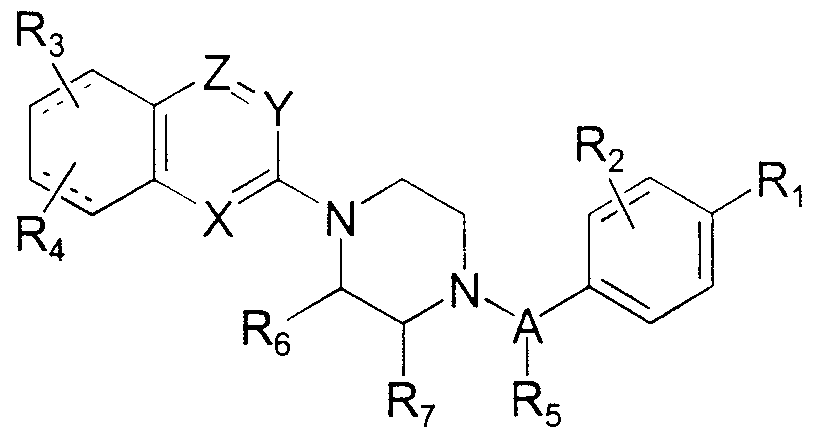
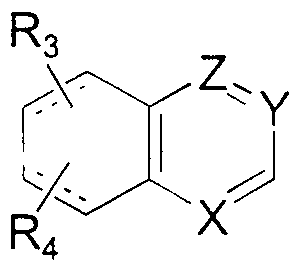
- X, Y and Z are the same or different and represent CR C or nitrogen;
- R c represents hydrogen, halogen or alkyl;
- Ri and R 2 independently represent hydrogen, halogen, hydroxy, C 1 -C 6 alkyl, trifiuoromethyl, t ⁇ fluoromethoxy or S0 2 NH 2 , provided that, when Y and Z represent CH, and R, and R, are both hydrogen, R, and R 2 are not hydrogen simultaneously; or
- R ⁇ and R 2 together represent a C -C 2 alkylene dioxy group or a
- R 3 and R 4 are the same or different and represent hydrogen, halogen, C ! -C 6 alkyl, C ⁇ -C 4 alkoxy, alkylthio, hydroxy, ammo, mono or dialkyl ammo where each alkyl is C -Cg alkyl, cyano or trifiuoromethyl;
- A represents C 1 -C alkylene; and
- R 5 , R 6 , and R 7 independently represent hydrogen or Cx-Cg alkyl.
- Dopamme D 4 receptors are concentrated in the limbic system (Science, 265 : 1034 (Taubes, 1994)) which controls cognition and emotion. Therefore, compounds that interact with these receptors are useful in the treatment of cognitive disorders. Such disorders include cognitive deficits which are a significant component of the negative symptoms (social withdrawal and unresponsiveness) of schizophrenia. Other disorders include those involving memory impairment or attention deficit disorders.
- the invention provides methods for treatment and/or prevention of neuropsychochological or affective disorders including, for example, schizophrenia, mania, dementia, depression, anxiety, compulsive behavior, substance abuse, memory impairment, cognitive deficits, Parkmson-like motor disorders, e.g., Parkmsonism and dystonia, and motion disorders related to the use of neuroleptic agents.
- the compounds of the invention are useful treatment of depression, memory- impairment or Alzheimer's disease by modulation of D 4 receptors which selectively exist m limbic area known to control emotion and cognitive functions.
- the compounds of the present invention are useful for the treatment of other disorders that respond to dopammergic blockade, e.g., substance abuse and obsessive compulsive disorder. These compounds are also useful m treating the extrapyramidal side effects associated with the use of conventional neuroleptic agentr
- the invention provides pharmaceutical compositions comprising compounds of Formula I .
- the invention encompasses substituted 1- (2-naphthyl) and 1- (2-azanaphthyl) -4- (1- phenylmethyl) piperazmes of Formula I.
- Preferred compounds of Formula I are those where at least one of R x and R 2 is halogen, alkyl, trifiuoromethyl, trifluoromethoxy, or where R, and R 2 together represent 3 , 4-methylened ⁇ oxy .
- Still other preferred compounds of Formula I are those where
- R 2 is chloro, fluoro, methyl, ethyl, butyl, isopropyl, n- propyl, trifiuoromethyl, trifluoromethoxy, or where R : and R 2 together represent 3 , 4-methylenedioxy .
- Particularly preferred compounds of Formula I are those where R 2 is hydrogen and R x is methyl or chloro.
- preferred compounds of Formula I are those where R 2 is hydrogen and R x is methyl or chloro.
- the invention also encompasses compounds of formula I I
- Rx, R 2 , R 3 , R 4 , R 5 , R ⁇ / R c , and R 7 carry the same definitions as set forth above for Formula I .
- Preferred compounds of Formula II are those where at least one of R 1 and R 2 is halogen, alkyl, trifiuoromethyl, trifluoromethoxy, or where R x and R ⁇ together represent 3,4- methylenedioxy .
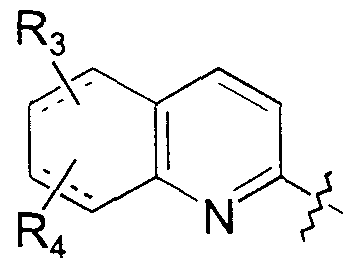
- Still other preferred compounds of Formula II are those where the both R 3 and R, are hydrogen, or the R perpetrat, R, and R 4 substitution on the qumolme ring provides a 4- alkylqumolmyl , 4 , 6-d ⁇ alkylqumolmyl , 4 , 7-d ⁇ alkylqumolmyl , 4 , 8-d ⁇ alkylqumoimyl , 4 -haloqumoimyl , or 4-alkyl-6- alkoxyqumolmyl compound.
- More preferred compounds of Formula II are those where A is methylene and at least one of R x and R 2 is chloro, fluoro, methyl, ethyl, butyl, isopropyl, n-propyl, trifluorometnyl , trifluoromethoxy, or wnere R_ and R ⁇ togetner represent 3 , 4 -methylenedioxy .
- Particularly preferred compounds of Formula II are those where R 3 and R 4 are hydrogen, A is methylene, R 2 is hydrogen and R ⁇ is methyl or chloro.
- Particularly preferred compounds of Formula II are quinolm-2-yl derivatives where R 3 a2id R 4 are hydrogen.
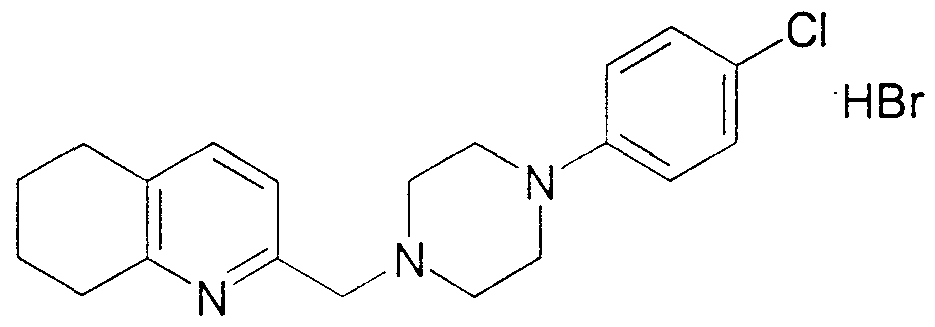
- Other particularly preferred compounds of Formula II are 5,6,7,8- tetrahydroqumolm-2-yl derivatives where R 3 and R 4 are hydrogen .
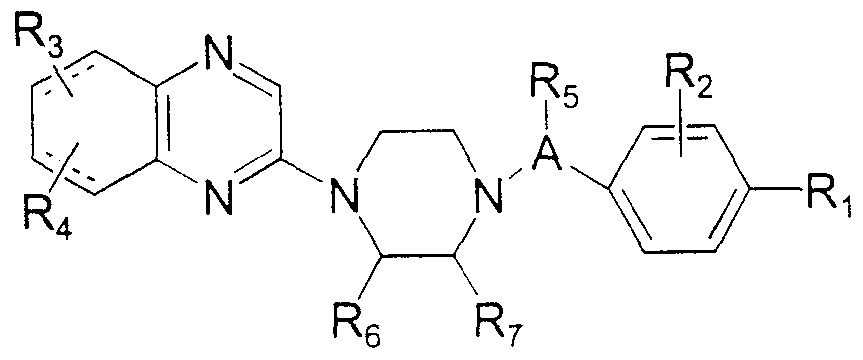
- Rx, R 2 R 3 , R 4 , R 5 , R 6 , and R 7 carry the same definitions as set forth above for Formula I.
- Preferred compounds of Formula III are those where at least one of R : and R 2 is halogen, alkyl, trifiuoromethyl, trifluoromethoxy, or where R, and R 2 together represent 3,4- methylenedioxy . More preferred compounds of Formula III are those where A is methylene and at least one of R, and R ⁇ s chloro, fluoro, methyl, ethyl, butyl, isopropyl, n-propyl, trifiuoromethyl, trifluoromethoxy, or where R, and R 2 together represent 3 , 4-methylened ⁇ oxy . Particularly preferred compounds of Formula III are those where R 3 and R 4 are hydrogen, A is methylene, R 2 is hydrogen and R x is methyl or chloro.
- Particularly preferred compounds of Formula III are qumoxalm-2 -yl derivatives where R, and R , are hydrogen.
- the invention further provides compounds of formula IV:
- Rx, R 2 , R 3 , R 4 , R 5 , Rg, and R 7 carry the same definitions as set forth above for Formula I .
- Preferred compounds of Formula IV are those where at least one of R, and R 2 is halogen, alkyl, trifiuoromethyl, trifluoromethoxy, or where R : and R. together represent 3,4- methylenedioxy . More preferred compounds ⁇ rmuia IV those where A is methylene and at least one of R : and R 2 is chloro, fluoro, methyl, ethyl, butyl, isopropyl, n-propyl, trifluorometnyl , trifluoromethoxy , or where R, and R 2 together represent 3 , 4-methylened ⁇ oxy . Particularly preferred compounds of Formula IV are those where R_ and R 4 are hydrogen, A is methylene, R 2 is hydrogen and R ⁇ is methyl or chloro.
- the invention also encompasses compounds of formula V:
- Rx, R 2 , R 3 , R , R 5 , Rg, R C and R 7 carry the same definitions as
- Preferred compounds of Formula V are those where R restroom is hydrogen; and at least one of R, and R 2 is halogen, alkyl, trifiuoromethyl, trifluoromethoxy, or where R : and R 2 together represent 3 , 4 -methylenedioxy .
- More preferred compounds of Formula V are those where R disrupt is hydrogen, A is methylene and at least one of R, and R 2 is chloro, fluoro, methyl, ethyl, butyl, isopropyl, n-propyl, trifiuoromethyl, trifluoromethoxy, or where R : and R, together represent 3 , 4 -methylenedioxy .
- Particularly preferred compounds of Formula V are those where R, and R 4 are hydrogen, A is methylene, R 2 is hydrogen and R ⁇ is methyl or chloro.
- the particularly preferred compounds of Formula V are naphth-2-yl derivatives where R 3 and R_ are nydrogen.
- Particularly preferred compounds of Formulae I-V are those where R 5 , R 6 , and R. are hydrogen.
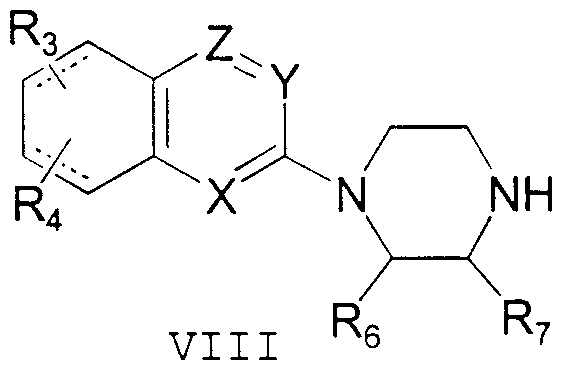
- the invention further provides intermediates useful m the preparation of compounds of Formula I.
- Such intermediates include those of Formula VIII.
- the compounds of this invention I may contain one or more asymmetric carbon atoms, so that the compounds can exist m different stereoisomer c forms.
- These compounds can be, for example, racemates or optically active forms.
- the single enantiomers, i.e., optically active forms can be obtained by asymmetric synthesis or by resolution of the racemates Resolution of the racemates can be accomplished, for example, by conventional methods such as crystallization m the presence of a resolving agent, or chromatography, using, for example a chiral HPLC column.
- Representative compounds of tne present invention include, out are not limited to the compounds m Table I and their pharmaceutically acceptable acid addition salts.
- the free base can be obtained by basify g a solution of the acid salt.
- an addition salt, particularly a pharmaceutically acceptable addition salt may be produced by dissolving the free base in a suitable organic solvent and treating the solution with an acid, in accordance with conventional procedures for preparing acid addition salts from base compounds .
- Non-toxic pharmaceutical salts include salts of acids such as hydrochloric, phosphoric, hydrobromic, sulfuric, sulfmic, formic, toluenesulfonic , methanesulfonic, nitric, benzoic, citric, tarta ⁇ c, maleic, hydroiodic, alkanoic such as acetic, HOOC- (CH 2 )n-ACOOH where n is 0-4, and the like.
- acids such as hydrochloric, phosphoric, hydrobromic, sulfuric, sulfmic, formic, toluenesulfonic , methanesulfonic, nitric, benzoic, citric, tarta ⁇ c, maleic, hydroiodic, alkanoic such as acetic, HOOC- (CH 2 )n-ACOOH where n is 0-4, and the like.
- acids such as hydrochloric, phosphoric, hydrobromic, sulfuric, sulfmic, for
- the present invention also encompasses the acylated prodrugs of the compounds of Formula I.
- acylated prodrugs of the compounds of Formula I Those skilled m the art will recognize various synthetic methodologies which may be employed to prepare non-toxic pharmaceutically acceptable addition salts and acylated prodrugs of the compounds encompassed by Formula I .
- dashed lines in the structural representations of the compounds of the invention is meant that the carbon atoms connected by the dashed line are linked either by single or double carbon-carbon bonds.
- A represents C 1 -C 4 alkylene and R 5 is hydrogen or lower alkyl
- the AR 5 group means alkylene groups having from 1-4 carbon atoms each of which carbon atoms is optionally substituted with a lower alkyl group. Examples of such a structure are methylene, ethylene, propylene, and butylene.
- a particularly preferred AR 5 group according to the invention is methylene, i.e., -CH 2 - .
- alkyl or lower alkyl in the present invention is meant C j -Cg alkyl, i.e., straight or branched chain alkyl groups having 1-6 carbon atoms, such as, for example, methyl, ethyl, propyl, isopropyl, n-butyl, sec -butyl, ter -butyl, pentyl , 2- pentyl, isopentyl, neopentyl , hexyl , 2-hexyl, 3-hexyi, and 3- methylpentyl .
- alkoxy or lower alkoxy m the present invention is meant C -C f alkoxy, l . e ., straight or branched chain alkoxy groups naving 1-6 carbon atoms, such as, for example, methoxy, ethoxy, propoxy, isopropoxy, n-butoxy, sec-butoxy, tert-butoxy, pentoxy, 2 -pentyl, isopentoxy, neopentoxy, hexoxy, 2 -hexoxy, 3- hexoxy, and 3 -methylpentoxy .
- cycloalkoxy By cycloalkoxy the present invention is meant cycloalkylalkoxy groups having 3-7 carbon atoms where cycloalkyl is defined above.
- Ci-C j alkylene dioxy group is meant a group of the formula :
- n 1 or 2.
- C ⁇ C- j alkylene oxy group is meant a group of the formula :
- n 1, 2 or 3.
- halogen in the present invention is meant fluorine, bromine, chlorine, and iodine.
- the compounds of the invention are useful m the treatment of neuropsychological disorders; the pharmaceutical utility of compounds of this invention is indicated by the assays for dopamme receptor subtype affinity described below ⁇ n the Examples.
- the interaction of the 1- (2-naphthyl) and l-(2- azanaphthyl) -4- (1-phenylmethyl) -piperazmes of the invention with dopamme receptor subtypes results m the pharmacological activities of these compounds.
- the compounds of general formula I may be administered orally, topically, parenterally, by inhalation or spray or rectally in dosage unit formulations containing conventional non-toxic pharmaceutically acceptable carriers, adjuvants and vehicles.
- parenteral as used herein includes subcutaneous injections, intravenous, intramuscular, trasternal injection or infusion techniques.
- a pharmaceutical formulation comprising a compound of general formula I and a Larmaceut ⁇ cally acceptable carrier.
- One or more compounds of general formula I may be present association with one or more non-toxic pharmaceutically acceptable carriers and/or diluents and/or adjuvants and if desired other active ingredients.
- the pharmaceutical compositions containing compounds of general formula I may be m a form suitable for oral use, for example, as tablets, troches, lozenges, aqueous or oily suspensions, dispersible powders or granules, emulsion, hard or soft capsules, or syrups or elixirs.
- compositions intended for oral use may be prepared according to any method known to the art for the manufacture of pharmaceutical compositions and such compositions may contain one or more agents selected from the group consisting of sweetening agents, flavoring agents, coloring agents and preserving agents in order to provide pharmaceutically elegant and palatable preparations.
- Tablets contain the active ingredient m admixture with non-toxic pharmaceutically acceptable excipients which are suitable for the manufacture of tablets.
- excipients may be for example, inert diluents, such as calcium carbonate, sodium carbonate, lactose, calcium phosphate or sodium phosphate; granulating and disintegrating agents, for example, corn starch, or algmic acid; binding agents, for example starch, gelatin or acacia, and lubricating agents, for example magnesium stearate, stearic acid or talc.
- the tablets may be uncoated or they may be coated by known techniques to delay disintegration and absorption m the gastrointestinal tract and thereby provide a sustained action over a longer period.
- a time delay material such as glyceryl monostearate or glyceryl distearate may be employed.
- Formulations for oral use may also be presented as hard gelatin capsules wherem the active ingredient is mixed with an inert solid diluent, for example, calcium carbonate, calcium phosphate or kaolin, or as soft gelatin capsules wherem the active ingredient is mixed with water or an oil medium, for example peanut oil, liquid paraffin or olive oil.
- Aqueous suspensions contain the active materials in admixture with excipients suitable for the manufacture of aqueous suspensions.
- Such excipients are suspending agents, for example sodium carboxymethylcellulose , methylcellulose, hydropropylmethylcellulose , sodium algmate, polyvinylpyrrolidone, gum tragacanth and gum acacia,* dispersing or wetting agents may be a naturally-occurring p osphatide, for example, lecithin, or condensation products of an alkylene oxide with fatty acids, for example polyoxyethylene stearate, or condensation products of ethylene oxide with long chain aliphatic alcohols, for example neptadecaethyleneoxycetanoi , or condensation products of ethylene oxide with partial esters derived from fatty acids and a hexitol such as polyoxyethylene sorbitol monooleate, or condensation products of ethylene oxide with partial esters derived from fatty acids and hexitol anhydrides, for example polyethylene sorbitan monooleate.
- p osphatide for example, lecithin
- the aqueous suspensions may also contain one or more preservatives, for example ethyl, or n-propyl p-hydroxybenzoate , one or more coloring agents, one or more flavoring agents, and one or more sweetening agents, such as sucrose or saccharin.
- preservatives for example ethyl, or n-propyl p-hydroxybenzoate
- coloring agents for example ethyl, or n-propyl p-hydroxybenzoate
- flavoring agents such as sucrose or saccharin.
- sweetening agents such as sucrose or saccharin.
- Oily suspensions may be formulated by suspending the active ingredients m a vegetable oil, for example arachis oil, olive oil, sesame oil or coconut oil, or m a mineral oil such as liquid paraffin.
- the oily suspensions may contain a thickening agent, for example beeswax, hard paraffin or cetyl alcohol. Sweetening agents such as those set forth above, and flavoring agents may be added to provide palatable oral preparations. These compositions may be preserved by the addition of an anti-oxidant such as ascorbic acid.
- Dispersible powders and granules suitable for preparation of an aqueous suspension by the addition of water provide the active ingredient in admixture with a dispersing or wetting agent, suspending agent and one or more preservatives. Suitable dispersing or wetting agents and suspending agents are exemplified by those already mentioned above. Additional excipients, for example sweetening, flavoring and coloring agents, may also oe present.
- Pharmaceutical compositions of the invention may also be m the form of oil-m-water emulsions.
- the oily phase may be a vegetable oil, for example olive oil or arachis oil, or a mineral oil, for example liquid paraffin or mixtures of these.
- Suitable emulsifying agents may be naturally-occurring gums, for example gum acacia or gum tragacanth, naturally-occurring phosphatides , for example soy bean, lecithin, and esters or partial esters derived from fatty acids and hexitol, anhydrides, for example sorbitan monooleate, and condensation products of the said partial esters with ethylene oxide, for example polyoxyethylene sorbitan monooleate.
- the emulsions may also contain sweetening and flavoring agents .
- Syrups and elixirs may be formulated with sweetening agents, for example glycerol , propylene glycol, sorbitol or sucrose. Such formulations may also contain a demulcent, a preservative and flavoring and coloring agents.
- the pharmaceutical compositions may be m the form of a sterile mjectable aqueous or oleaginous suspension. This suspension may be formulated according to the known art using those suitable dispersing or wetting agents and suspending agents which have been mentioned above.
- the sterile mjectable preparation may also be sterile mjectable solution or suspension m a non-toxic parentally acceptable diluent or solvent, for example as a solution m 1 , 3 -butanediol .
- a non-toxic parentally acceptable diluent or solvent for example as a solution m 1 , 3 -butanediol .
- acceptable vehicles and solvents that may be employed are water, Ringer's solution and lsotonic sodium chloride solution.
- sterile, fixed oils are conventionally employed as a solvent or suspending medium.
- any bland fixed oil may be employed including synthetic mono-or diglyce ⁇ des .
- fatty acids such as oleic acid find use m the preparation of mjectables.
- the compounds of general formula I may also be administered in the form of suppositories for rectal administration of the drug.
- These compositions can be prepared by mixing the drug with a suitable non-imtatmg excipient which is solid at ordinary temperatures but liquid at the rectal temperature and will therefore melt in the rectum to release the drug.
- suitable non-imtatmg excipient which is solid at ordinary temperatures but liquid at the rectal temperature and will therefore melt in the rectum to release the drug.
- Such materials are cocoa butter and polyethylene glycols.
- Compounds of general formula I may be administered parenterally m a sterile medium.
- the drug depending on the vehicle and concentration used, can either be suspended or dissolved the vehicle.
- adjuvants such as local anesthetics, preservatives and buffering agents can be dissolved m the vehicle.
- Dosage levels of the order of from aoout 0. lmg to about 140mg per kilogram of body weight per day are useful in the treatment of the above-indicated conditions (about 0.5mg to about 7g per patient per day) .
- the amount of active ingredient that may be combined with the carrier materials to produce a single dosage form will vary depending upon the host treated and the particular mode of administration.
- Dosage unit forms will generally contain between from about lmg to about 500mg of an active ingredient.
- the specific dose level for any particular patient will depend upon a variety of factors including the activity of the specific compound employed, the age, body weight, genera" health, sex, diet, time of administration, route of administration, and rate of excretion, drug combination and the severity of the particular disease undergoing therapy.
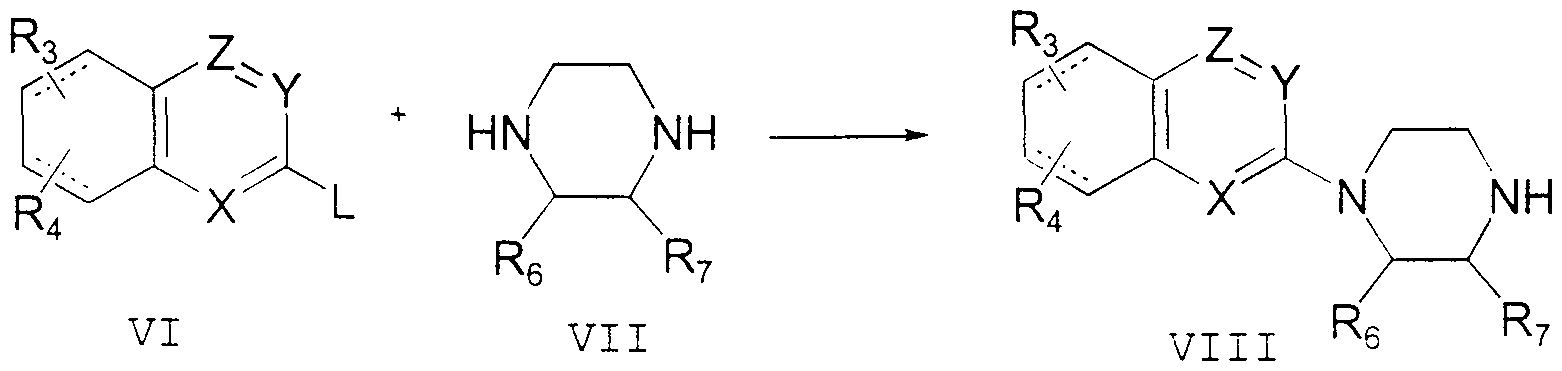
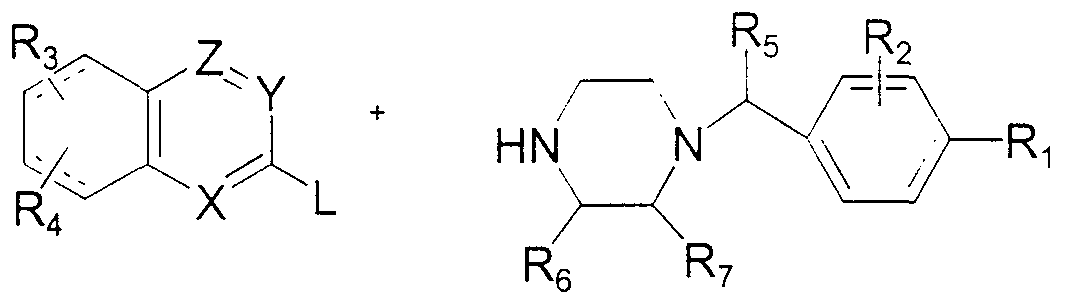
- An azanaphthyl compound of Formula I may be prepared according to Scheme 1.
- an azanaphthyl compound of general structure VI having an appropriate leaving group L at the position indicated, is condensed with a piperazme compound of general structure VII to provide a 1 -azanaphthyl piperazme of general structure VIII.
- Compound VIII may then be condensed with a benzylic compound of general structure IX having an appropriate benzylic leaving group L 2 to provide a 1-azanaphthyl -4 - ( 1 -
- the leaving groups L and L 2 may be halides, sulfonate esters or the like. Those having
- an azanaphthyl compound of the invention may be prepared according to Scheme 2.
- R 1; R 2 , R 3 , R 4 , R 5 , R , R 7 , X, Y and Z are as defined above for Formula I .
- an azanaphthyl compound of general structure X having an appropriate leaving group L at the position indicated, is condensed with a 1-subst tuted piperazme compound of general structure XI to provide a l-azanaphthyl-4- (1-phenylmethyl) piperazine of Formula I.
- the leaving group L may be a halide, sulfonate ester or the like.
- Naphthyl compounds of the invention may be prepared according to Scheme 3.
- R x , R 2 , R 3 , R 4 , R 5 , Rg and R 7 carry the same definitions as set forth above for Formula I .
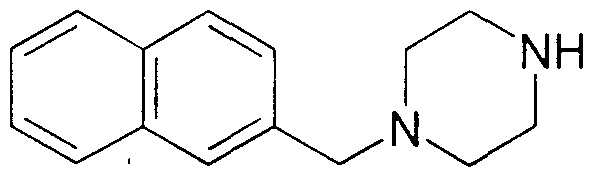
- an 2-naphthylp ⁇ perazme compound of general structure XII is condensed with a benzylic compound of general structure IX having an appropriate benzylic leaving group L 2 to provide a l-naphthyl-4- (1-phenylmethyl) piperazme of Formula I.
- the leaving group L 2 may be a halide, a sulfonate ester or the
- the starting materials are either commercially available or may be prepared using common synthetic methods described within the body of chemical literature.
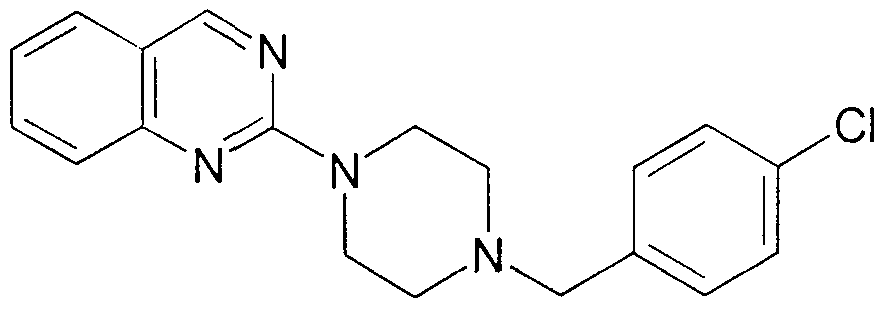
- the acidic extract is then basified, extracted with chloroform and the organic layer is dried and concentrated to provide the product, which may alternatively be named 1- (qumazolm-2-yl) -4- (1- [4 -chlorophenyl] methyl ) piperazme hydrochlo ⁇ de, as a colorless oil (310 mg, 87%) .
- the oxalate salt is prepared m isopropanol.
- 2-Hydroxyqumoxalme (1.5 g) is heated m phosphorus oxychloride (10 mL) for 12 h. after which the reaction is concentrated and the residue partitioned between methylene chloride and 1 N NaOH. The resulting crude chloride is taken up m toluene (10 mL) and this solution is then added dropwise to a refluxmg solution of piperazme (5 g) m toluene (40 mL) . The resulting solution is refluxed for an additional 24 h, cooled to 0 °C for 0.5 h, filtered and concentrated.
- Example 3 The following compounds are prepared essentially according to the procedures set forth above m Examples 1 and 2 :
- Dihydroxyqu azolme (10 g) is dissolved m phosphorus oxychloride (100 mL) and diethyl aniline (15 g) .
- the resulting dark solutuion is brought to reflux for 24 h, cooled and concentrated.
- the residue is taken up m chloroform, washed with ice cold IN NaOH solution, dried and concentrated.
- the resulting solid is recrystallized from ethyl acetate to provide the dichloro compound (9.2 g, 76 %.
- Example 6 The following compounds are prepared essentially according to the procedures set forth above m
- Example 5 The following compounds are prepared essentially according to the procedures set forth above m
- Example 5 The following compounds are prepared essentially according to the procedures set forth above m
- Example 5 The following compounds are prepared essentially according to the procedures set forth above m
- Example 5 The following compounds are prepared essentially according to the procedures set forth above m
- Example 5
- the sample is homogenized m 100 volumes (w/vol) of 0.05 M T ⁇ s HCl buffer at 4° C and pH /.4. The sample is then cent ⁇ fuged at 30,000 x g and resuspended and rehomogenized. The sample is again cent ⁇ fuged as described above and the final tissue sample is frozen until use. The tissue is resuspended 1:20 (wt/vol) m 0.05 M Tris HCl buffer containing 100 mM NaCl.
- tissue sample 0.5 nM 3 H-YM 09151-2 (Nemonapride , c ⁇ s-5-Chloro- 2-methoxy-4- (methylammo) -N- (2-methyl-2- (phenylmethyl) -3- pyrrolid yl) benzamide) and the compound of interest in a total incubation of 1.0 ml.
- Nonspecific binding is defined as that binding found in the presence of 1 mM spiperone; without further additions, nonspecific binding is less than 20% of total binding.
- Binding characteristics for examples of compounds encompassed within Formula I for the D2 and D4 receptor subtypes are shown in Table 2 for rat striatal homogenates .
- the binding characteristics of compounds of Formula I for the D 4 receptor generally range from about 0.5 nanomolar (nM) to about 25 nanomolar (nM) . These compounds typically have binding constants for the D 2 receptor of from about 200 nM to more than 1000 nM.
- the compounds of the invention are generally at least about 10 time more selective for the D 4 receptor than the D 2 receptor. Preferably, these compounds are at least 20, and more preferably at least 25-50, times more selective for the D relieve receptor than the D 2 receptor. Most preferably, these compounds are at least 100 times more selective for the D 4 receptor than the D 2 receptor.
- Example 8 A compound described Arch. Med. Res., 2 . 5: 435-440
Landscapes
- Organic Chemistry (AREA)
- Chemical & Material Sciences (AREA)
- Health & Medical Sciences (AREA)
- Engineering & Computer Science (AREA)
- Bioinformatics & Cheminformatics (AREA)
- Neurosurgery (AREA)
- Biomedical Technology (AREA)
- Neurology (AREA)
- General Chemical & Material Sciences (AREA)
- Chemical Kinetics & Catalysis (AREA)
- Psychiatry (AREA)
- Medicinal Chemistry (AREA)
- Nuclear Medicine, Radiotherapy & Molecular Imaging (AREA)
- Pharmacology & Pharmacy (AREA)
- Life Sciences & Earth Sciences (AREA)
- Animal Behavior & Ethology (AREA)
- General Health & Medical Sciences (AREA)
- Public Health (AREA)
- Veterinary Medicine (AREA)
- Hospice & Palliative Care (AREA)
- Pharmaceuticals Containing Other Organic And Inorganic Compounds (AREA)
Abstract
Description















Claims




Priority Applications (5)
| Application Number | Priority Date | Filing Date | Title |
|---|---|---|---|
| AU98104/98A AU9810498A (en) | 1997-10-24 | 1998-10-21 | 1-(2-naphthyl) and 1-(2-azanaphthyl)-4 -(1-phenylmethyl)piperazines being dopamine d4 receptor subtyp e ligands |
| CA002308057A CA2308057A1 (en) | 1997-10-24 | 1998-10-21 | 1-(2-naphthyl) and 1-(2-azanaphthyl)-4-(1-phenylmethyl)piperazines being dopamine d4 receptor subtype ligands |
| EP98952391A EP1025097B1 (en) | 1997-10-24 | 1998-10-21 | 1-(2-naphthyl) and 1-(2-azanaphthyl)-4-(1-phenylmethyl)piperazines being dopamine d 4? receptor subtype ligands |
| AT98952391T ATE294173T1 (en) | 1997-10-24 | 1998-10-21 | 1-(2-NAPHTHYL) AND 1-(2-AZANAPHTHYL)-4-(1-PHENYLMETHYL)PIPERAZINE AS DOPAMINE D4 SUBTYPE LIGANDS |
| DE69829989T DE69829989T2 (en) | 1997-10-24 | 1998-10-21 | 1- (2-NAPHTHYL) AND 1- (2-AZANAPHTHYL) -4- (1-PHENYLMETHYL) PIPERAZINE AS DOPAMINE D4 SUBTYPE LIGANDS |
Applications Claiming Priority (2)
| Application Number | Priority Date | Filing Date | Title |
|---|---|---|---|
| US95435397A | 1997-10-24 | 1997-10-24 | |
| US08/954,353 | 1997-10-24 |
Publications (1)
| Publication Number | Publication Date |
|---|---|
| WO1999021850A1 true WO1999021850A1 (en) | 1999-05-06 |
Family
ID=25495312
Family Applications (1)
| Application Number | Title | Priority Date | Filing Date |
|---|---|---|---|
| PCT/US1998/022233 Ceased WO1999021850A1 (en) | 1997-10-24 | 1998-10-21 | 1-(2-naphthyl) and 1-(2-azanaphthyl)-4-(1-phenylmethyl)piperazines being dopamine d4 receptor subtype ligands |
Country Status (11)
| Country | Link |
|---|---|
| EP (1) | EP1025097B1 (en) |
| CN (1) | CN1191248C (en) |
| AR (1) | AR015983A1 (en) |
| AT (1) | ATE294173T1 (en) |
| AU (1) | AU9810498A (en) |
| CA (1) | CA2308057A1 (en) |
| CO (1) | CO4970840A1 (en) |
| DE (1) | DE69829989T2 (en) |
| ES (1) | ES2241172T3 (en) |
| WO (1) | WO1999021850A1 (en) |
| ZA (1) | ZA989720B (en) |
Cited By (19)
| Publication number | Priority date | Publication date | Assignee | Title |
|---|---|---|---|---|
| WO2000012500A3 (en) * | 1998-09-02 | 2000-07-27 | Neurogen Corp | 2-aryl-4-(1-[4-heteroaryl]piperazin-1-yl) methylimidazoles: dopamine d4 receptor subtype ligands |
| US6384224B2 (en) * | 1997-10-24 | 2002-05-07 | Neurogen Corporation | Certain 1-(2-naphthyl) and 1-(2-azanaphthyl)-4-(1-phenylmethyl) piperazines; dopamine receptor subtype specific ligands |
| US6548502B2 (en) | 2000-07-27 | 2003-04-15 | Pfizer Inc | Dopamine D4 ligands for the treatment of novelty-seeking disorders |
| WO2007000392A3 (en) * | 2005-06-27 | 2007-04-05 | Hoffmann La Roche | Chloro-substituted guanidines |
| US7507732B2 (en) | 2005-03-31 | 2009-03-24 | Pfizer Inc. | Cyclopentapyridine and tetrahydroquinoline derivatives |
| EP2172467A1 (en) | 2004-07-23 | 2010-04-07 | Basf Se | 2-(pyridin -2-yl)-pyrimidines and their use for controlling pathogenic fungi |
| WO2017144633A1 (en) | 2016-02-25 | 2017-08-31 | Asceneuron S. A. | Glycosidase inhibitors |
| WO2017144639A1 (en) | 2016-02-25 | 2017-08-31 | Asceneuron S. A. | Glycosidase inhibitors |
| WO2018153507A1 (en) | 2017-02-24 | 2018-08-30 | Asceneuron S.A. | Substituted dihydrobenzofuran glycosidase inhibitors |
| WO2019037861A1 (en) | 2017-08-24 | 2019-02-28 | Asceneuron S.A. | Annulated glycosidase inhibitors |
| WO2019037860A1 (en) | 2017-08-24 | 2019-02-28 | Asceneuron S.A. | Linear glycosidase inhibitors |
| US10336775B2 (en) | 2014-08-28 | 2019-07-02 | Asceneuron Sa | Glycosidase inhibitors |
| WO2020039027A1 (en) | 2018-08-22 | 2020-02-27 | Asceneuron S. A. | Pyrrolidine glycosidase inhibitors |
| WO2020039028A1 (en) | 2018-08-22 | 2020-02-27 | Asceneuron S. A. | Tetrahydro-benzoazepine glycosidase inhibitors |
| WO2020039029A1 (en) | 2018-08-22 | 2020-02-27 | Asceneuron S. A. | Spiro compounds as glycosidase inhibitors |
| US10696668B2 (en) | 2016-02-25 | 2020-06-30 | Asceneuron Sa | Acid addition salts of piperazine derivatives |
| WO2020169804A1 (en) | 2019-02-22 | 2020-08-27 | Asceneuron Sa | Fused glycosidase inhibitors |
| US11261183B2 (en) | 2016-02-25 | 2022-03-01 | Asceneuron Sa | Sulfoximine glycosidase inhibitors |
| US12195455B2 (en) | 2018-08-22 | 2025-01-14 | Asceneuron Sa | Succinate and fumarate acid addition salts of piperazine derivatives |
Families Citing this family (1)
| Publication number | Priority date | Publication date | Assignee | Title |
|---|---|---|---|---|
| CN103992270B (en) * | 2014-05-13 | 2016-06-08 | 泸州医学院 | The preparation method of the chloro-5,6,7,8-tetrahydroquinoline of 2- |
Citations (9)
| Publication number | Priority date | Publication date | Assignee | Title |
|---|---|---|---|---|
| DE1923047A1 (en) * | 1968-05-06 | 1969-11-27 | Miles Lab | Derivatives of 6-methoxyquinoline substituted in the 2-position |
| DE2006638A1 (en) * | 1969-02-14 | 1970-09-03 | Miles Laboratories Inc., Elkhart, Ind. (V.St.A.) | Antidepressant |
| DE2433397A1 (en) * | 1973-07-13 | 1975-02-06 | Merck & Co Inc | PIPERAZINYLCHINOXALINE |
| US4091098A (en) * | 1977-04-25 | 1978-05-23 | Merck & Co., Inc. | 3-(1-PIPERAZINYL)-1,2,4-BENZOTRIAZINES AND N-oxides |
| DE2811312A1 (en) * | 1978-03-16 | 1979-09-27 | Hoechst Ag | NEW ISOCHINOLINE DERIVATIVES, THE PROCESS FOR THEIR MANUFACTURING AND THEIR USE FOR THE MANUFACTURING OF MEDICINAL PRODUCTS |
| EP0574313A1 (en) * | 1992-06-12 | 1993-12-15 | Adir Et Compagnie | 1,4-Disubstituted piperazines for the treatment of disorders of the central nervous system and neuro-endocrine disorders |
| EP0745598A1 (en) * | 1995-05-31 | 1996-12-04 | Adir Et Compagnie | Piperazine, piperidine and 1,2,5,6-tetrahydropyridine derivatives, proces for their preparation and pharmaceutical compositions containing them |
| WO1998033784A1 (en) * | 1997-01-30 | 1998-08-06 | Neurogen Corporation | 1-phenyl-4-benzylpiperazines: dopamine receptor subtype specific ligands (d4) |
| WO1998039301A1 (en) * | 1997-03-04 | 1998-09-11 | Neurogen Corporation | 1-(isoquinolin-1-yl)-4-(1-phenylmethyl)piperazines; dopamine receptor subtype specific ligands |
-
1998
- 1998-10-21 DE DE69829989T patent/DE69829989T2/en not_active Expired - Fee Related
- 1998-10-21 EP EP98952391A patent/EP1025097B1/en not_active Expired - Lifetime
- 1998-10-21 WO PCT/US1998/022233 patent/WO1999021850A1/en not_active Ceased
- 1998-10-21 ES ES98952391T patent/ES2241172T3/en not_active Expired - Lifetime
- 1998-10-21 CA CA002308057A patent/CA2308057A1/en not_active Abandoned
- 1998-10-21 AT AT98952391T patent/ATE294173T1/en not_active IP Right Cessation
- 1998-10-21 AU AU98104/98A patent/AU9810498A/en not_active Abandoned
- 1998-10-21 CN CNB988126583A patent/CN1191248C/en not_active Expired - Fee Related
- 1998-10-26 ZA ZA989720A patent/ZA989720B/en unknown
- 1998-10-26 CO CO98062496A patent/CO4970840A1/en unknown
- 1998-10-26 AR ARP980105336A patent/AR015983A1/en unknown
Patent Citations (9)
| Publication number | Priority date | Publication date | Assignee | Title |
|---|---|---|---|---|
| DE1923047A1 (en) * | 1968-05-06 | 1969-11-27 | Miles Lab | Derivatives of 6-methoxyquinoline substituted in the 2-position |
| DE2006638A1 (en) * | 1969-02-14 | 1970-09-03 | Miles Laboratories Inc., Elkhart, Ind. (V.St.A.) | Antidepressant |
| DE2433397A1 (en) * | 1973-07-13 | 1975-02-06 | Merck & Co Inc | PIPERAZINYLCHINOXALINE |
| US4091098A (en) * | 1977-04-25 | 1978-05-23 | Merck & Co., Inc. | 3-(1-PIPERAZINYL)-1,2,4-BENZOTRIAZINES AND N-oxides |
| DE2811312A1 (en) * | 1978-03-16 | 1979-09-27 | Hoechst Ag | NEW ISOCHINOLINE DERIVATIVES, THE PROCESS FOR THEIR MANUFACTURING AND THEIR USE FOR THE MANUFACTURING OF MEDICINAL PRODUCTS |
| EP0574313A1 (en) * | 1992-06-12 | 1993-12-15 | Adir Et Compagnie | 1,4-Disubstituted piperazines for the treatment of disorders of the central nervous system and neuro-endocrine disorders |
| EP0745598A1 (en) * | 1995-05-31 | 1996-12-04 | Adir Et Compagnie | Piperazine, piperidine and 1,2,5,6-tetrahydropyridine derivatives, proces for their preparation and pharmaceutical compositions containing them |
| WO1998033784A1 (en) * | 1997-01-30 | 1998-08-06 | Neurogen Corporation | 1-phenyl-4-benzylpiperazines: dopamine receptor subtype specific ligands (d4) |
| WO1998039301A1 (en) * | 1997-03-04 | 1998-09-11 | Neurogen Corporation | 1-(isoquinolin-1-yl)-4-(1-phenylmethyl)piperazines; dopamine receptor subtype specific ligands |
Non-Patent Citations (14)
| Title |
|---|
| BOYFIELD I ET AL: "N-(substituted-phenyl) piperazines: antagonists with high binding and functional selectivity for dopamine D4 receptors", BIOORGANIC & MEDICINAL CHEMISTRY LETTERS, vol. 6, no. 11, 4 June 1996 (1996-06-04), pages 1227-1232, XP004134859 * |
| CERVENA,A. ET AL.: "Naphthylpiperazines and tetralylpiperazines : Synthesis and Pharmacological Properties", COLL.CZECH.CHEM.COMMUN., vol. 40, 1975, PRAGUE, pages 1612 - 1622, XP002093300 * |
| GLENNON,R.A. ET AL.: "5-HT1 and 5-HT2 Binding Characteristics of Some Quipazipine Analogues", J.MED.CHEM., vol. 29, no. 11, 1986, WASHINGTON, pages 2375 - 2380, XP002093299 * |
| HADLEY M S: "D4 RECEPTORS AND THEIR ANTAGONISTS", MEDICINAL RESEARCH REVIEWS, vol. 16, no. 6, 1996, pages 507 - 526, XP000654693 * |
| HORI,M. ET AL.: "Novel 4-Phenoxy-2- (1-piperazinyl)quinazolines as Potent Anticonvulsive and Antihypoxic Agents", CHEM.PHARM.BULL., vol. 38, no. 3, 1990, TOKYO, pages 681 - 687, XP002093298 * |
| JOSEPH-NATHAN,P. ET AL.: "13C NMR Study of Quizapines", MAGN. RESON.CHEM., vol. 28, 1990, LONDON, pages 299 - 304, XP002093734 * |
| KULAGOWSKI,J.J. ET AL.: "Dopamine D4 Receptor Antagonists", CURR.PHARM.DES., vol. 3, no. 4, April 1997 (1997-04-01), pages 355 - 366, XP002092587 * |
| LUMMA,W.C. ET AL.: "Piperazinylquinoxalines with Central Serotoninmimetic Activity", J.MED.CHEM., vol. 24, 1981, WASHINGTON, pages 93 - 101, XP002092960 * |
| MATHIS,C.A. ET AL.: "Binding Potency of 6-Nitroquipazine Analogues for the 5-Hydroxytryptamine Reuptake Complex", J.PHARM.PHARMACOL., vol. 46, 1994, LONDON, pages 751 - 754, XP002093735 * |
| REGNIER, ET AL.: "Synthesis and Vasodilator Activity of New Piperazine Derivatives", J.MED.CHEM., vol. 11, no. 6, 1968, WASHINGTON, pages 1151 - 1155, XP002092994 * |
| SCHMIDT,J.L. ET AL.: "The effect of Diarylalkylpiperazines and Related Compounds on Plasma and Liver Lipids and Liver Size", TOXICOL.APPL.PHARMACOL., vol. 7, 1965, NEW YORK, pages 257 - 267, XP002092312 * |
| SEEMAN P ET AL: "MULTIPLE RECEPTORS FOR DOPAMINE (D2, D3, D4)", ADVANCED IN THE BIOSCIENCES, vol. 37, 1982, pages 61 - 70, XP000654690 * |
| SEKIYA,T. ET AL.: "Pyrimidine Derivatives.VI. Synthesis of 2-(1-Piperazinyl)-5,6-polymethylenepyrimidine Derivitves and Determination of Their Hypoglycemic Activity", CHEM.PHARM.BULL., vol. 31, no. 7, 1983, TOKYO, pages 2254 - 2261, XP000676720 * |
| TERRON,J.A. ET AL.: "Pharmacological Screening of some Quinoline Derivatives in Canine Vascular Smooth Muscle", ARCH.MED.RES., vol. 25, no. 4, 1994, MEXICO, pages 435 - 440, XP002092311 * |
Cited By (37)
| Publication number | Priority date | Publication date | Assignee | Title |
|---|---|---|---|---|
| US6384224B2 (en) * | 1997-10-24 | 2002-05-07 | Neurogen Corporation | Certain 1-(2-naphthyl) and 1-(2-azanaphthyl)-4-(1-phenylmethyl) piperazines; dopamine receptor subtype specific ligands |
| WO2000012500A3 (en) * | 1998-09-02 | 2000-07-27 | Neurogen Corp | 2-aryl-4-(1-[4-heteroaryl]piperazin-1-yl) methylimidazoles: dopamine d4 receptor subtype ligands |
| US6548502B2 (en) | 2000-07-27 | 2003-04-15 | Pfizer Inc | Dopamine D4 ligands for the treatment of novelty-seeking disorders |
| EP2172466A1 (en) | 2004-07-23 | 2010-04-07 | Basf Se | 2-(pyridin-2-yl)-pyrimidines and use of same to combat hazardous fungi |
| EP2172467A1 (en) | 2004-07-23 | 2010-04-07 | Basf Se | 2-(pyridin -2-yl)-pyrimidines and their use for controlling pathogenic fungi |
| EP2172465A1 (en) | 2004-07-23 | 2010-04-07 | Basf Se | 2-(pyridin -2-yl)-pyrimidines and their use for controlling pathogenic fungi |
| US7507732B2 (en) | 2005-03-31 | 2009-03-24 | Pfizer Inc. | Cyclopentapyridine and tetrahydroquinoline derivatives |
| WO2007000392A3 (en) * | 2005-06-27 | 2007-04-05 | Hoffmann La Roche | Chloro-substituted guanidines |
| US7790732B2 (en) | 2005-06-27 | 2010-09-07 | Hoffman-La Roche Inc. | 5-Chloro-4-alkyl-3,4-dihydro-quinazolin-2-ylamine derivatives |
| CN101208309B (en) * | 2005-06-27 | 2010-12-08 | 弗·哈夫曼-拉罗切有限公司 | Chlorine-substituted guanidines |
| US12187741B2 (en) | 2014-08-28 | 2025-01-07 | Asceneuron Sa | Glycosidase inhibitors |
| US10336775B2 (en) | 2014-08-28 | 2019-07-02 | Asceneuron Sa | Glycosidase inhibitors |
| EP3868752A1 (en) | 2014-08-28 | 2021-08-25 | Asceneuron SA | Glycosidase inhibitors |
| US11046712B2 (en) | 2014-08-28 | 2021-06-29 | Asceneuron Sa | Glycosidase inhibitors |
| US11261183B2 (en) | 2016-02-25 | 2022-03-01 | Asceneuron Sa | Sulfoximine glycosidase inhibitors |
| US10696668B2 (en) | 2016-02-25 | 2020-06-30 | Asceneuron Sa | Acid addition salts of piperazine derivatives |
| US11591327B2 (en) | 2016-02-25 | 2023-02-28 | Asceneuron Sa | Acid addition salts of piperazine derivatives |
| US10556902B2 (en) | 2016-02-25 | 2020-02-11 | Asceneuron Sa | Glycosidase inhibitors |
| US12398130B2 (en) | 2016-02-25 | 2025-08-26 | Asceneuron Sa | Acid addition salts of piperazine derivatives |
| WO2017144633A1 (en) | 2016-02-25 | 2017-08-31 | Asceneuron S. A. | Glycosidase inhibitors |
| WO2017144639A1 (en) | 2016-02-25 | 2017-08-31 | Asceneuron S. A. | Glycosidase inhibitors |
| US11612599B2 (en) | 2016-02-25 | 2023-03-28 | Asceneuron Sa | Glycosidase inhibitors |
| US12157734B2 (en) | 2016-02-25 | 2024-12-03 | Asceneuron Sa | Sulfoximine glycosidase inhibitors |
| US10995090B2 (en) | 2016-02-25 | 2021-05-04 | Asceneuron Sa | Substituted dihydrobenzofuran glycosidase inhibitors |
| WO2018153508A2 (en) | 2017-02-24 | 2018-08-30 | Asceneuron S.A. | Sulfoximine glycosidase inhibitors |
| WO2018153507A1 (en) | 2017-02-24 | 2018-08-30 | Asceneuron S.A. | Substituted dihydrobenzofuran glycosidase inhibitors |
| US11213525B2 (en) | 2017-08-24 | 2022-01-04 | Asceneuron Sa | Linear glycosidase inhibitors |
| WO2019037860A1 (en) | 2017-08-24 | 2019-02-28 | Asceneuron S.A. | Linear glycosidase inhibitors |
| WO2019037861A1 (en) | 2017-08-24 | 2019-02-28 | Asceneuron S.A. | Annulated glycosidase inhibitors |
| WO2020039029A1 (en) | 2018-08-22 | 2020-02-27 | Asceneuron S. A. | Spiro compounds as glycosidase inhibitors |
| US11731972B2 (en) | 2018-08-22 | 2023-08-22 | Asceneuron Sa | Spiro compounds as glycosidase inhibitors |
| US11795165B2 (en) | 2018-08-22 | 2023-10-24 | Asceneuron Sa | Tetrahydro-benzoazepine glycosidase inhibitors |
| US12016852B2 (en) | 2018-08-22 | 2024-06-25 | Asceneuron Sa | Pyrrolidine glycosidase inhibitors |
| WO2020039028A1 (en) | 2018-08-22 | 2020-02-27 | Asceneuron S. A. | Tetrahydro-benzoazepine glycosidase inhibitors |
| US12195455B2 (en) | 2018-08-22 | 2025-01-14 | Asceneuron Sa | Succinate and fumarate acid addition salts of piperazine derivatives |
| WO2020039027A1 (en) | 2018-08-22 | 2020-02-27 | Asceneuron S. A. | Pyrrolidine glycosidase inhibitors |
| WO2020169804A1 (en) | 2019-02-22 | 2020-08-27 | Asceneuron Sa | Fused glycosidase inhibitors |
Also Published As
| Publication number | Publication date |
|---|---|
| ES2241172T3 (en) | 2005-10-16 |
| ZA989720B (en) | 1999-04-26 |
| CA2308057A1 (en) | 1999-05-06 |
| CO4970840A1 (en) | 2000-11-07 |
| AU9810498A (en) | 1999-05-17 |
| DE69829989T2 (en) | 2006-02-23 |
| EP1025097B1 (en) | 2005-04-27 |
| DE69829989D1 (en) | 2005-06-02 |
| CN1191248C (en) | 2005-03-02 |
| CN1283195A (en) | 2001-02-07 |
| ATE294173T1 (en) | 2005-05-15 |
| EP1025097A1 (en) | 2000-08-09 |
| AR015983A1 (en) | 2001-05-30 |
Similar Documents
| Publication | Publication Date | Title |
|---|---|---|
| WO1999021850A1 (en) | 1-(2-naphthyl) and 1-(2-azanaphthyl)-4-(1-phenylmethyl)piperazines being dopamine d4 receptor subtype ligands | |
| EP0888332B1 (en) | N-Azacycloalkyl Alkyl Dibenzothiophene Carboxamides: Dopamine Receptor Subtype Specific Ligands | |
| US5688950A (en) | Tricyclic aminoalkylcarboxamides; novel dopamine D3 receptor subtype specific ligands | |
| US6384224B2 (en) | Certain 1-(2-naphthyl) and 1-(2-azanaphthyl)-4-(1-phenylmethyl) piperazines; dopamine receptor subtype specific ligands | |
| EP1027347A2 (en) | 3-aminoalkylamino-2h-1,4-benzoxa(thia-)zines and pharmaceutical compositions containing them | |
| US5922879A (en) | N-aminoalkyl-2-anthraquinonecarboxamides: new dopamine receptor subtype specific ligands | |
| US6100255A (en) | 3-aminoalkylamino-2H-1,4-benzoxazines and 3-aminoalkylamino-2H-1,4-benzothiazines: dopamine receptor subtype specific ligands | |
| US6166205A (en) | 2-Aryl-4-(1-[4-heteroaryl]piperazin-1-yl)methylimidazoles: dopamine . D.sub4 receptor subtype ligands | |
| KR100307845B1 (en) | Novel n-aminoalkyl-1-biphenylenyl-2-carboxamides; new dopamine receptor subtype specific ligands | |
| AU6678598A (en) | 1-(isoquinolin-1-yl)-4-(1-phenylmethyl)piperazines; dopamine receptor subtype specific ligands | |
| WO2000012500A2 (en) | 2-aryl-4-(1-[4-heteroaryl]piperazin-1-yl) methylimidazoles: dopamine d4 receptor subtype ligands | |
| US6008352A (en) | 1-(isoquinolin-1-yl)-4-(1-phenylmethyl) piperazines; dopamine receptor subtype specific ligands | |
| EP0991642A1 (en) | 2-aminoalkylaminoquinolines as dopamine d4 ligands | |
| US5972945A (en) | 2-aminoalkylaminoquinolines; dopamine receptor subtype specific ligands | |
| US6313141B1 (en) | 2-aminoalkylaminoquinolines as dopamine D4 ligands | |
| US6291463B1 (en) | 1-(Benzothiazol-2-yl)-4-(1-phenylmethyl) piperazines: dopamine receptor subtype specific ligands | |
| US6177566B1 (en) | 6-(4-arylalkylpiperazin-1-yl) benzodioxane and 6-(4-arylalkylpiperazin-1-yl) chromane derivatives: dopamine receptor subtype specific ligands | |
| US6613901B2 (en) | 2-aminoalkylaminoquinolines as dopamine D4 ligands | |
| AU4720499A (en) | 6-(4-arylalkylpiperazin-1-yl)benzodioxane and 6-(4-arylalkylpiperazin-1-yl)chromane derivatives: dopamine receptor subtype specific ligands | |
| EP1089990A1 (en) | 1-(benzothiazol-2-yl)-4-(1-phenylmethyl)piperazines: dopamine receptor subtype specific ligands |
Legal Events
| Date | Code | Title | Description |
|---|---|---|---|
| WWE | Wipo information: entry into national phase |
Ref document number: 98812658.3 Country of ref document: CN |
|
| AK | Designated states |
Kind code of ref document: A1 Designated state(s): AL AM AT AU AZ BA BB BG BR BY CA CH CN CZ DE DK EE ES FI GB GE GH GM HR HU ID IL IS JP KE KG KR KZ LC LK LR LS LT LU LV MD MG MK MN MW MX NO NZ PL PT RO RU SD SE SG SI SK SL TJ TM TR TT UA UG US UZ VN YU ZW |
|
| AL | Designated countries for regional patents |
Kind code of ref document: A1 Designated state(s): GH GM KE LS MW SD SZ UG ZW AM AZ BY KG KZ MD RU TJ TM AT BE CH CY DE DK ES FI FR GB GR IE IT LU MC NL PT SE BF BJ CF CG CI CM GA GN GW ML MR NE SN TD TG |
|
| 121 | Ep: the epo has been informed by wipo that ep was designated in this application | ||
| DFPE | Request for preliminary examination filed prior to expiration of 19th month from priority date (pct application filed before 20040101) | ||
| NENP | Non-entry into the national phase |
Ref country code: KR |
|
| WWE | Wipo information: entry into national phase |
Ref document number: PA/A/2000/004011 Country of ref document: MX |
|
| ENP | Entry into the national phase |
Ref document number: 2308057 Country of ref document: CA Ref document number: 2308057 Country of ref document: CA Kind code of ref document: A |
|
| WWE | Wipo information: entry into national phase |
Ref document number: 1998952391 Country of ref document: EP |
|
| WWP | Wipo information: published in national office |
Ref document number: 1998952391 Country of ref document: EP |
|
| REG | Reference to national code |
Ref country code: DE Ref legal event code: 8642 |
|
| WWG | Wipo information: grant in national office |
Ref document number: 1998952391 Country of ref document: EP |