WO1998047830A1 - Transparent beads and their production method - Google Patents
Transparent beads and their production method Download PDFInfo
- Publication number
- WO1998047830A1 WO1998047830A1 PCT/US1998/007618 US9807618W WO9847830A1 WO 1998047830 A1 WO1998047830 A1 WO 1998047830A1 US 9807618 W US9807618 W US 9807618W WO 9847830 A1 WO9847830 A1 WO 9847830A1
- Authority
- WO
- WIPO (PCT)
- Prior art keywords
- weight
- beads
- microspheres
- fused
- zirconia
- Prior art date
- Legal status (The legal status is an assumption and is not a legal conclusion. Google has not performed a legal analysis and makes no representation as to the accuracy of the status listed.)
- Ceased
Links
Classifications
-
- C—CHEMISTRY; METALLURGY
- C04—CEMENTS; CONCRETE; ARTIFICIAL STONE; CERAMICS; REFRACTORIES
- C04B—LIME, MAGNESIA; SLAG; CEMENTS; COMPOSITIONS THEREOF, e.g. MORTARS, CONCRETE OR LIKE BUILDING MATERIALS; ARTIFICIAL STONE; CERAMICS; REFRACTORIES; TREATMENT OF NATURAL STONE
- C04B35/00—Shaped ceramic products characterised by their composition; Ceramics compositions; Processing powders of inorganic compounds preparatory to the manufacturing of ceramic products
- C04B35/01—Shaped ceramic products characterised by their composition; Ceramics compositions; Processing powders of inorganic compounds preparatory to the manufacturing of ceramic products based on oxide ceramics
- C04B35/16—Shaped ceramic products characterised by their composition; Ceramics compositions; Processing powders of inorganic compounds preparatory to the manufacturing of ceramic products based on oxide ceramics based on silicates other than clay
- C04B35/18—Shaped ceramic products characterised by their composition; Ceramics compositions; Processing powders of inorganic compounds preparatory to the manufacturing of ceramic products based on oxide ceramics based on silicates other than clay rich in aluminium oxide
-
- C—CHEMISTRY; METALLURGY
- C03—GLASS; MINERAL OR SLAG WOOL
- C03C—CHEMICAL COMPOSITION OF GLASSES, GLAZES OR VITREOUS ENAMELS; SURFACE TREATMENT OF GLASS; SURFACE TREATMENT OF FIBRES OR FILAMENTS MADE FROM GLASS, MINERALS OR SLAGS; JOINING GLASS TO GLASS OR OTHER MATERIALS
- C03C12/00—Powdered glass; Bead compositions
- C03C12/02—Reflective beads
-
- C—CHEMISTRY; METALLURGY
- C04—CEMENTS; CONCRETE; ARTIFICIAL STONE; CERAMICS; REFRACTORIES
- C04B—LIME, MAGNESIA; SLAG; CEMENTS; COMPOSITIONS THEREOF, e.g. MORTARS, CONCRETE OR LIKE BUILDING MATERIALS; ARTIFICIAL STONE; CERAMICS; REFRACTORIES; TREATMENT OF NATURAL STONE
- C04B2235/00—Aspects relating to ceramic starting mixtures or sintered ceramic products
- C04B2235/02—Composition of constituents of the starting material or of secondary phases of the final product
- C04B2235/30—Constituents and secondary phases not being of a fibrous nature
- C04B2235/32—Metal oxides, mixed metal oxides, or oxide-forming salts thereof, e.g. carbonates, nitrates, (oxy)hydroxides, chlorides
- C04B2235/3201—Alkali metal oxides or oxide-forming salts thereof
-
- C—CHEMISTRY; METALLURGY
- C04—CEMENTS; CONCRETE; ARTIFICIAL STONE; CERAMICS; REFRACTORIES
- C04B—LIME, MAGNESIA; SLAG; CEMENTS; COMPOSITIONS THEREOF, e.g. MORTARS, CONCRETE OR LIKE BUILDING MATERIALS; ARTIFICIAL STONE; CERAMICS; REFRACTORIES; TREATMENT OF NATURAL STONE
- C04B2235/00—Aspects relating to ceramic starting mixtures or sintered ceramic products
- C04B2235/02—Composition of constituents of the starting material or of secondary phases of the final product
- C04B2235/30—Constituents and secondary phases not being of a fibrous nature
- C04B2235/32—Metal oxides, mixed metal oxides, or oxide-forming salts thereof, e.g. carbonates, nitrates, (oxy)hydroxides, chlorides
- C04B2235/3201—Alkali metal oxides or oxide-forming salts thereof
- C04B2235/3203—Lithium oxide or oxide-forming salts thereof
-
- C—CHEMISTRY; METALLURGY
- C04—CEMENTS; CONCRETE; ARTIFICIAL STONE; CERAMICS; REFRACTORIES
- C04B—LIME, MAGNESIA; SLAG; CEMENTS; COMPOSITIONS THEREOF, e.g. MORTARS, CONCRETE OR LIKE BUILDING MATERIALS; ARTIFICIAL STONE; CERAMICS; REFRACTORIES; TREATMENT OF NATURAL STONE
- C04B2235/00—Aspects relating to ceramic starting mixtures or sintered ceramic products
- C04B2235/02—Composition of constituents of the starting material or of secondary phases of the final product
- C04B2235/30—Constituents and secondary phases not being of a fibrous nature
- C04B2235/32—Metal oxides, mixed metal oxides, or oxide-forming salts thereof, e.g. carbonates, nitrates, (oxy)hydroxides, chlorides
- C04B2235/3205—Alkaline earth oxides or oxide forming salts thereof, e.g. beryllium oxide
- C04B2235/3206—Magnesium oxides or oxide-forming salts thereof
-
- C—CHEMISTRY; METALLURGY
- C04—CEMENTS; CONCRETE; ARTIFICIAL STONE; CERAMICS; REFRACTORIES
- C04B—LIME, MAGNESIA; SLAG; CEMENTS; COMPOSITIONS THEREOF, e.g. MORTARS, CONCRETE OR LIKE BUILDING MATERIALS; ARTIFICIAL STONE; CERAMICS; REFRACTORIES; TREATMENT OF NATURAL STONE
- C04B2235/00—Aspects relating to ceramic starting mixtures or sintered ceramic products
- C04B2235/02—Composition of constituents of the starting material or of secondary phases of the final product
- C04B2235/30—Constituents and secondary phases not being of a fibrous nature
- C04B2235/32—Metal oxides, mixed metal oxides, or oxide-forming salts thereof, e.g. carbonates, nitrates, (oxy)hydroxides, chlorides
- C04B2235/3205—Alkaline earth oxides or oxide forming salts thereof, e.g. beryllium oxide
- C04B2235/3208—Calcium oxide or oxide-forming salts thereof, e.g. lime
-
- C—CHEMISTRY; METALLURGY
- C04—CEMENTS; CONCRETE; ARTIFICIAL STONE; CERAMICS; REFRACTORIES
- C04B—LIME, MAGNESIA; SLAG; CEMENTS; COMPOSITIONS THEREOF, e.g. MORTARS, CONCRETE OR LIKE BUILDING MATERIALS; ARTIFICIAL STONE; CERAMICS; REFRACTORIES; TREATMENT OF NATURAL STONE
- C04B2235/00—Aspects relating to ceramic starting mixtures or sintered ceramic products
- C04B2235/02—Composition of constituents of the starting material or of secondary phases of the final product
- C04B2235/30—Constituents and secondary phases not being of a fibrous nature
- C04B2235/32—Metal oxides, mixed metal oxides, or oxide-forming salts thereof, e.g. carbonates, nitrates, (oxy)hydroxides, chlorides
- C04B2235/3231—Refractory metal oxides, their mixed metal oxides, or oxide-forming salts thereof
- C04B2235/3244—Zirconium oxides, zirconates, hafnium oxides, hafnates, or oxide-forming salts thereof
-
- C—CHEMISTRY; METALLURGY
- C04—CEMENTS; CONCRETE; ARTIFICIAL STONE; CERAMICS; REFRACTORIES
- C04B—LIME, MAGNESIA; SLAG; CEMENTS; COMPOSITIONS THEREOF, e.g. MORTARS, CONCRETE OR LIKE BUILDING MATERIALS; ARTIFICIAL STONE; CERAMICS; REFRACTORIES; TREATMENT OF NATURAL STONE
- C04B2235/00—Aspects relating to ceramic starting mixtures or sintered ceramic products
- C04B2235/02—Composition of constituents of the starting material or of secondary phases of the final product
- C04B2235/30—Constituents and secondary phases not being of a fibrous nature
- C04B2235/32—Metal oxides, mixed metal oxides, or oxide-forming salts thereof, e.g. carbonates, nitrates, (oxy)hydroxides, chlorides
- C04B2235/3231—Refractory metal oxides, their mixed metal oxides, or oxide-forming salts thereof
- C04B2235/3244—Zirconium oxides, zirconates, hafnium oxides, hafnates, or oxide-forming salts thereof
- C04B2235/3248—Zirconates or hafnates, e.g. zircon
-
- C—CHEMISTRY; METALLURGY
- C04—CEMENTS; CONCRETE; ARTIFICIAL STONE; CERAMICS; REFRACTORIES
- C04B—LIME, MAGNESIA; SLAG; CEMENTS; COMPOSITIONS THEREOF, e.g. MORTARS, CONCRETE OR LIKE BUILDING MATERIALS; ARTIFICIAL STONE; CERAMICS; REFRACTORIES; TREATMENT OF NATURAL STONE
- C04B2235/00—Aspects relating to ceramic starting mixtures or sintered ceramic products
- C04B2235/02—Composition of constituents of the starting material or of secondary phases of the final product
- C04B2235/30—Constituents and secondary phases not being of a fibrous nature
- C04B2235/32—Metal oxides, mixed metal oxides, or oxide-forming salts thereof, e.g. carbonates, nitrates, (oxy)hydroxides, chlorides
- C04B2235/3284—Zinc oxides, zincates, cadmium oxides, cadmiates, mercury oxides, mercurates or oxide forming salts thereof
-
- C—CHEMISTRY; METALLURGY
- C04—CEMENTS; CONCRETE; ARTIFICIAL STONE; CERAMICS; REFRACTORIES
- C04B—LIME, MAGNESIA; SLAG; CEMENTS; COMPOSITIONS THEREOF, e.g. MORTARS, CONCRETE OR LIKE BUILDING MATERIALS; ARTIFICIAL STONE; CERAMICS; REFRACTORIES; TREATMENT OF NATURAL STONE
- C04B2235/00—Aspects relating to ceramic starting mixtures or sintered ceramic products
- C04B2235/02—Composition of constituents of the starting material or of secondary phases of the final product
- C04B2235/30—Constituents and secondary phases not being of a fibrous nature
- C04B2235/32—Metal oxides, mixed metal oxides, or oxide-forming salts thereof, e.g. carbonates, nitrates, (oxy)hydroxides, chlorides
- C04B2235/3293—Tin oxides, stannates or oxide forming salts thereof, e.g. indium tin oxide [ITO]
-
- C—CHEMISTRY; METALLURGY
- C04—CEMENTS; CONCRETE; ARTIFICIAL STONE; CERAMICS; REFRACTORIES
- C04B—LIME, MAGNESIA; SLAG; CEMENTS; COMPOSITIONS THEREOF, e.g. MORTARS, CONCRETE OR LIKE BUILDING MATERIALS; ARTIFICIAL STONE; CERAMICS; REFRACTORIES; TREATMENT OF NATURAL STONE
- C04B2235/00—Aspects relating to ceramic starting mixtures or sintered ceramic products
- C04B2235/02—Composition of constituents of the starting material or of secondary phases of the final product
- C04B2235/30—Constituents and secondary phases not being of a fibrous nature
- C04B2235/34—Non-metal oxides, non-metal mixed oxides, or salts thereof that form the non-metal oxides upon heating, e.g. carbonates, nitrates, (oxy)hydroxides, chlorides
- C04B2235/3409—Boron oxide, borates, boric acids, or oxide forming salts thereof, e.g. borax
-
- C—CHEMISTRY; METALLURGY
- C04—CEMENTS; CONCRETE; ARTIFICIAL STONE; CERAMICS; REFRACTORIES
- C04B—LIME, MAGNESIA; SLAG; CEMENTS; COMPOSITIONS THEREOF, e.g. MORTARS, CONCRETE OR LIKE BUILDING MATERIALS; ARTIFICIAL STONE; CERAMICS; REFRACTORIES; TREATMENT OF NATURAL STONE
- C04B2235/00—Aspects relating to ceramic starting mixtures or sintered ceramic products
- C04B2235/02—Composition of constituents of the starting material or of secondary phases of the final product
- C04B2235/30—Constituents and secondary phases not being of a fibrous nature
- C04B2235/34—Non-metal oxides, non-metal mixed oxides, or salts thereof that form the non-metal oxides upon heating, e.g. carbonates, nitrates, (oxy)hydroxides, chlorides
- C04B2235/3427—Silicates other than clay, e.g. water glass
- C04B2235/3436—Alkaline earth metal silicates, e.g. barium silicate
- C04B2235/3454—Calcium silicates, e.g. wollastonite
-
- C—CHEMISTRY; METALLURGY
- C04—CEMENTS; CONCRETE; ARTIFICIAL STONE; CERAMICS; REFRACTORIES
- C04B—LIME, MAGNESIA; SLAG; CEMENTS; COMPOSITIONS THEREOF, e.g. MORTARS, CONCRETE OR LIKE BUILDING MATERIALS; ARTIFICIAL STONE; CERAMICS; REFRACTORIES; TREATMENT OF NATURAL STONE
- C04B2235/00—Aspects relating to ceramic starting mixtures or sintered ceramic products
- C04B2235/02—Composition of constituents of the starting material or of secondary phases of the final product
- C04B2235/30—Constituents and secondary phases not being of a fibrous nature
- C04B2235/34—Non-metal oxides, non-metal mixed oxides, or salts thereof that form the non-metal oxides upon heating, e.g. carbonates, nitrates, (oxy)hydroxides, chlorides
- C04B2235/3427—Silicates other than clay, e.g. water glass
- C04B2235/3463—Alumino-silicates other than clay, e.g. mullite
-
- Y—GENERAL TAGGING OF NEW TECHNOLOGICAL DEVELOPMENTS; GENERAL TAGGING OF CROSS-SECTIONAL TECHNOLOGIES SPANNING OVER SEVERAL SECTIONS OF THE IPC; TECHNICAL SUBJECTS COVERED BY FORMER USPC CROSS-REFERENCE ART COLLECTIONS [XRACs] AND DIGESTS
- Y10—TECHNICAL SUBJECTS COVERED BY FORMER USPC
- Y10S—TECHNICAL SUBJECTS COVERED BY FORMER USPC CROSS-REFERENCE ART COLLECTIONS [XRACs] AND DIGESTS
- Y10S428/00—Stock material or miscellaneous articles
- Y10S428/913—Material designed to be responsive to temperature, light, moisture
-
- Y—GENERAL TAGGING OF NEW TECHNOLOGICAL DEVELOPMENTS; GENERAL TAGGING OF CROSS-SECTIONAL TECHNOLOGIES SPANNING OVER SEVERAL SECTIONS OF THE IPC; TECHNICAL SUBJECTS COVERED BY FORMER USPC CROSS-REFERENCE ART COLLECTIONS [XRACs] AND DIGESTS
- Y10—TECHNICAL SUBJECTS COVERED BY FORMER USPC
- Y10S—TECHNICAL SUBJECTS COVERED BY FORMER USPC CROSS-REFERENCE ART COLLECTIONS [XRACs] AND DIGESTS
- Y10S501/00—Compositions: ceramic
- Y10S501/90—Optical glass, e.g. silent on refractive index and/or ABBE number
- Y10S501/901—Optical glass, e.g. silent on refractive index and/or ABBE number having R.I. at least 1.8
-
- Y—GENERAL TAGGING OF NEW TECHNOLOGICAL DEVELOPMENTS; GENERAL TAGGING OF CROSS-SECTIONAL TECHNOLOGIES SPANNING OVER SEVERAL SECTIONS OF THE IPC; TECHNICAL SUBJECTS COVERED BY FORMER USPC CROSS-REFERENCE ART COLLECTIONS [XRACs] AND DIGESTS
- Y10—TECHNICAL SUBJECTS COVERED BY FORMER USPC
- Y10S—TECHNICAL SUBJECTS COVERED BY FORMER USPC CROSS-REFERENCE ART COLLECTIONS [XRACs] AND DIGESTS
- Y10S977/00—Nanotechnology
- Y10S977/70—Nanostructure
- Y10S977/773—Nanoparticle, i.e. structure having three dimensions of 100 nm or less
- Y10S977/775—Nanosized powder or flake, e.g. nanosized catalyst
- Y10S977/776—Ceramic powder or flake
-
- Y—GENERAL TAGGING OF NEW TECHNOLOGICAL DEVELOPMENTS; GENERAL TAGGING OF CROSS-SECTIONAL TECHNOLOGIES SPANNING OVER SEVERAL SECTIONS OF THE IPC; TECHNICAL SUBJECTS COVERED BY FORMER USPC CROSS-REFERENCE ART COLLECTIONS [XRACs] AND DIGESTS
- Y10—TECHNICAL SUBJECTS COVERED BY FORMER USPC
- Y10S—TECHNICAL SUBJECTS COVERED BY FORMER USPC CROSS-REFERENCE ART COLLECTIONS [XRACs] AND DIGESTS
- Y10S977/00—Nanotechnology
- Y10S977/70—Nanostructure
- Y10S977/778—Nanostructure within specified host or matrix material, e.g. nanocomposite films
- Y10S977/779—Possessing nanosized particles, powders, flakes, or clusters other than simple atomic impurity doping
-
- Y—GENERAL TAGGING OF NEW TECHNOLOGICAL DEVELOPMENTS; GENERAL TAGGING OF CROSS-SECTIONAL TECHNOLOGIES SPANNING OVER SEVERAL SECTIONS OF THE IPC; TECHNICAL SUBJECTS COVERED BY FORMER USPC CROSS-REFERENCE ART COLLECTIONS [XRACs] AND DIGESTS
- Y10—TECHNICAL SUBJECTS COVERED BY FORMER USPC
- Y10S—TECHNICAL SUBJECTS COVERED BY FORMER USPC CROSS-REFERENCE ART COLLECTIONS [XRACs] AND DIGESTS
- Y10S977/00—Nanotechnology
- Y10S977/70—Nanostructure
- Y10S977/788—Of specified organic or carbon-based composition
-
- Y—GENERAL TAGGING OF NEW TECHNOLOGICAL DEVELOPMENTS; GENERAL TAGGING OF CROSS-SECTIONAL TECHNOLOGIES SPANNING OVER SEVERAL SECTIONS OF THE IPC; TECHNICAL SUBJECTS COVERED BY FORMER USPC CROSS-REFERENCE ART COLLECTIONS [XRACs] AND DIGESTS
- Y10—TECHNICAL SUBJECTS COVERED BY FORMER USPC
- Y10T—TECHNICAL SUBJECTS COVERED BY FORMER US CLASSIFICATION
- Y10T428/00—Stock material or miscellaneous articles
- Y10T428/25—Web or sheet containing structurally defined element or component and including a second component containing structurally defined particles
-
- Y—GENERAL TAGGING OF NEW TECHNOLOGICAL DEVELOPMENTS; GENERAL TAGGING OF CROSS-SECTIONAL TECHNOLOGIES SPANNING OVER SEVERAL SECTIONS OF THE IPC; TECHNICAL SUBJECTS COVERED BY FORMER USPC CROSS-REFERENCE ART COLLECTIONS [XRACs] AND DIGESTS
- Y10—TECHNICAL SUBJECTS COVERED BY FORMER USPC
- Y10T—TECHNICAL SUBJECTS COVERED BY FORMER US CLASSIFICATION
- Y10T428/00—Stock material or miscellaneous articles
- Y10T428/25—Web or sheet containing structurally defined element or component and including a second component containing structurally defined particles
- Y10T428/252—Glass or ceramic [i.e., fired or glazed clay, cement, etc.] [porcelain, quartz, etc.]
-
- Y—GENERAL TAGGING OF NEW TECHNOLOGICAL DEVELOPMENTS; GENERAL TAGGING OF CROSS-SECTIONAL TECHNOLOGIES SPANNING OVER SEVERAL SECTIONS OF THE IPC; TECHNICAL SUBJECTS COVERED BY FORMER USPC CROSS-REFERENCE ART COLLECTIONS [XRACs] AND DIGESTS
- Y10—TECHNICAL SUBJECTS COVERED BY FORMER USPC
- Y10T—TECHNICAL SUBJECTS COVERED BY FORMER US CLASSIFICATION
- Y10T428/00—Stock material or miscellaneous articles
- Y10T428/25—Web or sheet containing structurally defined element or component and including a second component containing structurally defined particles
- Y10T428/256—Heavy metal or aluminum or compound thereof
-
- Y—GENERAL TAGGING OF NEW TECHNOLOGICAL DEVELOPMENTS; GENERAL TAGGING OF CROSS-SECTIONAL TECHNOLOGIES SPANNING OVER SEVERAL SECTIONS OF THE IPC; TECHNICAL SUBJECTS COVERED BY FORMER USPC CROSS-REFERENCE ART COLLECTIONS [XRACs] AND DIGESTS
- Y10—TECHNICAL SUBJECTS COVERED BY FORMER USPC
- Y10T—TECHNICAL SUBJECTS COVERED BY FORMER US CLASSIFICATION
- Y10T428/00—Stock material or miscellaneous articles
- Y10T428/25—Web or sheet containing structurally defined element or component and including a second component containing structurally defined particles
- Y10T428/256—Heavy metal or aluminum or compound thereof
- Y10T428/257—Iron oxide or aluminum oxide
-
- Y—GENERAL TAGGING OF NEW TECHNOLOGICAL DEVELOPMENTS; GENERAL TAGGING OF CROSS-SECTIONAL TECHNOLOGIES SPANNING OVER SEVERAL SECTIONS OF THE IPC; TECHNICAL SUBJECTS COVERED BY FORMER USPC CROSS-REFERENCE ART COLLECTIONS [XRACs] AND DIGESTS
- Y10—TECHNICAL SUBJECTS COVERED BY FORMER USPC
- Y10T—TECHNICAL SUBJECTS COVERED BY FORMER US CLASSIFICATION
- Y10T428/00—Stock material or miscellaneous articles
- Y10T428/25—Web or sheet containing structurally defined element or component and including a second component containing structurally defined particles
- Y10T428/258—Alkali metal or alkaline earth metal or compound thereof
-
- Y—GENERAL TAGGING OF NEW TECHNOLOGICAL DEVELOPMENTS; GENERAL TAGGING OF CROSS-SECTIONAL TECHNOLOGIES SPANNING OVER SEVERAL SECTIONS OF THE IPC; TECHNICAL SUBJECTS COVERED BY FORMER USPC CROSS-REFERENCE ART COLLECTIONS [XRACs] AND DIGESTS
- Y10—TECHNICAL SUBJECTS COVERED BY FORMER USPC
- Y10T—TECHNICAL SUBJECTS COVERED BY FORMER US CLASSIFICATION
- Y10T428/00—Stock material or miscellaneous articles
- Y10T428/25—Web or sheet containing structurally defined element or component and including a second component containing structurally defined particles
- Y10T428/259—Silicic material
-
- Y—GENERAL TAGGING OF NEW TECHNOLOGICAL DEVELOPMENTS; GENERAL TAGGING OF CROSS-SECTIONAL TECHNOLOGIES SPANNING OVER SEVERAL SECTIONS OF THE IPC; TECHNICAL SUBJECTS COVERED BY FORMER USPC CROSS-REFERENCE ART COLLECTIONS [XRACs] AND DIGESTS
- Y10—TECHNICAL SUBJECTS COVERED BY FORMER USPC
- Y10T—TECHNICAL SUBJECTS COVERED BY FORMER US CLASSIFICATION
- Y10T428/00—Stock material or miscellaneous articles
- Y10T428/29—Coated or structually defined flake, particle, cell, strand, strand portion, rod, filament, macroscopic fiber or mass thereof
- Y10T428/2982—Particulate matter [e.g., sphere, flake, etc.]
Definitions
- the present invention relates to transparent beads that include alumina and/or zirconia, optionally silica, and optionally alkaline earth metals. More particularly, the present invention relates to fused beads having both transparency and mechanical properties suitable for lens elements. In addition, the present invention also relates to methods for producing such transparent beads.
- Background Transparent glass beads used in reflectors such as reflective sheets and road surface reflectors can be produced by, for example, melting methods.
- Melting methods used to produce beads typically include melting a raw material composition in the form of particulate material.
- the liquid can then be quenched in water, dried, and crushed to form particles of a size desired for the final beads.
- the crushed particles are then passed through a flame having a temperature sufficient to melt and spheroidize the crushed particles. For most glasses this is a temperature of about 1000°C to about 1450°C.
- the liquid can be poured into a jet of high velocity air. Beads are formed directly in the resulting stream.
- the velocity of the air is adjusted to control the size of the beads
- These beads are normally composed of a vitreous material that are completely amorphous (i.e., noncrystalline), and hence, are often referred to as “vitreous,” “amorphous,” or simply “glass” beads.
- Silica is a common component of glass forming compositions.
- Alumina and zirconia have also been used in transparent glass beads to improve mechanical properties such as toughness, hardness, and strength.
- Glass fibers or beads containing 40-65% by weight silica, 1-10% by weight alumina, 1-10% by weight zirconia, and 25-60% by weight calcia are disclosed in Japanese Unexamined Patent Publication No. 51-55428.
- Glass fibers containing 45-65% by weight silica, 0-5% by weight alumina, and 0-24% by weight zirconia are disclosed in Japanese Unexamined Patent Publication (Kokai) No. 53-22513.
- Glass beads containing 42-52% by weight silica, 10-23% by weight alumina, 1 -8% by weight zirconia, and 10-25% by weight calcia are disclosed in Japanese Unexamined Patent Publication (Kokai) No. 53-102325.
- Glass beads containing 42.5-60% by weight silica, 5-20% by weight alumina, 0-5% by weight zirconia, and 1-15% by weight calcia are disclosed in Japanese Unexamined Patent Publication (Kokai) No. 61-270235.
- Glass beads containing 45-55% by weight titania, 0-20% by weight barium oxide, 0- 15% by weight zirconia, and 0-20% by weight zinc oxide are disclosed in Japanese Unexamined Patent Publication(Kokai) No. 53-88815.
- Glass beads containing 28-48% by weight silica, 5-20% by weight alumina, 0-5% by weight zirconia, and 20-45% by weight lead oxide are disclosed in Japanese Unexamined Patent Publication (Kokai) No. 55-126548.
- Glass beads containing 35-55% by weight silica, 15-35% by weight alumina, 2-12% by weight titania, 6% by weight or less zirconia, 0.5-10% by weight boron oxide, and 0-20% by weight calcia are disclosed in Japanese Unexamined Patent Publication (Kokai) No. 56-41852.
- Glass beads containing 28-65% by weight silica, 1-15% by weight alumina, 10-45% by weight zinc oxide, and 5-25% by weight boron oxide are disclosed in Japanese Unexamined Patent Publication (Kokai) Nos. 60-215549 and 61-68349.
- Low melting point, crystallized glass containing 4.5-34% by weight silica, 17-42% by weight alumina, and 13.5-40% by weight boron oxide is disclosed in Japanese Unexamined Patent Publication (Kokai) Nos. 55-20254 and 55-20256.
- Hollow glass beads containing 40-59% by weight silica, 0-13% by weight alumina, 6-40% by weight zirconia (or titania), and 5-25% by weight calcia are disclosed in Japanese Unexamined Patent Publication (Kokai) No. 5-85771.
- Bead glass containing 30-50% by weight silica, 2-15% by weight alumina, 2-15% by weight zirconia, 10% by weight or less calcia, 0-15% by weight titania and 2-12% by weight boron oxide is disclosed in Japanese Unexamined Patent Publication (Kokai) No. 55-126547.
- Beads with higher levels of alumina and/or zirconia can also be formed by melting methods, but tend to be crystalline or partly crystalline. Such beads can have correspondingly higher hardness, strength, and/or toughness. They have been used as grinding media and similar applications.
- refractory spheroidal particles or pellets containing up to 60% by weight silica, up to 22% by weight alumina, and 45-75% by weight zirconia are disclosed in U.S. Pat. No. 2,924,533 (McMullen). These refractory particles include crystalline zirconia, with or without crystalline mullite (a stable form of aluminum silicate), embedded in a siliceous glassy matrix.
- the crystals (i.e., region of material which has boundaries inside of which the well-defined periodic structure is continuous) of zirconia have a maximum length of around 2 microns.
- such beads are generally opaque due to light scattering from grain boundaries (i.e., boundaries between variably oriented crystals) and boundaries between amorphous and crystalline phases.
- Highly opaque bodies and glazes result when high index crystals such as zirconia are present in a low index matrix such as fused silica.
- Maximum opacity results when the size of the high index crystals is near the wavelength of light, for example, about 0.5 micron to 1.0 micron.
- sol-gel techniques involve converting a soluble precursor, colloidal dispersion, sol, aquasol, or hydrosol of a metal oxide (or precursor thereof) to a gel, in which the mobility of the components is restrained. The gelling
- An object of the present invention is to provide transparent fused beads having alumina and/or zirconia, optionally silica, and optionally alkaline earth metal
- a further object of the invention is to provide crystalline or partially crystalline fused beads having high transparency and good retroreflectivity.
- Another object of the present invention is to provide methods for producing these transparent fused beads.
- T he present invention provides transparent solid, fused beads (i.e., microspheres).
- the microspheres include alumina, zirconia, and silica in a total content of at least about 70% by weight, based on the total weight of the solid, fused microspheres, wherein the total content of alumina and zirconia is 115 greater than the content of silica, and further wherein the microspheres have an index of refraction of at least about 1.6 and are useful as lens elements.
- transparent solid, fused microspheres comprise: alumina, zirconia, and silica in a total content of at least about 70% by weight, based on the total weight of the solid, fused microspheres, wherein: (i) there is no 120 greater than about 35% by weight silica; (ii) the total content of alumina and zirconia is within a range of about 45% by weight to about 95% by weight; and zinc oxide, one or more alkaline earth metal oxide, or combinations thereof, in a total amount of about 0.1% by weight to about 30% by weight; and further wherein the microspheres have an index of refraction of at least about 1.6 and are useful as lens
- a further embodiment of the present invention of transparent solid, fused microspheres includes at least about 40% by weight alumina, wherein the microspheres have an index of refraction of at least about 1.6 and are useful as lens elements.
- Yet another embodiment of the present invention of transparent solid, fused microspheres includes alumina and zirconia in a total content of at least about 45% by weight, based on the total weight of the microspheres, wherein the microspheres have an index of refraction of at least about 1.6 and are useful as lens elements.
- a further embodiment includes transparent solid, fused microspheres having
- a Vickers hardness of at least about 900 kg/mm 2 wherein the microspheres have an index of refraction of at least about 1.6 and are useful as lens elements.
- a still further embodiment includes transparent solid, fused microspheres having a nanoscale glass ceramic microstructure, wherein the microspheres have an index of refraction of at least about 1.6 and are useful as lens elements.
- the transparent solid, fused microspheres further include at least one alkaline earth metal oxide, which is preferably calcium oxide or magnesium oxide.
- the transparent solid, fused microspheres have a nanoscale glass ceramic microstructure. More preferably, the microspheres include a zirconia
- the present invention also provides a retroreflective article comprising transparent solid, fused microspheres described above.
- the article is preferably a pavement marking tape comprising a backing and a layer of transparent solid, fused microspheres coated thereon.
- T he present invention also provides a pavement marking tape
- 150 marking comprising transparent solid, fused microspheres described above.
- the present invention also provides a method for producing transparent solid, fused microspheres described above.
- the method includes: providing a starting composition comprising one or more of aluminum raw material, zirconium raw material, silicon raw material, zinc raw material, and alkaline earth metal raw 155 material; melting the starting composition to form molten droplets; and cooling the molten droplets to form quenched fused beads.
- the method further includes a step of heating the quenched fused beads. This heating step is preferably carried out in a manner to form transparent solid, fused microspheres having a nanoscale glass ceramic microstructure.
- the starting composition, which 160 can be in the form of classified agglomerates, is preheated prior to the melting step.
- the present invention provides transparent, solid, fused beads (i.e., microspheres) of various compositions containing relatively high levels of alumina
- the beads also contain silica.
- fused beads refer to those that are prepared by a melt process, as opposed to a sol-gel process. Such fused beads may be completely amorphous (i.e., noncrystalline) or they may have crystalline and noncrystalline regions. Upon initial formation from a melt, typically the beads arc substantially amorphous (but can contain some
- the beads upon further heat treatment, can develop crystallinity in the form of a nanoscale glass ceramic microstructure (i.e., microstructure in which a significant volume fraction of crystals less than about 100 nanometers in diameter has grown from within an initially amorphous structure).
- the size of the crystals in the crystalline phase is less than about 20
- Crystals of this size are not typically effective light scatterers, and therefore, do not decrease the transparency significantly.
- fused beads comprise a dense, atomistically homogeneous glass network from which nanocrystals can nucleate and grow during subsequent heat
- Sol-gel beads typically comprise a mixture of amorphous material, such as sintered colloidal silica, and nanocrystalline components, such as zirconia, which crystallize during chemical precursor decomposition or sintering.
- amorphous material such as sintered colloidal silica
- nanocrystalline components such as zirconia
- beads and “microspheres” are used interchangeably and refer to particles that are substantially, although perhaps not exactly, spherical.
- solid refers to beads that are not hollow, i.e., they lack substantial cavities or voids. To be useful as lens elements, the beads should be spherical and solid.
- 190 beads are typically more durable than hollow beads, particularly when exposed to freezc-thaw cycles.
- transparent means that the fused beads when viewed under an optical microscope (e.g., at lOOx) have the property of transmitting rays of visible light so that bodies beneath the beads, such as bodies of the same nature as the
- T ransparent fused solid beads according to the present invention have an index of refraction of at least about 1.6, preferably, about 1.6 to about 1.9, and more preferably, about 1.75 to about 1.85.
- Such beads i.e., microspheres are useful as lens elements in retroreflective articles.
- Beads of the invention can be made and used in various sizes, although about 50
- beads 205 ⁇ m to about 500 ⁇ m is typically desired. It is difficult to deliberately form beads smaller than 10 ⁇ m in diameter, though a fraction of beads down to 2 ⁇ m or 3 ⁇ m in diameter is sometimes formed as a by-product of manufacturing larger beads. Generally, the uses for beads call for them to be less than about 2 millimeters in diameter, and most often less than about 1 millimeter in diameter.
- Transparent fused beads according to the present invention exhibit generally high hardness levels, generally high crush strengths, and high durability.
- the Vickers hardness of the transparent beads is preferably at least about 700 kg/mm 2 , more preferably at least about 900 kg/mm 2 , even more preferably at least about 1,000 kg/mm 2 , and most preferably at least about 1300 kg/mm 2 . 215
- the hardness is typically no greater than about 2,000 kg/mm 2 .
- the crush strength values of the beads of the invention can be determined according to the test procedure described in U.S. Pat. No. 4,772,511. Using this procedure, the beads demonstrate a crush strength of preferably at least about 220 100,000 psi (690 MPa), more preferably at least about 140,000 psi (960 MPa), and most preferably at least about 180,000 psi (1240 MPa).
- the durability of the beads of the invention can be demonstrated by exposing them to a compressed air driven stream of sand according to the test procedure described in U.S. Pat. 4,758,469. Using this procedure, the beads are 225 highly resistant to fracture, chipping, and abrasion, as evidenced by retention of about 50% to about 80% of their original reflected brightness.
- the components of the beads are
- 230 dcsci ibcd as oxides which is the form in which they are presumed to exist in the completed articles, and which correctly account for the chemical elements and their proportions in the beads.
- T he starting materials used to make the beads may be some chemical compound other than an oxide, such as a carbonate, but the composition becomes modified to the oxide form during melting of the ingredients.
- compositions of the beads of the present invention are discussed in terms of a theoretical oxide basis.
- transparent fused beads according to the present invention include relatively high levels of alumina and/or zirconia. They optionally can also include silica and oxides of one or more alkaline earth metals. In addition, the
- the 240 transparent fused beads can contain zinc oxide either in place of or in combination with an oxide of an alkaline earth metal.
- the beads can include elements such as lithium, sodium, potassium, titanium, yttrium, tin, boron, and the like, either alone or in combination, provided they do not detrimentally impact the desired properties of the beads. Typically, no greater than about 20% by weight of these
- alkali metal oxides should be incorporated into the beads of the invention, although it is preferred that alkali metal oxides be included in the beads in no more than about 10% by weight.
- the beads can include only one of the components listed, various combinations thereof
- a bead composition is said to include a total content of alumina and zirconia in an amount of 45% by weight, it can include 45% by weight alumina, 45% by weight zirconia, or 45% by weight of alumina plus zirconia.
- transparent beads according to the present
- 255 invention include silica, alumina, and zirconia in a total amount of at least about
- the total content of these components is at least about 75% by weight, more preferably, at least about 80% by weight, and most preferably, at least about 90% by weight.
- the ratio of the total weight of alumina plus zirconia to the weight of silica, namely (alumina + zirconia)/silica, is preferably at least about 1.2. More preferably, the ratio is within a range of about 1.2 to about
- the method used is one that forms zirconia crystals of a size within the range of about 3 nm to about 50 nm, which can be confirmed by, for example, X-ray diffraction analysis, neutron diffraction analysis, or transmission electron microscopy, as known in the art.
- the zirconia content of transparent fused beads according to the
- the 280 present invention is at least about 14% by weight and no greater than about 70% by weight, although beads containing a sufficiently high level of alumina with little or no zirconia can also be useful. If the zirconia content is less than about 14% by weight, there is a risk of the mechanical properties of the beads being detrimentally affected, unless high levels of alumina are present, for example. Conversely, if the
- the zirconia content exceeds about 70% by weight, there is a risk of the transparency being detrimentally affected. More preferably, the zirconia content is about 18% to about 50% by weight, and most preferably about 20% to about 35% by weight. For beads containing at least about 40% by weight alumina, however, the zirconia content is typically no greater than about 25% by weight, and preferably about 5%
- the alumina content of transparent fused beads according to the present invention is at least about 24% by weight and no greater than about 80% by weight. If the alumina content is less than about 24% by weight, there is a risk of the mechanical properties of the beads being detrimentally affected. Conversely, if
- the alumina content exceeds about 80% by weight, there is a risk of the transparency being detrimentally affected. More preferably, the alumina content is about 25% to about 65% by weight, and most preferably 26% to about 55% by weight. In certain preferred embodiments, the alumina content of transparent fused beads according to the present invention is at least about 40% by weight, and more
- high alumina content beads contain alumina within a range of about 40% by weight to about 55% by weight If zirconia is also present, the alumina content can be slightly lower. For such embodiments, the alumina content is preferably at least about 30% by weight.
- 305 present invention is less than the total content of alumina and zirconia, regardless of whether or not a zirconia crystal phase is present.
- silica is present in an amount of no greater than about 35% by weight. More preferably, the silica content is within a range of about 5% to about 35% by weight. If the silica content is less than 5% by weight, there is a risk of the transparency of the beads
- the silica content is within a range of about 10% to about 30% by weight.
- the 315 present invention can include at least one of either zinc oxide or an oxide of an alkaline earth metal (particularly, calcium and magnesium). Calcium and magnesium oxides are particularly useful.
- the total content of zinc oxide and alkaline earth oxide is at least about 0.1% by weight and no greater than about 30% by weight, although beads containing a sufficiently high level of alumina with
- an alkaline earth oxide can also be useful. If the total content of these oxides is less than 0.1% by weight, there is a risk of the transparency of the beads being detrimentally affected. Conversely, if the total oxide content of these oxides exceeds 30% by weight, there is a risk of the mechanical properties being detrimentally affected, unless high levels of alumina are present, for example. More
- the beads contain zinc oxide and/or one or more alkaline earth metal oxides within a range of about 0.1% to about 20% by weight, even more preferably about 0 2% to about 20% by weight, and most preferably about 1.0% to about 12% by weight.
- the zinc oxide and/or alkaline earth metal oxide content is typically no greater than
- alkaline earth oxides are believed to promote formation of transparent particles containing a crystalline phase, which have high hardness levels, by reducing the size of the crystals.
- the alkaline earth oxide increases the nucleation rate, suppresses crystal growth rate, or both.
- the alumina content of transparent fused beads according to the present invention is at least about 40% by weight, and preferably at least about 45% by weight, regardless of the other
- the total content of alumina and zirconia is at least about 45% by weight, and preferably within a range of about 45% to about 95% by weight, regardless of whether a zirconia crystal phase is present If the total content is less than 45% by weight, there is a risk of the mechanical properties of the beads being detrimentally affected. Conversely, if the
- the total content of alumina and zirconia is within a range of about 50% by weight to about 85% by weight, and most preferably about 51% by weight to about 80% by weight.
- Colorants can also be included in the fused beads of the present invention.
- the fused beads of the present invention include no more than about 5% by weight, preferably no more than about 1% by weight, colorant, based on the total weight of the beads (theoretical oxide basis).
- rare earth elements such as europium, can be included for fluorescence.
- 360 containing a total amount of alumina and zirconia that is more than the amount of silica, at a temperature of at least about 850°C and within a range that is below the melting point of the precursor.
- the above-mentioned bead precursor contains a total amount of alumina and zirconia that is more than the amount of silica in the final product in the form of the transparent beads, and so that it contains at least one of either zinc oxide or an alkaline earth metal oxide (e.g., calcia, magnesia, strontia).
- Transparent beads as described in the above-mentioned part (1) or 370 (2) wherein the final product in the form of the transparent beads contains: silica within a range of about 5-35% by weight; alumina within a range of about 24-80% by weight; zirconia within a range of about 14-70% by weight; and alkaline earth metal oxide within a range of about 0.1-30% by weight.
- Transparent beads as described in the above-mentioned part (1) or 375 (2) wherein the final product in the form of the transparent beads contains: silica within the range of about 10-30% by weight; alumina within the range of about 25- 65% by weight; zirconia within the range of about 18-50% by weight; and alkaline earth metal oxide within the range of about 0.2-20% by weight.
- Transparent beads as described in the above-mentioned part (1) or 380 (2) wherein the final product in the form of the transparent beads contains: silica within the range of about 10-30% by weight; alumina within the range of about 26- 55% by weight; zirconia within the range of about 20-35% by weight; and alkaline earth metal oxide within the range of about 1.0-12% by weight.
- Transparent beads having high levels of alumina, preferably at least 385 about 40% by weight. Such beads may or may not include zirconia or silica.
- Such beads include those that contain alumina within the range of about 40-55% by weight, no greater than about 35% by weight silica, no greater than about 25% by weight zirconia, and one or more alkaline earth oxides (e.g., calcia, magnesia, strontia) within a range of about 20-55% by weight.
- alumina within the range of about 40-55% by weight, no greater than about 35% by weight silica, no greater than about 25% by weight zirconia, and one or more alkaline earth oxides (e.g., calcia, magnesia, strontia) within a range of about 20-55% by weight.
- Transparent beads having a total of alumina plus zirconia of at least about 45% by weight. T ypically, such beads contain less than about 40% by weight alumina, and preferably at least about 30% by weight alumina, no greater than about % by weight silica, no greater than about 25% by weight zirconia, and one or more alkaline earth oxides (e.g., calcia, magnesia, strontia) within a range of
- Beads according to the invention can be prepared by conventional processes as disclosed in U.S. Patent No.3,493,403 (Tung et al).
- the starting materials are measured out in particulate form, each starting material being preferably about 0.01 ⁇ m to about 50 ⁇ m in size, and intimately mixed together.
- starting raw materials include compounds that form oxides upon melting or heat treatment. These can include oxides (e.g., silica, alumina, zirconia, calcia, magnesia), hydroxides, acid chlorides, chlorides, nitrates, acetates, sulfates, and the like, which can be used either alone or in combination of two or more types. Moreover, compound oxides such as mullite (3Al O -2SiO 2 ) and zircon (ZrO 2 SiO 2 )
- the air is adjusted in this method to cause a proportion of the beads formed to have the desired dimensions.
- such compositions have a sufficiently low viscosity and high surface tension
- Melting of the starting materials is typically performed by heating at a temperature within a range of about 1500°C to about 1900°C, and often at a
- a direct heating method using a hydrogen-oxygen burner or acetylene-oxygen burner, or an oven heating method using an arc image oven, solar oven, graphite oven or zirconia oven, can be used to melt the starting materials.
- the liquid is quenched in water, dried, and crushed to form
- crushed particles 425 particles of a size desired for the final beads.
- the crushed particles can be screened to assure that they are in the proper range of sizes.
- the crushed particles can then be passed through a flame having a temperature sufficient to remelt and spheroidize the particles.
- the starting materials are first formed into larger feed
- feed particles are fed directly into a burner, such as a hydrogen- oxygen burner or an acetylene-oxygen burner, and then quenched in water (e.g., in the form of a water curtain or water bath).
- Feed particles may be formed by melting and grinding, agglomerating, or sintering the starting materials. Agglomerated particles of up to about 500 ⁇ m in size (the length of the largest
- the agglomerated particles can be made by a variety of well known methods, such as by mixing with water, spray drying, pelletizing, and the like.
- the starting material particularly if in the form of agglomerates, can be classified for better control of the particle size of the resultant beads. Whether agglomerated or not, the starting material may be fed into the burner with the burner flame in a horizontal
- the feed particles are fed into the flame at its base. This horizontal position is desired because it can produce very high yields (e.g., 100%) of spherical particles of the desired level of transparency.
- the procedure for cooling the molten droplets typically and preferably involves rapid cooling. Rapid cooling is performed by, for example, dropping the
- molten droplets of starting material into a cooling medium such as water or cooling oil.
- a method can also be used in which the molten droplets are sprayed into an inert gas such as air or argon.
- the resultant quenched fused beads are typically sufficiently transparent for use as lens elements in retroreflective articles. For certain embodiments, they are also sufficiently hard, strong, and tough for
- 450 direct use in retroreflective articles. Typically, however, a subsequent heat treating step is desired to improve their mechanical properties.
- a bead precursor can be formed and subsequently heated.
- a “bead precursor” refers to the material formed into the shape of a bead by melting and cooling a bead starting composition. This bead
- the 455 precursor is also referred to herein as a quenched fused bead, and may be suitable for use without further processing if the mechanical properties and transparency are of desirable levels.
- the bead precursor is formed by melting a starting composition containing prescribed amounts of raw materials (e.g., silicon raw material, aluminum raw material, and zirconium raw material), forming molten droplets of a raw materials (e.g., silicon raw material, aluminum raw material, and zirconium raw material), forming molten droplets of a
- the starting composition is prepared so that the resulting bead precursor contains the desired raw materials in a predetermined ratio.
- the particle size of the molten droplets is normally within the range of about 10 microns ( ⁇ m) to about 2,000 ⁇ m.
- 465 transparent fused beads can be controlled with the particle size of the molten droplets.
- the bead precursor i.e., quenched fused bead
- this heating step is carried out at a temperature below the melting point of the bead precursor. Typically, this temperature is at
- 470 least 850°C Preferably, it is about 900°C to about 1100°C, provided it does not exceed the melting point of the bead precursor. If the heating temperature of the bead precursor is too low, the effect of increasing the mechanical properties of the resulting beads will be insufficient. Conversely, if the heating temperature is too high, there is the risk of transparency decreasing.
- heating for at least about 10 seconds is sufficient, and heating should preferably be performed for about I minute to about 10 minutes.
- preheating e.g., for about 1 hour
- preheating at a temperature within the range of about 600°C to about 800°C before heat treatment is advantageous because it can further
- This method is also suitable for growing a fine zirconia crystal phase in a uniformly dispersed state within a phase that contains, for example, alumina and silica as its main components.
- a zirconia crystal phase can also form in compositions containing high levels of zirconia upon forming the beads from the
- the zirconia crystal phase is more readily formed (either directly from the melt or upon subsequent heat treatment) by including an alkaline earth metal oxide oxide (e.g., calcium oxide or a substance such as calcium carbonate that forms calcium oxide following melting or heat treatment) in the starting composition.
- an alkaline earth metal oxide oxide e.g., calcium oxide or a substance such as calcium carbonate that forms calcium oxide following melting or heat treatment
- compositions susceptible to excessive grain growth e.g., compositions high in zirconia containing no alkaline earth
- an extremely high quench rate is required that could limit the size of retroreflective elements obtainable to a few tens of microns in diameter.
- Plasma torch processing as disclosed in U.S. Pat. Nos. 2,960,594 (Thorpe) and 3,560,074 (Searight et al.) can be used to increase the 495 quench rate, and form retroreflective elements from, for example, zirconia-silica compositions.
- the presence of the glassy siliceous phase is important to prevent excessive shrinkage and cracking which would occur for a fully re- crystallizable compositions.
- Transparent fused beads according to the present invention can be incorporated into coating compositions (see, e.g., U.S. Pat. No. 3,410,185 (Harrington); U.S. Pat. No. 2,963,378 (Palmquist et al ); and U.S. Pat. No. 3,228,897 (Nellessen)), which generally comprise a film-forming binding material in which the beads are dispersed.
- coating compositions see, e.g., U.S. Pat. No. 3,410,185 (Harrington); U.S. Pat. No. 2,963,378 (Palmquist et al ); and U.S. Pat. No. 3,228,897 (Nellessen)
- the beads can be used in drop-on applications for painted lines as in pavement markings
- Beads of the present invention are particularly useful in pavement-marking sheet material (tapes) as described in U.S. Pat. No. 4,248,932 (l ung et al ), and other retroreflective assemblies, such as those disclosed in U.S. Pat. Nos. 5,268,789
- T hey can be used in exposed lens, encapsulated lens, or embedded lens sheetin
- the backing which is typically of a thickness of less than about 3 mm, can be made from various materials, e.g., polymeric films, metal foils, and fiber-based sheets. Suitable polymeric materials include acrylonitrile-butadiene polymers, millable polyui ethanes, and neoprene rubber.
- the backing can also include
- the binder material can include various materials, e.g., vinyl polymers, polyurethanes, epoxides, and polyesters, optionally with colorants such as inorganic pigments.
- the pavement marking sheeting can also include an adhesive, e.g. a pressure sensitive adhesive, a contact adhesive, or a hot melt adhesive, on the bottom of the backing sheet.
- Pavement marking sheetings can be made by a variety of known processes.
- a representative example of such a process includes coating onto a backing sheet a mixture of resin, pigment, and solvent, dropping beads according to the present invention onto the wet surface of the backing, and curing the construction.
- a layer of adhesive can then be coated onto the bottom of the backing sheet.
- the above-mentioned inorganic raw materials were uniformly dispersed in 10 g of water using a mortar and pestle after which 0.2 g of organic binder (polyethylene glycol compound 20M: Union Carbide) were dissolved in the dispersion.
- the resulting mixture was stirred continuously for 2 hours to obtain a 550 liquid mixture. After drying the liquid mixture for approximately 12 hours in an oven at 80°C, stirring was continued for 1 hour using an agate mortar and pestle to obtain a powder mixture.
- the resulting powder mixture was placed in a mold and molded into the shape of a square column measuring approximately 5 mm in width, 60 mm in length and 3 mm thick using a uniaxial press (4.5 ton load).
- This molded square column was transferred to a heating oven where it was pre-baked at approximately 500°C. After baking off the organic binder, the molded square column was sintered at 1 ,250°C to obtain the target starting composition.
- Preparation of Bead Precursor One end of the starting composition prepared in the manner described above was secured, and the other end was melted in the flame of an acetylene-oxygen burner. The molten droplets were cooled rapidly by dropping into water from a height of approximately 20 cm resulting in the formation of the amorphous bead precursor.
- the Vickers hardness of the resulting transparent beads was 925 kg/m ⁇ vA
- the value of Vickers hardness was measured by mixing approximately 10-20 transparent beads having a particle size of roughly 1 mm with 10 g of epoxy resin ("SCOTCH CAST" NX-045, Company) and solidifying, forming a cylindrical sample having a diameter of roughly 3 cm and height of roughly 1 cm, grinding that sample to expose the surface of the beads, and measuring the Vickers hardness of the exposed transparent beads using a microhardness tester (MVK-G3, Akashi Seisakusho, Kanagawa, Japan).
- the measurement load was 300 g, and the load time was 15 seconds
- the content ratio of each oxide contained in the transparent beads was analyzed using an energy dispersing X-ray spectroscopic analyzer (combining a scanning electron-microscope (JSM-820, JEOL Ltd., Tokyo, Japan) with a spectroscopic analyzer (860-500J, Oxford Inst. Co., England)).
- the respective content ratios of the oxides were 26% by weight of silica, 39% by weight 585 of alumina, 30% by weight of zirconia and 5% by weight of zinc oxide.
- the transparent beads of the present example were found to be amorphous from the results of X-ray diffraction analysis (RINT-1200-X Type, X-ray compatible type, Rigaku denki Co., Tokyo, Japan).
- Example 1 The procedure described in the above-mentioned Example 1 was repeated. In the present example, however, a starting composition was prepared so that the content ratios of each of the oxides contained in the transparent beads were as shown in the following composition. 595 Furthermore, the suppliers of each of the raw materials are the same as in
- Example 1 (and this applies to all following examples and comparative examples).
- the Vickers hardness of the transparent beads obtained in the present example was 958 kg/mm 2 .
- the transparent beads of the present example were found to contain a zirconia crystal phase having a crystal size of 8.1 nm (half-width 605 value of XRD) based on the results of X-ray diffraction analysis.
- Example 2 The procedure described in the above-mentioned Example 2 was repeated. In the present example, however, heating of the bead precursor in order to form the
- Example 1 The procedure described in the above-mentioned Example 1 was repeated. In the case of the present example, however, starting compositions were prepared so that the content ratios of each of the oxides contained in the transparent beads were as shown in compositions of Table 1 below. Furthermore, the heating temperature for the bead precursor was set to 1,000°C in Example 5. The Vickers hardness values and zirconia crystal phase sizes of the resulting transparent beads are also shown in Table 1.
- Soda potash glass sheet (Masunami Glass 524 Ind., Inc., Japan)
- Example 1 The procedure described in the above-mentioned Example 1 was repeated. In the case of the present example, however, the starting composition was prepared so that the content ratios of each of the oxides contained in the transparent beads 640 were as shown in the compositions below.
- the Vickers hardness of the transparent beads obtained in the present example was 923 kg/mm 2 , and the size of the zirconia crystal phase was 7.2 nm.
- Example 14 650 The procedure described in the above-mentioned Example 3 was repeated.
- the starting composition was prepared such that the content ratios of each of the oxides contained in the transparent beads were as shown in the compositions below.
- Zinc oxide 1 % by weight
- the Vickers hardness of the transparent beads obtained in the present 660 example was 965 kg/mm 2 , and the size of the zirconia crystal phase was 7.1 nm.
- Example 1 The procedure described in the above-mentioned Example 1 was repeated. In the present example, however, the starting composition was prepared such that 665 the content ratios of each of the oxides contained in the transparent beads were as shown in the compositions below.
- the Vickers hardness of the transparent beads obtained in the present example was 973 kg/mm 2 , and the size of the zirconia crystal phase was 7.2 nm. 675
- Example I The procedure described in the above-mentioned Example I was repeated. In the present example, however, the starting composition was prepared such that the content ratios of each of the oxides contained in the transparent beads were as 680 shown in the compositions below for the sake of comparison.
- the beads obtained in the present comparative example contained a zirconia crystal phase, they were white and opaque.
- Example 1 The procedure described in the above-mentioned Example 1 was repeated. In the present example, however, the starting composition was prepared such that the content ratios of each of the oxides contained in the transparent beads were as 690 shown in the compositions below for the sake of comparison. In addition, the bead precursor was heated for 30 minutes at 900°C.
- the Vickers hardness of the transparent beads obtained in the present comparative example was 700-800 kg/mm 2 , and they did not contain a zirconia crystal phase. Although not as hard as the most preferred embodiment, the hardness exceeds that of conventional glass beads.
- Example 3 The procedure described in the above-mentioned Example 3 was repeated.
- the starting composition was prepared 705 so that the content ratios of each of the oxides contained in the transparent beads were as shown in the composition below, and the amount of organic binder was changed to 0.4 g.
- the Vickers hardness of the transparent beads obtained in the present example was 949 kg/mm 2 , and the size of the zirconia crystal phase was 8.0 nm.
- Example 16 The procedure described in the above-mentioned Example 16 was repeated In the case of the present example, however, the starting composition was prepared such that the content ratios of each of the oxides contained in the transparent beads was as shown in Table 3 below, and the heating temperature of the bead precursor was changed to 1,050°C. The Vickers hardness and size of the zirconia crystal phase of the resulting transparent beads are also shown in Table 3.
- Example 16 The procedure described in the above-mentioned Example 16 was repeated. In the present example, however, the starting composition was prepared so that the content ratios of each of the oxides contained in the transparent beads were as shown in the compositions below. Silica 24% by weight
- the Vickers hardness of the transparent beads obtained in the present example was 843 kg/mm 2 , and the size of the zirconia crystal phase was 5.2 nm.
- Example 16 The procedure described in the above-mentioned Example 16 was repeated. In the case of the present comparative example, however, the starting composition 740 was prepared so that the content ratios of each of the oxides contained in the transparent beads were as shown in the compositions below.
- Example 1 The procedure described in the above-mentioned Example 1 was repeated. In the case of the present comparative example, however, the starting composition was prepared so that the content ratios of each of the oxides contained in the transparent beads were as shown in the compositions below. In addition, the bead 755 precursor was heated for 30 minutes at 900°C. Silica 23% by weight Zirconium oxide 29% by weight
- 760 comparative example was 700-800 kg/mm ⁇ , and the beads did not contain a zirconia crystal phase.
- the bead precursor was heated for 5 minutes at 950°C, the resulting beads were white and opaque.
- the hardness exceeds that of conventional glass beads.
- Example 1 The procedure described in the above-mentioned Example 1 was repeated. In the case of the present example, however, the following were used for the inorganic raw materials.
- the Vickers hardness of the transparent beads obtained in the present 780 example was 986 kg/mm 2 .
- the composition of the transparent beads was 21% by weight silica, 47% by weight alumina, 25% by weight zirconia and 7% by weight calcia.
- the transparent beads of the present example were found to contain a zirconia crystal phase having a crystal size of 8.0 nm.
- Example 27 T he procedure described in the above-mentioned Example 27 was repeated. In the case of the present example, however, the following were used for the inorganic raw materials.
- the Vickers hardness of the transparent beads obtained in the present example was 972 kg/mm 2 .
- the composition of the transparent beads was 21% by 800 weight silica, 46% by weight alumina, 25% by weight zirconia, a 8% by weight calcia.
- the transparent beads of the present example were found to contain a zirconia crystal phase having a crystal size of 7.8 nm.
- the agglomerated powder with undesired size was re-crushed and re- agglomerated.
- the sample collected was fired at 1300°C for 1 hour. A flame was
- the direct ion of the flame was set to be essentially horizontal (the angle of flame and ground was approximately 0-20 degrees).
- the diameter of the burner outlet was 40 mm ("KSA-40," Koushinrikagaku Seikow Co., Tokyo, Japan).
- a water curtain and a water bath were set at 90 cm from the burner and under the flame, respectively.
- the sample fired (83-140 mesh) was fed from the bottom of the flame through a pipe ( 15 mm in diameter and 300 mm length).
- the sample was molten in the flame to form spherical droplets and quenched in the water curtain and water bath. This process showed steady state at least for three hours.
- the resultant beads were heat- treated al 1 100°C for 5 minutes after drying.
- the beads obtained were clear and
- composition of the starting material was silica (Wako) 1 150 g, zirconium oxide powder (Wako) 2000 g, aluminum oxide powder (Wako) 2600 g, and calcium carbonate powder ("3N-A," Ca;seed Co., Japan) 650 g.
- the firing temperature was 1350°C.
- the resultant beads had a Vickers hardness of 1 100 kg/mm 2 after heat treatment at 1 100°C for 5 minutes.
- the sintered sample was held at one end and melted at the other end with the flame of an acetylene-oxygen burner.
- Bulky glass was formed by dropping the molten metal oxides into water, although some glass beads were formed. The bulky glass was crushed in a mortar and sieved to obtain 83-140 mesh particles (106-180 micron in diameter).
- the flame was generated with the hydrogen/oxygen ratio of five, with the length of 35 cm.
- the direction of flame was set to be horizontal (the angle of flame and ground was approximately 0-20 degrees).
- the diameter of the burner outlet was 40 mm ("KSA-40," Koushin-rikagaku-seiskusho). Under this condition, the flame was turned up and the direction of flame top was upward.
- a water curtain
- the bead precursor (83-140 mesh) was fed from the bottom of flame through a pipe (15 mm in diameter and 300 mm length). The bead precursor was melted in the flame to form spherical droplets and quenched in the water curtain and water bath. The resultant beads were heat-treated at 1000°C for 5 minutes after 865 drying. The beads obtained were clear and had a Vickers hardness of 955 kg/mm 2 . The sample showed ZrO 2 phase in X-ray diffraction analysis.
- Transparent beads were produced by the method descrbed in Example 32. 870 In this example, 140-282 mesh particles (53-106 micron) were used as a bead precursor.
- the powder obtained was preformed into a rectangular sample with approximately 5 mm width, 60 mm length, and 3 mm thickness using a die and mold.
- the sample formed was burned-out at 500°C and sintered at 1250°C.
- the sintered sample was held at one end and melted at the other end with
- the beads were clear and showed zirconia phase in X-ray diffraction analysis.
- Example 39 Silica powder ("SNOW MARK SP-3,” Kinseimatech) 1155 g, zirconium oxide powder ("EP,” Daiichikigenso Co.) 2000 g, aluminum oxide powder ("AES- 12,” Sumitomo Chem. Co) 2600 g, magnesium oxide powder (#200, Tateho Maag Co. Hyogo, Japan) 320 g, and dispersant ("POISE 532A,” Kao Corp.) were mixed with 8000 g of water. The mixture was mixed for 20 hours and dried. The dried powder was ground and put into glass container. The container was rotated for 15 minutes for agglomeration T he agglomerated powder with 83-140 mesh particles (106-180 micron in diameter) was obtained by sieving.
- T he agglomerated powder with undesired size was re-crushed and re- agglomerated.
- the sample collected was fired at 1300°C for 1 hour.
- the flame was generated with the hydrogen/oxygen ratio of five, with a length of 35 cm.
- the direction of flame was set to be horizontal (the angle of flame and ground was approximately 0-20 degrees).
- the diameter of the burner outlet was 40 mm ("KSA-40,” Koushin-rikagaku-seisakusho).
- a water curtain and water bath were set at 90 cm from the burner and under the flame, respectively.
- the sample fired (83-140 mesh) was fed from the bottom of flame through a pipe (15 mm in diameter and 300 mm) length.
- the sample was melted in the flame to form spherical droplets and quenched in the water curtain and water bath.
- the resultant beads were heat-treated at 1 100°C for 5 minutes after drying.
- the beads obtained were clear and had a Vickers hardness of 1390 kg/mm .
- the sample showed ZrO 2 920 phase in X-ray diffraction analysis.
- Glass beads were prepared by following Example 39.
- the compositions of the starting materials were as listed in Table 5.
- the beads were clear and showed zirconia phase in X-ray diffraction analysis.
- Glass beads were prepared by following example 39.
- the sample fed into flame was unfired.
- the resultant beads showed similar performance with the in example 39.
- Glass beads were prepared by following Example 39.
- the compositions of the starting materials were silica 1150 g, zirconium oxide powder 2000g, aluminum oxide powder 2600 g, and calcium carbonate powder ("3N-A,"
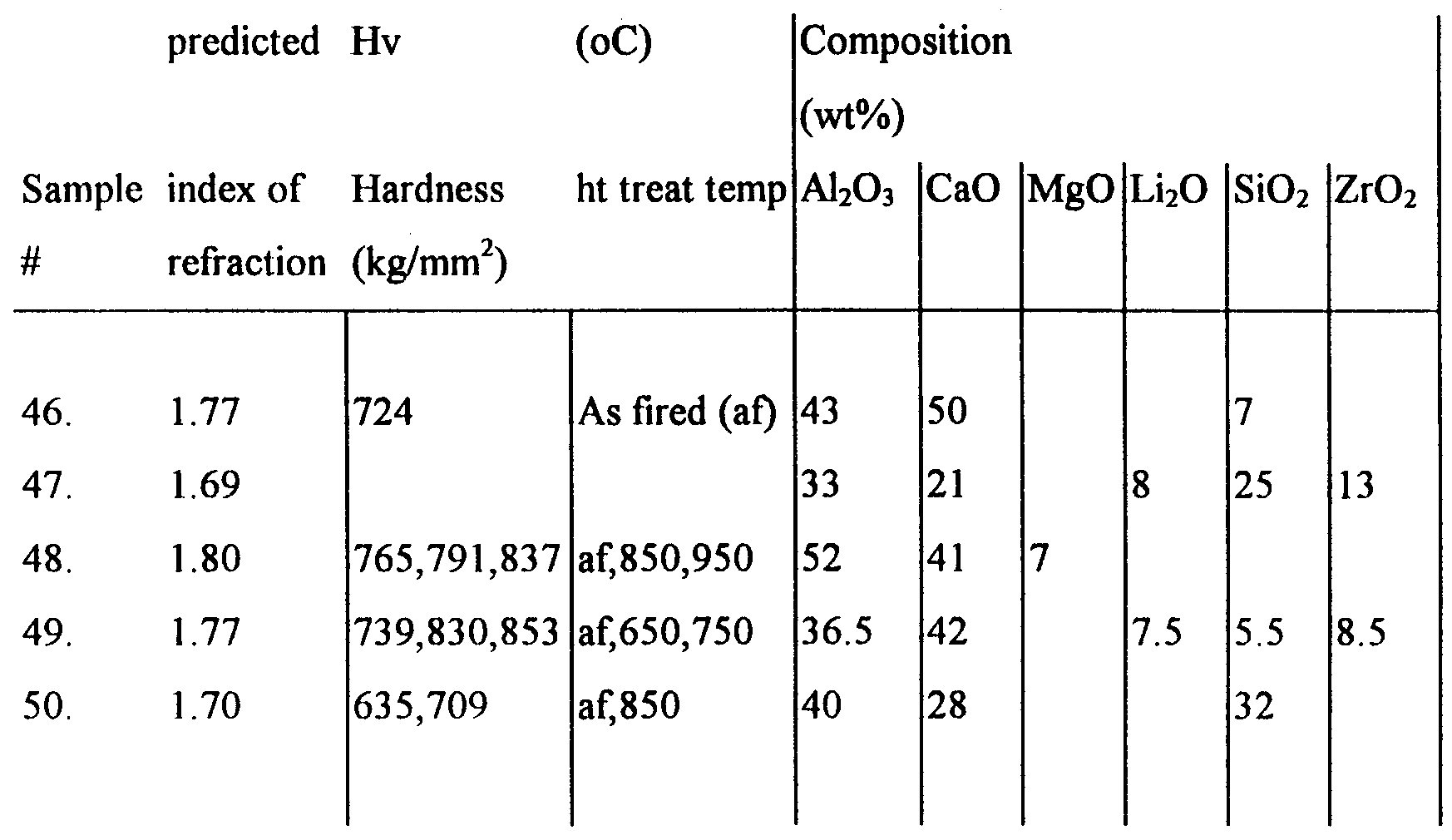
- the resultant beads were approximately 100% yield as clear beads. Furthermore, the beads showed 1100 kg/mm 2 of Vickers hardness after heat treatment at 1 100°C for 5 minutes. 945 Examples 46-58
- Li 2 O lithium carbonate (2.47 g/g Li 2 O in batch, Aldrich Chemical, Milwaukee, WI)
- MgO basic magnesium carbonate (2.41 g/g MgO in batch, Aldrich 965 Chemical, Milwaukee, Wl)
- SiO 2 silica (Sil-Co-Sil #90, U.S. Silica, Ottawa, I) 970 ZrO 2 anhydrous zirconia (Fischer Scientific, Pittsburgh, PA)
- Examples 46-49 and 55 were formulated in larger batch sizes (1 kg) for bead formation. Powders were hand mixed with a spoon for 5 minutes, then combined with 1500 - 2000 ml water and added to a 1 gallon ball mill. Samples were milled for 24 hours, dried in glass pans, and melted at 1500°C for 60 minutes in platinum crucibles. Glass melts were poured into a high velocity natural gas burner flame and particles were collected in a screened hopper. Example 56 was formed into retroreflective beads by flame treating presintered particles. A powder batch was prepared as previously described. The powder was hand-packed into a shallow alumina boat and sintered at 1250°C for 30 minutes.
- the sintered batch was ground with mortar and pestle, and sized by sieving into 37 - 120 micron and 120 - 250 micron fractions.
- the sintered particles were fed into the flame of a hydrogen / oxygen glass blowing torch at a rate of about 0.5 g per minute.
- the particles were carried by the torch against a steel backplate equipped with a sprinkler bar to provide a water covered surface.
Landscapes
- Chemical & Material Sciences (AREA)
- Engineering & Computer Science (AREA)
- Materials Engineering (AREA)
- Organic Chemistry (AREA)
- Ceramic Engineering (AREA)
- Life Sciences & Earth Sciences (AREA)
- Chemical Kinetics & Catalysis (AREA)
- General Chemical & Material Sciences (AREA)
- Geochemistry & Mineralogy (AREA)
- Manufacturing & Machinery (AREA)
- Structural Engineering (AREA)
- Glass Compositions (AREA)
Abstract
Description



Claims
Priority Applications (6)
| Application Number | Priority Date | Filing Date | Title |
|---|---|---|---|
| KR10-1999-7009588A KR100509892B1 (en) | 1997-04-18 | 1998-04-17 | Transparent beads and their production method |
| EP98918269A EP0975555B1 (en) | 1997-04-18 | 1998-04-17 | Transparent beads and their production method |
| DE69801497T DE69801497T2 (en) | 1997-04-18 | 1998-04-17 | TRANSPARENT GLASS BALLS AND THEIR PRODUCTION PROCESS |
| AU71229/98A AU7122998A (en) | 1997-04-18 | 1998-04-17 | Transparent beads and their production method |
| CA002285271A CA2285271C (en) | 1997-04-18 | 1998-04-17 | Transparent beads and their production method |
| AT98918269T ATE204835T1 (en) | 1997-04-18 | 1998-04-17 | TRANSPARENT GLASS BALLS AND THEIR PRODUCTION PROCESS |
Applications Claiming Priority (3)
| Application Number | Priority Date | Filing Date | Title |
|---|---|---|---|
| JP9/101499 | 1997-04-18 | ||
| JP10149997A JP3993269B2 (en) | 1997-04-18 | 1997-04-18 | Transparent beads and method for producing the same |
| US09/563,627 US6514892B1 (en) | 1997-04-18 | 2000-05-02 | Transparent beads and their production method |
Publications (1)
| Publication Number | Publication Date |
|---|---|
| WO1998047830A1 true WO1998047830A1 (en) | 1998-10-29 |
Family
ID=26442369
Family Applications (1)
| Application Number | Title | Priority Date | Filing Date |
|---|---|---|---|
| PCT/US1998/007618 Ceased WO1998047830A1 (en) | 1997-04-18 | 1998-04-17 | Transparent beads and their production method |
Country Status (2)
| Country | Link |
|---|---|
| US (1) | US6514892B1 (en) |
| WO (1) | WO1998047830A1 (en) |
Cited By (5)
| Publication number | Priority date | Publication date | Assignee | Title |
|---|---|---|---|---|
| WO2001007375A1 (en) * | 1999-07-27 | 2001-02-01 | 3M Innovative Properties Company | Transparent microspheres |
| US7513941B2 (en) | 2005-11-14 | 2009-04-07 | 3M Innovative Properties Company | Pavement marking, reflective elements, and methods of making micospheres |
| US7524779B2 (en) | 2003-06-11 | 2009-04-28 | 3M Innovative Properties Company | Microspheres having a high index of refraction |
| US10858496B2 (en) | 2015-09-11 | 2020-12-08 | 3M Innovative Properties Company | Durable retroreflective elements with a blend of beads |
| US11353640B2 (en) | 2015-09-11 | 2022-06-07 | 3M Innovative Properties Company | Durable retroreflective elements with an ionic copolymer core |
Families Citing this family (53)
| Publication number | Priority date | Publication date | Assignee | Title |
|---|---|---|---|---|
| US7125477B2 (en) * | 2000-02-17 | 2006-10-24 | Applied Materials, Inc. | Contacts for electrochemical processing |
| US20080156657A1 (en) * | 2000-02-17 | 2008-07-03 | Butterfield Paul D | Conductive polishing article for electrochemical mechanical polishing |
| US7374644B2 (en) * | 2000-02-17 | 2008-05-20 | Applied Materials, Inc. | Conductive polishing article for electrochemical mechanical polishing |
| US20040020789A1 (en) * | 2000-02-17 | 2004-02-05 | Applied Materials, Inc. | Conductive polishing article for electrochemical mechanical polishing |
| US7625509B2 (en) * | 2001-08-02 | 2009-12-01 | 3M Innovative Properties Company | Method of making ceramic articles |
| CN1608036B (en) * | 2001-08-02 | 2010-09-22 | 3M创新有限公司 | Al2O3-Y2O3-ZrO2/HfO2 material and its preparation and use method |
| US7563294B2 (en) * | 2001-08-02 | 2009-07-21 | 3M Innovative Properties Company | Abrasive particles and methods of making and using the same |
| ATE378293T1 (en) | 2001-08-02 | 2007-11-15 | 3M Innovative Properties Co | METHOD FOR PRODUCING OBJECTS FROM GLASS AND GLASS CERAMIC OBJECTS PRODUCED IN THIS WAY |
| US7563293B2 (en) * | 2001-08-02 | 2009-07-21 | 3M Innovative Properties Company | Al2O3-rare earth oxide-ZrO2/HfO2 materials, and methods of making and using the same |
| EP1414765A2 (en) * | 2001-08-02 | 2004-05-06 | 3M Innovative Properties Company | Method of making amorphous materials and ceramics |
| US8056370B2 (en) * | 2002-08-02 | 2011-11-15 | 3M Innovative Properties Company | Method of making amorphous and ceramics via melt spinning |
| US7179526B2 (en) * | 2002-08-02 | 2007-02-20 | 3M Innovative Properties Company | Plasma spraying |
| US7811496B2 (en) * | 2003-02-05 | 2010-10-12 | 3M Innovative Properties Company | Methods of making ceramic particles |
| US7258707B2 (en) * | 2003-02-05 | 2007-08-21 | 3M Innovative Properties Company | AI2O3-La2O3-Y2O3-MgO ceramics, and methods of making the same |
| US6984261B2 (en) * | 2003-02-05 | 2006-01-10 | 3M Innovative Properties Company | Use of ceramics in dental and orthodontic applications |
| US7175786B2 (en) * | 2003-02-05 | 2007-02-13 | 3M Innovative Properties Co. | Methods of making Al2O3-SiO2 ceramics |
| US20040148868A1 (en) * | 2003-02-05 | 2004-08-05 | 3M Innovative Properties Company | Methods of making ceramics |
| US7292766B2 (en) * | 2003-04-28 | 2007-11-06 | 3M Innovative Properties Company | Use of glasses containing rare earth oxide, alumina, and zirconia and dopant in optical waveguides |
| US7197896B2 (en) * | 2003-09-05 | 2007-04-03 | 3M Innovative Properties Company | Methods of making Al2O3-SiO2 ceramics |
| US7141522B2 (en) | 2003-09-18 | 2006-11-28 | 3M Innovative Properties Company | Ceramics comprising Al2O3, Y2O3, ZrO2 and/or HfO2, and Nb2O5 and/or Ta2O5 and methods of making the same |
| US7141523B2 (en) * | 2003-09-18 | 2006-11-28 | 3M Innovative Properties Company | Ceramics comprising Al2O3, REO, ZrO2 and/or HfO2, and Nb2O5 and/or Ta2O5 and methods of making the same |
| US20050137078A1 (en) * | 2003-12-18 | 2005-06-23 | 3M Innovative Properties Company | Alumina-yttria particles and methods of making the same |
| US20050137076A1 (en) * | 2003-12-18 | 2005-06-23 | 3M Innovative Properties Company | Transparent fused crystalline ceramic, and method of making the same |
| US7332453B2 (en) * | 2004-07-29 | 2008-02-19 | 3M Innovative Properties Company | Ceramics, and methods of making and using the same |
| US7095941B2 (en) * | 2004-10-27 | 2006-08-22 | Schott Corporation | Fused optical fiber optical device system |
| US20070151166A1 (en) * | 2005-12-30 | 2007-07-05 | 3M Innovative Properties Company | Method of making abrasive articles, cutting tools, and cutting tool inserts |
| US7281970B2 (en) * | 2005-12-30 | 2007-10-16 | 3M Innovative Properties Company | Composite articles and methods of making the same |
| US20070154713A1 (en) * | 2005-12-30 | 2007-07-05 | 3M Innovative Properties Company | Ceramic cutting tools and cutting tool inserts, and methods of making the same |
| US7598188B2 (en) * | 2005-12-30 | 2009-10-06 | 3M Innovative Properties Company | Ceramic materials and methods of making and using the same |
| KR100773438B1 (en) | 2006-04-17 | 2007-11-05 | 박종민 | Retroreflective glass beads and its manufacturing method |
| JP5306643B2 (en) * | 2006-12-27 | 2013-10-02 | 花王株式会社 | Light diffusing member |
| US8292539B2 (en) * | 2007-04-10 | 2012-10-23 | Stoncor Group, Inc. | Agglomerated retroreflective beads for highway marking and methods for fabrication and use thereof |
| US9207373B2 (en) | 2007-04-10 | 2015-12-08 | Stoncor Group, Inc. | Methods for fabrication and highway marking usage of agglomerated retroreflective beads |
| US20080280034A1 (en) * | 2007-05-11 | 2008-11-13 | 3M Innovative Properties Company | Pavement marking and reflective elements having microspheres comprising lanthanum oxide and aluminum oxide with zirconia, titania, or mixtures thereof |
| US20100044382A1 (en) * | 2008-08-22 | 2010-02-25 | Saint-Gobain Performance Plastics Corporation | Fluoropolymer coated article |
| BR112012003662A2 (en) | 2009-08-21 | 2016-03-29 | 3M Innovative Properties Co | pavement demarcations, reflective elements, and preparation methods of microspheres. |
| US8673449B2 (en) * | 2009-12-18 | 2014-03-18 | Saint-Gobain Performance Plastics Corporation | Cooking release sheet materials and release surfaces |
| EP2554758A1 (en) * | 2011-08-02 | 2013-02-06 | DSM IP Assets B.V. | A water vapour control arranged facing the inside of a building |
| TWI581965B (en) * | 2011-10-25 | 2017-05-11 | Gcp應用技術有限公司 | Waterproofing membrane |
| RU2513071C2 (en) * | 2012-08-13 | 2014-04-20 | Федеральное государственное бюджетное образовательное учреждение высшего профессионального образования "Белгородский государственный технологический университет им. В.Г. Шухова" | Mixture for making composite microspheres and method for production thereof |
| US10751367B2 (en) | 2016-05-27 | 2020-08-25 | Corning Incorporated | Bioactive glass microspheres |
| US10647962B2 (en) | 2016-05-27 | 2020-05-12 | Corning Incorporated | Bioactive aluminoborate glasses |
| US20170342383A1 (en) | 2016-05-27 | 2017-11-30 | Corning Incorporated | Lithium disilicate glass-ceramic compositions and methods thereof |
| US10676713B2 (en) | 2016-05-27 | 2020-06-09 | Corning Incorporated | Bioactive borophosphate glasses |
| US20170340527A1 (en) | 2016-05-27 | 2017-11-30 | Corning Incorporated | Biodegradable microbeads |
| US11230648B2 (en) | 2016-10-24 | 2022-01-25 | Saint-Gobain Performance Plastics Corporation | Polymer compositions, materials, and methods of making |
| CN111417603B (en) | 2017-11-28 | 2023-10-31 | 康宁股份有限公司 | Bioactive Borate Glass and Methods |
| WO2019108558A1 (en) | 2017-11-28 | 2019-06-06 | Corning Incorporated | High liquidus viscosity bioactive glass |
| CN111405913A (en) | 2017-11-28 | 2020-07-10 | 康宁股份有限公司 | Bioactive glass compositions and dentinal hypersensitivity repair |
| WO2019108571A1 (en) | 2017-11-28 | 2019-06-06 | Corning Incorporated | Chemically strengthened bioactive glass-ceramics |
| US11467324B2 (en) | 2018-10-26 | 2022-10-11 | Tundra Composits, LLC | Complex retroreflective bead |
| US20220242792A1 (en) * | 2019-07-24 | 2022-08-04 | Iluka Resources Limited | Whitening methods and compositions |
| US12196987B2 (en) | 2021-01-12 | 2025-01-14 | Tundra COmpoistes, LLC | Retroreflective composite reflective microspheres and reflective inorganic material |
Citations (4)
| Publication number | Priority date | Publication date | Assignee | Title |
|---|---|---|---|---|
| US2924533A (en) * | 1956-05-28 | 1960-02-09 | Carborundum Co | Spheroidal refractory material and method of making |
| US4137086A (en) * | 1975-05-13 | 1979-01-30 | Pilkington Brothers Limited | Glass compositions for use in curable compositions |
| US4564556A (en) * | 1984-09-24 | 1986-01-14 | Minnesota Mining And Manufacturing Company | Transparent non-vitreous ceramic particulate |
| US4772511A (en) * | 1985-11-22 | 1988-09-20 | Minnesota Mining And Manufacturing Company | Transparent non-vitreous zirconia microspheres |
Family Cites Families (49)
| Publication number | Priority date | Publication date | Assignee | Title |
|---|---|---|---|---|
| US2354018A (en) | 1940-08-03 | 1944-07-18 | Minnesota Mining & Mfg | Light reflector sheet |
| US2873197A (en) | 1955-01-21 | 1959-02-10 | Carborundum Co | Refractory fibrous material |
| US2963378A (en) | 1955-04-25 | 1960-12-06 | Minnesota Mining & Mfg | Ass beads hemispherically reflectorled with metallic coating and compositions thereof |
| US2960594A (en) | 1958-06-30 | 1960-11-15 | Plasma Flame Corp | Plasma flame generator |
| US3145114A (en) | 1960-10-24 | 1964-08-18 | Prismo Safety Corp | Process for increasing the index of refraction of glass and an article made thereby |
| US3228897A (en) | 1961-10-26 | 1966-01-11 | Minnesota Mining & Mfg | Reflective coating compositions containing glass beads, metal flake pigment and binder |
| US3149016A (en) | 1962-04-02 | 1964-09-15 | Minnesota Mining & Mfg | Nucleated glass particle and process for making it |
| CA919195A (en) | 1963-02-14 | 1973-01-16 | Fang Tung Chi | High index glass elements |
| US3323888A (en) | 1964-03-17 | 1967-06-06 | Cataphote Corp | Method for manufacturing glass beads |
| US3416936A (en) | 1965-03-01 | 1968-12-17 | Gen Steel Ind Inc | Abrasion resistant glass bead with sharp softening range and process for making the same |
| US3432314A (en) | 1966-08-02 | 1969-03-11 | Us Air Force | Transparent zirconia composition and process for making same |
| US3410185A (en) | 1966-08-08 | 1968-11-12 | Minnesota Mining & Mfg | Marking |
| US3560074A (en) | 1968-10-21 | 1971-02-02 | Cataphote Corp | 95% titanium dioxide glass spheroids |
| US3709706A (en) | 1969-05-16 | 1973-01-09 | Minnesota Mining & Mfg | Refractory fibers and other articles of zirconia and silica mixtures |
| US3795524A (en) | 1971-03-01 | 1974-03-05 | Minnesota Mining & Mfg | Aluminum borate and aluminum borosilicate articles |
| US3749763A (en) | 1971-08-03 | 1973-07-31 | Humphreys Corp | Processing of silicate ores and product thereof |
| US3864113A (en) | 1973-10-19 | 1975-02-04 | Corning Glass Works | Method of Producing Glass by Flame Hydrolysis |
| US3915771A (en) | 1974-03-04 | 1975-10-28 | Minnesota Mining & Mfg | Pavement-marking tape |
| US4082427A (en) | 1974-07-02 | 1978-04-04 | Fukuoka Tokushu Garasu Kabushiki Kaisha | High refractive index glass compositions |
| JPS5828210B2 (en) | 1974-11-07 | 1983-06-14 | オノダセメント カブシキガイシヤ | Kobutsu Sen Imataha Beads Seibutsu |
| FR2320276A1 (en) | 1975-08-06 | 1977-03-04 | Prod Refractaires Europ | BALLS IMPROVED IN CERAMIC MATERIAL |
| US4056602A (en) | 1975-08-20 | 1977-11-01 | Thagard Technology Company | High temperature chemical reaction processes utilizing fluid-wall reactors |
| US4095974A (en) | 1975-09-24 | 1978-06-20 | Thagard Technology Company | High temperature chemical reaction processes utilizing fluid-wall reactors |
| JPS5939378B2 (en) | 1976-08-13 | 1984-09-22 | 旭硝子株式会社 | Glass composition for fibers |
| JPS5388815A (en) | 1977-01-18 | 1978-08-04 | Tokyo Shibaura Electric Co | High reeractiveeindex glass for glass beads |
| JPS53102325A (en) | 1977-02-18 | 1978-09-06 | Obara Optical Glass | Abrasionn and chemicallproof glass |
| JPS608983B2 (en) | 1978-07-28 | 1985-03-07 | 松下電工株式会社 | Manufacturing method of low melting point glass with crystallization ability |
| JPS5520254A (en) | 1978-07-28 | 1980-02-13 | Matsushita Electric Works Ltd | Production of low melting point crystallized glass |
| JPS55126548A (en) | 1979-03-20 | 1980-09-30 | Ohara Inc | Glass for bead |
| JPS55126547A (en) | 1979-03-20 | 1980-09-30 | Ohara Inc | Glass for bead |
| US4248932A (en) | 1979-06-14 | 1981-02-03 | Minnesota Mining And Manufacturing Company | Extended-life pavement-marking sheet material |
| JPS5641852A (en) | 1979-09-17 | 1981-04-18 | Ohara Inc | Glass for bead |
| FR2493910A1 (en) | 1980-11-13 | 1982-05-14 | Produits Refractaires | ZIRCONIA AND SILICA BASE AGENT FOR DEEP GEOLOGICAL FRACTURES |
| US4621936A (en) | 1983-10-14 | 1986-11-11 | Corning Glass Works | Zirconia pen balls |
| JPS60215549A (en) | 1984-04-11 | 1985-10-28 | Toshiba Glass Co Ltd | Abrasive-resistant glass beads |
| JPS6168349A (en) | 1984-09-07 | 1986-04-08 | Toshiba Glass Co Ltd | Wear resistant glass bead |
| JPS61270235A (en) | 1985-05-24 | 1986-11-29 | Ohara Inc | Glass for bead |
| CA1308845C (en) | 1986-01-13 | 1992-10-13 | Roger W. Lange | Pavement markings containing transparent non-vitreous ceramic microspheres |
| US4837069A (en) | 1987-01-07 | 1989-06-06 | Minnesota Mining And Manufacturing Company | Transparent alumina microspheres |
| US5227221A (en) | 1988-06-09 | 1993-07-13 | Minnesota Mining And Manufacturing Company | Patterned skid preventative sheet |
| WO1992015756A1 (en) | 1991-02-28 | 1992-09-17 | Minnesota Mining And Manufacturing Company | Pavement markers with silicone adhesive |
| JPH0585771A (en) | 1991-03-29 | 1993-04-06 | Nippon Electric Glass Co Ltd | Composition for hollow glass sphere |
| US5268789A (en) | 1992-02-18 | 1993-12-07 | Minnesota Mining And Manufacturing Company | Retroreflective assembly and process for making same |
| US5286682A (en) | 1992-02-19 | 1994-02-15 | Minnesota Mining And Manufacturing Company | Yellow retroreflective pavement markings |
| FR2714905B1 (en) | 1994-01-11 | 1996-03-01 | Produits Refractaires | Melted ceramic balls. |
| DE4423794C1 (en) | 1994-07-01 | 1996-02-08 | Ivoclar Ag | Glass ceramic containing Zr0¶2¶, process for its production and its use |
| ATE200773T1 (en) | 1995-04-18 | 2001-05-15 | Minnesota Mining & Mfg | GLASS BEADS |
| US5576097A (en) | 1995-04-24 | 1996-11-19 | Brite-Line Industries, Inc. | High brightness durable retro-reflecting microspheres and method of making the same |
| JP3993269B2 (en) * | 1997-04-18 | 2007-10-17 | スリーエム カンパニー | Transparent beads and method for producing the same |
-
1998
- 1998-04-17 WO PCT/US1998/007618 patent/WO1998047830A1/en not_active Ceased
-
2000
- 2000-05-02 US US09/563,627 patent/US6514892B1/en not_active Expired - Lifetime
Patent Citations (4)
| Publication number | Priority date | Publication date | Assignee | Title |
|---|---|---|---|---|
| US2924533A (en) * | 1956-05-28 | 1960-02-09 | Carborundum Co | Spheroidal refractory material and method of making |
| US4137086A (en) * | 1975-05-13 | 1979-01-30 | Pilkington Brothers Limited | Glass compositions for use in curable compositions |
| US4564556A (en) * | 1984-09-24 | 1986-01-14 | Minnesota Mining And Manufacturing Company | Transparent non-vitreous ceramic particulate |
| US4772511A (en) * | 1985-11-22 | 1988-09-20 | Minnesota Mining And Manufacturing Company | Transparent non-vitreous zirconia microspheres |
Cited By (13)
| Publication number | Priority date | Publication date | Assignee | Title |
|---|---|---|---|---|
| WO2001007375A1 (en) * | 1999-07-27 | 2001-02-01 | 3M Innovative Properties Company | Transparent microspheres |
| US6245700B1 (en) | 1999-07-27 | 2001-06-12 | 3M Innovative Properties Company | Transparent microspheres |
| US6461988B2 (en) | 1999-07-27 | 2002-10-08 | 3M Innovative Properties Company | Transparent microspheres |
| US6479417B2 (en) | 1999-07-27 | 2002-11-12 | 3M Innovative Properties Company | Glass-ceramic microspheres that impart yellow color to retroreflected light |
| US7585799B2 (en) | 2003-06-11 | 2009-09-08 | 3M Innovative Properties Company | Microspheres having a high index of refraction |
| US7524779B2 (en) | 2003-06-11 | 2009-04-28 | 3M Innovative Properties Company | Microspheres having a high index of refraction |
| US7579293B2 (en) | 2005-11-14 | 2009-08-25 | 3M Innovative Properties Company | Pavement marking, reflective elements, and methods of making microspheres |
| US7513941B2 (en) | 2005-11-14 | 2009-04-07 | 3M Innovative Properties Company | Pavement marking, reflective elements, and methods of making micospheres |
| US7745360B2 (en) | 2005-11-14 | 2010-06-29 | 3M Innovative Properties Company | Pavement marking, reflective elements, and methods of making microspheres |
| US10858496B2 (en) | 2015-09-11 | 2020-12-08 | 3M Innovative Properties Company | Durable retroreflective elements with a blend of beads |
| US11286368B2 (en) | 2015-09-11 | 2022-03-29 | 3M Innovative Properties Company | Durable retroreflective elements with a blend of beads |
| US11353640B2 (en) | 2015-09-11 | 2022-06-07 | 3M Innovative Properties Company | Durable retroreflective elements with an ionic copolymer core |
| US12043723B2 (en) | 2015-09-11 | 2024-07-23 | 3M Innovative Properties Company | Durable retroreflective elements with a blend of beads |
Also Published As
| Publication number | Publication date |
|---|---|
| US6514892B1 (en) | 2003-02-04 |
Similar Documents
| Publication | Publication Date | Title |
|---|---|---|
| EP0975555B1 (en) | Transparent beads and their production method | |
| US6514892B1 (en) | Transparent beads and their production method | |
| JP4868673B2 (en) | Transparent microsphere | |
| US7524779B2 (en) | Microspheres having a high index of refraction | |
| US7745360B2 (en) | Pavement marking, reflective elements, and methods of making microspheres | |
| CN102574729A (en) | Pavement markings, reflective elements, and methods of making microspheres | |
| EP2152640A1 (en) | Method of making ceramic articles from glass | |
| WO1999044953A1 (en) | Sintered glass-ceramic material particularly suitable as a cladding and structural system |
Legal Events
| Date | Code | Title | Description |
|---|---|---|---|
| WWE | Wipo information: entry into national phase |
Ref document number: 98803947.8 Country of ref document: CN |
|
| AK | Designated states |
Kind code of ref document: A1 Designated state(s): AL AM AT AU AZ BA BB BG BR BY CA CH CN CU CZ DE DK EE ES FI GB GE GH GM GW HU ID IL IS JP KE KG KP KR KZ LC LK LR LS LT LU LV MD MG MK MN MW MX NO NZ PL PT RO RU SD SE SG SI SK SL TJ TM TR TT UA UG UZ VN YU ZW |
|
| AL | Designated countries for regional patents |
Kind code of ref document: A1 Designated state(s): GH GM KE LS MW SD SZ UG ZW AM AZ BY KG KZ MD RU TJ TM AT BE CH CY DE DK ES FI FR GB GR IE IT LU MC NL PT SE BF BJ CF CG CI CM GA GN ML MR NE SN TD TG |
|
| DFPE | Request for preliminary examination filed prior to expiration of 19th month from priority date (pct application filed before 20040101) | ||
| 121 | Ep: the epo has been informed by wipo that ep was designated in this application | ||
| ENP | Entry into the national phase |
Ref document number: 2285271 Country of ref document: CA Ref document number: 2285271 Country of ref document: CA Kind code of ref document: A |
|
| WWE | Wipo information: entry into national phase |
Ref document number: 1019997009588 Country of ref document: KR |
|
| WWE | Wipo information: entry into national phase |
Ref document number: 1998918269 Country of ref document: EP |
|
| WWP | Wipo information: published in national office |
Ref document number: 1998918269 Country of ref document: EP |
|
| REG | Reference to national code |
Ref country code: DE Ref legal event code: 8642 |
|
| NENP | Non-entry into the national phase |
Ref document number: 1998546155 Country of ref document: JP |
|
| WWP | Wipo information: published in national office |
Ref document number: 1019997009588 Country of ref document: KR |
|
| WWG | Wipo information: grant in national office |
Ref document number: 1998918269 Country of ref document: EP |
|
| WWG | Wipo information: grant in national office |
Ref document number: 1019997009588 Country of ref document: KR |