[go: up one dir, main page]

WO1998017943A1 - Integrated beamformer and methods of manufacture thereof - Google Patents

Integrated beamformer and methods of manufacture thereof Download PDF

Info

Publication number
WO1998017943A1
WO1998017943A1 PCT/US1997/019500 US9719500W WO9817943A1 WO 1998017943 A1 WO1998017943 A1 WO 1998017943A1 US 9719500 W US9719500 W US 9719500W WO 9817943 A1 WO9817943 A1 WO 9817943A1
Authority
WO
WIPO (PCT)
Prior art keywords
refractive
diffuser
distal
providing
surface diffuser
Prior art date
Legal status (The legal status is an assumption and is not a legal conclusion. Google has not performed a legal analysis and makes no representation as to the accuracy of the status listed.)
Ceased
Application number
PCT/US1997/019500
Other languages
French (fr)
Inventor
Alexander Rizkin
Current Assignee (The listed assignees may be inaccurate. Google has not performed a legal analysis and makes no representation or warranty as to the accuracy of the list.)
Physical Optics Corp
farLight Corp
Original Assignee
Physical Optics Corp
farLight Corp
Priority date (The priority date is an assumption and is not a legal conclusion. Google has not performed a legal analysis and makes no representation as to the accuracy of the date listed.)
Filing date
Publication date
Application filed by Physical Optics Corp, farLight Corp filed Critical Physical Optics Corp
Priority to JP10519713A priority Critical patent/JP2001503158A/en
Priority to EP97911943A priority patent/EP0934488A4/en
Publication of WO1998017943A1 publication Critical patent/WO1998017943A1/en
Anticipated expiration legal-status Critical
Ceased legal-status Critical Current

Links

Classifications

    • GPHYSICS
    • G02OPTICS
    • G02BOPTICAL ELEMENTS, SYSTEMS OR APPARATUS
    • G02B5/00Optical elements other than lenses
    • G02B5/02Diffusing elements; Afocal elements
    • G02B5/0205Diffusing elements; Afocal elements characterised by the diffusing properties
    • G02B5/0252Diffusing elements; Afocal elements characterised by the diffusing properties using holographic or diffractive means
    • GPHYSICS
    • G02OPTICS
    • G02BOPTICAL ELEMENTS, SYSTEMS OR APPARATUS
    • G02B19/00Condensers, e.g. light collectors or similar non-imaging optics
    • G02B19/0004Condensers, e.g. light collectors or similar non-imaging optics characterised by the optical means employed
    • G02B19/0028Condensers, e.g. light collectors or similar non-imaging optics characterised by the optical means employed refractive and reflective surfaces, e.g. non-imaging catadioptric systems
    • GPHYSICS
    • G02OPTICS
    • G02BOPTICAL ELEMENTS, SYSTEMS OR APPARATUS
    • G02B19/00Condensers, e.g. light collectors or similar non-imaging optics
    • G02B19/0033Condensers, e.g. light collectors or similar non-imaging optics characterised by the use
    • G02B19/0047Condensers, e.g. light collectors or similar non-imaging optics characterised by the use for use with a light source
    • GPHYSICS
    • G02OPTICS
    • G02BOPTICAL ELEMENTS, SYSTEMS OR APPARATUS
    • G02B5/00Optical elements other than lenses
    • G02B5/02Diffusing elements; Afocal elements
    • G02B5/0268Diffusing elements; Afocal elements characterized by the fabrication or manufacturing method
    • GPHYSICS
    • G02OPTICS
    • G02BOPTICAL ELEMENTS, SYSTEMS OR APPARATUS
    • G02B6/00Light guides; Structural details of arrangements comprising light guides and other optical elements, e.g. couplings
    • G02B6/10Light guides; Structural details of arrangements comprising light guides and other optical elements, e.g. couplings of the optical waveguide type
    • G02B6/12Light guides; Structural details of arrangements comprising light guides and other optical elements, e.g. couplings of the optical waveguide type of the integrated circuit kind
    • G02B6/122Basic optical elements, e.g. light-guiding paths
    • G02B6/1221Basic optical elements, e.g. light-guiding paths made from organic materials
    • GPHYSICS
    • G02OPTICS
    • G02BOPTICAL ELEMENTS, SYSTEMS OR APPARATUS
    • G02B6/00Light guides; Structural details of arrangements comprising light guides and other optical elements, e.g. couplings
    • G02B6/24Coupling light guides
    • G02B6/241Light guide terminations
    • GPHYSICS
    • G02OPTICS
    • G02BOPTICAL ELEMENTS, SYSTEMS OR APPARATUS
    • G02B6/00Light guides; Structural details of arrangements comprising light guides and other optical elements, e.g. couplings
    • G02B6/24Coupling light guides
    • G02B6/26Optical coupling means
    • G02B6/32Optical coupling means having lens focusing means positioned between opposed fibre ends
    • GPHYSICS
    • G02OPTICS
    • G02BOPTICAL ELEMENTS, SYSTEMS OR APPARATUS
    • G02B6/00Light guides; Structural details of arrangements comprising light guides and other optical elements, e.g. couplings
    • G02B6/0001Light guides; Structural details of arrangements comprising light guides and other optical elements, e.g. couplings specially adapted for lighting devices or systems

Definitions

  • the present invention relates in general to the field of lighting. More particularly, the present invention relates to beamformers for remote source lighting. Specifically, a preferred embodiment of the present invention relates to a solid integrated beamformer having a surface diffuser. The present invention thus relates to beamformers of the type that can be termed integrated.
  • RSL remote source lighting
  • NEO Nonimaging optics
  • nonimaging optics The principal area of development of nonimaging optics since then has been in the concentration of solar energy for heating and photovoltaic power conversion (5 6) .
  • Other applications of nonimaging optics have included infrared communications receivers, fiber optic coupling and luminescent concentrators for integrated devices (7 9) .
  • Nonimaging optics have also been extended to include tapered optical fibers for fiber optic sensors (10"13) .
  • Recent progress in i) developing efficient light sources and ii) manufacturing optical fiber has permitted the assembly of an RSL system in which one, or more, optical fibers are used to deliver light to one, or more, remotely located points. The distal end of each optical fiber can be used for illumination directly or in conjunction with refractive lenses, to approximate the light distribution required by a given application.
  • the cleaved open end of a plastic optical fiber produces a light cone with a solid angle of from 50° to 80° , depending on the core and cladding materials of the fiber.
  • a separate refractive lens can be located near such an end.
  • using a lens to shape light from the end has caused problems of light loss and overly complicated lens designs. Therefore, the previous RSL systems are limited to end uses where a highly precise illuminance distribution is not required.
  • the above-discovered problems have ruled out such RSL applications as navigation lighting, obstruction lighting, signal lighting and airport approach lighting.
  • 08/636,798 discloses a universal remote lighting system.
  • U.S. Pat. No. 5,365,354 discloses method of making a grated refractive index type diffuser based on volume holographic material.
  • U.S. Pat. No. 5,534,386 discloses a homogenizer formed using coherent light and a holographic diffuser.
  • the present invention is directed to a solid integrated beamformer that combines nonimaging optics, refractive optics and a surface diffuser for shaping light.
  • the present invention is also directed to methods of manufacturing the integrated beamformer.
  • An effect of the present invention is to reduce the size and weight of the assembly, as well as its complexity, by joining together the diffuser, refractive optics and nonimaging optics in a single unitary device.
  • the advantages of the present invention include fewer parts combined with a reduction in size and/or weight and a reduction in cost. These advantages will be appreciated in both military and commercial lighting applications.
  • the benefits of a shipboard navigation lighting system according to the present invention include: the elimination of the need for a separate diffuser mounting bracket, a corresponding reduction in the size and mass of the enclosure; and a corresponding reduction in topside weight and moment.
  • an RSL system according to the present invention may require less maintenance and have a longer useful life.
  • a primary object of the invention is to provide an apparatus that combines nonimaging optics, refractive optics and a surface diffuser into a single unitary component. Another object of the invention is to provide an apparatus that is cost effective. It is another object of the invention is to provide an apparatus that is rugged and reliable, thereby decreasing down time and operating costs. It is yet another object of the invention is to provide an apparatus that has one or more of the characteristics discussed above but which is relatively simple to manufacture and assemble using a minimum of equipment.
  • a solid integrated beamformer including: a solid nonimaging optic having i) a proximal nonimaging end and ii) a distal nonimaging end; a solid refractive optic integrally attached to said distal nonimaging end, said solid refractive optic including a distal refractive end; and a surface diffuser integrally formed on said distal refractive end.
  • the invention also includes apparatus that incorporates the solid integrated beamformer.
  • Another object of the invention is to provide methods that can be used to manufacture the integrated beamformer. It is another object of the invention is to provide methods that are predictable and reproducible, thereby decreasing variance and operating costs. It is yet another object of the invention is to provide methods that have one or more of the characteristics discussed above but which are relatively simple to setup and operate using moderately skilled workers.
  • these objects are achieved by providing a method comprising: providing an optical blank with a nonimaging optic and a refractive optic, said refractive optic having a distal refractive surface; providing a surface diffuser master; contacting said distal refractive surface with said diffuser master; and removing said diffuser master from said distal refractive surface so as to replicate said surface diffuser master.
  • the invention also includes apparatus for carrying out the replication of the surface diffuser on the distal refractive surface, or alternatively, molding, or casting the surface diffuser so as to integrally form the surface diffuser.
  • FIG. 1 illustrates a schematic view of a beamformer
  • FIG. 2(a) illustrates an isometric view of a solid integrated beamformer according to the present invention
  • FIG. 2(b) illustrates a micrographic view of a submicron holographic diffuser surface relief embossed on a spherical surface lens of the solid integrated beamformer depicted in FIG. 2(a);
  • FIG. 3(a) illustrates light transformer diameter according to the present invention as a function of divergence angle for several common fiber diameters
  • FIG. 3(b) illustrates light transformer length according to the present invention as a function of divergence angle for several common fiber diameters
  • FIG. 4(a) illustrates relative intensity of light transmitted by optical fiber as a function of divergence angle for two common fiber numerical apertures
  • FIG. 4(b) illustrates total intensity of light transmitted by optical fiber as a function of divergence angle for two common fiber numerical apertures
  • FIG. 5 illustrates a schematic view of the surface contour of a compound parabolic concentrator according to the present invention
  • FIG. 6 illustrates a schematic view of the reflection geometry for a compound parabolic concentrator conical section according to the present invention
  • FIG. 7 illustrates a schematic polar coordinate system used to calculate a compound parabolic concentrator parabolic curve according to the present invention
  • FIG. 8 illustrates a geometric construction used to derive Eq. (7) according to the present invention
  • FIG. 9 illustrates a schematic of a general surface contour for a nonimaging optic/lens combination according to the present invention
  • FIG. 10(a) illustrates isometric 3-D display of the performance of an elliptical non-Lambertian holographic surface diffuser according to the present invention
  • FIG. 10(b) illustrates a pattern photo from the diffuser used to generate the performance data illustrated in FIG. 10(a);
  • FIG. 11(a) illustrates a microphotograph of a holographic surface relief from a circular non-Lambertian holographic surface diffuser according to the present invention
  • FIG. 11(b) illustrates a microphotograph of a holographic surface relief of an elliptical non-Lambertian holographic surface diffuser according to the present invention
  • FIG. 12 illustrates a perspective view of a non-Lambertian holographic surface diffuser recording geometry using a rectangular diffuser aperture according to the present invention
  • FIG. 13 illustrates the reading geometry for a beam scattered by non- Lambertian holographic surface diffuser according to the present invention
  • FIGS. 14(a)-(g) illustrates a nickel electroforming technique sequence for submicron surface relief replication of a non-Lambertian holographic surface diffuser according to the present invention.
  • FIG. 15 illustrates a schematic view of an automatic light scattering apparatus for the characterization of nonimaging optics/holographic surface diffuser combinations according to the present invention.
  • the present invention includes several alternative processing approaches that will result in the fabrication of a solid integrated beamformer with a holographic microstructure replicated on its surface.
  • the present invention is a surface diffuser formed on refractive optics. It should be noted that the features illustrated in the drawings are not necessarily drawn to scale.
  • a nonintegrated distal end device to provide high- definition remote source lighting can consist of three separate components. These three discrete optical parts include: a non- imaging light transformer to reduce the divergence angle of the light emerging from an optical fiber; a spherical convex lens to reduce the physical size of the device; and a non- Lambertian holographic diffuser to shape the light into the desired pattern.
  • the beamformer assembly consists of three major elements: the optical connector, enclosure, and some support hardware. Depending on the holographic recording conditions, the diffuser can shape the outgoing light into circular, elliptical, linear, or even square patterns with a wide range of angular distributions (from 1 ° to 100°) along both axes, independently.
  • Nonimaging light transformer 40 is connected to optical fiber 20 within optical connector 30. Light travels into nonimaging light transformer 40 from optical fiber 20 across the interface between these two components.
  • Spherical convex lens 50 is connected to nonimaging light transformer 40.
  • a non-Lambertian holographic diffuser 60 is located downstream of spherical convex lens 50. The non-Lambertian holographic diffuser 60, the spherical convex lens 50 and most of nonimaging light transformer 40 are assembled within enclosure 70.
  • the losses due to Fresnel reflection may be as high as 16% because of the number of surfaces.
  • Third, the overall cost of the resulting beamformer is driven up by the expensive, necessarily labor intensive, assembly of the separate components. What is needed, therefore, is the combination of fiber optic/NIO/lens/diffuser through the full integration of the NIO/lens/diffuser components.
  • the present invention is directed to this approach, thereby permitting the optimization of the efficiency of the optical system together with streamlined design and more cost effective production of the beamformer.
  • the solid integrated beamformer has up to a 20% improvement in efficiency and vastly reduced manufacturing costs.
  • the approach represented by the present invention is to integrate three previously separate and discrete beamformer components (the light transformer, the lens, and the diffuser) into one solid integrated beamformer (SIB) optical element. In order to achieve this result, several techniques for submicron surface relief replication on a curved surface are discussed below.
  • a solid integrated beamformer 80 is depicted.
  • the solid integrated beamformer (SIB) includes a sophisticated combination of parabolic and hyperbolic surfaces for a non-imaging light transformer integrated with a convex lens 90 in a molded body 100.
  • a submicron holographic diffuser surface relief shown at magnification xlOOO
  • the surface of the lens can be aspherical, provided that the shapes of the other surfaces are correspondingly modified.
  • HD RSL High Definition Remote Source Lighting
  • the resulting distal end optical device i.e. , a solid integrated beamformer with much higher efficiency
  • Such a beamformer will make it possible to implement remote source lighting for high-definition lighting.
  • Remote source lighting has a number of benefits: ease and low cost of handling, maintenance, and repair of conveniently located light sources; reduced electrical power consumption; major reduction in life-cycle costs; high reliability and redundancy; reduced EMI/EMP vulnerability; and heat removal from the lighting point.
  • the present invention provides the unexpected results of both an improvement in performance and a significant reduction in the cost of production of the beamformer.
  • Transmission characteristics for each of the solid integrated beamformer components, as well as integrated components, can be calculated and/or measured one at a time without undue experimentation using apparatus that is disclosed below.
  • a and a are the areas of the optical beam
  • ⁇ and 0 2 are the divergence angles of the beam at any two points along its propagation path.
  • a and a are the areas of the optical beam
  • ⁇ and 0 2 are the divergence angles of the beam at any two points along its propagation path.
  • a and a are the areas of the optical beam
  • ⁇ and 0 2 are the divergence angles of the beam at any two points along its propagation path.
  • FIGS. 4(a) and 4(b) For numerical apertures (NAs) of 0.22 (13 ° ) and 0.035 (2°).
  • the NA is defined as the angle which contains 95 % of the light intensity.
  • An NA of 0.22 is typical of a multimode fused silica fiber. This NA of 0.22 is assumed in much of the discussion that follows, but the same arguments may be extended to borosilicate and plastic fibers that have NAs near 0.5, (corresponding to a half angle of 30°). From FIGS. 4(a) and 4(b) it will be appreciated that, even for an NA of 0.035 (2°), over 60 % of the light is concentrated within the first 0.5 ° . b.
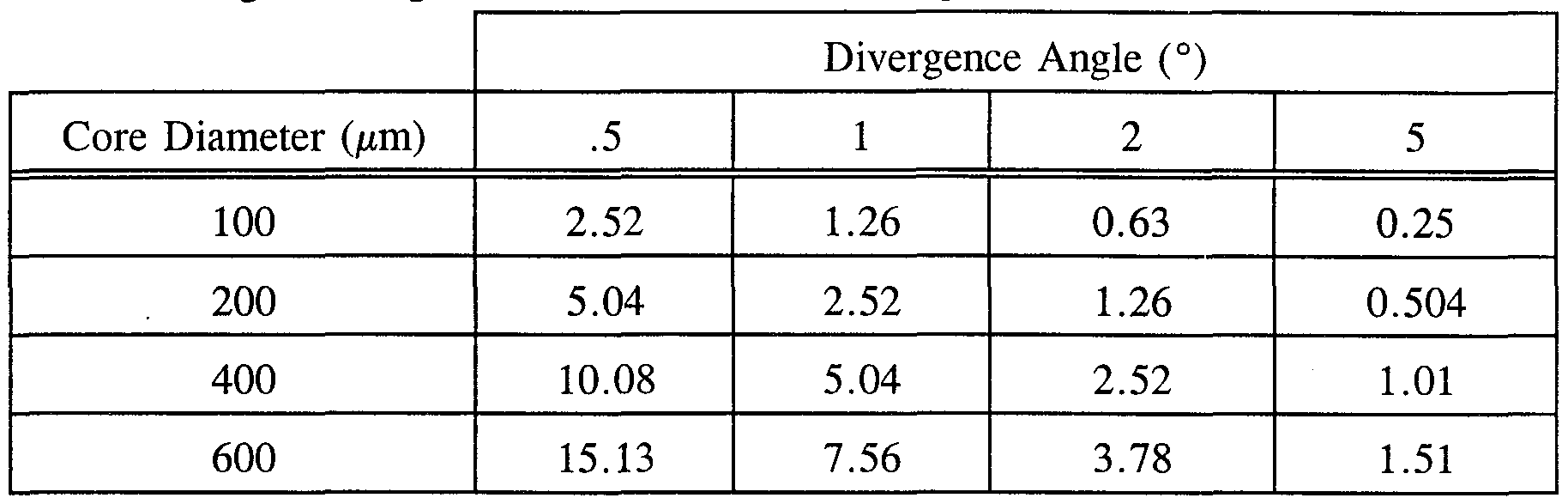
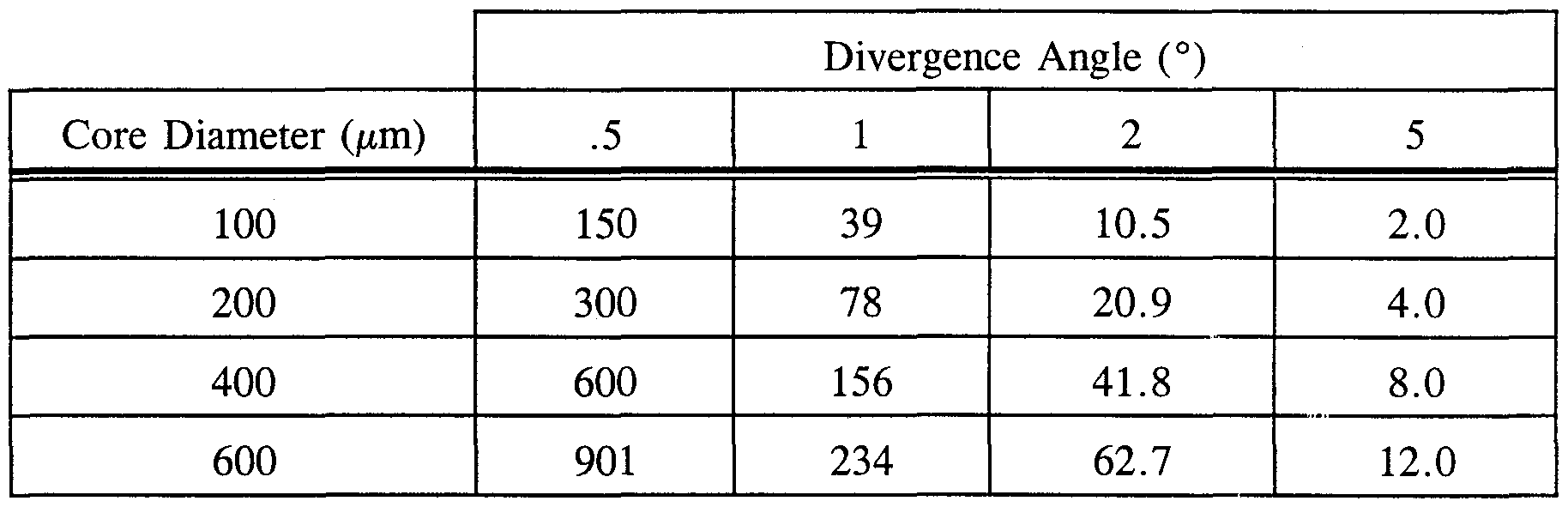
  • the apertures and lengths of NIOs for 100, 200, 400, 600, and 1000 ⁇ m core diameters for divergence angles of 0.5°, 1 °, 2° and 5° calculated from Eqs. (1) and (2) are given in Tables 1(a) and
  • the basic surface contour used in non-imaging optics is that of a parabola (1) .
  • a combination of a lens and a modified (hyperbolic/parabolic) surface contour can be used to reduce the length of the LT.
  • a simple conical surface can be substituted for the hyperbola/parabola contour with minimal loss in collection efficiency.
  • the basic surface contour is that of a compound parabolic concentrator.
  • CPC compound parabolic concentrator
  • LT light transformer
  • Optical fiber 120 is connected to conical optical element 145.
  • Conical optical element 145 composes part of nonimaging optic 140.
  • a CPC is made up of a parabolic section and a straight section rotated around the axis of symmetry of the optical element to form a paraboloid coupled to a straight-sided cone.
  • the parabola's axis is aligned not with the axis of symmetry, but along the design's maximum acceptance angle q
  • a conical optical element is introduced at the fiber end of the LT.
  • the conical optical element can be an integral part of the NIO. In a one-dimensional cross section, this cone performs as a plane mirror that turns incident light at the maximum acceptance angle so that it is incident on the fiber face at 13°. For a 1 ° LT input acceptance angle, the cone half angle is 6°.
  • the length of the straight-sided section can be determined directly from the reflection geometry.
  • I d/(tan(13°) - tan( ⁇ )), (4) where d is the fiber diameter and ⁇ the half angle of the cone formed by the straight section. For a 1 ° acceptance angle and a 400 ⁇ m diameter core fiber with a numerical aperture of 0.22, ⁇ is 6°, I is 3.18 mm, and the LT diameter at this point is 1.06 mm.
  • the determination of the parabolic contour requires a straightforward rotation and translation of the basic parabolic equation.
  • the transformation is simplified if the polar coordinates defined in FIG. 7 are used.
  • a polar coordinate system used to calculate the CPC parabolic curve is depicted.
  • r 2f sin ( ⁇ - 0 max )/(l - cos ⁇ ) - a;
  • z 2f cos ( ⁇ - 0 max )/(l- cos ⁇ ), (6)
  • Eq. (7) is derived from the basic geometrical definition of the parabola: a collection of points equidistant from a fixed point and a line. Referring to FIG. 8, the geometric construction used to derive Eq. (7) is depicted.
  • the general surface contour for an LT/lens combination is a combination of a hyperbola, a parabola, and a spherical lens.
  • Optical fiber 220 is connected to nonimaging optics 240.
  • Refractive optics 250 are connected to nonimaging optics 240.
  • nonimaging optics 240 and refractive optics 250 compose a solid integrated beamformer. At the maximum design divergence angle, the focal points of the lens, the parabola, and the first focus of the hyperbola are coincident.
  • the present invention uses a holographic surface diffuser.
  • This method of light-beam shaping utilizes a holographically recorded diffuser with a random nonperiodic surface microstructure.
  • This recording and processing technology allows a wide range of holographic non-Lambertian diffusers to be produced.
  • These diffusers shape the beam by precisely controlling the light intensity spatial distribution.
  • Various light patterns - circular, elliptical, linear, even square and rectangular with light distribution from 100 ° to 1 ° or less along the horizontal and vertical axes — can be formed.
  • FIGS. 10(a) and 10(b) elliptical non-Lambertian holographic diffuser performance is depicted.
  • FIG. 10(a) is a computer-generated output profile; and
  • FIG. 10(b) is a pattern photo.
  • the surface relief microstructure can be formed holographically on photopolymer.
  • the resulting holographic photopolymer has various shapes, deepness and size.
  • FIGS. 11(a) and 11(b) microphotographs of holographic surface relief of two diffusers according to the present invention are depicted.
  • FIG. 11(a) depicts the surface relief of a circular holographic diffuser.
  • FIG. 11(b) depicts the surface relief of an elliptical holographic diffuser.
  • e Theoretical Modeling of Non-Lambertian Holographic Diffusers
  • One of skill in the art can numerically compute the intensity of the angular spectrum of optical beams scattered by the non-Lambertian diffuser produced by coherent (laser) beam recording.
  • the radiant intensity of the angular spectrum of the scattered beam, J(s), is obtained as a function of the observation unit vector, s, with respect to (S x , S y )-coordinates.
  • the angular spectral distribution is computed as a function of recording geometry and incident beam.
  • the recording aperture For the rectangular aperture of the original diffuser the recording aperture has the form:
  • the recording geometry illustrated in FIG. 12 has coordinates (u,v).
  • the recording monochromatic plane wave 300 has a wavelength of ⁇ R .
  • the rectangular recording aperture 310 of the primary non-Lambertian diffuser 320 was applied at a physical distance, h, from the non-Lambertian diffuser recording plate 330 (x,y).
  • the size of the aperture is represented by (L,W).
  • FIGS. 14(a)- 14(g) One technique for plane surface diffuser replication is illustrated in FIGS. 14(a)- 14(g). Referring to FIGS. 14(a)-(g), a nickel electroforming technique for submicron surface relief replication is well suited to low cost replication.
  • FIG. 14(a)-(g) a nickel electroforming technique for submicron surface relief replication is well suited to low cost replication.
  • FIG. 14a illustrates a holographic master recording step where a master hologram includes a photopolymer layer 500 adjacent a substrate layer 510.
  • a silver coating 530 has been applied to photopolymer 500.
  • FIG. 14c a nickle "silver master” forming step is shown where the silver coated master holograpm has undergone electrolytic deposition of nickel silver master 540.
  • FIG. 14d a nickel "silver master” separation step is shown where nickel silver master 540 is shown just after having been separated from the silver coated master holograpm.
  • FIG. 14e a sub- master fabrication step of forming and separating is shown where a nickel submaster 550 is formed adjacent nickel silver master 540.
  • FIG. 14e a sub- master fabrication step of forming and separating is shown where a nickel submaster 550 is formed adjacent nickel silver master 540.
  • a shim (insert) fabrication step is shown where nickel submaster 550 has been separated and now provides the basis for replication of nickel shim 560.
  • the step of replication is shown where nickel shim 560 provides the basis for replication of plastic layer 570.
  • thermoforming a rod of cast, optical grade plastic (acrylic) is forced into a heated mold using a heated tool contoured to form a lens with the diffuser pattern.
  • a concave mold that includes a submaster of a surface diffuser relief pattern can be used.
  • a mold is used that includes a concave lens tool surface and an NIO tool surface.
  • the mold is filled with optical grade plastic monomer and the monomer is polymerized to form the NIO portion simultaneously with the lens portion, the later of which includes the diffuser relief pattern.
  • the polymerized work piece is then removed from the mold. Initiators are usually added to speed up this process and the mold is typically heated.
  • molten plastic is forced into a mold that includes a lens tool surface and an NIO tool surface. Again, the lens tool surface includes the diffuser relief pattern. After the molten plastic cools, finished work piece is removed from the mold. In all cases, considerable care is required in controlling the temperature and the heating and cooling rates of the molds and the plastic. To maintain dimensional tolerances, the thermal expansion rates of the plastic and the mold must be considered.
  • thermoforming or high pressure cold forming, can be used with a single mold to produce limited production quantities of the hybrid optical elements.
  • a typical thermoforming method would include: providing an optical blank with said distal refractive end; providing a surface diffuser master; contacting said distal refractive end with said diffuser master; and then removing said diffuser master from said distal refractive end.
  • Casting is the normal technique for producing simple shapes, particularly rods and tubes in optical grade acrylic.
  • a typical casting process would include: providing a mold i) defining a void and ii) including a surface diffuser master; filling said mold with a molding material so as to fill said void and contact said surface diffuser master with said molding material; polymerizing said molding material; and removing said solid integrated beamformer from said mold.
  • acrylic, or other plastic monomers requires the use of careful handling techniques to contain the vapor and avoid human exposure, possible fire risks, and environmental release.
  • a typical injection molding process would include: providing a mold i) defining a void and ii) including a surface diffuser master; injecting a molding material into said mold so as to fill said void and contact said surface diffuser master with said molding material; allowing said molding material to cool and removing said solid integrated beamformer from said mold.
  • Another method of manufacturing the solid integrated beamformer is laminating a surface diffuser to the distal refractive end.
  • a typical laminating procedure would include: providing an optical blank with said distal refractive end; providing a surface diffuser layer; and attaching said surface diffuser layer to said distal refractive end.
  • the particular manufacturing process is not essential to the present invention as long as it provides the described transformation. Normally the manufacturers of this product will select the manufacturing process as a matter of design choice based upon tooling and energy requirements, in view of the expected application requirements of the final product and the demands of the overall manufacturing process.
  • the particular material used for the beam transformer should be suitable for the manufacturing process and the expected end-use conditions.
  • the beamformer of the present invention can be made of any transparent thermoplastic material. It is preferred that the material be transparent in the visible spectrum. For the manufacturing operation, it is moreover an advantage to employ an acrylic or polycarbonate material.
  • the particular material selected is not essential to the present invention, so long as it provides the described function. Normally, the manufacturers of this product will select the best commercially available material as a matter of design choice based upon the economics of cost and availability, in view of the expected application requirements of the final product and the demands of the overall manufacturing process.
  • preferred embodiments of the present invention can be identified one at a time by testing for the presence of high definition.
  • the test for the presence of high definition can be carried out without undue experimentation by the use of a simple and conventional light scattering assay experiment.
  • Such scattering measurements can be performed using the automated scattering apparatus illustrated in FIG. 15.
  • a surface diffuser 600 (with, or without, a fiber-NIO/RO combination) is mounted on a stand 610 and illuminated with a collimated beam 620 from HeNe laser 630.
  • the distribution of the light scattered in the forward direction is measured using a silicon photodiode 640 mounted on a rotation arm 650.
  • the entire system is fully automated and the light scattering data is automatically acquired, normalized, and plotted.
  • Data obtained by swinging rotation arm 650 through arc 660 is acquired and analyzed by a data control and data acquisition system 670.
  • the experiment can then be repeated using a fiber/NIO combination with white light illumination and the two scattering plots are compared.
  • the contour of the parabolic section can be calculated.
  • the contour is given in Table 2.
  • remote source lighting include high efficiency, reduced power consumption, reduced life-cycle costs, increased ease of use and reduced maintenance and repair, much higher reliability and, optionally, redundancy.
  • the benefits of remote source lighting are clearly of interest to those who light airports, ammunition storage areas, toxic sites, inaccessible areas, signal and warning lights. These advantages include permanent and water tight installation.
  • the Defense Explosive Safety Board currently requires the use of vapor-tight explosion-proof light fixtures in all explosive environments. Whenever a bulb requires replacement, all flammable materials (stored or work-in-process) must be removed from the room and the fixture cleaned with steam to remove explosive particles before bulb replacement. The use of remote source lighting, with the illumination source outside the room, would cut the capital cost of such fixtures. Further, maintenance costs and down time for illumination source replacement would also be reduced.
  • performance could be enhanced by providing more complicated NIO shapes.
  • acrylic or polycarbonate is preferred for the solid integrated beamformer, any suitable material could be used in its place.
  • the individual components need not be fabricated from the disclosed materials, but could be fabricated from virtually any suitable materials.
  • the individual components need not be formed in the disclosed shapes, or assembled in the disclosed configuration, but could be provided in virtually any shape, and assembled in virtually any configuration, which function so as to provide a distal end for RSL.
  • the solid integrated beamformer described herein is a physically separate module, it will be manifest that the solid integrated beamformer may be integrated into the apparatus with which it is associated.
  • all the disclosed features of each disclosed embodiment can be combined with, or substituted for, the disclosed features of every other disclosed embodiment except where such features are mutually exclusive.

Landscapes

  • Physics & Mathematics (AREA)
  • General Physics & Mathematics (AREA)
  • Optics & Photonics (AREA)
  • Engineering & Computer Science (AREA)
  • Manufacturing & Machinery (AREA)
  • Microelectronics & Electronic Packaging (AREA)
  • Diffracting Gratings Or Hologram Optical Elements (AREA)

Abstract

A solid integrated beamformer includes a solid nonimaging optic (40) having (i) a proximal nonimaging end and (ii) a distal nonimaging end; a solid refractive optic (50) integrally attached to the distal nonimaging end, the solid refractive optic including a distal refractive end; and a holographic surface diffuser (60) integrally formed on the distal refractive end. The solid integrated beamformer providing advantages in the precise light distribution is obtained with a compact and relatively inexpensive unitary optical device.

Description

INTEGRATED BEAMFORMER AND METHODS OF MANUFACTURE THEREOF
BACKGROUND OF THE INVENTION
1. Field of the Invention
The present invention relates in general to the field of lighting. More particularly, the present invention relates to beamformers for remote source lighting. Specifically, a preferred embodiment of the present invention relates to a solid integrated beamformer having a surface diffuser. The present invention thus relates to beamformers of the type that can be termed integrated.
2. Discussion of the Related Developments
Within this application several publications are referenced by arabic numerals within parentheses. Full citations for these, and other, publications may be found at the end of the specification immediately preceding the claims. The disclosures of all these publications in their entireties are hereby expressly incorporated by reference into the present application for the purposes of indicating the background of the present invention and illustrating the state of the art.
In 1880, William Wheeler was granted a patent for a mechanism for "piping" light from a central light source to a number of locations through pipes lined with a reflective coating(1). Not until 1970, however, and after the successful production of the first truly low-loss, glass optical fibers with diameters about the thickness of a human hair, did remote illumination become practical.
Although remote source lighting (RSL) systems have recently received attention from various researchers and manufacturers, their major efforts have been focused on developing only two of the three RSL subsystems namely, the illuminator and the optical fiber. The third subsystem, the distal end device, has remained limited to conventional multi-element refractive lens implementations. Nonimaging optics (NIO) were first developed for the detection of Cerenkov radiation in high energy physics experiments in the mid 1960s(2 4). The basic problem being addressed then was to couple light emitted over a wide area, typically 1 m2, onto a photomultiplier with an area of a few cm2. The principal area of development of nonimaging optics since then has been in the concentration of solar energy for heating and photovoltaic power conversion(5 6). Other applications of nonimaging optics have included infrared communications receivers, fiber optic coupling and luminescent concentrators for integrated devices(7 9). Nonimaging optics have also been extended to include tapered optical fibers for fiber optic sensors(10"13). Recent progress in i) developing efficient light sources and ii) manufacturing optical fiber has permitted the assembly of an RSL system in which one, or more, optical fibers are used to deliver light to one, or more, remotely located points. The distal end of each optical fiber can be used for illumination directly or in conjunction with refractive lenses, to approximate the light distribution required by a given application. Typically, the cleaved open end of a plastic optical fiber produces a light cone with a solid angle of from 50° to 80° , depending on the core and cladding materials of the fiber. A separate refractive lens can be located near such an end. However, using a lens to shape light from the end has caused problems of light loss and overly complicated lens designs. Therefore, the previous RSL systems are limited to end uses where a highly precise illuminance distribution is not required. Heretofore, the above-discovered problems have ruled out such RSL applications as navigation lighting, obstruction lighting, signal lighting and airport approach lighting.
Applications where precise light distribution is required, (i.e. , high- definition (HD) Lighting), must provide high efficiency illumination within precisely specified requirements. These requirements include: intensity distribution across the light pattern; light pattern shape; angular distribution of light in horizontal and vertical directions; and light color. Heretofore, RSL systems have not been able to meet these requirements. Therefore, what is needed is a RSL system having distal ends that provide precise light distribution, (i.e. , high definition).
The below-referenced U.S. patents, and patent application, disclose embodiments that are satisfactory for the purposes for which they were intended. The disclosures of all the below-referenced prior United States patents, and patent application, in their entireties are hereby expressly incorporated by reference into the present application for purposes including, but not limited to, indicating the background of the present invention and illustrating the state of the art. U.S. Pat. No. 4,309,093 discloses a method of replicating a diffusing plate. U.S. Pat. No. 4,336,978 discloses a method for optically making a diffusion plate. U.S. Pat. No. 4,898,450 discloses an expanded beam nonimaging fiber optic connector. U.S. Ser. No. 08/636,798 discloses a universal remote lighting system. U.S. Pat. No. 5,365,354 discloses method of making a grated refractive index type diffuser based on volume holographic material. U.S. Pat. No. 5,534,386 discloses a homogenizer formed using coherent light and a holographic diffuser.
SUMMARY AND OBJECTS OF THE INVENTION By way of summary, the present invention is directed to a solid integrated beamformer that combines nonimaging optics, refractive optics and a surface diffuser for shaping light. The present invention is also directed to methods of manufacturing the integrated beamformer. An effect of the present invention is to reduce the size and weight of the assembly, as well as its complexity, by joining together the diffuser, refractive optics and nonimaging optics in a single unitary device.
The advantages of the present invention include fewer parts combined with a reduction in size and/or weight and a reduction in cost. These advantages will be appreciated in both military and commercial lighting applications. For example, the benefits of a shipboard navigation lighting system according to the present invention include: the elimination of the need for a separate diffuser mounting bracket, a corresponding reduction in the size and mass of the enclosure; and a corresponding reduction in topside weight and moment. In addition an RSL system according to the present invention may require less maintenance and have a longer useful life.
A primary object of the invention is to provide an apparatus that combines nonimaging optics, refractive optics and a surface diffuser into a single unitary component. Another object of the invention is to provide an apparatus that is cost effective. It is another object of the invention is to provide an apparatus that is rugged and reliable, thereby decreasing down time and operating costs. It is yet another object of the invention is to provide an apparatus that has one or more of the characteristics discussed above but which is relatively simple to manufacture and assemble using a minimum of equipment.
In accordance with a first aspect of the invention, these objects are achieved by providing a solid integrated beamformer including: a solid nonimaging optic having i) a proximal nonimaging end and ii) a distal nonimaging end; a solid refractive optic integrally attached to said distal nonimaging end, said solid refractive optic including a distal refractive end; and a surface diffuser integrally formed on said distal refractive end. The invention also includes apparatus that incorporates the solid integrated beamformer. Another object of the invention is to provide methods that can be used to manufacture the integrated beamformer. It is another object of the invention is to provide methods that are predictable and reproducible, thereby decreasing variance and operating costs. It is yet another object of the invention is to provide methods that have one or more of the characteristics discussed above but which are relatively simple to setup and operate using moderately skilled workers.
In accordance with a second aspect of the invention, these objects are achieved by providing a method comprising: providing an optical blank with a nonimaging optic and a refractive optic, said refractive optic having a distal refractive surface; providing a surface diffuser master; contacting said distal refractive surface with said diffuser master; and removing said diffuser master from said distal refractive surface so as to replicate said surface diffuser master. The invention also includes apparatus for carrying out the replication of the surface diffuser on the distal refractive surface, or alternatively, molding, or casting the surface diffuser so as to integrally form the surface diffuser. These, and other, aspects and objects of the present invention will be better appreciated and understood when considered in conjunction with the following description and the accompanying drawings. It should be understood, however, that the following description, while indicating preferred embodiments of the present invention, is given by way of illustration and not of limitation. Many changes and modifications may be made within the scope of the present invention without departing from the spirit thereof, and the invention includes all such modifications. BRIEF DESCRIPTION OF THE DRAWINGS
A clear conception of the advantages and features constituting the present invention, and of the construction and operation of typical mechanisms provided with the present invention, will become more readily apparent by referring to the exemplary, and therefore nonlimiting, embodiments illustrated in the drawings accompanying and forming a part of this specification, wherein like reference numerals designate the same elements in the several views, and in which:
FIG. 1 illustrates a schematic view of a beamformer;
FIG. 2(a) illustrates an isometric view of a solid integrated beamformer according to the present invention;
FIG. 2(b) illustrates a micrographic view of a submicron holographic diffuser surface relief embossed on a spherical surface lens of the solid integrated beamformer depicted in FIG. 2(a);
FIG. 3(a) illustrates light transformer diameter according to the present invention as a function of divergence angle for several common fiber diameters;
FIG. 3(b) illustrates light transformer length according to the present invention as a function of divergence angle for several common fiber diameters;
FIG. 4(a) illustrates relative intensity of light transmitted by optical fiber as a function of divergence angle for two common fiber numerical apertures; FIG. 4(b) illustrates total intensity of light transmitted by optical fiber as a function of divergence angle for two common fiber numerical apertures;
FIG. 5 illustrates a schematic view of the surface contour of a compound parabolic concentrator according to the present invention;
FIG. 6 illustrates a schematic view of the reflection geometry for a compound parabolic concentrator conical section according to the present invention;
FIG. 7 illustrates a schematic polar coordinate system used to calculate a compound parabolic concentrator parabolic curve according to the present invention; FIG. 8 illustrates a geometric construction used to derive Eq. (7) according to the present invention; FIG. 9 illustrates a schematic of a general surface contour for a nonimaging optic/lens combination according to the present invention;
FIG. 10(a) illustrates isometric 3-D display of the performance of an elliptical non-Lambertian holographic surface diffuser according to the present invention;
FIG. 10(b) illustrates a pattern photo from the diffuser used to generate the performance data illustrated in FIG. 10(a);
FIG. 11(a) illustrates a microphotograph of a holographic surface relief from a circular non-Lambertian holographic surface diffuser according to the present invention;
FIG. 11(b) illustrates a microphotograph of a holographic surface relief of an elliptical non-Lambertian holographic surface diffuser according to the present invention;
FIG. 12 illustrates a perspective view of a non-Lambertian holographic surface diffuser recording geometry using a rectangular diffuser aperture according to the present invention;
FIG. 13 illustrates the reading geometry for a beam scattered by non- Lambertian holographic surface diffuser according to the present invention;
FIGS. 14(a)-(g) illustrates a nickel electroforming technique sequence for submicron surface relief replication of a non-Lambertian holographic surface diffuser according to the present invention; and
FIG. 15 illustrates a schematic view of an automatic light scattering apparatus for the characterization of nonimaging optics/holographic surface diffuser combinations according to the present invention.
DESCRIPTION OF PREFERRED EMBODIMENTS
The present invention and the various features and advantageous details thereof are explained more fully with reference to the nonlimiting embodiments described in detail in the following description. Descriptions of well known components and processing techniques are omitted so as to not unnecessarily obscure the present invention in detail. 1. System Overview
The above-mentioned requirements are mutually contradicting and cannot be satisfied simultaneously in the case of the assembly of a separate diffuser with a separate refractive element and separate nonimaging optics. However, it is rendered possible to simultaneously satisfy these requirements to a certain extent by employing a solid integrated beamformer according to the present invention in consideration of the fact that the nonimaging optics, (NIO), refractive optics, (RO) and light shaping diffuser (LSD) are all joined together into a single unitary device. 2. Detailed Description of Preferred Embodiments
To improve beamformer performance, and significantly reduce the cost of production, the present invention includes several alternative processing approaches that will result in the fabrication of a solid integrated beamformer with a holographic microstructure replicated on its surface. Referring to the drawings, it can be seen that the present invention is a surface diffuser formed on refractive optics. It should be noted that the features illustrated in the drawings are not necessarily drawn to scale.
Referring to FIG. 1, a nonintegrated distal end device to provide high- definition remote source lighting (HD RSL) can consist of three separate components. These three discrete optical parts include: a non- imaging light transformer to reduce the divergence angle of the light emerging from an optical fiber; a spherical convex lens to reduce the physical size of the device; and a non- Lambertian holographic diffuser to shape the light into the desired pattern. The beamformer assembly consists of three major elements: the optical connector, enclosure, and some support hardware. Depending on the holographic recording conditions, the diffuser can shape the outgoing light into circular, elliptical, linear, or even square patterns with a wide range of angular distributions (from 1 ° to 100°) along both axes, independently.
Still referring to FIG. 1, light 10 traveling along optical fiber 20 passes through optical connector 30. Nonimaging light transformer 40 is connected to optical fiber 20 within optical connector 30. Light travels into nonimaging light transformer 40 from optical fiber 20 across the interface between these two components. Spherical convex lens 50 is connected to nonimaging light transformer 40. A non-Lambertian holographic diffuser 60 is located downstream of spherical convex lens 50. The non-Lambertian holographic diffuser 60, the spherical convex lens 50 and most of nonimaging light transformer 40 are assembled within enclosure 70.
However, a number of shortcoming are inherent to this nonintegrated, separate component design. First, the losses due to Fresnel reflection may be as high as 16% because of the number of surfaces. Second, producing the light transformer by machining limits the shape of the light transformer device to relatively simple surface shapes, thereby causing higher light loss than is necessary. Third, the overall cost of the resulting beamformer is driven up by the expensive, necessarily labor intensive, assembly of the separate components. What is needed, therefore, is the combination of fiber optic/NIO/lens/diffuser through the full integration of the NIO/lens/diffuser components. The present invention is directed to this approach, thereby permitting the optimization of the efficiency of the optical system together with streamlined design and more cost effective production of the beamformer. These advantages will lead to the popularization of HD RSL systems.
In comparison to the separate component approach, the solid integrated beamformer has up to a 20% improvement in efficiency and vastly reduced manufacturing costs. The approach represented by the present invention is to integrate three previously separate and discrete beamformer components (the light transformer, the lens, and the diffuser) into one solid integrated beamformer (SIB) optical element. In order to achieve this result, several techniques for submicron surface relief replication on a curved surface are discussed below.
Referring to FIG. 2(a), a solid integrated beamformer 80 is depicted. The solid integrated beamformer (SIB) includes a sophisticated combination of parabolic and hyperbolic surfaces for a non-imaging light transformer integrated with a convex lens 90 in a molded body 100. Referring to FIG. 2(b), a submicron holographic diffuser surface relief (shown at magnification xlOOO) is embossed on the spherical surface of the lens. However, the surface of the lens can be aspherical, provided that the shapes of the other surfaces are correspondingly modified.
As a result of the above-described integration, the production of a key element of High Definition Remote Source Lighting (HD RSL) systems (i.e. , the distal end), will be streamlined. The resulting distal end optical device, (i.e. , a solid integrated beamformer with much higher efficiency), will be able to be mass- produced at a very low cost. Such a beamformer will make it possible to implement remote source lighting for high-definition lighting. Remote source lighting has a number of benefits: ease and low cost of handling, maintenance, and repair of conveniently located light sources; reduced electrical power consumption; major reduction in life-cycle costs; high reliability and redundancy; reduced EMI/EMP vulnerability; and heat removal from the lighting point. The present invention provides the unexpected results of both an improvement in performance and a significant reduction in the cost of production of the beamformer. Transmission characteristics for each of the solid integrated beamformer components, as well as integrated components, can be calculated and/or measured one at a time without undue experimentation using apparatus that is disclosed below. Light losses also can be calculated and/or measured, including losses caused by differences in index of refraction between materials, one at a time without undue experimentation.
Starting from a theoretical approach, simplifications of the light transformer's surface contour and limitations can be performed, leading to an engineering solution based on low-cost and performance. Various combinations of techniques, (e.g., casting, thermoforming, injection molding, embossing) can be used to fabricate the solid integrated beamformer. Beamformer shape and surface accuracy requirements, as well as material limitations, can be optimized without undue experimentation. a. Non-Imaging Light Transformer The operating principle of a light transformer (LT) is based on optical "etendu" — the product of the area and the square of the sine of the divergence angle is a constant (known as the Liouville invariant) in a closed non-absorbing optical system(1'2) represented by the following equation: A sin2 0, = a sin2 02, (1) where A and a are the areas of the optical beam, and θ and 02 are the divergence angles of the beam at any two points along its propagation path. In practical applications, one must also consider the length of the LT required to achieve a particular change in divergence angle. Generally, it is advantageous to minimize the length because of packaging concerns such as size and weight. The length of an LT that preserves the Liouville invariant is given by the geometric relation:
L = 0.5(D + d) cot(0) (2) where D and d are the LT diameters at both ends and 0 is the acceptance angle of the of the light transformer at its large diameter end. The required diameter and length as a function of divergence angle for several common fiber optic diameters are shown in FIGS. 3(a) and 3(b), where the fiber numerical aperture (NA) is 0.22.
Another important consideration is the angular distribution of the light transmitted by an optical fiber. This distribution is not uniform, but follows a
Gaussian distribution, with most of the light intensity falling near the optical axis. This distribution is illustrated in FIGS. 4(a) and 4(b) for numerical apertures (NAs) of 0.22 (13 °) and 0.035 (2°). The NA is defined as the angle which contains 95 % of the light intensity. An NA of 0.22 is typical of a multimode fused silica fiber. This NA of 0.22 is assumed in much of the discussion that follows, but the same arguments may be extended to borosilicate and plastic fibers that have NAs near 0.5, (corresponding to a half angle of 30°). From FIGS. 4(a) and 4(b) it will be appreciated that, even for an NA of 0.035 (2°), over 60 % of the light is concentrated within the first 0.5 ° . b. General Sizing Considerations
In order to develop a practical design for an LT/fiber optic coupling system, it is necessary to consider the size of the LT exit aperture, the length of the LT, and the spot size projected on the illuminated area. The spot size, S, is given by S = 2 (1) tan02 + D, (3) where 1 is the distance to the illumination area. The apertures and lengths of NIOs for 100, 200, 400, 600, and 1000 μm core diameters for divergence angles of 0.5°, 1 °, 2° and 5° calculated from Eqs. (1) and (2) are given in Tables 1(a) and
1(b). It is important to note that the length of the LT increases dramatically for narrower divergence angles. The aperture diameter and the length scale linearly with the fiber core diameter.
Table 1(a) Light Transformer Aperture Diameters (mm) for Selected Divergence Angles and Core Sizes, Assuming a Fiber NA of 0.22
Figure imgf000013_0001
Table 1(b) Light Transformer Lengths (mm) for Selected Divergence Angles and Core Sizes, Assuming a Fiber NA of 0.22
Figure imgf000013_0002
The basic surface contour used in non-imaging optics is that of a parabola(1). However, in cases where narrow divergence angles indicate the need for very long light transformers, a combination of a lens and a modified (hyperbolic/parabolic) surface contour can be used to reduce the length of the LT. For certain geometries, a simple conical surface can be substituted for the hyperbola/parabola contour with minimal loss in collection efficiency.
For a hollow LT, the basic surface contour is that of a compound parabolic concentrator. Referring to FIG. 5, a surface contour of a compound parabolic concentrator (CPC) light transformer (LT) is depicted. Optical fiber 120 is connected to conical optical element 145. Conical optical element 145 composes part of nonimaging optic 140. In two dimensions, a CPC is made up of a parabolic section and a straight section rotated around the axis of symmetry of the optical element to form a paraboloid coupled to a straight-sided cone. The parabola's axis is aligned not with the axis of symmetry, but along the design's maximum acceptance angle q
For a fiber having a numerical aperture of 0.22, light striking the fiber surface at an angle of more than 13° will not be coupled into the guiding modes of the fiber. For this reason, a conical optical element is introduced at the fiber end of the LT. The conical optical element can be an integral part of the NIO. In a one-dimensional cross section, this cone performs as a plane mirror that turns incident light at the maximum acceptance angle so that it is incident on the fiber face at 13°. For a 1 ° LT input acceptance angle, the cone half angle is 6°. The length of the straight-sided section can be determined directly from the reflection geometry.
Referring to FIG. 6, a reflection geometry of a CPC conical optical element section is depicted. The length of the straight section, I, is given by:
I = d/(tan(13°) - tan(ø)), (4) where d is the fiber diameter and ø the half angle of the cone formed by the straight section. For a 1 ° acceptance angle and a 400 μm diameter core fiber with a numerical aperture of 0.22, ø is 6°, I is 3.18 mm, and the LT diameter at this point is 1.06 mm.
The determination of the parabolic contour requires a straightforward rotation and translation of the basic parabolic equation. The transformation is simplified if the polar coordinates defined in FIG. 7 are used.
Referring to FIG. 7, a polar coordinate system used to calculate the CPC parabolic curve is depicted. With this coordinate system: r = 2f sin (ø - 0max)/(l - cos ø) - a; (5) z = 2f cos (ø - 0max)/(l- cos ø), (6) where f, the focal length of the parabola, is given by: f = a (1 + sin 0max). (7) Eq. (7) is derived from the basic geometrical definition of the parabola: a collection of points equidistant from a fixed point and a line. Referring to FIG. 8, the geometric construction used to derive Eq. (7) is depicted.
Eqs. (5) and (6) follow directly from the geometries and coordinates defined in FIGS. 7 and 8. However, these equations assume a numerical aperture of unity for the parabolic LT. In the case of the reduced fiber optic numerical aperture (e.g. , 0.22), the results need to be scaled down by a factor proportional to the numerical aperture. This scale factor can be achieved by redefining Eq. (7) as: f = a (1 + sin 0max) (NA). (8)
Using Eqs. (4), (5) and (8), the contour of the parabolic section can be calculated. c. LT-Lens Combinations for Reduced Length at Narrow Fields-of-View
As discussed above, designing a simple compound parabolic concentrator for a large core fiber and a narrow field-of-view results in an LT that is rather long for practical use. For a 400 μm core fiber and a 1 ° (half angle) field-of-view, the required length is approximately 6 in. An alternative approach is to use a hybrid LT- lens combination, which considerably reduces the length requirement. The more sophisticated design shown in FIG. 9 includes a convex plane lens integrated with the light transformer. For certain LT/lens combinations, the LT surface contour is very close to that of a simple cone. And such devices can be readily fabricated to produce a solid LT/lens combination fused directly to the end of the fiber.
The general surface contour for an LT/lens combination is a combination of a hyperbola, a parabola, and a spherical lens. Referring to FIG. 9, a general surface contour for an NIO/lens combination is depicted. Optical fiber 220 is connected to nonimaging optics 240. Refractive optics 250 are connected to nonimaging optics 240. Together with a non-Lambertian holographic surface diffuser (not shown) nonimaging optics 240 and refractive optics 250 compose a solid integrated beamformer. At the maximum design divergence angle, the focal points of the lens, the parabola, and the first focus of the hyperbola are coincident. Light striking the hyperbolic section of the LT is brought to a focus at the second focal point of the hyperbola. Algorithms can be developed without undue experimentation utilizing a typical MATHCAD software package to optimize the combined LT/lens design. d. Holographic Diffusers
In a preferred embodiment, the present invention uses a holographic surface diffuser. This method of light-beam shaping utilizes a holographically recorded diffuser with a random nonperiodic surface microstructure. This recording and processing technology allows a wide range of holographic non-Lambertian diffusers to be produced. These diffusers shape the beam by precisely controlling the light intensity spatial distribution. Various light patterns - circular, elliptical, linear, even square and rectangular with light distribution from 100° to 1 ° or less along the horizontal and vertical axes — can be formed.
Referring to FIGS. 10(a) and 10(b), elliptical non-Lambertian holographic diffuser performance is depicted. FIG. 10(a) is a computer-generated output profile; and FIG. 10(b) is a pattern photo. Depending on the recording geometry, material parameters, exposure, processing conditions and time, the surface relief microstructure can be formed holographically on photopolymer. The resulting holographic photopolymer has various shapes, deepness and size.
Referring to FIGS. 11(a) and 11(b), microphotographs of holographic surface relief of two diffusers according to the present invention are depicted. FIG. 11(a) depicts the surface relief of a circular holographic diffuser. FIG. 11(b) depicts the surface relief of an elliptical holographic diffuser. e . Theoretical Modeling of Non-Lambertian Holographic Diffusers A discussion of the theoretical modeling of non-Lambertian diffusers follows. One of skill in the art can numerically compute the intensity of the angular spectrum of optical beams scattered by the non-Lambertian diffuser produced by coherent (laser) beam recording. The radiant intensity of the angular spectrum of the scattered beam, J(s), is obtained as a function of the observation unit vector, s, with respect to (Sx, Sy)-coordinates. The angular spectral distribution is computed as a function of recording geometry and incident beam. For the rectangular aperture of the original diffuser the recording aperture has the form:
P(u,v)=rect(-)rectA (9)
where the rectangle rectus function is
rect(x)=l, for .\x .\ <—I ; 0, /or| |>— 1 . (10)
f . Recording Geometry The recording geometry illustrated in FIG. 12 has coordinates (u,v). The recording monochromatic plane wave 300 has a wavelength of λR. The rectangular recording aperture 310 of the primary non-Lambertian diffuser 320 was applied at a physical distance, h, from the non-Lambertian diffuser recording plate 330 (x,y). The size of the aperture is represented by (L,W). Monochromatic Plane Wave Response
For the monochromatic normally incident plane wave, with a recording wavelength of λ, the monochromatic plane wave response is
Figure imgf000017_0001
where 0 is the angle between the s-unit vector and the z-axis (see FIG. 13), D is a proportionality constant, and Λ(...) is the triangular function defined by the coordinate (-s'xo, 0), (+s'x0, 0), and (0,1). Referring to FIG. 13, incident radiating beam 400 interacts with non-Lambertian diffuser 410. The cutoff- values of the directional cosines are
Figure imgf000018_0001
s' =srnθ' = = — s = — ; h'=h— (12b) yo yo h λR λR yo h ' λ
General System Response Using linear system theory, we can formulate the general system response in the form of the system impulse response:
J(s) = M J h(s - s0,λ) I0 (s0,λ)d2 s0 dλ (13) where I0 is the 3-D angular/spectral distribution of the incident beam intensity in the form:
I0 (s0, λ) = I0(S0X, Soy;λ) (14)
This distribution is assumed to be Gaussian, for simplicity. Here, d2 s„ = dsoxdsoy, and the system impulse response, h, is
hs λdudv (15)
Figure imgf000018_0002
where the recording aperture function P(u,v) is typically assumed to be rectangular, as in Eq.(9), or Gaussian. It is seen then that, in general, the integration is in the following 5-D space is
(u,v; Sox, Soy; λ) (16) f . Surface Relief Replication There are at least three major methods for forming a surface diffuser according to the present invention: casting, embossing, and injection molding. All methods use a "sub-master" ~ a nickel electroform or hard epoxy replica from a holographically recorded surface relief on photopolymer. One technique for plane surface diffuser replication is illustrated in FIGS. 14(a)- 14(g). Referring to FIGS. 14(a)-(g), a nickel electroforming technique for submicron surface relief replication is well suited to low cost replication. FIG. 14a illustrates a holographic master recording step where a master hologram includes a photopolymer layer 500 adjacent a substrate layer 510. In FIG. 14b a silver coating 530 has been applied to photopolymer 500. In FIG. 14c, a nickle "silver master" forming step is shown where the silver coated master holograpm has undergone electrolytic deposition of nickel silver master 540. In FIG. 14d, a nickel "silver master" separation step is shown where nickel silver master 540 is shown just after having been separated from the silver coated master holograpm. In FIG. 14e, a sub- master fabrication step of forming and separating is shown where a nickel submaster 550 is formed adjacent nickel silver master 540. In FIG. 14f, a shim (insert) fabrication step is shown where nickel submaster 550 has been separated and now provides the basis for replication of nickel shim 560. In FIG. 14g, the step of replication is shown where nickel shim 560 provides the basis for replication of plastic layer 570.
While the replication steps shown in FIGS. 14(a)- 14(g) are directed to the fabrication of planar replication tools, spherical and aspherical tools can be similarly developed. Assuming a typical surface feature pitch of 0.3 microns, typical height aspect ratio would yield an average surface feature height of approximately 4 microns. Further, as long as the ratio of radius of curvature to pitch exceeds approximately 1000, planar embossing tools can be gently bent to form curved surfaces, thereby replicating curved shapes from initially planar tools. 3. Methods of Manufacture The fabrication of the proposed solid integrated beamformer demands that both the optical quality and the dimensions be carefully controlled. In production, there are three basic manufacturing techniques that can be used. These are thermoforming, casting, and injection molding.
In thermoforming, a rod of cast, optical grade plastic (acrylic) is forced into a heated mold using a heated tool contoured to form a lens with the diffuser pattern. To form a spherical lens, a concave mold that includes a submaster of a surface diffuser relief pattern can be used. In casting, a mold is used that includes a concave lens tool surface and an NIO tool surface. The mold is filled with optical grade plastic monomer and the monomer is polymerized to form the NIO portion simultaneously with the lens portion, the later of which includes the diffuser relief pattern. The polymerized work piece is then removed from the mold. Initiators are usually added to speed up this process and the mold is typically heated. In injection molding, molten plastic is forced into a mold that includes a lens tool surface and an NIO tool surface. Again, the lens tool surface includes the diffuser relief pattern. After the molten plastic cools, finished work piece is removed from the mold. In all cases, considerable care is required in controlling the temperature and the heating and cooling rates of the molds and the plastic. To maintain dimensional tolerances, the thermal expansion rates of the plastic and the mold must be considered.
Thermoforming, or high pressure cold forming, can be used with a single mold to produce limited production quantities of the hybrid optical elements. A typical thermoforming method would include: providing an optical blank with said distal refractive end; providing a surface diffuser master; contacting said distal refractive end with said diffuser master; and then removing said diffuser master from said distal refractive end.
Casting is the normal technique for producing simple shapes, particularly rods and tubes in optical grade acrylic. However, the dimensional changes during the polymerization process must be carefully considered. A typical casting process would include: providing a mold i) defining a void and ii) including a surface diffuser master; filling said mold with a molding material so as to fill said void and contact said surface diffuser master with said molding material; polymerizing said molding material; and removing said solid integrated beamformer from said mold. The use of acrylic, or other plastic monomers, requires the use of careful handling techniques to contain the vapor and avoid human exposure, possible fire risks, and environmental release.
Injection molding equipment and tooling are expensive and the production volume and allowable payback time must be high to justify the investment. A typical injection molding process would include: providing a mold i) defining a void and ii) including a surface diffuser master; injecting a molding material into said mold so as to fill said void and contact said surface diffuser master with said molding material; allowing said molding material to cool and removing said solid integrated beamformer from said mold.
Higher production rates can be achieved using injection molding techniques. Although the diffuser is more tolerant of optical inhomogeneities than conventional optical elements, careful process control is required to maintain optical quality. Another method of manufacturing the solid integrated beamformer is laminating a surface diffuser to the distal refractive end. A typical laminating procedure would include: providing an optical blank with said distal refractive end; providing a surface diffuser layer; and attaching said surface diffuser layer to said distal refractive end.
However, the particular manufacturing process is not essential to the present invention as long as it provides the described transformation. Normally the manufacturers of this product will select the manufacturing process as a matter of design choice based upon tooling and energy requirements, in view of the expected application requirements of the final product and the demands of the overall manufacturing process.
The particular material used for the beam transformer should be suitable for the manufacturing process and the expected end-use conditions. Conveniently, the beamformer of the present invention can be made of any transparent thermoplastic material. It is preferred that the material be transparent in the visible spectrum. For the manufacturing operation, it is moreover an advantage to employ an acrylic or polycarbonate material.
However, the particular material selected is not essential to the present invention, so long as it provides the described function. Normally, the manufacturers of this product will select the best commercially available material as a matter of design choice based upon the economics of cost and availability, in view of the expected application requirements of the final product and the demands of the overall manufacturing process.
While not being limited to any particular evaluation technique, preferred embodiments of the present invention can be identified one at a time by testing for the presence of high definition. The test for the presence of high definition can be carried out without undue experimentation by the use of a simple and conventional light scattering assay experiment. Such scattering measurements can be performed using the automated scattering apparatus illustrated in FIG. 15. Referring to FIG. 15, a surface diffuser 600 (with, or without, a fiber-NIO/RO combination) is mounted on a stand 610 and illuminated with a collimated beam 620 from HeNe laser 630. The distribution of the light scattered in the forward direction is measured using a silicon photodiode 640 mounted on a rotation arm 650. The entire system is fully automated and the light scattering data is automatically acquired, normalized, and plotted. Data obtained by swinging rotation arm 650 through arc 660 is acquired and analyzed by a data control and data acquisition system 670. The experiment can then be repeated using a fiber/NIO combination with white light illumination and the two scattering plots are compared.
EXAMPLE
A specific embodiment of the present invention will now be further described by the following, nonlimiting example which will serve to illustrate various features of significance. The example is intended merely to facilitate an understanding of ways in which the present invention may be practiced and to further enable those of skill in the art to practice the present invention. Accordingly, the example should not be construed as limiting the scope of the present invention.
Using Eqs. (4), (5) and (8), the contour of the parabolic section can be calculated. For the case of a 1 ° divergence angle and a 400μm core fiber, the contour is given in Table 2.
Table 2 Nonimaging optics contour calculated from Eqs. (4), (5), and (8); optical fiber diameter is 0.4 mm, NA is 0.22, NIO divergence angle is 1 °
Figure imgf000023_0001
The benefits of remote source lighting include high efficiency, reduced power consumption, reduced life-cycle costs, increased ease of use and reduced maintenance and repair, much higher reliability and, optionally, redundancy. The benefits of remote source lighting are clearly of interest to those who light airports, ammunition storage areas, toxic sites, inaccessible areas, signal and warning lights. These advantages include permanent and water tight installation.
Applications where safety or convenience of maintenance are of particular importance are especially good candidates for the use of remote lighting. With the availability of low cost, mass-producible solid integrated beamformers, remote source lighting products will be more affordable and thus able to reach an even wider market.
Practical applications of the present invention which have value within the technological arts are airport lighting, obstruction lighting, task lighting, and marine lighting. Further, all the disclosed embodiments of the present invention are useful in conjunction with specialty light applications such as ship, aircraft, and boat-mast lighting, or for the purpose of environmental control light applications such as cold light in medical operating rooms, high bay lighting, mine area lighting, refinery distillation area lighting, and underwater lighting, or the like. Similarly, safety- related lighting applications are candidates for the use of remote lighting.
As a specific practical application, the Defense Explosive Safety Board currently requires the use of vapor-tight explosion-proof light fixtures in all explosive environments. Whenever a bulb requires replacement, all flammable materials (stored or work-in-process) must be removed from the room and the fixture cleaned with steam to remove explosive particles before bulb replacement. The use of remote source lighting, with the illumination source outside the room, would cut the capital cost of such fixtures. Further, maintenance costs and down time for illumination source replacement would also be reduced.
The same rationale applies to paint booths, which have safety imposed restrictions requiring vapor-tight light fixtures. Again, placing the illumination source outside the booth would eliminate the need to use the expensive fixtures.
In traffic and road signage, replacing bulbs is a major expense because the lighting is usually high overhead and in remote locations, driving maintenance labor costs very high. With remote lighting, the illumination source can be conveniently placed at ground level, eliminating the need for cherry-pickers and other expensive support equipment.
The applications described above have a high probability for adopting remote lighting because of facility safety considerations. For example, the high costs of currently used explosion proof and hazardous area fixtures make remote lighting very attractive for these applications. There are virtually innumerable uses for the present invention described herein, all of which need not be detailed here.
The present invention described herein provides substantially improved results that are unexpected. The present invention described herein can be practiced without undue experimentation. The entirety of everything cited above or below is hereby expressly incorporated by reference.
Although the best mode contemplated by the inventors of carrying out the present invention is disclosed above, practice of the present invention is not limited thereto. It will be manifest that various additions, modifications and rearrangements of the features of the present invention may be made without deviating from the spirit and scope of the underlying inventive concept.
For example, performance could be enhanced by providing more complicated NIO shapes. Similarly, although acrylic or polycarbonate is preferred for the solid integrated beamformer, any suitable material could be used in its place. In addition, the individual components need not be fabricated from the disclosed materials, but could be fabricated from virtually any suitable materials.
Moreover, the individual components need not be formed in the disclosed shapes, or assembled in the disclosed configuration, but could be provided in virtually any shape, and assembled in virtually any configuration, which function so as to provide a distal end for RSL. Further, although the solid integrated beamformer described herein is a physically separate module, it will be manifest that the solid integrated beamformer may be integrated into the apparatus with which it is associated. Furthermore, all the disclosed features of each disclosed embodiment can be combined with, or substituted for, the disclosed features of every other disclosed embodiment except where such features are mutually exclusive.
It is intended that the appended claims cover all such additions, modifications and rearrangements. Expedient embodiments of the present invention are differentiated by the appended subclaims.
REFERENCES
1. W. Wheeler, U.S. Pat. No. 247,229, 1880.
2. W.T. Welford & R. Winston, "High Collection Nonimaging Optics", Academic Press, Inc. , San Diego, CA, 1989.
3. H. Hittenberger, R. Winston, Proc. Int. Conf. Instrum. High Energy Phys. , "Gas Cerenkov counter with optimized light collection efficiency. "
4. H. Hittenberger, R. Winston, Rev. Sci. Instrum. 37 1094-1095 (1966), "Efficient light coupler for threshold Cerenkov counters. "
5. D. Cooke, Applied Optics 31(6) 7541-7546 (1992), "Sun pumped lasers: revisiting an old problem with nonimaging optics. "
6. N. Fraidenraich, Applied Optics 34(22) 4800-4811 (1995), "Analytic solutions for the optical and radiative properties of nonaccepted light radiation of V trough concentrators. "
7. K-P Ho & J.M. Kahn, Optical Engineering 34(5) 1385-1395 (1995), "Compound parabolic concentrators for narrowband wireless IR receivers. "
8. B. Moslehi, J. Ng, I. Kasimoff, & T. Jannson, Optics Letts. 14(23) 1327-1329 (1989), "Fiberoptic coupling based on nonimaging expanded beam optics. "
9. S.A. Evanson & A.H. Rawicz, Applied Optics 34(31) 7302-7306 (1995), "Thin film luminescent concentrators for integrated devices: a cookbook. "
10. D.J. Ferrell, J.M. Lerner, R.A. Lieberman, T. Quintana, E.M. Schmidlin, & S.J. Syracuse, Optical Engineering 32(3) 504-507 (1993), "Instrumentation systems for passive fiber optic chemical sensors. "
11. A. Cutolo, L. Carlomusto, F. Reale, & I. Rendina, Applied Optics 29(9) 1353-1364 (1990), "Tapered and inhomogeneous dielectric light concentrators. "
12. G.J. Pendock, H.S. MacKenzie, & F.P. Payne, Applied Optics 32(27) 5236-5242 (1993), "Dye lasers using tapered optical fibers. " 13. B.D. Gupta & CD. Singh, Applied Optics 33(13) 2737-2742 (1994), "Evanescent absorption coefficient for diffuse source illumination: uniform and tapered fiber sensors. "
14. I. Agurok, L. Sadovnik, A. Rizkin. Light Transformer Design Optimization, OS A Conference, Portland, OR, 1995.
15. Van Nostrand's Scientific Encyclopedia, 8th ed. , Van Nostrand Reinhold, (Douglas M. Considine et al. eds. , 1995).
16. Handbook of Optics, 2nd ed. , Vols. I-II, McGraw Hill, (Michael Bass et al. eds. , 1995).
17. Bahaa E.A. Saleh & Malvin C. Teich, Fundamentals of Photonics, John Wiley & Sons, (1991).

Claims

CLAIMS What is claimed is:
1. A solid integrated beamformer comprising: a solid nonimaging optic having i) a proximal nonimaging end and ii) a distal nonimaging end; a solid refractive optic integrally attached to said distal nonimaging end, said solid refractive optic including a distal refractive end; and a non-Lambertian holographic surface diffuser integrally formed on said distal refractive end.
2. A method of making the solid integrated beamformer of claim 1, comprising providing a mold i) defining a void and ii) including a surface diffuser master; filling said mold with a molding material so as to fill said void and contact said surface diffuser master with said molding material; polymerizing said molding material; and removing said solid integrated beamformer from said mold, wherein the steps of filling and removing compose casting said non- Lambertian holographic surface diffuser.
3. A method of making the solid integrated beamformer of claim 1 , comprising providing an optical blank with said distal refractive end; providing a surface diffuser master; contacting said distal refractive end with said diffuser master; and then removing said diffuser master from said distal refractive end, wherein the steps of contacting and removing compose replicating said non- Lambertian holographic surface diffuser.
4. A method of making the solid integrated beamformer of claim 1, comprising providing an optical blank with said distal refractive end; providing a surface diffuser layer; and attaching said surface diffuser layer to said distal refractive end, wherein the steps of providing and attaching compose laminating said non- Lambertian holographic surface diffuser.
5. A system, comprising at least two of the solid integrated beamformer of claim 1.
6. A method, comprising utilizing the solid integrated beamformer of claim 1.
7. An apparatus, comprising: a solid integrated beamformer, said solid integrated beamformer including: nonimaging optics; refractive optics integrally attached to said nonimaging optics; and a non-Lambertian holographic surface diffuser integrally attached to said refractive optics.
8. The apparatus of claim 7 wherein said nonimaging optics include a compound parabolic concentrator, said refractive optics include a distal refractive end and said non-Lambertian holographic surface diffuser is formed on said distal refractive end.
9. The apparatus of claim 8 wherein said nonimaging optics include a conical optical element.
10. The apparatus of claim 7 wherein said nonimaging optics include a conical optical element.
11. A method of making the apparatus of claim 7, comprising providing a mold i) defining a void and ii) including a surface diffuser master; filling said mold with a molding material so as to fill said void and contact said surface diffuser master with said molding material; and removing said solid integrated beamformer from said mold, wherein the steps of filling and removing compose casting said non- Lambertian holographic surface diffuser.
12. A method of making the apparatus of claim 7, comprising providing an optical blank with said refractive optics; providing a surface diffuser master; contacting said refractive optics with said diffuser master; and then removing said diffuser master from said refractive optics, wherein the steps of contacting and removing compose replicating said non- Lambertian holographic surface diffuser.
13. A method of making the apparatus of claim 7, comprising providing an optical blank with said refractive optics; providing a surface diffuser layer; and attaching said diffuser to said refractive optics, wherein the steps of providing and attaching compose laminating said non- Lambertian holographic surface diffuser.
14. A system, comprising at least two of the apparatus of claim 7.
15. A method, comprising utilizing the apparatus of claim 7.
16. A method, comprising: providing a mold i) defining a void and ii) including a surface diffuser master; filling said mold with a molding material so as to fill said void and contact said surface diffuser master with said molding material; and then removing a solid integrated beamformer from said mold.
17. An apparatus for performing the method of claim 16.
18. A product made by the method of claim 16.
19. A method, comprising: providing an optical blank with a nonimaging optic and a refractive optic, said refractive optic having a distal refractive end; providing a surface diffuser master; contacting said distal refractive end with said diffuser master; and then removing said diffuser master from said distal refractive surface so as to replicate said surface diffuser master on said distal refractive end.
20. An apparatus for performing the method of claim 19.
21. A product made by the method of claim 19.
22. A method comprising: providing an optical blank with a nonimaging optic and a refractive optic, said refractive optic including a distal refractive end; providing a surface diffuser layer; and then attaching said surface diffuser layer to said distal refractive end, wherein the steps of providing and attaching compose laminating said surface diffuser layer to said distal refractive end.
23. An apparatus for performing the method of claim 22.
24. A product made by the method of claim 22.
PCT/US1997/019500 1996-10-21 1997-10-20 Integrated beamformer and methods of manufacture thereof Ceased WO1998017943A1 (en)

Priority Applications (2)

Application Number Priority Date Filing Date Title
JP10519713A JP2001503158A (en) 1996-10-21 1997-10-20 Integrated beam former and manufacturing method thereof
EP97911943A EP0934488A4 (en) 1996-10-21 1997-10-20 Integrated beamformer and methods of manufacture thereof

Applications Claiming Priority (2)

Application Number Priority Date Filing Date Title
US73394096A 1996-10-21 1996-10-21
US08/733,940 1996-10-21

Publications (1)

Publication Number Publication Date
WO1998017943A1 true WO1998017943A1 (en) 1998-04-30

Family

ID=24949707

Family Applications (1)

Application Number Title Priority Date Filing Date
PCT/US1997/019500 Ceased WO1998017943A1 (en) 1996-10-21 1997-10-20 Integrated beamformer and methods of manufacture thereof

Country Status (3)

Country Link
EP (1) EP0934488A4 (en)
JP (1) JP2001503158A (en)
WO (1) WO1998017943A1 (en)

Cited By (6)

* Cited by examiner, † Cited by third party
Publication number Priority date Publication date Assignee Title
JP2002523863A (en) * 1998-08-25 2002-07-30 フィジィカル オプティクス コーポレーション Apparatus with light source and sol-gel monolithic diffuser
FR2836237A1 (en) * 2002-02-21 2003-08-22 Framatome Connectors Int Optical interconnection module, especially for optical fibers, has optical section overmolded in housing to form optical wave guide
WO2008034418A3 (en) * 2006-09-19 2008-05-29 Sunvention Internat Gmbh Solar multistage concentrator, and greenhouse
EP1774371A4 (en) * 2004-07-27 2011-05-11 Dolby Lab Licensing Corp DIFFUSER PRESERVING LUMINANCE AND REDUCING PARALLAX
WO2019183718A1 (en) 2018-03-24 2019-10-03 Suntracker Technologies Ltd. Diffused fiber-optic horticultural lighting
CN114200731A (en) * 2021-12-08 2022-03-18 哈尔滨工程大学 A device and method for regulating the polarization and direction of Cherenkov radiation

Families Citing this family (2)

* Cited by examiner, † Cited by third party
Publication number Priority date Publication date Assignee Title
US7345824B2 (en) * 2002-03-26 2008-03-18 Trivium Technologies, Inc. Light collimating device
JP5739443B2 (en) * 2009-11-11 2015-06-24 アルコン リサーチ, リミテッド Structured illumination probe and method

Citations (7)

* Cited by examiner, † Cited by third party
Publication number Priority date Publication date Assignee Title
US247229A (en) 1880-12-10 1881-09-20 Apparatus for lighting dwellings or other structures
US4309093A (en) 1977-12-28 1982-01-05 Canon Kabushiki Kaisha Camera having a diffusing plate with rotationally asymmetric light diffusion property
US4336978A (en) 1978-12-26 1982-06-29 Canon Kabushiki Kaisha Method for optically making a diffusion plate
US4898450A (en) 1987-08-31 1990-02-06 Physical Optics Corporation Expanded beam non-imaging fiber optic connector
US5365354A (en) 1990-10-02 1994-11-15 Physical Optics Corporation Grin type diffuser based on volume holographic material
US5534386A (en) 1993-07-27 1996-07-09 Physical Optics Corporation Homogenizer formed using coherent light and a holographic diffuser
US5629996A (en) 1995-11-29 1997-05-13 Physical Optics Corporation Universal remote lighting system with nonimaging total internal reflection beam transformer

Family Cites Families (2)

* Cited by examiner, † Cited by third party
Publication number Priority date Publication date Assignee Title
DE2240780A1 (en) * 1972-08-18 1974-02-28 Standard Elektrik Lorenz Ag LIGHT EMISSION CELL FOR OPTICAL FIBER LIGHT GUIDE
FR2704656B1 (en) * 1993-04-29 1995-06-30 Silec Liaisons Elec Light scattering device associated with a light source comprising a series of point elements.

Patent Citations (7)

* Cited by examiner, † Cited by third party
Publication number Priority date Publication date Assignee Title
US247229A (en) 1880-12-10 1881-09-20 Apparatus for lighting dwellings or other structures
US4309093A (en) 1977-12-28 1982-01-05 Canon Kabushiki Kaisha Camera having a diffusing plate with rotationally asymmetric light diffusion property
US4336978A (en) 1978-12-26 1982-06-29 Canon Kabushiki Kaisha Method for optically making a diffusion plate
US4898450A (en) 1987-08-31 1990-02-06 Physical Optics Corporation Expanded beam non-imaging fiber optic connector
US5365354A (en) 1990-10-02 1994-11-15 Physical Optics Corporation Grin type diffuser based on volume holographic material
US5534386A (en) 1993-07-27 1996-07-09 Physical Optics Corporation Homogenizer formed using coherent light and a holographic diffuser
US5629996A (en) 1995-11-29 1997-05-13 Physical Optics Corporation Universal remote lighting system with nonimaging total internal reflection beam transformer

Non-Patent Citations (17)

* Cited by examiner, † Cited by third party
Title
A. CUTOLO, L. CAROLMUSTO, F. REALE, I. RENDINA: "applied optics", vol. 29, part 9 1990, article "tapered and inhomogeneous dielectric light concentrators", pages: 1353 - 1364
B. MOSLEHI, J. NG, I. KASIMOFF, T. JANNSON: "optics letts.", vol. 14, part 23 1989, article "fiberoptic coupling based on nonimaging expanded beam optics", pages: 1327 - 1329
B.D. GUPTA, C.D. SINGH: "applied optics", vol. 33, part 13 1994, article "evanescent absorption coefficient for diffuse source illumination: uniform and tapered fiber sensors", pages: 2737 - 2742
BAHAA E.A. SALEH AND MALVIN C. TEICH: "fundamentals of photonics", 1991, JOHN WILEY AND SONS
D. COOKE: "applied optics", vol. 31, part 6 1992, article "sun pumped lasers: revisiting an old problem with nonimaging optics", pages: 7541 - 7546
D.J. FERRELL, J.M. LERNER, R.A. LIEBERMAN, T. QUINTANA, E.M. SCHMIDLIN, S.J. SYRACUSE: "optical engineering", vol. 32, part 3 1993, article "instrumentation systens for passive fiber optic chemical sensors", pages: 504 - 507
G.J, PENDOCK, H.S. MACKENZIE, F.P. PAYNE: "applied optics", vol. 32, part 27 1993, article "dye lasers using tapered optical fibers", pages: 5236 - 5242
H. HITTENBERGER, R. WINSTON: "proc, int. conf. instrum. high energy phys.", article "gas cerenkov counter with optimized light collection efficiency"
H. HITTENBERGER, R. WINSTON: "rev. sci. instrum", vol. 37, 1966, article "efficient light coupler for threshold cerenkov counter", pages: 1094 - 1095
I. AGUROK, L. SADOVNIK, A. RIZKIN: "light transformer design optimization, osa conference, portland. or, 1995", 1995
K-P HO, J.M. KAHN: "optical engineering", vol. 34, part 5 1995, article "compound parabolic concentrators for narrowband wireless ir receivers", pages: 1385 - 1395
MCGRAW HILL, MICHAEL BASS ET AL. EDS: "handbook of optics, 2nd ed,", vol. 1-2, 1995
N. FRAIDENRAICH: "applied optics", vol. 34, part 22 1995, article "analytic solutions for the optical radiative properties of nonacceped light radiation of v trough concentrators", pages: 4800 - 4811
S.A. EVANSON, A.H. RAWICZ: "applied optics", vol. 34, part 31 1995, article "thin film luminescent concentrators for integrated devices: a cookbook", pages: 7302 - 7306
See also references of EP0934488A4 *
VAN NOSTRAND REINHOLD, DOUGLAS M. CONSIDINE ET AL, EDS: "van nostrand s scientific encyclopedia, 8 th ed", 1995
W.T. WELFORD, R. WINSTON: "high collection nonimaging optics", 1989, ACADEMIC PRESS, INC,, SAN DIEGO, CA

Cited By (11)

* Cited by examiner, † Cited by third party
Publication number Priority date Publication date Assignee Title
JP2002523863A (en) * 1998-08-25 2002-07-30 フィジィカル オプティクス コーポレーション Apparatus with light source and sol-gel monolithic diffuser
EP1112531A4 (en) * 1998-08-25 2004-07-28 Physical Optics Corp Apparatus having a light source and sol-gel monolithic diffuser
FR2836237A1 (en) * 2002-02-21 2003-08-22 Framatome Connectors Int Optical interconnection module, especially for optical fibers, has optical section overmolded in housing to form optical wave guide
WO2003071323A3 (en) * 2002-02-21 2004-09-02 Framatome Connectors Int Optical interconnect module, and ferrule comprising same
EP1774371A4 (en) * 2004-07-27 2011-05-11 Dolby Lab Licensing Corp DIFFUSER PRESERVING LUMINANCE AND REDUCING PARALLAX
US8294658B2 (en) 2004-07-27 2012-10-23 Dolby Laboratories Licensing Corporation Parallax-reducing, luminance-preserving diffuser
WO2008034418A3 (en) * 2006-09-19 2008-05-29 Sunvention Internat Gmbh Solar multistage concentrator, and greenhouse
WO2019183718A1 (en) 2018-03-24 2019-10-03 Suntracker Technologies Ltd. Diffused fiber-optic horticultural lighting
EP3775671A4 (en) * 2018-03-24 2022-01-26 Suntracker Technologies Ltd. HORTICULTURAL LIGHTING WITH DIFFUSED FIBER OPTIC
CN114200731A (en) * 2021-12-08 2022-03-18 哈尔滨工程大学 A device and method for regulating the polarization and direction of Cherenkov radiation
CN114200731B (en) * 2021-12-08 2025-04-29 哈尔滨工程大学 A device and method for controlling the polarization and direction of Cherenkov radiation

Also Published As

Publication number Publication date
EP0934488A4 (en) 1999-12-08
EP0934488A1 (en) 1999-08-11
JP2001503158A (en) 2001-03-06

Similar Documents

Publication Publication Date Title
US5629996A (en) Universal remote lighting system with nonimaging total internal reflection beam transformer
US20240027675A1 (en) Thin and flexible edge-lit waveguide illumination systems with complex surface topologies and light converting properties
US6072551A (en) Backlight apparatus for illuminating a display with controlled light output characteristics
US6130730A (en) Backlight assembly for a display
US5857041A (en) Optical coupler and method utilizing optimal illumination reflector
US6639733B2 (en) High efficiency non-imaging optics
WO1997020169A9 (en) Universal remote lighting system
EP0235447B1 (en) A totally internally reflecting light conduit
US5842767A (en) Highly efficient illuminator and method of use thereof
WO2011143015A1 (en) Optical beam shaping devices using microfacets
WO1998017943A1 (en) Integrated beamformer and methods of manufacture thereof
US7548376B2 (en) Total internal reflection micro lens array
WO1997043673A1 (en) Reflector and illumination system
JP2002523799A (en) Apparatus comprising an optical element having an integrally formed surface diffuser
Shealy Historical perspective of laser beam shaping
Saxe et al. Progress in the development of prism light guides
RU2788422C1 (en) Optical system for remote energy transmission based on powerful fiber lasers
CN217441548U (en) Optical device and lighting device
RU2790198C1 (en) Optical system for shaping and guidance of a laser radiation beam
Tsai et al. Quadratic Bézier curve method for continuous freeform optical surface design
RU2715083C1 (en) Laser beam formation and guidance optical system
Jiménez-Rodríguez et al. Some aspects for analytically designing flat aspheric converging Fresnel-type imaging mirror
Savant et al. Anamorphic lighting STAR display architecture for safe landing
Shatz et al. Optimal design of a bifurcated refractive coupler for the HEDlight program

Legal Events

Date Code Title Description
AK Designated states

Kind code of ref document: A1

Designated state(s): JP

AL Designated countries for regional patents

Kind code of ref document: A1

Designated state(s): AT BE CH DE DK ES FI FR GB GR IE IT LU MC NL PT SE

DFPE Request for preliminary examination filed prior to expiration of 19th month from priority date (pct application filed before 20040101)
121 Ep: the epo has been informed by wipo that ep was designated in this application
ENP Entry into the national phase

Ref country code: JP

Ref document number: 1998 519713

Kind code of ref document: A

Format of ref document f/p: F

WWE Wipo information: entry into national phase

Ref document number: 1997911943

Country of ref document: EP

WWP Wipo information: published in national office

Ref document number: 1997911943

Country of ref document: EP

WWW Wipo information: withdrawn in national office

Ref document number: 1997911943

Country of ref document: EP