Modified oligonucleotides
The present invention relates to oligonucleotides in which at least one cytidine building block is replaced with an analogous building block, to a process for preparing these oligonucleotides, to compositions which comprise these oligonucleotides, and to the use of these oligonucleotides in a therapeutic process.
The ability of oligonucleotide analogues to recognize double-stranded DNA in a sequence- specific manner, and to bind to it with high affinity, is very important for the selective regulation of gene expression IThuong, NT., Helene, C, Angew. Chemie Int. Ed. Engl. 32:666-690 (1993)]. However, the formation of the triple helix by means of this binding is impaired at neutral pH because the cytosine building blocks in the third strand have to be protonated [Frangois, J.-C, Saison-Behmoaras, T., Helene, C, Nucl. Acids Res. 16:11431- 11440 (1988)]. Previous attempts to circumvent these difficulties have mainly concentrated on using (deoxy)ribonucleosides which carry bases which have a neutral charge and which have a H-binding pattern which is similar to that of N3-protonated cytosine. Examples of such modified bases, which have been investigated in connection with the formation of triple helices, are pseudoisocytosine [Ono, A., Ts'o, P.O. P., Kan, L.-S., J. Org. Chem. 57:3225-3230 (1992)], "P base" [Priestley, E.S., Dervan, P.B., J. Am. Chem. Soc. 1 17:4761- 4765 (1995)], 4-amiπo-5-methyl-2,6-[1 H,3/Hjpyrimidone [Xiang, G., Soussou, W., McLaughlin, L.W., J. Am. Chem. Soc. 116:11155-11156 (1994)], 8-oxoadenine [Davison, E.C., Johnsson, K., Nucleosides Nucleotides 12:237-243 (1993)] and its N6-methyl derivative [Krawczyk, S.H., Milligan, J.F., Wadwani, S., Moulds, C, Froehler, B.C., Matteucci, M.D., Proc. Natl. Acad. Sci. USA 89:3761 -3764 (1992)], N7-deoxyguanosine [Hunziker, J., Priestley, E.S., Brunar, H., Dervan, P.B., J. Am. Chem. Soc. 117:2661-2662 (1995)] and the "pyrazine-ADD" base [von Krosigk, U., Benner, S.A., J. Am. Chem. Soc. 117:5361 -5362 (1995)].
In an alternative approach to increasing the affinity of oligonucleotides for target DNA at neutral pH, the cytidine nucleosides are replaced with analogues which are completely protonated at physiological pH. A slight increase in basicity can be achieved by replacing the furanose sugar in the 2'-deoxycytidine with the corresponding carbocyclic sugar. Thus, carbocyclic 5-methyldeoxycytidine is 0.45 pKa units more basic than is
5-methyldeoxycytidine [Froehler, B.C., Ricca, D.J., J. Am. Chem. Soc. 114:8320-8322 (1992); Moser, H.E., in: Testa, B., Fuhrer, W., Kyburz, E., Giger, R. (Editors) Perspectives in Medicinal Chemistry 275-297, Helvetica Chimica Acta (1993)]. The stability of triple helices in which oligonucleotides participate which contain this analogue is increased by 3.9cC/substitution (relative to 5-methyldeoxycytidine). Although 6-amino-2'-0-methylcytidine has, with a pKa of 6.8, a higher basicity, the binding of oligonucleotides which contain this nucleoside to double-stranded DNA is not satisfactory [Pudlo, J.S., Wadwani, S., Milligan, J.F., Matteucci, M.D., Bioorg. Med. Chem. Lett. 4:1025-1028 (1994)].
Surprisingly, the stability of triple helices in which oligonucleotides are involved in which the cytidine building block is replaced with an analogous building block in which the cytosine residue is replaced with a C-bonded aminopyridyl or aminopyrimidyl is very good.
The present invention relates to an oligonucleotide which comprises at least one building block of the formula I
in which Q is a nitrogen atom or -C(Rι)=, in which Ri is hydrogen or CrC4alkyl;
R
2 is hydrogen, C
rCιoalkyl, thio-Cι-Cι
0alkyl, amino-C
rC
10alkyl,
alkyl or CrCι
0alkoxy-C
rCιoalkyl;
R
4 is hydrogen, O-d-Csalkyl, O-Cι-C
3alkyl which is substituted by one or several substituents selected from the group consisting of OH and halogen, where the alkyl can be interrupted by a heteroatom selected from the group consisting of oxygen, sulfur and nitrogen atoms, or a radical of the formula la or lb
in which
R5 is hydrogen, Cι-C2ιalkyl, C2-C2ιalkenyl, C2-C21alkynyl or -C(=O)-alkyl;
R6 is hydrogen, Cι-C10alkyl, -CH2-O-R8 or a radical of the formula lb;
R7 is hydrogen or CrCι0alkyl;
R8 is hydrogen or CrC10alkyl;
Z is -(CH2)n- or -(CH2-CH2-O)p-CH2CH2-, where, when Z is -CH2-, Z is unsubstituted or substituted by one or two identical or different radicals selected from the group consisting of
CrCtoalkyl, C5-C6-cycloalkyl, and phenyl which is unsubstituted or substituted by CrC4alkyl; m is a number from 1 to 12; n is 1 or 2; and p is a number from 1 to 4.
An oligonucleotide according to the invention is able to form a triple helix with a corresponding DNA double strand. As mentioned above, a nucleoside building block of the formula I is present in an oligonucleotide according to the invention, in particular at the position in the oligonucleotide at which a nucleoside building block having the base cytosine, or an analogue thereof, for example 5-methylcytosine, would have to be located in order to be able to form a triple helix.
In this context, the DNA double strand is, in particular, a polypyrimidine:polypurine double strand of a DNA double helix, with the novel base of the building block of the formula I preferably binding to the base guanine of a C-G duplex (so-called Hoogsteen configuration, cf., for example, J.-S. Sun et al., Curr. Op. Struct. Biol. 3:345-356 (1993)).
R2 is preferably hydrogen, methyl or ethyl, in particular hydrogen.
R4 is preferably hydrogen, O-CrCsalkyl or a radical of the formula (la), in which R5 is hydrogen or -CH3, R6 is hydrogen and m is 1.
R4 is preferably hydrogen, 2'-O-methyl, 2'-O-propyl or 2'-O-methoxyethyl, in particular hydrogen.
Q is preferably -0^)=, in which R, is hydrogen or -CH3. m is preferably a number from 1 to 5, preferably from 1 to 3.
Z is preferably -CH2-.
R7 is preferably hydrogen.
Rβ is preferably hydrogen.
In a preferred embodiment, the oligonucleotide is a compound of the formula II
5'-U-(Y-V-)xY-W-3' (II),
in which x is a number from 0 to 100, preferably from 1 to 40, in particular from 4 to 25, and Y is a nucleotide bridging group, and U, V and W are each individually identical or different residues of natural or synthetic nucleosides, and at least one of the residues U, V and/or W is a residue of formula I, including the preferences mentioned herein.
Examples of a nucleotide bridging group Y (read in the 5' to 3' direction) are the group -OP(O)OHOCH
2-, which occurs in natural oligonucleotides, and the unnatural groups -OP(O)SHOCH
2-, -OP(S)SHOCH
2-, -OP(O)R
7OCH
2-,
-NH-P(O)OH-O- CH
2-, -O-CH
2-O-CH
2-, -S-CH
2-0-CH
2-, -CHR
10-C(O)-NR,ι-CHRι
r, -CHR
1o-NR
11-C(O)-CHR
13- , -CHR
10-CH=CH-CHR
12- and
in which R
7 and R
12> and also R
8 and R
9, are, independently of each other, hydrogen or C
rC
4alkyl, Rio is hydrogen, C
r Calkyl or d-C
4alkoxy; Rn is hydrogen; C
rC
4alkyl; phenyl; phenyl which is substituted by OH, O-C
rC
4alkyl, O(CH
2CH
2θ)
lJrC
rC
4alkyl, C
6-Cι
0aryl or C
3-C
9heteroaryl; an intercalator; amino-CrC
4alkyl; Cι-C
4alkylamino; ammonium-Cι-C
4alkyl; C
rC
4alkylammonium; amino-Cr C
4alkylaminosulfonyl; C
rC
4alkylamino-Cι-C
4alkylaminosulfonyl or (CH
3)
2NCH
2CH
2l and Rι
3 is hydrogen; OH; C
rC
4alkyl; O-C
rC
4alkyl; or O^^CH^
L^d-C^lkyl. The nucleotide bridging group Y is preferably selected from the following groups: -OP(0)OHOCH
2-,
-NH-P(0)OH-0-CH
2-, -CHRio-CfOJ-NRn-CHRir and -CHR
10-NR
ι rC(O)-CHR
13-, where R10, Ru, R
12 and R
13 have the abovementioned meanings, and, preferably, R10, Rn and R
13 are in each case H, and Rι
2 is -CH
3 or, in particular, H. In oligonucleotides according to the invention, including the embodiments which have been mentioned as being preferred, Y is particularly preferably -OP(O)OHOCH
2-.
The residues of the formula I can be bonded terminally or in the nucleotide sequence, where all or several, for example from 2 to 5, residues of the formula I can follow each other in succession, or the residues of the formula I can be bonded between residues of natural or synthetic nucleosides, or mixed forms of these distributions can be present in the nucleotide sequence.
A very particularly preferred embodiment is constituted by oligonucleotides of the formula II in which x is a number from 2 to 50, preferably from 2 to 30, Y is the group -OP(O)OHOCH2- and, U, V and W are in each case identical or different residues of a natural nucleoside, and at least one of the residues U, V or W conforms to the formula I. Suitable natural nucleosides are adenosine, guanosine, uridine, 2-aminoadenosine, 2'-deoxyadenosine, 2'-deoxyguanosine and thymidine, with the OH group in the 3' position and the -CH2OH- group in the 4' position in the residue of such a natural nucleoside, as U, V or W, in each case being replaced with a direct bond to the bridging bond. The residues of the formula I can be bonded terminally or in the nucleotide sequence, where all or several, for example from 2 to 5, identical or different residues of the formula I can follow each other in succession, or identical or different residues of the formula I are bonded between residues of natural nucleosides, or mixed forms of these distributions are present in the nucleotide sequence. In another preferred embodiment of oligonucleotides of the formula II, all the residues U, V and W conform to identical or different residues of the formula I. Preferably, x is a number from 3 to 29, and a total of from 1 to 12 residues of the formula I is preferably present.
Examples of alkyl, alkoxy, alkylthio, hydroxyalkyl and aminoalkyl are methyl, ethyl and the isomers of propyl, butyl, pentyl, hexyl, heptyl, octyl, nonyl, decyl, undecyl and dodecyl, and the corresponding alkoxy, alkylthio, hydroxyalkyl and aminoalkyl radicals. The alkyl, alkoxy, alkylthio, hydroxyalkyl and aminoalkyl radicals preferably contain from 1 to 4 carbon atoms. Preferred alkyl, alkoxy, alkylthio, hydroxyalkyl and aminoalkyl radicals are methyl, ethyl,
n- and i-propyl, n-, i- and t-butyl, methoxy, ethoxy, methylthio and ethylthio, aminomethyl, aminoethyl, hydroxy methyl and hydroxyethyl.
Examples of aminoalkyl are aminomethyl, aminoethyl, 1 -aminoprop-2-yl or -3-yl, 1 -aminobut-2-yl or -3-yl or -4-yl, N-methyl- or N,N-dimethyl- or N-ethyl- or N,N-diethyl- or N-2- hydroxyethyl- or N,N-di-2-hydroxyethylaminomethyl or -aminoethyl or -aminopropyl or -aminobutyl. Examples of hydroxyalkyl are hydroxy methy I, 1 -hydroxyeth-2-yl, 1 -hydroxyprop-2- or -3-yl, or 1 -hydroxybut-2-yl, -3-yt or -4-yl.
Examples of C6-Cι0aryl are naphthyl and phenyl, with phenyl being preferred. The heteroaryl preferably contains from 1 to 3 heteroatoms selected from the group consisting of O, S and N atoms.
Examples of an intercalator, within the scope of the present invention, are anthraquinone, which is substituted by a linker, with the linker preferably being a chain of from 2 to 7 atoms selected from the group consisting of O, C and N atoms, acridine and psoralene.
Within the scope of the present invention, those oligonucleotides are preferred which contain at least one building block of the formula I in which Ri, R2 and R4 are hydrogen.
Those oligonucleotides according to the invention are furthermore preferred which contain at least one building block of the formula I in which RT is -CH3, and R2 and R4 are in each case hydrogen.
Various oligonucleotides according to the invention are also preferred which contain at least one building block of the formula (I) in which Rt and R2 are in each case hydrogen and R4 is -OCH3.
Oligonucleotides which are furthermore preferred are those which contain at least one building block of the formula I in which R4 is -CH2-CH2-R14l in which Ru is OH, F or (CF2)nCF3, where n=0-7, preferably n=0.
The present invention furthermore relates to a process for preparing oligonucleotides which comprise at least one building block of the formula I
in which Q is a nitrogen atom or -C(R1)=, in which RT is hydrogen or d-C4alkyl;
R2 is hydrogen, d-doalkyl, thio-CrCioalkyl, amino-d-Cioalkyl, d-doalkylamino-d-do- alkyl or Cι-C10alkoxy-Cι-C10alkyl;
R4 is hydrogen, O-Cι-C5alkyl, O-d-C5alkyl which is substituted by one or several substituents selected from the group consisting of OH and halogen, where the alkyl can be interrupted by a heteroatom selected from the group consisting of oxygen, sulfur and nitrogen atoms, or a radical of the formula la or lb
in which
R5 is hydrogen, d-C2ιalkyl, C2-C2ι alkenyl, C2-C2ιalkynyl or -C(=O)-alkyl;
R6 is hydrogen, d-doalkyl, -CH2-O-R8 or a radical of the formula lb;
R7 is hydrogen or d-C10alkyl;
R8 is hydrogen or d-C10alkyl;
Z is -(CH
2)
n- or -(CH
2-CH
2-O)
p-CH
2CH
2-, where, when Z is -CH
2-, Z is unsubstituted or substituted by one or two identical or different radicals selected from the group consisting of d-doalkyl, C
5-C
6-cycloalkyl, and phenyl which is unsubstituted or substituted by Cι-C
4alkyl; m is a number from 1 to 12; n is 1 or 2; and p is a number from 1 to 4; by reacting a compound of the formula III
in which Q and R4 are as defined above, and R-ι6 and Rι7 are, independently of each other or together, a protecting group or hydrogen, d-doalkyl, thio-CrCι0alkyl, amino-Cι-Cι0alkyl, d-Cιoalkylamino-d-Cιoalkyl or d-Cioalkoxy-d-doalkyl, with a protecting group reagent to form a nucleoside of the formula IV
in which Q and R
4, and Rι
6 and R
17 are as defined above, and R
19 is a protecting group, and coupling this protected nucleoside to identical or different nucleosides of the formula IV, and, if desired, to natural or synthetic protected nucleosides, by way of a bridging group.
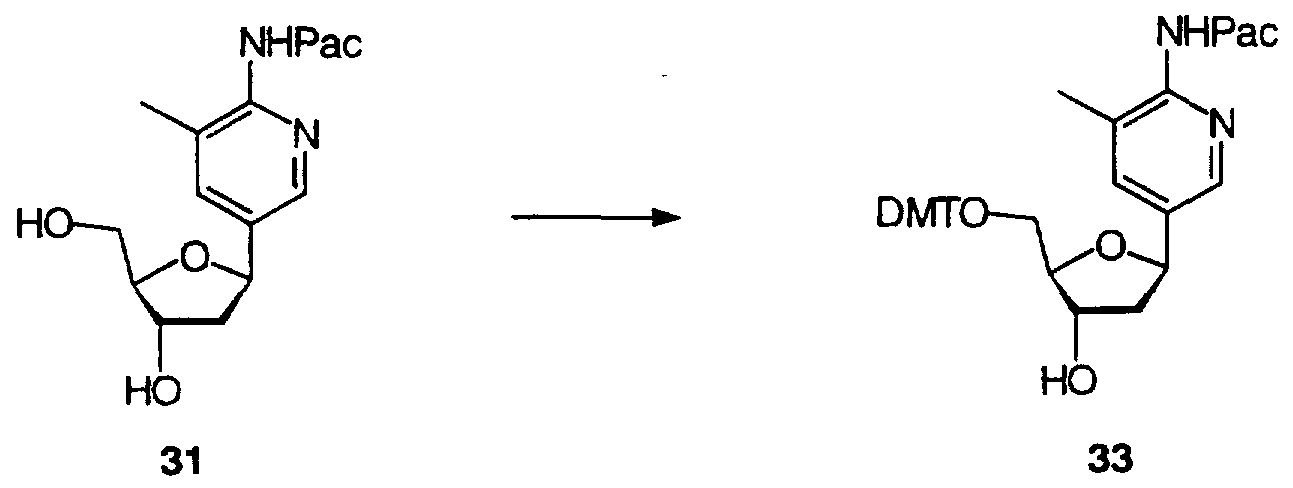
An example of a preferred protecting group reagent is 4,4'-dimethoxytrityl chloride (DMT-CI), which is employed, in particular, in pyridine. When DMT-CI is used as the protecting group reagent in the above-described process, compounds of the formula (IV) are obtained in which R19 is a 4,4'-dimethoxytrityl (DMT) residue.
The abovementioned preferences apply to the variables RT to R8, Q, Z and m in the compounds of the formulae (III) or (IV).
The oligonucleotides according to the invention can be prepared in a manner known per se, in accordance with different methods, in DNA synthesizers which can be automated and can be purchased together with procedural instructions. For example, in the case of the
bridging group -OP(O)OHOCH2-, the phosphorus triester method, the phosphite triester method or the H-phosphonate method can be used, which methods are familiar to the skilled person. In the case of the phosphite triester method the procedure can, for example, be to bind a nucleoside of the formula IV, or another protected nucleoside, to a solid support material, for example controlled pore glass (CPG), which contains long-chain alkylamino groups, with the aid of a linker, for example succinic anhydride. In a separate procedure, the hydroxyl group of the compound of the formula IV, or of the other protected nucleoside, is derivatized, for example to form a phosphoramidite using R'OP[N(i-propyl)2)]2, in the case of a nucleoside of the formula IV to form a compound of the formula V
where Q, FU, R16, Rι7 and R19 have the meanings given for formula IV, and R' is, for example, β-cyanoethyl.
After the protecting group of the material which is bound to the support has been eliminated, coupling takes place, with elimination of -N(i-C3H7)2, to the compound of formula IV or the other nucleoside, any free hydroxyl groups which may be present are blocked (capping) and the phosphite which has been formed is then oxidized to the phosphate. After the dimer has been deprotected, the reaction cycle is repeated with a compound of the formula V, or with another appropriate compound, until an oligomer having the desired number of monomer units has been synthesized and the product is released from the support material. If only nucleosides of the formula IV or V are used, oligonucleotides are then obtained in which all the residues U, V and W in accordance with formula II consist of residues of the formula I. In this way, oligonucleotides comprising arbitrary monomer units in arbitrary sequence can be prepared in dependence on the synthetic, natural and novel nucleoside building blocks which are used in the individual reaction cycles.
The invention also relates to a compound of the formula (V)
in which Q is a nitrogen atom or -C(R1)=, in which RT is hydrogen or d-C4alkyl; R4 is hydrogen, O-d-C5alkyl, O-d-C5alkyl which is substituted by one or several substituents selected from the group consisting of OH and halogen, where the alkyl can be interrupted by a heteroatom selected from the group consisting of oxygen, sulfur and nitrogen atoms, or a radical of the formula la or lb
R5 is hydrogen, CrC2ιalkyl, C2-C2ιalkenyl, C2-C21alkynyl or -C(=O)-alkyl;
R6 is hydrogen, d-C10alkyl, -CH2-O-R8 or a radical of the formula lb;
R7 is hydrogen or d-doalkyl;
R8 is hydrogen or d-doalkyl;
Z is -(CH2)n- or -(CH2-CH2-O)p-CH2CH2-, where, when Z is -CH2-, Z is unsubstituted or substituted by one or two identical or different radicals selected from the group consisting of d-Cioalkyl, C5-C6-cycloalkyl, and phenyl which is unsubstituted or substituted by d-C4alkyl; m is a number from 1 to 12; n is 1 or 2; and p is a number from 1 to 4;
R' is β-cyanoethyl;
Rι6 and Rι7 are, independently of each other or together, a protecting group or hydrogen, d-doalkyl, thio-d-C10alkyl, amino-d-Cioalkyl, Crdoalkylamino-Ci-doalkyl or d-
C10alkoxy-Cι-C10alkyl; and
R19 is a protecting group.
In a compound of the formula (V), R19 is preferably 4,4'-dimethoxytrityl.
In a preferred embodiment, R19 is, in a compound of the formula (V), 4,4'-dimethoxytrityl, and one of the radicals Ri6 or R17 is hydrogen, d-doalkyl, thio-d-Cioalkyl, amino-d- Cι0alkyl, Crdoalkylamino-d-C10alkyl or d-doalkoxy-d-doalkyl, and the other radical R17 or R16 is a protecting group which is preferably selected from phenoxyacetyl, benzoyl or acetyl; or R19 is 4,4'-dimethoxytrityl and Rι6 and R17 are together a protecting group, which is preferably an amidine protecting group, preferably selected from formamidine and the amidine of N-methylpyrrolidone.
In the compound of the formula (V), the preferences given for the building block of the formula (I) apply with regard to the variables Ri to R8, Q, Z and m, in particular in combination with the preferences given for the radicals R16, Rι7 and R19.
The novel compounds of the formula (V) are preferably used when synthesizing the oligonucleotides according to the invention.
The synthesis of oligonucleotides having the unnatural bridging groups -OP(O)SHOCH2-, -OP(S)SHOCH2-, -OP(O)R7OCH2-, -OP(O)NR8R9OCHr, -O-CH2-O-CH2- and -S-CH2-O-CH2- is described in Eckstein, F. (Editor), Oligonucleotides and Analogues: A practical approach, IRL Press, Oxford University Press (1991), that of oligonucleotides having the unnatural bridging groups -CHR10-C(O)-NRu-CHR12-, -CHR10-NRιrC(O)-CHRι3-, -CHR10-CH=CH-CHR12- and -CHR10-S(O)2-NRι rCHR12- is described in WO 95/20597, and that of oligonucleotides having the bridging group -NH-P(O)OH-O-CH2- is described in J.-K. Chen et al., Nucleic Acids Research 23 (1995), pp. 2661 -2668.
Protecting groups and methods for derivatizing the hydroxyl groups with such protecting groups are well known in sugar and nucleotide chemistry and are described, for example,
by Greene, B.T., Protective Groups in Organic Synthesis, Wiley Interscience, New York (1991), by Sonveaux, E., Bioorganic Chemistry 14:274-325 (1986) or by Beaucage, S.L, Iyer, R., Tetrahedron 48:2223-2311 (1992). Examples of these protecting groups are: benzyl, methylbenzyl, dimethylbenzyl, methoxybenzyl, dimethoxybenzyl, bromobenzyl, 2,4-dichlorobenzyl; diphenylmethyl, di(methylphenyl)methyl, di(dimethylphenyl)methyl, di-(methoxyphenyl)methyl, di(dimethoxyphenyl)methyl, triphenylmethyl, tris-4,4',4"-tert-butyl- phenylmethyl, di-p-anisylphenylmethyl, tri(methylphenyl)methyl, tri(dimethylphenyl) methyl, methoxyphenyl(diphenyl)methyl, di(methoxyphenyl)phenylmethyl, tri (methoxyphenyl) methyl, tri(dimethoxyphenyl)methyl; triphenylsilyl, alkyldiphenylsilyl, dialkylphenylsilyl and trialkylsilyl having from 1 to 20, preferably from 1 to 12, and particularly preferably from 1 to 8, C atoms in the alkyl groups, for example trimethylsilyl, triethylsilyl, tri-n-propylsilyl, i-propyl- dimethylsilyl, t-butyldimethylsilyl, t-butyldiphenylsilyl, n-octyldimethylsilyl, (1 ,1 ,2,2-tetra- methylethyl)dimethylsilyl; -(d-C8alkyl)2Si-O-Si(Cι-C8alkyl)2-, in which alkyl is, for example, methyl, ethyl, n- and i-propyl, or n-, i- or t-butyl; C2-Cι2-, particularly C2-C8acyl, for example acetyl, propanoyl, butanoyl, pentanoyl, hexanoyl, benzoyl, methylbenzoyl, methoxy benzoyl, chlorobenzoyl and bromobenzoyl; RSrSO2-, in which RSι is Cι-Cι2alkyl, particularly Cι-C6alkyl, C5- or C6-cycloalkyl, phenyl, benzyl, d-d2- and particularly CrC4alkylphenyl, or Cι-Cι2- and particularly d-C4alkylbenzyl, or halophenyl or halobenzyl, for example methyl-, ethyl-, propyl-, butyl-, phenyl-, benzyl-, p-bromo-, p-methoxy- and p-methylphenylsulfonyl; CrC12- which is unsubstituted or substituted by F, Cl, Br, d-dalkoxy, tri-(d-C4alkyl)silyl or Cι-C4alkylsulfonyl, preferably d-C8alkoxycarbonyl, for example methoxy-, ethoxy-, n- or l-propoxy- or n-, i- or t-butoxy-carbonyl, 2-trimethylsilylethoxycarbonyl, 2-methyisulfonyl- ethoxycarbonyl, allyloxycarbonyl, or phenyloxycarbonyl or benzyloxycarbonyl which is unsubstituted or substituted as for alkoxycarbonyl, for example methyl- or methoxy- or chlorophenyloxycarbonyl or -benzyloxycarbonyl, and also 9-fluorenylmethyloxycarbonyl. Particularly preferred protecting groups are benzyl, methylbenzyl, dimethylbenzyl, methoxybenzyl, dimethoxybenzyl, halogenated benzyl, in particular bromobenzyl; diphenylmethyl, di(methylphenyl)methyl, di(dimethylphenyl)methyl, di (methoxyphenyl) methyl, di (methoxyphenyl) (phenyl) methyl, triphenylmethyl, tris-4,4',4"-tert- butylphenylmethyl, di-p-anisylphenylmethyl, tri(methylphenyl)methyl, tri(dimethylphenyl)methyl, tri(methoxyphenyl)methyl, tri(dimethoxyphenyl)methyt; trimethylsilyl, triethylsilyl, tri-n-propylsilyl, i-propyldimethylsilyl, t-butyldimethylsilyl, t- butyldiphenylsilyl, n-octyldimethylsilyl, (1 ,1 ,2,2-tetramethylethyl)dimethylsilyl, -(CH3)2Si-O- Si(CH3)2-, -(i-C3H7)2Si-O-Si(i-C3H7)2-; acetyl, propanoyl, butanoyl, pentanoyl, hexanoyl,
benzoyl, methylbenzoyl, methoxybenzoyl, chlorobenzoyl and bromobenzoyl; methyl-, ethyl-, propyl-, butyl-, phenyl-, benzyl-, p-bromo-, p-methoxy- and p-methylphenylsulfonyl; methoxy-, ethoxy-, n- or i-propoxy- or n-, i- or t-butoxycarbonyl, or phenyloxycarbonyl, benzyloxycarbonyl, methyl- or methoxy- or chlorophenyloxycarbonyl or -benzyloxycarbonyl or 9-fluorenylmethyloxycarbonyl.
The compounds of the formula III, with the exception of the compounds in which Q is -CH=, R4 is hydrogen, and Rι6 and R17 are a protecting group, are novel [Hsieh, H.P., McLaughlin, L.W., J. Org. Chem. 60:5356-5359 (1995)].
The compounds of the formula III are prepared by reacting a compound of the formula VI
in which Q and also R16 and R17 are as defined above, and R,5 is halogen, preferably Br, (a) in the case where R4 in formula III is unsubstituted or substituted O-d-C4alkyl or a residue of the formula la, lb or Ic, with a lactone of the formula Vila
in which R
1β is a protecting group, and introducing the 2' modification, as described in EP 626,387 and EP 679,657, by a suitable sequence of introducing and eliminating protecting groups, hydrogenating and alkylating; or (b) in the case where R
4 in formula III is hydrogen, with a lactone of the formula Vllb
and eliminating the protecting groups R
18.
The reaction of the compounds of the formulae VI with Vila and Vllb is carried out essentially in accordance with the synthesis of C-glycosides described by Krohn et al. [Krohn, K., Heins, H., Wielckens, K., J. Med. Chem. 53:511-517 (1992)] and Kraus and Molina [Kraus, G.A., Molina, M.T., J. Org. Chem. 53:752-753 (1988)]. In the reaction, the resulting mixture of hemiacetals is reduced with a suitable reducing agent in the presence of an acid.
The corresponding N-protected nucleoside is obtained, for example, by a suitable sequence of introducing and eliminating protecting groups.
The reduction can be performed, for example, either catalytically or using borohydrides.
The invention furthermore relates to the use of the compounds of the formula III for preparing the oligonucleotides according to the invention.
The invention also relates to the oligonucleotides according to the invention for use in a therapeutic process for treating diseases in homeotherms including, and in particular, man. The dose when administering to homoeotherms of about 70 kg bodyweight can, for example, be from 0.01 to 1 ,000 mg per day. Administration is preferably effected in the form of pharmaceutical preparations, which are administered parenterally, for example intraveneously or intraperitoneally.
The oligonucleotides according to the invention are also suitable for use as diagnostic agents for the sequence-specific detection of double-stranded DNA segments in connection with infections with, for example, viruses, bacteria, fungi or protozoa, or in connection with genetically determined diseases. In particular, due to their increased stability towards nucleases, it is possible to use them diagnostically in vivo (for example tissue samples,
blood plasma and blood serum) as well as in vitro. These possible uses are described, for example, in WO 91/06556.
The invention furthermore relates to the use of the oligonucleotides according to the invention as diagnostic agents for detecting viral infections or genetically determined diseases.
The invention also relates to a pharmaceutical preparation which comprises an effective quantity of the oligonucleotide according to the invention, either alone or together with other active compounds, a pharmaceutical excipient, preferably in a significant quantity, and auxiliary substances, if desired.
The invention also relates to a pharmaceutical composition which comprises an oligonucleotide according to the invention, if desired together with a pharmaceutically tolerated excipient and/or an auxiliary substance. Such a pharmaceutical composition is suitable for bringing about a modulation, in particular a complete or partial inhibition, of the transcription of a gene which possesses a region which is suitable for forming a triple helix with an oligonucleotide according to the invention. Such a region can, for example, be located in a regulatory region of the corresponding gene, for example in a promotor region or in an enchancer region. Furthermore, such a region can, for example, be located in a region of the gene which corresponds to the 5' non-translated region, the coding region or the 3' non-translated region of the corresponding mRNA.
The pharmacologically active oligonucleotides according to the invention can be used in the form of preparations which can be administered parenterally or in the form of solutions for infusion. Such solutions are preferably isotonic, aqueous solutions or suspensions, with it being possible for these latter, for example in the case of lyophilized preparations, which comprise the active substance alone or together with an excipient, for example mannitol, to be prepared prior to use. The pharmaceutical preparations can be sterilized and/or comprise auxiliary substances, for example preservatives, stabilizers, wetting agents and/or emulsifying agents, solubilizers, salts for regulating the osmotic pressure, and/or buffers. The pharmaceutical preparations, which, if desired, can comprise additional pharmacologically active compounds, for example antibiotics, are prepared in a manner known per se, for example by means of conventional dissolving or lyophilizing methods, and
comprise from about 0.1 % to 90 %, in particular from about 0.5 % to about 30 %, for example from 1 % to 5 %, of active compound(s).
The following examples explain the invention, which relates, in particular, to the embodiments which are described in the examples, for example to the novel compounds and processes which are described therein.
Examples
Abbreviations employed:
FC: flash column chromatography
TLC: thin layer chromatography
RE: rotary evaporator
RT: room temperature solv.: solvent calc: calculated fnd.: found
A) Preparation of nucleoside analogues
All the reactions are carried out under Ar. All the chemicals are obtained purum or puriss from Fluka. All the solvents (solv.) are distilled immediately prior to use: THF over K/benzophenone, CH2Cl2 over P205, MeCN and pyridine over CaH2 and toluene over NaH. TLC: Alugram® SIL G/UV254 from Machery-Nagel; visualization by immersing in a solution of 10.5 g of cerium(IV) sulfate, 21 g of phosphomolybdic acid and 60 ml of cone. H2SO4 in 900 ml of H2O and subsequently heating. Flash column chromatography (FC): silica gel (30-60 μm) from Baker. M.p. (uncorrected): Bϋchi 510. IR: Perkin-Elmer-7S2, [cm 1]. 1H- NMR: Bruker-AC-300 (300 MHz) or Bruker DRX500 (500 MHz); δ [ppm] (Me3Si = 0, (D6)DMSO = 2.49 or CD3OD = 3.35 as internal standards), J [Hz]. 13C-NMR: Bruker-AC-300 (75 MHz); δ [ppm] (Me3Si = 0, (D6)DMSO = 39.70 or CD3OD = 49.30 as internal standards), multiplicities from DEPT measurements. 31P-NMR: Bruker DRX500 (202 MHz); δ [ppm] (PPh3 (= 0) as external standard). MS (m/z (%)): Varian-MAT-CH-7A, Varian-MAT 212 or
Autospec Q VG (FAB-MS); only fragments having intensitities ≥ 10 % are given. The dissociation constants (pKa values) are determined by titration with 0.1 M aqueous NaOH or HCI. UV spectrum: Cary 3E UV/VIS spectrophotometer (Varian); λ [nm] (ε).
Example A1 : Preparation of 2-(N-benzoylamlno)-5,-0-dimethoxytrltyl-5-(2'-deoxy-β-D- ribofuranosyl)pyridine-3'-0-(2-cyanoethyl-N,N-diisopropyl)phosphoramldite
(a) Preparation of 1-aza-1 -(5-bromo-2-pyridinyl)-2,2,5,5-tetramethyl-2,5-disilacyclopentane
18.2 ml (29.0 mmol) of BuLi are added dropwise, at -75°C, to a solution of 5 g (28.90 mmol) of 2-amino-5-bromopyridine in 80 ml of THF. After stirring at -75°C for one hour, a solution of 6.22 g (28.90 mmol) of 1 ,2-bis(chlorodimethylsilyl)ethane 1 in 15 ml of THF is added dropwise, at -75°C, to the yellow solution. After 90 minutes at -75°C, 18.2 ml (29.0 mmol) of BuLi are added dropwise. The reaction mixture is warmed to RT over a period of 2 hours and is then stirred at RT for a further two hours. 50 ml of an ice-cooled saturated solution of NaCI are added and the whole is extracted with Et2O (2 x 200 ml). The org. phase is dried (MgSO4) and the solv. is distilled off on a RE. Kugelrohr distillation (150°C / 0.05 mbar) of the residue yields 6.20 g (68%) of 2 as a white solid. M.p. 64-66°C. IR (film): 2960m,
2910m, 2890/77, 1580/77, 1545w, 1465s, 1370s, 1310s, 1250s, 1138m, 1032m, 960m, 950s, 905m, 845m, 815s, 785s, 675w. 1 H-NMR (300 MHz, CDCI3): 0.29 (s, 12 H); 0.82 (s, 4 H); 6.46 (dd, J = 8.45, 0.75, 1 H); 7.46 (dd, J = 8.85, 2.55, 1 H); 8.14 {dd, J = 2.6, 0.8, 1 H). 13C-NMR (75 MHz, CDCI3): -0.58 (4q); 8.54 (2f); 108.52 (s); 1 13.26 (d); 139.29 (a); 148.67 (d); 159.43 (s). MS: 317(19), 316(77, M+), 315(64), 314(77, M+), 313(45), 301 (14), 299(15), 289(23), 288(87), 287(33), 286(83), 285(11), 275(14), 274(35), 273(100), 272(37), 271 (97), 144(10), 143(10), 130(17), 129(13), 100(12), 73(21).
(b) Preparation of 2-amino-5-(2,,3,,5'-tri-O-benzyl-β-D-ribofuranosyl)pyridine
7.6 ml (12.2 mmol) of BuLi are added dropwise, at -75°C, to a solution of 4.07 g (12.91 mmol) of 2 in 60 ml of THF. After one hour at -75°C, a solution of 3.00 g (7.17 mmol) of the protected ribonolactone 3 (2,3,5-tri-O-benzyl-D-ribono-1 ,4-lactone, obtainable in accordance with W. Timpe et al., Carbohydr. Res. 39 (1975), pp. 53-60) in 20 ml of THF is added dropwise, at -75°C, to the yellow solution. After stirring at -75°C for 2 h, the mixture is warmed to 0°C over a further 3.5 h. The reaction solution is quenched with 75 ml of a saturated solution of NaHCO3 and the whole is extracted with Et2O (4 x 100 ml). The org. phase is washed with a saturated solution of NaCI (50 ml) and dried (MgSO4), and the solv. is distilled off on a RE. The residue, a yellow oil, is dissolved in 20 ml of CH2CI2 and this solution is cooled down to -75°C. 5.7 ml of triethylsilane (Et3SiH) and 4.5 ml of BF3 Et2O (in each case 5 equiv. based on 3) are added consecutively dropwise. The reaction solution is warmed to RT overnight. 20 ml of 1 M HCI are then added and the mixture is stirred at RT for 45 minutes. The mixture is made alkaline with 2% NaOH solution (checking with pH paper) and extracted with AcOEt (5 x 100 ml). The org. phase is washed with saturated NaCI solution (20 ml) and dried with MgSO4, and the solv. is distilled off on a RE. FC (100 g of silica gel, AcOEt) yields 2.28 g (64%) of 4 as a slightly yellow oil. TLC (AcOEt): Rf 0.35. IR (film): 3470m, 3360s, 3200m, 3060m, 3030s, 2900s, 2870s, 1960w, 1880w, 1820w, 1730w, 1620s, 1570w, 1510s, 1500s, 1455s, 1405m, 1360m, 1310w, 1260w, 1210w, 1125s,
1085s, 1045s, 1030s, 91 Ow, 825 w, 785s, 698s. 1 H-NMR (300 MHz, CDCI3): 3.70 (s, br., NH2); 3.56 (dd, J = 10.3, 4.1 , H-C(5')); 3.61 (dd, J = 10.3, 4.0, H-C(5')); 3.75 (dd, J = 7.5, 5.1 H-C(2')); 3.99 (dd, J = 5.0, 3.3, H-C(3')); 4.29 (q-like, J- 3.7, H-C(4')); 4.45 (AB system, JAB = 12.0, PbCH^O); 4.54 (AB system, JAB = 12.0, PhCH^O); 4.61 (AB system, JAB = 12.5, PhCHsO); 4.86 (d, J = 7.4, H-C(V)); 6.40 (d, J = 8.8, H-C(3)); 7.13-7.38 (m, 15 H); 7.45 (dd, J = 8.5, 2.25, H-C(4)); 7.95 (d, J = 2.2, H-C(6)). 1 3C-NMR (75 MHz, CDCI3): 70.53 (r); 71.91 (f); 72.33 (r); 73.47 (f); 77.49 (d); 80.40 (cf); 81.92 (cf); 83.29 (a); 108.51 (cf); 125.44 (s); 127.60 (d); 127.66 (cf); 127.72 (a); 127.80 (cf); 128.11 (cf); 128.32 (cf); 128.39 (cf); 128.41 (d); 136.34 (σ); 137.66 (s); 137.90 (s); 138.05 (s); 146.43 (d); 158.30(s). MS: 496(< 1 , M+), 213(21), 151 (14), 121 (20), 92(20), 97(100), 61 (10), 60(12), 45(26), 43(61), 29(11), 28(10), 19(50), 18(12).
(c) Preparation of 2-amino-5-(β-D-ribofuranosyl)pyridine hydrobromide
1.7 ml of a 1M BBr3 solution (in CH2CI2) are added dropwise to a solution of 210 mg (0.42 mmol) of 4 in 7 ml of CH2CI2 which has been cooled down to -78°C. After 4 h at -75°C, 8 ml of MeOH are added to the resulting suspension. The reaction solution, which is now clear, is warmed to RT over the space of 1 hour. When the solv. is distilled off on a RE, a white solid precipitates out and is filtered off, washed several times with CH2CI2 and recrystallized from MeOH/ CH2CI2. 92 mg (71%) of 5. White solid with a m.p. of 185-187°C. [α]D 25 = -34.5° (c = 0.35, H20). pKa 6.15. IR(KBr): 3600-2400(br.)s, 3080s, 3040s, 3020s, 2940s, 1670s, 1620s, 1558m, 1470m, 1455w, 1440w, 1380m, 1353m, 1330w, 1310m, 1260m, 1230m, 1208w, 1150m, 1132s, 1110s, 1050s, 1030s, 1002m, 930w, 885w, 860m, 825m, 6251V, 580s, 555s, 523s. 1 H-NMR (300 MHz, (D6)DMSO): 3.44-3.57 (m, 2 H-C(5')); 3.70 (dd, J = 7.35, 5.15, H-C(2')); 3.81 (dd, J = 7.0, 4.1 , H-C(4')); 3.91 (dd, J = 5.15, 2.95, H-C(3')); 4.49 (d, J= 7.3, H-C(1')); 4.69 (s, br., OH); 7.03 (d, J = 9.2, H-C(3)); 7.88 (d, J = 1.8, H-C(6)); 7.96 (dd, J = 9.2, 2.2, H-C(4)); 8.02 (s, br., NH2); 13.4 (s, br., 1 H). 13C-
NMR (75 MHZ, (D6)DMSO): 61.88 (/); 71.48 (d); 76.98 (cf); 79.43 (d); 85.81 (cf); 113.71 (cf); 125.69 (s); 132.95 (of); 142.76 (cf); 153.70 (s). MS: 227(28, M+-Br), 226(90, M+-HBή, 208(28), 191 (21), 164(11), 149(12), 139(10), 137(13), 136(35), 135(20), 124(44), 7-23(100), 122(46), 121 (48), 120(12), 108(15), 107(55), 106(24), 96(13), 95(15), 82(38), 81 (21), 80(52), 79(29), 78(21), 73(16), 60(15), 57(10). Anal, calculated for C10Hl4N2O4χHBr (307.14): C 8.98, H 5.23, N 9.09, found: C 38.93, H 5.00, N 9.20.
(d) Preparation of 2-(N-benzoylamino)-5-(β-D-ribofuranosyl)pyridine (5a) 0.50 ml (4.30 mmol) of benzoyl chloride is added dropwise to an ice-cooled solution of 1.60 g (3.22 mmol) of 4 and 0.30 ml of pyridine in 8 ml of CH2CI2. After stirring at RT for 24 hours, 20 ml of 1 M HCI and 20 ml of H20 are added, and the whole is extracted with CH2CI2 (5 x 50 ml). The org. phase is washed with 2 % NaOH (1 x 20 ml) and dried (MgSθ4), and the solv. is distilled off on a RE. Residual quantities of pyridine are coevaporated with toluene (2 x 5 ml). FC of the residue (silica gel, hexane/AcOEt 20:11 ) yields 1.85 g of a mixture of monobenzoylated and dibenzoylated nucleoside (TLC (hexane/AcOEt 20:11): R 0.29, 0.19) as a white solid, which is dissolved in 35 ml of CH2CI2, with the solution being cooled down to -75CC. 13.0 ml of a 1 M BBr3 solution (in CH2CI2) are added dropwise. After 4 hours at -75°C, 40 ml of MeOH are added dropwise and the mixture is warmed to RT overnight. The solv. is distilled off on a RE, and the residue is taken up in H2O (20 ml); this solution is washed with CH2CI2 (1 x 10 ml) and rendered alkaline with 10% NaOH. When the solv. is distilled off on a RE, a white solid precipitates out which is filtered off at 4°C, after 48 h, and dried under high vacuum. 0.75 g (70%) of 5a. White solid with a m.p. of 190-192°C. IR(KBr): 3260(br.)s, 2930m, 1660s, 1593m, 1580m, 1522s, 1530s, 1490s, 1455m, 1423tv, 1393s, 1383m, 1345m, 1310s, 1265m, 1217ιv,1105s, 1180w, 1050m, 1020m, 990m, 980w, 940m, 930m, 902iv, 870w, 848w, 800w, 760w, 675tv, 640ιv, 603w, 570ιv. 1 H-NMR (300 MHz, CD3OD): 3.77 (dd, J = 11.9, 4.6, H-C(5')); 3.85 (dd, J = 11.9, 3.45, H-C(5')); 3.95 (def, J = 7.3, 5.5, H-C(2')); 4.05 (q-like, J- 3.8, 1 H), 4.10-4.18 (m, 1 H), 4.78 (cf, J = 7.0, H- C(1 ')); 7.50-7.68 (tn, 3 H); 7.93-8.06 (m, 3 H); 8.25 (cf, J = 8.4, H-C(3)); 8.46 (cf, J = 2.2, H-C(6)). 13C-NMR (75 MHz, CD3OD): 63.86 (f); 73.36 (cf); 79.34 (cf); 83.07 (cf); 87.29 (a); 116.14 (a); 129.01 (a); 130.05 (a); 133.64 (a); 134.36 (s); 135.88 (s); 137.99 (a); 147.64 (cf); 153.08 (s); 168.83 (s). MS: 331 (11), 330(29, M+), 329(10), 303(16), 302(61), 30f(100), 300(12), 228(10), 227(38), 123(26), 105(72), 77(31).
(e) Preparation of 2-(N-benzoylamino)-5-[3',5'-O-(1 ,1 ,3,3-tetraisopropyldisiloxane-1 ,3-diyl)-β- D-ribofuranosyl)pyridine (5b)
Residual quantities of H2O are removed from the starting material 5a by coevaporating it three times with small portions of pyridine. 0.85 ml (2.72 mmol, 1.2 equiv.) of 1 ,3-dichloro- 1 ,1 ,3,3-tetraisopropyldisiloxane is added dropwise to an ice-cooled solution of 0.75 g (2.27 mmol) of 5a in 20 ml of pyridine. After stirring at RT for 5 hours, the solv. is distilled off on a RE and the residue is taken up in 20 ml of 1 M NaOH; this solution is extracted with CH2CI2 (5 x 50 ml). The org. phase is dried (MgSO4) and the solv. is distilled off on a RE. Purification of the yellowish residue by means of FC (silica gel, hexane/AcOEt 5:3) yields 0.97 g (75%) of 5b as a colourless oil. TLC (hexane/AcOEt 5:3): β = 0.35. IR (film): 3350(br.)w, 2940s, 2870s, 1680s, 1603m, 1590m, 1525s, 1497s, 1465m, 1385m, 1300s, 1245w, 1125s, 1040s, 995m, 845w, 775iv, 700s. 1 H-NMR (300 MHz, CDCI3): 1.00-1.15 (m, 28 H); 3.1 1 (d, J = 4.0, OH); 3.90-3.97 (m, 1 H); 3.99-4.16 (m, 3 H); 4.38 (t, J = 6.25, 1 H); 4.81 (d, J = 4.0, H-C(1 ')); 7.81 (dd, J = 8.8, 2.2, H-C(4)); 7.91 -7.97 (m, 2 H); 8.28 (d, J = 2.2, H-C(6)); 8.39 (d, J = 8.1 , H-C(3)); 8.93 (s, NH). 13C-NMR (75 MHz, CDCI3): 12.67 (a); 12.92 (a); 13.21 (d)\ 13.43 (d); 16.97 (a); 16.98 (q); 17.08 (q); 17.14 (q)] 17.32 (q); 17.36 (q); 17.39 (q); 17.49 (q); 62.46 (f); 71.71 (cf); 77.07 (d); 82.91 (cf); 83.16 (a); 1 13.87 (d)\ 127.28 (a); 128.83 (d); 131.73 (s); 132.25 (cf); 134.26 (s); 136.23 (cf); 145.64 (a); 151.28 (s); 165.73 (s). MS: 572 (M+, 4), 531 (12), 530(34), 529(100), 528(45), 501 (10), 236(16), 235(70), 234(12), 224(14), 207(12), 105(16).
(f) Preparation of 2-(N-benzoylamino)-5-[3',5'-0-(1 ,1 ,3,3-tetraisopropyldisiloxane-1,3-diyl)-2'- O-p-tolyloxythiocarbonyl)-β-D-ribofuranosyl)pyridine (5c)
0.40 ml (2.59 mmol, 1.6 equiv.) of O-4-tolyl chlorothioformate is slowly added dropwise, at RT, to a solution of 0.93 g (1.62 mmol) of 5b and 0.43 g (3.52 mmol) of DMAP in 23 ml of MeCN. After stirring at RT for 25 hours, the solv. is distilled off on a RE and the residue is partitioned between 1 M NaOH (30 ml) and AcOEt and extracted with AcOEt (4 x 70 ml). The org. phase is dried (MgS04), the solv. is distilled off on a RE and the residue is subjected to flash chromatography (silica gel, hexane/AcOEt 5:1). 0.95 g (81%) of 5c as a white foam. TLC (hexane/AcOEt 5:1): β = 0.30. IR (film): 3200 (br.)w, 3040w, 2945s, 2925s, 2880s, 1680s, 1600m, 1585m, 1505s, 1492s, 1462m, 1390s, 1362m, 1360w, 1300s, 1270s, 1220s, 1195s, 1 150s, 1 125s, 1038s, 1000m, 940w, 882s, 865m, 845m, 820m, 780w, 700s,
648w, 600w, 560w, 465w. 1 H-NMR (300 MHz, CDCI3): 0.96-1.19 (m, 28 H); 2.38 (s, Me); 4.03-4.14 (m, 2 H); 4.18-4.28 (m, 1 H); 4.58 (dd, J = 8.6, 5.0, H-C(3')); 5.23 (cf, J = 1.1 , H- C(1 ')); 5.64 (dd, J = 5.0, 1.7, H-C(2')); 7.19-7.25 (m, 2 H); 7.46-7.60 (m, 3 H); 7.90-7.95 (m, 2 H); 7.97 (dd, J = 8.6, 2.4, H-C(4)); 8.41 (cf, J= 8.5, H-C(3)); 8.44 (cf, J = 2.2, H-C(6)); 8.87 (s, NH). 1 3C-NMR (75 MHz, CDCI3): 12.77 (a); 12.91 (d); 13.08 (d); 13.42 (d); 16.96 (q); 17.06 (q); 17.08 (q); 17.15 (q); 17.30 (q); 17.36 (q); 17.38 (q); 17.49 (q); 20.98 (ςr); 60.58 (0; 69.02 (cf); 80.97 (a); 81.88 (cf); 87.55 (a); 113.81 (cf); 121.40 (cf); 127.26 (cf); 128.86 (cf); 130.10 (a); 131.94 (s); 132.30 (CT); 134.20 (s); 136.43 (d); 145.91 (cf); 151.25 (s); 151.48 (s); 165.75 (s); 194.48 (s). MS: 723(<1 , M+), 558(10), 557(37), 556(78), 555(100), 554(12), 515(12), 514(37), 513(61), 512(87), 278(45), 277(76), 225(21), 174(13), 172(17), 108(11), 107(11), 105(42), 77(10).
(g) Preparation of 2-(N-benzoylamino)-5-[3',5'-0-(1 ,1 ,3,3-tetraisopropyldisiloxane-1 ,3-diyl)- 2'-deoxy-β-D-ribofuranosyl]pyridine (5d)
A solution of 0.88 g (1.22 mmol) of 5c, 20 mg (0.12 mmol) of AIBN and 0.50 ml (1.89 mmol, 1.5 equiv.) of Bu3SnH in 40 ml of toluene is degassed with Ar for 50 minutes. The reaction mixture is slowly heated to 80°C (oil bath temperature) and then stirred at 80°C for 4 h. 30 ml of 1 M NaOH are added and the whole is extracted with AcOEt (4 x 60 ml). The org. phase is dried (MgS04) and the solv. is distilled off on a RE. FC (hexane/AcOEt 5:1) yields 0.57 g (84%) of 5d as a colourless oil. TLC (hexane/AcOEt 5:1): R, = 0.22. IR (film): 3100(br.), 2940s, 2890m, 2870s, 1680s, 1605m, 1590m, 1518s, 1492m, 1462m, 1385m, 1350w, 1305s, 1245W, 1180w, 1085s, 1030s, 955w, 920 w, 880m, 845w, 780w, 695m. 1H- NMR (300 MHz, CDCI3): 0.91 -1.20 (m, 28 H); 2.06 (dt, J = 12.9, 7.7, 1 H); 2.39 (ddd, J = 12.8, 6.7, 4.5, 1 H); 3.83-3.95 (m, 2 H); 4.07-4.18 (m, 1 H); 4.55 (dt, J = 7.7, 4.4, 1 H); 5.09 (t, J = 7.35, 1 H); 7.19-7.25 (m, 2 H); 7.46-7.61 (m, 3 H); 7.75 (dd, J = 8.7, 2.4, 1 H); 7.89- 7.96 (m, 2 H); 8.22 (d, J = 1.8, 1 H); 8.37 (cf, J = 8.8, 1 H); 8.77 (s, NH). 13C-NMR (75 MHz, CDCI3): 12.75 (a); 13.04 (a); 13.40 (a); 13.52 (a); 16.98 (a); 17.07 (q)\ 17.1 1 (q); 17.27 (q); 17.40 (q); 17.44 (q); 17.45 (q); 17.58 (a); 42.94 (+); 63.55 (Q; 73.25 (d); 76.69 (a); 86.59 (a); 113.82 (0); 127.23 (a); 128.84 (d); 132.24 (a); 133.60 (s); 134.28 (a); 136.26(d); 145.76 (d); 151.09 (s); 165.66(s). MS: 556(17, M+), 517(14), 516(30), 515(83), 574(100), 513(14), 512(15), 370(22), 278(36), 226(11), 212(17), 176(11), 106(14), 105(93), 77(51), 43(14).
(h) Preparation of 2-(N-benzoylamino)-5-(2'-deoxy-β-D-ribofuranosyl)pyridine
2 equiv. of TBAF (2.04 mmol; 1.85 ml of a 1.1 M solution in THF) are added dropwise, at RT, to a solution of 570 mg (1.02 mmol) of 5d in 15 ml of THF. After 1.5 hours at RT, 0.1 ml of H20 is added and the mixture is rendered alkaline (pH approx. 10) by adding 10% NaOH dropwise. The solvent is distilled off on a RE, and the residue is dried under high vacuum for 1 hour, adsorbed to silica gel and subjected to flash chromatography (silica gel, AcOEt/MeOH 9:1). The resulting white solid (277 mg, 86%) is recrystallized in hot 25% NH3- solution. 0.25 g (78%) of 6 as a white solid with a m.p. of 174-175°. TLC (AcOEt/MeOH 9:1): R, 0.34. [α]D 25 = +38.0° (c = 0.85, MeOH). IR(KBr): 3460s(br.), 1663s, 1590m, 1531 s, 1497m, 1390m, 1370m, 1335w, 1310s, 1260w, 1180w, 1108w, 1080m, 1028m, 940w, 885w, 840w, 708s. 1 H-NMR (300 MHz, CD3OD): 2.04 (ddd, J = 13.0, 10.5, 5.9, H-C(2')); 2.28 (ddd, J = 13.0, 5.3, 1.65, H-C(2'); 3.73 (d, J = 4.8, 2 H-C(5')); 4.01 (td, J = 4.9, 2.3, H-C(4')); 4.40 (dt, J = 5.9, 1.9, H-C(3')); 5.20 (dd, J = 10.95, 5.35, H-C(1 ')); 7.53-7.68 (m, 3 H); 7.94 {dd, J = 8.65, 2.35, H-C(4)); 7.99-8.04 (m, 2 H); 8.25 (d, J = 8.45, H-C(3)); 8.42 (d, J = 2.2, H-C(6)). 13C-NMR (75 MHz, CD3OD): 45.01 (f); 64.25 (f); 74.72 (d); 79.38 (a); 89.67 (cf); 116.18 (d); 129.02 (2d); 130.05 (2d); 133.63 (cf); 135.60 (s); 135.90 (s); 137.95 (d); 147.51 (a); 153.00 (s); 168.82 (s). MS: 314(18, M+), 286(32), 285(85), 225(20), 108(24), 107(29), 106(14), 7"05(100), 77(50), 43(31), 28(17), 18(17).
(i) Preparation of 2-amino-5-(2'-deoxy-β-D-ribofuranosyl)pyridine (7) (corresponds to building block "X" in oligonucleotides 10 and 11 (see Example C1)) A solution of 61 mg (0.19 mmol) of 6 in 6 ml of a 40% aqueous solution of methylamine is stirred in a sealed apparatus at 70°C (oil bath temperature) for 25 h. All the volatile components are stripped off on a RE, and the residue is dried under high vacuum for approx. 30 minutes and subjected to flash chromatography (silica gel, CH2CI;>/MeOH 4:1). 34 mg (83%) of 7 as a slightly yellowish oil. TLC (CHaCla/MeOH 4:1): fl, 0.35. UV (H20): 234
(9290), 292 (2970), 260 (650). pKa 6.26. IR (film): 3340s(br.), 3050m, 2940m, 1630s, 1570ιv, 1510s, 1420m, 1360m, 1318w, 1263w, , 225w, 1178ιv, 1142ιv, 1088m, 1045s, 1025s, 940ιv, 840m. 1 H-NMR (300 MHz, CD30D): 2.01 (ddd, J = 13.2, 10.7, 5.9, H-C(2')); 2.14 (ddd, J = 13.2, 5.4, 1.8, H-C(2'); 3.69 (d, J = 4.8, 2 H-C(5')); 3.94 (ref, J = 4.9, 2.5, H- C(4')); 4.37 (df, J = 5.9, 1.8, H-C(3')); 5.03 (dd, J= 10.7, 5.5, H-C(1*)); 6.61 (d, J = 8.8, H- C(3)); 7.57 (dd, J = 8.8, 2.2, H-C(4)); 7.92 (d, J = 1.8, H-C(6)). 13C-NMR (75 MHz, CD3OD): 44.42 (f); 64.25 (r); 74.73 (d); 79.71 (a); 89.32 (d); 110.51 (d); 127.30 (2cf); 138.34 (d); 146.46 (a); 160.87 (s). MS: 210(54, h/T), 209(12), 179(32), 161 (11), 150(12), 136(15), 133(14), 123(24), 122(10), 121 (72), 120(35), 119(12), 108(11), 707(100), 95(13), 94(36), 32(14), 31 (22), 29(10), 18(16).
(j) Preparation of 2-(N-benzoylamino)-5'-O-dimethoxytrityl-5-(2'-deoxy-β-D-ribofuranosyl) pyridine (7a)
Residual quantities of H20 are removed from the starting material 6 by coevaporating it twice with small portions of pyridine. 136 mg (1.2 equiv., 0.40 mmol) of dimethoxytrityl chloride are added, at RT and within the space of 2 h (in 3 portions), to a solution of 105 mg (0.33 mol) of 6 in 1.5 ml of pyridine. After a further 1.5 h, 3 ml of toluene are added and the reaction mixture is concentrated on a RE. The residue is taken up in CH2CI2 and this solution is washed with 0.4M NaOH (10 ml). The aqueous phase is extracted with CH2CI2 (5 x 40 ml). The combined org. phases are dried (Na2S04) and the solv. is distilled off on a RE. FC (silica gel (pretreated with 1% Et3N in hexane), AcOEt/hexane 5:1) yields 173 mg (84%) of 7a as a white foam. TLC (AcOEt/hexane 5:1): fl, 0.35. IR (film): 3400(br.)ιv, 2940 w, 291 Ow, 1672m, 1600m, 1585m, 1510s, 1460w, 1442w, 1400W, 1340w, 1300s, 1247s, 1 170m, 1078m, 1030s, 903m, 825m, 725s, 700m, 585w. 1 H-NMR (300 MHz, CDCI3): 2.04 (ddd, J = 13.7, 9.6, 6.0, H-C(2')); 2.16 (br., s, OH); 2.26 (ddd, J = 13.2, 5.5, 1.8, H-C(2')); 3.26 (dd, J= 9.7, 5.3, H-C(5')); 3.36 (dd, J= 9.7, 4.6, H-C(5')); 3.79 (s, 2 Me); 4.04-4.12 (m, 1 H); 4.41 -4.50 (m, 1 H); 5.17 (dd, J = 10.3, 5.5, H-C(1 ')); 6.79-6.85 (m, 4 H); 7.17-7.36 (m, 7 H); 7.41 -7.60 (m, 5 H); 7.75 (dd, J = 8.6, 2.4, H-C(4)); 7.89-7.95 (m, 2 H); 8.26 (d, J = 1.8, H-C(6)); 8.35 (d, J = 8.8, H-C(3)); 8.74 (br., s, NH). 13C-NMR (CDCI3): 43.63 (f); 55.24 (2q); 64.41 (0; 74.61 {a); 77.61 (d); 86.33 (s); 86.51 (d)\ 1 13.18 (cf); 113.81 (d), 126.88 (a); 127.22 (d)\ 127.88 (d); 128.17 (a); 128.85 (cf); 130.05 (cf); 130.08 (d); 132.25 (a); 133.45 (s); 134.24 (s); 135.93 (s); 135.95 (s); 136.44 (a); 144.74 (s); 145.87 (cf); 151.07 (s); 158.54 (s);
158. 56 (s); 165.67 (s). MS: 616(<1 , M+), 304(20), 303(62), 286(17), 285(48), 225(13), 705(100), 77(39).
(k) Preparation of 2-(N-benzoylamino)-5'-0-dimethoxytrityl-5-(2'-deoxy-β-D-ribo- furanosyl)pyridine-3'-0-(2-cyanoethyl-N,N-diisopropyl)phosphoramidite (8) 75 μl (80 mg, 0.34 mmol) of chloro(diisopropylamino)-β-cyanoethoxyphosphine are added dropwise, at RT, to a solution of 135 mg (0.22 mol) of 7a and 110 μl (85 mg, 0.66 mmol) of diisopropylethylamine (Hϋnig's base) in THF (7 ml). After 2 h at RT, 50 ml of CH2CI2 are added. The org. phase is washed with a cold saturated solution of NaHC03 (2 x 10 ml). The aqueous phase is back extracted with CH2CI2 (2 x 50 ml). The org. phase is dried (MgS04) and the solv. is distilled off on a RE. FC (silica gel (pretreated with 1 % Et3N in hexane), AcOEt/hexane 1 :1) yields 145 mg (81%) of 8 as a mixture of two diastereomers in a ratio of 1 :1. White foam. TLC (AcOEt/hexane 1 :1): fl, 0.64 and 0.52. IR (film): 2970m, 2930m, 2245w, 1675m, 1605m, 1580m, 1510s, 1692m, 1460m, 1443m, 1390m, 1360m, 1340w, 1300s, 1248s, 1200vv, 1175s, 1150ιv, 1070m, 1030s, 973m, 905s, 830m, 790w, 728s, 645w, 585w. 1 H-NMR (500 MHz, CDCI3): 1.10 (d, J = 6.8, 3 H); 1.16-1.21 (m, 9 H); 1.99- 2.09 (m, 1 H); 2.34 (dd, J = 13.0, 5.1 , 0.5 H); 2.44 (dd, J<* 13.0, 4.9, 0.5 H); 2.46 (t, J = 6.5, 1 H); 2.62 (t, J = 6.5, 1 H); 3.23-3.36 (m, 2 H); 3.54-3.67 (m, 2 H); 3.67-3.90 (m, 2 H); 3.784, 3.786, 3.789, 3.792 (4s, 6 H); 4.22-4.29 (m, 1 H); 4.51 -4.58 (m, 1 H); 5.14-5.19 (m, 1 H); 6.80-6.85 (m, 4 H); 7.18-7.24 (m, 1 H); 7.26-7.31 (m, 2 H); 7.33-7.37 (m, 4 H); 7.44-7.52 (m, 4 H); 7.54-7.59 (m, 1 H); 7.78-7.82 (m, 1 H), 7.92 (s, 1 H), 7.93 (s, 1 H), 8.29-8.32 (m, 1 H), 8.359, 8.364 (2d, J = 8.5, 1 H), 8.71 , 8.72 (2s, NH). 31P-NMR (202 MHz, CDCI3): 154.00; 154,12. MS: 816(not visible, M+), 385(14), 384(38), 305(23), 304(82), 303(100), 288(25), 273(22), 228(11), 227(32), 225(21), 197(16), 195(11), 105(32), 101 (32), 86(41), 77(13), 58(19), 53(26), 52(23), 51 (15), 44(36), 43(15), 42(17), 41 (14), 26(13).
Example A2: Preparation of 2-(N-phenoxyacetylamino)-5-[5'-0-dimethoxytrityl-2'-0- methyl-β-D-ribofuranosyl]pyridine-3'-0-(2-cyanoethyl-N,N-diisopropyl)phosphoramidite
(a) Preparation of 3,5-0-(1 ,1 ,3,3-tetraisopropyldisiloxane-1 ,3-diyl)-D-ribono-1 ,4-iactone (14)
13 14
3.10 ml (9.89 mmol, 1.2 equiv.) of TIPDSCI2 are added dropwise to an ice-cooled solution of 1.20 g (8.10 mmol) of (D)-ribono-1 ,4-lactone 13 in 18 ml of pyridine. After stirring at RT for 5 h, 100 ml of AcOEt are added and the whole is washed with 0.1 M HCI (2x50 ml). The aqueous phase is extracted with AcOEt (2x50 ml). The combined org. phases are washed with a saturated solution of NaHC03 (1x50 ml) and dried (MgS04), and the solv. is distilled off on a RE. FC (silica gel, hexane/AcOEt 5:1) yields 1.23 g (39%) of 14 as a colourless oil. TLC (hexane/ AcOEt 5:1): fl> 0.30. [α]D RT = +28.9 (c = 0.5, CHCI3). IR (film): 3500 (br.), 2945s, 2870s, 1792s, 1465m, 1390w, 1250w, 1220w, 1130m, 1090s, 1040s, 905s, 885s, 837m, 730s, 650m. 1H-NMR (300 MHz, CDCI3): 1.00-1.13 (m, 28 H); 3.02 (d, J = 2.6, OH); 3.99 (dd, J = 12.5, 5.9, 1 H-C(5)); 4.15 (dd, J = 12.5, 3.7, 1 H-C(5)); 4.25 (dd, J = 5.9, 2.2, H-C(2)); 4.43 (td, J- 6.4, 3.7, H-C(4)); 4.51 (dd, J = 6.6, 5.9, H-C(3)). 13C-NMR (75 MHz, CDCI3): 12.53 (a); 12.81 (a); 13.07 (cf); 13.25 (a); 16.75 (q); 16.84 (q); 16.86 (q); 17.02 (q); 17.17 (q); 17.18 (q); 17.22 (q); 17.34 (q)\ 61.60 (f); 68.45 (a); 69.83 (a); 82.64 (a); 171.74 (s). MS (El): 389 (5, M+-1 ), 347 (25), 329 (32), 235 (44), 147 (20), 135 (15), 121 (47), 105
(25), 91 (20), 77 (39), 72 (21 ), 58 (96), 44 (14), 43 (18), 42 (21 ), 41 (32), 39 (25), 32 (21 ), 28 (100), 27 (19).
(b) Preparation of 2'-0-methyl-3,5-0-(1 ,1 ,3,3-tetraisopropyldisiloxane-1 ,3-diyl)-D-ribono-1 ,4- lactone (15)
14 15
A suspension of 1.05 g (2.69 mmol) of 14 and 2.10 g (9.06 mmol) of silver(l) oxide in 17 ml of methyl iodide is heated at 45°C for 6 h. The excess methyl iodide is distilled off, and the residue is taken up in AcOEt and this solution is filtered through Celite. Concentration of the clear filtrate, and FC (silica gel, hexane/AcOEt 10:1), yields 0.73 g (67%) of 15 as a colourless oil, which solidifies to a white solid when stored for a relatively long time at - 30°C. M.p.: 38-39°C. TLC (hexane/AcOEt 10:1): fl, 0.30. [α]D RT = +43.9 (c = 0.54, CHCI3). IR (film): 2940s, 2895m, 2865s, 1792s, 1465m, 1388w, 1320ιv, 1290ιv, 1245m, 1162m, 1130s, 1093m, 1040s, 980m, 940w, 882s, 840w, 775ιv, 695m. 1H-NMR (300 MHz, CDCI3): 0.97-1.10 (m, 28 H); 3.59 (s, Me); 3.78 (d, J- 4.8, H-C(2)); 4.00 (dd, J = 13.6, 2.6, 1 H- C(5)); 4.13 (dd, J = 13.6, 1.85, 1 H-C(5)); 4.37 (dd, J = 8.65, 4.6, H-C(3)); 4.43 (dt, J = 8.85, 2.2, H-C(4)). 13C-NMR (75 MHz, CDCI3): 12.47 (d); 12.74 (d); 12.94 (d); 13.37 (cf); 16.76 (q); 16.91 (q); 17.01 (q); 17.09 (q); 17.16 (q); 17.18 (2q); 17.32 (a); 59.13 (q); 59.29 (r); 69.34 (a); 77.69 (d); 82.14 (d); 170.60 (s). MS (El): 404 (<1 , M+), 363 (58), 362 (79), 361 (97), 329 (73), 261 (68), 259 (70), 251 (48), 250 (73), 249 (100), 231 (46), 221 (43), 175 (53), 161 (46), 149 (57), 147 (61), 135 (73), 121 (53), 119 (72), 109 (40), 105 (55), 103 (44), 85 (66), 83 (83), 55 (41), 43 (71), 41 (62).
(c) Preparation of 2-amino-5-[2'-0-methyl-3',5'-(1 ,1 ,3,3-tetraisopropyldisiloxane-1 ,3-diyl)- α,β-D-ribofuranosyl]pyridine (16)
15 16
2.1 ml (3.36 mmol) of π-BuLi are added dropwise, at -75°C, to a solution of 1.12 g (3.56 mmol) of 2 in 15 ml of THF. After one hour at -75°C, a solution of 0.70 g (1.73 mmol) of the protected ribonolactone 15 in 6 ml of THF is added dropwise, at -75°C, to the yellow solution. After stirring at -75°C for 2 h, the mixture is warmed to 0°C over a further 3 h. The reaction solution is quenched with 10 ml of a saturated solution of NaHC03 and extracted with Et20 (5x50 ml). The org. phase is washed with a saturated solution of NaCI (20 ml) and dried (MgS04), and the solv. is distilled off on a RE. The oily-yellow residue is briefly dried under high vacuum and then dissolved in 20 ml of CH2CI2; this solution is cooled down to -75°C. 1.57 ml of triethylsilane (Et3SiH) and 1.24 ml of BF3 Et20 (5 equiv. in each case, based on 3) are added consecutively dropwise. After the reaction solution has been allowed to warm to RT overnight, it is quenched with 10 ml of NaHC03 solution and the whole is extracted with AcOEt (5x60 ml). The org. phase is washed with 0.1 M NaOH (20 ml) and dried (MgS04), and the solv. is distilled off on a RE. FC (silica gel, AcOEt) yields 0.51 g (61%) of 16 as a mixture of two diastereomers, in a β /α ratio - 10:1 , as a slightly yellowish oil. The analytical data are determined using a mixture having a β / α ratio = 5:3: TLC (AcOEt): fl, 0.36. IR (film): 3360 (br.), 2950s, 2930s, 2860s, 1620s, 1570ιv, 1502s, 1460m, 1408w, 1385W, 1245w, 1135s, 1075s, 1030s, 988s, 883s, 690s. 1H-NMR (300 MHz, CDCI3): β-anomer: 0.90-1.12 (m, 28 H); 3.50 (dd, J = 5.0, 2.0, H-C(2')); 3.53 (s, Me); 3.92-4.14 (m, 2 H-C(5'), H-C(4')); 4.0 (br. NH2); 4.32 (dd, J = 8.8, 5.15, H-C(3')); 4.80 (d, J = 2.2, H-C(1 ')); 6.45 (d, J = 8.45, H-C(3)); 7.51 (dd, J = 8.45, 2.2, H-C(4)); 8.00 (d, J = 2.55, H- C(6)). α-anomer: 0.90-1.12 (m, 28 H); 3.05 (dd, J = 9.55, 2.55, 1 H); 3.07 (s, Me); 3.71 (d, J = 8.1 , 2 H); 4.00-4.10 (m, 1 H); 4.0 (br., NH2); 4.41 (d, J = 9.55, 1 H); 4.63 (t, J = 2.2, 1 H); 6.47 (d, J = 8.45, H-C(3)); 7.44 (dd, J = 8.65, 2.4, H-C(4)); 8.04 (d, J = 2.2, H-C(6)). 13C- NMR (75 MHz, CDCI3): β-anomer: 12.58 (d); 112.85 (d); 13.08 (d); 13.50 (d); 16.93 (a); 17.07 (q); 17.13 (q); 17.20 (q); 17.32 (q); 17.43 (q); 17.36 (q); 17.47 (a); 58.96 (q); 60.73 (0;
70.95 (cf); 81.08 (d); 82.61 (a); 86.71 (cf); 108.44 (cf); 126.44 (s); 135.90 (a); 145.74 (cr); 157.96 (s). α-anomer: 12.61 (cf); 13.18 (d); 13.85 (d); 14.21 (cf); 17.08 (q); 17.20 (q); 17.23 (q); 17.29 (q); 17.35 (q); 17.45 (q); 17.55 (q); 17.59 (q); 57.60 (q); 66.07 (f); 70.08 (cf); 72.13 (d); 73.55 (d); 81.80 (d); 108.25 (d); 125.25 (s); 137.23 (d); 147.09 (a); 152.73 (s). MS (El): 483(8, /W++1), 482 (15, M+), 441 (37), 440 (72), 439 (100), 407 (32), 259 (28), 249 (67), 247 (45), 191 (28), 175 (26), 173 (46), 163 (28), 161 (27), 149 (29), 147 (30), 145 (20), 135 (58), 133 (28), 122 (27), 121 (75), 119 (47), 107 (95).
(d) Preparation of 2-(N-phenoxyacetylamino)-5-[2'-0-methyl-3',5'-0-(1 ,1 ,3,3-tetraisopropyl- disiloxane-1 ,3-diyl)-β-D-ribofuranosyl]pyridine (β-17)
16 β-17 α-17
0.70 g (2.45 mmol) of phenoxyacetic anhydride (Pac20) is added, at RT and over the space of 2 h in 3 portions, to a solution of 0.33 g (0.68 mmol) of 16 in 7 ml of pyridine. After a further 3 h at RT, 10 ml of H20 are added and the reaction mixture is stirred for 1.5 h. It is then concentrated on a RE and the residue is taken up in 150 ml of AcOEt; the org. phase is washed with 0.1 M NaOH (2x20 ml) and dried (MgS04), and the solv. is distilled off on a RE. FC (silica gel, hexane/AcOEt 4:1) yields the two diastereomers β-17 (0.36 g, 85%) and α-17 (35 mg, 8%) as colourless oils. Data from β-17: TLC (hexane/AcOEt 4:1): fl,0.25. [α]D RT = -34.8 (c = 1.0, CHCI3). IR (film): 3300ιv (br.), 2938s, 2868m, 1518s, 1495s, 1463m, 1390m, 1330w, 1300m, 1240m, 1140s, 1035s, 980w, 918M/, 882m, 859w, 750s, 689m, 613w. 1H-NMR (300 MHz, CDCI3): 0.90-1.12 (m, 28 H); 3.52 (dd, J = 4.95, 2.0, H-C(2')); 3.56 (s, Me); 3.97-4.05 (m, 2 H, 1 H-C(5'), H-C(4')); 4.14 (dd, J = 3.1 , 13.4, 1 H-C(5')); 4.34 (dd, J= 8.3, 4.95, 1 H-C(3')); 4.61 (s, 2 H, CH^OPh); 4.92 (d, J = 2.2, H-C(1 ')); 6.94-7.07 (m, 3 H, Ph); 7.26-7.37 (m, 2 H, Ph); 7.80 (dd, J= 8.5, 2.2, H-C(4)); 8.23 (d, J = 8.8, H- C(3)); 8.31 (d, J = 2.2, H-C(6)); 8.95 (s, NH). NOE (500 MHz, CDCI3): 3.52 (H-C(2')) — 4.34
(H-C(3*)), 4.92 (H-C(1 ')), 7.80 (H-C(4)), 8.31 (H-C(6)); 3.56 (Me) → 4.92 (H-C(1 ')); 3.97- 4.05 (1 H-C(5'), H-C(4')) - 4.14 (1 H-C(5')), 4.34 (H-C(3')), 4.92 (H-C(1 *)); 4.14 (1 H- C(5')) → 3.97-4.05 (1 H-C(5'), H-C(4')); 4.34 (H-C(3')) -* 3.52 (H-C(2')), 7.80 (H-C(4))t 8.31 (H-C(6)); 4.61 (CH^OPh) → 6.94-7.07 (Ph), 8.95 (NH); 4.92 (H-C(1 ')) → 3.52 (H- C(2')), 3.56 (Me), 3.97-4.05 (1 H-C(5'), H-C(4')), 7.80 (H-C(4)), 8.31 (H-C(6)); 7.80 (H- C(4)) → 3.52 (H-C(2')), 4.34 (H-C(3')), 4.92 (H-C(1')), 8.23 (H-C(3)); 8.23 (H-C(3)) → 7.80 (H-C(4)); 8.31 (H-C(6)) — 3.52 (H-C(2')), 4.34 (H-C(3')), 4.92 (H-C(1')); 8.95 (NH) → 4.61 (CH*OPh), 6.94-7.07 (Ph), 8.23 (H-C(3)). 13C-NMR (75 MHz, CDCI3): 12.57 (d); 12.83 (d); 13.08 (a); 13.47 (a); 16.91 (q); 17.05 (q); 17.09 (q); 17.18 (q); 17.30 (q); 17.34 (2q); 17.46 (q); 59.06 (q); 60.59 (f); 67.39 (f); 70.77 (d); 81.31 (cf); 82.22 (d); 86.73 (d); 1 13.79 (d); 114.80 (d); 122.38 (d); 129.83 (d); 133.07 (s); 136.06 (d); 145.65 (a); 149.91 (s); 156.94 (s); 166.79 (s). MS (El): 616 (15, M+), 575 (17), 574 (54), 573 (100), 255 (18), 249 (31), 135 (10), 107 (10), 77 (13). Data from α-17: TLC (hexane/AcOEt 4:1): fl,0.42. [α]D RT = -22.7 (c = 1.16, CHCI3). IR (film): 3395m, 3015m, 2940s, 2870s, 1700m, 1590m, 1520s, 1495m, 1462m, 1400W, 1350w, 1305tv, 1212s, 1168m, 1118m, 1080m, 1030m, 1000s, 883m, 750s, 690m, 665m. 1H-NMR (500 MHz, CDCI3): [— • the assignment was carried out by means of 1H,1H- and 1H,13C-COSY] 0.80-1.08 (m, 28 H); 2.97 (dd, J= 9.4, 2.0, H-C(2')); 3.00 (s, Me); 3.67-3.74 (m, 2 H-C(5')); 4.03 (ddd, J = 10.0, 6.5, 2.5, H-C(4')); 4.48 (d, J = 9.4, H-C(1')); 4.56 (s, 2 H, CHADPh); 4.60 (t, J- 2.0, H-C(3')); 6.89-7.01 (m, 3 H); 7.23-7.31 (m, 2 H); 7.71 (dd, J = 8.7, 2.0, H-C(4)); 8.19 (d, J = 8.7, H-C(3)); 8.26 (d, J = 2.0, H- C(6)); 8.89 (s, NH). NOE (500 MHz, CDCI3): 3.67-3.74 (2 H-C(5') → 4.03 (H-C(4')), 4.48 (H-C(V)); 4.03 (H-C(4')) -* 2.97 (H-C(2')), 3.67-3.74 (2 H-C(5')), 4.60 (H-C(3')); 4.48 (H- C(1')) → 3.67-3.74 (2 H-C(5')), 2.97 (H-C(2')), 7.71 (H-C(4)), 8.26 (H-C(6)); 4.60 (H-C(3')) → 2.97 (H-C(2')), 3.00 (Me), 4.03 (H-C(4")); 6.89-7.01 (3 H, Ph) - 4.56 (CH^Ph), 7.23- 7.31 (2 H, Ph); 7.23-7.31 (2 H, Ph) — 6.89-7.01 (3 H, Ph); 7.71 (H-C(4)) → 2.97 (H-C(2')), 4.48 (H-C(l ')), 8.19 (H-C(3)); 8.19 (H-C(3)) → 7.71 (H-C(4)); 8.26 (H-C(6)) -* 2.97 (H- C(2')), 4.48 (H-C(1')); 8.89 (NH) — 4.56 (CH^Ph). 13C-NMR (75 MHz, CDCI3): [→ the assignment was carried out by means of 1H,13C correlation measurement] 12.59 (d); 13.18 (a); 13.84 (a); 14.21 (d); 17.06 (q); 17.21 (q); 17.23(q); 17.27 (q); 17.35 (q); 17.44 (q); 17.54 (q); 17.57 (q); 57.56 (q, OMe); 66.04 (f, C(5')); 67.42 (t, CH2OPh); 69.85 (d, C(3')); 72.01 (d, C(4')); 73.19 (d, C(1')); 82.17 (d, C(2'); 113.44 (d); 1 14.80 (d); 122.35 (d); 129.81 (d);
132.13 (s); 137.36 (cf); 147.20 (d); 149.97 (s); 156.98 (s); 166.78 (s). MS (El): 616 (10, M+), 575 (45), 574 (73), 573 (100), 541 (25), 325 (23), 307 (14), 289 (19), 285 (20), 259 (24), 249 (70), 247 (80), 241 (26), 175 (23), 163 (24), 147 (24), 135 (28), 107 (27), 94 (34), 77 (20), 39 (22).
(e) Preparation of2-(N-phenoxyacetylamino)-5-(2'-0-methyl-β-D-ribofuranosyl)pyridine (18)
1.0 ml of a 1.1 M solution of TBAF in THF (1.10 mmol; 2 equiv.) is added dropwise, at RT, to a solution of 330 mg (0.53 mmol) of β-17 in 8 ml of THF. After 1.5 hours at RT, 0.1 ml of H20 is added and the mixture is made alkaline (approx. pH 10) by adding 0.1 M NaOH dropwise. The solv. is distilled off on a RE, and the residue is dried under high vacuum for one hour, adsorbed on silica gel and subjected to flash chromatography (silica gel, AcOEt— AcOEt/MeOH 10:1): 172 mg (86%) of the diol 18 (white solid). M.p.: 117-118°C. TLC (AcOEt/MeOH 20:1): fl,0.56. [α]D RT = -5.8 (c = 0.35, CHCI3). IR (film): 3390s (br.), 2930m, 1692s, 1592s, 1525s, 1492s, 1440w, 1400m, 1302m, 1232s, 1115m, 1080m, 1058m, 840ιv, 750s, 688m. 1H-NMR (300 MHz, CD3OD): 3.44 (s, Me); 3.64 (dd, J = 7.15, 5.35, H-C(2')); 3.75 (dd, J= 12.1 , 4.4, 1 H-C(5')); 3.83 (dd, J= 12.1 , 3.7. 1 H-C(5')); 4.05 (q-like, J- 3.9, H-C(4'); 4.30 (dd, J= 5.15, 3.7, H-C(3'); 4.85 (d, J= 7.0, H-C(1')); 7.00- 7.13 (m, 3 H); 7.29-7.42 (m, 2 H); 7.96 (dd, J = 8.6, 2.4, H-C(4)); 8.21 (d, J = 8.5, H-C(3)); 8.41 (d, J- 2.0, H-C(6)). 13C-NMR (75 MHz, CD3OD): 58.95 (q); 63.70 (f); 68.68 (f); 71.69 (d); 81.16 (cf); 87.68 (cf); 88.53 (d); 115.50 (d); 116.21 (a) ; 123.37 (d); 131.05 (d); 134.63 (s); 138.27 (d); 147.58 (a); 152.02 (s); 159.30 (s); 169.79 (s). MS (El): 375(17, Λf++1). 374 (43. M+), 282 (30), 281 (82), 257 (46), 241 (33), 240 (83), 163 (58), 150 (40), 135 (58), 124
(40), 7*23 (100), 122 (26), 121 (40), 107 (71), 87 (90), 79 (29), 78 (35), 77 (68), 71 (38), 69 (26), 45 (30), 41 (28), 31 (28).
(f) Preparation of 2-amino-5-[2'-0-methyl-β-D-ribofuranosyl]pyridine (19)
A solution of 75 mg (0.20 mmol) of 18 in 4 ml of 25% NH3 is placed in a sealed apparatus in a heating block. After 14 h at 57°C, the solv. is distilled off on a RE, and the residue is taken up in 10 ml of 0.1 M HCI and this solution is extracted with AcOEt (4x40 ml). The org. phase is extracted with 0.1 M HCI (10 ml). The combined aqueous phases are rendered alkaline (approx. pH 9) with 2 M NaOH, concentrated on a RE and dried briefly under high vacuum. FC (silica gel, AcOEt/MeOH 6:1) yields 42 mg (91%) of 19 as a colourless oil. TLC (AcOEt/MeOH 6:1): fl, 0.20. [α]D RT = -41.9 (c = 0.36, H20). UV (H20): 235 (14450), 292 (4570), 260 (850). IR (KBr): 3350s (br.), 2920m, 2900m, 1625s, 1570m, 1505s, 1410m, 1349m, 1268W, 1220M/, 1 129S, 1115s, 1080s, 1050s, 1030s, 980m, 895w, 821 m. 1H-NMR (300 MHz, CD3OD): 3.42 (s, Me); 3.62 (dd, J = 7.35, 5.15, H-C(2')); 3.72 (dd, J = 12.15, 4.4, 1 H-C(5')); 3.72 (dd, J = 12.15, 3.7. 1 H-C(5')); 4.00 (q-like, J= 3.7, H-C(4')); 4.27 (dd, J = 5.15, 3.7, H-C(3')); 4.70 (d, J = 7.35, H-C(1')); 6.71 (d, J = 8.8, H-C(3)); 7.70 (dd, J = 8.8, 2.2, H-C(4)); 7.93 (d, J = 2.2, H-C(6)). 13C-NMR (75 MHz, CD3OD): 58.89 (q); 63.73 (f); 71.71 (d); 81.31 (d); 87.39 (a); 87.97 (d); 111.39 (d); 126.41 (s); 139.44 (a); 144.14 (a); 160.03 (s). MS (El): 240 (28, M+), 208 (15), 150 (17), 135 (15), 124 (19), 123 (100), 121 (15), 107 (26), 87 (45), 75 (1 1), 31 (11), 28 (15).
(g) Preparation of 2-(N-phenoxyacetylamino)-5-(5'-0-dimethoxytrityl-2'-0-methyl-β-D-ribo- furanosyl)pyridine (20)
180 mg (1.17 equiv., 0.53 mmol) of DMTCI are added, at RT and over a space of 2 h (in 3 portions), to a solution of 170 mg (0.45 mmol) of 18 in 2.5 ml of pyridine. After a further 6 h, approx. 4 ml of toluene are added and the reaction mixture is concentrated on a RE. The residue is taken up in CH2CI2 and this solution is washed with 0.1 M NaOH (10 ml). The aqueous phase is extracted with CH2CI2 (4x50 ml), the combined org. phases are dried (Na2S04), and the solv. is distilled off on a RE. FC (silica gel pretreated with 1% Et3N in hexane, AcOEt/hexane 1 :1 — 3:1) yields 249 mg (81%) of 20 as a white foam. TLC (hexane/AcOEt 1 :1): fl, 0.23. [α]D RT = +4.0 (c = 0.6, CHCI3). IR (film): 3400m (br.), 3395m, 3030 w, 2915m, 2840 w, 1700m, 1600s, 1585m, 1510s, 1490s, 1460w, 1442w, 1395W, 1300s, 1248s, 1172s, 1150w, 1 118m, 1080m, 1030m, 990 w, 908m, 825m, 789w, 750m, 725s, 688m, 645m. 1H-NMR (300 MHz, CDCI3): 2.57 (d, J = 4.1 , OH); 3.24 (dd, J = 10.3, 4.05, 1 H-C(5')); 3.36 (dd, J = 10.3, 3.3, 1 H-C(5')); 3.36 (s, 3 H, Me); 3.64 (dd, J = 7.0, 5.5, H-C(2')); 3.72 (s, 6 H, 2/WeOPh); 4.11 (q-like, J= 3.7, 1 H); 4.15-4.21 (m, 1 H); 4.57 (s, 2 H, CH^Ph); 4.79 (d, J= 7.0, H-C(1 ')); 6.73-6.79 (m, 5 H); 6.91 -7.03 (m, 4 H); 7.11 -7.41 (m, 9 H); 7.78 (dd, J = 8.6, 2.4, H-C(4)); 8.19 (d, J = 8.8, H-C(3)); 8.32 (d, J = 2.2, H-C(6)); 8.90 (s, NH). 13C-NMR (75 MHz, CDCI3): 55.21 (2q); 58.66 (a); 63.92 (f); 67.41 (f); 70.85 (d); 79.33 (d); 84.39 (d); 86.32 (s); 86.85 (cf); 113.15 (cf); 1 13.87 (d); 1 14.80 (d); 122.42 (s); 126.84 (cf); 127.84 (a); 128.17 (d); 129.87 (cf); 130.08 (a); 130.10 (d); 132.50 (s); 135.85 (s); 135.89 (s); 136.32 (d); 144.72 (s); 146.02 (d); 158.51 (s); 166.81 (s). MS (FAB+): 679 (10), 678 (34), 677 (75), 676 (3, M+), 304 (40), 303 (100), 285 (12), 135 (14), 109 (12).
(h) Preparation of 2-(N-phenoxyacetylamino)-5-[5'-0-dimethoxytrityl-2'-0-methyl-β-D- ribofuranosyl]pyridine-3'-0-(2-cyanoethyl-N,N-diisopropyl)phosphoramidite (21)
110 μl (0.49 mmol) of chloro(diisopropylamino)-β-cyanoethoxyphosphine are added dropwise, at RT, to a solution of 0.22 g (0.33 mmol) of 20 and 170 μl (0.99 mmol) of diiso¬ propylethylamine (Hunicfs base) in 10 ml of THF. After 4 h at RT, 50 ml of CH2CI2 are added. The org. phase is washed with a cold saturated solution of NaHC03 (2x15 ml). The aqueous phase is extracted with CH2Cl2 (2x50 ml). The org. phase is dried (Na2S04), and the solv. is distilled off on a RE. FC (silica gel pretreated with 1% Et3N in hexane, hexane/AcOEt 15:14) yields 246 mg (86%) of 21 as a mixture of two diastereomers, in a ratio of 1:1 (31P-NMR), as a white foam. TLC (hexane/AcOEt 3:2): fl,0.40 and 0.35. IR (film): 3400m, 2964s, 2928s, 2838m, 1702s, 1602s, 1585m, 1510s, 1460m, 1492m, 1442w, 1392m, 1362m, 1300s, 1245s, 1175s, 1150w, 1115m, 1080s, 1030s, 976m, 890 w, 825m, 788w, 750s, 722vv, 700m, 662w. 1H-NMR (300 MHz, CDCI3):1.02 (d, J = 7.0, 3 H); 1.13-1.22 (m, 9 H); 2.31 (t, J = 6.6, 1 H); 2.61-2.69 (m, 1 H); 3.21-3.28 (m, 1 H); 3.33-3.71 (m, 5 H); 3.34 (s, 1.5 H, Me); 3.37 (s, 1.5 H, Me); 3.77 (s, 3 H, MeOPh); 3.78 (s, 3 H, MeOPh); 3.83- 4.97 (m, 1 H); 4.23-4.29 (m, 0.5 H); 4.30-4.45 (m, 1.5 H); 4.61 (s, 2 H, CHaOPh); 4.85 (d, J = 8.1 , 0.5 H-C(1 ')); 4.86 (d, J = 8.1 , 0.5 H-C(1 ')); 6.76-6.81 (m, 4 H); 6.95-7.07 (m, 3 H); 7.15-7.37 (m, 9 H); 7.39-7.47 (m, 2 H); 7.83 (dd, J = 8.8, 2.2, 0.5 H-C(4)); 7.87 (dd, J = 9.4, 2.0, 0.5 H-C(4)); 8.23 (d, J = 8.5, 1 H-C(3)); 8.39 (d, J= 2.2, 0.5 H-C(6)); 8.40 (d, J = 2.2, 0.5 H-C(6)); 8.95 (s, br., NH). 31P-NMR (202 MHz, CDCI3): 150.74; 151.33. MS (FAB+): 877 (6, M+), 304 (23), 303 (100).
Example A3: Preparation of 3-methyl-2-(N-phenoxyacetylamino)-5-(2'-deoxy-5,-O-di- methoxytrityl-β-D-ribofuranosyl)pyridine-3'-O-(2-cyanoethyl-N,N-diisopropyl)phos- phoramidite
(a) Preparation of 2-amino-5-bromo-3-methylpyridine (23)
998.3 mg (2.07 mmol) of Bu4NBr3 in 10 ml of CHCI3 are added to 224 mg (2.07 mmol) of 2-amino-3-methylpyridine 22 in 10 ml of CHCI3. The resulting orange solution is stirred at RT for 30 min and then poured onto 20 ml of 5% Na2S203. The org. phase, which is now colourless, is washed with 25 ml H20, and the solv. is distilled off on a RE. The residue is taken up in 80 ml of Et20/H20 1 :1 , and the water phase is rendered alkaline (pH 10) and separated off from the org. phase. The org. phase is dried (MgS04), and the solv. is distilled off on a RE. FC (10 g of silica gel, AcOEt/hexane 2:1 ) of the residue yields 272 mg (70%) of 2-amino-5-bromo-3-methylpyridine 23 (white solid). TLC (AcOEt/hexane 2:1): fl, 0.35. M.p.: 92-94°C. IR (film): 3466s, 3293m, 3142s, 1636w, 1570w, 1473m, 1436w, 1400w, 1379vv, 1266m, 1219m, 1 197w, 1042w, 900ιv, 886s, 772s, 754m, 668m, 646 w. 1H-NMR (300 MHz, CDCI3): 2.11 (s, Me); 4.45 (br., NH2); 7.38 (dd, J = 2.21 , 0.74, H-C(4)); 7.98 (d, J = 2.21. 1 H-C(6)). 13C-NMR (75 MHz, CDCI3): 16.92 (q); 108.27 (s); 118.50 (s); 139.74 (cf); 145.97
(d); 155.81 (s). MS (El): 188 (95, M+), 187 (11), 7-36 (100, M+), 107 (34), 106 (20), 80 (38), 63 (13), 54 (13), 53 (23), 52 (17), 51 (16).
(b) Preparation of 1-aza-1-(5-bromo-3-methyl-2-pyridinyl)-2,2,5,5-tetramethyl-2,5-disila- cyclopentane (24)
3.30 ml (2.76 g, 11.9 mmol) of 1 ,2-bis[(dimethylamino)dimethylsilyl]ethane are added dropwise to 2.22 g (11.9 mmol) of bromopicoline 23 and 26 mg (0.08 mmol) of zinc iodide. The mixture is stirred at 140°C overnight. Subjecting the reaction mixture to kugelrohr distillation (0.02 mbar, 170CC ) twice yields 2.70 g (69%) of the protected bromopicoline 24 as a colourless oil. IR (film): 3040tv, 2952s, 2915s, 2891 s, 2802w, 1624m, 1607m, 1575s, 1545s, 1461 s, 1416s, 1293s, 1273s, 1251 s, 1218m, 1154s, 1 144s, 1024m, 994m, 956s, 927s, 898s, 886s, 866s, 812s, 786s, 750m, 673m, 663s, 631 m, 606 w. 1 H-NMR (300 MHz, CDCI3): 0.16 (s, 12 H, 4 Me); 0.88 (s, 4 H); 2.23 (s, Me); 7.53 (dd, J= 2.58, 0.74, H-C(4)); 8.18 (dd, J = 2.58, 0.74, H-C(6)).13C-NMR (75 MHz, CDCI3): 0.66 (q); 9.00 (f); 19.39 (a); 113.02 (s); 129.12 (s); 141.02 (cf); 146.38 (a); 157.93 (s). MS (El): 330 (36, M+), 329 (13), 328 (31 , M+), 316 (22), 37-5 (100), 314 (22), 313 (95), 303 (13), 302 (57), 301 (35), 300 (53), 299 (23), 288 (17), 287 (83), 286 (17), 285 (82), 188 (36), 186 (37), 130 (15), 107 (14), 100 (15), 80 (14), 73 (31), 59 (31), 53 (16).
(c) Preparation of 2-amino-3-methyl-5-(2',3',5'-tri-0-benzyl-β-D-ribofuranosyl)pyridine (25)
25
4.80 ml (approx. 7.7 mmol) of n-BuLi are added, at -75°C, to a solution of 2.50 g (7.59 mmol) of 24 in 30 ml of THF. After 1 h at -75°C, a solution of 2.10 g (5.02 mmol) of 2,3,5-tri-0-benzyl-D-ribono-1 ,4-lactone (3) in 15 ml of THF is added dropwise to the yellow solution. After stirring at -78°C for 2 h, the mixture is slowly warmed to 0°C over a further 3 h. 50 ml of a saturated solution of NaHC03 are added, and the aqueous phase is extracted with ether (4x70 ml). The ether phase is washed with 50 ml of a saturated solution of NaCI and dried with MgS04 The solv. is distilled off on a RE and the residue is dried briefly under high vacuum. The yellow, oily residue is dissolved in 12 ml of CH2CI2, and this solution is cooled down to -78°C and treated in succession with 4.0 ml (25 mmol) of triethylsilane and 3.15 ml (25 mmol) of BF3-Et20 (5 equiv. in each case, based on the lactone). After the reaction solution has been allowed to rise to 0°C overnight, 14 ml of 1 M HCI are added and the mixture is stirred at RT for 1 h. The reaction mixture is rendered alkaline (pH 12) with 2 % NaOH and extracted with AcOEt (5x70 ml). The org. phase is washed with 40 ml of a saturated solution of NaCI and dried with MgS04, and the solv. is distilled off on a RE. FC (95 g of silica gel, AcOEt) yields 1.97 g (77%) of the coupled nucleoside 25 as a slightly yellowish oil. TLC (AcOEt): fl, 0.36. [α]D RT = -26.7 (c = 0.885, CHCI3). IR (film): 3482m, 3378s, 3188m, 3087m, 3062m, 3029s, 2864s, 1954w, 1621 s, 1578m, 1486s, 1454s, 1438m, 1358m, 1307w, 1257w, 1208m, 1125s, 1091 s, 1048s, 1028s, 912m, 819tv, 738s, 698s, 606ιv. 1H-NMR (300 MHz, CDCI3): 2.00 (s, Me)); 3.60 (dd, J = 10.30, 3.68, 1 H-C(5')); 3.66 (dd, J= 10.30, 4.05, 1 H-C(5')); 3.82 (dd, J= 7.35, 5.13, H-C(2')); 4.04 (dd, J = 5.13, 3.66, H-C(3')); 4.31 (q, J= 3.66, H-C(4')); 4.42 (br., NH2); 4.48 (AB system, JAB = 12.5, 2 H, PhCrfeO); 4.57 (AB system, ΛB = 4.8, 2 H, PhCHfi); 4.64 (AB system, JAB = 3.3, 2 H, PhCH^O); 4.90 (d, J = 7.35, H-C(1 ')); 7.15-7.39 (m, 16 H, 15 Ph, H-C(4)); 7.95 (d, J = 2.22, H-C(6)). 13C-NMR (75 MHz, CDCI3): 17.00 (q); 70.59 (t); 71.95 (f); 72.30 (f); 73.48 (f); 77.54 (a); 80.50 (d); 81.87 (a); 83.14 (d); 116.46 (s); 125.97 (s); 127.52 (d); 127.63 (d); 127.66 (d); 127.77 (d); 127.86 (d); 128.06 (d); 128.26 (d); 128.39 (cf); 128.40 (a); 136.08 (d); 137.71 (s); 137.98 (s); 138.13 (s); 144.31 (cf); 156.98 (s). MS (El): 510 (10, M+), 419 (26), 295 (10), 153 (31), 228 (14), 227 (50), 190 (40), 181 (20), 149 (29), 137 (21), 136 (27), 135 (46), 121 (21 ), 92 (42), 91 (100), 77 (10), 65 (21).
(d) Preparation of 3-methyl-2-(N-phenoxyacetylamino)-5-(2',3',5'-tri-0-benzyl-β-D-ribofura- nosyl)pyridine (26).
25 26
A solution of 4.09 g (8.0 mmol) of nucleoside 25 in 40 ml of pyridine is added dropwise to 6.89 g (24.0 mmol) of phenoxyacetic anhydride (Pac20). After stirring at RT for 4.5 h, the mixture is quenched with 10 ml of H20 and the solv. is stripped off on a RE. The residue is taken up in 250 ml of AcOEt and this solution is washed with 200 ml of 1 M Na2C03, dried with MgS04 and concentrated on a RE. FC (300 g of silica gel, AcOEt/hexane 1 :1 — AcOEt) yields 3.45 g (67%) of the phenoxyacetyl-protected nucleoside 26 as a yellow oil. TLC (AcOEt/hexane 1 :1): fl, 0.33. [α]D RT = -21.9 (c = 1.72, CHCI3). IR (film): 3392w, 3246 (br.), 3063m, 3030m, 2918s, 2864s, 2245w, 1953ιv, 1694s, 1599s, 1588m, 1495s, 1454s, 1426m, 1359m, 1293m, 1211 m, 1174w, 1128s, 1084s, 1028m, 911m, 819w, 786w, 753s, 737s, 698s, 646w, 613 w. 1H-NMR (300 MHz, CDCI3): 2.16 (s, Me); 3.62 (dd, J = 10.30, 3.68, 1 H-C(5')); 3.70 (dd, J = 10.30, 4.05. 1 H-C(5')); 3.83 (dd, J = 6.99, 5.15, H-C(2')); 4.06 (dd, J = 5.14, 4.04, H-C(3')); 4.38 (q, J = 3.68, H-C(4')); 4.42-4.65 (m, 6 H, 3 PhCHsO); 4.70 (s, 2 H, CPJCHsOPh), 5.04 (d, J= 6.98, H-C(V)); 6.98-7.10 (m. 3 H); 7.18- 7.23 (m, 2 H); 7.25-7.39 (m, 15 H), 7.60 (d, J = 2.21 , H-C(4)); 8.31 (d, J= 2.21 , H-C(6)); 8.61 (s, br., NH). 13C-NMR (75 MHz, CDCI3): 17.81 (q); 67.46 (f); 70.26 (f); 71.95 (f); 72.43 (f); 73.45 (r); 77.23 (d); 79.82 (d); 82.04 (d); 83.43 (a); 114.66 (d); 122.23 (a); 127.51 (d); 127.66 (d); 127.81 (d); 127.88 (a); 128.02 (d); 128.32 (d); 128.36 (cf); 128.38 (d); 129.78 (d); 134.41 (s); 137.35 (s); 137.62 (d); 137.71 (s); 137.89 (s) ; 144.29 (d); 147.78 (s); 157.03 (s); 166.58 (s). MS (El): 644 (12, M+), 553 (10), 551 (22), 510 (25), 419 (15), 269 (13), 265 (39), 253 (21), 233 (27), 227 (41), 193 (75), 152 (88), 135 (62), 122 (87), 108 (67), 107 (98), 94 (68), 92 (69), 79 (76), 65 (81), 55 (73), 51 (100).
(e) Preparation of 3-methyl-2-(N-phenoxyacetylamino)-5-(β-D-ribofuranosyl)pyridine (27)
26 27
24 ml of a 1 M BBr3 solution in CH2CI2 are added dropwise to a solution, which has been cooled down to -75CC, of 3.40 g (5.27 mmol) of the protected nucleoside 26 in 60 ml of CH2CI2, and the mixture is stirred at -78°C for 5 h. After 75 ml of MeOH have been added, the mixture is warmed to RT overnight. The solv. is stripped off on a RE and the brown residue is taken up in 40 ml of H20 and this solution is washed with 15 ml of CH2CI2 The water phase is rendered neutral with 10% NaOH. A white solid precipitates out slowly at 4°C and is filtered off, coevaporated with 3x10 ml of pyridine and dried under high vacuum. 1.60 g (81%) of the triol 27 are obtained in the form of microcrystals. TLC (AcOEt/MeOH 5:1): fl, 0.33. M.p.: 170-171 °C. [α]D RT = -34.5 (c = 0.365, MeOH). IR (KBr): 3390s (br.), 2921 m, 1738ιv, 1716m, 1700w, 1640s, 1574s, *\520w, 1490s, 1436m, ,3.2w, 1172s, 1115m, 1075m, 872w, 760m, 692m. 1H-NMR (300 MHz, CD3OD): 2.32 (s, Me); 3.79 (dd, J = 12.14, 4.42, 1 H-C(5')); 3.87 (dd, J = 12.13, 3.67, 1 H-C(5')); 3.99 (dd, J = 7.35, 5.51 , H- C(2')); 4.10 (q, J= 3.9, H-C(4')); 4.17 (dd, J= 5.52, 3.31 , H-C(3')); 4.83 (s, 2 H, CH^Ph); 4.86 (d, J = 7.35, H-C(1')); 7.05-7.15 (m, 3 H); 7.35-7.41 (m, 2 H); 7.93 (s, H-C(4)); 8.41 (s, H-C(6)).13C-NMR (75 MHz, CD3OD): 17.68 (a); 62.14 (f); 66.88 (f); 71.67 (d); 77.68 (d); 80.60 (d); 85.77 (d); 114.86 (d); 121.36 (a); 128.56 (s); 129.66 (a); 135.17 (s); 137.32 (d); 144.17 (d); 148.87 (s); 157.99 (s); 167.23 (s). MS (El): 374 (20, M+), 356 (10), 205 (21), 187 (33), 163 (15), 152 (17), 150 (10), 138 (12), 7-37 (100), 136 (42), 135 (33), 121 (27), 108 (14), 107 (64), 94 (39), 79 (19), 78 (13), 77 (70), 66 (13), 65 (19), 51 (16).
(f) Preparation of 3-methyl-2-(N-phenoxyacetylamino)-5-[3',5'-0-(1 ,1 ,3,3-tetraisopropyldisilo- xane-1 ,3-diyl)-β-D-ribofuranosyl]pyridine (28)
1.4 ml (1.2 equiv., 4.5 mmol) of TIPDSCI2 are added dropwise, at 0°C, to a solution of 1.38 g (3.7 mmol) of the phenoxyacetyl-protected triol 27 in 30 ml of pyridine. After stirring at RT for 3.5 h, the solv. is distilled off on a RE and the residue is taken up in 30 ml of 1 M NaOH. The aqueous phase is extracted with CH2CI2 (5x75 ml), and the organic phase is dried with MgS04 and concentrated on a RE. Purification of the crude product by means of FC (210 g of silica gel, AcOEt/hexane 1 :1) yields 1.90 g (84%) of the TIPDS-protected nucleoside 28 as a colourless foam. TLC (AcOEt/hexane 1 :1): fl, 0.34. [α]D RT = -32.3 (c = 0.39, CHCI3). IR (film): 3400w (br.), 2944s, 2867s, 1700m, 1684m, 1653w, 1600m, 1558ιv, 1540w, 1506m, 1496m, 1464m, 1419w, 1243m, 1129m, 1064m, 1038s, 913s, 885m, 858 w, 748s, 691 m, 668ιv. 'H-NMR (300 MHz, CDCI3): 1.03-1.1 1 (m, 28 H); 2.28 (s, Me); 3.00 (d, J = 3.68, OH); 3.91 -3.96 (m, 1 H); 4.00-4.06 (m, 1 H); 4.07-4.14 (m, 2 H); 4.36 (t, J = 6.25, 1 H); 4.70 (s, 2 H, CHjOPh); 4.84 (d, J = 4.04, H-C(1*)); 6.98-7.09 (m, 3 H); 7.33-7.39 (m, 2 H); 7.65 (d, J = 1.47, H-C(4)); 8.34 (d, J = 1.84, H-C(6)); 8.55 (s, NH). 13C-NMR (75 MHz, CDCI3): 12.65 (d); 12.87 (d); 13.19 (a); 13.41 (d); 16.97 (q); 16.99 (q); 17.09 (q); 17.15 (q); 17.35 (q); 17.40 (q); 17.48 (q); 18.00 (a); 62.25 (f); 67.51 <f); 71.53 (d); 76.98 (cf); 82.73 (d); 83.00 (d); 114.73 (a); 122.33 (d); 126.13 (s); 129.87 (d); 134.13 (s); 137.37 (d); 143.98 (d); 147.85 (s); 157.08 (s); 166.73 (s). MS (El): 617 (14, M++1), 616 (22, M+), 574 (25), 573 (57), 525 (14), 524 (34), 523 (90), 484 (14), 483 (36), 482 (100), 439 (21), 269 (24). 235 (31), 191 (15), 175 (22), 151 (16), 147 (16), 137 (27), 135 (28), 121 (31).
(g) Preparation of 3-methyl-2-(N-phenoxyacetylamino)-5-[3',5'-0-(1 ,1 ,3,3-tetraisopropyldisi- loxane-1 ,3-diyl)-2'-0-thiocarbonylimidazole-β-D-ribofuranosyl]pyridine (29)
28 29
A solution of 1.68 g (2.7 mmol) of TIPDS-nucleoside 28 and 1.22 g (6.8 mmol) of thiocar- bonyldiimidazole in 7 ml of DMF is stirred at RT for 1 h and then at 40°C for a further 3.5 h. The reaction mixture is diluted with 100 ml of AcOEt, and the org. phase is washed with H20 (5x25 ml) and dried with MgS04; the solv. is distilled off on a RE. FC (95 g of silica gel, AcOEt/hexane 1 :1— 2:1) yields 1.47 g (74%) of 29 as a colourless foam. TLC (AcOEt/hexane 1 :1): fl, 0.32. [αJD RT = -1 1.2 (c = 0.475, CHCI3). IR (film): 2945m, 2867m, 1694m, 1600m, 1494s, 1464s, 1392s, 1324m, 1287s. 1231 s, 1154m, 1137m, 1065m, 1038s, 994m, 949w, 884m, 772s, 691 m. 1H-NMR (300 MHz, CDCI3): 0.93-1.13 (m, 28); 2.31 (s, Me), 4.07-4.14 (m, 2 H); 4.24-4.29 (m, 1 H); 4.62 (q, J = 4.78, 1 H); 4.71 (s, 2 H, CHOPh), 5.28 (s, 1 H); 5.74 (d, J = 4.78, H-C(1')); 6.98-7.10 (m, 4 H); 7.33-7.39 (m, 2 H); 7.70 (f, J = 1.48, 1 H); 7.81 (d, J = 2.20, H-C(4)); 8.40 (d, J = 1.10, 1 H); 8.52 (d, J = 1.83, H-C(6)); 8.58 (s, NH).13C-NMR (75 MHz, CDCI3): 12.60 (cf); 12.70 (cf); 12.95 (cf); 13.29 (d); 16.85 (a); 16.93 (q); 17.05 (q); 17.24 (q); 17.26 (q); 17.33 (q); 17.39 (q); 17.99 (q); 60.26 (f); 67.49 (f); 68.99 (cf); 80.91 (d); 82.07 (d); 86.86 (d); 114.68 (a); 118.02 (cf); 122.31 (d); 129.82 (d); 131.06 (d); 132.61 (s); 136.76 (s); 137.44 (d); 144.26 (d); 148.38 (s); 157.01 (S); 166.70 (s); 183.27 (s). MS (El): 727 (5, M+), 683 (20), 633 (21), 600 (20), 599 (47), 598 (83), 557 (22), 556 (52), 555 (100), 523 (25), 505 (27), 482 (36), 465 (23), 464 (53), 421 (26), 322 (40), 321 (80), 265 (17). 235 (55), 187 (38), 175 (23). 147 (20), 137 (17), 135 (25), 121 (19), 68 (21), 60 (21).
(h) Preparation of 3-methyl-2-(N-phenoxyacetylamino)-5-[3',5'-0-(1 ,1 ,3,3-tetraisopropyldisi- loxane-1 ,3-diyl)-2'-deoxy-β-D-ribofuranosyl]pyridine (30)
29 30
A solution of 1.23 g (1.7 mmol) of thiocarbonylimidazole-nucleoside 29, 51 mg (0.35 mmol) of AIBN and 0.6 ml (0.48 g, 1.94 mmol) of tris(trimethylsilyl)silane (TTMSS) in 60 ml of toluene is degassed with argon for 45 min and then stirred at 80°C for 5 h. After having added 40 ml of 1 M NaOH, the aqueous phase is extracted with AcOEt (5x80 ml). The org. phase is washed with 40 ml of saturated NaHC03 and dried with MgS04, and the solv. is distilled off on a RE. Purification by means of FC (90 g of silica gel, hexane/AcOEt 4:1 — 1 :1) yields 678 mg (67%) of the 2'-deoxynucleoside 30 as a colourless oil. TLC (AcOEt/hexane 1:2): fl, 0.57. [α]D RT = -2.1 (c = 0.42, CHCI3). IR (film): 3340w, 3250 (br.), 2944s, 2893s, 2867s, 1698s, 1600s, 1589m, 1495s, 1464s, 1426m, 1386m, 1365w, 1290m, 1244s, 1175m, 1142s, 1119s, 1089s, 1063s, 1040s, 1012m, 956 w, 919w, 886s, 754s, 691 s. 1H-NMR (300 MHz, CDCI3): 1.03-1.12 (m, 28 H); 2.05 (dt, J = 12.87, 7.35, 1 H- C(2')); 2.28 (s, Me); 2.40 (ddd, J = 12.87, 6.99, 4.78, 1 H-C(2')); 3.85-3.94 (m, 2 H-C(5')); 4.08-4.18 (m, H-C(4*)); 4.54 (dt, J = 7.73, 4.78, H-C(3')); 4.69 (s, 2 H, CHjOPh), 5.11 (t, J = 7.35, H-C(1 ')); 6.98-7.09 (m, 3 H); 7.32-7.38 (m, 2 H); 7.59 (d, J = 2.21 , H-C(4)); 8.25 (d, J = 2.20, H-C(6)); 8.57 (s, NH). 13C-NMR (75 MHz, CDCI3): 12.54 (cf); 12.97 (d); 13.34 (d); 13.46 (d) ; 16.94 (q); 17.04 (q); 17.07 (q); 17.22 (q); 17.37 (q); 17.39 (q); 17.43 (q); 17.54 (a); 17.96 (q); 42.80 (f); 63.33 (t); 67.49 (f); 72.95 (d); 76.35 (d); 86.49 (d); 114.70 (d); 122.29 (d); 129.83 (cf); 136.12 (s); 137.37 (d); 143.97 (d); 147.65 (s); 157.06 (s); 166.69 (s); 171.09 (s). MS (El): 601 (10, M++1), 600 (23, M+), 559 (16), 558 (40), 557(97), 507 (20), 482 (18), 466 (19), 137 (12), 135 (16), 121 (14).
(i) Preparation of 3-methyl-2-(N-phenoxyacetylamino)-5-(2'-deoxy-β-D-ribofuranosyl)pyridine (31)
1.9 ml (2.09 mmol) of TBAF are added dropwise to a solution of 0.63 g (1.04 mmol) of the deoxynucleoside 30 in 16 ml of THF, and the mixture is stirred at RT for 90 min. After 0.5 ml of H20 have been added, the solv. is stripped off on a RE and the residue is dried under high vacuum. FC (silica get, AcOEt/MeOH 10:1) yields 346 mg (93%) of the dio! 31 as a colourless foam. TLC (AcOEt/MeOH 10:1): fl, 0.29. [α]D RT = +18.7 (c = 0.93, CHCI3). IR (film): 3392s (br.), 3011 m, 2930m, 1686s, 1599m, 1589m, 1495s, 1427m, 1382w, 1356w, 1293w, 1231 s, 1175m, 1144w, 1084s, 1053s, 998m, 925w, 883 w, 818w, 755s, 691 m, 665w. 1H-NMR (300 MHz, CD3OD): 1.99 (ddd, J = 13.24, 10.67, 5.88, 1 H-C(2')); 2.27 (s, Me); 2.28 (ddd, J = 13.24, 5.51 , 1.84, 1 H-C(2')); 3.72 (d, J = 5.15, 2 H-C(5')); 4.00 (dt, J = 4.78, 2.58, H-C(4')); 4.39 (dt, J = 5.51 , 1.84, H-C(3')); 4.78 (s, 2 H, CrήOPh), 5.20 (dd, J = 10.67, 5.52, 1 H-C(V)); 7.02-7.13 (m, 3 H); 7.33-7.40 (m, 2 H); 7.83 (d, J = 2.21 , H-C(4)); 8.34 (d, J = 2.20, H-C(6)). 13C-NMR (75 MHz, CD3OD): 17.93 (q); 45.01 (t); 64.16 (f); 68.64 (i); 74.57 (d); 79.02 (d); 89.66 (d); 116.18 (d); 123.20 (d); 130.95 (d); 131.37 (s); 138.69 (s); 139.45 (d); 145.18 (d); 149.36 (s); 159.39 (s); 170.58 (s). MS (El): 359 (36, /W++1), 358 (99, M+), 266 (32), 265 (88), 251 (18), 225 (32), 224 (86), 223 (18). 193 (24), 175 (40), 164 (17), 161 (12), 150 (26), 149 (14), 147 (36), 137 (31), 136 (23), 135 (69), 134 (32), 122 (16), 121 (55), 109 (17), 108 (32), 107 (26).
(k) Preparation of 2-amino-3-methyl-5-(2'-deoxy-β-D-ribofuranosyl)pyridine (32) (corresponds to building block "
M*X " in oligonucleotides 35, 36 and 37 (see example C2)
31 32 ( =M<*)
A solution of 70.6 mg (0.20 mmol) of the diol 31 in 3 ml of 25% NH3 is heated at 55°C for approx. 15 h in a sealed vessel. The solv. is distilled off on a RE, the residue is taken up in 10 ml of H20 and this solution is acidified to pH 1. The aqueous phase is washed with AcOEt (5x20 ml) and CH2CI2 (2x20 ml) and rendered alkaline, and the solv. is distilled off on a RE. FC (10 g of silica gel, CH2Cy MeOH 4:1) of the residue yields 27.6 mg (63%) of the free nucleoside 32 ( = MtX ) as a yellowish oil. TLC (CH2Cy MeOH 4:1): fl, 0.31. [α]D RT = +43.4 (c = 0.076, H20). UV (H20): 293 (5250), 232 (10400), 260 (950). IR (KBr): 3343s (br.), 2918m, 1666s, 1630s, 1574ιv, 1556»v, 1489m, 1436m, 1380m, 1274w, 1236w, 1187W, 1094m, 1050m, 1000m, 905w, 863m, 668tv. 1H-NMR (300 MHz, CD3OD): 2.00 (ddd, J = 13.24, 10.66, 5.88, 1 H-C(2')); 2.19 (ddd, J = 13.24, 5.52, 1.84, 1 H-C(2')); 2.23 (s, Me); 3.70 (d, J = 4.78, 2 H-C(5')); 3.96 (dt, J = 4.78, 2.58, H-C(4')); 4.37 (dt, J = 5.89, 1.84, H- C(3')); 5.04 (dd, J = 10.30, 5.52, H-C(1 ')); 7.50 (s, H-C(4)); 7.80 (s, H-C(6)). 13C-NMR (75 MHz, CD3OD): 17.34 (a); 44.46 (f); 64.24 (f); 74.69 (cf); 79.53 (d); 89.38 (cf); 119-61 (s); 128.06 (s); 138.71 (d); 142.43 (d); 158.75 (s). MS (El): 225 (17, M++1), 224 (100, M+), 223 (22), 193 (22), 175 (13), 164 (10), 150 (17), 147 (12), 137 (21), 16 (20), 135 (97), 134 (32), 122 (14), 121 (80), 109 (16), 108 (28). For the p/<a determination, a sample is converted into the hydrochloride salt. For this, 32 is taken up in HCI-saturated methanol, the solv. is distilled off on a RE and the residue is purified by means of FC (silica gel, CH2CI;>/MeOH 4:1 ): 32 HCI as a colourless foam. pKa 6.63. 1H-NMR (300 MHz, CD3OD): 1.99 (ddd, J = 12.87, 10.306, 5.88, 1 H-C(2')); 2.25 (ddd, J = 12.87, 5.52, 1.84, 1 H-C(2')); 2.31 (s, Me); 3.69 (dd, J = 12.14, 4.78, 1 H-C(5')); 3.74 (dd, J = 11.77, 4.04, 1 H-C(5')); 3.98 (dt, J = 4.78, 2.58, H-C(4')); 4.39 (dt, J= 5.88, 1.84, H-C(3')); 5.08 (dd, J = 10.30, 5.52, H-C(1')); 7.83 (s, H-C(6)); 7.94 (s, H-C(4)).
(I) Preparation of 3-methyl-2-(N-phenoxyacetylamino)-5-(2'-deoxy-5'-0-dimethoxytrityl-β-D- ribofuranosyl)pyridine (33)
257 mg (0.76 mmol) of DMTCI are added, over 3 h and in 4 portions, to a solution of 133 mg (0.37 mmol) of 2'-deoxynucleoside 31 in 2 ml of pyridine. After the mixture has been stirred for a further 2.5 h, 3 ml of toluene are added. The solv. is distilled off on a RE, and the residue is taken up in 40 ml of CH2CI2 and this solution is washed with 10 ml of 0.4 M NaOH. The water phase is extracted with CH2CI2 (4x40 ml), and the combined org. phases are dried with Na2S04 and concentrated on a RE. FC (silica gel (pretreated with Et3N), AcOEt/hexane 5:1) yields 181 mg (74%) of the DMT-protected nucleoside 33 (slightly yellowish foam). TLC (AcOEt/hexane 5:1): fl, 0.18. [α]D RT = +17.6 (c = 1.09, CHCI3). IR (film): 3392m (br.), 2931 m, 1684m, 1607m, 1558ιv, 1508s, 1442m, 1300m, 1249s, 1175m, 1083m, 1034m, 829m, 791 , 754s, 692w, 668w. 1H-NMR (300 MHz, CDCI3): 2.05 (ddd, J = 13.24, 10.29, 5.88, 1 H-C(2')); 2.21 (s, Me); 2.27 (ddd, J= 13.24, 5.52, 1.84, 1 H-C(2')); 3.29 (dd, J = 9.92, 5.15, 1 H-C(5")); 3.36 (dd, J = 9.92, 4.05, 1 H-C(5')); 3.80 (s, 6 H, 2 OMe); 4.09 (dt, J = 5.15, 2.58, H-C(4')); 4.47 (m, H-C(3')); 4.69 (s, 2 H, CHADPh), 5.19 (dd, J = 9.92, 5.52, H-C(1 ')); 6.80-6.87 (m, 4 H); 6.96-7.10 (m, 3 H); 7.19-7.40 (m, 9 H); 7.43-7.49 (m, 2 H); 7.67 (d, J= 2.2, H-C(4)); 8.28 (d, J = 2.2, H-C(6)), 8.55 (s, NH). 13C- NMR (75 MHz, CDCI3): 17.90 (q); 43.81 (r); 55.21 (2q); 64.32 (f); 67.50 (/); 74.58 (d); 77.37 (d); 86.33 (s); 86.54 (d); 113.16 (d); 114.72 (d); 122.31 (cf); 126.85 (d); 127.85 (d); 128.14 (d); 129.85 (d); 130.05 (cf); 135.92 (s); 137.65 (d); 144.13 (cf); 144.74 (s); 147.69 (s); 157.07 (s); 158.53 (s); 166.71 (s). MS (FAB+): 662 (29, M++1), 661 (61 , M+), 304 (27), 303 (100), 269 (10), 135 (10).
(m) Preparation of 3-methyl-2-(N-phenoxyacetylamino)-5-(2'-deoxy-5'-0-dimethoxytrityl-β-D- ribofuranosyl)pyridine-3'-0-(2-cyanoethyl-N,N-diisopropyl)phosphoramidite (34)
33 34
95 μl (100.8 mg, 0.43 mmol) of 2-cyanoethyl-Λ/,Λ/-diisopropylchlorophosphoramidite are added to a solution of 135 mg (0.20 mmol) of DMT-protected nucleoside 33 and 110 μl (83 mg, 0.64 mmol) of Hϋnig's base in 8 ml of THF. After stirring for 2 h, 50 ml of CH2CI2 are added to the yellow solution and the whole is washed with a cold saturated solution of NaHC03 (2x20 ml). The water phase is extracted with CH2CI2 (2x50 ml). The combined org. phases are dried with MgS04 and concentrated on a RE. FC (20 g of silica gel (pretreated with EtsN), AcOEt/hexane 1 :1) yields 143 mg (81%) of the phosphoramidite 34 as a mixture of two stereoisomers in a ratio of approx. 1 :1 (white foam). TLC (AcOEt/hexane 1 :1 ): fl, 0.29, 0.19. IR (film): 2965m, 2930m, 1696m, 1654w, 1607m, 1559w, 1540tv, 1508s, 1364m, 1300m, 1249s, 1178s, 1033s, 977m, 880w, 829m, 754s, 692w, 668w. 'H-NMR (300 MHz, CDCI3): 1.10 (d, J = 6.57, 3 H); 1.19 (q, J« 6.42, 9 H); 2.01 -2.10 (m, 1 H-C(2')); 2.20 (s, 3 H, Me-C(5)); 2.35 (dd, J = 13.0, 5.3, 0.55 H, H-C(2')); 2.44 (dd, J = 13.0, 5.3, 0.45 H, H-C(2')); 2.47 (., J = 6.57, 1 H); 2.63 (., J = 6.42, 1 H); 3.23-3.38 (m, 2 H); 3.56-3.66 (m, 2 H); 3.67-3.76 (m, 1 H); 3.79 (s, 3 H, OMe); 3.80 (s, 3 H, OMe); 3.80-3.88 (m, 1 H); 4.22-4.28 (m, 1 H); 4.53-4.59 (m, 1 H); 4.69 (s, 2 H, CHsOPh), 5.16-5.20 (m, H-C(1 ')); 6.80- 6.84 (m, 4 H); 6.98-7.02 (m, 2 H); 7.04-7.08 (m, 1 H); 7.19-7.24 (m, 1 H); 7.25-7.31 (m, 2 H); 7.32-7.38 (m, 6 H); 7.45-7.48 (m, 2 H); 7.71 (m, H-C(4)); 8.31 (m, H-C(6)); 8.53 (s, NH). 31P-NMR (202 MHz, CDCI3): 164.69; 164.85. MS (FAB+): 861 (6, M+), 304 (23), 303 (100).
Example B1 : Preparation of oligonucleotides
Oligonucleotides are made using the novel dimethoxytritylated and 3'-activated [3'-(β- cyanoethoxy-di(i-propylamino)phosphoramidite)] nucleosides or similarly activated natural nucleosides and employing a Pharmacia Gene Assembler Special DNA Synthesizer in accordance with the manufacturer's standard protocols. The only difference from the
customary reaction cycle is that the coupling time is extended to 6 minutes. The syntheses are carried out on a 1.3 μM scale in the trityl-off mode. After the coupling of the last nucleoside building block, the 5'-protected oligonucleotide is released from the support, with all the remaining protecting groups being eliminated at the same time, by treating with 25 % NH3 (55°C, 12 h), followed by 40 % aqueous methylamine (70°C, 26 h), and then purified by DEAE ion exchange chromatography (Nucleogen DEAE 60-7, Macherey & Nagel; mobile phase A: 20 mM NaH2P04, pH 3.9, in H20/CH3CN 4:1 , B: A+1 M NaCI; gradient: from 35 to 65 % B in 35 minutes (55°C), flowthrough: 1 ml/min.: oligonucleotide 10: tR =17.9 min: oligonucleotide 11 : te = 11.5 min). The purity of the oligonucleotide is examined by reversed phase HPLC and its identity is determined by means of matrix-assisted laser desorption time-of-flight mass spectroscopy (MALDI-TOF MS). MALDI-TOF MS (m/z): oligonucleotide 10: (monoanionic form) 4407.9 (calc.) 4407.9 (fnd.); oligonucleotide 1 1 : (monoanionic form) 4340.0 (calc.) 4340.4 (fnd.);
Example B2: Preparation of oligonucleotides (35-37), which contain the MβX (32) building block
The oligonucleotides 35-37 (Figure 1) are prepared as described in Example B1. Experimental details are listed in Table 1.
Table 1. Purification, characterization and yields of oligonucleotides 35-37.
Oligo¬ HPL chromatography MALDI- -TOF-MS OD (260 nm) nucleo¬ tide
DEAE HPLC^ RP HPLCb) calc.c) fnd.c) (yield f %1)
35 40- -50% B in 35 min (tR 15.1) tR 9.8 4422.0 4428.0 68 (45)
36 35- -40% B in 30 min (tR 11.3) tR 8.8 4410.1 4414.7 55 (47)
37 35- -40% B in 30 min (tR 12.5) tR 8.9 4410.1 4412.5 39 (33) a) Purification is effected by eluting with a linear gradient. Mobile phase A: 20 mM NaH2PO4 in H20/CH3CN 4:1 (pH 4.1), B: A + 1 M NaCI; flow rate 1 ml/min (fe in min); UV detection (260 nm).
b) The purity of isolated oligonucleotides 35-37 is in each case examined using the same linear gradient: 10-35% B in 30 min; mobile phase A: 0.1 M triethylammonium acetate in H20 (pH 7.0). B: 0.1 M triethylammonium acetate in H20/CH3CN 1 :4 (pH 7.0); flow rate
1 ml/min (fe in min); UV detection (260 nm). c) Monoanionic form.
Example C1 : Affinity; interaction of oligonucleotides with double-stranded DNA
The interaction of the oligonucleotides which have been prepared as described in Example B1 with the corresponding natural double-stranded DNA (see Figure 1) is determined as a dissociation of the third strand from the selected double strand by means of plotting UV melting curves in a pH interval of from pH 6.0 to pH 8.0 and salt concentrations of from 200 mM to 1 M NaCI, and from the Tm values which are ascertained from these curves. The Tm values are presented in Table 2. It can be seen from these data that a triple helix which involves an oligonucleotide in which at least one cytosine base has been replaced with the novel base is substantially more stable than one which does not possess this modification.
Figure 1 : Target double-stranded DNA and oligonucleotides 9 to 12 (MθC = 5-methyldeoxycytidine, X: see building block 7, Example A1 (i)) employed Target double strand
(21 mer): 5 ' -d( GCTAAAAAGAGAGAGAGATCG ) (SEQ. ID. NO. 1 )
3 ' -d(CGATTTTTCTCTCTCTCTAGC ) (SEQ. ID. NO. 2) Oligonucleotide 9: 5 ' -d ( TTTTTCTCTCTCTCT ) (SEQ. ID. NO. 3)
Oligonucleotide 10: 5 ' -d(τττττcτxτcτcτcτ ) (SEQ. ID. NO. 4)
Oligonucleotide 11 : 5 ' -d( τττττxτxτxτxτxτ) (SEQ. ID. NO. 5)
Oligonucleotide 12: 5 ' -d ( τττττHβcτM"cτM*cτH"cτKβcτ ) (SEQ. ID. NO. 6)
Table 2: Tm values [°C] and hyperchromicity [%] (in brackets) of the dissociation of oligonucleotides (third strand) 9 to 12, as ascertained from UV melting curves (260 nm).
Oligo- 200 mM NaCla) 1 M NaClb) nucleo¬ tide pH β.O pH 7.0 pH 7.5 pH 8.0 pH 6.0 pH 7.0 pH 7.5 pH 8.0
42.5 20.3 9.8 < 4 42.9 20.7 13.0 4.0
(10) (3) (2) (10) (8) (6) (3)
10 44.3 25.7 15.3 7.8 47.2 26.3 16.4 8.0
(9) (3) (2) (D (19) (7) (6) (4)
11 50.3 39.0 31.3 23.1 c) 43.4 33.2 28.5
(11) (6) (4) (3) (5) (4) (4)
12 53.3 31.5 20.1 12.2 55.1 31.4 21.2 12.5
(12) (5) (2) (D (11 ) (7) (6) (5)
a) Tm of the target double strand: 61 ± 1 CC b) Tm of the target double strand: 69 ± 1 °C c) only one Tm for double strand and triple helix: 69.4CC
Example C2: Affinity, interaction of oligonucleotides with double-stranded DNA
The interaction of oligonucleotides 35-37 with double-stranded DNA is investigated with UV melting curves in a pH range of 6.0-8.0. In contrast to the melting curves described in Table 2, which were determined at salt concentrations of 200 mM and 1 M NaCI, conditions which are as physiological as possible (140 mM KCl, 7 mM Na2HP04, 0.5 mM MgCI2) are selected on this occasion [B. Alberts, D. Bray, J. Lewis, M. Raff, K. Roberts, J.D. Watson, "Molecular Biology of the Cell", 3rd edition, Garland, New York, 1994, p. 508 ]. The melting transitions (7"m values) for the dissociation of the third strand (oligonucleotide) 9-12, 35-38 (cf. Figure 1) from the corresponding 21-mer target duplex sequences are listed in Tables 3 and 4. For comparative purposes, both the melting curves of oligonucleotides 9 (natural sequence), 12 and 38 (all the cytidines replaced with 5-methylcytidine), and those of the two oligonucleotides 10 and 11 , which were originally prepared using the 2'-deoxy-C-nucleoside X, are included.
Figure 2. The 21 -mer target DNA duplex sequences (above) and the triplex-forming oligonucleotides 9-12 and 35-38 (MβC = 5-methyldeoxycytidine).
5 ' -d ( GCTAAAAAGAGAGAGAGATCG ) 5 ' -d ( GCTAAAGGGGAAAAGAAATCG )
(SEQ.ID.N0.1) (SEQ.ID.NO.9)
3 ' -d ( CGATTTTTCTCTCTCTCT AGC ) 3 ' -d ( CGATTTCCCCTTTTCTTT AGC )
(SEQ.ID.NO. 2) (SEQ.ID.NO.10)
95'-d(TTTTTCTCTCTCTCT) (SEQ.ID.NO.3) 37 d ( TTTM*X'"XK*X'toXTTTTK*XTTT )
105'-d(TTTTTCTXTCTCTCT) (SEQ.ID.NO.4) (SEQ.ID.NO.11 )
355'-d(TTTTTCT"*XTCTCTCT) (SEQ.ID.NO.7) 38 d ( TTTB*CM*CM'CM*CTTTTM*CTTT )
11 5 ' -d( TTTTTXTXTXTXTXT) (SEQ.ID.NO.5) (SEQ.ID.NO.12)
36 5 ' -d { TTTTTK*XTH*XT"*XT"*XTH'XT )
(SEQ.ID.NO.8)
12 5 ' -d( TTTTTMβCTκβCTM,CTM"CTκ*CT ) (SEQ.ID:N0.6)
Table 3: rm values [°C] and hyperchromicity (in brackets) of the dissociation of the third strands 9-12, 35 and 36 from UV melting curves (at 260 nm) a).
Oligo¬ nucleotide pH 6.0 pH 6.5 pH 7.0 pH 7.5 pH 8.0
9 39.0 (7) 29.1 (4) 18.9 (2) 9.9 (1) b)
10 42.5 (10) 33.5 (7) 25.1 (4) 16.3 (1) 9.8 (1)
35 42.4 (8) 33.7 (5) 24.7 (3) 16.6 (2) 9.9 (1)
11 b) 44.9 (9) 38.1 (6) 32.3 (5) 24.2 (3)
36 b) 45.0 (10) 39.2 (8) 33.6 (7) 26.0 (5)
12 50.8 (8) 40.6 (6) 30.1 (3) 21.9 (2) 11.5 (1) a) The melting curves are plotted by successive heating (0→90°C) - cooling - heating; Heating rate 0.5 K/min. While the heating curves were in each case superimposed, the cooling process always exhibited a slight hysteresis for the transitions at lower temperature.
→ triplex concentration: 1.5-1.7 μM in 140 mM KCl, 7 mM Na2HPO4, 0.5 mM MgCl2 Tm of the target duplex: 58.5 ± 1°C b) Only one melting transition ( = 58.5 ± 1°C) observable
Table 4. rm values [°C] and hyperchromicity (in brackets) of the dissociation of third strands 37 and 38 from UV melting curves (at 260 nm) a).
Oligo¬ nucleotide pH 6.0 pH 6.5 PH 7.0 pH 7.5 pH 8.0
37 41.5 (10) 37.6 (5) 32.5 (7) 28.3 (5) 23.3 (3) 38 27.2 (8) 19.3 (5) b b b a) Triplex concentration: 1.5-1.7 μM in 140 mM KCl, 7 mM Na2HPO4, 0.5 mM MgCl2 Tm of the target duplex:: 59.5 ± 1°C. b) Only one Tm value ( = 59.5 ± 1°C) is observed.
The results demonstrate that an oligonucleotide which possesses one or more nucleoside building block(s) containing bases according to the invention is outstandingly suitable for use as a triplex-forming oligonucleotide.
SEQUENCE LISTING
(1) GENERAL INFORMATION:
(i) APPLICANT:
(A) NAME: Novartis AG
(B) STREET: Schwarzwaldallee 215
(C) CITY: Basel
(E) COUNTRY: Switzerland
(F) POSTAL CODE (ZIP): 4058
(G) TELEPHONE: +41 61 696 11 11 (H) TELEFAX: + 41 61 696 79 76 (I) TELEX: 962 991
(ii) TITLE OF INVENTION: Modified oligonucleotides
(iii) NUMBER OF SEQUENCES: 12
(iv) COMPUTER READABLE FORM:
(A) MEDIUM TYPE: Floppy disk
(B) COMPUTER: IBM PC compatible
(C) OPERATING SYSTEM: PC-DOS/MS-DOS
(D) SOFTWARE: Patentln Release #1.0, Version #1.30 (EPO)
(2) INFORMATION FOR SEQ ID NO: 1:
(i) SEQUENCE CHARACTERISTICS:
(A) LENGTH: 21 base pairs
(B) TYPE: nucleic acid
(C) STRANDEDNESS: single
(D) TOPOLOGY: linear
(ii) MOLECULE TYPE: other nucleic acid
(A) DESCRIPTION: /desc = "target DNA"
(xi) SEQUENCE DESCRIPTION: SEQ ID NO: 1:
GCTAAAAAGA GAGAGAGATC G 21
(2) INFORMATION FOR SEQ ID NO: 2:
(i) SEQUENCE CHARACTERISTICS:
(A) LENGTH: 21 base pairs
(B) TYPE: nucleic acid
(C) STRANDEDNESS: single
(D) TOPOLOGY: linear
(ii) MOLECULE TYPE: other nucleic acid
(A) DESCRIPTION: /desc = "opposite strand of target DNA"
(xi) SEQUENCE DESCRIPTION: SEQ ID NO: 2:
CGATCTCTCT CTCTTTTTAG C 21
(2) INFORMATION FOR SEQ ID NO: 3:
(i) SEQUENCE CHARACTERISTICS:
(A) LENGTH: 15 base pairs
(B) TYPE: nucleic acid
(C) STRANDEDNESS: single
(D) TOPOLOGY: linear
(ii) MOLECULE TYPE: other nucleic acid
(A) DESCRIPTION: /desc = "triple helix forming oligonucleotide"
(xi) SEQUENCE DESCRIPTION: SEQ ID NO: 3:
TTTTTCTCTC TCTCT 15
(2) INFORMATION FOR SEQ ID NO: 4:
(i) SEQUENCE CHARACTERISTICS:
(A) LENGTH: 15 base pairs
(B) TYPE: nucleic acid
(C) STRANDEDNESS: single
(D) TOPOLOGY: linear
(ii) MOLECULE TYPE: other nucleic acid
(A) DESCRIPTION: /desc = "triple helix forming oligonucleotide"
(ix) FEATURE:
(A) NAME/KEY: misc_feature
(B) LOCATIONS
(D) OTHER INFORMATION:/note= "modified base"
(xi) SEQUENCE DESCRIPTION: SEQ ID NO: 4:
TTTTTCTNTC TCTCT 15
(2) INFORMATION FOR SEQ ID NO: 5:
(i) SEQUENCE CHARACTERISTICS:
(A) LENGTH: 15 base pairs
(B) TYPE: nucleic acid
(C) STRANDEDNESS: single
(D) TOPOLOGY: linear
(ii) MOLECULE TYPE: other nucleic acid
(A) DESCRIPTION: /desc = "triple helix forming oligonucleotide"
(ix) FEATURE:
(A) NAME/KEY: misc_feature
(B) LOCATIONS
(D) OTHER INFORMATION:/note= "modified base"
( ix) FEATURE :
(A) NAME/KEY: misc_featttre
(B) LOCATIONS
(D) OTHER INFORMATION:/note= "modified base"
(ix) FEATURE:
(A) NAME/KEY: misc_feature
(B) LOCATION:10
(D) OTHER INFORMATION:/note= "modified base"
(ix) FEATURE:
(A) NAME/KEY: misc_feature
(B) LOCATION:12
(D) OTHER INFORMATION:/note= "modified base"
(ix) FEATURE:
(A) NAME/KEY: misc_feature
(B) LOCATION:14
(D) OTHER INFORMATION:/note= "modified base"
(xi) SEQUENCE DESCRIPTION: SEQ ID NO: 5:
TTTTTNTNTN TNTNT 15
(2) INFORMATION FOR SEQ ID NO: 6:
(i) SEQUENCE CHARACTERISTICS:
(A) LENGTH: 15 base pairs
(B) TYPE: nucleic acid
(C) STRANDEDNESS: single
(D) TOPOLOGY: linear
(ii) MOLECULE TYPE: other nucleic acid
(A) DESCRIPTION: /desc = "triple helix forming oligonucleotide"
( ix) FEATURE:
(A) NAME/KEY: misc_feature
(B) LOCATIONS
(D) OTHER INFORMATION:/note= "5-methyldeoxycytidine"
(ix) FEATURE:
(A) NAME/KEY: misc_feature
(B) LOCATION:8
(D) OTHER INFORMATION:/note= "5-methyldeoxycytidine"
(ix) FEATURE:
(A) NAME/KEY: misc__feature
(B) LOCATION:10
(D) OTHER INFORMATION:/note= "5-methyldeoxycytidine"
(ix) FEATURE:
(A) NAME/KEY: misc_feature
(B) LOCATION:12
(D) OTHER INFORMATION:/note= "5-methyldeoxycytidine"
(ix) FEATURE:
(A) NAME/KEY: misc_feature
(B) LOCATION:14
(D) OTHER INFORMATION:/note= "5-methyldeoxycytidine"
(xi) SEQUENCE DESCRIPTION: SEQ ID NO: 6:
TTTTTCTCTC TCTCT 15
(2) INFORMATION FOR SEQ ID NO: 7:
(i) SEQUENCE CHARACTERISTICS:
(A) LENGTH: 15 base pairs
(B) TYPE: nucleic acid
(C) STRANDEDNESS: single
(D) TOPOLOGY: linear
(ii) MOLECULE TYPE: other nucleic acid
(A) DESCRIPTION: /desc = "triple helix forming oligonucleotide"
(ix) FEATURE:
(A) NAME/KEY: misc__feature
(B) LOCATIONS
(D) OTHER INFORMATION:/note= "modified base"
(xi) SEQUENCE DESCRIPTION: SEQ ID NO: 7:
TTTTTCTNTC TCTCT 15
(2) INFORMATION FOR SEQ ID NO: 8:
(i) SEQUENCE CHARACTERISTICS:
(A) LENGTH: 15 base pairs
(B) TYPE: nucleic acid
(C) STRANDEDNESS: single
(D) TOPOLOGY: linear
(ii) MOLECULE TYPE: other nucleic acid
(A) DESCRIPTION: /desc = "triple helix forming oligonucleotide"
(ix) FEATURE:
(A) NAME/KEY: misc_feature
(B) LOCATIONS
(D) OTHER INFORMATION:/note= "modified base"
(ix) FEATURE:
(A) NAME/KEY: misc_feature
(B) LOCATIONS
(D) OTHER INFORMATION:/note= "modified base"
(ix) FEATURE:
(A) NAME/KEY: misc feature
(B) LOCATION:10
(D) OTHER INFORMATION:/note= "modified base"
(ix) FEATURE:
(A) NAME/KEY: misc_feature
(B) LOCATION:12
(D) OTHER INFORMATION:/note= "modified base"
(ix) FEATURE:
(A) NAME/KEY: misc_feature
(B) LOCATION:14
(D) OTHER INFORMATION:/note= "modified base"
(xi) SEQUENCE DESCRIPTION: SEQ ID NO: 8:
TTTTTNTNTN TNTNT 15
(2) INFORMATION FOR SEQ ID NO: 9:
(i) SEQUENCE CHARACTERISTICS:
(A) LENGTH: 21 base pairs
(B) TYPE: nucleic acid
(C) STRANDEDNESS: single
(D) TOPOLOGY: linear
(ii) MOLECULE TYPE: other nucleic acid
(A) DESCRIPTION: /desc = "target DNA"
(xi) SEQUENCE DESCRIPTION: SEQ ID NO: 9:
GCTAAAGGGG AAAAGAAATC G 21
(2) INFORMATION FOR SEQ ID NO: 10:
(i) SEQUENCE CHARACTERISTICS:
(A) LENGTH: 21 base pairs
(B) TYPE: nucleic acid
(C) STRANDEDNESS: single
(D) TOPOLOGY: linear
(ii) MOLECULE TYPE: other nucleic acid
(A) DESCRIPTION: /desc = "opposite strand of target DNA"
(xi) SEQUENCE DESCRIPTION: SEQ ID NO: 10:
CGATTTCTTT TCCCCTTTAG C 21
(2) INFORMATION FOR SEQ ID NO: 11:
(i) SEQUENCE CHARACTERISTICS:
(A) LENGTH: 15 base pairs
(B) TYPE: nucleic acid
(C) STRANDEDNESS: single
(D) TOPOLOGY: linear
(ii) MOLECULE TYPE: other nucleic acid
(A) DESCRIPTION: /desc = "triple helix forming oligonucleotide"
(ix) FEATURE:
(A) NAME/KEY: misc_feature
(B) LOCATION:4..7
(D) OTHER INFORMATION:/note= "modified base"
(ix) FEATURE:
(A) NAME/KEY: misc_feature
(B) LOCATION:12
(D) OTHER INFORMATION:/note= "modified base"
(xi) SEQUENCE DESCRIPTION: SEQ ID NO: 11:
TTTNNNNTTT TNTTT 15
(2) INFORMATION FOR SEQ ID NO: 12:
(i) SEQUENCE CHARACTERISTICS:
(A) LENGTH: 15 base pairs
(B) TYPE: nucleic acid
(C) STRANDEDNESS: single
(D) TOPOLOGY: linear
(ii) MOLECULE TYPE: other nucleic acid
(A) DESCRIPTION: /desc = "triple helix forming oligonucleotide"
(ix) FEATURE:
(A) NAME/KEY: misc_feature
(B) LOCATIONS..7
(D) OTHER INFORMATION:/note= "5-methyldeoxycytidine"
(ix) FEATURE:
(A) NAME/KEY: misc_feature
(B) LOCATION:12
(D) OTHER INFORMATION:/note= "5-methyldeoxycytidine"
(xi) SEQUENCE DESCRIPTION: SEQ ID NO: 12:
TTTNNNNTTT TNTTT 15