WO1996040772A9 - Agonist peptide dimers - Google Patents
Agonist peptide dimersInfo
- Publication number
- WO1996040772A9 WO1996040772A9 PCT/US1996/009469 US9609469W WO9640772A9 WO 1996040772 A9 WO1996040772 A9 WO 1996040772A9 US 9609469 W US9609469 W US 9609469W WO 9640772 A9 WO9640772 A9 WO 9640772A9
- Authority
- WO
- WIPO (PCT)
- Prior art keywords
- peptide
- agonist
- amino acids
- seq
- antagonist
- Prior art date
- Legal status (The legal status is an assumption and is not a legal conclusion. Google has not performed a legal analysis and makes no representation as to the accuracy of the status listed.)
- Ceased
Links
Definitions
- the present invention is directed to the dimerization of agonists and antagonists of cell surface receptors and particularly to peptide dimers which behave as cell surface receptor agonists in their dimeric form.
- Such receptors belong to the
- the present invention exemplifies dimers of erythropoietin (EPO) agonists and antagonists comprising a core amino acid sequence of X 3 X 4 X 5 GPX 6 TWX 7 X 8 (SEQ ID NO: 1) wherein each amino acid is indicated by standard one letter abbreviation;
- X 3 can be C, A, ⁇ -amino- ⁇ - bromobutyric acid or Hoc;
- X 4 can be R, H, L or W;
- X 5 can be M, F, or I;
- X 6 is independently selected from any one of the 20 genetically coded L-amino acids or the
- X- can be D, E, I, L or V
- X 8 can be C, A, ⁇ -amino- ⁇ -bromobutyric acid or Hoc, provided that either X 3 or X 8 is C or Hoc.
- Erythropoietin is a glycoprotein hormone with an approximate molecular weight of 34,000 daltons.
- the primary role of EPO which is synthesized in the kidneys of mammals, is to stimulate raitotic ceil division and differentiation of erythrocyte precursor cells. As a result, EPO acts to stimulate and to regulate the production of erythrocytes. Erythrocytes, and the hemoglobin contained therein, play a central role in supplying oxygen to the body. Thus, the stimulation of erythrocyte production is able to increase the oxygen-carrying capacity of the blood.
- EPO is present in very low concentrations in plasma. Under hypoxic conditions, the amount of EPO in the circulation is increased in response to reduced O 2 blood levels.
- Hypoxia may be caused from various conditions including the loss of large amounts of blood, destruction of red blood cells by over-exposure to radiation or
- chemotherapeutic agents reduction in oxygen intake due to high altitudes or prolonged unconsciousness, or by various forms of anemia. As the hypoxic condition diminishes, the amount of EPO produced subsequently diminishes.
- the hormone is useful in both the diagnosis and the treatment of blood disorders
- EPO-R EPO-receptor
- hGH human growth hormone
- G-CSF granulocyte colony stimulating factor
- EGF epidermal growth factor
- insulin can cross-link two receptors resulting in juxtaposition of two cytoplasmic tails.
- G-CSF granulocyte colony stimulating factor
- EGF epidermal growth factor
- insulin can cross-link two receptors resulting in juxtaposition of two cytoplasmic tails.
- Many of these dimerization-activated receptors have protein kinase domains within the cytoplasmic tails that phosphorylate the neighboring tail upon
- EPO receptor is of the latter type. In each case, phosphorylation results in the activation of a signaling pathway.
- dimerization of peptide agonists and antagonists of dimerization-mediated receptors such as EPO-R
- EPO-R dimerization-mediated receptors
- the present invention is directed to peptide dimers which behave as cell- surface receptor agonists, dimers which exhibit binding and signal initiation of growth factor-type receptors.
- the present invention provides peptide dimers which behave as EPO agonists. These dimers have two 'monomeric' peptide units of 10 to 40 or more amino acids, preferably 14 to about 20 residues in length, comprising a core amino acid sequence of
- X 3 X 4 X GPX 6 TWX 7 X 8 (SEQ ID NO: 1) where each amino acid is indicated by standard one letter abbreviation; X 3 can be C, A, ⁇ -amino- ⁇ -bromobutyric acid, or Hoc, where Hoc is homocysteine; X 4 can be R, H, L, or W; X 5 can be M, F, or I; X 6 is independently selected from any one of the 20 genetically coded L-amino acids or the stereoisomeric D-amino acids; X 7 can be D, E, I, L, or V; and X 8 can be C, A, ⁇ -amino- ⁇ -bromobutyric acid, or Hoc, where Hoc is homocysteine, provided that either X 3 or X ⁇ is C or Hoc.
- the monomeric peptide unit of the dimer comprises a core sequence YX 2 X 3 X 4 X 5 GPX 6 TWX 7 X 8 (SEQ ID NO: 2) where each amino acid is indicated by standard one letter abbreviation; each X 2 and X 6 is independently selected from any one of the 20 genetically coded L- amino acids; X 3 can be C, A, ⁇ -amino- ⁇ -bromobutyric acid, or Hoc, where Hoc is homocysteine; X 4 can be R, H, L, or W; X 5 can be M, F, or I; X 7 can be D, E, I, L, or V; and X 8 can be C, A, ⁇ -amino- ⁇ -bromobutyric acid, or Hoc, where Hoc is homocysteine, provided that either X 3 or X 8 is C or Hoc.
- the monomeric peptide unit of the dimer comprises a core sequence of amino acids
- each X 1 , X 2 , X 6, X 9 , X 10 , and X 11 is independently selected from any one of the 20
- L-amino acids can be C, A, ⁇ - amino- ⁇ -bromobutyric acid, or Hoc, where Hoc is homocysteine;
- X 4 can be R, H, L, or W;
- X 5 can be M, F, or I;
- X 7 can be D, E, I, L or V; and
- X 8 can be C, A, ⁇ - amino- ⁇ -bromobutyric acid, or Hoc, where Hoc is
- homocysteine provided that either X 3 or X 8 is C or Hoc.
- both X 3 and X 8 are C and thus, the monomeric peptide unit of the dimer comprises a core sequence of amino acids
- the monomeric peptide unit comprises a core sequence of amino acids X 1 YX 2 CX 4 X 5 GPX 6 TWX 7 CX 9 X 10 ⁇ 11 (SEQ ID NO: 4), where X 4 can be R or H; X 5 can be F or M; X 6 can be I, L, T, M, or V; X 7 is D or V; X 9 can be G, K, L, Q, R, S, or T; and X 10 can be A, G, P, R, or Y.
- the monomeric peptide unit of the dimer will comprise a core sequence of amino acids X 1 YX 2 CX 4 X 5 GPX 6 TWX 7 CX 9 X 10 X 11 (SEQ ID NO: 6), where X 1 can be D, E, L, N, S, T, or V; X 2 can be A, H, K, L, M, S, or T; X 4 is R or H; X 9 can be K, R, S, or T; and X 10 is P.
- Particularly preferred monomeric peptide units of the dimers include:
- peptides comprising a core sequence of the formula (AX 2 ) n X 3 X 4 X 5 GPX 6 TWX 7 X 8 (SEQ ID NO: 19) wherein X 2 through X 8 are as previously defined herein (SEQ ID NO: 2), n is 1 or 0 and A is any one of the naturally occurring L-amino acids except Y (tyrosine); n is defined herein as the number of
- (AX 2 -) which can be 1 or none in the core sequence.
- Such monomeric peptide units of the dimers of this invention can be prepared by truncating the peptides of Fig. 9, for example, from the N-terminus to delete the Y, tyrosine residue in SEQ ID NOS. 21 - 93.
- Such monomeric peptides can also be prepared by substitution of Y in position A in the peptides of Fig. 9.
- the monomeric units of the dimers can be the same or
- PEG poly(ethylene glycol)
- the present invention is directed to pharmaceutical compositions comprising at least one dimer peptide of the invention and a
- the present invention provides a method for therapeutically treating a mammal having a condition resulting from a hormone or growth factor deficiency by administration of at least one of the dimer peptides of the present invention.
- erythrocyte number is provided.
- a method for preparing agonists of cell-surface receptors wherein agonists of the class of cell- surface or dimerization-mediated receptors are dimerized to enhance the in vitro or in vivo biological activity of the cell-surface receptor relative to the monomeric agonists from which the dimer is derived.
- This method is also directed to the preparation of agonists of such growth-factor-type receptors by dimerizing antagonists of these receptors; the dimerized 'antagonists' thereby exhibit agonist biological activity in vitro and in vivo.
- the present method is directed to the preparation of EPO-R dimer agonists from monomeric EPO-R antagonists.
- Fig. 1 shows a major peak, with a retention time of 37 minutes, of the dimerized EPO peptide
- Fig. 2 shows a major peak, with a retention time of 48 minutes, following purification of the dimerized EPO peptide, (SEQ ID NO: 8).
- Fig. 3 depicts the MALDI-TOF mass spectral analysis of the dimerized peptides, including peptide (SEQ ID NO: 8), GGTYSCHFGPLTWVCKPQ (SEQ ID NO: 13) and SCHFGPLTWVCK (SEQ ID NO: 18).
- Fig. 4 shows the SDS-PAGE analysis of DPDPB crosslinking of EPO binding protein (EBP) in the
- Fig. 5 demonstrates equilibrium EPO binding to immobilized EPO binding protein.
- Panel A represents the equilibrium binding data and
- Panel B is the linear transformation (Scatchard) of the data set in Panel A.
- Fig. 6 depicts the results of a competitive binding assay run on the EPO agonist peptide
- Fig. 7 is a graphic representation of the results of the exhypoxic mouse bioassay; stimulation of the incorporation of [ 59 Fe] into nascent red blood cells by EPO, peptide (SEQ ID NO: 8) (Panel A) and peptide (SEQ ID NO: 8) dimer (Panel B).
- Fig. 8 demonstrates the effect of PEG
- Fig. 9 provides the sequences of representative monomeric peptides of the present
- the present invention is directed to peptide dimers which behave as cell surface receptor agonists, dimers which exhibit binding and signal initiation of growth-factor-type receptors.
- cell-surface receptors growth-factor-type receptors or dimerization-mediated activator-receptors, these are a class of molecules which are understood to be activated by ligand-induced or ligand stabilized dimerization.
- Agonists of such receptors typically include large polypeptide hormones including the cytokines, insulin and various other growth or differentiation factors.
- the agonists are understood to induce dimerization of the receptor and thereby effect signal initiation.
- Such agonists are believed to effectively cross-link two receptors resulting in the repositioning of cytoplasmic tails which may directly or indirectly effect
- the present invention specifically includes those molecules which behave as agonists of cell-surface receptors when dimerized in accordance with this
- Such dimer agonists can include 'monomeric' units which exhibit agonist or antagonist activity for the related receptor molecule and may be the same or different.
- the dimers are preferably peptides but may alternatively be small molecule pharmacophores. These molecules when dimerized exhibit agonist activity of cell-surface receptors in vitro and in vivo.
- receptors include, for example, EPO, GM-CSF, G-CSF, M-CSF, GH, EGF, PDGF, VEGF, Insulin and FGF.
- EPO EPO
- GM-CSF G-CSF
- M-CSF M-CSF
- GH G-CSF
- EGF EGF
- PDGF VEGF
- Insulin FGF
- the dimers of the present invention have two
- these monomeric peptide units comprise a core sequence of amino acids X 3 X 4 X 5 GPX 6 TWX 7 X 5 (SEQ ID NO: 1) where each amino acid is indicated by standard one letter abbreviation;
- X 3 can be C, A, ⁇ -amino- ⁇ -bromobut ⁇ ric acid, or Hoc, where Hoc is homocysteine;
- X 4 can be R, H, L, or W;
- X 5 can be M, F, or I;
- X 6 is independently selected from any one of the 20 genetically coded L-amino acids or the stereoisomeric D-amino acids;
- X- can be D, E, I, L, or V; and
- X 8 can be C,-A, ⁇ -amino- ⁇ -bromobutyric acid, or Hoc, where Hoc is homocysteine,
- the monomeric peptide unit of the dimer comprises a core sequence YX 2 X 3 X 4 X 5 GPX 6 TWX 7 X 8 (SEQ ID NO: 2) where each amino acid is indicated by standard one letter abbreviation; each X 3 and X 6 is independently selected from any one of the 20 genetically coded L- amino acids; X 3 can be C, A, ⁇ -amino- ⁇ -bromobutyric acid, or Hoc, where Hoc is homocysteine; X 4 can be R, H, L, or W; X 5 can be M, F, or I; X 7 can be D, E, I, L, or V; and X 8 can be C, A, ⁇ -amino- ⁇ -bromobutyric acid, or Hoc, where Hoc is homocysteine, provided that" richer X 3 or X 8 is C or Hoc. More preferably, the monomeric peptide unit of the dimer comprises a core sequence of amino
- each X 1 , X 2 , X 6 , X 9 , X 10 , and X 11 is independently selected from any one of the 20
- X 3 can be C, A,
- ⁇ -amino- ⁇ -bromobutyric acid or Hoc, where Hoc is homocysteine
- X 4 can be R, H, L, or W
- X 5 can be M, F, or I
- X 7 can be D, E, I, L or V
- X 8 can be C, A, ⁇ -amino- ⁇ -bromobutyric acid, or Hoc, where Hoc is homocysteine, provided that either X 3 or X 8 is C or Hoc.
- both X 3 and X 8 will be C and thus, the monomeric peptide unit of the dimer comprises a core sequence of amino acids
- the monomeric peptide unit comprises a core sequence of amino acids X 1 YX 2 CX 4 X 5 GPX 6 TWX 7 CX 9 X 10 X 11 (SEQ ID NO: 4), where X 4 can be R or H; X 5 can be F or M; X 6 can be I, L, T, M, or V; X 7 is D or V; X 9 can be G, K, L, Q, R, S, or T; and X 10 can be A, G, P, R, or Y.
- the monomeric peptide unit of the dimer comprises a core sequence of amino acids
- X 1 YX 2 CX 4 X 5 GPX 6 TWX,CX 9 X 10 X 11 (SEQ ID NO: 6), where X 1 can be D, E, L, N, S, T, or V; X 2 can be A, H, K, L, M, S, or T; X 4 is R or H; X 9 can be K, R, S, or T; and X 10 is P.
- Particularly preferred monomeric peptide units of the present dimers include:
- the dimer peptides of the present invention exhibit increased biological potency in vitro and in vivo relative to the monomeric agonists from which the dimers are derived.
- cell surface receptor antagonists can be 'converted' to cell surface receptor agonists in accordance with the present invention.
- a cell surface receptor antagonist can be dimerized with PEG or another appropriate linker which permits mutual binding of the monomeric moieties with the receptors. As a result, the dimer exhibits
- the dimers of this invention demonstrate enhanced biological potency in vitro and in vivo relative to their monomeric forms.
- the dimer peptides of the present invention bind to and biologically activate the cell surface receptor or otherwise behave as agonists and are preferably formed by employing polyethylene glycol as a linker between the monomeric peptide units described herein. While other conventional chemical systems can also be employed to form the dimer peptides of this invention including using other known polymeric materials
- linking compounds of the present invention include any molecule which covalently binds the
- peptide containing a free amino group or other reactive site such as hydroxyls, carboxylic acids or sulfhydryls, the peptide is added in excess to a reaction mixture containing a corresponding reactive polymer.
- the polymer can be of a repeating nature such as
- polyethylene glycol polyethylene glycol, peptides, modified peptides or peptide analogs.
- the peptide can be dimerized on a small molecule scaffold such as activated benodiazepins, oxazolones, azalactones, aminimides or diketopiperazines.
- the most readily available linker of variable distance are ones based on linear unbranched polyethylene glycols.
- Dimerization and especially pegylation in a head-to-head (amino to amino terminus) or head-to-tail (amino to carboxyl terminus) configuration is preferred relative to internal covalent binding of the monomeric peptides.
- the 'monomer' units of the dimer peptides of the present invention can be the same or different, although the same are preferred.
- the monomeric peptides which are used to form the dimers of the present invention can be prepared by classical chemical methods well known in the art.
- the standard methods include, for example, exclusive solid phase synthesis and recombinant DNA technology. See, e.g. Merrifield (1963) J. Am. Chem. Soc. 85:2149.
- Solid phase synthesis is typically commenced from the C- terminal end of the peptide using an ⁇ -amino protected resin.
- a suitable starting material can be prepared by attaching the required ⁇ -amino acid to a
- chloromethylated resin such as BIO-BEADS SX-1, Bio Rad Laboratories, Richmond, CA
- a hydroxymethyl resin described by Bodonszky et al. (1966) Chem. Ind . (London) 38:1597) or a benzhydrylamine resin (described by Pietta and Marshall (1970) Chem. Commn. 650).
- ⁇ -amino protecting groups are those known to be useful in the art of stepwise synthesis or
- acyl type protecting groups e.g. formyl, trifluoroacetyl, acetyl
- urethane type protecting groups e.g. benzyloxycarboyl (Cbz) and substituted Cbz
- protecting groups e.g., t-butyloxycarbonyl (Boc), isopropyloxycarbonyl, cyclohexyloxycarbonyl
- alkyl type protecting groups e.g., benzyl and
- the preferred X-amino protecting group is Fmoc.
- the side chain protecting group is Fmoc.
- the side chain protecting groups for Tyr include tetrahydropyranyl, tert-butyl, trityl, benzyl, Cbz, Z-Br-Cbz, and 2,5-dichlorobenzyl.
- the side chain protecting groups for Asp include benzyl, 2,6- dichlorobenzyl, methyl, ethyl, and cyclohexyl.
- the side chain protecting groups for Thr and Ser include acetyl, benzoyl, trityl, tetrahydropyranyl, benzyl, 2,6- dichlorobenzyl, and Cbz.
- the side chain protecting groups for Thr and Ser are benzyl.
- the side chain protecting groups for Arg include nitro, Tosy. (Tos), Cbz, adamantyloxycarbonyl mesitoylsulfonyl (Mts), or Boc.
- the side chain protecting groups for Lys include Cbz, 2-chlorobenzyloxycarbon ⁇ l (2-Cl-Cbz), 2-bromobenzyloxycarbonyl (2-BrCbz), Tos, or Boc.
- each protected amino acid is generally reacted in about a 3-fold excess using an appropriate carboxyl group activator such as 2-(1H-benxotriazol-1-yl)-1,1,3,3tetramethyluronium
- HBTU hexafluorophosphate
- DCC dicyclohexylcarbodiimide
- CH 2 CI 2 methylene chloride
- DMF dimethyl formamide
- the desired peptide is decoupled from the resin support by treating the mixture with a reagent such as trifluoroacetic acid (TFA) or hydrogen fluoride (HF).
- a reagent such as trifluoroacetic acid (TFA) or hydrogen fluoride (HF).
- TFA trifluoroacetic acid
- HF hydrogen fluoride
- the side chain protected peptide can be decoupled by treatment of the peptide resin with ammonia to give the desired side chain protected amide or with an alkylamine to give a side chain protected alkylamide or dialkylamide. Side chain protection is then removed in the usual fashion by treatment with hydrogen fluoride to give the free amides, alkylamides, or dialkylamides.
- naphthylalanine can be substituted for tryptophan, facilitating synthesis.
- Other synthetic amino acids that can be substituted into the peptides of the present invention include L-hydroxypropyl, L-3, 4-dehydroxyphenylalanyl, ⁇ amino acids such as L- ⁇ -hydroxylysyl and D- ⁇ -methylalan ⁇ l, L- ⁇ -methylalanyl, ß amino acids, and isoquinolyl.
- D-amino acids and non-naturally occurring synthetic amino acids can also be incorporated into the peptides of the present invention.
- a method of enhancing the in vitro or in vivo biological potency of a cell surface receptor agonist is provided.
- This methodology is achieved by dimerizing the receptor agonist with a linker molecule, such as PEG, to form an appropriate spatial relationship between the monomeric peptide units of the dimer and thereby permitting each of the constituents of the dimers to bind to their receptors to achieve enhanced biological potency, i.e., to dimerize and thereby activate the receptors to induce the relevant biological activity of the particular cell-surface receptor, e.g. EPO-R.
- Bioactivity can be measured by the skilled artisan in various in vitro and in vivo assays and as demonstrated in the examples of the present invention.
- the peptide or molecule with binding affinity for a given receptor will have increased conformational flexibility leading to fewer barriers to effective receptor interaction and subsequently receptor
- the present invention further provides a method for altering a cell-surface receptor antagonist, a molecule exhibiting receptor binding but no biological activity, to behave as a cell-surface receptor agonist in vitro or in vivo. This method is achieved by
- an EPO dimerizing the antagonist molecule with an appropriate linker molecule such as PEG, other polymerized molecules or a peptide.
- an EPO an appropriate linker molecule such as PEG, other polymerized molecules or a peptide.
- an EPO an appropriate linker molecule such as PEG, other polymerized molecules or a peptide.
- these include the monomeric peptide units of the present dimers comprising a core sequence of general formula (AX 2 ) n X 3 X 4 X 5 GPX 6 TWX 7 X 8 (SEQ ID NO: 19) wherein X 2 through X 8 are as previously defined herein, in (SEQ ID NO: 2), n is 1 or 0 and A .is any one of the naturally occurring L-amino acids except Y (tyrosine); n is.
- Such monomeric peptides can also be prepared by
- the present method comprises identifying a monomeric peptide as herein defined which does not demonstrate biological activity and dimerizing that antagonist in accordance with the present invention to obtain a cell-surface-receptor agonist i.e., in dimeric form. Contacting the appropriate cell-surface receptor with the thus formed dimer activates, i.e.
- Such monomeric units as shown in Fig. 9 can be truncated from the N-terminus such as SCHFGPLTWVCK (SEQ ID NO: 18) to eliminate the tyrosine residue at position A of the formula
- tyrosine residue at position A of the foregoing formula is critical to biological activity of the monomer peptide. Deletion or substitution of the tyrosine eliminates biological activity. When dimerized however the entity exhibits enhanced biological
- tyrosine (Y) substituted in the formula YX 2 X 3 X 4 X 5 GPX 7 X 8 (SEQ ID NO: 2) by p- iodohydroxyphenylalanine, p-fluorohydroxyphenylalanine, p-amino-hydrox ⁇ phenylalanine act as EPO-R monomer agonists but substitution with threonine or alanine for tyrosine at position Y causes the monomer peptide to act as an EPO-R antagonist.
- dimerized in accordance with the present invention such dimers behave as EPO-R agonists.
- compositions comprising at least one of the dimers of this invention.
- compositions employed to therapeutically treat disorders resulting from deficiencies of biological factors such as EPO, GH, GM-CSF, G-CSF, EGF, PDGF, VEGF, insulin, FGF and the like.
- These pharmaceutical compositions may contain buffers, salts and other excipients to stabilize the composition or assist in the delivery of the dimerized molecules.
- inventions provides a method for treating disorders associated with a deficiency of EPO.
- the method is accomplished by administering at least one of the dimers identified herein for a time and under conditions sufficient to alleviate the symptoms of the disorder, i.e. sufficient to effect dimerization or biological activation of EPO receptors.
- EPO such methodology is useful in the treatment of end-stage renal failure/dialysis; anemia, especially associated with AIDS or chronic inflammatory diseases such as rheumatoid arthritis and chronic bowel inflammation;
- the dimers of the present invention which behave as EPO agonists can be used to activate megakaryocytes.
- EPO has been shown to have a mitogenic and chemotactic effect on vascular endothelial cells as well as an effect on central cholinergic neurons (see, e.g., Amagnostou et al. (1990) Proc. Natl. Acad. Sci. USA 87:597805982 and Konishi et al. (1993) Brain Res.
- the compounds of this invention can also be used to treat a variety of vascular disorders, such as promoting wound healing, growth of collateral coronary blood vessels (such as those that may occur after myocardial infarction), trauma, and post vascular graft treatment, and a variety of neurological disorders, generally characterized by low absolute levels of acetyl choline or low relative levels of acetyl choline as compared to other neuroactive substances e.g.,
- the present invention includes pharmaceutical compositions comprising, as an active ingredient, at least one of the peptide dimers of the present invention in association with a pharmaceutical carrier or diluent.
- the dimers of this invention can be administered by oral, parenteral (intramuscular, intraperitoneal, intravenous (IV) or subcutaneous injection), transdermal (either passively or using iontophoresis or electroporation) or transmucosal (nasal, vaginal, rectal, or sublingual) routes of administration in dosage forms appropriate for each route of administration.
- Solid dosage forms for oral administration include capsules, tablets, pill, powders, and granules.
- the active compound is admixed with at least one inert pharmaceutically
- dosage forms can also comprise, as it normal practice, additional substances other than inert
- diluents e.g., lubricating, agents such as magnesium stearate.
- the dosage forms may also comprise buffering, agents. Tablets and pills can additionally be prepared with enteric coatings.
- Liquid dosage forms for oral administration include pharmaceutically acceptable emulsions,
- compositions can also include adjuvants, such as wetting agents,
- Preparations according to this invention for parenteral administration include sterile aqueous or non-aqueous solutions, suspensions, or emulsions.
- non-aqueous solvents or vehicles examples include propylene glycol, polyethylene glycol, vegetable oils, such as olive oil and corn oil, gelatin, and injectable organic esters such as ethyl oleate.
- Such dosage forms may also contain adjuvants such as preserving, wetting. emulsifying, and dispersing agents. They may be
- compositions or by heating the compositions. They can also be manufactured using sterile water, or some other sterile injectable medium, immediately before use.
- compositions for rectal or vaginal are compositions for rectal or vaginal
- compositions for nasal or sublingual administration are also prepared with standard excipients well known in the art.
- compositions of this invention may be varied; however, it is necessary that the amount of the active ingredient shall be such that a suitable dosage form is obtained.
- the selected dosage depends upon the desired therapeutic effect., on the route of administration, and on the duration of the treatment desired. Generally dosage levels of between 0.001 to 10 mg/kg of body weight daily are administered to mammals.
- Peptide (SEQ ID NO: 8) and all other peptides were obtained from the Peptide Synthesis Facility RWJ-PRI, La Jolla, CA or Quality Controlled Biochemical, Hopkinton MA. These peptides were cyclized via oxidation of their intramolecular cysteines,
- Tris base was obtained from BioRad, Hercules, CA. (DPDPB) and
- trifluoracetic acid HPLC grade
- This example describes the preparation of mono-PEG conjugates of peptide (SEQ ID NO: 8), using the monofunctional amine reactive polymer analog m-SPA-PEG to be used as a control in experiments described herein.
- the reaction was carried out with polymer in excess (ca. 3 fold) by resuspending 142.5 mg (0.0286 mmol, MW ca. 5000) of polymer in 4 ml PBS at pH 7.5 and adding 20 mg peptide (SEQ ID NO: 8) (0.0095 mmol, MW 2092) dissolved in 1 ml of 0.1% trifluoroacetic acid. The mixture was incubated on ice for 20 hours.
- Tris inactivated polymer Tris inactivated polymer was formed by incubation of 5 mM SPA2 polymer dissolved in PBS (Gibco, Gaithersburg, MD) with 50 mM tris-HCl, pH 7.5 added and used without further purification.
- Examples 2 - 7 describe the dimerization of various peptides described by the present invention.
- the modification of peptide was carried out by resuspending 25 mg (0.0071 mmol) of polymer in 4 ml PBS at pH 7.5, and adding a 3 fold molar excess of peptide (SEQ ID NO: 8) (0.0213 mmol, 44.5 mg, MW 2092) dissolved in 1 ml of 0.1% trifluoroacetic acid. The mixture was incubated on ice. After 3 hours of
- the mixture was incubated an additional 17 hours on ice.
- the reaction mixture was adjusted to a final
- the modification of peptide was carried out by resuspending 25 mg (0.0071 mmol) of polymer in 4 ml PBS at pH 7.5, and adding a ca. 3 fold molar excess of peptide (SEQ ID NO: 8) (0.0213 mmol, 45.8 mg, MW 2092) dissolved in 1 ml of 0.1%
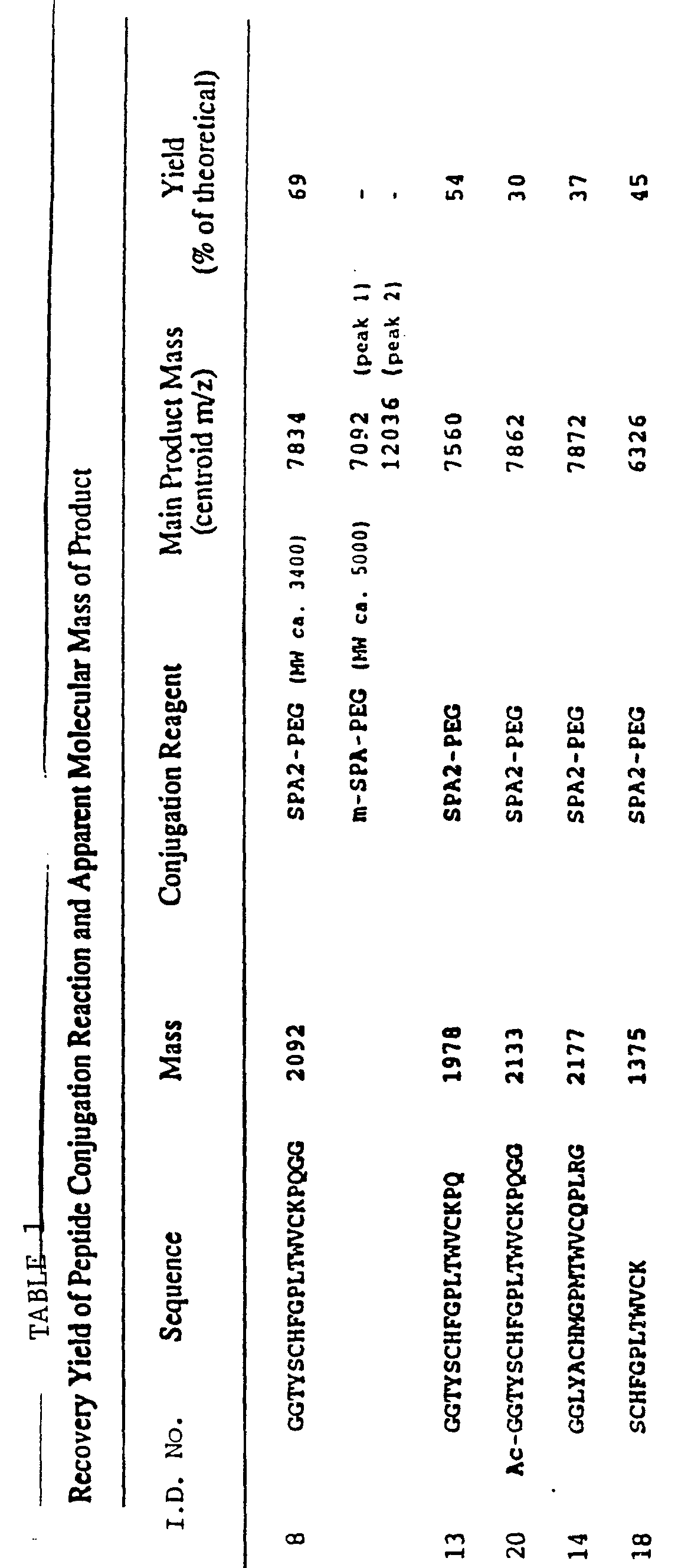
- Example 8 After preparative HPLC and lyophilization, 37 mg of PEG dimer was recovered. The theoretical yield for this experiment was 55 mg based on a calculated mass of 7600 mg/mmol for a yield of 68% (Table I).
- the modification of peptide was carried out by resuspending 11.2 mg (0.0033 mmol) of polymer in 2.5 ml PBS at pH 7.5, and adding a ca. 3 fold molar excess of peptide (SEQ ID NO: 13) (0.010 mmol, 20 mg, MW 1978) dissolved in 0.25 ml of 0.1%
- the modification of peptide was carried out by resuspending 10.5 mg (0.0031 mmol) of polymer in 2.5 ml PBS at pH 7.5, and adding a ca. 3 fold molar excess of peptide (SEQ ID NO: 20) (0.0094 mmol, 20 mg, MW 2133) dissolved in 0.25 ml of 0.1%
- the modification of peptide was carried out by resuspending 2.6 mg (0.00076 mmol) of polymer in 3.0 ml PBS at pH 7.5 and adding a ca. 3 fold molar excess of peptide (SEQ ID NO: 14) (0.00229 mmol, 5 mg, MW 2177) dissolved in 0.1 ml of 0.1% trifluoroacetic acid. The mixture was incubated on ice for 26 hours. At that time, 0.25 ml of 1 M-tris-HCl at pH 7.5 was added. The reaction mixture was incubated at 4°C for 1 hour. The sample was subjected to analytical and preparative HPLC using the flatter gradient system described in Example 8. The main preparative reaction product peak eluted at ca 46 minutes. After preparative HPLC and lyophilization, 2.2 mg of PEG dimer was
- the modification of peptide was carried out by resuspending 1.2 mg (0.00036 mmol) of polymer in 0.5 ml PBS at pH 7.5, and adding a ca. 3 fold molar excess of the peptide (0.0011 mmol, 1.5 mg, MW 2177) dissolved in 0.05 ml of 0.1% trifluoroacetic acid. The mixture was incubated on ice for 20 hours. At that time, 0.1 ml of 1 M tris-HCl at pH 7.5 was added. The reaction mixture was incubated at 4°C for 1 hour. The sample was subjected to purification using an analytical HPLC system as described in Example 8. The main
- the main product reaction product peak was purified by preparative reverse phase HPLC on the same chromatographic system using a Vydac C-18 Protein- Peptide column (2.2 ⁇ 25 cm, part no. 218TP15022).
- the activated PEG used in these experiments has an approximate molecular weight of 3400 and has amine reactive succinimidyl groups on either end of the difunctional linear polymer. Thss reactivity was
- Peptide (SEQ ID NO: 8) contains two potentially reactive amines, one at the N-terminus of the peptide and one in the side chain of the single lysine within the peptide sequence, so that a number of different connectivities between the two molecules was possible.
- This example demonstrates the interaction of peptide (SEQ ID NO: 8), peptide (SEQ ID NO: 16), peptide (SEQ ID NO: 18) and peptide (SEQ ID NO: 13) with EPO binding protein (EBP) using a bifunctional sulphydryl reactive crosslinker, (1,4-Di-[3'-(2'-pyridyldithio)propionamido]butane DPDPB.
- EBP EPO binding protein
- DPDPB bifunctional sulphydryl reactive crosslinker
- dimerization is a property of the EPO peptide series and that the presence of the tyrosine is critical for this activity and that this corresponds to in vitro
- EPO binding protein EBP
- EPO binding protein produced by this method contains one free sulfhydryl group which can be modified without effecting the solution phase binding of ligand.
- the EPO binding protein was covalently attached to agarose beads.
- Sufolink beads (Pierce Chemical Co, Rockford, IL) is specific for free thiols and assures that the linkage is not easily reversible.
- EBP-Sulfolink beads were made as follows: SulfoLink gel suspension (10 ml) was mixed with of coupling buffer (40 ml: 50 mM Tris, pH 8.3, 5 mM EDTA) and the gel was allowed to settle. The
- the EPO binding protein (0.3-1 mg/ml in coupling buffer) to be bound was added directly to the washed beads.
- the mixture was rocked gently for 30 minutes at room temperature and the beads were allowed to settle for 1 hour at room temperature. The supernatant was removed and retained.
- the beads were washed twice with 20 ml of coupling buffer. The washes were recovered as well. The beads were then treated with 20 ml of 0.05 M cysteine for 30 minutes at room temperature to block unbound sites. Finally, the beads were washed with 50 ml of 1 M NaCl, then with 30 ml of PBS, and resuspended in 20 ml of PBS and stored at 4°C.
- the amount of EBP which was covalently bound to the beads was determined by comparing the OD 280 of the original EBP solution to the total OD 280 recovered in the reaction supernatant and the two 20 ml washes.
- Binding assays were initiated by the addition of EPO binding protein beads (50 ⁇ l) to individual reaction tubes. Total binding was measured in tubes containing 0.3-30 nM [ 125 I]EPO (NEN Research Products, Boston MA, 100 ⁇ Ci/ ⁇ g). For determination of
- concentration DMSO has no detectable effect since an examination of the sensitivity of the assay to DMSO demonstrated that concentrations of up to 25% DMSO (V/V) had no deleterious effect on binding. Non-specific binding was measured in each individual assay by
- This example shows the improved potency of PEG-EPO peptide dimers to EPO receptors in human and murine cell lines.
- FDC-Pl/ER or FDC-Pl/trER cells were grown to stationary phase, centrifuged, washed with RPMI 1640 media (no EPO), and plated in EPO minus media for 24 hr.
- Results are expressed as the amount of peptide or dimer peptide necessary to yield one half of the maximal activity obtained with recombinant EPO.
- the initial lot of PEG-peptide (SEQ ID NO: 8) dimer demonstrated ED 50 values of 0.01 ⁇ m and 0.0015 ⁇ m in EPO responsive cell lines containing the murine or human EPO receptor, respectively.
- the parent peptide, peptide (SEQ ID NO: 8) demonstrated an ED 50 of 0.1 ⁇ M, indicating an increase in potency of 10 fold in the murine receptor line and almost 60 fold in the human receptor containing cells.
- the dimer was clearly more potent in murine and human lines than the peptides themselves.
- the dimer product of PEG-peptide (SEQ ID NO: 13) is also more active than the unconjugated parent compound (Table II). Both of these dimer peptides have ultimate ED 50 values near 0.002 ⁇ M. In spite of this more modest increase, the experimental evidence clearly indicates that the dimerization of these peptides with PEG results in improved potency.
- peptide molecules which contained only an internal lysine group were used peptide (SEQ ID NO: 8) analog acetylated at the N-terminus peptide (SEQ ID NO: 20) and a sequence analog peptide (SEQ ID NO: 14) which only had a reactive N-terminal amine were PEG dimerized.
- mice were placed in ambient pressure for 72 hours prior to dosing.
- Test samples or recombinant Human Erythropoietin (rHuEPO) standards were diluted in an assay vehicle consisting of Phosphate Buffered Saline (PBS)-0.1% Bovine Serum Albumin (BSA).
- PBS Phosphate Buffered Saline
- BSA Bovine Serum Albumin
- Peptide sample stock solutions (excluding peptide dimers) were first solubilized in dimethyl sulfoxide (DMSO).
- Control groups included one group of vehicle alone, and one group of (DMSO) at final concentration of 1%.
- mice contained 10 mice. Mice were injected subcutaneously (scruff of neck) with 0.5 ml of the appropriate sample. Forty eight hours following the sample injection, the mice were administered an
- mice were sacrificed forty eight hours following the [ 59 Fe] injection. Blood was collected from each animal by cardiac puncture and hematocrits were determined
- mice heparin was used as the anticoagulant.
- Each blood sample (0.2 ml) was analyzed for [ 59 Fe] incorporation using a Packard gamma counter.
- Non-responder mice heparin was used as the anticoagulant.
- mice i.e.,those mice with radioactive incorporation less than the negative control group
- Mice that had hematocrit values less than 53% were also eliminated.
- This assay examined the ability of an exogenously administered compound to induce new red blood cell synthesis, or in other words to function as EPO or an EPO mimetic.
- the results are derived from sets- of 10 animals for each experimental dose. As shown in Figure 7 and Table IV, the data suggests that on a mole equivalent basis, peptide (SEQ ID NO: 8)/PEG-dimer is about 10 fold more active than peptide (SEQ ID NO: 8) monomer.
- PEG dimer and the monomer parent peptide RWJ 61718 were compared in the exhypoxic mouse bioassay (Table 1) .
- This peptide exhibited an 80 fold increase in in vitro activity upon dimerization.
- Murine studies (in vivo) of the activity of the dimer compared to the monomer peptide revealed a 250 fold increase in activity of RWJ 61718 upon dimerization.
- Cellular proliferation studies on this dimer peptide in murine receptor containing cells demonstrated a 16 fold increase over the monomer indicating that the 250 fold increase in vivo might be attributable to other factors such as altered metabolism or prolonged circulatory half-life which occur upon PEG dimerization of the peptide sequence.
- the PEG modification has an effect which impacts in vivo activity and may be specific to individual peptide sequences.
- EPO binding for cell associated human EPO receptors was performed Erythropoietin Receptor Competition Binding Analysis was preformed as follows. TF-1 cells were maintained in RPMI 1640, 10% fetal calf serum, 1% L-glutamine, 1% penicillin, 0.1%
- [1251-EPO was obtained from NEN Research Products. Cells were centrifuged and washed 1 x with binding buffer (RPMI 1640, 5% BSA, 25 mM Hepes, pH 7.5, 0.02% sodium azide) resuspended in binding buffer, and counted using trypan lue as an indicator of viability. Each reaction contained approximately 5 ⁇ 10 5 cells, [125]-EPO (0.5 nM), no competitor or peptide or dimer preparation in a final volume of 200 ⁇ l. The binding reactions (in duplicate) were incubated overnight at 4oC.
- binding buffer RPMI 1640, 5% BSA, 25 mM Hepes, pH 7.5, 0.02% sodium azide
- the tubes were centrifuged at 12,000 rpro for 1 min at 4oC in a refrigerated centrifuge. The supernatant was removed, the cell pellet resuspended in 100 ⁇ l of binding buffer, and the cell suspension layered onto 0.7 ml of bovine calf serum. The tubes were centrifuged at 12,000 rpm for 5 min at 4oC, the supernatant was removed, the bottom of the tubes snipped off, and the cell pellets counted in a Micromedic ME plus gamma counter. Non-specific binding was determined by incubating cells with (1251 -EPO and a 100-fold excess of non-radioactive EPO.
- Peptide dimerization therefore likely results in entropic rather than enthalpic gains upon mimetic ligand-receptor association for some peptide dimer sequences.
- the ability to compete for cell associated receptors is increased by dimerization. This may be due to the ability of the cell associated receptor to dimerize while the immobilized EBP monomer likely cannot.
Abstract
The present invention is directed to the dimerization of agonists and antagonists of cell surface receptors and particularly to peptide dimers which behave as cell surface receptor agonists in their dimeric form. Such receptors belong to the dimerization-mediated activation class often observed among receptors for growth and differentiation factors. The agonists of this class of receptors is understood to effect dimerization of the receptor and thus signal initiation. The present invention exemplifies dimers of erythropoietin (EPO) agonists and antagonists comprising a core amino acid sequence of X3X4X5GPX6TWX7X8 (SEQ ID NO: 1) wherein each amino acid is indicated by standard one letter abbreviation; X3 can be C, A, α-amino-η-bromobutyric acid or Hoc; X4 can be R, H, L or W; X5 can be M, F, or I; X6 is idependently selected from any one of the 20 genetically coded L-amino acids or the stereoisomeric D-amino acids; X7 can be D, E, I, L or V; and X8 can be C, A, α-amino-η-bromobutyric acid or Hoc, provided that either X3 or X8 is C or Hoc.
Description
AGONIST PEPTIDE DIMERS
FIELD OF THE INVENTION
The present invention is directed to the dimerization of agonists and antagonists of cell surface receptors and particularly to peptide dimers which behave as cell surface receptor agonists in their dimeric form. Such receptors belong to the
dimerization-mediated activation class often observed among receptors for growth and differentiation factors. The agonists of this class of receptors is understood to effect dimerization of the receptor and thus signal initiation. The present invention exemplifies dimers of erythropoietin (EPO) agonists and antagonists comprising a core amino acid sequence of X3X4X5GPX6TWX7X8 (SEQ ID NO: 1) wherein each amino acid is indicated by standard one letter abbreviation; X3 can be C, A, α-amino-γ- bromobutyric acid or Hoc; X4 can be R, H, L or W; X5 can be M, F, or I; X6 is independently selected from any one of the 20 genetically coded L-amino acids or the
stereoisomeric D-amino acids; X-, can be D, E, I, L or V; and X8 can be C, A, α-amino-γ-bromobutyric acid or Hoc, provided that either X3 or X8 is C or Hoc.
BACKGROUND OF THE INVENTION
Erythropoietin (EPO) is a glycoprotein hormone with an approximate molecular weight of 34,000 daltons. The primary role of EPO, which is synthesized in the kidneys of mammals, is to stimulate raitotic ceil division and differentiation of erythrocyte precursor cells. As a result, EPO acts to stimulate and to
regulate the production of erythrocytes. Erythrocytes, and the hemoglobin contained therein, play a central role in supplying oxygen to the body. Thus, the stimulation of erythrocyte production is able to increase the oxygen-carrying capacity of the blood.
During normal conditions, EPO is present in very low concentrations in plasma. Under hypoxic conditions, the amount of EPO in the circulation is increased in response to reduced O2 blood levels.
Hypoxia may be caused from various conditions including the loss of large amounts of blood, destruction of red blood cells by over-exposure to radiation or
chemotherapeutic agents, reduction in oxygen intake due to high altitudes or prolonged unconsciousness, or by various forms of anemia. As the hypoxic condition diminishes, the amount of EPO produced subsequently diminishes.
Because of the essential role of EPO in red blood cell formation, the hormone is useful in both the diagnosis and the treatment of blood disorders
characterized by low or defective red blood cell production. Recent studies provide a basis for the efficacy of EPO therapy in a variety of disease states, disorders, and states of hematologic irregularity, including: beta-thalassemia (See, Vedovato et al.
(1984) Acta. Haematol. 71: 211-213); cystic fibrosis (See, Vichinsky et al. (1984) J. Pedlatric 105; 15-21); pregnancy and menstrual disorders (See, Cotes et al. (1983) Brit. J. Ostet. Gyneacol. 90:304-311); early anemia of prematurity (See, Haga et al. (1983) Acta Pediatr. Scand. 72:827-831); spinal cord injury (See,
Claus-Walker et al. (1984) Arch. Phys. Med. Rehabil.
65 : 370-374); space flight (See, Dunn et al. (1984) Eur. J. Appl. Physiol. 52:178-182); acute blood loss (See, Miller et al. (1982) Brit. J. Haematol. 52:545-590);
aging (See, Udupa et al. (1984) J. Lab. Clin. Med.
103:574-588); various neoplastic disease states
accompanied by abnormal erythropoiesis (See, Dainiak et al. (1983) Cancer 5:1101-1106); and renal insufficiency (See, Eschbach et al. (1987) N. Enq. J. Med. 316:73-78).
Although purified, homogenous EPO has been characterized, little is known about the mechanism of EPO-induced erythroblast proliferation and
differentiation. The specific interaction of EPO with progenitor cells of immature red blood cells, platelets, and megakaryocytes has not been described. This is due in part, to the small number of surface EPO receptor molecules on normal erythroblasts and on the
erythroleukemia cell lines. See Krantz and Goldwasser (1984) Proc. Natl. Acad. Sci. USA, 81:7574-7578; Branch et al. (1987) Blood 69:1782-1785; Mayeux et al. (1987) FEBS Letters 211:229-223; Mufson and Gesner (1987) Blood 69: 1485-1490; Sakaguchi et al. (1987) Biochem. Blophys. Res. Commun. 146:7-12; Sawyer et al. (1987) Proc. Natl. Acad. Sci. USA 84:3690-3694; Sawyer et al. (1987) J. Biol. Chem. 262: 5554-5562; and Todokoro et al. (1988) Proc. Natl. Acad. Sci. USA 84:4126-4130. The DNA sequences and encoded peptide sequences for murine and human EPO receptor proteins have been described. See, D'Andrea et al. PCT Patent Publication No. WO 90/08822 (published 1990).
The EPO-receptor (EPO-R) belongs to the class of growth-factor-type receptors which are activated by a ligand-induced protein dimerization. Other hormones and cytokines such as human growth hormone (hGH),
granulocyte colony stimulating factor (G-CSF), epidermal growth factor (EGF) and insulin can cross-link two receptors resulting in juxtaposition of two cytoplasmic tails. Many of these dimerization-activated receptors have protein kinase domains within the cytoplasmic tails that phosphorylate the neighboring tail upon
dimerization. While some cytoplasmic tails lack
intrinsic kinase activity, these function by association with protein kinases. The EPO receptor is of the latter type. In each case, phosphorylation results in the activation of a signaling pathway.
In accordance with the present invention, it has been discovered that the dimerization of peptide agonists and antagonists of dimerization-mediated receptors, such as EPO-R, increase the biological efficacy relative to the biological activity of the 'monomeric' agonists and alters the properties of the antagonists such that, these dimers function as
agonists, exhibiting biological activity.
SUMMARY OF THE INVENTION
In a first embodiment, the present invention is directed to peptide dimers which behave as cell- surface receptor agonists, dimers which exhibit binding and signal initiation of growth factor-type receptors. In one embodiment, the present invention provides peptide dimers which behave as EPO agonists. These
dimers have two 'monomeric' peptide units of 10 to 40 or more amino acids, preferably 14 to about 20 residues in length, comprising a core amino acid sequence of
X3X4X=GPX6TWX7X8 (SEQ ID NO: 1) where each amino acid is indicated by standard one letter abbreviation; X3 can be C, A, α-amino-γ-bromobutyric acid, or Hoc, where Hoc is homocysteine; X4 can be R, H, L, or W; X5 can be M, F, or I; X6 is independently selected from any one of the 20 genetically coded L-amino acids or the stereoisomeric D-amino acids; X7 can be D, E, I, L, or V; and X8 can be C, A, α-amino-γ-bromobutyric acid, or Hoc, where Hoc is homocysteine, provided that either X3 or Xθ is C or Hoc. Preferably, the monomeric peptide unit of the dimer comprises a core sequence YX2X3X4X5GPX6TWX7X8 (SEQ ID NO: 2) where each amino acid is indicated by standard one letter abbreviation; each X2 and X6 is independently selected from any one of the 20 genetically coded L- amino acids; X3 can be C, A, α-amino-γ-bromobutyric acid, or Hoc, where Hoc is homocysteine; X4 can be R, H, L, or W; X5 can be M, F, or I; X7 can be D, E, I, L, or V; and X8 can be C, A, α-amino-γ-bromobutyric acid, or Hoc, where Hoc is homocysteine, provided that either X3 or X8 is C or Hoc.
More preferably, the monomeric peptide unit of the dimer comprises a core sequence of amino acids
X1YX2X3X4X5GPX6TWX7X8X9X10X11 (SEQ ID NO: 3), where each amino acid is indicated by standard one letter
abbreviation; each X1, X2, X6, X9, X10, and X11 is independently selected from any one of the 20
genetically coded L-amino acids; X3 can be C, A, α- amino-γ-bromobutyric acid, or Hoc, where Hoc is
homocysteine; X4 can be R, H, L, or W; X5 can be M, F, or I; X7 can be D, E, I, L or V; and X8 can be C, A, α- amino-γ-bromobutyric acid, or Hoc, where Hoc is
homocysteine, provided that either X3 or X8 is C or Hoc.
In a more preferred embodiment, both X3 and X8 are C and thus, the monomeric peptide unit of the dimer comprises a core sequence of amino acids
X1YX2CX4X5GPX6TWX7CX9X10χ11 (SEQ ID NO: 4). More preferably, the monomeric peptide unit comprises a core sequence of amino acids X1YX2CX4X5GPX6TWX7CX9X10X11 (SEQ ID NO: 5), where X4 can be R or H; X5 can be F or M; X6 can be I, L, T, M, or V; X7 is D or V; X9 can be G, K, L, Q, R, S, or T; and X10 can be A, G, P, R, or Y. In a most preferred embodiment, the monomeric peptide unit of the dimer will comprise a core sequence of amino acids X1YX2CX4X5GPX6TWX7CX9X10X11 (SEQ ID NO: 6), where X1 can be D, E, L, N, S, T, or V; X2 can be A, H, K, L, M, S, or T; X4 is R or H; X9 can be K, R, S, or T; and X10 is P. Particularly preferred monomeric peptide units of the dimers include:


Other particularly preferred monomeric peptide units of the present dimers include peptides comprising a core sequence of the formula (AX2)nX3X4X5GPX6TWX7X8 (SEQ ID NO: 19) wherein X2 through X8 are as previously defined herein (SEQ ID NO: 2), n is 1 or 0 and A is any one of the naturally occurring L-amino acids except Y (tyrosine); n is defined herein as the number of
occurrences of (AX2-) which can be 1 or none in the core sequence. When (AX2-) is present, i.e. when n = 1, A is not tyrosine and A is not any non-naturally occurring aromatic amino acid analog. Such monomeric peptide units of the dimers of this invention can be prepared by truncating the peptides of Fig. 9, for example, from the N-terminus to delete the Y, tyrosine residue in SEQ ID NOS. 21 - 93. Such monomeric peptides can also be prepared by substitution of Y in position A in the peptides of Fig. 9.
In accordance with the present invention the monomeric units of the dimers can be the same or
different.
In a preferred embodiment polyethylene glycol
(PEG) is employed as a linker to form the dimeric peptides of the present invention through a covalent bond.
In another embodiment, the present invention is directed to pharmaceutical compositions comprising at least one dimer peptide of the invention and a
pharmaceutical carrier.
In a further embodiment, the present invention provides a method for therapeutically treating a mammal having a condition resulting from a hormone or growth factor deficiency by administration of at least one of the dimer peptides of the present invention.
In a still further embodiment, a method for therapeutically treating a mammal having a condition resulting from a deficiency of EPO or from reduced levels of blood oxygen caused by a decrease in
erythrocyte number is provided.
In another embodiment of this invention, a method is provided for preparing agonists of cell-surface receptors wherein agonists of the class of cell- surface or dimerization-mediated receptors are dimerized to enhance the in vitro or in vivo biological activity of the cell-surface receptor relative to the monomeric agonists from which the dimer is derived. This method is also directed to the preparation of agonists of such growth-factor-type receptors by dimerizing antagonists of these receptors; the dimerized 'antagonists' thereby exhibit agonist biological activity in vitro and in vivo. In a preferred embodiment, the present method is directed to the preparation of EPO-R dimer agonists from monomeric EPO-R antagonists.
BRIEF DESCRIPTION OF THE DRAWINGS
Fig. 1 shows a major peak, with a retention time of 37 minutes, of the dimerized EPO peptide,
GGTYSCHFGPLTWVCKPQGG (SEQ ID NO: 8)
Fig. 2 shows a major peak, with a retention time of 48 minutes, following purification of the dimerized EPO peptide, (SEQ ID NO: 8).
Fig. 3 depicts the MALDI-TOF mass spectral analysis of the dimerized peptides, including peptide (SEQ ID NO: 8), GGTYSCHFGPLTWVCKPQ (SEQ ID NO: 13) and SCHFGPLTWVCK (SEQ ID NO: 18).
Fig. 4 shows the SDS-PAGE analysis of DPDPB crosslinking of EPO binding protein (EBP) in the
presence and absence of EPO agonist peptides.
Fig. 5 demonstrates equilibrium EPO binding to immobilized EPO binding protein. Panel A represents the equilibrium binding data and Panel B (inset) is the linear transformation (Scatchard) of the data set in Panel A.
Fig. 6 depicts the results of a competitive binding assay run on the EPO agonist peptide
(SEQ ID NO: 8) in competitive binding with [125I]EPO to EBP beads (Panel A); and EPO responsive cell
proliferation studies in FDC-P1 derived cell lines containing either a human (Panel B) or murine EPO receptor (Panel C).
Fig. 7 is a graphic representation of the results of the exhypoxic mouse bioassay; stimulation of the incorporation of [59Fe] into nascent red blood cells by EPO, peptide (SEQ ID NO: 8) (Panel A) and peptide (SEQ ID NO: 8) dimer (Panel B).
Fig. 8 demonstrates the effect of PEG
dimerization of peptide (SEQ ID NO: 18) activity in EPO responsive cell proliferation studies in FDC-P1 derived cell lines containing a human EPO receptor.
Fig. 9 provides the sequences of representative monomeric peptides of the present
invention.
DETAILED DESCRIPTION OF THE INVENTION
The present invention is directed to peptide dimers which behave as cell surface receptor agonists, dimers which exhibit binding and signal initiation of growth-factor-type receptors. Sometimes called cell-surface receptors, growth-factor-type receptors or dimerization-mediated activator-receptors, these are a class of molecules which are understood to be activated by ligand-induced or ligand stabilized dimerization.
Agonists of such receptors typically include large polypeptide hormones including the cytokines, insulin and various other growth or differentiation factors. The agonists are understood to induce dimerization of the receptor and thereby effect signal initiation. Such agonists are believed to effectively cross-link two receptors resulting in the repositioning of cytoplasmic tails which may directly or indirectly effect
phosphorylation of the cytoplasmic tails and activation of a signaling pathway.
The present invention specifically includes those molecules which behave as agonists of cell-surface receptors when dimerized in accordance with this
invention. Such dimer agonists can include 'monomeric' units which exhibit agonist or antagonist activity for the related receptor molecule and may be the same or different. The dimers are preferably peptides but may alternatively be small molecule pharmacophores. These molecules when dimerized exhibit agonist activity of
cell-surface receptors in vitro and in vivo. Such
receptors include, for example, EPO, GM-CSF, G-CSF, M-CSF, GH, EGF, PDGF, VEGF, Insulin and FGF. Other
receptors which are activated by heterodimerization or multimerization may also be subject to activation by this mechanism including, IL-3, IL-5, IL-6, IL-2 and TPO. The dimers of the present invention have two
'monomeric' peptide units of 10 to 40 or more amino acids, preferably 14 to about 20 amino acid residues in length. In a preferred embodiment, these monomeric peptide units comprise a core sequence of amino acids X3X4X5GPX6TWX7X5 (SEQ ID NO: 1) where each amino acid is indicated by standard one letter abbreviation; X3 can be C, A, α-amino-γ-bromobutγric acid, or Hoc, where Hoc is homocysteine; X4 can be R, H, L, or W; X5 can be M, F, or I; X6 is independently selected from any one of the 20 genetically coded L-amino acids or the stereoisomeric D-amino acids; X-, can be D, E, I, L, or V; and X8 can be C,-A, α-amino-γ-bromobutyric acid, or Hoc, where Hoc is homocysteine, provided that either X3 or X8 is C or Hoc. Preferably, the monomeric peptide unit of the dimer comprises a core sequence YX2X3X4X5GPX6TWX7X8 (SEQ ID NO: 2) where each amino acid is indicated by standard one letter abbreviation; each X3 and X6 is independently selected from any one of the 20 genetically coded L- amino acids; X3 can be C, A, α-amino-γ-bromobutyric acid, or Hoc, where Hoc is homocysteine; X4 can be R, H, L, or W; X5 can be M, F, or I; X7 can be D, E, I, L, or V; and X8 can be C, A, α-amino-γ-bromobutyric acid, or Hoc, where Hoc is homocysteine, provided that" richer X3 or X8 is C or Hoc.
More preferably, the monomeric peptide unit of the dimer comprises a core sequence of amino acids
X1YX2X3X4X5GPX6TWX7X8X9X10X11 (SEQ ID NO: 3), where each amino acid is indicated by standard one letter
abbreviation; each X1, X2, X6, X9, X10, and X11 is independently selected from any one of the 20
genetically coded L-amino acids; X3 can be C, A,
α-amino-γ-bromobutyric acid, or Hoc, where Hoc is homocysteine; X4 can be R, H, L, or W; X5 can be M, F, or I; X7 can be D, E, I, L or V; and X8 can be C, A, α-amino-γ-bromobutyric acid, or Hoc, where Hoc is homocysteine, provided that either X3 or X8 is C or Hoc.
In a more preferred embodiment, both X3 and X8 will be C and thus, the monomeric peptide unit of the dimer comprises a core sequence of amino acids
X1YX2CX4X5GPX6TWX7CX9X10X11 (SEQ ID NO: 4). More preferably, the monomeric peptide unit comprises a core sequence of amino acids X1YX2CX4X5GPX6TWX7CX9X10X11 (SEQ ID NO; 5), where X4 can be R or H; X5 can be F or M; X6 can be I, L, T, M, or V; X7 is D or V; X9 can be G, K, L, Q, R, S, or T; and X10 can be A, G, P, R, or Y. In a most preferred embodiment, the monomeric peptide unit of the dimer comprises a core sequence of amino acids
X1YX2CX4X5GPX6TWX,CX9X10X11 (SEQ ID NO: 6), where X1 can be D, E, L, N, S, T, or V; X2 can be A, H, K, L, M, S, or T; X4 is R or H; X9 can be K, R, S, or T; and X10 is P. Particularly preferred monomeric peptide units of the present dimers include:

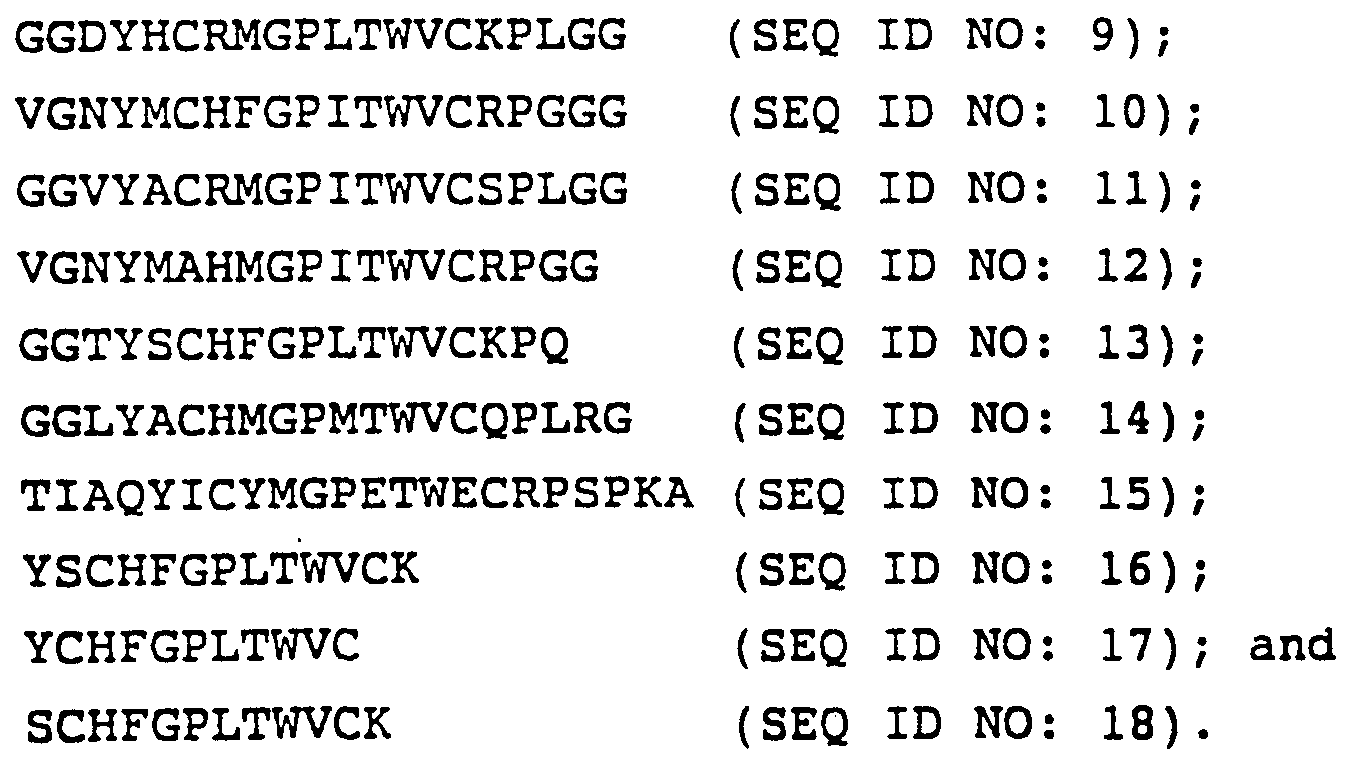
The dimer peptides of the present invention exhibit increased biological potency in vitro and in vivo relative to the monomeric agonists from which the dimers are derived. Moreover, cell surface receptor antagonists can be 'converted' to cell surface receptor agonists in accordance with the present invention.
Specifically, a cell surface receptor antagonist can be dimerized with PEG or another appropriate linker which permits mutual binding of the monomeric moieties with the receptors. As a result, the dimer exhibits
effective binding to the target receptor and behaves as an agonist. Accordingly, the dimers of this invention demonstrate enhanced biological potency in vitro and in vivo relative to their monomeric forms.
The dimer peptides of the present invention bind to and biologically activate the cell surface receptor or otherwise behave as agonists and are preferably formed by employing polyethylene glycol as a linker between the monomeric peptide units described herein. While other conventional chemical systems can
also be employed to form the dimer peptides of this invention including using other known polymeric
compounds, pegylation is preferred.
The linking compounds of the present invention include any molecule which covalently binds the
monomeric peptides at an appropriate distance or which otherwise effects dimerization of the particular cell surface receptor thereby initiating biological efficacy.
Starting with an appropriate synthetic
peptide, containing a free amino group or other reactive site such as hydroxyls, carboxylic acids or sulfhydryls, the peptide is added in excess to a reaction mixture containing a corresponding reactive polymer. The polymer can be of a repeating nature such as
polyethylene glycol, peptides, modified peptides or peptide analogs. Alternatively, the peptide can be dimerized on a small molecule scaffold such as activated benodiazepins, oxazolones, azalactones, aminimides or diketopiperazines. The most readily available linker of variable distance are ones based on linear unbranched polyethylene glycols.
The following is a schematic of a preferred preparatory methodology employing PEG succinimidyl propionate as the linker between the monomer units of the dimer peptides.

Dimerization and especially pegylation in a head-to-head (amino to amino terminus) or head-to-tail (amino to carboxyl terminus) configuration is preferred relative to internal covalent binding of the monomeric peptides. The 'monomer' units of the dimer peptides of the present invention can be the same or different, although the same are preferred.
The monomeric peptides which are used to form the dimers of the present invention can be prepared by classical chemical methods well known in the art. The standard methods include, for example, exclusive solid phase synthesis and recombinant DNA technology. See, e.g. Merrifield (1963) J. Am. Chem. Soc. 85:2149. Solid phase synthesis is typically commenced from the C- terminal end of the peptide using an α-amino protected resin. A suitable starting material can be prepared by attaching the required α-amino acid to a
chloromethylated resin (such as BIO-BEADS SX-1, Bio Rad Laboratories, Richmond, CA), a hydroxymethyl resin, (described by Bodonszky et al. (1966) Chem. Ind .
(London) 38:1597) or a benzhydrylamine resin (described by Pietta and Marshall (1970) Chem. Commn. 650).
The α-amino protecting groups are those known to be useful in the art of stepwise synthesis or
peptides. Included are acyl type protecting groups (e.g. formyl, trifluoroacetyl, acetyl), aromatic
urethane type protecting groups (e.g. benzyloxycarboyl (Cbz) and substituted Cbz), aliphatic urethane
protecting groups (e.g., t-butyloxycarbonyl (Boc), isopropyloxycarbonyl, cyclohexyloxycarbonyl) and alkyl type protecting groups (e.g., benzyl and
triphenylmethyl). The preferred X-amino protecting group is Fmoc. The side chain protecting group
(typically ethers, esters, trityl, PMC, and the like) remains intact during coupling and is not split off during the deprotection of the amino-terminus protecting group or during coupling. The side chain protecting group must be removable upon the completion of the synthesis of the final peptide and under reaction conditions that will not alter the target peptide.
The side chain protecting groups for Tyr include tetrahydropyranyl, tert-butyl, trityl, benzyl, Cbz, Z-Br-Cbz, and 2,5-dichlorobenzyl. The side chain protecting groups for Asp include benzyl, 2,6- dichlorobenzyl, methyl, ethyl, and cyclohexyl. The side chain protecting groups for Thr and Ser include acetyl, benzoyl, trityl, tetrahydropyranyl, benzyl, 2,6- dichlorobenzyl, and Cbz. The side chain protecting groups for Thr and Ser are benzyl. The side chain protecting groups for Arg include nitro, Tosy. (Tos), Cbz, adamantyloxycarbonyl mesitoylsulfonyl (Mts), or
Boc. The side chain protecting groups for Lys include Cbz, 2-chlorobenzyloxycarbonγl (2-Cl-Cbz), 2-bromobenzyloxycarbonyl (2-BrCbz), Tos, or Boc.
After removal of the α-amino protecting group, the remaining protected amino acids are coupled stepwise in the desired order. Each protected amino acid is generally reacted in about a 3-fold excess using an appropriate carboxyl group activator such as 2-(1H-benxotriazol-1-yl)-1,1,3,3tetramethyluronium
hexafluorophosphate (HBTU) or dicyclohexylcarbodiimide (DCC) in solution of methylene chloride (CH2CI2), or dimethyl formamide (DMF) mixtures.
After the desired amino acid sequence has been completed, the desired peptide is decoupled from the resin support by treating the mixture with a reagent such as trifluoroacetic acid (TFA) or hydrogen fluoride (HF). These reagents not only cleave the peptide from the resin, but also cleave all remaining side chain protecting groups. When the chloromethylated resin is used, hydrogen fluoride treatment results in the
formation of the free peptide acids. When the
benzhydrylamine resin is used, hydrogen fluoride
treatment results directly in the free peptide amide. Alternatively, when the chloromethylated resin is employed, the side chain protected peptide can be decoupled by treatment of the peptide resin with ammonia to give the desired side chain protected amide or with an alkylamine to give a side chain protected alkylamide or dialkylamide. Side chain protection is then removed in the usual fashion by treatment with hydrogen fluoride to give the free amides, alkylamides, or dialkylamides.
These procedures can also be used to
synthesize peptides in which amino acids other than the 20 naturally occurring, genetically encoded amino acids are substituted at one, two or more positions of any of the compounds of the invention. For instance,
naphthylalanine can be substituted for tryptophan, facilitating synthesis. Other synthetic amino acids that can be substituted into the peptides of the present invention include L-hydroxypropyl, L-3, 4-dehydroxyphenylalanyl, δ amino acids such as L-δ-hydroxylysyl and D-δ-methylalanγl, L-α-methylalanyl, ß amino acids, and isoquinolyl. D-amino acids and non-naturally occurring synthetic amino acids can also be incorporated into the peptides of the present invention.
In another embodiment of the present invention, a method of enhancing the in vitro or in vivo biological potency of a cell surface receptor agonist is provided. This methodology is achieved by dimerizing the receptor agonist with a linker molecule, such as PEG, to form an appropriate spatial relationship between the monomeric peptide units of the dimer and thereby permitting each of the constituents of the dimers to bind to their receptors to achieve enhanced biological potency, i.e., to dimerize and thereby activate the receptors to induce the relevant biological activity of the particular cell-surface receptor, e.g. EPO-R.
Biological activity can be measured by the skilled artisan in various in vitro and in vivo assays and as demonstrated in the examples of the present invention.
The peptide or molecule with binding affinity for a given receptor will have increased conformational
flexibility leading to fewer barriers to effective receptor interaction and subsequently receptor
activation. This is also indicated for molecules which can bind but not activate a receptor subtype in that such molecules can become more effective inhibitors of ligand binding.
The present invention further provides a method for altering a cell-surface receptor antagonist, a molecule exhibiting receptor binding but no biological activity, to behave as a cell-surface receptor agonist in vitro or in vivo. This method is achieved by
dimerizing the antagonist molecule with an appropriate linker molecule such as PEG, other polymerized molecules or a peptide. In a preferred embodiment, an EPO
antagonist, i.e. a peptide exhibiting receptor binding but no biological EPO activity can be altered by
dimerization to obtain a dimer which behaves as an EPO receptor agonist. Thus, for example, in the case of EPO-R these include the monomeric peptide units of the present dimers comprising a core sequence of general formula (AX2)nX3X4X5GPX6TWX7X8 (SEQ ID NO: 19) wherein X2 through X8 are as previously defined herein, in (SEQ ID NO: 2), n is 1 or 0 and A .is any one of the naturally occurring L-amino acids except Y (tyrosine); n is.
defined herein as the number of occurrences of (AX2) which can be 1 or none in the core sequence. When X2 is present, i.e., when n = 1, A is not tyrosine and A is not any non-naturally occurring aromatic amino acid analog. Such monomeric peptide units of the dimers of this invention can be prepared by truncating the
peptides of Fig. 9, for example, from the N-terminus to
delete the Y, tyrosine residue in SEQ ID NOS. 21 - 93. Such monomeric peptides can also be prepared by
substitution of Y in the peptides of. Fig. 9.
These molecules, demonstrate only binding activity in their 'monomeric' form, but exhibit agonist activity after dimerization with a linking compound such as PEG. Accordingly, the present method comprises identifying a monomeric peptide as herein defined which does not demonstrate biological activity and dimerizing that antagonist in accordance with the present invention to obtain a cell-surface-receptor agonist i.e., in dimeric form. Contacting the appropriate cell-surface receptor with the thus formed dimer activates, i.e.
dimerizes such receptors and thus induces biological activity of the receptor. Such monomeric units as shown in Fig. 9 can be truncated from the N-terminus such as SCHFGPLTWVCK (SEQ ID NO: 18) to eliminate the tyrosine residue at position A of the formula
(AX2)nX3X4X5GPX6TWX7X8 (SEQ ID NO: 19) or merely
substituted with any of the remaining 19 naturally occurring amino acids or with other than a non-naturally occurring aromatic amino acid analog. In accordance with the present invention it has been determined that the tyrosine residue at position A of the foregoing formula is critical to biological activity of the monomer peptide. Deletion or substitution of the tyrosine eliminates biological activity. When dimerized however the entity exhibits enhanced biological
activity.
For example, tyrosine (Y) substituted in the formula YX2X3X4X5GPX7X8 (SEQ ID NO: 2) by p-
iodohydroxyphenylalanine, p-fluorohydroxyphenylalanine, p-amino-hydroxγphenylalanine act as EPO-R monomer agonists but substitution with threonine or alanine for tyrosine at position Y causes the monomer peptide to act as an EPO-R antagonist. However, when dimerized in accordance with the present invention, such dimers behave as EPO-R agonists. The monomeric peptide units identified at Fig. 9, for example, behave as EPO-R antagonists in the absence of tyrosine at position Y of the formula above. When such antagonists are dimerzied, the dimer behaves as an EPO-R agonist.
In a further embodiment of the present
invention, pharmaceutical compositions comprising at least one of the dimers of this invention can be
employed to therapeutically treat disorders resulting from deficiencies of biological factors such as EPO, GH, GM-CSF, G-CSF, EGF, PDGF, VEGF, insulin, FGF and the like. These pharmaceutical compositions may contain buffers, salts and other excipients to stabilize the composition or assist in the delivery of the dimerized molecules.
In a preferred embodiment, the present
invention provides a method for treating disorders associated with a deficiency of EPO. The method is accomplished by administering at least one of the dimers identified herein for a time and under conditions sufficient to alleviate the symptoms of the disorder, i.e. sufficient to effect dimerization or biological activation of EPO receptors. In the case of EPO such methodology is useful in the treatment of end-stage renal failure/dialysis; anemia, especially associated
with AIDS or chronic inflammatory diseases such as rheumatoid arthritis and chronic bowel inflammation;
auto-immune disease; and for boosting the red blood cell count of patient when necessary, e.g. prior to surgery or as pretreatment to transfusion. The dimers of the present invention which behave as EPO agonists can be used to activate megakaryocytes.
Since EPO has been shown to have a mitogenic and chemotactic effect on vascular endothelial cells as well as an effect on central cholinergic neurons (see, e.g., Amagnostou et al. (1990) Proc. Natl. Acad. Sci. USA 87:597805982 and Konishi et al. (1993) Brain Res. 609 :29-35), the compounds of this invention can also be used to treat a variety of vascular disorders, such as promoting wound healing, growth of collateral coronary blood vessels (such as those that may occur after myocardial infarction), trauma, and post vascular graft treatment, and a variety of neurological disorders, generally characterized by low absolute levels of acetyl choline or low relative levels of acetyl choline as compared to other neuroactive substances e.g.,
neurotransmitters.
Accordingly, the present invention includes pharmaceutical compositions comprising, as an active ingredient, at least one of the peptide dimers of the present invention in association with a pharmaceutical carrier or diluent. The dimers of this invention can be administered by oral, parenteral (intramuscular, intraperitoneal, intravenous (IV) or subcutaneous injection), transdermal (either passively or using iontophoresis or electroporation) or transmucosal
(nasal, vaginal, rectal, or sublingual) routes of administration in dosage forms appropriate for each route of administration.
Solid dosage forms for oral administration include capsules, tablets, pill, powders, and granules. In such solid dosage forms, the active compound is admixed with at least one inert pharmaceutically
acceptable carrier such as sucrose, lactose, or starch. Such dosage forms can also comprise, as it normal practice, additional substances other than inert
diluents, e.g., lubricating, agents such as magnesium stearate. In the case of capsules, tablets and pills, the dosage forms may also comprise buffering, agents. Tablets and pills can additionally be prepared with enteric coatings.
Liquid dosage forms for oral administration include pharmaceutically acceptable emulsions,
solutions, suspensions, syrups, with the elixirs
containing inert diluents commonly used in the art, such as water. Besides such inert diluents, compositions can also include adjuvants, such as wetting agents,
emulsifying and suspending agents, and sweetening, flavoring and perfuming agents .
Preparations according to this invention for parenteral administration include sterile aqueous or non-aqueous solutions, suspensions, or emulsions.
Examples of non-aqueous solvents or vehicles are propylene glycol, polyethylene glycol, vegetable oils, such as olive oil and corn oil, gelatin, and injectable organic esters such as ethyl oleate. Such dosage forms may also contain adjuvants such as preserving, wetting.
emulsifying, and dispersing agents. They may be
sterilized by, for example, filtration through a
bacteria retaining filter, by incorporating sterilizing agents into the compositions, by irradiating the
compositions, or by heating the compositions. They can also be manufactured using sterile water, or some other sterile injectable medium, immediately before use.
Compositions for rectal or vaginal
administration are preferably suppositories which may contain, in addition to the active substance, excipients such as cocoa butter or a suppository wax. Compositions for nasal or sublingual administration are also prepared with standard excipients well known in the art.
The dosage of active ingredient in the
compositions of this invention may be varied; however, it is necessary that the amount of the active ingredient shall be such that a suitable dosage form is obtained. The selected dosage depends upon the desired therapeutic effect., on the route of administration, and on the duration of the treatment desired. Generally dosage levels of between 0.001 to 10 mg/kg of body weight daily are administered to mammals.
As can be appreciated from the disclosure above, the present invention has a wide variety of applications. Accordingly, the following examples are offered by way of illustration, not by way of
limitation.
EXAMPLE 1
SDS-PAGE gels (10-20% gradient SDS-PAG plates, 84 × 70 × 1.0 mm, Integrated Separation Systems, Natick, MA) were stained with Coomasie Brilliant Blue R-250
(BioRad). A commercial preparation of activated
difunctional polyethylene glycol (PEG-succinimidyl-propionate, SPA2 , MW ca. 3400) was purchased from
Shearwater Polymers, Huntsville, AL as was the
monofunctional reagent, methoxy-PEG-succinimidyl-proprionate, MW ca 5000. Peptide (SEQ ID NO: 8) and all other peptides were obtained from the Peptide Synthesis Facility RWJ-PRI, La Jolla, CA or Quality Controlled Biochemical, Hopkinton MA. These peptides were cyclized via oxidation of their intramolecular cysteines,
amidated at the C-terminus and mass confirmed by FAB-MS. All were Ellman Reaction negative. Tris base was obtained from BioRad, Hercules, CA. (DPDPB) and
trifluoracetic acid (HPLC grade) were obtained from Pierce Chemical Co., Rockford IL.
Mono-PEG conjugation of peptide GGTYSCHFGPLTWVCKPQGG
(SEQ ID NO: 8)
This example describes the preparation of mono-PEG conjugates of peptide (SEQ ID NO: 8), using the monofunctional amine reactive polymer analog m-SPA-PEG to be used as a control in experiments described herein. The reaction was carried out with polymer in excess (ca. 3 fold) by resuspending 142.5 mg (0.0286 mmol, MW ca. 5000) of polymer in 4 ml PBS at pH 7.5 and adding 20 mg peptide (SEQ ID NO: 8) (0.0095 mmol, MW 2092) dissolved
in 1 ml of 0.1% trifluoroacetic acid. The mixture was incubated on ice for 20 hours. The reaction was subsequently adjusted to a final concentration 50 mM Tris by the addition of 1 M tris-HCl at pH 7.5. The reaction mixture was incubated on ice for one hour. Analytical HPLC suggested that there were two main reaction products of essentially equivalent magnitude which were not baseline resolved. Preparative HPLC (using the flatter gradient system described in Example 8) and conservative cuts resulted in collection of two product peaks eluting at ca 44 and 47 minutes. After lyophilization, 24.8 mg, 16.5 mg of each species was recovered, respectively. Mass spectral analysis of these two species demonstrated centroid masses of 7092 (peak 1) and 12036 (peak 2) indicating the coupling of one or two PEG molecules, respectively, to the peptide (Table I).
Tris inactivated polymer. Tris inactivated polymer was formed by incubation of 5 mM SPA2 polymer dissolved in PBS (Gibco, Gaithersburg, MD) with 50 mM tris-HCl, pH 7.5 added and used without further purification.
EXAMPLE 2
PEG dimerization of peptide GGTYSCHFGPLTWVCKPQGG
(SEQ ID NO: 8) (lot #1)
Examples 2 - 7 describe the dimerization of various peptides described by the present invention.
The modification of peptide (SEQ ID NO: 8) was carried out by resuspending 25 mg (0.0071 mmol) of polymer in 4 ml PBS at pH 7.5, and adding a 3 fold molar excess of peptide (SEQ ID NO: 8) (0.0213 mmol, 44.5 mg, MW 2092) dissolved in 1 ml of 0.1% trifluoroacetic acid. The mixture was incubated on ice. After 3 hours of
incubation, an additional 7.5 mg (0.0036 mmol) of lyophilized peptide was added, resulting in a final ratio of 3.5 moles of peptide per each mole of SPA2.
The mixture was incubated an additional 17 hours on ice. The reaction mixture was adjusted to a final
concentration of 50 mM Tris by the addition of 1 M tris- HCl of pH 7.5 and incubated on ice for 1 hour. The sample was subjected to analytical and preparative HPLC as described in Example 8. After preparative HPLC and lyophilization, 38 mg of PEG dimer was recovered. The theoretical yield for this experiment was 55 mg based on a calculated mass of 7600 mg/mmol for a yield of 69% (Table I).
EXAMPLE 3
PEG dimerization of peptide GGTYSCHFGPLTWVCKPQGG
(SEQ ID NO: 8) (lot #2)
The modification of peptide (SEQ ID NO: 8) was carried out by resuspending 25 mg (0.0071 mmol) of polymer in 4 ml PBS at pH 7.5, and adding a ca. 3 fold molar excess of peptide (SEQ ID NO: 8) (0.0213 mmol, 45.8 mg, MW 2092) dissolved in 1 ml of 0.1%
trifluoroacetic acid. The mixture was incubated on ice for 22 hours. At that time, the reaction was adjusted to a final concentration of 50 mM Tris by the addition of 1 M tris-HCl, pH 7.5. The reaction mixture was incubated on ice for 1 hour. The sample was subjected to analytical and preparative HPLC as described in
Example 8. After preparative HPLC and lyophilization, 37 mg of PEG dimer was recovered. The theoretical yield for this experiment was 55 mg based on a calculated mass of 7600 mg/mmol for a yield of 68% (Table I).
EXAMPLE 4
PEG dimerization of peptide GGTYSCHFGPLTWVCKPQ
(SEQ ID NO: 13)
The modification of peptide (SEQ ID NO: 13) was carried out by resuspending 11.2 mg (0.0033 mmol) of polymer in 2.5 ml PBS at pH 7.5, and adding a ca. 3 fold molar excess of peptide (SEQ ID NO: 13) (0.010 mmol, 20 mg, MW 1978) dissolved in 0.25 ml of 0.1%
trifluoroacetic acid. The mixture was incubated on ice for 20 hours. At that time, 0.25 ml of 1 M tris-HCl at pH 7.5 was added. The reaction mixture was incubated at 4°C for one hour. The sample was subjected to
analytical and preparative HPLC as described in Example 8. The main preparative reaction product peak eluted at ca 43 minutes. After preparative HPLC and
lyophilization, 13.3 mg of PEG dimer was recovered. The theoretical yield for this experiment was 24.42 mg based on a calculated mass of 7400 mg/mmol for a yield of 54% (Table I).
EXAMPLE 5
PEG dimerization of peptide Ac-GGTYSCHFGPLTWVCKPQGG
(SEQ ID NO: 20)
The modification of peptide (SEQ ID NO: 20) was carried out by resuspending 10.5 mg (0.0031 mmol) of polymer in 2.5 ml PBS at pH 7.5, and adding a ca. 3 fold molar excess of peptide (SEQ ID NO: 20) (0.0094 mmol, 20 mg, MW 2133) dissolved in 0.25 ml of 0.1%
trifluoroacetic acid and the mixture incubated at 4°C for 28 hours. At that time, the reaction as monitored by HPLC was estimated to be approximately 30% complete, the temperature was shifted to ambient and an additional 27 hour incubation provided no net increase in product. Because of possible hydrolysis of the reactive polymer, an additional 5 mg of polymer was added and the
incubation was continued for an additional 16 hours. At that time, 0.25 ml of 1 M tris-HCl, pH 7.5 was added and the reaction mix was incubated at 4°C for an additional 1 hour. The sample was subjected to analytical and preparative HPLC using a flatter gradient system as described in Example 8. The main preparative reaction product peak eluting at ca 48 minutes. After
preparative HPLC and lyophilization, 10.4 mg of PEG dimer was recovered. The theoretical yield for this experiment was 34.4 mg based on a calculated mass of 7650 mg/mmol for a yield of 30% (Table I).
EXAMPLE 6
PEG dimerization of peptide (SEQ ID NO: 14)
The modification of peptide (SEQ ID NO: 14) was carried out by resuspending 2.6 mg (0.00076 mmol) of polymer in 3.0 ml PBS at pH 7.5 and adding a ca. 3 fold molar excess of peptide (SEQ ID NO: 14) (0.00229 mmol, 5 mg, MW 2177) dissolved in 0.1 ml of 0.1% trifluoroacetic acid. The mixture was incubated on ice for 26 hours. At that time, 0.25 ml of 1 M-tris-HCl at pH 7.5 was added. The reaction mixture was incubated at 4°C for 1 hour. The sample was subjected to analytical and preparative HPLC using the flatter gradient system described in Example 8. The main preparative reaction product peak eluted at ca 46 minutes. After preparative HPLC and lyophilization, 2.2 mg of PEG dimer was
recovered. The theoretical yield for this experiment was 24.42 mg based on a calculated mass of 7400 mg/mmol for a yield of 37% (Table I).
EXAMPLE 7
PEG dimerization of peptide (SEQ ID NO: 18)
The modification of peptide (SEQ ID NO: 18) was carried out by resuspending 1.2 mg (0.00036 mmol) of polymer in 0.5 ml PBS at pH 7.5, and adding a ca. 3 fold molar excess of the peptide (0.0011 mmol, 1.5 mg, MW 2177) dissolved in 0.05 ml of 0.1% trifluoroacetic acid. The mixture was incubated on ice for 20 hours. At that time, 0.1 ml of 1 M tris-HCl at pH 7.5 was added. The reaction mixture was incubated at 4°C for 1 hour. The sample was subjected to purification using an analytical HPLC system as described in Example 8. The main
reaction product peak eluted at ca 38 minutes. After preparative HPLC and lyophilization, 1 mg of PEG dimer was recovered. The theoretical yield for this
experiment was 2.2 mg based on a calculated mass of 6150 mg/mmol for a yield of 45% (Table I).
EXAMPLE 8
Analytical and Preparative HPLC analysis
The accumulation of the dimers described above in Examples 1-7 was monitored by analytical reverse phase HPLC. The analysis was carried out using a Vydac C-18 Protein-Peptide column (0.46 × 25 cm, part no.
218TP54) and a Rainin Gradient HPLC system fitted with a Dynamax dual wavelength detector. At injection, the column was equilibrated in 0.1% TFA in dH2O and was developed with a 45 minute linear gradient (0-100%) of acetonitrile (ACN) containing 0.1% TFA beginning at 10 minutes after injection. The flow rate was held constant at 1 ml/min. Under these analytical
conditions, the SPA2 polymer and tris inactivated polymer did not appear to bind the column while a major reaction product with a retention time (37 minutes) was identified (Figure 1). Peptide (SEQ ID NO: 8)
demonstrated a retention time of 35 minutes and the excess peptide utilized in the reaction was clearly distinguished from the nascent reaction products.
The main product reaction product peak was purified by preparative reverse phase HPLC on the same chromatographic system using a Vydac C-18 Protein- Peptide column (2.2 × 25 cm, part no. 218TP15022).
Injection of the reaction mix (6 ml) occurred with the column equilibrated at 80:20, H2O:ACN (both containing 0.1% TFA) at a constant flow rate of 8 ml/min. After a 20 minute wash, the column was developed by application of a linear gradient of 100% ACN/0/1% TFA over 60
minutes. The major product peak eluting at 48 minutes was collected and lyophilized (Figure 2). These elution conditions were subsequently modified to improve the resolution of some conjugation products peptide (SEQ ID NO: 20), mPEG-peptide (SEQ ID NO: 8), peptide (SEQ ID NO: 14) from reaction by products. This was
accomplished by application of a flatter linear gradient of 20-80% B over 60 minutes. The variation in retention time due to different peptides and elution condition is described as part of each synthesis example. The
materials recovered from the main product peak from each reaction were subsequently analyzed by analytical
reverse phase HPLC, MALDI-TOF mass spectrometry, EPO competitive binding potential and for in vitro
bioactivity.
The activated PEG used in these experiments has an approximate molecular weight of 3400 and has amine reactive succinimidyl groups on either end of the difunctional linear polymer. Thss reactivity was
employed to couple two equivalents of peptide (SEQ ID NO: 8) (MW= 2092) to the polymer with the concomitant liberation of two succinimidyl moieties resulting in a dimeric product as shown in Scheme I. Peptide (SEQ ID NO: 8) contains two potentially reactive amines, one at the N-terminus of the peptide and one in the side chain of the single lysine within the peptide sequence, so that a number of different connectivities between the two molecules was possible.
MALDI-TOF mass spectral analysis was supportive of the presence of the expected cimeric product (Figure 3) as indicated by a predominant species.
with a centroid mass of 7661. This data shows that the dimeric product described in the present invention was produced using the methods described herein.
EXAMPLE 9
EBP (EPO Binding Protein) Dimerization
This example demonstrates the interaction of peptide (SEQ ID NO: 8), peptide (SEQ ID NO: 16), peptide (SEQ ID NO: 18) and peptide (SEQ ID NO: 13) with EPO binding protein (EBP) using a bifunctional sulphydryl reactive crosslinker, (1,4-Di-[3'-(2'-pyridyldithio)propionamido]butane DPDPB.
To explore the interaction of peptide (SEQ ID NO: 8) with EBP, a bifunctional sulphydryl reactive crosslinker (DPDPB) was used in an attempt to stabilize a mimetic dependent dimeric structure. Control
experiments demonstrated that the crosslinker does not inactivate the EPO binding potential of EBP or the proliferative properties of peptide (SEQ ID NO: 8). As shown in Figure 4, a dimeric EBP product was formed by co-incubation of the peptide, peptide (SEQ ID NO: 8), DPDPB and EBP. This data shows the ability of the peptide (SEQ ID NO: 8) to mediate formation of a soluble receptor dimer. To further explore this question, peptides (SEQ ID NO: 13), (SEQ ID NO: 16) and (SEQ ID NO: 18) were examined for their ability to mediate dimerization. As shown in Figure 4, lanes 7A and 8A, when peptide (SEQ ID NO: 13) was truncated at the carboxyl terminus, it retained good in vitro bioactivity and improved in vivo bioactivity, resulting in a crosslinking signal similar to peptide (SEQ ID NO: 8). However, peptide (SEQ ID NO: 18) did not appear to stabilize the dimerization signal (Figure 4, lanes 9A
and 10A) whereas peptide (SEQ ID NO: 16) (Figure 4, lanes 5A and 6A) gave a strong dimerization band. These two peptides differ by a single N-terminal tyrosine residue and display a similar profile in the in vitro proliferation assay with peptide (SEQ ID NO: 18) being inactive. Peptide (SEQ ID NO: 16) has an ED50 of 3 μM on murine receptor cells. Both peptides have similar IC50 values indicating that they both retain binding activity. These results demonstrate that EBP
dimerization is a property of the EPO peptide series and that the presence of the tyrosine is critical for this activity and that this corresponds to in vitro
bioactivity.
EXAMPLE 10
IMMOBILIZED EBP BASED [ 125I]EPO COMPETITION BINDING ASSAY
This study examined the binding capacity of the EPO PEG dimers to bind EPO receptors.
The extracellular domain of the human erythropoietin receptor (EPO binding protein, EBP) was expressed and overproduced in E. coli. As with many other recombinant eukaryotic proteins produced in E.
coli, the protein appeared as an insoluble product in laboratory scale fermentations and was refolded and purified to obtain active protein. EPO binding protein produced by this method contains one free sulfhydryl group which can be modified without effecting the solution phase binding of ligand. In order to
immobilize the EPO binding protein for equilibrium binding analysis and for competition binding assay, the EPO binding protein was covalently attached to agarose beads.
The iodoacetyl activation chemistry of
Sufolink beads (Pierce Chemical Co, Rockford, IL) is specific for free thiols and assures that the linkage is not easily reversible. EBP-Sulfolink beads were made as follows: SulfoLink gel suspension (10 ml) was mixed with of coupling buffer (40 ml: 50 mM Tris, pH 8.3, 5 mM EDTA) and the gel was allowed to settle. The
supernatant was removed and the EPO binding protein (0.3-1 mg/ml in coupling buffer) to be bound was added directly to the washed beads. The mixture was rocked
gently for 30 minutes at room temperature and the beads were allowed to settle for 1 hour at room temperature. The supernatant was removed and retained. The beads were washed twice with 20 ml of coupling buffer. The washes were recovered as well. The beads were then treated with 20 ml of 0.05 M cysteine for 30 minutes at room temperature to block unbound sites. Finally, the beads were washed with 50 ml of 1 M NaCl, then with 30 ml of PBS, and resuspended in 20 ml of PBS and stored at 4°C. The amount of EBP which was covalently bound to the beads was determined by comparing the OD280 of the original EBP solution to the total OD280 recovered in the reaction supernatant and the two 20 ml washes.
Typically, 40-60% of the applied EBP remains associated with the beads.
Binding assays were initiated by the addition of EPO binding protein beads (50 μl) to individual reaction tubes. Total binding was measured in tubes containing 0.3-30 nM [125I]EPO (NEN Research Products, Boston MA, 100 μCi/μg). For determination of
non-specific binding, unlabelled EPO was added at a level of 1000 fold in excess of the corresponding
[125I]EPO concentration. Each reaction volume was brought to 500 μl with binding buffer (PBS/0.2% BSA). The tubes were incubated for five hours (a time period experimentally determined as adequate for the
establishment of equilibrium) at room temperature with gentle rocking. After five hours, each reaction mixture was passed through a 1 ml pipet tip plugged with glass wool. The tubes were washed with 1 ml wash buffer (PBS/ 5% BSA) and this volume as well as 2 additional 1 ml
washes were passed through the pipet tip and collected for determination of the free EPO concentration.
Equilibrium binding analysis of the specific association of [125I]EPO with EPO mimetic binding proteins
immobilized on these agarose beads indicates a Kd of 5 nM ± 2 based on a linear transformation (Scatchard) of the binding isotherm (Figure 5).
Competitive binding analysis assays of candidate peptides and dimer peptides were performed as outlined below. Individual peptides were dissolved in DMSO to prepare a stock solution 1 mM. Dimer peptides were contained within PBS at a concentration of 5 mM. All reaction tubes (in duplicate) contained 50 μL of EBP beads, 0.5 nM [125I]EPO and 0-500 μM peptide in a total of 500 μL binding buffer.
The final concentration of DMSO was adjusted to 2.5% in all peptide assay tubes. At this
concentration DMSO has no detectable effect since an examination of the sensitivity of the assay to DMSO demonstrated that concentrations of up to 25% DMSO (V/V) had no deleterious effect on binding. Non-specific binding was measured in each individual assay by
inclusion of tubes containing a large excess of
unlabelled EPO (1000 nM). Initial assay points with no added peptide were included in each assay to determine total binding. Binding mixtures were incubated
overnight at room temperature with gentle rocking. The beads were then collected using Micro-columns (Isolab, Inc.) and washed with 3 mL of wash buffer. The columns containing the washed beads were placed in 12 × 75 mm glass tubes and bound radioactivity levels determined in
a gamma counter. The amount of bound [125I]EPO was expressed as a percentage of the control (total=100%) binding and plotted versus the peptide concentration after correction for non-specific binding. The IC50 was defined as the concentration of the analyte which reduced the binding of [125I]EPO to the EBP beads by 50%. All data are reported as relative to peptide (SEQ ID NO: 8) which demonstrated an IC50 of 5 μM.
Competitive binding analysis revealed an IC50 of 20 μM for the purified dimer, a value four fold greater than peptide (SEQ ID NO: 8) in the same assay (Figure 5 and Table II). Polymer alone, which was inactivated by treatment with Tris-HCl, demonstrated a detectable competition binding signal but this signal was modest (<10%) at the IC50 of the PEG-peptide (SEQ ID NO: 8) dimer.

EPO DEPENDENT CELL PROLIFERATION ASSAYS
This example shows the improved potency of PEG-EPO peptide dimers to EPO receptors in human and murine cell lines.
Cell line FDC-Pl/ER, an EPO-dependent line expressing the murine EPO receptor, was grown and maintained as described previously (Carroll et al.
1991). Also employed was cell line FDC-Pl/trER
expressing a functional truncated human EPO receptor (missing the C-terminal 40 amino acids). Both cell lines exhibit EPO dependent cellular proliferation.
Briefly, cells were maintained in RPMI 1640 media
(Gibco/BRL) containing 10% heat-inactivated fetal calf serum and 10 units/ml of recombinant human EPO. For the cellular proliferation assay, FDC-Pl/ER or FDC-Pl/trER cells- were grown to stationary phase, centrifuged, washed with RPMI 1640 media (no EPO), and plated in EPO minus media for 24 hr.
After 24 hours, the cells were counted, resuspended at 800,000 cells/ml and dispensed at 40,000 cells/well, stock solutions of the peptide dimer (5 mM in PBS) and peptide (10 mM in DMSO) were prepared and dispensed in triplicate to final concentrations of 1 × 10⁻¹⁰ M through 1 × 10⁻⁵ M and adjusted to a final volume of 0.2 ml. Final DMSO concentrations of 0.1% (V/V, maximal) or less were found to have no cellular toxicity or stimulatory effects. A standard EPO dose response curve was generated with each assay series.
After a 42 hr incubation at 37°C (ca. 2 cell doublings) 1μCi/well of [3H] thymidine was added and the incubation continued for 6 hr at which time the cells were
harvested and counted to assess [3H]thymidine
incorporation as a measure of cell proliferation.
Results are expressed as the amount of peptide or dimer peptide necessary to yield one half of the maximal activity obtained with recombinant EPO.
As shown in Figure 5 and Table II, the initial lot of PEG-peptide (SEQ ID NO: 8) dimer demonstrated ED50 values of 0.01 μm and 0.0015 μm in EPO responsive cell lines containing the murine or human EPO receptor, respectively. In both cell lines, the parent peptide, peptide (SEQ ID NO: 8), demonstrated an ED50 of 0.1 μM, indicating an increase in potency of 10 fold in the murine receptor line and almost 60 fold in the human receptor containing cells. Thus, the dimer was clearly more potent in murine and human lines than the peptides themselves. This was confirmed by generation of a second synthesis lot of PEG-peptide (SEQ ID NO: 8) dimer which resulted in a 10 and 45 fold increase in potency in the murine and human lines, respectively. Polymer alone, which was inactivated by treatment with Tris-HCl, demonstrated no activity in the cell proliferation assay.
A second EPO mimetic peptide, peptide (SEQ ID NO: 13), with the sequence GGTYSCHFGPLTWVCKPQ, was also subjected to a similar PEG dimerization protocol as that described above for peptide (SEQ ID NO: 8). The dimer product of PEG-peptide (SEQ ID NO: 13) is also more active than the unconjugated parent compound (Table II).
Both of these dimer peptides have ultimate ED50 values near 0.002μM. In spite of this more modest increase, the experimental evidence clearly indicates that the dimerization of these peptides with PEG results in improved potency.
EXAMPLE 12
To further examine the connectivity of the peptides of the present invention to PEG, peptide molecules, which contained only an internal lysine group were used peptide (SEQ ID NO: 8) analog acetylated at the N-terminus peptide (SEQ ID NO: 20) and a sequence analog peptide (SEQ ID NO: 14) which only had a reactive N-terminal amine were PEG dimerized. In vitro
proliferation data of these compounds suggest that potential dimerization through the free amino terminus has the most profound effect on bioactivity giving rise to a species about 80 fold more active than the
monomeric parent peptide (SEQ ID NO: 14) dimer.
Conjugation through the lysine side chain had no real effect on activity peptide (SEQ ID NO: 20) as did mono- PEG or di-PEG conjugation (Table III). This data indicates that the creation of a head to head dimer (both peptides attached through the N-terminus) using a PEG linker greatly enhances the potency of EPO peptides and approaches a level almost two logs greater than the free parent peptide. Further, this effect was not observed upon simple covalent attachment of linear PEG to peptide (SEQ ID NO: 8) indicating that dimerization is a critical determinant for this increased activity.

EXAMPLE 13
Polycythemic Exhyposic Mouse Bioassay.
This study demonstrates the ability of peptide (SEQ ID NO: 8)/PEG-dimers to retain in vivo bioactivity. Peptides were assayed for in vivo activity in the polycythemic mouse bioassay adapted from the method described by Cotes and Bangham (1961), Nature 191: 1065-1067. BDF1 mice were allowed to acclimate to ambient conditions for 7-10 days. Body weights were determined for all animals. Low weight animals (<15 grams) were not used. Mice were introduced to hypobaric chambers with a 24 hour conditioning cycle consisting of 0.40% +/- 0.02 atm. for 18 hours followed by 6 hours at ambient pressure for a total of 14 days. Following the 14 day period, mice were placed in ambient pressure for 72 hours prior to dosing. Test samples or recombinant Human Erythropoietin (rHuEPO) standards were diluted in an assay vehicle consisting of Phosphate Buffered Saline (PBS)-0.1% Bovine Serum Albumin (BSA). Peptide sample stock solutions (excluding peptide dimers) were first solubilized in dimethyl sulfoxide (DMSO). Control groups included one group of vehicle alone, and one group of (DMSO) at final concentration of 1%.
Each dose group contained 10 mice. Mice were injected subcutaneously (scruff of neck) with 0.5 ml of the appropriate sample. Forty eight hours following the sample injection, the mice were administered an
intraperitoneal injection of 0.2 ml of [59Fe]
(approximately 18.0 milliCuries/milligram, Dupont, NEN) and 0.75 microCuries/Mouse.
Mouse body weights were determined twenty four hours following [59Fe] administration and the mice were sacrificed forty eight hours following the [59Fe] injection. Blood was collected from each animal by cardiac puncture and hematocrits were determined
(heparin was used as the anticoagulant). Each blood sample (0.2 ml) was analyzed for [59Fe] incorporation using a Packard gamma counter. Non-responder mice
(i.e.,those mice with radioactive incorporation less than the negative control group) were eliminated from the appropriate data set. Mice that had hematocrit values less than 53% were also eliminated.
This assay examined the ability of an exogenously administered compound to induce new red blood cell synthesis, or in other words to function as EPO or an EPO mimetic. The results are derived from sets- of 10 animals for each experimental dose. As shown in Figure 7 and Table IV, the data suggests that on a mole equivalent basis, peptide (SEQ ID NO: 8)/PEG-dimer is about 10 fold more active than peptide (SEQ ID NO: 8) monomer. These results are consistent with in vitro results in which increased potency values of 10 fold was observed on murine EPO-R bearing cells.

This example shows that an inactive truncation analog of peptide (SEQ ID NO: 8), which lacks the critical tyrosine peptide (SEQ ID NO: 18),
(SCHFGPLTWVCK), can be converted to an agonist on the human EPO receptor cell line by PEG dimerization. In this experiment, a 10-5 M concentration of the parent peptide had no activity above background while the dimeric peptide exhibited a level of proliferation twice as many cpm as background. As shown in Figure 8, the peptide alone (open squares) did not induce
proliferation of the EPO responsive cells but upon PEG dimerization (open diamonds) a significant agonist effect was observed. Approximately twice as many cpm incorporated over non-stimulated cells at 10-5 M added peptide dimer. The replicate error bars represent the standard deviation of three assay points per
concentration of peptide or peptide dimer.
Exhypoxic polycythemic mouse bioassay:
PEG dimer and the monomer parent peptide RWJ 61718 were compared in the exhypoxic mouse bioassay (Table 1) . This peptide exhibited an 80 fold increase in in vitro activity upon dimerization. Murine studies (in vivo) of the activity of the dimer compared to the monomer peptide revealed a 250 fold increase in activity of RWJ 61718 upon dimerization. Cellular proliferation studies on this dimer peptide in murine receptor containing cells demonstrated a 16 fold increase over the monomer indicating that the 250 fold increase in vivo might be attributable to other factors such as altered metabolism or prolonged circulatory half-life which occur upon PEG dimerization of the peptide sequence. Thus, in addition to the effect of dimerization alone, the PEG modification has an effect which impacts in vivo activity and may be specific to individual peptide sequences.
Cell associated EPO receptor competition binding assay.
A competitive binding analysis of the ability of selected monomer peptides and their cognate dimer products to compete with
radiolabelled EPO binding for cell associated human EPO receptors was performed Erythropoietin Receptor Competition Binding Analysis was preformed as follows. TF-1 cells were maintained in RPMI 1640, 10% fetal calf serum, 1% L-glutamine, 1% penicillin, 0.1%
streptomycin and 1 ng/ml of GM-CSF. [1251-EPO was obtained from NEN Research Products. Cells were centrifuged and washed 1 x with binding buffer (RPMI 1640, 5% BSA, 25 mM Hepes, pH 7.5, 0.02% sodium azide) resuspended in binding buffer, and counted using trypan lue as an indicator of viability. Each reaction contained approximately 5 × 10⁵ cells, [125]-EPO (0.5 nM), no competitor or peptide or dimer preparation in a final volume of 200 μl. The binding reactions (in duplicate) were incubated overnight at 4ºC. Following binding, the tubes were centrifuged at 12,000 rpro for 1 min at 4ºC in a
refrigerated centrifuge. The supernatant was removed, the cell pellet resuspended in 100 μl of binding buffer, and the cell suspension layered onto 0.7 ml of bovine calf serum. The tubes were centrifuged at 12,000 rpm for 5 min at 4ºC, the supernatant was removed, the bottom of the tubes snipped off, and the cell pellets counted in a Micromedic ME plus gamma counter. Non-specific binding was determined by incubating cells with (1251 -EPO and a 100-fold excess of non-radioactive EPO. These data demonstrate increases in apparent binding competitive affinity of 3.0 fold, 3.2 fold and 80 fold for peptides RWJ 61233, RWJ 61596 and RWJ 61718, respectively (Table 2). In vivo proliferation studies with these peptides and their dimer derivatives reveal increases in potency of ea. 50 fold, 10 fold and 80 fold, respectively, indicating that the magnitude of increased binding affinity is exceeded by the functional potency of the peptide for two of the three species. Thus, the effect of dimerization and subsequent increase in activity may be one in which the efficiency of receptor stimulation is improved by limiting the lateral diffusion of the receptors away from a binding event.
Peptide dimerization therefore likely results in entropic rather than enthalpic gains upon mimetic ligand-receptor association for some peptide dimer sequences.
Unlike the EBP-bead EPO competitive binding assay where peptide dimerization negatively impacted the ability of PEG dimer peptides to compete for receptor binding, the ability to compete for cell associated receptors is increased by dimerization. This may be due to the ability of the cell associated receptor to dimerize while the immobilized EBP monomer likely cannot.
Conversion of inactive to active peptide RWJ 61177 was further studied. An improved and expanded study was performed which confirmed our earlier observation of conversion to an active peptide (Figure 6, Panel D).


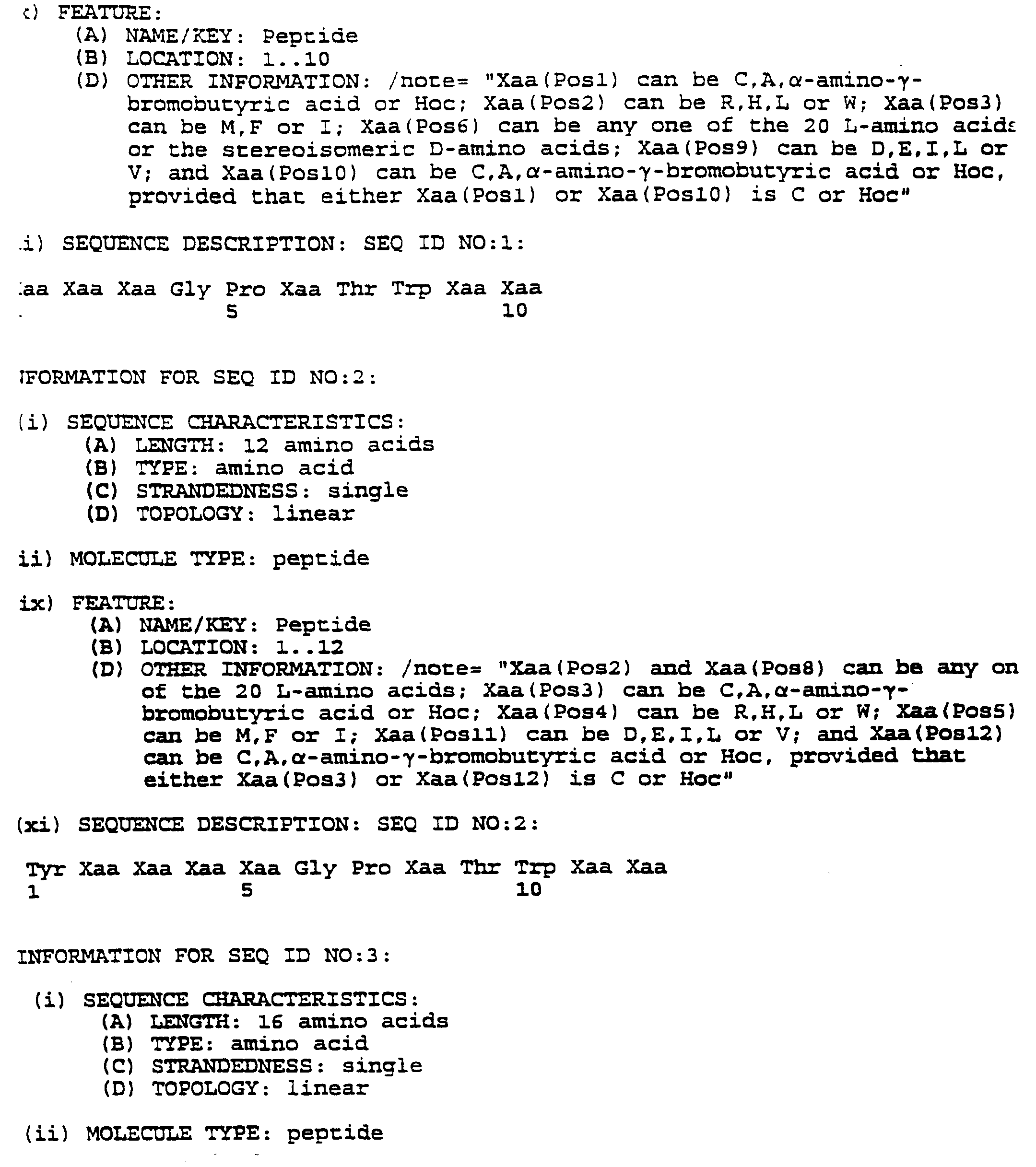
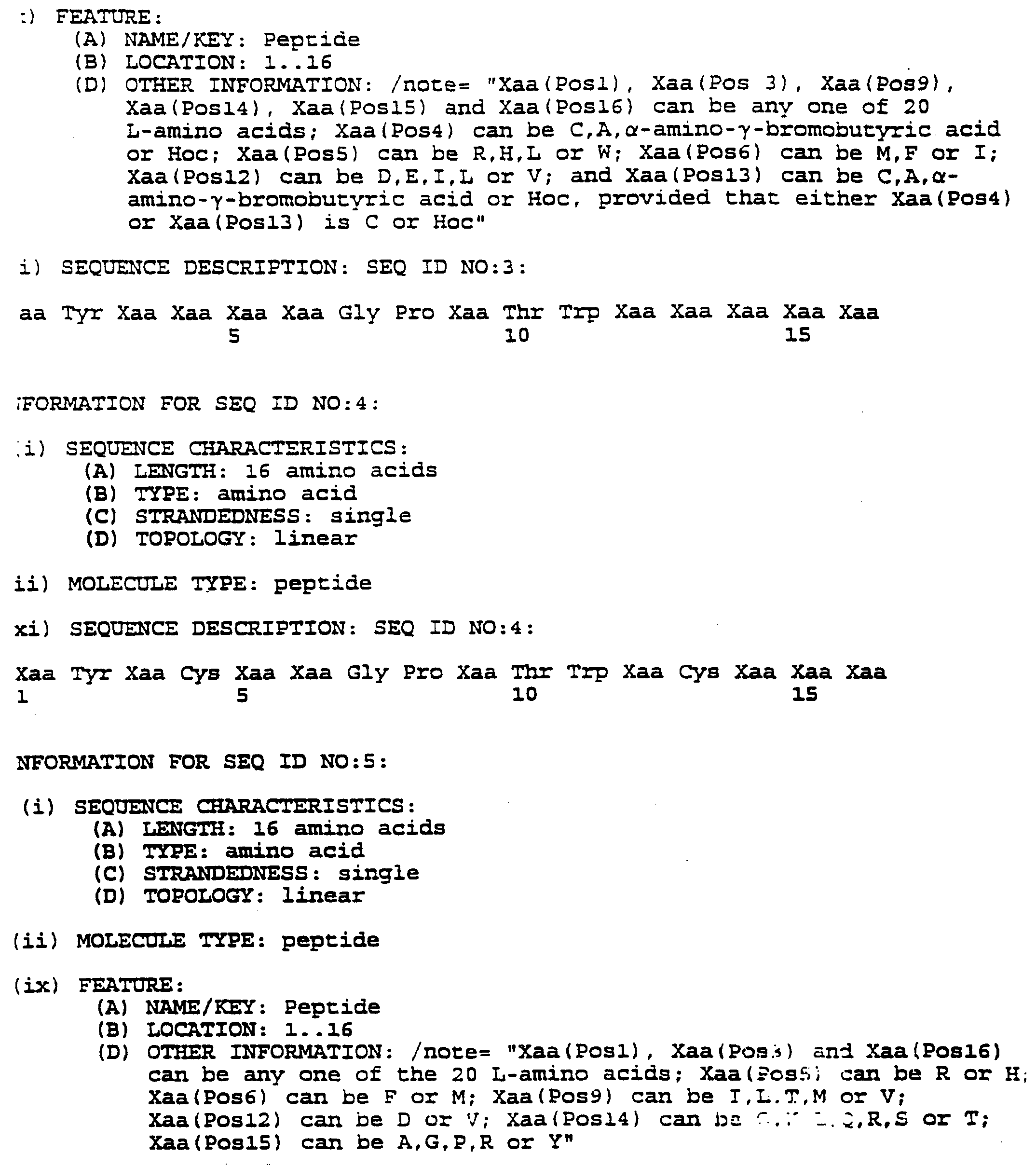


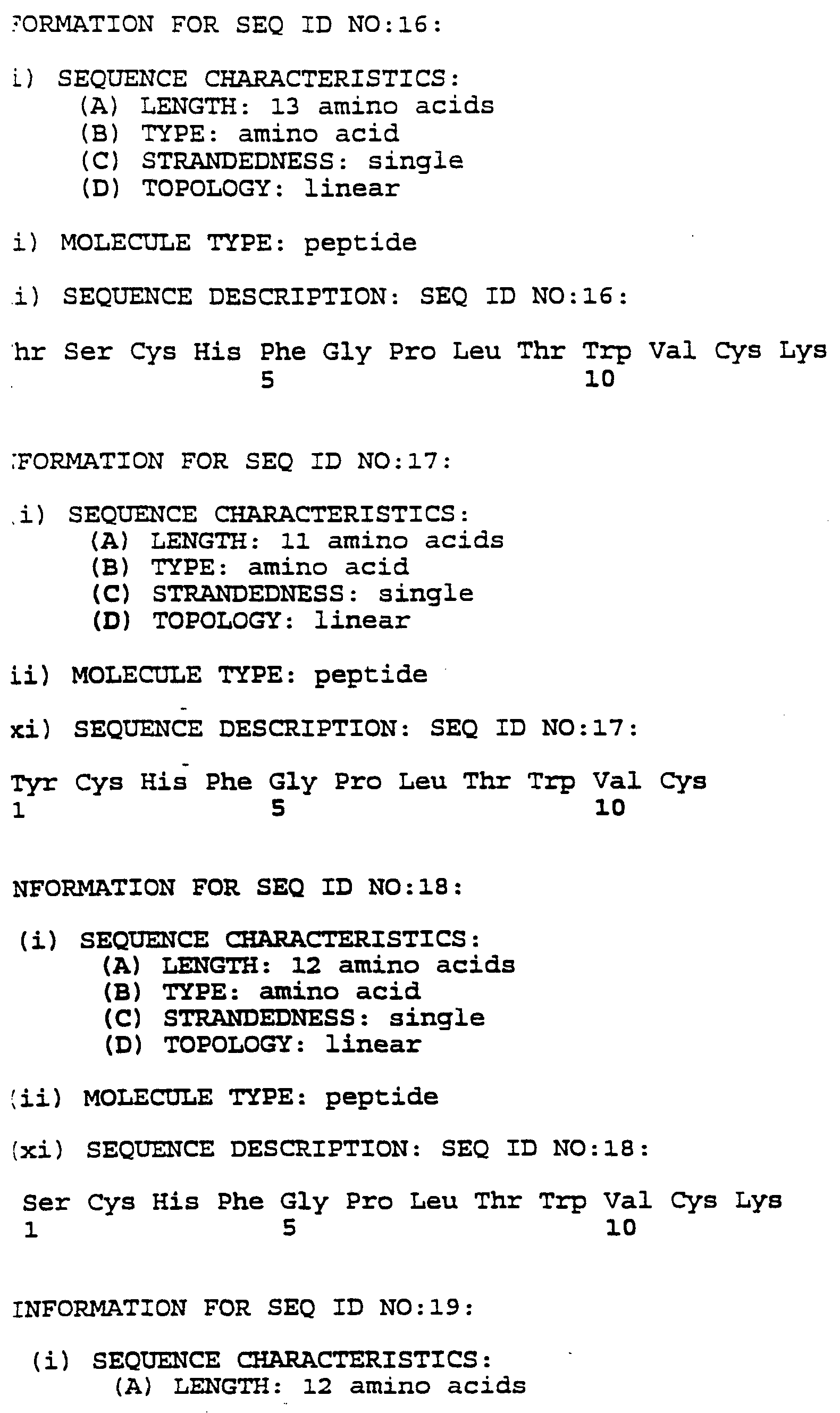


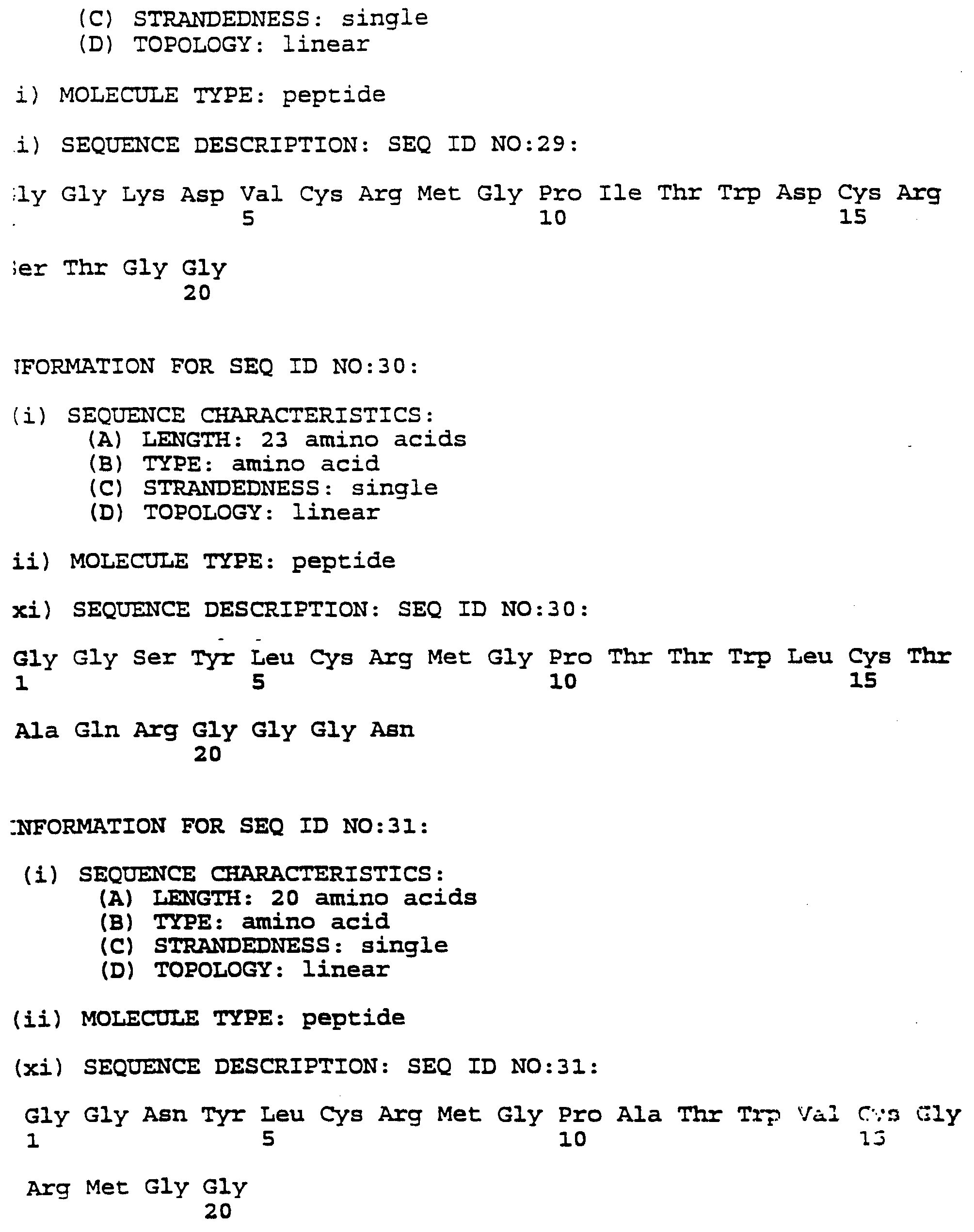
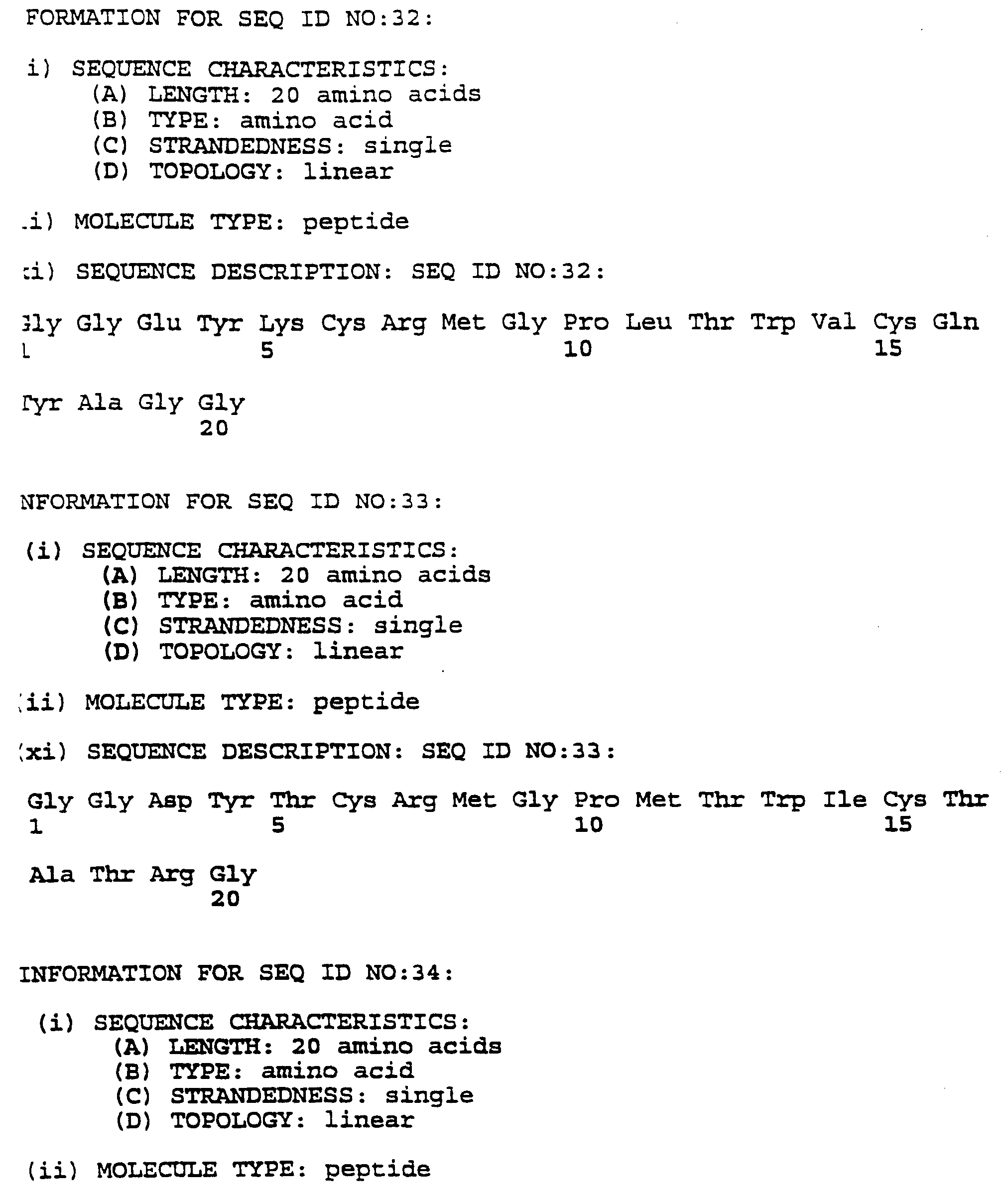


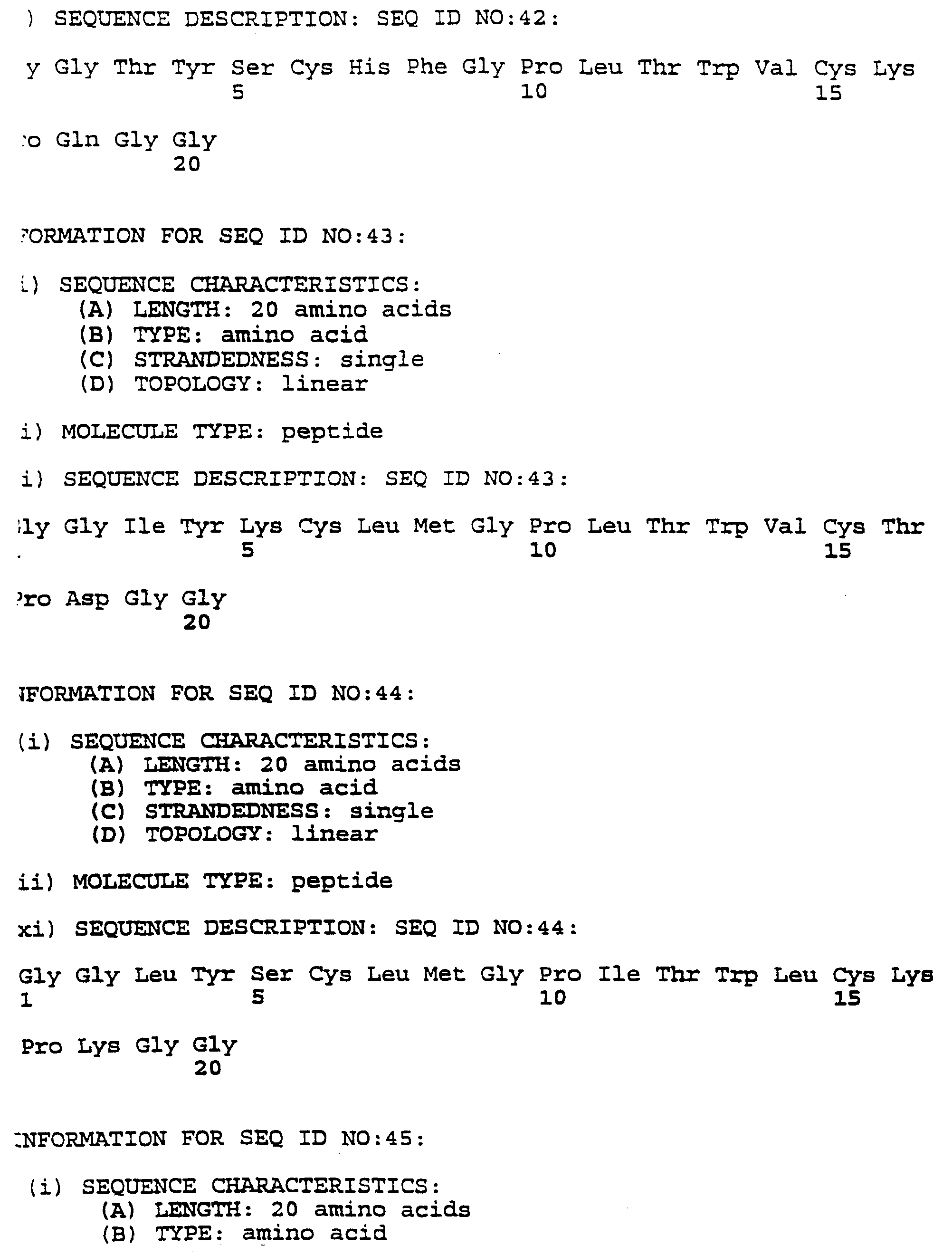


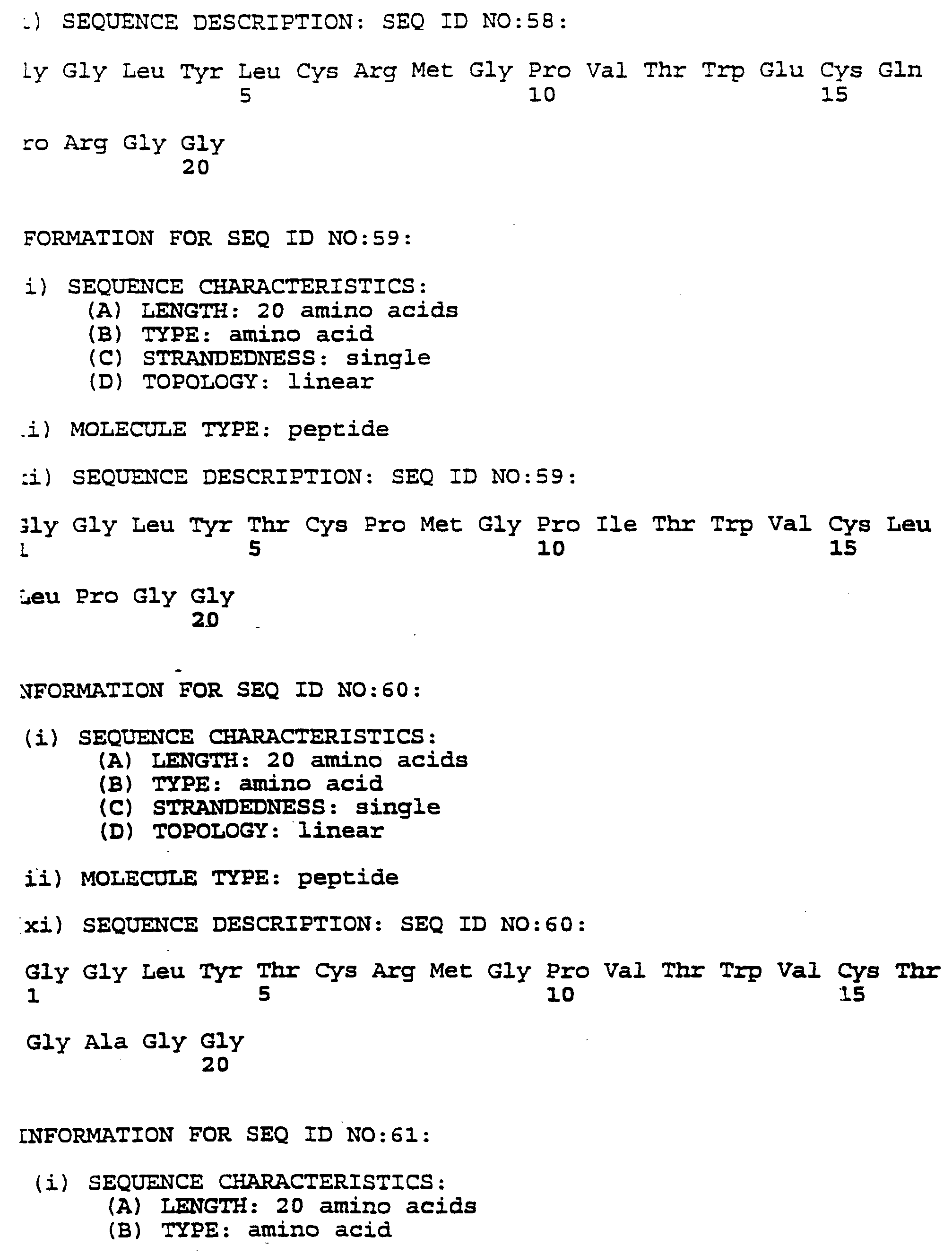

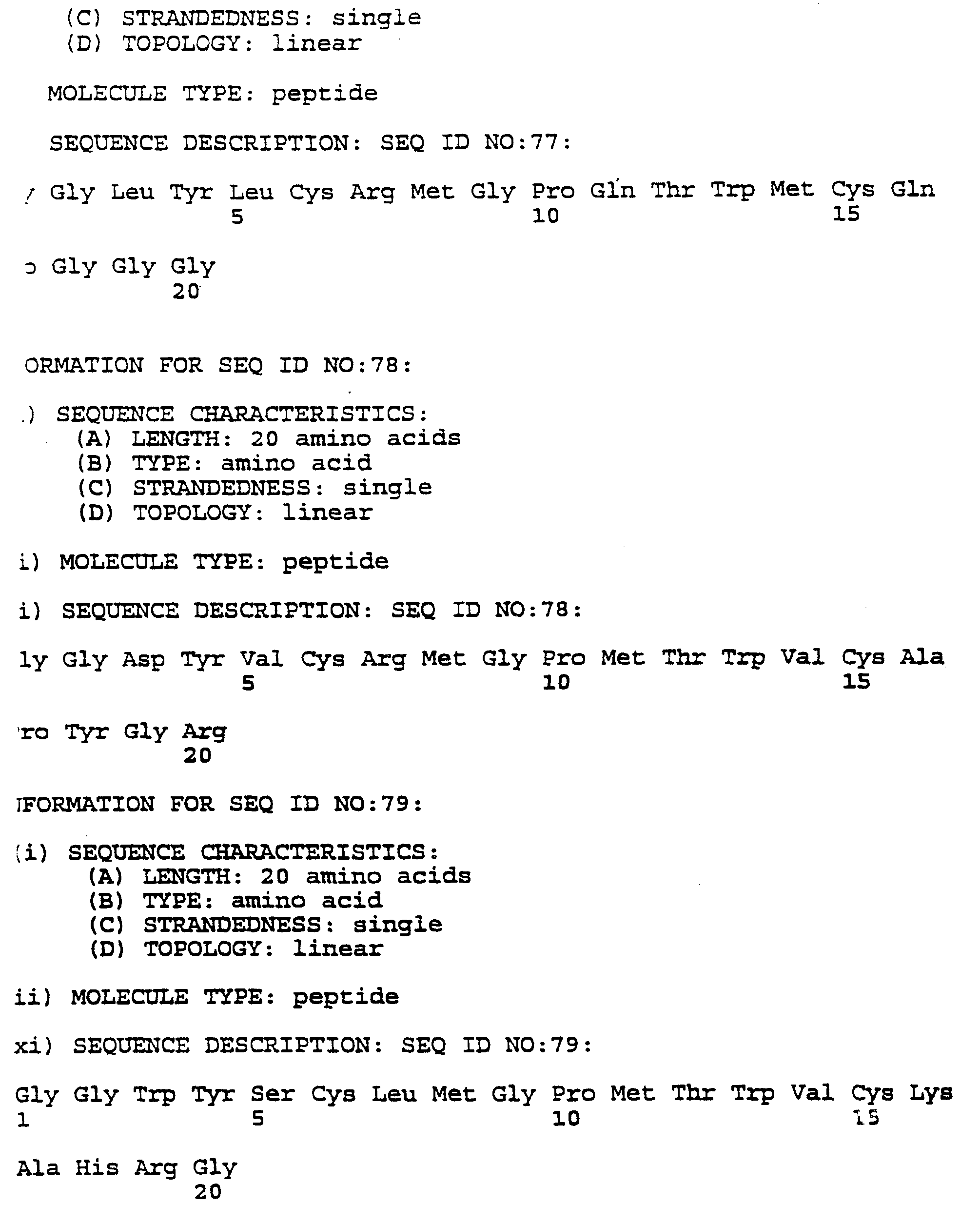


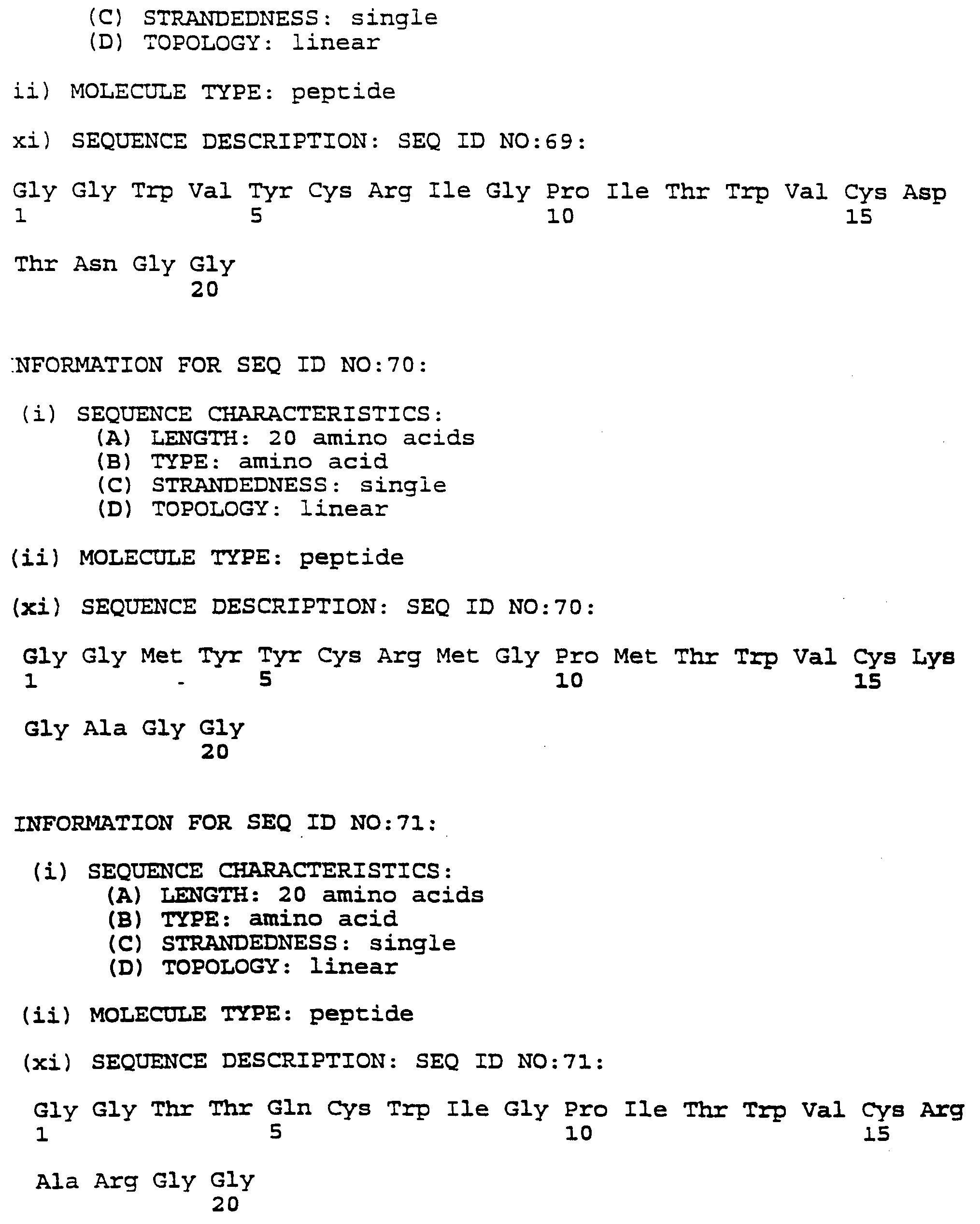


Claims
1. A. peptide dimer comprising two monomeric peptides of 10 to about 40 amino acids in length that bind to EPO receptor, each monomeric peptide comprising a sequence of amino acids X3X4
X5GPX6TWX7X8 (SEQ ID NO: 1) wherein X6 is selected from any of the 20 genetically coded L-amino acids; X, is C; X3 is R, H, L or W; X4 is M, F or I; X, is D, E, I, L or V; and X3 is C.
2. The peptide dimer of Claim 1 wherein each of said monomeric peptides comprise a sequence of amino acids YX2X3X4X5GPX6TWX7X8
(SEQ ID NO: 2) wherein each of X2 and X6 is independently
selected from any one of the 20 genetically coded L-amino acids; X3 is C; X4 is R, H, L or W; X5 is M, F or I; X7 is D, E, I, L or V; and X8 is C.
3. The peptide dimer of Claim 2 wherein each of said monomeric peptides comprise a sequence of amino acids
X1YX2X3X4X5GPX6TWX7X8X9X10X11 (SEQ ID NO: 3) wherein each of X1, X2, X6, X9, X10, and X11 is independently selected from any one of the 20 genetically coded L-amino acids; X3 is C; X4 is R, H, L or W; X5 is M, F or I; X7 is D, E, I, L or V; and X8 is C.
4. The peptide dimer of Claim 3 wherein X4 , is R or H; X5 is F or M; X6 is I, L, T, M or V; X7 is D or V; X9 is G, K, L, Q, R, S, or T; and X10 is A, G, P, R, or Y.
5. The peptide dimer of Claim 4 wherein Xi is D, E, L, N, S, T or V; X2 is A, H, K, L, M, S, or T; X4 is R or H; X9 is K, R, S, or T; and X10 is P.
6. The peptide dimer of Claim 1 wherein said
monomeric peptides are 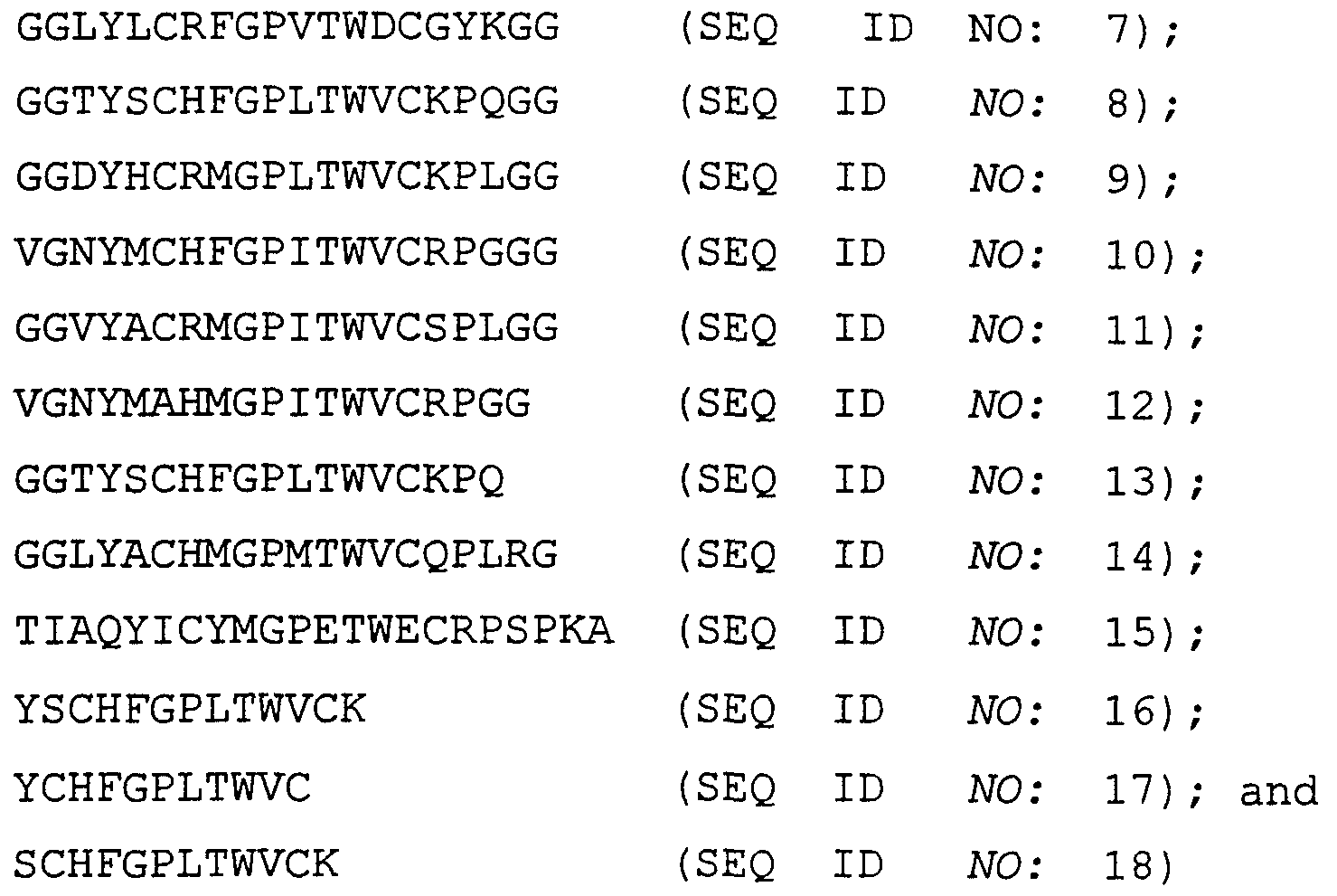
7. A pharmaceutical composition comprising at least one peptide dimer of any one of Claims 1-6.
8. A method for treating a patient having a disorder
characterized by a deficiency of EPO or low or defective red blood cell population comprising administering to said patient a therapeutically effective amount of at least one peptide dimer of any one of Claims 1-6.
9. The peptide dimer of any one of Claims 1-6 wherein said dimer is formed by a polyethylene glycol linker through a covaient bond.
10. The peptide dimer of any one of Claims 1-6 wherein said monomeric peptide units are dimerized on activated
benodiazepins, oxazalones, azalactones, aminimides or
diketopiperazine .
11. The peptide dimer of Claim 9 wherein said monomeric peptides are covalently bound N-terminus to N-terminus.
12. The peptide dimer of Claim 10 wherein said monomeric peptides are covalently bound N-terminus to N-terminus.
13. The peptide dimer of Claim 9 wherein said monomeric
peptides are covalently bound N-terminus to C-terminus.
14. The peptide of Claim 10 wherein said monomeric peptides are covalently bound N-terminus to C-terminus.
15. A method of improving the bioactivity of a cell surface receptor comprising dimerizing a monomeric agonist of said cell surface receptor and contacting said formed dimer with said cell surface receptor to effect said improved biological activity.
16. A method of activating a cell surface receptor to induce biological activity of said cell surface receptor comprising dimerizing a monomeric agonist of said cell surface receptor and contacting said formed dimer with said receptor thereby inducing said biological activity.
17. The method of Claim 15 or 16 wherein said cell surface receptor is contacted with said dimer in vitro or in vivo.
18. The method of Claim 15 or 16 wherein said cell surface receptor is EPO-R.
19. The method of Claim 15 or 16 wherein said cell surface agonist is a GH agonist, PDGF agonist, EGF agonist, G-CSF agonist, TPO agonist, VEGF agonist, FGF agonist, insulin
agonist, IL-3 agonist, IL-5 agonist, IL-6 agonist or IL-2 agonist.
20. The method of Claim 15 or 16 wherein said agonist comprises a sequence of amino acids YX2X3X4X5GPX6TWX7X8 (SEQ ID NO: 2) wherein each of X2 and X6 is independently selected from any one of the 20 genetically coded L-amino acids; X3 is C; X4 is R, H, L or W; X5 is M, F or I; X7 is D, E, I, L or V; and X8 is C.
21. The method of Claim 15 or 16 wherein said agonist comprises a sequence of amino acids X1YX2X3X4X5GPX6TWX7X8X9X10X11 (SEQ ID NO: 3) wherein each of Xi, X2, X6, X9, X10, and Xn is independently selected from any one of the 20 genetically coded Lamino acids; X3 is C; X4 is R, H, L or W; X5 is M, F or I; X7 is D, E, I, L or V; and X8 is C.
22. The method of Claim 15 or 16 wherein said agonist comprises a sequence of amino acids X1YX2X3X4X5GPX6TWX7X8X9X10X11 (SEQ ID NO:
3) wherein each of X1, X2, and X11, is independently selected from any one of the 20 genetically coded L-amino acids; X3 is C; X4 is R or H; X5 is F or M; X6 is I, L, T, M or V; X7 is D or V; X9 is G, K, L, Q, R, S, or T; and X10 is A, G, P, R, or Y.
23. The method of Claims 15 or 16 wherein said agonist
comprises a sequence of amino acids X1YX2X3X4X5GPX6TWX7X8X9X10X11
(SEQ ID NO: 3) wherein X1 is D, E, L, N, S, T or V; X2 is A, H, K, L, M, S, or T; X3 is C; X4 is R or H; X5 is M, F or I; X6 and X11 are independently any one of the 20 genetically coded L- amino acids; X7 is D, E, I, L or V; X8 is C; X9 is K, R, S, or T; and X10 is P.
24. The method of Claim 15 or 16 wherein said agonist is selected from the group consisting of:


25. The method of Claim 15 or 16 wherein said peptide dimers are formed with a polyethylene glycol linker through a covaient bond.
26. A method of preparing a cell surface receptor agonist comprising dimerizing a cell surface antagonist.
27. The method of Claim 26 wherein said cell surface antagonist receptor is a GH antagonist, PDGF antagonist, EGF antagonist, G-CSF antagonist, EGF antagonist, GM-CSF antagonist, TPO
antagonist, VEGF antagonist, FGF antagonist, insulin antagonist, IL-3 antagonist, IL-5 antagonist, IL-6 antagonist, or an IL-2 antagonist.
28. The method of Claim 26 wherein said cell surface receptor antagonist is a EPO-R antagonist.
29. The method of Claim 28 wherein said antagonist comprises a sequence of amino acids (AX2)nX3X4X5GPX6TWX7X8 (SEQ ID NO: 19) wherein X6 is selected from any of the 20 genetically coded L-amino acids; X3 is C; X4 is R, H, L or W; X5, is M, F or I; X7, is D, E, I, L or V; X8 is C; X2 is selected from any of the 20 genetically coded L-amino acids, n is 0 or 1 and A is any of the 20 genetically coded L-amino acids except Y (tyrosine).
30. The method of Claim 21 where said antagonist is
SCHFGPLTWVCK (SEQ ID NO: 18).
Priority Applications (3)
| Application Number | Priority Date | Filing Date | Title |
|---|---|---|---|
| JP50178197A JP3998043B2 (en) | 1995-06-07 | 1996-06-06 | Agonist peptide dimer |
| EP96918317A EP0892812A2 (en) | 1995-06-07 | 1996-06-06 | Agonist peptide dimers |
| AU61007/96A AU732294B2 (en) | 1995-06-07 | 1996-06-06 | Agonist peptide dimers |
Applications Claiming Priority (2)
| Application Number | Priority Date | Filing Date | Title |
|---|---|---|---|
| US08/484,135 | 1995-06-07 | ||
| US08/484,135 US5767078A (en) | 1995-06-07 | 1995-06-07 | Agonist peptide dimers |
Publications (3)
| Publication Number | Publication Date |
|---|---|
| WO1996040772A2 WO1996040772A2 (en) | 1996-12-19 |
| WO1996040772A9 true WO1996040772A9 (en) | 1997-02-06 |
| WO1996040772A3 WO1996040772A3 (en) | 1997-07-31 |
Family
ID=23922902
Family Applications (1)
| Application Number | Title | Priority Date | Filing Date |
|---|---|---|---|
| PCT/US1996/009469 Ceased WO1996040772A2 (en) | 1995-06-07 | 1996-06-06 | Agonist peptide dimers |
Country Status (6)
| Country | Link |
|---|---|
| US (1) | US5767078A (en) |
| EP (1) | EP0892812A2 (en) |
| JP (3) | JP3998043B2 (en) |
| AU (1) | AU732294B2 (en) |
| CA (2) | CA2228277A1 (en) |
| WO (1) | WO1996040772A2 (en) |
Cited By (3)
| Publication number | Priority date | Publication date | Assignee | Title |
|---|---|---|---|---|
| US7186810B2 (en) | 1998-10-23 | 2007-03-06 | Amgen Inc. | Modified peptides as therapeutic agents |
| US7442778B2 (en) | 2004-09-24 | 2008-10-28 | Amgen Inc. | Modified Fc molecules |
| US9114175B2 (en) | 2005-08-12 | 2015-08-25 | Amgen Inc. | Modified Fc molecules |
Families Citing this family (177)
| Publication number | Priority date | Publication date | Assignee | Title |
|---|---|---|---|---|
| US5773569A (en) * | 1993-11-19 | 1998-06-30 | Affymax Technologies N.V. | Compounds and peptides that bind to the erythropoietin receptor |
| US5830851A (en) * | 1993-11-19 | 1998-11-03 | Affymax Technologies N.V. | Methods of administering peptides that bind to the erythropoietin receptor |
| ES2210374T3 (en) * | 1995-06-07 | 2004-07-01 | Ortho Pharmaceutical Corporation | COMPOUNDS AND PEPTIDES THAT JOIN THE Erythropoietin Receptor. |
| IL122614A0 (en) | 1995-06-15 | 1998-08-16 | Introgene Bv | Packaging systems for human recombinant adenovirus to be used in gene therapy |
| US5835382A (en) | 1996-04-26 | 1998-11-10 | The Scripps Research Institute | Small molecule mimetics of erythropoietin |
| US6221608B1 (en) * | 1997-01-22 | 2001-04-24 | Ortho Pharmaceutical Corporation | Methods for identifying erythropoietin receptor binding protein |
| WO1999022733A1 (en) | 1997-10-31 | 1999-05-14 | Smithkline Beecham Corporation | Novel metal complexes |
| ES2301215T3 (en) | 1997-10-31 | 2008-06-16 | Smithkline Beecham Corporation | METAL COMPLEXES WITH ANTIBACTERIAL EFFECTS AND FUNGICIDES. |
| JP2001521897A (en) * | 1997-10-31 | 2001-11-13 | スミスクライン・ビーチャム・コーポレイション | New metal complex |
| WO1999025384A2 (en) * | 1997-11-17 | 1999-05-27 | University Of Miami | Multimeric tethered ligands and their use in receptor-ligand interactions |
| CA2305787A1 (en) | 2000-05-09 | 2001-11-09 | The University Of British Columbia | Cxcr4 antagonist treatment of hematopoietic cells |
| WO2000009152A1 (en) * | 1998-08-14 | 2000-02-24 | The University Of British Columbia | Therapeutic chemokine receptor antagonists |
| CA2245224A1 (en) | 1998-08-14 | 2000-02-14 | Jiang-Hong Giong | Chemokine receptor antagonists and chemotherapeutics |
| WO1999047158A2 (en) * | 1998-03-13 | 1999-09-23 | The University Of British Columbia | Therapeutic chemokine receptor antagonists |
| US20030118567A1 (en) * | 1999-03-26 | 2003-06-26 | Stewart Duncan John | Cell-based therapy for the pulmonary system |
| US7488590B2 (en) | 1998-10-23 | 2009-02-10 | Amgen Inc. | Modified peptides as therapeutic agents |
| DK2319928T3 (en) | 1998-10-23 | 2013-06-24 | Kirin Amgen Inc | Dimeric thrombopoietic peptidomimetics that bind to MPL receptor and have thrombopoietic activity |
| US7345019B1 (en) * | 1999-04-13 | 2008-03-18 | The Kenneth S. Warren Institute, Inc. | Modulation of excitable tissue function by peripherally administered erythropoietin |
| US7410941B1 (en) | 1999-04-13 | 2008-08-12 | The Kenneth S. Warren Institute, Inc. | Methods for treatment of neurodegenerative conditions by peripherally administered erythropoietin |
| US7604960B2 (en) * | 1999-04-15 | 2009-10-20 | Crucell Holland B.V. | Transient protein expression methods |
| US20050170463A1 (en) * | 1999-04-15 | 2005-08-04 | Abraham Bout | Recombinant protein production in permanent amniocytic cells that comprise nucleic acid encoding adenovirus E1A and E1B proteins |
| US7297680B2 (en) | 1999-04-15 | 2007-11-20 | Crucell Holland B.V. | Compositions of erythropoietin isoforms comprising Lewis-X structures and high sialic acid content |
| US20050164386A1 (en) * | 1999-04-15 | 2005-07-28 | Uytdehaag Alphonsus G. | Overexpression of enzymes involved in post-translational protein modifications in human cells |
| US8236561B2 (en) * | 1999-04-15 | 2012-08-07 | Crucell Holland B.V. | Efficient production of IgA in recombinant mammalian cells |
| US6855544B1 (en) | 1999-04-15 | 2005-02-15 | Crucell Holland B.V. | Recombinant protein production in a human cell |
| WO2001025277A1 (en) * | 1999-10-07 | 2001-04-12 | Maxygen Aps | Single-chain antagonist polypeptides |
| US6703480B1 (en) | 1999-11-24 | 2004-03-09 | Palani Balu | Peptide dimers as agonists of the erythropoientin (EPO) receptor, and associated methods of synthesis and use |
| US7521220B2 (en) * | 1999-11-26 | 2009-04-21 | Crucell Holland B.V. | Production of vaccines |
| US7192759B1 (en) * | 1999-11-26 | 2007-03-20 | Crucell Holland B.V. | Production of vaccines |
| US7527961B2 (en) * | 1999-11-26 | 2009-05-05 | Crucell Holland B.V. | Production of vaccines |
| WO2001047951A2 (en) * | 1999-12-23 | 2001-07-05 | An-Go-Gen Inc. | Angiopoietin analogs |
| US7368425B2 (en) | 2006-03-24 | 2008-05-06 | Chemokine Therapeutics Corp. | Cyclic peptides for modulating growth of neo-vessels and their use in therapeutic angiogenesis |
| US20050059584A1 (en) | 2002-08-16 | 2005-03-17 | Ahmed Merzouk | Novel chemokine mimetics synthesis and their use |
| US7378098B2 (en) | 2000-04-12 | 2008-05-27 | The University Of British Columbia | CXC chemokine receptor 4 agonist peptides |
| EP1278778A2 (en) * | 2000-05-03 | 2003-01-29 | Amgen Inc., | Modified peptides, comprising an fc domain, as therapeutic agents |
| US7259146B2 (en) * | 2000-05-26 | 2007-08-21 | Ortho-Mcneil Pharmaceutical, Inc. | Neuroprotective peptides |
| JP2003534384A (en) * | 2000-05-26 | 2003-11-18 | オーソ−マクニール・フアーマシユーチカル・インコーポレーテツド | Neuroprotective peptide |
| ES2320101T3 (en) * | 2000-10-16 | 2009-05-19 | Chugai Seiyaku Kabushiki Kaisha | CONJUGATED ERYTHROPOYETINE WITH MONO-PEG. |
| WO2002036626A1 (en) * | 2000-11-02 | 2002-05-10 | Maxygen Aps | Single-chain multimeric polypeptides |
| PA8536201A1 (en) * | 2000-12-29 | 2002-08-29 | Kenneth S Warren Inst Inc | PROTECTION AND IMPROVEMENT OF CELLS, FABRICS AND ORGANS RESPONDING TO Erythropoietin |
| US20030072737A1 (en) * | 2000-12-29 | 2003-04-17 | Michael Brines | Tissue protective cytokines for the protection, restoration, and enhancement of responsive cells, tissues and organs |
| US6531121B2 (en) | 2000-12-29 | 2003-03-11 | The Kenneth S. Warren Institute, Inc. | Protection and enhancement of erythropoietin-responsive cells, tissues and organs |
| US7767643B2 (en) * | 2000-12-29 | 2010-08-03 | The Kenneth S. Warren Institute, Inc. | Protection, restoration, and enhancement of erythropoietin-responsive cells, tissues and organs |
| CA2437333A1 (en) * | 2001-02-02 | 2002-08-22 | Ortho-Mcneil Pharmaceutical, Inc. | Treatment of neurological dysfunction comprising fructopyranose sulfamates and erythropoietin |
| US7332474B2 (en) | 2001-10-11 | 2008-02-19 | Amgen Inc. | Peptides and related compounds having thrombopoietic activity |
| EP1459762B1 (en) * | 2001-11-02 | 2008-07-02 | Yoshiko Yasuda | Use of emp9 for the prevention of proliferative organ diseases |
| JP4480398B2 (en) * | 2001-12-07 | 2010-06-16 | クルセル ホランド ベー ヴェー | Method for producing virus, virus isolate and vaccine |
| JP2005534650A (en) * | 2002-06-11 | 2005-11-17 | ザ バーナム インスティテュート | Neuroprotective synergism of erythropoietin and insulin-like growth factor |
| CA2490409A1 (en) | 2002-06-28 | 2004-01-08 | Centocor, Inc. | Mammalian ch1 deleted mimetibodies, compositions, methods and uses |
| KR20060019501A (en) * | 2002-07-01 | 2006-03-03 | 더 케네쓰 에스. 워렌 인스티튜트 인코포레이티드 | Recombinant tissue protective cytokines and nucleic acids encoding them for protecting, repairing and enhancing response cells, tissues and organs |
| US7556813B2 (en) * | 2002-09-27 | 2009-07-07 | Trimeris, Inc. | Antiviral peptide-polymer conjugate comprising a polymer covalently attached to two or more synthetic HIV gp41 HR1 and/or HR2 peptides |
| ATE414144T1 (en) | 2003-05-09 | 2008-11-15 | Crucell Holland Bv | CULTURES OF E1-IMMORALIZED CELLS AND METHOD FOR CULTIVATION THEM TO INCREASE THE PRODUCT YIELDS THEREOF |
| KR101227666B1 (en) * | 2003-05-12 | 2013-01-31 | 아피맥스, 인크. | Peptides that bind to the erythropoietin receptor |
| DE602004020610D1 (en) | 2003-05-12 | 2009-05-28 | Affymax Inc | NEW PEPTIDE BINDING TO THE ERYTHROPOIETIN RECEPTOR |
| US7919118B2 (en) | 2003-05-12 | 2011-04-05 | Affymax, Inc. | Spacer moiety for poly (ethylene glycol) modified peptide based compounds |
| DE602004028725D1 (en) * | 2003-05-12 | 2010-09-30 | Affymax Inc | NEW POLY (ETHYLENGLYCOL) MODIFIED ERYTHROPOIETINAGONISTS AND THEIR USES |
| DE602004027483D1 (en) * | 2003-05-23 | 2010-07-15 | Crucell Holland Bv | PREPARATION OF RECOMBINANT IGM IN THE PER.C6 CELLS |
| WO2005032467A2 (en) * | 2003-09-29 | 2005-04-14 | Warren Pharmaceuticals, Inc. | Tissue protective cytokines for the treatment and prevention of sepsis and the formation of adhesions |
| UA89481C2 (en) | 2003-09-30 | 2010-02-10 | Центокор, Инк. | Human epo mimetic hinge core mimetibodies, compositions, methods and uses |
| WO2005037304A1 (en) * | 2003-10-17 | 2005-04-28 | Crucell Holland B.V. | Treatment and prevention of decubitus |
| US7588745B2 (en) * | 2004-04-13 | 2009-09-15 | Si Options, Llc | Silicon-containing products |
| EP1773400A2 (en) | 2004-07-08 | 2007-04-18 | Amgen Inc. | Therapeutic peptides |
| US7393662B2 (en) | 2004-09-03 | 2008-07-01 | Centocor, Inc. | Human EPO mimetic hinge core mimetibodies, compositions, methods and uses |
| PT1737889E (en) | 2004-10-19 | 2010-12-13 | Lonza Ag | Method for solid phase peptide synthesis |
| US7589063B2 (en) | 2004-12-14 | 2009-09-15 | Aplagen Gmbh | Molecules which promote hematopoiesis |
| WO2006062685A2 (en) * | 2004-11-11 | 2006-06-15 | Affymax, Inc. | Novel peptides that bind to the erythropoietin receptor |
| CN101142234A (en) * | 2004-11-11 | 2008-03-12 | 阿费麦克斯公司 | Novel peptides binding to the erythropoietin receptor |
| US7714114B2 (en) * | 2005-02-16 | 2010-05-11 | Nektar Therapeutics | Conjugates of an EPO moiety and a polymer |
| US7919461B2 (en) * | 2005-06-03 | 2011-04-05 | Affymax, Inc. | Erythropoietin receptor peptide formulations and uses |
| US8324159B2 (en) * | 2005-06-03 | 2012-12-04 | Affymax, Inc. | Erythropoietin receptor peptide formulations and uses |
| US7550433B2 (en) * | 2005-06-03 | 2009-06-23 | Affymax, Inc. | Erythropoietin receptor peptide formulations and uses |
| MX2007015819A (en) * | 2005-06-13 | 2008-02-22 | Nastech Pharm Co | Transmucosal delivery of peptide derivatives. |
| EP1907417A2 (en) * | 2005-06-23 | 2008-04-09 | AplaGen GmbH | Supravalent compounds |
| JO3324B1 (en) | 2006-04-21 | 2019-03-13 | Amgen Inc | Lyophilized Therapeutic Peptibody Formulations |
| EP3669894A3 (en) | 2006-06-30 | 2020-08-26 | Syntab Therapeutics GmbH | Novel multifunctional compounds for pharmaceutical purposes |
| CA2674368A1 (en) * | 2007-01-10 | 2008-07-17 | Edison Pharmaceuticals, Inc. | Treatment of respiratory chain disorders using compounds having erythropoietin or thrombopoietin activity |
| EP2118127A4 (en) * | 2007-01-31 | 2010-12-01 | Affymax Inc | NITROGEN BONDING GROUPS FOR ATTACHING MODIFIER GROUPS TO POLYPEPTIDES AND OTHER MACROMOLECULES |
| PE20090722A1 (en) * | 2007-02-02 | 2009-07-13 | Amgen Inc | HEPCIDIN, HEPCIDIN ANTAGONISTS AND METHODS OF USE |
| EP2018835B1 (en) | 2007-07-09 | 2014-03-05 | Augustinus Bader | Agent-eluting plaster |
| CA2701032C (en) * | 2007-09-27 | 2021-01-26 | Amgen Inc. | Pharmaceutical formulations |
| WO2009046313A2 (en) * | 2007-10-05 | 2009-04-09 | University Of Maryland, Baltimore | Novel compositions and methods for stimulating erythropoiesis in a mammal |
| ES2962777T3 (en) | 2007-11-15 | 2024-03-21 | Amgen Inc | Antioxidant-stabilized aqueous antibody formulation for parenteral administration |
| CA2711826C (en) | 2008-01-25 | 2018-02-27 | Amgen Inc. | Ferroportin antibodies and methods of use |
| US9315577B2 (en) | 2008-05-01 | 2016-04-19 | Amgen Inc. | Anti-hepcidin antibodies and methods of use |
| EA201001814A1 (en) * | 2008-05-22 | 2011-04-29 | Эдисон Фармасьютикалз, Инк. | TREATMENT OF MITOCHONDRIAL DISEASES BY ERYTHROPOIETIN MEMETICS |
| CN102232085A (en) | 2008-09-26 | 2011-11-02 | Ambrx公司 | Modified animal erythropoietin polypeptide and use thereof |
| WO2010056981A2 (en) | 2008-11-13 | 2010-05-20 | Massachusetts General Hospital | Methods and compositions for regulating iron homeostasis by modulation bmp-6 |
| WO2010117725A2 (en) * | 2009-04-06 | 2010-10-14 | Novetide, Ltd. | Production of peptides containing poly-gly sequences using fmoc chemistry |
| WO2011012306A2 (en) | 2009-07-30 | 2011-02-03 | Aplagen Gmbh | Use of emps for antagonising epo-stimulatory effects on epo-responsive tumors while maintaining erythropoiesis |
| AU2010310457B2 (en) | 2009-10-23 | 2015-07-02 | Amgen Inc. | Vial adapter and system |
| PT2575935E (en) | 2010-06-07 | 2015-10-20 | Amgen Inc | Drug delivery device |
| EP2590666B1 (en) | 2010-07-06 | 2017-04-26 | Augustinus Bader | Topical application of erythropoietin for use in the treatment of injuries of the cornea |
| MX341790B (en) | 2011-03-31 | 2016-09-02 | Amgen Inc | Vial adapter and system. |
| CA3021845C (en) | 2011-04-20 | 2022-03-29 | Amgen Inc. | Autoinjector apparatus |
| SMT201800287T1 (en) | 2011-10-14 | 2018-07-17 | Amgen Inc | Injector and method of assembly |
| AU2013348071B2 (en) | 2012-11-21 | 2018-05-24 | Amgen Inc. | Drug delivery device |
| JP6643977B2 (en) | 2013-03-15 | 2020-02-12 | アムゲン・インコーポレーテッド | Automatic injector device adaptable to body contours |
| TWI639453B (en) | 2013-03-15 | 2018-11-01 | 美商安美基公司 | Cassette for an injector |
| JP6336564B2 (en) | 2013-03-15 | 2018-06-06 | アムゲン・インコーポレーテッド | Drug cassette, auto-injector, and auto-injector system |
| EP2968503B1 (en) | 2013-03-15 | 2018-08-15 | Intrinsic LifeSciences LLC | Anti-hepcidin antibodies and uses thereof |
| CN113559363B (en) | 2013-03-22 | 2023-10-31 | 美国安进公司 | Syringe and method of assembly |
| WO2015061389A1 (en) | 2013-10-24 | 2015-04-30 | Amgen Inc. | Drug delivery system with temperature-sensitive control |
| EP3789064B1 (en) | 2013-10-24 | 2024-11-27 | Amgen Inc. | Injector and method of assembly |
| WO2015098634A1 (en) * | 2013-12-25 | 2015-07-02 | 株式会社海月研究所 | Continuous production method for decomposition product from water-insoluble macromolecular compound |
| WO2015119906A1 (en) | 2014-02-05 | 2015-08-13 | Amgen Inc. | Drug delivery system with electromagnetic field generator |
| SG11201609219QA (en) | 2014-05-07 | 2016-12-29 | Amgen Inc | Autoinjector with shock reducing elements |
| US20170124285A1 (en) | 2014-06-03 | 2017-05-04 | Amgen Inc. | Devices and methods for assisting a user of a drug delivery device |
| AU2015321462B2 (en) | 2014-09-22 | 2020-04-30 | Intrinsic Lifesciences Llc | Humanized anti-hepcidin antibodies and uses thereof |
| MX392725B (en) | 2014-10-14 | 2025-03-24 | Amgen Inc | DRUG INJECTION DEVICE WITH VISUAL AND AUDIBLE INDICATORS. |
| JP6716566B2 (en) | 2014-12-19 | 2020-07-01 | アムジエン・インコーポレーテツド | Drug delivery device with proximity sensor |
| WO2016100055A1 (en) | 2014-12-19 | 2016-06-23 | Amgen Inc. | Drug delivery device with live button or user interface field |
| US10583245B2 (en) | 2015-02-17 | 2020-03-10 | Amgen Inc. | Drug delivery device with vacuum assisted securement and/or feedback |
| ES2905870T3 (en) | 2015-02-27 | 2022-04-12 | Amgen Inc | Drug delivery device having a needle guard mechanism with an adjustable threshold resistance to movement of the needle guard |
| WO2017039786A1 (en) | 2015-09-02 | 2017-03-09 | Amgen Inc. | Syringe assembly adapter for a syringe |
| WO2017100501A1 (en) | 2015-12-09 | 2017-06-15 | Amgen Inc. | Auto-injector with signaling cap |
| WO2017120178A1 (en) | 2016-01-06 | 2017-07-13 | Amgen Inc. | Auto-injector with signaling electronics |
| ES2814287T3 (en) | 2016-03-15 | 2021-03-26 | Amgen Inc | Reduce the likelihood of glass breakage in drug delivery devices |
| WO2017189089A1 (en) | 2016-04-29 | 2017-11-02 | Amgen Inc. | Drug delivery device with messaging label |
| US11389588B2 (en) | 2016-05-02 | 2022-07-19 | Amgen Inc. | Syringe adapter and guide for filling an on-body injector |
| AU2017263558B2 (en) | 2016-05-13 | 2022-12-22 | Amgen Inc. | Vial sleeve assembly |
| US11238150B2 (en) | 2016-05-16 | 2022-02-01 | Amgen Inc. | Data encryption in medical devices with limited computational capability |
| GB201609083D0 (en) | 2016-05-24 | 2016-07-06 | Syntab Therapeutics Gmbh | Synthetic compound |
| EP3465124B1 (en) | 2016-06-03 | 2026-02-11 | Amgen Inc. | Impact testing apparatuses and methods for drug delivery devices |
| WO2018004842A1 (en) | 2016-07-01 | 2018-01-04 | Amgen Inc. | Drug delivery device having minimized risk of component fracture upon impact events |
| US20190328965A1 (en) | 2016-08-17 | 2019-10-31 | Amgen Inc. | Drug delivery device with placement detection |
| EP3532127A1 (en) | 2016-10-25 | 2019-09-04 | Amgen Inc. | On-body injector |
| EP3570917A1 (en) | 2017-01-17 | 2019-11-27 | Amgen Inc. | Injection devices and related methods of use and assembly |
| AU2018220538B2 (en) | 2017-02-17 | 2023-12-14 | Amgen Inc. | Drug delivery device with sterile fluid flowpath and related method of assembly |
| WO2018152073A1 (en) | 2017-02-17 | 2018-08-23 | Amgen Inc. | Insertion mechanism for drug delivery device |
| WO2018165143A1 (en) | 2017-03-06 | 2018-09-13 | Amgen Inc. | Drug delivery device with activation prevention feature |
| IL268478B2 (en) | 2017-03-07 | 2023-10-01 | Amgen Inc | Needle insertion by overpressure |
| MX2019010671A (en) | 2017-03-09 | 2019-10-21 | Amgen Inc | Insertion mechanism for drug delivery device. |
| CN110446499A (en) | 2017-03-20 | 2019-11-12 | 豪夫迈·罗氏有限公司 | A method for glycoengineering erythropoiesis-stimulating protein in vitro |
| KR102651078B1 (en) | 2017-03-28 | 2024-03-22 | 암겐 인코포레이티드 | Plunger rod and syringe assembly system and method |
| CA3061982A1 (en) | 2017-06-08 | 2018-12-13 | Amgen Inc. | Syringe assembly for a drug delivery device and method of assembly |
| EP3634546A1 (en) | 2017-06-08 | 2020-04-15 | Amgen Inc. | Torque driven drug delivery device |
| AU2018288604B2 (en) | 2017-06-22 | 2023-12-21 | Amgen Inc. | Device activation impact/shock reduction |
| MA49461A (en) | 2017-06-23 | 2020-04-29 | Amgen Inc | ELECTRONIC DRUG DELIVERY DEVICE INCLUDING A CAP ACTIVATED BY A SWITCH ASSEMBLY |
| JP7408398B2 (en) | 2017-07-14 | 2024-01-05 | アムジエン・インコーポレーテツド | Needle insertion and retraction system with dual torsion spring system |
| WO2019018169A1 (en) | 2017-07-21 | 2019-01-24 | Amgen Inc. | Gas permeable sealing member for drug container and methods of assembly |
| JP7242562B2 (en) | 2017-07-25 | 2023-03-20 | アムジエン・インコーポレーテツド | Drug delivery device with container access system and associated method of assembly |
| MA49677A (en) | 2017-07-25 | 2021-04-21 | Amgen Inc | DRUG DELIVERY DEVICE WITH GEAR MODULE AND ASSOCIATED ASSEMBLY PROCESS |
| US12318593B2 (en) | 2017-08-09 | 2025-06-03 | Amgen Inc. | Hydraulic-pneumatic pressurized chamber drug delivery system |
| WO2019036181A1 (en) | 2017-08-18 | 2019-02-21 | Amgen Inc. | Wearable injector with sterile adhesive patch |
| US11103636B2 (en) | 2017-08-22 | 2021-08-31 | Amgen Inc. | Needle insertion mechanism for drug delivery device |
| MA50611A (en) | 2017-10-04 | 2020-08-12 | Amgen Inc | FLOW ADAPTER FOR A DRUG DELIVERY DEVICE |
| CN111132711B (en) | 2017-10-06 | 2022-07-01 | 安进公司 | Drug delivery device with interlocking components and related assembly methods |
| EP3694578B1 (en) | 2017-10-09 | 2025-09-24 | Amgen Inc. | Drug delivery device with drive assembly and related method of assembly |
| IL273663B2 (en) | 2017-11-03 | 2025-05-01 | Amgen Inc | System and approaches for sterilizing a drug delivery device |
| ES2994389T3 (en) | 2017-11-06 | 2025-01-23 | Amgen Inc | Drug delivery device with placement and flow sensing |
| WO2019090303A1 (en) | 2017-11-06 | 2019-05-09 | Amgen Inc. | Fill-finish assemblies and related methods |
| MA50557A (en) | 2017-11-10 | 2020-09-16 | Amgen Inc | PISTONS FOR DRUG DELIVERY DEVICES |
| JP7370969B2 (en) | 2017-11-16 | 2023-10-30 | アムジエン・インコーポレーテツド | Door latch mechanism for drug delivery devices |
| JP7747438B2 (en) | 2017-11-16 | 2025-10-01 | アムジエン・インコーポレーテツド | Autoinjector with stall and end-point detection |
| US10835685B2 (en) | 2018-05-30 | 2020-11-17 | Amgen Inc. | Thermal spring release mechanism for a drug delivery device |
| US11083840B2 (en) | 2018-06-01 | 2021-08-10 | Amgen Inc. | Modular fluid path assemblies for drug delivery devices |
| WO2020023451A1 (en) | 2018-07-24 | 2020-01-30 | Amgen Inc. | Delivery devices for administering drugs |
| MA53379A (en) | 2018-07-24 | 2021-06-02 | Amgen Inc | ADMINISTRATION DEVICES FOR THE ADMINISTRATION OF MEDICINES |
| US12303677B2 (en) | 2018-07-24 | 2025-05-20 | Amgen Inc. | Hybrid drug delivery devices with optional grip portion and related method of preparation |
| WO2020023336A1 (en) | 2018-07-24 | 2020-01-30 | Amgen Inc. | Hybrid drug delivery devices with grip portion |
| MA53320A (en) | 2018-07-31 | 2021-11-03 | Amgen Inc | FLUID PATH ASSEMBLY FOR DRUG DELIVERY DEVICE |
| MA53724A (en) | 2018-09-24 | 2021-12-29 | Amgen Inc | INTERVENTIONAL DOSING SYSTEMS AND METHODS |
| CA3110371A1 (en) | 2018-09-28 | 2020-04-02 | Amgen Inc. | Muscle wire escapement activation assembly for a drug delivery device |
| CN117159846A (en) | 2018-10-02 | 2023-12-05 | 安进公司 | Injection systems for drug delivery with internal force transmission |
| WO2020072846A1 (en) | 2018-10-05 | 2020-04-09 | Amgen Inc. | Drug delivery device having dose indicator |
| SG11202101824VA (en) | 2018-10-15 | 2021-03-30 | Amgen Inc | Platform assembly process for drug delivery device |
| AR116704A1 (en) | 2018-10-15 | 2021-06-02 | Amgen Inc | DRUG ADMINISTRATION DEVICE WITH CUSHIONING MECHANISM |
| IL281908B2 (en) | 2018-11-01 | 2025-06-01 | Amgen Inc | Drug delivery devices with partial drug delivery unit withdrawal |
| ES3010833T3 (en) | 2018-11-01 | 2025-04-04 | Amgen Inc | Drug delivery devices with partial drug delivery member retraction |
| TWI831847B (en) | 2018-11-01 | 2024-02-11 | 美商安進公司 | Drug delivery devices with partial needle retraction and methods for operating the same |
| US20220160972A1 (en) | 2019-04-24 | 2022-05-26 | Amgen Inc. | Syringe sterilization verification assemblies and methods |
| EP4017560A2 (en) | 2019-08-23 | 2022-06-29 | Amgen, Inc | Drug delivery device with configurable needle shield engagement components and related methods |
| US20230310539A1 (en) * | 2020-07-30 | 2023-10-05 | Epo-Med Inc. | Treatment of disease with epor antagonist |
| MX2023013640A (en) | 2021-05-21 | 2023-11-30 | Amgen Inc | Method of optimizing a filling recipe for a drug container. |
| WO2023209074A1 (en) | 2022-04-28 | 2023-11-02 | Institut National de la Santé et de la Recherche Médicale | Methods of restoring erythropoiesis in patients suffering from a sf3b1 mutant myelodysplastic syndrome by correcting coasy mis-splicing |
| IL319976A (en) | 2022-11-02 | 2025-05-01 | Hoffmann La Roche | Method for producing glycoprotein compositions |
| WO2025262329A1 (en) | 2024-06-21 | 2025-12-26 | Syntab Therapeutics Gmbh | Synthetic molecules comprising tlr2 ligands |
Family Cites Families (8)
| Publication number | Priority date | Publication date | Assignee | Title |
|---|---|---|---|---|
| US4618598A (en) * | 1982-04-12 | 1986-10-21 | Duke University | Method of regulating hormone function or release |
| WO1990008822A1 (en) * | 1989-02-03 | 1990-08-09 | Genetics Institute, Inc. | Erythropoietin receptor |
| ATE314479T1 (en) * | 1992-05-18 | 2006-01-15 | Genentech Inc | ACTIVATION OF RECEPTORS CAPABLE OF OLIGOMERIZATION BY USING FUSIONED RECEPTOR LIGANDS |
| US5420243A (en) * | 1993-01-26 | 1995-05-30 | Celtrix Pharmaceuticals, Inc. | Biologically active TGF-β2 peptides |
| EP0730660A4 (en) * | 1993-10-29 | 1998-02-25 | Incyte Pharma Inc | Chimeric proteins including protease nexin-1 variants |
| US5580853A (en) * | 1994-03-22 | 1996-12-03 | New England Deaconess Hospital | Modified polypeptides with increased biological activity |
| US5885574A (en) * | 1994-07-26 | 1999-03-23 | Amgen Inc. | Antibodies which activate an erythropoietin receptor |
| ES2210374T3 (en) * | 1995-06-07 | 2004-07-01 | Ortho Pharmaceutical Corporation | COMPOUNDS AND PEPTIDES THAT JOIN THE Erythropoietin Receptor. |
-
1995
- 1995-06-07 US US08/484,135 patent/US5767078A/en not_active Expired - Lifetime
-
1996
- 1996-06-06 CA CA002228277A patent/CA2228277A1/en not_active Abandoned
- 1996-06-06 EP EP96918317A patent/EP0892812A2/en not_active Withdrawn
- 1996-06-06 WO PCT/US1996/009469 patent/WO1996040772A2/en not_active Ceased
- 1996-06-06 JP JP50178197A patent/JP3998043B2/en not_active Expired - Lifetime
- 1996-06-06 AU AU61007/96A patent/AU732294B2/en not_active Expired
- 1996-06-06 CA CA002628032A patent/CA2628032A1/en not_active Abandoned
-
2007
- 2007-01-10 JP JP2007002704A patent/JP2007131632A/en not_active Withdrawn
-
2012
- 2012-02-02 JP JP2012020921A patent/JP2012097118A/en active Pending
Cited By (3)
| Publication number | Priority date | Publication date | Assignee | Title |
|---|---|---|---|---|
| US7186810B2 (en) | 1998-10-23 | 2007-03-06 | Amgen Inc. | Modified peptides as therapeutic agents |
| US7442778B2 (en) | 2004-09-24 | 2008-10-28 | Amgen Inc. | Modified Fc molecules |
| US9114175B2 (en) | 2005-08-12 | 2015-08-25 | Amgen Inc. | Modified Fc molecules |
Similar Documents
| Publication | Publication Date | Title |
|---|---|---|
| US5767078A (en) | Agonist peptide dimers | |
| WO1996040772A9 (en) | Agonist peptide dimers | |
| US6703480B1 (en) | Peptide dimers as agonists of the erythropoientin (EPO) receptor, and associated methods of synthesis and use | |
| JP4949844B2 (en) | A novel peptide that binds to the erythropoietin receptor | |
| JP4266028B2 (en) | A novel peptide that binds to the erythropoietin receptor | |
| Johnson et al. | Amino-terminal dimerization of an erythropoietin mimetic peptide results in increased erythropoietic activity | |
| US5830851A (en) | Methods of administering peptides that bind to the erythropoietin receptor | |
| EP0886648B1 (en) | Compounds and peptides that bind to the erythropoietin receptor | |
| US5773569A (en) | Compounds and peptides that bind to the erythropoietin receptor | |
| KR101262312B1 (en) | Erythropoietin Receptor Peptide Formulations and Uses | |
| AU2004203690B2 (en) | Agonist peptide dimers | |
| JP2008519858A (en) | A novel peptide that binds to the erythropoietin receptor | |
| HK1088906B (en) | Peptides that bind to the erythropoietin receptor |