WO1995033835A1 - Nucleic acid immunization using a virus-based infection/transfection system - Google Patents
Nucleic acid immunization using a virus-based infection/transfection system Download PDFInfo
- Publication number
- WO1995033835A1 WO1995033835A1 PCT/US1995/006809 US9506809W WO9533835A1 WO 1995033835 A1 WO1995033835 A1 WO 1995033835A1 US 9506809 W US9506809 W US 9506809W WO 9533835 A1 WO9533835 A1 WO 9533835A1
- Authority
- WO
- WIPO (PCT)
- Prior art keywords
- cell
- antigen
- hcv
- virus
- rna polymerase
- Prior art date
- Legal status (The legal status is an assumption and is not a legal conclusion. Google has not performed a legal analysis and makes no representation as to the accuracy of the status listed.)
- Ceased
Links
Classifications
-
- C—CHEMISTRY; METALLURGY
- C12—BIOCHEMISTRY; BEER; SPIRITS; WINE; VINEGAR; MICROBIOLOGY; ENZYMOLOGY; MUTATION OR GENETIC ENGINEERING
- C12N—MICROORGANISMS OR ENZYMES; COMPOSITIONS THEREOF; PROPAGATING, PRESERVING, OR MAINTAINING MICROORGANISMS; MUTATION OR GENETIC ENGINEERING; CULTURE MEDIA
- C12N15/00—Mutation or genetic engineering; DNA or RNA concerning genetic engineering, vectors, e.g. plasmids, or their isolation, preparation or purification; Use of hosts therefor
- C12N15/09—Recombinant DNA-technology
- C12N15/63—Introduction of foreign genetic material using vectors; Vectors; Use of hosts therefor; Regulation of expression
- C12N15/79—Vectors or expression systems specially adapted for eukaryotic hosts
- C12N15/85—Vectors or expression systems specially adapted for eukaryotic hosts for animal cells
- C12N15/86—Viral vectors
-
- A—HUMAN NECESSITIES
- A61—MEDICAL OR VETERINARY SCIENCE; HYGIENE
- A61P—SPECIFIC THERAPEUTIC ACTIVITY OF CHEMICAL COMPOUNDS OR MEDICINAL PREPARATIONS
- A61P31/00—Antiinfectives, i.e. antibiotics, antiseptics, chemotherapeutics
- A61P31/12—Antivirals
-
- C—CHEMISTRY; METALLURGY
- C07—ORGANIC CHEMISTRY
- C07K—PEPTIDES
- C07K14/00—Peptides having more than 20 amino acids; Gastrins; Somatostatins; Melanotropins; Derivatives thereof
- C07K14/005—Peptides having more than 20 amino acids; Gastrins; Somatostatins; Melanotropins; Derivatives thereof from viruses
-
- C—CHEMISTRY; METALLURGY
- C12—BIOCHEMISTRY; BEER; SPIRITS; WINE; VINEGAR; MICROBIOLOGY; ENZYMOLOGY; MUTATION OR GENETIC ENGINEERING
- C12N—MICROORGANISMS OR ENZYMES; COMPOSITIONS THEREOF; PROPAGATING, PRESERVING, OR MAINTAINING MICROORGANISMS; MUTATION OR GENETIC ENGINEERING; CULTURE MEDIA
- C12N15/00—Mutation or genetic engineering; DNA or RNA concerning genetic engineering, vectors, e.g. plasmids, or their isolation, preparation or purification; Use of hosts therefor
- C12N15/09—Recombinant DNA-technology
- C12N15/63—Introduction of foreign genetic material using vectors; Vectors; Use of hosts therefor; Regulation of expression
- C12N15/79—Vectors or expression systems specially adapted for eukaryotic hosts
- C12N15/85—Vectors or expression systems specially adapted for eukaryotic hosts for animal cells
-
- A—HUMAN NECESSITIES
- A61—MEDICAL OR VETERINARY SCIENCE; HYGIENE
- A61K—PREPARATIONS FOR MEDICAL, DENTAL OR TOILETRY PURPOSES
- A61K39/00—Medicinal preparations containing antigens or antibodies
-
- C—CHEMISTRY; METALLURGY
- C12—BIOCHEMISTRY; BEER; SPIRITS; WINE; VINEGAR; MICROBIOLOGY; ENZYMOLOGY; MUTATION OR GENETIC ENGINEERING
- C12N—MICROORGANISMS OR ENZYMES; COMPOSITIONS THEREOF; PROPAGATING, PRESERVING, OR MAINTAINING MICROORGANISMS; MUTATION OR GENETIC ENGINEERING; CULTURE MEDIA
- C12N2710/00—MICROORGANISMS OR ENZYMES; COMPOSITIONS THEREOF; PROPAGATING, PRESERVING, OR MAINTAINING MICROORGANISMS; MUTATION OR GENETIC ENGINEERING; CULTURE MEDIA dsDNA viruses
- C12N2710/00011—Details
- C12N2710/24011—Poxviridae
- C12N2710/24111—Orthopoxvirus, e.g. vaccinia virus, variola
- C12N2710/24141—Use of virus, viral particle or viral elements as a vector
- C12N2710/24143—Use of virus, viral particle or viral elements as a vector viral genome or elements thereof as genetic vector
-
- C—CHEMISTRY; METALLURGY
- C12—BIOCHEMISTRY; BEER; SPIRITS; WINE; VINEGAR; MICROBIOLOGY; ENZYMOLOGY; MUTATION OR GENETIC ENGINEERING
- C12N—MICROORGANISMS OR ENZYMES; COMPOSITIONS THEREOF; PROPAGATING, PRESERVING, OR MAINTAINING MICROORGANISMS; MUTATION OR GENETIC ENGINEERING; CULTURE MEDIA
- C12N2740/00—Reverse transcribing RNA viruses
- C12N2740/00011—Details
- C12N2740/10011—Retroviridae
- C12N2740/16011—Human Immunodeficiency Virus, HIV
- C12N2740/16111—Human Immunodeficiency Virus, HIV concerning HIV env
- C12N2740/16122—New viral proteins or individual genes, new structural or functional aspects of known viral proteins or genes
-
- C—CHEMISTRY; METALLURGY
- C12—BIOCHEMISTRY; BEER; SPIRITS; WINE; VINEGAR; MICROBIOLOGY; ENZYMOLOGY; MUTATION OR GENETIC ENGINEERING
- C12N—MICROORGANISMS OR ENZYMES; COMPOSITIONS THEREOF; PROPAGATING, PRESERVING, OR MAINTAINING MICROORGANISMS; MUTATION OR GENETIC ENGINEERING; CULTURE MEDIA
- C12N2740/00—Reverse transcribing RNA viruses
- C12N2740/00011—Details
- C12N2740/10011—Retroviridae
- C12N2740/16011—Human Immunodeficiency Virus, HIV
- C12N2740/16211—Human Immunodeficiency Virus, HIV concerning HIV gagpol
- C12N2740/16222—New viral proteins or individual genes, new structural or functional aspects of known viral proteins or genes
-
- C—CHEMISTRY; METALLURGY
- C12—BIOCHEMISTRY; BEER; SPIRITS; WINE; VINEGAR; MICROBIOLOGY; ENZYMOLOGY; MUTATION OR GENETIC ENGINEERING
- C12N—MICROORGANISMS OR ENZYMES; COMPOSITIONS THEREOF; PROPAGATING, PRESERVING, OR MAINTAINING MICROORGANISMS; MUTATION OR GENETIC ENGINEERING; CULTURE MEDIA
- C12N2770/00—MICROORGANISMS OR ENZYMES; COMPOSITIONS THEREOF; PROPAGATING, PRESERVING, OR MAINTAINING MICROORGANISMS; MUTATION OR GENETIC ENGINEERING; CULTURE MEDIA ssRNA viruses positive-sense
- C12N2770/00011—Details
- C12N2770/24011—Flaviviridae
- C12N2770/24211—Hepacivirus, e.g. hepatitis C virus, hepatitis G virus
- C12N2770/24222—New viral proteins or individual genes, new structural or functional aspects of known viral proteins or genes
Definitions
- the present invention relates generally to nucleic acid immunization.
- the invention relates to an infection/transfection system for nucleic acid immunization which stimulates a cell-mediated immune response in a vertebrate subject.
- Cytotoxic T-lymphocytes play an important role in cell-mediated immune defense against intracellular pathogens such as viruses and tumor- specific antigens produced by malignant cells. CTLs mediate cytotoxicity of virally infected cells by recognizing viral determinants in conjunction with class I MHC molecules displayed by the infected cells.
- Cytoplasmic expression of proteins is a prerequisite for class I MHC processing and presentation of antigenic peptides to CTLs.
- immunization with killed or attenuated viruses often fails to produce the CTLs necessary to curb intracellular infection.
- conventional vaccination techniques against viruses displaying marked genetic heterogeneity and/or rapid mutation rates that facilitate selection of immune escape variants, such as the human immunodeficiency virus (HIV) or influenza are problematic.
- HIV human immunodeficiency virus
- a technique for the direct injection of DNA and mRNA into mammalian tissue has been described. See, e . g . , International Publication No. WO 90/11092 (published 4 October 1990) .
- nucleic acid immunization has been shown to elicit both humoral and cell-mediated immune responses.
- sera from mice immunized with a human immunodeficiency virus type 1 (HIV-1) DNA construct encoding the envelope glycoprotein, gpl60 were shown to react with recombinant gpl60 in immunoassays and lymphocytes from the injected mice were shown to proliferate in response to recombinant gpl20.
- HIV-1 human immunodeficiency virus type 1
- mice immunized with a plasmid containing a genomic copy of the human growth hormone (hGH) gene demonstrated an antibody-based immune response.
- Intramuscular injection of DNA encoding influenza nucleoprotein driven by a mammalian promoter has been shown to elicit a CD8+ CTL response that can protect mice against subsequent lethal challenge with virus.
- Immunohistochemical studies of the injection site revealed that the DNA was taken up by myeloblasts, and cytoplasmic production of viral protein could be demonstrated for at least 6 months.
- cells are first infected in vitro with a vaccinia virus recombinant that encodes the bacteriophage T7 RNA polymerase.
- This polymerase displays extraordinar specificity in that it only transcribes templates bearing T7 promoters.
- cells are transfected with a DNA of interest, driven by a T7 promoter.
- the polymerase expressed in the cytoplasm from the vaccinia virus recombinant transcribes the transfected DNA into RNA which is then translated into protein by the host translational machinery.
- the method provides for high level, transient, cytoplasmic production of large quantities of RNA and its translation products. See, e . g . , Elroy-Stein and Moss, Proc .
- the present invention is based on the discovery of a system for nucleic acid immunization which is effective in eliciting a cell-mediated immune response to a particular antigen.
- the invention takes advantage of an infection/transfection system which provides for the controlled, transient cytoplasmic expression of a given antigen and which elicits the production of class I MHC restricted CTLs.
- the invention is directed to a method of nucleic acid immunization which results in a cell-mediated immunological response to a selected antigen.
- the method comprises immunizing a vertebrate subject by:
- the T7 polymerase is introduced using a recombinant vaccinia virus, the recombinant vector is liposome-encapsulated and the selected antigen is a viral antigen such as a human immunodeficiency virus (HIV) or a hepatitis C virus (HCV) envelope glycoprotein.
- HIV human immunodeficiency virus
- HCV hepatitis C virus
- the invention is directed to a vaccine composition
- a vaccine composition comprising a recombinant vector which includes a coding sequence for a selected antigen operably linked to the bacteriophage T7 promoter, in admixture with a pharmaceutically acceptable excipient.
- the invention is directed to a method of making a vaccine composition which comprises admixing a recombinant vector which includes a coding sequence for a selected antigen operably linked to the bacteriophage T7 promoter, with a pharmaceutically acceptable excipient.
- Figure 1 depicts recombinant HCV cDNA clones used in infection/transfection experiments and the amino acid coordinates of structural and non-structural proteins derived from translation of the full-length HCV polyprotein.
- EMCV signifies a leader sequence derived from endomylocarditis virus which specifies cap- independent initiation of translation.
- the A nucleotides at the 3' end of several clones correspond to a polyA tract that consists of 15A residues.
- Figure 2 is a representation of autoradiographs of polyacrylamide gels showing the immunoprecipitation of HCV proteins from infected/transfected chimpanzee fibroblasts. Labeled lysates were immunoprecipitated with the indicated antibody followed by fractionation on 12.5% polyacrylamide gels and autoradiography.
- F503 monolayers were transfected with pEMCV-jSgal (lanes 1 and 3), pEMCV-CE2 (lane 3) or pEMCV-NS25 and labeled lysates were immunoprecipitated with rabbit anti-E2 antibody (lanes 1 and 2) or rabbit anti-NS3 [anti-C33c] (lanes 3 and 4) .
- Envelope glycoprotein E2 (gp68-76kd) is denoted by a bracket as is El (gp32) , which was co- immunoprecipitated by E2-specific antibody.
- NS3 is denoted by an arrow and has a molecular weight of 72kd.
- S denotes 14 C-labeled molecular weight standards (BRL) ; the molecular weights are shown on the left.
- F503 cells were transfected with no DNA or with pEMCV-NS4 and the labeled lysates were immunoprecipitated with anti-NS4 (anti-ClOO) antibody.
- the migration of NS4 is denoted by an arrow.
- FIG. 2C F503 cells were transfected with no DNA or pEMCV-NS5 and the labeled lysates were immunoprecipitated with anti-NS5 antibody.
- the migration of NS5 ( ⁇ 120kd) is denoted by an arrow.
- Figure 3 is a representation of an autoradiograph of a polyacrylamide gel showing the immunprecipitation of chimpanzee fibroblasts transfected with pTMl-gpl20 (ATCC Accession No. 69638) .
- Immunoreactive gpl20 is denoted by the arrow.
- Figure 4 depicts the percent specific 51 Cr release from F503 target cells infected with the indicated W-T7 multiplicities of infection (m.o.i.) and transfected with the indicated concentrations of DNA.
- Figure 5 depicts the percent specific 51 Cr release from W-T7-infected target cells which were untreated (•) , incubated with the epitopic peptide (inverted triangle) , transfected with pTMl-gpl20 (ATCC Accession No. 69638) DNA (solid inverted triangle) or transfected with pEMCV-3gal (D) , and incubated with gpl20-specific CD8+ cell line.
- Figure 6 is a diagram of plasmid pTMl-gpl20 (ATCC Accession No. 69638) which includes the HIV gpl20 gene under the control of the T7 promoter.
- nucleic acid immunization is meant the introduction of a nucleic acid molecule encoding one or more selected antigens into a host cell, for the in vivo expression of the antigen or antigens.
- the nucleic acid molecule can be introduced directly into the recipient subject, such as by injection, inhalation or the like, or can be introduced ex vivo, into cells which have been removed from the host. In the latter case, the transformed cells are reintroduced into the subject where a cell-mediated immune response can be mounted against the antigen encoded by the nucleic acid molecule.
- antigen is meant a molecule which contains one or more epitopes that will stimulate a host's immune system to make a cellular antigen-specific immune response when the antigen is expressed using the infection/transfection system herein described.
- epitopes within the antigen when in association with class I MHC molecules at the cell surface, will elicit the generation of CTLs.
- an epitope will include between about 7 and 15 amino acids.
- antigens can be derived from any of several known viruses, bacteria, parasites and fungi. The term also intends any of the various tumor antigens.
- an "antigen” refers to a protein which includes modifications, such as deletions, additions and substitutions (generally conservative in nature) , to the native sequence, so long as the protein maintains the ability to elicit a cell- mediated immune response when expressed using the subject infection/transfection system. These modifications may be deliberate, as through site-directed mutagenesis, or may be accidental, such as through mutations of hosts which produce the antigens.
- an "immunological response" to a composition or vaccine is the development in the vertebrate subject of a cellular immune response to the composition or vaccine of interest.
- an "immunological response" for purposes of the present invention will be one which serves to sensitize a vertebrate subject by the presentation of the antigen of interest at the cell surface, in association with class I MHC molecules. In this way, CTLs can be generated against the presented molecule to allow for the future protection of an immunized host.
- the presence of a cell- mediated immunological response may be determined using
- CTL cytotoxic cell assays well known in the art, such as the assay described in Erickson et al. J. Immunol . (1993) 151:4189-4199 and as described further below in the examples.
- the antigen of interest may also elicit an antibody-mediated immune response.
- an immune response as used herein will be one which stimulates the production of CTLs but can also include one or more of the following effects; the production of antibodies, B cells, helper T cells, suppressor T cells, and/or y ⁇ T cells, directed specifically to an antigen or antigens encoded by the nucleic acid molecule included in the composition or vaccine of interest. These responses may serve to neutralize infectivity, and/or mediate antibody- complement or antibody dependent cell cytotoxicity to provide protection to an immunized host.
- a "coding sequence” or a sequence which "encodes" a selected antigen is a nucleic acid sequence which is transcribed (in the case of DNA) and translated (in the case of mRNA) into a polypeptide in vivo when placed under the control of appropriate regulatory sequences.
- the boundaries of the coding sequence are determined by a start codon at the 5' (amino) terminus and a translation stop codon at the 3' (carboxy) terminus.
- a coding sequence can include, but is not limited to, cDNA from viral, procaryotic or eucaryotic mRNA, genomic DNA sequences from viral or procaryotic DNA, and even synthetic DNA sequences.
- a transcription termination sequence may be located 3' to the coding sequence.
- a "nucleic acid" sequence can include, but is not limited to, procaryotic sequences, eucaryotic mRNA, cDNA from eucaryotic mRNA, genomic DNA sequences from eucaryotic (e.g., mammalian) DNA, and even synthetic DNA sequences.
- the term also captures sequences that include any of the known base analogs of DNA and RNA such as, but not limited to 4-acetylcytosine, 8-hydroxy-N6- ethyladenosine, aziridinylcytosine, pseudoisocytosine, 5-(carboxyhydroxylmethyl) uracil, 5-fluorouracil, 5-bromouracil, 5-carboxymethylaminomethyl-2-thiouracil, 5-carboxymethylaminomethyluracil, dihydrouracil, inosine, N6-isopentenyladenine, 1-methyladenine, 1-methylpseudo- uracil, 1-methylguanine, 1-methylinosine, 2,2-dimethyl- guanine, 2-methyladenine, 2-methylguanine, 3-methyl- cytosine, 5-methylcytosine, N6-methyladenine, 7-methylguanine, 5-methylaminomethyluracil, 5-methoxy- aminomethyl-2-thiouracil
- “Operably linked” refers to an arrangement of elements wherein the components so described are configured so as to perform their usual function.
- a T7 promoter operably linked to a coding sequence is capable of effecting the expression of the coding sequence when T7 RNA polymerase is present.
- the promoter need not be contiguous with the coding sequence, so long as it functions to direct the expression thereof.
- intervening untranslated yet transcribed sequences can be present between the promoter sequence and the coding sequence and the promoter sequence can still be considered “operably linked" to the coding sequence.
- Recombinant as used herein to describe a nucleic acid molecule means a polynucleotide of genomic, cDNA, se isynthetic, or synthetic origin which, by virtue of its origin or manipulation: (1) is not associated with all or a portion of the polynucleotide with which it is associated in nature; and/or (2) is linked to a polynucleotide other than that to which it is linked in nature.
- the term "recombinant” as used with respect to a protein or polypeptide means a polypeptide produced by expression of a recombinant polynucleotide. Two nucleic acid or polypeptide sequences are
- substantially homologous when at least about 80% (preferably at least about 90%, and most preferably at least about 95%) of the nucleotides or amino acids match over a defined length of the molecule.
- substantially homologous also refers to sequences showing identity to the specified nucleic acid or polypeptide sequence.
- Nucleic acid sequences that are substantially homologous can be identified in a Southern hybridization experiment under, for example, stringent conditions, as defined for that particular system. Defining appropriate hybridization conditions is within the skill of the art. See, e.g., Sambrook et al., supra ; DNA Cloning, vols I & II, supra; Nucleic Acid Hybridization , supra .
- a “vector” is a replicon in which a heterolo- gous polynucleotide segment is attached, so as to bring about the replication and/or expression of the attached segment, such as a plas id, transposon, phage, etc.
- treatment refers to any of (i) the prevention of infection or reinfection, as in a traditional vaccine, (ii) the reduction or elimination of symptoms, and (iii) the substantial or complete elimination of the pathogen in question. Treatment may be effected prophylactically (prior to infection) or therapeutically (following infection) .
- vertebrate subject any member of the subphylum cordata, including, without limitation, humans and other primates, including non-human primates such as chimpanzees and other apes and monkey species; farm animals such as cattle, sheep, pigs, goats and horses; domestic mammals such as dogs and cats; laboratory animals including rodents such as mice, rats and guinea pigs; birds, including domestic, wild and game birds such as chickens, turkeys and other gallinaceous birds, ducks, geese, and the like.
- the term does not denote a particular age. Thus, both adult and newborn individuals are intended to be covered.
- the system described above is intended for use in any of the above vertebrate species, since the immune systems of all of these vertebrates operate similarly.
- the present invention is based on the development of a method for nucleic acid immunization which results in cell-mediated immunity.
- the system takes advantage of the highly specific bacteriophage T7 promoter.
- constructs are provided which include a coding sequence for a selected antigen, driven by this promoter.
- T7 polymerase large quantities of the antigen are produced, resulting in enhanced immunogenicity.
- the gene encoding the antigen is only expressed so long as T7 polymerase is present, thus providing a mechanism for the controlled, transient expression of the gene. Accordingly, potentially harmful side effects associated with long-term, constitutive expression of a particular protein, are avoided.
- the system herein described provides for the association of the expressed antigens with class I MHC molecules such that an in vivo cellular immune response to the antigen of interest can be mounted which stimulates the production of CTLs to allow for future recognition of the antigen.
- the methods of the present invention will find use with any antigen for which a cellular immune response is desired, including antigens derived from viral, bacterial, fungal and parasitic pathogens that may induce antibodies, T-cell helper epitopes and T-cell cytotoxic epitopes.
- antigens include those encoded by human and animal viruses and can correspond to either structural or non-structural proteins. Both secreted and cell-localized proteins can also be expressed using the present system.
- the technique is particularly useful for immunization against intracellular viruses and tumor cell antigens which normally elicit poor immune responses.
- the present invention will find use for stimulating an immune response against a wide variety of proteins from the herpesvirus family, including proteins derived from herpes simplex virus (HSV) types 1 and 2, such as HSV-1 and HSV-2 glycoproteins gB, gD and gH; antigens derived from varicella zoster virus (VZV) , Epstein-Barr virus (EBV) and cytomegalovirus (CMV) including CMV gB and gH; and antigens derived from other human herpesviruses such as HHV6 and HHV7.
- HSV herpes simplex virus
- VZV varicella zoster virus
- EBV Epstein-Barr virus
- CMV cytomegalovirus
- antigens derived from other human herpesviruses such as HHV6 and HHV7.
- Polynucleotide sequences encoding antigens from the hepatitis family of viruses can also be conveniently used in the techniques described herein.
- HCV hepatitis A virus
- HBV hepatitis B virus
- HCV hepatitis C virus
- HDV delta hepatitis virus
- HCV hepatitis E virus
- the viral genomic sequence of HCV is known, as are methods for obtaining the sequence. See, e.g., International Publication Nos. WO 89/04669; WO 90/11089; and WO 90/14436.
- the HCV genome encodes several viral proteins, including El (also known as E) and E2 (also known as E2/NSI) .
- El also known as E
- E2 also known as E2/NSI
- the sequences encoding each of these proteins, as well as antigenic fragments thereof, will find use in the present methods.
- the coding sequence for the (S-antigen from HDV is known (see, e.g., allowed U.S. Patent Application No. 07/912,127) and this sequence can also be conveniently used in the present methods.
- Polynucleotide sequences encoding proteins derived from other viruses will also find use in the claimed methods, such as without limitation, proteins from members of the families Picornaviridae (e.g., polioviruses, etc.); Caliciviridae; Togaviridae (e.g., rubella virus, dengue virus, etc.); Flaviviridae;
- Retroviradae e.g., HTLV-I; HTLV-II; HIV-1 (also known as HTLV-III, LAV, ARV, hTLR, etc.), including but not limited to antigens from the isolates HIV IIIb , HIV SF2 , HIV LAV , HIV LAI , HIV MN ) ; HIV-2; simian immundeficiency virus (SIV) among others. See , e . g . Virology, 3rd
- the present invention has been exemplified using the gene encoding the gpl20 envelope protein from HIV SF2 •
- the gpl20 sequences for a multitude of additional HIV-1 and HIV-2 isolates, including members of the various genetic subtypes of HIV are known and reported (see , e . g . , Myers et al. Los Alamos Database, Los Alamos National Laboratory, Los Alamos, New Mexico (1992); Myers et al., Human Retroviruses and Aids, 1990 , Los Alamos, New Mexico: Los Alamos National Laboratory; and Modrow et al. J. Virol .
- influenza virus is another example of a virus for which the present invention will be particularly useful.
- the envelope glycoproteins HA and NA of influenza A are of particular interest for generating an immune response. Numerous HA subtypes of influenza A have been identified (Kawaoka et al. Virology (1990) 179:759-767; Webster et al.
- the infection/transfection system of the present invention can be used to mount a cell- mediated immune response to particular proteins specific to the cancer in question, such as an activated oncogene, a fetal antigen, or an activation marker.
- tumor antigens include any of the various MAGEs (melanoma associated antigen E) , including MAGE 1, 2, 3, 4, etc. (Boon, T.
- MART 1 melanoma antigen recognized by T cells
- mutant ras mutant ras
- mutant p53 mutant p97 melanoma antigen
- CEA carcinoembryonic antigen
- the subject invention can be used to prevent or treat a wide variety of viral diseases.
- the present invention can also be used to transiently and locally express immune modulating agents which can enhance antigen presentation, attract lymphocytes to the site of gene expression or promote expansion of the population of lymphocytes to the site of gene expression or promote expansion of the population of lymphocytes which respond to the expressed antigen.
- immune modulating agents include cytokines, lymphokines, and chemokines, including but not limited to IL-2 , modified IL-2 (cysl25 ⁇ serl25) , GM-CSF, IL-12, ⁇ -interferon, IP-10, MIPl/3 and RANTES.
- immune molecules such as
- TAP transporters B7, /32M, class I or II MHC genes (syngeneic or allogeneic) and other genes coding for proteins that are required for efficient immune responses but are not expressed due to specific inhibition or deletion, will also find use for expression using the present invention. This is particularly relevant in tumor cells and in some infected cells where antigen presentation is often reduced.
- the present system is also useful for the expression of proteins in different cellular compartments that might influence antigen presentation.
- a protein that is normally secreted (with a signal sequence) or is nuclear-bound can be engineered to be retained at the cell surface or in the endoplasmic reticulum with the addition of the appropriate anchor sequence.
- Such relocalization may lead to more efficient class I- or class II- restricted antigen presentation as these proteins may be more accessible for those processes that lead to degradation of proteins into peptides for subsequent association with the appropriate MHC molecule.
- Polynucleotide sequences coding for the above- described molecules can be obtained using recombinant methods, such as by screening cDNA and genomic libraries from cells expressing the gene, or by deriving the gene from a vector known to include the same. Furthermore, the desired gene can be isolated directly from cells and tissues containing the same, using standard techniques, such as phenol extraction and PCR of cDNA or genomic DNA. See, e . g . , Sambrook et al., supra , for a description of techniques used to obtain and isolate DNA. The gene of interest can also be produced synthetically, rather than cloned. The nucleotide sequence can be designed with the appropriate codons for the particular amino acid sequence desired.
- the complete sequence is assembled from overlapping oligonucleotides prepared by standard methods and assembled into a complete coding sequence. See, e.g., Edge (1981) Nature 292:756; Nambair et al. (1984) Science 223 : 1299; Jay et al. (1984) J . Biol . Chem . 259:6311.
- the gene sequence encoding the protein in question is inserted into a vector which includes control sequences operably linked to the desired coding sequence, using methods known to those of skill in the art.
- the vector will include at least the bacteriophage T7 promoter which will direct the expression of the antigen coding sequence in the presence of bacteriophage T7 RNA polymerase.
- the T7 promoter and vectors containing the same are readily available from e.g., Sigma, Boehninger Mannheim, Promega, etc. Transcription termination and polyadenylation sequences may also be present, located 3' to the translation stop codon. 5'- UTR sequences can also be placed adjacent to the coding sequence in order to enhance expression of the antigen in question.
- UTRs which include an Internal Riboso e Entry Site (IRES) present in the leader sequences of picornaviruses such as the encephalomyocarditis virus (EMCV) UTR (Jang et al. J. Virol . (1989) 63 . : 1651-1660.
- IRS Internal Riboso e Entry Site
- EMCV encephalomyocarditis virus
- Other picornavirus UTR sequences that will also find use in the present invention include the polio leader sequence and hepatitis A virus leader.
- plasmids can be constructed which include a chimeric gene sequence, encoding e.g., a viral or tumor antigen and an immune modulating agent as described above.
- the modulator gene sequence can either precede or follow the gene encoding the protein of interest in a dicistronic gene configuration.
- An additional IRES leader can be situated between the two genes for efficient translation of RNA from the distal coding region.
- a chimeric transcription unit having a single open reading frame encoding both the gene of interest and the modulator, can also be constructed.
- Either a fusion can be made to allow for the synthesis of a chimeric protein or alternatively, protein processing signals can be engineered to provide cleavage by a protease such as a signal peptidase, thus allowing liberation of the two or more proteins derived from translation of the template RNA.
- a protease such as a signal peptidase
- Such signals for processing of a polyprotein exist in flaviviruses, pestiviruses such as HCV, and picornaviruses, and can be engineered into the T7-based expression template(s) .
- the processing protease, such as HCV NS3 may also be expressed in this system either independently or as part of a chimera with the antigen and/or cytokine coding region(s) .
- the protease itself can be both a processing enzyme and a vaccine antigen.
- lipids Prior to delivery to the vertebrate subject or to cells derived therefrom.
- Lipid encapsulation is generally accomplished using liposomes which are able to stably bind or entrap and retain nucleic acid.
- the ratio of condensed DNA to lipid preparation can vary but will generally be around 1:1 (mg DNA:micromoles lipid) , or more of lipid.
- Liposomal preparations for use in the instant invention include cationic (positively charged) , anionic (negatively charged) and neutral preparations, with cationic liposomes particularly preferred. Cationic liposomes have been shown to mediate intracellular delivery of plasmid DNA (Feigner, et al. Proc . Natl .
- Cationic liposomes are readily available.
- N[l-2,3-dioleyloxy)propyl]-N,N,N-triethyl- ammonium (DOTMA) liposomes are available under the trademark Lipofectin, from GIBCO BRL, Grand Island, NY.
- liposomes include transfectace (DDAB/DOPE) and DOTAP/DOPE (Boerhinger) .
- DDAB/DOPE transfectace
- DOTAP/DOPE DOTAP/DOPE
- Other cationic liposomes can be prepared from readily available materials using techniques well known in the art. See, e . g . , Szoka et al., Proc . Natl . Acad . Sci . USA (1978) 7_5_: 4194-4198; PCT Publication No. WO 90/11092 for a description of the synthesis of DOTAP (1, 2-bis(oleoyloxy) -3- (trimethylammonio)propane) liposomes.
- anionic and neutral liposomes are readily available, such as from Avanti Polar Lipids
- Such materials include phosphatidyl choline, cholesterol, phosphatidyl ethanolamine, dioleoylphosphatidyl choline (DOPC) , dioleoylphosphatidyl glycerol (DOPG) , dioleoylphoshatidyl ethanolamine (DOPE) , among others.
- DOPC dioleoylphosphatidyl choline
- DOPG dioleoylphosphatidyl glycerol
- DOPE dioleoylphoshatidyl ethanolamine
- the liposomes can comprise multilamellar vesicles (MLVs) , small unilamellar vesicles (SUVs) , or large unilamellar vesicles (LUVs) .
- MLVs multilamellar vesicles
- SUVs small unilamellar vesicles
- LUVs large unilamellar vesicles
- the various liposome- nucleic acid complexes are prepared using methods known in the art. See, e . g . , Straubinger et al. in Methods of Immunology (1983), Vol. 101, pp. 512-527; Szoka et al. Proc . Natl . Acad . Sci . USA (1978) 75:4194-4198; Papahadjopoulos et al. Biochim . Biophys .
- T7 RNA polymerase is provided either prior, subsequent or concurrent with administration of the nucleic acid sequence of interest, using any of several methods.
- T7 RNA polymerase protein can be administered directly with the nucleic acid sequence of interest.
- T7 RNA polymerase is commercially available from e.g., Boehninger Mannheim and Promega.
- recombinant vectors can be constructed which include the gene encoding T7 RNA polymerase and these vectors can be administered directly to the vertebrate subject, or to a cell extracted therefrom.
- the T7 RNA polymerase gene can be derived from nucleic acid which encodes the T7 bacteriophage, readily available from, e.g., Sigma (St. Louis, MO).
- the vector is constructed such that the T7 polymerase gene is under the control of regulatory elements which serve to direct transcription and translation of the gene in vivo .
- the T7 RNA polymerase gene will be operatively linked to regulatory sequences recognized by the particular host, or even particular cells within the host.
- regulatory sequences are known in the art and include but are not limited to promoters derived from SV40, CMV, HSV, RSV, MMTV, T7, T3, among others.
- Other regulatory sequences such as transcription termination and polyadenylation sequences, as well as enhancer elements, can also be used in the constructs to increase expression level, as described above.
- a particularly preferred system for introducing T7 RNA polymerase to the vertebrate subject or cells derived therefrom involves the use of viral vectors such as those derived from the pox family of viruses, including vaccinia virus and avian poxvirus, as well as retroviral and adenoviral vectors.
- viral vectors such as those derived from the pox family of viruses, including vaccinia virus and avian poxvirus, as well as retroviral and adenoviral vectors.
- retroviral and adenoviral vectors are well known in the art.
- the methods comprise introducing the T7 RNA polymerase gene into an appropriate vector so that it is adjacent to a vaccinia promoter and flanking vaccinia DNA sequences, such as the sequence encoding thymidine kinase (TK) .
- TK thymidine kinase
- Homologous recombination serves to insert the vaccinia promoter plus the gene encoding the T7 RNA polymerase into the viral genome.
- the resulting TK ⁇ recombinant can be selected by culturing the cells in the presence of 5- bromodeoxyuridine and picking viral plaques resistant thereto. See, e . g . , Fuerst et al. Proc . Natl . Acad . Sci . USA (1986) 8j3:8122-8126, for a description of the construction of a recombinant vaccinia virus including the T7 RNA polymerase gene.
- Avipoxviruses such as the fowlpox and canarypox viruses, can also be used to deliver the T7 RNA polymerase gene.
- Recombinant avipox viruses expressing im unogens from mammalian pathogens, are known to confer protective immunity when administered to non-avian species.
- the use of an Avipox vector is particularly desirable in human and other mammalian species since members of the Avipox genus can only productively replicate in susceptible avian species and therefore are not infective in mammalian cells.
- Methods for producing recombinant Avipoxviruses are known in the art and employ genetic recombination, as described above with respect to the production of vaccinia viruses. See, e . g. , WO 91/12882; WO 89/03429; and WO 92/03545.
- Molecular conjugate vectors such as the adenovirus chimeric vectors described in Michael et al. J . Biol . Chem . (1993) 268:6866-6869 and Wagner et al. Proc . Natl . Acad . Sci . USA (1992) 89.: 6099-6103, can also be used for gene delivery.
- an amplification system can be used that will lead to high level expression following introduction into host cells.
- a T7 RNA polymerase promoter preceding the coding region for T7 RNA polymerase can be engineered. Translation of RNA derived from this template will generate T7 RNA polymerase which in turn will transcribe more template. Conco itantly, there will be a cDNA whose expression is under the control of the T7 promoter. Thus, some of the T7 RNA polymerase generated from translation of the amplification template RNA will lead to transcription of the desired gene. Because some T7 RNA polymerase is required to initiate the amplification, T7 RNA polymerase can be introduced into cells along with the template(s) to prime the transcription reaction.
- the amplification template can be generated by
- plasmid is preferred. Since high level expression of T7 RNA polymerase appears to be lethal to host cells, the plasmid should be one where expression of T7 RNA polymerase can be controlled.
- a lac operator can be engineered distal or proximal (or both) to the T7 promoter. The binding of the preexisting lac repressor in the appropriate bacterial strain would interfere with the transcription of the template by blocking access to the promoter by T7 RNA polymerase.
- a plasmid can be constructed where transcription from a bacterial promoter begins 3 ' of the T7 gene and continues through the 5' end of the T7 promoter.
- the second transcription unit consisting of the T7 promoter preceding the gene of interest can be provided by a separate plasmid or can be engineered onto the amplification plasmid. Colocalization of the two transcription units is beneficial for ease of manufacturing and ensures that both transcription unit will always be together in the cells into which the plasmid is introduced.
- the T7 RNA polymerase plasmids may include the IRES leader sequences of picornaviruses, as described above.
- the T7 PNAP plasmids may be encapsulated in lipids prior to formulation in vaccine compositions.
- the construct bearing the gene of interest and the vector including the T7 RNA polymerase gene can be used individually or in combination, in vaccine compositions. These vaccines may either be prophylactic (to prevent infection) or therapeutic (to treat disease after infection) .
- the vaccines can comprise mixtures of one or more antigens, such as glycoproteins derived from more than one viral isolate.
- a recombinant DNA construct(s) containing a strong eukaryotic promoter driving the gene of interest can be introduced concomitantly or subsequently. Additional modulating sequences including enhancers, poly adenylation sites or splicing signals may also -be included.
- the vaccine may also be administered in conjunction with other immunoregulatory agents, for example, immunoglobulins, cytokines, lymphokines, and chemokines, including but not limited to IL-2, modified IL-2 (cysl25-+serl25) , GM-CSF, IL-12, 7-interferon, IP-10, MIP1/3 and RANTES.
- immunoglobulins for example, immunoglobulins, cytokines, lymphokines, and chemokines, including but not limited to IL-2, modified IL-2 (cysl25-+serl25) , GM-CSF, IL-12, 7-interferon, IP-10, MIP1/3 and RANTES.
- the vaccines will generally include one or more "pharmaceutically acceptable excipients or vehicles" such as water, saline, glycerol, ethanol, etc.
- auxiliary substances such as wetting or emulsifying agents, pH buffering substances, and the like, may be present in such vehicles.
- a carrier is optionally present which is a molecule that does not itself induce the production of antibodies harmful to the individual receiving the composition.
- Suitable carriers are typically large, slowly metabolized macro olecules such as proteins, polysaccharides, polylactic acids, polyglycollic acids, polymeric amino acids, amino acid copolymers, lipid aggregates (such as oil droplets or liposomes) , and inactive virus particles.
- Such carriers are well known to those of ordinary skill in the art. Additionally, these carriers may function as immunostimulating agents ("adjuvants") .
- the antigen may be conjugated to a bacterial toxoid, such as toxoid from diphtheria, tetanus, cholera, etc.
- Adjuvants may also be used to enhance the effectiveness of the vaccines.
- adjuvants include, but are not limited to: (1) aluminum salts (alum), such as aluminum hydroxide, aluminum phosphate, aluminum sulfate, etc.; (2) oil-in-water emulsion formulations (with or without other specific immunostimulating agents such as muramyl peptides (see below) or bacterial cell wall components) , such as for example (a) MF59
- Muramyl peptides include, but are not limited to, N-acetyl-muramyl-L-threonyl-D-isoglutamine (thr-MDP) , N-acteyl-normuramyl-L-alanyl-D-isogluatme (nor-MDP) , N- acetylmuramyl-L-alanyl-D-isogluatminyl-L-alanine-2-(1'- 2'-dipalmitoyl-sn-glycero-3-huydroxyphosphoryloxy)- ethylamine (MTP-PE) , etc.
- thr-MDP N-acetyl-muramyl-L-threonyl-D-isoglutamine
- nor-MDP N-acteyl-normuramyl-L-alanyl-D-isogluatme
- MTP-PE N-acety
- the vaccine compositions are prepared as injectables, either as liquid solutions or suspensions; solid forms suitable for solution in, or suspension in, liquid vehicles prior to injection may also be prepared.
- the preparation also may be emulsified or encapsulated in liposomes for enhanced adjuvant effect, as discussed above.
- the vaccines will comprise a therapeutically effective amount of the antigen-producing genes, as well as the T7 RNA polymerase or a gene coding therefor and any other of the above-mentioned components, as needed.
- therapeutically effective amount is meant an amount of nucleic acid which will produce an antigen in sufficient amounts to induce an immunological response (as defined above) in the individual to which it is administered.
- the effective amount is sufficient to bring about treatment, also as defined above.
- the exact amount necessary will vary depending on the subject being treated; the age and general condition of the individual to be treated; the capacity of the individual's immune system to synthesize antibodies; the degree of protection desired; the severity of the condition being treated; the particular antigen selected and its mode of administration, among other factors.
- An appropriate effective amount can be readily determined by one of skill in the art.
- a "therapeutically effective amount” will fall in a relatively broad range that can be determined through routine trials.
- an effective dose will be from about 0.05 ⁇ g/kg to about 50 mg/kg of the DNA constructs.
- the vaccines can be administered directly to the vertebrate subject or, alternatively, delivered ex vivo , to cells derived from the subject.
- Methods for the ex vivo delivery and reimplantation of transformed cells into a subject are known in the art and described in e.g., International Publication No. WO 93/14778 (published 5 August 1993). Generally, such methods will include dextran-mediated transfection, calcium phosphate precipitation, polybrene mediated transfection, protoplast fusion, electroporation, encapsulation of the polynucleotide(s) in liposomes, and direct microinjection of the DNA into nuclei, all well known in the art.
- Direct delivery of the constructs into the vertebrate subject will generally be accomplished by injection using either a conventional syringe or a vaccine gun.
- the constructs can be injected either subcutaneously, intraperitoneally or intramuscularly.
- Other modes of administration include oral and pulmonary administration, suppositories, and transdermal applications.
- Dosage treatment may be a single dose schedule or a multiple dose schedule.
- fibroblast cell lines were generated from skin punch biopsies from baboons and chimpanzees. Briefly, 5 mm 2 pieces of biopsy tissue were cultured in 25 cm 2 tissue culture flasks in Dulbecco's minimum essential (DME) medium containing 20% heat inactivated fetal calf serum (FCS) for 7-10 days. Fibroblasts growing from the explanted tissue were sub-cultured as previously described (Perot et al. J . Gen . Virol . (1992) 23:3281-3284) and used as target cells in CTL assays.
- DME Dulbecco's minimum essential
- FCS heat inactivated fetal calf serum
- HCV Hepatitis C virus
- CTL lines 503/10D and 503/11.3 that were generated from the liver of chronically infected chimpanzees have been described elsewhere (Erickson et al. J . Immunol . (1993) 151:4189- 4199. Briefly, both cell lines are CD8+ and recognize HCV antigens in the context of class I MHC molecules. Cell line 503/10D recognizes an epitope (amino acids
- cell line 503/11.3 recognizes an epitope in the E2 HCV protein that spans amino acids 589 to 596 (HPDATYSR) .
- HPDATYSR HPDATYSR
- a baboon immunized with recombinant HIV-l SF2 gpl20 was the source of CD8+ cell line 56 that recognizes a CTL epitope between amino acids 40 and 49 (GVPVWKEATT) of the envelope protein.
- Murine CTL Cultures Murine MC57 (H-2 b ) and SVBalb (H-2 d ) cell lines have been described elsewhere (Walker et al. Proc .
- These clones express the full-length open reading frame (ORF) of the HCV genome which encodes the structural and non-structural proteins of HCV (pEMCV- HCV) ; the structural coding region which encodes the nucleocapsid protein C and the El and E2 envelope glycoproteins of HCV (pEMCV-CE2) ; the non-structural coding region, which encodes the non-structural proteins of HCV including NS2, NS3, NS4a, NS4b, NS5a and NS5b (pEMCV-NS25) ; and a portion of the non-structural coding region of the HCV genome which encodes much of NS4A and NS4B (pEMCV-NS4); as well as NS5a and NS5b (pEMCV-NS5) .
- ORF open reading frame
- a 8706 bp Aspl O /Notl fragment from the C9000 cDNA clone was cloned into AsplOO(partial) /NotI sites of p5'+ to create pHCV5-l.
- pHCV5-l was digested with Notl/Xbal and used as a vector in a ligation with 6 overlapping oligonucleotides that corresponded to the remainder of the HCV cDNA.
- oligonucleotides included the WotI site, the remainder of the HCV cDNA, a 15 nucleotide polyA tail and finally a unique Xbal site.
- the sequence of the resulting clone, pHCV was verified by sequencing with the Sequenase kit (US Biochemicals) .
- Ncol/Stul- digested pTMl (Elroy-Stein and Moss Proc . Natl . Accd . Sci .
- Ralston representing HCV sequences from nucleotide 580 (A ⁇ p718) to 3035 (amino acid 906) , followed by a termination codon.
- An 8937 bp Asp700/Xba fragment from pHCV was cloned into the Asp7 Q0/Spel sites of pEMCV-CE2 to generate pEMCV-HCV.
- a Ncol site was created by PCR just before amino acid 2510 of NS2 (at or near the amino terminus of NS2) .
- This 321 bp Ncol/Eco47111 PCR product was ligated with a 6569 bp Eco47111/Xbal fragment of PHCV and cloned into Ncol/Spel sites of pTMl.
- the resulting clone was designated pEMCV-NS25.
- pEMCV-NS5 a PCR fragment that included an engineered Ncol site just before amino acid 2014 of HCV and continued to Nhel at 6948 was ligated with the 2469 bp Nhel /Xbal fragment from pHCV and cloned into Ncol/Spel sites of pTMl.
- the resulting clone was designated pEMCV-NS5.
- Clone pEMCV-E2 730 including a portion of the structural coding region of the HCV genome, including the coding region for the envelope glycoprotein E2 (see, Figure 1) , under the control of the T7 promoter, was derived from a PCR reaction with primers, followed by digestion with Ncol and BamHl and cloning into NcoI/ amHI-digested pTMl (Elroy-Stein and Moss, Proc . Natl . Acad . Sci . USA (1990) £2:6743-6747).
- the pGEM-NS3 clone containing a portion of the non-structural coding region of the HCV genome including the coding region for the HCV protein NS3 , under the control of the T7 promoter, was derived from a PCR reaction with primers, followed by digestion with Hindlll and BamHI and cloning into Hindlll/BamHI-digested pGEM3Z (Promega) .
- the pEMCV- NS4 clone also containing a portion of the non- structural coding region of the HCV genome under the control of the T7 promoter, was derived from a PCR reaction with primers, followed by digestion with Ncol and BamHl and cloning into NcoI/BamHI-digested pTMl.
- the amino acid coordinates of these clones are indicated in Figure 1.
- EMCV signifies a leader sequence derived from endomylocarditis virus which specifies cap- independent initiation of translation.
- the NS3 coding region in pGEM-NS3 was preceded by a few nucleotides of the remaining pGEM3Z polylinker rather that the EMCV promoter.
- pTMl-gpl20 (ATCC Accession No. 69638) was generated by PCR cloning using pCMV6agpl20-SF2 (ATCC Accession No. 68249; Chapman et al. Nuc. Acids. Res. (1991) j_9:3979-3986) as template and specific 5' and 3' primers so as to amplify the mature gpl20 preceded by the tPA leader.
- This product was digested with Ncol/BamKl and ligated to NcoI/BamHl-digested pTMl.
- pTMl-gpl20 ATCC Accession No. 69638
- pTMl-p55gag was generated by PCR cloning using p9BR7 (York-Higgins et al. J . Virol . (1990) e_4:4016-4020; Cheng-Mayer et al. J . Virol . (1990) .64:4390-4398) as template.
- Plasmid p9BR7 contains the 5'-half of the HIV SF2 genome, including the gene encoding p55gag.
- Taq polymerase was used with the 5' (AGGAGAGAGCCATGGGTGCTG) and 3' (CGCGGATCCTATTGTGACGAGGGGTCGTT) primers.
- the PCR product was purified on a Promega Wizard PRC Prep column and digested with Ncol and Ba ⁇ _HI, then ligated into the Ncol/BamHl digested pTMl vector to yield pTMl-p55gag.
- HCV Viral Proteins Using Infection/Transfeetion.
- a chimpanzee fibroblast cell line designated F503 was infected with W-T7, a vaccinia virus which expresses the T7 RNA polymerase gene (Elroy-Stein and Moss, Proc . Natl . Acad . Sci . USA (1990) £2:6743-6747), and transfected with the pEMCV-CE2, pEMCV-NS25, pEMCV-NS4 or pEMCV-NS5 DNA templates as follows.
- Lipofectin (Bethesda Research Labs, Rockville, MD) (30 ⁇ l Lipofectin + 20 ⁇ l water per transfection) in polystyrene tubes. After 15 minutes at room temperature, 500 ⁇ l of SF-DME was added to each sample and 600 ⁇ l was gently pipetted onto the monolayers. After a 15 minute incubation at room temperature, an additional 500 ⁇ l of SF-DME was added and the cells were incubated 3-4 hours at 37°C in 5% C0 2 .
- Cells were labeled by removing the media and replacing it with 1 ml of methionine/cysteine-deficient DME for 30 minutes, followed by the addition of 100 Ci of 35 S-methionine and 35 S- « cysteine (New England Nuclear) .
- the cells were labeled for 4-5 hours at 37°C.
- the media was discarded and the cells were lysed directly in chilled lysis buffer (100 mM NaCl, 20 mM Tris-HCl pH 7.5, 1 mM EDTA, 0.5% NP40 and 0.5% DOC) containing PMSF (100 ⁇ M) , leupeptin (0.5 ⁇ g/ l) and aprotinin (2 ⁇ g/ l) .
- the lysates were transferred to microfuge tubes, vortexed, cleared of debris and stored at -80°C. The lysates were re-cleared by centrifugation before use.
- the labeled lysates were immunoprecipitated with mono-specific antibodies against HCV proteins (Selby et al. J . Gen . Virol . (1993) 21:1103-1113) followed by fractionation on 12.5% polyacrylamide gels and autoradio- graphy as follows. Buffer-equilibrated protein A sepharose (Sigma) was added to microfuge tubes to obtain a bed volume of approximately 25 ⁇ l. Next, 150 ⁇ l of lysis buffer was added to each microfuge tube along with 20 ⁇ l of a 1:200 dilution of anti-E2, anti-NS3 (C33c) , anti-NS4 (C100) or anti-NS5 antibodies.
- Buffer-equilibrated protein A sepharose Sigma
- 150 ⁇ l of lysis buffer was added to each microfuge tube along with 20 ⁇ l of a 1:200 dilution of anti-E2, anti-NS3 (C33c) , anti-NS4 (C100) or anti-NS5
- the microfuge tubes were rocked at 4°C for 3 hours and washed 3 times with lysis buffer. Unlabeled control lysates of cells infected with W-T7 were added to the protein A sepharose-absorbed antibodies to reduce background. After 3 hours, the beads were washed 3 times and incubated overnight with approximately 20% of the labeled lysate at 4°C. Samples were washed 4 times in lysis buffer and 50 ⁇ l of Laemmli sample buffer was added to each tube. The samples were boiled and 25 ⁇ l loaded onto 12.5% polyacrylamide gels for electrophoresis. The gels were fixed in 50% methanol/10% acetic acid, treated with Enhance (New England Nuclear) , dried and exposed to film with an intensifying screen.
- Enhance New England Nuclear
- Figure 2A shows the results of the transfections with pEMCV-jSgal, (control DNA expressing ⁇ - galactosidase) (lanes 1 and 3), pEMCV-CE2 (lane 3) or pEMCV-NS25.
- the labeled lysates were immunoprecipitated with rabbit anti-E2 antibody (lanes 1 and 2) or rabbit anti-NS3 (anti-C33c) (lanes 3 and 4) .
- Envelope glycoprotein E2 (gp68-76kd) is denoted by a bracket as is El (gp32) , which is co-i munoprecipitated by E2-specific antibody.
- NS3 is denoted by an arrow and has a molecular weight of 72kd.
- S denotes 1 C-labeled molecular weight standards (Bethesda Research Labs) ; the molecular weights are shown on the left.
- Figure 2B shows the results of the transfections with no DNA or with pEMCV-NS4.
- the labeled lysates were immunoprecipitated with anti-NS4 (anti-ClOO) antibody.
- the migration of NS4 is denoted by an arrow.
- the NS4 reactive protein expressed from this construct was not processed into NS4a and NS4b because the protease responsible for its cleavage, NS3, was not co-expressed here.
- Figure 2C shows the results of transfections with no DNA or pEMCV-NS5.
- the labeled lysates were immunoprecipitated with anti-NS5 antibody.
- the migration of NS5 ( ⁇ 120kd) is denoted by an arrow.
- the NS5 reactive protein expressed from this construct was not processed into NS5a and NS5b because the NS3 protease responsible for its cleavage was not co- expressed.
- CD8+ CTL lines specific for HCV proteins, were generated from the liver of a chronically infected chimpanzee as described in Erickson et al. J . Immunol . (1993) 151:4189- 4199.
- Clone 503/11.3 recognizes an epitope between amino acids 592 and 601 (KHPDATYSRC) in the E2 protein of HCV- 1.
- a synthetic peptide, p206B which represents this sequence, was synthesized as described above. To assay cytotoxic activity, target cells were incubated with 50 ⁇ Ci of 51 Cr for 60 min. Synthetic peptide p206B was added to target cells at a 20 ⁇ M concentration during 51 Cr labelling.
- 5xl0 3 target (T) cells were cultured with CD8+ effector (E) cells at various E:T ratios, as shown in Table 1, in 200 ⁇ l of CM in a 96-well round bottom tissue culture plate for 4 hours. The average cpm from duplicate wells was used to calculate percent specific 51 Cr release as described elsewhere (Erickson et al. J . Immunol . (1993) .151:4189-4199) •
- CTL line 503/10D was tested for the ability to kill the panel of transfected F503 cell lines using the techniques described in Example 3, and pl89.2, a synthetic peptide that represents the epitope occurring at amino acid 1445-TGDFDSVIC-1454 in the NS3 protein of HCV. High levels of lysis were observed against F503 cells that were pretreated with pl89.2.
- Target Cells Treatment of Specific Lysis of Target Cells Target Cells (E:T ratio)
- Optimal Conditions for Infection/Transfection of Chimpanzee Fibroblasts W-T7 and viral DNA were titrated on F503 fibroblasts to establish the optimal conditions for class I MHC presentation of HCV proteins.
- F503 target cells were sensitized with 10 ⁇ M of p206, or were infected with W-T7 at an m.o.i. of 2 or 10 before transfection, with the concentration of pECMV-HCV or pECMV-CAT DNA as indicated in Figure 4.
- targets (T) were co-cultured with 503/11.3 effector (E) cells at an E:T ratio of 50:1 in a 4 h assay.
- W-T7-infected cells that were transfected with a control plasmid expressing chloramphenicol acetyl transferase (pEMCV-CAT) were not killed.
- Comparison of target cells infected with W-T7 at an m.o.i. of 10 or 2 revealed that the higher virus input resulted in consistently higher levels of HCV-specific lysis.
- An input of 1 ⁇ g of DNA was optimal for sensitization of target cells.
- Example 6 gpl20-Specific Lysis of Baboon Fibroblasts by a CD8+ CTL Line.
- W- T7-infected at an m.o.i of 10
- primary baboon fibroblasts were transfected with pTMl-gpl20 (ATCC Accession No. 69638) DNA and tested for lysis by an autologous CD8+ CTL line specific for the HIV envelope protein, using the methods described in Example 1.
- target cells were (a) untreated, (b) incubated with the epitopic peptide, (c) transfected with pTMl-gpl20 (ATCC Accession No.
- Example 7 Priming of CTL Responses in vivo by Infection/Transfection.
- A The ability of DNA under the control of the T7 promoter to elicit class I MHC restricted CTL in an animal model was assessed as follows.
- Balb/c (H-2 d ) mice were purchased from Charles River Laboratories and used between 5 and 12 weeks of age. Mice were infected intraperitoneally with lxlO 7 plaque forming units (pfu) of W-T7 or W-gpl60, a recombinant vaccinia virus expressing the HIV-l envelope protein, gpl60. Animals receiving the W-T7 vector also received i.p.
- DOTAP 1, 2-bis(oleoyloxy) -3-(trimethylammonio)propane
- pTMl-gpl20 ATCC Accession No. 69638
- CM culture medium
- FCS fetal bovine serum
- IL 2 IL 2
- a synthetic peptide representing a CTL epitope within the V3 domain of gpl20 was added to CM at a 10 ⁇ M concentration. After five days of incubation at 37°C in a humidified incubator, cells were washed once and readjusted to a concentration of 2xl0 6 per ml of CM. Cells were tested for CTL activity 2 days later as described in Example 3.
- Killing was assessed after five days of culture against histocompatible and incompatible target cells sensitized with the V3 loop peptide. As shown in Table 3, high levels of lysis were observed when class I MHC matched target cells sensitized with the V3 peptide were incubated with effector cells from the W- gpl60 infected mice. Significantly, V3-loop specific CTL were also detected in cultures of spleen cells from the mice receiving W-T7 and gpl20 DNA. Levels of lysis were approximately 30-40 percent of those observed with effector cells from the VV-gpl60 infected animals. The data clearly indicate that the infection/transfection technique elicits virus-specific, class I MHC restricted CTL responses in vivo .
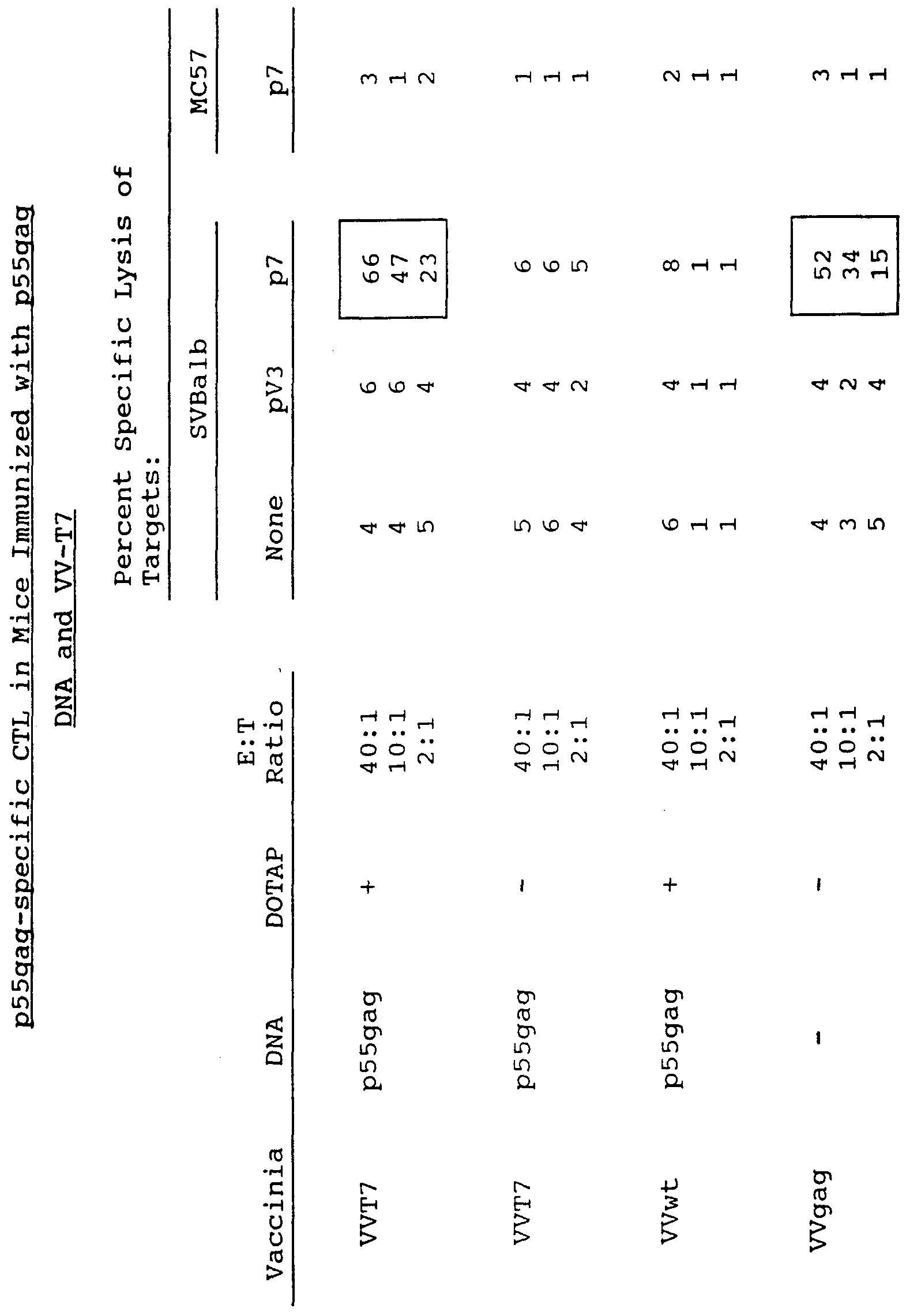
- mice were infected via the intraperitoneal (i.p.) route with lxlO 7 pfu of VV-T7, as described above. Two hours later, 25 ⁇ g of pTMl-gpl20 encoding the HIV-1 gpl20 (Table 4) or pTMl-p55gag, encoding the HIV p55gag protein (Table 5) , each under the control of the T7 polymerase promoter, were injected i.p. in the presence or absence of 155 ⁇ g of the cationic lipid DOTAP. Injections with the DNA plasmids were repeated 18 hours later.
- spleen cell suspensions from these animals were restimulated in vitro with peptides representing gpl20 (pV3) or p55gag (p7) CTL epitopes.
- CTL activity was assessed 7 days later against 51 Cr- labelled histocompatible (SVBalb) and histoincompatible (MC57) target cells pulsed with the epitopic peptides.
- Effector cells from mice immunized with the gpl20 plasmid killed MHC- matched (i:e. SVBalb) target cells that were treated with the relevant epitopic peptide (pV3) but not those that were untreated or treated with an irrelevant peptide (i.e. p41) . Similar results were obtained with spleen cells from mice immunized with p55gag plasmid.
- a deposit of biologically pure cultures of the following strains was made with the American Type Culture Collection (ATCC) , 12301 Parklawn Drive, Rockville, Maryland. The accession number indicated was assigned after successful viability testing, and the requisite fees were paid.
- the deposits were made under the provisions of the Budapest Treaty on the International Recognition of the Deposit of Microorganisms for the Purpose of Patent Procedure and the Regulations thereunder (Budapest Treaty) . This assures maintenance of viable cultures for a period of thirty (30) years from the date of deposit.
- the organisms will be made available by the ATCC under the terms of the Budapest Treaty, and subject to an agreement between Chiron Corporation and the ATCC, which assures permanent and unrestricted availability of the progeny to one determined by the U.S. Commissioner of Patents and
Landscapes
- Health & Medical Sciences (AREA)
- Life Sciences & Earth Sciences (AREA)
- Genetics & Genomics (AREA)
- Chemical & Material Sciences (AREA)
- Organic Chemistry (AREA)
- Engineering & Computer Science (AREA)
- Zoology (AREA)
- Biotechnology (AREA)
- General Engineering & Computer Science (AREA)
- Biomedical Technology (AREA)
- Wood Science & Technology (AREA)
- Bioinformatics & Cheminformatics (AREA)
- General Health & Medical Sciences (AREA)
- Biochemistry (AREA)
- Molecular Biology (AREA)
- Biophysics (AREA)
- Virology (AREA)
- Physics & Mathematics (AREA)
- Microbiology (AREA)
- Plant Pathology (AREA)
- Medicinal Chemistry (AREA)
- Proteomics, Peptides & Aminoacids (AREA)
- Gastroenterology & Hepatology (AREA)
- Communicable Diseases (AREA)
- Oncology (AREA)
- Chemical Kinetics & Catalysis (AREA)
- General Chemical & Material Sciences (AREA)
- Nuclear Medicine, Radiotherapy & Molecular Imaging (AREA)
- Pharmacology & Pharmacy (AREA)
- Animal Behavior & Ethology (AREA)
- Public Health (AREA)
- Veterinary Medicine (AREA)
- Medicines Containing Antibodies Or Antigens For Use As Internal Diagnostic Agents (AREA)
- Medicines That Contain Protein Lipid Enzymes And Other Medicines (AREA)
- Micro-Organisms Or Cultivation Processes Thereof (AREA)
- Pharmaceuticals Containing Other Organic And Inorganic Compounds (AREA)
- Peptides Or Proteins (AREA)
- Medicinal Preparation (AREA)
Abstract
Description


Claims
Priority Applications (4)
| Application Number | Priority Date | Filing Date | Title |
|---|---|---|---|
| JP8501128A JPH10501136A (en) | 1994-06-02 | 1995-05-31 | Nucleic acid immunization using a virus-based infection / transfection system |
| AU26562/95A AU2656295A (en) | 1994-06-02 | 1995-05-31 | Nucleic acid immunization using a virus-based infection/transfection system |
| US08/737,061 US6355247B1 (en) | 1994-06-02 | 1995-05-31 | Nucleic acid immunization using a virus-based infection/transfection system |
| EP95921498A EP0802980A1 (en) | 1994-06-02 | 1995-05-31 | Nucleic acid immunization using a virus-based infection/transfection system |
Applications Claiming Priority (2)
| Application Number | Priority Date | Filing Date | Title |
|---|---|---|---|
| US25296194A | 1994-06-02 | 1994-06-02 | |
| US08/252,961 | 1994-06-02 |
Publications (1)
| Publication Number | Publication Date |
|---|---|
| WO1995033835A1 true WO1995033835A1 (en) | 1995-12-14 |
Family
ID=22958279
Family Applications (1)
| Application Number | Title | Priority Date | Filing Date |
|---|---|---|---|
| PCT/US1995/006809 Ceased WO1995033835A1 (en) | 1994-06-02 | 1995-05-31 | Nucleic acid immunization using a virus-based infection/transfection system |
Country Status (6)
| Country | Link |
|---|---|
| US (1) | US6355247B1 (en) |
| EP (1) | EP0802980A1 (en) |
| JP (1) | JPH10501136A (en) |
| AU (1) | AU2656295A (en) |
| CA (1) | CA2191362A1 (en) |
| WO (1) | WO1995033835A1 (en) |
Cited By (40)
| Publication number | Priority date | Publication date | Assignee | Title |
|---|---|---|---|---|
| WO1999002132A3 (en) * | 1997-07-08 | 1999-08-12 | Chiron Corp | Use of submicron oil-in-water emulsions with dna vaccines |
| WO2000028016A1 (en) * | 1998-11-10 | 2000-05-18 | University Of Rochester | T cells specific for target antigens and methods and vaccines based thereon |
| JP2002508334A (en) * | 1997-12-16 | 2002-03-19 | カイロン コーポレイション | Use of microparticles combined with submicron oil-in-water emulsions |
| EP1009763A4 (en) * | 1996-06-11 | 2002-08-07 | Merck & Co Inc | SYNTHETIC GENES OF HEPATITIS C |
| US6706477B2 (en) | 1997-09-22 | 2004-03-16 | University Of Rochester | Methods for producing polynucleotide libraries in vaccinia virus |
| US7067251B2 (en) | 2000-03-28 | 2006-06-27 | University Of Rochester | Methods of directly selecting cells expressing inserts of interest |
| US7211659B2 (en) | 2001-07-05 | 2007-05-01 | Chiron Corporation | Polynucleotides encoding antigenic HIV type C polypeptides, polypeptides and uses thereof |
| US7282364B2 (en) | 2001-08-31 | 2007-10-16 | Novartis Vaccines And Diagnostics, Inc. | Polynucleotides encoding antigenic HIV type B polypeptides, polypeptides and uses thereof |
| US7348177B2 (en) | 1998-12-31 | 2008-03-25 | Novartis Vaccines And Diagnostics, Inc. | Expression of HIV polypeptides and production of virus-like particles |
| US7943375B2 (en) | 1998-12-31 | 2011-05-17 | Novartis Vaccines & Diagnostics, Inc | Polynucleotides encoding antigenic HIV type C polypeptides, polypeptides and uses thereof |
| US8021834B2 (en) | 1997-12-16 | 2011-09-20 | Novartis Vaccines And Diagnostics, Inc. | Use of microparticles combined with submicron oil-in-water emulsions |
| US8980864B2 (en) | 2013-03-15 | 2015-03-17 | Moderna Therapeutics, Inc. | Compositions and methods of altering cholesterol levels |
| US8999380B2 (en) | 2012-04-02 | 2015-04-07 | Moderna Therapeutics, Inc. | Modified polynucleotides for the production of biologics and proteins associated with human disease |
| US9107886B2 (en) | 2012-04-02 | 2015-08-18 | Moderna Therapeutics, Inc. | Modified polynucleotides encoding basic helix-loop-helix family member E41 |
| US9181319B2 (en) | 2010-08-06 | 2015-11-10 | Moderna Therapeutics, Inc. | Engineered nucleic acids and methods of use thereof |
| US9186372B2 (en) | 2011-12-16 | 2015-11-17 | Moderna Therapeutics, Inc. | Split dose administration |
| US9283287B2 (en) | 2012-04-02 | 2016-03-15 | Moderna Therapeutics, Inc. | Modified polynucleotides for the production of nuclear proteins |
| US9334328B2 (en) | 2010-10-01 | 2016-05-10 | Moderna Therapeutics, Inc. | Modified nucleosides, nucleotides, and nucleic acids, and uses thereof |
| US9428535B2 (en) | 2011-10-03 | 2016-08-30 | Moderna Therapeutics, Inc. | Modified nucleosides, nucleotides, and nucleic acids, and uses thereof |
| US9464124B2 (en) | 2011-09-12 | 2016-10-11 | Moderna Therapeutics, Inc. | Engineered nucleic acids and methods of use thereof |
| US9533047B2 (en) | 2011-03-31 | 2017-01-03 | Modernatx, Inc. | Delivery and formulation of engineered nucleic acids |
| US9572897B2 (en) | 2012-04-02 | 2017-02-21 | Modernatx, Inc. | Modified polynucleotides for the production of cytoplasmic and cytoskeletal proteins |
| US9597380B2 (en) | 2012-11-26 | 2017-03-21 | Modernatx, Inc. | Terminally modified RNA |
| US9872900B2 (en) | 2014-04-23 | 2018-01-23 | Modernatx, Inc. | Nucleic acid vaccines |
| US10064934B2 (en) | 2015-10-22 | 2018-09-04 | Modernatx, Inc. | Combination PIV3/hMPV RNA vaccines |
| US10064935B2 (en) | 2015-10-22 | 2018-09-04 | Modernatx, Inc. | Human cytomegalovirus RNA vaccines |
| US10124055B2 (en) | 2015-10-22 | 2018-11-13 | Modernatx, Inc. | Zika virus RNA vaccines |
| US10273269B2 (en) | 2017-02-16 | 2019-04-30 | Modernatx, Inc. | High potency immunogenic zika virus compositions |
| US10323076B2 (en) | 2013-10-03 | 2019-06-18 | Modernatx, Inc. | Polynucleotides encoding low density lipoprotein receptor |
| US10449244B2 (en) | 2015-07-21 | 2019-10-22 | Modernatx, Inc. | Zika RNA vaccines |
| US10653767B2 (en) | 2017-09-14 | 2020-05-19 | Modernatx, Inc. | Zika virus MRNA vaccines |
| US10695419B2 (en) | 2016-10-21 | 2020-06-30 | Modernatx, Inc. | Human cytomegalovirus vaccine |
| US10815291B2 (en) | 2013-09-30 | 2020-10-27 | Modernatx, Inc. | Polynucleotides encoding immune modulating polypeptides |
| US11103578B2 (en) | 2016-12-08 | 2021-08-31 | Modernatx, Inc. | Respiratory virus nucleic acid vaccines |
| US11351242B1 (en) | 2019-02-12 | 2022-06-07 | Modernatx, Inc. | HMPV/hPIV3 mRNA vaccine composition |
| US11364292B2 (en) | 2015-07-21 | 2022-06-21 | Modernatx, Inc. | CHIKV RNA vaccines |
| US11406703B2 (en) | 2020-08-25 | 2022-08-09 | Modernatx, Inc. | Human cytomegalovirus vaccine |
| US11497807B2 (en) | 2017-03-17 | 2022-11-15 | Modernatx, Inc. | Zoonotic disease RNA vaccines |
| US12070495B2 (en) | 2019-03-15 | 2024-08-27 | Modernatx, Inc. | HIV RNA vaccines |
| US12128113B2 (en) | 2016-05-18 | 2024-10-29 | Modernatx, Inc. | Polynucleotides encoding JAGGED1 for the treatment of Alagille syndrome |
Families Citing this family (19)
| Publication number | Priority date | Publication date | Assignee | Title |
|---|---|---|---|---|
| US6919318B1 (en) * | 1998-04-22 | 2005-07-19 | Chiron Corporation | Enhancing immune responses to genetic immunization by using a chemokine |
| DE60131975T2 (en) * | 2000-07-27 | 2008-12-18 | The Trustees Of The University Of Pennsylvania | APPLICATION OF THE HERPES SIMPLEX VIRUS GLYCOPROTEINS-D TO THE SUPPRESSION OF IMMUNE RESPONSES |
| US20040098756A1 (en) * | 2002-10-29 | 2004-05-20 | Sujay Singh | Transgenic animals for use in protein expression and antibody production |
| US20070059286A1 (en) * | 2003-02-14 | 2007-03-15 | Hone David M | Dna vaccines that express an adp-ribosyltransferase toxin devoid of adp-ribosyltransferase activity |
| US20060026697A1 (en) * | 2004-07-27 | 2006-02-02 | Capital Genomix | Genetic immunization of transgenic animals with non-eukaryotic expression systems |
| AU2007207544A1 (en) | 2006-01-17 | 2007-07-26 | Health Research, Inc. | Heteroduplex tracking assay |
| US9498493B2 (en) * | 2007-09-27 | 2016-11-22 | Immunovaccine Technologies Inc. | Use of liposomes in a carrier comprising a continuous hydrophobic phase for delivery of polynucleotides in vivo |
| JP5715051B2 (en) | 2008-06-05 | 2015-05-07 | イムノバクシーン・テクノロジーズ・インコーポレイテッドImmunovaccine Technologies Inc. | Composition comprising carrier comprising liposome, antigen, polynucleotide and continuous phase of hydrophobic substance |
| ES2625406T3 (en) | 2010-03-25 | 2017-07-19 | Oregon Health & Science University | CMV glycoproteins and recombinant vectors |
| SMT201800284T1 (en) | 2011-06-10 | 2018-07-17 | Univ Oregon Health & Science | Cmv glycoproteins and recombinant vectors |
| CA2789539A1 (en) | 2011-09-12 | 2013-03-12 | International Aids Vaccine Initiative | Immunoselection of recombinant vesicular stomatitis virus expressing hiv-1 proteins by broadly neutralizing antibodies |
| EP2586461A1 (en) | 2011-10-27 | 2013-05-01 | Christopher L. Parks | Viral particles derived from an enveloped virus |
| ES2631608T3 (en) | 2012-06-27 | 2017-09-01 | International Aids Vaccine Initiative | Env-glycoprotein variant of HIV-1 |
| EP2848937A1 (en) | 2013-09-05 | 2015-03-18 | International Aids Vaccine Initiative | Methods of identifying novel HIV-1 immunogens |
| US10058604B2 (en) | 2013-10-07 | 2018-08-28 | International Aids Vaccine Initiative | Soluble HIV-1 envelope glycoprotein trimers |
| US10174292B2 (en) | 2015-03-20 | 2019-01-08 | International Aids Vaccine Initiative | Soluble HIV-1 envelope glycoprotein trimers |
| EP3072901A1 (en) | 2015-03-23 | 2016-09-28 | International Aids Vaccine Initiative | Soluble hiv-1 envelope glycoprotein trimers |
| EP3426598B1 (en) | 2016-03-11 | 2021-07-28 | Children's Medical Center Corporation | Nucleic acid nanoswitch catenanes |
| CN109790199B (en) | 2016-08-02 | 2022-10-18 | 哈佛学院院长及董事 | Cross-coordinated self-assembly |
Citations (1)
| Publication number | Priority date | Publication date | Assignee | Title |
|---|---|---|---|---|
| WO1993019092A1 (en) * | 1992-03-19 | 1993-09-30 | Centre National De La Recherche Scientifique | Defective recombinant adenoviruses expressing characteristic epstein-barr virus proteins |
Family Cites Families (6)
| Publication number | Priority date | Publication date | Assignee | Title |
|---|---|---|---|---|
| US4952496A (en) | 1984-03-30 | 1990-08-28 | Associated Universities, Inc. | Cloning and expression of the gene for bacteriophage T7 RNA polymerase |
| EP0178863A1 (en) | 1984-10-15 | 1986-04-23 | Schering Corporation | Novel expression systems utilizing bacteriophage T7 promoters and gene sequences |
| US5135855A (en) | 1986-09-03 | 1992-08-04 | The United States Of America As Represented By The Department Of Health And Human Services | Rapid, versatile and simple system for expressing genes in eukaryotic cells |
| US5126251A (en) | 1986-09-03 | 1992-06-30 | The United States Of America As Represented By The Secretary Of The Department Of Health And Human Services | Stable mammalian cell line expressing a bacteriophage RNA polymerase |
| EP1026253B2 (en) | 1989-03-21 | 2012-12-19 | Vical Incorporated | Expression of exogenous polynucleotide sequences in a vertebrate |
| US5591601A (en) | 1993-05-14 | 1997-01-07 | Ohio University Edison Animal Biotechnology Institute | DNA polymerase gene expression system utilizing an RNA polymerase co-delivered with the gene expression vector system |
-
1995
- 1995-05-31 EP EP95921498A patent/EP0802980A1/en not_active Withdrawn
- 1995-05-31 US US08/737,061 patent/US6355247B1/en not_active Expired - Fee Related
- 1995-05-31 AU AU26562/95A patent/AU2656295A/en not_active Abandoned
- 1995-05-31 CA CA002191362A patent/CA2191362A1/en not_active Abandoned
- 1995-05-31 WO PCT/US1995/006809 patent/WO1995033835A1/en not_active Ceased
- 1995-05-31 JP JP8501128A patent/JPH10501136A/en not_active Ceased
Patent Citations (1)
| Publication number | Priority date | Publication date | Assignee | Title |
|---|---|---|---|---|
| WO1993019092A1 (en) * | 1992-03-19 | 1993-09-30 | Centre National De La Recherche Scientifique | Defective recombinant adenoviruses expressing characteristic epstein-barr virus proteins |
Non-Patent Citations (5)
Cited By (107)
| Publication number | Priority date | Publication date | Assignee | Title |
|---|---|---|---|---|
| US6653125B2 (en) | 1996-06-11 | 2003-11-25 | Merck & Co., Inc. | Synthetic hepatitis C genes |
| EP1009763A4 (en) * | 1996-06-11 | 2002-08-07 | Merck & Co Inc | SYNTHETIC GENES OF HEPATITIS C |
| WO1999002132A3 (en) * | 1997-07-08 | 1999-08-12 | Chiron Corp | Use of submicron oil-in-water emulsions with dna vaccines |
| US6706477B2 (en) | 1997-09-22 | 2004-03-16 | University Of Rochester | Methods for producing polynucleotide libraries in vaccinia virus |
| US6800442B2 (en) | 1997-09-22 | 2004-10-05 | University Of Rochester | Methods of selecting polynucleotides encoding antigens |
| US6872518B2 (en) | 1997-09-22 | 2005-03-29 | University Of Rochester | Methods for selecting polynucleotides encoding T cell epitopes |
| US8021834B2 (en) | 1997-12-16 | 2011-09-20 | Novartis Vaccines And Diagnostics, Inc. | Use of microparticles combined with submicron oil-in-water emulsions |
| JP2002508334A (en) * | 1997-12-16 | 2002-03-19 | カイロン コーポレイション | Use of microparticles combined with submicron oil-in-water emulsions |
| WO2000028016A1 (en) * | 1998-11-10 | 2000-05-18 | University Of Rochester | T cells specific for target antigens and methods and vaccines based thereon |
| US7348177B2 (en) | 1998-12-31 | 2008-03-25 | Novartis Vaccines And Diagnostics, Inc. | Expression of HIV polypeptides and production of virus-like particles |
| US7943375B2 (en) | 1998-12-31 | 2011-05-17 | Novartis Vaccines & Diagnostics, Inc | Polynucleotides encoding antigenic HIV type C polypeptides, polypeptides and uses thereof |
| US7067251B2 (en) | 2000-03-28 | 2006-06-27 | University Of Rochester | Methods of directly selecting cells expressing inserts of interest |
| US7211659B2 (en) | 2001-07-05 | 2007-05-01 | Chiron Corporation | Polynucleotides encoding antigenic HIV type C polypeptides, polypeptides and uses thereof |
| US8133494B2 (en) | 2001-07-05 | 2012-03-13 | Novartis Vaccine & Diagnostics Inc | Expression cassettes endcoding HIV-1 south african subtype C modified ENV proteins with deletions in V1 and V2 |
| US9598469B2 (en) | 2001-07-05 | 2017-03-21 | Novartis Vaccines And Diagnostics, Inc. | HIV-1 south african subtype C env proteins |
| US7282364B2 (en) | 2001-08-31 | 2007-10-16 | Novartis Vaccines And Diagnostics, Inc. | Polynucleotides encoding antigenic HIV type B polypeptides, polypeptides and uses thereof |
| US9181319B2 (en) | 2010-08-06 | 2015-11-10 | Moderna Therapeutics, Inc. | Engineered nucleic acids and methods of use thereof |
| US9447164B2 (en) | 2010-08-06 | 2016-09-20 | Moderna Therapeutics, Inc. | Engineered nucleic acids and methods of use thereof |
| US9937233B2 (en) | 2010-08-06 | 2018-04-10 | Modernatx, Inc. | Engineered nucleic acids and methods of use thereof |
| US9334328B2 (en) | 2010-10-01 | 2016-05-10 | Moderna Therapeutics, Inc. | Modified nucleosides, nucleotides, and nucleic acids, and uses thereof |
| US10064959B2 (en) | 2010-10-01 | 2018-09-04 | Modernatx, Inc. | Modified nucleosides, nucleotides, and nucleic acids, and uses thereof |
| US9701965B2 (en) | 2010-10-01 | 2017-07-11 | Modernatx, Inc. | Engineered nucleic acids and methods of use thereof |
| US9657295B2 (en) | 2010-10-01 | 2017-05-23 | Modernatx, Inc. | Modified nucleosides, nucleotides, and nucleic acids, and uses thereof |
| US9533047B2 (en) | 2011-03-31 | 2017-01-03 | Modernatx, Inc. | Delivery and formulation of engineered nucleic acids |
| US9950068B2 (en) | 2011-03-31 | 2018-04-24 | Modernatx, Inc. | Delivery and formulation of engineered nucleic acids |
| US10022425B2 (en) | 2011-09-12 | 2018-07-17 | Modernatx, Inc. | Engineered nucleic acids and methods of use thereof |
| US9464124B2 (en) | 2011-09-12 | 2016-10-11 | Moderna Therapeutics, Inc. | Engineered nucleic acids and methods of use thereof |
| US10751386B2 (en) | 2011-09-12 | 2020-08-25 | Modernatx, Inc. | Engineered nucleic acids and methods of use thereof |
| US9428535B2 (en) | 2011-10-03 | 2016-08-30 | Moderna Therapeutics, Inc. | Modified nucleosides, nucleotides, and nucleic acids, and uses thereof |
| US9271996B2 (en) | 2011-12-16 | 2016-03-01 | Moderna Therapeutics, Inc. | Formulation and delivery of PLGA microspheres |
| US9186372B2 (en) | 2011-12-16 | 2015-11-17 | Moderna Therapeutics, Inc. | Split dose administration |
| US9295689B2 (en) | 2011-12-16 | 2016-03-29 | Moderna Therapeutics, Inc. | Formulation and delivery of PLGA microspheres |
| US9814760B2 (en) | 2012-04-02 | 2017-11-14 | Modernatx, Inc. | Modified polynucleotides for the production of biologics and proteins associated with human disease |
| US9782462B2 (en) | 2012-04-02 | 2017-10-10 | Modernatx, Inc. | Modified polynucleotides for the production of proteins associated with human disease |
| US9254311B2 (en) | 2012-04-02 | 2016-02-09 | Moderna Therapeutics, Inc. | Modified polynucleotides for the production of proteins |
| US9283287B2 (en) | 2012-04-02 | 2016-03-15 | Moderna Therapeutics, Inc. | Modified polynucleotides for the production of nuclear proteins |
| US9233141B2 (en) | 2012-04-02 | 2016-01-12 | Moderna Therapeutics, Inc. | Modified polynucleotides for the production of proteins associated with blood and lymphatic disorders |
| US9303079B2 (en) | 2012-04-02 | 2016-04-05 | Moderna Therapeutics, Inc. | Modified polynucleotides for the production of cytoplasmic and cytoskeletal proteins |
| US9301993B2 (en) | 2012-04-02 | 2016-04-05 | Moderna Therapeutics, Inc. | Modified polynucleotides encoding apoptosis inducing factor 1 |
| US9220792B2 (en) | 2012-04-02 | 2015-12-29 | Moderna Therapeutics, Inc. | Modified polynucleotides encoding aquaporin-5 |
| US9220755B2 (en) | 2012-04-02 | 2015-12-29 | Moderna Therapeutics, Inc. | Modified polynucleotides for the production of proteins associated with blood and lymphatic disorders |
| US9221891B2 (en) | 2012-04-02 | 2015-12-29 | Moderna Therapeutics, Inc. | In vivo production of proteins |
| US9216205B2 (en) | 2012-04-02 | 2015-12-22 | Moderna Therapeutics, Inc. | Modified polynucleotides encoding granulysin |
| US9192651B2 (en) | 2012-04-02 | 2015-11-24 | Moderna Therapeutics, Inc. | Modified polynucleotides for the production of secreted proteins |
| US9572897B2 (en) | 2012-04-02 | 2017-02-21 | Modernatx, Inc. | Modified polynucleotides for the production of cytoplasmic and cytoskeletal proteins |
| US9587003B2 (en) | 2012-04-02 | 2017-03-07 | Modernatx, Inc. | Modified polynucleotides for the production of oncology-related proteins and peptides |
| US10501512B2 (en) | 2012-04-02 | 2019-12-10 | Modernatx, Inc. | Modified polynucleotides |
| US9149506B2 (en) | 2012-04-02 | 2015-10-06 | Moderna Therapeutics, Inc. | Modified polynucleotides encoding septin-4 |
| US9114113B2 (en) | 2012-04-02 | 2015-08-25 | Moderna Therapeutics, Inc. | Modified polynucleotides encoding citeD4 |
| US9675668B2 (en) | 2012-04-02 | 2017-06-13 | Moderna Therapeutics, Inc. | Modified polynucleotides encoding hepatitis A virus cellular receptor 2 |
| US9107886B2 (en) | 2012-04-02 | 2015-08-18 | Moderna Therapeutics, Inc. | Modified polynucleotides encoding basic helix-loop-helix family member E41 |
| US9255129B2 (en) | 2012-04-02 | 2016-02-09 | Moderna Therapeutics, Inc. | Modified polynucleotides encoding SIAH E3 ubiquitin protein ligase 1 |
| US9095552B2 (en) | 2012-04-02 | 2015-08-04 | Moderna Therapeutics, Inc. | Modified polynucleotides encoding copper metabolism (MURR1) domain containing 1 |
| US9827332B2 (en) | 2012-04-02 | 2017-11-28 | Modernatx, Inc. | Modified polynucleotides for the production of proteins |
| US9828416B2 (en) | 2012-04-02 | 2017-11-28 | Modernatx, Inc. | Modified polynucleotides for the production of secreted proteins |
| US8999380B2 (en) | 2012-04-02 | 2015-04-07 | Moderna Therapeutics, Inc. | Modified polynucleotides for the production of biologics and proteins associated with human disease |
| US9878056B2 (en) | 2012-04-02 | 2018-01-30 | Modernatx, Inc. | Modified polynucleotides for the production of cosmetic proteins and peptides |
| US9089604B2 (en) | 2012-04-02 | 2015-07-28 | Moderna Therapeutics, Inc. | Modified polynucleotides for treating galactosylceramidase protein deficiency |
| US9061059B2 (en) | 2012-04-02 | 2015-06-23 | Moderna Therapeutics, Inc. | Modified polynucleotides for treating protein deficiency |
| US9050297B2 (en) | 2012-04-02 | 2015-06-09 | Moderna Therapeutics, Inc. | Modified polynucleotides encoding aryl hydrocarbon receptor nuclear translocator |
| US9597380B2 (en) | 2012-11-26 | 2017-03-21 | Modernatx, Inc. | Terminally modified RNA |
| US8980864B2 (en) | 2013-03-15 | 2015-03-17 | Moderna Therapeutics, Inc. | Compositions and methods of altering cholesterol levels |
| US10815291B2 (en) | 2013-09-30 | 2020-10-27 | Modernatx, Inc. | Polynucleotides encoding immune modulating polypeptides |
| US10323076B2 (en) | 2013-10-03 | 2019-06-18 | Modernatx, Inc. | Polynucleotides encoding low density lipoprotein receptor |
| US10022435B2 (en) | 2014-04-23 | 2018-07-17 | Modernatx, Inc. | Nucleic acid vaccines |
| US12329812B2 (en) | 2014-04-23 | 2025-06-17 | Modernatx, Inc. | Nucleic acid vaccines |
| US12274743B2 (en) | 2014-04-23 | 2025-04-15 | Modernatx, Inc. | Nucleic acid vaccines |
| US9872900B2 (en) | 2014-04-23 | 2018-01-23 | Modernatx, Inc. | Nucleic acid vaccines |
| US10709779B2 (en) | 2014-04-23 | 2020-07-14 | Modernatx, Inc. | Nucleic acid vaccines |
| US10449244B2 (en) | 2015-07-21 | 2019-10-22 | Modernatx, Inc. | Zika RNA vaccines |
| US10702597B2 (en) | 2015-07-21 | 2020-07-07 | Modernatx, Inc. | CHIKV RNA vaccines |
| US11364292B2 (en) | 2015-07-21 | 2022-06-21 | Modernatx, Inc. | CHIKV RNA vaccines |
| US11007260B2 (en) | 2015-07-21 | 2021-05-18 | Modernatx, Inc. | Infectious disease vaccines |
| US11872278B2 (en) | 2015-10-22 | 2024-01-16 | Modernatx, Inc. | Combination HMPV/RSV RNA vaccines |
| US11278611B2 (en) | 2015-10-22 | 2022-03-22 | Modernatx, Inc. | Zika virus RNA vaccines |
| US10675342B2 (en) | 2015-10-22 | 2020-06-09 | Modernatx, Inc. | Chikungunya virus RNA vaccines |
| US12521577B2 (en) | 2015-10-22 | 2026-01-13 | Modernatx, Inc. | Betacoronavirus RNA vaccines |
| US10543269B2 (en) | 2015-10-22 | 2020-01-28 | Modernatx, Inc. | hMPV RNA vaccines |
| US10702600B1 (en) | 2015-10-22 | 2020-07-07 | Modernatx, Inc. | Betacoronavirus mRNA vaccine |
| US10702599B2 (en) | 2015-10-22 | 2020-07-07 | Modernatx, Inc. | HPIV3 RNA vaccines |
| US10272150B2 (en) | 2015-10-22 | 2019-04-30 | Modernatx, Inc. | Combination PIV3/hMPV RNA vaccines |
| US10716846B2 (en) | 2015-10-22 | 2020-07-21 | Modernatx, Inc. | Human cytomegalovirus RNA vaccines |
| US10238731B2 (en) | 2015-10-22 | 2019-03-26 | Modernatx, Inc. | Chikagunya virus RNA vaccines |
| US12409347B2 (en) | 2015-10-22 | 2025-09-09 | Modernatx, Inc. | Betacoronavirus mRNA vaccines |
| US10933127B2 (en) | 2015-10-22 | 2021-03-02 | Modernatx, Inc. | Betacoronavirus mRNA vaccine |
| US10517940B2 (en) | 2015-10-22 | 2019-12-31 | Modernatx, Inc. | Zika virus RNA vaccines |
| US12403335B2 (en) | 2015-10-22 | 2025-09-02 | Modernatx, Inc. | Betacoronavirus MRNA vaccines |
| US12403336B2 (en) | 2015-10-22 | 2025-09-02 | Modernatx, Inc. | Betacorona virus mRNA vaccines |
| US10064934B2 (en) | 2015-10-22 | 2018-09-04 | Modernatx, Inc. | Combination PIV3/hMPV RNA vaccines |
| US10064935B2 (en) | 2015-10-22 | 2018-09-04 | Modernatx, Inc. | Human cytomegalovirus RNA vaccines |
| US11235052B2 (en) | 2015-10-22 | 2022-02-01 | Modernatx, Inc. | Chikungunya virus RNA vaccines |
| US10124055B2 (en) | 2015-10-22 | 2018-11-13 | Modernatx, Inc. | Zika virus RNA vaccines |
| US12208288B2 (en) | 2015-10-22 | 2025-01-28 | Modernatx, Inc. | Betacoronavirus RNA vaccines |
| US10383937B2 (en) | 2015-10-22 | 2019-08-20 | Modernatx, Inc. | Human cytomegalovirus RNA vaccines |
| US11484590B2 (en) | 2015-10-22 | 2022-11-01 | Modernatx, Inc. | Human cytomegalovirus RNA vaccines |
| US12128113B2 (en) | 2016-05-18 | 2024-10-29 | Modernatx, Inc. | Polynucleotides encoding JAGGED1 for the treatment of Alagille syndrome |
| US11541113B2 (en) | 2016-10-21 | 2023-01-03 | Modernatx, Inc. | Human cytomegalovirus vaccine |
| US11197927B2 (en) | 2016-10-21 | 2021-12-14 | Modernatx, Inc. | Human cytomegalovirus vaccine |
| US10695419B2 (en) | 2016-10-21 | 2020-06-30 | Modernatx, Inc. | Human cytomegalovirus vaccine |
| US11103578B2 (en) | 2016-12-08 | 2021-08-31 | Modernatx, Inc. | Respiratory virus nucleic acid vaccines |
| US10273269B2 (en) | 2017-02-16 | 2019-04-30 | Modernatx, Inc. | High potency immunogenic zika virus compositions |
| US11497807B2 (en) | 2017-03-17 | 2022-11-15 | Modernatx, Inc. | Zoonotic disease RNA vaccines |
| US10653767B2 (en) | 2017-09-14 | 2020-05-19 | Modernatx, Inc. | Zika virus MRNA vaccines |
| US11207398B2 (en) | 2017-09-14 | 2021-12-28 | Modernatx, Inc. | Zika virus mRNA vaccines |
| US11351242B1 (en) | 2019-02-12 | 2022-06-07 | Modernatx, Inc. | HMPV/hPIV3 mRNA vaccine composition |
| US12070495B2 (en) | 2019-03-15 | 2024-08-27 | Modernatx, Inc. | HIV RNA vaccines |
| US11406703B2 (en) | 2020-08-25 | 2022-08-09 | Modernatx, Inc. | Human cytomegalovirus vaccine |
Also Published As
| Publication number | Publication date |
|---|---|
| CA2191362A1 (en) | 1995-12-14 |
| AU2656295A (en) | 1996-01-04 |
| US6355247B1 (en) | 2002-03-12 |
| JPH10501136A (en) | 1998-02-03 |
| EP0802980A1 (en) | 1997-10-29 |
Similar Documents
| Publication | Publication Date | Title |
|---|---|---|
| US6355247B1 (en) | Nucleic acid immunization using a virus-based infection/transfection system | |
| JP4475561B2 (en) | Hepatitis C virus vaccine | |
| Fooks et al. | High-level expression of the measles virus nucleocapsid protein by using a replication-deficient adenovirus vector: induction of an MHC-1-restricted CTL response and protection in a murine model | |
| KR101454842B1 (en) | Improved alpha virus replicons and helper constructs | |
| US20090104231A1 (en) | Vaccine | |
| JP5475279B2 (en) | Hepatitis C virus nucleic acid vaccine | |
| AU2002337840A1 (en) | Hepatitis C virus vaccine | |
| Garcı́a-Sastre et al. | Influenza virus vectors | |
| WO2014093602A1 (en) | Compositions and methods for treating and preventing hepatitis c virus infection | |
| US20090197319A1 (en) | Virus-Like Particle Containing A Dengue Recombinant Replicon | |
| JP4479973B2 (en) | Hepatitis C virus vaccine | |
| WO1999002132A2 (en) | Use of submicron oil-in-water emulsions with dna vaccines | |
| Feng et al. | Immunologic analysis induced by DNA vaccine encoding E protein of Beijing-1 strain derived from Japanese encephalitis virus | |
| Morghen et al. | Virus vectors for immunoprophylaxis | |
| STEWARD et al. | High-Level Expression of the Measles Virus Nucleocapsid Protein by Using a Replication-Deficient Adenovirus Vector: Induction of an MHC-1-Restricted | |
| HK1123055B (en) | Hepatitis c virus nucleic acid vaccine |
Legal Events
| Date | Code | Title | Description |
|---|---|---|---|
| AK | Designated states |
Kind code of ref document: A1 Designated state(s): AM AT AU BB BG BR BY CA CH CN CZ DE DK EE ES FI GB GE HU IS JP KE KG KP KR KZ LK LR LT LU LV MD MG MN MW MX NO NZ PL PT RO RU SD SE SG SI SK TJ TM TT UA UG US UZ VN |
|
| AL | Designated countries for regional patents |
Kind code of ref document: A1 Designated state(s): KE MW SD SZ UG AT BE CH DE DK ES FR GB GR IE IT LU MC NL PT SE BF BJ CF CG CI CM GA GN ML MR NE SN TD TG |
|
| DFPE | Request for preliminary examination filed prior to expiration of 19th month from priority date (pct application filed before 20040101) | ||
| 121 | Ep: the epo has been informed by wipo that ep was designated in this application | ||
| WWE | Wipo information: entry into national phase |
Ref document number: 08737061 Country of ref document: US |
|
| WWE | Wipo information: entry into national phase |
Ref document number: 2191362 Country of ref document: CA |
|
| WWE | Wipo information: entry into national phase |
Ref document number: 1995921498 Country of ref document: EP |
|
| REG | Reference to national code |
Ref country code: DE Ref legal event code: 8642 |
|
| WWP | Wipo information: published in national office |
Ref document number: 1995921498 Country of ref document: EP |
|
| WWW | Wipo information: withdrawn in national office |
Ref document number: 1995921498 Country of ref document: EP |