WO1995011033A1 - Polyoxometallates in the treatment of flavivirus infections - Google Patents
Polyoxometallates in the treatment of flavivirus infections Download PDFInfo
- Publication number
- WO1995011033A1 WO1995011033A1 PCT/AU1994/000641 AU9400641W WO9511033A1 WO 1995011033 A1 WO1995011033 A1 WO 1995011033A1 AU 9400641 W AU9400641 W AU 9400641W WO 9511033 A1 WO9511033 A1 WO 9511033A1
- Authority
- WO
- WIPO (PCT)
- Prior art keywords
- compounds
- treatment
- prophylaxis
- pharmaceutically acceptable
- pharmaceutical composition
- Prior art date
- Legal status (The legal status is an assumption and is not a legal conclusion. Google has not performed a legal analysis and makes no representation as to the accuracy of the status listed.)
- Ceased
Links
Classifications
-
- A—HUMAN NECESSITIES
- A61—MEDICAL OR VETERINARY SCIENCE; HYGIENE
- A61K—PREPARATIONS FOR MEDICAL, DENTAL OR TOILETRY PURPOSES
- A61K33/00—Medicinal preparations containing inorganic active ingredients
- A61K33/24—Heavy metals; Compounds thereof
- A61K33/26—Iron; Compounds thereof
-
- A—HUMAN NECESSITIES
- A61—MEDICAL OR VETERINARY SCIENCE; HYGIENE
- A61K—PREPARATIONS FOR MEDICAL, DENTAL OR TOILETRY PURPOSES
- A61K33/00—Medicinal preparations containing inorganic active ingredients
- A61K33/24—Heavy metals; Compounds thereof
- A61K33/244—Lanthanides; Compounds thereof
-
- A—HUMAN NECESSITIES
- A61—MEDICAL OR VETERINARY SCIENCE; HYGIENE
- A61K—PREPARATIONS FOR MEDICAL, DENTAL OR TOILETRY PURPOSES
- A61K33/00—Medicinal preparations containing inorganic active ingredients
- A61K33/42—Phosphorus; Compounds thereof
-
- Y—GENERAL TAGGING OF NEW TECHNOLOGICAL DEVELOPMENTS; GENERAL TAGGING OF CROSS-SECTIONAL TECHNOLOGIES SPANNING OVER SEVERAL SECTIONS OF THE IPC; TECHNICAL SUBJECTS COVERED BY FORMER USPC CROSS-REFERENCE ART COLLECTIONS [XRACs] AND DIGESTS
- Y02—TECHNOLOGIES OR APPLICATIONS FOR MITIGATION OR ADAPTATION AGAINST CLIMATE CHANGE
- Y02A—TECHNOLOGIES FOR ADAPTATION TO CLIMATE CHANGE
- Y02A50/00—TECHNOLOGIES FOR ADAPTATION TO CLIMATE CHANGE in human health protection, e.g. against extreme weather
- Y02A50/30—Against vector-borne diseases, e.g. mosquito-borne, fly-borne, tick-borne or waterborne diseases whose impact is exacerbated by climate change
Definitions
- the present invention relates to pharmaceutical compositions containing polyoxometaUates and pharmaceutically acceptable derivatives thereof, and to the use of these compounds in therapy for the treatment or prophylaxis of infections by viruses which are confirmed or probable members of the family Flaviviridae, for example infections such as yellow fever, dengue fever, Australian encephalitis, Japanese encephalitis and Hepatitis C.
- Flaviviruses are well known to be the causative agents of a number of human diseases including the most important arthropod-borne viral afflictions of civilization - dengue, yellow fever, and Japanese encephalitis. In addition, eight flaviviruses cause disease in domestic or wild animals of economic importance. Yellow fever and dengue fever are widespread and well known as mosquito borne diseases of tropical countries. There are between 30 and 60 million flavivirus infections per year including one million Japanese encephalitis infections. The extent of Hepatitis C is not known with any degree of certainty because an infection can exist for many years without the patient being aware of the symptoms. Hepatitis C produces a much higher rate of chronic liver infection than Hepatitis B which is a recognised hazard in many countries.
- Effective vaccines are available for some viruses only, eg for yellow fever, Japanese encephalitis and tick-borne encephalitis. Treatment of dengue fever and Australian encephalitis relies on the patient's own immune defences; infections can be fatal. An antiviral drug to control infections with flaviviruses is thus highly desirable.
- Flaviviridae is a newly-recognised large group (in excess of 70 species) of small, enveloped viruses that contain a single strand of positive-sense RNA of 10 kilobases.
- Prior Art Heteropolytungstate compounds have been known for over 100 years. Most of their applications stem from their redox chemistry and also their high ionic weights and charges. Their redox chemistry has lead to their use as catalysts for the oxidation of organic substrates such as, for example, propylene to acrylic acid, ethylene to acetaldehyde. In the biological field heteropolytungstates have found use as electron dense stains for electron microscopy, as analytical reagents for proteins and several have also been shown to inhibit viral DNA and RNA polymerases (J. C. Cherman, et al., Biochem. Biophys. Res. Commun., 1975, 65, 1229; M. Herve, et al, ibid, 1983, 116, 222.).
- the heteropolytungstates within the scope of this invention include the Keggin and Dawson (also known as the Wells-Dawson) type structures and compounds based on these structures in which one or more of the tungsten atoms are removed and, in the majority of cases, exchanged by other metal atoms.
- Vacancies in the structures are most often created by the extraction of WO 4+ or W 3 O 6 6+ from the Keggin (XW 12 O 40 n" ) or Dawson (P 2 W 18 O 62 6" ) species. Isomers of these unsaturated (lacunary) polyanions are possible, a consequence of the location of the vacancy. (R. Massart R. Contant, J. M. Fruchart, J. M. Ciabrini, M.
- Unsaturated heteropolyanions can behave as ligands by bonding, at their vacant site, with metal ions. These metal ions, when not sterically crowded, can carry ligands such as water, organic coordinating species or organometallic groups. Organometallic moieties can also react with exposed oxygen atoms on, for example, trisubstituted Keggin or Dawson structures (R. G. Finke and M. W. Droege, J. Am. Chem. Soc, 1984, 106, 121 '4 and R. G. Finke, B. Rapko and P. J. Domaille, Organometallics 1986, 5, 175).
- An oxygen atom on the Keggin structure can also be alkylated with reagents such as trimethyloxonium salts (W. H. Knoth and R. L. Harlow, J. Am. Chem. Soc. 1981, 103, 4265). Some of the oxygen atoms on heteropolytungstates can also be exchanged for fluorine atoms (F. Chauveau, P. Doppelt and J. Lefebvre, Inorg. Chem. 1980, 19, 2803; T. L. Jorris, M. Kozik and L. C. W. Baker, Inorg. Chem. 1990, 29, 4584).
- heteropolyanion species are formed by reaction of two W 5 O 18 H 5" ions with metal ions such as the lanthanoids (R. D. Peacock and T. J. R. Weakley, J. Chem. Soc.
- the central atom in the compounds can vary widely, especially in the case of the simpler Keggin type structures.
- the central atom in the Dawson type structures is most often phosphorus.
- PolyoxometaUates containing metals such as molybdenum, niobium and vanadium have also been made.
- polyoxometallate polyanions are active against viruses belonging to the Flaviviridae family. In particular they inhibit the replication of such viruses stopping the development of an infection.
- compositions for use in the treatment or prophylaxis of a flavivirus associated infection having as active ingredient one or more polyoxometallate compounds selected from formula 1 to 17 below or a pharmaceutically acceptable derivative thereof.
- the compounds of the invention are polyanions with associated cations (A) for electrical neutrality. They crystallize with a variable number of molecules of water of crystallization dependent upon the conditions of product recovery and subsequent treatment; all such hydrates come within the scope of this invention.
- a pharmaceutically acceptable derivative is meant any pharmaceutically acceptable salt, or any other compound which, upon administration to the recipient, is capable of providing (directly or indirectly) a compound of the invention or an active metabolite or residue thereof.
- compositions of the present invention may comprise an effective amount of one or more compounds selected from Formulae 1-17 in association with one or more pharmaceutically acceptable carriers or diluents, and optionally other therapeutic agents.
- Each carrier must be pharmaceutically "acceptable” in the sense of being compatible with the other ingredients of the composition and not injurious to the patient.
- the compositions of this invention may include other agents conventional in the art having regard to the type of composition in question, for example, those suitable for oral administration may include such further agents as sweeteners, thickeners and flavouring agents.
- compositions include those suitable for oral, rectal, nasal, topical (including buccal and sublingual), vaginal or parenteral (including subcutaneous, intramuscular, intravenous and intradermal) administration.
- the compositions may conveniently be presented in unit dosage form and may be prepared by any methods well known in the art of pharmacy. Such methods include the step of bringing into association the active ingredient with the carrier which constitutes one or more accessory ingredients.
- the compositions are prepared by uniformly and intimately bringing into association the active ingredient with liquid carriers or finely divided solid carriers or both, and then if necessary shaping the product.
- the present invention also extends to a method for the treatment or prophylaxis of a flavivirus associated infection, which comprises the administration of a composition containing an effective amount of one or more compounds selected from Formulae 1-17.
- the compounds may be prepared by the literature methods or adaptions thereof, varying reactants and conditions as required to obtain the target compound.
- General review articles, describing the preparation, structure and properties of many of the compounds, include P. Souchay, "Ions Min ⁇ raux Condenses", Masson, Paris, 1969; M. T. Pope, “Heteropoly and Isopoly Oxometalates", Springer- Verlag, Berlin, 1983; T. J. R. Weakley, Structure and Bonding, Springer-Verlag, Berlin, 1974, 18, 131; M. T. Pope and A. M ⁇ ller, Angew. Chem. Int. Ed. Engl. 1991, 30, 34.
- R an organic residue or one containing an organometallic, metal carbonyl or metal coordinated with a ligand.
- M Ge IV , Si
- Ln lanthanoid metal ion.
- This compound was prepared by reaction of Na 10 [ ⁇ -SiW 9 O 34 ].aq. 14.2 g (5 mmol) with 4.8 g (15 mmol) ZrOCl 2 .8H 2 O in 100 mL H 2 O at 70°C for 4 h. After filtration through Celite filter aid, 25 g KCl was added to give a white precipitate. The mixture was warmed and the precipitate became a clear dense phase which on cooling to room temp, and scratching with a glass rod gave a white solid (10.2 g). This was redissolved in 50 mL H 2 O at 65°C and reprecipitated on addition of 10 g KCl.
- a possible structure for 16/2 may be one similar to that postulated for 16/1, ie one in which two [Zr 2 W 10 SiO 40 ] 8" units are joined through a Zr 4+ .
- IR spectrum (KBr disc, cm -1 ) 997(w), 934(m), 895(s), 792(sh), 755(s).
- This product was obtained by treatment of 100 mmol Na 2 WO 4 .2H 2 O with 10 mmol Na 2 SiO 3 .5H 2 O and ca. 7 mmol acetic acid in 100 mL H 2 O at room temp followed by addition of 20mmol Cp 2 ZrCl 2 and stirring the solution (yellow) for several days. It did not decolourise on treatment with carbon. Addition of excess KCl gave a white precipitate which was dissolved in H 2 O at 60 - 70°C. The white compound that separated on cooling to room temp, was collected and air dried.
- the ir of the yellow crude material had no NO 3 " peak and only a doublet for the PO 4 3" .
- the ir spectrum (KBr disc, cm “1 ) 1076, 1053, 946, 872, 806, 720.
- the brown compound was collected and recrystallised from 100 mL H 2 O (85°C).
- the grey brown powder (11.1 g) was analysed; %W 48.92, %Co 6.77, %Fe 2.59, %Na 2.48 giving the elemental ratio for compound 17/5 of W 7 Fe j 22 Co 3 02 Na 2 8 .
- the oxygen on the transition metal atom(s) may be either doubly protonated (H 2 O), singly protonated (OH), or completely deprotonated (O).
- H 2 O doubly protonated
- OH singly protonated
- O completely deprotonated
- oxygen atoms are necessarily oxo groups and the charge (and hence the number of counter cations (A)) on the polyanion will depend on the number of protons attached to the oxygen atom(s).
- compounds containing groups such as, for example, MOH, may dimerize by an intermolecular condensation reaction. Dimers, where formed, of the compounds listed, are also included in the invention.
- the reduced compounds are also included in this invention.
- the charge on the polyanions can vary, depending upon the extent of protonation of the polyanions, as noted earlier, and upon the oxidation states of the metal atoms.
- the number of associated counter cations (A) will vary correspondingly.
- A may be a proton, an alkali metal ion, an alkali earth ion, or ammonium or alkyl ammonium ion of type R ⁇ JJ H JJ N "1" , where R is an alkyl chain of from 1 to 6 carbon atoms.
- the required cation is generally introduced into the compound either by use of an ion exchange resin or by precipitation with excess of a salt of that cation.
- compositions of the present invention suitable for oral administration may be presented as discrete units such as capsules, sachets or tablets each containing a predetermined amount of the active ingredient; as a powder or granules; as a solutions or a suspension in an aqueous or non-aqueous liquid; or as an oil-in-water liquid emulsion or a water-in-oil liquid emulsion.
- the active ingredient may also be presented as a bolus, electuary or paste.
- a tablet may be made by compression or moulding, optionally with one or more accessory ingredients.
- Compressed tablets may be prepared by compressing in a suitable machine the active ingredient in a free-flowing form such as a powder or granules, optionally mixed with a binder (e.g inert diluent, preservative disintegrant (e.g. sodium starch glycollate, cross-linked povidone, cross-linked sodium carboxymethyl cellulose) surface-active or dispersing agent.
- a binder e.g inert diluent, preservative disintegrant (e.g. sodium starch glycollate, cross-linked povidone, cross-linked sodium carboxymethyl cellulose) surface-active or dispersing agent.
- Moulded tablets may be made by moulding in a suitable machine a mixture of the powdered compound moistened with an inert liquid diluent.
- the tablets may optionally be coated or scored amd may be formulated so asS to provide slow or controlled release of the active ingredient therein using, for example, hydroxypropylmethyl cellulose in varying proportions to provide the desired release profile. Tablets may optionally be provided with an enteric coating, to provide release in parts of the gut other than the stomach.
- compositions suitable for topical administration in the mouth include lozenges comprising the active ingredient in a flavoured basis, usually sucrose and acacia or tragacanth gum; pastilles comprising the active ingredient in an inert basis such as gelatin and glycerin, or sucrose and acacia gum; and mouthwashes comprising the active ingredient in a suitable liquid carrier.
- compositions for rectal administration may be presented as a suppository with a suitable base comprising, for example, cocoa butter or a salicylate.
- compositions suitable for vaginal administration may be presented as pessaries, tampons, creams, gels, pastes, foams or spray formulations containing in addition to the active ingredient such carriers as are known in the art to be appropriate.
- compositions suitable for parenteral administration include aqueous and non- aqueous isotonic sterile injection solutions which may contain anti-oxidants, buffers, bacteriostats and solutes which render the composition isotonic with the blood of the intended recipient; and aqueous and non-aqueous sterile suspensions which may include suspending agents and thickening agents.
- the compositions may be presented in unit- dose or multi-dose sealed containers, for example, ampoules and vials, and may be stored in a freeze-dried (lyophilized) condition requiring only the addition of the sterile liquid carrier, for example water for injections, immediately prior to use.
- Extemporaneous injection solutions and suspensions may be prepared from sterile powders, granules and tablets of the kind previously described.
- Preferred unit dosage compositions are those containing a daily dose or unit daily sub-dose, as herein above recited, or an appropriate fraction thereof, of an active ingredient.
- the compounds according to the invention may also be presented for use in the form of veterinary compositions, which may be prepared, for example, by methods that are conventional in the art.
- veterinary compositions include those adapted for:
- oral administration external application, for example drenches (e.g. aqueous or non-aqueous solutions or suspensions); tablets or boluses; powders, granules or pellets for admixture with feed stuffs; pastes for application to the tongue;
- drenches e.g. aqueous or non-aqueous solutions or suspensions
- tablets or boluses e.g. aqueous or non-aqueous solutions or suspensions
- pastes for application to the tongue for example drenches (e.g. aqueous or non-aqueous solutions or suspensions); tablets or boluses; powders, granules or pellets for admixture with feed stuffs; pastes for application to the tongue;
- parenteral administration for example by subcutaneous, intramuscular or intravenous injection, e.g. as a sterile solution or suspension; or (when appropriate) by intramammary injection where a suspension or solution is introduced into the udder via the teat;
- topical application e.g. as a cream, ointment or spray applied to the skin;
- compositions of this invention may include other agents conventional in the art having regard to the type of composition in question, for example, those suitable for oral administration may include such further agents as sweeteners, thickeners and flavouring agents.
- active ingredient means one or more compounds of selected from Formulae 1-17 or a pharmaceutically acceptable derivative thereof.
- Example active ingredients according to the invention were prepared and analysed by ICP spectroscopy.
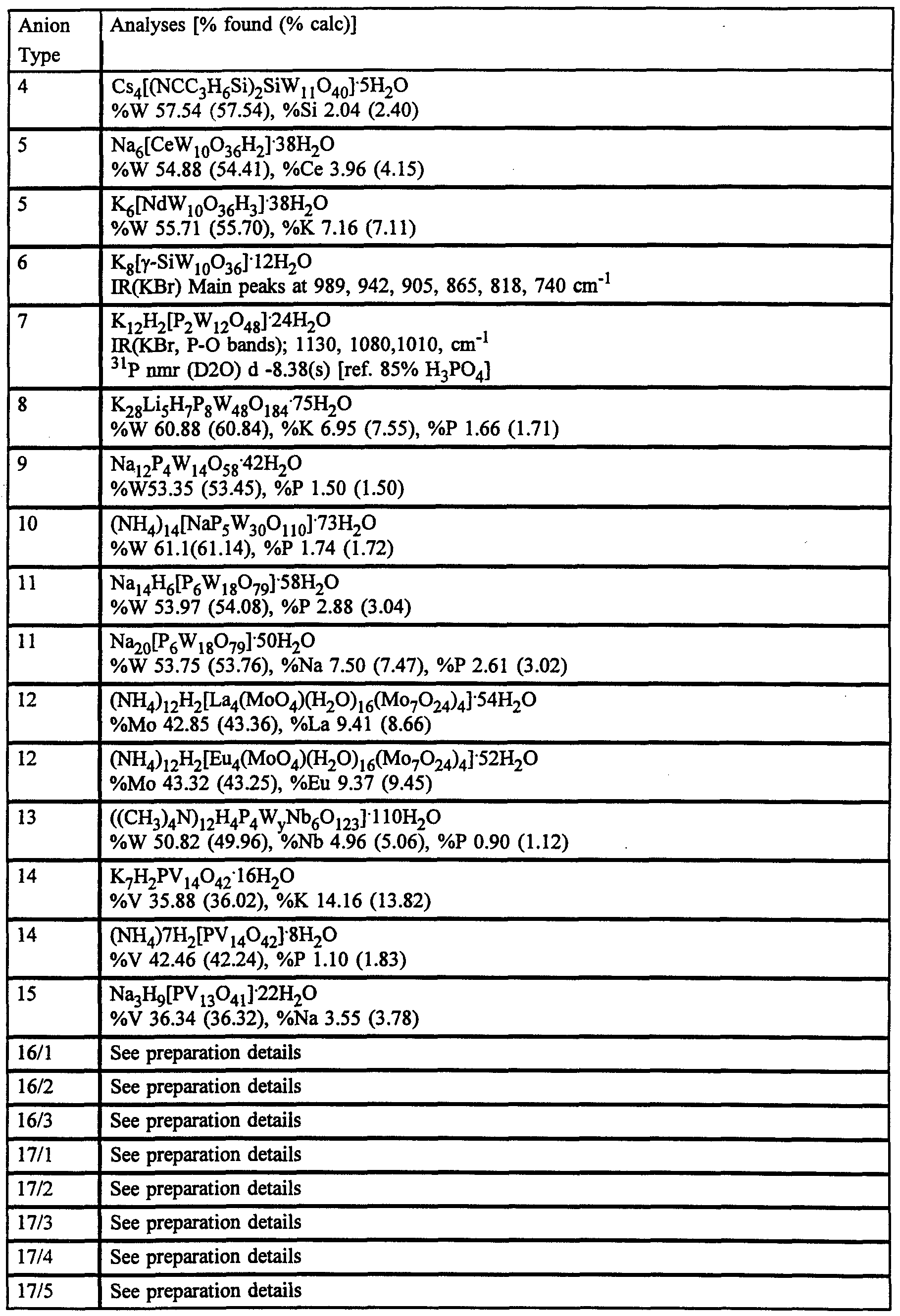
- the compound formula and the analytical results compared with the composition expected from the formula are given in Table 1 below. Ir and nmr data are also included.
- Example 1 The compounds listed in Example 1 were tested for their ability to inhibit RNA synthesis in an in vitro polymerase assay (Chu and Westaway, 1985, 1987; Brun and Brinton, 1986).
- flavivirus RNA comprising the genomic 44S RNA, a double-stranded replicative form (RF) and a partially-double-stranded replicative intermediate (RI) are detected by the incorporation of [ ⁇ - 32 P]GTP.
- Vero cells were infected at a multiplicity of infection of 7 for Type 2 dengue (DEN-2) virus (New Guinea C strain; Sabin and Schlesinger, 1945) or Kunjin (KUN) virus (strain MRM 61C; Boulton and Westaway, 1972). Extracts containing RNA- dependent RNA polymerase (RDRP) activity derived from DEN-2 virus-infected cells were prepared at 30 to 36 h p.i., when polymerase activity was at a maximum. Similarly, extracts of KUN virus-infected cells were prepared at the time of maximum polymerase activity at 24 h p.i. (Chu and Westaway, 1985).
- DEN-2 Type 2 dengue
- KUN Kunjin virus
- the cells were pelleted by centrifugation and resuspended in 10 mM sodium acetate at a concentration of 2x10 7 cells/ml. They were then disrupted by passaging 20 times through a 21 gauge needle followed by 20 times through a 26 gauge needle. The disrupted cells were centrifuged at 800 g for 7 min to obtain a supernatant fraction and a pellet of the nuclear-associated material. All RDRP assays were performed using the supernatant fraction, hereafter referred to as the cell extract, which was stored at -70°C and used after only one cycle of freeze/thawing.
- the RDRP activity in the cell extract was assayed as previously described with the following modifications (Chu and Westaway, 1985).
- the virus-infected cell extract contained 4.5-6 mg/ml of protein.
- the compound to be tested dissolved in double distilled water and RNasin (0.5 units/ml, Promaga) were added to the cell extract for 10 min prior to the addition of the other components of the RDRP assay.
- the final reaction mixture (total volume of 50 ⁇ l) contained 50 mM Tris-HCl pH 8.0, 10 mM magnesium acetate, 7.5 mM potassium acetate, 10 mM 2-mercaptoethanol, 6 ⁇ g actinomycin D (AMD), 5 mM phosphoenolpyruvate, 3 units/ ⁇ l pyruvate kinase, 0.5 mM ATP, 0.5 mM CTP, 0.5 mM UTP, 25 ⁇ M GTP, 5 ⁇ Ci [ ⁇ - 32 P] GTP (Amersham, specific activity 410 Ci mmol), 0.5 units/ml RNasin, 30 ⁇ l of infected cell extract and the test compound (from 0.5 to 100 ⁇ M).
- the reaction was stopped after 30 min at 37°C by the addition of EDTA to a final concentration of 10 mM.
- An equal volume of TNE-SDS 50 mM Tris-acetate pH 7.6, 0.1 M sodium acetate, 1 mM EDTA and 2% SDS was added to disrupt membranes.
- the RNA was then extracted with phenol and precipitated by ethanol.
- RNA samples were mixed with an equal volume of sample buffer containing 7 M urea in TBE (89 mM Tris-HCl, 89 mM boric acid, 2.5 mM EDTA) and 0.5% bromophenol blue, and were separated by electrophoresis through 3% polyacrylamide gels containing 7 M urea in TBE. The gels were fixed in 10% acetic acid, dried and radiolabelled bands detected by autoradiography.
- the compounds tested inhibited the synthesis of both DEN-2 and KUN RF RNA. There was also a decrease in the amount of RI detected with increasing concentration of drug. The concentrations which give >75% inhibition of RNA synthesis are given in Table 2.
- the compounds were dissolved in doubly distilled water and tested as described above.
- the compounds tested and their antiflavi-viral activity are given in the Table 2 below.
- formulation A may be prepared by wet granulation of the ingredients with a solution of povidone, followed by addition of magnesium stearate and compression.
- the following formulation B may be prepared by direct compression of the admixed ingredients.
- This formulation may be prepared by wet granulation of the ingredients (below) with a solution of povidone followed by the addition of magnesium stearate and compression. mg/tablet
- a capsule formulation may be prepared by admixing the ingredients of Formulation B in Example 3 above and filling into a two-part hard gelatin capsule.
- Formulation B (infra) may be prepared in a similar manner.
- the following controlled release capsule formulation may be prepared by extruding ingredients a, b and c using an extruder, followed by spheronisation of the extrudate and drying. The dried pellets may then be coated with release-controlling membrane (d) and filled into a two-piece, hard gelatin capsule. mg/capsule
- the active ingredient may be dissolved in most of the water (35°-1)
- the batch may then be made up to volume with the water and filtered through a sterile micropore filter into a sterile 10 ml amber glass vial (type 1) and sealed with sterile closures and overseals.
Landscapes
- Health & Medical Sciences (AREA)
- Chemical & Material Sciences (AREA)
- Inorganic Chemistry (AREA)
- Medicinal Chemistry (AREA)
- Pharmacology & Pharmacy (AREA)
- Epidemiology (AREA)
- Life Sciences & Earth Sciences (AREA)
- Animal Behavior & Ethology (AREA)
- General Health & Medical Sciences (AREA)
- Public Health (AREA)
- Veterinary Medicine (AREA)
- Pharmaceuticals Containing Other Organic And Inorganic Compounds (AREA)
Abstract
Pharmaceutical compositions containing polyoxometallates and pharmaceutically acceptable derivatives thereof. The use of such compounds or compositions in therapy for the treatment or prophylaxis of infections by viruses which are confirmed or probable members of the family Flaviviridae including Hepatitis C.
Description
POLYOXOMETAUATES IN THE TREATMENT OF FLAVIVIRUS INFECTIONS
ANTIVIRAL AGENTS
The present invention relates to pharmaceutical compositions containing polyoxometaUates and pharmaceutically acceptable derivatives thereof, and to the use of these compounds in therapy for the treatment or prophylaxis of infections by viruses which are confirmed or probable members of the family Flaviviridae, for example infections such as yellow fever, dengue fever, Australian encephalitis, Japanese encephalitis and Hepatitis C.
Flaviviruses are well known to be the causative agents of a number of human diseases including the most important arthropod-borne viral afflictions of mankind - dengue, yellow fever, and Japanese encephalitis. In addition, eight flaviviruses cause disease in domestic or wild animals of economic importance. Yellow fever and dengue fever are widespread and well known as mosquito borne diseases of tropical countries. There are between 30 and 60 million flavivirus infections per year including one million Japanese encephalitis infections. The extent of Hepatitis C is not known with any degree of certainty because an infection can exist for many years without the patient being aware of the symptoms. Hepatitis C produces a much higher rate of chronic liver infection than Hepatitis B which is a recognised hazard in many countries. About 50% of patients develop chronic infections, compared with 5 to 10% of those infected with Hepatitis B. Chronic infection causes cirrhosis of the liver, impairs liver function, and 20-30 years later causes liver failure. It has been estimated that the rate of infection approaches and may exceed 1% of the population in Australia. There is no proven cure or vaccine for Hepatitis C.
Effective vaccines are available for some viruses only, eg for yellow fever, Japanese encephalitis and tick-borne encephalitis. Treatment of dengue fever and Australian encephalitis relies on the patient's own immune defences; infections can be fatal.
An antiviral drug to control infections with flaviviruses is thus highly desirable.
Drugs which control or inhibit replication have proven to be effective in the control of some other viruses. However, because of the difficulty of inhibiting viruses while leaving the non-infected cells unimpaired, few antiviral drugs are currently in widespread clinical use.
The family Flaviviridae is a newly-recognised large group (in excess of 70 species) of small, enveloped viruses that contain a single strand of positive-sense RNA of 10 kilobases. As a consequence of the difficulty mentioned above and recent recognition of flaviviruses as a unique group with a unique replication strategy, no attention has been paid to antiviral compounds to control flaviviral infections.
All members of the family Flaviviridae possess a unique replication strategy which is inhibited by the compositions of this invention. The non-structural genes NS3 and NS5 which have been proposed to be involved in replication share a great deal of sequence similarity between species, and hence an inhibitor of replication should be active against all flaviviruses.
Prior Art Heteropolytungstate compounds have been known for over 100 years. Most of their applications stem from their redox chemistry and also their high ionic weights and charges. Their redox chemistry has lead to their use as catalysts for the oxidation of organic substrates such as, for example, propylene to acrylic acid, ethylene to acetaldehyde. In the biological field heteropolytungstates have found use as electron dense stains for electron microscopy, as analytical reagents for proteins and several have also been shown to inhibit viral DNA and RNA polymerases (J. C. Cherman, et al., Biochem. Biophys. Res. Commun., 1975, 65, 1229; M. Herve, et al, ibid, 1983, 116, 222.).
The heteropolytungstates within the scope of this invention include the Keggin and Dawson (also known as the Wells-Dawson) type structures and compounds based on these structures in which one or more of the tungsten atoms are removed and, in the majority of cases, exchanged by other metal atoms. Vacancies in the structures are most
often created by the extraction of WO4+ or W3O6 6+ from the Keggin (XW12O40 n") or Dawson (P2W18O62 6") species. Isomers of these unsaturated (lacunary) polyanions are possible, a consequence of the location of the vacancy. (R. Massart R. Contant, J. M. Fruchart, J. M. Ciabrini, M. Fournier, Inorg. Chem. 1977, 16, 2916; T. L. Jorris, M. Kozik, N. Casan-Pastor, P. J. Domaille, R. G. Finke, W. K. Miller and L. C. W. Baker, J. Am. Chem. Soc. 1987, 109, 7402; T. J. R. Weakley, Polyhedron 1987, 6, 931; R. Contant and J.-P. Ciabrini, J. Chem. Res. (S), 1977, 222; R. G. Finke, M. W. Droege and P. J. Domaille, Inorg. Chem.,, 1987, 26, 3886; M. T. Pope, "Heteropoly and Isopoly Oxometalates" , Springer-Verlag, Berlin, 1983.) The position of the vacancy in P2W17O61 10" is defined by the prefix αr for a belt vacancy or β - for a cap vacancy. The rotation of W3-oxide triads in the structures leads to a number of isomers. Thus a 60° rotation of a W3 triad cap can convert, for example, an α- isomer to the β- isomer. In the trivacant polyanions of the type XW9O34 n", A- or B-forms are obtained, depending upon whether a corner-linked W3 oxide triad is lost (A-form) or an edge- linked . oxide triad has been removed (B-form).
Unsaturated heteropolyanions can behave as ligands by bonding, at their vacant site, with metal ions. These metal ions, when not sterically crowded, can carry ligands such as water, organic coordinating species or organometallic groups. Organometallic moieties can also react with exposed oxygen atoms on, for example, trisubstituted Keggin or Dawson structures (R. G. Finke and M. W. Droege, J. Am. Chem. Soc, 1984, 106, 121 '4 and R. G. Finke, B. Rapko and P. J. Domaille, Organometallics 1986, 5, 175). An oxygen atom on the Keggin structure can also be alkylated with reagents such as trimethyloxonium salts (W. H. Knoth and R. L. Harlow, J. Am. Chem. Soc. 1981, 103, 4265). Some of the oxygen atoms on heteropolytungstates can also be exchanged for fluorine atoms (F. Chauveau, P. Doppelt and J. Lefebvre, Inorg. Chem. 1980, 19, 2803; T. L. Jorris, M. Kozik and L. C. W. Baker, Inorg. Chem. 1990, 29, 4584).
Other heteropolyanion species are formed by reaction of two W5O18H5" ions with metal ions such as the lanthanoids (R. D. Peacock and T. J. R. Weakley, J. Chem. Soc.
A, 1971,1836). Heteropolyanions having PW7 phosphotungstate groups, generally bridged by phosphate group(s), are known (J. Fuchs and R. Palm, Z. Naturforsch. 1988,
43b, 1529 and R. Acerete, J. Server-Carrio, A. Vegas and M. Martinez-Ripoll, J. Am. Chem. Soc, 1990, 112, 9386).
The central atom in the compounds can vary widely, especially in the case of the simpler Keggin type structures. The central atom in the Dawson type structures is most often phosphorus.
PolyoxometaUates containing metals such as molybdenum, niobium and vanadium have also been made.
We have now made the unexpected discovery that polyoxometallate polyanions are active against viruses belonging to the Flaviviridae family. In particular they inhibit the replication of such viruses stopping the development of an infection.
Accordingly the present invention provides compositions for use in the treatment or prophylaxis of a flavivirus associated infection having as active ingredient one or more polyoxometallate compounds selected from formula 1 to 17 below or a pharmaceutically acceptable derivative thereof. The compounds of the invention are polyanions with associated cations (A) for electrical neutrality. They crystallize with a variable number of molecules of water of crystallization dependent upon the conditions of product recovery and subsequent treatment; all such hydrates come within the scope of this invention.
By "a pharmaceutically acceptable derivative" is meant any pharmaceutically acceptable salt, or any other compound which, upon administration to the recipient, is capable of providing (directly or indirectly) a compound of the invention or an active metabolite or residue thereof.
The pharmaceutical compositions of the present invention may comprise an effective amount of one or more compounds selected from Formulae 1-17 in association with one or more pharmaceutically acceptable carriers or diluents, and optionally other therapeutic agents. Each carrier must be pharmaceutically "acceptable" in the sense of being compatible with the other ingredients of the composition and not injurious to the patient.
It should be understood that in addition to the ingredients particularly mentioned, the compositions of this invention may include other agents conventional in the art having regard to the type of composition in question, for example, those suitable for oral administration may include such further agents as sweeteners, thickeners and flavouring agents.
Compositions include those suitable for oral, rectal, nasal, topical (including buccal and sublingual), vaginal or parenteral (including subcutaneous, intramuscular, intravenous and intradermal) administration. The compositions may conveniently be presented in unit dosage form and may be prepared by any methods well known in the art of pharmacy. Such methods include the step of bringing into association the active ingredient with the carrier which constitutes one or more accessory ingredients. In general, the compositions are prepared by uniformly and intimately bringing into association the active ingredient with liquid carriers or finely divided solid carriers or both, and then if necessary shaping the product.
The present invention also extends to a method for the treatment or prophylaxis of a flavivirus associated infection, which comprises the administration of a composition containing an effective amount of one or more compounds selected from Formulae 1-17.
The compounds may be prepared by the literature methods or adaptions thereof, varying reactants and conditions as required to obtain the target compound. General review articles, describing the preparation, structure and properties of many of the compounds, include P. Souchay, "Ions Minέraux Condenses", Masson, Paris, 1969; M. T. Pope, "Heteropoly and Isopoly Oxometalates", Springer- Verlag, Berlin, 1983; T. J. R. Weakley, Structure and Bonding, Springer-Verlag, Berlin, 1974, 18, 131; M. T. Pope and A. Mϋller, Angew. Chem. Int. Ed. Engl. 1991, 30, 34.
The compounds of the invention useful as active ingredients, are listed as Formulae 1-17 below along with appropriate methods of preparation for each sub-type. In each formula, A is a cation and n is the number of such cations necessary for electrical neutrality of the molecule.
1.) AnP2MM'2W15O62
M ≠ M' and M = W, V, Mo; M'= V, Mo.
The compounds were obtained by the reactions of M. Abbessi, R Contant, R. Thouvenot,and G. Herve, Inorg. Chem. 1991, 30, 1695 and/or for M = Mo, the reactions of R. Contant and J.-P. Ciabrini, J. inorg. nucl. Chem. 1981, 43, 1525.
2.) AnP2MM'3W14O62
M, M' = V, Mo.
The compounds were obtained by the reactions of M. Abbessi, R Contant, R. Thouvenot,and G. Herve, Inorg. Chem. 1991, 30, 1695 and/or for M = Mo, the reactions of R. Contant and J.-P. Ciabrini, J. inorg. nucl. Chem. 1981, 43, 1525.
3.) AnP2MM'5W12O62
M = W; M' = Mo or M = M' = Ti, Mo, Fe, V
The compounds with M = W were prepared accoding to R. Contant and J.-P. Ciabrini, J. inorg. nucl. Chem. 1981, 43, 1525. The compounds (M = M') M = Mo were made following R. Contant and J.-P. Ciabrini, J. Chem. Research (M) 1977, 2601; the compounds M = Ti were made by the method of P. D. Savage and B. R. C. Theobald described in British Patent Appl. No. 70944/91.
4.) An(RM)2WπXO40 X = Pv, SiIV, GeIV
R = an organic residue or one containing an organometallic, metal carbonyl or metal coordinated with a ligand. M = GeIV, Si
The compounds were made following the methods of W. H. Knoth, U.S. Patent (1980) 4,196,136; W. H. Knoth, J. Am. Chem. Soc. 1979, 101, 2211; M. S. Weeks, C. L. Hill, and R. F. Shinazi, J. Med. Chem. 1992, 35, 1216.
M = lanthanoid, ZrIV
The compounds were prepared according to the method of R. D. Peacock and T. J. R. Weakley, J. Chem. Soc. A, 1971,1836. The structure of the CeIV compound Na6[CeIV(W5O18H)2] has been determined by J. Iball, J. N. Low and T. J. R. Weakley, J. Chem. Soc. Dalton Trans., 1974, 2021.
6.) AnSiW10O36
The compounds were prepared following A. Teze and G. Herve, Inorg. Synth., 1990, 27, 88. (Ed. A. P. Ginsberg) Wiley-Interscience.
7.) ArH2P2W12O 48
The compounds were prepared following R. Contant, Inorg. Synth. 1990, 27, 108. (Ed. A. P. Ginsberg) Wiley-Interscience, or R. Contant and J.-P. Ciabrini, J. Chem. Research (M) 1977, 2601.
8.) AnP8W48O184
The compounds were prepared following R. Contant, Inorg. Synth. 1990, 27, 110. (Ed. A. P. Ginsberg) Whiley-Interscience; R. Contant and A. Teze, Inorg. Chem. 1985, 24, 4610.
9 AnP4W14O58
The compounds were made following the procedures of J. Fuchs and R. Palm, Z Naturforsch. 1988, 43b, 1529 and that of R. Thouvenot, A. Teze, R. Contant and G. Herve, Inorg. Chem. 1988, 27, 524.
10.) AnNaP5W30Ono
The compounds based on Pressler' s anion were made by the procedure described by M. H. Alizadeh, S. P. Harmalker, Y. Jeannin, J. Martin-Frere and M. T. Pope, J. Am. Chem. Soc. 1985, 107, 2662.
11.) AnP6W18O79
The compounds were made following the procedures of J. Fuchs and R. Palm, Z Naturforsch. 1988, 43b, 1529 and R. Acerete, J. Server-Carrio, A. Vegas and M. Martinez-Ripoll, J. Am. Chem. Soc, 1990, 112, 9386.
12.) AnLn4(MoO4)(H2O)16(Mo7O24)4
Ln = lanthanoid metal ion.
Synthesised following H. Naruke and T. Yamase, J. Lumin. 1991, 50, 55.
13.) AnP4W30Nb6O123 A„P2W15Nb3O62 AnSi2 18Nb6O77
These compounds were made by the method of D. J. Edlund et al., Organometal. 1988, 7, 1692; R. G. Finke et al, J. Amer. Chem. Soc, 1984, 106, 7274.
14.) AnPV14O42
These compounds were made according to the methods of F. Preuss and H. Schug, Z Naturforsch. 1976, 31b, 1585; R. Kato, A. Kobayashi and Y. Sasaki, J. Am. Chem. Soc. 1980, 102, 5671.
15.) AnPV13O41
These compounds were made according to the methods of F. Preuss and H. Schug, Z Naturforsch. 1976, 31b, 1585.
16.) Zirconium containing heteropolytungstates.
The structures of these novel compounds are not known and the structures postulated are based primarily on the metal analysis of the products, physical properties when available and, at times, the nature of the starting materials. It is noted that the 31P nmr signals obtained from the zirconium containing compounds are often broad and complex. The cations in these products, as is the case for most polyoxometalates, can be exchanged for other cations using, for example, an appropriate ion exchange resin.
Preparation of compound 16/1
This compound was prepared by reaction of Na10[α-SiW9O34].aq. 14.2 g (5 mmol) with 4.8 g (15 mmol) ZrOCl2.8H2O in 100 mL H2O at 70°C for 4 h. After filtration through Celite filter aid, 25 g KCl was added to give a white precipitate. The mixture was warmed and the precipitate became a clear dense phase which on cooling to room temp, and scratching with a glass rod gave a white solid (10.2 g). This was redissolved in 50 mL H2O at 65°C and reprecipitated on addition of 10 g KCl. This was collected, dissolved in 30 mL H2O at 70°C, filtered hot and let stand at room temp. The somewhat soft product was collected and washed with ethanol to give a white solid (6.8 g). The metal analyses, %W 52.2; %Zr 10.1; %K 5.03, corresponded to W18Zr7 02K8 15. A possible structure for 16/1 may be based on a dimer; two [Zr3SiW9O38(H2O)2]6" units connected through a Zr4+.
Preparation of compound 16/2.
On reaction of Na10[α-SiW9O34].aq. 7.1 g (2.5 mmol) with 1.46 g (5 mmol) finely powdered Cp2ZrCl2 in 50 mL H2O at room temp, overnight a yellow, slightly turbid solution was obtained. After treatment with activated charcoal 10 g KCl was added. The off-white precipitate formed was collected, washed with ethanol and air
dried to give 5.1 g product. It was redissolved in 200 mL H2O at 80°C to give a pale yellow solution from which a pale yellow powder(3.4 g) was obtained on treatment with 10 g KCl. Analyses: %W 55.34, %Zr 6.92, %K 6.96; corresponding to an atomic ratio for the compound of W20Zr5 04-^11.8- A possible structure for 16/2 may be one similar to that postulated for 16/1, ie one in which two [Zr2W10SiO40]8" units are joined through a Zr4+. IR spectrum (KBr disc, cm-1) 997(w), 934(m), 895(s), 792(sh), 755(s).
Preparation of compound 16/3.
This product was obtained by treatment of 100 mmol Na2WO4.2H2O with 10 mmol Na2SiO3.5H2O and ca. 7 mmol acetic acid in 100 mL H2O at room temp followed by addition of 20mmol Cp2ZrCl2 and stirring the solution (yellow) for several days. It did not decolourise on treatment with carbon. Addition of excess KCl gave a white precipitate which was dissolved in H2O at 60 - 70°C. The white compound that separated on cooling to room temp, was collected and air dried. Analysis; %W 49.61; %Zr 6.34; %Si 0.76; %K 6.25; corresponding to an atomic ratio for the compound of W20Zr5 15Si2 QJ JJ 8, which is similar to that found for 16/2. Based on their ir spectra, the compounds are not identical. Ir spectrum (KBr disc, cm"1) 998 (sh), 954(m), 898(s), 799(s), 680(m, br). Elution of the compound through a protonated 'Amberlite IR-120' resin column gave a product with a similar ir spectrum (broader peaks) and near identical metal ratio.
17.) Iron containing heteropolytungstates
The structures of these novel compounds are not known. The cations in these products, as is the case for most polyoxometalates, can be exchanged for other cations using standard techniques such as, for example, an appropriate ion exchange resin.
Preparation of compounds 17/1 and 17/2.
A solution of 33 g (100 mmol) Na2WO4.2H2O and 2.12 g (10 mmol)
Na2SiO3.5H2O in 150 mL H2O was treated with 6 g (100 mmol) acetic acid and thenS a solution of 8.1 g (20 mmol) Fe(NO3)3.9H2O in 50 mL H2O containing 10 g CH3CO2Na and 2 mL acetic acid was added drop wise over about 15 - 20 mins. to the
hot reaction solution. After boiling for several hours, the solution was filtered, cooled to room temp, and 20 g KCl added. A yellow-brown solid (5-6 g) separated from the solution. This was recrystallised from hot water to give, after washing with ethanol and air drying, 1.8 g light brown powder. Analysis: %W 48.99, %Fe 9.48, %Si 0.72, % Na 3.75, giving for compound 17/1 an elemental ratio of W8Fe5 jSi0 78Na49 (ie near W8Fe5SiNa5). The pH of the supernatant was reduced to ca. 2.5 with HC1 and 20 g N(n-Bu)4Cl was added. The yellow precipitate (19-20 g) was washed with water and ethanol and air dried. It was then placed in 100 mL H2O and the pH of the solution was adjusted from 2.5 to 6.9 by the slow addition of 0.05 N KOH. The yellow solution, still containing solids, was filtered and then eluted through an 'Amberlite IR-120' resin column in the K+ form. On removal of the solvent, 7.2 g of a yellow brown solid was isolated. Analysis: %W 60.20, %Fe 2.02, %Si 1.07, %K 7.31, giving an elemental ratio WjgFβj 99Si2 09K10 3 (ie near WlgFe2Si2K10 ) for compound 17/2. Ir spectrum (KBr disc, cm-1) 1000(w), 960(m), 902(s), 792(s), 730(sh, br.), 680(sh, br).
Preparation of compounds 17/3 and 17/4.
27.9 g (90 mmol) of Na^O^^O in 125 mL H2O was reacted with 1.56 g (10 mmol) NaH2PO4.2H2O and the pH of the solution lowered to 8.2 with acetic acid. Then 8.05 g (20 mmol) Fe(NO3)3.9H2O dissolved in 40-50 mL H2O containing ca. 10 g neutralised CH3CO2Na was added slowly to the hot (70 - 80°C) reaction solution. After refluxing for several hours, the near clear solution (pH 6.4) was filtered, cooled to room temp., and on addition of 16 g KCl a sticky tan material, which stuck to the bottom of the flask, separated. Then a yellow solid began to separate from the reaction solution and after ca. 1/2 h the solution appeared solid with this yellow material. The yellow material was readily separated from the brown which was adhered to the bottom of the reaction vessel.
The ir of the brown compound showed the PO4 3" stretches as a triplet and also indicated the presence of a nitrate moiety. On recrystallisation from warm water, a flocculant yellow product was obtained and its ir spectrum (KBr disc, cm"1) 1386, 1080, 1057, 1039, 947, 878, 813, 730(br) was very nearly identical to that of the crude material. Analysis: %W 49.69, %Fe 2.82, %P 0.75, %K 10.36 giving the elemental ratio for
compound 17/3 of W16Fe299Pj 43K15 7. Since the P analyses (by ICP AES) of many well characterised compounds were often low, the ratio of the above elements in 17/3 may possibly be near W|6Fe3P2Kj6.
The ir of the yellow crude material had no NO3 " peak and only a doublet for the PO4 3". After recrystallisation from water at 60°C, the ir spectrum (KBr disc, cm"1) 1076, 1053, 946, 872, 806, 720. Analysis: %W 54.60, %Fe 4.03, % P 0.87, %K 8.20 giving the elemental ratio for compound 17/4 of W16Fe3 89Pj 51Kπ 3 (ie near W16Fe4P2Kn).
Preparation of compound 17/5.
59.4 g (180 mmol) of Na^O^^O in 200 mL H2O and 2.4 g acetic acid was warmed to 70°C. A solution of 8.05 g (20 mmol) Fe(NO3)3.9H2O in 70 mL H2O containing also 8 g neutralised CH3CO2Na was added to the tungstate solution over 1/2 h, the solution remaining clear, changing colour from yellow near the beginning of the addition to a red brown as the reaction progressed. A solution of CoCl2.6H2O (9.52 g, 40 mmol) in 70 mL H2O and 2.4 g acetic acid and containing also 8 g CH3CO2Na was added drop wise to the boiling reaction solution over 1 h. Some material precipitated from solution after ca. 5-10 mL of the cobalt solution had been added. The solution was boiled for 1/2 h after addition was complete and then let stand at room temp, over night. Two products were apparent, a greenish material that was washed off the sticky brown compound adhering to the bottom of the vessel. The brown material was dissolved in 300 mL H2O, filtered through 'Celite' and added 40 g NaCl to the solution. Some more of the greenish material also separated on standing. The brown compound was collected and recrystallised from 100 mL H2O (85°C). The grey brown powder (11.1 g) was analysed; %W 48.92, %Co 6.77, %Fe 2.59, %Na 2.48 giving the elemental ratio for compound 17/5 of W7Fej 22Co3 02Na2 8.
In the compounds of formula 1-17, when a transition metal atom(s) replace(s) one or more tungsten atoms in the structure, the oxygen on the transition metal atom(s) may be either doubly protonated (H2O), singly protonated (OH), or completely deprotonated (O). The acidity of these protons, and the compounds that are obtained,
as is known to one skilled in the art of polyoxometallate chemistry, depends on the nature of the transition metal atom, its oxidation state, the basicity of the polyanion formed and the basicity of the solution from which the compounds were isolated. In the compounds of the invention not all oxygen atoms are necessarily oxo groups and the charge (and hence the number of counter cations (A)) on the polyanion will depend on the number of protons attached to the oxygen atom(s). Furthermore, compounds containing groups such as, for example, MOH, may dimerize by an intermolecular condensation reaction. Dimers, where formed, of the compounds listed, are also included in the invention.
Many of the compounds of the invention can occur in a number of isomeric forms. In fact, it is at times difficult to obtain isomerically pure compounds. All isomers or isomer mixtures are included in this invention.
Many of the compounds can undergo one or more electron reductions. The reduced compounds are also included in this invention.
The charge on the polyanions can vary, depending upon the extent of protonation of the polyanions, as noted earlier, and upon the oxidation states of the metal atoms. The number of associated counter cations (A) will vary correspondingly. A may be a proton, an alkali metal ion, an alkali earth ion, or ammonium or alkyl ammonium ion of type R^JJHJJN"1", where R is an alkyl chain of from 1 to 6 carbon atoms. The required cation is generally introduced into the compound either by use of an ion exchange resin or by precipitation with excess of a salt of that cation.
It is to be noted that, as one skilled in the art of heteropolyanion chemistry would know, not all combinations of the elements given in formulae 1 to 17 are isolable.
Preparation of Compositions
Compositions of the present invention suitable for oral administration may be presented as discrete units such as capsules, sachets or tablets each containing a predetermined amount of the active ingredient; as a powder or granules; as a solutions or a suspension in an aqueous or non-aqueous liquid; or as an oil-in-water liquid emulsion or a water-in-oil liquid emulsion. The active ingredient may also be presented as a bolus, electuary or paste.
A tablet may be made by compression or moulding, optionally with one or more accessory ingredients. Compressed tablets may be prepared by compressing in a suitable machine the active ingredient in a free-flowing form such as a powder or granules, optionally mixed with a binder (e.g inert diluent, preservative disintegrant (e.g. sodium starch glycollate, cross-linked povidone, cross-linked sodium carboxymethyl cellulose) surface-active or dispersing agent. Moulded tablets may be made by moulding in a suitable machine a mixture of the powdered compound moistened with an inert liquid diluent. The tablets may optionally be coated or scored amd may be formulated so asS to provide slow or controlled release of the active ingredient therein using, for example, hydroxypropylmethyl cellulose in varying proportions to provide the desired release profile. Tablets may optionally be provided with an enteric coating, to provide release in parts of the gut other than the stomach.
Compositions suitable for topical administration in the mouth include lozenges comprising the active ingredient in a flavoured basis, usually sucrose and acacia or tragacanth gum; pastilles comprising the active ingredient in an inert basis such as gelatin and glycerin, or sucrose and acacia gum; and mouthwashes comprising the active ingredient in a suitable liquid carrier.
Compositions for rectal administration may be presented as a suppository with a suitable base comprising, for example, cocoa butter or a salicylate.
Compositions suitable for vaginal administration may be presented as pessaries, tampons, creams, gels, pastes, foams or spray formulations containing in addition to the active ingredient such carriers as are known in the art to be appropriate.
Compositions suitable for parenteral administration include aqueous and non- aqueous isotonic sterile injection solutions which may contain anti-oxidants, buffers, bacteriostats and solutes which render the composition isotonic with the blood of the intended recipient; and aqueous and non-aqueous sterile suspensions which may include suspending agents and thickening agents. The compositions may be presented in unit- dose or multi-dose sealed containers, for example, ampoules and vials, and may be stored in a freeze-dried (lyophilized) condition requiring only the addition of the sterile liquid carrier, for example water for injections, immediately prior to use. Extemporaneous injection solutions and suspensions may be prepared from sterile powders, granules and tablets of the kind previously described.
Preferred unit dosage compositions are those containing a daily dose or unit daily sub-dose, as herein above recited, or an appropriate fraction thereof, of an active ingredient.
The compounds according to the invention may also be presented for use in the form of veterinary compositions, which may be prepared, for example, by methods that are conventional in the art. Examples of such veterinary compositions include those adapted for:
(a) oral administration, external application, for example drenches (e.g. aqueous or non-aqueous solutions or suspensions); tablets or boluses; powders, granules or pellets for admixture with feed stuffs; pastes for application to the tongue;
(b) parenteral administration for example by subcutaneous, intramuscular or intravenous injection, e.g. as a sterile solution or suspension; or (when appropriate) by intramammary injection where a suspension or solution is introduced into the udder via the teat;
(c) topical application, e.g. as a cream, ointment or spray applied to the skin; or
(d) intravaginally, e.g. as a pessary, cream or foam.
It should be understood that in addition to the ingredients particularly mentioned above, the compositions of this invention may include other agents conventional in the art having regard to the type of composition in question, for example, those suitable for oral administration may include such further agents as sweeteners, thickeners and flavouring agents.
The following examples are intended for illustration only and are not intended to limit the scope of the invention in any way. The term "active ingredient" as used in Examples 3 to 6 means one or more compounds of selected from Formulae 1-17 or a pharmaceutically acceptable derivative thereof.
EXAMPLE 1 Compounds of the invention
Example active ingredients according to the invention were prepared and analysed by ICP spectroscopy. The compound formula and the analytical results compared with the composition expected from the formula are given in Table 1 below. Ir and nmr data are also included.
TABLE 1
Anion Analyses [% found (% calc)] Type
1 K8[P2V2W16O62] 40H2O
%W 57.07 (57.33); %V 2.15 (1.99), %K 5.69 (6.10), %P 0.92 (1.21)
1 K8[P2MoV2W15062] 38H20
%W 55.11 (55.08), %V 2.25 (2.03), %Mo 2.17 (1.92), %K 6.14 (6.25), %P 0.93 (1.24)
1 K7[P2Mo2VW15062]-34H20
%W 55.86 (55.82), %V 1.15 (1.03), %Mo 3.07 (3.88), %K 5.73 (5.54), %P 0.92 (1.25)
2 K<,[P2MoV3W14062]-45H20
%W 51.54 (51.08), %V 2.87 (3.03), %Mo 1.89 (1.90), %K 7.52 (6.99), %P 0.89 (1.23)
2 K6[P2Mo4W14062]-28H20
%W54.26 (54.18), %Mo7.61 (8.08), %K 5.21 (4.94), %P 0.91 (1.30)
3 K18[Ti6W12P2062]-35H20
%W 45.39 (45.19), %Ti 5.69 (5.89), %K 13.5 (14.4)
3 (NH4)18[Ti6W12P2062] 35H20 %W 49.07 (49.00), %Ti 6.22 (6.38)
4 Cs4[(CH3CO2CH2CH2Si)2SiWπO40]-5H2O %W 57.04 (57.09), %Si 2.05 (2.38)
 EXAMPLE 2: Antiviral Activity
The compounds listed in Example 1 were tested for their ability to inhibit RNA synthesis in an in vitro polymerase assay (Chu and Westaway, 1985, 1987; Brun and Brinton, 1986). In this assay, flavivirus RNA comprising the genomic 44S RNA, a double-stranded replicative form (RF) and a partially-double-stranded replicative intermediate (RI) are detected by the incorporation of [α-32P]GTP.
A. Preparation of virus-infected Vero cell extracts
Vero cells were infected at a multiplicity of infection of 7 for Type 2 dengue (DEN-2) virus (New Guinea C strain; Sabin and Schlesinger, 1945) or Kunjin (KUN) virus (strain MRM 61C; Boulton and Westaway, 1972). Extracts containing RNA- dependent RNA polymerase (RDRP) activity derived from DEN-2 virus-infected cells were prepared at 30 to 36 h p.i., when polymerase activity was at a maximum. Similarly, extracts of KUN virus-infected cells were prepared at the time of maximum polymerase activity at 24 h p.i. (Chu and Westaway, 1985).
The cells were pelleted by centrifugation and resuspended in 10 mM sodium acetate at a concentration of 2x10⁷ cells/ml. They were then disrupted by passaging 20 times through a 21 gauge needle followed by 20 times through a 26 gauge needle. The disrupted cells were centrifuged at 800 g for 7 min to obtain a supernatant fraction and a pellet of the nuclear-associated material. All RDRP assays were performed using the supernatant fraction, hereafter referred to as the cell extract, which was stored at -70°C and used after only one cycle of freeze/thawing.
B. RNA-dependent RNA polymerase assay
The RDRP activity in the cell extract was assayed as previously described with the following modifications (Chu and Westaway, 1985). In each RDRP assay the virus-infected cell extract contained 4.5-6 mg/ml of protein. The compound to be tested dissolved in double distilled water and RNasin (0.5 units/ml, Promaga) were
added to the cell extract for 10 min prior to the addition of the other components of the RDRP assay. The final reaction mixture (total volume of 50 μl) contained 50 mM Tris-HCl pH 8.0, 10 mM magnesium acetate, 7.5 mM potassium acetate, 10 mM 2-mercaptoethanol, 6 μg actinomycin D (AMD), 5 mM phosphoenolpyruvate, 3 units/μl pyruvate kinase, 0.5 mM ATP, 0.5 mM CTP, 0.5 mM UTP, 25 μM GTP, 5 μCi [α-32P] GTP (Amersham, specific activity 410 Ci mmol), 0.5 units/ml RNasin, 30 μl of infected cell extract and the test compound (from 0.5 to 100 μM). The reaction was stopped after 30 min at 37°C by the addition of EDTA to a final concentration of 10 mM. An equal volume of TNE-SDS (50 mM Tris-acetate pH 7.6, 0.1 M sodium acetate, 1 mM EDTA and 2% SDS) was added to disrupt membranes. The RNA was then extracted with phenol and precipitated by ethanol.
C. Electrophoresis of RNA
RNA samples were mixed with an equal volume of sample buffer containing 7 M urea in TBE (89 mM Tris-HCl, 89 mM boric acid, 2.5 mM EDTA) and 0.5% bromophenol blue, and were separated by electrophoresis through 3% polyacrylamide gels containing 7 M urea in TBE. The gels were fixed in 10% acetic acid, dried and radiolabelled bands detected by autoradiography.
Results
The compounds tested inhibited the synthesis of both DEN-2 and KUN RF RNA. There was also a decrease in the amount of RI detected with increasing concentration of drug. The concentrations which give >75% inhibition of RNA synthesis are given in Table 2.
References
BOULTON, R.W. AND WESTAWAY, E.G. (1972).
Comparisons of Togaviruses:Sindbis virus (Group A) and Kunjin virus (Group B). Virology 49, 283-289.
CHU, P.W.G. AND WESTAWAY, E.G. (1985).
Replication strategy of Kunjin virus:evidence for recycling, role of the replicative form RNA as template in semiconservative and asymmetric replication. Virology 140, 68-79.
CHU, P.W.G. AND WESTAWAY, E.G. (1987).
Characterization of Kunjin virus RNA-dependent RNA polymerase.-reinitiation of synthesis in vitro. Virology 157, 330-337.
GRUN, J.B. AND BRINTON, M.A. (1986).
Characterisation of West Nile virus RNA-dependent RNA polymerase and cellular adenylyl and uridylyl transferases in cell-free extracts. Journal of Virology 60, 1113-1124.
SABIN, A.B. AND SCHLESINGER, R.W. (1945).
Production of immunity to dengue with virus modified by propagation in mice. Science 101, 640-642.
The compounds were dissolved in doubly distilled water and tested as described above. The compounds tested and their antiflavi-viral activity are given in the Table 2 below.
Table 2

The following formulation A may be prepared by wet granulation of the ingredients with a solution of povidone, followed by addition of magnesium stearate and compression.
mg/tablet
Formulation A
(a) Active ingredient 250 250
(b) Lactose B.P. 210 26
(c) Povidone B.P. 15 9
(d) Sodium starch glycollate 20 12
(e) Magnesium stearate 5 3
500 300
The following formulation B, may be prepared by direct compression of the admixed ingredients.
Formulation B mg/capsule
Active ingredient 250
Pregelatinised starch NF15 150
400
Formulation C (Controlled release formulation
This formulation may be prepared by wet granulation of the ingredients (below) with a solution of povidone followed by the addition of magnesium stearate and compression. mg/tablet
(a) Active ingredient 500
(b) Hydroxypropylmethylcellulose 112
(methocel K4M Premium)
(c) Lactose B.P. 53
(d) Povidone B.P.C. 28
(e) Magnesium stearate 7
700
EXAMPLE 4: Capsule Formulations
Formulation A
A capsule formulation may be prepared by admixing the ingredients of Formulation B in Example 3 above and filling into a two-part hard gelatin capsule. Formulation B (infra) may be prepared in a similar manner.
Formulation B mg/capsule
(a) Active ingredient 250
(b) Lactose B.P. 143 (c) Sodium starch glycollate 25
(d) Magnesium stearate 2
420 Formulation C (Controlled release capsule)
The following controlled release capsule formulation may be prepared by extruding ingredients a, b and c using an extruder, followed by spheronisation of the extrudate and drying. The dried pellets may then be coated with release-controlling membrane (d) and filled into a two-piece, hard gelatin capsule. mg/capsule
(a) Active ingredient 250
(b) Microcrystalline cellulose 125
(c) Lactose B.P. 125
(d) Ethyl cellulose 13
513
EXAMPLE 5: Injectable Formulation
Formulation: Active ingredient 0.200 g
Hydrochloric acid solution, 0.1M qs to pH 5.0-7.0
Sodium hydroxide solution, 0.1M qs to pH 5.0-7.0
Sterile water qs to 10 ml
The active ingredient may be dissolved in most of the water (35°-
40°C) and the pH adjusted to between 5.0 and 7.0 with the hydrochloric acid or the sodium hydroxide as appropriate. The batch may then be made up to volume with the water and filtered through a sterile micropore filter into a sterile 10 ml amber glass vial (type 1) and sealed with sterile closures and overseals.
Throughout this specification and the claims which follow, unless the context requires otherwise, the word "comprise", or variations such as "comprises" or "comprising", will be understood to imply the inclusion of a stated integer or group of integers but not the exclusion of any other integer or group of integers.
Claims
CLAIMS:
1. A method for the treatment or prophylaxis of a flavivirus associated infection, characterised in that it comprises the administration to a patient in need of such treatment or prophylaxis of an effective amount of one or more compounds selected from Formulae 1 to 17 and dimers, isomers, solvates or reduced forms thereof:
1.) AnP2MM'2W15O62 wherein
M ≠ M' and M = W, V, Mo; M' = V, Mo.
2.) AnP2MM'3W14O62 wherein M, M' = V, Mo.
3.) AnP2MM'5W12O62 wherein
M = W; M' = Mo or M = M' = Ti, Mo, Fe, V.
4.) An(RM)2WπXO40 wherein
X = Pv, SiIV, GeIV,
R = an organic residue or one containing an organometallic, metal carbonyl or metal coordinated with a ligand,
M = GeIV, Si.
5.) AnMW10O36 wherein M = lanthanoid, Zr .
6.) AnSiW10O36
8-) AnP8W48O184
9.) AnP4W14O58
10.) AnNaP5W30O110
11.) AnP6W18O79
12.) AπLn4(MoO4)(H2O)16(Mo7O24)4 wherein
Ln = lanthanoid metal ion.
13.) AnP4W30Nb6O123, AnP2W15Nb3O62 or AnSi2W18Nb6O77.
14.) AnPV14O42.
15.) AnPV13O41.
16.) Zirconium containing heteropolytungstates.
17.) Iron containing heteropolytungstates.
and wherein in each of the above formulae, A is a cation and n is the number of such cations necessary for electrical neutrality of the molecule; or pharmaceutically acceptable derivatives thereof.
2. A method as claimed in Claim 1, characterised in that A is a proton, an alkali metal, alkaline earth or ammonium cation, or an alkylammonium cation of the formula R4_mHmN+, where R is an alkyl chain of from 1 to 6 carbon atoms and m is 0, 1, 2 or 3.
3. A method as claimed in Claim 1 or Claim 2, characterised in that the compound is administered in the form of a pharmaceutical composition which comprises the said compound in association with a pharmaceutically acceptable carrier or diluent.
4. The use in the manufacture of a medicament for the treatment or prophylaxis of a flavivirus associated infection of a compound as defined in Claim 1 or Claim 2.
5. A pharmaceutical composition for the treatment or prophylaxis of a flavivirus associated infection, characterised in that it comprises a compound as defined in ClaimEl or Claim 2, in association with a pharmaceutically acceptable carrier or diluent.
6. A pharmaceutical composition for the treatment or prophylaxis of a flavivirus associated infection, characterised in that it comprises one or more compounds of Formula 1 or dimers, isomers, solvates or reduced forms thereof:
1.) AnP2MM'2W15O62 wherein
M ≠ M' and M = W, V, Mo; M' = V, Mo, A is a cation and n is the number of such cations necessary for electrical neutrality of the molecule; or pharmaceutically acceptable derivatives thereof.
7. A pharmaceutical composition for the treatment or prophylaxis of a flavivirus associated infection, characterised in that it comprises one or more compounds of Formula 2 or dimers, isomers, solvates or reduced forms thereof:
2.) AnP2MM'3W14O62 wherein
M, M' = V, Mo,
A is a cation and n is the number of such cations necessary for electrical neutrality of the molecule; or pharmaceutically acceptable derivatives thereof.
8. A pharmaceutical composition for the treatment or prophylaxis of a flavivirus associated infection, characterised in that it comprises one or more compounds of Formula 3 or dimers, isomers, solvates or reduced forms thereof:
3.) AnP2MM'5W12O62 wherein
M = W; M' = Mo or M = M' = Ti, Mo, Fe, V, A is a cation and n is the number of such cations necessary for electrical neutrality of the molecule; or pharmaceutically acceptable derivatives thereof.
9. A pharmaceutical composition for the treatment or prophylaxis of a flavivirus associated infection, characterised in that it comprises one or more compounds of Formula 4 or dimers, isomers, solvates or reduced forms thereof: 4.) An(RM)2WπXO36 wherein
X=PV, SIIV, GeIV
R= an organic residue or one containing an organometallic, metal carbonyl or metal coordinated with a ligand A is a cation and n is the number of such cations necessary for electrical neutrality of the molecule; or pharmaceutically acceptable derivatives thereof.
10. A pharmaceutical composition for the treatment or prophylaxis of a flavivirus associated infection, characterised in that it comprises one or more compounds of Formula 5 or dimers, isomers, solvates or reduced forms thereof:
5.) AπMW10O36
wherein
M = lanthanoid, Zr , A is a cation and n is the number of such cations necessary for electrical neutrality of the molecule; or pharmaceutically acceptable derivatives thereof.
11. A pharmaceutical composition for the treatment or prophylaxis of a flavivirus associated infection, characterised in that it comprises one or more compounds of Formula 6 or dimers, isomers, solvates or reduced forms thereof:
6.) AnSiW10O36 wherein A is a cation and n is the number of such cations necessary for electrical neutrality of the molecule; or pharmaceutically acceptable derivatives thereof.
12. A pharmaceutical composition for the treatment or prophylaxis of a flavivirus associated infection, characterised in that it comprises one or more compounds of Formula 7 or dimers, isomers, solvates or reduced forms thereof: 7.) A^P.W^g wherein A is a cation and n is the number of such cations necessary for electrical neutrality of the molecule; or pharmaceutically acceptable derivatives thereof.
13. A pharmaceutical composition for the treatment or prophylaxis of a flavivirus associated infection, characterised in that it comprises one or more compounds of Formula 8 or dimers, isomers, solvates or reduced forms thereof:
8.) AnP8W48O184 wherein A is a cation and n is the number of such cations necessary for electrical neutrality of the molecule; or pharmaceutically acceptable derivatives thereof.
14. A pharmaceutical composition for the treatment or prophylaxis of a flavivirus associated infection, characterised in that it comprises one or more compounds of Formula 9 or dimers, isomers, solvates or reduced forms thereof: 9.) A^W^g wherein A is a cation and n is the number of such cations necessary for electrical neutrality of the molecule; or pharmaceutically acceptable derivatives thereof.
15. A pharmaceutical composition for the treatment or prophylaxis of a flavivirus associated infection, characterised in that it comprises one or more compounds of Formula 10 or dimers, isomers, solvates or reduced forms thereof:
10.) AnNaP5W30O110 wherein A is a cation and n is the number of such cations necessary for electrical neutrality of the molecule; or pharmaceutically acceptable derivatives thereof.
16. A pharmaceutical composition for the treatment or prophylaxis of a flavivirus associated infection, characterised in that it comprises one or more compounds of Formula 11 or dimers, isomers, solvates or reduced forms thereof:
11.) A^W^ wherein A is a cation and n is the number of such cations necessary for electrical neutrality of the molecule; or pharmaceutically acceptable derivatives thereof.
17. A pharmaceutical composition for the treatment or prophylaxis of a flavivirus associated infection, characterised in that it comprises one or more compounds of Formula 12 or dimers, isomers, solvates or reduced forms thereof:
12.) AnLn4(MoO4)(H2O)16(Mo7O24)4 wherein
Ln = lanthanoid metal ion, A is a cation and n is the number of such cations necessary for electrical neutrality of the molecule; or pharmaceutically acceptable derivatives thereof.
18. A pharmaceutical composition for the treatment or prophylaxis of a flavivirus associated infection, characterised in that it comprises one or more compounds of Formula 13 or dimers, isomers, solvates or reduced forms thereof: 13.) AnP4W30Nb6O123
AnP2W15Nb3O62 AnSi2W18Nb6O77 wherein A is a cation and n is the number of such cations necessary for electrical neutrality of the molecule; or pharmaceutically acceptable derivatives thereof.
19. A pharmaceutical composition for the treatment or prophylaxis of a flavivirus associated infection, characterised in that it comprises one or more compounds of Formula 14 or dimers, isomers, solvates or reduced forms thereof:
14.) AnPV14O42 wherein A is a cation and n is the number of such cations necessary for electrical neutrality of the molecule; or pharmaceutically acceptable derivatives thereof.
20. A pharmaceutical composition for the treatment or prophylaxis of a flavivirus associated infection, characterised in that it comprises one or more compounds of Formula 15 or dimers, isomers, solvates or reduced forms thereof: 15.) A„PV13O41 wherein A is a cation and n is the number of such cations necessary for electrical neutrality of the molecule; or pharmaceutically acceptable derivatives thereof.
21. A pharmaceutical composition for the treatment or prophylaxis of a flavivirus associated infection, characterised in that it comprises one or more zirconium containing heteropolytungstates or dimers, isomers, solvates or reduced forms thereof,or pharmaceutically acceptable derivatives thereof.
22. A pharmaceutical composition for the treatment or prophylaxis of a flavivirus associated infection, characterised in that it comprises one or more iron containing heteropolytungstates or dimers, isomers, solvates or reduced forms thereof, or pharmaceutically acceptable derivatives thereof.
Priority Applications (1)
| Application Number | Priority Date | Filing Date | Title |
|---|---|---|---|
| AU79853/94A AU7985394A (en) | 1993-10-22 | 1994-10-21 | Polyoxometallates in the treatment of flavivirus infections |
Applications Claiming Priority (2)
| Application Number | Priority Date | Filing Date | Title |
|---|---|---|---|
| AUPM195093 | 1993-10-22 | ||
| AUPM1950 | 1993-10-22 |
Publications (1)
| Publication Number | Publication Date |
|---|---|
| WO1995011033A1 true WO1995011033A1 (en) | 1995-04-27 |
Family
ID=3777290
Family Applications (1)
| Application Number | Title | Priority Date | Filing Date |
|---|---|---|---|
| PCT/AU1994/000641 Ceased WO1995011033A1 (en) | 1993-10-22 | 1994-10-21 | Polyoxometallates in the treatment of flavivirus infections |
Country Status (1)
| Country | Link |
|---|---|
| WO (1) | WO1995011033A1 (en) |
Cited By (20)
| Publication number | Priority date | Publication date | Assignee | Title |
|---|---|---|---|---|
| WO1999004803A1 (en) * | 1997-07-24 | 1999-02-04 | Biomolecular Research Institute Limited | Heteropolytungstate angiogenesis inhibitors |
| WO1999021569A1 (en) * | 1997-10-24 | 1999-05-06 | Starpharma Limited | Polyoxometallate antifiloviral composition |
| US6020369A (en) * | 1994-09-26 | 2000-02-01 | Schinazi; Raymond F. | Method compositions and apparatus for treating and preventing respiratory viral infections |
| EP1369120A1 (en) * | 2002-06-03 | 2003-12-10 | National Health Research Institutes | Treatment of flavivirus infection |
| US6894175B1 (en) | 1999-08-04 | 2005-05-17 | The Procter & Gamble Company | 2-Decarboxy-2-phosphinico prostaglandin derivatives and methods for their preparation and use |
| US7388029B2 (en) | 2000-03-31 | 2008-06-17 | Duke University | Compositions and methods for treating hair loss using non-naturally occurring prostaglandins |
| US7407987B2 (en) | 2000-03-31 | 2008-08-05 | Duke University | Compositions and methods for treating hair loss using C16-C20 aromatic tetrahydro prostaglandins |
| US7799351B2 (en) | 1997-09-19 | 2010-09-21 | Ineos Healthcare Limited | Metal compounds, mixed or sulphated, as phosphate binders |
| USRE43372E1 (en) | 1999-03-05 | 2012-05-08 | Duke University | C16 unsaturated FP-selective prostaglandins analogs |
| US9066917B2 (en) | 2009-08-03 | 2015-06-30 | Cytochroma Development Inc. | Mixed metal compound |
| US9168270B2 (en) | 2006-01-31 | 2015-10-27 | Opko Ireland Global Holdings, Ltd. | Water-insoluble, iron-containing mixed metal, granular material |
| US9346837B2 (en) | 2000-03-31 | 2016-05-24 | Duke University | Cosmetic and pharmaceutical compositions and methods using 2-decarboxy-2-phosphinico derivatives |
| US9566302B2 (en) | 2010-02-04 | 2017-02-14 | Opko Ireland Global Holdings, Ltd. | Composition comprising mixed metal compounds and xanthan gum |
| US10155040B2 (en) | 2007-10-16 | 2018-12-18 | Opko Ireland Global Holdings, Ltd. | Mixed metal compounds for treatment of hyperphosphataemia |
| US10201501B2 (en) | 2007-07-27 | 2019-02-12 | Opko Ireland Global Holdings, Ltd. | Mixed metal compounds used as antacids |
| CN111138499A (en) * | 2019-12-27 | 2020-05-12 | 湖北工业大学 | Anderson polyacid and application thereof in resisting ADV7 virus |
| CN111138498A (en) * | 2019-12-27 | 2020-05-12 | 湖北工业大学 | Application of disubstituted aromatic acid modified Anderson polyacid as coxsackie virus inhibitor |
| WO2021027181A1 (en) * | 2019-08-09 | 2021-02-18 | 清华大学 | Use of iron-containing material in preparation of product for inhibiting transmission of dengue virus |
| WO2022018025A3 (en) * | 2020-07-20 | 2022-03-24 | AMiSTec GmbH & Co. KG | Antiviral surfaces comprising polyoxometalates and zinc molybdate |
| CN115805088A (en) * | 2022-08-15 | 2023-03-17 | 河南师范大学 | Mixed metal polyacid photocatalyst based on silver clusters and Nb/W and preparation method and application thereof |
Citations (7)
| Publication number | Priority date | Publication date | Assignee | Title |
|---|---|---|---|---|
| GB1385489A (en) * | 1970-12-18 | 1975-02-26 | Anvar | Pharmaceutical composition |
| EP0390365A1 (en) * | 1989-03-17 | 1990-10-03 | Johnson Matthey Public Limited Company | Improvements in chemical compounds |
| EP0442663A1 (en) * | 1990-02-15 | 1991-08-21 | Johnson Matthey Public Limited Company | Improvements in chemical compounds |
| EP0450065A1 (en) * | 1988-12-16 | 1991-10-09 | Terumo Kabushiki Kaisha | Antiviral agent |
| WO1992009292A1 (en) * | 1990-11-28 | 1992-06-11 | Johnson Matthey Public Limited Company | Improvements in chemical compounds |
| AU4255593A (en) * | 1992-05-01 | 1993-11-29 | Commonwealth Scientific And Industrial Research Organisation | Heteropolytungstates in the treatment of flavivirus infections |
| AU5554594A (en) * | 1992-12-01 | 1994-06-22 | Commonwealth Scientific And Industrial Research Organisation | Antiviral agents |
-
1994
- 1994-10-21 WO PCT/AU1994/000641 patent/WO1995011033A1/en not_active Ceased
Patent Citations (7)
| Publication number | Priority date | Publication date | Assignee | Title |
|---|---|---|---|---|
| GB1385489A (en) * | 1970-12-18 | 1975-02-26 | Anvar | Pharmaceutical composition |
| EP0450065A1 (en) * | 1988-12-16 | 1991-10-09 | Terumo Kabushiki Kaisha | Antiviral agent |
| EP0390365A1 (en) * | 1989-03-17 | 1990-10-03 | Johnson Matthey Public Limited Company | Improvements in chemical compounds |
| EP0442663A1 (en) * | 1990-02-15 | 1991-08-21 | Johnson Matthey Public Limited Company | Improvements in chemical compounds |
| WO1992009292A1 (en) * | 1990-11-28 | 1992-06-11 | Johnson Matthey Public Limited Company | Improvements in chemical compounds |
| AU4255593A (en) * | 1992-05-01 | 1993-11-29 | Commonwealth Scientific And Industrial Research Organisation | Heteropolytungstates in the treatment of flavivirus infections |
| AU5554594A (en) * | 1992-12-01 | 1994-06-22 | Commonwealth Scientific And Industrial Research Organisation | Antiviral agents |
Cited By (30)
| Publication number | Priority date | Publication date | Assignee | Title |
|---|---|---|---|---|
| US6020369A (en) * | 1994-09-26 | 2000-02-01 | Schinazi; Raymond F. | Method compositions and apparatus for treating and preventing respiratory viral infections |
| WO1999004803A1 (en) * | 1997-07-24 | 1999-02-04 | Biomolecular Research Institute Limited | Heteropolytungstate angiogenesis inhibitors |
| US7799351B2 (en) | 1997-09-19 | 2010-09-21 | Ineos Healthcare Limited | Metal compounds, mixed or sulphated, as phosphate binders |
| US9242869B2 (en) | 1997-09-19 | 2016-01-26 | Opko Ireland Global Holdings, Ltd. | Metal compounds mixed or sulphated, as phosphate binders |
| WO1999021569A1 (en) * | 1997-10-24 | 1999-05-06 | Starpharma Limited | Polyoxometallate antifiloviral composition |
| USRE43372E1 (en) | 1999-03-05 | 2012-05-08 | Duke University | C16 unsaturated FP-selective prostaglandins analogs |
| US6894175B1 (en) | 1999-08-04 | 2005-05-17 | The Procter & Gamble Company | 2-Decarboxy-2-phosphinico prostaglandin derivatives and methods for their preparation and use |
| US7074942B2 (en) | 1999-08-04 | 2006-07-11 | The Procter & Gamble Company | 2-decarboxy-2-phosphinico prostaglandin derivatives and methods for their preparation and use |
| US7115659B2 (en) | 1999-08-04 | 2006-10-03 | The Procter & Gamble Company | Method of treating a condition by administering a prostaglandin derivative |
| US7388029B2 (en) | 2000-03-31 | 2008-06-17 | Duke University | Compositions and methods for treating hair loss using non-naturally occurring prostaglandins |
| US8906962B2 (en) | 2000-03-31 | 2014-12-09 | Duke University | Compositions and methods for treating hair loss using non-naturally occurring prostaglandins |
| US7407987B2 (en) | 2000-03-31 | 2008-08-05 | Duke University | Compositions and methods for treating hair loss using C16-C20 aromatic tetrahydro prostaglandins |
| US9346837B2 (en) | 2000-03-31 | 2016-05-24 | Duke University | Cosmetic and pharmaceutical compositions and methods using 2-decarboxy-2-phosphinico derivatives |
| US9579270B2 (en) | 2000-03-31 | 2017-02-28 | Duke University | Compositions and methods for treating hair loss using non-naturally occurring prostaglandins |
| US9675539B2 (en) | 2000-03-31 | 2017-06-13 | Duke University | Cosmetic and pharmaceutical compositions and methods using 2-decarboxy-2-phosphinico derivatives |
| EP1369120A1 (en) * | 2002-06-03 | 2003-12-10 | National Health Research Institutes | Treatment of flavivirus infection |
| US9907816B2 (en) | 2006-01-31 | 2018-03-06 | Opko Ireland Global Holdings, Ltd. | Water-insoluble, iron-containing mixed metal, granular material |
| US9168270B2 (en) | 2006-01-31 | 2015-10-27 | Opko Ireland Global Holdings, Ltd. | Water-insoluble, iron-containing mixed metal, granular material |
| US10201501B2 (en) | 2007-07-27 | 2019-02-12 | Opko Ireland Global Holdings, Ltd. | Mixed metal compounds used as antacids |
| US10155040B2 (en) | 2007-10-16 | 2018-12-18 | Opko Ireland Global Holdings, Ltd. | Mixed metal compounds for treatment of hyperphosphataemia |
| US9314481B2 (en) | 2009-08-03 | 2016-04-19 | Opko Ireland Global Holdings, Ltd. | Method |
| US9066917B2 (en) | 2009-08-03 | 2015-06-30 | Cytochroma Development Inc. | Mixed metal compound |
| US9566302B2 (en) | 2010-02-04 | 2017-02-14 | Opko Ireland Global Holdings, Ltd. | Composition comprising mixed metal compounds and xanthan gum |
| WO2021027181A1 (en) * | 2019-08-09 | 2021-02-18 | 清华大学 | Use of iron-containing material in preparation of product for inhibiting transmission of dengue virus |
| CN111138499A (en) * | 2019-12-27 | 2020-05-12 | 湖北工业大学 | Anderson polyacid and application thereof in resisting ADV7 virus |
| CN111138498A (en) * | 2019-12-27 | 2020-05-12 | 湖北工业大学 | Application of disubstituted aromatic acid modified Anderson polyacid as coxsackie virus inhibitor |
| CN111138498B (en) * | 2019-12-27 | 2022-10-04 | 湖北工业大学 | Application of disubstituted aromatic acid modified Anderson polyacid as coxsackie virus inhibitor |
| CN111138499B (en) * | 2019-12-27 | 2022-10-04 | 湖北工业大学 | Anderson polyacid and application thereof in resisting ADV7 virus |
| WO2022018025A3 (en) * | 2020-07-20 | 2022-03-24 | AMiSTec GmbH & Co. KG | Antiviral surfaces comprising polyoxometalates and zinc molybdate |
| CN115805088A (en) * | 2022-08-15 | 2023-03-17 | 河南师范大学 | Mixed metal polyacid photocatalyst based on silver clusters and Nb/W and preparation method and application thereof |
Similar Documents
| Publication | Publication Date | Title |
|---|---|---|
| WO1995011033A1 (en) | Polyoxometallates in the treatment of flavivirus infections | |
| KR101149706B1 (en) | Ferric organic compounds, uses thereof and methods of making same | |
| EP0307128B1 (en) | Azithromycin and derivatives as antiprotozoal agents | |
| CN111821310A (en) | Rudexiwei preparation and indications thereof | |
| WO2021227146A1 (en) | N-[8-(2-hydroxybenzoyl)amino]monopotassium octanoate crystal compound, and preparation method therefor and use thereof | |
| CN108853142A (en) | Water-soluble fullerene nano particle inhibits the application in tumour growth drug in preparation | |
| WO1993021934A1 (en) | Heteropolytungstates in the treatment of flavivirus infections | |
| WO1994012192A1 (en) | Antiviral agents | |
| KR20130121186A (en) | Pharmaceutically active phosphate binders, their manufacture, compositions containing them and their use | |
| AU4255593A (en) | Heteropolytungstates in the treatment of flavivirus infections | |
| US20030039702A1 (en) | Antiviral drugs containing heteropolyanions | |
| CN112094320B (en) | His-Gly-Glu modified methotrexate, synthesis, antitumor activity and application thereof | |
| CN1935812B (en) | Metal fullerol and its application in preparing medicine for inhibiting tumor growth | |
| JP3348849B2 (en) | Pharmaceutical composition of gallium complex of 3-hydroxy-4-pyrone | |
| WO1997045132A1 (en) | Antiviral agent, process for production thereof, and application thereof | |
| CN101695502A (en) | Lanthanum fullerenol and application in preparing medicaments for inhibiting tumor growth | |
| CN100413500C (en) | A kind of medicine for preventing or treating osteoporosis and its preparation method and application | |
| CN110396101A (en) | Qu Suofen Ceftriaxone Sodium pharmaceutical preparation treats the new indication of bacillary intimitis | |
| JPH0761872B2 (en) | Method for producing white bismuth oxide composition | |
| CZ396292A3 (en) | Pharmaceutical preparation for treating and prophylaxis of infection | |
| CN101161652B (en) | Quinolizine derivatives having antibacterial activity | |
| WO1999021569A1 (en) | Polyoxometallate antifiloviral composition | |
| CN110818664A (en) | A new type of puerarin derivative and its preparation method and use | |
| CN114831309A (en) | Lucid ganoderma and American ginseng composition as well as preparation method and application thereof | |
| CN120441635A (en) | Nicotinamide riboside organic acid salt and its preparation and application |
Legal Events
| Date | Code | Title | Description |
|---|---|---|---|
| AK | Designated states |
Kind code of ref document: A1 Designated state(s): AM AT AU BB BG BR BY CA CH CN CZ DE DK EE ES FI GB GE HU JP KE KG KP KR KZ LK LR LT LU LV MD MG MN MW NL NO NZ PL PT RO RU SD SE SI SK TJ TT UA US UZ VN |
|
| AL | Designated countries for regional patents |
Kind code of ref document: A1 Designated state(s): KE MW SD SZ AT BE CH DE DK ES FR GB GR IE IT LU MC NL PT SE BF BJ CF CG CI CM GA GN ML MR NE SN TD TG |
|
| 121 | Ep: the epo has been informed by wipo that ep was designated in this application | ||
| 122 | Ep: pct application non-entry in european phase | ||
| NENP | Non-entry into the national phase |
Ref country code: CA |