WO1994009886A1 - Gas-separation process - Google Patents
Gas-separation process Download PDFInfo
- Publication number
- WO1994009886A1 WO1994009886A1 PCT/US1993/010736 US9310736W WO9409886A1 WO 1994009886 A1 WO1994009886 A1 WO 1994009886A1 US 9310736 W US9310736 W US 9310736W WO 9409886 A1 WO9409886 A1 WO 9409886A1
- Authority
- WO
- WIPO (PCT)
- Prior art keywords
- gas
- membrane
- selectivity
- methane
- stream
- Prior art date
- Legal status (The legal status is an assumption and is not a legal conclusion. Google has not performed a legal analysis and makes no representation as to the accuracy of the status listed.)
- Ceased
Links
Classifications
-
- B—PERFORMING OPERATIONS; TRANSPORTING
- B01—PHYSICAL OR CHEMICAL PROCESSES OR APPARATUS IN GENERAL
- B01D—SEPARATION
- B01D53/00—Separation of gases or vapours; Recovering vapours of volatile solvents from gases; Chemical or biological purification of waste gases, e.g. engine exhaust gases, smoke, fumes, flue gases, aerosols
- B01D53/22—Separation of gases or vapours; Recovering vapours of volatile solvents from gases; Chemical or biological purification of waste gases, e.g. engine exhaust gases, smoke, fumes, flue gases, aerosols by diffusion
-
- B—PERFORMING OPERATIONS; TRANSPORTING
- B01—PHYSICAL OR CHEMICAL PROCESSES OR APPARATUS IN GENERAL
- B01D—SEPARATION
- B01D69/00—Semi-permeable membranes for separation processes or apparatus characterised by their form, structure or properties; Manufacturing processes specially adapted therefor
- B01D69/02—Semi-permeable membranes for separation processes or apparatus characterised by their form, structure or properties; Manufacturing processes specially adapted therefor characterised by their properties
-
- B—PERFORMING OPERATIONS; TRANSPORTING
- B01—PHYSICAL OR CHEMICAL PROCESSES OR APPARATUS IN GENERAL
- B01D—SEPARATION
- B01D71/00—Semi-permeable membranes for separation processes or apparatus characterised by the material; Manufacturing processes specially adapted therefor
- B01D71/06—Organic material
- B01D71/44—Polymers obtained by reactions only involving carbon-to-carbon unsaturated bonds, not provided for in a single one of groups B01D71/26-B01D71/42
Definitions
- the invention relates to a gas-separation process. More particularly, the invention concerns the removal of condensable organic vapors from gas mixtures, especially the removal of hydrocarbons from gas mixtures.
- Gas-separation membranes are known and are in use in such areas as production of oxygen-enriched air, production of nitrogen for blanketing and other applications, separation of carbon dioxide from methane, hydrogen recovery from various gas mixtures and removal of organic vapors from air.
- Q is the pressure-normalized flux [cm 3 (STP)/cm 2 s cmHg]
- J is the volumetric flux per membrane area [cm 3 (STP)/cm 2- s]
- D is the diffusion coefficient of the gas or vapor in the membrane [cm 2 /s] and is a measure of the gas mobility
- I is the membrane thickness
- S is the Henry's law sorption coefficient linking the concentration of the gas or vapor in the membrane material to the pressure in the adjacent gas [cm 3 (STP)/cm 3 cmHg]
- ⁇ p is the pressure difference across the membrane.
- the product D S can also be expressed as the permeability coefficient, P, a measure of the rate at which a particular gas or vapor moves through a membrane of standard thickness (1 cm) under a standard pressure difference (1 cmHg).
- P permeability coefficient
- the pressure-normalized flux is inversely proportional to the membrane thickness.
- the ideal selectivity, ⁇ A B for gas A over B is defined as the ratio of the permeability coefficients of the gases:
- P A and P B are the permeability coefficients of gases A and B, respectively, as determined from the measured pressure-normalized fluxes of two gases, the fluxes being measured separately, each with a pure gas sample, through a defect-free membrane sample of the same thickness, and being expressed in cm 3 (STP)/cm 2, s > cmHg or other consistent units.
- Selectivity as defined in Equation 2, is a product of two terms. The first term is the ratio of the diffusion coefficients and is usually called the mobility selectivity. This term reflects the relative size of the permeants.
- the diffusion coefficient of the organic vapor is always less than that of nitrogen, so the mobility selectivity term is less than one.
- the second term is the sorption selectivity and reflects the relative sorption of the two permeants. In general, the more condensable the component, the higher its sorption. Thus, in the case of the separation of a more condensable organic compound from a permanent gas or less condensable organic or inorganic compound, the sorption selectivity term will usually be greater than one. Whether a particular membrane material is selective for the more condensable components of a gas mixture depends on the balance of these two terms for that material.
- Diffusion coefficients are generally several orders of magnitude higher in rubbery polymers than in glassy polymers and are substantially less dependent on the penetrant size, particularly in the case of large, condensable molecules.
- the selectivity of rubbery polymers is mainly determined by the sorption term and rubbery materials are usually condensable-selective.
- Glassy polymer selectivities, on the other hand, are dominated by the diffusion term and glassy polymers are usually gas-selective.
- Figure 2 originally prepared by the German company, GKSS. Only rubbery polymers, therefore, have been considered useful for separating condensable organic compounds from other gases and vapors.
- PTMSP pclytrimethylsilylpropyne
- PTMSP is glassy, up to at least about 200°C, it exhibits an oxygen permeability of 10,000 Barrer or above, more than 15 times higher than that of silicone rubber, previously the most permeable polymer known.
- the selectivity for oxygen/nitrogen is low (1.5-1.8).
- the high permeability appears to be associated with an unusually high free- volume within the polymer material, and has been confirmed with many examples of pure gases and vapors, including oxygen, nitrogen, hydrogen, helium, methane, ethane, propane, butane and higher hydrocarbons, sulfur hexafluoride and carbon dioxide.
- Takada et al. (“Gas Permeability of Polyacetylenes Carrying Substituents", Journal of Applied Polymer Science, Vol. 30, pages 1605-1616, 1985) includes the statement that: "Very interestingly, poly[l-(trimethylsilyl)-l -propyne] films show permeability coefficients as high as 10 ⁇ 7 -10 ⁇ 6 to every gas. However, permselectivities of these films for two different gases are relatively poor.” Thus the material was characterized, at least initially, as of great academic interest, because of its extraordinary permeability, but exhibiting selectivities too low for commercial use. As soon as its remarkable permeability properties were announced, PTMSP attracted attention from the membrane community at large.
- the heavy gas is adsorbed onto surfaces of voids within the structure of the polymer and may be transported through the material by surface diffusion, and further that these surface layers may build up and block diffusion of the light gas through the void areas.
- the net result was an increase in the selectivity for the heavy gas over the light gas when measured with gas mixtures rather than calculated from pure gas permeabilities.
- glassy, high-free-volume polymers of which PTMSP is the most widely studied example, exhibit unusual gas transport properties. These properties do not conform to, and do not appear to follow from the standard solution/diffusion model of gas transport. Furthermore, the properties are affected in a not fully understood fashion by sorption of a variety of volatile materials. Behavior with mixed gases has not been studied, except in a very limited way, but the results obtained again are inconsistent with those obtained from conventional polymer materials.
- Natural gas is very important both as fuel and as a basic industrial raw material.
- the composition of raw natural gas varies from field to field. It may contain more than 95% methane with small amounts of other hydrocarbons, nitrogen, carbon dioxide, hydrogen sulfide, or water vapor. On the other hand, it may contain up to 15% ethane, propane, butane, or combinations of these components.
- the Btu rating of natural gas to be carried through a pipeline is controlled within a narrow range (950 - 1 ,050 Btu/f t 3 ).
- the invention is a process for separating a condensable organic component from a gas stream.
- the process involves running the gas stream containing the condensable organic component across a membrane that is selectively permeable to that component.
- the condensable component is therefore concentrated in the stream permeating the membrane; the residue, non-permeating, stream is correspondingly depleted in condensable content.
- the process differs from processes previously used for separating condensable organic components from gas streams in the nature of the membrane that is used.
- the membrane is made from a polymer material characterized as follows:
- the membrane material has characteristics and exhibits properties that are fundamentally different from those of the membranes previously used for this type of separation. Because the materials are glassy and rigid, an unsupported film of the polymer may often be usable as a single-layer gas separation membrane. Alternatively, the separation membrane may be a layer that forms part of a thicker structure, such as an asymmetric membrane or a composite membrane.
- the driving force for permeation across the membrane is the pressure difference between the feed and permeate sides, which can be generated in a variety of ways.
- the membrane separation process produces a permeate stream enriched in the condensable component compared with the feed and a residue stream depleted in the condensable component.
- the membrane separation process may be configured in many possible ways, and may include a single membrane unit or an array of two or more units in series or cascade arrangements. Eighty to 90% or above removal of the condensable content of the feed to the membrane system can typically be achieved with an appropriately designed membrane separation process.
- the process is useful in separating any condensable organic compound from air, permanent gases, or less condensable organic or inorganic compounds.
- the process has advantages over processes that were previously used for such separations in that it combines high flux of the condensable component with unexpectedly high selectivity for the condensable component.
- the process of the invention can be used for separating C-+ hydrocarbons from natural gas.
- Natural gas typically has methane as its major component, and may also contain significant quantities of ethane, propane, butane and other higher hydrocarbons, nitrogen, carbon dioxide, water vapor, and hydrogen sulfide.
- the process involves running the natural gas stream across a membrane that is selectively permeable to C 3 + hydrocarbons over methane. The higher hydrocarbons are therefore concentrated in the stream permeating the membrane; the residue, non-permeating, stream is correspondingly depleted in higher hydrocarbons.
- the process differs from processes previously used for separating C 3 + hydrocarbons from natural gas in the nature of the membrane that is used.
- Figure 2 is a graph of permeability as a function of molecular size, expressed as critical volume, for a typical rubbery and a typical glassy polymer.
- Figure 3 is a graph of pure gas butane and methane pressure-normalize fluxes plotted as a function of inverse separation membrane thickness.
- Figure 4 is a graph of ideal butane/methane selectivity as a function of separation membrane thickness.
- Figure 5 is a graph of pressure-normalized fluxes plotted as a function of inverse separation membrane thickness. The fluxes were measured with a gas mixture consisting of 86% methane, 10% ethane, 3% propane and 1% butane.
- Figure 6 is a graph of mixed gas butane/methane selectivity plotted as a function of inverse separation membrane thickness. The selectivity was measured with a gas mixture consisting of 86% methane, 10% ethane, 3% propane and 1% butane.
- membrane unit as used herein means one or more membrane modules arranged in parallel, so that a portion of the incoming gas stream passes through each one.
- series arrangement means an arrangement of membrane modules or units connected together such that the residue stream from one module or unit becomes the feedstream for the next.
- cascade arrangement means an arrangement of membrane modules or units connected together such that the permeate stream from one module or unit becomes the feedstream for the next.
- C 3 + hydrocarbon(s) is an abbreviation meaning any hydrocarbon having three or more carbon atoms.
- the process of the invention involves running a gas stream containing at least two components, at least one of which is a condensable organic compound, across a membrane that is selectively permeable to the condensable component over the second component.
- condensable refers to fluids below their critical temperatures, having boiling points greater than -50 ⁇ C at atmospheric pressure. If a mixture containing two or more condensable components is to be treated, the term condensable refers to the more readily condensable component or components.
- the process of the invention involves running a natural gas stream across a membrane that is selectively permeable to C 3 + hydrocarbons over methane, ethane and nitrogen.
- the gas streams that may be treated by the process of the invention are diverse.
- many industrial processes produce gas streams containing organic vapors in air or nitrogen.
- Such organic vapors may be aliphatic or aromatic hydrocarbons, for example, or halogenated hydrocarbons, such as fully or partially substituted chlorinated hydrocarbons, fluorinated bydrocarbons and chlorofluorocarbons (CFCs and HCFCs).
- Streams of organic compounds in other gases are also found.
- hydrogenation reactions in the chemical industry yield off-gas streams containing hydrogen and various hydrocarbons.
- Mixed organic compound streams occur, particularly in chemical processing, petrochemical refining and natural gas treatment.
- the patent goes on to describe suitable membranes for this particular condensable/non-condensable separation, as follows: "The permselective membranes used in the invention then are rubbery non-crystalline polymers, that is they have a glass transition temperature at least 20°C below the normal operating temperature of the system. Thermoplastic elastomers are also useful.” (column, 7, lines 8-12). Likewise, U.S. Patent 5,089,033, which covers a hybrid process including condensation and membrane separation for removing condensable components in general from gas streams, states that: "To remove an organic vapor as the preferentially permeating component, a number of rubbery polymers could be used.
- Examples include nitrile rubber, neoprene, silicones rubbers, including polydimethylsiloxane, chlorosulfonated polyethylene, polysilicone-carbonate copolymers, fluoroelastomers, plasticized polyvinylchloride, polyurethane, cis-polybutadiene, cis- polyisoprene, poly(butene- l ), polystyrene-butadiene copolymers, styrene/butadiene/styrene block copolymers and styrene/ethylene/butylene block copolymers.
- Particularly preferred rubbers are silicone rubbers.” (Col. 9, lines 29-41).
- the membranes that are used to separate condensable organic components from gas streams according to the present invention are characterized as follows:
- the materials that have been found so far to be useful in carrying out the process of the invention have glass transition temperatures T g at least above 50°C, and typically much higher glass transition temperatures, such as above 100°C, 200°C or even higher.
- selectivity In the gas-separation-membrane art, two types of selectivity are commonly reported.
- One is the ideal selectivity, which is the calculated ratio of the measured pressure-normalized fluxes of two gases, the fluxes being measured separately, each with a pure gas sample, through a defect-free membrane sample of the same thickness, and being expressed in cm 3 (STP)/cm 2 -s-cmHg or other consistent units.
- the other is the actual or mixed-gas selectivity, measured with a gas mixture containing two or more gases to be separated.
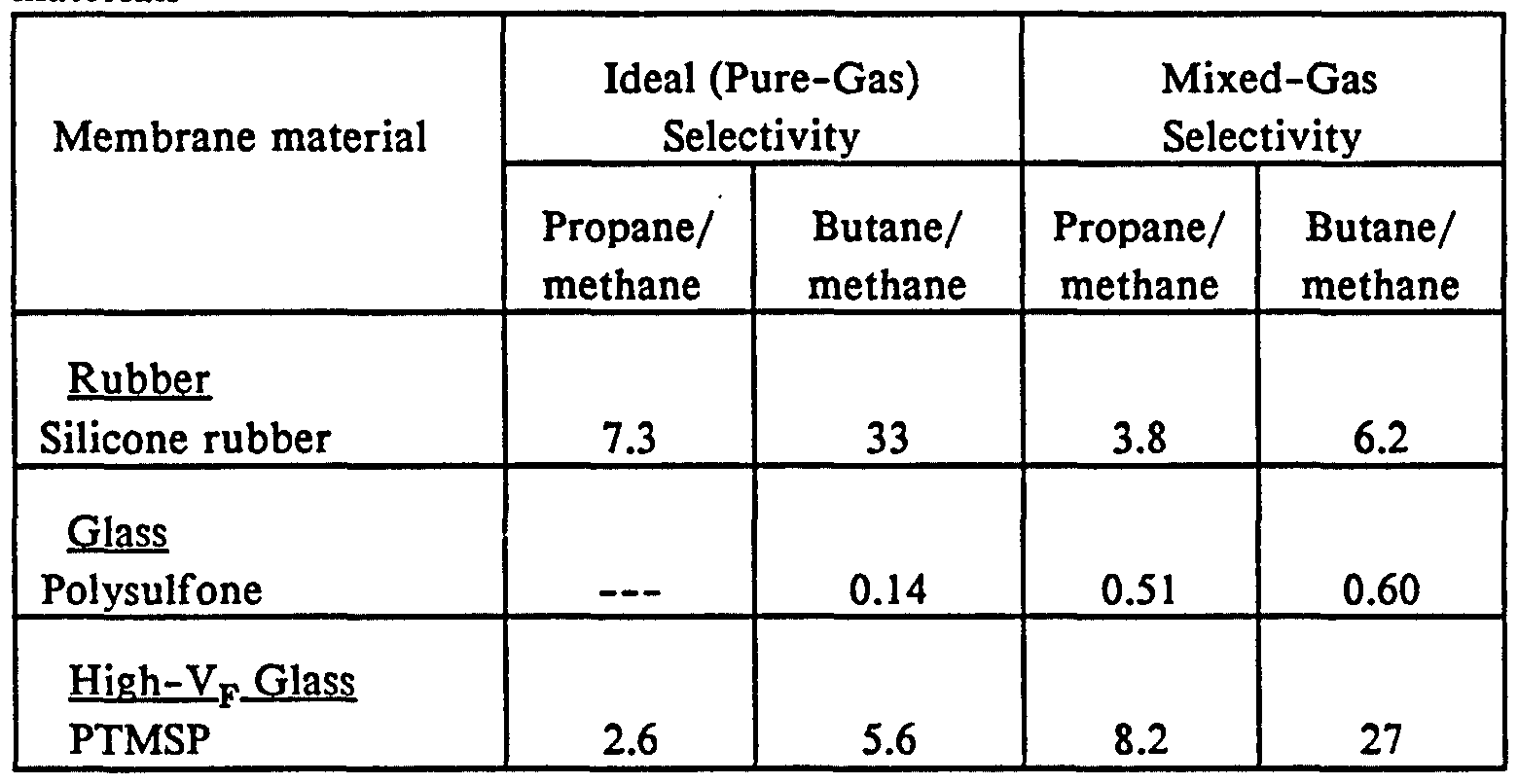
- permeability data from the published literature indicate that the glassy, high-free-volume polymer materials usable in the process of the invention have poor ideal selectivities for more condensable organic compounds over less condensable organic compounds or inorganic compounds.
- the data show that these materials may, in some cases, be slightly selective for the less condensable over the more condensable component, for example, methane over propane or butane.
- the measured mixed-gas selectivity for more condensable organic compounds over less condensable organic compounds or inorganic compounds was dramatically better than the ideal selectivity.
- the mixed gas selectivity was at least three times the ideal selectivity, and frequently more, such as five times, seven times or ten times the ideal selectivity.
- the separation membrane is supported on a substrate that offers a resistance to gas permeation that is not insignificant compared with the resistance of the separation membrane and, therefore, has an influence on the overall selectivity of the composite.
- the materials that have been found so far to be useful in carrying out the process of the invention possess a surprising and hitherto totally unsuspected property, in that, when an isotropic, essentially defect-free film of the material is used to separate one gas from another, the separation selectivity exhibited by the film depends on its thickness. The actual selectivity increases, up to a maximum value, as film thickness increases. To applicant's knowledge, this unexpected behavior has never been observed previously with any other polymer materials. The reason why this behavior is observed is not yet known, but it appears that gas transport is not conforming completely to the solution/diffusion model that is the standard approach for understanding gas transport through dense polymer films. This attribute can be used in tailoring membrane performance to suit specific applications.
- Non-limiting examples of the types of polymer material that fall within the definition of glassy, high-free-volume materials useful for carrying out the process of the invention include: (i) Substituted acetylenes, having the general structural formula
- R 2 where R 2 and R 2 are independently hydrogen, a halogen, C 6 H ⁇ or a linear or branched C ⁇ - C alkyl group.
- Silicon-containing polyacetylenes having the general structural formula
- R 3 where R x is a linear or branched C j - alkyl group, R 2 and R 3 are independently linear or branched C j -C ⁇ alkyl groups, R 4 is a linear or branched C 1 -C 12 alkyl or aryl group, and X is a Ci-C j alkyl group, (iii) Germanium-containing polyacetylenes, having the general structural formula
- R 3 where R j is a linear or branched C J - J alkyl group, R 2 and R 3 are independently linear or branched C 1 -C 6 alkyl groups, R 4 is a linear or branched C 1 -C 12 alkyl or aryl group, and
- X is a C j -Cg alkyl group.
- PTMSP poly(trimethylsilylpropyne)
- Membranes useful in the process of the invention may be formed from these glassy, high-free-volume materials in a variety of ways. Because the materials are glassy and rigid, an unsupported film of the polymer may often be usable as a single-layer gas separation membrane.
- the membrane may be an integral asymmetric membrane, comprising a dense region that forms the separation membrane and a microporous support region.
- the membrane may be a composite membrane comprising the separation membrane and an attached or unattached backing layer, or a composite membrane comprising a microporous support membrane of one polymer coated with the separation membrane of another polymer. Applicants prefer to use composite membranes.
- the membrane incorporating the separation membrane may be formed as a flat sheet, a hollow fiber or any other convenient form, and housed in any appropriate type of module, such as plate-and-frame, potted fiber or spiral-wound.
- a feed gas stream containing a condensable organic compound is passed through a membrane separation step.
- the process is shown schematically in its very simplest form in Figure 1. Referring to this figure, an organic compound-containing feed gas stream, 1, passes to a membrane separation unit, 2, containing one or more membranes.
- the membrane separation step involves running the feed gas stream across a membrane that is selectively permeable to the organic compound that is to be removed.
- the organic compound, or, specifically in the case of natural gas treatment, the C 3+ hydrocarbon fraction, is concentrated in the stream, 4, permeating the membrane; the residue, non-permeating, stream, 3, is correspondingly depleted in organic compound or higher hydrocarbons.
- the separation may be effected simply by making use of this high pressure to provide an adequate driving force and pressure ratio. Otherwise, a pressure difference can be provided by compressing the feed stream, by drawing a vacuum on the permeate side of the membrane, or a combination of both.
- the pressure at which raw natural gas emerges from the well varies considerably from field to field, although pressures up to 5000 psi are not uncommon.
- Polymer membranes can typically withstand pressure differences between the feed and permeate side up to about 1,500-2000 psi, so, for this application, it may sometimes be necessary to lower the gas pressure before it can be fed to the membrane system. Also, depending on the origin and composition of the gas, it may be desirable to pass the gas through a filter, phase separator, heater, etc. before it enters the membrane system to remove entrained water or hydrocarbons in liquid or aerosol form. Any other pre-treatment to remove contaminants or change the gas composition may also be performed as appropriate.
- Single-stage gas-separation processes typically remove up to about 80-95% of the preferentially permeating component from the feed stream and produce a permeate stream that has five times or more the concentration of that component of the feed gas. This degree of separation is adequate for many applications. If the residue stream requires further purification, it may be passed to a second bank of modules for a second processing step. If the permeate stream requires further concentration, it may be passed to a second bank of modules for a second-stage treatment.
- Such multistage or multistep processes, and variants thereof are familiar to those of skill in the art, who will appreciate that the process may be configured in many possible ways, including single-stage, multistage, multistep, or more complicated arrays in series or cascade arrangements.
- the permeate stream from the membrane separation step may be recompressed and/or chilled to recover the organic compound in liquid form.
- the composition of the feed gas may vary widely, from a mixture that contains 95%+ pure methane, with small amounts of ethane, other hydrocarbons, water vapor, hydrogen sulfide, carbon dioxide and nitrogen, to streams that contain substantial percentages of C 3 + hydrocarbons or carbon dioxide.
- associated gases from oil wells are simply flared or reinjected. It is possible to use the membrane-based process described herein to remove propane and heavier components from associated gases, thereby producing natural gas liquids (NGL) suitable for adding to the crude oil from the production separators.
- NTL natural gas liquids
- a second possible application in the oil and gas industry is recovery of propane and higher hydrocarbons from gas streams containing much carbon dioxide and/or nitrogen. Inert gases are used to recover incremental oil from partially depleted oil fields. When the oil is produced, large volumes of associated gases, which must be subjected to complex and costly processing steps if the valuable hydrocarbon component, are generated.
- the process of the invention offers a simple, economic treatment option.
- a third application in this area is in Btu control. The process of the invention may be used to remove and recover propane and heavier components and thereby reduce the Btu value of pipeline or fuel gas.
- a fourth application in natural gas treatment is hydrocarbon dewpoint control.
- Other applications include pretreatment of hydrocarbon-laden gas streams, to prevent damage to cellulose-based membranes, or other hydrocarbon-sensitive membranes, and NGL recovery from refinery gases or off-gases from the petrochemical industry.
- EXAMPLE 1 An asymmetric, microporous polysulfone support membrane was prepared. A sealing coat of silicone rubber about 1 ⁇ m thick was applied to the skin side of the support membrane.
- Composite membranes were prepared by hand-coating a solution of 5 wt% ethylene/ vinyl acetate (EVA, Elvax 150) in cyclohexane onto the skin side of the asymmetric support membrane by a continous dip-coating method. The polymer solution was applied at room temperature and the composite membrane was air-dried.
- EVA wt% ethylene/ vinyl acetate
- the membranes were tested with pure nitrogen, oxygen, and methane at 50 psig feed pressure to ensure that the EVA coating was defect-free.
- the composite membranes with defect-free separation layers were evaluated in room-temperature gas-separation experiments.
- the membranes were mounted in a test cell exposed to a gas mixture consisting of 86% methane, 10% ethane, 3% propane and 1% butane on the feed side.
- the feed pressure was maintained at 500 psig and the permeate side of the membrane was at atmospheric pressure.
- gas was continuously vented from the high-pressure side to promote mixing in the cell.
- the compositions of the residue and permeate streams were analyzed with an on-line gas chromatograph.
- Composite membranes were prepared by coating a solution of 3 wt% chlorinated polyethylene (25% chlorine grade) in 1,1,2-trichloroethane onto an asymmetric polyamide (Trogamid) support membrane, using the same general techniques as in Example 1. Permeation tests were conducted as in Example 1.
- Composite membranes were prepared by coating a solution of 4 wt% nitrile rubber (21% acrylonitrile) in methylethylketone (MEK) onto an asymmetric polyetherimide (PEI) support membrane, using the same general techniques as in Example 1. The membrane was overcoated with a sealing layer of silicone rubber. Permeation tests were conducted as in Example 1.
- Composite membranes were prepared by coating a solution of 8.75 wt% silicone rubber in cyclohexane onto an asymmetric polysulfone support membrane, using the same general techniques as in Example 1 , but heating the membrane after coating to crosslink the silicone rubber. Permeation tests were conducted as in Example 1.
- PTMSP films of thicknesses up to about 200 ⁇ m were hand-cast from a solution of 5% PTMSP in toluene onto glass plates.
- the films were mounted in a test cell and pure gas permeation measurements were made, using the same general technique as in Example 1, except that pure gases only were used and the feed gas pressure was 50 psig.
- the apparent thickness of the PTMSP layer was obtained by dividing the nitrogen permeability coefficient by the pure pressure-normalized nitrogen flux through the membrane.
- the ideal selectivity was calculated from the ratio of the pure gas pressure - normalized fluxes. The results are given in Table 4.
- the ideal selectivity for butane/methane is more than five times greater than the actual, mixed-gas selectivity.
- the polymer has an ideal butane/methane selectivity of 0.14, or a methane/butane selectivity of 7.1.
- the mixed-gas methane/butane selectivity is 1.7, so not only is the material methane-selective, but again the ideal selectivity is higher, about four times higher than the actual mixed-gas selectivity.
- the PTMSP is butane-selective, and the actual, mixed-gas selectivity is about five times greater than the ideal selectivity.
- An asymmetric, microporous support membrane was prepared.
- the support membrane when tested with pure nitrogen, exhibited a pressure- normalized nitrogen flux ranging from 1.3-3.4 x 10 "1 cm 3 (STP)/cm 2 -s-cmHg.
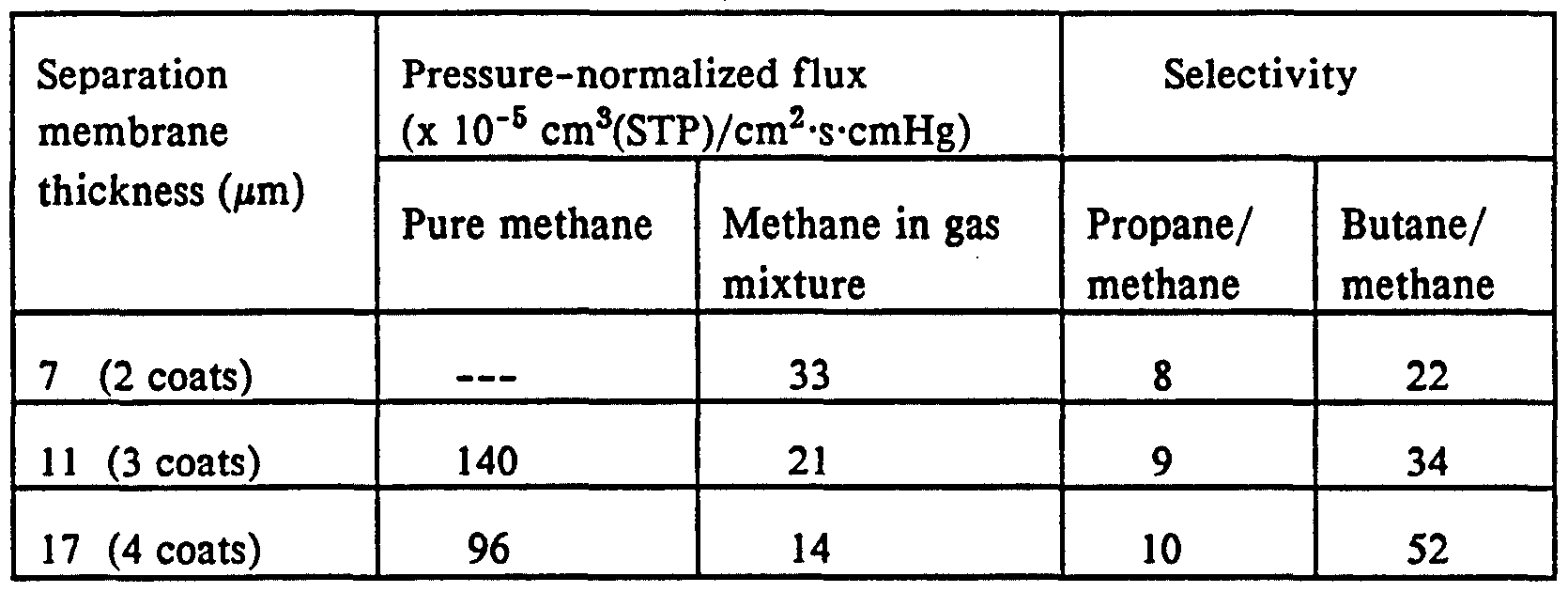
- Composite membranes were prepared by coating a solution of 5% polytri- methylsilylpropyne (PTMSP) in toluene onto the skin side of the asymmetric support membrane by a continous dip-coating method. The polymer solution was applied at a room temperature and the composite membrane was dried in an oven at 50-60°C.
- PTMSP polytri- methylsilylpropyne
- the membranes were tested with pure nitrogen, oxygen, and methane to ensure that the PTMSP coating was defect-free.
- the apparent thickness of the PTMSP layer was obtained by dividing the nitrogen permeability coefficient of PTMSP ( ⁇ 6,400 Barrers) by the pure pressure-normalized nitrogen flux through the membrane.
- a second set of membranes was prepared by performing the dip-coating step twice to form a thicker separation membrane.
- a third set of membranes was prepared by repeating the dip-coating step three times.
- a fourth set of membranes was prepared by repeating the dip-coating step four times.
- the second, third and fourth sets of membranes were tested with pure gases as above to check for defects.
- the apparent thickness of the separation membrane for the two-, three- and four- times-coated membranes was calculated in the same way as for the once-coated membrane.
- the composite membranes with defect-free separation layers were evaluated in room-temperature gas-separation experiments.
- the membranes were mounted in a test cell exposed to a gas mixture consisting of 86% methane, 10% ethane, 3% propane and 1% butane on the feed side.
- the feed pressure was maintained at 100 psig and the permeate side of the membrane was at atmospheric pressure.
- gas was continuously vented from the high-pressure side to promote mixing in the cell.
- the compositions of the residue and permeate streams were analyzed with an on-line gas chromatograph.
- PTMSP films of thickness 48 ⁇ m and 200 ⁇ m were hand-cast from a solution of 5 wt% PTMSP in toluene onto glass plates. Integrity and permeation tests were conducted as in Example 7. The gas mixture used for the permeation tests consisted of 86% methane, 10% ethane, 3% propane and 1% butane. The feed pressure was varied from 300 psig to 950 psig and the permeate side of the membrane was at atmospheric pressure. The results are given in Tables 7 and 8.
- the membranes were composites consisting of a PTMSP layer supported on a nonwoven polyester fabric.
- the apparent PTMSP layer thickness was 45 ⁇ m.
- the hydrocarbon separation properties of the modules were determined by permeation tests as in the previous examples, except that the module was mounted in the test system in place of the membrane test cell.
- the module was exposed to a feed gas mixture consisting of 86% methane, 10% ethane, 3% propane and 1% butane at feed pressures of 200, 300, and 400 psig, the maximum pressure rating of the module housing.
- the pressure-normalized gas fluxes and the propane/methane and butane/methane selectivities of the modules are given in Table 9. Table 9. Permeation Properties of Lab-Scale PTMSP Membrane Module
- Example 9 The preparation technique and permeation tests of Example 9 were repeated, using a module incorporating a membrane made from a higher molecular weight polymer. The results are given in Table 10. Table 10. Permeation Properties of Lab-Scale Module with Higher MW Polymer
- Example 10 The preparation technique and permeation tests of Example 10 were repeated, using a gas mixture consisting of 82% methane, 10% ethane, 7% propane and 1% butane. The results are given in Table 11. Table 11. Permeation Properties of Lab-Scale Module with Higher MW Polymer
- Composite membranes were prepared by dip-coating solutions of 5% polytri- methylsilylpropyne (PTMSP) in toluene onto a nonwoven polyester fabric backing. The resulting composite membranes were tested with pure nitrogen, oxygen, and methane to ensure that the PTMSP coating was defect-free. The apparent thickness of the PTMSP layer was obtained by dividing the nitrogen permeability coefficient of PTMSP ( ⁇ 6,400 Barrers) by the pure pressure-normalized nitrogen flux through the membrane. The fluxes were consistent with a membrane thickness of about 30 ⁇ m thick.
- PTMSP polytri- methylsilylpropyne
- the composite membranes with defect-free separation layers were evaluated in room-temperature gas-separation experiments.
- the membranes were mounted in a test cell exposed to a gas mixture consisting of 86% methane, 10% ethane, 3% propane and 1% butane on the feed side.
- the feed pressure was maintained at 500 psig and the permeate side of the membrane was at atmospheric pressure.
- gas was continuously vented from the high-pressure side to promote mixing in the cell.
- the compositions of the residue and permeate streams were analyzed with an on-line gas chromatograph.
- Example 12 The experiment of Example 12 was repeated, except that this time a less- condensable gas, carbon dioxide, was added, so that the feed gas mixture had a composition of 86% methane, 10% carbon dioxide, 3% propane and 1% butane.
- the permeation tests were carried out using a spiral-wound module, as in Examples 9 and 10.
- the feed gas pressure was 300 psig; the permeate side of the module was at atmospheric pressure. The results are listed in Table 13.
Landscapes
- Chemical & Material Sciences (AREA)
- Chemical Kinetics & Catalysis (AREA)
- Engineering & Computer Science (AREA)
- Analytical Chemistry (AREA)
- General Chemical & Material Sciences (AREA)
- Oil, Petroleum & Natural Gas (AREA)
- Separation Using Semi-Permeable Membranes (AREA)
Abstract
Description




Claims
Priority Applications (2)
| Application Number | Priority Date | Filing Date | Title |
|---|---|---|---|
| JP6511454A JPH08502926A (en) | 1992-11-04 | 1993-11-03 | Gas separation method |
| EP94904799A EP0667803A4 (en) | 1992-11-04 | 1993-11-03 | Gas-separation process. |
Applications Claiming Priority (4)
| Application Number | Priority Date | Filing Date | Title |
|---|---|---|---|
| US971,331 | 1978-12-20 | ||
| US97069992A | 1992-11-04 | 1992-11-04 | |
| US07/971,331 US5281255A (en) | 1992-11-04 | 1992-11-04 | Gas-separation process |
| US970,699 | 1992-11-04 |
Publications (1)
| Publication Number | Publication Date |
|---|---|
| WO1994009886A1 true WO1994009886A1 (en) | 1994-05-11 |
Family
ID=27130538
Family Applications (1)
| Application Number | Title | Priority Date | Filing Date |
|---|---|---|---|
| PCT/US1993/010736 Ceased WO1994009886A1 (en) | 1992-11-04 | 1993-11-03 | Gas-separation process |
Country Status (4)
| Country | Link |
|---|---|
| EP (1) | EP0667803A4 (en) |
| JP (1) | JPH08502926A (en) |
| CA (1) | CA2148609A1 (en) |
| WO (1) | WO1994009886A1 (en) |
Families Citing this family (2)
| Publication number | Priority date | Publication date | Assignee | Title |
|---|---|---|---|---|
| US10293301B2 (en) * | 2017-02-09 | 2019-05-21 | Saudi Arabian Oil Company | Modified siloxane composite membranes for heavy hydrocarbon recovery |
| JP7516960B2 (en) * | 2020-07-31 | 2024-07-17 | 東ソー株式会社 | Chlorinated polymer and its manufacturing method |
Citations (8)
| Publication number | Priority date | Publication date | Assignee | Title |
|---|---|---|---|---|
| US4657564A (en) * | 1985-12-13 | 1987-04-14 | Air Products And Chemicals, Inc. | Fluorinated polymeric membranes for gas separation processes |
| US4755193A (en) * | 1983-02-23 | 1988-07-05 | Toshinobu Higashimura | Polymer and a membrane having an improved gas-permeability and selectivity |
| US4759776A (en) * | 1986-12-08 | 1988-07-26 | Air Products And Chemicals, Inc. | Polytrialkylgermylpropyne polymers and membranes |
| US4859215A (en) * | 1988-05-02 | 1989-08-22 | Air Products And Chemicals, Inc. | Polymeric membrane for gas separation |
| US4931181A (en) * | 1989-06-02 | 1990-06-05 | Membrane Technology & Research, Inc. | Composite membranes for fluid separations |
| US4994094A (en) * | 1988-02-26 | 1991-02-19 | Gkss Forschungszentrum Geesthacht Gmbh | Method of removing organic compounds from air/permanent gas mixtures |
| US5013338A (en) * | 1989-09-01 | 1991-05-07 | Air Products And Chemicals, Inc. | Plasma-assisted polymerization of monomers onto polymers and gas separation membranes produced thereby |
| US5051114A (en) * | 1989-06-15 | 1991-09-24 | Du Pont Canada Inc. | Perfluorodioxole membranes |
-
1993
- 1993-11-03 CA CA002148609A patent/CA2148609A1/en not_active Abandoned
- 1993-11-03 JP JP6511454A patent/JPH08502926A/en active Pending
- 1993-11-03 EP EP94904799A patent/EP0667803A4/en not_active Withdrawn
- 1993-11-03 WO PCT/US1993/010736 patent/WO1994009886A1/en not_active Ceased
Patent Citations (10)
| Publication number | Priority date | Publication date | Assignee | Title |
|---|---|---|---|---|
| US4755193A (en) * | 1983-02-23 | 1988-07-05 | Toshinobu Higashimura | Polymer and a membrane having an improved gas-permeability and selectivity |
| US4657564A (en) * | 1985-12-13 | 1987-04-14 | Air Products And Chemicals, Inc. | Fluorinated polymeric membranes for gas separation processes |
| US4759776A (en) * | 1986-12-08 | 1988-07-26 | Air Products And Chemicals, Inc. | Polytrialkylgermylpropyne polymers and membranes |
| US4994094A (en) * | 1988-02-26 | 1991-02-19 | Gkss Forschungszentrum Geesthacht Gmbh | Method of removing organic compounds from air/permanent gas mixtures |
| US4859215A (en) * | 1988-05-02 | 1989-08-22 | Air Products And Chemicals, Inc. | Polymeric membrane for gas separation |
| US4931181A (en) * | 1989-06-02 | 1990-06-05 | Membrane Technology & Research, Inc. | Composite membranes for fluid separations |
| US5051114A (en) * | 1989-06-15 | 1991-09-24 | Du Pont Canada Inc. | Perfluorodioxole membranes |
| US5051114B1 (en) * | 1989-06-15 | 1995-05-02 | Du Pont Canada | Perfluorodioxole membranes. |
| US5051114B2 (en) * | 1989-06-15 | 1996-01-16 | Du Pont Canada | Perfluorodioxole membranes |
| US5013338A (en) * | 1989-09-01 | 1991-05-07 | Air Products And Chemicals, Inc. | Plasma-assisted polymerization of monomers onto polymers and gas separation membranes produced thereby |
Also Published As
| Publication number | Publication date |
|---|---|
| EP0667803A1 (en) | 1995-08-23 |
| JPH08502926A (en) | 1996-04-02 |
| EP0667803A4 (en) | 1997-04-02 |
| CA2148609A1 (en) | 1994-05-11 |
Similar Documents
| Publication | Publication Date | Title |
|---|---|---|
| US5281255A (en) | Gas-separation process | |
| US5501722A (en) | Natural gas treatment process using PTMSP membrane | |
| US4857078A (en) | Process for separating higher hydrocarbons from natural or produced gas streams | |
| EP0171879B1 (en) | Process for recovering organic vapors from air | |
| Pinnau et al. | Hydrocarbon/hydrogen mixed gas permeation in poly (1‐trimethylsilyl‐1‐propyne)(PTMSP), poly (1‐phenyl‐1‐propyne)(PPP), and PTMSP/PPP blends | |
| US5089033A (en) | Process for removing condensable components from gas streams | |
| Rao et al. | Nanoporous carbon membranes for separation of gas mixtures by selective surface flow | |
| US5647227A (en) | Membrane-augmented cryogenic methane/nitrogen separation | |
| US5032148A (en) | Membrane fractionation process | |
| US6572679B2 (en) | Gas separation using organic-vapor-resistant membranes in conjunction with organic-vapor-selective membranes | |
| Leemann et al. | Vapour permeation for the recovery of organic solvents from waste air streams: separation capacities and process optimization | |
| AU690723B2 (en) | Organic and inorganic vapor permeation by countercurrent condensable sweep | |
| EP1378285B1 (en) | Gas separation using membranes formed from blends of perfluorinated polymers | |
| Jiang et al. | Performance of silicone-coated polymeric membrane in separation of hydrocarbons and nitrogen mixtures | |
| US6572680B2 (en) | Carbon dioxide gas separation using organic-vapor-resistant membranes | |
| WO1997031701A1 (en) | Methane/nitrogen separation process | |
| WO2005032702A1 (en) | Method for separating hydrocarbon-containing gas mixtures using hydrocarbon-resistant membranes | |
| US3246450A (en) | Recovery of hydrogen | |
| WO2018093488A1 (en) | High selectivity chemically cross-linked rubbery membranes and their use for separations | |
| WO2018093487A1 (en) | High flux, cross-linked, fumed silica reinforced polyorganosiloxane membranes for separations | |
| US5688307A (en) | Separation of low-boiling gases using super-glassy membranes | |
| US5707423A (en) | Substituted polyacetylene separation membrane | |
| Brunetti et al. | Si‐Containing Polymers in Membrane Gas Separation | |
| EP0778077A2 (en) | New polymer membranes prepared from polysulfone and polyimide blends for the separation of industrial gas mixtures | |
| WO1994009886A1 (en) | Gas-separation process |
Legal Events
| Date | Code | Title | Description |
|---|---|---|---|
| AK | Designated states |
Kind code of ref document: A1 Designated state(s): CA JP |
|
| AL | Designated countries for regional patents |
Kind code of ref document: A1 Designated state(s): AT BE CH DE DK ES FR GB GR IE IT LU MC NL PT SE |
|
| DFPE | Request for preliminary examination filed prior to expiration of 19th month from priority date (pct application filed before 20040101) | ||
| 121 | Ep: the epo has been informed by wipo that ep was designated in this application | ||
| WWE | Wipo information: entry into national phase |
Ref document number: 2148609 Country of ref document: CA Ref document number: 1994904799 Country of ref document: EP |
|
| WWP | Wipo information: published in national office |
Ref document number: 1994904799 Country of ref document: EP |
|
| WWW | Wipo information: withdrawn in national office |
Ref document number: 1994904799 Country of ref document: EP |