WO1992021729A1 - Coating compositions based on fluorine-containing anorganic polycondensates, their production and their use - Google Patents
Coating compositions based on fluorine-containing anorganic polycondensates, their production and their use Download PDFInfo
- Publication number
- WO1992021729A1 WO1992021729A1 PCT/EP1992/001233 EP9201233W WO9221729A1 WO 1992021729 A1 WO1992021729 A1 WO 1992021729A1 EP 9201233 W EP9201233 W EP 9201233W WO 9221729 A1 WO9221729 A1 WO 9221729A1
- Authority
- WO
- WIPO (PCT)
- Prior art keywords
- groups
- compounds
- coating composition
- composition according
- hydrolyzable
- Prior art date
- Legal status (The legal status is an assumption and is not a legal conclusion. Google has not performed a legal analysis and makes no representation as to the accuracy of the status listed.)
- Ceased
Links
Classifications
-
- C—CHEMISTRY; METALLURGY
- C09—DYES; PAINTS; POLISHES; NATURAL RESINS; ADHESIVES; COMPOSITIONS NOT OTHERWISE PROVIDED FOR; APPLICATIONS OF MATERIALS NOT OTHERWISE PROVIDED FOR
- C09D—COATING COMPOSITIONS, e.g. PAINTS, VARNISHES OR LACQUERS; FILLING PASTES; CHEMICAL PAINT OR INK REMOVERS; INKS; CORRECTING FLUIDS; WOODSTAINS; PASTES OR SOLIDS FOR COLOURING OR PRINTING; USE OF MATERIALS THEREFOR
- C09D183/00—Coating compositions based on macromolecular compounds obtained by reactions forming in the main chain of the macromolecule a linkage containing silicon, with or without sulfur, nitrogen, oxygen, or carbon only; Coating compositions based on derivatives of such polymers
- C09D183/04—Polysiloxanes
- C09D183/08—Polysiloxanes containing silicon bound to organic groups containing atoms other than carbon, hydrogen, and oxygen
-
- C—CHEMISTRY; METALLURGY
- C09—DYES; PAINTS; POLISHES; NATURAL RESINS; ADHESIVES; COMPOSITIONS NOT OTHERWISE PROVIDED FOR; APPLICATIONS OF MATERIALS NOT OTHERWISE PROVIDED FOR
- C09D—COATING COMPOSITIONS, e.g. PAINTS, VARNISHES OR LACQUERS; FILLING PASTES; CHEMICAL PAINT OR INK REMOVERS; INKS; CORRECTING FLUIDS; WOODSTAINS; PASTES OR SOLIDS FOR COLOURING OR PRINTING; USE OF MATERIALS THEREFOR
- C09D183/00—Coating compositions based on macromolecular compounds obtained by reactions forming in the main chain of the macromolecule a linkage containing silicon, with or without sulfur, nitrogen, oxygen, or carbon only; Coating compositions based on derivatives of such polymers
- C09D183/14—Coating compositions based on macromolecular compounds obtained by reactions forming in the main chain of the macromolecule a linkage containing silicon, with or without sulfur, nitrogen, oxygen, or carbon only; Coating compositions based on derivatives of such polymers in which at least two but not all the silicon atoms are connected by linkages other than oxygen atoms
-
- C—CHEMISTRY; METALLURGY
- C09—DYES; PAINTS; POLISHES; NATURAL RESINS; ADHESIVES; COMPOSITIONS NOT OTHERWISE PROVIDED FOR; APPLICATIONS OF MATERIALS NOT OTHERWISE PROVIDED FOR
- C09D—COATING COMPOSITIONS, e.g. PAINTS, VARNISHES OR LACQUERS; FILLING PASTES; CHEMICAL PAINT OR INK REMOVERS; INKS; CORRECTING FLUIDS; WOODSTAINS; PASTES OR SOLIDS FOR COLOURING OR PRINTING; USE OF MATERIALS THEREFOR
- C09D185/00—Coating compositions based on macromolecular compounds obtained by reactions forming in the main chain of the macromolecule a linkage containing atoms other than silicon, sulfur, nitrogen, oxygen, and carbon; Coating compositions based on derivatives of such polymers
Definitions
- the present invention relates to coating compositions based on fluorine-containing inorganic polycondensates and to the production and use thereof.
- coating compositions which are based on organically modified inorganic polycondensates, in particular those of Si, Al, Ti and Zr, and which, after appropriate curing, form coatings for a wide variety of substrates and with a wide variety of advantageous properties, e.g. excellent scratch resistance, flexibility, transparency and / or abrasion resistance. Nevertheless, these known coating systems still leave room for improvement, particularly in terms of their non-stick properties with respect to hydrophilic and oleophilic substances and against dust.
- the object on which the present invention was based was therefore to provide a coating composition which, in addition to the outstanding properties of the already known coating systems based on inorganic polycondensates modified with organic groups, in particular transparency, mechanical resistance and abrasion resistance, also had excellent non-stick properties have a wide variety of substances.
- the above object is achieved by a coating composition based on polycondensates of one or more hydrolyzable compounds of elements M of main groups III to V and subgroups II to IV of the periodic table of the elements, at least some of these compounds in addition to hydrolyzable groups A also non-hydrolyzable carbon-containing groups B. and the total molar ratio of groups A to groups B in the underlying monomeric starting compounds is 10: 1 to 1: 2, which is characterized in that 0.1 (and in particular 0.5) to 100 mol% of groups B Are groups B 'having an average of 2 to 30 fluorine atoms attached to one or more aliphatic carbon atoms separated from M by at least two atoms.
- coating compositions of this type can generally not be carried out satisfactorily using the conventional methods for providing coating systems of this type, in particular if transparent coatings are to be obtained, since in the addition of water required for the hydrolysis of the starting compounds, the starting compounds with (fluorinated) groups B ' tend to separate and thus lead to a two-phase system with which a satisfactory homogeneous coating composition can no longer be achieved.
- the present invention was therefore also based on the object of providing a method for producing the above coating composition, in which the problems just mentioned do not occur.
- the present invention also relates to a process for the preparation of the coating composition defined above, which is characterized in that first all or part of the starting compounds without groups B 'are hydrolyzed and precondensed by adding water, then the starting compounds with groups B' and after reaction thereof with the pre-hydrolyzed starting compound or precondensates already present, by adding further water and optionally the remaining starting compounds without groups B ', the hydrolysis and condensation of the species present continues until a coatable system is obtained, the addition of the starting compounds with groups B 'only occurs when the water content of the system does not exceed 5% by weight, based on the total weight of the system without any solvent used, and is not more than 50% of the theoretically possible groups M-OH in the system.
- precondensates are thus first produced and only then are the fluorinated starting compounds added, which are then bound to these precondensates by hydrolysis and condensation and then no longer lead to phase separation when water is added, so that a homogeneous coating system can be obtained.
- the hydrolyzable starting compounds used to produce the coating composition according to the invention are preferably those of Si, Al, B, Pb, Sn, Ti, Zr, V and Zn, in particular those of Si, Al, Ti and Zr or mixtures thereof. It should be noted that other hydrolyzable compounds can of course also be used, in particular those of elements of main groups I and II of the periodic table (eg Na, K, Ca and Mg) and of subgroups V to VIII of the periodic table (eg Mn, Cr, Fe and Ni). Hydrolyzable compounds of the lanthanides can also be used. However, the compounds just mentioned preferably make up no more than 20 and in particular no more than 10 mol% of the hydrolyzable monomer compounds used (or on which they are based) as a whole.
- hydrolyzable groups A in the starting compounds are halogen (F, Cl, Br and I, in particular Cl and Br ), Alkoxy (especially C 1-4 alkoxy, such as methoxy, ethoxy, n-propoxy, i-propoxy and butoxy), aryloxy (especially C 6-10 aryloxy, e.g. phenoxy), acyloxy (especially C 1 _ 4 -Acy loxy, such as acetoxy and propionyloxy) and alkylcarbonyl (e.g. acetyl).
- halogen F, Cl, Br and I, in particular Cl and Br
- Alkoxy especially C 1-4 alkoxy, such as methoxy, ethoxy, n-propoxy, i-propoxy and butoxy
- aryloxy especially C 6-10 aryloxy, e.g. phenoxy
- acyloxy especially C 1 _ 4 -Acy loxy, such as acetoxy and propionyloxy
- hydrolyzable groups A include hydrogen and alkoxy radicals having 5 to 20, in particular 5 to 10, carbon atoms and halogen- and alkoxy-substituted alkoxy groups (such as, for example, ⁇ -methoxyethoxy).
- hydrolyzable groups A are practically no longer present in the end product, but are lost by hydrolysis, the hydrolysis product sooner or later also having to be removed in any suitable manner, those hydrolyzable groups A which do not carry any substituents and give low-hydrolysis products are particularly preferred Molecular weight, such as lower alcohols, such as methanol, ethanol, propanol, n-, i-, sec- and tert-butanol.
- the latter groups A are also preferred because they have practically no influence on the pH during hydrolysis (in contrast to, for example, halogen), which is advantageous because the pH of the reaction mixture before the addition of the fluorine-containing starting compounds is preferably in the range of 4 to 9, in particular 5 to 6.5, and hydrolysis products which noticeably shift the pH out of the range just mentioned, are preferably neutralized by adding suitable substances (acids or bases).
- the non-hydrolyzable groups B which are different from groups B, are preferably selected from alkyl (in particular C 1-4 -alkyl, such as methyl, ethyl, propyl and butyl), alkenyl (in particular C 2-4 - Alkenyl such as vinyl, 1-propenyl, 2-propenyl and butenyl), alkynyl (in particular C 2-4 alkynyl such as acetylenyl and propargyl) and aryl (in particular C 6-10 aryl such as phenyl and naphthyl), where the groups just mentioned optionally one or more substituents, such as halogen, hydroxy, alkoxy, epoxy, against may also have substituted amino, etc.
- alkyl in particular C 1-4 -alkyl, such as methyl, ethyl, propyl and butyl
- alkenyl in particular C 2-4 - Alkenyl such as vinyl, 1-propenyl, 2-propen
- alkyl radicals also include the corresponding cyclic and aryl-substituted radicals, such as cyclohexyl and benzyl, while the alkenyl and alkynyl groups can also be cyclic and the aryl groups mentioned should also include alkaryl groups (such as tolyl and xylyl).
- Particularly preferred non-hydrolyzable groups B are those which have a (poly) unsaturated carbon-carbon bond.
- groups which have a (meth) acryloxy radical in particular a (meth) acryloxy-C 1-4 -alkyl radical, such as, for example
- (Meth) acryloxypropyl (Meth) acryloxypropyl.
- the presence of such unsaturated groups in the corresponding polycondensates has the advantage that, after the coating composition has been applied to a specific substrate, it can be cured twice, namely thermally or photochemically induced linking of the unsaturated organic residues by (radical) polymerization and thermal completion of the Polycondensation (for example by elimination of water from M-OH groups still present).
- the total molar ratio of groups A to groups B in all starting compounds is 5: 1 to 1: 1 and in particular 4: 1 to 2: 1. It should be taken into account that this ratio relates to monomeric starting compounds, ie it has to be converted accordingly if pre-condensates are used.
- non-fluorinated silicon starting compounds ie compounds without groups B '
- Si (OCH 3 ) 4 Si (OC 2 H 5 ) 4
- CH 2 CH-Si (OOCCH 3 )
- CH 2 CH-SiCl 3
- CH 2 CH-Si (OCH 3 ) 3
- CH 2 CH-Si (OC 2 H 5 ) 3
- CH 2 CH-Si (OC 2 H 4 OCH 3 ) 3
- CH 2 CH-CH 2 -Si (OCH 3 )
- CH 2 C (CH 3 ) -COO-C 3 H 7 -Si (OCH 3 ) 3 ,
- CH 2 C (CH 3 ) -COO-C 3 H 7 -Si (OC 2 H 5 ),
- silanes can be produced by known methods; see. W. Noll “Chemistry and Technology of Silicones", Verlag Chemie GmbH, Weinheim / Bergstrasse (1968).
- Such oligomers which are preferably soluble in the reaction medium, can be straight-chain or cyclic low-molecular partial condensates (polyorganosiloxanes) with a degree of condensation of, for example, 2 to 100 (for example 2 to 20), in particular 6 to 10.
- Aluminum compounds preferably used according to the invention have the general formula
- radicals X which may be the same or different, are selected from halogen, alkoxy, alkoxycarbonyl and hydroxy.
- radicals X which may be the same or different, are selected from halogen, alkoxy, alkoxycarbonyl and hydroxy.
- Aluminum alkoxides and, to a limited extent, aluminum halides are particularly preferred aluminum starting compounds.
- aluminum halides are particularly preferred aluminum starting compounds.
- Suitable hydrolyzable titanium and zirconium compounds which can be used according to the invention, e.g. those of the general formula
- M 'de notes Ti or Zr and X is as defined above.
- R stands for a non-hydrolyzable group A of the type defined in the introduction and n is an integer from 1 to 4, particularly preferably 4.
- zirconium and titanium compounds which can be used according to the invention are the following:
- boron trihalides and boric acid esters such as BCl 3 , B (OCH 3 ) 3 and B (OC 2 H 5 ) 3
- tin tetrahalides and tin tetraalkoxides such as SnCl 4 and Sn (OCH 3 ) 4
- vanadyl compounds such as VOCl 3 and VO (OCH 3 ) 3 .
- all, but at least 0.1 mol%, of the non-hydrolyzable groups B bound to the elements M can be groups B ', which on average have 2 to 30 fluorine atoms, which are attached to one or more aliphatic (including cycloaliphatic) Carbon atoms are bound, which are separated from M by at least two atoms.
- 1 to 50 and in particular 2 to 30 mol% of groups B are preferably groups B ', a particularly preferred percentage being in the range from 5 to 25 mol%.
- the groups B * preferably contain on average 5 to 25 and in particular 8 to 18 fluorine atoms which are bonded to aliphatic carbon atoms, disregarding those fluorine atoms which are bonded in some other way, for example to aromatic carbon atoms (for example in the case of C 6 F 4 ).
- the group B 'containing fluorine can also be a chelating ligand. It is also possible for one or more fluorine atoms to be located on a carbon atom from which a double or triple bond originates.
- groups B ' Since the groups B 'only have to have two corresponding fluorine atoms on average, groups B' which have only 1 fluorine atom can also be used if there are at the same time sufficient groups B 'which have more than 2 fluorine atoms.
- silicon compounds are preferred as starting compounds with groups B '. Specific examples of such silicon compounds, the majority of which are also commercially available, are as follows:
- the coating composition according to the invention preferably also contains a catalyst for the thermal and / or photochemically induced curing of the coating composition applied to a suitable substrate.
- a photopolymerization initiator is particularly preferred.
- the commercially available photoinitiators can be used, for example. Examples include Irgacure ® 184 (1-hydroxycyclohexylphenyl ketone), Irgacure ® 500
- thermal initiators used include organic peroxides in the form of diacyl peroxides, peroxydicarbonates, alkyl peresters, dialkyl peroxides, perketals, ketone peroxides and alkyl hydroperoxides.
- organic peroxides in the form of diacyl peroxides, peroxydicarbonates, alkyl peresters, dialkyl peroxides, perketals, ketone peroxides and alkyl hydroperoxides.
- thermal initiators are dibenzoyl peroxide, tert-butyl perbenzoate and azobisisobutyronitrile.
- a varnish containing 30 to 50% by weight of solid can contain initiator in an amount of e.g. 0.5 to 2 wt .-% (based on the total amount) are added.
- organic unsaturated compounds may also prove expedient to add organic unsaturated compounds to the coating composition which can then copolymerize with these unsaturated groups of the polycondensates.
- unsaturated organic compounds are styrene, acrylic acid, methacrylic acid and corresponding derivatives (e.g. esters, amides, nitriles) of the acids just mentioned.
- the coating composition according to the invention can generally not be prepared by mixing the starting compounds to be hydrolyzed and condensed and then adding water in a suitable manner, since in this case the hydrolyzable starting compounds with groups B 'usually lead to phase separation and thereby a satisfactory coating composition can no longer be obtained.
- hydrolysis and precondensation are first carried out without the participation of the starting compounds with groups B 'and only then are the latter compounds added to the mixture, which surprisingly means that phase separation no longer occurs.
- the hydrolysis and polycondensation can then be continued by adding further water and optionally further starting compounds without groups B '.
- the reaction is then carried out in a manner known per se until a coatable system is obtained.
- the free water content in the system does not exceed 5% by weight, in particular 3.5% by weight and particularly preferably 2% by weight and that a maximum of only 50% of the theoretically possible groups M-OH are present.
- a titration e.g. according to Karl Fischer
- a spectroscopic determination e.g. using Si-NMR
- the coating composition according to the invention can be prepared in a manner customary in this field.
- the hydrolysis can in most cases be carried out by adding water to the silicon compound or compounds to be hydrolyzed, either as such or dissolved in a suitable solvent (see below) directly at room temperature or with slight cooling (preferably with stirring) and the resulting mixture is then stirred for some time (a few minutes to a few hours).
- a suitable solvent see below
- the more reactive compounds such as Al, Ti and Zr, it is generally advisable to gradually add the water.
- the hydrolysis is generally carried out at a temperature not above 50 ° C., preferably between 0 ° C. and 30 ° C. or the boiling point of the solvent which may be used.
- a temperature not above 50 ° C., preferably between 0 ° C. and 30 ° C. or the boiling point of the solvent which may be used.
- no solvent has to be used, especially if the hydrolyzable groups A are those which lead to the formation of (lower) alcohols, such as, for example, methanol, ethanol, propanol and butanol, during the hydrolysis.
- suitable solvents are, for example, the alcohols just mentioned and ethers, preferably lower dialkyl ethers such as diethyl ether and dibutyl ether and THF, aromatic hydrocarbons (for example toluene), esters such as ethyl acetate, and in particular butoxyethanol.
- a solvent can also be used if the hydrolysis leads exclusively to (lower) alcohols as a by-product.
- the total amount of water to be used for the hydrolysis it should be noted that it is particularly preferred if the molar ratio of total water added to hydrolyzable groups A in all the starting compounds used is in the range from 1: 1 to 0.3: 1, in particular 0.7 : 1 to 0.5: 1.
- the coating composition produced by the process according to the invention can either as such or after partial or almost complete removal of the solvent used or of the solvent formed during the reaction (for example the alcohols formed by hydrolysis of the alkoxides) or after addition of a suitable solvent in order to lower the viscosity on a suitable substrate.
- the lacquer was produced without solvent and with the addition of water in the lower part of the range preferred according to the invention, it may be necessary to dilute the coating composition with a suitable organic solvent before application.
- a suitable organic solvent Toluene, ethyl acetate, THF, butyl glycolate, butoxyethanol, ethylene glycol mono- and diethyl ether and mixtures thereof are particularly suitable for this purpose.
- the coating composition is diluted with a solvent, the quantitative ratio of paint to solvent is preferably in the range from 1: 0.5 to 1: 2.
- a photoinitiator must be added to the coating composition before application (see above). An initiator is preferably also added if the curing is to take place thermally.
- paint additives such as e.g. Colorants, fillers, oxidation inhibitors, leveling agents, UV absorbers and the like.
- the coating composition optionally (and preferably) provided with an initiator and optionally with the above additives is then applied to a suitable substrate.
- Conventional coating methods can be used for this coating, for example immersion, flooding, drawing, pouring, spinning, spraying or painting. Especially pulling, spraying and spinning are preferred according to the invention.
- the applied coating composition is preferably dried (at room temperature or slightly elevated temperature).
- Preferred layer thicknesses (in the hardened state) are 1 to 100, in particular 5 to 30 ⁇ m.
- the curing temperatures are preferably at least 50 ° C., in particular at least 90 ° C.
- the maximum curing temperature is also determined by the thermal load capacity of the substrate to be coated.
- curing temperatures up to 350 ° C can be used. However, curing temperatures of 200 ° C. and in particular 180 ° C. are preferably not exceeded.
- the curing time is usually 1 to 2 hours.
- Glass, ceramic, metal, plastics and paper are particularly suitable as substrates to be coated.
- metals are e.g. Called copper, aluminum, brass, iron and zinc.
- transparent polymers such as polycarbonate, polymethyl methacrylate, polyacrylates, but also polyethylene terephthalate deserve special mention.
- the coatings obtainable with the coating compositions according to the invention are distinguished in particular by the fact that they are transparent and mechanically resistant and, moreover, show a non-stick effect against a wide variety of materials which is equal to or even superior to that of coatings based on polytetrafluoroethylene, polyvinylidene fluoride etc.
- the coatings obtainable according to the invention show very good adhesion not only to glass (especially if there are still large amounts of M-OH groups in the uncured coating compositions), but also to plastics and metals (which, if appropriate can be pretreated in a suitable manner, for example by corona treatment).
- the coating compositions according to the invention are particularly suitable for coating glasses in which a dirt, water and oil-repellent surface is particularly desirable, e.g. for the coating of (in particular exterior) mirrors of motor vehicles, but also e.g. of windshields.
- Variable amounts of 1H, 1H, 2H, 2H-perfluorooctyltriethoxysilane are added to this basecoat, with stirring, and the reaction mixture is reacted for at least 2 hours at room temperature.
- the concentration of fluorosilane is 0.01 to 0.25 mol of fluorosilane per mol of MEMO.
- photoinitiator 0.5 to 2% by weight, preferably 1% by weight, of photoinitiator is added to the lacquer thus obtained.
- the choice of photoinitiator is based on the emission spectrum of the UV lamps used to harden the layer. With UV Lamps that radiation in the range of 254 nm to emit, is used as a photoinitiator such as Irgacure ® 184 (Ciba-Geigy).
- the lacquer obtained in this way can be filtered with membrane filters with a pore size of 0.2 to 0.8 ⁇ m.
- Suitable coating types are, for example, knife coating, dipping, spraying and centrifuging, water-soluble solvents such as butanol being able to be added in order to set optimum coating parameters (for example the viscosity).
- the applied lacquer is hardened in a two-stage process, namely first by irradiation with UV light, in order to bring about the polymerization of the unsaturated organic groups present.
- the coated substrates are passed at a speed of 0.5 to 2 m / min, preferably 1 m / min, under 1 or 2 UV tubes, each with an output of 1000 watts, after which the paint is finger-dry.
- the second stage of curing consists of a 1-hour bake at 130 ° C in a forced-air drying cabinet. (The paint can also be cured exclusively by radiation or only thermally.)
- Example 1 The procedure of Example 1 is repeated, but using mixtures of the fluorinated compounds used in Examples 1 and 2 in any proportions.
Landscapes
- Chemical & Material Sciences (AREA)
- Chemical Kinetics & Catalysis (AREA)
- Life Sciences & Earth Sciences (AREA)
- Engineering & Computer Science (AREA)
- Materials Engineering (AREA)
- Wood Science & Technology (AREA)
- Organic Chemistry (AREA)
- Paints Or Removers (AREA)
Abstract
Description
BESCHICHTUNGSZUSAMMENSETZUNGEN AUF DER BASIS VON FLUORHALTIGEN ANORGANISCHEN POLYKONDENSATEN. DEREN HERSTELLUNG UND DEREN VERWENDUNG Die vorliegende Erfindung betrifft Beschichtungszusammensetzungen auf der Basis von fluorhaltigen anorganischen Polykondensaten sowie deren Herstellung und Verwendung. COATING COMPOSITIONS BASED ON FLUORINE INORGANIC POLYCONDENSATES. THE PREPARATION AND USE THEREOF The present invention relates to coating compositions based on fluorine-containing inorganic polycondensates and to the production and use thereof.
Es sind bereits zahlreiche Beschichtungszusammensetzungen bekannt, die auf organisch modifizierten anorganischen Polykondensaten, insbesondere solchen von Si, AI, Ti und Zr, beruhen und die nach entsprechender Härtung zu Überzügen für die verschiedensten Substrate und mit den unterschiedlichsten vorteilhaften Eigenschaften, z.B. hervorragender Kratzfestigkeit, Flexibilität, Transparenz und/oder Abriebfestigkeit führen. Dennoch lassen diese bekannten Beschichtungssysteme noch Raum für Verbesserungen, insbesondere was deren Antihafteigenschaften gegenüber hydrophilen und oleophilen Substanzen sowie gegen Staub anlangt. Numerous coating compositions are already known which are based on organically modified inorganic polycondensates, in particular those of Si, Al, Ti and Zr, and which, after appropriate curing, form coatings for a wide variety of substrates and with a wide variety of advantageous properties, e.g. excellent scratch resistance, flexibility, transparency and / or abrasion resistance. Nevertheless, these known coating systems still leave room for improvement, particularly in terms of their non-stick properties with respect to hydrophilic and oleophilic substances and against dust.
Die der vorliegenden Erfindung zugrundeliegende Aufgabe bestand demnach darin, eine Beschichtungszusammensetzung zur Verfügung zu stellen, die neben den hervorragenden Eigenschaften der bereits bekannten Beschichtungssysteme auf der Basis von mit organischen Gruppen modifizierten anorganischen Polykondensaten, insbesondere Transparenz, mechanische Beständigkeit und Abriebfestigkeit, auch ausgezeichnete Antihafteigenschaften gegenüber den unterschiedlichsten Substanzen aufweisen. The object on which the present invention was based was therefore to provide a coating composition which, in addition to the outstanding properties of the already known coating systems based on inorganic polycondensates modified with organic groups, in particular transparency, mechanical resistance and abrasion resistance, also had excellent non-stick properties have a wide variety of substances.
Erfindungsgemäß wird die obige Aufgabe gelöst durch eine Beschichtungszusammensetzung auf der Basis von Polykondensaten von einer oder mehreren hydrolysierbaren Verbindungen von Elementen M der Hauptgruppen III bis V und der Nebengruppen II bis IV des Periodensystems der Elemente, wobei zumindest ein Teil dieser Verbindungen neben hydrolysierbaren Gruppen A auch nicht-hydrolysierbare kohlenstoffhaltige Gruppen B auf weist und das Gesamt-Molverhältnis von Gruppen A zu Gruppen B in den zugrundeliegenden monomeren Ausgangsverbindungen 10:1 bis 1:2 beträgt, die dadurch gekennzeichnet ist, daß 0,1 (und insbesondere 0,5) bis 100 Mol-% der Gruppen B Gruppen B' sind, die durchschnittlichen 2 bis 30 Fluoratome aufweisen, die an ein oder mehrere aliphatische Kohlenstoffatome gebunden sind, die durch mindestens zwei Atome von M getrennt sind. According to the invention, the above object is achieved by a coating composition based on polycondensates of one or more hydrolyzable compounds of elements M of main groups III to V and subgroups II to IV of the periodic table of the elements, at least some of these compounds in addition to hydrolyzable groups A also non-hydrolyzable carbon-containing groups B. and the total molar ratio of groups A to groups B in the underlying monomeric starting compounds is 10: 1 to 1: 2, which is characterized in that 0.1 (and in particular 0.5) to 100 mol% of groups B Are groups B 'having an average of 2 to 30 fluorine atoms attached to one or more aliphatic carbon atoms separated from M by at least two atoms.
Die Herstellung derartiger Beschichtungszusammensetzungen läßt sich in der Regel mit den herkömmlichen Verfahren zur Bereitstellung derartiger Beschichtungssysteme nicht zufriedenstellend durchführen, insbesondere wenn transparente Überzüge erhalten werden sollen, da bei der für die Hydrolyse der Ausgangsverbindungen erforderlichen Waεserzugabe die Ausgangsver- bindungen mit (fluorierten) Gruppen B' dazu neigen, sich zu entmischen und dadurch zu einem Zweiphasensystem führen, mit dem eine zufriedenstellende homogene Beschichtungszusammensetzung nicht mehr erzielt werden kann. Der vorliegenden Erfindung lag somit auch die Aufgabe zugrunde, ein Verfahren zur Herstellung der obigen Beschichtungszusammensetzung bereitzustellen, bei dem die soeben erwähnten Probleme nicht auftreten. The production of coating compositions of this type can generally not be carried out satisfactorily using the conventional methods for providing coating systems of this type, in particular if transparent coatings are to be obtained, since in the addition of water required for the hydrolysis of the starting compounds, the starting compounds with (fluorinated) groups B ' tend to separate and thus lead to a two-phase system with which a satisfactory homogeneous coating composition can no longer be achieved. The present invention was therefore also based on the object of providing a method for producing the above coating composition, in which the problems just mentioned do not occur.
Demzufolge ist Gegenstand der vorliegenden Erfindung auch ein Verfahren zur Herstellung der oben definierten Beschichtungszusammensetzung, das dadurch gekennzeichnet ist, daß man zunächst alle oder einen Teil der Ausgangsverbindungen ohne Gruppen B' durch Zugabe von Wasser hydrolysiert und vorkondensiert, dann die Ausgangsverbindungen mit den Gruppen B' zugibt und nach Reaktion derselben mit der bereits vorhandenen vorhydrolysiertenAusgangsverbindung bzw. Vorkondensaten durch Zugabe von weiterem Wasser und gegebenenfalls der restlichen AusgangsVerbindungen ohne Gruppen B' die Hydrolyse und Kondensation der anwesenden Spezies bis zum Erhalt eines beschichtungsfähigen Systems weiterführt, wobei die Zugabe der Ausgangsverbindungen mit Gruppen B' erst erfolgt, wenn der Wassergehalt des Systems nicht mehr als 5 Gew.-%, bezogen auf das Gesamtgewicht des Systems ohne gegebenenfalls eingesetztes Lösungsmittel, beträgt und nicht mehr als 50% der theoretisch möglichen Gruppen M-OH im System vorliegen. Beim erfindungsgemäßen Herstellungsverfahren werden also zunächst Vorkondensate hergestellt und erst dann werden die fluorierten Ausgangsverbindungen zugesetzt, die dann durch Hydrolyse und Kondensation an diese Vorkondensate gebunden werden und daraufhin bei weiterer Wasserzugabe zu keiner Phasentrennung mehr führen, so daß ein homogenes Beschichtungssystem erhalten werden kann. Accordingly, the present invention also relates to a process for the preparation of the coating composition defined above, which is characterized in that first all or part of the starting compounds without groups B 'are hydrolyzed and precondensed by adding water, then the starting compounds with groups B' and after reaction thereof with the pre-hydrolyzed starting compound or precondensates already present, by adding further water and optionally the remaining starting compounds without groups B ', the hydrolysis and condensation of the species present continues until a coatable system is obtained, the addition of the starting compounds with groups B 'only occurs when the water content of the system does not exceed 5% by weight, based on the total weight of the system without any solvent used, and is not more than 50% of the theoretically possible groups M-OH in the system. In the production process according to the invention, precondensates are thus first produced and only then are the fluorinated starting compounds added, which are then bound to these precondensates by hydrolysis and condensation and then no longer lead to phase separation when water is added, so that a homogeneous coating system can be obtained.
Bei den zur Herstellung der erfindungsgemäßen Beschichtungszusammensetzung verwendeten hydrolysierbaren Ausgangsverbindüngen handelt es sich vorzugsweise um solche von Si, AI, B, Pb, Sn, Ti, Zr, V und Zn, insbesondere solche von Si, AI, Ti und Zr oder Mischungen davon. Hierzu sei angemerkt, daß selbstverständlich auch andere hydrolysierbare Verbindungen eingesetzt werden können, insbesondere solche von Elementen der Hauptgruppen I und II des Periodensystems (z.B. Na, K, Ca und Mg) und der Nebengruppen V bis VIII des Periodensystems (z.B. Mn, Cr, Fe und Ni). Auch hydrolysierbare Verbindungen der Lanthaniden können eingesetzt werden. Vorzugsweise machen die soeben genannten Verbindungen aber nicht mehr als 20 und insbesondere nicht mehr als 10 Mol-% der insgesamt eingesetzten (bzw. zugrundeliegenden) hydrolysierbaren monomeren Verbindungen aus. The hydrolyzable starting compounds used to produce the coating composition according to the invention are preferably those of Si, Al, B, Pb, Sn, Ti, Zr, V and Zn, in particular those of Si, Al, Ti and Zr or mixtures thereof. It should be noted that other hydrolyzable compounds can of course also be used, in particular those of elements of main groups I and II of the periodic table (eg Na, K, Ca and Mg) and of subgroups V to VIII of the periodic table (eg Mn, Cr, Fe and Ni). Hydrolyzable compounds of the lanthanides can also be used. However, the compounds just mentioned preferably make up no more than 20 and in particular no more than 10 mol% of the hydrolyzable monomer compounds used (or on which they are based) as a whole.
Beispiele für hydrolysierbare Gruppen A in den Ausgangsver- bindungen (die nicht notwendigerweise als monomere Verbindungen, sondern bereits als entsprechende Vorkondensate von Verbindungen eines oder mehrerer der Elemente M eingesetzt werden können) sind Halogen (F, Cl, Br und I, insbesondere Cl und Br), Alkoxy (insbesondere C1-4-Alkoxy, wie z.B. Methoxy, Ethoxy, n-Propoxy, i-Propoxy und Butoxy), Aryloxy (insbesondere C6-10-Aryloxy, z.B. Phenoxy), Acyloxy (insbesondere C1_4-Acy loxy, wie z.B. Acetoxy und Propionyloxy) und Alkylcarbonyl (z.B. Acetyl). Examples of hydrolyzable groups A in the starting compounds (which cannot necessarily be used as monomeric compounds, but rather already as corresponding precondensates of compounds of one or more of the elements M) are halogen (F, Cl, Br and I, in particular Cl and Br ), Alkoxy (especially C 1-4 alkoxy, such as methoxy, ethoxy, n-propoxy, i-propoxy and butoxy), aryloxy (especially C 6-10 aryloxy, e.g. phenoxy), acyloxy (especially C 1 _ 4 -Acy loxy, such as acetoxy and propionyloxy) and alkylcarbonyl (e.g. acetyl).
Neben den oben genannten hydrolysierbaren Gruppen A können als weitere ebenfalls geeignete Gruppen erwähnt werden Wasserstoff und Alkoxyreste mit 5 bis 20, insbesondere 5 bis 10 Kohlenstoffatomen und Halogen- und Alkoxy-substituierte Alkoxygruppen (wie z.B. ß-Methoxyethoxy). Da die hydrolysierbaren Gruppen A im Endprodukt praktisch nicht mehr vorhanden sind, sondern durch Hydrolyse verlorengehen, wobei das Hydrolyseprodukt früher oder später auch in irgendeiner geeigneten Weise entfernt werden muß, sind solche hydrolysierbare Gruppen A besonders bevorzugt, die keine Substituenten tragen und zu Hydrolyseprodukten mit niedrigem Molekulargewicht, wie z.B. niederen Alkoholen, wie Methanol, Ethanol, Propanol, n-, i-, sec- und tert-Butanol, führen. Die letztgenannten Gruppen A sind auch deshalb bevorzugt, da sie bei der Hydrolyse den pH-Wert praktisch nicht beeinflussen (im Gegensatz zu z.B. Halogen), was von Vorteil ist, weil der pHWert der Reaktionsmischung vor Zugabe der Fluor-haltigen Ausgangsverbindungen vorzugsweise im Bereich von 4 bis 9, insbesondere 5 bis 6,5, liegt und Hydrolyseprodukte, die den pHWert merklich aus dem soeben angegebenen Bereich heraus verschieben, vorzugsweise durch Zugabe geeigneter Substanzen (Säuren oder Basen) neutralisiert werden. In addition to the above-mentioned hydrolyzable groups A, other suitable groups which may also be mentioned are hydrogen and alkoxy radicals having 5 to 20, in particular 5 to 10, carbon atoms and halogen- and alkoxy-substituted alkoxy groups (such as, for example, β-methoxyethoxy). Since the hydrolyzable groups A are practically no longer present in the end product, but are lost by hydrolysis, the hydrolysis product sooner or later also having to be removed in any suitable manner, those hydrolyzable groups A which do not carry any substituents and give low-hydrolysis products are particularly preferred Molecular weight, such as lower alcohols, such as methanol, ethanol, propanol, n-, i-, sec- and tert-butanol. The latter groups A are also preferred because they have practically no influence on the pH during hydrolysis (in contrast to, for example, halogen), which is advantageous because the pH of the reaction mixture before the addition of the fluorine-containing starting compounds is preferably in the range of 4 to 9, in particular 5 to 6.5, and hydrolysis products which noticeably shift the pH out of the range just mentioned, are preferably neutralized by adding suitable substances (acids or bases).
'Die nicht-hydrolysierbaren Gruppen B, die von den Gruppen B' verschieden sind, werden vorzugsweise ausgewählt aus Alkyl (insbesondere C1-4-Alkyl, wie z.B. Methyl, Ethyl, Propyl und Butyl), Alkenyl (insbesondere C2-4-Alkenyl, wie z.B. Vinyl, 1-Propenyl, 2-Propenyl und Butenyl), Alkinyl (insbesondere C2-4-Alkinyl, wie Acetylenyl und Propargyl) und Aryl (insbesondere C6-10-Aryl, wie z.B. Phenyl und Naphthyl), wobei die soeben genannten Gruppen gegebenenfalls einen oder mehrere Substituenten, wie z.B. Halogen, Hydroxy, Alkoxy, Epoxy, gege benenfalls substituiertes Amino usw. aufweisen können. Die obigen Alkylreste schließen auch die entsprechenden cyclischen und Aryl-substituierten Reste, wie z.B. Cyclohexyl und Benzyl, ein, während die Alkenyl- und Alkinylgruppen ebenfalls cyclisch sein können und die genannten Arylgruppen auch Alkarylgruppen (wie Tolyl und Xylyl) mit einschließen sollen. Besonders bevorzugte nicht-hydrolysierbare Gruppen B sind solche, die über eine (mehrfach) ungesättigte Kohlenstoff-KohlenstoffBindung verfügen. In diesem Zusammenhang sind insbesondere zu erwähnen Gruppen, die über einen (Meth)acryloxyrest verfügen, insbesondere einen(Meth) acryloxy-C1-4-alkylrest wie z.B. The non-hydrolyzable groups B, which are different from groups B, are preferably selected from alkyl (in particular C 1-4 -alkyl, such as methyl, ethyl, propyl and butyl), alkenyl (in particular C 2-4 - Alkenyl such as vinyl, 1-propenyl, 2-propenyl and butenyl), alkynyl (in particular C 2-4 alkynyl such as acetylenyl and propargyl) and aryl (in particular C 6-10 aryl such as phenyl and naphthyl), where the groups just mentioned optionally one or more substituents, such as halogen, hydroxy, alkoxy, epoxy, against may also have substituted amino, etc. The above alkyl radicals also include the corresponding cyclic and aryl-substituted radicals, such as cyclohexyl and benzyl, while the alkenyl and alkynyl groups can also be cyclic and the aryl groups mentioned should also include alkaryl groups (such as tolyl and xylyl). Particularly preferred non-hydrolyzable groups B are those which have a (poly) unsaturated carbon-carbon bond. In this context, particular mention should be made of groups which have a (meth) acryloxy radical, in particular a (meth) acryloxy-C 1-4 -alkyl radical, such as, for example
(Meth)acryloxypropyl. Die Anwesenheit derartiger ungesättigter Gruppen in den entsprechenden Polykondensaten hat den Vorteil , daß nach der Auftragung der Beschichtungszusammensetzung auf ein bestimmtes Substrat eine zweifache Härtung erfolgen kann, nämlich eine thermisch oder photochemisch induzierte Verknüpfung der ungesättigten organischen Reste durch (radikalische) Polymerisation und eine thermische Vervollständigung der Polykondensation (z.B. durch Wasserabspaltung aus noch vorhandenen M-OH-Gruppen). (Meth) acryloxypropyl. The presence of such unsaturated groups in the corresponding polycondensates has the advantage that, after the coating composition has been applied to a specific substrate, it can be cured twice, namely thermally or photochemically induced linking of the unsaturated organic residues by (radical) polymerization and thermal completion of the Polycondensation (for example by elimination of water from M-OH groups still present).
Erfindungsgemäß wird es demnach bevorzugt, wenn 1 bis 100, insbesondere 5 bis 85 und besonders bevorzugt 20 bis 70 Mol% der Gruppen B (inklusive der Gruppen B') mindestens eine Kohlenstoff-Kohlenstoff-Doppel- oder Dreifachbindung aufweisen. It is accordingly preferred according to the invention if 1 to 100, in particular 5 to 85 and particularly preferably 20 to 70 mol% of groups B (including groups B ') have at least one carbon-carbon double or triple bond.
Insbesondere bei Verbindungen, die im Vergleich zu Siliciumverbindungen bei der Hydrolyse sehr reaktiv sind (z.B. AlVerbindungen, aber auch Verbindungen von Zr und Ti) kann es sich empfehlen, die entsprechenden Ausgangsverbindungen in komplexierter Form einzusetzen, um eine spontane Ausfällung der entsprechenden Hydrolysate nach Wasserzugabe zu vermeiden. Als Komplexbildner eignen sich insbesondere organische (gegebenenfalls ungesättigte) Carbonsäuren (wie z.B. Acrylsäure und Methacrylsäure), ß-Diketone (z.B. Acetylaceton) und ß-Carbo nylcarbonsäureester (wie z.B. Acetessigsaureethylester). Es können aber auch alle anderen auf diesem Gebiet bekannten Komplexbildner eingesetzt werden, wobei es in der Regel sogar ausreicht, die zu hydrolysierende Verbindungen (z.B. Aluminiumverbindung) in Mischung mit dem Komplexbildner einzusetzen. Particularly in the case of compounds which are very reactive in hydrolysis in comparison to silicon compounds (e.g. Al compounds, but also compounds of Zr and Ti), it may be advisable to use the corresponding starting compounds in a complex form in order to spontaneously precipitate the corresponding hydrolysates after adding water avoid. Organic (optionally unsaturated) carboxylic acids (such as acrylic acid and methacrylic acid), β-diketones (eg acetylacetone) and β-carbo are particularly suitable as complexing agents nylcarboxylic acid esters (such as ethyl acetoacetate). However, it is also possible to use all other complexing agents known in this field, it generally being sufficient to use the compounds to be hydrolyzed (for example aluminum compound) in a mixture with the complexing agent.
Erfindungsgemäß wird es bevorzugt, wenn das Gesamtmolverhältnis von Gruppen A zu Gruppen B in allen AusgangsVerbindungen (einschließlich der fluorierten) 5:1 bis 1:1 und insbesondere 4:1 bis 2:1 beträgt. Dabei ist zu berücksichtigen, daß sich dieses Verhältnis auf monomere Ausgangsverbindungen bezieht, d.h. bei eingesetzten Vorkondensaten entsprechend umgerechnet werden muß. Konkrete Beispiele für nicht-fluorierte Silicium-Ausgangsver- bindungen (d.h. Verbindungen ohne Gruppen B' ) für die Herstellung der erfindungsgemäßen Beschichtungszusammensetzung sind die folgenden: Si(OCH3)4, Si(OC2H5)4, Si(O-n- oder i-C3H7)4 According to the invention, it is preferred if the total molar ratio of groups A to groups B in all starting compounds (including the fluorinated ones) is 5: 1 to 1: 1 and in particular 4: 1 to 2: 1. It should be taken into account that this ratio relates to monomeric starting compounds, ie it has to be converted accordingly if pre-condensates are used. Concrete examples of non-fluorinated silicon starting compounds (ie compounds without groups B ') for the preparation of the coating composition according to the invention are the following: Si (OCH 3 ) 4 , Si (OC 2 H 5 ) 4 , Si (on or iC 3 H 7 ) 4
Si(OC4H9)4, SiCl4. HSiCl3, Si(OOCCH3)4 Si (OC 4 H 9 ) 4 , SiCl 4 . HSiCl 3 , Si (OOCCH 3 ) 4
CH3-SiCl3, CH3-Si(OC2H5)3, C2H5-SiCl3, C2H5-Si(OC2H5)3. CH 3 -SiCl 3 , CH 3 -Si (OC 2 H 5 ) 3 , C 2 H 5 -SiCl 3 , C 2 H 5 -Si (OC 2 H 5 ) 3 .
C3H7-Si(OCH3)3, C6H5-Si(OCH3)3, C6H5-Si(OC2H5)3, C 3 H 7 -Si (OCH 3 ) 3 , C 6 H 5 -Si (OCH 3 ) 3 , C 6 H 5 -Si (OC 2 H 5 ) 3 ,
(CH3O)3-Si-C3H6-Cl, (CH 3 O) 3 -Si-C 3 H 6 -Cl,
(CH3)2SiCl2, (CH3)2Si(OCH3)2, (CH3)2Si(OC2H5)2, (CH 3 ) 2 SiCl 2 , (CH 3 ) 2 Si (OCH 3 ) 2 , (CH 3 ) 2 Si (OC 2 H 5 ) 2,
(CH3)2Si(OH)2, (C6H5)2SiCl2, (C6H5)2Si(OCH3)2, (CH 3 ) 2 Si (OH) 2 , (C 6 H 5 ) 2 SiCl 2 , (C 6 H 5 ) 2 Si (OCH 3 ) 2 ,
(C6H5)2Si(OC2H5)2, (i-C3H7)3SiOH, (C 6 H 5 ) 2 Si (OC 2 H 5 ) 2 , (iC 3 H 7 ) 3 SiOH,
CH2=CH-Si(OOCCH3) CH 2 = CH-Si (OOCCH 3 )
CH2=CH-SiCl3, CH2=CH-Si(OCH3)3, CH2=CH-Si(OC2H5)3, CH 2 = CH-SiCl 3 , CH 2 = CH-Si (OCH 3 ) 3 , CH 2 = CH-Si (OC 2 H 5 ) 3 ,
CH2=CH-Si(OC2H4OCH3)3, CH2=CH-CH2-Si(OCH3) CH 2 = CH-Si (OC 2 H 4 OCH 3 ) 3 , CH 2 = CH-CH 2 -Si (OCH 3 )
CH2=CH-CH2-Si(OC2H5) , CH 2 = CH-CH 2 -Si (OC 2 H 5 ),
CH2=CH-CH2-Si(OOCCH3) , CH 2 = CH-CH 2 -Si (OOCCH 3 ),
CH2=C(CH3)-COO-C3H7-Si(OCH3)3, CH 2 = C (CH 3 ) -COO-C 3 H 7 -Si (OCH 3 ) 3 ,
CH2=C(CH3)-COO-C3H7-Si(OC2H5) , CH 2 = C (CH 3 ) -COO-C 3 H 7 -Si (OC 2 H 5 ),
(C2H5O)3Si-C6H4-NH2, CH3(C2H5O)2Si-(CH2)4-NH2, (C 2 H 5 O) 3 Si-C 6 H 4 -NH 2 , CH 3 (C 2 H 5 O) 2 Si- (CH 2 ) 4 -NH 2 ,
(C2H5O)3Si-C3H6-NH2, (CH3)2(C2H5O)Si-CH2-NH2, (C 2 H 5 O) 3 Si-C 3 H 6 -NH 2 , (CH 3 ) 2 (C 2 H 5 O) Si-CH 2 -NH 2 ,
(C2H5O)3Si-C3H6-CN, (CH3O)3Si-C4H8-SH, (CH3O)3Si-C6H12-SH, (CH3O)3Si-C3H6-SH, (C2H5O)3Si-C3H6-SHH (CH3O)3Si-C3H6-NH-C2H4-NH2, (C 2 H 5 O) 3 Si-C 3 H 6 -CN, (CH 3 O) 3 Si-C 4 H 8 -SH, (CH 3 O) 3 Si-C 6 H 12 -SH, (CH 3 O) 3 Si-C 3 H 6 -SH, (C 2 H 5 O) 3 Si-C 3 H 6 -SHH (CH 3 O) 3 Si-C 3 H 6 -NH-C 2 H 4 -NH 2 ,
(CH3O)3Si-C3H6-NH-C2H4-NH-C2H4-NH2,


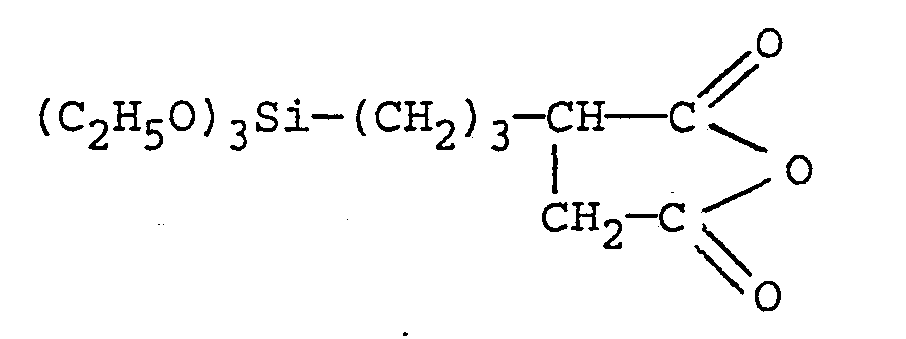

Diese Silane lassen sich nach bekannten Methoden herstellen; vgl. W. Noll "Chemie und Technologie der Silicone", Verlag Chemie GmbH, Weinheim/Bergstraße (1968). These silanes can be produced by known methods; see. W. Noll "Chemistry and Technology of Silicones", Verlag Chemie GmbH, Weinheim / Bergstrasse (1968).
Wie bereits oben erwähnt, lassen sie die erfindungsgemäß einsetzbaren Siliciumverbindungen ganz oder teilweise in Form von Vorkondensaten einsetzen, d.h. Verbindungen, die durch teilweise Hydrolyse der entsprechenden monomeren Verbindungen, entweder allein oder im Gemisch mit hydrolysierbaren Verbindungen anderer Elemente M, wie sie weiter unten noch näher beschrieben werden, entstanden sind. Derartige, im Reaktionsmedium vorzugsweise lösliche Oligomere können geradkettige oder cyclische niedermolekulare Teilkondensate (Polyorganosiloxane) mit einem Kondensationsgrad von z.B. 2 bis 100 (z.B. 2 bis 20), insbesondere 6 bis 10, sein. Erfindungsgemäß bevorzugt eingesetzte Aluminiumverbindungen weisen die allgemeine Formel As already mentioned above, they allow the silicon compounds which can be used according to the invention to be used entirely or partially in the form of precondensates, ie compounds which are obtained by partial hydrolysis of the corresponding monomeric compounds, either alone or in a mixture with hydrolyzable compounds of other elements M, as described in more detail below are described, have arisen. Such oligomers, which are preferably soluble in the reaction medium, can be straight-chain or cyclic low-molecular partial condensates (polyorganosiloxanes) with a degree of condensation of, for example, 2 to 100 (for example 2 to 20), in particular 6 to 10. Aluminum compounds preferably used according to the invention have the general formula
AlX3 AlX 3
auf, in der die Reste X, die gleich oder verschieden sein können, ausgewählt sind aus Halogen, Alkoxy, Alkoxycarbonyl und Hydroxy. Hinsichtlich der näheren (bevorzugten) Definition dieser Reste kann auf die eingangs gemachten Ausführungen verwiesen werden. in which the radicals X, which may be the same or different, are selected from halogen, alkoxy, alkoxycarbonyl and hydroxy. With regard to the more detailed (preferred) definition of these radicals, reference can be made to the statements made at the beginning.
Besonders bevorzuge Aluminium-Ausgangsverbindungen sind die Aluminiumalkoxide und, in eingeschränktem Maße, auch die Aluminiumhalogenide. In diesem Zusammenhang können als konkrete Beispiele genannt werden: Aluminum alkoxides and, to a limited extent, aluminum halides are particularly preferred aluminum starting compounds. In this context, there are concrete examples:
Al(OCH3)3, Al(OC2H5)3, AI(O-n-C3H7)3, Al (OCH 3 ) 3 , Al (OC 2 H 5 ) 3 , AI (OnC 3 H 7 ) 3 ,
Al(O-i-C3H7)3, Al(OC4H9)3, AI(O-i-C4H9)3, Al (OiC 3 H 7 ) 3 , Al (OC 4 H 9 ) 3 , AI (OiC 4 H 9 ) 3 ,
Al(O-sek-C4H9)3, AlCl3, AlCl(OH)2 Al (O-sec-C 4 H 9 ) 3 , AlCl 3 , AlCl (OH) 2
Bei Raumtemperatur flüssige Verbindungen, wie z.B. Aluminium- sek-butylat und Aluminium-isopropylat, werden besonders bevorzugt. Analoges gilt auch für die übrigen erfindungsgemäß einsetzbaren hydrolysierbaren Verbindungen. Compounds that are liquid at room temperature, e.g. Aluminum sec-butoxide and aluminum isopropoxide are particularly preferred. The same applies analogously to the other hydrolyzable compounds which can be used according to the invention.
Geeignete hydrolysierbare Titan- und Zirkoniumverbindungen, die erfindungsgemäß eingesetzt werden können, sie z.B. solche der allgemeinen Formel Suitable hydrolyzable titanium and zirconium compounds which can be used according to the invention, e.g. those of the general formula
M'XnR4-n M ' X n R 4-n
in der M' Ti oder Zr bedeutet und X wie oben definiert ist.in which M 'denotes Ti or Zr and X is as defined above.
R steht für eine nicht-hydrolysierbare Gruppe A der eingangs definierten Art und n ist eine ganze Zahl von 1 bis 4, besonders bevorzugt 4. R stands for a non-hydrolyzable group A of the type defined in the introduction and n is an integer from 1 to 4, particularly preferably 4.
Konkrete Beispiele für erfindungsgemäß einsetzbare Zirkonium- und Titanverbindungen sind die folgenden: Specific examples of zirconium and titanium compounds which can be used according to the invention are the following:
TiCl4, Ti(OC2H5)4, Ti(OC3H7)4, TiCl 4 , Ti (OC 2 H 5 ) 4 , Ti (OC 3 H 7 ) 4 ,
Ti(O-i-C3H7)4, Ti(OC4H9)4, Ti(2-ethylhexoxy)4; ZrCl4, Zr(OC2H5)4, Zr(OC3H7)4, Zr(O-i-C3H7)4, Zr(OC4H9)4. ZrOCl2, Zr(2-ethylhexoxy)4 Ti (OiC 3 H 7 ) 4 , Ti (OC 4 H 9 ) 4 , Ti (2-ethylhexoxy) 4 ; ZrCl 4 , Zr (OC 2 H 5 ) 4 , Zr (OC 3 H 7 ) 4 , Zr (OiC 3 H 7 ) 4 , Zr (OC 4 H 9 ) 4 . ZrOCl 2 , Zr (2-ethylhexoxy) 4
Weitere hydrolysierbare Verbindungen, die erfindungsgemäß (vorzugsweise in untergeordnetem Maß) eingesetzt werden können, sind z.B. Bortrihalogenide und Borsäureester (wie z.B. BCl3, B(OCH3)3 und B(OC2H5)3), Zinntetrahalogenide und Zinntetraalkoxide (wie z.B. SnCl4 und Sn(OCH3)4) und Vanadylverbindungen, wie z.B. VOCl3 und VO(OCH3)3. Further hydrolyzable compounds which can be used according to the invention (preferably to a lesser extent) are, for example, boron trihalides and boric acid esters (such as BCl 3 , B (OCH 3 ) 3 and B (OC 2 H 5 ) 3 ), tin tetrahalides and tin tetraalkoxides (such as SnCl 4 and Sn (OCH 3 ) 4 ) and vanadyl compounds such as VOCl 3 and VO (OCH 3 ) 3 .
In den erfindungsgemäßen Beschichtungszusammensetzungen können alle, zumindest jedoch 0,1 Mol-% der an die Elemente M gebundenen nicht-hydrolysierbaren Gruppen B Gruppen B' sein, die im Durchschnitt 2 bis 30 Fluoratome aufweisen, welche an ein oder mehrere aliphatische (einschließlich cycloaliphatische) Kohlenstoffatome gebunden sind, die durch mindestens zwei Atome von M getrennt sind. Vorzugsweise sind 1 bis 50 und insbesondere 2 bis 30 Mol-% der Gruppen B Gruppen B', wobei ein besonders bevorzugter Prozentsatz im Bereich von 5 bis 25 Mol-% liegt. In the coating compositions according to the invention, all, but at least 0.1 mol%, of the non-hydrolyzable groups B bound to the elements M can be groups B ', which on average have 2 to 30 fluorine atoms, which are attached to one or more aliphatic (including cycloaliphatic) Carbon atoms are bound, which are separated from M by at least two atoms. 1 to 50 and in particular 2 to 30 mol% of groups B are preferably groups B ', a particularly preferred percentage being in the range from 5 to 25 mol%.
Vorzugsweise enthalten die Gruppen B* im Durchschnitt 5 bis 25 und insbesondere 8 bis 18 Fluoratome, die an aliphatische Kohlenstoffatome gebunden sind, wobei diejenigen Fluoratome nicht berücksichtigt sind, die gegebenenfalls in anderer Weise, z.B. an aromatische Kohlenstoffatome, gebunden sind (z.B. im Falle von C6F4). Bei der fl,uorhaltigen Gruppe B' kann es sich auch um einen Chelatliganden handeln. Ebenso ist es möglich, daß sich ein oder mehrere Fluoratome an einem Kohlenstoffatom befinden, von dem eine Doppel- oder Dreifachbindung ausgeht. Da die Gruppen B' nur im Durchschnitt zwei entsprechende Fluoratome aufweisen müssen, können auch Gruppen B' eingesetzt werden, die über nur 1 Fluoratom verfügen, wenn gleichzeitig genügend Gruppen B' vorhanden sind, die mehr als 2 Fluoratome aufweisen. Insbesondere im Hinblick auf die Zugänglichkeit der entsprechenden Ausgangssubstanzen werden als Ausgangsverbindungen mit Gruppen B' Siliciumverbindungen bevorzugt. Konkrete Beispiele für derartige Siliciumverbindungen, die zum größten Teil auch im Handel erhältlich sind, sind die folgenden: The groups B * preferably contain on average 5 to 25 and in particular 8 to 18 fluorine atoms which are bonded to aliphatic carbon atoms, disregarding those fluorine atoms which are bonded in some other way, for example to aromatic carbon atoms (for example in the case of C 6 F 4 ). The group B 'containing fluorine can also be a chelating ligand. It is also possible for one or more fluorine atoms to be located on a carbon atom from which a double or triple bond originates. Since the groups B 'only have to have two corresponding fluorine atoms on average, groups B' which have only 1 fluorine atom can also be used if there are at the same time sufficient groups B 'which have more than 2 fluorine atoms. In particular with regard to the accessibility of the corresponding starting substances, silicon compounds are preferred as starting compounds with groups B '. Specific examples of such silicon compounds, the majority of which are also commercially available, are as follows:
CF3CH2CH2-SiY3 CF 3 CH 2 CH 2 -SiY 3
C2F5CH2CH2 SiY3 C 2 F 5 CH 2 CH 2 SiY 3
C4F9CH2CH2-SiY3 C 4 F 9 CH 2 CH 2 -SiY 3
n-C6F13CH2CH2-SiY3 nC 6 F 13 CH 2 CH 2 -SiY 3
n-C8F17CH2CH2-SiY3 nC 8 F 17 CH 2 CH 2 -SiY 3
n-C10F21CH2CH2-SiY3 nC 10 F 21 CH 2 CH 2 -SiY 3
(Y = OCH3, PC2H5 oder Cl) (Y = OCH 3 , PC 2 H 5 or Cl)
CF3CH2CH2SiCl2(CH3) CF 3 CH 2 CH 2 SiCl 2 (CH 3 )
CF3CH2CH2SiCl(CH3)2 CF 3 CH 2 CH 2 SiCl (CH 3 ) 2
CF3CH2CH2Si(CH3)(OCH3)2 CF 3 CH 2 CH 2 Si (CH 3 ) (OCH 3 ) 2
i-C3F7O-(CH2)3-SiCl2(CH3) iC 3 F 7 O- (CH 2 ) 3 -SiCl 2 (CH 3 )
n-C6F13CH2CH2SiCl2(CH3} nC 6 F 13 CH 2 CH 2 SiCl 2 (CH 3 }
n-C6F13CH2CH2SiCl(CH3)2 nC 6 F 13 CH 2 CH 2 SiCl (CH 3 ) 2
Insbesondere wenn sich unter den Gruppen B in den Polykondensaten der erfindungsgemäßen Beschichtungszusammensetzung solche mit ungesättigten Kohlenstoff-Kohlenstoff-Bindungen befinden, enthält die erfindungsgemäße Beschichtungszusammensetzung vorzugsweise auch einen Katalysator für die thermische und/oder photochemisch induzierte Härtung der auf ein geeignetes Substrat aufgetragenen Beschichtungszusammensetzung. Insbesondere bevorzugt ist die Zugabe eines PhotopolymerisationsInitiators. Als Photoinitiatoren können z.B. die im Handel erhältlichen eingesetzt werden. Beispiele hierfür sind Irgacure® 184 (1-Hydroxycyclohexylphenylketon), Irgacure® 500 In particular, if among groups B in the polycondensates of the coating composition according to the invention there are those with unsaturated carbon-carbon bonds, the coating composition according to the invention preferably also contains a catalyst for the thermal and / or photochemically induced curing of the coating composition applied to a suitable substrate. The addition of a photopolymerization initiator is particularly preferred. The commercially available photoinitiators can be used, for example. Examples include Irgacure ® 184 (1-hydroxycyclohexylphenyl ketone), Irgacure ® 500
(1-Hydroxycyclohexylphenylketon, Benzophenon) und andere von der Firma Ciba-Geigy erhältliche Photoinitiatoren vom Irgacure®-Typ; Darocur® 1173, 1116, 1398, 1174 und 1020 (erhältlich von der Firma Merck), Benzophenon, 2-Chlorthioxanthon, 2-Methylthioxanthon, 2-Isopropylthioxanthon, Benzoin, 4,4'-Dime thoxybenzoin, Benzoinethylether, Benzoinisopropylether, Benzyldimethylketal, 1,1,1-Trichloracetophenon, Diethoxyacetophenon und Dibenzosuberon. Als gegebenenfalls eingesetzte thermische Initiatoren kommen u.a. organische Peroxide in Form von Diacylperoxiden, Peroxydicarbonaten, Alkylperestern, Dialkylperoxiden, Perketalen, Ketonperoxiden und Alkylhydroperoxiden in Frage. Konkrete Beispiele für derartige thermische Initiatoren sind Dibenzoylperoxid, tert.-Butylperbenzoat und Azobisisobutyronitril. (1-hydroxycyclohexyl phenyl ketone, benzophenone) and other commercially available from Ciba-Geigy photoinitiators of the Irgacure ® type; Darocur ® 1173, 1116, 1398, 1174 and 1020 (available from Merck), benzophenone, 2-chlorothioxanthone, 2-methylthioxanthone, 2-isopropylthioxanthone, benzoin, 4,4'-Dime thoxybenzoin, benzoin ethyl ether, benzoin isopropyl ether, benzyl dimethyl ketal, 1,1,1-trichloroacetophenone, diethoxyacetophenone and dibenzosuberone. Possible thermal initiators used include organic peroxides in the form of diacyl peroxides, peroxydicarbonates, alkyl peresters, dialkyl peroxides, perketals, ketone peroxides and alkyl hydroperoxides. Specific examples of such thermal initiators are dibenzoyl peroxide, tert-butyl perbenzoate and azobisisobutyronitrile.
Die obigen Initiatoren werden der Beschichtungszusammensetzung in üblichen Mengen zugegeben. So kann beispielsweise einem Lack, der 30 bis 50 Gew.-% Feststoff enthält, Initiator in einer Menge von z.B. 0,5 bis 2 Gew.-% (bezogen auf die Gesamtmenge) zugesetzt werden. The above initiators are added to the coating composition in conventional amounts. For example, a varnish containing 30 to 50% by weight of solid can contain initiator in an amount of e.g. 0.5 to 2 wt .-% (based on the total amount) are added.
Wenn eine photochemische oder thermische Härtung von ungesättigten Gruppen B in den Polykondensaten beabsichtigt wird, kann es sich auch als zweckmäßig erweisen, der Beschichtungszusammensetzung organische ungesättigte Verbindungen zuzusetzen, die dann mit diesen ungesättigten Gruppen der Polykondensate copolymerisieren können. Beispiele für derartige ungesättigte organische Verbindungen sind Styrol, Acrylsäure, Methacrylsäure und entsprechende Derivate (z.B. Ester, Amide, Nitrile) der soeben genannten Säuren. If photochemical or thermal curing of unsaturated groups B in the polycondensates is intended, it may also prove expedient to add organic unsaturated compounds to the coating composition which can then copolymerize with these unsaturated groups of the polycondensates. Examples of such unsaturated organic compounds are styrene, acrylic acid, methacrylic acid and corresponding derivatives (e.g. esters, amides, nitriles) of the acids just mentioned.
Perartige Verbindungen können auch teil- oder perfluoriert sein (z.B. CnFx-COOH mit n = 1-20). Ebenso können Verbindungen eingesetzt werden, die über (per) fluorierte Gruppen verfügen, welche während der Herstellung der Beschichtungszusammensetzung mit Gruppen B reagieren und dabei Gruppen B' liefern (z.B. durch Reaktion von S-H- oder N-H-Gruppen mit Hexafluorpropenoxid oder durch Polymerisieren von Kohlenstoff-Kohlenstoff-Doppelbindungen (erst) beim Ansäuern der bereits aufgetragenen Beschichtungszusammensetzung) . Wie bereits oben erwähnt kann die Herstellung der erfindungsgemäßen Beschichtungszusammensetzung in der Regel nicht dadurch erfolgen, daß man die zu hydrolysierenden und kondensierenden Ausgangsverbindungen mischt und daraufhin Wasser in geeigneter Weise zugibt, da in diesem Fall die hydrolysierbaren AusgangsVerbindungen mit Gruppen B ' gewöhnlich zu einer Phasenseparation führen und dadurch keine zufriedenstellende Beschichtungszusammensetzung mehr erhalten werden kann. Erfindungsgemäß wird demgemäß zunächst eine Hydrolyse und Vorkondensation ohne Beteiligung der Ausgangsverbindungen mit Gruppen B' durchgeführt und erst danach werden die letztgenannten Verbindungen der Mischung zugefügt, wodurch überraschenderweise keine Phasentrennung mehr auftritt. Danach kann die Hydrolyse und Polykondensation weitergeführt werden, indem man weiteres Wasser und gegebenenfalls weitere Ausgangsverbindungen ohne Gruppen B' zufügt. Die Umsetzung wird dann in an sich bekannter Weise durchgeführt, bis ein beschichtungsfähiges System erhalten wird. Such compounds can also be partially or perfluorinated (for example C n F x -COOH with n = 1-20). It is also possible to use compounds which have (per) fluorinated groups which react with groups B during the preparation of the coating composition and thereby give groups B '(for example by reaction of SH or NH groups with hexafluoropropene oxide or by polymerizing carbon Carbon double bonds (only) when acidifying the coating composition already applied). As already mentioned above, the coating composition according to the invention can generally not be prepared by mixing the starting compounds to be hydrolyzed and condensed and then adding water in a suitable manner, since in this case the hydrolyzable starting compounds with groups B 'usually lead to phase separation and thereby a satisfactory coating composition can no longer be obtained. Accordingly, according to the invention, hydrolysis and precondensation are first carried out without the participation of the starting compounds with groups B 'and only then are the latter compounds added to the mixture, which surprisingly means that phase separation no longer occurs. The hydrolysis and polycondensation can then be continued by adding further water and optionally further starting compounds without groups B '. The reaction is then carried out in a manner known per se until a coatable system is obtained.
Bei der erfindungsgemäßen Herstellung der Beschichtungszusammensetzung ist es wichtig, daß bei Zugabe der Ausgangsverbindungen mit Gruppen B' der Gehalt an freiem Wasser im System 5 Gew.-%, inbesondere 3,5 Gew.-% und besonders bevorzugt 2 Gew.-% nicht überschreitet und daß maximal nur 50% der theoretisch möglichen Gruppen M-OH vorliegen. Um sicherzustellen, daß sich die obigen Parameter tatsächlich in dem soeben beschriebenen Rahmen bewegen, kann z.B. vor Zugabe der fluorhaltigen AusgangsVerbindungen eine Titration (z.B. nach Karl Fischer) und/oder eine spektroskopische Bestimmung (z.B. mittels Si-NMR) durchgeführt werden. When preparing the coating composition according to the invention, it is important that when the starting compounds with groups B 'are added, the free water content in the system does not exceed 5% by weight, in particular 3.5% by weight and particularly preferably 2% by weight and that a maximum of only 50% of the theoretically possible groups M-OH are present. To ensure that the above parameters are actually within the scope just described, e.g. Before adding the fluorine-containing starting compounds, a titration (e.g. according to Karl Fischer) and / or a spectroscopic determination (e.g. using Si-NMR) are carried out.
Wie bereits erwähnt, kann die Herstellung der erfindungsgemäßen Beschichtungszusammensetzung mit Ausnahme des ZugabeZeitpunkts der fluorierten AusgangsVerbindungen in auf diesem Gebiet üblicher Art und Weise erfolgen. Werden am Anfang (praktisch) ausschließlich (bei der Hydrolyse relativ reaktionsträge) Siliciumverbindungen eingesetzt, kann die Hydrolyse in den meisten Fällen dadurch erfolgen, daß man der oder den zu hydrolysierenden Siliciumverbindungen, die entweder als solche oder gelöst in einem geeigneten Lösungsmittel vorliegen (siehe unten), Wasser bei Raumtemperatur oder unter leichter Kühlung direkt zugibt (vorzugsweise unter Rühren) und die resultierende Mischung daraufhin einige Zeit (einige Minuten bis einige Stunden) rührt. Bei Anwesenheit der reaktiveren Verbindungen von z.B. AI, Ti und Zr empfiehlt sich in der Regel eine stufenweise Zugabe des Wassers. Unabhängig von der Reaktivität der anwesenden Verbindungen erfolgt die Hydrolyse in der Regel bei einer Temperatur nicht über 50°C, vorzugsweise zwischen 0°C und 30°C bzw. dem Siedepunkt des gegebenenfalls eingesetzten Lösungsmittels. Prinzipiell muß kein Lösungsmittel eingesetzt werden, insbesondere dann, wenn es sich bei den hydrolysierbaren Gruppen A um solche handelt, die bei der Hydrolyse zur Bildung von (niederen) Alkoholen, wie z.B. Methanol, Ethanol, Propanol und Butanol führen. Andernfalls (z.B. bei Verwendung von Halogensilanen) sind geeignete Lösungsmittel z.B. die soeben genannten Alkohole sowie Ether, vorzugsweise niedere Dialkylether wie Diethylether und Dibutylether und THF, aromatische Kohlenwasserstoffe (z.B. Toluol), Ester wie Essigsäureethylester, und insbesondere Butoxyethanol. Selbstverständlich kann ein Lösungsmittel auch eingesetzt werden, wenn die Hydrolyse ausschließlich zu (niederen) Alkoholen als Nebenprodukt führt. As already mentioned, with the exception of the time of addition of the fluorinated starting compounds, the coating composition according to the invention can be prepared in a manner customary in this field. Be in the beginning Used (practically) exclusively (relatively inert to hydrolysis) silicon compounds, the hydrolysis can in most cases be carried out by adding water to the silicon compound or compounds to be hydrolyzed, either as such or dissolved in a suitable solvent (see below) directly at room temperature or with slight cooling (preferably with stirring) and the resulting mixture is then stirred for some time (a few minutes to a few hours). In the presence of the more reactive compounds such as Al, Ti and Zr, it is generally advisable to gradually add the water. Regardless of the reactivity of the compounds present, the hydrolysis is generally carried out at a temperature not above 50 ° C., preferably between 0 ° C. and 30 ° C. or the boiling point of the solvent which may be used. In principle, no solvent has to be used, especially if the hydrolyzable groups A are those which lead to the formation of (lower) alcohols, such as, for example, methanol, ethanol, propanol and butanol, during the hydrolysis. Otherwise (for example when using halosilanes) suitable solvents are, for example, the alcohols just mentioned and ethers, preferably lower dialkyl ethers such as diethyl ether and dibutyl ether and THF, aromatic hydrocarbons (for example toluene), esters such as ethyl acetate, and in particular butoxyethanol. Of course, a solvent can also be used if the hydrolysis leads exclusively to (lower) alcohols as a by-product.
Bezüglich der insgesamt für die Hydrolyse zu verwendenden Wassermenge sei bemerkt, daß es besonders bevorzugt ist, wenn das Molverhältnis von gesamtem zugegebenem Wasser zu hydrolysierbaren Gruppen A in allen eingesetzten Ausgangsverbindungen im Bereich von 1:1 bis 0,3:1, insbesondere 0,7:1 bis 0,5:1 liegt. Regarding the total amount of water to be used for the hydrolysis, it should be noted that it is particularly preferred if the molar ratio of total water added to hydrolyzable groups A in all the starting compounds used is in the range from 1: 1 to 0.3: 1, in particular 0.7 : 1 to 0.5: 1.
Die nach dem erfindungsgemäßen Verfahren hergestellte Beschichtungszusammensetzung kann entweder als solche oder nach teilweiser oder nahezu vollständiger Entfernung des verwendeten Lösungsmittels bzw. des während der Reaktion gebildeten Lösungsmittels (z.B. der durch Hydrolyse der Alkβxide entstandenen Alkohole) oder aber nach Zugabe eines geeigneten Lösungsmittels zwecks Viskositätserniedrigung auf ein geeignetes Substrat aufgebracht werden. The coating composition produced by the process according to the invention can either as such or after partial or almost complete removal of the solvent used or of the solvent formed during the reaction (for example the alcohols formed by hydrolysis of the alkoxides) or after addition of a suitable solvent in order to lower the viscosity on a suitable substrate.
Insbesondere wenn die Herstellung des Lacks ohne Lösungsmittel und unter Wasserzugabe im unteren Teil des erfindungsgemäß bevorzugten Bereichs erfolgte, kann es erforderlich sein, die Beschichtungszusammensetzung vor dem Auftragen mit einem geeigneten organischen Lösungsmittel zu verdünnen. Für diesen Zweck besonders geeignet sind Toluol, Essigester, THF, Glycolsäurebutylester, Butoxyethanol, Ethylenglycolmono- und -diethylether und Mischungen derselben. Wird die Beschichtungszusammensetzung mit einem Lösungsmittel verdünnt, so liegt das Mengenverhältnis von Lack zu Lösungsmittel vorzugsweise im Bereich von 1:0,5 bis 1:2. Ist die Aushärtung der Beschichtungszusammensetzung durch Bestrahlung beabsichtigt, so muß der Beschichtungszusammensetzung vor der Auftragung noch ein Photoinitiator zugesetzt werden (siehe oben). Vorzugsweise wird ein Initiator auch zugesetzt, wenn die Aushärtung auf thermischem Wege erfolgen soll. In particular if the lacquer was produced without solvent and with the addition of water in the lower part of the range preferred according to the invention, it may be necessary to dilute the coating composition with a suitable organic solvent before application. Toluene, ethyl acetate, THF, butyl glycolate, butoxyethanol, ethylene glycol mono- and diethyl ether and mixtures thereof are particularly suitable for this purpose. If the coating composition is diluted with a solvent, the quantitative ratio of paint to solvent is preferably in the range from 1: 0.5 to 1: 2. If the coating composition is to be cured by radiation, a photoinitiator must be added to the coating composition before application (see above). An initiator is preferably also added if the curing is to take place thermally.
Spätestens vor der Verwendung des Lacks können diesem gegebenenfalls noch übliche Lack-Additive zugegeben werden, wie z.B. Färbemittel, Füllstoffe, OxidationsInhibitoren, Verlaufsmittel, UV-Absorber und dergleichen. At the latest before the paint is used, it may be possible to add customary paint additives such as e.g. Colorants, fillers, oxidation inhibitors, leveling agents, UV absorbers and the like.
Die gegebenenfalls (und vorzugsweise) mit einem Initiator und gegebenenfalls den obigen Additiven versehene Beschichtungszusammensetzung wird dann auf ein geeignetes Substrat aufgebracht. Für diese Beschichtung können übliche Beschichtungsverfahren Verwendung finden, z.B. Tauchen, Fluten, Ziehen, Gießen, Schleudern, Spritzen oder Aufstreichen. Besonders bevorzugt werden erfindungsgemäß das Ziehen, Spritzen und Schleudern. Vor der Härtung wird die aufgetragene Beschichtungszusammensetzung vorzugsweise (bei Raumtemperatur oder leicht erhöhter Temperatur) getrocknet. Bevorzugte Schichtdicken (im gehärteten Zustand) liegen bei 1 bis 100, insbesondere 5 bis 30 um. The coating composition optionally (and preferably) provided with an initiator and optionally with the above additives is then applied to a suitable substrate. Conventional coating methods can be used for this coating, for example immersion, flooding, drawing, pouring, spinning, spraying or painting. Especially pulling, spraying and spinning are preferred according to the invention. Before curing, the applied coating composition is preferably dried (at room temperature or slightly elevated temperature). Preferred layer thicknesses (in the hardened state) are 1 to 100, in particular 5 to 30 μm.
Nach der gegebenenfalls vorgenommenen Trocknung kann die auf das Substrat aufgebracht Beschichtungszusammensetzung abhängig von der Art bzw. Anwesenheit eines Initiators thermisch und/oder durch Bestrahlung (z.B. mit einem UV-Strahler, einem Laser, usw.) in an sich bekannter Weise gehärtet werden. After the drying, if carried out, the coating composition applied to the substrate can be cured in a manner known per se, depending on the type or presence of an initiator, thermally and / or by irradiation (e.g. with a UV lamp, a laser, etc.).
Im Falle der thermischen Härtung liegen die Härtungstemperaturen vorzugsweise bei mindestens 50°C, insbesondere mindestens 90°C. Die maximale Härtungstemperatur wird u.a. auch von der thermischen Belastbarkeit des zu beschichtenden Substrats bestimmt. Im Falle von Glas oder Metallen können Härtungstemperaturen bis zu 350°C verwendet werden. Vorzugsweise werden jedoch Härtungstemperaturen von 200°C und insbesondere 180°C nicht überschritten. Die Härtungszeit beträgt in der Regel 1 bis 2 Stunden. In the case of thermal curing, the curing temperatures are preferably at least 50 ° C., in particular at least 90 ° C. The maximum curing temperature is also determined by the thermal load capacity of the substrate to be coated. In the case of glass or metals, curing temperatures up to 350 ° C can be used. However, curing temperatures of 200 ° C. and in particular 180 ° C. are preferably not exceeded. The curing time is usually 1 to 2 hours.
Als zu beschichtende Substrate eignen sich insbesondere Glas, Keramik, Metall, Kunststoffe und Papier. Als Beispiele für Metalle seien z.B. Kupfer, Aluminium, Messing, Eisen und Zink genannt. Unter den Polymeren verdienen insbesondere transparente Polymere wie Polycarbonat, Polymethylmethacrylat, Polyacrylate, aber auch Polyethylenterephthalat Erwähnung. Glass, ceramic, metal, plastics and paper are particularly suitable as substrates to be coated. Examples of metals are e.g. Called copper, aluminum, brass, iron and zinc. Among the polymers, transparent polymers such as polycarbonate, polymethyl methacrylate, polyacrylates, but also polyethylene terephthalate deserve special mention.
Die mit den erfindungsgemäßen Beschichtungszusammensetzungen erhältlichen Überzüge zeichnen sich insbesondere dadurch aus, daß sie transparent und mechanisch widerstandsfähig sind und darüber hinaus eine Antihaftwirkung gegenüber den verschiedensten Materialien zeigen, die derjenigen von Beschichtungen auf der Basis von Polytetrafluorethylen, Polyvinylidenfluorid etc. ebenbürtig oder sogar überlegen ist. Während jedoch z.B. PTFE auf Materialien wie Glas praktisch nicht haftet, zeigen die erfindungsgemäß erhältlichen Überzüge eine sehr gute Haftung nicht nur auf Glas (insbesondere wenn in den nicht ausgehärteten Beschichtungszusammensetzungen noch größere Anteile an M-OH Gruppen vorhanden sind), sondern auch auf Kunststoffen und Metallen (die gegebenenfalls in geeigneter Weise, z.B. durch Korona-Behandlung, vorbehandelt sein können). The coatings obtainable with the coating compositions according to the invention are distinguished in particular by the fact that they are transparent and mechanically resistant and, moreover, show a non-stick effect against a wide variety of materials which is equal to or even superior to that of coatings based on polytetrafluoroethylene, polyvinylidene fluoride etc. However, while eg PTFE Practically not adhering to materials such as glass, the coatings obtainable according to the invention show very good adhesion not only to glass (especially if there are still large amounts of M-OH groups in the uncured coating compositions), but also to plastics and metals (which, if appropriate can be pretreated in a suitable manner, for example by corona treatment).
Insbesondere unter Berücksichtigung der guten Haftung auf Glas eignen sich die erfindungsgemäßen Beschichtungszusammensetzungen insbesondere zur Beschichtung von Gläsern, bei denen eine schmutz-, wasser- und ölabweisende Oberfläche besonders wünschenswert ist, z.B. für die Beschichtung von (insbesondere Außen-) Spiegeln von Kraftfahrzeugen, aber auch z.B. von Windschutzscheiben. In particular, taking into account the good adhesion to glass, the coating compositions according to the invention are particularly suitable for coating glasses in which a dirt, water and oil-repellent surface is particularly desirable, e.g. for the coating of (in particular exterior) mirrors of motor vehicles, but also e.g. of windshields.
Die folgenden Beispiele erläutern die vorliegende Erfindung. The following examples illustrate the present invention.
BEISPIEL 1 EXAMPLE 1
1 Mol 3-Methacryloxypropyltrimethoxysilan (MEMO) wird 1 Stunde bei 50°C in 3 Mol Methanol mit 1,5 Mol bidestilliertem Wasser umgesetzt. Nach Kühlen unter 0°C werden 0,1 bis 0,3 Mol Zirkoniumtetrapropylat, entweder als solches oder zusammen mit 0,1 bis 0,6 Mol Methacrylsäure, zugegeben. Nach 1,5 Stunden werden nach Kontrolle des Wassergehalts bis zu 0,6 Mol bidestilliertes Wasser zugegeben und es wird 12 Stunden bei Raumtemperatur gerührt. Zu diesem Basislack werden unter Rühren variable Mengen 1H,1H,2H,2H-Perfluoroctyltriethoxysilan gegeben, worauf die Reaktionsmischung mindestens 2 Stunden lang bei Raumtemperatur umgesetzt wird. Die Konzentration an Fluorsilan beträgt dabei 0,01 bis 0,25 Mol Fluorsilan pro Mol MEMO. 1 mol of 3-methacryloxypropyltrimethoxysilane (MEMO) is reacted for 1 hour at 50 ° C. in 3 mol of methanol with 1.5 mol of double-distilled water. After cooling below 0 ° C., 0.1 to 0.3 mol of zirconium tetrapropylate, either as such or together with 0.1 to 0.6 mol of methacrylic acid, are added. After 1.5 hours, after checking the water content, up to 0.6 mol of bidistilled water are added and the mixture is stirred for 12 hours at room temperature. Variable amounts of 1H, 1H, 2H, 2H-perfluorooctyltriethoxysilane are added to this basecoat, with stirring, and the reaction mixture is reacted for at least 2 hours at room temperature. The concentration of fluorosilane is 0.01 to 0.25 mol of fluorosilane per mol of MEMO.
Zum Beschichten von Substraten, beispielsweise Glas, werden dem so erhaltenen Lack 0,5 bis 2 Gew.-%, vorzugsweise 1 Gew.- %, Photoinitiator zugesetzt. Die Wahl des Photoinitiators orientiert sich am Emissionsspektrum der verwendeten UV-Lampen, die zum Aushärten der Schicht benutzt werden. Bei UV- Lampen, die Strahlung im Bereich von 254 nm aussenden, wird als Photoinitiator z.B. Irgacure® 184 (Ciby-Geigy) eingesetzt. Der so erhaltene Lack kann mit Membranfiltern von 0,2 bis 0,8 um Porenweite filtriert werden. Als Beschichtungsarten eignen sich z.B. Rakeln, Tauchen, Spritzen und Schleudern, wobei zur Einstellung optimaler lacktechnischer Parameter (beispielsweise der Viskosität) wasserlösliche Lösungsmittel wie Butanol zugesetzt werden können. Die Aushärtung des aufgebrachten Lacks erfolgt in einem zweistufigen Prozeß, nämlich zunächst durch Bestrahlung mit UV- Licht, um die Polymerisation der vorhandenen ungesättigten organischen Gruppen zu bewirken. Zu diesem Zweck werden die beschichteten Substrate mit einer Geschwindigkeit von 0,5 bis 2 m/min, vorzugsweise 1 m/min, unter 1 oder 2 UV-Röhren mit je 1000 Watt Leistung durchgefahren, wonach der Lack fingertrocken ist. Die zweite Stufe des Aushärtens besteht aus einem 1-stündigen Ausheizen bei 130°C in einem Umlufttrockenschrank. (Die Lackhärtung kann aber auch ausschließlich durch Strahlung oder ausschließlich thermisch erfolgen.) To coat substrates, for example glass, 0.5 to 2% by weight, preferably 1% by weight, of photoinitiator is added to the lacquer thus obtained. The choice of photoinitiator is based on the emission spectrum of the UV lamps used to harden the layer. With UV Lamps that radiation in the range of 254 nm to emit, is used as a photoinitiator such as Irgacure ® 184 (Ciba-Geigy). The lacquer obtained in this way can be filtered with membrane filters with a pore size of 0.2 to 0.8 μm. Suitable coating types are, for example, knife coating, dipping, spraying and centrifuging, water-soluble solvents such as butanol being able to be added in order to set optimum coating parameters (for example the viscosity). The applied lacquer is hardened in a two-stage process, namely first by irradiation with UV light, in order to bring about the polymerization of the unsaturated organic groups present. For this purpose, the coated substrates are passed at a speed of 0.5 to 2 m / min, preferably 1 m / min, under 1 or 2 UV tubes, each with an output of 1000 watts, after which the paint is finger-dry. The second stage of curing consists of a 1-hour bake at 130 ° C in a forced-air drying cabinet. (The paint can also be cured exclusively by radiation or only thermally.)
BEISPIEL 2 EXAMPLE 2
Es wird analog zu Beispiel 1 verfahren, aber statt The procedure is analogous to Example 1, but instead
C6F13CH2CH2Si(OC2H5)3 wird C8F17CH2CH2Si(OC2H5)3 eingesetzt. C 6 F 13 CH 2 CH 2 Si (OC 2 H 5 ) 3 , C 8 F 17 CH 2 CH 2 Si (OC 2 H 5 ) 3 is used.
BEISPIEL 3 EXAMPLE 3
Das Verfahren von Beispiel 1 wird wiederholt, aber unter Verwendung von Gemischen der in den Beispielen 1 und 2 verwendeten fluorierten Verbindungen in beliebigen Mengenverhältnissen. The procedure of Example 1 is repeated, but using mixtures of the fluorinated compounds used in Examples 1 and 2 in any proportions.
BEISPIEL 4 EXAMPLE 4
Es wird wie in Beispiel 1 verfahren, aber als fluorierte Verbindung wird CF3CH2CH2Si(CH3)(OC2H5)2 eingesetzt. BEISPIEL 5 The procedure is as in Example 1, but CF 3 CH 2 CH 2 Si (CH 3 ) (OC 2 H 5 ) 2 is used as the fluorinated compound. EXAMPLE 5
1 Mol MEMO wird mit 1, 5 Mol H2O versetzt und die resultierende Mischung wird danach 12 bis 50 Stunden bei Raumtemperatur gerührt. Dann werden 0,01 bis 0,25 Mol eines der in den obigen Beispielen eingesetzten fluorierten Silane zugegeben. Nach Zugabe von 0,5 Mol H2O pro Mol durch das Fluorsilan eingeführte Ethoxygruppe wird solange gerührt, bis die Lösung homogen ist (ca. 10 Minuten). Anschließend werden 0,1 bis 0,3 Mol Zirkoniumtetrapropylat, entweder als solches oder in Mischung mit 0,1 bis 0,6 Mol Methacrylsäure, zugegeben, woran sich die Zugabe von bis zu 2 Mol H2O pro Mol eingesetztes Zirkoniumtetrapropylat anschließt. Die resultierende Mischung wird dann noch etwa 1 Stunde bei Raumtemperatur gerührt. Der so hergestellte Lack wird analog Beispiel 1 zur Beschichtung von Glas, Polycarbonat, Polyacrylat, Polymethylmethacrylat und Polyethylenterephthalat eingesetzt. 1 mol of MEMO is mixed with 1.5 mol of H 2 O and the resulting mixture is then stirred at room temperature for 12 to 50 hours. Then 0.01 to 0.25 mol of one of the fluorinated silanes used in the above examples are added. After adding 0.5 mol of H 2 O per mol of the ethoxy group introduced by the fluorosilane, the mixture is stirred until the solution is homogeneous (approx. 10 minutes). Then 0.1 to 0.3 mol of zirconium tetrapropylate, either as such or in a mixture with 0.1 to 0.6 mol of methacrylic acid, are added, followed by the addition of up to 2 mol of H 2 O per mole of zirconium tetrapropylate used. The resulting mixture is then stirred at room temperature for about 1 hour. The lacquer thus produced is used analogously to Example 1 for coating glass, polycarbonate, polyacrylate, polymethyl methacrylate and polyethylene terephthalate.
Claims
Priority Applications (4)
| Application Number | Priority Date | Filing Date | Title |
|---|---|---|---|
| US08/150,003 US5644014A (en) | 1991-06-03 | 1992-06-03 | Coating compositions based on fluorine-containing inorganic polycondensates, their production and their use |
| EP92911502A EP0587667B1 (en) | 1991-06-03 | 1992-06-03 | Coating compositions based on fluorine-containing anorganic polycondensates, their production and their use |
| JP51123092A JP3306442B2 (en) | 1991-06-03 | 1992-06-03 | Coating composition based on fluorine-containing inorganic condensation polymer, method for producing the same and method of using the same |
| DE59203695T DE59203695D1 (en) | 1991-06-03 | 1992-06-03 | COATING COMPOSITIONS BASED ON FLUORINE INORGANIC POLYCONDENSATES, THEIR PRODUCTION AND THEIR USE. |
Applications Claiming Priority (2)
| Application Number | Priority Date | Filing Date | Title |
|---|---|---|---|
| DE4118184A DE4118184A1 (en) | 1991-06-03 | 1991-06-03 | COATING COMPOSITIONS BASED ON FLUORIC INORGANIC POLYCONDENSATES, THEIR PRODUCTION AND THEIR USE |
| DEP4118184.0 | 1991-06-03 |
Publications (1)
| Publication Number | Publication Date |
|---|---|
| WO1992021729A1 true WO1992021729A1 (en) | 1992-12-10 |
Family
ID=6433092
Family Applications (1)
| Application Number | Title | Priority Date | Filing Date |
|---|---|---|---|
| PCT/EP1992/001233 Ceased WO1992021729A1 (en) | 1991-06-03 | 1992-06-03 | Coating compositions based on fluorine-containing anorganic polycondensates, their production and their use |
Country Status (6)
| Country | Link |
|---|---|
| US (1) | US5644014A (en) |
| EP (1) | EP0587667B1 (en) |
| JP (1) | JP3306442B2 (en) |
| AT (1) | ATE127824T1 (en) |
| DE (2) | DE4118184A1 (en) |
| WO (1) | WO1992021729A1 (en) |
Cited By (25)
| Publication number | Priority date | Publication date | Assignee | Title |
|---|---|---|---|---|
| WO1997019224A1 (en) * | 1995-11-23 | 1997-05-29 | Institut für Neue Materialien Gemeinnützige GmbH | Process for preserving paper |
| WO1997020005A1 (en) * | 1995-11-30 | 1997-06-05 | Institut für Neue Materialien Gemeinnützige GmbH | Use of a fluorine-containing coating compound containing inorganic polycondensates |
| EP0768352A4 (en) * | 1994-06-30 | 1997-12-10 | Hitachi Chemical Co Ltd | Material for forming silica-base coated insulation film, process for producing the material, silica-base insulation film, semiconductor device, and process for producing the device |
| EP0652245B1 (en) * | 1993-11-05 | 2000-08-09 | Shin-Etsu Chemical Co., Ltd. | Process for preparing organic functional group-containing organopolysiloxanes, organopolysiloxanes obtained by the process and mercapto group and alkoxy group-containing organopolysiloxanes and preparation thereof |
| WO2000062942A3 (en) * | 1999-04-16 | 2001-02-01 | Inst Neue Mat Gemein Gmbh | Substrates provided with a microstructured surface, methods for the production thereof, and their use |
| WO2001040394A3 (en) * | 1999-12-03 | 2002-02-28 | Inst Neue Mat Gemein Gmbh | Self-cross-linking coating compositions on the basis of inorganic fluorine-containing polycondensates |
| US6361870B1 (en) | 1997-07-15 | 2002-03-26 | Rudolf Steffl | Coating material containing perfluore poly ether structure |
| DE10134473A1 (en) * | 2001-07-16 | 2003-02-06 | Fraunhofer Ges Forschung | Process for coating passivated metallic surfaces of components and component coated in this way |
| WO2002061029A3 (en) * | 2001-01-30 | 2003-03-13 | Nanogate Technologies Gmbh | Method, substance and object |
| DE10348954B3 (en) * | 2003-10-18 | 2005-01-05 | Clariant Gmbh | Coating formulation for easy-to clean coatings on various surfaces, e.g. glass or ceramic tiles, contains colloidal silicate dispersion, perfluoroalkyl-ethyl-silane derivative, acid or basic catalyst, and solvent and-or water |
| US6855371B2 (en) | 2000-01-13 | 2005-02-15 | Institut Fuer Neue Materialien Gemeinnuetzige Gmbh | Method for producing a microstructured surface relief by embossing thixotropic layers |
| WO2005115151A1 (en) * | 2004-05-25 | 2005-12-08 | Etc Products Gmbh | Functional sol-gel coating agents |
| WO2006010666A1 (en) | 2004-07-29 | 2006-02-02 | Degussa Ag | Block condensates of organofunctional siloxanes,their preparation and use, and their properties |
| WO2006125635A1 (en) | 2005-05-24 | 2006-11-30 | Leibniz-Institut Für Neue Materialien Gemeinnützige Gmbh | Regeneratable, structured plate comprising oxidation catalysts |
| DE102006024727A1 (en) * | 2006-05-26 | 2007-11-29 | Cht R. Beitlich Gmbh | Water-dilutable concentrate for coating various substrates |
| EP1900426A2 (en) | 2003-02-06 | 2008-03-19 | Bühler PARTEC GmbH | Chemo-mechanically surface modified particles and their manufacture |
| US7799432B2 (en) | 2002-04-29 | 2010-09-21 | Leibniz-Institut Fuer Neue Materialien Gemeinnuetzige Gmbh | Substrates having a biofilm-inhibiting coating |
| US7901657B2 (en) | 2004-02-26 | 2011-03-08 | Leibniz-Institut Fuer Neue Materialien Gemeinnuetzige Gmbh | Amphiphilic nanoparticles |
| US8119221B2 (en) | 2003-05-26 | 2012-02-21 | Leibniz-Institut Fuer Neue Materialien Gemeinnuetzige Gmbh | Composition having a non-Newtonian behavior |
| EP2428499A1 (en) | 2010-09-13 | 2012-03-14 | Construction Research & Technology GmbH | Use of compounds containing aluminium and silicon for producing a hydrophilic material product |
| US8388859B2 (en) | 2003-06-12 | 2013-03-05 | Leibniz-Institut Fuer Neue Materialien Gemeinnuetzige Gmbh | Wear-resistant optical layers and moulded bodies |
| WO2013030011A1 (en) | 2011-08-26 | 2013-03-07 | Construction Research & Technology Gmbh | Hydrophilic building products |
| US9371411B2 (en) | 2004-02-23 | 2016-06-21 | Leibniz-Institut Fuer Neue Materialien Gemeinnuetzige Gmbh | Abrasion-resistant and alkali-resistant coatings or moulded bodies having a low-energy surface |
| US9574089B2 (en) | 2012-10-04 | 2017-02-21 | Basf Coatings Gmbh | Fluorine-containing nonaqueous coating material composition, coating methods, and the use of the coating material composition |
| DE102015115004A1 (en) | 2015-09-07 | 2017-03-09 | Leibniz-Institut Für Neue Materialien Gemeinnützige Gmbh | Process for producing structured surfaces |
Families Citing this family (115)
| Publication number | Priority date | Publication date | Assignee | Title |
|---|---|---|---|---|
| JP2857820B2 (en) * | 1992-08-06 | 1999-02-17 | 三菱自動車工業株式会社 | Water repellent window glass |
| DE19543936A1 (en) * | 1995-11-25 | 1997-05-28 | Huels Chemische Werke Ag | Surfaces with antithrombic properties |
| DE19606011B4 (en) * | 1996-02-17 | 2006-11-23 | Degussa Ag | Use of a preparation for producing an antifouling coating |
| US5989462A (en) | 1997-07-31 | 1999-11-23 | Q2100, Inc. | Method and composition for producing ultraviolent blocking lenses |
| DE19740343A1 (en) * | 1997-09-13 | 1998-09-17 | Kuhnke Gmbh Kg H | Especially fluidic or electromagnetic apparatus |
| DE19756906B4 (en) * | 1997-12-19 | 2007-03-29 | Feinchemie Gmbh Sebnitz | Use of a composition for coating textile materials and method therefor |
| DE19820133C2 (en) * | 1998-05-06 | 2001-04-19 | Stiebel Eltron Gmbh & Co Kg | Heat exchanger |
| US6478990B1 (en) | 1998-09-25 | 2002-11-12 | Q2100, Inc. | Plastic lens systems and methods |
| JP2000212443A (en) * | 1999-01-27 | 2000-08-02 | Toagosei Co Ltd | Photo-cationically curable resin composition |
| US6419873B1 (en) | 1999-03-19 | 2002-07-16 | Q2100, Inc. | Plastic lens systems, compositions, and methods |
| DE19917367A1 (en) * | 1999-04-16 | 2000-10-19 | Inst Neue Mat Gemein Gmbh | Production of easy-to-clean coatings on substrates e.g. metal, plastics, glass or textiles, comprises applying fluorinated condensate-forming composition and drying at room temperature |
| DE19949735A1 (en) | 1999-10-15 | 2001-05-10 | Bruker Daltonik Gmbh | Processing of samples in solutions with a defined small wall contact area |
| HK1049491B (en) | 1999-08-20 | 2006-07-07 | Alanod Aluminium-Veredlung Gmbh & Co. Kg | Inorganic coating composition, a method for producing same and the use thereof |
| AU7643200A (en) | 1999-09-02 | 2001-04-10 | Nanogate Gmbh | A roofing material exposed to weather hazards, especially roof tile or other smooth or porous and/or microstructured roofing materials |
| DE19947395A1 (en) * | 1999-10-01 | 2001-04-12 | Few Chemicals Gmbh Wolfen | High temperature resistant films based on cellulose triacetate |
| DE19950383A1 (en) | 1999-10-19 | 2001-04-26 | Inst Neue Mat Gemein Gmbh | Coating composition comprises polycondensate prepared from hydrolysable silane(s) with epoxide group(s) and amine(s) of hydrolysable silane(s) and at least diamine |
| DE19952040A1 (en) | 1999-10-28 | 2001-05-03 | Inst Neue Mat Gemein Gmbh | Substrate with an abrasion-resistant diffusion barrier system |
| DE19964309C2 (en) | 1999-11-15 | 2003-07-03 | Degussa | Triamino and fluoroalkyl functional organosiloxanes or mixtures thereof |
| US6960312B2 (en) | 2000-03-30 | 2005-11-01 | Q2100, Inc. | Methods for the production of plastic lenses |
| US6698708B1 (en) | 2000-03-30 | 2004-03-02 | Q2100, Inc. | Gasket and mold assembly for producing plastic lenses |
| US6716375B1 (en) | 2000-03-30 | 2004-04-06 | Q2100, Inc. | Apparatus and method for heating a polymerizable composition |
| US6723260B1 (en) | 2000-03-30 | 2004-04-20 | Q2100, Inc. | Method for marking a plastic eyeglass lens using a mold assembly holder |
| US6528955B1 (en) | 2000-03-30 | 2003-03-04 | Q2100, Inc. | Ballast system for a fluorescent lamp |
| DE10018697A1 (en) * | 2000-04-14 | 2001-10-18 | Inst Neue Mat Gemein Gmbh | Production of inorganic glass or ceramic coated substrates, useful as optical or electronic components, comprises application of nanoscale particles and water soluble organic plasticizers |
| DE10018935A1 (en) * | 2000-04-17 | 2001-10-18 | Bayer Ag | Coating, useful as a protective layer on polycarbonate, wood and textiles, comprises an epoxy resin primer layer and an epoxide group containing hydrolysable silane scratch resistant covering layer. |
| DE10019782A1 (en) * | 2000-04-20 | 2001-10-25 | Volkswagen Ag | Sensor for cars uses dirt repellent window layers allows wide choice of location at reduced cost |
| US6709504B2 (en) * | 2000-05-19 | 2004-03-23 | E. I. Du Pont De Nemours And Company | Emulsion and water-repellent composition |
| GB2362846A (en) * | 2000-06-02 | 2001-12-05 | Baco Consumer Prod Ltd | Coated baking foil |
| US6632535B1 (en) | 2000-06-08 | 2003-10-14 | Q2100, Inc. | Method of forming antireflective coatings |
| DE10043042C2 (en) * | 2000-09-01 | 2003-04-17 | Bruker Daltonik Gmbh | Method for loading a sample carrier with biomolecules for mass spectrometric analysis |
| DE10044216A1 (en) | 2000-09-07 | 2002-05-02 | Fraunhofer Ges Forschung | Coating material for multifunctional, superphobic layers |
| JP2002121486A (en) | 2000-10-06 | 2002-04-23 | E I Du Pont De Nemours & Co | Fluorocarbon silane hydrolyzed product-containing water-based emulsion and heat resistant and water repellent coated product |
| DE10050064A1 (en) * | 2000-10-10 | 2002-04-25 | Fraunhofer Ges Forschung | Process for the production of fluoroalkyl functionalized silane coatings |
| DE10054248A1 (en) | 2000-11-02 | 2002-05-08 | Inst Neue Mat Gemein Gmbh | Microbicide-coated article, process for its production and its use |
| DE10055336A1 (en) * | 2000-11-08 | 2002-05-29 | Advanced Photonics Tech Ag | Coating device for in situ application of liquid and encrustation repellent lotus effect coating to e.g. building or vehicle, uses near IR source to carry out cross linking or curing |
| DE10056344A1 (en) | 2000-11-14 | 2002-05-16 | Degussa | n-Propylethoxysiloxanes, process for their preparation and their use |
| DE10104164B4 (en) * | 2001-01-30 | 2005-11-10 | Nanogate Coating Systems Gmbh | An article with a seal and its use in a printing machine |
| ITMI20010252A1 (en) | 2001-02-08 | 2002-08-08 | Ausimont Spa | TREATMENT OF GLASS SUBSTRATES WITH COMPOUNDS (PER) FLUOROPOLIETEREI |
| DE10106213A1 (en) | 2001-02-10 | 2002-08-22 | Dmc2 Degussa Metals Catalysts Cerdec Ag | Self-cleaning paint coatings and methods and means of making the same |
| US6752613B2 (en) | 2001-02-20 | 2004-06-22 | Q2100, Inc. | Apparatus for preparing an eyeglass lens having a controller for initiation of lens curing |
| US6612828B2 (en) | 2001-02-20 | 2003-09-02 | Q2100, Inc. | Fill system with controller for monitoring use |
| US6840752B2 (en) * | 2001-02-20 | 2005-01-11 | Q2100, Inc. | Apparatus for preparing multiple eyeglass lenses |
| US7045081B2 (en) | 2001-02-20 | 2006-05-16 | Q2100, Inc. | Method of monitoring components of a lens forming apparatus |
| US6712331B2 (en) | 2001-02-20 | 2004-03-30 | Q2100, Inc. | Holder for mold assemblies with indicia |
| US7011773B2 (en) | 2001-02-20 | 2006-03-14 | Q2100, Inc. | Graphical interface to display mold assembly position in a lens forming apparatus |
| US6808381B2 (en) | 2001-02-20 | 2004-10-26 | Q2100, Inc. | Apparatus for preparing an eyeglass lens having a controller |
| US6709257B2 (en) | 2001-02-20 | 2004-03-23 | Q2100, Inc. | Eyeglass lens forming apparatus with sensor |
| US6863518B2 (en) | 2001-02-20 | 2005-03-08 | Q2100, Inc. | Mold filing apparatus having multiple fill stations |
| US7004740B2 (en) | 2001-02-20 | 2006-02-28 | Q2100, Inc. | Apparatus for preparing an eyeglass lens having a heating system |
| US6726463B2 (en) | 2001-02-20 | 2004-04-27 | Q2100, Inc. | Apparatus for preparing an eyeglass lens having a dual computer system controller |
| US7083404B2 (en) * | 2001-02-20 | 2006-08-01 | Q2100, Inc. | System for preparing an eyeglass lens using a mold holder |
| US7051290B2 (en) | 2001-02-20 | 2006-05-23 | Q2100, Inc. | Graphical interface for receiving eyeglass prescription information |
| US6655946B2 (en) | 2001-02-20 | 2003-12-02 | Q2100, Inc. | Apparatus for preparing an eyeglass lens having a controller for conveyor and curing units |
| US7052262B2 (en) | 2001-02-20 | 2006-05-30 | Q2100, Inc. | System for preparing eyeglasses lens with filling station |
| US7037449B2 (en) | 2001-02-20 | 2006-05-02 | Q2100, Inc. | Method for automatically shutting down a lens forming apparatus |
| US6893245B2 (en) | 2001-02-20 | 2005-05-17 | Q2100, Inc. | Apparatus for preparing an eyeglass lens having a computer system controller |
| US6758663B2 (en) | 2001-02-20 | 2004-07-06 | Q2100, Inc. | System for preparing eyeglass lenses with a high volume curing unit |
| US7060208B2 (en) | 2001-02-20 | 2006-06-13 | Q2100, Inc. | Method of preparing an eyeglass lens with a controller |
| US6899831B1 (en) | 2001-02-20 | 2005-05-31 | Q2100, Inc. | Method of preparing an eyeglass lens by delayed entry of mold assemblies into a curing apparatus |
| US6676398B2 (en) | 2001-02-20 | 2004-01-13 | Q2100, Inc. | Apparatus for preparing an eyeglass lens having a prescription reader |
| US6962669B2 (en) | 2001-02-20 | 2005-11-08 | Q2100, Inc. | Computerized controller for an eyeglass lens curing apparatus |
| US6702564B2 (en) | 2001-02-20 | 2004-03-09 | Q2100, Inc. | System for preparing an eyeglass lens using colored mold holders |
| US7025910B2 (en) | 2001-02-20 | 2006-04-11 | Q2100, Inc | Method of entering prescription information |
| US6875005B2 (en) | 2001-02-20 | 2005-04-05 | Q1200, Inc. | Apparatus for preparing an eyeglass lens having a gating device |
| US6790024B2 (en) | 2001-02-20 | 2004-09-14 | Q2100, Inc. | Apparatus for preparing an eyeglass lens having multiple conveyor systems |
| US7139636B2 (en) * | 2001-02-20 | 2006-11-21 | Q2100, Inc. | System for preparing eyeglass lenses with bar code reader |
| US6790022B1 (en) | 2001-02-20 | 2004-09-14 | Q2100, Inc. | Apparatus for preparing an eyeglass lens having a movable lamp mount |
| US6676399B1 (en) | 2001-02-20 | 2004-01-13 | Q2100, Inc. | Apparatus for preparing an eyeglass lens having sensors for tracking mold assemblies |
| US7074352B2 (en) | 2001-02-20 | 2006-07-11 | Q2100, Inc. | Graphical interface for monitoring usage of components of a lens forming apparatus |
| US7124995B2 (en) * | 2001-02-20 | 2006-10-24 | Q2100, Inc. | Holder for mold assemblies and molds |
| US6579572B2 (en) | 2001-08-13 | 2003-06-17 | Intevep, S.A. | Water-based system for altering wettability of porous media |
| US6649272B2 (en) | 2001-11-08 | 2003-11-18 | 3M Innovative Properties Company | Coating composition comprising fluorochemical polyether silane polycondensate and use thereof |
| US6716534B2 (en) * | 2001-11-08 | 2004-04-06 | 3M Innovative Properties Company | Coating composition comprising a fluorochemical polyether silane partial condensate and use thereof |
| US7044429B1 (en) | 2002-03-15 | 2006-05-16 | Q2100, Inc. | Methods and systems for coating eyeglass lens molds |
| US6464484B1 (en) | 2002-03-30 | 2002-10-15 | Q2100, Inc. | Apparatus and system for the production of plastic lenses |
| DE10219679A1 (en) * | 2002-05-02 | 2003-11-20 | Audio Service Gmbh As | Hearing aid or hearing aid parts for use in the ear canal and / or auricle of a wearer |
| PT1369453E (en) * | 2002-06-03 | 2007-03-30 | 3M Innovative Properties Co | Fluoro-silane-oligomer composition |
| JP2004076231A (en) * | 2002-08-21 | 2004-03-11 | Du Pont Kk | High-strength heat-resistant organic fibers and fiber products excellent in water-repellent, oil-repellent and antifouling properties, and methods for producing them |
| US6767981B1 (en) * | 2002-09-26 | 2004-07-27 | The United States Of America As Represented By The Secretary Of The Navy | Thermoset and ceramic containing silicon and boron |
| US6784270B1 (en) * | 2002-09-26 | 2004-08-31 | The United States Of America As Represented By The Secretary Of The Navy | Polymer containing borate and alkynyl groups |
| DE10245729A1 (en) * | 2002-10-01 | 2004-04-15 | Bayer Ag | Coating composition and process for its manufacture |
| JP2004167415A (en) * | 2002-11-21 | 2004-06-17 | Nikken Toso Kogyo Kk | Nozzle coated with liquid-repellent coating and method for forming the same |
| DE10321799A1 (en) * | 2003-05-14 | 2004-12-16 | Röhm GmbH & Co. KG | Coating composition and plastic body with anti-graffiti effect and process for the preparation |
| DE10325863A1 (en) * | 2003-06-06 | 2005-01-05 | Infineon Technologies Ag | A method of manufacturing an integrated fingerprint sensor and sensor circuitry and injection assembly |
| DE60324157D1 (en) * | 2003-07-22 | 2008-11-27 | Leibniz Inst Neue Materialien | LIQUID-RESISTANT, ALKALI-RESISTANT COATING COMPOSITION AND COATING PATTERN. |
| WO2005007411A1 (en) * | 2003-07-22 | 2005-01-27 | Canon Kabushiki Kaisha | Ink jet head and its manufacture method |
| EP1601733A1 (en) * | 2003-07-22 | 2005-12-07 | Leibniz-Institut für Neue Materialien gemeinnützige GmbH | Liquid-repellent coating composition and coating having high alkali resistance |
| EP1646504B1 (en) | 2003-07-22 | 2010-04-21 | Canon Kabushiki Kaisha | Ink jet head and its manufacture method |
| DE10339912B4 (en) | 2003-08-29 | 2016-07-21 | Ivoclar Vivadent Ag | Dental coating materials, their use and methods of coating a substrate surface |
| DE102004048230A1 (en) * | 2004-10-04 | 2006-04-06 | Institut für Neue Materialien Gemeinnützige GmbH | Process for the preparation of nanoparticles with customized surface chemistry and corresponding colloids |
| DE102004051939A1 (en) * | 2004-10-25 | 2006-05-04 | Röhm GmbH & Co. KG | Coated plastic molded body |
| JP2006159730A (en) | 2004-12-09 | 2006-06-22 | Canon Inc | Wiper blade member for inkjet recording head and inkjet recording method |
| DE102005002960A1 (en) * | 2005-01-21 | 2006-08-03 | Leibniz-Institut Für Neue Materialien Gemeinnützige Gmbh | Composite composition for micro-patterned layers with high relaxivity, high chemical resistance and mechanical stability |
| ATE432815T1 (en) * | 2005-04-29 | 2009-06-15 | Novartis Ag | COATED LENS MOLDS AND METHOD FOR PRODUCING A CONTACT LENS |
| FR2886309B1 (en) | 2005-05-31 | 2007-08-17 | Airbus France Sas | FLOOR FOR SOL-GEL COATING OF SURFACE AND SOL-GEL COATING PROCESS USING THE SAME |
| KR101139052B1 (en) * | 2005-12-06 | 2012-04-30 | 삼성전자주식회사 | Organic Insulator composition having Fluorine and Organic Semiconductor Thin Film using the Same |
| ATE499419T1 (en) * | 2005-12-23 | 2011-03-15 | Fraunhofer Ges Forschung | EASY TO CLEAN, MECHANICALLY STABLE COATING MATERIAL COMPOSITION FOR METAL SURFACES AND METHOD FOR COATING A SUBSTRATE WITH THE SAID COMPOSITION |
| ATE430183T1 (en) | 2006-01-05 | 2009-05-15 | Fraunhofer Ges Forschung | EASY TO CLEAN, MECHANICALLY STABLE COATING COMPOSITION FOR METAL SURFACES WITH INCREASED CHEMICAL RESISTANCE AND METHOD FOR COATING A SUBSTRATE USING THIS COMPOSITION |
| DE102006012906A1 (en) * | 2006-03-10 | 2007-09-13 | Itn Nanovation Ag | Crystalline deposits counteracting layer or coating |
| DE102006033280A1 (en) * | 2006-07-18 | 2008-01-24 | Leibniz-Institut Für Neue Materialien Gemeinnützige Gmbh | Composite composition for microstructured layers |
| DE102006041738A1 (en) * | 2006-09-04 | 2008-03-06 | Leibniz-Institut Für Neue Materialien Gemeinnützige Gmbh | Composition for coating electrical conductors and method for producing such a composition |
| KR101353824B1 (en) * | 2007-06-12 | 2014-01-21 | 삼성전자주식회사 | Composition for Preparing Organic Insulator and Organic Insulator Prepared using the same |
| DE102008007190A1 (en) | 2008-02-01 | 2009-08-06 | Construction Research & Technology Gmbh | Liquid, fluorine-containing and one-component composition |
| EP2085442A1 (en) | 2008-02-01 | 2009-08-05 | Evonik Degussa GmbH | Compounds containing fluoride with improved surface characteristics |
| FI122754B (en) * | 2008-06-27 | 2012-06-29 | Lauri Ylikorpi | Coating composition and process for its preparation |
| US20100009188A1 (en) * | 2008-07-11 | 2010-01-14 | John Haozhong Xin | Nano-structured surface and an in situ method for forming the same |
| DE102008041920A1 (en) | 2008-09-09 | 2010-03-11 | Evonik Degussa Gmbh | New catalysts for the crosslinking of functional silanes or functional siloxanes, especially with substrates |
| DE102008047306A1 (en) | 2008-09-16 | 2010-04-15 | JODLAUK, Jörg | Coating composition, useful to produce e.g. stoneware and pottery, comprises metal fluorides (e.g. penta-, tetra-, tri- and bi-fluoride), hexafluoroaluminate, tetrafluoroborate, hexafluorosilicate and other fluorocomplex-salts or -acids |
| DE102009023497B4 (en) | 2009-06-02 | 2012-04-19 | Nanogate Ag | Glaze composition with glass plates of various sizes, process for their preparation, process for the production of glazed sanitary ware and use of the glaze composition |
| WO2011137005A1 (en) * | 2010-04-28 | 2011-11-03 | 3M Innovative Properties Company | Articles including nanosilica-based primers for polymer coatings and methods |
| US8980387B2 (en) | 2011-10-27 | 2015-03-17 | General Electric Company | Method of coating a surface and article incorporating coated surface |
| JP5591361B2 (en) | 2012-04-18 | 2014-09-17 | キヤノン株式会社 | Inkjet recording head |
| EP2716680A1 (en) | 2012-10-04 | 2014-04-09 | Basf Se | Fluorinated polymerizable compound |
| KR102259062B1 (en) * | 2013-10-04 | 2021-06-01 | 루나 이노베이션스 인코퍼레이티드 | Transparent hydrophobic coating materials with improved durability and methods of making same |
| DE102017211289A1 (en) | 2017-07-03 | 2019-01-03 | BSH Hausgeräte GmbH | Cooking, roasting, baking or grilling device with functional coating, as well as process for renewal of the coating |
Citations (1)
| Publication number | Priority date | Publication date | Assignee | Title |
|---|---|---|---|---|
| DE3836815A1 (en) * | 1988-10-28 | 1990-07-26 | Hofmann Klaus Dipl Chem | Process and composition for the production of scratch-resistant materials, especially coatings having improved elasticity and adhesion |
Family Cites Families (1)
| Publication number | Priority date | Publication date | Assignee | Title |
|---|---|---|---|---|
| JPS5238950A (en) * | 1975-12-18 | 1977-03-25 | Copal Co Ltd | Indicator |
-
1991
- 1991-06-03 DE DE4118184A patent/DE4118184A1/en not_active Withdrawn
-
1992
- 1992-06-03 US US08/150,003 patent/US5644014A/en not_active Expired - Lifetime
- 1992-06-03 DE DE59203695T patent/DE59203695D1/en not_active Expired - Lifetime
- 1992-06-03 EP EP92911502A patent/EP0587667B1/en not_active Expired - Lifetime
- 1992-06-03 WO PCT/EP1992/001233 patent/WO1992021729A1/en not_active Ceased
- 1992-06-03 JP JP51123092A patent/JP3306442B2/en not_active Expired - Lifetime
- 1992-06-03 AT AT92911502T patent/ATE127824T1/en active
Patent Citations (1)
| Publication number | Priority date | Publication date | Assignee | Title |
|---|---|---|---|---|
| DE3836815A1 (en) * | 1988-10-28 | 1990-07-26 | Hofmann Klaus Dipl Chem | Process and composition for the production of scratch-resistant materials, especially coatings having improved elasticity and adhesion |
Non-Patent Citations (1)
| Title |
|---|
| CHEMICAL ABSTRACTS, vol. 84, no. 10, 8. März 1986, Columbus, Ohio, US; abstract no. 61446F, ABE AKIRA: 'coatings for prevention of contamination' Seite 113 ; * |
Cited By (37)
| Publication number | Priority date | Publication date | Assignee | Title |
|---|---|---|---|---|
| EP0652245B1 (en) * | 1993-11-05 | 2000-08-09 | Shin-Etsu Chemical Co., Ltd. | Process for preparing organic functional group-containing organopolysiloxanes, organopolysiloxanes obtained by the process and mercapto group and alkoxy group-containing organopolysiloxanes and preparation thereof |
| EP0768352A4 (en) * | 1994-06-30 | 1997-12-10 | Hitachi Chemical Co Ltd | Material for forming silica-base coated insulation film, process for producing the material, silica-base insulation film, semiconductor device, and process for producing the device |
| US6000339A (en) * | 1994-06-30 | 1999-12-14 | Hitachi Chemical Company, Ltd. | Material for forming silica-base coated insulation film, process for producing the material, silica-base insulation film, semiconductor device, and process for producing the device |
| CN1069675C (en) * | 1994-06-30 | 2001-08-15 | 日立化成工业株式会社 | Silica-based isolation film and its production material and production process of the material |
| US6071475A (en) * | 1995-11-23 | 2000-06-06 | Institut fur Neue Materialien Gemeinnutzige | Process of preserving paper |
| WO1997019224A1 (en) * | 1995-11-23 | 1997-05-29 | Institut für Neue Materialien Gemeinnützige GmbH | Process for preserving paper |
| DE19544763B4 (en) * | 1995-11-30 | 2007-03-15 | Institut für neue Materialien gemeinnützige GmbH Universität des Saarlandes | Use of a fluorochemical inorganic polycondensates containing coating composition for protection against graffiti |
| WO1997020005A1 (en) * | 1995-11-30 | 1997-06-05 | Institut für Neue Materialien Gemeinnützige GmbH | Use of a fluorine-containing coating compound containing inorganic polycondensates |
| US6361870B1 (en) | 1997-07-15 | 2002-03-26 | Rudolf Steffl | Coating material containing perfluore poly ether structure |
| WO2000062942A3 (en) * | 1999-04-16 | 2001-02-01 | Inst Neue Mat Gemein Gmbh | Substrates provided with a microstructured surface, methods for the production thereof, and their use |
| US6630205B2 (en) * | 1999-12-03 | 2003-10-07 | Institut Für Neue Materialien Gem. Gmbh | Self-crosslinking compositions based on fluorine-containing polycondensates |
| WO2001040394A3 (en) * | 1999-12-03 | 2002-02-28 | Inst Neue Mat Gemein Gmbh | Self-cross-linking coating compositions on the basis of inorganic fluorine-containing polycondensates |
| US6855371B2 (en) | 2000-01-13 | 2005-02-15 | Institut Fuer Neue Materialien Gemeinnuetzige Gmbh | Method for producing a microstructured surface relief by embossing thixotropic layers |
| WO2002061029A3 (en) * | 2001-01-30 | 2003-03-13 | Nanogate Technologies Gmbh | Method, substance and object |
| DE10134473B4 (en) * | 2001-07-16 | 2007-11-08 | Fraunhofer-Gesellschaft zur Förderung der angewandten Forschung e.V. | Process for coating passivated metallic surfaces of chromium of components as well as such coated component and use of the method |
| US6887367B2 (en) | 2001-07-16 | 2005-05-03 | Fraunhofer-Gesellschaft Zur Forderung Der Angewandten Forschung E.V. | Process for the coating of passivated metallic surfaces of components and such coated components |
| DE10134473A1 (en) * | 2001-07-16 | 2003-02-06 | Fraunhofer Ges Forschung | Process for coating passivated metallic surfaces of components and component coated in this way |
| US7799432B2 (en) | 2002-04-29 | 2010-09-21 | Leibniz-Institut Fuer Neue Materialien Gemeinnuetzige Gmbh | Substrates having a biofilm-inhibiting coating |
| EP1900426A2 (en) | 2003-02-06 | 2008-03-19 | Bühler PARTEC GmbH | Chemo-mechanically surface modified particles and their manufacture |
| EP1902778A2 (en) | 2003-02-06 | 2008-03-26 | Bühler PARTEC GmbH | Chemo-mechanical functionalization of particles |
| EP1902777A2 (en) | 2003-02-06 | 2008-03-26 | Bühler PARTEC GmbH | Chemo-mechanical surface modification of particles |
| EP1918021A2 (en) | 2003-02-06 | 2008-05-07 | Bühler PARTEC GmbH | Chemo-mechanical surface modification of particles |
| US8119221B2 (en) | 2003-05-26 | 2012-02-21 | Leibniz-Institut Fuer Neue Materialien Gemeinnuetzige Gmbh | Composition having a non-Newtonian behavior |
| US8388859B2 (en) | 2003-06-12 | 2013-03-05 | Leibniz-Institut Fuer Neue Materialien Gemeinnuetzige Gmbh | Wear-resistant optical layers and moulded bodies |
| DE10348954B3 (en) * | 2003-10-18 | 2005-01-05 | Clariant Gmbh | Coating formulation for easy-to clean coatings on various surfaces, e.g. glass or ceramic tiles, contains colloidal silicate dispersion, perfluoroalkyl-ethyl-silane derivative, acid or basic catalyst, and solvent and-or water |
| US9371411B2 (en) | 2004-02-23 | 2016-06-21 | Leibniz-Institut Fuer Neue Materialien Gemeinnuetzige Gmbh | Abrasion-resistant and alkali-resistant coatings or moulded bodies having a low-energy surface |
| US7901657B2 (en) | 2004-02-26 | 2011-03-08 | Leibniz-Institut Fuer Neue Materialien Gemeinnuetzige Gmbh | Amphiphilic nanoparticles |
| WO2005115151A1 (en) * | 2004-05-25 | 2005-12-08 | Etc Products Gmbh | Functional sol-gel coating agents |
| WO2006010666A1 (en) | 2004-07-29 | 2006-02-02 | Degussa Ag | Block condensates of organofunctional siloxanes,their preparation and use, and their properties |
| WO2006125635A1 (en) | 2005-05-24 | 2006-11-30 | Leibniz-Institut Für Neue Materialien Gemeinnützige Gmbh | Regeneratable, structured plate comprising oxidation catalysts |
| DE102006024727A1 (en) * | 2006-05-26 | 2007-11-29 | Cht R. Beitlich Gmbh | Water-dilutable concentrate for coating various substrates |
| US8309476B2 (en) | 2006-05-26 | 2012-11-13 | Cht R. Beitlich Gmbh | Water-dilutable concentrates for the coating of various substrates |
| EP2428499A1 (en) | 2010-09-13 | 2012-03-14 | Construction Research & Technology GmbH | Use of compounds containing aluminium and silicon for producing a hydrophilic material product |
| WO2012035455A1 (en) | 2010-09-13 | 2012-03-22 | Construction Research & Technology Gmbh | Use of compounds containing aluminium oxide and silicon oxide for producing a hydrophilic building product |
| WO2013030011A1 (en) | 2011-08-26 | 2013-03-07 | Construction Research & Technology Gmbh | Hydrophilic building products |
| US9574089B2 (en) | 2012-10-04 | 2017-02-21 | Basf Coatings Gmbh | Fluorine-containing nonaqueous coating material composition, coating methods, and the use of the coating material composition |
| DE102015115004A1 (en) | 2015-09-07 | 2017-03-09 | Leibniz-Institut Für Neue Materialien Gemeinnützige Gmbh | Process for producing structured surfaces |
Also Published As
| Publication number | Publication date |
|---|---|
| JPH10502096A (en) | 1998-02-24 |
| DE59203695D1 (en) | 1995-10-19 |
| EP0587667A1 (en) | 1994-03-23 |
| ATE127824T1 (en) | 1995-09-15 |
| JP3306442B2 (en) | 2002-07-24 |
| US5644014A (en) | 1997-07-01 |
| DE4118184A1 (en) | 1992-12-10 |
| EP0587667B1 (en) | 1995-09-13 |
Similar Documents
| Publication | Publication Date | Title |
|---|---|---|
| EP0587667B1 (en) | Coating compositions based on fluorine-containing anorganic polycondensates, their production and their use | |
| DE3786864T3 (en) | Coating compositions based on siloxanes and metal oxides. | |
| DE4338361A1 (en) | Process for the preparation of compositions based on silanes containing epoxy groups | |
| EP0450625B1 (en) | Method for coating synthetic articles and lacquer to be used for this method | |
| EP1238030B1 (en) | Self-cross-linking coating compositions on the basis of inorganic fluorine-containing polycondensates | |
| DE4020316B4 (en) | Process for the production of a lacquer and its use | |
| DE69623947T2 (en) | COATING RESIN MASS | |
| DE69324987T2 (en) | Solvent-free organosiloxane composition and its use | |
| EP1499692B1 (en) | Substrates having a biofilm-inhibiting coating | |
| EP1137729B1 (en) | Powder-coated domestic appliances with a top coat based on epoxy silane | |
| EP0365027B1 (en) | Process for making materials having a structured surface | |
| EP2421910A1 (en) | Aqueous silane systems based on tris(alkoxysilylalkyl)amines and the use thereof | |
| EP1150782B1 (en) | Powder-coated substrates with top coat based on silanes containing epoxide groups | |
| DE60200719T2 (en) | Film-forming composition, porous film and their preparation | |
| EP4015592A2 (en) | Curable condensation compounds on the basis of alkoxy-functional polysiloxanes | |
| DE19719948A1 (en) | Production of nano-structured mouldings and coatings | |
| DE10325436A1 (en) | Process for the production of anti-fog scratch-resistant coating systems | |
| DE10245725A1 (en) | Layer system and method for its production | |
| DE19746885A1 (en) | Production of nano-structured mouldings and coatings | |
| EP1177264B1 (en) | Method for producing coatings based on condensates containing fluorine | |
| EP1878760B1 (en) | Hybrid polymer materials through copolymerisation | |
| JPH04117473A (en) | Coating composition | |
| EP0849332B1 (en) | Process for the production of coatings on substrates and a coating material therefor | |
| DE202024100174U1 (en) | UV-curable coating material |
Legal Events
| Date | Code | Title | Description |
|---|---|---|---|
| AK | Designated states |
Kind code of ref document: A1 Designated state(s): JP US |
|
| AL | Designated countries for regional patents |
Kind code of ref document: A1 Designated state(s): AT BE CH DE DK ES FR GB GR IT LU MC NL SE |
|
| DFPE | Request for preliminary examination filed prior to expiration of 19th month from priority date (pct application filed before 20040101) | ||
| WWE | Wipo information: entry into national phase |
Ref document number: 1992911502 Country of ref document: EP |
|
| WWP | Wipo information: published in national office |
Ref document number: 1992911502 Country of ref document: EP |
|
| WWE | Wipo information: entry into national phase |
Ref document number: 08150003 Country of ref document: US |
|
| WWG | Wipo information: grant in national office |
Ref document number: 1992911502 Country of ref document: EP |