WO1991014778A2 - BACILLUS THURINGIENSIS cryIIIC GENE AND PROTEIN TOXIC TO COLEOPTERAN INSECTS - Google Patents
BACILLUS THURINGIENSIS cryIIIC GENE AND PROTEIN TOXIC TO COLEOPTERAN INSECTS Download PDFInfo
- Publication number
- WO1991014778A2 WO1991014778A2 PCT/US1991/001786 US9101786W WO9114778A2 WO 1991014778 A2 WO1991014778 A2 WO 1991014778A2 US 9101786 W US9101786 W US 9101786W WO 9114778 A2 WO9114778 A2 WO 9114778A2
- Authority
- WO
- WIPO (PCT)
- Prior art keywords
- protein
- gene
- strain
- crylllc
- coleopteran
- Prior art date
- Legal status (The legal status is an assumption and is not a legal conclusion. Google has not performed a legal analysis and makes no representation as to the accuracy of the status listed.)
- Ceased
Links
Classifications
-
- C—CHEMISTRY; METALLURGY
- C07—ORGANIC CHEMISTRY
- C07K—PEPTIDES
- C07K14/00—Peptides having more than 20 amino acids; Gastrins; Somatostatins; Melanotropins; Derivatives thereof
- C07K14/195—Peptides having more than 20 amino acids; Gastrins; Somatostatins; Melanotropins; Derivatives thereof from bacteria
- C07K14/32—Peptides having more than 20 amino acids; Gastrins; Somatostatins; Melanotropins; Derivatives thereof from bacteria from Bacillus (G)
- C07K14/325—Bacillus thuringiensis crystal peptides, i.e. delta-endotoxins
-
- A—HUMAN NECESSITIES
- A01—AGRICULTURE; FORESTRY; ANIMAL HUSBANDRY; HUNTING; TRAPPING; FISHING
- A01N—PRESERVATION OF BODIES OF HUMANS OR ANIMALS OR PLANTS OR PARTS THEREOF; BIOCIDES, e.g. AS DISINFECTANTS, AS PESTICIDES OR AS HERBICIDES; PEST REPELLANTS OR ATTRACTANTS; PLANT GROWTH REGULATORS
- A01N63/00—Biocides, pest repellants or attractants, or plant growth regulators containing microorganisms, viruses, microbial fungi, animals or substances produced by, or obtained from, microorganisms, viruses, microbial fungi or animals, e.g. enzymes or fermentates
- A01N63/20—Bacteria; Substances produced thereby or obtained therefrom
- A01N63/22—Bacillus
- A01N63/23—B. thuringiensis
-
- A—HUMAN NECESSITIES
- A01—AGRICULTURE; FORESTRY; ANIMAL HUSBANDRY; HUNTING; TRAPPING; FISHING
- A01N—PRESERVATION OF BODIES OF HUMANS OR ANIMALS OR PLANTS OR PARTS THEREOF; BIOCIDES, e.g. AS DISINFECTANTS, AS PESTICIDES OR AS HERBICIDES; PEST REPELLANTS OR ATTRACTANTS; PLANT GROWTH REGULATORS
- A01N63/00—Biocides, pest repellants or attractants, or plant growth regulators containing microorganisms, viruses, microbial fungi, animals or substances produced by, or obtained from, microorganisms, viruses, microbial fungi or animals, e.g. enzymes or fermentates
- A01N63/50—Isolated enzymes; Isolated proteins
-
- Y—GENERAL TAGGING OF NEW TECHNOLOGICAL DEVELOPMENTS; GENERAL TAGGING OF CROSS-SECTIONAL TECHNOLOGIES SPANNING OVER SEVERAL SECTIONS OF THE IPC; TECHNICAL SUBJECTS COVERED BY FORMER USPC CROSS-REFERENCE ART COLLECTIONS [XRACs] AND DIGESTS
- Y10—TECHNICAL SUBJECTS COVERED BY FORMER USPC
- Y10S—TECHNICAL SUBJECTS COVERED BY FORMER USPC CROSS-REFERENCE ART COLLECTIONS [XRACs] AND DIGESTS
- Y10S530/00—Chemistry: natural resins or derivatives; peptides or proteins; lignins or reaction products thereof
- Y10S530/82—Proteins from microorganisms
Definitions
- the present invention relates to a gene isolated from Bacillus thuringiensis (hereinafter "B.t.") encoding an insecticidal crystal protein designated CrylllC, as well as insecticidal
- compositions containing the protein and plants transformed with the gene are toxic to insects of the order Coleoptera, and are
- B.t. is a gram-positive soil bacterium that produces crystal proteins during sporulation which are specifically toxic to certain orders and species of insects. Many different strains of B.t. have been shown to produce insecticidal crystal proteins. Compositions including B.t. strains which produce insecticidal proteins have been commercially available and used as environmentally acceptable insecticides because they are quite toxic to the specific target insect, but are harmless to plants and other non-targeted
- the B.t. crystal protein is active in the insect only after ingestion. After ingestion by an insect, the alkaline pH and proteolytic enzymes in the mid-gut solubilize the crystal allowing the release of the toxic components. These toxic components disrupt the mid-gut cells causing the insect to cease feeding and, eventually, to die. In fact, B.t. has proven to be an effective and environmentally safe insecticide in dealing with various insect pests.
- B.t. strains are active against insects of the order Lepidoptera, i.e., caterpillar insects.
- Other B.t. strains are insecticidally active against insects of the order Diptera, i.e., flies and mosquitoes, or against both lepidopteran and dipteran insects.
- a few B.t. strains have been reported as producing crystal protein that is insecticidal to insects of the order Coleoptera, i.e., beetles.
- B.t. var. tenebrionis is reported to be toxic to larvae of the coleopteran insects Agelastica alni (blue alder leaf beetle) and Leptinotarsa
- Leptinotarsa decemlineata Cold potato beetle
- Otiorhynchus sulcatus black vine weevil
- Tenebrio molitor yellow vine weevil
- Haltica tombacina weak toxicity to Diabrotica undecimpunctata undecimpunctata (western spotted cucumber beetle).
- the DNA sequence of the cloned coleopteran toxin gene of B.t. san diego is
- the sequence of the toxin gene of B.t. san diego is identical to that reported by Sekar et al. (1987) for the cloned coleopteran toxin gene of B.t.
- the toxin-encoding gene from B.t. strain EG2158 was cloned and sequenced, and its sequence is identical to that reported by Sekar et al. (1987) for the cloned B.t. tenebrionis coleopteran toxin gene.
- This coleopteran toxin gene is referred to as the crylllA gene by Höfte et al., Microbiol. Rev., 53, pp. 242-255 (1989).
- B.t. microorganism containing a plasmid from B.t. kurstaki with a lepidopteran toxin gene and a plasmid from B.t. tenebrionis with a coleopteran toxin gene.
- the hybrid B.t. produces crystal proteins characteristic of those made by B.t.
- B.t. MT 104 which has insecticidal activity against both coleopteran and lepidopteran insects.
- strain identified as A30 which has insecticidal activity against coleopteran insects.
- Mycogen Corporation discloses a novel B.t.
- Mycogen Corporation discloses a novel B.t.
- B.t. san diego reported by Herrnstadt et al.
- B.t. strain EG2158 reported by Donovan et al., was isolated from a sample of crop dust from Kansas.
- crylllA gene an apparently identical coleopteran toxin gene, the crylllA gene.
- the crylllC gene of the present invention expresses protein toxin having quantifiable insecticidal activity against the Diabrotica insects, among other coleopteran insects.
- One aspect of the present invention relates to a purified and isolated coleopteran toxin gene having a nucleotide base sequence coding for the amino acid sequence illustrated in Figure 1 and hereinafter designated as the crylllC gene.
- the crylllC gene has a coding region extending from nucleotide bases 14 to 1972 shown in Figure 1.
- the CrylllC protein has the amino acid sequence, as deduced from the nucleotide sequence of the crylllC gene from bases 14 to 1972, that is shown in Figure 1.
- the protein exhibits insecticidal activity against insects of the order Coleoptera, in particular, Colorado potato beetle and insects of the genus Diabrotica.
- Still another aspect of the present invention relates to a biologically pure culture of a B.t. bacterium deposited with the NRRL having Accession No. NRRL B-18533 and being designated as B.t. strain EG4961.
- B.t. strain EG4961 carries the crylllC gene and produces the insecticidal CrylllC protein.
- Biologically pure cultures of other B.t. bacteria carrying the crylllC gene are also within the scope of this invention.
- Yet another aspect of this invention relates to insecticidal compositions containing, in combination with an agriculturally acceptable carrier, either the CrylllC protein or fermentation cultures of a B.t. strain which has produced the CrylllC protein.
- the invention also includes a method of controlling coleopteran insects by applying to a host plant for such insects an insecticidally effective amount of the CrylllC protein or of a fermentation culture of a B.t. strain that has made the CrylllC protein.
- the method is applicable to a variety of coleopteran insects, including Colorado potato beetle, elm leaf beetle, imported willow leaf beetle and corn rootworm.
- Still another aspect of the present invention relates to a recombinant plasmid
- a biologically pure culture of a bacterium transformed with such recombinant plasmid preferably being B.t., as well as a plant transformed with the
- a further aspect of the present invention relates to a method of enhancing the insecticidal activity against coleopteran insects of an
- insecticidal composition containing a coleopterantoxic protein, where the method comprises adding to, or incorporating into, the composition
- compositions containing the CrylllC protein and a Cryl protein exhibit enhanced insecticidal activity is against insects of the order Coleoptera
- Figure 1 comprises Figures 1-1 through 1-3 and shows the nucleotide base sequence of the crylllC gene and the deduced amino acid sequence of the CrylllC protein.
- the putative ribosome binding site (RBS) is indicated. HindIII and BamHI
- restriction sites are also indicated.
- Figure 2 is a photograph of an ethidium bromide stained agarose gel containing size fractionated native plasmids of B.t. strains
- Figure 3 is a photograph of an
- crylllB probe The letter "f" to the right of Figure 3 indicates the fragments that result from the breakdown of the crylIIB-hybridizing plasmid.
- Figure 4 is a photograph of an ethidium bromide stained agarose gel containing DNA from B.t. strains EG2158, EG2838 and EG4961 that has been digested with HindiII plus EcoRI and size fractionated by electrophoresis.
- the lane labeled "stnd" is a size standard.
- Figure 5 is a photograph of an autoradiogram made by transferring the DNA
- FIG 6 is a photograph of a Coomassie stained sodium dodecyl sulfate (“SDS”)
- polyaerylamide gel showing crystal proteins solubilized from B.t. strains EG2158, EG2838 and EG4961.
- the numbers to the right of Figure 6 indicate the approximate sizes in kDa of the
- FIG. 7 shows a restriction map of plasmid pEG258.
- the location and orientation of the crylllC gene is indicated by an arrow.
- a gene designated the cryX gene is located within the region indicated by the dotted line.
- Asp stands for Asp718, Bam stands for BamHI, H3 stands for Hindlll and P stands for Pstl restriction enzymes.
- a one kb scale marker is also illustrated.
- Figure 8 aligned with and based on the same scale as Figure 7, shows a restriction map of plasmid pEG260 containing an 8.3 kb fragment of DNA from B.t. strain EG4961 where the crylllC gene is indicated by an arrow and the cryX gene is located within the region indicated by the dotted line.
- the restriction enzymes set forth above regarding Figure 7 show a restriction map of plasmid pEG260 containing an 8.3 kb fragment of DNA from B.t. strain EG4961 where the crylllC gene is indicated by an arrow and the cryX gene is located within the region indicated by the dotted line.
- (RV/Asp) stands for the fusion of EcoRV and Asp718 restrictions sites
- (RV/Pst) stands for the fusion of EcoRV and Pstl restriction sites.
- Figure 9 aligned with and based on the same scale as Figure 7, shows a restriction map of plasmid pEG269 containing the crylllC gene as indicated by an arrow, as part of a fragment of DNA from recombinant E. coli strain EG7233.
- the abbreviations used with regard to pEG258 are used with regard to pEG258.
- FIG. 7 is a photograph of a Coomassie stained SDS-polyacrylamide gel. The gel shows protein bands synthesized by the following
- compositions and methods is also illustrated in the Examples.
- crylll-type gene of this invention has the nucleotide base sequence shown in Figure 1. The coding region of the crylllC gene, has the nucleotide base sequence shown in Figure 1. The coding region of the crylllC gene, has the nucleotide base sequence shown in Figure 1. The coding region of the crylllC gene, has the nucleotide base sequence shown in Figure 1. The coding region of the crylllC gene, has the nucleotide base sequence shown in Figure 1. The coding region of the crylllC gene.
- crylllC gene extends from nucleotide base position 14 to position 1972 shown in Figure 1.
- crylllA gene indicates significant differences between the two genes.
- the crylllC gene is only 75% homologous (positionally identical) with the crylllA gene.
- crylllB gene obtained from recently discovered B.t. strain
- EG2838 (NRRL Accession No. B-18603) indicates that the crylllC gene is 96% homologous (positionally identical) with the crylllB gene.
- the Crylll-type protein of this invention the CrylllC protein, that is encoded by the crylllC gene, has the amino acid sequence shown in Figure 1.
- references to the CrylllC "protein" are synonymous with its
- cryllC protein as deduced from the DNA sequence of the crylllC gene, is 74.4 kDa.
- size of the CrylllB protein as deduced from the sequence of the crylllB gene, is 74.2 kDa.
- CrylllC protein with that of the prior art CrylllA protein shows significant differences between the two.
- the CrylllC protein is only 69% homologous (positionally identical amino acids) with the
- the CrylllC protein is 94% homologous with the CrylllB protein. Nevertheless, despite the apparent homology of the CrylllC and CrylllB proteins, the CrylllC protein has been shown to be a different protein than the CrylllB protein, based on its significantly improved insecticidal activity compared to the CrylllB protein with respect to insects of the order
- the CrylllC protein is the first B.t. protein to exhibit quantifiable insecticidal activity against corn rootworms.
- the present invention is intended to cover mutants and recombinant or genetically engineered derivatives of the crylllC gene that yield a coleopteran-toxic protein with essentially the same properties as the CrylllC protein.
- crylllC gene is also useful as a DNA hybridization probe, for discovering similar or closely related crylll-type genes in other B.t. strains.
- hybridization probe e.g., with a radioactive label
- the labeled DNA hybridization probe may then be used in the manner described in the Examples.
- crylllC gene and the corresponding insecticidal CrylllC protein were first identified in B.t. strain EG4961, a novel B.t. strain.
- the characteristics of B.t. strain EG4961 are more fully described in the Examples. Comparison of the plasmid arrays and other strain characteristics of B.t. strain EG4961 with those of the recently discovered B.t. strain EG2838 and those of the prior art B.t. strain EG2158 demonstrates that these three coleopteran-toxic B.t. strains are distinctly different.
- crylllC gene may be introduced into a variety of microorganism hosts, using procedures well known to those skilled in the art for
- crylllC gene transforming suitable hosts under conditions which allow for stable maintenance and expression of the cloned crylllC gene.
- Suitable hosts that allow the crylllC gene to be expressed and the CrylllC protein to be produced include Bacillus
- microorganisms containing the crylllC gene can also contain other toxin genes present in the same microorganism and that these genes could
- the Bacillus strains described in this disclosure may be cultured using conventional growth media and standard fermentation techniques.
- the B.t. strains harboring the crylllC gene may be fermented, as described in the Examples, until the cultured B.t. cells reach the stage of their growth cycle when CrylllC crystal protein is formed.
- fermentation is typically continued through the sporulation stage when the CrylllC crystal protein is formed along with spores.
- the B.t. fermentation culture is then typically harvested by centrifugation, filtration or the like to separate fermentation culture solids, containing the CrylllC crystal protein, from the aqueous broth portion of the culture.
- the B.t. strains exemplified in this disclosure are sporulating varieties (spore forming or sporogenous strains) but the crylllC gene also has utility in asporogenous Bacillus strains, i.e., strains that produce the crystal protein without production of spores. It should be understood that references to "fermentation cultures" of B.t.
- strains in this disclosure are intended to cover sporulated B.t. cultures, i.e., B.t. cultures containing the
- crylllC gene in which the culture has reached the growth stage where crystal protein is actually produced.
- the separated fermentation solids are primarily CrylllC crystal protein and B.t. spores, along with some cell debris, some intact cells, and residual fermentation medium solids.
- the crystal protein may be separated from the other recovered solids via conventional methods, e.g., sucrose density gradient fractionation. Highly purified CrylllC protein may be obtained by
- the CrylllC protein is a potent insecticidal compound against coleopteran insects, such as the Colorado potato beetle, elm leaf beetle, imported willow leaf beetle, and the like.
- the CrylllC protein in contrast to the
- CrylllA and CrylllB proteins exhibits measurable insecticidal activity against Diabrotica insects, e.g., corn rootworms, which have been relatively unaffected by other coleopteran-toxic B.t. crystal proteins.
- the CrylllC protein may be utilized as the active ingredient in insecticidal formulations useful for the control of coleopteran insects such as those mentioned above.
- Such insecticidal formulations or compositions typically contain agriculturally acceptable carriers or adjuvants in addition to the active ingredient.
- the CrylllC protein may be employed in insecticidal formulations in isolated or purified form, e.g., as the crystal protein itself.
- the CrylllC protein may be present in the recovered fermentation solids, obtained from culturing of a Bacillus strain, e.g.. Bacillus thuringiensis, or other microorganism host carrying the crylllC gene and capable of producing the
- Bacillus hosts include B.t. strain EG4961 and genetically improved B.t. strains derived from B.t. strain EG4961.
- the latter B.t. strains may.be obtained via plasmid curing and/or conjugation techniques and contain the native crylllC gene-containing plasmid from
- B.t. strain EG4961 Genetically engineered or transformed B.t. strains or other host
- microorganisms containing a recombinant plasmid that expresses the cloned crylllC gene, obtained by recombinant DNA procedures may also be used.
- transformants include B.t. strains EG7231 and EG7220, both of which contain the cloned crylllC gene on a recombinant plasmid.
- the recovered fermentation solids contain primarily the crystal protein and (if a sporulating B.t. host is employed) spores; cell debris and residual fermentation medium solids may also be present.
- the recovered fermentation solids contain primarily the crystal protein and (if a sporulating B.t. host is employed) spores; cell debris and residual fermentation medium solids may also be present.
- containing the CrylllC protein may be dried, if desired, prior to incorporation in the insecticidal formulation.
- compositions or compositions of this invention containing the insecticidal CrylllC protein as the active component are applied at an insecticidally effective amount which will vary depending on such factors as, for example, the specific coleopteran insects to be controlled, the specific plant or crop to be treated and the method of applying the insecticidally active compositions.
- an insecticidally effective amount of the insecticidal CrylllC protein is applied at an insecticidally effective amount which will vary depending on such factors as, for example, the specific coleopteran insects to be controlled, the specific plant or crop to be treated and the method of applying the insecticidally active compositions.
- insecticide formulation is employed in the insect control method of this invention.
- the insecticide compositions are made by formulating the insecticidally active component with the desired agriculturally acceptable carrier.
- the formulated compositions may be in the form of a dust or granular material, or a suspension in oil (vegetable or mineral) or water or oil/water emulsions, or as a wettable powder, or in
- Suitable agricultural carriers can be solid or liquid and are well known in the art.
- "agriculturally acceptable carrier” covers all adjuvants, e.g., inert components, dispersants, surfactants, tackifiers, binders, etc. that are ordinarily used in insecticide formulation
- the formulations containing the CrylllC protein and one or more solid or liquid adjuvants are prepared in known manners, e.g., by
- the CrylllC protein, and other coleopteran toxin proteins such as CrylllB and CrylllA may also be used in combination with a Cryl protein, to provide unexpectedly enhanced insecticidal activity against a coleopteran insect target.
- the coleopteran-specific activity of CrylllC, CrylllB and CrylllA proteins is greatly enhanced by the addition or incorporation of a Cryl protein into an insecticidal composition containing such Crylll protein. This method may be employed to make synergistic Crylll-Cryl protein insecticide compositions, via physical combination of the respective Crylll and Cryl proteins or via
- the preferred Cryl protein for use in the synergistic Crylll insecticide combinations is CrylA, and particularly, Cry ⁇ A(c), although it is believed that other Cryl proteins can also be used in the synergistic combinations.
- combinations of CrylllC (or CrylllB) and Cryl proteins in this invention may be obtained in situ in combined form, from cultures of strains of B.t. or other microorganism hosts carrying such crylll genes and cryl genes capable of producing the respective Crylll and Cryl
- strains or hosts may be obtained via plasmid curing and/or conjugation techniques involving B.t. or other strains or host
- microorganisms containing a recombinant plasmid that expresses the cloned crylll and cryl genes are included in the microorganisms containing a recombinant plasmid that expresses the cloned crylll and cryl genes.
- insecticidal compositions of this invention are applied to the environment of the target coleopteran insect, typically onto the foliage of the plant or crop to be protected by conventional methods, preferably by spraying.
- crylllC gene or its functional equivalent hereinafter sometimes referred to as the "toxin gene,” can be introduced into a wide variety of microorganism hosts. Expression of the crylllC gene results in the production of
- Suitable hosts include B.t. and other species of Bacillus, such as B. subtilis or B. megaterium, for example. Plant-colonizing or root-colonizing microorganisms may also be employed as the host for the crylllC gene.
- Plant-colonizing or root-colonizing microorganisms may also be employed as the host for the crylllC gene.
- crylllC gene introducing the crylllC gene into the microorganism host under conditions which allow for stable maintenance and expression of the gene in the resulting transformants
- the transformants i.e., host
- microorganisms that harbor a cloned gene in a recombinant plasmid can be isolated in accordance with conventional methods, usually employing a selection technique, which allows growth of only those host microorganisms that contain a
- Characteristics of particular interest in selecting a host cell for purposes of production include ease of introducing the gene into the host, availability of expression systems, efficiency of expression, stability of the CrylllC insecticidal protein in the host, and the presence of auxiliary genetic capabilities.
- the cellular host containing the insecticidal crylllC gene may be grown in any convenient nutrient medium, where expression of the crylllC gene is obtained and CrylllC protein produced, typically to sporulation.
- the sporulated cells containing the crystal protein may then be harvested in accordance with conventional methods, e.g., centrifugation or filtration.
- crylllC gene may also be incorporated into a plant which is capable of expressing the gene and producing CrylllC protein, rendering the plant more resistant to insect attack. Genetic engineering of plants with the crylllC gene may be accomplished by introducing the desired DNA
- DNA containing the crylllC gene or a modified crylllC gene capable of producing the CrylllC protein may be delivered into the plant cells or tissues directly by infectious plasmids, such as Ti, the plasmid from Agrobacterium
- tumefaciens viruses or microorganisms like A.
- tumefaciens by the use of lysosomes or liposomes, by microinjection by mechanical methods and by other techniques familiar to those skilled in plant engineering.
- crylllC gene nucleotide base sequences may be made in the crylllC gene nucleotide base sequences, since the various amino acids forming the protein encoded by the gene usually may be determined by more than one codon, as is well known to those skilled in the art.
- crylllC nucleotide base sequence which allow expression of the gene and production of functionally equivalent forms of the CrylllC insecticidal protein.
- Crop dust samples were obtained from various sources throughout the U.S. and abroad, typically grain storage facilities.
- the crop dust samples were treated by suspending the crop dust in an aqueous buffer and heating the suspension at 60*C for 30 min. to enrich for heat resistant spore forming Bacillus-type bacteria such as B.t.
- the treated dust suspensions were diluted in aqueous buffer, and the dilutions were spread on agar plates to allow each individual bacterium from the crop dust to grow into a colony on the surface of the agar plate. After growth, a portion of each colony was transferred from the agar plate to a nitrocellulose filter.
- the filter was treated with NaOH to lyse the colonies and to fix the DNA from each colony onto the filter.
- a modified treatment procedure was developed for use with B.t. colonies utilized in the colony hybridization procedure, since standard techniques applicable to E. coli were found to be unworkable with B.t.
- special conditions were required to assure that the B.t. colonies were in a vegetative state of growth, making them susceptible to lysis with NaOH. Accordingly, after a portion of each colony was transferred to the nitrocellulose filter, the filter was placed colony side up on an agar medium containing 0.5% (w/v) glucose. The transferred colonies were then allowed to grow on the agar- glucose medium for 5 hours at 30oC. Use of 0.5% glucose in the agar medium and the 5-hour, 30oC growth cycle were critical for assuring that the B.t. colonies were in a vegetative state and thus susceptible to lysis.
- coleopteran toxin gene was used as a specific probe to find other novel and rare coleopteran-toxic strains of B.t. from crop dust samples.
- nitrocellulose filters containing the DNA from each lysed colony were incubated at 65oC for 16 hours in a buffered solution that contained the
- the 2.9 kb crylllA probe hybridized to many B.t. colonies from various samples of crop dust. Examination of these colonies revealed, unexpectedly, that they did not contain any
- crylll-type genes These colonies did contain cryl-type genes.
- the cryl-type genes encode lepidopteran-toxic, coleopteran-nontoxic crystal proteins with molecular masses of approximately 130 kDa.
- Computer-assisted comparisons of the sequence of the crylllA gene with the sequence of several cryl-type genes revealed that the 3'-end of the crylllA gene was partially homologous with portions of the cryl-type genes. This finding supported the belief that the 3'-end of the crylllA gene was causing the 2.9 kb crylllA probe to hybridize to B.t. colonies containing cryl-type genes.
- Hindlll crylllA probe was digested with the enzyme Xbal and a 2.0 kb Hindlll-Xbal fragment was purified that contained the crylllA gene minus its 3'-end.
- the 2.0 kb Hindlll-Xbal fragment contains the 3'-truncated crylllA gene. When the 2.0 kb fragment was used in repeated colony hybridization experiments, it did not hybridize to cryl gene- containing B.t. colonies.
- B.t. strain EG2838 which has been deposited with the NRRL under Accession No. NRRL B-18603.
- Bacillus-type colonies from crop dust samples were also screened with the radioactively labeled 2.0 kb Hindlll-Xbal crylllA probe, but without success in identifying any other strains containing novel crylll-type genes.
- B.t. strain EG2838 was found to be insecticidally active against coleopteran insects, notably, the Colorado potato beetle. B.t. strain EG2838 did not have substantial insecticidal activity with respect to the southern corn
- crylllB gene was isolated from B.t. strain EG2838, and its
- the crylllB encoded a crystal protein, designated the CrylllB protein, containing 651 amino acids having a deduced size of 74,237 Daltons.
- the size of the prior art CrylllA protein had previously been deduced to be 73,116 Daltons (644 amino acids).
- the crylllB gene is 75% homologous with the crylllA gene, and the CrylllB protein is 68% homologous with the CrylllA protein.
- crylllB probe obtained from B.t. strain EG2838.
- the crylllB probe was radioactively labeled using the procedure set forth above with respect to the radioactively labeled crylllA probe.
- the radioactively labeled crylllB probe consisted of a 2.4 kb Sspl restriction fragment of DNA from B.t. strain EG2838. The fragment contains the complete protein coding region for the coleopteran toxin crylllB gene of B.t. strain EG2838.
- B.t. strain EG4961 a novel B.t. strain from a crop dust sample was discovered that specifically hybridized to the crylllB probe.
- the strain was designated B.t. strain EG4961.
- B.t. strain EG4961 To characterize B.t. strain EG4961, several studies were conducted. One series of studies was performed to characterize its flagellar serotype. Additional studies were conducted to determine the sizes of the native plasmids in B.t. strain EG4961 and to ascertain which plasmids contained genes that encode insecticidal crystal proteins. DNA blot analysis was performed to determine whether any of the native plasmids of
- B.t. strain EG4961 hybridized with the crylllB probe. Also of interest was whether the crylllB- hybridizing DNA element of B.t. strain EG4961 was carried on a single naturally occurring plasmid, as opposed to being carried on multiple plasmids or on the chromosomal DNA. In addition, B.t. strain EG4961 was evaluated further by characterizing the crystal proteins it produced and by measuring the insecticidal activity associated with B.t. strain EG4961 and its crystal proteins. Examples 2 through 6 are directed to the procedures for characterizing B.t. strain EG4961, and Examples 8 through 12 are directed to the insecticidal
- B.t. type-strain flagellar antibody reagents were constructed for use in serotyping investigations, using B.t. type-strains that are publicly available.
- flagellar filaments were sheared from the cells by vortexing, cells were removed by centrifugation, and flagellar filaments were collected from the supernatants on 0.2 ⁇ m pore size filters. Purified flagellar filament preparations were analyzed by sodium dodecyl sulfate polyacryamide gel electrophoresis (SDS-PAGE). The SDS-PAGE profiles for these B.t. type-strain flagellar filament preparations showed a major protein band for each of these preparations in the range of 20 to 35 kDa.
- strain EG4961 did not react with any of the antibody reagents. These results confirm that B.t. strain EG2158 is a subspecies morrisoni B.t. strain and indicate that B.t. strain EG4961 is not a subspecies morrisoni, kurstaki, thuringiensis, kenyae, aizawai or tolworthi.
- B.t. strains may be characterized by fractionating their plasmids according to size by the well-known procedure called agarose gel electrophoresis. The procedure involves lysing
- B.t. cells with lysozyme and SDS electrophoresing plasmids from the lysate through an agarose gel and staining the gel with ethidium bromide to visualize the plasmids. Larger plasmids, which move more slowly through the gel, appear at the top of the gel and smaller plasmids appear toward the bottom of the gel.
- the agarose gel in Figure 2 shows that B.t. strain EG4961 contains native plasmids of approximately 150, 95, 70, 50, 5 and 1.5 MDa, as indicated by the dark horizontal bands. Plasmid sizes were estimated by comparison to plasmids of known sizes (not shown). Figure 2 further shows that the coleopteran-toxic B.t. strain EG2838 contains native plasmids of about 100, 90 and
- FIG. 37 shows that the coleopteran- toxic B.t. strain EG2158 contains native plasmids of about 150, 105, 88, 72, and 35 MDa. Some of the plasmids, such as the 150 and 1.5 MDa plasmids of B.t. strain EG4961 and the 150 MDa plasmid of B.t. strain EG2158, may not be visible in the
- Figure 2 demonstrates that the sizes of the native plasmids of B.t. strain EG4961 are different from the sizes of the native plasmids of B.t.
- strains EG2158 and EG2838 are identical to strains EG2158 and EG2838.
- the plasmids shown in Figure 2 were transferred by blotting from the agarose gel to a nitrocellulose filter using the blot techniques of Southern, J. Molec. Biol., 98, pp. 503-517 (1975), and the filter was hybridized as described above with the radioactively labeled 2.4 kb crylllB DNA probe. After hybridization, the filter was exposed to X-ray film. A photograph of the X-ray film is shown in Figure 3 which shows by the darkened area that the crylllB probe hybridized to the 95 MDa plasmid of B.t. strain EG4961. This result
- coleopteran-toxin crylllA gene see Donovan et al., Mol. Gen. Genet., 214, pp. 365-372 (1988)). It has been determined that the 100 MDa plasmid of B.t. strain EG2838 contains the coleopteran toxin
- crylllB probe also hybridized to small bands of DNA in each of B.t. strains EG4961, EG2838 and EG2158 that are indicated by the letter "f” in Figure 3.
- B.t. plasmids often break into fragments during electrophoresis. These fragments normally migrate to the position of the bands indicated by the letter "f” in Figure 3. Therefore, the bands indicated by the letter "f” in Figure 3 are most likely derived by fragmentation of the 95 MDa, 88 MDa and 100 MDa plasmids of B.t. strains EG4961, EG2158 and EG2838, respectively.
- B.t. strain EG4961 was extracted and digested with Hindlll plus EcoRI restriction enzymes. The
- digested DNA was size fractionated by
- Figure 4 is a photograph of the stained agarose gel that contains size fractionated Hindlll and EcoRI restriction fragments of B.t. strain EG4961. For comparison, the DNA from the
- coleopteran-toxic B.t. strains EG2158 and EG2838 was processed in an identical manner.
- the lane labeled "stnd” contains lambda DNA fragments of known sizes, which serve as size standards.
- Figure 4 shows that Hindlll plus EcoRI digested B.t. DNA yields hundreds of DNA fragments of various sizes.
- the DNA shown in Figure 4 was transferred from the agarose gel to a nitrocellulose filter, and the filter was hybridized at 65oC in a buffered aqueous solution containing the radioactively labeled 2.4 kb crylllB DNA probe.
- FIG. 5 is a photograph of the X-ray film where the numbers to the right indicate the size, in kb, of the crylllB hybridizing fragments of B.t. strain EG4961 as determined by comparison with lambda DNA digested with Hindlll as a size marker in the lane labeled "stnd".
- Figure 5 shows that Hindlll plus EcoRI digested DNA of B.t. strain EG4961 yields crylllB-hybridizing fragments of approximately 3.8 kb and 2.4 kb.
- Figure 5 also shows that Hindlll plus EcoRI digested DNA of B.t. strain EG2838 yields crylllB-hybridizing fragments of approximately 2.9 kb and 3.8 kb.
- Figure 5 further shows that the approximate sizes of
- crylllB-hybridizing restriction DNA fragments of B.t. strain EG2158 are 1.6 kb and 0.7 kb.
- B.t. strain EG4961 contains a crylll-type gene that is related to the crylllB gene probe.
- the crylllB-hybridizing fragments of B.t. strain EG4961 are different from those of B.t. strains EG2838 and EG2158.
- crylll-type gene of B.t. strain EG4961 is clearly different from the crylllB gene of EG2838 and the crylllA gene of
- crylll-type gene of B.t. strain EG4961 has been designated crylllC.
- B.t. strain EG4961 was grown in DSMG sporulation medium at 30oC until sporulation and cell lysis had occurred (3 to 4 days growth).
- DSMG medium is 0.4% (w/v) Difco nutrient broth, 25 mM K 2 HPO 4 , 25 mM KH 2 PO 4 , 0.5 mM Ca(NO 3 ) 2 , 0.5 mM MgSO 4 , 10 ⁇ M FeSO 4 , 10 ⁇ M MnCl 2 and 0.5% (w/v) glucose.
- the sporulated culture of B.t. strain EG4961 was observed microscopically to contain free floating, irregularly shaped crystals in addition to B.t. spores. Experience has shown that B.t. crystals are usually composed of proteins that may be toxic to specific insects.
- the appearance of the crystals of B.t. strain EG4961 differed from the flat, rectangular (or rhomboidal) crystals of B.t. strain EG2158, but partially resembled some of the irregularly shaped crystals of B.t. strain EG2838.
- strains EG2158 and EG2838 are processed in an identical manner for purposes of comparison.
- Figure 6 shows the results of these analyses where the numbers to the right indicate the size, in kDa, of the crystal proteins
- approximately 70 kDa protein of B.t. strain EG4961 appears similar in size to the approximately 70 kDa coleopteran-toxic crystal protein of B.t. strain EG2158 and to the approximately 70 kDa
- coleopteran-toxic crystal protein of B.t. strain EG2838 The minor crystal protein of approximately 30 kDa of B.t. strain EG4961 is roughly similar in size to crystal proteins of approximately 31 kDa and 29 kDa produced by B.t. strain EG2158 and to crystal proteins of approximately 28 kDa and 32 kDa produced by B.t. strain EG2838. It is not known whether these small proteins are related to one another.
- strain EG4961 by cell lysis followed by spooling, then double digesting the total DNA with both Asp718 and Pstl restriction enzymes, electrophoresing the digested DNA through an agarose gel, excising a gel slice containing 7 kb-9 kb size selected fragments of DNA, and electroeluting the size selected Asp718-Pstl restriction fragments from the agarose gel slice.
- the selected fragments were mixed with the E. coli plasmid vector pUC18, which had also been digested with Asp718 and Pstl.
- the pUC18 vector carries the gene for ampicillin resistance (Amp r ) and the vector replicates in E. coli.
- T4 DNA ligase and ATP were added to the mixture of size-selected restriction fragments of DNA from B.t. strain EG4961 and of digested pUC18 vector to allow the pUC18 vector to ligate with the B.t. strain EG4961 restriction fragments.
- the plasmid library was then transformed into E. coli cells, a host organism lacking the gene of interest, as follows. After ligation, the DNA mixture was incubated with an ampicillin sensitive E. coli host strain, E. coli strain
- strain HB101 was used as the host strain because these cells are easily transformed with recombinant plasmids and because E. coli strain HB101 does not naturally contain genes for B.t. crystal proteins. Since pUC18 confers resistance to ampicillin, all host cells acquiring a recombinant plasmid would become ampicillin- resistant. After exposure to the recombinant plasmids, the E. coli host cells were spread on agar medium that contained ampicillin. Several thousand E. coli colonies grew on the ampicillin- containing agar from those cells which harbored a recombinant plasmid. These E. coli colonies were then blotted onto nitrocellulose filters for subsequent probing.
- the radioactively labeled 2.4 kb crylllB gene probe was then used as a DNA probe under conditions that permitted the probe to bind
- E. coli strain EG7218 contained a
- pEG258 recombinant plasmid, designated pEG258, which consisted of pUC18 plus the 8.3 kb Asp718-Pstl restriction fragment of DNA.
- the crylllB probe specifically hybridized to the 8.3 kb fragment of pEG258.
- a restriction map of pEG258 is shown in Figure 7.
- the 8.3 kb fragment of pEG258 contained Hindlll fragments of 2.4 kb and 3.8 kb, and a
- crylllC is significantly different from the crylllA gene. As indicated below, crylllC gene is also clearly distinct from the crylllB gene.
- crylllC gene is defined by the nucleotides starting at position 14 and ending at position 1972.
- the probable ribosome binding site is indicated as "RBS" in Figure 1-1.
- the size of the CrylllC protein encoded by the crylllC gene, as deduced from the open reading frame of the crylllC gene, is 74,393 Daltons (651 amino acids). It should be noted that the apparent size of the CrylllC
- the CrylllC protein will be referred to in this specification as being approximately 70 kDa in size.
- the size of the prior art CrylllA protein has previously been deduced to be 73,116 Daltons (644 amino acids).
- the size of the CrylllB protein has previously been determined to be 74,237 Daltons (651 amino acids).
- crylllC gene was 96% positionally identical with the nucleotide base sequence of the crylllB gene and only 75% positionally identical with the nucleotide base sequence of the crylllA gene.
- crylllC gene is related to the crylllB and crylllA genes, it is clear that the crylllC gene is distinct from the crylllB gene and substantially different from the crylllA gene.
- the deduced amino acid sequence of the CrylllC protein was found to be 94% positionally identical to the deduced amino acid sequence of the CrylllB protein, but only 69% positionally
- Table 1 summarizes the relevant characteristics of the B.t. and E. coli strains and plasmids used during these procedures.
- a plus ( + ) indicates the presence of the designated element, activity or function and a minus (-) indicates the absence of the same.
- the designations s and r indicate sensitivity and resistance, respectively, to the antiobiotic with which each is used.
- the abbreviations used in the table have the following meanings: Amp (ampicillin); Cm (chloramphenicol); Cry (crystalliferous); Tc (tetracycline).
- cryX-, recombinant shuttle plasmid consisting of pNN101 ligated into the Sphl site of pEG268
- the plasmid construct pEG258 was isolated from E. coli strain EG7218 by lysozyme/SDS
- E. coli strain GM2163 is a crystal negative (Cry-) and ampicillin sensitive (Amp s ) strain, constructed by the procedures of M.G.
- the plasmid construct pEG258 was again isolated, this time from the transformed E. coli strain GM 2163, using the procedures just
- the isolated pEG258 plasmid DNA was digested with Asp718 and Pstl.
- the digested plasmid was electrophoresed through an agarose gel and the 8.3 kb Asp718-Pstl crylllC fragment was electroeluted from the agarose gel.
- the 8.3 kb fragment was made blunt-ended by using T4
- the blunt-ended 8.3 kb fragment was mixed with the Bacillus vector pNN101 that had been digested with EcoRV. T4 DNA ligase and ATP were added to the mixture to allow the blunt-ended
- the transformed B.t. cells were spread onto an agar medium
- EG7220 contained a plasmid, designated pEG260, that consisted of the 8.3 kb crylllC
- solubilization buffer (0.13 M Tris pH 8.5, 2% (w/v) SDS, 5% (v/v) 2-mercaptoethanol, 10% (v/v)
- Figure 10 shows that B.t. strain EG7220 produced a major protein of approximately 70 kDa and a minor protein of approximately 30 kDa. These proteins appeared to be identical in size with the major approximately 70 kDa protein and the minor approximately 30 kDa protein produced by B.t.
- the 8.3 kb fragment of pEG260 contains two crystal protein genes: one for the approximately 70 kDa protein and one for the approximately 30 kDa protein.
- 70 kDa protein is the crylllC gene, and the encoded protein is the CrylllC protein.
- the gene encoding the approximately 30 kDa crystal protein has been designated cryX, and the encoded protein has been designated CryX.
- an isogenic control strain of B.t. designated EG7211, consisting of B.t. strain HD73-26 and harboring only the plasmid vector pEG220, did not produce the approximately 70 kDa protein or the approximately 30 kDa protein.
- Plasmid pEG220 is an ampicillin resistant, tetracycline resistant, chloramphenicol resistant and crystal-negative E. coli-Bacillus shuttle vector consisting of pBR322 ligated into the Sphl site of pNN101.
- E. coli cells harboring the cloned 8.3 kb fragment containing the crylllC gene and the cryX gene were analyzed to determine whether they produced the approximately 70 kDa and approximately 30 kDa crystal proteins.
- E. coli cells harboring pEG258, designated strain EG7218 were grown to late stationary phase and cells were harvested by centrifugation.
- E. coli strain EG7218 cells were lysed and total cellular proteins were solubilized by heating the cells in the protein buffer. The complement of proteins solubilized from E. coli
- EG7218 cells appeared identical to the complement of proteins solubilized from a negative control strain of E. coli, designated EG7221, that harbored only the plasmid vector pUC18 as illustrated in Figure 10. This result demonstrates that E. coli cells harboring the cloned 8.3 kb crylllC fragment produce very little, if any, of either the
- crylllC gene responsible for making the approximately 70 kDa CrylllC protein.
- fragments were electroeluted from the gel slice and mixed with plasmid pBR322 vector that had been digested with BamHI.
- the Sau3A fragments were ligated with the pBR322 vector.
- the ligation mix was incubated with CaCl 2 -treated cells of E. coli strain DH5 ⁇ to allow the cells to take up plasmid DNA.
- the cells were plated on agar plates containing ampicillin and LB medium (1% (w/v) Difco tryptone, 0.5% (w/v) Difco yeast extract, 0.5% (w/v) NaCl, pH 7.0), to select for those cells that had absorbed plasmid DNA.
- ampicillin and LB medium 1% (w/v) Difco tryptone, 0.5% (w/v) Difco yeast extract, 0.5% (w/v) NaCl, pH 7.0
- E. coli strain EG7232 contained a plasmid, designated pEG268, that consisted of pBR322 plus an inserted Sau3A-BamHI DNA fragment of approximately 5 kb. The inserted DNA fragment specifically hybridized to the radioactively labeled crylllB probe.
- Plasmid pEG268 (Amp r Tc s ) will replicate in E. coli but not in B.t.
- pEG268 was digested with Sphl, mixed with the Bacillus plasmid pNN101 (CM r Tc r ) that had also been digested with Sphl and the mixture was ligated.
- the ligation mixture was incubated with a suspension of CaCl 2 - treated E. coli cells to allow the cells to take up DNA from the pEG268 plasmid ligated with pNN101.
- E. coli strain EG7233 was found to contain a plasmid, designated pEG269, that consisted of pNN101 inserted into the Sphl site of pEG268.
- pEG269 a plasmid, designated pEG269, that consisted of pNN101 inserted into the Sphl site of pEG268.
- a restriction map of pEG269 is shown in Figure 9.
- the plasmid construct pEG269 was isolated from E. coli strain EG7233 by lysozyme/SDS
- the pEG269 plasmid DNA was then used to transform cells of E. coli strain GM2163 made competent by the calcium chloride procedure, all as described earlier.
- the plasmid construct pEG269 was again isolated, this time from the transformed E. coli strain GM2163.
- the isolated pEG269 plasmid DNA was added to a suspension of cells of the crystal- negative, chloramphenicol-sensitive B.t. strain HD73-26 and an electric current was passed through the mixture, such that pEG269 was transformed by electroporation into B.t. strain HD73-26.
- the cells were plated onto an agar plate containing LB medium and chloramphenicol and, after incubation, several hundred Cm r colonies grew.
- EG7231 characterization of one of these Cm r colonies, designated EG7231, was selected for investigation. As expected, B.t. strain EG7231 was found to contain pEG269.
- B.t. strain EG7231 produced a major protein of approximately 70 kDa that appeared to be identical in size to the approximately 70 kDa
- Examples 8-12 describe the manner in which the insecticidal activity of B.t. strain EG4961 and of the CrylllC protein was determined.
- EG4961 and EG2158 and B.t. tenebrionis were grown in a liquid sporulation medium at 30oC until sporulation and lysis had occurred.
- the medium contained a protein source, a carbohydrate source, and mineral salts and is typical of those in the art. NaOH was added to adjust the medium to pH 7.5 prior to autoclaving. The fermentation broth was concentrated by centrifugation and refrigerated until use.
- Crylll crystal protein designates the crystal protein of approximately 70 kDa obtained from the cultures of each of B.t. strains EG4961 and EG2158 and B.t.t. being tested.
- the Crylll crystal proteins were purified from the fermentation culture solids using sucrose density
- sucrose density gradients When using sucrose density gradients to separate the components of the fermentation culture of sporulated B.t., B.t. spores form a pellet at
- sucrose density gradients permit the
- Leaf dip bioassays For insect species or stages where suitable artificial diets were not available, bioassays were conducted by dipping suitable natural food materials (leaves) into known treatment concentrations suspended in an aqueous 0.2% Triton ® X-100 solution. After excess material had dripped off, the leaves were allowed to dry. Leaves dipped in 0.2% Triton ® X-100 served as untreated controls. Five or ten insects were confined in a petri dish with a treated leaf and allowed to feed for 48 hours. SCRW adults, CPB adults, elm leaf beetle larvae and adults, and imported willow leaf beetle larvae and adults were tested in this manner using appropriate food
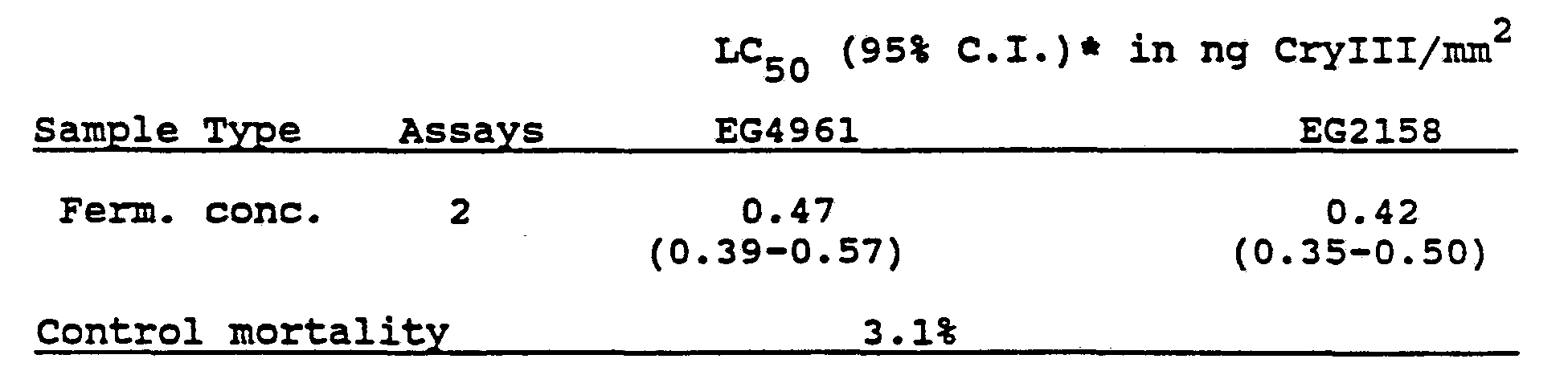
- B.t. strain EG4961 is similar in activity to the previously discovered B.t. strain EG2158 against CPB larvae when tested on artificial diet, as shown by the data in Table 2.
- B.t. strain EG4961 is similar in activity to B.t. strain EG2158 and B.t.t. against elm leaf beetle larvae and adults and imported willow leaf beetle larvae.
- B.t. strain EG4961 possesses unique activity against SCRW larvae compared to B.t.
- strain EG2158 as a fermentation concentrate may
- B.t. strain EG4961 and recombinant B.t. strain EG7231, containing the cloned crylllC gene from B.t. strain EG4961-and described in Example 7, were grown on liquid sporulation medium and concentrated via centrifugation as described generally in Examples 5 through 7. Both
- Example 13 relates to studies in which the insecticidal activity of
- Crylll proteins against coleopteran insects is demonstrably enhanced by the combination of a Cryl protein with a Crylll protein.
- Cry ⁇ A(c) protein crystals are not toxic to coleopteran insects, but are known to be active against numerous species of lepidopteran insects.
- Recombinant B.t. strain EG1269 was constructed by introducing plasmid pEG157 into B.t. strain HD73- 26. Plasmid pEG157 was made by subcloning the cry ⁇ A(c) gene from pEG87 (B.t. strain HD263-6), into the shuttle vector pEG147. The Cry ⁇ A(c) protein crystals were purified by Renografin gradient and quantified using the SDS-PAGE method mentioned previously. An equal amount of these Cryl crystals was added to CrylllC crystals and the crystal protein mixture was bioassayed on
Landscapes
- Life Sciences & Earth Sciences (AREA)
- Health & Medical Sciences (AREA)
- Chemical & Material Sciences (AREA)
- General Health & Medical Sciences (AREA)
- Zoology (AREA)
- Engineering & Computer Science (AREA)
- Organic Chemistry (AREA)
- Proteomics, Peptides & Aminoacids (AREA)
- Agronomy & Crop Science (AREA)
- Virology (AREA)
- Molecular Biology (AREA)
- Genetics & Genomics (AREA)
- Biophysics (AREA)
- Biochemistry (AREA)
- Gastroenterology & Hepatology (AREA)
- Biotechnology (AREA)
- Microbiology (AREA)
- Pest Control & Pesticides (AREA)
- Plant Pathology (AREA)
- Medicinal Chemistry (AREA)
- Crystallography & Structural Chemistry (AREA)
- Dentistry (AREA)
- Wood Science & Technology (AREA)
- Environmental Sciences (AREA)
- Micro-Organisms Or Cultivation Processes Thereof (AREA)
- Agricultural Chemicals And Associated Chemicals (AREA)
- Peptides Or Proteins (AREA)
- Preparation Of Compounds By Using Micro-Organisms (AREA)
- Catching Or Destruction (AREA)
- Pharmaceuticals Containing Other Organic And Inorganic Compounds (AREA)
Abstract
Description


Claims
Priority Applications (5)
| Application Number | Priority Date | Filing Date | Title |
|---|---|---|---|
| DE69111600T DE69111600T2 (en) | 1990-03-20 | 1991-03-18 | BACILLUS THURINGIENSIS-CRYIIIC GENE AND FOR COLEOPTERA INSECT TOXIC PROTEIN. |
| KR1019920702265A KR930700664A (en) | 1990-03-20 | 1991-03-18 | Bacillus Turingensis cryIIIc Gene and Protein Toxic to Choleopteran Insects |
| CA002078571A CA2078571C (en) | 1990-03-20 | 1991-03-18 | Bacillus thuringiensis cryiiic gene and protein toxic to coleopteran insects |
| SU5053184A RU2106409C1 (en) | 1990-03-20 | 1991-03-18 | Isolated and purified dna fragment cry iiic; protein cry iiic toxic for coleoptera; insecticide composition to fight against coleopterous insects (variants); strain of bacillus thuringiensis bacteria - a producent of protein cry iiic toxic for coleoptera (variants); protein toxic for coleoptera; method to fight against coleopterous insects |
| EP91907293A EP0522036B1 (en) | 1990-03-20 | 1991-03-18 | BACILLUS THURINGIENSIS cryIIIC GENE AND PROTEIN TOXIC TO COLEOPTERAN INSECTS. |
Applications Claiming Priority (2)
| Application Number | Priority Date | Filing Date | Title |
|---|---|---|---|
| US07/496,568 US5187091A (en) | 1990-03-20 | 1990-03-20 | Bacillus thuringiensis cryiiic gene encoding toxic to coleopteran insects |
| US496,568 | 1990-03-20 |
Publications (2)
| Publication Number | Publication Date |
|---|---|
| WO1991014778A2 true WO1991014778A2 (en) | 1991-10-03 |
| WO1991014778A3 WO1991014778A3 (en) | 1991-12-12 |
Family
ID=23973206
Family Applications (1)
| Application Number | Title | Priority Date | Filing Date |
|---|---|---|---|
| PCT/US1991/001786 Ceased WO1991014778A2 (en) | 1990-03-20 | 1991-03-18 | BACILLUS THURINGIENSIS cryIIIC GENE AND PROTEIN TOXIC TO COLEOPTERAN INSECTS |
Country Status (14)
| Country | Link |
|---|---|
| US (2) | US5187091A (en) |
| EP (2) | EP0522036B1 (en) |
| JP (1) | JP3078576B2 (en) |
| KR (1) | KR930700664A (en) |
| AT (1) | ATE125569T1 (en) |
| AU (1) | AU645080B2 (en) |
| CA (1) | CA2078571C (en) |
| DE (1) | DE69111600T2 (en) |
| ES (1) | ES2077223T3 (en) |
| HU (1) | HUT62036A (en) |
| NZ (1) | NZ237404A (en) |
| PL (1) | PL165919B1 (en) |
| RU (1) | RU2106409C1 (en) |
| WO (1) | WO1991014778A2 (en) |
Cited By (61)
| Publication number | Priority date | Publication date | Assignee | Title |
|---|---|---|---|---|
| WO1992013954A1 (en) * | 1991-01-31 | 1992-08-20 | Ecogen Inc. | BACILLUS THURINGIENSIS CRYIIIC(b) TOXIN GENE AND PROTEIN TOXIC TO COLEOPTERAN INSECTS |
| US5264364A (en) * | 1991-01-31 | 1993-11-23 | Ecogen Inc. | Bacillus thuringiensis cryIIIc(B) toxin gene and protein toxic to coleopteran insects |
| WO1994016079A3 (en) * | 1992-12-31 | 1994-10-13 | Mycogen Corp | Novel bacillus thuringiensis toxins active against corn rootworm larvae |
| US5369027A (en) * | 1993-07-12 | 1994-11-29 | Plant Genetic Systems, N.V. | Bacillus thuringiensis strains toxic to diabrotica species |
| US5382429A (en) * | 1990-03-20 | 1995-01-17 | Ecogen Inc. | Bacillus thuringiensis protein toxic to coleopteran insects |
| US5436391A (en) * | 1991-11-29 | 1995-07-25 | Mitsubishi Corporation | Synthetic insecticidal gene, plants of the genus oryza transformed with the gene, and production thereof |
| WO1999031248A1 (en) * | 1997-12-18 | 1999-06-24 | Ecogen, Inc. | INSECT-RESISTANT TRANSGENIC PLANTS AND METHODS FOR IMPROVING δ-ENDOTOXIN ACTIVITY AGAINST TARGET INSECTS |
| US6063756A (en) * | 1996-09-24 | 2000-05-16 | Monsanto Company | Bacillus thuringiensis cryET33 and cryET34 compositions and uses therefor |
| WO2000011185A3 (en) * | 1998-08-19 | 2000-06-02 | Monsanto Co | Improved expression of cry3b insecticidal protein in plants |
| US6501009B1 (en) | 1999-08-19 | 2002-12-31 | Monsanto Technology Llc | Expression of Cry3B insecticidal protein in plants |
| US7227056B2 (en) | 1997-12-18 | 2007-06-05 | Monsanto Technology Llc | Coleopteran-resistant transgenic plants and methods of their production |
| WO2010147825A1 (en) | 2009-06-09 | 2010-12-23 | Pioneer Hi-Bred International, Inc. | Early endosperm promoter and methods of use |
| WO2011056544A1 (en) | 2009-10-26 | 2011-05-12 | Pioneer Hi-Bred International, Inc. | Somatic ovule specific promoter and methods of use |
| WO2013096818A1 (en) | 2011-12-21 | 2013-06-27 | The Curators Of The University Of Missouri | Soybean variety s05-11268 |
| WO2013096810A1 (en) | 2011-12-21 | 2013-06-27 | The Curators Of The University Of Missouri | Soybean variety s05-11482 |
| WO2013103365A1 (en) | 2012-01-06 | 2013-07-11 | Pioneer Hi-Bred International, Inc. | Pollen preferred promoters and methods of use |
| WO2013103371A1 (en) | 2012-01-06 | 2013-07-11 | Pioneer Hi-Bred International, Inc. | Ovule specific promoter and methods of use |
| WO2014059155A1 (en) | 2012-10-11 | 2014-04-17 | Pioneer Hi-Bred International, Inc. | Guard cell promoters and uses thereof |
| WO2014153254A2 (en) | 2013-03-14 | 2014-09-25 | Pioneer Hi-Bred International Inc. | Compositions and methods to control insect pests |
| WO2014150914A2 (en) | 2013-03-15 | 2014-09-25 | Pioneer Hi-Bred International, Inc. | Phi-4 polypeptides and methods for their use |
| WO2014159306A1 (en) | 2013-03-13 | 2014-10-02 | Pioneer Hi-Bred International, Inc. | Glyphosate application for weed control in brassica |
| WO2015023846A2 (en) | 2013-08-16 | 2015-02-19 | Pioneer Hi-Bred International, Inc. | Insecticidal proteins and methods for their use |
| WO2015038734A2 (en) | 2013-09-13 | 2015-03-19 | Pioneer Hi-Bred International, Inc. | Insecticidal proteins and methods for their use |
| WO2015120276A1 (en) | 2014-02-07 | 2015-08-13 | Pioneer Hi Bred International Inc | Insecticidal proteins and methods for their use |
| WO2015120270A1 (en) | 2014-02-07 | 2015-08-13 | Pioneer Hi Bred International, Inc. | Insecticidal proteins and methods for their use |
| WO2016022516A1 (en) | 2014-08-08 | 2016-02-11 | Pioneer Hi-Bred International, Inc. | Ubiquitin promoters and introns and methods of use |
| WO2016044092A1 (en) | 2014-09-17 | 2016-03-24 | Pioneer Hi Bred International Inc | Compositions and methods to control insect pests |
| WO2016061206A1 (en) | 2014-10-16 | 2016-04-21 | Pioneer Hi-Bred International, Inc. | Insecticidal proteins and methods for their use |
| WO2016099916A1 (en) | 2014-12-19 | 2016-06-23 | E. I. Du Pont De Nemours And Company | Polylactic acid compositions with accelerated degradation rate and increased heat stability |
| WO2016114973A1 (en) | 2015-01-15 | 2016-07-21 | Pioneer Hi Bred International, Inc | Insecticidal proteins and methods for their use |
| WO2016186986A1 (en) | 2015-05-19 | 2016-11-24 | Pioneer Hi Bred International Inc | Insecticidal proteins and methods for their use |
| WO2016205445A1 (en) | 2015-06-16 | 2016-12-22 | Pioneer Hi-Bred International, Inc. | Compositions and methods to control insect pests |
| WO2017023486A1 (en) | 2015-08-06 | 2017-02-09 | Pioneer Hi-Bred International, Inc. | Plant derived insecticidal proteins and methods for their use |
| WO2017040343A1 (en) | 2015-08-28 | 2017-03-09 | Pioneer Hi-Bred International, Inc. | Ochrobactrum-mediated transformation of plants |
| WO2017112006A1 (en) | 2015-12-22 | 2017-06-29 | Pioneer Hi-Bred International, Inc. | Tissue-preferred promoters and methods of use |
| WO2017184673A1 (en) | 2016-04-19 | 2017-10-26 | Pioneer Hi-Bred International, Inc. | Insecticidal combinations of polypeptides having improved activity spectrum and uses thereof |
| WO2017192560A1 (en) | 2016-05-04 | 2017-11-09 | Pioneer Hi-Bred International, Inc. | Insecticidal proteins and methods for their use |
| WO2017218207A1 (en) | 2016-06-16 | 2017-12-21 | Pioneer Hi-Bred International, Inc. | Compositions and methods to control insect pests |
| WO2018005411A1 (en) | 2016-07-01 | 2018-01-04 | Pioneer Hi-Bred International, Inc. | Insecticidal proteins from plants and methods for their use |
| WO2018013333A1 (en) | 2016-07-12 | 2018-01-18 | Pioneer Hi-Bred International, Inc. | Compositions and methods to control insect pests |
| WO2018084936A1 (en) | 2016-11-01 | 2018-05-11 | Pioneer Hi-Bred International, Inc. | Insecticidal proteins and methods for their use |
| WO2018111551A1 (en) | 2016-12-14 | 2018-06-21 | Pioneer Hi-Bred International, Inc. | Insecticidal proteins and methods for their use |
| WO2018118811A1 (en) | 2016-12-22 | 2018-06-28 | Pioneer Hi-Bred International, Inc. | Insecticidal proteins and methods for their use |
| WO2018140214A1 (en) | 2017-01-24 | 2018-08-02 | Pioneer Hi-Bred International, Inc. | Nematicidal protein from pseudomonas |
| WO2018148001A1 (en) | 2017-02-08 | 2018-08-16 | Pioneer Hi-Bred International Inc | Insecticidal combinations of plant derived insecticidal proteins and methods for their use |
| WO2018208882A1 (en) | 2017-05-11 | 2018-11-15 | Pioneer Hi-Bred International, Inc. | Insecticidal proteins and methods for their use |
| WO2019060383A1 (en) | 2017-09-25 | 2019-03-28 | Pioneer Hi-Bred, International, Inc. | Tissue-preferred promoters and methods of use |
| WO2019074598A1 (en) | 2017-10-13 | 2019-04-18 | Pioneer Hi-Bred International, Inc. | Virus-induced gene silencing technology for insect control in maize |
| WO2019169150A1 (en) | 2018-03-02 | 2019-09-06 | Pioneer Hi-Bred International, Inc. | Plant health assay |
| WO2019178042A1 (en) | 2018-03-14 | 2019-09-19 | Pioneer Hi-Bred International, Inc. | Insecticidal proteins from plants and methods for their use |
| WO2019178038A1 (en) | 2018-03-14 | 2019-09-19 | Pioneer Hi-Bred International, Inc. | Insecticidal proteins from plants and methods for their use |
| WO2019226508A1 (en) | 2018-05-22 | 2019-11-28 | Pioneer Hi-Bred International, Inc. | Plant regulatory elements and methods of use thereof |
| WO2020005933A1 (en) | 2018-06-28 | 2020-01-02 | Pioneer Hi-Bred International, Inc. | Methods for selecting transformed plants |
| WO2020046701A1 (en) | 2018-08-29 | 2020-03-05 | Pioneer Hi-Bred International, Inc. | Insecticidal proteins and methods for their use |
| WO2020092487A1 (en) | 2018-10-31 | 2020-05-07 | Pioneer Hi-Bred International, Inc. | Compositions and methods for ochrobactrum-mediated plant transformation |
| WO2021158455A1 (en) | 2020-02-04 | 2021-08-12 | Dow Agrosciences Llc | Compositions having pesticidal utility and processes related thereto |
| WO2022015619A2 (en) | 2020-07-14 | 2022-01-20 | Pioneer Hi-Bred International, Inc. | Insecticidal proteins and methods for their use |
| WO2022035649A1 (en) | 2020-08-10 | 2022-02-17 | Pioneer Hi-Bred International, Inc. | Plant regulatory elements and methods of use thereof |
| EP4083215A1 (en) | 2016-06-24 | 2022-11-02 | Pioneer Hi-Bred International, Inc. | Plant regulatory elements and methods of use thereof |
| WO2024020360A1 (en) | 2022-07-18 | 2024-01-25 | Pairwise Plants Services, Inc. | Mustard green plants named 'pwrg-1', 'pwrg-2,' and 'pwsgc' |
| EP4549576A2 (en) | 2018-03-12 | 2025-05-07 | Pioneer Hi-Bred International, Inc. | Methods for plant transformation |
Families Citing this family (41)
| Publication number | Priority date | Publication date | Assignee | Title |
|---|---|---|---|---|
| US5632987A (en) * | 1992-12-31 | 1997-05-27 | Mycogen Corporation | Bacillus thuringiensis toxins active against corn rootworm larvae |
| AU7102494A (en) * | 1993-06-10 | 1995-01-03 | Ecogen Inc. | (bacillus thuringiensis) strains capable of producing large amonts of insecticidal crystal proteins |
| US5843744A (en) * | 1993-07-08 | 1998-12-01 | Ecogen Inc. | Bacillus thuringiensis Tn5401 proteins |
| US5441884A (en) * | 1993-07-08 | 1995-08-15 | Ecogen Inc. | Bacillus thuringiensis transposon TN5401 |
| US5527883A (en) * | 1994-05-06 | 1996-06-18 | Mycogen Corporation | Delta-endotoxin expression in pseudomonas fluorescens |
| US5508264A (en) * | 1994-12-06 | 1996-04-16 | Mycogen Corporation | Pesticidal compositions |
| AU708256B2 (en) * | 1995-10-13 | 1999-07-29 | Dow Agrosciences Llc | Modified bacillus thuringiensis gene for lepidopteran control in plants |
| US6093695A (en) | 1996-09-26 | 2000-07-25 | Monsanto Company | Bacillus thuringiensis CryET29 compositions toxic to coleopteran insects and ctenocephalides SPP |
| US6110668A (en) * | 1996-10-07 | 2000-08-29 | Max-Planck-Gesellschaft Zur Forderung Der Wissenschaften E.V. | Gene synthesis method |
| US6103228A (en) * | 1997-05-09 | 2000-08-15 | Agraquest, Inc. | Compositions and methods for controlling plant pests |
| DK0981540T3 (en) * | 1997-05-09 | 2006-11-06 | Agraquest Inc | New Bacillus strain for the control of plant diseases and of maize roots |
| US7087420B1 (en) | 1997-07-17 | 2006-08-08 | Cambia | Microbial β-glucuronidase genes, gene products and uses thereof |
| US6391547B1 (en) * | 1997-09-09 | 2002-05-21 | Center For The Application Of Molecular Biology To International Agriculture | Microbial β-glucuronidase genes, gene products and uses thereof |
| US6027723A (en) * | 1997-08-22 | 2000-02-22 | Agraquest, Inc. | Rhodococcus globerulus strain for controlling corn rootworm |
| US5906818A (en) * | 1997-08-22 | 1999-05-25 | Agraquest, Inc. | Bacillus mycoides strain for controlling corn rootworm |
| US6001637A (en) * | 1997-08-22 | 1999-12-14 | Agraquest, Inc. | Bacillus pumilus strain for controlling corn rootworm, nematode and armyworm infestations |
| US6015553A (en) * | 1997-08-22 | 2000-01-18 | Agraquest, Inc. | Bacillus subtilis strain for controlling insect and nematode pests |
| US6063597A (en) * | 1997-12-18 | 2000-05-16 | Monsanto Company | Polypeptide compositions toxic to coleopteran insects |
| US6077824A (en) * | 1997-12-18 | 2000-06-20 | Ecogen, Inc. | Methods for improving the activity of δ-endotoxins against insect pests |
| US6023013A (en) * | 1997-12-18 | 2000-02-08 | Monsanto Company | Insect-resistant transgenic plants |
| US6245551B1 (en) | 1999-03-30 | 2001-06-12 | Agraquest, Inc. | Strain of Bacillus pumilus for controlling plant diseases caused by fungi |
| PL351956A1 (en) | 1999-03-30 | 2003-07-14 | Agraquest | Strain bacillus pumilus for control of plant diseases |
| WO2001059146A1 (en) * | 2000-02-10 | 2001-08-16 | University Of Connecticut | Insecticidal compounds and methods for selection thereof |
| US7279547B2 (en) * | 2000-02-10 | 2007-10-09 | University Of Connecticut | Insecticidal compounds and methods for selection thereof |
| AU2001259260A1 (en) | 2000-05-15 | 2001-11-26 | Monsanto Technology Llc | Polypeptide composionns toxic to anthonomus insects, and use thereof |
| WO2002013609A1 (en) * | 2000-08-11 | 2002-02-21 | The Regents Of The University Of California | METHODS FOR BLOCKING RESISTANCE TO Bt TOXINS IN INSECTS AND NEMATODES |
| US6586365B2 (en) | 2000-10-06 | 2003-07-01 | Monsanto Technology, Llc | Method for reducing pest damage to corn by treating transgenic corn seeds with clothianidin pesticide |
| US6593273B2 (en) | 2000-10-06 | 2003-07-15 | Monsanto Technology Llc | Method for reducing pest damage to corn by treating transgenic corn seeds with pesticide |
| US8080496B2 (en) | 2000-10-06 | 2011-12-20 | Syngenta Crop Protection, Inc. | Method for reducing pest damage to corn by treating transgenic corn seeds with thiamethoxam pesticide |
| US7230167B2 (en) * | 2001-08-31 | 2007-06-12 | Syngenta Participations Ag | Modified Cry3A toxins and nucleic acid sequences coding therefor |
| WO2003094946A1 (en) * | 2002-05-10 | 2003-11-20 | Council Of Scientific And Industrial Research | Hepatoprotective activity of 2'-p-hydroxybenzoylmussaenosidic acid |
| JP2005538709A (en) * | 2002-06-20 | 2005-12-22 | バイオ−キャンサー・トリートメント・インターナショナル・リミテッド | Pharmaceuticals and methods for treating human malignancies by depleting arginine |
| HRP20050134A2 (en) * | 2002-07-29 | 2005-06-30 | Monsanto Technology Llc | Corn event pv-zmir13 (mon863) plants and compositions and methods for detection thereof |
| WO2008121633A1 (en) * | 2007-03-28 | 2008-10-09 | Syngenta Participations Ag | Insecticidal proteins |
| CA2738320C (en) | 2008-10-01 | 2020-04-21 | Vestaron Corporation | Peptide toxin formulation |
| IN2012DN02413A (en) * | 2009-10-02 | 2015-08-21 | Syngenta Participations Ag | |
| MX356526B (en) | 2012-03-09 | 2018-06-01 | Vestaron Corp | Toxic peptide production, peptide expression in plants and combinations of cysteine rich peptides. |
| US11692016B2 (en) | 2012-03-09 | 2023-07-04 | Vestaron Corporation | High gene expression yeast strain |
| AR102882A1 (en) | 2014-12-12 | 2017-03-29 | Syngenta Participations Ag | COMPOSITIONS THAT INCLUDE CRY PROTEINS AND METHODS TO CONTROL PLANT PESTS |
| US11535653B2 (en) | 2016-10-21 | 2022-12-27 | Vestaron Corporation | Cleavable peptides and insecticidal and nematicidal proteins comprising same |
| TW202345696A (en) | 2022-05-18 | 2023-12-01 | 美商科迪華農業科技有限責任公司 | Compositions having pesticidal utility and processes related thereto |
Family Cites Families (21)
| Publication number | Priority date | Publication date | Assignee | Title |
|---|---|---|---|---|
| DE3346138A1 (en) * | 1983-12-21 | 1985-07-11 | Boehringer Mannheim Gmbh, 6800 Mannheim | BACILLUS THURINGIENSIS VAR. TENEBRIONIS AND AN INSECTICIDALLY EFFECTIVE PRESERVATIVE OR AVAILABLE. TOXIN AND THEIR USE FOR COMBATING COLEOPTERA |
| US4695455A (en) * | 1985-01-22 | 1987-09-22 | Mycogen Corporation | Cellular encapsulation of pesticides produced by expression of heterologous genes |
| US4771131A (en) * | 1985-08-16 | 1988-09-13 | Mycogen Corporation | Cloning and expression of Bacillus thuringiensis toxin gene encoding a protein toxic to beetles of the order Coleoptera |
| GB8526774D0 (en) * | 1985-10-30 | 1985-12-04 | Sandoz Ltd | Bacillus thuringiensis hybrids |
| DE3713946A1 (en) * | 1987-04-25 | 1988-11-10 | Basf Ag | METHOD FOR OBTAINING INSECT PATHOGENIC PROTEINS AND MICROORGANISMS OF THE TYPE BACILLUS THURINGIENSIS |
| TR27832A (en) * | 1987-04-29 | 1995-08-31 | Monsanto Co | Plants resistant to harmful volatile damage. |
| US5024837A (en) * | 1987-05-06 | 1991-06-18 | Donovan William P | Coleopteran active microorganisms, related insecticide compositions and methods for their production and use |
| US5080897A (en) * | 1987-05-08 | 1992-01-14 | Ecogen Inc. | Novel bacillus thuringiensis strains, and related insecticidal compositions |
| US4910016A (en) * | 1987-08-03 | 1990-03-20 | Mycogen Corporation | Novel Bacillus thuringiensis isolate |
| NZ226442A (en) * | 1987-10-13 | 1991-08-27 | Lubrizol Genetics Inc | Anti-coleopteran toxin and gene |
| GB8800652D0 (en) * | 1988-01-13 | 1988-02-10 | Ici Plc | Bacterial strain |
| US4999192A (en) * | 1988-02-12 | 1991-03-12 | Mycogen Corporation | Novel coleopteran-active bacillus thuringiensis isolate |
| US4966765A (en) * | 1988-02-23 | 1990-10-30 | Mycogen Corporation | Novel coleopteran-active Bacillus thuringiensis isolate |
| US4996155A (en) * | 1988-03-04 | 1991-02-26 | Mycogen Corporation | Bacillus thuringiensis gene encoding a coleopteran-active toxin |
| US5055293A (en) * | 1988-03-09 | 1991-10-08 | Purdue Research Foundation | Biological pesticide |
| EP0382990A1 (en) * | 1989-02-15 | 1990-08-22 | Plant Genetic Systems, N.V. | Strains of bacillus thuringiensis |
| GB8910624D0 (en) * | 1989-05-09 | 1989-06-21 | Ici Plc | Bacterial strains |
| SK281286B6 (en) * | 1989-11-17 | 2001-02-12 | Novo Nordisk A/S | BACILLUS THURINGIENSIS MICROORGANISM MUTANT DEPONED AS SUBSP. TENEBRIONIS DSM 5480, THE METHOD OF ITS PREPARATION AND THE PESTICIDITY OF THIS CONTAINS |
| US5187091A (en) * | 1990-03-20 | 1993-02-16 | Ecogen Inc. | Bacillus thuringiensis cryiiic gene encoding toxic to coleopteran insects |
| ATE212667T1 (en) * | 1990-04-26 | 2002-02-15 | Aventis Cropscience Nv | NEW BACILLUSTHURINGSIENSIS STRAIN AND ITS INSECT TOXIN-ENCODING GENE |
| WO1992013954A1 (en) * | 1991-01-31 | 1992-08-20 | Ecogen Inc. | BACILLUS THURINGIENSIS CRYIIIC(b) TOXIN GENE AND PROTEIN TOXIC TO COLEOPTERAN INSECTS |
-
1990
- 1990-03-20 US US07/496,568 patent/US5187091A/en not_active Expired - Lifetime
-
1991
- 1991-03-12 NZ NZ237404A patent/NZ237404A/en unknown
- 1991-03-18 AT AT91907293T patent/ATE125569T1/en not_active IP Right Cessation
- 1991-03-18 EP EP91907293A patent/EP0522036B1/en not_active Expired - Lifetime
- 1991-03-18 KR KR1019920702265A patent/KR930700664A/en not_active Ceased
- 1991-03-18 AU AU75552/91A patent/AU645080B2/en not_active Expired
- 1991-03-18 ES ES91907293T patent/ES2077223T3/en not_active Expired - Lifetime
- 1991-03-18 HU HU9202984A patent/HUT62036A/en unknown
- 1991-03-18 RU SU5053184A patent/RU2106409C1/en active
- 1991-03-18 EP EP94102819A patent/EP0606110A1/en not_active Withdrawn
- 1991-03-18 CA CA002078571A patent/CA2078571C/en not_active Expired - Lifetime
- 1991-03-18 JP JP03506608A patent/JP3078576B2/en not_active Expired - Lifetime
- 1991-03-18 DE DE69111600T patent/DE69111600T2/en not_active Expired - Lifetime
- 1991-03-18 WO PCT/US1991/001786 patent/WO1991014778A2/en not_active Ceased
- 1991-03-20 PL PL91289512A patent/PL165919B1/en unknown
-
1992
- 1992-09-24 US US07/950,352 patent/US5382429A/en not_active Expired - Lifetime
Cited By (89)
| Publication number | Priority date | Publication date | Assignee | Title |
|---|---|---|---|---|
| US5382429A (en) * | 1990-03-20 | 1995-01-17 | Ecogen Inc. | Bacillus thuringiensis protein toxic to coleopteran insects |
| US5264364A (en) * | 1991-01-31 | 1993-11-23 | Ecogen Inc. | Bacillus thuringiensis cryIIIc(B) toxin gene and protein toxic to coleopteran insects |
| WO1992013954A1 (en) * | 1991-01-31 | 1992-08-20 | Ecogen Inc. | BACILLUS THURINGIENSIS CRYIIIC(b) TOXIN GENE AND PROTEIN TOXIC TO COLEOPTERAN INSECTS |
| US5378625A (en) * | 1991-01-31 | 1995-01-03 | Ecogen, Inc. | Bacillus thuringiensis cryIIIC, (b) protein toxic to coleopteran insects |
| US5436391A (en) * | 1991-11-29 | 1995-07-25 | Mitsubishi Corporation | Synthetic insecticidal gene, plants of the genus oryza transformed with the gene, and production thereof |
| WO1994016079A3 (en) * | 1992-12-31 | 1994-10-13 | Mycogen Corp | Novel bacillus thuringiensis toxins active against corn rootworm larvae |
| US5422106A (en) * | 1993-07-12 | 1995-06-06 | Plant Genetic Systems, N.V. | Method of controlling coleotera using Bacillus thuringiensis strains MG P-14025 and LMG P-14026 |
| US5369027A (en) * | 1993-07-12 | 1994-11-29 | Plant Genetic Systems, N.V. | Bacillus thuringiensis strains toxic to diabrotica species |
| US6949626B2 (en) | 1996-09-24 | 2005-09-27 | Monsanto Technology Llc | Bacillus thuringiensis cryET33 and cryET34 compositions and uses therefor |
| US6063756A (en) * | 1996-09-24 | 2000-05-16 | Monsanto Company | Bacillus thuringiensis cryET33 and cryET34 compositions and uses therefor |
| US7504229B2 (en) | 1996-09-24 | 2009-03-17 | Monsanto Technology Llc | Methods for detecting Bacillus thuringiensis cryET33 and cryET34 polypeptides |
| US6248536B1 (en) | 1996-09-24 | 2001-06-19 | Monsanto Company | Bacillus thuringiensis CryET33 and CryET34 compositions and uses thereof |
| US6326351B1 (en) | 1996-09-24 | 2001-12-04 | Monsanto Technology Llc | Bacillus thuringiensis CryET33 and CryET34 compositions and uses therefor |
| US6399330B1 (en) | 1996-09-24 | 2002-06-04 | Monsanto Technology Llc | Bacillus thuringiensis cryet33 and cryet34 compositions and uses thereof |
| US7385107B2 (en) | 1996-09-24 | 2008-06-10 | Monsanto Technologies Llc | Insect-resistant transgenic plants transformed with CryET33 and CryET34-encoding nucleic acids |
| US7544862B2 (en) | 1997-12-18 | 2009-06-09 | Monsanto Technology Llc | Coleopteran-resistant transgenic plants and methods of their production |
| US8513492B2 (en) | 1997-12-18 | 2013-08-20 | Monsanto Technology Llc | Coleopteran-resistant transgenic plants and methods of their production |
| EP1749834A1 (en) * | 1997-12-18 | 2007-02-07 | Monsanto Technology LLC | Insect-resistant transgenic plants and methods for improving delta-endotoxin activity against target insects |
| US7227056B2 (en) | 1997-12-18 | 2007-06-05 | Monsanto Technology Llc | Coleopteran-resistant transgenic plants and methods of their production |
| EP1801220A3 (en) * | 1997-12-18 | 2007-08-22 | Monsanto Technology, LLC | Insect-resistant transgenic plants and methods for improving delta-endotoxin activity against insects |
| WO1999031248A1 (en) * | 1997-12-18 | 1999-06-24 | Ecogen, Inc. | INSECT-RESISTANT TRANSGENIC PLANTS AND METHODS FOR IMPROVING δ-ENDOTOXIN ACTIVITY AGAINST TARGET INSECTS |
| EP1698699A3 (en) * | 1998-08-19 | 2006-09-27 | Monsanto Technology, LLC | Improved expression of CRY3B insecticidal protein in plants |
| WO2000011185A3 (en) * | 1998-08-19 | 2000-06-02 | Monsanto Co | Improved expression of cry3b insecticidal protein in plants |
| US6501009B1 (en) | 1999-08-19 | 2002-12-31 | Monsanto Technology Llc | Expression of Cry3B insecticidal protein in plants |
| US7408096B2 (en) | 1999-08-19 | 2008-08-05 | Monsanto Technology Llc | Expression of Cry3B insecticidal protein in plants |
| US6943281B2 (en) | 1999-08-19 | 2005-09-13 | Monsanto Technology Llc | Expression of Cry3B insecticidal protein in plants |
| US8101826B2 (en) | 1999-08-19 | 2012-01-24 | Monsanto Technology Llc | Expression of Cry3B insecticidal protein in plants |
| WO2010147825A1 (en) | 2009-06-09 | 2010-12-23 | Pioneer Hi-Bred International, Inc. | Early endosperm promoter and methods of use |
| WO2011056544A1 (en) | 2009-10-26 | 2011-05-12 | Pioneer Hi-Bred International, Inc. | Somatic ovule specific promoter and methods of use |
| WO2013096810A1 (en) | 2011-12-21 | 2013-06-27 | The Curators Of The University Of Missouri | Soybean variety s05-11482 |
| WO2013096818A1 (en) | 2011-12-21 | 2013-06-27 | The Curators Of The University Of Missouri | Soybean variety s05-11268 |
| WO2013103365A1 (en) | 2012-01-06 | 2013-07-11 | Pioneer Hi-Bred International, Inc. | Pollen preferred promoters and methods of use |
| WO2013103371A1 (en) | 2012-01-06 | 2013-07-11 | Pioneer Hi-Bred International, Inc. | Ovule specific promoter and methods of use |
| WO2014059155A1 (en) | 2012-10-11 | 2014-04-17 | Pioneer Hi-Bred International, Inc. | Guard cell promoters and uses thereof |
| WO2014159306A1 (en) | 2013-03-13 | 2014-10-02 | Pioneer Hi-Bred International, Inc. | Glyphosate application for weed control in brassica |
| WO2014153254A2 (en) | 2013-03-14 | 2014-09-25 | Pioneer Hi-Bred International Inc. | Compositions and methods to control insect pests |
| EP3744727A1 (en) | 2013-03-14 | 2020-12-02 | Pioneer Hi-Bred International, Inc. | Compositions and methods to control insect pests |
| WO2014150914A2 (en) | 2013-03-15 | 2014-09-25 | Pioneer Hi-Bred International, Inc. | Phi-4 polypeptides and methods for their use |
| WO2015023846A2 (en) | 2013-08-16 | 2015-02-19 | Pioneer Hi-Bred International, Inc. | Insecticidal proteins and methods for their use |
| EP3692786A1 (en) | 2013-09-13 | 2020-08-12 | Pioneer Hi-Bred International, Inc. | Insecticidal proteins and methods for their use |
| EP4159028A1 (en) | 2013-09-13 | 2023-04-05 | Pioneer Hi-Bred International, Inc. | Insecticidal proteins and methods for their use |
| WO2015038734A2 (en) | 2013-09-13 | 2015-03-19 | Pioneer Hi-Bred International, Inc. | Insecticidal proteins and methods for their use |
| WO2015120270A1 (en) | 2014-02-07 | 2015-08-13 | Pioneer Hi Bred International, Inc. | Insecticidal proteins and methods for their use |
| WO2015120276A1 (en) | 2014-02-07 | 2015-08-13 | Pioneer Hi Bred International Inc | Insecticidal proteins and methods for their use |
| EP3705489A1 (en) | 2014-02-07 | 2020-09-09 | Pioneer Hi-Bred International, Inc. | Insecticidal proteins and methods for their use |
| WO2016022516A1 (en) | 2014-08-08 | 2016-02-11 | Pioneer Hi-Bred International, Inc. | Ubiquitin promoters and introns and methods of use |
| WO2016044092A1 (en) | 2014-09-17 | 2016-03-24 | Pioneer Hi Bred International Inc | Compositions and methods to control insect pests |
| WO2016061206A1 (en) | 2014-10-16 | 2016-04-21 | Pioneer Hi-Bred International, Inc. | Insecticidal proteins and methods for their use |
| WO2016099916A1 (en) | 2014-12-19 | 2016-06-23 | E. I. Du Pont De Nemours And Company | Polylactic acid compositions with accelerated degradation rate and increased heat stability |
| WO2016114973A1 (en) | 2015-01-15 | 2016-07-21 | Pioneer Hi Bred International, Inc | Insecticidal proteins and methods for their use |
| EP4663761A2 (en) | 2015-01-15 | 2025-12-17 | Pioneer Hi-Bred International, Inc. | Insecticidal proteins and methods for their use |
| WO2016186986A1 (en) | 2015-05-19 | 2016-11-24 | Pioneer Hi Bred International Inc | Insecticidal proteins and methods for their use |
| WO2016205445A1 (en) | 2015-06-16 | 2016-12-22 | Pioneer Hi-Bred International, Inc. | Compositions and methods to control insect pests |
| WO2017023486A1 (en) | 2015-08-06 | 2017-02-09 | Pioneer Hi-Bred International, Inc. | Plant derived insecticidal proteins and methods for their use |
| EP3943602A1 (en) | 2015-08-06 | 2022-01-26 | Pioneer Hi-Bred International, Inc. | Plant derived insecticidal proteins and methods for their use |
| WO2017040343A1 (en) | 2015-08-28 | 2017-03-09 | Pioneer Hi-Bred International, Inc. | Ochrobactrum-mediated transformation of plants |
| WO2017112006A1 (en) | 2015-12-22 | 2017-06-29 | Pioneer Hi-Bred International, Inc. | Tissue-preferred promoters and methods of use |
| EP4257694A2 (en) | 2015-12-22 | 2023-10-11 | Pioneer Hi-Bred International, Inc. | Tissue-preferred promoters and methods of use |
| WO2017184673A1 (en) | 2016-04-19 | 2017-10-26 | Pioneer Hi-Bred International, Inc. | Insecticidal combinations of polypeptides having improved activity spectrum and uses thereof |
| WO2017192560A1 (en) | 2016-05-04 | 2017-11-09 | Pioneer Hi-Bred International, Inc. | Insecticidal proteins and methods for their use |
| EP3960863A1 (en) | 2016-05-04 | 2022-03-02 | Pioneer Hi-Bred International, Inc. | Insecticidal proteins and methods for their use |
| WO2017218207A1 (en) | 2016-06-16 | 2017-12-21 | Pioneer Hi-Bred International, Inc. | Compositions and methods to control insect pests |
| EP4083215A1 (en) | 2016-06-24 | 2022-11-02 | Pioneer Hi-Bred International, Inc. | Plant regulatory elements and methods of use thereof |
| WO2018005411A1 (en) | 2016-07-01 | 2018-01-04 | Pioneer Hi-Bred International, Inc. | Insecticidal proteins from plants and methods for their use |
| EP3954202A1 (en) | 2016-07-01 | 2022-02-16 | Pioneer Hi-Bred International, Inc. | Insecticidal proteins from plants and methods for their use |
| WO2018013333A1 (en) | 2016-07-12 | 2018-01-18 | Pioneer Hi-Bred International, Inc. | Compositions and methods to control insect pests |
| EP4050021A1 (en) | 2016-11-01 | 2022-08-31 | Pioneer Hi-Bred International, Inc. | Insecticidal proteins and methods for their use |
| WO2018084936A1 (en) | 2016-11-01 | 2018-05-11 | Pioneer Hi-Bred International, Inc. | Insecticidal proteins and methods for their use |
| WO2018111551A1 (en) | 2016-12-14 | 2018-06-21 | Pioneer Hi-Bred International, Inc. | Insecticidal proteins and methods for their use |
| WO2018118811A1 (en) | 2016-12-22 | 2018-06-28 | Pioneer Hi-Bred International, Inc. | Insecticidal proteins and methods for their use |
| WO2018140214A1 (en) | 2017-01-24 | 2018-08-02 | Pioneer Hi-Bred International, Inc. | Nematicidal protein from pseudomonas |
| WO2018148001A1 (en) | 2017-02-08 | 2018-08-16 | Pioneer Hi-Bred International Inc | Insecticidal combinations of plant derived insecticidal proteins and methods for their use |
| WO2018208882A1 (en) | 2017-05-11 | 2018-11-15 | Pioneer Hi-Bred International, Inc. | Insecticidal proteins and methods for their use |
| WO2019060383A1 (en) | 2017-09-25 | 2019-03-28 | Pioneer Hi-Bred, International, Inc. | Tissue-preferred promoters and methods of use |
| WO2019074598A1 (en) | 2017-10-13 | 2019-04-18 | Pioneer Hi-Bred International, Inc. | Virus-induced gene silencing technology for insect control in maize |
| WO2019169150A1 (en) | 2018-03-02 | 2019-09-06 | Pioneer Hi-Bred International, Inc. | Plant health assay |
| EP4549576A2 (en) | 2018-03-12 | 2025-05-07 | Pioneer Hi-Bred International, Inc. | Methods for plant transformation |
| WO2019178042A1 (en) | 2018-03-14 | 2019-09-19 | Pioneer Hi-Bred International, Inc. | Insecticidal proteins from plants and methods for their use |
| WO2019178038A1 (en) | 2018-03-14 | 2019-09-19 | Pioneer Hi-Bred International, Inc. | Insecticidal proteins from plants and methods for their use |
| EP4659582A2 (en) | 2018-03-14 | 2025-12-10 | Pioneer Hi-Bred International, Inc. | Insecticidal proteins from plants and methods for their use |
| EP4674268A2 (en) | 2018-03-14 | 2026-01-07 | Pioneer Hi-Bred International, Inc. | Insecticidal proteins from plants and methods for their use |
| WO2019226508A1 (en) | 2018-05-22 | 2019-11-28 | Pioneer Hi-Bred International, Inc. | Plant regulatory elements and methods of use thereof |
| WO2020005933A1 (en) | 2018-06-28 | 2020-01-02 | Pioneer Hi-Bred International, Inc. | Methods for selecting transformed plants |
| WO2020046701A1 (en) | 2018-08-29 | 2020-03-05 | Pioneer Hi-Bred International, Inc. | Insecticidal proteins and methods for their use |
| WO2020092487A1 (en) | 2018-10-31 | 2020-05-07 | Pioneer Hi-Bred International, Inc. | Compositions and methods for ochrobactrum-mediated plant transformation |
| WO2021158455A1 (en) | 2020-02-04 | 2021-08-12 | Dow Agrosciences Llc | Compositions having pesticidal utility and processes related thereto |
| WO2022015619A2 (en) | 2020-07-14 | 2022-01-20 | Pioneer Hi-Bred International, Inc. | Insecticidal proteins and methods for their use |
| WO2022035649A1 (en) | 2020-08-10 | 2022-02-17 | Pioneer Hi-Bred International, Inc. | Plant regulatory elements and methods of use thereof |
| WO2024020360A1 (en) | 2022-07-18 | 2024-01-25 | Pairwise Plants Services, Inc. | Mustard green plants named 'pwrg-1', 'pwrg-2,' and 'pwsgc' |
Also Published As
| Publication number | Publication date |
|---|---|
| DE69111600D1 (en) | 1995-08-31 |
| JPH05505109A (en) | 1993-08-05 |
| EP0522036A1 (en) | 1993-01-13 |
| EP0522036B1 (en) | 1995-07-26 |
| CA2078571A1 (en) | 1991-09-21 |
| WO1991014778A3 (en) | 1991-12-12 |
| NZ237404A (en) | 1992-06-25 |
| DE69111600T2 (en) | 1996-02-29 |
| RU2106409C1 (en) | 1998-03-10 |
| US5187091A (en) | 1993-02-16 |
| EP0606110A1 (en) | 1994-07-13 |
| JP3078576B2 (en) | 2000-08-21 |
| ES2077223T3 (en) | 1995-11-16 |
| PL289512A1 (en) | 1991-12-16 |
| AU645080B2 (en) | 1994-01-06 |
| AU7555291A (en) | 1991-10-21 |
| ATE125569T1 (en) | 1995-08-15 |
| KR930700664A (en) | 1993-03-15 |
| PL165919B1 (en) | 1995-03-31 |
| HUT62036A (en) | 1993-03-29 |
| CA2078571C (en) | 2004-06-01 |
| US5382429A (en) | 1995-01-17 |
Similar Documents
| Publication | Publication Date | Title |
|---|---|---|
| US5382429A (en) | Bacillus thuringiensis protein toxic to coleopteran insects | |
| US5338544A (en) | CryIIB protein, insecticidal compositions and methods of use thereof | |
| US5378625A (en) | Bacillus thuringiensis cryIIIC, (b) protein toxic to coleopteran insects | |
| US5024837A (en) | Coleopteran active microorganisms, related insecticide compositions and methods for their production and use | |
| WO1995004146A2 (en) | Bacillus thuringiensis cryet4 and cryet5 toxin genes and proteins toxic to lepidopteran insects | |
| WO1998030700A1 (en) | Bacillus thuringiensis isolates with broad spectrum activity | |
| EP0366668A1 (en) | NEW BACILLUS THURINGIENSIS STRains, METHOD FOR INSULATION AND RELATED INSECTICIDE COMPOSITIONS. | |
| US5073632A (en) | CryIIB crystal protein gene from Bacillus thuringiensis | |
| AU649785B2 (en) | Bacillus thuringiensis cryIIIC(b) toxin gene and protein toxic to coleopteran insects | |
| WO1992019739A1 (en) | Novel nematode-active toxins and genes which code therefor | |
| CA1340600C (en) | Bacillus thuringiensis p-2 toxin gene | |
| US5356623A (en) | Bacillus thuringiensis cryET1 toxin gene and protein toxic to lepidopteran insects | |
| CA2325831C (en) | Bacillus thuringiensis cryiiic gene and protein toxic to coleopteran insects | |
| EP0408603A1 (en) | Bacillus thuringiensis var. israelensis cryd toxin gene, protein and related insecticide compositions | |
| AU617110C (en) | Coleopteran active microorganisms, related insecticide compositions and methods for their production and use | |
| WO1993003619A1 (en) | Multi-targeted bacillus thuringiensis bioinsecticide |
Legal Events
| Date | Code | Title | Description |
|---|---|---|---|
| AK | Designated states |
Kind code of ref document: A2 Designated state(s): AU BR CA FI HU JP KR NO SU |
|
| AL | Designated countries for regional patents |
Kind code of ref document: A2 Designated state(s): AT BE CH DE DK ES FR GB GR IT LU NL SE |
|
| AK | Designated states |
Kind code of ref document: A3 Designated state(s): AU BR CA FI HU JP KR NO SU |
|
| AL | Designated countries for regional patents |
Kind code of ref document: A3 Designated state(s): AT BE CH DE DK ES FR GB GR IT LU NL SE |
|
| WWE | Wipo information: entry into national phase |
Ref document number: 2078571 Country of ref document: CA |
|
| WWE | Wipo information: entry into national phase |
Ref document number: 1991907293 Country of ref document: EP |
|
| WWP | Wipo information: published in national office |
Ref document number: 1991907293 Country of ref document: EP |
|
| WWG | Wipo information: grant in national office |
Ref document number: 1991907293 Country of ref document: EP |