WO1991012799A1 - Use of 3-guanidinopropionic acid in the treatment and prevention of metabolic disorders - Google Patents
Use of 3-guanidinopropionic acid in the treatment and prevention of metabolic disorders Download PDFInfo
- Publication number
- WO1991012799A1 WO1991012799A1 PCT/US1991/000334 US9100334W WO9112799A1 WO 1991012799 A1 WO1991012799 A1 WO 1991012799A1 US 9100334 W US9100334 W US 9100334W WO 9112799 A1 WO9112799 A1 WO 9112799A1
- Authority
- WO
- WIPO (PCT)
- Prior art keywords
- disorder
- gpa
- niddm
- obesity
- seen
- Prior art date
- Legal status (The legal status is an assumption and is not a legal conclusion. Google has not performed a legal analysis and makes no representation as to the accuracy of the status listed.)
- Ceased
Links
Classifications
-
- A—HUMAN NECESSITIES
- A61—MEDICAL OR VETERINARY SCIENCE; HYGIENE
- A61K—PREPARATIONS FOR MEDICAL, DENTAL OR TOILETRY PURPOSES
- A61K31/00—Medicinal preparations containing organic active ingredients
- A61K31/185—Acids; Anhydrides, halides or salts thereof, e.g. sulfur acids, imidic, hydrazonic or hydroximic acids
- A61K31/19—Carboxylic acids, e.g. valproic acid
- A61K31/195—Carboxylic acids, e.g. valproic acid having an amino group
-
- A—HUMAN NECESSITIES
- A61—MEDICAL OR VETERINARY SCIENCE; HYGIENE
- A61P—SPECIFIC THERAPEUTIC ACTIVITY OF CHEMICAL COMPOUNDS OR MEDICINAL PREPARATIONS
- A61P3/00—Drugs for disorders of the metabolism
-
- A—HUMAN NECESSITIES
- A61—MEDICAL OR VETERINARY SCIENCE; HYGIENE
- A61P—SPECIFIC THERAPEUTIC ACTIVITY OF CHEMICAL COMPOUNDS OR MEDICINAL PREPARATIONS
- A61P3/00—Drugs for disorders of the metabolism
- A61P3/06—Antihyperlipidemics
-
- A—HUMAN NECESSITIES
- A61—MEDICAL OR VETERINARY SCIENCE; HYGIENE
- A61P—SPECIFIC THERAPEUTIC ACTIVITY OF CHEMICAL COMPOUNDS OR MEDICINAL PREPARATIONS
- A61P3/00—Drugs for disorders of the metabolism
- A61P3/08—Drugs for disorders of the metabolism for glucose homeostasis
-
- A—HUMAN NECESSITIES
- A61—MEDICAL OR VETERINARY SCIENCE; HYGIENE
- A61P—SPECIFIC THERAPEUTIC ACTIVITY OF CHEMICAL COMPOUNDS OR MEDICINAL PREPARATIONS
- A61P5/00—Drugs for disorders of the endocrine system
Definitions
- the present invention provides a new use for a known compound. More particularly, the present invention provides a method of treating or preventing certain metabolic disorders of human and animal metabolism, e.g., hyperglycemia, impaired glucose tolerance, hyperinsulinemia, insulin insensitivity, hyperamylinemia, excess adiposity or hyperiipidemia by the administration of 3- guanidinopropionic acid (3-GPA).
- certain metabolic disorders of human and animal metabolism e.g., hyperglycemia, impaired glucose tolerance, hyperinsulinemia, insulin insensitivity, hyperamylinemia, excess adiposity or hyperiipidemia by the administration of 3- guanidinopropionic acid (3-GPA).
- NIDDM non-insulin dependent diabetes mellitus
- Hyperglycemia is a condition where the blood glucose level is above the normal level in the fasting state, following ingestion of a meal, or during a provocative diagnostic procedure, e.g., a glucose tolerance test. It can occur in NIDDM as well as obesity.
- Hyperglycemia can occur without a diagnosis of NIDDM. This condition is called impaired glucose tolerance or pre-diabetes. Impaired glucose tolerance occurs when the rate of metabolic clearance of glucose from the blood is less than that commonly occurring in the general population after a standard dose of glucose has been orally or parenterally administered. It can occur in NIDDM as well as obesity, pre-diabetes and gestational diabetes.
- Hyperinsulinemia is defined as having a blood insulin level that is above normal level in the fasting state, following ingestion of a meal or during a provocative diagnostic procedure. It can be seen in NIDDM or obesity and can be associated with or causal in hypertension or atherosclerosis. Hyperinsulinemia can occur without a diagnosis of diabetes. It may occur prior to the onset of NIDDM. Insulin insensitivity, also called insulin resistance, occurs when the insulin-dependent glucose clearance rate is less than that commonly occurring in the general population during diagnostic procedures such as a hyperinsulinemic clamp [See, e.g., DeFronzo, R. A. et ah, Am. J. Physiol. 232:E214- E233, (1979)] or a minimal model test.
- Insulin insensitivity is considered also to occur when the blood glucose concentration is higher than that commonly occurring in the general population after intravenous administration of insulin (insulin tolerance test) or when the ratio of serum insulin-to-glucose concentration is higher than that commonly occurring in the general population after a 10-16 hour fast. Insulin insensitivity may be found in NIDDM or obesity and can also be associated with or causal to hypertension or atherosclerosis.
- Hyperamylinemia is defined as having an abnormally high blood amylin level. Amylin is also known as diabetes associated peptide (DAP) and insulinoma associated polypeptide (IAP). Hyperamylinemia can be seen in NIDDM or obesity.
- DAP diabetes associated peptide
- IAP insulinoma associated polypeptide
- NIDDM neurodegenerative disease 2019
- It is defined as a higher fat body mass-to-lean body mass ratio than that commonly occurring in the general population as measured by whole body specific gravity or other generally accepted means.
- Hyperiipidemia is defined as having an abnormal level of lipids in the blood. Hyperiipidemia exists when the serum concentration of total cholesterol or total triglycerides or the serum concentration of LDL-cholesterol/HDL-cholesterol is higher than that commonly occurring in the general population. It can be seen in NIDDM or atherosclerosis.
- the above disease states could be treated by either ameliorating or preventing the metabolic and biochemical disorders.
- humans and animals which have not been diagnosed as having one of the above disease states but evidencing some or all of the disorders described above, could be benefited by preventing the development of a currently recognized disease state. Therefore, a compound that is useful in the treatment of hyperglycemia, impaired glucose tolerance, hyperinsulinemia, insulin insensitivity, hyperamylinemia, excess adiposity or hyperiipidemia could also be used to treat or prevent NIDDM, obesity, hypertension or atherosclerosis.
- 3-Guanidinopropionic acid is an endogenous metabolite found in animals and humans. See, e.g., Hiraga, Y. et al., J. Chromatography 342:269-275 (1985) and Watanabe, Y. et al., Guanidines, edited by Mori et al., Plenum, New York, pp. 49-58 (1983).
- the compound which is available from Sigma Chemical Co., has been used extensively in the study of creatine metabolism [See, e.g., Walker, J. B., Adv. Enzymol. 50:177-242 (1979)] and gamma-aminobutyric acid receptor function. See, e.g., Bowery, R. et al., Br. J. Pharmacol. 50:205-218 (1974). Except as noted below, these studies do not relate to 3-GPA's utility in treating human or animal disease.
- Guanidine, monoguanidine and diguanidine compounds have been shown to produce hypoglycemia. See, e.g. , Watanabe, C., J. Biol. Chem. 33:253-265 (1918); Bischoff, F. et al. , Guanidine structure and hypoglycemia 81:325-349 (1929). However, these compounds were observed to be toxic. In 1957, biguanide derivatives, e.g. phenformin and metformin, were used clinically as anti-diabetic agents. Some members of this class continue to be used today while others have been withdrawn from the market or banned in the United States and most Western countries. See, e.g., Schafer, G., Diabete Metabol. (Paris) 9:148-163 (1983).
- Tyformin known as Augmentin
- Augmentin produced hypoglycemia, it was reported to produce hypertension in dogs [See, e.g., Malaisse, W. et al., Horm. Metab. Res. 1:258-265 (1969)] and respiratory and circulatory collapse in rats and rabbits. See, e.g., Buckle, A. et al., Horm. Metab. Res. 3:76-81 (1971). The free acid of the amide was said to lack hypoglycemic activity [See, e.g., Beeson, M. et al., Horm. Metab. Res. 3:188-192 (1971)].
- British patent 1,153,424 discloses the use of certain esters and amides of guanidino-aliphatic acids in the treatment of diabetes mellitus where hyperuremia is present. The patent does not disclose that these compounds have an effect on hyperglycemia or any other symptom or pathological state related to diabetes.
- a Canadian patent, 891509 the use of esters and amides of guanidinoalphatic acids were disclosed for treating hyperuremia and hyperglycemia in diabetes mellitus.
- the biologic activity of a guanidino alkanoic acid was known to be different and less favorable so as to be ineffective compared to its amide for treating hyperglycemia.
- British patent, 1,195,199 discloses the use of guanidino alkanoic acids or their amides or esters in an insulin-containing, parenterally-administered composition for the treatment of hyperglycemia occurring in diabetes. According to this patent, the combining of a guanidino alkanoic acid, amide or ester with insulin reduces the risk of hypoglycemia as compared to insulin alone.
- British patent 1,195,200 discloses the use of guanidino alkanoic acids in a composition containing a guanidino alkanoic acid amide or ester derivative for the treatment of hyperglycemia occurring in diabetes.
- the present invention provides a method of treating or preventing a metabolic disorder selected from the group consisting of hyperglycemia, impaired glucose tolerance, hyperinsulinemia, hyperamylinemia, excess adiposity and/or hyperiipidemia in a patient susceptible to or experiencing said disorder comprising the systemic administration of 3-guanidinopropionic acid or a pharmacologically acceptable salt thereof, as the sole pharmaceutical agent effective to treat or prevent said condition.
- a metabolic disorder selected from the group consisting of hyperglycemia, impaired glucose tolerance, hyperinsulinemia, hyperamylinemia, excess adiposity and/or hyperiipidemia in a patient susceptible to or experiencing said disorder comprising the systemic administration of 3-guanidinopropionic acid or a pharmacologically acceptable salt thereof, as the sole pharmaceutical agent effective to treat or prevent said condition.
- 3-GPA causes several biologic effects that are beneficial in the treatment of human disease. It improves plasma glucose level, insulin sensitivity, plasma amylin level, adiposity and plasma lipid level. All of these effects are beneficial in treating NIDDM.
- 3-GPA offers therapeutic advantage over metformin, a compound currently used to treat NIDDM. See, e.g., Vigneri, R. et al., Diabetes Care 10:118-122 (1987). When administered to KKA y (Upjohn) diabetic mice, 3-GPA is more potent and produces a greater decrease in plasma glucose concentration.
- NIDDM is characterized by hyperglycemia in the fasting or post-prandial state and impaired glucose tolerance after oral or parenteral administration of a glucose solution.
- 3-GPA that has been administered to KKA y mice, a rodent model of NIDDM, decreases the non-fasting plasma glucose concentration and improves glucose tolerance.
- the minimum effective dose in KKA y mice is 130 mg/kg/d when administered as an admixture in rodent chow. Higher doses produce a proportionately greater effect.
- Doses that are less than the minimum effective dose in KKA y mice may be effective at decreasing blood glucose levels in other species, e.g., human, since elimination is rapid in rodents and may occur more slowly in other species.
- NIDDM NIDDM
- Reaven a progressive hyperinsulinemia
- obesity See, e.g., Glass A., supra
- atherosclerosis See, e.g., Reaven, supra and Stout, R. W., Diabetologia 16:141-150 (1979)] and may be etiological factors in these diseases.
- 3-GPA ameliorates hyperinsulinemia in KKA y mice and decreases the plasma ratio of insulin-to-glucose concentration, indicating increased insulin sensitivity. Therefore, 3-GPA is useful in the treatment or in the prevention of NIDDM, hypertension, obesity, and atherosclerosis.
- Hyperamylinemia may occur in NIDDM, decreasing tissue glucose metabolism [See, e.g., Leighton, B. et al., Nature 335:632-635 (1988)] and altering pancreatic hormone secretion [See, e.g., Clark, A., Diabetic Medicine 6:561-567 (1989)].
- 3-GPA ameliorates hyperamylinemia and therefore is beneficial in treating disease states in which plasma amylin concentration is increased.
- 3-GPA decreases adiposity by decreasing the level of lipids stored in fat and liver tissue. The compound is therefore beneficial in the treatment of obesity alone or in concert with NIDDM.
- the effect of 3-GPA is selective for lipid-rich tissues (e.g., epididymal fat and fatty liver of ob/ob mice) while muscle mass is unaffected or only minimally affected.
- 3-GPA decreases LDL-cholesterol levels in spontaneously hyperlipidemic mice and therefore is useful in treating or preventing hyperlipoproteinemia, atherosclerosis and coronary artery disease.
- sole active pharmaceutical agent is meant that the 3-GPA compound or its salt, administered as claimed herein, is the only pharmaceutical agent administered to the patient which has an effect on the metabolic disorders described herein.
- a metabolic disorder i.e., hyperglycemia, impaired glucose tolerance, hyperinsulinemia, insulin insensitivity, hyperamylinemia, excess adiposity and/or hyperiipidemia is meant a patient who exhibits said metabolic disorder and is therefore likely to exhibit one of more of the disease states described above. Such patients are readily diagnosed by a physician of ordinary skill.
- treatment is meant the amelioration or total avoidance of the metabolic disorder as described herein.
- prevention is meant the avoidance of a currently recognized disease state, as described herein, in a patient evidencing some or all of the metabolic disorders described above.
- any convenient route of systemic administration is employed, e.g., orally, parenterally, intranasally or intrarectally.
- the preferred form of administration is orally.
- compositions may be administered in a sustained release formulation.
- sustained release is meant a formulation in which the drug becomes biologically available to the patient at a measured rate over a prolonged period.
- Such compositions are well-known in the art.
- 3-GPA in pharmaceutical dosage form, can range from 1-500 mg/kg/day.
- the preferred dose is 5-100 mg/kg/day. Any sustained released formulations can be made.
- 3-GPA is ineffective when administered to rodents in a state similar to insulin- dependent diabetes mellitus. 3-GPA did not alter the non-fasting plasma glucose level in lean, normoglycemic C57BL6Job/? mice (Jackson Laboratory) when administered as a 2 mg/g admixture in chow for 13 days. At a higher level, 10 mg/g, 3-GPA did not affect plasma glucose concentration when administered to C57BL6Job/? mice for 4 days, but after administration for 13 days, plasma glucose concentration was decreased. The dose of 3-GPA that produced lower plasma glucose levels in C57BL6Job/? mice was > 6g/kg body weight/day.
- 3-GPA decreases plasma glucose levels that are elevated, but has little effect at normal plasma glucose concentration, 3-GPA has a great therapeutic benefit in that it ameliorates hyperglycemia with little risk of hypoglycemic reactions in case of overdose.
- mice are administered 3-GPA admixed in rodent chow for 4 days.
- Plasma is prepared from blood collected by puncturing the retro-orbital sinus of conscious mice that are in the ad libitum fed state. Blood samples are obtained on day 0 (prior to treatment) and on day 4 of treatment. Plasma glucose is measured by an enzyme coupled assay using hexokinase and glucose-6-phosphate dehydrogenase. Data is shown as a means ⁇ S.E.M. for 5 mice per group. Doses that produce a reduction in plasma glucose of 20% or greater are considered to have had a biologically meaningful effect.
- 3-GPA The percentage reduction in plasma glucose levels by 3-GPA is as follows: 0.8mg/g, 20%; 1.5mg/g, 48%; 2mg/g, 52%; 10mg/g, 77%. The results are summarized in Table I. 3-GPA also decreased the non-fasting plasma glucose level in obese, hyperglycemic C57BL6Job/ob mice which are considered to be a model of NIDDM.
- mice are administered 3-GPA admixed in rodent chow at 10 mg/g for 14 days or received unsupplemented chow.
- Blood samples are collected and plasma analyzed for glucose as described in legend to Table 1. Blood is collected at time 0 (prior to glucose adminstration) and at intervals after injection of 1.5 g/kg glucose intraperitoneally. Data, as seen in Table II, is shown as means ⁇ S.E.M. for 5-6 mice per group.
- KKA y mice receive 3-GPA as a 2mg/g admixture in chow or unsupplemented chow for 4 days.
- Ob/ob mice receive 3-GPA as a 2 or 10 mg/g admixture in chow or unsupplemented chow for 30 days.
- Blood samples are obtained as described in Table I.
- Amylin is measured in plasma using a double antibody radioimmunoassay. Results are shown in Table IV.
- mice receive 3-GPA as a 2 mg/g or 10 mg/g admixture in chow or are fed unsupplemented chow. Data, which is seen in Table V, is shown as means ⁇ S.E.M.
- Ob/ob mice receive 3-GPA as a 10 mg/g admixture in chow for 13 days or are fed unsupplemented chow.
- Plasma for lipoprotein analysis is obtained as described in Table I. Lipoprotein levels are determined with a Demand Autoanalyzer. Data, which is shown in Table VI, is seen as means ⁇ S.E.M. for 5 mice per group. For comparison, the plasma lipoprotein profile is shown for 4 lean, non-diabetic C57BL6Job/? mice that are untreated.
- mice are determined to be free of glycosuria in the fed state using KetoDiaStixTM. 3-GPA is administered for 14 days as an admixture in milled mouse chow at 2 and 5 mg/g chow or unsupplemented chow is provided. Lean and fat body mass is determined using the method of Pace and Rathbun.(See Pace, N. and Rathbun,E.N. Studies on Body Composition. III. The Body Water and Chemically Combined Nitrogen Content Relation to Fat Content. J. Biol. Chem 158:658-691 (1945)). Body weights and the wet weights of excised organs are determined gravimetrically using an analytic laboratory balance.
- 3-GPA significantly decreases the body weight and fat mass of mice as percentages of the body weight, diaphragm and calf muscle, which are selected as representative sources of skeletal muscle, are significantly increased by 3- GPA.
- the total lean body mass (reflecting primarily skeletal muscle mass) is similarly increased by 3-GPA when expressed as a percentage of the body weight.
Landscapes
- Health & Medical Sciences (AREA)
- Medicinal Chemistry (AREA)
- Veterinary Medicine (AREA)
- Public Health (AREA)
- General Health & Medical Sciences (AREA)
- Animal Behavior & Ethology (AREA)
- Life Sciences & Earth Sciences (AREA)
- Pharmacology & Pharmacy (AREA)
- Chemical & Material Sciences (AREA)
- Diabetes (AREA)
- Nuclear Medicine, Radiotherapy & Molecular Imaging (AREA)
- Chemical Kinetics & Catalysis (AREA)
- Organic Chemistry (AREA)
- Bioinformatics & Cheminformatics (AREA)
- Engineering & Computer Science (AREA)
- General Chemical & Material Sciences (AREA)
- Obesity (AREA)
- Hematology (AREA)
- Epidemiology (AREA)
- Endocrinology (AREA)
- Emergency Medicine (AREA)
- Acyclic And Carbocyclic Compounds In Medicinal Compositions (AREA)
- Pharmaceuticals Containing Other Organic And Inorganic Compounds (AREA)
- Medicines That Contain Protein Lipid Enzymes And Other Medicines (AREA)
- Medicinal Preparation (AREA)
- Organic Low-Molecular-Weight Compounds And Preparation Thereof (AREA)
- Fodder In General (AREA)
Abstract
The present invention provides a method of treating or preventing a metabolic disorder selected from the group consisting of hyperglycemia, impaired glucose tolerance, hyperinsulinemia, hyperamylinemia, excess adiposity and/or hyperlipidemia in a patient susceptible to or experiencing said disorder comprising the sytemic administration of 3-guanidinopropionic acid or a pharmacologically acceptable salt thereof, as the sole pharmaceutical agent effective to treat or prevent said condition.
Description
USE OF 3-GUANIDINOPROPIONIC ACID IN THE TREATMENT
AND PREVENTION OF METABOLIC DISORDERS
FIELD OF INVENTION
The present invention provides a new use for a known compound. More particularly, the present invention provides a method of treating or preventing certain metabolic disorders of human and animal metabolism, e.g., hyperglycemia, impaired glucose tolerance, hyperinsulinemia, insulin insensitivity, hyperamylinemia, excess adiposity or hyperiipidemia by the administration of 3- guanidinopropionic acid (3-GPA).
BACKGROUND OF THE INVENTION
There are several metabolic disorders of human and animal metabolism, e.g., hyperglycemia, impaired glucose tolerance, hyperinsulinemia and insulin insensitivity, hyperamylinemia, excess adiposity, and hyperiipidemia. Some or all of the above disorders may occur in the following disease states: non-insulin dependent diabetes mellitus (NIDDM), obesity, hypertension and atherosclerosis.
Hyperglycemia is a condition where the blood glucose level is above the normal level in the fasting state, following ingestion of a meal, or during a provocative diagnostic procedure, e.g., a glucose tolerance test. It can occur in NIDDM as well as obesity.
Hyperglycemia can occur without a diagnosis of NIDDM. This condition is called impaired glucose tolerance or pre-diabetes. Impaired glucose tolerance occurs when the rate of metabolic clearance of glucose from the blood is less than that commonly occurring in the general population after a standard dose of glucose has been orally or parenterally administered. It can occur in NIDDM as well as obesity, pre-diabetes and gestational diabetes.
Hyperinsulinemia is defined as having a blood insulin level that is above normal level in the fasting state, following ingestion of a meal or during a provocative diagnostic procedure. It can be seen in NIDDM or obesity and can be associated with or causal in hypertension or atherosclerosis. Hyperinsulinemia can occur without a diagnosis of diabetes. It may occur prior to the onset of NIDDM. Insulin insensitivity, also called insulin resistance, occurs when the insulin-dependent glucose clearance rate is less than that commonly occurring in the general population during diagnostic procedures such as a hyperinsulinemic clamp [See, e.g., DeFronzo, R. A. et ah, Am. J. Physiol. 232:E214- E233, (1979)] or a minimal model test. See, e.g., Bergman, R. N. et al., J. Clin. Invest. 68:1456-1467 (1981). Insulin insensitivity is considered also to occur when the
blood glucose concentration is higher than that commonly occurring in the general population after intravenous administration of insulin (insulin tolerance test) or when the ratio of serum insulin-to-glucose concentration is higher than that commonly occurring in the general population after a 10-16 hour fast. Insulin insensitivity may be found in NIDDM or obesity and can also be associated with or causal to hypertension or atherosclerosis.
Hyperamylinemia is defined as having an abnormally high blood amylin level. Amylin is also known as diabetes associated peptide (DAP) and insulinoma associated polypeptide (IAP). Hyperamylinemia can be seen in NIDDM or obesity.
Excess adiposity can be seen in NIDDM associated with obesity and obesity without NIDDM. It is defined as a higher fat body mass-to-lean body mass ratio than that commonly occurring in the general population as measured by whole body specific gravity or other generally accepted means.
Hyperiipidemia is defined as having an abnormal level of lipids in the blood. Hyperiipidemia exists when the serum concentration of total cholesterol or total triglycerides or the serum concentration of LDL-cholesterol/HDL-cholesterol is higher than that commonly occurring in the general population. It can be seen in NIDDM or atherosclerosis.
The above disease states could be treated by either ameliorating or preventing the metabolic and biochemical disorders. In addition, humans and animals, which have not been diagnosed as having one of the above disease states but evidencing some or all of the disorders described above, could be benefited by preventing the development of a currently recognized disease state. Therefore, a compound that is useful in the treatment of hyperglycemia, impaired glucose tolerance, hyperinsulinemia, insulin insensitivity, hyperamylinemia, excess adiposity or hyperiipidemia could also be used to treat or prevent NIDDM, obesity, hypertension or atherosclerosis.
3-Guanidinopropionic acid (3-GPA) is an endogenous metabolite found in animals and humans. See, e.g., Hiraga, Y. et al., J. Chromatography 342:269-275 (1985) and Watanabe, Y. et al., Guanidines, edited by Mori et al., Plenum, New York, pp. 49-58 (1983). The compound, which is available from Sigma Chemical Co., has been used extensively in the study of creatine metabolism [See, e.g., Walker, J. B., Adv. Enzymol. 50:177-242 (1979)] and gamma-aminobutyric acid receptor function. See, e.g., Bowery, R. et al., Br. J. Pharmacol. 50:205-218 (1974). Except as noted below, these studies
do not relate to 3-GPA's utility in treating human or animal disease.
Guanidine, monoguanidine and diguanidine compounds have been shown to produce hypoglycemia. See, e.g. , Watanabe, C., J. Biol. Chem. 33:253-265 (1918); Bischoff, F. et al. , Guanidine structure and hypoglycemia 81:325-349 (1929). However, these compounds were observed to be toxic. In 1957, biguanide derivatives, e.g. phenformin and metformin, were used clinically as anti-diabetic agents. Some members of this class continue to be used today while others have been withdrawn from the market or banned in the United States and most Western countries. See, e.g., Schafer, G., Diabete Metabol. (Paris) 9:148-163 (1983).
Gamma-guandinobutyramide also known as Tyformin, and the HCl salt of
Tyformin, known as Augmentin, were investigated as potential anti-diabetic agents from the mid-1960' s until the mid-1970's. While Augmentin produced hypoglycemia, it was reported to produce hypertension in dogs [See, e.g., Malaisse, W. et al., Horm. Metab. Res. 1:258-265 (1969)] and respiratory and circulatory collapse in rats and rabbits. See, e.g., Buckle, A. et al., Horm. Metab. Res. 3:76-81 (1971). The free acid of the amide was said to lack hypoglycemic activity [See, e.g., Beeson, M. et al., Horm. Metab. Res. 3:188-192 (1971)].
British patent 1,153,424 discloses the use of certain esters and amides of guanidino-aliphatic acids in the treatment of diabetes mellitus where hyperuremia is present. The patent does not disclose that these compounds have an effect on hyperglycemia or any other symptom or pathological state related to diabetes. In a Canadian patent, 891509, the use of esters and amides of guanidinoalphatic acids were disclosed for treating hyperuremia and hyperglycemia in diabetes mellitus. As noted above, the biologic activity of a guanidino alkanoic acid was known to be different and less favorable so as to be ineffective compared to its amide for treating hyperglycemia.
British patent, 1,195,199 discloses the use of guanidino alkanoic acids or their amides or esters in an insulin-containing, parenterally-administered composition for the treatment of hyperglycemia occurring in diabetes. According to this patent, the combining of a guanidino alkanoic acid, amide or ester with insulin reduces the risk of hypoglycemia as compared to insulin alone. British patent 1,195,200 discloses the use of guanidino alkanoic acids in a composition containing a guanidino alkanoic acid amide or ester derivative for the treatment of hyperglycemia occurring in diabetes. In a subsequent British patent, 1,552,179, the use of guanidino alkanoic acids, their salts,
amides or esters in combination with a gluconeogenesis inhibitor for treating hyper- glycemic conditions was disclosed. Metformin was cited as an inhibitor of gluconeogenesis. Biological data indicated that HL 523, the preferred guanidino alkanoic acid derivative, was inactive as a single agent in six of seven experiments where blood glucose concentration was measured in alloxan diabetic mice and only weakly active in the seventh study. Most notably, British patents 1,195,199, 1,195,200 and 1,552,179 do not claim utility for guanidino alkanoic acids, as the sole active component, in compositions for treating hyperglycemic symptoms in diabetes. Among the guanidino alkanoic acids tested, several were inactive as a single agent. Thus, a variety of guanidino alkanoic acids lack significant anti-diabetic activity and combination of these compounds with an agent of known anti-diabetic activity, e.g., metformin, is necessary to show beneficial activity.
Aynsley-Green and Alberti injected rats intravenously with 3-GPA, arginine, guanidine, 4-guanidinobutyτamide, and 4-guanidinobutyric acid. Arginine and 3-GPA stimulated insulin secretion transiently, but did not affect the blood glucose concentration while the other compounds stimulated insulin secretion but produced a rise in blood glucose concentration. See, e.g., Aynsley-Green, A. et al., Horm. Metab. Res. 6:115- 120 (1974). Blachier, et al., observed that 10 mM 3-GPA stimulated insulin secretion by isolated rat islets in vitro. See, e.g., Blachier, F. et al., Endocrinology 124:134-141 (1989). The insulin response induced by 3-GPA was 55% of that occurring when arginine was tested at the same concentration. In rats fed a diet supplemented with 10 mg/g 3-GPA for 30-60 days, the heart glycogen content was increased. See, e.g., Roberts, J. et al., Am. J. Physiol. 243:H911-H916 (1982). Similarly, skeletal muscle glycogen content was increased in rats fed chow supplemented with 10mg/g of 3-GPA for 6-10 weeks. Mice fed a diet supplemented with 3-GPA at 20 mg/g and supplied with drinking water containing 5 mg/ml 3-GPA for 7-12 weeks had serum glucose concentrations that did not differ significantly from mice receiving unsupplemented chow and water. See, e.g., Moerland, T. et al., Am. J. Physiol. 257:C810-C816 (1989).
With respect to adiposity, it is known that in some, but not all cases [See, e.g., Shoubridge, E. et al., Biochem. J. 232: 125-131 (1985)], supplementation of the diet with 10-20 mg/g 3-GPA results in decreased body weight. See, e.g., Moerland, supra and Mahanna, D. et. al., Exper. Neurol. 68:114-121 (1980). This effect has been attributed to decreased skeletal muscle mass and has not been attributed to reduced adiposity or
decreased lipid storage. See, e.g., Mahanna, supra and Shields, R. et al., Lab. Invest. 33: 151-158 (1975).
What is needed in the art is a sole therapy to treat or prevent the underlying metabolic disorders in these conditions.
INFORMATION DISCLOSURE STATEMENT
The following patents disclosed the use of guanidino-aliphatic acids or their amides or esters for the treatment of diabetes: British patent 1,153,424; Canadian patent 891509; British patent 1,195,199; British patent 1,195,200; British patent 1,552,179. None of these patents disclosed the use of 3-GPA as a sole therapy. 3-GPA has been shown to stimulate insulin secretion without lowering blood glucose, See, e.g., Ansley- Green, A. et al., Horm. Metab. Res. 6:115-120 (1974) and Blachier, F., Endocrinology 124:134-141 (1989); and to increase heart glycogen content. See, e.g., Roberts, J., Am. J. Physiol. 243:H911-H916 (1982) and Moerland, T., Am. J. Physiol. 257:C810-C816 (1989). It is also known that supplementation of the diet with 3-GPA results in decreased body weight. See Shoubridge, E. A. et al., Biochem. J. 232:125-131 (1985); Moerland, supra: Mahanna, D. A. et al., Exper. Neurol. 68:114-121 (1980); and Shields, R. P. et al., Lab. Invest. 33:151-158 (1975). All of the references cited in this section are discussed above.
SUMMARY OF THE INVENTION
The present invention provides a method of treating or preventing a metabolic disorder selected from the group consisting of hyperglycemia, impaired glucose tolerance, hyperinsulinemia, hyperamylinemia, excess adiposity and/or hyperiipidemia in a patient susceptible to or experiencing said disorder comprising the systemic administration of 3-guanidinopropionic acid or a pharmacologically acceptable salt thereof, as the sole pharmaceutical agent effective to treat or prevent said condition.
Despite extensive suggestions in the literature that it would be ineffective as a sole therapy, surprisingly and unexpectedly, it has been found that 3-GPA causes several biologic effects that are beneficial in the treatment of human disease. It improves plasma glucose level, insulin sensitivity, plasma amylin level, adiposity and plasma lipid level. All of these effects are beneficial in treating NIDDM. 3-GPA offers therapeutic advantage over metformin, a compound currently used to treat NIDDM. See, e.g., Vigneri, R. et al., Diabetes Care 10:118-122 (1987). When administered to KKAy (Upjohn) diabetic mice, 3-GPA is more potent and produces a greater decrease in plasma
glucose concentration.
NIDDM is characterized by hyperglycemia in the fasting or post-prandial state and impaired glucose tolerance after oral or parenteral administration of a glucose solution. 3-GPA, that has been administered to KKAy mice, a rodent model of NIDDM, decreases the non-fasting plasma glucose concentration and improves glucose tolerance. The minimum effective dose in KKAy mice is 130 mg/kg/d when administered as an admixture in rodent chow. Higher doses produce a proportionately greater effect. Doses that are less than the minimum effective dose in KKAy mice may be effective at decreasing blood glucose levels in other species, e.g., human, since elimination is rapid in rodents and may occur more slowly in other species.
Impaired tissue insulin sensitivity and hyperinsulinemia occur in NIDDM [See, e.g., Defronzo, R., Diabetes 37:667-687 (1988) and Reaven, G., Diabetes 37:1595-607 (1988)], hypertension (See, e.g., Reaven, supra), obesity (See, e.g., Glass A., supra), and atherosclerosis [See, e.g., Reaven, supra and Stout, R. W., Diabetologia 16:141-150 (1979)] and may be etiological factors in these diseases. 3-GPA ameliorates hyperinsulinemia in KKAy mice and decreases the plasma ratio of insulin-to-glucose concentration, indicating increased insulin sensitivity. Therefore, 3-GPA is useful in the treatment or in the prevention of NIDDM, hypertension, obesity, and atherosclerosis.
Hyperamylinemia may occur in NIDDM, decreasing tissue glucose metabolism [See, e.g., Leighton, B. et al., Nature 335:632-635 (1988)] and altering pancreatic hormone secretion [See, e.g., Clark, A., Diabetic Medicine 6:561-567 (1989)]. 3-GPA ameliorates hyperamylinemia and therefore is beneficial in treating disease states in which plasma amylin concentration is increased.
Excess adiposity is an etiological factor in NIDDM and when extreme, represents a disease state in itself. 3-GPA decreases adiposity by decreasing the level of lipids stored in fat and liver tissue. The compound is therefore beneficial in the treatment of obesity alone or in concert with NIDDM. The effect of 3-GPA is selective for lipid-rich tissues (e.g., epididymal fat and fatty liver of ob/ob mice) while muscle mass is unaffected or only minimally affected.
Increased serum low density lipoprotein (LDL) cholesterol concentration is an etiological factor in coronary artery disease. 3-GPA decreases LDL-cholesterol levels in spontaneously hyperlipidemic mice and therefore is useful in treating or preventing hyperlipoproteinemia, atherosclerosis and coronary artery disease. By sole active
pharmaceutical agent is meant that the 3-GPA compound or its salt, administered as claimed herein, is the only pharmaceutical agent administered to the patient which has an effect on the metabolic disorders described herein.
By patients susceptible to or experiencing a metabolic disorder, i.e., hyperglycemia, impaired glucose tolerance, hyperinsulinemia, insulin insensitivity, hyperamylinemia, excess adiposity and/or hyperiipidemia is meant a patient who exhibits said metabolic disorder and is therefore likely to exhibit one of more of the disease states described above. Such patients are readily diagnosed by a physician of ordinary skill.
By treatment is meant the amelioration or total avoidance of the metabolic disorder as described herein. By prevention is meant the avoidance of a currently recognized disease state, as described herein, in a patient evidencing some or all of the metabolic disorders described above.
For all of these purposes, any convenient route of systemic administration is employed, e.g., orally, parenterally, intranasally or intrarectally. In general, the preferred form of administration is orally.
The above compositions may be administered in a sustained release formulation. By sustained release is meant a formulation in which the drug becomes biologically available to the patient at a measured rate over a prolonged period. Such compositions are well-known in the art.
The dosage regimen for 3-GPA in accord with this invention will depend on body weight. 3-GPA, in pharmaceutical dosage form, can range from 1-500 mg/kg/day. The preferred dose is 5-100 mg/kg/day. Any sustained released formulations can be made.
3-GPA is ineffective when administered to rodents in a state similar to insulin- dependent diabetes mellitus. 3-GPA did not alter the non-fasting plasma glucose level in lean, normoglycemic C57BL6Job/? mice (Jackson Laboratory) when administered as a 2 mg/g admixture in chow for 13 days. At a higher level, 10 mg/g, 3-GPA did not affect plasma glucose concentration when administered to C57BL6Job/? mice for 4 days, but after administration for 13 days, plasma glucose concentration was decreased. The dose of 3-GPA that produced lower plasma glucose levels in C57BL6Job/? mice was > 6g/kg body weight/day. By contrast, a much lesser dose (130 mg/kg/d) produced an anti-hyperglycemic effect in diabetic KKAy mice. Since, 3-GPA decreases plasma glucose levels that are elevated, but has little effect at normal plasma glucose concentration, 3-GPA has a great therapeutic benefit in that it ameliorates hyperglycemia
with little risk of hypoglycemic reactions in case of overdose.
DETAILED DESCRIPTION OF THE INVENTION
The present invention is seen more fully by the examples given below.
Example 1 Improvement of Plasma Glucose Level
To test the effect of 3-GPA on non-fasting plasma glucose concentration in KKAy mice, the mice are administered 3-GPA admixed in rodent chow for 4 days. Plasma is prepared from blood collected by puncturing the retro-orbital sinus of conscious mice that are in the ad libitum fed state. Blood samples are obtained on day 0 (prior to treatment) and on day 4 of treatment. Plasma glucose is measured by an enzyme coupled assay using hexokinase and glucose-6-phosphate dehydrogenase. Data is shown as a means ± S.E.M. for 5 mice per group. Doses that produce a reduction in plasma glucose of 20% or greater are considered to have had a biologically meaningful effect. The percentage reduction in plasma glucose levels by 3-GPA is as follows: 0.8mg/g, 20%; 1.5mg/g, 48%; 2mg/g, 52%; 10mg/g, 77%. The results are summarized in Table I. 3-GPA also decreased the non-fasting plasma glucose level in obese, hyperglycemic C57BL6Job/ob mice which are considered to be a model of NIDDM.
To test the effect of 3-GPA on glucose tolerance in KKAy mice, the mice are administered 3-GPA admixed in rodent chow at 10 mg/g for 14 days or received unsupplemented chow. Blood samples are collected and plasma analyzed for glucose as described in legend to Table 1. Blood is collected at time 0 (prior to glucose adminstration) and at intervals after injection of 1.5 g/kg glucose intraperitoneally. Data, as seen in Table II, is shown as means ± S.E.M. for 5-6 mice per group.
Example 2 Improvement in Insulin Sensitivity
Data supporting the utility of 3-GPA in improving insulin sensitivity and ameliorating hyperinsulinemia is shown in Table III . KKAy mice are fed chow supplemented with 10mg/g 3-GPA for 14 days or unsupplemented chow. Blood samples are obtained and analyzed for glucose as described in legend to Table I. Plasma insulin is determined using a single antibody radioimmunoassay technique. Data is shown as means ± S.E.M. for 5-6 mice/group.
Example 3 Improvement of Plasma Amylin Level
KKAy mice receive 3-GPA as a 2mg/g admixture in chow or unsupplemented chow for 4 days. Ob/ob mice receive 3-GPA as a 2 or 10 mg/g admixture in chow or unsupplemented chow for 30 days. Blood samples are obtained as described in Table
I. Amylin is measured in plasma using a double antibody radioimmunoassay. Results are shown in Table IV.
Example 4 Improvement in Adiposity
The effect of 3-GPA on body and organ weights is tested in ob/ob mice. The mice receive 3-GPA as a 2 mg/g or 10 mg/g admixture in chow or are fed unsupplemented chow. Data, which is seen in Table V, is shown as means ± S.E.M. Example 5 Improvement in Plasma Lipid Level
Ob/ob mice receive 3-GPA as a 10 mg/g admixture in chow for 13 days or are fed unsupplemented chow. Plasma for lipoprotein analysis is obtained as described in Table I. Lipoprotein levels are determined with a Demand Autoanalyzer. Data, which is shown in Table VI, is seen as means ± S.E.M. for 5 mice per group. For comparison, the plasma lipoprotein profile is shown for 4 lean, non-diabetic C57BL6Job/? mice that are untreated.
Example 6 Reduced Adiposity and Body Weight in Non-diabetic Obese Mice
3-GPA is tested in Ay mice obtained from Jackson Laboratories (Bar Harbor,
Maine). Mice are determined to be free of glycosuria in the fed state using KetoDiaStix™. 3-GPA is administered for 14 days as an admixture in milled mouse chow at 2 and 5 mg/g chow or unsupplemented chow is provided. Lean and fat body mass is determined using the method of Pace and Rathbun.(See Pace, N. and Rathbun,E.N. Studies on Body Composition. III. The Body Water and Chemically Combined Nitrogen Content Relation to Fat Content. J. Biol. Chem 158:658-691 (1945)). Body weights and the wet weights of excised organs are determined gravimetrically using an analytic laboratory balance.
As shown in Table 7, 3-GPA significantly decreases the body weight and fat mass of mice as percentages of the body weight, diaphragm and calf muscle, which are selected as representative sources of skeletal muscle, are significantly increased by 3- GPA. The total lean body mass (reflecting primarily skeletal muscle mass) is similarly increased by 3-GPA when expressed as a percentage of the body weight.


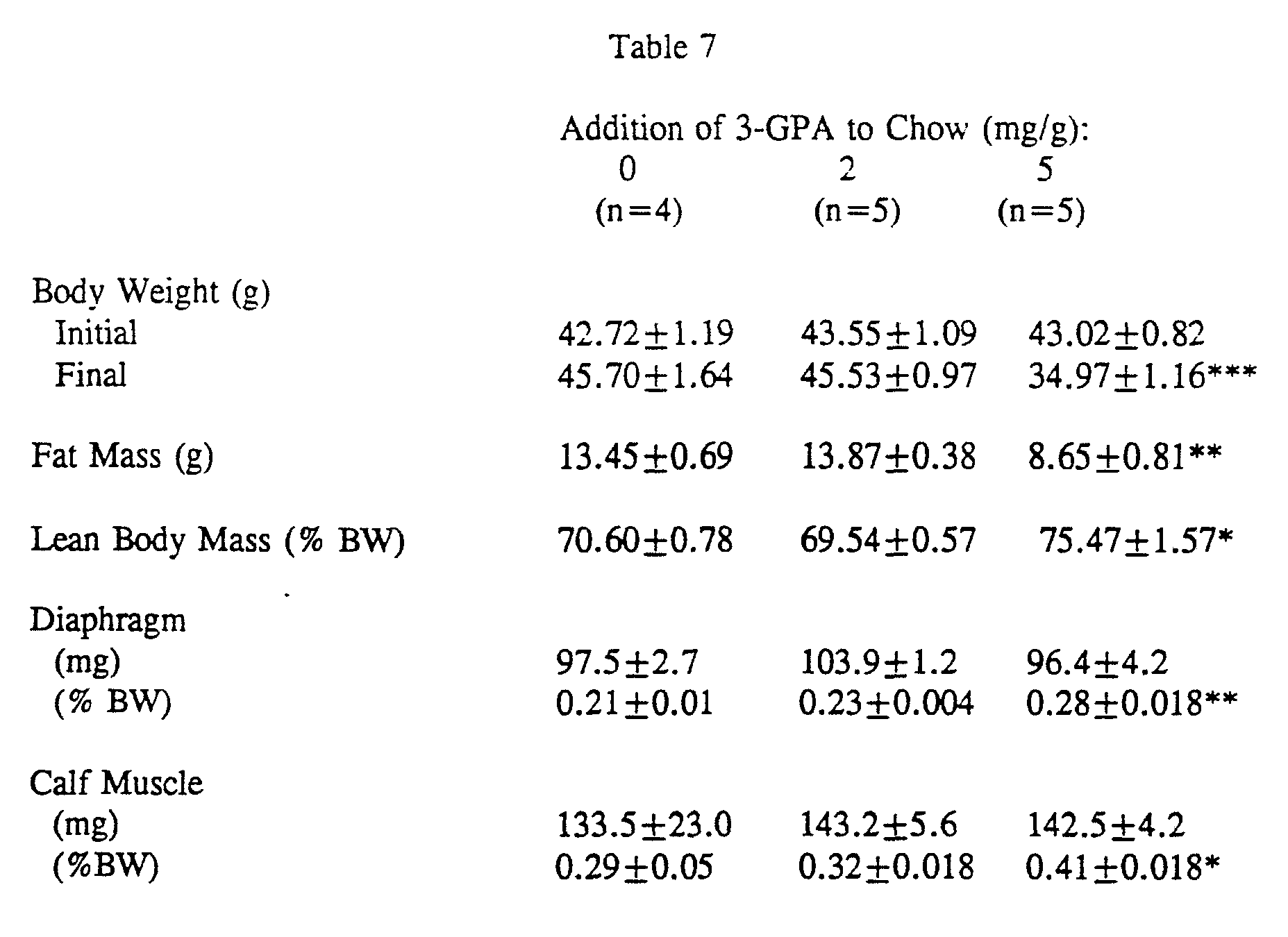
Data are shown as means ± S.E.M. Statistical analysis was performed by analysis of variance. P-values for comparison to control mice: *, P<0.05. **, P<0.01. ***, P<0.001.
Claims
1. A method of treating or preventing a metabolic disorder consisting of hyperglycemia, impaired glucose tolerance, hyperinsulinemia, insulin insensitivity, hyperamylinemia, excess adiposity and/or hyperiipidemia in a patient susceptible to or experiencing said disorder comprising the systemic adminstration of an amount of 3-guanidinopropionic acid, or a pharmaceutically acceptable salt therefor, as the sole pharmaceutical agent effective to treat or prevent said disorder.
2. A method of claim 1 wherein the mode of administration is oral.
3. A method according to claim 1 wherein said disorder is hyperglycemia.
4. A method according to claim 1 wherein said disorder is impaired glucose tolerance.
5. A method according to claim 1 wherein said disorder is hyperinsulinemia.
6. A method according to claim 1 wherein said disorder is insulin insensitivity.
7. A method according to claim 1 wherein said disorder is excess adiposity.
8. A method according to claim 1 wherein said disorder is hyperamylinemia.
9. A method according to claim 1 wherein said disorder is hyperiipidemia.
10. A method according to claim 3 wherein said disorder is seen in NIDDM or obesity.
11. A method according to claim 4 wherein said disorder is seen in NIDDM or obesity.
12. A method according to claim 5 wherein said disorder is seen in fatty NIDDM or obesity or is associated with or causal in hypertension or atherosclerosis.
13. A method according to claim 6 wherein said disorder is seen in NIDDM or obesity or is associated with or causal in hypertension or atherosclerosis.
14. A method according to claim 7 wherein said disorder is seen in NIDDM or obesity.
15. A method according to claim 8 wherein said disorder is seen in NIDDM.
16. A method according to claim 1 wherein said effective amount of 3-GPA ranges from 5-100 mg/kg/ day.
17. An oral pharmaceutical composition comprising 3-GPA or a pharmaceutical acceptable salt thereof as the sole active agent and a pharmaceutically acceptable carrier adapted for humans.
18. A composition of claim 17 wherein the formulation is a sustained release formulation.
Priority Applications (20)
| Application Number | Priority Date | Filing Date | Title |
|---|---|---|---|
| AU73165/91A AU7316591A (en) | 1990-02-28 | 1991-01-22 | Use of 3-guanidinopropionic acid in the treatment and prevention of metabolic disorders |
| PCT/US1991/000334 WO1991012799A1 (en) | 1990-02-28 | 1991-01-22 | Use of 3-guanidinopropionic acid in the treatment and prevention of metabolic disorders |
| AT91905921T ATE141505T1 (en) | 1990-02-28 | 1991-02-27 | USE OF 3-GUANIDINOPROPIONIC ACID FOR THE PRODUCTION OF A MEDICATION FOR THE TREATMENT AND PREVENTION OF OBESITY |
| CA002073873A CA2073873C (en) | 1990-02-28 | 1991-02-27 | Use of 3-guanidinopropionic acid in the treatment and prevention of metabolic disorders |
| DE69121561T DE69121561T2 (en) | 1990-02-28 | 1991-02-27 | USE OF 3-GUANIDINOPROPIONIC ACID FOR PRODUCING A MEDICINE FOR TREATING AND PREVENTING FAT ADDICTION |
| KR1019920702067A KR100190257B1 (en) | 1990-02-28 | 1991-02-27 | Pharmaceutical composition for treating metabolic disease, comprising 3-guanidinopropionic acid |
| NZ245541A NZ245541A (en) | 1990-02-28 | 1991-02-27 | Oral pharmaceutical composition containing 3-guanidinopropionic acid |
| PCT/US1991/001109 WO1991012800A1 (en) | 1990-02-28 | 1991-02-27 | Use of 3-guanidinopropionic acid in the treatment and prevention of metabolic disorders |
| AU74850/91A AU645076B2 (en) | 1990-02-28 | 1991-02-27 | Use of 3-guanidinopropionic acid in the treatment and prevention of metabolic disorders |
| EP91905921A EP0517820B1 (en) | 1990-02-28 | 1991-02-27 | Use of 3-guanidinopropionic acid in the manufacture of a medicament for the treatment and prevention of excess adiposity |
| NZ237249A NZ237249A (en) | 1990-02-28 | 1991-02-27 | Veterinary compositions of 3-guanidinopropionic acid |
| DK91905921.2T DK0517820T3 (en) | 1990-02-28 | 1991-02-27 | Use of 3-guanidinopropionic acid in the manufacture of a medicament for the treatment and prevention of excessive obesity |
| ES91905921T ES2090317T3 (en) | 1990-02-28 | 1991-02-27 | USE OF ACID 3-GUANIDINOPROPIONICO IN THE MANUFACTURE OF A MEDICINAL PRODUCT FOR THE TREATMENT AND PREVENTION OF EXCESS ADIPOSITY. |
| EP95117214A EP0713699A2 (en) | 1990-02-28 | 1991-02-27 | Use of 3-guanidinopropionic acid in the treatment and prevention of metabolic disorders |
| JP3505980A JPH0825875B2 (en) | 1990-01-22 | 1991-02-27 | Composition for treating metabolic disorders of 3-guanidinopropionic acid |
| ZA911496A ZA911496B (en) | 1990-02-28 | 1991-02-28 | Use of 3-guanidinopropionic acid in the treatment and prevention of metabolic disorders |
| US07/712,862 US5132324A (en) | 1990-02-28 | 1991-06-10 | Use of 3-guanidinopropionic acid in the treatment of non-insulin dependent diabetes mellitus (niddm) |
| US07/780,432 US5134164A (en) | 1990-02-28 | 1991-08-14 | Use of 3-guanidinopropionic acid in the treatment of excess adiposity |
| JP7178546A JP2637712B2 (en) | 1990-02-28 | 1995-07-14 | Composition containing 3-guanidinopropionic acid |
| GR960402796T GR3021424T3 (en) | 1990-02-28 | 1996-10-23 | Use of 3-guanidinopropionic acid in the manufacture of a medicament for the treatment and prevention of excess adiposity |
Applications Claiming Priority (3)
| Application Number | Priority Date | Filing Date | Title |
|---|---|---|---|
| US48661590A | 1990-02-28 | 1990-02-28 | |
| US486,615 | 1990-02-28 | ||
| PCT/US1991/000334 WO1991012799A1 (en) | 1990-02-28 | 1991-01-22 | Use of 3-guanidinopropionic acid in the treatment and prevention of metabolic disorders |
Publications (1)
| Publication Number | Publication Date |
|---|---|
| WO1991012799A1 true WO1991012799A1 (en) | 1991-09-05 |
Family
ID=26782896
Family Applications (2)
| Application Number | Title | Priority Date | Filing Date |
|---|---|---|---|
| PCT/US1991/000334 Ceased WO1991012799A1 (en) | 1990-01-22 | 1991-01-22 | Use of 3-guanidinopropionic acid in the treatment and prevention of metabolic disorders |
| PCT/US1991/001109 Ceased WO1991012800A1 (en) | 1990-01-22 | 1991-02-27 | Use of 3-guanidinopropionic acid in the treatment and prevention of metabolic disorders |
Family Applications After (1)
| Application Number | Title | Priority Date | Filing Date |
|---|---|---|---|
| PCT/US1991/001109 Ceased WO1991012800A1 (en) | 1990-01-22 | 1991-02-27 | Use of 3-guanidinopropionic acid in the treatment and prevention of metabolic disorders |
Country Status (14)
| Country | Link |
|---|---|
| US (2) | US5132324A (en) |
| EP (2) | EP0713699A2 (en) |
| JP (2) | JPH0825875B2 (en) |
| KR (1) | KR100190257B1 (en) |
| AT (1) | ATE141505T1 (en) |
| AU (2) | AU7316591A (en) |
| CA (1) | CA2073873C (en) |
| DE (1) | DE69121561T2 (en) |
| DK (1) | DK0517820T3 (en) |
| ES (1) | ES2090317T3 (en) |
| GR (1) | GR3021424T3 (en) |
| NZ (2) | NZ245541A (en) |
| WO (2) | WO1991012799A1 (en) |
| ZA (1) | ZA911496B (en) |
Cited By (2)
| Publication number | Priority date | Publication date | Assignee | Title |
|---|---|---|---|---|
| US5900435A (en) * | 1991-08-26 | 1999-05-04 | Pharmacia & Upjohn Company | Composition, food product and uses of 3-guanidinopropionic acid |
| US6075031A (en) * | 1995-10-11 | 2000-06-13 | Dana-Farber Cancer Institute | Use of creatine analogues and creatine kinase modulators for the prevention and treatment of glucose metabolic disorders |
Families Citing this family (24)
| Publication number | Priority date | Publication date | Assignee | Title |
|---|---|---|---|---|
| US5356913A (en) * | 1990-02-09 | 1994-10-18 | The Upjohn Company | Use of insulin sensitizing agents to treat hypertension |
| US6008253A (en) * | 1991-08-26 | 1999-12-28 | The Upjohn Company | Use of 3-guanidinopropionic acid to increase endurance, stamina and exercise capacity in a mammal |
| EP0600973A1 (en) * | 1991-08-27 | 1994-06-15 | The Upjohn Company | A method for treatment of metabolic disorders and metabolism |
| WO1994026261A1 (en) * | 1993-05-14 | 1994-11-24 | Amira, Inc. | Treating body parts susceptible to ischemia using creatine analogs |
| US5808246A (en) * | 1995-09-25 | 1998-09-15 | Otis Elevator Company | Triac drive for three-phase line-powered linear induction motor elevator door operator |
| CZ198798A3 (en) * | 1995-12-22 | 1999-06-16 | Smithkline Beecham Plc | A method of glycation of a protein, its use, and a pharmaceutical composition thereof |
| DE19622222A1 (en) * | 1996-06-03 | 1997-12-04 | Hoechst Ag | Use of sodium=proton exchange inhibitor |
| US20040122096A1 (en) * | 1996-06-03 | 2004-06-24 | Hoechst Aktiengesellschaft | Use of inhibitors of the cellular Na+/H+ exchanger (NHE) for preparing a medicament for normalizing serum lipids |
| CA2280871A1 (en) * | 1997-02-13 | 1998-08-20 | Valerie Piercy | Use of nitric oxide synthase inhibitors for the treatment of diabetes |
| US7910548B2 (en) * | 1997-06-06 | 2011-03-22 | Amylin Pharmaceuticals, Inc. | Methods for treating obesity |
| AU756847B2 (en) | 1998-08-24 | 2003-01-23 | Kurokawa, Kiyoshi | Carbonyl-stress improving agent and peritoneal dialysate |
| US7014307B2 (en) * | 1998-11-09 | 2006-03-21 | Silverbrook Research Pty Ltd | Printing unit for an image recordal and generation apparatus |
| US20050027005A1 (en) * | 2003-08-02 | 2005-02-03 | Matthias Boldt | Nutrient compositions and methods for sustenance and promotion of positive metabolic energy levels in a targeted manner |
| US8506934B2 (en) | 2005-04-29 | 2013-08-13 | Robert I. Henkin | Methods for detection of biological substances |
| US7670849B2 (en) * | 2005-04-29 | 2010-03-02 | Henkin Robert I | Method for diagnosing insulin resistance from nasal secretions |
| JP4777225B2 (en) * | 2006-12-04 | 2011-09-21 | キヤノン株式会社 | Discharge liquid and discharge method |
| US8293489B2 (en) | 2007-01-31 | 2012-10-23 | Henkin Robert I | Methods for detection of biological substances |
| US8580801B2 (en) | 2008-07-23 | 2013-11-12 | Robert I. Henkin | Phosphodiesterase inhibitor treatment |
| WO2012138214A1 (en) * | 2011-04-08 | 2012-10-11 | Brewster Lizzy Maritza | Beta-guanidinopropionic acid for the treatment of hypertension |
| EP3108245B1 (en) | 2014-02-18 | 2020-07-22 | Robert I. Henkin | Methods and compositions for diagnosing and treating loss and/or distortion of taste or smell |
| CN105963250A (en) * | 2016-06-21 | 2016-09-28 | 俞力 | Oral glucose solution and preparation method thereof |
| IL293721A (en) * | 2019-12-11 | 2022-08-01 | Inspirna Inc | Cancer treatment methods |
| KR102615692B1 (en) | 2021-10-13 | 2023-12-19 | 주식회사 휴엔켐 | Composition for preventing or treating liver fibrosis comprising beta-guanidinopropionic acid |
| KR102822799B1 (en) | 2022-11-09 | 2025-06-20 | 충남대학교산학협력단 | Composition for improving intestinal microbiota comprising beta-guanidinopropionic acid |
Citations (1)
| Publication number | Priority date | Publication date | Assignee | Title |
|---|---|---|---|---|
| US3843798A (en) * | 1973-03-12 | 1974-10-22 | Stanley Drug Products Inc | Methods and compositions for inducing resistance to bacterial infections |
Family Cites Families (6)
| Publication number | Priority date | Publication date | Assignee | Title |
|---|---|---|---|---|
| CA891509A (en) * | 1972-01-25 | Beecham Group Limited | Esters and amides of guanidine aliphatic acids | |
| GB1153424A (en) * | 1965-04-15 | 1969-05-29 | Horlicks Ltd | Pharmaceutical Compositions |
| GB1195199A (en) * | 1966-11-25 | 1970-06-17 | Horlicks Pharmaceuticals Ltd | Improvements in Compositions comprising Insulin. |
| GB1195200A (en) * | 1967-02-07 | 1970-06-17 | Horlicks Pharmaceuticals Ltd | Pharmaceutical Compositions. |
| GB1552179A (en) * | 1976-11-02 | 1979-09-12 | Beecham Group Ltd | Pharmaceutical compositions for treating hyperglycaemia |
| EP0601001B1 (en) * | 1991-08-26 | 1997-04-16 | PHARMACIA & UPJOHN COMPANY | Liquid food product containing 3-guanidinopropionic acid |
-
1991
- 1991-01-22 AU AU73165/91A patent/AU7316591A/en not_active Abandoned
- 1991-01-22 WO PCT/US1991/000334 patent/WO1991012799A1/en not_active Ceased
- 1991-02-27 EP EP95117214A patent/EP0713699A2/en not_active Ceased
- 1991-02-27 DE DE69121561T patent/DE69121561T2/en not_active Expired - Fee Related
- 1991-02-27 EP EP91905921A patent/EP0517820B1/en not_active Expired - Lifetime
- 1991-02-27 KR KR1019920702067A patent/KR100190257B1/en not_active Expired - Fee Related
- 1991-02-27 ES ES91905921T patent/ES2090317T3/en not_active Expired - Lifetime
- 1991-02-27 JP JP3505980A patent/JPH0825875B2/en not_active Expired - Lifetime
- 1991-02-27 NZ NZ245541A patent/NZ245541A/en unknown
- 1991-02-27 AT AT91905921T patent/ATE141505T1/en not_active IP Right Cessation
- 1991-02-27 DK DK91905921.2T patent/DK0517820T3/en active
- 1991-02-27 CA CA002073873A patent/CA2073873C/en not_active Expired - Fee Related
- 1991-02-27 WO PCT/US1991/001109 patent/WO1991012800A1/en not_active Ceased
- 1991-02-27 AU AU74850/91A patent/AU645076B2/en not_active Ceased
- 1991-02-27 NZ NZ237249A patent/NZ237249A/en unknown
- 1991-02-28 ZA ZA911496A patent/ZA911496B/en unknown
- 1991-06-10 US US07/712,862 patent/US5132324A/en not_active Expired - Fee Related
- 1991-08-14 US US07/780,432 patent/US5134164A/en not_active Expired - Fee Related
-
1995
- 1995-07-14 JP JP7178546A patent/JP2637712B2/en not_active Expired - Lifetime
-
1996
- 1996-10-23 GR GR960402796T patent/GR3021424T3/en unknown
Patent Citations (1)
| Publication number | Priority date | Publication date | Assignee | Title |
|---|---|---|---|---|
| US3843798A (en) * | 1973-03-12 | 1974-10-22 | Stanley Drug Products Inc | Methods and compositions for inducing resistance to bacterial infections |
Cited By (2)
| Publication number | Priority date | Publication date | Assignee | Title |
|---|---|---|---|---|
| US5900435A (en) * | 1991-08-26 | 1999-05-04 | Pharmacia & Upjohn Company | Composition, food product and uses of 3-guanidinopropionic acid |
| US6075031A (en) * | 1995-10-11 | 2000-06-13 | Dana-Farber Cancer Institute | Use of creatine analogues and creatine kinase modulators for the prevention and treatment of glucose metabolic disorders |
Also Published As
| Publication number | Publication date |
|---|---|
| DK0517820T3 (en) | 1997-06-09 |
| AU645076B2 (en) | 1994-01-06 |
| AU7316591A (en) | 1991-09-18 |
| DE69121561D1 (en) | 1996-09-26 |
| JPH0825875B2 (en) | 1996-03-13 |
| EP0517820B1 (en) | 1996-08-21 |
| EP0713699A2 (en) | 1996-05-29 |
| JP2637712B2 (en) | 1997-08-06 |
| KR100190257B1 (en) | 1999-06-01 |
| ZA911496B (en) | 1991-12-24 |
| ES2090317T3 (en) | 1996-10-16 |
| WO1991012800A1 (en) | 1991-09-05 |
| NZ237249A (en) | 1994-09-27 |
| CA2073873C (en) | 1996-10-29 |
| NZ245541A (en) | 1997-05-26 |
| EP0713699A3 (en) | 1996-07-10 |
| AU7485091A (en) | 1991-09-18 |
| GR3021424T3 (en) | 1997-01-31 |
| EP0517820A1 (en) | 1992-12-16 |
| ATE141505T1 (en) | 1996-09-15 |
| CA2073873A1 (en) | 1991-08-29 |
| DE69121561T2 (en) | 1997-01-30 |
| JPH0820534A (en) | 1996-01-23 |
| US5134164A (en) | 1992-07-28 |
| US5132324A (en) | 1992-07-21 |
| JPH05505189A (en) | 1993-08-05 |
Similar Documents
| Publication | Publication Date | Title |
|---|---|---|
| US5134164A (en) | Use of 3-guanidinopropionic acid in the treatment of excess adiposity | |
| AU2407592A (en) | A method for treatment of metabolic disorders | |
| EP0601001B1 (en) | Liquid food product containing 3-guanidinopropionic acid | |
| Volpi et al. | The response of muscle protein anabolism to combined hyperaminoacidemia and glucose-induced hyperinsulinemia is impaired in the elderly | |
| Shulman et al. | Effect of glucose, independent of changes in insulin and glucagon secretion, on alanine metabolism in the conscious dog. | |
| US6740680B1 (en) | Pharmaceutical compositions to tetrac and methods of use thereof | |
| US5430065A (en) | Therapeutical method for enhancing peripheral glucose utilization in a non-insulin-dependent diabetic patient | |
| Tessari | Changes in protein, carbohydrate, and fat metabolism with aging: possible role of insulin | |
| Kolterman et al. | Insulin resistance in noninsulin-dependent diabetes mellitus: impact of sulfonylurea agents in vivo and in vitro | |
| Lowry et al. | Whole-body protein breakdown and 3-methylhistidine excretion during brief fasting, starvation, and intravenous repletion in man | |
| JP2001511447A (en) | Composition comprising L-carnitine or alkanoyl L-carnitine and long chain alkanoyl | |
| McReynolds et al. | Treatment of complete ornithine transcarbamylase deficiency with nitrogen-free analogues of essential amino acids | |
| US5599841A (en) | Use of 3-guanidinopropionic acid in the treatment and prevention of metabolic disorders | |
| WASTERLAIN et al. | Chronic inhibition of brain protein synthesis after portacaval shunting: A possible pathogenic mechanism in chronic hepatic encephalopathy in the rat | |
| Pagliara et al. | Peripheral resistance to thyroid hormone in a family: heterogeneity of clinical presentation | |
| Chan et al. | Protein turnover in insulin-treated, alloxan-diabetic lean and obese Zucker rats | |
| US20050176829A1 (en) | Methods for treating hypothyroidism | |
| WO2001093873A1 (en) | Use of aicar and related compounds | |
| US6008253A (en) | Use of 3-guanidinopropionic acid to increase endurance, stamina and exercise capacity in a mammal | |
| Bratusch-Marrain et al. | Leucine assimilation in patients with diabetes mellitus | |
| JPH06510753A (en) | Compositions containing insulin and amylin for treating insulin-deficient mammals | |
| Hood et al. | Impact of methionine on net ketoacid production in humans | |
| JPWO2003068215A1 (en) | Mitochondrial drugs | |
| Iapichino et al. | Early metabolic treatment after liver transplant: Amino acid tolerance | |
| Holoček et al. | Activation of muscle branched-chain keto acid dehydrogenase (BCKAD) in diabetic and tumor necrosis factor treated rats |
Legal Events
| Date | Code | Title | Description |
|---|---|---|---|
| AK | Designated states |
Kind code of ref document: A1 Designated state(s): AU BB BG BR CA FI HU JP KP KR LK MC MG MW NO PL RO SD SU US |
|
| AL | Designated countries for regional patents |
Kind code of ref document: A1 Designated state(s): AT BE BF BJ CF CG CH CM DE DK ES FR GA GB GR IT LU ML MR NL SE SN TD TG |
|
| NENP | Non-entry into the national phase |
Ref country code: CA |