US9682958B2 - Ligands and their preparation - Google Patents
Ligands and their preparation Download PDFInfo
- Publication number
- US9682958B2 US9682958B2 US14/416,481 US201314416481A US9682958B2 US 9682958 B2 US9682958 B2 US 9682958B2 US 201314416481 A US201314416481 A US 201314416481A US 9682958 B2 US9682958 B2 US 9682958B2
- Authority
- US
- United States
- Prior art keywords
- compound
- atoms
- formula
- group
- preparation
- Prior art date
- Legal status (The legal status is an assumption and is not a legal conclusion. Google has not performed a legal analysis and makes no representation as to the accuracy of the status listed.)
- Active
Links
- 0 *.*N.*N(C1=CC=CC(C2=NC=CC=C2)=C1)C1=CC(C2=NC=CC=C2)=CC=C1.BrC1=CC(C2=NC=CC=C2)=CC=C1.BrC1=CC=CC(C2=CC=CC=N2)=C1 Chemical compound *.*N.*N(C1=CC=CC(C2=NC=CC=C2)=C1)C1=CC(C2=NC=CC=C2)=CC=C1.BrC1=CC(C2=NC=CC=C2)=CC=C1.BrC1=CC=CC(C2=CC=CC=N2)=C1 0.000 description 19
- HKJSXOYMGQUPPC-UHFFFAOYSA-N C1=CC=C(C2=CC=CC(CC3=CC=CC(C4=CC=CC=C4)=C3)=C2)C=C1.CC1=CC=CC(C2=CC=CC=C2)=C1.NC1=CC(C2=CC=CC=C2)=CC=C1 Chemical compound C1=CC=C(C2=CC=CC(CC3=CC=CC(C4=CC=CC=C4)=C3)=C2)C=C1.CC1=CC=CC(C2=CC=CC=C2)=C1.NC1=CC(C2=CC=CC=C2)=CC=C1 HKJSXOYMGQUPPC-UHFFFAOYSA-N 0.000 description 2
- BGWGGDJYDIHMPS-FFJHBKROSA-N *.*.B.B.C.C.CC.CC.CC.CC.CCC.CCC.CCC.CCC.CCC(C)CC(C)CC.CCC(C)N.CCC(C)[V].[2HH].[2HH] Chemical compound *.*.B.B.C.C.CC.CC.CC.CC.CCC.CCC.CCC.CCC.CCC(C)CC(C)CC.CCC(C)N.CCC(C)[V].[2HH].[2HH] BGWGGDJYDIHMPS-FFJHBKROSA-N 0.000 description 1
- CEIRDTQVUQWWMA-MXGYIUITSA-N *.B.C.CC.CC.CCC.CCC.CCC(C)CC(C)CC.[2HH] Chemical compound *.B.C.CC.CC.CCC.CCC.CCC(C)CC(C)CC.[2HH] CEIRDTQVUQWWMA-MXGYIUITSA-N 0.000 description 1
- ABEVWWVTPVSIMJ-UHFFFAOYSA-J BrC1=CC(C2=CC=CC=C2)=CC(C2=CC=CC=N2)=C1.BrC1=CC(C2=CC=CC=C2)=CC(C2=CC=CC=N2)=C1.C1=CC=C(C2=CC(CC3=CC(C4=CC=CC=C4)=CC(C4=CC=CC=N4)=C3)=CC(C3=NC=CC=C3)=C2)C=C1.CNCCNC.NC1=CC(C2=CC=CC=C2)=CC(C2=CC=CC=N2)=C1.[Cu]I.[N-]=[N+]=N[Na].[V].[V]I.[V]I.[V]I Chemical compound BrC1=CC(C2=CC=CC=C2)=CC(C2=CC=CC=N2)=C1.BrC1=CC(C2=CC=CC=C2)=CC(C2=CC=CC=N2)=C1.C1=CC=C(C2=CC(CC3=CC(C4=CC=CC=C4)=CC(C4=CC=CC=N4)=C3)=CC(C3=NC=CC=C3)=C2)C=C1.CNCCNC.NC1=CC(C2=CC=CC=C2)=CC(C2=CC=CC=N2)=C1.[Cu]I.[N-]=[N+]=N[Na].[V].[V]I.[V]I.[V]I ABEVWWVTPVSIMJ-UHFFFAOYSA-J 0.000 description 1
- XLTDBTFEJVNZRM-UHFFFAOYSA-J BrC1=CC(C2=CC=CC=C2)=CC(C2=CC=CC=N2)=C1.C.C1=CC=C(C2=CC(C3=CC=CC=N3)=CC(N(C3=CC=CC=C3)C3=CC(C4=NC=CC=C4)=CC=C3)=C2)C=C1.C1=CC=C(NC2=CC(C3=NC=CC=C3)=CC=C2)C=C1.CC(I)(I)I.CC[V](I)(I)I.ClC1=CC(C2=NC=CC=C2)=CC=C1.NC1=CC=CC=C1.[V]I Chemical compound BrC1=CC(C2=CC=CC=C2)=CC(C2=CC=CC=N2)=C1.C.C1=CC=C(C2=CC(C3=CC=CC=N3)=CC(N(C3=CC=CC=C3)C3=CC(C4=NC=CC=C4)=CC=C3)=C2)C=C1.C1=CC=C(NC2=CC(C3=NC=CC=C3)=CC=C2)C=C1.CC(I)(I)I.CC[V](I)(I)I.ClC1=CC(C2=NC=CC=C2)=CC=C1.NC1=CC=CC=C1.[V]I XLTDBTFEJVNZRM-UHFFFAOYSA-J 0.000 description 1
- QYOCGQBSMUXYIF-UHFFFAOYSA-K BrC1=CC(C2=CC=CC=C2)=CC(C2=CC=CC=N2)=C1.C1=CC=C(C2=CC(C3=CC=CC=N3)=CC(CC3=CC(C4=NC=CC=C4)=CC=C3)=C2)C=C1.II.I[V]I.NC1=CC(C2=NC=CC=C2)=CC=C1.[V]I Chemical compound BrC1=CC(C2=CC=CC=C2)=CC(C2=CC=CC=N2)=C1.C1=CC=C(C2=CC(C3=CC=CC=N3)=CC(CC3=CC(C4=NC=CC=C4)=CC=C3)=C2)C=C1.II.I[V]I.NC1=CC(C2=NC=CC=C2)=CC=C1.[V]I QYOCGQBSMUXYIF-UHFFFAOYSA-K 0.000 description 1
- TZJFCHVVFYCMSF-UHFFFAOYSA-M BrC1=CC(C2=CC=CC=C2)=CC(C2=CC=CC=N2)=C1.C1=CC=C(C2=CC(C3=CC=CC=N3)=CC(N(C3=CC=CC=C3)C3=CC(C4=NC=CC=C4)=CC(C4=CC=CC=C4)=C3)=C2)C=C1.CC(I)(I)I.CCI.NC1=CC=CC=C1.[V]I Chemical compound BrC1=CC(C2=CC=CC=C2)=CC(C2=CC=CC=N2)=C1.C1=CC=C(C2=CC(C3=CC=CC=N3)=CC(N(C3=CC=CC=C3)C3=CC(C4=NC=CC=C4)=CC(C4=CC=CC=C4)=C3)=C2)C=C1.CC(I)(I)I.CCI.NC1=CC=CC=C1.[V]I TZJFCHVVFYCMSF-UHFFFAOYSA-M 0.000 description 1
- CJNFQDNRDGQMQN-UHFFFAOYSA-I BrC1=CC=C(N2C3=CC=CC=C3C3=C2C=CC=C3)C=C1.C1=CC=C(C2=CC(CC3=CC(C4=NC=CC=C4)=CC=C3)=CC=C2)N=C1.C1=CC=C(C2=CC(N(C3=CC=C(N4C5=C(C=CC=C5)C5=C4C=CC=C5)C=C3)C3=CC(C4=NC=CC=C4)=CC=C3)=CC=C2)N=C1.C[V](I)(I)I.C[V](I)I.I[IH]I Chemical compound BrC1=CC=C(N2C3=CC=CC=C3C3=C2C=CC=C3)C=C1.C1=CC=C(C2=CC(CC3=CC(C4=NC=CC=C4)=CC=C3)=CC=C2)N=C1.C1=CC=C(C2=CC(N(C3=CC=C(N4C5=C(C=CC=C5)C5=C4C=CC=C5)C=C3)C3=CC(C4=NC=CC=C4)=CC=C3)=CC=C2)N=C1.C[V](I)(I)I.C[V](I)I.I[IH]I CJNFQDNRDGQMQN-UHFFFAOYSA-I 0.000 description 1
- XNBLWTCQCQQBHL-UHFFFAOYSA-K BrC1=CC=CC(Br)=C1.BrC1=CC=CC(N(C2=CC=CC=C2)C2=CC=CC(Br)=C2)=C1.C1=CC=C(N(C2=CC=CC(C3=CC=CC=N3)=C2)C2=CC(C3=NC=CC=C3)=CC=C2)C=C1.CC(I)(I)I.CC[V].CC[V](I)I.Cl[Zn]C1=NC=CC=C1.NC1=CC=CC=C1 Chemical compound BrC1=CC=CC(Br)=C1.BrC1=CC=CC(N(C2=CC=CC=C2)C2=CC=CC(Br)=C2)=C1.C1=CC=C(N(C2=CC=CC(C3=CC=CC=N3)=C2)C2=CC(C3=NC=CC=C3)=CC=C2)C=C1.CC(I)(I)I.CC[V].CC[V](I)I.Cl[Zn]C1=NC=CC=C1.NC1=CC=CC=C1 XNBLWTCQCQQBHL-UHFFFAOYSA-K 0.000 description 1
- LQJSMRWMXFGLAK-UHFFFAOYSA-N BrC1=CC=CC(C2=CC=CC=N2)=C1.C.C1=CC=C(C2=CC=CC=N2)C=C1.C1=CC=C(N(C2=CC=CC(C3=CC=CC=N3)=C2)C2=CC(C3=NC=CC=C3)=CC=C2)C=C1.CC(I)(I)I.CC([V])I.NC1=CC=CC=C1 Chemical compound BrC1=CC=CC(C2=CC=CC=N2)=C1.C.C1=CC=C(C2=CC=CC=N2)C=C1.C1=CC=C(N(C2=CC=CC(C3=CC=CC=N3)=C2)C2=CC(C3=NC=CC=C3)=CC=C2)C=C1.CC(I)(I)I.CC([V])I.NC1=CC=CC=C1 LQJSMRWMXFGLAK-UHFFFAOYSA-N 0.000 description 1
- RGBGGFIEOIZKDK-UHFFFAOYSA-N BrC1=CC=CC(C2=CC=CC=N2)=C1.C1=CC=C(C2=CC(CC3=CC(C4=NC=CC=C4)=CC=C3)=CC=C2)N=C1.I.II.I[IH]I.NC1=CC=CC(C2=CC=CC=N2)=C1 Chemical compound BrC1=CC=CC(C2=CC=CC=N2)=C1.C1=CC=C(C2=CC(CC3=CC(C4=NC=CC=C4)=CC=C3)=CC=C2)N=C1.I.II.I[IH]I.NC1=CC=CC(C2=CC=CC=N2)=C1 RGBGGFIEOIZKDK-UHFFFAOYSA-N 0.000 description 1
- OQIHNBSZOAQNBS-UHFFFAOYSA-L BrC1=CC=CC=C1.C1=CC=C(C2=CC(C3=CC=CC=N3)=CC(CC3=CC(C4=NC=CC=C4)=CC=C3)=C2)C=C1.C1=CC=C(C2=CC(C3=CC=CC=N3)=CC(N(C3=CC=CC=C3)C3=CC(C4=NC=CC=C4)=CC=C3)=C2)C=C1.CC.IC(I)I.I[V]I Chemical compound BrC1=CC=CC=C1.C1=CC=C(C2=CC(C3=CC=CC=N3)=CC(CC3=CC(C4=NC=CC=C4)=CC=C3)=C2)C=C1.C1=CC=C(C2=CC(C3=CC=CC=N3)=CC(N(C3=CC=CC=C3)C3=CC(C4=NC=CC=C4)=CC=C3)=C2)C=C1.CC.IC(I)I.I[V]I OQIHNBSZOAQNBS-UHFFFAOYSA-L 0.000 description 1
- SCMASEICMXCRRB-UHFFFAOYSA-M BrC1=CC=CC=C1.C1=CC=C(C2=CC(C3=CC=CC=N3)=CC(N(C3=CC=CC=C3)C3=CC(C4=NC=CC=C4)=CC(C4=CC=CC=C4)=C3)=C2)C=C1.C1=CC=C(C2=CC(CC3=CC(C4=CC=CC=C4)=CC(C4=CC=CC=N4)=C3)=CC(C3=NC=CC=C3)=C2)C=C1.CCI.IC(I)I.[V]I Chemical compound BrC1=CC=CC=C1.C1=CC=C(C2=CC(C3=CC=CC=N3)=CC(N(C3=CC=CC=C3)C3=CC(C4=NC=CC=C4)=CC(C4=CC=CC=C4)=C3)=C2)C=C1.C1=CC=C(C2=CC(CC3=CC(C4=CC=CC=C4)=CC(C4=CC=CC=N4)=C3)=CC(C3=NC=CC=C3)=C2)C=C1.CCI.IC(I)I.[V]I SCMASEICMXCRRB-UHFFFAOYSA-M 0.000 description 1
- KDDXZDAZTZZTPT-UHFFFAOYSA-N BrC1=CC=CC=C1.C1=CC=C(C2=CC(CC3=CC(C4=NC=CC=C4)=CC=C3)=CC=C2)N=C1.C1=CC=C(N(C2=CC=CC(C3=CC=CC=N3)=C2)C2=CC(C3=NC=CC=C3)=CC=C2)C=C1.IC(I)I.I[IH]I.[V]CI Chemical compound BrC1=CC=CC=C1.C1=CC=C(C2=CC(CC3=CC(C4=NC=CC=C4)=CC=C3)=CC=C2)N=C1.C1=CC=C(N(C2=CC=CC(C3=CC=CC=N3)=C2)C2=CC(C3=NC=CC=C3)=CC=C2)C=C1.IC(I)I.I[IH]I.[V]CI KDDXZDAZTZZTPT-UHFFFAOYSA-N 0.000 description 1
- UYEYMTQZLBRXDQ-UHFFFAOYSA-N BrC1=CC=CC=C1.CC1=CC=CN=C1C1=CC=CC(CC2=CC=CC(C3=C(C)C=CC=N3)=C2)=C1.CC1=CC=CN=C1C1=CC=CC(N(C2=CC=CC=C2)C2=CC=CC(C3=C(C)C=CC=N3)=C2)=C1.CCI.IC(I)I.ICI Chemical compound BrC1=CC=CC=C1.CC1=CC=CN=C1C1=CC=CC(CC2=CC=CC(C3=C(C)C=CC=N3)=C2)=C1.CC1=CC=CN=C1C1=CC=CC(N(C2=CC=CC=C2)C2=CC=CC(C3=C(C)C=CC=N3)=C2)=C1.CCI.IC(I)I.ICI UYEYMTQZLBRXDQ-UHFFFAOYSA-N 0.000 description 1
- LJAWWGQDPVGZPK-UHFFFAOYSA-N BrC1=NC=CC=C1.C.C1=CC=C(C2=CC(N(C3=CC=C(N4C5=C(C=CC=C5)C5=C4C=CC=C5)C=C3)C3=CC(C4=NC=CC=C4)=CC=C3)=CC=C2)N=C1.CCC.CCC(I)I.CCCI.ClC1=CC=CC(C2=CC=CC=N2)=C1.NC1=CC=C(N2C3=C(C=CC=C3)C3=C/C=C/C=C\32)C=C1.OB(O)C1=CC=CC(Cl)=C1 Chemical compound BrC1=NC=CC=C1.C.C1=CC=C(C2=CC(N(C3=CC=C(N4C5=C(C=CC=C5)C5=C4C=CC=C5)C=C3)C3=CC(C4=NC=CC=C4)=CC=C3)=CC=C2)N=C1.CCC.CCC(I)I.CCCI.ClC1=CC=CC(C2=CC=CC=N2)=C1.NC1=CC=C(N2C3=C(C=CC=C3)C3=C/C=C/C=C\32)C=C1.OB(O)C1=CC=CC(Cl)=C1 LJAWWGQDPVGZPK-UHFFFAOYSA-N 0.000 description 1
- POCYRNHKVWMSNA-UHFFFAOYSA-N BrC1=NC=CC=C1.C.CC(C)I.CC1=CC(C)=C(N(C2=CC=CC(C3=CC=CC=N3)=C2)C2=CC(C3=NC=CC=C3)=CC=C2)C(C)=C1.CC1=CC(C)=C(N)C(C)=C1.CCC(I)I.CCCI.ClC1=CC=CC(C2=CC=CC=N2)=C1.OB(O)C1=CC=CC(Cl)=C1 Chemical compound BrC1=NC=CC=C1.C.CC(C)I.CC1=CC(C)=C(N(C2=CC=CC(C3=CC=CC=N3)=C2)C2=CC(C3=NC=CC=C3)=CC=C2)C(C)=C1.CC1=CC(C)=C(N)C(C)=C1.CCC(I)I.CCCI.ClC1=CC=CC(C2=CC=CC=N2)=C1.OB(O)C1=CC=CC(Cl)=C1 POCYRNHKVWMSNA-UHFFFAOYSA-N 0.000 description 1
- AXVNJNYUUXOWRR-UHFFFAOYSA-J C.C.CC1=C(C2=CC(Br)=CC=C2)N=CC=C1.CC1=C(C2=CC(Br)=CC=C2)N=CC=C1.CC1=C(C2=CC(N)=CC=C2)N=CC=C1.CC1=CC=CC(Br)=N1.CC1=CC=CN=C1C1=CC=CC(CC2=CC=CC(C3=C(C)C=CC=N3)=C2)=C1.CI.CI.CNCCNC.ICI.I[V](I)I.OB(O)C1=CC=CC(Br)=C1.[Cu]I.[N-]=[N+]=N[Na] Chemical compound C.C.CC1=C(C2=CC(Br)=CC=C2)N=CC=C1.CC1=C(C2=CC(Br)=CC=C2)N=CC=C1.CC1=C(C2=CC(N)=CC=C2)N=CC=C1.CC1=CC=CC(Br)=N1.CC1=CC=CN=C1C1=CC=CC(CC2=CC=CC(C3=C(C)C=CC=N3)=C2)=C1.CI.CI.CNCCNC.ICI.I[V](I)I.OB(O)C1=CC=CC(Br)=C1.[Cu]I.[N-]=[N+]=N[Na] AXVNJNYUUXOWRR-UHFFFAOYSA-J 0.000 description 1
- LREJYXNRIWVPOW-UHFFFAOYSA-N C1=CC(C2=NC=NC=N2)=CC(CC2=CC(C3=NC=NC=N3)=CC(C3=CC4=C(C=C3)SC3=C4C=CC=C3)=C2)=C1.C1=CC=C(C2=CC(CC3=CC=CC(C4=NC=NC=N4)=C3)=CC(C3=NC=NC=N3)=C2)C=C1.C1=CC=C(C2=NC(CC3=CC(C4=NC=CC=C4)=CC(C4=C5OC6=C(C=CC=C6)C5=CC=C4)=C3)=CC=C2)C=C1.C1=CC=C(C2=NC(CC3=CC(C4=NC=CC=C4)=CC(C4=C5SC6=C(C=CC=C6)C5=CC=C4)=C3)=CC=C2)C=C1.C1=CC=C(C2=NC(CC3=CC(C4=NC=CC=C4)=CC(C4=CC5=C(C=C4)SC4=C5C=CC=C4)=C3)=CC=C2)C=C1 Chemical compound C1=CC(C2=NC=NC=N2)=CC(CC2=CC(C3=NC=NC=N3)=CC(C3=CC4=C(C=C3)SC3=C4C=CC=C3)=C2)=C1.C1=CC=C(C2=CC(CC3=CC=CC(C4=NC=NC=N4)=C3)=CC(C3=NC=NC=N3)=C2)C=C1.C1=CC=C(C2=NC(CC3=CC(C4=NC=CC=C4)=CC(C4=C5OC6=C(C=CC=C6)C5=CC=C4)=C3)=CC=C2)C=C1.C1=CC=C(C2=NC(CC3=CC(C4=NC=CC=C4)=CC(C4=C5SC6=C(C=CC=C6)C5=CC=C4)=C3)=CC=C2)C=C1.C1=CC=C(C2=NC(CC3=CC(C4=NC=CC=C4)=CC(C4=CC5=C(C=C4)SC4=C5C=CC=C4)=C3)=CC=C2)C=C1 LREJYXNRIWVPOW-UHFFFAOYSA-N 0.000 description 1
- VRWBTFATJPFIAY-UHFFFAOYSA-N C1=CC(C2=NC=NC=N2)=CC(CC2=CC(C3=NC=NC=N3)=CC(N3C4=C(C=CC=C4)C4=C3C=CC=C4)=C2)=C1.CC(C)(C)C1=CC(CC2=CC(C(C)(C)C)=CC(C3=NC=NC=N3)=C2)=CC(C2=NC=NC=N2)=C1.CC1=CC(CC2=CC(C)=CC(C3=NC=NC=N3)=C2)=CC(C2=NC=NC=N2)=C1.CC1=CC=C(C2=NC=NC=N2)C=C1CC1=C(C)C=CC(C2=NC=NC=N2)=C1.C[Si](C)(C)C1=CC(CC2=CC([Si](C)(C)C)=CC(C3=NC=NC=N3)=C2)=CC(C2=NC=NC=N2)=C1 Chemical compound C1=CC(C2=NC=NC=N2)=CC(CC2=CC(C3=NC=NC=N3)=CC(N3C4=C(C=CC=C4)C4=C3C=CC=C4)=C2)=C1.CC(C)(C)C1=CC(CC2=CC(C(C)(C)C)=CC(C3=NC=NC=N3)=C2)=CC(C2=NC=NC=N2)=C1.CC1=CC(CC2=CC(C)=CC(C3=NC=NC=N3)=C2)=CC(C2=NC=NC=N2)=C1.CC1=CC=C(C2=NC=NC=N2)C=C1CC1=C(C)C=CC(C2=NC=NC=N2)=C1.C[Si](C)(C)C1=CC(CC2=CC([Si](C)(C)C)=CC(C3=NC=NC=N3)=C2)=CC(C2=NC=NC=N2)=C1 VRWBTFATJPFIAY-UHFFFAOYSA-N 0.000 description 1
- KFQLBAWPLRTDJQ-UHFFFAOYSA-N C1=CC(CC2=CC=CC(C3=NC4=C(C=CC=C4)S3)=C2)=CC(C2=NC=CS2)=C1.C1=CC(CC2=CC=CC(C3=NC=NC=N3)=C2)=CC(C2=NC=NC=N2)=C1.C1=CC(CC2=CC=CC(N3C=CC=C3)=N2)=NC(N2C=CC=C2)=C1.C1=CC2=CC(CC3=CC=CC(N4C=CC=C4)=N3)=NC(N3C=CC=C3)=C2C=C1.C1=CC=C(C2=CC(CC3=CC=CC(N4C=CC=C4)=N3)=NC(N3C=CC=C3)=C2)C=C1.C1=CC=C2C(=C1)C=C(CC1=NC(N3C=CC=C3)=C3C=CC=CC3=C1)N=C2N1C=CC=C1 Chemical compound C1=CC(CC2=CC=CC(C3=NC4=C(C=CC=C4)S3)=C2)=CC(C2=NC=CS2)=C1.C1=CC(CC2=CC=CC(C3=NC=NC=N3)=C2)=CC(C2=NC=NC=N2)=C1.C1=CC(CC2=CC=CC(N3C=CC=C3)=N2)=NC(N2C=CC=C2)=C1.C1=CC2=CC(CC3=CC=CC(N4C=CC=C4)=N3)=NC(N3C=CC=C3)=C2C=C1.C1=CC=C(C2=CC(CC3=CC=CC(N4C=CC=C4)=N3)=NC(N3C=CC=C3)=C2)C=C1.C1=CC=C2C(=C1)C=C(CC1=NC(N3C=CC=C3)=C3C=CC=CC3=C1)N=C2N1C=CC=C1 KFQLBAWPLRTDJQ-UHFFFAOYSA-N 0.000 description 1
- HEWDWLOPHJHUBQ-UHFFFAOYSA-N C1=CC(CC2=CC=CC(C3=NC=CS3)=C2)=CC(C2=NC=CS2)=C1.C1=CC=C(C2=CC(CC3=CC(C4=CC=CC=C4)=CC(C4=NC=CS4)=C3)=CC(C3=NC=CS3)=C2)C=C1.C1=CC=C(C2=CC=NN2C2=CC(CC3=CC(C4=NC=CC=C4)=CC=C3)=CC=C2)C=C1.C1=CN=C(C2=CC=CC(CC3=CC=CC(N4C=CC=N4)=C3)=C2)C=C1.CC1=CC=NN1C1=CC(CC2=CC(C3=NC=CC=C3)=CC(C(C)(C)C)=C2)=CC=C1 Chemical compound C1=CC(CC2=CC=CC(C3=NC=CS3)=C2)=CC(C2=NC=CS2)=C1.C1=CC=C(C2=CC(CC3=CC(C4=CC=CC=C4)=CC(C4=NC=CS4)=C3)=CC(C3=NC=CS3)=C2)C=C1.C1=CC=C(C2=CC=NN2C2=CC(CC3=CC(C4=NC=CC=C4)=CC=C3)=CC=C2)C=C1.C1=CN=C(C2=CC=CC(CC3=CC=CC(N4C=CC=N4)=C3)=C2)C=C1.CC1=CC=NN1C1=CC(CC2=CC(C3=NC=CC=C3)=CC(C(C)(C)C)=C2)=CC=C1 HEWDWLOPHJHUBQ-UHFFFAOYSA-N 0.000 description 1
- NOICECKYTDROOA-UHFFFAOYSA-N C1=CC(CC2=CC=CC(C3=NC=CS3)=C2)=CC(N2C=CC=N2)=C1.C1=CC=C(C2=CC(CC3=CC=CC(C4=NC=C(C5=CC=CC=C5)S4)=C3)=CC(C3=NC=CC=C3)=C2)C=C1.CC1=CC=NN1C1=CC(CC2=CC(C3=NC=CC=C3)=CC=C2)=CC=C1.CC1=CC=NN1C1=CC(CC2=NC(C3=CC=CC=C3)=C(C3=CC=CC=C3)C=C2)=CC=C1.C[Si](C)(C)C1=CC(CC2=CC=CC(C3=NC=C(C4=CC=CC=C4)S3)=C2)=NC(C2=CC=CC=C2)=C1 Chemical compound C1=CC(CC2=CC=CC(C3=NC=CS3)=C2)=CC(N2C=CC=N2)=C1.C1=CC=C(C2=CC(CC3=CC=CC(C4=NC=C(C5=CC=CC=C5)S4)=C3)=CC(C3=NC=CC=C3)=C2)C=C1.CC1=CC=NN1C1=CC(CC2=CC(C3=NC=CC=C3)=CC=C2)=CC=C1.CC1=CC=NN1C1=CC(CC2=NC(C3=CC=CC=C3)=C(C3=CC=CC=C3)C=C2)=CC=C1.C[Si](C)(C)C1=CC(CC2=CC=CC(C3=NC=C(C4=CC=CC=C4)S3)=C2)=NC(C2=CC=CC=C2)=C1 NOICECKYTDROOA-UHFFFAOYSA-N 0.000 description 1
- ADOXPSCZJPFGBF-UHFFFAOYSA-N C1=CC=C(B(C2=CC=CC=C2)C2=CC(CC3=CC=CC(C4=CC=CC=N4)=C3)=CC(C3=NC=CC=C3)=C2)C=C1.CC1(C)C2=C(C=CC=C2)C2=C1C=C(C1=CC(CC3=CC=CC(C4=CC=CC=N4)=C3)=CC(C3=NC=CC=C3)=C1)C=C2.CC1=CC=C(C2=NC=CC=C2)C=C1CC1=C(C)C=CC(C2=CC=CC=N2)=C1.CC1=CN=C(C2=CC=C(C)C(CC3=C(C)C=CC(C4=C(C)C=C(C)C=N4)=C3)=C2)C(C)=C1.COC1=CC(CC2=CC(OC)=CC(C3=CC=CC=N3)=C2)=CC(C2=NC=CC=C2)=C1 Chemical compound C1=CC=C(B(C2=CC=CC=C2)C2=CC(CC3=CC=CC(C4=CC=CC=N4)=C3)=CC(C3=NC=CC=C3)=C2)C=C1.CC1(C)C2=C(C=CC=C2)C2=C1C=C(C1=CC(CC3=CC=CC(C4=CC=CC=N4)=C3)=CC(C3=NC=CC=C3)=C1)C=C2.CC1=CC=C(C2=NC=CC=C2)C=C1CC1=C(C)C=CC(C2=CC=CC=N2)=C1.CC1=CN=C(C2=CC=C(C)C(CC3=C(C)C=CC(C4=C(C)C=C(C)C=N4)=C3)=C2)C(C)=C1.COC1=CC(CC2=CC(OC)=CC(C3=CC=CC=N3)=C2)=CC(C2=NC=CC=C2)=C1 ADOXPSCZJPFGBF-UHFFFAOYSA-N 0.000 description 1
- FEDHCQRGPKJPFD-UHFFFAOYSA-N C1=CC=C(C2=C3C=CC=CC3=C(C3=CC(CC4=CC=CC(C5=NC=CS5)=C4)=CC(C4=NC=CS4)=C3)C3=CC=CC=C32)C=C1.C1=CC=C(C2=CC=NN2C2=CC(CC3=CC(C4=NC=CC=C4)=CC(C4=CC5=CC=CC=C5C=C4)=C3)=CC=C2)C=C1.C1=CC=C(C2=CC=NN2C2=CC(CC3=CC(C4=NC=CC=C4)=CC(C4=CC=C5C=CC=CC5=C4)=C3)=CC=C2)C=C1.CC1=CN=C(C2=CC=CC(CC3=CC=CC(C4=NC=C(C)S4)=C3)=C2)S1 Chemical compound C1=CC=C(C2=C3C=CC=CC3=C(C3=CC(CC4=CC=CC(C5=NC=CS5)=C4)=CC(C4=NC=CS4)=C3)C3=CC=CC=C32)C=C1.C1=CC=C(C2=CC=NN2C2=CC(CC3=CC(C4=NC=CC=C4)=CC(C4=CC5=CC=CC=C5C=C4)=C3)=CC=C2)C=C1.C1=CC=C(C2=CC=NN2C2=CC(CC3=CC(C4=NC=CC=C4)=CC(C4=CC=C5C=CC=CC5=C4)=C3)=CC=C2)C=C1.CC1=CN=C(C2=CC=CC(CC3=CC=CC(C4=NC=C(C)S4)=C3)=C2)S1 FEDHCQRGPKJPFD-UHFFFAOYSA-N 0.000 description 1
- REINDXGJSYHMNQ-UHFFFAOYSA-N C1=CC=C(C2=CC(C3=CC4=C(C=C3)C3=C(C=CC=C3)N4C3=CC=CC=C3)=CC(CC3=CC=CC(C4=CC=CC=N4)=N3)=C2)C=C1.C1=CC=C(C2=CC(CC3=CC(C4=NC=CC=C4)=CC(C4=CC5=C(C=C4)C4=C(C=CC=C4)C54C5=C(C=CC=C5)C5=C4C=CC=C5)=C3)=CC=C2)N=C1.C1=CC=C(C2=NC(CC3=CC(C4=NC=CC=C4)=CC(C4=CC5=C(C=C4)C4=C(C=CC=C4)S5)=C3)=CC=C2)C=C1.C1=CC=C(C2=NC(CC3=NC(C4=CC=CC=C4C4=CC=CS4)=CC=C3)=CC=C2)C=C1.C[Si](C)(C)C1=CC(CC2=CC([Si](C)(C)C)=CC(C3=CC=CC=N3)=C2)=CC(C2=NC=CC=C2)=C1 Chemical compound C1=CC=C(C2=CC(C3=CC4=C(C=C3)C3=C(C=CC=C3)N4C3=CC=CC=C3)=CC(CC3=CC=CC(C4=CC=CC=N4)=N3)=C2)C=C1.C1=CC=C(C2=CC(CC3=CC(C4=NC=CC=C4)=CC(C4=CC5=C(C=C4)C4=C(C=CC=C4)C54C5=C(C=CC=C5)C5=C4C=CC=C5)=C3)=CC=C2)N=C1.C1=CC=C(C2=NC(CC3=CC(C4=NC=CC=C4)=CC(C4=CC5=C(C=C4)C4=C(C=CC=C4)S5)=C3)=CC=C2)C=C1.C1=CC=C(C2=NC(CC3=NC(C4=CC=CC=C4C4=CC=CS4)=CC=C3)=CC=C2)C=C1.C[Si](C)(C)C1=CC(CC2=CC([Si](C)(C)C)=CC(C3=CC=CC=N3)=C2)=CC(C2=NC=CC=C2)=C1 REINDXGJSYHMNQ-UHFFFAOYSA-N 0.000 description 1
- CZOOIKCJZAFHKS-UHFFFAOYSA-N C1=CC=C(C2=CC(C3=CC4=C(C=C3)C3=C(O4)C(C4=CC=CC=C4)=CC=C3)=CC(CC3=CC=CC(C4=CC=CC=N4)=N3)=C2)C=C1.C1=CC=C(C2=CC(N3C4=C(C=CC=C4)C4=C3C=CC=C4)=CC(CC3=CC=CC(C4=CC=CC=N4)=N3)=C2)C=C1.C1=CC=C(C2=CC3=C(C=C2)N(C2=CC(CC4=CC=CC(C5=CC=CC=C5)=N4)=CC(C4=NC=CC=C4)=C2)C2=C3C=C(C3=CC=CC=C3)C=C2)C=C1.C1=CN=C(C2=CC=CC(CC3=CC=CC(C4=C5C=CC=CC5=CC=N4)=C3)=C2)C=C1 Chemical compound C1=CC=C(C2=CC(C3=CC4=C(C=C3)C3=C(O4)C(C4=CC=CC=C4)=CC=C3)=CC(CC3=CC=CC(C4=CC=CC=N4)=N3)=C2)C=C1.C1=CC=C(C2=CC(N3C4=C(C=CC=C4)C4=C3C=CC=C4)=CC(CC3=CC=CC(C4=CC=CC=N4)=N3)=C2)C=C1.C1=CC=C(C2=CC3=C(C=C2)N(C2=CC(CC4=CC=CC(C5=CC=CC=C5)=N4)=CC(C4=NC=CC=C4)=C2)C2=C3C=C(C3=CC=CC=C3)C=C2)C=C1.C1=CN=C(C2=CC=CC(CC3=CC=CC(C4=C5C=CC=CC5=CC=N4)=C3)=C2)C=C1 CZOOIKCJZAFHKS-UHFFFAOYSA-N 0.000 description 1
- QHGQIYWZGUXPNP-UHFFFAOYSA-N C1=CC=C(C2=CC(CC3=CC(C4=NC=CC=C4)=CC=C3)=CC=C2)N=C1.C1=CC=C(C2=CC=C(C3=CC(CC4=CC(C5=NC=CC=C5)=CC(C5=CC=CC=C5)=C4)=CC=C3)N=C2)C=C1.CC1=CC(CC2=CC(C)=CC(C3=CC=CC=N3)=C2)=CC(C2=NC=CC=C2)=C1.CC1=CC=CN=C1C1=CC=CC(CC2=CC(C(C)(C)C)=CC(C3=CC=CC=N3)=C2)=C1.CCC1=CC=C(CC2=CC(C3=NC=CC=C3C)=CC=C2)C=C1C1=CC=CC=N1 Chemical compound C1=CC=C(C2=CC(CC3=CC(C4=NC=CC=C4)=CC=C3)=CC=C2)N=C1.C1=CC=C(C2=CC=C(C3=CC(CC4=CC(C5=NC=CC=C5)=CC(C5=CC=CC=C5)=C4)=CC=C3)N=C2)C=C1.CC1=CC(CC2=CC(C)=CC(C3=CC=CC=N3)=C2)=CC(C2=NC=CC=C2)=C1.CC1=CC=CN=C1C1=CC=CC(CC2=CC(C(C)(C)C)=CC(C3=CC=CC=N3)=C2)=C1.CCC1=CC=C(CC2=CC(C3=NC=CC=C3C)=CC=C2)C=C1C1=CC=CC=N1 QHGQIYWZGUXPNP-UHFFFAOYSA-N 0.000 description 1
- RHUMCPWWYOORGZ-UHFFFAOYSA-M C1=CC=C(C2=CC(CC3=CC(C4=NC=CC=C4)=CC=C3)=CC=C2)N=C1.CC1=CC(C)=C(Br)C(C)=C1.CC1=CC(C)=C(N(C2=CC=CC(C3=CC=CC=N3)=C2)C2=CC(C3=NC=CC=C3)=CC=C2)C(C)=C1.C[V].C[V]I.I[IH]I Chemical compound C1=CC=C(C2=CC(CC3=CC(C4=NC=CC=C4)=CC=C3)=CC=C2)N=C1.CC1=CC(C)=C(Br)C(C)=C1.CC1=CC(C)=C(N(C2=CC=CC(C3=CC=CC=N3)=C2)C2=CC(C3=NC=CC=C3)=CC=C2)C(C)=C1.C[V].C[V]I.I[IH]I RHUMCPWWYOORGZ-UHFFFAOYSA-M 0.000 description 1
- MZRQLITYXFPLRW-UHFFFAOYSA-N C1=CC=C(C2=CC(CC3=CC(C4=NC=CC=C4)=CC=C3)=CC=C2)N=C1.CC1=CC=CC(C2=CC=CC=N2)=C1.NC1=CC(C2=NC=CC=C2)=CC=C1 Chemical compound C1=CC=C(C2=CC(CC3=CC(C4=NC=CC=C4)=CC=C3)=CC=C2)N=C1.CC1=CC=CC(C2=CC=CC=N2)=C1.NC1=CC(C2=NC=CC=C2)=CC=C1 MZRQLITYXFPLRW-UHFFFAOYSA-N 0.000 description 1
- VVENXEQXSHFIPC-UHFFFAOYSA-N C1=CC=C(C2=CC(CC3=CC4=C5N=CC=CC5=CC=C4C=C3)=CC=C2)N=C1.C1=CC=C(N2C3=CC=CN=C3C3C=C(CC4=CC=CC(C5=CC=CC=N5)=C4)C=CC32)C=C1.CC1(C)C2=C(C=C(CC3=CC=CC(C4=CC=CC=N4)=C3)C=C2)C2=C(C=CC=N2)C1(C)C.CC1(C)C2=CC=CN=C2C2C=C(CC3=CC=CC(C4=CC=CC=N4)=C3)C=CC21.CC1(C)OC2=C(C=C(CC3=CC=CC(C4=CC=CC=N4)=C3)C=C2)C2=C1C=CC=N2.CC1=CN=C(C2=NC(CC3=CC(C4=CC=CC=C4)=CC=C3)=CC=C2)S1 Chemical compound C1=CC=C(C2=CC(CC3=CC4=C5N=CC=CC5=CC=C4C=C3)=CC=C2)N=C1.C1=CC=C(N2C3=CC=CN=C3C3C=C(CC4=CC=CC(C5=CC=CC=N5)=C4)C=CC32)C=C1.CC1(C)C2=C(C=C(CC3=CC=CC(C4=CC=CC=N4)=C3)C=C2)C2=C(C=CC=N2)C1(C)C.CC1(C)C2=CC=CN=C2C2C=C(CC3=CC=CC(C4=CC=CC=N4)=C3)C=CC21.CC1(C)OC2=C(C=C(CC3=CC=CC(C4=CC=CC=N4)=C3)C=C2)C2=C1C=CC=N2.CC1=CN=C(C2=NC(CC3=CC(C4=CC=CC=C4)=CC=C3)=CC=C2)S1 VVENXEQXSHFIPC-UHFFFAOYSA-N 0.000 description 1
- IMZWZUYKEKXXLW-UHFFFAOYSA-N C1=CC=C(C2=CC(CC3=CC=CC(C4=C5C=CC=CC5=CC=C4)=N3)=NC(C3=CC=CC=C3)=C2)C=C1.C1=CC=C(C2=CC=C(C3=C4C=CC=CC4=CC(CC4=C5/C=C\C=C/C5=CC(C5=CC=CC=C5)=N4)=N3)C=C2)C=C1.C1=CC=C(C2=NC(CC3=NC(C4=CC=C(N(C5=CC=CC=C5)C5=CC=CC=C5)C=C4)=CC=C3)=CC=C2)C=C1.C1=CC=C2C=C(C3=CC(CC4=CC(C5=NC=C6C=CC=CC6=C5)=CC=C4)=CC=C3)N=CC2=C1.C1=CN=C(C2=C3C=CC=CC3=CC(CC3=CC=CC(C4=CC=C5C=CC=CC5=N4)=C3)=C2)C=C1 Chemical compound C1=CC=C(C2=CC(CC3=CC=CC(C4=C5C=CC=CC5=CC=C4)=N3)=NC(C3=CC=CC=C3)=C2)C=C1.C1=CC=C(C2=CC=C(C3=C4C=CC=CC4=CC(CC4=C5/C=C\C=C/C5=CC(C5=CC=CC=C5)=N4)=N3)C=C2)C=C1.C1=CC=C(C2=NC(CC3=NC(C4=CC=C(N(C5=CC=CC=C5)C5=CC=CC=C5)C=C4)=CC=C3)=CC=C2)C=C1.C1=CC=C2C=C(C3=CC(CC4=CC(C5=NC=C6C=CC=CC6=C5)=CC=C4)=CC=C3)N=CC2=C1.C1=CN=C(C2=C3C=CC=CC3=CC(CC3=CC=CC(C4=CC=C5C=CC=CC5=N4)=C3)=C2)C=C1 IMZWZUYKEKXXLW-UHFFFAOYSA-N 0.000 description 1
- KEABRJDJYWDSDB-UHFFFAOYSA-N C1=CC=C(C2=CC(CC3=NC(C4=NC=CC=C4)=CC=C3)=CC=C2)C=C1.CC1=CC=CC(C2=CC=CC=C2)=C1.NC1=NC(C2=NC=CC=C2)=CC=C1 Chemical compound C1=CC=C(C2=CC(CC3=NC(C4=NC=CC=C4)=CC=C3)=CC=C2)C=C1.CC1=CC=CC(C2=CC=CC=C2)=C1.NC1=NC(C2=NC=CC=C2)=CC=C1 KEABRJDJYWDSDB-UHFFFAOYSA-N 0.000 description 1
- WKKLCSNNAMFEDN-UHFFFAOYSA-N C1=CC=C(C2=CC=CC(CC3=CC=CC(C4=CC=CC=C4)=N3)=N2)C=C1.CC1=CC=CC(C2=CC=CC=C2)=N1.NC1=NC(C2=CC=CC=C2)=CC=C1 Chemical compound C1=CC=C(C2=CC=CC(CC3=CC=CC(C4=CC=CC=C4)=N3)=N2)C=C1.CC1=CC=CC(C2=CC=CC=C2)=N1.NC1=NC(C2=CC=CC=C2)=CC=C1 WKKLCSNNAMFEDN-UHFFFAOYSA-N 0.000 description 1
- WVPAAAGCFSQCBG-UHFFFAOYSA-N C1=CC=C(C2=CC=CC(CC3=CC=CC(C4=CC=CC=N4)=C3)=N2)C=C1.CC1=CC=CC(C2=CC=CC=N2)=C1.NC1=NC(C2=CC=CC=C2)=CC=C1 Chemical compound C1=CC=C(C2=CC=CC(CC3=CC=CC(C4=CC=CC=N4)=C3)=N2)C=C1.CC1=CC=CC(C2=CC=CC=N2)=C1.NC1=NC(C2=CC=CC=C2)=CC=C1 WVPAAAGCFSQCBG-UHFFFAOYSA-N 0.000 description 1
- WYJADYXWKFZTDC-UHFFFAOYSA-N C1=CC=C(C2=CC=CC(CC3=CC=CC(C4=CC=CC=N4)=N3)=C2)C=C1.CC1=CC=CC(C2=CC=CC=N2)=N1.NC1=CC(C2=CC=CC=C2)=CC=C1 Chemical compound C1=CC=C(C2=CC=CC(CC3=CC=CC(C4=CC=CC=N4)=N3)=C2)C=C1.CC1=CC=CC(C2=CC=CC=N2)=N1.NC1=CC(C2=CC=CC=C2)=CC=C1 WYJADYXWKFZTDC-UHFFFAOYSA-N 0.000 description 1
- DOWNORIQFBVJGE-UHFFFAOYSA-N C1=CC=C(C2=NC(CC3=CC(C4=NC=CC=C4)=CC=C3)=CC=C2)C=C1.CC1=CC=CC(C2=CC=CC=C2)=N1.NC1=CC(C2=NC=CC=C2)=CC=C1 Chemical compound C1=CC=C(C2=NC(CC3=CC(C4=NC=CC=C4)=CC=C3)=CC=C2)C=C1.CC1=CC=CC(C2=CC=CC=C2)=N1.NC1=CC(C2=NC=CC=C2)=CC=C1 DOWNORIQFBVJGE-UHFFFAOYSA-N 0.000 description 1
- AXXZIWGUTAKTHI-USJLLMICSA-N C1=[Y][Y]=[Y][Y]=C1C1=CC(CC2=CC(C3=C[Y]=[Y][Y]=[Y]3)=[Y][Y]=[Y]2)=[Y][Y]=[Y]1.CC1=[Y][Y]=[Y]C(C2=[Y][Y]=[Y][Y]=C2)=C1.NC1=CC(C2=C[Y]=[Y][Y]=[Y]2)=[Y][Y]=[Y]1 Chemical compound C1=[Y][Y]=[Y][Y]=C1C1=CC(CC2=CC(C3=C[Y]=[Y][Y]=[Y]3)=[Y][Y]=[Y]2)=[Y][Y]=[Y]1.CC1=[Y][Y]=[Y]C(C2=[Y][Y]=[Y][Y]=C2)=C1.NC1=CC(C2=C[Y]=[Y][Y]=[Y]2)=[Y][Y]=[Y]1 AXXZIWGUTAKTHI-USJLLMICSA-N 0.000 description 1
- ATWQUEMNYFGLJK-UHFFFAOYSA-K CC(I)(I)I.CC1=C(C2=CC(Br)=CC=C2)N=CC=C1.CC1=CC=CC(Br)=N1.CC1=CC=CN=C1C1=CC=CC(N(C2=CC=CC=C2)C2=CC=CC(C3=C(C)C=CC=N3)=C2)=C1.CI.I[V](I)I.NC1=CC=CC=C1.OB(O)C1=CC=CC(Br)=C1 Chemical compound CC(I)(I)I.CC1=C(C2=CC(Br)=CC=C2)N=CC=C1.CC1=CC=CC(Br)=N1.CC1=CC=CN=C1C1=CC=CC(N(C2=CC=CC=C2)C2=CC=CC(C3=C(C)C=CC=N3)=C2)=C1.CI.I[V](I)I.NC1=CC=CC=C1.OB(O)C1=CC=CC(Br)=C1 ATWQUEMNYFGLJK-UHFFFAOYSA-K 0.000 description 1
Classifications
-
- C—CHEMISTRY; METALLURGY
- C07—ORGANIC CHEMISTRY
- C07D—HETEROCYCLIC COMPOUNDS
- C07D401/00—Heterocyclic compounds containing two or more hetero rings, having nitrogen atoms as the only ring hetero atoms, at least one ring being a six-membered ring with only one nitrogen atom
- C07D401/14—Heterocyclic compounds containing two or more hetero rings, having nitrogen atoms as the only ring hetero atoms, at least one ring being a six-membered ring with only one nitrogen atom containing three or more hetero rings
-
- C—CHEMISTRY; METALLURGY
- C07—ORGANIC CHEMISTRY
- C07D—HETEROCYCLIC COMPOUNDS
- C07D213/00—Heterocyclic compounds containing six-membered rings, not condensed with other rings, with one nitrogen atom as the only ring hetero atom and three or more double bonds between ring members or between ring members and non-ring members
- C07D213/02—Heterocyclic compounds containing six-membered rings, not condensed with other rings, with one nitrogen atom as the only ring hetero atom and three or more double bonds between ring members or between ring members and non-ring members having three double bonds between ring members or between ring members and non-ring members
- C07D213/04—Heterocyclic compounds containing six-membered rings, not condensed with other rings, with one nitrogen atom as the only ring hetero atom and three or more double bonds between ring members or between ring members and non-ring members having three double bonds between ring members or between ring members and non-ring members having no bond between the ring nitrogen atom and a non-ring member or having only hydrogen or carbon atoms directly attached to the ring nitrogen atom
- C07D213/24—Heterocyclic compounds containing six-membered rings, not condensed with other rings, with one nitrogen atom as the only ring hetero atom and three or more double bonds between ring members or between ring members and non-ring members having three double bonds between ring members or between ring members and non-ring members having no bond between the ring nitrogen atom and a non-ring member or having only hydrogen or carbon atoms directly attached to the ring nitrogen atom with substituted hydrocarbon radicals attached to ring carbon atoms
- C07D213/36—Radicals substituted by singly-bound nitrogen atoms
- C07D213/38—Radicals substituted by singly-bound nitrogen atoms having only hydrogen or hydrocarbon radicals attached to the substituent nitrogen atom
Definitions
- the present invention relates inter alia to new compounds, their preparation and their use for the preparation of organometallic complexes.
- Organometallic complexes have attracted much attention in the past. They can be used in a variety of applications.
- One of the most prominent field of application is the use organometallic complexes in electronic devices, such as organic electroluminescent devices (OLEDs—organic light emitting diodes, PLEDs—polymer light emitting diodes), organic integrated circuits (O-ICs), organic field effect transistors (O-FETs), organic thin film transistors (O-TFTs), organic light emitting transistors (O-LETs), organic solar cells (O-SCs), organic optical detectors, organic photoreceptors, organic field quenching devices (O-FQDs), light emitting electrochemical cells (LECs, OLECs, LEECs) or organic laser diodes (O-Laser).
- OLEDs organic electroluminescent devices
- PLEDs polymer light emitting diodes
- O-ICs organic integrated circuits
- OFETs organic field effect transistors
- OF-TFTs organic thin
- OLEDs organic electroluminescent devices
- the structure of organic electroluminescent devices (OLEDs) in which organic semiconductors are employed as functional materials is described, for example, in U.S. Pat. No. 4,539,507, U.S. Pat. No. 5,151,629, EP 0676461 and WO 98/27136.
- the emitting materials being employed here are increasingly organometallic complexes which exhibit phosphorescence instead of fluorescence (M. A. Baldo et al., Appl. Phys. Lett. 1999, 75, 4 6).
- organometallic compounds for quantum-mechanical reasons, an up to four-fold increase in energy and power efficiency is possible using organometallic compounds as phosphorescence emitters.
- the phosphorescent emitters employed in phosphorescent OLEDs are, in particular, iridium and platinum complexes, which are usually employed as cyclometallated complexes.
- the ligands here are frequently derivatives of phenylpyridine.
- WO 2005/042444 discloses a class of promising metal complexes, particularly platinum complexes, with good light emitting characteristics.
- the ligands comprise a bis-(phenyl-pyridin) amine core.
- the chemical synthesis of the core and the ligands has a low yield. In order to obtain an economically efficient process for mass production the yield of the preparation needs to be improved.
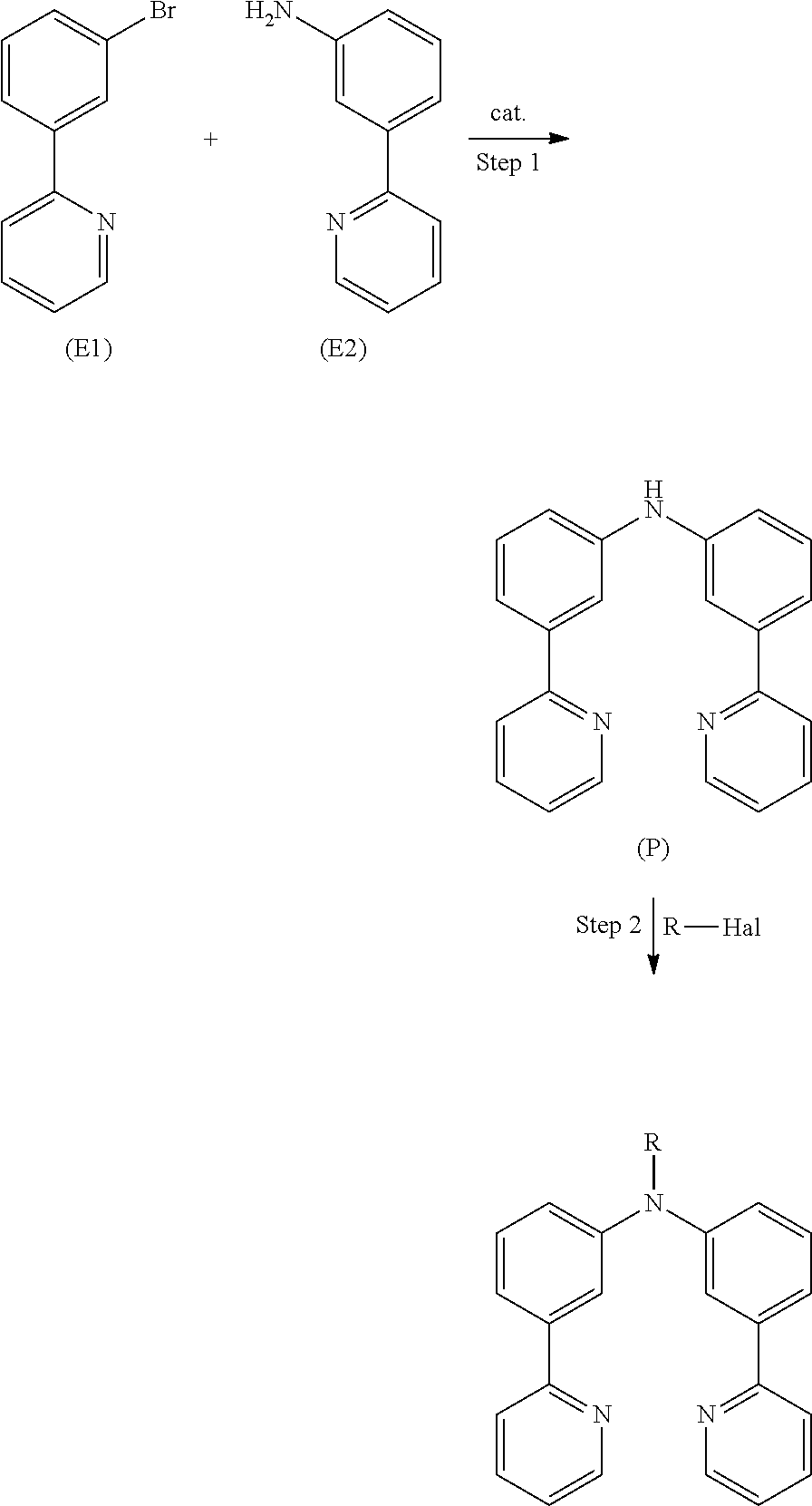
- the conventional route is a two-step reaction with first formation of the primary amine and then formation of the desired ligand.
- step 2 covers two reactions that occur successively.
- the primary amine R—NH 2 reacts with one of the two bromides yielding a secondary amine.
- the secondary amine then reacts, at least in part, with the second bromide in order to get the final product, which is a tertiary amine.
- the conversion of the secondary amine in step 2 into the product is, in many cases, not complete and the secondary amine can, therefore, be found as undesired side product in the reaction mixture. This lowers the overall yield of the reaction.
- more elaborate purification of the product is required.
- the problem to be solved by the invention is, therefore, to provide a new synthesis route in order to obtain a large number of ligands for promising organic metallic complexes in high yield.
- the new synthesis route is represented by a two step procedure.
- a secondary amine is prepared.
- This secondary amine represents the core ring structure of the ligand that is directly bound to the metal ion in the metal complex.
- the core structure is converted into a tertiary amine that represents the final ligand.
- This procedure allows to prepare a great number of ligands having different substitutions with surprisingly high yield.
- the following schema provides a simplified and exemplary view on the new route of preparation according to the present invention.
- the preparation of the core structure (step 1) can be optimized and standardized for a large amount of different ligands having different side groups R.
- the preparation of R-Hal can be accomplished easily by using standard techniques well known to the person skilled in the art.
- step 2 a large number of different ligands is then accessible. According to this procedure a large number of different ligands can be obtained in high yield. Furthermore, the process according to the present invention simplifies purification of the intermediates and products. Therefore, the process according to the present invention is suitable industrial application on large scale.
- the method for the preparation of the core structure and the ligand can be easily extended to different core structures.
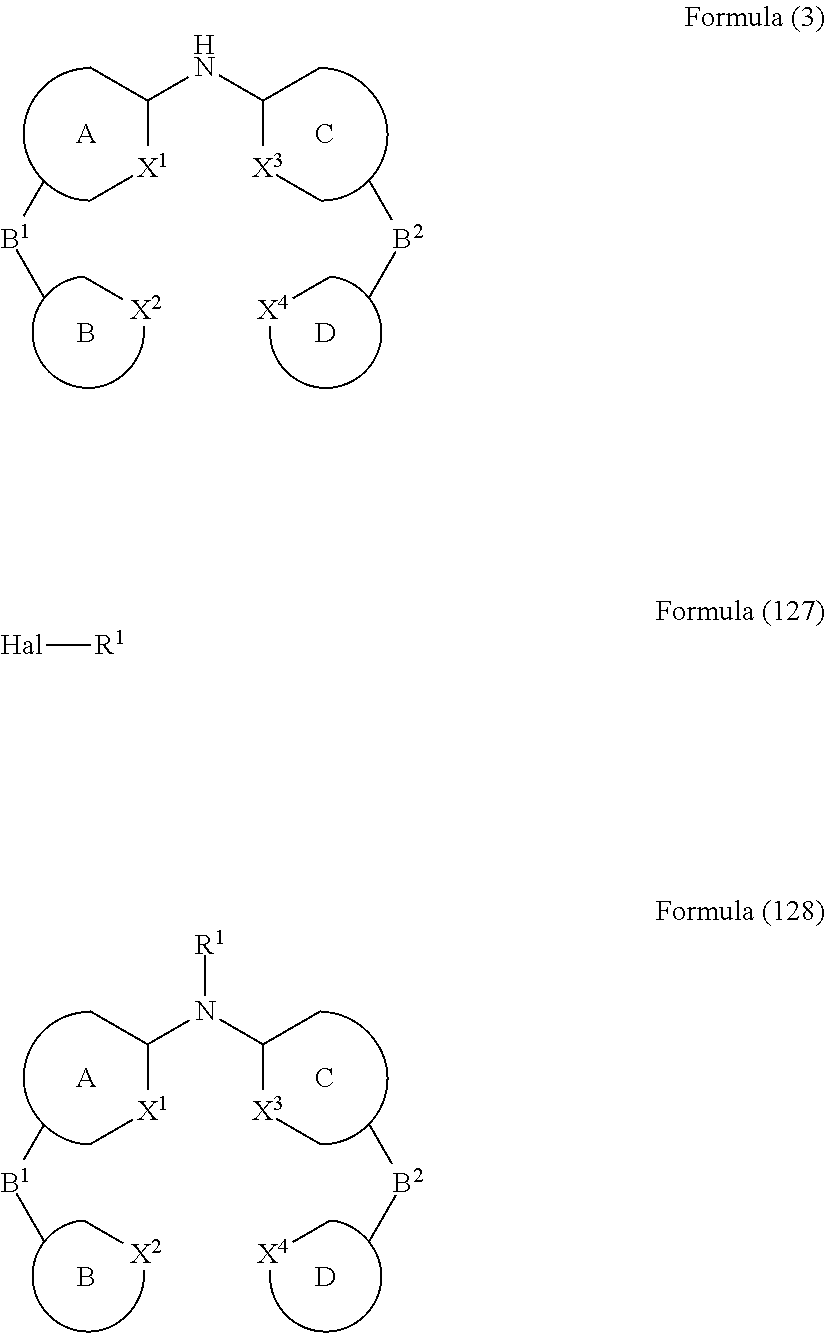
- the present invention relates to a process for the preparation of an aromatic/heteroaromatic secondary amine (P) through reaction of an aromatic/heteroaromatic primary amine (E2) with an aromatic/heteroaromatic halide (E1), wherein the reactants and products are defined below.
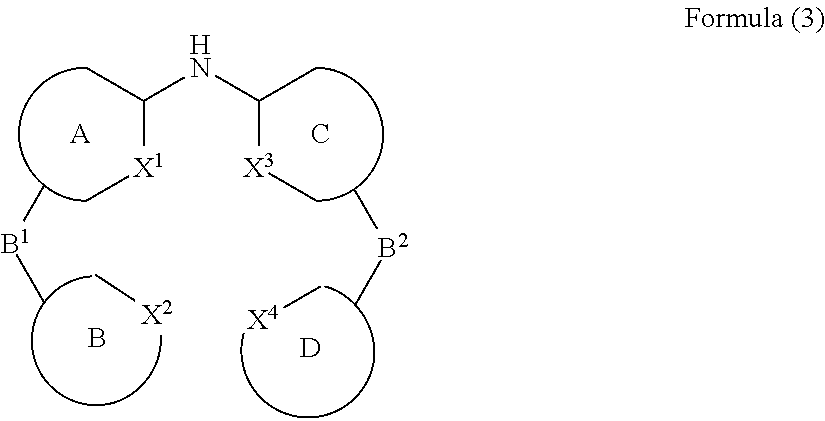
- the present invention relates to a process for the preparation of a compound of Formula (3) comprising the reaction of a compound of Formula (1) with a compound of Formula (2)
- Formula (1), Formula (2) and Formula (3) correspond to E1, E2 and P, respectively, and where the following applies to the symbols and indices used:
- A, B, C, D each represent an aromatic or heteroaromatic ring, condensed ring system or polycyclic ring system which may or may not be substituted with one or more rests R 1 ;
- the reaction is carried out in the presence of a catalyst, preferably a metal metal or transition metal catalyst, particularly preferably a copper catalyst or a palladium catalyst, very particularly preferably a palladium catalyst and even more preferably a catalyst selected from [PdCl(allyl)] 2 , Pd 2 (dba) 3 and Pd(OAc) 2 . Particular preference is given to Pd(OAc) 2 as catalyst.
- a catalyst preferably a metal metal or transition metal catalyst, particularly preferably a copper catalyst or a palladium catalyst, very particularly preferably a palladium catalyst and even more preferably a catalyst selected from [PdCl(allyl)] 2 , Pd 2 (dba) 3 and Pd(OAc) 2 .
- Pd(OAc) 2 as catalyst.
- co-ligand (or pre-catalyst) phosphines can be used, preferably diphenylphosphinoferrocene (dppf) can be used as co-ligand
- the reaction temperature is typically in the range between 30 and 200° C., preferably between 50 and 150° C., particularly preferably between 80 and 120° C.
- reaction temperature depends on the solvent used.
- the reaction is carried out under reflux and the reaction temperature depends on the reflux temperature of the solvent.
- the reaction time is between 3 and 64 hrs, preferably between 5 and 48 hrs, particularly preferably between 8 and 24 hrs and very particularly preferably the reaction time is between 12 and 20 hrs. Particular preference is given to a reaction time of ca. 16 hrs.
- organic solvents can be used for the process according to the present invention. Principally all organic solvents that are typically used in organic reactions can be employed. The solvent depends on the educts and products of the specific reaction. One skilled in the art will have no difficulties to select an appropriate solvent for the specific reaction according to the present invention.
- One preferred organic solvent is THF and one further preferred organic solvent that can be used in toluene.
- the reaction is carried out in the presence of a base.
- the base employed depends on the specific educts and the other components of the reaction mixture. One person skilled in the art would have no problem to choose an appropriate base.
- Sodium tert.-butoxide, cesium carbonate, potassium phosphate or sodium hydroxide represent some selected bases that can be used, but other weaker or stronger bases can be used. Particular preference is given to sodium tert.-butoxide.
- the present invention relates to a process for the preparation of a compound of Formula (6) comprising the reaction of a compound of Formula (4) with a compound of Formula (5)
- Hal, X 1 , X 2 , X 3 and X 4 are defined as above and wherein the circle denotes aromaticity of the ring and wherein Y
- the present invention relates to a process for the preparation of a compound of Formula (9) comprising the reaction of a compound of Formula (7) with a compound of Formula (8)
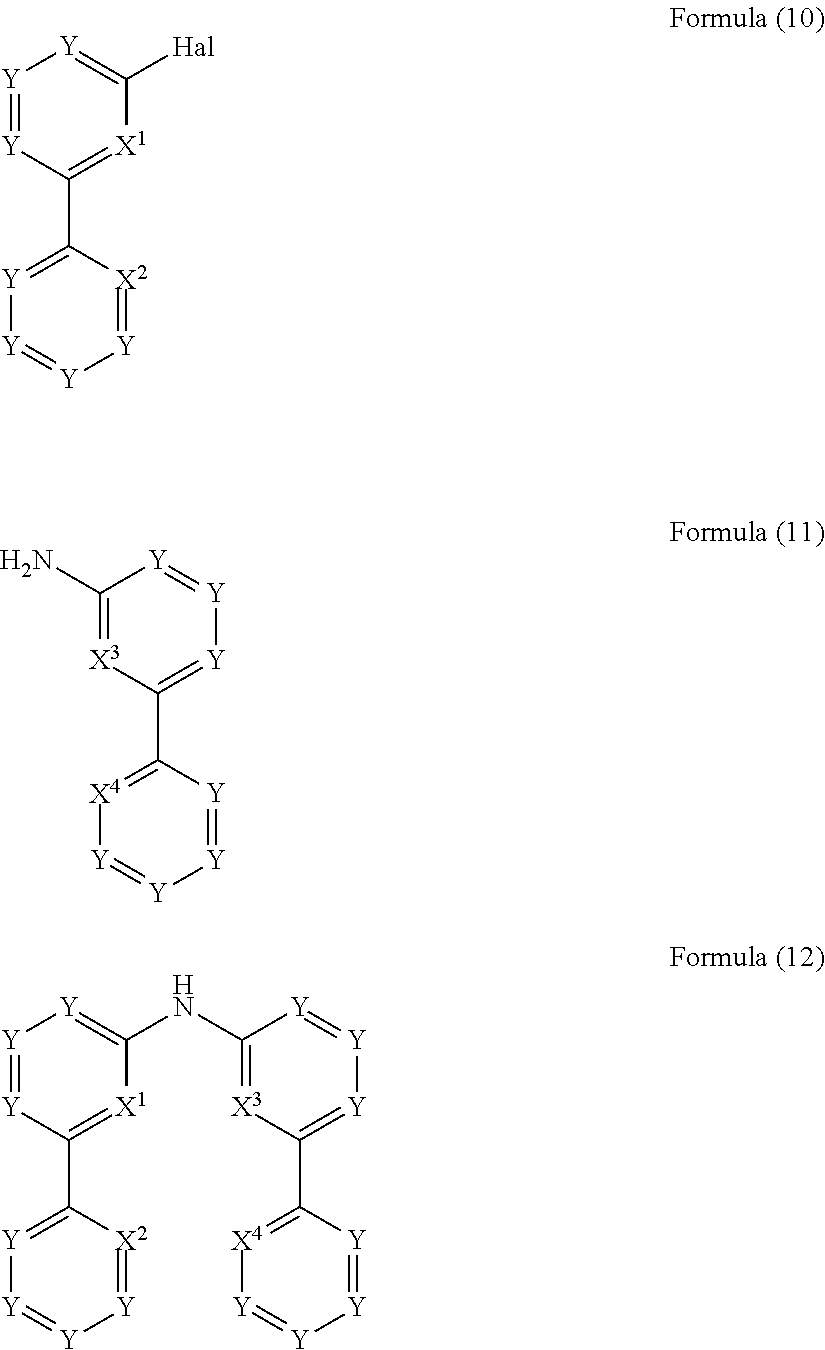
- the present invention relates to a process for the preparation of a compound of Formula (12) comprising the reaction of a compound of Formula (10) with a compound of Formula (11)
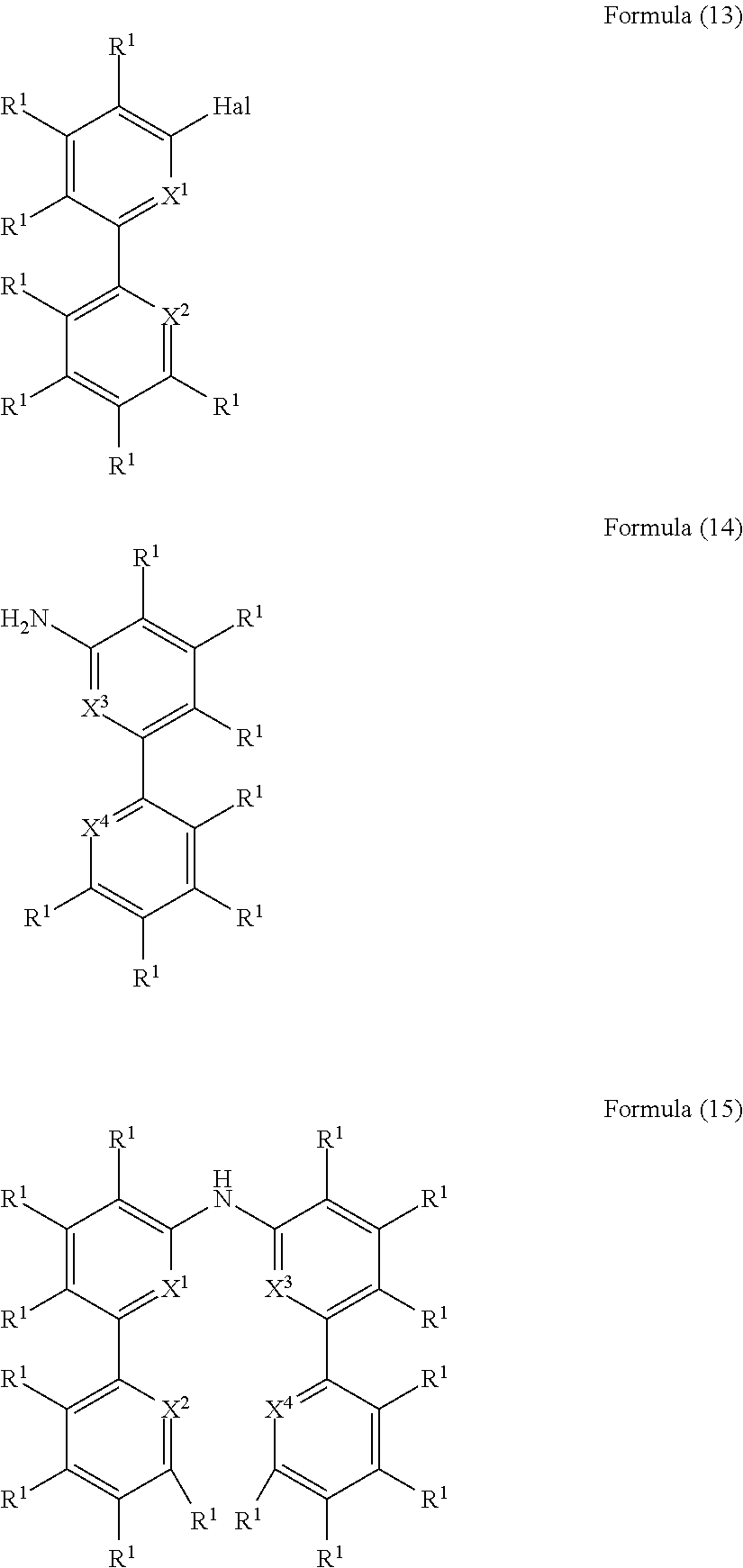
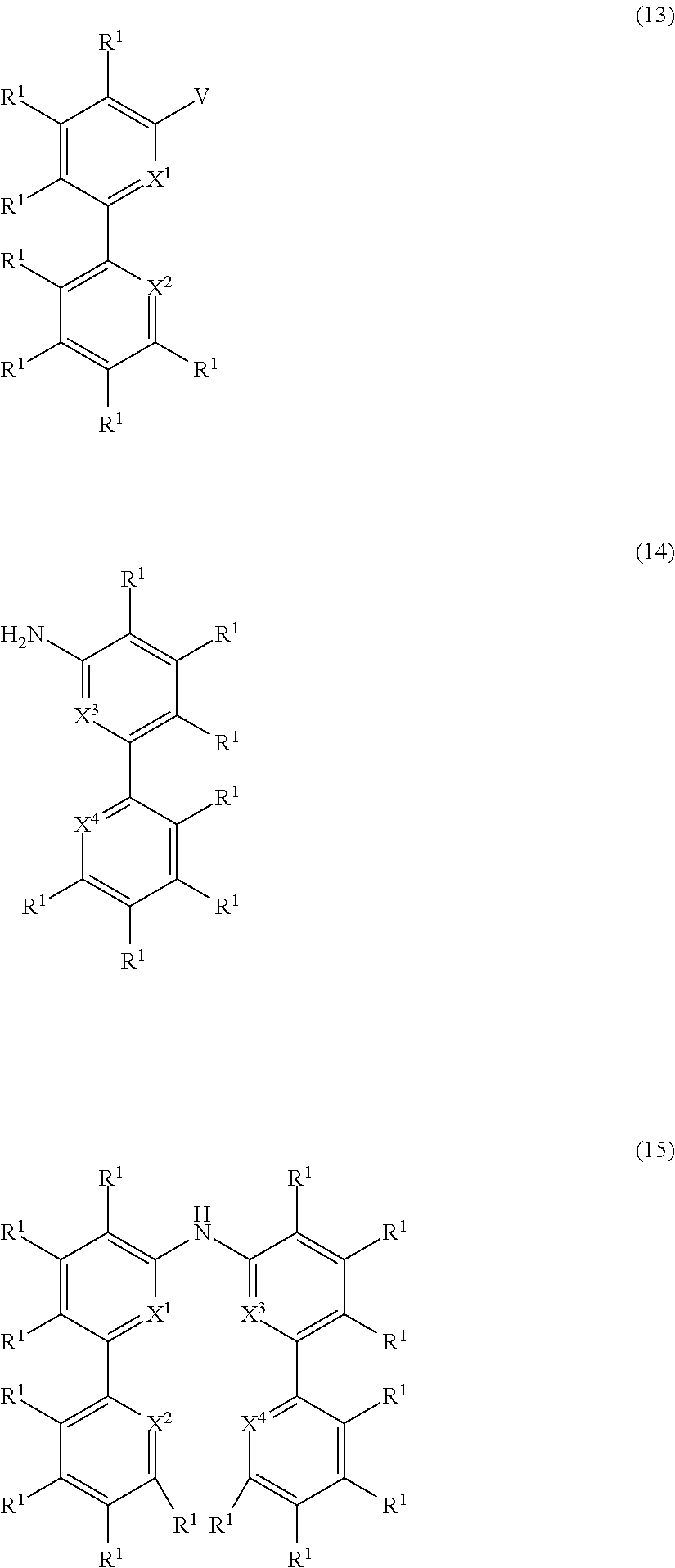
- the present invention also relates to a process for the preparation of a compound of Formula (15) comprising the reaction of a compound of Formula (13) with a compound of Formula (14)
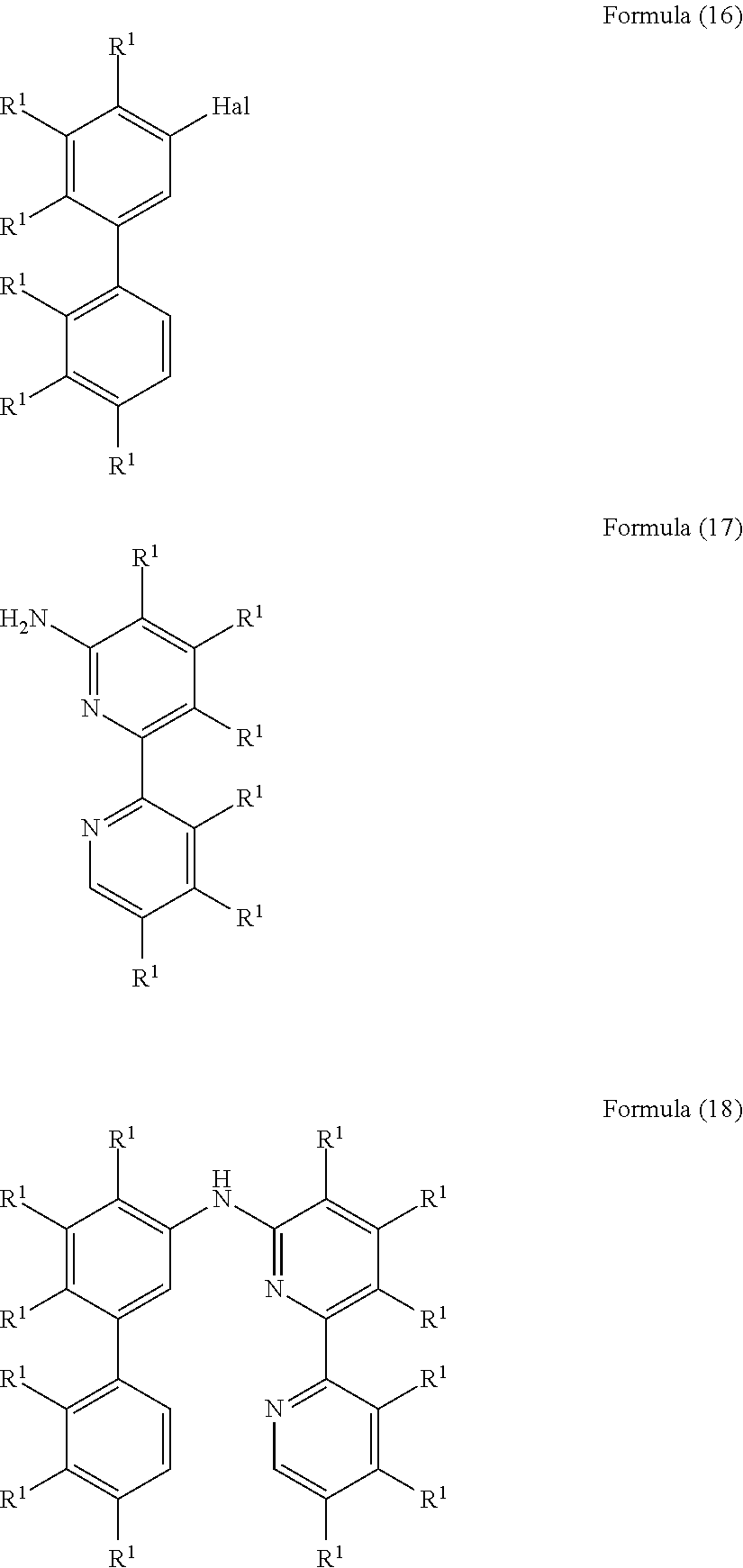
- the present invention also relates to a process for the preparation of a compound of Formula (18) comprising the reaction of a compound of Formula (16) with a compound of Formula (17)
- the present invention also relates to a process for the preparation of a compound of Formula (21) comprising the reaction of a compound of Formula (19) with a compound of Formula (20)
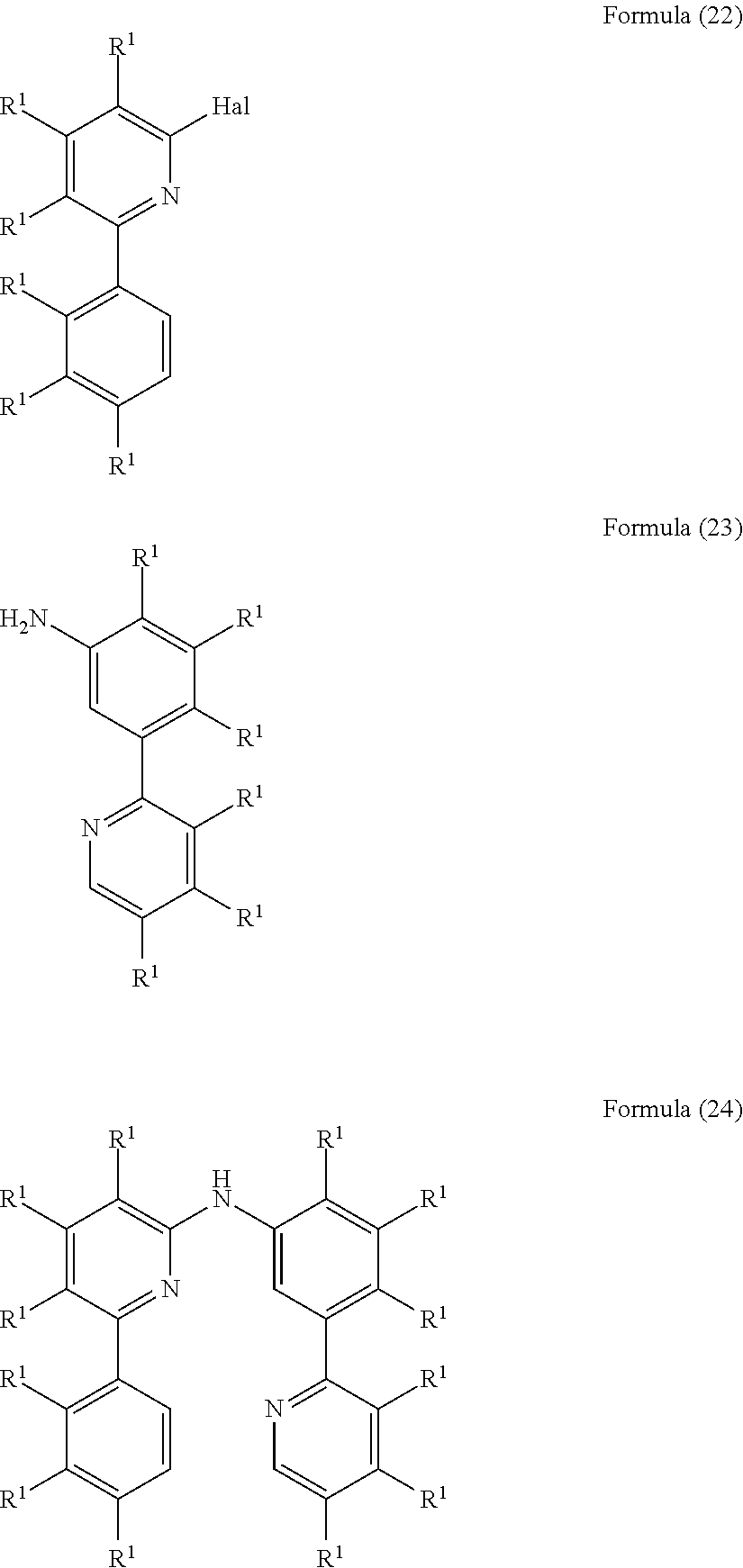
- the present invention also relates to a process for the preparation of a compound of Formula (24) comprising the reaction of a compound of Formula (22) with a compound of Formula (23)
- the present invention also relates to a process for the preparation of a compound of Formula (27) comprising the reaction of a compound of Formula (25) with a compound of Formula (26)
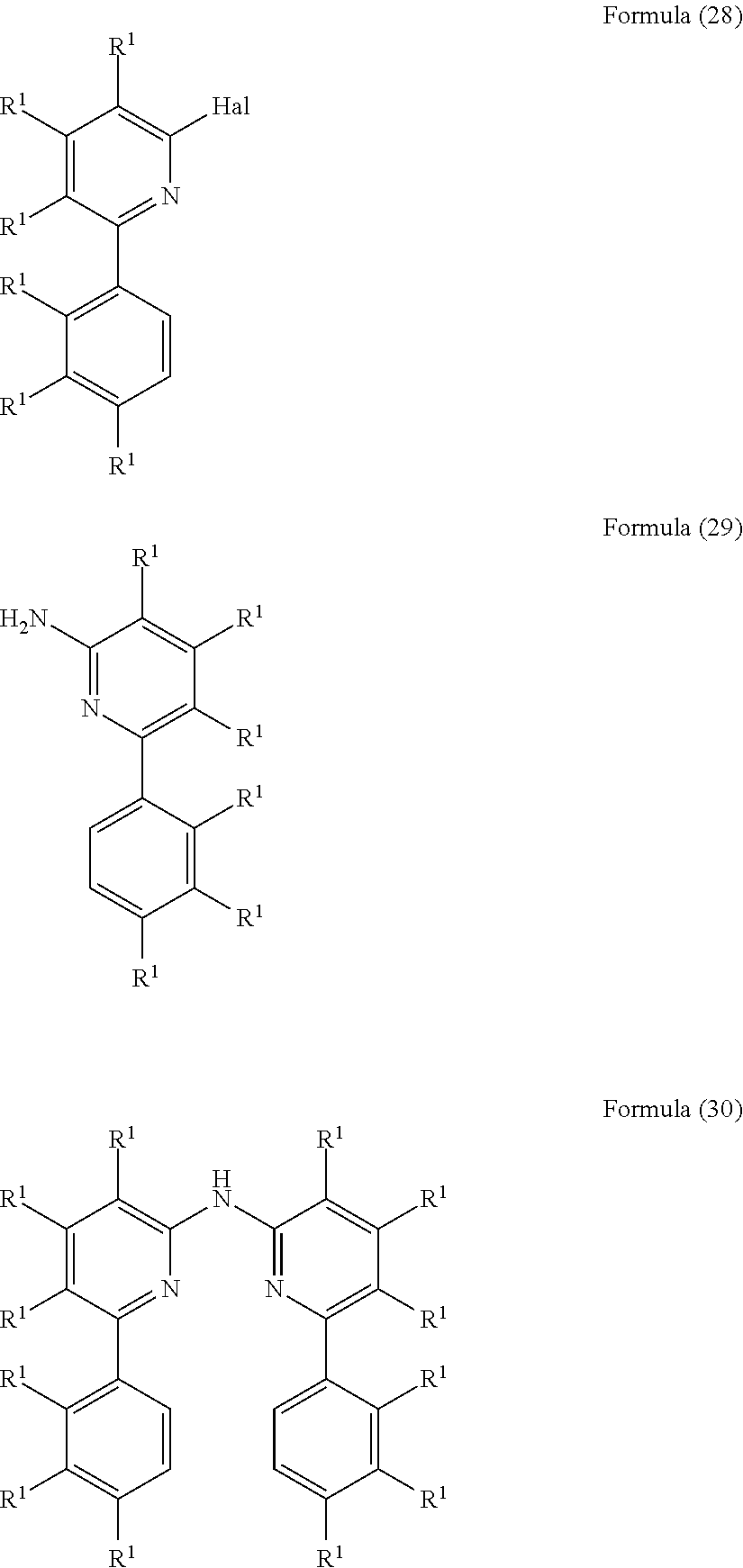
- the present invention also relates to a process for the preparation of a compound of Formula (30) comprising the reaction of a compound of Formula (28) with a compound of Formula (29)
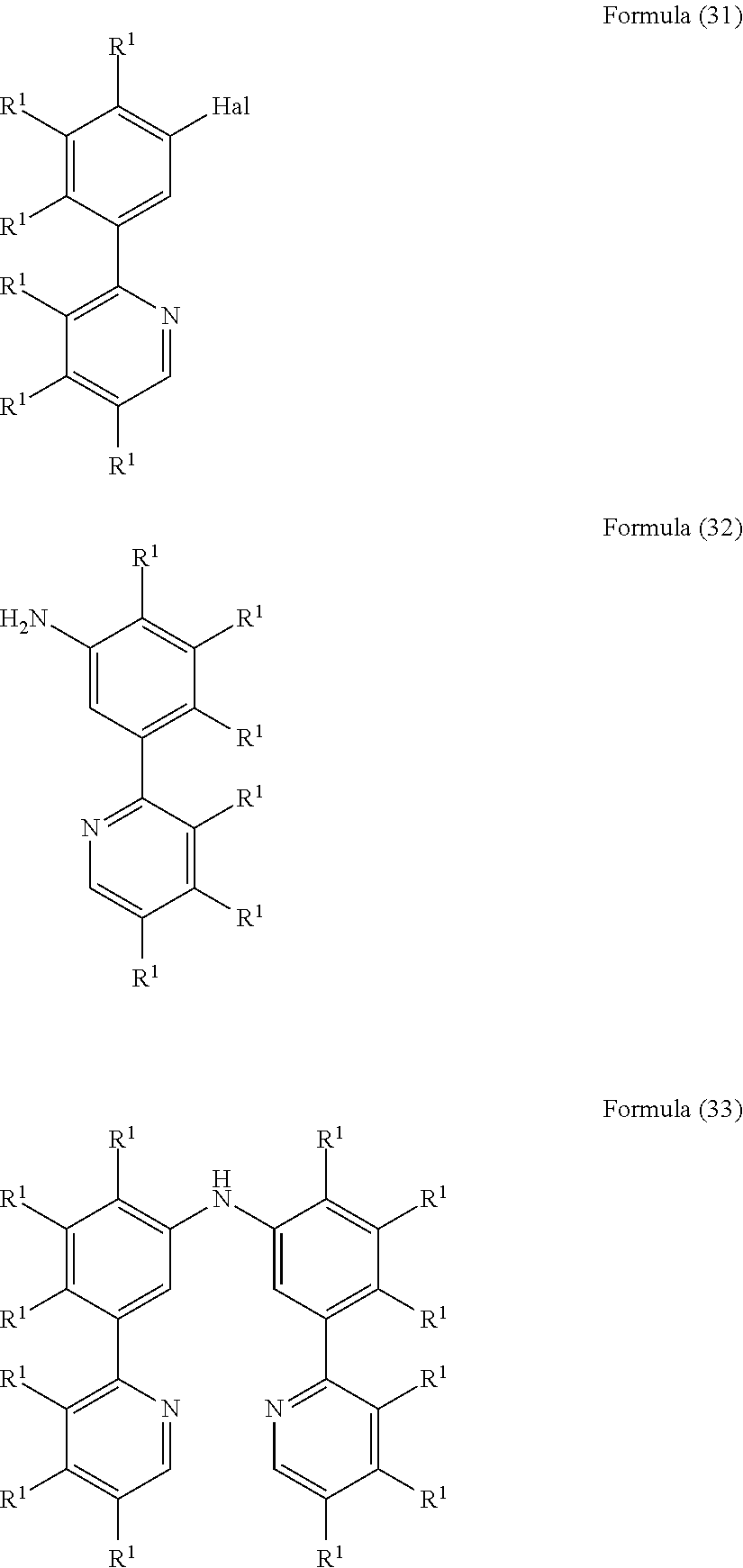
- the present invention also relates to a process for the preparation of a compound of Formula (33) comprising the reaction of a compound of Formula (31) with a compound of Formula (32)
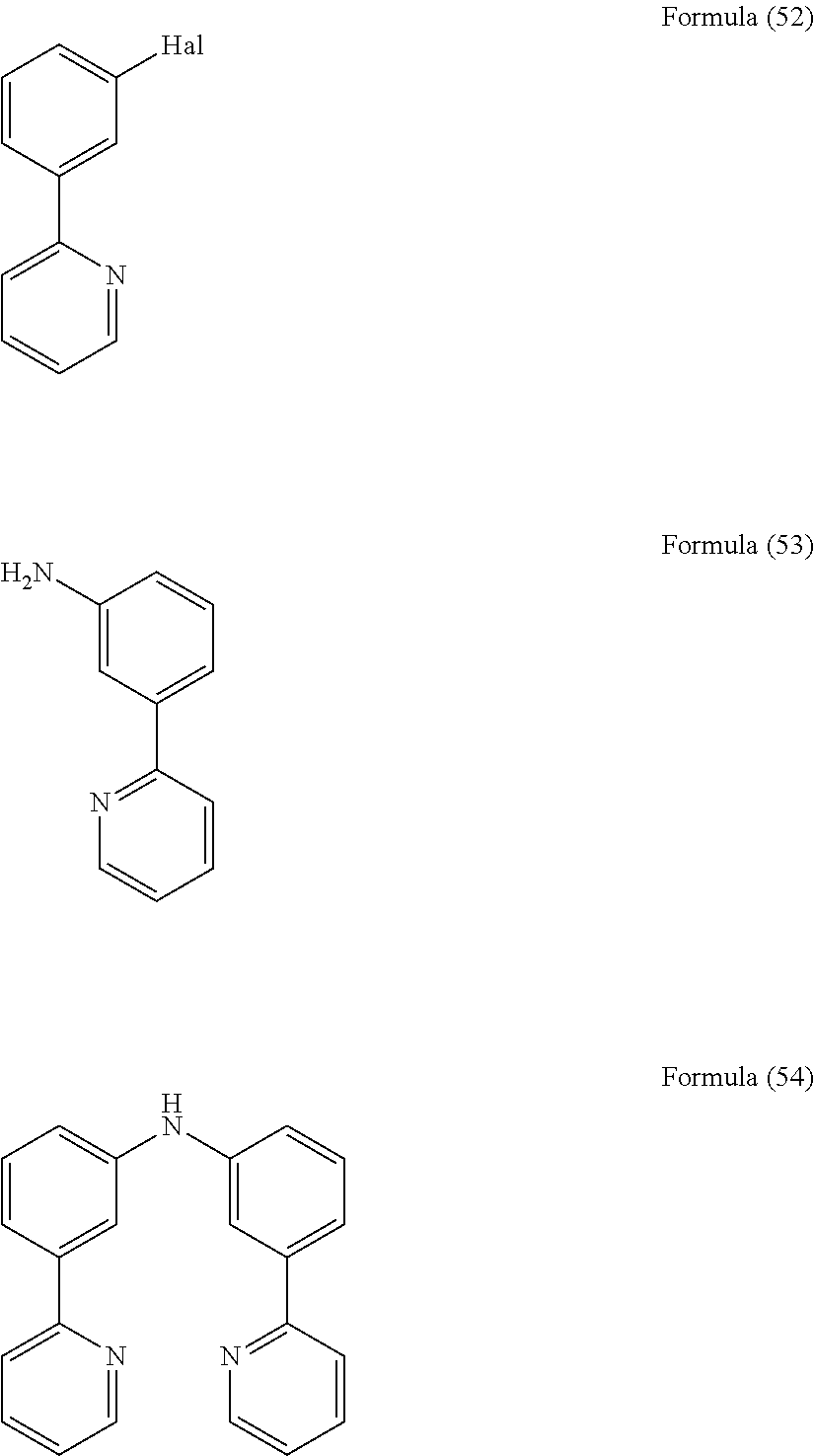
- the present invention relates to a process for the preparation of a compound of Formula (54) comprising the reaction of a compound of Formula (52) with a compound of Formula (53)
- the present invention also relates to a process for the preparation of a compound of Formula (57) comprising the reaction of a compound of Formula (55) with a compound of Formula (56)
- the present invention also relates to a process for the preparation of a compound of Formula (60) comprising the reaction of a compound of Formula (58) with a compound of Formula (59)
- the present invention also relates to a process for the preparation of a compound of Formula (63) comprising the reaction of a compound of Formula (61) with a compound of Formula (62)
- the present invention also relates to a process for the preparation of a compound of Formula (66) comprising the reaction of a compound of Formula (64) with a compound of Formula (65)
- R 1 is, identically or differently on each occurrence, H, D, F, Cl, Br, I, N(R 2 ) 2 , CN, NO 2 , a straight-chain alkyl, alkoxy or thioalkoxy group having 1 to 40 C atoms or a branched or cyclic alkyl, alkoxy or thioalkoxy group having 3 to 40 C atoms, each of which may be substituted by one or more radicals R 2 , where one or more H atoms may be replaced by D, F, Cl, Br, I, CN or NO 2 , or an aromatic or heteroaromatic ring system having 5 to 60 aromatic ring atoms, which may in each case be substituted by one or more radicals R 2 , or an aryloxy or heteroaryloxy group having 5 to 60 aromatic ring atoms, which may be substituted by one or more radicals R 2 , or a diarylamino group, diheteroarylamino group or arylhetero
- R 1 is, identically or differently on each occurrence, D, F, Cl, Br, I, N(R 2 ) 2 , CN, NO 2 , a straight-chain alkyl or alkoxy group having 1 to 40 C atoms or a branched or cyclic alkyl or alkoxy group having 3 to 40 C atoms, each of which may be substituted by one or more radicals R 2 , where one or more H atoms may be replaced by D, F, Cl, Br, I, CN or NO 2 , or an aromatic or heteroaromatic ring system having 5 to 60 aromatic ring atoms, which may in each case be substituted by one or more radicals R 2 ; two or more radicals R 1 here may also form a mono- or polycyclic, aliphatic, aromatic and/or benzo-fused ring system with one another.
- the secondary amines prepared in the way as outlined above, such as the compound of Formula (3), can be used to prepare further derivatives that are tertiary amines.
- These tertiary amines can be used as ligands for metal complexes, that are highly promising for the use in organic electronics.
- metal complexes bearing these ligands are often employed in organic light emitting diodes (OLEDs) or in organic light emitting electrochemical cells (OLECs, LECs or LEECs) as light emitting compounds, particularly as phosphorescent compounds (EP 1683804).
- the present invention relates to the use of the secondary amine compounds prepared as described above for the preparation of tertiary amines.
- the reaction is carried out in the presence of a catalyst, preferably a metal metal or transition metal catalyst, particularly preferably a copper catalyst or a palladium catalyst, very particularly preferably a palladium catalyst and even more preferably a catalyst selected from [PdCl(allyl)] 2 , Pd 2 (dba) 3 and Pd(OAc) 2 . Particular preference is given to Pd(OAc) 2 as catalyst.
- the reaction temperature is typically in the range between 30 and 200° C., preferably between 50 and 150° C., particularly preferably between 80 and 120° C.
- co-ligand (or pre-catalyst) phosphines can be used, preferably used tri-tertbutyl phosphine is be used as co-ligand.
- reaction temperature depends on the solvent used.
- the reaction is carried out under reflux and the reaction temperature depends on the reflux temperature of the solvent.
- the reaction time is between 3 and 64 hrs, preferably between 5 and 48 hrs, particularly preferably between 8 and 24 hrs and very particularly preferably the reaction time is between 12 and 20 hrs. Particular preference is given to a reaction time of ca. 16 hrs.
- organic solvents can be used for the process according to the present invention. Principally all organic solvents that are typically used in organic reactions can be employed. The solvent depends on the educts and products of the specific reaction. One skilled in the art will have no difficulties to select an appropriate solvent for the specific reaction according to the present invention.
- One preferred organic solvent is THF and one further preferred organic solvent that can be used in toluene.
- the reaction is preferably carried out in the presence of a base.
- the base employed depends on the specific educts and the other components of the reaction mixture. One person skilled in the art would have no problem to choose an appropriate base.
- Sodium tert.-butoxide, cesium carbonate, potassium phosphate or sodium hydroxide represent some selected bases that can be used, but other weaker or stronger bases can be used. Particular preference is given to sodium tert.-butoxide.
- the tertiary amines can be used for the preparation of metal complexes is a transition metal or metal ion, preferably a metal or metal ion selected from the Platinum Group (i.e. Fe, Co, Ni, Ru, Rh, Pd, Os, Ir, Pt) or gold, particularly preferably from Pt(II), Pd(II), Ni(II), Rh(I), and Au(III), very particularly preferably from Pt(II), Ir(I) and Au(III) and even more preferably from Pt(II).
- Platinum Group i.e. Fe, Co, Ni, Ru, Rh, Pd, Os, Ir, Pt
- gold particularly preferably from Pt(II), Pd(II), Ni(II), Rh(I), and Au(III
- Pt(II) platinum Group
- platinum complexes e.g., in EP 1683804.
- the present invention also relates to a compound having the general Formula (3)
- the present invention relates to a compound having the general Formula (9) wherein the symbols have the meanings as defined above and wherein the preferred embodiments as defined above apply as well.
- the present invention also relates to a compound having the general Formula (12) wherein the symbols have the meanings as defined above and wherein the preferred embodiments as defined above apply as well.
- the present invention also relates to a compound having the general Formula (15) wherein the symbols have the meanings as defined above and wherein the preferred embodiments as defined above apply as well.
- the present invention relates to a compound having the general Formula (18) wherein the symbols have the meanings as defined above and wherein the preferred embodiments as defined above apply as well.
- the present invention also relates to a compound having the general Formula (21) wherein the symbols have the meanings as defined above and wherein the preferred embodiments as defined above apply as well.
- the present invention also relates to a compound having the general Formula (24) wherein the symbols have the meanings as defined above and wherein the preferred embodiments as defined above apply as well.
- the present invention also relates to a compound having the general Formula (27) wherein the symbols have the meanings as defined above and wherein the preferred embodiments as defined above apply as well.
- the present invention relates to a compound having the general Formula (30) wherein the symbols have the meanings as defined above and wherein the preferred embodiments as defined above apply as well.
- the present invention also relates to a compound having the general Formula (33) wherein the symbols have the meanings as defined above and wherein the preferred embodiments as defined above apply as well.
- the present invention relates to a compound having the general Formula (36) wherein the symbols have the meanings as defined above and wherein the preferred embodiments as defined above apply as well.
- the present invention also relates to a compound having the general Formula (39).
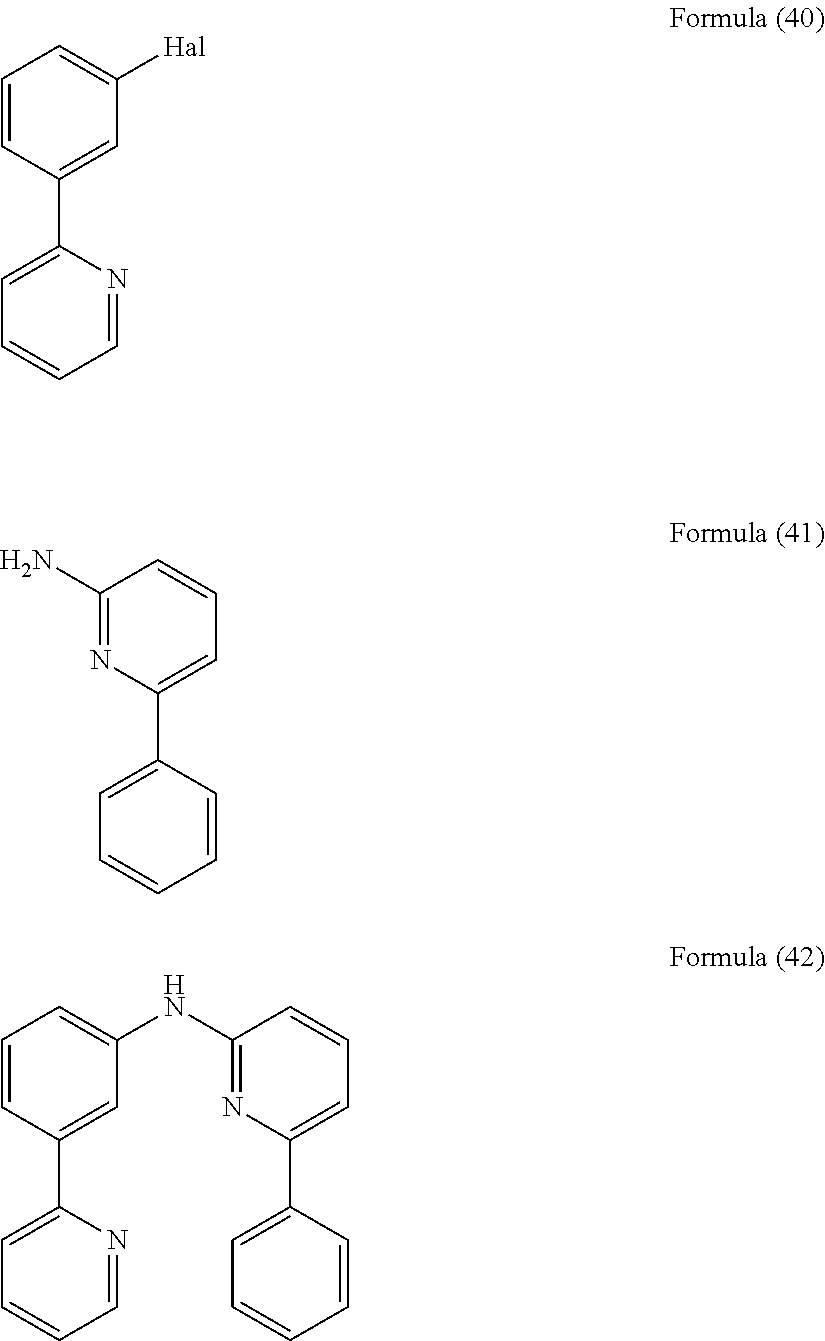
- the present invention also relates to a compound having the general Formula (42).
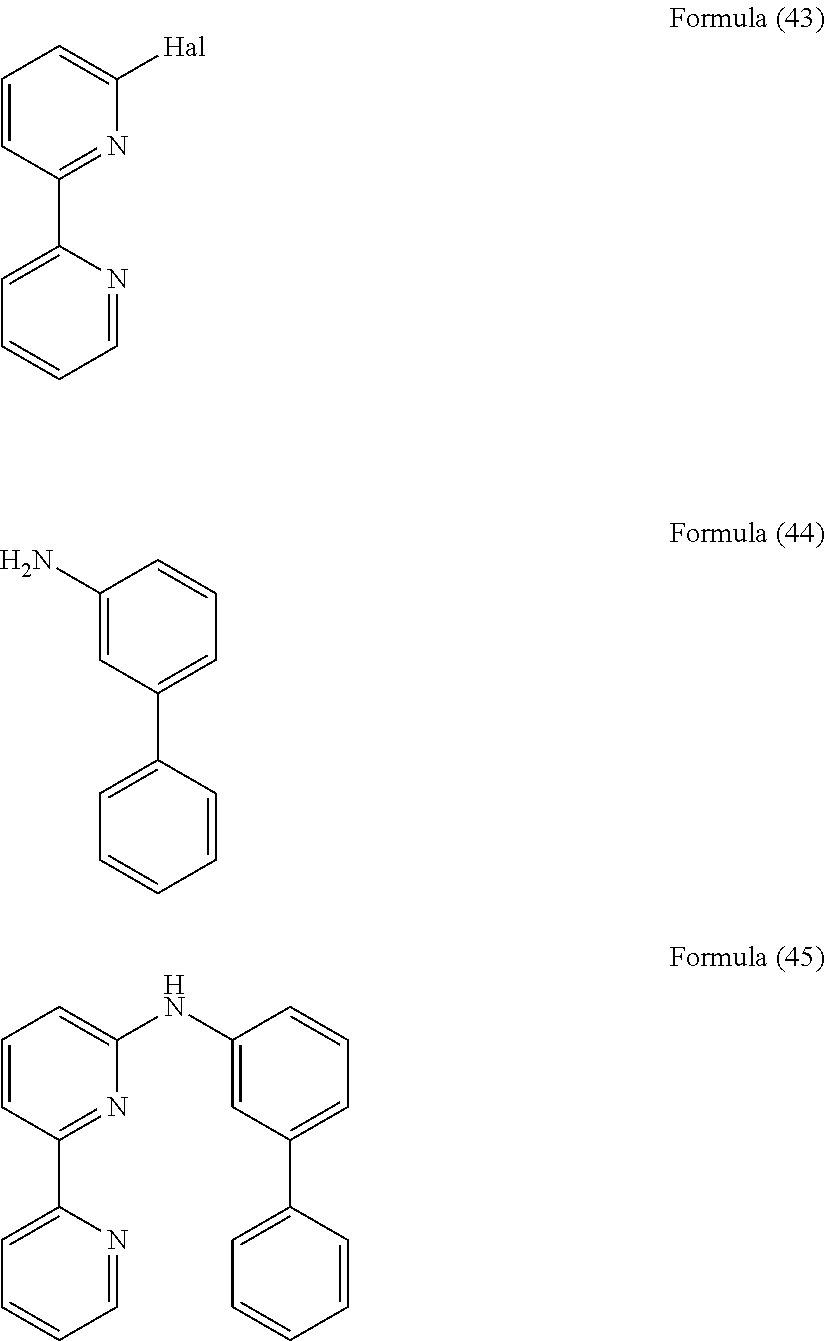
- the present invention also relates to a compound having the general Formula (45).
- the present invention also relates to a compound having the general Formula (48).
- the present invention also relates to a compound having the general Formula (51).
- the present invention also relates to a compound having the general Formula (54).
- the present invention relates to a compound having the general Formula (57) wherein the symbols have the meanings as defined above and wherein the preferred embodiments as defined above apply as well.
- the present invention relates to a compound having the general Formula (60) wherein the symbols have the meanings as defined above and wherein the preferred embodiments as defined above apply as well.
- the present invention relates to a compound having the general Formula (63) wherein the symbols have the meanings as defined above and wherein the preferred embodiments as defined above apply as well.
- the present invention relates to a compound having the general Formula (66) wherein the symbols have the meanings as defined above and wherein the preferred embodiments as defined above apply as well.
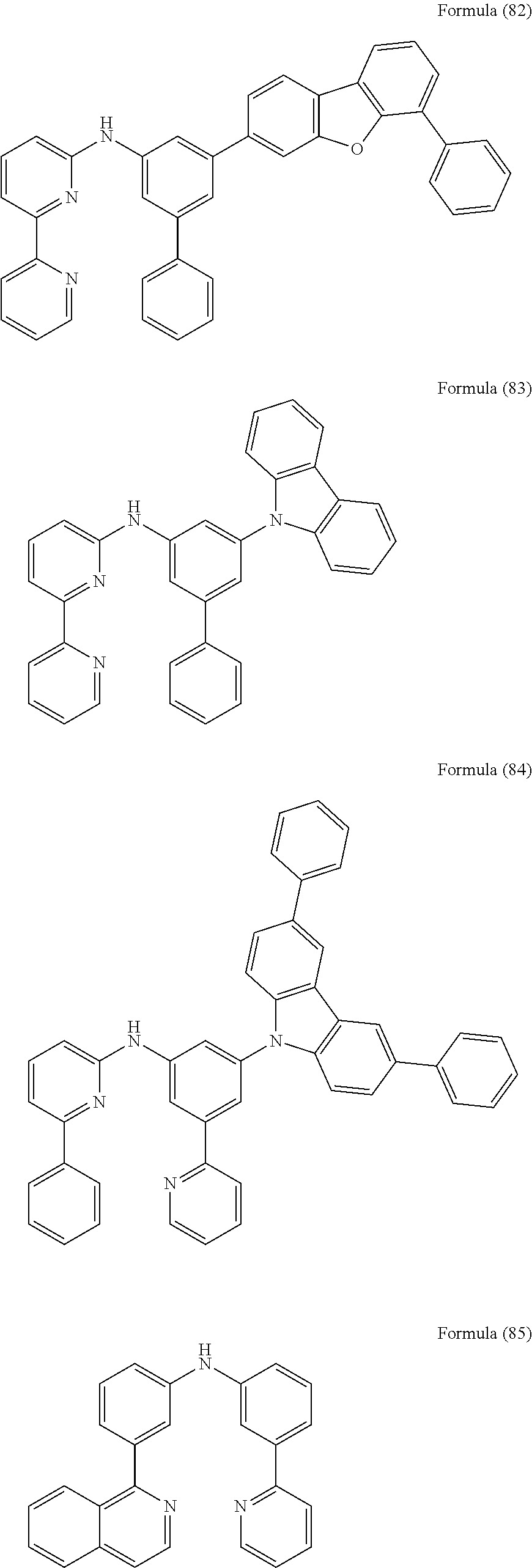
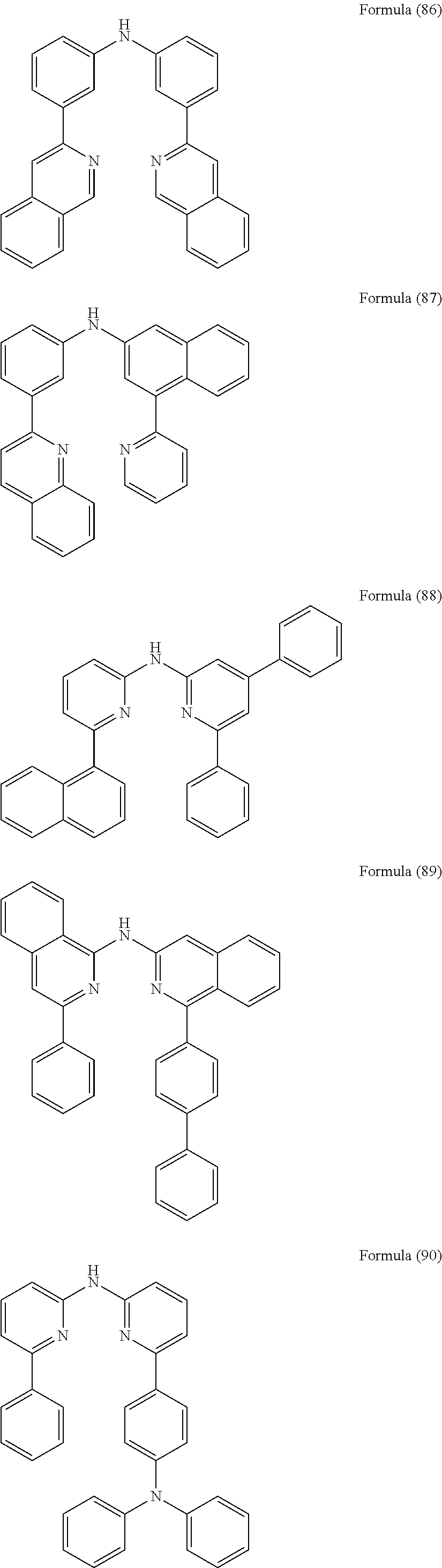
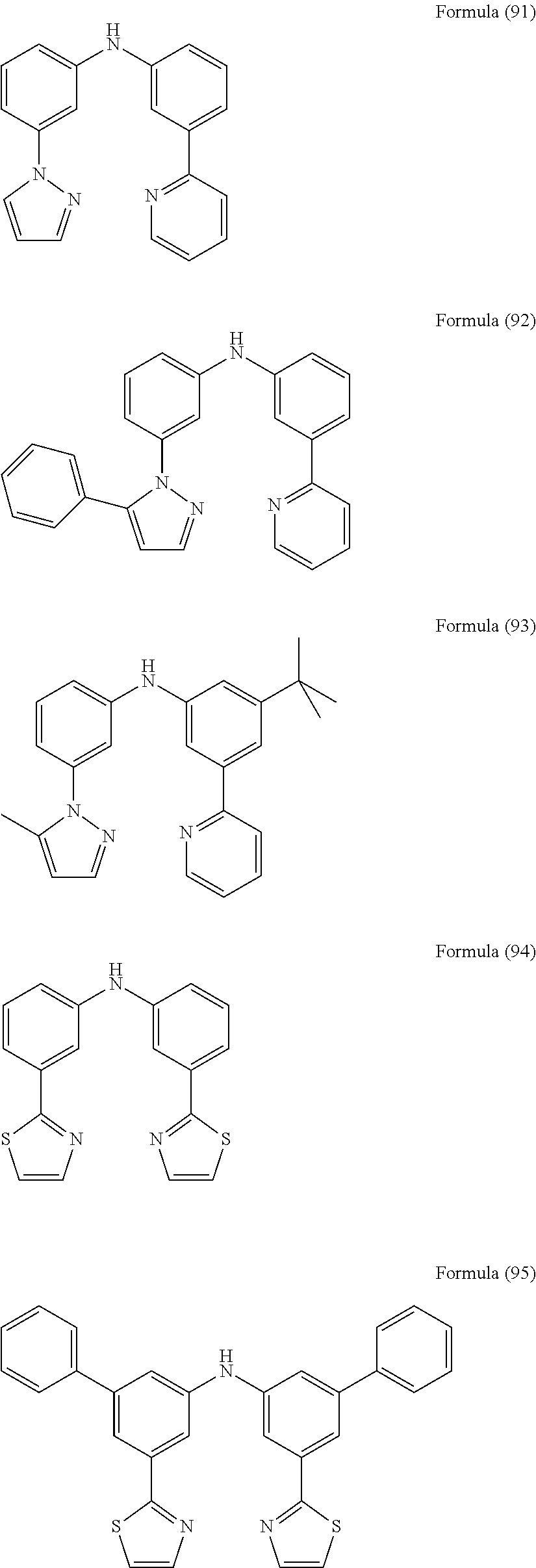
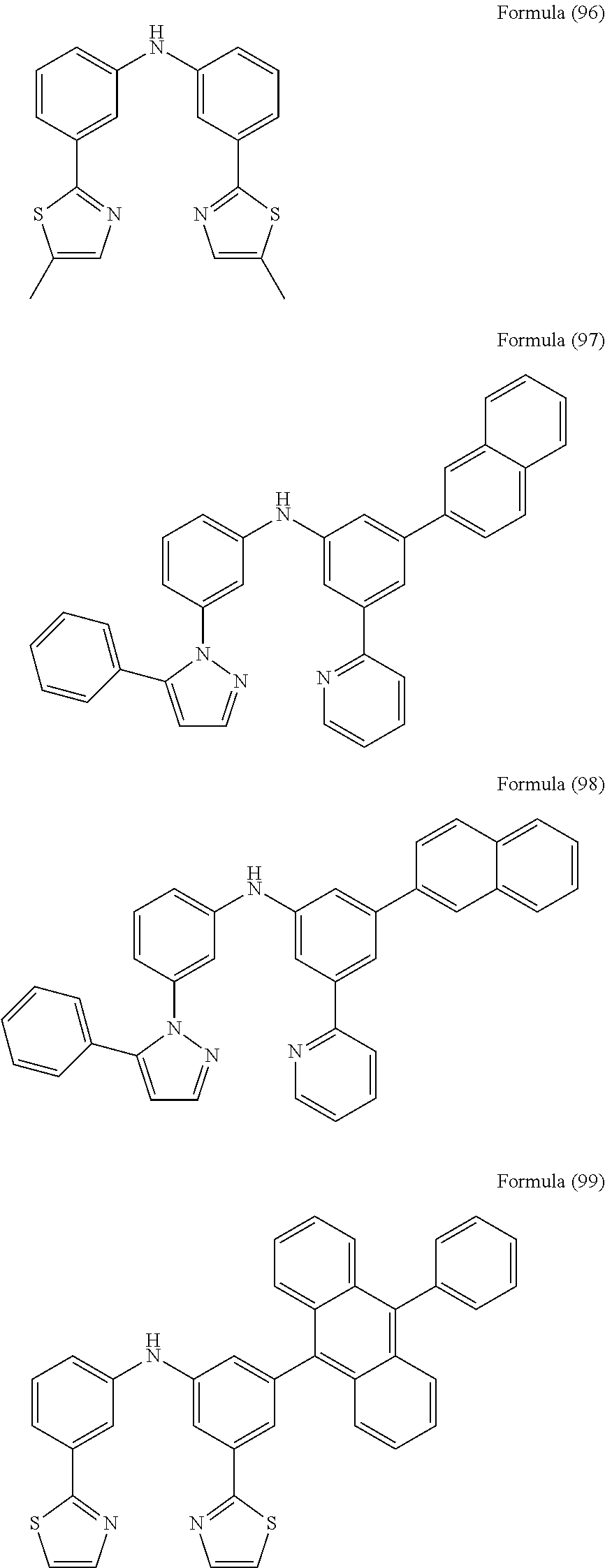
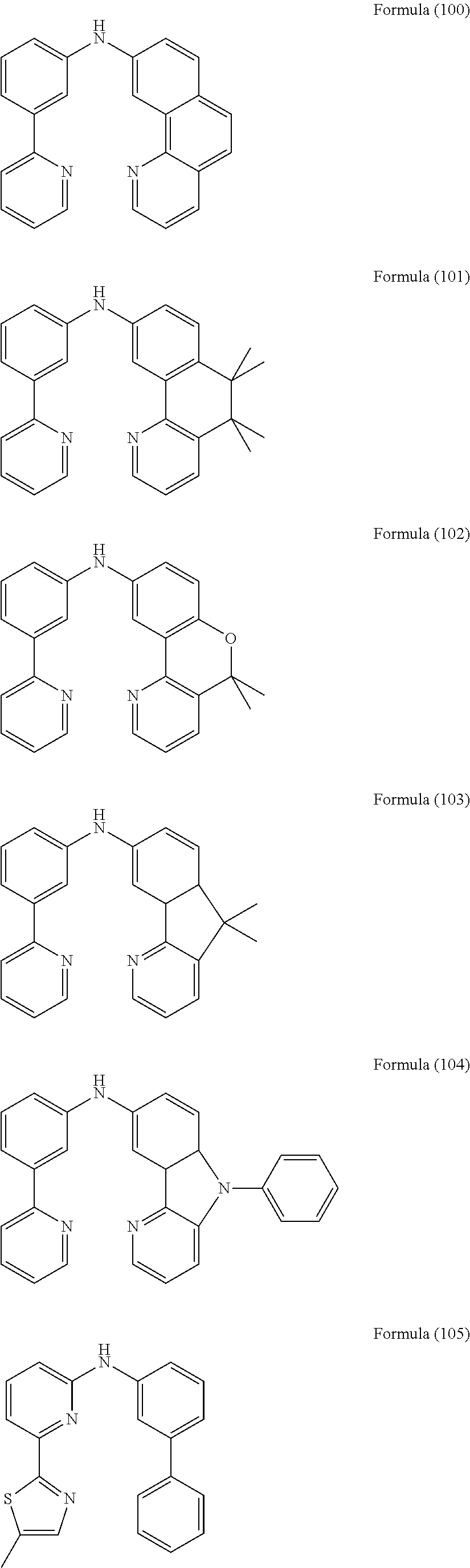
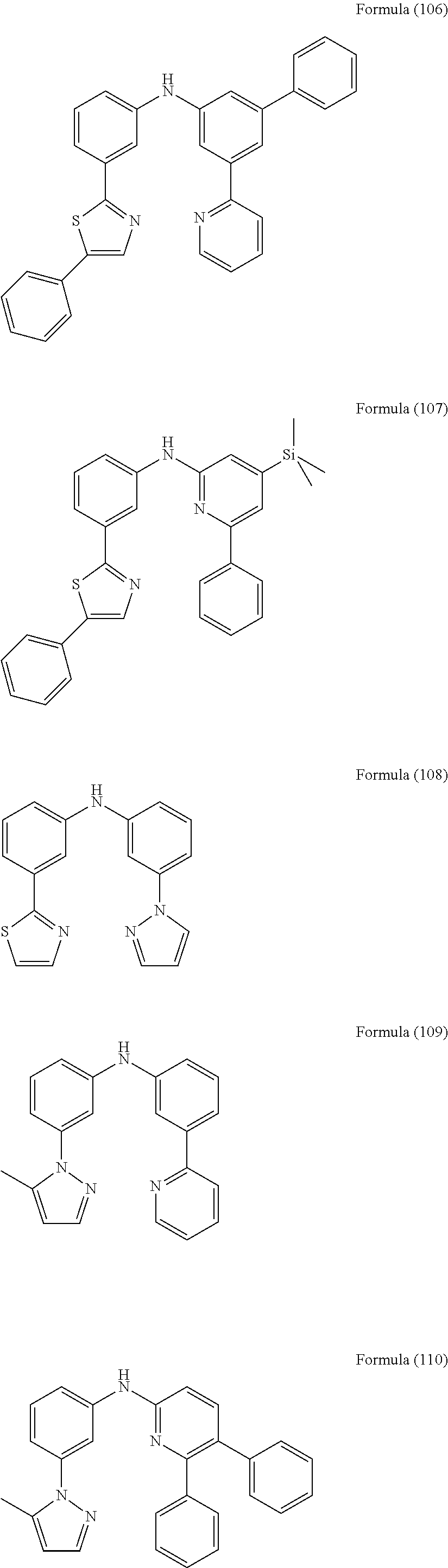
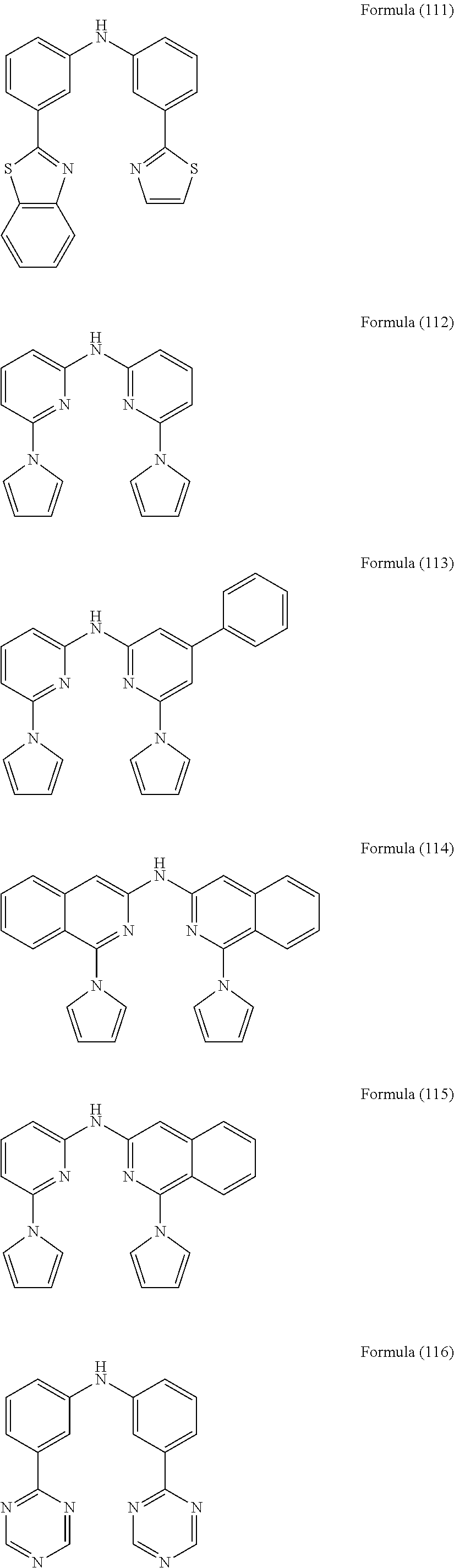
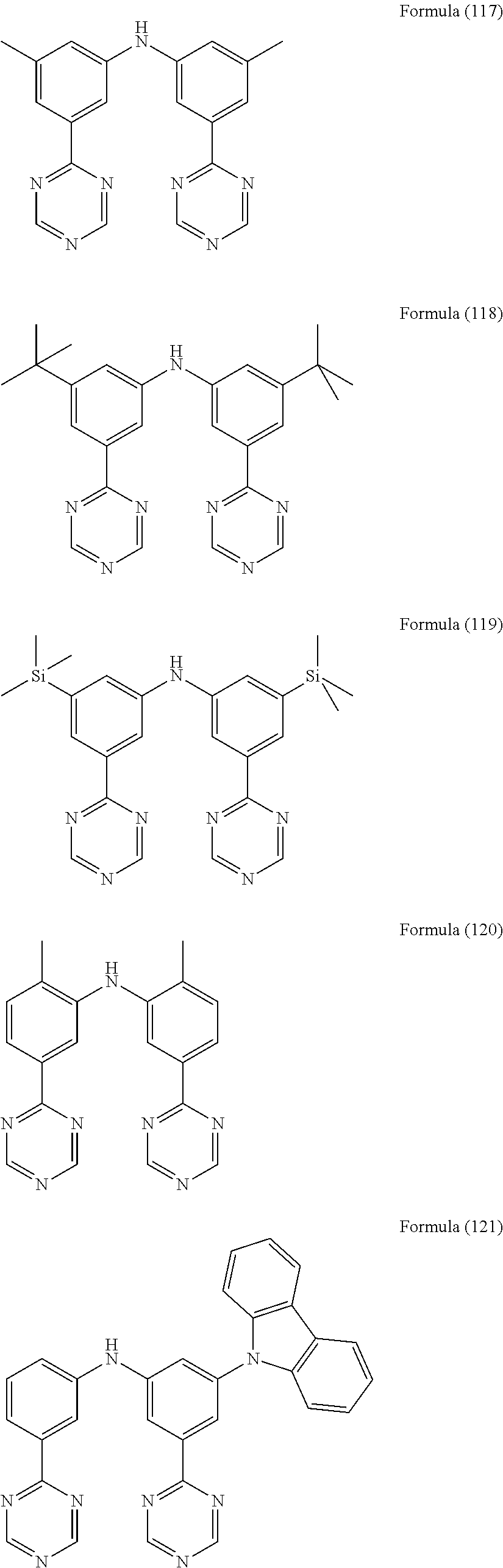
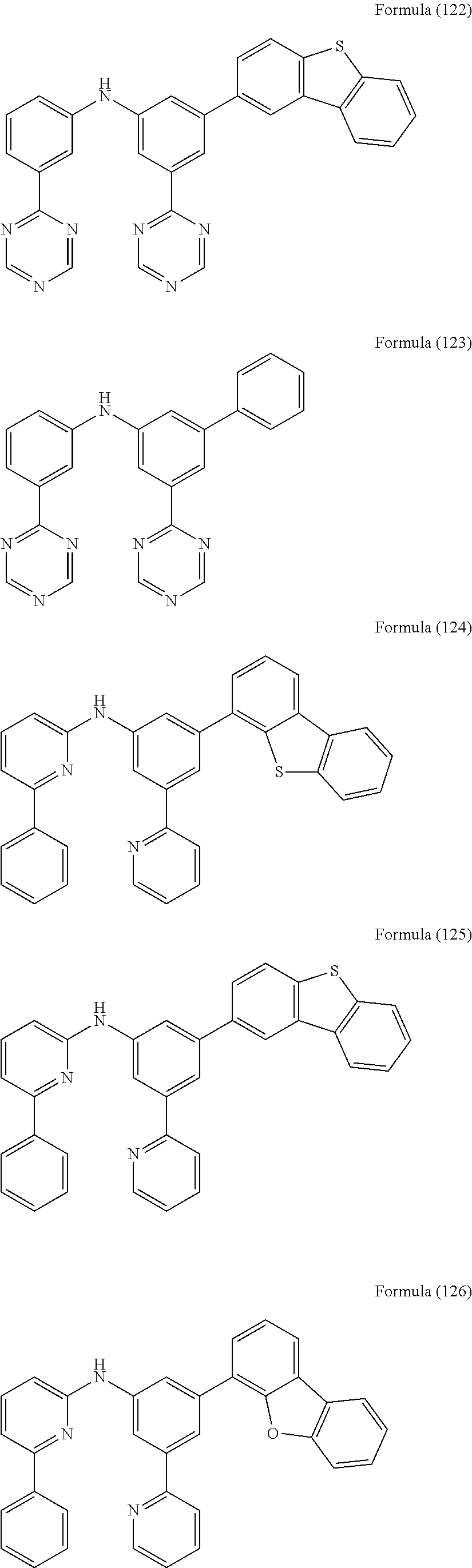
- Some selected preferred compounds according to the present invention are the compounds having the Formulae (67) to (126).
- the present invention also relates to a formulation comprising at least one of the compounds according to the present invention and at least one solvent.
- the compounds according to the present invention can be used, as outlined above, for the preparation of compounds that are useful as ligands for metal complexes.
- An aryl group in the sense of this invention contains 6 to 40 C atoms; a heteroaryl group in the sense of this invention contains 2 to 40 C atoms and at least one heteroatom, with the proviso that the sum of C atoms and heteroatoms is at least 5.
- the heteroatoms are preferably selected from N, O and/or S.
- An aryl group or heteroaryl group here is taken to mean either a simple aromatic ring, i.e.
- benzene or a simple heteroaromatic ring, for example pyridine, pyrimidine, thiophene, etc., or a condensed aryl or heteroaryl group, for example naphthalene, anthracene, phenanthrene, quinoline, isoquinoline, etc.
- An aromatic ring system in the sense of this invention contains 6 to 60 C atoms in the ring system.
- a heteroaromatic ring system in the sense of this invention contains 2 to 60 C atoms and at least one heteroatom in the ring system, with the proviso that the sum of C atoms and heteroatoms is at least 5.
- the heteroatoms are preferably selected from N, O and/or S.
- an aromatic or heteroaromatic ring system is intended to be taken to mean a system which does not necessarily contain only aryl or heteroaryl groups, but instead in which, in addition, a plurality of aryl or heteroaryl groups may be interrupted by a non-aromatic unit (preferably less than 10% of the atoms other than H), such as, for example, an sp 3 -hybridised C, N or O atom or a carbonyl group.
- systems such as 9,9′-spirobifluorene, 9,9-diarylfluorene, triarylamine, diaryl ether, stilbene, etc., are also intended to be taken to mean aromatic ring systems for the purposes of this invention, and likewise systems in which two or more aryl groups are interrupted, for example, by a linear or cyclic alkyl group or by a silyl group.
- a cyclic alkyl, alkoxy or thioalkoxy group in the sense of this invention is taken to mean a monocyclic, bicyclic or polycyclic group.
- a C 1 - to C 40 -alkyl group in which, in addition, individual H atoms or CH 2 groups may be substituted by the above-mentioned groups, is taken to mean, for example, the radicals methyl, ethyl, n-propyl, i-propyl, n-butyl, i-butyl, s-butyl, t-butyl, 2-methyl-butyl, n-pentyl, s-pentyl, tert-pentyl, 2-pentyl, cyclopentyl, n-hexyl, s-hexyl, tert-hexyl, 2-hexyl, 3-hexyl, cyclohexyl, 2-methylpentyl, n-heptyl, 2-heptyl, 3-heptyl, 4-heptyl, cycloheptyl, 1-methylcyclohexyl,
- alkenyl group is taken to mean, for example, ethenyl, propenyl, butenyl, pentenyl, cyclopentenyl, hexenyl, cyclohexenyl, heptenyl, cycloheptenyl, octenyl, cyclooctenyl or cyclooctadienyl.
- An alkynyl group is taken to mean, for example, ethynyl, propynyl, butynyl, pentynyl, hexynyl, heptynyl or octynyl.
- a C 1 - to C 40 -alkoxy group is taken to mean, for example, methoxy, trifluoromethoxy, ethoxy, n-propoxy, i-propoxy, n-butoxy, i-butoxy, s-butoxy, t-butoxy or 2-methylbutoxy.
- An aromatic or heteroaromatic ring system having 5-60 aromatic ring atoms which may also in each case be substituted by the radicals R mentioned above and which may be linked to the aromatic or heteroaromatic ring system via any desired positions, is taken to mean, for example, groups derived from benzene, naphthalene, anthracene, benzanthracene, phenanthrene, benzophenanthrene, pyrene, chrysene, perylene, fluoranthene, benzofluoranthene, naphthacene, pentacene, benzopyrene, biphenyl, biphenylene, terphenyl, terphenylene, fluorene, spirobifluorene, dihydrophenanthrene, dihydropyrene, tetrahydropyrene, cis- or trans-indenofluorene, cis- or trans-monobenzo-indenofluorene, c
- Preferred electronic devices here are selected from the group consisting of organic electroluminescent devices (OLEDs, PLEDs), organic integrated circuits (O-ICs), organic field-effect transistors (O-FETs), organic thin-film transistors (O-TFTs), organic light-emitting transistors (O-LETs), organic solar cells (O-SCs), organic optical detectors, organic photoreceptors, organic field-quench devices (O-FQDs), light-emitting electrochemical cells (LECs) or organic laser diodes (O-lasers), comprising, in at least one layer, at least one compound of the Formula (1) indicated above. Particular preference is given to organic electroluminescent devices.
- Active components are generally the organic or inorganic materials, which are introduced between the anode and cathode, for example charge-injection, charge-transport or charge-blocking materials, but in particular emission materials and matrix materials.
- the compounds according to the invention exhibit particularly good properties as emission material in organic electroluminescent devices.
- Organic electroluminescent devices are therefore a preferred embodiment of the invention.
- the organic electroluminescent device comprises a cathode, an anode and at least one emitting layer. Apart from these layers, it may also comprise further layers, for example in each case one or more hole-injection layers, hole-transport layers, hole-blocking layers, electron-transport layers, electron-injection layers, exciton-blocking layers, charge-generation layers and/or organic or inorganic p/n junctions. It is likewise possible for interlayers, which have, for example, an exciton-blocking function and/or control the charge balance in the electroluminescent device, to be introduced between two emitting layers. However, it should be pointed out that each of these layers does not necessarily have to be present.
- the organic electroluminescent device may comprise one emitting layer or a plurality of emitting layers. If a plurality of emission layers are present, these preferably have in total a plurality of emission maxima between 300 nm and 800 nm, resulting overall in white emission, i.e. various emitting compounds which are able to fluoresce or phosphoresce are used in the emitting layers. Particular preference is given to three-layer systems, where the three layers exhibit blue, green and orange or red emission (for the basic structure see, for example, WO 2005/011013), or systems which comprise more than three emitting layers.
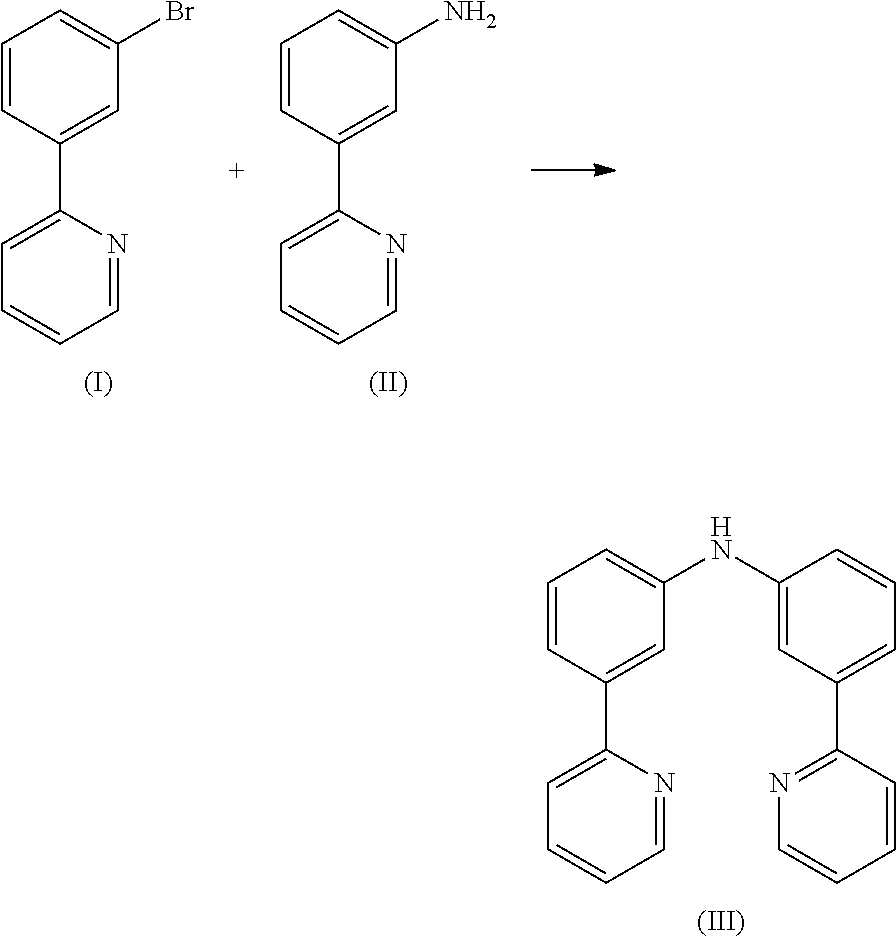
- Compound (I) can be prepared in accordance with Chem. Commun., 2010, 46, 3958 and compound (II) can be prepared according to WO 2007/000339.
- Compound (IV) can be prepared according to WO 2011/021689.
- Compounds (VIII), (IX), (XVII), (XXIII), (XXIV), (XXV), (XXIX), (XXXI) and (XXXII) are commercially available.
- Compound (XXII) can be prepared according to Inorg. Chem. 2011, 50, 8261.
- Compounds (XXVI) and (XXVII) can be prepared according to Inorg. Chem. 2010, 49, 5107.
- Compound (XXVIII) can be prepared according to Eur. J. Org. Chem. 2011, 1280.
- Compound (XXX) can be prepared according to Chem. Mater. 2011, 23, 4487.
- Last step yield Yield Yield (according to the Compound (Prior art) present invention) (XIV) 91% (1) 95% 75% (2) (XVI) 58% (1) 90% (XVIII) 75% (1) 92% (XIX) 65% (1) 90% (XX) 68% (3) 94% (XXI) 48% (3) 93% (1) U.S. Pat. No. 7,442,792; (2) Inorg. Chem. 2010, 49, 5107; (3) Preparation of comparative compounds
Landscapes
- Chemical & Material Sciences (AREA)
- Organic Chemistry (AREA)
- Organic Low-Molecular-Weight Compounds And Preparation Thereof (AREA)
- Electroluminescent Light Sources (AREA)
- Low-Molecular Organic Synthesis Reactions Using Catalysts (AREA)
- Pyridine Compounds (AREA)
Abstract
Description

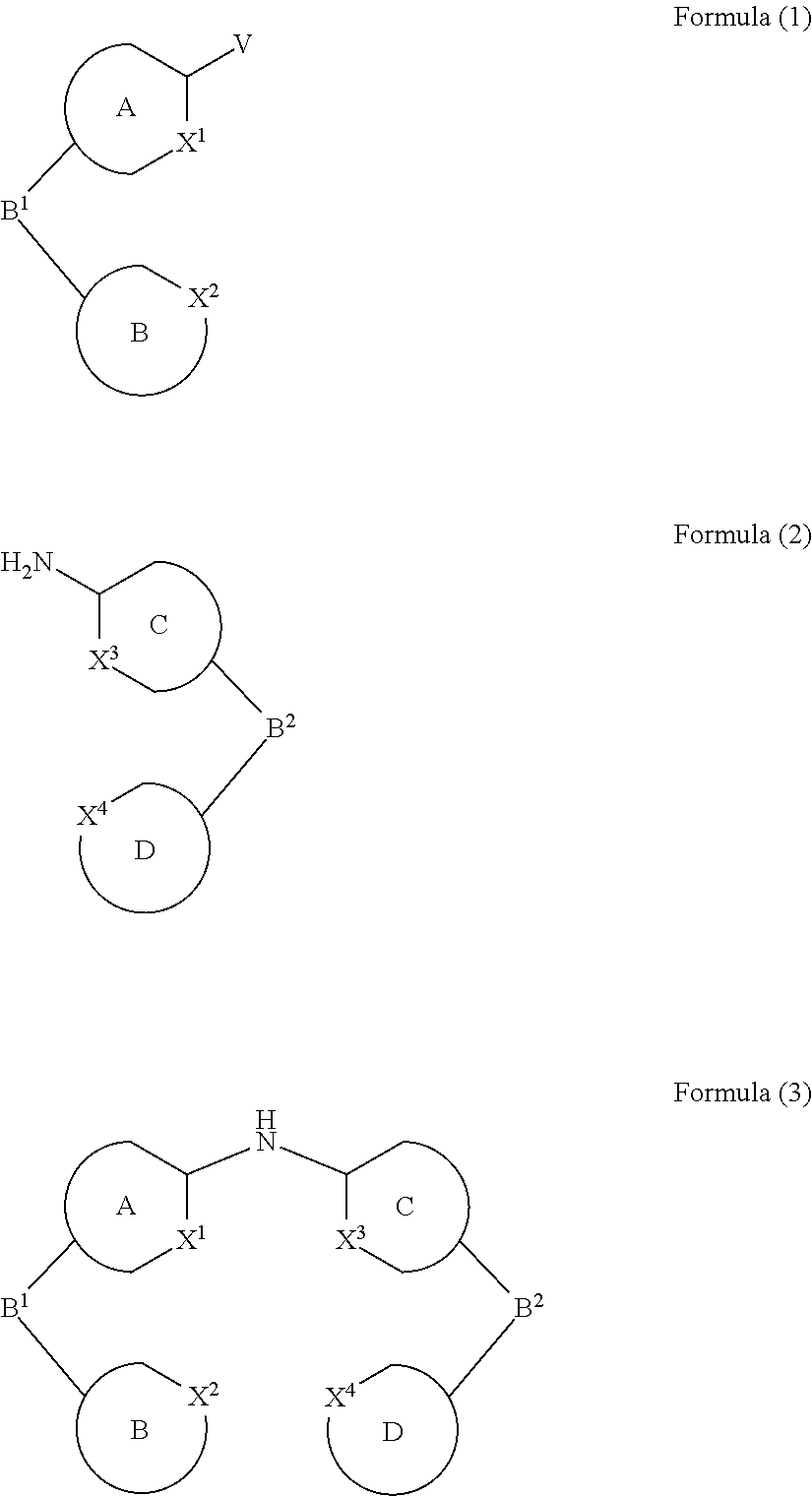
wherein Formula (1), Formula (2) and Formula (3) correspond to E1, E2 and P, respectively, and
where the following applies to the symbols and indices used:
A, B, C, D each represent an aromatic or heteroaromatic ring, condensed ring system or polycyclic ring system which may or may not be substituted with one or more rests R1;
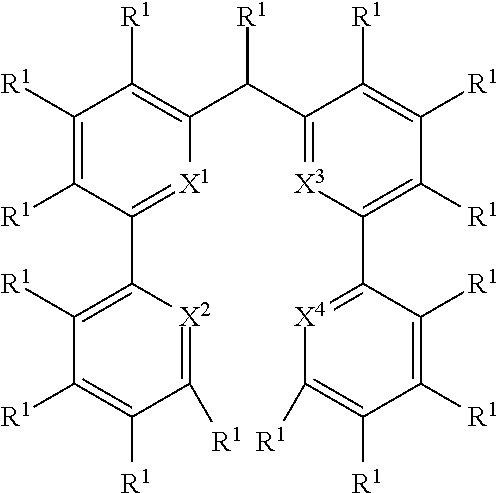
X1, X2, X3, and X4 are carbon atoms (C) or nitrogen atoms (N), wherein at least two out of X1, X2, X3, and X4 represent nitrogen atoms,
preferably
X1=C, X2=N, X3=C and X4=N or
X1=N, X2=C, X3=N and X4=C or
X1=N, X2=C, X3=C and X4=N or
X1=C, X2=N, X3=N and X4=C or
X1=N, X2=N, X3=C and X4=C or
X1=C, X2=C, X3=N and X4=N,
particularly preferably
X1=C, X2=N, X3=C and X4=N or
X1=N, X2=C, X3=N and X4=C or
and very particularly preferably
X1=C, X2=N, X3=C and X4=N;
Bi (i=1 or 2)
-
- are bridging units; the bridging units Bi preferably represent, independently from each other, a single bond, rings, preferably 5-membered rings, comprising at least one N-atom, which are condensed to both neighboring rings, i.e. B1 may be condensed to ring A and ring B or B2 may be condensed to ring C and D, single bonds or bivalent atoms or groups, preferably C(R1)2, N—R1, P—R1, or Si—(R1)2, particularly preferably N—R1, P—R1, or Si—(R1)2, very particularly preferably Bi represent a single bond between the rings A and B or C and D;
V is a leaving group, preferably a leaving group selected from Hal or CF3SO3, wherein Hal is a halogen selected from F, Cl, Br or I; Hal is preferably Br; preferably V is Br;
R1 - is, identically or differently on each occurrence, H, D, F, Cl, Br, I, N(R2)2, CN, NO2, Si(R2)3, B(OR2)2, C(═O)R2, P(═O)(R2)2, S(═O)R2, S(═O)2R2, OSO2R2, B(R2)2, a straight-chain alkyl, alkoxy or thioalkoxy group having 1 to 40 C atoms or a straight-chain alkenyl or alkynyl group having 2 to 40 C atoms or a branched or cyclic alkyl, alkenyl, alkynyl, alkoxy or thioalkoxy group having 3 to 40 C atoms, each of which may be substituted by one or more radicals R2, where one or more non-adjacent CH2 groups may be replaced by R2C═CR2, C≡C, Si(R2)2, Ge(R2)2, Sn(R2)2, C═O, C═S, C═Se, C═NR2, P(═O)(R2), SO, SO2, NR2, O, S or CONR2 and where one or more H atoms may be replaced by D, F, Cl, Br, I, CN or NO2, or an aromatic or heteroaromatic ring system having 5 to 60 aromatic ring atoms, which may in each case be substituted by one or more radicals R2, or an aryloxy or heteroaryloxy group having 5 to 60 aromatic ring atoms, which may be substituted by one or more radicals R2, or a diarylamino group, diheteroarylamino group or arylheteroarylamino group having 10 to 40 aromatic ring atoms, which may be substituted by one or more radicals R2, or a combination of two or more of these groups; two or more radicals R1 here may also form a mono- or polycyclic, aliphatic, aromatic and/or benzo-fused ring system with one another;
R2 - is, identically or differently on each occurrence, H, D, F, Cl, Br, I, N(R3)2, CN, NO2, Si(R3)3, B(OR3)2, C(═O)R3, P(═O)(R3)2, S(═O)R3, S(═O)2R3, OSO2R3, a straight-chain alkyl, alkoxy or thioalkoxy group having 1 to 40 C atoms or a straight-chain alkenyl or alkynyl group having 2 to 40 C atoms or a branched or cyclic alkyl, alkenyl, alkynyl, alkoxy or thioalkoxy group having 3 to 40 C atoms, each of which may be substituted by one or more radicals R3, where one or more non-adjacent CH2 groups may be replaced by R3C═CR3, C≡C, Si(R3)2, Ge(R3)2, Sn(R3)2, C═O, C═S, C═Se, C═NR3, P(═O)(R3), SO, SO2, NR3, O, S or CONR3 and where one or more H atoms may be replaced by D, F, Cl, Br, I, CN or NO2, or an aromatic or heteroaromatic ring system having 5 to 60 aromatic ring atoms, which may in each case be substituted by one or more radicals R3, or an aryloxy or heteroaryloxy group having 5 to 60 aromatic ring atoms, which may be substituted by one or more radicals R3, or a diarylamino group, diheteroarylamino group or arylheteroarylamino group having 10 to 40 aromatic ring atoms, which may be substituted by one or more radicals R3, or a combination of two or more of these groups; two or more adjacent radicals R2 here may form a mono- or polycyclic, aliphatic or aromatic ring system with one another;
R3 - is, identically or differently on each occurrence, H, D, F or an aliphatic, aromatic and/or heteroaromatic hydrocarbon radical having 1 to 20 C atoms, in which, in addition, one or more H atoms may be replaced by F; two or more substituents R3 here may also form a mono- or polycyclic, aliphatic or aromatic ring system with one another;
- are bridging units; the bridging units Bi preferably represent, independently from each other, a single bond, rings, preferably 5-membered rings, comprising at least one N-atom, which are condensed to both neighboring rings, i.e. B1 may be condensed to ring A and ring B or B2 may be condensed to ring C and D, single bonds or bivalent atoms or groups, preferably C(R1)2, N—R1, P—R1, or Si—(R1)2, particularly preferably N—R1, P—R1, or Si—(R1)2, very particularly preferably Bi represent a single bond between the rings A and B or C and D;
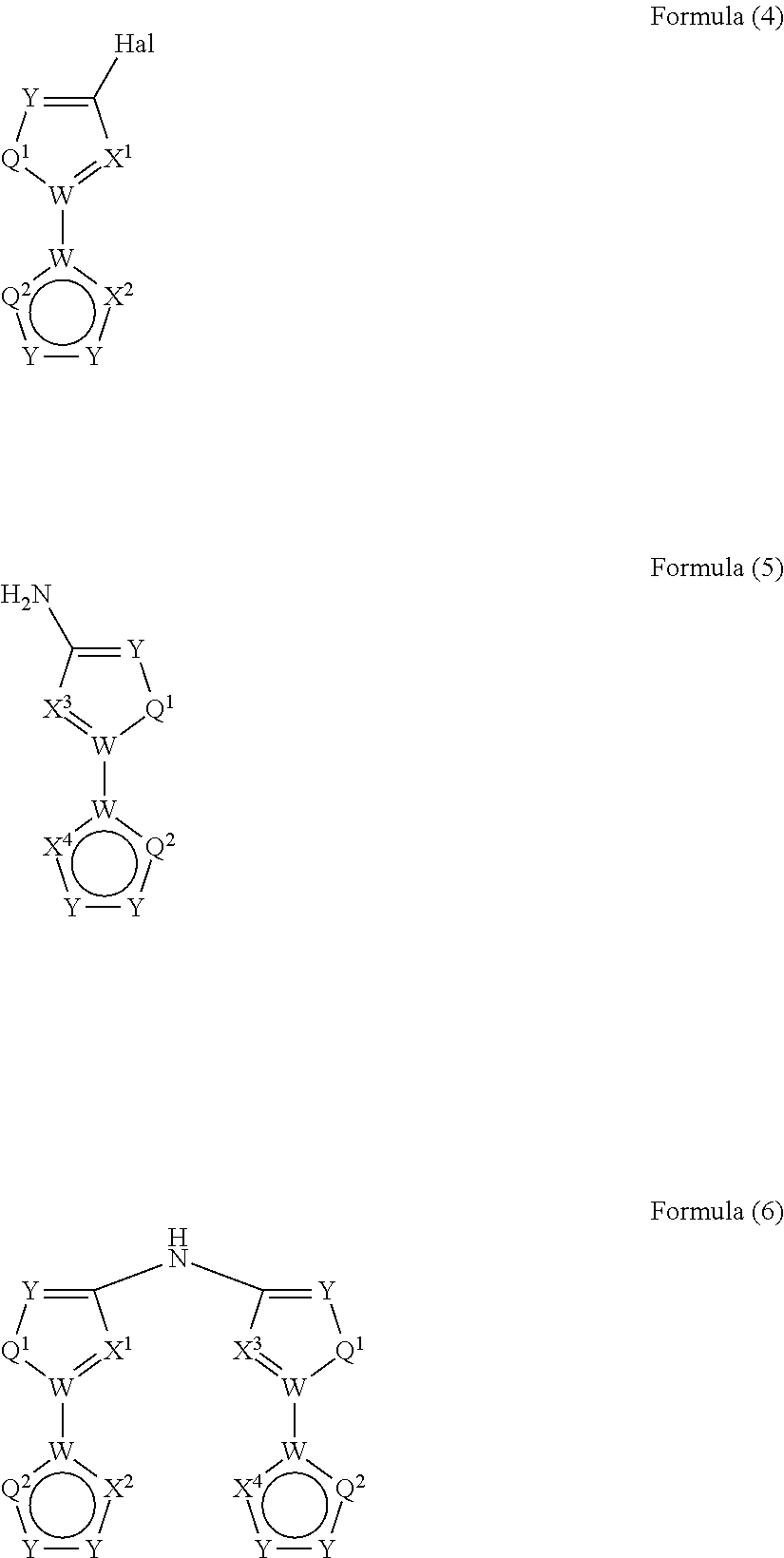
wherein Hal, X1, X2, X3 and X4 are defined as above
and wherein the circle denotes aromaticity of the ring and wherein
Y
-
- is identically or differently on each occurrence selected from N and CR1, preferably Y is CR1;
Q1 - is identically or differently on each occurrence selected from Y—Y, N or S, preferably Y—Y or N, and particularly preferably Y—Y;
Q2 - is identically or differently on each occurrence selected from Y—Y, Y, N or S, preferably, wherein the groups in rings B and D are selected in that aromaticity is achieved;
W - is identically or differently on each occurrence selected from C and N, preferably W is C.
- is identically or differently on each occurrence selected from N and CR1, preferably Y is CR1;
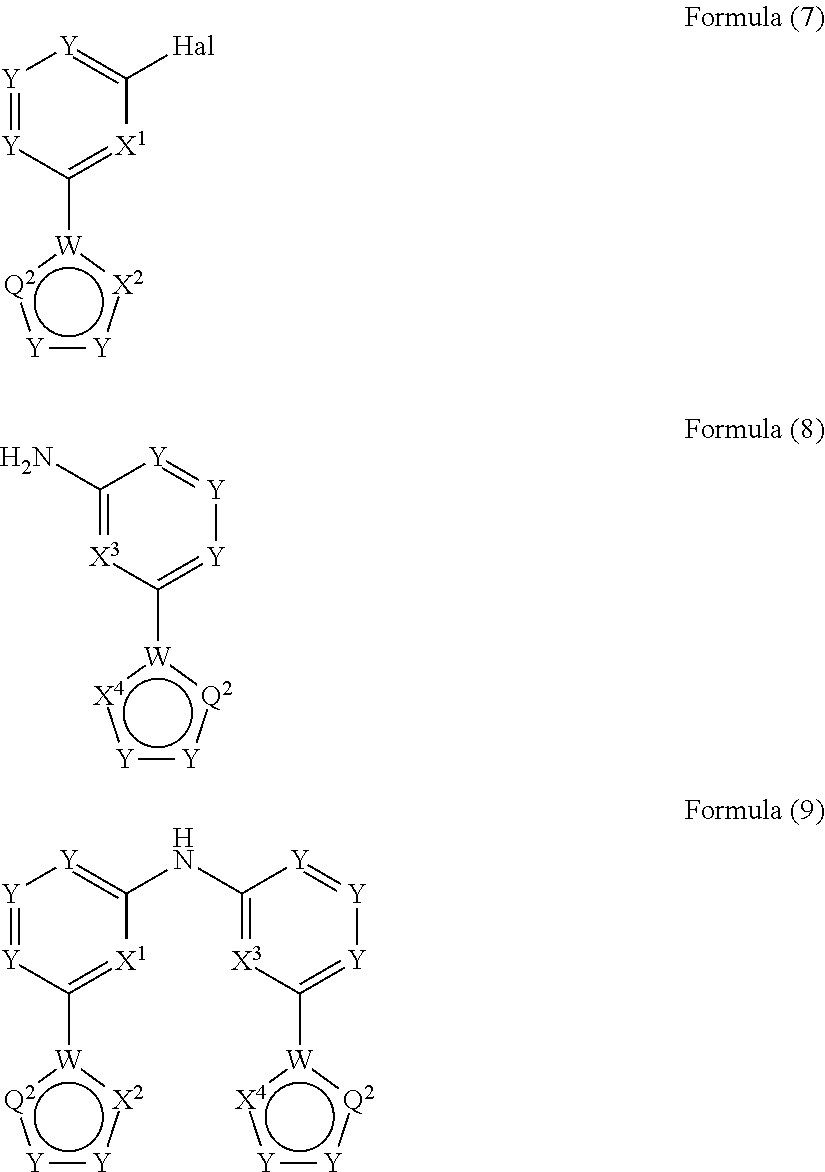
wherein the definitions for the groups as outlined above apply.
wherein the definitions for the groups as outlined above apply and wherein two or more rests R1 can form, as outlined above, a ring.
wherein the definitions for the groups as outlined above apply.

wherein the definitions for the groups as outlined above apply.
wherein the definitions for the groups as outlined above apply.

wherein the definitions for the groups as outlined above apply.
wherein the definitions for the groups as outlined above apply.
wherein the definitions for the groups as outlined above apply.

wherein the definitions for the groups as outlined above apply.

wherein the definition for Hal as outlined above applies.
wherein the definition for Hal as outlined above applies.
wherein the definition for Hal as outlined above applies.

wherein the definition for Hal as outlined above applies.
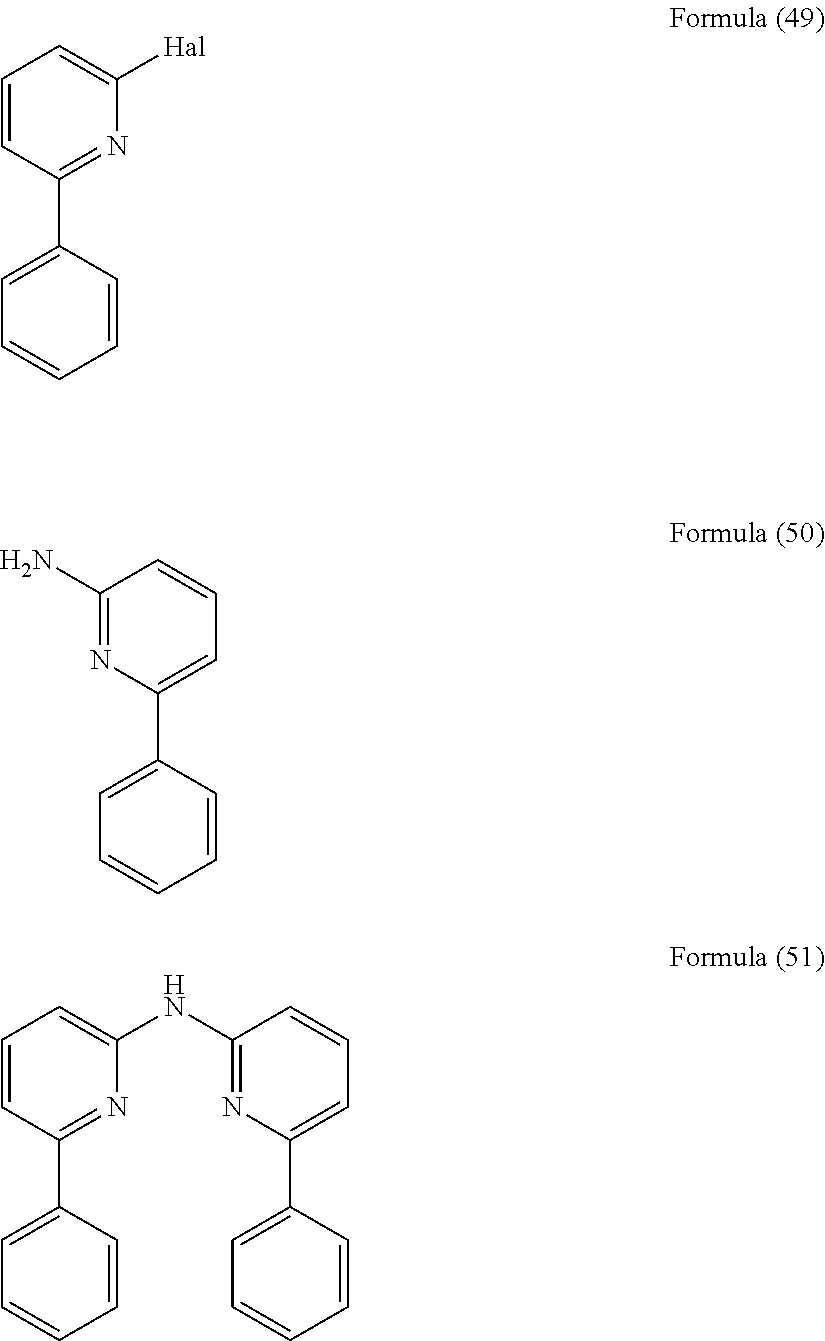
wherein the definition for Hal as outlined above applies.
wherein the definition for Hal as outlined above applies.
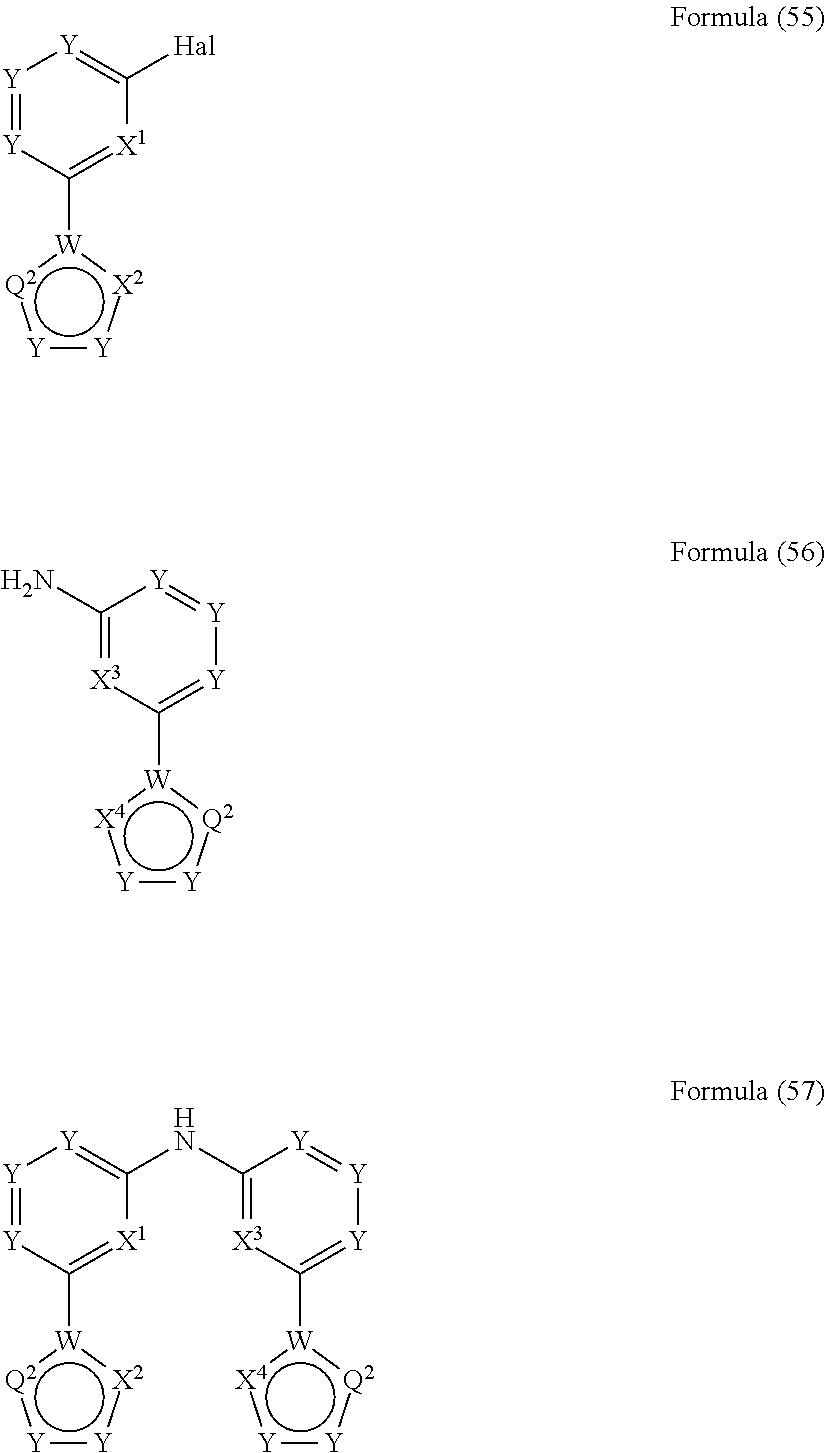
wherein the definitions for the groups as outlined above apply and wherein Q2 is CR1, N or S.
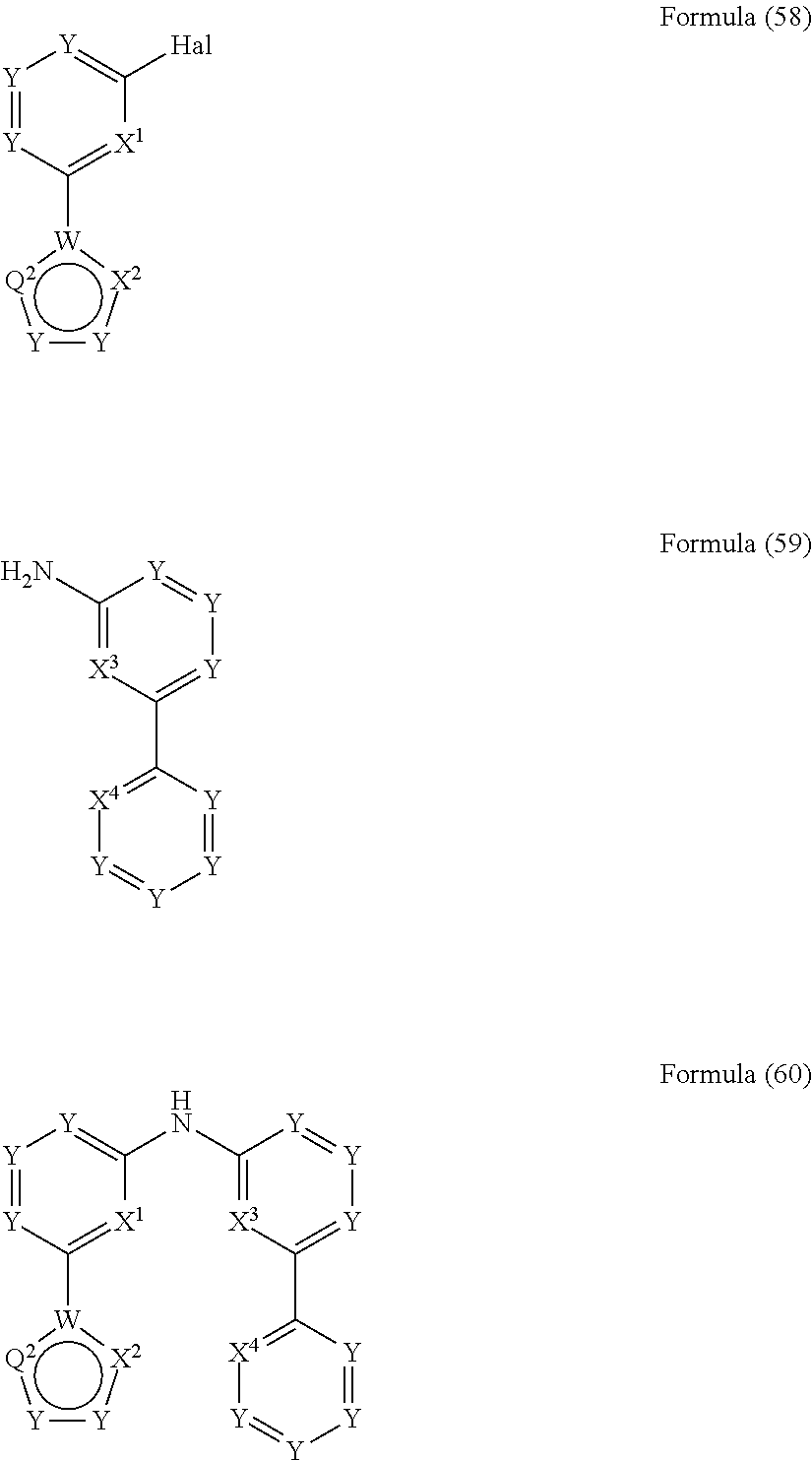
wherein the definitions for the groups as outlined above apply and wherein Q2 is CR1, N or S.
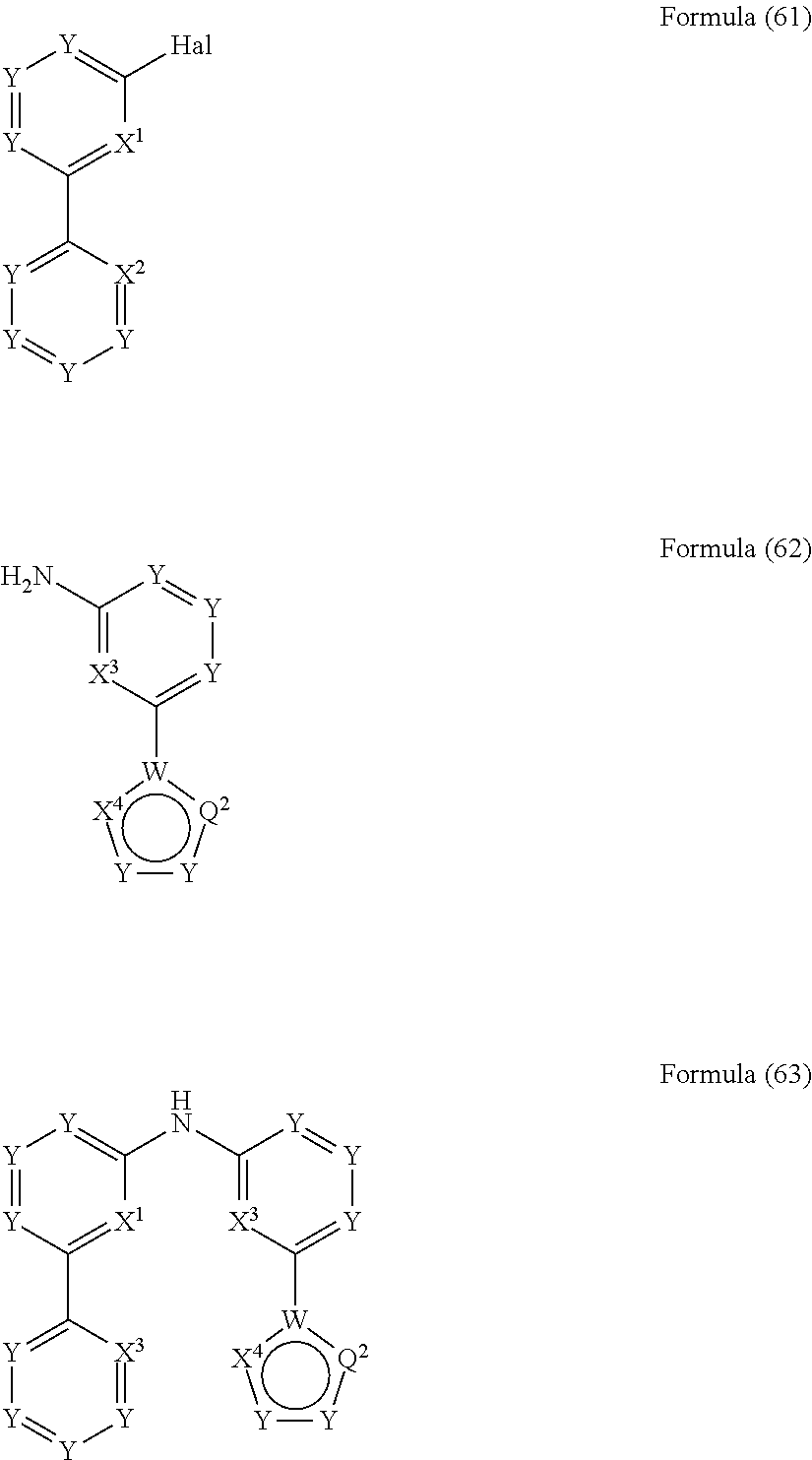
wherein the definitions for the groups as outlined above apply and wherein Q2 is CR1, N or S.

wherein the definitions for the groups as outlined above apply.
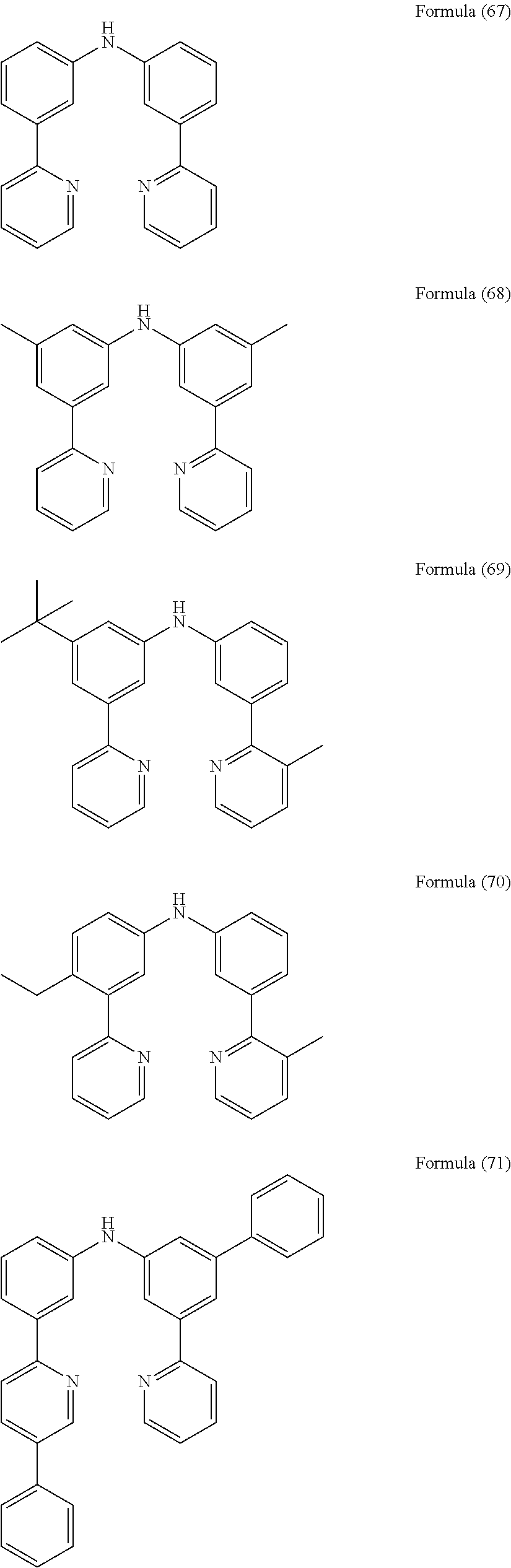
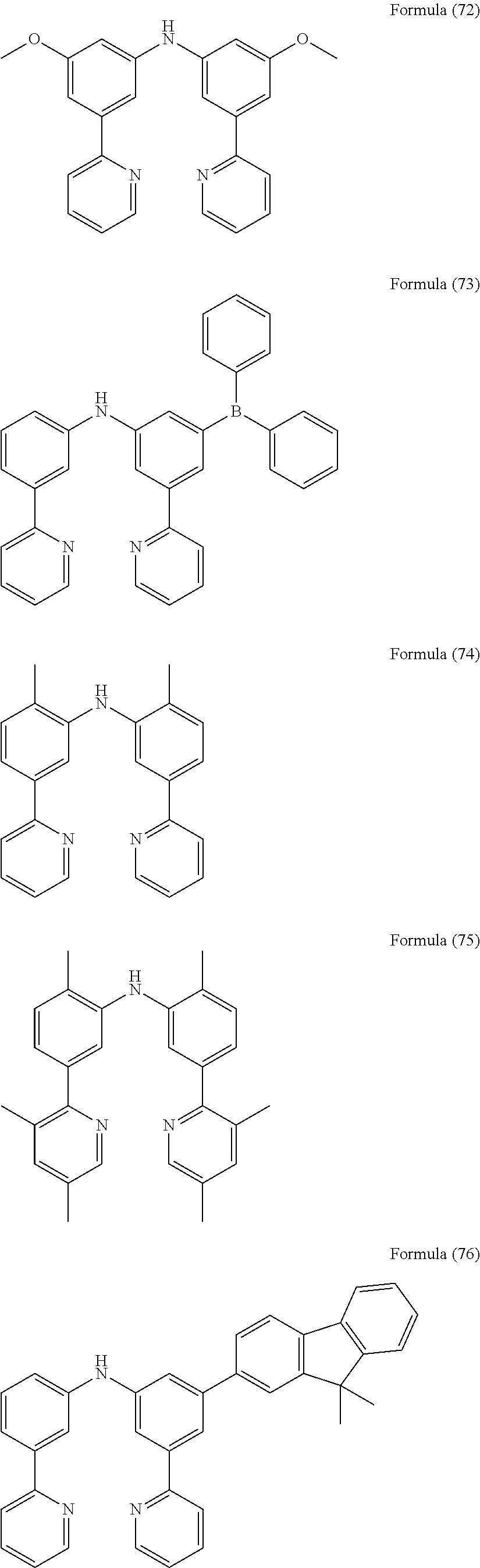
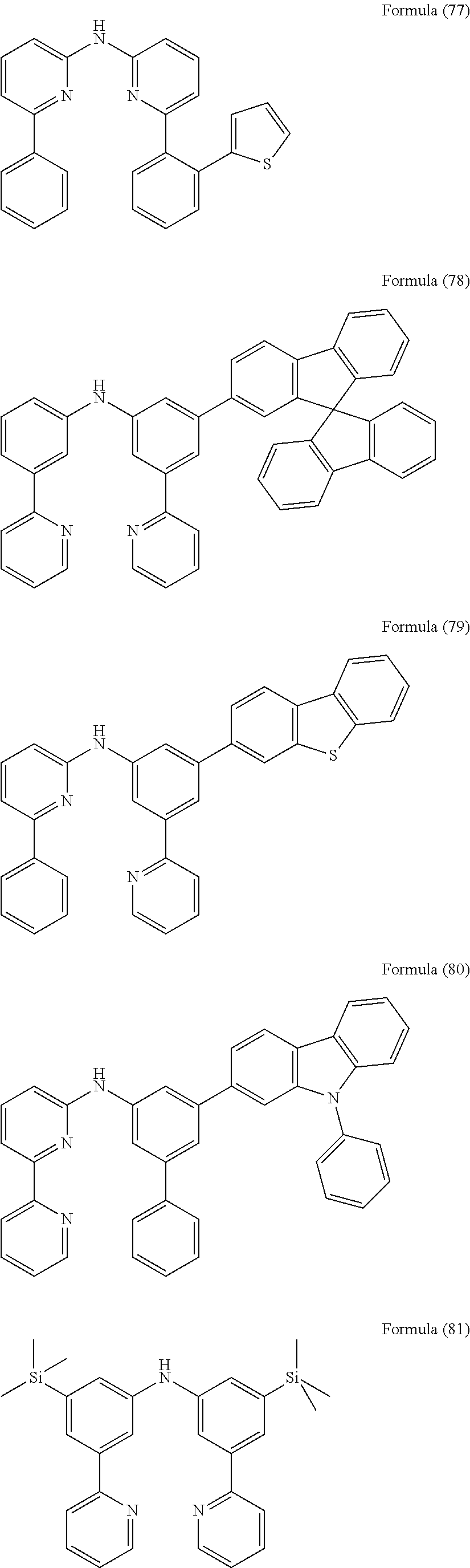
wherein the symbols are defined as above.
wherein the symbols have the meanings as defined above and wherein the preferred embodiments as defined above apply as well.
- 1. The preparation route provides a simple way to prepare compounds that are precursors of ligands;
- 2. The compounds can be obtained in surprisingly high yields. The costs of goods can be lowered by using the route according to the invention. Thus, the new synthesis route is suitable for commercial production of the compounds, even for mass production;
- 3. The new synthesis route offers a simple way to provide a large amount of derivatives. The process according to the present invention is, thus, a more versatile and efficient way to obtain ligands for organometallic complexes as compared to the route according to the prior art.
- 4. The process according to the present invention requires only easy purification of the intermediates and/or products, which results in higher yields and lower production costs.
- 5. The compounds can be obtained with high purity. High purity of ligands is required for high performance electronic and electroluminescent devices.
Preparation of Compound (III)
7.2 g (30.6 mmol) of compound (I) and 5.2 g (30.6 mmol) of compound (II) are suspended in 200 mL of toluene under Ar atmosphere. 340 mg (0.61 mmol) of 1,1-bis-(diphenylphosphino)-ferrocene and 140 mg (0.61 mmol) of Pd(OAc)2 are added to the flask and stirred vigorously under Ar atmosphere. Then 3.5 g (36.7 mmol) of sodium t-butoxide is added to the flask under Ar. The reaction mixture is stirred under reflux for 24 h. After cooling to room temperature, the organic phase is separated off, washed three times with 100 mL of water, dried over magnesium sulfate, filtered and subsequently evaporated to dryness. The residue is purified by column chromatography on silica gel using a mixture of ethylacetate/heptane (1:2). The yield is 82 g (29.4 mmol), corresponding to 96% of theory.
Preparation of Compound (V)
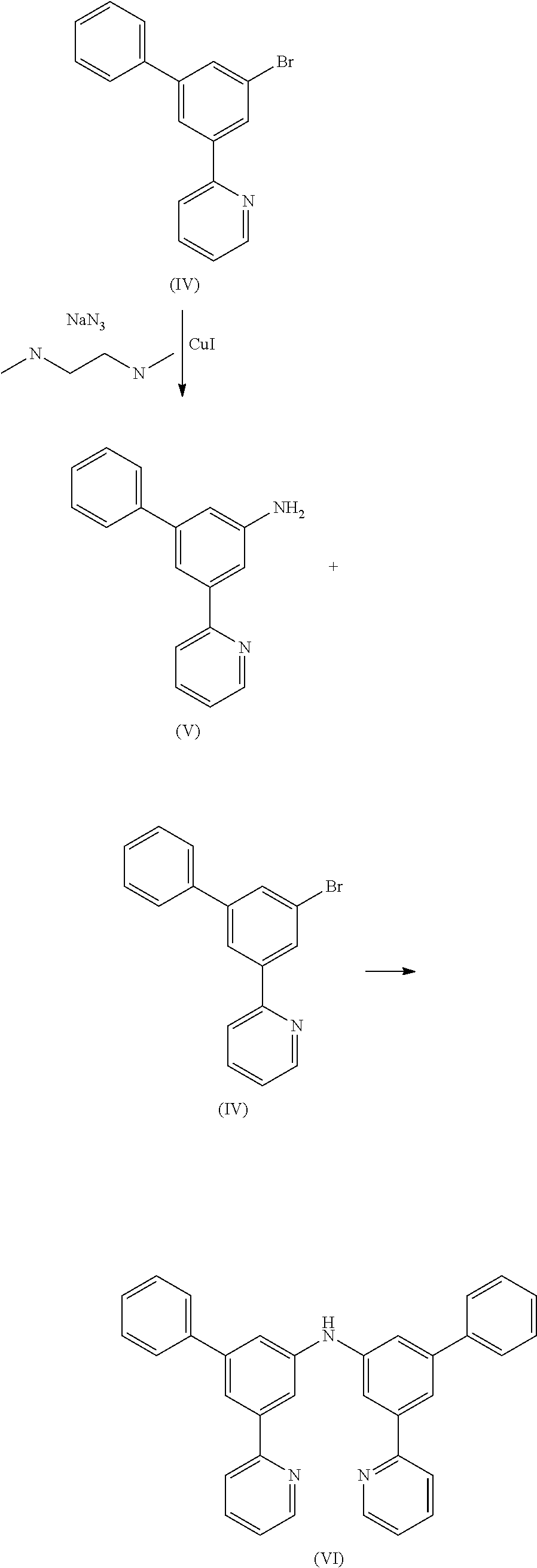
15.8 g (51.1 mmol) of compound (IV), 9.7 g (51.1 mmol) of copper iodide, 6.6 g (102.2 mmol) of sodium azide and 5.4 g (61.3 mmol) of N,N-dimethyl-ethane-1,2-diamine are stirred under reflux for 10 h in 300 mL of dimethylsulfoxide (DMSO). After cooling to room temperature, 200 mL of ethylacetate and 100 mL of a solution of saturated NH4Cl are added to the reaction mixture. The organic phase is separated off, washed three times with 300 mL of water, dried over magnesium sulfate, filtered and subsequently evaporated to dryness. The residue is recrystallised from toluene and finally dried under reduced pressure. The yield is 11.1 g (44.9 mmol), corresponding to 88% of theory.
Preparation of Compound (VI)
10.5 g (34.1 mmol) of compound (IV) and 8.4 g (34.1 mmol) of compound (V) are suspended in 400 mL of toluene under Ar atmosphere. 380 mg (0.68 mmol) of 1,1-bis-(diphenylphosphino)-ferrocene and 150 mg (0.68 mmol) of Pd(OAc)2 are added to the flask and stirred vigorously under Ar atmosphere, Then 3.9 g (40.9 mmol) of sodium t-butoxide is added to the flask under Ar. The reaction mixture is stirred under reflux for 24 h. After cooling to room temperature, the organic phase is separated off, washed three times with 100 mL of water, dried over magnesium sulfate, filtered and subsequently evaporated to dryness. The residue is purified by column chromatography on silica gel using a mixture of ethylacetate/heptane (1:2). The yield is 15.3 g (32.4 mmol), corresponding to 95% of theory.
Preparation of Compound (VII)
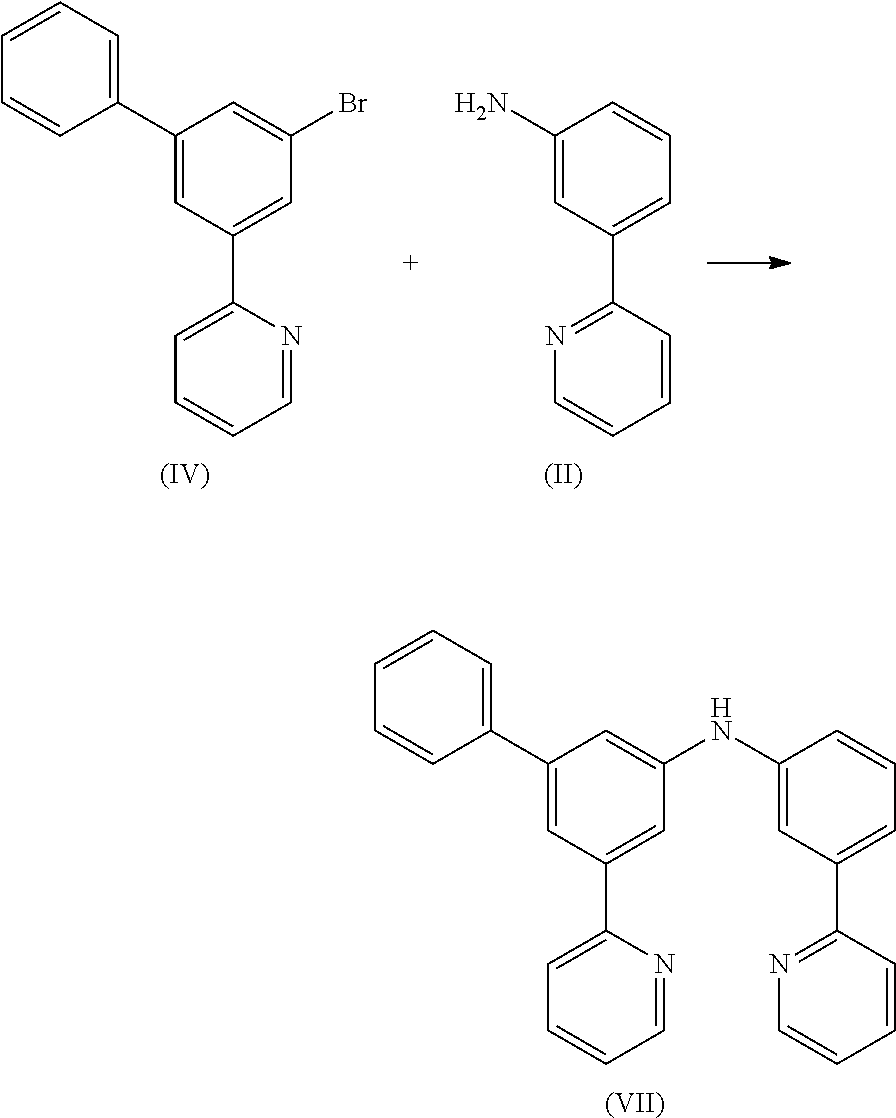
10.5 g (34.1 mmol) of compound (IV) and 5.8 g (34.1 mmol) of compound (II) are suspended in 400 mL of toluene under Ar atmosphere. 380 mg (0.68 mmol) of 1,1-bis-(diphenylphosphino)-ferrocene and 150 mg (0.68 mmol) of Pd(OAc)2 are added to the flask and stirred vigorously under Ar atmosphere. Then 3.9 g (40.9 mmol) of sodium t-butoxide is added to the flask under Ar. The reaction mixture is stirred under reflux for 24 h. After cooling, the organic phase is separated off, washed three times with 100 mL of water, dried over magnesium sulfate, filtered and subsequently evaporated to dryness. The residue is purified by column chromatography on silica gel using a mixture of ethylacetate/heptane (1:2). The yield is 11.1 g (27.9 mmol), corresponding to 82% of theory.
Preparation of Compound (X)
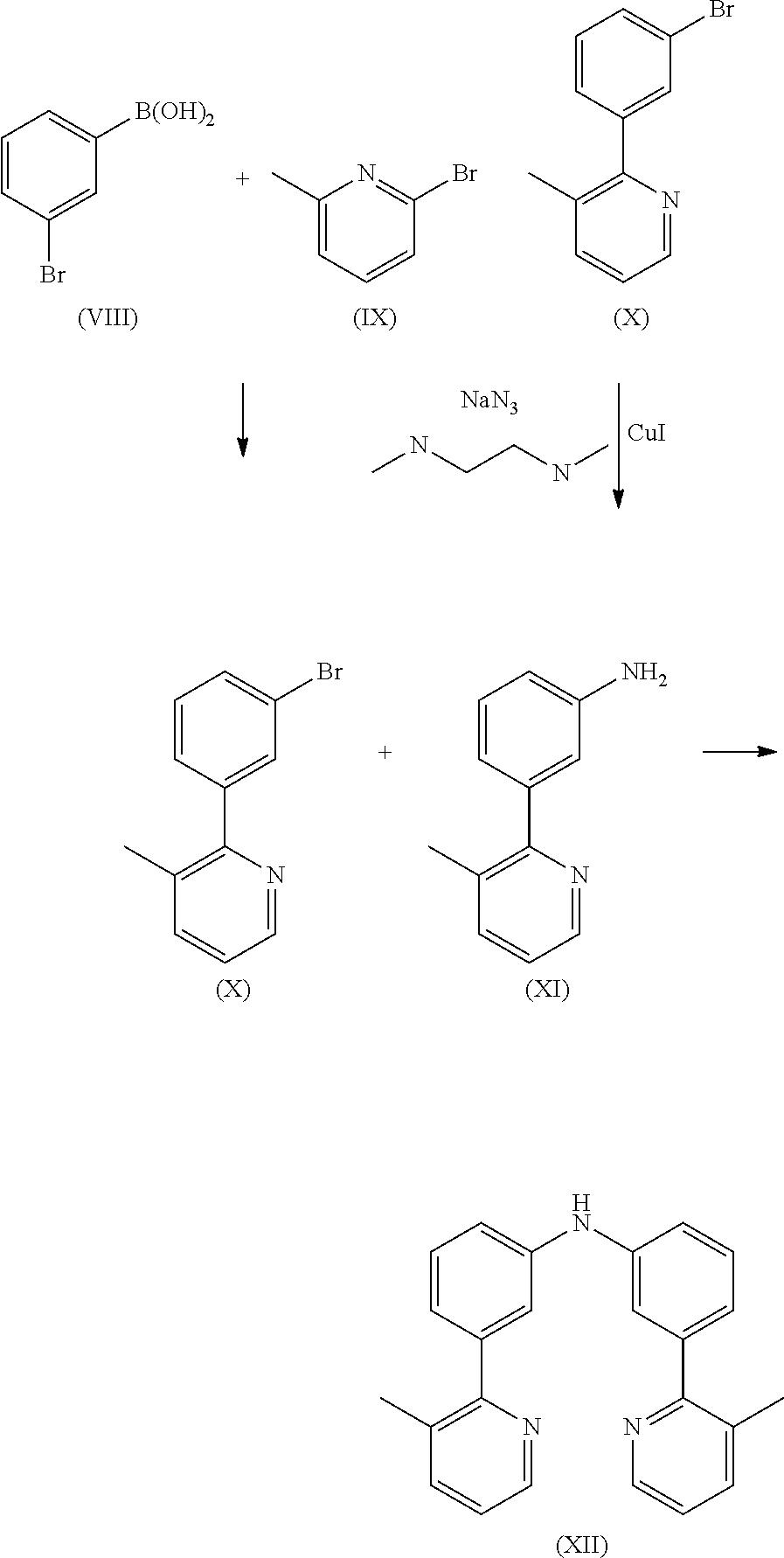
17.2 g (100.2 mmol) of compound (IX) and 20.5 g (120.2 mmol) of compound (VIII) and 16.8 g (120.2 mmol) of potassium carbonate are suspended in 600 mL of toluene and 200 mL of water. 1.1 g (1.0 mmol) of tetrakis(triphenylphosphine)palladium(0) are added to this suspension, and the reaction mixture is stirred under reflux for 16 h. After cooling, the organic phase is separated off, washed three times with 600 mL of water, dried over sodium sulfate and subsequently evaporated to dryness. The residue is purified by column chromatography using a mixture of ethylacetate/heptane (1:3). The yield is 21.6 g (87.2 mmol), corresponding to 86% of theory.
Preparation of Compound (XI)
21.6 g (87.2 mmol) of compound (X), 16.6 g (87.2 mmol) of copper iodide, 11.3 g (174.4 mmol) of sodium azide and 9.2 g (104.6 mmol) of N,N-dimethyl-ethane-1,2-diamine are stirred under reflux for 10 h in 500 mL of dimethylsulfoxide (DMSO). After cooling to room temperature, 200 mL of ethylacetate and 100 mL of a solution of saturated NH4Cl are added to the reaction mixture. The organic phase is separated off, washed three times with 300 mL of water, dried over magnesium sulfate, filtered and subsequently evaporated to dryness. The residue is recrystallised from toluene and finally dried under reduced pressure. The yield is 14.1 g (76.7 mmol), corresponding to 88% of theory.
Preparation of Compound (XII)
14.0 g (56.6 mmol) of compound (IV) and 10.4 g (56.6 mmol) of compound (XI) are suspended in 300 mL of toluene under Ar atmosphere. 620 mg (1.1 mmol) of 1,1-bis-(diphenylphosphino)-ferrocene and 250 mg (1.1 mmol) of Pd(OAc)2 are added to the flask, stirred vigorously under Ar atmosphere then 6.5 g (68.0 mmol) of sodium t-butoxide is added to the flask under Ar. The reaction mixture is stirred under reflux for 24 h. After cooling to room temperature, the organic phase is separated off, washed three times with 200 mL of water, dried over magnesium sulfate, filtered and subsequently evaporated to dryness. The residue is purified by column chromatography on silica gel using a mixture of ethylacetate/heptane (1:2). The yield is 18.3 g (52.1 mmol), corresponding to 92% of theory.
Preparation of Compound (XIV)
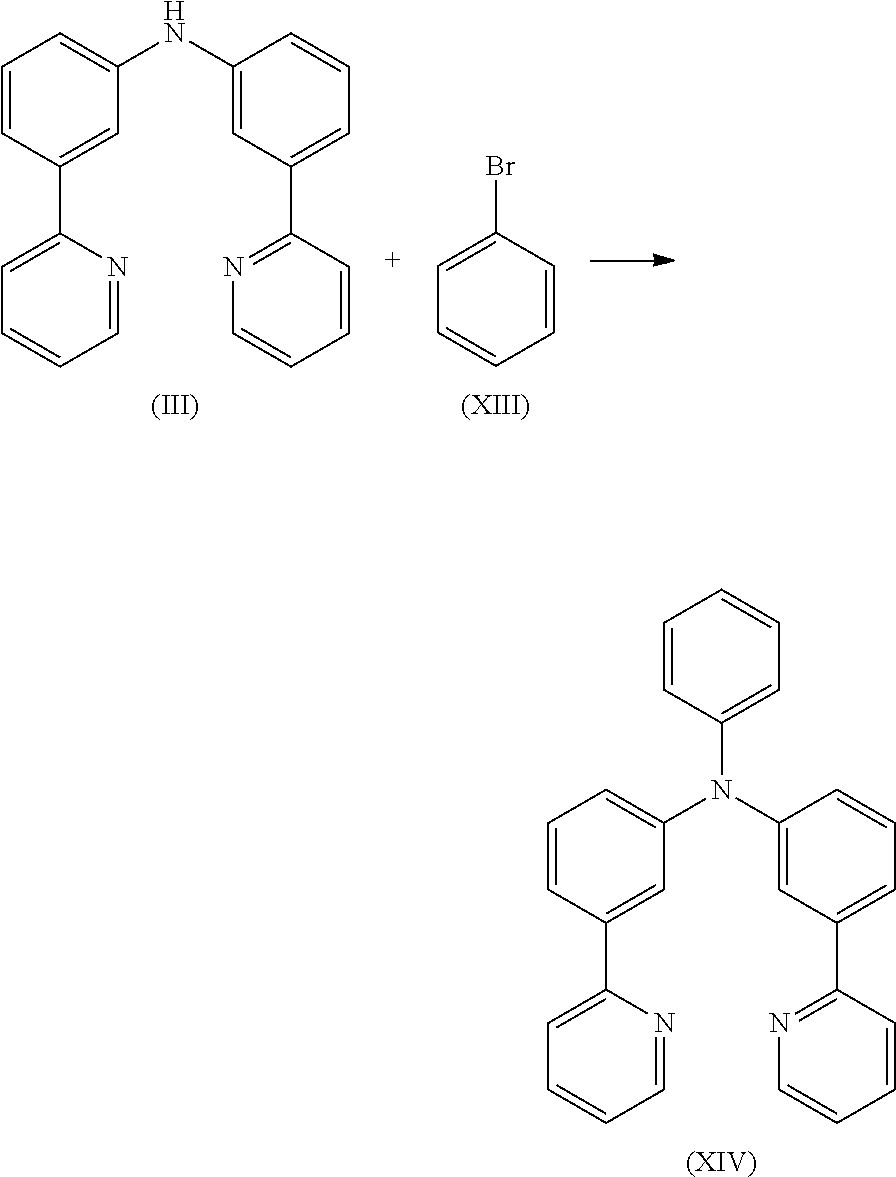
6.8 g (21.1 mmol) of compound (III) and 3.3 g (21.1 mmol) of compound (XIII) are suspended in 120 mL of toluene under Ar atmosphere. 94 mg (0.42 mmol) of Pd(OAc)2 are added to the flask and stirred under Ar atmosphere then 0.8 mL of a 1 M tri-tert-butylphosphine solution and 2.4 g (25.4 mmol) of sodium t-butoxide are added to the flask. The reaction mixture is stirred under reflux for 24 h. After cooling, the organic phase is separated off, washed three times with 60 mL of water, dried over magnesium sulfate, filtered and subsequently evaporated to dryness. The residue is purified by column chromatography on silica gel using a mixture of ethylacetate/heptane (1:2). The yield is 8.0 g (20.0 mmol), corresponding to 95% of theory.
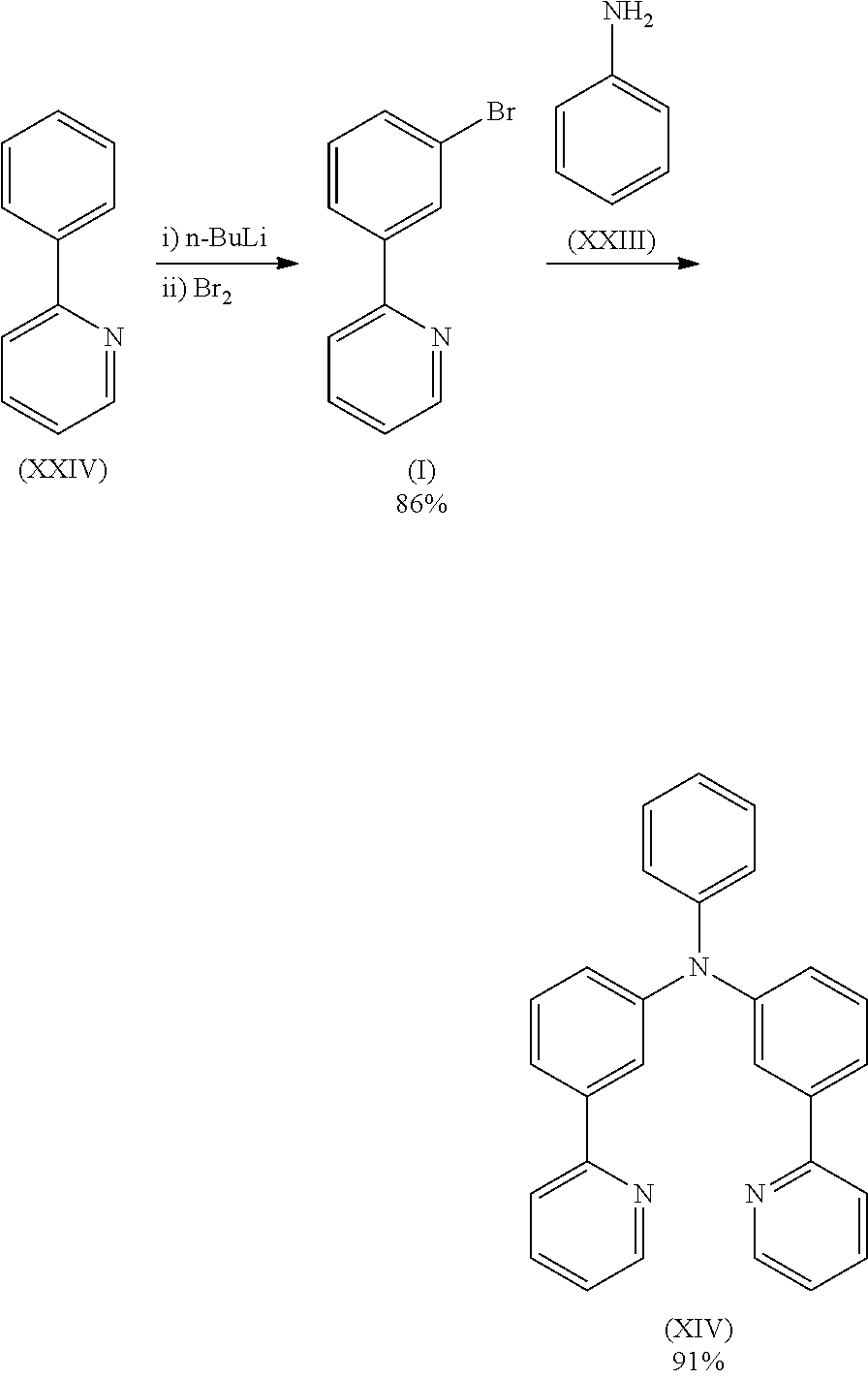
2) According to Inorg. Chem. 2010, 49, 5107: 34% of overall yield

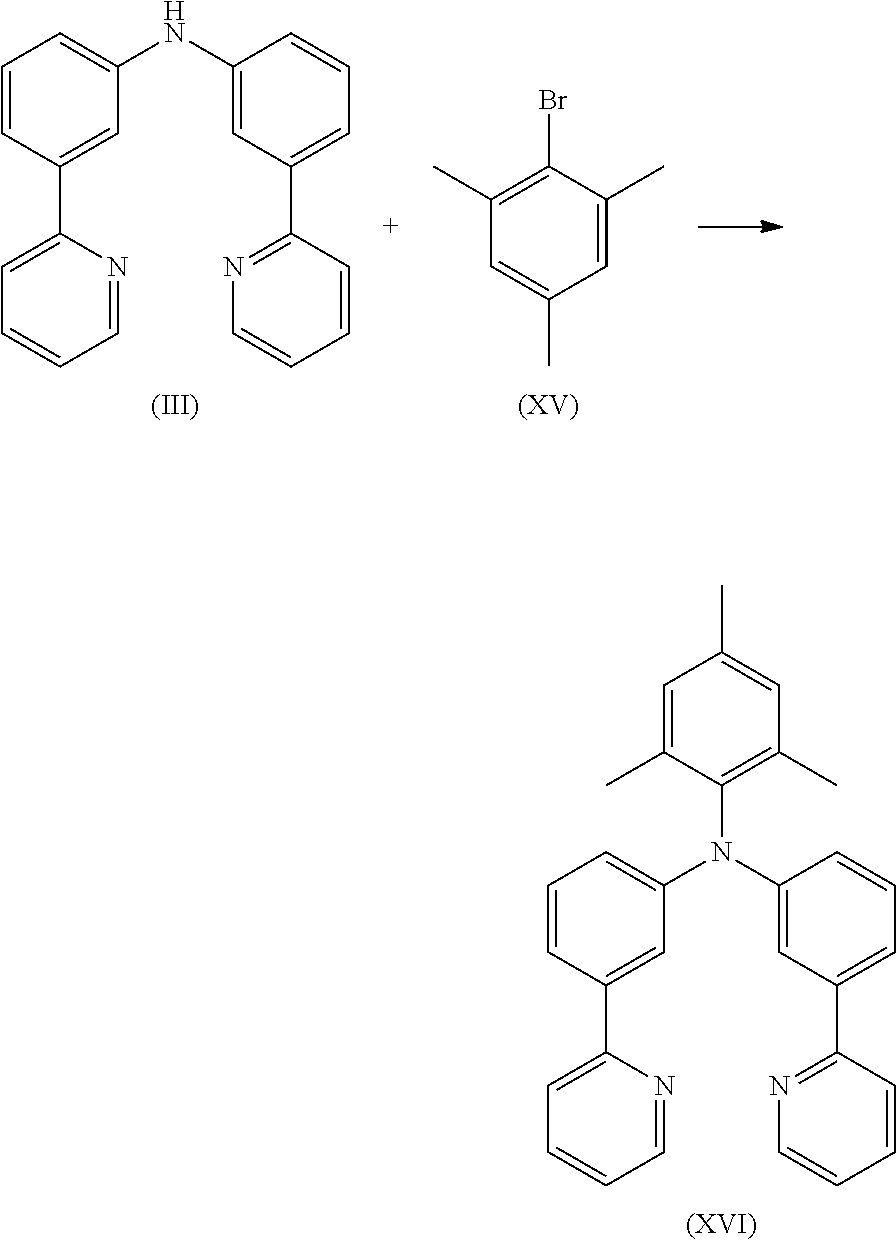
Preparation of Compound (XVI)
5.5 g (17.1 mmol) of compound (III) and 3.4 g (17.1 mmol) of compound (XIII) are suspended in 120 mL of toluene under Ar atmosphere. 76 mg (0.34 mmol) of Pd(OAc)2 are added to the flask and stirred under Ar atmosphere then 0.7 mL of a 1 M tri-tert-butylphosphine solution and 2.0 g (20.5 mmol) of sodium t-butoxide are added to the flask under Argon. The reaction mixture is stirred under reflux for 24 h. After cooling to room temperature, the organic phase is separated off, washed three times with 60 mL of water, dried over magnesium sulfate, filtered and subsequently evaporated to dryness. The residue is purified by column chromatography on silica gel using a mixture of ethylacetate/heptane (1:2). The yield is 6.8 g (15.4 mmol), corresponding to 90% of theory.


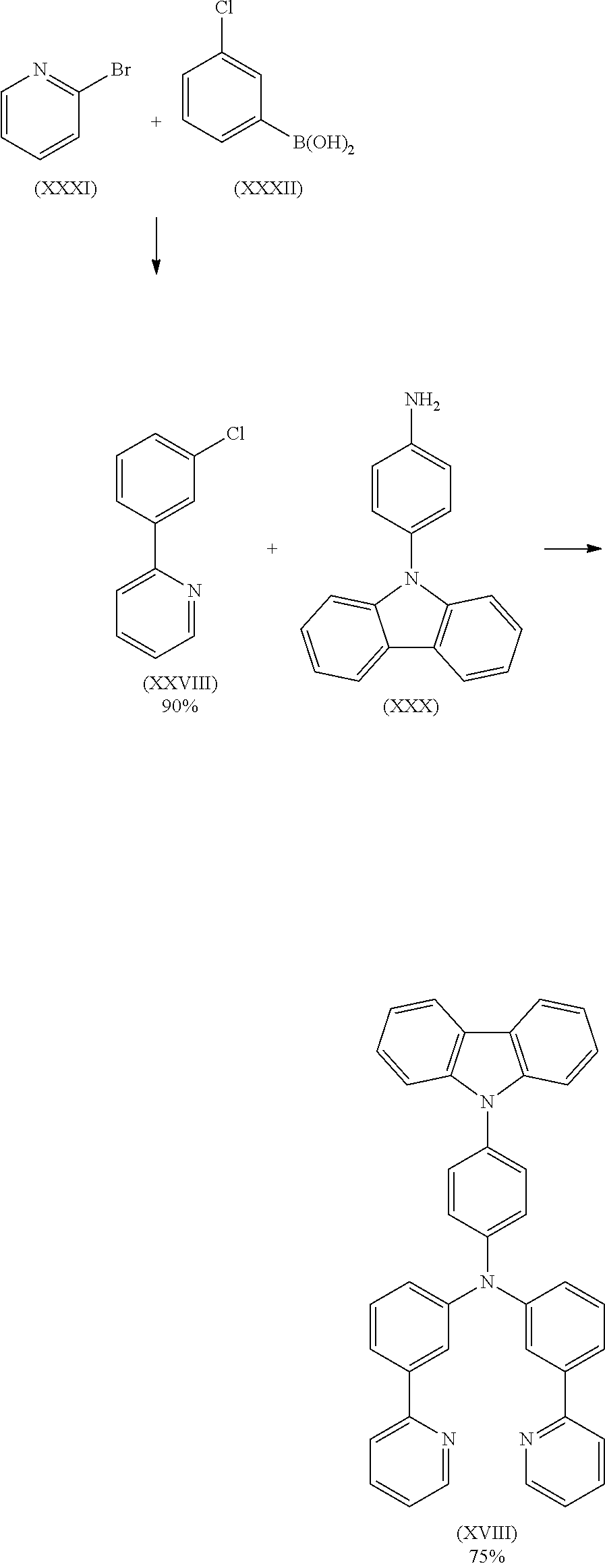
Preparation of Compound (XVIII)
8.5 g (26.3 mmol) of compound (III) and 8.4 g (26.3 mmol) of compound (XVII) are suspended in 250 mL of toluene under Ar atmosphere. 118 mg (0.53 mmol) of Pd(OAc)2 are added to the flask and stirred under Ar atmosphere then 1 mL of a 1 M tri-tert-butylphosphine solution and 3.0 g (31.5 mmol) of sodium t-butoxide are added to the flask under Argon. The reaction mixture is stirred under reflux for 24 h. After cooling to room temperature, the organic phase is separated off, washed three times with 60 mL of water, dried over magnesium sulfate, filtered and subsequently evaporated to dryness. The residue is purified by column chromatography on silica gel using a mixture of ethylacetate/heptane (1:2). The yield is 13.7 g (24.2 mmol), corresponding to 92% of theory.

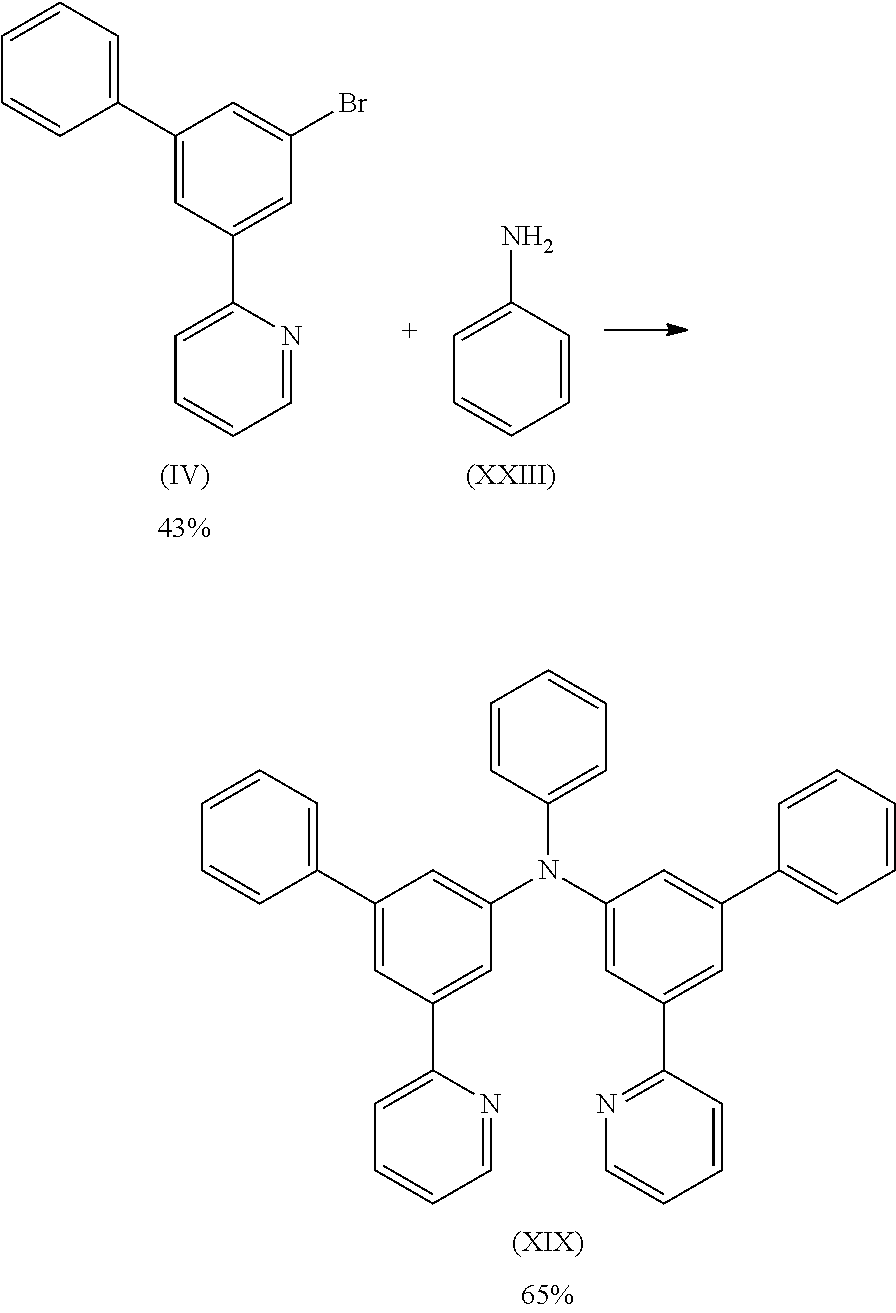
Preparation of Compound (XIX)
12.4 g (26.3 mmol) of compound (III) and 3.9 g (26.3 mmol) of compound (XIII) are suspended in 250 mL of toluene under Ar atmosphere. 118 mg (0.53 mmol) of Pd(OAc)2 are added to the flask and stirred under Ar atmosphere then 1 mL of a 1 M tri-tert-butylphosphine solution and 3.0 g (31.5 mmol) of sodium t-butoxide are added to the flask under Argon. The reaction mixture is stirred under reflux for 24 h. After cooling to room temperature, the organic phase is separated off, washed three times with 60 mL of water, dried over magnesium sulfate, filtered and subsequently evaporated to dryness. The residue is purified by column chromatography on silica gel using a mixture of ethylacetate/heptane (1:2). The yield is 13.1 g (23.7 mmol), corresponding to 90% of theory.
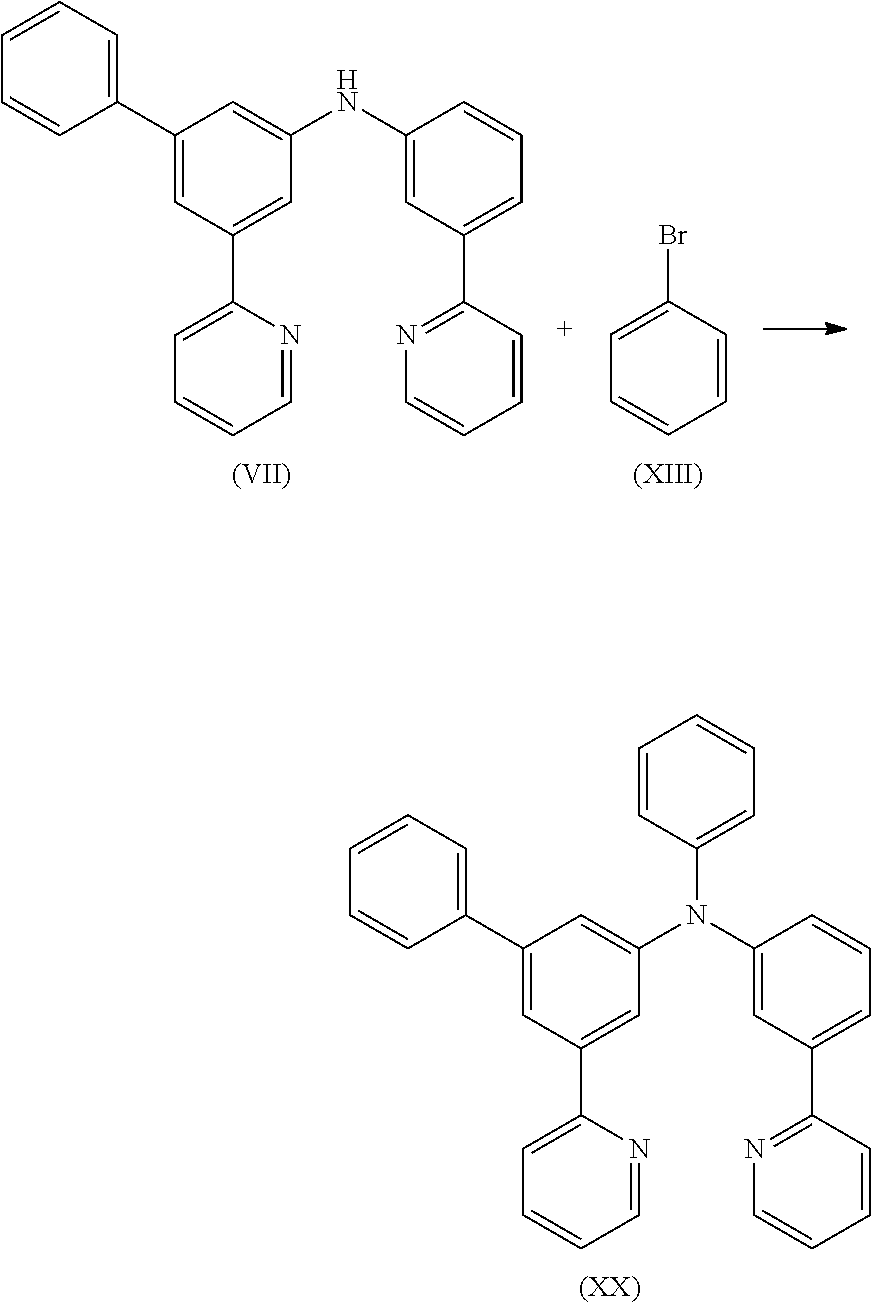
Preparation of Compound (XX)
9.2 g (23.2 mmol) of compound (VII) and 3.6 g (23.2 mmol) of compound (XIII) are suspended in 150 mL of toluene under Ar atmosphere. 104 mg (0.46 mmol) of Pd(OAc)2 are added to the flask and stirred under Ar atmosphere then 0.9 mL of a 1 M tri-tert-butylphosphine solution and 2.7 g (27.9 mmol) of sodium t-butoxide are added to the flask under Argon. The reaction mixture is stirred under reflux for 24 h. After cooling to room temperature, the organic phase is separated off, washed three times with 60 mL of water, dried over magnesium sulfate, filtered and subsequently evaporated to dryness. The residue is purified by column chromatography on silica gel using a mixture of ethylacetate/heptane (1:2). The yield is 10.4 g (21.8 mmol), corresponding to 94% of theory.
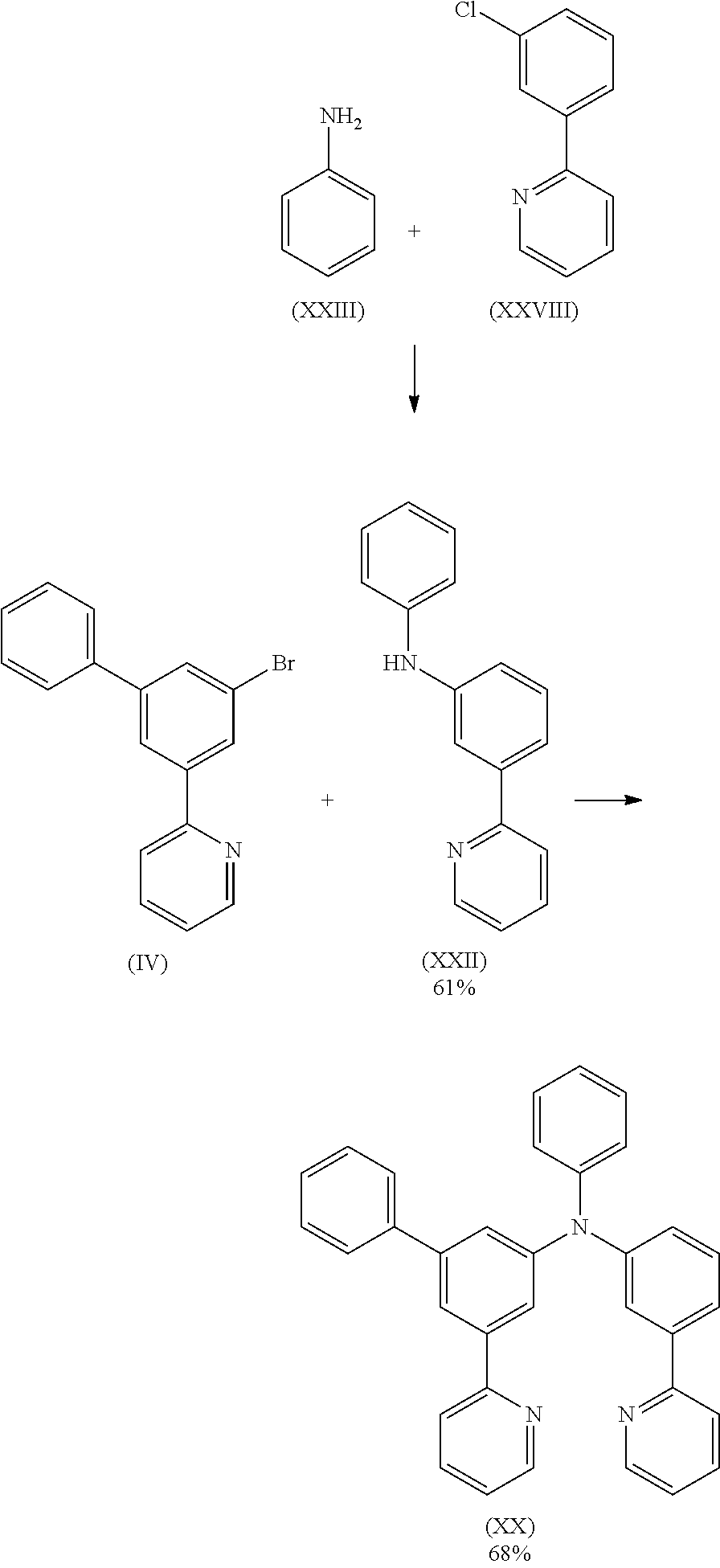
Preparation of Compound (XX)
7.9 g (25.6 mmol) of compound (IV) and 6.3 g (25.6 mmol) of compound (XXII) are suspended in 200 mL of toluene under Ar atmosphere. 115 mg (0.51 mmol) of Pd(OAc)2 are added to the flask and stirred under Ar atmosphere then 1.0 mL of a 1 M tri-tert-butylphosphine solution and 2.9 g (30.7 mmol) of sodium t-butoxide are added to the flask under Ar. The reaction mixture is stirred under reflux for 24 h. After cooling to room temperature, the organic phase is separated off, washed three times with 50 mL of water, dried over magnesium sulfate, filtered and subsequently evaporated to dryness. The residue is purified by column chromatography on silica gel using a mixture of ethylacetate/heptane (1:2). The yield is 8.3 g (17.4 mmol), corresponding to 68% of theory.

Preparation of Compound (XXI)
25.5 g (72.6 mmol) of compound (XII) and 3.2 g (72.6 mmol) of compound (XIII) are suspended in 300 mL of toluene under Ar atmosphere. 325 mg (1.45 mmol) of Pd(OAc)2 are added to the flask and stirred under Ar atmosphere then 2.9 mL of a 1 M tri-tert-butylphosphine solution and 8.4 g (87.2 mmol) of sodium t-butoxide are added to the flask under Ar. The reaction mixture is stirred under reflux for 24 h. After cooling to room temperature, the organic phase is separated off, washed three times with 200 mL of water, dried over magnesium sulfate, filtered and subsequently evaporated to dryness. The residue is purified by column chromatography on silica gel using a mixture of ethylacetate/heptane (1:2). The yield is 34.6 g (81.1 mmol), corresponding to 93% of theory.
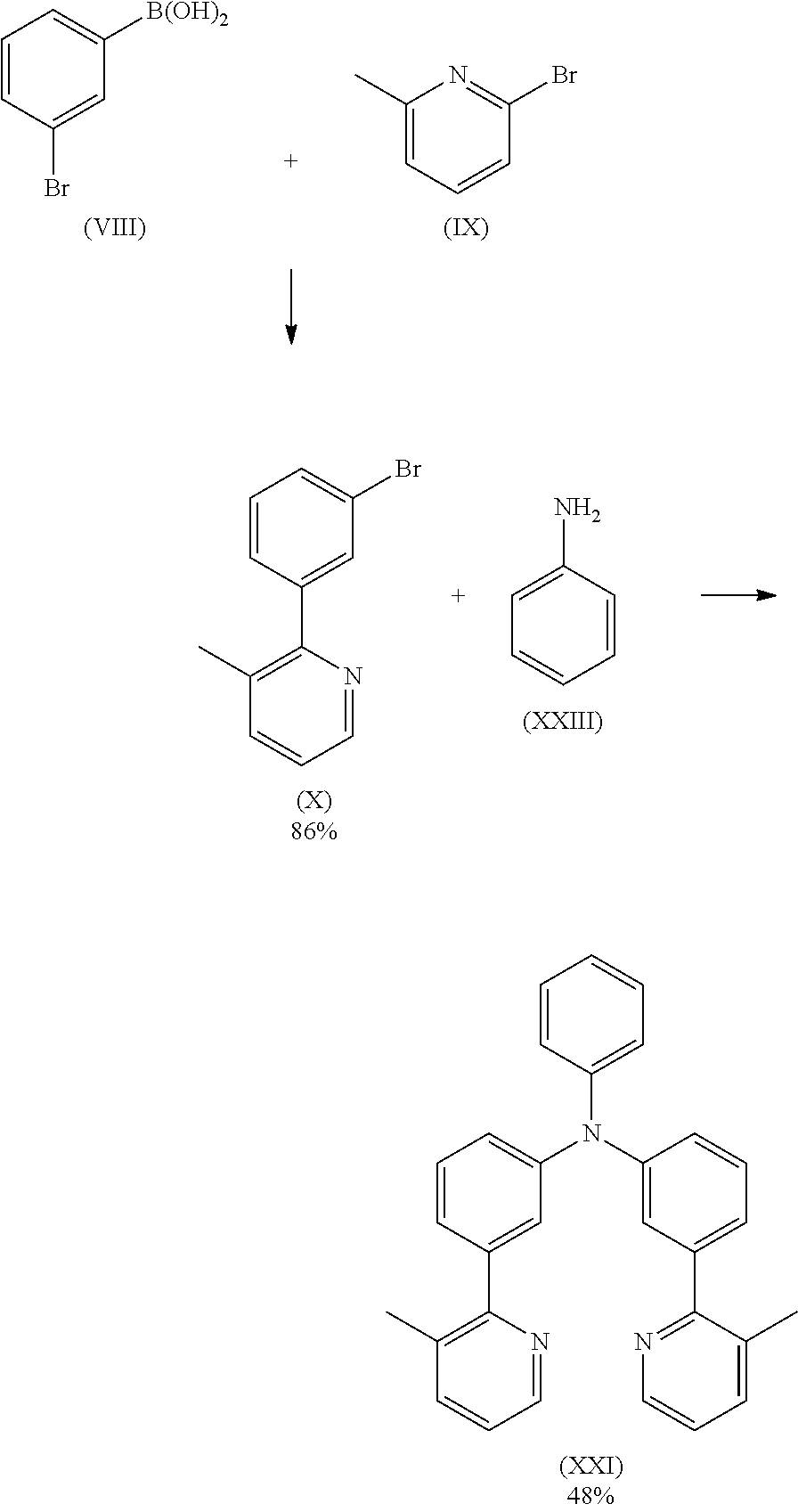
Preparation of Compound (XXI)
16.9 g (68.2 mmol) of compound (X) and 3.2 g (34.1 mmol) of compound (XXIII) are suspended in 150 mL of toluene under Ar atmosphere. 380 mg (0.68 mmol) of Pd(OAc)2 are added to the flask and stirred under Ar atmosphere then 1.4 mL of a 1 M tri-tert-butylphosphine solution and 7.9 g (82.1 mmol) of sodium t-butoxide are added to the flask under Ar. The reaction mixture is stirred under reflux for 24 h. After cooling to room temperature, the organic phase is separated off, washed three times with 50 mL of water, dried over magnesium sulfate, filtered and subsequently evaporated to dryness. The residue is purified by column chromatography on silica gel using a mixture of ethylacetate/heptane (1:2). The yield is 5.7 g (16.4 mmol), corresponding to 48% of theory.
| TABLE 1 |
| Last step yield |
| Yield | ||||
| Yield | (according to the | |||
| Compound | (Prior art) | present invention) | ||
| (XIV) | 91%(1) | 95% | ||
| 75%(2) | ||||
| (XVI) | 58%(1) | 90% | ||
| (XVIII) | 75%(1) | 92% | ||
| (XIX) | 65%(1) | 90% | ||
| (XX) | 68%(3) | 94% | ||
| (XXI) | 48%(3) | 93% | ||
| (1)U.S. Pat. No. 7,442,792; | ||||
| (2)Inorg. Chem. 2010, 49, 5107; | ||||
| (3)Preparation of comparative compounds | ||||
| TABLE 2 |
| Overall yield |
| Overall Yield | ||||
| Overall Yield | (according to the | |||
| Compound | (prior art) | present invention) | ||
| (XIV) | 78%(1) | 91% | ||
| 33%(2) | ||||
| (XVI) | 52%(1) | 75% | ||
| (XVIII) | 68%(1) | 88% | ||
| (XIX) | 28%(1) | 75% | ||
| (XX) | 41%(3) | 77% | ||
| (XXI) | 41%(3) | 65% | ||
| (1)U.S. Pat. No. 7,442,792; | ||||
| (2)Inorg. Chem. 2010, 49, 5107; | ||||
| (3)Preparation of comparative compound | ||||
Claims (3)

Applications Claiming Priority (4)
| Application Number | Priority Date | Filing Date | Title |
|---|---|---|---|
| EP12005351 | 2012-07-23 | ||
| EP12005351 | 2012-07-23 | ||
| EP12005351.7 | 2012-07-23 | ||
| PCT/EP2013/001890 WO2014015936A1 (en) | 2012-07-23 | 2013-06-27 | Ligands and their preparation |
Publications (2)
| Publication Number | Publication Date |
|---|---|
| US20150175574A1 US20150175574A1 (en) | 2015-06-25 |
| US9682958B2 true US9682958B2 (en) | 2017-06-20 |
Family
ID=48771389
Family Applications (1)
| Application Number | Title | Priority Date | Filing Date |
|---|---|---|---|
| US14/416,481 Active US9682958B2 (en) | 2012-07-23 | 2013-06-27 | Ligands and their preparation |
Country Status (4)
| Country | Link |
|---|---|
| US (1) | US9682958B2 (en) |
| EP (1) | EP2875015A1 (en) |
| JP (1) | JP2015525775A (en) |
| WO (1) | WO2014015936A1 (en) |
Families Citing this family (13)
| Publication number | Priority date | Publication date | Assignee | Title |
|---|---|---|---|---|
| NZ729137A (en) | 2014-08-04 | 2022-07-29 | Nuevolution As | Optionally fused heterocyclyl-substituted derivatives of pyrimidine useful for the treatment of inflammatory, metabolic, oncologic and autoimmune diseases |
| ES2846833T3 (en) | 2016-07-18 | 2021-07-29 | Janssen Pharmaceutica Nv | PET imaging ligands |
| KR102606281B1 (en) | 2017-07-14 | 2023-11-27 | 삼성디스플레이 주식회사 | Organometallic compound and organic light-emitting device including the same |
| JP7746259B2 (en) | 2019-12-20 | 2025-09-30 | ヌエヴォリューション・アクティーゼルスカブ | Compounds active against nuclear receptors |
| JP2021098692A (en) | 2019-12-20 | 2021-07-01 | ヌエヴォリューション・アクティーゼルスカブNuevolution A/S | Compounds active towards nuclear receptors |
| TWI775313B (en) | 2020-02-18 | 2022-08-21 | 美商基利科學股份有限公司 | Antiviral compounds |
| TWI883391B (en) | 2020-02-18 | 2025-05-11 | 美商基利科學股份有限公司 | Antiviral compounds |
| CN118598916A (en) | 2020-02-18 | 2024-09-06 | 吉利德科学公司 | Antiviral compounds |
| US11613532B2 (en) | 2020-03-31 | 2023-03-28 | Nuevolution A/S | Compounds active towards nuclear receptors |
| US11780843B2 (en) | 2020-03-31 | 2023-10-10 | Nuevolution A/S | Compounds active towards nuclear receptors |
| CN117120444A (en) | 2021-04-16 | 2023-11-24 | 吉利德科学公司 | Method for preparing carboside using amides |
| WO2022250525A1 (en) | 2021-05-25 | 2022-12-01 | Universiteit Leiden | Self-assembling light-activated metallodrugs |
| JP7719954B2 (en) | 2021-08-18 | 2025-08-06 | ギリアード サイエンシーズ, インコーポレイテッド | Phospholipid compounds and methods for producing and using same |
Citations (8)
| Publication number | Priority date | Publication date | Assignee | Title |
|---|---|---|---|---|
| WO2002047690A1 (en) | 2000-12-12 | 2002-06-20 | Cytovia, Inc. | Substituted 2-aryl-4-arylaminopyrimidines and analogs as activators of caspases and inducers of apoptosis and the use thereof |
| WO2004030672A1 (en) | 2002-10-02 | 2004-04-15 | Merck Patent Gmbh | Use of 4 amino-quinazolines as anti cancer agents |
| WO2005042444A2 (en) | 2003-11-04 | 2005-05-12 | Takasago Perfumery Co Ltd | Platinum complex and luminescent element |
| JP2006232784A (en) | 2005-02-28 | 2006-09-07 | Takasago Internatl Corp | Platinum complex and light emitting device |
| US20080036373A1 (en) | 2006-08-10 | 2008-02-14 | Takasago International Corporation | Platinum complex and light-emitting device |
| US20100331293A1 (en) | 2009-06-25 | 2010-12-30 | Amgen Inc. | Heterocyclic compounds and their uses |
| US20120142708A1 (en) | 2010-12-06 | 2012-06-07 | Selness Shaun R | Substituted pyridine urea compounds |
| WO2012163471A1 (en) | 2011-06-03 | 2012-12-06 | Merck Patent Gmbh | Metal complexes |
Family Cites Families (11)
| Publication number | Priority date | Publication date | Assignee | Title |
|---|---|---|---|---|
| US4539507A (en) | 1983-03-25 | 1985-09-03 | Eastman Kodak Company | Organic electroluminescent devices having improved power conversion efficiencies |
| US5151629A (en) | 1991-08-01 | 1992-09-29 | Eastman Kodak Company | Blue emitting internal junction organic electroluminescent device (I) |
| EP0676461B1 (en) | 1994-04-07 | 2002-08-14 | Covion Organic Semiconductors GmbH | Spiro compounds and their application as electroluminescence materials |
| DE19652261A1 (en) | 1996-12-16 | 1998-06-18 | Hoechst Ag | Aryl-substituted poly (p-arylenevinylenes), process for their preparation and their use in electroluminescent devices |
| JP2001181617A (en) | 1999-12-27 | 2001-07-03 | Fuji Photo Film Co Ltd | Light emitting element material composed of orthometalated palladium complex and light emitting element |
| JP4154140B2 (en) | 2000-09-26 | 2008-09-24 | キヤノン株式会社 | Metal coordination compounds |
| DE10333232A1 (en) | 2003-07-21 | 2007-10-11 | Merck Patent Gmbh | Organic electroluminescent element |
| TW200728277A (en) | 2005-06-29 | 2007-08-01 | Palau Pharma Sa | Bicyclic derivatives as P38 inhibitors |
| US9120773B2 (en) | 2009-08-21 | 2015-09-01 | Tosoh Corporation | Cyclic azine derivatives, processes for producing these, and organic electroluminescent element containing these as component |
| TWI560191B (en) * | 2011-02-23 | 2016-12-01 | Universal Display Corp | Novel tetradentate platinum complexes |
| KR101897044B1 (en) * | 2011-10-20 | 2018-10-23 | 에스에프씨 주식회사 | Organic metal compounds and organic light emitting diodes comprising the same |
-
2013
- 2013-06-27 US US14/416,481 patent/US9682958B2/en active Active
- 2013-06-27 EP EP13734965.0A patent/EP2875015A1/en not_active Withdrawn
- 2013-06-27 JP JP2015523435A patent/JP2015525775A/en active Pending
- 2013-06-27 WO PCT/EP2013/001890 patent/WO2014015936A1/en not_active Ceased
Patent Citations (12)
| Publication number | Priority date | Publication date | Assignee | Title |
|---|---|---|---|---|
| WO2002047690A1 (en) | 2000-12-12 | 2002-06-20 | Cytovia, Inc. | Substituted 2-aryl-4-arylaminopyrimidines and analogs as activators of caspases and inducers of apoptosis and the use thereof |
| WO2004030672A1 (en) | 2002-10-02 | 2004-04-15 | Merck Patent Gmbh | Use of 4 amino-quinazolines as anti cancer agents |
| WO2005042444A2 (en) | 2003-11-04 | 2005-05-12 | Takasago Perfumery Co Ltd | Platinum complex and luminescent element |
| US20070103060A1 (en) | 2003-11-04 | 2007-05-10 | Takasago International Corporation | Platinum complex and light emitting device |
| US7442797B2 (en) * | 2003-11-04 | 2008-10-28 | Takasago International Corporation | Platinum complex and light emitting device |
| JP2006232784A (en) | 2005-02-28 | 2006-09-07 | Takasago Internatl Corp | Platinum complex and light emitting device |
| US20060202197A1 (en) | 2005-02-28 | 2006-09-14 | Takasago International Corporation | Platinum complex and light-emitting device |
| US20080036373A1 (en) | 2006-08-10 | 2008-02-14 | Takasago International Corporation | Platinum complex and light-emitting device |
| JP2008037848A (en) | 2006-08-10 | 2008-02-21 | Takasago Internatl Corp | Platinum complex and light emitting device |
| US20100331293A1 (en) | 2009-06-25 | 2010-12-30 | Amgen Inc. | Heterocyclic compounds and their uses |
| US20120142708A1 (en) | 2010-12-06 | 2012-06-07 | Selness Shaun R | Substituted pyridine urea compounds |
| WO2012163471A1 (en) | 2011-06-03 | 2012-12-06 | Merck Patent Gmbh | Metal complexes |
Non-Patent Citations (21)
| Title |
|---|
| Chrisman et al., "Synthesis and Mutagenic Potency of Structural Isomers of 2-Amino-1-methyl-6-phenylimidazo[4,5-b]pyridine", J. Heterocyclic Chem., 2008, vol. 45, pp. 1641-1649. |
| English translation of Japanese Office Action, mailed Mar. 13, 2017, for Japanese Patent Application No. JP2015-523435, 8 pages. |
| Fallahpour et al., "Solvent-Free Synthesis of Bis(2,2′:6′2″-terpyridin-4′-yl)amine and Its Metal Complexes", Synthesis, 2008, No. 10, pp. 1514-1516. |
| Huo et al., "Novel Phosphorecent Tetradentate Bis-cyclometalated C^C*N^N-coordinated Platinum Complexes: Structure, Photophysics, and a Synthetic Adventure", Polyhedron, 2013, vol. 52, pp. 1030-1040. |
| International Search Report for PCT/EP2013/001890; International Filing Date: Jun. 27, 2013. |
| RN 1026437-98-8; Registry, Database Registry [Online]; Retrieved from STN, Jun. 8, 2008, N-[3-(1H-indol-6-yl)phenyl]-4-(2-thiazolyl)-2-Pyrimidinamine. |
| RN 1348139-24-1; Registry, Database Registry [Online]; Retrieved from STN, Dec. 4, 2011, 2-(2-pyridinyI)-6-(3-pyridiny1)-N-[3-(4-pyridinyl)pheny1]-4-Pyrimidinamine. |
| RN 1348432-08-5; Registry, Database Registry [Online]; Retrieved from STN, Dec. 4, 2011, N-[3-[4-(5-methy1-2-furany1)-2-thiazolyl]pheny1]-2-(2-pyridinyI)-6-(3-pyridiny1)-4-Pyrimidinamine. |
| RN 1349065-85-5; Registry, Database Registry [Online]; Retrieved from STN, Dec. 5, 2011, N-[6-(pyridine-3-y1)-2-pyridiny1]-6-(2-thiazolyI)-3-methoxy-2-Pyridinamine. |
| RN 1349659-21-7; Registry, Database Registry [Onlin] Retrieved from STN, Dec. 6, 2011, N43-(2-methy1-4-pyrimidinyl)pheny1]-2-(2-pyridiny1)-6-(3-pyridiny1)-4-Pyrirnidinamine. |
| RN 1349753-75-8; Registry, Database Registry [Online] Retrieved from STN, Dec. 6, 2011, 2-(2-pyridinyI)-6-(3-pyridiny1)-N-[3-(5-pyrimidinyl)pheny1]-4-Pyrimidinamine. |
| RN 1400024-37-4; Registry, Database Registry [Online] Retrieved from STN, Oct. 8, 2012, 6-chloro-4-phenyl-N-(4-phenyl-2-pyrimidinyl)-2-Quinazolinamine. |
| RN 1400064-88-1; Registry, Database Registry [Online] Retrieved from STN, Oct. 8, 2012, 5,6,7,8-tetrahydro-7-methy1-4-phenyl-N-(4-pheny1-2-pyrimidinyI)-[1]Benzothieno[2,3-d]pyrimidin-2-amine. |
| RN 28182-08-3; Registry, Database Registry [Online]; Retrieved from STN, Nov. 16, 1984, 1-amino-2-(2-benzothiazolyI)-4-[(5-chloro-2-pheny1-4-pyrimidinyl)amino]-9,10-Anthracenedione. |
| RN 667431-16-5; Registry, Database Registry [Online]; Retrieved from STN, Mar. 25, 2004, 6-chloro-4-phenyl-N-(5,6,7,8-tetrahydro-4-pheny1-2-quinazoliny1)-2-Quinazolinamine. |
| RN 689751-78-8; Registry, Database Registry [Online]; Retrieved from STN, Jun. 6, 2004, 6-chloro-4-phenyl-N44-(2-thieny1)-6-(trifluoromethyl)-2-pyrimidinyl]-2-Quinazolinamine. |
| RN 867302-70-3; Registry, Database Registry [Online]; Retrieved from STN, Nov. 11, 2005, 5,6,7,8-tetrahydro-N43-(6,7,8,9-tetrahydro-5H-1,2,4-triazolo[4,3-a]azepin-3-yl]pheny1]-2-(2-thieny1)-[1]Benzothieno[2,3-d]pyrirnidin-4-amine. |
| Sirisoma et al., "Discovery of Substituted 4-Anilino-2-arylpyrimidines as a New Series of Apoptosis Inducers Using a Cell- and Caspase-Based High Throughput Screening Assay. 2. Structure-Activity Relationships of the 2-Aryl group", Bioorganic & Medicinal Chemistry Letters, 2009, vol. 19, pp. 2305-2309. |
| Yoshiaki Fukushima, et al., Derivatives of Ditriazinylamine, Bulletin of the Chemical Society of Japan, vol. 44, pp. 794-798 (1971). |
| Zheng et al., "Synthesis of New Dipyridinylamine and Dipyridinylmethane Ligands and their Coordination Chemistry with Mg(II) and Zn(II)", New Journal of Chemistry, 2008, vol. 32, pp. 2150-2158. |
| Zheng, Z et al. New J Chem 2008 vol. 32 pp. 2150-2158. * |
Also Published As
| Publication number | Publication date |
|---|---|
| JP2015525775A (en) | 2015-09-07 |
| WO2014015936A1 (en) | 2014-01-30 |
| US20150175574A1 (en) | 2015-06-25 |
| EP2875015A1 (en) | 2015-05-27 |
Similar Documents
| Publication | Publication Date | Title |
|---|---|---|
| US9682958B2 (en) | Ligands and their preparation | |
| US12329026B2 (en) | Materials for organic light emitting devices | |
| US8597798B2 (en) | Materials for organic electroluminescent devices | |
| US9217006B2 (en) | Materials for organic electroluminescent devices | |
| KR102750558B1 (en) | Materials for organic electroluminescent devices | |
| US9199972B2 (en) | Materials for organic electroluminescent devices | |
| US8951647B2 (en) | Organic electroluminescence device | |
| US11098019B2 (en) | Materials for organic electroluminescent devices | |
| US8343637B2 (en) | Carbazole derivatives for organic electroluminescent devices | |
| US9074128B2 (en) | Metal complexes having azaborol ligands and electronic device having the same | |
| US8809566B2 (en) | Materials for organic electroluminescence devices | |
| US9206351B2 (en) | Materials for organic electroluminescent devices | |
| US9517977B2 (en) | Materials for electronic devices | |
| KR102760292B1 (en) | Materials for organic electroluminescent devices | |
| EP3464244B1 (en) | Materials for organic electroluminescent devices | |
| US20230104248A1 (en) | Polycyclic compounds for organic electroluminescent devices | |
| US9416310B2 (en) | Materials for electronic devices | |
| US9139765B2 (en) | Organic electroluminescent device | |
| EP3621970B1 (en) | Organoboron complexes for organic electroluminescent devices | |
| US20240336621A1 (en) | Materials for organic electroluminescent devices | |
| KR20240146680A (en) | Materials for organic electroluminescent devices | |
| KR20220056223A (en) | Materials for organic electroluminescent devices |
Legal Events
| Date | Code | Title | Description |
|---|---|---|---|
| AS | Assignment |
Owner name: MERCK PATENT GMBH, GERMANY Free format text: ASSIGNMENT OF ASSIGNORS INTEREST;ASSIGNORS:ANEMIAN, REMI MANOUK;PAEK, JONG-HYUB;SIGNING DATES FROM 20150728 TO 20150731;REEL/FRAME:036248/0270 |
|
| STCF | Information on status: patent grant |
Free format text: PATENTED CASE |
|
| MAFP | Maintenance fee payment |
Free format text: PAYMENT OF MAINTENANCE FEE, 4TH YEAR, LARGE ENTITY (ORIGINAL EVENT CODE: M1551); ENTITY STATUS OF PATENT OWNER: LARGE ENTITY Year of fee payment: 4 |
|
| AS | Assignment |
Owner name: UDC IRELAND LIMITED, IRELAND Free format text: ASSIGNMENT OF ASSIGNORS INTEREST;ASSIGNOR:MERCK PATENT GMBH;REEL/FRAME:064004/0725 Effective date: 20230502 Owner name: UDC IRELAND LIMITED, IRELAND Free format text: ASSIGNMENT OF ASSIGNOR'S INTEREST;ASSIGNOR:MERCK PATENT GMBH;REEL/FRAME:064004/0725 Effective date: 20230502 |
|
| MAFP | Maintenance fee payment |
Free format text: PAYMENT OF MAINTENANCE FEE, 8TH YEAR, LARGE ENTITY (ORIGINAL EVENT CODE: M1552); ENTITY STATUS OF PATENT OWNER: LARGE ENTITY Year of fee payment: 8 |