US9639549B2 - Hybrid of proximity and identity similarity based deduplication in a data deduplication system - Google Patents
Hybrid of proximity and identity similarity based deduplication in a data deduplication system Download PDFInfo
- Publication number
- US9639549B2 US9639549B2 US14/163,721 US201414163721A US9639549B2 US 9639549 B2 US9639549 B2 US 9639549B2 US 201414163721 A US201414163721 A US 201414163721A US 9639549 B2 US9639549 B2 US 9639549B2
- Authority
- US
- United States
- Prior art keywords
- file
- color
- colored
- data
- files
- Prior art date
- Legal status (The legal status is an assumption and is not a legal conclusion. Google has not performed a legal analysis and makes no representation as to the accuracy of the status listed.)
- Expired - Fee Related, expires
Links
Images




Classifications
-
- G06F17/30156—
-
- G—PHYSICS
- G06—COMPUTING OR CALCULATING; COUNTING
- G06F—ELECTRIC DIGITAL DATA PROCESSING
- G06F16/00—Information retrieval; Database structures therefor; File system structures therefor
- G06F16/10—File systems; File servers
- G06F16/17—Details of further file system functions
- G06F16/174—Redundancy elimination performed by the file system
- G06F16/1748—De-duplication implemented within the file system, e.g. based on file segments
-
- G—PHYSICS
- G06—COMPUTING OR CALCULATING; COUNTING
- G06F—ELECTRIC DIGITAL DATA PROCESSING
- G06F16/00—Information retrieval; Database structures therefor; File system structures therefor
- G06F16/70—Information retrieval; Database structures therefor; File system structures therefor of video data
- G06F16/78—Retrieval characterised by using metadata, e.g. metadata not derived from the content or metadata generated manually
- G06F16/783—Retrieval characterised by using metadata, e.g. metadata not derived from the content or metadata generated manually using metadata automatically derived from the content
-
- G06F17/30784—
Definitions
- the present invention relates in general to computers, and more particularly to a hybrid of proximity and identity similarity based deduplication in a data deduplication system in a computing environment.
- Computer systems In today's society, computer systems are commonplace. Computer systems may be found in the workplace, at home, or at school. Computer systems may include data storage systems, or disk storage systems, to process and store data. Large amounts of data have to be processed daily and the current trend suggests that these amounts will continue being ever-increasing in the foreseeable future.
- An efficient way to alleviate the problem is by using deduplication.
- the idea underlying a deduplication system is to exploit the fact that large parts of available data are copied, again and again, by locating repeated data and storing only its first occurrence. Subsequent copies are replaced with pointers to the stored occurrence, which significantly reduces the storage requirements if the data is indeed repetitive.
- a method for a hybrid of proximity and identity similarity based deduplication in a data deduplication system using a processor device in a computing environment.
- color intensity is compared for additional classification enhancement of colored files grouped together by file coloring where a preferred character is represented for the file coloring using a code selected from a multiplicity of codes that represent a variety of contexts. The original meaning of the preferred character is retained when representing the preferred character for the file coloring by the code selected from the multiplicity of codes.
- a computer system for a hybrid of proximity and identity similarity based deduplication in a data deduplication system using a processor device, in a computing environment.
- the computer system includes a computer-readable medium and a processor in operable communication with the computer-readable medium.
- the processor compares color intensity for additional classification enhancement of colored files grouped together by file coloring where a preferred character is represented for the file coloring using a code selected from a multiplicity of codes that represent a variety of contexts. The original meaning of the preferred character is retained when representing the preferred character for the file coloring by the code selected from the multiplicity of codes.
- a computer program product for a hybrid of proximity and identity similarity based deduplication in a data deduplication system using a processor device, in a computing environment.
- the computer-readable storage medium has computer-readable program code portions stored thereon.
- the computer-readable program code portions include a first executable portion that compares color intensity for additional classification enhancement of colored files grouped together by file coloring where a preferred character is represented for the file coloring using a code selected from a multiplicity of codes that represent a variety of contexts. The original meaning of the preferred character is retained when representing the preferred character for the file coloring by the code selected from the multiplicity of codes.
- FIG. 1 is a block diagram illustrating a computing system environment having an example storage device in which aspects of the present invention may be realized;
- FIG. 2 is a block diagram illustrating a hardware structure of data storage system in a computer system in which aspects of the present invention may be realized;
- FIG. 3 is a flowchart illustrating an exemplary method for adding cooperative file coloring protocols in a data deduplication system in which aspects of the present invention may be realized;
- FIG. 4 is a block diagram illustrating a data deduplication system with added cooperative file coloring protocols in in which aspects of the present invention may be realized;
- FIG. 5 is a flowchart illustrating an exemplary alternative method for adding cooperative file coloring protocols in a data deduplication system in which aspects of the present invention may be realized;
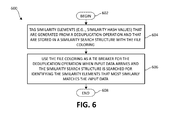
- FIG. 6 is a flowchart illustrating an exemplary method for identifying input data in a repository using the file coloring in a data deduplication system in which aspects of the present invention may be realized;
- FIG. 7 is a flowchart illustrating an exemplary method for a hybrid of proximity and identity similarity based deduplication in a data deduplication system in which aspects of the present invention may be realized;
- FIG. 8 is a flowchart illustrating an additional exemplary method for a hybrid of proximity and identity similarity based deduplication in a data deduplication system in which aspects of the present invention may be realized.
- FIG. 9 is a flowchart illustrating an additional exemplary method for a hybrid of proximity and identity similarity based deduplication in a data deduplication system in which aspects of the present invention may be realized.
- Data deduplication is a highly important and vibrant field in computing storage systems.
- Data deduplication refers to the reduction and/or elimination of redundant data.
- a data object which may be a file, a data stream, or some other form of data, is broken down into one or more parts called chunks or blocks.
- duplicate copies of data are reduced or eliminated, leaving a minimal amount of redundant copies, or a single copy of the data, respectively.
- the goal of a data deduplication system is to store a single copy of duplicated data, and the challenges in achieving this goal are efficiently finding the duplicate data patterns in a typically large repository, and storing the data patterns in a storage efficient deduplicated form.
- Deduplication storage systems supporting such repository sizes must provide efficient processing for finding duplicate data patterns within the repositories, where efficiency is measured in resource consumption for achieving deduplication (resources may be CPU cycles, RAM storage, persistent storage, networking, etc.).
- Deduplication operations per a given file generation assist in finding identical and/or similar data blocks among the given file generations.
- one problem is determining how to recognize, classify, and/or associate incoming backup data with previous generations of the incoming backup data respective files, which may already exist already in the repository, as the data arrives as a stream.
- Some form of hashes may be used as the files' signatures to recognize, classify, and/or associate incoming backup data with previous generations of the incoming backup data respective files, and/or employ a ContextWare® technique to identify the same.
- the ContextWare® technology may assist to classify files per the file types. Although a per-type classification allows for a faster search, two files of the same type might have completely different content.
- Some deduplication solutions opt for ignoring the meta-data of the incoming stream such as: file-type, owners, length etc., because such an information is lost in a multi-stream backup environment. Also, backup applications' headers may be recognized and skipped thereby allowing the user to keep data itself intact and not fragmented (e.g., by using IBM®'s ProtecTIER technology).
- a solution is provided to cluster at a higher level of granularity (beyond the per file type) of related hash values together by adding cooperative file coloring protocols in a data deduplication system using a processor device in a computing environment.
- a preferred character is represented for file coloring in a file using a code selected from a multiplicity of codes that represent a variety of contexts. The original meaning of the preferred character is retained when representing the preferred character for the file coloring by the code selected from the multiplicity of codes.
- a backup data domain is text files (as opposed to compressed or encrypted files and/or binary files).
- a most popular and/or a preferred characters used by all computing languages is the “space” character.
- the “space” character e.g., the most popular character and/or preferred character
- the “space” character is represented for file coloring in a file using a code selected from a multiplicity of codes that represent a variety of contexts.
- Using the “space” character is just an example as any widely used (e.g., popular and/or preferred) character may be considered for the purpose of file coloring.
- the present invention allows an assortment of binary-codes (and/or unused Unicode, and/or any other extended code) to represent a preferred and/or popular character (e.g., the “space” character).
- the assortment of codes may include at least plane code (e.g., Unicode).
- a basic multilingual plane, supplementary multilingual plane, supplementary ideographic plane, unassigned planes, supplementary special-purpose planes, and/or private use area planes may also be used.
- the “Basic Multilingual Plane” each numbered box represents 256 code points.
- the first plane, plane 0, of the Basic Multilingual Plane (BMP) is where most characters have been assigned.
- the BMP contains characters for almost all modern languages, and a large number of special characters.
- a primary objective for the BMP is to support the unification of prior character sets as well as characters for writing.
- Most of the allocated code points in the BMP are used to encode Chinese, Japanese, and Korean (CJK) characters.
- U+DBFF Low Surrogate
- U+DC00 . . . U+DFFF Low Surrogate codes
- SMP Supplementary Multilingual Plane
- Plane 2 the Supplementary Ideographic Plane (SIP)
- CJK Ideographs mostly CJK Unified Ideographs that were not included in earlier character encoding standards.
- Planes 3 to 13 No characters have yet been assigned to Planes 3 through 13.
- Plane 3 is tentatively named the Tertiary Ideographic Plane, but there may not be any characters assigned to it. It is reserved for Oracle Bone script, Bronze Script, Small Seal Script, additional CJK unified ideographs, and other historic ideographic scripts. It is not anticipated that all these planes will be used, given the total sizes of the known writing systems left to be encoded. The number of possible symbol characters that could arise outside of the context of writing systems is potentially large. At the moment, these 11 planes out of 17 are unused.
- the Supplementary Special-purpose Plane may contain non-graphical characters.
- the first block is for deprecated language tag characters for use when language cannot be indicated through other protocols (such as the xml:lang attribute in XML).
- the other block contains glyph variation selectors to indicate an alternate glyph for a character that cannot be determined by context.
- Supplementary Private Use Area-A and -B are available for character assignment by parties outside the ISO and the Unicode Consortium, and they are used by fonts internally to refer to auxiliary glyphs, for example, ligatures and building blocks for other glyphs. Such characters will have limited interoperability. Software and fonts that support Unicode will not necessarily support character assignments by other parties.
- a backup application e.g., IBM® Tivoli Storage Manager “TSM” adds yet another metadata field, to be called file-coloring, to the database.
- TSM Tivoli Storage Manager
- the backup application may change all instances of a preferred character (and/or a most popular and/or preferred character, a second most popular and/or preferred character, and/or an nth most popular and/or preferred character) (e.g., all instances of the “space” character) in the respective file to its colored-space.
- the backup application will search for the file's colored-space and convert the code representing the preferred character back to the preferred character (e.g., plain/stock “space” the users' application expects).
- the storage device e.g., the VTL
- a data deduplication component on the storage device e.g., the VTL
- similarity elements e.g., hash values generated from a data deduplication operation
- the storage device receive streams of bytes its ability to keep track of the file context is limited. Yet, the present invention provides for the file coloring to be embedded in the data stream and thus, the storage device (e.g., the VTL) is always aware of the file coloring while processing that file data chunks. Moreover, a colored file, where the color is spread across the whole stream, assists the backup system to handle multi-stream embodiments. This is because as each data stream, which may be handled by a different processes and/or threads, the data deduplication and/or backup application still recognizes the file color even at the fragment level, unlike a case where the information (e.g., the ContextWare information) is embedded just at the header level.
- the information e.g., the ContextWare information
- the file coloring scheme may take various shapes.
- the file coloring may have different colors for different servers, different file-colors per the files' owners and/or application type, and/or different file coloring based upon user preferences. It should be noted that even if the number of file coloring options are limited, the ability to color a file simply by file-type assists in the case of multi-streaming as the color is embedded in all file's chunks, regardless of the stream they arrive on.
- a file is colored in a data deduplication system by representing a preferred character (e.g. whitespace) in a file using a code selected from a variety of codes, where the variety of codes represents a variety of contexts (e.g., metadata, file type, authorship, ownership, and the like.)
- a backup-server may choose to classify files by file types. For instance, all IBM® DB2 files could have one color and all ORACLE® (another data-base type) files can be assigned another color. It is the backup-server prerogative to decide what it is that the backup-server wants to group together.
- Another probable grouping could be of files by the file's owners such that all of a first users files have one color and a second users files have another color. Such a grouping is beneficial and increases computing efficiency if it is was found that any given user tends to recycle/reuse the same data in the user's own files and as such deduplication efforts should be done on per users' files basis.
- the preferred character is represented using the code such that the representation retains an original meaning of the character.
- the present invention identifies similarities between data chunks encoded using the aforementioned coding scheme by comparing the metadata represented by the Unicode characters and performing deduplication based on the level of similarity.
- the file coloring by using the file coloring the need for identifying a start point and/or an end point is eliminated and there is no need to add metadata for the file coloring.
- the file coloring not only is data bearing the same color is quickly distinguished but the intensity of the file colors is rapidly identified.
- another embodiment described herein pertaining to the present invention adds yet another dimension to the file coloring processes, which allows for sub-grouping into smaller and more manageable classes (e.g., smaller may be defined by a user, may also be defined according to hardware/software capacities, and/or less than an average size of all files in the storage system, and/or other predefined size according to a users preference) to expedite the deduplication process as well as reduce the chances for hash collisions (because the same hash appearing in two different sub-classes does not cause a data loss).
- smaller and more manageable classes e.g., smaller may be defined by a user, may also be defined according to hardware/software capacities, and/or less than an average size of all files in the storage system, and/or other predefined size according to a users preference
- An addition enhancement is provided instead of relying on hash values, by providing a hybrid of proximity and identity similarity based deduplication.
- a multistep similarity search process is employed and first looks and/or searches for a dominant characteristic (e.g., file color of a colored file, which coloring may be considered a first classification), and then second, looks and/or searches for associated characteristics (e.g., file color intensity and distribution of colors, which may be considered a second classification and/or an enhanced classification).
- the color intensity is used to improve the classification of files within a given file color group (e.g., the first classification).
- a signature e.g. the unique file color
- a signature is utilized to identify similar/identical files so that similar/identical files may then be classified together.
- unique binary representations in a file e.g. the SPACE character
- another binary code e.g. unused Unicode or extended code
- the present invention is indifferent to the semantics of the data, but only interested in the data stream file color and the color intensity for sub-classification of data streams, which happen to share the same color. In so doing, similar data streams are identified in order to improve the deduplication-hit rate. Efficiency is increased in the deduplication process and is unaware of the files' type since the present invention focuses on the attributes common to all files, especially text files, which are the best candidates for deduplication).
- Measuring the intensity of the colored files enhances the classification of data files that were group by the colors of the data files through comparison of the color intensity of the colored files.
- the color intensity is located and/or identified as reflected by similar distributions of a given color, and then the data streams are grouped and/or classified into sub-groups according to their color intensity. The color intensity is used to improve the classification of files within a given color group.
- the present invention uses file-coloring to assist the process of finding similar data chunks, which are based not solely on hash signatures.
- the present invention assists in clustering potentially similar chunks together and in doing so, creates an hybrid solution of proximity—similarity and identity (similarity put together)—and facilitates an increased efficiency of a deduplication process as well as minimize the chances for hash collisions that could lead to data loss.
- a hybrid of proximity and identity similarity based deduplication is used in a data deduplication system using a processor device in a computing environment.
- the file colors and/or the color intensity is compared for additional classification enhancement of colored files grouped together by file coloring where a preferred character is represented for the file coloring using a code selected from a multiplicity of codes that represent a variety of contexts.
- the original meaning of the preferred character is retained when representing the preferred character for the file coloring by the code selected from the multiplicity of codes.
- a frequency distribution map of characters may also be built. However, instead of only doing so as a basis for using the frequency distribution map of characters to build hash values that are less likely to change if minor changes in the data do happen, the distribution of the various characters that appear in the data are used as the basis for the suggested approximate hash.
- the data will be partitioned into relatively small chunks “C” of fixed or variable length, with (average) size of about 8-16 Kilobytes (K). Each such data chunk will be analyzed as to the distribution of the bytes forming it and the frequencies of the data chunks.
- the sequence of different bytes is defined according to the order by the byte's frequency of occurrence in the chunk, as the c-spectrum of C, and the corresponding sequence of frequencies as the f-spectrum of C.
- the sequence of different byte pairs are considered, and ordered by the different byte pair's frequency of occurrence in the chunk, and also calls the sequence of different byte pairs of the p-spectrum of C.
- the suggested approximate hash function ah(C) will be a combination of certain elements of these spectra.
- the reasoning behind the decision of relying on these color distributions is that on the one hand, the color distributions behave like fingerprints thereby minimizing the risk that different chunks will exhibit the same distributions.
- small perturbations in the data will often have no impact, or just a minor impact on the corresponding spectra, which is the goal the present invention achieves in designing an approximate hash.
- the file-color based technique requires a single processing of the data to come up with the chunk's color-attributes.
- the file-color technique does not use frequency distribution as means to another end but rather as an end by itself.
- the museum naturally records all of the museum's original paintings and keeps an index of the unique signatures (e.g., up to 4) of each of the paintings the museum posses.
- the museum can check every “new” offer for purchase of Van Gogh paintings by the signatures and instantly determine whether the paintings are even similar.
- a more thorough test is required to establish the authenticity of a piece that passed the earlier similarity test.
- the detailed comparison is done (in the case of the painting) by comparing the actual fractions of the two paintings to one another or (as done by other vendors), by comparing the respective signatures of painting's fractions, to see maybe if it is a new piece of work, or even worse, a poor copy of the original painting.
- the museum does not spend its monetary resources up front therefore only keeping brief descriptions of each of its paintings.
- the brief descriptions might be the same for a number of paintings (e.g., Van Gogh) paintings.
- the paintings brief description is compared to the assortment of relevant painting descriptions on record.
- the museum expert resorts to either the thorough/prudent comparison process, or opt for a signature based comparison method.
- the file-coloring technique may require comparing a number of similar descriptions against a new piece of data.
- the file-coloring operation generally characterizes data (e.g., the painting in the analogy above) according the number of colors used and the intensity (e.g., the brief description of the painting in the analogy above) of those colors for yielding a more robust similarity test system. It should be noted that similar tests by definition may not lead to a data loss where a piece of data is considered identical to new data arriving at the system (even if the piece of data is not identical to the new data) since a thorough test is conducted to ensure the identity of respective data blocks.
- a similarity test for identifying data chunks may be evaluated according to four categories.
- Category 1 a similarity test that yields a percentage of TRUE/TRUE results, where similar chunks are found to be similar (True) and there is one-hundred percent (100%) similarity result (True) (e.g., there is no situation where similar chunks are missed and the best fit should be the most likely to be used).
- Category 2 a similarity test that yields a percentage of TRUE/FALSE results, where data chunks are tested to be similar (True) but, a more thorough examination of the data chunks reveals the data chunks are not similar (False).
- Category 3 a similarity test that yields a percentage of FALSE/TRUE results, where the similarity test failed to recognize the data chunks similarity (False) but in reality the data chunks are similar (True). Failing in this category will result is less than optimal deduplication as the duplicate data chunks will be created instead of referencing earlier ones.
- Category 4 a similarity test that yields a percentage of FALSE/FALSE results, where data chunks are found to not be similar (False) and indeed the data chunks are not similar (False).
- the data chunks' colors are used as a means for identifying and then comparing the data chunks for similarity.
- the data chunk color is an accumulation of vastly used characters within the data chunk, and the chunks colors' color list and/or color map may be used for similarity comparison.
- the hybrid-based similarity test leverages the initial color grouping; category 1.
- the hybrid color/hash-based similarity grouping expedites the cases of category 1: TRUE/TRUE hit results where all similar/identical chunks are identified and found.
- the color based similarity grouping allows flattening B-TREE indexes, and then searching and comparing similarity-hash values, and/or identifying hash values only of plausible data chunks.
- file-coloring for testing the similarity of data chunks allows for hierarchical structure such that if an alleged similar chunk is found to be a false candidate, than other chunks in the same proximity, according to their attributes, may be used. Such is different than using hash values alone where the hash value do not have any inherit description of the data they represent and there is no probable relation to other possible similar data chunk candidates.
- the color intensity of colored files are compared for additional classification enhancement of the colored files that are grouped together by file coloring.
- the files may be colored by representing by a preferred character for the file coloring by using a code selected from a multiplicity of codes that represent a variety of contexts. The original meaning of the preferred character is retained when representing the preferred character for the file coloring by the code selected from the multiplicity of codes.
- a multistep similarity search operation may be used for searching first for a dominant characteristic of the colored files and searching second for associated characteristics of the of colored files.
- the dominant characteristic may include a dominant color and the associated characteristics may include at least color intensity and distribution of colors to the colored files.
- a signature may be used for identifying similarly colored files for classifying similarly colored files together.
- the file coloring of data chunks may be embedded in data streams.
- the file coloring may include shapes, colors for one of the servers, file owners, and a applications.
- the colored files may be are compared by comparing vectors of at least two colored files.
- the color intensity is used for comparing the colored files by measuring a ratio between an actual average distance of the colored file divided by an optimal average distance of the colored file for comparing distribution of colors in data chucks of the colored files.
- the optimal average distance is equal to a file size divided by a total number of the file colors that appear within the colored files.
- the color intensity includes a distribution pattern characteristic of the file coloring.
- the similarities are identified between data chunks of the colored files using the color intensity.
- the data chunks identified as having a similar color intensity are then classified as similar data chunks.
- a file color group contained in at least one of a multiplicity of file color permutations is identified for incoming data chunks.
- the permutations include the act of permuting (rearranging) objects or values (e.g., file colors of colored files or the colored files themselves).
- a permutation of a set of objects is an arrangement of those objects into a particular order. For example, there are six permutations of the set ⁇ 1,2,3 ⁇ , namely (1,2,3), (1,3,2), (2,1,3), (2,3,1), (3,1,2), and (3,2,1).
- an anagram of a word is a permutation of its letters.
- the number of permutations of n distinct objects is “n factorial” usually written as “n!”, which means the product of all positive integers less than or equal to n.
- the incoming data chunks are compared to existing data chunks in the one of the multiplicity of file color permutations, and the incoming data chunks are compared to existing data chunks in one of the multiplicity of file color permutations or to an alternative one of the multiplicity of file color permutations if all of the incoming data chunks fail to be substantially similar (e.g, at least 50 percent or more) to the existing data chunks.
- the color intensity may be calculated by measuring a ratio between the actual average distance of a color of the colored file divided by the calculated average distance (e.g., an optimal average distance) of the color of the colored file.
- the calculated average distance of the colors of the colored file assumes the color of the colored file is evenly distributed in the colored file.
- the present invention may set as the preferred character one of a most used character, a second most used character, and an nth most used character for the file coloring, arrange the colored files according to one of a multiplicity of first file color permutations, arrange the colored files according to one of a multiplicity of second file color permutations, classify incoming data chunks into both the multiplicity of first file color permutations and the multiplicity of second file color permutations, and/or compare the incoming data chunks to existing data chunks using at least one of the multiplicity of first file color permutations and the multiplicity of second file color permutations.
- the color intensity may be used to determine whether the file color is clustered in a localized region of the data file and/or if the file color randomly dispersed in the data file (or other distribution pattern. If the calculated-average-distance is larger than the actual average-distance then the color is identified as being clustered in the data file and not evenly spread.
- a data file, data chunk, just a bunch of characters, and/or letters without any additional semantic pattern is analyzed for measuring color intensity, without looking for any particular pattern.
- a “quick-glance-taking” approach is used for identifying similarities and proximity of data chunks in a deduplication system.
- the hybrid based technique file coloring described herein is used to improve and fine-tune the hash's clusters following on the heels of the induced file coloring also described herein.
- the scarcity of the data chunks' colors is the key element which determines the actual depth and/or width of the tuples' sub-trees.
- a tuple may be generally defined as a sequence (or ordered list) of ‘n’ elements, where is ‘n’ is a non-negative integer.
- An n-tuple is defined inductively using the construction of an ordered pair.
- Each tuple may host the respective data chunks, which are characterized by the tuple.
- the tuples may be ordered or not ordered.
- the weights of the file colors are important.
- the weights may be predefined and/or automatically calculated.
- a file color is merely part of a tuple but the weight of the color within that tuple is not recorded. This approach for the non-ordered tuple does take into account the possibility that changes may occur in the data chunks and may cause the color order to change, which is more realistic even though it extends the number of chunks per tuple it.
- a need may exist to actively search number of related tuples before exhausting the search for similar chunks.
- the hybrid approach described herein repeatedly uses the hashes, and groups the hashes for increased processing efficiency while reducing the search time.
- a maximum number of color-based trees used is 256!/(256 ⁇ n)! if the color order within a tuple is ignored, or when the color weights in the tuple are important (as determined by a user and/or application) the maximum number of color-based trees used is 256!/((256 ⁇ n)!*n!).
- the “256!” is 256 factorial divided by (256 minus n) factorial, where “n factorial” usually written as “n!”, as mentioned above, and 256!/((256 ⁇ n)!*n!) is 256 factorial divided by ((256 minus n) factorial) multiplied by n!.
- the colored-based trees are expected to be sparse and radically smaller in number.
- the order by which the chunks should be compared is two fold. First, vectors of two chunks colors' are compared if the majority of the colors do appear in both chunks. Second, the intensity of the colors that is measured and/or reflected by the ratio between the actual average distance divided by an optimal average is used to compare the nature of the color distribution in the respective chunks.
- the actual average distance is the actual distance of the colored file from end to end.
- the optimal average distance is equal to a file size divided by a total number of the file colors that appear within the colored files, wherein the color intensity includes a distribution pattern characteristic of the file coloring (e.g., file size divided by the number of color appearances in a file). Data chunks with comparable color intensity are more likely to be similar than those that have different level of color intensity (of character distribution pattern).
- the computer system 10 includes central processing unit (CPU) 12 , which is connected to communication port 18 and memory device 16 .
- the communication port 18 is in communication with a communication network 20 .
- the communication network 20 and storage network may be configured to be in communication with server (hosts) 24 and storage systems, which may include storage devices 14 .
- the storage systems may include hard disk drive (HDD) devices, solid-state devices (SSD) etc., which may be configured in a redundant array of independent disks (RAID).
- HDD hard disk drive
- SSD solid-state devices
- RAID redundant array of independent disks
- the operations as described below may be executed on storage device(s) 14 , located in system 10 or elsewhere and may have multiple memory devices 16 working independently and/or in conjunction with other CPU devices 12 .
- Memory device 16 may include such memory as electrically erasable programmable read only memory (EEPROM) or a host of related devices. Memory device 16 and storage devices 14 are connected to CPU 12 via a signal-bearing medium. In addition, CPU 12 is connected through communication port 18 to a communication network 20 , having an attached plurality of additional computer host systems 24 . In addition, memory device 16 and the CPU 12 may be embedded and included in each component of the computing system 10 . Each storage system may also include separate and/or distinct memory devices 16 and CPU 12 that work in conjunction or as a separate memory device 16 and/or CPU 12 .
- EEPROM electrically erasable programmable read only memory
- FIG. 2 is an exemplary block diagram 200 showing a hardware structure of a data storage system in a computer system according to the present invention.
- Host computers 210 , 220 , 225 are shown, each acting as a central processing unit for performing data processing as part of a data storage system 200 .
- the cluster hosts/nodes (physical or virtual devices), 210 , 220 , and 225 may be one or more new physical devices or logical devices to accomplish the purposes of the present invention in the data storage system 200 .
- a data storage system 200 may be implemented as IBM® ProtecTIER® deduplication system TS7650GTM.
- a Network connection 260 may be a fibre channel fabric, a fibre channel point to point link, a fibre channel over ethernet fabric or point to point link, a FICON or ESCON I/O interface, any other I/O interface type, a wireless network, a wired network, a LAN, a WAN, heterogeneous, homogeneous, public (i.e. the Internet), private, or any combination thereof.
- the hosts, 210 , 220 , and 225 may be local or distributed among one or more locations and may be equipped with any type of fabric (or fabric channel) (not shown in FIG.
- Data storage system 200 is accordingly equipped with a suitable fabric (not shown in FIG. 2 ) or network adaptor 260 to communicate.
- Data storage system 200 is depicted in FIG. 2 comprising storage controllers 240 and cluster hosts 210 , 220 , and 225 .
- the cluster hosts 210 , 220 , and 225 may include cluster nodes.
- storage controller 240 is shown in FIG. 2 as a single processing unit, including a microprocessor 242 , system memory 243 and nonvolatile storage (“NVS”) 216 . It is noted that in some embodiments, storage controller 240 is comprised of multiple processing units, each with their own processor complex and system memory, and interconnected by a dedicated network within data storage system 200 .
- Storage 230 (labeled as 230 a , 230 b , and 230 n in FIG. 3 ) may be comprised of one or more storage devices, such as storage arrays, which are connected to storage controller 240 (by a storage network) with one or more cluster hosts 210 , 220 , and 225 connected to each storage controller 240 .
- Storage controller 240 manages storage 230 and facilitates the processing of write and read requests intended for storage 230 .
- the system memory 243 of storage controller 240 stores program instructions and data, which the processor 242 may access for executing functions and method steps of the present invention for executing and managing storage 230 as described herein.
- system memory 243 includes, is in association with, or is in communication with the operation software 250 for performing methods and operations described herein. As shown in FIG.
- system memory 243 may also include or be in communication with a cache 245 for storage 230 , also referred to herein as a “cache memory”, for buffering “write data” and “read data”, which respectively refer to write/read requests and their associated data.
- cache 245 is allocated in a device external to system memory 243 , yet remains accessible by microprocessor 242 and may serve to provide additional security against data loss, in addition to carrying out the operations as described in herein.
- cache 245 is implemented with a volatile memory and non-volatile memory and coupled to microprocessor 242 via a local bus (not shown in FIG. 2 ) for enhanced performance of data storage system 200 .
- the NVS 216 included in data storage controller is accessible by microprocessor 242 and serves to provide additional support for operations and execution of the present invention as described in other figures.
- the NVS 216 may also referred to as a “persistent” cache, or “cache memory” and is implemented with nonvolatile memory that may or may not utilize external power to retain data stored therein.
- the NVS may be stored in and with the cache 245 for any purposes suited to accomplish the objectives of the present invention.
- a backup power source (not shown in FIG. 2 ), such as a battery, supplies NVS 216 with sufficient power to retain the data stored therein in case of power loss to data storage system 200 .
- the capacity of NVS 216 is less than or equal to the total capacity of cache 245 .
- Storage 230 may be physically comprised of one or more storage devices, such as storage arrays.
- a storage array is a logical grouping of individual storage devices, such as a hard disk.
- storage 230 is comprised of a JBOD (Just a Bunch of Disks) array or a RAID (Redundant Array of Independent Disks) array.
- a collection of physical storage arrays may be further combined to form a rank, which dissociates the physical storage from the logical configuration.
- the storage space in a rank may be allocated into logical volumes, which define the storage location specified in a write/read request.
- the storage system as shown in FIG. 2 may include a logical volume, or simply “volume,” may have different kinds of allocations.
- Storage 230 a , 230 b and 230 n are shown as ranks in data storage system 200 , and are referred to herein as rank 230 a , 230 b and 230 n .
- Ranks may be local to data storage system 200 , or may be located at a physically remote location. In other words, a local storage controller may connect with a remote storage controller and manage storage at the remote location.
- Rank 230 a is shown configured with two entire volumes, 234 and 236 , as well as one partial volume 232 a .
- Rank 230 b is shown with another partial volume 232 b .
- volume 232 is allocated across ranks 230 a and 230 b .
- Rank 230 n is shown as being fully allocated to volume 238 —that is, rank 230 n refers to the entire physical storage for volume 238 .
- a rank may be configured to include one or more partial and/or entire volumes. Volumes and ranks may further be divided into so-called “tracks,” which represent a fixed block of storage. A track is therefore associated with a given volume and may be given a given rank.
- the storage controller 240 may include a data duplication module 255 , a file coloring module 257 , a file coloring code module 258 , and a similarity search module 259 , a color intensity module 261 , and a comparison module 263 .
- the data duplication module 255 , the file coloring module 257 , the file coloring code module 258 , and the similarity search module 259 , the color intensity module 261 , and the comparison module 263 may work in conjunction with each and every component of the storage controller 240 , the hosts 210 , 220 , 225 , and storage devices 230 .
- the data duplication module 255 , the file coloring module 257 , the file coloring code module 258 , and the similarity search module 259 , the color intensity module 261 , and the comparison module 263 may be structurally one complete module or may be associated and/or included with other individual modules.
- the data duplication module 255 , the file coloring module 257 , the file coloring code module 258 , and the similarity search module 259 , the color intensity module 261 , and the comparison module 263 may also be located in the cache 245 or other components.
- the storage controller 240 includes a control switch 241 for controlling the fiber channel protocol to the host computers 210 , 220 , 225 , a microprocessor 242 for controlling all the storage controller 240 , a nonvolatile control memory 243 for storing a microprogram (operation software) 250 for controlling the operation of storage controller 240 , data for control, cache 245 for temporarily storing (buffering) data, and buffers 244 for assisting the cache 245 to read and write data, a control switch 241 for controlling a protocol to control data transfer to or from the storage devices 230 , the data duplication module 255 , the file coloring module 257 , the file coloring code module 258 , and the similarity search module 259 , in which information may be set.
- a control switch 241 for controlling the fiber channel protocol to the host computers 210 , 220 , 225
- a microprocessor 242 for controlling all the storage controller 240
- a nonvolatile control memory 243 for storing a microprogram
- Multiple buffers 244 may be implemented with the present invention to assist with the operations as described herein.
- the cluster hosts/nodes, 210 , 220 , 225 and the storage controller 240 are connected through a network adaptor (this could be a fibre channel) 260 as an interface i.e., via at least one switch called “fabric.”
- the host computers or one or more physical or virtual devices, 210 , 220 , 225 and the storage controller 240 are connected through a network (this could be a fibre channel) 260 as an interface i.e., via at least one switch called “fabric.”
- a network this could be a fibre channel
- the microprocessor 242 may control the memory 243 to store command information from the host device (physical or virtual) 210 and information for identifying the host device (physical or virtual) 210 .
- the control switch 241 , the buffers 244 , the cache 245 , the operating software 250 , the microprocessor 242 , memory 243 , NVS 216 , data duplication module 255 , the file coloring module 257 , the file coloring code module 258 , and the similarity search module 259 , the color intensity module 261 , and the comparison module 263 are in communication with each other and may be separate or one individual component(s). Also, several, if not all of the components, such as the operation software 250 may be included with the memory 243 . Each of the components within the devices shown may be linked together and may be in communication with each other for purposes suited to the present invention.
- the data duplication module 255 , the file coloring module 257 , the file coloring code module 258 , and the similarity search module 259 , the color intensity module 261 , and the comparison module 263 may also be located in the cache 245 or other components.
- the data duplication module 255 , the file-coloring module 257 , the file coloring code module 258 , and the similarity search module 259 , the color intensity module 261 , and the comparison module 263 maybe used as needed, based upon the storage architecture and users preferences.
- FIG. 3 a flowchart illustrating an exemplary method 300 for adding cooperative file coloring protocols in a data deduplication system in which aspects of the present invention may be realized, is depicted.
- the method 300 begins (step 302 ).
- the method 300 represents a preferred character for file coloring in a file using a code selected from a multiplicity of codes that represent a variety of contexts (step 304 ).
- the original meaning of the preferred character is retained when representing the preferred character for the file coloring by the code selected from the plurality of codes.
- the method 300 ends (step 306 ).
- the same-color files together may be clustered together.
- the preferred character is represented for file coloring in a file using a code selected from a multiplicity of codes that represent a variety of contexts. The original meaning of the preferred character is retained when representing the preferred character for the file coloring by the code selected from the multiplicity of codes.
- the embodiments described herein are transparent to the servers and users' applications and provides significant advantages for increasing the efficiency in data deduplication in the adoption of such techniques. If a higher-level application adheres to a new file-color protocol/standard it will assist the deduplication operation identify similar files (those that originated from the same file), as the file-color will be retained throughout the files' life time.
- the “space” character is the preferred choice for file coloring purposes.
- the “space” character is expected to be the most used character in any text file, and 2) the distribution and/or usage of the “space” characters are expected to be evenly distributed across the entire file, and thus is likely to be found in any reasonable data chunk of the respective file.
- the most “popular” character may be any arbitrary character.
- a most popular character in a binary file e.g., a character that its number of appearances in a file is significantly larger by comparison than any other character and also that is evenly spread a cross the file
- the backup storage device e.g., the VTL
- the file colors may change because a pattern that was not included in the binary file's early generations can all of a sudden appear, and as such, force a need to find a new unused pattern.
- Such a scenario diminishes the effectiveness of the specific-file-color as old generations will not be matched with newer generation of the same color. If a given pattern (which was not found in the original binary file) appears in the new file data, then the pattern that was used as a color cannot be used as color anymore and new color has to be found from the still unused patterns.
- the possibility of coloring binary provides for completeness for file coloring.
- Another approach to address the possibility of file-color change is to create a class of related colors so that if a given color is not available anymore the next color for the file will be picked from the pre-configured color class.
- the colors Black and Blue may be assigned in the same class (e.g., colors with B being their first character are assigned to a class). If the original file-color was Blue and then the file color was found to turn into a valid data and as such not available, then the new color would be changed to Black.
- the computing system Upon, looking in a data repository, the computing system will look plausibly first for files with Blue color and then with Black color.
- file-coloring may be multi-level where the prefix of the “color” classifies the file type (such as DB2 or WORD-PRO and the like) and the rest of the color will be allowed to associate the file with particular user/owner and/or file-name and, so on and so forth.
- the prefix of the “color” classifies the file type such as DB2 or WORD-PRO and the like
- FIG. 4 is a block diagram illustrating a data deduplication system with added cooperative file coloring protocols in which aspects of the present invention may be realized.
- FIG. 4 illustrates the deduplication operations reducing the amount of duplicate data being backed up and then stored by identifying and eliminating common data in and across the backup storage system using the file coloring protocols.
- Files in a backup job application 402 are illustrated with six data streams 404 (shown in FIG. 4 as 404 A-F).
- Each data stream 404 includes various data chunks having a preferred character represented for file coloring for a file using a code selected from a multiplicity of codes that represent a variety of contexts. The original meaning of the preferred character is retained when representing the preferred character for the file coloring by the code selected from the multiplicity of codes.
- files which bear similar e.g., same prefix pattern are considered as similar bearing in mind that deduplication is most probable between various generation of the same file and not various generations of similar files
- identical colors may be classified, using the classification module 406 together, with the classified results seen in the common data repository 450 , thereby allowing for matching new input data (colored) with the reference colored data.
- data chunks 408 A having a first selected file coloring are matched and stored together with other similarly file colored data chunks 408 A from each of the data streams 404 A-F having the first selected file coloring.
- data chunks 408 B having a second selected file coloring are matched and stored together with other similarly file colored data chunks 408 B from each of the data streams 404 A-F having the second selected file coloring.
- data chunks 408 C having a third selected file coloring are matched and stored together with other similarly file colored data chunks 408 C from each of the data streams 404 A-F having the third selected file coloring.
- data chunks 408 D having a fourth selected file coloring are matched and stored together with other similarly file colored data chunks 408 D from each of the data streams 404 A-F having the fourth selected file coloring.
- data chunks 408 E having an nth selected file coloring are matched and stored together with other similarly file colored data chunks 408 E from the other data streams having the nth selected file coloring.
- the file coloring the ability to color a file simply by file-type assists in the case of multi-streaming 404 A-F as the color is embedded in all files' chunks 408 , regardless of the data stream 404 they arrive on.
- each of the data chunks assembled together from each separate data stream based on the file coloring may also be matched and stored with existing files having similar file coloring that have previously been stored.
- similarities of the file coloring between chunks of data encoded using the aforementioned coding scheme by comparing the contexts represented by the Unicode characters the files/data chunks 408 may be deduplicated based on the level of similarity of the file coloring.
- FIG. 5 is a flowchart illustrating an exemplary method 500 for adding cooperative file coloring protocols in a data deduplication system in which aspects of the present invention may be realized.
- the method 500 begins (step 502 ).
- the method 500 represents all instances of a preferred character for file coloring in a file using a code selected from a multiplicity of codes that represent a variety of contexts prior to deduplicating a file (step 504 ).
- the method 500 classifies the file according to the file coloring and retains the file coloring for the file throughout the life of the file (step 506 ).
- the method 500 embeds the file coloring of data chunks of the file in one or more streams (e.g., if the data chunks of a file are sent in different streams the file colors for the data chunks are embedded in each data stream) (step 508 ). Similarities between the data chunks of the file are identified using the file coloring (step 510 ). The method 500 deduplicates the file based on the identified similarities (e.g., deduplicates the file after locating the file based on the file coloring (step 512 ). The purpose of coloring a file is to allow the system to locate quicker the relevant files/data in a repository where common pieces are likely to be found (using hash values). At the time the file needs to be restored, the method 500 searches for the file coloring of the deduplicated file and restores the file coloring back to the preferred characters (step 514 ). The method 500 ends (step 516 ).
- the file coloring further adds an extension to the similarity hash that is generated as a part of a deduplication operation (e.g., IBM of ProtecTIER deduplication).
- a deduplication operation e.g., IBM of ProtecTIER deduplication
- distinguishing characteristics e.g., similarity elements
- these distinguishing characteristics may be tagged with a least significant “coloring” and/or whatever size is deemed necessary.
- the file coloring codes the data source and/or format.
- NDMP file system versus network data management protocol
- a new NDMP backup would favor deduplicating using an older NDMP Network Data Management Protocol backup as its reference rather than a file system backup of the same data, and a new backup of a virtual machine (VM) would favor using the previous version of the same VM rather than some arbitrary VM that happens to have the same files but laid out differently.
- VM virtual machine
- the file coloring in a data deduplication operations extends the file coloring to be based on origin and protocol, and provides an implementation outline without modifying the data.
- FIG. 6 is a flowchart illustrating an exemplary method 600 for identifying input data in a repository using the file coloring in a data deduplication system in which aspects of the present invention may be realized.
- the method 600 begins (step 602 ).
- the method 600 tags similarity elements (e.g., similarity harsh values) generated from a deduplication operation and that are stored in the similarity search structure with the file coloring (step 604 ).
- the method 600 uses the file coloring as a tie breaker for the deduplication operation when input data arrives and the similarity search structure is searched for identifying the similarity elements that most similarly matches the input data (step 606 ).
- the method 600 ends (step 608 ).
- the similarly classified colored files may have various intensities of the same colored files.
- the file-coloring operation generally characterizes data (e.g., the painting in the analogy above) according the number of colors used and the intensity (e.g., the brief description of the painting in the analogy above) of those colors for yielding a more robust similarity test system.
- these similarly colored files may also include sub-classifications for the various color intensities.
- the color intensity may be used to determine whether the file color is clustered in a localized region of the data file and/or if the file color is randomly dispersed in the data file (or other distribution pattern.
- the color intensities may be used for additional classification and grouping of colored files.
- FIG. 7 a flowchart illustrating an exemplary method 700 for a hybrid of proximity and identity similarity based deduplication in a data deduplication system in which aspects of the present invention may be realized is depicted.
- the method 700 begins (step 702 ).
- the method 700 compares color intensity, for additional classification enhancement, of colored files grouped together by file coloring where a preferred character is represented for the file coloring using a code selected from codes that represent a variety of contexts (step 704 ).
- the original meaning of the preferred character is retained when representing the preferred character for the file coloring by the code selected from the plurality of codes.
- the method 700 ends (step 706 ).
- FIG. 8 is a flowchart illustrating an alternative exemplary method 800 for a hybrid of proximity and identity similarity based deduplication in a data deduplication system in which aspects of the present invention may be realized.
- the method 800 begins (step 802 ).
- the method 800 uses ‘n’ colors and starts the hybrid of proximity and identity for similarity based deduplication from the most frequently used character/color downward to the less frequently used ones (step 804 ).
- the method 800 forms each color permutation (where the order of the file colors order are significant) in a unique and identifiable tuple (step 806 ).
- the color permutation may be a colored tree.
- the tuple may be: color-1, color-2, . . . , and color-n.
- An another example of the tuple may be: color-2, color-3, color-1, . . . , and color-m (when the size of the tuple can be the same).
- the method 800 includes each incoming chunk of data in the appropriate file color permutation (step 808 ). In other words, each incoming chunk of data may be hung under the data chunk's respective color-tuple-subtree.
- the method 800 identifies the color intensity derived from a ratio between the average-distance in the file and the calculated-average-distance had the color been evenly spread across the file (step 810 ).
- Each data chunk's [unique] data will be the data chunk-size (optionally if data chunk sizes may be different), counters of the data chunk's colors, and then the intensity of those colors as can derived from the ratio between the average-distance in the file and the calculated-average-distance had the color been evenly spread across the file.
- the method 800 ends (step 812 ).
- the color intensity may hint at whether the color is clustered in small areas (small being defined by a user and/or application) or widely spread across the file. If the calculated-average-distance is significantly larger (e.g., larger by at least more than twenty five percent) than the actual average-distance, it may then be assumed that the color is most likely clustered and not evenly spread.
- Each incoming block of data and/or data chunk, after being identified by its color group may first be compared against existing chunks, which share the same tuple-type. If all chunks in the primary tuple are found to not be similar, then close tuples (which have same colors but different order) can be checked as well, until all possibilities are exhausted.
- Stochastic statistics may be used (knowing that on average about 10% of the data changes daily) to order the possible similar tuples, which are based on earlier generations of the respective data (e.g., knowing the incoming counter's values tuples with counters which are about 10% different than those should be checked first.)
- hash collisions are not expected to be a encountered, there is a theoretical risk of data loss if they do happen. Having the HASH hung under the respective tuples allow for same hash to appear more than once (in different groups), without inducing data-loss as they represent different data chunks.
- FIG. 9 is a flowchart illustrating an additional exemplary method 900 for a hybrid of proximity and identity similarity based deduplication in a data deduplication system in which aspects of the present invention may be realized.
- the method 900 begins (step 902 ).
- the method 900 classifies incoming data chunks based on a dominant characteristic of the data chunks (e.g., the file colors) and associated characteristics (e.g., color intensity and distribution of colors) (step 904 ).
- the incoming data chunks are classified first into a file coloring-tree and then the incoming chunk of data may be hung under a data chunk's respective color-tuple-subtree, which provides for an additionally enhanced classification.
- the dominant characteristic include a dominant color and the associated characteristics include at least one of color intensity and distribution of colors to the colored files.
- the incoming data chunks is classified based on both a primary file color permutation/tuple (e.g., the type of file color) and secondary file color permutations/tuples (e.g., the color intensity tuple).
- the method 900 calculates the color intensity of a colored file by measuring a ratio between the actual average distance of a color of the colored file divided by the calculated average distance of the color of the colored file (step 906 ). The calculated average distance of the colors of the colored assumes the color of the colored file is evenly distributed in the colored file.
- the method 900 uses a multistep similarity search operation by searching first for the dominant characteristic of the colored files, and then searching second for associated characteristics of the of colored files (step 906 ).
- the method 900 compares the incoming data chunks to existing data chunks using the associated characteristics of the of colored files (e.g., a signature and/or color intensity) for identifying similarly colored files for classifying similarly colored files together (step 908 ).
- the order by which the chunks should be compared is two fold. First, vectors of two chunks colors' are compared if the majority of the colors do appear in both chunks. Second, the intensity of the colors that is measured and/or reflected by the ratio between the actual average distance divided by an optimal average is used to compare the nature of the color distribution in the respective chunks.
- the actual average distance is the actual distance of the colored file from end to end.
- the optimal average distance is equal to a file size divided by a total number of the file colors that appear within the colored files.
- the method 900 ends (step 910
- aspects of the present invention may be embodied as a system, method or computer program product. Accordingly, the present invention may be a system, a method, and/or a computer program product.
- the computer program product may include a computer readable storage medium (or media) having computer readable program instructions thereon for causing a processor to carry out aspects of the present invention.
- the computer readable storage medium can be a tangible device that can retain and store instructions for use by an instruction execution device.
- the computer readable storage medium may be, for example, but is not limited to, an electronic storage device, a magnetic storage device, an optical storage device, an electromagnetic storage device, a semiconductor storage device, or any suitable combination of the foregoing.
- a non-exhaustive list of more specific examples of the computer readable storage medium includes the following: a portable computer diskette, a hard disk, a random access memory (RAM), a read-only memory (ROM), an erasable programmable read-only memory (EPROM or Flash memory), a static random access memory (SRAM), a portable compact disc read-only memory (CD-ROM), a digital versatile disk (DVD), a memory stick, a floppy disk, a mechanically encoded device such as punch-cards or raised structures in a groove having instructions recorded thereon, and any suitable combination of the foregoing.
- RAM random access memory
- ROM read-only memory
- EPROM or Flash memory erasable programmable read-only memory
- SRAM static random access memory
- CD-ROM compact disc read-only memory
- DVD digital versatile disk
- memory stick a floppy disk
- a mechanically encoded device such as punch-cards or raised structures in a groove having instructions recorded thereon
- a computer readable storage medium is not to be construed as being transitory signals per se, such as radio waves or other freely propagating electromagnetic waves, electromagnetic waves propagating through a waveguide or other transmission media (e.g., light pulses passing through a fiber-optic cable), or electrical signals transmitted through a wire.
- Computer readable program instructions described herein can be downloaded to respective computing/processing devices from a computer readable storage medium or to an external computer or external storage device via a network, for example, the Internet, a local area network, a wide area network and/or a wireless network.
- the network may comprise copper transmission cables, optical transmission fibers, wireless transmission, routers, firewalls, switches, gateway computers and/or edge servers.
- a network adapter card or network interface in each computing/processing device receives computer readable program instructions from the network and forwards the computer readable program instructions for storage in a computer readable storage medium within the respective computing/processing device.
- Computer readable program instructions for carrying out operations of the present invention may be assembler instructions, instruction-set-architecture (ISA) instructions, machine instructions, machine dependent instructions, microcode, firmware instructions, state-setting data, or either source code or object code written in any combination of one or more programming languages, including an object oriented programming language such as Java, Smalltalk, C++ or the like, and conventional procedural programming languages, such as the “C” programming language or similar programming languages.
- the computer readable program instructions may execute entirely on the user's computer, partly on the user's computer, as a stand-alone software package, partly on the user's computer and partly on a remote computer or entirely on the remote computer or server.
- the remote computer may be connected to the user's computer through any type of network, including a local area network (LAN) or a wide area network (WAN), or the connection may be made to an external computer (for example, through the Internet using an Internet Service Provider).
- electronic circuitry including, for example, programmable logic circuitry, fieldprogrammable gate arrays (FPGA), or programmable logic arrays (PLA) may execute the computer readable program instructions by utilizing state information of the computer readable program instructions to personalize the electronic circuitry, in order to perform aspects of the present invention.
- These computer readable program instructions may be provided to a processor of a general purpose computer, special purpose computer, or other programmable data processing apparatus to produce a machine, such that the instructions, which execute via the processor of the computer or other programmable data processing apparatus, create means for implementing the functions/acts specified in the flowchart and/or block diagram block or blocks.
- These computer readable program instructions may also be stored in a computer readable storage medium that can direct a computer, a programmable data processing apparatus, and/or other devices to function in a particular manner, such that the computer readable storage medium having instructions stored therein comprises an article of manufacture including instructions which implement aspects of the function/act specified in the flowchart and/or block diagram block or blocks.
- the computer readable program instructions may also be loaded onto a computer, other programmable data processing apparatus, or other device to cause a series of operational steps to be performed on the computer, other programmable apparatus or other device to produce a computer implemented process, such that the instructions which execute on the computer, other programmable apparatus, or other device implement the functions/acts specified in the flowchart and/or block diagram block or blocks.
- each block in the flowchart or block diagrams may represent a module, segment, or portion of instructions, which comprises one or more executable instructions for implementing the specified logical function(s).
- the functions noted in the block may occur out of the order noted in the figures.
- two blocks shown in succession may, in fact, be executed substantially concurrently, or the blocks may sometimes be executed in the reverse order, depending upon the functionality involved.
Landscapes
- Engineering & Computer Science (AREA)
- Theoretical Computer Science (AREA)
- Data Mining & Analysis (AREA)
- Databases & Information Systems (AREA)
- Physics & Mathematics (AREA)
- General Engineering & Computer Science (AREA)
- General Physics & Mathematics (AREA)
- Information Retrieval, Db Structures And Fs Structures Therefor (AREA)
Abstract
Description
Claims (19)
Priority Applications (1)
| Application Number | Priority Date | Filing Date | Title |
|---|---|---|---|
| US14/163,721 US9639549B2 (en) | 2014-01-24 | 2014-01-24 | Hybrid of proximity and identity similarity based deduplication in a data deduplication system |
Applications Claiming Priority (1)
| Application Number | Priority Date | Filing Date | Title |
|---|---|---|---|
| US14/163,721 US9639549B2 (en) | 2014-01-24 | 2014-01-24 | Hybrid of proximity and identity similarity based deduplication in a data deduplication system |
Publications (2)
| Publication Number | Publication Date |
|---|---|
| US20150213048A1 US20150213048A1 (en) | 2015-07-30 |
| US9639549B2 true US9639549B2 (en) | 2017-05-02 |
Family
ID=53679234
Family Applications (1)
| Application Number | Title | Priority Date | Filing Date |
|---|---|---|---|
| US14/163,721 Expired - Fee Related US9639549B2 (en) | 2014-01-24 | 2014-01-24 | Hybrid of proximity and identity similarity based deduplication in a data deduplication system |
Country Status (1)
| Country | Link |
|---|---|
| US (1) | US9639549B2 (en) |
Cited By (2)
| Publication number | Priority date | Publication date | Assignee | Title |
|---|---|---|---|---|
| US20130238610A1 (en) * | 2012-03-07 | 2013-09-12 | International Business Machines Corporation | Automatically Mining Patterns For Rule Based Data Standardization Systems |
| US11567698B2 (en) | 2019-12-31 | 2023-01-31 | Samsung Electronics Co., Ltd. | Storage device configured to support multi-streams and operation method thereof |
Families Citing this family (4)
| Publication number | Priority date | Publication date | Assignee | Title |
|---|---|---|---|---|
| US20170017571A1 (en) * | 2015-07-17 | 2017-01-19 | Samsung Electronics Co., Ltd. | Method and apparatus fori n-line deduplication in storage devices |
| US10756904B1 (en) * | 2018-02-22 | 2020-08-25 | EMC IP Holding Company LLC | Efficient and secure distributed ledger maintenance |
| US11823470B2 (en) * | 2020-11-25 | 2023-11-21 | International Business Machines Corporation | Generating analytic applications from a media file |
| CN113434751B (en) * | 2021-07-14 | 2023-06-02 | 国际关系学院 | A network hotspot artificial intelligence early warning system and method |
Citations (13)
| Publication number | Priority date | Publication date | Assignee | Title |
|---|---|---|---|---|
| US20110145207A1 (en) | 2009-12-15 | 2011-06-16 | Symantec Corporation | Scalable de-duplication for storage systems |
| US20120151438A1 (en) * | 2010-12-08 | 2012-06-14 | Microsoft Corporation | Visual cues based on file type |
| US20120185448A1 (en) | 2011-01-14 | 2012-07-19 | Mensch James L | Content based file chunking |
| US8250325B2 (en) * | 2010-04-01 | 2012-08-21 | Oracle International Corporation | Data deduplication dictionary system |
| US8285763B2 (en) | 2006-06-16 | 2012-10-09 | International Business Machines Corporation | File identification and retrieval in directories for categorized files |
| US8352540B2 (en) | 2008-03-06 | 2013-01-08 | International Business Machines Corporation | Distinguishing data streams to enhance data storage efficiency |
| US8407190B2 (en) | 2009-06-30 | 2013-03-26 | Commvault Systems, Inc. | Performing data storage operations with a cloud environment, including containerized deduplication, data pruning, and data transfer |
| US8412848B2 (en) | 2009-05-29 | 2013-04-02 | Exagrid Systems, Inc. | Method and apparatus for content-aware and adaptive deduplication |
| US20130110793A1 (en) | 2011-11-01 | 2013-05-02 | International Business Machines Corporation | Data de-duplication in computer storage systems |
| US20130151490A1 (en) | 2011-12-07 | 2013-06-13 | International Business Machines Corporation | Automatic selection of blocking column for de-duplication |
| US20130159262A1 (en) | 2009-11-23 | 2013-06-20 | Dell Products L.P. | Efficient segment detection for deduplication |
| US8484162B2 (en) | 2008-06-24 | 2013-07-09 | Commvault Systems, Inc. | De-duplication systems and methods for application-specific data |
| US20130246372A1 (en) | 2009-11-23 | 2013-09-19 | Dell Products L.P. | Methods and apparatus for efficient compression and deduplication |
-
2014
- 2014-01-24 US US14/163,721 patent/US9639549B2/en not_active Expired - Fee Related
Patent Citations (13)
| Publication number | Priority date | Publication date | Assignee | Title |
|---|---|---|---|---|
| US8285763B2 (en) | 2006-06-16 | 2012-10-09 | International Business Machines Corporation | File identification and retrieval in directories for categorized files |
| US8352540B2 (en) | 2008-03-06 | 2013-01-08 | International Business Machines Corporation | Distinguishing data streams to enhance data storage efficiency |
| US8484162B2 (en) | 2008-06-24 | 2013-07-09 | Commvault Systems, Inc. | De-duplication systems and methods for application-specific data |
| US8412848B2 (en) | 2009-05-29 | 2013-04-02 | Exagrid Systems, Inc. | Method and apparatus for content-aware and adaptive deduplication |
| US8407190B2 (en) | 2009-06-30 | 2013-03-26 | Commvault Systems, Inc. | Performing data storage operations with a cloud environment, including containerized deduplication, data pruning, and data transfer |
| US20130159262A1 (en) | 2009-11-23 | 2013-06-20 | Dell Products L.P. | Efficient segment detection for deduplication |
| US20130246372A1 (en) | 2009-11-23 | 2013-09-19 | Dell Products L.P. | Methods and apparatus for efficient compression and deduplication |
| US20110145207A1 (en) | 2009-12-15 | 2011-06-16 | Symantec Corporation | Scalable de-duplication for storage systems |
| US8250325B2 (en) * | 2010-04-01 | 2012-08-21 | Oracle International Corporation | Data deduplication dictionary system |
| US20120151438A1 (en) * | 2010-12-08 | 2012-06-14 | Microsoft Corporation | Visual cues based on file type |
| US20120185448A1 (en) | 2011-01-14 | 2012-07-19 | Mensch James L | Content based file chunking |
| US20130110793A1 (en) | 2011-11-01 | 2013-05-02 | International Business Machines Corporation | Data de-duplication in computer storage systems |
| US20130151490A1 (en) | 2011-12-07 | 2013-06-13 | International Business Machines Corporation | Automatic selection of blocking column for de-duplication |
Cited By (5)
| Publication number | Priority date | Publication date | Assignee | Title |
|---|---|---|---|---|
| US20130238610A1 (en) * | 2012-03-07 | 2013-09-12 | International Business Machines Corporation | Automatically Mining Patterns For Rule Based Data Standardization Systems |
| US10095780B2 (en) | 2012-03-07 | 2018-10-09 | International Business Machines Corporation | Automatically mining patterns for rule based data standardization systems |
| US10163063B2 (en) * | 2012-03-07 | 2018-12-25 | International Business Machines Corporation | Automatically mining patterns for rule based data standardization systems |
| US11567698B2 (en) | 2019-12-31 | 2023-01-31 | Samsung Electronics Co., Ltd. | Storage device configured to support multi-streams and operation method thereof |
| US11907586B2 (en) | 2019-12-31 | 2024-02-20 | Samsung Electronics Co., Ltd. | Storage device configured to support multi-streams and operation method thereof |
Also Published As
| Publication number | Publication date |
|---|---|
| US20150213048A1 (en) | 2015-07-30 |
Similar Documents
| Publication | Publication Date | Title |
|---|---|---|
| US9542411B2 (en) | Adding cooperative file coloring in a similarity based deduplication system | |
| US9514179B2 (en) | Table boundary detection in data blocks for compression | |
| US9639549B2 (en) | Hybrid of proximity and identity similarity based deduplication in a data deduplication system | |
| US11048594B2 (en) | Adding cooperative file coloring protocols in a data deduplication system | |
| CN112800008A (en) | Compression, search and decompression of log messages | |
| US10261946B2 (en) | Rebalancing distributed metadata | |
| US10242021B2 (en) | Storing data deduplication metadata in a grid of processors | |
| US12468662B2 (en) | System and method for providing randomly-accessible compacted data | |
| US10248656B2 (en) | Removal of reference information for storage blocks in a deduplication system | |
| US11429494B2 (en) | File backup based on file type | |
| US9965487B2 (en) | Conversion of forms of user data segment IDs in a deduplication system | |
| US20170083537A1 (en) | Mapping logical identifiers using multiple identifier spaces | |
| CN104246718A (en) | Segment combining for deduplication | |
| JP6807395B2 (en) | Distributed data deduplication in the processor grid | |
| CN111488242B (en) | Method and system for tagging and routing striped backups to single deduplication instances on a deduplication device | |
| US10229131B2 (en) | Digest block segmentation based on reference segmentation in a data deduplication system | |
| CN113728304A (en) | Granular change detection in distributed storage systems | |
| US20230113436A1 (en) | Selective data compression based on data similarity | |
| US9965488B2 (en) | Back referencing of deduplicated data | |
| US10042854B2 (en) | Detection of data affected by inaccessible storage blocks in a deduplication system | |
| Kumar et al. | Differential Evolution based bucket indexed data deduplication for big data storage | |
| US9922042B2 (en) | Producing alternative segmentations of data into blocks in a data deduplication system | |
| RU2846558C1 (en) | Data deduplication method and device | |
| US11593010B2 (en) | Systems and methods for block-data clustering-based deduplication | |
| Kumar et al. | Enhancing storage efficiency using distributed deduplication for big data storage systems |
Legal Events
| Date | Code | Title | Description |
|---|---|---|---|
| AS | Assignment |
Owner name: INTERNATIONAL BUSINESS MACHINES CORPORATION, NEW Y Free format text: ASSIGNMENT OF ASSIGNORS INTEREST;ASSIGNORS:GOLDBERG, ITZHACK;SONDHI, NEIL;REEL/FRAME:032043/0415 Effective date: 20140123 |
|
| STCF | Information on status: patent grant |
Free format text: PATENTED CASE |
|
| FEPP | Fee payment procedure |
Free format text: MAINTENANCE FEE REMINDER MAILED (ORIGINAL EVENT CODE: REM.); ENTITY STATUS OF PATENT OWNER: LARGE ENTITY |
|
| AS | Assignment |
Owner name: AIRBNB, INC., CALIFORNIA Free format text: ASSIGNMENT OF ASSIGNORS INTEREST;ASSIGNOR:INTERNATIONAL BUSINESS MACHINES CORPORATION;REEL/FRAME:056427/0193 Effective date: 20210106 Owner name: AIRBNB, INC., CALIFORNIA Free format text: ASSIGNMENT OF ASSIGNOR'S INTEREST;ASSIGNOR:INTERNATIONAL BUSINESS MACHINES CORPORATION;REEL/FRAME:056427/0193 Effective date: 20210106 |
|
| LAPS | Lapse for failure to pay maintenance fees |
Free format text: PATENT EXPIRED FOR FAILURE TO PAY MAINTENANCE FEES (ORIGINAL EVENT CODE: EXP.); ENTITY STATUS OF PATENT OWNER: LARGE ENTITY |
|
| STCH | Information on status: patent discontinuation |
Free format text: PATENT EXPIRED DUE TO NONPAYMENT OF MAINTENANCE FEES UNDER 37 CFR 1.362 |
|
| FP | Lapsed due to failure to pay maintenance fee |
Effective date: 20210502 |