[go: up one dir, main page]

US9510283B2 - Systems and methods for managing power consumption in a wireless network - Google Patents

Systems and methods for managing power consumption in a wireless network Download PDF

Info

Publication number
US9510283B2
US9510283B2 US14/321,346 US201414321346A US9510283B2 US 9510283 B2 US9510283 B2 US 9510283B2 US 201414321346 A US201414321346 A US 201414321346A US 9510283 B2 US9510283 B2 US 9510283B2
Authority
US
United States
Prior art keywords
battery
hearing aid
time frame
predetermined time
received
Prior art date
Legal status (The legal status is an assumption and is not a legal conclusion. Google has not performed a legal analysis and makes no representation as to the accuracy of the status listed.)
Active, expires
Application number
US14/321,346
Other versions
US20150215865A1 (en
Inventor
Jeffrey Paul Solum
Current Assignee (The listed assignees may be inaccurate. Google has not performed a legal analysis and makes no representation or warranty as to the accuracy of the list.)
Starkey Laboratories Inc
Original Assignee
Starkey Laboratories Inc
Priority date (The priority date is an assumption and is not a legal conclusion. Google has not performed a legal analysis and makes no representation as to the accuracy of the date listed.)
Filing date
Publication date
Application filed by Starkey Laboratories Inc filed Critical Starkey Laboratories Inc
Priority to US14/321,346 priority Critical patent/US9510283B2/en
Priority to EP15152244.8A priority patent/EP2900018B1/en
Priority to DK15152244.8T priority patent/DK2900018T3/en
Assigned to STARKEY LABORATORIES, INC. reassignment STARKEY LABORATORIES, INC. ASSIGNMENT OF ASSIGNORS INTEREST (SEE DOCUMENT FOR DETAILS). Assignors: SOLUM, JEFFREY PAUL
Publication of US20150215865A1 publication Critical patent/US20150215865A1/en
Priority to US15/362,463 priority patent/US9900839B2/en
Application granted granted Critical
Publication of US9510283B2 publication Critical patent/US9510283B2/en
Assigned to CITIBANK, N.A., AS ADMINISTRATIVE AGENT reassignment CITIBANK, N.A., AS ADMINISTRATIVE AGENT NOTICE OF GRANT OF SECURITY INTEREST IN PATENTS Assignors: STARKEY LABORATORIES, INC.
Active legal-status Critical Current
Adjusted expiration legal-status Critical

Links

Images

Classifications

    • HELECTRICITY
    • H04ELECTRIC COMMUNICATION TECHNIQUE
    • H04WWIRELESS COMMUNICATION NETWORKS
    • H04W52/00Power management, e.g. Transmission Power Control [TPC] or power classes
    • H04W52/02Power saving arrangements
    • H04W52/0209Power saving arrangements in terminal devices
    • H04W52/0212Power saving arrangements in terminal devices managed by the network, e.g. network or access point is leader and terminal is follower
    • H04W52/0216Power saving arrangements in terminal devices managed by the network, e.g. network or access point is leader and terminal is follower using a pre-established activity schedule, e.g. traffic indication frame
    • HELECTRICITY
    • H04ELECTRIC COMMUNICATION TECHNIQUE
    • H04BTRANSMISSION
    • H04B1/00Details of transmission systems, not covered by a single one of groups H04B3/00 - H04B13/00; Details of transmission systems not characterised by the medium used for transmission
    • H04B1/06Receivers
    • H04B1/08Constructional details, e.g. cabinet
    • H04B1/086Portable receivers
    • HELECTRICITY
    • H04ELECTRIC COMMUNICATION TECHNIQUE
    • H04RLOUDSPEAKERS, MICROPHONES, GRAMOPHONE PICK-UPS OR LIKE ACOUSTIC ELECTROMECHANICAL TRANSDUCERS; DEAF-AID SETS; PUBLIC ADDRESS SYSTEMS
    • H04R25/00Deaf-aid sets, i.e. electro-acoustic or electro-mechanical hearing aids; Electric tinnitus maskers providing an auditory perception
    • HELECTRICITY
    • H04ELECTRIC COMMUNICATION TECHNIQUE
    • H04RLOUDSPEAKERS, MICROPHONES, GRAMOPHONE PICK-UPS OR LIKE ACOUSTIC ELECTROMECHANICAL TRANSDUCERS; DEAF-AID SETS; PUBLIC ADDRESS SYSTEMS
    • H04R25/00Deaf-aid sets, i.e. electro-acoustic or electro-mechanical hearing aids; Electric tinnitus maskers providing an auditory perception
    • H04R25/30Monitoring or testing of hearing aids, e.g. functioning, settings, battery power
    • HELECTRICITY
    • H04ELECTRIC COMMUNICATION TECHNIQUE
    • H04RLOUDSPEAKERS, MICROPHONES, GRAMOPHONE PICK-UPS OR LIKE ACOUSTIC ELECTROMECHANICAL TRANSDUCERS; DEAF-AID SETS; PUBLIC ADDRESS SYSTEMS
    • H04R25/00Deaf-aid sets, i.e. electro-acoustic or electro-mechanical hearing aids; Electric tinnitus maskers providing an auditory perception
    • H04R25/55Deaf-aid sets, i.e. electro-acoustic or electro-mechanical hearing aids; Electric tinnitus maskers providing an auditory perception using an external connection, either wireless or wired
    • H04R25/554Deaf-aid sets, i.e. electro-acoustic or electro-mechanical hearing aids; Electric tinnitus maskers providing an auditory perception using an external connection, either wireless or wired using a wireless connection, e.g. between microphone and amplifier or using Tcoils
    • HELECTRICITY
    • H04ELECTRIC COMMUNICATION TECHNIQUE
    • H04WWIRELESS COMMUNICATION NETWORKS
    • H04W52/00Power management, e.g. Transmission Power Control [TPC] or power classes
    • H04W52/02Power saving arrangements
    • H04W52/0209Power saving arrangements in terminal devices
    • H04W52/0225Power saving arrangements in terminal devices using monitoring of external events, e.g. the presence of a signal
    • H04W52/0229Power saving arrangements in terminal devices using monitoring of external events, e.g. the presence of a signal where the received signal is a wanted signal
    • H04W52/0232Power saving arrangements in terminal devices using monitoring of external events, e.g. the presence of a signal where the received signal is a wanted signal according to average transmission signal activity
    • HELECTRICITY
    • H04ELECTRIC COMMUNICATION TECHNIQUE
    • H04WWIRELESS COMMUNICATION NETWORKS
    • H04W52/00Power management, e.g. Transmission Power Control [TPC] or power classes
    • H04W52/02Power saving arrangements
    • H04W52/0209Power saving arrangements in terminal devices
    • H04W52/0225Power saving arrangements in terminal devices using monitoring of external events, e.g. the presence of a signal
    • H04W52/0248Power saving arrangements in terminal devices using monitoring of external events, e.g. the presence of a signal dependent on the time of the day, e.g. according to expected transmission activity
    • HELECTRICITY
    • H04ELECTRIC COMMUNICATION TECHNIQUE
    • H04WWIRELESS COMMUNICATION NETWORKS
    • H04W52/00Power management, e.g. Transmission Power Control [TPC] or power classes
    • H04W52/02Power saving arrangements
    • H04W52/0209Power saving arrangements in terminal devices
    • H04W52/0261Power saving arrangements in terminal devices managing power supply demand, e.g. depending on battery level
    • H04W52/0274Power saving arrangements in terminal devices managing power supply demand, e.g. depending on battery level by switching on or off the equipment or parts thereof
    • H04W52/0277Power saving arrangements in terminal devices managing power supply demand, e.g. depending on battery level by switching on or off the equipment or parts thereof according to available power supply, e.g. switching off when a low battery condition is detected
    • HELECTRICITY
    • H04ELECTRIC COMMUNICATION TECHNIQUE
    • H04RLOUDSPEAKERS, MICROPHONES, GRAMOPHONE PICK-UPS OR LIKE ACOUSTIC ELECTROMECHANICAL TRANSDUCERS; DEAF-AID SETS; PUBLIC ADDRESS SYSTEMS
    • H04R2225/00Details of deaf aids covered by H04R25/00, not provided for in any of its subgroups
    • H04R2225/31Aspects of the use of accumulators in hearing aids, e.g. rechargeable batteries or fuel cells
    • HELECTRICITY
    • H04ELECTRIC COMMUNICATION TECHNIQUE
    • H04RLOUDSPEAKERS, MICROPHONES, GRAMOPHONE PICK-UPS OR LIKE ACOUSTIC ELECTROMECHANICAL TRANSDUCERS; DEAF-AID SETS; PUBLIC ADDRESS SYSTEMS
    • H04R2225/00Details of deaf aids covered by H04R25/00, not provided for in any of its subgroups
    • H04R2225/33Aspects relating to adaptation of the battery voltage, e.g. its regulation, increase or decrease
    • HELECTRICITY
    • H04ELECTRIC COMMUNICATION TECHNIQUE
    • H04RLOUDSPEAKERS, MICROPHONES, GRAMOPHONE PICK-UPS OR LIKE ACOUSTIC ELECTROMECHANICAL TRANSDUCERS; DEAF-AID SETS; PUBLIC ADDRESS SYSTEMS
    • H04R2225/00Details of deaf aids covered by H04R25/00, not provided for in any of its subgroups
    • H04R2225/55Communication between hearing aids and external devices via a network for data exchange
    • YGENERAL TAGGING OF NEW TECHNOLOGICAL DEVELOPMENTS; GENERAL TAGGING OF CROSS-SECTIONAL TECHNOLOGIES SPANNING OVER SEVERAL SECTIONS OF THE IPC; TECHNICAL SUBJECTS COVERED BY FORMER USPC CROSS-REFERENCE ART COLLECTIONS [XRACs] AND DIGESTS
    • Y02TECHNOLOGIES OR APPLICATIONS FOR MITIGATION OR ADAPTATION AGAINST CLIMATE CHANGE
    • Y02DCLIMATE CHANGE MITIGATION TECHNOLOGIES IN INFORMATION AND COMMUNICATION TECHNOLOGIES [ICT], I.E. INFORMATION AND COMMUNICATION TECHNOLOGIES AIMING AT THE REDUCTION OF THEIR OWN ENERGY USE
    • Y02D30/00Reducing energy consumption in communication networks
    • Y02D30/70Reducing energy consumption in communication networks in wireless communication networks

Definitions

  • This document relates generally to wireless communication and more particularly to systems and methods for managing power consumption in a wireless network.
  • Mobile communication devices include a battery to provide power for internal wireless communication electronics, such as processors, transceivers and antennae.
  • Typical mobile device batteries such as zinc air batteries, have limited capacity both for peak and average current consumption.
  • Various battery chemistries can be starved of energy during peak consumption periods, but can recover during rest periods.
  • One aspect of the present subject matter includes a method for wireless communications of isochronous data.
  • a transmission of isochronous data is received using an electronic device having a battery.
  • the method determines how many redundant transmissions can be received by the device within a predetermined time frame while limiting discharge of the battery, and adjusts reception of the redundant transmissions based on the determination.
  • a reduction in received redundant transmissions preserves energy and prevents complete discharge of the battery.
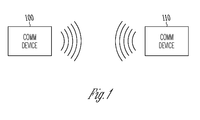
  • FIG. 1 illustrates an interface between two communication devices, according to various embodiments of the present subject matter.
  • FIG. 2 illustrates an example of a communication device of FIG. 1 , according to various embodiments of the present subject matter.
  • FIG. 3 illustrates a flow diagram of a method for managing power consumption in a wireless network, according to various embodiments of the present subject matter.
  • Modern portable wireless communication equipment employs radio communications for various uses, some of which include the transmission of isochronous data such as audio and video data.
  • Such communication utilizes highly reliable data networks capable of low packet and bit error rates. These forms of digital information use low latency delivery to ensure timely rendering of the information.
  • a wireless host device employs techniques such as retransmissions based on an acknowledgement scheme, or relies on unconditional retransmissions for the purpose of lowering packet error rate.
  • the wireless host can be the source of the audio or video information.
  • Other forms of isochronous information such as time sensitive data can also employ such techniques.
  • Portable electronic devices such as headsets, hearing aids, head worn displays and the like employ small batteries with limited capacity. Some hearing assistance devices use very limited capacity batteries. Hearing aids in particular are extremely small and may be worn on the ear, behind the ear or in some cases in the ear.
  • Hearing assistance devices are only one type of hearing assistance device.
  • Other hearing assistance devices include, but are not limited to, those in this document. It is understood that their use in the description is intended to demonstrate the present subject matter, but not in a limited or exclusive or exhaustive sense.
  • portable electronics devices such as hearing aids
  • Chemical batteries have limited capacity for both peak and average current consumption.
  • Zinc air batteries in particular rely on oxygen removed from surrounding air to supply the chemical reaction that generates electricity used to power devices such as hearing aids.
  • peak current is drawn from this type of battery, the battery can become starved of oxygen which lowers the output voltage of the cell. The battery will recover if the peak current load is temporarily removed.
  • wireless radios for packet type communication such as Bluetooth or WiFi, as an example.
  • the radio can be duty cycled.
  • the radio can go into a very low power state, while the data that was transferred can be consumed by the baseband process. It is during these periods of rest that the battery voltage can be restored.
  • the high current state such as when the radio is “on” to receive or transmit a packet, the chemical battery can be temporarily depleted. In the case of a zinc air battery, during this time the battery becomes starved of oxygen.
  • a wireless system can improve its effective packet error rate by resending the packets based on non-acknowledgments from the sink devices or by unconditionally resending of packets.
  • These redundant packets can be sent on different frequencies and or at different times for the purpose of mitigating the adverse effects of interference or multipath fading propagation.
  • Peripheral sink devices with sufficient battery capacity may be able to receive all redundant packets as needed, thus achieving a much higher packet reliability.
  • devices with limited battery capacity can forego listening to all necessary redundant packets, thus experiencing a slightly higher packet error rate when compared with sink devices having higher battery capacities. Devices such as these may have the capacity to receive some but not all of the necessary redundant packets being sent from the source device.
  • Sink devices will normally receive a packet on the first try from a host, however assuming a raw packet error rate 10%, the sink device will only have to listen to 10% of the retransmissions of the source device. This can work for both limited capacity batteries and higher capacity batteries in certain circumstances. But if the packet error rate increases to 50%, batteries with limited capacity may fail if they try and listen to 50% more redundant packets. In various embodiments, the sink devices then have to trade off energy consumption with quality of reception. The present subject matter uses this tradeoff between energy consumption and reception quality.
  • One aspect of the present subject matter includes a method for wireless communications of isochronous data.
  • a transmission of isochronous data is received using an electronic device having a battery.
  • the method determines how many redundant transmissions can be received by the device within a predetermined time frame while limiting discharge of the battery, and adjusts reception of the redundant transmissions based on the determination.
  • the present subject matter allows a wireless device consuming isochronous data to trade off quality of reception with power consumption.
  • the present subject matter employs a sliding window in time to determine how many retransmissions can be received within a time frame while preventing a battery from being overused to the point of failure.
  • the present system and method allows for a gradual degradation in quality of service based on the energy being consumed from a power source such as a battery.
  • a communication device which monitors its energy capacity can limit its ability to listen to redundant packets.
  • the device limits the overall percentage of redundant packets received to 10% over a sliding window of time (e.g. 100 ms, in an embodiment) to prevent the energy starvation of the battery and allow time for the battery to recover.
  • the window can be adjusted both in percentage of allowable retransmission receptions and time interval depending on the capacity and chemistry of the battery.
  • these variables are adjustable and programmable.
  • the variables are set based on device type and/or battery type.
  • this trade off includes allowing a receiver to be given a number of tokens to use redundant receptions each time a primary reception is successful. These tokens are used by the receiver when redundant packets are needed for successful reception. For example, a battery with limited capacity can receive a single token on the successful reception of a packet at the first time slot on which a new isochronous data packet is available. If on the next data frame the first time slot was not successfully received, the receiver can use the token to receive a redundant packet. However, if the receiver does not receive a packet on the next first time slot, it will not be able to wake up and receive the packet on a second time slot, since no tokens remain.
  • Other embodiments in which the receiver is allowed to miss redundant packets for the purpose of trading off data integrity for power consumption are possible without departing from the scope of the present subject matter.
  • FIG. 3 illustrates a flow diagram of a method 300 for managing power consumption in a wireless network, according to various embodiments of the present subject matter.
  • the method starts at 302 and initiates a token count to a programmable maximum number at 304 .
  • the receiver wakes up on a primary time slot. If a packet is successfully received at 308 , the token count is reset to the maximum number at 310 and the receiver sleeps until the primary slot at 312 when it wakes up at 306 . If the packet is not successful received at 308 , the token count is checked to see if greater than zero at 314 , and if not the receiver sleeps until the primary slot at 312 . If the token count is greater than zero at 314 , the token count is decremented at 316 and the receiver wakes up for a redundant packet at 318 , before returning to step 306 .
  • battery voltage level (Vbat) in the device can be used as part of the decision criteria for determining when to reduce redundant packet reception.
  • Coulomb counting can be used as part of the decision criteria for determining when to reduce redundant packet reception.
  • both Vbat level and Coulomb counting can be used.
  • Other battery characteristics that can be used for this purpose include, but are not limited to, battery run time and discharge rate. These battery characteristics provide a packet reduction strategy that is independent of battery size.
  • streaming of wireless communications can be disabled if the PER exceeds a threshold over a sliding time window.
  • benefits include mitigating interference when multiple users are co-located. This effectively increases the number of users that can use the wireless system for hearing assistance devices.
  • Various embodiments of the present subject matter provide feedback to the user to discontinue wireless use if the wireless link is being stressed beyond its designed limit, such as when a cell phone is placed in a pants pocket.
  • consecutive missed packets can be used as a metric to throttle performance.
  • peak current can be used, such that higher peak current drains are possible if the battery permitted a recovery time window, thus minimizing the need for larger bypass capacitors.
  • the present subject matter provides for a communication device that can trade off power consumption with quality of service.
  • the present subject matter produces high quality wireless digital audio at the output of a hearing aid while lowering the power consumption of a battery used in a hearing aid.
  • FIG. 1 illustrates an interface between two communication devices, according to various embodiments of the present subject matter.
  • the depicted wireless interface between a first communication device 100 and a second communication device 110 includes radio frequency communications.
  • Other wireless communication types can be used without departing from the scope of the present disclosure.
  • the communication devices use multiple wireless communication types and protocols.
  • the first and second communication devices are of the same type.
  • the communication devices are of different types.
  • at least one of the communication devices includes a hearing assistance device, such as a hearing aid.
  • the first communication device 100 includes a host device such as an audio or video streaming device
  • the second communication device 110 includes a hearing assistance device. More than two communication devices can be used without departing from the scope of the present disclosure.
  • FIG. 2 illustrates an example of a communication device of FIG. 1 , according to various embodiments of the present subject matter.
  • communication device 210 receives a digital signal using communication port 220 from a source, such as a communication device 100 .
  • the signal is processed by a digital signal processor 230 and can be transmitted via transceiver 240 using antenna 250 .
  • the digital signal is wireless.
  • the digital signal is wired.
  • the digital signal may be transceived bidirectionally, transmitted unidirectionally or received unidirectionally by communication port 220 .
  • the processor 230 is configured to execute instructions to determine how many retransmissions can be received within a time frame while preventing a device battery 260 from being overused to the point of failure.
  • the drawing shows an antenna 250 which is shared for transmit and receive in one embodiment.
  • the antennas can be located on a substrate of the device 210 in various embodiments. In other embodiments, the antenna may be external to the device 210 .
  • Various types of antennas, including omnidirectional and directional antennas may be used.
  • Various types of batteries 260 can be used to power the electronics of the device, in various embodiments.
  • the wireless communications can include standard or nonstandard communications.
  • standard wireless communications include link protocols including, but not limited to, BluetoothTM, IEEE 802.11(wireless LANs), 802.15 (WPANs), 802.16 (WiMAX), cellular protocols including, but not limited to CDMA and GSM, ZigBee, and ultra-wideband (UWB) technologies.
  • Such protocols support radio frequency communications and some support infrared communications.
  • the present system is demonstrated as a radio system, it is possible that other forms of wireless communications can be used such as ultrasonic, optical, and others.
  • the standards which can be used include past and present standards. It is also contemplated that future versions of these standards and new future standards may be employed without departing from the scope of the present subject matter.
  • the wireless communications support a connection from other devices.
  • Such connections include, but are not limited to, one or more mono or stereo connections or digital connections having link protocols including, but not limited to 802.3 (Ethernet), 802.4, 802.5, USB, ATM, Fibre-channel, Firewire or 1394, InfiniBand, or a native streaming interface.
  • link protocols including, but not limited to 802.3 (Ethernet), 802.4, 802.5, USB, ATM, Fibre-channel, Firewire or 1394, InfiniBand, or a native streaming interface.
  • link protocols including, but not limited to 802.3 (Ethernet), 802.4, 802.5, USB, ATM, Fibre-channel, Firewire or 1394, InfiniBand, or a native streaming interface.
  • such connections include all past and present link protocols. It is also contemplated that future versions of these protocols and new future standards may be employed without departing from the scope of the present subject matter.
  • Hearing assistance devices typically include an enclosure or housing, a microphone, hearing assistance device electronics including processing electronics, and a speaker or receiver. It is understood that in various embodiments the microphone is optional. It is understood that in various embodiments the receiver is optional. Antenna configurations may vary and may be included within an enclosure for the electronics or be external to an enclosure for the electronics. Thus, the examples set forth herein are intended to be demonstrative and not a limiting or exhaustive depiction of variations.
  • any hearing assistance device may be used without departing from the scope and the devices depicted in the figures are intended to demonstrate the subject matter, but not in a limited, exhaustive, or exclusive sense. It is also understood that the present subject matter can be used with a device designed for use in the right ear or the left ear or both ears of the user.
  • the hearing aids referenced in this patent application include a processor.
  • the processor may be a digital signal processor (DSP), microprocessor, microcontroller, other digital logic, or combinations thereof.
  • DSP digital signal processor
  • the processing of signals referenced in this application can be performed using the processor. Processing may be done in the digital domain, the analog domain, or combinations thereof. Processing may be done using subband processing techniques. Processing may be done with frequency domain or time domain approaches. Some processing may involve both frequency and time domain aspects. For brevity, in some examples drawings may omit certain blocks that perform frequency synthesis, frequency analysis, analog-to-digital conversion, digital-to-analog conversion, amplification, audio decoding, and certain types of filtering and processing.
  • the processor is adapted to perform instructions stored in memory which may or may not be explicitly shown.
  • Various types of memory may be used, including volatile and nonvolatile forms of memory.
  • instructions are performed by the processor to perform a number of signal processing tasks.
  • analog components are in communication with the processor to perform signal tasks, such as microphone reception, or receiver sound embodiments (i.e., in applications where such transducers are used).
  • signal tasks such as microphone reception, or receiver sound embodiments (i.e., in applications where such transducers are used).
  • different realizations of the block diagrams, circuits, and processes set forth herein may occur without departing from the scope of the present subject matter.
  • hearing assistance devices including hearing aids, including but not limited to, behind-the-ear (BTE), in-the-ear (ITE), in-the-canal (ITC), receiver-in-canal (RIC), invisible-in-canal (IIC) or completely-in-the-canal (CIC) type hearing aids.
  • BTE behind-the-ear
  • ITE in-the-ear
  • ITC in-the-canal
  • RIC receiver-in-canal
  • IIC invisible-in-canal
  • CIC completely-in-the-canal
  • hearing assistance devices including but not limited to, behind-the-ear (BTE), in-the-ear (ITE), in-the-canal (ITC), receiver-in-canal (RIC), invisible-in-canal (IIC) or completely-in-the-canal (CIC) type hearing aids.
  • BTE behind-the-ear
  • ITE in-the-ear
  • ITC in-the-canal
  • RIC receiver-in-canal
  • the present subject matter can also be used in hearing assistance devices generally, such as cochlear implant type hearing devices and such as deep insertion devices having a transducer, such as a receiver or microphone, whether custom fitted, standard, open fitted or occlusive fitted. It is understood that other hearing assistance devices not expressly stated herein may be used in conjunction with the present subject matter.

Landscapes

  • Engineering & Computer Science (AREA)
  • Signal Processing (AREA)
  • Computer Networks & Wireless Communication (AREA)
  • Health & Medical Sciences (AREA)
  • General Health & Medical Sciences (AREA)
  • Otolaryngology (AREA)
  • Neurosurgery (AREA)
  • Physics & Mathematics (AREA)
  • Acoustics & Sound (AREA)
  • Mobile Radio Communication Systems (AREA)
  • Circuit For Audible Band Transducer (AREA)

Abstract

Disclosed herein, among other things, are systems and methods for managing power consumption in a wireless network. One aspect of the present subject matter includes a method for wireless communications of isochronous data. A transmission of isochronous data is received using an electronic device having a battery. The method determines how many redundant transmissions can be received by the device within a predetermined time frame while limiting discharge of the battery, and adjusts reception of the redundant transmissions based on the determination. In various embodiments, a reduction in received redundant transmissions preserves energy and prevents complete discharge of the battery.

Description

CLAIM OF PRIORITY AND INCORPORATION BY REFERENCE
The present application claims the benefit under 35 U.S.C. §119(e) of U.S. Provisional Patent Application 61/931,294, filed Jan. 24, 2014, the disclosure of which is hereby incorporated by reference herein in its entirety.
TECHNICAL FIELD
This document relates generally to wireless communication and more particularly to systems and methods for managing power consumption in a wireless network.
BACKGROUND
Mobile communication devices include a battery to provide power for internal wireless communication electronics, such as processors, transceivers and antennae. Typical mobile device batteries, such as zinc air batteries, have limited capacity both for peak and average current consumption. Various battery chemistries can be starved of energy during peak consumption periods, but can recover during rest periods.
Accordingly, there is a need in the art for improved systems and methods to prevent batteries from overuse during wireless communication.
SUMMARY
Disclosed herein, among other things, are systems and methods for managing power consumption in a wireless network. One aspect of the present subject matter includes a method for wireless communications of isochronous data. A transmission of isochronous data is received using an electronic device having a battery. The method determines how many redundant transmissions can be received by the device within a predetermined time frame while limiting discharge of the battery, and adjusts reception of the redundant transmissions based on the determination. In various embodiments, a reduction in received redundant transmissions preserves energy and prevents complete discharge of the battery.
This Summary is an overview of some of the teachings of the present application and not intended to be an exclusive or exhaustive treatment of the present subject matter. Further details about the present subject matter are found in the detailed description and appended claims. The scope of the present invention is defined by the appended claims and their legal equivalents.
BRIEF DESCRIPTION OF THE DRAWINGS
FIG. 1 illustrates an interface between two communication devices, according to various embodiments of the present subject matter.
FIG. 2 illustrates an example of a communication device of FIG. 1, according to various embodiments of the present subject matter.
FIG. 3 illustrates a flow diagram of a method for managing power consumption in a wireless network, according to various embodiments of the present subject matter.
DETAILED DESCRIPTION
The following detailed description of the present subject matter refers to subject matter in the accompanying drawings which show, by way of illustration, specific aspects and embodiments in which the present subject matter may be practiced. These embodiments are described in sufficient detail to enable those skilled in the art to practice the present subject matter. References to “an”, “one”, or “various” embodiments in this disclosure are not necessarily to the same embodiment, and such references contemplate more than one embodiment. The following detailed description is demonstrative and not to be taken in a limiting sense. The scope of the present subject matter is defined by the appended claims, along with the full scope of legal equivalents to which such claims are entitled.
Modern portable wireless communication equipment employs radio communications for various uses, some of which include the transmission of isochronous data such as audio and video data. Such communication utilizes highly reliable data networks capable of low packet and bit error rates. These forms of digital information use low latency delivery to ensure timely rendering of the information. To ensure high quality delivery of wireless data, a wireless host device employs techniques such as retransmissions based on an acknowledgement scheme, or relies on unconditional retransmissions for the purpose of lowering packet error rate. The wireless host can be the source of the audio or video information. Other forms of isochronous information such as time sensitive data can also employ such techniques.
Portable electronic devices such as headsets, hearing aids, head worn displays and the like employ small batteries with limited capacity. Some hearing assistance devices use very limited capacity batteries. Hearing aids in particular are extremely small and may be worn on the ear, behind the ear or in some cases in the ear.
The present detailed description will discuss hearing assistance devices using the example of hearing aids. Hearing aids are only one type of hearing assistance device. Other hearing assistance devices include, but are not limited to, those in this document. It is understood that their use in the description is intended to demonstrate the present subject matter, but not in a limited or exclusive or exhaustive sense.
In various embodiments, portable electronics devices (such as hearing aids) employ both rechargeable and non-rechargeable battery types. Chemical batteries have limited capacity for both peak and average current consumption. Zinc air batteries in particular rely on oxygen removed from surrounding air to supply the chemical reaction that generates electricity used to power devices such as hearing aids. When peak current is drawn from this type of battery, the battery can become starved of oxygen which lowers the output voltage of the cell. The battery will recover if the peak current load is temporarily removed. This is the case when using wireless radios for packet type communication such as Bluetooth or WiFi, as an example. When the data rate over the air data is higher than the baseband consumption of data, the radio can be duty cycled. During “on” times of the radio, large amounts of data can be transferred over the air from a source device to a sync device. During “off” times, the radio can go into a very low power state, while the data that was transferred can be consumed by the baseband process. It is during these periods of rest that the battery voltage can be restored. During the high current state, such as when the radio is “on” to receive or transmit a packet, the chemical battery can be temporarily depleted. In the case of a zinc air battery, during this time the battery becomes starved of oxygen.
A wireless system can improve its effective packet error rate by resending the packets based on non-acknowledgments from the sink devices or by unconditionally resending of packets. These redundant packets can be sent on different frequencies and or at different times for the purpose of mitigating the adverse effects of interference or multipath fading propagation. Peripheral sink devices with sufficient battery capacity may be able to receive all redundant packets as needed, thus achieving a much higher packet reliability. According to various embodiments, devices with limited battery capacity can forego listening to all necessary redundant packets, thus experiencing a slightly higher packet error rate when compared with sink devices having higher battery capacities. Devices such as these may have the capacity to receive some but not all of the necessary redundant packets being sent from the source device.
Sink devices will normally receive a packet on the first try from a host, however assuming a raw packet error rate 10%, the sink device will only have to listen to 10% of the retransmissions of the source device. This can work for both limited capacity batteries and higher capacity batteries in certain circumstances. But if the packet error rate increases to 50%, batteries with limited capacity may fail if they try and listen to 50% more redundant packets. In various embodiments, the sink devices then have to trade off energy consumption with quality of reception. The present subject matter uses this tradeoff between energy consumption and reception quality.
Disclosed herein, among other things, are systems and methods for managing power consumption in a wireless network. One aspect of the present subject matter includes a method for wireless communications of isochronous data. A transmission of isochronous data is received using an electronic device having a battery. The method determines how many redundant transmissions can be received by the device within a predetermined time frame while limiting discharge of the battery, and adjusts reception of the redundant transmissions based on the determination. Thus, the present subject matter allows a wireless device consuming isochronous data to trade off quality of reception with power consumption.
In various embodiments, the present subject matter employs a sliding window in time to determine how many retransmissions can be received within a time frame while preventing a battery from being overused to the point of failure. Thus, the present system and method allows for a gradual degradation in quality of service based on the energy being consumed from a power source such as a battery.
According to various embodiments, a communication device which monitors its energy capacity can limit its ability to listen to redundant packets. In one embodiment, the device limits the overall percentage of redundant packets received to 10% over a sliding window of time (e.g. 100 ms, in an embodiment) to prevent the energy starvation of the battery and allow time for the battery to recover. In various embodiments, the window can be adjusted both in percentage of allowable retransmission receptions and time interval depending on the capacity and chemistry of the battery. In various embodiments, these variables are adjustable and programmable. In various embodiments, the variables are set based on device type and/or battery type.
Various embodiments provide a method that trades off power consumption with improved effective packet error rate (PER). In one embodiment, this trade off includes allowing a receiver to be given a number of tokens to use redundant receptions each time a primary reception is successful. These tokens are used by the receiver when redundant packets are needed for successful reception. For example, a battery with limited capacity can receive a single token on the successful reception of a packet at the first time slot on which a new isochronous data packet is available. If on the next data frame the first time slot was not successfully received, the receiver can use the token to receive a redundant packet. However, if the receiver does not receive a packet on the next first time slot, it will not be able to wake up and receive the packet on a second time slot, since no tokens remain. Other embodiments in which the receiver is allowed to miss redundant packets for the purpose of trading off data integrity for power consumption are possible without departing from the scope of the present subject matter.
FIG. 3 illustrates a flow diagram of a method 300 for managing power consumption in a wireless network, according to various embodiments of the present subject matter. The method starts at 302 and initiates a token count to a programmable maximum number at 304. At 306, the receiver wakes up on a primary time slot. If a packet is successfully received at 308, the token count is reset to the maximum number at 310 and the receiver sleeps until the primary slot at 312 when it wakes up at 306. If the packet is not successful received at 308, the token count is checked to see if greater than zero at 314, and if not the receiver sleeps until the primary slot at 312. If the token count is greater than zero at 314, the token count is decremented at 316 and the receiver wakes up for a redundant packet at 318, before returning to step 306.
In various embodiments using a hearing assistance device, battery voltage level (Vbat) in the device can be used as part of the decision criteria for determining when to reduce redundant packet reception. In further embodiments, Coulomb counting can be used as part of the decision criteria for determining when to reduce redundant packet reception. In various embodiments, both Vbat level and Coulomb counting can be used. Other battery characteristics that can be used for this purpose include, but are not limited to, battery run time and discharge rate. These battery characteristics provide a packet reduction strategy that is independent of battery size.
In one embodiment, streaming of wireless communications can be disabled if the PER exceeds a threshold over a sliding time window. Besides managing power, benefits include mitigating interference when multiple users are co-located. This effectively increases the number of users that can use the wireless system for hearing assistance devices. Various embodiments of the present subject matter provide feedback to the user to discontinue wireless use if the wireless link is being stressed beyond its designed limit, such as when a cell phone is placed in a pants pocket. In various embodiments, consecutive missed packets can be used as a metric to throttle performance. In further embodiments, peak current can be used, such that higher peak current drains are possible if the battery permitted a recovery time window, thus minimizing the need for larger bypass capacitors.
The present subject matter provides for a communication device that can trade off power consumption with quality of service. In one embodiment, the present subject matter produces high quality wireless digital audio at the output of a hearing aid while lowering the power consumption of a battery used in a hearing aid.
FIG. 1 illustrates an interface between two communication devices, according to various embodiments of the present subject matter. In various embodiments, the depicted wireless interface between a first communication device 100 and a second communication device 110 includes radio frequency communications. Other wireless communication types can be used without departing from the scope of the present disclosure. In various embodiments, the communication devices use multiple wireless communication types and protocols. In one embodiment, the first and second communication devices are of the same type. In another embodiment, the communication devices are of different types. In various embodiments, at least one of the communication devices includes a hearing assistance device, such as a hearing aid. In one embodiment, the first communication device 100 includes a host device such as an audio or video streaming device, and the second communication device 110 includes a hearing assistance device. More than two communication devices can be used without departing from the scope of the present disclosure.
FIG. 2 illustrates an example of a communication device of FIG. 1, according to various embodiments of the present subject matter. In the depicted embodiment, communication device 210 receives a digital signal using communication port 220 from a source, such as a communication device 100. The signal is processed by a digital signal processor 230 and can be transmitted via transceiver 240 using antenna 250. In one embodiment, the digital signal is wireless. In one embodiment, the digital signal is wired. The digital signal may be transceived bidirectionally, transmitted unidirectionally or received unidirectionally by communication port 220. In various embodiments, the processor 230 is configured to execute instructions to determine how many retransmissions can be received within a time frame while preventing a device battery 260 from being overused to the point of failure.
The drawing shows an antenna 250 which is shared for transmit and receive in one embodiment. Various embodiments may incorporate separate receive and transmit sections and antennas without departing from the scope of the present subject matter. Furthermore, the antennas can be located on a substrate of the device 210 in various embodiments. In other embodiments, the antenna may be external to the device 210. Various types of antennas, including omnidirectional and directional antennas may be used. Various types of batteries 260 can be used to power the electronics of the device, in various embodiments.
Various embodiments of the present subject matter support wireless communications with a hearing assistance device. In various embodiments the wireless communications can include standard or nonstandard communications. Some examples of standard wireless communications include link protocols including, but not limited to, Bluetooth™, IEEE 802.11(wireless LANs), 802.15 (WPANs), 802.16 (WiMAX), cellular protocols including, but not limited to CDMA and GSM, ZigBee, and ultra-wideband (UWB) technologies. Such protocols support radio frequency communications and some support infrared communications. Although the present system is demonstrated as a radio system, it is possible that other forms of wireless communications can be used such as ultrasonic, optical, and others. It is understood that the standards which can be used include past and present standards. It is also contemplated that future versions of these standards and new future standards may be employed without departing from the scope of the present subject matter.
The wireless communications support a connection from other devices. Such connections include, but are not limited to, one or more mono or stereo connections or digital connections having link protocols including, but not limited to 802.3 (Ethernet), 802.4, 802.5, USB, ATM, Fibre-channel, Firewire or 1394, InfiniBand, or a native streaming interface. In various embodiments, such connections include all past and present link protocols. It is also contemplated that future versions of these protocols and new future standards may be employed without departing from the scope of the present subject matter.
It is understood that variations in combinations of components may be employed without departing from the scope of the present subject matter. Hearing assistance devices typically include an enclosure or housing, a microphone, hearing assistance device electronics including processing electronics, and a speaker or receiver. It is understood that in various embodiments the microphone is optional. It is understood that in various embodiments the receiver is optional. Antenna configurations may vary and may be included within an enclosure for the electronics or be external to an enclosure for the electronics. Thus, the examples set forth herein are intended to be demonstrative and not a limiting or exhaustive depiction of variations.
It is further understood that any hearing assistance device may be used without departing from the scope and the devices depicted in the figures are intended to demonstrate the subject matter, but not in a limited, exhaustive, or exclusive sense. It is also understood that the present subject matter can be used with a device designed for use in the right ear or the left ear or both ears of the user.
It is understood that the hearing aids referenced in this patent application include a processor. The processor may be a digital signal processor (DSP), microprocessor, microcontroller, other digital logic, or combinations thereof. The processing of signals referenced in this application can be performed using the processor. Processing may be done in the digital domain, the analog domain, or combinations thereof. Processing may be done using subband processing techniques. Processing may be done with frequency domain or time domain approaches. Some processing may involve both frequency and time domain aspects. For brevity, in some examples drawings may omit certain blocks that perform frequency synthesis, frequency analysis, analog-to-digital conversion, digital-to-analog conversion, amplification, audio decoding, and certain types of filtering and processing. In various embodiments the processor is adapted to perform instructions stored in memory which may or may not be explicitly shown. Various types of memory may be used, including volatile and nonvolatile forms of memory. In various embodiments, instructions are performed by the processor to perform a number of signal processing tasks. In such embodiments, analog components are in communication with the processor to perform signal tasks, such as microphone reception, or receiver sound embodiments (i.e., in applications where such transducers are used). In various embodiments, different realizations of the block diagrams, circuits, and processes set forth herein may occur without departing from the scope of the present subject matter.
The present subject matter is demonstrated for hearing assistance devices, including hearing aids, including but not limited to, behind-the-ear (BTE), in-the-ear (ITE), in-the-canal (ITC), receiver-in-canal (RIC), invisible-in-canal (IIC) or completely-in-the-canal (CIC) type hearing aids. It is understood that behind-the-ear type hearing aids may include devices that reside substantially behind the ear or over the ear. Such devices may include hearing aids with receivers associated with the electronics portion of the behind-the-ear device, or hearing aids of the type having receivers in the ear canal of the user, including but not limited to receiver-in-canal (RIC) or receiver-in-the-ear (RITE) designs. The present subject matter can also be used in hearing assistance devices generally, such as cochlear implant type hearing devices and such as deep insertion devices having a transducer, such as a receiver or microphone, whether custom fitted, standard, open fitted or occlusive fitted. It is understood that other hearing assistance devices not expressly stated herein may be used in conjunction with the present subject matter.
This application is intended to cover adaptations or variations of the present subject matter. It is to be understood that the above description is intended to be illustrative, and not restrictive. The scope of the present subject matter should be determined with reference to the appended claims, along with the full scope of legal equivalents to which such claims are entitled.

Claims (19)

What is claimed is:
1. A method for wireless communications of isochronous data, comprising:
receiving a transmission of isochronous data using an electronic device having a battery and a receiver;
determining a data rate that can be accommodated by the electronic device using a number of redundant transmissions received by the device within a predetermined time frame to limit discharge of the battery, wherein the data rate and the time frame are adjustable and depends on the capacity and chemistry of the battery; and
adjusting the receiver to the determined data rate.
2. The method of claim 1, wherein using an electronic device includes using a hearing aid.
3. The method of claim 1, wherein adjusting reception of the redundant transmissions includes decreasing an amount of time that a radio circuit of the electronic device is operational.
4. The method of claim 1, wherein the predetermined time frame is approximately 100 ms.
5. The method of claim 4, wherein adjusting reception of the redundant transmissions includes limiting an overall percentage of redundant packets received to 10% over the predetermined time frame.
6. The method of claim 1, wherein adjusting reception includes adjusting percentage of allowable retransmission receptions and adjusting the predetermined time interval depending on capacity and chemistry of the battery.
7. The method of claim 1, wherein determining how many redundant transmissions can be received by the device within a predetermined time frame includes using tokens to permit reception of redundant transmissions.
8. The method of claim 1, wherein determining how many redundant transmissions can be received by the device within a predetermined time frame includes using battery voltage level.
9. The method of claim 1, wherein determining how many redundant transmissions can be received by the device within a predetermined time frame includes using Coulomb counting.
10. The method of claim 1, wherein determining how many redundant transmissions can be received by the device within a predetermined time frame includes determining whether a packet error rate (PER) exceeds a threshold over the predetermined time frame.
11. The method of claim 1, wherein determining how many redundant transmissions can be received by the device within a predetermined time frame includes determining consecutive missed packets over the predetermined time frame.
12. A wireless communication device, comprising:
a battery;
a communication port configured to receive a wireless signal; and
a processor connected to the battery and the communication port, the processor configured to execute instructions to determine a data rate that can be accommodated by the communication device using a number of redundant transmissions received by the device within a predetermined time frame to limit discharge of the battery; and adjust the communication port to the determined data rate, wherein the data rate and the time frame are adjustable and depends on the capacity and chemistry of the battery.
13. The device of claim 12, wherein the wireless communication device includes a hearing aid.
14. The device of claim 13, wherein the hearing aid includes an in-the-ear (ITE) hearing aid.
15. The device of claim 13, wherein the hearing aid includes a behind-the-ear (BTE) hearing aid.
16. The device of claim 13, wherein the hearing aid includes an in-the-canal (ITC) hearing aid.
17. The device of claim 13, wherein the hearing aid includes a receiver-in-canal (RIC) hearing aid.
18. The device of claim 13, wherein the hearing aid includes a completely-in-the-canal (CIC) hearing aid.
19. The device of claim 13, wherein the hearing aid includes a receiver-in-the-ear (RITE) hearing aid.
US14/321,346 2014-01-24 2014-07-01 Systems and methods for managing power consumption in a wireless network Active 2034-09-26 US9510283B2 (en)

Priority Applications (4)

Application Number Priority Date Filing Date Title
US14/321,346 US9510283B2 (en) 2014-01-24 2014-07-01 Systems and methods for managing power consumption in a wireless network
EP15152244.8A EP2900018B1 (en) 2014-01-24 2015-01-23 Systems and methods for managing power consumption in a wireless network
DK15152244.8T DK2900018T3 (en) 2014-01-24 2015-01-23 Systems and approaches for managing energy consumption in a wireless network
US15/362,463 US9900839B2 (en) 2014-01-24 2016-11-28 Method and device for using token count for managing power consumption in a wireless network

Applications Claiming Priority (2)

Application Number Priority Date Filing Date Title
US201461931294P 2014-01-24 2014-01-24
US14/321,346 US9510283B2 (en) 2014-01-24 2014-07-01 Systems and methods for managing power consumption in a wireless network

Related Child Applications (1)

Application Number Title Priority Date Filing Date
US15/362,463 Continuation US9900839B2 (en) 2014-01-24 2016-11-28 Method and device for using token count for managing power consumption in a wireless network

Publications (2)

Publication Number Publication Date
US20150215865A1 US20150215865A1 (en) 2015-07-30
US9510283B2 true US9510283B2 (en) 2016-11-29

Family

ID=52444120

Family Applications (2)

Application Number Title Priority Date Filing Date
US14/321,346 Active 2034-09-26 US9510283B2 (en) 2014-01-24 2014-07-01 Systems and methods for managing power consumption in a wireless network
US15/362,463 Active US9900839B2 (en) 2014-01-24 2016-11-28 Method and device for using token count for managing power consumption in a wireless network

Family Applications After (1)

Application Number Title Priority Date Filing Date
US15/362,463 Active US9900839B2 (en) 2014-01-24 2016-11-28 Method and device for using token count for managing power consumption in a wireless network

Country Status (3)

Country Link
US (2) US9510283B2 (en)
EP (1) EP2900018B1 (en)
DK (1) DK2900018T3 (en)

Cited By (1)

* Cited by examiner, † Cited by third party
Publication number Priority date Publication date Assignee Title
US9900839B2 (en) 2014-01-24 2018-02-20 Starkey Laboratories, Inc. Method and device for using token count for managing power consumption in a wireless network

Families Citing this family (3)

* Cited by examiner, † Cited by third party
Publication number Priority date Publication date Assignee Title
CA2897054A1 (en) 2013-01-11 2014-07-17 Zpower, Llc Methods and systems for recharging a battery
WO2016176236A1 (en) * 2015-04-29 2016-11-03 Zpower, Llc Temperature dependent charge algorithm
CN112880708A (en) * 2021-03-04 2021-06-01 杭州时域电子科技有限公司 Parameter configuration method of micro-power consumption wireless sensor powered by battery

Citations (16)

* Cited by examiner, † Cited by third party
Publication number Priority date Publication date Assignee Title
US5885906A (en) 1996-08-19 1999-03-23 Hughes Electronics Low PIM reflector material
US20040009728A1 (en) 2000-08-28 2004-01-15 Kenji Kubomura Composite material, formed product and prepreg
US20040113863A1 (en) 2002-12-16 2004-06-17 Stonier Roger A. Microwave frequency antenna reflector
US20050089043A1 (en) * 2003-08-21 2005-04-28 Vidiator Enterprises Inc. Quality of experience (QOE) method and apparatus for wireless communication networks
US20080049746A1 (en) * 2006-08-22 2008-02-28 Morrill Robert J System and method for routing data on a packet network
US7636298B2 (en) * 2003-11-20 2009-12-22 Fujitsu Limited Apparatus and method for packet error correction
US20100054512A1 (en) * 2008-09-03 2010-03-04 Starkey Laboratories, Inc. Systems and methods for managing wireless communication links for hearing assistance devices
US20100202642A1 (en) * 2009-01-12 2010-08-12 Starkey Laboratories, Inc. Method to estimate the sound pressure level at eardrum using measurements away from the eardrum
WO2011131241A1 (en) 2010-04-22 2011-10-27 Phonak Ag Hearing assistance system and method
US20120093324A1 (en) 2010-10-12 2012-04-19 Gn Resound A/S Hearing Aid with an Antenna
US8175023B2 (en) * 2007-01-25 2012-05-08 Hitachi, Ltd. Radiocommunication system and multicast data distribution method in the radiocommunication system
US8195936B2 (en) * 2007-11-08 2012-06-05 Samsung Electronics Co., Ltd Method for transmitting and receiving data of a terminal in a communication system and communication terminal thereof
US20120310395A1 (en) 2010-02-12 2012-12-06 Phonak Ag Wireless sound transmission system and method using improved frequency hopping and power saving mode
US20130173946A1 (en) * 2011-12-29 2013-07-04 Efraim Rotem Controlling power consumption through multiple power limits over multiple time intervals
US9065749B2 (en) * 2011-11-21 2015-06-23 Qualcomm Incorporated Hybrid networking path selection and load balancing
US9131452B2 (en) * 2013-10-25 2015-09-08 Motorola Solutions, Inc. Method and apparatus for adjusting transmission power in a two-way device based on battery impedance

Family Cites Families (2)

* Cited by examiner, † Cited by third party
Publication number Priority date Publication date Assignee Title
US8775838B2 (en) * 2012-02-01 2014-07-08 Texas Instruments Incorporated Limiting the number of unexpected wakeups in a computer system implementing a power-saving preemptive wakeup method from historical data
US9510283B2 (en) 2014-01-24 2016-11-29 Starkey Laboratories, Inc. Systems and methods for managing power consumption in a wireless network

Patent Citations (16)

* Cited by examiner, † Cited by third party
Publication number Priority date Publication date Assignee Title
US5885906A (en) 1996-08-19 1999-03-23 Hughes Electronics Low PIM reflector material
US20040009728A1 (en) 2000-08-28 2004-01-15 Kenji Kubomura Composite material, formed product and prepreg
US20040113863A1 (en) 2002-12-16 2004-06-17 Stonier Roger A. Microwave frequency antenna reflector
US20050089043A1 (en) * 2003-08-21 2005-04-28 Vidiator Enterprises Inc. Quality of experience (QOE) method and apparatus for wireless communication networks
US7636298B2 (en) * 2003-11-20 2009-12-22 Fujitsu Limited Apparatus and method for packet error correction
US20080049746A1 (en) * 2006-08-22 2008-02-28 Morrill Robert J System and method for routing data on a packet network
US8175023B2 (en) * 2007-01-25 2012-05-08 Hitachi, Ltd. Radiocommunication system and multicast data distribution method in the radiocommunication system
US8195936B2 (en) * 2007-11-08 2012-06-05 Samsung Electronics Co., Ltd Method for transmitting and receiving data of a terminal in a communication system and communication terminal thereof
US20100054512A1 (en) * 2008-09-03 2010-03-04 Starkey Laboratories, Inc. Systems and methods for managing wireless communication links for hearing assistance devices
US20100202642A1 (en) * 2009-01-12 2010-08-12 Starkey Laboratories, Inc. Method to estimate the sound pressure level at eardrum using measurements away from the eardrum
US20120310395A1 (en) 2010-02-12 2012-12-06 Phonak Ag Wireless sound transmission system and method using improved frequency hopping and power saving mode
WO2011131241A1 (en) 2010-04-22 2011-10-27 Phonak Ag Hearing assistance system and method
US20120093324A1 (en) 2010-10-12 2012-04-19 Gn Resound A/S Hearing Aid with an Antenna
US9065749B2 (en) * 2011-11-21 2015-06-23 Qualcomm Incorporated Hybrid networking path selection and load balancing
US20130173946A1 (en) * 2011-12-29 2013-07-04 Efraim Rotem Controlling power consumption through multiple power limits over multiple time intervals
US9131452B2 (en) * 2013-10-25 2015-09-08 Motorola Solutions, Inc. Method and apparatus for adjusting transmission power in a two-way device based on battery impedance

Non-Patent Citations (3)

* Cited by examiner, † Cited by third party
Title
"European Application Serial No. 15152244.8, Extended European Search Report mailed Jun. 23, 2015", 7 pgs.
"European Application Serial No. 15152244.8, Office Action mailed Aug. 3, 2015", 2 pgs.
"European Application Serial No. 15152244.8, Response filed Jan. 29, 2016 to Extended European Search Report mailed Jun. 23, 2015", 12 pgs.

Cited By (1)

* Cited by examiner, † Cited by third party
Publication number Priority date Publication date Assignee Title
US9900839B2 (en) 2014-01-24 2018-02-20 Starkey Laboratories, Inc. Method and device for using token count for managing power consumption in a wireless network

Also Published As

Publication number Publication date
EP2900018B1 (en) 2018-10-17
US20170171816A1 (en) 2017-06-15
US9900839B2 (en) 2018-02-20
US20150215865A1 (en) 2015-07-30
DK2900018T3 (en) 2018-11-19
EP2900018A1 (en) 2015-07-29

Similar Documents

Publication Publication Date Title
US10484804B2 (en) Hearing assistance device ear-to-ear communication using an intermediate device
EP3313096B1 (en) Hearing device with bowtie antenna optimized for specific band
US9900839B2 (en) Method and device for using token count for managing power consumption in a wireless network
US20240107241A1 (en) Method for ensuring symmetric audio quality for hands-free phoning
US9113276B2 (en) Automatic reconfiguration of a hearing assistance device based on battery characteristics
US9774961B2 (en) Hearing assistance device ear-to-ear communication using an intermediate device
AU2009245803A1 (en) A short range, uni-directional wireless link
US11083031B1 (en) Bluetooth audio exchange with transmission diversity
EP3849215B1 (en) Dual wireless audio streams transmission allowing for spatial diversity or own voice pickup (ovpu)
US10951998B2 (en) Antenna with flared cross-feed in a hearing assistance device
CN115190402B (en) A hearing aid system
US11006226B2 (en) Binaural hearing aid system and a method of operating a binaural hearing aid system
EP3890356A1 (en) Bluetooth audio exchange with transmission diversity
US20240414486A1 (en) Conversation bridge for ear-wearable devices
US12335688B2 (en) Artifact detection and logging for tuning of feedback canceller
US12262181B2 (en) Apparatus and method for reverberation mitigation in a hearing device

Legal Events

Date Code Title Description
AS Assignment

Owner name: STARKEY LABORATORIES, INC., MINNESOTA

Free format text: ASSIGNMENT OF ASSIGNORS INTEREST;ASSIGNOR:SOLUM, JEFFREY PAUL;REEL/FRAME:036114/0655

Effective date: 20150120

FEPP Fee payment procedure

Free format text: PAYOR NUMBER ASSIGNED (ORIGINAL EVENT CODE: ASPN); ENTITY STATUS OF PATENT OWNER: LARGE ENTITY

STCF Information on status: patent grant

Free format text: PATENTED CASE

AS Assignment

Owner name: CITIBANK, N.A., AS ADMINISTRATIVE AGENT, TEXAS

Free format text: NOTICE OF GRANT OF SECURITY INTEREST IN PATENTS;ASSIGNOR:STARKEY LABORATORIES, INC.;REEL/FRAME:046944/0689

Effective date: 20180824

MAFP Maintenance fee payment

Free format text: PAYMENT OF MAINTENANCE FEE, 4TH YEAR, LARGE ENTITY (ORIGINAL EVENT CODE: M1551); ENTITY STATUS OF PATENT OWNER: LARGE ENTITY

Year of fee payment: 4

MAFP Maintenance fee payment

Free format text: PAYMENT OF MAINTENANCE FEE, 8TH YEAR, LARGE ENTITY (ORIGINAL EVENT CODE: M1552); ENTITY STATUS OF PATENT OWNER: LARGE ENTITY

Year of fee payment: 8