US9416153B2 - Fluorescent dyes - Google Patents
Fluorescent dyes Download PDFInfo
- Publication number
- US9416153B2 US9416153B2 US13/270,456 US201113270456A US9416153B2 US 9416153 B2 US9416153 B2 US 9416153B2 US 201113270456 A US201113270456 A US 201113270456A US 9416153 B2 US9416153 B2 US 9416153B2
- Authority
- US
- United States
- Prior art keywords
- group
- alkyl
- aryl
- combination
- substituted
- Prior art date
- Legal status (The legal status is an assumption and is not a legal conclusion. Google has not performed a legal analysis and makes no representation as to the accuracy of the status listed.)
- Active, expires
Links
- 0 *C1=C([10*])C2=C(C3=C([4*])C([3*])=C(*BC)C([1*])=C3[2*])C3=C([5*])C([6*])=C(C)C([7*])=C3OC2=C([8*])C1=[Y] Chemical compound *C1=C([10*])C2=C(C3=C([4*])C([3*])=C(*BC)C([1*])=C3[2*])C3=C([5*])C([6*])=C(C)C([7*])=C3OC2=C([8*])C1=[Y] 0.000 description 12
- PARXJEOQLSAIBV-UHFFFAOYSA-N C=C1CCC(=O)N1OC(=O)CCCCOC.COCC(=O)ON1C(=O)CCC1=O Chemical compound C=C1CCC(=O)N1OC(=O)CCCCOC.COCC(=O)ON1C(=O)CCC1=O PARXJEOQLSAIBV-UHFFFAOYSA-N 0.000 description 2
- WKGYACIFMPYXPB-UHFFFAOYSA-N C=C1CCC(=O)N1OC(=O)COC Chemical compound C=C1CCC(=O)N1OC(=O)COC WKGYACIFMPYXPB-UHFFFAOYSA-N 0.000 description 2
- AIMDTMDHXJLBKP-PDYXSHJOSA-N C.C.CC/N=C1/C=C2OC3=C(C=C(C)C(NCC)=C3)C(C3=CC=C(OCCCCC(=O)ON4C(=O)CCC4=O)C=C3)=C2C=C1C.CN(C)C1=CC2=C(C=C1)C(C1=CC=C(OCCCCC(=O)ON3C(=O)CCC3=O)C=C1)=C1C=CC(=N(C)C)C=C1O2.O=C(CCCCOC1=CC=C(C2=C3C=C4CCCN5=C4C(=C3OC3=C2C=C2CCCN4CCCC3=C24)CCC5)C=C1)ON1C(=O)CCC1=O.O=C1C=CC2=C(C3=CC=C(OCCCCC(=O)ON4C(=O)CCC4=O)C=C3)C3=C(C=C(O)C=C3)OC2=C1 Chemical compound C.C.CC/N=C1/C=C2OC3=C(C=C(C)C(NCC)=C3)C(C3=CC=C(OCCCCC(=O)ON4C(=O)CCC4=O)C=C3)=C2C=C1C.CN(C)C1=CC2=C(C=C1)C(C1=CC=C(OCCCCC(=O)ON3C(=O)CCC3=O)C=C1)=C1C=CC(=N(C)C)C=C1O2.O=C(CCCCOC1=CC=C(C2=C3C=C4CCCN5=C4C(=C3OC3=C2C=C2CCCN4CCCC3=C24)CCC5)C=C1)ON1C(=O)CCC1=O.O=C1C=CC2=C(C3=CC=C(OCCCCC(=O)ON4C(=O)CCC4=O)C=C3)C3=C(C=C(O)C=C3)OC2=C1 AIMDTMDHXJLBKP-PDYXSHJOSA-N 0.000 description 1
- MMBMYFWKRWXEHK-UHFFFAOYSA-N C.CCN1C2=C(C=C3C(=C2)OC2=CC4=N(CC)C(C)(C)C=C(C)C4=CC2=C3C2=CC=C(OCCCCC(=O)ON3C(=O)CCC3=O)C=C2)C(C)=CC1(C)C.CCN1CCCC2=CC3=C(C=C21)OC1=CC2=N(CC)CCCC2=CC1=C3C1=CC=C(OCCCCC(=O)ON2C(=O)CCC2=O)C=C1.CN(C)C1=CC2=C(C=C1)C(C1=CC=C(OCC(=O)ON3C(=O)CCC3=O)C=C1)=C1C=CC(=N(C)C)C=C1O2.O=C(COC1=CC=C(C2=C3C=C4CCCN5=C4C(=C3OC3=C2C=C2CCCN4CCCC3=C24)CCC5)C=C1)ON1C(=O)CCC1=O Chemical compound C.CCN1C2=C(C=C3C(=C2)OC2=CC4=N(CC)C(C)(C)C=C(C)C4=CC2=C3C2=CC=C(OCCCCC(=O)ON3C(=O)CCC3=O)C=C2)C(C)=CC1(C)C.CCN1CCCC2=CC3=C(C=C21)OC1=CC2=N(CC)CCCC2=CC1=C3C1=CC=C(OCCCCC(=O)ON2C(=O)CCC2=O)C=C1.CN(C)C1=CC2=C(C=C1)C(C1=CC=C(OCC(=O)ON3C(=O)CCC3=O)C=C1)=C1C=CC(=N(C)C)C=C1O2.O=C(COC1=CC=C(C2=C3C=C4CCCN5=C4C(=C3OC3=C2C=C2CCCN4CCCC3=C24)CCC5)C=C1)ON1C(=O)CCC1=O MMBMYFWKRWXEHK-UHFFFAOYSA-N 0.000 description 1
- JXRIJQJODHHRKP-XTZQLIKNSA-N C=C1CCC(=O)N1OC(=O)COC1=CC=C(C2=C3C=C4CCCN(CC)=C4C=C3OC3=C2C=C2CCCN(CC)C2=C3)C=C1.C=C1CCC(=O)N1OC(=O)COC1=CC=C(C2=C3C=CC(=O)C=C3OC3=C2C=CC(O)=C3)C=C1.CC/N=C1/C=C2OC3=C(C=C(C)C(NCC)=C3)C(C3=CC=C(OCC(=O)ON4C(=O)CCC4=O)C=C3)=C2C=C1C.CCN1C2=CC3=C(C=C2C(C)=CC1(C)C)C(C1=CC=C(OCC(=O)ON2C(=O)CCC2=O)C=C1)=C1C=C2C(C)=CC(C)(C)N(CC)=C2C=C1O3 Chemical compound C=C1CCC(=O)N1OC(=O)COC1=CC=C(C2=C3C=C4CCCN(CC)=C4C=C3OC3=C2C=C2CCCN(CC)C2=C3)C=C1.C=C1CCC(=O)N1OC(=O)COC1=CC=C(C2=C3C=CC(=O)C=C3OC3=C2C=CC(O)=C3)C=C1.CC/N=C1/C=C2OC3=C(C=C(C)C(NCC)=C3)C(C3=CC=C(OCC(=O)ON4C(=O)CCC4=O)C=C3)=C2C=C1C.CCN1C2=CC3=C(C=C2C(C)=CC1(C)C)C(C1=CC=C(OCC(=O)ON2C(=O)CCC2=O)C=C1)=C1C=C2C(C)=CC(C)(C)N(CC)=C2C=C1O3 JXRIJQJODHHRKP-XTZQLIKNSA-N 0.000 description 1
- ZMDYSBQQYIOICI-UHFFFAOYSA-N C=C1CCC(=O)N1OC(=O)COC1=CC=C(C2=C3C=C4CCCN5=C4C(=C3OC3=C2C=C2CCCN4CCCC3=C24)CCC5)C=C1.C=C1CCC(=O)N1OC(=O)COC1=CC=C(C2=C3C=CC(=N(C)C)C=C3OC3=C2C=CC(N(C)C)=C3)C=C1.CCN1C2=C(C=C3C(=C2)OC2=CC4=N(CC)C(C)(C)C=C(C)C4=CC2=C3C2=CC=C(OCCCCC(=O)ON3C(=O)CCC3=O)C=C2)C(C)=CC1(C)C.CCN1CCCC2=CC3=C(C=C21)OC1=CC2=N(CC)CCCC2=CC1=C3C1=CC=C(OCCCCC(=O)ON2C(=O)CCC2=O)C=C1 Chemical compound C=C1CCC(=O)N1OC(=O)COC1=CC=C(C2=C3C=C4CCCN5=C4C(=C3OC3=C2C=C2CCCN4CCCC3=C24)CCC5)C=C1.C=C1CCC(=O)N1OC(=O)COC1=CC=C(C2=C3C=CC(=N(C)C)C=C3OC3=C2C=CC(N(C)C)=C3)C=C1.CCN1C2=C(C=C3C(=C2)OC2=CC4=N(CC)C(C)(C)C=C(C)C4=CC2=C3C2=CC=C(OCCCCC(=O)ON3C(=O)CCC3=O)C=C2)C(C)=CC1(C)C.CCN1CCCC2=CC3=C(C=C21)OC1=CC2=N(CC)CCCC2=CC1=C3C1=CC=C(OCCCCC(=O)ON2C(=O)CCC2=O)C=C1 ZMDYSBQQYIOICI-UHFFFAOYSA-N 0.000 description 1
- WBWIYLSGPDWGDA-UHFFFAOYSA-N CC(=O)CCCCOC1=CC=C(C=O)C=C1 Chemical compound CC(=O)CCCCOC1=CC=C(C=O)C=C1 WBWIYLSGPDWGDA-UHFFFAOYSA-N 0.000 description 1
- XNFRMSLOLLMEFT-FAJYDZGRSA-N CC/N=C1/C=C2OC3=C(C=C(C)C(NCC)=C3)C(C3=CC=C(OCC(=O)O)C=C3)=C2C=C1C Chemical compound CC/N=C1/C=C2OC3=C(C=C(C)C(NCC)=C3)C(C3=CC=C(OCC(=O)O)C=C3)=C2C=C1C XNFRMSLOLLMEFT-FAJYDZGRSA-N 0.000 description 1
- ZGQFTWVWNBJGFO-XTZQLIKNSA-N CC/N=C1/C=C2OC3=C(C=C(C)C(NCC)=C3)C(C3=CC=C(OCC(=O)ON4C(=O)CCC4=O)C=C3)=C2C=C1C.CCN1C2=CC3=C(C=C2C(C)=CC1(C)C)C(C1=CC=C(OCC(=O)ON2C(=O)CCC2=O)C=C1)=C1C=C2C(C)=CC(C)(C)N(CC)=C2C=C1O3.CCN1CCCC2=CC3=C(C=C21)OC1=CC2=N(CC)CCCC2=CC1=C3C1=CC=C(OCC(=O)ON2C(=O)CCC2=O)C=C1.O=C1C=CC2=C(C3=CC=C(OCC(=O)ON4C(=O)CCC4=O)C=C3)C3=C(C=C(O)C=C3)OC2=C1 Chemical compound CC/N=C1/C=C2OC3=C(C=C(C)C(NCC)=C3)C(C3=CC=C(OCC(=O)ON4C(=O)CCC4=O)C=C3)=C2C=C1C.CCN1C2=CC3=C(C=C2C(C)=CC1(C)C)C(C1=CC=C(OCC(=O)ON2C(=O)CCC2=O)C=C1)=C1C=C2C(C)=CC(C)(C)N(CC)=C2C=C1O3.CCN1CCCC2=CC3=C(C=C21)OC1=CC2=N(CC)CCCC2=CC1=C3C1=CC=C(OCC(=O)ON2C(=O)CCC2=O)C=C1.O=C1C=CC2=C(C3=CC=C(OCC(=O)ON4C(=O)CCC4=O)C=C3)C3=C(C=C(O)C=C3)OC2=C1 ZGQFTWVWNBJGFO-XTZQLIKNSA-N 0.000 description 1
- OAZRRQLORYGNLR-FSRJSHLRSA-N CC/N=C1/C=C2OC3=C(C=C(C)C(NCC)=C3)C(C3=CC=C(OCCCCC(=O)O)C=C3)=C2C=C1C Chemical compound CC/N=C1/C=C2OC3=C(C=C(C)C(NCC)=C3)C(C3=CC=C(OCCCCC(=O)O)C=C3)=C2C=C1C OAZRRQLORYGNLR-FSRJSHLRSA-N 0.000 description 1
- GOLSITUYANNKKL-PYFSVYKFSA-N CC/N=C1/C=C2OC3=C(C=C(C)C(NCC)=C3)C(C3=CC=C(OCCCCC(=O)ON4C(=O)CCC4=O)C=C3)=C2C=C1C.CN(C)C1=CC2=C(C=C1)C(C1=CC=C(OCCCCC(=O)ON3C(=O)CCC3=O)C=C1)=C1C=CC(=N(C)C)C=C1O2.O=C(CCCCOC1=CC=C(C2=C3C=C4CCCN5=C4C(=C3OC3=C2C=C2CCCN4CCCC3=C24)CCC5)C=C1)ON1C(=O)CCC1=O.O=C1C=CC2=C(C3=CC=C(OCCCCC(=O)ON4C(=O)CCC4=O)C=C3)C3=C(C=C(O)C=C3)OC2=C1 Chemical compound CC/N=C1/C=C2OC3=C(C=C(C)C(NCC)=C3)C(C3=CC=C(OCCCCC(=O)ON4C(=O)CCC4=O)C=C3)=C2C=C1C.CN(C)C1=CC2=C(C=C1)C(C1=CC=C(OCCCCC(=O)ON3C(=O)CCC3=O)C=C1)=C1C=CC(=N(C)C)C=C1O2.O=C(CCCCOC1=CC=C(C2=C3C=C4CCCN5=C4C(=C3OC3=C2C=C2CCCN4CCCC3=C24)CCC5)C=C1)ON1C(=O)CCC1=O.O=C1C=CC2=C(C3=CC=C(OCCCCC(=O)ON4C(=O)CCC4=O)C=C3)C3=C(C=C(O)C=C3)OC2=C1 GOLSITUYANNKKL-PYFSVYKFSA-N 0.000 description 1
- VNIQAUZZZWOJPT-UHFFFAOYSA-N CC1(C)Nc2cc(OC)ccc2C(C)=C1 Chemical compound CC1(C)Nc2cc(OC)ccc2C(C)=C1 VNIQAUZZZWOJPT-UHFFFAOYSA-N 0.000 description 1
- FUAAZWAMEVOHDT-UHFFFAOYSA-N CC1=CC2=C(C=C1)C(C)=CC(C)(C)N2 Chemical compound CC1=CC2=C(C=C1)C(C)=CC(C)(C)N2 FUAAZWAMEVOHDT-UHFFFAOYSA-N 0.000 description 1
- NDOIPMQGSSODAI-UHFFFAOYSA-N CCN1C2=C(C=CC(C)=C2)C(C)=CC1(C)C Chemical compound CCN1C2=C(C=CC(C)=C2)C(C)=CC1(C)C NDOIPMQGSSODAI-UHFFFAOYSA-N 0.000 description 1
- JXFTUOGJKPHKSP-UHFFFAOYSA-N CCN1C2=C(C=CC(OC)=C2)C(C)=CC1(C)C Chemical compound CCN1C2=C(C=CC(OC)=C2)C(C)=CC1(C)C JXFTUOGJKPHKSP-UHFFFAOYSA-N 0.000 description 1
- INJJZNNTIZDSHE-UHFFFAOYSA-N CCN1C2=CC3=C(C=C2C(C)=CC1(C)C)C(C1=CC=C(OCC(=O)O)C=C1)=C1C=C2C(C)=CC(C)(C)N(CC)=C2C=C1O3 Chemical compound CCN1C2=CC3=C(C=C2C(C)=CC1(C)C)C(C1=CC=C(OCC(=O)O)C=C1)=C1C=C2C(C)=CC(C)(C)N(CC)=C2C=C1O3 INJJZNNTIZDSHE-UHFFFAOYSA-N 0.000 description 1
- XNEIGWRWRLGXJA-UHFFFAOYSA-N CCN1C2=CC3=C(C=C2C(C)=CC1(C)C)C(C1=CC=C(OCC(=O)O)C=C1)=C1C=C2C(C)=CC(C)(C)N(CC)=C2C=C1O3.CCN1C2=CC3=C(C=C2C(C)=CC1(C)C)C(C1=CC=C(OCC(=O)ON2C(=O)CCC2=O)C=C1)=C1C=C2C(C)=CC(C)(C)N(CC)=C2C=C1O3 Chemical compound CCN1C2=CC3=C(C=C2C(C)=CC1(C)C)C(C1=CC=C(OCC(=O)O)C=C1)=C1C=C2C(C)=CC(C)(C)N(CC)=C2C=C1O3.CCN1C2=CC3=C(C=C2C(C)=CC1(C)C)C(C1=CC=C(OCC(=O)ON2C(=O)CCC2=O)C=C1)=C1C=C2C(C)=CC(C)(C)N(CC)=C2C=C1O3 XNEIGWRWRLGXJA-UHFFFAOYSA-N 0.000 description 1
- YKACRCZSZLZLKB-UHFFFAOYSA-N CCN1CCCC2=CC3=C(C=C21)OC1=CC2=N(CC)CCCC2=CC1=C3C1=CC=C(OCC(=O)O)C=C1 Chemical compound CCN1CCCC2=CC3=C(C=C21)OC1=CC2=N(CC)CCCC2=CC1=C3C1=CC=C(OCC(=O)O)C=C1 YKACRCZSZLZLKB-UHFFFAOYSA-N 0.000 description 1
- HNVLFJIXUPJLBK-UHFFFAOYSA-N CCN1CCCC2=CC3=C(C=C21)OC1=CC2=N(CC)CCCC2=CC1=C3C1=CC=C(OCCCCC(=O)O)C=C1 Chemical compound CCN1CCCC2=CC3=C(C=C21)OC1=CC2=N(CC)CCCC2=CC1=C3C1=CC=C(OCCCCC(=O)O)C=C1 HNVLFJIXUPJLBK-UHFFFAOYSA-N 0.000 description 1
- BEJXUZAKTVSAJX-UHFFFAOYSA-N CN(C)C1=CC2=C(C=C1)C(C1=CC=C(OBC(=O)O)C=C1)=C1C=CC(=N(C)C)C=C1O2 Chemical compound CN(C)C1=CC2=C(C=C1)C(C1=CC=C(OBC(=O)O)C=C1)=C1C=CC(=N(C)C)C=C1O2 BEJXUZAKTVSAJX-UHFFFAOYSA-N 0.000 description 1
- QTPNHFCVKBCJSZ-UHFFFAOYSA-N CN(C)C1=CC2=C(C=C1)C(C1=CC=C(OCCCCC(=O)O)C=C1)=C1C=CC(=N(C)C)C=C1O2 Chemical compound CN(C)C1=CC2=C(C=C1)C(C1=CC=C(OCCCCC(=O)O)C=C1)=C1C=CC(=N(C)C)C=C1O2 QTPNHFCVKBCJSZ-UHFFFAOYSA-N 0.000 description 1
- QRMHDGWGLNLHMN-UHFFFAOYSA-N COCC(=O)OC Chemical compound COCC(=O)OC QRMHDGWGLNLHMN-UHFFFAOYSA-N 0.000 description 1
- QGWSHQOTZXNLHM-UHFFFAOYSA-N O=C(O)CCCCOC1=CC=C(C2=C3C=C4CCCN5=C4C(=C3OC3=C2C=C2CCCN4CCCC3=C24)CCC5)C=C1 Chemical compound O=C(O)CCCCOC1=CC=C(C2=C3C=C4CCCN5=C4C(=C3OC3=C2C=C2CCCN4CCCC3=C24)CCC5)C=C1 QGWSHQOTZXNLHM-UHFFFAOYSA-N 0.000 description 1
- GGZOFSDFJHUQJC-UHFFFAOYSA-N O=C(O)COC1=CC=C(C2=C3C=C4CCCN5=C4C(=C3OC3=C2C=C2CCCN4CCCC3=C24)CCC5)C=C1 Chemical compound O=C(O)COC1=CC=C(C2=C3C=C4CCCN5=C4C(=C3OC3=C2C=C2CCCN4CCCC3=C24)CCC5)C=C1 GGZOFSDFJHUQJC-UHFFFAOYSA-N 0.000 description 1
- ILOHUHZECRKXBI-UHFFFAOYSA-N O=C1C=CC2=C(C3=CC=C(OCC(=O)O)C=C3)C3=C(C=C(O)C=C3)OC2=C1 Chemical compound O=C1C=CC2=C(C3=CC=C(OCC(=O)O)C=C3)C3=C(C=C(O)C=C3)OC2=C1 ILOHUHZECRKXBI-UHFFFAOYSA-N 0.000 description 1
- VIVXXGLBRCLOPZ-UHFFFAOYSA-N O=C1C=CC2=C(C3=CC=C(OCCCCC(=O)O)C=C3)C3=C(C=C(O)C=C3)OC2=C1 Chemical compound O=C1C=CC2=C(C3=CC=C(OCCCCC(=O)O)C=C3)C3=C(C=C(O)C=C3)OC2=C1 VIVXXGLBRCLOPZ-UHFFFAOYSA-N 0.000 description 1
Images


Classifications
-
- C—CHEMISTRY; METALLURGY
- C07—ORGANIC CHEMISTRY
- C07H—SUGARS; DERIVATIVES THEREOF; NUCLEOSIDES; NUCLEOTIDES; NUCLEIC ACIDS
- C07H19/00—Compounds containing a hetero ring sharing one ring hetero atom with a saccharide radical; Nucleosides; Mononucleotides; Anhydro-derivatives thereof
- C07H19/02—Compounds containing a hetero ring sharing one ring hetero atom with a saccharide radical; Nucleosides; Mononucleotides; Anhydro-derivatives thereof sharing nitrogen
- C07H19/04—Heterocyclic radicals containing only nitrogen atoms as ring hetero atom
-
- C—CHEMISTRY; METALLURGY
- C07—ORGANIC CHEMISTRY
- C07D—HETEROCYCLIC COMPOUNDS
- C07D311/00—Heterocyclic compounds containing six-membered rings having one oxygen atom as the only hetero atom, condensed with other rings
- C07D311/02—Heterocyclic compounds containing six-membered rings having one oxygen atom as the only hetero atom, condensed with other rings ortho- or peri-condensed with carbocyclic rings or ring systems
- C07D311/78—Ring systems having three or more relevant rings
- C07D311/80—Dibenzopyrans; Hydrogenated dibenzopyrans
- C07D311/82—Xanthenes
- C07D311/84—Xanthenes with hetero atoms or with carbon atoms having three bonds to hetero atoms with at the most one bond to halogen, e.g. ester or nitrile radicals, directly attached in position 9
- C07D311/88—Nitrogen atoms
-
- C—CHEMISTRY; METALLURGY
- C07—ORGANIC CHEMISTRY
- C07D—HETEROCYCLIC COMPOUNDS
- C07D405/00—Heterocyclic compounds containing both one or more hetero rings having oxygen atoms as the only ring hetero atoms, and one or more rings having nitrogen as the only ring hetero atom
- C07D405/02—Heterocyclic compounds containing both one or more hetero rings having oxygen atoms as the only ring hetero atoms, and one or more rings having nitrogen as the only ring hetero atom containing two hetero rings
- C07D405/12—Heterocyclic compounds containing both one or more hetero rings having oxygen atoms as the only ring hetero atoms, and one or more rings having nitrogen as the only ring hetero atom containing two hetero rings linked by a chain containing hetero atoms as chain links
-
- C—CHEMISTRY; METALLURGY
- C07—ORGANIC CHEMISTRY
- C07D—HETEROCYCLIC COMPOUNDS
- C07D491/00—Heterocyclic compounds containing in the condensed ring system both one or more rings having oxygen atoms as the only ring hetero atoms and one or more rings having nitrogen atoms as the only ring hetero atoms, not provided for by groups C07D451/00 - C07D459/00, C07D463/00, C07D477/00 or C07D489/00
- C07D491/12—Heterocyclic compounds containing in the condensed ring system both one or more rings having oxygen atoms as the only ring hetero atoms and one or more rings having nitrogen atoms as the only ring hetero atoms, not provided for by groups C07D451/00 - C07D459/00, C07D463/00, C07D477/00 or C07D489/00 in which the condensed system contains three hetero rings
- C07D491/14—Ortho-condensed systems
- C07D491/147—Ortho-condensed systems the condensed system containing one ring with oxygen as ring hetero atom and two rings with nitrogen as ring hetero atom
-
- C—CHEMISTRY; METALLURGY
- C07—ORGANIC CHEMISTRY
- C07H—SUGARS; DERIVATIVES THEREOF; NUCLEOSIDES; NUCLEOTIDES; NUCLEIC ACIDS
- C07H21/00—Compounds containing two or more mononucleotide units having separate phosphate or polyphosphate groups linked by saccharide radicals of nucleoside groups, e.g. nucleic acids
-
- C—CHEMISTRY; METALLURGY
- C09—DYES; PAINTS; POLISHES; NATURAL RESINS; ADHESIVES; COMPOSITIONS NOT OTHERWISE PROVIDED FOR; APPLICATIONS OF MATERIALS NOT OTHERWISE PROVIDED FOR
- C09B—ORGANIC DYES OR CLOSELY-RELATED COMPOUNDS FOR PRODUCING DYES, e.g. PIGMENTS; MORDANTS; LAKES
- C09B11/00—Diaryl- or thriarylmethane dyes
- C09B11/02—Diaryl- or thriarylmethane dyes derived from diarylmethanes
-
- C—CHEMISTRY; METALLURGY
- C09—DYES; PAINTS; POLISHES; NATURAL RESINS; ADHESIVES; COMPOSITIONS NOT OTHERWISE PROVIDED FOR; APPLICATIONS OF MATERIALS NOT OTHERWISE PROVIDED FOR
- C09B—ORGANIC DYES OR CLOSELY-RELATED COMPOUNDS FOR PRODUCING DYES, e.g. PIGMENTS; MORDANTS; LAKES
- C09B11/00—Diaryl- or thriarylmethane dyes
- C09B11/04—Diaryl- or thriarylmethane dyes derived from triarylmethanes, i.e. central C-atom is substituted by amino, cyano, alkyl
- C09B11/06—Hydroxy derivatives of triarylmethanes in which at least one OH group is bound to an aryl nucleus and their ethers or esters
-
- C—CHEMISTRY; METALLURGY
- C09—DYES; PAINTS; POLISHES; NATURAL RESINS; ADHESIVES; COMPOSITIONS NOT OTHERWISE PROVIDED FOR; APPLICATIONS OF MATERIALS NOT OTHERWISE PROVIDED FOR
- C09B—ORGANIC DYES OR CLOSELY-RELATED COMPOUNDS FOR PRODUCING DYES, e.g. PIGMENTS; MORDANTS; LAKES
- C09B11/00—Diaryl- or thriarylmethane dyes
- C09B11/04—Diaryl- or thriarylmethane dyes derived from triarylmethanes, i.e. central C-atom is substituted by amino, cyano, alkyl
- C09B11/10—Amino derivatives of triarylmethanes
- C09B11/24—Phthaleins containing amino groups ; Phthalanes; Fluoranes; Phthalides; Rhodamine dyes; Phthaleins having heterocyclic aryl rings; Lactone or lactame forms of triarylmethane dyes
-
- C—CHEMISTRY; METALLURGY
- C12—BIOCHEMISTRY; BEER; SPIRITS; WINE; VINEGAR; MICROBIOLOGY; ENZYMOLOGY; MUTATION OR GENETIC ENGINEERING
- C12Q—MEASURING OR TESTING PROCESSES INVOLVING ENZYMES, NUCLEIC ACIDS OR MICROORGANISMS; COMPOSITIONS OR TEST PAPERS THEREFOR; PROCESSES OF PREPARING SUCH COMPOSITIONS; CONDITION-RESPONSIVE CONTROL IN MICROBIOLOGICAL OR ENZYMOLOGICAL PROCESSES
- C12Q1/00—Measuring or testing processes involving enzymes, nucleic acids or microorganisms; Compositions therefor; Processes of preparing such compositions
- C12Q1/70—Measuring or testing processes involving enzymes, nucleic acids or microorganisms; Compositions therefor; Processes of preparing such compositions involving virus or bacteriophage
- C12Q1/701—Specific hybridization probes
- C12Q1/706—Specific hybridization probes for hepatitis
- C12Q1/707—Specific hybridization probes for hepatitis non-A, non-B Hepatitis, excluding hepatitis D
Definitions
- the present application generally relates to fluorescent dyes. More specifically, the invention is directed to rhodamine and fluorescein dyes useful for labeling nucleic acids and other molecules.
- Non-radioactive labeling methods were initially developed to attach signal-generating groups onto proteins. This was achieved by modifying labels with chemical groups such that they would be capable of reacting with the amine, thiol, and hydroxyl groups that are naturally present on proteins. Examples of reactive groups that were used for this purpose include activated esters such as N-hydroxysuccinimide esters, isothiocyanates and other compounds. Consequently, when it became desirable to label nucleotides and nucleic acids by non-radioactive means, methods were developed to convert nucleotides and polynucleotides into a form that made them functionally similar to proteins.
- U.S. Pat. No. 4,711,955 discloses the addition of amines to the 8-position of a purine, the 5-position of a pyrimidine and the 7-position of a deazapurine.
- the same methods that could add a label to the amine group of a protein could thus be applied towards these modified nucleotides.
- Dyes have been synthesized with arms containing functional groups with iodoacetamide, isothiocyanate or succinimidyl esters that react with sulfhydryl groups on proteins (Ernst et al., 1989; Mujumdar, et al., 1989; Southwick, et al., 1990).
- Another series of modified dyes contain a sulfonate group on the phenyl portion of an indolenine ring that increased the water solubility of the dyes (Mujumdar et al., 1993). Those dyes were activated by treatment with disuccinimidyl carbonate to form succinimidyl esters that were then used to label proteins by substitution at the amine groups.
- U.S. Pat. No. 6,110,630 describes cyanine dyes prepared with a series of reactive groups derived from N-hydroxynaphthalimide. These groups include hydroxysuccinimide, para-nitrophenol, N-hydroxyphtalimide and N-hydroxynaphtalimide, all of which can react with nucleotides modified with primary amines. The same chemical reactions described above were also described in U.S. Pat. No. 6,114,350 where the constituents where reversed. There, the cyanine dyes were modified with amine, sulfhydryl or hydroxyl groups and the target molecules were modified to comprise the appropriate reactive groups.
- Labeled nucleotides have been used for the synthesis of DNA and RNA probes in many enzymatic methods including terminal transferase labeling, nick translation, random priming, reverse transcription, RNA transcription and primer extension. Labeled phosphoramidite versions of these nucleotides have also been used with automated synthesizers to prepare labeled oligonucleotides. The resulting labeled probes are widely used in such standard procedures as northern blotting, Southern blotting, in situ hybridization, RNAse protection assays, DNA sequencing reactions, DNA and RNA microarray analysis and chromosome painting.
- modified nucleotides are often employed as part of a mixture of modified and unmodified versions of a given nucleotide. Although this restores synthesis to levels comparable to reactions without any modified nucleotides, a bias is often seen against the use of the modified version of the nucleotide. As such, the final proportion of modified/unmodified nucleotide may be much lower than the ratio of the reagents at the beginning of the reaction. Users then have a choice of either using nucleic acids that are minimally labeled or of decreased yields. When comparable modified nucleotides are used that only comprise a linker arm attached to a base (such as allylamine dUTP) difficulties with incorporation are seldom seen. As such, the foregoing problem is likely to be due to the interactions of the label with either the polymerase or the active site where synthesis is taking place.
- a linker arm attached to a base such as allylamine dUTP
- oligonucleotide synthesizers where an ordered chemical joining of e.g., phosphoramidite derivatives of nucleotides can be used to produce labeled nucleic acids of interest.
- signal agents on modified nucleotides can still be problematic in this system.
- a phosphoramidite of a modified nucleotide may display a loss of coupling efficiency as the chain is extended. Although this may be problematic in itself, multiple and especially successive use of modified nucleotides in a sequence for a synthetic oligonucleotide can result in a drastic cumulative loss of product.
- chemical synthesis is in itself not always an appropriate solution.
- nucleic acids need to be of larger lengths than is practical for a synthesizer.
- an intrinsic part of synthetic approaches is a necessity for a discrete sequence for the nucleic acid.
- a pool or library of nucleic acids would require an impractically large number of different species for synthetic approaches.
- An example of a method to increase the yield of labeled oligonucleotides or polynucleotide is to use a non-interfering group such as an allylamine modified analogue during synthesis by either a polymerase or an oligonucleotide synthesizer. Labeling is then carried out post-synthetically by attachment of the desired group through the chemically reactive allylamine moieties.
- a non-interfering group such as an allylamine modified analogue during synthesis by either a polymerase or an oligonucleotide synthesizer.
- Labeling is then carried out post-synthetically by attachment of the desired group through the chemically reactive allylamine moieties.
- incorporation or coupling efficiency may be restored, there may still be problems of the coupling efficiencies of attachment of the desired group to the allylamine.
- the functionality of the modification may be affected by how it is attached to a base. For instance if a hapten is attached to a base, the nature of the arm separating the hapten from the base may affect its accessibility to a potential binding partner. When a signal generating moiety is attached through a base, the nature of the arm may also affect interactions between the signal generating moiety and the nucleotide and polynucleotide.
- Attempts to limit these deleterious interactions have been carried out in several ways. For instance, attachment of the arm to the base has been carried out with either a double bond alkene group (U.S. Pat. No. 4,711,955) or a triple bond alkyne group (U.S. Pat. No. 5,047,519) thereby inducing a directionality of the linker away from the nucleotide or polynucleotide.
- deleterious interactions can be limited by having the arm displace the active or signal group away from the nucleotide or polynucleotide by lengthening the spacer group.
- a commercially available modified nucleotide includes a seven carbon aliphatic chain (Cat. No.
- probes that are utilized in extension reactions and are synthesized chemically can employ a greater variety of conjugation methods and linkers than oligonucleotides or polynucleotides that are labeled enzymatically.
- PCR Polymerase Chain Reaction
- LCR Ligation Chain Reaction
- GAP-LCR Nucleic Acid Sequence Based Amplification
- SDA Strand Displacement Amplification
- SDA Strand Displacement Amplification
- amplification product can be used as either the target or as a probe.
- Measurement of the amount of fluorescence can take place post-synthetically in a fluorometer after the reaction is over, or real time measurements can be carried out during the course of the reaction by using a PCR cycler machine that is equipped with a fluorescence detection system and uses capillary tubes for the reactions (U.S. Pat. Nos. 5,455,175 and 6,174,670). As the amount of double-stranded material rises during the course of amplification, the amount of signal also increases.
- the sensitivity of this system depends upon a sufficient amount of double-stranded nucleic acid being produced to generate a signal that is distinguishable from the fluorescence of a) unbound intercalator and b) intercalator molecules hound to single-stranded primers in the reaction mix. Specificity is derived from the nature of the amplification reaction itself or by looking at a T m profile of the reaction products. Although the initial work was done with ethidium bromide, SYBR GreenTM is more commonly used at the present time. A variation of this system is described in U.S. Pat. No. 6,323,337, where the primers used in PCR reactions were modified with quenchers thereby reducing signal generation of a fluorescent intercalator that was bound to a primer dimer molecule. Signal generation from target derived amplicons could still take place since amplicons derived from target sequences comprised intercalators bound to segments that were sufficiently distant from the quenchers.
- probe based systems can also be used for real-time analysis.
- a dual probe system can be used in a homogeneous assay to detect the presence of appropriate target sequences.
- one probe comprises an energy donor and the other probe comprises an energy acceptor (European Patent Publication 0 070 685).
- the two probes can bind to adjacent sequences and allow energy transfer to take place. In the absence of target sequences, the probes remain unbound and no energy transfer takes place.
- Labeled probes have also been used in conjunction with fluorescent intercalators to allow the specificity of the probe methodology to be combined with the enhancement of fluorescence derived from binding to nucleic acids. This was first described in U.S. Pat. No. 4,868,103 and later described with amplification reactions in PCT Publication WO 99/28500.
- Probes have also been used that comprise an energy donor and an energy acceptor in the same nucleic acid. In these assays, the energy acceptor “quenches” fluorescent energy emission in the absence of appropriate complementary targets.
- “molecular beacons” are used where the energy donor and the quencher are kept in proximity by secondary structures with internal base pairing. When the target sequences are present, complementary sequences in the molecular beacons allow hybridization events that destroy the secondary structure thereby allowing energy emission.
- Taqman use is made of the double-stranded selectivity of the exonuclease activity of Taq polymerase (U.S. Pat. No. 5,210,015).
- hybridization of the probe to complementary sequences converts the single-stranded probe into a substrate for the exonuclease.
- Degradation of the probe separates an energy transfer donor from the quencher thereby releasing light from the donor.
- U.S. Patent Publication 2005/0137388 also describes various formats for utilization of FRET interactions for various nucleic acid assays.
- fluorescent dyes are used widely, e.g., for labeling nucleic acids, proteins and other molecules, there is an ongoing need for new dyes to provide more options for labeling methods and linker arm selections, spectral profiles and energy transfer (FRET) pair selection.
- FRET energy transfer
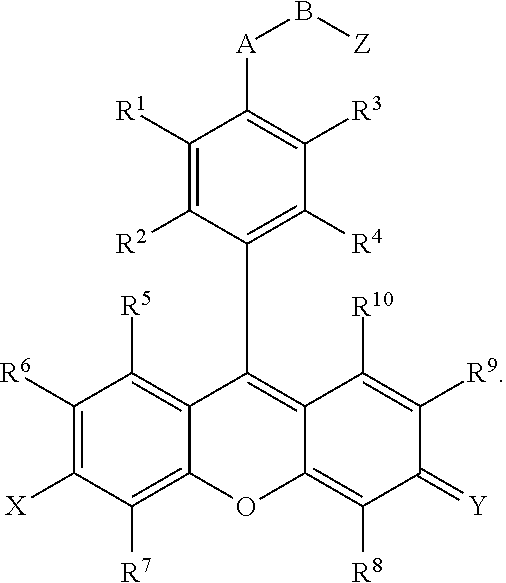
- compounds are provided that comprise:
- R 1 , R 2 , R 3 , R 4 , R 5 , R 6 , R 7 , R 9 , and R 10 are independently H, F, Cl, Br, I, CN, nitro, azido, hydroxyl, amino, hydrazino, (substituted) aryl, (substituted) aroxyl, alkenyl, alkynyl, alkyl, alkoxy, alkylamino, dialkylamino, arylamino, diarylamino, alkyl(aryl)amino, alkanoylamino, alkylthio, alkylcarbonyl, aryl carbonyl, alkylthiocarbonyl, arylthiocarbonyl, alkyloxycarbonyl, aroxycarbonyl, alkylaminocarbonyl, arylaminocarbonyl, dialkylaminocarbonyl, diarylaminocarbonyl, alkyl(aryl)aminocarbonyl,
- R 11 , R 12 , R 13 , R 14 and R 15 are independently a hydrogen, a halogen, an amino group, an alkyl group wherein said alkyl group is saturated or unsaturated, linear or branched, or substituted or unsubstituted, an alkoxy group wherein said alkoxy group is saturated or unsaturated, branched or linear, or substituted or unsubstituted; an aryl group wherein said aryl group is unsubstituted or substituted; wherein R 11 in combination with R 12 , R 14 in combination with R 15 , R 11 in combination with R 13 , R 11 in combination with R 14 , R 12 in combination with R 15 , or R 13 in combination with R 14 can independently form a 5-10 member ring;
- X is O, OR 16 , NR 17 R 18 or N + R 17 R 18 ; Y is O, OR 16 , NR 19 R 20 or N + R 19 R 20 , wherein R 16 , R 17 , R 18 , R 19 and R 20 are independently H, alkyl, alkenyl, alkynyl, or aryl; or R 17 in combination with R 18 , or R 19 in combination with R 20 can independently form a 5-10 member ring structure which is optionally further substituted with alkyl, alkenyl, alkynyl, aryl, alkoxy, F, Cl, Br, I, carboxylic acid or carboxylic-acid ester, where the alkyl group is saturated or unsaturated, linear or branched, and is optionally further substituted by F, Cl, Br, I, CN, OH, alkenyl, alkynyl, nitro, azido, hydrazino, alkoxy, aryoxy, alkylthio, arylthi
- A is O, S or NR 21 , wherein R 21 is a hydrogen, an alkyl, an aryl, an alkenyl, an alkynyl, an alkylcarbonyl, an arylcarbonyl, an alkylaminocarbonyl, or an arylaminocarbonyl, the alkyl or aryl portions of which is optionally substituted by an alkyl, an aryl, an alkenyl, an alkynyl, an F, a Cl, a Br, an I, a CN, an OH, an alkoxy, an aryoxy, an alkylthio, an arylthio, a nitro, an azido, a hydrazino, a thiocarboxyl, a carbonyl, a thiocarbonyl, a thiocarboxylic acid ester, or an unsubstituted or substituted amino, amide, thioamide, or Q;
- B is an alkyl, an alkenyl, an alkynyl, or an aryl linker, the alkyl or aryl portions of which is optionally substituted by an alkyl, an alkenyl, an alkynyl, an aryl, an F, a Cl, a Br, an I, a CN, an OH, an alkoxy, an aryoxy, an alkylthio, an arylthio, a nitro, an azido, a hydrazino, a carboxyl, a thiocarboxyl, a carbonyl, a thiocarbonyl, a carboxylic acid ester, a thiocarboxylic acid ester, or an unsubstituted or substituted amino, amide, thioamide, or Q; or
- Z is a reactive group comprising an isocyanate, an isothiocyanate, a monochlorotriazine, a dichlorotriazine, a 4,6-dichloro-1,3,5-triazines, a mono- or di-halogen substituted pyridine, a mono- or di-halogen substituted diazine, a maleimide, a haloacetamide, an aziridine, a sulfonyl halide, a carboxylic acid, an acid halide, a phosphonyl halide, a phosphoramidite (PO 2 R 14 NR 11 R 12 ), a phosphoramidite thioanalogue (POSR 14 NR 11 R 12 ), a hydroxysuccinimide ester, a hydroxysulfosuccinimide ester, an imido ester, an azido, a nitrophenol ester, an azide, a 3-(2-pyridy
- a fluorescent dye comprising the above compound is provided.
- a fluorescence energy transfer system comprising the above-described fluorescent dye and a second dye wherein the second dye is capable of energy transfer with the fluorescent dye.
- kits for labeling a target molecule comprises the above-described fluorescent dye with additional reagents useful for labeling the target molecule.
- a target molecule labeled with the above-described fluorescent dye is also provided.
- a method of labeling a target molecule comprises contacting reactive group Z of the above-described fluorescent dye with the target molecule such that reactive group Z reacts with the target molecule to form a covalent bond between reactive group Z and the target molecule.
- Another method of labeling a target molecule comprises contacting the above-described fluorescent dye, where the fluorescent dye further comprises a first member of a binding pair.
- the target molecule comprises a second member of the binding pair.
- FIG. 1 is graphs showing spectral properties of Dye 1 (EZRed620) and prior art dye LC Red 640 (Roche).
- Panel A shows the UV-Vis spectra of LC Red 640 and EZRed620.
- Panel B shows the emission spectra of LC Red 640 and EZRed620.
- Panel C shows the UV-Vis and emission spectra of LC Red 640.
- Panel D shows the UV-Vis and emission spectra of EZRed620.
- novel rhodamine dyes that are useful for, e.g., labeling nucleic acids or other molecules.
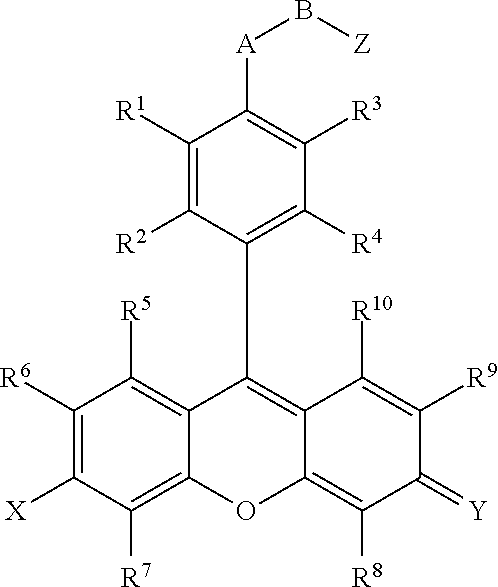
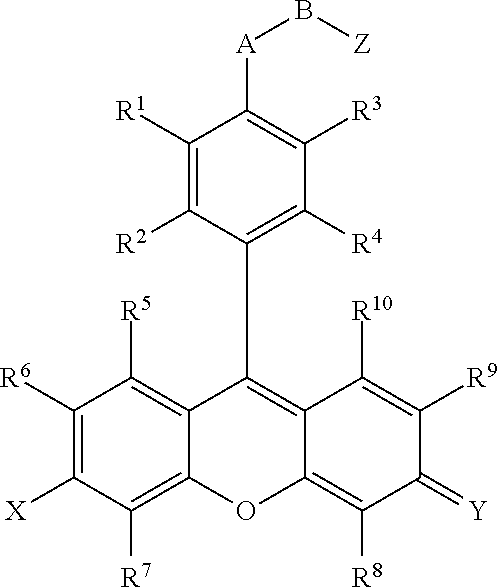
- the present invention provides a compound comprising:
- R 1 , R 2 , R 3 , R 4 , R 5 , R 6 , R 7 , R 8 , R 9 , and R 10 are independently H, F, Cl, Br, I, CN, nitro, azido, hydroxyl, amino, hydrazino, (substituted) aryl, (substituted) aroxyl, alkenyl, alkynyl, alkyl, alkoxy, alkylamino, dialkylamino, arylamino, diarylamino, alkyl(aryl)amino, alkanoylamino, alkylthio, alkylcarbonyl, aryl carbonyl, alkylthiocarbonyl, arylthiocarbonyl, alkyloxycarbonyl, aroxycarbonyl, alkylaminocarbonyl, arylaminocarbonyl, dialkylaminocarbonyl, diarylaminocarbonyl, alkyl(aryl)aminocarbon
- R 11 , R 12 , R 13 , R 14 and R 15 are independently a hydrogen, a halogen, an amino group, an alkyl group wherein said alkyl group is saturated or unsaturated, linear or branched, or substituted or unsubstituted, an alkoxy group wherein said alkoxy group is saturated or unsaturated, branched or linear, or substituted or unsubstituted, an aryl group wherein said aryl group is unsubstituted or substituted; wherein R 11 in combination with R 12 , R 14 in combination with R 15 , R 11 in combination with R 13 , R 11 in combination with R 14 , R 12 in combination with R 15 or R 13 in combination with R 14 can independently form a 5-10 member ring;
- X is O, OR 16 , NR 17 R 18 or N 4 R 17 R 15 ; Y is O, OR 16 , NR 19 R 20 or N + R 19 R 20 , wherein R 16 , R 17 , R 18 , R 19 and R 20 are independently H, alkyl, alkenyl, alkynyl, or aryl; or R 17 in combination with R 18 , or R 19 in combination with R 20 can independently form a 5-10 member ring structure which is optionally further substituted with alkyl, alkenyl, alkynyl, aryl, alkoxy, F, Cl, Br, I, carboxylic acid or carboxylic acid ester, where the alkyl group is saturated or unsaturated, linear or branched, and is optionally further substituted by F, Cl, Br, I, CN, OH, alkenyl, alkynyl, nitro, azido, hydrazino, alkoxy, aryoxy, alkylthio, arylthio,
- A is O, S or NR 21 , wherein R 21 is a hydrogen, an alkyl, an aryl, an alkenyl, an alkynyl, an alkylcarbonyl, an arylcarbonyl, an alkylaminocarbonyl, or an arylaminocarbonyl, the alkyl or aryl portions of which is optionally substituted by an alkyl, an aryl, an alkenyl, an alkynyl, an F, a Cl, a Br, an I, a CN, an OH, an alkoxy, an aryoxy, an alkylthio, an arylthio, a nitro, an azido, a hydrazino, a thiocarboxyl, a carbonyl, a thiocarbonyl, a thiocarboxylic acid ester, or an unsubstituted or substituted amino, amide, thioamide, or Q;
- B is an alkyl, an alkenyl, an alkynyl, or an aryl linker, the alkyl or aryl portions of which is optionally substituted by an alkyl, an alkenyl, an alkynyl, an aryl, an F, a Cl, a Br, an I, a CN, an OH, an alkoxy, an aryoxy, an alkylthio, an arylthio, a nitro, an azido, a hydrazino, a carboxyl, a thiocarboxyl, a carbonyl, a thiocarbonyl, a carboxylic acid ester, a thiocarboxylic acid ester, or an unsubstituted or substituted amino, amide, thioamide, or Q; or
- Z is a reactive group comprising an isocyanate, an isothiocyanate, a monochlorotriazine, a dichlorotriazine, a 4,6-dichloro-1,3,5-triazines, a mono- or di-halogen substituted pyridine, a mono- or di-halogen substituted diazine, a maleimide, a haloacetamide, an aziridine, a sulfonyl halide, a carboxylic acid, an acid halide, a phosphonyl halide, a phosphoramidite (PO 2 R 14 NR 11 R 12 ), a phosphoramidite thioanalogue (POSR 14 NR 11 R 12 ), a hydroxysuccinimide ester, a hydroxysulfosuccinimide ester, an imido ester, an azido, a nitrophenol ester, an azide, a 3-(2-pyridy
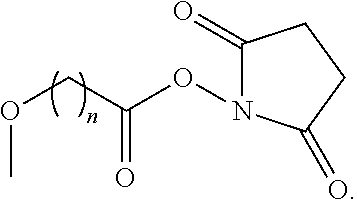
- -A-B—Z is
- n 1-10, i.e., 1, 2, 3, 4, 5, 6, 7, 8, 9 or 10, for example 1-4.
- -A-B—Z is
- -A-B—Z is
- R 6 and R 9 are both H, or both CH 3 .
- X and Y are
- E ⁇ comprises an anion
- any of the compounds described is a fluorescent dye.
- reactive thiol, amine or hydroxyl groups can be protected during various synthetic steps and the reactive groups generated after removal of the protective group.
- Use of a terminal alkene or alkyne groups for attachment of markers is disclosed for example in U.S. Patent Publication 2003/0225247.
- the use of platinum coordinate groups for attachment of other dyes is disclosed for example in U.S. Pat. No. 5,580,990, and the use of alkyl groups is disclosed for example in U.S. Pat. No. 6,593,465.
- the dyes provided herein further comprise a member of a binding pair, to provide additional binding capabilities.
- the member of the binding pair can be covalently bound to any portion of the dye.
- the member of a binding pair is covalently bound to the fluorescent dye through reactive group Z.
- Nonlimiting examples include sugar/lectins, antigen/antibodies, hapten/antibodies, ligand/receptors, hormone/receptors, enzyme/substrates, biotin/avidin, and biotin/streptavidin.
- any one of the dyes of the instant invention can be utilized with another dye to form a fluorescence energy transfer system, where the signal is influenced by Förster resonance energy transfer (also known as fluorescence resonance energy transfer, or FRET).
- FRET uses two fluorophores (an energy transfer pair) where the emission spectrum of one fluorophore (the donor) is of higher energy (having a shorter wavelength) and overlaps the absorption spectrum of the other fluorophore (the acceptor). When the two fluorophores are brought within about 10-100 ⁇ and the donor fluorophore is excited, the energy of the donor is transferred to the acceptor by a resonance induced dipole-dipole interaction.
- FRET interactions are utilized with many assays, particularly in molecular biology. See, e.g., U.S. Pat. Nos. 4,868,103; 5,237,515; and 6,117,635, U.S. Patent Publications 2005/0176014 and 2005/0042618, and references cited therein.
- a fluorescence energy transfer system comprises any of the above-described fluorescent dyes and a second dye that is capable of energy transfer with the fluorescent dye.
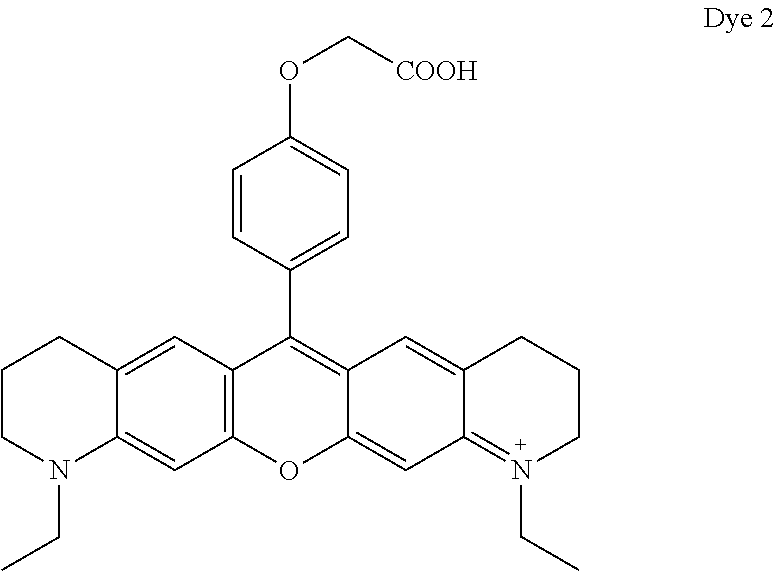
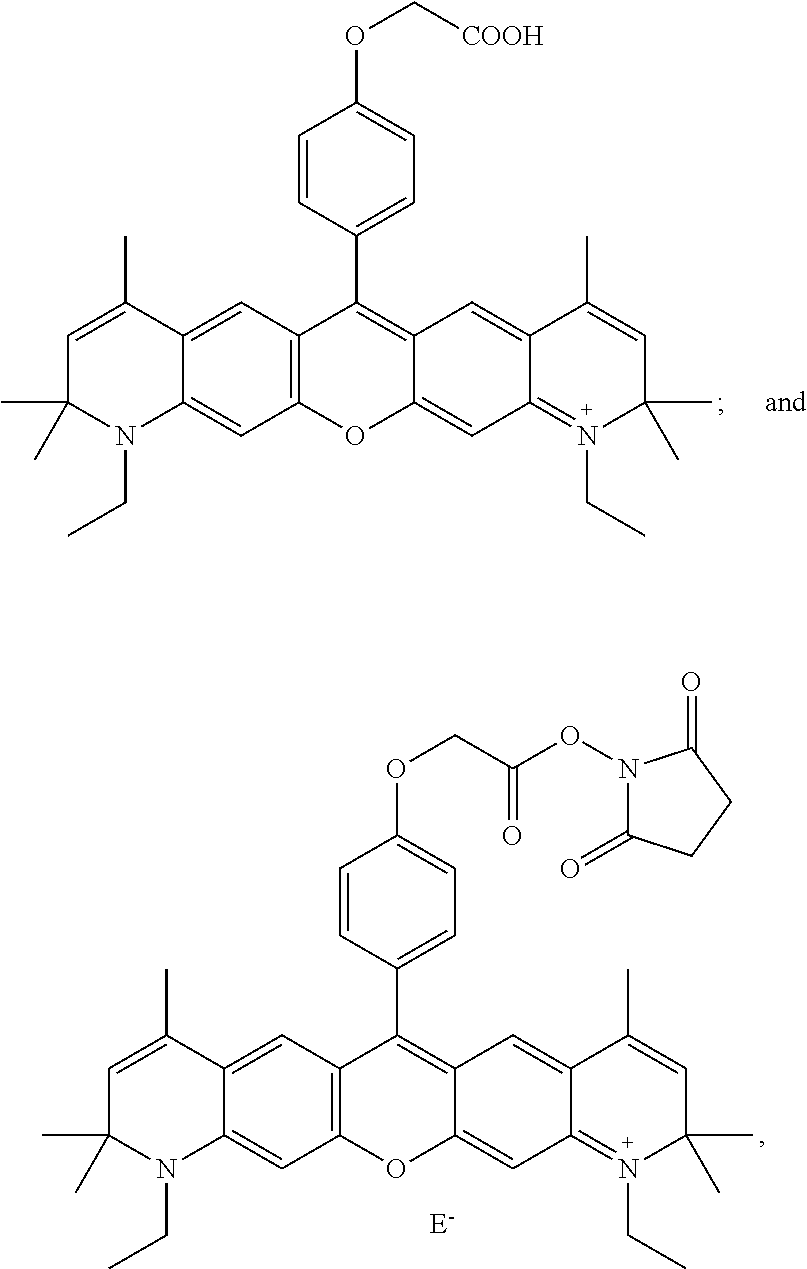
- a fluorescence energy transfer system is utilized in Example 19, where PCR amplification of HCV RNA was performed with one HCV primer labeled with Dye 1 (Example 4) as a FRET acceptor and another HCV primer labeled with fluorescein as a FRET donor.
- the primers are extended in the presence of HCV RNA and the extended primers hybridize, bringing the acceptor and donor dyes together to undergo a FRET interaction.
- any of the fluorescent dyes described above is bound to a target molecule.
- the dye is covalently bound to the target molecule, e.g., by contacting reactive group Z with the target molecule such that reactive group Z reacts with the target molecule to form a covalent bond between reactive group Z and the target molecule.
- the dye is noncovalently bound to the target molecule, e.g., through a first member of a binding pair on the target molecule and a second member of the binding pair bound to the fluorescent dye through reactive group Z. This latter case is not narrowly limited to the use of any particular binding pair.
- Nonlimiting examples of binding pair members that may be utilized here are sugars, lectins, antigens, haptens, antibodies, receptors ligands, hormone ligands, hormone receptors, enzymes, enzyme substrates, biotin, avidin, and streptavidin.
- a “target molecule” encompasses a moiety that specifically binds to an analyte.
- binding between the analyte-specific moiety (“target”) and its corresponding analyte may be monitored by essentially determining the presence or amount of dye that is bound to the analyte.
- assays include hybridizations between complementary nucleic acids as well as binding between antibodies and their corresponding antigens.
- Other binding pairs that may be of interest include but are not limited to ligand/receptor, hormone/hormone receptor, antibody/antigen, carbohydrate/lectin and enzyme/substrate. Assays may be carried out where one component is fixed to a solid support and a corresponding partner is in solution.
- microarray assays where labeled analytes become hound to discrete sites on the microarray.
- Homogeneous probe-dependent assays are also well known in the art and may take advantage of the present invention. Examples of such methods are energy transfer between adjacent probes (U.S. Pat. No. 4,868,103), the Taqman exonuclease assay (U.S. Pat. Nos. 5,538,848 and 5,210,015), Molecular Beacons (U.S. Pat. Nos. 5,118,801 and 5,925,517) and various real time assays (U.S. Patent Publication 2005/0137388).
- target molecules can utilize any target molecule now known or later discovered.
- useful target molecules to which the dye can be bound include but are not limited to a nucleoside, nucleotide, oligonucleotide, polynucleotide, peptide nucleic acid, protein, peptide, enzyme, antigen, antibody, hormone, hormone receptor, cellular receptor, lymphokine, cytokine, hapten, lectin, avidin, streptavidin, digoxigenin, carbohydrate, oligosaccharide, polysaccharide, lipid, glycolipid, viral particle, viral component, bacterial cell, bacterial component, eukaryotic cell, eukaryotic cell component, natural drug, synthetic drug, glass particle, glass surface, natural polymers, synthetic polymers, plastic particle, plastic surface, silicaceous particle, silicaceous surface, organic molecule, dyes and derivatives thereof.
- such a target can comprise one or more ribonucleoside moieties, ribonucleotide moieties, deoxyribonucleoside moieties, deoxyribonucleotide moieties, modified ribonucleosides, modified ribonucleotides, modified deoxyribonucleosides, modified deoxyribonucleotides, ribonucleotide analogues, deoxyribonucleotide analogues or any combination thereof.
- the dyes of the present invention may have dyes as targets, thereby creating composite dyes.
- unique properties may be enjoyed that are not present in either dye alone. For instance, if one of the dyes of the present invention is joined to another dye such that it creates an extended conjugation system, the spectral characteristics of the dye may be different than either dye component.
- Another example of this method is where the conjugation systems do not overlap but the proximity allows an internal energy transfer to take place thereby extending the Stokes shift. See, e.g., U.S. Pat. Nos. 5,401,847; 6,008,373; and 5,800,996.
- compositions may also be enhanced by this joining, for example, the joining together of two ethidium bromide molecules generating a dye that has enhanced binding to nucleic acids (U.S. Patent Publication 2003/0225247).
- Other composite dyes have been described that simultaneously enjoy both properties, i.e. enhanced binding and energy transfer (U.S. Pat. No. 5,646,264).
- these composite dyes are not limited to binary constructs of only two dyes, but may comprise oligomeric or polymeric dyes. These composite dyes may be comprised of the same dye or different dyes may be joined together depending upon the properties desired.
- Antibodies labeled with dyes of the present invention may be used in various formats.
- an antibody with one of the dyes of the present invention may be used in an immunofluorescent plate assay or in situ analysis of the cellular location and quantity of various antigenic analytes.
- Antibodies labeled with dyes may also be used free in solution in cell counting or cell sorting methods that use a flow cytometer or for in vitro or in vivo imaging of animal models. The presence or absence of a signal may then be used to indicate the presence or absence of the analyte itself. An example of this is a test where it is sufficient to know whether a particular pathogen is present in a clinical specimen.
- Quantitative assays may also be carried out where the amount of target is being determined. An example of this is the previously cited microarray assay where the rise or fall in the amount of particular mRNA species may be of interest.
- the dyes described above may be attached to a carrier with a more general affinity.
- Dyes may be attached to intercalators that in themselves do not provide signal generation but by virtue of their binding may bring a dye in proximity to a nucleic acid.
- a further example is attachment of dyes to SDS molecules thereby allowing dyes to be brought into proximity to proteins.
- this embodiment describes the adaptation of a dye or dyes that lack affinity to a general class of molecules may be adapted by linking them to non-dye molecules or macromolecules that can convey such properties.
- Various applications may enjoy the benefits of binding the dyes of the present invention to appropriate targets.
- staining of macromolecules in a gel is a methodology that has a long history of use.
- the present invention also provides a kit for labeling a target molecule.
- the kit comprises any of the above-described fluorescent dyes, with additional reagents useful for labeling the target molecule.
- the target molecule in these embodiments is not narrowly limited to any particular type of compound.
- Non-limiting examples include a nucleoside, nucleotide, oligonucleotide, polynucleotide, peptide nucleic acid, protein, peptide, enzyme, antigen, antibody, hormone, hormone receptor, cellular receptor, lymphokine, cytokine, hapten, lectin, avidin, streptavidin, digoxigenin, carbohydrate, oligosaccharide, polysaccharide, lipid, glycolipid, viral particle, viral component, bacterial cell, bacterial component, eukaryotic cell, eukaryotic cell component, natural drug, synthetic drug, glass particle, glass surface, natural polymers, synthetic polymers, plastic particle, plastic surface, silicaceous particle, silicaceous surface, organic molecule, dyes and derivatives thereof.
- such a target can comprise one or more ribonucleoside moieties, ribonucleotide moieties, deoxyribonucleoside moieties, deoxyribonucleotide moieties, modified ribonucleosides, modified ribonucleotides, modified deoxyribonucleosides, modified deoxyribonucleotides, ribonucleotide analogues, deoxyribonucleotide analogues or any combination thereof.
- the target molecule is a nucleic acid, a nucleic acid analog, a protein, a peptide, an antibody, an antibody fragment, a carbohydrate, a polysaccharide, an oligosaccharide, a nucleotide, a nucleotide analog, a hapten, or an organic compound less than 2000 daltons.
- the target molecule is a nucleic acid or a protein.
- kits can include any reagents necessary for labeling any target molecule, such as a buffer, an enzyme, one or both of a binding pair (as described above), chemical reagents to effect the binding of the dye to the target molecule, and/or the target molecule itself.
- the kit also includes instructions for labeling the target molecule.
- kits for labeling a target molecule comprises a first fluorescent dye and a second fluorescent dye that form an energy transfer pair, wherein the first fluorescent dye is any of the fluorescent dyes described above.
- the kit also comprises additional reagents and/or instructions useful for labeling target molecules with the energy transfer pair.
- the additional reagents of these kits can include any reagents necessary for labeling any target molecule, such as a buffer, an enzyme, one or both of a binding pair (as described above), chemical reagents to effect the binding of the dye to the target molecule, and/or the target molecule itself.
- the target molecule in these embodiments is not narrowly limited to any particular type of compound, and could include, e.g., any of the target molecules discussed previously.
- the target molecule is a nucleic acid or a protein.
- the present invention is also directed to a target molecule labeled with any of the fluorescent dyes described above.
- the target molecule in these embodiments is not narrowly limited to any particular type of compound.
- Non-limiting examples include a nucleoside, nucleotide, oligonucleotide, polynucleotide, peptide nucleic acid, protein, peptide, enzyme, antigen, antibody, hormone, hormone receptor, cellular receptor, lymphokine, cytokine, hapten, lectin, avidin, streptavidin, digoxigenin, carbohydrate, oligosaccharide, polysaccharide, lipid, glycolipid, viral particle, viral component, bacterial cell, bacterial component, eukaryotic cell, eukaryotic cell component, natural drug, synthetic drug, glass particle, glass surface, natural polymers, synthetic polymers, plastic particle, plastic surface, silicaceous particle, silicaceous surface, organic molecule, dyes and derivatives thereof.
- such a target can comprise one or more ribonucleoside moieties, ribonucleotide moieties, deoxyribonucleoside moieties, deoxyribonucleotide moieties, modified ribonucleosides, modified ribonucleotides, modified deoxyribonucleosides, modified deoxyribonucleotides, ribonucleotide analogues, deoxyribonucleotide analogues or any combination thereof.
- the target molecule is a nucleic acid, a nucleic acid analog, a protein, a peptide, an antibody, an antibody fragment, a carbohydrate, a polysaccharide, an oligosaccharide, a nucleotide, a nucleotide analog, a hapten, or an organic compound less than 2000 daltons.
- the target molecule is a nucleic acid or a protein.
- the fluorescent dye is covalently bound to the target molecule, for example through reactive group Z.
- the fluorescent dye is noncovalently bound to the target molecule, for example through a binding pair, e.g., where one member of the binding pair is covalently bound to the dye through reactive group Z and the other member of the binding pair is covalently bound to the target, by any means known in the art.
- the binding pair in these embodiments can be any binding pair now known or later discovered.
- Nonlimiting examples include a sugar/lectin, an antigen/antibody, a hapten/antibody, a ligand/receptor, a hormone/receptor, an enzyme/substrate, biotin/avidin, or biotin/streptavidin.
- the labeled target molecule further comprises a second dye such that the second dye forms an energy transfer pair with the fluorescent dye.
- a second dye such that the second dye forms an energy transfer pair with the fluorescent dye.
- the labeled target molecule of these embodiments can also be part of a composition that further comprises a second labeled target molecule, where the label on the labeled target molecule and the label on the second labeled target molecule form an energy transfer pair.
- Examples include two labeled primers, where the two labels form an energy transfer pair, or an antibody labeled with one member of an energy transfer pair and the corresponding antigen labeled with the other member of the energy transfer pair. See, e.g., U.S. Patent Publication 2005/0137388, PCT Publication WO99/47700 and U.S. Pat. Nos. 5,237,515 and 4,868,103.
- the invention is directed to a method of labeling a target molecule.
- the method comprises contacting reactive group Z of any of the above-described fluorescent dyes with the target molecule such that reactive group Z reacts with the target molecule to form a covalent bond between reactive group Z and the target molecule.
- the target molecule in these embodiments is not narrowly limited to any particular type of compound.
- Non-limiting examples include a nucleoside, nucleotide, oligonucleotide, polynucleotide, peptide nucleic acid, protein, peptide, enzyme, antigen, antibody, hormone, hormone receptor, cellular receptor, lymphokine, cytokine, hapten, lectin, avidin, streptavidin, digoxigenin, carbohydrate, oligosaccharide, polysaccharide, lipid, glycolipid, viral particle, viral component, bacterial cell, bacterial component, eukaryotic cell, eukaryotic cell component, natural drug, synthetic drug, glass particle, glass surface, natural polymers, synthetic polymers, plastic particle, plastic surface, silicaceous particle, silicaceous surface, organic molecule, dyes and derivatives thereof.
- such a target can comprise one or more ribonucleoside moieties, ribonucleotide moieties, deoxyribonucleoside moieties, deoxyribonucleotide moieties, modified ribonucleosides, modified ribonucleotides, modified deoxyribonucleosides, modified deoxyribonucleotides, ribonucleotide analogues, deoxyribonucleotide analogues or any combination thereof.
- the target molecule is a nucleic acid, a nucleic acid analog, a protein, a peptide, an antibody, an antibody fragment, a carbohydrate, a polysaccharide, an oligosaccharide, a nucleotide, a nucleotide analog, a hapten, or an organic compound less than 2000 daltons.
- the target molecule is a nucleic acid or a protein.
- the target molecule further comprises a second dye such that the fluorescent dye and the second dye form an energy transfer pair.
- the present invention further provides another method of labeling a target molecule.
- the method comprises contacting any of the above-described fluorescent dyes with the target molecule, wherein the target molecule comprises a second member of the binding pair.
- the dye in these embodiments comprises the first member of the binding pair.
- the target molecule is a nucleic acid, a nucleic acid analog, a protein, a peptide, an antibody, an antibody fragment, a carbohydrate, a polysaccharide, an oligosaccharide, a nucleotide, a nucleotide analog, a hapten, or an organic compound less than 2000 daltons.
- the target molecule is a nucleic acid or a protein, as described above.
- any binding pair now known or later discovered can be utilized for these methods.
- useful binding pairs are a sugar/lectin, an antigen/antibody, a hapten/antibody, a ligand/receptor, a hormone/receptor, an enzyme/substrate, biotin/avidin, or biotin/streptavidin.
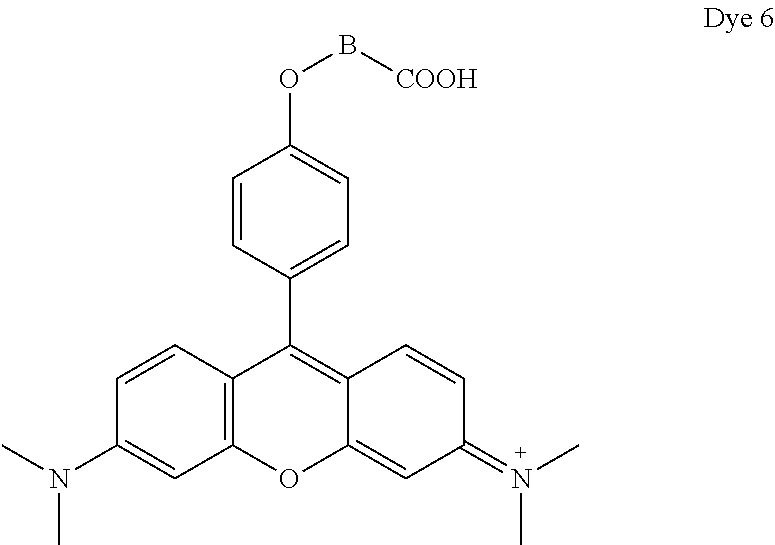
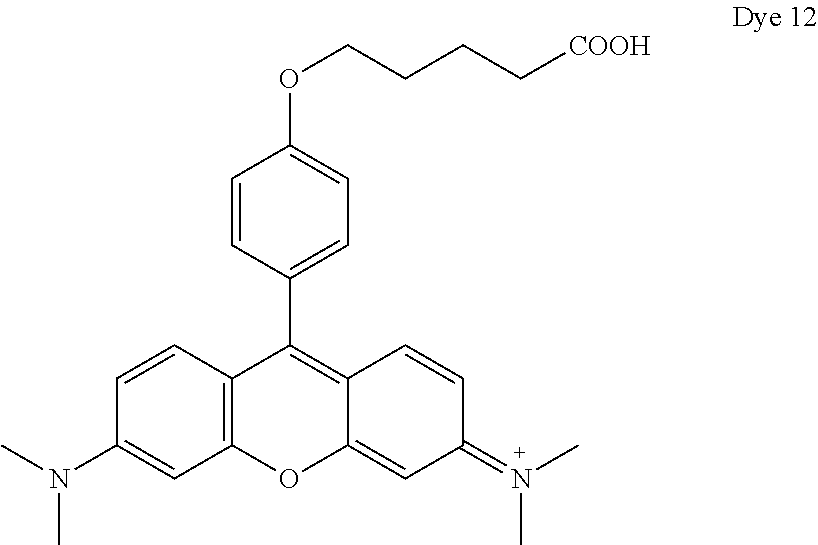
- Dye 6 (shown below) was prepared using the procedure described in Example 4 except that 2-(4-formylphenoxy)acetic acid and 3-(dimethylamino)phenol substituted for 1-ethyl-2,2,4-trimethyl-1,2-dihydroquinolin-7-ol and 2-(4-formylphenoxy)acetic acid. Yield: 36%.
- ⁇ abs 548 nm (in methanol)
- ⁇ em 566 nm (in methanol).
- the crystal was dissolved in a mixture of THF (200 ml) and hydrochloric acid (6 N, 30 ml). The mixture was then heated to reflux for 3 hours, after which the THF was removed under vacuum. The oil was then extracted with chloroform (4 ⁇ 50 ml). The combined chloroform layer was washed with water (2 ⁇ 150 ml) and brine (200 ml), and then dried with anhydrous sodium sulfate. After the solvent was removed, the acid was obtained as a yellow liquid.
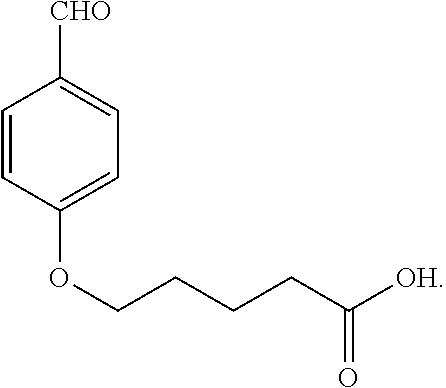
- the structure of 5-(4-formylphenoxy)pentanoic acid is:
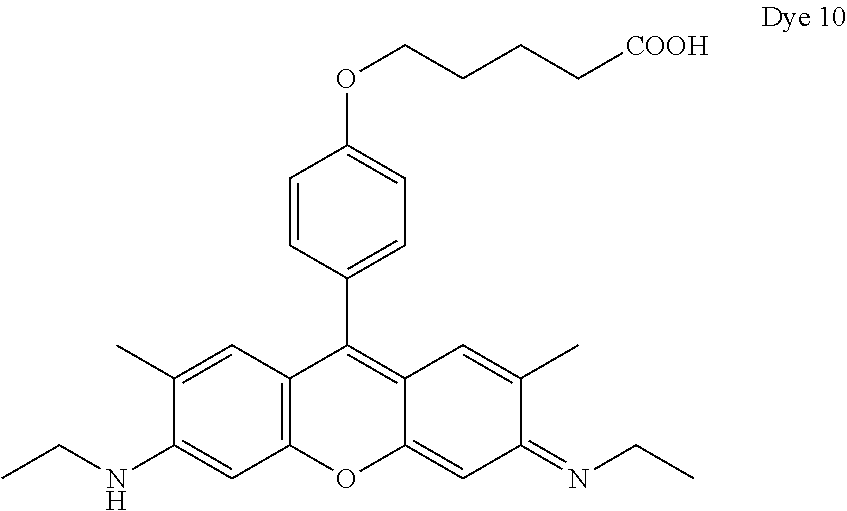
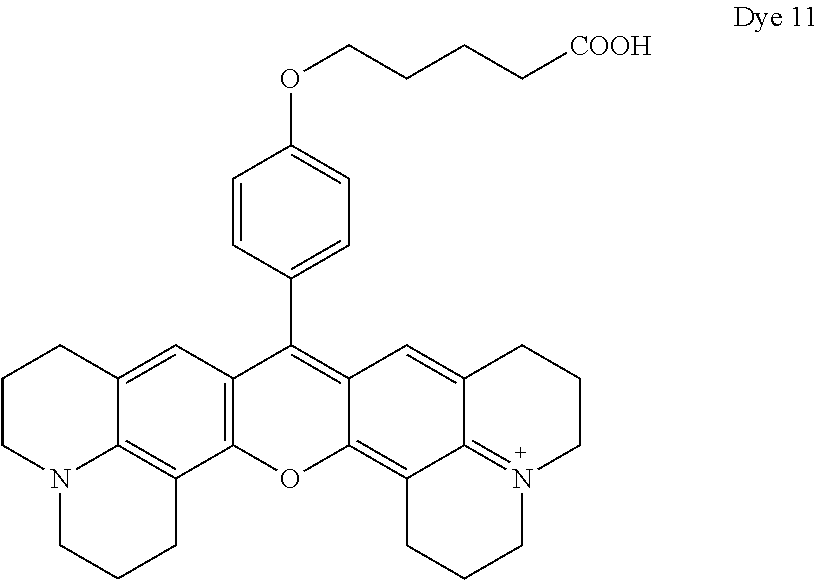
- Dye 8 (shown below) was prepared using the procedure described in Example 4 except that 5-(4-formylphenoxy)pentanoic acid and 1-ethyl-1,2,3,4-tetrahydroquinolin-7-ol substituted for 1-ethyl-2,2,4-trimethyl-1,2-dihydroquinolin-7-ol and 2-(4-formylphenoxy)acetic acid. Yield: 23%.
- Spectral properties of Dye 1 were determined and compared to Roche LC-Red 640.
- the UV-Vis spectra of EZRed620 and LC Red 640 were recorded in methanol with a NanoDrop® ND-1000 Spectrophotometer.
- the wavelengths of maximum absorption of EZRed620 and LC Red 640 were at 589 nm and 613 nm, respectively.
- the fluorescence spectra were recorded in methanol with Photo Technology International (PTI) fluorometer.
- the maximum emission wavelengths of EZRed620 and LC Red 640 were 611 nm and 637 nm under these conditions, respectively. Graphs of the results of these studies are shown in FIGS. 1A-D .
- Dye 1 (2 ⁇ mol) was dissolved in amine-free DMF (140 ⁇ l), followed by the addition of 2-succinimido-1,1,3,3-tetramethyluronium tetra fluoroborate (2.4 ⁇ mols) and diisopropylethylamine (4.4 ⁇ mols). The mixture was stirred at room temperature for 30 min, and then added to a solution of oligonucleotide containing an amine linker (80 nmols) in 0.9 M sodium borate buffer (320 ⁇ L, pH 8.5). The mixture was stirred at room temperature for 16 h.
- the solvent was removed under vacuum and the residue pellet was purified by HPLC using a gradient of triethylammoniumacetate (0.1 M, 6.9) and acetonitrile as eluting solvents.
- the fractions containing pure conjugates were combined and evaporated, and then coevaporated with water to remove excessive salt.
- the final blue pellet was dissolve in water and stored at ⁇ 20° C.
- RNA was isolated from 400 ⁇ l plasma or serum from each sample using a QIAamp MinElute Virus Spin Kit in a QIAcube system (QIAGEN, Valencia Calif.) according to the manufacturer's protocol. The resulting RNA was eluted in 50 ⁇ l elution buffer. Five ⁇ l of the eluate was subjected to RT-PCR to amplify the HCV target sequence GAGGAACUACUGUCUUCACGCAGAAAGCGUCUAGCCAUGGCGUUAGUAUGAGUGUCG (SEQ ID NO.1).
- the PCR forward primer was GAGGAACTACTGTCTTCACGCAGAAAG C G (SEQ ID NO.2); the reverse primer was CGACACTCATACTAACGCCA T GGCTAG (SEQ ID NO.3).
- the forward primer was labeled on the underlined/bolded C with Dye 1 (EZRed620) as a FRET acceptor; the reverse primer was labeled on the underlined/bolded T with fluorescein as a FRET donor.
- Reverse transcription and PCR amplification was carried out in either a Roche Light Cycler or a Qiagen Rotor-Gene Q RealTime PCR machine. Reverse transcription was performed at 50° C. for 30 min. PCR amplification was conducted at 95° C.
Landscapes
- Chemical & Material Sciences (AREA)
- Organic Chemistry (AREA)
- Health & Medical Sciences (AREA)
- Life Sciences & Earth Sciences (AREA)
- Biochemistry (AREA)
- Molecular Biology (AREA)
- Engineering & Computer Science (AREA)
- Biotechnology (AREA)
- General Health & Medical Sciences (AREA)
- Genetics & Genomics (AREA)
- Wood Science & Technology (AREA)
- Proteomics, Peptides & Aminoacids (AREA)
- Zoology (AREA)
- Communicable Diseases (AREA)
- Immunology (AREA)
- Microbiology (AREA)
- Biophysics (AREA)
- Analytical Chemistry (AREA)
- Physics & Mathematics (AREA)
- Virology (AREA)
- Bioinformatics & Cheminformatics (AREA)
- General Engineering & Computer Science (AREA)
- Measuring Or Testing Involving Enzymes Or Micro-Organisms (AREA)
- Investigating Or Analysing Biological Materials (AREA)
- Plural Heterocyclic Compounds (AREA)
Abstract
Also provided are fluorescent dyes comprising the above compound. Additionally, a fluorescence energy transfer system is provided that comprises the above-described fluorescent dye and a second dye, wherein the second dye is capable of energy transfer with the fluorescent dye. Further provided is a kit for labeling a target molecule, where the kit comprises the above-described fluorescent dye with additional reagents useful for labeling the target molecule. Additionally provided is a target molecule labeled with the above-described fluorescent dye. Methods of labeling a target molecule with the above-described fluorescent dye are also provided.
Description

wherein
-
- wherein R1 in combination with R2, R3 in combination with R4, R5 in combination with R6, or R9 in combination with R10 can independently form a 5-10 member ring structure which is saturated or unsaturated, and which is optionally further substituted with an alkyl, an aryl, an alkenyl, an alkynyl, an alkoxy, an aroxyl, a hydroxyl, an F, a Cl, a Br, an I, a CN, a nitro, an alkylsulfonyl, an arylsulfonyl, an alkylsulfinyl, an arylsulfinyl, a (thio)carbonyl, a (thio)carboxylic acid, a (thio)carboxylic acid ester, a nitro, an amino, a (thio)amide, an azido, a hydrazino, or a (thio)phosphonate where each alkyl group or alkoxy group is independently saturated or unsaturated, linear or branched, or substituted or unsubstituted and each aryl group wherein is independently optionally substituted with an F, a Cl, a Br, an I, a CN, an OH, an alkyl, an alkenyl, an alkynyl, an alkoxy, an aryoxy, an alkylthio, an arylthio, a nitro, an azido, a hydrazino, a carboxyl, a thiocarboxyl, a carbonyl, a thiocarbonyl, a carboxylic acid ester, a thiocarboxylic acid ester, or an unsubstituted or substituted amino, amide, thioamide, or Q;
-
- wherein R17 in combination with R6, R18 in combination with R7, R19 in combination with R8, or R20 in combination with R9, can independently form a 5- to 10 member ring structure that is saturated or unsaturated and optionally further substituted with an alkyl, an aryl, an alkenyl, an alkynyl, an alkoxy, an aroxyl, a hydroxyl, an F, a Cl, a Br, an I, a CN, a nitro, a carbonyl, a thiocarbonyl, a thiocarboxylic acid, a thiocarboxylic acid ester, a nitro, an amino, a (thio)amide, an azido, a hydrazino, or Q, wherein the alkyl group herein is saturated or unsaturated, linear or branched, substituted or unsubstituted, an alkoxy group wherein the alkoxy group is saturated or unsaturated, branched or linear, substituted or unsubstituted; and wherein the aryl group is optionally substituted with F, Cl, Br, I, CN, OH, alkenyl, alkynyl, alkoxy, aryoxy, alkylthio, arylthio, nitro, azido, hydrazino, carboxyl, thiocarboxyl, carbonyl, thiocarbonyl, carboxylic acid ester, thiocarboxylic acid ester, unsubstituted or substituted amino, amide, thioamide, or Q;
-
- B in combination with A form an amide, a thioamide, a carboxylic acid ester, a carboxylic acid thioester, a thiocarboxylic acid ester, an imine, a hyrazone, or Q; and
wherein
-
- wherein R1 in combination with R2, R3 in combination with R4, R5 in combination with R6, or R9 in combination with R10 can independently form a 5-10 member ring structure which is saturated or unsaturated, and which is optionally further substituted with an alkyl, an aryl, an alkenyl, an alkynyl, an alkoxy, an aroxyl, a hydroxyl, an F, a Cl, a Br, an I, a CN, a nitro, an alkylsulfonyl, an arylsulfonyl, an alkylsulfinyl, an arylsulfinyl, a (thio)carbonyl, a (thio)carboxylic acid, a (thio)carboxylic acid ester, a nitro, an amino, a (thio)amide, an azido, a hydrazino, or a (thio)phosphonate where each alkyl group or alkoxy group is independently saturated or unsaturated, linear or branched, or substituted or unsubstituted and each aryl group wherein is independently optionally substituted with an F, a Cl, a Br, an I, a CN, an OH, an alkyl, an alkenyl, an alkynyl, an alkoxy, an aryoxy, an alkylthio, an arylthio, a nitro, an azido, a hydrazino, a carboxyl, a thiocarboxyl, a carbonyl, a thiocarbonyl, a carboxylic acid ester, a thiocarboxylic acid ester, or an unsubstituted or substituted amino, amide, thioamide, or Q;
-
- wherein R17 in combination with R6, R18 in combination with R7, R19 in combination with R8, or R20 in combination with R9, can independently form a 5- to 10 member ring structure that is saturated or unsaturated and optionally further substituted with an alkyl, an aryl, an alkenyl, an alkynyl, an alkoxy, an aroxyl, a hydroxyl, an F, a Cl, a Br, an I, a CN, a nitro, a carbonyl, a thiocarbonyl, a thiocarboxylic acid, a thiocarboxylic acid ester, a nitro, an amino, a (thio)amide, an azido, a hydrazino, or Q, wherein the alkyl group herein is saturated or unsaturated, linear or branched, substituted or unsubstituted, an alkoxy group wherein the alkoxy group is saturated or unsaturated, branched or linear, substituted or unsubstituted; and wherein the aryl group is optionally substituted with F, Cl, Br, I, CN, OH, alkenyl, alkynyl, alkoxy, aryoxy, alkylthio, arylthio, nitro, azido, hydrazino, carboxyl, thiocarboxyl, carbonyl, thiocarbonyl, carboxylic acid ester, thiocarboxylic acid ester, unsubstituted or substituted amino, amide, thioamide, or Q;
-
- B in combination with A form an amide, a thioamide, a carboxylic acid ester, a carboxylic acid thioester, a thiocarboxylic acid ester, an imine, a hyrazone, or Q; and

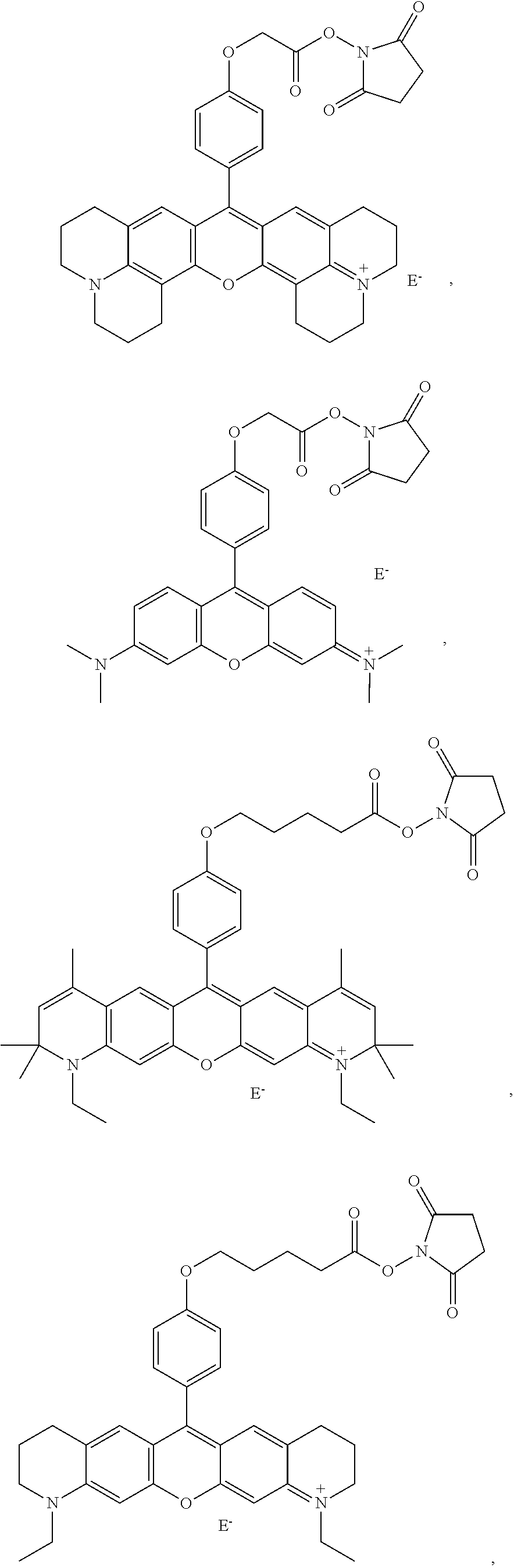
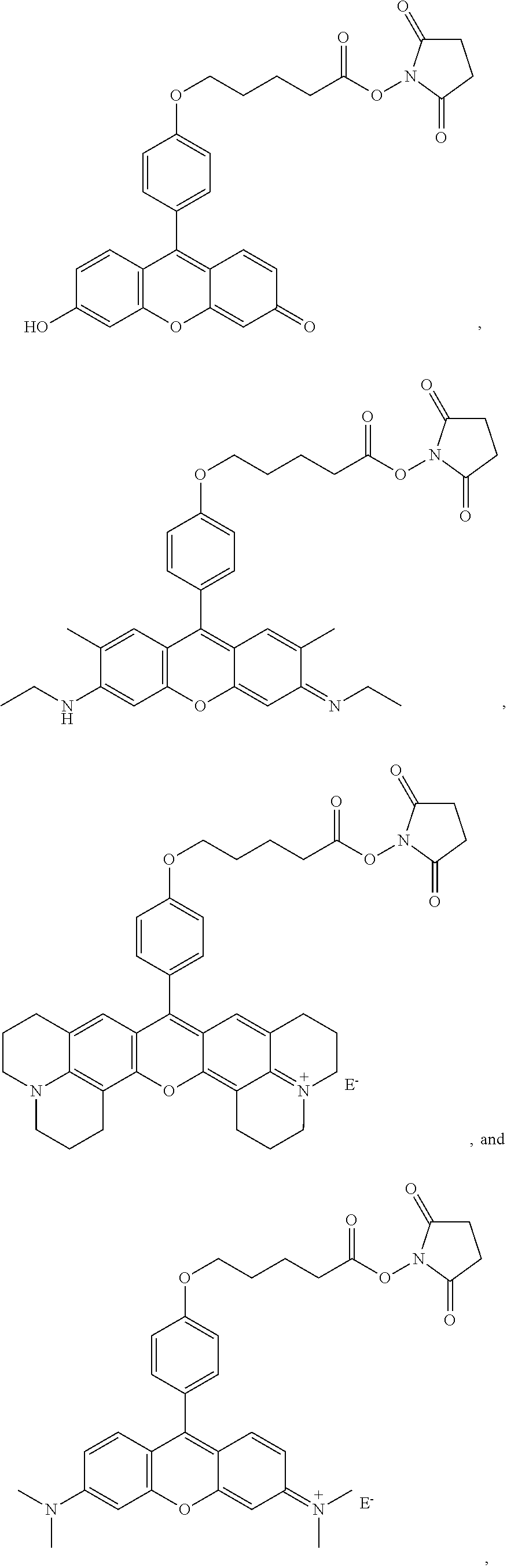
where n is 1-10, i.e., 1, 2, 3, 4, 5, 6, 7, 8, 9 or 10, for example 1-4. In certain of these embodiments, -A-B—Z is

providing a reactive hydroxysuccinimide ester group for coupling to amine moieties, as is known in the art. In more specific embodiments, -A-B—Z is

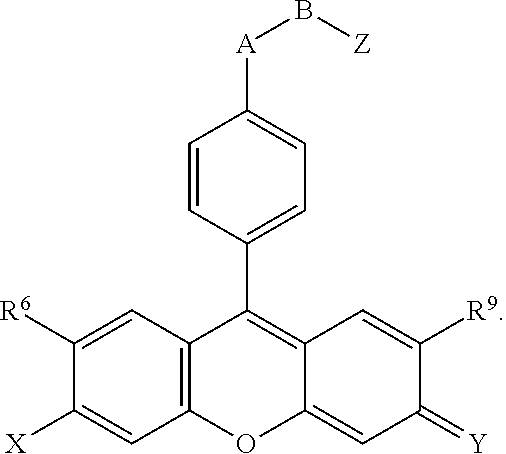
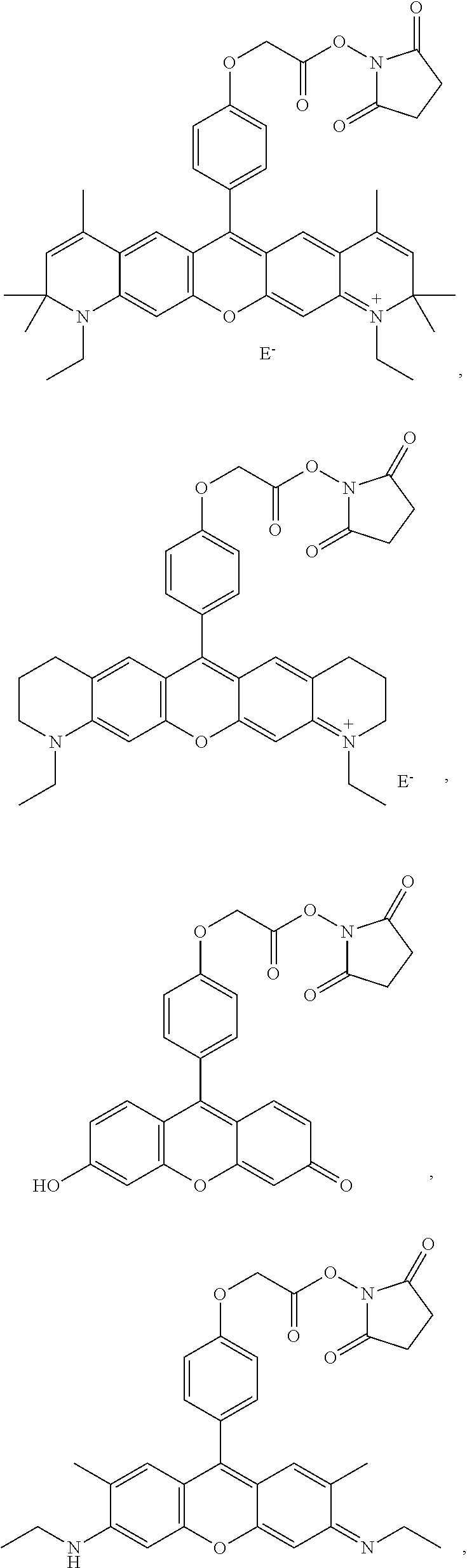
In certain embodiments of those compounds, R6 and R9 are both H, or both CH3. In other embodiments of those compounds, X and Y are
-
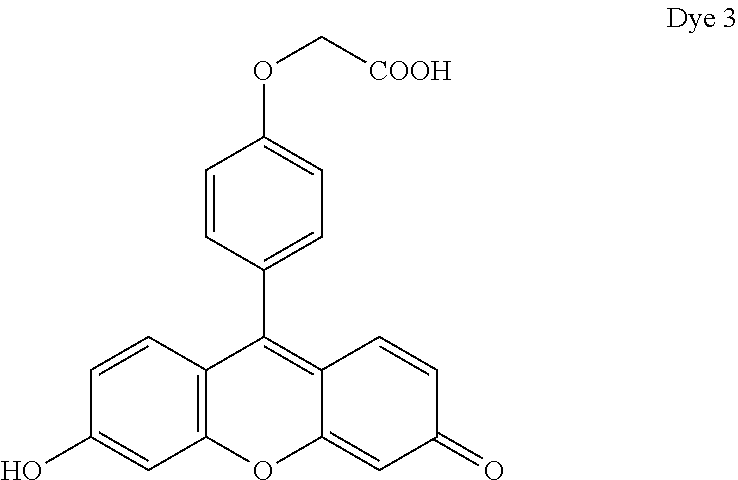
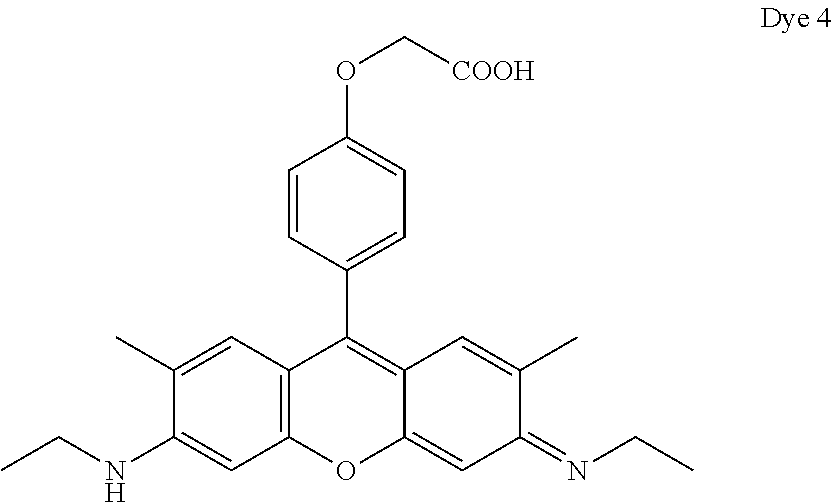
- (a) OH and O, respectively;
- (b) NHCH2CH3 and NCH2CH3, respectively; or
- (c) N(CH3)2 and N+(CH3)2, respectively.

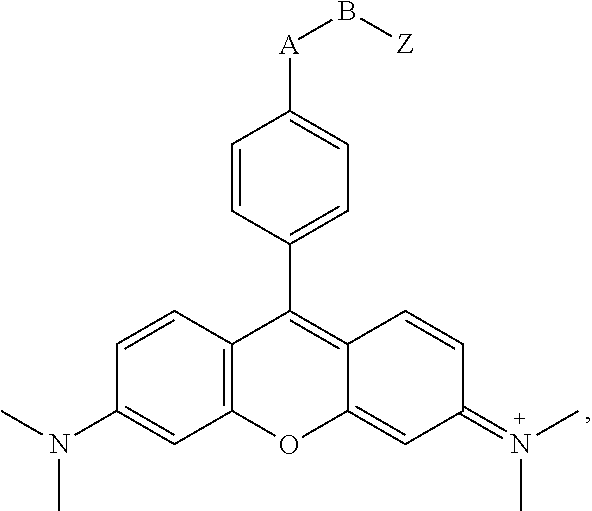
Other specific examples comprise
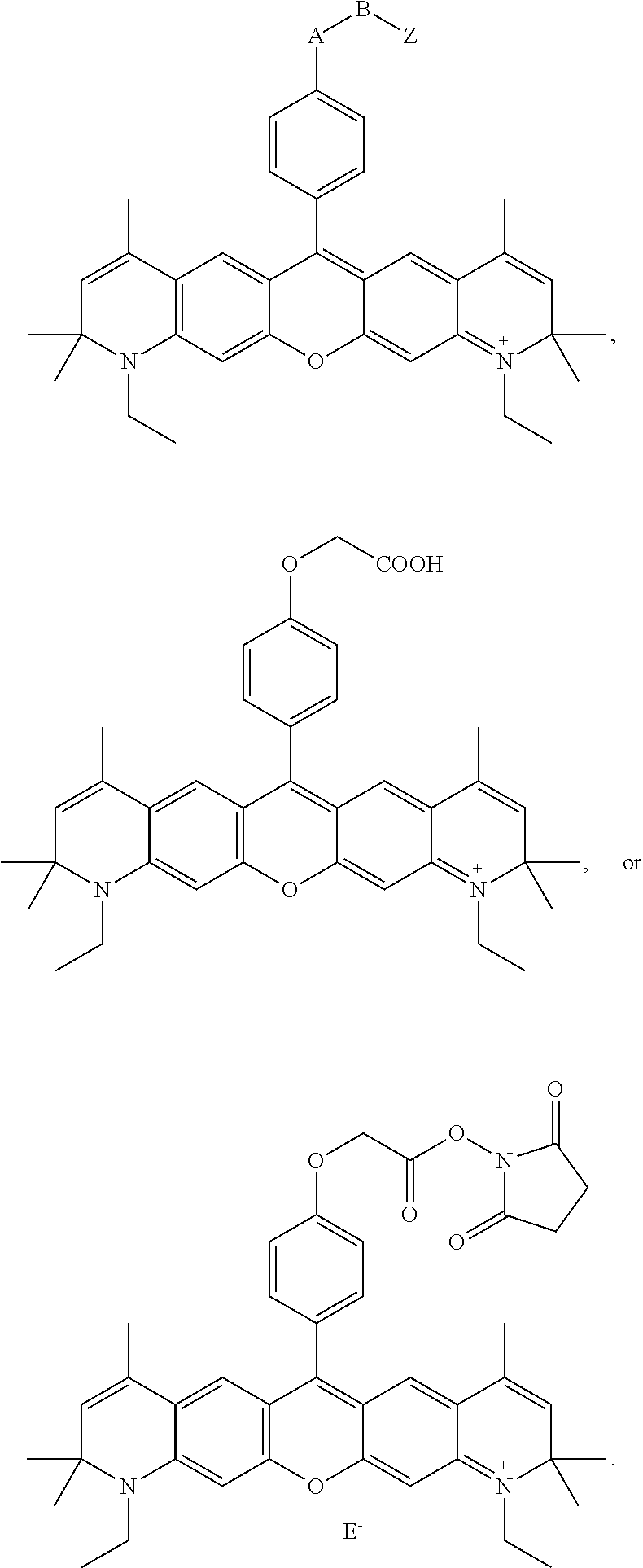
Still other specific examples comprise
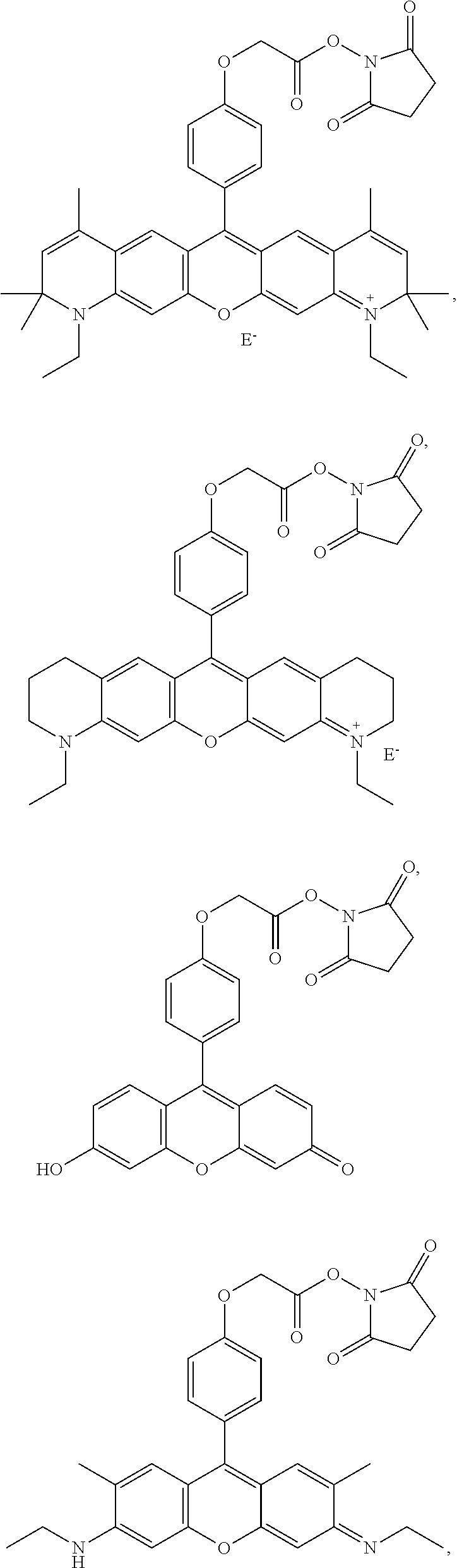


wherein E− comprises an anion.





| TABLE 1 |
| Comparison of RT-PCR HIV viral load |
| determination using two systems. |
| EZRed620 | LCRed640 | |
| Rotor-Gene | COBAS | |
| Sample # | Log10 | Log10 |
| 101 | 6.55 | 6.62 |
| 102 | 6.36 | 6.02 |
| 103 | 5.14 | 5.06 |
| 104 | 6.22 | 6.43 |
| 105 | 6.02 | 5.29 |
| 106 | 6.37 | 6.85 |
| 107 | 6.21 | 5.94 |
| 108 | 6.49 | 6.25 |
| 109 | 6.29 | 6.10 |
| 110 | 6.35 | 5.68 |
| 121 | 4.41 | 3.84 |
| 122 | 6.35 | 6.71 |
| 123 | 2.67 | 2.02 |
| 124 | 4.85 | 4.29 |
| 125 | 7.09 | 7.58 |
| 126 | 4.40 | 4.94 |
| 127 | 6.26 | 6.36 |
| 128 | 6.02 | 5.80 |
| 129 | 6.30 | 6.92 |
| 130 | 5.08 | 4.81 |
| 131 | 5.76 | 5.48 |
| 132 | 5.36 | 4.99 |
| 133 | 6.08 | 5.85 |
| 134 | 6.83 | 7.26 |
| 135 | 6.73 | 6.88 |
| 136 | 6.78 | 7.61 |
| 137 | 6.02 | 6.03 |
| 138 | 6.54 | 6.96 |
| 139 | 6.54 | 6.86 |
| 140 | 5.34 | 5.23 |
| 141 | 4.37 | 4.83 |
| 142 | 2.86 | 3.22 |
| 143 | 5.59 | 5.12 |
| 144 | 6.23 | 5.91 |
| 145 | 5.59 | 4.95 |
| 146 | 6.34 | 6.22 |
| 147 | 5.62 | 5.64 |
| 148 | 7.02 | 6.95 |
| 149 | 6.76 | 6.56 |
| 150 | 6.95 | 6.85 |
| 151 | 6.60 | 7.01 |
| 152 | 5.53 | 5.25 |
| 153 | 6.60 | 6.60 |
| 154 | 6.46 | 6.24 |
| 155 | 6.61 | 6.42 |
| 156 | 6.05 | 6.06 |
| 157 | 6.81 | 6.73 |
| 158 | 5.62 | 5.40 |
| 159 | 5.03 | 4.96 |
| 160 | 6.84 | 7.45 |
| 201 | 6.31 | 6.26 |
| 202 | 5.56 | 5.40 |
| 203 | 3.12 | 3.02 |
- Ernst, et al. (1989) Cytometry 10:3-10.
- Mujumdar, et al. (1989) Cytometry 10:11-19.
- Mujumdar et al. (1993) Bioconjugate Chemistry 4:105-111.
- Southwick, et al. (1990) Cytometry 11:4187-430.
- Zhu et al. (1994) Nucl. Acid Res. 22:3418-3422.
-
European Patent Publication 0 070 685. -
European Patent Publication 0 543 333. -
European Patent Publication 0 567 622. -
European Patent Publication 0 971 039. - PCT Publication WO99/47700.
- PCT Publication WO 99/28500.
- U.S. Pat. No. 4,683,202.
- U.S. Pat. No. 4,711,955.
- U.S. Pat. No. 4,868,103.
- U.S. Pat. No. 4,952,685.
- U.S. Pat. No. 5,013,831.
- U.S. Pat. No. 5,047,519.
- U.S. Pat. No. 5,118,801.
- U.S. Pat. No. 5,130,238.
- U.S. Pat. No. 5,210,015.
- U.S. Pat. No. 5,237,515.
- U.S. Pat. No. 5,241,060.
- U.S. Pat. No. 5,268,486.
- U.S. Pat. No. 5,270,184.
- U.S. Pat. No. 5,401,847.
- U.S. Pat. No. 5,455,166.
- U.S. Pat. No. 5,455,175.
- U.S. Pat. No. 5,494,810.
- U.S. Pat. No. 5,538,848.
- U.S. Pat. No. 5,580,990.
- U.S. Pat. No. 5,627,027.
- U.S. Pat. No. 5,646,264.
- U.S. Pat. No. 5,800,996.
- U.S. Pat. No. 5,866,336.
- U.S. Pat. No. 5,925,517.
- U.S. Pat. No. 5,948,648.
- U.S. Pat. No. 5,994,056.
- U.S. Pat. No. 6,004,286.
- U.S. Pat. No. 6,008,373.
- U.S. Pat. No. 6,110,630.
- U.S. Pat. No. 6,114,350.
- U.S. Pat. No. 6,117,635.
- U.S. Pat. No. 6,174,670.
- U.S. Pat. No. 6,184,379.
- U.S. Pat. No. 6,323,337.
- U.S. Pat. No. 6,552,199.
- U.S. Pat. No. 6,593,465.
- U.S. Pat. No. 6,743,605.
- U.S. Patent Publication 2003/0225247.
- U.S. Patent Publication 2005/0137388
- U.S. Patent Publication 2005/0176014.
- U.S. Patent Publication 2005/0042618.
- U.S. Patent Publication 2003/0225247.
- U.S. Patent Publication 2005/0137388.
Claims (11)



Priority Applications (10)
| Application Number | Priority Date | Filing Date | Title |
|---|---|---|---|
| US13/270,456 US9416153B2 (en) | 2011-10-11 | 2011-10-11 | Fluorescent dyes |
| EP20182898.5A EP3747877A1 (en) | 2011-10-11 | 2012-10-09 | Fluorescent dyes |
| CA2845939A CA2845939C (en) | 2011-10-11 | 2012-10-09 | Fluorescent dyes |
| CA3038688A CA3038688C (en) | 2011-10-11 | 2012-10-09 | Fluorescent dyes |
| EP12839327.9A EP2768306B1 (en) | 2011-10-11 | 2012-10-09 | Fluorescent dyes |
| PCT/US2012/059285 WO2013055647A1 (en) | 2011-10-11 | 2012-10-09 | Fluorescent dyes |
| CA3121649A CA3121649C (en) | 2011-10-11 | 2012-10-09 | Fluorescent dyes |
| US15/205,438 US10106573B2 (en) | 2011-10-11 | 2016-07-08 | Fluorescent dyes and methods of use thereof |
| US16/127,950 US10875886B2 (en) | 2011-10-11 | 2018-09-11 | Fluorescent dyes and methods of use thereof |
| US16/952,399 US11939350B2 (en) | 2011-10-11 | 2020-11-19 | Fluorescent dyes and methods of use thereof |
Applications Claiming Priority (1)
| Application Number | Priority Date | Filing Date | Title |
|---|---|---|---|
| US13/270,456 US9416153B2 (en) | 2011-10-11 | 2011-10-11 | Fluorescent dyes |
Related Child Applications (1)
| Application Number | Title | Priority Date | Filing Date |
|---|---|---|---|
| US15/205,438 Division US10106573B2 (en) | 2011-10-11 | 2016-07-08 | Fluorescent dyes and methods of use thereof |
Publications (2)
| Publication Number | Publication Date |
|---|---|
| US20130089853A1 US20130089853A1 (en) | 2013-04-11 |
| US9416153B2 true US9416153B2 (en) | 2016-08-16 |
Family
ID=48042317
Family Applications (4)
| Application Number | Title | Priority Date | Filing Date |
|---|---|---|---|
| US13/270,456 Active 2033-10-07 US9416153B2 (en) | 2011-10-11 | 2011-10-11 | Fluorescent dyes |
| US15/205,438 Active 2032-08-17 US10106573B2 (en) | 2011-10-11 | 2016-07-08 | Fluorescent dyes and methods of use thereof |
| US16/127,950 Active 2032-02-02 US10875886B2 (en) | 2011-10-11 | 2018-09-11 | Fluorescent dyes and methods of use thereof |
| US16/952,399 Active 2033-03-03 US11939350B2 (en) | 2011-10-11 | 2020-11-19 | Fluorescent dyes and methods of use thereof |
Family Applications After (3)
| Application Number | Title | Priority Date | Filing Date |
|---|---|---|---|
| US15/205,438 Active 2032-08-17 US10106573B2 (en) | 2011-10-11 | 2016-07-08 | Fluorescent dyes and methods of use thereof |
| US16/127,950 Active 2032-02-02 US10875886B2 (en) | 2011-10-11 | 2018-09-11 | Fluorescent dyes and methods of use thereof |
| US16/952,399 Active 2033-03-03 US11939350B2 (en) | 2011-10-11 | 2020-11-19 | Fluorescent dyes and methods of use thereof |
Country Status (4)
| Country | Link |
|---|---|
| US (4) | US9416153B2 (en) |
| EP (2) | EP2768306B1 (en) |
| CA (2) | CA2845939C (en) |
| WO (1) | WO2013055647A1 (en) |
Cited By (1)
| Publication number | Priority date | Publication date | Assignee | Title |
|---|---|---|---|---|
| US20190002491A1 (en) * | 2011-10-11 | 2019-01-03 | Enzo Life Sciences, Inc. C/O Enzo Biochem, Inc. | Fluorescent dyes and methods of use thereof |
Families Citing this family (5)
| Publication number | Priority date | Publication date | Assignee | Title |
|---|---|---|---|---|
| CN107743487B (en) * | 2015-06-17 | 2021-08-20 | 株式会社Lg化学 | Xanthene-based compound and photosensitive resin composition containing the same |
| EP3446118B1 (en) | 2016-04-22 | 2024-01-24 | Becton, Dickinson and Company | Multiplex polymeric dye devices and methods for using the same |
| KR102092439B1 (en) * | 2016-07-26 | 2020-03-23 | 주식회사 엘지화학 | Photosensitive resin composition and color filter comprising same |
| JP7058662B2 (en) | 2017-02-08 | 2022-04-22 | ベクトン・ディキンソン・アンド・カンパニー | Dry dye reagent device, and how to manufacture and use it |
| EP3880334A4 (en) | 2018-11-13 | 2022-07-06 | Becton, Dickinson and Company | DRY REAGENT SIEVES AND METHODS OF MANUFACTURE AND USE THEREOF |
Citations (48)
| Publication number | Priority date | Publication date | Assignee | Title |
|---|---|---|---|---|
| EP0070685A2 (en) | 1981-07-17 | 1983-01-26 | Amoco Corporation | Homogeneous nucleic acid hybridization diagnostics by non-radiative energy transfer |
| US4683202A (en) | 1985-03-28 | 1987-07-28 | Cetus Corporation | Process for amplifying nucleic acid sequences |
| US4711955A (en) | 1981-04-17 | 1987-12-08 | Yale University | Modified nucleotides and methods of preparing and using same |
| US4868103A (en) | 1986-02-19 | 1989-09-19 | Enzo Biochem, Inc. | Analyte detection by means of energy transfer |
| US4952685A (en) | 1984-01-30 | 1990-08-28 | Enzo Biochem, Inc. | Detectable molecules, method of preparation and use |
| US5013831A (en) | 1984-01-30 | 1991-05-07 | Enzo Biochem, Inc. | Detectable molecules, method of preparation and use |
| US5047519A (en) | 1986-07-02 | 1991-09-10 | E. I. Du Pont De Nemours And Company | Alkynylamino-nucleotides |
| US5118801A (en) | 1988-09-30 | 1992-06-02 | The Public Health Research Institute | Nucleic acid process containing improved molecular switch |
| US5130238A (en) | 1988-06-24 | 1992-07-14 | Cangene Corporation | Enhanced nucleic acid amplification process |
| US5210015A (en) | 1990-08-06 | 1993-05-11 | Hoffman-La Roche Inc. | Homogeneous assay system using the nuclease activity of a nucleic acid polymerase |
| EP0543333A1 (en) | 1991-11-18 | 1993-05-26 | Roche Diagnostics GmbH | New pentacyclic compounds and their use as absorption or fluorescence dyestuffs |
| US5237515A (en) | 1991-04-10 | 1993-08-17 | University Of Utah Research Foundation | Method of determining energy transfer efficiency of a donor-acceptor pair of fluorescent dyes |
| US5241060A (en) | 1982-06-23 | 1993-08-31 | Enzo Diagnostics, Inc. | Base moiety-labeled detectable nucleatide |
| US5268486A (en) | 1986-04-18 | 1993-12-07 | Carnegie-Mellon Unversity | Method for labeling and detecting materials employing arylsulfonate cyanine dyes |
| US5270184A (en) | 1991-11-19 | 1993-12-14 | Becton, Dickinson And Company | Nucleic acid target generation |
| US5401847A (en) | 1990-03-14 | 1995-03-28 | Regents Of The University Of California | DNA complexes with dyes designed for energy transfer as fluorescent markers |
| US5455166A (en) | 1991-01-31 | 1995-10-03 | Becton, Dickinson And Company | Strand displacement amplification |
| US5455175A (en) | 1990-06-04 | 1995-10-03 | University Of Utah Research Foundation | Rapid thermal cycling device |
| US5494810A (en) | 1990-05-03 | 1996-02-27 | Cornell Research Foundation, Inc. | Thermostable ligase-mediated DNA amplifications system for the detection of genetic disease |
| US5538848A (en) | 1994-11-16 | 1996-07-23 | Applied Biosystems Division, Perkin-Elmer Corp. | Method for detecting nucleic acid amplification using self-quenching fluorescence probe |
| US5580990A (en) | 1990-07-19 | 1996-12-03 | Stichting Klinische Research Academisch Medisch Centrum | Pt-containing compound, process for its preparation, and application of such compounds |
| US5627027A (en) | 1986-04-18 | 1997-05-06 | Carnegie Mellon University | Cyanine dyes as labeling reagents for detection of biological and other materials by luminescence methods |
| US5800996A (en) | 1996-05-03 | 1998-09-01 | The Perkin Elmer Corporation | Energy transfer dyes with enchanced fluorescence |
| US5866336A (en) | 1996-07-16 | 1999-02-02 | Oncor, Inc. | Nucleic acid amplification oligonucleotides with molecular energy transfer labels and methods based thereon |
| WO1999028500A1 (en) | 1997-11-29 | 1999-06-10 | The Secretary Of State For Defence | Fluorimetric detection system of a nucleic acid |
| US5925517A (en) | 1993-11-12 | 1999-07-20 | The Public Health Research Institute Of The City Of New York, Inc. | Detectably labeled dual conformation oligonucleotide probes, assays and kits |
| US5948648A (en) | 1998-05-29 | 1999-09-07 | Khan; Shaheer H. | Nucleotide compounds including a rigid linker |
| WO1999047700A1 (en) | 1998-03-18 | 1999-09-23 | november Aktiengesellschaft Gesellschaft für Molekulare Medizin | Method and device for detecting a nucleotide sequence |
| US5994056A (en) | 1991-05-02 | 1999-11-30 | Roche Molecular Systems, Inc. | Homogeneous methods for nucleic acid amplification and detection |
| US6004286A (en) | 1996-03-19 | 1999-12-21 | Powderject Research Limited | Particle delivery |
| US6008373A (en) | 1995-06-07 | 1999-12-28 | Carnegie Mellon University | Fluorescent labeling complexes with large stokes shift formed by coupling together cyanine and other fluorochromes capable of resonance energy transfer |
| EP0971039A2 (en) | 1998-06-24 | 2000-01-12 | Enzo Diagnostics, Inc. | Processes useful for nucleic acid amplification and sequencing, and for the production of nucleic acid having decreased thermodynamic stability |
| US6110630A (en) | 1998-06-18 | 2000-08-29 | Beckman Coulter, Inc. | Efficient activated cyanine dyes |
| US6114350A (en) | 1999-04-19 | 2000-09-05 | Nen Life Science Products, Inc. | Cyanine dyes and synthesis methods thereof |
| US6117635A (en) | 1996-07-16 | 2000-09-12 | Intergen Company | Nucleic acid amplification oligonucleotides with molecular energy transfer labels and methods based thereon |
| US6166202A (en) | 1996-02-05 | 2000-12-26 | Amersham Pharmacia Biotech Uk Limited | Benzophenoxazine dyes |
| US6174670B1 (en) | 1996-06-04 | 2001-01-16 | University Of Utah Research Foundation | Monitoring amplification of DNA during PCR |
| US6184379B1 (en) | 1998-06-03 | 2001-02-06 | Roche Diagnostics Gmbh | Rhodamine derivatives and the use thereof |
| US6323337B1 (en) | 2000-05-12 | 2001-11-27 | Molecular Probes, Inc. | Quenching oligonucleotides |
| US20030055257A1 (en) | 1999-11-03 | 2003-03-20 | Applera Corporation | Water-soluble rhodamine dye conjugates |
| US6552199B1 (en) | 1999-05-20 | 2003-04-22 | Roche Diagnostics Gmbh | Fluorescence dyes and their use as fluorescence markers |
| US6593465B1 (en) | 1997-05-19 | 2003-07-15 | Mirus Corporation | Method for single-step attachment of a label to target molecules |
| US20030225247A1 (en) | 2002-03-12 | 2003-12-04 | Stavrianopoulos Jannis G. | Labeling reagents and labeled targets, target labeling processes and other processes for using same in nucleic acid determinations and analyses |
| US20050042618A1 (en) | 2002-08-06 | 2005-02-24 | Roche Molecular Systems, Inc. | Fluorescent resonance energy transfer probes |
| US20050137388A1 (en) | 2002-03-12 | 2005-06-23 | Elazar Rabbani | Real-time nucleic acid detection processes and compositions |
| US20050176014A1 (en) | 2002-07-23 | 2005-08-11 | Roche Molecular Systems, Inc | Fluorescent hybridization probes with reduced background |
| US7432298B2 (en) | 2003-05-09 | 2008-10-07 | Applied Biosystems Inc. | Fluorescent polymeric materials containing lipid soluble rhodamine dyes |
| US20120157385A1 (en) | 2009-07-20 | 2012-06-21 | Ucl Business Plc | Cyclosporin conjugates |
Family Cites Families (2)
| Publication number | Priority date | Publication date | Assignee | Title |
|---|---|---|---|---|
| FR2936245B1 (en) * | 2008-09-23 | 2012-07-06 | Cis Bio Int | NOVEL O6-ALKYLGUANIN-DNA ALKYLTRANSFERASE SUBSTRATES AND MUTANTS THEREOF |
| US9416153B2 (en) * | 2011-10-11 | 2016-08-16 | Enzo Life Sciences, Inc. | Fluorescent dyes |
-
2011
- 2011-10-11 US US13/270,456 patent/US9416153B2/en active Active
-
2012
- 2012-10-09 EP EP12839327.9A patent/EP2768306B1/en active Active
- 2012-10-09 WO PCT/US2012/059285 patent/WO2013055647A1/en not_active Ceased
- 2012-10-09 EP EP20182898.5A patent/EP3747877A1/en not_active Withdrawn
- 2012-10-09 CA CA2845939A patent/CA2845939C/en active Active
- 2012-10-09 CA CA3038688A patent/CA3038688C/en active Active
-
2016
- 2016-07-08 US US15/205,438 patent/US10106573B2/en active Active
-
2018
- 2018-09-11 US US16/127,950 patent/US10875886B2/en active Active
-
2020
- 2020-11-19 US US16/952,399 patent/US11939350B2/en active Active
Patent Citations (53)
| Publication number | Priority date | Publication date | Assignee | Title |
|---|---|---|---|---|
| US4711955A (en) | 1981-04-17 | 1987-12-08 | Yale University | Modified nucleotides and methods of preparing and using same |
| EP0070685A2 (en) | 1981-07-17 | 1983-01-26 | Amoco Corporation | Homogeneous nucleic acid hybridization diagnostics by non-radiative energy transfer |
| US5241060A (en) | 1982-06-23 | 1993-08-31 | Enzo Diagnostics, Inc. | Base moiety-labeled detectable nucleatide |
| US4952685A (en) | 1984-01-30 | 1990-08-28 | Enzo Biochem, Inc. | Detectable molecules, method of preparation and use |
| US5013831A (en) | 1984-01-30 | 1991-05-07 | Enzo Biochem, Inc. | Detectable molecules, method of preparation and use |
| US4683202A (en) | 1985-03-28 | 1987-07-28 | Cetus Corporation | Process for amplifying nucleic acid sequences |
| US4683202B1 (en) | 1985-03-28 | 1990-11-27 | Cetus Corp | |
| US4868103A (en) | 1986-02-19 | 1989-09-19 | Enzo Biochem, Inc. | Analyte detection by means of energy transfer |
| US5627027A (en) | 1986-04-18 | 1997-05-06 | Carnegie Mellon University | Cyanine dyes as labeling reagents for detection of biological and other materials by luminescence methods |
| US5268486A (en) | 1986-04-18 | 1993-12-07 | Carnegie-Mellon Unversity | Method for labeling and detecting materials employing arylsulfonate cyanine dyes |
| US5047519A (en) | 1986-07-02 | 1991-09-10 | E. I. Du Pont De Nemours And Company | Alkynylamino-nucleotides |
| US5130238A (en) | 1988-06-24 | 1992-07-14 | Cangene Corporation | Enhanced nucleic acid amplification process |
| US5118801A (en) | 1988-09-30 | 1992-06-02 | The Public Health Research Institute | Nucleic acid process containing improved molecular switch |
| US5646264A (en) | 1990-03-14 | 1997-07-08 | The Regents Of The University Of California | DNA complexes with dyes designed for energy transfer as fluorescent markers |
| US5401847A (en) | 1990-03-14 | 1995-03-28 | Regents Of The University Of California | DNA complexes with dyes designed for energy transfer as fluorescent markers |
| US5494810A (en) | 1990-05-03 | 1996-02-27 | Cornell Research Foundation, Inc. | Thermostable ligase-mediated DNA amplifications system for the detection of genetic disease |
| US5455175A (en) | 1990-06-04 | 1995-10-03 | University Of Utah Research Foundation | Rapid thermal cycling device |
| US5580990A (en) | 1990-07-19 | 1996-12-03 | Stichting Klinische Research Academisch Medisch Centrum | Pt-containing compound, process for its preparation, and application of such compounds |
| US5210015A (en) | 1990-08-06 | 1993-05-11 | Hoffman-La Roche Inc. | Homogeneous assay system using the nuclease activity of a nucleic acid polymerase |
| US5455166A (en) | 1991-01-31 | 1995-10-03 | Becton, Dickinson And Company | Strand displacement amplification |
| US5237515A (en) | 1991-04-10 | 1993-08-17 | University Of Utah Research Foundation | Method of determining energy transfer efficiency of a donor-acceptor pair of fluorescent dyes |
| US5994056A (en) | 1991-05-02 | 1999-11-30 | Roche Molecular Systems, Inc. | Homogeneous methods for nucleic acid amplification and detection |
| WO1993010189A1 (en) | 1991-11-18 | 1993-05-27 | Boehringer Mannheim Gmbh | New pentacyclic compounds and their use as absorption or fluorescence dyes |
| EP0543333A1 (en) | 1991-11-18 | 1993-05-26 | Roche Diagnostics GmbH | New pentacyclic compounds and their use as absorption or fluorescence dyestuffs |
| EP0567622A1 (en) | 1991-11-18 | 1993-11-03 | Boehringer Mannheim Gmbh | New pentacyclic compounds and their use as absorption or fluorescence dyes. |
| US5270184A (en) | 1991-11-19 | 1993-12-14 | Becton, Dickinson And Company | Nucleic acid target generation |
| US5925517A (en) | 1993-11-12 | 1999-07-20 | The Public Health Research Institute Of The City Of New York, Inc. | Detectably labeled dual conformation oligonucleotide probes, assays and kits |
| US5538848A (en) | 1994-11-16 | 1996-07-23 | Applied Biosystems Division, Perkin-Elmer Corp. | Method for detecting nucleic acid amplification using self-quenching fluorescence probe |
| US6008373A (en) | 1995-06-07 | 1999-12-28 | Carnegie Mellon University | Fluorescent labeling complexes with large stokes shift formed by coupling together cyanine and other fluorochromes capable of resonance energy transfer |
| US6166202A (en) | 1996-02-05 | 2000-12-26 | Amersham Pharmacia Biotech Uk Limited | Benzophenoxazine dyes |
| US6004286A (en) | 1996-03-19 | 1999-12-21 | Powderject Research Limited | Particle delivery |
| US5800996A (en) | 1996-05-03 | 1998-09-01 | The Perkin Elmer Corporation | Energy transfer dyes with enchanced fluorescence |
| US6174670B1 (en) | 1996-06-04 | 2001-01-16 | University Of Utah Research Foundation | Monitoring amplification of DNA during PCR |
| US6117635A (en) | 1996-07-16 | 2000-09-12 | Intergen Company | Nucleic acid amplification oligonucleotides with molecular energy transfer labels and methods based thereon |
| US5866336A (en) | 1996-07-16 | 1999-02-02 | Oncor, Inc. | Nucleic acid amplification oligonucleotides with molecular energy transfer labels and methods based thereon |
| US6593465B1 (en) | 1997-05-19 | 2003-07-15 | Mirus Corporation | Method for single-step attachment of a label to target molecules |
| WO1999028500A1 (en) | 1997-11-29 | 1999-06-10 | The Secretary Of State For Defence | Fluorimetric detection system of a nucleic acid |
| WO1999047700A1 (en) | 1998-03-18 | 1999-09-23 | november Aktiengesellschaft Gesellschaft für Molekulare Medizin | Method and device for detecting a nucleotide sequence |
| US5948648A (en) | 1998-05-29 | 1999-09-07 | Khan; Shaheer H. | Nucleotide compounds including a rigid linker |
| US6184379B1 (en) | 1998-06-03 | 2001-02-06 | Roche Diagnostics Gmbh | Rhodamine derivatives and the use thereof |
| US6110630A (en) | 1998-06-18 | 2000-08-29 | Beckman Coulter, Inc. | Efficient activated cyanine dyes |
| EP0971039A2 (en) | 1998-06-24 | 2000-01-12 | Enzo Diagnostics, Inc. | Processes useful for nucleic acid amplification and sequencing, and for the production of nucleic acid having decreased thermodynamic stability |
| US6743605B1 (en) | 1998-06-24 | 2004-06-01 | Enzo Life Sciences, Inc. | Linear amplification of specific nucleic acid sequences |
| US6114350A (en) | 1999-04-19 | 2000-09-05 | Nen Life Science Products, Inc. | Cyanine dyes and synthesis methods thereof |
| US6552199B1 (en) | 1999-05-20 | 2003-04-22 | Roche Diagnostics Gmbh | Fluorescence dyes and their use as fluorescence markers |
| US20030055257A1 (en) | 1999-11-03 | 2003-03-20 | Applera Corporation | Water-soluble rhodamine dye conjugates |
| US6323337B1 (en) | 2000-05-12 | 2001-11-27 | Molecular Probes, Inc. | Quenching oligonucleotides |
| US20030225247A1 (en) | 2002-03-12 | 2003-12-04 | Stavrianopoulos Jannis G. | Labeling reagents and labeled targets, target labeling processes and other processes for using same in nucleic acid determinations and analyses |
| US20050137388A1 (en) | 2002-03-12 | 2005-06-23 | Elazar Rabbani | Real-time nucleic acid detection processes and compositions |
| US20050176014A1 (en) | 2002-07-23 | 2005-08-11 | Roche Molecular Systems, Inc | Fluorescent hybridization probes with reduced background |
| US20050042618A1 (en) | 2002-08-06 | 2005-02-24 | Roche Molecular Systems, Inc. | Fluorescent resonance energy transfer probes |
| US7432298B2 (en) | 2003-05-09 | 2008-10-07 | Applied Biosystems Inc. | Fluorescent polymeric materials containing lipid soluble rhodamine dyes |
| US20120157385A1 (en) | 2009-07-20 | 2012-06-21 | Ucl Business Plc | Cyclosporin conjugates |
Non-Patent Citations (9)
| Title |
|---|
| Ernst et al. Cyanine Dye Labeling Reagents for Sulfhydryl Groups, Cytometry 1989, 3-10, 10. |
| International Search Report of copending application No. PCT/US13/59285; 1 page. |
| Kamiya et al , An Enzymatically Activated Fluorescence Probe for Targeted Tumor Imaging, J. Am. Chem. Soc. vol. 129, No. 13, 2007, p. 3918-3929. * |
| Meng et al, Novel highly selective Fluorescent Chemosensors for Zn(II), 2006, Tetrahedron Letters ,47, p. 1559-1562. * |
| Mujumdar et al. Cyanine Dye Labeling Reagents Containing Isothiocyanate Groups, Cytometry 1989, 11-19, 10. |
| Mujumdar et al. Cyanine Dye Labeling Reagents: Sulfoindocyanine Succinimidyl Esters, Bioconjugate Chemistry 1993, 105-111, 4. |
| Southwick et al. Cyanine Dye Labeling Reagents-Carboxymethylindocyanine Succinimildyl Esters, Cytometry 1990, 418-430, 11. |
| Teeuwen et al, "Clickable" elastins: elastin-like polypeptides functionalized with azide or alkyne groups, Chem. Comm., 2009, p. 4022-4024. * |
| Zhu et al., Directly labeled DNA probes using fluorescent nucleotides with different length linkers, Nucleic Acids Research, 1994, 3418-3422, 22. |
Cited By (2)
| Publication number | Priority date | Publication date | Assignee | Title |
|---|---|---|---|---|
| US20190002491A1 (en) * | 2011-10-11 | 2019-01-03 | Enzo Life Sciences, Inc. C/O Enzo Biochem, Inc. | Fluorescent dyes and methods of use thereof |
| US10875886B2 (en) * | 2011-10-11 | 2020-12-29 | Enzo Life Sciences, Inc. | Fluorescent dyes and methods of use thereof |
Also Published As
| Publication number | Publication date |
|---|---|
| US20190002491A1 (en) | 2019-01-03 |
| EP2768306A4 (en) | 2015-06-24 |
| CA3121649A1 (en) | 2013-04-18 |
| WO2013055647A1 (en) | 2013-04-18 |
| CA2845939A1 (en) | 2013-04-18 |
| US20210079034A1 (en) | 2021-03-18 |
| EP2768306B1 (en) | 2020-07-01 |
| EP2768306A1 (en) | 2014-08-27 |
| CA3038688A1 (en) | 2013-04-18 |
| US20160311846A1 (en) | 2016-10-27 |
| US10106573B2 (en) | 2018-10-23 |
| US20130089853A1 (en) | 2013-04-11 |
| US11939350B2 (en) | 2024-03-26 |
| CA3038688C (en) | 2021-07-20 |
| CA2845939C (en) | 2019-06-04 |
| EP3747877A1 (en) | 2020-12-09 |
| US10875886B2 (en) | 2020-12-29 |
Similar Documents
| Publication | Publication Date | Title |
|---|---|---|
| US11939350B2 (en) | Fluorescent dyes and methods of use thereof | |
| US9580749B2 (en) | Dyes and labeled molecules | |
| US10647740B2 (en) | Multisignal labeling reagents and processes and uses therefor | |
| US20210079225A1 (en) | Monoazo dyes with cyclic amine as fluorescence quenchers | |
| CA3121649C (en) | Fluorescent dyes |
Legal Events
| Date | Code | Title | Description |
|---|---|---|---|
| AS | Assignment |
Owner name: ENZO LIFE SCIENCES, INC. C/O ENZO BIOCHEM, INC., N Free format text: ASSIGNMENT OF ASSIGNORS INTEREST;ASSIGNORS:LI, ZAIGUO;PANDE, PRAVEEN;REEL/FRAME:027378/0253 Effective date: 20111207 |
|
| STCF | Information on status: patent grant |
Free format text: PATENTED CASE |
|
| MAFP | Maintenance fee payment |
Free format text: PAYMENT OF MAINTENANCE FEE, 4TH YR, SMALL ENTITY (ORIGINAL EVENT CODE: M2551); ENTITY STATUS OF PATENT OWNER: SMALL ENTITY Year of fee payment: 4 |
|
| AS | Assignment |
Owner name: GEMINO HEALTHCARE FINANCE, LLC D/B/A SLR HEALTHCARE ABL, PENNSYLVANIA Free format text: SECURITY INTEREST;ASSIGNORS:ENZO LIFE SCIENCES, INC.;ENZO CLINICAL LABS, INC.;ENZO BIOCHEM, INC.;AND OTHERS;REEL/FRAME:063239/0103 Effective date: 20230331 |
|
| AS | Assignment |
Owner name: ENZO LIFE SCIENCES, INC., NEW YORK Free format text: RELEASE BY SECURED PARTY;ASSIGNOR:GEMINO HEALTHCARE FINANCE, LLC D/B/A SLR HEALTHCARE ABL;REEL/FRAME:064369/0031 Effective date: 20230724 Owner name: ENZO LIFE SCIENCES U.S. HOLDING CORP, NEW YORK Free format text: RELEASE BY SECURED PARTY;ASSIGNOR:GEMINO HEALTHCARE FINANCE, LLC D/B/A SLR HEALTHCARE ABL;REEL/FRAME:064369/0031 Effective date: 20230724 Owner name: ENZO CLINICAL LABS, INC., NEW YORK Free format text: RELEASE BY SECURED PARTY;ASSIGNOR:GEMINO HEALTHCARE FINANCE, LLC D/B/A SLR HEALTHCARE ABL;REEL/FRAME:064369/0031 Effective date: 20230724 Owner name: ENZO BIOCHEM, INC., NEW YORK Free format text: RELEASE BY SECURED PARTY;ASSIGNOR:GEMINO HEALTHCARE FINANCE, LLC D/B/A SLR HEALTHCARE ABL;REEL/FRAME:064369/0031 Effective date: 20230724 Owner name: ENZO BIOCHEM, INC., NEW YORK Free format text: RELEASE OF SECURITY INTEREST;ASSIGNOR:GEMINO HEALTHCARE FINANCE, LLC D/B/A SLR HEALTHCARE ABL;REEL/FRAME:064369/0031 Effective date: 20230724 Owner name: ENZO CLINICAL LABS, INC., NEW YORK Free format text: RELEASE OF SECURITY INTEREST;ASSIGNOR:GEMINO HEALTHCARE FINANCE, LLC D/B/A SLR HEALTHCARE ABL;REEL/FRAME:064369/0031 Effective date: 20230724 Owner name: ENZO LIFE SCIENCES U.S. HOLDING CORP, NEW YORK Free format text: RELEASE OF SECURITY INTEREST;ASSIGNOR:GEMINO HEALTHCARE FINANCE, LLC D/B/A SLR HEALTHCARE ABL;REEL/FRAME:064369/0031 Effective date: 20230724 Owner name: ENZO LIFE SCIENCES, INC., NEW YORK Free format text: RELEASE OF SECURITY INTEREST;ASSIGNOR:GEMINO HEALTHCARE FINANCE, LLC D/B/A SLR HEALTHCARE ABL;REEL/FRAME:064369/0031 Effective date: 20230724 |
|
| MAFP | Maintenance fee payment |
Free format text: PAYMENT OF MAINTENANCE FEE, 8TH YR, SMALL ENTITY (ORIGINAL EVENT CODE: M2552); ENTITY STATUS OF PATENT OWNER: SMALL ENTITY Year of fee payment: 8 |