US9243083B2 - Thiol-ene cured oil-resistant polyacrylate sealants for in-place gasketing applications - Google Patents
Thiol-ene cured oil-resistant polyacrylate sealants for in-place gasketing applications Download PDFInfo
- Publication number
- US9243083B2 US9243083B2 US12/062,090 US6209008A US9243083B2 US 9243083 B2 US9243083 B2 US 9243083B2 US 6209008 A US6209008 A US 6209008A US 9243083 B2 US9243083 B2 US 9243083B2
- Authority
- US
- United States
- Prior art keywords
- thiol
- vinyl
- vinyl polymer
- cross
- formula
- Prior art date
- Legal status (The legal status is an assumption and is not a legal conclusion. Google has not performed a legal analysis and makes no representation as to the accuracy of the status listed.)
- Active, expires
Links
- 0 C[Y]C.[1*]C=C([2*])CC Chemical compound C[Y]C.[1*]C=C([2*])CC 0.000 description 22
- DGCYEJGTHVOIMK-UHFFFAOYSA-M CS[Y]C Chemical compound CS[Y]C DGCYEJGTHVOIMK-UHFFFAOYSA-M 0.000 description 1
Classifications
-
- C—CHEMISTRY; METALLURGY
- C08—ORGANIC MACROMOLECULAR COMPOUNDS; THEIR PREPARATION OR CHEMICAL WORKING-UP; COMPOSITIONS BASED THEREON
- C08F—MACROMOLECULAR COMPOUNDS OBTAINED BY REACTIONS ONLY INVOLVING CARBON-TO-CARBON UNSATURATED BONDS
- C08F20/00—Homopolymers and copolymers of compounds having one or more unsaturated aliphatic radicals, each having only one carbon-to-carbon double bond, and only one being terminated by only one carboxyl radical or a salt, anhydride, ester, amide, imide or nitrile thereof
- C08F20/02—Monocarboxylic acids having less than ten carbon atoms, Derivatives thereof
- C08F20/10—Esters
- C08F20/12—Esters of monohydric alcohols or phenols
- C08F20/16—Esters of monohydric alcohols or phenols of phenols or of alcohols containing two or more carbon atoms
- C08F20/18—Esters of monohydric alcohols or phenols of phenols or of alcohols containing two or more carbon atoms with acrylic or methacrylic acids
-
- C—CHEMISTRY; METALLURGY
- C08—ORGANIC MACROMOLECULAR COMPOUNDS; THEIR PREPARATION OR CHEMICAL WORKING-UP; COMPOSITIONS BASED THEREON
- C08F—MACROMOLECULAR COMPOUNDS OBTAINED BY REACTIONS ONLY INVOLVING CARBON-TO-CARBON UNSATURATED BONDS
- C08F220/00—Copolymers of compounds having one or more unsaturated aliphatic radicals, each having only one carbon-to-carbon double bond, and only one being terminated by only one carboxyl radical or a salt, anhydride ester, amide, imide or nitrile thereof
- C08F220/02—Monocarboxylic acids having less than ten carbon atoms; Derivatives thereof
- C08F220/10—Esters
- C08F220/12—Esters of monohydric alcohols or phenols
- C08F220/16—Esters of monohydric alcohols or phenols of phenols or of alcohols containing two or more carbon atoms
- C08F220/18—Esters of monohydric alcohols or phenols of phenols or of alcohols containing two or more carbon atoms with acrylic or methacrylic acids
-
- C—CHEMISTRY; METALLURGY
- C08—ORGANIC MACROMOLECULAR COMPOUNDS; THEIR PREPARATION OR CHEMICAL WORKING-UP; COMPOSITIONS BASED THEREON
- C08F—MACROMOLECULAR COMPOUNDS OBTAINED BY REACTIONS ONLY INVOLVING CARBON-TO-CARBON UNSATURATED BONDS
- C08F220/00—Copolymers of compounds having one or more unsaturated aliphatic radicals, each having only one carbon-to-carbon double bond, and only one being terminated by only one carboxyl radical or a salt, anhydride ester, amide, imide or nitrile thereof
- C08F220/02—Monocarboxylic acids having less than ten carbon atoms; Derivatives thereof
- C08F220/10—Esters
- C08F220/26—Esters containing oxygen in addition to the carboxy oxygen
- C08F220/28—Esters containing oxygen in addition to the carboxy oxygen containing no aromatic rings in the alcohol moiety
-
- C—CHEMISTRY; METALLURGY
- C08—ORGANIC MACROMOLECULAR COMPOUNDS; THEIR PREPARATION OR CHEMICAL WORKING-UP; COMPOSITIONS BASED THEREON
- C08F—MACROMOLECULAR COMPOUNDS OBTAINED BY REACTIONS ONLY INVOLVING CARBON-TO-CARBON UNSATURATED BONDS
- C08F8/00—Chemical modification by after-treatment
- C08F8/02—Alkylation
-
- C—CHEMISTRY; METALLURGY
- C08—ORGANIC MACROMOLECULAR COMPOUNDS; THEIR PREPARATION OR CHEMICAL WORKING-UP; COMPOSITIONS BASED THEREON
- C08F—MACROMOLECULAR COMPOUNDS OBTAINED BY REACTIONS ONLY INVOLVING CARBON-TO-CARBON UNSATURATED BONDS
- C08F8/00—Chemical modification by after-treatment
- C08F8/14—Esterification
-
- C—CHEMISTRY; METALLURGY
- C08—ORGANIC MACROMOLECULAR COMPOUNDS; THEIR PREPARATION OR CHEMICAL WORKING-UP; COMPOSITIONS BASED THEREON
- C08F—MACROMOLECULAR COMPOUNDS OBTAINED BY REACTIONS ONLY INVOLVING CARBON-TO-CARBON UNSATURATED BONDS
- C08F8/00—Chemical modification by after-treatment
- C08F8/30—Introducing nitrogen atoms or nitrogen-containing groups
- C08F8/32—Introducing nitrogen atoms or nitrogen-containing groups by reaction with amines
-
- C—CHEMISTRY; METALLURGY
- C08—ORGANIC MACROMOLECULAR COMPOUNDS; THEIR PREPARATION OR CHEMICAL WORKING-UP; COMPOSITIONS BASED THEREON
- C08F—MACROMOLECULAR COMPOUNDS OBTAINED BY REACTIONS ONLY INVOLVING CARBON-TO-CARBON UNSATURATED BONDS
- C08F8/00—Chemical modification by after-treatment
- C08F8/34—Introducing sulfur atoms or sulfur-containing groups
-
- C—CHEMISTRY; METALLURGY
- C09—DYES; PAINTS; POLISHES; NATURAL RESINS; ADHESIVES; COMPOSITIONS NOT OTHERWISE PROVIDED FOR; APPLICATIONS OF MATERIALS NOT OTHERWISE PROVIDED FOR
- C09J—ADHESIVES; NON-MECHANICAL ASPECTS OF ADHESIVE PROCESSES IN GENERAL; ADHESIVE PROCESSES NOT PROVIDED FOR ELSEWHERE; USE OF MATERIALS AS ADHESIVES
- C09J133/00—Adhesives based on homopolymers or copolymers of compounds having one or more unsaturated aliphatic radicals, each having only one carbon-to-carbon double bond, and at least one being terminated by only one carboxyl radical, or of salts, anhydrides, esters, amides, imides, or nitriles thereof; Adhesives based on derivatives of such polymers
- C09J133/04—Homopolymers or copolymers of esters
- C09J133/14—Homopolymers or copolymers of esters of esters containing halogen, nitrogen, sulfur or oxygen atoms in addition to the carboxy oxygen
-
- C—CHEMISTRY; METALLURGY
- C08—ORGANIC MACROMOLECULAR COMPOUNDS; THEIR PREPARATION OR CHEMICAL WORKING-UP; COMPOSITIONS BASED THEREON
- C08K—Use of inorganic or non-macromolecular organic substances as compounding ingredients
- C08K5/00—Use of organic ingredients
- C08K5/0008—Organic ingredients according to more than one of the "one dot" groups of C08K5/01 - C08K5/59
- C08K5/0025—Crosslinking or vulcanising agents; including accelerators
-
- C—CHEMISTRY; METALLURGY
- C08—ORGANIC MACROMOLECULAR COMPOUNDS; THEIR PREPARATION OR CHEMICAL WORKING-UP; COMPOSITIONS BASED THEREON
- C08K—Use of inorganic or non-macromolecular organic substances as compounding ingredients
- C08K5/00—Use of organic ingredients
- C08K5/36—Sulfur-, selenium-, or tellurium-containing compounds
- C08K5/37—Thiols
- C08K5/372—Sulfides, e.g. R-(S)x-R'
-
- G—PHYSICS
- G02—OPTICS
- G02F—OPTICAL DEVICES OR ARRANGEMENTS FOR THE CONTROL OF LIGHT BY MODIFICATION OF THE OPTICAL PROPERTIES OF THE MEDIA OF THE ELEMENTS INVOLVED THEREIN; NON-LINEAR OPTICS; FREQUENCY-CHANGING OF LIGHT; OPTICAL LOGIC ELEMENTS; OPTICAL ANALOGUE/DIGITAL CONVERTERS
- G02F2202/00—Materials and properties
- G02F2202/02—Materials and properties organic material
- G02F2202/022—Materials and properties organic material polymeric
- G02F2202/023—Materials and properties organic material polymeric curable
-
- G—PHYSICS
- G02—OPTICS
- G02F—OPTICAL DEVICES OR ARRANGEMENTS FOR THE CONTROL OF LIGHT BY MODIFICATION OF THE OPTICAL PROPERTIES OF THE MEDIA OF THE ELEMENTS INVOLVED THEREIN; NON-LINEAR OPTICS; FREQUENCY-CHANGING OF LIGHT; OPTICAL LOGIC ELEMENTS; OPTICAL ANALOGUE/DIGITAL CONVERTERS
- G02F2202/00—Materials and properties
- G02F2202/28—Adhesive materials or arrangements
Definitions
- the present invention provides curable compositions, which cure upon exposure to ultraviolet (“UV”) light and/or heat by a thiol-ene mechanism.
- the compositions include components having alkenyl (or “ene”) functionality and components having thiol functionality, which undergo thiol-ene curing. Also provided are methods of making the compositions.
- UV-curable elastomers are used for a variety of applications, such as, for examples, adhesives and sealants.
- Known UV-curable elastomers including acrylic elastomers, particularly elastomers derived from blends of polymers sold under the trade name VAMAC (available commercially from Dupont) and acrylate monomers, often involve a number of processing concerns.
- such UV-curable elastomers generally require the use of rubber mills for compounding and hot melt equipment for dispensing and application.
- the application temperature may range anywhere from 90-170° C.
- such systems are inhibited by air and require long exposures to high intensity light to ensure cure. These requirements add costs to the process and also prevent the use of thermal-initiated curing.
- the present invention provides a class of curable compositions based on thiol-ene chemistry, which may be useful as sealants.
- thiol-ene photocuring systems the reaction generally proceeds by UV-induced addition of polythiols to polyenes, typically using photoinitiators.
- a background discussion of the chemistry involved in thiol-ene curing systems may be found in C. R. Morgan et al., Thiol/Ene Photocurable Polymers , J. Polymer Science, vol. 15, 627-645 (1977).
- the thiol-ene curing compositions described herein do not involve the processing considerations noted above in connection with some acrylic systems. Thiol-ene curable systems are not compromised through air inhibition, thereby permitting cure by low-intensity UV-light and/or heat to obtain cured surfaces. Moreover, these systems are relatively low viscosity liquids, which provides for ease of dispensing and application. The compositions cure rapidly without volatile emissions.
- the cured products are elastomeric, strong and resistant to oils and solvents, making the compositions particularly suitable for gasketing and other sealing applications.
- the present invention provides a composition which includes:
- cross-linking agent including one or more of:
- a method of preparing a curable composition which includes the steps of:
- cross-linking agent including one or more of:
- the present invention is directed to curable compositions that include both components having thiol functionality and components having alkenyl, or ene, functionality. Based on these functional groups, the compositions are cured by a thiol-ene mechanism and thus are not inhibited by air.
- the compositions can be cured by using relatively low-intensity UV light or by heating to obtain a completely cured surface. Additionally, the compositions are relatively low in viscosity and can be readily processed and dispensed at ambient temperatures. For instance, the compositions may have viscosities of about 1,000 to 5,000,000, more specifically about 10,000 to 500,000 mPa ⁇ s at 23° C., in some embodiments. Conventional reinforcing agents can be added to the compositions, while still maintaining good processing properties. This improves the mechanical strength and reduces the oil swell of the cured product.
- compositions are useful in a variety of end-use applications including adhesive, sealant, coating and potting applications, as well as other uses in the electronic, automotive and consumer markets.
- the compositions are suitable as sealants for in-place gasketing applications, such as, automotive gasketing applications.
- cur refers to a change in state, condition, and/or structure in a material that is usually, but not necessarily, induced by at least one variable, such as time, temperature, moisture, radiation, presence and quantity in such material of a curing catalyst or accelerator, or the like.
- the terms cover partial as well as complete curing.
- compositions of the present invention include a component having thiol functionality, a component having alkenyl functionality and a cure system.
- the compositions include a vinyl polymer bearing either alkenyl or thiol terminal functional group(s).
- the composition also includes a cross-linking agent having the opposing functionality.
- opposing it is meant a cross-linking agent having thiol functionality in embodiments where the vinyl polymer has alkenyl terminal functional group(s) and a cross-linking agent having alkenyl functionality where the vinyl polymer has thiol terminal functional group(s).
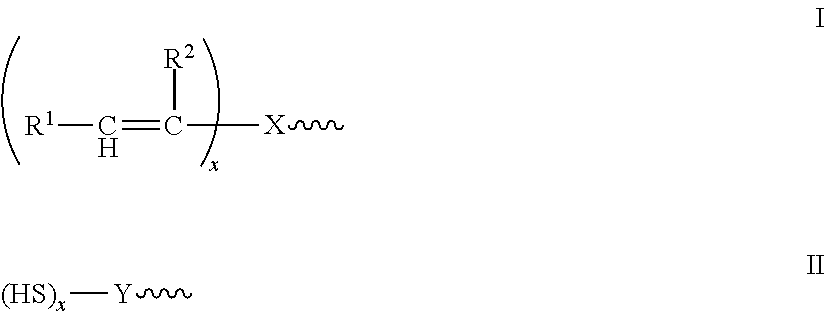
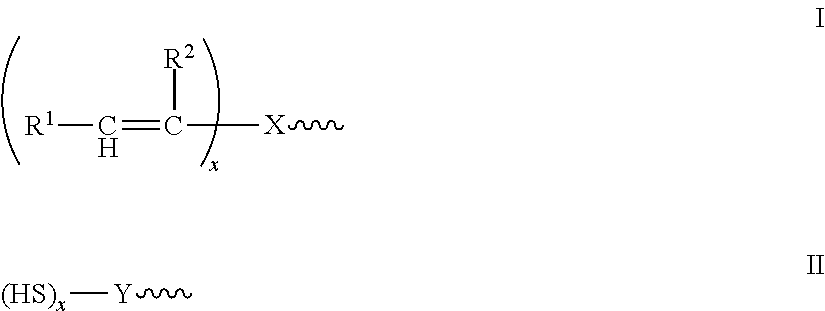
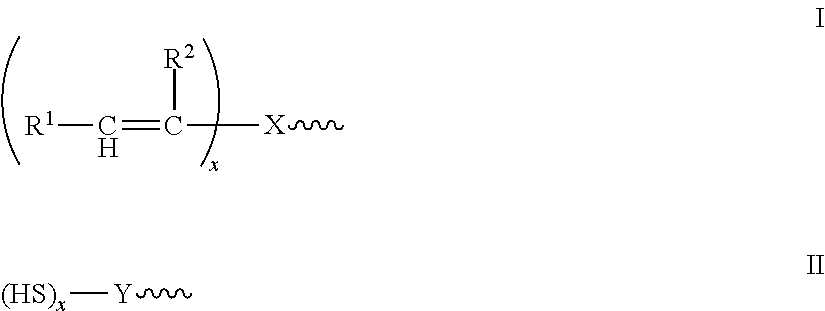
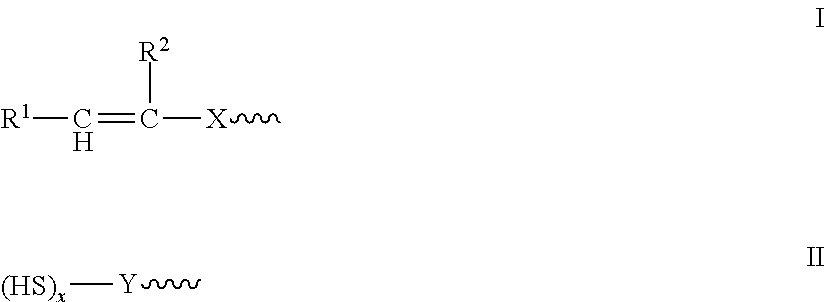
- the vinyl polymer bears at least one terminal functional group having the formula I or II:
- the C 4-8 cycloalkenyl ring may optionally contain a heteroatom.
- one or more of the carbon atoms in the ring optionally are hetero element(s) other than carbon, for example, nitrogen, oxygen or sulfur.
- the hydrocarbyl groups may be linear or branched and may include cyclic groups.
- X may be a linear or branched C 1-12 hydrocarbyl optionally including one or more groups selected from ether, thioether, acetal, thioacetal, ester, thioester, urethane, urea, thiourea, amine, amide, thioamide, carbamate and carbonate.
- Y is selected from linear or branched C 1-12 hydrocarbyl optionally including one or more groups selected from ether, thioether, acetal, thioacetal, ester, thioester, urethane, urea, thiourea, amide, thioamide, carbamate and carbonate.
- Y in formula II above attaches to the main chain of the vinyl polymer via a sulfur atom, for example, when a multi-functional thiol forms the terminal functional group(s).
- one thiol group of the multi-functional thiol may be consumed in the reaction, thereby resulting in attachment to the main chain of the vinyl polymer via a sulfur atom.
- Such attachment may be represented by the following formula II(a):
- each terminal alkenyl or thiol functional group may have a degree of functionality of 1 to 4.
- the vinyl polymers may bear more than one terminal functional group of formulas I or II.
- the vinyl polymer may bear four terminal functional groups of formulas I or II, thereby increasing the overall degree of functionality of the vinyl polymer.
- the vinyl polymers described herein may have a degree of functionality of alkenyl or thiol terminal functional groups of 1 to 12.
- Vinyl polymers bearing the terminal functional group(s) of formula I or II shown above bear terminal alkenyl or thiol functional groups. These vinyl polymers are combined with the opposing cross-linking agents for thiol-ene curing. In some embodiments, in addition to the thiol-ene cure, the vinyl polymers may also include terminal alkoxysilane groups, which would add moisture-curing capability to the compositions. Alternatively, in some embodiments, the vinyl polymers do not bear any alkoxysilane groups, or particularly terminal alkoxysilane groups. In embodiments that do not include alkoxysilane groups, the compositions may not be moisture curing. In such embodiments, the compositions are free of moisture curing catalysts.
- the vinyl polymer bearing at least one terminal functional group of formula I represented above contains at least one alkenyl terminal functional group.
- the compositions include a thiol cross-linking agent in combination with this polymer, thereby including a vinyl polymer component with alkenyl functionality and a cross-linking agent with thiol functionality.
- the vinyl polymer bearing at least one terminal functional group of formula II represented above contains at least one thiol terminal functional group.
- Such compositions include a vinyl cross-linking agent in combination with this polymer, thereby including a vinyl polymer component with thiol functionality and a cross-liking agent with vinyl functionality.
- compositions may include both a vinyl polymer bearing at least one terminal functional group of formula I and a vinyl polymer bearing at least one terminal functional group of formula II. Accordingly, such compositions include both a vinyl polymer having alkenyl functionality and a vinyl polymer having thiol functionality. These polymers are capable of cross-linking with one another through a thiol-ene mechanism.
- the alkenyl and thiol components are combined in stoichiometric or near stoichiometric levels. More specifically, the thiol-ene curing of the compositions occurs by a step-growth mechanism.
- the functionality of the alkenyl and vinyl components and the reaction stoichiometry are desirably adjusted to obtain a gelled three dimensional network upon cure.
- f a , f b and r such that ⁇ 1.
- the equivalent weight ratio of thiol:alkenyl components or alkenyl:thiol components in the compositions described herein is about 0.5:1 to 1.5:1, more desirably about 0.8:1 to 1.2:1, and even more desirably about 1:1, provided that the ratios selected result in a chemically cross-linked product.
- the ratio of thiol:alkenyl groups is about 1:1, there is an equal number of thiol and alkenyl functional groups present in the composition, which is generally desirable in most embodiments for optimal curing of the compositions.
- the average functionality of all of the alkenyl and thiol groups present desirably is greater than 2.
- the average functionality of the alkenyl terminal functional group(s) of formula I present on the vinyl polymer and the thiol functional groups of the thiol cross-linking agent is greater than 2.
- the average functionality of the thiol terminal functional groups(s) of formula II present on the vinyl polymer and the alkenyl functional groups of the vinyl cross-linking agent is greater than 2.
- the average functionalities of the alkenyl and vinyl groups in the composition can be balanced with ratio “r”, within the ranges set forth above, to obtain ⁇ 1 in the equation above, and thus, a chemically cross-linked polymer composition upon cure.
- ratio “r” of thiol:alkenyl components desirably is about 1:1 in some embodiments, ratios of about 0.5:1 to about 1.5:1 are effective provided the average functionalities of the alkenyl and thiol components are sufficiently high to provide ⁇ 1.
- Suitable vinyl polymers, thiol cross-linking agents and vinyl cross-linking agents are described in more detail in the following sections.
- the main polymer chain of the vinyl polymer may be formed by polymerization of vinyl monomers.
- the vinyl polymer is formed from non-homopolymerizable alkenes.
- Illustrative vinyl monomers include, for example, but are not limited to, (meth)acrylic acid monomers such as (meth)acrylic acid, methyl(meth)acrylate, ethyl(meth)acrylate, n-propyl(meth)acrylate, isopropyl(meth)acrylate, n-butyl (meth)acrylate, isobutyl(meth)acrylate, tert-butyl(meth)acrylate, n-pentyl(meth)acrylate, n-hexyl(meth)acrylate, cyclohexyl(meth)acrylate, n-heptyl(meth)acrylate, n-octyl (meth)acrylate, 2-ethylhexyl(meth)acryl
- the vinyl polymer may be selected from, but is not limited to, poly(meth)acrylates, polystyrenes, polybutadienes, polyvinylidene chlorides, polyacrylamides and combinations thereof.
- the vinyl polymers do not have silicon and oxygen repeating units in the polymer backbone.
- the vinyl polymers can include additional functional groups without compromising the nature of the vinyl polymer backbone.
- the vinyl polymer backbone may include a fragment of an initiator from the polymerization process.
- an initiator diethyl meso-2,5-dibromoadipate may be used as an initiator and thus a fragment of this initiator may form part of the polymer backbone, as shown in Example 3 of this invention.
- Other examples can be seen in the vinyl polymers of formulas VIa-VIj below.
- the vinyl polymer including any of the vinyl polymer chains described above, may bear at least one alkenyl terminal functional group.
- Such polymers may be combined with thiol cross-linking agents, which are described in more detail below.
- the alkenyl-functionalized polymer may be combined with a vinyl polymer bearing thiol functional group(s) of formula II above.
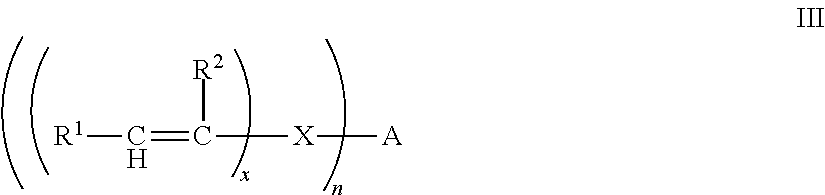
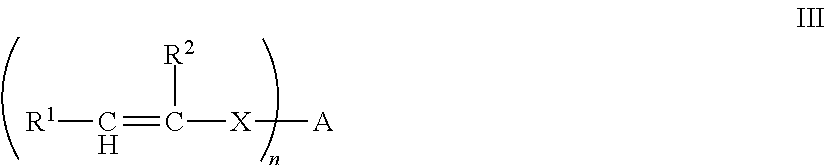
- compositions may include a vinyl polymer having the following formula III:
- A is a vinyl polymer backbone
- n is 1 to 64 and the remaining variables are as defined above.
- Vinyl polymer backbone, A may be linear or branched.
- the alkenyl functional group(s) shown in formula III are terminal group(s).
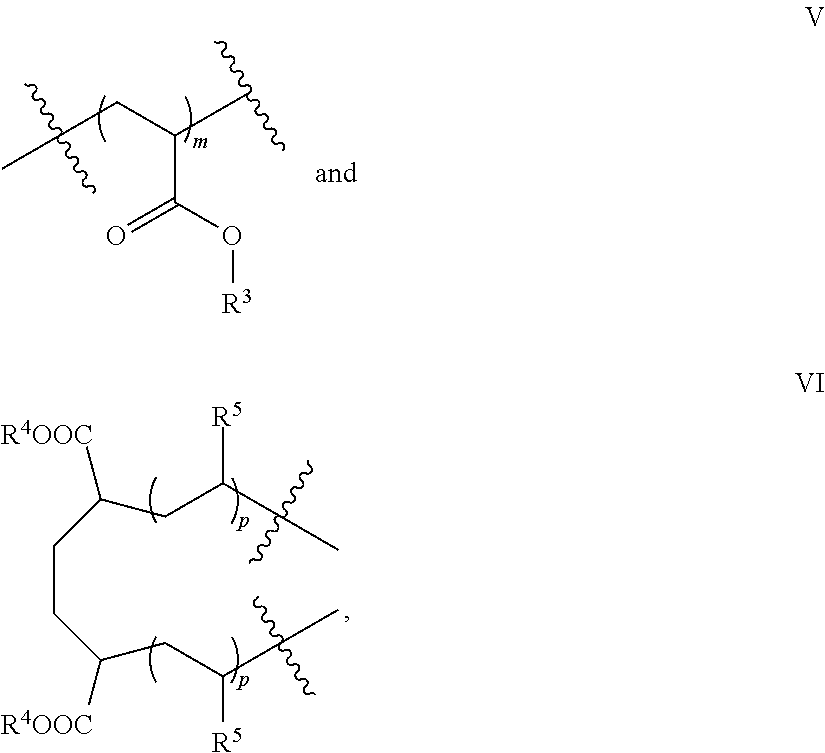
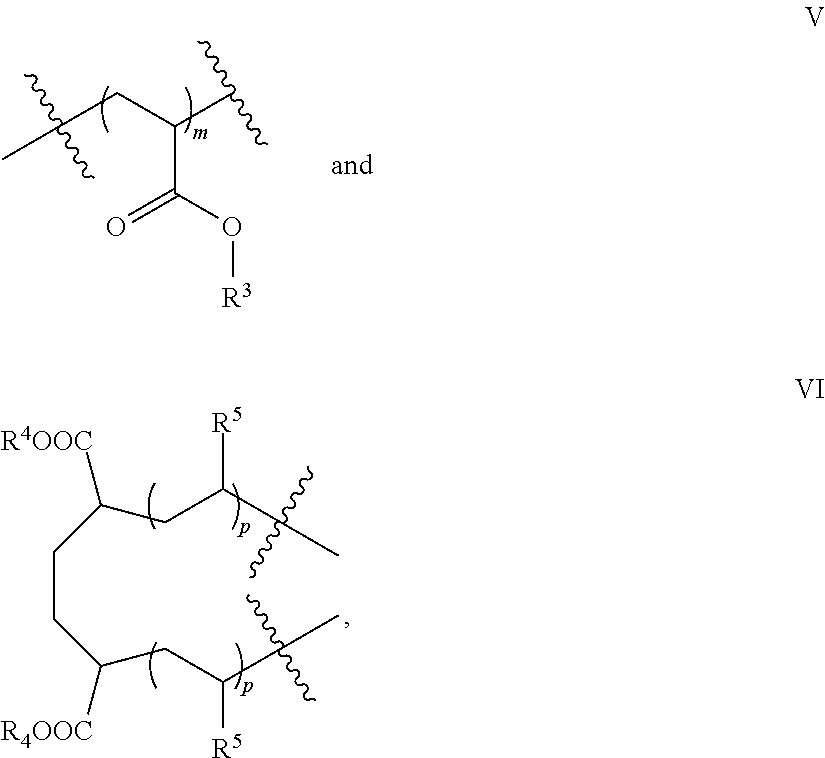
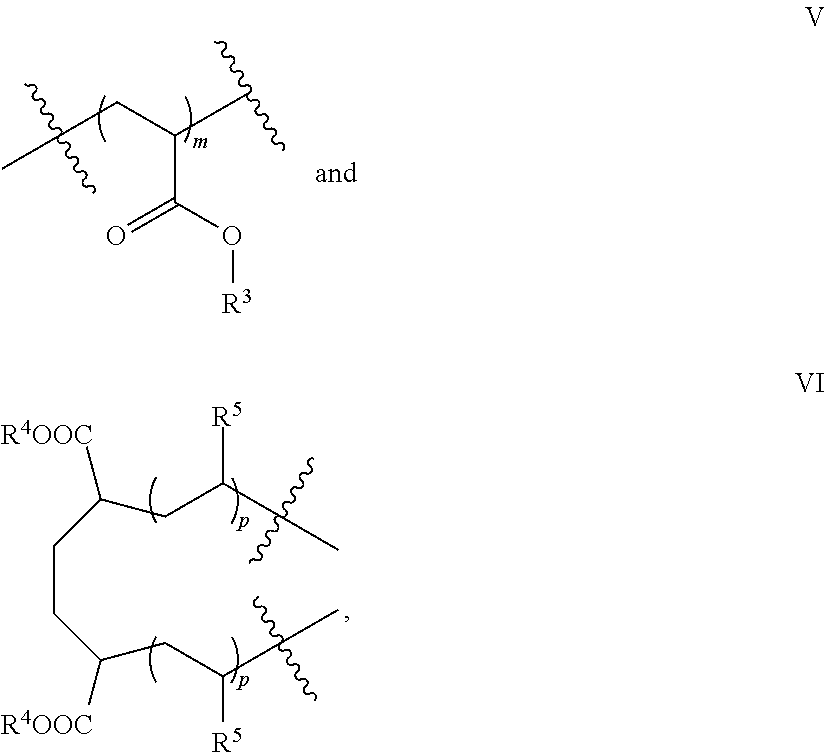
- compositions include a vinyl polymer of formula III above in which n is 2 and the vinyl polymer backbone A is selected from the following formulas V and VI:
- R 3 is selected from C 1-6 alkyl, —CH 2 OCH 3 and —CH 2 CH 2 OCH 3 ;
- R 4 is selected from C 1-6 alkyl
- R 5 is independently selected from —OC(O)—CH 2 —CH 3 ; —OC(O)—CH 2 —CH 2 —OCH 3 ; and —OC(O)—(CH 2 ) 3 —CH 3 ;
- m 10 to 10,000
- p 5 to 5,000.
- R 3 in formula V above is selected from butyl, particularly n-butyl, ethyl, hexyl, methoxyethyl and methoxymethyl.
- R 4 in formula VI is ethyl.
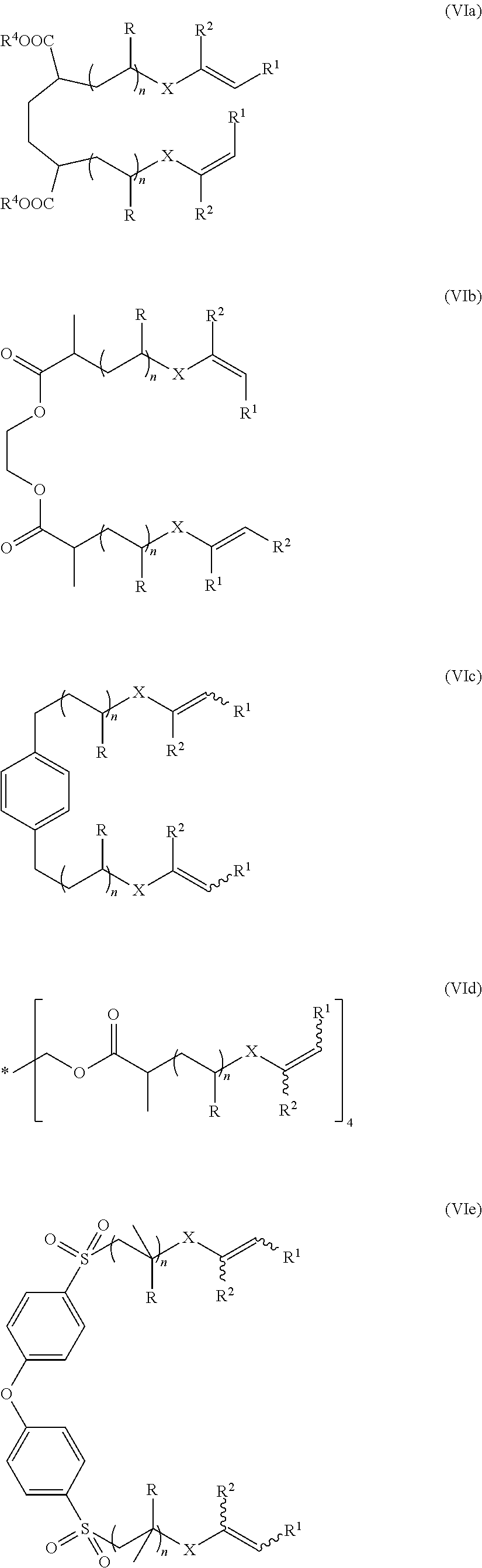
- the vinyl polymer bearing terminal alkenyl functional group(s) may be selected from the following formulas VIa-VIe:
- R is independently selected from —OC(O)—CH 2 —CH 3 ; —OC(O)—CH 2 —CH 2 —OCH 3 ; and —OC(O)—(CH 2 ) 3 —CH 3 ; and the remaining variables are as defined above.
- the vinyl polymer including any of the vinyl polymer chains described above, may bear at least one thiol terminal functional group.
- Such polymers may be combined with alkenyl cross-linking agents, which are described in more detail below.
- the thiol-functionalized polymer may be combined with a vinyl polymer bearing alkenyl functional group(s) of formula I above.
- compositions may include a vinyl polymer having the following formula IV:
- A is a vinyl polymer backbone
- n is 1 to 64 and the remaining variables are as defined above.
- Vinyl polymer backbone, A may be linear or branched.
- the thiol functional group(s) shown in formula III are terminal groups.
- compositions may include a vinyl polymer of formula IV above in which n is 2 and the vinyl polymer backbone A is selected from formulas V and VI, as set forth above.
- R 3 in formula V above is selected from butyl, particularly n-butyl, ethyl, hexyl, methoxyethyl and methoxymethyl.
- R 4 in formula VI is ethyl.
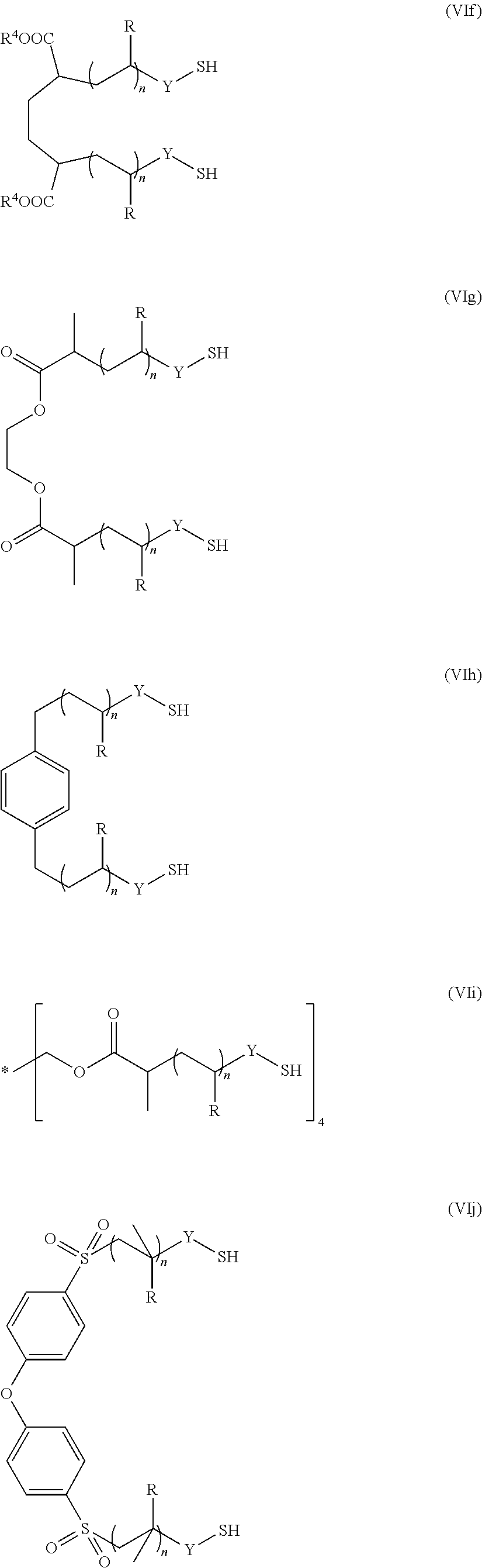
- the vinyl polymer bearing terminal thiol functional group(s) may be selected from the following formulas VIf-VIj:
- R is independently selected from —OC(O)—CH 2 —CH 3 ; —OC(O)—CH 2 —CH 2 —OCH 3 ; and —OC(O)—(CH 2 ) 3 —CH 3 ; and the remaining variables are as defined above.
- the thiol cross-linking agent may be any thiol-containing component capable of cross-linking the vinyl polymer bearing alkenyl functional group(s) through a thiol-ene mechanism.
- the thiol cross-linking agent is non-polymeric.
- the thiol cross-linking agent is a polymer.
- a vinyl polymer bearing thiol functional group(s) of formula II above may be employed as the thiol cross-linking agent to form a thiol-ene curing composition.
- the thiol cross-linking agent is a tetrafunctional thiol.
- suitable thiol cross-linking agents include, but are not limited to, pentaerythritol tetrakis(3-mercaptopropionate), ethoxylated pentaerythritol tetrakis(3-mercaptopropionate), thiol-functionalized polydimethyl siloxanes, thiol-terminated polysulfides, dipentaerythritol hexakis thioglycolate, trimethylolpropane tris(2-mercaptoacetate), pentacrythritol tetrakis(2-mercaptoacetate), tripentaerythritol octakis thioglycollate, mercaptan-terminated propoxylated glycerol (Capcure 3-800), ethyleneglycol bis(3-mercapto
- the vinyl cross-linking agent may be any vinyl-containing component capable of cross-linking the vinyl polymer bearing thiol functional group(s) through a thiol-ene mechanism.
- the vinyl cross-linking agent is non-polymeric.
- the vinyl cross-linking agent is a polymer.
- a vinyl polymer bearing alkenyl functional group(s) of formula I above may be employed as the vinyl cross-linking agent to form a thiol-ene curing composition.
- Suitable vinyl cross-linking agents include, but are not limited to, 1,3,5-triallyl-1,3,5-triazine-2,4,6(1H,3H,5H)-trione (also referred to as triallylisocyanurate), triallyl cyanurate, diallyl bisphenol A, diallylether bisphenol A, triethyleneglycol divinyl ether, cyclohexanedimethanol divinyl ether, multi-functional norbornene monomers prepared by reaction of multifunctional acrylates with cyclopentadiene, norbornadiene, 1,2,4-benzenetricarboxylic acid tris[4-(ethenyloxy)butyl]ester, vinylcyclohexene, 1,2,4-trivinylcyclohexane and combinations thereof.
- Suitable multi-functional norbornene monomers prepared by reaction of multifunctional acrylates with cyclopentadiene are described more fully in U.S. Pat. No. 4,808,638, which is incorporated herein by reference in its entirety.
- compositions also include a cure system.
- the cure system includes at least one initiator for initiating thiol-ene curing of the compositions described herein.
- Initiators include photoinitiators, thermal initiators and combinations thereof.
- Suitable photoinitiators for use herein include, but are not limited to, benzophenone and substituted benzophenones, acetophenone and substituted acetophenones, benzoin and its alkyl esters, xanthone and substituted xanthones, diethoxy-acetophenone, benzoin methyl ether, benzoin ethyl ether, benzoin isopropyl ether, diethoxyxanthone, chloro-thio-xanthone, N-methyl diethanol-amine-benzophenone, 2-hydroxy-2-methyl-1-phenyl-propan-1-one, 2-benzyl-2-(dimethylamino)-1-[4-(4-morpholinyl)phenyl]-1-butanone, bis acyl phosphine oxides, camphorquinone, metallocenes and mixtures thereof.
- Exemplary photoinitiators include those available commercially from Ciba Specialty Chemicals, under the “IRGACURE” and “DAROCUR” trade names, specifically “IRGACURE” 184 (1-hydroxycyclohexyl phenyl ketone), 907 (2-methyl-1-[4-(methylthio)phenyl]-2-morpholino propan-1-one), 369 (2-benzyl-2-N,N-dimethylamino-1-(4-morpholinophenyl)-1-butanone), 500 (the combination of 1-hydroxy cyclohexyl phenyl ketone and benzophenone), 651 (2,2-dimethoxy-2-phenyl acetophenone), 1700 (the combination of bis(2,6-dimethoxybenzoyl-2,4,4-trimethyl pentyl)phosphine oxide and 2-hydroxy-2-methyl-1-phenyl-propan-1-one), and 819 [bis(2,4,6-trimethyl benzoyl)phenyl
- thermal initiators for use herein include, but are not limited to, peroxides, hydroperoxides and azonitriles, including benzoyl peroxide, tert-butyl perbenzoate, cumene hydroperoxide, tert-butyl hydroperoxide, 2,2′-azobis(isobutyronitrile), 1,1-azobis-cyclohexanecarbonitrile and mixtures thereof.
- compositions also may include a variety of optional additives, such as, but not limited to, stabilizers, antioxidants, reinforcing agents, fillers, pigments, dyes, plasticizers and the like or mixtures thereof.
- optional additives such as, but not limited to, stabilizers, antioxidants, reinforcing agents, fillers, pigments, dyes, plasticizers and the like or mixtures thereof.
- any suitable mineral, carbonaceous, glass, or ceramic filler may be used, including, but not limited to: fumed silica; clay; metal salts of carbonates; sulfates; phosphates; carbon black; metal oxides; titanium dioxide; ferric oxide; aluminum oxide; zinc oxide; quartz; zirconium silicate; gypsum; silicium nitride; boron nitride; zeolite; glass; plastic powder; and combinations thereof. Fumed aluminum oxide and fumed silica are particularly desirable.
- the filler may be present in the composition in any suitable concentration in the curable composition. Generally, concentrations of from about 5% to about 80% by weight of the composition are sufficient. However, a more desirable range would be 20-60%.
- the silica may be a fumed silica, which may be untreated (hydrophilic) or treated with an adjuvant so as to render it hydrophobic.
- the fumed silica should be present at a level of at least about 5% by weight of the composition in order to obtain any substantial reinforcing effect.
- optimal silica levels vary depending on the characteristics of the particular silica, it has generally been observed that the thixotropic effects of the silica produce compositions of impractically high viscosity before maximum reinforcing effect is reached. Hydrophobic silicas tend to display lower thixotropic ratios and therefore greater amounts can be included in a composition of desired consistency.
- a hexamethyldisilazane treated silica is particularly desirable (such as HDK2000, offered for sale commercially by Wacker-Chemie, Burghausen, Germany).
- the present invention also provides methods of preparing curable compositions, which include a component having thiol functionality, a component having alkenyl functionality and a cure system.
- a vinyl polymer bearing at least one terminal functional group having the formula I or II, as defined above is provided.
- a cross-linking agent is added to the vinyl polymer.
- a thiol cross-linking agent is added.
- a vinyl cross-linking agent is added. Any of the cross-linking agents described herein may be employed.
- a cure system as described above, also is added to form the curable composition.
- compositions are useful in many applications, such as bonding together substrates, at least one of which is constructed of a metal or a synthetic material.
- metals include steel and aluminum; and of the synthetic materials are of glass cloth phenolics and phenolic composites.
- the compositions may be used to form gaskets, particularly form-in-place gaskets (“FIPG”) or cure-in-place gaskets (“CIPG”).
- FIPG form-in-place gaskets
- CIPG cure-in-place gaskets
- the composition may be applied to at least one of two substrate surfaces and then exposed to the energy source prior to mating the surfaces together to form the assembly.
- the curable composition may be applied to one of the substrates which will form part of the gasket, cured or at least partially cured, and then joined to a second substrate to form a gasket assembly.
- gasketing applications include, for example, FIPG and CIPG.
- a bead of the composition may be applied to a substrate and first cured by exposure to UV light and then mated to a second substrate to form a compression seal.
- the present invention additionally provides reaction products of the curable compositions described herein. More specifically, such product is formed upon exposure of any of the compositions described herein to curing conditions.
- Curing conditions include radiation, heat or a combination thereof. Radiation includes UV light, as well as other forms of light, such as visible, infrared and other forms of electromagnetic radiation.
- allylether hemiacetal ester terminated poly(n-butyl acrylate) was synthesized, according to the following reaction scheme.
- the resulting resin was cooled to ambient temperature and evacuated on a rotary evaporator for 4 hours at 0.5 torr to remove excess unreacted vinyl ether monomer.
- the allylic functionalized resin was recovered in quantitative yield as a viscous liquid. JR spectroscopic analysis confirmed that all of the carboxylic acid was consumed and 1 H NMR analysis indicated the presence of 1-allyoxyethoxyethyl hemiacetal ester or the starling carboxylic acid.
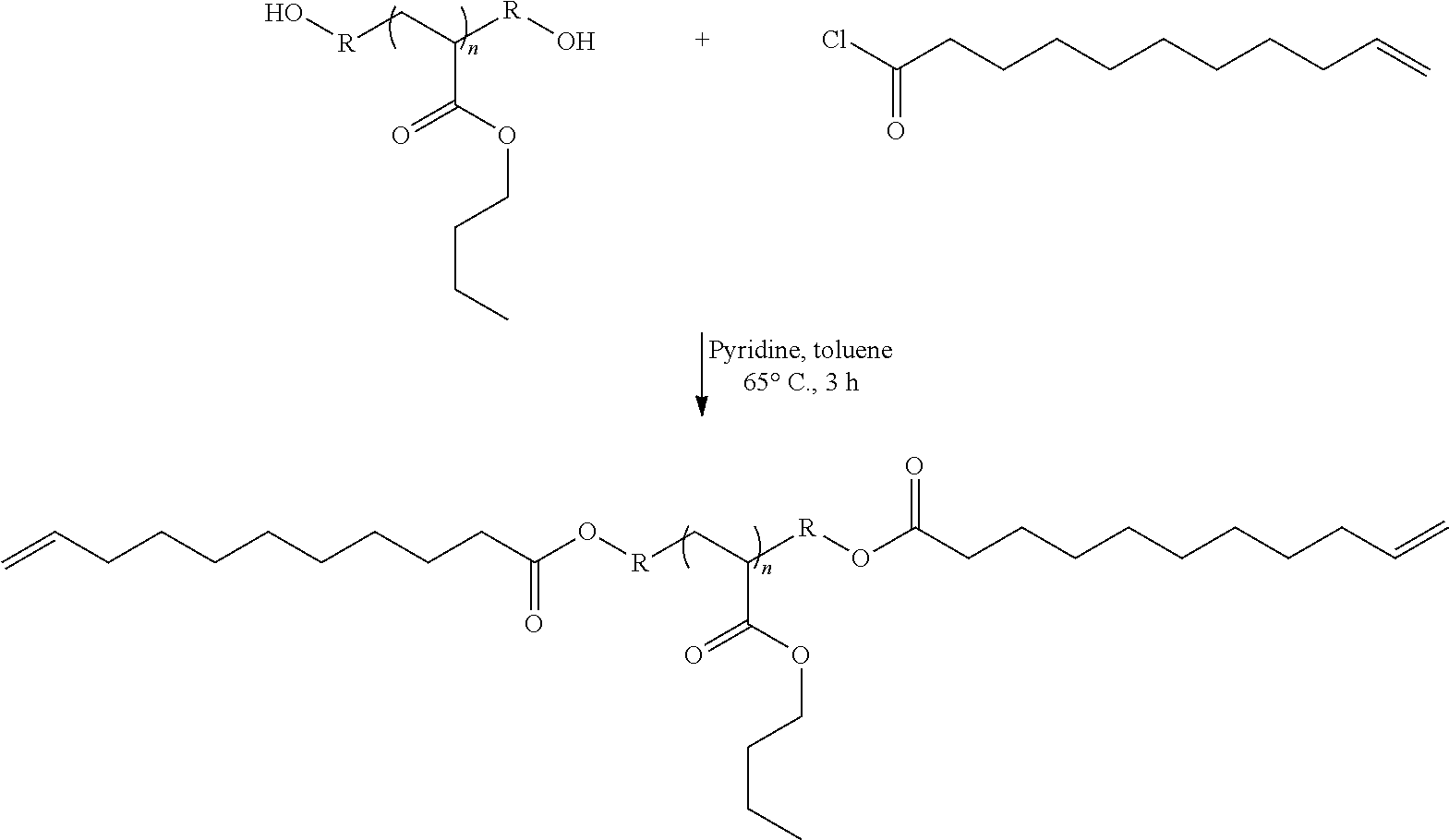
- the mixture was filtered, washed with dilute hydrochloride acid solution and then with sodium chloride solution and dried over anhydrous sodium sulfate.
- the desiccant was removed by filtration and the filtrate evacuated on a rotary evaporator at 0.5 torr and 50° C. to constant weight ( ⁇ 2 hours). IR spectroscopic analysis confirmed that all of the hydroxyl was consumed and 1 H NMR analysis indicated the presence of undecenyl substituted ester.
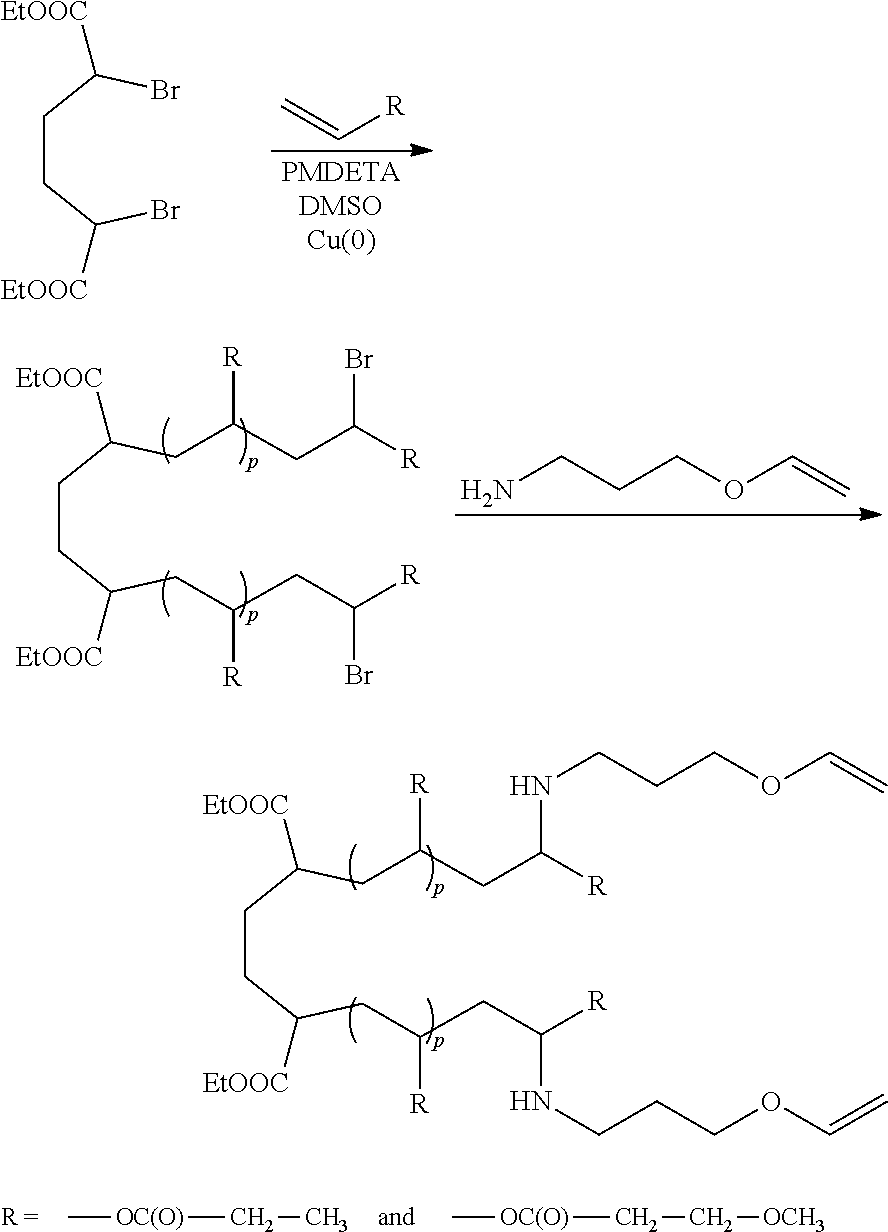
- vinyl ether terminated poly(ethyl acrylate-co-2-methoxyethyl acrylate) was synthesized, according to the following reaction scheme,
- the polymer was precipitated from the reaction mixture by addition of methanol/water, separated and diluted in THF.
- the THF solution was filtered through alumina and the filtrate evacuated on a rotary evaporator at 0.5 torr to yield ⁇ 200 g of a dibromo terminated, viscous liquid polymer having a number average molecular weight of 11,200 and a polydispersity of 1.2 (GPC, PMMA standards).
- a 20 g sample of the polymer ( ⁇ 0.004 eq) was dissolved in a solution of DMSO (20 mL) and triethylamine (2 mL) and 3-aminopropyl vinyl ether (4.0 g, 0.04 eq) was added while the mixture was stirred.
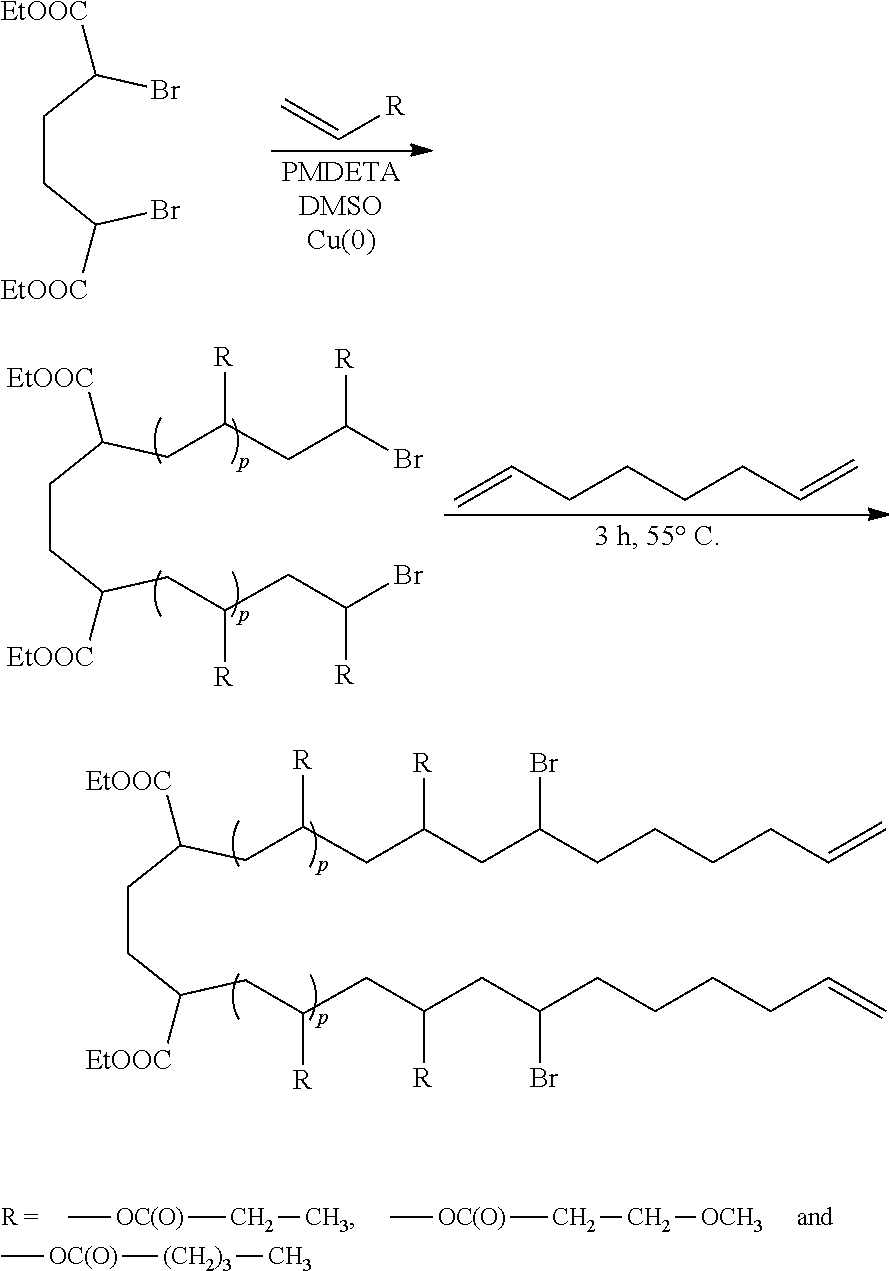
- alkenyl terminated acrylate terpolymer was synthesized, according to the following reaction scheme.
- a blend of ethyl, 2-methoxyethyl and n-butyl acrylate in mole ratios 2/1/1 (229 g) was polymerized by the method described in Example 3 with monomers/initiator/ligand/solvent/catalyst in the mole ratios 180/1/0.5/90/10 respectively.
- a ten-fold excess of 1,7-octadiene relative to initiator (6.11 g; 0.056 moles) was added and the mixture heated to 55° C.
- thiol functionalized polymer was synthesized by reaction of intermediate epoxide with thioacetic acid, as shown in the following reaction scheme.
- Example 3 The polymerization reaction of Example 3 was repeated. When conversion of monomers reached ⁇ 95%, an excess of allyloxyglycidyl ether (4.56 g; 0.40 moles) was added and the reaction mixture stirred for 4 hours at ambient temperature. The polymer was precipitated from the reaction mixture by addition of methanol/water, separated and diluted in THF. The THF solution was filtered through alumina and the filtrate evacuated on a rotary evaporator at 0.5 torr to yield ⁇ 220 g of a diepoxide terminated, viscous liquid polymer having a number average molecular weight of 12,500 and a polydispersity of 1.3 (GPC, PMMA standards).
- the structure of the intermediate polymer was confirmed by 1 H NMR spectroscopy.
- An aliquot of the polymer (20 g; ⁇ 0.004 eq) was treated with an excess of thioeacetic acid (1.5 g; 0.02 eq) in the presence of a catalytic amount of 1,8-diazabicyclo[5.4.0]undec-7-ene (DBU) and the mixture heated to 65° C. for 4 hours.
- DBU 1,8-diazabicyclo[5.4.0]undec-7-ene
- the resulting polymer was precipitated in methanol/water, separated and diluted in THF.
- the THF solution was filtered through alumina and the solvent evaporated to yield a ⁇ -hydroxy thiol terminated polymer in about 85% yield.
- Photocurable thiol-ene compositions were prepared in accordance with the present invention.
- Stoichiometric monomeric and polymeric thiol-ene premixes were prepared in accordance with the components and amounts indicated in Table 1.
- Tetra thiols, ethoxylated pentaerythritol tetrakis(3-mercaptopropionate) (PP150-TMP) and pentaerythritol tetrakis(3-mercaptopropionate) (PETMP) were supplied by Robinson Brothers, UK and Aldrich respectively.
- Triallylisocyanurate (1,3,5-triallyl-1,3,5-triazine-2,4,6-trione) was supplied by Aldrich.
- Composition B Component weight % weight % Polymer premix A 80 Monomer premix A 9 Polymer premix B 80 Monomer premix B 9 Fumed silica 10 10 Photoinitiator 1 1 1 1 Combination of bis(2,6-dimethoxybenzoyl-2,4,4-trimethyl pentyl) phosphine oxide and 2-hydroxy-2-methyl-1-phenyl-propan-1-one (available commercially from Ciba Specialty Chemicals as Irgacure 1700)
- Films of the photocurable compositions A and B were cast between release treated glass plates and exposed to UV light from a Zeta 7216 lamp with a Fusion H bulb at an incident intensity of 160 mW/cm2 for 30 seconds per side (60 seconds total).
- the cured films were removed and cut according to specification for the specific test method.
- Bulk material properties were measured on an Instron tensile tester according to ASTM D412 at a strain rate of 20 inch/min and results are the average of five specimens.
- Durometer hardness (Shore A) was measured according to ASTM D2240.
- Glass transition temperatures were measured by dynamic scanning calorimetry (DSC) at a heating rate of 20° C./min from ⁇ 60 to 120° C.
- Compression set was determined according to ASTM D395-03. Compressibility was defined as the maximum extent to which a sample of known thickness could be compressed at a given temperature (typically 150° C.) without material failure. The results of these tests are presented in Table 3.
- composition C For comparative purposes a composition consisting of an poly(ethylene-co-methyl acrylate) dissolved in a blend of acrylate monomers also was prepared (Composition C). The comparative results also are presented in Table 3.
- compositions of the present invention have mechanical properties suitable for compression sealing applications.
- the physical properties are significantly improved by comparison to current acrylate-based compositions (exemplified by Composition C) in particular improved surface cure, improved compressibility and reduced shrinkage.
- a thiol-ene composition of the present invention was cured and evaluated for oil resistance.
- Oil resistance is an indication that the composition may be useful as a sealant in automotive applications, such as automotive gasketing applications.
- Composition A of Example 6 above was evaluated for oil resistance.
- Standard tensile specimens (in accordance with ASTM D412) were prepared and suspended from wire hangers in 0W-30 motor oil; the oil was then heated to 150° C. After one week, the samples were removed from the oil and cooled to room temperature, and excess oil was blotted off.
- Durometer hardness, tensile strength, and elongation were measured on the oil aged samples according to the relevant ASTM's. Results, compared with those of an unaged control made from the same batch, are shown in Table 4.
- Example 8 the dibromo intermediate polymer of Example 3 is reacted with excess trimethylolpropane tris(3-mercaptopropionic acid) in the presence of potassium carbonate to form thiol-terminated polyacrylates having the formula shown below.
- Example 9 the dibromo intermediate polymer is reacted with pentaerythritol tetrakis(3-mercaptopropionic acid) in the presence of potassium carbonate to form thiol-terminated polyacrylates having the formula shown below.
- a tetra-functional vinyl-terminated acrylate terpolymer is prepared according to the procedure of Example 4, in which the initiator, diethyl dibromoadipate, is replaced by pentaerythritol tetrakis(2-bromopropionate) and the capping agent, 1,7-octadiene, is replaced with 2,5-norbornadiene. After purification, the tetra-functional norbornene-terminated polymer is obtained. Preparation of the tetra-functional norbornene-terminated polymer is shown in the following reaction scheme.
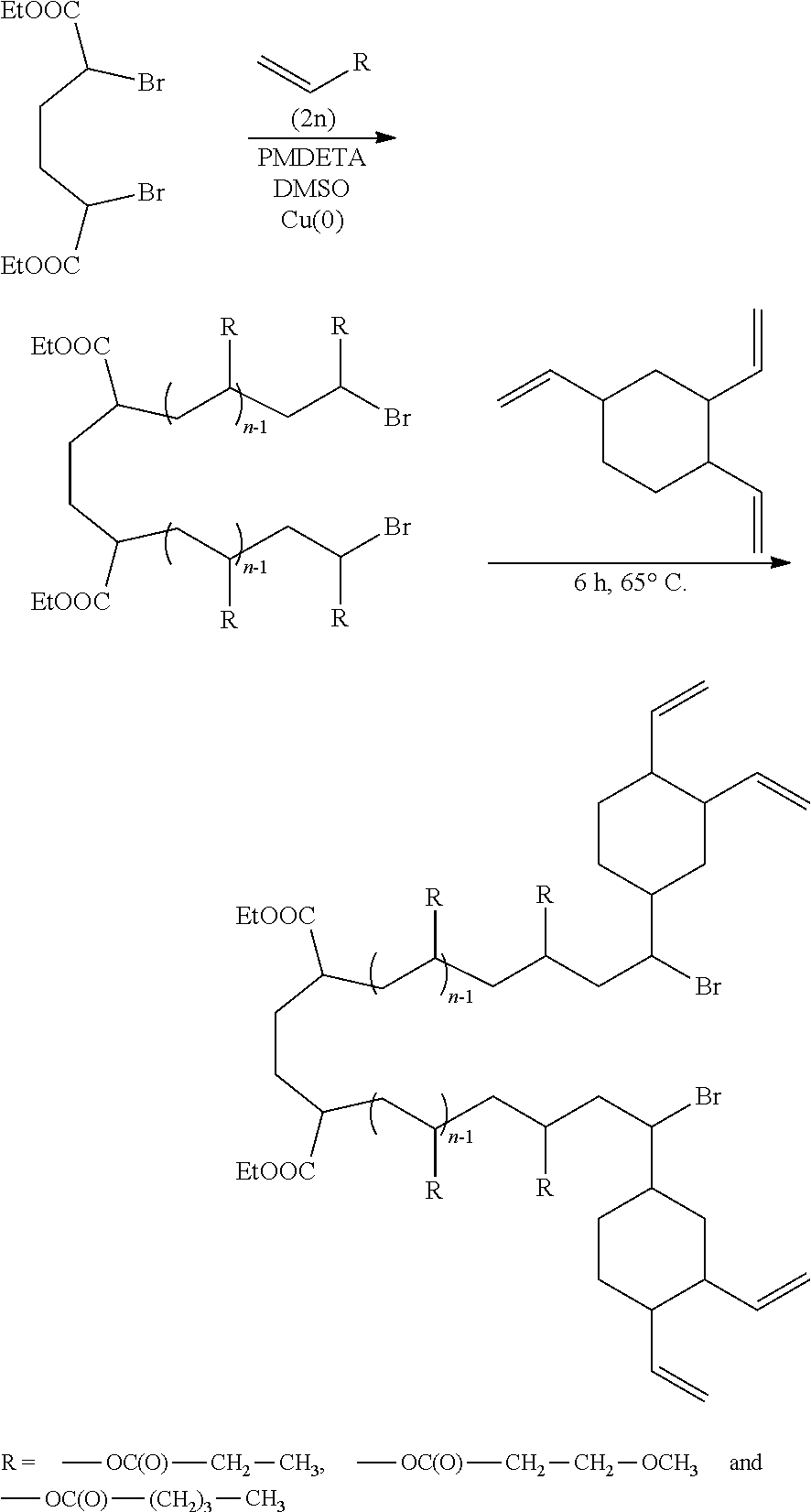
- a tetraalkenyl-terminated acrylate terpolymer is prepared using a di-functional initiator and a triene terminating agent.
- a tetrafunctional vinyl-terminated acrylate terpolymer is prepared according to the procedure of Example 4, in which the terminating agent, 1,7-octadiene, is replaced with 1,2,4-trivinylcyclohexane.
- the tetra-functional vinyl-terminated polymer is isolated after purification. Preparation of the tetra-functional vinyl-terminated polymer is shown in the following reaction scheme.
Landscapes
- Chemical & Material Sciences (AREA)
- Organic Chemistry (AREA)
- Chemical Kinetics & Catalysis (AREA)
- Health & Medical Sciences (AREA)
- Medicinal Chemistry (AREA)
- Polymers & Plastics (AREA)
- General Chemical & Material Sciences (AREA)
- Sealing Material Composition (AREA)
- Compositions Of Macromolecular Compounds (AREA)
- Polymers With Sulfur, Phosphorus Or Metals In The Main Chain (AREA)
- Addition Polymer Or Copolymer, Post-Treatments, Or Chemical Modifications (AREA)
- Other Resins Obtained By Reactions Not Involving Carbon-To-Carbon Unsaturated Bonds (AREA)
- Manufacture Of Macromolecular Shaped Articles (AREA)
Abstract
Description
-
- where:
- R1 and R2 are independently selected from H, C1-6 alkyl and C4-8 cycloalkyl, or R1 and R2 when taken together with the carbon atoms to which they are attached complete a C4-8 cycloalkenyl ring optionally containing a heteroatom and optionally substituted by one or more halo groups;
- X is selected from a bond, C1-17 hydrocarbyl, oxygen and sulfur, wherein the C1-17 hydrocarbyl optionally includes one or more groups selected from ether, thioether, acetal, thioacetal, ester, thioester, urethane, urea, thiourea, amine, amide, thioamide, carbamate and carbonate, and wherein the C1-17 hydrocarbyl optionally is substituted by one or more halo groups;
- Y is selected from C1-17 hydrocarbyl optionally including one or more groups selected from ether, thioether, acetal, thioacetal, ester, thioester, urethane, urea, thiourea, amine, amide, thioamide, carbamate and carbonate, and wherein the C1-17 hydrocarbyl optionally is substituted by one or more halo groups;
- x is 1 to 4;
-
- (i) a thiol cross-linking agent when the vinyl polymer of (a) bears at least one functional group having the formula I; or
-
- where:
- R1 and R2 are independently selected from H, C1-6 alkyl and C4-8 cycloalkyl, or R1 and R2 when taken together with the carbon atoms to which they are attached complete a C4-8 cycloalkenyl ring optionally containing a heteroatom and optionally substituted by one or more halo groups;
- X is selected from a bond, C1-17 hydrocarbyl, oxygen and sulfur, wherein the C1-17 hydrocarbyl optionally includes one or more groups selected from ether, thioether, acetal, thioacetal, ester, thioester, urethane, urea, thiourea, amine, amide, thioamide, carbamate and carbonate, and wherein the C1-17 hydrocarbyl optionally is substituted by one or more halo groups;
- Y is selected from C1-17 hydrocarbyl optionally including one or more groups selected from ether, thioether, acetal, thioacetal, ester, thioester, urethane, urea, thiourea, amine, amide, thioamide, carbamate and carbonate, and wherein the C1-17 hydrocarbyl optionally is substituted by one or more halo groups;
- x is 1 to 4;
-
- (i) a thiol cross-linking agent when the vinyl polymer of (a) bears at least one functional group having the formula I; or
- (ii) a vinyl cross-linking agent when the vinyl polymer of (a) bears at least one functional group having the formula II; and
-
- where:
- R1 and R2 are independently selected from H, C1-6 alkyl and C4-8 cycloalkyl, or R1 and R2 when taken together with the carbon atoms to which they are attached complete a C4-8 cycloalkenyl ring optionally containing a heteroatom and optionally substituted by one or more halo groups;
- X is selected from a bond, C1-17 hydrocarbyl, oxygen and sulfur, where the C1-17 hydrocarbyl optionally includes one or more groups selected from ether, thioether, acetal, thioacetal, ester, thioester, urethane, urea, thiourea, amine, amide, thioamide, carbamate and carbonate, and where the C1-17 hydrocarbyl optionally is substituted by one or more halo groups;
- Y is selected from C1-17 hydrocarbyl optionally comprising one or more groups selected from ether, thioether, acetal, thioacetal, ester, thioester, urethane, urea, thiourea, amine, amide, thioamide, carbamate and carbonate, and where the C1-17 hydrocarbyl optionally is substituted by one or more halo groups; and
- x is 1 to 4.

α=1/{r(f a−1)(f t−1)}0.5
where fa and ft represent the weight-average functionality of alkenyl and thiol components respectively and r is the stoichiometric imbalance (i.e., the ratio of the number of reactive equivalents of thiol:alkenyl or alkenyl thiol, whichever is the lesser). To obtain a chemically cross-linked polymer, it is necessary to select fa, fb and r such that α<1.



| TABLE 1 |
| Stoichiometric thiol-ene premix compositions |
| Monomer | Polymer | Monomer | Polymer | ||
| premix A | premix A | premix B | premix B | ||
| Component | Equivalent weight | weight % | weight % | weight % | weight % |
| Alkene polymer | 10,100 | 97.4 | 98.8 | ||
| of Example 4 | |||||
| PP150-TMP | 267 | 76.3 | 2.6 | ||
| PETMP | 122 | 59.5 | 1.2 | ||
| Triallylisocyanurate | 83 | 23.7 | 40.5 | ||
| TABLE 2 | ||||
| Composition A | Composition B | |||
| Component | weight % | weight % | ||
| Polymer premix A | 80 | |||
| Monomer premix A | 9 | |||
| Polymer premix B | 80 | |||
| Monomer premix B | 9 | |||
| Fumed silica | 10 | 10 | ||
| Photoinitiator1 | 1 | 1 | ||
| 1Combination of bis(2,6-dimethoxybenzoyl-2,4,4-trimethyl pentyl) phosphine oxide and 2-hydroxy-2-methyl-1-phenyl-propan-1-one (available commercially from Ciba Specialty Chemicals as Irgacure 1700) | ||||
| TABLE 3 |
| Materials properties of photocured thiol-ene |
| elastomers and comparative elastomer |
| Property | Composition A | Composition B | Composition C |
| Surface cure | Tack-free | Tack-free | Tacky |
| Glass transition | −22 | −31 | −20 |
| temperature (° C.) | |||
| Tensile strength (MPa) | 3 | 2 | 7 |
| Elongation (%) | 205 | 88 | 200 |
| Durometer hardness | 42 | 39 | 60 |
| (Shore A) | |||
| Compression set: | |||
| 22 h, 177° C., air | 45 | — | — |
| 70 h, 150° C., air | — | 31 | — |
| 500 h, 150° C., air | — | — | 24 |
| Compressibility (%) | 50 | — | 30 |
| Complex shear | 0.6 | 2.0 | |
| modulus (MPa) | |||
| Shrinkage (%) | — | 0.8 | 2.8 |
| TABLE 4 |
| Materials properties of Composition A before and |
| after aging 1 week at 150° C. in motor oil |
| Before | ||||
| Property | Aging | After Aging | ||
| Tensile strength (MPa) | 1.3 | 1.5 | ||
| Elongation (%) | 170 | 170 | ||
| Durometer hardness (Shore | 31 | 23 | ||
| A) | ||||


Claims (5)


Priority Applications (8)
| Application Number | Priority Date | Filing Date | Title |
|---|---|---|---|
| US12/062,090 US9243083B2 (en) | 2008-04-03 | 2008-04-03 | Thiol-ene cured oil-resistant polyacrylate sealants for in-place gasketing applications |
| CA2720238A CA2720238C (en) | 2008-04-03 | 2009-04-02 | Thiol-ene cured oil-resistant polyacrylate sealants for in-place gasketing applications |
| ES09743184.5T ES2537817T3 (en) | 2008-04-03 | 2009-04-02 | Thiol-eno cured oil-resistant polyacrylate sealants for on-site sealing gasket applications |
| PCT/US2009/039256 WO2009137197A2 (en) | 2008-04-03 | 2009-04-02 | Thiol-ene cured oil-resistant polyacrylate sealants for in-place gasketing applications |
| JP2011503160A JP5439470B2 (en) | 2008-04-03 | 2009-04-02 | Thiol-ene cured oil resistant polyacrylate sealant for in-place gasketing applications |
| CN200980116628.5A CN102015882B (en) | 2008-04-03 | 2009-04-02 | Thiol-ene cured oil-resistant polyacrylate sealant for gasket-in-place applications |
| KR1020107024649A KR101585278B1 (en) | 2008-04-03 | 2009-04-02 | Thiol-ene cured oil-resistant polyacrylate sealants for in-place gasketing applications |
| EP09743184.5A EP2274378B1 (en) | 2008-04-03 | 2009-04-02 | Thiol-ene cured oil-resistant polyacrylate sealants for in-place gasketing applications |
Applications Claiming Priority (1)
| Application Number | Priority Date | Filing Date | Title |
|---|---|---|---|
| US12/062,090 US9243083B2 (en) | 2008-04-03 | 2008-04-03 | Thiol-ene cured oil-resistant polyacrylate sealants for in-place gasketing applications |
Publications (2)
| Publication Number | Publication Date |
|---|---|
| US20140216649A1 US20140216649A1 (en) | 2014-08-07 |
| US9243083B2 true US9243083B2 (en) | 2016-01-26 |
Family
ID=41265263
Family Applications (1)
| Application Number | Title | Priority Date | Filing Date |
|---|---|---|---|
| US12/062,090 Active 2031-03-01 US9243083B2 (en) | 2008-04-03 | 2008-04-03 | Thiol-ene cured oil-resistant polyacrylate sealants for in-place gasketing applications |
Country Status (8)
| Country | Link |
|---|---|
| US (1) | US9243083B2 (en) |
| EP (1) | EP2274378B1 (en) |
| JP (1) | JP5439470B2 (en) |
| KR (1) | KR101585278B1 (en) |
| CN (1) | CN102015882B (en) |
| CA (1) | CA2720238C (en) |
| ES (1) | ES2537817T3 (en) |
| WO (1) | WO2009137197A2 (en) |
Cited By (2)
| Publication number | Priority date | Publication date | Assignee | Title |
|---|---|---|---|---|
| US9365750B2 (en) | 2012-06-27 | 2016-06-14 | Henkel IP & Holding GmbH | Accelerators for curable compositions |
| US9371473B2 (en) | 2012-06-27 | 2016-06-21 | Henkel IP & Holding GmbH | Accelerators for two step adhesive systems |
Families Citing this family (37)
| Publication number | Priority date | Publication date | Assignee | Title |
|---|---|---|---|---|
| KR101437751B1 (en) * | 2010-03-22 | 2014-09-03 | 헨켈 유에스 아이피 엘엘씨 | Macro-photoinitiators and curable compositions thereof |
| US8729198B2 (en) * | 2010-08-13 | 2014-05-20 | Prc Desoto International, Inc. | Compositions comprising thiol-terminated polymers and sulfur-containing ethylenically unsaturated silanes and related cured sealants |
| US10047259B2 (en) | 2010-08-13 | 2018-08-14 | Prc-Desoto International, Inc. | Methods for making cured sealants by actinic radiation and related compositions |
| EP2697286A2 (en) | 2011-04-14 | 2014-02-19 | Universiteit Gent | Sulphur-containing thermoplastic polymers |
| WO2012147711A1 (en) * | 2011-04-28 | 2012-11-01 | 三菱瓦斯化学株式会社 | Curable composition and adhesive for optical applications |
| JP5187471B2 (en) * | 2011-06-17 | 2013-04-24 | Dic株式会社 | Fluorine-containing curable resin, active energy ray-curable composition and cured product thereof |
| WO2013090988A1 (en) * | 2011-12-22 | 2013-06-27 | Commonwealth Scientific And Industrial Research Organisation | Light triggered cure on demand sealants |
| US8865812B2 (en) * | 2012-05-18 | 2014-10-21 | Nd Industries, Inc. | Sealant and fastener including same |
| CN102731350B (en) * | 2012-07-05 | 2014-04-16 | 浙江大学 | Sulfhydryl compound containing beta-ester groups and acetyl-transferred synthesis method thereof |
| US20140088217A1 (en) * | 2012-09-24 | 2014-03-27 | Exxonmobil Chemical Patents Inc. | Hydrothiolation of Vinyl-Terminated Macromonomers With Thiol-Containing Compounds |
| EP2912098B1 (en) * | 2012-10-24 | 2018-08-08 | PRC-Desoto International, Inc. | Uses of uv-curable polythioether sealants for sealing fasteners and for smoothing surfaces |
| US10035284B2 (en) | 2013-12-03 | 2018-07-31 | Ocv Intellectual Capital, Llc | UV-curable glass fiber sizing compositions |
| US9957416B2 (en) | 2014-09-22 | 2018-05-01 | 3M Innovative Properties Company | Curable end-capped silsesquioxane polymer comprising reactive groups |
| WO2016048736A1 (en) | 2014-09-22 | 2016-03-31 | 3M Innovative Properties Company | Curable polymers comprising silsesquioxane polymer core silsesquioxane polymer outer layer, and reactive groups |
| US9657213B2 (en) | 2014-10-20 | 2017-05-23 | Kraton Polymers U.S. Llc | Curable, resealable, swellable, reactive sealant composition for zonal isolation and well integrity |
| WO2016101129A1 (en) * | 2014-12-23 | 2016-06-30 | Henkel (China) Company Limited | 1k high temperature debondable adhesive |
| BR112017013742A2 (en) | 2014-12-23 | 2018-03-13 | 3M Innovative Properties Co | double cure polyether |
| US10533125B2 (en) | 2015-08-21 | 2020-01-14 | Halliburton Energy Services, Inc. | Thiol-ene based resin system for sand consolidation and methods using thereof |
| EP3344682A1 (en) * | 2015-09-02 | 2018-07-11 | Greenseal NV | Thiol-acrylate based foam precursor composition |
| US11015115B2 (en) | 2015-12-31 | 2021-05-25 | 3M Innovative Properties Company | Curable quantum dot compositions and articles |
| CN108431172B (en) | 2015-12-31 | 2021-04-13 | 3M创新有限公司 | Articles containing particles with quantum dots |
| TW201800491A (en) * | 2016-03-07 | 2018-01-01 | 道康寧公司 | Photocurable silicone composition and cured product thereof |
| CN106317898A (en) * | 2016-08-17 | 2017-01-11 | 广东工业大学 | Photocured organosilicone elastomer and preparation method and application thereof |
| US20200109285A1 (en) * | 2017-06-09 | 2020-04-09 | Dow Silicones Corporation | Uv curable silicone terminal sealant |
| JP2021512192A (en) * | 2018-01-25 | 2021-05-13 | モメンティブ パフォーマンス マテリアルズ ゲーエムベーハーMomentive Performance Materials GmbH | Thiol-en curing composition |
| CN112154171B (en) | 2018-05-22 | 2023-06-13 | 3M创新有限公司 | Method for processing radiation-curable thiol-based compositions with additive manufacturing techniques |
| CN109503919A (en) * | 2018-10-17 | 2019-03-22 | 贵阳玉塑包装有限公司 | Regenerated plastics multifunctional mother granules |
| CN118063670A (en) | 2018-11-20 | 2024-05-24 | 皮瑟莱根特科技有限责任公司 | Solvent-free formulation and nanocomposite |
| WO2020167633A1 (en) | 2019-02-11 | 2020-08-20 | Ppg Industries Ohio, Inc. | 3d printing of seal caps |
| TW202112854A (en) * | 2019-08-09 | 2021-04-01 | 日商大阪有機化學工業股份有限公司 | Novel firing temperature reducing agent for conductive material |
| US20220396673A1 (en) * | 2019-11-14 | 2022-12-15 | Kyushu University, National University Corporation | Method for hydrating water-insoluble polymer capable of containing intermediate water |
| CN111171729B (en) * | 2019-12-31 | 2021-11-23 | 东莞市联灏新材料技术开发有限公司 | UV LED fast curing OLED terminal protection adhesive |
| CN114516932B (en) * | 2020-11-19 | 2022-12-02 | 中国科学院福建物质结构研究所 | Bio-based transparent degradable flexible resin and preparation method thereof |
| JP2024526858A (en) * | 2021-07-20 | 2024-07-19 | ボストン サイエンティフィック サイムド,インコーポレイテッド | Gel Compositions, Systems, and Methods |
| WO2023091806A1 (en) * | 2021-11-19 | 2023-05-25 | Henkel IP & Holding GmbH | 2k curable compositions for composite and tool release |
| WO2025117935A1 (en) * | 2023-12-01 | 2025-06-05 | Arizona Board Of Regents On Behalf Of The University Of Arizona | Uv-curable thiol-ene system for broadband infrared transparent objects |
| CN119930893B (en) * | 2025-03-04 | 2025-12-05 | 上海东升新材料有限公司 | A high-adhesion styrene-butadiene latex raw material composition for carpets and its preparation method |
Citations (28)
| Publication number | Priority date | Publication date | Assignee | Title |
|---|---|---|---|---|
| US3504080A (en) | 1962-07-27 | 1970-03-31 | Glanzstoff Ag | Method of producing dimensionally - stable injection molded polyesters |
| US3676283A (en) * | 1969-08-14 | 1972-07-11 | Grace W R & Co | Laminate and process for laminating with polythiol polyene reaction product |
| US3690815A (en) | 1971-03-31 | 1972-09-12 | Ciba Geigy Corp | Dyeing assisted by aryl esters of aryl sulfonic acids |
| JPS5852377A (en) | 1981-09-24 | 1983-03-28 | Kansai Paint Co Ltd | Self-adhesive composition |
| US4767809A (en) | 1986-10-14 | 1988-08-30 | Uniroyal Chemical Company, Inc. | Elastomeric composition having improved cut growth resistance |
| US4772031A (en) | 1982-05-03 | 1988-09-20 | Amp Incorporated | Acrylic adhesive sealant and leak sealing method |
| US4808638A (en) | 1986-10-14 | 1989-02-28 | Loctite Corporation | Thiolene compositions on based bicyclic 'ene compounds |
| US4965129A (en) | 1987-02-09 | 1990-10-23 | E. I. Du Pont De Nemours And Company | Article for absorbing liquids |
| US5028661A (en) | 1986-10-14 | 1991-07-02 | Loctite Corporation | Adhesion promoters for thiolene adhesive formulations |
| US5135978A (en) * | 1987-06-03 | 1992-08-04 | Avery Dennison Corporation | Curable film forming compositions |
| US5208281A (en) | 1991-02-05 | 1993-05-04 | Loctite Corporation | Stabilization of thiolene compositions |
| US5358976A (en) * | 1989-11-13 | 1994-10-25 | Loctite (Ireland) Limited | Stable thiol-ene compositions |
| US5371181A (en) | 1990-11-28 | 1994-12-06 | Loctite Corporation | Thiol-ene compositions with improved cure speed retention |
| WO1995000869A1 (en) | 1993-06-22 | 1995-01-05 | Loctite Corporation | Optical fiber primary coatings and fibers coated therewith |
| US5399624A (en) | 1990-12-21 | 1995-03-21 | Loctite Corporation | High purity resins for thiol-ene polymerizations and method for producing same |
| US5459173A (en) | 1993-06-22 | 1995-10-17 | Loctite Corporation | Stabilizer system for thiol-ene and thiol-nene compositions |
| US5917006A (en) * | 1998-01-16 | 1999-06-29 | Ppg Industries Ohio, Inc. | Optical resin composition |
| US6172150B1 (en) | 1996-02-01 | 2001-01-09 | Wacker-Chemie Gmbh | Room-temperature vulcanizing condensation-crosslinking silicone rubbers |
| US6265476B1 (en) | 1997-04-08 | 2001-07-24 | Dsm N.V. | Radiation-curable binder compositions having high elongation and toughness after cure |
| US6506460B2 (en) | 1998-01-21 | 2003-01-14 | E. I. Du Pont De Nemours And Company | UV curable elastomer composition |
| CA2522468A1 (en) | 2003-04-17 | 2004-10-28 | Essilor International(Compagnie Generale D'optique) | Photocurable adhesive composition and its use in the optical field |
| EP1477511A1 (en) * | 2003-05-15 | 2004-11-17 | DSM IP Assets B.V. | Radiation curable thiol-ene composition |
| US6930147B1 (en) | 1998-09-02 | 2005-08-16 | Kaneka Corporation | Polymer, processes for producing polymer, and composition |
| US20060069176A1 (en) | 2002-08-20 | 2006-03-30 | Bowman Christopher N | Polymer derived ceramic materials |
| US20060089431A1 (en) | 2004-10-25 | 2006-04-27 | Kaneka Corporation | Curable composition |
| US20070021554A1 (en) | 2005-07-01 | 2007-01-25 | Urban Marek W | Waterborne UV-crosslinkable thiol-ene polyurethane dispersions |
| JP2007169335A (en) | 2005-12-19 | 2007-07-05 | Bridgestone Corp | Photocurable transfer sheet, method for producing optical information-recording medium by using the same and optical information-recording medium |
| US8389630B2 (en) * | 2005-12-28 | 2013-03-05 | Kaneka Corporation | Curable composition |
-
2008
- 2008-04-03 US US12/062,090 patent/US9243083B2/en active Active
-
2009
- 2009-04-02 ES ES09743184.5T patent/ES2537817T3/en active Active
- 2009-04-02 JP JP2011503160A patent/JP5439470B2/en not_active Expired - Fee Related
- 2009-04-02 CN CN200980116628.5A patent/CN102015882B/en not_active Expired - Fee Related
- 2009-04-02 WO PCT/US2009/039256 patent/WO2009137197A2/en not_active Ceased
- 2009-04-02 CA CA2720238A patent/CA2720238C/en not_active Expired - Fee Related
- 2009-04-02 KR KR1020107024649A patent/KR101585278B1/en not_active Expired - Fee Related
- 2009-04-02 EP EP09743184.5A patent/EP2274378B1/en active Active
Patent Citations (29)
| Publication number | Priority date | Publication date | Assignee | Title |
|---|---|---|---|---|
| US3504080A (en) | 1962-07-27 | 1970-03-31 | Glanzstoff Ag | Method of producing dimensionally - stable injection molded polyesters |
| US3676283A (en) * | 1969-08-14 | 1972-07-11 | Grace W R & Co | Laminate and process for laminating with polythiol polyene reaction product |
| US3690815A (en) | 1971-03-31 | 1972-09-12 | Ciba Geigy Corp | Dyeing assisted by aryl esters of aryl sulfonic acids |
| JPS5852377A (en) | 1981-09-24 | 1983-03-28 | Kansai Paint Co Ltd | Self-adhesive composition |
| US4772031A (en) | 1982-05-03 | 1988-09-20 | Amp Incorporated | Acrylic adhesive sealant and leak sealing method |
| US4767809A (en) | 1986-10-14 | 1988-08-30 | Uniroyal Chemical Company, Inc. | Elastomeric composition having improved cut growth resistance |
| US4808638A (en) | 1986-10-14 | 1989-02-28 | Loctite Corporation | Thiolene compositions on based bicyclic 'ene compounds |
| US5028661A (en) | 1986-10-14 | 1991-07-02 | Loctite Corporation | Adhesion promoters for thiolene adhesive formulations |
| US4965129A (en) | 1987-02-09 | 1990-10-23 | E. I. Du Pont De Nemours And Company | Article for absorbing liquids |
| US5135978A (en) * | 1987-06-03 | 1992-08-04 | Avery Dennison Corporation | Curable film forming compositions |
| US5358976A (en) * | 1989-11-13 | 1994-10-25 | Loctite (Ireland) Limited | Stable thiol-ene compositions |
| US5371181A (en) | 1990-11-28 | 1994-12-06 | Loctite Corporation | Thiol-ene compositions with improved cure speed retention |
| US5399624A (en) | 1990-12-21 | 1995-03-21 | Loctite Corporation | High purity resins for thiol-ene polymerizations and method for producing same |
| US5208281A (en) | 1991-02-05 | 1993-05-04 | Loctite Corporation | Stabilization of thiolene compositions |
| US5459173A (en) | 1993-06-22 | 1995-10-17 | Loctite Corporation | Stabilizer system for thiol-ene and thiol-nene compositions |
| WO1995000869A1 (en) | 1993-06-22 | 1995-01-05 | Loctite Corporation | Optical fiber primary coatings and fibers coated therewith |
| US6172150B1 (en) | 1996-02-01 | 2001-01-09 | Wacker-Chemie Gmbh | Room-temperature vulcanizing condensation-crosslinking silicone rubbers |
| US6265476B1 (en) | 1997-04-08 | 2001-07-24 | Dsm N.V. | Radiation-curable binder compositions having high elongation and toughness after cure |
| US5917006A (en) * | 1998-01-16 | 1999-06-29 | Ppg Industries Ohio, Inc. | Optical resin composition |
| US6506460B2 (en) | 1998-01-21 | 2003-01-14 | E. I. Du Pont De Nemours And Company | UV curable elastomer composition |
| US6930147B1 (en) | 1998-09-02 | 2005-08-16 | Kaneka Corporation | Polymer, processes for producing polymer, and composition |
| US20060069176A1 (en) | 2002-08-20 | 2006-03-30 | Bowman Christopher N | Polymer derived ceramic materials |
| CA2522468A1 (en) | 2003-04-17 | 2004-10-28 | Essilor International(Compagnie Generale D'optique) | Photocurable adhesive composition and its use in the optical field |
| EP1477511A1 (en) * | 2003-05-15 | 2004-11-17 | DSM IP Assets B.V. | Radiation curable thiol-ene composition |
| US20070043205A1 (en) | 2003-05-15 | 2007-02-22 | Dias Aylvin Jorge A A | Radiation curable thiol-ene composition |
| US20060089431A1 (en) | 2004-10-25 | 2006-04-27 | Kaneka Corporation | Curable composition |
| US20070021554A1 (en) | 2005-07-01 | 2007-01-25 | Urban Marek W | Waterborne UV-crosslinkable thiol-ene polyurethane dispersions |
| JP2007169335A (en) | 2005-12-19 | 2007-07-05 | Bridgestone Corp | Photocurable transfer sheet, method for producing optical information-recording medium by using the same and optical information-recording medium |
| US8389630B2 (en) * | 2005-12-28 | 2013-03-05 | Kaneka Corporation | Curable composition |
Non-Patent Citations (4)
| Title |
|---|
| C.R. Morgan et al., Thiol/Ene Photocurable Polymers, J. Polym. Sci., 15, 627-45 (1977). |
| International Search Report issued in connection with International Patent Application No. PCT/US2009/039256. |
| J. Crivello et al., J. Polym. Sci. Part A, 34, 1015 (1996). |
| V. Percec et al., J. Am. Chem. Soc., 128, 14156 (2006). |
Cited By (2)
| Publication number | Priority date | Publication date | Assignee | Title |
|---|---|---|---|---|
| US9365750B2 (en) | 2012-06-27 | 2016-06-14 | Henkel IP & Holding GmbH | Accelerators for curable compositions |
| US9371473B2 (en) | 2012-06-27 | 2016-06-21 | Henkel IP & Holding GmbH | Accelerators for two step adhesive systems |
Also Published As
| Publication number | Publication date |
|---|---|
| KR20110007161A (en) | 2011-01-21 |
| WO2009137197A2 (en) | 2009-11-12 |
| CN102015882A (en) | 2011-04-13 |
| KR101585278B1 (en) | 2016-01-13 |
| US20140216649A1 (en) | 2014-08-07 |
| ES2537817T3 (en) | 2015-06-12 |
| CA2720238C (en) | 2016-10-04 |
| EP2274378A2 (en) | 2011-01-19 |
| JP2011516668A (en) | 2011-05-26 |
| CN102015882B (en) | 2014-03-05 |
| CA2720238A1 (en) | 2009-11-12 |
| JP5439470B2 (en) | 2014-03-12 |
| EP2274378B1 (en) | 2015-03-04 |
| WO2009137197A3 (en) | 2009-12-30 |
| EP2274378A4 (en) | 2013-01-02 |
Similar Documents
| Publication | Publication Date | Title |
|---|---|---|
| US9243083B2 (en) | Thiol-ene cured oil-resistant polyacrylate sealants for in-place gasketing applications | |
| JP5828842B2 (en) | Active energy ray-curable composition for optical material, cured product, and production method | |
| JP5889246B2 (en) | Photocurable elastomer composition | |
| CN103998517B (en) | (Meth)acrylate-functional polyacrylate resins with bimodal narrow molecular weight distribution | |
| JP5883387B2 (en) | Composition for electric and electronic component materials and cured product thereof | |
| WO2005092981A1 (en) | Composition curable by both free-radical photocuring and cationic photocuring | |
| EP1059308A1 (en) | Polymer and curable composition | |
| CN113943420A (en) | UV (ultraviolet) light-cured resin composition and preparation method and application thereof | |
| JP5460592B2 (en) | Novel adducts useful as curing components for anaerobic curable compositions | |
| JP5316214B2 (en) | Curable composition | |
| WO2013073363A1 (en) | Thermosetting composition | |
| JP4865246B2 (en) | Thermal radical curing / thermal cationic curing combined curable composition | |
| JP5228882B2 (en) | Sealant composition | |
| WO2024050272A1 (en) | Improved tack-free properties of light-curable compositions | |
| JP2023125582A (en) | Curable compositions, self-healing materials and cured products | |
| JP2025188063A (en) | Curable composition and cured product | |
| JP2024089464A (en) | Curable composition and cured product | |
| JP2024026935A (en) | Curable composition, method of producing cured product, and method of inhibiting tack of cured product | |
| JP2023108911A (en) | Curable composition and cured product | |
| WO2023167201A1 (en) | Active energy ray-curable composition, and method for producing cured product | |
| JP2025180209A (en) | Curable composition and cured product | |
| JP2014221870A (en) | Uv-curable composition |
Legal Events
| Date | Code | Title | Description |
|---|---|---|---|
| AS | Assignment |
Owner name: HENKEL CORPORATION, CONNECTICUT Free format text: ASSIGNMENT OF ASSIGNORS INTEREST;ASSIGNORS:WOODS, JOHN G.;ANGUS, JR., RICHARD O.;SCHALL, JOEL D.;SIGNING DATES FROM 20080317 TO 20080325;REEL/FRAME:033687/0831 Owner name: HENKEL CORPORATION, CONNECTICUT Free format text: ADDRESS CHANGE;ASSIGNOR:HENKEL CORPORATION;REEL/FRAME:033695/0177 Effective date: 20131031 |
|
| AS | Assignment |
Owner name: HENKEL US IP LLC, CONNECTICUT Free format text: ASSIGNMENT OF ASSIGNORS INTEREST;ASSIGNOR:HENKEL CORPORATION;REEL/FRAME:034183/0611 Effective date: 20141106 |
|
| AS | Assignment |
Owner name: HENKEL IP & HOLDING GMBH, GERMANY Free format text: ASSIGNMENT OF ASSIGNORS INTEREST;ASSIGNOR:HENKEL US IP LLC;REEL/FRAME:035100/0151 Effective date: 20150225 |
|
| FEPP | Fee payment procedure |
Free format text: PAYOR NUMBER ASSIGNED (ORIGINAL EVENT CODE: ASPN); ENTITY STATUS OF PATENT OWNER: LARGE ENTITY |
|
| STCF | Information on status: patent grant |
Free format text: PATENTED CASE |
|
| CC | Certificate of correction | ||
| MAFP | Maintenance fee payment |
Free format text: PAYMENT OF MAINTENANCE FEE, 4TH YEAR, LARGE ENTITY (ORIGINAL EVENT CODE: M1551); ENTITY STATUS OF PATENT OWNER: LARGE ENTITY Year of fee payment: 4 |
|
| AS | Assignment |
Owner name: HENKEL AG & CO. KGAA, GERMANY Free format text: ASSIGNMENT OF ASSIGNORS INTEREST;ASSIGNOR:HENKEL IP & HOLDING GMBH;REEL/FRAME:059357/0267 Effective date: 20220218 Owner name: HENKEL AG & CO. KGAA, GERMANY Free format text: ASSIGNMENT OF ASSIGNOR'S INTEREST;ASSIGNOR:HENKEL IP & HOLDING GMBH;REEL/FRAME:059357/0267 Effective date: 20220218 |
|
| MAFP | Maintenance fee payment |
Free format text: PAYMENT OF MAINTENANCE FEE, 8TH YEAR, LARGE ENTITY (ORIGINAL EVENT CODE: M1552); ENTITY STATUS OF PATENT OWNER: LARGE ENTITY Year of fee payment: 8 |