[go: up one dir, main page]

US9045958B2 - Tubular retrieval - Google Patents

Tubular retrieval Download PDF

Info

Publication number
US9045958B2
US9045958B2 US13/510,909 US201013510909A US9045958B2 US 9045958 B2 US9045958 B2 US 9045958B2 US 201013510909 A US201013510909 A US 201013510909A US 9045958 B2 US9045958 B2 US 9045958B2
Authority
US
United States
Prior art keywords
cut
tubular
fluid
pressure
cut tubular
Prior art date
Legal status (The legal status is an assumption and is not a legal conclusion. Google has not performed a legal analysis and makes no representation as to the accuracy of the status listed.)
Active, expires
Application number
US13/510,909
Other versions
US20120312549A1 (en
Inventor
Alan Martyn Eddison
Current Assignee (The listed assignees may be inaccurate. Google has not performed a legal analysis and makes no representation or warranty as to the accuracy of the list.)
National Oilwell Varco LP
Original Assignee
National Oilwell Varco LP
Priority date (The priority date is an assumption and is not a legal conclusion. Google has not performed a legal analysis and makes no representation as to the accuracy of the date listed.)
Filing date
Publication date
Application filed by National Oilwell Varco LP filed Critical National Oilwell Varco LP
Assigned to NATIONAL OILWELL VARCO, L.P. reassignment NATIONAL OILWELL VARCO, L.P. ASSIGNMENT OF ASSIGNORS INTEREST (SEE DOCUMENT FOR DETAILS). Assignors: EDDISON, ALAN MARTYN
Publication of US20120312549A1 publication Critical patent/US20120312549A1/en
Application granted granted Critical
Publication of US9045958B2 publication Critical patent/US9045958B2/en
Active legal-status Critical Current
Adjusted expiration legal-status Critical

Links

Images

Classifications

    • EFIXED CONSTRUCTIONS
    • E21EARTH OR ROCK DRILLING; MINING
    • E21BEARTH OR ROCK DRILLING; OBTAINING OIL, GAS, WATER, SOLUBLE OR MELTABLE MATERIALS OR A SLURRY OF MINERALS FROM WELLS
    • E21B31/00Fishing for or freeing objects in boreholes or wells
    • E21B31/03Freeing by flushing
    • EFIXED CONSTRUCTIONS
    • E21EARTH OR ROCK DRILLING; MINING
    • E21BEARTH OR ROCK DRILLING; OBTAINING OIL, GAS, WATER, SOLUBLE OR MELTABLE MATERIALS OR A SLURRY OF MINERALS FROM WELLS
    • E21B29/00Cutting or destroying pipes, packers, plugs or wire lines, located in boreholes or wells, e.g. cutting of damaged pipes, of windows; Deforming of pipes in boreholes or wells; Reconditioning of well casings while in the ground
    • EFIXED CONSTRUCTIONS
    • E21EARTH OR ROCK DRILLING; MINING
    • E21BEARTH OR ROCK DRILLING; OBTAINING OIL, GAS, WATER, SOLUBLE OR MELTABLE MATERIALS OR A SLURRY OF MINERALS FROM WELLS
    • E21B31/00Fishing for or freeing objects in boreholes or wells
    • E21B31/005Fishing for or freeing objects in boreholes or wells using vibrating or oscillating means

Definitions

  • This invention relates to a method and apparatus for use in retrieving tubulars from bores. Aspects of the invention relate to the retrieval of cut casing from boreholes drilled to access subsurface hydrocarbon-bearing formations.
  • Wells drilled to access subsurface formations may be lined with tubular members, typically metal tubular lengths joined together by threaded connectors.
  • tubular members typically metal tubular lengths joined together by threaded connectors.
  • casing tubular members
  • the set cement provides support for the bore wall and prevents fluid migration along the annulus.
  • the drilling of the bore is then continued beyond the end of the first casing.
  • a second casing string is then run into the bore. This string also extends from the end of the bore to surface. Again, cement is circulated into the annulus between the casing string and the bore wall.
  • the volume of cement is selected to be sufficient only to fill the annulus between the second string and the surrounding unlined bore wall; the annulus between the first and second casing strings is left substantially free of cement.
  • a typical procedure for retrieving casing may involve the following steps:
  • the operator may incorporate a jar in the fishing BHA.
  • the present applicant's Agitator (Trade Mark) tool may be incorporated in the BHA.
  • a flow pulsing tool such as the applicant's Agitator tool may be used in conjunction with an extension and retraction means, such as a shock tool, to vary the tensile load applied to a stuck object, such as a cut casing section. Operation of the applicant's Agitator tool, further details of which are described in U.S. Pat. No.
  • a tubular retrieval method including applying a cyclically varying fluid pressure to the interior of a section of cut bore lining tubular.
  • tubular retrieval apparatus comprising:
  • the pressure pulses or varying pressure will tend to push the tubular being retrieved free from the surrounding larger diameter tubular.
  • the pressure will be applied to a relatively large area; potentially the cross-sectional area of outer tubular surrounding the cut tubular, and at least the cross-sectional area of the cut tubular.
  • the varying pressure may also assist in dislodging solids which have settled or otherwise lodged in the annulus between the cut tubular and the surrounding tubular.
  • the varying pressure may assist in establishing fluid circulation in the annulus, assisting retrieval of the cut tubular.
  • An upper seal may be configured for location above the cut, and may configured for location towards the upper end of the cut tubular.
  • a lower seal may be configured for location below the cut.
  • the apparatus may include a support member configurable to engage the cut tubular, typically an upper end of the tubular.
  • the support member may be utilized to apply a pulling force to the tubular, and the support member may be tubular and configured to carry fluid.
  • the support member may include a gripping device to engage the cut tubular, and the gripping device may incorporate or be provided in combination with the upper seal.
  • the pressure pulse-generating device may be located above the cut tubular.
  • the device may be configured for mounting in a support member engaging the tubular.
  • the pressure pulse-generating device may take any appropriate form.
  • the device is configured to act on fluid being circulated in the bore above the cut tubular and to generate pressure pulses or pressure variations in the circulating fluid.
  • the fluid may be circulated through a tubular support member and an annulus between the support member and the surrounding tubular.
  • the apparatus may be configurable to provide communication between the circulating fluid and the isolated section of cut tubing, whereby the pressure pulses or pressure variations are applied to fluid in the isolated section.
  • the pressure pulse-generating device may be fluid actuated, and may be adapted to be actuated by fluid being circulated in the well bore.
  • the device may include a positive displacement motor, such as a Moineau principle motor.
  • the device may include a valve operable to vary a fluid flow area, and thus vary the pressure in fluid being passed through the valve.
  • the valve may be configured to rotate or oscillate.
  • the device may produce a variation on the fluid pressure above or below the valve.
  • the apparatus may be configurable to provide fluid communication between the fluid above the valve and the isolated section of cut tubing. Alternatively, or in addition, the apparatus may be configurable to provide fluid communication between the fluid below the valve and the isolated section of tubing.
  • the apparatus may be configured to permit fluid to pass from an outlet of the pressure pulse-generating device into an annulus between the device and the surrounding tubular.
  • the fluid may pass from the device outlet to the annulus via a flow port.
  • the flow port may be nozzled or otherwise restricted.
  • the flow port may be configured to be opened and closed.
  • the pulse-generating device may be de-activated by closing the flow port.
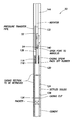
  • FIG. 1 is a sectional view of tubular retrieval apparatus in accordance with a first embodiment of the present invention.
  • FIG. 2 is a sectional view of tubular retrieval apparatus in accordance with a second embodiment of the present invention.
  • FIG. 1 of the drawings shows a sectional view of tubular retrieval apparatus 10 in accordance with a first embodiment of the present invention.
  • the apparatus 10 is shown mounted to the lower end of a tubular work string 12 .
  • the apparatus 10 forms part of a fishing bottom hole assembly (BHA) 14 which includes a casing spear 16 and a pack-off rubber 18 .
  • BHA fishing bottom hole assembly
  • the fishing BHA 14 thus may be secured and sealed to the upper end of an inner section of casing 20 which it is desired to retrieve.
  • the inner casing 20 is mounted within an outer casing 22 .
  • a lower portion of an annulus 24 between the casings 20 , 22 has been filled with cement 26 .
  • the upper part of the annulus 24 is free of cement, however over the life of the well the upper end of the inner casing 20 is likely to have become fixed relative to the outer casing 22 through corrosion and the presence of mud solids 28 that have settled between the casing strings.
  • the apparatus 10 comprises a positive displacement motor section 30 positioned above a valve assembly 32 .
  • the positive displacement motor and valve assembly are similar to the motor and valve described in U.S. Pat. No. 6,279,670.
  • a rotor is subject to rotation and also oscillates within the motor stator.
  • the lower end of the rotor provides mounting for an upper valve plate configured to co-operate with a stationary lower valve plate. As the rotor rotates and oscillates, openings in the valve plates are moved into and out of alignment, thus varying the flow area through the valve assembly 32 .
  • the fishing BHA 14 also includes a section of pipe 38 mounted to the lower end of the valve assembly 32 and which extends downwards to provide mounting for the casing spear 16 and pack-off element 18 .
  • the pipe 38 provides fluid communication between the outlet of the valve assembly 32 and the isolated section of the inner casing 20 A. Also, the pipe 38 defines a nozzled port 40 which provides fluid communication between the pipe 38 and the upper annulus 44 between the work string 12 and the apparatus 10 and the outer casing 22 .
  • an operator wishing to retrieve the inner casing 20 will first determine the height of the cement 26 in the annulus 24 between the casings 20 , 22 . The operator will then determine where the inner casing should be cut, this normally being a short distance above the upper end of the cement 26 . The operator will then set a packer 34 within the inner casing 20 , below the location where the cut is to be made. This seals off the bore of the inner casing 20 . A cutter (not shown) is then run into the bore to produce a casing cut 36 . The work string 12 carrying the fishing BHA 14 is then run in to the bore and the casing spear 16 and pack-off element 18 set at the upper end of the inner casing 20 .
  • Tension is then applied to the work string 12 from surface, which tension is thus applied to the cut section of the inner casing 20 .
  • surface pumps are started and cause fluid to be pumped down the work string 12 and through the fishing BHA 14 .
  • the passage of fluid through the motor section 30 causes the rotor to rotate and produces relative movement of the valve plates within the valve assembly 32 .
  • the rotary valve within the valve assembly 32 opens and closes, providing a varying fluid pressure below the valve assembly 32 , which varying fluid is applied to the cut section of casing.
  • the settled solids and other material 28 in the annulus 24 will prevent circulation of the fluid from the inner casing 20 , through the cut 36 , and up through the annulus 24 .
  • the pulsing pressure will create an upward force acting over the cross-section of the inner casing 20 .
  • the pressure pulses will also tend to vibrate the casing, further assisting in reducing friction and dislodging the solids 28 .
  • the nozzled port 40 allows fluid circulation and operation of the motor 30 while the annulus 24 remains blocked above the cut 36 , the nozzling of the port 40 maintaining a back pressure within the cut section of casing.
  • the nozzled port 40 incorporates a valve which may be opened and closed from surface by the operator. When closed, the valve prevents flow through the port 40 . Thus, if the valve is closed and the annulus 24 above the cut 36 is blocked, there is no circulation route for fluid being pumped from surface. In this situation the motor 30 will not operate, although fluid pressure may still be transmitted through the motor 30 to the cut section of casing below the apparatus 10 . Accordingly, it is possible for the operator to turn the apparatus on and off by opening and closing the valve.
  • FIG. 2 of the drawings illustrates tubular retrieval apparatus 50 in accordance with a second embodiment of the present invention.
  • Many details of the construction and use of the apparatus 50 are similar to the apparatus 10 described above, and those elements will not be described again in detail.
  • a pressure transfer pipe 52 extends from above the valve assembly 132 to a point in the pipe 138 above the casing spear and pack-off element 116 , 118 .
  • the point where the pressure transfer pipe 52 enters the pipe 138 is isolated from the port 140 by a seal 54 .
  • the pressure pulses generated above the valve assembly 132 are transferred through the pipe 52 and the casing spear 116 to the cut section of inner casing 120 .
  • the apparatus 50 offers the additional advantage that there is no requirement to elevate the back pressure downstream of the valve assembly 132 (achieved by nozzling the port 40 in the first embodiment), which increases the surface pump requirements.

Landscapes

  • Life Sciences & Earth Sciences (AREA)
  • Geology (AREA)
  • Engineering & Computer Science (AREA)
  • Mining & Mineral Resources (AREA)
  • Physics & Mathematics (AREA)
  • Environmental & Geological Engineering (AREA)
  • Fluid Mechanics (AREA)
  • General Life Sciences & Earth Sciences (AREA)
  • Geochemistry & Mineralogy (AREA)
  • Marine Sciences & Fisheries (AREA)
  • Pipe Accessories (AREA)
  • Earth Drilling (AREA)
  • Lining Or Joining Of Plastics Or The Like (AREA)

Abstract

A tubular retrieval method involves applying a cyclically varying fluid pressure to the interior of a section of cut bore-lining tubular. The tubular may be casing which it is desired to remove from a bore. A pulling force may also be applied to the tubular.

Description

FIELD OF THE INVENTION
This invention relates to a method and apparatus for use in retrieving tubulars from bores. Aspects of the invention relate to the retrieval of cut casing from boreholes drilled to access subsurface hydrocarbon-bearing formations.
BACKGROUND OF THE INVENTION
Wells drilled to access subsurface formations may be lined with tubular members, typically metal tubular lengths joined together by threaded connectors. In the oil and gas exploration and production industry, an initial section of the well bore is drilled and then lined with a string of tubular members, known as casing, which extends from the end of the bore to the surface of the earth. Cement may then be circulated into the annulus between the casing and the bore wall. The set cement provides support for the bore wall and prevents fluid migration along the annulus. The drilling of the bore is then continued beyond the end of the first casing. A second casing string is then run into the bore. This string also extends from the end of the bore to surface. Again, cement is circulated into the annulus between the casing string and the bore wall. However, the volume of cement is selected to be sufficient only to fill the annulus between the second string and the surrounding unlined bore wall; the annulus between the first and second casing strings is left substantially free of cement.
This process is repeated until the desired depth is reached, and the upper end of the bore is lined by numerous casing strings, the smallest diameter innermost casing extending from surface to the end of the bore.
At some point in the life of the well, for example prior to abandonment or in the course of workover procedures, it may be desired to remove portions of some of the casing strings. Generally, no attempt is made to retrieve the cemented casing sections. Rather, the innermost casing is cut above the cemented section, and the cut section retrieved. However, this may not be straightforward. Solid material may have gathered or settled in the annulus between the cut casing and the surrounding casing during the life of the well. Also, corrosion between the casings may cause adjacent casings to become fixed relative to one another.
Thus, a typical procedure for retrieving casing may involve the following steps:
    • determining the height of the cement in the annulus between the inner casing section to be cut and retrieved and the larger outer casing;
    • determining the location of the cut to be made in the inner casing;
    • setting a packer below the cut location to seal off the bore of the inner casing;
    • cutting the inner casing;
    • running a work string into the casing carrying a fishing bottom hole assembly (BHA) comprising a casing spear and a pack-off element;
    • setting the casing spear and the pack-off element at the upper end of the casing to be retrieved;
    • applying tension to the cut casing via the work string and casing spear; and
    • simultaneously applying fluid pressure to the isolated section of the cut casing between the lower packer and the upper pack-off, via the work string, to push or pump the casing free.
If the cut casing does not come free a second cut may be made in the casing, closer to surface.
In anticipation of difficulties in retrieving a cut casing, the operator may incorporate a jar in the fishing BHA. Alternatively, the present applicant's Agitator (Trade Mark) tool may be incorporated in the BHA. As described in U.S. Pat. No. 7,077,205, the disclosure of which is incorporated herein in its entirety by reference, a flow pulsing tool such as the applicant's Agitator tool may be used in conjunction with an extension and retraction means, such as a shock tool, to vary the tensile load applied to a stuck object, such as a cut casing section. Operation of the applicant's Agitator tool, further details of which are described in U.S. Pat. No. 6,279,670, the disclosure of which is also incorporated herein in its entirety by reference, requires circulation of fluid through the tool. Thus, fluid is pumped down the work string, passes through the Agitator tool, and passes though outlet ports in the fishing BHA and into the annulus above the casing spear.
SUMMARY OF THE INVENTION
According to the present invention there is provided a tubular retrieval method including applying a cyclically varying fluid pressure to the interior of a section of cut bore lining tubular.
According to another aspect of the invention there is provided tubular retrieval apparatus comprising:
    • at least one seal configurable to isolate a section of cut bore-lining tubular;
    • a pressure pulse-generating device configurable to apply pressure pulses to the isolated section of tubing.
The pressure pulses or varying pressure will tend to push the tubular being retrieved free from the surrounding larger diameter tubular. As the pressure pulses are applied to the cut section, the pressure will be applied to a relatively large area; potentially the cross-sectional area of outer tubular surrounding the cut tubular, and at least the cross-sectional area of the cut tubular. The varying pressure may also assist in dislodging solids which have settled or otherwise lodged in the annulus between the cut tubular and the surrounding tubular. Furthermore, the varying pressure may assist in establishing fluid circulation in the annulus, assisting retrieval of the cut tubular.
An upper seal may be configured for location above the cut, and may configured for location towards the upper end of the cut tubular. A lower seal may be configured for location below the cut.
The apparatus may include a support member configurable to engage the cut tubular, typically an upper end of the tubular. The support member may be utilized to apply a pulling force to the tubular, and the support member may be tubular and configured to carry fluid. The support member may include a gripping device to engage the cut tubular, and the gripping device may incorporate or be provided in combination with the upper seal.
The pressure pulse-generating device may be located above the cut tubular. The device may be configured for mounting in a support member engaging the tubular.
The pressure pulse-generating device may take any appropriate form. In one embodiment the device is configured to act on fluid being circulated in the bore above the cut tubular and to generate pressure pulses or pressure variations in the circulating fluid. The fluid may be circulated through a tubular support member and an annulus between the support member and the surrounding tubular. The apparatus may be configurable to provide communication between the circulating fluid and the isolated section of cut tubing, whereby the pressure pulses or pressure variations are applied to fluid in the isolated section.
The pressure pulse-generating device may be fluid actuated, and may be adapted to be actuated by fluid being circulated in the well bore. The device may include a positive displacement motor, such as a Moineau principle motor. The device may include a valve operable to vary a fluid flow area, and thus vary the pressure in fluid being passed through the valve. The valve may be configured to rotate or oscillate. The device may produce a variation on the fluid pressure above or below the valve. The apparatus may be configurable to provide fluid communication between the fluid above the valve and the isolated section of cut tubing. Alternatively, or in addition, the apparatus may be configurable to provide fluid communication between the fluid below the valve and the isolated section of tubing.
The apparatus may be configured to permit fluid to pass from an outlet of the pressure pulse-generating device into an annulus between the device and the surrounding tubular. The fluid may pass from the device outlet to the annulus via a flow port. The flow port may be nozzled or otherwise restricted. The flow port may be configured to be opened and closed. In one embodiment, the pulse-generating device may be de-activated by closing the flow port.
BRIEF DESCRIPTION OF THE DRAWINGS
These and other aspects of the invention will now be described, by way of example, with reference to the accompanying drawings, in which:
FIG. 1 is a sectional view of tubular retrieval apparatus in accordance with a first embodiment of the present invention; and
FIG. 2 is a sectional view of tubular retrieval apparatus in accordance with a second embodiment of the present invention.
DETAILED DESCRIPTION OF THE DRAWINGS
Reference is first made to FIG. 1 of the drawings, which shows a sectional view of tubular retrieval apparatus 10 in accordance with a first embodiment of the present invention. The apparatus 10 is shown mounted to the lower end of a tubular work string 12. The apparatus 10 forms part of a fishing bottom hole assembly (BHA) 14 which includes a casing spear 16 and a pack-off rubber 18. The fishing BHA 14 thus may be secured and sealed to the upper end of an inner section of casing 20 which it is desired to retrieve.
The inner casing 20 is mounted within an outer casing 22. A lower portion of an annulus 24 between the casings 20, 22 has been filled with cement 26. The upper part of the annulus 24 is free of cement, however over the life of the well the upper end of the inner casing 20 is likely to have become fixed relative to the outer casing 22 through corrosion and the presence of mud solids 28 that have settled between the casing strings.
The apparatus 10 comprises a positive displacement motor section 30 positioned above a valve assembly 32. The positive displacement motor and valve assembly are similar to the motor and valve described in U.S. Pat. No. 6,279,670. Thus, as fluid is passed through the motor 30, a rotor is subject to rotation and also oscillates within the motor stator. The lower end of the rotor provides mounting for an upper valve plate configured to co-operate with a stationary lower valve plate. As the rotor rotates and oscillates, openings in the valve plates are moved into and out of alignment, thus varying the flow area through the valve assembly 32.
The fishing BHA 14 also includes a section of pipe 38 mounted to the lower end of the valve assembly 32 and which extends downwards to provide mounting for the casing spear 16 and pack-off element 18. The pipe 38 provides fluid communication between the outlet of the valve assembly 32 and the isolated section of the inner casing 20A. Also, the pipe 38 defines a nozzled port 40 which provides fluid communication between the pipe 38 and the upper annulus 44 between the work string 12 and the apparatus 10 and the outer casing 22.
In use, an operator wishing to retrieve the inner casing 20 will first determine the height of the cement 26 in the annulus 24 between the casings 20, 22. The operator will then determine where the inner casing should be cut, this normally being a short distance above the upper end of the cement 26. The operator will then set a packer 34 within the inner casing 20, below the location where the cut is to be made. This seals off the bore of the inner casing 20. A cutter (not shown) is then run into the bore to produce a casing cut 36. The work string 12 carrying the fishing BHA 14 is then run in to the bore and the casing spear 16 and pack-off element 18 set at the upper end of the inner casing 20.
Tension is then applied to the work string 12 from surface, which tension is thus applied to the cut section of the inner casing 20. In addition, surface pumps are started and cause fluid to be pumped down the work string 12 and through the fishing BHA 14. The passage of fluid through the motor section 30 causes the rotor to rotate and produces relative movement of the valve plates within the valve assembly 32. Thus, the rotary valve within the valve assembly 32 opens and closes, providing a varying fluid pressure below the valve assembly 32, which varying fluid is applied to the cut section of casing. Initially, it is likely that the settled solids and other material 28 in the annulus 24 will prevent circulation of the fluid from the inner casing 20, through the cut 36, and up through the annulus 24. Accordingly, the pulsing pressure will create an upward force acting over the cross-section of the inner casing 20. There is also a pulsed fluid pressure force acting through the cut 36 and tending to dislodge the settled solids 28. The pressure pulses will also tend to vibrate the casing, further assisting in reducing friction and dislodging the solids 28.
The nozzled port 40 allows fluid circulation and operation of the motor 30 while the annulus 24 remains blocked above the cut 36, the nozzling of the port 40 maintaining a back pressure within the cut section of casing.
In due course the cut section of casing will break free, and at some point it is likely that the pulsing fluid pressure will dislodge the solids 28 to achieve circulation through the annulus 24, which will facilitate movement of the inner casing 20 relative to the outer casing 22.
Once the inner casing 20 has been freed from the outer casing 22, retrieval is relatively straightforward.
In an alternative arrangement, the nozzled port 40 incorporates a valve which may be opened and closed from surface by the operator. When closed, the valve prevents flow through the port 40. Thus, if the valve is closed and the annulus 24 above the cut 36 is blocked, there is no circulation route for fluid being pumped from surface. In this situation the motor 30 will not operate, although fluid pressure may still be transmitted through the motor 30 to the cut section of casing below the apparatus 10. Accordingly, it is possible for the operator to turn the apparatus on and off by opening and closing the valve.
Reference is now made to FIG. 2 of the drawings, which illustrates tubular retrieval apparatus 50 in accordance with a second embodiment of the present invention. Many details of the construction and use of the apparatus 50 are similar to the apparatus 10 described above, and those elements will not be described again in detail.
In the illustrated arrangement, there is again an outlet port 140 provided below the valve assembly 132, however the port 140 is not nozzled, allowing relatively free flow to the upper annulus 144. However, a pressure transfer pipe 52 extends from above the valve assembly 132 to a point in the pipe 138 above the casing spear and pack-off element 116, 118. The point where the pressure transfer pipe 52 enters the pipe 138 is isolated from the port 140 by a seal 54.
During operation of the apparatus 50, the pressure pulses generated above the valve assembly 132 are transferred through the pipe 52 and the casing spear 116 to the cut section of inner casing 120.
Use of the apparatus 50 is otherwise similar to the apparatus 10 described above. However, the apparatus 50 offers the additional advantage that there is no requirement to elevate the back pressure downstream of the valve assembly 132 (achieved by nozzling the port 40 in the first embodiment), which increases the surface pump requirements.
It will be apparent to those of skill in the art that the above described arrangements allow an operator to introduce pressure pulses below the casing spears 16, 116 and act on the full area of the casing string 20, 120. Also, the pulses below the spears 16, 116 assist in directly pushing the casing 20, 120 free. Furthermore, applying pressure pulses through the casing cut 36, 136 will assist in dislodging solids 28, 128 in the annulus 24, 124 in order to establish circulation and free the inner casing 20, 120.
It will be apparent to those of skill in the art that the above described embodiments are merely exemplary of the present invention, and that various modification and improvements may be made thereto, without departing from the scope of the invention.
Claims (40)

What is claimed is:
1. A tubular retrieval method, comprising:
applying a cyclically varying fluid pressure to an interior of a section of a cut tubular lining a bore and having a cut;
circulating fluid in the bore above the cut tubular and generating pressure pulses or pressure variations in the circulating fluid; and
providing fluid communication between the circulating fluid and an isolated section of the cut, whereby the pressure pulses or pressure variations are applied to fluid in the isolated section.
2. The method of claim 1, further comprising establishing a seal across the cut tubular above the cut.
3. The method of claim 1, further comprising establishing a seal across the tubular above the cut and towards an upper end of the cut tubular.
4. The method of claim 1, further comprising establishing a seal across the cut tubular below the cut.
5. The method of claim 1, further comprising applying a pulling force to the cut tubular.
6. The method of claim 1, further comprising engaging the cut tubular with a support member above the cut and applying a pulling force to the cut tubular.
7. The method of claim 6, further comprising passing fluid through the support member.
8. The method of claim 1, further comprising providing a pressure pulse-generating device above the cut tubular.
9. The method of claim 8, further comprising mounting the pressure pulse-generating device in a support member engaging the cut tubular.
10. The method of claim 1, further comprising actuating a pressure pulse-generating device with a circulating fluid.
11. The method of claim 1, further comprising generating pressure pulses in a circulating fluid by operating a valve and providing fluid communication between the circulating fluid above the valve and an isolated section of the cut tubing.
12. The method of claim 1, further comprising generating pressure pulses in a circulating fluid by operating a valve and providing fluid communication between the circulating fluid below the valve and an isolated section of the cut tubular.
13. The method of claim 1, further comprising permitting fluid to pass from an outlet of a pressure pulse-generating device into an annulus between the device and a surrounding tubular.
14. The method of claim 13, wherein the fluid is passed through from the outlet of the device to the annulus via a restricted flow port.
15. The method of claim 1, wherein the varying fluid pressure pushes the cut tubular being retrieved free from a larger diameter tubular surrounding the cut tubular.
16. The method of claim 1, wherein the varying fluid pressure is applied to at least a cross-sectional area of the cut tubular.
17. The method of claim 16, wherein the varying fluid pressure is applied to the cross-sectional area of a larger diameter tubular surrounding the cut tubular.
18. The method of claim 1, wherein the varying fluid pressure dislodges solids in an annulus between the cut tubular a larger diameter tubular surrounding the cut tubular.
19. A tubular retrieval apparatus, comprising:
at least one seal positionable to isolate a section of a cut tubular lining a bore and having a cut;
a pressure pulse-generating device applying fluid pressure pulses to an isolated section of the cut tubular; and
a support member engagable with the cut tubular, wherein the support member includes a gripping device to engage the cut tubular.
20. The apparatus of claim 19, further comprising an upper seal locatable above the cut.
21. The apparatus of claim 20, wherein the upper seal is locatable towards an upper end of the cut tubular.
22. The apparatus of claim 19, further comprising a lower seal locatable below the cut.
23. The apparatus of claim 19, wherein the support member applies a pulling force to the cut tubular.
24. The apparatus of claim 19, wherein the support member is tubular and carries fluid.
25. The apparatus of claim 19, wherein the gripping device is provided on the support member in combination with an upper seal.
26. The apparatus of claim 19, wherein the pressure pulse-generating device is mountable in a support member engaging the cut tubular.
27. The apparatus of claim 19, wherein the pressure pulse-generating device acts on fluid being circulated in the bore above the cut tubular and generates pressure pulses or pressure variations in circulating fluid.
28. The apparatus of claim 27, wherein the apparatus provides communication between the circulating fluid and an isolated section of the cut tubular, whereby the pressure pulses or pressure variations are applied to fluid in the isolated section.
29. The apparatus of claim 19, wherein the pulse-generating device includes a valve operable to vary a fluid flow area, and thereby vary pressure in fluid being passed through the valve.
30. The apparatus of claim 29, wherein the valve is rotatable or oscillatable.
31. The apparatus of claim 29, wherein the pulse-generating device produces a variation in fluid pressure above or below the valve.
32. The apparatus of claim 31, wherein the apparatus provides fluid communication between the fluid above the valve and the isolated section of cut tubular.
33. The apparatus of claim 31, wherein the apparatus provides fluid communication between the fluid below the valve and the isolated section of tubular.
34. A tubular retrieval apparatus, comprising:
at least one seal positionable to isolate a section of a cut tubular lining a bore and having a cut;
a pressure pulse-generating device applying fluid pressure pulses to an isolated section of the cut tubular; wherein the pressure pulse-generating device is actuatable by fluid being circulated in the bore.
35. The apparatus of claim 34, wherein the pulse-generating device comprises a positive displacement motor.
36. A tubular retrieval apparatus, comprising:
at least one seal positionable to isolate a section of a cut tubular lining a bore and having a cut;
a pressure pulse-generating device applying fluid pressure pulses to an isolated section of the cut tubular; and
wherein the apparatus permits fluid to pass through a port from an outlet of the pressure pulse-generating device into an annulus between the device and the surrounding cut tubular.
37. The apparatus of claim 36, comprising a nozzled flow port through which the fluid passes from the device outlet to the annulus.
38. The apparatus of claim 36, wherein the port opens and closes.
39. The apparatus of claim 36, wherein the pulse-generating device is de-activatable by closing a flow port.
40. A tubular retrieval method, comprising:
applying a cyclically varying fluid pressure to an interior of a section of a cut tubular lining a bore and having a cut; wherein the cyclically varying fluid pressure establishes fluid circulation in an annulus between the cut tubular and a larger diameter tubular surrounding the cut tubular.
US13/510,909 2009-11-20 2010-11-19 Tubular retrieval Active 2031-08-31 US9045958B2 (en)

Applications Claiming Priority (3)

Application Number Priority Date Filing Date Title
GBGB0920346.4A GB0920346D0 (en) 2009-11-20 2009-11-20 Tubular retrieval
GB0920346.4 2009-11-20
PCT/GB2010/002140 WO2011061506A2 (en) 2009-11-20 2010-11-19 Tubular retrieval

Publications (2)

Publication Number Publication Date
US20120312549A1 US20120312549A1 (en) 2012-12-13
US9045958B2 true US9045958B2 (en) 2015-06-02

Family

ID=41565607

Family Applications (1)

Application Number Title Priority Date Filing Date
US13/510,909 Active 2031-08-31 US9045958B2 (en) 2009-11-20 2010-11-19 Tubular retrieval

Country Status (5)

Country Link
US (1) US9045958B2 (en)
EP (1) EP2501893B1 (en)
CA (1) CA2780248C (en)
GB (1) GB0920346D0 (en)
WO (1) WO2011061506A2 (en)

Cited By (12)

* Cited by examiner, † Cited by third party
Publication number Priority date Publication date Assignee Title
US9732573B2 (en) 2014-01-03 2017-08-15 National Oilwell DHT, L.P. Downhole activation assembly with offset bore and method of using same
US10000970B2 (en) 2012-12-07 2018-06-19 National Oilwell DHT, L.P. Downhole drilling assembly with motor powered hammer and method of using same
WO2018224819A1 (en) * 2017-06-07 2018-12-13 Ardyne Technologies Limited Improvements in or relating to well abandonment
US20190162033A1 (en) * 2017-11-29 2019-05-30 Baker Hughes, A Ge Company, Llc Bottom Hole Assembly for Cutting and Pulling a Tubular
US20190162046A1 (en) * 2017-11-29 2019-05-30 Baker Hughes, A Ge Company, Llc Diverter Valve for a Bottom Hole Assembly
WO2020065291A1 (en) 2018-09-25 2020-04-02 Ardyne Holdings Limited Improvements in or relating to well abandonment
WO2020193710A1 (en) 2019-03-27 2020-10-01 Ardyne Holdings Limited Improvements in or relating to well abandonment
US11047193B2 (en) 2017-05-04 2021-06-29 Ardyne Holdings Limited Well abandonment and slot recovery
US11466530B2 (en) 2017-05-04 2022-10-11 Ardyne Holding Limited Or relating to well abandonment and slot recovery
US11542777B2 (en) * 2020-12-16 2023-01-03 Halliburton Energy Services, Inc. Single trip wellbore cleaning and sealing system and method
US12000233B2 (en) 2020-12-16 2024-06-04 Halliburton Energy Services, Inc. Single trip wellbore cleaning and sealing system and method
US12146384B2 (en) 2020-12-16 2024-11-19 Halliburton Energy Services, Inc. Single trip wellbore cleaning and sealing system and method

Families Citing this family (11)

* Cited by examiner, † Cited by third party
Publication number Priority date Publication date Assignee Title
GB201101033D0 (en) 2011-01-21 2011-03-09 Nov Downhole Eurasia Ltd Downhole tool
NO336242B1 (en) * 2011-12-21 2015-06-29 Wtw Solutions As Well completion arrangement and method for preparing a well for abandonment.
NO334625B1 (en) 2012-01-30 2014-04-28 Aker Well Service As Method and apparatus for extracting pipes from a well
NO335180B1 (en) * 2012-03-09 2014-10-13 Well Technology As Procedure for removing feeding tubes
US9528339B2 (en) * 2013-12-05 2016-12-27 Jeffrey J. Brown Downhole fishing tool and method of use
WO2016028537A1 (en) * 2014-08-19 2016-02-25 Halliburton Energy Services, Inc. Behind pipe evaluation of cut and pull tension prediction in well abandonment and intervention operations
CN106948785A (en) * 2017-05-23 2017-07-14 河北宏龙环保科技有限公司 A kind of oil well production string cutting method and cutter device
US11421491B2 (en) * 2017-09-08 2022-08-23 Weatherford Technology Holdings, Llc Well tool anchor and associated methods
CN110529064B (en) * 2019-10-16 2024-09-03 天津凯雷油田技术有限公司 Screen pipe fishing device and screen pipe fishing system
NO346987B1 (en) * 2019-12-20 2023-03-27 Tco As Method and System for pulling out tubulars from a subterranean well
NO346617B1 (en) 2020-03-09 2022-10-31 Hydra Systems As A fluid diverter tool, system and method of diverting a fluid flow in a well

Citations (16)

* Cited by examiner, † Cited by third party
Publication number Priority date Publication date Assignee Title
US1645010A (en) * 1926-02-04 1927-10-11 Kinley Myron Macy Device for recovering casing from wells
US2901044A (en) * 1955-07-07 1959-08-25 Edward W Arnold Pulling tool
US2961048A (en) * 1958-12-24 1960-11-22 Sr J B Davis Pump pressure hydraulic jarring tool
US2972380A (en) * 1956-02-20 1961-02-21 Jr Albert G Bodine Acoustic method and apparatus for moving objects held tight within a surrounding medium
US3213941A (en) 1962-02-01 1965-10-26 Nelson Norman A Method of and apparatus for releasing stuck pipe
US3217803A (en) * 1963-10-07 1965-11-16 Midway Fishing Tool Co Method of pulling a well liner
US4058163A (en) * 1973-08-06 1977-11-15 Yandell James L Selectively actuated vibrating apparatus connected with well bore member
US4236580A (en) * 1978-04-04 1980-12-02 Bodine Albert G Method and apparatus for sonically extracting oil well liners
US4667742A (en) * 1985-03-08 1987-05-26 Bodine Albert G Down hole excitation system for loosening drill pipe stuck in a well
US4673037A (en) * 1985-10-03 1987-06-16 Bodine Albert G Method for sonically loosening oil well liner environments
US5190114A (en) 1988-11-25 1993-03-02 Intech International Inc. Flow pulsing apparatus for drill string
US5836389A (en) * 1996-12-09 1998-11-17 Wave Energy Resources Apparatus and method for increasing production rates of immovable and unswept oil through the use of weak elastic waves
US6009948A (en) * 1996-05-28 2000-01-04 Baker Hughes Incorporated Resonance tools for use in wellbores
US6206101B1 (en) * 1996-06-07 2001-03-27 Bakke Technology As Method and device for facilitating the insertion of a coiled tube into a well and for loosening stuck objects in a well
US6279670B1 (en) 1996-05-18 2001-08-28 Andergauge Limited Downhole flow pulsing apparatus
US7077205B2 (en) 2000-09-05 2006-07-18 Andergauge Limited Method and device to free stuck objects

Patent Citations (17)

* Cited by examiner, † Cited by third party
Publication number Priority date Publication date Assignee Title
US1645010A (en) * 1926-02-04 1927-10-11 Kinley Myron Macy Device for recovering casing from wells
US2901044A (en) * 1955-07-07 1959-08-25 Edward W Arnold Pulling tool
US2972380A (en) * 1956-02-20 1961-02-21 Jr Albert G Bodine Acoustic method and apparatus for moving objects held tight within a surrounding medium
US2961048A (en) * 1958-12-24 1960-11-22 Sr J B Davis Pump pressure hydraulic jarring tool
US3213941A (en) 1962-02-01 1965-10-26 Nelson Norman A Method of and apparatus for releasing stuck pipe
US3217803A (en) * 1963-10-07 1965-11-16 Midway Fishing Tool Co Method of pulling a well liner
US4058163A (en) * 1973-08-06 1977-11-15 Yandell James L Selectively actuated vibrating apparatus connected with well bore member
US4236580A (en) * 1978-04-04 1980-12-02 Bodine Albert G Method and apparatus for sonically extracting oil well liners
US4667742A (en) * 1985-03-08 1987-05-26 Bodine Albert G Down hole excitation system for loosening drill pipe stuck in a well
US4673037A (en) * 1985-10-03 1987-06-16 Bodine Albert G Method for sonically loosening oil well liner environments
US5190114A (en) 1988-11-25 1993-03-02 Intech International Inc. Flow pulsing apparatus for drill string
US6279670B1 (en) 1996-05-18 2001-08-28 Andergauge Limited Downhole flow pulsing apparatus
US6508317B2 (en) 1996-05-18 2003-01-21 Andergauge Limited Downhole apparatus and method of use
US6009948A (en) * 1996-05-28 2000-01-04 Baker Hughes Incorporated Resonance tools for use in wellbores
US6206101B1 (en) * 1996-06-07 2001-03-27 Bakke Technology As Method and device for facilitating the insertion of a coiled tube into a well and for loosening stuck objects in a well
US5836389A (en) * 1996-12-09 1998-11-17 Wave Energy Resources Apparatus and method for increasing production rates of immovable and unswept oil through the use of weak elastic waves
US7077205B2 (en) 2000-09-05 2006-07-18 Andergauge Limited Method and device to free stuck objects

Non-Patent Citations (4)

* Cited by examiner, † Cited by third party
Title
International Preliminary Report on Patentability dated May 22, 2012 from counterpart PCT Application No. PCT/GB2010/002140, pp. 1-9.
International Search Report dated Aug. 31, 2011 from counterpart PCT Application No. PCT/GB2010/002140, pp. 1-6.
Response to Office Action from European Patent Application No. 10788373.8 dated Jan. 7, 2013 with amended claims and description attached,17 pages.
Written Opinion dated May 21, 2012 from counterpart PCT Application No. PCT/GB2010/002140, pp. 1-8.

Cited By (16)

* Cited by examiner, † Cited by third party
Publication number Priority date Publication date Assignee Title
US10000970B2 (en) 2012-12-07 2018-06-19 National Oilwell DHT, L.P. Downhole drilling assembly with motor powered hammer and method of using same
US9732573B2 (en) 2014-01-03 2017-08-15 National Oilwell DHT, L.P. Downhole activation assembly with offset bore and method of using same
US11466530B2 (en) 2017-05-04 2022-10-11 Ardyne Holding Limited Or relating to well abandonment and slot recovery
US11047193B2 (en) 2017-05-04 2021-06-29 Ardyne Holdings Limited Well abandonment and slot recovery
US11053761B2 (en) 2017-05-04 2021-07-06 Ardyne Holdings Limited Well abandonment and slot recovery
WO2018224819A1 (en) * 2017-06-07 2018-12-13 Ardyne Technologies Limited Improvements in or relating to well abandonment
US20190162033A1 (en) * 2017-11-29 2019-05-30 Baker Hughes, A Ge Company, Llc Bottom Hole Assembly for Cutting and Pulling a Tubular
US20190162046A1 (en) * 2017-11-29 2019-05-30 Baker Hughes, A Ge Company, Llc Diverter Valve for a Bottom Hole Assembly
US10508510B2 (en) * 2017-11-29 2019-12-17 Baker Hughes, A Ge Company, Llc Bottom hole assembly for cutting and pulling a tubular
US10563479B2 (en) * 2017-11-29 2020-02-18 Baker Hughes, A Ge Company, Llc Diverter valve for a bottom hole assembly
WO2020065291A1 (en) 2018-09-25 2020-04-02 Ardyne Holdings Limited Improvements in or relating to well abandonment
WO2020193710A1 (en) 2019-03-27 2020-10-01 Ardyne Holdings Limited Improvements in or relating to well abandonment
US12163398B2 (en) 2019-03-27 2024-12-10 Ardyne Holdings Limited Method relating to well abandonment
US11542777B2 (en) * 2020-12-16 2023-01-03 Halliburton Energy Services, Inc. Single trip wellbore cleaning and sealing system and method
US12000233B2 (en) 2020-12-16 2024-06-04 Halliburton Energy Services, Inc. Single trip wellbore cleaning and sealing system and method
US12146384B2 (en) 2020-12-16 2024-11-19 Halliburton Energy Services, Inc. Single trip wellbore cleaning and sealing system and method

Also Published As

Publication number Publication date
US20120312549A1 (en) 2012-12-13
WO2011061506A2 (en) 2011-05-26
EP2501893A2 (en) 2012-09-26
EP2501893B1 (en) 2018-12-26
GB0920346D0 (en) 2010-01-06
WO2011061506A3 (en) 2012-01-12
CA2780248A1 (en) 2011-05-26
CA2780248C (en) 2017-12-05

Similar Documents

Publication Publication Date Title
US9045958B2 (en) Tubular retrieval
CN1267622C (en) Logging system for use in wellbore
CA2371133C (en) Method of creating a wellbore
CA2273568C (en) A method of installing a casing in a well and apparatus therefor
EP1604093B1 (en) Method and apparatus for drilling a borehole with a borehole liner
CN101790620B (en) Drilling method using sand control liner
US6009948A (en) Resonance tools for use in wellbores
CN101929335B (en) The concentrated sampling of formation fluid
US8245781B2 (en) Formation fluid sampling
US20090025981A1 (en) Method for drilling with casing
US7637330B2 (en) Casing bottom hole assembly retrieval process
CN101680281A (en) Drilling system with a barrel drilling head driven by a downhole tractor
US20150144335A1 (en) Power retrieving tool
WO1997045622A1 (en) Wellbore resonance tools
US12158052B2 (en) Flow back option plug assembly
US20240060379A1 (en) Downhole casing removal tool and method
NO20131133A1 (en) Lateral wellbore apparatus and method
AU2021337831A1 (en) Rigless method to partially lift or retrieve wellbore tubing strings from platform and subsea wells
AU3217497A (en) Wellbore resonance tools

Legal Events

Date Code Title Description
AS Assignment

Owner name: NATIONAL OILWELL VARCO, L.P., TEXAS

Free format text: ASSIGNMENT OF ASSIGNORS INTEREST;ASSIGNOR:EDDISON, ALAN MARTYN;REEL/FRAME:028237/0076

Effective date: 20120516

STCF Information on status: patent grant

Free format text: PATENTED CASE

MAFP Maintenance fee payment

Free format text: PAYMENT OF MAINTENANCE FEE, 4TH YEAR, LARGE ENTITY (ORIGINAL EVENT CODE: M1551); ENTITY STATUS OF PATENT OWNER: LARGE ENTITY

Year of fee payment: 4

MAFP Maintenance fee payment

Free format text: PAYMENT OF MAINTENANCE FEE, 8TH YEAR, LARGE ENTITY (ORIGINAL EVENT CODE: M1552); ENTITY STATUS OF PATENT OWNER: LARGE ENTITY

Year of fee payment: 8