US8835682B2 - Alkaloid aminoester derivatives and medicinal composition thereof - Google Patents
Alkaloid aminoester derivatives and medicinal composition thereof Download PDFInfo
- Publication number
- US8835682B2 US8835682B2 US13/827,101 US201313827101A US8835682B2 US 8835682 B2 US8835682 B2 US 8835682B2 US 201313827101 A US201313827101 A US 201313827101A US 8835682 B2 US8835682 B2 US 8835682B2
- Authority
- US
- United States
- Prior art keywords
- phenyl
- mmol
- phenylamino
- formula
- compound
- Prior art date
- Legal status (The legal status is an assumption and is not a legal conclusion. Google has not performed a legal analysis and makes no representation as to the accuracy of the status listed.)
- Active
Links
- 229930013930 alkaloid Natural products 0.000 title abstract description 9
- 150000003797 alkaloid derivatives Chemical class 0.000 title abstract description 6
- 239000000203 mixture Substances 0.000 title description 245
- 150000001875 compounds Chemical class 0.000 claims abstract description 333
- -1 (C1-C6)alkylhalo Chemical group 0.000 claims description 53
- 238000000034 method Methods 0.000 claims description 44
- 125000000008 (C1-C10) alkyl group Chemical group 0.000 claims description 42
- 125000003118 aryl group Chemical group 0.000 claims description 38
- 125000001072 heteroaryl group Chemical group 0.000 claims description 36
- 125000005843 halogen group Chemical group 0.000 claims description 30
- 125000006552 (C3-C8) cycloalkyl group Chemical group 0.000 claims description 27
- 125000003710 aryl alkyl group Chemical group 0.000 claims description 27
- 230000008569 process Effects 0.000 claims description 19
- 125000002887 hydroxy group Chemical group [H]O* 0.000 claims description 18
- 230000008878 coupling Effects 0.000 claims description 16
- 238000010168 coupling process Methods 0.000 claims description 16
- 238000005859 coupling reaction Methods 0.000 claims description 16
- 125000000896 monocarboxylic acid group Chemical group 0.000 claims description 14
- 125000001424 substituent group Chemical group 0.000 claims description 14
- 239000002168 alkylating agent Substances 0.000 claims description 13
- 229940100198 alkylating agent Drugs 0.000 claims description 13
- 125000001997 phenyl group Chemical group [H]C1=C([H])C([H])=C(*)C([H])=C1[H] 0.000 claims description 13
- 229910052739 hydrogen Inorganic materials 0.000 claims description 11
- 150000004820 halides Chemical class 0.000 claims description 9
- 150000001412 amines Chemical class 0.000 claims description 8
- 150000002576 ketones Chemical class 0.000 claims description 8
- 125000004169 (C1-C6) alkyl group Chemical group 0.000 claims description 6
- 125000004435 hydrogen atom Chemical group [H]* 0.000 claims description 6
- 101100134922 Gallus gallus COR5 gene Proteins 0.000 claims description 5
- 125000004446 heteroarylalkyl group Chemical group 0.000 claims description 5
- 150000003839 salts Chemical class 0.000 claims description 5
- 150000001450 anions Chemical class 0.000 claims description 4
- 229910052760 oxygen Inorganic materials 0.000 claims description 4
- 229910052717 sulfur Inorganic materials 0.000 claims description 4
- 125000000882 C2-C6 alkenyl group Chemical group 0.000 claims description 3
- 125000003601 C2-C6 alkynyl group Chemical group 0.000 claims description 3
- 125000005213 alkyl heteroaryl group Chemical group 0.000 claims description 3
- 230000002152 alkylating effect Effects 0.000 claims description 3
- 125000003917 carbamoyl group Chemical group [H]N([H])C(*)=O 0.000 claims description 3
- 125000002915 carbonyl group Chemical group [*:2]C([*:1])=O 0.000 claims description 3
- 239000001257 hydrogen Substances 0.000 claims description 3
- 238000004519 manufacturing process Methods 0.000 claims description 3
- 125000006272 (C3-C7) cycloalkyl group Chemical group 0.000 claims description 2
- BDHFUVZGWQCTTF-UHFFFAOYSA-M sulfonate Chemical compound [O-]S(=O)=O BDHFUVZGWQCTTF-UHFFFAOYSA-M 0.000 claims description 2
- 230000002265 prevention Effects 0.000 abstract description 9
- 208000027866 inflammatory disease Diseases 0.000 abstract description 8
- 229940121948 Muscarinic receptor antagonist Drugs 0.000 abstract description 4
- IAZDPXIOMUYVGZ-WFGJKAKNSA-N Dimethyl sulfoxide Chemical compound [2H]C([2H])([2H])S(=O)C([2H])([2H])[2H] IAZDPXIOMUYVGZ-WFGJKAKNSA-N 0.000 description 410
- YMWUJEATGCHHMB-UHFFFAOYSA-N Dichloromethane Chemical compound ClCCl YMWUJEATGCHHMB-UHFFFAOYSA-N 0.000 description 336
- OKKJLVBELUTLKV-UHFFFAOYSA-N Methanol Chemical compound OC OKKJLVBELUTLKV-UHFFFAOYSA-N 0.000 description 318
- 238000004895 liquid chromatography mass spectrometry Methods 0.000 description 254
- 238000005160 1H NMR spectroscopy Methods 0.000 description 212
- XEKOWRVHYACXOJ-UHFFFAOYSA-N Ethyl acetate Natural products CCOC(C)=O XEKOWRVHYACXOJ-UHFFFAOYSA-N 0.000 description 211
- WEVYAHXRMPXWCK-UHFFFAOYSA-N Acetonitrile Chemical compound CC#N WEVYAHXRMPXWCK-UHFFFAOYSA-N 0.000 description 209
- 238000002360 preparation method Methods 0.000 description 200
- 239000007787 solid Substances 0.000 description 167
- 238000006243 chemical reaction Methods 0.000 description 156
- WYURNTSHIVDZCO-UHFFFAOYSA-N Tetrahydrofuran Chemical compound C1CCOC1 WYURNTSHIVDZCO-UHFFFAOYSA-N 0.000 description 154
- 239000003921 oil Substances 0.000 description 105
- 239000000243 solution Substances 0.000 description 104
- 235000019439 ethyl acetate Nutrition 0.000 description 101
- PMZURENOXWZQFD-UHFFFAOYSA-L Sodium Sulfate Chemical compound [Na+].[Na+].[O-]S([O-])(=O)=O PMZURENOXWZQFD-UHFFFAOYSA-L 0.000 description 92
- XLYOFNOQVPJJNP-UHFFFAOYSA-N water Substances O XLYOFNOQVPJJNP-UHFFFAOYSA-N 0.000 description 89
- 229910052938 sodium sulfate Inorganic materials 0.000 description 88
- 239000002904 solvent Substances 0.000 description 85
- 239000007832 Na2SO4 Substances 0.000 description 84
- 0 [1*]N([2*])C([3*])([H])C(=O)O[6*] Chemical compound [1*]N([2*])C([3*])([H])C(=O)O[6*] 0.000 description 78
- UIIMBOGNXHQVGW-UHFFFAOYSA-M Sodium bicarbonate Chemical compound [Na+].OC([O-])=O UIIMBOGNXHQVGW-UHFFFAOYSA-M 0.000 description 76
- JGFZNNIVVJXRND-UHFFFAOYSA-N N,N-Diisopropylethylamine (DIPEA) Chemical compound CCN(C(C)C)C(C)C JGFZNNIVVJXRND-UHFFFAOYSA-N 0.000 description 65
- 238000003818 flash chromatography Methods 0.000 description 62
- 239000000543 intermediate Substances 0.000 description 59
- 239000012267 brine Substances 0.000 description 51
- HPALAKNZSZLMCH-UHFFFAOYSA-M sodium;chloride;hydrate Chemical compound O.[Na+].[Cl-] HPALAKNZSZLMCH-UHFFFAOYSA-M 0.000 description 51
- VEXZGXHMUGYJMC-UHFFFAOYSA-N Hydrochloric acid Chemical compound Cl VEXZGXHMUGYJMC-UHFFFAOYSA-N 0.000 description 49
- IXCSERBJSXMMFS-UHFFFAOYSA-N hydrogen chloride Substances Cl.Cl IXCSERBJSXMMFS-UHFFFAOYSA-N 0.000 description 49
- 229910000041 hydrogen chloride Inorganic materials 0.000 description 49
- DTQVDTLACAAQTR-UHFFFAOYSA-M Trifluoroacetate Chemical compound [O-]C(=O)C(F)(F)F DTQVDTLACAAQTR-UHFFFAOYSA-M 0.000 description 46
- 238000012544 monitoring process Methods 0.000 description 44
- NPZTUJOABDZTLV-UHFFFAOYSA-N hydroxybenzotriazole Substances O=C1C=CC=C2NNN=C12 NPZTUJOABDZTLV-UHFFFAOYSA-N 0.000 description 43
- 239000012074 organic phase Substances 0.000 description 43
- IVLICPVPXWEGCA-ZETCQYMHSA-N (3r)-1-azabicyclo[2.2.2]octan-3-ol Chemical compound C1CC2[C@@H](O)CN1CC2 IVLICPVPXWEGCA-ZETCQYMHSA-N 0.000 description 42
- RTZKZFJDLAIYFH-UHFFFAOYSA-N Diethyl ether Chemical compound CCOCC RTZKZFJDLAIYFH-UHFFFAOYSA-N 0.000 description 40
- 239000012044 organic layer Substances 0.000 description 38
- 229910000030 sodium bicarbonate Inorganic materials 0.000 description 38
- GLXDVVHUTZTUQK-UHFFFAOYSA-M lithium;hydroxide;hydrate Chemical compound [Li+].O.[OH-] GLXDVVHUTZTUQK-UHFFFAOYSA-M 0.000 description 32
- 239000012230 colorless oil Substances 0.000 description 30
- YEDUAINPPJYDJZ-UHFFFAOYSA-N 2-hydroxybenzothiazole Chemical compound C1=CC=C2SC(O)=NC2=C1 YEDUAINPPJYDJZ-UHFFFAOYSA-N 0.000 description 27
- ZMANZCXQSJIPKH-UHFFFAOYSA-N Triethylamine Chemical compound CCN(CC)CC ZMANZCXQSJIPKH-UHFFFAOYSA-N 0.000 description 27
- RYHBNJHYFVUHQT-UHFFFAOYSA-N 1,4-Dioxane Chemical compound C1COCCO1 RYHBNJHYFVUHQT-UHFFFAOYSA-N 0.000 description 26
- LFQSCWFLJHTTHZ-UHFFFAOYSA-N Ethanol Chemical compound CCO LFQSCWFLJHTTHZ-UHFFFAOYSA-N 0.000 description 26
- 238000001946 ultra-performance liquid chromatography-mass spectrometry Methods 0.000 description 26
- PAYRUJLWNCNPSJ-UHFFFAOYSA-N Aniline Chemical compound NC1=CC=CC=C1 PAYRUJLWNCNPSJ-UHFFFAOYSA-N 0.000 description 23
- BWHMMNNQKKPAPP-UHFFFAOYSA-L potassium carbonate Chemical compound [K+].[K+].[O-]C([O-])=O BWHMMNNQKKPAPP-UHFFFAOYSA-L 0.000 description 22
- 238000001914 filtration Methods 0.000 description 21
- IJGRMHOSHXDMSA-UHFFFAOYSA-N Atomic nitrogen Chemical compound N#N IJGRMHOSHXDMSA-UHFFFAOYSA-N 0.000 description 20
- ZMXDDKWLCZADIW-UHFFFAOYSA-N N,N-Dimethylformamide Chemical compound CN(C)C=O ZMXDDKWLCZADIW-UHFFFAOYSA-N 0.000 description 18
- VLKZOEOYAKHREP-UHFFFAOYSA-N n-Hexane Chemical compound CCCCCC VLKZOEOYAKHREP-UHFFFAOYSA-N 0.000 description 18
- ASOKPJOREAFHNY-UHFFFAOYSA-N 1-Hydroxybenzotriazole Chemical compound C1=CC=C2N(O)N=NC2=C1 ASOKPJOREAFHNY-UHFFFAOYSA-N 0.000 description 17
- NFEVMRNCAGDLBK-UHFFFAOYSA-N 2-anilino-2-phenylacetic acid Chemical compound C=1C=CC=CC=1C(C(=O)O)NC1=CC=CC=C1 NFEVMRNCAGDLBK-UHFFFAOYSA-N 0.000 description 17
- VYPSYNLAJGMNEJ-UHFFFAOYSA-N Silicium dioxide Chemical compound O=[Si]=O VYPSYNLAJGMNEJ-UHFFFAOYSA-N 0.000 description 17
- CDBYLPFSWZWCQE-UHFFFAOYSA-L Sodium Carbonate Chemical compound [Na+].[Na+].[O-]C([O-])=O CDBYLPFSWZWCQE-UHFFFAOYSA-L 0.000 description 16
- 238000002953 preparative HPLC Methods 0.000 description 16
- WVIOCXRQMBIIKQ-BGERDNNASA-N [(3r)-1-azabicyclo[2.2.2]octan-3-yl] 2-(benzylamino)-2-phenylacetate Chemical compound O([C@@H]1C2CCN(CC2)C1)C(=O)C(C=1C=CC=CC=1)NCC1=CC=CC=C1 WVIOCXRQMBIIKQ-BGERDNNASA-N 0.000 description 14
- HEMHJVSKTPXQMS-UHFFFAOYSA-M sodium hydroxide Inorganic materials [OH-].[Na+] HEMHJVSKTPXQMS-UHFFFAOYSA-M 0.000 description 14
- 239000000725 suspension Substances 0.000 description 14
- WKGODYPLBLQBMW-BGERDNNASA-N [(3r)-1-azabicyclo[2.2.2]octan-3-yl] 2-[(4-fluorophenyl)methylamino]-2-phenylacetate Chemical compound C1=CC(F)=CC=C1CNC(C=1C=CC=CC=1)C(=O)O[C@@H]1C(CC2)CCN2C1 WKGODYPLBLQBMW-BGERDNNASA-N 0.000 description 13
- BKTKLDMYHTUESO-UHFFFAOYSA-N ethyl 2-bromo-2-phenylacetate Chemical compound CCOC(=O)C(Br)C1=CC=CC=C1 BKTKLDMYHTUESO-UHFFFAOYSA-N 0.000 description 13
- WMFOQBRAJBCJND-UHFFFAOYSA-M lithium hydroxide Inorganic materials [Li+].[OH-] WMFOQBRAJBCJND-UHFFFAOYSA-M 0.000 description 13
- 238000011068 loading method Methods 0.000 description 13
- 239000000843 powder Substances 0.000 description 13
- 230000002829 reductive effect Effects 0.000 description 13
- 239000002253 acid Substances 0.000 description 12
- 239000000706 filtrate Substances 0.000 description 12
- 229910000027 potassium carbonate Inorganic materials 0.000 description 12
- 239000008346 aqueous phase Substances 0.000 description 11
- 150000003842 bromide salts Chemical class 0.000 description 11
- 229910052757 nitrogen Inorganic materials 0.000 description 11
- LIGACIXOYTUXAW-UHFFFAOYSA-N phenacyl bromide Chemical compound BrCC(=O)C1=CC=CC=C1 LIGACIXOYTUXAW-UHFFFAOYSA-N 0.000 description 11
- 239000000047 product Substances 0.000 description 11
- DTQVDTLACAAQTR-UHFFFAOYSA-N trifluoroacetic acid Substances OC(=O)C(F)(F)F DTQVDTLACAAQTR-UHFFFAOYSA-N 0.000 description 11
- 102000017925 CHRM3 Human genes 0.000 description 10
- 101150060249 CHRM3 gene Proteins 0.000 description 10
- OEHKRTNZAMLBBF-VQTJNVASSA-N [(3r)-1-azabicyclo[2.2.2]octan-3-yl] (2r)-2-anilino-2-phenylacetate Chemical compound N([C@@H](C(O[C@@H]1C2CCN(CC2)C1)=O)C=1C=CC=CC=1)C1=CC=CC=C1 OEHKRTNZAMLBBF-VQTJNVASSA-N 0.000 description 10
- HUZIGVDOLJWMFI-BGERDNNASA-N [(3r)-1-azabicyclo[2.2.2]octan-3-yl] 2-(n-methylanilino)-2-phenylacetate Chemical compound C=1C=CC=CC=1N(C)C(C(=O)O[C@@H]1C2CCN(CC2)C1)C1=CC=CC=C1 HUZIGVDOLJWMFI-BGERDNNASA-N 0.000 description 10
- 239000007864 aqueous solution Substances 0.000 description 10
- 201000010099 disease Diseases 0.000 description 10
- 208000037265 diseases, disorders, signs and symptoms Diseases 0.000 description 10
- 239000003814 drug Substances 0.000 description 10
- 239000003208 petroleum Substances 0.000 description 10
- VZGDMQKNWNREIO-UHFFFAOYSA-N tetrachloromethane Chemical compound ClC(Cl)(Cl)Cl VZGDMQKNWNREIO-UHFFFAOYSA-N 0.000 description 10
- RIOQSEWOXXDEQQ-UHFFFAOYSA-N triphenylphosphine Chemical compound C1=CC=CC=C1P(C=1C=CC=CC=1)C1=CC=CC=C1 RIOQSEWOXXDEQQ-UHFFFAOYSA-N 0.000 description 10
- 208000006545 Chronic Obstructive Pulmonary Disease Diseases 0.000 description 9
- 208000006673 asthma Diseases 0.000 description 9
- 238000010438 heat treatment Methods 0.000 description 9
- 238000004704 ultra performance liquid chromatography Methods 0.000 description 9
- PCLIMKBDDGJMGD-UHFFFAOYSA-N N-bromosuccinimide Chemical compound BrN1C(=O)CCC1=O PCLIMKBDDGJMGD-UHFFFAOYSA-N 0.000 description 8
- JUJWROOIHBZHMG-UHFFFAOYSA-N Pyridine Chemical compound C1=CC=NC=C1 JUJWROOIHBZHMG-UHFFFAOYSA-N 0.000 description 8
- MCQRKTISKAPVGX-HMTLIYDFSA-N [(3r)-1-azabicyclo[2.2.2]octan-3-yl] 2-[(4-methylphenyl)methylamino]-2-phenylacetate Chemical compound C1=CC(C)=CC=C1CNC(C=1C=CC=CC=1)C(=O)O[C@@H]1C(CC2)CCN2C1 MCQRKTISKAPVGX-HMTLIYDFSA-N 0.000 description 8
- TVYOUJPLNGRNPA-RBUUAABPSA-N [(3r)-1-azabicyclo[2.2.2]octan-3-yl] 2-amino-2-phenylacetate;dihydrochloride Chemical compound Cl.Cl.O([C@@H]1C2CCN(CC2)C1)C(=O)C(N)C1=CC=CC=C1 TVYOUJPLNGRNPA-RBUUAABPSA-N 0.000 description 8
- 230000029936 alkylation Effects 0.000 description 8
- 238000005804 alkylation reaction Methods 0.000 description 8
- 239000000460 chlorine Substances 0.000 description 8
- VFRSADQPWYCXDG-LEUCUCNGSA-N ethyl (2s,5s)-5-methylpyrrolidine-2-carboxylate;2,2,2-trifluoroacetic acid Chemical compound OC(=O)C(F)(F)F.CCOC(=O)[C@@H]1CC[C@H](C)N1 VFRSADQPWYCXDG-LEUCUCNGSA-N 0.000 description 8
- CXCJKSOSQLMDDM-VIFPVBQESA-N methyl (2s)-2-methylsulfonyloxy-2-phenylacetate Chemical compound COC(=O)[C@@H](OS(C)(=O)=O)C1=CC=CC=C1 CXCJKSOSQLMDDM-VIFPVBQESA-N 0.000 description 8
- 239000000546 pharmaceutical excipient Substances 0.000 description 8
- 239000002244 precipitate Substances 0.000 description 8
- 238000000746 purification Methods 0.000 description 8
- 229940044551 receptor antagonist Drugs 0.000 description 8
- 239000002464 receptor antagonist Substances 0.000 description 8
- 229910000029 sodium carbonate Inorganic materials 0.000 description 8
- KHOWLHQEABZKNA-UHFFFAOYSA-N 2-chloro-1-thiophen-2-ylethanone Chemical compound ClCC(=O)C1=CC=CS1 KHOWLHQEABZKNA-UHFFFAOYSA-N 0.000 description 7
- WKBOTKDWSSQWDR-UHFFFAOYSA-N Bromine atom Chemical compound [Br] WKBOTKDWSSQWDR-UHFFFAOYSA-N 0.000 description 7
- ZAMOUSCENKQFHK-UHFFFAOYSA-N Chlorine atom Chemical compound [Cl] ZAMOUSCENKQFHK-UHFFFAOYSA-N 0.000 description 7
- QGYPSTVVUBZLQQ-BGERDNNASA-N [(3r)-1-azabicyclo[2.2.2]octan-3-yl] 2-(4-fluoro-n-methylanilino)-2-phenylacetate Chemical compound C=1C=C(F)C=CC=1N(C)C(C(=O)O[C@@H]1C2CCN(CC2)C1)C1=CC=CC=C1 QGYPSTVVUBZLQQ-BGERDNNASA-N 0.000 description 7
- QPNQDHSUGUADOB-XMWICJOTSA-N [(3r)-1-azabicyclo[2.2.2]octan-3-yl] 2-(cyclopentylamino)-2-phenylacetate;2,2,2-trifluoroacetic acid Chemical compound OC(=O)C(F)(F)F.OC(=O)C(F)(F)F.O([C@@H]1C2CCN(CC2)C1)C(=O)C(C=1C=CC=CC=1)NC1CCCC1 QPNQDHSUGUADOB-XMWICJOTSA-N 0.000 description 7
- GDTBXPJZTBHREO-UHFFFAOYSA-N bromine Substances BrBr GDTBXPJZTBHREO-UHFFFAOYSA-N 0.000 description 7
- 229910052794 bromium Inorganic materials 0.000 description 7
- 206010006451 bronchitis Diseases 0.000 description 7
- 229910052801 chlorine Inorganic materials 0.000 description 7
- 230000014509 gene expression Effects 0.000 description 7
- QARBMVPHQWIHKH-UHFFFAOYSA-N methanesulfonyl chloride Chemical compound CS(Cl)(=O)=O QARBMVPHQWIHKH-UHFFFAOYSA-N 0.000 description 7
- 239000000741 silica gel Substances 0.000 description 7
- 229910002027 silica gel Inorganic materials 0.000 description 7
- 229960001866 silicon dioxide Drugs 0.000 description 7
- 238000000967 suction filtration Methods 0.000 description 7
- WAKFRZBXTKUFIW-UHFFFAOYSA-N 2-bromo-2-phenylacetic acid Chemical compound OC(=O)C(Br)C1=CC=CC=C1 WAKFRZBXTKUFIW-UHFFFAOYSA-N 0.000 description 6
- VHYFNPMBLIVWCW-UHFFFAOYSA-N 4-Dimethylaminopyridine Chemical compound CN(C)C1=CC=NC=C1 VHYFNPMBLIVWCW-UHFFFAOYSA-N 0.000 description 6
- 206010006458 Bronchitis chronic Diseases 0.000 description 6
- IAZDPXIOMUYVGZ-UHFFFAOYSA-N Dimethylsulphoxide Chemical compound CS(C)=O IAZDPXIOMUYVGZ-UHFFFAOYSA-N 0.000 description 6
- TWRXJAOTZQYOKJ-UHFFFAOYSA-L Magnesium chloride Chemical compound [Mg+2].[Cl-].[Cl-] TWRXJAOTZQYOKJ-UHFFFAOYSA-L 0.000 description 6
- FFIMLFLEOYHPBV-HMTLIYDFSA-N [(3r)-1-azabicyclo[2.2.2]octan-3-yl] 2-(2,5-dimethoxyanilino)-2-phenylacetate Chemical compound COC1=CC=C(OC)C(NC(C(=O)O[C@@H]2C3CCN(CC3)C2)C=2C=CC=CC=2)=C1 FFIMLFLEOYHPBV-HMTLIYDFSA-N 0.000 description 6
- BKAOTCJORJCBSM-HMTLIYDFSA-N [(3r)-1-azabicyclo[2.2.2]octan-3-yl] 2-(2-acetylanilino)-2-phenylacetate Chemical compound CC(=O)C1=CC=CC=C1NC(C=1C=CC=CC=1)C(=O)O[C@@H]1C(CC2)CCN2C1 BKAOTCJORJCBSM-HMTLIYDFSA-N 0.000 description 6
- IJFJYBHWJXBHRM-HMTLIYDFSA-N [(3r)-1-azabicyclo[2.2.2]octan-3-yl] 2-(2-ethylanilino)-2-phenylacetate Chemical compound CCC1=CC=CC=C1NC(C=1C=CC=CC=1)C(=O)O[C@@H]1C(CC2)CCN2C1 IJFJYBHWJXBHRM-HMTLIYDFSA-N 0.000 description 6
- RKTGMUTXVHSZBR-BGERDNNASA-N [(3r)-1-azabicyclo[2.2.2]octan-3-yl] 2-(2-methoxyanilino)-2-phenylacetate Chemical compound COC1=CC=CC=C1NC(C=1C=CC=CC=1)C(=O)O[C@@H]1C(CC2)CCN2C1 RKTGMUTXVHSZBR-BGERDNNASA-N 0.000 description 6
- BASZTDUSYAMBBE-BGERDNNASA-N [(3r)-1-azabicyclo[2.2.2]octan-3-yl] 2-(2-methylanilino)-2-phenylacetate Chemical compound CC1=CC=CC=C1NC(C=1C=CC=CC=1)C(=O)O[C@@H]1C(CC2)CCN2C1 BASZTDUSYAMBBE-BGERDNNASA-N 0.000 description 6
- TWDZJJAJKOWKHM-HMTLIYDFSA-N [(3r)-1-azabicyclo[2.2.2]octan-3-yl] 2-(3-acetamidoanilino)-2-phenylacetate Chemical compound CC(=O)NC1=CC=CC(NC(C(=O)O[C@@H]2C3CCN(CC3)C2)C=2C=CC=CC=2)=C1 TWDZJJAJKOWKHM-HMTLIYDFSA-N 0.000 description 6
- AAGYBGKTTDRBOS-HMTLIYDFSA-N [(3r)-1-azabicyclo[2.2.2]octan-3-yl] 2-(3-ethylanilino)-2-phenylacetate Chemical compound CCC1=CC=CC(NC(C(=O)O[C@@H]2C3CCN(CC3)C2)C=2C=CC=CC=2)=C1 AAGYBGKTTDRBOS-HMTLIYDFSA-N 0.000 description 6
- VHTJHNZUCDXHAI-BGERDNNASA-N [(3r)-1-azabicyclo[2.2.2]octan-3-yl] 2-(3-fluoro-4-methylanilino)-2-phenylacetate Chemical compound C1=C(F)C(C)=CC=C1NC(C=1C=CC=CC=1)C(=O)O[C@@H]1C(CC2)CCN2C1 VHTJHNZUCDXHAI-BGERDNNASA-N 0.000 description 6
- WENJLFVVPQQQBI-XJDOXCRVSA-N [(3r)-1-azabicyclo[2.2.2]octan-3-yl] 2-(3-fluoroanilino)-2-(4-fluorophenyl)acetate Chemical compound C1=CC(F)=CC=C1C(C(=O)O[C@@H]1C2CCN(CC2)C1)NC1=CC=CC(F)=C1 WENJLFVVPQQQBI-XJDOXCRVSA-N 0.000 description 6
- HNSAVVBSGBYUAE-BGERDNNASA-N [(3r)-1-azabicyclo[2.2.2]octan-3-yl] 2-(3-methoxyanilino)-2-phenylacetate Chemical compound COC1=CC=CC(NC(C(=O)O[C@@H]2C3CCN(CC3)C2)C=2C=CC=CC=2)=C1 HNSAVVBSGBYUAE-BGERDNNASA-N 0.000 description 6
- HLQDZBGFUXKNNA-BGERDNNASA-N [(3r)-1-azabicyclo[2.2.2]octan-3-yl] 2-(3-methylsulfanylanilino)-2-phenylacetate Chemical compound CSC1=CC=CC(NC(C(=O)O[C@@H]2C3CCN(CC3)C2)C=2C=CC=CC=2)=C1 HLQDZBGFUXKNNA-BGERDNNASA-N 0.000 description 6
- AYLCVUIMYMLXEJ-XJDOXCRVSA-N [(3r)-1-azabicyclo[2.2.2]octan-3-yl] 2-(4-chloroanilino)-2-phenylacetate Chemical compound C1=CC(Cl)=CC=C1NC(C=1C=CC=CC=1)C(=O)O[C@@H]1C(CC2)CCN2C1 AYLCVUIMYMLXEJ-XJDOXCRVSA-N 0.000 description 6
- VLBMKLSIDJGRDV-LSLKUGRBSA-N [(3r)-1-azabicyclo[2.2.2]octan-3-yl] 2-amino-2-phenylacetate Chemical compound O([C@@H]1C2CCN(CC2)C1)C(=O)C(N)C1=CC=CC=C1 VLBMKLSIDJGRDV-LSLKUGRBSA-N 0.000 description 6
- XMBIIKNSPDKTRL-XJDOXCRVSA-N [(3r)-1-azabicyclo[2.2.2]octan-3-yl] 2-anilino-2-(3-fluorophenyl)acetate Chemical compound FC1=CC=CC(C(NC=2C=CC=CC=2)C(=O)O[C@@H]2C3CCN(CC3)C2)=C1 XMBIIKNSPDKTRL-XJDOXCRVSA-N 0.000 description 6
- CPUMLGKVTRQGMA-BGERDNNASA-N [(3r)-1-azabicyclo[2.2.2]octan-3-yl] 2-anilino-2-(4-methoxyphenyl)acetate Chemical compound C1=CC(OC)=CC=C1C(C(=O)O[C@@H]1C2CCN(CC2)C1)NC1=CC=CC=C1 CPUMLGKVTRQGMA-BGERDNNASA-N 0.000 description 6
- OEHKRTNZAMLBBF-XJDOXCRVSA-N [(3r)-1-azabicyclo[2.2.2]octan-3-yl] 2-anilino-2-phenylacetate Chemical compound O([C@@H]1C2CCN(CC2)C1)C(=O)C(C=1C=CC=CC=1)NC1=CC=CC=C1 OEHKRTNZAMLBBF-XJDOXCRVSA-N 0.000 description 6
- KGGHAJALBNDICO-DMYPFFKMSA-N [(3r)-1-azabicyclo[2.2.2]octan-3-yl] 2-anilino-2-thiophen-2-ylacetate;hydrochloride Chemical compound Cl.O([C@@H]1C2CCN(CC2)C1)C(=O)C(C=1SC=CC=1)NC1=CC=CC=C1 KGGHAJALBNDICO-DMYPFFKMSA-N 0.000 description 6
- WKBZCKYZERRYLQ-XJDOXCRVSA-N [(3r)-1-azabicyclo[2.2.2]octan-3-yl] 2-phenyl-2-[3-(trifluoromethoxy)anilino]acetate Chemical compound FC(F)(F)OC1=CC=CC(NC(C(=O)O[C@@H]2C3CCN(CC3)C2)C=2C=CC=CC=2)=C1 WKBZCKYZERRYLQ-XJDOXCRVSA-N 0.000 description 6
- 239000005557 antagonist Substances 0.000 description 6
- 150000003841 chloride salts Chemical class 0.000 description 6
- 208000007451 chronic bronchitis Diseases 0.000 description 6
- 239000003937 drug carrier Substances 0.000 description 6
- 230000000694 effects Effects 0.000 description 6
- 150000002148 esters Chemical class 0.000 description 6
- XCWIYKRFLIMGBU-HMTLIYDFSA-N ethyl 3-[[2-[[(3r)-1-azabicyclo[2.2.2]octan-3-yl]oxy]-2-oxo-1-phenylethyl]amino]benzoate Chemical compound CCOC(=O)C1=CC=CC(NC(C(=O)O[C@@H]2C3CCN(CC3)C2)C=2C=CC=CC=2)=C1 XCWIYKRFLIMGBU-HMTLIYDFSA-N 0.000 description 6
- XVVLAOSRANDVDB-UHFFFAOYSA-N formic acid Chemical compound OC=O.OC=O XVVLAOSRANDVDB-UHFFFAOYSA-N 0.000 description 6
- 239000010410 layer Substances 0.000 description 6
- ASNXFZVKRUPHCK-BGERDNNASA-N methyl 2-[[2-[[(3r)-1-azabicyclo[2.2.2]octan-3-yl]oxy]-2-oxo-1-phenylethyl]amino]benzoate Chemical compound COC(=O)C1=CC=CC=C1NC(C=1C=CC=CC=1)C(=O)O[C@@H]1C(CC2)CCN2C1 ASNXFZVKRUPHCK-BGERDNNASA-N 0.000 description 6
- PVJZTRNRZWUFMA-BGERDNNASA-N methyl 4-[1-anilino-2-[[(3r)-1-azabicyclo[2.2.2]octan-3-yl]oxy]-2-oxoethyl]benzoate Chemical compound C1=CC(C(=O)OC)=CC=C1C(C(=O)O[C@@H]1C2CCN(CC2)C1)NC1=CC=CC=C1 PVJZTRNRZWUFMA-BGERDNNASA-N 0.000 description 6
- 239000003960 organic solvent Substances 0.000 description 6
- 239000008194 pharmaceutical composition Substances 0.000 description 6
- 238000012360 testing method Methods 0.000 description 6
- YLQBMQCUIZJEEH-UHFFFAOYSA-N tetrahydrofuran Natural products C=1C=COC=1 YLQBMQCUIZJEEH-UHFFFAOYSA-N 0.000 description 6
- WROMPOXWARCANT-UHFFFAOYSA-N tfa trifluoroacetic acid Chemical compound OC(=O)C(F)(F)F.OC(=O)C(F)(F)F WROMPOXWARCANT-UHFFFAOYSA-N 0.000 description 6
- NFEVMRNCAGDLBK-CYBMUJFWSA-N (2r)-2-anilino-2-phenylacetic acid Chemical compound N([C@@H](C(=O)O)C=1C=CC=CC=1)C1=CC=CC=C1 NFEVMRNCAGDLBK-CYBMUJFWSA-N 0.000 description 5
- NNBCQUPGYBEJCR-UHFFFAOYSA-N 2-anilino-2-(4-methoxyphenyl)acetic acid;hydrochloride Chemical compound Cl.C1=CC(OC)=CC=C1C(C(O)=O)NC1=CC=CC=C1 NNBCQUPGYBEJCR-UHFFFAOYSA-N 0.000 description 5
- QZVQQUVWFIZUBQ-UHFFFAOYSA-N 3-fluoroaniline Chemical compound NC1=CC=CC(F)=C1 QZVQQUVWFIZUBQ-UHFFFAOYSA-N 0.000 description 5
- WHRYRORXNISDMF-HMTLIYDFSA-N [(3r)-1-azabicyclo[2.2.2]octan-3-yl] 2-(3-acetylanilino)-2-phenylacetate Chemical compound CC(=O)C1=CC=CC(NC(C(=O)O[C@@H]2C3CCN(CC3)C2)C=2C=CC=CC=2)=C1 WHRYRORXNISDMF-HMTLIYDFSA-N 0.000 description 5
- XYYHOGXXNRUYGT-HMTLIYDFSA-N [(3r)-1-azabicyclo[2.2.2]octan-3-yl] 2-[(4-methoxyphenyl)methylamino]-2-phenylacetate Chemical compound C1=CC(OC)=CC=C1CNC(C=1C=CC=CC=1)C(=O)O[C@@H]1C(CC2)CCN2C1 XYYHOGXXNRUYGT-HMTLIYDFSA-N 0.000 description 5
- 239000002585 base Substances 0.000 description 5
- 239000000872 buffer Substances 0.000 description 5
- AIXAANGOTKPUOY-UHFFFAOYSA-N carbachol Chemical compound [Cl-].C[N+](C)(C)CCOC(N)=O AIXAANGOTKPUOY-UHFFFAOYSA-N 0.000 description 5
- 229960004484 carbachol Drugs 0.000 description 5
- 230000003197 catalytic effect Effects 0.000 description 5
- 229940079593 drug Drugs 0.000 description 5
- 239000003480 eluent Substances 0.000 description 5
- WYNNXLDPCIIGPQ-UHFFFAOYSA-N ethyl 2-anilino-2-thiophen-2-ylacetate Chemical compound C=1C=CSC=1C(C(=O)OCC)NC1=CC=CC=C1 WYNNXLDPCIIGPQ-UHFFFAOYSA-N 0.000 description 5
- 238000009472 formulation Methods 0.000 description 5
- 230000002401 inhibitory effect Effects 0.000 description 5
- 239000003595 mist Substances 0.000 description 5
- 208000023504 respiratory system disease Diseases 0.000 description 5
- 239000000377 silicon dioxide Substances 0.000 description 5
- 239000012279 sodium borohydride Substances 0.000 description 5
- 229910000033 sodium borohydride Inorganic materials 0.000 description 5
- YZUWORXZCVCINL-CVMIBEPCSA-N (2R)-2-anilino-2-(1-methylpyrrolidin-3-yl)-2-phenylacetic acid Chemical compound C1N(C)CCC1[C@@](C=1C=CC=CC=1)(C(O)=O)NC1=CC=CC=C1 YZUWORXZCVCINL-CVMIBEPCSA-N 0.000 description 4
- LALRRPLNIAZQKE-PFEQFJNWSA-N (2r)-2-(n-methylanilino)-2-phenylacetic acid;hydrochloride Chemical compound Cl.C1([C@H](C(O)=O)N(C)C=2C=CC=CC=2)=CC=CC=C1 LALRRPLNIAZQKE-PFEQFJNWSA-N 0.000 description 4
- QWBZLNIKKAWZLW-UHFFFAOYSA-N (8-methyl-8-azabicyclo[3.2.1]octan-3-yl) 2-anilino-2-phenylacetate Chemical compound CN1C(C2)CCC1CC2OC(=O)C(C=1C=CC=CC=1)NC1=CC=CC=C1 QWBZLNIKKAWZLW-UHFFFAOYSA-N 0.000 description 4
- VEUDQMJUIDDWDB-UHFFFAOYSA-N 2-(2,5-difluoroanilino)-2-phenylacetic acid;hydrochloride Chemical compound Cl.C=1C=CC=CC=1C(C(=O)O)NC1=CC(F)=CC=C1F VEUDQMJUIDDWDB-UHFFFAOYSA-N 0.000 description 4
- XSYMVBLOHGUVQQ-UHFFFAOYSA-N 2-(2,5-dimethoxyanilino)-2-phenylacetic acid;hydrochloride Chemical compound Cl.COC1=CC=C(OC)C(NC(C(O)=O)C=2C=CC=CC=2)=C1 XSYMVBLOHGUVQQ-UHFFFAOYSA-N 0.000 description 4
- KRDQLTUMPCAWKT-UHFFFAOYSA-N 2-(2-acetylanilino)-2-phenylacetic acid;hydrochloride Chemical compound Cl.CC(=O)C1=CC=CC=C1NC(C(O)=O)C1=CC=CC=C1 KRDQLTUMPCAWKT-UHFFFAOYSA-N 0.000 description 4
- ZZYFOOSMFGWJLU-UHFFFAOYSA-N 2-(2-ethylanilino)-2-phenylacetic acid;hydrochloride Chemical compound Cl.CCC1=CC=CC=C1NC(C(O)=O)C1=CC=CC=C1 ZZYFOOSMFGWJLU-UHFFFAOYSA-N 0.000 description 4
- OYRGZPPCQLNOLN-UHFFFAOYSA-N 2-(2-methoxyanilino)-2-phenylacetic acid;hydrochloride Chemical compound Cl.COC1=CC=CC=C1NC(C(O)=O)C1=CC=CC=C1 OYRGZPPCQLNOLN-UHFFFAOYSA-N 0.000 description 4
- MGNKJGBEDVRKIA-UHFFFAOYSA-N 2-(2-methylanilino)-2-phenylacetic acid;hydrochloride Chemical compound Cl.CC1=CC=CC=C1NC(C(O)=O)C1=CC=CC=C1 MGNKJGBEDVRKIA-UHFFFAOYSA-N 0.000 description 4
- AWUNQTLISZLGQQ-UHFFFAOYSA-N 2-(3-acetamidoanilino)-2-phenylacetic acid;hydrochloride Chemical compound Cl.CC(=O)NC1=CC=CC(NC(C(O)=O)C=2C=CC=CC=2)=C1 AWUNQTLISZLGQQ-UHFFFAOYSA-N 0.000 description 4
- UILHQFLGEQKHII-UHFFFAOYSA-N 2-(3-ethoxycarbonylanilino)-2-phenylacetic acid;hydrochloride Chemical compound Cl.CCOC(=O)C1=CC=CC(NC(C(O)=O)C=2C=CC=CC=2)=C1 UILHQFLGEQKHII-UHFFFAOYSA-N 0.000 description 4
- OLNIWVUEYSKGOD-UHFFFAOYSA-N 2-(3-ethylanilino)-2-phenylacetic acid;hydrochloride Chemical compound Cl.CCC1=CC=CC(NC(C(O)=O)C=2C=CC=CC=2)=C1 OLNIWVUEYSKGOD-UHFFFAOYSA-N 0.000 description 4
- DSBUCMGIYWKFNU-UHFFFAOYSA-N 2-(3-fluoro-4-methylanilino)-2-phenylacetic acid;hydrochloride Chemical compound Cl.C1=C(F)C(C)=CC=C1NC(C(O)=O)C1=CC=CC=C1 DSBUCMGIYWKFNU-UHFFFAOYSA-N 0.000 description 4
- XQPPIKFJAGAZOU-UHFFFAOYSA-N 2-(3-fluoroanilino)-2-(3-fluorophenyl)acetic acid Chemical compound C=1C=CC(F)=CC=1C(C(=O)O)NC1=CC=CC(F)=C1 XQPPIKFJAGAZOU-UHFFFAOYSA-N 0.000 description 4
- LYSXKKMMTQOECI-UHFFFAOYSA-N 2-(3-fluoroanilino)-2-(4-fluorophenyl)acetic acid Chemical compound C=1C=C(F)C=CC=1C(C(=O)O)NC1=CC=CC(F)=C1 LYSXKKMMTQOECI-UHFFFAOYSA-N 0.000 description 4
- HGVDTVJUTRRDFK-UHFFFAOYSA-N 2-(3-methylsulfanylanilino)-2-phenylacetic acid;hydrochloride Chemical compound Cl.CSC1=CC=CC(NC(C(O)=O)C=2C=CC=CC=2)=C1 HGVDTVJUTRRDFK-UHFFFAOYSA-N 0.000 description 4
- DPUWGZGZBBLNHZ-UHFFFAOYSA-N 2-(4-chloroanilino)-2-phenylacetic acid Chemical compound C=1C=CC=CC=1C(C(=O)O)NC1=CC=C(Cl)C=C1 DPUWGZGZBBLNHZ-UHFFFAOYSA-N 0.000 description 4
- ZSJSNKMZAGSVLM-UHFFFAOYSA-N 2-(4-fluoro-n-methylanilino)-2-phenylacetic acid;hydrochloride Chemical compound Cl.C=1C=C(F)C=CC=1N(C)C(C(O)=O)C1=CC=CC=C1 ZSJSNKMZAGSVLM-UHFFFAOYSA-N 0.000 description 4
- LCRCODPYSHSWAR-UHFFFAOYSA-N 2-(benzylazaniumyl)-2-phenylacetate Chemical compound C=1C=CC=CC=1C(C(=O)O)NCC1=CC=CC=C1 LCRCODPYSHSWAR-UHFFFAOYSA-N 0.000 description 4
- XWBLWPYZWYGAIV-UHFFFAOYSA-N 2-anilino-2-(3-fluorophenyl)acetic acid;hydrochloride Chemical compound Cl.C=1C=CC(F)=CC=1C(C(=O)O)NC1=CC=CC=C1 XWBLWPYZWYGAIV-UHFFFAOYSA-N 0.000 description 4
- PVZYSNGYJYAZLG-UHFFFAOYSA-N 2-anilino-2-(4-methoxycarbonylphenyl)acetic acid;n-ethyl-n-propan-2-ylpropan-2-amine Chemical compound CCN(C(C)C)C(C)C.C1=CC(C(=O)OC)=CC=C1C(C(O)=O)NC1=CC=CC=C1 PVZYSNGYJYAZLG-UHFFFAOYSA-N 0.000 description 4
- VEKPEPBUISYDEU-UHFFFAOYSA-N 2-anilino-2-thiophen-2-ylacetic acid;hydrochloride Chemical compound Cl.C=1C=CSC=1C(C(=O)O)NC1=CC=CC=C1 VEKPEPBUISYDEU-UHFFFAOYSA-N 0.000 description 4
- ONLXDDXNWDCHRV-UHFFFAOYSA-N 2-anilino-3-phenylpropanoic acid Chemical compound C=1C=CC=CC=1NC(C(=O)O)CC1=CC=CC=C1 ONLXDDXNWDCHRV-UHFFFAOYSA-N 0.000 description 4
- NLPIHFRSIIBRTO-UHFFFAOYSA-N 2-phenyl-2-[3-(trifluoromethoxy)anilino]acetic acid;hydrochloride Chemical compound Cl.C=1C=CC=CC=1C(C(=O)O)NC1=CC=CC(OC(F)(F)F)=C1 NLPIHFRSIIBRTO-UHFFFAOYSA-N 0.000 description 4
- VHUUQVKOLVNVRT-UHFFFAOYSA-N Ammonium hydroxide Chemical compound [NH4+].[OH-] VHUUQVKOLVNVRT-UHFFFAOYSA-N 0.000 description 4
- KONMBSBIOKLYKY-FQEVSTJZSA-N C1CN(C)CCC1[C@@](C=1C=CC=CC=1)(C(O)=O)NC1=CC=CC=C1 Chemical compound C1CN(C)CCC1[C@@](C=1C=CC=CC=1)(C(O)=O)NC1=CC=CC=C1 KONMBSBIOKLYKY-FQEVSTJZSA-N 0.000 description 4
- 241000700199 Cavia porcellus Species 0.000 description 4
- BDAGIHXWWSANSR-UHFFFAOYSA-M Formate Chemical compound [O-]C=O BDAGIHXWWSANSR-UHFFFAOYSA-M 0.000 description 4
- CPELXLSAUQHCOX-UHFFFAOYSA-N Hydrogen bromide Chemical compound Br CPELXLSAUQHCOX-UHFFFAOYSA-N 0.000 description 4
- AFVFQIVMOAPDHO-UHFFFAOYSA-N Methanesulfonic acid Chemical compound CS(O)(=O)=O AFVFQIVMOAPDHO-UHFFFAOYSA-N 0.000 description 4
- HEDRZPFGACZZDS-MICDWDOJSA-N Trichloro(2H)methane Chemical compound [2H]C(Cl)(Cl)Cl HEDRZPFGACZZDS-MICDWDOJSA-N 0.000 description 4
- SWEIKTIPUUMPQZ-ROUUACIJSA-N [(3r)-1-azabicyclo[2.2.2]octan-3-yl] (2s)-2-[(2-methylpropan-2-yl)oxycarbonylamino]-3-phenylpropanoate Chemical compound C([C@H](NC(=O)OC(C)(C)C)C(=O)O[C@@H]1C2CCN(CC2)C1)C1=CC=CC=C1 SWEIKTIPUUMPQZ-ROUUACIJSA-N 0.000 description 4
- YPVULBZDOAGTRF-XJDOXCRVSA-N [(3r)-1-azabicyclo[2.2.2]octan-3-yl] 2-(2,5-difluoroanilino)-2-phenylacetate Chemical compound FC1=CC=C(F)C(NC(C(=O)O[C@@H]2C3CCN(CC3)C2)C=2C=CC=CC=2)=C1 YPVULBZDOAGTRF-XJDOXCRVSA-N 0.000 description 4
- NPDWVSYMBYBUKV-XJDOXCRVSA-N [(3r)-1-azabicyclo[2.2.2]octan-3-yl] 2-anilino-2-(4-fluorophenyl)acetate Chemical compound C1=CC(F)=CC=C1C(C(=O)O[C@@H]1C2CCN(CC2)C1)NC1=CC=CC=C1 NPDWVSYMBYBUKV-XJDOXCRVSA-N 0.000 description 4
- CLZISMQKJZCZDN-UHFFFAOYSA-N [benzotriazol-1-yloxy(dimethylamino)methylidene]-dimethylazanium Chemical compound C1=CC=C2N(OC(N(C)C)=[N+](C)C)N=NC2=C1 CLZISMQKJZCZDN-UHFFFAOYSA-N 0.000 description 4
- 230000009471 action Effects 0.000 description 4
- 230000015572 biosynthetic process Effects 0.000 description 4
- 239000003054 catalyst Substances 0.000 description 4
- 239000003795 chemical substances by application Substances 0.000 description 4
- 239000010779 crude oil Substances 0.000 description 4
- BGTOWKSIORTVQH-UHFFFAOYSA-N cyclopentanone Chemical compound O=C1CCCC1 BGTOWKSIORTVQH-UHFFFAOYSA-N 0.000 description 4
- 229940112141 dry powder inhaler Drugs 0.000 description 4
- FXDLCSGHCPEELH-UHFFFAOYSA-N ethyl 2-(2,5-difluoroanilino)-2-phenylacetate Chemical compound C=1C=CC=CC=1C(C(=O)OCC)NC1=CC(F)=CC=C1F FXDLCSGHCPEELH-UHFFFAOYSA-N 0.000 description 4
- LMINBZYNENXDCF-UHFFFAOYSA-N ethyl 2-(2-acetylanilino)-2-phenylacetate Chemical compound C=1C=CC=CC=1C(C(=O)OCC)NC1=CC=CC=C1C(C)=O LMINBZYNENXDCF-UHFFFAOYSA-N 0.000 description 4
- DGVJIQKNQFISCQ-UHFFFAOYSA-N ethyl 2-(3-acetamidoanilino)-2-phenylacetate Chemical compound C=1C=CC=CC=1C(C(=O)OCC)NC1=CC=CC(NC(C)=O)=C1 DGVJIQKNQFISCQ-UHFFFAOYSA-N 0.000 description 4
- PCRDXLQMKAJOMZ-UHFFFAOYSA-N ethyl 2-(3-fluorophenyl)acetate Chemical compound CCOC(=O)CC1=CC=CC(F)=C1 PCRDXLQMKAJOMZ-UHFFFAOYSA-N 0.000 description 4
- YDVLFBHCKZBJRP-UHFFFAOYSA-N ethyl 2-(3-methylsulfanylanilino)-2-phenylacetate Chemical compound C=1C=CC=CC=1C(C(=O)OCC)NC1=CC=CC(SC)=C1 YDVLFBHCKZBJRP-UHFFFAOYSA-N 0.000 description 4
- CSGYWNGLKWDPJH-UHFFFAOYSA-N ethyl 2-(4-fluoro-n-methylanilino)-2-phenylacetate Chemical compound C=1C=CC=CC=1C(C(=O)OCC)N(C)C1=CC=C(F)C=C1 CSGYWNGLKWDPJH-UHFFFAOYSA-N 0.000 description 4
- LUBTWJDQUHPDGA-UHFFFAOYSA-N ethyl 2-bromo-2-(3-fluorophenyl)acetate Chemical compound CCOC(=O)C(Br)C1=CC=CC(F)=C1 LUBTWJDQUHPDGA-UHFFFAOYSA-N 0.000 description 4
- BDYPNJQVKHKGPQ-UHFFFAOYSA-N ethyl 2-hydroxy-2-thiophen-2-ylacetate Chemical compound CCOC(=O)C(O)C1=CC=CS1 BDYPNJQVKHKGPQ-UHFFFAOYSA-N 0.000 description 4
- KRPUZTKNIGVPOA-UHFFFAOYSA-N ethyl 2-methylsulfonyloxy-2-thiophen-2-ylacetate Chemical compound CCOC(=O)C(OS(C)(=O)=O)C1=CC=CS1 KRPUZTKNIGVPOA-UHFFFAOYSA-N 0.000 description 4
- 229910052736 halogen Inorganic materials 0.000 description 4
- 150000002367 halogens Chemical class 0.000 description 4
- 229940071648 metered dose inhaler Drugs 0.000 description 4
- GDJXLVGBXAMLFH-OAHLLOKOSA-N methyl (2r)-2-(n-methylanilino)-2-phenylacetate Chemical compound CN([C@@H](C(=O)OC)C=1C=CC=CC=1)C1=CC=CC=C1 GDJXLVGBXAMLFH-OAHLLOKOSA-N 0.000 description 4
- PPZOGNBEHGJTNM-CQSZACIVSA-N methyl (2r)-2-anilino-2-phenylacetate Chemical compound N([C@@H](C(=O)OC)C=1C=CC=CC=1)C1=CC=CC=C1 PPZOGNBEHGJTNM-CQSZACIVSA-N 0.000 description 4
- DWCUDNWJYBOUOE-UHFFFAOYSA-N methyl 2-anilino-2-(3-fluorophenyl)acetate Chemical compound C=1C=CC(F)=CC=1C(C(=O)OC)NC1=CC=CC=C1 DWCUDNWJYBOUOE-UHFFFAOYSA-N 0.000 description 4
- IKEFKRXVASGVAR-UHFFFAOYSA-N methyl 2-bromo-2-(3-fluorophenyl)acetate Chemical compound COC(=O)C(Br)C1=CC=CC(F)=C1 IKEFKRXVASGVAR-UHFFFAOYSA-N 0.000 description 4
- VGZBZUCOLQRBMW-ZENAZSQFSA-N methyl 3-[[2-[[(3r)-1-azabicyclo[2.2.2]octan-3-yl]oxy]-2-oxo-1-phenylethyl]amino]thiophene-2-carboxylate Chemical compound S1C=CC(NC(C(=O)O[C@@H]2C3CCN(CC3)C2)C=2C=CC=CC=2)=C1C(=O)OC VGZBZUCOLQRBMW-ZENAZSQFSA-N 0.000 description 4
- UBZMNNPOBQEZEB-UHFFFAOYSA-N n-ethyl-n-propan-2-ylpropan-2-amine;2-(2-methoxycarbonylanilino)-2-phenylacetic acid Chemical compound CCN(C(C)C)C(C)C.COC(=O)C1=CC=CC=C1NC(C(O)=O)C1=CC=CC=C1 UBZMNNPOBQEZEB-UHFFFAOYSA-N 0.000 description 4
- 239000006199 nebulizer Substances 0.000 description 4
- FXLOVSHXALFLKQ-UHFFFAOYSA-N p-tolualdehyde Chemical compound CC1=CC=C(C=O)C=C1 FXLOVSHXALFLKQ-UHFFFAOYSA-N 0.000 description 4
- IMACFCSSMIZSPP-UHFFFAOYSA-N phenacyl chloride Chemical compound ClCC(=O)C1=CC=CC=C1 IMACFCSSMIZSPP-UHFFFAOYSA-N 0.000 description 4
- COLNVLDHVKWLRT-UHFFFAOYSA-N phenylalanine Natural products OC(=O)C(N)CC1=CC=CC=C1 COLNVLDHVKWLRT-UHFFFAOYSA-N 0.000 description 4
- 239000003380 propellant Substances 0.000 description 4
- UMJSCPRVCHMLSP-UHFFFAOYSA-N pyridine Natural products COC1=CC=CN=C1 UMJSCPRVCHMLSP-UHFFFAOYSA-N 0.000 description 4
- 239000011541 reaction mixture Substances 0.000 description 4
- 235000011152 sodium sulphate Nutrition 0.000 description 4
- 238000003756 stirring Methods 0.000 description 4
- 239000000126 substance Substances 0.000 description 4
- 230000009885 systemic effect Effects 0.000 description 4
- JOXIMZWYDAKGHI-UHFFFAOYSA-N toluene-4-sulfonic acid Chemical compound CC1=CC=C(S(O)(=O)=O)C=C1 JOXIMZWYDAKGHI-UHFFFAOYSA-N 0.000 description 4
- BHKKSKOHRFHHIN-MRVPVSSYSA-N 1-[[2-[(1R)-1-aminoethyl]-4-chlorophenyl]methyl]-2-sulfanylidene-5H-pyrrolo[3,2-d]pyrimidin-4-one Chemical compound N[C@H](C)C1=C(CN2C(NC(C3=C2C=CN3)=O)=S)C=CC(=C1)Cl BHKKSKOHRFHHIN-MRVPVSSYSA-N 0.000 description 3
- ZBPPLCIPLZGHIT-UHFFFAOYSA-N 2-(3-methoxyanilino)-2-phenylacetic acid Chemical compound COC1=CC=CC(NC(C(O)=O)C=2C=CC=CC=2)=C1 ZBPPLCIPLZGHIT-UHFFFAOYSA-N 0.000 description 3
- NJHJCQUYEAGDHF-UHFFFAOYSA-N 2-[(4-fluorophenyl)methylamino]-2-phenylacetic acid;hydrochloride Chemical compound Cl.C=1C=CC=CC=1C(C(=O)O)NCC1=CC=C(F)C=C1 NJHJCQUYEAGDHF-UHFFFAOYSA-N 0.000 description 3
- QKNYBSVHEMOAJP-UHFFFAOYSA-N 2-amino-2-(hydroxymethyl)propane-1,3-diol;hydron;chloride Chemical compound Cl.OCC(N)(CO)CO QKNYBSVHEMOAJP-UHFFFAOYSA-N 0.000 description 3
- AQRFTRDAOYSMEA-UHFFFAOYSA-N 2-bromo-1-(1,3-thiazol-2-yl)ethanone Chemical compound BrCC(=O)C1=NC=CS1 AQRFTRDAOYSMEA-UHFFFAOYSA-N 0.000 description 3
- FTZQXOJYPFINKJ-UHFFFAOYSA-N 2-fluoroaniline Chemical compound NC1=CC=CC=C1F FTZQXOJYPFINKJ-UHFFFAOYSA-N 0.000 description 3
- UHOVQNZJYSORNB-UHFFFAOYSA-N Benzene Chemical compound C1=CC=CC=C1 UHOVQNZJYSORNB-UHFFFAOYSA-N 0.000 description 3
- 208000009079 Bronchial Spasm Diseases 0.000 description 3
- 208000014181 Bronchial disease Diseases 0.000 description 3
- 206010006482 Bronchospasm Diseases 0.000 description 3
- VEXZGXHMUGYJMC-UHFFFAOYSA-M Chloride anion Chemical compound [Cl-] VEXZGXHMUGYJMC-UHFFFAOYSA-M 0.000 description 3
- ZAFNJMIOTHYJRJ-UHFFFAOYSA-N Diisopropyl ether Chemical compound CC(C)OC(C)C ZAFNJMIOTHYJRJ-UHFFFAOYSA-N 0.000 description 3
- KCXVZYZYPLLWCC-UHFFFAOYSA-N EDTA Chemical compound OC(=O)CN(CC(O)=O)CCN(CC(O)=O)CC(O)=O KCXVZYZYPLLWCC-UHFFFAOYSA-N 0.000 description 3
- KWYUFKZDYYNOTN-UHFFFAOYSA-M Potassium hydroxide Chemical compound [OH-].[K+] KWYUFKZDYYNOTN-UHFFFAOYSA-M 0.000 description 3
- GFUUIGOMWVJMIZ-VQTJNVASSA-N [(3r)-1-azabicyclo[2.2.2]octan-3-yl] (2r)-2-(4-fluoroanilino)-2-phenylacetate Chemical compound C1=CC(F)=CC=C1N[C@H](C=1C=CC=CC=1)C(=O)O[C@@H]1C(CC2)CCN2C1 GFUUIGOMWVJMIZ-VQTJNVASSA-N 0.000 description 3
- LWUOXUYSHFTAQS-XJDOXCRVSA-N [(3r)-1-azabicyclo[2.2.2]octan-3-yl] 2-(2-fluoroanilino)-2-phenylacetate Chemical compound FC1=CC=CC=C1NC(C=1C=CC=CC=1)C(=O)O[C@@H]1C(CC2)CCN2C1 LWUOXUYSHFTAQS-XJDOXCRVSA-N 0.000 description 3
- ALLIBVAJPFHZQX-XJDOXCRVSA-N [(3r)-1-azabicyclo[2.2.2]octan-3-yl] 2-(3-fluoroanilino)-2-(3-fluorophenyl)acetate Chemical compound FC1=CC=CC(NC(C(=O)O[C@@H]2C3CCN(CC3)C2)C=2C=C(F)C=CC=2)=C1 ALLIBVAJPFHZQX-XJDOXCRVSA-N 0.000 description 3
- UFOAEEHQHVWDIF-XJDOXCRVSA-N [(3r)-1-azabicyclo[2.2.2]octan-3-yl] 2-(4-fluoroanilino)-2-(4-fluorophenyl)acetate Chemical compound C1=CC(F)=CC=C1NC(C=1C=CC(F)=CC=1)C(=O)O[C@@H]1C(CC2)CCN2C1 UFOAEEHQHVWDIF-XJDOXCRVSA-N 0.000 description 3
- YEVKMNLLJOBDCM-AIBWNMTMSA-N [(3r)-1-azabicyclo[2.2.2]octan-3-yl] 2-amino-2-(4-methylphenyl)-2-phenylacetate Chemical compound C1=CC(C)=CC=C1C(N)(C=1C=CC=CC=1)C(=O)O[C@@H]1C(CC2)CCN2C1 YEVKMNLLJOBDCM-AIBWNMTMSA-N 0.000 description 3
- GIDJPFOKOVKZSX-XJDOXCRVSA-N [(3r)-1-azabicyclo[2.2.2]octan-3-yl] 2-anilino-2-(2-fluorophenyl)acetate Chemical compound FC1=CC=CC=C1C(C(=O)O[C@@H]1C2CCN(CC2)C1)NC1=CC=CC=C1 GIDJPFOKOVKZSX-XJDOXCRVSA-N 0.000 description 3
- UMNOBQVBKCHORC-XJDOXCRVSA-N [(3r)-1-azabicyclo[2.2.2]octan-3-yl] 2-anilino-2-(4-chlorophenyl)acetate Chemical compound C1=CC(Cl)=CC=C1C(C(=O)O[C@@H]1C2CCN(CC2)C1)NC1=CC=CC=C1 UMNOBQVBKCHORC-XJDOXCRVSA-N 0.000 description 3
- HRGRMADCBZLZJT-XJDOXCRVSA-N [(3r)-1-azabicyclo[2.2.2]octan-3-yl] 2-anilino-2-[4-(trifluoromethyl)phenyl]acetate Chemical compound C1=CC(C(F)(F)F)=CC=C1C(C(=O)O[C@@H]1C2CCN(CC2)C1)NC1=CC=CC=C1 HRGRMADCBZLZJT-XJDOXCRVSA-N 0.000 description 3
- HFUSTUODOQAVIL-SNXKOZTPSA-N [(3r)-1-phenacyl-1-azoniabicyclo[2.2.2]octan-3-yl] 2-anilino-2-phenylacetate Chemical compound C([C@@H](C(CC1)CC2)OC(=O)C(NC=3C=CC=CC=3)C=3C=CC=CC=3)[N+]21CC(=O)C1=CC=CC=C1 HFUSTUODOQAVIL-SNXKOZTPSA-N 0.000 description 3
- OEHKRTNZAMLBBF-FIWHBWSRSA-N [(3s)-1-azabicyclo[2.2.2]octan-3-yl] 2-anilino-2-phenylacetate Chemical compound O([C@H]1C2CCN(CC2)C1)C(=O)C(C=1C=CC=CC=1)NC1=CC=CC=C1 OEHKRTNZAMLBBF-FIWHBWSRSA-N 0.000 description 3
- OIPILFWXSMYKGL-UHFFFAOYSA-N acetylcholine Chemical compound CC(=O)OCC[N+](C)(C)C OIPILFWXSMYKGL-UHFFFAOYSA-N 0.000 description 3
- 229960004373 acetylcholine Drugs 0.000 description 3
- 150000007513 acids Chemical class 0.000 description 3
- 230000001154 acute effect Effects 0.000 description 3
- 150000001266 acyl halides Chemical class 0.000 description 3
- 239000000443 aerosol Substances 0.000 description 3
- 150000001298 alcohols Chemical class 0.000 description 3
- 125000000217 alkyl group Chemical group 0.000 description 3
- 239000000010 aprotic solvent Substances 0.000 description 3
- MZSYUEWIFAAFSG-UHFFFAOYSA-N bicyclo[2.2.2]octane;2,2,2-trifluoroacetic acid Chemical compound OC(=O)C(F)(F)F.C1CC2CCC1CC2 MZSYUEWIFAAFSG-UHFFFAOYSA-N 0.000 description 3
- 230000027455 binding Effects 0.000 description 3
- 239000002775 capsule Substances 0.000 description 3
- 229910052799 carbon Inorganic materials 0.000 description 3
- 239000003153 chemical reaction reagent Substances 0.000 description 3
- KRKNYBCHXYNGOX-UHFFFAOYSA-N citric acid Chemical compound OC(=O)CC(O)(C(O)=O)CC(O)=O KRKNYBCHXYNGOX-UHFFFAOYSA-N 0.000 description 3
- FAMRKDQNMBBFBR-BQYQJAHWSA-N diethyl azodicarboxylate Substances CCOC(=O)\N=N\C(=O)OCC FAMRKDQNMBBFBR-BQYQJAHWSA-N 0.000 description 3
- VRIODRZULVQOQQ-UHFFFAOYSA-N ethyl 2-(3-fluoroanilino)-2-(3-fluorophenyl)acetate Chemical compound C=1C=CC(F)=CC=1C(C(=O)OCC)NC1=CC=CC(F)=C1 VRIODRZULVQOQQ-UHFFFAOYSA-N 0.000 description 3
- FAMRKDQNMBBFBR-UHFFFAOYSA-N ethyl n-ethoxycarbonyliminocarbamate Chemical compound CCOC(=O)N=NC(=O)OCC FAMRKDQNMBBFBR-UHFFFAOYSA-N 0.000 description 3
- 238000002474 experimental method Methods 0.000 description 3
- 239000006260 foam Substances 0.000 description 3
- 239000000499 gel Substances 0.000 description 3
- 150000008282 halocarbons Chemical class 0.000 description 3
- RAXXELZNTBOGNW-UHFFFAOYSA-N imidazole Natural products C1=CNC=N1 RAXXELZNTBOGNW-UHFFFAOYSA-N 0.000 description 3
- 238000001727 in vivo Methods 0.000 description 3
- PNDPGZBMCMUPRI-UHFFFAOYSA-N iodine Chemical compound II PNDPGZBMCMUPRI-UHFFFAOYSA-N 0.000 description 3
- 229910001629 magnesium chloride Inorganic materials 0.000 description 3
- RXDGPWWKHHUNOK-UHFFFAOYSA-N methyl 2-anilino-2-(4-methoxyphenyl)acetate Chemical compound C=1C=C(OC)C=CC=1C(C(=O)OC)NC1=CC=CC=C1 RXDGPWWKHHUNOK-UHFFFAOYSA-N 0.000 description 3
- 125000002496 methyl group Chemical group [H]C([H])([H])* 0.000 description 3
- 239000012299 nitrogen atmosphere Substances 0.000 description 3
- NLKNQRATVPKPDG-UHFFFAOYSA-M potassium iodide Chemical compound [K+].[I-] NLKNQRATVPKPDG-UHFFFAOYSA-M 0.000 description 3
- 125000006413 ring segment Chemical group 0.000 description 3
- 238000010561 standard procedure Methods 0.000 description 3
- 150000008648 triflates Chemical class 0.000 description 3
- CDMRZPIWPMELRJ-UHFFFAOYSA-N (1-methylazepan-4-yl) 2-anilino-2-phenylacetate Chemical compound C1CN(C)CCCC1OC(=O)C(C=1C=CC=CC=1)NC1=CC=CC=C1 CDMRZPIWPMELRJ-UHFFFAOYSA-N 0.000 description 2
- MOMPMXYTSHYNQG-CYBMUJFWSA-N (2r)-2-(4-fluoroanilino)-2-phenylacetic acid Chemical compound N([C@@H](C(=O)O)C=1C=CC=CC=1)C1=CC=C(F)C=C1 MOMPMXYTSHYNQG-CYBMUJFWSA-N 0.000 description 2
- 125000004178 (C1-C4) alkyl group Chemical group 0.000 description 2
- YNOOQIUSYGWMSS-UHFFFAOYSA-N 2,5-difluoroaniline Chemical compound NC1=CC(F)=CC=C1F YNOOQIUSYGWMSS-UHFFFAOYSA-N 0.000 description 2
- DWXSYDKEWORWBT-UHFFFAOYSA-N 2-(2-bromophenyl)acetic acid Chemical class OC(=O)CC1=CC=CC=C1Br DWXSYDKEWORWBT-UHFFFAOYSA-N 0.000 description 2
- OZAIFHULBGXAKX-UHFFFAOYSA-N 2-(2-cyanopropan-2-yldiazenyl)-2-methylpropanenitrile Chemical compound N#CC(C)(C)N=NC(C)(C)C#N OZAIFHULBGXAKX-UHFFFAOYSA-N 0.000 description 2
- AHKGUDQFLUZNBB-UHFFFAOYSA-N 2-(2-fluoroanilino)-2-phenylacetic acid;hydrochloride Chemical compound Cl.C=1C=CC=CC=1C(C(=O)O)NC1=CC=CC=C1F AHKGUDQFLUZNBB-UHFFFAOYSA-N 0.000 description 2
- JQDNCGRNPYKRAO-UHFFFAOYSA-N 2-(bromomethyl)pyridine;hydron;bromide Chemical compound Br.BrCC1=CC=CC=N1 JQDNCGRNPYKRAO-UHFFFAOYSA-N 0.000 description 2
- XBGFDGWLOAEVHN-UHFFFAOYSA-N 2-amino-2-(4-methylphenyl)-2-phenylacetic acid Chemical compound C1=CC(C)=CC=C1C(N)(C(O)=O)C1=CC=CC=C1 XBGFDGWLOAEVHN-UHFFFAOYSA-N 0.000 description 2
- DVZVUPVUPNBQDG-UHFFFAOYSA-N 2-amino-3-phenylpropanoic acid 2,2,2-trifluoroacetic acid Chemical compound OC(=O)C(F)(F)F.OC(=O)C(F)(F)F.NC(Cc1ccccc1)C(O)=O DVZVUPVUPNBQDG-UHFFFAOYSA-N 0.000 description 2
- YRFIXRMQHVFYTO-UHFFFAOYSA-N 2-anilino-2-(2-fluorophenyl)acetic acid;hydrochloride Chemical compound Cl.C=1C=CC=C(F)C=1C(C(=O)O)NC1=CC=CC=C1 YRFIXRMQHVFYTO-UHFFFAOYSA-N 0.000 description 2
- LTERWCBGUKUIRZ-UHFFFAOYSA-N 2-anilino-2-(4-chlorophenyl)acetic acid Chemical compound C=1C=C(Cl)C=CC=1C(C(=O)O)NC1=CC=CC=C1 LTERWCBGUKUIRZ-UHFFFAOYSA-N 0.000 description 2
- ZEONMNSPAMLRHG-UHFFFAOYSA-N 2-anilino-2-(5-methylthiophen-2-yl)acetic acid;hydrochloride Chemical compound Cl.S1C(C)=CC=C1C(C(O)=O)NC1=CC=CC=C1 ZEONMNSPAMLRHG-UHFFFAOYSA-N 0.000 description 2
- ILVPZWNAGYHVHN-UHFFFAOYSA-N 2-anilino-2-[4-(trifluoromethyl)phenyl]acetic acid;hydrochloride Chemical compound Cl.C=1C=C(C(F)(F)F)C=CC=1C(C(=O)O)NC1=CC=CC=C1 ILVPZWNAGYHVHN-UHFFFAOYSA-N 0.000 description 2
- TXEJYUFJFSPCHH-UHFFFAOYSA-N 2-bromo-1-thiophen-3-ylethanone Chemical compound BrCC(=O)C=1C=CSC=1 TXEJYUFJFSPCHH-UHFFFAOYSA-N 0.000 description 2
- MLPVBIWIRCKMJV-UHFFFAOYSA-N 2-ethylaniline Chemical compound CCC1=CC=CC=C1N MLPVBIWIRCKMJV-UHFFFAOYSA-N 0.000 description 2
- 239000001431 2-methylbenzaldehyde Substances 0.000 description 2
- KCHLDNLIJVSRPK-UHFFFAOYSA-N 3-methylsulfanylaniline Chemical compound CSC1=CC=CC(N)=C1 KCHLDNLIJVSRPK-UHFFFAOYSA-N 0.000 description 2
- UOQXIWFBQSVDPP-UHFFFAOYSA-N 4-fluorobenzaldehyde Chemical compound FC1=CC=C(C=O)C=C1 UOQXIWFBQSVDPP-UHFFFAOYSA-N 0.000 description 2
- ZCYVEMRRCGMTRW-UHFFFAOYSA-N 7553-56-2 Chemical compound [I] ZCYVEMRRCGMTRW-UHFFFAOYSA-N 0.000 description 2
- KDCGOANMDULRCW-UHFFFAOYSA-N 7H-purine Chemical compound N1=CNC2=NC=NC2=C1 KDCGOANMDULRCW-UHFFFAOYSA-N 0.000 description 2
- QTBSBXVTEAMEQO-UHFFFAOYSA-N Acetic acid Chemical compound CC(O)=O QTBSBXVTEAMEQO-UHFFFAOYSA-N 0.000 description 2
- CPELXLSAUQHCOX-UHFFFAOYSA-M Bromide Chemical compound [Br-] CPELXLSAUQHCOX-UHFFFAOYSA-M 0.000 description 2
- ROYBQNMQAAKEEP-XZHWILPRSA-N CC1=CC=C(C(=O)C[N+]23CCC(CC2)[C@@H](OC(=O)[C@H](NC2=CC=CC=C2)C2=CC=CC=C2)C3)S1 Chemical compound CC1=CC=C(C(=O)C[N+]23CCC(CC2)[C@@H](OC(=O)[C@H](NC2=CC=CC=C2)C2=CC=CC=C2)C3)S1 ROYBQNMQAAKEEP-XZHWILPRSA-N 0.000 description 2
- 102000017927 CHRM1 Human genes 0.000 description 2
- 102000017926 CHRM2 Human genes 0.000 description 2
- 241000700198 Cavia Species 0.000 description 2
- 101150073075 Chrm1 gene Proteins 0.000 description 2
- 101150012960 Chrm2 gene Proteins 0.000 description 2
- 102100024452 DNA-directed RNA polymerase III subunit RPC1 Human genes 0.000 description 2
- FEWJPZIEWOKRBE-JCYAYHJZSA-N Dextrotartaric acid Chemical compound OC(=O)[C@H](O)[C@@H](O)C(O)=O FEWJPZIEWOKRBE-JCYAYHJZSA-N 0.000 description 2
- PXGOKWXKJXAPGV-UHFFFAOYSA-N Fluorine Chemical compound FF PXGOKWXKJXAPGV-UHFFFAOYSA-N 0.000 description 2
- 101000689002 Homo sapiens DNA-directed RNA polymerase III subunit RPC1 Proteins 0.000 description 2
- SIKJAQJRHWYJAI-UHFFFAOYSA-N Indole Chemical compound C1=CC=C2NC=CC2=C1 SIKJAQJRHWYJAI-UHFFFAOYSA-N 0.000 description 2
- GUBGYTABKSRVRQ-QKKXKWKRSA-N Lactose Natural products OC[C@H]1O[C@@H](O[C@H]2[C@H](O)[C@@H](O)C(O)O[C@@H]2CO)[C@H](O)[C@@H](O)[C@H]1O GUBGYTABKSRVRQ-QKKXKWKRSA-N 0.000 description 2
- 239000012359 Methanesulfonyl chloride Substances 0.000 description 2
- 102000014415 Muscarinic acetylcholine receptor Human genes 0.000 description 2
- 108050003473 Muscarinic acetylcholine receptor Proteins 0.000 description 2
- AFBPFSWMIHJQDM-UHFFFAOYSA-N N-methylaniline Chemical compound CNC1=CC=CC=C1 AFBPFSWMIHJQDM-UHFFFAOYSA-N 0.000 description 2
- UFWIBTONFRDIAS-UHFFFAOYSA-N Naphthalene Chemical compound C1=CC=CC2=CC=CC=C21 UFWIBTONFRDIAS-UHFFFAOYSA-N 0.000 description 2
- OXWGATIDEZYGQK-WTBAEVLTSA-N O=C(CC1=CC=CC=C1)C[N+]12CCC(CC1)[C@@H](OC(=O)[C@H](NC1=CC=CC=C1)C1=CC=CC=C1)C2.[Br-] Chemical compound O=C(CC1=CC=CC=C1)C[N+]12CCC(CC1)[C@@H](OC(=O)[C@H](NC1=CC=CC=C1)C1=CC=CC=C1)C2.[Br-] OXWGATIDEZYGQK-WTBAEVLTSA-N 0.000 description 2
- XYFCBTPGUUZFHI-UHFFFAOYSA-N Phosphine Chemical compound P XYFCBTPGUUZFHI-UHFFFAOYSA-N 0.000 description 2
- NQRYJNQNLNOLGT-UHFFFAOYSA-N Piperidine Chemical compound C1CCNCC1 NQRYJNQNLNOLGT-UHFFFAOYSA-N 0.000 description 2
- QIZDQFOVGFDBKW-DHBOJHSNSA-N Pseudotropine Natural products OC1C[C@@H]2[N+](C)[C@H](C1)CC2 QIZDQFOVGFDBKW-DHBOJHSNSA-N 0.000 description 2
- KAESVJOAVNADME-UHFFFAOYSA-N Pyrrole Chemical compound C=1C=CNC=1 KAESVJOAVNADME-UHFFFAOYSA-N 0.000 description 2
- SMWDFEZZVXVKRB-UHFFFAOYSA-N Quinoline Chemical compound N1=CC=CC2=CC=CC=C21 SMWDFEZZVXVKRB-UHFFFAOYSA-N 0.000 description 2
- CZMRCDWAGMRECN-UGDNZRGBSA-N Sucrose Chemical compound O[C@H]1[C@H](O)[C@@H](CO)O[C@@]1(CO)O[C@@H]1[C@H](O)[C@@H](O)[C@H](O)[C@@H](CO)O1 CZMRCDWAGMRECN-UGDNZRGBSA-N 0.000 description 2
- 229930006000 Sucrose Natural products 0.000 description 2
- YTPLMLYBLZKORZ-UHFFFAOYSA-N Thiophene Chemical compound C=1C=CSC=1 YTPLMLYBLZKORZ-UHFFFAOYSA-N 0.000 description 2
- KEOJDLGZJVLUMW-YAFNKEMGSA-M [(3r)-1-(2-oxo-2-thiophen-2-ylethyl)-1-azoniabicyclo[2.2.2]octan-3-yl] (2r)-2-(4-fluoroanilino)-2-phenylacetate;chloride Chemical compound [Cl-].C1=CC(F)=CC=C1N[C@H](C=1C=CC=CC=1)C(=O)O[C@@H]1C(CC2)CC[N+]2(CC(=O)C=2SC=CC=2)C1 KEOJDLGZJVLUMW-YAFNKEMGSA-M 0.000 description 2
- WNKPIWDILIQJJT-FNLDMQNKSA-N [(3r)-1-(2-oxo-2-thiophen-2-ylethyl)-1-azoniabicyclo[2.2.2]octan-3-yl] (2r)-2-anilino-3-phenylpropanoate Chemical compound C([C@H](C(=O)O[C@@H]1C2CC[N+](CC2)(C1)CC(=O)C=1SC=CC=1)NC=1C=CC=CC=1)C1=CC=CC=C1 WNKPIWDILIQJJT-FNLDMQNKSA-N 0.000 description 2
- WNKPIWDILIQJJT-RZDZCOLPSA-N [(3r)-1-(2-oxo-2-thiophen-2-ylethyl)-1-azoniabicyclo[2.2.2]octan-3-yl] (2s)-2-anilino-3-phenylpropanoate Chemical compound C([C@@H](C(=O)O[C@@H]1C2CC[N+](CC2)(C1)CC(=O)C=1SC=CC=1)NC=1C=CC=CC=1)C1=CC=CC=C1 WNKPIWDILIQJJT-RZDZCOLPSA-N 0.000 description 2
- KTZAFRQEFTWAIL-IFLMVAPRSA-M [(3r)-1-(2-oxo-2-thiophen-2-ylethyl)-1-azoniabicyclo[2.2.2]octan-3-yl] 2-(4-fluoro-n-methylanilino)-2-phenylacetate;chloride Chemical compound [Cl-].C([C@@H](C(CC1)CC2)OC(=O)C(N(C)C=3C=CC(F)=CC=3)C=3C=CC=CC=3)[N+]21CC(=O)C1=CC=CS1 KTZAFRQEFTWAIL-IFLMVAPRSA-M 0.000 description 2
- BBYQCJPDDGFODK-QMJLZDOSSA-N [(3r)-1-(2-oxo-2-thiophen-2-ylethyl)-1-azoniabicyclo[2.2.2]octan-3-yl] 2-(4-fluoroanilino)-2-phenylacetate Chemical compound C1=CC(F)=CC=C1NC(C=1C=CC=CC=1)C(=O)O[C@@H]1C(CC2)CC[N+]2(CC(=O)C=2SC=CC=2)C1 BBYQCJPDDGFODK-QMJLZDOSSA-N 0.000 description 2
- HPHUYMZPRPXMAD-WLWHZRGZSA-N [(3r)-1-(2-oxo-2-thiophen-2-ylethyl)-1-azoniabicyclo[2.2.2]octan-3-yl] 2-(n-methylanilino)-2-phenylacetate Chemical compound C([C@@H](C(CC1)CC2)OC(=O)C(N(C)C=3C=CC=CC=3)C=3C=CC=CC=3)[N+]21CC(=O)C1=CC=CS1 HPHUYMZPRPXMAD-WLWHZRGZSA-N 0.000 description 2
- NCAYKSFJZCOQHJ-JVMJNMTASA-M [(3r)-1-(2-oxo-2-thiophen-2-ylethyl)-1-azoniabicyclo[2.2.2]octan-3-yl] 2-[(4-fluorophenyl)methylamino]-2-phenylacetate;chloride Chemical compound [Cl-].C1=CC(F)=CC=C1CNC(C=1C=CC=CC=1)C(=O)O[C@@H]1C(CC2)CC[N+]2(CC(=O)C=2SC=CC=2)C1 NCAYKSFJZCOQHJ-JVMJNMTASA-M 0.000 description 2
- XBUPTRJYCTWFIW-WFXIRRFYSA-N [(3r)-1-(2-oxo-2-thiophen-2-ylethyl)-1-azoniabicyclo[2.2.2]octan-3-yl] 2-anilino-2-phenylacetate Chemical compound O([C@@H]1C2CC[N+](CC2)(C1)CC(=O)C=1SC=CC=1)C(=O)C(C=1C=CC=CC=1)NC1=CC=CC=C1 XBUPTRJYCTWFIW-WFXIRRFYSA-N 0.000 description 2
- ITMNLSZWLPKFJO-QUGWLVAVSA-M [(3r)-1-(2-oxo-2-thiophen-3-ylethyl)-1-azoniabicyclo[2.2.2]octan-3-yl] 2-(benzylamino)-2-phenylacetate;bromide Chemical compound [Br-].O([C@@H]1C2CC[N+](CC2)(C1)CC(=O)C1=CSC=C1)C(=O)C(C=1C=CC=CC=1)NCC1=CC=CC=C1 ITMNLSZWLPKFJO-QUGWLVAVSA-M 0.000 description 2
- WREPMYHSVLRHDK-WADAJPNISA-N [(3r)-1-(2-oxo-2-thiophen-3-ylethyl)-1-azoniabicyclo[2.2.2]octan-3-yl] 2-(n-methylanilino)-2-phenylacetate Chemical compound C([C@@H](C(CC1)CC2)OC(=O)C(N(C)C=3C=CC=CC=3)C=3C=CC=CC=3)[N+]21CC(=O)C=1C=CSC=1 WREPMYHSVLRHDK-WADAJPNISA-N 0.000 description 2
- GVAZTWREGPQHOM-SNXKOZTPSA-N [(3r)-1-(2-phenoxyethyl)-1-azoniabicyclo[2.2.2]octan-3-yl] 2-anilino-2-phenylacetate Chemical compound C([C@@H](C(CC1)CC2)OC(=O)C(NC=3C=CC=CC=3)C=3C=CC=CC=3)[N+]21CCOC1=CC=CC=C1 GVAZTWREGPQHOM-SNXKOZTPSA-N 0.000 description 2
- XZXGJPZMEZELKG-LQUBMFTNSA-N [(3r)-1-(2-phenoxyethyl)-1-azoniabicyclo[2.2.2]octan-3-yl] 2-anilino-3-phenylpropanoate Chemical compound C([C@@H](C(CC1)CC2)OC(=O)C(CC=3C=CC=CC=3)NC=3C=CC=CC=3)[N+]21CCOC1=CC=CC=C1 XZXGJPZMEZELKG-LQUBMFTNSA-N 0.000 description 2
- UJUJTWUMMZKIBI-OPANEDJFSA-M [(3r)-1-(4-oxo-4-phenylbutyl)-1-azoniabicyclo[2.2.2]octan-3-yl] 2-anilino-2-phenylacetate;2,2,2-trifluoroacetate Chemical compound [O-]C(=O)C(F)(F)F.O([C@@H]1C2CC[N+](CC2)(C1)CCCC(=O)C=1C=CC=CC=1)C(=O)C(C=1C=CC=CC=1)NC1=CC=CC=C1 UJUJTWUMMZKIBI-OPANEDJFSA-M 0.000 description 2
- SDILYRCRVVTMOD-HMHNAJNESA-M [(3r)-1-[2-(2,4-difluorophenyl)-2-oxoethyl]-1-azoniabicyclo[2.2.2]octan-3-yl] 2-anilino-2-phenylacetate;bromide Chemical compound [Br-].FC1=CC(F)=CC=C1C(=O)C[N+]1(C[C@@H]2OC(=O)C(NC=3C=CC=CC=3)C=3C=CC=CC=3)CCC2CC1 SDILYRCRVVTMOD-HMHNAJNESA-M 0.000 description 2
- NEILJHXRXQLWEB-VGCPTZBLSA-M [(3r)-1-[2-(2-methyl-1,3-thiazol-4-yl)-2-oxoethyl]-1-azoniabicyclo[2.2.2]octan-3-yl] (2r)-2-anilino-2-phenylacetate;bromide Chemical compound [Br-].S1C(C)=NC(C(=O)C[N+]23CCC(CC2)[C@H](C3)OC(=O)[C@H](NC=2C=CC=CC=2)C=2C=CC=CC=2)=C1 NEILJHXRXQLWEB-VGCPTZBLSA-M 0.000 description 2
- VDIYJYIAUUOHOB-OJDZNWAUSA-N [(3r)-1-[2-(4-aminophenyl)-2-oxoethyl]-1-azoniabicyclo[2.2.2]octan-3-yl] (2r)-2-anilino-2-phenylacetate;formate Chemical compound [O-]C=O.C1=CC(N)=CC=C1C(=O)C[N+]1(C[C@@H]2OC(=O)[C@H](NC=3C=CC=CC=3)C=3C=CC=CC=3)CCC2CC1 VDIYJYIAUUOHOB-OJDZNWAUSA-N 0.000 description 2
- FIPDKJBAGURKNE-RTWAWAEBSA-N [(3r)-1-azabicyclo[2.2.2]octan-3-yl] (2r)-2-anilino-3-phenylpropanoate Chemical compound C([C@H](C(O[C@@H]1C2CCN(CC2)C1)=O)NC=1C=CC=CC=1)C1=CC=CC=C1 FIPDKJBAGURKNE-RTWAWAEBSA-N 0.000 description 2
- FIPDKJBAGURKNE-SFTDATJTSA-N [(3r)-1-azabicyclo[2.2.2]octan-3-yl] (2s)-2-anilino-3-phenylpropanoate Chemical compound C([C@@H](C(O[C@@H]1C2CCN(CC2)C1)=O)NC=1C=CC=CC=1)C1=CC=CC=C1 FIPDKJBAGURKNE-SFTDATJTSA-N 0.000 description 2
- XUYHDOIGGMTMTF-AIBWNMTMSA-N [(3r)-1-azabicyclo[2.2.2]octan-3-yl] 2-(2,6-dimethylanilino)-2-phenylacetate Chemical compound CC1=CC=CC(C)=C1NC(C=1C=CC=CC=1)C(=O)O[C@@H]1C(CC2)CCN2C1 XUYHDOIGGMTMTF-AIBWNMTMSA-N 0.000 description 2
- NURFRSRSPGOTRC-XJDOXCRVSA-N [(3r)-1-azabicyclo[2.2.2]octan-3-yl] 2-(3,5-difluoroanilino)-2-phenylacetate Chemical compound FC1=CC(F)=CC(NC(C(=O)O[C@@H]2C3CCN(CC3)C2)C=2C=CC=CC=2)=C1 NURFRSRSPGOTRC-XJDOXCRVSA-N 0.000 description 2
- GFUUIGOMWVJMIZ-XJDOXCRVSA-N [(3r)-1-azabicyclo[2.2.2]octan-3-yl] 2-(4-fluoroanilino)-2-phenylacetate Chemical compound C1=CC(F)=CC=C1NC(C=1C=CC=CC=1)C(=O)O[C@@H]1C(CC2)CCN2C1 GFUUIGOMWVJMIZ-XJDOXCRVSA-N 0.000 description 2
- YWPISMMXUSRPKF-BGERDNNASA-N [(3r)-1-azabicyclo[2.2.2]octan-3-yl] 2-[3-(methylcarbamoyl)anilino]-2-phenylacetate Chemical compound CNC(=O)C1=CC=CC(NC(C(=O)O[C@@H]2C3CCN(CC3)C2)C=2C=CC=CC=2)=C1 YWPISMMXUSRPKF-BGERDNNASA-N 0.000 description 2
- FEBNSINDFCHQJY-KKFHFHRHSA-N [(3r)-1-azabicyclo[2.2.2]octan-3-yl] 2-anilino-2-(5-methylthiophen-2-yl)acetate Chemical compound S1C(C)=CC=C1C(C(=O)O[C@@H]1C2CCN(CC2)C1)NC1=CC=CC=C1 FEBNSINDFCHQJY-KKFHFHRHSA-N 0.000 description 2
- MZAPQMMOWYPJAV-MRSXYRGESA-M [(3r)-1-benzyl-1-azoniabicyclo[2.2.2]octan-3-yl] 2-anilino-2-phenylacetate;2,2,2-trifluoroacetate Chemical compound [O-]C(=O)C(F)(F)F.C([C@@H](C(CC1)CC2)OC(=O)C(NC=3C=CC=CC=3)C=3C=CC=CC=3)[N+]21CC1=CC=CC=C1 MZAPQMMOWYPJAV-MRSXYRGESA-M 0.000 description 2
- FRRWDJVDLLQVET-MRTLOADZSA-N [(3r)-1-methylpiperidin-3-yl] 2-anilino-2-phenylacetate Chemical compound C1N(C)CCC[C@H]1OC(=O)C(C=1C=CC=CC=1)NC1=CC=CC=C1 FRRWDJVDLLQVET-MRTLOADZSA-N 0.000 description 2
- GAFURDJXMDDZQU-RNYAXRKGSA-M [(3r)-1-phenacyl-1-azoniabicyclo[2.2.2]octan-3-yl] (2r)-2-anilino-2-phenylacetate;bromide Chemical compound [Br-].C([C@@H](C(CC1)CC2)OC(=O)[C@H](NC=3C=CC=CC=3)C=3C=CC=CC=3)[N+]21CC(=O)C1=CC=CC=C1 GAFURDJXMDDZQU-RNYAXRKGSA-M 0.000 description 2
- DFVVUOVIURCEAA-RNYAXRKGSA-M [(3r)-1-phenacyl-1-azoniabicyclo[2.2.2]octan-3-yl] (2r)-2-anilino-2-phenylacetate;chloride Chemical compound [Cl-].C([C@@H](C(CC1)CC2)OC(=O)[C@H](NC=3C=CC=CC=3)C=3C=CC=CC=3)[N+]21CC(=O)C1=CC=CC=C1 DFVVUOVIURCEAA-RNYAXRKGSA-M 0.000 description 2
- SRNQNXIXLNNFTG-SRZFKOTESA-M [(3r)-1-phenacyl-1-azoniabicyclo[2.2.2]octan-3-yl] (2r)-2-anilino-3-phenylpropanoate;bromide Chemical compound [Br-].C([C@@H](C(CC1)CC2)OC(=O)[C@@H](CC=3C=CC=CC=3)NC=3C=CC=CC=3)[N+]21CC(=O)C1=CC=CC=C1 SRNQNXIXLNNFTG-SRZFKOTESA-M 0.000 description 2
- UNHYRCHBFCZLBF-NGWQEONKSA-N [(3r)-1-phenacyl-1-azoniabicyclo[2.2.2]octan-3-yl] (2s)-2-anilino-3-phenylpropanoate Chemical compound C([C@@H](C(CC1)CC2)OC(=O)[C@H](CC=3C=CC=CC=3)NC=3C=CC=CC=3)[N+]21CC(=O)C1=CC=CC=C1 UNHYRCHBFCZLBF-NGWQEONKSA-N 0.000 description 2
- QKZWELSXHJEOQM-QNPFVDMTSA-N [(3r)-1-phenacyl-1-azoniabicyclo[2.2.2]octan-3-yl] 2-(2,5-difluoroanilino)-2-phenylacetate Chemical compound FC1=CC=C(F)C(NC(C(=O)O[C@@H]2C3CC[N+](CC3)(CC(=O)C=3C=CC=CC=3)C2)C=2C=CC=CC=2)=C1 QKZWELSXHJEOQM-QNPFVDMTSA-N 0.000 description 2
- BXIFPVCPLMEYBV-QSQPKSQVSA-N [(3r)-1-phenacyl-1-azoniabicyclo[2.2.2]octan-3-yl] 2-(2,5-dimethoxyanilino)-2-phenylacetate Chemical compound COC1=CC=C(OC)C(NC(C(=O)O[C@@H]2C3CC[N+](CC3)(CC(=O)C=3C=CC=CC=3)C2)C=2C=CC=CC=2)=C1 BXIFPVCPLMEYBV-QSQPKSQVSA-N 0.000 description 2
- PXGXXMVUGFFJBX-IBGIQVRPSA-N [(3r)-1-phenacyl-1-azoniabicyclo[2.2.2]octan-3-yl] 2-(2,6-dimethylanilino)-2-phenylacetate Chemical compound CC1=CC=CC(C)=C1NC(C=1C=CC=CC=1)C(=O)O[C@@H]1C(CC2)CC[N+]2(CC(=O)C=2C=CC=CC=2)C1 PXGXXMVUGFFJBX-IBGIQVRPSA-N 0.000 description 2
- AEPMLRGMZRMGSE-REEWTOPSSA-M [(3r)-1-phenacyl-1-azoniabicyclo[2.2.2]octan-3-yl] 2-(2-fluoroanilino)-2-phenylacetate;2,2,2-trifluoroacetate Chemical compound [O-]C(=O)C(F)(F)F.FC1=CC=CC=C1NC(C=1C=CC=CC=1)C(=O)O[C@@H]1C(CC2)CC[N+]2(CC(=O)C=2C=CC=CC=2)C1 AEPMLRGMZRMGSE-REEWTOPSSA-M 0.000 description 2
- ILODVKQWCATOAH-PCOPRYJHSA-O [(3r)-1-phenacyl-1-azoniabicyclo[2.2.2]octan-3-yl] 2-(3-acetamidoanilino)-2-phenylacetate Chemical compound CC(=O)NC1=CC=CC(NC(C(=O)O[C@@H]2C3CC[N+](CC3)(CC(=O)C=3C=CC=CC=3)C2)C=2C=CC=CC=2)=C1 ILODVKQWCATOAH-PCOPRYJHSA-O 0.000 description 2
- FFXKMXFPQIPIAW-AKSOIMCJSA-M [(3r)-1-phenacyl-1-azoniabicyclo[2.2.2]octan-3-yl] 2-(3-acetylanilino)-2-phenylacetate;formate Chemical compound [O-]C=O.CC(=O)C1=CC=CC(NC(C(=O)O[C@@H]2C3CC[N+](CC3)(CC(=O)C=3C=CC=CC=3)C2)C=2C=CC=CC=2)=C1 FFXKMXFPQIPIAW-AKSOIMCJSA-M 0.000 description 2
- TVQNPYBZJRRKMY-OPANEDJFSA-M [(3r)-1-phenacyl-1-azoniabicyclo[2.2.2]octan-3-yl] 2-(3-ethylanilino)-2-phenylacetate;formate Chemical compound [O-]C=O.CCC1=CC=CC(NC(C(=O)O[C@@H]2C3CC[N+](CC3)(CC(=O)C=3C=CC=CC=3)C2)C=2C=CC=CC=2)=C1 TVQNPYBZJRRKMY-OPANEDJFSA-M 0.000 description 2
- NAROGEQGEWPOFK-QBLFZEFJSA-M [(3r)-1-phenacyl-1-azoniabicyclo[2.2.2]octan-3-yl] 2-(3-fluoro-4-methylanilino)-2-phenylacetate;bromide Chemical compound [Br-].C1=C(F)C(C)=CC=C1NC(C=1C=CC=CC=1)C(=O)O[C@@H]1C(CC2)CC[N+]2(CC(=O)C=2C=CC=CC=2)C1 NAROGEQGEWPOFK-QBLFZEFJSA-M 0.000 description 2
- DILDDSXPKDNRJI-RVPUKUGYSA-N [(3r)-1-phenacyl-1-azoniabicyclo[2.2.2]octan-3-yl] 2-(3-fluoroanilino)-2-phenylacetate Chemical compound FC1=CC=CC(NC(C(=O)O[C@@H]2C3CC[N+](CC3)(CC(=O)C=3C=CC=CC=3)C2)C=2C=CC=CC=2)=C1 DILDDSXPKDNRJI-RVPUKUGYSA-N 0.000 description 2
- CVQVHRLZSWUEFK-RVPUKUGYSA-N [(3r)-1-phenacyl-1-azoniabicyclo[2.2.2]octan-3-yl] 2-(4-chloroanilino)-2-phenylacetate Chemical compound C1=CC(Cl)=CC=C1NC(C=1C=CC=CC=1)C(=O)O[C@@H]1C(CC2)CC[N+]2(CC(=O)C=2C=CC=CC=2)C1 CVQVHRLZSWUEFK-RVPUKUGYSA-N 0.000 description 2
- OONFUJNTKHCWPU-NFUAJFPJSA-N [(3r)-1-phenacyl-1-azoniabicyclo[2.2.2]octan-3-yl] 2-(4-methylanilino)-2-phenylacetate Chemical compound C1=CC(C)=CC=C1NC(C=1C=CC=CC=1)C(=O)O[C@@H]1C(CC2)CC[N+]2(CC(=O)C=2C=CC=CC=2)C1 OONFUJNTKHCWPU-NFUAJFPJSA-N 0.000 description 2
- KKRFOXRHYRUBPG-NFUAJFPJSA-N [(3r)-1-phenacyl-1-azoniabicyclo[2.2.2]octan-3-yl] 2-(n-methylanilino)-2-phenylacetate Chemical compound C([C@@H](C(CC1)CC2)OC(=O)C(N(C)C=3C=CC=CC=3)C=3C=CC=CC=3)[N+]21CC(=O)C1=CC=CC=C1 KKRFOXRHYRUBPG-NFUAJFPJSA-N 0.000 description 2
- YTZYYNGVUARFTL-FLCZEHJOSA-M [(3r)-1-phenacyl-1-azoniabicyclo[2.2.2]octan-3-yl] 2-[(4-fluorophenyl)methylamino]-2-phenylacetate;bromide Chemical compound [Br-].C1=CC(F)=CC=C1CNC(C=1C=CC=CC=1)C(=O)O[C@@H]1C(CC2)CC[N+]2(CC(=O)C=2C=CC=CC=2)C1 YTZYYNGVUARFTL-FLCZEHJOSA-M 0.000 description 2
- BULIZTQHUJDAPD-BBGBWYONSA-M [(3r)-1-phenacyl-1-azoniabicyclo[2.2.2]octan-3-yl] 2-amino-2-(4-methyl-2-phenylphenyl)acetate;bromide Chemical compound [Br-].C([C@@H](C(CC1)CC2)OC(=O)C(N)C3=CC=C(C=C3C=3C=CC=CC=3)C)[N+]21CC(=O)C1=CC=CC=C1 BULIZTQHUJDAPD-BBGBWYONSA-M 0.000 description 2
- CUFGUNREQLSUJU-REEWTOPSSA-M [(3r)-1-phenacyl-1-azoniabicyclo[2.2.2]octan-3-yl] 2-anilino-2-(2-fluorophenyl)acetate;2,2,2-trifluoroacetate Chemical compound [O-]C(=O)C(F)(F)F.FC1=CC=CC=C1C(C(=O)O[C@@H]1C2CC[N+](CC2)(CC(=O)C=2C=CC=CC=2)C1)NC1=CC=CC=C1 CUFGUNREQLSUJU-REEWTOPSSA-M 0.000 description 2
- GLQHYWJHCUMLOO-REEWTOPSSA-M [(3r)-1-phenacyl-1-azoniabicyclo[2.2.2]octan-3-yl] 2-anilino-2-(4-chlorophenyl)acetate;2,2,2-trifluoroacetate Chemical compound [O-]C(=O)C(F)(F)F.C1=CC(Cl)=CC=C1C(C(=O)O[C@@H]1C2CC[N+](CC2)(CC(=O)C=2C=CC=CC=2)C1)NC1=CC=CC=C1 GLQHYWJHCUMLOO-REEWTOPSSA-M 0.000 description 2
- FQRLCXRFIYJHBU-ROBXYDLSSA-M [(3r)-1-phenacyl-1-azoniabicyclo[2.2.2]octan-3-yl] 2-anilino-2-(4-methoxyphenyl)acetate;formate Chemical compound [O-]C=O.C1=CC(OC)=CC=C1C(C(=O)O[C@@H]1C2CC[N+](CC2)(CC(=O)C=2C=CC=CC=2)C1)NC1=CC=CC=C1 FQRLCXRFIYJHBU-ROBXYDLSSA-M 0.000 description 2
- UDUFVSIMGQLUGB-IDBALGTESA-M [(3r)-1-phenacyl-1-azoniabicyclo[2.2.2]octan-3-yl] 2-anilino-2-(5-methylthiophen-2-yl)acetate;2,2,2-trifluoroacetate Chemical compound [O-]C(=O)C(F)(F)F.S1C(C)=CC=C1C(C(=O)O[C@@H]1C2CC[N+](CC2)(CC(=O)C=2C=CC=CC=2)C1)NC1=CC=CC=C1 UDUFVSIMGQLUGB-IDBALGTESA-M 0.000 description 2
- DFVVUOVIURCEAA-ZJJMKHLXSA-M [(3s)-1-phenacyl-1-azoniabicyclo[2.2.2]octan-3-yl] 2-anilino-2-phenylacetate;chloride Chemical compound [Cl-].C([C@H](C(CC1)CC2)OC(=O)C(NC=3C=CC=CC=3)C=3C=CC=CC=3)[N+]21CC(=O)C1=CC=CC=C1 DFVVUOVIURCEAA-ZJJMKHLXSA-M 0.000 description 2
- 230000004913 activation Effects 0.000 description 2
- 239000004480 active ingredient Substances 0.000 description 2
- 235000011114 ammonium hydroxide Nutrition 0.000 description 2
- 238000004458 analytical method Methods 0.000 description 2
- 150000001448 anilines Chemical class 0.000 description 2
- 239000012298 atmosphere Substances 0.000 description 2
- HUMNYLRZRPPJDN-UHFFFAOYSA-N benzaldehyde Chemical compound O=CC1=CC=CC=C1 HUMNYLRZRPPJDN-UHFFFAOYSA-N 0.000 description 2
- 125000004432 carbon atom Chemical group C* 0.000 description 2
- 210000004027 cell Anatomy 0.000 description 2
- 238000005119 centrifugation Methods 0.000 description 2
- 239000003638 chemical reducing agent Substances 0.000 description 2
- 238000009833 condensation Methods 0.000 description 2
- 230000005494 condensation Effects 0.000 description 2
- 239000006071 cream Substances 0.000 description 2
- 238000002425 crystallisation Methods 0.000 description 2
- 230000008025 crystallization Effects 0.000 description 2
- 125000004122 cyclic group Chemical group 0.000 description 2
- JHIVVAPYMSGYDF-UHFFFAOYSA-N cyclohexanone Chemical compound O=C1CCCCC1 JHIVVAPYMSGYDF-UHFFFAOYSA-N 0.000 description 2
- ZSWFCLXCOIISFI-UHFFFAOYSA-N cyclopentadiene Chemical compound C1C=CC=C1 ZSWFCLXCOIISFI-UHFFFAOYSA-N 0.000 description 2
- 239000003085 diluting agent Substances 0.000 description 2
- ZUOUZKKEUPVFJK-UHFFFAOYSA-N diphenyl Chemical compound C1=CC=CC=C1C1=CC=CC=C1 ZUOUZKKEUPVFJK-UHFFFAOYSA-N 0.000 description 2
- 239000000839 emulsion Substances 0.000 description 2
- QPCMOSPSVSNWOD-UHFFFAOYSA-N ethyl 2-anilino-2-[4-(trifluoromethyl)phenyl]acetate Chemical compound C=1C=C(C(F)(F)F)C=CC=1C(C(=O)OCC)NC1=CC=CC=C1 QPCMOSPSVSNWOD-UHFFFAOYSA-N 0.000 description 2
- NQRYZYKKSKRNSI-UHFFFAOYSA-N ethyl 2-hydroxy-2-[4-(trifluoromethyl)phenyl]acetate Chemical compound CCOC(=O)C(O)C1=CC=C(C(F)(F)F)C=C1 NQRYZYKKSKRNSI-UHFFFAOYSA-N 0.000 description 2
- OGYQJOXYMDHGFV-UHFFFAOYSA-N ethyl 2-methylsulfonyloxy-2-[4-(trifluoromethyl)phenyl]acetate Chemical compound CCOC(=O)C(OS(C)(=O)=O)C1=CC=C(C(F)(F)F)C=C1 OGYQJOXYMDHGFV-UHFFFAOYSA-N 0.000 description 2
- GHOVLEQTRNXASK-UHFFFAOYSA-N ethyl 2-oxo-2-thiophen-2-ylacetate Chemical compound CCOC(=O)C(=O)C1=CC=CS1 GHOVLEQTRNXASK-UHFFFAOYSA-N 0.000 description 2
- WPROGBQGUXFUID-IHRANWJDSA-M ethyl 5-[2-[(3r)-3-[2-(benzylamino)-2-phenylacetyl]oxy-1-azoniabicyclo[2.2.2]octan-1-yl]acetyl]-1,2-oxazole-3-carboxylate;bromide Chemical compound [Br-].O1N=C(C(=O)OCC)C=C1C(=O)C[N+]1(C[C@@H]2OC(=O)C(NCC=3C=CC=CC=3)C=3C=CC=CC=3)CCC2CC1 WPROGBQGUXFUID-IHRANWJDSA-M 0.000 description 2
- DEFVIWRASFVYLL-UHFFFAOYSA-N ethylene glycol bis(2-aminoethyl)tetraacetic acid Chemical compound OC(=O)CN(CC(O)=O)CCOCCOCCN(CC(O)=O)CC(O)=O DEFVIWRASFVYLL-UHFFFAOYSA-N 0.000 description 2
- 239000000796 flavoring agent Substances 0.000 description 2
- 235000019634 flavors Nutrition 0.000 description 2
- 239000011737 fluorine Substances 0.000 description 2
- 229910052731 fluorine Inorganic materials 0.000 description 2
- 229910000042 hydrogen bromide Inorganic materials 0.000 description 2
- XMBWDFGMSWQBCA-UHFFFAOYSA-N hydrogen iodide Chemical compound I XMBWDFGMSWQBCA-UHFFFAOYSA-N 0.000 description 2
- 239000005457 ice water Substances 0.000 description 2
- 238000000338 in vitro Methods 0.000 description 2
- 238000011065 in-situ storage Methods 0.000 description 2
- 238000011534 incubation Methods 0.000 description 2
- 230000002757 inflammatory effect Effects 0.000 description 2
- 230000005764 inhibitory process Effects 0.000 description 2
- 230000003993 interaction Effects 0.000 description 2
- 239000011630 iodine Substances 0.000 description 2
- 229910052740 iodine Inorganic materials 0.000 description 2
- AWJUIBRHMBBTKR-UHFFFAOYSA-N isoquinoline Chemical compound C1=NC=CC2=CC=CC=C21 AWJUIBRHMBBTKR-UHFFFAOYSA-N 0.000 description 2
- 239000008101 lactose Substances 0.000 description 2
- 230000000670 limiting effect Effects 0.000 description 2
- 239000007788 liquid Substances 0.000 description 2
- 239000012528 membrane Substances 0.000 description 2
- HCWMHMHROBJQTK-CQSZACIVSA-N methyl (2r)-2-(4-fluoroanilino)-2-phenylacetate Chemical compound N([C@@H](C(=O)OC)C=1C=CC=CC=1)C1=CC=C(F)C=C1 HCWMHMHROBJQTK-CQSZACIVSA-N 0.000 description 2
- OXYLCGRXCQARQV-UHFFFAOYSA-N methyl 2-(3-fluorophenyl)acetate Chemical compound COC(=O)CC1=CC=CC(F)=C1 OXYLCGRXCQARQV-UHFFFAOYSA-N 0.000 description 2
- VQFYLGNJCIDUMJ-UHFFFAOYSA-N methyl 2-(5-methylthiophen-2-yl)-2-oxoacetate Chemical compound COC(=O)C(=O)C1=CC=C(C)S1 VQFYLGNJCIDUMJ-UHFFFAOYSA-N 0.000 description 2
- IIAFQXSDVRKTMR-UHFFFAOYSA-N methyl 2-anilino-2-(2-fluorophenyl)acetate Chemical compound C=1C=CC=C(F)C=1C(C(=O)OC)NC1=CC=CC=C1 IIAFQXSDVRKTMR-UHFFFAOYSA-N 0.000 description 2
- UIMYCUZIFFQXJR-UHFFFAOYSA-N methyl 2-anilino-2-(5-methylthiophen-2-yl)acetate Chemical compound C=1C=C(C)SC=1C(C(=O)OC)NC1=CC=CC=C1 UIMYCUZIFFQXJR-UHFFFAOYSA-N 0.000 description 2
- JILMPHBWGHVZJX-UHFFFAOYSA-N methyl 2-bromo-2-(2-fluorophenyl)acetate Chemical compound COC(=O)C(Br)C1=CC=CC=C1F JILMPHBWGHVZJX-UHFFFAOYSA-N 0.000 description 2
- XPKYALALGSXLEL-UHFFFAOYSA-N methyl 2-hydroxy-2-(5-methylthiophen-2-yl)acetate Chemical compound COC(=O)C(O)C1=CC=C(C)S1 XPKYALALGSXLEL-UHFFFAOYSA-N 0.000 description 2
- BSQNGTBWJAKPTI-UHFFFAOYSA-N methyl 2-methylsulfonyloxy-2-(5-methylthiophen-2-yl)acetate Chemical compound COC(=O)C(OS(C)(=O)=O)C1=CC=C(C)S1 BSQNGTBWJAKPTI-UHFFFAOYSA-N 0.000 description 2
- VAMXMNNIEUEQDV-UHFFFAOYSA-N methyl anthranilate Chemical compound COC(=O)C1=CC=CC=C1N VAMXMNNIEUEQDV-UHFFFAOYSA-N 0.000 description 2
- 230000004048 modification Effects 0.000 description 2
- 238000012986 modification Methods 0.000 description 2
- 239000003149 muscarinic antagonist Substances 0.000 description 2
- 230000003551 muscarinic effect Effects 0.000 description 2
- PEMGGJDINLGTON-UHFFFAOYSA-N n-(3-aminophenyl)acetamide Chemical compound CC(=O)NC1=CC=CC(N)=C1 PEMGGJDINLGTON-UHFFFAOYSA-N 0.000 description 2
- BDOHURFEYYDIQE-UHFFFAOYSA-N n-[4-(2-bromoacetyl)phenyl]acetamide Chemical compound CC(=O)NC1=CC=C(C(=O)CBr)C=C1 BDOHURFEYYDIQE-UHFFFAOYSA-N 0.000 description 2
- GTDQGKWDWVUKTI-UHFFFAOYSA-N o-aminoacetophenone Chemical compound CC(=O)C1=CC=CC=C1N GTDQGKWDWVUKTI-UHFFFAOYSA-N 0.000 description 2
- VMPITZXILSNTON-UHFFFAOYSA-N o-anisidine Chemical compound COC1=CC=CC=C1N VMPITZXILSNTON-UHFFFAOYSA-N 0.000 description 2
- 239000006186 oral dosage form Substances 0.000 description 2
- 150000007530 organic bases Chemical class 0.000 description 2
- CTSLXHKWHWQRSH-UHFFFAOYSA-N oxalyl chloride Chemical compound ClC(=O)C(Cl)=O CTSLXHKWHWQRSH-UHFFFAOYSA-N 0.000 description 2
- ZRSNZINYAWTAHE-UHFFFAOYSA-N p-methoxybenzaldehyde Chemical compound COC1=CC=C(C=O)C=C1 ZRSNZINYAWTAHE-UHFFFAOYSA-N 0.000 description 2
- 239000006072 paste Substances 0.000 description 2
- 239000008188 pellet Substances 0.000 description 2
- 239000012071 phase Substances 0.000 description 2
- 206010035653 pneumoconiosis Diseases 0.000 description 2
- 239000003755 preservative agent Substances 0.000 description 2
- 125000006239 protecting group Chemical group 0.000 description 2
- 150000003242 quaternary ammonium salts Chemical class 0.000 description 2
- 239000002287 radioligand Substances 0.000 description 2
- 238000011084 recovery Methods 0.000 description 2
- 239000011347 resin Substances 0.000 description 2
- 229920005989 resin Polymers 0.000 description 2
- 230000004044 response Effects 0.000 description 2
- 206010039083 rhinitis Diseases 0.000 description 2
- 238000000926 separation method Methods 0.000 description 2
- 239000012321 sodium triacetoxyborohydride Substances 0.000 description 2
- 239000007921 spray Substances 0.000 description 2
- 239000005720 sucrose Substances 0.000 description 2
- 238000003786 synthesis reaction Methods 0.000 description 2
- 239000003826 tablet Substances 0.000 description 2
- DYHSDKLCOJIUFX-UHFFFAOYSA-N tert-butoxycarbonyl anhydride Chemical compound CC(C)(C)OC(=O)OC(=O)OC(C)(C)C DYHSDKLCOJIUFX-UHFFFAOYSA-N 0.000 description 2
- 230000036977 tonic contraction Effects 0.000 description 2
- 238000011200 topical administration Methods 0.000 description 2
- 210000003437 trachea Anatomy 0.000 description 2
- VZCYOOQTPOCHFL-UHFFFAOYSA-N trans-butenedioic acid Natural products OC(=O)C=CC(O)=O VZCYOOQTPOCHFL-UHFFFAOYSA-N 0.000 description 2
- ONDSBJMLAHVLMI-UHFFFAOYSA-N trimethylsilyldiazomethane Chemical compound C[Si](C)(C)[CH-][N+]#N ONDSBJMLAHVLMI-UHFFFAOYSA-N 0.000 description 2
- RBIIEANSKCBEPD-UHFFFAOYSA-M (1,1-dimethylpiperidin-1-ium-4-yl) 2-anilino-2-phenylacetate;2,2,2-trifluoroacetate Chemical compound [O-]C(=O)C(F)(F)F.C1C[N+](C)(C)CCC1OC(=O)C(C=1C=CC=CC=1)NC1=CC=CC=C1 RBIIEANSKCBEPD-UHFFFAOYSA-M 0.000 description 1
- ZWPLHCIRLHWMBJ-NSHDSACASA-N (1-methylpiperidin-4-yl) (2s)-2-amino-4-methylpentanoate Chemical class CC(C)C[C@H](N)C(=O)OC1CCN(C)CC1 ZWPLHCIRLHWMBJ-NSHDSACASA-N 0.000 description 1
- YZUWORXZCVCINL-LRTDYKAYSA-N (2S)-2-anilino-2-(1-methylpyrrolidin-3-yl)-2-phenylacetic acid Chemical compound C1N(C)CCC1[C@](C=1C=CC=CC=1)(C(O)=O)NC1=CC=CC=C1 YZUWORXZCVCINL-LRTDYKAYSA-N 0.000 description 1
- ZYJPUMXJBDHSIF-LLVKDONJSA-N (2r)-2-[(2-methylpropan-2-yl)oxycarbonylamino]-3-phenylpropanoic acid Chemical compound CC(C)(C)OC(=O)N[C@@H](C(O)=O)CC1=CC=CC=C1 ZYJPUMXJBDHSIF-LLVKDONJSA-N 0.000 description 1
- ZYJPUMXJBDHSIF-NSHDSACASA-N (2s)-2-[(2-methylpropan-2-yl)oxycarbonylamino]-3-phenylpropanoic acid Chemical compound CC(C)(C)OC(=O)N[C@H](C(O)=O)CC1=CC=CC=C1 ZYJPUMXJBDHSIF-NSHDSACASA-N 0.000 description 1
- UKANCZCEGQDKGF-ZCFIWIBFSA-N (3r)-1-methylpiperidin-3-ol Chemical compound CN1CCC[C@@H](O)C1 UKANCZCEGQDKGF-ZCFIWIBFSA-N 0.000 description 1
- FLVFPAIGVBQGET-RXMQYKEDSA-N (3r)-1-methylpyrrolidin-3-ol Chemical compound CN1CC[C@@H](O)C1 FLVFPAIGVBQGET-RXMQYKEDSA-N 0.000 description 1
- IVLICPVPXWEGCA-SSDOTTSWSA-N (3s)-1-azabicyclo[2.2.2]octan-3-ol Chemical compound C1CC2[C@H](O)CN1CC2 IVLICPVPXWEGCA-SSDOTTSWSA-N 0.000 description 1
- FLVFPAIGVBQGET-YFKPBYRVSA-N (3s)-1-methylpyrrolidin-3-ol Chemical compound CN1CC[C@H](O)C1 FLVFPAIGVBQGET-YFKPBYRVSA-N 0.000 description 1
- WORJRXHJTUTINR-UHFFFAOYSA-N 1,4-dioxane;hydron;chloride Chemical compound Cl.C1COCCO1 WORJRXHJTUTINR-UHFFFAOYSA-N 0.000 description 1
- DYEHDACATJUKSZ-UHFFFAOYSA-N 1-azoniabicyclo[2.2.2]octane;bromide Chemical compound [Br-].C1CC2CC[NH+]1CC2 DYEHDACATJUKSZ-UHFFFAOYSA-N 0.000 description 1
- DSTLXMSUVMLNBP-UHFFFAOYSA-N 1-azoniabicyclo[2.2.2]octane;carbamate Chemical class NC(O)=O.C1CC2CCN1CC2 DSTLXMSUVMLNBP-UHFFFAOYSA-N 0.000 description 1
- PJUPKRYGDFTMTM-UHFFFAOYSA-N 1-hydroxybenzotriazole;hydrate Chemical compound O.C1=CC=C2N(O)N=NC2=C1 PJUPKRYGDFTMTM-UHFFFAOYSA-N 0.000 description 1
- GLXOHWLGZMRLRM-UHFFFAOYSA-N 1-methylazepan-4-ol Chemical compound CN1CCCC(O)CC1 GLXOHWLGZMRLRM-UHFFFAOYSA-N 0.000 description 1
- BAUWRHPMUVYFOD-UHFFFAOYSA-N 1-methylpiperidin-4-ol Chemical compound CN1CCC(O)CC1 BAUWRHPMUVYFOD-UHFFFAOYSA-N 0.000 description 1
- NAZDVUBIEPVUKE-UHFFFAOYSA-N 2,5-dimethoxyaniline Chemical compound COC1=CC=C(OC)C(N)=C1 NAZDVUBIEPVUKE-UHFFFAOYSA-N 0.000 description 1
- MANKXXZXBNFNON-UHFFFAOYSA-M 2-(1-azoniabicyclo[2.2.2]octan-1-yl)-1-phenylethanone;bromide Chemical compound [Br-].C1CC(CC2)CC[N+]12CC(=O)C1=CC=CC=C1 MANKXXZXBNFNON-UHFFFAOYSA-M 0.000 description 1
- RUGTWVLIMJCNDO-UHFFFAOYSA-N 2-(2,5-difluoroanilino)-2-phenylacetic acid Chemical compound C=1C=CC=CC=1C(C(=O)O)NC1=CC(F)=CC=C1F RUGTWVLIMJCNDO-UHFFFAOYSA-N 0.000 description 1
- MVXLXPUFELHWCC-UHFFFAOYSA-N 2-(2-fluoroanilino)-2-(4-fluorophenyl)acetic acid Chemical compound C=1C=C(F)C=CC=1C(C(=O)O)NC1=CC=CC=C1F MVXLXPUFELHWCC-UHFFFAOYSA-N 0.000 description 1
- SGTNSNPWRIOYBX-UHFFFAOYSA-N 2-(3,4-dimethoxyphenyl)-5-{[2-(3,4-dimethoxyphenyl)ethyl](methyl)amino}-2-(propan-2-yl)pentanenitrile Chemical compound C1=C(OC)C(OC)=CC=C1CCN(C)CCCC(C#N)(C(C)C)C1=CC=C(OC)C(OC)=C1 SGTNSNPWRIOYBX-UHFFFAOYSA-N 0.000 description 1
- YEAUYVGUXSZCFI-UHFFFAOYSA-N 2-(3-fluorophenyl)acetic acid Chemical compound OC(=O)CC1=CC=CC(F)=C1 YEAUYVGUXSZCFI-UHFFFAOYSA-N 0.000 description 1
- HOBFSNNENNQQIU-UHFFFAOYSA-N 2-[(2-methylpropan-2-yl)oxycarbonylamino]-2-phenylacetic acid Chemical compound CC(C)(C)OC(=O)NC(C(O)=O)C1=CC=CC=C1 HOBFSNNENNQQIU-UHFFFAOYSA-N 0.000 description 1
- QPDRRXPGPIBRDX-UHFFFAOYSA-N 2-anilino-2-(3-fluorophenyl)acetic acid Chemical compound C=1C=CC(F)=CC=1C(C(=O)O)NC1=CC=CC=C1 QPDRRXPGPIBRDX-UHFFFAOYSA-N 0.000 description 1
- GYMABCOWHREYPM-UHFFFAOYSA-N 2-anilino-2-(5-methylthiophen-2-yl)acetic acid Chemical compound S1C(C)=CC=C1C(C(O)=O)NC1=CC=CC=C1 GYMABCOWHREYPM-UHFFFAOYSA-N 0.000 description 1
- CSGDTHXBRAAOHV-UHFFFAOYSA-N 2-bromo-1-(2,4-difluorophenyl)ethanone Chemical compound FC1=CC=C(C(=O)CBr)C(F)=C1 CSGDTHXBRAAOHV-UHFFFAOYSA-N 0.000 description 1
- ZYAJIOAZPQCDDG-UHFFFAOYSA-N 2-bromo-1-(2-methyl-1,3-thiazol-4-yl)ethanone Chemical compound CC1=NC(C(=O)CBr)=CS1 ZYAJIOAZPQCDDG-UHFFFAOYSA-N 0.000 description 1
- RTXGLSHYRHFWMS-UHFFFAOYSA-N 2-bromo-1-(2-methyl-1,3-thiazol-5-yl)ethanone Chemical compound CC1=NC=C(C(=O)CBr)S1 RTXGLSHYRHFWMS-UHFFFAOYSA-N 0.000 description 1
- XQJAHBHCLXUGEP-UHFFFAOYSA-N 2-bromo-1-(4-methoxyphenyl)ethanone Chemical compound COC1=CC=C(C(=O)CBr)C=C1 XQJAHBHCLXUGEP-UHFFFAOYSA-N 0.000 description 1
- BYKVUGZUYJUSKD-UHFFFAOYSA-N 2-bromo-1-pyridin-2-ylethanone;hydron;bromide Chemical compound [Br-].BrCC(=O)C1=CC=CC=[NH+]1 BYKVUGZUYJUSKD-UHFFFAOYSA-N 0.000 description 1
- KKOAAWLOOHBFQP-UHFFFAOYSA-N 2-bromo-2-(4-chlorophenyl)acetic acid Chemical compound OC(=O)C(Br)C1=CC=C(Cl)C=C1 KKOAAWLOOHBFQP-UHFFFAOYSA-N 0.000 description 1
- ATILMAUMZRFROS-UHFFFAOYSA-N 2-bromo-2-(4-fluorophenyl)acetic acid Chemical compound OC(=O)C(Br)C1=CC=C(F)C=C1 ATILMAUMZRFROS-UHFFFAOYSA-N 0.000 description 1
- RAOWJVZHRNOUQJ-UHFFFAOYSA-N 2-bromo-2-(4-methoxycarbonylphenyl)acetic acid Chemical compound COC(=O)C1=CC=C(C(Br)C(O)=O)C=C1 RAOWJVZHRNOUQJ-UHFFFAOYSA-N 0.000 description 1
- REXUYBKPWIPONM-UHFFFAOYSA-N 2-bromoacetonitrile Chemical compound BrCC#N REXUYBKPWIPONM-UHFFFAOYSA-N 0.000 description 1
- KHORPZFSYQUYDV-UHFFFAOYSA-N 2-methyl-1,3-thiazole-4-carbonyl chloride Chemical compound CC1=NC(C(Cl)=O)=CS1 KHORPZFSYQUYDV-UHFFFAOYSA-N 0.000 description 1
- XQQBUAPQHNYYRS-UHFFFAOYSA-N 2-methylthiophene Chemical compound CC1=CC=CS1 XQQBUAPQHNYYRS-UHFFFAOYSA-N 0.000 description 1
- VHMICKWLTGFITH-UHFFFAOYSA-N 2H-isoindole Chemical compound C1=CC=CC2=CNC=C21 VHMICKWLTGFITH-UHFFFAOYSA-N 0.000 description 1
- CKQHAYFOPRIUOM-UHFFFAOYSA-N 3'-Aminoacetophenone Chemical compound CC(=O)C1=CC=CC(N)=C1 CKQHAYFOPRIUOM-UHFFFAOYSA-N 0.000 description 1
- KQOIBXZRCYFZSO-UHFFFAOYSA-N 3,5-difluoroaniline Chemical compound NC1=CC(F)=CC(F)=C1 KQOIBXZRCYFZSO-UHFFFAOYSA-N 0.000 description 1
- SADHVOSOZBAAGL-UHFFFAOYSA-N 3-(trifluoromethoxy)aniline Chemical compound NC1=CC=CC(OC(F)(F)F)=C1 SADHVOSOZBAAGL-UHFFFAOYSA-N 0.000 description 1
- PYDQTASEULDNRL-UHFFFAOYSA-N 3-amino-n-methylbenzamide Chemical compound CNC(=O)C1=CC=CC(N)=C1 PYDQTASEULDNRL-UHFFFAOYSA-N 0.000 description 1
- BMYNFMYTOJXKLE-UHFFFAOYSA-N 3-azaniumyl-2-hydroxypropanoate Chemical compound NCC(O)C(O)=O BMYNFMYTOJXKLE-UHFFFAOYSA-N 0.000 description 1
- NIDWUZTTXGJFNN-UHFFFAOYSA-N 3-bromopropoxybenzene Chemical compound BrCCCOC1=CC=CC=C1 NIDWUZTTXGJFNN-UHFFFAOYSA-N 0.000 description 1
- AMKPQMFZCBTTAT-UHFFFAOYSA-N 3-ethylaniline Chemical compound CCC1=CC=CC(N)=C1 AMKPQMFZCBTTAT-UHFFFAOYSA-N 0.000 description 1
- MGRHBBRSAFPBIN-UHFFFAOYSA-N 3-fluoro-4-methylaniline Chemical compound CC1=CC=C(N)C=C1F MGRHBBRSAFPBIN-UHFFFAOYSA-N 0.000 description 1
- XQJMXPAEFMWDOZ-UHFFFAOYSA-N 3exo-benzoyloxy-tropane Natural products CN1C(C2)CCC1CC2OC(=O)C1=CC=CC=C1 XQJMXPAEFMWDOZ-UHFFFAOYSA-N 0.000 description 1
- QSNSCYSYFYORTR-UHFFFAOYSA-N 4-chloroaniline Chemical compound NC1=CC=C(Cl)C=C1 QSNSCYSYFYORTR-UHFFFAOYSA-N 0.000 description 1
- VLWRKVBQUANIGI-UHFFFAOYSA-N 4-fluoro-n-methylaniline Chemical compound CNC1=CC=C(F)C=C1 VLWRKVBQUANIGI-UHFFFAOYSA-N 0.000 description 1
- KRZCOLNOCZKSDF-UHFFFAOYSA-N 4-fluoroaniline Chemical compound NC1=CC=C(F)C=C1 KRZCOLNOCZKSDF-UHFFFAOYSA-N 0.000 description 1
- QUXLCYFNVNNRBE-UHFFFAOYSA-N 6-methylpyridin-2-amine Chemical compound CC1=CC=CC(N)=N1 QUXLCYFNVNNRBE-UHFFFAOYSA-N 0.000 description 1
- HBAQYPYDRFILMT-UHFFFAOYSA-N 8-[3-(1-cyclopropylpyrazol-4-yl)-1H-pyrazolo[4,3-d]pyrimidin-5-yl]-3-methyl-3,8-diazabicyclo[3.2.1]octan-2-one Chemical class C1(CC1)N1N=CC(=C1)C1=NNC2=C1N=C(N=C2)N1C2C(N(CC1CC2)C)=O HBAQYPYDRFILMT-UHFFFAOYSA-N 0.000 description 1
- QTBSBXVTEAMEQO-UHFFFAOYSA-M Acetate Chemical compound CC([O-])=O QTBSBXVTEAMEQO-UHFFFAOYSA-M 0.000 description 1
- 206010066728 Acute interstitial pneumonitis Diseases 0.000 description 1
- 206010001052 Acute respiratory distress syndrome Diseases 0.000 description 1
- 206010001076 Acute sinusitis Diseases 0.000 description 1
- 108060003345 Adrenergic Receptor Proteins 0.000 description 1
- 102000017910 Adrenergic receptor Human genes 0.000 description 1
- GUBGYTABKSRVRQ-XLOQQCSPSA-N Alpha-Lactose Chemical compound O[C@@H]1[C@@H](O)[C@@H](O)[C@@H](CO)O[C@H]1O[C@@H]1[C@@H](CO)O[C@H](O)[C@H](O)[C@H]1O GUBGYTABKSRVRQ-XLOQQCSPSA-N 0.000 description 1
- 208000035939 Alveolitis allergic Diseases 0.000 description 1
- 206010002091 Anaesthesia Diseases 0.000 description 1
- 208000033116 Asbestos intoxication Diseases 0.000 description 1
- 206010003598 Atelectasis Diseases 0.000 description 1
- 229930003347 Atropine Natural products 0.000 description 1
- 208000023275 Autoimmune disease Diseases 0.000 description 1
- YXULQCLBSSSSCQ-NOOJUQKCSA-M B.C.C#CC#CC#CC#CC#CC#CC#CC#CC#CC#CC#CC#CC#CC#CC#CC#CC#CC#CC#CC#CC#CC#CC#CC#CC#CC#CC#CC#CC#CC#CC#CC#CC#CC#CC#CC#CC#CC#CC#CC#CC#CC#CC#CC#CC#C.C1CCOC1.CC#N.CCO.CCOC(=O)C(=O)C1=CC=CS1.CCOC(=O)C(NC1=CC=CC=C1)C1=CC=CS1.CCOC(=O)C(O)C1=CC=CS1.CCOC(=O)C(OS(C)(=O)=O)C1=CC=CS1.II(I)I(I)I(I)I(I)I(I)I(I)I(I)I(I)I(I)I(I)I(I)I(I)I(I)I(I)I(I)I(I)I(I)I(I)I(I)I(I)I(I)I(I)I(I)I(I)I(I)I(I)I(I)I(I)I(I)I(I)I(I)I(I)I(I)I(I)I(I)I(I)I(I)I(I)I(I)I(I)I(I)I(I)I.II(I)I(I)I(I)I(I)I(I)I(I)I(I)I(I)I(I)I(I)I(I)I(I)I(I)I(I)I(I)I(I)I(I)I(I)I(I)I(I)I(I)I(I)I(I)I(I)I(I)I(I)I(I)I(I)I(I)I(I)I(I)I(I)I(I)I(I)I(I)I(I)I(I)I(I)I(I)I(I)I(I)I(I)I(I)I.I[IH]I(I)I(I)I(I)I(I)I(I)I(I)I(I)I(I)I(I)I(I)I(I)I(I)I(I)I(I)I(I)I(I)I(I)I(I)I(I)I(I)I(I)I(I)I(I)I(I)I(I)I(I)I(I)I(I)I(I)I(I)I(I)I(I)I(I)I(I)I(I)I(I)I(I)I(I)I(I)I(I)I(I)I(I)I.I[IH]I(I)I(I)I(I)I(I)I(I)I(I)I(I)I(I)I(I)I(I)I(I)I(I)I(I)I(I)I(I)I(I)I(I)I(I)I(I)I(I)I(I)I(I)I(I)I(I)I(I)I(I)I(I)I(I)I(I)I(I)I(I)I(I)I(I)I(I)I(I)I(I)I(I)I(I)I(I)I(I)I(I)I(I)I(I)I.NC1=CC=CC=C1.O=C(O)C(NC1=CC=CC=C1)C1=CC=CS1.O=C(O[C@H]1CN2CCC1CC2)C(NC1=CC=CC=C1)C1=CC=CS1.OC1CCCO1.O[C@H]1CN2CCC1CC2.[2H]CC.[Li]O.[NaH] Chemical compound B.C.C#CC#CC#CC#CC#CC#CC#CC#CC#CC#CC#CC#CC#CC#CC#CC#CC#CC#CC#CC#CC#CC#CC#CC#CC#CC#CC#CC#CC#CC#CC#CC#CC#CC#CC#CC#CC#CC#CC#CC#CC#CC#CC#CC#CC#C.C1CCOC1.CC#N.CCO.CCOC(=O)C(=O)C1=CC=CS1.CCOC(=O)C(NC1=CC=CC=C1)C1=CC=CS1.CCOC(=O)C(O)C1=CC=CS1.CCOC(=O)C(OS(C)(=O)=O)C1=CC=CS1.II(I)I(I)I(I)I(I)I(I)I(I)I(I)I(I)I(I)I(I)I(I)I(I)I(I)I(I)I(I)I(I)I(I)I(I)I(I)I(I)I(I)I(I)I(I)I(I)I(I)I(I)I(I)I(I)I(I)I(I)I(I)I(I)I(I)I(I)I(I)I(I)I(I)I(I)I(I)I(I)I(I)I(I)I.II(I)I(I)I(I)I(I)I(I)I(I)I(I)I(I)I(I)I(I)I(I)I(I)I(I)I(I)I(I)I(I)I(I)I(I)I(I)I(I)I(I)I(I)I(I)I(I)I(I)I(I)I(I)I(I)I(I)I(I)I(I)I(I)I(I)I(I)I(I)I(I)I(I)I(I)I(I)I(I)I(I)I(I)I(I)I.I[IH]I(I)I(I)I(I)I(I)I(I)I(I)I(I)I(I)I(I)I(I)I(I)I(I)I(I)I(I)I(I)I(I)I(I)I(I)I(I)I(I)I(I)I(I)I(I)I(I)I(I)I(I)I(I)I(I)I(I)I(I)I(I)I(I)I(I)I(I)I(I)I(I)I(I)I(I)I(I)I(I)I(I)I(I)I.I[IH]I(I)I(I)I(I)I(I)I(I)I(I)I(I)I(I)I(I)I(I)I(I)I(I)I(I)I(I)I(I)I(I)I(I)I(I)I(I)I(I)I(I)I(I)I(I)I(I)I(I)I(I)I(I)I(I)I(I)I(I)I(I)I(I)I(I)I(I)I(I)I(I)I(I)I(I)I(I)I(I)I(I)I(I)I(I)I.NC1=CC=CC=C1.O=C(O)C(NC1=CC=CC=C1)C1=CC=CS1.O=C(O[C@H]1CN2CCC1CC2)C(NC1=CC=CC=C1)C1=CC=CS1.OC1CCCO1.O[C@H]1CN2CCC1CC2.[2H]CC.[Li]O.[NaH] YXULQCLBSSSSCQ-NOOJUQKCSA-M 0.000 description 1
- DTYYGJQQFJZTCJ-PPIUQISCSA-M B.C.C#CC#CC#CC#CC#CC#CC#CC#CC#CC#CC#CC#CC#CC#CC#CC#CC#CC#CC#CC#CC#CC#CC#CC#CC#CC#CC#CC#CC#CC#CC#CC#CC#CC#CC#CC#CC#CC#CC#CC#CC#CC#CC#CC#CC#CC#CC#CC#CC#CC#CC#CC#CC.C1CCOC1.CCO.CCOC(=O)C(=O)C1=CC=C(C(F)(F)F)C=C1.CCOC(=O)C(NC1=CC=CC=C1)C1=CC=C(C(F)(F)F)C=C1.CCOC(=O)C(O)C1=CC=C(C(F)(F)F)C=C1.CCOC(=O)C(OS(C)(=O)=O)C1=CC=C(C(F)(F)F)C=C1.Cl.II(I)I(I)I(I)I(I)I(I)I(I)I(I)I(I)I(I)I(I)I(I)I(I)I(I)I(I)I(I)I(I)I(I)I(I)I(I)I(I)I(I)I(I)I(I)I(I)I(I)I(I)I(I)I(I)I(I)I(I)I(I)I(I)I(I)I(I)I(I)I(I)I(I)I(I)I(I)I(I)I(I)I(I)I(I)I(I)I(I)I(I)I(I)I(I)I(I)I(I)I.II(I)I(I)I(I)I(I)I(I)I(I)I(I)I(I)I(I)I(I)I(I)I(I)I(I)I(I)I(I)I(I)I(I)I(I)I(I)I(I)I(I)I(I)I(I)I(I)I(I)I(I)I(I)I(I)I(I)I(I)I(I)I(I)I(I)I(I)I(I)I(I)I(I)I(I)I(I)I(I)I(I)I(I)I(I)I(I)I(I)I(I)I(I)I(I)I(I)I(I)I(I)I.I[IH]I(I)I(I)I(I)I(I)I(I)I(I)I(I)I(I)I(I)I(I)I(I)I(I)I(I)I(I)I(I)I(I)I(I)I(I)I(I)I(I)I(I)I(I)I(I)I(I)I(I)I(I)I(I)I(I)I(I)I(I)I(I)I(I)I(I)I(I)I(I)I(I)I(I)I(I)I(I)I(I)I(I)I(I)I(I)I(I)I(I)I(I)I(I)I(I)I(I)I.I[IH]I(I)I(I)I(I)I(I)I(I)I(I)I(I)I(I)I(I)I(I)I(I)I(I)I(I)I(I)I(I)I(I)I(I)I(I)I(I)I(I)I(I)I(I)I(I)I(I)I(I)I(I)I(I)I(I)I(I)I(I)I(I)I(I)I(I)I(I)I(I)I(I)I(I)I(I)I(I)I(I)I(I)I(I)I(I)I(I)I(I)I(I)I(I)I(I)I(I)I(I)I.NC1=CC=CC=C1.O=C(O)C(NC1=CC=CC=C1)C1=CC=C(C(F)(F)F)C=C1.O=C(O[C@H]1CN2CCC1CC2)C(NC1=CC=CC=C1)C1=CC=C(C(F)(F)F)C=C1.OC1CCCO1.O[C@H]1CN2CCC1CC2.[2H]CC.[Li]O.[NaH] Chemical compound B.C.C#CC#CC#CC#CC#CC#CC#CC#CC#CC#CC#CC#CC#CC#CC#CC#CC#CC#CC#CC#CC#CC#CC#CC#CC#CC#CC#CC#CC#CC#CC#CC#CC#CC#CC#CC#CC#CC#CC#CC#CC#CC#CC#CC#CC#CC#CC#CC#CC#CC#CC#CC#CC.C1CCOC1.CCO.CCOC(=O)C(=O)C1=CC=C(C(F)(F)F)C=C1.CCOC(=O)C(NC1=CC=CC=C1)C1=CC=C(C(F)(F)F)C=C1.CCOC(=O)C(O)C1=CC=C(C(F)(F)F)C=C1.CCOC(=O)C(OS(C)(=O)=O)C1=CC=C(C(F)(F)F)C=C1.Cl.II(I)I(I)I(I)I(I)I(I)I(I)I(I)I(I)I(I)I(I)I(I)I(I)I(I)I(I)I(I)I(I)I(I)I(I)I(I)I(I)I(I)I(I)I(I)I(I)I(I)I(I)I(I)I(I)I(I)I(I)I(I)I(I)I(I)I(I)I(I)I(I)I(I)I(I)I(I)I(I)I(I)I(I)I(I)I(I)I(I)I(I)I(I)I(I)I(I)I(I)I.II(I)I(I)I(I)I(I)I(I)I(I)I(I)I(I)I(I)I(I)I(I)I(I)I(I)I(I)I(I)I(I)I(I)I(I)I(I)I(I)I(I)I(I)I(I)I(I)I(I)I(I)I(I)I(I)I(I)I(I)I(I)I(I)I(I)I(I)I(I)I(I)I(I)I(I)I(I)I(I)I(I)I(I)I(I)I(I)I(I)I(I)I(I)I(I)I(I)I(I)I(I)I.I[IH]I(I)I(I)I(I)I(I)I(I)I(I)I(I)I(I)I(I)I(I)I(I)I(I)I(I)I(I)I(I)I(I)I(I)I(I)I(I)I(I)I(I)I(I)I(I)I(I)I(I)I(I)I(I)I(I)I(I)I(I)I(I)I(I)I(I)I(I)I(I)I(I)I(I)I(I)I(I)I(I)I(I)I(I)I(I)I(I)I(I)I(I)I(I)I(I)I(I)I.I[IH]I(I)I(I)I(I)I(I)I(I)I(I)I(I)I(I)I(I)I(I)I(I)I(I)I(I)I(I)I(I)I(I)I(I)I(I)I(I)I(I)I(I)I(I)I(I)I(I)I(I)I(I)I(I)I(I)I(I)I(I)I(I)I(I)I(I)I(I)I(I)I(I)I(I)I(I)I(I)I(I)I(I)I(I)I(I)I(I)I(I)I(I)I(I)I(I)I(I)I(I)I.NC1=CC=CC=C1.O=C(O)C(NC1=CC=CC=C1)C1=CC=C(C(F)(F)F)C=C1.O=C(O[C@H]1CN2CCC1CC2)C(NC1=CC=CC=C1)C1=CC=C(C(F)(F)F)C=C1.OC1CCCO1.O[C@H]1CN2CCC1CC2.[2H]CC.[Li]O.[NaH] DTYYGJQQFJZTCJ-PPIUQISCSA-M 0.000 description 1
- JUTGFVLOFPZHBW-VPCHJXGSSA-J B.C.C.C.C.C.C.C.C.CC#N.CC#N.CC1=CC=C(C(NC2=CC=CC=C2)C(=O)O)S1.CC1=CC=C(C(NC2=CC=CC=C2)C(=O)O[C@H]2CN3CCC2CC3)S1.CC1=CC=C(C(NC2=CC=CC=C2)C(=O)O[C@H]2C[N+]3(CC(=O)C4=CC=CC=C4)CCC2CC3)S1.CC1=CC=CS1.CCO.COC(=O)C(=O)C1=CC=C(C)S1.COC(=O)C(=O)Cl.COC(=O)C(NC1=CC=CC=C1)C1=CC=C(C)S1.COC(=O)C(O)C1=CC=C(C)S1.COC(=O)C(OS(C)(=O)=O)C1=CC=C(C)S1.Cl.Cl[Al](Cl)Cl.NC1=CC=CC=C1.O=C(CBr)C1=CC=CC=C1.OC1CCCO1.O[C@H]1CN2CCC1CC2.[Li]O.[NaH] Chemical compound B.C.C.C.C.C.C.C.C.CC#N.CC#N.CC1=CC=C(C(NC2=CC=CC=C2)C(=O)O)S1.CC1=CC=C(C(NC2=CC=CC=C2)C(=O)O[C@H]2CN3CCC2CC3)S1.CC1=CC=C(C(NC2=CC=CC=C2)C(=O)O[C@H]2C[N+]3(CC(=O)C4=CC=CC=C4)CCC2CC3)S1.CC1=CC=CS1.CCO.COC(=O)C(=O)C1=CC=C(C)S1.COC(=O)C(=O)Cl.COC(=O)C(NC1=CC=CC=C1)C1=CC=C(C)S1.COC(=O)C(O)C1=CC=C(C)S1.COC(=O)C(OS(C)(=O)=O)C1=CC=C(C)S1.Cl.Cl[Al](Cl)Cl.NC1=CC=CC=C1.O=C(CBr)C1=CC=CC=C1.OC1CCCO1.O[C@H]1CN2CCC1CC2.[Li]O.[NaH] JUTGFVLOFPZHBW-VPCHJXGSSA-J 0.000 description 1
- GIBIDNYUHTUQNS-MQQHLLIESA-M B=NS.C1CCOC1.CCO.CCOC(=O)C(Br)C1=CC(F)=CC=C1.CCOC(=O)C(NC1=CC=CC(F)=C1)C1=CC(F)=CC=C1.CCOC(=O)CC1=CC(F)=CC=C1.ClC(Cl)(Cl)Cl.II(I)I(I)I(I)I.II(I)I(I)I(I)I(I)I.I[IH]I(I)I(I)I(I)I.I[IH]I(I)I(I)I(I)I(I)I.NC1=CC=CC(F)=C1.O=C(O)C(NC1=CC=CC(F)=C1)C1=CC(F)=CC=C1.O=C(O)CC1=CC(F)=CC=C1.O=C(O[C@H]1CN2CCC1CC2)C(NC1=CC=CC(F)=C1)C1=CC(F)=CC=C1.O=S(=O)(O)O.O[C@H]1CN2CCC1CC2.[Li]O Chemical compound B=NS.C1CCOC1.CCO.CCOC(=O)C(Br)C1=CC(F)=CC=C1.CCOC(=O)C(NC1=CC=CC(F)=C1)C1=CC(F)=CC=C1.CCOC(=O)CC1=CC(F)=CC=C1.ClC(Cl)(Cl)Cl.II(I)I(I)I(I)I.II(I)I(I)I(I)I(I)I.I[IH]I(I)I(I)I(I)I.I[IH]I(I)I(I)I(I)I(I)I.NC1=CC=CC(F)=C1.O=C(O)C(NC1=CC=CC(F)=C1)C1=CC(F)=CC=C1.O=C(O)CC1=CC(F)=CC=C1.O=C(O[C@H]1CN2CCC1CC2)C(NC1=CC=CC(F)=C1)C1=CC(F)=CC=C1.O=S(=O)(O)O.O[C@H]1CN2CCC1CC2.[Li]O GIBIDNYUHTUQNS-MQQHLLIESA-M 0.000 description 1
- 201000001178 Bacterial Pneumonia Diseases 0.000 description 1
- BVKZGUZCCUSVTD-UHFFFAOYSA-M Bicarbonate Chemical compound OC([O-])=O BVKZGUZCCUSVTD-UHFFFAOYSA-M 0.000 description 1
- NCEACHWAYXLCFM-AISGQCIXSA-N Br.BrCC1=NC=CC=C1.C.C.O=C(O[C@H]1CN2CCC1CC2)[C@H](NC1=CC=CC=C1)C1=CC=CC=C1.O=C(O[C@H]1C[N+]2(CC3=NC=CC=C3)CCC1CC2)[C@H](NC1=CC=CC=C1)C1=CC=CC=C1 Chemical compound Br.BrCC1=NC=CC=C1.C.C.O=C(O[C@H]1CN2CCC1CC2)[C@H](NC1=CC=CC=C1)C1=CC=CC=C1.O=C(O[C@H]1C[N+]2(CC3=NC=CC=C3)CCC1CC2)[C@H](NC1=CC=CC=C1)C1=CC=CC=C1 NCEACHWAYXLCFM-AISGQCIXSA-N 0.000 description 1
- YNZORUNETHEMKP-MZVPIAAISA-N BrCCOC1=CC=CC=C1.C.C#C.O=C(O[C@H]1CN2CCC1CC2)[C@H](NC1=CC=CC=C1)C1=CC=CC=C1.O=C(O[C@H]1C[N+]2(CCOC3=CC=CC=C3)CCC1CC2)[C@H](NC1=CC=CC=C1)C1=CC=CC=C1 Chemical compound BrCCOC1=CC=CC=C1.C.C#C.O=C(O[C@H]1CN2CCC1CC2)[C@H](NC1=CC=CC=C1)C1=CC=CC=C1.O=C(O[C@H]1C[N+]2(CCOC3=CC=CC=C3)CCC1CC2)[C@H](NC1=CC=CC=C1)C1=CC=CC=C1 YNZORUNETHEMKP-MZVPIAAISA-N 0.000 description 1
- JYBFGRXMFGCBQJ-ZDZZHGEMSA-O BrCCOC1=CC=CC=C1.C.CC(C)(C)OC(=O)N[C@@H](CC1=CC=CC=C1)C(=O)O[C@H]1CN2CCC1CC2.CC(C)(C)OC(=O)N[C@@H](CC1=CC=CC=C1)C(=O)O[C@H]1C[N+]2(CCOC3=CC=CC=C3)CCC1CC2.II(I)I(I)I(I)I(I)I(I)I(I)I(I)I(I)I(I)I(I)I(I)I(I)I(I)I(I)I(I)I(I)I(I)I(I)I(I)I(I)I(I)I(I)I(I)I(I)I(I)I(I)I(I)I(I)I(I)I(I)I(I)I(I)I(I)I(I)I(I)I(I)I(I)I(I)I(I)I(I)I(I)I(I)I(I)I(I)I(I)I(I)I(I)I(I)I(I)I(I)I(I)I(I)I(I)I(I)I(I)I(I)I(I)I(I)I(I)I(I)I(I)I(I)I(I)I(I)I(I)I(I)I(I)I(I)I(I)I(I)I(I)I(I)I(I)I.I[IH]I(I)I(I)I(I)I(I)I(I)I(I)I(I)I(I)I.N[C@@H](CC1=CC=CC=C1)C(=O)O[C@H]1C[N+]2(CCOC3=CC=CC=C3)CCC1CC2.[Br-] Chemical compound BrCCOC1=CC=CC=C1.C.CC(C)(C)OC(=O)N[C@@H](CC1=CC=CC=C1)C(=O)O[C@H]1CN2CCC1CC2.CC(C)(C)OC(=O)N[C@@H](CC1=CC=CC=C1)C(=O)O[C@H]1C[N+]2(CCOC3=CC=CC=C3)CCC1CC2.II(I)I(I)I(I)I(I)I(I)I(I)I(I)I(I)I(I)I(I)I(I)I(I)I(I)I(I)I(I)I(I)I(I)I(I)I(I)I(I)I(I)I(I)I(I)I(I)I(I)I(I)I(I)I(I)I(I)I(I)I(I)I(I)I(I)I(I)I(I)I(I)I(I)I(I)I(I)I(I)I(I)I(I)I(I)I(I)I(I)I(I)I(I)I(I)I(I)I(I)I(I)I(I)I(I)I(I)I(I)I(I)I(I)I(I)I(I)I(I)I(I)I(I)I(I)I(I)I(I)I(I)I(I)I(I)I(I)I(I)I(I)I(I)I(I)I.I[IH]I(I)I(I)I(I)I(I)I(I)I(I)I(I)I(I)I.N[C@@H](CC1=CC=CC=C1)C(=O)O[C@H]1C[N+]2(CCOC3=CC=CC=C3)CCC1CC2.[Br-] JYBFGRXMFGCBQJ-ZDZZHGEMSA-O 0.000 description 1
- 206010006448 Bronchiolitis Diseases 0.000 description 1
- 201000004813 Bronchopneumonia Diseases 0.000 description 1
- MEARJOQGQFSQAX-OKZLHNELSA-N C#CC#CC#CC#CC#CC#CC#C.C1CCOC1.CN1CC[C@@H](O)C1.CN1CC[C@@H](OC(=O)C(NC2=CC=CC=C2)C2=CC=CC=C2)C1.I.O=C(O)C(NC1=CC=CC=C1)C1=CC=CC=C1 Chemical compound C#CC#CC#CC#CC#CC#CC#C.C1CCOC1.CN1CC[C@@H](O)C1.CN1CC[C@@H](OC(=O)C(NC2=CC=CC=C2)C2=CC=CC=C2)C1.I.O=C(O)C(NC1=CC=CC=C1)C1=CC=CC=C1 MEARJOQGQFSQAX-OKZLHNELSA-N 0.000 description 1
- SAMQWXJRLSSKCI-SDCOLYHGSA-N C#CC#CC#CC#CC#CC#CC#CC#CC#CC#CC#CC#CC#CC#CC#CC#CC#CC#CC#CC#CC#CC#CC#C.C1CCOC1.CC(=O)NC1=CC(N)=CC=C1.CC(=O)NC1=CC=CC(NC(C(=O)O)C2=CC=CC=C2)=C1.CC(=O)NC1=CC=CC(NC(C(=O)O[C@H]2CN3CCC2CC3)C2=CC=CC=C2)=C1.CCOC(=O)C(Br)C1=CC=CC=C1.CCOC(=O)C(NC1=CC(NC(C)=O)=CC=C1)C1=CC=CC=C1.II(I)I(I)I(I)I(I)I(I)I(I)I(I)I(I)I(I)I(I)I(I)I(I)I(I)I(I)I(I)I(I)I(I)I(I)I(I)I(I)I(I)I.I[IH]I(I)I(I)I(I)I(I)I(I)I(I)I(I)I(I)I(I)I(I)I(I)I(I)I(I)I(I)I(I)I(I)I(I)I(I)I(I)I(I)I(I)I.O[C@H]1CN2CCC1CC2 Chemical compound C#CC#CC#CC#CC#CC#CC#CC#CC#CC#CC#CC#CC#CC#CC#CC#CC#CC#CC#CC#CC#CC#CC#C.C1CCOC1.CC(=O)NC1=CC(N)=CC=C1.CC(=O)NC1=CC=CC(NC(C(=O)O)C2=CC=CC=C2)=C1.CC(=O)NC1=CC=CC(NC(C(=O)O[C@H]2CN3CCC2CC3)C2=CC=CC=C2)=C1.CCOC(=O)C(Br)C1=CC=CC=C1.CCOC(=O)C(NC1=CC(NC(C)=O)=CC=C1)C1=CC=CC=C1.II(I)I(I)I(I)I(I)I(I)I(I)I(I)I(I)I(I)I(I)I(I)I(I)I(I)I(I)I(I)I(I)I(I)I(I)I(I)I(I)I(I)I.I[IH]I(I)I(I)I(I)I(I)I(I)I(I)I(I)I(I)I(I)I(I)I(I)I(I)I(I)I(I)I(I)I(I)I(I)I(I)I(I)I(I)I(I)I.O[C@H]1CN2CCC1CC2 SAMQWXJRLSSKCI-SDCOLYHGSA-N 0.000 description 1
- UBNGJBMZVZQUGX-FWZRZHGQSA-N C#CC#CC#CC#CC#CC#CC#CC#CC#CC#CC#CC#CC#CC#CC#CC#CC#CC#CC#CC#CC#CC#CC#CC#CC#CC#CC#CC#CC#C.C1CCOC1.CC#N.CCOC(=O)C(Br)C1=CC=CC=C1.CCOC(=O)C(NC1=C(F)C=CC(F)=C1)C1=CC=CC=C1.II(I)I(I)I(I)I(I)I(I)I(I)I(I)I(I)I(I)I(I)I(I)I(I)I(I)I(I)I(I)I(I)I(I)I(I)I(I)I(I)I(I)I(I)I(I)I(I)I(I)I(I)I(I)I.I[IH]I(I)I(I)I(I)I(I)I(I)I(I)I(I)I(I)I(I)I(I)I(I)I(I)I(I)I(I)I(I)I(I)I(I)I(I)I(I)I(I)I(I)I(I)I(I)I(I)I(I)I(I)I(I)I.NC1=CC(F)=CC=C1F.O=C(O)C(NC1=C(F)C=CC(F)=C1)C1=CC=CC=C1.O=C(O[C@H]1CN2CCC1CC2)C(NC1=C(F)C=CC(F)=C1)C1=CC=CC=C1.O[C@H]1CN2CCC1CC2 Chemical compound C#CC#CC#CC#CC#CC#CC#CC#CC#CC#CC#CC#CC#CC#CC#CC#CC#CC#CC#CC#CC#CC#CC#CC#CC#CC#CC#CC#CC#C.C1CCOC1.CC#N.CCOC(=O)C(Br)C1=CC=CC=C1.CCOC(=O)C(NC1=C(F)C=CC(F)=C1)C1=CC=CC=C1.II(I)I(I)I(I)I(I)I(I)I(I)I(I)I(I)I(I)I(I)I(I)I(I)I(I)I(I)I(I)I(I)I(I)I(I)I(I)I(I)I(I)I(I)I(I)I(I)I(I)I(I)I(I)I.I[IH]I(I)I(I)I(I)I(I)I(I)I(I)I(I)I(I)I(I)I(I)I(I)I(I)I(I)I(I)I(I)I(I)I(I)I(I)I(I)I(I)I(I)I(I)I(I)I(I)I(I)I(I)I(I)I.NC1=CC(F)=CC=C1F.O=C(O)C(NC1=C(F)C=CC(F)=C1)C1=CC=CC=C1.O=C(O[C@H]1CN2CCC1CC2)C(NC1=C(F)C=CC(F)=C1)C1=CC=CC=C1.O[C@H]1CN2CCC1CC2 UBNGJBMZVZQUGX-FWZRZHGQSA-N 0.000 description 1
- FENJOVCARKTMGH-YSHPOIESSA-N C#CC#CC#CC#CC#CC#CC#CC#CC#CC#CC#CC#CC#CC#CC#CC#CC#CC#CC#CC#CC#CC#CC#CC#CC#CC#CC#CC#CC#CC#CC#CC#CC#CC#CC#CC#CC#CC#CC#C.C#CC#CC#CC#CC#CC#CC#CC#CC#CC#CC#CC#CC#CC#CC#CC#CC#CC#CC#CC#CC#CC#CC#CC#CC#CC#CC#CC#CC#CC#CC#CC#CC#CC#CC#CC#CC#CC#CC#CC#CC#CC#CC#CC#CC#CC#CC#CC#CC#CC#CC#CC#CC#CC#CC#CC#CC#CC#CC#CC#CC#CC#CC#CC#CC#CC#CC#CC#CC#CC#CC#CC#CC#CC#CC#CC#CC#CC#CC#CC#CC#CC#CC#CC#CC#CC#CC#CC#CC#CC#CC#CC#CC#CC#CC#CC#CC#CC#CC#CC#CC#CC#CC#CC#CC#CC#CC#CC#CC#CC#CC#CC#CC#CC#CC#CC#CC#CC#CC#CC#CC#C.CCOC(C)=O.O=C(CCl)C1=CC=CS1.O=C(C[N+]12CCC(CC1)[C@@H](OC(=O)C(NCC1=CC=C(F)C=C1)C1=CC=CC=C1)C2)C1=CC=CS1.O=C(O[C@H]1CN2CCC1CC2)C(NCC1=CC=C(F)C=C1)C1=CC=CC=C1.[Cl-] Chemical compound C#CC#CC#CC#CC#CC#CC#CC#CC#CC#CC#CC#CC#CC#CC#CC#CC#CC#CC#CC#CC#CC#CC#CC#CC#CC#CC#CC#CC#CC#CC#CC#CC#CC#CC#CC#CC#CC#CC#C.C#CC#CC#CC#CC#CC#CC#CC#CC#CC#CC#CC#CC#CC#CC#CC#CC#CC#CC#CC#CC#CC#CC#CC#CC#CC#CC#CC#CC#CC#CC#CC#CC#CC#CC#CC#CC#CC#CC#CC#CC#CC#CC#CC#CC#CC#CC#CC#CC#CC#CC#CC#CC#CC#CC#CC#CC#CC#CC#CC#CC#CC#CC#CC#CC#CC#CC#CC#CC#CC#CC#CC#CC#CC#CC#CC#CC#CC#CC#CC#CC#CC#CC#CC#CC#CC#CC#CC#CC#CC#CC#CC#CC#CC#CC#CC#CC#CC#CC#CC#CC#CC#CC#CC#CC#CC#CC#CC#CC#CC#CC#CC#CC#CC#CC#CC#CC#CC#CC#CC#CC#C.CCOC(C)=O.O=C(CCl)C1=CC=CS1.O=C(C[N+]12CCC(CC1)[C@@H](OC(=O)C(NCC1=CC=C(F)C=C1)C1=CC=CC=C1)C2)C1=CC=CS1.O=C(O[C@H]1CN2CCC1CC2)C(NCC1=CC=C(F)C=C1)C1=CC=CC=C1.[Cl-] FENJOVCARKTMGH-YSHPOIESSA-N 0.000 description 1
- RIDPQIGRBMXSII-LQDPEMDOSA-N C#CC#CC#CC#CC#CC#CC#CC#CC#CC#CC#CC#CC#CC#CC#CC#CC#CC#CC#CC#CC#CC#CC#CC#CC#CC#CC#CC#CC#CC#CC#CC#CC#CC#CC#CC#CC#CC#CC#C.C#CC#CC#CC#CC#CC#CC#CC#CC#CC#CC#CC#CC#CC#CC#CC#CC#CC#CC#CC#CC#CC#CC#CC#CC#CC#CC#CC#CC#CC#CC#CC#CC#CC#CC#CC#CC#CC#CC#CC#CC#CC#CC#CC#CC#CC#CC#CC#CC#CC#CC#CC#CC#CC#CC#CC#CC#CC#CC#CC#CC#CC#CC#CC#CC#CC#CC#CC#CC#CC#CC#CC#CC#CC#CC#CC#CC#CC#CC#CC#CC#CC#CC#CC#CC#CC#CC#CC#CC#CC#CC#CC#CC#CC#CC#CC#CC#CC#CC#CC#CC#CC#CC#CC#CC#CC#CC#CC#CC#CC#CC#CC#CC#CC#CC#CC#CC#CC#CC#CC#CC#CC.CCOC(C)=O.O=C(CBr)C1=CC=CC=C1.O=C(C[N+]12CCC(CC1)[C@@H](OC(=O)C(NCC1=CC=C(F)C=C1)C1=CC=CC=C1)C2)C1=CC=CC=C1.O=C(O[C@H]1CN2CCC1CC2)C(NCC1=CC=C(F)C=C1)C1=CC=CC=C1.[Br-] Chemical compound C#CC#CC#CC#CC#CC#CC#CC#CC#CC#CC#CC#CC#CC#CC#CC#CC#CC#CC#CC#CC#CC#CC#CC#CC#CC#CC#CC#CC#CC#CC#CC#CC#CC#CC#CC#CC#CC#CC#C.C#CC#CC#CC#CC#CC#CC#CC#CC#CC#CC#CC#CC#CC#CC#CC#CC#CC#CC#CC#CC#CC#CC#CC#CC#CC#CC#CC#CC#CC#CC#CC#CC#CC#CC#CC#CC#CC#CC#CC#CC#CC#CC#CC#CC#CC#CC#CC#CC#CC#CC#CC#CC#CC#CC#CC#CC#CC#CC#CC#CC#CC#CC#CC#CC#CC#CC#CC#CC#CC#CC#CC#CC#CC#CC#CC#CC#CC#CC#CC#CC#CC#CC#CC#CC#CC#CC#CC#CC#CC#CC#CC#CC#CC#CC#CC#CC#CC#CC#CC#CC#CC#CC#CC#CC#CC#CC#CC#CC#CC#CC#CC#CC#CC#CC#CC#CC#CC#CC#CC#CC#CC.CCOC(C)=O.O=C(CBr)C1=CC=CC=C1.O=C(C[N+]12CCC(CC1)[C@@H](OC(=O)C(NCC1=CC=C(F)C=C1)C1=CC=CC=C1)C2)C1=CC=CC=C1.O=C(O[C@H]1CN2CCC1CC2)C(NCC1=CC=C(F)C=C1)C1=CC=CC=C1.[Br-] RIDPQIGRBMXSII-LQDPEMDOSA-N 0.000 description 1
- RZZXYEYKXGDPDC-JLCFJLAFSA-N C#CC#CC#CC#CC#CC#CC#CC#CC#CC#CC#CC#CC#CC#CC#CC#CC#CC#CC#CC#CC#CC#CC#CC#CC#CC#CC#CC#CC#CC#CC#CC#CC#CC#CC#CC#CC#CC#CC#CC#CC#C.C1CCOC1.Cl.I[IH]I(I)I(I)I(I)I(I)I(I)I(I)I(I)I(I)I(I)I(I)I(I)I(I)I(I)I(I)I(I)I(I)I(I)I(I)I(I)I(I)I(I)I(I)I(I)I(I)I(I)I(I)I(I)I(I)I(I)I(I)I(I)I(I)I(I)I(I)I(I)I(I)I(I)I(I)I(I)I.NC(C(=O)O)C1=CC=CC=C1.O=C(O)C(NCC1=CC=C(F)C=C1)C1=CC=CC=C1.O=C(O[C@H]1CN2CCC1CC2)C(NCC1=CC=C(F)C=C1)C1=CC=CC=C1.O=CC1=CC=C(F)C=C1.O[C@H]1CN2CCC1CC2.[3H]BON1N=NC2=CC=CC=C21.[U] Chemical compound C#CC#CC#CC#CC#CC#CC#CC#CC#CC#CC#CC#CC#CC#CC#CC#CC#CC#CC#CC#CC#CC#CC#CC#CC#CC#CC#CC#CC#CC#CC#CC#CC#CC#CC#CC#CC#CC#CC#CC#CC#C.C1CCOC1.Cl.I[IH]I(I)I(I)I(I)I(I)I(I)I(I)I(I)I(I)I(I)I(I)I(I)I(I)I(I)I(I)I(I)I(I)I(I)I(I)I(I)I(I)I(I)I(I)I(I)I(I)I(I)I(I)I(I)I(I)I(I)I(I)I(I)I(I)I(I)I(I)I(I)I(I)I(I)I(I)I(I)I.NC(C(=O)O)C1=CC=CC=C1.O=C(O)C(NCC1=CC=C(F)C=C1)C1=CC=CC=C1.O=C(O[C@H]1CN2CCC1CC2)C(NCC1=CC=C(F)C=C1)C1=CC=CC=C1.O=CC1=CC=C(F)C=C1.O[C@H]1CN2CCC1CC2.[3H]BON1N=NC2=CC=CC=C21.[U] RZZXYEYKXGDPDC-JLCFJLAFSA-N 0.000 description 1
- BDRUPFJTEATZCO-HFYZRJAASA-N C#CC#CC#CC#CC#CC#CC#CC#CC#CC#CC#CC#CC#CC#CC#CC#CC#CC#CC#CC#CC#CC#CC#CC#CC#CC#CC#CC#CC#CC#CC#CC#CC#CC#CC#CC#CC#CC#CC#CC#CC#CC#CC#CC#CC#CC#CC#CC#CC#CC#CC#CC#CC#C.C1CCOC1.I.O=C(O)C(NC1=CC=CC=C1)C1=CC=CC=C1.O=C(O[C@@H]1CN2CCC1CC2)C(NC1=CC=CC=C1)C1=CC=CC=C1.O[C@H]1CN2CCC1CC2 Chemical compound C#CC#CC#CC#CC#CC#CC#CC#CC#CC#CC#CC#CC#CC#CC#CC#CC#CC#CC#CC#CC#CC#CC#CC#CC#CC#CC#CC#CC#CC#CC#CC#CC#CC#CC#CC#CC#CC#CC#CC#CC#CC#CC#CC#CC#CC#CC#CC#CC#CC#CC#CC#CC#C.C1CCOC1.I.O=C(O)C(NC1=CC=CC=C1)C1=CC=CC=C1.O=C(O[C@@H]1CN2CCC1CC2)C(NC1=CC=CC=C1)C1=CC=CC=C1.O[C@H]1CN2CCC1CC2 BDRUPFJTEATZCO-HFYZRJAASA-N 0.000 description 1
- KPHPNTIOTDVJJQ-UHFFFAOYSA-N C#CC#CC#CC#CC#CC#CC#CC#CC#CC#CC#CC#CC#CC#CC#CC#CC#CC#CC#CC#CC#CC#CC#CC#CC#CC#CC#CC#CC#CC#CC#CC#CC#CC#CC#CC#CC#CC#CC#CC#CC#CC#CC#CC#CC#CC#CC#CC#CC#CC#CC#CC#CC#CC#CC#CC#CC#CC#CC#CC#CC#CC#CC#CC#CC#CC#CC#CC#CC#CC#CC#CC#CC#CC#CC#CC#CC#CC#CC#CC#CC#CC#CC#CC#CC#CC#CC#CC#CC#CC#CC#CC#CC#CC#CC#CC#CC#CC#CC#CC#CC#CC#CC#CC#CC#CC#CC#CC#CC#CC#CC#C.CCOC(C)=O.O=C(CCl)C1=CC=CC=C1.O=C(C[N+]12CCC(CC1)C(OC(=O)C(NC1=CC=CC=C1)C1=CC=CC=C1)C2)C1=CC=CC=C1.O=C(OC1CN2CCC1CC2)C(NC1=CC=CC=C1)C1=CC=CC=C1.[Cl-] Chemical compound C#CC#CC#CC#CC#CC#CC#CC#CC#CC#CC#CC#CC#CC#CC#CC#CC#CC#CC#CC#CC#CC#CC#CC#CC#CC#CC#CC#CC#CC#CC#CC#CC#CC#CC#CC#CC#CC#CC#CC#CC#CC#CC#CC#CC#CC#CC#CC#CC#CC#CC#CC#CC#CC#CC#CC#CC#CC#CC#CC#CC#CC#CC#CC#CC#CC#CC#CC#CC#CC#CC#CC#CC#CC#CC#CC#CC#CC#CC#CC#CC#CC#CC#CC#CC#CC#CC#CC#CC#CC#CC#CC#CC#CC#CC#CC#CC#CC#CC#CC#CC#CC#CC#CC#CC#CC#CC#CC#CC#CC#CC#C.CCOC(C)=O.O=C(CCl)C1=CC=CC=C1.O=C(C[N+]12CCC(CC1)C(OC(=O)C(NC1=CC=CC=C1)C1=CC=CC=C1)C2)C1=CC=CC=C1.O=C(OC1CN2CCC1CC2)C(NC1=CC=CC=C1)C1=CC=CC=C1.[Cl-] KPHPNTIOTDVJJQ-UHFFFAOYSA-N 0.000 description 1
- GFXHPGKVKBGLLH-IIFJJPQSSA-N C#CC#CC#CC#CC#CC#CC#CC#CC#CC#CC#CC#CC#CC#CC#CC#CC#CC#CC#CC#CC#CC#CC#CC#CC#CC#CC#CC#CC#CC#CC#CC#CC#CC#CC#CC#CC#CC#CC#CC#CC#CC#CC#CC#CC#CC#CC#CC#CC#CC#CC#CC#CC#CC#CC#CC#CC#CC#CC#CC#CC#CC#CC#CC#CC#CC#CC#CC#CC#CC#CC#CC#CC#CC#CC#CC#CC#CC#CC#CC#CC#CC#CC#CC#CC#CC#CC#CC#CC#CC#CC#CC#CC#CC#CC#CC#CC#CC#CC#CC#CC#CC#CC#CC#CC#CC#CC#CC#CC#CC#CC#CC#CC#CC#CC#CC#CC#C.CC#CC#CC#CC#CC#CC#CC#CC#CC#CC#CC#CC#CC#CC#CC#CC#CC#CC#CC#CC#CC#CC#CC#CC#CC#CC#CC#CC#CC#CC#CC#CC#CC#CC#CC#CC.CCOC(C)=O.CN(C1=CC=C(F)C=C1)C(C(=O)O[C@H]1CN2CCC1CC2)C1=CC=CC=C1.CN(C1=CC=C(F)C=C1)C(C(=O)O[C@H]1C[N+]2(CC(=O)C3=CC=CS3)CCC1CC2)C1=CC=CC=C1.O=C(CCl)C1=CC=CS1.[Cl-] Chemical compound C#CC#CC#CC#CC#CC#CC#CC#CC#CC#CC#CC#CC#CC#CC#CC#CC#CC#CC#CC#CC#CC#CC#CC#CC#CC#CC#CC#CC#CC#CC#CC#CC#CC#CC#CC#CC#CC#CC#CC#CC#CC#CC#CC#CC#CC#CC#CC#CC#CC#CC#CC#CC#CC#CC#CC#CC#CC#CC#CC#CC#CC#CC#CC#CC#CC#CC#CC#CC#CC#CC#CC#CC#CC#CC#CC#CC#CC#CC#CC#CC#CC#CC#CC#CC#CC#CC#CC#CC#CC#CC#CC#CC#CC#CC#CC#CC#CC#CC#CC#CC#CC#CC#CC#CC#CC#CC#CC#CC#CC#CC#CC#CC#CC#CC#CC#CC#C.CC#CC#CC#CC#CC#CC#CC#CC#CC#CC#CC#CC#CC#CC#CC#CC#CC#CC#CC#CC#CC#CC#CC#CC#CC#CC#CC#CC#CC#CC#CC#CC#CC#CC#CC#CC.CCOC(C)=O.CN(C1=CC=C(F)C=C1)C(C(=O)O[C@H]1CN2CCC1CC2)C1=CC=CC=C1.CN(C1=CC=C(F)C=C1)C(C(=O)O[C@H]1C[N+]2(CC(=O)C3=CC=CS3)CCC1CC2)C1=CC=CC=C1.O=C(CCl)C1=CC=CS1.[Cl-] GFXHPGKVKBGLLH-IIFJJPQSSA-N 0.000 description 1
- LTCRTYJTVXPVDB-DVIQUQHNSA-N C#CC#CC#CC#CC#CC#CC#CC#CC#CC#CC#CC#CC#CC#CC#CC#CC#CC#CC#CC#CC#CC#CC#CC#CC#CC#CC#CC#CC#CC#CC#CC#CC#CC#CC#CC#CC#CC#CC#CC#CC#CC#CC#CC#CC#CC#CC#CC#CC#CC#CC#CC#CC#CC#CC#CC#CC#CC#CC#CC#CC#CC#CC#CC#CC#CC#CC#CC#CC#CC#CC#CC#CC#CC#CC#CC#CC#CC#CC#CC#CC#CC#CC#CC#CC#CC#CC#CC#CC#CC#CC#CC#CC#CC#CC#CC#CC#CC#CC#CC#CC#CC#CC#CC#CC#CC#CC#CC#CC#CC#CC#CC#CC#CC#CC#CC#CC#CC#CC#CC#CC#CC#CC#CC#CC#CC#CC#C.C#CC#CC#CC#CC#CC#CC#CC#CC#CC#CC#CC#CC#CC#CC#CC#CC#CC#CC#CC#CC#CC#CC#CC#CC#CC#CC#CC#CC#CC#CC#CC#CC#CC#CC#CC#CC#CC#CC#CC#CC#CC#CC#CC#CC#CC#CC#CC#CC#CC#CC#CC#CC#CC#CC#CC#CC#CC#CC#CC#CC#CC#CC#CC#CC#CC#CC#CC#CC#CC#CC#CC#CC#CC#CC#CC#CC#CC#CC#CC#CC#CC#CC#CC#CC#CC#CC#CC#CC#CC#CC#CC#CC#CC#CC#CC#CC#CC#CC#CC#CC#CC#CC#CC#CC#CC#CC#CC#CC#CC#CC#CC#CC#CC#CC#CC#CC#CC#CC#CC#CC#CC#CC#CC#CC#CC#CC#CC.CC#N.O=C(CCl)C1=CC=CS1.O=C(C[N+]12CCC(CC1)[C@@H](OC(=O)[C@H](NC1=CC=C(F)C=C1)C1=CC=CC=C1)C2)C1=CC=CS1.O=C(O[C@H]1CN2CCC1CC2)[C@H](NC1=CC=C(F)C=C1)C1=CC=CC=C1.[Cl-] Chemical compound C#CC#CC#CC#CC#CC#CC#CC#CC#CC#CC#CC#CC#CC#CC#CC#CC#CC#CC#CC#CC#CC#CC#CC#CC#CC#CC#CC#CC#CC#CC#CC#CC#CC#CC#CC#CC#CC#CC#CC#CC#CC#CC#CC#CC#CC#CC#CC#CC#CC#CC#CC#CC#CC#CC#CC#CC#CC#CC#CC#CC#CC#CC#CC#CC#CC#CC#CC#CC#CC#CC#CC#CC#CC#CC#CC#CC#CC#CC#CC#CC#CC#CC#CC#CC#CC#CC#CC#CC#CC#CC#CC#CC#CC#CC#CC#CC#CC#CC#CC#CC#CC#CC#CC#CC#CC#CC#CC#CC#CC#CC#CC#CC#CC#CC#CC#CC#CC#CC#CC#CC#CC#CC#CC#CC#CC#CC#C.C#CC#CC#CC#CC#CC#CC#CC#CC#CC#CC#CC#CC#CC#CC#CC#CC#CC#CC#CC#CC#CC#CC#CC#CC#CC#CC#CC#CC#CC#CC#CC#CC#CC#CC#CC#CC#CC#CC#CC#CC#CC#CC#CC#CC#CC#CC#CC#CC#CC#CC#CC#CC#CC#CC#CC#CC#CC#CC#CC#CC#CC#CC#CC#CC#CC#CC#CC#CC#CC#CC#CC#CC#CC#CC#CC#CC#CC#CC#CC#CC#CC#CC#CC#CC#CC#CC#CC#CC#CC#CC#CC#CC#CC#CC#CC#CC#CC#CC#CC#CC#CC#CC#CC#CC#CC#CC#CC#CC#CC#CC#CC#CC#CC#CC#CC#CC#CC#CC#CC#CC#CC#CC#CC#CC#CC#CC#CC.CC#N.O=C(CCl)C1=CC=CS1.O=C(C[N+]12CCC(CC1)[C@@H](OC(=O)[C@H](NC1=CC=C(F)C=C1)C1=CC=CC=C1)C2)C1=CC=CS1.O=C(O[C@H]1CN2CCC1CC2)[C@H](NC1=CC=C(F)C=C1)C1=CC=CC=C1.[Cl-] LTCRTYJTVXPVDB-DVIQUQHNSA-N 0.000 description 1
- CTJABVQPHYLSGH-XTDPHBLYSA-N C#CC#CC#CC#CC#CC#CC#CC#CC#CC#CC#CC#CC#CC#CC#CC#CC#CC#CC#CC#CC#CC#CC#CC#CC#CC#CC#CC#CC#CC#CC#CC#CC#CC#CC#CC#CC#CC#CC#CC#CC#CC#CC#CC#CC#CC#CC#CC#CC#CC#CC#CC#CC#CC#CC#CC#CC#CC#CC#CC#CC#CC#CC#CC#CC#CC#CC#CC#CC#CC#CC#CC#CC#CC#CC#CC#CC#CC#CC#CC#CC#CC#CC#CC#CC#CC#CC#CC#CC#CC#CC#CC#CC#CC#CC#CC#CC#CC#CC#CC#CC#CC#CC#CC#CC#CC#CC#CC#CC#CC#CC#CC#CC#CC#CC#CC#CC#CC#CC#CC#CC#CC#CC.C#CC#CC#CC#CC#CC#CC#CC#CC#CC#CC#CC#CC#CC#CC#CC#CC#CC#CC#CC#CC#CC#CC#CC#CC#CC#CC#CC#CC#CC#CC#CC#CC#CC#CC#CC#CC#CC#CC#CC#CC#CC#CC#CC#CC#CC#CC#CC#CC#CC#CC#CC#CC#CC#CC#CC#CC#CC#CC#CC#CC#CC#CC#CC#CC#CC#CC#CC#CC#CC#CC#CC#CC#CC#CC#CC#CC#CC#CC#CC#CC#CC#CC#CC#CC#CC#CC#CC#CC#CC#CC#CC#CC#CC#CC#CC#CC#CC#CC#CC#CC#CC#CC#CC#CC#CC#CC#CC#CC#CC#CC#CC#CC#CC#CC#CC#CC#CC#CC#CC#CC#CC#CC#C.CC#N.CC#N.CC1=CC=C(N)C=C1.CC1=CC=C(NC(C(=O)O)C2=CC=CC=C2)C=C1.CC1=CC=C(NC(C(=O)O[C@H]2CN3CCC2CC3)C2=CC=CC=C2)C=C1.CC1=CC=C(NC(C(=O)O[C@H]2C[N+]3(CC(=O)C4=CC=CC=C4)CCC2CC3)C2=CC=CC=C2)C=C1.II(I)I(I)I(I)I(I)I(I)I(I)I(I)I(I)I(I)I(I)I(I)I(I)I(I)I(I)I(I)I(I)I(I)I(I)I(I)I(I)I(I)I(I)I(I)I(I)I(I)I(I)I(I)I(I)I(I)I(I)I(I)I(I)I(I)I(I)I(I)I(I)I(I)I(I)I(I)I(I)I(I)I(I)I(I)I(I)I(I)I(I)I(I)I(I)I(I)I(I)I(I)I(I)I(I)I(I)I(I)I(I)I(I)I(I)I(I)I(I)I(I)I(I)I(I)I(I)I(I)I(I)I(I)I(I)I(I)I(I)I(I)I(I)I(I)I(I)I(I)I(I)I(I)I(I)I(I)I(I)I(I)I(I)I(I)I(I)I(I)I(I)I(I)I(I)I(I)I(I)I(I)I(I)I(I)I(I)I(I)I(I)I(I)I(I)I(I)I(I)I(I)I(I)I(I)I(I)I(I)I(I)I(I)I(I)I(I)I(I)I(I)I(I)I(I)I(I)I(I)I(I)I(I)I(I)I(I)I(I)I(I)I.O=C(CBr)C1=CC=CC=C1.O=C(O)C(Br)C1=CC=CC=C1.O[C@H]1CN2CCC1CC2.[Br-] Chemical compound C#CC#CC#CC#CC#CC#CC#CC#CC#CC#CC#CC#CC#CC#CC#CC#CC#CC#CC#CC#CC#CC#CC#CC#CC#CC#CC#CC#CC#CC#CC#CC#CC#CC#CC#CC#CC#CC#CC#CC#CC#CC#CC#CC#CC#CC#CC#CC#CC#CC#CC#CC#CC#CC#CC#CC#CC#CC#CC#CC#CC#CC#CC#CC#CC#CC#CC#CC#CC#CC#CC#CC#CC#CC#CC#CC#CC#CC#CC#CC#CC#CC#CC#CC#CC#CC#CC#CC#CC#CC#CC#CC#CC#CC#CC#CC#CC#CC#CC#CC#CC#CC#CC#CC#CC#CC#CC#CC#CC#CC#CC#CC#CC#CC#CC#CC#CC#CC#CC#CC#CC#CC#CC.C#CC#CC#CC#CC#CC#CC#CC#CC#CC#CC#CC#CC#CC#CC#CC#CC#CC#CC#CC#CC#CC#CC#CC#CC#CC#CC#CC#CC#CC#CC#CC#CC#CC#CC#CC#CC#CC#CC#CC#CC#CC#CC#CC#CC#CC#CC#CC#CC#CC#CC#CC#CC#CC#CC#CC#CC#CC#CC#CC#CC#CC#CC#CC#CC#CC#CC#CC#CC#CC#CC#CC#CC#CC#CC#CC#CC#CC#CC#CC#CC#CC#CC#CC#CC#CC#CC#CC#CC#CC#CC#CC#CC#CC#CC#CC#CC#CC#CC#CC#CC#CC#CC#CC#CC#CC#CC#CC#CC#CC#CC#CC#CC#CC#CC#CC#CC#CC#CC#CC#CC#CC#CC#C.CC#N.CC#N.CC1=CC=C(N)C=C1.CC1=CC=C(NC(C(=O)O)C2=CC=CC=C2)C=C1.CC1=CC=C(NC(C(=O)O[C@H]2CN3CCC2CC3)C2=CC=CC=C2)C=C1.CC1=CC=C(NC(C(=O)O[C@H]2C[N+]3(CC(=O)C4=CC=CC=C4)CCC2CC3)C2=CC=CC=C2)C=C1.II(I)I(I)I(I)I(I)I(I)I(I)I(I)I(I)I(I)I(I)I(I)I(I)I(I)I(I)I(I)I(I)I(I)I(I)I(I)I(I)I(I)I(I)I(I)I(I)I(I)I(I)I(I)I(I)I(I)I(I)I(I)I(I)I(I)I(I)I(I)I(I)I(I)I(I)I(I)I(I)I(I)I(I)I(I)I(I)I(I)I(I)I(I)I(I)I(I)I(I)I(I)I(I)I(I)I(I)I(I)I(I)I(I)I(I)I(I)I(I)I(I)I(I)I(I)I(I)I(I)I(I)I(I)I(I)I(I)I(I)I(I)I(I)I(I)I(I)I(I)I(I)I(I)I(I)I(I)I(I)I(I)I(I)I(I)I(I)I(I)I(I)I(I)I(I)I(I)I(I)I(I)I(I)I(I)I(I)I(I)I(I)I(I)I(I)I(I)I(I)I(I)I(I)I(I)I(I)I(I)I(I)I(I)I(I)I(I)I(I)I(I)I(I)I(I)I(I)I(I)I(I)I(I)I(I)I(I)I(I)I(I)I.O=C(CBr)C1=CC=CC=C1.O=C(O)C(Br)C1=CC=CC=C1.O[C@H]1CN2CCC1CC2.[Br-] CTJABVQPHYLSGH-XTDPHBLYSA-N 0.000 description 1
- YHONWIMPQQGKKH-NVYIFXHISA-N C#CC#CC#CC#CC#CC#CC#CC#CC#CC#CC#CC#CC#CC#CC#CC#CC#CC#CC#CC#CC#CC#CC#CC#CC#CC#CC#CC#CC#CC#CC#CC#CC#CC#CC#CC#CC#CC#CC#CC#CC#CC#CC#CC#CC#CC#CC#CC#CC#CC#CC#CC#CC#CC#CC#CC#CC#CC#CC#CC#CC#CC#CC#CC#CC#CC#CC#CC#CC#CC#CC#CC#CC#CC#CC#CC#CC#CC#CC#CC#CC#CC#CC#CC#CC#CC#CC#CC#CC#CC#CC#CC#CC#CC#CC#CC#CC#CC#CC#CC#CC#CC#CC#CC#CC#CC#CC#CC#CC#CC#CC#CC#CC#CC#CC#CC#CC#CC#CC#CC.CC#CC#CC#CC#CC#CC#CC#CC#CC#CC#CC#CC#CC#CC#CC#CC#CC#CC#CC#CC#CC#CC#CC#CC#CC#CC#CC#CC#CC#CC#CC#CC#CC#CC#CC#CC#CC#CC#CC#CC.CC(=O)O.CCCC#N.O=C(CBr)C1=CSC=C1.O=C(C[N+]12CCC(CC1)[C@@H](OC(=O)C(NCC1=CC=CC=C1)C1=CC=CC=C1)C2)C1=CSC=C1.O=C(O[C@H]1CN2CCC1CC2)C(NCC1=CC=CC=C1)C1=CC=CC=C1.[Br-] Chemical compound C#CC#CC#CC#CC#CC#CC#CC#CC#CC#CC#CC#CC#CC#CC#CC#CC#CC#CC#CC#CC#CC#CC#CC#CC#CC#CC#CC#CC#CC#CC#CC#CC#CC#CC#CC#CC#CC#CC#CC#CC#CC#CC#CC#CC#CC#CC#CC#CC#CC#CC#CC#CC#CC#CC#CC#CC#CC#CC#CC#CC#CC#CC#CC#CC#CC#CC#CC#CC#CC#CC#CC#CC#CC#CC#CC#CC#CC#CC#CC#CC#CC#CC#CC#CC#CC#CC#CC#CC#CC#CC#CC#CC#CC#CC#CC#CC#CC#CC#CC#CC#CC#CC#CC#CC#CC#CC#CC#CC#CC#CC#CC#CC#CC#CC#CC#CC#CC#CC#CC.CC#CC#CC#CC#CC#CC#CC#CC#CC#CC#CC#CC#CC#CC#CC#CC#CC#CC#CC#CC#CC#CC#CC#CC#CC#CC#CC#CC#CC#CC#CC#CC#CC#CC#CC#CC#CC#CC#CC#CC.CC(=O)O.CCCC#N.O=C(CBr)C1=CSC=C1.O=C(C[N+]12CCC(CC1)[C@@H](OC(=O)C(NCC1=CC=CC=C1)C1=CC=CC=C1)C2)C1=CSC=C1.O=C(O[C@H]1CN2CCC1CC2)C(NCC1=CC=CC=C1)C1=CC=CC=C1.[Br-] YHONWIMPQQGKKH-NVYIFXHISA-N 0.000 description 1
- OIAJTRHKCIUDFN-KZPSHASOSA-N C#CC#CC#CC#CC#CC#CC#CC#CC#CC#CC#CC#CC#CC#CC#CC#CC#CC#CC#CC#CC#CC#CC#CC#CC#CC#CC#CC#CC#CC#CC#CC#CC#CC#CC#CC#CC#CC#CC#CC#CC#CC#CC#CC#CC#CC#CC#CC#CC#CC#CC#CC#CC#CC#CC#CC#CC#CC#CC#CC#CC#CC#CC#CC#CC#CC#CC#CC#CC#CC#CC#CC#CC#CC#CC#CC#CC#CC#CC#CC#CC#CC#CC#CC#CC#CC#CC#CC#CC#CC#CC#CC#CC#CC#CC#CC#CC#CC#CC#CC#CC#CC#CC#CC#CC#CC#CC#CC#CC#CC#CC#CC#CC#CC#CC#CC#CC#CC#CC.CC#CC#CC#CC#CC#CC#CC#CC#CC#CC#CC#CC#CC#CC#CC#CC#CC#CC#CC#CC#CC#CC#CC#CC#CC#CC#CC#CC#CC#CC#CC#CC#CC#CC#CC#CC#CC#CC#CC#CC.CC(=O)O.CCCC#N.CCOC(=O)C1=NOC(C(=O)CBr)=C1.CCOC(=O)C1=NOC(C(=O)C[N+]23CCC(CC2)[C@@H](OC(=O)C(NCC2=CC=CC=C2)C2=CC=CC=C2)C3)=C1.O=C(O[C@H]1CN2CCC1CC2)C(NCC1=CC=CC=C1)C1=CC=CC=C1.[Br-] Chemical compound C#CC#CC#CC#CC#CC#CC#CC#CC#CC#CC#CC#CC#CC#CC#CC#CC#CC#CC#CC#CC#CC#CC#CC#CC#CC#CC#CC#CC#CC#CC#CC#CC#CC#CC#CC#CC#CC#CC#CC#CC#CC#CC#CC#CC#CC#CC#CC#CC#CC#CC#CC#CC#CC#CC#CC#CC#CC#CC#CC#CC#CC#CC#CC#CC#CC#CC#CC#CC#CC#CC#CC#CC#CC#CC#CC#CC#CC#CC#CC#CC#CC#CC#CC#CC#CC#CC#CC#CC#CC#CC#CC#CC#CC#CC#CC#CC#CC#CC#CC#CC#CC#CC#CC#CC#CC#CC#CC#CC#CC#CC#CC#CC#CC#CC#CC#CC#CC#CC.CC#CC#CC#CC#CC#CC#CC#CC#CC#CC#CC#CC#CC#CC#CC#CC#CC#CC#CC#CC#CC#CC#CC#CC#CC#CC#CC#CC#CC#CC#CC#CC#CC#CC#CC#CC#CC#CC#CC#CC.CC(=O)O.CCCC#N.CCOC(=O)C1=NOC(C(=O)CBr)=C1.CCOC(=O)C1=NOC(C(=O)C[N+]23CCC(CC2)[C@@H](OC(=O)C(NCC2=CC=CC=C2)C2=CC=CC=C2)C3)=C1.O=C(O[C@H]1CN2CCC1CC2)C(NCC1=CC=CC=C1)C1=CC=CC=C1.[Br-] OIAJTRHKCIUDFN-KZPSHASOSA-N 0.000 description 1
- SSXZIVJWXLBWGL-RZXWVZMDSA-N C#CC#CC#CC#CC#CC#CC#CC#CC#CC#CC#CC#CC#CC#CC#CC#CC#CC#CC#CC#CC#CC#CC#CC#CC#CC#CC#CC#CC#CC#CC#CC#CC#CC#CC#CC#CC#CC#CC#CC#CC#CC#CC#CC#CC#CC#CC#CC#CC#CC#CC#CC#CC#CC#CC#CC#CC#CC#CC#CC#CC#CC#CC#CC#CC#CC#CC#CC#CC#CC#CC#CC#CC#CC#CC#CC#CC#CC#CC#CC#CC#CC#CC#CC#CC#CC#CC#CC#CC#CC#CC#CC#CC#CC#CC#CC#CC#CC#CC#CC#CC#CC#CC#CC#CC#CC#CC#CC#CC#CC#CC#CC#CC#CC#CC.CC#N.CC1=NC(C(=O)CBr)=CS1.CC1=NC(C(=O)C[N+]23CCC(CC2)[C@@H](OC(=O)[C@H](NC2=CC=CC=C2)C2=CC=CC=C2)C3)=CS1.CC1=NC(C(=O)Cl)=CS1.C[Si](C)(C)C=[N+]=[N-].II(I)I(I)I(I)I(I)I(I)I(I)I(I)I(I)I(I)I(I)I(I)I(I)I(I)I(I)I(I)I(I)I(I)I(I)I(I)I(I)I(I)I(I)I(I)I(I)I(I)I(I)I(I)I(I)I(I)I(I)I(I)I(I)I(I)I(I)I(I)I(I)I(I)I(I)I(I)I(I)I(I)I(I)I(I)I(I)I(I)I(I)I(I)I(I)I(I)I(I)I(I)I(I)I(I)I(I)I(I)I(I)I(I)I(I)I(I)I(I)I(I)I(I)I(I)I(I)I(I)I(I)I(I)I(I)I(I)I(I)I(I)I(I)I(I)I(I)I(I)I(I)I(I)I(I)I(I)I(I)I(I)I(I)I(I)I(I)I(I)I(I)I(I)I(I)I(I)I(I)I(I)I(I)I(I)I(I)I(I)I(I)I(I)I(I)I(I)I(I)I(I)I(I)I(I)I(I)I(I)I(I)I(I)I(I)I(I)I(I)I(I)I(I)I(I)I.O=C(O[C@H]1CN2CCC1CC2)[C@H](NC1=CC=CC=C1)C1=CC=CC=C1.[Br-] Chemical compound C#CC#CC#CC#CC#CC#CC#CC#CC#CC#CC#CC#CC#CC#CC#CC#CC#CC#CC#CC#CC#CC#CC#CC#CC#CC#CC#CC#CC#CC#CC#CC#CC#CC#CC#CC#CC#CC#CC#CC#CC#CC#CC#CC#CC#CC#CC#CC#CC#CC#CC#CC#CC#CC#CC#CC#CC#CC#CC#CC#CC#CC#CC#CC#CC#CC#CC#CC#CC#CC#CC#CC#CC#CC#CC#CC#CC#CC#CC#CC#CC#CC#CC#CC#CC#CC#CC#CC#CC#CC#CC#CC#CC#CC#CC#CC#CC#CC#CC#CC#CC#CC#CC#CC#CC#CC#CC#CC#CC#CC#CC#CC#CC#CC#CC.CC#N.CC1=NC(C(=O)CBr)=CS1.CC1=NC(C(=O)C[N+]23CCC(CC2)[C@@H](OC(=O)[C@H](NC2=CC=CC=C2)C2=CC=CC=C2)C3)=CS1.CC1=NC(C(=O)Cl)=CS1.C[Si](C)(C)C=[N+]=[N-].II(I)I(I)I(I)I(I)I(I)I(I)I(I)I(I)I(I)I(I)I(I)I(I)I(I)I(I)I(I)I(I)I(I)I(I)I(I)I(I)I(I)I(I)I(I)I(I)I(I)I(I)I(I)I(I)I(I)I(I)I(I)I(I)I(I)I(I)I(I)I(I)I(I)I(I)I(I)I(I)I(I)I(I)I(I)I(I)I(I)I(I)I(I)I(I)I(I)I(I)I(I)I(I)I(I)I(I)I(I)I(I)I(I)I(I)I(I)I(I)I(I)I(I)I(I)I(I)I(I)I(I)I(I)I(I)I(I)I(I)I(I)I(I)I(I)I(I)I(I)I(I)I(I)I(I)I(I)I(I)I(I)I(I)I(I)I(I)I(I)I(I)I(I)I(I)I(I)I(I)I(I)I(I)I(I)I(I)I(I)I(I)I(I)I(I)I(I)I(I)I(I)I(I)I(I)I(I)I(I)I(I)I(I)I(I)I(I)I(I)I(I)I(I)I(I)I.O=C(O[C@H]1CN2CCC1CC2)[C@H](NC1=CC=CC=C1)C1=CC=CC=C1.[Br-] SSXZIVJWXLBWGL-RZXWVZMDSA-N 0.000 description 1
- QPPIYRKYOLDBSV-UHFFFAOYSA-N C#CC#CC#CC#CC#CC#CC#CC#CC#CC#CC#CC#CC#CC#CC#CC#CC#CC#CC#CC#CC#CC#CC#CC#CC#CC#CC#CC#CC#CC#CC#CC#CC#CC#CC#CC#CC#CC#CC#CC#CC#CC#CC#CC#CC#CC#CC#CC#CC#CC#CC#CC#CC#CC.C1CCOC1.CN1CCCC(O)CC1.CN1CCCC(OC(=O)C(NC2=CC=CC=C2)C2=CC=CC=C2)CC1.I.O=C(O)C(NC1=CC=CC=C1)C1=CC=CC=C1 Chemical compound C#CC#CC#CC#CC#CC#CC#CC#CC#CC#CC#CC#CC#CC#CC#CC#CC#CC#CC#CC#CC#CC#CC#CC#CC#CC#CC#CC#CC#CC#CC#CC#CC#CC#CC#CC#CC#CC#CC#CC#CC#CC#CC#CC#CC#CC#CC#CC#CC#CC#CC#CC#CC#CC.C1CCOC1.CN1CCCC(O)CC1.CN1CCCC(OC(=O)C(NC2=CC=CC=C2)C2=CC=CC=C2)CC1.I.O=C(O)C(NC1=CC=CC=C1)C1=CC=CC=C1 QPPIYRKYOLDBSV-UHFFFAOYSA-N 0.000 description 1
- IFSGSSVFIWMNAO-RJLBEOJVSA-M C#CC#CC#CC#CC#CC#CC#CC#CC#CC#CC#CC#CC#CC#CC#CC#CC#CC#CC#CC#CC#CC#CC#CC#CC#CC#CC#CC#CC#CC#CC#CC#CC#CC#CC#CC#CC#CC#CC#CC#CC#CC#CC#CC#CC#CC#CC#CC#CC#CC.C1CCOC1.CC#N.COC(=O)C(Br)C1=CC=CC(F)=C1.COC(=O)C(NC1=CC=CC=C1)C1=CC=CC(F)=C1.COC(=O)CC1=CC=CC(F)=C1.Cl.ClC(Cl)(Cl)Cl.II(I)I(I)I(I)I(I)I(I)I(I)I(I)I(I)I(I)I(I)I(I)I(I)I(I)I(I)I(I)I(I)I(I)I(I)I(I)I(I)I(I)I(I)I(I)I(I)I(I)I(I)I(I)I(I)I(I)I(I)I(I)I(I)I(I)I(I)I(I)I(I)I(I)I(I)I(I)I(I)I(I)I(I)I(I)I(I)I(I)I(I)I(I)I.II(I)I(I)I(I)I(I)I(I)I(I)I(I)I(I)I(I)I(I)I(I)I(I)I(I)I(I)I(I)I(I)I(I)I(I)I(I)I(I)I(I)I(I)I(I)I(I)I(I)I(I)I(I)I(I)I(I)I(I)I(I)I(I)I(I)I(I)I(I)I(I)I(I)I(I)I(I)I(I)I(I)I(I)I(I)I(I)I(I)I(I)I(I)I(I)I.I[IH]I(I)I(I)I(I)I(I)I(I)I(I)I(I)I(I)I(I)I(I)I(I)I(I)I(I)I(I)I(I)I(I)I(I)I(I)I(I)I(I)I(I)I(I)I(I)I(I)I(I)I(I)I(I)I(I)I(I)I(I)I(I)I(I)I(I)I(I)I(I)I(I)I(I)I(I)I(I)I(I)I(I)I(I)I(I)I(I)I(I)I(I)I(I)I.NC1=CC=CC=C1.O=C(O)C(NC1=CC=CC=C1)C1=CC=CC(F)=C1.O=C(O[C@H]1CN2CCC1CC2)C(NC1=CC=CC=C1)C1=CC=CC(F)=C1.OC1CCCO1.O[C@H]1CN2CCC1CC2.[Li]O Chemical compound C#CC#CC#CC#CC#CC#CC#CC#CC#CC#CC#CC#CC#CC#CC#CC#CC#CC#CC#CC#CC#CC#CC#CC#CC#CC#CC#CC#CC#CC#CC#CC#CC#CC#CC#CC#CC#CC#CC#CC#CC#CC#CC#CC#CC#CC#CC#CC#CC#CC.C1CCOC1.CC#N.COC(=O)C(Br)C1=CC=CC(F)=C1.COC(=O)C(NC1=CC=CC=C1)C1=CC=CC(F)=C1.COC(=O)CC1=CC=CC(F)=C1.Cl.ClC(Cl)(Cl)Cl.II(I)I(I)I(I)I(I)I(I)I(I)I(I)I(I)I(I)I(I)I(I)I(I)I(I)I(I)I(I)I(I)I(I)I(I)I(I)I(I)I(I)I(I)I(I)I(I)I(I)I(I)I(I)I(I)I(I)I(I)I(I)I(I)I(I)I(I)I(I)I(I)I(I)I(I)I(I)I(I)I(I)I(I)I(I)I(I)I(I)I(I)I(I)I.II(I)I(I)I(I)I(I)I(I)I(I)I(I)I(I)I(I)I(I)I(I)I(I)I(I)I(I)I(I)I(I)I(I)I(I)I(I)I(I)I(I)I(I)I(I)I(I)I(I)I(I)I(I)I(I)I(I)I(I)I(I)I(I)I(I)I(I)I(I)I(I)I(I)I(I)I(I)I(I)I(I)I(I)I(I)I(I)I(I)I(I)I(I)I(I)I.I[IH]I(I)I(I)I(I)I(I)I(I)I(I)I(I)I(I)I(I)I(I)I(I)I(I)I(I)I(I)I(I)I(I)I(I)I(I)I(I)I(I)I(I)I(I)I(I)I(I)I(I)I(I)I(I)I(I)I(I)I(I)I(I)I(I)I(I)I(I)I(I)I(I)I(I)I(I)I(I)I(I)I(I)I(I)I(I)I(I)I(I)I(I)I(I)I.NC1=CC=CC=C1.O=C(O)C(NC1=CC=CC=C1)C1=CC=CC(F)=C1.O=C(O[C@H]1CN2CCC1CC2)C(NC1=CC=CC=C1)C1=CC=CC(F)=C1.OC1CCCO1.O[C@H]1CN2CCC1CC2.[Li]O IFSGSSVFIWMNAO-RJLBEOJVSA-M 0.000 description 1
- SKBPLHNLZRRIBX-DJCHBDGPSA-N C#CC#CC#CC#CC#CC#CC#CC#CC#CC#CC#CC#CC#CC#CC#CC#CC#CC#CC#CC#CC#CC#CC#CC#CC#CC#CC#CC#CC#CC#CC#CC#CC#CC#CC#CC#CC#CC#CC#CC#CC#CC#CC#CC#CC#CC#CC#CC#CC.C#CC#CC#CC#CC#CC#CC#CC#CC#CC#CC#CC#CC#CC#CC#CC#CC#CC#CC#CC#CC#CC#CC#CC#CC#CC#CC#CC#CC#CC#CC#CC#CC#CC#CC#CC#CC#CC#CC#CC#CC#CC#CC#CC#CC#CC#CC#CC#CC#CC#CC#CC#CC#CC#CC#CC#CC#CC#CC#CC#CC#CC#CC#CC#CC#CC#CC#CC#CC#CC#CC#CC#CC#CC#CC#CC#CC#CC#CC#CC#CC#CC#CC#CC#CC#CC#CC#CC#CC#CC#CC#CC#CC#CC#CC#CC#CC#CC#CC#CC#CC#CC#CC#CC#CC.CC#N.CC1=C(F)C=C(NC(C(=O)O[C@H]2CN3CCC2CC3)C2=CC=CC=C2)C=C1.CC1=C(F)C=C(NC(C(=O)O[C@H]2C[N+]3(CC(=O)C4=CC=CC=C4)CCC2CC3)C2=CC=CC=C2)C=C1.O=C(CBr)C1=CC=CC=C1.[Br-] Chemical compound C#CC#CC#CC#CC#CC#CC#CC#CC#CC#CC#CC#CC#CC#CC#CC#CC#CC#CC#CC#CC#CC#CC#CC#CC#CC#CC#CC#CC#CC#CC#CC#CC#CC#CC#CC#CC#CC#CC#CC#CC#CC#CC#CC#CC#CC#CC#CC#CC.C#CC#CC#CC#CC#CC#CC#CC#CC#CC#CC#CC#CC#CC#CC#CC#CC#CC#CC#CC#CC#CC#CC#CC#CC#CC#CC#CC#CC#CC#CC#CC#CC#CC#CC#CC#CC#CC#CC#CC#CC#CC#CC#CC#CC#CC#CC#CC#CC#CC#CC#CC#CC#CC#CC#CC#CC#CC#CC#CC#CC#CC#CC#CC#CC#CC#CC#CC#CC#CC#CC#CC#CC#CC#CC#CC#CC#CC#CC#CC#CC#CC#CC#CC#CC#CC#CC#CC#CC#CC#CC#CC#CC#CC#CC#CC#CC#CC#CC#CC#CC#CC#CC#CC#CC.CC#N.CC1=C(F)C=C(NC(C(=O)O[C@H]2CN3CCC2CC3)C2=CC=CC=C2)C=C1.CC1=C(F)C=C(NC(C(=O)O[C@H]2C[N+]3(CC(=O)C4=CC=CC=C4)CCC2CC3)C2=CC=CC=C2)C=C1.O=C(CBr)C1=CC=CC=C1.[Br-] SKBPLHNLZRRIBX-DJCHBDGPSA-N 0.000 description 1
- LJJGYXBTIXDPEP-KOSAORGKSA-N C#CC#CC#CC#CC#CC#CC#CC#CC#CC#CC#CC#CC#CC#CC#CC#CC#CC#CC#CC#CC#CC#CC#CC#CC#CC#CC#CC#CC#CC#CC#CC#CC#CC#CC#CC#CC#CC#CC#CC#CC#CC#CC#CC#CC#CC#CC#CC.C1CCOC1.CC#N.COC(=O)C1=CC=C(C(Br)C(=O)O)C=C1.COC(=O)C1=CC=C(C(NC2=CC=CC=C2)C(=O)O)C=C1.COC(=O)C1=CC=C(C(NC2=CC=CC=C2)C(=O)O[C@H]2CN3CCC2CC3)C=C1.II(I)I(I)I(I)I(I)I(I)I(I)I(I)I(I)I(I)I(I)I(I)I(I)I(I)I(I)I(I)I(I)I(I)I(I)I(I)I(I)I(I)I(I)I(I)I(I)I(I)I(I)I(I)I(I)I(I)I(I)I(I)I(I)I(I)I(I)I(I)I(I)I(I)I(I)I(I)I(I)I(I)I(I)I(I)I(I)I(I)I(I)I.NC1=CC=CC=C1.O[C@H]1CN2CCC1CC2 Chemical compound C#CC#CC#CC#CC#CC#CC#CC#CC#CC#CC#CC#CC#CC#CC#CC#CC#CC#CC#CC#CC#CC#CC#CC#CC#CC#CC#CC#CC#CC#CC#CC#CC#CC#CC#CC#CC#CC#CC#CC#CC#CC#CC#CC#CC#CC#CC#CC.C1CCOC1.CC#N.COC(=O)C1=CC=C(C(Br)C(=O)O)C=C1.COC(=O)C1=CC=C(C(NC2=CC=CC=C2)C(=O)O)C=C1.COC(=O)C1=CC=C(C(NC2=CC=CC=C2)C(=O)O[C@H]2CN3CCC2CC3)C=C1.II(I)I(I)I(I)I(I)I(I)I(I)I(I)I(I)I(I)I(I)I(I)I(I)I(I)I(I)I(I)I(I)I(I)I(I)I(I)I(I)I(I)I(I)I(I)I(I)I(I)I(I)I(I)I(I)I(I)I(I)I(I)I(I)I(I)I(I)I(I)I(I)I(I)I(I)I(I)I(I)I(I)I(I)I(I)I(I)I(I)I(I)I.NC1=CC=CC=C1.O[C@H]1CN2CCC1CC2 LJJGYXBTIXDPEP-KOSAORGKSA-N 0.000 description 1
- NCVZYXMGXFRUCE-KQAWMFLQSA-N C#CC#CC#CC#CC#CC#CC#CC#CC#CC#CC#CC#CC#CC#CC#CC#CC#CC#CC#CC#CC#CC#CC#CC#CC#CC#CC#CC#CC#CC#CC#CC#CC#CC#CC#CC#CC#CC.C#CC#CC#CC#CC#CC#CC#CC#CC#CC#CC#CC#CC#CC#CC#CC#CC#CC#CC#CC#CC#CC#CC#CC#CC#CC#CC#CC#CC#CC#CC#CC#CC#CC#CC#CC#CC#CC#CC#CC#CC#CC#CC#CC#CC#CC#CC#CC#CC#CC#CC#CC#CC#CC#CC#CC#CC#CC#CC#CC#CC#CC#CC#CC#CC#CC#CC#CC#CC#CC#CC#CC#CC#CC#CC#CC#CC#CC#CC#CC#CC#CC#CC#CC#CC#CC#CC#CC#CC#CC#CC#CC#CC#CC#CC#CC#CC#CC#CC#CC#CC#CC#CC#CC#CC#CC#CC#CC#CC#CC#CC#CC#CC#CC#CC#CC#CC#CC.CCOC(C)=O.CN(C1=CC=CC=C1)C(C(=O)O[C@H]1CN2CCC1CC2)C1=CC=CC=C1.CN(C1=CC=CC=C1)C(C(=O)O[C@H]1C[N+]2(CC(=O)C3=NC=CS3)CCC1CC2)C1=CC=CC=C1.O=C(CBr)C1=NC=CS1.[Br-] Chemical compound C#CC#CC#CC#CC#CC#CC#CC#CC#CC#CC#CC#CC#CC#CC#CC#CC#CC#CC#CC#CC#CC#CC#CC#CC#CC#CC#CC#CC#CC#CC#CC#CC#CC#CC#CC#CC#CC.C#CC#CC#CC#CC#CC#CC#CC#CC#CC#CC#CC#CC#CC#CC#CC#CC#CC#CC#CC#CC#CC#CC#CC#CC#CC#CC#CC#CC#CC#CC#CC#CC#CC#CC#CC#CC#CC#CC#CC#CC#CC#CC#CC#CC#CC#CC#CC#CC#CC#CC#CC#CC#CC#CC#CC#CC#CC#CC#CC#CC#CC#CC#CC#CC#CC#CC#CC#CC#CC#CC#CC#CC#CC#CC#CC#CC#CC#CC#CC#CC#CC#CC#CC#CC#CC#CC#CC#CC#CC#CC#CC#CC#CC#CC#CC#CC#CC#CC#CC#CC#CC#CC#CC#CC#CC#CC#CC#CC#CC#CC#CC#CC#CC#CC#CC#CC#CC.CCOC(C)=O.CN(C1=CC=CC=C1)C(C(=O)O[C@H]1CN2CCC1CC2)C1=CC=CC=C1.CN(C1=CC=CC=C1)C(C(=O)O[C@H]1C[N+]2(CC(=O)C3=NC=CS3)CCC1CC2)C1=CC=CC=C1.O=C(CBr)C1=NC=CS1.[Br-] NCVZYXMGXFRUCE-KQAWMFLQSA-N 0.000 description 1
- JUUQQGUGHOWNPL-NHCFGOMSSA-N C#CC#CC#CC#CC#CC#CC#CC#CC#CC#CC#CC#CC#CC#CC#CC#CC#CC#CC#CC#CC#CC.C1CCOC1.CCC1=CC(N)=CC=C1.CCC1=CC=CC(NC(C(=O)O)C2=CC=CC=C2)=C1.CCC1=CC=CC(NC(C(=O)O[C@H]2CN3CCC2CC3)C2=CC=CC=C2)=C1.CCOC(=O)C(Br)C1=CC=CC=C1.II(I)I(I)I(I)I(I)I(I)I(I)I(I)I(I)I(I)I(I)I(I)I(I)I(I)I(I)I(I)I(I)I(I)I(I)I(I)I(I)I.O[C@H]1CN2CCC1CC2 Chemical compound C#CC#CC#CC#CC#CC#CC#CC#CC#CC#CC#CC#CC#CC#CC#CC#CC#CC#CC#CC#CC#CC.C1CCOC1.CCC1=CC(N)=CC=C1.CCC1=CC=CC(NC(C(=O)O)C2=CC=CC=C2)=C1.CCC1=CC=CC(NC(C(=O)O[C@H]2CN3CCC2CC3)C2=CC=CC=C2)=C1.CCOC(=O)C(Br)C1=CC=CC=C1.II(I)I(I)I(I)I(I)I(I)I(I)I(I)I(I)I(I)I(I)I(I)I(I)I(I)I(I)I(I)I(I)I(I)I(I)I(I)I(I)I.O[C@H]1CN2CCC1CC2 JUUQQGUGHOWNPL-NHCFGOMSSA-N 0.000 description 1
- JZVKGTLFZWDXDZ-LTWSEZLSSA-N C#CC#CC#CC#CC#CC#CC#CC#CC#CC#CC#CC#CC#CC#CC#CC#CC#CC#CC#CC#CC.C1CCOC1.CCOC(=O)C(Br)C1=CC=CC=C1.II(I)I(I)I(I)I(I)I(I)I(I)I(I)I(I)I(I)I(I)I(I)I(I)I(I)I(I)I(I)I(I)I(I)I(I)I(I)I.NC1=CC=CC(OC(F)(F)F)=C1.O=C(O)C(NC1=CC(OC(F)(F)F)=CC=C1)C1=CC=CC=C1.O=C(O[C@H]1CN2CCC1CC2)C(NC1=CC(OC(F)(F)F)=CC=C1)C1=CC=CC=C1.O[C@H]1CN2CCC1CC2 Chemical compound C#CC#CC#CC#CC#CC#CC#CC#CC#CC#CC#CC#CC#CC#CC#CC#CC#CC#CC#CC#CC.C1CCOC1.CCOC(=O)C(Br)C1=CC=CC=C1.II(I)I(I)I(I)I(I)I(I)I(I)I(I)I(I)I(I)I(I)I(I)I(I)I(I)I(I)I(I)I(I)I(I)I(I)I(I)I.NC1=CC=CC(OC(F)(F)F)=C1.O=C(O)C(NC1=CC(OC(F)(F)F)=CC=C1)C1=CC=CC=C1.O=C(O[C@H]1CN2CCC1CC2)C(NC1=CC(OC(F)(F)F)=CC=C1)C1=CC=CC=C1.O[C@H]1CN2CCC1CC2 JZVKGTLFZWDXDZ-LTWSEZLSSA-N 0.000 description 1
- DDAURQDGBKDIFT-LEYDFDMDSA-N C#CC#CC#CC#CC#CC#CC#CC#CC#CC#CC#CC#CC#CC#CC#CC#CC#CC#CC#CC.C1CCOC1.CC1=C(NC(C(=O)O)C2=CC=CC=C2)C=CC=C1.CC1=C(NC(C(=O)O[C@H]2CN3CCC2CC3)C2=CC=CC=C2)C=CC=C1.CC1=CC=CC=C1N.CCOC(=O)C(Br)C1=CC=CC=C1.II(I)I(I)I(I)I(I)I(I)I(I)I(I)I(I)I(I)I(I)I(I)I(I)I(I)I(I)I(I)I(I)I(I)I(I)I.O[C@H]1CN2CCC1CC2 Chemical compound C#CC#CC#CC#CC#CC#CC#CC#CC#CC#CC#CC#CC#CC#CC#CC#CC#CC#CC#CC.C1CCOC1.CC1=C(NC(C(=O)O)C2=CC=CC=C2)C=CC=C1.CC1=C(NC(C(=O)O[C@H]2CN3CCC2CC3)C2=CC=CC=C2)C=CC=C1.CC1=CC=CC=C1N.CCOC(=O)C(Br)C1=CC=CC=C1.II(I)I(I)I(I)I(I)I(I)I(I)I(I)I(I)I(I)I(I)I(I)I(I)I(I)I(I)I(I)I(I)I(I)I(I)I.O[C@H]1CN2CCC1CC2 DDAURQDGBKDIFT-LEYDFDMDSA-N 0.000 description 1
- XFZMKVCPYPRTLE-CITJOWSMSA-N C#CC#CC#CC#CC#CC#CC#CC#CC#CC#CC#CC#CC#CC#CC#CC#CC#CC#CC.C1CCOC1.CCOC(=O)C(Br)C1=CC=CC=C1.COC1=C(NC(C(=O)O)C2=CC=CC=C2)C=CC=C1.COC1=C(NC(C(=O)O[C@H]2CN3CCC2CC3)C2=CC=CC=C2)C=CC=C1.COC1=CC=CC=C1N.II(I)I(I)I(I)I(I)I(I)I(I)I(I)I(I)I(I)I(I)I(I)I(I)I(I)I(I)I(I)I(I)I(I)I.O[C@H]1CN2CCC1CC2.[2H]/P=S(\C)C(=O)N1/N=N\C2=CC=CC=C21 Chemical compound C#CC#CC#CC#CC#CC#CC#CC#CC#CC#CC#CC#CC#CC#CC#CC#CC#CC#CC.C1CCOC1.CCOC(=O)C(Br)C1=CC=CC=C1.COC1=C(NC(C(=O)O)C2=CC=CC=C2)C=CC=C1.COC1=C(NC(C(=O)O[C@H]2CN3CCC2CC3)C2=CC=CC=C2)C=CC=C1.COC1=CC=CC=C1N.II(I)I(I)I(I)I(I)I(I)I(I)I(I)I(I)I(I)I(I)I(I)I(I)I(I)I(I)I(I)I(I)I(I)I.O[C@H]1CN2CCC1CC2.[2H]/P=S(\C)C(=O)N1/N=N\C2=CC=CC=C21 XFZMKVCPYPRTLE-CITJOWSMSA-N 0.000 description 1
- BPVYARNSWVRQEG-XLXOFFSCSA-N C#CC#CC#CC#CC#CC#CC#CC#CC#CC#CC#CC#CC#CC#CC#CC#CC#CC.C1CCOC1.COC(=O)C1=C(NC(C(=O)O)C2=CC=CC=C2)C=CC=C1.COC(=O)C1=C(NC(C(=O)O[C@H]2CN3CCC2CC3)C2=CC=CC=C2)C=CC=C1.COC(=O)C1=CC=CC=C1N.II(I)I(I)I(I)I(I)I(I)I(I)I(I)I(I)I(I)I(I)I(I)I(I)I(I)I(I)I(I)I(I)I.O=C(O)C(Br)C1=CC=CC=C1.O[C@H]1CN2CCC1CC2 Chemical compound C#CC#CC#CC#CC#CC#CC#CC#CC#CC#CC#CC#CC#CC#CC#CC#CC#CC.C1CCOC1.COC(=O)C1=C(NC(C(=O)O)C2=CC=CC=C2)C=CC=C1.COC(=O)C1=C(NC(C(=O)O[C@H]2CN3CCC2CC3)C2=CC=CC=C2)C=CC=C1.COC(=O)C1=CC=CC=C1N.II(I)I(I)I(I)I(I)I(I)I(I)I(I)I(I)I(I)I(I)I(I)I(I)I(I)I(I)I(I)I(I)I.O=C(O)C(Br)C1=CC=CC=C1.O[C@H]1CN2CCC1CC2 BPVYARNSWVRQEG-XLXOFFSCSA-N 0.000 description 1
- KKISBSRPYPUZDT-XGMVTDCZSA-N C#CC#CC#CC#CC#CC#CC#CC#CC#CC#CC#CC#CC#CC#CC.C1CCOC1.II(I)I(I)I(I)I(I)I(I)I(I)I(I)I(I)I(I)I(I)I(I)I(I)I(I)I.NC1=CC=C(Cl)C=C1.O=C(O)C(Br)C1=CC=CC=C1.O=C(O)C(NC1=CC=C(Cl)C=C1)C1=CC=CC=C1.O=C(O[C@H]1CN2CCC1CC2)C(NC1=CC=C(Cl)C=C1)C1=CC=CC=C1.O[C@H]1CN2CCC1CC2 Chemical compound C#CC#CC#CC#CC#CC#CC#CC#CC#CC#CC#CC#CC#CC#CC.C1CCOC1.II(I)I(I)I(I)I(I)I(I)I(I)I(I)I(I)I(I)I(I)I(I)I(I)I(I)I.NC1=CC=C(Cl)C=C1.O=C(O)C(Br)C1=CC=CC=C1.O=C(O)C(NC1=CC=C(Cl)C=C1)C1=CC=CC=C1.O=C(O[C@H]1CN2CCC1CC2)C(NC1=CC=C(Cl)C=C1)C1=CC=CC=C1.O[C@H]1CN2CCC1CC2 KKISBSRPYPUZDT-XGMVTDCZSA-N 0.000 description 1
- UFRYRNKUHWTOFH-IWAGUCJCSA-N C#CC#CC#CC#CC#CC#CC#CC#CC#CC#CC#CC#CC.C#CC#CC#CC#CC#CC#CC#CC#CC#CC#CC#CC#CC#CC#CC#CC#CC#CC#CC#CC#CC#CC#CC#CC#CC#CC#CC#CC#CC#CC#CC#CC#CC#CC#CC#CC#CC#CC#CC.C1CCOC1.CC(=O)O.CC(=O)OB[Na].CC(=O)OOC(C)=O.CC1=CC=C(C=O)C=C1.CC1=CC=C(CNC(C(=O)O[C@H]2CN3CCC2CC3)C2=CC=CC=C2)C=C1.CO.II(I)I(I)I(I)I(I)I(I)I(I)I(I)I(I)I(I)I(I)I(I)I(I)I(I)I(I)I(I)I(I)I(I)I(I)I(I)I(I)I(I)I(I)I(I)I(I)I(I)I(I)I(I)I(I)I(I)I(I)I(I)I(I)I(I)I(I)I(I)I(I)I(I)I.N.NC(C(=O)O[C@H]1CN2CCC1CC2)C1=CC=CC=C1.NC(C(=O)O[C@H]1CN2CCC1CC2)C1=CC=CC=C1.O Chemical compound C#CC#CC#CC#CC#CC#CC#CC#CC#CC#CC#CC#CC.C#CC#CC#CC#CC#CC#CC#CC#CC#CC#CC#CC#CC#CC#CC#CC#CC#CC#CC#CC#CC#CC#CC#CC#CC#CC#CC#CC#CC#CC#CC#CC#CC#CC#CC#CC#CC#CC#CC.C1CCOC1.CC(=O)O.CC(=O)OB[Na].CC(=O)OOC(C)=O.CC1=CC=C(C=O)C=C1.CC1=CC=C(CNC(C(=O)O[C@H]2CN3CCC2CC3)C2=CC=CC=C2)C=C1.CO.II(I)I(I)I(I)I(I)I(I)I(I)I(I)I(I)I(I)I(I)I(I)I(I)I(I)I(I)I(I)I(I)I(I)I(I)I(I)I(I)I(I)I(I)I(I)I(I)I(I)I(I)I(I)I(I)I(I)I(I)I(I)I(I)I(I)I(I)I(I)I(I)I(I)I.N.NC(C(=O)O[C@H]1CN2CCC1CC2)C1=CC=CC=C1.NC(C(=O)O[C@H]1CN2CCC1CC2)C1=CC=CC=C1.O UFRYRNKUHWTOFH-IWAGUCJCSA-N 0.000 description 1
- SVQUDAPIBZISKY-UHFFFAOYSA-N C#CC#CC#CC#CC#CC#CC#CC#CC.C1CCOC1.CN1C2CCC1CC(O)C2.CN1C2CCC1CC(OC(=O)C(NC1=CC=CC=C1)C1=CC=CC=C1)C2.I.O=C(O)C(NC1=CC=CC=C1)C1=CC=CC=C1 Chemical compound C#CC#CC#CC#CC#CC#CC#CC#CC.C1CCOC1.CN1C2CCC1CC(O)C2.CN1C2CCC1CC(OC(=O)C(NC1=CC=CC=C1)C1=CC=CC=C1)C2.I.O=C(O)C(NC1=CC=CC=C1)C1=CC=CC=C1 SVQUDAPIBZISKY-UHFFFAOYSA-N 0.000 description 1
- XSAIQASJMMWUNN-UHFFFAOYSA-N C#CC#CC#CC#CC#CC#CC.C1CCOC1.CN1CCC(O)CC1.CN1CCC(OC(=O)C(NC2=CC=CC=C2)C2=CC=CC=C2)CC1.I.O=C(O)C(NC1=CC=CC=C1)C1=CC=CC=C1 Chemical compound C#CC#CC#CC#CC#CC#CC.C1CCOC1.CN1CCC(O)CC1.CN1CCC(OC(=O)C(NC2=CC=CC=C2)C2=CC=CC=C2)CC1.I.O=C(O)C(NC1=CC=CC=C1)C1=CC=CC=C1 XSAIQASJMMWUNN-UHFFFAOYSA-N 0.000 description 1
- AOYBOAPVBKGELS-XKALKKOMSA-M C.C#CC#CC#CC#CC#CC#CC#CC#CC#CC#CC#CC#CC#CC#CC#CC#CC#CC#CC#CC#CC#CC#CC#CC#CC#CC#CC#CC#CC#CC#CC#CC#CC#CC#CC#CC#CC#CC#CC#CC#CC#CC#CC#CC#CC#CC#CC.C1CCOC1.CC#N.COC(=O)C(Br)C1=CC=C(OC)C=C1.COC(=O)C(NC1=CC=CC=C1)C1=CC=C(OC)C=C1.COC1=CC=C(C(NC2=CC=CC=C2)C(=O)O)C=C1.COC1=CC=C(C(NC2=CC=CC=C2)C(=O)O[C@H]2CN3CCC2CC3)C=C1.II(I)I(I)I(I)I(I)I(I)I(I)I(I)I(I)I(I)I(I)I(I)I(I)I(I)I(I)I(I)I(I)I(I)I(I)I(I)I(I)I(I)I(I)I(I)I(I)I(I)I(I)I(I)I(I)I(I)I(I)I(I)I(I)I(I)I(I)I(I)I(I)I(I)I(I)I(I)I(I)I(I)I(I)I(I)I(I)I(I)I.I[IH]I(I)I(I)I(I)I(I)I(I)I(I)I(I)I(I)I(I)I(I)I(I)I(I)I(I)I(I)I(I)I(I)I(I)I(I)I(I)I(I)I(I)I(I)I(I)I(I)I(I)I(I)I(I)I(I)I(I)I(I)I(I)I(I)I(I)I(I)I(I)I(I)I(I)I(I)I(I)I(I)I(I)I(I)I(I)I(I)I.NC1=CC=CC=C1.OC1CCCO1.O[C@H]1CN2CCC1CC2.[Li]O Chemical compound C.C#CC#CC#CC#CC#CC#CC#CC#CC#CC#CC#CC#CC#CC#CC#CC#CC#CC#CC#CC#CC#CC#CC#CC#CC#CC#CC#CC#CC#CC#CC#CC#CC#CC#CC#CC#CC#CC#CC#CC#CC#CC#CC#CC#CC#CC#CC.C1CCOC1.CC#N.COC(=O)C(Br)C1=CC=C(OC)C=C1.COC(=O)C(NC1=CC=CC=C1)C1=CC=C(OC)C=C1.COC1=CC=C(C(NC2=CC=CC=C2)C(=O)O)C=C1.COC1=CC=C(C(NC2=CC=CC=C2)C(=O)O[C@H]2CN3CCC2CC3)C=C1.II(I)I(I)I(I)I(I)I(I)I(I)I(I)I(I)I(I)I(I)I(I)I(I)I(I)I(I)I(I)I(I)I(I)I(I)I(I)I(I)I(I)I(I)I(I)I(I)I(I)I(I)I(I)I(I)I(I)I(I)I(I)I(I)I(I)I(I)I(I)I(I)I(I)I(I)I(I)I(I)I(I)I(I)I(I)I(I)I(I)I.I[IH]I(I)I(I)I(I)I(I)I(I)I(I)I(I)I(I)I(I)I(I)I(I)I(I)I(I)I(I)I(I)I(I)I(I)I(I)I(I)I(I)I(I)I(I)I(I)I(I)I(I)I(I)I(I)I(I)I(I)I(I)I(I)I(I)I(I)I(I)I(I)I(I)I(I)I(I)I(I)I(I)I(I)I(I)I(I)I(I)I.NC1=CC=CC=C1.OC1CCCO1.O[C@H]1CN2CCC1CC2.[Li]O AOYBOAPVBKGELS-XKALKKOMSA-M 0.000 description 1
- WOXHPRFKNPQAHL-QOOPPEGOSA-M C.C#CC#CC#CC#CC#CC#CC#CC#CC#CC#CC#CC#CC#CC#CC#CC#CC#CC#CC#CC#CC#CC#CC#CC#CC#CC#CC#CC#CC#CC#CC#CC#CC#CC#CC#CC#CC#CC#CC#CC.C#CC#CC#CC#CC#CC#CC#CC#CC#CC#CC#CC#CC#CC#CC#CC#CC#CC#CC#CC#CC#CC#CC#CC#CC#CC#CC#CC#CC#CC#CC#CC#CC#CC#CC#CC#CC#CC#CC#CC#CC#CC#CC#CC#CC#CC#CC#CC#CC#CC#CC#CC#CC#CC#CC#CC#CC#CC#CC#CC#CC#CC#CC#CC#CC#CC#CC#CC#CC#CC#CC#CC#CC#CC#CC#CC#CC#CC#CC#CC#CC#CC#CC#CC#CC#CC#CC#CC#CC#CC#CC#CC#CC#CC#CC#CC#CC#CC#CC#CC#CC#CC#CC#CC#CC#CC#CC#CC#CC#CC#CC#CC#CC#CC#CC#CC#CC#CC#CC#CC#CC.CCOC(C)=O.COC1=CC=C(CNC(C(=O)O[C@H]2CN3CCC2CC3)C2=CC=CC=C2)C=C1.COC1=CC=C(CNC(C(=O)O[C@H]2C[N+]3(CC(=O)C4=CC=CS4)CCC2CC3)C2=CC=CC=C2)C=C1.O=C(CCl)C1=CC=CS1.O=CO.O=C[O-] Chemical compound C.C#CC#CC#CC#CC#CC#CC#CC#CC#CC#CC#CC#CC#CC#CC#CC#CC#CC#CC#CC#CC#CC#CC#CC#CC#CC#CC#CC#CC#CC#CC#CC#CC#CC#CC#CC#CC#CC#CC#CC.C#CC#CC#CC#CC#CC#CC#CC#CC#CC#CC#CC#CC#CC#CC#CC#CC#CC#CC#CC#CC#CC#CC#CC#CC#CC#CC#CC#CC#CC#CC#CC#CC#CC#CC#CC#CC#CC#CC#CC#CC#CC#CC#CC#CC#CC#CC#CC#CC#CC#CC#CC#CC#CC#CC#CC#CC#CC#CC#CC#CC#CC#CC#CC#CC#CC#CC#CC#CC#CC#CC#CC#CC#CC#CC#CC#CC#CC#CC#CC#CC#CC#CC#CC#CC#CC#CC#CC#CC#CC#CC#CC#CC#CC#CC#CC#CC#CC#CC#CC#CC#CC#CC#CC#CC#CC#CC#CC#CC#CC#CC#CC#CC#CC#CC#CC#CC#CC#CC#CC#CC.CCOC(C)=O.COC1=CC=C(CNC(C(=O)O[C@H]2CN3CCC2CC3)C2=CC=CC=C2)C=C1.COC1=CC=C(CNC(C(=O)O[C@H]2C[N+]3(CC(=O)C4=CC=CS4)CCC2CC3)C2=CC=CC=C2)C=C1.O=C(CCl)C1=CC=CS1.O=CO.O=C[O-] WOXHPRFKNPQAHL-QOOPPEGOSA-M 0.000 description 1
- RGKXAXHGHVCZPK-PTPBVBMWSA-M C.C#CC#CC#CC#CC#CC#CC#CC#CC#CC#CC#CC#CC#CC#CC#CC#CC#CC#CC#CC#CC#CC#CC#CC#CC#CC#CC#CC#CC#CC#CC#CC#CC#CC#CC#CC#CC#CC#CC.CC#CC#CC#CC#CC#CC#CC#CC#CC#CC#CC#CC#CC#CC#CC#CC#CC#CC#CC#CC#CC#CC#CC#CC#CC#CC#CC#CC#CC#CC#CC#CC#CC#CC#CC#CC#CC#CC#CC#CC#CC#CC#CC#CC#CC#CC#CC#CC#CC#CC#CC#CC#CC#CC#CC#CC#CC#CC#CC#CC#CC#CC#CC#CC#CC#CC#CC#CC#CC#CC#CC#CC#CC#CC#CC#CC#CC#CC#CC#CC#CC#CC#CC#CC#CC#CC#CC#CC#CC#CC#CC#CC#CC#CC#CC#CC#CC#CC#CC#CC#CC#CC#CC#CC#CC#CC#CC#CC#CC#CC#CC#CC#CC#CC#CC#CC#CC#CC#CC#CC.CC1=CC=C(CNC(C(=O)O[C@H]2CN3CCC2CC3)C2=CC=CC=C2)C=C1.CC1=CC=C(CNC(C(=O)O[C@H]2C[N+]3(CC(=O)C4=CC=CS4)CCC2CC3)C2=CC=CC=C2)C=C1.CCOC(C)=O.O=C(CCl)C1=CC=CS1.O=CO.O=C[O-] Chemical compound C.C#CC#CC#CC#CC#CC#CC#CC#CC#CC#CC#CC#CC#CC#CC#CC#CC#CC#CC#CC#CC#CC#CC#CC#CC#CC#CC#CC#CC#CC#CC#CC#CC#CC#CC#CC#CC#CC#CC.CC#CC#CC#CC#CC#CC#CC#CC#CC#CC#CC#CC#CC#CC#CC#CC#CC#CC#CC#CC#CC#CC#CC#CC#CC#CC#CC#CC#CC#CC#CC#CC#CC#CC#CC#CC#CC#CC#CC#CC#CC#CC#CC#CC#CC#CC#CC#CC#CC#CC#CC#CC#CC#CC#CC#CC#CC#CC#CC#CC#CC#CC#CC#CC#CC#CC#CC#CC#CC#CC#CC#CC#CC#CC#CC#CC#CC#CC#CC#CC#CC#CC#CC#CC#CC#CC#CC#CC#CC#CC#CC#CC#CC#CC#CC#CC#CC#CC#CC#CC#CC#CC#CC#CC#CC#CC#CC#CC#CC#CC#CC#CC#CC#CC#CC#CC#CC#CC#CC#CC.CC1=CC=C(CNC(C(=O)O[C@H]2CN3CCC2CC3)C2=CC=CC=C2)C=C1.CC1=CC=C(CNC(C(=O)O[C@H]2C[N+]3(CC(=O)C4=CC=CS4)CCC2CC3)C2=CC=CC=C2)C=C1.CCOC(C)=O.O=C(CCl)C1=CC=CS1.O=CO.O=C[O-] RGKXAXHGHVCZPK-PTPBVBMWSA-M 0.000 description 1
- AQIGBVDTOBUKND-KOSAORGKSA-N C.C#CC#CC#CC#CC#CC#CC#CC#CC#CC#CC#CC#CC#CC#CC#CC#CC#CC#CC#CC#CC#CC#CC#CC#CC#CC#CC#CC#CC#CC#CC#CC#CC#CC#CC.C1CCOC1.COC1=CC(N)=CC=C1.COC1=CC=CC(NC(C(=O)O)C2=CC=CC=C2)=C1.COC1=CC=CC(NC(C(=O)O[C@H]2CN3CCC2CC3)C2=CC=CC=C2)=C1.II(I)I(I)I(I)I(I)I(I)I(I)I(I)I(I)I(I)I(I)I(I)I(I)I(I)I(I)I(I)I(I)I(I)I(I)I(I)I(I)I(I)I(I)I(I)I(I)I(I)I(I)I(I)I(I)I(I)I(I)I(I)I(I)I(I)I.O=C(O)C(Br)C1=CC=CC=C1.O[C@H]1CN2CCC1CC2 Chemical compound C.C#CC#CC#CC#CC#CC#CC#CC#CC#CC#CC#CC#CC#CC#CC#CC#CC#CC#CC#CC#CC#CC#CC#CC#CC#CC#CC#CC#CC#CC#CC#CC#CC#CC#CC.C1CCOC1.COC1=CC(N)=CC=C1.COC1=CC=CC(NC(C(=O)O)C2=CC=CC=C2)=C1.COC1=CC=CC(NC(C(=O)O[C@H]2CN3CCC2CC3)C2=CC=CC=C2)=C1.II(I)I(I)I(I)I(I)I(I)I(I)I(I)I(I)I(I)I(I)I(I)I(I)I(I)I(I)I(I)I(I)I(I)I(I)I(I)I(I)I(I)I(I)I(I)I(I)I(I)I(I)I(I)I(I)I(I)I(I)I(I)I(I)I(I)I.O=C(O)C(Br)C1=CC=CC=C1.O[C@H]1CN2CCC1CC2 AQIGBVDTOBUKND-KOSAORGKSA-N 0.000 description 1
- VWZGESGPMBXRNX-VAUXSQAOSA-N C.C#CC#CC#CC#CC#CC#CC#CC#CC#CC#CC#CC#CC#CC#CC#CC#CC#CC#CC#CC#CC#CC#CC#CC#CC#CC#CC#CC#CC#CC#CC#CC#CC#CC.C1CCOC1.CCOC(=O)C1=CC(N)=CC=C1.CCOC(=O)C1=CC=CC(NC(C(=O)O)C2=CC=CC=C2)=C1.CCOC(=O)C1=CC=CC(NC(C(=O)O[C@H]2CN3CCC2CC3)C2=CC=CC=C2)=C1.II(I)I(I)I(I)I(I)I(I)I(I)I(I)I(I)I(I)I(I)I(I)I(I)I(I)I(I)I(I)I(I)I(I)I(I)I(I)I(I)I(I)I(I)I(I)I(I)I(I)I(I)I(I)I(I)I(I)I(I)I(I)I(I)I.O=C(O)C(Br)C1=CC=CC=C1.O[C@H]1CN2CCC1CC2 Chemical compound C.C#CC#CC#CC#CC#CC#CC#CC#CC#CC#CC#CC#CC#CC#CC#CC#CC#CC#CC#CC#CC#CC#CC#CC#CC#CC#CC#CC#CC#CC#CC#CC#CC#CC.C1CCOC1.CCOC(=O)C1=CC(N)=CC=C1.CCOC(=O)C1=CC=CC(NC(C(=O)O)C2=CC=CC=C2)=C1.CCOC(=O)C1=CC=CC(NC(C(=O)O[C@H]2CN3CCC2CC3)C2=CC=CC=C2)=C1.II(I)I(I)I(I)I(I)I(I)I(I)I(I)I(I)I(I)I(I)I(I)I(I)I(I)I(I)I(I)I(I)I(I)I(I)I(I)I(I)I(I)I(I)I(I)I(I)I(I)I(I)I(I)I(I)I(I)I(I)I(I)I(I)I.O=C(O)C(Br)C1=CC=CC=C1.O[C@H]1CN2CCC1CC2 VWZGESGPMBXRNX-VAUXSQAOSA-N 0.000 description 1
- MCUAJKVJXDCOBC-VAUXSQAOSA-N C.C#CC#CC#CC#CC#CC#CC#CC#CC#CC#CC#CC#CC#CC#CC#CC#CC#CC#CC#CC#CC#CC#CC#CC#CC#CC#CC#CC#CC#CC#CC.C1CCOC1.CCC1=C(NC(C(=O)O)C2=CC=CC=C2)C=CC=C1.CCC1=C(NC(C(=O)O[C@H]2CN3CCC2CC3)C2=CC=CC=C2)C=CC=C1.CCC1=CC=CC=C1N.CCOC(=O)C(Br)C1=CC=CC=C1.II(I)I(I)I(I)I(I)I(I)I(I)I(I)I(I)I(I)I(I)I(I)I(I)I(I)I(I)I(I)I(I)I(I)I(I)I(I)I(I)I(I)I(I)I(I)I(I)I(I)I(I)I(I)I(I)I(I)I.O[C@H]1CN2CCC1CC2 Chemical compound C.C#CC#CC#CC#CC#CC#CC#CC#CC#CC#CC#CC#CC#CC#CC#CC#CC#CC#CC#CC#CC#CC#CC#CC#CC#CC#CC#CC#CC#CC#CC.C1CCOC1.CCC1=C(NC(C(=O)O)C2=CC=CC=C2)C=CC=C1.CCC1=C(NC(C(=O)O[C@H]2CN3CCC2CC3)C2=CC=CC=C2)C=CC=C1.CCC1=CC=CC=C1N.CCOC(=O)C(Br)C1=CC=CC=C1.II(I)I(I)I(I)I(I)I(I)I(I)I(I)I(I)I(I)I(I)I(I)I(I)I(I)I(I)I(I)I(I)I(I)I(I)I(I)I(I)I(I)I(I)I(I)I(I)I(I)I(I)I(I)I(I)I(I)I.O[C@H]1CN2CCC1CC2 MCUAJKVJXDCOBC-VAUXSQAOSA-N 0.000 description 1
- ZIWPBLNBCJTULU-VAUXSQAOSA-N C.C#CC#CC#CC#CC#CC#CC#CC#CC#CC#CC#CC#CC#CC#CC#CC#CC#CC#CC#CC#CC#CC#CC#CC#CC#CC#CC#CC.C1CCOC1.CCOC(=O)C(Br)C1=CC=CC=C1.COC1=CC(NC(C(=O)O)C2=CC=CC=C2)=C(OC)C=C1.COC1=CC(NC(C(=O)O[C@H]2CN3CCC2CC3)C2=CC=CC=C2)=C(OC)C=C1.COC1=CC=C(OC)C(N)=C1.II(I)I(I)I(I)I(I)I(I)I(I)I(I)I(I)I(I)I(I)I(I)I(I)I(I)I(I)I(I)I(I)I(I)I(I)I(I)I(I)I(I)I(I)I(I)I(I)I(I)I(I)I.O[C@H]1CN2CCC1CC2 Chemical compound C.C#CC#CC#CC#CC#CC#CC#CC#CC#CC#CC#CC#CC#CC#CC#CC#CC#CC#CC#CC#CC#CC#CC#CC#CC#CC#CC#CC.C1CCOC1.CCOC(=O)C(Br)C1=CC=CC=C1.COC1=CC(NC(C(=O)O)C2=CC=CC=C2)=C(OC)C=C1.COC1=CC(NC(C(=O)O[C@H]2CN3CCC2CC3)C2=CC=CC=C2)=C(OC)C=C1.COC1=CC=C(OC)C(N)=C1.II(I)I(I)I(I)I(I)I(I)I(I)I(I)I(I)I(I)I(I)I(I)I(I)I(I)I(I)I(I)I(I)I(I)I(I)I(I)I(I)I(I)I(I)I(I)I(I)I(I)I(I)I.O[C@H]1CN2CCC1CC2 ZIWPBLNBCJTULU-VAUXSQAOSA-N 0.000 description 1
- FIQUQKGQHDYTNK-XJLQNQIKSA-M C.C#CC#CC#CC#CC#CC#CC#CC#CC#CC#CC#CC#CC#CC#CC#CC#CC#CC#CC#CC#CC#CC#CC#CC#CC#CC#CC.C#CC#CC#CC#CC#CC#CC#CC#CC#CC#CC#CC#CC#CC#CC#CC#CC#CC#CC#CC#CC#CC#CC#CC#CC#CC#CC#CC#CC#CC#CC#CC#CC#CC#CC#CC#CC#CC#CC#CC#CC#CC#CC#CC#CC#CC#CC#CC#CC#CC#CC#CC#CC#CC#CC#CC#CC#CC#CC#CC#CC#CC#CC#CC#CC#CC#CC#CC#CC#CC#CC#CC#CC#CC#CC#CC#CC#CC#CC#CC#CC#CC#CC#CC#CC#CC#CC#CC#CC#CC#CC#CC#CC#CC#CC#CC#CC#CC#CC#CC#CC#CC#CC#CC#CC#CC#CC#CC#CC#CC#CC#CC.CC(=O)C1=CC(NC(C(=O)O[C@H]2CN3CCC2CC3)C2=CC=CC=C2)=CC=C1.CC(=O)C1=CC(NC(C(=O)O[C@H]2C[N+]3(CC(=O)C4=CC=CC=C4)CCC2CC3)C2=CC=CC=C2)=CC=C1.CCOC(C)=O.O=C(CBr)C1=CC=CC=C1.O=C[O-] Chemical compound C.C#CC#CC#CC#CC#CC#CC#CC#CC#CC#CC#CC#CC#CC#CC#CC#CC#CC#CC#CC#CC#CC#CC#CC#CC#CC#CC.C#CC#CC#CC#CC#CC#CC#CC#CC#CC#CC#CC#CC#CC#CC#CC#CC#CC#CC#CC#CC#CC#CC#CC#CC#CC#CC#CC#CC#CC#CC#CC#CC#CC#CC#CC#CC#CC#CC#CC#CC#CC#CC#CC#CC#CC#CC#CC#CC#CC#CC#CC#CC#CC#CC#CC#CC#CC#CC#CC#CC#CC#CC#CC#CC#CC#CC#CC#CC#CC#CC#CC#CC#CC#CC#CC#CC#CC#CC#CC#CC#CC#CC#CC#CC#CC#CC#CC#CC#CC#CC#CC#CC#CC#CC#CC#CC#CC#CC#CC#CC#CC#CC#CC#CC#CC#CC#CC#CC#CC#CC#CC.CC(=O)C1=CC(NC(C(=O)O[C@H]2CN3CCC2CC3)C2=CC=CC=C2)=CC=C1.CC(=O)C1=CC(NC(C(=O)O[C@H]2C[N+]3(CC(=O)C4=CC=CC=C4)CCC2CC3)C2=CC=CC=C2)=CC=C1.CCOC(C)=O.O=C(CBr)C1=CC=CC=C1.O=C[O-] FIQUQKGQHDYTNK-XJLQNQIKSA-M 0.000 description 1
- IMMXVHGRIBQVFX-OYYZZCKLSA-N C.C#CC#CC#CC#CC#CC#CC#CC#CC#CC#CC#CC#CC#CC#CC#CC#CC#CC#CC#CC#CC#CC#CC#CC#CC.C1CCOC1.CC1=C(F)C=C(NC(C(=O)O)C2=CC=CC=C2)C=C1.CC1=C(F)C=C(NC(C(=O)O[C@H]2CN3CCC2CC3)C2=CC=CC=C2)C=C1.CC1=CC=C(N)C=C1F.CCOC(=O)C(Br)C1=CC=CC=C1.II(I)I(I)I(I)I(I)I(I)I(I)I(I)I(I)I(I)I(I)I(I)I(I)I(I)I(I)I(I)I(I)I(I)I(I)I(I)I(I)I(I)I(I)I(I)I.O[C@H]1CN2CCC1CC2 Chemical compound C.C#CC#CC#CC#CC#CC#CC#CC#CC#CC#CC#CC#CC#CC#CC#CC#CC#CC#CC#CC#CC#CC#CC#CC#CC.C1CCOC1.CC1=C(F)C=C(NC(C(=O)O)C2=CC=CC=C2)C=C1.CC1=C(F)C=C(NC(C(=O)O[C@H]2CN3CCC2CC3)C2=CC=CC=C2)C=C1.CC1=CC=C(N)C=C1F.CCOC(=O)C(Br)C1=CC=CC=C1.II(I)I(I)I(I)I(I)I(I)I(I)I(I)I(I)I(I)I(I)I(I)I(I)I(I)I(I)I(I)I(I)I(I)I(I)I(I)I(I)I(I)I(I)I(I)I.O[C@H]1CN2CCC1CC2 IMMXVHGRIBQVFX-OYYZZCKLSA-N 0.000 description 1
- GOUKBUYLLZDNNW-YNNGJSRKSA-N C.C.C#CC#CC#CC#CC#CC#CC#CC#CC#CC#CC#CC#CC#CC#CC#CC#CC#CC#CC#CC#CC#CC#CC#CC#CC#CC#CC#CC#CC#CC#CC#CC#CC#CC#CC#CC#CC#CC#CC#CC#CC#CC#CC#CC#CC#CC#CC#CC#CC#CC#CC#CC#CC#CC#CC#CC#CC#CC#CC#CC#CC#CC#CC#CC#CC#CC#CC#CC#CC#CC#CC#CC#CC#CC#CC#CC#CC#CC#CC#CC#CC#CC#CC#CC#CC#CC#CC#CC#CC#CC#CC#CC#CC#CC#CC#CC#CC#CC#CC#CC#CC#CC#CC#CC#CC#CC#CC#CC#CC#CC#CC#CC#CC#CC#CC#CC#CC#CC#CC#C.CC#CC#CC#CC#CC#CC#CC#CC#CC#CC#CC#CC#CC#CC#CC#CC#CC#CC#CC#CC#CC#CC#CC#CC#CC#CC#CC#CC#CC#CC#CC#CC#CC#CC#CC#CC#CC#CC#CC#CC.CC(=O)O.CCCC#N.O=C(CBr)C1=NC=CS1.O=C(C[N+]12CCC(CC1)[C@@H](OC(=O)C(NCC1=CC=CC=C1)C1=CC=CC=C1)C2)C1=NC=CS1.O=C(O[C@H]1CN2CCC1CC2)C(NCC1=CC=CC=C1)C1=CC=CC=C1.O=CC(F)(F)F Chemical compound C.C.C#CC#CC#CC#CC#CC#CC#CC#CC#CC#CC#CC#CC#CC#CC#CC#CC#CC#CC#CC#CC#CC#CC#CC#CC#CC#CC#CC#CC#CC#CC#CC#CC#CC#CC#CC#CC#CC#CC#CC#CC#CC#CC#CC#CC#CC#CC#CC#CC#CC#CC#CC#CC#CC#CC#CC#CC#CC#CC#CC#CC#CC#CC#CC#CC#CC#CC#CC#CC#CC#CC#CC#CC#CC#CC#CC#CC#CC#CC#CC#CC#CC#CC#CC#CC#CC#CC#CC#CC#CC#CC#CC#CC#CC#CC#CC#CC#CC#CC#CC#CC#CC#CC#CC#CC#CC#CC#CC#CC#CC#CC#CC#CC#CC#CC#CC#CC#CC#CC#C.CC#CC#CC#CC#CC#CC#CC#CC#CC#CC#CC#CC#CC#CC#CC#CC#CC#CC#CC#CC#CC#CC#CC#CC#CC#CC#CC#CC#CC#CC#CC#CC#CC#CC#CC#CC#CC#CC#CC#CC.CC(=O)O.CCCC#N.O=C(CBr)C1=NC=CS1.O=C(C[N+]12CCC(CC1)[C@@H](OC(=O)C(NCC1=CC=CC=C1)C1=CC=CC=C1)C2)C1=NC=CS1.O=C(O[C@H]1CN2CCC1CC2)C(NCC1=CC=CC=C1)C1=CC=CC=C1.O=CC(F)(F)F GOUKBUYLLZDNNW-YNNGJSRKSA-N 0.000 description 1
- YGGXOUGFTWEFJQ-ILAUZDDMSA-N C.C.C#CC#CC#CC#CC#CC#CC#CC#CC#CC#CC#CC#CC.C#CC#CC#CC#CC#CC#CC#CC#CC#CC#CC#CC#CC#C.CNC(C(=O)O)C1=CC=CC=C1.NC(C(=O)O[C@H]1CN2CCC1CC2)C1=CC=CC=C1.O=C(O[C@H]1CN2CCC1CC2)C(NC1CCCC1)C1=CC=CC=C1.O=C1CCCC1.O[C@H]1CN2CCC1CC2 Chemical compound C.C.C#CC#CC#CC#CC#CC#CC#CC#CC#CC#CC#CC#CC.C#CC#CC#CC#CC#CC#CC#CC#CC#CC#CC#CC#CC#C.CNC(C(=O)O)C1=CC=CC=C1.NC(C(=O)O[C@H]1CN2CCC1CC2)C1=CC=CC=C1.O=C(O[C@H]1CN2CCC1CC2)C(NC1CCCC1)C1=CC=CC=C1.O=C1CCCC1.O[C@H]1CN2CCC1CC2 YGGXOUGFTWEFJQ-ILAUZDDMSA-N 0.000 description 1
- JUZAKSMADZYNPK-UWRMPYECSA-N C.C.C.C#CC#CC#CC#CC#CC#CC#CC#CC#CC#CC#CC#CC#CC#CC#CC#CC#CC#CC#CC#CC#CC#CC#CC#CC#CC#CC#CC#CC#CC#CC#CC#CC#CC#CC#CC#CC#CC#CC#CC#CC#CC#CC#CC#CC#CC#CC#CC#CC#CC#CC#CC#CC#CC#CC#CC#CC#CC#CC#CC#CC#CC#CC#CC#CC#CC#CC#CC#CC#CC#CC#CC#CC#CC#CC#CC#CC#CC#CC#CC#CC#CC#CC#CC#CC#CC#CC#CC#CC#CC#CC#CC#CC#CC#CC#CC#CC#CC#CC#CC#CC#CC#CC#CC#CC#CC#CC#CC#CC#CC#CC#CC#CC#CC#CC#CC#CC#CC#CC#CC#CC#CC#CC#CC#CC.C1CCOC1.CC#CC#CC#CC#CC#CC#CC#CC#CC#CC#CC#CC#CC#CC#CC#CC#CC#CC#CC#CC#CC#CC#CC#CC#CC#CC#CC#CC#CC#CC#CC#CC#CC#CC#CC#CC#CC#CC#CC#CC#CC#CC#CC#CC#CC#CC#CC#CC#CC#CC#CC#CC#CC#CC#CC#CC#CC#CC#CC#CC#CC#CC#CC#CC#CC#CC#CC#CC#CC#CC#CC#CC#CC#CC#CC#CC#CC#CC#CC#CC#CC#CC#CC#CC#CC#CC#CC#CC#CC#CC#CC#CC#CC#CC#CC#CC#CC#CC#CC#CC#CC#CC#CC#CC#CC#CC#CC#CC#CC#CC#CC#CC#CC#CC#CC#CC#CC#CC#CC#CC#CC#CC#CC#CC.CC#N.CCOC(=O)C(Br)C1=CC=CC=C1.I[IH]I(I)I(I)I(I)I(I)I(I)I(I)I(I)I(I)I(I)I(I)I(I)I(I)I(I)I(I)I(I)I(I)I(I)I(I)I(I)I(I)I(I)I(I)I(I)I(I)I(I)I(I)I(I)I(I)I(I)I(I)I(I)I(I)I(I)I(I)I(I)I(I)I(I)I(I)I(I)I(I)I(I)I(I)I(I)I(I)I(I)I(I)I(I)I(I)I(I)I(I)I(I)I(I)I(I)I(I)I(I)I(I)I(I)I(I)I(I)I(I)I(I)I(I)I(I)I(I)I(I)I(I)I(I)I(I)I(I)I(I)I(I)I(I)I(I)I(I)I(I)I(I)I(I)I(I)I(I)I(I)I(I)I(I)I(I)I(I)I(I)I(I)I(I)I(I)I(I)I(I)I(I)I(I)I(I)I(I)I(I)I(I)I(I)I(I)I(I)I(I)I(I)I(I)I(I)I(I)I(I)I(I)I(I)I(I)I(I)I(I)I(I)I(I)I(I)I(I)I(I)I(I)I(I)I(I)I(I)I(I)I(I)I(I)I.NC1=CC=CC=C1F.O=C(CBr)C1=CC=CC=C1.O=C(C[N+]12CCC(CC1)[C@@H](OC(=O)C(NC1=C(F)C=CC=C1)C1=CC=CC=C1)C2)C1=CC=CC=C1.O=C(O)C(NC1=C(F)C=CC=C1)C1=CC=CC=C1.O=C(O[C@H]1CN2CCC1CC2)C(NC1=C(F)C=CC=C1)C1=CC=CC=C1.OC1CCCO1.O[C@H]1CN2CCC1CC2 Chemical compound C.C.C.C#CC#CC#CC#CC#CC#CC#CC#CC#CC#CC#CC#CC#CC#CC#CC#CC#CC#CC#CC#CC#CC#CC#CC#CC#CC#CC#CC#CC#CC#CC#CC#CC#CC#CC#CC#CC#CC#CC#CC#CC#CC#CC#CC#CC#CC#CC#CC#CC#CC#CC#CC#CC#CC#CC#CC#CC#CC#CC#CC#CC#CC#CC#CC#CC#CC#CC#CC#CC#CC#CC#CC#CC#CC#CC#CC#CC#CC#CC#CC#CC#CC#CC#CC#CC#CC#CC#CC#CC#CC#CC#CC#CC#CC#CC#CC#CC#CC#CC#CC#CC#CC#CC#CC#CC#CC#CC#CC#CC#CC#CC#CC#CC#CC#CC#CC#CC#CC#CC#CC#CC#CC#CC#CC#CC.C1CCOC1.CC#CC#CC#CC#CC#CC#CC#CC#CC#CC#CC#CC#CC#CC#CC#CC#CC#CC#CC#CC#CC#CC#CC#CC#CC#CC#CC#CC#CC#CC#CC#CC#CC#CC#CC#CC#CC#CC#CC#CC#CC#CC#CC#CC#CC#CC#CC#CC#CC#CC#CC#CC#CC#CC#CC#CC#CC#CC#CC#CC#CC#CC#CC#CC#CC#CC#CC#CC#CC#CC#CC#CC#CC#CC#CC#CC#CC#CC#CC#CC#CC#CC#CC#CC#CC#CC#CC#CC#CC#CC#CC#CC#CC#CC#CC#CC#CC#CC#CC#CC#CC#CC#CC#CC#CC#CC#CC#CC#CC#CC#CC#CC#CC#CC#CC#CC#CC#CC#CC#CC#CC#CC#CC#CC.CC#N.CCOC(=O)C(Br)C1=CC=CC=C1.I[IH]I(I)I(I)I(I)I(I)I(I)I(I)I(I)I(I)I(I)I(I)I(I)I(I)I(I)I(I)I(I)I(I)I(I)I(I)I(I)I(I)I(I)I(I)I(I)I(I)I(I)I(I)I(I)I(I)I(I)I(I)I(I)I(I)I(I)I(I)I(I)I(I)I(I)I(I)I(I)I(I)I(I)I(I)I(I)I(I)I(I)I(I)I(I)I(I)I(I)I(I)I(I)I(I)I(I)I(I)I(I)I(I)I(I)I(I)I(I)I(I)I(I)I(I)I(I)I(I)I(I)I(I)I(I)I(I)I(I)I(I)I(I)I(I)I(I)I(I)I(I)I(I)I(I)I(I)I(I)I(I)I(I)I(I)I(I)I(I)I(I)I(I)I(I)I(I)I(I)I(I)I(I)I(I)I(I)I(I)I(I)I(I)I(I)I(I)I(I)I(I)I(I)I(I)I(I)I(I)I(I)I(I)I(I)I(I)I(I)I(I)I(I)I(I)I(I)I(I)I(I)I(I)I(I)I(I)I(I)I(I)I(I)I(I)I.NC1=CC=CC=C1F.O=C(CBr)C1=CC=CC=C1.O=C(C[N+]12CCC(CC1)[C@@H](OC(=O)C(NC1=C(F)C=CC=C1)C1=CC=CC=C1)C2)C1=CC=CC=C1.O=C(O)C(NC1=C(F)C=CC=C1)C1=CC=CC=C1.O=C(O[C@H]1CN2CCC1CC2)C(NC1=C(F)C=CC=C1)C1=CC=CC=C1.OC1CCCO1.O[C@H]1CN2CCC1CC2 JUZAKSMADZYNPK-UWRMPYECSA-N 0.000 description 1
- PHNGBGUTFYXEDH-GIRGRYGMSA-N C.C.C.C#CC#CC#CC#CC#CC#CC#CC#CC#CC#CC#CC#CC#CC#CC#CC#CC#CC#CC#CC#CC#CC#CC#CC#CC#CC#CC#CC#CC#CC#CC#CC#CC#CC#CC#CC#CC#CC.C1CCOC1.CN(C1=CC=CC=C1)C(C(=O)O[C@H]1CN2CCC1CC2)C1=CC=CC=C1.CN(C1=CC=CC=C1)[C@@H](C(=O)O)C1=CC=CC=C1.CNC1=CC=CC=C1.COC(=O)[C@@H](C1=CC=CC=C1)N(C)C1=CC=CC=C1.COC(=O)[C@@H](OS(C)(=O)=O)C1=CC=CC=C1.Cl.II(I)I(I)I(I)I(I)I(I)I(I)I(I)I(I)I(I)I(I)I(I)I(I)I(I)I(I)I(I)I(I)I(I)I(I)I(I)I(I)I(I)I(I)I(I)I(I)I(I)I(I)I(I)I(I)I(I)I(I)I(I)I(I)I(I)I(I)I(I)I(I)I.I[IH]I(I)I.I[IH]I(I)I(I)I(I)I(I)I(I)I(I)I(I)I(I)I(I)I(I)I(I)I(I)I(I)I(I)I(I)I(I)I(I)I(I)I(I)I(I)I(I)I(I)I(I)I(I)I(I)I(I)I(I)I(I)I(I)I(I)I(I)I(I)I(I)I(I)I(I)I.O[C@H]1CN2CCC1CC2 Chemical compound C.C.C.C#CC#CC#CC#CC#CC#CC#CC#CC#CC#CC#CC#CC#CC#CC#CC#CC#CC#CC#CC#CC#CC#CC#CC#CC#CC#CC#CC#CC#CC#CC#CC#CC#CC#CC#CC#CC#CC.C1CCOC1.CN(C1=CC=CC=C1)C(C(=O)O[C@H]1CN2CCC1CC2)C1=CC=CC=C1.CN(C1=CC=CC=C1)[C@@H](C(=O)O)C1=CC=CC=C1.CNC1=CC=CC=C1.COC(=O)[C@@H](C1=CC=CC=C1)N(C)C1=CC=CC=C1.COC(=O)[C@@H](OS(C)(=O)=O)C1=CC=CC=C1.Cl.II(I)I(I)I(I)I(I)I(I)I(I)I(I)I(I)I(I)I(I)I(I)I(I)I(I)I(I)I(I)I(I)I(I)I(I)I(I)I(I)I(I)I(I)I(I)I(I)I(I)I(I)I(I)I(I)I(I)I(I)I(I)I(I)I(I)I(I)I(I)I(I)I.I[IH]I(I)I.I[IH]I(I)I(I)I(I)I(I)I(I)I(I)I(I)I(I)I(I)I(I)I(I)I(I)I(I)I(I)I(I)I(I)I(I)I(I)I(I)I(I)I(I)I(I)I(I)I(I)I(I)I(I)I(I)I(I)I(I)I(I)I(I)I(I)I(I)I(I)I(I)I.O[C@H]1CN2CCC1CC2 PHNGBGUTFYXEDH-GIRGRYGMSA-N 0.000 description 1
- CQTFFGQYJOJBEZ-CIVMVPJYSA-M C.C.C.C.C.C.C.C1CCOC1.CC#N.CC#N.COC(=O)C(Br)C1=CC=CC=C1F.COC(=O)C(NC1=CC=CC=C1)C1=CC=CC=C1F.COC(=O)CC1=CC=CC=C1F.Cl.ClC(Cl)(Cl)Cl.NC1=CC=CC=C1.O=C(CBr)C1=CC=CC=C1.O=C(C[N+]12CCC(CC1)[C@@H](OC(=O)C(NC1=CC=CC=C1)C1=CC=CC=C1F)C2)C1=CC=CC=C1.O=C(O)C(NC1=CC=CC=C1)C1=CC=CC=C1F.O=C(O[C@H]1CN2CCC1CC2)C(NC1=CC=CC=C1)C1=CC=CC=C1F.OC1CCCO1.O[C@H]1CN2CCC1CC2.[Li]O Chemical compound C.C.C.C.C.C.C.C1CCOC1.CC#N.CC#N.COC(=O)C(Br)C1=CC=CC=C1F.COC(=O)C(NC1=CC=CC=C1)C1=CC=CC=C1F.COC(=O)CC1=CC=CC=C1F.Cl.ClC(Cl)(Cl)Cl.NC1=CC=CC=C1.O=C(CBr)C1=CC=CC=C1.O=C(C[N+]12CCC(CC1)[C@@H](OC(=O)C(NC1=CC=CC=C1)C1=CC=CC=C1F)C2)C1=CC=CC=C1.O=C(O)C(NC1=CC=CC=C1)C1=CC=CC=C1F.O=C(O[C@H]1CN2CCC1CC2)C(NC1=CC=CC=C1)C1=CC=CC=C1F.OC1CCCO1.O[C@H]1CN2CCC1CC2.[Li]O CQTFFGQYJOJBEZ-CIVMVPJYSA-M 0.000 description 1
- CTTJMYQHZSDDQD-CNVRRLBLSA-N C.C.C.C.CC#N.CC#N.NC1=CC=CC=C1.O=C(CBr)C1=CC=CC=C1.O=C(C[N+]12CCC(CC1)[C@@H](OC(=O)C(NC1=CC=CC=C1)C1=CC=C(Cl)C=C1)C2)C1=CC=CC=C1.O=C(O)C(Br)C1=CC=C(Cl)C=C1.O=C(O)C(NC1=CC=CC=C1)C1=CC=C(Cl)C=C1.O=C(O[C@H]1CN2CCC1CC2)C(NC1=CC=CC=C1)C1=CC=C(Cl)C=C1.O[C@H]1CN2CCC1CC2 Chemical compound C.C.C.C.CC#N.CC#N.NC1=CC=CC=C1.O=C(CBr)C1=CC=CC=C1.O=C(C[N+]12CCC(CC1)[C@@H](OC(=O)C(NC1=CC=CC=C1)C1=CC=C(Cl)C=C1)C2)C1=CC=CC=C1.O=C(O)C(Br)C1=CC=C(Cl)C=C1.O=C(O)C(NC1=CC=CC=C1)C1=CC=C(Cl)C=C1.O=C(O[C@H]1CN2CCC1CC2)C(NC1=CC=CC=C1)C1=CC=C(Cl)C=C1.O[C@H]1CN2CCC1CC2 CTTJMYQHZSDDQD-CNVRRLBLSA-N 0.000 description 1
- KYMHWOLEBRAAKD-KSWHMOGMSA-N C.C.C.CC1=CC=CC(N(C)C)=N1.CC1=CC=CC(N)=N1.CN(C)C1=CC=CC(C[N+]23CCC(CC2)[C@@H](OC(=O)[C@H](NC2=CC=CC=C2)C2=CC=CC=C2)C3)=N1.CN(C)C1=NC(CBr)=CC=C1.ClC(Cl)(Cl)Cl.II(I)I(I)I(I)I(I)I(I)I(I)I(I)I(I)I(I)I(I)I(I)I(I)I(I)I(I)I(I)I(I)I(I)I(I)I(I)I(I)I(I)I(I)I(I)I(I)I(I)I(I)I(I)I(I)I(I)I(I)I(I)I(I)I(I)I(I)I(I)I(I)I(I)I(I)I(I)I(I)I(I)I(I)I(I)I(I)I(I)I(I)I(I)I(I)I(I)I(I)I(I)I(I)I(I)I(I)I(I)I(I)I(I)I(I)I(I)I(I)I(I)I(I)I(I)I(I)I(I)I(I)I(I)I(I)I(I)I(I)I(I)I(I)I(I)I(I)I(I)I(I)I(I)I(I)I(I)I(I)I(I)I(I)I(I)I(I)I(I)I(I)I(I)I(I)I(I)I(I)I(I)I(I)I(I)I(I)I(I)I(I)I(I)I(I)I(I)I(I)I(I)I(I)I(I)I(I)I(I)I(I)I(I)I(I)I(I)I(I)I(I)I(I)I(I)I(I)I.II(I)I(I)I(I)I(I)I(I)I(I)I(I)I(I)I(I)I(I)I(I)I(I)I(I)I(I)I(I)I(I)I(I)I(I)I(I)I(I)I(I)I(I)I(I)I(I)I(I)I(I)I(I)I(I)I(I)I(I)I(I)I(I)I(I)I(I)I(I)I(I)I(I)I(I)I(I)I(I)I(I)I(I)I(I)I(I)I(I)I(I)I(I)I(I)I(I)I(I)I(I)I(I)I(I)I(I)I(I)I(I)I(I)I(I)I(I)I(I)I(I)I(I)I(I)I(I)I(I)I(I)I(I)I(I)I(I)I(I)I(I)I(I)I(I)I(I)I(I)I(I)I(I)I(I)I(I)I(I)I(I)I(I)I(I)I(I)I(I)I(I)I(I)I(I)I(I)I(I)I(I)I(I)I(I)I(I)I(I)I(I)I(I)I(I)I(I)I(I)I(I)I(I)I(I)I(I)I(I)I(I)I(I)I(I)I(I)I(I)I(I)I(I)I(I)I(I)I(I)I.I[IH]I(I)I(I)I(I)I(I)I(I)I(I)I(I)I(I)I(I)I(I)I(I)I(I)I(I)I(I)I(I)I(I)I(I)I(I)I(I)I(I)I(I)I(I)I(I)I(I)I(I)I(I)I(I)I(I)I(I)I(I)I(I)I(I)I(I)I(I)I(I)I(I)I(I)I(I)I(I)I(I)I(I)I(I)I(I)I(I)I(I)I(I)I(I)I(I)I(I)I(I)I(I)I(I)I(I)I(I)I(I)I(I)I(I)I(I)I(I)I(I)I(I)I(I)I(I)I(I)I(I)I(I)I(I)I(I)I(I)I(I)I(I)I(I)I(I)I(I)I(I)I(I)I(I)I(I)I(I)I(I)I(I)I(I)I(I)I(I)I(I)I(I)I(I)I(I)I(I)I(I)I(I)I(I)I(I)I(I)I(I)I(I)I(I)I(I)I(I)I(I)I(I)I(I)I(I)I(I)I(I)I(I)I(I)I(I)I(I)I(I)I(I)I(I)I(I)I(I)I.NC1=CC=CC(C[N+]23CCC(CC2)[C@@H](OC(=O)[C@H](NC2=CC=CC=C2)C2=CC=CC=C2)C3)=N1.O=C(O[C@H]1CN2CCC1CC2)[C@H](NC1=CC=CC=C1)C1=CC=CC=C1.[Br-] Chemical compound C.C.C.CC1=CC=CC(N(C)C)=N1.CC1=CC=CC(N)=N1.CN(C)C1=CC=CC(C[N+]23CCC(CC2)[C@@H](OC(=O)[C@H](NC2=CC=CC=C2)C2=CC=CC=C2)C3)=N1.CN(C)C1=NC(CBr)=CC=C1.ClC(Cl)(Cl)Cl.II(I)I(I)I(I)I(I)I(I)I(I)I(I)I(I)I(I)I(I)I(I)I(I)I(I)I(I)I(I)I(I)I(I)I(I)I(I)I(I)I(I)I(I)I(I)I(I)I(I)I(I)I(I)I(I)I(I)I(I)I(I)I(I)I(I)I(I)I(I)I(I)I(I)I(I)I(I)I(I)I(I)I(I)I(I)I(I)I(I)I(I)I(I)I(I)I(I)I(I)I(I)I(I)I(I)I(I)I(I)I(I)I(I)I(I)I(I)I(I)I(I)I(I)I(I)I(I)I(I)I(I)I(I)I(I)I(I)I(I)I(I)I(I)I(I)I(I)I(I)I(I)I(I)I(I)I(I)I(I)I(I)I(I)I(I)I(I)I(I)I(I)I(I)I(I)I(I)I(I)I(I)I(I)I(I)I(I)I(I)I(I)I(I)I(I)I(I)I(I)I(I)I(I)I(I)I(I)I(I)I(I)I(I)I(I)I(I)I(I)I(I)I(I)I(I)I(I)I.II(I)I(I)I(I)I(I)I(I)I(I)I(I)I(I)I(I)I(I)I(I)I(I)I(I)I(I)I(I)I(I)I(I)I(I)I(I)I(I)I(I)I(I)I(I)I(I)I(I)I(I)I(I)I(I)I(I)I(I)I(I)I(I)I(I)I(I)I(I)I(I)I(I)I(I)I(I)I(I)I(I)I(I)I(I)I(I)I(I)I(I)I(I)I(I)I(I)I(I)I(I)I(I)I(I)I(I)I(I)I(I)I(I)I(I)I(I)I(I)I(I)I(I)I(I)I(I)I(I)I(I)I(I)I(I)I(I)I(I)I(I)I(I)I(I)I(I)I(I)I(I)I(I)I(I)I(I)I(I)I(I)I(I)I(I)I(I)I(I)I(I)I(I)I(I)I(I)I(I)I(I)I(I)I(I)I(I)I(I)I(I)I(I)I(I)I(I)I(I)I(I)I(I)I(I)I(I)I(I)I(I)I(I)I(I)I(I)I(I)I(I)I(I)I(I)I(I)I(I)I.I[IH]I(I)I(I)I(I)I(I)I(I)I(I)I(I)I(I)I(I)I(I)I(I)I(I)I(I)I(I)I(I)I(I)I(I)I(I)I(I)I(I)I(I)I(I)I(I)I(I)I(I)I(I)I(I)I(I)I(I)I(I)I(I)I(I)I(I)I(I)I(I)I(I)I(I)I(I)I(I)I(I)I(I)I(I)I(I)I(I)I(I)I(I)I(I)I(I)I(I)I(I)I(I)I(I)I(I)I(I)I(I)I(I)I(I)I(I)I(I)I(I)I(I)I(I)I(I)I(I)I(I)I(I)I(I)I(I)I(I)I(I)I(I)I(I)I(I)I(I)I(I)I(I)I(I)I(I)I(I)I(I)I(I)I(I)I(I)I(I)I(I)I(I)I(I)I(I)I(I)I(I)I(I)I(I)I(I)I(I)I(I)I(I)I(I)I(I)I(I)I(I)I(I)I(I)I(I)I(I)I(I)I(I)I(I)I(I)I(I)I(I)I(I)I(I)I(I)I(I)I.NC1=CC=CC(C[N+]23CCC(CC2)[C@@H](OC(=O)[C@H](NC2=CC=CC=C2)C2=CC=CC=C2)C3)=N1.O=C(O[C@H]1CN2CCC1CC2)[C@H](NC1=CC=CC=C1)C1=CC=CC=C1.[Br-] KYMHWOLEBRAAKD-KSWHMOGMSA-N 0.000 description 1
- DKBZWVUYMDFKIF-NCMODCKSSA-N C.C.C.O=C(CCl)C1=CC=CC=C1.O=C(C[N+]12CCC(CC1)[C@@H](OC(=O)[C@H](NC1=CC=CC=C1)C1=CC=CC=C1)C2)C1=CC=CC=C1.O=C(O[C@H]1CN2CCC1CC2)[C@H](NC1=CC=CC=C1)C1=CC=CC=C1.[Cl-] Chemical compound C.C.C.O=C(CCl)C1=CC=CC=C1.O=C(C[N+]12CCC(CC1)[C@@H](OC(=O)[C@H](NC1=CC=CC=C1)C1=CC=CC=C1)C2)C1=CC=CC=C1.O=C(O[C@H]1CN2CCC1CC2)[C@H](NC1=CC=CC=C1)C1=CC=CC=C1.[Cl-] DKBZWVUYMDFKIF-NCMODCKSSA-N 0.000 description 1
- UDCKFUPQTPNLIO-JQZIBAMKSA-N C.C.C.O=C(C[N+]12CCC(CC1)[C@@H](OC(=O)[C@H](NC1=CC=CC=C1)C1=CC=CC=C1)C2)C1=CC=CC=C1.O=C(O[C@H]1C[N+]2(CC(O)C3=CC=CC=C3)CCC1CC2)[C@H](NC1=CC=CC=C1)C1=CC=CC=C1.[Cl-] Chemical compound C.C.C.O=C(C[N+]12CCC(CC1)[C@@H](OC(=O)[C@H](NC1=CC=CC=C1)C1=CC=CC=C1)C2)C1=CC=CC=C1.O=C(O[C@H]1C[N+]2(CC(O)C3=CC=CC=C3)CCC1CC2)[C@H](NC1=CC=CC=C1)C1=CC=CC=C1.[Cl-] UDCKFUPQTPNLIO-JQZIBAMKSA-N 0.000 description 1
- OYKNNRLQWJBWOP-XKYPTPSCSA-N C.C.COC1=CC=C(C(=O)CBr)C=C1.COC1=CC=C(C(=O)C[N+]23CCC(CC2)[C@@H](OC(=O)[C@H](NC2=CC=CC=C2)C2=CC=CC=C2)C3)C=C1.O=C(O[C@H]1CN2CCC1CC2)[C@H](NC1=CC=CC=C1)C1=CC=CC=C1 Chemical compound C.C.COC1=CC=C(C(=O)CBr)C=C1.COC1=CC=C(C(=O)C[N+]23CCC(CC2)[C@@H](OC(=O)[C@H](NC2=CC=CC=C2)C2=CC=CC=C2)C3)C=C1.O=C(O[C@H]1CN2CCC1CC2)[C@H](NC1=CC=CC=C1)C1=CC=CC=C1 OYKNNRLQWJBWOP-XKYPTPSCSA-N 0.000 description 1
- RJLWIECXRXKDGY-SDBZRVAVSA-N C.C.NC1=CC=C(C(=O)C[N+]23CCC(CC2)[C@@H](OC(=O)[C@H](NC2=CC=CC=C2)C2=CC=CC=C2)C3)C=C1.O=C(C[N+]12CCC(CC1)[C@@H](OC(=O)[C@H](NC1=CC=CC=C1)C1=CC=CC=C1)C2)C1=CC=C([N+](=O)[O-])C=C1.O=CO.O=C[O-].[Br-] Chemical compound C.C.NC1=CC=C(C(=O)C[N+]23CCC(CC2)[C@@H](OC(=O)[C@H](NC2=CC=CC=C2)C2=CC=CC=C2)C3)C=C1.O=C(C[N+]12CCC(CC1)[C@@H](OC(=O)[C@H](NC1=CC=CC=C1)C1=CC=CC=C1)C2)C1=CC=C([N+](=O)[O-])C=C1.O=CO.O=C[O-].[Br-] RJLWIECXRXKDGY-SDBZRVAVSA-N 0.000 description 1
- UUEOFIPWOFHXBK-MZVPIAAISA-N C.C.O=C(CCl)C1=CC=CC=C1.O=C(C[N+]12CCC(CC1)[C@@H](OC(=O)[C@H](NC1=CC=CC=C1)C1=CC=CC=C1)C2)C1=CC=CC=C1.O=C(O[C@H]1CN2CCC1CC2)[C@H](NC1=CC=CC=C1)C1=CC=CC=C1.[Cl-] Chemical compound C.C.O=C(CCl)C1=CC=CC=C1.O=C(C[N+]12CCC(CC1)[C@@H](OC(=O)[C@H](NC1=CC=CC=C1)C1=CC=CC=C1)C2)C1=CC=CC=C1.O=C(O[C@H]1CN2CCC1CC2)[C@H](NC1=CC=CC=C1)C1=CC=CC=C1.[Cl-] UUEOFIPWOFHXBK-MZVPIAAISA-N 0.000 description 1
- TVVNQNRUNZMRKB-OSMBLHFUSA-M C.C1CCOC1.CC#CC#CC#CC#CC#CC#CC#CC#CC#CC#CC#CC#CC#CC#CC#CC#CC#CC#CC#CC#CC#CC#CC#CC#CC#CC#CC#CC#CC#CC#CC#CC#CC#CC#CC#CC.CC#N.CCOC(=O)C(Br)C1=CC=CC=C1.CCOC(=O)C(C1=CC=CC=C1)N(C)C1=CC=C(F)C=C1.CN(C1=CC=C(F)C=C1)C(C(=O)O)C1=CC=CC=C1.CN(C1=CC=C(F)C=C1)C(C(=O)O[C@H]1CN2CCC1CC2)C1=CC=CC=C1.CNC1=CC=C(F)C=C1.II(I)I(I)I(I)I(I)I(I)I(I)I(I)I(I)I(I)I(I)I(I)I(I)I(I)I(I)I(I)I(I)I(I)I(I)I(I)I(I)I(I)I(I)I(I)I(I)I(I)I(I)I(I)I(I)I(I)I(I)I(I)I(I)I(I)I(I)I.I[IH]I(I)I(I)I(I)I(I)I(I)I(I)I(I)I(I)I(I)I(I)I(I)I(I)I(I)I(I)I(I)I(I)I(I)I(I)I(I)I(I)I(I)I(I)I(I)I(I)I(I)I(I)I(I)I(I)I(I)I(I)I(I)I(I)I(I)I(I)I.OC1CCCO1.O[C@H]1CN2CCC1CC2.[Li]O Chemical compound C.C1CCOC1.CC#CC#CC#CC#CC#CC#CC#CC#CC#CC#CC#CC#CC#CC#CC#CC#CC#CC#CC#CC#CC#CC#CC#CC#CC#CC#CC#CC#CC#CC#CC#CC#CC#CC#CC#CC.CC#N.CCOC(=O)C(Br)C1=CC=CC=C1.CCOC(=O)C(C1=CC=CC=C1)N(C)C1=CC=C(F)C=C1.CN(C1=CC=C(F)C=C1)C(C(=O)O)C1=CC=CC=C1.CN(C1=CC=C(F)C=C1)C(C(=O)O[C@H]1CN2CCC1CC2)C1=CC=CC=C1.CNC1=CC=C(F)C=C1.II(I)I(I)I(I)I(I)I(I)I(I)I(I)I(I)I(I)I(I)I(I)I(I)I(I)I(I)I(I)I(I)I(I)I(I)I(I)I(I)I(I)I(I)I(I)I(I)I(I)I(I)I(I)I(I)I(I)I(I)I(I)I(I)I(I)I(I)I.I[IH]I(I)I(I)I(I)I(I)I(I)I(I)I(I)I(I)I(I)I(I)I(I)I(I)I(I)I(I)I(I)I(I)I(I)I(I)I(I)I(I)I(I)I(I)I(I)I(I)I(I)I(I)I(I)I(I)I(I)I(I)I(I)I(I)I(I)I(I)I.OC1CCCO1.O[C@H]1CN2CCC1CC2.[Li]O TVVNQNRUNZMRKB-OSMBLHFUSA-M 0.000 description 1
- DKZJPGGQYQHRSK-ZYZSRFHXSA-O C.CC(=O)NC1=CC=C(C(=O)CBr)C=C1.CC(=O)NC1=CC=C(C(=O)C[N+]23CCC(CC2)[C@@H](OC(=O)[C@H](NC2=CC=CC=C2)C2=CC=CC=C2)C3)C=C1.O=C(O[C@H]1CN2CCC1CC2)[C@H](NC1=CC=CC=C1)C1=CC=CC=C1.[Br-] Chemical compound C.CC(=O)NC1=CC=C(C(=O)CBr)C=C1.CC(=O)NC1=CC=C(C(=O)C[N+]23CCC(CC2)[C@@H](OC(=O)[C@H](NC2=CC=CC=C2)C2=CC=CC=C2)C3)C=C1.O=C(O[C@H]1CN2CCC1CC2)[C@H](NC1=CC=CC=C1)C1=CC=CC=C1.[Br-] DKZJPGGQYQHRSK-ZYZSRFHXSA-O 0.000 description 1
- NSNADSNPISTEIG-FZDJCDSHSA-N C.CC(C)=CCC[N+]12CCC(CC1)[C@@H](OC(=O)C(NC1=CC=CC=C1)C1=CC=CC=C1)C2 Chemical compound C.CC(C)=CCC[N+]12CCC(CC1)[C@@H](OC(=O)C(NC1=CC=CC=C1)C1=CC=CC=C1)C2 NSNADSNPISTEIG-FZDJCDSHSA-N 0.000 description 1
- UNEXUPHXWYHASJ-QBLFZEFJSA-O C.COC(=O)C1=CC=C(NC(C(=O)O[C@H]2C[N+]3(CC(=O)C4=CC=CC=C4)CCC2CC3)C2=CC=CC=C2)C=C1 Chemical compound C.COC(=O)C1=CC=C(NC(C(=O)O[C@H]2C[N+]3(CC(=O)C4=CC=CC=C4)CCC2CC3)C2=CC=CC=C2)C=C1 UNEXUPHXWYHASJ-QBLFZEFJSA-O 0.000 description 1
- WKKGCSNKTBWOTM-PHSYAEQHSA-N C.N[C@@H](CC1=CC=CC=C1)C(=O)O[C@H]1C[N+]2(CC(=O)C3=CC=CC=C3)CCC1CC2 Chemical compound C.N[C@@H](CC1=CC=CC=C1)C(=O)O[C@H]1C[N+]2(CC(=O)C3=CC=CC=C3)CCC1CC2 WKKGCSNKTBWOTM-PHSYAEQHSA-N 0.000 description 1
- NMVXINACCWNVFY-FRQUTFGRSA-N C.N[C@@H](CC1=CC=CC=C1)C(=O)O[C@H]1C[N+]2(CC(=O)C3=CC=CS3)CCC1CC2 Chemical compound C.N[C@@H](CC1=CC=CC=C1)C(=O)O[C@H]1C[N+]2(CC(=O)C3=CC=CS3)CCC1CC2 NMVXINACCWNVFY-FRQUTFGRSA-N 0.000 description 1
- AOGFOSXFEQZFML-FCLARGIZSA-N C.N[C@@H](CC1=CC=CC=C1)C(=O)O[C@H]1C[N+]2(CCCOC3=CC=CC=C3)CCC1CC2 Chemical compound C.N[C@@H](CC1=CC=CC=C1)C(=O)O[C@H]1C[N+]2(CCCOC3=CC=CC=C3)CCC1CC2 AOGFOSXFEQZFML-FCLARGIZSA-N 0.000 description 1
- RGIADOGLTBFQGK-XNHRKNEUSA-N C.O=C(CBr)C1=C(F)C=C(F)C=C1.O=C(C[N+]12CCC(CC1)[C@@H](OC(=O)[C@H](NC1=CC=CC=C1)C1=CC=CC=C1)C2)C1=C(F)C=C(F)C=C1.O=C(O[C@H]1CN2CCC1CC2)[C@H](NC1=CC=CC=C1)C1=CC=CC=C1.[Br-] Chemical compound C.O=C(CBr)C1=C(F)C=C(F)C=C1.O=C(C[N+]12CCC(CC1)[C@@H](OC(=O)[C@H](NC1=CC=CC=C1)C1=CC=CC=C1)C2)C1=C(F)C=C(F)C=C1.O=C(O[C@H]1CN2CCC1CC2)[C@H](NC1=CC=CC=C1)C1=CC=CC=C1.[Br-] RGIADOGLTBFQGK-XNHRKNEUSA-N 0.000 description 1
- XTUXKUNSKYLPQO-YHLGVHGWSA-N C.O=C(CBr)C1=CC=CC=C1.O=C(C[N+]12CCC(CC1)[C@@H](OC(=O)[C@@H](CC1=CC=CC=C1)NC1=CC=CC=C1)C2)C1=CC=CC=C1.O=C(O[C@H]1CN2CCC1CC2)[C@@H](CC1=CC=CC=C1)NC1=CC=CC=C1.[Br-] Chemical compound C.O=C(CBr)C1=CC=CC=C1.O=C(C[N+]12CCC(CC1)[C@@H](OC(=O)[C@@H](CC1=CC=CC=C1)NC1=CC=CC=C1)C2)C1=CC=CC=C1.O=C(O[C@H]1CN2CCC1CC2)[C@@H](CC1=CC=CC=C1)NC1=CC=CC=C1.[Br-] XTUXKUNSKYLPQO-YHLGVHGWSA-N 0.000 description 1
- DJHZFXFOJYZXOM-LTGFJXSHSA-N C.O=C(CCC[N+]12CCC(CC1)[C@@H](OC(=O)[C@H](NC1=CC=CC=C1)C1=CC=CC=C1)C2)C1=CC=CC=C1 Chemical compound C.O=C(CCC[N+]12CCC(CC1)[C@@H](OC(=O)[C@H](NC1=CC=CC=C1)C1=CC=CC=C1)C2)C1=CC=CC=C1 DJHZFXFOJYZXOM-LTGFJXSHSA-N 0.000 description 1
- XQRHXTIIGMCMMB-WRYRWNJBSA-N C.O=C(C[N+]12CCC(CC1)[C@@H](OC(=O)C(NC1=CC(F)=CC=C1)C1=CC=CC=C1)C2)C1=CC=CS1 Chemical compound C.O=C(C[N+]12CCC(CC1)[C@@H](OC(=O)C(NC1=CC(F)=CC=C1)C1=CC=CC=C1)C2)C1=CC=CS1 XQRHXTIIGMCMMB-WRYRWNJBSA-N 0.000 description 1
- WFIOEMQRFKDBCG-HMHNAJNESA-N C.O=C(C[N+]12CCC(CC1)[C@@H](OC(=O)C(NC1=CC=CC=C1)C1=CC=CC=C1)C2)C1=CC(Cl)=C(Cl)C=C1 Chemical compound C.O=C(C[N+]12CCC(CC1)[C@@H](OC(=O)C(NC1=CC=CC=C1)C1=CC=CC=C1)C2)C1=CC(Cl)=C(Cl)C=C1 WFIOEMQRFKDBCG-HMHNAJNESA-N 0.000 description 1
- NJPMNLIWRPKVEC-WTGGOXMMSA-N C.O=C(C[N+]12CCC(CC1)[C@@H](OC(=O)[C@@H](NC1=CC=CC=C1)C1=CC=CC=C1)C2)C1=CC=CC=C1 Chemical compound C.O=C(C[N+]12CCC(CC1)[C@@H](OC(=O)[C@@H](NC1=CC=CC=C1)C1=CC=CC=C1)C2)C1=CC=CC=C1 NJPMNLIWRPKVEC-WTGGOXMMSA-N 0.000 description 1
- SEYXBHBMEOWFJP-AZXNBNMWSA-N C.O=C(C[N+]12CCC(CC1)[C@@H](OC(=O)[C@@H](NC1=CC=CC=C1)C1=CC=CC=C1)C2)C1=CC=CS1 Chemical compound C.O=C(C[N+]12CCC(CC1)[C@@H](OC(=O)[C@@H](NC1=CC=CC=C1)C1=CC=CC=C1)C2)C1=CC=CS1 SEYXBHBMEOWFJP-AZXNBNMWSA-N 0.000 description 1
- WCSRTJFTVXMPDD-BOSLCZHGSA-N C.O=C(O[C@H]1C[N+]2(CC3=CC=CC=C3)CCC1CC2)[C@H](NC1=CC=CC=C1)C1=CC=CC=C1 Chemical compound C.O=C(O[C@H]1C[N+]2(CC3=CC=CC=C3)CCC1CC2)[C@H](NC1=CC=CC=C1)C1=CC=CC=C1 WCSRTJFTVXMPDD-BOSLCZHGSA-N 0.000 description 1
- BLTBKGRJBPJANQ-MRSXYRGESA-N C.O=C(O[C@H]1C[N+]2(CC3CCCCC3)CCC1CC2)C(NC1=CC=CC=C1)C1=CC=CC=C1 Chemical compound C.O=C(O[C@H]1C[N+]2(CC3CCCCC3)CCC1CC2)C(NC1=CC=CC=C1)C1=CC=CC=C1 BLTBKGRJBPJANQ-MRSXYRGESA-N 0.000 description 1
- FMGIFKLDCKAMJM-UMFUNLQXSA-N C.O=C(O[C@H]1C[N+]2(CCSC3=CC=CC=C3)CCC1CC2)C(NC1=CC=CC=C1)C1=CC=CC=C1 Chemical compound C.O=C(O[C@H]1C[N+]2(CCSC3=CC=CC=C3)CCC1CC2)C(NC1=CC=CC=C1)C1=CC=CC=C1 FMGIFKLDCKAMJM-UMFUNLQXSA-N 0.000 description 1
- YSVXNLIEGWCLBK-VCCNXFIISA-N C1CCOC1.CC#CC#CC#CC#CC#CC#CC#CC#CC#CC#CC#CC#CC#CC#CC#CC#CC#CC#CC#CC#CC#CC#CC#CC#CC#CC#CC#CC#CC#CC#CC#CC#CC#CC#CC#CC#CC#CC#CC#CC#CC#CC.CC#N.I[IH]I(I)I(I)I(I)I(I)I(I)I(I)I(I)I(I)I(I)I(I)I(I)I(I)I(I)I(I)I(I)I(I)I(I)I(I)I(I)I(I)I(I)I(I)I(I)I(I)I(I)I(I)I(I)I(I)I(I)I(I)I(I)I(I)I(I)I(I)I(I)I(I)I(I)I(I)I(I)I(I)I.NC1=CC=CC(F)=C1.O=C(O)C(Br)C1=CC=C(F)C=C1.O=C(O)C(NC1=CC(F)=CC=C1)C1=CC=C(F)C=C1.O=C(O[C@H]1CN2CCC1CC2)C(NC1=CC(F)=CC=C1)C1=CC=C(F)C=C1.O[C@H]1CN2CCC1CC2 Chemical compound C1CCOC1.CC#CC#CC#CC#CC#CC#CC#CC#CC#CC#CC#CC#CC#CC#CC#CC#CC#CC#CC#CC#CC#CC#CC#CC#CC#CC#CC#CC#CC#CC#CC#CC#CC#CC#CC#CC#CC#CC#CC#CC#CC#CC.CC#N.I[IH]I(I)I(I)I(I)I(I)I(I)I(I)I(I)I(I)I(I)I(I)I(I)I(I)I(I)I(I)I(I)I(I)I(I)I(I)I(I)I(I)I(I)I(I)I(I)I(I)I(I)I(I)I(I)I(I)I(I)I(I)I(I)I(I)I(I)I(I)I(I)I(I)I(I)I(I)I(I)I(I)I.NC1=CC=CC(F)=C1.O=C(O)C(Br)C1=CC=C(F)C=C1.O=C(O)C(NC1=CC(F)=CC=C1)C1=CC=C(F)C=C1.O=C(O[C@H]1CN2CCC1CC2)C(NC1=CC(F)=CC=C1)C1=CC=C(F)C=C1.O[C@H]1CN2CCC1CC2 YSVXNLIEGWCLBK-VCCNXFIISA-N 0.000 description 1
- BXTTVIFGFYGDHR-FEBQEYOZSA-N C1CCOC1.CC#CC#CC#CC#CC#CC#CC#CC#CC#CC#CC#CC#CC#CC#CC#CC#CC#CC#CC#CC#CC#CC#CC#CC#CC#CC#CC#CC#CC#CC#CC#CC.CC#N.CC(=O)C1=C(NC(C(=O)O)C2=CC=CC=C2)C=CC=C1.CC(=O)C1=C(NC(C(=O)O[C@H]2CN3CCC2CC3)C2=CC=CC=C2)C=CC=C1.CC(=O=O)C1=CC=CC=C1N.CCOC(=O)C(Br)C1=CC=CC=C1.CCOC(=O)C(NC1=C(C(C)=O)C=CC=C1)C1=CC=CC=C1.II(I)I(I)I(I)I(I)I(I)I(I)I(I)I(I)I(I)I(I)I(I)I(I)I(I)I(I)I(I)I(I)I(I)I(I)I(I)I(I)I(I)I(I)I(I)I(I)I(I)I(I)I(I)I(I)I(I)I(I)I.I[IH]I(I)I(I)I(I)I(I)I(I)I(I)I(I)I(I)I(I)I(I)I(I)I(I)I(I)I(I)I(I)I(I)I(I)I(I)I(I)I(I)I(I)I(I)I(I)I(I)I(I)I(I)I(I)I(I)I(I)I(I)I.O[C@H]1CN2CCC1CC2 Chemical compound C1CCOC1.CC#CC#CC#CC#CC#CC#CC#CC#CC#CC#CC#CC#CC#CC#CC#CC#CC#CC#CC#CC#CC#CC#CC#CC#CC#CC#CC#CC#CC#CC#CC#CC.CC#N.CC(=O)C1=C(NC(C(=O)O)C2=CC=CC=C2)C=CC=C1.CC(=O)C1=C(NC(C(=O)O[C@H]2CN3CCC2CC3)C2=CC=CC=C2)C=CC=C1.CC(=O=O)C1=CC=CC=C1N.CCOC(=O)C(Br)C1=CC=CC=C1.CCOC(=O)C(NC1=C(C(C)=O)C=CC=C1)C1=CC=CC=C1.II(I)I(I)I(I)I(I)I(I)I(I)I(I)I(I)I(I)I(I)I(I)I(I)I(I)I(I)I(I)I(I)I(I)I(I)I(I)I(I)I(I)I(I)I(I)I(I)I(I)I(I)I(I)I(I)I(I)I(I)I.I[IH]I(I)I(I)I(I)I(I)I(I)I(I)I(I)I(I)I(I)I(I)I(I)I(I)I(I)I(I)I(I)I(I)I(I)I(I)I(I)I(I)I(I)I(I)I(I)I(I)I(I)I(I)I(I)I(I)I(I)I(I)I.O[C@H]1CN2CCC1CC2 BXTTVIFGFYGDHR-FEBQEYOZSA-N 0.000 description 1
- PUVCMGNDVGJLIV-JBPPVECZSA-N C1CCOC1.CC#CC#CC#CC#CC#CC#CC#CC#CC#CC#CC#CC#CC#CC#CC#CC#CC#CC#CC#CC#CC#CC#CC#CC#CC#CC.CCOC(=O)C(Br)C1=CC=CC=C1.CCOC(=O)C(NC1=CC(SC)=CC=C1)C1=CC=CC=C1.CSC1=CC(N)=CC=C1.CSC1=CC=CC(NC(C(=O)O)C2=CC=CC=C2)=C1.CSC1=CC=CC(NC(C(=O)O[C@H]2CN3CCC2CC3)C2=CC=CC=C2)=C1.II(I)I(I)I(I)I(I)I(I)I(I)I(I)I(I)I(I)I(I)I(I)I(I)I(I)I(I)I(I)I(I)I(I)I(I)I(I)I(I)I(I)I(I)I(I)I(I)I.I[IH]I(I)I(I)I(I)I(I)I(I)I(I)I(I)I(I)I(I)I(I)I(I)I(I)I(I)I(I)I(I)I(I)I(I)I(I)I(I)I(I)I(I)I(I)I(I)I(I)I.O[C@H]1CN2CCC1CC2 Chemical compound C1CCOC1.CC#CC#CC#CC#CC#CC#CC#CC#CC#CC#CC#CC#CC#CC#CC#CC#CC#CC#CC#CC#CC#CC#CC#CC#CC#CC.CCOC(=O)C(Br)C1=CC=CC=C1.CCOC(=O)C(NC1=CC(SC)=CC=C1)C1=CC=CC=C1.CSC1=CC(N)=CC=C1.CSC1=CC=CC(NC(C(=O)O)C2=CC=CC=C2)=C1.CSC1=CC=CC(NC(C(=O)O[C@H]2CN3CCC2CC3)C2=CC=CC=C2)=C1.II(I)I(I)I(I)I(I)I(I)I(I)I(I)I(I)I(I)I(I)I(I)I(I)I(I)I(I)I(I)I(I)I(I)I(I)I(I)I(I)I(I)I(I)I(I)I(I)I.I[IH]I(I)I(I)I(I)I(I)I(I)I(I)I(I)I(I)I(I)I(I)I(I)I(I)I(I)I(I)I(I)I(I)I(I)I(I)I(I)I(I)I(I)I(I)I(I)I(I)I.O[C@H]1CN2CCC1CC2 PUVCMGNDVGJLIV-JBPPVECZSA-N 0.000 description 1
- PNJNRGMAIXOSID-ZKKVEZOWSA-N C1CCOC1.CC#CC#CC#CC#CC#CC#CC#CC#CC#CC#CC#CC.COC(=O)C(NCC1=CC=CC=C1)C1=CC=CC=C1.I[IH]I(I)I(I)I(I)I(I)I(I)I(I)I(I)I(I)I(I)I(I)I.O=C(O)C(NCC1=CC=CC=C1)C1=CC=CC=C1.O=C(O[C@H]1CN2CCC1CC2)C(NCC1=CC=CC=C1)C1=CC=CC=C1.O[C@H]1CN2CCC1CC2 Chemical compound C1CCOC1.CC#CC#CC#CC#CC#CC#CC#CC#CC#CC#CC#CC.COC(=O)C(NCC1=CC=CC=C1)C1=CC=CC=C1.I[IH]I(I)I(I)I(I)I(I)I(I)I(I)I(I)I(I)I(I)I(I)I.O=C(O)C(NCC1=CC=CC=C1)C1=CC=CC=C1.O=C(O[C@H]1CN2CCC1CC2)C(NCC1=CC=CC=C1)C1=CC=CC=C1.O[C@H]1CN2CCC1CC2 PNJNRGMAIXOSID-ZKKVEZOWSA-N 0.000 description 1
- HPSVIDAZMMKYQB-FPHRVWGSSA-N C1CCOC1.CC(C)(C)OC(=O)N[C@@H](CC1=CC=CC=C1)C(=O)O.CC(C)(C)OC(=O)N[C@@H](CC1=CC=CC=C1)C(=O)O[C@H]1CN2CCC1CC2.I[IH]I(I)I(I)I(I)I(I)I(I)I(I)I(I)I(I)I.N[C@@H](CC1=CC=CC=C1)C(=O)O[C@H]1CN2CCC1CC2.O[C@H]1CN2CCC1CC2 Chemical compound C1CCOC1.CC(C)(C)OC(=O)N[C@@H](CC1=CC=CC=C1)C(=O)O.CC(C)(C)OC(=O)N[C@@H](CC1=CC=CC=C1)C(=O)O[C@H]1CN2CCC1CC2.I[IH]I(I)I(I)I(I)I(I)I(I)I(I)I(I)I(I)I.N[C@@H](CC1=CC=CC=C1)C(=O)O[C@H]1CN2CCC1CC2.O[C@H]1CN2CCC1CC2 HPSVIDAZMMKYQB-FPHRVWGSSA-N 0.000 description 1
- HMBAYSPVVPTMEB-KXZGAOFQSA-N C1CCOC1.COC(=O)[C@@H](O)C1=CC=CC=C1.COC(=O)[C@@H](OS(C)(=O)=O)C1=CC=CC=C1.COC(=O)[C@H](NC1=CC=CC=C1)C1=CC=CC=C1.II(I)I(I)I.I[IH]I(I)I.I[IH]I(I)I(I)I.NC1=CC=CC=C1.O=C(O)[C@H](NC1=CC=CC=C1)C1=CC=CC=C1.O=C(O[C@H]1CN2CCC1CC2)[C@H](NC1=CC=CC=C1)C1=CC=CC=C1.O[C@@H]1CN2CCC1CC2 Chemical compound C1CCOC1.COC(=O)[C@@H](O)C1=CC=CC=C1.COC(=O)[C@@H](OS(C)(=O)=O)C1=CC=CC=C1.COC(=O)[C@H](NC1=CC=CC=C1)C1=CC=CC=C1.II(I)I(I)I.I[IH]I(I)I.I[IH]I(I)I(I)I.NC1=CC=CC=C1.O=C(O)[C@H](NC1=CC=CC=C1)C1=CC=CC=C1.O=C(O[C@H]1CN2CCC1CC2)[C@H](NC1=CC=CC=C1)C1=CC=CC=C1.O[C@@H]1CN2CCC1CC2 HMBAYSPVVPTMEB-KXZGAOFQSA-N 0.000 description 1
- FZGJKRZVKLVZQM-FLBCRDOTSA-N C1CCOC1.I.NC1=CC=CC=C1.O=C(O)C(Br)C1=CC=CC=C1.O=C(O)C(NC1=CC=CC=C1)C1=CC=CC=C1.O=C(O[C@H]1CN2CCC1CC2)[C@@H](NC1=CC=CC=C1)C1=CC=CC=C1.O=C(O[C@H]1CN2CCC1CC2)[C@H](NC1=CC=CC=C1)C1=CC=CC=C1.O[C@H]1CN2CCC1CC2 Chemical compound C1CCOC1.I.NC1=CC=CC=C1.O=C(O)C(Br)C1=CC=CC=C1.O=C(O)C(NC1=CC=CC=C1)C1=CC=CC=C1.O=C(O[C@H]1CN2CCC1CC2)[C@@H](NC1=CC=CC=C1)C1=CC=CC=C1.O=C(O[C@H]1CN2CCC1CC2)[C@H](NC1=CC=CC=C1)C1=CC=CC=C1.O[C@H]1CN2CCC1CC2 FZGJKRZVKLVZQM-FLBCRDOTSA-N 0.000 description 1
- SRSNVOXUJLGTFH-ZOWWYCTLSA-N C1CCOC1.IC1=CC=CC=C1.I[IH]I(I)I(I)I(I)I(I)I(I)I(I)I(I)I(I)I(I)I.N[C@@H](CC1=CC=CC=C1)C(=O)O.O=C(O)[C@H](CC1=CC=CC=C1)NC1=CC=CC=C1.O=C(O[C@H]1CN2CCC1CC2)[C@H](CC1=CC=CC=C1)NC1=CC=CC=C1.O[C@H]1CN2CCC1CC2 Chemical compound C1CCOC1.IC1=CC=CC=C1.I[IH]I(I)I(I)I(I)I(I)I(I)I(I)I(I)I(I)I(I)I.N[C@@H](CC1=CC=CC=C1)C(=O)O.O=C(O)[C@H](CC1=CC=CC=C1)NC1=CC=CC=C1.O=C(O[C@H]1CN2CCC1CC2)[C@H](CC1=CC=CC=C1)NC1=CC=CC=C1.O[C@H]1CN2CCC1CC2 SRSNVOXUJLGTFH-ZOWWYCTLSA-N 0.000 description 1
- 125000006374 C2-C10 alkenyl group Chemical group 0.000 description 1
- FXHJMDKPFRTUQX-GYQVGWFTSA-O CC(=O)C1=C(NC(C(=O)O[C@H]2C[N+]3(CC(=O)C4=CC=CC=C4)CCC2CC3)C2=CC=CC=C2)C=CC=C1.[Br-] Chemical compound CC(=O)C1=C(NC(C(=O)O[C@H]2C[N+]3(CC(=O)C4=CC=CC=C4)CCC2CC3)C2=CC=CC=C2)C=CC=C1.[Br-] FXHJMDKPFRTUQX-GYQVGWFTSA-O 0.000 description 1
- TXZIXEQKOHZWLQ-BSJMLZLFSA-N CC(=O)C[N+]12CCC(CC1)[C@@H](OC(=O)C(NC1=CC=CC=C1)C1=CC=CC=C1)C2 Chemical compound CC(=O)C[N+]12CCC(CC1)[C@@H](OC(=O)C(NC1=CC=CC=C1)C1=CC=CC=C1)C2 TXZIXEQKOHZWLQ-BSJMLZLFSA-N 0.000 description 1
- XIELJEGXININEY-RQOMWNCESA-N CC(C)(C)OC(=O)C[N+]12CCC(CC1)[C@@H](OC(=O)[C@H](NC1=CC=CC=C1)C1=CC=CC=C1)C2.[Br-] Chemical compound CC(C)(C)OC(=O)C[N+]12CCC(CC1)[C@@H](OC(=O)[C@H](NC1=CC=CC=C1)C1=CC=CC=C1)C2.[Br-] XIELJEGXININEY-RQOMWNCESA-N 0.000 description 1
- GEPDQRBHOYVNOP-FQQMSVSDSA-N CC.COC(=O)C1=CC=C(NC(C(=O)O[C@H]2CN3CCC2CC3)C2=CC=CC=C2)C=C1 Chemical compound CC.COC(=O)C1=CC=C(NC(C(=O)O[C@H]2CN3CCC2CC3)C2=CC=CC=C2)C=C1 GEPDQRBHOYVNOP-FQQMSVSDSA-N 0.000 description 1
- RZHBYHRTVKWOQC-CQLADDOKSA-N CC.O=C(O[C@H]1CN2CCC1CC2)C(NC1CCCCC1)C1=CC=CC=C1 Chemical compound CC.O=C(O[C@H]1CN2CCC1CC2)C(NC1CCCCC1)C1=CC=CC=C1 RZHBYHRTVKWOQC-CQLADDOKSA-N 0.000 description 1
- FUDAKIJEVFMCTJ-NFUAJFPJSA-N CC1=C(NC(C(=O)O[C@H]2C[N+]3(CC(=O)C4=CC=CC=C4)CCC2CC3)C2=CC=CC=C2)C=CC=C1.[Br-] Chemical compound CC1=C(NC(C(=O)O[C@H]2C[N+]3(CC(=O)C4=CC=CC=C4)CCC2CC3)C2=CC=CC=C2)C=CC=C1.[Br-] FUDAKIJEVFMCTJ-NFUAJFPJSA-N 0.000 description 1
- WWHQQIDIDUJHSB-FOHACLTISA-N CC1=CC(C(=O)C[N+]23CCC(CC2)[C@@H](OC(=O)[C@H](NC2=CC=CC=C2)C2=CC=CC=C2)C3)=CS1 Chemical compound CC1=CC(C(=O)C[N+]23CCC(CC2)[C@@H](OC(=O)[C@H](NC2=CC=CC=C2)C2=CC=CC=C2)C3)=CS1 WWHQQIDIDUJHSB-FOHACLTISA-N 0.000 description 1
- YQNFPARFJRXBPB-WTBAEVLTSA-N CC1=CC=C(C(=O)C[N+]23CCC(CC2)[C@@H](OC(=O)[C@H](NC2=CC=CC=C2)C2=CC=CC=C2)C3)C=C1.[Br-] Chemical compound CC1=CC=C(C(=O)C[N+]23CCC(CC2)[C@@H](OC(=O)[C@H](NC2=CC=CC=C2)C2=CC=CC=C2)C3)C=C1.[Br-] YQNFPARFJRXBPB-WTBAEVLTSA-N 0.000 description 1
- FKYUSPLFXBXPAH-XZHWILPRSA-N CC1=CSC(C(=O)C[N+]23CCC(CC2)[C@@H](OC(=O)[C@H](NC2=CC=CC=C2)C2=CC=CC=C2)C3)=C1.[Br-] Chemical compound CC1=CSC(C(=O)C[N+]23CCC(CC2)[C@@H](OC(=O)[C@H](NC2=CC=CC=C2)C2=CC=CC=C2)C3)=C1.[Br-] FKYUSPLFXBXPAH-XZHWILPRSA-N 0.000 description 1
- JXUNMGQBTFERMP-YPYQSJKRSA-N CC1=NC(C)=C(C(=O)C[N+]23CCC(CC2)[C@@H](OC(=O)[C@H](NC2=CC=CC=C2)C2=CC=CC=C2)C3)O1 Chemical compound CC1=NC(C)=C(C(=O)C[N+]23CCC(CC2)[C@@H](OC(=O)[C@H](NC2=CC=CC=C2)C2=CC=CC=C2)C3)O1 JXUNMGQBTFERMP-YPYQSJKRSA-N 0.000 description 1
- MMWLJNDQRBSAQX-HSHLGEEVSA-N CC1CC2CCC(C1)N2C.CC1CCN(C)C1.CC1CN2CCC1CC2.CC1C[C@H]2C3OC3[C@H](C1)N2C Chemical compound CC1CC2CCC(C1)N2C.CC1CCN(C)C1.CC1CN2CCC1CC2.CC1C[C@H]2C3OC3[C@H](C1)N2C MMWLJNDQRBSAQX-HSHLGEEVSA-N 0.000 description 1
- MTZFWRFYUVPJMI-HLTRWOIASA-N CCC(=O)C1=CC(NC(C(=O)O[C@H]2C[N+]3(CC(=O)C4=CC=CC=C4)CCC2CC3)C2=CC=CC=C2)=CC=C1.[Br-] Chemical compound CCC(=O)C1=CC(NC(C(=O)O[C@H]2C[N+]3(CC(=O)C4=CC=CC=C4)CCC2CC3)C2=CC=CC=C2)=CC=C1.[Br-] MTZFWRFYUVPJMI-HLTRWOIASA-N 0.000 description 1
- QLZFHNXIJDEVPS-WQFSBLNPSA-N CCC1=C(NC(C(=O)O[C@H]2C[N+]3(CC(=O)C4=CC=CC=C4)CCC2CC3)C2=CC=CC=C2)C=CC=C1.[Br-] Chemical compound CCC1=C(NC(C(=O)O[C@H]2C[N+]3(CC(=O)C4=CC=CC=C4)CCC2CC3)C2=CC=CC=C2)C=CC=C1.[Br-] QLZFHNXIJDEVPS-WQFSBLNPSA-N 0.000 description 1
- LSMYMBMVGJEJLQ-PCOPRYJHSA-N CCOC(=O)C1=CC(NC(C(=O)O[C@H]2C[N+]3(CC(=O)C4=CC=CC=C4)CCC2CC3)C2=CC=CC=C2)=CC=C1.[Br-] Chemical compound CCOC(=O)C1=CC(NC(C(=O)O[C@H]2C[N+]3(CC(=O)C4=CC=CC=C4)CCC2CC3)C2=CC=CC=C2)=CC=C1.[Br-] LSMYMBMVGJEJLQ-PCOPRYJHSA-N 0.000 description 1
- XQGUEJVCVGUQLP-VAJLDKATSA-N CCOC(=O)C1=NOC(C(=O)C[N+]23CCC(CC2)[C@@H](OC(=O)[C@H](NC2=CC=CC=C2)C2=CC=CC=C2)C3)=C1.[Br-] Chemical compound CCOC(=O)C1=NOC(C(=O)C[N+]23CCC(CC2)[C@@H](OC(=O)[C@H](NC2=CC=CC=C2)C2=CC=CC=C2)C3)=C1.[Br-] XQGUEJVCVGUQLP-VAJLDKATSA-N 0.000 description 1
- UCZAKPKACGNIEG-YQCJSQKESA-N CCOC(C)=O.O=C(CBr)C1=CC=CC=C1.O=C(C[N+]12CCC(CC1)[C@@H](OC(=O)[C@H](NC1=CC=CC=C1)C1=CC=CC=C1)C2)C1=CC=CC=C1.O=C(O[C@H]1CN2CCC1CC2)[C@H](NC1=CC=CC=C1)C1=CC=CC=C1.[Br-] Chemical compound CCOC(C)=O.O=C(CBr)C1=CC=CC=C1.O=C(C[N+]12CCC(CC1)[C@@H](OC(=O)[C@H](NC1=CC=CC=C1)C1=CC=CC=C1)C2)C1=CC=CC=C1.O=C(O[C@H]1CN2CCC1CC2)[C@H](NC1=CC=CC=C1)C1=CC=CC=C1.[Br-] UCZAKPKACGNIEG-YQCJSQKESA-N 0.000 description 1
- VXFXOJZJJIGJKJ-YGFZSLBQSA-N CN(C)C(=O)C[N+]12CCC(CC1)[C@@H](OC(=O)[C@H](NC1=CC=CC=C1)C1=CC=CC=C1)C2 Chemical compound CN(C)C(=O)C[N+]12CCC(CC1)[C@@H](OC(=O)[C@H](NC1=CC=CC=C1)C1=CC=CC=C1)C2 VXFXOJZJJIGJKJ-YGFZSLBQSA-N 0.000 description 1
- AFGVECWJVHEKCJ-UHFFFAOYSA-N CN1C2CC(OC(=O)C(NC3=CC=CC=C3)C3=CC=CC=C3)CC1C1OC12 Chemical compound CN1C2CC(OC(=O)C(NC3=CC=CC=C3)C3=CC=CC=C3)CC1C1OC12 AFGVECWJVHEKCJ-UHFFFAOYSA-N 0.000 description 1
- WUVUUOYTTKHLJF-RFHRJMLLSA-N CN1C=CC=C1C(=O)C[N+]12CCC(CC1)[C@@H](OC(=O)[C@H](NC1=CC=CC=C1)C1=CC=CC=C1)C2 Chemical compound CN1C=CC=C1C(=O)C[N+]12CCC(CC1)[C@@H](OC(=O)[C@H](NC1=CC=CC=C1)C1=CC=CC=C1)C2 WUVUUOYTTKHLJF-RFHRJMLLSA-N 0.000 description 1
- IKYCMTVDNZBZQR-ZENAZSQFSA-N CN1CC[C@H](OC(=O)C(NC2=CC=CC=C2)C2=CC=CC=C2)C1 Chemical compound CN1CC[C@H](OC(=O)C(NC2=CC=CC=C2)C2=CC=CC=C2)C1 IKYCMTVDNZBZQR-ZENAZSQFSA-N 0.000 description 1
- JZKSCELCPCOUJJ-URZWUNTISA-N CN1[C@@H](C2)C3OC3[C@@H]1CC2I Chemical compound CN1[C@@H](C2)C3OC3[C@@H]1CC2I JZKSCELCPCOUJJ-URZWUNTISA-N 0.000 description 1
- OOEZZSYHTSDLGK-IPUXQQQRSA-O COC(=O)C1=C(NC(C(=O)O[C@H]2C[N+]3(CC(=O)C4=CC=CC=C4)CCC2CC3)C2=CC=CC=C2)C=CC=C1.[Br-] Chemical compound COC(=O)C1=C(NC(C(=O)O[C@H]2C[N+]3(CC(=O)C4=CC=CC=C4)CCC2CC3)C2=CC=CC=C2)C=CC=C1.[Br-] OOEZZSYHTSDLGK-IPUXQQQRSA-O 0.000 description 1
- XUXJYMZBNYGFRS-YPYQSJKRSA-N COC(=O)C1=C([C@@H](NC2=CC=CC=C2)C(=O)O[C@H]2C[N+]3(CC(=O)C4=CC=CC=C4)CCC2CC3)C=CS1 Chemical compound COC(=O)C1=C([C@@H](NC2=CC=CC=C2)C(=O)O[C@H]2C[N+]3(CC(=O)C4=CC=CC=C4)CCC2CC3)C=CS1 XUXJYMZBNYGFRS-YPYQSJKRSA-N 0.000 description 1
- HWIVECXIIOMAHB-MZMKNUMRSA-N COC(=O)C1=C([C@@H](NC2=CC=CC=C2)C(=O)O[C@H]2C[N+]3(CC(=O)C4=CC=CS4)CCC2CC3)C=CS1 Chemical compound COC(=O)C1=C([C@@H](NC2=CC=CC=C2)C(=O)O[C@H]2C[N+]3(CC(=O)C4=CC=CS4)CCC2CC3)C=CS1 HWIVECXIIOMAHB-MZMKNUMRSA-N 0.000 description 1
- NZDIHQNCCZSOMV-IPUXQQQRSA-N COC(=O)C1=CC=C(C(=O)C[N+]23CCC(CC2)[C@@H](OC(=O)C(NC2=CC=CC=C2)C2=CC=CC=C2)C3)C=C1.[Br-] Chemical compound COC(=O)C1=CC=C(C(=O)C[N+]23CCC(CC2)[C@@H](OC(=O)C(NC2=CC=CC=C2)C2=CC=CC=C2)C3)C=C1.[Br-] NZDIHQNCCZSOMV-IPUXQQQRSA-N 0.000 description 1
- IPWGCBIOKLOSNB-IPUXQQQRSA-N COC(=O)C1=CC=C(C(NC2=CC=CC=C2)C(=O)O[C@H]2C[N+]3(CC(=O)C4=CC=CC=C4)CCC2CC3)C=C1.[Br-] Chemical compound COC(=O)C1=CC=C(C(NC2=CC=CC=C2)C(=O)O[C@H]2C[N+]3(CC(=O)C4=CC=CC=C4)CCC2CC3)C=C1.[Br-] IPWGCBIOKLOSNB-IPUXQQQRSA-N 0.000 description 1
- HDBKLZCJANXADD-DSYIMZLZSA-N COC(=O)[C@@H](OS(C)(=O)=O)C1=CC=CC=C1.COC(=O)[C@H](NC1=CC=C(F)C=C1)C1=CC=CC=C1.Cl.II(I)I(I)I(I)I(I)I(I)I(I)I(I)I(I)I(I)I(I)I(I)I(I)I(I)I(I)I(I)I(I)I(I)I(I)I(I)I(I)I(I)I(I)I(I)I(I)I(I)I(I)I(I)I(I)I(I)I(I)I(I)I(I)I(I)I(I)I(I)I(I)I(I)I(I)I(I)I(I)I(I)I(I)I(I)I(I)I(I)I(I)I(I)I(I)I(I)I(I)I(I)I(I)I(I)I(I)I(I)I(I)I(I)I(I)I(I)I(I)I(I)I(I)I(I)I(I)I(I)I(I)I(I)I(I)I(I)I(I)I(I)I(I)I(I)I(I)I(I)I(I)I(I)I(I)I(I)I(I)I(I)I(I)I(I)I(I)I(I)I(I)I(I)I(I)I(I)I(I)I(I)I(I)I(I)I(I)I(I)I(I)I(I)I(I)I(I)I(I)I(I)I(I)I(I)I(I)I(I)I(I)I(I)I(I)I(I)I(I)I(I)I(I)I(I)I(I)I(I)I(I)I(I)I(I)I(I)I(I)I(I)I(I)I(I)I(I)I(I)I.I[IH]I.I[IH]I(I)I(I)I(I)I(I)I(I)I(I)I(I)I(I)I(I)I(I)I(I)I(I)I(I)I(I)I(I)I(I)I(I)I(I)I(I)I(I)I(I)I(I)I(I)I(I)I(I)I(I)I(I)I(I)I(I)I(I)I(I)I(I)I(I)I(I)I(I)I(I)I(I)I(I)I(I)I(I)I(I)I(I)I(I)I(I)I(I)I(I)I(I)I(I)I(I)I(I)I(I)I(I)I(I)I(I)I(I)I(I)I(I)I(I)I(I)I(I)I(I)I(I)I(I)I(I)I(I)I(I)I(I)I(I)I(I)I(I)I(I)I(I)I(I)I(I)I(I)I(I)I(I)I(I)I(I)I(I)I(I)I(I)I(I)I(I)I(I)I(I)I(I)I(I)I(I)I(I)I(I)I(I)I(I)I(I)I(I)I(I)I(I)I(I)I(I)I(I)I(I)I(I)I(I)I(I)I(I)I(I)I(I)I(I)I(I)I(I)I(I)I(I)I(I)I(I)I(I)I(I)I(I)I(I)I(I)I(I)I(I)I(I)I(I)I(I)I(I)I.NC1=CC=C(F)C=C1.O=C(O)[C@H](NC1=CC=C(F)C=C1)C1=CC=CC=C1.O[C@@H]1CN2CCC1CC2 Chemical compound COC(=O)[C@@H](OS(C)(=O)=O)C1=CC=CC=C1.COC(=O)[C@H](NC1=CC=C(F)C=C1)C1=CC=CC=C1.Cl.II(I)I(I)I(I)I(I)I(I)I(I)I(I)I(I)I(I)I(I)I(I)I(I)I(I)I(I)I(I)I(I)I(I)I(I)I(I)I(I)I(I)I(I)I(I)I(I)I(I)I(I)I(I)I(I)I(I)I(I)I(I)I(I)I(I)I(I)I(I)I(I)I(I)I(I)I(I)I(I)I(I)I(I)I(I)I(I)I(I)I(I)I(I)I(I)I(I)I(I)I(I)I(I)I(I)I(I)I(I)I(I)I(I)I(I)I(I)I(I)I(I)I(I)I(I)I(I)I(I)I(I)I(I)I(I)I(I)I(I)I(I)I(I)I(I)I(I)I(I)I(I)I(I)I(I)I(I)I(I)I(I)I(I)I(I)I(I)I(I)I(I)I(I)I(I)I(I)I(I)I(I)I(I)I(I)I(I)I(I)I(I)I(I)I(I)I(I)I(I)I(I)I(I)I(I)I(I)I(I)I(I)I(I)I(I)I(I)I(I)I(I)I(I)I(I)I(I)I(I)I(I)I(I)I(I)I(I)I(I)I(I)I(I)I(I)I(I)I(I)I.I[IH]I.I[IH]I(I)I(I)I(I)I(I)I(I)I(I)I(I)I(I)I(I)I(I)I(I)I(I)I(I)I(I)I(I)I(I)I(I)I(I)I(I)I(I)I(I)I(I)I(I)I(I)I(I)I(I)I(I)I(I)I(I)I(I)I(I)I(I)I(I)I(I)I(I)I(I)I(I)I(I)I(I)I(I)I(I)I(I)I(I)I(I)I(I)I(I)I(I)I(I)I(I)I(I)I(I)I(I)I(I)I(I)I(I)I(I)I(I)I(I)I(I)I(I)I(I)I(I)I(I)I(I)I(I)I(I)I(I)I(I)I(I)I(I)I(I)I(I)I(I)I(I)I(I)I(I)I(I)I(I)I(I)I(I)I(I)I(I)I(I)I(I)I(I)I(I)I(I)I(I)I(I)I(I)I(I)I(I)I(I)I(I)I(I)I(I)I(I)I(I)I(I)I(I)I(I)I(I)I(I)I(I)I(I)I(I)I(I)I(I)I(I)I(I)I(I)I(I)I(I)I(I)I(I)I(I)I(I)I(I)I(I)I(I)I(I)I(I)I(I)I(I)I(I)I.NC1=CC=C(F)C=C1.O=C(O)[C@H](NC1=CC=C(F)C=C1)C1=CC=CC=C1.O[C@@H]1CN2CCC1CC2 HDBKLZCJANXADD-DSYIMZLZSA-N 0.000 description 1
- BJRMXXRSBMORCZ-KZHJFCRXSA-N COC1=C(NC(C(=O)O[C@H]2C[N+]3(CC(=O)C4=CC=CC=C4)CCC2CC3)C2=CC=CC=C2)C=CC=C1.[Br-] Chemical compound COC1=C(NC(C(=O)O[C@H]2C[N+]3(CC(=O)C4=CC=CC=C4)CCC2CC3)C2=CC=CC=C2)C=CC=C1.[Br-] BJRMXXRSBMORCZ-KZHJFCRXSA-N 0.000 description 1
- XWRCELFLQHCYPP-KZHJFCRXSA-N COC1=CC(NC(C(=O)O[C@H]2C[N+]3(CC(=O)C4=CC=CC=C4)CCC2CC3)C2=CC=CC=C2)=CC=C1.[Br-] Chemical compound COC1=CC(NC(C(=O)O[C@H]2C[N+]3(CC(=O)C4=CC=CC=C4)CCC2CC3)C2=CC=CC=C2)=CC=C1.[Br-] XWRCELFLQHCYPP-KZHJFCRXSA-N 0.000 description 1
- CPRMBMOJXGJBAD-NLQBOTSASA-N COC1=CC=C(C(=O)C[N+]23CCC(CC2)[C@@H](OC(=O)[C@@H](NC2=CC=CC=C2)C2=CC=CC=C2)C3)C=C1 Chemical compound COC1=CC=C(C(=O)C[N+]23CCC(CC2)[C@@H](OC(=O)[C@@H](NC2=CC=CC=C2)C2=CC=CC=C2)C3)C=C1 CPRMBMOJXGJBAD-NLQBOTSASA-N 0.000 description 1
- ITUBIHJGCJKJAT-SLSWQITJSA-N CS(=O)(=O)C1=CC=C(C(=O)C[N+]23CCC(CC2)[C@@H](OC(=O)[C@H](NC2=CC=CC=C2)C2=CC=CC=C2)C3)C=C1 Chemical compound CS(=O)(=O)C1=CC=C(C(=O)C[N+]23CCC(CC2)[C@@H](OC(=O)[C@H](NC2=CC=CC=C2)C2=CC=CC=C2)C3)C=C1 ITUBIHJGCJKJAT-SLSWQITJSA-N 0.000 description 1
- PTQDMXPVHPVYEN-KZHJFCRXSA-N CSC1=CC(NC(C(=O)O[C@H]2C[N+]3(CC(=O)C4=CC=CC=C4)CCC2CC3)C2=CC=CC=C2)=CC=C1.[Br-] Chemical compound CSC1=CC(NC(C(=O)O[C@H]2C[N+]3(CC(=O)C4=CC=CC=C4)CCC2CC3)C2=CC=CC=C2)=CC=C1.[Br-] PTQDMXPVHPVYEN-KZHJFCRXSA-N 0.000 description 1
- ALHQHFYAUHNJBR-UHFFFAOYSA-N C[N+]1(C)CCC(OC(=O)C(NC2=CC=CC=C2)C2=CC=CC=C2)CC1 Chemical compound C[N+]1(C)CCC(OC(=O)C(NC2=CC=CC=C2)C2=CC=CC=C2)CC1 ALHQHFYAUHNJBR-UHFFFAOYSA-N 0.000 description 1
- LERNTVKEWCAPOY-VOGVJGKGSA-N C[N+]1(C)[C@H]2C[C@H](C[C@@H]1[C@H]1O[C@@H]21)OC(=O)C(O)(c1cccs1)c1cccs1 Chemical compound C[N+]1(C)[C@H]2C[C@H](C[C@@H]1[C@H]1O[C@@H]21)OC(=O)C(O)(c1cccs1)c1cccs1 LERNTVKEWCAPOY-VOGVJGKGSA-N 0.000 description 1
- QKJOPBGSKFMKKP-PXLQRDNWSA-N C[N+]1(CC(=O)C2=CC=CC=C2)CC[C@@H](OC(=O)C(NC2=CC=CC=C2)C2=CC=CC=C2)C1 Chemical compound C[N+]1(CC(=O)C2=CC=CC=C2)CC[C@@H](OC(=O)C(NC2=CC=CC=C2)C2=CC=CC=C2)C1 QKJOPBGSKFMKKP-PXLQRDNWSA-N 0.000 description 1
- FFGNEZGIGIYIOG-FGAGUVNUSA-N C[N+]12CCC(CC1)[C@@H](OC(=O)C(NC1=CC=C(F)C=C1)C1=CC=C(F)C=C1)C2 Chemical compound C[N+]12CCC(CC1)[C@@H](OC(=O)C(NC1=CC=C(F)C=C1)C1=CC=C(F)C=C1)C2 FFGNEZGIGIYIOG-FGAGUVNUSA-N 0.000 description 1
- TURYGQOVURQIBW-UWUROIARSA-N C[N+]12CCC(CC1)[C@@H](OC(=O)[C@@H](NC1=CC=CC=C1)C1=CC=CC=C1)C2 Chemical compound C[N+]12CCC(CC1)[C@@H](OC(=O)[C@@H](NC1=CC=CC=C1)C1=CC=CC=C1)C2 TURYGQOVURQIBW-UWUROIARSA-N 0.000 description 1
- PCCYQGLZWICAFD-QTLFRZFCSA-N C[N+]12CCC(CC1)[C@@H](OC(=O)[C@H](CC1=CC=CC=C1)NC1=CC=CC=C1)C2 Chemical compound C[N+]12CCC(CC1)[C@@H](OC(=O)[C@H](CC1=CC=CC=C1)NC1=CC=CC=C1)C2 PCCYQGLZWICAFD-QTLFRZFCSA-N 0.000 description 1
- TURYGQOVURQIBW-OZFKYQPZSA-N C[N+]12CCC(CC1)[C@@H](OC(=O)[C@H](NC1=CC=CC=C1)C1=CC=CC=C1)C2 Chemical compound C[N+]12CCC(CC1)[C@@H](OC(=O)[C@H](NC1=CC=CC=C1)C1=CC=CC=C1)C2 TURYGQOVURQIBW-OZFKYQPZSA-N 0.000 description 1
- 101100294102 Caenorhabditis elegans nhr-2 gene Proteins 0.000 description 1
- 206010009137 Chronic sinusitis Diseases 0.000 description 1
- KRKNYBCHXYNGOX-UHFFFAOYSA-K Citrate Chemical compound [O-]C(=O)CC(O)(CC([O-])=O)C([O-])=O KRKNYBCHXYNGOX-UHFFFAOYSA-K 0.000 description 1
- RYGMFSIKBFXOCR-UHFFFAOYSA-N Copper Chemical group [Cu] RYGMFSIKBFXOCR-UHFFFAOYSA-N 0.000 description 1
- 206010011416 Croup infectious Diseases 0.000 description 1
- XDTMQSROBMDMFD-UHFFFAOYSA-N Cyclohexane Chemical compound C1CCCCC1 XDTMQSROBMDMFD-UHFFFAOYSA-N 0.000 description 1
- FBPFZTCFMRRESA-KVTDHHQDSA-N D-Mannitol Chemical compound OC[C@@H](O)[C@@H](O)[C@H](O)[C@H](O)CO FBPFZTCFMRRESA-KVTDHHQDSA-N 0.000 description 1
- COLNVLDHVKWLRT-MRVPVSSYSA-N D-phenylalanine Chemical compound OC(=O)[C@H](N)CC1=CC=CC=C1 COLNVLDHVKWLRT-MRVPVSSYSA-N 0.000 description 1
- OKKJLVBELUTLKV-MZCSYVLQSA-N Deuterated methanol Chemical compound [2H]OC([2H])([2H])[2H] OKKJLVBELUTLKV-MZCSYVLQSA-N 0.000 description 1
- 206010014561 Emphysema Diseases 0.000 description 1
- 230000005526 G1 to G0 transition Effects 0.000 description 1
- 239000001828 Gelatine Substances 0.000 description 1
- 208000031071 Hamman-Rich Syndrome Diseases 0.000 description 1
- 101001033280 Homo sapiens Cytokine receptor common subunit beta Proteins 0.000 description 1
- RKUNBYITZUJHSG-UHFFFAOYSA-N Hyosciamin-hydrochlorid Natural products CN1C(C2)CCC1CC2OC(=O)C(CO)C1=CC=CC=C1 RKUNBYITZUJHSG-UHFFFAOYSA-N 0.000 description 1
- 201000009794 Idiopathic Pulmonary Fibrosis Diseases 0.000 description 1
- 201000003838 Idiopathic interstitial pneumonia Diseases 0.000 description 1
- DGAQECJNVWCQMB-PUAWFVPOSA-M Ilexoside XXIX Chemical compound C[C@@H]1CC[C@@]2(CC[C@@]3(C(=CC[C@H]4[C@]3(CC[C@@H]5[C@@]4(CC[C@@H](C5(C)C)OS(=O)(=O)[O-])C)C)[C@@H]2[C@]1(C)O)C)C(=O)O[C@H]6[C@@H]([C@H]([C@@H]([C@H](O6)CO)O)O)O.[Na+] DGAQECJNVWCQMB-PUAWFVPOSA-M 0.000 description 1
- WRYCSMQKUKOKBP-UHFFFAOYSA-N Imidazolidine Chemical compound C1CNCN1 WRYCSMQKUKOKBP-UHFFFAOYSA-N 0.000 description 1
- 206010061218 Inflammation Diseases 0.000 description 1
- KFZMGEQAYNKOFK-UHFFFAOYSA-N Isopropanol Chemical compound CC(C)O KFZMGEQAYNKOFK-UHFFFAOYSA-N 0.000 description 1
- ZGUNAGUHMKGQNY-ZETCQYMHSA-N L-alpha-phenylglycine zwitterion Chemical compound OC(=O)[C@@H](N)C1=CC=CC=C1 ZGUNAGUHMKGQNY-ZETCQYMHSA-N 0.000 description 1
- COLNVLDHVKWLRT-QMMMGPOBSA-N L-phenylalanine Chemical compound OC(=O)[C@@H](N)CC1=CC=CC=C1 COLNVLDHVKWLRT-QMMMGPOBSA-N 0.000 description 1
- 201000008197 Laryngitis Diseases 0.000 description 1
- WHXSMMKQMYFTQS-UHFFFAOYSA-N Lithium Chemical compound [Li] WHXSMMKQMYFTQS-UHFFFAOYSA-N 0.000 description 1
- 208000019693 Lung disease Diseases 0.000 description 1
- 229930195725 Mannitol Natural products 0.000 description 1
- QENGPZGAWFQWCZ-UHFFFAOYSA-N Methylthiophene Natural products CC=1C=CSC=1 QENGPZGAWFQWCZ-UHFFFAOYSA-N 0.000 description 1
- 208000001907 Mushroom Poisoning Diseases 0.000 description 1
- XSPCOECGNCMRTO-HSBSMJESSA-N N#CC[N+]12CCC(CC1)[C@@H](OC(=O)[C@H](NC1=CC=CC=C1)C1=CC=CC=C1)C2.[Br-] Chemical compound N#CC[N+]12CCC(CC1)[C@@H](OC(=O)[C@H](NC1=CC=CC=C1)C1=CC=CC=C1)C2.[Br-] XSPCOECGNCMRTO-HSBSMJESSA-N 0.000 description 1
- NSGDYZCDUPSTQT-UHFFFAOYSA-N N-[5-bromo-1-[(4-fluorophenyl)methyl]-4-methyl-2-oxopyridin-3-yl]cycloheptanecarboxamide Chemical compound Cc1c(Br)cn(Cc2ccc(F)cc2)c(=O)c1NC(=O)C1CCCCCC1 NSGDYZCDUPSTQT-UHFFFAOYSA-N 0.000 description 1
- QQXLDOJGLXJCSE-UHFFFAOYSA-N N-methylnortropinone Natural products C1C(=O)CC2CCC1N2C QQXLDOJGLXJCSE-UHFFFAOYSA-N 0.000 description 1
- LZCOQTDXKCNBEE-XJMZPCNVSA-N N-methylscopolamine Chemical compound C1([C@@H](CO)C(=O)OC2C[C@@H]3[N+]([C@H](C2)[C@@H]2[C@H]3O2)(C)C)=CC=CC=C1 LZCOQTDXKCNBEE-XJMZPCNVSA-N 0.000 description 1
- SUXBTDIPHAEXEX-JBOGHLPUSA-O NC(=O)C[N+]12CCC(CC1)[C@@H](OC(=O)[C@H](NC1=CC=CC=C1)C1=CC=CC=C1)C2.[Br-] Chemical compound NC(=O)C[N+]12CCC(CC1)[C@@H](OC(=O)[C@H](NC1=CC=CC=C1)C1=CC=CC=C1)C2.[Br-] SUXBTDIPHAEXEX-JBOGHLPUSA-O 0.000 description 1
- 238000005481 NMR spectroscopy Methods 0.000 description 1
- 229910002651 NO3 Inorganic materials 0.000 description 1
- HBLDOTBGXBNKMN-CABCVRRESA-N N[C@H](CC1=CC=CC=C1)C(=O)O[C@H]1CN2CCC1CC2 Chemical compound N[C@H](CC1=CC=CC=C1)C(=O)O[C@H]1CN2CCC1CC2 HBLDOTBGXBNKMN-CABCVRRESA-N 0.000 description 1
- 208000012902 Nervous system disease Diseases 0.000 description 1
- 208000025966 Neurological disease Diseases 0.000 description 1
- NHNBFGGVMKEFGY-UHFFFAOYSA-N Nitrate Chemical compound [O-][N+]([O-])=O NHNBFGGVMKEFGY-UHFFFAOYSA-N 0.000 description 1
- KKBYLTJPSXWJNE-VGLOWITLSA-N O=C(CC1=NC=CS1)C[N+]12CCC(CC1)[C@@H](OC(=O)C(NC1=CC=CC=C1)C1=CC=CC=C1)C2.[Cl-] Chemical compound O=C(CC1=NC=CS1)C[N+]12CCC(CC1)[C@@H](OC(=O)C(NC1=CC=CC=C1)C1=CC=CC=C1)C2.[Cl-] KKBYLTJPSXWJNE-VGLOWITLSA-N 0.000 description 1
- LEJGLTQTIXFMMA-AKXSHQFSSA-N O=C(CC1=NOC=C1)C[N+]12CCC(CC1)[C@@H](OC(=O)[C@H](NC1=CC=CC=C1)C1=CC=CC=C1)C2.[Cl-] Chemical compound O=C(CC1=NOC=C1)C[N+]12CCC(CC1)[C@@H](OC(=O)[C@H](NC1=CC=CC=C1)C1=CC=CC=C1)C2.[Cl-] LEJGLTQTIXFMMA-AKXSHQFSSA-N 0.000 description 1
- MJCCGLHASZIAPR-QNPFVDMTSA-N O=C(C[N+]12CCC(CC1)[C@@H](OC(=O)C(NC1=C(F)C=CC=C1)C1=CC=C(F)C=C1)C2)C1=CC=CC=C1.[Br-] Chemical compound O=C(C[N+]12CCC(CC1)[C@@H](OC(=O)C(NC1=C(F)C=CC=C1)C1=CC=C(F)C=C1)C2)C1=CC=CC=C1.[Br-] MJCCGLHASZIAPR-QNPFVDMTSA-N 0.000 description 1
- LTLBJGPRJCXHKW-VVWFLIAHSA-N O=C(C[N+]12CCC(CC1)[C@@H](OC(=O)C(NC1=C(F)C=CC=C1)C1=CC=C(F)C=C1)C2)C1=CC=CS1.[Cl-] Chemical compound O=C(C[N+]12CCC(CC1)[C@@H](OC(=O)C(NC1=C(F)C=CC=C1)C1=CC=C(F)C=C1)C2)C1=CC=CS1.[Cl-] LTLBJGPRJCXHKW-VVWFLIAHSA-N 0.000 description 1
- MBNKIVVEYLAONT-QNPFVDMTSA-N O=C(C[N+]12CCC(CC1)[C@@H](OC(=O)C(NC1=CC(F)=CC(F)=C1)C1=CC=CC=C1)C2)C1=CC=CC=C1.[Br-] Chemical compound O=C(C[N+]12CCC(CC1)[C@@H](OC(=O)C(NC1=CC(F)=CC(F)=C1)C1=CC=CC=C1)C2)C1=CC=CC=C1.[Br-] MBNKIVVEYLAONT-QNPFVDMTSA-N 0.000 description 1
- QOUCLAWDNJWTGF-QNPFVDMTSA-N O=C(C[N+]12CCC(CC1)[C@@H](OC(=O)C(NC1=CC(F)=CC=C1)C1=CC=C(F)C=C1)C2)C1=CC=CC=C1.[Br-] Chemical compound O=C(C[N+]12CCC(CC1)[C@@H](OC(=O)C(NC1=CC(F)=CC=C1)C1=CC=C(F)C=C1)C2)C1=CC=CC=C1.[Br-] QOUCLAWDNJWTGF-QNPFVDMTSA-N 0.000 description 1
- TZVRLTZCVDAMPJ-VVWFLIAHSA-N O=C(C[N+]12CCC(CC1)[C@@H](OC(=O)C(NC1=CC(F)=CC=C1)C1=CC=C(F)C=C1)C2)C1=CC=CS1.[Cl-] Chemical compound O=C(C[N+]12CCC(CC1)[C@@H](OC(=O)C(NC1=CC(F)=CC=C1)C1=CC=C(F)C=C1)C2)C1=CC=CS1.[Cl-] TZVRLTZCVDAMPJ-VVWFLIAHSA-N 0.000 description 1
- QBCXYITVEYQWGH-VKEMOHPDSA-N O=C(C[N+]12CCC(CC1)[C@@H](OC(=O)C(NC1=CC(OC(F)(F)F)=CC=C1)C1=CC=CC=C1)C2)C1=CC=CC=C1.[Br-] Chemical compound O=C(C[N+]12CCC(CC1)[C@@H](OC(=O)C(NC1=CC(OC(F)(F)F)=CC=C1)C1=CC=CC=C1)C2)C1=CC=CC=C1.[Br-] QBCXYITVEYQWGH-VKEMOHPDSA-N 0.000 description 1
- KAGMMQUOKMOZRT-QNPFVDMTSA-N O=C(C[N+]12CCC(CC1)[C@@H](OC(=O)C(NC1=CC=C(F)C=C1)C1=CC=C(F)C=C1)C2)C1=CC=CC=C1 Chemical compound O=C(C[N+]12CCC(CC1)[C@@H](OC(=O)C(NC1=CC=C(F)C=C1)C1=CC=C(F)C=C1)C2)C1=CC=CC=C1 KAGMMQUOKMOZRT-QNPFVDMTSA-N 0.000 description 1
- RXGPIBHFCREHNG-VVWFLIAHSA-N O=C(C[N+]12CCC(CC1)[C@@H](OC(=O)C(NC1=CC=C(F)C=C1)C1=CC=C(F)C=C1)C2)C1=CC=CS1 Chemical compound O=C(C[N+]12CCC(CC1)[C@@H](OC(=O)C(NC1=CC=C(F)C=C1)C1=CC=C(F)C=C1)C2)C1=CC=CS1 RXGPIBHFCREHNG-VVWFLIAHSA-N 0.000 description 1
- BPTNOUUFXGYJBM-RVPUKUGYSA-N O=C(C[N+]12CCC(CC1)[C@@H](OC(=O)C(NC1=CC=C(F)C=C1)C1=CC=CC=C1)C2)C1=CC=CC=C1.[Br-] Chemical compound O=C(C[N+]12CCC(CC1)[C@@H](OC(=O)C(NC1=CC=C(F)C=C1)C1=CC=CC=C1)C2)C1=CC=CC=C1.[Br-] BPTNOUUFXGYJBM-RVPUKUGYSA-N 0.000 description 1
- IXRYNHUDNHKJCP-QNPFVDMTSA-N O=C(C[N+]12CCC(CC1)[C@@H](OC(=O)C(NC1=CC=CC(F)=C1)C1=CC(F)=CC=C1)C2)C1=CC=CC=C1 Chemical compound O=C(C[N+]12CCC(CC1)[C@@H](OC(=O)C(NC1=CC=CC(F)=C1)C1=CC(F)=CC=C1)C2)C1=CC=CC=C1 IXRYNHUDNHKJCP-QNPFVDMTSA-N 0.000 description 1
- HXEKQPCSRUPCBL-VKEMOHPDSA-N O=C(C[N+]12CCC(CC1)[C@@H](OC(=O)C(NC1=CC=CC=C1)C1=CC=C(C(F)(F)F)C=C1)C2)C1=CC=CC=C1 Chemical compound O=C(C[N+]12CCC(CC1)[C@@H](OC(=O)C(NC1=CC=CC=C1)C1=CC=C(C(F)(F)F)C=C1)C2)C1=CC=CC=C1 HXEKQPCSRUPCBL-VKEMOHPDSA-N 0.000 description 1
- QZWHYNNLRFHIRR-RVPUKUGYSA-N O=C(C[N+]12CCC(CC1)[C@@H](OC(=O)C(NC1=CC=CC=C1)C1=CC=C(F)C=C1)C2)C1=CC=CC=C1.[Br-] Chemical compound O=C(C[N+]12CCC(CC1)[C@@H](OC(=O)C(NC1=CC=CC=C1)C1=CC=C(F)C=C1)C2)C1=CC=CC=C1.[Br-] QZWHYNNLRFHIRR-RVPUKUGYSA-N 0.000 description 1
- AQEWGMBHRHKHBZ-RVPUKUGYSA-N O=C(C[N+]12CCC(CC1)[C@@H](OC(=O)C(NC1=CC=CC=C1)C1=CC=CC(F)=C1)C2)C1=CC=CC=C1.[Br-] Chemical compound O=C(C[N+]12CCC(CC1)[C@@H](OC(=O)C(NC1=CC=CC=C1)C1=CC=CC(F)=C1)C2)C1=CC=CC=C1.[Br-] AQEWGMBHRHKHBZ-RVPUKUGYSA-N 0.000 description 1
- CBSJASOPJVLFLF-IUWXFTLCSA-N O=C(C[N+]12CCC(CC1)[C@@H](OC(=O)C(NC1=CC=CC=C1)C1=CC=CS1)C2)C1=CC=CC=C1.[Br-] Chemical compound O=C(C[N+]12CCC(CC1)[C@@H](OC(=O)C(NC1=CC=CC=C1)C1=CC=CS1)C2)C1=CC=CC=C1.[Br-] CBSJASOPJVLFLF-IUWXFTLCSA-N 0.000 description 1
- LRFYHDLJQSWZBP-SNXKOZTPSA-N O=C(C[N+]12CCC(CC1)[C@@H](OC(=O)C(NC1CCCCC1)C1=CC=CC=C1)C2)C1=CC=CC=C1.[Br-] Chemical compound O=C(C[N+]12CCC(CC1)[C@@H](OC(=O)C(NC1CCCCC1)C1=CC=CC=C1)C2)C1=CC=CC=C1.[Br-] LRFYHDLJQSWZBP-SNXKOZTPSA-N 0.000 description 1
- SCOXRFYZHVOTCG-WFXIRRFYSA-N O=C(C[N+]12CCC(CC1)[C@@H](OC(=O)C(NC1CCCCC1)C1=CC=CC=C1)C2)C1=CC=CS1.[Cl-] Chemical compound O=C(C[N+]12CCC(CC1)[C@@H](OC(=O)C(NC1CCCCC1)C1=CC=CC=C1)C2)C1=CC=CS1.[Cl-] SCOXRFYZHVOTCG-WFXIRRFYSA-N 0.000 description 1
- LWEVTPZYCYNXJD-GZHKBHNPSA-N O=C(C[N+]12CCC(CC1)[C@@H](OC(=O)C(NCC1=CC=CC=C1)C1=CC=CC=C1)C2)C1=CC=CC=C1 Chemical compound O=C(C[N+]12CCC(CC1)[C@@H](OC(=O)C(NCC1=CC=CC=C1)C1=CC=CC=C1)C2)C1=CC=CC=C1 LWEVTPZYCYNXJD-GZHKBHNPSA-N 0.000 description 1
- AJIXMSRLRQNSBH-QPPSXOOZSA-N O=C(C[N+]12CCC(CC1)[C@@H](OC(=O)C(NCC1=CC=CC=C1)C1=CC=CC=C1)C2)C1=CC=CS1.[Cl-] Chemical compound O=C(C[N+]12CCC(CC1)[C@@H](OC(=O)C(NCC1=CC=CC=C1)C1=CC=CC=C1)C2)C1=CC=CS1.[Cl-] AJIXMSRLRQNSBH-QPPSXOOZSA-N 0.000 description 1
- LROYOSWAWAAMGT-HCQYSLAMSA-N O=C(C[N+]12CCC(CC1)[C@@H](OC(=O)[C@@H](NC1=CC=CC=C1)C1=CC=CC=C1)C2)C1=CC=C(Cl)S1 Chemical compound O=C(C[N+]12CCC(CC1)[C@@H](OC(=O)[C@@H](NC1=CC=CC=C1)C1=CC=CC=C1)C2)C1=CC=C(Cl)S1 LROYOSWAWAAMGT-HCQYSLAMSA-N 0.000 description 1
- QKSKBVYZJJYRMA-JVCLMXLYSA-N O=C(C[N+]12CCC(CC1)[C@@H](OC(=O)[C@@H](NC1=CC=CC=C1)C1=CC=CC=C1)C2)C1=CC=C(F)C=C1 Chemical compound O=C(C[N+]12CCC(CC1)[C@@H](OC(=O)[C@@H](NC1=CC=CC=C1)C1=CC=CC=C1)C2)C1=CC=C(F)C=C1 QKSKBVYZJJYRMA-JVCLMXLYSA-N 0.000 description 1
- HFUSTUODOQAVIL-PXZYQDNPSA-N O=C(C[N+]12CCC(CC1)[C@@H](OC(=O)[C@@H](NC1=CC=CC=C1)C1=CC=CC=C1)C2)C1=CC=CC=C1 Chemical compound O=C(C[N+]12CCC(CC1)[C@@H](OC(=O)[C@@H](NC1=CC=CC=C1)C1=CC=CC=C1)C2)C1=CC=CC=C1 HFUSTUODOQAVIL-PXZYQDNPSA-N 0.000 description 1
- KHGDMYGGQZPGDK-UNZUYIEYSA-N O=C(C[N+]12CCC(CC1)[C@@H](OC(=O)[C@H](NC1=CC=CC(F)=C1)C1=CC(F)=CC=C1)C2)C1=CC=CS1.[Cl-] Chemical compound O=C(C[N+]12CCC(CC1)[C@@H](OC(=O)[C@H](NC1=CC=CC(F)=C1)C1=CC(F)=CC=C1)C2)C1=CC=CS1.[Cl-] KHGDMYGGQZPGDK-UNZUYIEYSA-N 0.000 description 1
- UKZJKLKKAZNQRS-MOLJOETFSA-N O=C(C[N+]12CCC(CC1)[C@@H](OC(=O)[C@H](NC1=CC=CC=C1)C1=CC=CC=C1)C2)/C1=C/C2=C(C=CC=C2)S1 Chemical compound O=C(C[N+]12CCC(CC1)[C@@H](OC(=O)[C@H](NC1=CC=CC=C1)C1=CC=CC=C1)C2)/C1=C/C2=C(C=CC=C2)S1 UKZJKLKKAZNQRS-MOLJOETFSA-N 0.000 description 1
- HGMBRJRANSDRPS-UKNSWGBYSA-N O=C(C[N+]12CCC(CC1)[C@@H](OC(=O)[C@H](NC1=CC=CC=C1)C1=CC=CC=C1)C2)C1=C(Br)C=C(Br)C=C1.[Cl-] Chemical compound O=C(C[N+]12CCC(CC1)[C@@H](OC(=O)[C@H](NC1=CC=CC=C1)C1=CC=CC=C1)C2)C1=C(Br)C=C(Br)C=C1.[Cl-] HGMBRJRANSDRPS-UKNSWGBYSA-N 0.000 description 1
- AIMWDZLCFYXYIG-MOIMHNIISA-N O=C(C[N+]12CCC(CC1)[C@@H](OC(=O)[C@H](NC1=CC=CC=C1)C1=CC=CC=C1)C2)C1=C(Cl)C=CS1 Chemical compound O=C(C[N+]12CCC(CC1)[C@@H](OC(=O)[C@H](NC1=CC=CC=C1)C1=CC=CC=C1)C2)C1=C(Cl)C=CS1 AIMWDZLCFYXYIG-MOIMHNIISA-N 0.000 description 1
- RINFNOBOASDHGV-OVRNTYESSA-N O=C(C[N+]12CCC(CC1)[C@@H](OC(=O)[C@H](NC1=CC=CC=C1)C1=CC=CC=C1)C2)C1=C(F)C=CC=C1.[Br-] Chemical compound O=C(C[N+]12CCC(CC1)[C@@H](OC(=O)[C@H](NC1=CC=CC=C1)C1=CC=CC=C1)C2)C1=C(F)C=CC=C1.[Br-] RINFNOBOASDHGV-OVRNTYESSA-N 0.000 description 1
- HHRXZVRAYSBMKP-UKNSWGBYSA-N O=C(C[N+]12CCC(CC1)[C@@H](OC(=O)[C@H](NC1=CC=CC=C1)C1=CC=CC=C1)C2)C1=CC(F)=C(F)C=C1.[Br-] Chemical compound O=C(C[N+]12CCC(CC1)[C@@H](OC(=O)[C@H](NC1=CC=CC=C1)C1=CC=CC=C1)C2)C1=CC(F)=C(F)C=C1.[Br-] HHRXZVRAYSBMKP-UKNSWGBYSA-N 0.000 description 1
- YPQZGWYILDVMQW-OVRNTYESSA-N O=C(C[N+]12CCC(CC1)[C@@H](OC(=O)[C@H](NC1=CC=CC=C1)C1=CC=CC=C1)C2)C1=CC(F)=CC=C1.[Br-] Chemical compound O=C(C[N+]12CCC(CC1)[C@@H](OC(=O)[C@H](NC1=CC=CC=C1)C1=CC=CC=C1)C2)C1=CC(F)=CC=C1.[Br-] YPQZGWYILDVMQW-OVRNTYESSA-N 0.000 description 1
- MXDAONLMVKFVJA-AKRXLSLQSA-O O=C(C[N+]12CCC(CC1)[C@@H](OC(=O)[C@H](NC1=CC=CC=C1)C1=CC=CC=C1)C2)C1=CC(O)=CC=C1 Chemical compound O=C(C[N+]12CCC(CC1)[C@@H](OC(=O)[C@H](NC1=CC=CC=C1)C1=CC=CC=C1)C2)C1=CC(O)=CC=C1 MXDAONLMVKFVJA-AKRXLSLQSA-O 0.000 description 1
- KIHJXLCEEAGXKE-RQPFXDFKSA-N O=C(C[N+]12CCC(CC1)[C@@H](OC(=O)[C@H](NC1=CC=CC=C1)C1=CC=CC=C1)C2)C1=CC2=C(C=C1)SC=C2.[Br-] Chemical compound O=C(C[N+]12CCC(CC1)[C@@H](OC(=O)[C@H](NC1=CC=CC=C1)C1=CC=CC=C1)C2)C1=CC2=C(C=C1)SC=C2.[Br-] KIHJXLCEEAGXKE-RQPFXDFKSA-N 0.000 description 1
- LROYOSWAWAAMGT-OKGYCVLJSA-N O=C(C[N+]12CCC(CC1)[C@@H](OC(=O)[C@H](NC1=CC=CC=C1)C1=CC=CC=C1)C2)C1=CC=C(Cl)S1 Chemical compound O=C(C[N+]12CCC(CC1)[C@@H](OC(=O)[C@H](NC1=CC=CC=C1)C1=CC=CC=C1)C2)C1=CC=C(Cl)S1 LROYOSWAWAAMGT-OKGYCVLJSA-N 0.000 description 1
- QKSKBVYZJJYRMA-VXUDDAKBSA-N O=C(C[N+]12CCC(CC1)[C@@H](OC(=O)[C@H](NC1=CC=CC=C1)C1=CC=CC=C1)C2)C1=CC=C(F)C=C1 Chemical compound O=C(C[N+]12CCC(CC1)[C@@H](OC(=O)[C@H](NC1=CC=CC=C1)C1=CC=CC=C1)C2)C1=CC=C(F)C=C1 QKSKBVYZJJYRMA-VXUDDAKBSA-N 0.000 description 1
- VCPFJIRSRDUZAB-ZVQFINHOSA-O O=C(C[N+]12CCC(CC1)[C@@H](OC(=O)[C@H](NC1=CC=CC=C1)C1=CC=CC=C1)C2)C1=CC=C(O)C=C1.[Br-] Chemical compound O=C(C[N+]12CCC(CC1)[C@@H](OC(=O)[C@H](NC1=CC=CC=C1)C1=CC=CC=C1)C2)C1=CC=C(O)C=C1.[Br-] VCPFJIRSRDUZAB-ZVQFINHOSA-O 0.000 description 1
- BFEOGEPNRMCWMC-VXUDDAKBSA-N O=C(C[N+]12CCC(CC1)[C@@H](OC(=O)[C@H](NC1=CC=CC=C1)C1=CC=CC=C1)C2)C1=CC=C([N+](=O)[O-])C=C1.[Br-] Chemical compound O=C(C[N+]12CCC(CC1)[C@@H](OC(=O)[C@H](NC1=CC=CC=C1)C1=CC=CC=C1)C2)C1=CC=C([N+](=O)[O-])C=C1.[Br-] BFEOGEPNRMCWMC-VXUDDAKBSA-N 0.000 description 1
- DGNFMYVTTZZHMV-QMJCVLJGSA-N O=C(C[N+]12CCC(CC1)[C@@H](OC(=O)[C@H](NC1=CC=CC=C1)C1=CC=CC=C1)C2)C1=CC=C2OCOC2=C1.[Br-] Chemical compound O=C(C[N+]12CCC(CC1)[C@@H](OC(=O)[C@H](NC1=CC=CC=C1)C1=CC=CC=C1)C2)C1=CC=C2OCOC2=C1.[Br-] DGNFMYVTTZZHMV-QMJCVLJGSA-N 0.000 description 1
- XBUPTRJYCTWFIW-PXHTVSRPSA-N O=C(C[N+]12CCC(CC1)[C@@H](OC(=O)[C@H](NC1=CC=CC=C1)C1=CC=CC=C1)C2)C1=CC=CS1 Chemical compound O=C(C[N+]12CCC(CC1)[C@@H](OC(=O)[C@H](NC1=CC=CC=C1)C1=CC=CC=C1)C2)C1=CC=CS1 XBUPTRJYCTWFIW-PXHTVSRPSA-N 0.000 description 1
- LYAIYTBAZBPZIC-KOGWDLJVSA-N O=C(C[N+]12CCC(CC1)[C@@H](OC(=O)[C@H](NC1=CC=CC=C1)C1=CC=CC=C1)C2)C1=CC=NC=C1 Chemical compound O=C(C[N+]12CCC(CC1)[C@@H](OC(=O)[C@H](NC1=CC=CC=C1)C1=CC=CC=C1)C2)C1=CC=NC=C1 LYAIYTBAZBPZIC-KOGWDLJVSA-N 0.000 description 1
- DTTPHQHYTHVNGH-RMJDVCAASA-N O=C(C[N+]12CCC(CC1)[C@@H](OC(=O)[C@H](NC1=CC=CC=C1)C1=CC=CC=C1)C2)C1=CSC=C1 Chemical compound O=C(C[N+]12CCC(CC1)[C@@H](OC(=O)[C@H](NC1=CC=CC=C1)C1=CC=CC=C1)C2)C1=CSC=C1 DTTPHQHYTHVNGH-RMJDVCAASA-N 0.000 description 1
- YICWXZCOMYBGJK-JQTBCZDDSA-M O=C(C[N+]12CCC(CC1)[C@@H](OC(=O)[C@H](NC1=CC=CC=C1)C1=CC=CC=C1)C2)C1=NC=CC=C1.O=CO.O=C[O-] Chemical compound O=C(C[N+]12CCC(CC1)[C@@H](OC(=O)[C@H](NC1=CC=CC=C1)C1=CC=CC=C1)C2)C1=NC=CC=C1.O=CO.O=C[O-] YICWXZCOMYBGJK-JQTBCZDDSA-M 0.000 description 1
- VHZPJOLIQCLUJU-ODQYEFJUSA-N O=C(C[N+]12CCC(CC1)[C@@H](OC(=O)[C@H](NC1=CC=CC=C1)C1=CC=CC=C1)C2)C1=NC=CS1.[Br-] Chemical compound O=C(C[N+]12CCC(CC1)[C@@H](OC(=O)[C@H](NC1=CC=CC=C1)C1=CC=CC=C1)C2)C1=NC=CS1.[Br-] VHZPJOLIQCLUJU-ODQYEFJUSA-N 0.000 description 1
- IWPITKDAJVSPED-XJDOXCRVSA-N O=C(O[C@H]1CN2CCC1CC2)C(NC1=C(F)C=CC=C1)C1=CC=C(F)C=C1 Chemical compound O=C(O[C@H]1CN2CCC1CC2)C(NC1=C(F)C=CC=C1)C1=CC=C(F)C=C1 IWPITKDAJVSPED-XJDOXCRVSA-N 0.000 description 1
- YRUOJLGSGTZZMO-HIRODMACSA-N O=C(O[C@H]1C[N+]2(CC(=O)N3CCCCC3)CCC1CC2)[C@H](NC1=CC=CC=C1)C1=CC=CC=C1.[Cl-] Chemical compound O=C(O[C@H]1C[N+]2(CC(=O)N3CCCCC3)CCC1CC2)[C@H](NC1=CC=CC=C1)C1=CC=CC=C1.[Cl-] YRUOJLGSGTZZMO-HIRODMACSA-N 0.000 description 1
- QXIXVLWIECDRKQ-PQCOJBCZSA-N O=C(O[C@H]1C[N+]2(CCC3=CC=CC=C3)CCC1CC2)[C@H](NC1=CC=CC=C1)C1=CC=CC=C1 Chemical compound O=C(O[C@H]1C[N+]2(CCC3=CC=CC=C3)CCC1CC2)[C@H](NC1=CC=CC=C1)C1=CC=CC=C1 QXIXVLWIECDRKQ-PQCOJBCZSA-N 0.000 description 1
- RCCAXSFYBYBQEJ-UGADEQBMSA-N O=C(O[C@H]1C[N+]2(CCCOC3=CC=CC=C3)CCC1CC2)[C@@H](NC1=CC=CC=C1)C1=CC=CC=C1 Chemical compound O=C(O[C@H]1C[N+]2(CCCOC3=CC=CC=C3)CCC1CC2)[C@@H](NC1=CC=CC=C1)C1=CC=CC=C1 RCCAXSFYBYBQEJ-UGADEQBMSA-N 0.000 description 1
- RCCAXSFYBYBQEJ-WTBAEVLTSA-N O=C(O[C@H]1C[N+]2(CCCOC3=CC=CC=C3)CCC1CC2)[C@H](NC1=CC=CC=C1)C1=CC=CC=C1 Chemical compound O=C(O[C@H]1C[N+]2(CCCOC3=CC=CC=C3)CCC1CC2)[C@H](NC1=CC=CC=C1)C1=CC=CC=C1 RCCAXSFYBYBQEJ-WTBAEVLTSA-N 0.000 description 1
- QEVMGEPIPZZTQH-UZVPWUJXSA-M O=C(O[C@H]1C[N+]2(CCCSC3=CC=CC=C3)CCC1CC2)[C@H](NC1=CC=CC=C1)C1=CC=CC=C1.O=C[O-] Chemical compound O=C(O[C@H]1C[N+]2(CCCSC3=CC=CC=C3)CCC1CC2)[C@H](NC1=CC=CC=C1)C1=CC=CC=C1.O=C[O-] QEVMGEPIPZZTQH-UZVPWUJXSA-M 0.000 description 1
- GVAZTWREGPQHOM-PXZYQDNPSA-N O=C(O[C@H]1C[N+]2(CCOC3=CC=CC=C3)CCC1CC2)[C@@H](NC1=CC=CC=C1)C1=CC=CC=C1 Chemical compound O=C(O[C@H]1C[N+]2(CCOC3=CC=CC=C3)CCC1CC2)[C@@H](NC1=CC=CC=C1)C1=CC=CC=C1 GVAZTWREGPQHOM-PXZYQDNPSA-N 0.000 description 1
- XTNWAZBGNFVUBT-MFHGKSRJSA-N O=C(O[C@H]1C[N+]2(CSC3=CC=CC=C3)CCC1CC2)C(NC1=CC=CC=C1)C1=CC=CC=C1.[Cl-] Chemical compound O=C(O[C@H]1C[N+]2(CSC3=CC=CC=C3)CCC1CC2)C(NC1=CC=CC=C1)C1=CC=CC=C1.[Cl-] XTNWAZBGNFVUBT-MFHGKSRJSA-N 0.000 description 1
- BOYODUIBSOVADD-BOIYMJJPSA-O O=C1CC2=CC(C(=O)C[N+]34CCC(CC3)[C@@H](OC(=O)[C@H](NC3=CC=CC=C3)C3=CC=CC=C3)C4)=CC=C2N1.[Br-] Chemical compound O=C1CC2=CC(C(=O)C[N+]34CCC(CC3)[C@@H](OC(=O)[C@H](NC3=CC=CC=C3)C3=CC=CC=C3)C4)=CC=C2N1.[Br-] BOYODUIBSOVADD-BOIYMJJPSA-O 0.000 description 1
- MUBZPKHOEPUJKR-UHFFFAOYSA-N Oxalic acid Chemical compound OC(=O)C(O)=O MUBZPKHOEPUJKR-UHFFFAOYSA-N 0.000 description 1
- ZCQWOFVYLHDMMC-UHFFFAOYSA-N Oxazole Chemical compound C1=COC=N1 ZCQWOFVYLHDMMC-UHFFFAOYSA-N 0.000 description 1
- 229910019142 PO4 Inorganic materials 0.000 description 1
- 208000027089 Parkinsonian disease Diseases 0.000 description 1
- 206010034010 Parkinsonism Diseases 0.000 description 1
- 208000008469 Peptic Ulcer Diseases 0.000 description 1
- 206010034686 Peritonsillar abscess Diseases 0.000 description 1
- 201000007100 Pharyngitis Diseases 0.000 description 1
- 206010035664 Pneumonia Diseases 0.000 description 1
- 206010035737 Pneumonia viral Diseases 0.000 description 1
- ZLMJMSJWJFRBEC-UHFFFAOYSA-N Potassium Chemical compound [K] ZLMJMSJWJFRBEC-UHFFFAOYSA-N 0.000 description 1
- 208000007123 Pulmonary Atelectasis Diseases 0.000 description 1
- 206010037368 Pulmonary congestion Diseases 0.000 description 1
- WTKZEGDFNFYCGP-UHFFFAOYSA-N Pyrazole Chemical compound C=1C=NNC=1 WTKZEGDFNFYCGP-UHFFFAOYSA-N 0.000 description 1
- 206010038419 Renal colic Diseases 0.000 description 1
- 229920002472 Starch Polymers 0.000 description 1
- QAOWNCQODCNURD-UHFFFAOYSA-L Sulfate Chemical compound [O-]S([O-])(=O)=O QAOWNCQODCNURD-UHFFFAOYSA-L 0.000 description 1
- QAOWNCQODCNURD-UHFFFAOYSA-N Sulfuric acid Chemical compound OS(O)(=O)=O QAOWNCQODCNURD-UHFFFAOYSA-N 0.000 description 1
- FEWJPZIEWOKRBE-UHFFFAOYSA-N Tartaric acid Natural products [H+].[H+].[O-]C(=O)C(O)C(O)C([O-])=O FEWJPZIEWOKRBE-UHFFFAOYSA-N 0.000 description 1
- FZWLAAWBMGSTSO-UHFFFAOYSA-N Thiazole Chemical compound C1=CSC=N1 FZWLAAWBMGSTSO-UHFFFAOYSA-N 0.000 description 1
- 208000027006 Tonsillar disease Diseases 0.000 description 1
- 206010044003 Tonsillar hypertrophy Diseases 0.000 description 1
- 206010044302 Tracheitis Diseases 0.000 description 1
- 208000025865 Ulcer Diseases 0.000 description 1
- YHGJSBWLVJGEQD-AXVRSLEVSA-M [(1r)-1-methyl-1-phenacylpyrrolidin-1-ium-3-yl] 2-anilino-2-phenylacetate;2,2,2-trifluoroacetate Chemical compound [O-]C(=O)C(F)(F)F.C([N@@+]1(C)CC(CC1)OC(=O)C(NC=1C=CC=CC=1)C=1C=CC=CC=1)C(=O)C1=CC=CC=C1 YHGJSBWLVJGEQD-AXVRSLEVSA-M 0.000 description 1
- SUXBTDIPHAEXEX-PVXDVCIESA-O [(3r)-1-(2-amino-2-oxoethyl)-1-azoniabicyclo[2.2.2]octan-3-yl] 2-anilino-2-phenylacetate Chemical compound O([C@@H]1C2CC[N+](CC2)(C1)CC(=O)N)C(=O)C(C=1C=CC=CC=1)NC1=CC=CC=C1 SUXBTDIPHAEXEX-PVXDVCIESA-O 0.000 description 1
- HIGBUJWKBAZSFJ-KSMRAPODSA-O [(3r)-1-(2-anilino-2-oxoethyl)-1-azoniabicyclo[2.2.2]octan-3-yl] 2-anilino-2-phenylacetate Chemical compound O([C@@H]1C2CC[N+](CC2)(C1)CC(=O)NC=1C=CC=CC=1)C(=O)C(C=1C=CC=CC=1)NC1=CC=CC=C1 HIGBUJWKBAZSFJ-KSMRAPODSA-O 0.000 description 1
- RNPSQWDTNDATNT-QZRQZUIMSA-N [(3r)-1-(2-hydroxy-2-phenylethyl)-1-azoniabicyclo[2.2.2]octan-3-yl] (2r)-2-anilino-2-phenylacetate Chemical compound N([C@@H](C(=O)O[C@@H]1C2CC[N+](CC2)(C1)CC(O)C=1C=CC=CC=1)C=1C=CC=CC=1)C1=CC=CC=C1 RNPSQWDTNDATNT-QZRQZUIMSA-N 0.000 description 1
- WJLRFVPXUALVPM-ATKJAJCFSA-M [(3r)-1-(2-hydroxy-2-phenylethyl)-1-azoniabicyclo[2.2.2]octan-3-yl] (2r)-2-anilino-2-phenylacetate;2,2,2-trifluoroacetate Chemical compound [O-]C(=O)C(F)(F)F.N([C@@H](C(=O)O[C@@H]1C2CC[N+](CC2)(C1)CC(O)C=1C=CC=CC=1)C=1C=CC=CC=1)C1=CC=CC=C1 WJLRFVPXUALVPM-ATKJAJCFSA-M 0.000 description 1
- NGPRELLKICLHIJ-KPELCQHTSA-N [(3r)-1-(2-oxo-2-pyridin-2-ylethyl)-1-azoniabicyclo[2.2.2]octan-3-yl] 2-anilino-2-phenylacetate Chemical compound C([C@@H](C(CC1)CC2)OC(=O)C(NC=3C=CC=CC=3)C=3C=CC=CC=3)[N+]21CC(=O)C1=CC=CC=N1 NGPRELLKICLHIJ-KPELCQHTSA-N 0.000 description 1
- BJOCCAQRDGYKIO-ALMLBHMKSA-N [(3r)-1-(2-oxo-2-thiophen-2-ylethyl)-1-azoniabicyclo[2.2.2]octan-3-yl] (2s)-2-amino-3-phenylpropanoate Chemical compound C([C@H](N)C(=O)O[C@@H]1C2CC[N+](CC2)(CC(=O)C=2SC=CC=2)C1)C1=CC=CC=C1 BJOCCAQRDGYKIO-ALMLBHMKSA-N 0.000 description 1
- JNZHFOACAFWFKR-QMJLZDOSSA-N [(3r)-1-(2-oxo-2-thiophen-2-ylethyl)-1-azoniabicyclo[2.2.2]octan-3-yl] 2-(3-fluoroanilino)-2-phenylacetate Chemical compound FC1=CC=CC(NC(C(=O)O[C@@H]2C3CC[N+](CC3)(CC(=O)C=3SC=CC=3)C2)C=2C=CC=CC=2)=C1 JNZHFOACAFWFKR-QMJLZDOSSA-N 0.000 description 1
- PTYGJUPDYXVABY-IDBALGTESA-M [(3r)-1-(2-oxo-2-thiophen-2-ylethyl)-1-azoniabicyclo[2.2.2]octan-3-yl] 2-(benzylamino)-2-phenylacetate;chloride Chemical compound [Cl-].O([C@@H]1C2CC[N+](CC2)(C1)CC(=O)C=1SC=CC=1)C(=O)C(C=1C=CC=CC=1)NCC1=CC=CC=C1 PTYGJUPDYXVABY-IDBALGTESA-M 0.000 description 1
- UFZSESAOUCLKKP-IXDYERJFSA-M [(3r)-1-(2-oxo-2-thiophen-2-ylethyl)-1-azoniabicyclo[2.2.2]octan-3-yl] 2-(cyclohexylamino)-2-phenylacetate;chloride Chemical compound [Cl-].O([C@@H]1C2CC[N+](CC2)(C1)CC(=O)C=1SC=CC=1)C(=O)C(C=1C=CC=CC=1)NC1CCCCC1 UFZSESAOUCLKKP-IXDYERJFSA-M 0.000 description 1
- GAMNUBAJZSSRIO-QTHXLIJWSA-N [(3r)-1-(2-oxo-2-thiophen-2-ylethyl)-1-azoniabicyclo[2.2.2]octan-3-yl] 2-[(4-methoxyphenyl)methylamino]-2-phenylacetate Chemical compound C1=CC(OC)=CC=C1CNC(C=1C=CC=CC=1)C(=O)O[C@@H]1C(CC2)CC[N+]2(CC(=O)C=2SC=CC=2)C1 GAMNUBAJZSSRIO-QTHXLIJWSA-N 0.000 description 1
- KFKNMYZOTVXOGX-AEIVBJPJSA-N [(3r)-1-(2-oxo-2-thiophen-2-ylethyl)-1-azoniabicyclo[2.2.2]octan-3-yl] 2-[(4-methylphenyl)methylamino]-2-phenylacetate Chemical compound C1=CC(C)=CC=C1CNC(C=1C=CC=CC=1)C(=O)O[C@@H]1C(CC2)CC[N+]2(CC(=O)C=2SC=CC=2)C1 KFKNMYZOTVXOGX-AEIVBJPJSA-N 0.000 description 1
- DTTPHQHYTHVNGH-CRFOKFFLSA-N [(3r)-1-(2-oxo-2-thiophen-3-ylethyl)-1-azoniabicyclo[2.2.2]octan-3-yl] 2-anilino-2-phenylacetate Chemical compound O([C@@H]1C2CC[N+](CC2)(C1)CC(=O)C1=CSC=C1)C(=O)C(C=1C=CC=CC=1)NC1=CC=CC=C1 DTTPHQHYTHVNGH-CRFOKFFLSA-N 0.000 description 1
- BOSCWXRIEJSPHL-FWFAJXIXSA-M [(3r)-1-(2-oxopropyl)-1-azoniabicyclo[2.2.2]octan-3-yl] 2-anilino-2-phenylacetate;2,2,2-trifluoroacetate Chemical compound [O-]C(=O)C(F)(F)F.O([C@@H]1C2CC[N+](CC2)(C1)CC(=O)C)C(=O)C(C=1C=CC=CC=1)NC1=CC=CC=C1 BOSCWXRIEJSPHL-FWFAJXIXSA-M 0.000 description 1
- ZDUDILAGDYSLJC-SNXKOZTPSA-N [(3r)-1-(2-phenylsulfanylethyl)-1-azoniabicyclo[2.2.2]octan-3-yl] 2-anilino-2-phenylacetate Chemical compound C([C@@H](C(CC1)CC2)OC(=O)C(NC=3C=CC=CC=3)C=3C=CC=CC=3)[N+]21CCSC1=CC=CC=C1 ZDUDILAGDYSLJC-SNXKOZTPSA-N 0.000 description 1
- RAIJSTHBVMVHJA-BPJCCPMQSA-N [(3r)-1-(3-phenoxypropyl)-1-azoniabicyclo[2.2.2]octan-3-yl] (2s)-2-amino-3-phenylpropanoate Chemical compound C([C@H](N)C(=O)O[C@@H]1C2CC[N+](CC2)(CCCOC=2C=CC=CC=2)C1)C1=CC=CC=C1 RAIJSTHBVMVHJA-BPJCCPMQSA-N 0.000 description 1
- RCCAXSFYBYBQEJ-NFUAJFPJSA-N [(3r)-1-(3-phenoxypropyl)-1-azoniabicyclo[2.2.2]octan-3-yl] 2-anilino-2-phenylacetate Chemical compound C([C@@H](C(CC1)CC2)OC(=O)C(NC=3C=CC=CC=3)C=3C=CC=CC=3)[N+]21CCCOC1=CC=CC=C1 RCCAXSFYBYBQEJ-NFUAJFPJSA-N 0.000 description 1
- ATSUXTPLJFPLAV-NFUAJFPJSA-N [(3r)-1-(3-phenylsulfanylpropyl)-1-azoniabicyclo[2.2.2]octan-3-yl] 2-anilino-2-phenylacetate Chemical compound C([C@@H](C(CC1)CC2)OC(=O)C(NC=3C=CC=CC=3)C=3C=CC=CC=3)[N+]21CCCSC1=CC=CC=C1 ATSUXTPLJFPLAV-NFUAJFPJSA-N 0.000 description 1
- FMGVLSBTOWQEKB-MKGBJFALSA-N [(3r)-1-(4-methylpent-3-enyl)-1-azoniabicyclo[2.2.2]octan-3-yl] 2-anilino-2-phenylacetate Chemical compound O([C@@H]1C2CC[N+](CC2)(C1)CCC=C(C)C)C(=O)C(C=1C=CC=CC=1)NC1=CC=CC=C1 FMGVLSBTOWQEKB-MKGBJFALSA-N 0.000 description 1
- RQBMSTNTBZCLKZ-KCAIUFMKSA-M [(3r)-1-(cyanomethyl)-1-azoniabicyclo[2.2.2]octan-3-yl] 2-anilino-2-phenylacetate;bromide Chemical compound [Br-].O([C@@H]1C2CC[N+](CC2)(CC#N)C1)C(=O)C(C=1C=CC=CC=1)NC1=CC=CC=C1 RQBMSTNTBZCLKZ-KCAIUFMKSA-M 0.000 description 1
- HERCXFNWFZFHDJ-LQWFVNLFSA-N [(3r)-1-(cyclohexylmethyl)-1-azoniabicyclo[2.2.2]octan-3-yl] 2-anilino-2-phenylacetate Chemical compound C([C@@H](C(CC1)CC2)OC(=O)C(NC=3C=CC=CC=3)C=3C=CC=CC=3)[N+]21CC1CCCCC1 HERCXFNWFZFHDJ-LQWFVNLFSA-N 0.000 description 1
- UAIRKUGGGIDKPL-QUGWLVAVSA-M [(3r)-1-(phenylsulfanylmethyl)-1-azoniabicyclo[2.2.2]octan-3-yl] 2-anilino-2-phenylacetate;chloride Chemical compound [Cl-].C([C@@H](C(CC1)CC2)OC(=O)C(NC=3C=CC=CC=3)C=3C=CC=CC=3)[N+]21CSC1=CC=CC=C1 UAIRKUGGGIDKPL-QUGWLVAVSA-M 0.000 description 1
- LKXIFRLWELZYMN-DZUXFZBISA-M [(3r)-1-(pyridin-2-ylmethyl)-1-azoniabicyclo[2.2.2]octan-3-yl] 2-anilino-2-phenylacetate;2,2,2-trifluoroacetate Chemical compound [O-]C(=O)C(F)(F)F.C([C@@H](C(CC1)CC2)OC(=O)C(NC=3C=CC=CC=3)C=3C=CC=CC=3)[N+]21CC1=CC=CC=N1 LKXIFRLWELZYMN-DZUXFZBISA-M 0.000 description 1
- UKZJKLKKAZNQRS-JAVPFCISSA-N [(3r)-1-[2-(1-benzothiophen-2-yl)-2-oxoethyl]-1-azoniabicyclo[2.2.2]octan-3-yl] 2-anilino-2-phenylacetate Chemical compound O([C@@H]1C2CC[N+](CC2)(C1)CC(=O)C=1SC2=CC=CC=C2C=1)C(=O)C(C=1C=CC=CC=1)NC1=CC=CC=C1 UKZJKLKKAZNQRS-JAVPFCISSA-N 0.000 description 1
- KIHJXLCEEAGXKE-YSGIWBFXSA-N [(3r)-1-[2-(1-benzothiophen-5-yl)-2-oxoethyl]-1-azoniabicyclo[2.2.2]octan-3-yl] 2-anilino-2-phenylacetate Chemical compound O([C@@H]1C2CC[N+](CC2)(C1)CC(=O)C=1C=C2C=CSC2=CC=1)C(=O)C(C=1C=CC=CC=1)NC1=CC=CC=C1 KIHJXLCEEAGXKE-YSGIWBFXSA-N 0.000 description 1
- HGMBRJRANSDRPS-PVVDUQOGSA-N [(3r)-1-[2-(2,4-dibromophenyl)-2-oxoethyl]-1-azoniabicyclo[2.2.2]octan-3-yl] 2-anilino-2-phenylacetate Chemical compound BrC1=CC(Br)=CC=C1C(=O)C[N+]1(C[C@@H]2OC(=O)C(NC=3C=CC=CC=3)C=3C=CC=CC=3)CCC2CC1 HGMBRJRANSDRPS-PVVDUQOGSA-N 0.000 description 1
- GTDPTFHSKAXXAT-PVVDUQOGSA-N [(3r)-1-[2-(3,4-dichlorophenyl)-2-oxoethyl]-1-azoniabicyclo[2.2.2]octan-3-yl] 2-anilino-2-phenylacetate Chemical compound C1=C(Cl)C(Cl)=CC=C1C(=O)C[N+]1(C[C@@H]2OC(=O)C(NC=3C=CC=CC=3)C=3C=CC=CC=3)CCC2CC1 GTDPTFHSKAXXAT-PVVDUQOGSA-N 0.000 description 1
- HHRXZVRAYSBMKP-PVVDUQOGSA-N [(3r)-1-[2-(3,4-difluorophenyl)-2-oxoethyl]-1-azoniabicyclo[2.2.2]octan-3-yl] 2-anilino-2-phenylacetate Chemical compound C1=C(F)C(F)=CC=C1C(=O)C[N+]1(C[C@@H]2OC(=O)C(NC=3C=CC=CC=3)C=3C=CC=CC=3)CCC2CC1 HHRXZVRAYSBMKP-PVVDUQOGSA-N 0.000 description 1
- AIMWDZLCFYXYIG-KGBDBLTOSA-N [(3r)-1-[2-(3-chlorothiophen-2-yl)-2-oxoethyl]-1-azoniabicyclo[2.2.2]octan-3-yl] 2-anilino-2-phenylacetate Chemical compound C1=CSC(C(=O)C[N+]23CCC(CC2)[C@H](C3)OC(=O)C(NC=2C=CC=CC=2)C=2C=CC=CC=2)=C1Cl AIMWDZLCFYXYIG-KGBDBLTOSA-N 0.000 description 1
- ZQYFLOJMCJWOIX-UVAOTZKTSA-N [(3r)-1-[2-(4-acetamidophenyl)-2-oxoethyl]-1-azoniabicyclo[2.2.2]octan-3-yl] (2r)-2-anilino-2-phenylacetate;bromide Chemical compound [Br-].C1=CC(NC(=O)C)=CC=C1C(=O)C[N+]1(C[C@@H]2OC(=O)[C@H](NC=3C=CC=CC=3)C=3C=CC=CC=3)CCC2CC1 ZQYFLOJMCJWOIX-UVAOTZKTSA-N 0.000 description 1
- QKSKBVYZJJYRMA-RVPUKUGYSA-N [(3r)-1-[2-(4-fluorophenyl)-2-oxoethyl]-1-azoniabicyclo[2.2.2]octan-3-yl] 2-anilino-2-phenylacetate Chemical compound C1=CC(F)=CC=C1C(=O)C[N+]1(C[C@@H]2OC(=O)C(NC=3C=CC=CC=3)C=3C=CC=CC=3)CCC2CC1 QKSKBVYZJJYRMA-RVPUKUGYSA-N 0.000 description 1
- VCPFJIRSRDUZAB-QSZMRDHNSA-O [(3r)-1-[2-(4-hydroxyphenyl)-2-oxoethyl]-1-azoniabicyclo[2.2.2]octan-3-yl] 2-anilino-2-phenylacetate Chemical compound C1=CC(O)=CC=C1C(=O)C[N+]1(C[C@@H]2OC(=O)C(NC=3C=CC=CC=3)C=3C=CC=CC=3)CCC2CC1 VCPFJIRSRDUZAB-QSZMRDHNSA-O 0.000 description 1
- WZOXQMODBLHARD-KDZDNRRBSA-M [(3r)-1-[2-(4-methoxyphenyl)-2-oxoethyl]-1-azoniabicyclo[2.2.2]octan-3-yl] (2r)-2-anilino-2-phenylacetate;2,2,2-trifluoroacetate Chemical compound [O-]C(=O)C(F)(F)F.C1=CC(OC)=CC=C1C(=O)C[N+]1(C[C@@H]2OC(=O)[C@H](NC=3C=CC=CC=3)C=3C=CC=CC=3)CCC2CC1 WZOXQMODBLHARD-KDZDNRRBSA-M 0.000 description 1
- FKYUSPLFXBXPAH-WLWHZRGZSA-N [(3r)-1-[2-(4-methylthiophen-2-yl)-2-oxoethyl]-1-azoniabicyclo[2.2.2]octan-3-yl] 2-anilino-2-phenylacetate Chemical compound CC1=CSC(C(=O)C[N+]23CCC(CC2)[C@H](C3)OC(=O)C(NC=2C=CC=CC=2)C=2C=CC=CC=2)=C1 FKYUSPLFXBXPAH-WLWHZRGZSA-N 0.000 description 1
- LWYNVALJRZTPBV-OJDZNWAUSA-M [(3r)-1-[2-(4-nitrophenyl)-2-oxoethyl]-1-azoniabicyclo[2.2.2]octan-3-yl] (2r)-2-anilino-2-phenylacetate;bromide Chemical compound [Br-].C1=CC([N+](=O)[O-])=CC=C1C(=O)C[N+]1(C[C@@H]2OC(=O)[C@H](NC=3C=CC=CC=3)C=3C=CC=CC=3)CCC2CC1 LWYNVALJRZTPBV-OJDZNWAUSA-M 0.000 description 1
- WWHQQIDIDUJHSB-WADAJPNISA-N [(3r)-1-[2-(5-methylthiophen-3-yl)-2-oxoethyl]-1-azoniabicyclo[2.2.2]octan-3-yl] 2-anilino-2-phenylacetate Chemical compound S1C(C)=CC(C(=O)C[N+]23CCC(CC2)[C@H](C3)OC(=O)C(NC=2C=CC=CC=2)C=2C=CC=CC=2)=C1 WWHQQIDIDUJHSB-WADAJPNISA-N 0.000 description 1
- YQLDDRZUXSNJIV-UIJURVFMSA-M [(3r)-1-[2-oxo-2-(1,3-thiazol-2-yl)ethyl]-1-azoniabicyclo[2.2.2]octan-3-yl] 2-(benzylamino)-2-phenylacetate;2,2,2-trifluoroacetate Chemical compound [O-]C(=O)C(F)(F)F.O([C@@H]1C2CC[N+](CC2)(C1)CC(=O)C=1SC=CN=1)C(=O)C(C=1C=CC=CC=1)NCC1=CC=CC=C1 YQLDDRZUXSNJIV-UIJURVFMSA-M 0.000 description 1
- ZAUJWRZYVSSLQR-DWEGEHCPSA-N [(3r)-1-[2-oxo-2-(1,3-thiazol-2-yl)ethyl]-1-azoniabicyclo[2.2.2]octan-3-yl] 2-(n-methylanilino)-2-phenylacetate Chemical compound C([C@@H](C(CC1)CC2)OC(=O)C(N(C)C=3C=CC=CC=3)C=3C=CC=CC=3)[N+]21CC(=O)C1=NC=CS1 ZAUJWRZYVSSLQR-DWEGEHCPSA-N 0.000 description 1
- MXQNNORMIBWQGO-OSJHUNGASA-M [(3r)-1-[2-oxo-2-(1,3-thiazol-2-yl)ethyl]-1-azoniabicyclo[2.2.2]octan-3-yl] 2-(n-methylanilino)-2-phenylacetate;bromide Chemical compound [Br-].C([C@@H](C(CC1)CC2)OC(=O)C(N(C)C=3C=CC=CC=3)C=3C=CC=CC=3)[N+]21CC(=O)C1=NC=CS1 MXQNNORMIBWQGO-OSJHUNGASA-M 0.000 description 1
- VHZPJOLIQCLUJU-DXDJVYFDSA-N [(3r)-1-[2-oxo-2-(1,3-thiazol-2-yl)ethyl]-1-azoniabicyclo[2.2.2]octan-3-yl] 2-anilino-2-phenylacetate Chemical compound O([C@@H]1C2CC[N+](CC2)(C1)CC(=O)C=1SC=CN=1)C(=O)C(C=1C=CC=CC=1)NC1=CC=CC=C1 VHZPJOLIQCLUJU-DXDJVYFDSA-N 0.000 description 1
- ZBRWZKQWNUZJIG-CBCZUUCDSA-N [(3r)-1-[2-oxo-2-(1,3-thiazol-2-ylamino)ethyl]-1-azoniabicyclo[2.2.2]octan-3-yl] 2-anilino-2-phenylacetate;chloride Chemical compound [Cl-].O([C@@H]1C2CC[N+](CC2)(C1)CC(=O)NC=1SC=CN=1)C(=O)C(C=1C=CC=CC=1)NC1=CC=CC=C1 ZBRWZKQWNUZJIG-CBCZUUCDSA-N 0.000 description 1
- YCJFRPKMXMXZBV-WVFPUEBHSA-N [(3r)-1-azabicyclo[2.2.2]octan-3-yl] (2s)-2-amino-3-phenylpropanoate;2,2,2-trifluoroacetic acid Chemical compound OC(=O)C(F)(F)F.OC(=O)C(F)(F)F.C([C@H](N)C(=O)O[C@@H]1C2CCN(CC2)C1)C1=CC=CC=C1 YCJFRPKMXMXZBV-WVFPUEBHSA-N 0.000 description 1
- IZZUDTLOAKRLNC-XJDOXCRVSA-N [(3r)-1-azabicyclo[2.2.2]octan-3-yl] 2-(cyclohexylamino)-2-phenylacetate Chemical compound O([C@@H]1C2CCN(CC2)C1)C(=O)C(C=1C=CC=CC=1)NC1CCCCC1 IZZUDTLOAKRLNC-XJDOXCRVSA-N 0.000 description 1
- SEMCKVXWIWAHQN-BHWOMJMDSA-N [(3r)-1-azabicyclo[2.2.2]octan-3-yl] 2-[(2-methylpropan-2-yl)oxycarbonylamino]-2-phenylacetate Chemical compound O([C@@H]1C2CCN(CC2)C1)C(=O)C(NC(=O)OC(C)(C)C)C1=CC=CC=C1 SEMCKVXWIWAHQN-BHWOMJMDSA-N 0.000 description 1
- FIPDKJBAGURKNE-LBAQZLPGSA-N [(3r)-1-azabicyclo[2.2.2]octan-3-yl] 2-anilino-3-phenylpropanoate Chemical compound O([C@@H]1C2CCN(CC2)C1)C(=O)C(NC=1C=CC=CC=1)CC1=CC=CC=C1 FIPDKJBAGURKNE-LBAQZLPGSA-N 0.000 description 1
- XOQJFVRXUPSDNY-QMKBQFGESA-M [(3r)-1-methyl-1-azoniabicyclo[2.2.2]octan-3-yl] 2-anilino-2-phenylacetate;2,2,2-trifluoroacetate Chemical compound [O-]C(=O)C(F)(F)F.O([C@@H]1C2CC[N+](CC2)(C1)C)C(=O)C(C=1C=CC=CC=1)NC1=CC=CC=C1 XOQJFVRXUPSDNY-QMKBQFGESA-M 0.000 description 1
- IEFZMFQDJXHBCB-LSKOKEEQSA-M [(3r)-1-methyl-1-azoniabicyclo[2.2.2]octan-3-yl] 2-anilino-3-phenylpropanoate;2,2,2-trifluoroacetate Chemical compound [O-]C(=O)C(F)(F)F.O([C@@H]1C2CC[N+](CC2)(C1)C)C(=O)C(NC=1C=CC=CC=1)CC1=CC=CC=C1 IEFZMFQDJXHBCB-LSKOKEEQSA-M 0.000 description 1
- HFUSTUODOQAVIL-BCTRLJDNSA-N [(3r)-1-phenacyl-1-azoniabicyclo[2.2.2]octan-3-yl] (2r)-2-anilino-2-phenylacetate Chemical compound C([C@@H](C(CC1)CC2)OC(=O)[C@H](NC=3C=CC=CC=3)C=3C=CC=CC=3)[N+]21CC(=O)C1=CC=CC=C1 HFUSTUODOQAVIL-BCTRLJDNSA-N 0.000 description 1
- JPXXSGQCLQITDO-PHSYAEQHSA-M [(3r)-1-phenacyl-1-azoniabicyclo[2.2.2]octan-3-yl] (2s)-2-amino-3-phenylpropanoate;2,2,2-trifluoroacetate Chemical compound [O-]C(=O)C(F)(F)F.C([C@H](N)C(=O)O[C@@H]1C2CC[N+](CC2)(CC(=O)C=2C=CC=CC=2)C1)C1=CC=CC=C1 JPXXSGQCLQITDO-PHSYAEQHSA-M 0.000 description 1
- GIWIPPLXXMKJEZ-AKSOIMCJSA-N [(3r)-1-phenacyl-1-azoniabicyclo[2.2.2]octan-3-yl] 2-(2-acetylanilino)-2-phenylacetate;bromide Chemical compound [Br-].CC(=O)C1=CC=CC=C1NC(C=1C=CC=CC=1)C(=O)O[C@@H]1C(CC2)CC[N+]2(CC(=O)C=2C=CC=CC=2)C1 GIWIPPLXXMKJEZ-AKSOIMCJSA-N 0.000 description 1
- LJVJYUNWRHVZKQ-OPANEDJFSA-M [(3r)-1-phenacyl-1-azoniabicyclo[2.2.2]octan-3-yl] 2-(2-ethylanilino)-2-phenylacetate;bromide Chemical compound [Br-].CCC1=CC=CC=C1NC(C=1C=CC=CC=1)C(=O)O[C@@H]1C(CC2)CC[N+]2(CC(=O)C=2C=CC=CC=2)C1 LJVJYUNWRHVZKQ-OPANEDJFSA-M 0.000 description 1
- VPXIZVMMXKLMEM-RVPUKUGYSA-N [(3r)-1-phenacyl-1-azoniabicyclo[2.2.2]octan-3-yl] 2-(2-fluoroanilino)-2-phenylacetate Chemical compound FC1=CC=CC=C1NC(C=1C=CC=CC=1)C(=O)O[C@@H]1C(CC2)CC[N+]2(CC(=O)C=2C=CC=CC=2)C1 VPXIZVMMXKLMEM-RVPUKUGYSA-N 0.000 description 1
- PQBHNBVXGXUIAP-ROBXYDLSSA-M [(3r)-1-phenacyl-1-azoniabicyclo[2.2.2]octan-3-yl] 2-(2-methoxyanilino)-2-phenylacetate;bromide Chemical compound [Br-].COC1=CC=CC=C1NC(C=1C=CC=CC=1)C(=O)O[C@@H]1C(CC2)CC[N+]2(CC(=O)C=2C=CC=CC=2)C1 PQBHNBVXGXUIAP-ROBXYDLSSA-M 0.000 description 1
- RERUYEFTNGPONC-ROBXYDLSSA-M [(3r)-1-phenacyl-1-azoniabicyclo[2.2.2]octan-3-yl] 2-(3-methoxyanilino)-2-phenylacetate;bromide Chemical compound [Br-].COC1=CC=CC(NC(C(=O)O[C@@H]2C3CC[N+](CC3)(CC(=O)C=3C=CC=CC=3)C2)C=2C=CC=CC=2)=C1 RERUYEFTNGPONC-ROBXYDLSSA-M 0.000 description 1
- BJQPLSVSGFBXLN-REEWTOPSSA-M [(3r)-1-phenacyl-1-azoniabicyclo[2.2.2]octan-3-yl] 2-(4-fluoroanilino)-2-phenylacetate;bromide Chemical compound [Br-].C1=CC(F)=CC=C1NC(C=1C=CC=CC=1)C(=O)O[C@@H]1C(CC2)CC[N+]2(CC(=O)C=2C=CC=CC=2)C1 BJQPLSVSGFBXLN-REEWTOPSSA-M 0.000 description 1
- ZWABWXORIWLULL-PQHMBFMYSA-M [(3r)-1-phenacyl-1-azoniabicyclo[2.2.2]octan-3-yl] 2-(4-methylphenyl)-2-phenylacetate;bromide Chemical compound [Br-].C1=CC(C)=CC=C1C(C=1C=CC=CC=1)C(=O)O[C@@H]1C(CC2)CC[N+]2(CC(=O)C=2C=CC=CC=2)C1 ZWABWXORIWLULL-PQHMBFMYSA-M 0.000 description 1
- RLAXQDRWPRAEJO-SNWWERDHSA-M [(3r)-1-phenacyl-1-azoniabicyclo[2.2.2]octan-3-yl] 2-(benzylamino)-2-phenylacetate;2,2,2-trifluoroacetate Chemical compound [O-]C(=O)C(F)(F)F.O([C@@H]1C2CC[N+](CC2)(C1)CC(=O)C=1C=CC=CC=1)C(=O)C(C=1C=CC=CC=1)NCC1=CC=CC=C1 RLAXQDRWPRAEJO-SNWWERDHSA-M 0.000 description 1
- TZBXQDZYUZHPAU-UMFUNLQXSA-M [(3r)-1-phenacyl-1-azoniabicyclo[2.2.2]octan-3-yl] 2-(cyclohexylamino)-2-phenylacetate;bromide Chemical compound [Br-].C([C@@H](C(CC1)CC2)OC(=O)C(NC3CCCCC3)C=3C=CC=CC=3)[N+]21CC(=O)C1=CC=CC=C1 TZBXQDZYUZHPAU-UMFUNLQXSA-M 0.000 description 1
- SKZAVEHLYZJBEO-RVPUKUGYSA-N [(3r)-1-phenacyl-1-azoniabicyclo[2.2.2]octan-3-yl] 2-anilino-2-(2-fluorophenyl)acetate Chemical compound FC1=CC=CC=C1C(C(=O)O[C@@H]1C2CC[N+](CC2)(CC(=O)C=2C=CC=CC=2)C1)NC1=CC=CC=C1 SKZAVEHLYZJBEO-RVPUKUGYSA-N 0.000 description 1
- XIARHALZLISQSJ-REEWTOPSSA-M [(3r)-1-phenacyl-1-azoniabicyclo[2.2.2]octan-3-yl] 2-anilino-2-(3-fluorophenyl)acetate;bromide Chemical compound [Br-].FC1=CC=CC(C(NC=2C=CC=CC=2)C(=O)O[C@@H]2C3CC[N+](CC3)(CC(=O)C=3C=CC=CC=3)C2)=C1 XIARHALZLISQSJ-REEWTOPSSA-M 0.000 description 1
- SUBCFJLAJKLEKT-RVPUKUGYSA-N [(3r)-1-phenacyl-1-azoniabicyclo[2.2.2]octan-3-yl] 2-anilino-2-(4-chlorophenyl)acetate Chemical compound C1=CC(Cl)=CC=C1C(C(=O)O[C@@H]1C2CC[N+](CC2)(CC(=O)C=2C=CC=CC=2)C1)NC1=CC=CC=C1 SUBCFJLAJKLEKT-RVPUKUGYSA-N 0.000 description 1
- AMXQUWSXYMUZPY-REEWTOPSSA-M [(3r)-1-phenacyl-1-azoniabicyclo[2.2.2]octan-3-yl] 2-anilino-2-(4-fluorophenyl)acetate;bromide Chemical compound [Br-].C1=CC(F)=CC=C1C(C(=O)O[C@@H]1C2CC[N+](CC2)(CC(=O)C=2C=CC=CC=2)C1)NC1=CC=CC=C1 AMXQUWSXYMUZPY-REEWTOPSSA-M 0.000 description 1
- LKFPLZUKQSMKKD-QPPSXOOZSA-N [(3r)-1-phenacyl-1-azoniabicyclo[2.2.2]octan-3-yl] 2-anilino-2-(5-methylthiophen-2-yl)acetate Chemical compound S1C(C)=CC=C1C(C(=O)O[C@@H]1C2CC[N+](CC2)(CC(=O)C=2C=CC=CC=2)C1)NC1=CC=CC=C1 LKFPLZUKQSMKKD-QPPSXOOZSA-N 0.000 description 1
- BSXYYMVICOTTNB-SZIUCORTSA-M [(3r)-1-phenacyl-1-azoniabicyclo[2.2.2]octan-3-yl] 2-anilino-2-thiophen-2-ylacetate;bromide Chemical compound [Br-].O([C@@H]1C2CC[N+](CC2)(C1)CC(=O)C=1C=CC=CC=1)C(=O)C(C=1SC=CC=1)NC1=CC=CC=C1 BSXYYMVICOTTNB-SZIUCORTSA-M 0.000 description 1
- LWRNMKVSTNRVJJ-RTCVTOIYSA-M [O-]C(=O)C(F)(F)F.C1CC([C@H](C2)OC(=O)C(NC=3C=CC=CC=3)C=3C=CC=CC=3)CC[N+]12C(C)C1=CC=CC=C1 Chemical compound [O-]C(=O)C(F)(F)F.C1CC([C@H](C2)OC(=O)C(NC=3C=CC=CC=3)C=3C=CC=CC=3)CC[N+]12C(C)C1=CC=CC=C1 LWRNMKVSTNRVJJ-RTCVTOIYSA-M 0.000 description 1
- 206010000269 abscess Diseases 0.000 description 1
- 238000010521 absorption reaction Methods 0.000 description 1
- CSCPPACGZOOCGX-WFGJKAKNSA-N acetone d6 Chemical compound [2H]C([2H])([2H])C(=O)C([2H])([2H])[2H] CSCPPACGZOOCGX-WFGJKAKNSA-N 0.000 description 1
- 125000003668 acetyloxy group Chemical group [H]C([H])([H])C(=O)O[*] 0.000 description 1
- 230000003213 activating effect Effects 0.000 description 1
- 239000013543 active substance Substances 0.000 description 1
- 201000004073 acute interstitial pneumonia Diseases 0.000 description 1
- 206010000891 acute myocardial infarction Diseases 0.000 description 1
- 206010001053 acute respiratory failure Diseases 0.000 description 1
- 150000001263 acyl chlorides Chemical class 0.000 description 1
- 230000010933 acylation Effects 0.000 description 1
- 238000005917 acylation reaction Methods 0.000 description 1
- 239000000654 additive Substances 0.000 description 1
- 230000000996 additive effect Effects 0.000 description 1
- 201000000028 adult respiratory distress syndrome Diseases 0.000 description 1
- 125000003158 alcohol group Chemical group 0.000 description 1
- 230000001476 alcoholic effect Effects 0.000 description 1
- 150000001299 aldehydes Chemical class 0.000 description 1
- 125000000304 alkynyl group Chemical group 0.000 description 1
- VSCWAEJMTAWNJL-UHFFFAOYSA-K aluminium trichloride Chemical compound Cl[Al](Cl)Cl VSCWAEJMTAWNJL-UHFFFAOYSA-K 0.000 description 1
- 230000009435 amidation Effects 0.000 description 1
- 238000007112 amidation reaction Methods 0.000 description 1
- 235000001014 amino acid Nutrition 0.000 description 1
- 230000037005 anaesthesia Effects 0.000 description 1
- 229940035676 analgesics Drugs 0.000 description 1
- 239000000730 antalgic agent Substances 0.000 description 1
- 208000010123 anthracosis Diseases 0.000 description 1
- 230000001078 anti-cholinergic effect Effects 0.000 description 1
- YCOXTKKNXUZSKD-UHFFFAOYSA-N as-o-xylenol Natural products CC1=CC=C(O)C=C1C YCOXTKKNXUZSKD-UHFFFAOYSA-N 0.000 description 1
- 206010003441 asbestosis Diseases 0.000 description 1
- 238000003556 assay Methods 0.000 description 1
- RKUNBYITZUJHSG-SPUOUPEWSA-N atropine Chemical compound O([C@H]1C[C@H]2CC[C@@H](C1)N2C)C(=O)C(CO)C1=CC=CC=C1 RKUNBYITZUJHSG-SPUOUPEWSA-N 0.000 description 1
- 229960000396 atropine Drugs 0.000 description 1
- 230000008901 benefit Effects 0.000 description 1
- WPYMKLBDIGXBTP-UHFFFAOYSA-N benzoic acid Chemical compound OC(=O)C1=CC=CC=C1 WPYMKLBDIGXBTP-UHFFFAOYSA-N 0.000 description 1
- QRUDEWIWKLJBPS-UHFFFAOYSA-N benzotriazole Chemical compound C1=CC=C2N[N][N]C2=C1 QRUDEWIWKLJBPS-UHFFFAOYSA-N 0.000 description 1
- 239000012964 benzotriazole Substances 0.000 description 1
- 125000001797 benzyl group Chemical group [H]C1=C([H])C([H])=C(C([H])=C1[H])C([H])([H])* 0.000 description 1
- 229940124748 beta 2 agonist Drugs 0.000 description 1
- 125000002619 bicyclic group Chemical group 0.000 description 1
- NGVBCVSVEUPNPV-UHFFFAOYSA-N bicyclo[2.2.2]octane;hydrobromide Chemical compound Br.C1CC2CCC1CC2 NGVBCVSVEUPNPV-UHFFFAOYSA-N 0.000 description 1
- 239000011230 binding agent Substances 0.000 description 1
- 238000004166 bioassay Methods 0.000 description 1
- 239000004305 biphenyl Substances 0.000 description 1
- 235000010290 biphenyl Nutrition 0.000 description 1
- MOOAHMCRPCTRLV-UHFFFAOYSA-N boron sodium Chemical compound [B].[Na] MOOAHMCRPCTRLV-UHFFFAOYSA-N 0.000 description 1
- 201000009267 bronchiectasis Diseases 0.000 description 1
- 230000003182 bronchodilatating effect Effects 0.000 description 1
- 230000007883 bronchodilation Effects 0.000 description 1
- 229940124630 bronchodilator Drugs 0.000 description 1
- 239000006172 buffering agent Substances 0.000 description 1
- 150000004648 butanoic acid derivatives Chemical class 0.000 description 1
- FJDQFPXHSGXQBY-UHFFFAOYSA-L caesium carbonate Chemical compound [Cs+].[Cs+].[O-]C([O-])=O FJDQFPXHSGXQBY-UHFFFAOYSA-L 0.000 description 1
- 229910000024 caesium carbonate Inorganic materials 0.000 description 1
- 239000007894 caplet Substances 0.000 description 1
- 150000001718 carbodiimides Chemical class 0.000 description 1
- 210000000748 cardiovascular system Anatomy 0.000 description 1
- 239000000969 carrier Substances 0.000 description 1
- 238000012512 characterization method Methods 0.000 description 1
- 239000000812 cholinergic antagonist Substances 0.000 description 1
- 230000001713 cholinergic effect Effects 0.000 description 1
- 239000000544 cholinesterase inhibitor Substances 0.000 description 1
- 238000011097 chromatography purification Methods 0.000 description 1
- 208000027157 chronic rhinosinusitis Diseases 0.000 description 1
- 238000003776 cleavage reaction Methods 0.000 description 1
- 210000001728 clone cell Anatomy 0.000 description 1
- 229940110456 cocoa butter Drugs 0.000 description 1
- 235000019868 cocoa butter Nutrition 0.000 description 1
- 229910052681 coesite Inorganic materials 0.000 description 1
- 230000019771 cognition Effects 0.000 description 1
- 239000003086 colorant Substances 0.000 description 1
- 239000000470 constituent Substances 0.000 description 1
- 229910052802 copper Inorganic materials 0.000 description 1
- 239000010949 copper Substances 0.000 description 1
- GBRBMTNGQBKBQE-UHFFFAOYSA-L copper;diiodide Chemical compound I[Cu]I GBRBMTNGQBKBQE-UHFFFAOYSA-L 0.000 description 1
- 239000003246 corticosteroid Substances 0.000 description 1
- 229960001334 corticosteroids Drugs 0.000 description 1
- 229910052906 cristobalite Inorganic materials 0.000 description 1
- 201000010549 croup Diseases 0.000 description 1
- 230000001186 cumulative effect Effects 0.000 description 1
- WZHCOOQXZCIUNC-UHFFFAOYSA-N cyclandelate Chemical class C1C(C)(C)CC(C)CC1OC(=O)C(O)C1=CC=CC=C1 WZHCOOQXZCIUNC-UHFFFAOYSA-N 0.000 description 1
- 125000000753 cycloalkyl group Chemical group 0.000 description 1
- 125000003493 decenyl group Chemical group [H]C([*])=C([H])C([H])([H])C([H])([H])C([H])([H])C([H])([H])C([H])([H])C([H])([H])C([H])([H])C([H])([H])[H] 0.000 description 1
- PSHRANCNVXNITH-UHFFFAOYSA-N dimethylamino acetate Chemical compound CN(C)OC(C)=O PSHRANCNVXNITH-UHFFFAOYSA-N 0.000 description 1
- 125000005982 diphenylmethyl group Chemical group [H]C1=C([H])C([H])=C(C([H])=C1[H])C([H])(*)C1=C([H])C([H])=C([H])C([H])=C1[H] 0.000 description 1
- LOKCTEFSRHRXRJ-UHFFFAOYSA-I dipotassium trisodium dihydrogen phosphate hydrogen phosphate dichloride Chemical compound P(=O)(O)(O)[O-].[K+].P(=O)(O)([O-])[O-].[Na+].[Na+].[Cl-].[K+].[Cl-].[Na+] LOKCTEFSRHRXRJ-UHFFFAOYSA-I 0.000 description 1
- 239000007884 disintegrant Substances 0.000 description 1
- 239000002552 dosage form Substances 0.000 description 1
- 231100000673 dose–response relationship Toxicity 0.000 description 1
- 239000006196 drop Substances 0.000 description 1
- 238000001647 drug administration Methods 0.000 description 1
- 230000001804 emulsifying effect Effects 0.000 description 1
- 239000003623 enhancer Substances 0.000 description 1
- 208000001606 epiglottitis Diseases 0.000 description 1
- GWZHQTZYBBUMHI-UHFFFAOYSA-N ethyl 2-oxo-2-[4-(trifluoromethyl)phenyl]acetate Chemical compound CCOC(=O)C(=O)C1=CC=C(C(F)(F)F)C=C1 GWZHQTZYBBUMHI-UHFFFAOYSA-N 0.000 description 1
- 125000001495 ethyl group Chemical group [H]C([H])([H])C([H])([H])* 0.000 description 1
- 201000001155 extrinsic allergic alveolitis Diseases 0.000 description 1
- 230000006126 farnesylation Effects 0.000 description 1
- 235000003599 food sweetener Nutrition 0.000 description 1
- 150000004675 formic acid derivatives Chemical class 0.000 description 1
- 239000012458 free base Substances 0.000 description 1
- VZCYOOQTPOCHFL-OWOJBTEDSA-L fumarate(2-) Chemical compound [O-]C(=O)\C=C\C([O-])=O VZCYOOQTPOCHFL-OWOJBTEDSA-L 0.000 description 1
- 239000003517 fume Substances 0.000 description 1
- 239000007789 gas Substances 0.000 description 1
- 210000001035 gastrointestinal tract Anatomy 0.000 description 1
- 229920000159 gelatin Polymers 0.000 description 1
- 235000019322 gelatine Nutrition 0.000 description 1
- 239000007897 gelcap Substances 0.000 description 1
- 239000008187 granular material Substances 0.000 description 1
- 230000026030 halogenation Effects 0.000 description 1
- 238000005658 halogenation reaction Methods 0.000 description 1
- 125000003187 heptyl group Chemical group [H]C([*])([H])C([H])([H])C([H])([H])C([H])([H])C([H])([H])C([H])([H])C([H])([H])[H] 0.000 description 1
- 125000005842 heteroatom Chemical group 0.000 description 1
- 125000000623 heterocyclic group Chemical group 0.000 description 1
- 125000004051 hexyl group Chemical group [H]C([H])([H])C([H])([H])C([H])([H])C([H])([H])C([H])([H])C([H])([H])* 0.000 description 1
- 238000000589 high-performance liquid chromatography-mass spectrometry Methods 0.000 description 1
- 102000055647 human CSF2RB Human genes 0.000 description 1
- 150000005828 hydrofluoroalkanes Chemical class 0.000 description 1
- 230000007062 hydrolysis Effects 0.000 description 1
- 238000006460 hydrolysis reaction Methods 0.000 description 1
- QYRFJLLXPINATB-UHFFFAOYSA-N hydron;2,4,5,6-tetrafluorobenzene-1,3-diamine;dichloride Chemical compound Cl.Cl.NC1=C(F)C(N)=C(F)C(F)=C1F QYRFJLLXPINATB-UHFFFAOYSA-N 0.000 description 1
- 208000022098 hypersensitivity pneumonitis Diseases 0.000 description 1
- LFKYBJLFJOOKAE-UHFFFAOYSA-N imidazol-2-ylidenemethanone Chemical compound O=C=C1N=CC=N1 LFKYBJLFJOOKAE-UHFFFAOYSA-N 0.000 description 1
- 150000002466 imines Chemical class 0.000 description 1
- PZOUSPYUWWUPPK-UHFFFAOYSA-N indole Natural products CC1=CC=CC2=C1C=CN2 PZOUSPYUWWUPPK-UHFFFAOYSA-N 0.000 description 1
- RKJUIXBNRJVNHR-UHFFFAOYSA-N indolenine Natural products C1=CC=C2CC=NC2=C1 RKJUIXBNRJVNHR-UHFFFAOYSA-N 0.000 description 1
- 239000003701 inert diluent Substances 0.000 description 1
- 230000004054 inflammatory process Effects 0.000 description 1
- 206010022000 influenza Diseases 0.000 description 1
- 238000001802 infusion Methods 0.000 description 1
- 239000004615 ingredient Substances 0.000 description 1
- 239000003112 inhibitor Substances 0.000 description 1
- 238000001990 intravenous administration Methods 0.000 description 1
- SNHMUERNLJLMHN-UHFFFAOYSA-N iodobenzene Chemical compound IC1=CC=CC=C1 SNHMUERNLJLMHN-UHFFFAOYSA-N 0.000 description 1
- 150000002500 ions Chemical class 0.000 description 1
- 229960001361 ipratropium bromide Drugs 0.000 description 1
- KEWHKYJURDBRMN-ZEODDXGYSA-M ipratropium bromide hydrate Chemical compound O.[Br-].O([C@H]1C[C@H]2CC[C@@H](C1)[N@@+]2(C)C(C)C)C(=O)C(CO)C1=CC=CC=C1 KEWHKYJURDBRMN-ZEODDXGYSA-M 0.000 description 1
- 125000001449 isopropyl group Chemical group [H]C([H])([H])C([H])(*)C([H])([H])[H] 0.000 description 1
- ZLTPDFXIESTBQG-UHFFFAOYSA-N isothiazole Chemical compound C=1C=NSC=1 ZLTPDFXIESTBQG-UHFFFAOYSA-N 0.000 description 1
- CTAPFRYPJLPFDF-UHFFFAOYSA-N isoxazole Chemical compound C=1C=NOC=1 CTAPFRYPJLPFDF-UHFFFAOYSA-N 0.000 description 1
- HGCAUCAWEADMPM-RXMQYKEDSA-N leucine phosphonic acid Chemical compound CC(C)C[C@H](N)P(O)(O)=O HGCAUCAWEADMPM-RXMQYKEDSA-N 0.000 description 1
- 239000000865 liniment Substances 0.000 description 1
- 239000006210 lotion Substances 0.000 description 1
- 239000007937 lozenge Substances 0.000 description 1
- 239000000314 lubricant Substances 0.000 description 1
- 210000004072 lung Anatomy 0.000 description 1
- 201000003453 lung abscess Diseases 0.000 description 1
- NCBZRJODKRCREW-UHFFFAOYSA-N m-anisidine Chemical compound COC1=CC=CC(N)=C1 NCBZRJODKRCREW-UHFFFAOYSA-N 0.000 description 1
- VZCYOOQTPOCHFL-UPHRSURJSA-N maleic acid Chemical compound OC(=O)\C=C/C(O)=O VZCYOOQTPOCHFL-UPHRSURJSA-N 0.000 description 1
- 239000000594 mannitol Substances 0.000 description 1
- 235000010355 mannitol Nutrition 0.000 description 1
- 201000008836 maxillary sinusitis Diseases 0.000 description 1
- 201000001231 mediastinitis Diseases 0.000 description 1
- 239000002207 metabolite Substances 0.000 description 1
- LZCOQTDXKCNBEE-IKIFYQGPSA-N methscopolamine Chemical compound C1([C@@H](CO)C(=O)O[C@H]2C[C@@H]3[N+]([C@H](C2)[C@@H]2[C@H]3O2)(C)C)=CC=CC=C1 LZCOQTDXKCNBEE-IKIFYQGPSA-N 0.000 description 1
- ITATYELQCJRCCK-QMMMGPOBSA-N methyl (2s)-2-hydroxy-2-phenylacetate Chemical compound COC(=O)[C@@H](O)C1=CC=CC=C1 ITATYELQCJRCCK-QMMMGPOBSA-N 0.000 description 1
- TWXVEZBPKFIMBB-UHFFFAOYSA-N methyl 2-(2-fluorophenyl)acetate Chemical compound COC(=O)CC1=CC=CC=C1F TWXVEZBPKFIMBB-UHFFFAOYSA-N 0.000 description 1
- AJPPKGMEHMXPMC-UHFFFAOYSA-N methyl 2-(4-fluorophenyl)acetate Chemical compound COC(=O)CC1=CC=C(F)C=C1 AJPPKGMEHMXPMC-UHFFFAOYSA-N 0.000 description 1
- BKILDAUSVSANBG-UHFFFAOYSA-N methyl 2-(benzylamino)-2-phenylacetate Chemical compound C=1C=CC=CC=1C(C(=O)OC)NCC1=CC=CC=C1 BKILDAUSVSANBG-UHFFFAOYSA-N 0.000 description 1
- YICYREKXXVXWCS-UHFFFAOYSA-N methyl 2-bromo-2-(4-methoxyphenyl)acetate Chemical compound COC(=O)C(Br)C1=CC=C(OC)C=C1 YICYREKXXVXWCS-UHFFFAOYSA-N 0.000 description 1
- ZXUQEPZWVQIOJE-UHFFFAOYSA-N methyl 2-chloro-2-oxoacetate Chemical compound COC(=O)C(Cl)=O ZXUQEPZWVQIOJE-UHFFFAOYSA-N 0.000 description 1
- CHEPDPSMYKFNAN-UHFFFAOYSA-N methyl 4-(2-bromoacetyl)benzoate Chemical compound COC(=O)C1=CC=C(C(=O)CBr)C=C1 CHEPDPSMYKFNAN-UHFFFAOYSA-N 0.000 description 1
- USMKCDPJCXRVHE-BGERDNNASA-N methyl 4-[[2-[[(3r)-1-azabicyclo[2.2.2]octan-3-yl]oxy]-2-oxo-1-phenylethyl]amino]benzoate Chemical compound C1=CC(C(=O)OC)=CC=C1NC(C=1C=CC=CC=1)C(=O)O[C@@H]1C(CC2)CCN2C1 USMKCDPJCXRVHE-BGERDNNASA-N 0.000 description 1
- 229960001383 methylscopolamine Drugs 0.000 description 1
- 238000002156 mixing Methods 0.000 description 1
- 125000002950 monocyclic group Chemical group 0.000 description 1
- 201000003152 motion sickness Diseases 0.000 description 1
- LKPFBGKZCCBZDK-UHFFFAOYSA-N n-hydroxypiperidine Chemical class ON1CCCCC1 LKPFBGKZCCBZDK-UHFFFAOYSA-N 0.000 description 1
- 125000004123 n-propyl group Chemical group [H]C([H])([H])C([H])([H])C([H])([H])* 0.000 description 1
- 201000009240 nasopharyngitis Diseases 0.000 description 1
- 230000000926 neurological effect Effects 0.000 description 1
- 239000012457 nonaqueous media Substances 0.000 description 1
- 125000005187 nonenyl group Chemical group C(=CCCCCCCC)* 0.000 description 1
- 230000009871 nonspecific binding Effects 0.000 description 1
- 231100000252 nontoxic Toxicity 0.000 description 1
- 230000003000 nontoxic effect Effects 0.000 description 1
- 238000010534 nucleophilic substitution reaction Methods 0.000 description 1
- NIHNNTQXNPWCJQ-UHFFFAOYSA-N o-biphenylenemethane Natural products C1=CC=C2CC3=CC=CC=C3C2=C1 NIHNNTQXNPWCJQ-UHFFFAOYSA-N 0.000 description 1
- RNVCVTLRINQCPJ-UHFFFAOYSA-N o-toluidine Chemical compound CC1=CC=CC=C1N RNVCVTLRINQCPJ-UHFFFAOYSA-N 0.000 description 1
- 230000000414 obstructive effect Effects 0.000 description 1
- 239000002674 ointment Substances 0.000 description 1
- 230000003287 optical effect Effects 0.000 description 1
- 210000000056 organ Anatomy 0.000 description 1
- 230000003647 oxidation Effects 0.000 description 1
- 238000007254 oxidation reaction Methods 0.000 description 1
- RZXMPPFPUUCRFN-UHFFFAOYSA-N p-toluidine Chemical compound CC1=CC=C(N)C=C1 RZXMPPFPUUCRFN-UHFFFAOYSA-N 0.000 description 1
- 102000002574 p38 Mitogen-Activated Protein Kinases Human genes 0.000 description 1
- 108010068338 p38 Mitogen-Activated Protein Kinases Proteins 0.000 description 1
- OTYPIDNRISCWQY-UHFFFAOYSA-L palladium(2+);tris(2-methylphenyl)phosphane;dichloride Chemical compound Cl[Pd]Cl.CC1=CC=CC=C1P(C=1C(=CC=CC=1)C)C1=CC=CC=C1C.CC1=CC=CC=C1P(C=1C(=CC=CC=1)C)C1=CC=CC=C1C OTYPIDNRISCWQY-UHFFFAOYSA-L 0.000 description 1
- QNGNSVIICDLXHT-UHFFFAOYSA-N para-ethylbenzaldehyde Natural products CCC1=CC=C(C=O)C=C1 QNGNSVIICDLXHT-UHFFFAOYSA-N 0.000 description 1
- 125000001147 pentyl group Chemical group C(CCCC)* 0.000 description 1
- 208000011906 peptic ulcer disease Diseases 0.000 description 1
- 238000005897 peptide coupling reaction Methods 0.000 description 1
- 230000002085 persistent effect Effects 0.000 description 1
- 239000000825 pharmaceutical preparation Substances 0.000 description 1
- WLJVXDMOQOGPHL-UHFFFAOYSA-N phenylacetic acid Chemical class OC(=O)CC1=CC=CC=C1 WLJVXDMOQOGPHL-UHFFFAOYSA-N 0.000 description 1
- FAQJJMHZNSSFSM-UHFFFAOYSA-N phenylglyoxylic acid Chemical compound OC(=O)C(=O)C1=CC=CC=C1 FAQJJMHZNSSFSM-UHFFFAOYSA-N 0.000 description 1
- NBIIXXVUZAFLBC-UHFFFAOYSA-K phosphate Chemical compound [O-]P([O-])([O-])=O NBIIXXVUZAFLBC-UHFFFAOYSA-K 0.000 description 1
- 239000010452 phosphate Substances 0.000 description 1
- 239000002953 phosphate buffered saline Substances 0.000 description 1
- 229910000073 phosphorus hydride Inorganic materials 0.000 description 1
- FFNMBRCFFADNAO-UHFFFAOYSA-N pirenzepine hydrochloride Chemical compound [H+].[H+].[Cl-].[Cl-].C1CN(C)CCN1CC(=O)N1C2=NC=CC=C2NC(=O)C2=CC=CC=C21 FFNMBRCFFADNAO-UHFFFAOYSA-N 0.000 description 1
- 239000004033 plastic Substances 0.000 description 1
- 229920003023 plastic Polymers 0.000 description 1
- 208000008423 pleurisy Diseases 0.000 description 1
- 201000003144 pneumothorax Diseases 0.000 description 1
- 229920001223 polyethylene glycol Polymers 0.000 description 1
- 201000003495 postinflammatory pulmonary fibrosis Diseases 0.000 description 1
- 239000011591 potassium Substances 0.000 description 1
- 230000003389 potentiating effect Effects 0.000 description 1
- 230000003518 presynaptic effect Effects 0.000 description 1
- VVWRJUBEIPHGQF-UHFFFAOYSA-N propan-2-yl n-propan-2-yloxycarbonyliminocarbamate Chemical compound CC(C)OC(=O)N=NC(=O)OC(C)C VVWRJUBEIPHGQF-UHFFFAOYSA-N 0.000 description 1
- 238000000159 protein binding assay Methods 0.000 description 1
- 208000020016 psychiatric disease Diseases 0.000 description 1
- CPNGPNLZQNNVQM-UHFFFAOYSA-N pteridine Chemical compound N1=CN=CC2=NC=CN=C21 CPNGPNLZQNNVQM-UHFFFAOYSA-N 0.000 description 1
- 230000002685 pulmonary effect Effects 0.000 description 1
- 208000005069 pulmonary fibrosis Diseases 0.000 description 1
- 238000003653 radioligand binding assay Methods 0.000 description 1
- 102000016914 ras Proteins Human genes 0.000 description 1
- 108010014186 ras Proteins Proteins 0.000 description 1
- 230000009257 reactivity Effects 0.000 description 1
- 102000005962 receptors Human genes 0.000 description 1
- 108020003175 receptors Proteins 0.000 description 1
- 230000009467 reduction Effects 0.000 description 1
- 238000006722 reduction reaction Methods 0.000 description 1
- 238000006268 reductive amination reaction Methods 0.000 description 1
- 238000010992 reflux Methods 0.000 description 1
- 230000000241 respiratory effect Effects 0.000 description 1
- 201000004193 respiratory failure Diseases 0.000 description 1
- 210000002345 respiratory system Anatomy 0.000 description 1
- 150000003873 salicylate salts Chemical class 0.000 description 1
- 239000012047 saturated solution Substances 0.000 description 1
- 230000007017 scission Effects 0.000 description 1
- 238000010898 silica gel chromatography Methods 0.000 description 1
- 201000009890 sinusitis Diseases 0.000 description 1
- 210000002460 smooth muscle Anatomy 0.000 description 1
- 230000002048 spasmolytic effect Effects 0.000 description 1
- 239000003381 stabilizer Substances 0.000 description 1
- 235000019698 starch Nutrition 0.000 description 1
- 239000007858 starting material Substances 0.000 description 1
- 239000008174 sterile solution Substances 0.000 description 1
- 229910052682 stishovite Inorganic materials 0.000 description 1
- 239000011550 stock solution Substances 0.000 description 1
- KDYFGRWQOYBRFD-UHFFFAOYSA-L succinate(2-) Chemical compound [O-]C(=O)CCC([O-])=O KDYFGRWQOYBRFD-UHFFFAOYSA-L 0.000 description 1
- 239000000829 suppository Substances 0.000 description 1
- 239000000375 suspending agent Substances 0.000 description 1
- 239000003765 sweetening agent Substances 0.000 description 1
- 208000024891 symptom Diseases 0.000 description 1
- 239000006188 syrup Substances 0.000 description 1
- 235000020357 syrup Nutrition 0.000 description 1
- 229940095064 tartrate Drugs 0.000 description 1
- BNWCETAHAJSBFG-UHFFFAOYSA-N tert-butyl 2-bromoacetate Chemical compound CC(C)(C)OC(=O)CBr BNWCETAHAJSBFG-UHFFFAOYSA-N 0.000 description 1
- 125000000999 tert-butyl group Chemical group [H]C([H])([H])C(*)(C([H])([H])[H])C([H])([H])[H] 0.000 description 1
- 230000001225 therapeutic effect Effects 0.000 description 1
- 238000002560 therapeutic procedure Methods 0.000 description 1
- FCEHBMOGCRZNNI-UHFFFAOYSA-N thianaphthalene Natural products C1=CC=C2SC=CC2=C1 FCEHBMOGCRZNNI-UHFFFAOYSA-N 0.000 description 1
- 125000000335 thiazolyl group Chemical group 0.000 description 1
- 125000001544 thienyl group Chemical group 0.000 description 1
- 229930192474 thiophene Natural products 0.000 description 1
- 229960000257 tiotropium bromide Drugs 0.000 description 1
- 206010044008 tonsillitis Diseases 0.000 description 1
- 231100000027 toxicology Toxicity 0.000 description 1
- 230000009466 transformation Effects 0.000 description 1
- ZMCBYSBVJIMENC-UHFFFAOYSA-N tricaine Chemical compound CCOC(=O)C1=CC=CC(N)=C1 ZMCBYSBVJIMENC-UHFFFAOYSA-N 0.000 description 1
- 229910052905 tridymite Inorganic materials 0.000 description 1
- 238000001665 trituration Methods 0.000 description 1
- CYHOMWAPJJPNMW-JIGDXULJSA-N tropine Chemical compound C1[C@@H](O)C[C@H]2CC[C@@H]1N2C CYHOMWAPJJPNMW-JIGDXULJSA-N 0.000 description 1
- 231100000397 ulcer Toxicity 0.000 description 1
- 229960001722 verapamil Drugs 0.000 description 1
- 208000009421 viral pneumonia Diseases 0.000 description 1
- 230000003612 virological effect Effects 0.000 description 1
- 238000005406 washing Methods 0.000 description 1
- 239000000080 wetting agent Substances 0.000 description 1
Classifications
-
- C—CHEMISTRY; METALLURGY
- C07—ORGANIC CHEMISTRY
- C07D—HETEROCYCLIC COMPOUNDS
- C07D453/00—Heterocyclic compounds containing quinuclidine or iso-quinuclidine ring systems, e.g. quinine alkaloids
- C07D453/02—Heterocyclic compounds containing quinuclidine or iso-quinuclidine ring systems, e.g. quinine alkaloids containing not further condensed quinuclidine ring systems
-
- A—HUMAN NECESSITIES
- A61—MEDICAL OR VETERINARY SCIENCE; HYGIENE
- A61K—PREPARATIONS FOR MEDICAL, DENTAL OR TOILETRY PURPOSES
- A61K31/00—Medicinal preparations containing organic active ingredients
- A61K31/33—Heterocyclic compounds
- A61K31/395—Heterocyclic compounds having nitrogen as a ring hetero atom, e.g. guanethidine or rifamycins
- A61K31/435—Heterocyclic compounds having nitrogen as a ring hetero atom, e.g. guanethidine or rifamycins having six-membered rings with one nitrogen as the only ring hetero atom
- A61K31/439—Heterocyclic compounds having nitrogen as a ring hetero atom, e.g. guanethidine or rifamycins having six-membered rings with one nitrogen as the only ring hetero atom the ring forming part of a bridged ring system, e.g. quinuclidine
-
- A—HUMAN NECESSITIES
- A61—MEDICAL OR VETERINARY SCIENCE; HYGIENE
- A61P—SPECIFIC THERAPEUTIC ACTIVITY OF CHEMICAL COMPOUNDS OR MEDICINAL PREPARATIONS
- A61P11/00—Drugs for disorders of the respiratory system
-
- A—HUMAN NECESSITIES
- A61—MEDICAL OR VETERINARY SCIENCE; HYGIENE
- A61P—SPECIFIC THERAPEUTIC ACTIVITY OF CHEMICAL COMPOUNDS OR MEDICINAL PREPARATIONS
- A61P11/00—Drugs for disorders of the respiratory system
- A61P11/06—Antiasthmatics
-
- A—HUMAN NECESSITIES
- A61—MEDICAL OR VETERINARY SCIENCE; HYGIENE
- A61P—SPECIFIC THERAPEUTIC ACTIVITY OF CHEMICAL COMPOUNDS OR MEDICINAL PREPARATIONS
- A61P11/00—Drugs for disorders of the respiratory system
- A61P11/08—Bronchodilators
-
- C—CHEMISTRY; METALLURGY
- C07—ORGANIC CHEMISTRY
- C07C—ACYCLIC OR CARBOCYCLIC COMPOUNDS
- C07C233/00—Carboxylic acid amides
- C07C233/64—Carboxylic acid amides having carbon atoms of carboxamide groups bound to carbon atoms of six-membered aromatic rings
- C07C233/77—Carboxylic acid amides having carbon atoms of carboxamide groups bound to carbon atoms of six-membered aromatic rings having the nitrogen atom of at least one of the carboxamide groups bound to a carbon atom of a hydrocarbon radical substituted by amino groups
- C07C233/80—Carboxylic acid amides having carbon atoms of carboxamide groups bound to carbon atoms of six-membered aromatic rings having the nitrogen atom of at least one of the carboxamide groups bound to a carbon atom of a hydrocarbon radical substituted by amino groups with the substituted hydrocarbon radical bound to the nitrogen atom of the carboxamide group by a carbon atom of a six-membered aromatic ring
-
- C—CHEMISTRY; METALLURGY
- C07—ORGANIC CHEMISTRY
- C07D—HETEROCYCLIC COMPOUNDS
- C07D207/00—Heterocyclic compounds containing five-membered rings not condensed with other rings, with one nitrogen atom as the only ring hetero atom
- C07D207/02—Heterocyclic compounds containing five-membered rings not condensed with other rings, with one nitrogen atom as the only ring hetero atom with only hydrogen or carbon atoms directly attached to the ring nitrogen atom
- C07D207/04—Heterocyclic compounds containing five-membered rings not condensed with other rings, with one nitrogen atom as the only ring hetero atom with only hydrogen or carbon atoms directly attached to the ring nitrogen atom having no double bonds between ring members or between ring members and non-ring members
- C07D207/10—Heterocyclic compounds containing five-membered rings not condensed with other rings, with one nitrogen atom as the only ring hetero atom with only hydrogen or carbon atoms directly attached to the ring nitrogen atom having no double bonds between ring members or between ring members and non-ring members with hetero atoms or with carbon atoms having three bonds to hetero atoms with at the most one bond to halogen, e.g. ester or nitrile radicals, directly attached to ring carbon atoms
- C07D207/12—Oxygen or sulfur atoms
-
- C—CHEMISTRY; METALLURGY
- C07—ORGANIC CHEMISTRY
- C07D—HETEROCYCLIC COMPOUNDS
- C07D209/00—Heterocyclic compounds containing five-membered rings, condensed with other rings, with one nitrogen atom as the only ring hetero atom
- C07D209/02—Heterocyclic compounds containing five-membered rings, condensed with other rings, with one nitrogen atom as the only ring hetero atom condensed with one carbocyclic ring
-
- C—CHEMISTRY; METALLURGY
- C07—ORGANIC CHEMISTRY
- C07D—HETEROCYCLIC COMPOUNDS
- C07D211/00—Heterocyclic compounds containing hydrogenated pyridine rings, not condensed with other rings
- C07D211/04—Heterocyclic compounds containing hydrogenated pyridine rings, not condensed with other rings with only hydrogen or carbon atoms directly attached to the ring nitrogen atom
- C07D211/06—Heterocyclic compounds containing hydrogenated pyridine rings, not condensed with other rings with only hydrogen or carbon atoms directly attached to the ring nitrogen atom having no double bonds between ring members or between ring members and non-ring members
- C07D211/36—Heterocyclic compounds containing hydrogenated pyridine rings, not condensed with other rings with only hydrogen or carbon atoms directly attached to the ring nitrogen atom having no double bonds between ring members or between ring members and non-ring members with hetero atoms or with carbon atoms having three bonds to hetero atoms with at the most one bond to halogen, e.g. ester or nitrile radicals, directly attached to ring carbon atoms
- C07D211/40—Oxygen atoms
- C07D211/42—Oxygen atoms attached in position 3 or 5
-
- C—CHEMISTRY; METALLURGY
- C07—ORGANIC CHEMISTRY
- C07D—HETEROCYCLIC COMPOUNDS
- C07D211/00—Heterocyclic compounds containing hydrogenated pyridine rings, not condensed with other rings
- C07D211/04—Heterocyclic compounds containing hydrogenated pyridine rings, not condensed with other rings with only hydrogen or carbon atoms directly attached to the ring nitrogen atom
- C07D211/06—Heterocyclic compounds containing hydrogenated pyridine rings, not condensed with other rings with only hydrogen or carbon atoms directly attached to the ring nitrogen atom having no double bonds between ring members or between ring members and non-ring members
- C07D211/36—Heterocyclic compounds containing hydrogenated pyridine rings, not condensed with other rings with only hydrogen or carbon atoms directly attached to the ring nitrogen atom having no double bonds between ring members or between ring members and non-ring members with hetero atoms or with carbon atoms having three bonds to hetero atoms with at the most one bond to halogen, e.g. ester or nitrile radicals, directly attached to ring carbon atoms
- C07D211/40—Oxygen atoms
- C07D211/44—Oxygen atoms attached in position 4
-
- C—CHEMISTRY; METALLURGY
- C07—ORGANIC CHEMISTRY
- C07D—HETEROCYCLIC COMPOUNDS
- C07D211/00—Heterocyclic compounds containing hydrogenated pyridine rings, not condensed with other rings
- C07D211/04—Heterocyclic compounds containing hydrogenated pyridine rings, not condensed with other rings with only hydrogen or carbon atoms directly attached to the ring nitrogen atom
- C07D211/06—Heterocyclic compounds containing hydrogenated pyridine rings, not condensed with other rings with only hydrogen or carbon atoms directly attached to the ring nitrogen atom having no double bonds between ring members or between ring members and non-ring members
- C07D211/36—Heterocyclic compounds containing hydrogenated pyridine rings, not condensed with other rings with only hydrogen or carbon atoms directly attached to the ring nitrogen atom having no double bonds between ring members or between ring members and non-ring members with hetero atoms or with carbon atoms having three bonds to hetero atoms with at the most one bond to halogen, e.g. ester or nitrile radicals, directly attached to ring carbon atoms
- C07D211/40—Oxygen atoms
- C07D211/44—Oxygen atoms attached in position 4
- C07D211/46—Oxygen atoms attached in position 4 having a hydrogen atom as the second substituent in position 4
-
- C—CHEMISTRY; METALLURGY
- C07—ORGANIC CHEMISTRY
- C07D—HETEROCYCLIC COMPOUNDS
- C07D223/00—Heterocyclic compounds containing seven-membered rings having one nitrogen atom as the only ring hetero atom
- C07D223/02—Heterocyclic compounds containing seven-membered rings having one nitrogen atom as the only ring hetero atom not condensed with other rings
- C07D223/06—Heterocyclic compounds containing seven-membered rings having one nitrogen atom as the only ring hetero atom not condensed with other rings with hetero atoms or with carbon atoms having three bonds to hetero atoms with at the most one bond to halogen, e.g. ester or nitrile radicals, directly attached to ring carbon atoms
- C07D223/08—Oxygen atoms
-
- C—CHEMISTRY; METALLURGY
- C07—ORGANIC CHEMISTRY
- C07D—HETEROCYCLIC COMPOUNDS
- C07D333/00—Heterocyclic compounds containing five-membered rings having one sulfur atom as the only ring hetero atom
- C07D333/02—Heterocyclic compounds containing five-membered rings having one sulfur atom as the only ring hetero atom not condensed with other rings
- C07D333/04—Heterocyclic compounds containing five-membered rings having one sulfur atom as the only ring hetero atom not condensed with other rings not substituted on the ring sulphur atom
- C07D333/06—Heterocyclic compounds containing five-membered rings having one sulfur atom as the only ring hetero atom not condensed with other rings not substituted on the ring sulphur atom with only hydrogen atoms, hydrocarbon or substituted hydrocarbon radicals, directly attached to the ring carbon atoms
- C07D333/24—Radicals substituted by carbon atoms having three bonds to hetero atoms with at the most one bond to halogen, e.g. ester or nitrile radicals
-
- C—CHEMISTRY; METALLURGY
- C07—ORGANIC CHEMISTRY
- C07D—HETEROCYCLIC COMPOUNDS
- C07D451/00—Heterocyclic compounds containing 8-azabicyclo [3.2.1] octane, 9-azabicyclo [3.3.1] nonane, or 3-oxa-9-azatricyclo [3.3.1.0<2,4>] nonane ring systems, e.g. tropane or granatane alkaloids, scopolamine; Cyclic acetals thereof
- C07D451/02—Heterocyclic compounds containing 8-azabicyclo [3.2.1] octane, 9-azabicyclo [3.3.1] nonane, or 3-oxa-9-azatricyclo [3.3.1.0<2,4>] nonane ring systems, e.g. tropane or granatane alkaloids, scopolamine; Cyclic acetals thereof containing not further condensed 8-azabicyclo [3.2.1] octane or 3-oxa-9-azatricyclo [3.3.1.0<2,4>] nonane ring systems, e.g. tropane; Cyclic acetals thereof
- C07D451/04—Heterocyclic compounds containing 8-azabicyclo [3.2.1] octane, 9-azabicyclo [3.3.1] nonane, or 3-oxa-9-azatricyclo [3.3.1.0<2,4>] nonane ring systems, e.g. tropane or granatane alkaloids, scopolamine; Cyclic acetals thereof containing not further condensed 8-azabicyclo [3.2.1] octane or 3-oxa-9-azatricyclo [3.3.1.0<2,4>] nonane ring systems, e.g. tropane; Cyclic acetals thereof with hetero atoms directly attached in position 3 of the 8-azabicyclo [3.2.1] octane or in position 7 of the 3-oxa-9-azatricyclo [3.3.1.0<2,4>] nonane ring system
- C07D451/06—Oxygen atoms
- C07D451/10—Oxygen atoms acylated by aliphatic or araliphatic carboxylic acids, e.g. atropine, scopolamine
-
- C—CHEMISTRY; METALLURGY
- C07—ORGANIC CHEMISTRY
- C07D—HETEROCYCLIC COMPOUNDS
- C07D491/00—Heterocyclic compounds containing in the condensed ring system both one or more rings having oxygen atoms as the only ring hetero atoms and one or more rings having nitrogen atoms as the only ring hetero atoms, not provided for by groups C07D451/00 - C07D459/00, C07D463/00, C07D477/00 or C07D489/00
- C07D491/02—Heterocyclic compounds containing in the condensed ring system both one or more rings having oxygen atoms as the only ring hetero atoms and one or more rings having nitrogen atoms as the only ring hetero atoms, not provided for by groups C07D451/00 - C07D459/00, C07D463/00, C07D477/00 or C07D489/00 in which the condensed system contains two hetero rings
- C07D491/08—Bridged systems
Definitions
- the present invention relates to alkaloid aminoester derivatives, which act as muscarinic receptor antagonists.
- the present invention also relates to processes for preparing such a compound and compositions which contain such a compound.
- the present invention further relates to methods of treating and/or preventing various conditions and/or diseases by administering such a compound.
- Quaternary ammonium salts which act as muscarinic (M) receptor antagonist drugs, are currently used in therapy to induce bronchodilation for the treatment of respiratory diseases.
- M receptor antagonists are represented by ipratropium bromide and tiotropium bromide.
- M and M3 receptor antagonists are currently administered through inhalation in order to deliver the drug directly at the site of action and hence limiting the systemic exposure.
- the compounds of the prior art may still exhibit undesired side effects due to systemic absorption. It is hence highly desirable to provide M3 receptor antagonists which are able to act locally, while having high potency and long duration of action.
- Said drugs, once adsorbed, are degraded to inactive compounds which are deprived of any systemic side effects typical of muscarinic antagonists.
- U.S. Pat. No. 2,824,106 discloses quaternary alkyl derivatives of the tropeine series with increased spasmolytic activity and in particular N-phenyl amino acetyl derivatives.
- J. Med. Chem., 1994, 37, 1712-1719 refers to presynaptic cholinergic modulators as potent cognition enhancers and analgesic drugs and in particular to N-phenyl amino acetyl derivatives.
- U.S. Pat. No. 2,856,407 discloses aminoacid esters of hydroxypiperidines; among them are N-methyl-3-piperidyl-2′-N′-dimethylaminoacetate and N-methyl-4-piperidyl-2′-N′-dimethylaminoacetate.
- WO 99/20612 describes compounds that inhibit the farnesylation of mutant ras gene products and in particular 4-(methylsulfanyl) butanoate derivatives.
- WO 2008/053158 refers to inhibitors of p38 MAP kinase activity, useful in the treatment of inflammatory and autoimmune disease and in particular to methylpiperidin-4-yl L-leucinate derivatives.
- Khimiko - Farmatsevticheskii Zhumal , (1977), 11(7), 30-5 refers to tropine ester of phenylglyoxylic acid and in particular to phenylalanine ester derivatives.
- M3 receptor antagonists which are able to act locally, while having high potency and long duration of action.
- the present invention is also directed to compounds of general formula (VI):
- the present invention is also directed to processes for the preparation of a compound of formula (I) as reported in Scheme 1, which comprise the alkylation of a compound of general formula (VI)
- alkylating agent of general formula (XI): A-R4 (XI) in which A is a suitable leaving group selected from the group consisting of halide and sulfonate, and R6 has the above reported meanings.
- the present invention is also directed to processes for the preparation of a compound of formula (I) as reported in Scheme 1, which comprise the alkylation of an amine compound of general formula (II):
- the present invention is also directed to processes for the preparation of a compound of formula (I) as reported in Scheme 1, which comprise coupling an amine of general formula (II):
- the present invention is also directed to processes for the preparation of a compound of formula (I) as reported in scheme 1, which comprise reacting compound (IX)
- the present invention is also directed to processes for the preparation of a compound of formula (I) as reported in Scheme 1, which comprise coupling a compound of general formula (III)
- the present invention also provides pharmaceutical compositions which contain a compound of general formula (I) alone or in combination with or in admixture with one or more pharmaceutically acceptable carriers and/or excipients.
- the present invention also provides pharmaceutical compositions which contain a compound of general formula (VI) alone or in combination with or in admixture with one or more pharmaceutically acceptable carriers and/or excipients.
- the present invention also provides compounds of general formula (I) for use as a medicament.
- the present invention also provides compounds of general formula (VI) for use as a medicament.
- the present invention provides the use of compounds of general formula (I) for the manufacture of a medicament for the prevention and/or treatment of broncho-obstructive or inflammatory diseases, preferably asthma or chronic bronchitis or chronic obstructive pulmonary disease (COPD).
- broncho-obstructive or inflammatory diseases preferably asthma or chronic bronchitis or chronic obstructive pulmonary disease (COPD).
- COPD chronic obstructive pulmonary disease
- the present invention provides the use of compounds of general formula (VI) for the manufacture of a medicament for the prevention and/or treatment of broncho-obstructive or inflammatory diseases, preferably asthma or chronic bronchitis or chronic obstructive pulmonary disease (COPD).
- broncho-obstructive or inflammatory diseases preferably asthma or chronic bronchitis or chronic obstructive pulmonary disease (COPD).
- COPD chronic obstructive pulmonary disease
- the present invention provides methods for the prevention, amelioration, and/or treatment of a broncho-obstructive or inflammatory disease, preferably asthma or chronic bronchitis or chronic obstructive pulmonary disease (COPD), which comprise administering to a subject in need thereof a therapeutically effective amount of a compound of general formula (I).
- a broncho-obstructive or inflammatory disease preferably asthma or chronic bronchitis or chronic obstructive pulmonary disease (COPD)
- COPD chronic obstructive pulmonary disease
- the present invention provides methods for the prevention, amelioration, and/or treatment of a broncho-obstructive or inflammatory disease, preferably asthma or chronic bronchitis or chronic obstructive pulmonary disease (COPD), which comprise administering to a subject in need thereof a therapeutically effective amount of a compound of general formula (VI).
- a broncho-obstructive or inflammatory disease preferably asthma or chronic bronchitis or chronic obstructive pulmonary disease (COPD)
- COPD chronic obstructive pulmonary disease
- the present invention provides methods for the prevention, amelioration, and/or treatment of a broncho-obstructive or inflammatory disease, preferably selected from the group consisting of asthma or chronic bronchitis or chronic obstructive pulmonary disease (COPD), which comprise administering to a subject in need thereof a therapeutically effective amount of compound (XIX).
- a broncho-obstructive or inflammatory disease preferably selected from the group consisting of asthma or chronic bronchitis or chronic obstructive pulmonary disease (COPD)
- COPD chronic obstructive pulmonary disease
- the present invention also provides pharmaceutical preparations suitable for administration by inhalation.
- Inhalable preparations include inhalable powders, propellant-containing metering aerosols or propellant-free inhalable formulations.
- the present invention is also directed to devices which may be a single- or multi-dose dry powder inhaler, a metered dose inhaler or a soft mist nebulizer and which contain a compound of general formula (I).
- the present invention is also directed to devices which may be a single- or multi-dose dry powder inhaler, a metered dose inhaler or a soft mist nebulizer and which contain a compound of general formula (VI).
- devices which may be a single- or multi-dose dry powder inhaler, a metered dose inhaler or a soft mist nebulizer and which contain a compound of general formula (VI).
- kits which contain a pharmaceutical composition which contains a compound of general formula (I) alone or in combination with or in admixture with one or more pharmaceutically acceptable carriers and/or excipients and a device which may be a single- or multi-dose dry powder inhaler, a metered dose inhaler and a soft mist nebulizer comprising a compounds of general formula (I).
- kits which contain a pharmaceutical compositions which contains a compound of general formula (VI) alone or in combination with or in admixture with one or more pharmaceutically acceptable carriers and/or excipients and a device which may be a single- or multi-dose dry powder inhaler, a metered dose inhaler and a soft mist nebulizer comprising a compound of general formula (VI).
- the present invention provides alkaloid aminoester derivatives with desirable therapeutic characteristics.
- the compounds of general formula (I) behave as soft-drugs, since they are able to produce a persistent bronchodilating effect in the lung but are consistently and rapidly transformed into inactive metabolites after passing into human plasma. This behavior gives great advantages in terms of safety.
- halogen atoms as used herein includes fluorine, chlorine, bromine, and iodine.
- (C 1 -C 10 ) alkyl refers to straight or branched chain alkyl groups wherein the number of constituent carbon atoms is in the range 1 to 10. Examples of said groups are methyl, ethyl, n-propyl, isopropyl, t-butyl, pentyl, hexyl, heptyl, octanyl, nonenyl and decenyl.
- alkyl one or more hydrogen atoms can be replaced by halogen atoms.
- the derived expressions “(C 1 -C 10 )-alkoxycarbonyl”, (C 1 -C 10 )-alkylsulfanyl”, “(C 1 -C 10 )-alkylsulfinyl”, “(C 1 -C 10 )-alkylsulfonyl” and “(C 1 -C 10 )-alkoxyl” are to be construed in an analogous manner.
- aryl refers to mono, bi- or tricyclic ring systems which have 5 to 20 ring atoms, preferably from 5 to 15 and wherein at least one ring is aromatic. In said rings one or more hydrogen atoms may be replaced by one or more halogen atoms.
- heteroaryl refers to mono, bi- or tricyclic ring systems which have 5 to 20 ring atoms, preferably from 5 to 15, in which at least one ring is aromatic and in which at least one ring atom is a heteroatom or heteroaromatic group (e.g. N, NH, S or O). In said rings one or more hydrogen atoms may be replaced by one or more halogen atoms.
- arylalkyl refers to a “(C 1 -C 4 ) alkyl” optionally substituted by aryl as above defined.
- suitable arylalkyl groups include benzyl and diphenylmethyl.
- heteroarylalkyl refers to a “(C 1 -C 4 ) alkyl” optionally substituted by a heteroaryl group as above defined.
- suitable heteroarylalkyl groups include thiophenylmethyl.
- suitable monocyclic systems include thiophene, cyclopentadiene, benzene, pyrrole, pyrazole, imidazole, isoxazole, oxazole, isothiazole, thiazole, pyridine, imidazolidine, piperidine and furan radicals.
- bicyclic systems examples include naphthalene, biphenyl, purine, pteridine, benzotriazole, quinoline, isoquinoline, indole, isoindole and benzothiophene radicals.
- suitable tricyclic systems include fluorene radicals.
- the invention is directed to alkaloid aminoester derivatives of formula (I) and (VI) which act as muscarinic receptor antagonists, and to the salts thereof, said derivatives preferably acting on the M3 receptors.
- physiologically acceptable anions A ⁇ include those selected from the group consisting of chloride, bromide, iodide, trifluoroacetate, formate, sulfate, phosphate, methanesulfonate, nitrate, maleate, acetate, citrate, fumarate, tartrate, oxalate, succinate, benzoate, and p-toluenesulfonate, preferably chloride, bromide and iodide.
- a preferred group of compounds of general formula (I) is that wherein R1 is hydrogen, R2 is arylalkyl or (C 1 -C 10 )-alkyl or aryl or (C 3 -C 8 )-cycloalkyl or heteroaryl and R3 is (C 1 -C 10 )-alkyl or aryl or (C 3 -C 8 )-cycloalkyl or heteroaryl, preferably substituted with one or more halogen atoms and wherein R6 is as defined above.
- a preferred group of compounds of general formula (VI) is that wherein R1 is H, R2 is arylalkyl or (C 1 -C 10 )-alkyl or aryl or (C 3 -C 8 )-cycloalkyl or heteroaryl and R3 is (C 1 -C 10 )-alkyl or aryl or (C 3 -C 8 )-cycloalkyl or heteroaryl, preferably substituted with one or more halogen atoms and wherein R7 is a group of formula (vi)
- a preferred group of compounds of general formula (I) is that wherein R1 is H, R2 is arylalkyl or (C 1 -C 10 )-alkyl or aryl or (C 3 -C 8 )-cycloalkyl or heteroaryl and R3 is (C 1 -C 10 )-alkyl or aryl or (C 3 -C 8 )-cycloalkyl or arylalkyl or heteroaryl, preferably substituted with one or more halogen atoms and wherein R6 is a group of formula (I)
- a preferred group of compounds of general formula (XII) is that wherein R2 and R3 are phenyl.
- a preferred group of compounds of general formula (XIII) is that wherein R2 and R3 are phenyl.
- a preferred group of compounds of general formula (XIII) is represented by the compounds wherein R4 is a group of formula (Y) —(CH 2 ) p -P—(CH 2 ) q -W (Y) wherein p is 1, P is CO, q is 0 and W is aryl or heteroaryl.
- a preferred group of compounds of general formula (XIII) is represented by the compounds wherein R4 is a group of formula (Y), wherein p is 1, P is CO, q is 0 and W is an optionally phenyl.
- a preferred group of compounds of general formula (XIII) is represented by the compounds wherein R4 is a group of formula (Y), wherein p is 1, P is CO, q is 0 and W is thienyl or thiazolyl.
- a preferred group of compounds of general formula (XIII) is represented by the compounds wherein R4 is a group of formula (Y), wherein p is 2, P is O, q is 0 and W is phenyl.
- a preferred group of compounds of general formula (XIII) is represented by the compounds wherein R4 is a group of formula (Y), wherein p is 3, P is O, q is 0 and W is phenyl.
- a preferred group of compounds of general formula (VI) is that wherein R1 is H, R2 is arylalkyl or (C 1 -C 10 )-alkyl or aryl or (C 3 -C 8 )-cycloalkyl or heteroaryl and R3 is (C 1 -C 10 )-alkyl or aryl or (C 3 -C 8 )-cycloalkyl or arylalkyl or heteroaryl, preferably substituted with one or more halogen atoms and wherein R7 is a group of formula (vii)
- a preferred group of compounds of general formula (XIV) is that wherein R2 and R3 are phenyl, preferably substituted with one or more halogen atoms.
- a preferred group of compounds of general formula (XV) is that wherein R2 and R3 are phenyl, preferably substituted with one or more halogen atoms.
- a preferred group of compounds of general formula (XVI) is that wherein R2 and R3 are phenyl, preferably substituted with one or more halogen atoms.
- a preferred group of compounds of general formula (VI) is that wherein R1 is H, R2 is arylalkyl or (C 1 -C 10 )-alkyl or aryl or (C 3 -C 8 )-cycloalkyl or heteroaryl and R3 is (C 1 -C 10 )-alkyl or aryl or (C 3 -C 8 )-cycloalkyl or arylalkyl or arylalkyl or heteroaryl, preferably substituted with one or more halogen atoms and wherein R7 is a group of formula (viii)
- a preferred group of compounds of general formula (XVII) is that wherein R2 and R3 are phenyl, preferably substituted with one or more halogen atoms.
- a preferred group of compounds of general formula (VI) is that wherein R1 is H, R2 is arylalkyl or (C 1 -C 10 )-alkyl or aryl or (C 3 -C 8 )-cycloalkyl or heteroaryl and R3 is (C 1 -C 10 )-alkyl or aryl or (C 3 -C 8 )-cycloalkyl or arylalkyl or arylalkyl or heteroaryl, preferably substituted with one or more halogen atoms and wherein R7 is a group of formula (ix)
- a preferred group of compounds of general formula (XVIII) is that wherein R2 and R3 are phenyl.
- a preferred group of compounds are the corresponding quaternary ammonium salts of compounds of general formula (XII), (XIV), (XV), (XVII), and (XVIII).
- the compounds according to the invention may accordingly exist as enantiomers. Where the compounds according to the invention possess two or more asymmetric centers, they may additionally exist as diastereoisomers. It is to be understood that all such isomers and mixtures thereof in any proportion are encompassed within the scope of the present invention.
- Compounds of general formula (XII), (XIII), (XV), and (XVI) wherein R3 is different from H can be obtained in S-R, R-, R-S, S-S configuration or as a mixture of diastereoisomers (R-R and S-R configuration or R-S and S-S configuration).
- compounds of general formula (XII), (XIII), (XV), and (XVI) wherein R3 is different from H show a (R,R) configuration.
- the active compounds of formula (I) and (VI) show at least one chiral center, which is represented by the alkaloid carbon atom bearing the aminoester group.
- compound (I) is in the form of (S)-enantiomer when R6 is a group of formula (I).
- compound (I) is in the form of (R)-enantiomer when R6 is a group of formula (I).
- the present invention provides the compounds reported below:
- Compounds of general formula (IV) may be prepared according to three different routes: A, B and C.
- the reaction may be promoted by a base selected from the group consisting of triethylamine, pyridine and 4-dimethylaminopyridine, either neat or in a suitable solvent (e.g. acetonitrile). This reaction is usually performed in a temperature range from 0° C. to 130° C. over a period of 1 hour up to 74 hours.
- the reaction may be conducted under conventional heating (using an oil bath) or under microwave heating.
- the reaction may be carried out in an open vessel or in a sealed tube.
- Reagents of general formula (III) are commercially available or may be conveniently prepared according to standard procedures extensively reported in literature.
- compounds of general formula (III) in which LG is a halogen such as a bromine may be prepared by halogenation of the opportunely substituted phenyl acetic ester (for example following the procedure reported by Epstein, J. W., in J. Med. Chem., 1981, 24/5, 481).
- compounds of general formula (III) may be prepared starting from the appropriately substituted mandelic derivative, using procedures readily apparent to those skilled in the art (a survey of the suitable reactions is given by Larock, L. C., Comprehensive Organic Transformation , Second edition (1999), John Wiley & Son Inc, pg 689-700).
- Route B The coupling of amine of general formula (II) and ketones of general formula (VII) may be carried out using a reductive amination reaction, following one of the different procedures reported in literature (e.g.: Suwa T., Synthesis, 2000, 6, 789 or frae, F. Tetrahedron, 1996, 52/29, 9777 or Quiang, K., Adv. Synth. Catal., 2007, 349, 1657).
- ketones (VII) can be most conveniently converted into compounds of general formula (III) (Route F) using conditions well known to those skilled in the art.
- ketones (VII) are treated with a reducing agent such as sodium borohydride and the like, in a suitable solvent (e.g. ethanol and methanol) to smoothly provide the corresponding alcohol intermediate.
- a suitable solvent e.g. ethanol and methanol
- LG leaving group
- a base such as triethylamine, pyridine, 4-dimethylaminopyridine and the like, either neat or in aprotic solvent (e.g. dichloromethane).
- aprotic solvent e.g. dichloromethane
- Compound (IX) may be reacted with an alkylating agent of general formula (VIII), in which z is a suitable leaving group such as a carbonyl group or an halide (i.e. bromine, iodine, chlorine) or sulfonate ester (i.e. tosylate, triflates, mesylate), according to procedures readily available to those skilled in the art (e.g. Huang, Tetrahedron, 1997, 53/37, 12391).
- an alkylating agent of general formula (VIII) in which z is a suitable leaving group such as a carbonyl group or an halide (i.e. bromine, iodine, chlorine) or sulfonate ester (i.e. tosylate, triflates, mesylate), according to procedures readily available to those skilled in the art (e.g. Huang, Tetrahedron, 1997, 53/37, 12391).
- R1 is an aryl or heteroaryl and z is a halogen (typically a iodine or bromine)
- the coupling between compounds of general formula (VIII) and (IX) may be promoted by a suitable catalyst.
- the catalyst is a copper catalyst (e.g. copper iodide), and the reaction is performed in the presence of a suitable base selected from the group consisting of potassium and cesium carbonate or amines such as triethylamine, in solvents selected from the group consisting of dimethyl sulfoxide (DMSO) and DMF, at a temperature ranging from ambient to 110° C., over a period ranging from one to 48 hours.
- DMSO dimethyl sulfoxide
- the reaction may be carried out under conventional heating (using an oil bath) or under microwave irradiation.
- the reaction may be conducted either in an open vessel or in a sealed tube (Ma, D., Tetrahedron Asymmetry, 1996, 7/11, 3075 or Kurokawa, M., Heterocycles, 2007, 71/4, 847).
- compound of general formula (VIII) and (IX) may react under the typical conditions of the aromatic nucleophilic substitution to afford compound (IV).
- Compounds of general formula (VI) may then be prepared according to two different routes.
- the method for the preparation of compounds of formula (VI) from alcohols (V) and compounds (IV) is chosen on the basis of the reactivity of the alcohol (V), the commercial availability of reagents such as (IV) and the compatibility with the groups present in both the starting materials.
- K may be either a hydroxyl group or a halide such as chlorine (a survey of the suitable reactions is given by Carey, F. A. and Sundeberg, R. J., Advanced Organic Chemistry, Third Edition (1990), Plenum Press, New York and London, pg 145 and Montalbetti, C., Tetrahedron, 2005, 61, 10827).
- K is a protected hydroxyl group
- the protecting group has to be removed before performing the coupling with (V).
- a suitable aqueous base selected from the group consisting of sodium, lithium and potassium hydroxide in the opportune solvents (e.g. tetrahydrofuran, dioxane etc).
- RT room temperature
- a commercially available condensing agent such as a carbodiimide (e.g. 1-(3-dimethylamino)propyl)-3-ethylcarbodiimide hydrochloride (EDC) and the like) for example in the presence of N-hydroxybenzotriazole (HOBt) followed by reaction of the activated intermediate with alcohol (V), results in the formation of compounds (VI).
- a commercially available condensing agent such as a carbodiimide (e.g. 1-(3-dimethylamino)propyl)-3-ethylcarbodiimide hydrochloride (EDC) and the like) for example in the presence of N-hydroxybenzotriazole (HOBt) followed by reaction of the activated intermediate with alcohol (V), results in the formation of compounds (VI).
- An organic base such as trie
- the activated intermediate may be either isolated, or pre-formed or generated in situ.
- Suitable solvents for the coupling include, but are not limited to, halocarbon solvents (e.g. dichloromethane), tetrahydrofuran, dioxane and acetonitrile.
- the reaction proceeds at temperature range from 0° C. up to 170° C., for a time in the range of about 1 hour up to 72 hours.
- the reaction may be carried out under conventional heating (using an oil bath) or under microwave irradiation.
- the reaction may be conducted either in an open vessel or in a sealed tube.
- the alcohol (V) is reacted with the suitable acyl halide (IV), using methods that are readily apparent to those skilled in the art.
- the reaction may be promoted by a base such as triethylamine, pyridine and 4-dimethylaminopyridine, in a suitable solvent (e.g. dichloromethane). This reaction is performed in a temperature range from 0° C. to 130° C. over a period of 1 hour up to 74 hours.
- the reaction may be conducted under conventional heating (using an oil bath) or under microwave heating.
- the reaction may be carried out in an open vessel or in a sealed tube.
- DMF dimethylformamide
- suitable aprotic solvent e.g. dichloromethane, tetrahydrofuran
- reaction of the activated intermediate with alcohol (V) provides the desired compound of formula (VI).
- the reaction may also require the use of an organic base such as diisopropylethylamine and usually proceeds at about RT.
- acids (IV) and alcohol (V) are reacted in presence of a phosphine (e.g. triphenylphosphine) and an azadicarboxylate ester (e.g. diethyl azodicarboxylate or diisopropyl azodicarboxylate) in an aprotic solvent such as tetrahydrofuran.
- a phosphine e.g. triphenylphosphine
- an azadicarboxylate ester e.g. diethyl azodicarboxylate or diisopropyl azodicarboxylate
- aprotic solvent such as tetrahydrofuran.
- compounds of formula (VI) may be prepared according to route E. W′ may be LG or hydroxy.
- Compounds of general formula (III) may be coupled to compound of general formula (V) to yield compound (X), applying one of the procedures readily apparent to those skilled in the art. For instance, the conditions used to perform the coupling may be selected among those described to produce the coupling between compound (IV) and (V) in Scheme 1.
- the resulting intermediate (X) may then be used as the alkylating agent of amines of general formula (II) to furnish the desired intermediate (VI).
- This reaction may be performed under the typical conditions extensively reported in literature, such as those described to obtain compound (IV) by coupling (II) and (III) (Scheme 1).
- W′ in compound (III) is hydroxy, it must be converted into a opportune leaving group selected from the group consisting of halide (i.e. bromine, iodine, chlorine) and sulfonate ester (i.e. tosylate, triflates, mesylate), according to procedures available to those skilled in the art (a general overview is given by Carey, F. A. and Sundeberg, R. J., Advanced Organic Chemistry , Third Edition (1990), Plenum Press, New York and London, chapter 3, 121), before performing the coupling with amities (II).
- W′ is a suitably protected hydroxyl group, it must be deprotected and activated as above before performing the coupling with amines (II).
- Compound of general formula (VI), in which R3 and R7 are defined hereinbefore, can be achieved either as single diastereoisomer or as a mixture of diasteroisomers.
- R7 is a group of formula (vi)
- the alcohol can feature either a R or a S configuration. If R-enantiomer is used, compound VI can be obtained in S-R configuration, in R-R configuration or as a mixture of diasteroisomers (R-R and S-R configuration).
- the mixture of diastereoisomers may be converted to compounds of formula (I) of Scheme 1 or can be most conveniently resolved to give the two single diasteroisomers, which in turn may be converted to compounds of formula (I) of Scheme 1.
- This separation can be accomplished using procedures well known to those skilled in the art. These procedures include, but are not limited to, chromatography purification, preparative HPLC purification and crystallization.
- the two diastereoisomers can be separated by flash chromatography on silica gel eluting with suitable solvents or mixture of solvents such as DCM and Methanol and the like.
- separation of distereoisomers may be obtained using a column filled with a chiral stationary phase, for example Chiralpack AY or Chiralcel OD or Chiralcel OZ, and eluting, for example, with acetonitrile and/or with mixtures of acetonitrile and an alcohol.
- a chiral stationary phase for example Chiralpack AY or Chiralcel OD or Chiralcel OZ
- the separatation of diasteroisomers may be most conveniently achieved by crystallization from an opportune solvent (e.g. ethyl ether), as a free base or after the formation of a suitable salt (e.g. (+)-tartaric acid)).
- alkylating agents of general formula (XI) A-R6 (XI) in which A is a suitable leaving group selected from the group consisting of halide (i.e. bromine, iodine, chlorine) and sulfonate ester (i.e. tosylate, triflates, mesylate) provides compounds of general formula (I).
- reaction may be performed neat or in a suitable solvent selected from the group consisting of acetonitrile, DMF, DMSO and tetrahydrofuran.
- the reaction typically proceeds at temperature range from 0° C. up to 170° C., for a time in the range of few minutes up to 72 hours.
- the reaction may be carried out under conventional heating (using an oil bath) or under microwave irradiation.
- the reaction may be conducted either in an open vessel or in a sealed tube.
- the present invention also provides pharmaceutical compositions of compounds of general formula (I) and (VI) in admixture with one or more pharmaceutically acceptable carriers, for example those described in Remington's Pharmaceutical Sciences Handbook, XVII Ed., Mack Pub., N.Y., U.S.A, which is incorporated herein by reference in its entirety.
- Administration of the compounds of the present invention may be accomplished according to patient needs, for example, orally, nasally, parenterally (subcutaneously, intravenously, intramuscularly, intrasternally and by infusion), by inhalation, rectally, vaginally, topically, locally, transdermally, and by ocular administration.
- solid oral dosage forms can be used for administering compounds of the invention including such solid forms as tablets, gelcaps, capsules, caplets, granules, lozenges and bulk powders.
- the compounds of the present invention can be administered alone or combined with various pharmaceutically acceptable carriers, diluents (such as sucrose, mannitol, lactose, starches) and excipients known in the art, including but not limited to suspending agents, solubilizers, buffering agents, binders, disintegrants, preservatives, colorants, flavorants, lubricants and the like.
- Time release capsules, tablets and gels are also advantageous in administering the compounds of the present invention.
- liquid oral dosage forms can also be used for administering compounds of the invention, including aqueous and non-aqueous solutions, emulsions, suspensions, syrups, and elixirs.
- dosage forms can also contain suitable inert diluents known in the art such as water and suitable excipients known in the art such as preservatives, wetting agents, sweeteners, flavorants, as well as agents for emulsifying and/or suspending the compounds of the invention.
- the compounds of the present invention may be injected, for example, intravenously, in the form of an isotonic sterile solution. Other preparations are also possible.
- Suppositories for rectal administration of the compounds of the present invention can be prepared by mixing the compound with a suitable excipient such as cocoa butter, salicylates and polyethylene glycols.
- Formulations for vaginal administration can be in the form of cream, gel, paste, foam, or spray formula containing, in addition to the active ingredient, such suitable carriers as are known in the art.
- the pharmaceutical composition can be in the form of creams, ointments, liniments, lotions, emulsions, suspensions, gels, solutions, pastes, powders, sprays, and drops suitable for administration to the skin, eye, ear or nose. Topical administration may also involve transdermal administration via means such as transdermal patches.
- the compounds according to the invention are preferably administered by inhalation.
- Inhalable preparations include inhalable powders, propellant-containing metering aerosols or propellant-free inhalable formulations.
- the powder may be filled in gelatine, plastic or other capsules, cartridges or blister packs or in a reservoir.
- a diluent or carrier generally non-toxic and chemically inert to the compounds of the invention, e.g. lactose or any other additive suitable for improving the respirable fraction may be added to the powdered compounds of the invention.
- Inhalation aerosols containing propellant gas such as hydrofluoroalkanes may contain the compounds of the invention either in solution or in dispersed form.
- the propellant-driven formulations may also contain other ingredients such as co-solvents, stabilizers and optionally other excipients.
- the propellant-free inhalable formulations comprising the compounds of the invention may be in form of solutions or suspensions in an aqueous, alcoholic or hydroalcoholic medium and they may be delivered by jet or ultrasonic nebulizers or by soft-mist nebulizers.
- the compounds of the invention may be administered as the sole active agent or in combination with other pharmaceutical active ingredients including those currently used in the treatment of respiratory disorders, e.g. beta2-agonists, corticosteroids and anticholinergic or antimuscarinic agents.
- the dosages of the compounds of the present invention depend upon a variety of factors including the particular disease to be treated, the severity of the symptoms, the route of administration, the frequency of the dosage interval, the particular compound utilized, the efficacy, toxicology profile, and pharmacokinetic profile of the compound.
- the compounds of formula (I) can be administered for example, at a dosage comprised between 0.001 and 1000 mg/day, preferably between 0.1 and 500 mg/day.
- the compounds of formula (I) are administered by inhalation route, they are preferably given at a dosage comprised between 0.001 and 500 mg/day, preferably between 0.1 and 200 mg/day.
- the compounds of formula (I) may be administered for the prevention and/or treatment of any disease wherein M3 antagonists are active.
- Said disease include: diseases involving inflammation such as asthma and COPD, acute rhinitis; diseases involving the gastrointestinal tract such as peptic ulcer; diseases involving the cardiovascular system such as acute myocardial infarction; diseases involving the genitourinary tract such as renal colic; anticholinesterase and mushroom poisoning; uses in anesthesia; uses in ophthalmology.
- Neurode disorders such as Parkinsonism and motion sickness.
- the compounds of formula (I) may be administered for the prevention and/or treatment of respiratory diseases such as from mild to acute severe conditions of asthma and COPD.
- respiratory diseases include bronchitis, bronchiolitis, bronchiectasis, acute nasoparyngitis, acute and chronic sinusitis, maxillary sinusitis, pharyngitis, tonsillitis, laryngitis, tracheitis, epiglottitis, croup, chronic disease of tonsils and adenoids, hypertrophy of tonsils and adenoids, peritonsillar abscess, rhinitis, abscess or ulcer and nose, pneumonia, viral and bacterial pneumonia, bronchopneumonia, influenza, extrinsic allergic alveolitis, coal workers' pneumoconiosis, asbestosis, pneumoconiosis, pneumonopathy, respiratory conditions due to chemical fumes, vapors and other external agents, emphysema, pleurisy, pneumothorax, abscess of lung and mediastinum, pulmonary congestion and hypostasis, postinflammatory pulmonary fibrosis, other
- ⁇ -Bromophenylacetic acid (5.01 g, 23.2 mmol.) is dissolved in aniline (25 mL, 274 mmol) and the mixture reacted in a closed vessel under MW irradiation at 120° C. for 5 minutes (LC-MS monitoring: complete conversion).
- DCM Dichloromethane
- 2M Na 2 CO 3 50 mL is added to the solution, and the aqueous layer is washed with DCM (3 ⁇ 100 mL).
- the aqueous layer is acidified with 12N HCl (36 mL), and the title compound is recovered as racemic mixture by filtration (5.1 g, 97% yield, white solid).
- Diastereoisomer 1 of C2 (80 mg) is furthermore purified by preparative LC-MS in order to obtain 55.3 mg of a pale yellow oil (TFA salt).
- Diastereoisomer 2 of C2 (65 mg) is furthermore purified by preparative LC-MS in order to obtain 28.3 mg of a pale yellow oil (TFA salt).
- Diastereoisomer 1 of C12 (80 mg) is furthermore purified by preparative LC-MS in order to obtain 53.0 mg of a pale yellow oil (TFA salt).
- the purified compound is partitioned between sat. NaHCO 3 and DCM, the organic phase is dried over Na 2 SO 4 , filtered and evaporated under vacuum to give 90.8 mg of the title compound as brown oil (33% yield, mixture of diastereoisomers).
- Diastereoisomer 1 of C14 7.46-7.57 (m, 2 H), 7.29-7.45 (m, 3 H), 7.08-7.21 (m, 2 H), 6.67-6.81 (m, 1 H), 6.50-6.67 (m, 2 H), 5.20-5.37 (m, 1 H), 5.12 (d, 1 H), 4.84-5.05 (m, 1 H), 2.46-3.04 (m, 4 H), 2.44 (s, 3 H), 2.10-2.26 (m, 1 H), 1.63-1.82 (m, 1 H).
- Diastereoisomer 2 of C14 7.46-7.57 (m, 2 H), 7.29-7.45 (m, 3 H), 7.08-7.21 (m, 2 H), 6.67-6.81 (m, 1 H), 6.50-6.67 (m, 2 H), 5.20-5.37 (m, 1 H), 5.12 (d, 1 H), 4.84-5.05 (m, 1 H), 2.46-3.04 (m, 4 H), 2.33 (s, 3 H), 2.26-2.40 (m, 1 H), 1.86-2.05 (m, 1 H);
- Diastereoisomer 2 of C20 listed in Table 4 is prepared as previously described for diastereoisomer 1 of C20, starting from the commercially available (R)-2-(tert-butoxycarbonylamino)-3-phenylpropanoic acid.
- Diastereoisomer 2 of C22 listed in Table 5 is obtained as previously described for diastereoisomer 1 of C22, starting from the commercially available (R)-2-amino-3-phenylpropanoic acid.
- the mixture of diastereoisomers 1 and 2 of C24 (55 mg) is furthermore purified by preparative HPLC.
- PS-DCC (2.05 g, 2.57 mmol, loading: 1.25 mmol/g) is suspended in THF (15 mL) and shaken for few minutes. Then (2-methoxy-phenylamino)-phenyl-acetic acid hydrochloride (I36) (377 mg, 1.28 mmol) and HOBT (393 mg, 2.57 mmol) are added. After 10 minutes, (R)-quinuclidin-3-ol (490 mg, 3.85 mmol) is added and the mixture is shaken at RT for 16 hours (Conversion complete by UPLC/MS-UV). PS-DCC is filtered off and the filtrate is evaporated to dryness. The residue is dissolved in EtOAc and washed with sat. NaHCO 3 , water and brine. The organic layer is recovered, dried over Na 2 SO 4 , filtered and evaporated to afford the title compound as a yellow oil (548 mg, quantitative yield, mixture of diastereoisomers).
- PS-DCC (1.15 g, 1.44 mmol, loading: 1.25 mmol/g) is suspended in THF (15 mL). Phenyl-o-methylphenylamino-acetic acid hydrochloride (I38) (200 mg, 0.72 mmol) and HOBT (221 mg, 1.44 mmol) are added, followed by (R)-quinuclidin-3-ol (275 mg, 2.16 mmol) and the mixture is shaken for 16 hours at RT. PS-DCC is filtered off and the filtrate is evaporated. The resulting residue is dissolved in EtOAc and washed sequentially with water, sat. NaHCO 3 , water and brine. The organic layer is dried over Na 2 SO 4 , filtered and evaporated to give the title compound as a colorless oil (260 mg, quantitative yield, mixture of diastereoisomers).
- PS-DCC (920 mg, 1.15 mmol, loading: 1.25 mmol/g) is suspended in THF (15 mL). Phenyl-(3-trifluoromethoxy-phenylamino)-acetic acid hydrochloride (I40) (200 mg, 0.57 mmol) and HOBT (176 mg, 1.15 mmol) are added, followed by (R)-quinuclidin-3-ol (219 mg, 1.73 mmol) and the mixture is shaken for 16 hours at RT. PS-DCC is filtered off and the filtrate is evaporated. The resulting residue is dissolved in EtOAc and washed with water, sat. NaHCO 3 , water and brine. The organic phase is dried over Na 2 SO 4 , filtered and evaporated to give the title compound as a colorless oil (206 mg, 85% yield, mixture of diastereoisomers).
- PS-DCC (1097 mg, 1.371 mmol, loading: 1.25 mmol/g) is suspended in THF (15 mL).
- HOBT 210 mg, 1.37 mmol
- (3-ethyl-phenylamino)-phenyl-acetic acid hydrochloride (I42) 200 mg, 0.68 mmol
- (R)-quinuclidin-3-ol (262 mg, 2.06 mmol) are added and the suspension is shaken at RT for 16 hours.
- PS-DCC is filtered off and the filtrate is evaporated. The resulting residue is dissolved in EtOAc and washed with water, sat. NaHCO 3 , water and brine.
- N-(3-Aminophenyl)acetamide (371 mg, 2.47 mmol), ethyl 2-bromo-2-phenylacetate (0.29 mL, 1.64 mmol), and DIPEA (0.43 mL, 2.47 mmol) are dissolved in acetonitrile (5 mL).
- acetonitrile 5 mL
- PS-DCC (798 mg, 0.10 mmol, loading: 1.25 mmol/g) is suspended in dry THF (10 mL). (3-Acetylamino-phenylamino)-phenyl-acetic acid hydrochloride (I45) (160 mg, 0.50 mmol), HOBT (153 mg, 0.10 mmol), and (R)-quinuclidin-3-ol (190 mg, 1.50 mmol) are added and the mixture is shaken for 16 hours at RT (Conversion complete by UPLC/MS-UV). PS-DCC is filtered off and washed with THF and then with EtOAc.
- C47 listed in Table 8 is prepared as previously described for C46, using 3-amino-N-methyl-benzamide instead of N-(3-aminophenyl)acetamide.
- PS-DCC (602 mg, 0.80 mmol, loading: 1.33 mmol/g) is suspended in dry THF (15 mL). (3-Methylsulfanyl-phenylamino)-phenyl-acetic acid hydrochloride (I51) (124 mg, 0.40 mmol), HOBT (123 mg, 0.80 mmol), and (R)-quinuclidin-3-ol (153 mg, 1.20 mmol) are added and the suspension is shaken at RT overnight (16 hours). PS-DCC is filtered off, washed with THF and the filtrate is evaporated. The resulting residue is dissolved in EtOAc and washed with sat. NaHCO 3 , water and brine. The organic layer is recovered, dried over Na 2 SO 4 , filtered and evaporated to afford the title compound as a brown oil (153 mg, quantitative yield, mixture of diastereoisomers).
- C53 listed in Table 9 is prepared as previously described for C52, using 1-(3-amino-phenyl)-ethanone instead of 3-(methylthio)aniline.
- PS-DCC (715 mg, 0.951 mmol, loading: 1.33 mmol/g) is suspended in dry THF (10 mL). (2,5-Dimethoxy-phenylamino)-phenyl-acetic acid hydrochloride (I54) (154 mg, 0.48 mmol), HOBT (146 mg, 0.95 mmol) and (R)-quinuclidin-3-ol (181 mg, 1.43 mmol) are added and the mixture is shaken at RT overnight. PS-DCC is filtered off and the filtrate is evaporated. The residue is dissolved in EtOAc and washed with sat. NaHCO 3 , water and brine.
- PS-DCC (914 mg, 1.301 mmol, loading: 1.33 mmol/g) is suspended in dry THF (15 mL). (2,5-Difluoro-phenylamino)-phenyl-acetic acid hydrochloride (I57) (195 mg, 0.65 mmol), HOBT (199 mg, 1.30 mmol), and (R)-quinuclidin-3-ol (248 mg, 1.95 mmol) are added and the suspension is shaken at RT for 16 hours (Conversion complete by UPLC/MS-UV). PS-DCC is filtered off under suction and the filtrate is evaporated. The resulting residue is dissolved in EtOAc and washed with sat. NaHCO 3 , water and brine.
- the organic layer is separated, dried over Na 2 SO 4 , filtered and evaporated.
- the title compound is collected as a colorless oil (195 mg, 80% yield, mixture of diastereoisomers).
- C59 listed in Table 10 is prepared as previously described for C58, using 2,6-dimethyl-phenylamineinstead of 2,5-difluoroaniline.
- PS-DCC (962 mg, 1.37 mmol, loading: 1.33 mmol/g) is suspended in THF (10 mL).
- HOBT 210 mg, 1.37 mmol
- (2-ethyl-phenylamino)-phenyl-acetic acid hydrochloride 160) (200 mg, 0.68 mmol)
- (R)-quinuclidin-3-ol 262 mg, 2.06 mmol
- PS-DCC is filtered off and washed with THF and the filtrate is evaporated under reduced pressure. The resulting residue is dissolved in EtOAc and washed with sat. NaHCO 3 , water and brine.
- C65 listed in Table 11 is prepared as previously described for C64, using 3,5-difluoro-phenylamine instead of 1-(2-aminophenyl)ethanone.
- Diasteroisomer 1 7.48-7.64 (m, 2 H), 7.22-7.47 (m, 3 H), 6.95 (t, 1 H), 6.23-6.38 (m, 3 H), 6.09-6.19 (m, 1 H), 5.25 (d, 1 H), 4.50-4.79 (m, 1 H), 3.64 (s, 3 H), 2.97 (ddd, 1 H), 2.20-2.71 (m, 4 H), 2.03-2.13 (m, 1 H), 1.83-1.95 (m, 1 H), 1.19-1.67 (m, 4 H);
- Diasteroisomer 2 7.48-7.64 (m, 2 H), 7.22-7.47 (m, 3 H), 6.95 (t, 1 H), 6.23-6.38 (m, 3 H), 6.09-6.19 (m, 1 H), 5.24 (d, 1 H), 4.50-4.79 (m, 1 H), 3.64 (s, 3 H), 3.04-3.14 (m, 1 H), 2.20-2.71 (m, 5 H), 1.68-1.74 (m, 1 H), 1.19-1.67 (m, 4 H);
- PS-DCC (1.02 g, 1.35 mmol, loading: 1.33 mmol/g) is suspended in dry THF (13.5 mL). Then HOBT (0.21 g, 1.35 mmol), [(4-fluoro-phenyl)-methyl-amino]-phenyl-acetic acid hydrochloride (I71) (0.20 g, 0.68 mmol) and (R)-quinuclidin-3-ol (0.26 g, 2.03 mmol) are added. The mixture is shaken at RT overnight. PS-DCC is filtered off, washed with EtOAc and THF. The solution is evaporated and the residue is portioned between EtOAc and water. The organic phase is washed with sat.
- the organic phase is dried over sodium sulphate, filtered and evaporated to dryness.
- the crude is purified by preparative HPLC. The combined fractions are dried and partitioned between EtOAc and 2M K 2 CO 3 . The organic phase is dried over sodium sulphate, filtered and evaporated to dryness to achieve the title compound as colorless oil (61 mg, 21% yield, mixture of diastereoisomers).
- Diastereoisomer 1 of C84 7.41-7.65 (m, 2 H), 7.15-7.33 (m, 2 H), 6.96-7.14 (m, 1 H), 6.67 (d, 1 H), 6.43-6.59 (m, 2 H), 6.20-6.42 (m, 1 H), 5.36 (d, 1 H), 4.46-4.88 (m, 1 H), 2.97 (ddd, 1 H), 2.53-2.72 (m, 3 H), 2.18-2.39 (m, 1 H), 2.01-2.16 (m, 1 H), 1.80-1.96 (m, 1 H), 1.21-1.66 (m, 4 H).
- Diastereoisomer 2 of C84 7.41-7.65 (m, 2 H), 7.15-7.33 (m, 2 H), 6.96-7.14 (m, 1 H), 6.67 (d, 1 H), 6.43-6.59 (m, 2 H), 6.20-6.42 (m, 1 H), 5.35 (d, 1 H), 4.46-4.88 (m, 1 H), 3.08 (ddd, 1 H), 2.53-2.72 (m, 5 H), 1.66-1.76 (m, 1 H), 1.21-1.66 (m, 4 H);
- C85 listed in Table 13 is prepared as previously described for C84, using 2-fluoroaniline instead of 3-fluoroaniline.
- TFA salt is dissolved in THF and passed through a PL-HCO 3 cartridge (Varian, 200 mg, 1.8 mmol/g HCO 3 ⁇ ).
- THF is evaporated, the product is dissolved in dioxane (2 mL) and 4M HCl in dioxane (2 mL) is added. The solvent is evaporated and the residue is dried under vacuum for 24 h to obtain the title compound as a brown solid (33 mg, 7% yield, mixture of disateroisomers).
- PS-DCC (982 mg, 1.31 mmol, loading: 1.33 mmol/g) is suspended in dry THF (15 mL). (3-fluoro-phenyl)-phenylamino-acetic acid hydrochloride (I98) (184 mg, 0.65 mmol), HOBT (200 mg, 1.31 mmol), and (R)-quinuclidin-3-ol (249 mg, 1.96 mmol) are added and the mixture is shaken at RT overnight. PS-DCC is filtered off and the filtrate is evaporated. The residue is dissolved in EtOAc and washed with NaHCO 3 , water and brine. The organic layer is dried over Na 2 SO 4 , filtered and evaporated to dryness.
- the title compound is obtained as a colorless oil (129 mg, 56% yield, mixture of diastereoisomers).
- C100 listed in Table 14 is alternatively prepared as previously described for C99, using methyl 2-(4-fluorophenyl)acetate instead of methyl 2-(3-fluorophenyl)acetate.
- Phenylamino-(4-trifluoromethyl-phenyl)-acetic acid ethyl ester (I103) (195 mg, 0.60 mmol) and lithium hydroxide hydrate (50.6 mg, 1.21 mmol) are dissolved in THF/water (9 mL/3 mL) and stirred at RT for 4 hours and then at 40° C. for 1 hour. THF is evaporated and the remaining aqueous solution is acidified with 1M HCl till pH 1. The resulting precipitate is recovered by suction filtration, washed with 1M HCl and dried under vacuum at 40° C. overnight to obtain intermediate I152 as a white solid (200 mg, quantitative yield).
- PS-DCC (907 mg, 1.21 mmol, loading: 1.33 mmol/g) is suspended in dry THF (10 mL). Phenylamino-(4-trifluoromethyl-phenyl)-acetic acid hydrochloride (I104) (200 mg, 0.60 mmol), HOBT (185 mg, 1.21 mmol), and (R)-quinuclidin-3-ol (230 mg, 1.81 mmol) are added and the mixture is shaken at RT overnight. PS-DCC is filtered off, the filtrate is evaporated and the residue is dissolved in EtOAc and washed with NaHCO 3 , water and brine. The organic layer is dried over Na 2 SO 4 , filtered and evaporated to dryness.
- the title compound is obtained as a colorless oil (110 mg, 45% yield, mixture of diastereoisomers).
- Diastereoisomer 1 of C106 7.48-7.62 (m, 2 H), 7.24-7.45 (m, 3 H), 6.98-7.11 (m, 2 H), 6.66-6.75 (m, 2 H), 6.51-6.62 (m, 1 H), 6.27 (d, 1 H), 5.25 (d, 1 H), 4.58-4.82 (m, 1 H), 3.08 (dd, 1 H), 2.54-2.70 (m, 5 H), 1.62-1.75 (m, 1 H), 0.97-1.60 (m, 4 H);
- Diastereoisomer 2 of C106 7.48-7.62 (m, 2 H), 7.24-7.45 (m, 3 H), 6.98-7.11 (m, 2 H), 6.66-6.75 (m, 2 H), 6.51-6.62 (m, 1 H), 6.27 (d, 1 H), 5.26 (d, 1 H), 4.58-4.82 (m, 1 H), 2.95 (m, 1 H), 2.54-2.70 (m, 4 H), 2.02-2.14 (m, 1 H), 1.86-1.95 (m, 1 H), 0.97-1.60 (m, 4 H);
- the purified compound is partitioned between sat. NaHCO 3 and DCM, the organic phase is dried over Na 2 SO 4 , filtered and evaporated under vacuum to give 53 mg of the title compound as brown oil (20% yield, mixture of diastereoisomers).
- the compounds listed in Table 16 are prepared as previously described for C108 by reaction of an equimolar mixture of diastereoisomer 1 and 2 of C2 with the suitable alkylating reagent.
- Diastereoisomer 2 of C154 listed in Table 19 is prepared as previously described for C153, by reaction of I70 with 2-chloroacetylthiophene
- Diastereoisomer 1 of C157 Single stereoisomer 51% yield brown viscous oil LC-MS (ESI POS): 427.2 (MH + ) 1 H NMR (300 MHz, DMSO-d 6 ) ppm: 7.29-7.62 (m, 10 H), 6.95- 7.16 (m, 2 H), 6.64-6.78 (m, 2 H), 6.52-6.64 (m, 1 H), 5.31 (s, 1 H), 4.99-5.19 (m, 1 H), 4.40 (d, 1 H), 4.33 (d, 1 H), 3.81 (ddd, 1 H), 3.27-3.47 (m, 3 H), 2.87-3.03 (m, 1 H), 2.69-2.87 (m, 1 H), 2.20-2.38 (m, 1 H), 1.72- 2.04 (m, 4 H) Diastereoisomer 2 of C113 Single stereoisomer 97% yield brown viscous oil LC-MS (ESI POS): 427.2 (MH + ) 1 H NMR (
- Diastereoisomer 1 of C220 and C221 listed in Table 23 are obtained as previously described for diastereoisomer 1 of C113, using bromo-acetonitrile and bromo-acetic acid tert-butyl ester instead of 2-chloroacetophenone.
- C225 listed in Table 24 is obtained as previously described for C224, using 4-(2-bromo-acetyl)-benzoic acid methyl ester instead of N-[4-(2-bromo-acetyl)-phenyl]-acetamide.
- Diastereoisomer 1 of C227 listed in Table 25 is obtained as previously described for diastereoisomer 1 of C226, using 2-bromo-1-pyridin-2-yl-ethanone hydrobromide instead of 2-bromomethyl-pyridine hydrobromide.
- Trifluoroacetic acid (0.5 mL) is added to a solution of (R)-1-(N,N-(bis tert-butoxycarbonyl)-6-amino-pyridin-2-ylmethyl)-3-(2-phenyl-2-phenylamino-acetoxy)-1-azonia-bicyclo[2.2.2]octane bromide (I232) (125 mg, 0.19 mmol) in DCM (5 mL). The reaction is stirred at RT for 2 days. Solvent is removed under vacuum and the crude is purified by preparative LC-MS to obtain the title compound as a brown oil (21 mg, 16% yield, trifluoroacetate trifluoroacetate anion, single diasteroisomer).
- C236 listed in Table 26 is obtained as previously described for C235, using 2-bromo-1-thiophen-3-yl-ethanone instead of 2-bromo-1-(1,3-thiazol-2-yl)ethanone.
- C250 and C251 listed in Table 27 are prepared as previously described for C249, using 3-fluoroaniline instead of 2-fluoroaniline and the suitable commercially available alkylating agents.
- 2-Bromo-1-phenylethanone (54.8 mg, 0.27 mmol) is added to a solution of (4-chloro-phenyl)-phenylamino-acetic acid (R)-(1-aza-bicyclo[2.2.2]oct-3-yl)ester (C257) (100 mg, 0.27 mmol) in acetonitrile (4 mL). The reaction is heated in a microwave oven at 100° C. for 1 hour.
- CHO-K1 clone cells expressing the human M1-, M2-, M3-receptors were harvested in Ca ++ /Mg ++ free phosphate-buffered saline and collected by centrifugation at 1500 rpm for 10 minutes, at 4° C. min. The pellets were resuspended in ice cold buffer A (15 mM Tris-HCl pH 7.4, 2 mM MgCl 2 , 0.3 mM EDTA, 1 mM EGTA).
- Cloned cells expressing M1-, M2-, and M3-receptors were homogenized by a PBI politron (setting 5 for 15 s).
- the crude membrane fraction was collected by two consecutive centrifugation steps at 40000 g for 20 minutes at 4° C., separated by a washing step in buffer A.
- pellets obtained from the three cell lines were finally resuspended in buffer C (75 mM Tris HCl pH 7.4, 12.5 mM MgCl 2 , 0.3 mM EDTA, 1 mM EGTA, 250 mM sucrose) and aliquots were stored at ⁇ 80° C.
- M1-, M2-, and M3-receptor frozen membranes were resuspended in buffer D (50 mM Tris-HCl pH 7.4, 2.5 mM MgCl 2 , 1 mM EDTA).
- the non-selective muscarinic radioligand [3H]-N-methyl scopolamine (Mol. Pharmacol. 45:899-907) was used to label the M1, M2, and M3 binding sites.
- Binding experiments were performed in duplicate (ten point concentrations curves) in 96 well plates at radioligand concentration of 0.1-0.3 nM. The non-specific binding was determined in the presence of cold N-methyl scopolamine 10 ⁇ M. Samples (final volume 0.75 mL) were incubated at RT for 120 minutes for M1, 60 minutes for M2 and 90 minutes for M3 binding assay.
- the reaction was terminated by rapid filtration through GF/B Unifilter plates and two washes (0.75 mL) with cold buffer using a Packard Filtermate Harvester. Radioactivity on the filters was measured by a microplate scintillation counter TopCount NXT (Canberra Packard).
- Ki values for the tested compounds were determined from the observed IC50 values according to known methods. A lower Ki value indicates that the tested compound has a higher binding affinity for the receptor.
- M3 muscarinic receptors The interaction with M3 muscarinic receptors can be estimated by the results of in vitro studies which evaluated the potency of the test compounds and the offset of the inhibitory activity produced after washout of the antagonists in isolated guinea pig trachea and by the in vivo duration of action against acetylcholine-induced bronchospasm in the guinea pig.
- a cumulative concentration-response curve to test antagonists was constructed on preparations precontracted by carbachol, until a complete inhibition of smooth muscle tone was achieved.
- the concentration of antagonist producing a 50% reversal of carbachol-induced tonic contraction (IC 50 ) was taken as a measure of its potency in this bioassay.
- the inhibitory effects of the compounds of the invention were expressed as percentage of the recovery of the contracting response to carbachol.
- the percentage of recovery four hours after the washout was lower than 50%.
- the compounds of the invention show a remarkable inhibitory M3 activity.
- the IC 50 values being tested for some representative compounds result to be comprised between 0.03 and 10 nM.
- Plasma stability is calculated as percentage remaining after 1 and 5 hours by dividing the peak area at 1 or 5 hours by the area of the peak at time 0. After 1 and 5 hours of incubation, plasma stability being tested for some representative compounds of the invention result to be comprised between 0 and 25%, indicating that the compounds of the invention are very unstable in human plasma.
Landscapes
- Chemical & Material Sciences (AREA)
- Organic Chemistry (AREA)
- Health & Medical Sciences (AREA)
- Veterinary Medicine (AREA)
- Life Sciences & Earth Sciences (AREA)
- Public Health (AREA)
- General Health & Medical Sciences (AREA)
- Medicinal Chemistry (AREA)
- Pulmonology (AREA)
- Animal Behavior & Ethology (AREA)
- Pharmacology & Pharmacy (AREA)
- Nuclear Medicine, Radiotherapy & Molecular Imaging (AREA)
- Bioinformatics & Cheminformatics (AREA)
- General Chemical & Material Sciences (AREA)
- Chemical Kinetics & Catalysis (AREA)
- Engineering & Computer Science (AREA)
- Epidemiology (AREA)
- Pharmaceuticals Containing Other Organic And Inorganic Compounds (AREA)
- Nitrogen Condensed Heterocyclic Rings (AREA)
- Pyrrole Compounds (AREA)
- Medicines That Contain Protein Lipid Enzymes And Other Medicines (AREA)
- Hydrogenated Pyridines (AREA)
Abstract
Alkaloid aminoester compounds which act as muscarinic receptor antagonists are useful for the prevention and/or treatment of a broncho-obstructive or inflammatory diseases.
Description
This application is a Divisional Application of U.S. patent application Ser. No. 12/644,322, filed on Dec. 22, 2009, and claims priority to European Patent Application No. 08172818.0, filed on Dec. 23, 2008, which is incorporated herein by reference in its entirety.
1. Field of the Invention
The present invention relates to alkaloid aminoester derivatives, which act as muscarinic receptor antagonists. The present invention also relates to processes for preparing such a compound and compositions which contain such a compound. The present invention further relates to methods of treating and/or preventing various conditions and/or diseases by administering such a compound.
2. Discussion of the Background
Quaternary ammonium salts, which act as muscarinic (M) receptor antagonist drugs, are currently used in therapy to induce bronchodilation for the treatment of respiratory diseases. Examples of well known M receptor antagonists are represented by ipratropium bromide and tiotropium bromide.
Several chemical classes acting as selective M3 receptor antagonist drugs have been developed for the treatment of inflammatory or obstructive airway diseases such as asthma and chronic obstructive pulmonary disease (COPD).
Quinuclidine carbamate derivatives and their use as M3 antagonists are disclosed in WO 02/051841, WO 03/053966 and WO 2008/012290.
Said M and M3 receptor antagonists are currently administered through inhalation in order to deliver the drug directly at the site of action and hence limiting the systemic exposure. However, even though the systemic exposure may be reduced through the inhalatory route, the compounds of the prior art may still exhibit undesired side effects due to systemic absorption. It is hence highly desirable to provide M3 receptor antagonists which are able to act locally, while having high potency and long duration of action. Said drugs, once adsorbed, are degraded to inactive compounds which are deprived of any systemic side effects typical of muscarinic antagonists.
U.S. Pat. No. 2,824,106 discloses quaternary alkyl derivatives of the tropeine series with increased spasmolytic activity and in particular N-phenyl amino acetyl derivatives.
J. Med. Chem., 1994, 37, 1712-1719 refers to presynaptic cholinergic modulators as potent cognition enhancers and analgesic drugs and in particular to N-phenyl amino acetyl derivatives.
U.S. Pat. No. 2,856,407 discloses aminoacid esters of hydroxypiperidines; among them are N-methyl-3-piperidyl-2′-N′-dimethylaminoacetate and N-methyl-4-piperidyl-2′-N′-dimethylaminoacetate.
WO 99/20612 describes compounds that inhibit the farnesylation of mutant ras gene products and in particular 4-(methylsulfanyl) butanoate derivatives.
WO 2008/053158 refers to inhibitors of p38 MAP kinase activity, useful in the treatment of inflammatory and autoimmune disease and in particular to methylpiperidin-4-yl L-leucinate derivatives.
Khimiko-Farmatsevticheskii Zhumal, (1977), 11(7), 30-5 refers to tropine ester of phenylglyoxylic acid and in particular to phenylalanine ester derivatives.
Chemical & Pharmaceutical Bulletin, (1971), 19(12), 2603-8 describes the one-step synthesis of atropine and other related alkaloids from dl-phenylalanine 3α-tropanyl ester and in particular to phenylalanine ester derivatives.
However, there remains a need for M3 receptor antagonists which are able to act locally, while having high potency and long duration of action.
Accordingly, it is one object of the present invention to provide novel M receptor antagonists.
It is another object of the present invention to provide novel M3 receptor antagonists.
It is another object of the present invention to provide novel methods for preparing such a compound.
It is another object of the present invention to provide novel compositions which contain such a compound.
It is another object of the present invention to provide novel methods for treating and/or preventing various conditions and/or diseases by administering such a compound.
These and other objects, which will become apparent during the following detailed description, have been achieved by the inventors' discovery of alkaloid aminoester derivatives of formula (I):

wherein:
- R1 may be selected from the group consisting of H, (C1-C10)-alkyl, aryl, (C3-C8)-cycloalkyl, arylalkyl, and heteroaryl, optionally substituted by one or more substituents selected from the group consisting of halogen atoms, OH, oxo (═O), SH, NO2, CN, CON(R5)2, COOH, NHCOR5, COR5, CO2R5, CF3, (C1-C10)-alkoxycarbonyl, (C1-C10)-alkylsulfanyl, (C1-C10)-alkylsulfinyl, (C1-C10)-alkylsulfonyl, (C1-C10)-alkyl, and (C1-C10)-alkoxyl;
- R2 may be selected from the group consisting of (C1-C10)-alkyl, aryl, (C3-C8)-cycloalkyl, arylalkyl, and heteroaryl, optionally substituted by one or more substituents selected from the group consisting of halogen atoms, OH, oxo (═O), SH, NO2, CN, CON(R5)2, COOH, NHCOR5, COR5, CO2R5, CF3, (C1-C10)-alkoxycarbonyl, (C1-C10)-alkylsulfanyl, (C1-C10)-alkylsulfinyl, (C1-C10)-alkylsulfonyl, (C1-C10)-alkyl, and (C1-C10)-alkoxyl;
- R3 is selected from the group consisting of H, (C1-C10)-alkyl, aryl, (C3-C8)-cycloalkyl, heteroaryl, arylalkyl, and heteroarylalkyl, optionally substituted by one or more substituents selected from the group consisting of halogen atoms, OH, oxo (═O), SH, NO2, CN, CON(R5)2, COOH, CO2R5, CF3, (C1-C10)-alkoxycarbonyl, (C1-C10)-alkylsulfinyl, (C1-C10)-alkylsulfonyl, (C1-C10)-alkyl, and (C1-C10)-alkoxyl;
- R6 represents a group of formula (i) or (ii) or (iii) or (iv)
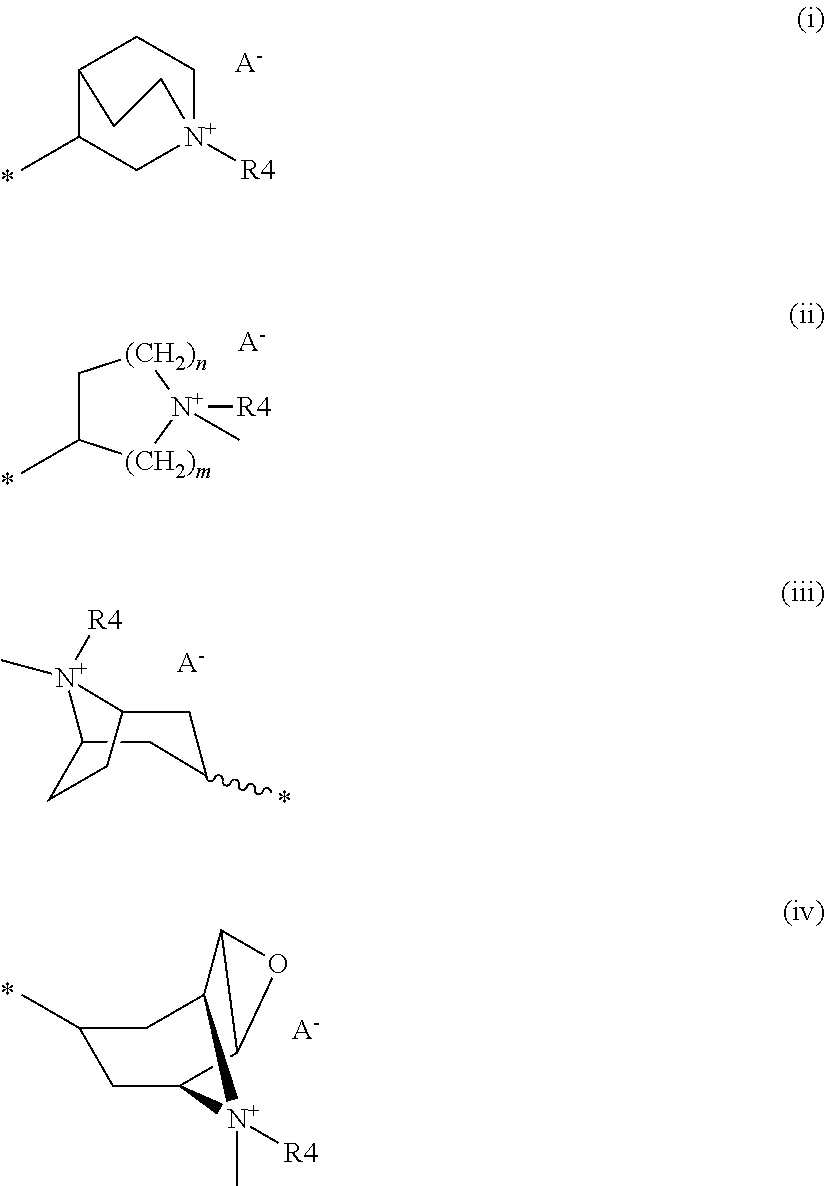
wherein
- * indicates the position at which R6 is bonded to formula (I)
- m=1, 2, or 3;
- n=1, 2, or 3;
- A− is a physiologically acceptable anion;
- R4 is a group of formula (Y):
—(CH2)p-P—(CH2)q-W (Y)
wherein - p is 0 or an integer from 1 to 4;
- q is 0 or an integer from 1 to 4;
- P is absent or is selected from the group consisting of O, S, SO, SO2, CO, NR5 CH═CH, N(R5)SO2, N(R5)COO, N(R5)C(O), SO2N(R5), CO(O)N(R5), and C(O)N(R5);
- W is selected from the group consisting of H, (C1-C6)-alkyl, (C3-C8)-cycloalkyl, aryl, and heteroaryl, optionally substituted by one or more substituents selected from the group consisting of halogen atoms, OH, oxo (═O), SH, NO2, CN, CON(R5)2, COOH, NH2, NHCOR5, CO2R5, (C1-C10)-alkoxycarbonyl, (C1-C10)-alkylsulfanyl, (C1-C10)-alkylsulfinyl, (C1-C10)-alkylsulfonyl, (C1-C10)-alkyl, and (C1-C10)-alkoxyl;
- R5 is selected from the group consisting of H, (C1-C10)alkyl, (C1-C6)alkylhalo, (C2-C6)alkynyl, (C2-C6)alkenyl, (C3-C7)cycloalkyl, (C3-C7)cycloalkyl-(C1-C6)alkyl, heteroaryl, (C1-C6)alkyl-heteroaryl, and aryl optionally substituted by one or more substituents selected from the group consisting of halogen atoms, OH, oxo (═O), SH, NO2, CN, CONH2, COOH, (C1-C10)-alkoxycarbonyl, (C1-C10)-alkylsulfanyl, (C1-C10)-alkylsulfinyl, (C1-C10)-alkylsulfonyl, (C1-C10)-alkyl, and (C1-C10)-alkoxyl;
and pharmaceutically acceptable salts thereof,
with the proviso that when R1 is H, R2 is phenyl, R3 is H, then R6 is not a group of formula (iii).
The present invention is also directed to compounds of general formula (VI):

wherein:
- R1, R2, and R3 are as described above;
- R7 represents a group of formula (vi) or (vii) or (viii) or (ix)

wherein
- * indicates the position at which R7 is bonded to formula (VI)
- m and n are as described above;
and pharmaceutically acceptable salts thereof,
with the provisos that:- when R1 is H or CH3, R2 is phenyl, R3 is H or CH3, then R6 is not a group of formula (viii) and
- the compounds of general formula (VI) are not N-methyl-3-piperidyl-2′-N′dimethylaminoacetate and N-methyl-4-piperidyl-2′-N′-dimethylaminoacetate.
The present invention is also directed to processes for the preparation of a compound of formula (I) as reported in Scheme 1, which comprise the alkylation of a compound of general formula (VI)

with an alkylating agent of general formula (XI):
A-R4 (XI)
in which A is a suitable leaving group selected from the group consisting of halide and sulfonate, and R6 has the above reported meanings.
The present invention is also directed to processes for the preparation of a compound of formula (I) as reported in Scheme 1, which comprise the alkylation of an amine compound of general formula (II):

with a compound of general formula (III),

in which LG is a suitable leaving group and K may be either a hydroxyl group or a suitably protected hydroxyl group, to yield a compound of formula (IV):

which is condensed with a compound of formula (V)

to obtain compound (VI), and converting the compound to a further compound of formula (I).
The present invention is also directed to processes for the preparation of a compound of formula (I) as reported in Scheme 1, which comprise coupling an amine of general formula (II):

with a ketone of formula (VII),

to yield a compound of formula (IV),

which is condensed with a compound of formula (V)

to obtain compound (VI)
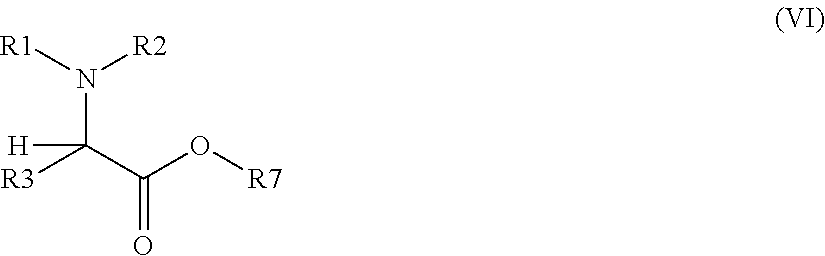
and converting the compound to a further compound of formula (I).
The present invention is also directed to processes for the preparation of a compound of formula (I) as reported in scheme 1, which comprise reacting compound (IX)

with an alkylating agent of general formula (VIII),

in which z is a carbonyl group or a suitable leaving group such as a an halide, to yield a compound of formula (IV) in which R2 is hydrogen,

which is condensed with a compound of formula (V)

to obtain compound (VI)

and converting the compound to a further compound of formula (I).
The present invention is also directed to processes for the preparation of a compound of formula (I) as reported in Scheme 1, which comprise coupling a compound of general formula (III)

to compound of general formula (V)

to yield compound (X),

which is reacted with an amine of formula (II),

to obtain compound (VI)

and converting the compound to a further compound of formula (I).
The present invention also provides pharmaceutical compositions which contain a compound of general formula (I) alone or in combination with or in admixture with one or more pharmaceutically acceptable carriers and/or excipients.
The present invention also provides pharmaceutical compositions which contain a compound of general formula (VI) alone or in combination with or in admixture with one or more pharmaceutically acceptable carriers and/or excipients.
The present invention also provides compounds of general formula (I) for use as a medicament.
The present invention also provides compounds of general formula (VI) for use as a medicament.
In a further aspect the present invention provides the use of compounds of general formula (I) for the manufacture of a medicament for the prevention and/or treatment of broncho-obstructive or inflammatory diseases, preferably asthma or chronic bronchitis or chronic obstructive pulmonary disease (COPD).
In a further aspect the present invention provides the use of compounds of general formula (VI) for the manufacture of a medicament for the prevention and/or treatment of broncho-obstructive or inflammatory diseases, preferably asthma or chronic bronchitis or chronic obstructive pulmonary disease (COPD).
In a further aspect the present invention provides the use of the compounds of general formula (XIX)

wherein:
- R1 and R2 may be independently selected from the group consisting of H, (C1-C10)-alkyl, aryl, (C3-C8)-cycloalkyl, arylalkyl, and heteroaryl optionally substituted by one or more substituents selected from the group consisting of halogen atoms, OH, oxo (═O), SH, NO2, CN, CON(R5)2, COOH, NHCOR5, COR5, CO2R5, CF3, (C1-C10)-alkoxycarbonyl, (C1-C10)-alkylsulfanyl, (C1-C10)-alkylsulfinyl, (C1-C10)-alkylsulfonyl, (C1-C10)-alkyl, and (C1-C10)-alkoxyl;
- R3 is selected from the group consisting of H, (C1-C10)-alkyl, aryl, (C3-C8)-cycloalkyl, heteroaryl, arylalkyl, and heteroarylalkyl optionally substituted by one or more substituents selected from the group consisting of halogen atoms, OH, oxo (═O), SH, NO2, CN, CON(R5)2, COOH, CO2R5, CF3, (C1-C10)-alkoxycarbonyl, (C1-C10)-alkylsulfinyl, (C1-C10)-alkylsulfonyl, (C1-C10)-alkyl, and (C1-C10)-alkoxyl;
- R8 represents a group of formula (i) or (ii) or (iii) or (iv) or (vi) or (vii) or (viii) or (ix)

wherein
- * indicates the position at which R8 is bonded to formula (XIX)
- m=1, 2, or 3;
- n=1, 2 or 3;
- A− is a physiologically acceptable anion;
- R4 is a group of formula (Y)
—(CH2)p-P—(CH2)q-W (Y)
wherein - p is 0 or an integer from 1 to 4;
- q is 0 or an integer from 1 to 4;
- P is absent or is selected from the group consisting of O, S, SO, SO2, CO, NR5 CH═CH, N(R5)SO2, N(R5)COO, N(R5)C(O), SO2N(R5), CO(O)N(R5), and C(O)N(R5);
- W is selected from the group consisting of H, (C1-C6)-alkyl, (C3-C8)-cycloalkyl, aryl, and heteroaryl, optionally substituted by one or more substituents selected from the group consisting of halogen atoms, OH, oxo (═O), SH, NO2, CN, CON(R5)2, COOH, NH2, NHCOR5, CO2R5, (C1-C10)-alkoxycarbonyl, (C1-C10)-alkylsulfanyl, (C1-C10)-alkylsulfinyl, (C1-C10)-alkylsulfonyl, (C1-C10)-alkyl, and (C1-C10)-alkoxyl;
- R5 is selected from the group consisting of H, (C1-C10)alkyl, (C1-C6)alkylhalo, (C2-C6)alkynyl, (C2-C6)alkenyl, (C3-C1)cycloalkyl, (C3-C7)cycloalkyl-(C1-C6)alkyl, heteroaryl, (C1-C6)alkyl-heteroaryl, and aryl optionally substituted by one or more substituents selected from the group consisting of halogen atoms, OH, oxo (═O), SH, NO2, CN, CONH2, COOH, (C1-C10)-alkoxycarbonyl, (C1-C10)-alkylsulfanyl, (C1-C10)-alkylsulfinyl, (C1-C10)-alkylsulfonyl, (C1-C10)-alkyl, and (C1-C10)-alkoxyl for the preparation of a medicament for the prevention and/or treatment of broncho-obstructive or inflammatory diseases, preferably asthma or chronic bronchitis or chronic obstructive pulmonary disease (COPD).
Moreover, the present invention provides methods for the prevention, amelioration, and/or treatment of a broncho-obstructive or inflammatory disease, preferably asthma or chronic bronchitis or chronic obstructive pulmonary disease (COPD), which comprise administering to a subject in need thereof a therapeutically effective amount of a compound of general formula (I).
Moreover, the present invention provides methods for the prevention, amelioration, and/or treatment of a broncho-obstructive or inflammatory disease, preferably asthma or chronic bronchitis or chronic obstructive pulmonary disease (COPD), which comprise administering to a subject in need thereof a therapeutically effective amount of a compound of general formula (VI).
Moreover the present invention provides methods for the prevention, amelioration, and/or treatment of a broncho-obstructive or inflammatory disease, preferably selected from the group consisting of asthma or chronic bronchitis or chronic obstructive pulmonary disease (COPD), which comprise administering to a subject in need thereof a therapeutically effective amount of compound (XIX).
The present invention also provides pharmaceutical preparations suitable for administration by inhalation. Inhalable preparations include inhalable powders, propellant-containing metering aerosols or propellant-free inhalable formulations.
The present invention is also directed to devices which may be a single- or multi-dose dry powder inhaler, a metered dose inhaler or a soft mist nebulizer and which contain a compound of general formula (I).
The present invention is also directed to devices which may be a single- or multi-dose dry powder inhaler, a metered dose inhaler or a soft mist nebulizer and which contain a compound of general formula (VI).
The present invention is also directed to kits which contain a pharmaceutical composition which contains a compound of general formula (I) alone or in combination with or in admixture with one or more pharmaceutically acceptable carriers and/or excipients and a device which may be a single- or multi-dose dry powder inhaler, a metered dose inhaler and a soft mist nebulizer comprising a compounds of general formula (I).
The present invention is also directed to kits which contain a pharmaceutical compositions which contains a compound of general formula (VI) alone or in combination with or in admixture with one or more pharmaceutically acceptable carriers and/or excipients and a device which may be a single- or multi-dose dry powder inhaler, a metered dose inhaler and a soft mist nebulizer comprising a compound of general formula (VI).
The present invention provides alkaloid aminoester derivatives with desirable therapeutic characteristics. The compounds of general formula (I) behave as soft-drugs, since they are able to produce a persistent bronchodilating effect in the lung but are consistently and rapidly transformed into inactive metabolites after passing into human plasma. This behavior gives great advantages in terms of safety.
The term “halogen atoms” as used herein includes fluorine, chlorine, bromine, and iodine.
As used herein, the expression “(C1-C10) alkyl”, refers to straight or branched chain alkyl groups wherein the number of constituent carbon atoms is in the range 1 to 10. Examples of said groups are methyl, ethyl, n-propyl, isopropyl, t-butyl, pentyl, hexyl, heptyl, octanyl, nonenyl and decenyl.
Optionally, as formerly reported, in alkyl one or more hydrogen atoms can be replaced by halogen atoms. The derived expressions “(C1-C10)-alkoxycarbonyl”, (C1-C10)-alkylsulfanyl”, “(C1-C10)-alkylsulfinyl”, “(C1-C10)-alkylsulfonyl” and “(C1-C10)-alkoxyl” are to be construed in an analogous manner.
The derived expressions “(C2-C10) alkenyl” and “(C2-C10) alkynyl”, are to be construed in an analogous manner, as referring to groups at least comprising one double or triple bond.
As used herein, the expression “aryl” refers to mono, bi- or tricyclic ring systems which have 5 to 20 ring atoms, preferably from 5 to 15 and wherein at least one ring is aromatic. In said rings one or more hydrogen atoms may be replaced by one or more halogen atoms.
As used herein, the expression “heteroaryl” refers to mono, bi- or tricyclic ring systems which have 5 to 20 ring atoms, preferably from 5 to 15, in which at least one ring is aromatic and in which at least one ring atom is a heteroatom or heteroaromatic group (e.g. N, NH, S or O). In said rings one or more hydrogen atoms may be replaced by one or more halogen atoms.
As used herein, the expression “arylalkyl” refers to a “(C1-C4) alkyl” optionally substituted by aryl as above defined. Examples of suitable arylalkyl groups include benzyl and diphenylmethyl.
As used herein, the expression “heteroarylalkyl” refers to a “(C1-C4) alkyl” optionally substituted by a heteroaryl group as above defined. Examples of suitable heteroarylalkyl groups include thiophenylmethyl. Examples of suitable monocyclic systems include thiophene, cyclopentadiene, benzene, pyrrole, pyrazole, imidazole, isoxazole, oxazole, isothiazole, thiazole, pyridine, imidazolidine, piperidine and furan radicals. Examples of suitable bicyclic systems include naphthalene, biphenyl, purine, pteridine, benzotriazole, quinoline, isoquinoline, indole, isoindole and benzothiophene radicals. Examples of suitable tricyclic systems include fluorene radicals.
The invention is directed to alkaloid aminoester derivatives of formula (I) and (VI) which act as muscarinic receptor antagonists, and to the salts thereof, said derivatives preferably acting on the M3 receptors.
Advantageously, physiologically acceptable anions A− include those selected from the group consisting of chloride, bromide, iodide, trifluoroacetate, formate, sulfate, phosphate, methanesulfonate, nitrate, maleate, acetate, citrate, fumarate, tartrate, oxalate, succinate, benzoate, and p-toluenesulfonate, preferably chloride, bromide and iodide.
A preferred group of compounds of general formula (I) is that wherein R1 is hydrogen, R2 is arylalkyl or (C1-C10)-alkyl or aryl or (C3-C8)-cycloalkyl or heteroaryl and R3 is (C1-C10)-alkyl or aryl or (C3-C8)-cycloalkyl or heteroaryl, preferably substituted with one or more halogen atoms and wherein R6 is as defined above.
A preferred group of compounds of general formula (VI) is that wherein R1 is H, R2 is arylalkyl or (C1-C10)-alkyl or aryl or (C3-C8)-cycloalkyl or heteroaryl and R3 is (C1-C10)-alkyl or aryl or (C3-C8)-cycloalkyl or heteroaryl, preferably substituted with one or more halogen atoms and wherein R7 is a group of formula (vi)

according to the general formula (XII):

A preferred group of compounds of general formula (I) is that wherein R1 is H, R2 is arylalkyl or (C1-C10)-alkyl or aryl or (C3-C8)-cycloalkyl or heteroaryl and R3 is (C1-C10)-alkyl or aryl or (C3-C8)-cycloalkyl or arylalkyl or heteroaryl, preferably substituted with one or more halogen atoms and wherein R6 is a group of formula (I)

according to the general formula (XIII):

A preferred group of compounds of general formula (XII) is that wherein R2 and R3 are phenyl.
A preferred group of compounds of general formula (XIII) is that wherein R2 and R3 are phenyl.
A preferred group of compounds of general formula (XIII) is represented by the compounds wherein R4 is a group of formula (Y)
—(CH2)p-P—(CH2)q-W (Y)
wherein p is 1, P is CO, q is 0 and W is aryl or heteroaryl.
—(CH2)p-P—(CH2)q-W (Y)
wherein p is 1, P is CO, q is 0 and W is aryl or heteroaryl.
A preferred group of compounds of general formula (XIII) is represented by the compounds wherein R4 is a group of formula (Y), wherein p is 1, P is CO, q is 0 and W is an optionally phenyl.
A preferred group of compounds of general formula (XIII) is represented by the compounds wherein R4 is a group of formula (Y), wherein p is 1, P is CO, q is 0 and W is thienyl or thiazolyl.
A preferred group of compounds of general formula (XIII) is represented by the compounds wherein R4 is a group of formula (Y), wherein p is 2, P is O, q is 0 and W is phenyl.
A preferred group of compounds of general formula (XIII) is represented by the compounds wherein R4 is a group of formula (Y), wherein p is 3, P is O, q is 0 and W is phenyl.
A preferred group of compounds of general formula (VI) is that wherein R1 is H, R2 is arylalkyl or (C1-C10)-alkyl or aryl or (C3-C8)-cycloalkyl or heteroaryl and R3 is (C1-C10)-alkyl or aryl or (C3-C8)-cycloalkyl or arylalkyl or heteroaryl, preferably substituted with one or more halogen atoms and wherein R7 is a group of formula (vii)

wherein m=2 and n=1, according to the general formula (XIV):

A preferred group of compounds of general formula (XIV) is that wherein R2 and R3 are phenyl, preferably substituted with one or more halogen atoms.
A preferred group of compounds of general formula (VI) is that wherein R1 is H, R2 is arylalkyl or (C1-C10)-alkyl or aryl or (C3-C8)-cycloalkyl or heteroaryl and R3 is (C1-C10)-alkyl or aryl or (C3-C8)-cycloalkyl or arylalkyl or heteroaryl, preferably substituted with one or more halogen atoms and wherein R7 is a group of formula (vii), wherein m=1 and n=1, according to the general formula (XV):

A preferred group of compounds of general formula (XV) is that wherein R2 and R3 are phenyl, preferably substituted with one or more halogen atoms.
A preferred group of compounds of general formula (VI) is that wherein R1 is H, R2 is arylalkyl or (C1-C10)-alkyl or aryl or (C3-C8)-cycloalkyl or heteroaryl and R3 is (C1-C10)-alkyl or aryl or (C3-C8)-cycloalkyl or arylalkyl or arylalkyl or heteroaryl, preferably substituted with one or more halogen atoms and wherein R7 is a group of formula (vii), wherein m=1 and n=2, according to the general formula (XVI):

A preferred group of compounds of general formula (XVI) is that wherein R2 and R3 are phenyl, preferably substituted with one or more halogen atoms.
A preferred group of compounds of general formula (VI) is that wherein R1 is H, R2 is arylalkyl or (C1-C10)-alkyl or aryl or (C3-C8)-cycloalkyl or heteroaryl and R3 is (C1-C10)-alkyl or aryl or (C3-C8)-cycloalkyl or arylalkyl or arylalkyl or heteroaryl, preferably substituted with one or more halogen atoms and wherein R7 is a group of formula (viii)

according to the general formula (XVII):

A preferred group of compounds of general formula (XVII) is that wherein R2 and R3 are phenyl, preferably substituted with one or more halogen atoms.
A preferred group of compounds of general formula (VI) is that wherein R1 is H, R2 is arylalkyl or (C1-C10)-alkyl or aryl or (C3-C8)-cycloalkyl or heteroaryl and R3 is (C1-C10)-alkyl or aryl or (C3-C8)-cycloalkyl or arylalkyl or arylalkyl or heteroaryl, preferably substituted with one or more halogen atoms and wherein R7 is a group of formula (ix)

according to the general formula (XVIII):

A preferred group of compounds of general formula (XVIII) is that wherein R2 and R3 are phenyl.
A preferred group of compounds are the corresponding quaternary ammonium salts of compounds of general formula (XII), (XIV), (XV), (XVII), and (XVIII).
It will be apparent to those skilled in the art that the compounds of general formula (I) and (VI) may contain asymmetric centers. Therefore the invention also includes the optical stereoisomers and mixtures thereof.
Where the compounds according to the invention have at least one asymmetric center, they may accordingly exist as enantiomers. Where the compounds according to the invention possess two or more asymmetric centers, they may additionally exist as diastereoisomers. It is to be understood that all such isomers and mixtures thereof in any proportion are encompassed within the scope of the present invention.
The active compounds of general formula (VI) and in particular compounds of general formula (XII), (XIII), (XV), and (XVI) wherein R3 is different from H, show at least two chiral centers, which are respectively represented by the alkaloid carbon atom bearing the aminoester group and the carbon atom bearing H, R3 and NHR2. Compounds of general formula (XII), (XIII), (XV), and (XVI) wherein R3 is different from H can be obtained in S-R, R-, R-S, S-S configuration or as a mixture of diastereoisomers (R-R and S-R configuration or R-S and S-S configuration).
According to a preferred embodiment, compounds of general formula (XII), (XIII), (XV), and (XVI) wherein R3 is different from H, show a (R,R) configuration.
The active compounds of formula (I) and (VI) show at least one chiral center, which is represented by the alkaloid carbon atom bearing the aminoester group.
According to a further embodiment, compound (I) is in the form of (S)-enantiomer when R6 is a group of formula (I).
According to a preferred embodiment, compound (I) is in the form of (R)-enantiomer when R6 is a group of formula (I).
According to specific embodiments, the present invention provides the compounds reported below:
| Compound | Chemical name |
| C2 | (R)-quinuclidin-3-yl 2-phenyl-2-(phenylamino)acetate |
| C3 | (R)-quinuclidin-3-yl 2-(4-fluorophenyl)-2-(4- |
| fluorophenylamino)acetate | |
| C4 | (R)-quinuclidin-3-yl 2-(methyl(phenyl)amino)-2- |
| phenylacetate | |
| C12 | (R)-quinuclidin-3-yl 2-(3-fluorophenyl)-2-(3- |
| fluorophenylamino)acetate | |
| C13 | (R)-1-methylpiperidin-4-yl-2-phenyl-2-(phenylamino)acetate |
| C14 | (R)-1-methylpyrrolidin-4-yl-2-phenyl-2- |
| (phenylamino)acetate | |
| C15 | (S)-1-methylpyrrolidin-4-yl-2-phenyl-2- |
| (phenylamino)acetate | |
| C16 | (R)-1-methylpiperidin-3-yl 2-phenyl-2-(phenylamino)acetate |
| C17 | 8-methyl-8-azabicyclo[3.2.1]octan-3-yl 2-phenyl-2- |
| (phenylamino)acetate | |
| C18 | Phenyl-phenylamino-acetic acid 9-methyl-3-oxa-9-aza- |
| tricyclo[3.3.1.0*2,4*]non-7-yl ester | |
| C20 | (R)-quinuclidin-3-yl) 2-amino-3-phenylpropanoate di- |
| trifluoroacetate | |
| C22 | 3-phenyl-2-phenylamino-propionic acid (R)-(1-aza- |
| bicyclo[2.2.2]oct-3-yl) ester | |
| C24 | (R)-quinuclidin-3-yl 2-(benzylamino)-2-phenylacetate |
| C25 | (R)-quinuclidin-3-yl 2-amino-2-phenylacetate di- |
| hydrochloride | |
| C26 | (R)-quinuclidin-3-yl 2-(cyclopentylamino)-2-phenylacetate |
| di-trifluoroacetate | |
| C27 | (R)-quinuclidin-3-yl 2-(cyclohexylamino)-2-phenylacetate |
| C29 | ((4-chloro-phenylamino)-phenyl-acetic acid (R)-(1-aza- |
| bicyclo[2.2.2]oct-3-yl) ester | |
| C30 | 4-({[(R)-(1-aza-bicyclo[2.2.2]oct-3-yl)oxycarbonyl]-phenyl- |
| methyl}-amino)-benzoic acid methyl ester | |
| C31 | 3-({[(R)-(1-aza-bicyclo[2.2.2]oct-3-yl)oxycarbonyl]-phenyl- |
| methyl}-amino)-thiophene-2-carboxylic acid methyl ester | |
| C32 | (4-fluoro-phenylamino)-phenyl-acetic acid (R)-(1-aza- |
| bicyclo[2.2.2]oct-3-yl) ester | |
| C33 | (4-fluoro-phenyl)-phenylamino-acetic acid (R)-(1-aza- |
| bicyclo[2.2.2]oct-3-yl) ester | |
| C35 | 2-({[(R)-(1-aza-bicyclo[2.2.2]oct-3-yl)oxycarbonyl]-phenyl- |
| methyl}-amino)-benzoic acid methyl ester | |
| C37 | (2-methoxy-phenylamino)-phenyl-acetic acid (R)-(1-aza- |
| bicyclo[2.2.2]oct-3-yl) ester | |
| C39 | phenyl-o-methyl phenylamino-acetic acid (R)-(1-aza- |
| bicyclo[2.2.2]oct-3-yl) ester | |
| C41 | phenyl-(3-trifluoromethoxy-phenylamino)-acetic acid (R)-(1- |
| aza-bicyclo[2.2.2]oct-3-yl) ester | |
| C43 | (3-ethyl-phenylamino)-phenyl-acetic acid (R)-(1-aza- |
| bicyclo[2.2.2]oct-3-yl) ester | |
| C46 | (3-acetylamino-phenylamino)-phenyl-acetic acid (R)-(1-aza- |
| bicyclo[2.2.2]oct-3-yl) ester | |
| C47 | (3-methylcarbamoyl-phenylamino)-phenyl-acetic acid (R)- |
| (1-aza-bicyclo[2.2.2]oct-3-yl) ester | |
| C52 | (3-methylsulfanyl-phenylamino)-phenyl-acetic acid (R)-(1- |
| aza-bicyclo[2.2.2]oct-3-yl) ester | |
| C53 | (3-acetyl-phenylamino)-phenyl-acetic acid (R)-(1-aza- |
| bicyclo[2.2.2]oct-3-yl) ester | |
| C55 | (2,5-dimethoxy-phenylamino)-phenyl-acetic acid (R)-(1-aza- |
| bicyclo[2.2.2]oct-3-yl) ester | |
| C58 | (2,5-difluoro-phenylamino)-phenyl-acetic acid (R)-(1-aza- |
| bicyclo[2.2.2]oct-3-yl) ester | |
| C59 | (2,6-dimethyl-phenylamino)-phenyl-acetic acid (R)-(1-aza- |
| bicyclo[2.2.2]oct-3-yl) ester | |
| C61 | (2-ethyl-phenylamino)-phenyl-acetic acid (R)-(1-aza- |
| bicyclo[2.2.2]oct-3-yl) ester | |
| C64 | (2-acetyl-phenylamino)-phenyl-acetic acid (R)-(1-aza- |
| bicyclo[2.2.2]oct-3-yl) ester | |
| C65 | (3,5-difluoro-phenylamino)-phenyl-acetic acid (R)-(1-aza- |
| bicyclo[2.2.2]oct-3-yl) ester | |
| C67 | 3-({[(R)-(1-aza-bicyclo[2.2.2]oct-3-yl)oxycarbonyl]-phenyl- |
| methyl}-amino)-benzoic acid ethyl ester | |
| C69 | (3-methoxy-phenylamino)-phenyl-acetic acid (R)-(1-aza- |
| bicyclo[2.2.2]oct-3-yl) ester | |
| C72 | [(4-fluoro-phenyl)-methyl-amino]-phenyl-acetic acid (R)-(1- |
| aza-bicyclo[2.2.2]oct-3-yl) ester | |
| C75 | (methyl-phenyl-amino)-phenyl-acetic acid (R)-(1-aza- |
| bicyclo[2.2.2]oct-3-yl) ester | |
| C77 | (4-methyl-benzylamino)-phenyl-acetic acid (R)-(1-aza- |
| bicyclo[2.2.2]oct-3-yl) ester | |
| C78 | (4-fluoro-benzylamino)-phenyl-acetic acid (R)-(1-aza- |
| bicyclo[2.2.2]oct-3-yl) ester | |
| C79 | (4-methoxy-benzylamino)-phenyl-acetic acid (R)-(1-aza- |
| bicyclo[2.2.2]oct-3-yl) ester | |
| C80 | benzylamino-phenyl-acetic acid (R)-(1-aza- |
| bicyclo[2.2.2]oct-3-yl) ester | |
| C82 | (4-fluoro-benzylamino)-phenyl-acetic acid (R)-(1-aza- |
| bicyclo[2.2.2]oct-3-yl) ester | |
| C84 | (4-fluoro-phenyl)-(3-fluoro-phenylamino)-acetic acid (R)-(1- |
| aza-bicyclo[2.2.2]oct-3-yl) ester | |
| C85 | (4-fluoro-phenyl)-(2-fluoro-phenylamino)-acetic acid (R)-(1- |
| aza-bicyclo[2.2.2]oct-3-yl) ester | |
| C90 | (R)-quinuclidin-3-yl 2-(phenylamino)-2-(thiophen-2- |
| yl)acetate hydrochloride | |
| C93 | (4-methoxy-phenyl)-phenylamino-acetic acid (R)-(1-aza- |
| bicyclo[2.2.2]oct-3-yl) ester | |
| C95 | 4-{[(R)-(1-aza-bicyclo[2.2.2]oct-3-yl)oxycarbonyl]- |
| phenylamino-methyl}-benzoic acid methyl ester | |
| C99 | (3-fluoro-phenyl)-phenylamino-acetic acid (R)-(1-aza- |
| bicyclo[2.2.2]oct-3-yl) ester | |
| C100 | (4-fluoro-phenyl)-phenylamino-acetic acid (R)-(1-aza- |
| bicyclo[2.2.2]oct-3-yl) ester | |
| C105 | phenylamino-(4-trifluoromethyl-phenyl)-acetic acid (R)-(1- |
| aza-bicyclo[2.2.2]oct-3-yl) ester | |
| C106 | (S)-quinuclidin-3-yl 2-phenyl-2-(phenylamino)-acetate |
| C107 | phenyl-phenylamino-acetic acid 1-methyl-azepan-4-yl ester |
| C108 | (R)-1-(2-phenoxyethyl)-3-(2-phenyl-2- |
| (phenylamino)acetoxy)-1-azonia-bicyclo[2.2.2]octane | |
| trifluoroacetate | |
| C109 | (R)-1-(2-oxo-2-(thiophen-2-yl)ethyl)-3-(2-phenyl-2- |
| (phenylamino)acetoxy)-1-azonia-bicyclo[2.2.2]octane | |
| trifluoroacetate | |
| C110 | (R)-1-(3-phenoxypropyl)-3-(2-phenyl-2- |
| (phenylamino)acetoxy)-1-azonia-bicyclo[2.2.2]octane | |
| trifluoroacetate | |
| C111 | (R)-1-methyl-3-(2-phenyl-2-(phenylamino)acetoxy)-1- |
| azonia-bicyclo[2.2.2]octane trifluoroacetate | |
| C112 | (R)-1-(2-phenoxyethyl)-3-(2-phenyl-2- |
| (phenylamino)acetoxy)-1-azonia-bicyclo[2.2.2]octane | |
| trifluoroacetate | |
| C113 | (R)-1-(2-oxo-2-phenylethyl)-3-(2-phenyl-2- |
| (phenylamino)acetoxy)-1-azonia-bicyclo[2.2.2]octane | |
| trifluoroacetate | |
| C114 | (3R)-1-(2-oxo-2-(thiophen-3-yl)ethyl)-3-(2-phenyl-2- |
| (phenylamino)-acetoxy)-1-azonia-bicyclo[2.2.2]octane | |
| trifluoroacetate | |
| C115 | (3R)-1-(2-(4-fluorophenyl)-2-oxoethyl)-3-(2-phenyl-2- |
| (phenylamino)-acetoxy)-1-azonia-bicyclo[2.2.2]octane | |
| trifluoroacetate | |
| C116 | (R)-1-phenethyl-3-(2-phenyl-2-(phenylamino)acetoxy)-1- |
| azonia-bicyclo[2.2.2]octane trifluoroacetate | |
| C117 | (R)-1-(2-(benzo[b]thiophen-2-yl)-2-oxoethyl)-3-(2-phenyl-2- |
| (phenylamino)acetoxy)-1-azonia-bicyclo[2.2.2]octane | |
| trifluoroacetate | |
| C118 | (3R)-3-(2-(4-fluorophenyl)-2-(4- |
| fluorophenylamino)acetoxy)-1-(2-oxo-2-(thiophen-2- | |
| yl)ethyl)-1-azonia-bicyclo[2.2.2]octane trifluoroacetate | |
| C119 | (3R)-3-(2-(4-fluorophenyl)-2-(4- |
| fluorophenylamino)acetoxy)-1-(2-oxo-2-phenylethyl)-1- | |
| azonia-bicyclo[2.2.2]octane trifluoroacetate | |
| C120 | (3R)-3-(2-(4-fluorophenyl)-2-(4- |
| fluorophenylamino)acetoxy)-1-methyl-1-azonia- | |
| bicyclo[2.2.2]octane trifluoroacetate | |
| C121 | (3R)-3-(2-(3-fluorophenyl)-2-(3- |
| fluorophenylamino)acetoxy)-1-(2-oxo-2-phenylethyl)-1- | |
| azonia-bicyclo[2.2.2]octane trifluoroacetate | |
| C122 | (3R)-3-(2-(methyl(phenyl)amino)-2-phenylacetoxy)-1-(2- |
| oxo-2-(thiophen-2-yl)ethyl)-1-azonia-bicyclo[2.2.2]octane | |
| trifluoroacetate | |
| C123 | (3R)-3-(2-(methyl(phenyl)amino)-2-phenylacetoxy)-1-(2- |
| oxo-2-phenylethyl)-1-azonia-bicyclo[2.2.2]octane | |
| trifluoroacetate | |
| C124 | (R)-1-(2-phenoxyethyl)-3-(3-phenyl-2- |
| (phenylamino)propanoyloxy)-1-azonia-bicyclo[2.2.2]octane | |
| trifluoroacetate | |
| C125 | (R)-1-(2-oxo-2-(thiophen-2-yl)ethyl)-3-((S)-3-phenyl-2- |
| (phenylamino)propanoyloxy)-1-azonia-bicyclo[2.2.2]octane | |
| trifluoroacetate | |
| C126 | (R)-1-methyl-3-(3-phenyl-2-(phenylamino)propanoyloxy)-1- |
| azonia-bicyclo[2.2.2]octane trifluoroacetate | |
| C127 | (R)-1-(2-oxo-2-phenylethyl)-3-((S)-3-phenyl-2- |
| (phenylamino)propanoyloxy)-1-azonia-bicyclo[2.2.2]octane | |
| trifluoroacetate | |
| C128 | (3R)-3-(2-(benzylamino)-2-phenylacetoxy)-1-(2-oxo-2- |
| phenylethyl)-1-azonia-bicyclo[2.2.2]octane trifluoroacetate | |
| C129 | (R)-1-(2-oxo-2-pyridin-4-yl-ethyl)-3-(2-phenyl-2- |
| phenylamino-acetoxy)-1-azonia-bicyclo[2.2.2]octane | |
| trifluoroacetate | |
| C130 | (R)-1-[2-(3-chloro-thiophen-2-yl)-2-oxo-ethyl]-3-(2-phenyl- |
| 2-phenylamino-acetoxy)-1-azonia-bicyclo[2.2.2]octane | |
| trifluoroacetate | |
| C131 | (R)-1-[2-(5-methyl-thiophen-2-yl)-2-oxo-ethyl]-3-(2-phenyl- |
| 2-phenylamino-acetoxy)-1-azonia-bicyclo[2.2.2]octane | |
| trifluoroacetate | |
| C132 | (R)-1-[2-(1-methyl-1H-pyrrol-2-yl)-2-oxo-ethyl]-3-(2- |
| phenyl-2-phenylamino-acetoxy)-1-azonia- | |
| bicyclo[2.2.2]octane trifluoroacetate | |
| C133 | (R)-1-[2-(2,4-dimethyl-oxazol-5-yl)-2-oxo-ethyl]-3-(2- |
| phenyl-2-phenylamino-acetoxy)-1-azonia- | |
| bicyclo[2.2.2]octane trifluoroacetate | |
| C134 | (R)-3-(2-phenyl-2-phenylamino-acetoxy)-1-(3- |
| phenylsulfanyl-propyl)-1-azonia-bicyclo[2.2.2]octane | |
| formate | |
| C135 | (R)-3-[2-(3-ethyl-phenylamino)-2-phenyl-acetoxy]-1-(2-oxo- |
| 2-phenyl-ethyl)-1-azonia-bicyclo[2.2.2]octane formate | |
| C136 | (R)-3-[2-(4-methoxycarbonyl-phenylamino)-2-phenyl- |
| acetoxy]-1-(2-oxo-2-phenyl-ethyl)-1-azonia- | |
| bicyclo[2.2.2]octane trifluoroacetate | |
| C137 | (3R)-3-(2-phenyl-2-(phenylamino)acetoxy)-1-(2- |
| (phenylthio)ethyl)-1-azonia-bicyclo[2.2.2]octane | |
| trifluoroacetate | |
| C138 | (3R)-1-(cyclohexylmethyl)-3-(2-phenyl-2- |
| (phenylamino)acetoxy)-1-azonia-bicyclo[2.2.2]octane | |
| trifluoroacetate | |
| C139 | (3R)-1-(4-methylpent-3-enyl)-3-(2-phenyl-2- |
| (phenylamino)acetoxy)-1-azonia-bicyclo[2.2.2]octane | |
| trifluoroacetate | |
| C140 | (3R)-1-(2-(3,4-dichlorophenyl)-2-oxoethyl)-3-(2-phenyl-2- |
| (phenylamino)acetoxy)-1-azonia-bicyclo[2.2.2]octane | |
| trifluoroacetate | |
| C141 | (R)-1-(2-oxo-2-phenylethyl)-3-(2-phenyl-2- |
| (phenylamino)acetoxy)-1-azonia-bicyclo[2.2.2]octane | |
| trifluoroacetate | |
| C142 | 3-(3-(3-fluorophenyl)-3-(3-fluorophenylamino)-2- |
| oxopropyl)-1-(2-oxo-2-(thiophen-2-yl)ethyl)-1-azonia- | |
| bicyclo[2.2.2]octane chloride | |
| C143 | (R)-1-(2-amino-2-oxoethyl)-3-(2-phenyl-2- |
| (phenylamino)acetoxy)-1-azonia-bicyclo[2.2.2]octane | |
| bromide | |
| C144 | (R)-1-(2-oxo-2-(phenylamino)ethyl)-3-(2-phenyl-2- |
| (phenylamino)-acetoxy)-1-azonia-bicyclo[2.2.2]octane | |
| bromide | |
| C145 | (3R)-1-(2-oxo-2-phenylethyl)-3-(2-phenyl-2- |
| (phenylamino)acetoxy)-1-azonia-bicyclo[2.2.2]octane | |
| bromide | |
| C146 | (3R)-3-(2-(benzylamino)-2-phenylacetoxy)-1-(2-oxo-2- |
| (thiophen-2-yl)ethyl)-1-azonia-bicyclo[2.2.2]octane chloride | |
| C147 | (R)-1-(2-oxo-2-phenyl-ethyl)-3-((R)-2-phenyl-2- |
| phenylamino-acetoxy)-1-azonia-bicyclo[2.2.2]octane | |
| bromide | |
| C149 | (R)-3-((S)-2-amino-phenylpropanoyloxy)-1-(2- |
| phenoxyethyl)-1-azonia-bicyclo[2.2.2]octane trifluoroacetate | |
| C150 | (R)-3-((S)-2-amino-3-phenylpropanoyloxy)-1-(2-oxo-2- |
| (thiophen-2-yl)ethyl)-1-azonia-bicyclo[2.2.2]octane | |
| trifluoroacetate | |
| C151 | (R)-3-((S)-2-amino-3-phenylpropanoyloxy)-1-(3- |
| phenoxypropyl)-1-azonia-bicyclo[2.2.2]octane | |
| trifluoroacetate | |
| C152 | (R)-3-((S)-2-amino-3-phenylpropanoyloxy)-1-(2-oxo-2- |
| phenylethyl)-1-azonia-bicyclo[2.2.2]octane trifluoroacetate | |
| C153 | (R)-1-(2-oxo-2-phenylethyl)-3-((R)-3-phenyl-2- |
| (phenylamino)-propanoyloxy)-1-azoniabicyclo[2.2.2]octane | |
| bromide | |
| C154 | (R)-1-(2-oxo-2-(thiophen-2-yl)ethyl)-3-((R)-3-phenyl-2- |
| (phenylamino)-propanoyloxy)-1-azonia-bicyclo[2.2.2]octane | |
| chloride | |
| C155 | (R)-1-[2-(4-methoxy-phenyl)-2-oxo-ethyl]-3-(2-phenyl-2- |
| phenylamino-acetoxy)-1-azonia-bicyclo[2.2.2]octane | |
| trifluoroacetate | |
| C156 | (R)-1-(4-oxo-4-phenyl-butyl)-3-(2-phenyl-2-phenylamino- |
| acetoxy)-1-azonia-bicyclo[2.2.2]octane trifluoroacetate | |
| C157 | (R)-1-(4-oxo-4-phenyl-butyl)-3-(2-phenyl-2-phenylamino- |
| acetoxy)-1-azonia-bicyclo[2.2.2]octane trifluoroacetate | |
| C158 | (R)-1-benzyl-3-(2-phenyl-2-phenylamino-acetoxy)-1-azonia- |
| bicyclo[2.2.2]octane trifluoroacetate | |
| C159 | (R)-1-benzyl-3-(2-phenyl-2-phenylamino-acetoxy)-1-azonia- |
| bicyclo[2.2.2]octane trifluoroacetate | |
| C160 | (R)-1-benzyl-3-(2-phenyl-2-phenylamino-acetoxy)-1-azonia- |
| bicyclo[2.2.2]octane trifluoroacetate | |
| C161 | (R)-1-[2-(4-methoxy-phenyl)-2-oxo-ethyl]-3-(2-phenyl-2- |
| phenylamino-acetoxy)-1-azonia-bicyclo[2.2.2]octane | |
| trifluoroacetate | |
| C162 | (R)-1-[2-(4-methylsulfonyl-phenyl)-2-oxo-ethyl]-3-(2- |
| phenyl-2-phenylamino-acetoxy)-1-azonia- | |
| bicyclo[2.2.2]octane trifluoroacetate | |
| C163 | (R)-1-[2-(3-hydroxy-phenyl)-2-oxo-ethyl]-3-(2-phenyl-2- |
| phenylamino-acetoxy)-1-azonia-bicyclo[2.2.2]octane | |
| trifluoroacetate | |
| C164 | (R)-1-dimethylcarbamoylmethyl-3-(2-phenyl-2- |
| phenylamino-acetoxy)-1-azonia-bicyclo[2.2.2]octane | |
| trifluoroacetate | |
| C165 | (R)-1-(2-oxo-propyl)-3-(2-phenyl-2-phenylamino-acetoxy)- |
| 1-azonia-bicyclo[2.2.2]octane trifluoroacetate | |
| C166 | (R)-3-[2-(2-methoxycarbonyl-thiophen-3-yl)-2- |
| phenylamino-acetoxy]-1-(2-oxo-2-phenyl-ethyl)-1-azonia- | |
| bicyclo[2.2.2]octane trifluoroacetate | |
| C167 | (R)-3-[2-(2-methoxycarbonyl-thiophen-3-yl)-2- |
| phenylamino-acetoxy]-1-(2-oxo-2-thiophen-2-yl-ethyl)-1- | |
| azonia-bicyclo[2.2.2]octane trifluoroacetate | |
| C168 | (R)-3-[2-(4-methoxy-phenyl)-2-phenylamino-acetoxy]-1-(2- |
| oxo-2-phenyl-ethyl)-1-azonia-bicyclo[2.2.2]octane formate | |
| C169 | (R)-3-[2-(4-chloro-phenylamino)-2-phenyl-acetoxy]-1-(2- |
| oxo-2-phenyl-ethyl)-1-azonia-bicyclo[2.2.2]octane | |
| trifluoroacetate | |
| C170 | (R)-1-(2-oxo-2-phenyl-ethyl)-3-[2-phenylamino-2-(4- |
| trifluoromethyl-phenyl)-acetoxy]-1-azonia- | |
| bicyclo[2.2.2]octane trifluoroacetate | |
| C171 | (R)-1-methyl-1-(2-oxo-2-phenyl-ethyl)-3-(2-phenyl-2- |
| phenylamino-acetoxy)-pyrrolidinium trifluoroacetate | |
| C172 | 1,1-dimethyl-4-(2-phenyl-2-phenylamino-acetoxy)- |
| piperidinium trifluoroacetate | |
| C173 | (R)-1-[2-(5-methyl-thiophen-3-yl)-2-oxo-ethyl]-3-(2-phenyl- |
| 2-phenylamino-acetoxy)-1-azonia-bicyclo[2.2.2]octane | |
| trifluoroacetate | |
| C174 | (R)-1-[2-(2,4-difluoro-phenyl)-2-oxo-ethyl]-3-(2-phenyl-2- |
| phenylamino-acetoxy)-1-azonia-bicyclo[2.2.2]octane | |
| bromide | |
| C175 | (R)-1-[2-(3,4-difluoro-phenyl)-2-oxo-ethyl]-3-(2-phenyl-2- |
| phenylamino-acetoxy)-1-azonia-bicyclo[2.2.2]octane | |
| bromide | |
| C176 | (R)-1-[2-(2-fluoro-phenyl)-2-oxo-ethyl]-3-(2-phenyl-2- |
| phenylamino-acetoxy)-1-azonia-bicyclo[2.2.2]octane | |
| bromide | |
| C177 | (R)-1-[2-(3-fluoro-phenyl)-2-oxo-ethyl]-3-(2-phenyl-2- |
| phenylamino-acetoxy)-1-azonia-bicyclo[2.2.2]octane | |
| bromide | |
| C178 | (R)-1-[2-(2,4-dibromo-phenyl)-2-oxo-ethyl]-3-(2-phenyl-2- |
| phenylamino-acetoxy)-1-azonia-bicyclo[2.2.2]octane | |
| chloride | |
| C179 | (R)-1-[2-(4-nitro-phenyl)-2-oxo-ethyl]-3-(2-phenyl-2- |
| phenylamino-acetoxy)-1-azonia-bicyclo[2.2.2]octane | |
| bromide | |
| C180 | (R)-1-[2-(4-hydroxy-phenyl)-2-oxo-ethyl]-3-(2-phenyl-2- |
| phenylamino-acetoxy)-1-azonia-bicyclo[2.2.2]octane | |
| bromide | |
| C181 | (R)-1-[2-oxo-2-(2-oxo-2,3-dihydro-1H-indol-5-yl)-ethyl]-3- |
| (2-phenyl-2-phenylamino-acetoxy)-1-azonia- | |
| bicyclo[2.2.2]octane bromide | |
| C182 | (R)-1-(2-benzo[1,3]dioxol-5-yl-2-oxo-ethyl)-3-(2-phenyl-2- |
| phenylamino-acetoxy)-1-azonia-bicyclo[2.2.2]octane | |
| bromide | |
| C183 | (R)-1-(2-oxo-2-thiazol-2-yl-ethyl)-3-(2-phenyl-2- |
| phenylamino-acetoxy)-1-azonia-bicyclo[2.2.2]octane | |
| bromide | |
| C184 | (R)-1-[2-(3-ethoxycarbonyl-isoxazol-5-yl)-2-oxo-ethyl]-3- |
| (2-phenyl-2-phenylamino-acetoxy)-1-azonia- | |
| bicyclo[2.2.2]octane bromide | |
| C185 | (R)-1-[2-(4-methyl-thiophen-2-yl)-2-oxo-ethyl]-3-(2-phenyl- |
| 2-phenylamino-acetoxy)-1-azonia-bicyclo[2.2.2]octane | |
| bromide | |
| C186 | (R)-1-(2-benzo[b]thiophen-5-yl-2-oxo-ethyl)-3-(2-phenyl-2- |
| phenylamino-acetoxy)-1-azonia-bicyclo[2.2.2]octane | |
| bromide | |
| C187 | (R)-3-(2-phenyl-2-phenylamino-acetoxy)-1- |
| phenylsulfanylmethyl-1-azonia-bicyclo[2.2.2]octane chloride | |
| C188 | (R)-1-(2-oxo-2-piperidin-1-yl-ethyl)-3-(2-phenyl-2- |
| phenylamino-acetoxy)-1-azonia-bicyclo[2.2.2]octane | |
| chloride | |
| C189 | (R)-3-(2-phenyl-2-phenylamino-acetoxy)-1-(thiazol-2- |
| ylcarbamoylmethyl)-1-azonia-bicyclo[2.2.2]octane chloride | |
| C190 | (R)-1-(isoxazol-3-ylcarbamoylmethyl)-3-(2-phenyl-2- |
| phenylamino-acetoxy)-1-azonia-bicyclo[2.2.2]octane | |
| chloride | |
| C191 | (R)-1-(2-oxo-2-phenyl-ethyl)-3-(2-phenyl-2-p- |
| methylphenylamino-acetoxy)-1-azonia-bicyclo[2.2.2]octane | |
| bromide | |
| C192 | (R)-3-[2-(4-fluoro-phenylamino)-2-phenyl-acetoxy]-1-(2- |
| oxo-2-phenyl-ethyl)-1-azonia-bicyclo[2.2.2]octane bromide | |
| C193 | (R)-3-[2-(4-fluoro-phenylamino)-2-phenyl-acetoxy]-1-(2- |
| oxo-2-thiophen-2-yl-ethyl)-1-azonia-bicyclo[2.2.2]octane | |
| chloride | |
| C194 | (R)-3-[2-(2-methoxycarbonyl-phenylamino)-2-phenyl- |
| acetoxy]-1-(2-oxo-2-phenyl-ethyl)-1-azonia- | |
| bicyclo[2.2.2]octane bromide | |
| C195 | (R)-3-[2-(2-methoxy-phenylamino)-2-phenyl-acetoxy]-1-(2- |
| oxo-2-phenyl-ethyl)-1-azonia-bicyclo[2.2.2]octane bromide | |
| C196 | (R)-1-(2-oxo-2-phenyl-ethyl)-3-[2-phenyl-2-(3- |
| trifluoromethoxy-phenylamino)-acetoxy]-1-azonia- | |
| bicyclo[2.2.2]octane bromide | |
| C197 | (R)-1-(2-oxo-2-phenyl-ethyl)-3-(2-phenyl-2-(phenylamino- |
| acetoxy)-1-azonia-bicyclo[2.2.2]octane bromide | |
| C198 | (R)-3-[2-(3-acetylamino-phenylamino)-2-phenyl-acetoxy]-1- |
| (2-oxo-2-phenyl-ethyl)-1-azonia-bicyclo[2.2.2]octane | |
| bromide | |
| C199 | (R)-3-[2-(3-methylcarbamoyl-phenylamino)-2-phenyl- |
| acetoxy]-1-(2-oxo-2-phenyl-ethyl)-1-azonia- | |
| bicyclo[2.2.2]octane bromide | |
| C200 | (R)-3-[2-(3-methylsulfanyl-phenylamino)-2-phenyl- |
| acetoxy]-1-(2-oxo-2-phenyl-ethyl)-1-azonia- | |
| bicyclo[2.2.2]octane bromide | |
| C201 | (R)-3-[2-(4-fluoro-phenyl)-2-(3-fluoro-phenylamino)- |
| acetoxy]-1-(2-oxo-2-phenyl-ethyl)-1-azonia- | |
| bicyclo[2.2.2]octane bromide | |
| C202 | (R)-3-[2-(4-fluoro-phenyl)-2-(3-fluoro-phenylamino)- |
| acetoxy]-1-(2-oxo-2-thiophen-2-yl-ethyl)-1-azonia- | |
| bicyclo[2.2.2]octane chloride | |
| C203 | (R)-3-[2-(4-fluoro-phenyl)-2-(2-fluoro-phenylamino)- |
| acetoxy]-1-(2-oxo-2-phenyl-ethyl)-1-azonia- | |
| bicyclo[2.2.2]octane bromide | |
| C204 | (R)-3-[2-(4-fluoro-phenyl)-2-(2-fluoro-phenylamino)- |
| acetoxy]-1-(2-oxo-2-thiophen-2-yl-ethyl)-1-azonia- | |
| bicyclo[2.2.2]octane chloride | |
| C205 | (R)-3-[2-(4-methoxycarbonyl-phenyl)-2-phenylamino- |
| acetoxy]-1-(2-oxo-2-phenyl-ethyl)-1-azonia- | |
| bicyclo[2.2.2]octane bromide | |
| C206 | (R)-3-(2-cyclohexylamino-2-phenyl-acetoxy)-1-(2-oxo-2- |
| phenyl-ethyl)-1-azonia-bicyclo[2.2.2]octane bromide | |
| C207 | (R)-3-(2-cyclohexylamino-2-phenyl-acetoxy)-1-(2-oxo-2- |
| thiophen-2-yl-ethyl)-1-azonia-bicyclo[2.2.2]octane chloride | |
| C208 | (R)-1-(2-oxo-2-phenyl-ethyl)-3-(2-phenylamino-2-thiophen- |
| 2-yl-acetoxy)-1-azonia-bicyclo[2.2.2]octane bromide | |
| C209 | (R)-3-[2-(3-fluoro-4-methyl-phenylamino)-2-phenyl- |
| acetoxy]-1-(2-oxo-2-phenyl-ethyl)-1-azonia- | |
| bicyclo[2.2.2]octane bromide | |
| C210 | (R)-3-[2-(2,5-dimethoxy-phenylamino)-2-phenyl-acetoxy]-1- |
| (2-oxo-2-phenyl-ethyl)-1-azonia-bicyclo[2.2.2]octane | |
| bromide | |
| C211 | (R)-3-[2-(2,5-difluoro-phenylamino)-2-phenyl-acetoxy]-1- |
| (2-oxo-2-phenyl-ethyl)-1-azonia-bicyclo[2.2.2]octane | |
| bromide | |
| C212 | (R)-3-[2-(2,6-dimethyl-phenylamino)-2-phenyl-acetoxy]-1- |
| (2-oxo-2-phenyl-ethyl)-1-azonia-bicyclo[2.2.2]octane | |
| bromide | |
| C213 | (R)-3-[2-(2-ethyl-phenylamino)-2-phenyl-acetoxy]-1-(2-oxo- |
| 2-phenyl-ethyl)-1-azonia-bicyclo[2.2.2]octane bromide | |
| C214 | (R)-3-[2-(2-acetyl-phenylamino)-2-phenyl-acetoxy]-1-(2- |
| oxo-2-phenyl-ethyl)-1-azonia-bicyclo[2.2.2]octane bromide | |
| C215 | (R)-3-[2-(3-ethoxycarbonyl-phenylamino)-2-phenyl- |
| acetoxy]-1-(2-oxo-2-phenyl-ethyl)-1-azonia- | |
| bicyclo[2.2.2]octane bromide | |
| C216 | (R)-3-[2-(3,5-difluoro-phenylamino)-2-phenyl-acetoxy]-1- |
| (2-oxo-2-phenyl-ethyl)-1-azonia-bicyclo[2.2.2]octane | |
| bromide | |
| C217 | (R)-3-[2-(3-methoxy-phenylamino)-2-phenyl-acetoxy]-1-(2- |
| oxo-2-phenyl-ethyl)-1-azonia-bicyclo[2.2.2]octane bromide | |
| C218 | (R)-3-[2-(3-fluoro-phenyl)-2-phenylamino-acetoxy]-1-(2- |
| oxo-2-phenyl-ethyl)-1-azonia-bicyclo[2.2.2]octane bromide | |
| C219 | (R)-3-[2-(4-fluoro-phenyl)-2-phenylamino-acetoxy]-1-(2- |
| oxo-2-phenyl-ethyl)-1-azonia-bicyclo[2.2.2]octane bromide | |
| C220 | (R)-1-cyanomethyl-3-(2-phenyl-2-phenylamino-acetoxy)-1- |
| azonia-bicyclo[2.2.2]octane bromide | |
| C221 | (R)-1-tert-butoxycarbonylmethyl-3-(2-phenyl-2- |
| phenylamino-acetoxy)-1-azonia-bicyclo[2.2.2]octane | |
| bromide | |
| C222 | (S)-1-(2-oxo-2-phenyl-ethyl)-3-(2-phenyl-2-phenylamino- |
| acetoxy)-1-azonia-bicyclo[2.2.2]octane chloride | |
| C223 | (R)-3-[2-(3-acetyl-phenylamino)-2-phenyl-acetoxy]-1-(2- |
| oxo-2-phenyl-ethyl)-1-azonia-bicyclo[2.2.2]octane formate | |
| C224 | (R)-1-[2-(4-acetylamino-phenyl)-2-oxo-ethyl]-3-(2-phenyl- |
| 2-phenylamino-acetoxy)-1-azonia-bicyclo[2.2.2]octane | |
| bromide | |
| C225 | (R)-1-[2-(4-methoxycarbonyl-phenyl)-2-oxo-ethyl]-3-(2- |
| phenyl-2-phenylamino-acetoxy)-1-azonia- | |
| bicyclo[2.2.2]octane bromide | |
| C226 | (R)-3-(2-phenyl-2-phenylamino-acetoxy)-1-pyridin-2- |
| ylmethyl-1-azonia-bicyclo[2.2.2]octane trifluoroacetate | |
| trifluoroacetate anion | |
| C227 | (R)-1-(2-oxo-2-pyridin-2-yl-ethyl)-3-(2-phenyl-2- |
| phenylamino-acetoxy)-1-azonia-bicyclo[2.2.2]octane | |
| formate formate anion | |
| C229 | (R)-1-(2-(2-methylthiazol-4-yl)-2-oxoethyl)-3-((R)-2- |
| phenyl-2-(phenylamino)acetoxy)-1- | |
| azoniabicyclo[2.2.2]octane bromide | |
| C233 | (R)-1-(6-amino-pyridin-2-ylmethyl)-3-(2-phenyl-2- |
| phenylamino-acetoxy)-1-azonia-bicyclo[2.2.2]octane | |
| trifluoroacetate trifluoroacetate anion | |
| C234 | (R)-3-{2-[(4-fluoro-phenyl)-methyl-amino]-2-phenyl- |
| acetoxy}-1-(2-oxo-2-thiophen-2-yl-ethyl)-1-azonia- | |
| bicyclo[2.2.2]octane chloride | |
| C235 | (R)-3-[2-(methyl-phenyl-amino)-2-phenyl-acetoxy]-1-(2- |
| oxo-2-thiazol-2-yl-ethyl)-1-azonia-bicyclo[2.2.2]octane | |
| bromide | |
| C236 | (R)-3-[2-(methyl-phenyl-amino)-2-phenyl-acetoxy]-1-(2- |
| oxo-2-thiophen-3-yl-ethyl)-1-azonia-bicyclo[2.2.2]octane | |
| C237 | (R)-3-(2-benzylamino-2-phenyl-acetoxy)-1-[2-(3- |
| ethoxycarbonyl-isoxazol-5-yl)-2-oxo-ethyl]-1-azonia- | |
| bicyclo[2.2.2]octane bromide | |
| C238 | (R)-3-(2-benzylamino-2-phenyl-acetoxy)-1-(2-oxo-2-thiazol- |
| 2-yl-ethyl)-1-azonia-bicyclo[2.2.2]octane trifluoroacetate | |
| trifluoroacetate anion | |
| C239 | (R)-3-(2-benzylamino-2-phenyl-acetoxy)-1-(2-oxo-2- |
| thiophen-3-yl-ethyl)-1-azonia-bicyclo[2.2.2]octane bromide | |
| C240 | (R)-3-[2-(4-methyl-benzylamino)-2-phenyl-acetoxy]-1-(2- |
| oxo-2-thiophen-2-yl-ethyl)-1-azonia-bicyclo[2.2.2]octane | |
| formate formate anion | |
| C241 | (R)-3-[2-(4-methoxy-benzylamino)-2-phenyl-acetoxy]-1-(2- |
| oxo-2-thiophen-2-yl-ethyl)-1-azonia-bicyclo[2.2.2]octane | |
| formate formate anion | |
| C242 | (R)-3-[2-(4-fluoro-benzylamino)-2-phenyl-acetoxy]-1-(2- |
| oxo-2-thiophen-2-yl-ethyl)-1-azonia-bicyclo[2.2.2]octane | |
| chloride | |
| C243 | (R)-3-[2-(4-fluoro-benzylamino)-2-phenyl-acetoxy]-1-(2- |
| oxo-2-phenyl-ethyl)-1-azonia-bicyclo[2.2.2]octane bromide | |
| C245 | 4-methyl-phenyl-amino-phenyl-acetic acid (R)-(1-aza- |
| bicyclo[2.2.2]oct-3-yl) ester | |
| C246 | (R)-1-(2-oxo-2-phenyl-ethyl)-3-(2-phenyl-4-methyl-phenyl- |
| amino-acetoxy)-1-azonia-bicyclo[2.2.2]octane bromide | |
| C248 | (2-fluoro-phenylamino)-phenyl-acetic acid (R)-(1-aza- |
| bicyclo[2.2.2]oct-3-yl) ester | |
| C249 | (R)-3-[2-(2-fluoro-phenylamino)-2-phenyl-acetoxy]-1-(2- |
| oxo-2-phenyl-ethyl)-1-azonia-bicyclo[2.2.2]octane | |
| trifluoroacetate | |
| C250 | (R)-3-[2-(3-fluoro-phenylamino)-2-phenyl-acetoxy]-1-(2- |
| oxo-2-phenyl-ethyl)-1-azonia-bicyclo[2.2.2]octane | |
| trifluoroacetate | |
| C251 | (R)-3-[2-(3-fluoro-phenylamino)-2-phenyl-acetoxy]-1-(2- |
| oxo-2-thiophen-2-yl-ethyl)-1-azonia-bicyclo[2.2.2]octane | |
| trifluoroacetate | |
| C254 | (R)-(4-fluoro-phenylamino)-phenyl-acetic acid (R)-(1-aza- |
| bicyclo[2.2.2]oct-3-yl) ester | |
| C255 | (R)-3-[(R)-2-(4-fluoro-phenylamino)-2-phenyl-acetoxyl-1- |
| (2-oxo-2-thiophen-2-yl-ethyl)-1-azonia-bicyclo[2.2.2]octane | |
| chloride | |
| C257 | (4-chloro-phenyl)-phenylamino-acetic acid (R)-(1-aza- |
| bicyclo[2.2.2]oct-3-yl) ester | |
| C258 | (R)-3-[2-(4-chloro-phenyl)-2-phenylamino-acetoxy]-1-(2- |
| oxo-2-phenyl-ethyl)-1-azonia-bicyclo[2.2.2]octane | |
| trifluoroacetate | |
| C262 | (2-fluoro-phenyl)-phenylamino-acetic acid (R)-(1-aza- |
| bicyclo[2.2.2]oct-3-yl) ester | |
| C263 | (R)-3-[2-(2-fluoro-phenyl)-2-phenylamino-acetoxy]-1-(2- |
| oxo-2-phenyl-ethyl)-1-azonia-bicyclo[2.2.2]octane | |
| trifluoroacetate | |
| C269 | (5-methyl-thiophen-2-yl)-phenylamino-acetic acid (R)-(1- |
| aza-bicyclo[2.2.2]oct-3-yl) ester | |
| C270 | (R)-3-[2-(5-methyl-thiophen-2-yl)-2-phenylamino-acetoxy]- |
| 1-(2-oxo-2-phenyl-ethyl)-1-azonia-bicyclo[2.2.2]octane | |
| trifluoroacetate | |
| C271 | (R)-1-[2-(4-amino-phenyl)-2-oxo-ethyl]-3-((R)-2-phenyl-2- |
| phenylamino-acetoxy)-1-azonia-bicyclo[2.2.2]octane | |
| formate | |
| C272 | (R)-1-(2-hydroxy-2-phenyl-ethyl)-3-((R)-2-phenyl-2- |
| phenylamino-acetoxy)-1-azonia-bicyclo[2.2.2]octane | |
| trifluoroacetate | |
The compounds of general formula (I) and (VI) may be prepared according to methods known or evident to a person skilled in the art. Some of the processes which may be used are described below and reported in Scheme 1.

Procedure for the Preparation of Compounds of Formula (I)
Compounds of general formula (IV) may be prepared according to three different routes: A, B and C.
Route A. Alkylation of amine compounds of general formula (II), wherein R1 and R2 are as described above, with compounds of general formula (III), in which LG is a suitable leaving group (e.g. an halide such as bromine) and K may be either a hydroxyl group or a suitably protected hydroxyl group (e.g. K=OAlkyl such as OMe). The reaction may be promoted by a base selected from the group consisting of triethylamine, pyridine and 4-dimethylaminopyridine, either neat or in a suitable solvent (e.g. acetonitrile). This reaction is usually performed in a temperature range from 0° C. to 130° C. over a period of 1 hour up to 74 hours. The reaction may be conducted under conventional heating (using an oil bath) or under microwave heating. The reaction may be carried out in an open vessel or in a sealed tube.
Reagents of general formula (III) are commercially available or may be conveniently prepared according to standard procedures extensively reported in literature. For instance compounds of general formula (III) in which LG is a halogen such as a bromine, may be prepared by halogenation of the opportunely substituted phenyl acetic ester (for example following the procedure reported by Epstein, J. W., in J. Med. Chem., 1981, 24/5, 481). Alternatively, compounds of general formula (III) may be prepared starting from the appropriately substituted mandelic derivative, using procedures readily apparent to those skilled in the art (a survey of the suitable reactions is given by Larock, L. C., Comprehensive Organic Transformation, Second edition (1999), John Wiley & Son Inc, pg 689-700).
Route B. The coupling of amine of general formula (II) and ketones of general formula (VII) may be carried out using a reductive amination reaction, following one of the different procedures reported in literature (e.g.: Suwa T., Synthesis, 2000, 6, 789 or Fache, F. Tetrahedron, 1996, 52/29, 9777 or Quiang, K., Adv. Synth. Catal., 2007, 349, 1657).
Alternatively, compounds of general formula (VII) can be most conveniently converted into compounds of general formula (III) (Route F) using conditions well known to those skilled in the art. In a typical procedure, ketones (VII) are treated with a reducing agent such as sodium borohydride and the like, in a suitable solvent (e.g. ethanol and methanol) to smoothly provide the corresponding alcohol intermediate. The subsequent conversion of the alcohol moiety in a leaving group (LG) affords compounds of general formula (III). This activation can be effected according to one of the standard procedures broadly reported in the literature (a survey of the suitable reactions is given by Carey, F. A. and Sundeberg, R. J., Advanced Organic Chemistry, Third Edition (1990), Plenum Press, New York and London, pg 121). For instance, the alcohol intermediate could be treated with methanesulphonyl chloride (LG=Ms) in presence of a base such as triethylamine, pyridine, 4-dimethylaminopyridine and the like, either neat or in aprotic solvent (e.g. dichloromethane). This reaction is usually performed in a temperature range from 0° C. to 130° C. over a period of 1 hour up to 74 hours.
Route C. Compound (IX) may be reacted with an alkylating agent of general formula (VIII), in which z is a suitable leaving group such as a carbonyl group or an halide (i.e. bromine, iodine, chlorine) or sulfonate ester (i.e. tosylate, triflates, mesylate), according to procedures readily available to those skilled in the art (e.g. Huang, Tetrahedron, 1997, 53/37, 12391).
In case z=O, compounds (IX) are reacted with aldehydes or ketones of general formula (VIII) to achieve the corresponding imines that are reduced to compound (IV) by treatment with a suitable reducing agent, following one of the procedures reported in literature (a survey of the suitable reactions is given by Carey, F. A. and Sundeberg, R. J., Advanced Organic Chemistry, Third Edition (1990), Plenum Press, New York and London, chapter 5, 219 or Ando, A., Tetrahedron, 1989, 45/16, 4969).
In case R1 is an aryl or heteroaryl and z is a halogen (typically a iodine or bromine), the coupling between compounds of general formula (VIII) and (IX) may be promoted by a suitable catalyst. In a typical procedure the catalyst is a copper catalyst (e.g. copper iodide), and the reaction is performed in the presence of a suitable base selected from the group consisting of potassium and cesium carbonate or amines such as triethylamine, in solvents selected from the group consisting of dimethyl sulfoxide (DMSO) and DMF, at a temperature ranging from ambient to 110° C., over a period ranging from one to 48 hours. The reaction may be carried out under conventional heating (using an oil bath) or under microwave irradiation. The reaction may be conducted either in an open vessel or in a sealed tube (Ma, D., Tetrahedron Asymmetry, 1996, 7/11, 3075 or Kurokawa, M., Heterocycles, 2007, 71/4, 847).
In case R1 is an aryl or heteroaryl and z is a halogen (typically fluorine or chlorine), compound of general formula (VIII) and (IX) may react under the typical conditions of the aromatic nucleophilic substitution to afford compound (IV). Compounds of general formula (VI) may then be prepared according to two different routes.
Route D. Compounds of formula (VI) may be prepared by coupling alcohols of formula (V) with compounds of formula (IV).
The method for the preparation of compounds of formula (VI) from alcohols (V) and compounds (IV) is chosen on the basis of the reactivity of the alcohol (V), the commercial availability of reagents such as (IV) and the compatibility with the groups present in both the starting materials.
The coupling between (IV) and (V) may be conducted in several ways, in which K may be either a hydroxyl group or a halide such as chlorine (a survey of the suitable reactions is given by Carey, F. A. and Sundeberg, R. J., Advanced Organic Chemistry, Third Edition (1990), Plenum Press, New York and London, pg 145 and Montalbetti, C., Tetrahedron, 2005, 61, 10827).
In particular, in the case K is a protected hydroxyl group, the protecting group has to be removed before performing the coupling with (V). For instance, if K=OMe, hydrolysis of ester moiety may be performed treating the compound (IV; K=OMe) with a suitable aqueous base selected from the group consisting of sodium, lithium and potassium hydroxide in the opportune solvents (e.g. tetrahydrofuran, dioxane etc). The reaction proceeds at room temperature (RT), over a period of 1 hour up to 36 hours.
Alternative one. In a typical procedure compounds (VI) may be prepared by condensation between (V) and acid (IV) (K=OH) under standard amidation and peptide coupling conditions. For instance, treatment of the acid (IV) (K=OH) with one or more equivalents of a commercially available condensing agent such as a carbodiimide (e.g. 1-(3-dimethylamino)propyl)-3-ethylcarbodiimide hydrochloride (EDC) and the like) for example in the presence of N-hydroxybenzotriazole (HOBt) followed by reaction of the activated intermediate with alcohol (V), results in the formation of compounds (VI). An organic base such as triethylamine may be also present in the reaction mixture. The activated intermediate may be either isolated, or pre-formed or generated in situ. Suitable solvents for the coupling include, but are not limited to, halocarbon solvents (e.g. dichloromethane), tetrahydrofuran, dioxane and acetonitrile. The reaction proceeds at temperature range from 0° C. up to 170° C., for a time in the range of about 1 hour up to 72 hours. The reaction may be carried out under conventional heating (using an oil bath) or under microwave irradiation. The reaction may be conducted either in an open vessel or in a sealed tube.
Alternative two. In the case where K is halogen such as chlorine, the alcohol (V) is reacted with the suitable acyl halide (IV), using methods that are readily apparent to those skilled in the art. The reaction may be promoted by a base such as triethylamine, pyridine and 4-dimethylaminopyridine, in a suitable solvent (e.g. dichloromethane). This reaction is performed in a temperature range from 0° C. to 130° C. over a period of 1 hour up to 74 hours. The reaction may be conducted under conventional heating (using an oil bath) or under microwave heating. The reaction may be carried out in an open vessel or in a sealed tube.
In some embodiments of the present invention, the needed acyl halide (IV) may be readily prepared from the corresponding acid (IV) (K=OH). This activation may be effected according to one of the standard procedures reported in the literature. For instance, treatment of acid (IV) (K=OH) with one or more equivalents of oxalyl chloride in the presence of a catalytic amount of dimethylformamide (DMF) in a halocarbon solvent, such as dichloromethane, at temperature ranging form 0° C. to 35° C., affords the required acyl chloride (IV) (K=Cl).
Alternative three. Alternatively, acylation of alcohol (V) to give compounds of general formula (VI) may be accomplished using procedures which convert in situ the acid (IV) (K=OH) into the corresponding acyl halides. For example, alcohols (V) are reacted with acids (IV) (K=OH) in presence of triphenylphosphine and a halocarbon solvent such as carbon tetrachloride or dichloromethane, at about RT, in a maximum period of time of 16 hours (Lee, J. B., J. Am. Chem. Soc., 1966, 88, 3440).
Alternative four. In another process for the preparation of the compounds of the present invention, acid (IV) (K=OH) may be activated with other commercially available activating agents such as bromotripyrrolidinophosphonium hexafluorophosphate (PyBrOP) or carbonylimidazole, in the suitable aprotic solvent (e.g. dichloromethane, tetrahydrofuran), at about RT. Subsequent reaction of the activated intermediate with alcohol (V) provides the desired compound of formula (VI). The reaction may also require the use of an organic base such as diisopropylethylamine and usually proceeds at about RT.
Alternative five. In another process for the preparation of the compounds of the present invention, compounds (VI) can be efficiently prepared by the condensation between acids (IV) (K=OH) and alcohol (V) under typical Mitsunobu conditions (Kumara Swamy, K. C., Chem. Rev., 2009, 109, 2551-2651). For example, acids (IV) and alcohol (V) are reacted in presence of a phosphine (e.g. triphenylphosphine) and an azadicarboxylate ester (e.g. diethyl azodicarboxylate or diisopropyl azodicarboxylate) in an aprotic solvent such as tetrahydrofuran. The reaction typically proceeds at temperature range from 0° C. up to 100° C., for a time in the range of about 30 minutes up to 72 hours.
Alternatively compounds of formula (VI) may be prepared according to route E. W′ may be LG or hydroxy. Compounds of general formula (III) may be coupled to compound of general formula (V) to yield compound (X), applying one of the procedures readily apparent to those skilled in the art. For instance, the conditions used to perform the coupling may be selected among those described to produce the coupling between compound (IV) and (V) in Scheme 1.
In case W′ is a halide, the resulting intermediate (X) may then be used as the alkylating agent of amines of general formula (II) to furnish the desired intermediate (VI). This reaction may be performed under the typical conditions extensively reported in literature, such as those described to obtain compound (IV) by coupling (II) and (III) (Scheme 1).
In case W′ in compound (III) is hydroxy, it must be converted into a opportune leaving group selected from the group consisting of halide (i.e. bromine, iodine, chlorine) and sulfonate ester (i.e. tosylate, triflates, mesylate), according to procedures available to those skilled in the art (a general overview is given by Carey, F. A. and Sundeberg, R. J., Advanced Organic Chemistry, Third Edition (1990), Plenum Press, New York and London, chapter 3, 121), before performing the coupling with amities (II). In case W′ is a suitably protected hydroxyl group, it must be deprotected and activated as above before performing the coupling with amines (II).
Compound of general formula (VI), in which R3 and R7 are defined hereinbefore, can be achieved either as single diastereoisomer or as a mixture of diasteroisomers. For instance, in the case R7 is a group of formula (vi), the alcohol can feature either a R or a S configuration. If R-enantiomer is used, compound VI can be obtained in S-R configuration, in R-R configuration or as a mixture of diasteroisomers (R-R and S-R configuration).
The mixture of diastereoisomers may be converted to compounds of formula (I) of Scheme 1 or can be most conveniently resolved to give the two single diasteroisomers, which in turn may be converted to compounds of formula (I) of Scheme 1. This separation can be accomplished using procedures well known to those skilled in the art. These procedures include, but are not limited to, chromatography purification, preparative HPLC purification and crystallization. For example, the two diastereoisomers can be separated by flash chromatography on silica gel eluting with suitable solvents or mixture of solvents such as DCM and Methanol and the like. In another process of the present invention separation of distereoisomers may be obtained using a column filled with a chiral stationary phase, for example Chiralpack AY or Chiralcel OD or Chiralcel OZ, and eluting, for example, with acetonitrile and/or with mixtures of acetonitrile and an alcohol. Alternatively the separatation of diasteroisomers may be most conveniently achieved by crystallization from an opportune solvent (e.g. ethyl ether), as a free base or after the formation of a suitable salt (e.g. (+)-tartaric acid)).
The alkylation of compounds of general formula (VI)

by alkylating agents of general formula (XI)
A-R6 (XI)
in which A is a suitable leaving group selected from the group consisting of halide (i.e. bromine, iodine, chlorine) and sulfonate ester (i.e. tosylate, triflates, mesylate) provides compounds of general formula (I).
This kind of reaction is largely described in literature under several different conditions, for instance, the reaction may be performed neat or in a suitable solvent selected from the group consisting of acetonitrile, DMF, DMSO and tetrahydrofuran. The reaction typically proceeds at temperature range from 0° C. up to 170° C., for a time in the range of few minutes up to 72 hours. The reaction may be carried out under conventional heating (using an oil bath) or under microwave irradiation. The reaction may be conducted either in an open vessel or in a sealed tube.
Compounds of general formula (I) in Scheme 1 can be either considered as final products or can be further reacted to prepare other compounds of general formula (I). Thus, a moiety of R1, R2, R3 or R6 group in general formula (I) could undergo reactions of oxidation, reduction or cleavage (e.g to remove a needed protecting group) to afford other final compounds of general formula (I).
The present invention also provides pharmaceutical compositions of compounds of general formula (I) and (VI) in admixture with one or more pharmaceutically acceptable carriers, for example those described in Remington's Pharmaceutical Sciences Handbook, XVII Ed., Mack Pub., N.Y., U.S.A, which is incorporated herein by reference in its entirety.
Administration of the compounds of the present invention may be accomplished according to patient needs, for example, orally, nasally, parenterally (subcutaneously, intravenously, intramuscularly, intrasternally and by infusion), by inhalation, rectally, vaginally, topically, locally, transdermally, and by ocular administration.
Various solid oral dosage forms can be used for administering compounds of the invention including such solid forms as tablets, gelcaps, capsules, caplets, granules, lozenges and bulk powders. The compounds of the present invention can be administered alone or combined with various pharmaceutically acceptable carriers, diluents (such as sucrose, mannitol, lactose, starches) and excipients known in the art, including but not limited to suspending agents, solubilizers, buffering agents, binders, disintegrants, preservatives, colorants, flavorants, lubricants and the like. Time release capsules, tablets and gels are also advantageous in administering the compounds of the present invention.
Various liquid oral dosage forms can also be used for administering compounds of the invention, including aqueous and non-aqueous solutions, emulsions, suspensions, syrups, and elixirs. Such dosage forms can also contain suitable inert diluents known in the art such as water and suitable excipients known in the art such as preservatives, wetting agents, sweeteners, flavorants, as well as agents for emulsifying and/or suspending the compounds of the invention. The compounds of the present invention may be injected, for example, intravenously, in the form of an isotonic sterile solution. Other preparations are also possible.
Suppositories for rectal administration of the compounds of the present invention can be prepared by mixing the compound with a suitable excipient such as cocoa butter, salicylates and polyethylene glycols.
Formulations for vaginal administration can be in the form of cream, gel, paste, foam, or spray formula containing, in addition to the active ingredient, such suitable carriers as are known in the art.
For topical administration the pharmaceutical composition can be in the form of creams, ointments, liniments, lotions, emulsions, suspensions, gels, solutions, pastes, powders, sprays, and drops suitable for administration to the skin, eye, ear or nose. Topical administration may also involve transdermal administration via means such as transdermal patches.
For the treatment of the diseases of the respiratory tract, the compounds according to the invention are preferably administered by inhalation.
Inhalable preparations include inhalable powders, propellant-containing metering aerosols or propellant-free inhalable formulations.
For administration as a dry powder, single- or multi-dose inhalers known from the prior art may be utilized. In that case the powder may be filled in gelatine, plastic or other capsules, cartridges or blister packs or in a reservoir.
A diluent or carrier, generally non-toxic and chemically inert to the compounds of the invention, e.g. lactose or any other additive suitable for improving the respirable fraction may be added to the powdered compounds of the invention.
Inhalation aerosols containing propellant gas such as hydrofluoroalkanes may contain the compounds of the invention either in solution or in dispersed form. The propellant-driven formulations may also contain other ingredients such as co-solvents, stabilizers and optionally other excipients.
The propellant-free inhalable formulations comprising the compounds of the invention may be in form of solutions or suspensions in an aqueous, alcoholic or hydroalcoholic medium and they may be delivered by jet or ultrasonic nebulizers or by soft-mist nebulizers.
The compounds of the invention may be administered as the sole active agent or in combination with other pharmaceutical active ingredients including those currently used in the treatment of respiratory disorders, e.g. beta2-agonists, corticosteroids and anticholinergic or antimuscarinic agents.
The dosages of the compounds of the present invention depend upon a variety of factors including the particular disease to be treated, the severity of the symptoms, the route of administration, the frequency of the dosage interval, the particular compound utilized, the efficacy, toxicology profile, and pharmacokinetic profile of the compound.
Advantageously, the compounds of formula (I) can be administered for example, at a dosage comprised between 0.001 and 1000 mg/day, preferably between 0.1 and 500 mg/day.
When the compounds of formula (I) are administered by inhalation route, they are preferably given at a dosage comprised between 0.001 and 500 mg/day, preferably between 0.1 and 200 mg/day.
The compounds of formula (I) may be administered for the prevention and/or treatment of any disease wherein M3 antagonists are active. Said disease include: diseases involving inflammation such as asthma and COPD, acute rhinitis; diseases involving the gastrointestinal tract such as peptic ulcer; diseases involving the cardiovascular system such as acute myocardial infarction; diseases involving the genitourinary tract such as renal colic; anticholinesterase and mushroom poisoning; uses in anesthesia; uses in ophthalmology.
They also include neurological and psychiatric disorders such as Parkinsonism and motion sickness.
Preferably, the compounds of formula (I) may be administered for the prevention and/or treatment of respiratory diseases such as from mild to acute severe conditions of asthma and COPD.
Other respiratory diseases include bronchitis, bronchiolitis, bronchiectasis, acute nasoparyngitis, acute and chronic sinusitis, maxillary sinusitis, pharyngitis, tonsillitis, laryngitis, tracheitis, epiglottitis, croup, chronic disease of tonsils and adenoids, hypertrophy of tonsils and adenoids, peritonsillar abscess, rhinitis, abscess or ulcer and nose, pneumonia, viral and bacterial pneumonia, bronchopneumonia, influenza, extrinsic allergic alveolitis, coal workers' pneumoconiosis, asbestosis, pneumoconiosis, pneumonopathy, respiratory conditions due to chemical fumes, vapors and other external agents, emphysema, pleurisy, pneumothorax, abscess of lung and mediastinum, pulmonary congestion and hypostasis, postinflammatory pulmonary fibrosis, other alveolar and parietoalveolar pneumonopathy, idiopathic fibrosing alveolitis, Hamman-Rich syndrome, atelectasis, ARDS, acute respiratory failure, and mediastinitis.
Other features of the invention will become apparent in the course of the following descriptions of exemplary embodiments which are given for illustration of the invention and are not intended to be limiting thereof.
In the following examples,
I=intermediates; and
C=compounds.
In the entries of NMR data in the following tables, the symbols have the following meanings:
s=singlet
d=doublet
t=triplet
q=quartet
dd=doublet of doublets
m=multiplet
br=broad

α-Bromophenylacetic acid (5.01 g, 23.2 mmol.) is dissolved in aniline (25 mL, 274 mmol) and the mixture reacted in a closed vessel under MW irradiation at 120° C. for 5 minutes (LC-MS monitoring: complete conversion). Dichloromethane (DCM) (100 mL) is added to the reaction mixture and the resulting solid is filtered; 2M Na2CO3 (50 mL) is added to the solution, and the aqueous layer is washed with DCM (3×100 mL). The aqueous layer is acidified with 12N HCl (36 mL), and the title compound is recovered as racemic mixture by filtration (5.1 g, 97% yield, white solid).
To a solution of 2-phenyl-2-(phenylamino)acetic acid (I1) (1.90 g, 8.41 mmol) in dioxane, is added a 4M solution of HCl in dioxane (5 mL) and the reaction is allowed to stir at RT for 1 hour; the solvent is evaporated under reduced pressure to obtain a white solid which is dissolved in dry THF (40 mL). DCC (2.12 g, 10.0 mmol), HOBt (1.33 g, 10.0 mmol) and 3(R)-quinuclidinol (3.10 g, 25.1 mmol) are added to the resulting solution and the mixture stirred for 96 hours at RT under nitrogen flowstream (LC-MS monitoring: complete conversion). The solvent is evaporated, 1N HCl (50 mL) is added to the resulting crude and the aqueous layer is washed with EtOAc (2×100 mL); a saturated solution of NaHCO3 is added to the aqueous layer (pH=7-8) and the desired compound is extracted with DCM. The resulting crude is purified by flash chromatography (DCM/MeOH=95/5, 0.1% NH3 (aq.)) recovering diastereoisomer 1 of C2 as a white solid (0.8 g; 28% yield, single diastereoisomer), and subsequently diastereoisomer 2 of C2 as a white solid (0.4 g, 14% yield, single diastereoisomer).
Diastereoisomer 1 of C2 (80 mg) is furthermore purified by preparative LC-MS in order to obtain 55.3 mg of a pale yellow oil (TFA salt).
Diastereoisomer 2 of C2 (65 mg) is furthermore purified by preparative LC-MS in order to obtain 28.3 mg of a pale yellow oil (TFA salt).
Diastereoisomer 1 of C2:
1H NMR (300 MHz, DMSO-d6) ppm: 9.38 (br. s., 1H), 7.50-7.72 (m, 2H), 7.26-7.50 (m, 3H), 6.98-7.25 (m, 2H), 6.68-6.83 (m, 2H), 6.52-6.68 (m, 1H), 5.34 (s, 1H), 4.92-5.18 (m, 1 H), 3.57-3.67 (m, 1H), 3.05-3.33 (m, 3H), 2.57-2.81 (m, 2H), 2.08-2.30 (m, 1H), 1.63-1.94 (m, 4H);
LC-MS (ESI POS): 337.3 (MH+);
[α]D=−32.0° (c=0.5, MeOH).
Diastereoisomer 2 of C2:
1H NMR (300 MHz, DMSO-d6) ppm: 9.49 (br. s., 1H), 7.48-7.64 (m, 2H), 7.25-7.48 (m, 3H), 7.00-7.15 (m, 2H), 6.66-6.78 (m, 2H), 6.52-6.65 (m, 1H), 5.30 (s, 1H), 4.94-5.16 (m, 1H), 3.54-3.76 (m, 1H), 3.03-3.28 (m, 5H), 2.03 (br. s., 1H), 1.65-1.93 (m, 2H), 1.33-1.65 (m, 2H);
LC-MS (ESI POS): 337.3 (MH+);
[α]D=2.4° (c=0.5, MeOH).
The compounds listed in Table 1 are obtained by LC-MS purification as previously described for C2, starting from the suitable commercially available 2-bromo-phenylacetic acid derivatives and anilines.
| TABLE 1 | |||
| Yield and | |||
| Compound | Structure | appearance | Analytical |
| Diastereoisomer 1 of C3 |  |
10% overall yield Pale yellow oil | LC-MS (ESI POS): 373.2 (MH+) 1H NMR (300 MHz, DMSO-d6) ppm: 9.50 (br. s., 1 H), 7.47-7.72 (m, 2 H), 7.13-7.38 (m, 2 H), 6.83-7.04 (m, 2 H), 6.60-6.82 (m, 2 H), 5.36 (s, 1 H), 4.92-5.14 (m, 1 H), 3.61 (ddd, 1 H), 3.05-3.29 (m, 3 H), 2.61-2.85 (m, 2 H), 2.16-2.34 (m, 1 H), 1.75-2.03 (m, 3 H), 1.53-1.75 (m, 1 H) |
| Diastereoisomer 2 of C3 |  |
8% overall yield Pale yellow oil | LC-MS (ESI POS): 373.2 (MH+) 1H NMR (300 MHz, DMSO-d6) ppm: 9.58 (br. s., 1 H), 7.51-7.67 (m, 2 H), 7.15-7.32 (m, 2 H), 6.83-7.02 (m, 2 H), 6.58-6.81 (m, 2 H), 5.32 (s, 1 H), 4.92-5.13 (m, 1 H), 3.52-3.78 (m, 1 H), 3.04-3.29 (m, 5 H), 1.97-2.10 (m, 1 H), 1.66-1.97 (m, 2 H), 1.42-1.64 (m, 2 H) |
| C4 | 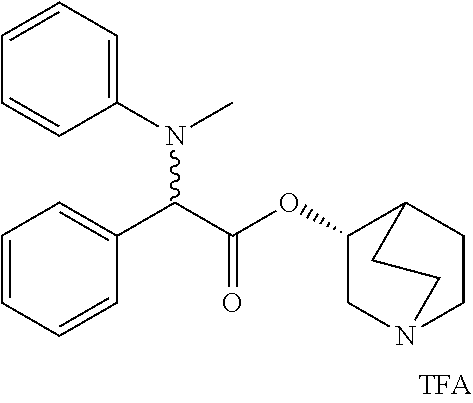 |
13% overall yield Pale yellow oil | LC-MS (ESI POS): 351.3 (MH+) 1H NMR (300 MHz, DMSO-d6) ppm: 9.57 (br. s., 1 H), 7.31-7.57 (m, 5 H), 7.14-7.31 (m, 2 H), 6.85-7.02 (m, 2 H), 6.67-6.85 (m, 1 H), 5.92 (s, 1 H), 5.00-5.27 (m, 1 H), 3.59-3.76 (m, 1 H), 2.79- 3.29 (m, 5 H), 2.75 (s, 3 H), 2.08-2.24 (m, 1 H), 1.73-2.00 (m, 2 H), 1.45-1.73 (m, 2 H) |
To a solution of 2-phenyl-2-(phenylamino)acetic acid (I1) (3.40 g, 14.9 mmol) in THF (600 mL), is added DCC (4.02 g, 19.4 mmol), HOBt (3.06 g, 19.44 mmol) and 3(R)-quinuclidinol (3.80 g, 29.9 mmol). The resulting mixture is stirred for 16 hours at RT (LC-MS monitoring: complete conversion). The solvent is evaporated, the residue is taken up with EtOAc and the insoluble is eliminated by filtration. The clear solution is washed with 1M K2CO3 and then with brine, is dried over Na2SO4, filtered and evaporated to dryness. The resulting crude is purified by flash chromatography (DCM/MeOH=95/5, 0.1% NH3 (aq.)) recovering first diastereoisomer 1 of C2 as a white solid (1.13 g, 22.5% yield, single diasteroisomer), and subsequently diastereoisomer 2 of C2 as a White solid (0.69 g, 13.7% yield, single diastereoisomer).
Diastereoisomer 1 of C2:
1H NMR (300 MHz, DMSO-d6) ppm: 7.48-7.59 (m, 2 H), 7.26-7.46 (m, 3 H), 7.02-7.14 (m, 2 H), 6.67-6.79 (m, 2 H), 6.51-6.64 (m, 1 H), 6.27 (d, 1 H), 5.26 (d, 1 H), 4.61-4.78 (m, 1 H), 2.96 (ddd, 1 H), 2.55-2.67 (m, 3 H), 2.16-2.37 (m, 1 H), 2.06 (d, 1 H), 1.79-1.94 (m, 1 H), 1.59-1.76 (m, 1 H), 1.35-1.59 (m, 2 H), 1.20-1.34 (m, 1 H);
LC-MS (ESI POS): 337.04 (MH+);
[α]D=−44.6 (c=0.25 MeOH).
Diastereoisomer 2 of C2:
1H NMR (300 MHz, DMSO-d6) ppm: 7.48-7.60 (m, 2 H), 7.24-7.43 (m, 3 H), 6.97-7.14 (m, 2 H), 6.66-6.78 (m, 2 H), 6.51-6.66 (m, 1 H), 6.26 (d, 1 H), 5.24 (d, 1 H), 4.62-4.81 (m, 1 H), 3.08 (ddd, 1 H), 2.54-2.70 (m, 5 H), 1.64-1.79 (m, 1 H), 1.32-1.64 (m, 2 H), 1.16-1.32 (m, 1 H), 0.93-1.16 (m, 1 H);
LC-MS (ESI POS): 337.04 (MH+);
[α]D=+27.6 (c=0.25 MeOH)

To a solution of (S)-methyl 2-hydroxy-2-phenylacetate (20.0 g, 120 mmol) in DCM (240 mL) maintained at 0° C. under N2 flowstream, are added mesylchloride (11.2 mL, 144 mmol) and TEA (20.1 mL, 144 mmol) and the mixture is stirred at RT for 1 hour (UPLC-MS monitoring: complete conversion). The mixture is cooled to 0° C., 0.1N HCl (240 mL) is added and the desired compound is extracted with DCM (2×200 mL). The combined DCM phases are dried over Na2SO4, filtered and evaporated to dryness. The resulting crude is purified by filtration through a silica bed eluting with DCM, obtaining 22.4 g of the title compound as white solid (76% yield).
Aniline (16.8 mL, 184 mmol) is added to a solution of (S)-methyl 2-(methylsulfonyloxy)-2-phenylacetate (I5) (22.4 g, 92.0 mmol) in CH3CN (50 mL). The mixture is heated under MW irradiation at 120° C. for 5 minutes (UPLC-MS monitoring: complete conversion). The resulting crude is partitioned between EtOAc (200 mL) and 1N HCl (200 mL) and the aqueous phase is extracted with EtOAc (3×200 mL). The combined organic layers are dried over Na2SO4, filtered and evaporated under vacuum to obtain 20.3 g of a pale yellow solid (92% yield), which is used in the next step without any additional purification.
12N HCl (85 mL) is added to a solution of (R)-methyl 2-phenyl-2-(phenylamino)acetate (I6) (20.3 g, 84.0 mmol), in dioxane (85 mL) and the mixture is heated at 70° C. for 18 hours (UPLC-MS monitoring: complete conversion). The dioxane is evaporated, the mixture is cooled to 0° C. and the resulting solid is collected by filtration to obtain 19.1 g of intermediate I7 as a white solid (99% yield).
(R)-2-phenyl-2-(phenylamino)acetic acid (I7) (6.50 g, 28.7 mmol), is dissolved in dry THF (140 mL) under inert atmosphere. 3S-Quinuclidinol (4.0 g, 31.6 mmol), triphenylphosphine (8.90 g, 43.0 mmol) and diethyl azodicarboxylate (6.8 mL, 43.0 mmol) are added and the resulting mixture is refluxed for 30 minutes (UPLC-MS monitoring: complete conversion). The solvent is evaporated and the residue is partitioned between water (100 mL) and EtOAc (100 mL). The aqueous phase is further extracted with EtOAc (3×100 mL). The combined organic layers are dried over Na2SO4, filtered and evaporated under vacuum. The resulting crude is purified by flash chromatography (DCM/MeOH=95/5) recovering 8.7 g of diastereoisomer 1 of compound C2 as a pale yellow solid (90% yield, single diasteroisomer).
Diastereoisomer 1 of C2:
1H NMR (300 MHz, DMSO-d6) ppm: 7.49-7.58 (m, 2 H) 7.25-7.47 (m, 3 H) 7.00-7.12 (m, 2 H) 6.66-6.78 (m, 2 H) 6.51-6.63 (m, 1 H) 6.27 (d, 1 H) 5.20-5.31 (m, 1 H) 4.62-4.73 (m, 1 H) 2.95 (ddd, 1 H) 2.53-2.68 (m, 3 H) 2.17-2.34 (m, 1 H) 2.01-2.13 (m, 1 H) 1.83-1.93 (m, 1 H) 1.38-1.71 (m, 3 H) 1.17-1.34 (m, 1 H)
LC-MS (ESI POS): 337.2 (MH+).

To a solution of 3-fluorophenyl acetic acid (10.0 g, 64.9 mmol) in ethanol (300 mL), is added a catalytic amount of H2SO4 (98%, 1 mL) and the mixture reacted for 12 hours at 100° C. (LC-MS monitoring: complete conversion). The solvent is evaporated and the residue is partitioned between EtOAc and water; the organic layer is separated and dried over Na2SO4 in order to obtain 10.1 g of (I8) as a white solid (85% yield).
To a solution of ethyl 2-(3-fluorophenyl)acetate (I8) (10.1 g, 55.0 mmol) in CCl4 (250 mL), NBS (9.70 g, 55.0 mmol) is added and the mixture refluxed for 2 hours at 80° C. (LC-MS monitoring: complete conversion). The solvent is evaporated and the resulting crude is dissolved in DCM and purified by filtration on a silica bed in order to obtain 7.80 g of (I9) as a colorless oil (54% yield).
A solution of ethyl 2-bromo-2-(3-fluorophenyl)acetate (I9) (1.80 g, 6.84 mmol) in 3-fluoroaniline (6.50 mL, 68.0 mmol) is heated at 100° C. for 5 minutes under MW irradiation (LC-MS monitoring: complete conversion). The solvent is evaporated and the resulting crude is purified by flash chromatography (Hexane/EtOAc=9/1) in order to obtain 2.00 g of I10 as a yellow oil (99% yield).
To a solution of ethyl 2-(3-fluorophenyl)-2-(3-fluorophenylamino)-acetate (2.00 g, 6.81 mmol) in THF/H2O (1:1 mixture, 10 mL), is added LiOH (816 mg, 34.0 mmol) and the mixture is reacted for 2 hours at RT (LC-MS monitoring: complete conversion). 1N HCl (15 mL) is added and the desired compound is extracted with EtOAc. The resulting crude is purified by flash chromatography (Hexane/EtOAc=1/1) in order to obtain 1.79 g of I11 as a pale yellow solid (99% yield).
To a solution of 2-(3-fluorophenyl)-2-(3-fluorophenylamino)acetic acid (I11) (1.79 g, 6.80 mmol) in dioxane (70 mL), is added a 4M solution of HCl in dioxane (5 mL). The reaction is stirred at RT for 1 hour, then the solvent is evaporated under reduced pressure to obtain a white solid. The compound is dissolved in dry THF (70 mL) and DCC (1.71 g, 8.20 mmol), HOBt (1.10 g, 8.20 mmol) and 3(R)-quinuclidinol (2.60 g, 20.4 mmol) are added. The reaction is stirred at RT for 96 hours under nitrogen flowstream (LC-MS monitoring: complete conversion). The solvent is evaporated and the residue is partitioned between EtOAc and water; the organic layer is separated, dried over Na2SO4, filtered and evaporated to dryness. The crude is purified by flash chromatography (DCM/MeOH=97/3) recovering first 150 mg of diastereoisomer 1 of C51 as pale yellow solid (6% yield, single diasteroisomer) and subsequently 830 mg of mixture of diastereoisomers 1 and 2 of C12 as a pale yellow oil (32% yield, mixture of diasteroisomers).
Diastereoisomer 1 of C12 (80 mg) is furthermore purified by preparative LC-MS in order to obtain 53.0 mg of a pale yellow oil (TFA salt).
Diastereoisomer 1 of C12
1H NMR (300 MHz, DMSO-d6) ppm: 9.48 (br. s., 1 H), 7.31-7.58 (m, 3 H), 7.15-7.26 (m, 1 H), 7.10 (td, 1 H), 6.77 (d, 1 H), 6.47-6.65 (m, 2 H), 6.27-6.47 (m, 1 H), 5.48 (d, 1 H), 4.95-5.20 (m, 1 H), 3.63 (ddd, 1 H), 3.07-3.31 (m, 3 H), 2.74-2.91 (m, 2 H), 2.16-2.33 (m, 1 H), 1.65-1.95 (m, 4 H);
LC-MS (ESI POS): 373.2 (MH+);
[α]D=−37.80° (c=0.2, MeOH).
Mixture of Diastereoisomers 1 and 2 of C12
1H NMR (300 MHz, DMSO-d6) ppm: 9.58 (br. s., 1 H), 7.31-7.58 (m, 3 H), 7.15-7.26 (m, 1 H), 7.10 (td, 1 H), 6.77 (d, 1 H), 6.47-6.65 (m, 2 H), 6.27-6.47 (m, 1 H), 5.44 (d, 1 H), 4.95-5.20 (m, 1 H), 3.67 (ddd, 1 H), 3.07-3.31 (m, 3 H), 2.74-2.91 (m, 2 H), 2.05 (m, 1 H), 1.65-1.95 (m, 4 H);
LC-MS (ESI POS): 373.2 (MH+).

To a solution of 2-phenyl-2-(phenylamino)acetic acid (I1) (234 mg, 0.91 mmol) in dioxane, is added a 4M solution of HCl in dioxane (5 mL) and the reaction is allowed to stir at RT for 1 hour; the solvent is evaporated under reduced pressure to obtain a white solid which is dissolved in dry THF (10 mL). DCC (222 mg, 1.12 mmol), HOBt (144 mg, 1.14 mmol) and N-methyl-4-piperidinol (307 mg, 2.71 mmol) are added and the mixture is stirred for 96 hours at RT under nitrogen flowstream (LC-MS monitoring: complete conversion). The solvent is evaporated and the residue is partitioned between DCM and water; the organic layer is separated and dried over Na2SO4. The crude compound is purified by preparative LC-MS and the collected fractions are portioned between 2M K2CO3 and EtOAc. The organic phase is dried over Na2SO4, filtered and evaporated to dryness to obtain 20.6 mg of the title compound as a white solid (7% yield, racemic mixture).
1H NMR (300 MHz, DMSO-d6) ppm: 7.45-7.60 (m, 2H), 7.20-7.45 (m, 3H), 6.95-7.17 (m, 2H), 6.69 (d, 2H), 6.47-6.63 (m, 1H), 6.23 (d, 1H), 5.20 (d, 1H), 4.71 (tt, 1H), 2.34-2.48 (m, 1H), 2.11-2.25 (m, 2H), 2.09 (s, 3H), 1.94-2.08 (m, 1H), 1.71-1.90 (m, 1H), 1.51-1.71 (m, 2H), 1.29-1.51 (m, 1H);
LC-MS (ESI POS): 325.2 (MH+).

A mixture of 2-phenyl-2-(phenylamino)acetic acid (I1) (200 mg, 0.88 mmol), DCC (218 mg, 1.05 mmol), HOBt (142 mg, 1.05 mmol) and (R)-1-methylpyrrolidin-3-ol (289 uL, 2.64 mmol) in dry THF (10 mL) is stirred at room temperature overnight under nitrogen flowstream (LC-MS monitoring: complete conversion). The solvent is evaporated and the residue is taken up with aq. HCl (pH about 2) and washed with DCM. The aqueous phase is basified with NaHCO3 and extracted with DCM (three times). The organic layers are combined, dried over Na2SO4, filtered and evaporated to dryness. The resulting crude is first purified by flash chromatography (DCM to DCM/MeOH=95/5) and then by preparative LC-MS. The purified compound is partitioned between sat. NaHCO3 and DCM, the organic phase is dried over Na2SO4, filtered and evaporated under vacuum to give 90.8 mg of the title compound as brown oil (33% yield, mixture of diastereoisomers).
1H NMR (300 MHz, CHLOROFORM-d) ppm
Diastereoisomer 1 of C14: 7.46-7.57 (m, 2 H), 7.29-7.45 (m, 3 H), 7.08-7.21 (m, 2 H), 6.67-6.81 (m, 1 H), 6.50-6.67 (m, 2 H), 5.20-5.37 (m, 1 H), 5.12 (d, 1 H), 4.84-5.05 (m, 1 H), 2.46-3.04 (m, 4 H), 2.44 (s, 3 H), 2.10-2.26 (m, 1 H), 1.63-1.82 (m, 1 H).
Diastereoisomer 2 of C14: 7.46-7.57 (m, 2 H), 7.29-7.45 (m, 3 H), 7.08-7.21 (m, 2 H), 6.67-6.81 (m, 1 H), 6.50-6.67 (m, 2 H), 5.20-5.37 (m, 1 H), 5.12 (d, 1 H), 4.84-5.05 (m, 1 H), 2.46-3.04 (m, 4 H), 2.33 (s, 3 H), 2.26-2.40 (m, 1 H), 1.86-2.05 (m, 1 H);
LC-MS (ESI POS): 311.3 (MH+).
The compounds listed in Table 2 are prepared as previously described for diastereoisomers 1 and 2 of C14, coupling acid I1 with the commercially available (S)-1-methylpyrrolidin-3-ol and (R)-1-methylpiperidin-3-ol respectively.
| TABLE 2 | |||
| Yield and | |||
| Compound | Structure | appearance | Analytical |
| C15 |  |
28% yield Colorless oil | LC-MS (ESI POS): 311.2 (MH+) ′1H NMR (300 MHz, CHLOROFORM-d) ppm Diastereoisomer 1 of C12: 7.46-7.57 (m, 2 H), 7.29-7.45 (m, 3 H), 7.08-7.21 (m, 2 H), 6.67-6.81 (m, 1 H), 6.50-6.67 (m, 2 H), 5.20- 5.37 (m, 1 H), 5.12 (d, 1 H), 4.84-5.05 (m, 1 H), 2.46-3.04 (m, 4 H), 2.44 (s, 3 H), 2.10-2.26 (m, 1 H), 1.63-1.82 (m, 1 H) Diastereoisomer 2 of C12: 7.46-7.57 (m, 2 H), 7.29-7.45 (m, 3 H), 7.08-7.21 (m, 2 H), 6.67-6.81 (m, 1 H), 6.50-6.67 (m, 2 H), 5.20- 5.37 (m, 1 H), 5.12 (d, 1 H), 4.84-5.05 (m, 1 H), 2.46-3.04 (m, 4 H), 2.33 (s, 3 H), 2.26-2.40 (m, 1 H), 1.86-2.05 (m, 1 H) |
| C16 |  |
20% yield Colorless oil | LC-MS (ESI POS): 325.3 (MH+) 1H NMR (300 MHz, DMSO-d6) ppm: 7.45-7.69 (m, 2 H), 7.22-7.45 (m, 3 H), 6.91-7.22 (m, 2 H), 6.66-6.91 (m, 2 H), 6.42-6.66 (m, 1 H), 6.27 (br. s., 1 H), 5.20 (s, 1 H), 4.77 (br. s., 1 H), 2.53-3.00 (m, 2 H), 1.64-2.44 (m, 6 H), 0.90-1.62 (m, 3 H) |

A mixture of 2-phenyl-2-(phenylamino)acetic acid I1 (250 mg, 0.90 mmol), EDC (255 mg, 1.35 mmol), HOBt (245 mg, 1.80 mmol) and 8-methyl-8-azabicyclo[3.2.1]octan-3-ol (380 mg, 2.71 mmol) in dry DMF (10 mL) is heated under microwave irradiation at 100° C. for 1 hour (LC-MS monitoring: complete conversion). The reaction is concentrated under reduced pressure and the residue is portioned between EtOAc and water. The organic phase is dried over Na2SO4, filtered and evaporated to dryness. The resulting crude is purified by preparative HPLC. The collected compound is partitioned between 1N NaHCO3 and DCM, the organic phase is separated dried over Na2SO4, filtered and evaporated under vacuum to give 20.1 mg of the title compound as a colorless oil (7% yield, mixture of diastereoisomers).
1H NMR (300 MHz, CHLOROFORM-d) ppm: 7.45-7.57 (m, 2 H), 7.29-7.45 (m, 3 H), 7.04-7.21 (m, 2 H), 6.65-6.77 (m, 1 H), 6.51-6.65 (m, 2 H), 5.02-5.13 (m, 2 H), 5.00 (d, 1 H), 3.07-3.30 (m, 1 H), 2.81-3.07 (m, 1 H), 2.28 (s, 3 H), 2.19-2.27 (m, 1 H), 1.84-2.18 (m, 3 H), 1.70-1.82 (m, 2 H), 1.45 (d, 1 H), 1.17 (ddd, 1 H);
LC-MS (ESI POS): 351.3 (MH+).
C18 listed in Table 3 is prepared as previously described for C17.
| TABLE 3 | |||
| Yield and | |||
| Compound | Structure | appearance | Analytical |
| C18 |  |
5% yield Colorless oil | LC-MS (ESI POS): 365.2 (MH+) 1H NMR (300 MHz, Acetone-d6) ppm: 7.42- 7.65 (m, 2 H), 7.26-7.46 (m, 3 H), 7.01-7.15 (m, 6.67-6.76 (m, 2 H), 6.56-6.65 (m, 1 H), 5.57- 5.65 (m, 1 H), 5.17 (d, 1 H), 4.95 (t, 1 H), 3.05 (dd, 1 H), 2.89 (dd, 1 H), 2.75 (d, 1 H), 2.42 (s, 3 H), 1.87-2.13 (m, 2 H), 1.66 (d, 1 H), 1.28 (d, 1 H). |

To a solution of (S)-2-(tert-butoxycarbonylamino)-3-phenylpropanoic acid (1.03 g, 3.81 mmol) in THF (70 mL), are added DCC (1.03 g, 4.91 mmol), HOBt (660 mg, 4.90 mmol) and 3(R)-quinuclidinol (1.18 g, 9.48 mmol) and the resulting mixture is stirred for 12 hours at RT under nitrogen flowstream (LC-MS monitoring: complete conversion). The solvent is evaporated and the residue is partitioned between EtOAc (100 mL) and 2M K2CO3 (50 mL); the organic layer is separated, washed with brine and dried over Na2SO4. The resulting crude is purified by flash chromatography (DCM/MeOH=95/5, 0.1% NH3 (aq.)) to obtain 1.12 g of I19 (80% yield).
To a solution of I19 (220 mg, 0.58 mmol) in DCM (5 mL), trifluoroacetic acid (0.50 mL, 4.41 mmol) is added and the mixture stirred at RT overnight. The solvent is evaporated and the resulting crude is purified by preparative LC-MS in order to obtain 59.4 mg of diastereoisomer 1 of C20 as a brown gummy solid (56% yield, di-trifluoroacetate salt, single diastereoisomer).
1H NMR (300 MHz, DMSO-d6) ppm: 9.81 (br. s., 1H), 8.52 (br. s., 3H), 7.24-7.41 (m, 5H), 5.02-5.09 (m, 1H), 4.20-4.46 (m, 1H), 3.60-3.73 (m, 1H), 3.00-3.33 (m, 7H), 2.01 (br. s., 1H), 1.79-1.95 (m, 1H), 1.76 (br. s., 1H), 1.60 (br. s., 2H);
LC-MS (ESI POS): 275.3 (MH+).
Diastereoisomer 2 of C20 listed in Table 4 is prepared as previously described for diastereoisomer 1 of C20, starting from the commercially available (R)-2-(tert-butoxycarbonylamino)-3-phenylpropanoic acid.
| TABLE 4 | |||
| Yield and | |||
| Compound | Structure | appearance | Analytical |
| Diastereoisomer 2 of C20 |  |
10% overall yield Pale yellow oil | LC-MS (ESI POS): 275.3 (MH+ 1H NMR (300 MHz, DMSO-d6) ppm: 8.52 (br. s., 3 H), 7.25-7.41 (m, 5 H), 4.94-5.17 (m, 1 H), 4.37 (dd, 1 H), 3.61 (ddd, 1 H), 3.00-3.30 (m, 5 H), 2.86-2.97 (m, 1 H), 2.82 (ddd, 1 H), 2.08-2.22 (m, 1 H), 1.61- 1.94 (m, 4 H) |

To a solution of (S)-2-amino-3-phenylpropanoic acid (1.52 g, 9.12 mmol) in a DMF/H2O mixture (10/1, 16.5 mL) maintained under nitrogen flowstream, iodobenzene (1.00 mL, 9.12 mmol), dichlorobis(tri-o-tolylphosphine)palladium(II) (357 mg, 0.42 mmol) CuI (86.4 mg, 0.42 mmol), K2CO3 (1.21 g, 9.12 mmol), rimethylbenzylammonium chloride (286 mg, 1.51 mmol) and triethylamine (TEA) (2.50 mL, 18.0 mmol) are added and the mixture stirred for 24 hours at 100° C. under nitrogen flowstream (LC-MS monitoring: complete conversion). The reaction mixture is partitioned between EtOAc and water; 1N HCl is added until pH=1 and the organic layer is separated, washed with brine and dried over Na2SO4. The resulting crude is purified by flash chromatography (DCM/MeOH=99/1) and 1.21 g of I21 is obtained (56% yield).
To a solution of 3-phenyl-2-(phenylamino)propanoic acid (I21) (1.21 g, 5.01 mmol) in dioxane, a 4M solution of HCl in dioxane (5 mL) is added and the reaction is allowed to stir at RT for 1 hour; the solvent is evaporated under reduced pressure to obtain a white solid which is dissolved in dry THF (70 mL). DCC (1.22 g, 6.01 mmol), HOBt (0.8 g, 6.0 mmol) and 3(R)-quinuclidinol (1.31 g, 10.1 mmol) are added to the resulting solution and the mixture stirred for 24 hours at RT under nitrogen flowstream (LC-MS monitoring: complete conversion). The solvent is evaporated. 1N HCl (20 mL) is added to the resulting crude and the aqueous layer is washed with EtOAc (2×50 mL); NaHCO3 is added to the aqueous layer (pH=7-8) and the product is extracted with DCM and dried over Na2SO4, to obtain 530 mg (35% yield) of diastereoisomer 1 of C22, which is further purified by preparative LC-MS to get the titled product as a brown oil (mixture of diastereoisomers that contains 20% of diastereoisomer 2 of C22, TFA salt).
1H NMR (300 MHz, DMSO-d6) ppm: 9.58 (br. s., 1H), 7.19-7.38 (m, 5H), 6.91-7.15 (m, 2H), 6.55-6.68 (m, 3H), 4.94 (ddd, 1H), 4.34 (t, 1H), 3.62 (ddd, 1H), 2.92-3.25 (m, 7H), 1.63-1.95 (m, 3H), 1.36-1.63 (m, 2H);
LC-MS (ESI POS): 351.3 (MH+).
Diastereoisomer 2 of C22 listed in Table 5 is obtained as previously described for diastereoisomer 1 of C22, starting from the commercially available (R)-2-amino-3-phenylpropanoic acid.
| TABLE 5 | |||
| Yield and | |||
| Compound | Structure | appearance | Analytical |
| Diastereoisomer 2 of C22 | 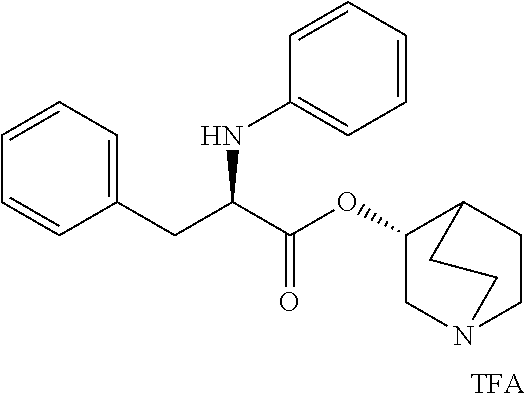 |
7% overall yield Brown oil | LC-MS (ESI POS): 351.3 (MH+) 1H NMR (300 MHz, DMSO-d6 +Na2CO3) ppm: 7.15-7.43 (m, 5 H), 6.96-7.15 (m, 2 H), 6.47-6.69 (m, 3 H), 6.03 (d, 1 H), 4.43-4.67 (m, 1 H), 4.10-4.41 (m, 1 H), 2.95-3.18 (m, 2 H), 2.80-2.95 (m, 1 H), 2.54-2.63 (m, 3 H), 2.30-2.45 (m, 1 H), 1.89-2.06 (m, 1 H), 1.69-1.84 (m, 1 H), 1.39-1.58 (m, 3 H) |

A solution of methyl 2-(benzylamino)-2-phenylacetate (1.00 g, 3.90 mmol) in THF (90 mL) and 1N NaOH (10 mL) is stirred at room temperature overnight (LC-MS monitoring: complete conversion). The solvent is removed under reduced pressure and the crude is portioned between EtOAc and water. The aqueous phase is acidified with conc. HCl (pH about 3) and then extracted with EtOAc (three times). The organic phase is dried over Na2SO4, filtered and evaporated to dryness to give the title compound as a white solid (940 mg, quantitative yield), which is used in the next step without any further purification.
A mixture of 2-(benzylamino)-2-phenylacetic acid (I23) (0.94 g, 3.90 mmol), DCC (0.97 g, 4.70 mmol), HOBt (0.63 g, 4.07 mmol) and 3(R)-quinuclidinol (1.51 g, 11.7 mmol) in dry THF (30 mL) is stirred at room temperature overnight under nitrogen flowstream (LC-MS monitoring: complete conversion). The solvent is evaporated and the residue is taken up with EtOAc and washed twice with water. The organic phase is dried over Na2SO4, filtered and evaporated to dryness. The resulting crude is purified by flash chromatography (DCM/MeOH=98/2, 0.2% NH3(aq.) to 95/5, 0.5% NH3(aq)) to give a mixture of diastereoisomers 1 and 2 of C24 (231 mg, 52% yield, mixture of diasteroisomers).
The mixture of diastereoisomers 1 and 2 of C24 (55 mg) is furthermore purified by preparative HPLC.
1H NMR (300 MHz, DMSO-d6+Na2CO3) ppm: 7.20-7.45 (m, 11 H), 4.55-4.79 (m, 1 H), 4.35 (s, 1 H), 3.67 (d, 2 H), 2.85-3.14 (m, 2 H), 2.56-2.71 (m, 2 H), 2.31-2.46 (m, 1 H), 2.07-2.23 (m, 1 H), 1.82-1.93 (m, 1 H), 1.32-1.79 (m, 4 H);
LC-MS (ESI POS): 351.2 (MH+).

A mixture of 2-(tert-butoxycarbonylamino)-2-phenylacetic acid (0.90 g, 4.18 mmol), HOBt (0.68 g, 12.5 mmol), DCC (1.29 g, 6.27 mmol) and 3(R)-quinuclidinol (1.59 g, 12.5 mmol) in dry THF (50 mL) is stirred at room temperature for 16 hours (LC-MS monitoring: complete conversion). The solvent is removed under reduced pressure, the residue is taken up with EtOAc and washed twice with 2M K2CO3. The organic phase is dried over Na2SO4, filtered and evaporated to dryness. The compound is triturated with hexane to give (R)-quinuclidin-3-yl 2-(tert-butoxycarbonylamino)-2-phenylacetate as a white solid (1.46 g; 97% yield, mixture of diastereoisomers). This compound is dissolved in DCM (50 mL) and 4N HCl dioxane (5 mL) is added. The reaction is stirred at room temperature for 1 hour (LC-MS monitoring: complete conversion) and then solvent is separated. The gummy solid is triturated with hexane to give C25 as a white solid (1.26 g, 94% yield, di hydrochloride, mixture of diastereoisomers).
(R)-Quinuclidin-3-yl 2-amino-2-phenylacetate (C25) (200 mg, 0.60 mmol) is dissolved in dry DCM (10 mL) and treated with sodium triacetoxyborohydride (508 mg, 2.40 mmol). The reaction is stirred at room temperature for 30 minutes and then cyclopentanone (106 uL, 1.20 mmol) is added and the reaction is stirred at room temperature for additional 16 hours (LC-MS monitoring: complete conversion). The reaction is diluted with DCM and washed twice with 1N NaOH, the organic layer is dried over Na2SO4, filtered and evaporated to dryness. The crude compound is purified by preparative HPLC to give C26 as a white solid (53.1 mg, 16% yield, di trifluoroacetate salt, mixture of diastereoisomers).
1H NMR (300 MHz, DMSO-d6) ppm: 10.02 (br. s., 2 H), 9.75 (br. s., 1 H), 7.43-7.76 (m, 5 H), 5.24-5.49 (m, 1 H), 5.01-5.24 (m, 1 H), 3.51-3.79 (m, 1 H), 3.12-3.37 (m, 4 H), 2.93-3.12 (m, 1 H), 2.75-2.94 (m, 1 H), 2.20-2.39 (m, 1 H), 1.78-2.14 (m, 4 H), 1.61-1.77 (m, 5 H), 1.31-1.57 (m, 3 H);
LC-MS (ESI POS): 329.2 (MH+).
C27 listed in Table 6 is obtained as previously described for C26, using cyclohexanone instead of cyclopentanone.
| TABLE 6 | |||
| Yield and | |||
| Compound | Structure | appearance | Analytical |
| C27 |  |
24% yield White solid | LC-MS (ESI POS): 343.2 (MH+) 11H NMR (300 MHz, DMSO-d6) ppm: 9.47-9.79 (m, 3 H), 7.36-7.85 (m, 5 H), 5.37-5.54 (m, 1 H), 5.10-5.20 (m, 1 H), 3.56-3.82 (m, 1 H), 2.68-3.28 (m, 5 H), 1.97-2.33 (m, 3 H), 1.66-1.94 (m, 5 H), 1.56 (br. s., 2 H), 1.29 (br. s., 2 H), 1.12 (br. S., 3 H) |

To a solution of α-bromophenylacetic acid (1.00 g, 4.65 mmol) in acetonitrile (20 mL), is added 4-chloro-phenylamine (1.18 g, 9.30 mmol) and the mixture reacted in a closed vessel under MW irradiation at 100° C. for 1 hour (UPLC-MS monitoring: complete conversion). Solvent is evaporated and residue is portioned between EtOAc and 1N HCl. The organic phase is dried over Na2SO4, filtered and evaporated to dryness to get intermediate I76 as a yellow solid (0.57 g; 47% yield).
To a solution of (4-chloro-phenylamino)-phenyl-acetic acid (I28) (574 mg, 2.20 mmol) in dry THF (20 mL), are added DCC (543 mg, 2.64 mmol), HOBt (359 mg, 2.64 mmol) and 3(R)-quinuclidinol (558 mg, 4.40 mmol). The resulting mixture is stirred at RT overnight (UPLC-MS monitoring: complete conversion). The solvent is evaporated and the residue is portitioned between EtOAc and 2M K2CO3. The organic phase is dried over Na2SO4, filtered and evaporated to dryness. The resulting crude is purified by flash chromatography (DCM/MeOH=99/1 to 85/15) to obtain the title compound as a white solid (306 mg, 37% yield, mixture of diastereoisomers).
1H NMR (300 MHz, DMSO-d6) ppm: 7.46-7.59 (m, 2 H), 7.22-7.45 (m, 3 H), 6.99-7.18 (m, 2 H), 6.65-6.80 (m, 2 H), 6.52 (d, 1 H), 5.28 (d, 1 H), 4.60-4.82 (m, 1 H), 3.04 (ddd, 1 H), 2.54-2.70 (m, 4 H), 2.03-2.36 (m, 1 H), 1.67-1.97 (m, 1 H), 1.36-1.68 (m, 2 H), 1.05-1.35 (m, 2 H);
LC-MS (ESI POS): 371.1 (MH+).
The compounds listed in Table 7 are obtained as previously described for C29, starting from the suitable commercially available 2-bromo-phenylacetic acid derivatives and anilines.
| TABLE 7 | |||
| Yield and | |||
| Compound | Structure | appearance | Analytical |
| C30 |  |
9% yield White solid | LC-MS (ESI POS): 395.1 (MH+) 1H NMR (300 MHz, DMSO-d6) ppm: 7.68 (m, 2 H), 7.47-7.58 (m, 2 H), 7.23-7.47 (m, 3 H), 7.15 (d, 1 H), 6.62-6.80 (m, 2 H), 5.39 (d, 1 H), 4.75 (ddd, 1 H), 3.74 (s, 3 H), 2.86-3.19 (m, 1 H), 2.54-2.69 (m, 4 H), 1.84-2.26 (m, 1 H), 1.35-1.80 (m, 3 H), 0.99-1.34 (m, 2 H) |
| Diastereoisomer 1 of C31 |  |
28% yield Pale yellow solid | LC-MS (ESI POS): 401.1 (MH+) 1H NMR (300 MHz, DMSO-d6) ppm: 7.76 (d, 1 H), 7.64 (d, 1 H), 7.22-7.54 (m, 5 H), 6.71 (d, 1 H), 5.60 (d, 1 H), 4.58-4.89 (m, 1 H), 3.78 (s, 3 H), 2.98 (ddd, 1 H), 2.54-2.69 (m, 3 H), 2.13-2.27 (m, 1 H), 1.96- 2.09 (m, 1 H), 1.85-1.96 (m, 1 H), 1.51-1.73 (m, 2 H), 1.21-1.51 (m, 2 H) |
| Diastereoisomer 2 of C31 |  |
35% yield Pale yellow solid | LC-MS (ESI POS): 401.1 (MH+) 1H NMR (300 MHz, DMSO-d6) ppm: 7.78 (d, 1 H) 7.66 (d, 1 H) 7.17-7.53 (m, 5 H) 6.68 (d, 1 H) 5.63 (d, 1 H) 4.72-5.09 (m, 1 H) 3.78 (s, 3 H) 2.71-3.04 (m, 5 H) 1.10-2.07 (m, 6 H) |
| C32 |  |
17% yield over two steps yellow solid | LC-MS (ESI POS): 355.1 (MH+) 1H NMR (300 MHz, DMS0-d6) ppm: 9.38 (br. s., 1 H), 7.47-7.61 (m, 2 H), 7.28-7.46 (m, 3 H), 6.86-7.03 (m, 2 H), 6.64-6.79 (m, 2 H), 6.32 (br. s., 1 H), 5.32 (br. s., 1 H), 4.86-5.10 (m, 1 H), 3.55-3.70 (m, 1 H), 2.91-3.33 (m, 4 H), 2.64-2.73 (m, 1 H), 2.13-2.28 (m, 1 H), 1.46-2.01 (m, 4 H) |
| C33 |  |
11% yield over two steps Pale yellow solid | LC-MS (ESI POS): 355.2 (MH+) 1H NMR (300 MHz, DMSO-d6) ppm: 7.36-7.66 (m, 2 H), 7.15-7.28 (m, 2 H), 7.00-7.12 (m, 2 H), 6.64- 6.81 (m, 2 H), 6.50-6.64 (m, 1 H), 6.29 (d, 1 H), 5.29 (d, 1 H), 4.39-4.82 (m, 1 H), 3.01-3.12 (m, 1 H), 2.53-2.69 (m, 5 H), 1.67-1.80 (m, 1 H), 0.97-1.58 (m, 4 H) |

2-Bromo-2-phenylacetic acid (400 mg, 1.86 mmol), methyl 2-aminobenzoate (026 mL, 2.05 mmol), and N,N-diisopropylethylamine (DIPEA) (0.65 mL, 3.72 mmol) are dissolved in acetonitrile (8 mL). The resulting solution is heated under MW irradiation into a sealed vial at 100° C. for 20 minutes. The mixture is evaporated and the crude residue is purified by flash chromatography (DCM/MeOH=97/3) affording intermediate I82 as a white solid (611 mg, 79% yield, DIPEA salt).
N-ethyl-N-isopropylpropan-2-amine 2-(2-(methoxycarbonyl)phenylamino)-2-phenylacetate (I34) (611 mg, 1.47 mmol), 2-(1H-benzo[d][1,2,3]triazol-1-yl)-1,1,3,3-tetramethylisouronium hexafluorophosphate(V) (559 mg, 1.47 mmol), and HOBT (226 mg, 1.47 mmol) are dissolved in THF (7 mL) and MeCN (3 mL). (R)-Quinuclidin-3-ol (375 mg, 2.95 mmol) is added and the mixture is stirred at RT for 1 hour. Solvents are evaporated, the residue is dissolved in EtOAc and washed with sat. NaHCO3, water and brine. The organic layer is recovered, dried over Na2SO4, filtered and evaporated. The crude is purified by preparative HPLC and the collected fractions are evaporated, the residue is dissolved in EtOAc and washed with NaHCO3 and brine. The organic layer is recovered, dried over Na2SO4, filtered and evaporated to afford compound the title compound as a colorless compound (95 mg, 16% yield, mixture of diastereoisomers).
1H NMR (300 MHz, DMSO-d6) ppm: 8.56-8.92 (m, 1 H), 7.80-7.94 (m, 1 H), 7.46-7.58 (m, 2 H), 7.22-7.45 (m, 4 H), 6.31-6.78 (m, 2 H), 5.53 and 5.51 (d, 1 H), 4.47-4.87 (m, 1 H), 3.86 (s, 3 H), 3.07 and 2.97 (ddd, 1 H), 2.54-2.68 (m, 4 H), 0.95-2.34 (m, 6 H);
LC-MS (ESI POS): 395.3 (MH+).

Ethyl 2-bromo-2-phenylacetate (500 mg, 2.06 mmol), 2-methoxyaniline (0.28 mL, 2.47 mmol) and DIPEA (0.47 ml, 2.67 mmol) are dissolved in acetonitrile (10 mL). The resulting solution is heated under microwave irradiation at 100° C. for 30 minutes. DIPEA (47 ul, 0.27 mmol) and 2-methoxyaniline (28 uL, 0.25 mmol) are added and microwave heating is carried out for others 15 minutes. Water (5 mL) and lithium hydroxide hydrate (259 mg, 6.17 mmol) are directly added to the reaction solution and the resulting mixture is vigorously stirred at RT for 1 hour. Acetonitrile is evaporated, the remaining water phase is cooled at 0° C. and 4M HCl in 1,4-dioxane is added until pH is about 1. The solid obtained is collected by filtration and washed with water. The solid-cake is recovered and dried under vacuum to obtain intermediate I84 as a brown solid (377 mg, 62% yield).
PS-DCC (2.05 g, 2.57 mmol, loading: 1.25 mmol/g) is suspended in THF (15 mL) and shaken for few minutes. Then (2-methoxy-phenylamino)-phenyl-acetic acid hydrochloride (I36) (377 mg, 1.28 mmol) and HOBT (393 mg, 2.57 mmol) are added. After 10 minutes, (R)-quinuclidin-3-ol (490 mg, 3.85 mmol) is added and the mixture is shaken at RT for 16 hours (Conversion complete by UPLC/MS-UV). PS-DCC is filtered off and the filtrate is evaporated to dryness. The residue is dissolved in EtOAc and washed with sat. NaHCO3, water and brine. The organic layer is recovered, dried over Na2SO4, filtered and evaporated to afford the title compound as a yellow oil (548 mg, quantitative yield, mixture of diastereoisomers).
1H NMR (300 MHz, DMSO-d6) ppm: 7.45-7.55 (m, 2 H), 7.13-7.43 (m, 3 H), 6.78-6.93 (m, 1 H), 6.64 (m, 2 H), 6.29-6.51 (m, 1 H), 5.40 (d, 1 H), 5.31 (d, 1 H), 4.58-4.85 (m, 1 H), 3.84 (s, 3 H), 2.91-3.14 (m, 1 H), 2.54-2.72 (m, 3 H), 1.95-2.47 (m, 2 H), 0.98-1.92 (m, 5 H);
LC-MS (ESI POS): 367.3 (MH+).

Ethyl 2-bromo-2-phenylacetate (0.28 mL, 1.64 mmol), ortho-toluidine (0.26 mL, 2.47 mmol) and DIPEA (0.43 mL, 2.47 mmol) are dissolved in acetonitrile (5 mL) and stirred under MW irradiation at 100° C. for 1 hour (Conversion complete by UPLC/MS-UV). Lithium hydroxide hydrate (207 mg, 4.94 mmol) and water (3 mL) are added and the mixture is stirred at RT for 16 hours. 4M HCl in dioxane is added until pH is about 1, then the solvents are evaporated, the residue is suspended in water, sonicated, cooled at 0° C. and the resulting solid is recovered by filtration and dried under vacuum to get intermediate I86 as a off-white solid (290 mg, 63% yield).
PS-DCC (1.15 g, 1.44 mmol, loading: 1.25 mmol/g) is suspended in THF (15 mL). Phenyl-o-methylphenylamino-acetic acid hydrochloride (I38) (200 mg, 0.72 mmol) and HOBT (221 mg, 1.44 mmol) are added, followed by (R)-quinuclidin-3-ol (275 mg, 2.16 mmol) and the mixture is shaken for 16 hours at RT. PS-DCC is filtered off and the filtrate is evaporated. The resulting residue is dissolved in EtOAc and washed sequentially with water, sat. NaHCO3, water and brine. The organic layer is dried over Na2SO4, filtered and evaporated to give the title compound as a colorless oil (260 mg, quantitative yield, mixture of diastereoisomers).
1H NMR (300 MHz, DMSO-d6) ppm: 7.50-7.62 (m, 2 H), 7.25-7.46 (m, 3 H), 7.00-7.07 (m, 1 H), 6.82-6.98 (m, 1 H), 6.51-6.66 (m, 1 H), 6.30-6.49 (m, 1 H), 5.32 (d, 1H), 5.10 (d, 1 H), 4.65-4.85 (m, 1 H), 2.85-3.16 (m, 1 H), 2.56-2.69 (m, 3 H), 2.23 (s, 3 H), 2.13-2.46 (m, 2 H), 0.95-1.97 (m, 5 H);
LC-MS (ESI POS): 351.2 (MH+).

Ethyl 2-bromo-2-phenylacetate (400 mg, 1.64 mmol), 3-(trifluoromethoxy)aniline (0.33 mL, 2.47 mmol), and DIPEA (0.43 mL, 2.47 mmol) are dissolved in acetonitrile (5 mL) and heated under MW irradiation at 100° C. for 1 hour (Conversion complete by UPLC/MS-UV). Water (5 mL) and lithium hydroxide hydrate (207 mg, 4.94 mmol) are directly added and the resulting mixture is stirred at RT for 1 hour. Then 4M HCl in dioxane is added until pH 1, the organic solvents are evaporated and the resulting crude oil is purified by filtration through a silica pad using DCM/MeOH=9/1 as the eluent. Intermediate I88 is collected as a brown oil (569 mg, quantitative yield).
PS-DCC (920 mg, 1.15 mmol, loading: 1.25 mmol/g) is suspended in THF (15 mL). Phenyl-(3-trifluoromethoxy-phenylamino)-acetic acid hydrochloride (I40) (200 mg, 0.57 mmol) and HOBT (176 mg, 1.15 mmol) are added, followed by (R)-quinuclidin-3-ol (219 mg, 1.73 mmol) and the mixture is shaken for 16 hours at RT. PS-DCC is filtered off and the filtrate is evaporated. The resulting residue is dissolved in EtOAc and washed with water, sat. NaHCO3, water and brine. The organic phase is dried over Na2SO4, filtered and evaporated to give the title compound as a colorless oil (206 mg, 85% yield, mixture of diastereoisomers).
1H NMR (300 MHz, DMSO-d6) ppm: 7.26-7.62 (m, 5 H), 7.16 (t, 1 H), 6.79 (d, 1 H), 6.38-6.75 (m, 3 H), 5.34 (d, 1 H), 4.66-4.80 (m, 1 H), 2.91-3.24 (m, 1 H), 2.53-2.76 (m, 3 H), 1.97-2.39 (m, 2 H), 1.67-1.96 (m, 1 H), 0.99-1.67 (m, 4 H);
LC-MS (ESI POS): 421.2 (MH+).

Ethyl 2-bromo-2-phenylacetate (0.29 mL, 1.64 mmol), 3-ethylaniline (0.31 mL, 2.47 mmol), and N-ethyl-N-isopropylpropan-2-amine (0.43 mL, 2.47 mmol) are dissolved in acetonitrile (5 mL) and stirred under MW irradiation at 100° C. for 1 hour (Conversion complete by UPLC/MS-UV). Lithium hydroxide hydrate (207 mg, 4.94 mmol) and water (3 mL) are added and the mixture is stirred at RT for 16 hours. 4M HCl in dioxane is added until pH 1 and the solvents are evaporated. The residue is suspended in water, sonicated, cooled at 0° C. and filtered under suction. The recovered white solid is dried under vacuum at 40° C. overnight (414 mg, 86% yield).
PS-DCC (1097 mg, 1.371 mmol, loading: 1.25 mmol/g) is suspended in THF (15 mL). HOBT (210 mg, 1.37 mmol), (3-ethyl-phenylamino)-phenyl-acetic acid hydrochloride (I42) (200 mg, 0.68 mmol), and (R)-quinuclidin-3-ol (262 mg, 2.06 mmol) are added and the suspension is shaken at RT for 16 hours. PS-DCC is filtered off and the filtrate is evaporated. The resulting residue is dissolved in EtOAc and washed with water, sat. NaHCO3, water and brine. The organic phase is dried over Na2SO4, filtered and evaporated. The crude is purified by flash chromatography (DCM/MeOH=95/5) to obtain the title compound as a colorless oil (72 mg, 30% yield, mixture of diastereoisomers).
1H NMR (300 MHz, DMSO-d6) ppm: 7.45-7.60 (m, 2 H), 7.21-7.47 (m, 3 H), 6.96 (t, 1 H), 6.56-6.66 (m, 1 H), 6.47-6.56 (m, 1 H), 6.38-6.47 (m, 1 H), 6.17 (d, 1 H), 5.16-5.39 (m, 1 H), 4.60-4.79 (m, 1 H), 2.89-3.16 (m, 1 H), 2.54-2.70 (m, 3 H), 2.45 (q, 2 H), 1.98-2.34 (m, 2 H), 1.66-1.96 (m, 1 H), 1.20-1.66 (m, 4 H), 1.11 (t, 3 H);
LC-MS (ESI POS): 365.3 (MH+).

N-(3-Aminophenyl)acetamide (371 mg, 2.47 mmol), ethyl 2-bromo-2-phenylacetate (0.29 mL, 1.64 mmol), and DIPEA (0.43 mL, 2.47 mmol) are dissolved in acetonitrile (5 mL). The reaction is heated under MW irradiation at 100° C. for 30 minutes. Conversion complete by UPLC/MS-UV. Acetonitrile is evaporated and the crude residue is purified by flash chromatography (DCM/EtOAc=8/2) to obtain intermediate I92 as a colorless oil (440 mg, 86% yield).
(3-Acetylamino-phenylamino)-phenyl-acetic acid ethyl ester (I44) (440 mg, 1.41 mmol) and lithium hydroxide hydrate (118 mg, 2.82 mmol) are dissolved in THF (5 mL) and water (3 mL). The reaction is stirred at RT for 2 hours. THF is evaporated, the resulting aqueous solution is cooled at 0° C. and 1M HCl is added until pH is about 2. The precipitated is recovered by filtration, washed with cool water and dried under vacuum overnight to obtain intermediate I93 as a yellow solid (190 mg, 42% yield).
PS-DCC (798 mg, 0.10 mmol, loading: 1.25 mmol/g) is suspended in dry THF (10 mL). (3-Acetylamino-phenylamino)-phenyl-acetic acid hydrochloride (I45) (160 mg, 0.50 mmol), HOBT (153 mg, 0.10 mmol), and (R)-quinuclidin-3-ol (190 mg, 1.50 mmol) are added and the mixture is shaken for 16 hours at RT (Conversion complete by UPLC/MS-UV). PS-DCC is filtered off and washed with THF and then with EtOAc. The filtrate is evaporated, the resulting residue is taken up with EtOAc and washed with 5% NaHCO3, water and brine. The organic layer is separated, dried over Na2SO4, filtered and evaporated to afford the title compound as a yellow oil (196 mg, quantitative yield, mixture of diastereoisomers).
1H NMR (300 MHz, DMSO-d6) ppm: 9.62 (s, 1 H), 7.47-7.60 (m, 2 H), 7.25-7.47 (m, 3 H), 7.01-7.11 (m, 1 H), 6.96 (t, 1 H), 6.66-6.83 (m, 1 H), 6.36-6.46 (m, 1 H), 6.30 (d, 1 H), 5.15 (d, 1 H), 4.58-4.78 (m, 1 H), 2.95 and 3.06 (ddd, 1 H), 2.54-2.70 (m, 5H), 1.99 (s, 3 H), 1.23-1.95 (m, 5 H);
LC-MS (ESI POS): 394.2 (MH+).
C47 listed in Table 8 is prepared as previously described for C46, using 3-amino-N-methyl-benzamide instead of N-(3-aminophenyl)acetamide.
| TABLE 8 | |||
| Yield and | |||
| Compound | Structure | appearance | Analytical |
| C47 | 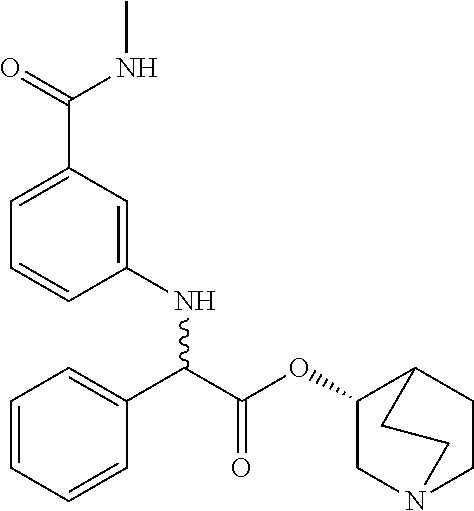 |
Quantitative yield Yellow oil | LC-MS (ESI POS): 394.2 (MH+) 1H NMR (300 MHz, DMSO-d6) ppm: 8.17 (q, 1 H), 7.48-7.59 (m, 2 H), 7.25-7.48 (m, 3 H), 7.17-7.23 (m, 1 H), 7.13 (t, 1 H), 6.99-7.08 (m, 1 H), 6.80-6.94 (m, 1 H), 6.49 (d, 1 H), 5.32 (d, 1 H), 4.59-4.79 (m, 1 H), 2.89-3.15 (m, 1 H), 2.74 (d, 3 H), 2.54-2.68 (m, 5 H), 1.07-1.96 (m, 5 H) |

Ethyl 2-bromo-2-phenylacetate (0.29 mL, 1.64 mmol), 3-fluoro-4-methylaniline (247 mg, 1.97 mmol) and DIPEA (0.37 mL, 2.14 mmol) are dissolved in acetonitrile (8 mL). The reaction is heated in a microwave oven at 100° C. for 1 hour and 15 minutes. Then, a solution of lithium hydroxide hydrate (207 mg, 4.94 mmol) in water (5 mL) is added and the mixture is stirred at RT for 2 hours. Acetonitrile is evaporated under vacuum, the remaining aqueous solution is cooled at 0° and the pH is adjusted to 2 with 4M HCl in dioxane. The resulting white solid is recovered by filtration and dried at 45° C. under vacuum overnight (367 mg, 75% yield).
(3-Fluoro-4-methyl-phenylamino)-phenyl-acetic acid hydrochloride (I48) (250 mg, 0.84 mmol), 2-(1H-benzo[d][1,2,3]triazol-1-yl)-1,1,3,3-tetramethylisouronium hexafluorophosphate(V) (321 mg, 0.84 mmol), and HOBT (129 mg, 0.84 mmol) are dissolved in acetonitrile (6 mL). DIPEA (0.29 mL, 1.69 mmol) is added, followed by (R)-quinuclidin-3-ol (215 mg, 1.69 mmol) and the resulting yellow solution is stirred at RT overnight (Conversion complete by UPLC/MS-UV). MeCN is evaporated, the residue is dissolved in EtOAc and washed with sat. NaHCO3, water and brine. The organic layer is recovered, dried over Na2SO4, filtered and evaporated. The crude compound is purified by filtration through a pad of silica using DCM/MeOH=9/1 as the eluent to obtain the title compound as a yellow oil (311 mg, quantitative yield, mixture of diastereoisomers).
1H NMR (300 MHz, DMSO-d6) ppm: 7.26-7.65 (m, 5 H), 6.94 (td, 1 H), 6.34-6.61 (m, 3 H), 5.25-5.33 (m, 1 H), 4.78-5.01 (m, 1 H), 3.42 and 3.52 (ddd, 1 H), 2.82-3.22 (m, 4 H), 2.54-2.66 (m, 1 H), 1.92-1.99 and 2.10-2.21 (m, 1 H), 2.04 (s, 3 H), 1.31-1.87 (m, 4 H);
LC-MS (ESI POS): 369.2 (MH+).

Ethyl 2-bromo-2-phenylacetate (0.22 mL, 1.23 mmol), 3-(methylthio)aniline (0.22 mL, 1.85 mmol), and DIPEA (0.32 mL, 1.85 mmol) are dissolved in acetonitrile (3 mL) and heated under microwave irradiation at 100° C. for 1 hour. Acetonitrile is evaporated and the crude residue is purified by flash chromatography (petroleum ether/EtOAc=85/15) to obtain intermediate I98 as a colorless oil (292 mg, 79% yield).
(3-Methylsulfanyl-phenylamino)-phenyl-acetic acid ethyl ester (I50) (292 mg, 0.97 mmol) and lithium hydroxide hydrate (81 mg, 1.94 mmol) are dissolved in THF (7 mL) and water (3 mL) and stirred at RT for 2 hours. THF is evaporated, the solution is cooled at 0° C. and 1M HCl is added dropwise until pH 1. The resulting mixture is concentrated and extracted several times with DCM. The collected organic phases are dried over Na2SO4, filtered and evaporated to afford intermediate I99 as a brown-solid (248 mg, 83% yield).
PS-DCC (602 mg, 0.80 mmol, loading: 1.33 mmol/g) is suspended in dry THF (15 mL). (3-Methylsulfanyl-phenylamino)-phenyl-acetic acid hydrochloride (I51) (124 mg, 0.40 mmol), HOBT (123 mg, 0.80 mmol), and (R)-quinuclidin-3-ol (153 mg, 1.20 mmol) are added and the suspension is shaken at RT overnight (16 hours). PS-DCC is filtered off, washed with THF and the filtrate is evaporated. The resulting residue is dissolved in EtOAc and washed with sat. NaHCO3, water and brine. The organic layer is recovered, dried over Na2SO4, filtered and evaporated to afford the title compound as a brown oil (153 mg, quantitative yield, mixture of diastereoisomers).
1H NMR (300 MHz, DMSO-d6) ppm: 7.49-7.58 (m, 2 H), 7.28-7.48 (m, 3 H), 6.99 (t, 1H), 6.58-6.69 (m, 1 H), 6.43-6.56 (m, 2 H), 6.38 (d, 1 H), 5.29 (d, 1 H), 4.59-4.78 (m, 1 H), 2.88-3.13 (m, 1 H), 2.54-2.69 (m, 3 H), 2.37 (s, 3 H), 1.68-2.24 (m, 3 H), 0.98-1.65 (m, 4 H);
LC-MS (ESI POS): 383.2 (MH+).
C53 listed in Table 9 is prepared as previously described for C52, using 1-(3-amino-phenyl)-ethanone instead of 3-(methylthio)aniline.
| TABLE 9 | |||
| Yield and | |||
| Compound | Structure | appearance | Analytical |
| C53 |  |
Quantitative yield Yellow oil | LC-MS (ESI POS): 379.3 (MH+) 1H NMR (300 MHz, DMSO-d6) ppm: 7.49-7.64 (m, 2 H), 7.25-7.48 (m, 4 H), 7.13-7.26 (m, 2 H), 6.87- 7.04 (m, 1 H), 6.63 (d, 1 H), 5.35 (d, 1 H), 4.56- 4.82 (m, 1 H), 2.96 (ddd, 1 H), 2.55-2.68 (m, 4 H), 2.48 (s, 3 H), 2.02-2.32 (m, 1 H), 0.98-1.97 (m, 5 H) |

2,5-Dimethoxyaniline (284 mg, 1.85 mmol), ethyl 2-bromo-2-phenylacetate (0.22 ml, 1.23 mmol), and DIPEA (0.32 mL, 1.85 mmol) are dissolved in acetonitrile (5 mL) and stirred under MW heating at 100° C. for 1 hour. Water (2 mL, 111 mmol) and lithium hydroxide hydrate (104 mg, 2.47 mmol) are directly added and the resulting mixture is stirred at RT overnight. Acetonitrile is evaporated, 1M HCl is added and the acid aqueous phase is extracted with DCM. The collected organic phases are washed with brine, dried (Na2SO4), filtered and evaporated to obtain intermediate I102 as a white solid (154 mg, 38% yield).
PS-DCC (715 mg, 0.951 mmol, loading: 1.33 mmol/g) is suspended in dry THF (10 mL). (2,5-Dimethoxy-phenylamino)-phenyl-acetic acid hydrochloride (I54) (154 mg, 0.48 mmol), HOBT (146 mg, 0.95 mmol) and (R)-quinuclidin-3-ol (181 mg, 1.43 mmol) are added and the mixture is shaken at RT overnight. PS-DCC is filtered off and the filtrate is evaporated. The residue is dissolved in EtOAc and washed with sat. NaHCO3, water and brine. The organic layer is dried over Na2SO4, filtered and evaporated to dryness. The crude compound is purified by flash chromatography (DCM/MeOH=95/5) to achieve the title compound as a colorless oil (108 mg, 57% yield, mixture of diastereoisomers).
1H NMR (300 MHz, DMSO-d6) ppm: 7.23-7.59 (m, 5 H), 6.74 (d, 1 H), 6.09-6.20 (m, 1 H), 6.04 (d, 1 H), 5.42 (d, 1 H), 5.33 (d, 1 H), 4.64-4.83 (m, 1 H), 3.79 (s, 3 H), 3.56 (s, 3 H), 2.90-3.03 and 3.04-3.15 (m, 1 H), 2.54-2.67 (m, 4 H), 1.96-2.25 (m, 1 H), 1.65-1.73 and 1.89-1.96 (m, 1 H), 0.98-1.66 (m, 4 H);
LC-MS (ESI POS): 397.3 (MH+).

2,5-Difluoroaniline (0.19 mL, 1.85 mmol), ethyl 2-bromo-2-phenylacetate (0.22 mL, 1.23 mmol), and DIPEA (0.32 mL, 1.85 mmol) are dissolved in acetonitrile (3 mL) and heated under MW irradiation at 100° C. for 6 hours and then at 110° C. for 4 hours. Acetonitrile is evaporated and the crude is purified by flash chromatography (Petroleum ether/EtOAc=97/3) to obtain intermediate I104 as a white solid (240 mg, 67% yield).
(2,5-Difluoro-phenylamino)-phenyl-acetic acid ethyl ester (I56) (240 mg, 0.82 mmol) is dissolved in THF/water (7/3 mL). Lithium hydroxide hydrate (69.1 mg, 1.65 mmol) is added and the resulting mixture is stirred at RT for 16 hours. THF is evaporated under reduced pressure, the solution is cooled at 0° C. and 1M HCl is added dropwise until pH 1. The white solid is recovered by filtration, washed with cold water and dried under vacuum at 40° C. overnight to obtain intermediate I105 as a white solid (198 mg, 80% yield).
PS-DCC (914 mg, 1.301 mmol, loading: 1.33 mmol/g) is suspended in dry THF (15 mL). (2,5-Difluoro-phenylamino)-phenyl-acetic acid hydrochloride (I57) (195 mg, 0.65 mmol), HOBT (199 mg, 1.30 mmol), and (R)-quinuclidin-3-ol (248 mg, 1.95 mmol) are added and the suspension is shaken at RT for 16 hours (Conversion complete by UPLC/MS-UV). PS-DCC is filtered off under suction and the filtrate is evaporated. The resulting residue is dissolved in EtOAc and washed with sat. NaHCO3, water and brine. The organic layer is separated, dried over Na2SO4, filtered and evaporated. The crude is purified by filtration through a silica-pad using DCM/MeOH=95/5 as the eluent. The title compound is collected as a colorless oil (195 mg, 80% yield, mixture of diastereoisomers).
1H NMR (300 MHz, DMSO-d6) ppm: 7.49-7.62 (m, 2 H) 7.28-7.47 (m, 3 H) 7.02-7.15 (m, 1 H) 6.46-6.60 (m, 1 H) 6.32-6.46 (m, 1 H) 5.85-6.00 (m, 1 H) 5.43 and 5.45 (d, 1 H) 4.66-4.82 (m, 1 H) 2.99 and 3.09 (ddd, 1 H) 2.54-2.69 (m, 4 H) 2.01-2.31 (m, 1 H) 1.85-1.96 and 1.65-1.75 (m, 1 H) 0.92-1.66 (m, 4 H);
LC-MS (ESI POS): 373.2 (MH+).
C59 listed in Table 10 is prepared as previously described for C58, using 2,6-dimethyl-phenylamineinstead of 2,5-difluoroaniline.
| TABE 10 | |||
| Yield and | |||
| Compound | Structure | appearance | Analytical |
| C59 |  |
34% yield Colorless oil | LC-MS (ESI POS): 365.1 (MH+) 1H NMR (300 MHz, DMSO-d6) ppm: 7.44-7.59 (m, 2 H), 7.25-7.44 (m, 3 H), 6.91 (d, 2 H), 6.60- 6.79 (m, 1 H), 4.95 and 4.96 (d, 1 H), 4.62-4.82 (m, 2 H), 2.82-3.11 (m, 1 H), 2.55-2.61 (m, 3 H), 2.30-2.38 (m, 1 H), 2.22 (s, 6 H), 1.98-2.12 (m, 1 H), 1.70-1.75 and 1.77-1.89 (m, 1 H), 1.01-1.62 (m, 4 H) |

2-Ethylaniline (0.23 mL, 1.85 mmol), ethyl 2-bromo-2-phenylacetate (0.22 mL, 1.23 mmol), and DIPEA (0.32 mL, 1.85 mmol) are dissolved in acetonitrile (3 mL) and stirred under MW irradiation at 100° C. for 1 hour. Water (2 ml, 111 mmol) and lithium hydroxide hydrate (104 mg, 2.47 mmol) are added to the reaction and the resulting mixture is stirred at RT overnight (16 hours). Acetonitrile is evaporated and 1M HCl is added until pH 1. The aqueous phase is extracted several times with DCM and the organic phases are collected and washed with water and brine, dried (Na2SO4), filtered and evaporated to give intermediate I108 as an off-white solid (316 mg, 88% yield).
PS-DCC (962 mg, 1.37 mmol, loading: 1.33 mmol/g) is suspended in THF (10 mL). HOBT (210 mg, 1.37 mmol), (2-ethyl-phenylamino)-phenyl-acetic acid hydrochloride (160) (200 mg, 0.68 mmol), and (R)-quinuclidin-3-ol (262 mg, 2.06 mmol) are added and the mixture is shaken at RT overnight. PS-DCC is filtered off and washed with THF and the filtrate is evaporated under reduced pressure. The resulting residue is dissolved in EtOAc and washed with sat. NaHCO3, water and brine. The organic layer is separated, dried over Na2SO4, filtered and evaporated. The residue is first purified by flash chromatography (DCM/MeOH=9/1) and then by preparative HPLC. The fractions containing the product are pooled, concentrated under vacuum, basified with sat. NaHCO3 and extracted with EtOAc. The organic layer is dried (Na2SO4), filtered and evaporated to afford the title compound as a colorless oil (52 mg, 21% yield, mixture of diastereoisomers).
1H NMR (300 MHz, DMSO-d6) ppm: 7.47-7.60 (m, 2 H), 7.23-7.46 (m, 3 H), 7.00-7.08 (m, 1 H), 6.86-6.96 (m, 1 H), 6.53-6.66 (m, 1 H), 6.34-6.48 (m, 1 H), 5.32 and 5.33 (d, 1 H), 5.17 and 5.18 (d, 1 H), 4.66-4.84 (m, 1 H), 2.96 and 3.07 (ddd, 1 H), 2.61 (q, 2 H), 2.55-2.69 (m, 3 H), 1.98-2.39 (m, 2 H), 1.65-1.73 and 1.85-1.96 (m, 1 H), 1.24 (t, 3 H), 1.02-1.77 (m, 4 H);
LC-MS (ESI POS): 365.1 (MH+).

1-(2-Aminophenyl)ethanone (250 mg, 1.85 mmol), ethyl 2-bromo-2-phenylacetate (0.22 ml, 1.23 mmol), DIPEA (0.32 mL, 1.85 mmol) and a catalytic amount of potassium iodide are dissolved in acetonitrile (4 mL) and heated under MW irradiation at 100° C. for 2 hours and then at 120° C. for 1 hour. Acetonitrile is evaporated and the crude is purified by flash chromatography (petroleum ether/EtOAc=93/7) to obtain intermediate I110 as a yellow oil (367 mg, quantitative yield).
(2-Acetyl-phenylamino)-phenyl-acetic acid ethyl ester (I62) (367 mg, 1.23 mmol) and lithium hydroxide hydrate (104 mg, 2.47 mmol) are dissolved in water (1.7 mL) and acetonitrile (5 mL). The reaction is stirred at RT overnight and then the solvents are evaporated. The residue is dissolved in EtOAc and washed several times with 1M HCl. The organic phase is recovered, dried (Na2SO4), filtered and evaporated to afford intermediate I111 as a brown solid (181 mg, 48% yield).
PS-DCC (890 mg, 1.184 mmol, loading: 1.33 mmol/g) is suspended in dry THF (10 mL). (2-Acetyl-phenylamino)-phenyl-acetic acid hydrochloride (I63) (181 mg, 0.59 mmol), HOBt (181 mg, 1.18 mmol), and (R)-quinuclidin-3-ol (226 mg, 1.78 mmol) are added and the mixture is shaken at RT overnight. PS-DCC is filtered off and the filtrate is evaporated. The residue is dissolved in EtOAc and washed with sat. NaHCO3, water and brine, dried over Na2SO4, filtered and evaporated. The resulting crude oil is purified by flash chromatography (DCM/MeOH=9/1) to afford the title compound as a colorless oil (239 mg, quantitative yield, mixture of diastereoisomers).
1H NMR (300 MHz, DMSO-d6) ppm: 9.81 and 9.82 (d, 1 H), 7.83-7.94 (m, 1 H), 7.44-7.54 (m, 2 H), 7.22-7.44 (m, 4 H), 6.54-6.73 (m, 2 H), 5.52 and 5.53 (d, 1 H), 4.61-4.87 (m, 1 H), 2.99 and 3.10 (ddd, 1 H), 2.59 (s, 3 H), 2.54-2.69 (m, 3 H), 2.02-2.39 (m, 2 H), 1.69-1.78 and 1.87-1.97 (m, 1 H), 0.94-1.70 (m, 4 H);
LC-MS (ESI POS): 379.3 (MH+).
C65 listed in Table 11 is prepared as previously described for C64, using 3,5-difluoro-phenylamine instead of 1-(2-aminophenyl)ethanone.
| TABLE 11 | |||
| Yield and | |||
| Compound | Structure | appearance | Analytical |
| C65 |  |
86% yield White foam | LC-MS (ESI POS): 373.3 (MH+) 1H NMR (300 MHz, DMSO-d6) ppm: 7.48-7.57 (m, 2 H), 7.28-7.46 (m, 3 H), 7.02 (d, 1 H), 6.19-6.49 (m, 3 H), 5.38 (d, 1 H), 4.66-4.80 (m, 1 H), 2.98 and 3.10 (ddd, 1 H), 2.54-2.69 (m, 3 H), 2.20-2.34 (m, 1 H), 2.01-2.13 (m, 1 H), 1.84-1.97 (m, 1 H), 1.05- 1.78 (m, 4 H) |

Ethyl 3-aminobenzoate (0.52 mL, 3.49 mmol), 2-bromo-2-phenylacetic acid (250 mg, 1.16 mmol), and DIPEA (0.41 mL, 2.32 mmol) are dissolved in acetonitrile (4 mL) and heated under MW irradiation at 100° C. into a sealed vial for 30 minutes. Acetonitrile is evaporated and the crude is dissolved in DCM and washed with 1M HCl, water and brine. The organic layer is separated, dried (Na2SO4) and evaporated to obtain intermediate I114 as clear-brown oil (348 mg, 89% yield).
3-[(Carboxy-phenyl-methyl)-amino]-benzoic acid ethyl ester hydrochloride (I66) (161 mg, 0.48 mmol), 2-(1H-benzo[d][1,2,3]triazol-1-yl)-1,1,3,3-tetramethylisouronium hexafluorophosphate(V) (218 mg, 0.57 mmol), and HOBT (88 mg, 0.57 mmol) are dissolved in dry THF (10 mL). (R)-Quinuclidin-3-ol (61.0 mg, 0.48 mmol) and DIPEA (0.17 mL, 0.96 mmol) are added and the mixture is stirred under inert atmosphere overnight. THF is evaporated and the crude residue is dissolved in EtOAc and washed with sat. NaHCO3, water and brine. The recovered organic layer is dried (Na2SO4), filtered and evaporated. The crude is purified by flash chromatography (DCM/MeOH=95/5) to afford the title compound as a yellow oil (154 mg, 79% yield, mixture of diastereoisomers).
1H NMR (300 MHz, DMSO-d6) ppm: 7.50-7.61 (m, 2 H), 7.29-7.48 (m, 4 H), 7.14-7.29 (m, 2 H), 6.92-7.02 (m, 1 H), 6.70 (d, 1 H), 5.35 (d, 1 H), 4.56-4.92 (m, 1 H), 4.26 (q, 2 H), 3.09-3.25 (m, 1 H), 2.65-2.95 (m, 4 H), 2.21-2.38 (m, 1 H), 1.79-2.10 (m, 1 H), 1.36-1.80 (m, 4 H), 1.30 (t, 3 H);
LC-MS (ESI POS): 409.3 (MH+).

A solution of 2-bromo-2-phenylacetic acid (0.5 g, 2.28 mmol) and 3-methoxyaniline (0.54 mL, 4.56 mmol) in THF (12 mL) is refluxed for 4 hours. Solvent is removed under vacuum, the residue is taken up with 1M HCl and extracted with EtOAc. The organic phase is dried (Na2SO4), filtered and evaporated. The crude is purified by flash chromatography (DCM/MeOH=98/2 to 9/1) to obtain intermeaditae I116 as a white solid (0.58 g, 99% yield).
(3-Methoxy-phenylamino)-phenyl-acetic acid (0.58 g, 2.25 mmol), HOBT (0.45 g, 2.93 mmol) and DCC (0.60 g, 2.93 mmol) are dissolved in THF (100 mL) and stirred at RT for 20 minutes. Then, (R)-quinuclidin-3-ol (0.57 g, 4.51 mmol) is added and the resulting reaction is stirred at the same temperature for one day. The solvent is evaporated, the residue is taken up with EtOAc and the insoluble is filtered off. The organic solution is washed with 1M K2CO3 and then with brine. The crude is purified by flash chromatography (DCM/MeOH=99/1 to 80:20) to obtain the title compound as a yellow solid (0.43 g, 52% yield, mixture of diastereoisomers).
1H NMR (300 MHz, DMSO-d6) ppm:
Diasteroisomer 1: 7.48-7.64 (m, 2 H), 7.22-7.47 (m, 3 H), 6.95 (t, 1 H), 6.23-6.38 (m, 3 H), 6.09-6.19 (m, 1 H), 5.25 (d, 1 H), 4.50-4.79 (m, 1 H), 3.64 (s, 3 H), 2.97 (ddd, 1 H), 2.20-2.71 (m, 4 H), 2.03-2.13 (m, 1 H), 1.83-1.95 (m, 1 H), 1.19-1.67 (m, 4 H);
Diasteroisomer 2: 7.48-7.64 (m, 2 H), 7.22-7.47 (m, 3 H), 6.95 (t, 1 H), 6.23-6.38 (m, 3 H), 6.09-6.19 (m, 1 H), 5.24 (d, 1 H), 4.50-4.79 (m, 1 H), 3.64 (s, 3 H), 3.04-3.14 (m, 1 H), 2.20-2.71 (m, 5 H), 1.68-1.74 (m, 1 H), 1.19-1.67 (m, 4 H);
LC-MS (ESI POS): 367.1 (MH+).

4-Fluoro-N-methylaniline (0.33 g, 2.67 mmol) is added to a solution of ethyl 2-bromo-2-phenylacetate (0.36 mL, 2.06 mmol) in acetonitrile (6.86 mL) and DIPEA (0.47 ml, 2.67 mmol). The dark solution is stirred at 100° C. under microwave irradiation for 1 hour. Then solvent is evaporated and the crude is purified by flash chromatography (Petroleum ether/EtOAc=97/3) to obtain intermediate I118 as a yellow solid (0.59 g, 100% yield).
To a solution of [(4-fluoro-phenyl)-methyl-amino]-phenyl-acetic acid ethyl ester (I70) (0.59 g, 2.05 mmol) in THF (10 mL) and water (10 mL), is added lithium hydroxide hydrate (0.26 g, 6.14 mmol). The reaction is stirred at RT for 3.5 hours and then at 70° C. for 24 hours. 3N HCl is added till pH is about 1 and the mixture is evaporated. Water (15 mL) is added and the residue is triturated obtaining a pale brown suspension that is filtered on a buckner funnel, washed with water and then with acetonitrile. The solid is dried under vacuum at 40° C. overnight to obtain intermediate I119 as a pale brown powder (0.44 g, 72% yield).
PS-DCC (1.02 g, 1.35 mmol, loading: 1.33 mmol/g) is suspended in dry THF (13.5 mL). Then HOBT (0.21 g, 1.35 mmol), [(4-fluoro-phenyl)-methyl-amino]-phenyl-acetic acid hydrochloride (I71) (0.20 g, 0.68 mmol) and (R)-quinuclidin-3-ol (0.26 g, 2.03 mmol) are added. The mixture is shaken at RT overnight. PS-DCC is filtered off, washed with EtOAc and THF. The solution is evaporated and the residue is portioned between EtOAc and water. The organic phase is washed with sat. NaHCO3, dried (Na2SO4) and evaporated. The crude is purified by flash chromatography (DCM/MeOH=95/5) to afford the title compound as a colorless oil (209 mg, 84% yield, mixture of diastereoisomers).
1H NMR (300 MHz, DMSO-d6) ppm: 7.26-7.49 (m, 5 H) 6.99-7.13 (m, 2 H) 6.83-6.99 (m, 2 H) 5.78 (d, 1 H) 4.74-4.88 (m, 1 H) 3.02-3.18 (m, 2 H) 2.56-2.79 (m, 5 H) 2.29-2.46 (m, 2 H) 1.76-1.93 (m, 1 H) 1.41-1.63 (m, 3 H) 1.19-1.39 (m, 1 H);
LC-MS (ESI POS): 369.2 (MH+).
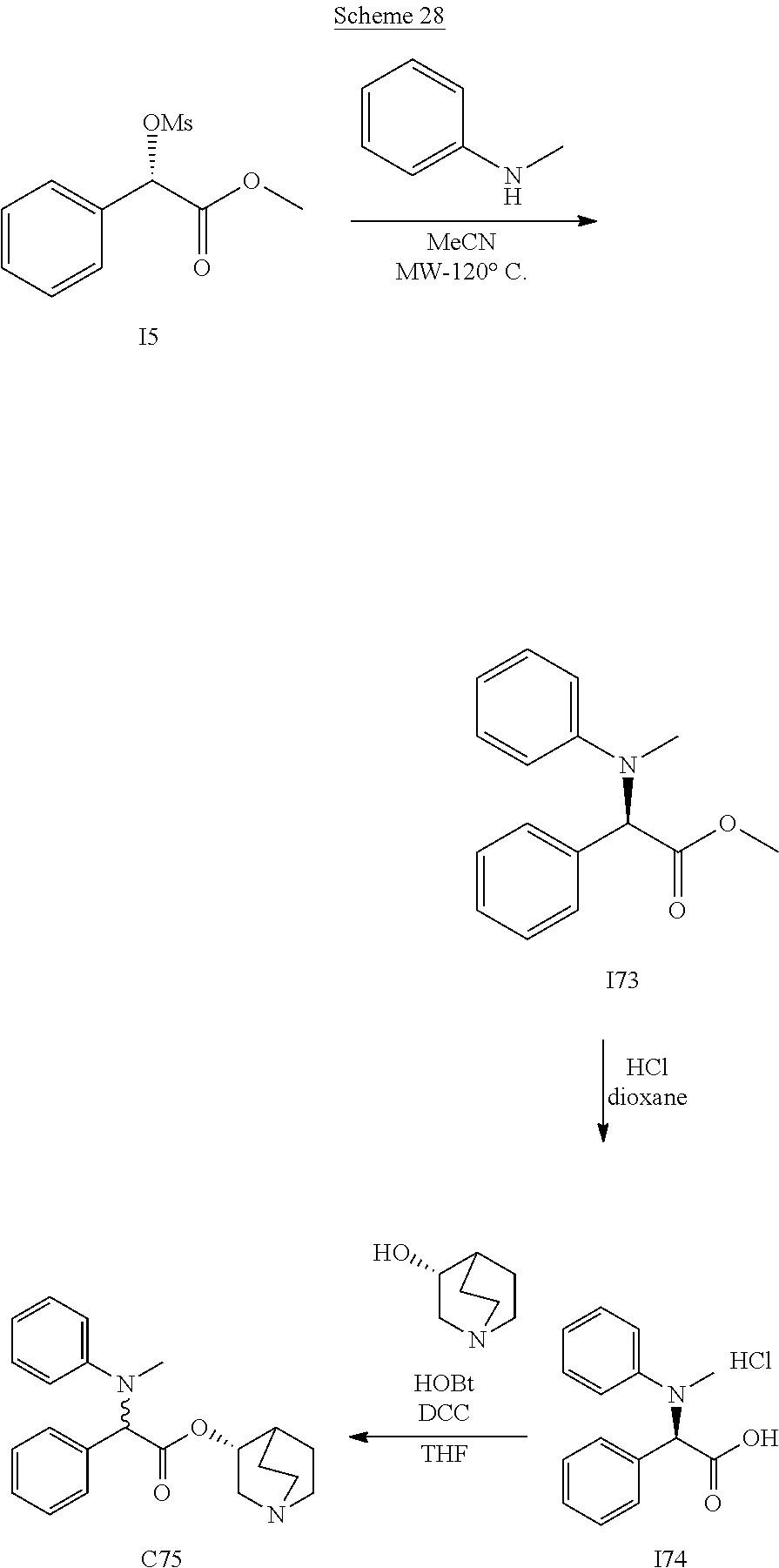
N-methylaniline (299 ul, 2.76 mmol) is added to a solution of (S)-methyl 2-(methylsulfonyloxy)-2-phenylacetate (I5) (450 mg, 1.84 mmol) in acetonitrile (10 mL). The reaction is heated at 120° C. for 15 minutes (microwave irradiation). 2N HCl (5 mL) is added and the mixture is extracted with EtOAc. The organic phase is dried over sodium sulphate and the solvent is evaporated to dryness. The crude is purified by flash chromatography on silica gel (Petroleum ether/Et2O=9/1) to obtain intermediate I121 as an orange amorphous solid (125 mg, 27% yield).
(R)-(Methyl-phenyl-amino)-phenyl-acetic acid methyl ester (I73) (125 mg, 0.49 mmol) is dissolved in dioxane (2 mL). 37% Hydrogen chloride in water (3.00 mL, 36.5 mmol) is added and the mixture is stirred at 70° C. for 18 hours. Then a second portion of 37% hydrogen chloride in water (1.00 mL, 12.2 mmol) is added and the mixture is stirred at 70° C. for additional 36 hours. The mixture is cooled to RT and the white precipitate is filtered and washed with dioxane and Et2O to obtain intermediate I122 as a white solid (97 mg, 71% yield).
(R)-(Methyl-phenyl-amino)-phenyl-acetic acid hydrochloride (I74) (97 mg, 0.35 mmol), HOBT (107 mg, 0.70 mmol), DCC (144 mg, 0.70 mmol) and (R)-quinuclidin-3-ol (89 mg, 0.70 mmol) are dissolved in dioxane (5 mL) and the mixture is stirred at RT for 15 hours. The white precipitate is filtered and discarded whereas the clear solution is evaporated to dryness. The residue is dissolved in EtOAc and washed with sat. Na2CO3 and then brine. The organic phase is dried over sodium sulphate, filtered and evaporated to dryness. The resulting crude is purified by flash chromatography on silica gel (DCM/MeOH=97/3 to 95/5) to obtain the title compound as a pale yellow oil (46 mg, 38% yield, mixture of diastereoisomers).
1H NMR (300 MHz, DMSO-d6) ppm: 7.29-7.53 (m, 5 H) 7.14-7.29 (m, 2 H) 6.86-6.99 (m, 2 H) 6.67-6.80 (m, 1 H) 5.84 and 5.83 (s, 1 H) 4.73-4.88 (m, 1 H) 2.99-3.16 (m, 1 H) 2.75 and 2.71 (s, 3 H) 2.53-2.69 (m, 3 H) 2.29-2.47 (m, 2 H) 1.74-1.95 (m, 1 H) 1.32-1.63 (m, 3 H) 1.12-1.30 (m, 1 H);
LC-MS (ESI POS): 351.3 (MH+).

(R)-Quinuclidin-3-yl 2-amino-2-phenylacetate dihydrochloride (C25) (1.11 g, 3.33 mmol) is dissolved in MeOH (10 mL) and 32% NH4OH (2.0 mL, 16.07 mmol) is added. The solution is stirred at RT for 30 seconds and then is evaporated under vacuum. The residue is dissolved in DCM/MeOH (4.5/0.5 mL) and about 1 g of SiO2 is added. The suspension is evaporated and the residue is loaded on a silica gel column and purified eluting with DCM/MeOH/NH4OH=9.2/0.8/0.1 to 9/1/0.1 to collect intermediate I124 as a pale yellow oil (635 mg, 73% yield).
To a solution of amino-phenyl-acetic acid (R)-(1-aza-bicyclo[2.2.2]oct-3-yl)ester (I76) (100 mg, 0.38 mmol) in dry THF (3.84 mL), are added 4-methylbenzaldehyde (68 mL, 0.57 mmol) and AcOH (0.5 mL, 8.73 mmol). The mixture is stirred at RT and sodium triacetoxyborohydride (163 mg, 0.77 mmol) is added. The reaction is stirred at RT for 1.5 hours then cyclohexane is added and the mixture is evaporated to dryness. The crude is purified by flash chromatography (DCM/MeOH/NH4OH=95/5/0.5) to obtain the title compound as a colorless oil (76 mg, 54% yield, mixture of diastereoisomers).
1H NMR (300 MHz, DMSO-d6) ppm: 7.25-7.51 (m, 5 H), 7.15-7.23 (m, 2 H), 7.03-7.15 (m, 2 H), 4.51-4.81 (m, 1 H), 4.33 (d, 1 H), 3.61 (s, 2 H), 2.85-3.19 (m, 1 H), 2.57-2.69 (m, 5 H), 2.28 (s, 3 H), 1.68-1.92 (m, 1 H), 0.91-1.64 (m, 4 H);
LC-MS (ESI POS): 365.2 (MH+).
The compounds listed in Table 12 are prepared as previously described for C77, using 4-fluorobenzaldehyde, 4-methoxybenzaldehyde and benzaldehyde instead of 4-methylbenzaldehyde.
| TABLE 12 | |||
| Yield and | |||
| Compound | Structure | appearance | Analytical |
| C78 |  |
64% yield Colorless oil | LC-MS (ESI POS): 369.1 (MH+) 1H NMR (300 MHz, DMSO-d6) ppm: 7.23-7.61 (m, 7 H), 7.01-7.23 (m, 2 H), 4.58-4.79 (m, 1 H), 4.34 (s, 1 H), 3.64 (s, 2 H), 2.99 and 3.07 (ddd, 1 H), 2.54-2.69 (m, 3 H), 2.08-2.46 (m, 2 H), 1.69-1.79 and 1.83-1.90 (m, 1 H), 1.03-1.64 (m, 4 H) |
| C79 |  |
55% yield Colorless oil | LC-MS (ESI POS): 381.2 (MH+) 1H NMR (300 MHz, DMSO-d6) ppm: 7.25:-7.50 (m, 5 H) 7.16-7.25 (m, 2 H) 6.81-6.92 (m, 2 H) 4.58-4.76 (m, 1 H) 4.32 (d, 1 H) 3.73 (s, 3 H) 3.59 (d, 2 H) 2.86-3.13 (m, 1 H) 2.53-2.67 (m, 5 H) 2.06-2.20 (m, 1 H) 1.68-1.90 (m, 1 H) 1.05-1.64 (m, 4 H) |
| C80 |  |
64% yield Pale yellow oil | LC-MS (ESI POS): 351.3 (MH+) 1H NMR (300 MHz, DMSO-d6) ppm: 7.07-7.54 (m, 10 H), 4.59-4.79 (m, 1 H), 4.35 (s, 1 H), 3.66 (s, 2 H), 2.97- 3.14 (m, 1 H), 2.56-2.70 (m, 4 H), 2.17-2.40 (m, 1 H), 1.71-1.97 (m, 1 H), 0.99-1.69 (m, 4 H) |

4-Fluorobenzaldehyde (0.25 mL, 2.38 mmol), 2-amino-2-phenylacetic acid (300 mg, 1.98 mmol) and NaOH (79 mg, 1.98 mmol) are dissolved in MeOH (20 mL) and stirred at RT overnight. The reaction is cooled at 0° C. and NaBH4 (150 mg, 3.97 mmol) is added. After being stirred at 0° C. for 30 minutes, the reaction is judged complete by UPLC-MS analysis. 4M HCl in dioxane is added dropwise till pH 5 and the precipitate is collected by suction filtration, washed with Et2O and dried under vacuum at 40° C. to obtain intermediate I129 as a white solid (587 mg, quantitative yield).
A mixture of (4-fluoro-benzylamino)-phenyl-acetic acid hydrochloride (233 mg, 0.79 mmol), (R)-quinuclidin-3-ol (200 mg, 1.57 mmol), 2-(1H-benzo[d][1,2,3]triazol-1-yl)-1,1,3,3-tetramethylisouronium hexafluorophosphate(V) (596 mg, 1.57 mmol), TEA (0.22 mL, 1.57 mmol) and HOBT (241 mg, 1.57 mmol) in acetonitrile (10 mL) is stirred at RT for 48 hours. THF is removed under vacuum and the crude is partitioned between EtOAc and water. The organic phase is dried over sodium sulphate, filtered and evaporated to dryness. The crude is purified by preparative HPLC. The combined fractions are dried and partitioned between EtOAc and 2M K2CO3. The organic phase is dried over sodium sulphate, filtered and evaporated to dryness to achieve the title compound as colorless oil (61 mg, 21% yield, mixture of diastereoisomers).
1H NMR (300 MHz, DMSO-d6) ppm: 7.25-7.63 (m, 7 H), 7.00-7.24 (m, 2 H), 4.58-4.79 (m, 1 H), 4.34 (s, 1 H), 3.64 (s, 2 H), 2.80 and 3.07 (ddd, 1 H), 2.54-2.69 (m, 3 H), 2.08-2.46 (m, 2 H), 1.69-1.79 and 1.83-1.90 (m, 1 H), 1.03-1.64 (m, 4 H);
LC-MS (ESI POS): 369.1 (MH+).

A mixture of 2-bromo-2-(4-fluorophenyl)acetic acid (500 mg, 2.15 mmol) and 3-fluoroaniline (477 mg, 4.29 mmol) in acetonitrile (8 mL) is heated under microwave irradiation at 100° C. for 50 minutes. Then 3-fluoroaniline (238 mg, 2.15 mmol) is added again and reaction is heated at 120° C. for 45 minutes in a microwave oven (LC-MS monitoring: complete conversion). The organic solution is diluted with EtOAc and washed with 2N HCl and then with brine. The organic phase is dried over Na2SO4, filtered and the solvent is evaporated to give intermediate I131 as a white solid (510 mg, 90% yield).
A mixture of (4-fluoro-phenyl)-(3-fluoro-phenylamino)-acetic acid (I83) (510 mg, 1.94 mmol), (R)-quinuclidin-3-ol (246 mg, 1.94 mmol), HOBT (356 mg, 2.32 mmol) and DCC (480 mg, 2.32 mmol) in THF (10 mL) is stirred at RT overnight (UPLC-MS monitoring: complete conversion). The solvent is evaporated, the crude is dissolved in EtOAc and the insoluble is filtered off. The clear solution is washed with 1N K2CO3 and then with brine. The organic layer is dried over Na2SO4, filtered and evaporated. The crude is purified by silica gel chromatography (EtOAc/MeOH=8/2) to give the title compound as a yellow oil (360 mg, 50% yield, mixture of diastereoisomers).
1H NMR (300 MHz, DMSO-d6):
Diastereoisomer 1 of C84: 7.41-7.65 (m, 2 H), 7.15-7.33 (m, 2 H), 6.96-7.14 (m, 1 H), 6.67 (d, 1 H), 6.43-6.59 (m, 2 H), 6.20-6.42 (m, 1 H), 5.36 (d, 1 H), 4.46-4.88 (m, 1 H), 2.97 (ddd, 1 H), 2.53-2.72 (m, 3 H), 2.18-2.39 (m, 1 H), 2.01-2.16 (m, 1 H), 1.80-1.96 (m, 1 H), 1.21-1.66 (m, 4 H).
Diastereoisomer 2 of C84: 7.41-7.65 (m, 2 H), 7.15-7.33 (m, 2 H), 6.96-7.14 (m, 1 H), 6.67 (d, 1 H), 6.43-6.59 (m, 2 H), 6.20-6.42 (m, 1 H), 5.35 (d, 1 H), 4.46-4.88 (m, 1 H), 3.08 (ddd, 1 H), 2.53-2.72 (m, 5 H), 1.66-1.76 (m, 1 H), 1.21-1.66 (m, 4 H);
LC-MS (ESI POS): 373 (MH+).
C85 listed in Table 13 is prepared as previously described for C84, using 2-fluoroaniline instead of 3-fluoroaniline.
| TABLE 13 | |||
| Yield and | |||
| Compound | Structure | appearance | Analytical |
| C85 |  |
53% yield White solid | LC-MS (ESI POS): 373.1 (MH+) 1H NMR (300 MHz, DMSO-d6) ppm: 7.49-7.66 (m, 2 H), 7.15-7.28 (m, 2 H), 7.07 (ddd, 1 H), 6.81-6.95 (m, 1 H), 6.50-6.78 (m, 2 H), 5.67 (d, 1 H), 5.40 (d, 1 H), 4.58-4.84 (m, 1 H), 3.07 (ddd, 1 H), 2.54-2.68 (m, 5 H), 1.64-1.77 (m, 1 H), 1.04-1.65 (m, 4 H) |

A solution of ethyl 2-oxo-2-(thiophen-2-yl)acetate (5.00 g, 27.1 mmol) in ethanol (50 mL) is cooled at 0° C. with an ice bath. NaBH4 (0.31 g, 8.14 mmol) is added in four portions under stirring. The mixture is stirred at 0° C. for 10 minutes, then allowed to warm at RT and stirred for additional 30 minutes. Reaction is concentrated under vacuum and the residue is partitioned between Et2O and ice-cooled water. The organic layer is separated, washed with water and brine, dried over Na2SO4, filtered and evaporated to give a colorless liquid (5.05 g, 91% yield).
Hydroxy-thiophen-2-yl-acetic acid ethyl ester (4.58 g, 24.6 mmol) is dissolved in dry DCM (125 mL) and cooled at 0° C. DIPEA (5.15 mL, 29.5 mmol) and methanesulphonyl chloride (2.11 mL, 27.1 mmol) are added and the resulting solution is stirred at RT for 1 hour. DIPEA (0.859 ml, 4.92 mmol) and methanesulphonyl chloride (0.19 mL, 2.46 mmol) are added again. After being stirred at room temperature for 1 additional hour, a third portion of DIPEA (0.43 mL, 2.46 mmol) and methanesulphonyl chloride (77 ul, 0.98 mmol) is added. After 1 hour the reaction is completed. The mixture is diluted with DCM, washed with sat. NaHCO3, water and brine, dried (Na2SO4), filtered and evaporated. The resulting yellow oil is used in the next step without any further purification.
Ethyl 2-(methylsulfonyloxy)-2-(thiophen-2-yl)acetate (I87) (5.7 g, 21.6 mmol), aniline (2.16 mL, 23.7 mmol) and DIPEA (4.52 mL, 25.9 mmol) are dissolved in acetonitrile (20 mL) to give a yellow solution which is heated under microwave irradiation into a sealed vial at 100° C. for 15 minutes. Conversion complete by UPLC/MS-UV. Solvent is evaporated and the residue is dissolved in DCM and washed with water and brine, dried (Na2SO4), filtered and evaporated to dryness. The resulting crude is purified by flash chromatography (Petroleum ether/EtOAc=85/15) to get desired compound as a yellow solid (4.33 g, 77% yield).
Ethyl 2-(phenylamino)-2-(thiophen-2-yl)acetate (I88) (3.86 g, 14.8 mmol) and lithium hydroxide hydrate (1.24 g, 29.5 mmol) are dissolved in THF/water (20 mL/20 mL) and stirred at RT for 4 hours. THF is evaporated, the mixture is cooled to 0° C. and 4M HCl in dioxane is added until pH is about 1. The resulting precipitate is collected by suction filtration and washed with water. The white solid is dried under vacuum at 40° C. for 18 h (3.09 g, 78% yield).
2-(Phenylamino)-2-(thiophen-2-yl)acetic acid hydrochloride (I89) (359 mg, 1.33 mmol), DCC (330 mg, 1.60 mmol) and HOBT (245 mg, 1.60 mmol) are dissolved in THF (15 mL). (R)-quinuclidin-3-ol (339 mg, 2.66 mmol) is added and the reaction mixture is stirred at RT for 16 hours. HOBT (20.4 mg, 0.13 mmol) and DCC (33.0 mg, 0.16 mmol) are added again and the mixture is stirred for additional 8 hours. HOBT (20.4 mg, 0.13 mmol), DCC (33.0 mg, 0.16 mmol), (R)-quinuclidin-3-ol (16.9 mg, 0.13 mmol) are added and the mixture is stirred for additional 16 hours. THF is evaporated and the resulting crude oil is dissolved in EtOAc and washed with water and brine. The organic phase is recovered, dried over Na2SO4, filtered and evaporated. The crude is first purified by flash chromatography (DCM/MeOH=9/1) and then by preparative HPLC. The pure fractions are collected and evaporated. The resulting TFA salt is dissolved in THF and passed through a PL-HCO3 cartridge (Varian, 200 mg, 1.8 mmol/g HCO3 −). THF is evaporated, the product is dissolved in dioxane (2 mL) and 4M HCl in dioxane (2 mL) is added. The solvent is evaporated and the residue is dried under vacuum for 24 h to obtain the title compound as a brown solid (33 mg, 7% yield, mixture of disateroisomers).
1H NMR (300 MHz, DMSO-d6) ppm: 10.01 (br. s., 1 H) 7.47-7.56 (m, 1 H) 7.21-7.29 (m, 1 H) 6.99-7.16 (m, 3 H) 6.71-6.82 (m, 2 H) 6.53-6.70 (m, 1 H) 5.64 and 5.61 (s, 1 H) 4.99-5.13 (m, 1 H) 3.03-3.28 (m, 4 H) 2.71-2.92 (m, 2 H) 1.42-2.28 (m, 5 H);
LC-MS (ESI POS): 343.1 (MH+).

Methyl 2-bromo-2-(4-methoxyphenyl)acetate (1.10 g, 4.25 mmol), DIPEA (0.89 mL, 5.09 mmol), and aniline (0.43 mL, 4.67 mmol) are dissolved in acetonitrile (12 mL). The reaction is heated for 18 minutes at 100° C. under microwave irradiation. Acetonitrile is evaporated and the residue is diluted with DCM and washed with water and brine, dried over Na2SO4, filtered and evaporated to dryness. The crude is purified by flash chromatography (Petroleum Ether/EtOAc=9/1) to give intermediate I139 as a yellow oil (745 mg, 65% yield).
(4-Methoxy-phenyl)-phenylamino-acetic acid methyl ester (953 mg, 3.51 mmol) and lithium hydroxide hydrate (295 mg, 7.03 mmol) are dissolved in THF (5 mL) and water (5 mL) and the resulting reaction is stirred overnight at RT (Conversion complete by UPLC-MS/UV). THF is evaporated, the aqueous phase is cooled at 0° C. and acidified till pH 1 with 4M HCl in 1,4 dioxane. The precipitate is collected by suction filtration and the white solid is dried overnight at 45° C. under vacuum (718 mg, 70% yield).
(4-Methoxy-phenyl)-phenylamino-acetic acid hydrochloride (I92) (300 mg, 1.02 mmol), DCC (253 mg, 1.23 mmol), and HOBT (188 mg, 1.23 mmol) are dissolved in THF (10 mL). DIPEA (0.36 mL, 2.04 mmol) and (R)-quinuclidin-3-ol (130 mg, 1.02 mmol) are added. The mixture is stirred ad RT for 16 hours. Then DCC (25.3 mg, 0.12 mmol), HOBT (18.8 mg, 0.12 mmol), DIPEA (36 uL, 0.204 mmol) and (R)-quinuclidin-3-ol (13.0 mg, 0.10 mmol) are added again and reaction is stirred for additional 32 hours. THF is evaporated and the residue is dissolved in EtOAc and washed with sat. NaHCO3, H2O and brine. The organic layer is dried (Na2SO4), filtered and evaporated. The crude residue is purified by flash chromatography (DCM/MeOH=97/3 to 92/8) to obtain the title compound as a yellow solid (90 mg, 24% yield, mixture of diastereoisomers).
1H NMR (300 MHz, DMSO-d6) ppm: 7.34-7.63 (m, 2 H), 7.01-7.15 (m, 2 H), 6.87-7.01 (m, 2 H), 6.63-6.74 (m, 2 H), 6.52-6.62 (m, 1 H), 6.19 (d, 1 H), 5.17 (d, 1 H), 4.55-4.85 (m, 1 H), 3.74 (s, 3 H), 2.83-3.20 (m, 1 H), 2.03-2.69 (m, 5 H), 1.65-1.94 (m, 1 H), 0.93-1.63 (m, 4 H);
LC-MS (ESI POS): 367.3 (MH+).

2-Bromo-2-(4-(methoxycarbonyl)phenyl)acetic acid (700 mg, 2.56 mmol), aniline (0.23 mL, 2.56 mmol), and DIPEA (0.94 mL, 5.38 mmol) are dissolved in acetonitrile (5 mL). The reaction is stirred at 100° C. under microwave irradiation for 15 minutes. Acetonitrile is evaporated and the residue is dissolved in DCM and washed with water and brine. The organic layer is dried (Na2SO4), filtered and evaporated. The crude compound is purified by flash chromatography (DCM/MeOH=9/1) to obtain intermediate I142 as a white solid (381 mg, 37% yield).
N-Ethyl-N-isopropylpropan-2-amine 2-(4-(methoxycarbonyl)phenyl)-2-(phenylamino)acetate (I94) (212 mg, 0.51 mmol), DCC (158 mg, 0.77 mmol), and HOBT (117 mg, 0.77 mmol) are dissolved in dry THF (5 mL). (R)-Quinuclidin-3-ol (195 mg, 1.53 mmol) is added and the mixture is stirred at RT for 2 days. A second portion of DCC (79 mg, 0.38 mmol), HOBT (58.7 mg, 0.38 mmol) and (R)-quinuclidin-3-ol (98 mg, 0.77 mmol) are added and the mixture is further stirred for 24 hours. Then THF is evaporated, the residue is dissolved in EtOAc and washed with NaHCO3, water and brine. The organic phase is dried (Na2SO4), filtered and evaporated. The crude is purified by preparative HPLC. The recovered fractions are evaporated, dissolved in EtOAc and washed with sat. NaHCO3. The organic phase is dried (Na2SO4), filtered and evaporated to afford the desired compound as a colorless oil (42 mg, 21% yield, mixture of diastereoisomers).
1H NMR (300 MHz, DMSO-d6) ppm: 7.88-8.05 (m, 2 H), 7.51-7.76 (m, 2 H), 6.91-7.13 (m, 2 H), 6.71 (dd, 2 H), 6.50-6.64 (m, 1 H), 6.38 (d, 1 H), 5.42 (d, 1 H), 4.39-4.86 (m, 1 H), 3.85 (s, 3 H), 2.84-3.15 (m, 1 H), 2.54-2.67 (m, 4 H), 0.76-2.16 (m, 6 H);
LC-MS (ESI POS): 395.4 (MH+).

Methyl 2-(3-fluorophenyl)acetate (1.90 g, 11.3 mmol) and N-bromo succinimide (2.01 g, 11.3 mmol) are dissolved in CCl4 (80 mL). HBr (64 ul, 0.56 mmol) is added and the mixture is stirred under reflux overnight. The mixture is cooled at RT, diluted with DCM and washed with sat. NaHCO3, water and brine. The organic layer is dried (Na2SO4), filtered and evaporated obtaining intermediate I144 as a yellow oil (2.68 g, 96% yield).
Bromo-(3-fluoro-phenyl)-acetic acid methyl ester (I96) (300 mg, 1.21 mmol), DIPEA (0.32 mL, 1.82 mmol), and aniline (0.17 mL, 1.82 mmol) are dissolved in acetonitrile (4 mL) and heated under MW irradiation at 100° C. for 1 hour. Acetonitrile is evaporated and the residue is purified by flash chromatography (Petroleum ether/EtOAc=95/5) to obtain intermediate I145 as a colorless oil (229 mg, 73% yield).
(3-Fluoro-phenyl)-phenylamino-acetic acid methyl ester (I97) (229 mg, 0.88 mmol) and lithium hydroxide hydrate (74.1 mg, 1.77 mmol) are dissolved in THF/water (6 mL/2 mL) and stirred at RT for 2 hours. THF is evaporated, the resulting basic aqueous solution is acidified till pH 1 with 1M HCl. The precipitate is recovered by suction filtration and washed with 1M HCl. The compound is dried at 40° C. under vacuum overnight to get intermediate I146 as a white solid (186 mg, 75% yield).
PS-DCC (982 mg, 1.31 mmol, loading: 1.33 mmol/g) is suspended in dry THF (15 mL). (3-fluoro-phenyl)-phenylamino-acetic acid hydrochloride (I98) (184 mg, 0.65 mmol), HOBT (200 mg, 1.31 mmol), and (R)-quinuclidin-3-ol (249 mg, 1.96 mmol) are added and the mixture is shaken at RT overnight. PS-DCC is filtered off and the filtrate is evaporated. The residue is dissolved in EtOAc and washed with NaHCO3, water and brine. The organic layer is dried over Na2SO4, filtered and evaporated to dryness. The crude compound is purified by filtration through a pad of silica-gel using DCM/MeOH=9/1 as the eluent. The title compound is obtained as a colorless oil (129 mg, 56% yield, mixture of diastereoisomers).
1H NMR (300 MHz, DMSO-d6) ppm: 7.31-7.52 (m, 3 H), 7.11-7.23 (m, 1 H), 6.98-7.11 (m, 2 H), 6.67-6.76 (m, 2 H), 6.51-6.63 (m, 1 H), 6.35 (d, 1 H), 5.35 and 5.36 (d, 1 H), 4.59-4.80 (m, 1 H), 2.97 and 3.07 (ddd, 1 H), 2.55-2.67 (m, 5 H), 1.67-1.74 and 1.81-1.95 (m, 1 H), 1.10-1.66 (m, 4 H);
LC-MS (ESI POS): 355.2 (MH+).
C100 listed in Table 14 is alternatively prepared as previously described for C99, using methyl 2-(4-fluorophenyl)acetate instead of methyl 2-(3-fluorophenyl)acetate.
| TABLE 14 | |||
| Yield and | |||
| Compound | Structure | appearance | Analytical |
| C100 |  |
44% yield White solid | LC-MS (ESI POS): 355.0 (MH+) 1H NMR (300 MHz, DMSO-d6) ppm: 7.69-7.83 (m, 4 H), 7.01-7.16 (m, 2 H), 6.65-6.79 (m, 2 H), 6.53- 6.64 (m, 1 H), 6.42 (d, 1 H), 5.46 and 5.47 (d, 1 H), 4.66-4.81 (m, 1 H), 2.99 and 3.10 (ddd, 1 H), 2.54- 2.88 (m, 4 H), 2.04-2.41 (m, 1 H), 0.92-1.97 (m, 5 H) |

Ethyl 2-oxo-2-(4-(trifluoromethyl)phenyl)acetate (500 mg, 2.03 mmol) is dissolved in absolute EtOH (10 mL) and cooled at 0° C. under N2. NaBH4 (38.4 mg, 1.02 mmol) is added in two portions and the resulting suspension is allowed to warm to RT and stirred for 45 minutes. The solvent is evaporated, the resulting residue is diluted with Et2O and cool water is added. The organic layer is separated, washed with water and brine, dried over Na2SO4, filtered and evaporated obtaining intermediate I149 as a colorless oil (440 mg, 87% yield).
Hydroxy-(4-trifluoromethyl-phenyl)-acetic acid ethyl ester (I101) (440 mg, 1.77 mmol) and DIPEA (0.43 mL, 2.48 mmol) are dissolved in dry DCM (17 mL) and cooled at 0° C. under N2. Methansulfonyl chloride (0.18 mL, 2.30 mmol) is added dropwise to the solution and the resulting mixture is allowed to warm to RT and stirred for 3 hours. The mixture is diluted with DCM and washed with sat. NaHCO3, water and brine. The organic layer is dried (Na2SO4), filtered and evaporated to obtain intermediate I150 as a yellow oil (578 mg, quantitative yield), which is used in the next step without any further purification.
Methanesulfonyloxy-(4-trifluoromethyl-phenyl)-acetic acid ethyl ester (I102) (594 mg, 1.82 mmol), aniline (0.25 mL, 2.73 mmol), and DIPEA (0.48 mL, 2.73 mmol) are dissolved in acetonitrile (4 mL). The reaction is heated under microwave irradiation at 100° C. for 1 hour and 30 minutes. Aniline (0.17 mL, 1.820 mmol) is added again and the reaction is heated under microwave irradiation at 100° C. for 3 hours. Acetonitrile is removed under vacuum and the residue is purified by flash chromatography (Petroleum ether/DCM=75/25) to afford intermediate I151 as a yellow oil (195 mg, 60% yield).
Phenylamino-(4-trifluoromethyl-phenyl)-acetic acid ethyl ester (I103) (195 mg, 0.60 mmol) and lithium hydroxide hydrate (50.6 mg, 1.21 mmol) are dissolved in THF/water (9 mL/3 mL) and stirred at RT for 4 hours and then at 40° C. for 1 hour. THF is evaporated and the remaining aqueous solution is acidified with 1M HCl till pH 1. The resulting precipitate is recovered by suction filtration, washed with 1M HCl and dried under vacuum at 40° C. overnight to obtain intermediate I152 as a white solid (200 mg, quantitative yield).
PS-DCC (907 mg, 1.21 mmol, loading: 1.33 mmol/g) is suspended in dry THF (10 mL). Phenylamino-(4-trifluoromethyl-phenyl)-acetic acid hydrochloride (I104) (200 mg, 0.60 mmol), HOBT (185 mg, 1.21 mmol), and (R)-quinuclidin-3-ol (230 mg, 1.81 mmol) are added and the mixture is shaken at RT overnight. PS-DCC is filtered off, the filtrate is evaporated and the residue is dissolved in EtOAc and washed with NaHCO3, water and brine. The organic layer is dried over Na2SO4, filtered and evaporated to dryness. The resulting crude compound is purified by filtration through a pad of silica-gel using DCM/MeOH=9/1 as the eluent. The title compound is obtained as a colorless oil (110 mg, 45% yield, mixture of diastereoisomers).
1H NMR (300 MHz, DMSO-d6) ppm: 7.69-7.83 (m, 4 H), 7.01-7.16 (m, 2 H), 6.65-6.79 (m, 2 H), 6.53-6.64 (m, 1 H), 6.42 (d, 1 H), 5.46 and 5.47 (d, 1 H), 4.66-4.81 (m, 1 H), 2.99 and 3.10 (ddd, 1 H), 2.54-2.88 (m, 4 H), 2.04-2.41 (m, 1 H), 0.92-1.97 (m, 5 H);
LC-MS (ESI POS): 405.2 (MH+).

To a solution of 2-phenyl-2-(phenylamino)acetic acid (I1) (500 mg, 2.20 mmol), (R)-quinuclidin-3-ol (280 mg, 2.20 mmol) and triphenylphosphine (577 mg, 2.20 mmol) in dry THF (7 mL) cooled at 0° C., is added (E)-diethyl diazene-1,2-dicarboxylate (0.35 mL, 2.20 mmol) and the reaction is stirred for 2 hours at RT. The solvent is removed under vacuum and the residue is taken up with EtOAc, washed with 5% NaHCO3 and brine, dried over Na2SO4 and evaporated to dryness. The resulting yellow oil is purified by flash chromatography (EtOAc/MeOH/NH4OH=90/10/0.1 to 70/30/0.1) to obtain desired product as a white powder (78.0 mg, 10% yield, mixture of diasteroisomer).
1H NMR (300 MHz, DMSO-d6) ppm
Diastereoisomer 1 of C106: 7.48-7.62 (m, 2 H), 7.24-7.45 (m, 3 H), 6.98-7.11 (m, 2 H), 6.66-6.75 (m, 2 H), 6.51-6.62 (m, 1 H), 6.27 (d, 1 H), 5.25 (d, 1 H), 4.58-4.82 (m, 1 H), 3.08 (dd, 1 H), 2.54-2.70 (m, 5 H), 1.62-1.75 (m, 1 H), 0.97-1.60 (m, 4 H);
Diastereoisomer 2 of C106: 7.48-7.62 (m, 2 H), 7.24-7.45 (m, 3 H), 6.98-7.11 (m, 2 H), 6.66-6.75 (m, 2 H), 6.51-6.62 (m, 1 H), 6.27 (d, 1 H), 5.26 (d, 1 H), 4.58-4.82 (m, 1 H), 2.95 (m, 1 H), 2.54-2.70 (m, 4 H), 2.02-2.14 (m, 1 H), 1.86-1.95 (m, 1 H), 0.97-1.60 (m, 4 H);
LC-MS (ESI POS): 337.2 (MH+).

A mixture of 2-phenyl-2-(phenylamino)acetic acid (I1) (175 mg, 0.77 mmol), DCC (192 mg, 0.92 mmol), HOBt (124 mg, 0.92 mmol) and 1-methyl-azepan-4-ol (100 mg, 0.77 mmol) in dry THF (100 mL) is stirred at RT overnight under nitrogen flowstream (UPLC-MS monitoring: complete conversion). The solvent is evaporated and the residue is taken up with aq. HCl and washed with EtOAc. The aqueous phase is basified with NaHCO3 and extracted with DCM (three times). The organic layers are combined, dried over Na2SO4, filtered and evaporated to dryness. The resulting crude is first purified by flash chromatography (DCM to DCM/MeOH=95/5) and then by preparative LC-MS. The purified compound is partitioned between sat. NaHCO3 and DCM, the organic phase is dried over Na2SO4, filtered and evaporated under vacuum to give 53 mg of the title compound as brown oil (20% yield, mixture of diastereoisomers).
1H NMR (300 MHz, CHLOROFORM-d) ppm: 12.76 (br. s., 1 H), 7.30-7.62 (m, 6 H), 7.07-7.23 (m, 2 H), 6.50-6.84 (m, 3 H), 5.15-5.39 (m, 1 H), 5.09 (d, 1 H), 3.21-3.79 (m, 2 H), 2.60 (d, 3 H), 1.80-3.15 (m, 8 H);
LC-MS (ESI POS): 339.2 (MH+).

To a solution of (R)-quinuclidin-3-yl 2-phenyl-2-(phenylamino)acetate (diastereoisomer 1 of C2) (127 mg, 0.38 mmol), α-bromophenethole is added (91.2 mg, 0.45 mmol) and the mixture reacted in a closed vessel under MW irradiation for 1 hour at 100° C. (LC-MS monitoring: complete conversion). The resulting crude is purified by preparative LC-MS to obtain the title compound as a pale yellow solid (18.9 mg, 14% yield, trifluoroacetate salt, single diasteroisomer).
1H NMR (300 MHz, DMSO-d6+Na2CO3) ppm: 7.46-7.69 (m, 2H), 7.21-7.46 (m, 5H), 6.89-7.16 (m, 5H), 6.66-6.80 (m, 2H), 6.58 (t, 1H), 6.36 (d, 1H), 5.34 (d, 1H), 4.99-5.21 (m, 1H), 4.34 (t, 2H), 3.86-4.08 (m, 1H), 3.39-3.72 (m, 5H), 3.11 (d, 1H), 2.78-3.02 (m, 1H), 2.20-2.39 (m, 1H), 1.61-2.15 (m, 4H);
LC-MS (ESI POS): 457.3 (MH+).
Final compounds listed in Table 15 are prepared as previously described for C108, by alkylation of suitable compounds (Diastereoisomer 1 of C2, Diastereoisomer 2 of C2, C2, Diastereoisomer 1 of C3, Diastereoisomer 2 of C3, C12, C4, Diastereoisomer 2 of C22, C43 and C30) and the commercially available alkylating agents.
| TABLE 15 | |||
| Yield and | |||
| Compound | Structure | appearance | Analytical |
| Diastereoisomer 1 of C109 |  |
16% yield Pale yellow oil | LC-MS (ESI POS): 461.2 (MH+) 1H NMR (300 MHz, DMSO-d6) ppm: 8.21 (dd, 1 H), 8.05 (dd, 1 H), 7.49-7.63 (m, 2 H), 7.27-7.48 (m, 4 H), 6.98-7.17 (m, 2 H), 6.67-6.79 (m, 2 H), 6.59 (t, 1 H), 5.38 (s, 1 H), 5.12-5.27 (m, 1 H), 4.97 (s, 2 H), 4.07 (ddd, 1 H), 3.42-3.78 (m, 4 H), 3.15-3.42 (m, 1 H), 2.30-2.44 (m, 1 H), 1.81- 2.14 (m, 4 H) |
| C109 |  |
61% yield Pale yellow oil | LC-MS (ESI POS): 461.2 (MH+) 1H NMR (300 MHz, DMSO-d6) ppm: 8.21 (dd, 1 H), 8.07 (dd, 1 H), 7.50-7.65 (m, 2 H), 7.23-7.48 (m, 4 H), 6.96-7.19 (m, 2 H), 6.65-6.80 (m, 2 H), 6.52-6.65 (m, 1 H), 5.34 (s, 1 H), 5.12-5.27 (m, 1 H), 5.00-5.07 (m, 2 H), 4.00-4.17 (m, 1 H), 3.31-3.97 (m, 5 H), 2.10-2.15 (m, 1 H), 1.88-2.04 (m, 2 H), 1.63-1.83 (m, 1 H), 1.36-1.63 (m, 1 H) |
| Diastereoisomer 1 of C110 |  |
33% yield Brownish oil | LC-MS (ESI POS): 471.3 (MH+) 1H NMR (300 MHz, DMSO-d6 +Na2CO3) ppm: 7.50-7.65 (m 2 H), 7.25-7.50 (m, 5 H), 7.03-7.25 (m, 2 H), 6.87-7.03 (m, 3 H), 6.69- 6.83 (m, 2 H), 6.61 (t, 1 H), 6.37 (d, 1 H), 5.35 (d, 1 H), 5.01-5.22 (m, 1 H), 4.01 (t, 2 H), 3.72-3.91 (m, 1 H), 3.36-3.50 (m, 3 H), 3.10- 3.25 (m, 2 H), 2.89 (d, 1 H), 2.67-2.82 (m, 1 H), 2.22-2.38 (m, 1 H), 1.56-2.15 (m, 6 H) |
| Diastereoisomer 2 of C110 |  |
79% yield Pale yellow oil | LC-MS (ESI POS): 471.3 (MH+) 1H NMR (300 MHz, DMSO-d6) ppm: 7.56 (dd, 2 H), 7.24-7.49 (m, 5 H), 7.05- 7.13 (m, 2 H), 6.92-7.00 (m, 3 H), 6.66-6.80 (m, 2 H), 6.53-6.66 (m, 1 H), 5.31 (s, 1 H), 5.01-5.21 (m, 1 H), 3.88-4.16 (m, 3 H), 3.21-3.52 (m, 7 H), 1.77-2.42 (m, 5 H), 1.58-1.73 (m, 1 H), 1.36-1.57 (m, 1 H) [α]D = −24.48° (c = 0.14, MeOH) |
| Diastereoisomer 1 of C111 |  |
28% yield Brownish oil | LC-MS (ESI POS): 351.3 (MH+) 1H NMR (300 MHz, DMSO-d6) ppm: 7.50-7.64 (m, 2 H), 7.29-7.50 (m, 3 H), 7.01-7.23 (m, 2 H), 6.68-6.83 (m, 2 H), 6.53-6.68 (m, 1 H), 5.34 (s, 1 H), 5.00- 5.24 (m, 1 H), 3.80 (ddd, 1 H), 3.21- 3.42 (m, 3 H), 2.97 (dt, 1 H), 2.86 (s, 3 H), 2.79-2.92 (m, 1 H), 2.20-2.36 (m, 1 H), 1.75-2.01 (m, 4 H) |
| Diastereoisomer 2 of C111 |  |
72% yield Pale yellow oil | LC-MS (ESI POS): 351.3 (MH+) 1H NMR (300 MHz, DMSO-d6) ppm: 7.48-7.63 (m, 2 H), 7.24-7.48 (m, 3 H), 6.99-7.17 (m, 2 H), 6.50-6.80 (m, 3 H), 5.29 (s, 1 H), 4.99-5.19 (m, 1 H), 3.71- 3.94 (m, 1 H), 3.08-3.54 (m, 5 H), 2.95 (s, 3 H), 1.94-2.15 (m, 1 H), 1.68-1.94 (m, 2 H), 1.56-1.68 (m, 1 H), 1.29-1.56 (m, 1 H) [α]D = −6.43° (c = 0.14, MeOH) |
| Diastereoisomer 2 of C112 |  |
65% yield Pale yellow oil | LC-MS (ESI POS): 457.3 (MH+) 1H NMR (300 MHz, DMSO-d6) ppm: 7.47-7.65 (m, 2 H), 7.22-7.47 (m, 5 H), 6.86-7.19 (m, 5 H), 6.65-6.81 (m, 2 H), 6.50-6.65 (m, 1 H), 6.34 (br. s., 1 H), 5.31 (s, 1 H), 5.01-5.21 (m, 1 H), 4.40- 4.46 (m, 2 H), 3.88-4.13 (m, 1 H), 3.66- 3.74 (m, 2 H), 3.43-3.51 (m, 5 H), 2.02- 2.17 (m, 1 H), 1.72-2.02 (m, 3 H), 1.39-1.72 (m, 1 H) [α]D = −26.00° (c = 0.14, MeOH) |
| C113 |  |
69% yield Pale yellow oil | LC-MS (ESI POS): 455.3 (MH+) 1H NMR (300 MHz, DMSO-d6) ppm: 9.38 (br. s., 1 H), 7.50-7.72 (m, 2 H), 7.26-7.50 (m, 3 H), 6.98-7.25 (m, 2 H), 6.68-6.83 (m, 2 H), 6.52-6.68 (m, 1 H), 5.34 (s, 1 H), 4.92-5.18 (m, 1 H), 3.57-3.67 (m, 1 H), 3.05-3.33 (m, 3 H), 2.57-2.81 (m, 2 H), 2.08-2.30 (m, 1 H), 1.63-1.94 (m, 4 H) |
| Diastereoisomer 1 of C114 |  |
14% yield brown oil | LC-MS (ESI POS): 461.1 (MH+) 1H NMR (300 MHz, DMSO-d6) ppm: 8.60 (dd, 1 H), 7.74 (dd, 1 H), 7.50-7.64 (m, 3 H), 7.26-7.49 (m, 3 H), 6.95-7.22 (m, 2 H), 6.66-6.81 (m, 2 H), 6.51-6.66 (m, 1 H), 6.36 (br. S., 1 H), 5.38 (s, 1 H), 5.12-5.29 (m, 1 H), 4.94 (s, 2 H), 3.95- 4.17 (m, 1 H), 3.50-3.82 (m, 5 H), 2.31-2.43 (m, 1 H), 1.69-2.21 (m, 4 H) |
| Diastereoisomer 1 of C115 |  |
59% yield colorless oil | LC-MS (ESI POS): 473.2 (MH+) 1H NMR (300 MHz, DMSO-d6) ppm: 7.94-8.19 (m, 2 H), 7.53-7.68 (m, 2 H), 7.26-7.53 (m, 5 H), 7.00-7.22 (m, 2 H), 6.68-6.84 (m, 2 H), 6.52-6.68 (m, 1 H), 6.36 (br. S., 1 H), 5.38 (s, 1 H), 5.17-5.30 (m, 1 H), 5.07 (s, 2 H), 4.06 (ddd, 1 H), 3.54-3.74 (m, 3 H), 3.48 (d, 1 H), 3.30-3.43 (m, 1 H), 2.30-2.42 (m, 1 H), 1.85-2.14 (m, 4 H) [α]D = −46.15° (c = 0.26, MeOH) |
| C116 |  |
67% yield colorless oil | LC-MS (ESI POS): 441.2 (MH+) 1H NMR (300 MHz, DMSO-d6) ppm: 7.52-7.64 (m, 2 H), 7.21-7.51 (m, 8 H), 6.99-7.20 (m, 2 H), 6.67-6.83 (m, 2 H), 6.52-6.67 (m, 1 H), 6.35 (br. s., 1 H), 5.35 (s, 1 H), 5.07-5.24 (m, 1 H), 3.77-3.88 (m, 1 H), 3.43-3.57 (m, 1 H), 3.17-3.43 (m, 4 H), 2.92-3.12 (m, 2 H), 2.76-2.92 (m, 2 H), 2.32 (br. s., 1 H), 1.34-2.16 (m, 4 H) |
| Diastereoisomer 1 of C117 |  |
13% yield brown amorphous solid | LC-MS (ESI POS): 511.2 (MH+) 1H NMR (300 MHz, DMSO-d6) ppm: 8.46 (d, 1 H), 8.04-8.22 (m, 2 H), 7.49-7.69 (m, 4 H), 7.28-7.49 (m, 3 H), 7.00-7.18 (m, 2 H), 6.69-6.80 (m, 2 H), 6.54-6.67 (m, 1 H), 6.36 (d, 1 H), 5.39 (d, 1 H), 5.17-5.30 (m, 1 H), 5.11 (s, 2 H), 3.94-4.19 (m, 1 H), 3.37-3.77 (m, 5 H), 2.31-2.43 (m, 1 H), 1.88-2.12 (m, 4 H) [α]D = −47.81° (c = 0.21, MeOH) |
| Diastereoisomer 1 of C118 |  |
22% yield Yellow oil | LC-MS (ESI POS): 497.1 (MH+) 1H NMR (300 MHz, DMSO-d6) ppm: 8.20 (dd, 1 H) 8.04 (dd, 1 H) 7.53-7.68 (m, 2 H) 7.34 (dd, 1 H) 7.17- 7.30 (m, 2 H) 6.85-7.00 (m, 2 H) 6.63- 6.79 (m, 2 H) 5.40 (s, 1 H) 5.13-5.26 (m, 1 H) 4.89-5.07 (m, 2 H) 3.97-4.13 (m, 1 H) 3.34-3.73 (m, 5 H) 2.35 (br. s, 1 H) 1.83-2.16 (m, 4 H) [α]D = −33.13° (c = 0.23, MeOH) |
| Diastereoisomer 1 of C119 |  |
16% yield Yellow oil | LC-MS (ESI POS): 491.2 (MH+) 1H NMR (300 MHz, DMSO-d6) ppm: 7.91-8.00 (m, 2 H) 7.70- 7.82 (m, 1 H) 7.55-7.69 (m, 4 H) 7.20-7.32 (m, 2 H) 6.84-7.01 (m, 2 H) 6.65-6.80 (m, 2 H) 5.41 (s, 1 H) 5.18-5.27 (m, 1 H) 5.10 (s, 2 H) 3.97-4.13 (m, 1 H) 3.33-3.73 (m, 6 H) 2.37 (br. s, 1 H) 1.80-2.16 (m, 4 H) [α]D = −57.20° (c = 0.20, MeOH) |
| Diastereoisomer 1 of C120 |  |
19% yield Brown oil | LC-MS (ESI POS): 387.2 (MH+) 1H NMR (300 MHz, DMSO-d6) ppm: 7.52-7.70 (m, 2 H), 7.13-7.35 (m, 2 H), 6.85-7.04 (m, 2 H), 6.61-6.82 (m, 2 H), 6.34 (br. s., 1 H), 5.35 (s, 1 H), 4.93-5.21 (m, 1 H), 3.72-3.91 (m, 1 H), 3.16-3.32 (m, 3 H), 2.94-3.11 (m, 2 H), 2.90 (s, 3 H), 2.24-2.31 (m, 1 H), 1.74-2.02 (m, 4 H) |
| C121 |  |
23% yield Pale yellow oil | LC-MS (ESI POS): 491.6 (MH+) 1H NMR (300 MHz, DMSO-d6) ppm: 7.90-8.04 (m, 2 H), 7.69-7.83 (m, 1 H), 7.55-7.68 (m, 2 H), 7.34-7.55 (m, 3 H), 7.01-7.28 (m, 2 H), 6.79 (br. s., 1 H), 6.50-6.69 (m, 2 H), 6.29-6.50 (m, 1 H), 5.55 (br. s., 1 H), 5.21-5.32 (m, 1 H), 5.12 (s, 2 H), 3.99-4.13 (m, 1 H), 3.46-3.72 (m, 5 H), 2.31-2.45 (m, 1 H), 1.51-2.22 (m, 4 H) |
| C122 |  |
49% yield Pale yellow oil | LC-MS (ESI POS): 475.2 (MH+) 1H NMR (300 MHz, DMSO-d6 +TFA) ppm: 8.21 (dd, 1 H) 8.06 (dd, 1 H) 7.31- 7.50 (m, 6 H) 7.17-7.30 (m, 2 H) 6.89- 6.99 (m, 2 H) 6.70-6.80 (m, 1 H) 5.96 (s, 1 H) 5.25-5.37 (m, 1 H) 5.03 (d, 2 H) 4.08-4.24 (m, 1 H) 3.53-3.74 (m, 4 H) 3.39-3.51 (m, 1 H) 2.76 (s, 3 H) 2.21-2.33 (m, 1 H) 1.92-2.11 (m, 2 H) 1.67-1.90 (m, 1 H) 1.47-1.65 (m, 1 H) |
| C123 | 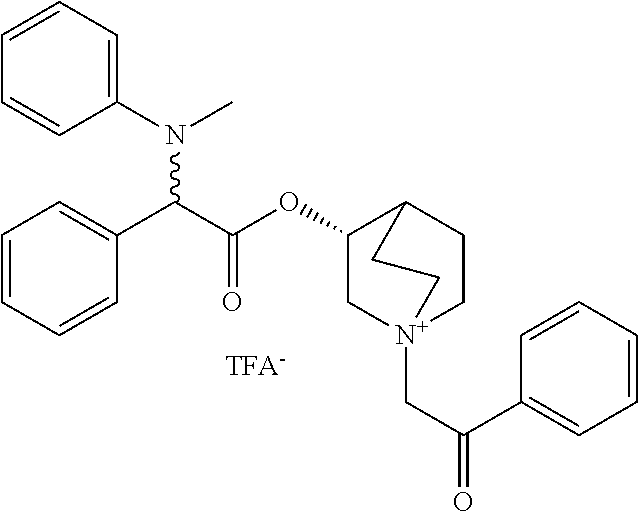 |
56% yield Yellow oil | LC-MS (ESI POS): 469.3 (MH+) 1H NMR (300 MHz, DMSO-d6) ppm: 7.89-8.06 (m, 2 H), 7.69-7.89 (m, 1 H), 7.55-7.S9 (m, 2 H), 7.32-7.55 (m, 5 H), 7.18-7.32 (m, 2 H), 6.89-7.07 (m, 2 H), 6.67-6.86 (m, 1 H), 5.98 (s, 1 H), 5.26-5.44 (m, 1 H), 5.15 (br. s., 2 H), 4.02-4.30 (m, 1 H), 3.43-3.76 (m, 5 H), 2.77 (s, 3 H), 2.18-2.39 (m, 1 H), 1.41-2.15 (m, 4 H) |
| C124 |  |
60% yield Brown oil | LC-MS (ESI POS): 471.3 (MH+) 1H NMR (300 MHz, DMSO-d6) ppm: 7.15-7.46 (m, 7 H), 6.88- 7.15 (m, 5 H), 6.44-6.74 (m, 3 H), 4.89-5.15 (m, 1 H), 4.38-4.47 (m, 2 H), 4.35 (t, 1 H), 3.96 (ddd, 1 H), 3.60-3.76 (m, 2 H), 3.41-3.60 (m, 3 H), 3.21-3.41 (m, 2 H), 3.09 (d, 2 H), 1.76-2.09 (m, 3 H), 1.44- 1.76 (m, 2 H) |
| Diastereoisomer 1 of C125 |  |
35% yield Brown oil | LC-MS (ESI POS): 475.2 (MH+) 1H NMR (300 MHz, DMSO-d6) ppm: 8.21 (dd, 1 H), 8.07 (dd, 1 H), 7.18-7.40 (m, 6 H), 6.96-7.17 (m, 2 H), 6.48-6.74 (m, 3 H), 5.08-5.19 (m, 1 H), 5.05 (d, 1 H), 4.99 (d, 1 H), 4.23-4.48 (m, 1 H), 4.05 (dd, 1 H), 3.26-3.83 (m, 5 H), 2.94-3.24 (m, 2 H), 1.84-2.06 (m, 3 H), 1.60-1.84 (m, 2 H) [α]D = −13.26° (c = 0.35, MeOH) |
| C126 |  |
49% yield Brown oil | LC-MS (ESI POS): 365.3 (MH+) 1H NMR (300 MHz, DMSO-d6) ppm: 7.17-7.45 (m, 5 H), 6.98- 7.17 (m, 2 H), 6.56-6.67 (m, 3 H), 4.85-5.14 (m, 1 H), 4.23-4.43 (m, 1 H), 3.80 (ddd, 1 H), 3.14-3.51 (m, 5 H), 3.09 (d, 2 H), 2.92 (s, 3 H), 1.71-1.98 (m, 3 H), 1.39-1.69 (m, 2 H) |
| Diastereoisomer 1 of C127 |  |
25% yield Pale yellow oil | LC-MS (ESI POS): 469.2 (MH+) 1H NMR (300 MHz, DMSO-d6) ppm: 7.88-8.05 (m, 2 H), 7.70- 7.84 (m, 1 H), 7.51-7.70 (m, 2 H), 7.18-7.44 (m, 5 H), 6.98-7.18 (m, 2 H), 6.49-6.81 (m, 3 H), 6.12 (d, 1 H), 5.14 (s, 2 H), 5.02-5.14 (m, 1 H), 4.26-4.55 (m, 1 H), 3.92- 4.21 (m, 1 H), 3.50-3.73 (m, 5 H), 3.14 (dd, 1 H), 3.08 (dd, 1 H), 1.82- 2.07 (m, 3 H), 1-58-1.82 (m, 2 H) [α]D = −15.84° (c = 0.365, MeOH) |
| C128 |  |
22% yield Colorless oil | LC-MS (ESI POS): 469.3 (MH+) 1H NMR (300 MHz, DMSO-d6) ppm: 7.88-8.11 (m, 2 H), 7.69- 7.88 (m, 1 H), 7.38-7.66 (m, 12 H), 5.25-5.46 (m, 2 H), 4.98-5.25 (m, 2 H), 3.95-4.28 (m, 3 H), 3.77 (d, 1 H), 3.43-3.70 (m, 4 H), 1.31-2.43 (m, 5 H) |
| Diastereoisomer 1 of C129 |  |
45% yield amorphous brown solid | LC-MS (ESI POS): 456.1 (MH+) 1H NMR (300 MHz, DMSO-d6) ppm: 8.80-9.01 (m, 2 H), 7.71- 7.92 (m, 2 H), 7.51-7.67 (m, 2 H), 7.27-7.51 (m, 3 H), 7.01-7.18 (m, 2 H), 6.68-6.83 (m, 2 H), 6.51- 6.67 (m, 1 H), 5.39 (s, 1 H), 5.15- 5.30 (m, 1 H), 5.09 (s, 2 H), 3.97- 4.16 (m, 1 H), 3.51-3.69 (m, 3 H), 3.32-3.49 (m, 2 H), 2.31-2.43 (m, 1 H), 1.82-2.15 (m, 4 H) [α]D = −36.13° (c = 0.3, MeOH) |
| Diastereoisomer 1 of C130 |  |
25% yield Light brown oil | LC-MS (ESI POS): 494.9 (MH+) 1H NMR (300 MHz, DMSO-d6) ppm: 8.23 (d, 1 H), 7.53-7.62 (m, 2 H), 7.28-7.49 (m, 4 H), 6.99-7.18 (m, 2 H), 6.68-6.83 (m, 2 H), 6.60 (m, 1 H), 6.26-6.46 (m, 1 H), 5.32-5.47 (m, 1 H), 5.13-5.25 (m, 1 H), 4.94 (s, 2 H), 3.98-4.21 (m, 1 H), 3.51- 3.69 (m, 2 H), 3.13-3.36 (m, 3 H), 2.32-2.41 (m, 1 H), 1.78-2.16 (m, 4 H) |
| Diastereoisomer 1 of C131 |  |
22% yield Yellow oil | LC-MS (ESI POS): 475.03 (MH+) 1H NMR (300 MHz, DMSO-d6) ppm: 7.89 (d, 1 H), 7.50-7.62 (m, 2 H), 7.27- 7.48 (m, 3 H), 6.99-7.18 (m, 3 H), 6.67- 6.82 (m, 2 H), 6.52-6.65 (m, 1 H), 6.24- 6.46 (m, 1 H), 5.30-5.43 (m, 1 H), 5.15- 5.27 (m, 1 H), 4.88 (s, 2 H), 3.97-4.13 (m, 1 H), 3.56-3.72 (m, 3 H), 3.10-3.38 (m, 2 H), 2.57 (s, 3 H), 2.31-2.41 (m, 1 H), 1.74-2.15 (m, 4 H) |
| Diastereoisomer 1 of C132 |  |
21% yield Brown oil | LC-MS (ESI POS): 458.1 (MH+) 1H NMR (300 MHz, DMSO-d6) ppm: 7.50-7.62 (m, 2 H), 7.29-7.48 (m, 4 H), 7.22 (dd, 1 H), 7.04-7.13 (m, 2 H), 6.69- 6.78 (m, 2 H), 6.52-6.63 (m, 1 H), 6.39 (br. s., 1 H), 6.24 (dd, 1 H), 5.37 (br. s., 1 H), 5.08-5.23 (m, 1 H), 4.64 (s, 2 H), 3.94-4.16 (m, 1 H), 3.88 (s, 3 H), 3.62- 3.79 (m, 2 H), 3.20-3.44 (m, 3 H), 2.31- 2.41 (m, 1 H), 1.79-2.13 (m, 4 H) |
| Diastereoisomer 1 of C133 |  |
18% yield Brown oil | LC-MS (ESI POS): 474.1 (MH+) 1H NMR (300 MHz, DMSO-d6) ppm: 7.53-7.63 (m, 2 H), 7.32-7.48 (m, 3 H), 7.10 (m, 2 H), 6.69-6.80 (m, 2 H), 6.50- 6.65 (m, 1 H), 6.38 (s, 1 H), 5.29-5.49 (m, 1 H), 5.10-5.29 (m, 1 H), 4.74 (s, 2 H), 3.91-4.16 (m, 1 H), 3.40-3.70 (m, 5 H), 2.48 (br. s., 3 H), 2.41 (s, 3 H), 2.31-2.39 (m, 1 H), 1.66-2.07 (m, 4 H) |
| Diastereoisomer 1 of C134 | 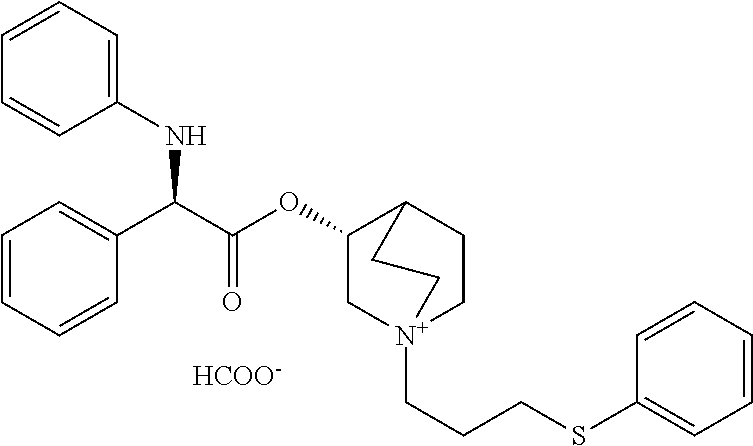 |
37% yield Pale yellow oil | LC-MS (ESI POS): 487.04 (MH+) 1H NMR (300 MHz, DMSO-d6) ppm: 7.50-7.59 (m, 2 H), 7.20-7.48 (m, 9 H), 6.99-7.13 (m, 2 H), 6.67-6.81 (m, 2 H), 6.53-6.65 (m, 1 H), 6.36 (d, 1 H), 5.34 (d, 0 H), 4.93-5.16 (m, 0 H), 3.66-3.92 (m, 1 H), 3.14-3.39 (m, 8 H), 2.91-3.06 (m, 1 H), 1.32-2.16 (m, 7 H) formiate ion: 8.36 (s, 2 H) [α]D = −24.14° (c = 0.29, MeOH) |
| C135 |  |
18% yield Colorless oil | LC-MS (ESI POS): 483.2 (MH+) 1H NMR (300 MHz, DMSO-d6) ppm: 8.51 (s, 1 H), 7.91-8.04 (m, 2 H), 7.67- 7.82 (m, 1 H), 7.50-7.67 (m, 4 H), 7.30- 7.49 (m, 3 H), 7.00 (t, 1 H), 6.59-6.66 (m, 1 H), 6.50-6.58 (m, 1 H), 6.44-6.50 (m, 1 H), 6.30 (d, 1 H), 5.29-5.44 (m, 1 H), 5.21-5.27 (m, 1 H), 5.12 and 5.20 (s, 2 H), 4.00-4.24 (m, 1 H), 3.45-3.85 (m, 5 H), 2.47 (q, 2 H), 2.10-2.17 and 2.31-2.40 (m, 1 H), 1.43-2.09 (m, 4 H), 1.12 (t, 3 H) |
| C136 | 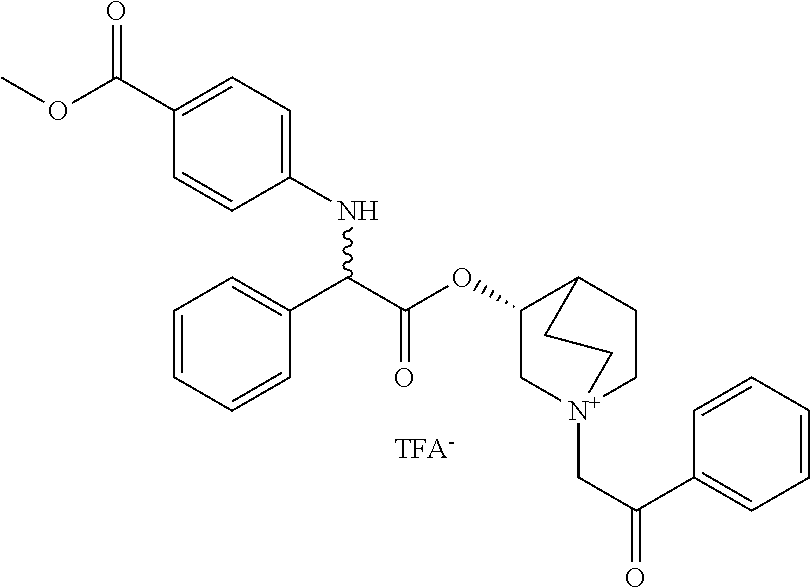 |
41% yield Pale yellow solid | LC-MS (ESI POS): 513.2 (MH+) 1H NMR (300 MHz, DMSO-d6) ppm: 7.89-8.07 (m, 2 H), 7.68-7.85 (m, 2 H), 7.52-7.67 (m, 5 H), 7.31-7.49 (m, 3 H), 7.06-7.28 (m, 1 H), 6.55-6.98 (m, 2 H), 5.37-5.60 (m, 1 H), 5.20-5.32 (m, 1 H), 4.99-5.20 (m, 2 H), 3.98-4.27 (m, 1 H), 3.75 (s, 3 H), 3.39-3.71 (m, 5 H), 2.07- 2.45 (m, 1 H), 1.43-2.07 (m, 4 H) |
The compounds listed in Table 16 are prepared as previously described for C108 by reaction of an equimolar mixture of diastereoisomer 1 and 2 of C2 with the suitable alkylating reagent.
| TABLE 16 | |||
| Yield and | |||
| Compound | Structure | Appearance | Analytical |
| C137 |  |
10% yield Pale yellow oil | LC-MS (ESI POS): 473.2 (MH+) 1H NMR (300 MHz, DMSO-d6) ppm: 7.50-7.63 (m, 2 H), 7.20-7.50 (m, 8 H), 7.07 (dd, 2 H), 6.64-6.83 (m, 2 H), 6.48-6.64 (m, 1 H), 6.35 (d, 1 H), 5.33 (d, 1 H), 5.00-5.20 (m, 1 H), 3.74-3.93 (m, 1 H), 3.36-3.55 (m, 9 H), 2.87-3.02 (m, 1 H), 2.31-2.45 (m, 1 H), 2.04-2.07 (m, 1 H), 1.75-2.01 (m, 4 H) |
| C138 |  |
15% yield Pale yellow oil | LC-MS (ESI POS): 433.2 (MH+) 1H NMR (300 MHz, DMSO-d6) ppm: 7.48-7.65 (m, 2 H), 7.26-7.48 (m, 3 H), 6.93-7.21 (m, 2 H), 6.67-6.83 (m, 2 H), 6.55-6.67 (m, 1 H), 5.33 (s, 1 H), 5.00-5.19 (m, 1 H), 3.68-4.01 (m, 1 H), 3.36 (br. s., 4 H), 2.66-3.14 (m, 3 H), 1.41-2.15 (m, 10 H), 0.87-1.42 (m, 7 H) |
| C139 | 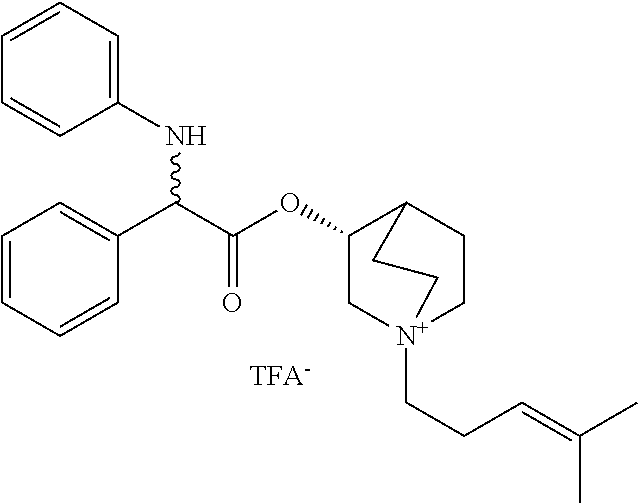 |
15% yield Pale yellow oil | LC-MS (ESI POS): 419.3 (MH+) 1H NMR (300 MHz, DMSO-d6) ppm: 7.51-7.67 (m, 2 H), 7.28-7.49 (m, 3 H), 6.99-7.19 (m, 2 H), 6.67-6.85 (m, 2 H), 6.52-6.67 (m, 1 H), 5.33 (s, 1 H), 5.07-5.21 (m, 1 H), 4.87-5.07 (m, 1 H), 3.66-3.94 (m, 1 H), 3.28-3.55 (m, 3 H), 3.09-3.28 (m, 2 H), 2.82-3.08 (m, 2 H), 1.74-2.43 (m, 7 H), 1.63 (s, 3 H), 1.69 (s, 3 H) |
| C140 |  |
16% yield Pale yellow oil | LC-MS (ESI POS): 523.3 (MH+) 1H NMR (300 MHz, DMSO-d6) ppm: 8.16-8.27 (m, 1 H), 7.92 (d, 2 H), 7.53- 7.66 (m, 2 H), 7.27-7.49 (m, 3 H), 7.00- 7.16 (m, 2 H), 6.68-6.81 (m, 2 H), 6.52-6.66 (m, 1 H), 5.37 (s, 1 H), 5.17- 5.27 (m, 1 H), 4.94-5.17 (m, 2 H), 3.92-4.25 (m, 1 H), 3.65-3.81 (m, 1 H), 3.54-3.69 (m, 3 H), 3.30-3.54 (m, 1 H), 1.38-2.45 (m, 5 H) |

To a solution of (R)-phenyl-phenylamino-acetic acid (R)-(1-aza-bicyclo[2.2.2]oct-3-yl)ester (Diastereoisomer 1 of C2) (153 mg, 0.45 mmol), α-chloroacetophenone is added (107 mg, 0.54 mmol) and the mixture reacted in a closed vessel under MW irradiation for 1 hour at 100° C. (LC-MS monitoring: complete conversion). The resulting crude is purified by flash chromatography (DCM/MeOH=9/1) to obtain the title compound as a white solid (108.9 mg, 50% yield, chloride salt, single diastereoisomer).
1H NMR (400 MHz, DMSO-d6) ppm: 7.96 (d, 2H) 7.70-7.81 (m, 1H) 7.58 (d, 2H) 7.62 (d, 2H) 7.29-7.47 (m, 3H) 7.09 (t, 2H) 6.74 (d, 2H) 6.59 (t, 1H) 6.41 (d, 1H) 5.39 (d, 1H) 5.16-5.26 (m, 1H) 5.13 (s, 2H) 4.08 (ddd, 1H) 3.47-3.71 (m, 4 H) 3.35-3.47 (m, 1H) 2.36 (br. s., 1H) 1.84-2.13 (m, 4H);
LC-MS (ESI POS): 455.27 (MH+).
The compounds listed in Table 17 are prepared as previously described for C33 by reaction of C12, diastereoisomer 1 of C2 or C24 with the commercially available alkylating agents
| TABLE 17 | |||
| Yield and | |||
| Compound | Structure | Appearance | Analytical |
| Diastereoisromer 1 of C142 |  |
25% yield Pale yellow solid | LC-MS (ESI POS): 497.1 (MH+) 1H NMR (300 MHz, DMSO-d6) ppm: 8.15-8.27 (m, 1 H), 7.99-8.15 (m, 1 H), 7.29-7.53 (m, 4 H), 7.02-7.27 (m, 2 H), 6.81 (d, 1 H), 6.48-6.66 (m, 2 H), 6.25-6.48 (m, 1 H), 5.44-5.62 (m, 1 H), 5.14-5.31 (m, 1 H), 5.05 (s, 2 H), 3.96- 4.23 (m, 1 H), 3.74-3.93 (m, 1 H), 3.66 (br. s., 2 H), 3.37-3.61 (m, 2 H), 1.37- 2.42 (m, 5 H) [α]D = −37.51° (c = 0.225, MeOH) |
| Diastereoisomer 1 of C143 |  |
78% yield Yellow solid | LC-MS (ESI POS): 394.2 (MH+) 1H NMR (300 MHz, DMSO-d6) ppm: 7.88 (br. s., 1 H), 7.68 (br. s., 1 H), 7.48-7.61 (m, 2 H), 7.26-7.48 (m, 3 H), 6.98-7.20 (m, 2 H), 6.67-6.81 (m, 2 H), 6.52-6.67 (m, 1 H), 6.34 (d, 1 H), 5.35 (d, 1 H), 5.03-5.25 (m, 1 H), 4.02 (ddd, 1 H), 3.93 (d, 1 H), 3.87 (d, 1 H), 3.37- 3.69 (m, 4 H), 3.13-3.27 (m, 1 H), 2.21- 2.40 (m, 1 H), 1.76-2.05 (m, 4 H) [α]D = −41.19° (c = 0.27, MeOH) |
| Diastereoisomer 1 of C144 |  |
86% yield Yellow solid | LC-MS (ESI POS): 470.3 (MH+) 1H NMR (300 MHz, DMSO-d6) ppm: 10.52 (s, 1 H), 7.47-7.70 (m, 4 H), 7.24-7.47 (m, 5 H), 6.98-7.24 (m, 3 H), 6.66-6.84 (m, 2 H), 6.51-6.66 (m, 1 H), 6.35 (d, 1 H), 5.37 (d, 1 H), 5.06-5.27 (m, 1 H), 4.17 (d, 1 H), 4.11 (d, 1 H), 3.99-4.09 (m, 1 H), 3.46-3.74 (m, 4 H), 3.20-3.36 (m, 1 H), 2.30-2.43 (m, 1 H), 1.80-2.13 (m, 4 H) [α]D = −55.2° (c = 0.25, MeOH) |
| Diastereoisomer 1 of C145 | 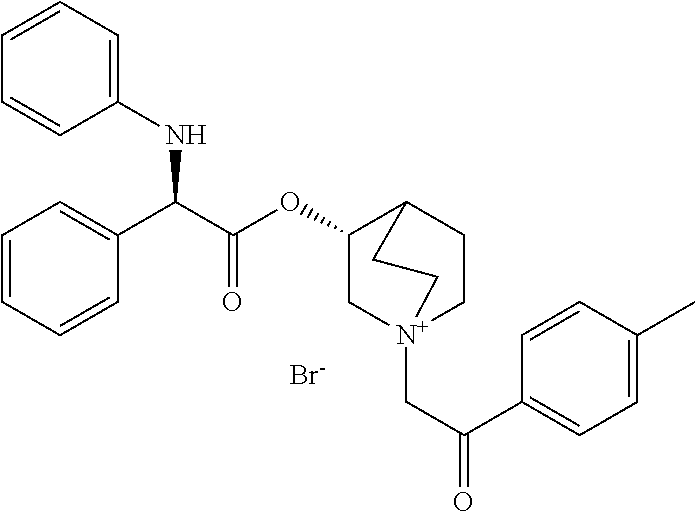 |
50% yield White solid | LC-MS (ESI POS): 469.3 (MH+) 1H NMR (300 MHz, DMSO-d6) ppm: 7.86 (m, 2 H), 7.50-7.68 (m, 2 H), 7.23-7.50 (m, 5 H), 6.99-7.18 (m, 2 H), 6.74 (m, 2 H), 6.50-6.67 (m, 1 H), 6.36 (d, 1 H), 5.38 (d, 1 H), 5.11-5.30 (m, 1 H), 5.06 (s, 2 H), 3.97-4.21 (m, 1 H), 3.58-3.83 (m, 2 H), 3.33-3.58 (m, 3 H), 2.42 (s, 3 H), 2.31- 2.39 (m, 1 H), 1.84-2.12 (m, 4 H) [α]D = −57.92° (c = 0.5, MeOH) |
| C146 | 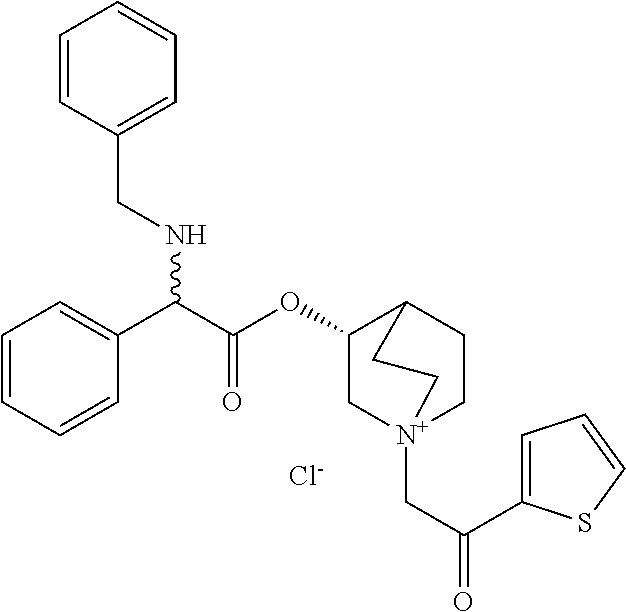 |
28% yield Yellow solid | LC-MS (ESI POS): 475.2 (MH+) 1H NMR (300 MHz, DMSO-d6) ppm: 8.21 (td, 1 H), 7.99-8.14 (m, 1 H), 7.21-7.50 (m, 11 H), 5.10-5.26 (m, 1 H), 4.92-5.10 (m, 2 H), 4.36-4.50 (m, 1 H), 4.00-4.19 (m, 1 H), 3.64- 3.81 (m, 4 H), 3.46-3.64 (m, 3 H), 3.06-3.24 (m, 1 H), 1.34-2.40 (m, 5 H) |
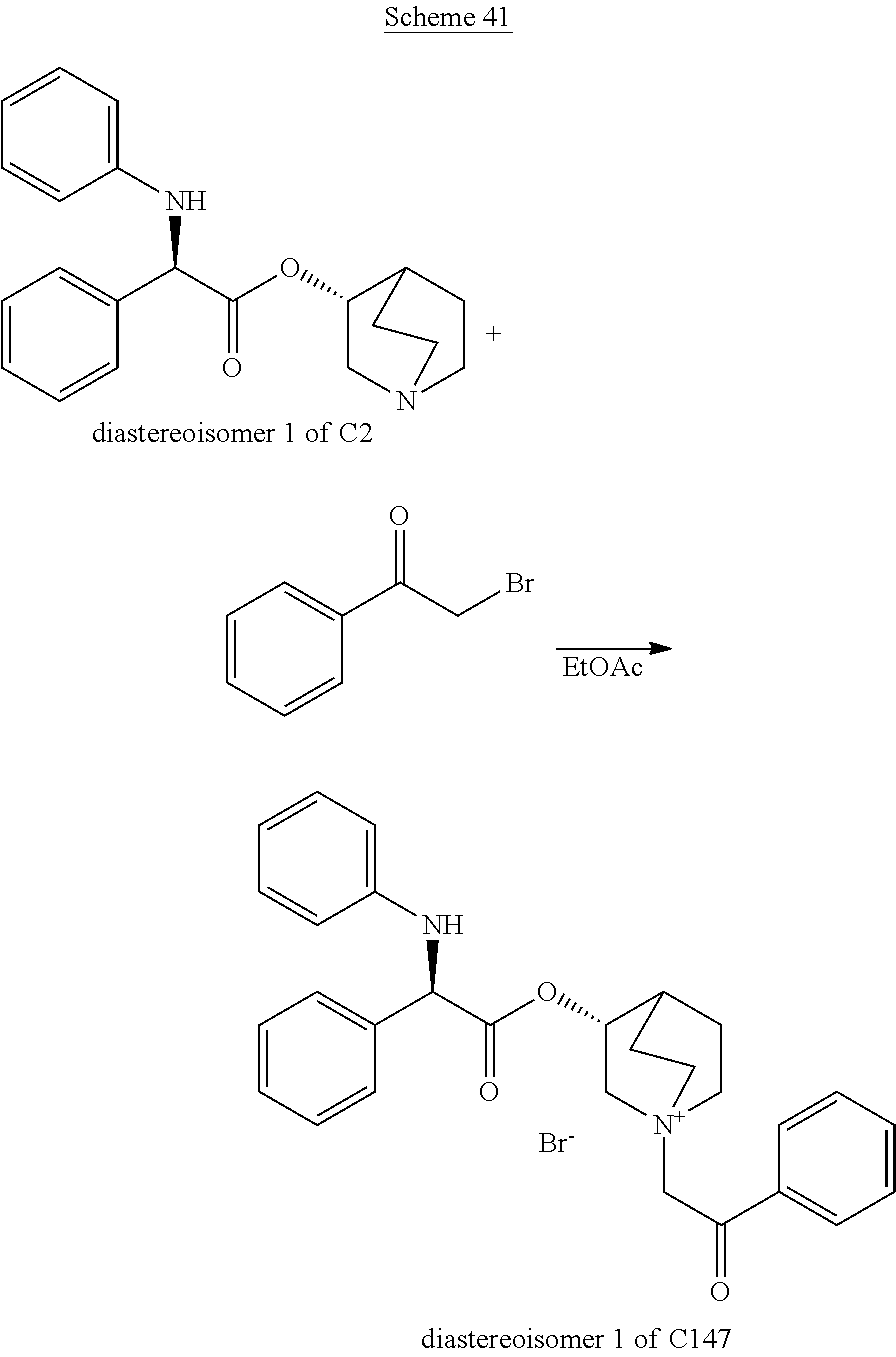
(R)-quinuclidin-3-yl 2-phenyl-2-(phenylamino)acetate (Diasteroisomer 1 of C2) (20.3 mg, 0.06 mmol) is dissolved in EtOAc (0.60 mL) and 2-bromo-1-phenylethanone (12.0 mg, 0.06 mmol) iss added. The reaction is stirred at room temperature for 2 hours (UPLC-MS: complete and clean conversion). Et2O (0.20 mL) were added and the product is triturated to obtain a white solid which is isolated by filtration and dried under vacuum overnight (31 mg, 96% yield, bromide salt, single diastereoisomer).
1H NMR (300 MHz, DMSO-d6) ppm: 7.89-8.08 (m, 2 H), 7.69-7.84 (m, 1 H), 7.52-7.69 (m, 4 H), 7.31-7.48 (m, 3 H), 6.99-7.17 (m, 2 H), 6.68-6.83 (m, 2 H), 6.51-6.66 (m, 1 H), 6.37 (d, 1 H), 5.39 (d, 1 H), 5.17-5.26 (m, 1 H), 5.13 (s, 2 H), 4.04-4.17 (m, 1 H), 3.34-3.79 (m, 5 H), 2.32-2.40 (m, 1 H), 1.83-2.16 (m, 4 H);
LC-MS (ESI POS): 455.3 (MH+).

To a solution of (S)-((R)-quinuclidin-3-yl)-2-(tert-butoxycarbonylamino)-3-phenylpropanoate (I19) (200 mg, 0.53 mmol), α-bromophenethole is added (130 mg, 0.64 mmol) and the mixture reacted in a closed vessel under MW irradiation for 1 hour at 100° C. (LC-MS monitoring: complete conversion). The solvent is evaporated under reduced pressure and the resulting crude is used without any additional purification.
To a solution of (R)-3-((S)-2-tertbutoxycarbonylamino-phenylpropanoyloxy)-1-(2-phenoxyethyl)-1-azonia-bicyclo[2.2.2]octane bromide (I148) (0.53 mmol) in DCM (5 mL), is added trifluoroacetic acid (0.50 mL, 4.41 mmol) and the mixture stirred at RT overnight. The solvent is evaporated and the resulting crude is purified by preparative LC-MS in order to obtain the title compound as a brown gummy solid (112 mg, 43% overall yield, trifluoroacetate salt and trifluoroacetate anion, single diastereoisomer).
1H NMR (300 MHz, DMSO-d6) ppm: 8.60 (br. s., 3H), 7.19-7.45 (m, 7H), 6.82-7.13 (m, 3H), 5.03-5.25 (m, 1H), 4.39-4.48 (m, 2H), 4.25-4.38 (m, 1H), 3.90-4.09 (m, 1H), 3.28-3.52 (m, 7 H), 3.19 (dd, 1H), 3.10 (dd, 1H), 2.09 (br. s., 1H), 1.81-2.04 (m, 2H), 1.66-1.79 (m, 2H);
LC-MS (ESI POS): 395.4 (MH+).
The compounds listed in Table 18 are prepared as previously described for C149, by reaction of I19 with 2-chloroacetylthiophene, 3-phenoxypropyl bromide and α-bromoacetophenone.
| TABLE 18 | |||
| Yield and | |||
| Compound | Structure | appearance | Analytical |
| Diastereoisomer 1 of C150 |  |
45% yield Pale yellow oil | LC-MS (ESI POS): 399.2 (MH+) 1H NMR (300 MHz, DMSO-d6) ppm: 8.62 (br. s., 3H), 8.22 (dd, 1H), 8.08 (dd, 1H), 7.15-7.47 (m, 6H), 5.14- 5.30 (m, 1H), 5.06 (d, 1H), 4.99 (d, 1H), 4.38 (t, 1 H), 4.11 (dd, 1H), 3.44-3.74 (m, 5H), 3.22 (dd, 1H), 3.10 (dd, 1H), 2.06-2.14 (m, 1H), 1.90-2.07 (m, 7H), 1 56-1.90 (m, 2H) |
| Diastereoisomer 1 of C151 |  |
41% yield Brown gummy solid | LC-MS (ESI POS): 409.3 (MH+) 1H NMR (300 MHz, DMSO-d6) ppm: 8.62 (br. s., 3H), 7.22-7.41 (m, 7H), 6.90-7.01 (m, 3H), 4.99-5.29 (m, 1H), 4.22-4.49 (m, 1H), 4.04 (t, 2H), 3.78- 3.94 (m, 1H), 3.25-3.50 (m, 7H), 3.20 (dd, 1H), 3.10 (dd, 1H), 2.02-2.15 (m, 3H), 1.80-2.02 (m, 2H), 1.65- 1.78 (m, 2H) |
| Diastereoisomer 1 of C152 |  |
35% yield Pale yellow solid | LC-MS (ESI POS): 393.3 (MH+) 1H NMR (300 MHz, DMSO-d6) ppm: 8.65 (br. s., 3H), 7.88-8.07 (m, 2H), 7.70-7.84 (m, 1H), 7.51-7.70 (m, 2H), 7.16-7.48 (m, 5H), 5.21-5.30 (m, 1H), 5.19 (d, 1H), 5.12 (d, 1H), 4.39 (dd, 1H), 4.11 (dd, H), 3.47-3.81 (m, 5H), 3.23 (dd, 1H), 3.10 (dd, 1H), 1.90- 2.22 (m, 3H), 1.65-1.90 (m, 2H) |

To a solution of (R)-((R)-quinuclidin-3-yl) 3-phenyl-2-(phenylamino)propanoate (Diastereoisomer 1 of C22) (50.0 mg, 0.14 mmol), is added 2-bromo-1-phenylethanone (28.4 mg, 0.14 mmol) and the mixture reacted in a closed vessel under MW irradiation for 1 hour at 100° C. (LC-MS monitoring: complete conversion). Solvent is removed under reduced pressure and residue is triturated with EtOAc to obtain the title compound as a white solid (75.5 mg, 98% yield, bromide salt, single diastereoisomer).
1H NMR (300 MHz, DMSO-d6) ppm: 7.92-8.10 (m, 2 H), 7.71-7.85 (m, 1 H), 7.51-7.71 (m, 2 H), 7.27-7.44 (m, 4 H), 7.17-7.26 (m, 1 H), 6.95-7.16 (m, 2 H), 6.45-6.77 (m, 3 H), 6.11 (d, 1 H), 5.05-5.21 (m, 3 H), 4.23-4.50 (m, 1 H), 3.94-4.20 (m, 1 H), 3.49-3.81 (m, 3 H), 3.35-3.49 (m, 2 H), 3.15 (dd, 1 H), 3.08 (dd, 1 H), 2.17-2.37 (m, 1 H), 1.94-2.17 (m, 2 H), 1.70-1.94 (m, 2 H);
LC-MS (ESI POS): 469.3 (MH+);
[α]D=−8.19° (c=0.53, MeOH).
Diastereoisomer 2 of C154 listed in Table 19 is prepared as previously described for C153, by reaction of I70 with 2-chloroacetylthiophene
| TABLE 19 | |||
| Yield and | |||
| Compound | Structure | appearance | Analytical |
| Diastereoisomer 2 of C154 |  |
90% yield Yellow Solid | LC-MS (ESI POS): 475.2 (MH+) 1H NMR (300 MHz, DMSO-d6) ppm: 8.22 (dd, 1 H), 8.11 (dd, 1 H), 7.15-7.45 (m, 6 H), 6.92-7.15 (m, 2 H), 6.53-6.68 (m, 3 H), 6.12 (d, 1 H), 5.05-5.17 (m, 1 H), 5.02 (s, 2 H), 4.24-4.52 (m, 1 H), 4.06 (ddd, 1 H), 3.47-3.80 (m, 3 H), 3.33-3.47 (m, 2 H), 3.15 (dd, 1 H), 3.08 (dd, 1 H), 2.16-2.34 (m, 1 H), 1.77- 2.10 (m, 4 H) [α]D = −14.2° (c = 0.25, MeOH) |

To a solution of (R)-phenyl-phenylamino-acetic acid (R)-(1-aza-bicyclo[2.2.2]oct-3-yl)ester (Diastereoisomer 1 of C2) (120 mg, 0.35 mmol) in acetonitrile (5 mL), is added 2-bromo-1-(4-methoxy-phenyl)-ethanone (99 mg, 0.43 mmol) and the mixture is heated under MW irradiation for 1 hour at 100° C. (UPLC-MS monitoring: complete conversion). Solvent was evaporated and the resulting crude is first purified by flash chromatography (DCM/MeOH=99/1 to 9/1) and then purified by preparative LC-MS to obtain the title compound as a white solid (70.2 mg, 33% yield, trifluoroacetate salt, single disatereoisomer).
1H NMR (300 MHz, DMSO-d6) ppm: 7.84-8.06 (m, 2 H), 7.51-7.71 (m, 2 H), 7.25-7.51 (m, 3 H), 6.95-7.22 (m, 4 H), 6.67-6.80 (m, 2 H), 6.53-6.67 (m, 1 H), 6.35 (br. s., 1 H), 5.38 (s, 1 H), 5.13-5.30 (m, 1 H), 5.01 (s, 2 H), 3.97-4.17 (m, 1 H), 3.88 (s, 3 H), 3.19-3.50 (m, 5 H), 2.31-2.42 (m, 1 H), 1.68-2.20 (m, 4 H);
LC-MS (ESI POS): 485.2 (MH+);
[α]D=−48.32° (c=0.25, MeOH).
Final compounds listed in Table 20 are prepared as previously described for C155, by alkylation of suitable intermediate (Diastereoisomer 1 of C2, Diastereoisomer 2 of C2, Diastereoisomer 1 of C37, C29, C105, C13, C14) and the commercially available alkylating agents.
| TABLE 20 | |||
| Yield and | |||
| Compound | Structure | Appearance | Analytical |
| Diastereoisomer 1 of C156 |  |
10% yield colorless viscous oil | LC-MS (ESI POS): 483.1 (MH+) 1H NMR (300 MHz, DMSO-d6) ppm: 7.84-8.11 (m, 2 H), 7.64-7.71 (m, 1 H), 7.52-7.61 (m, 4 H), 7.20-7.50 (m, 3 H), 6.95-7.20 (m, 2 H), 6.67-6.84 (m, 2 H), 6.52-6.67 (m, 1 H), 5.36 (s, 1 H), 5.04- 5.19 (m, 1 H), 3.68-3.98 (m, 1 H), 3.29-3.56 (m, 3 H), 3.01-3.27 (m, 4 H), 2.80-2.93 (m, 1 H), 2.65-2.77 (m, 1 H), 2.20-2.37 (m, 1 H), 1.99 (br. s., 2 H), 1.75-1.94 (m0.0., 4 H) |
| Diastereoisomer 1 of C157 |  |
51% yield brown viscous oil | LC-MS (ESI POS): 427.2 (MH+) 1H NMR (300 MHz, DMSO-d6) ppm: 7.29-7.62 (m, 10 H), 6.95- 7.16 (m, 2 H), 6.64-6.78 (m, 2 H), 6.52-6.64 (m, 1 H), 5.31 (s, 1 H), 4.99-5.19 (m, 1 H), 4.40 (d, 1 H), 4.33 (d, 1 H), 3.81 (ddd, 1 H), 3.27-3.47 (m, 3 H), 2.87-3.03 (m, 1 H), 2.69-2.87 (m, 1 H), 2.20-2.38 (m, 1 H), 1.72- 2.04 (m, 4 H) |
| Diastereoisomer 2 of C113 |  |
97% yield brown viscous oil | LC-MS (ESI POS): 455.1 (MH+) 1H NMR (300 MHz, DMSO-d6) ppm: 7.91-8.03 (m, 2 H), 7.71-7.81 (m, 1 H), 7.54-7.67 (m, 4 H), 7.27-7.47 (m, 3 H), 6.97-7.17 (m, 2 H), 6.74 (m, 2 H), 6.50-6.66 (m, 1 H), 5.35 (s, 1 H), 5.20-5.27 (m, 1 H), 5.17 (s, 2 H), 4.12 (dd, 1 H), 3.42-3.84 (m, 5 H), 2.09- 2.20 (m, 1 H), 1.85-2.07 (m, 2 H), 1.65-1.84 (m, 1 H), 1.38-1.60 (m, 1 H) [α]D = −14.60° (c = 0.2, MeOH |
| Diastereoisomer 2 of C109 |  |
81% yield brown viscous oil | LC-MS (ESI POS): 461.1 (MH+) 1H NMR (300 MHz, DMSO-d6) ppm: 8.21 (dd, 1 H), 8.07 (dd, 1 H), 7.51- 7.69 (m, 2 H), 7.27-7.49 (m, 4 H), 6.99-7.21 (m, 2 H), 6.66-6.80 (m, 2 H), 6.50-6.66 (m, 1 H), 5.34 (s, 1 H), 5.15-5.27 (m, 1 H), 5.07 (d, 1 H), 5.01 (d, 1 H), 4.11 (dd, 1 H), 3.60-3.87 (m, 4 H), 3.40-3.60 (m, 1 H), 2.06-2.21 (m, 1 H), 1.83-2.06 (m, 2 H), 1.63-1.83 (m, 1 H), 1.38- 1.63 (m, 1 H) [α]D = −14.00° (c = 0.2, MeOH |
| Diastereoisomer 1 of C158 |  |
28% yield Yellow oil | LC-MS (ESI POS): 495.1 (MH+) 1H NMR (300 MHz, DMSO-d6) ppm: 7.96 (d, 1 H), 7.50-7.68 (m, 2 H), 7.20-7.50 (m, 4 H), 6.93-7.20 (m, 2 H), 6.67-6.85 (m, 2 H), 6.50-6.67 (m, 1 H), 6.35 (br. s., 1 H), 5.37 (s, 1 H), 5.09-5.25 (m, 1 H), 4.91 (s, 2 H), 3.97-4.13 (m, 1 H), 3.50-3.70 (m, 2 H), 3.18-3.50 (m, 3 H), 2.31- 2.42 (m, 1 H), 1.96-2.15 (m, 2 H), 1.74-1.96 (m, 2 H) [α]D = −40.32° (c = 0.3, MeOH) |
| Diastereoisomer 2 of C159 |  |
57% yield brown viscous oil | LC-MS (ESI POS): 495.0 (MH+) 1H NMR (300 MHz, DMSO-d6) ppm: 7.99 (d, 1 H), 7.52-7.64 (m, 2 H), 7.44 (d, 1 H), 7.30-7.42 (m, 3 H), 7.00-7.18 (m, 2 H), 6.69-6.76 (m, 2 H), 6.56-6.64 (m, 1 H), 5.33 (s, 1 H), 5.13-5.25 (m, 1 H), 5.02 (d, 1 H), 4.96 (d, 1 H), 4.08 (dd, 1 H), 3.67-3.83 (m, 1 H), 3.46-3.67 (m, 4 H), 2.06-2.19 (m, 1 H), 1.83-2.04 (m, 2H), 1.63-1.82 (m, 1 H), 1.39- 1.61 (m, 1 H) [α]D = −17.47° (c = 0.3, MeOH) |
| Diastereoisomer 1 of C160 |  |
47% yield brown viscous oil | LC-MS (ESI POS): 470.1 (MH+) 1H NMR (300 MHz, DMSO-d6) ppm: 10.51 (s, 1 H), 7.49-7.67 (m, 4 H), 7.28-7.47 (m, 5 H), 7.12-7.23 (m, 1 H), 7.01-7.12 (m, 2 H), 6.72 (m, 2 H), 6.58 (m, 1 H), 6.35 (br. s., 1 H), 5.32 (br. s., 1 H), 5.10-5.24 (m, 1 H), 4.23 (d, 1 H), 4.17 (d, 1 H), 4.01-4.14 (m, 1 H), 3.75- 3.85 (m, 1 H), 3.55-3.70 (m, 4 H), 2.06-2.20 (m, 1 H), 1.81-2.04 (m, 2 H), 1.62-1.79 (m, 1 H), 1.42- 1.62 (m, 1 H) [α]D = −19.6° (c = 0.25, MeOH) |
| Diastereoisomer 2 of C115 |  |
58% yield brown viscous oil | LC-MS (ESI POS): 473.2 (MH+) 1H NMR (300 MHz, DMSO-d6) ppm: 7.96-8.18 (m, 2 H), 7.54-7.63 (m, 2 H), 7.26-7.52 (m, 5 H), 6.98-7.16 (m, 2 H), 6.69-6.77 (m, 2 H), 6.55- 6.67 (m, 1 H), 5.35 (s, 2 H), 5.18- 5.28 (m, 1 H), 5.11-5.18 (m, 2 H), 3.83-4.27 (m, 1 H), 3.70-3.85 (m, 1 H), 3.47-3.70 (m, 4 H), 2.08-2.17 (m, 1 H), 1.86-2.04 (m, 2 H), 1.64- 1.82 (m, 1 H), 1.44-1.64 (m, 1 H) [α]D = −11.44° (c = 0.25, MeOH) |
| Diastereoisomer 2 of C161 |  |
65% yield brown viscous oil | LC-MS (ESI POS): 485.2 (MH+) 1H NMR (300 MHz, DMSO-d6) ppm: 7.84-8.03 (m, 2 H), 7.53-7.65 (m, 2 H), 7.28-7.49 (m, 3 H), 7.01-7.24 (m, 4 H), 6.69-6.79 (m, 2 H), 6.53- 6.65 (m, 1 H), 5.34 (s, 1 H), 5.18- 5.28 (m, 1 H), 5.02-5.12 (m, 2 H), 4.05-4.16 (m, 1 H), 3.89 (s, 3 H), 3.51-3.83 (m, 5 H), 2.08-2.18 (m, 1 H), 1.85-2.05 (m, 2 H), 1.65- 1.81 (m, 1 H), 1.41-1.63 (m, 1 H) [α]D = −13.13° (c = 0.3, MeOH) |
| Diastereoisomer 1 of C162 |  |
36% yield brown viscous oil | LC-MS (ESI POS): 533.1 (MH+) 1H NMR (300 MHz, DMSO-d6) ppm: 7.88-8.31 (m, 4 H), 7.52-7.68 (m, 2 H), 7.30-7.49 (m, 3 H), 7.01-7.17 (m, 1 H), 6.67-6.82 (m, 2 H), 6.51-6.67 (m, 1 H), 5.39 (s, 1 H), 5.17-5.27 (m, 1 H), 5.13 (s, 2 H), 3.99-4.15 (m, 1 H), 3.34-3.73 (m, 5 H), 3.31 (s, 3 H), 2.30-2.45 (m, 1 H), 1.69-2.21 (m, 5 H) [α]D = −34.15° (c = 0.4, MeOH) |
| Diastereoisomer 1 of C163 |  |
44% yield brown viscous oil | LC-MS (ESI POS): 471.2 (MH+) 1H NMR (300 MHz, DMSO-d6) ppm: 9.99 (br. s., 1 H), 7.52-7.63 (m, 2 H), 7.26-7.49 (m, 6 H), 6.99-7.22 (m, 3 H), 6.69-6.81 (m, 2 H), 6.55-6.66 (m, 1 H), 5.38 (s, 1 H), 5.14-5.28 (m, 1 H), 5.04 (s, 2 H), 3.89-4.20 (m, 1 H), 3.19-3.85 (m, 5 H), 2.29- 2.42 (m, 1 H), 1.71-2.14 (m, 4 H) [α]D = −42.75° (c = 0.4, MeOH) |
| Diastereoisomer 1 of C164 | 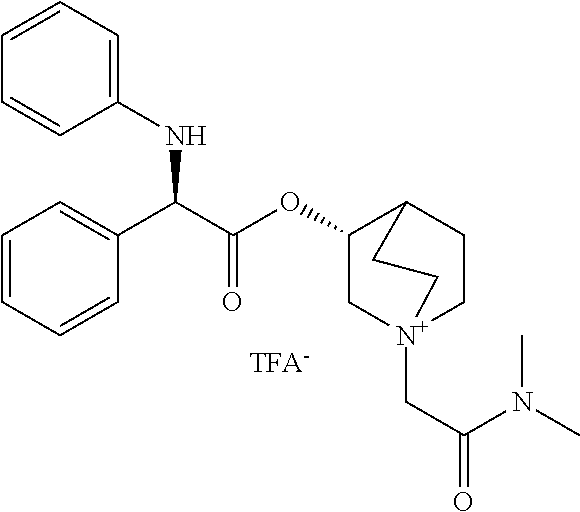 |
48% yield brown viscous oil | LC-MS (ESI POS): 422.1 (MH+) 1H NMR (300 MHz, DMSO-d6) ppm: 7.48-7.66 (m, 2 H), 7.25-7.47 (m, 3 H), 6.99-7.18 (m, 2 H), 6.73 (m, 2 H), 6.55-6.65 (m, 1 H), 5.35 (s, 1 H), 5.06-5.23 (m, 1 H), 4.25 (s, 2 H), 4.03 (ddd, 1 H), 3.43-3.73 (m, 4 H), 3.22-3.42 (m, 1 H), 2.92 (s, 3 H), 2.87 (s, 3 H), 2.29-2.38 (m, 1 H), 1.64-2.10 (m, 4 H) [α]D = −40.0° (c = 0.1, MeOH) |
| Diastereoisomer 1 of C165 |  |
24% yield brown oil | LC-MS (ESI POS): 393.3 (MH+) 1H NMR (300 MHz, DMSO-d6) ppm: 7.50-7.61 (m, 2 H), 7.26- 7.47 (m, 3 H), 7.03-7.16 (m, 2 H), 6.68-6.78 (m, 2 H), 6.54-6.65 (m, 1 H), 5.36 (s, 1 H), 4.99-5.22 (m, 1 H), 4.37 (s, 2 H), 3.88-4.00 (m, 1 H), 3.36-3.57 (m, 3 H), 3.05-3.36 (m, 2 H), 2.28-2.38 (m, 1 H), 2.11 (s, 3 H), 1.70-2.07 (m, 4 H) |
| Diastereoisomer 1 of C166 |  |
18% yield Pale yellow solid | LC-MS (ESI POS): 518.9 (MH+) 1H NMR (300 MHz, DMSO-d6) ppm: 7.90-8.07 (m, 2 H), 7.72-7.82 (m, 2 H), 7.57-7.68 (m, 3 H), 7.33-7.55 (m, 5 H), 6.60-6.84 (m, 1 H), 5.57-5.87 (m, 1 H), 5.21-5.39 (m, 1 H), 4.98-5.21 (m, 2 H), 4.00-4.23 (m, 1 H), 3.78 (s, 3 H), 3.26- 3.51 (m, 5 H), 2.30-2.47 (m, 1 H), 1.43-2.23 (m, 4 H) |
| Diastereoisomer 1 of C167 |  |
27% yield Yellow solid | LC-MS (ESI POS): 525.0 (MH+) 1H NMR (300 MHz, DMSO-d6) ppm: 8.13-8.28 (m, 1 H) 8.05 (m, 1 H) 7.72- 7.86 (m, 1 H) 7.66 (d, 1 H) 7.27-7.56 (m, 4 H) 6.72 (d, 1 H) 5.68 (d, 1 H) 5.19-5.32 (m, 1 H) 5.02 (s, 2 H) 4.02- 4.24 (m, 1 H) 3.78 (s, 3 H) 3.37-3.68 (m, 7 H) 2.32-2.43 (m, 1 H) 1.88-2.23 (m, 3 H) 1.36-1.64 (m, 1 H) |
| C168 |  |
26% yield White solid | LC-MS (ESI POS): 485.0 (MH+) 1H NMR (300 MHz, DMSO-d6) ppm: 8.47 (s, 1 H, formiate ion), 7.83-8.06 (m, 2 H), 7.68-7.82 (m, 1 H), 7.55-7.68 (m, 2 H), 7.39-7.55 (m, 2 H), 7.02-7.17 (m, 2 H), 6.90-7.02 (m, 2 H), 6.66- 6.80 (m, 2 H), 6.52-6.63 (m, 1 H), 6.31 (d, 1 H), 5.24-5.38 (m, 1 H), 4.99-5.22 (m, 3 H), 3.98-4.20 (m, 1 H), 3.76 (s, 3 H), 3.45-3.83 (m, 5 H), 2.11-2.40 (m, 1 H), 1.45-2.10 (m, 4 H) |
| C169 |  |
58% yield Pale yellow oil | LC-MS (ESI POS): 489.1 (MH+) 1H NMR (300 MHz, DMSO-d6) ppm: 7.88-8.09 (m, 2 H), 7.70-7.87 (m, 1 H), 7.50-7.70 (m, 4 H), 7.27-7.50 (m, 3 H), 7.12 (m, 2 H), 6.76 (m, 2 H), 6.60 (d, 1 H), 5.31-5.49 (m, 1 H), 5.19-5.31 (m, 1 H), 5.14 (s, 2 H), 3.91-4.21 (m, 1 H), 3.57-3.88 (m, 5 H), 1.35-2.44 (m, 5 H) |
| C170 |  |
41% yield White solid | LC-MS (ESI POS): 523.3 (MH+) 1H NMR (300 MHz, DMSO-d6) ppm: 8.45 (s, 1 H, formite ion), 7.91-8.04 (m, 2 H), 7.69-7.91 (m, 4 H), 7.48-7.69 (m, 3 H), 7.03-7.18 (m, 2 H), 6.70-6.80 (m, 2 H), 6.52-6.67 (m, 2 H), 5.50-5.64 (m, 1 H), 5.00-5.30 (m, 3 H), 3.51-4.32 (m, 6 H), 2.14-2.41 (m, 1 H), 1.54-2.14 (m, 4 H) |
| C171 | 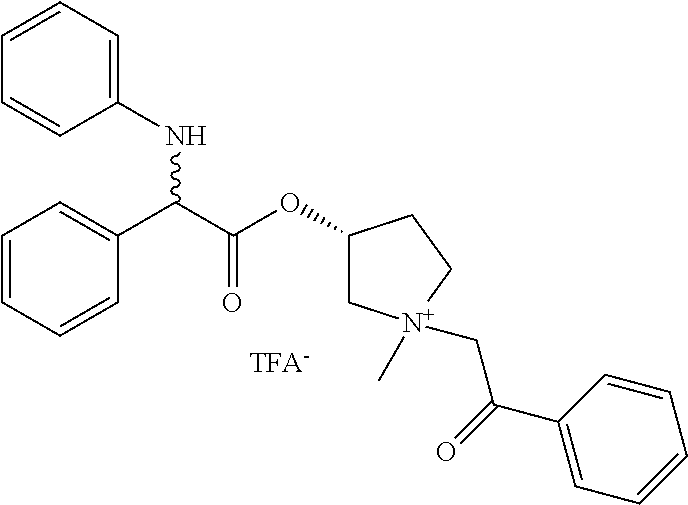 |
38% yield yellow sticky oil | LC-MS (ESI POS): 429.1 (MH+) 1H NMR (300 MHz, DMSO-d6) ppm: 7.90-8.09 (m, 2 H), 7.54- 7.90 (m, 5 H), 6.90-7.52 (m, 5 H), 6.29-6.82 (m, 3 H), 5.43- 5.57 (m, 1 H), 5.14-5.42 (m, 3 H), 3.72-4.19 (m, 4 H), 3.17 (s, 3 H), 2.55-2.73 (m, 1 H), 1.93-2.42 (m, 1 H) |
| C172 |  |
43% yield yield sticky oil | LC-MS (ESI POS): 339.2 (MH+) 1H NMR (300 MHz, DMSO-d6) ppm: 7.52-7.65 (m, 2 H), 7.29- 7.49 (m, 3 H), 6.97-7.16 (m, 2 H), 6.66-6.79 (m, 2 H), 6.54-6.66 (m, 1 H), 6.32 (s, 1 H), 5.11-5.39 (m, 1 H), 4.81-5.01 (m, 1 H), 3.14-3.45 (m, 3 H), 3.04 (s, 6 H), 2.82-2.95 (m, 1 H), 1.35-2.25 (m, 4 H) |
| Diastereoisomer 1 of C173 |  |
84% yield brown solid | LC-MS (ESI POS): 475.2 (MH+) 1H NMR (300 MHz, DMSO-d6) ppm: 8.36 (d, 1 H), 7.54-7.60 (m, 2 H), 7.31-7.48 (m, 3 H), 7.24 (t, 1 H), 7.03-7.15 (m, 2 H), 6.68-6.80 (m, 2 H), 6.52-6.64 (m, 1 H), 5.37 (s, 1 H), 5.11-5.27 (m, 1 H), 4.89 (s, 2 H), 3.97-4.15 (m, 1 H), 3.20-3.51 (m, 5 H), 2.49 (s, 3 H), 2.32-2.40 (m, 1 H), 1.76-2.16 (m, 4 H) [α]D = −46.51° (c = 0.35, MeOH) |

To a solution of (R)-phenyl-phenylamino-acetic acid (R)-(1-aza-bicyclo[2.2.2]oct-3-yl)ester (Diastereoisomer 1 of C2) (50 mg, 0.15 mmol) in acetonitrile (1 mL), is added 2-bromo-1-(2,4-difluoro-phenyl)-ethanone (35 mg, 0.15 mmol) and the mixture reacted in a closed vessel under MW irradiation for 1 hour at 100° C. (UPLC-MS monitoring: complete conversion). The solvent is evaporated and the resulting crude is purified by flash chromatography (DCM/MeOH=95/5) to obtain the title compound as a white solid (37.3 mg, 44% yield, bromide salt, single diastereoisomer).
1H NMR (300 MHz, DMSO-d6) ppm: 7.97-8.07 (m, 1 H), 7.52-7.72 (m, 3 H), 7.39-7.52 (m, 2 H), 7.25-7.39 (m, 2 H), 6.92-7.21 (m, 2 H), 6.67-6.84 (m, 2 H), 6.51-6.67 (m, 1 H), 6.36 (d, 1 H), 5.38 (d, 1 H), 5.00-5.30 (m, 1 H), 4.88 (br. s., 2 H), 3.91-4.20 (m, 1 H), 3.51-3.74 (m, 3 H), 3.41-3.51 (m, 1 H), 3.31-3.41 (m, 1 H), 2.31-2.43 (m, 1 H), 1.86-2.09 (m, 4 H);
LC-MS (ESI POS): 491.1 (MH+);
[α]D=−45.42° (c=0.24, MeOH).
Final compounds listed in Table 21 are prepared as previously described for C174, by alkylation of suitable intermediate (Diastereoisomer 1 of C2, C2, C80, C83, C85, C89, C87, C95, C101, C94, C95 C100, C132, C133, C143, C27, C138) and the commercially available alkylating agents.
| TABLE 21 | |||
| Yield and | |||
| Compound | Structure | Appearance | Analytical |
| Diastereoisomer 1 of C175 |  |
69% yield White solid | LC-MS (ESI POS): 491.1 (MH+) 1H NMR (300 MHz, DMSO-d6) ppm: 7.95-8.15 (m, 1 H), 7.81-7.95 (m, 1 H), 7.70 (s, 1 H), 7.50-7.63 (m, 2 H), 7.22-7.50 (m, 3 H), 6.95-7.21 (m, 2 H), 6.67-6.82 (m, 2 H), 6.50- 6.67 (m, 1 H), 6.36 (d, 1 H), 5.38 (d, 1 H), 5.13-5.29 (m, 1 H), 5.06 (s, 2 H), 3.92-4.17 (m, 1 H), 3.53- 3.67 (m, 3 H), 3.32-3.50 (m, 2 H), 2.31-2.43 (m, 1 H), 1.73-2.19 (m, 4 H) [α]D = −42.45° (c = 0.22, MeOH) |
| Diastereoisomer 1 of C176 |  |
25% yield Off-white solid | LC-MS (ESI POS): 473.0 (MH+) 1H NMR (300 MHz, DMSO-d6) ppm: 7.87-8.02 (m, 1 H), 7.72-7.87 (m, 1 H), 7.52-7.68 (m, 2 H), 7.28-7.52 (m, 5 H), 6.98-7.23 (m, 2 H), 6.67- 6.84 (m, 2 H), 6.48-6.69 (m, 1 H), 6.36 (d, 1 H), 5.38 (d, 1 H), 5.08- 5.30 (m, 1 H), 4.91 (br. s., 2 H), 3.91-4.23 (m, 1 H), 3.35-3.73 (m, 5 H), 2.30-2.46 (m, 1 H), 1.55- 2.20 (m, 4 H) |
| Diastereoisomer 1 of C177 |  |
41% yield Yellow solid | LC-MS (ESI POS): 473.1 (MH+) 1H NMR (300 MHz, DMSO-d6) ppm: 7.75-7.86 (m, 2 H), 7.51-7.73 (m, 4 H), 7.26-7.51 (m, 3 H), 6.95-7.25 (m, 2 H), 6.68-6.85 (m, 2 H), 6.51- 6.68 (m, 1 H), 6.36 (d, 1 H), 5.39 (d, 1 H), 5.15-5.30 (m, 1 H), 5.10 (s, 2 H), 4.00-4.15 (m, 1 H), 3.60- 3.75 (m, 2 H), 3.34-3.60 (m, 3 H), 2.31-2.42 (m, 1 H), 1.84-2.14 (m, 4 H) |
| Diastereoisomer 1 of C178 |  |
47% yield White solid | LC-MS (ESI POS): 610.7 (MH+) 1H NMR (300 MHz, DMSO-d6) ppm: 8.12 (d, 1 H), 7.86 (dd, 1 H), 7.79 (d, 1 H), 7.53-7.64 (m, 2 H), 7.29- 7.47 (m, 3 H), 7.00-7.17 (m, 2 H), 6.75 (m, 2 H), 6.53-6.68 (m, 1 H), 6.39 (d, 1 H), 5.39 (d, 1 H), 5.17- 5.28 (m, 1 H), 5.03 (s, 2 H), 3.94- 4.17 (m, 1 H), 3.34-3.77 (m, 5 H), 2.31-2.41 (m, 1 H), 1.68-2.19 (m, 4 H) [α]D = −50.30° (c = 0.6, MeOH) |
| Diastereoisomer 1 of C179 |  |
100% yield Orange solid | LC-MS (ESI POS): 500.1 (MH+) 1H NMR (300 MHz, DMSO-d6) ppm: 8.36-8.53 (m, 2 H), 8.10-8.25 (m, 2 H), 7.53-7.65 (m, 2 H), 7.32-7.48 (m, 3 H), 7.01-7.20 (m, 2 H), 6.70- 6.84 (m, 2 H), 6.55-6.65 (m, 1 H), 6.37 (d, 1 H), 5.39 (d, 1 H), 5.19- 5.30 (m, 1 H), 5.16 (s, 2 H), 4.00- 4.17 (m, 1 H), 3.34-3.78 (m, 5 H), 2.31-2.42 (m, 1 H), 1.67-2.12 (m, 4 H) |
| Diastereoisomer 1 of C180 |  |
64% yield light brown solid | LC-MS (ESI POS): 471.0 (MH+) 1H NMR (300 MHz, DMSO-d6) ppm: 7.69-7.89 (m, 2 H), 7.51-7.65 (m, 2 H), 7.30-7.49 (m, 3 H), 6.98-7.15 (m, 2 H), 6.83-6.96 (m, 2 H), 6.70- 6.79 (m, 2 H), 6.60 (m, 1 H), 6.36 (d, 1 H), 5.38 (d, 1 H), 5.15-5.25 (m, 1 H), 4.96 (s, 2 H), 3.89-4.20 (m, 1 H), 3.34-3.77 (m, 5 H), 2.31-2.43 (m, 1 H), 1.70-2.16 (m, 4 H) [α]D = −44.08° (c = 0.25, MeOH) |
| Diastereoisomer 1 of C181 |  |
81% yield Yellow solid | LC-MS (ESI POS): 510.0 (MH+) 1H NMR (300 MHz, DMSO-d6) ppm: 10.95 (s, 1 H), 7.87 (dd, 1 H), 7.82 (d, 1 H), 7.53-7.65 (m, 2 H), 7.26- 7.48 (m, 3 H), 7.03-7.15 (m, 2 H), 6.98 (d, 1 H), 6.69-6.81 (m, 2 H), 6.52-6.63 (m, 1 H), 6.38 (d, 1 H), 5.38 (d, 1 H), 5.15-5.26 (m, 1 H), 5.05 (s, 2 H), 3.98-4.22 (m, 1 H), 3.63-3.80 (m, 2 H), 3.61 (s, 2 H), 3.48-3.59 (m, 2 H), 3.34-3.47 (m, 1 H), 2.31-2.42 (m, 1 H), 1.65-2.19 (m, 4 H) [α]D = −47.07° (c = 0.28, MeOH) |
| Diastereoisomer 1 of C182 |  |
33% yield Yellow solid | LC-MS (ESI POS): 499.0 (MH+) 1H NMR (300 MHz, DMSO-d6) ppm: 7.53-7.64 (m, 3 H), 7.29-7.51 (m, 4 H), 7.14 (d, 1 H), 7.02-7.12 (m, 2 H), 6.69-6.82 (m, 2 H), 6.54-6.66 (m, 1 H), 6.36 (d, 1 H), 6.19 (s, 2 H), 5.38 (d, 1 H), 5.13-5.26 (m, 1 H), 4.98 (s, 2 H), 3.88-4.15 (m, 1 H), 3.35-3.75 (m, 5 H), 2.30-2.42 (m, 1 H), 1.70-2.12 (m, 4 H) [α]D = −62.80° (c = 0.2, MeOH) |
| Diastereoisomer 1 of C183 |  |
73% yield yellow solid | LC-MS (ESI POS): 461.9 (MH+) 1H NMR (300 MHz, DMSO-d6) ppm: 8.39 (d, 1 H), 8.24 (d, 1 H), 7.51- 7.65 (m, 2 H), 7.27-7.49 (m, 3 H), 6.98-7.18 (m, 2 H), 6.69-6.79 (m, 2 H), 6.60 (m, 1 H), 6.36 (d, 1 H), 5.38 (d, 1 H), 5.17-5.31 (m, 1 H), 5.12 (s, 2 H), 4.05-4.25 (m, 1 H), 3.58-3.77 (m, 3 H), 3.44-3.58 (m, 1 H), 3.33-3.41 (m, 1 H), 2.31-2.40 (m, 1 H), 1.76-2.16 (m, 4 H) [α]D = −58.16° (c = 0.25, MeOH) |
| Diastereoisomer 1 of C184 | 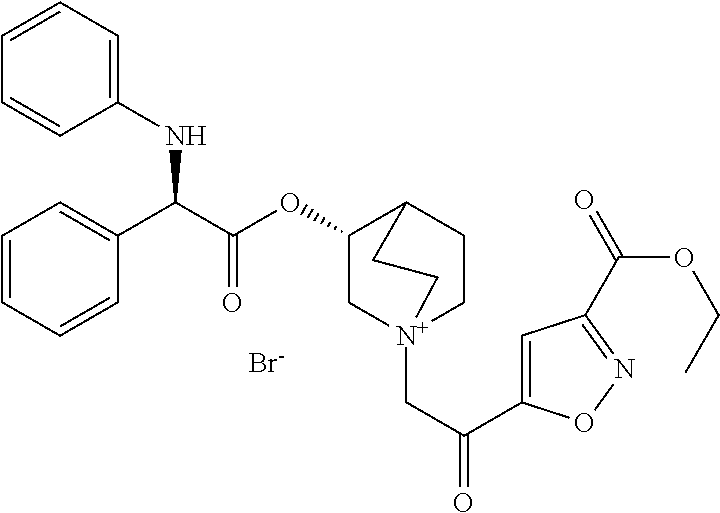 |
27% yield yellow amorphous solid | LC-MS (ESI POS): 517.9 (MH+) 1H NMR (300 MHz, DMSO-d6) ppm: 7.86 (s, 1 H), 7.49-7.65 (m, 2 H), 7.29-7.49 (m, 3 H), 6.95-7.18 (m, 2 H), 6.68-6.82 (m, 2 H), 6.55-6.67 (m, 1 H), 6.36 (d, 1 H), 5.38 (d, 1 H), 5.14-5.25 (m, 1 H), 4.93 (s, 2 H), 4.43 (q, 2 H), 3.96-4.15 (m, 1 H), 3.34-3.71 (m, 5 H), 2.31- 2.40 (m, 1 H), 1.85-2.09 (m, 4 H), 1.35 (t, 3 H) [α]D = −45.40° (c = 0.2, MeOH) |
| Diastereoisomer 1 of C185 |  |
6% yield White solid | LC-MS (ESI POS): 475.0 (MH+) 1H NMR (300 MHz, DMSO-d6) ppm: 7.89 (d, 1 H), 7.82 (s, 1 H), 7.51- 7.62 (m, 2 H), 7.28-7.48 (m, 3 H), 7.01-7.18 (m, 2 H), 6.67-6.80 (m, 2 H), 6.52-6.65 (m, 1 H), 6.36 (d, 1 H), 5.37 (d, 1 H), 5.08-5.26 (m, 1 H), 4.92 (s, 2 H), 3.95-4.19 (m, 1 H), 3.41-3.75 (m, 5 H), 2.29- 2.30 (m, 1 H), 2.29 (s, 3 H), 1.80- 2.12 (m, 4 H) |
| Diastereoisomer 1 of C186 |  |
67% yield Off-white solid | LC-MS (ESI POS): 510.9 (MH+) 1H NMR (300 MHz, DMSO-d6) ppm: 8.56 (d, 1 H), 8.25 (d, 1 H), 7.97 (d, 1 H), 7.91 (dd, 1 H), 7.67 (d, 1 H), 7.52-7.62 (m, 2 H), 7.40-7.51 (m, 2 H), 7.28-7.40 (m, 1 H), 7.03-7.18 (m, 2 H), 6.69-6.84 (m, 2 H), 6.53- 6.66 (m, 1 H), 6.38 (d, 1 H), 5.40 (d, 1 H), 5.20 (s, 2 H), 5.14-5.30 (m, 1 H), 4.06-4.23 (m, 1 H), 3.60- 3.82 (m, 3 H), 3.50-3.60 (m, 1 H), 3.35-3.50 (m, 1 H), 2.34-2.42 (m, 1 H), 1.69-2.15 (m, 4 H) [α]D = −42.73° (c = 0.3, MeOH) |
| C187 |  |
82% yield Off-white solid | LC-MS (ESI POS): 459.2 (MH+) 1H NMR (300 MHz, DMSO-d6) ppm: 7.50-7.61 (m, 4 H), 7.29-7.49 (m, 6 H), 7.08 (dd, 2 H), 6.65-6.79 (m, 2 H), 6.55-6.65 (m, 1 H), 6.40 (d, 1 H), 5.35 (d, 1 H), 5.04-5.15 (m, 1 H), 4.96 (s, 2 H), 3.76 (ddd, 1 H), 3.33-3.50 (m, 3 H), 2.85-3.06 (m, 2 H), 2.23-2.34 (m, 1 H), 1.67-2.04 (m, 4 H) [α]D = −55.41° (c = 1, MeOH) |
| Diastereoisomer 1 of C188 |  |
37% yield white solid | LC-MS (ESI POS): 162.2 (MH+) 1H NMR (300 MHz, DMSO-d6) ppm: 7.50-7.60 (m, 2 H) 7.29-7.46 (m, 3 H) 7.02-7.14 (m, 2 H) 6.67-6.79 (m, 2 H) 6.54-6.66 (m, 1 H) 6.37 (d, 1 H) 5.35 (d, 1 H) 5.06-5.22 (m, 1 H) 4.31 (s, 2 H) 3.97-4.15 (m, 1 H) 3.31-3.80 (m, 9 H) 2.23-2.39 (m, 1 H) 1.77-2.10 (m, 4 H) 1.38-1.69 (m, 6 H) [α]D = −40.7° (c = 0.4, MeOH) |
| C189 |  |
47% yield White solid | LC-MS (ESI POS): 476.9 (MH+) 1H NMR (300 MHz, DMSO-d6) ppm: 12.82 (br. s., 1 H), 7.55-7.60 (m, 2 H), 7.53 (d, 1 H), 7.33-7.47 (m, 3 H), 7.32 (d, 1 H), 7.00-7.15 (m, 2 H), 6.69-6.81 (m, 2 H), 6.53-6.66 (m, 1 H), 6.39 (d, 1 H), 5.37 (d, 1 H), 5.06-5.21 (m, 1 H), 4.30 (s, 2 H), 4.00-4.17 (m, 1 H), 3.46-3.75 (m, 5 H), 2.29-2.39 (m, 1 H), 1.41-2.13 (m, 4 H) |
| Diastereoisomer 1 of C190 |  |
34% yield White solid | LC-MS (ESI POS): 461.0 (MH+) 1H NMR (300 MHz, DMSO-d6) ppm: 11.82 (br. s., 1 H), 8.89 (d, 1 H), 7.52-7.63 (m, 2 H), 7.26-7.50 (m, 3 H), 7.02-7.17 (m, 2 H), 6.90 (d, 1 H), 6.70-6.80 (m, 2 H), 6.53-6.64 (m, 1 H), 6.39 (d, 1 H), 5.36 (d, 1 H), 5.04-5.25 (m, 1 H), 4.28 (s, 2 H), 3.99-4.15 (m, 1 H), 3.44- 3.75 (m, 5 H), 2.27-2.39 (m, 1 H), 1.71-2.13 (m, 4 H) [α]D = −44.66° (c = 1, DCM) |
| C191 |  |
36% yield White solid | LC-MS (ESI POS): 469.1 (MH+) 1H NMR (300 MHz, DMSO-d6) ppm: 7.88-8.07 (m, 2 H), 7.71-7.83 (m, 1 H), 7.51-7.68 (m, 4 H), 7.24-7.48 (m, 3 H), 6.91 (m, 2 H), 6.66 (m, 2 H), 6.16 (d, 1 H), 5.34 (d, 1 H), 5.15-5.27 (m, 1 H), 5.09 (s, 2 H), 3.92-4.19 (m, 1 H), 3.33-3.77 (m, 5 H), 2.31-2.41 (m, 1 H), 2.12 (s, 3 H), 1.77-2.08 (m, 4 H) |
| C192 |  |
32% yield Pale brown solid | LC-MS (ESI POS): 473.1 (MH+) 1H NMR (300 MHz, DMSO-d6) ppm: 7.90-8.05 (m, 2 H), 7.72-7.84 (m, 1 H), 7.52-7.70 (m, 4 H), 7.23-7.50 (m, 3 H), 6.86-7.01 (m, 2 H), 6.64- 6.80 (m, 2 H), 6.35 (d, 1 H), 5.37 (d, 1 H), 5.16-5.26 (m, 1 H), 5.12 (s, 1 H), 3.99-4.13 (m, 1 H), 3.38- 3.84 (m, 6 H), 2.30-2.41 (m, 1 H), 1.39-2.18 (m, 4 H) |
| C193 | 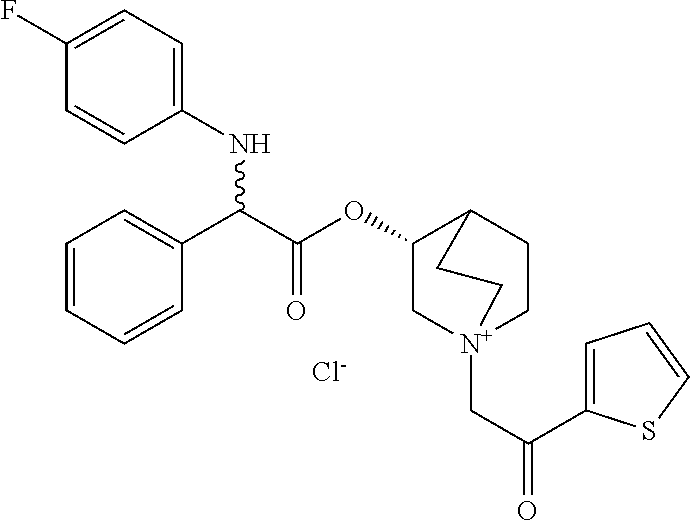 |
6% yield White solid | LC-MS (ESI POS): 479.0 (MH+) 1H NMR (300 MHz, DMSO-d6) ppm: 8.14-8.29 (m, 1 H), 7.93-8.13 (m, 1 H), 7.51-7.63 (m, 2 H), 7.27-7.48 (m, 5 H), 6.86-7.04 (m, 2 H), 6.63- 6.81 (m, 2 H), 6.11-6.43 (m, 1 H), 5.26-5.43 (m, 1 H), 5.13-5.26 (m, 1 H), 4.90-5.11 (m, 2 H), 3.92-4.25 (m, 1 H), 3.33-3.86 (m, 5 H), 2.30- 2.42 (m, 0 H), 1.48-2.19 (m, 4 H) |
| C194 |  |
42% yield White powder | LC-MS (ESI POS): 513.0 (MH+) 1H NMR (300 MHz, DMSO-d6) ppm: 8.82 (t, 1 H), 7.93-8.09 (m, 2 H), 7.82-7.91 (m, 1 H), 7.70-7.81 (m, 1 H), 7.51-7.70 (m, 4 H), 7.21-7.51 (m, 4 H), 6.56-6.79 (m, 2 H), 5.61 and 5.67 (d, 1 H), 5.22-5.36 (m, 1 H), 5.14 and 5.20 (s, 2 H), 3.94-4.27 (m, 1 H), 3.86 (s, 3 H), 3.35-3.77 (m, 5 H), 2.15-2.24 and 2.37-2.46 (m, 1 H), 1.38-2.14 (m, 4 H) |
| C195 |  |
11% yield White powder | LC-MS (ESI POS): 485.1 (MH+) 1H NMR (300 MHz, DMSO-d6) ppm: 7.89-8.10 (m, 2 H), 7.71-7.82 (m, 1 H), 7.58-7.70 (m, 2 H), 7.50-7.58 (m, 2 H), 7.24-7.48 (m, 3 H), 6.88 (d, 1 H), 6.71 (td, 1 H), 6.63 (td, 1 H), 6.37-6.52 (m, 1 H), 5.44 (d, 1 H), 5.39 (d, 1 H), 5.21-5-29 (m, 1 H), 5.13 and 5.20 (s, 2 H), 4.00-4.21 (m, 1 H), 3.85 (s, 3 H), 3.35-3.76 (m, 5 H), 2.14-2.20 and 2.35-2.45 (m, 1 H), 1.33-2.11 (m, 4 H) |
| C196 |  |
20% yield White solid | LC-MS (ESI POS): 539.0 (MH+) 1H NMR (300 MHz, DMSO-d6) ppm: 7.89-8.07 (m, 2 H), 7.70-7.82 (m, 1 H), 7.52-7.70 (m, 4 H), 7.30-7.52 (m, 3 H), 7.19 (t, 1 H), 6.80-6.97 (m, 1 H), 6.69-6.80 (m, 2 H), 6.46-6.57 (m, 1 H), 5.44 and 5.48 (d, 1 H), 5.21-5.29 (m, 1 H), 5.14 and 5.20 (s, 2 H), 3.99-4.24 (m, 1 H), 3.39- 3.87 (m, 5 H), 2.09-2.18 and 2.33- 2.43 (m, 1 H), 1.42-2.18 (m, 4 H) |
| C197 |  |
37% yield White solid | LC-MS (ESI POS): 469.1 (MH+) 1H NMR (300 MHz, DMSO-d6) ppm: 7.89-8.11 (m, 2 H), 7.69-7.85 (m, 1 H), 7.51-7.69 (m, 4 H), 7.27-7.49 (m, 3 H), 7.04 (d, 1 H), 6.87-7.01 (m, 1 H), 6.55-6.64 (m, 1 H), 6.46 (d, 1 H), 5.38-5.50 (m, 1 H), 5.09- 5.31 (m, 4 H), 3.99-4.23 (m, 1 H), 3.45-3.89 (m, 5 H), 2.34-2.43 (m, 1 H), 2.25 (s, 3 H), 1.37-2.09 (m, 4 H) |
| C198 |  |
41% yield Off-white solid | LC-MS (ESI POS): 512.1 (MH+) 1H NMR (300 MHz, DMSO-d6) ppm: 9.69 and 9.71 (d, 1 H), 7.89-8.07 (m, 2 H), 7.69-7.83 (m, 1 H), 7.50- 7.68 (m, 4 H), 7.30-7.49 (m, 3 H), 7.09-7.25 (m, 1 H), 7.00 (t, 1 H), 6.61-6.81 (m, 1 H), 6.27-6.56 (m, 2 H), 5.03-5.32 (m, 4 H), 4.05-4.27 (m, 1 H), 3.44-3.90 (m, 5 H), 2.11- 2.21 and 2.32-2.42 (m, 1 H), 1.94 and 1.96 (s, 3 H), 1.59-2.10 (m, 4 H) |
| C199 |  |
51% yield Off-white solid | LC-MS(ESI POS): 512.1 (MH+) 1H NMR (300 MHz, DMSO-d6) ppm: 8.14-8.30 (m, 1 H), 7.92-8.05 (m, 2 H), 7.55-7.86 (m, 5 H), 7.30-7.50 (m, 3 H), 7.11-7.23 (m, 1 H), 6.99- 7.10 (m, 1 H), 6.91 (d, 1 H), 6.62 (d, 2 H), 5.45 (d, 1 H), 5.19-5.24 (m, 1 H), 5.14 (s, 2 H), 4.03-4.26 (m, 1 H), 3.35-3.86 (m, 5 H), 2.70 (d, 3 H), 2.10-2.40 (m, 1 H), 1.61- 2.09 (m, 4 H) |
| C200 |  |
42% yield Off-white solid | LC-MS (ESI POS): 501.3 (MH+) 1H NMR (300 MHz, DMSO-d6) ppm: 7.90-8.09 (m, 2 H), 7.71-7.84 (m, 1 H), 7.52-7.70 (m, 4 H), 7.28-7.49 (m, 3 H), 7.01 and 7.04 (d, 1 H), 6.67 (s, 1 H), 6.37-6.59 (m, 3 H), 5.40 and 5.43 (d, 1 H), 5.19-5.30 (m, 1 H), 5.14 and 5.21 (s, 2 H), 4.01-4.25 (m, 1 H), 3.40-3.88 (m, 5 H), 2.37 (s, 3 H), 1.38-2.21 (m, 5 H) |
| C201 |  |
42% yield pale pink solid | LC-MS (ESI POS): 491.2 (MH+) 1H NMR (300 MHz, DMSO-d6): Diastereisomer 1: 7.88-8.07 (m, 2 H), 7.70-7.81 (m, 1 H), 7.49- 7.68 (m, 4 H), 7.19-7.33 (m, 2 H), 6.99-7.16 (m, 1 H), 6.69-6.85 (m, 1 H), 6.49-6.62 (m, 2 H), 6.22- 6.44 (m, 1 H), 5.49 (d, 1 H), 5.21- 5.28 (m, 1 H), 5.13 (s, 2 H), 3.96- 4.10 (m, 1 H), 3.43-3.88 (m, 5 H), 2.32-2.43 (m, 1 H), 1.46-2.21 (m, 4 H) Diastereisomer 2: 7.88-8.07 (m, 2 H), 7.70-7.81 (m, 1 H), 7.49- 7.68 (m, 4 H), 7.19-7.33 (m, 2 H), 6.99-7.16 (m, 1 H), 6.69-6.85 (m, 1 H), 6.49-6.62 (m, 2 H), 6.22- 6.44 (m, 1 H), 5.46 (d, 1 H), 5.21-5.28 (m, 1 H), 5.18 (s, 2 H), 4.10-4.20 (m, 1 H), 3.43-3.88 (m, 5 H), 2.13-2.21 (m, 1 H), 1.36- 2.11 (m, 4 H) |
| C202 |  |
52% yield beage solid | LC-MS (ESI POS): 497.1 (MH+) 1H NMR (300 MHz, DMSO-d6): Diastereisomer 1: 8.20 (dd, 1.03 Hz, 1 H), 8.06 (dd, 1 H), 7.51-7.72 (m, 2 H), 7.31-7.41 (m, 1 H), 7.19-7.29 (m, 2 H), 6.98-7.17 (m, 1 H), 6.69-6.88 (m, 1 H), 6.45-6.62 (m, 2 H), 6.24-6.45 (m, 1 H), 5.48 (d, 1 H), 5.14-5.31 (m, 1 H), 5.03 (s, 2 H), 3.96-4.21 (m, 1 H), 3.36-3.86 (m, 5 H), 2.28-2.43 (m, 1 H), 1.46-2.11 (m, 4 H) Diastereisomer 2: 8.21 (dd, 1 H), 8.10 (dd, J = 3.96, 1.03 Hz, 1 H), 7.51-7.72 (m, 2 H), 7.31-7.41 (m, 1 H), 7.19-7.29 (m, 2 H), 6.98- 7.17 (m, 1 H), 6.69-6.88 (m, 1 H), 6.45-6.62 (m, 2 H), 6.24-6.45 (m, 1 H), 5.44 (d, 1 H), 5.14-5.31 (m, 1 H), 5.09 (s, 2 H), 3.96-4.21 (m, 1 H), 3.36-3.86 (m, 5 H), 2.11-2.20 (m, 1 H), 1.46-2.11 (m, 4 H) |
| C203 |  |
94% yield white solid | LC-MS (ESI POS): 491.2 (MH+) 1H NMR (300 MHz, DMSO-d6): Diastereisomer 1: 7.86-8.04 (m, 2 H), 7.70-7.83 (m, 1 H), 7.53- 7.70 (m, 4 H), 7.19-7.33 (m, 2 H), 7.03-7.14 (m, 1 H), 6.89-7.00 (m, 1 H), 6.56-6.80 (m, 2 H), 5.73- 5.89 (m, 1 H), 5.52 (d, 1 H), 5.20- 5.29 (m, 1 H), 5.12 (s, 2 H), 3.95- 4.29 (m, 1 H), 3.35-3.87 (m, 5 H), 2.32-2.42 (m, 1 H), 1.42-2.13 (m, 4 H) Diastereisomer 2: 7.86-8.04 (m, 2 H), 7.70-7.83 (m, 1 H), 7.53- 7.70 (m, 4 H), 7.19-7.33 (m, 2 H), 7.03-7.14 (m, 1 H), 6.89-7.00 (m, 1 H), 6.56-6.80 (m, 2 H), 5.73-5.89 (m, 1 H), 5.50 (d, 1 H), 5.20-5.29 (m, 1 H), 5.17 (s, 2 H), 3.95-4.29 (m, 1 H), 3.35-3.87 (m, 5 H), 2.14-2.23 (m, 1 H), 1.42-2.13 (m, 4 H) |
| C204 |  |
83% yield white solid | LC-MS (ESI POS): 497.1 (MH+) 1H NMR (300 MHz, DMSO-d6) ppm: 8.17-8.24 (m, 1 H), 8.03-8.14 (m, 1 H), 7.51-7.74 (m, 2 H), 7.28-7.41 (m, 1 H), 7.17-7.27 (m, 2 H), 7.02- 7.14 (m, 1 H), 6.87-6.99 (m, 1 H), 6.44-6.78 (m, 2 H), 5.72-5.91 (m, 1 H), 5.50 (m, 1 H), 5.22 (br. s., 1 H), 5.07 (s, 2 H), 3.99-4.29 (m, 1 H), 3.35-3.94 (m, 5 H), 2.13-2.42 (m, 1 H), 1.41-2.12 (m, 4 H) |
| C205 |  |
81% yield Off-white solid | LC-MS (ESI POS): 513.0 (MH+) 1H NMR (300 MHz, DMSO-d6) ppm: 7.89-8.07 (m, 4 H), 7.70-7.80 (m, 3 H), 7.47-7.67 (m, 2 H), 7.03-7.17 (m, 2 H), 6.70-6.82 (m, 2 H), 6.55- 6.65 (m, 1 H), 6.49 (d, 1 H), 5.56 and 5.52 (d, 1 H), 5.21-5.33 (m, 1 H), 5.20 and 5.12 (s, 2 H), 3.97-4.23 (m, 1 H), 3.85 (s, 3 H), 3.41-3.82 (m, 5 H), 2.33-2.42 and 2.10-2.21 (m, 1 H), 1.49-2.11 (m, 4 H) |
| C206 |  |
46% yield Colorless sticky oil | LC-MS (ESI POS): 461.1 (MH+) 1H NMR (300 MHz, DMSO-d6) ppm: 9.77 (br. s., 1 H), 9.58 (br. s., 1 H), 7.87-8.05 (m, 2 H), 7.72- 7.82 (m, 1 H), 7.40-7.71 (m, 7 H), 5.45-5.70 (m, 1 H), 5.28-5.45 (m, 1 H), 5.06-5.26 (m, 2 H), 3.97-4.21 (m, 1 H), 3.81 (d, 1 H), 3.23-3.76 (m, 4 H), 2.77-3.04 (m, 1 H), 1.88- 2.46 (m, 6 H), 1.69-1.86 (m, 3 H), 1.26-1.69 (m, 3 H), 0.80-1.26 (m, 3 H) |
| C207 | 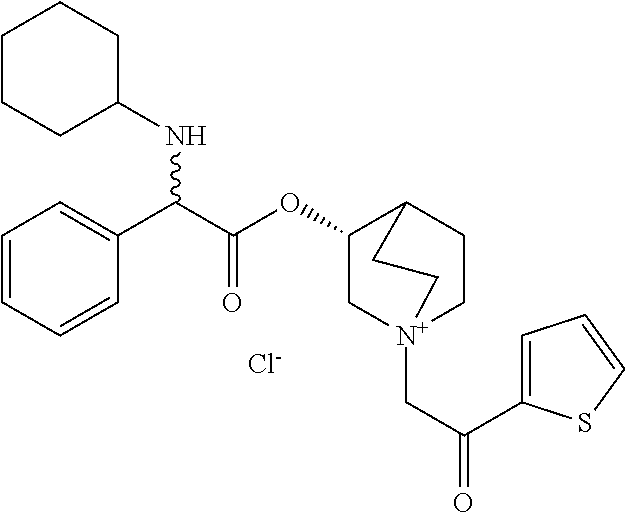 |
41% yield White solid | LC-MS (ESI POS): 467.0 (MH+) 1H NMR (300 MHz, DMSO-d6) ppm: 9.56 (br. s., 2 H), 8.17-8.28 (m, 1 H), 7.94-8.12 (m, 1 H), 7.44-7.77 (m, 5 H), 7.24-7.39 (m, 1 H), 5.44-5.68 (m, 1 H), 5.26-5.44 (m, 1 H), 4.84- 5.14 (m, 2 H), 3.92-4.24 (m, 1 H), 3.43-3.91 (m, 6 H), 2.78-3.08 (m, 1 H), 2.32-2.45 (m, 1 H), 1.84-2.23 (m, 3 H), 1.47-1.84 (m, 2 H), 0.83- 1.47 (m, 8 H) |
| C208 |  |
41% yield Off-white solid | LC-MS (ESI POS): 460.9 (MH+) 1H NMR (300 MHz, DMSO-d6) ppm Diasteroisomer 1: 7.92-8.03 (m, 2 H), 7.71-7.82 (m, 1 H), 7.57- 7.69 (m, 2 H), 7.50-7.57 (m, 1 H), 7.24-7.34 (m, 1 H), 7.01-7.17 (m, 3 H), 6.75-6.83 (m, 2 H), 6.58- 6.67 (m, 1 H), 6.43 (d, 1 H), 5.69 (d, 1 H), 5.23-5.34 (m, 1 H), 5.17 (s, 2 H), 4.05-4.24 (m, 1 H), 3.44- 3.86 (m, 5 H), 2.31-2.43 (m, 1 H), 1.64-2.14 (m, 4 H) Diasteroisomer 2: 7.92-8.03 (m, 2 H), 7.71-7.82 (m, 1 H), 7.57- 7.69 (m, 2 H), 7.50-7.57 (m, 1 H), 7.24-7.34 (m, 1 H), 7.01-7.17 (m, 3 H), 6.75-6.83 (m, 2 H), 6.58- 6.67 (m, 1 H), 6.42 (d, 1 H), 5.66 (d, 1 H), 5.23-5.34 (m, 1 H), 5.21 (s, 2 H), 4.05-4.24 (m, 1 H), 3.44-3.86 (m, 5 H), 2.18-2.24 (m, 1 H), 1.64-2.14 (m, 4 H) |

(R)-Quinuclidin-3-yl 2-(3-fluoro-4-methylphenylamino)-2-phenylacetate (C97) (80 mg, 0.22 mmol) and 2-bromo-1-phenylethanone (45.4 mg, 0.23 mmol) are dissolved in acetonitrile (3 mL) and stirred at RT overnight (Conversion complete by UPLC/MS). Acetonitrile is evaporated and the residue is purified by flash chromatography (DCM/MeOH=97/3) affording thetitle compound as a white solid (29 mg, 23% yield, bromide salt, mixture of diastereoisomers).
1H NMR (300 MHz, DMSO-d6) ppm: 7.92-8.05 (m, 2 H), 7.71-7.86 (m, 1 H), 7.50-7.71 (m, 4 H), 7.28-7.50 (m, 3 H), 6.95 and 6.97 (d, 1 H), 6.38-6.62 (m, 3 H), 5.37 and 5.41 (d, 1 H), 5.19-5.27 (m, 1 H), 5.15 (s, 2 H), 4.00-4.27 (m, 1 H), 3.79 (d, 1 H), 3.40-3.72 (m, 4 H), 2.10-2.20 and 2.33-2.42 (m, 1 H), 2.04 (s, 3 H), 1.85-2.02 (m, 2 H), 1.65-1.85 (m, 1 H), 1.42-1.65 (m, 1 H);
LC-MS (ESI POS): 487.1 (MH+).
Final compounds listed in Table 22 are prepared as previously described for C209, by alkylation of suitable intermediate (C103, C106, C107, C109, C112, C115, C117, C147, C148) and the commercially available alkylating agents.
| TABLE 22 | |||
| Yield and | |||
| Compound | Structure | Appearance | Analytical |
| C210 |  |
40% yield Yellow solid | LC-MS (ESI POS): 515.1 (MH+) 1H NMR (300 MHz, DMSO-d6) ppm: 7.89-8.04 (m, 2 H), 7.70-7.83 (m, 1 H), 7.49-7.69 (m, 4 H), 7.27-7.49 (m, 3 H), 6.77 (d, 1 H), 6.15 (dd, 1 H), 6.03 and 6.06 (d, 1 H), 5.36-5.53 (m, 2 H), 5.21- 5.30 (m, 1 H), 5.13 and 5.19 (s, 2 H), 3.94-4.28 (m, 1 H), 3.80 (s, 3 H), 3.59- 3.73 (m, 3 H), 3.56 and 3.57 (s, 3 H), 3.34-3.54 (m, 2 H), 2.12-222 and 2.35-2.45 (m, 1 H), 1.29-2.12 (m, 4 H) |
| C211 |  |
55% yield White solid | LC-MS (ESI POS): 491.3 (MH+) 1H NMR (300 MHz, DMSO-d6) ppm: 7.92-8.03 (m, 2 H) 7.71-7.81 (m, 1 H) 7.54-7.67 (m, 4 H) 7.31-7.47 (m, 3 H) 7.11 (ddd, 1 H) 6.51-6.63 (m, 1 H) 6.36-6.47 (m, 1 H) 6.02-6.15 (m, 1 H) 5.54 and 5.56 (d, 1 H) 5.22-5.31 (m, 1 H) 5.19 (d, 1 H) 5.12 (d, 1 H) 4.01- 4.22 (m, 1 H) 3.36-3.88 (m, 5 H) 1.34-2.43 (m, 5 H) |
| C212 |  |
58% yield White solid | LC-MS (ESI POS): 483.1 (MH+) 1H NMR (300 MHz, DMSO-d6) ppm: 7.86-8.06 (m, 2 H), 7.68-7.83 (m, 1 H), 7.48-7.67 (m, 4 H), 7.24-7.46 (m, 3 H), 6.94 (d, 2 H), 6.75 (t, 1 H), 5.21-5.25 (m, 1 H), 5.15 and 5.18 (s, 2 H), 5.00 and 5.02 (d, 1 H), 4.70 and 4.75 (d, 1 H), 3.96-4.24 (m, 1 H), 3.44-3.75 (m, 5 H), 2.22 (s, 6 H), 1.27-2.19 (m, 5 H) |
| C213 |  |
60% yield Yellow solid | LC-MS (ESI POS): 483.1 (MH+) 1H NMR (300 MHz, DMSO-d6) ppm: 7.88-8.12 (m, 2 H), 7.71-7.84 (m, 1 H), 7.53-7.70 (m, 4 H), 7.26-7.49 (m, 3 H), 7.04 (d, 1 H), 6.90-7.01 (m, 1 H), 6.57-6.70 (m, 1 H), 6.47 (d, 1 H), 5.42 and 5.45 (d, 1 H), 5.19-5.30 (m, 2 H), 5.14 and 5.20 (s, 2 H), 4.01-4.24 (m, 1 H), 3.33- 3.89 (m, 5 H), 2.64 (q, 2 H), 2.12- 2.20 and 2.32-2.43 (m, 1 H), 1.37- 2.13 (m, 4 H), 1.24 (t, 3 H) |
| C214 | 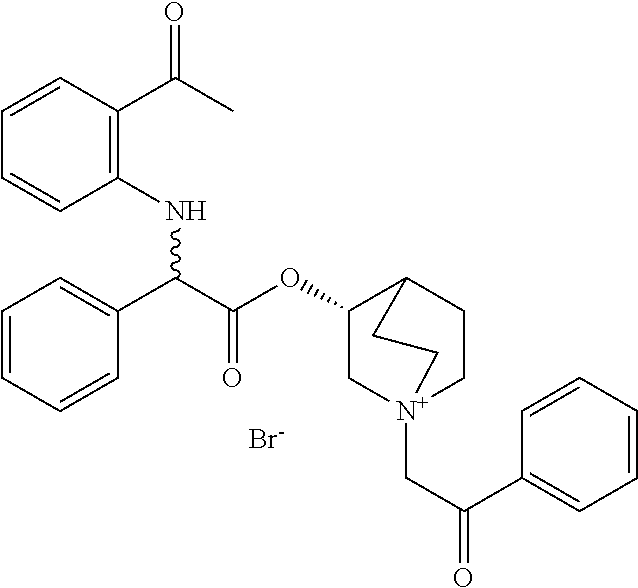 |
83% yield Off-white solid | LC-MS (ESI POS): 497.1 (MH+) 1H NMR (300 MHz, DMSO-d6) ppm: 9.84 and 9.86 (d, 1 H), 7.86-8.09 (m, 3 H), 7.69-7.84 (m, 1 H), 7.56-7.69 (m, 2 H), 7.49-7.56 (m, 2 H), 7.24- 7.48 (m, 4 H), 6.54-6.73 (m, 2 H), 5.62 and 5.67 (d, 1 H), 5.23-5.31 (m, 1 H), 5.15 and 5.22 (s, 2 H), 4.00-4.27 (m, 1 H), 3.35-3.87 (m, 5 H), 2.60 (s, 3 H), 2.17-2.24 and 2.36-2.47 (m, 1 H), 1.42-2.16 (m, 4 H) |
| C215 |  |
24% yield Off-white solid | LC-MS (ESI POS): 527.3 (MH+) 1H NMR (300 MHz, DMSO-d6) ppm: 7.90-8.04 (m, 2 H) 7.71-7.82 (m, 1 H) 7.55-7.68 (m, 4 H) 7.30-7.49 (m, 4 H) 7.15-7.28 (m, 2 H) 6.93-7.04 (m, 1 H) 6.78 (t, 1 H) 5.44 (d, 1 H) 5.19-5.31 (m, 1 H) 5.14 (s, 2 H) 4.25 (q, 2 H) 3.97-4.19 (m, 1 H) 3.42-3.80 (m, 5 H) 1.85-2.22 (m, 4 H) 1.49- 1.85 (m, 1 H) 1.28 (t, 3 H) |
| C216 |  |
60% yield White solid | LC-MS (ESI POS): 491.2 (MH+) 1H NMR (300 MHz, DMSO-d6) ppm Diasteroisomer 2: 7.90-8.06 (m, 2 H), 7.70-7.82 (m, 1 H), 7.51-7.68 (m, 4 H), 7.30-7.51 (m, 3 H), 7.09 (d, 1 H), 6.36-6.53 (m, 2 H), 6.20-6.36 (m, 1 H), 5.52 (d, 1 H), 5.22-5.29 (m, 1 H), 5.15 (s, 2 H), 3.95-4.27 (m, 1 H), 3.42-3.87 (m, 5 H), 2.31- 2.44 (m, 1 H), 1.85-2.12 (m, 4 H) Diasteroisomer 2: 7.90-8.06 (m, 2 H), 7.70-7.82 (m, 1 H), 7.51-7.68 (m, 4 H), 7.30-7.51 (m, 3 H), 7.12 (d, 1 H), 6.36-6.53 (m, 2 H), 6.20-6.36 (m, 1 H), 5.48 (d, 0 H), 5.22-5.30 (m, 1 H), 5.20 (s, 2 H), 3.95-4.27 (m, 1 H), 3.42-3.87 (m, 5 H), 2.11- 2.20 (m, 1 H), 1.87-2.10 (m, 3 H), 1.65-1.85 (m, 1 H), 1.38-1.62 (m, 1 H) |
| C217 |  |
90% yield Yellow solid | LC-MS (ESI POS): 485.1 (MH+) 1H NMR (300 MHz, DMSO-d6) ppm Diastereoisomer 1: 7.92-7.99 (m, 2 H), 7.70-7.81 (m, 1 H), 7.51-7.70 (m, 4 H), 7.26-7.49 (m, 3 H), 6.99 (t, 1 H), 6.29-6.42 (m, 3 H), 6.13-6.24 (m, 1 H), 5.38 (d, 1 H), 5.19-5.27 (m, 1 H), 5.10 (s, 2 H), 3.92-4.20 (m, 1 H), 3.65 (s, 3 H), 3.41-3.81 (m, 5 H), 2.31-2.43 (m, 1 H), 1.74- 2.19 (m, 4 H) Diastereoisomer 2: 7.92-7.99 (m, 2 H), 7.70-7.81 (m, 1 H), 7.51- 7.70 (m, 4 H), 7.26-7.49 (m, 3 H), 6.99 (t, 1 H), 6.29-6.42 (m, 3 H), 6.13-6.24 (m, 1 H), 5.35 (d, 1 H), 5.19-5.27 (m, 1 H), 5.17 (s, 2 H), 3.92-4.20 (m, 1 H), 3.65 (s, 3 H), 3.41-3.81 (m, 5 H), 2.31- 2.43 (m, 1 H), 1.74-2.19 (m, 4 H) |
 |
52% yield White solid | LC-MS (ESI POS): 473.2 (MH+) 1H NMR (300 MHz, DMSO-d6) ppm: 7.91-8.06 (m, 2 H), 7.69-7.84 (m, 1 H), 7.54-7.69 (m, 2 H), 7.30- 7.54 (m, 3 H), 7.15-7.27 (m, 1 H), 7.00-7.15 (m, 2 H), 6.71-6.78 (m, 2 H), 6.54-6.66 (m, 1 H), 6.45 (d, 1 H), 5.45 and 5.49 (d, 1 H), 5.23- 5.29 (m, 1 H), 5.14 and 5.20 (s, 2 H), 3.97-4.21 (m, 1 H), 3.37- 3.90 (m, 5 H), 2.13-2.23 and 2.33-2.41 (m, 1 H), 1.46-2.10 (m, 4 H) | |
 |
61% yield White solid | LC-MS (ESI POS): 473.3 (MH+) 1H NMR (300 MHz, DMSO-d6) ppm: 7.91-8.05 (m, 2 H), 7.71-7.83 (m, 1 H), 7.55-7.71 (m, 4 H), 7.19-7.32 (m, 2 H), 7.04-7.16 (m, 2 H), 6.69- 6.81 (m, 2 H), 6.56-6.67 (m, 1 H), 6.40 (d, 1 H), 5.40 and 5.43 (d, 1 H), 5.22-5.28 (m, 1 H), 5.13 and 5.21 (s, 2 H), 4.00-4.21 (m, 1 H), 3.74-3.87 (m, 1 H), 3.36-3.74 (m, 4 H), 2.12-2.21 and 2.33-2.44 (m, 1 H), 1.45-2.11 (m, 4 H) | |

A mixture of 2-chloroacetophenone (6.20 g, 40.3 mmol) and (R)-((R)-quinuclidin-3-yl) 2-phenyl-2-(phenylamino)acetate) (Diastereoisomer 1 of C2) (12.3 g, 36.6 mmol) in EtOAc (100 ml) is stirred at RT for 2 days (UPLC-MS monitoring: complete conversion). The solvent is evaporated and the crude is purified by flash chromatography eluting with DCM/MeOH=95/5 to get 10.1 g of the title compound as a white solid (56% yield, chloride salt, single diastereoisomer).
1H NMR (400 MHz, DMSO-d6): ppm 7.96 (d, 2H) 7.70-7.81 (m, 1H) 7.58 (d, 2H) 7.62 (d, 2H) 7.29-7.47 (m, 3H) 7.09 (t, 2H) 6.74 (d, 2H) 6.59 (t, 1H) 6.41 (d, 1H) 5.39 (d, 1H) 5.16-5.26 (m, 1H) 5.13 (s, 2H) 4.08 (ddd, 1H) 3.47-3.71 (m, 4 H) 3.35-3.47 (m, 1H) 2.36 (br. s., 1H) 1.84-2.13 (m, 4H);
LC-MS (ESI POS): 455.3 (MH+).
Diastereoisomer 1 of C220 and C221 listed in Table 23 are obtained as previously described for diastereoisomer 1 of C113, using bromo-acetonitrile and bromo-acetic acid tert-butyl ester instead of 2-chloroacetophenone.
| TABLE 23 | |||
| Yield and | |||
| Compound | Structure | Appearance | Analytical |
| Diastereoisomer 1 of C220 |  |
39% yield pale yellow solid | LC-MS (ESI POS): 467.0 (MH+) 1H NMR (300 MHz, DMSO-d6) ppm: 7.50-7.68 (m, 2 H), 7.28-7.46 (m, 3 H), 6.96-7.17 (m, 2 H), 6.69-6.80 (m, 2 H), 6.54-6.65 (m, 1 H), 6.36 (d, 1 H), 5.37 (d, 1 H), 4.99-5.28 (m, 1 H), 4.77 (s, 2 H), 3.99 (ddd, 1 H), 3.35-3.69 (m, 3 H), 3.05-3.24 (m, 2 H), 2.29-2.42 (m, 1 H), 1.64-2.14 (m, 4 H) |
| Diastereoisomer 1 of C221 |  |
33% yield yellow solid | LC-MS (ESI POS): 451.3 (MH+) 1H NMR (300 MHz, DMSO-d6) ppm: 7.49-7.60 (m, 2 H) 7.29-7.46 (m, 3 H) 7.03-7.14 (m, 2 H) 6.68-6.78 (m, 2 H) 6.54-6.65 (m, 1 H) 6.36 (d, 1 H) 5.36 (d, 1 H) 5.12-5.22 (m, 1 H) 4.22 (d, 1 H) 4.16 (d, 1 H) 3.89-4.04 (m, 1 H) 3.34-3.70 (m, 4 H) 3.18-3.27 (m, 1 H) 2.29-2.40 (m, 1 H) 1.75- 2.15 (m, 4 H) 1.46 (s, 9 H) |

To a solution of (S)-quinuclidin-3-yl 2-phenyl-2-(phenylamino)acetate (50.0 mg, 0.15 mmol) in EtOAc (2 mL), is added 2-chloro-1-phenylethanone (23.0 mg, 0.15 mmol) and the reaction is stirred first at RT for 15 hours, then at 70° C. for 7 hours and finally at RT for 3 days. The solvent is removed and the resulting crude is triturated with i-Pr2O/Et2O (3/1) and then with i-Pr2O to achieve the title compound as a beige solid (47.7 mg, 65% yield, chloride salt, mixture of diastereoisomers).
1H NMR (300 MHz, DMSO-d6) ppm: 7.92-8.03 (m, 2 H) 7.71-7.81 (m, 1 H) 7.52-7.67 (m, 4 H) 7.30-7.47 (m, 3 H) 7.04-7.15 (m, 2 H) 6.69-6.79 (m, 2 H) 6.55-6.64 (m, 1 H) 6.38 (d, 1 H) 5.39 (d, 1 H) 5.18-5.28 (m, 1 H) 5.13 (s, 2 H) 4.00-4.19 (m, 1 H) 3.48-3.78 (m, 4 H) 3.34-3.48 (m, 1 H) 2.31-2.42 (m, 1 H) 1.84-2.16 (m, 4 H);
LC-MS (ESI POS): 455.2 (MH+).

(R)-Quinuclidin-3-yl 2-(3-acetylphenylamino)-2-phenyl acetate (C53) (134 mg, 0.35 mmol) and 2-bromo-1-phenylethanone (85.0 mg, 0.42 mmol) are dissolved in ethyl acetate (5 mL) and stirred at RT for 2 hours. EtOAc is evaporated and the resulting crude oil is first purified by flash chromatography (DCM/MeOH=95/5) and then by preparative HPLC. The fractions containing the product are combined and concentrated under vacuum to remove the organic solvent. The resulting aqueous solution is freeze-dried obtaining the title compound as a white-foam (77.7 mg, 40% yield, formate salt, mixture of diastereoisomers).
1H NMR (300 MHz, DMSO-d6) ppm: 8.44 (s, 1H, formiate), 7.92-8.05 (m, 2 H), 7.69-7.80 (m, 1 H), 7.51-7.66 (m, 4 H), 7.15-7.49 (m, 6 H), 6.97-7.07 (m, 1 H), 6.76 and 6.78 (d, 1 H), 5.46 and 5.49 (d, 1 H), 5.23-5.28 (m, 1 H), 5.17 and 5.22 (s, 2 H), 4.01-4.26 (m, 1 H), 3.36-3.87 (m, 5 H), 2.48 (s, 3 H), 2.12-2.20 and 2.33-2.40 (m, 1 H), 1.48-2.11 (m, 4 H);
LC-MS (ESI POS): 497.1 (MH+).
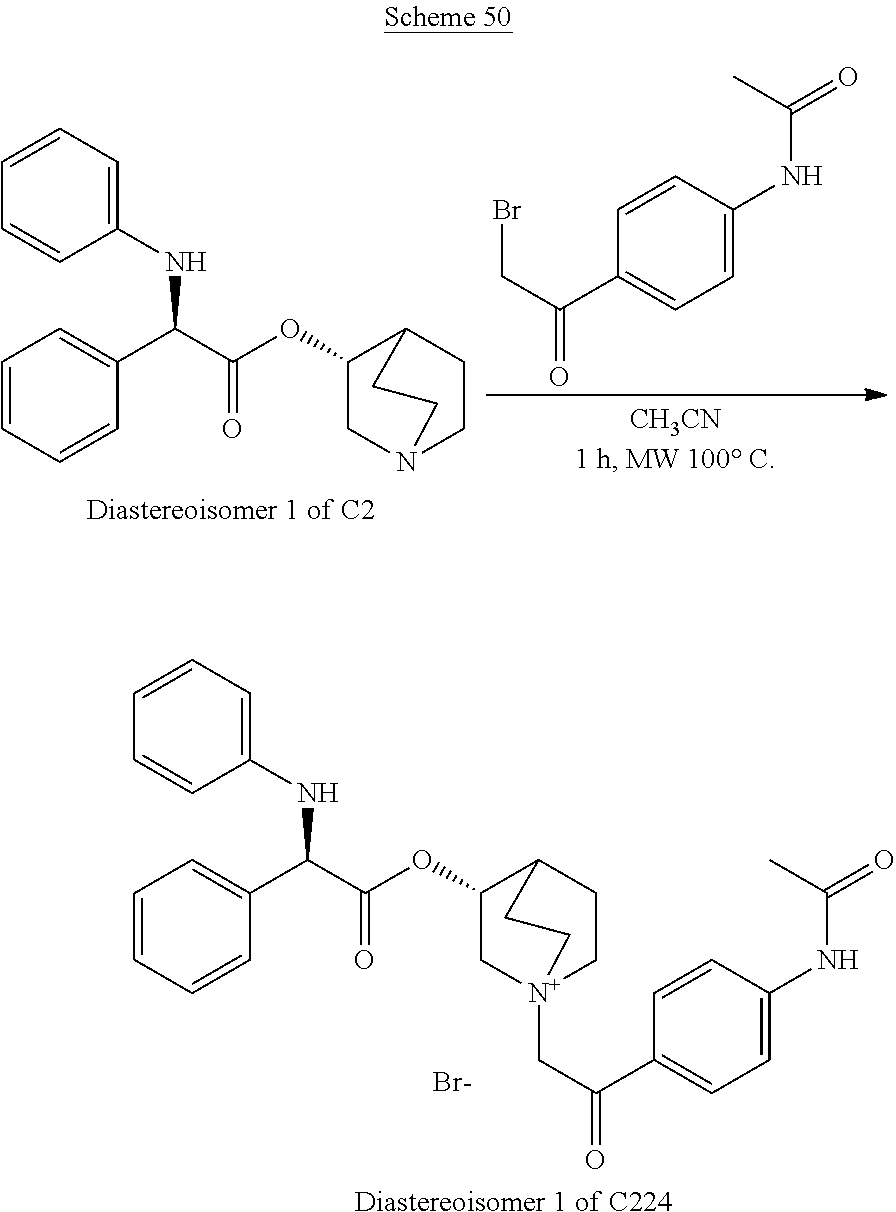
A mixture (R)-((R)-quinuclidin-3-yl) 2-phenyl-2-(phenylamino)acetate (Diastereoisomer 1 of C2) (80.0 mg, 0.24 mmol) and N-(4-(2-bromoacetyl)phenyl)acetamide (60.9 mg, 0.24 mmol) in acetonitrile (2 mL) is heated in a microwave oven at 100° C. for 1 hour (UPLC-MS monitoring: complete conversion). The title compound is isolated by suction filtration and washed with Et2O (98.2 mg, 81% yield, off-white solid, bromide salt, single diastereoisomers).
1H NMR (300 MHz, DMSO-d6) ppm: 10.44 (s, 1 H), 7.85-7.97 (m, 2 H), 7.69-7.84 (m, 2 H), 7.52-7.63 (m, 2 H), 7.25-7.49 (m, 3 H), 6.97-7.19 (m, 2 H), 6.70-6.79 (m, 2 H), 6.52-6.64 (m, 1 H), 6.37 (d, 1 H), 5.38 (d, 1 H), 5.14-5.27 (m, 1 H), 5.04 (s, 2 H), 3.88-4.20 (m, 1 H), 3.33-3.78 (m, 5 H), 2.31-2.43 (m, 1 H), 2.11 (s, 3 H), 1.84-2.05 (m, 4 H);
LC-MS (ESI POS): 512.2 (MH+).
C225 listed in Table 24 is obtained as previously described for C224, using 4-(2-bromo-acetyl)-benzoic acid methyl ester instead of N-[4-(2-bromo-acetyl)-phenyl]-acetamide.
| TABLE 24 | |||
| Com- | Yield and | ||
| pound | Structure | Appearance | Analytical |
| C225 | 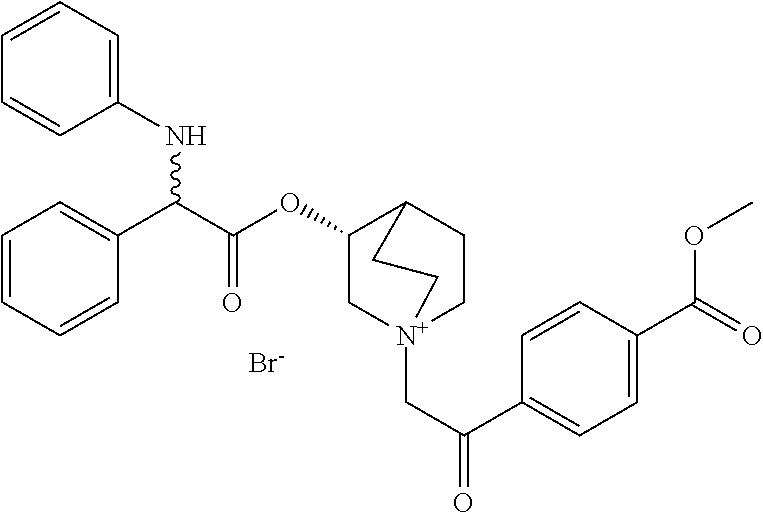 |
82% yield pale yellow powder | LC-MS (ESI POS): 513.2 (MH+) 1H NMR (300 MHz, DMSO-d6) ppm: 8.13- 8.25 (m, 2 H), 8.03-8.13 (m, 2 H), 7.54-7.66 (m, 2 H), 7.27-7.47 (m, 3 H), 6.98-7.17 (m, 2 H), 6.74 (m, 2 H), 6.56-6.64 (m, 1 H), 6.41 (d, 1 H), 5.39 (d, 1 H), 5.19-5.23 (m, 1 H), 5.16 (s, 2 H), 3.99-4.24 (m, 1 H), 3.91 (s, 3 H), 3.44- 3.84 (m, 5 H), 2.34-2.41 (m, 1 H), 1.38-2.10 (m, 4 H) |

To a solution of (R)-phenyl-phenylamino-acetic acid (R)-(1-aza-bicyclo[2.2.2]oct-3-yl)ester (Diastereoisomer 1 of C2) (100 mg, 0.30 mmol) and DIPEA (61 uL, 0.36 mmol) in acetonitrile (4 mL), is added 2-bromomethyl-pyridine hydrobromide (91.0 mg, 0.36 mmol) and the mixture is heated under MW irradiation for 1 hour at 100° C. (UPLC-MS monitoring: complete conversion). Solvent is evaporated and the resulting crude is first purified by flash chromatography (DCM/MeOH=98/2 to 9/1) and then by preparative LC-MS to obtain the title compound as a brown viscous oil (58 mg, 36% yield, trifluoroacetate trifluoroacetate anion, single diastereoisomer).
1H NMR (300 MHz, DMSO-d6) ppm: 8.68 (ddd, 1 H), 7.96 (td, 1 H), 7.41-7.71 (m, 4 H), 7.23-7.41 (m, 3 H), 6.93-7.16 (m, 2 H), 6.70 (m, 2 H), 6.58 (m, 1 H), 5.32 (s, 1 H), 5.02-5.18 (m, 1 H), 4.46 (d, 1 H), 4.41 (d, 1 H), 3.90 (ddd, 1 H), 3.39-3.60 (m, 3 H), 3.17 (d, 1 H), 2.74-2.92 (m, 1 H), 2.20-2.35 (m, 1 H), 1.74-2.04 (m, 4 H);
LC-MS (ESI POS): 428.2 (MH+);
[α]D=−40.80° (c=0.25, MeOH).
Diastereoisomer 1 of C227 listed in Table 25 is obtained as previously described for diastereoisomer 1 of C226, using 2-bromo-1-pyridin-2-yl-ethanone hydrobromide instead of 2-bromomethyl-pyridine hydrobromide.
| TABLE 25 | |||
| Yield and | |||
| Compound | Structure | Appearance | Analytical |
| Diastereoisomer 1 of C227 |  |
50% yield yellow solid | LC-MS (ESI POS): 456.0 (MH+) 1H NMR (300 MHz, DMSO-d6) ppm: 8.76 (ddd, 1 H), 8.37 (s, 1 H, formiate ion), 8.11 (ddd, 1 H), 8.05 (dt, 1 H), 7.78 (ddd, 1 H), 7.54-7.67 (m, 2 H), 7.30-7.50 (m, 3 H), 7.00-7.18 (m, 2 H), 6.69-6.81 (m, 2 H), 6.60 (m, 1 H), 6.37 (d, 1 H), 5.38 (d, 1 H), 5.10-5.29 (m, 3 H), 4.00- 4.20 (m, 1 H), 3.26-3.84 (m, 5 H), 2.31-2.41 (m, 1 H), 1.80-2.18 (m, 4 H) [α]D = −51.68° (c = 0.25, MeOH) |

To a solution of 2-methylthiazole-4-carbonyl chloride (0.34 g, 2.10 mmol) in dry MeCN (8 mL) cooled at 0° C., under nitrogen atmosphere, is slowly added (diazomethyl)trimethylsilane (3.14 ml, 6.29 mmol, 2.0M in hexane). The reaction is stirred at RT for 15 h (UPLC-MS monitoring: complete conversion). The reaction is cooled at 0° C. and 48% hydrobromic acid (1.23 mL, 7.34 mmol) is added dropwise. The reaction is stirred at RT for 3 hour. Then EtOAc and water are added, the organic layer is separated and the aqueous phase is neutralized with 1M NaOH and extracted with EtOAc. The combined organic layers are dried over Na2SO4, filtered and evaporated to dryness to obtain compound I228 as a dark brown gummy solid (400 mg, 87% yield).
(R)-Phenyl-phenylamino-acetic acid (R)-(1-aza-bicyclo[2.2.2]oct-3-yl)ester (Diastereoisomer 1 of C2) (75.0 mg, 0.22 mmol) and 2-bromo-1-(2-methylthiazol-4-yl)ethanone (I228) (49.1 mg, 0.22 mmol) in acetonitrile (5 mL) is heated at 100° C. for 75 minutes under microwave irradiation (UPLC-MS monitoring: complete conversion). The solvent is removed and the resulting brown solid is tritured with iPr2O/Et2O (1/1) and then with iPrOH to obtain the title compound as a grey powder (43.3 mg, 35% yield, bromide salt, single diastereoisomers).
1H NMR (300 MHz, DMSO-d6) ppm: 8.59 (s, 1 H) 7.53-7.66 (m, 2 H) 7.29-7.51 (m, 3 H) 7.01-7.15 (m, 2 H) 6.69-6.82 (m, 2 H) 6.56-6.66 (m, 1 H) 6.36 (d, 1 H) 5.37 (d, 1 H) 5.10-5.25 (m, 1 H) 5.02 (s, 2 H) 4.00-4.17 (m, 1 H) 3.45-3.75 (m, 4 H) 3.35-3.45 (m, 1 H) 2.75 (s, 3 H) 2.31-2.40 (m, 1 H) 1.80-2.10 (m, 4 H);
LC-MS (ESI POS): 476.2 (MH+).

A mixture of 6-methylpyridin-2-amine (5.00 g, 46.3 mmol), di-tert-butyl dicarbonate (24.2 g, 111 mmol) and DIPEA (9.4 mL, 55.5 mmol) in DCM (40 mL) is stirred at RT for 3 days. The organic phase is washed with 5% citric acid and then with sat. NaHCO3. The organic phase is dried over Na2SO4, filtered and evaporated to dryness. The crude is purified by flash chromatography (Petroleum ether/EtOAc=9/1) to obtain intermediate I230 as a white solid (3.0 g, 21% yield).
A catalytic amount of azobisisobutyronitrile (5% w/w) is added to a solution of N,N-(bis-tert-butoxycarbonyl)-6-methylpyridin-2-amine (I230) (308 mg, 1.00 mmol) and N-bromo-succinimide (284 mg; 1.6 mmol) in carbon tetrachloride (8 mL). The reaction is refluxed for two hours, diluted with DCM and washed with water. The organic phase is dried over Na2SO4, filtered and evaporated to dryness. The crude is purified by flash chromatography (DCM) to obtain intermediate I231 as a yellow solid (240 mg, 83% yield).
To a solution of (R)-phenyl-phenylamino-acetic acid (R)-(1-aza-bicyclo[2.2.2]oct-3-yl)ester (Diastereoisomer 1 of C2) (100 mg, 0.54 mmol) in acetonitrile (5 mL), is added N,N-(bis tert-butoxycarbonyl)-6-(bromomethyl)pyridin-2-amine (240 mg, 1.15 mmol) and the mixture is heated under MW irradiation for 30 minutes at 100° C. (UPLC-MS monitoring: complete conversion). The solvent is evaporated and the resulting crude is purified by flash chromatography (DCM to DCM/MeOH=9/1) to obtain intermediate I232 as a colorless oil (125 mg, 32% yield).
Trifluoroacetic acid (0.5 mL) is added to a solution of (R)-1-(N,N-(bis tert-butoxycarbonyl)-6-amino-pyridin-2-ylmethyl)-3-(2-phenyl-2-phenylamino-acetoxy)-1-azonia-bicyclo[2.2.2]octane bromide (I232) (125 mg, 0.19 mmol) in DCM (5 mL). The reaction is stirred at RT for 2 days. Solvent is removed under vacuum and the crude is purified by preparative LC-MS to obtain the title compound as a brown oil (21 mg, 16% yield, trifluoroacetate trifluoroacetate anion, single diasteroisomer).
1H NMR (300 MHz, DMSO-d6) ppm: 7.42-7.59 (m, 3 H), 7.22-7.42 (m, 3 H), 6.97-7.17 (m, 2 H), 6.66-6.82 (m, 2 H), 6.44-6.66 (m, 3 H), 5.33 (s, 1 H), 5.03-5.21 (m, 1 H), 4.13 (s, 2 H), 3.75-3.95 (m, 1 H), 3.29-3.61 (m, 3 H), 3.14 (d, 1 H), 2.75-2.96 (m, 1 H), 2.18-2.35 (m, 1 H), 1.54-2.14 (m, 4 H);
LC-MS (ESI POS): 443.1 (MH+).

To a solution of [(4-fluoro-phenyl)-methyl-amino]-phenyl-acetic acid (R)-(1-aza-bicyclo[2.2.2]oct-3-yl)ester (C120) (100 mg, 0.27 mmol) in ethyl acetate (2.7 mL), is added 2-chloro-1-(thiophen-2-yl)ethanone (48.0 mg, 0.30 mmol). The reaction is stirred at RT for 3.5 days. The suspension is evaporated and the residue is triturated with Et2O (8 mL). The solid is filtered on a buckner funnel and the sticky solid is dissolved in DCM. The solution is evaporated giving the title compound as a pale yellow solid (120 mg, 84% yield, chloride salt, mixture of diastereoisomers).
1H NMR (300 MHz, DMSO-d6) ppm: 8.21 (dd, 1 H), 8.11 (d, 1 H), 7.26-7.52 (m, 6 H), 7.02-7.15 (m, 2 H), 6.88-7.02 (m, 2 H), 5.91 and 5.92 (s, 1 H), 5.23-5.44 (m, 1 H), 5.19 (d, 1 H), 5.11 (d, 1 H), 4.07-4.34 (m, 1 H), 3.36-3.92 (m, 5 H), 2.73 (s, 3 H), 2.20-2.33 (m, 1 H), 1.47-2.12 (m, 4 H);
LC-MS (ESI POS): 493.1 (MH+).

2-Bromo-1-(1,3-thiazol-2-yl)ethanone (54.2 mg, 0.26 mmol) is added to a solution of (R)-quinuclidin-3-yl 2-(methyl(phenyl)amino)-2-phenylacetate (C75) (92.2 mg, 0.26 mmol) in EtOAc (5 mL). The mixture is stirred at RT overnight. The solvent is evaporated to dryness and the crude is triturated with Et2O. The yellow solid is collected by filtration (120 mg, 82% yield, bromide salt, mixture of diastereoisomers).
1H NMR (300 MHz, DMSO-d6) ppm: 8.39 (d, 1 H), 8.25 (d, 1 H), 7.32-7.50 (m, 5 H), 7.19-7.30 (m, 2 H), 6.84-7.00 (m, 2 H), 6.67-6.85 (m, 1 H), 5.97 (s, 1 H), 5.23-5.38 (m, 1 H), 5.19 and 5.20 (s, 2 H), 4.04-4.29 (m, 1 H), 3.44-3.82 (m, 5 H), 2.76 and 2.77 (s, 3 H), 2.24-2.36 (m, 1 H), 1.45-2.13 (m, 4 H);
LC-MS (ESI POS): 476.0 (MH+).
C236 listed in Table 26 is obtained as previously described for C235, using 2-bromo-1-thiophen-3-yl-ethanone instead of 2-bromo-1-(1,3-thiazol-2-yl)ethanone.
| TABLE 26 | |||
| Yield and | |||
| Compound | Structure | Appearance | Analytical |
| C236 |  |
41% overall yield Off-yellow solid | LC-MS (ESI POS): 475.3 (MH+) 1H NMR (300 MHz, DMSO-d6) ppm: 8.63 (dd, 1 H), 7.75 (dd, 1 H), 7.57 (dd, 1 H), 7.33-7.50 (m, 5 H), 7.17- 7.31 (m, 2 H), 6.88-7.02 (m, 2 H), 6.68-6.80 (m, 1 H), 5.96 and 5.97 (s, 1 H), 5.14-5.41 (m, 1 H), 5.02 and 5.03 (s, 2 H), 4.10-4.24 (m, 1 H), 3.37-3.79 (m, 5 H), 2.76 and 2.77 (s, 3 H), 2.20-2.38 (m, 1 H), 1.44-2.15 (m, 4 H) |

Benzylamino-phenyl-acetic acid (R)-(1-aza-bicyclo[2.2.2]oct-3-yl)ester (C80) (100 mg, 0.28 mmol) is dissolved in ethyl acetate (1.90 mL) and acetonitrile (0.95 mL) and ethyl 5-(2-bromoacetyl)isoxazole-3-carboxylate (82.0 mg, 0.31 mmol) is added. The orange solution is stirred at RT overnight. The suspension is evaporated and the crude is purified by flash chromatography (DCM/EtOH=93/7) to obtain the title compound as a pale brown solid (61 mg, 35% yield, bromide salt, mixture of diastereoisomers).
1H NMR (300 MHz, DMSO-d6) ppm: 7.86 and 7.89 (s, 1 H), 6.97-7.60 (m, 10 H), 5.10-5.24 (m, 1 H), 5.00 and 5.04 (s, 2 H), 4.33-4.53 (m, 3 H), 4.10 (dd, 1 H), 3.40-3.82 (m, 7 H), 2.15-2.24 and 2.29-2.38 (m, 1 H), 1.50-2.11 (m, 4 H), 1.35 (t, 3 H);
LC-MS (ESI POS): 532.3 (MH+).

Benzylamino-phenyl-acetic acid (R)-(1-aza-bicyclo[2.2.2]oct-3-yl)ester (C80) (100 mg, 0.28 mmol) is dissolved in ethyl acetate (1.90 mL) and acetonitrile (0.95 mL) and 2-bromo-1-(thiazol-2-yl)ethanone (64.7 mg, 0.314 mmol) is added. The pale yellow solution is stirred at RT overnight. The suspension is evaporated and the crude is purified by flash chromatography (DCM/MeOH=93/7). The resulting compound is further purified by preparative LC/MS. The collected fractions are first concentrated with rotary evaporator to remove organic solvent and then with freeze-drier overnight to get the title compound as a pale yellow oil (31 mg, 15% yield, trifluoroacetate trifluoroacetate anion, mixture of diastereoisomers).
1H NMR (300 MHz, DMSO-d6) ppm 8.40 (d, 1 H), 8.24 (d, 1 H), 7.36-7.71 (m, 10 H), 5.25-5.40 (m, 2 H), 5.17 and 5.21 (s, 2 H), 3.99-4.24 (m, 3 H), 3.46-3.84 (m, 5 H), 2.15-2.25 and 2.32-2.44 (m, 1 H), 1.35-2.14 (m, 4 H);
LC-MS (ESI POS): 475.9 (MH+).

To a solution of (R)-quinuclidin-3-yl 2-(benzylamino)-2-phenylacetate (C80) (116 mg, 0.33 mmol) in ethyl acetate (3.31 mL) and acetonitrile (3.31 mL), is added 2-bromo-1-(thiophen-3-yl)ethanone (66.5 mg, 0.32 mmol). The mixture is stirred at RT overnight. The insoluble precipitate is filtered on a buckner funnel and washed with acetonitrile. The clear solution is evaporated and purified by flash chromatography (DCM/EtOH=9/1) to obtain the title compound as a white solid (26 mg, 14% yield, bromide salt, mixture of diastereoisomers).
1H NMR (300 MHz, DMSO-d6) ppm: 8.63 (br. s., 1 H), 7.68-7.84 (m, 1 H), 7.10-7.63 (m, 11 H), 5.11-5.25 (m, 1 H), 5.03 and 5.06 (s, 2 H), 4.43 (br. s., 1 H), 3.99-4.24 (m, 1 H), 3.42-3.87 (m, 7 H), 2.18 and 2.23 (br. s., 1 H), 1.44-2.14 (m, 4 H);
LC-MS (ESI POS): 475.3 (MH+).

(R)-Quinuclidin-3-yl 2-(4-methylbenzylamino)-2-phenylacetate (C77) (73 mg, 0.20 mmol) is dissolved in ethyl acetate (2.00 mL) and 2-chloro-1-(thiophen-2-yl)ethanone (35.4 mg, 0.22 mmol) is added. The colorless solution is stirred at RT overnight. Solvent is evaporated and the residue is first purified by flash chromatography (DCM/MeOH=9/1 to 85/15) and then by preparative LC/MS. Organic solvent is evaporated and then the aqueous solution is freeze-dried overnight to afford the title compound as a pale yellow oil (42 mg, 36% yield, formate formate anion, mixture of diastereoisomers).
1H NMR (300 MHz, DMSO-d6) ppm: 8.43 (s, 2 H) 8.16-8.24 (m, 1 H) 8.03-8.12 (m, 1 H) 7.28-7.51 (m, 6 H) 7.04-7.25 (m, 4 H) 4.94-5.26 (m, 3 H) 4.40 (s, 1 H) 4.00-4.18 (m, 1 H) 3.48-3.76 (m, 7 H) 2.29 (s, 3 H) 2.11-2.22 (m, 1 H) 1.39-2.12 (m, 5 H);
LC-MS (ESI POS): 489.1 (MH+).
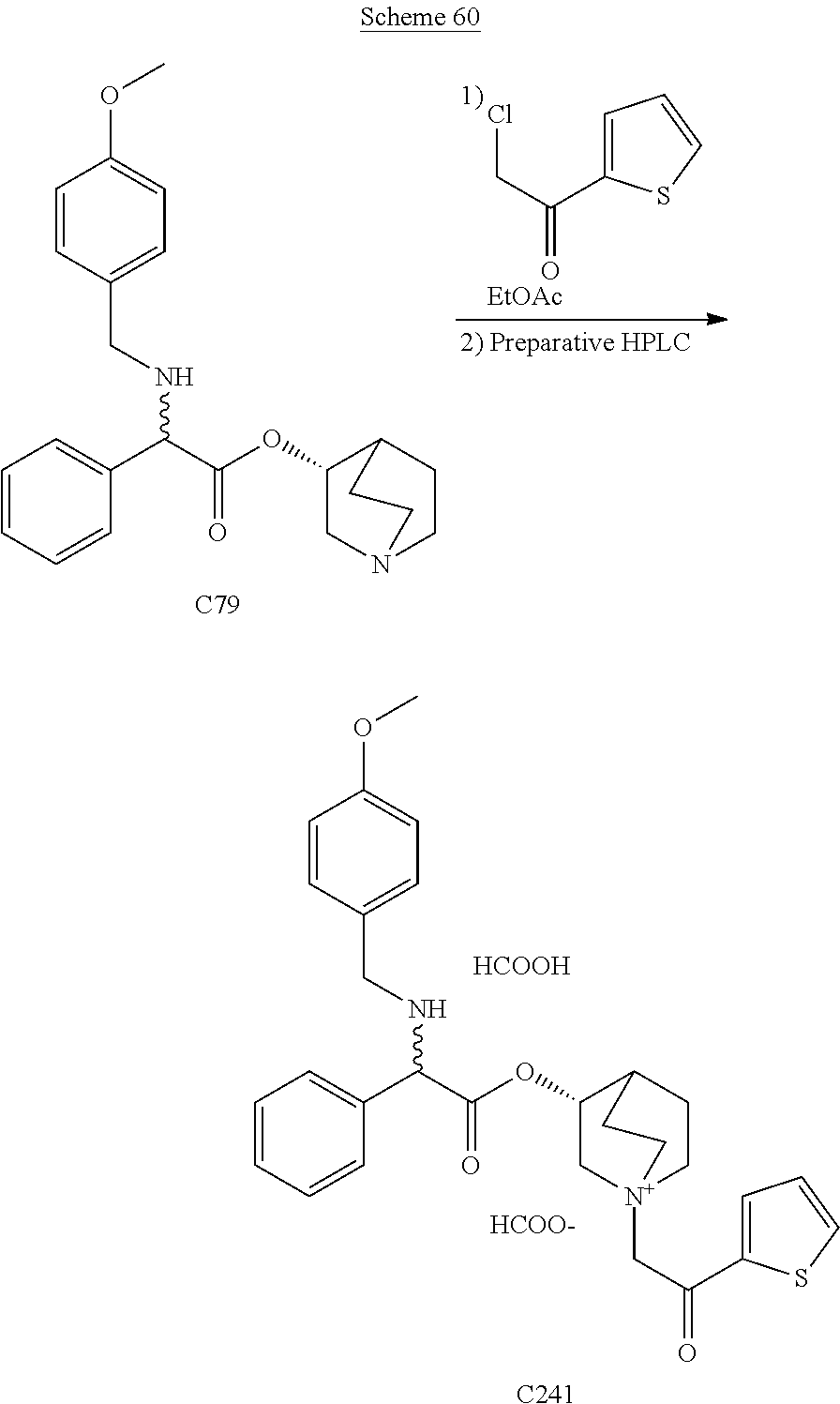
To a solution of (R)-quinuclidin-3-yl 2-(4-methoxybenzylamino)-2-phenylacetate (C79) (78 mg, 0.21 mmol) in ethyl acetate (2.05 mL), is added 2-chloro-1-(thiophen-2-yl)ethanone (36.2 mg, 0.23 mmol). The colorless solution is stirred at RT overnight. The residue is first purified by flash chromatography (DCM/MeOH=90/10 to 85/15) and then by preparative LC/MS. MeOH is evaporated from the fractions collected and then the aqueous solution is freeze-dried overnight to obtain the title compound as a pale pink oil (44 mg, 36% yield, formate formate anion, mixture of diastereoisomers).
1H NMR (300 MHz, DMSO-d6) ppm: 8.42 (s, 2 H) 8.17-8.25 (m, 1 H) 8.03-8.13 (m, 1 H) 7.15-7.50 (m, 8 H) 6.81-6.94 (m, 2 H) 4.97-5.23 (m, 3 H) 4.40 (s, 1 H) 188-4.22 (m, 1 H) 3.74 (s, 3 H) 3.46-3.71 (m, 6 H) 2.12-2.35 (m, 1 H) 1.70-2.10 (m, 3 H) 1.44-1.66 (m, 1 H);
LC-MS (ESI POS): 505.1 (MH+).

(R)-Quinuclidin-3-yl 2-(4-fluorobenzylamino)-2-phenylacetate (C78) (85 mg, 0.23 mmol) is dissolved in ethyl acetate (2.31 mL) and 2-chloro-1-(thiophen-2-yl)ethanone (40.8 mg, 0.25 mmol) is added. The solution is stirred at RT overnight. The suspension is evaporated and the white residue is first purified by flash chromatography (DCM/MeOH=9/1 to 8/2) and then by trituration with Et2O to afford the title compound as an off-white powder (83 mg, 68% yield, chloride salt, mixture of diastereoisomers).
1H NMR (300 MHz, DMSO-d6) ppm: 8.18-8.25 (m, 1 H), 8.04-8.18 (m, 1 H), 7.43-7.52 (m, 2 H), 7.26-7.43 (m, 6 H), 7.09-7.21 (m, 2 H), 5.16-5.24 (m, 1 H), 5.12 and 5.15 (s, 2 H), 4.42 (s, 1 H), 4.01-4.22 (m, 1 H), 3.67 (s, 2 H), 3.54-3.85 (m, 5 H), 2.13-2.23 and 2.29-2.33 (m, 1 H), 1.48-2.10 (m, 4 H);
LC-MS (ESI POS): 492.9 (MH+).

A mixture of (R)-quinuclidin-3-yl 2-(4-fluorobenzylamino)-2-phenylacetate (C78) (61 mg, 0.17 mmol) and 2-bromo-1-phenylethanone (33.0 mg, 0.17 mmol) in ethyl acetate (3 mL) is stirred at RT overnight. The solid is collected by suction filtration and washed with Et2O. The product is further purified by flash chromatography (DCM/MeOH=95/5 to 92/8) to obtain the title compound as a white solid (35 mg, 37% yield, bromide salt, mixture of diastereoisomers).
1H NMR (300 MHz, METHANOL-d4) ppm: 7.91-8.07 (m, 2 H) 7.67-7.80 (m, 1 H) 7.53-7.64 (m, 2 H) 7.26-7.53 (m, 7 H) 6.97-7.13 (m, 2 H) 5.17-5.33 (m, 1 H) 4.50 (s, 1 H) 4.04-4.28 (m, 1 H) 3.49-3.89 (m, 8 H) 3.36 (s, 2 H) 2.40-2.52 (m, 1 H) 1.94-2.25 (m, 4 H);
LC-MS (ESI POS): 487.1 (MH+).

To a solution of α-bromophenylacetic acid (1.00 g, 4.65 mmol) in acetonitrile (20 mL), is added 4-methyl-phenylamine (0.96 g, 9.30 mmol) and the mixture reacted in a closed vessel under MW irradiation at 100° C. for 1 hour (UPLC-MS monitoring: complete conversion). Solvent is evaporated and residue is portioned between EtOAc and 2N HCl. The organic phase is dried over Na2SO4, filtered and evaporated to dryness to get desired compound as a yellow solid (0.88 g, 78% yield).
To a solution of 4-methyl-phenyl-amino-phenyl-acetic acid (I244) (870 mg, 3.60 mmol) in dry THF (35 mL), are added DCC (891 mg, 4.32 mmol), HOBt (583 mg, 4.32 mmol) and 3(R)-quinuclidinol (915 mg, 7.20 mmol). The resulting mixture is stirred at RT for 48 hours (UPLC-MS monitoring: complete conversion). The solvent is evaporated and the residue is portioned between EtOAc and 1M K2CO3. The organic phase is dried over Na2SO4, filtered and evaporated to dryness. The resulting crude is dissolved in little DCM and filtered to remove the insoluble. The solution is concentrated under vacuum to obtain the title compound as a yellow solid, which is used in the next step without any further purification.
To a solution of 4-methyl-phenyl-amino-phenyl-acetic acid (R)-(1-aza-bicyclo[2.2.2]oct-3-yl)ester (C245) (63.5 mg, 0.18 mmol) in acetonitrile (5 mL), is added 2-bromo-1-phenyl-ethanone (36 mg, 0.18 mmol) and the mixture was heated at 100° C. for 1 hour in a MW oven (UPLC-MS monitoring: complete conversion). Solvent is evaporated and the resulting crude is purified by flash chromatography (DCM/MeOH=95/5) to obtain the title compound as a white solid (58 mg, 32% yield, bromide salt, mixture of diastereoisomers).
1H NMR (300 MHz, DMSO-d6) ppm: 7.88-8.07 (m, 2 H), 7.71-7.83 (m, 1 H), 7.51-7.68 (m, 4 H), 7.24-7.48 (m, 3 H), 6.91 (m, 2 H), 6.66 (m, 2 H), 6.16 (d, 1 H), 5.34 (d, 1 H), 5.15-5.27 (m, 1 H), 5.09 (s, 2 H), 3.92-4.19 (m, 1 H), 3.33-3.77 (m, 5 H), 2.31-2.41 (m, 1 H), 2.12 (s, 3 H), 1.77-2.08 (m, 4 H);
LC-MS (ESI POS): 469.1 (MH+).

2-Fluoroaniline (347 ul, 3.60 mmol), ethyl 2-bromo-2-phenylacetate (420 ul, 2.40 mmol) and N-ethyl-N-isopropylpropan-2-amine (628 ul, 3.60 mmol) are dissolved in acetonotrile (5 mL) and stirred under MW irradiation at 100° C. for 1 hour and 30 minutes. Water (3.89 mL) and lithium hydroxide (230 mg, 9.59 mmol) are added to the reaction and the resulting mixture is stirred at RT overnight and then at 50° C. for 3 hours. Acetonitrile is removed and 1M HCl is added to the remaining aqueous solution until pH is about 1. The aqueous phase is extracted several time with DCM and the combined organic phases are washed with water and brine, dried (Na2SO4), filtered and evaporated to give intermediate I247 as a brown solid (464 mg, 69% yield).
A solution of DCC (534 mg, 0.71 mmol), 1H-benzo[d][1,2,3]triazol-1-ol hydrate (217 mg, 1.42 mmol), (2-fluoro-phenylamino)-phenyl-acetic acid hydrochloride (I247) (200 mg, 0.71 mmol) and (R)-quinuclidin-3-ol (271 mg, 2.13 mmol) in THF (10 mL) is stirred at RT for 2 days. The solvent is evaporated and the residue is taken up with EtOAc, washed with sat NaHCO3, water and brine. The organic layer is collected, dried over Na2SO4, filtered and evaporated to dryness. The residue is purified by preparative HPLC. The organic solvent is evaporated and the acid aqueous phase is basified with Na2CO3 and extracted with EtOAc. The organic layer is dried (Na2SO4), filtered and evaporated to afford the title compound as yellow oil (41 mg, 16% yield).
(2-Fluoro-phenylamino)-phenyl-acetic acid (R)-(1-aza-bicyclo[2.2.2]oct-3-yl) ester (C248) (267 mg, 0.75 mmol) and 2-bromo-1-phenylethanone (157 mg, 0.79 mmol) are dissolved in CH3CN (20 mL). The resulting reaction is stirred at RT for two days. The solvent is evaporated and the crude is purified with preparative HPLC to obtain the title compound as a yellow amorphous solid (178 mg, 40.3% yield, trifluoroacetate salt, mixture of diastereoisomers).
1H NMR (300 MHz, DMSO-d6) ppm: 7.87-8.14 (m, 2 H), 7.67-7.81 (m, 1 H), 7.50-7.68 (m, 4 H), 7.26-7.50 (m, 3 H), 7.01-7.16 (m, 1 H), 6.85-7.00 (m, 1 H), 6.56-6.77 (m, 2 H), 5.75 (br. s., 1 H), 5.46 and 5.49 (s, 1 H), 5.24 (br. s., 1 H), 5.12 and 5.17 (s, 2 H), 4.00-4.20 (m, 1 H), 3.29-3.83 (m, 5 H), 2.12-2.23 and 2.31-2.42 (m, 1 H), 1.37-2.11 (m, 4 H);
LC-MS (ESI POS): 473.2 (MH+).
C250 and C251 listed in Table 27 are prepared as previously described for C249, using 3-fluoroaniline instead of 2-fluoroaniline and the suitable commercially available alkylating agents.
| TABLE 27 | |||
| Com- | Yield and | ||
| pound | Structure | appearance | Analytical |
| C250 |  |
14% overall yield White solid | LC-MS (ESI POS): 473.4 (MH+). 1H NMR (300 MHz, DMSO-d6) ppm: 7.89-8.05 (m, 2 H), 7.69-7.83 (m, 1 H), 7.53-7.67 (m, 4 H), 7.30-7.49 (m, 3 H), 7.09 (td, 1 H), 6.74 and 6.76 (d, 1 H), 6.48-6.64 (m, 2 H), 6.37 (td, 1 H), 5.41 and 5.45 (d, 1 H), 5.23-5.30 (m, 1 H), 5.15 and 5.21 (s, 2 H), 3.96-4.29 (m, 1 H), 3.37-3.95 (m, 5 H), 2.11-2.19 and 2.36-2.42 (m, 1 H), 1.37-2.10 (m, 4 H) |
| C251 |  |
7% overall yield White solid | LC-MS (ESI POS): 479.3 (MH+). 1H NMR (300 MHz, DMSO-d6) ppm: 8.20 and 8.22 (dd, 1 H), 8.04 and 8.08 (dd, 1 H), 7.50-7.63 (m, 2 H), 7.29-7.48 (m, 4 H), 7.09 (td, 1 H), 6.74 (br. s., 1 H), 6.47-6.63 (m, 2 H), 6.36 (td, 1 H), 5.39 and 5.44 (br. s., 1 H), 5.17-5.28 (m, 1 H), 4.99 and 5.04 (s, 2 H), 4.03-4.19 (m, 1 H), 3.25-3.85 (m, 5 H), 2.10-2.20 and 2.33-2.41 (m, 1 H), 1.45-2.09 (m, 4 H) |


To a solution of (S)-methyl 2-(methylsulfonyloxy)-2-phenylacetate (I5) (520 mg, 2.13 mmol) in CH3CN (10 mL), is added 4-fluoroaniline (473 mg, 4.26 mmol) and the mixture is heated at 120° C. for 5 minutes under MW irradiation (UPLC-MS: complete conversion). Acetonitrile was evaporated and the resulting crude is dissolved in 1N HCl and extracted several times with EtOAc. The combined organic phase is dried over Na2SO4, filtered and evaporated to dryness to obtain intermediate I254 as a pale yellow oil (520 mg, 94% yield).
To a solution of (R)-(4-fluoro-phenylamino)-phenyl-acetic acid methyl ester (I252) (510 mg, 1.97 mmol) in dioxane (10 mL), is added 12N HCl (10 mL) and the mixture is heated at 70° C. for 12 hours. The organic solvent is evaporated, the mixture is cooled to 0° C. and the resulting solid is collected by filtration to obtain intermediate I255 as a brownish solid (420 mg, 87% yield).
To a solution of (R)-(4-fluoro-phenylamino)-phenyl-acetic acid (I253) (420 mg, 1.71 mmol) in dry THF (40 mL), are sequentially added (S)-quinuclidin-3-ol (218 mg, 1.71 mmol), DEAD (407 ul, 2.57 mmol) and triphenylphosphine (674 mg, 2.57 mmol). The reaction is refluxed for 30 minutes under N2 flowstream and then the solvent is evaporated. The residue is partitioned between water and EtOAc, the organic layer is separated, dried over Na2SO4, filtered and evaporated to dryness. The resulting crude is purified by flash chromatography (DCM/MeOH=95/5) to obtain the title compound as a pale yellow oil (480 mg, 79% yield).
To a solution of (R)-(4-fluoro-phenylamino)-phenyl-acetic acid (R)-(1-aza-bicyclo[2.2.2]oct-3-yl)ester (C254) (200 mg, 0.56 mmol) in CH3CN (2 mL), is added 2-chloro-1-(thiophen-2-yl)ethanone (100 mg, 0.62 mmol). The reaction is heated at 100° C. for 1 hour under MW irradiation. The solvent is evaporated and the crude is purified by flash chromatography (DCM/MeOH=9/1) recovering the title compound as a white solid (104 mg, 36% yield, chloride salt, single diastereoisomer).
1H NMR (300 MHz, DMSO-d6) ppm: 8.21 (d, 1 H), 8.08 (d, 1 H), 7.50-7.65 (m, 2 H), 7.23-7.48 (m, 4 H), 6.84-6.99 (m, 2 H), 6.61-6.84 (m, 2 H), 6.39 (d, 1 H), 5.36 (d, 1 H), 5.15-5.26 (m, 1 H), 5.06 (s, 2 H), 3.99-4.21 (m, 1 H), 3.38-3.85 (m, 5 H), 2.30-2.40 (m, 1 H), 1.70-2.17 (m, 4 H);
LC-MS (ESI POS): 478.9 (MH+).

2-Bromo-2-(4-chlorophenyl)acetic acid (1.2 g, 4.67 mmol) and aniline (0.85 mL, 9.33 mmol) are dissolved in acetonitrile (29 mL). The reaction is heated under microwave irradiation at 100° C. for 5 minutes. The solvent is evaporated and the residue is dissolved in EtOAc and washed with 3M HCl and then brine. The organic layer is dried over Na2SO4, filtered and evaporated to dryness to give intermediate I258 as a white solid (1.22 g, quantitative yield).
(4-Chloro-phenyl)-phenylamino-acetic acid (I256) (1.22 g, 4.97 mmol), HOBT (0.99 g, 6.46 mmol) and DCC (1.33 g, 6.46 mmol) are dissolved in THF (250 mL). The reaction is stirred for 15 minutes and then (R)-quinuclidin-3-ol (1.26 g, 9.93 mmol) is added. The reaction is stirred at RT for 4 days. The solvent is evaporated and the residue is taken up with EtOAc. The insoluble is filtered off, the solution is washed with 1M K2CO3 and brine. The organic phase is dried (Na2SO4), filtered and evaporated to dryness. The crude is purified by flash chromatography (DCM/MeOH=98/2 to 90/10) to afford compound C259 as a yellow solid (462 mg, 25% yield).
2-Bromo-1-phenylethanone (54.8 mg, 0.27 mmol) is added to a solution of (4-chloro-phenyl)-phenylamino-acetic acid (R)-(1-aza-bicyclo[2.2.2]oct-3-yl)ester (C257) (100 mg, 0.27 mmol) in acetonitrile (4 mL). The reaction is heated in a microwave oven at 100° C. for 1 hour. The solvent is evaporated and the crude is first purified by flash chromatography (DCM/MeOH=98/2 to 85/15) and then by preparative HPLC to collect the title compound as a brown viscous oil (37 mg, 22.76% yield, trifluoroacetate salt, mixture of diastereoisomers).
1H NMR (300 MHz, DMSO-d6) ppm: 7.94-8.02 (m, 2 H), 7.72-7.83 (m, 1 H), 7.54-7.68 (m, 4 H), 7.40-7.54 (m, 2 H), 6.96-7.17 (m, 2 H), 6.68-6.78 (m, 2 H), 6.52-6.67 (m, 1 H), 5.42 (s, 1 H), 5.19-5.28 (m, 1 H), 5.16 (s, 2 H), 4.05-4.19 (m, 1 H), 3.44-3.86 (m, 5 H), 2.09-2.22 (m, 1 H), 1.90-2.08 (m, 2 H), 1.75-1.88 (m, 1 H), 1.54-1.73 (m, 1 H);
LC-MS (ESI POS): 488.9 (MH+).

To a solution of methyl 2-(2-fluorophenyl)acetate (1.0 g, 5.95 mmol) in CCl4 (15 mL), are added N-bromo succinimide (1.06 g, 5.95 mmol) and 48% hydrogen bromide (33 uL, 0.30 mmol) and the reaction is refluxed for 15 hours. Reaction is diluted with DCM and washed with Na2CO3 and water. The organic phase is dried over Na2SO4, filtered and evaporated under vacuum to afford intermediate I261 as a dark brown oil (1.47 g, quantitative yield).
A solution of bromo-(2-fluoro-phenyl)-acetic acid methyl ester (I259) (1.47 g, 5.95 mmol), aniline (814 ul, 8.93 mmol) and N-ethyl-N-isopropylpropan-2-amine (1.53 mL, 8.93 mmol) in acetonitrile (10 mL) is heated under microwave irradiation at 100° C. for 1 hour. The solvent is evaporated, the residue is taken up with DCM and washed with water and brine, dried over Na2SO4 and evaporated to afford intermediate I262 as a dark brown oil (1.54 g, quantitative yield).
To a solution of (2-fluoro-phenyl)-phenylamino-acetic acid methyl ester (I260) (1.54 g, 5.95 mmol) in THF (15 mL), cooled at 0° C., is added 2.0M lithium hydroxide (5.95 mL, 11.9 mmol) and the reaction is stirred at RT for 72 hours. The solvent is evaporated, 1M HCl is added to the reaction until pH 1. The product is extracted with EtOAc, and the organic phase is washed with water and brine, dried over Na2SO4 and evaporated to provide intermediate I263 as a dark brown gummy solid (1.34 g, 80% yield).
To a solution of (2-fluoro-phenyl)-phenylamino-acetic acid hydrochloride (I261) (217 mg, 0.77 mmol), (R)-quinuclidin-3-ol (338 mg, 2.66 mmol) and 1H-benzo[d][1,2,3]triazol-1-ol (180 mg, 1.332 mmol) in dry THF (15 mL), is added PS-DCC (1.0 g, 1.33 mmol). The mixture is shaken at RT for 15 hours. Then (R)-quinuclidin-3-ol (49.0 mg, 0.38 mmol) and PS-DCC (290 mg, 0.38 mmol) are added again and the reaction is shaken for additional 3 hours at RT. The resin is removed by filtration and washed several time with EtOAc. The solvent is evaporated, the residue is taken up with EtOAc and washed with NaHCO3, water and brine. The organic phase is dried (Na2SO4), filtered and evaporated to afford the title compound as a brown oil (225 mg, 82% yield).
To a solution of (2-fluoro-phenyl)-phenylamino-acetic acid (R)-(1-aza-bicyclo[2.2.2]oct-3-yl)ester (C262) (225 mg, 0.63 mmol) in acetonitrile (8 mL), is added 2-bromo-1-phenylethanone (126 mg, 0.63 mmol) and the reaction is stirred at RT for 15 hours. The solvent is evaporated and the resulting crude is purified by preparative HPLC to obtain the title compound as a brown oil (130 mg, 35% yield, trifluoroacetate salt, mixture of diastereoisomers).
1H NMR (300 MHz, DMSO-d6) ppm: 7.92-8.07 (m, 2 H), 7.69-7.82 (m, 1 H), 7.52-7.68 (m, 3 H), 7.35-7.49 (m, 1 H), 7.19-7.35 (m, 2 H), 7.05-7.15 (m, 2 H), 6.68-6.81 (m, 2 H), 6.56-6.67 (m, 1 H), 6.42 (br. s., 1 H), 5.57 and 5.59 (s, 1 H), 5.21-5.34 (m, 1 H), 5.12 and 5.17 (s, 2 H), 4.02-4.24 (m, 1 H), 3.27-3.83 (m, 5 H), 2.13-2.22 and 2.32-2.43 (m, 1 H), 1.34-2.13 (m, 4 H);
LC-MS (ESI POS): 473.4 (MH+).

To a suspension of aluminum trichloride (2.75 g, 20.6 mmol) and methyl 2-chloro-2-oxoacetate (1.90 mL, 20.7 mmol) in dry DCM (25 mL), cooled at 0° C. and under nitrogen atmosphere, is added 2-methylthiophene (1.00 mL, 10.33 mmol) dropwise. The reaction is stirred at RT for 15 hours. Then the mixture is cooled at 0° C., ice-water is slowly added and the organic phase is washed with aq. NaHCO3 and brine, dried over Na2SO4 and evaporated to obtain intermediate I266 as a brown oil (1.9 g, quantitative yield).
To a solution of methyl (5-methyl-thiophen-2-yl)-oxo-acetic acid methyl ester (I264) (1.90 g, 10.3 mmol) in MeOH (25 mL) cooled at 0° C., sodiumboron hydride (0.19 g, 5.17 mmol) is added portionwise. The reaction is stirred at 0° C. for 10 minutes then at RT for 1 hour. The solvent is evaporated, the residue is taken up with EtOAc and washed with ice-water and brine. The organic phase is dried over Na2SO4, filtered and evaporated to collect intermediate I267 as a brown oil (1.84 g, 96% yield).
To a solution of hydroxy-(5-methyl-thiophen-2-yl)-acetic acid methyl ester (I265) (1.84 g, 9.89 mmol) in dry DCM, cooled at 0° C. under nitrogen atmosphere, N-ethyl-N-isopropylpropan-2-amine (2.54 mL, 14.8 mmol) and methanesulfonyl chloride (1.16 mL, 14.8 mmol) are added and the reaction is stirred at RT for 2 hours. DCM is added and the organic phase is washed with aq. NaHCO3, water and brine, dried over Na2SO4 and evaporated to obtain intermediate I268 as a dark brown oil (2.1 g, 80% yield).
A solution of methanesulfonyloxy-(5-methyl-thiophen-2-yl)-acetic acid methyl ester (I266) (2.10 g, 7.94 mmol), aniline (1.09 mL, 11.9 mmol) and N-ethyl-N-isopropylpropan-2-amine (2.04 mL, 11.9 mmol) in MeCN (10 mL) is heated under microwave irradiation at 100° C. for 1 hour. The solvent is removed, DCM is added and the organic phase is washed with water and brine, dried over Na2SO4 and evaporated. The resulting brown oil is purified by silica gel flash chromatography (Hexane/EtOAc=9575 to 90/10) to obtain intermediate I269 as a yellow oil (500 mg, 24% yield).
To a solution of (5-methyl-thiophen-2-yl)-phenylamino-acetic acid methyl ester (I267) (500 mg, 1.91 mmol) in THF (15 mL), cooled at 0° C., is added 2.0M lithium hydroxide (1.91 mL, 3.83 mmol) and the reaction is stirred at RT for 72 hours. Then the solvent is evaporated, 1M HCl is added to the reaction until pH 1 and the product is extracted with EtOAc. The organic phase is washed with water and brine, dried over Na2SO4, filtered and evaporated to obtain intermediate I270 as a light brown solid (410 mg, 76% yield).
To a solution of (5-methyl-thiophen-2-yl)-phenylamino-acetic acid hydrochloride (I268) (220 mg, 0.77 mmol), (R)-quinuclidin-3-ol (338 mg, 2.66 mmol) and 1H-benzo[d][1,2,3]triazol-1-ol (180 mg, 1.33 mmol) in dry THF (15 mL), is added PS-DCC (1.0 g, 1.330 mmol) and the mixture is shaken at RT for 15 hours. Then (R)-quinuclidin-3-01 (49.3 mg, 0.39 mmol) and PS-DCC (291 mg, 0.39 mmol) are added again and the reaction is shaken at RT for other 3 hours. The resin is filtered off and washed several time with EtOAc. The solvent is concentrated and washed with aq. NaHCO3, water and brine. The organic phase is dried over Na2SO4 and evaporated to obtain the title compound as a brown oil (175 mg, 63% yield).
To a solution of (5-methyl-thiophen-2-yl)-phenylamino-acetic acid (R)-(1-aza-bicyclo[2.2.2]oct-3-yl)ester (C269) (175 mg, 0.49 mmol) in acetonitrile (8 mL), is added 2-bromo-1-phenylethanone (98.0 mg, 0.49 mmol) and the reaction is stirred at RT for 15 hours. The solvent is evaporated and the resulting brown crude is purified by preparative HPLC to obtain the title compound as a brown oil (60 mg, 21% yield, trifluoroacetate salt, mixture of diasteroisomers).
1H NMR (300 MHz, DMSO-d6) ppm: 7.91-8.08 (m, 2 H), 7.69-7.88 (m, 1 H), 7.54-7.69 (m, 2 H), 7.06-7.16 (m, 2 H), 6.99-7.07 (m, 1 H), 6.69-6.83 (m, 3 H), 6.54-6.69 (m, 1 H), 6.33 (br. s., 1 H), 5.52 and 5.56 (d, 1 H), 5.23-5.34 (m, 1 H), 5.13 and 5.17 (s, 2 H), 3.98-4.21 (m, 1 H), 3.55-3.86 (m, 5 H), 2.43 and 2.44 (d, 3 H), 2.19-2.25 and 2.33-2.40 (m, 1 H), 1.40-2.15 (m, 4 H);
LC-MS (ESI POS): 475.3 (MH+).

A solution of (R)-1-[2-(4-nitro-phenyl)-2-oxo-ethyl]-3-((R)-2-phenyl-2-phenylamino-acetoxy)-1-azonia-bicyclo[2.2.2]octane bromide (Diastereoisomer 1 of C179) (88 mg, 0.152 mmol) in THF (30 mL) is hydrogenated in presence of a catalytic amount of Pt2O at 15 psi for 2 hours and then at 20 psi for additional 2 hours (UPLC-MS monitoring: complete conversion). Catalyst is removed by filtration and the solution evaporated to dryness. The crude is purified by preparative HPLC to give the title compound as a pale yellow solid (31 mg, 37% yield, formate formate anion, single diastereoisomer).
1H NMR (300 MHz, DMSO-d6) ppm: 8.51 (s, 1 H, formiate), 7.63-7.77 (m, 2 H), 7.47-7.61 (m, 2 H), 7.30-7.46 (m, 3 H), 7.02-7.18 (m, 3 H), 6.68-6.81 (m, 2 H), 6.54-6.66 (m, 2 H), 6.41 (br. s., 2 H), 6.36 (d, 1 H), 5.37 (d, 1 H), 4.99-5.25 (m, 1 H), 4.82 (s, 2 H), 3.91-4.18 (m, 1 H), 3.41-3.74 (m, 5 H), 2.30-2.43 (m, 1 H), 1.56-2.09 (m, 4 H);
LC-MS (ESI POS): 470.1 (MH+).
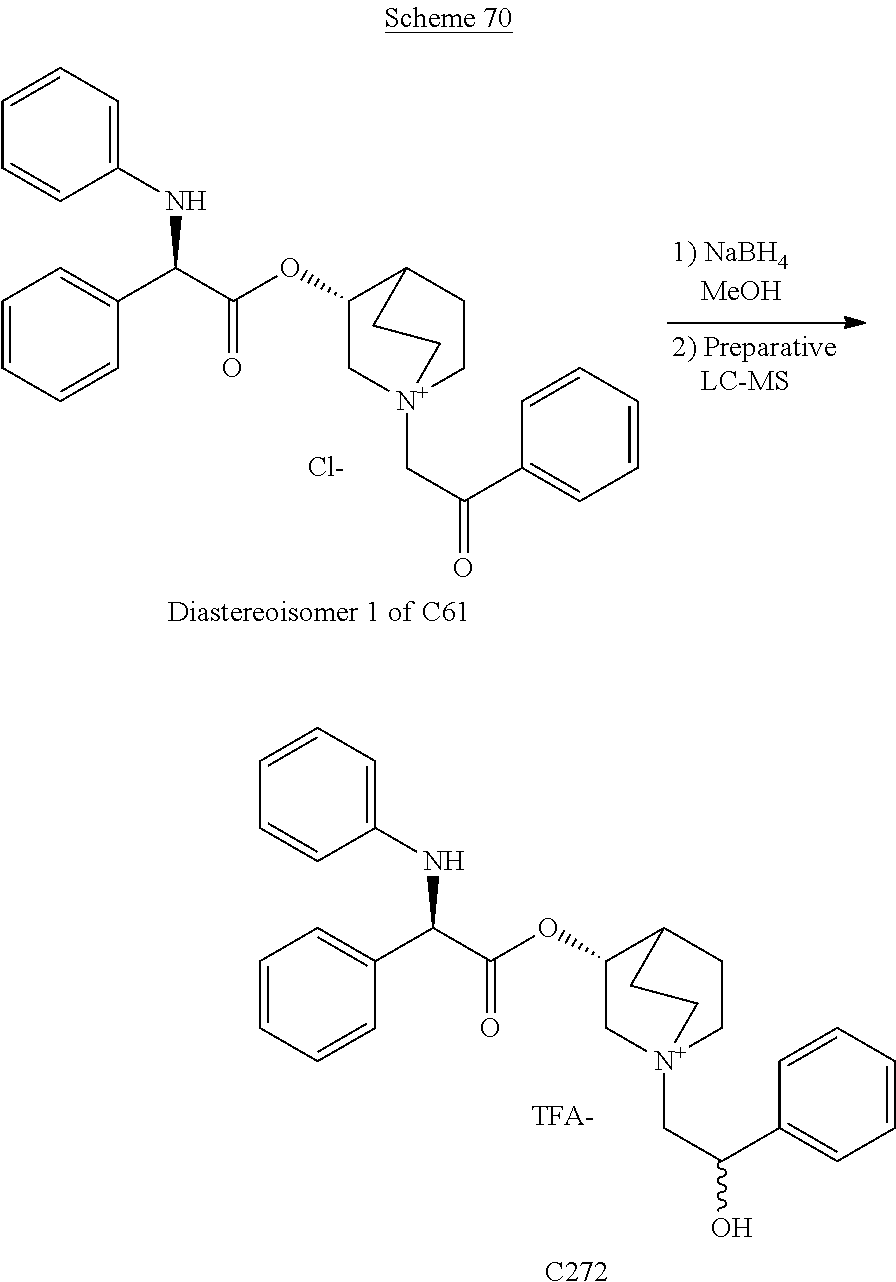
To a solution of (R)-1-(2-oxo-2-phenyl-ethyl)-3-((R)-2-phenyl-2-phenylamino-acetoxy)-1-azonia-bicyclo[2.2.2]octane chloride (Diastereoisomer 1 of C113) (80 mg, 0.163 mmol) in MeOH, is added NaBH4 (6.16 mg, 0.163 mmol) and the mixture is stirred at RT for 1 hour (UPLC-MS: complete conversion). The solvent is evaporated and the resulting crude is first purified by flash chromatography (DCM/MeOH=9/1) and then by preparative LC-MS to obtain the title compound as of a brown oil (31.2 mg, 39% yield, trifluoroacetate, mixture of diastereoisomers).
1H NMR (300 MHz, DMSO-d6) ppm 7.51-7.64 (m, 2 H), 7.28-7.50 (m, 8 H), 6.99-7.17 (m, 1 H), 6.66-6.86 (m, 2 H), 6.51-6.66 (m, 1 H), 5.01-5.54 (m, 3 H), 3.02-4.07 (m, 9 H), 2.29-2.42 (m, 1 H), 1.71-2.17 (m, 4 H);
LC-MS (ESI POS): 457.1 (MH+).
CHO-K1 clone cells expressing the human M1-, M2-, M3-receptors (Euroscreen, Swissprot P11229, P08172, P20309, Genbank: J02960 respectively) were harvested in Ca++/Mg++ free phosphate-buffered saline and collected by centrifugation at 1500 rpm for 10 minutes, at 4° C. min. The pellets were resuspended in ice cold buffer A (15 mM Tris-HCl pH 7.4, 2 mM MgCl2, 0.3 mM EDTA, 1 mM EGTA). Cloned cells expressing M1-, M2-, and M3-receptors were homogenized by a PBI politron (setting 5 for 15 s). The crude membrane fraction was collected by two consecutive centrifugation steps at 40000 g for 20 minutes at 4° C., separated by a washing step in buffer A.
The pellets obtained from the three cell lines were finally resuspended in buffer C (75 mM Tris HCl pH 7.4, 12.5 mM MgCl2, 0.3 mM EDTA, 1 mM EGTA, 250 mM sucrose) and aliquots were stored at −80° C.
The day of experiment, M1-, M2-, and M3-receptor frozen membranes were resuspended in buffer D (50 mM Tris-HCl pH 7.4, 2.5 mM MgCl2, 1 mM EDTA). The non-selective muscarinic radioligand [3H]-N-methyl scopolamine (Mol. Pharmacol. 45:899-907) was used to label the M1, M2, and M3 binding sites. Binding experiments were performed in duplicate (ten point concentrations curves) in 96 well plates at radioligand concentration of 0.1-0.3 nM. The non-specific binding was determined in the presence of cold N-methyl scopolamine 10 μM. Samples (final volume 0.75 mL) were incubated at RT for 120 minutes for M1, 60 minutes for M2 and 90 minutes for M3 binding assay.
The reaction was terminated by rapid filtration through GF/B Unifilter plates and two washes (0.75 mL) with cold buffer using a Packard Filtermate Harvester. Radioactivity on the filters was measured by a microplate scintillation counter TopCount NXT (Canberra Packard).
In the present assays, Ki values for the tested compounds were determined from the observed IC50 values according to known methods. A lower Ki value indicates that the tested compound has a higher binding affinity for the receptor.
The interaction with M3 muscarinic receptors can be estimated by the results of in vitro studies which evaluated the potency of the test compounds and the offset of the inhibitory activity produced after washout of the antagonists in isolated guinea pig trachea and by the in vivo duration of action against acetylcholine-induced bronchospasm in the guinea pig.
The potency of the antagonist activity in isolated guinea pig trachea was investigated following a method previously described by Haddad E B et al. in Br. J. Pharmacol., 127, 413-420, 1999 (which is incorporated herein by reference in its entirety), with few modifications.
A cumulative concentration-response curve to test antagonists was constructed on preparations precontracted by carbachol, until a complete inhibition of smooth muscle tone was achieved. The concentration of antagonist producing a 50% reversal of carbachol-induced tonic contraction (IC50) was taken as a measure of its potency in this bioassay.
In the experiments aiming at assessing the offset of the inhibitory effects produced by test compounds, the minimal concentration of the test compounds known to produce a maximal inhibitory effect was administered to carbachol-precontracted preparations. As soon as the tonic contraction was completely reversed, the organ bath solution was renewed and preparations were thoroughly washed with fresh Krebs solution. Carbachol (0.3 μM) was administered again (at 30 minute intervals between washout and next administration) during the next 4 hours.
After the administration of carbachol, the inhibitory effects of the compounds of the invention, administered at a concentration of 10 nM, were expressed as percentage of the recovery of the contracting response to carbachol. The percentage of recovery four hours after the washout was lower than 50%.
The compounds of the invention show a remarkable inhibitory M3 activity. In particular, the IC50 values being tested for some representative compounds result to be comprised between 0.03 and 10 nM.
The in vivo tests on acetylcholine-induced bronchospasm in guinea pig were performed according to H. Konzett H and Rössler F., Arch. Exp. Path. Pharmacol., 195, 71-74, 1940 (which is incorporated herein by reference in its entirety). Aqueous solutions of the test compounds were instilled intratracheally in anaesthetised mechanically ventilated guinea pigs. Bronchial response to intravenous acetylcholine challenge was determined before and after drug administration and changes in pulmonary resistance at several time-points were expressed as percent of inhibition of bronchospasm. The bronchodilator activity of the tested compounds persisted unchanged up to 24 hours after the administration.
In order to demonstrate that the compounds are degraded, stability in human plasma at 1 and 5 hours was tested for the compound of the invention. Briefly 10 μl of a stock solution 250 μM of the compound in acetonitrile were added to 1 ml of human plasma and samples were incubated at 37° C. Plasma (50 μL) was taken after 0, 1 and 5 hours of incubation and added to 140 μl of acetonitrile with addition of verapamil as internal standard (250 ng/ml). Samples were analysed by HPLC-MS/MS analysis.
Plasma stability is calculated as percentage remaining after 1 and 5 hours by dividing the peak area at 1 or 5 hours by the area of the peak at time 0. After 1 and 5 hours of incubation, plasma stability being tested for some representative compounds of the invention result to be comprised between 0 and 25%, indicating that the compounds of the invention are very unstable in human plasma.
Where a numerical limit or range is stated herein, the endpoints are included. Also, all values and subranges within a numerical limit or range are specifically included as if explicitly written out.
Obviously, numerous modifications and variations of the present invention are possible in light of the above teachings. It is therefore to be understood that, within the scope of the appended claims, the invention may be practiced otherwise than as specifically described herein.
All patents and other references mentioned above are incorporated in full herein by this reference, the same as if set forth at length.
Claims (5)
1. A process for preparing a compound of formula (I):

wherein:
R1 is H or a group selected from the group consisting of (C1-C10)-alkyl, aryl, (C3-C8)-cycloalkyl, arylalkyl, and heteroaryl, each of which may be optionally substituted by one or more substituents selected from the group consisting of halogen atoms, OH, oxo (═O), SH, NO2, CN, CON(R5)2, COOH, NHCOR5, COR5, CO2R5, CF3, (C1-C10)-alkoxycarbonyl, (C1-C10)-alkylsulfanyl, (C1-C10)-alkylsulfinyl, (C1-C10)-alkylsulfonyl, (C1-C10)-alkyl, and (C1-C10)-alkoxyl;
R2 is a group selected from the group consisting of (C1-C10)-alkyl, aryl, (C3-C8)-cycloalkyl, arylalkyl, and heteroaryl, each of which may be optionally substituted by one or more substituents selected from the group consisting of halogen atoms, OH, oxo (═O), SH, NO2, CN, CON(R5)2, COOH, NHCOR5, COR5, CO2R5, CF3, (C1-C10)-alkoxycarbonyl, (C1-C10)-alkylsulfanyl, (C1-C10)-alkylsulfinyl, (C1-C10)-alkylsulfonyl, (C1-C10)-alkyl, and (C1-C10)-alkoxyl;
R3 is H or a group selected from the group consisting of (C1-C10)-alkyl, aryl, (C3-C8)-cycloalkyl, heteroaryl, arylalkyl, or heteroarylalkyl, each of which may be optionally substituted by one or more substituents selected from the group consisting of a halogen atom, OH, oxo (═O), SH, NO2, CN, CON(R5)2, COOH, CO2R5, CF3, (C1-C10)-alkoxycarbonyl, (C1-C10)-alkylsulfinyl, (C1-Cl0)-alkylsulfonyl, (C1-C10)-alkyl, and (C1-C10)-alkoxyl;
R6 represents a group of formula (i) or (ii) or (iii) or (iv):
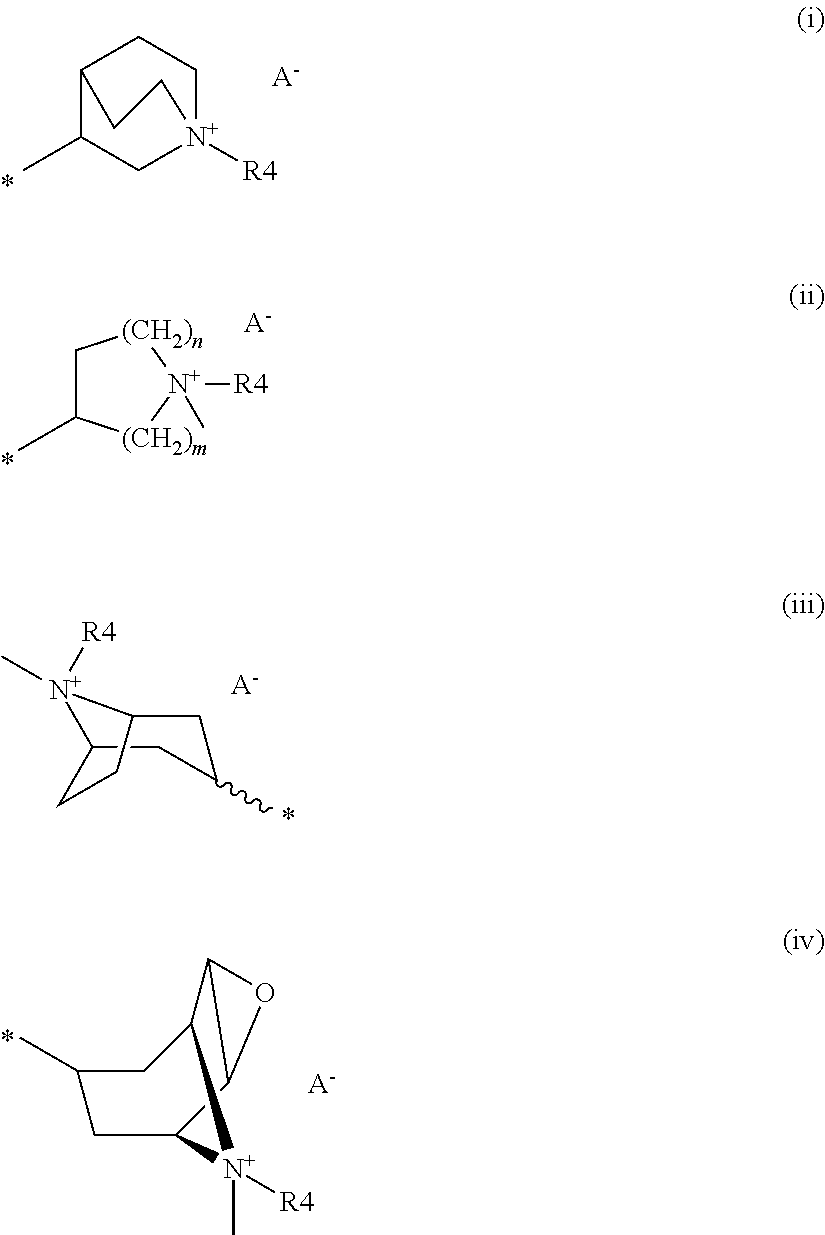
wherein
* indicates the position at which R6 is bonded to formula (I);
m=1, 2, or 3;
n=1, 2, or 3;
A31 is a physiologically acceptable anion;
R4 is a group of formula (Y)
—(CH2)p−P—(CH2)q−W (Y)
—(CH2)p−P—(CH2)q−W (Y)
wherein
p is 0 or an integer from 1 to 4;
q is 0 or an integer from 1 to 4;
P is absent or is selected from the group consisting of O, S, SO, SO2, CO, NR5, CH═CH, N(R5)SO2, N(R5)COO, N(R5)C(O), SO2N(R5), CO(O)N(R5), and C(O)N(R5);
W is H or a group selected from the group consisting of (C1-C6)-alkyl, (C3-C8)-cycloalkyl, aryl, and heteroaryl, each of which may be optionally substituted by one or more substituents selected from the group consisting of halogen atoms, OH, oxo (═O), SH, NO2, CN, CON(R5)2, COOH, NH2, NHCOR5, CO2R5, (C1-C10)-alkoxycarbonyl, (C1-C10)-alkylsulfanyl, (C1-C10)-alkylsulfinyl, (C1-C10)-alkylsulfonyl, (C1-C10)-alkyl, and (C1-C10)-alkoxyl;
R5 is H or a group selected from the group consisting of (C1-C10)alkyl, (C1-C6)alkylhalo, (C2-C6)alkynyl, (C2-C6)alkenyl, (C3-C7)cycloalkyl, (C3-C7)cycloalkyl-(C1-C6)alkyl, heteroaryl, (C1-C6)alkyl-heteroaryl, and aryl, each of which may be optionally substituted by one or more substituents selected from the group consisting of a halogen atom, OH, oxo (═O), SH, NO2, CN, CONH2, COOH, (C1-C 10)-alkoxycarbonyl, (C1-C10)-alkylsulfanyl, (C1-C 10)-alkylsulfinyl, (C1-C10)-alkylsulfonyl, (C1-C10)-alkyl, and (C1-C10)-alkoxyl;
or a pharmaceutically acceptable salt thereof,
with the proviso that when R1 is H, R2 is phenyl, and R3 is H, then R6 is not a group of formula (iii),
said process comprising:
alkylating a compound of formula (VI):

with an alkylating agent of formula (XI):
A−R4 (XI)
A−R4 (XI)
wherein A is a suitable leaving group selected from the group consisting of halide and sulfonate, and R7 represents a group of formula (vi) or (vii) or (viii) or (ix):

wherein
* indicates the position at which R7 is bonded to formula (VI);
m=1, 2, or 3;
n=1, 2, or 3.
2. A process according to claim 1 , wherein said compound of formula (VI) is prepared by a process comprising:
alkylating an amine compound of formula (II):

with a compound of formula (III):

wherein LG is a suitable leaving group and K is either a hydroxyl group or a suitably protected hydroxyl group, to obtain a compound of formula (IV):

condensing said compound of formula (IV) with a compound of formula (V):

to obtain said compound of formula (VI).
3. A process according to claim 1 , wherein said compound of formula (VI) is prepared by a process comprising:
coupling an amine of formula (II):

with a ketone of formula (VII):

wherein K is either a hydroxyl group or a suitably protected hydroxyl group, to obtain a compound of formula (IV):

condensing said compound of formula (IV) with a compound of formula (V):

to obtain said compound (VI).
4. A process according to claim 1 , wherein said compound of formula (VI) is prepared by a process comprising:
reacting a compound of formula (IX):

wherein K is either a hydroxyl group or a suitably protected hydroxyl group, with an alkylating agent of formula (VIII):

wherein z is a carbonyl group or a suitable leaving group, to obtain a compound of formula (IV):

wherein R2 is hydrogen;
condensing said compound of formula (IV) with a compound of formula (V):

to obtain said compound of formula (VI).
5. A process according to claim 1 , wherein said compound of formula (VI) is prepared by a process comprising:
coupling a compound of formula (IIIa):

wherein W is a suitable leaving group or hydroxy and K is either a hydroxyl group or a suitably protected hydroxyl group,
with a compound of formula (V):

to obtain a compound of formula (X):

reacting said compound of formula (X) with an amine of formula (II):

to obtain said compound of formula (VI).
Priority Applications (1)
| Application Number | Priority Date | Filing Date | Title |
|---|---|---|---|
| US13/827,101 US8835682B2 (en) | 2008-12-23 | 2013-03-14 | Alkaloid aminoester derivatives and medicinal composition thereof |
Applications Claiming Priority (5)
| Application Number | Priority Date | Filing Date | Title |
|---|---|---|---|
| EP08172818 | 2008-12-23 | ||
| EP08172818.0 | 2008-12-23 | ||
| EP08172818A EP2206712A1 (en) | 2008-12-23 | 2008-12-23 | "Alkaloid aminoester derivatives and medicinal composition thereof" |
| US12/644,322 US8455646B2 (en) | 2008-12-23 | 2009-12-22 | Alkaloid aminoester derivatives and medicinal composition thereof |
| US13/827,101 US8835682B2 (en) | 2008-12-23 | 2013-03-14 | Alkaloid aminoester derivatives and medicinal composition thereof |
Related Parent Applications (1)
| Application Number | Title | Priority Date | Filing Date |
|---|---|---|---|
| US12/644,322 Division US8455646B2 (en) | 2008-12-23 | 2009-12-22 | Alkaloid aminoester derivatives and medicinal composition thereof |
Publications (2)
| Publication Number | Publication Date |
|---|---|
| US20130196978A1 US20130196978A1 (en) | 2013-08-01 |
| US8835682B2 true US8835682B2 (en) | 2014-09-16 |
Family
ID=40578441
Family Applications (2)
| Application Number | Title | Priority Date | Filing Date |
|---|---|---|---|
| US12/644,322 Expired - Fee Related US8455646B2 (en) | 2008-12-23 | 2009-12-22 | Alkaloid aminoester derivatives and medicinal composition thereof |
| US13/827,101 Active US8835682B2 (en) | 2008-12-23 | 2013-03-14 | Alkaloid aminoester derivatives and medicinal composition thereof |
Family Applications Before (1)
| Application Number | Title | Priority Date | Filing Date |
|---|---|---|---|
| US12/644,322 Expired - Fee Related US8455646B2 (en) | 2008-12-23 | 2009-12-22 | Alkaloid aminoester derivatives and medicinal composition thereof |
Country Status (24)
| Country | Link |
|---|---|
| US (2) | US8455646B2 (en) |
| EP (2) | EP2206712A1 (en) |
| JP (1) | JP2012513420A (en) |
| KR (1) | KR101414333B1 (en) |
| CN (1) | CN102264734B (en) |
| AR (1) | AR074855A1 (en) |
| AU (1) | AU2009331945A1 (en) |
| BR (1) | BRPI0918206A2 (en) |
| CA (1) | CA2748100A1 (en) |
| CO (1) | CO6400144A2 (en) |
| EA (1) | EA020974B1 (en) |
| GE (1) | GEP20146154B (en) |
| IL (1) | IL213712A0 (en) |
| MA (1) | MA32979B1 (en) |
| ME (1) | ME01185B (en) |
| MX (1) | MX2011006642A (en) |
| MY (1) | MY150823A (en) |
| NZ (1) | NZ593695A (en) |
| PE (1) | PE20110829A1 (en) |
| SG (1) | SG172316A1 (en) |
| TN (1) | TN2011000282A1 (en) |
| TW (1) | TW201028412A (en) |
| UA (1) | UA107334C2 (en) |
| WO (1) | WO2010072338A1 (en) |
Cited By (1)
| Publication number | Priority date | Publication date | Assignee | Title |
|---|---|---|---|---|
| EP2907875A1 (en) | 2012-11-16 | 2015-08-19 | Magyar Tudományos Akadémia Szegedi Biológiai Kutatoközpont 33% | A novel method to load a mammalian artificial chromosome with multiple genes |
Families Citing this family (15)
| Publication number | Priority date | Publication date | Assignee | Title |
|---|---|---|---|---|
| EP2154136A1 (en) | 2008-08-08 | 2010-02-17 | CHIESI FARMACEUTICI S.p.A. | Quinuclidine carbonate derivatives and medicinal compositions thereof |
| EP2206712A1 (en) | 2008-12-23 | 2010-07-14 | CHIESI FARMACEUTICI S.p.A. | "Alkaloid aminoester derivatives and medicinal composition thereof" |
| CN102947300B (en) * | 2010-06-22 | 2016-09-21 | 奇斯药制品公司 | Alkaloid amino ester derivative and pharmaceutical composition thereof |
| RU2567548C2 (en) | 2010-06-22 | 2015-11-10 | КЬЕЗИ ФАРМАЧЕУТИЧИ С.п.А. | Derivatives of alkaloid aminoester and their drug compositions |
| WO2011160918A1 (en) | 2010-06-22 | 2011-12-29 | Chiesi Farmaceutici S.P.A. | Alkaloid aminoester derivatives and medicinal composition thereof |
| RU2585767C2 (en) | 2010-11-26 | 2016-06-10 | КЬЕЗИ ФАРМАЧЕУТИЧИ С.п.А. | Glycine derivatives and their use as muscarinic receptor antagonists |
| US20120220557A1 (en) | 2011-02-17 | 2012-08-30 | Chiesi Farmaceutici S.P.A. | Liquid propellant-free formulation comprising an antimuscarinic drug |
| KR20140019409A (en) * | 2011-04-29 | 2014-02-14 | 키에시 파르마슈티시 엣스. 피. 에이. | Alkaloid ester and carbamate derivatives and medicinal compositions thereof |
| KR20140105746A (en) | 2011-12-30 | 2014-09-02 | 키에시 파르마슈티시 엣스. 피. 에이. | Quinuclidine esters of 1-azaheterocyclylacetic acid as antimuscarinic agents, process for their preparation and medicinal compositions thereof |
| US9427376B2 (en) | 2013-10-10 | 2016-08-30 | Chiesi Farmaceutici S.P.A. | Process for preparing pharmaceutical formulations for inhalation comprising a high-dosage strength active ingredient |
| JP2017537893A (en) | 2014-10-31 | 2017-12-21 | アッヴィ・バイオセラピューティクス・インコーポレイテッド | Anti-CS1 antibody and antibody drug conjugate |
| CN104876854B (en) * | 2015-04-16 | 2017-03-01 | 御盛隆堂药业有限责任公司 | Hydroxy acetate derivative and application thereof |
| EP3625232B1 (en) | 2017-05-19 | 2021-06-23 | Council of Scientific and Industrial Research | Substituted methanopyrido [2, 1-a]isoindolones as machr modulators for treating various associated pathophysiological conditions and process for preparation thereof |
| IL305165A (en) | 2021-02-19 | 2023-10-01 | Sudo Biosciences Ltd | TYK2 inhibitors and their uses |
| MX2023009682A (en) | 2021-02-19 | 2023-10-30 | Sudo Biosciences Ltd | Tyk2 inhibitors and uses thereof. |
Citations (23)
| Publication number | Priority date | Publication date | Assignee | Title |
|---|---|---|---|---|
| US2824106A (en) | 1958-02-18 | Quaternary tropeine compounds and a process of making same | ||
| US2856407A (en) | 1956-08-08 | 1958-10-14 | Lakeside Lab Inc | Aminoacid esters of n-substituted 3 and 4-piperidinols |
| EP0424021A1 (en) | 1989-10-19 | 1991-04-24 | Pfizer Limited | Antimuscarinic bronchodilators |
| US5583142A (en) | 1992-07-08 | 1996-12-10 | Fidia S.P.A. | Analgesic and nootropic drugs |
| WO1998011063A1 (en) | 1996-09-10 | 1998-03-19 | British Biotech Pharmaceuticals Limited | Cytostatic hydroxamic acid derivatives |
| WO1999020612A1 (en) | 1997-10-22 | 1999-04-29 | Astrazeneca Uk Limited | Imidazole derivatives and their use as farnesyl protein transferase inhibitors |
| WO2002051841A1 (en) | 2000-12-22 | 2002-07-04 | Almirall Prodesfarma Ag | Quinuclidine carbamate derivatives and their use as m3 antagonists |
| WO2006048225A1 (en) | 2004-11-02 | 2006-05-11 | Novartis Ag | Quinuclidine derivatives and their use as muscarinic m3 receptor antagonists |
| WO2008012290A2 (en) | 2006-07-26 | 2008-01-31 | Chiesi Farmaceutici S.P.A. | Quinuclidine derivatives as m3 antagonists |
| WO2008053158A1 (en) | 2006-11-02 | 2008-05-08 | Chroma Therapeutics Ltd. | Inhibitors of p38 mitogen-activated protein kinase |
| WO2008059245A1 (en) | 2006-11-14 | 2008-05-22 | Astrazeneca Ab | Quiniclidine derivatives of (hetero) arylcycloheptanecarboxylic acid as muscarinic receptor antagonists |
| WO2008075006A1 (en) | 2006-12-19 | 2008-06-26 | Astrazeneca Ab | Piperldinum compounds for treatment of obstructive pulmonary diseases ( copd) |
| WO2008075005A1 (en) | 2006-12-19 | 2008-06-26 | Astrazeneca Ab | Quinuclidinol derivatives as muscarinic receptor antagonists |
| US7452904B2 (en) | 2001-12-20 | 2008-11-18 | Chiesi Farmaceutici S.P.A. | 1-alkyl-1-azoniabicyclo' 2.2.2 octane carbamate derivatives and their use as muscarinic receptor antagonists |
| US20100173880A1 (en) | 2008-12-23 | 2010-07-08 | Chiesi Farmaceutici S.P.A. | Alkaloid aminoester derivatives and medicinal composition thereof |
| US8039483B2 (en) | 2008-08-08 | 2011-10-18 | Chiesi Farmaceutici S.P.A. | Quinuclidine carbonate salts and medicinal composition thereof |
| US20110311459A1 (en) | 2010-06-22 | 2011-12-22 | Chiesi Farmaceutici S.P.A. | Alkaloid aminoester derivatives and medicinal composition thereof |
| US20110311458A1 (en) | 2010-06-22 | 2011-12-22 | Chiesi Farmaceutici S.P.A. | Alkaloid aminoester derivatives and medicinal compositions thereof |
| US20110311461A1 (en) | 2010-06-22 | 2011-12-22 | Chiesi Farmaceutici S.P.A. | Alkaloid aminoester derivatives and medicinal composition thereof |
| US20110308519A1 (en) | 2010-06-22 | 2011-12-22 | Chiesi Farmaceutici S.P.A. | Dry powder formulation comprising an antimuscarinic drug |
| US20120101076A1 (en) | 2010-10-20 | 2012-04-26 | Chiesi Farmaceutici S.P.A. | Carbonate derivatives for the treatment of cough |
| US20120220557A1 (en) | 2011-02-17 | 2012-08-30 | Chiesi Farmaceutici S.P.A. | Liquid propellant-free formulation comprising an antimuscarinic drug |
| US20120276018A1 (en) | 2011-04-29 | 2012-11-01 | Chiesi Farmaceutici S.P.A. | Alkaloid ester and carbamate derivatives and medicinal compositions thereof |
Family Cites Families (1)
| Publication number | Priority date | Publication date | Assignee | Title |
|---|---|---|---|---|
| EP0747355A4 (en) * | 1994-02-10 | 1997-04-09 | Yamanouchi Pharma Co Ltd | Novel carbamate derivative and medicinal composition containing the same |
-
2008
- 2008-12-23 EP EP08172818A patent/EP2206712A1/en not_active Withdrawn
-
2009
- 2009-12-11 MA MA34030A patent/MA32979B1/en unknown
- 2009-12-11 MY MYPI20112934 patent/MY150823A/en unknown
- 2009-12-11 BR BRPI0918206A patent/BRPI0918206A2/en not_active IP Right Cessation
- 2009-12-11 NZ NZ593695A patent/NZ593695A/en not_active IP Right Cessation
- 2009-12-11 AU AU2009331945A patent/AU2009331945A1/en not_active Abandoned
- 2009-12-11 ME MEP-2011-114A patent/ME01185B/en unknown
- 2009-12-11 GE GEAP200912268A patent/GEP20146154B/en unknown
- 2009-12-11 SG SG2011045689A patent/SG172316A1/en unknown
- 2009-12-11 PE PE2011001258A patent/PE20110829A1/en not_active Application Discontinuation
- 2009-12-11 UA UAA201106921A patent/UA107334C2/en unknown
- 2009-12-11 JP JP2011542695A patent/JP2012513420A/en active Pending
- 2009-12-11 EP EP20090778904 patent/EP2376489B1/en active Active
- 2009-12-11 CN CN200980152004.9A patent/CN102264734B/en not_active Expired - Fee Related
- 2009-12-11 MX MX2011006642A patent/MX2011006642A/en active IP Right Grant
- 2009-12-11 KR KR1020117014392A patent/KR101414333B1/en not_active Expired - Fee Related
- 2009-12-11 EA EA201190017A patent/EA020974B1/en not_active IP Right Cessation
- 2009-12-11 WO PCT/EP2009/008870 patent/WO2010072338A1/en not_active Ceased
- 2009-12-11 CA CA2748100A patent/CA2748100A1/en not_active Abandoned
- 2009-12-22 TW TW098144158A patent/TW201028412A/en unknown
- 2009-12-22 AR ARP090105049A patent/AR074855A1/en unknown
- 2009-12-22 US US12/644,322 patent/US8455646B2/en not_active Expired - Fee Related
-
2011
- 2011-05-31 TN TN2011000282A patent/TN2011000282A1/en unknown
- 2011-06-22 CO CO11078448A patent/CO6400144A2/en not_active Application Discontinuation
- 2011-06-22 IL IL213712A patent/IL213712A0/en unknown
-
2013
- 2013-03-14 US US13/827,101 patent/US8835682B2/en active Active
Patent Citations (26)
| Publication number | Priority date | Publication date | Assignee | Title |
|---|---|---|---|---|
| US2824106A (en) | 1958-02-18 | Quaternary tropeine compounds and a process of making same | ||
| US2856407A (en) | 1956-08-08 | 1958-10-14 | Lakeside Lab Inc | Aminoacid esters of n-substituted 3 and 4-piperidinols |
| EP0424021A1 (en) | 1989-10-19 | 1991-04-24 | Pfizer Limited | Antimuscarinic bronchodilators |
| US5583142A (en) | 1992-07-08 | 1996-12-10 | Fidia S.P.A. | Analgesic and nootropic drugs |
| WO1998011063A1 (en) | 1996-09-10 | 1998-03-19 | British Biotech Pharmaceuticals Limited | Cytostatic hydroxamic acid derivatives |
| WO1999020612A1 (en) | 1997-10-22 | 1999-04-29 | Astrazeneca Uk Limited | Imidazole derivatives and their use as farnesyl protein transferase inhibitors |
| WO2002051841A1 (en) | 2000-12-22 | 2002-07-04 | Almirall Prodesfarma Ag | Quinuclidine carbamate derivatives and their use as m3 antagonists |
| US7452904B2 (en) | 2001-12-20 | 2008-11-18 | Chiesi Farmaceutici S.P.A. | 1-alkyl-1-azoniabicyclo' 2.2.2 octane carbamate derivatives and their use as muscarinic receptor antagonists |
| WO2006048225A1 (en) | 2004-11-02 | 2006-05-11 | Novartis Ag | Quinuclidine derivatives and their use as muscarinic m3 receptor antagonists |
| WO2008012290A2 (en) | 2006-07-26 | 2008-01-31 | Chiesi Farmaceutici S.P.A. | Quinuclidine derivatives as m3 antagonists |
| US7838534B2 (en) | 2006-07-26 | 2010-11-23 | Chiesi Farmaceutici S.P.A. | Quinuclidine derivatives as M3 antagonists |
| WO2008053158A1 (en) | 2006-11-02 | 2008-05-08 | Chroma Therapeutics Ltd. | Inhibitors of p38 mitogen-activated protein kinase |
| WO2008059245A1 (en) | 2006-11-14 | 2008-05-22 | Astrazeneca Ab | Quiniclidine derivatives of (hetero) arylcycloheptanecarboxylic acid as muscarinic receptor antagonists |
| WO2008075005A1 (en) | 2006-12-19 | 2008-06-26 | Astrazeneca Ab | Quinuclidinol derivatives as muscarinic receptor antagonists |
| WO2008075006A1 (en) | 2006-12-19 | 2008-06-26 | Astrazeneca Ab | Piperldinum compounds for treatment of obstructive pulmonary diseases ( copd) |
| US8039483B2 (en) | 2008-08-08 | 2011-10-18 | Chiesi Farmaceutici S.P.A. | Quinuclidine carbonate salts and medicinal composition thereof |
| US8404712B2 (en) | 2008-08-08 | 2013-03-26 | Chiesi Farmaceutici S.P.A. | Quinuclidine carbonate salts and medicinal composition thereof |
| US8440690B2 (en) | 2008-08-08 | 2013-05-14 | Chiesi Farmaceutici S.P.A. | Quinuclidine carbonate salts and medicinal composition thereof |
| US20100173880A1 (en) | 2008-12-23 | 2010-07-08 | Chiesi Farmaceutici S.P.A. | Alkaloid aminoester derivatives and medicinal composition thereof |
| US20110311459A1 (en) | 2010-06-22 | 2011-12-22 | Chiesi Farmaceutici S.P.A. | Alkaloid aminoester derivatives and medicinal composition thereof |
| US20110311458A1 (en) | 2010-06-22 | 2011-12-22 | Chiesi Farmaceutici S.P.A. | Alkaloid aminoester derivatives and medicinal compositions thereof |
| US20110311461A1 (en) | 2010-06-22 | 2011-12-22 | Chiesi Farmaceutici S.P.A. | Alkaloid aminoester derivatives and medicinal composition thereof |
| US20110308519A1 (en) | 2010-06-22 | 2011-12-22 | Chiesi Farmaceutici S.P.A. | Dry powder formulation comprising an antimuscarinic drug |
| US20120101076A1 (en) | 2010-10-20 | 2012-04-26 | Chiesi Farmaceutici S.P.A. | Carbonate derivatives for the treatment of cough |
| US20120220557A1 (en) | 2011-02-17 | 2012-08-30 | Chiesi Farmaceutici S.P.A. | Liquid propellant-free formulation comprising an antimuscarinic drug |
| US20120276018A1 (en) | 2011-04-29 | 2012-11-01 | Chiesi Farmaceutici S.P.A. | Alkaloid ester and carbamate derivatives and medicinal compositions thereof |
Non-Patent Citations (3)
| Title |
|---|
| Fulvio Gualtieri, et al., "Presynaptic Cholinergic Modulators as Potent Cognition Enhancers and Analgesic Drugs. 2. 2-Phenoxy-, 2-(Phenylthio)-, and 2-(Phenylamino)alkanoic Acid Esters", Journal of Medicinal Chemistry, 37 (11), XP002527089, 1994, pp. 1712-1719. |
| R. G. Glushkov, et al., "Synthesis and Pharmacological Activity of the Tropine Ester of Phenylglyoxylic Acid and its Derivatives. New Method for Preparing Homatropine", Chemical Abstract Service, Khimiko-Farmatsevticheskii Zhurnal, 11 (7), 30-5, Database Accession No. 1978:15869, 1 page (Abstract only). |
| Takeuchi Yoshio, et al., "Amino Acids and Peptides. II. One-Step Synthesis of Atropine and Other Related Alkaloids from dl-phenylalanine 3.alpha.-tropanyl ester", Chemical Abstract Service, Chemical & Pharmaceutical Bulletin, 19 (12), 2603-8, Database Accession No. 1972:46353, 1 page (Abstract only). |
Cited By (1)
| Publication number | Priority date | Publication date | Assignee | Title |
|---|---|---|---|---|
| EP2907875A1 (en) | 2012-11-16 | 2015-08-19 | Magyar Tudományos Akadémia Szegedi Biológiai Kutatoközpont 33% | A novel method to load a mammalian artificial chromosome with multiple genes |
Also Published As
| Publication number | Publication date |
|---|---|
| UA107334C2 (en) | 2014-12-25 |
| MX2011006642A (en) | 2011-07-29 |
| SG172316A1 (en) | 2011-07-28 |
| EP2376489A1 (en) | 2011-10-19 |
| ME01185B (en) | 2013-03-20 |
| US8455646B2 (en) | 2013-06-04 |
| EP2376489B1 (en) | 2015-04-22 |
| US20100173880A1 (en) | 2010-07-08 |
| EA020974B1 (en) | 2015-03-31 |
| TW201028412A (en) | 2010-08-01 |
| KR101414333B1 (en) | 2014-07-02 |
| NZ593695A (en) | 2014-01-31 |
| CN102264734A (en) | 2011-11-30 |
| BRPI0918206A2 (en) | 2015-12-08 |
| CO6400144A2 (en) | 2012-03-15 |
| AU2009331945A1 (en) | 2011-07-14 |
| WO2010072338A1 (en) | 2010-07-01 |
| GEP20146154B (en) | 2014-09-10 |
| HK1162174A1 (en) | 2012-08-24 |
| MA32979B1 (en) | 2012-01-02 |
| CA2748100A1 (en) | 2010-07-01 |
| JP2012513420A (en) | 2012-06-14 |
| AR074855A1 (en) | 2011-02-16 |
| PE20110829A1 (en) | 2011-11-19 |
| IL213712A0 (en) | 2011-07-31 |
| KR20110097883A (en) | 2011-08-31 |
| MY150823A (en) | 2014-02-28 |
| US20130196978A1 (en) | 2013-08-01 |
| TN2011000282A1 (en) | 2012-12-17 |
| CN102264734B (en) | 2015-06-17 |
| EA201190017A1 (en) | 2012-02-28 |
| EP2206712A1 (en) | 2010-07-14 |
Similar Documents
| Publication | Publication Date | Title |
|---|---|---|
| US8835682B2 (en) | Alkaloid aminoester derivatives and medicinal composition thereof | |
| EP2313404B1 (en) | Quinuclidine carbonate derivatives and medicinal composition thereof | |
| EP2585458B1 (en) | Alkaloid aminoester derivatives and medicinal compositions thereof | |
| US8629160B2 (en) | Alkaloid aminoester derivatives and medicinal composition thereof | |
| US8604015B2 (en) | Alkaloid ester and carbamate derivatives and medicinal compositions thereof | |
| US8772314B2 (en) | Glycine derivatives and medicinal compositions thereof | |
| HK1162174B (en) | Alkaloid aminoester derivatives and medicinal composition thereof | |
| US8748613B2 (en) | Quinuclidine esters of 1-azaheterocyclylacetic acid as antimuscarinic agents, process for their preparation and medicinal compositions thereof | |
| HK1200165B (en) | Quinuclidine esters of 1-azaheterocyclylacetic acid as antimuscarinic agents, process for their preparation and medicinal compositions thereof | |
| HK1156032B (en) | Quinuclidine carbonate derivatives and medicinal composition thereof |
Legal Events
| Date | Code | Title | Description |
|---|---|---|---|
| STCF | Information on status: patent grant |
Free format text: PATENTED CASE |
|
| MAFP | Maintenance fee payment |
Free format text: PAYMENT OF MAINTENANCE FEE, 4TH YEAR, LARGE ENTITY (ORIGINAL EVENT CODE: M1551) Year of fee payment: 4 |
|
| MAFP | Maintenance fee payment |
Free format text: PAYMENT OF MAINTENANCE FEE, 8TH YEAR, LARGE ENTITY (ORIGINAL EVENT CODE: M1552); ENTITY STATUS OF PATENT OWNER: LARGE ENTITY Year of fee payment: 8 |