US8778920B2 - 3-cyano-quinoline derivatives with antiproliferative activity - Google Patents
3-cyano-quinoline derivatives with antiproliferative activity Download PDFInfo
- Publication number
- US8778920B2 US8778920B2 US12/624,708 US62470809A US8778920B2 US 8778920 B2 US8778920 B2 US 8778920B2 US 62470809 A US62470809 A US 62470809A US 8778920 B2 US8778920 B2 US 8778920B2
- Authority
- US
- United States
- Prior art keywords
- alkyl
- het
- hydroxy
- optionally substituted
- pyrrolidinyl
- Prior art date
- Legal status (The legal status is an assumption and is not a legal conclusion. Google has not performed a legal analysis and makes no representation as to the accuracy of the status listed.)
- Active, expires
Links
- 0 CC1=CC2=C(C=C1)N=CC(C#N)=C2CC1=CC=CC=C1C.[1*]C.[2*]C.[3*]C.[Y] Chemical compound CC1=CC2=C(C=C1)N=CC(C#N)=C2CC1=CC=CC=C1C.[1*]C.[2*]C.[3*]C.[Y] 0.000 description 16
- ZCCXIQSITAYOPB-UHFFFAOYSA-N C1=CC2=C(C=C1)OCO2.CC Chemical compound C1=CC2=C(C=C1)OCO2.CC ZCCXIQSITAYOPB-UHFFFAOYSA-N 0.000 description 3
- JMJMRBOZECEPMI-UHFFFAOYSA-N BrCCCBr.COC1=C(O)C=C2C(=C1)N=CC(C#N)=C2NC1=CC(C)=CC=C1CC(=O)CCCNS(=O)(=O)C1=CC=CC=C1[N+](=O)[O-].COC1=C(OCCCBr)C=C2C(=C1)N=CC(C#N)=C2NC1=CC(C)=CC=C1CC(=O)CCCNS(=O)(=O)C1=CC=CC=C1[N+](=O)[O-].COC1=C2C=C3C(=C1)N=CC(C#N)=C3NC1=CC(C)=CC=C1CC(=O)CCCN(S(=O)(=O)C1=C([N+](=O)[O-])C=CC=C1)CCCO2.COC1=C2C=C3C(=C1)N=CC(C#N)=C3NC1=CC(C)=CC=C1CC(=O)CCCNCCCO2 Chemical compound BrCCCBr.COC1=C(O)C=C2C(=C1)N=CC(C#N)=C2NC1=CC(C)=CC=C1CC(=O)CCCNS(=O)(=O)C1=CC=CC=C1[N+](=O)[O-].COC1=C(OCCCBr)C=C2C(=C1)N=CC(C#N)=C2NC1=CC(C)=CC=C1CC(=O)CCCNS(=O)(=O)C1=CC=CC=C1[N+](=O)[O-].COC1=C2C=C3C(=C1)N=CC(C#N)=C3NC1=CC(C)=CC=C1CC(=O)CCCN(S(=O)(=O)C1=C([N+](=O)[O-])C=CC=C1)CCCO2.COC1=C2C=C3C(=C1)N=CC(C#N)=C3NC1=CC(C)=CC=C1CC(=O)CCCNCCCO2 JMJMRBOZECEPMI-UHFFFAOYSA-N 0.000 description 1
- RXKJLIGFQLQKEL-UHFFFAOYSA-M C.C.C.C.COC1=C(OC(C)=O)C=C2C(=C1)N=CC(C#N)=C2Cl.COC1=C(OC(C)=O)C=C2C(=C1)N=CC(C#N)=C2NC1=CC(Cl)=C(F)C=C1CN(CCCCCCl)CC(=O)C1=CC=CC=C1.COC1=C(OC(C)=O)C=C2C(=C1)N=CC(C#N)=C2NC1=CC(Cl)=C(F)C=C1CN(CCCCCO)CC(=O)C1=CC=CC=C1.COC1=C2C=C3C(=C1)N=CC(C#N)=C3NC1=CC(Cl)=C(F)C=C1CN(CC(=O)C1=CC=CC=C1)CCCCCO2.COC1=C2C=C3C(=C1)N=CC(C#N)=C3NC1=CC(Cl)=C(F)C=C1CNCCCCCO2.CS(=O)(=O)Cl.NC1=CC(Cl)=C(F)C=C1CN(CCCCCO)CC(=O)C1=CC=CC=C1.O=COO[K].[HH].[KH] Chemical compound C.C.C.C.COC1=C(OC(C)=O)C=C2C(=C1)N=CC(C#N)=C2Cl.COC1=C(OC(C)=O)C=C2C(=C1)N=CC(C#N)=C2NC1=CC(Cl)=C(F)C=C1CN(CCCCCCl)CC(=O)C1=CC=CC=C1.COC1=C(OC(C)=O)C=C2C(=C1)N=CC(C#N)=C2NC1=CC(Cl)=C(F)C=C1CN(CCCCCO)CC(=O)C1=CC=CC=C1.COC1=C2C=C3C(=C1)N=CC(C#N)=C3NC1=CC(Cl)=C(F)C=C1CN(CC(=O)C1=CC=CC=C1)CCCCCO2.COC1=C2C=C3C(=C1)N=CC(C#N)=C3NC1=CC(Cl)=C(F)C=C1CNCCCCCO2.CS(=O)(=O)Cl.NC1=CC(Cl)=C(F)C=C1CN(CCCCCO)CC(=O)C1=CC=CC=C1.O=COO[K].[HH].[KH] RXKJLIGFQLQKEL-UHFFFAOYSA-M 0.000 description 1
- OGMUFMYXHYLCIV-ZEHTWOPBSA-N C.C=CCCBr.C=CCCOC1=C(OC)C=C2/N=C\C(C#N)=C(\NC3=CC(Cl)=C(F)C=C3CN(C)CC=C)C2=C1.C=CCN(C)CC1=CC(F)=C(Cl)C=C1N.C=CCN(C)CC1=CC(F)=C(Cl)C=C1N/C1=C(C#N)/C=N\C2=CC(OC)=C(O)C=C21.C=CCN(C)CC1=CC(F)=C(Cl)C=C1N/C1=C(C#N)/C=N\C2=CC(OC)=C(OC(C)=O)C=C21.C=CCN(C)CC1=CC(F)=C(Cl)C=C1[N+](=O)[O-].C=CCNC.CC(=O)OB(OC(C)=O)OC(C)=O.COC1=C(OC(C)=O)C=C2C(=C1)N=CC(C#N)=C2Cl.COC1=C2C=C3C(=C1)/N=C\C(C#N)=C/3NC1=CC(Cl)=C(F)C=C1CN(C)CC/C=C\CCO2.ClCCl.[HH].[H]C(=O)C1=CC(F)=C(Cl)C=C1[N+](=O)[O-].[NaH] Chemical compound C.C=CCCBr.C=CCCOC1=C(OC)C=C2/N=C\C(C#N)=C(\NC3=CC(Cl)=C(F)C=C3CN(C)CC=C)C2=C1.C=CCN(C)CC1=CC(F)=C(Cl)C=C1N.C=CCN(C)CC1=CC(F)=C(Cl)C=C1N/C1=C(C#N)/C=N\C2=CC(OC)=C(O)C=C21.C=CCN(C)CC1=CC(F)=C(Cl)C=C1N/C1=C(C#N)/C=N\C2=CC(OC)=C(OC(C)=O)C=C21.C=CCN(C)CC1=CC(F)=C(Cl)C=C1[N+](=O)[O-].C=CCNC.CC(=O)OB(OC(C)=O)OC(C)=O.COC1=C(OC(C)=O)C=C2C(=C1)N=CC(C#N)=C2Cl.COC1=C2C=C3C(=C1)/N=C\C(C#N)=C/3NC1=CC(Cl)=C(F)C=C1CN(C)CC/C=C\CCO2.ClCCl.[HH].[H]C(=O)C1=CC(F)=C(Cl)C=C1[N+](=O)[O-].[NaH] OGMUFMYXHYLCIV-ZEHTWOPBSA-N 0.000 description 1
- FTNJQNQLEGKTGD-UHFFFAOYSA-N C1Oc(cccc2)c2O1 Chemical compound C1Oc(cccc2)c2O1 FTNJQNQLEGKTGD-UHFFFAOYSA-N 0.000 description 1
- XQDKBFMCIIHJRE-KNOACTDZSA-N CC(C)(C)OC(=O)NCCCBr.COC(=O)CCCOC1=CC=CC=C1N/C1=C(C#N)/C=N\C2=CC(OC)=C(O)C=C21.COC(=O)CCCOC1=CC=CC=C1N/C1=C(C#N)/C=N\C2=CC(OC)=C(OC(C)=O)C=C21.COC(=O)CCCOC1=CC=CC=C1N/C1=C(C#N)/C=N\C2=CC(OC)=C(OCCCN)C=C21.COC(=O)CCCOC1=CC=CC=C1N/C1=C(C#N)/C=N\C2=CC(OC)=C(OCCCNC(=O)OC(C)(C)C)C=C21.COC(=O)CCCOC1=CC=CC=C1[NH3+].COC1=C(OC(C)=O)C=C2C(=C1)N=CC(C#N)=C2Cl.COC1=C(OCCCN)C=C2C(=C1)/N=C\C(C#N)=C/2NC1=CC=CC=C1OCCCC(=O)O.ClCCl.[3H]B[U].[Li]O Chemical compound CC(C)(C)OC(=O)NCCCBr.COC(=O)CCCOC1=CC=CC=C1N/C1=C(C#N)/C=N\C2=CC(OC)=C(O)C=C21.COC(=O)CCCOC1=CC=CC=C1N/C1=C(C#N)/C=N\C2=CC(OC)=C(OC(C)=O)C=C21.COC(=O)CCCOC1=CC=CC=C1N/C1=C(C#N)/C=N\C2=CC(OC)=C(OCCCN)C=C21.COC(=O)CCCOC1=CC=CC=C1N/C1=C(C#N)/C=N\C2=CC(OC)=C(OCCCNC(=O)OC(C)(C)C)C=C21.COC(=O)CCCOC1=CC=CC=C1[NH3+].COC1=C(OC(C)=O)C=C2C(=C1)N=CC(C#N)=C2Cl.COC1=C(OCCCN)C=C2C(=C1)/N=C\C(C#N)=C/2NC1=CC=CC=C1OCCCC(=O)O.ClCCl.[3H]B[U].[Li]O XQDKBFMCIIHJRE-KNOACTDZSA-N 0.000 description 1
- LYTZBGITDRYHMM-UHFFFAOYSA-N CC(C)(C)OC(=O)NCCN.CC1=CC=C(CC(=O)CCCNC(=O)OC(C)(C)C)C(N)=C1.CC1=CC=C(CC(=O)CCCNC(=O)OC(C)(C)C)C([N+](=O)[O-])=C1.CC1=CC=C(CC(=O)O)C([N+](=O)[O-])=C1.COC1=C(OC(C)=O)C=C2C(=C1)N=CC(C#N)=C2Cl.COC1=C(OC(C)=O)C=C2C(=C1)N=CC(C#N)=C2NC1=CC(C)=CC=C1CC(=O)CCCN.COC1=C(OC(C)=O)C=C2C(=C1)N=CC(C#N)=C2NC1=CC(C)=CC=C1CC(=O)CCCNC(=O)OC(C)(C)C.COC1=C(OC(C)=O)C=C2C(=C1)N=CC(C#N)=C2NC1=CC(C)=CC=C1CC(=O)CCCNS(=O)(=O)C1=CC=CC=C1[N+](=O)[O-].C[SH]=[W].O=[N+]([O-])C1=CC=CC=C1S(=O)(=O)Cl Chemical compound CC(C)(C)OC(=O)NCCN.CC1=CC=C(CC(=O)CCCNC(=O)OC(C)(C)C)C(N)=C1.CC1=CC=C(CC(=O)CCCNC(=O)OC(C)(C)C)C([N+](=O)[O-])=C1.CC1=CC=C(CC(=O)O)C([N+](=O)[O-])=C1.COC1=C(OC(C)=O)C=C2C(=C1)N=CC(C#N)=C2Cl.COC1=C(OC(C)=O)C=C2C(=C1)N=CC(C#N)=C2NC1=CC(C)=CC=C1CC(=O)CCCN.COC1=C(OC(C)=O)C=C2C(=C1)N=CC(C#N)=C2NC1=CC(C)=CC=C1CC(=O)CCCNC(=O)OC(C)(C)C.COC1=C(OC(C)=O)C=C2C(=C1)N=CC(C#N)=C2NC1=CC(C)=CC=C1CC(=O)CCCNS(=O)(=O)C1=CC=CC=C1[N+](=O)[O-].C[SH]=[W].O=[N+]([O-])C1=CC=CC=C1S(=O)(=O)Cl LYTZBGITDRYHMM-UHFFFAOYSA-N 0.000 description 1
- BNLNPOFJNMABOQ-UHFFFAOYSA-N COC1=C2C=C3C(=C1)/N=C\C(C#N)=C/3NC1=CC(Cl)=C(F)C=C1CN(C)CCCCCCO2 Chemical compound COC1=C2C=C3C(=C1)/N=C\C(C#N)=C/3NC1=CC(Cl)=C(F)C=C1CN(C)CCCCCCO2 BNLNPOFJNMABOQ-UHFFFAOYSA-N 0.000 description 1
- BNCGVHNJQZVRNJ-UHFFFAOYSA-N COC1=C2C=C3C(=C1)/N=C\C(C#N)=C/3NC1=CC=CC=C1OCCCC(=O)NCCCO2 Chemical compound COC1=C2C=C3C(=C1)/N=C\C(C#N)=C/3NC1=CC=CC=C1OCCCC(=O)NCCCO2 BNCGVHNJQZVRNJ-UHFFFAOYSA-N 0.000 description 1
Classifications
-
- C—CHEMISTRY; METALLURGY
- C07—ORGANIC CHEMISTRY
- C07D—HETEROCYCLIC COMPOUNDS
- C07D215/00—Heterocyclic compounds containing quinoline or hydrogenated quinoline ring systems
- C07D215/02—Heterocyclic compounds containing quinoline or hydrogenated quinoline ring systems having no bond between the ring nitrogen atom and a non-ring member or having only hydrogen atoms or carbon atoms directly attached to the ring nitrogen atom
- C07D215/16—Heterocyclic compounds containing quinoline or hydrogenated quinoline ring systems having no bond between the ring nitrogen atom and a non-ring member or having only hydrogen atoms or carbon atoms directly attached to the ring nitrogen atom with hetero atoms or with carbon atoms having three bonds to hetero atoms with at the most one bond to halogen, e.g. ester or nitrile radicals, directly attached to ring carbon atoms
- C07D215/48—Carbon atoms having three bonds to hetero atoms with at the most one bond to halogen
- C07D215/54—Carbon atoms having three bonds to hetero atoms with at the most one bond to halogen attached in position 3
-
- C—CHEMISTRY; METALLURGY
- C07—ORGANIC CHEMISTRY
- C07D—HETEROCYCLIC COMPOUNDS
- C07D498/00—Heterocyclic compounds containing in the condensed system at least one hetero ring having nitrogen and oxygen atoms as the only ring hetero atoms
- C07D498/02—Heterocyclic compounds containing in the condensed system at least one hetero ring having nitrogen and oxygen atoms as the only ring hetero atoms in which the condensed system contains two hetero rings
- C07D498/08—Bridged systems
-
- A—HUMAN NECESSITIES
- A61—MEDICAL OR VETERINARY SCIENCE; HYGIENE
- A61K—PREPARATIONS FOR MEDICAL, DENTAL OR TOILETRY PURPOSES
- A61K31/00—Medicinal preparations containing organic active ingredients
- A61K31/33—Heterocyclic compounds
- A61K31/395—Heterocyclic compounds having nitrogen as a ring hetero atom, e.g. guanethidine or rifamycins
- A61K31/435—Heterocyclic compounds having nitrogen as a ring hetero atom, e.g. guanethidine or rifamycins having six-membered rings with one nitrogen as the only ring hetero atom
- A61K31/439—Heterocyclic compounds having nitrogen as a ring hetero atom, e.g. guanethidine or rifamycins having six-membered rings with one nitrogen as the only ring hetero atom the ring forming part of a bridged ring system, e.g. quinuclidine
-
- A—HUMAN NECESSITIES
- A61—MEDICAL OR VETERINARY SCIENCE; HYGIENE
- A61K—PREPARATIONS FOR MEDICAL, DENTAL OR TOILETRY PURPOSES
- A61K31/00—Medicinal preparations containing organic active ingredients
- A61K31/33—Heterocyclic compounds
- A61K31/395—Heterocyclic compounds having nitrogen as a ring hetero atom, e.g. guanethidine or rifamycins
- A61K31/435—Heterocyclic compounds having nitrogen as a ring hetero atom, e.g. guanethidine or rifamycins having six-membered rings with one nitrogen as the only ring hetero atom
- A61K31/47—Quinolines; Isoquinolines
- A61K31/4748—Quinolines; Isoquinolines forming part of bridged ring systems
-
- A—HUMAN NECESSITIES
- A61—MEDICAL OR VETERINARY SCIENCE; HYGIENE
- A61P—SPECIFIC THERAPEUTIC ACTIVITY OF CHEMICAL COMPOUNDS OR MEDICINAL PREPARATIONS
- A61P35/00—Antineoplastic agents
-
- A—HUMAN NECESSITIES
- A61—MEDICAL OR VETERINARY SCIENCE; HYGIENE
- A61P—SPECIFIC THERAPEUTIC ACTIVITY OF CHEMICAL COMPOUNDS OR MEDICINAL PREPARATIONS
- A61P43/00—Drugs for specific purposes, not provided for in groups A61P1/00-A61P41/00
-
- A—HUMAN NECESSITIES
- A61—MEDICAL OR VETERINARY SCIENCE; HYGIENE
- A61P—SPECIFIC THERAPEUTIC ACTIVITY OF CHEMICAL COMPOUNDS OR MEDICINAL PREPARATIONS
- A61P9/00—Drugs for disorders of the cardiovascular system
- A61P9/10—Drugs for disorders of the cardiovascular system for treating ischaemic or atherosclerotic diseases, e.g. antianginal drugs, coronary vasodilators, drugs for myocardial infarction, retinopathy, cerebrovascula insufficiency, renal arteriosclerosis
-
- C—CHEMISTRY; METALLURGY
- C07—ORGANIC CHEMISTRY
- C07D—HETEROCYCLIC COMPOUNDS
- C07D498/00—Heterocyclic compounds containing in the condensed system at least one hetero ring having nitrogen and oxygen atoms as the only ring hetero atoms
- C07D498/02—Heterocyclic compounds containing in the condensed system at least one hetero ring having nitrogen and oxygen atoms as the only ring hetero atoms in which the condensed system contains two hetero rings
- C07D498/06—Peri-condensed systems
Definitions
- This invention relates to quinoline derived macrocycles that have been found to possess anti-proliferative activity, such as anti-cancer activity and are accordingly useful in methods of treatment of the human or animal body, for example in the manufacture of medicaments for use in hyper proliferative disorders such as atherosclerosis, restenosis and cancer.
- the invention also relates to processes for the manufacture of said quinoline derivatives, to pharmaceutical compositions containing them and to their use in the manufacture of medicaments of use in the production of anti-proliferative effect.
- tyrosine kinase enzymes also called tyrosine kinases.
- Tyrosine kinases are a class of enzymes, which catalyse the transfer of the terminal phosphate of adenosine triphosphate to the phenolic hydroxyl group of a tyrosine residue present in the target protein. It is known, that several oncogenes, involved in the transformation of a cell into a malignant tumour cell, encode tyrosine kinase enzymes including certain growth factor receptors such as EGF, FGF, IGF-1R, IR, PDGF and VEGF.
- This family of receptor tyrosine kinases and in particular the EGF family of receptor tyrosine kinases, hereinafter also referred to as EGFR receptor or EGF type receptor tyrosine kinases, are frequently present in common human cancers such as breast cancer, non-small cell lung cancers including adenocarcinomas and squamous cell cancer of the lung, bladder cancer, oesophageal cancer, gastrointestinal cancer such as colon, rectal or stomach cancer, cancer of the prostate, leukaemia and ovarian, bronchial or pancreatic cancer, which are examples of cell proliferation related disorders.
- Herceptin® Trastuzumab
- GleevecTM imatinib mesylate
- Herceptin® is targeted against Her2/neu, a receptor tyrosine kinase found to be amplified up to 100-fold in about 30% of patients with invasive breast cancer.
- Herceptin® (Trastuzumab) proved to have anti-tumour activity against breast cancer (Review by L. K.
- GleevecTM imatinib mesylate
- BcR-Abl abelson tyrosine kinase
- GleevecTM imatinib mesylate
- imatinib mesylate showed a spectacular efficacy with minimal side effects that led to an approval within 3 months of submission.
- the speed of passage of this agent through clinical trials and regulatory review has become a case study in rapid drug development (Drucker B. J. & Lydon N., “Lessons learned from the development of an Abl tyrosine kinase inhibitor for chronic myelogenous leukaemia.”, 2000, J. Clin. Invest. 105, 3).
- EGF receptor tyrosine kinase inhibitors specifically attenuates the growth in athymic nude mice of transplanted carcinomas such as human mammary carcinoma or human squamous cell carcinoma (Review by T. R. Burke Jr., Drugs of the Future, 1992, 17, 119).
- EGF receptor tyrosine kinase inhibitors specifically attenuates the growth in athymic nude mice of transplanted carcinomas such as human mammary carcinoma or human squamous cell carcinoma.
- ErbituxTM also called C225, Cetuximab
- EGF receptor tyrosine kinases has been shown to be implicated in non-malignant proliferative disorders such as psoriasis (elder et al., Science, 1989, 243; 811). It is therefore expected that inhibitors of EGF type receptor tyrosine kinases will be useful in the treatment of non-malignant diseases of excessive cellular proliferation such as psoriasis, benign prostatic hypertrophy, atherosclerosis and restenosis.
- This invention concerns compounds of formula (I)
- formyl refers to a radical of formula —CH( ⁇ O).
- pyrrolyl also includes 2H-pyrrolyl; triazolyl includes 1,2,4-triazolyl and 1,3,4-triazolyl; oxadiazolyl includes 1,2,3-oxadiazolyl, 1,2,4-oxadiazolyl, 1,2,5-oxadiazolyl and 1,3,4-oxadiazolyl; thiadiazolyl includes 1,2,3-thiadiazolyl, 1,2,4-thiadiazolyl, 1,2,5-thiadiazolyl and 1,3,4-thiadiazolyl; pyranyl includes 2H-pyranyl and 4H-pyranyl.
- heterocycles as mentioned in the above definitions and hereinafter may be attached to the remainder of the molecule of formula (I) through any ring carbon or heteroatom as appropriate.
- the heterocycle when it is imidazolyl, it may be a 1-imidazolyl, 2-imidazolyl, 3-imidazolyl, 4-imidazolyl and 5-imidazolyl; when it is thiazolyl, it may be 2-thiazolyl, 4-thiazolyl and 5-thiazolyl; when it is triazolyl, it may be 1,2,4-triazol-1-yl, 1,2,4-triazol-3-yl, 1,2,4-triazol-5-yl, 1,3,4-triazol-1-yl and 1,3,4-triazol-2-yl; when it is benzothiazolyl, it may be 2-benzothiazolyl, 4-benzothiazolyl, 5-benzothiazolyl, 6-benzothiazolyl and 7-benzothiazolyl.
- the pharmaceutically acceptable addition salts as mentioned hereinabove are meant to comprise the therapeutically active non-toxic acid addition salt forms which the compounds of formula (I) are able to form.
- the latter can conveniently be obtained by treating the base form with such appropriate acid.
- Appropriate acids comprise, for example, inorganic acids such as hydrohalic acids, e.g. hydrochloric or hydrobromic acid; sulfuric; nitric; phosphoric and the like acids; or organic acids such as, for example, acetic, propanoic, hydroxyacetic, lactic, pyruvic, oxalic, malonic, succinic (i.e.
- butane-dioic acid maleic, fumaric, malic, tartaric, citric, methanesulfonic, ethanesulfonic, benzenesulfonic, p-toluenesulfonic, cyclamic, salicylic, p-aminosalicylic, pamoic and the like acids.
- the pharmaceutically acceptable addition salts as mentioned hereinabove are meant to comprise the therapeutically active non-toxic base addition salt forms which the compounds of formula (I) are able to form.
- base addition salt forms are, for example, the sodium, potassium, calcium salts, and also the salts with pharmaceutically acceptable amines such as, for example, ammonia, alkylamines, benzathine, N-methyl-D-glucamine, hydrabamine, amino acids, e.g. arginine, lysine.
- salt forms can be converted by treatment with an appropriate base or acid into the free acid or base form.
- addition salt as used hereinabove also comprises the solvates which the compounds of formula (I) as well as the salts thereof, are able to form.
- solvates are for example hydrates, alcoholates and the like.
- stereochemically isomeric forms as used hereinbefore defines the possible different isomeric as well as conformational forms which the compounds of formula (I) may possess.
- chemical designation of compounds denotes the mixture of all possible stereochemically and conformationally isomeric forms, said mixtures containing all diastereomers, enantiomers and/or conformers of the basic molecular structure.
- All stereochemically isomeric forms of the compounds of formula (I) both in pure form or in admixture with each other are intended to be embraced within the scope of the present invention.
- N-oxide forms of the compounds of formula (I) are meant to comprise those compounds of formula (I) wherein one or several nitrogen atoms are oxidized to the so-called N-oxide.
- a preferred group of compounds consists of those compounds of formula (I) wherein one or more of the following restrictions apply:
- a further group of compounds consists of those compounds of formula (I) wherein one or more of the following restrictions apply:
- Another group of compounds consists of those compounds of formula (I) wherein one or more of the following restrictions apply:
- a further group of compounds consists of those compounds of formula (I) wherein one or more of the following restrictions apply:
- R 1 substituent is at position 4′
- R 2 substituent is at position 5′
- the R 3 substituent at position 7 of the structure of formula (I).
- the compounds of this invention can be prepared by any of several standard synthetic processes commonly used by those skilled in the art of organic chemistry and described for instance in the following references; “Heterocyclic Compounds”—Vol. 24 (part4) p 261-304 Fused pyrimidines, Wiley—Interscience; Chem. Pharm. Bull., Vol 41(2) 362-368 (1993); J. Chem. Soc., Perkin Trans. 1, 2001, 130-137.
- Y 1 and Y 2 represent a C 1-5 alkyl or CO—C 1-5 alkyl
- X 3 and X 4 represent optionally protected functional groups, such as for example a primair, secundair or tertiair amine, hydroxy or halo (Cl, Br or I), which upon reaction produce together with the Y 1 respectively Y 2 substituent to which they are attached, the divalent Y radical as defined for formula (I)
- the compounds of formula (I) wherein X 1 represents —O— were generally prepared starting from 6-acetoxy-4-chloro-3-cyanoquinolines of formula (II), which can be prepared from the known 5-acetoxy-4-alkoxy-2-nitrobenzoic acid (Scheme 2).
- the 6-acetoxy-4-chloro-3-cyano-quinoline (II) may be produced according to scheme 2.
- the 2-amino-benzoic ester derivative (VII) may be produced by esterifying the 5-acetoxy-4-methoxy-2-nitrobenzoic acid (V), for example with dimethylsulfuric acid in the presence of a base, for example potassium carbonate and then reducing the nitro group for example with iron/acetic acid.
- the suitable substituted anilines of formula (III a ) are generally prepared from the commercially available nitro-phenols (X) and the ⁇ , ⁇ -protected halogenated alcohols (XI) under alkaline conditions in a reaction inert solvent, for example, using dimethylacetamide (DMA) in the presence of K 2 CO 3 .
- DMA dimethylacetamide
- the resulting nitro-phenyl derivative (XII) is subsequently reduced according to standard conditions, for example, using iron/acetic acid, to yield the substituted anilines of formula (III a ) (Scheme 3).
- the suitable substituted anilines of formula (III b ) are generally prepared from the commercially available 2-nitro-benzaldehydes (XIII) and the amine substituted alcohols (XIV) by reductive amination under standard conditions, for example using NaBH 4 and titanium(iv)isopropoxide as reducing agents in ethanol as solvent, yielding in a first step the nitro-benzylamines of formula (XV).
- said oxime of formula XVII is allowed to react with an halogenated alkylacetate under alkaline conditions, for example using K 2 CO 3 in DMSO, followed by reducing the nitro group, for example, with iron/acetic acid, to provide the suitable substituted aniline of formula (III c ).
- the known 2-nitro-benzoic acids (XX) are amidated to the intermediates of formula (XXII) under art known conditions, for example, using a hydroxylated amine of formula (XXI) that is added dropwise to a mixture of (XX) in CH 2 Cl 2 in the presence of 1,1′ carbonylbis-1H-imidazole.
- those compounds of formula (I' b ) wherein Y represents —C 1-5 alkyl-NR 12 —C 1-5 alkyl-, —C 1-5 alkyl-NR 13 —CO—C 1-5 alkyl-, —C 1-2 alkyl-NH—CO—CH 2 R 15 —NH— or —C 1-5 alkyl-CO—NR 14 —C 1-5 alkyl- are prepared using the following synthesis scheme.
- the intermediates of formula (IV b ) are obtained as described hereinbefore. Deprotection and subsequent formation of the corresponding ether using the appropriate aminated alcohol under standard conditions provides the intermediates of formula (XXVIII). Deprotection followed by ring closure provides the target compounds of formula (I′ b ).
- Functional groups which it is desirable to protect, include hydroxy, amino and carboxylic acid.
- Suitable protecting groups for hydroxy include trialkylsilyl groups (e.g. tert-butyldimethylsilyl, tert-butyldiphenylsilyl or trimethylsilyl), benzyl and tetrahydropyranyl.
- Suitable protecting groups for amino include tert-butyloxycarbonyl or benzyloxycarbonyl.
- Suitable protecting groups for carboxylic acid include C (1-6) alkyl or benzyl esters.
- the protection and deprotection of functional groups may take place before or after a reaction step.
- N-atoms in compounds of formula (I) can be methylated by art-known methods using CH 3 —I in a suitable solvent such as, for example 2-propanone, tetrahydrofuran or dimethylformamide.
- the compounds of formula (I) may also be converted to the corresponding N-oxide forms following art-known procedures for converting a trivalent nitrogen into its N-oxide form.
- Said N-oxidation reaction may generally be carried out by reacting the starting material of formula (I) with 3-phenyl-2-(phenylsulfonyl)oxaziridine or with an appropriate organic or inorganic peroxide.
- Appropriate inorganic peroxides comprise, for example, hydrogen peroxide, alkali metal or earth alkaline metal peroxides, e.g.
- organic peroxides may comprise peroxy acids such as, for example, benzenecarboperoxoic acid or halo substituted benzenecarboperoxoic acid, e.g. 3-chlorobenzenecarboperoxoic acid, peroxoalkanoic acids, e.g. peroxoacetic acid, alkylhydroperoxides, e.g. t-butyl hydroperoxide.
- Suitable solvents are, for example, water, lower alkanols, e.g. ethanol and the like, hydrocarbons, e.g. toluene, ketones, e.g. 2-butanone, halogenated hydrocarbons, e.g. dichloromethane, and mixtures of such solvents.
- Diastereomers may be separated by physical methods such as selective crystallization and chromatographic techniques, e.g. counter-current distribution, liquid chromatography and the like.
- Some of the compounds of formula (I) and some of the intermediates in the present invention may contain an asymmetric carbon atom.
- Pure stereochemically isomeric forms of said compounds and said intermediates can be obtained by the application of art-known procedures.
- diastereoisomers can be separated by physical methods such as selective crystallization or chromatographic techniques, e.g. counter current distribution, liquid chromatography and the like methods.
- Enantiomers can be obtained from racemic mixtures by first converting said racemic mixtures with suitable resolving agents such as, for example, chiral acids, to mixtures of diastereomeric salts or compounds; then physically separating said mixtures of diastereomeric salts or compounds by, for example, selective crystallization or chromatographic techniques, e.g.
- the compounds of the present invention are useful because they possess pharmacological properties. They can therefore be used as medicines.
- the growth inhibitory effect and anti-tumour activity of the present compounds has been demonstrated in vitro, in enzymatic assays on the receptor tyrosine kinase EGFR.
- the growth inhibitory effect of the compounds was tested on the ovarian carcinoma cell line SKOV3 using art known cytotoxicity assays such as LIVE/DEAD (Molecular Probes) or MTT.
- the present invention provides the compounds of formula (I) and their pharmaceutically acceptable N-oxides, addition salts, quaternary amines and stereochemically isomeric forms for use in therapy. More particular in the treatment or prevention of cell proliferation mediated diseases.
- the compounds of formula (I) and their pharmaceutically acceptable N-oxides, addition salts, quaternary amines and the stereochemically isomeric forms may hereinafter be referred to as compounds according to the invention.
- disorders for which the compounds according to the invention are particularly useful are atherosclerosis, restenosis, cancer and diabetic complications e.g. retinopathy.
- a method for the treatment of an animal for example, a mammal including humans, suffering from a cell proliferative disorder such as atherosclerosis, restenosis and cancer, which comprises administering an effective amount of a compound according to the present invention.
- Said method comprising the systemic or topical administration of an effective amount of a compound according to the invention, to animals, including humans.
- the compounds of formula (I) as defined above are also useful to mark or identify the kinase domain within the receptor tyrosine kinase receptors.
- the compounds of the present invention can be labelled, in particular by replacing, partially or completely, one or more atoms in the molecule by their radioactive isotopes.
- Examples of interesting labelled compounds are those compounds having at least one halo which is a radioactive isotope of iodine, bromine or fluorine; or those compounds having at least one 11 C-atom or tritium atom.
- R 1 is a radioactive halogen atom.
- any compound of formula (I) containing a halogen atom is prone for radiolabeling by replacing the halogen atom by a suitable isotope.
- Suitable halogen radioisotopes to this purpose are radioactive iodides, e.g. 122 I, 123 I, 125 I, 131 I; radioactive bromides, e.g. 75 Br, 76 Br, 77 Br and 82 Br, and radioactive fluorides, e.g. 18 F.
- the introduction of a radioactive halogen atom can be performed by a suitable exchange reaction or by using any one of the procedures as described hereinabove to prepare halogen derivatives of formula (I).
- radiolabeling is by substituting a carbon atom by a 11 C-atom or the substitution of a hydrogen atom by a tritium atom.
- said radiolabelled compounds of formula (I) can be used in a process of specifically marking receptor sites in biological material. Said process comprises the steps of (a) radiolabeling a compound of formula (I), (b) administering this radio-labelled compound to biological material and subsequently (c) detecting the emissions from the radiolabelled compound.
- biological material is meant to comprise every kind of material which has a biological origin. More in particular this term refers to tissue samples, plasma or body fluids but also to animals, specially warm-blooded animals, or parts of animals such as organs.
- the radiolabelled compounds When used in in vivo assays, the radiolabelled compounds are administered in an appropriate composition to an animal and the location of said radiolabelled compounds is detected using imaging techniques, such as, for instance, Single Photon Emission Computerized Tomography (SPECT) or Positron Emission Tomography (PET) and the like.
- imaging techniques such as, for instance, Single Photon Emission Computerized Tomography (SPECT) or Positron Emission Tomography (PET) and the like.
- SPECT Single Photon Emission Computerized Tomography
- PET Positron Emission Tomography
- the present invention provides the use of the compounds according to the invention in the manufacture of a medicament for treating any of the aforementioned cell proliferative disorders or indications.
- the amount of a compound according to the present invention, also referred to here as the active ingredient, which is required to achieve a therapeutical effect will be, of course, vary with the particular compound, the route of administration, the age and condition of the recipient, and the particular disorder or disease being treated.
- a suitable daily dose would be from 0.01 mg/kg to 300 mg/kg body weight, in particular from 10 mg/kg to 100 mg/kg body weight.
- a method of treatment may also include administering the active ingredient on a regimen of between one and four intakes per day.
- the present invention further provides a pharmaceutical composition comprising a compound according to the present invention, together with a pharmaceutically acceptable carrier or diluent.
- a pharmaceutically acceptable carrier or diluent must be “acceptable” in the sense of being compatible with the other ingredients of the composition and not deleterious to the recipients thereof.
- compositions of this invention may be prepared by any methods well known in the art of pharmacy, for example, using methods such as those described in Gennaro et al. Remington's Pharmaceutical Sciences (18 th ed., Mack Publishing Company, 1990, see especially Part 8: Pharmaceutical preparations and their Manufacture).
- a therapeutically effective amount of the particular compound, in base form or addition salt form, as the active ingredient is combined in intimate admixture with a pharmaceutically acceptable carrier, which may take a wide variety of forms depending on the form of preparation desired for administration.
- compositions are desirably in unitary dosage form suitable, preferably, for systemic administration such as oral, percutaneous or parenteral administration; or topical administration such as via inhalation, a nose spray, eye drops or via a cream, gel, shampoo or the like.
- systemic administration such as oral, percutaneous or parenteral administration; or topical administration such as via inhalation, a nose spray, eye drops or via a cream, gel, shampoo or the like.
- topical administration such as via inhalation, a nose spray, eye drops or via a cream, gel, shampoo or the like.
- any of the usual pharmaceutical media may be employed, such as, for example, water, glycols, oils, alcohols and the like in the case of oral liquid preparations such as suspensions, syrups, elixirs and solutions: or solid carriers such as starches, sugars, kaolin, lubricants, binders, disintegrating agents and the like in the case of powders, pills, capsules and tablets.
- tablets and capsules represent the most advantageous oral dosage unit form, in which case solid pharmaceutical carriers are obviously employed.
- the carrier will usually comprise sterile water, at least in large part, though other ingredients, for example, to aid solubility, may be included.
- injectable solutions for example, may be prepared in which the carrier comprises saline solution, glucose solution or a mixture of saline and glucose solution.
- injectable suspensions may also be prepared in which case appropriate liquid carriers, suspending agents and the like may be employed.
- the carrier optionally comprises a penetration enhancing agent and/or a suitable wettable agent, optionally combined with suitable additives of any nature in minor proportions, which additives do not cause any significant deleterious effects on the skin. Said additives may facilitate the administration to the skin and/or may be helpful for preparing the desired compositions.
- These compositions may be administered in various ways, e.g., as a transdermal patch, as a spot-on or as an ointment.
- Dosage unit form as used in the specification and claims herein refers to physically discrete units suitable as unitary dosages, each unit containing a predetermined quantity of active ingredient calculated to produce the desired therapeutic effect in association with the required pharmaceutical carrier.
- dosage unit forms are tablets (including scored or coated tablets), capsules, pills, powder packets, wafers, injectable solutions or suspensions, teaspoonfuls, tablespoonfuls and the like, and segregated multiples thereof.
- ADDP 1,1′-(azodicarbonyl)bis-piperidine
- BuLi is defined as butyl-lithium
- DCM is defined as dichloromethane
- DIPE is defined as diisopropyl ether
- DMF is defined as N,N-dimethylformamide
- MeOH is defined as methanol
- THF is defined as tetrahydrofuran
- iPrOH is defined as 2-propanol
- t-BuOH 2-methyl-2-butanol
- AcOEt is defined as ethyl acetate
- TFA is defined as trifluoroacetic acid
- DIPEA is defined as diisopropylethylamine
- HBTU is defined as 1-[bis(dimethylamino)methylene]-, hexafluorophosphate(1-), 1H-benzotriazolium, 3-oxide
- R 1 and R 2 each independently represent hydrogen or C 1-4 alkyl or R 1 and R 2 taken together from a heterocycle selected from pyrrolidinyl, imidazolinyl, piperidinyl, morpholinyl, pyrazolidinyl or piperazinyl; n represents 0, 1, 2 or 3.
- X represents halo, in particular chloro, fluoro or bromo
- n represents 0, 1, 2 or 3
- m represents 0, 1, 2 or 3.
- Methyl sulfonyl chloride (9.4 mL) is added to a solution of 3 (12.50 mmol) in 50 mL of NMP at room temperature. The reaction mixture is then stirred at 90° C. for 1 hour. The reaction mixture is then poured out into 300 mL of H 2 O, the aqueous layer extracted with AcOEt (3 ⁇ 100 mL). The combined organic layers are washed with H 2 O (2 ⁇ 100 mL), and finally the organic layer is dried, filtered and concentrated under reduced pressure. The resulting residue is purified by column chormatography affording pure 4 in 90% yield.
- a kinase substrate consisting of biotinylated poly(L-glutamic acid-L-tyrosine) (poly(GT)biotin), is incubated with the aforementioned protein in the presence of ( 33 P) radiolabeled ATP.
- ( 33 P) phosphorylation of the substrate is subsequently measured as light energy emitted using a streptavidin-coated Flash Plate (PerkinElmer Life Sciences) by trapping and quantifying the binding of the biotin tagged and radiolabeled substrate.
- the EGFR kinase reaction is performed at 30° C. for 60 minutes in a 96-well microtiter FlashPlate (PerkinElmer Life Sciences). For each of the tested compounds a full dose response 1.10 ⁇ 6 M to 1.10 ⁇ 10 M has been performed.
- IRESSA® and TarcevaTM (erlotinib) were used as reference compounds.
- the 100 ⁇ l reaction volume contains 54.5 mM TrisHCl pH 8.0, 10 mM MgCl 2 , 100 ⁇ M Na 3 VO 4 , 5.0 ⁇ M unlabeled ATP, 1 mM DTT, 0.009% BSA, 0.8 ⁇ Ci AT 33 P, 0.35 ⁇ g/well poly(GT)biotin and 0.5 ⁇ g EGFR-kinase domain/well.
- the reaction is stopped by aspirating the reaction mixture and washing the plate 3 ⁇ with 200 ⁇ l wash/stop buffer (PBS+100 mM EDTA). After the final wash step 200 ⁇ l of wash/stop buffer was added to each well and the amount of phosphorylated ( 33 P) Poly(GT)biotin determined by counting (30 sec/well) in a microtiterplate scintillation counter.
- PBS+100 mM EDTA 200 ⁇ l wash/stop buffer was added to each well and the amount of phosphorylated ( 33 P) Poly(GT)biotin determined by counting (30 sec/well) in a microtiterplate scintillation counter.
- a kinase substrate consisting of poly(L-glutamic acid-L-tyrosine) (poly(GT)), is incubated with the aforementioned protein in the presence of ( 33 P) radiolabeled ATP. ( 33 P) Phosporylation of the substrate is subsequently measured as radioactivity bound on a glassfiber-filter.
- poly(GT) poly(L-glutamic acid-L-tyrosine)
- the EGFR kinase reaction is performed at 25° C. for 10 minutes in a 96-well microtiterplate. For each of the tested compounds a full dose response 1.10 ⁇ 6 M to 1.10 ⁇ 10 M has been performed.
- IRESSA® and TarcevaTM (erlotinib) were used as reference compounds.
- the 25 ⁇ l reaction volume contains 60 mM TrisHCl pH 7.5, 3 mM MgCl 2 , 3 mM Mn Cl 2 , 3 ⁇ M Na 3 VO 4 , 50 ⁇ g/ml PEG20000, 5.0 ⁇ M unlabeled ATP, 1 mM DTT, 0.1 ⁇ Ci AT 33 P, 62.5 ng/well poly(GT) and 0.5 ⁇ g EGFR-kinase domain/well.
- the reaction is stopped by adding 5 ⁇ l of a 3% phosphoric acid solution. 10 ⁇ l of the reaction mixture is then spotted onto a Filtermat A filter (Wallac) and washed 3 times for 5 min. in 75 mM phosphoric acid and 1 time for 5 min. in methanol prior to drying and quantification on the Typhoon (Amersham) using a LE phosphorage storage screen.
- a Filtermat A filter (Wallac)
- the ovarian carcinoma cell line (SKOV3) was used in an epidermal growth factor stimulated cell proliferation assay, to assess the inhibitory effect of the compounds on EGF in whole cells.
- SKOV3 cells were incubated for 24 hours in the presence of 10% FCS serum.
- the cells were incubated with the compounds to be tested in a serum free condition (37° C. and 5% (v/v) CO 2 ) and subsequently stimulated for 72 hours with EGF at a final concentration of 100 ng/ml.
- EGF EGF
- the following table provides the pIC50 values of the compounds according to the invention, obtained using the above mentioned kinase assays.
- compositions suitable for systemic administration to animal and human subjects in accordance with the present invention exemplify typical pharmaceutical compositions suitable for systemic administration to animal and human subjects in accordance with the present invention.
- Active ingredient as used throughout these examples relates to a compound of formula (I) or a pharmaceutically acceptable addition salt thereof.
- a mixture of A.I. (100 g), lactose (570 g) and starch (200 g) was mixed well and thereafter humidified with a solution of sodium dodecyl sulfate (5 g) and polyvinyl-pyrrolidone (10 g) in about 200 ml of water.
- the wet powder mixture was sieved, dried and sieved again.
- microcrystalline cellulose (100 g) and hydrogenated vegetable oil (15 g) The whole was mixed well and compressed into tablets, giving 10.000 tablets, each comprising 10 mg of the active ingredient.
Landscapes
- Chemical & Material Sciences (AREA)
- Organic Chemistry (AREA)
- Health & Medical Sciences (AREA)
- Medicinal Chemistry (AREA)
- Pharmacology & Pharmacy (AREA)
- Life Sciences & Earth Sciences (AREA)
- Animal Behavior & Ethology (AREA)
- General Health & Medical Sciences (AREA)
- Public Health (AREA)
- Veterinary Medicine (AREA)
- Epidemiology (AREA)
- Bioinformatics & Cheminformatics (AREA)
- Engineering & Computer Science (AREA)
- Chemical Kinetics & Catalysis (AREA)
- General Chemical & Material Sciences (AREA)
- Nuclear Medicine, Radiotherapy & Molecular Imaging (AREA)
- Urology & Nephrology (AREA)
- Vascular Medicine (AREA)
- Cardiology (AREA)
- Heart & Thoracic Surgery (AREA)
- Pharmaceuticals Containing Other Organic And Inorganic Compounds (AREA)
- Plural Heterocyclic Compounds (AREA)
- Nitrogen And Oxygen Or Sulfur-Condensed Heterocyclic Ring Systems (AREA)
- Nitrogen Condensed Heterocyclic Rings (AREA)
Abstract

the N-oxide forms, the pharmaceutically acceptable addition salts and the stereochemically isomeric forms thereof, wherein
- Z represents NH;
- Y represents —C3-9alkyl-, —C1-5alkyl-NR12—C1-5alkyl-, —C1-6alkyl-NH—CO— or —CO—NH—C1-6alkyl-;
- X1 represents —O—;
- X2 represents a direct bond, —NR11—C1-2alkyl-, —NR11—CH2—, —C1-2alkyl-, —O—C1-2alkyl, —O— or —O—CH2—;
- R1 represents hydrogen or halo;
- R2 represents hydrogen, cyano, halo, hydroxycarbonyl-, C1-4alkyloxycarbonyl-, Het16-carbonyl- or Ar5;
- R3 represents hydrogen, hydroxy, C1-4alkyloxy-, Ar4—C1-4alkyloxy or R3 represents C1-4alkyloxy substituted with one or where possible two or more substituents selected from C1-4alkyloxy- or Het2-;
- R10 represents hydrogen;
- R11 represents hydrogen, C1-4alkyl- or C1-4alkyl-oxy-carbonyl-;
- R12 represents Het14-C1-4alkyl, in particular morpholinyl-C1-4alkyl;
- Het2 represents a heterocycle selected from morpholinyl or piperidinyl optionally substituted with C1-4alkyl-, preferably methyl;
- Het14 represents morpholinyl;
- Het16 represents a heterocycle selected from morpholinyl or pyrrolidinyl;
- Ar4 represents phenyl;
- Ar5 represents phenyl optionally substituted with cyano.
Description

the N-oxide forms, the pharmaceutically acceptable addition salts and the stereochemically isomeric forms thereof, wherein
- Z represents O, NH or S;
- Y represents —C3-9alkyl-, —C3-9alkenyl-, —C1-5alkyl-oxy-C1-5alkyl-, —C1-5alkyl-NR12—C1-5alkyl-, —C1-5alkyl-NR13—CO—C1-5alkyl-, —C1-5alkyl-CO—NR14—C1-5alkyl-, —C1-6alkyl-CO—NH—, —C1-6alkyl-NH—CO—, —CO—NH—C1-6alkyl-, —NH—CO—C1-6alkyl-, —CO—C1-7alkyl-, —C1-7alkyl-CO—, C1-6alkyl-CO—C1-6alkyl, —C1-2alkyl-NH—CO—CH2R15—NH—;
- X1 represents a direct bond, O, —O—C1-2alkyl-, CO, —CO—C1-2alkyl-, NR10, —NR10—C1-2alkyl-, NR16—CO—, NR16—CO—C1-2alkyl, —O—N═CH— or C1-2alkyl;
- X2 represents a direct bond, O, —O—C1-2alkyl-, CO, —CO—C1-2alkyl-, NR11, NR11—C1-2alkyl-, NR17—CO—, NR17—CO—C1-2alkyl, Het20-C1-2alkyl, —O—N═CH— or C1-2alkyl;
- R1 represents hydrogen, cyano, halo, hydroxy, formyl, C1-6alkoxy-, C1-6alkyl-, C1-6alkoxy- substituted with halo,
- C1-4alkyl substituted with one or where possible two or more substituents selected from hydroxy or halo;
- R2 represents hydrogen, cyano, halo, hydroxy, hydroxycarbonyl-, Het16-carbonyl-, C1-4alkyloxycarbonyl-, C1-4alkylcarbonyl-, aminocarbonyl-, mono- or di(C1-4alkyl)aminocarbonyl-, Het1, formyl, C1-4alkyl-, C2-6alkynyl-, C3-6cycloalkyl-, C3-6cycloalkyloxy-, C1-6alkoxy-, Ar5, Ar1-oxy-, dihydroxyborane, C1-6alkoxy- substituted with halo,
- C1-4alkyl substituted with one or where possible two or more substituents selected from halo, hydroxy or NR4R5,
- C1-4alkylcarbonyl- wherein said C1-4alkyl is optionally substituted with one or where possible two or more substituents selected from hydroxy or C1-4alkyl-oxy-;
- R3 represents hydrogen, hydroxy, Ar3-oxy, Ar4—C1-4alkyloxy-, C1-4alkyloxy-, C2-4alkenyloxy- optionally substituted with Het12 or R3 represents C1-4alkyloxy substituted with one or where possible two or more substituents selected from C1-4alkyloxy-, hydroxy, halo, Het2-, —NR6R7, -carbonyl- NR8R9 or Het3-carbonyl-;
- R4 and R5 are each independently selected from hydrogen or C1-4alkyl;
- R6 and R7 are each independently selected from hydrogen, C1-4alkyl, Het8, aminosulfonyl-, mono- or di(C1-4alkyl)-aminosulfonyl, hydroxy-C1-4alkyl-, C1-4alkyl-oxy-C1-4alkyl-, hydroxycarbonyl-C1-4alkyl-, C3-6cycloalkyl, Het9-carbonyl-C1-4alkyl-, Het10-carbonyl-, polyhydroxy-C1-4alkyl-, Het11-C1-4alkyl- or Ar2—C1-4alkyl-;
- R8 and R9 are each independently selected from hydrogen, C1-4alkyl, C3-6cycloalkyl, Het4, hydroxy-C1-4alkyl-, C1-4alkyloxyC1-4alkyl- or polyhydroxy-C1-4alkyl-;
- R10 represents hydrogen, C1-4alkyl, Het5, Het6-C1-4alkyl-, C2-4alkenylcarbonyl-optionally substituted with Het7-C1-4alkylaminocarbonyl-, C2-4alkenylsulfonyl-, C1-4alkyloxyC1-4alkyl- or phenyl optionally substituted with one or where possible two or more substituents selected from hydrogen, hydroxy, amino or C1-4alkyloxy-;
- R11 represents hydrogen, C1-4alkyl, C1-4alkyl-oxy-carbonyl-, Het17, Het18-C1-4alkyl-, C2-4alkenylcarbonyl- optionally substituted with Het19-C1-4alkylaminocarbonyl-, C2-4alkenylsulfonyl-, C1-4alkyloxyC1-4alkyl- or phenyl optionally substituted with one or where possible two or more substituents selected from hydrogen, hydroxy, amino or C1-4alkyloxy-;
- R12 represents hydrogen, C1-4alkyl, Het13, Het14-C1-4alkyl- or phenyl optionally substituted with one or where possible two or more substituents selected from hydrogen, hydroxy, amino or C1-4alkyloxy-;
- R13 and R14 are each independently selected from hydrogen, C1-4alkyl, Het15-C1-4alkyl- or C1-4alkyloxyC1-4alkyl-;
- R15 represents hydrogen or C1-4alkyl optionally substituted with phenyl, indolyl, methylsulfide, hydroxy, thiol, hydroxyphenyl, aminocarbonyl, hydroxycarbonyl, amine, imidazoyl or guanidino;
- R16 and R17 are each independently selected from hydrogen, C1-4alkyl, Het21-C1-4alkyl or C1-4alkyloxyC1-4alkyl;
- Het1 represents a heterocycle selected from piperidinyl, morpholinyl, piperazinyl, furanyl, pyrazolyl, dioxolanyl, thiazolyl, oxazolyl, imidazolyl, isoxazolyl, oxadiazolyl, pyridinyl or pyrrolidinyl wherein said Het1 is optionally substituted amino, C1-4alkyl, hydroxy-C1-4alkyl-, phenyl, phenyl-C1-4alkyl-, C1-4alkyl-oxy-C1-4alkyl- mono- or di(C1-4alkyl)amino- or amino-carbonyl-;
- Het2 represents a heterocycle selected from morpholinyl, piperazinyl, piperidinyl, pyrrolidinyl, thiomorpholinyl or dithianyl wherein said Het2 is optionally substituted with one or where possible two or more substituents selected from hydroxy, halo, amino, C1-4alkyl-, hydroxy-C1-4alkyl-, C1-4alkyl-oxy-C1-4alkyl-, hydroxy-C1-4alkyl-oxy-C1-4alkyl-, mono- or di(C1-4alkyl)amino-, mono- or di(C1-4alkyl)amino-C1-4alkyl-, aminoC1-4alkyl-, mono- or di(C1-4alkyl)amino-sulfonyl-, aminosulfonyl-;
- Het3, Het4 and Het8 each independently represent a heterocycle selected from morpholinyl, piperazinyl, piperidinyl, furanyl, pyrazolyl, dioxolanyl, thiazolyl, oxazolyl, imidazolyl, isoxazolyl, oxadiazolyl, pyridinyl or pyrrolidinyl wherein said Het3, Het4 or Het8 is optionally substituted with one or where possible two or more substituents selected from hydroxy-, amino-, C1-4alkyl-, C3-6cycloalkyl-C1-4alkyl-, aminosulfonyl-, mono- or di(C1-4alkyl)aminosulfonyl or amino-C1-4alkyl-;
- Het5 represent a heterocycle selected from pyrrolidinyl or piperidinyl wherein said heterocycle is optionally substituted with one or where possible two or more substituents selected from C1-4alkyl, C3-6cycloalkyl, hydroxy-C1-4alkyl-, C1-4alkyloxyC1-4alkyl or polyhydroxy-C1-4alkyl-;
- Het6 and Het7 each independently represent a heterocycle selected from morpholinyl, pyrrolidinyl, piperazinyl or piperidinyl wherein said heterocycle is optionally substituted with one or where possible two or more substituents selected from C1-4alkyl, C3-6cycloalkyl, hydroxy-C1-4alkyl-, C1-4alkyloxyC1-4alkyl or polyhydroxy-C1-4alkyl-;
- Het9 and Het10 each independently represent a heterocycle selected from furanyl, piperidinyl, morpholinyl, piperazinyl, pyrazolyl, dioxolanyl, thiazolyl, oxazolyl, imidazolyl, isoxazolyl, oxadiazolyl, pyridinyl or pyrrolidinyl wherein said Het9 or Het10 is optionally substituted C1-4alkyl, C3-6cycloalkyl-C1-4alkyl- or amino-C1-4alkyl-;
- Het11 represents a heterocycle selected from indolyl or

- Het12 represents a heterocycle selected from morpholinyl, piperazinyl, piperidinyl, pyrrolidinyl, thiomorpholinyl or dithianyl wherein said Het12 is optionally substituted with one or where possible two or more substituents selected from hydroxy, halo, amino, C1-4alkyl-, hydroxy-C1-4alkyl-, C1-4alkyl-oxy-C1-4alkyl-, hydroxy-C1-4alkyl-oxy-C1-4alkyl-, mono- or di(C1-4alkyl)amino- or mono- or di(C1-4alkyl)amino-C1-4alkyl-;
- Het13 represent a heterocycle selected from pyrrolidinyl or piperidinyl wherein said heterocycle is optionally substituted with one or where possible two or more substituents selected from C1-4alkyl, C3-6cycloalkyl, hydroxy-C1-4allkyl-, C1-4alkyloxyC1-4alkyl or polyhydroxy-C1-4alkyl-;
- Het14 represent a heterocycle selected from morpholinyl, pyrrolidinyl, piperazinyl or piperidinyl wherein said heterocycle is optionally substituted with one or where possible two or more substituents selected from C1-4alkyl, C3-6cycloalkyl, hydroxy-C1-4allkyl-, C1-4alkyloxyC1-4alkyl or polyhydroxy-C1-4alkyl-;
- Het15 and Het21 each independently represent a heterocycle selected from morpholinyl, pyrrolidinyl, piperazinyl or piperidinyl wherein said heterocycles are optionally substituted with one or where possible two or more substituents selected from C1-4alkyl, C3-6cycloalkyl, hydroxy-C1-4alkyl-, C1-4alkyloxyC1-4alkyl or polyhydroxy-C1-4alkyl-;
- Het16 represent a heterocycle selected from morpholinyl, pyrrolidinyl, piperazinyl, 1,3,2-dioxaborolane or piperidinyl wherein said heterocycle is optionally substituted with one or more substituents selected from C1-4alkyl; and
- Het17 represent a heterocycle selected from pyrrolidinyl or piperidinyl wherein said heterocycle is optionally substituted with one or where possible two or more substituents selected from C1-4alkyl, C3-6cycloalkyl, hydroxy-C1-4alkyl-, C1-4alkyloxyC1-4alkyl or polyhydroxy-C1-4alkyl-;
- Het18 and Het19 each independently represent a heterocycle selected from morpholinyl, pyrrolidinyl, piperazinyl or piperidinyl wherein said heterocycles are optionally substituted with one or where possible two or more substituents selected from C1-4alkyl, C3-6cycloalkyl, hydroxy-C1-4alkyl-, C1-4alkyloxyC1-4alkyl or polyhydroxy-C1-4alkyl-;
- Het20 represents a heterocycle selected from pyrrolidinyl, 2-pyrrolidinyl, piperidinyl, piperazinyl, morpholinyl, imidazolyl or pyrazolidinyl wherein said heterocycle is optionally substituted with one or where possible two or more substituents selected from C1-4alkyl, C3-6cycloalkyl, hydroxy-C1-4alkyl-, C1-4alkyloxyC1-4alkyl or polyhydroxy-C1-4alkyl-; in particular Het20 represents a heterocycle selected from pyrrolidinyl, 2-pyrrolidinyl, piperidinyl, piperazinyl or pyrazolidinyl wherein said heterocycle is optionally substituted with one or where possible two or more substituents selected from C1-4alkyl, C3-6cycloalkyl, hydroxy-C1-4alkyl-, C1-4alkyloxyC1-4alkyl or polyhydroxy-C1-4alkyl-; and
- Ar1, Ar2, Ar3, Ar4 and Ar5 each independently represent phenyl optionally substituted with cyano, C1-4alkylsulfonyl-, C1-4alkylsulfonylamino-, aminosulfonylamino-, hydroxy-C1-4alkyl, aminosulfonyl-, hydroxy-, C1-4alkyloxy- or C1-4alkyl.
-
- halo is generic to fluoro, chloro, bromo and iodo;
- C1-2alkyl defines methyl or ethyl;
- C1-3alkyl defines straight and branched chain saturated hydrocarbon radicals having from 1 to 3 carbon atoms such as, for example, methyl, ethyl, propyl and the like;
- C1-4alkyl defines straight and branched chain saturated hydrocarbon radicals having from 1 to 4 carbon atoms such as, for example, methyl, ethyl, propyl, butyl, 1-methylethyl, 2-methylpropyl, 2,2-dimethylethyl and the like;
- C1-5alkyl defines straight and branched chain saturated hydrocarbon radicals having from 1 to 5 carbon atoms such as, for example, methyl, ethyl, propyl, butyl, pentyl, 1-methylbutyl, 2,2-dimethylpropyl, 2,2-dimethylethyl and the like;
- C1-6alkyl is meant to include C1-5alkyl and the higher homologues thereof having 6 carbon atoms such as, for example hexyl, 1,2-dimethylbutyl, 2-methylpentyl and the like;
- C1-7alkyl is meant to include C1-6alkyl and the higher homologues thereof having 7 carbon atoms such as, for example 1,2,3-dimethylbutyl, 1,2-methylpentyl and the like;
- C3-9alkyl defines straight and branched chain saturated hydrocarbon radicals having from 3 to 9 carbon atoms such as propyl, butyl, pentyl, hexyl, heptyl, octyl, nonyl and the like;
- C2-4alkenyl defines straight and branched chain hydrocarbon radicals containing one double bond and having from 2 to 4 carbon atoms such as, for example vinyl, 2-propenyl, 3-butenyl, 2-butenyl and the like;
- C3-9alkenyl defines straight and branched chain hydrocarbon radicals containing one double bond and having from 3 to 9 carbon atoms such as, for example 2-propenyl, 3-butenyl, 2-butenyl, 2-pentenyl, 3-pentenyl, 3-methyl-2-butenyl, 3-hexenyl and the like;
- C2-6alkynyl defines straight and branched chain hydrocarbon radicals containing one triple bond and having from 2 to 6 carbon atoms such as, for example, 2-propynyl, 3-butynyl, 2-butynyl, 2-pentynyl, 3-pentynyl, 3-methyl-2-butynyl, 3-hexynyl and the like;
- C3-6cycloalkyl is generic to cyclopropyl, cyclobutyl, cyclopentyl and cyclohexyl;
- C1-4alkyloxy defines straight or branched saturated hydrocarbon radicals such as methoxy, ethoxy, propyloxy, butyloxy, 1-methylethyloxy, 2-methylpropyloxy and the like;
- C1-6alkyloxy is meant to include C1-4alkyloxy and the higher homologues such as methoxy, ethoxy, propyloxy, butyloxy, 1-methylethyloxy, 2-methylpropyloxy and the like;
- polyhydroxy-C1-4alkyl is generic to a C1-4alkyl as defined hereinbefore, having two, three or were possible more hydroxy substituents, such as for example trifluoromethyl.
- Z represents NH;
- Y represents —C3-9alkyl-, —C2-9alkenyl-, —C1-5alkyl-oxy-C1-5alkyl-, —C1-5alkyl-NR12—C1-5alkyl-, —C1-6alkyl-NH—CO—, —CO—C1-7alkyl-, —C1-7alkyl-CO— or C1-6alkyl-CO—C1-6alkyl;
- X1 represents O, —O—C1-2alkyl-, —O—N═CH—, NR10 or —NR10—C1-2alkyl-; in a particular embodiment X1 represents —O— or —O—CH2—;
- X2 represents a direct bond, O, —O—C1-2alkyl-, —O—N═CH—, C1-2alkyl, NR11 or NR11—C1-2alkyl-; in a particular embodiment X2 represents a direct bond, —O—N═CH—, —NR11—C1-2alkyl-, —NR11—CH2—, —C1-2alkyl-, —O—C1-2alkyl, O— or —O—CH2—;
- R1 represents hydrogen, cyano, halo or hydroxy, preferably halo;
- R2 represents hydrogen, cyano, halo, hydroxy, hydroxycarbonyl-, C1-4alkyloxycarbonyl-, Het16-carbonyl-, C2-6alkynyl-, Ar5 or Het1; In a further embodiment R2 represents hydrogen, cyano, halo, hydroxy, C2-6alkynyl- or Het1;
- R3 represents hydrogen, hydroxy, C1-4alkyloxy-, Ar4—C1-4alkyloxy or R3 represents C1-4alkyloxy substituted with one or where possible two or more substituents selected from C1-4alkyloxy- or Het2-;
- R10 represents hydrogen, C1-4alkyl- or C1-4alkyl-oxy-carbonyl-;
- R11 represents hydrogen, C1-4alkyl- or C1-4alkyl-oxy-carbonyl-;
- R12 represents Het14-C1-4alkyl, in particular morpholinyl-C1-4alkyl;
- Het1 represents thiazolyl optionally substituted amino, C1-4alkyl, hydroxy-C1-4alkyl-, phenyl, phenyl-C1-4alkyl-, C1-4alkyl-oxy-C1-4alkyl- mono- or di(C1-4alkyl)amino- or amino-carbonyl-;
- Het2 represents a heterocycle selected from morpholinyl, piperazinyl, piperidinyl or pyrrolidinyl wherein said Het2 is optionally substituted with one or where possible two or more substituents selected from hydroxy, amino or C1-4alkyl-; In a further embodiment Het2 represents a heterocycle selected from morpholinyl or piperidinyl optionally substituted with C1-4alkyl-, preferably methyl;
- Het14 represents a heterocycle selected from morpholinyl, piperazinyl, piperidinyl or pyrrolidinyl wherein said Het14 is optionally substituted with one or where possible two or more substituents selected from hydroxy, amino or C1-4alkyl-;
- Het16 represents a heterocycle selected from piperidinyl, morpholinyl or pyrrolidinyl;
- Ar4 represents phenyl optionally substituted with cyano, hydroxy-, C1-4alkyloxy or C1-4alkyl;
- Ar5 represents phenyl optionally substituted with cyano, hydroxy, C1-4alkyloxy or C1-4alkyl.
- Z represents NH;
- Y represents —C3-9alkyl-, —C1-5alkyl-NR12—C1-5alkyl-, —C1-6alkyl-NH—CO— or —CO—NH—C1-6alkyl-;
- X1 represents —O—;
- X2 represents a direct bond, —NR11—C1-2alkyl-, —NR11—CH2—, —C1-2alkyl-, —O—C1-2alkyl, —O— or —O—CH2—;
- R1 represents hydrogen or halo;
- R2 represents hydrogen, cyano, halo, hydroxycarbonyl-, C1-4alkyloxycarbonyl-, Het16-carbonyl- or Ar5;
- R3 represents hydrogen, hydroxy, C1-4alkyloxy-, Ar4—C1-4alkyloxy or R3 represents C1-4alkyloxy substituted with one or where possible two or more substituents selected from C1-4alkyloxy- or Het2-;
- R10 represents hydrogen;
- R11 represents hydrogen, C1-4alkyl- or C1-4alkyl-oxy-carbonyl-;
- R12 represents Het14-C1-4alkyl, in particular morpholinyl-C1-4alkyl;
- Het2 represents a heterocycle selected from morpholinyl, piperazinyl, piperidinyl or pyrrolidinyl wherein said Het2 is optionally substituted with one or where possible two or more substituents selected from hydroxy, amino or C1-4alkyl-; In a further embodiment Het2 represents a heterocycle selected from morpholinyl or piperidinyl optionally substituted with C1-4alkyl-, preferably methyl;
- Het14 represents morpholinyl;
- Het16 represents a heterocycle selected from morpholinyl or pyrrolidinyl;
- Ar4 represents phenyl;
- Ar5 represents phenyl optionally substituted with cyano.
- Z represents NH;
- Y represents —C3-9alkyl-, —C2-9alkenyl-, —C1-5alkyl-oxy-C1-5alkyl-, —C1-5alkyl-NR12—C1-5alkyl-, —C1-5alkyl-NR13—CO—C1-5alkyl-, —C1-6alkyl-NH—CO—, —CO—C1-7alkyl-, —C1-7alkyl-CO— or C1-6alkyl-CO—C1-6alkyl;
- X1 represents O, —O—C1-2alkyl-, —O—N═CH—, NR16—CO, —NR16—CO—C1-2alkyl-, NR10 or —NR10—C1-2alkyl-; in a particular embodiment X1 represents —O—, —O—CH2—, NR10 or —NR10—C1-2alkyl-;
- X2 represents a direct bond, O, —O—C1-2alkyl-, —O—N═CH—, Het20-C1-2alkyl, C1-2alkyl, NR17—CO, —NR17—CO—C1-2alkyl-, NR11 or NR11—C1-2alkyl-; in a particular embodiment X2 represents a direct bond, —O—N═CH—, —NR11—C1-2alkyl-, —NR11—CH2—, Het20-C1-2alkyl, NR17—CO, —NR17—CO—C1-2alkyl- —C1-2alkyl-, —O—C1-2alkyl, —O— or —O—CH2—;
- R1 represents hydrogen, cyano, halo or hydroxy, preferably halo;
- R2 represents hydrogen, cyano, halo, hydroxy, hydroxycarbonyl-, C1-4alkyloxycarbonyl-, Het16-carbonyl-, C2-6alkynyl-, Ar5 or Het1; In a further embodiment R2 represents hydrogen, cyano, halo, hydroxy, C2-6alkynyl- or Het1;
- R3 represents hydrogen, hydroxy, C1-4alkyloxy-, Ar4—C1-4alkyloxy or R3 represents C1-4alkyloxy substituted with one or where possible two or more substituents selected from C1-4alkyloxy- or Het2-;
- R10 represents hydrogen, C1-4alkyl- or C1-4alkyl-oxy-carbonyl-;
- R11 represents hydrogen, C1-4alkyl- or C1-4alkyl-oxy-carbonyl-;
- R12 represents Het14-C1-4alkyl, in particular morpholinyl-C1-4alkyl;
- R16 represents hydrogen, C1-4alkyl-, Het21-C1-4alkyl or C1-4alkyl-oxy-C1-4alkyl; in particular R16 represents hydrogen or C1-4alkyl;
- R17 represents hydrogen, C1-4alkyl-, Het21-C1-4alkyl or C1-4alkyl-oxy-C1-4alkyl; in particular R16 represents hydrogen or C1-4alkyl;
- Het1 represents thiazolyl optionally substituted amino, C1-4alkyl, hydroxy-C1-4alkyl-, phenyl, phenyl-C1-4alkyl-, C1-4alkyl-oxy-C1-4alkyl- mono- or di(C1-4alkyl)amino- or amino-carbonyl-;
- Het2 represents a heterocycle selected from morpholinyl, piperazinyl, piperidinyl or pyrrolidinyl wherein said Het2 is optionally substituted with one or where possible two or more substituents selected from hydroxy, amino or C1-4alkyl-; In a further embodiment Het2 represents a heterocycle selected from morpholinyl or piperidinyl optionally substituted with C1-4alkyl-, preferably methyl;
- Het14 represents a heterocycle selected from morpholinyl, piperazinyl, piperidinyl or pyrrolidinyl wherein said Het14 is optionally substituted with one or where possible two or more substituents selected from hydroxy, amino or C1-4alkyl-;
- Het16 represents a heterocycle selected from piperidinyl, morpholinyl or pyrrolidinyl;
- Het20 represents a heterocycle selected from pyrrolidinyl, 2-pyrrolidinyl or piperidinyl;
- Het21 represents a heterocycle selected from morpholinyl, piperazinyl, piperidinyl or pyrrolidinyl wherein said Het21 is optionally substituted with one or where possible two or more substituents selected from hydroxy, amino or C1-4alkyl-;
- Ar4 represents phenyl optionally substituted with cyano, hydroxy-, C1-4alkyloxy or C1-4alkyl;
- Ar5 represents phenyl optionally substituted with cyano, hydroxy, C1-4alkyloxy or C1-4alkyl.
- Z represents NH;
- Y represents —C3-9alkyl-, —C1-5alkyl-NR12—C1-5alkyl-, —C1-5alkyl-NR13—CO—C1-5alkyl-, —C1-5alkyl-CO—NR14—C1-5alkyl-, —C1-6alkyl-NH—CO— or —CO—NH—C1-6alkyl-; in particular Y represents —C3-9alkyl-, —C1-5alkyl-NR12—C1-5alkyl-, —C1-5alkyl-NR13—CO—C1-5alkyl-, —C1-6alkyl-NH—CO— or —CO—NH—C1-6alkyl-;
- X1 represents a direct bond, NR10, —NR10—C1-2alkyl-, —NR10—CH2—, —C1-2alkyl-, —O—C1-2alkyl, —O— or —O—CH2—;
- X2 represents a —O—, NR11, NR17—CO, NR17—CO—C1-2alkyl or Het20-C1-2alkyl;
- R1 represents hydrogen or halo;
- R2 represents hydrogen, cyano, halo, hydroxycarbonyl-, C1-4alkyloxycarbonyl-, Het16-carbonyl- or Ar5;
- R3 represents hydrogen, hydroxy, C1-4alkyloxy-, Ar4—C1-4alkyloxy or R3 represents C1-4alkyloxy substituted with one or where possible two or more substituents selected from C1-4alkyloxy- or Het2-;
- R10 represents hydrogen;
- R11 represents hydrogen, C1-4alkyl- or C1-4alkyl-oxy-carbonyl-;
- R12 represents Het14-C1-4alkyl, in particular morpholinyl-C1-4alkyl;
- R13 represents hydrogen;
- R17 represents hydrogen;
- Het2 represents a heterocycle selected from morpholinyl, piperazinyl, piperidinyl or pyrrolidinyl wherein said Het2 is optionally substituted with one or where possible two or more substituents selected from hydroxy, amino or C1-4alkyl-; In a further embodiment Het2 represents a heterocycle selected from morpholinyl or piperidinyl optionally substituted with C1-4alkyl-, preferably methyl;
- Het14 represents morpholinyl;
- Het16 represents a heterocycle selected from morpholinyl or pyrrolidinyl;
- Het20 represents pyrrolidinyl or piperidinyl;
- Ar4 represents phenyl;
- Ar5 represents phenyl optionally substituted with cyano.
-
- those compounds of formula (I) wherein —X1— represents —O—;
- those compounds of formula (I) wherein —X1— represents —NR10—, in particular —NH—;
- those compounds of formula (I) wherein —X2— represents —NR17—CO—C1-2alkyl-, in particular —NH—CO—C1-2alkyl-;
- those compounds of formula (I) wherein —X2— represents represents —NR11—C1-2alkyl, in particular —NH—C1-2alkyl-;
- those compounds of formula (I) wherein —Y— represents —C1-5alkyl-NR13—CO—C1-5alkyl- or —C1-5alkyl-CO—NR14—C1-5alkyl-, in particular —C1-5alkyl-NH—CO—C1-5alkyl-;
- those compounds of formula (I) wherein R1 is fluoro, chloro or bromo;
- those compounds of formula (I) wherein R2 is fluoro, chloro or bromo;
- those compounds of formula (I) wherein R1 and R2 represent halo, in particular those compounds of formula (I) wherein R1 represents fluoro and R2 represents chloro;
- those compounds of formula (I) wherein R2 is Het1, in particular thiazolyl optionally substituted with methyl;
- those compounds of formula (I) wherein R2 is C2-6alkynyl-, in particular ethylyn;
- those compounds of formula (I) wherein R2 is Ar5, in particular phenyl optionally substituted with cyano;
- those compounds of formula (I) wherein R3 represents methoxy and wherein said methoxy is at position 7 of the structure of formula (I).
- those compounds of formula (I) wherein R3 represents C1-4alkyloxy substituted with one substituent selected from C1-4alkyloxy- or Het2-, in particular propyloxy substituted with morpholinyl;
- those compounds of formula (I) wherein R11 is hydrogen or C1-4alkyl-, in particular methyl or wherein R11 is C1-4alkyl-oxy-carbonyl-, in particular t-butyl-oxy-carbonyl- those
- compounds of formula (I) wherein Het2 represent morpholinyl optionally substituted with C1-4alkyl, preferably morpholinyl attached through the nitrogen atom to the remainder of the compounds of formula (I);
- those compounds of formula (I) with Het3 represent morpholinyl optionally substituted with C1-4alkyl, preferably morpholinyl attached through the nitrogen atom to the remainder of the compounds of formula (I);
- those compounds of formula (I) wherein Het12 represent morpholinyl optionally substituted with C1-4alkyl, preferably morpholinyl attached through the nitrogen atom to the remainder of the compounds of formula (I).


-
- V=protective group such as for example methylcarbonyl, t-butyl, methyl, ethyl, benzyl or trialkylsilyl groups
- R18 represents Ar4, Ar4—C1-4alkyl, C1-4alkyl, C2-6alkenyl optionally substituted with Het12 or R18 represents C1-4alkyl substituted with one or where possible two or more substituents selected from C1-4alkyloxy, hydroxy, halo, Het2, NR6R7, NR8R9-carbonyl or Het3-carbonyl, wherein Ar4, Ar4, Het12, Het2, R6, R7, R8, R9 and Het3 are defined as for the compounds of formula (I)

-
- R18 represents Ar3, Ar4—C1-4alkyl, C1-4alkyl, C2-6alkenyl optionally substituted with Het12 or R18 represents C1-4alkyl substituted with one or where possible two or more substituents selected from C1-4alkyloxy, hydroxy, halo, Het2, NR6R7, NR8R9-carbonyl or Het3-carbonyl, wherein Ar3, Ar4, Het12, Het2, R6, R7, R8, R9 and Het3 are defined as for the compounds of formula (I)

-
- X represents a halogen such as for example, Cl, Br, I and F
- V represents a protective group such as for example methylcarbonyl

-
- V represents a protective group such as for example methylcarbonyl

-
- X represents a halogen such as for example Cl, Br, I or F

-
- V represents a protective group such as for example methylcarbonyl

-
- Y3 represents a C1-7alkyl


-
- V=protective group such as for example, methylcarbonyl, t-butyl, methyl, ethyl, benzyloxycarbonyl or trialkylsilyl groups, or in case of solid phase chemistry the resin to which the remainder of the molecule is attached
- R18 represents Ar4, Ar4—C1-4alkyl, C1-4alkyl, C2-6alkenyl optionally substituted with Het12 or R18 represents C1-4alkyl substituted with one or where possible two or more substituents selected from hydroxy, halo, Het2, NR6R7, NR8R9-carbonyl or Het3-carbonyl, wherein Ar3, Ar4, Het12, Het2, R6, R7, R8, R9 and Het3 are defined as for the compounds of formula (I) Y1 and Y2 each independently represent a C1-5alkyl, CO—C1-5alkyl or CO—CH2R15—NH—
- (i) removing any remaining protecting group(s);
- (ii) converting a compound of formula (I) or a protected form thereof into a further compound of formula (I) or a protected form thereof;
- (iii) converting a compound of formula (I) or a protected form thereof into a N-oxide, a salt, a quaternary amine or a solvate of a compound of formula (I) or a protected form thereof;
- (iv) converting a N-oxide, a salt, a quaternary amine or a solvate of a compound of formula (I) or a protected form thereof into a compound of formula (I) or a protected form thereof;
- (v) converting a N-oxide, a salt, a quaternary amine or a solvate of a compound of formula (I) or a protected form thereof into another N-oxide, a pharmaceutically acceptable addition salt a quaternary amine or a solvate of a compound of formula (I) or a protected form thereof;
- (vi) where the compound of formula (I) is obtained as a mixture of (R) and (S) enantiomers resolving the mixture to obtain the desired enantiomer.

the pharmaceutically acceptable addition salts and the stereochemically isomeric forms thereof, wherein
- Y represents —C3-9alkyl-, —C3-9alkenyl-, —C1-5alkyl-oxy-C1-5alkyl-, —C1-5alkyl-NR12—C1-5alkyl-, —C1-5alkyl-NR13—CO—C1-5alkyl-, —C1-5alkyl-CO—NR14—C1-5alkyl-, —C1-6alkyl-CO—NH—, —C1-6alkyl-NH—CO—, —C1-7alkyl-CO—, C1-6alkyl-CO—C1-6alkyl;
- X2 represents a direct bond, O, —O—C1-2alkyl-, CO, —CO—C1-2alkyl-, NR11, —NR11—C1-2alkyl-, —CH2—, —O—N═CH— or C1-2alkyl;
- R1 represents hydrogen, cyano, halo, hydroxy, formyl, C1-6alkoxy-, C1-6alkyl-, C1-6alkoxy- substituted with halo,
- C1-4alkyl substituted with one or where possible two or more substituents selected from hydroxy or halo; and
- R2 represents hydrogen, cyano, halo, hydroxy, hydroxycarbonyl-, Het16-carbonyl-, C1-4alkyloxycarbonyl-, C1-4alkylcarbonyl-, aminocarbonyl-, mono- or di(C1-4alkyl)aminocarbonyl-, Het1, formyl, C1-4alkyl-, C2-6alkynyl-, C3-6cycloalkyl-, C3-6cycloalkyloxy-, C1-6alkoxy-, Ar5, Ar1-oxy-, dihydroxyborane, C1-6alkoxy- substituted with halo,
- C1-4alkyl substituted with one or where possible two or more substituents selected from halo, hydroxy or NR4R5,
- C1-4alkylcarbonyl- wherein said C1-4alkyl is optionally substituted with one or where possible two or more substituents selected from hydroxy or C1-4alkyl-oxy-;
- R4 and R5 are each independently selected from hydrogen or C1-4alkyl;
- R11 represents hydrogen, C1-4alkyl, C1-4alkyl-oxy-carbonyl-, Het17, Het18-C1-4alkyl-, C2-4alkenylcarbonyl- optionally substituted with Het19-C1-4alkylaminocarbonyl-, C2-4alkenylsulfonyl-, C1-4alkyloxyC1-4alkyl- or phenyl optionally substituted with one or where possible two or more substituents selected from hydrogen, hydroxy, amino or C1-4alkyloxy-;
- R12 represents hydrogen, C1-4alkyl, Het13, Het14-C1-4alkyl- or phenyl optionally substituted with one or where possible two or more substituents selected from hydrogen, hydroxy, amino or C1-4alkyloxy-;
- R13 and R14 are each independently selected from hydrogen, C1-4alkyl, Het15-C1-4alkyl- or C1-4alkyloxyC1-4alkyl-;
- Het1 represents a heterocycle selected from piperidinyl, morpholinyl, piperazinyl, furanyl, pyrazolyl, dioxolanyl, thiazolyl, oxazolyl, imidazolyl, isoxazolyl, oxadiazolyl, pyridinyl or pyrrolidinyl wherein said Het1 is optionally substituted amino, C1-4alkyl, hydroxy-C1-4alkyl-, phenyl, phenyl-C1-4alkyl-, C1-4alkyl-oxy-C1-4alkyl- mono- or di(C1-4alkyl)amino- or amino-carbonyl-;
- Het13 represent a heterocycle selected from pyrrolidinyl or piperidinyl wherein said heterocycle is optionally substituted with one or where possible two or more substituents selected from C1-4alkyl, C3-6cycloalkyl, hydroxy-C1-4allkyl-, C1-4alkyloxyC1-4alkyl or polyhydroxy-C1-4alkyl-;
- Het14 represent a heterocycle selected from morpholinyl, pyrrolidinyl, piperazinyl or piperidinyl wherein said Het14 is optionally substituted with one or where possible two or more substituents selected from C1-4alkyl, C3-6cycloalkyl, hydroxy-C1-4alkyl-, C1-4alkyloxyC1-4alkyl or polyhydroxy-C1-4alkyl-;
- Het15 represent a heterocycle selected from morpholinyl, pyrrolidinyl, piperazinyl or piperidinyl wherein said Het15 is optionally substituted with one or where possible two or more substituents selected from C1-4alkyl, C3-6cycloalkyl, hydroxy-C1-4alkyl-, C1-4alkyloxyC1-4alkyl or polyhydroxy-C1-4alkyl-;
- Het16 represent a heterocycle selected from morpholinyl, pyrrolidinyl, piperazinyl, 1,3,2-dioxaborolane or piperidinyl wherein said heterocycle is optionally substituted with one or more substituents selected from C1-4alkyl; and
- Het17 represent a heterocycle selected from pyrrolidinyl or piperidinyl wherein said heterocycle is optionally substituted with one or where possible two or more substituents selected from C1-4alkyl, C3-6cycloalkyl, hydroxy-C1-4alkyl-, C1-4alkyloxyC1-4alkyl or polyhydroxy-C1-4alkyl-;
- Het18 and Het19 each independently represent a heterocycle selected from morpholinyl, pyrrolidinyl, piperazinyl or piperidinyl wherein said Het18 and Het19 are optionally substituted with one or where possible two or more substituents selected from C1-4alkyl, C3-6cycloalkyl, hydroxy-C1-4alkyl-, C1-4alkyloxyC1-4alkyl or polyhydroxy-C1-4alkyl-;
- Ar1, Ar2, Ar3, Ar4 and Ar5 each independently represent phenyl optionally substituted with cyano, C1-4alkylsulfonyl-, C1-4alkylsulfonylamino-, aminosulfonylamino-, hydroxy-C1-4alkyl, aminosulfonyl-, hydroxy-, C1-4alkyloxy- or C1-4alkyl.
In particular the intermediates of formula (III) wherein one or more of the following restrictions apply; - i) Y represents —C3-9alkyl-, —C1-5alkyl-oxy-C1-5alkyl-, —C1-5alkyl-NR12—C1-5alkyl-, —C1-6alkyl-NH—CO—;
- ii) X2 represents a direct bond, O, —O—C1-2alkyl-, NR11, —NR11—C1-2alkyl-, —CH2—, —O—N═CH— or C1-2alkyl;
- iii) R1 represents hydrogen, cyano, halo or hydroxy, preferably halo;
- iv) R2 represents hydrogen, cyano, halo, hydroxy, hydroxycarbonyl-, C1-4alkyloxycarbonyl-, Het16-carbonyl-, C1-4alkyl-, C2-6alkynyl-, Ar5 or Het1; In a further embodiment R2 represents hydrogen, cyano, halo, hydroxy, C2-6alkynyl- or Het1; in particular R2 represents hydrogen, cyano, halo, hydroxy, or Ar5;
- v) R11 represents hydrogen, C1-4alkyl, or C1-4alkyloxycarbonyl;
- vi) R12 represents Het14-C1-4alkyl, in particular morpholinyl-C1-4alkyl;
- vii) Het1 represents thiazolyl optionally substituted with amino, C1-4alkyl, hydroxy-C1-4alkyl-, phenyl, phenyl-C1-4alkyl-, C1-4alkyl-oxy-C1-4alkyl- mono- or di(C1-4alkyl)amino- or amino-carbonyl-;
- viii) Het16 represents a heterocycle selected from piperidinyl or pyrrolidinyl.
b) the intermediates of formula (XXX)

the pharmaceutically acceptable addition salts and the stereochemically isomeric forms thereof, wherein
- Yi and Y2 each independently represent C1-5alkyl, CO—C1-5alkyl or CO—CH2R15—NH—;
- X1 represents a direct bond, O, —O—C1-2alkyl-, CO, —CO—C1-2alkyl-, —NH—, —NR10—C1-2alkyl-, —CH2—, —O—N═CH— or —C1-2alkyl-;
- X2 represents a direct bond, O, —O—C1-2alkyl-, CO, —CO—C1-2alkyl-, NR11, —NR11—C1-2alkyl-, —CH2—, —O—N═CH— or C1-2alkyl;
- R1 represents hydrogen, cyano, halo, hydroxy, formyl, C1-6alkoxy-, C1-6alkyl-, C1-6alkoxy- substituted with halo,
- C1-4alkyl substituted with one or where possible two or more substituents selected from hydroxy or halo; and
- R2 represents hydrogen, cyano, halo, hydroxy, hydroxycarbonyl-, Het16-carbonyl-, C1-4alkyloxycarbonyl-, C1-4alkylcarbonyl-, aminocarbonyl-, mono- or di(C1-4alkyl)aminocarbonyl-, Het1, formyl, C1-4alkyl-, C2-6alkynyl-, C3-6cycloalkyl-, C3-6cycloalkyloxy-, C1-6alkoxy-, Ar5, Ar1-oxy-, dihydroxyborane, C1-6alkoxy- substituted with halo,
- C1-4alkyl substituted with one or where possible two or more substituents selected from halo, hydroxy or NR4R5,
- C1-4alkylcarbonyl- wherein said C1-4alkyl is optionally substituted with one or where possible two or more substituents selected from hydroxy or C1-4alkyl-oxy-;
- R4 and R5 are each independently selected from hydrogen or C1-4alkyl;
- R6 and R7 are each independently selected from hydrogen, C1-4alkyl, Het8, aminosulfonyl-, mono- or di (C1-4alkyl)-aminosulfonyl, hydroxy-C1-4alkyl-, C1-4alkyl-oxy-C1-4alkyl-, hydroxycarbonyl-C1-4alkyl-, C3-6cycloalkyl, Het9-carbonyl-C1-4alkyl-, Het10-carbonyl-, polyhydroxy-C1-4alkyl-, Het11-C1-4alkyl- or Ar2—C1-4alkyl-;
- R8 and R9 are each independently selected from hydrogen, C1-4alkyl, C3-6cycloalkyl, Het4, hydroxy-C1-4alkyl-, C1-4alkyloxyC1-4alkyl- or polyhydroxy-C1-4alkyl-;
- R10 represents hydrogen, C1-4alkyl, C1-4alkyl-oxy-carbonyl-, Het17, Het18-C1-4alkyl-, C2-4alkenylcarbonyl- optionally substituted with Het19-C1-4alkylaminocarbonyl-, C2-4alkenylsulfonyl-, C1-4alkyloxyC1-4alkyl- or phenyl optionally substituted with one or where possible two or more substituents selected from hydrogen, hydroxy, amino or C1-4alkyloxy-;
- R11 represents hydrogen, C1-4alkyl, Het13, Het14-C1-4alkyl- or phenyl optionally substituted with one or where possible two or more substituents selected from hydrogen, hydroxy, amino or C1-4alkyloxy-;
- R18 represents Ar3, Ar4—C1-4alkyl, C1-4alkyl, C2-6alkenyl optionally substituted with Het12 or R18 represents C1-4alkyl substituted with one or where possible two or more substituents selected from C1-4alkyloxy, hydroxy, halo, Het2, NR6R7, NR8R9-carbonyl or Het3-carbonyl;
- R15 represents hydrogen or C1-4alkyl optionally substituted with phenyl, indolyl, methylsulfide, hydroxy, thiol, hydroxyphenyl, aminocarbonyl, hydroxycarbonyl, amine, imidazoyl or guanidino;
- Het1 represents a heterocycle selected from piperidinyl, morpholinyl, piperazinyl, furanyl, pyrazolyl, dioxolanyl, thiazolyl, oxazolyl, imidazolyl, isoxazolyl, oxadiazolyl, pyridinyl or pyrrolidinyl wherein said Het1 is optionally substituted amino, C1-4alkyl, hydroxy-C1-4alkyl-, phenyl, phenyl-C1-4alkyl-, C1-4alkyl-oxy-C1-4alkyl- mono- or di(C1-4alkyl)amino- or amino-carbonyl-;
- Het2 represents a heterocycle selected from morpholinyl, piperazinyl, piperidinyl, pyrrolidinyl, thiomorpholinyl or dithianyl wherein said Het2 is optionally substituted with one or where possible two or more substituents selected from hydroxy, halo, amino, C1-4alkyl-, hydroxy-C1-4alkyl-, C1-4alkyl-oxy-C1-4alkyl-, hydroxy-C1-4alkyl-oxy-C1-4alkyl-, mono- or di(C1-4alkyl)amino-, mono- or di(C1-4alkyl)amino-C1-4alkyl-, aminoC1-4alkyl-, mono- or di(C1-4alkyl)amino-sulfonyl-, aminosulfonyl-;
- Het3, Het4 and Het8 each independently represent a heterocycle selected from morpholinyl, piperazinyl, piperidinyl, furanyl, pyrazolyl, dioxolanyl, thiazolyl, oxazolyl, imidazolyl, isoxazolyl, oxadiazolyl, pyridinyl or pyrrolidinyl wherein said Het3, Het4 or Het8 is optionally substituted with one or where possible two or more substituents selected from hydroxy-, amino-, C1-4alkyl-, C3-6cycloalkyl-C1-4alkyl-, aminosulfonyl-, mono- or di(C1-4alkyl)aminosulfonyl or amino-C1-4alkyl-;
- Het9 and Het10 each independently represent a heterocycle selected from furanyl, piperidinyl, morpholinyl, piperazinyl, pyrazolyl, dioxolanyl, thiazolyl, oxazolyl, imidazolyl, isoxazolyl, oxadiazolyl, pyridinyl or pyrrolidinyl wherein said Het9 or Het10 is optionally substituted C1-4alkyl, C3-6cycloalkyl-C1-4alkyl- or amino-C1-4alkyl-;
- Het11 represents a heterocycle selected from indolyl or

- Het12 represents a heterocycle selected from morpholinyl, piperazinyl, piperidinyl, pyrrolidinyl, thiomorpholinyl or dithianyl wherein said Het12 is optionally substituted with one or where possible two or more substituents selected from hydroxy, halo, amino, C1-4alkyl-, hydroxy-C1-4alkyl-, C1-4alkyl-oxy-C1-4alkyl-, hydroxy-C1-4alkyl-oxy-C1-4alkyl-, mono- or di(C1-4alkyl)amino- or mono- or di(C1-4alkyl)amino-C1-4alkyl-;
- Het13 represent a heterocycle selected from pyrrolidinyl or piperidinyl wherein said Het13 is optionally substituted with one or where possible two or more substituents selected from C1-4alkyl, C3-6cycloalkyl, hydroxy-C1-4allkyl-, C1-4alkyloxyC1-4alkyl or polyhydroxy-C1-4alkyl-;
- Het14 represent a heterocycle selected from morpholinyl, pyrrolidinyl, piperazinyl or piperidinyl wherein said heterocycle is optionally substituted with one or where possible two or more substituents selected from C1-4alkyl, C3-6cycloalkyl, hydroxy-C1-4allkyl-, C1-4alkyloxyC1-4alkyl or polyhydroxy-C1-4alkyl-;
- Het16 represent a heterocycle selected from morpholinyl, pyrrolidinyl, piperazinyl, 1,3,2-dioxaborolane or piperidinyl wherein said heterocycle is optionally substituted with one or more substituents selected from C1-4alkyl; and
- Het17 represent a heterocycle selected from pyrrolidinyl or piperidinyl wherein said heterocycle is optionally substituted with one or where possible two or more substituents selected from C1-4alkyl, C3-6cycloalkyl, hydroxy-C1-4alkyl-, C1-4alkyloxyC1-4alkyl or polyhydroxy-C1-4alkyl-;
- Het18 and Het19 each independently represent a heterocycle selected from morpholinyl, pyrrolidinyl, piperazinyl or piperidinyl wherein said Het18 and Het19 are optionally substituted with one or where possible two or more substituents selected from C1-4alkyl, C3-6cycloalkyl, hydroxy-C1-4alkyl-, C1-4alkyloxyC1-4alkyl or polyhydroxy-C1-4alkyl-;
- Ar1, Ar3, Ar4 and Ar5 each independently represent phenyl optionally substituted with cyano, C1-4alkylsulfonyl-, C1-4alkylsulfonylamino-, aminosulfonylamino-, hydroxy-C1-4alkyl, aminosulfonyl-, hydroxy-, C1-4alkyloxy- or C1-4alkyl.
In particular those intermediates of formula (XXX) wherein one or more of the following restrictions apply; - i) X1 represents —O—;
- ii) X2 represents a direct bond, —NR11—C1-2alkyl-, —NR11—CH2—, —C1-2alkyl-, —O—C1-2alkyl, —O— or —O—CH2—;
- iii) R1 represents hydrogen or halo;
- iv) R2 represents hydrogen, cyano, halo, hydroxycarbonyl-, C1-4alkyloxycarbonyl-, Het16-carbonyl- or Ar5;
- v) R18 represents hydrogen, C1-4alkyl-, Ar4—C1-4alkyl or R18 represents C1-4alkyl substituted with one or where possible two or more substituents selected from C1-4alkyloxy- or Het2-;
- vi) R11 represents hydrogen, C1-4alkyl- or C1-4alkyl-oxy-carbonyl-;
- vii) R12 represents Het14-C1-4alkyl, in particular morpholinyl-C1-4alkyl;
- viii) Het2 represents a heterocycle selected from morpholinyl, piperazinyl, piperidinyl or pyrrolidinyl wherein said Het2 is optionally substituted with one or where possible two or more substituents selected from hydroxy, amino or C1-4alkyl-;
- In a further embodiment Het2 represents a heterocycle selected from morpholinyl or piperidinyl optionally substituted with C1-4alkyl-, preferably methyl;
- ix) Het14 represents morpholinyl;
- x) Het16 represents a heterocycle selected from morpholinyl or pyrrolidinyl;
- xi) Ar4 represents phenyl;
- xii) Ar5 represents phenyl optionally substituted with cyano.


- 7-chloro-8-fluoro-21-methoxy-13-oxo-10,11,12,13,14,15,16,17-octahydro-5H-1,19-(ethanediylidene)pyrido[4,3-b][6,1,10,13]benzoxatriazacyclohexadecine-4-carbonitrile (compound 1.1)
- 20-chloro-19-fluoro-23-methoxy-12-oxo-9,10,11,12,12a,13,14,15,17,22-decahydro-8H-4,6-(ethanediylidene)pyrido[4,3-b]pyrrolo[2,1-l][6,1,10,13]benzoxatriazacyclohexadecine-1-carbonitrile (compound 1.2)
- 7-chloro-8-fluoro-21-methoxy-11-methyl-13-oxo-10,11,12,13,14,15,16,17-octahydro-5H-1,19-(ethanediylidene)pyrido[4,3-b][6,1,10,13]benzoxatriazacyclohexadecine-4-carbonitrile (compound 1.3)
- 17-chloro-16-fluoro-20-methoxy-13-methyl-11-oxo-8,9,10,11,12,13,14,19-octahydro-4,6-(ethanediylidene)pyrido[4,3-b][6,1,9,12]benzoxatriazacyclopentadecine-1-carbonitrile (compound 1.4)
- 7-chloro-8-fluoro-12-isobutyl-21-methoxy-13-oxo-10,11,12,13,14,15,16,17-octahydro-5H-1,19-(ethanediylidene)pyrido[4,3-b][6,1,10,13]benzoxatriazacyclohexadecine-4-carbonitrile (compound 1.5)


- 7-bromo-23-methoxy-12-oxo-10,11,12,13,14,15,16,17,18,19-decahydro-5H-1,21-(ethanediylidene)pyrido[4,3-b][6,1,10,13]benzoxatriazacyclooctadecine-4-carbonitrile (compound 1.6)
- 7-chloro-23-methoxy-11-oxo-10,11,12,13,14,15,16,17,18,19-decahydro-5H-1,21-(ethanediylidene)pyrido[4,3-b][6,1,10,14]benzoxatriazacyclooctadecine-4-carbonitrile (compound 2.1)
- 7-chloro-24-methoxy-12-oxo-5,10,11,12,13,14,15,16,17,18,19,20-dodecahydro-1,22-(ethanediylidene)pyrido[4,3-b][6,1,10,14]benzoxatriazacyclononadecine-4-carbonitrile (compound 2.2)
- 7-chloro-23-methoxy-12-oxo-10,11,12,13,14,15,16,17,18,19-decahydro-5H-1,21-(ethanediylidene)pyrido[4,3-b][6,1,10,13]benzoxatriazacyclooctadecine-4-carbonitrile (compound 2.4)


22-methoxy-14-oxo-11,12,13,14,15,16,17,18-octahydro-5H-1,20-(ethanediylidene)-pyrido[3,4-m][1,10,6,15]benzodioxadiazacycloheptadecine-4-carbonitrile (compound 2.3)
Nucleophilic Displacement

17-chloro-16-fluoro-20-methoxy-8,9,10,11,12,13,14,19-octahydro-4,6-(ethanediylidene)pyrido[4,3-b][6,1,12]benzoxadiazacyclopentadecine-1-carbonitrile (compound 2.5)
Nucleophilic Displacement

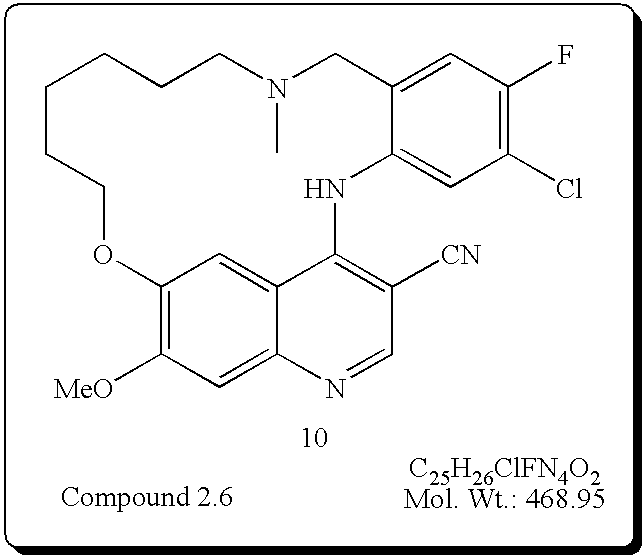
7-chloro-8-fluoro-21-methoxy-11-methyl-10,11,12,13,14,15,16,17-octahydro-5H-1,19-(ethanediylidene)pyrido[4,3-b][6,1,13]benzoxadiazacyclohexadecine-4-carbonitrile (compound 2.6)
Reductive Amination
| FlashPlate. (C2): | SKOV3 cell (C3): | |
| Compound number | IC50 in nM | IC50 in μM |
| 2 | 8.3 | 6.8 |
Claims (6)


Priority Applications (3)
| Application Number | Priority Date | Filing Date | Title |
|---|---|---|---|
| US12/624,708 US8778920B2 (en) | 2003-12-18 | 2009-11-24 | 3-cyano-quinoline derivatives with antiproliferative activity |
| US13/796,377 US9040511B2 (en) | 2003-12-18 | 2013-03-12 | 3-cyano-quinoline derivatives with antiproliferative activity |
| US14/285,760 US9365517B2 (en) | 2003-12-18 | 2014-05-23 | 3-cyano-quinoline derivatives with antiproliferative activity |
Applications Claiming Priority (4)
| Application Number | Priority Date | Filing Date | Title |
|---|---|---|---|
| EPPCT/EP03/51059 | 2003-12-18 | ||
| US10/596,509 US7655642B2 (en) | 2003-12-18 | 2004-12-15 | 3-cyano-quinoline derivatives with antiproliferative activity |
| PCT/EP2004/053497 WO2005058318A1 (en) | 2003-12-18 | 2004-12-15 | 3-cyano-quinoline derivatives with antiproliferative activity |
| US12/624,708 US8778920B2 (en) | 2003-12-18 | 2009-11-24 | 3-cyano-quinoline derivatives with antiproliferative activity |
Related Parent Applications (4)
| Application Number | Title | Priority Date | Filing Date |
|---|---|---|---|
| EPPCT/EP03/51059 Division | 2003-12-18 | 2003-12-18 | |
| PCT/EP2004/053497 Division WO2005058318A1 (en) | 2003-12-18 | 2004-12-15 | 3-cyano-quinoline derivatives with antiproliferative activity |
| US10596509 Division | 2004-12-15 | ||
| US10/596,509 Division US7655642B2 (en) | 2003-12-18 | 2004-12-15 | 3-cyano-quinoline derivatives with antiproliferative activity |
Related Child Applications (2)
| Application Number | Title | Priority Date | Filing Date |
|---|---|---|---|
| US13/796,377 Division US9040511B2 (en) | 2003-12-18 | 2013-03-12 | 3-cyano-quinoline derivatives with antiproliferative activity |
| US14/285,760 Division US9365517B2 (en) | 2003-12-18 | 2014-05-23 | 3-cyano-quinoline derivatives with antiproliferative activity |
Publications (2)
| Publication Number | Publication Date |
|---|---|
| US20100069424A1 US20100069424A1 (en) | 2010-03-18 |
| US8778920B2 true US8778920B2 (en) | 2014-07-15 |
Family
ID=34684508
Family Applications (4)
| Application Number | Title | Priority Date | Filing Date |
|---|---|---|---|
| US10/596,509 Active 2026-02-27 US7655642B2 (en) | 2003-12-18 | 2004-12-15 | 3-cyano-quinoline derivatives with antiproliferative activity |
| US12/624,708 Active 2028-04-14 US8778920B2 (en) | 2003-12-18 | 2009-11-24 | 3-cyano-quinoline derivatives with antiproliferative activity |
| US13/796,377 Expired - Lifetime US9040511B2 (en) | 2003-12-18 | 2013-03-12 | 3-cyano-quinoline derivatives with antiproliferative activity |
| US14/285,760 Expired - Lifetime US9365517B2 (en) | 2003-12-18 | 2014-05-23 | 3-cyano-quinoline derivatives with antiproliferative activity |
Family Applications Before (1)
| Application Number | Title | Priority Date | Filing Date |
|---|---|---|---|
| US10/596,509 Active 2026-02-27 US7655642B2 (en) | 2003-12-18 | 2004-12-15 | 3-cyano-quinoline derivatives with antiproliferative activity |
Family Applications After (2)
| Application Number | Title | Priority Date | Filing Date |
|---|---|---|---|
| US13/796,377 Expired - Lifetime US9040511B2 (en) | 2003-12-18 | 2013-03-12 | 3-cyano-quinoline derivatives with antiproliferative activity |
| US14/285,760 Expired - Lifetime US9365517B2 (en) | 2003-12-18 | 2014-05-23 | 3-cyano-quinoline derivatives with antiproliferative activity |
Country Status (22)
| Country | Link |
|---|---|
| US (4) | US7655642B2 (en) |
| EP (1) | EP1696914B1 (en) |
| JP (1) | JP4892353B2 (en) |
| KR (1) | KR101158440B1 (en) |
| CN (1) | CN1893944B (en) |
| AR (1) | AR047060A1 (en) |
| AT (1) | ATE446750T1 (en) |
| AU (1) | AU2004298784B2 (en) |
| BR (1) | BRPI0417609B8 (en) |
| CA (1) | CA2549728C (en) |
| DE (1) | DE602004023876D1 (en) |
| EA (1) | EA200601176A1 (en) |
| ES (1) | ES2335216T3 (en) |
| IL (1) | IL176358A (en) |
| MX (1) | MXPA06007018A (en) |
| NO (1) | NO337622B1 (en) |
| NZ (1) | NZ547795A (en) |
| SG (1) | SG151288A1 (en) |
| TW (2) | TWI374879B (en) |
| UA (1) | UA83880C2 (en) |
| WO (1) | WO2005058318A1 (en) |
| ZA (1) | ZA200604971B (en) |
Families Citing this family (15)
| Publication number | Priority date | Publication date | Assignee | Title |
|---|---|---|---|---|
| NZ547795A (en) | 2003-12-18 | 2009-07-31 | Janssen Pharmaceutica Nv | 3-Cyano-quinoline derivatives with antiproliferative activity |
| NZ547794A (en) | 2003-12-18 | 2009-11-27 | Janssen Pharmaceutica Nv | Pyrido- and pyrimidopyrimidine derivatives as anti-proliferative agents |
| JO3088B1 (en) * | 2004-12-08 | 2017-03-15 | Janssen Pharmaceutica Nv | Macrocyclic Quinazoline derivatives and their use as MTKI |
| NI200700147A (en) | 2004-12-08 | 2019-05-10 | Janssen Pharmaceutica Nv | QUINAZOLINE DERIVATIVES KINE INHIBITORS TARGETING MULTIP |
| MY169441A (en) | 2004-12-08 | 2019-04-11 | Janssen Pharmaceutica Nv | 2,4, (4,6) pyrimidine derivatives |
| PT1951730E (en) * | 2005-11-16 | 2010-08-27 | S Bio Pte Ltd | PYRIMIDINE DERIVATIVES LINED TO HETEROALKYL |
| US10517876B2 (en) | 2005-11-16 | 2019-12-31 | Cti Biopharma Corp. | Oxygen linked pyrimidine derivatives |
| CA2654583C (en) | 2006-07-13 | 2015-11-24 | Janssen Pharmaceutica N.V. | Mtki quinazoline derivatives |
| JPWO2008087736A1 (en) * | 2007-01-19 | 2010-05-06 | 宇部興産株式会社 | Process for producing aromatic amines having aralkyloxy or heteroaralkyloxy groups |
| AU2008265104B2 (en) * | 2007-06-21 | 2013-09-12 | Janssen Pharmaceutica Nv | Indolin-2-ones and aza-indolin-2-ones |
| JP5536647B2 (en) | 2007-07-27 | 2014-07-02 | ジヤンセン・フアーマシユーチカ・ナームローゼ・フエンノートシヤツプ | Pyrrolopyrimidine |
| CN102127087B (en) * | 2011-01-21 | 2012-07-04 | 江苏先声药物研究有限公司 | Quinazoline derivatives |
| MA39823A (en) | 2014-04-03 | 2018-01-09 | Janssen Pharmaceutica Nv | MACROCYCLIC PYRIDINE DERIVATIVES |
| MA39822A (en) | 2014-04-03 | 2018-02-06 | Janssen Pharmaceutica Nv | BICYCLE PYRIMIDINE DERIVATIVES |
| AU2016333987A1 (en) | 2015-10-05 | 2018-05-10 | Ny State Psychiatric Institute | Activators of autophagic flux and phospholipase D and clearance of protein aggregates including tau and treatment of proteinopathies |
Citations (7)
| Publication number | Priority date | Publication date | Assignee | Title |
|---|---|---|---|---|
| WO1998043960A1 (en) | 1997-04-03 | 1998-10-08 | American Cyanamid Company | Substituted 3-cyano quinolines |
| US6002008A (en) | 1997-04-03 | 1999-12-14 | American Cyanamid Company | Substituted 3-cyano quinolines |
| WO2000018761A1 (en) | 1998-09-29 | 2000-04-06 | American Cyanamid Company | Substituted 3-cyanoquinolines as protein tyrosine kinases inhibitors |
| US6288082B1 (en) | 1998-09-29 | 2001-09-11 | American Cyanamid Company | Substituted 3-cyanoquinolines |
| WO2003082290A1 (en) | 2002-03-30 | 2003-10-09 | Boehringer Ingelheim Pharma Gmbh & Co. Kg | 4-(n-phenylamino)-quinazolines / quinolines as tyrosine kinase inhibitors |
| WO2004105765A1 (en) | 2003-05-27 | 2004-12-09 | Janssen Pharmaceutica N.V. | Macrocyclic quinazoline derivatives as antiproliferative agents |
| US7655642B2 (en) | 2003-12-18 | 2010-02-02 | Janssen Pharmaceutica N.V. | 3-cyano-quinoline derivatives with antiproliferative activity |
Family Cites Families (1)
| Publication number | Priority date | Publication date | Assignee | Title |
|---|---|---|---|---|
| US5028613A (en) | 1990-02-16 | 1991-07-02 | Repligen Corporation | Novel pyrroloquinoline alkaloids and methods of use |
-
2004
- 2004-12-15 NZ NZ547795A patent/NZ547795A/en not_active IP Right Cessation
- 2004-12-15 ES ES04804849T patent/ES2335216T3/en not_active Expired - Lifetime
- 2004-12-15 CN CN2004800375666A patent/CN1893944B/en not_active Expired - Lifetime
- 2004-12-15 CA CA2549728A patent/CA2549728C/en not_active Expired - Lifetime
- 2004-12-15 US US10/596,509 patent/US7655642B2/en active Active
- 2004-12-15 SG SG200901893-8A patent/SG151288A1/en unknown
- 2004-12-15 BR BRPI0417609A patent/BRPI0417609B8/en not_active IP Right Cessation
- 2004-12-15 JP JP2006544439A patent/JP4892353B2/en not_active Expired - Lifetime
- 2004-12-15 UA UAA200607006A patent/UA83880C2/en unknown
- 2004-12-15 DE DE602004023876T patent/DE602004023876D1/en not_active Expired - Lifetime
- 2004-12-15 MX MXPA06007018A patent/MXPA06007018A/en active IP Right Grant
- 2004-12-15 KR KR1020067014235A patent/KR101158440B1/en not_active Expired - Lifetime
- 2004-12-15 WO PCT/EP2004/053497 patent/WO2005058318A1/en not_active Ceased
- 2004-12-15 EP EP04804849A patent/EP1696914B1/en not_active Expired - Lifetime
- 2004-12-15 AU AU2004298784A patent/AU2004298784B2/en not_active Expired
- 2004-12-15 EA EA200601176A patent/EA200601176A1/en unknown
- 2004-12-15 AT AT04804849T patent/ATE446750T1/en not_active IP Right Cessation
- 2004-12-17 TW TW093139380A patent/TWI374879B/en not_active IP Right Cessation
- 2004-12-17 AR ARP040104751A patent/AR047060A1/en active IP Right Grant
- 2004-12-17 TW TW100107837A patent/TWI389890B/en not_active IP Right Cessation
-
2006
- 2006-06-15 IL IL176358A patent/IL176358A/en active IP Right Grant
- 2006-06-15 ZA ZA200604971A patent/ZA200604971B/en unknown
- 2006-07-18 NO NO20063324A patent/NO337622B1/en unknown
-
2009
- 2009-11-24 US US12/624,708 patent/US8778920B2/en active Active
-
2013
- 2013-03-12 US US13/796,377 patent/US9040511B2/en not_active Expired - Lifetime
-
2014
- 2014-05-23 US US14/285,760 patent/US9365517B2/en not_active Expired - Lifetime
Patent Citations (7)
| Publication number | Priority date | Publication date | Assignee | Title |
|---|---|---|---|---|
| WO1998043960A1 (en) | 1997-04-03 | 1998-10-08 | American Cyanamid Company | Substituted 3-cyano quinolines |
| US6002008A (en) | 1997-04-03 | 1999-12-14 | American Cyanamid Company | Substituted 3-cyano quinolines |
| WO2000018761A1 (en) | 1998-09-29 | 2000-04-06 | American Cyanamid Company | Substituted 3-cyanoquinolines as protein tyrosine kinases inhibitors |
| US6288082B1 (en) | 1998-09-29 | 2001-09-11 | American Cyanamid Company | Substituted 3-cyanoquinolines |
| WO2003082290A1 (en) | 2002-03-30 | 2003-10-09 | Boehringer Ingelheim Pharma Gmbh & Co. Kg | 4-(n-phenylamino)-quinazolines / quinolines as tyrosine kinase inhibitors |
| WO2004105765A1 (en) | 2003-05-27 | 2004-12-09 | Janssen Pharmaceutica N.V. | Macrocyclic quinazoline derivatives as antiproliferative agents |
| US7655642B2 (en) | 2003-12-18 | 2010-02-02 | Janssen Pharmaceutica N.V. | 3-cyano-quinoline derivatives with antiproliferative activity |
Non-Patent Citations (20)
| Title |
|---|
| Brown, B., et al. "FlashPlate Technology-Principles and Characteristics of Flashplate Scintillation Counting", High throughput Screening, The discovery of Bioactive Substances, edited by John P. Devlin, Ph.D., Dekker, Inc., New York pp. 317-328. |
| Burke, T., "Protein-Tyrosine Kinase Inhibitors", Drugs of the Future (1992) vol. 17(2) pp. 119-131. |
| Davies, S., et al. "Specificity and Mechanism of Action of Some Commonly Used Protein Kinase Inhibitors", Biochemistry Journal (2000) vol. 351, pp. 95-105. |
| Delia, T.,Fused Pyrimidines, Part Four, Miscellaneous Fused Pyrimidines: Chapter Vi-Pyrimidotriaznes, Heterocyclic Compounds, John Wiley 7 Sons, Inc., Interscience Publication, pp. 261-204. |
| Druker, B, et al. "Lessons Learned From the Development of An Abl tyrosine Kinase Inhibitor for Chronic Myetogenous Leukemia", the Journal of Clinical Investigation, (2000) vol. 5, No. 1, pp. 3-7. |
| Elder, J., et al. "Overexpressin of Transforming Growth Factor alpha in Psoriatic Epidermis", Science (1989) vol. 243, pp. 811-814. |
| Elder, J., et al. "Overexpressin of Transforming Growth Factor α in Psoriatic Epidermis", Science (1989) vol. 243, pp. 811-814. |
| Gennaro Remington's Pharmaceutical Sciences, 19th ed., Mack Publishing Company, Part 8: Pharmaceutical Preparations and Their Manufacture (1990). |
| Greene "Protective Groups in Organic Synthesis", 3nd Ed., Wiley Interscience (1991). |
| Hennequin, "Novel-4-Anilinoquinazolines with C-7 Basic Side Chains: Design and Structure Activity Relationship of a Series of Potent, Orally Active, VEGF Receptor Tyrosine Kinase Inhibitors", Journal of Medicinal Chemistry, Mar. 14, 2002, pp. 1300-1312, vol. 45, No. 6, American Chemical Society, Washington, US XP002256124. |
| Morin, M., "From Oncogene to Drug: Development of Small Molecule Tyrosine Kinase Inhibitors as Anti-Tumor and Anti-Angiogenic Agents", Oncogene (2000) pp. 6574-6583, vol. 19. |
| Nagamatsu, M., "General Syntheses of 1-Alkytoxoflavin and 8-Alkyfervenulin Derivatives of Biological Significance by the Regioselective Alkylation of Reumycin Derivatives and the Rates of Transalkylation From 1-Alkytoxoflavins into Nucleophiles", J. Chemical Society, Perkin Trtnas. 1 (2001) pp. 130-137. |
| Nagamatsu, M., Syntheses of 3-Substituted 1-Methyl-6-Phenylpyrimido[5,5-e]- 1,2-4-triazine-5,7(1H,6H)-diones (6-Phenyl Analogs of Toxoflavin) and Their 4-Oxides and Evaluation of Antimicrobial Activity of Toxoflavins and Their Analogs, Chem. Pharmaceutical Bulletin (1993) pp. 362-368, vol. 41, No. 2. |
| Palmer, D., et al. "Tyrosine Kinase Inhibitors 11 Soluble Analogs of Pyrrolo-and Pyrazoloquinazolines as Epidermal Growth Factor Receptor Inhibitors: Synthesis, Biological Evaluation, and Modeling of the Mode of Binding", Journal of Mediincial Chemistry (1997) pp. 1519-1529, vol. 40, No. 10, American Chemical Society, Washington, US XP002094613. |
| PCT International Search Report for corresponding Application No. PCT/EP2004/053497 mailed Apr. 12, 2005. |
| Psoriasis,"National Library of Medicine-Medical Subject Headings 2008 MeSH", http://www.nlm.nih.gov/cgi/mesh/2008/MB-cgi, accessed Nov. 21, 2008. |
| Rusnak, D., "The Characterization of Novel, Dual Erbb-2/EGFR, Tyrosine Kinase Inhibitors: Potential Therapy for Cancer", Cancer Research (2001), vol. 61, Issue 19, pp. 7196-7203. |
| Shawver, "Smart Drugs: Tyrosine Kinase Inhibitors in Cancer Therapy", Cancer Cells (2002) pp. 117-123, vol. 1. |
| Whitley, B., et al., "Rho-kinase, P13K and p38 signal pathways regulate ovarian cancer cell (SKOV-3) migration and invasion", Proceedings of the American Association of Cancer Research, (2004), vol. 45, Abstract #4918. |
| Wissner, "4-Anlino-6,7-diakoxyquinoline-3-carbonitrile Inhibitor of Epidermal Growth Factor Receptor Kinase and Their Bioisoteric Relationsp to the 4-Anilino-6,7-Dialkyoxquinazoline Inhibitors", Journal of Medicinal Chemistry, (2000) pp. 3244-3256, vol. 43, No. 17, American Chemical society, Washington, US. |
Also Published As
Similar Documents
| Publication | Publication Date | Title |
|---|---|---|
| US8778920B2 (en) | 3-cyano-quinoline derivatives with antiproliferative activity | |
| US8772272B2 (en) | Pyrido-and pyrimidopyrimidine derivatives as anti-proliferative agents | |
| CN102532163B (en) | Macrocyclic quinazoline derivatives and the purposes as MTKI thereof | |
| US9688691B2 (en) | Macrocyclic quinazole derivatives and their use as MTKI | |
| HK1095742B (en) | 3-cyano-quinoline derivatives with antiproliferative activity | |
| BRPI0417534B1 (en) | pyrido- and pyrimidopyrimidine derivatives as antiproliferative agents, intermediates, their preparation process and pharmaceutical composition comprising them and use |
Legal Events
| Date | Code | Title | Description |
|---|---|---|---|
| STCF | Information on status: patent grant |
Free format text: PATENTED CASE |
|
| MAFP | Maintenance fee payment |
Free format text: PAYMENT OF MAINTENANCE FEE, 4TH YEAR, LARGE ENTITY (ORIGINAL EVENT CODE: M1551) Year of fee payment: 4 |
|
| MAFP | Maintenance fee payment |
Free format text: PAYMENT OF MAINTENANCE FEE, 8TH YEAR, LARGE ENTITY (ORIGINAL EVENT CODE: M1552); ENTITY STATUS OF PATENT OWNER: LARGE ENTITY Year of fee payment: 8 |
|
| MAFP | Maintenance fee payment |
Free format text: PAYMENT OF MAINTENANCE FEE, 12TH YEAR, LARGE ENTITY (ORIGINAL EVENT CODE: M1553); ENTITY STATUS OF PATENT OWNER: LARGE ENTITY Year of fee payment: 12 |