US8071568B2 - Nucleoside aryl phosphoramidates for the treatment of RNA-dependent RNA viral infection - Google Patents
Nucleoside aryl phosphoramidates for the treatment of RNA-dependent RNA viral infection Download PDFInfo
- Publication number
- US8071568B2 US8071568B2 US12/520,738 US52073807A US8071568B2 US 8071568 B2 US8071568 B2 US 8071568B2 US 52073807 A US52073807 A US 52073807A US 8071568 B2 US8071568 B2 US 8071568B2
- Authority
- US
- United States
- Prior art keywords
- compound
- amino
- methyl
- pharmaceutically acceptable
- acceptable salt
- Prior art date
- Legal status (The legal status is an assumption and is not a legal conclusion. Google has not performed a legal analysis and makes no representation as to the accuracy of the status listed.)
- Active, expires
Links
- 0 [1*][C@]1([2*])[C@H](B)O[C@H](COP(=O)(O[Ar])N([13*])C([4*])([5*])C([11*])([12*])OC(=O)C[6*])[C@H]1O[3*] Chemical compound [1*][C@]1([2*])[C@H](B)O[C@H](COP(=O)(O[Ar])N([13*])C([4*])([5*])C([11*])([12*])OC(=O)C[6*])[C@H]1O[3*] 0.000 description 38
- FBWOQKPVAOTWFX-YNMIPJKBSA-N CC(C)C(=O)O[C@@H](C)CNP(=O)(OC[C@H]1O[C@@H](N2C=CC(N)=NC2=O)[C@](C)(O)[C@@H]1O)OC1=CC=CC=C1 Chemical compound CC(C)C(=O)O[C@@H](C)CNP(=O)(OC[C@H]1O[C@@H](N2C=CC(N)=NC2=O)[C@](C)(O)[C@@H]1O)OC1=CC=CC=C1 FBWOQKPVAOTWFX-YNMIPJKBSA-N 0.000 description 2
- WDJSFBDHSPWNFW-HDXRTRSKSA-N C=C1N=C(N)C=CN1[C@@H]1O[C@H](COP(=O)(NCCOC(=O)C(C)C)OC2=CC=CC=C2)[C@@H](O)[C@@]1(C)O Chemical compound C=C1N=C(N)C=CN1[C@@H]1O[C@H](COP(=O)(NCCOC(=O)C(C)C)OC2=CC=CC=C2)[C@@H](O)[C@@]1(C)O WDJSFBDHSPWNFW-HDXRTRSKSA-N 0.000 description 1
- NSZNHKGWCAIMPS-DODMCABESA-N CC(C)(C)C(=O)OCCNP(=O)(OC[C@H]1O[C@@H](N2C=CC(N)=CC2=O)[C@](C)(O)[C@@H]1O)OC1=CC=CC=C1 Chemical compound CC(C)(C)C(=O)OCCNP(=O)(OC[C@H]1O[C@@H](N2C=CC(N)=CC2=O)[C@](C)(O)[C@@H]1O)OC1=CC=CC=C1 NSZNHKGWCAIMPS-DODMCABESA-N 0.000 description 1
- VZUXMKVEDSXKJV-XZVWJUHOSA-N CC(C)C(=O)OC1CCN(P(=O)(OC[C@H]2O[C@@H](N3C=CC(N)=NC3=O)[C@](C)(O)[C@@H]2O)[O-]C2=CC=CC=C2)C1 Chemical compound CC(C)C(=O)OC1CCN(P(=O)(OC[C@H]2O[C@@H](N3C=CC(N)=NC3=O)[C@](C)(O)[C@@H]2O)[O-]C2=CC=CC=C2)C1 VZUXMKVEDSXKJV-XZVWJUHOSA-N 0.000 description 1
- LTFNLXMDXBVLTB-YNMIPJKBSA-N CC(C)C(=O)OC[C@H](C)NP(=O)(OC[C@H]1O[C@@H](N2C=CC(N)=NC2=O)[C@](C)(O)[C@@H]1O)OC1=CC=CC=C1 Chemical compound CC(C)C(=O)OC[C@H](C)NP(=O)(OC[C@H]1O[C@@H](N2C=CC(N)=NC2=O)[C@](C)(O)[C@@H]1O)OC1=CC=CC=C1 LTFNLXMDXBVLTB-YNMIPJKBSA-N 0.000 description 1
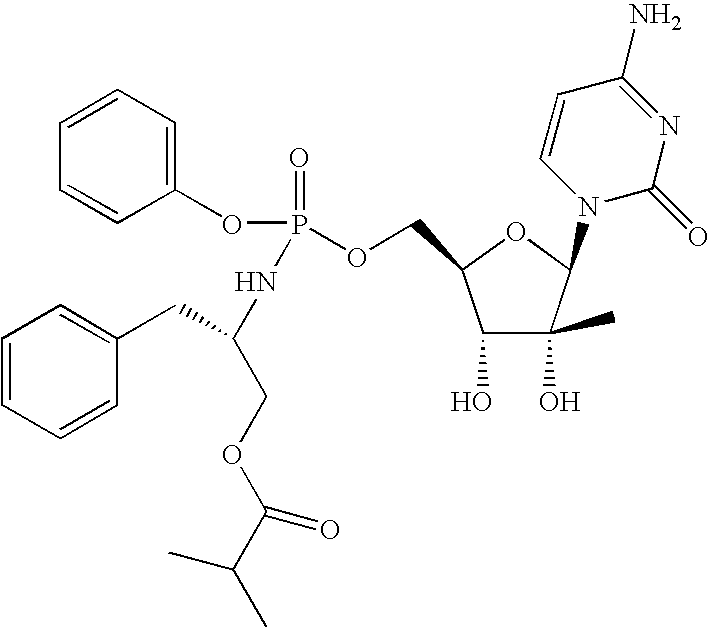
- ZQLAWIMMULOMMT-BISORJHWSA-N CC(C)C(=O)OC[C@H](CC1=CC=CC=C1)NP(=O)(OC[C@H]1O[C@@H](N2C=CC(N)=NC2=O)[C@](C)(O)[C@@H]1O)OC1=CC=CC=C1 Chemical compound CC(C)C(=O)OC[C@H](CC1=CC=CC=C1)NP(=O)(OC[C@H]1O[C@@H](N2C=CC(N)=NC2=O)[C@](C)(O)[C@@H]1O)OC1=CC=CC=C1 ZQLAWIMMULOMMT-BISORJHWSA-N 0.000 description 1
- CBNWSZLOFNLTJO-NMRIJONYSA-N CC(C)C(=O)OC[C@H](CC1=CNC2=C1C=CC=C2)NP(=O)(OC[C@H]1O[C@@H](N2C=CC(N)=NC2=O)[C@](C)(O)[C@@H]1O)OC1=CC=CC=C1 Chemical compound CC(C)C(=O)OC[C@H](CC1=CNC2=C1C=CC=C2)NP(=O)(OC[C@H]1O[C@@H](N2C=CC(N)=NC2=O)[C@](C)(O)[C@@H]1O)OC1=CC=CC=C1 CBNWSZLOFNLTJO-NMRIJONYSA-N 0.000 description 1
- FBWOQKPVAOTWFX-UNGBFZJXSA-N CC(C)C(=O)O[C@H](C)CNP(=O)(OC[C@H]1O[C@@H](N2C=CC(N)=NC2=O)[C@](C)(O)[C@@H]1O)OC1=CC=CC=C1 Chemical compound CC(C)C(=O)O[C@H](C)CNP(=O)(OC[C@H]1O[C@@H](N2C=CC(N)=NC2=O)[C@](C)(O)[C@@H]1O)OC1=CC=CC=C1 FBWOQKPVAOTWFX-UNGBFZJXSA-N 0.000 description 1
- WIATYLVVDBAYBD-UHFFFAOYSA-N CC(C)P(=O)(O)OP(=O)(O)OP(C)(=O)O Chemical compound CC(C)P(=O)(O)OP(=O)(O)OP(C)(=O)O WIATYLVVDBAYBD-UHFFFAOYSA-N 0.000 description 1
- ZNKNBAGQDKMUAY-UHFFFAOYSA-N CC(C)P(=O)(O)OP(C)(=O)O Chemical compound CC(C)P(=O)(O)OP(C)(=O)O ZNKNBAGQDKMUAY-UHFFFAOYSA-N 0.000 description 1
- QDOICKOWASGHBU-QYVSTXNMSA-N CC1(C)O[C@@H]2[C@@H](CO)O[C@@H](N3C=CC(N)=NC3=O)[C@]2(C)O1 Chemical compound CC1(C)O[C@@H]2[C@@H](CO)O[C@@H](N3C=CC(N)=NC3=O)[C@]2(C)O1 QDOICKOWASGHBU-QYVSTXNMSA-N 0.000 description 1
- JSVXCDWMUMEOSR-VTGKJTOQSA-N CC1(C)O[C@@H]2[C@@H](COP(=O)(NCCOC(=O)C(C)(C)C)OC3=CC=CC=C3)O[C@@H](N3C=CC(N)=NC3=O)[C@]2(C)O1 Chemical compound CC1(C)O[C@@H]2[C@@H](COP(=O)(NCCOC(=O)C(C)(C)C)OC3=CC=CC=C3)O[C@@H](N3C=CC(N)=NC3=O)[C@]2(C)O1 JSVXCDWMUMEOSR-VTGKJTOQSA-N 0.000 description 1
- AIIJAZDBFWOBRD-ZOZMEPSFSA-N CCCC(=O)OC[C@H](C)NP(=O)(Cl)OC1=CC=CC=C1 Chemical compound CCCC(=O)OC[C@H](C)NP(=O)(Cl)OC1=CC=CC=C1 AIIJAZDBFWOBRD-ZOZMEPSFSA-N 0.000 description 1
- HOYTTXWUSBFWHT-BQDUCNQFSA-N CCCC(=O)OC[C@H](C)NP(=O)(OC[C@H]1O[C@@H](N2C=CC(N)=NC2=O)[C@](C)(O)[C@@H]1O)OC1=CC=CC=C1 Chemical compound CCCC(=O)OC[C@H](C)NP(=O)(OC[C@H]1O[C@@H](N2C=CC(N)=NC2=O)[C@](C)(O)[C@@H]1O)OC1=CC=CC=C1 HOYTTXWUSBFWHT-BQDUCNQFSA-N 0.000 description 1
- OYFIQEIWNNPSMC-BQJLNHOESA-N CCCC(CCC)C(=O)OCCNP(=O)(OC[C@H]1O[C@@H](N2C=CC(N)=NC2=O)[C@](C)(O)[C@@H]1O)OC1=CC=CC=C1 Chemical compound CCCC(CCC)C(=O)OCCNP(=O)(OC[C@H]1O[C@@H](N2C=CC(N)=NC2=O)[C@](C)(O)[C@@H]1O)OC1=CC=CC=C1 OYFIQEIWNNPSMC-BQJLNHOESA-N 0.000 description 1
- CYDMOTSLXRZHDE-JRYDKOEBSA-N CC[C@H](C)[C@@H](COC(=O)C(C)(C)C)NP(=O)(OC[C@H]1O[C@@H](N2C=CC(N)=NC2=O)[C@](C)(O)[C@@H]1O)OC1=CC=CC=C1 Chemical compound CC[C@H](C)[C@@H](COC(=O)C(C)(C)C)NP(=O)(OC[C@H]1O[C@@H](N2C=CC(N)=NC2=O)[C@](C)(O)[C@@H]1O)OC1=CC=CC=C1 CYDMOTSLXRZHDE-JRYDKOEBSA-N 0.000 description 1
- YSBZWURJEMFUEJ-VIFPVBQESA-N C[C@@H](COC(=O)C(C)(C)C)NC(=O)OC(C)(C)C Chemical compound C[C@@H](COC(=O)C(C)(C)C)NC(=O)OC(C)(C)C YSBZWURJEMFUEJ-VIFPVBQESA-N 0.000 description 1
- GWFAZZHRFTXSDH-QHIQZGGMSA-N C[C@@H](COC(=O)C(C)(C)C)NP(=O)(Cl)OC1=CC=CC=C1 Chemical compound C[C@@H](COC(=O)C(C)(C)C)NP(=O)(Cl)OC1=CC=CC=C1 GWFAZZHRFTXSDH-QHIQZGGMSA-N 0.000 description 1
- RYJNNCSFROEXTB-ZTBGLYLKSA-N C[C@@H](COC(=O)C(C)(C)C)NP(=O)(OC[C@H]1O[C@@H](N2C=CC(N)=NC2=O)[C@](C)(O)[C@@H]1O)OC1=CC=CC=C1 Chemical compound C[C@@H](COC(=O)C(C)(C)C)NP(=O)(OC[C@H]1O[C@@H](N2C=CC(N)=NC2=O)[C@](C)(O)[C@@H]1O)OC1=CC=CC=C1 RYJNNCSFROEXTB-ZTBGLYLKSA-N 0.000 description 1
- YYLOPWMMXHYTDO-LURJTMIESA-N C[C@H](N)COC(=O)C(C)(C)C.Cl Chemical compound C[C@H](N)COC(=O)C(C)(C)C.Cl YYLOPWMMXHYTDO-LURJTMIESA-N 0.000 description 1
Classifications
-
- C—CHEMISTRY; METALLURGY
- C07—ORGANIC CHEMISTRY
- C07H—SUGARS; DERIVATIVES THEREOF; NUCLEOSIDES; NUCLEOTIDES; NUCLEIC ACIDS
- C07H19/00—Compounds containing a hetero ring sharing one ring hetero atom with a saccharide radical; Nucleosides; Mononucleotides; Anhydro-derivatives thereof
- C07H19/02—Compounds containing a hetero ring sharing one ring hetero atom with a saccharide radical; Nucleosides; Mononucleotides; Anhydro-derivatives thereof sharing nitrogen
- C07H19/04—Heterocyclic radicals containing only nitrogen atoms as ring hetero atom
-
- A—HUMAN NECESSITIES
- A61—MEDICAL OR VETERINARY SCIENCE; HYGIENE
- A61P—SPECIFIC THERAPEUTIC ACTIVITY OF CHEMICAL COMPOUNDS OR MEDICINAL PREPARATIONS
- A61P31/00—Antiinfectives, i.e. antibiotics, antiseptics, chemotherapeutics
-
- A—HUMAN NECESSITIES
- A61—MEDICAL OR VETERINARY SCIENCE; HYGIENE
- A61P—SPECIFIC THERAPEUTIC ACTIVITY OF CHEMICAL COMPOUNDS OR MEDICINAL PREPARATIONS
- A61P31/00—Antiinfectives, i.e. antibiotics, antiseptics, chemotherapeutics
- A61P31/12—Antivirals
- A61P31/14—Antivirals for RNA viruses
-
- C—CHEMISTRY; METALLURGY
- C07—ORGANIC CHEMISTRY
- C07H—SUGARS; DERIVATIVES THEREOF; NUCLEOSIDES; NUCLEOTIDES; NUCLEIC ACIDS
- C07H19/00—Compounds containing a hetero ring sharing one ring hetero atom with a saccharide radical; Nucleosides; Mononucleotides; Anhydro-derivatives thereof
- C07H19/02—Compounds containing a hetero ring sharing one ring hetero atom with a saccharide radical; Nucleosides; Mononucleotides; Anhydro-derivatives thereof sharing nitrogen
- C07H19/04—Heterocyclic radicals containing only nitrogen atoms as ring hetero atom
- C07H19/048—Pyridine radicals
-
- C—CHEMISTRY; METALLURGY
- C07—ORGANIC CHEMISTRY
- C07H—SUGARS; DERIVATIVES THEREOF; NUCLEOSIDES; NUCLEOTIDES; NUCLEIC ACIDS
- C07H19/00—Compounds containing a hetero ring sharing one ring hetero atom with a saccharide radical; Nucleosides; Mononucleotides; Anhydro-derivatives thereof
- C07H19/02—Compounds containing a hetero ring sharing one ring hetero atom with a saccharide radical; Nucleosides; Mononucleotides; Anhydro-derivatives thereof sharing nitrogen
- C07H19/04—Heterocyclic radicals containing only nitrogen atoms as ring hetero atom
- C07H19/06—Pyrimidine radicals
- C07H19/10—Pyrimidine radicals with the saccharide radical esterified by phosphoric or polyphosphoric acids
-
- C—CHEMISTRY; METALLURGY
- C07—ORGANIC CHEMISTRY
- C07H—SUGARS; DERIVATIVES THEREOF; NUCLEOSIDES; NUCLEOTIDES; NUCLEIC ACIDS
- C07H19/00—Compounds containing a hetero ring sharing one ring hetero atom with a saccharide radical; Nucleosides; Mononucleotides; Anhydro-derivatives thereof
- C07H19/02—Compounds containing a hetero ring sharing one ring hetero atom with a saccharide radical; Nucleosides; Mononucleotides; Anhydro-derivatives thereof sharing nitrogen
- C07H19/04—Heterocyclic radicals containing only nitrogen atoms as ring hetero atom
- C07H19/16—Purine radicals
- C07H19/20—Purine radicals with the saccharide radical esterified by phosphoric or polyphosphoric acids
Definitions
- the present invention is concerned with nucleoside aryl phosphoramidates, their synthesis, and their use as precursors to inhibitors of RNA-dependent RNA viral polymerase.
- the compounds of the present invention are precursors to inhibitors of RNA-dependent RNA viral replication and are therefore useful for the treatment of RNA-dependent RNA viral infection. They are particularly useful as precursors to inhibitors of hepatitis C virus (HCV) NS5B polymerase, as precursors to inhibitors of HCV replication, and for the treatment of hepatitis C infection.
- HCV hepatitis C virus
- Hepatitis C virus (HCV) infection is a major health problem that leads to chronic liver disease, such as cirrhosis and hepatocellular carcinoma, in a substantial number of infected individuals, estimated to be 2-15% of the world's population.
- chronic liver disease such as cirrhosis and hepatocellular carcinoma
- According to the World Health Organization there are more than 200 million infected individuals worldwide, with at least 3 to 4 million people being infected each year. Once infected, about 20% of people clear the virus, but the rest harbor HCV the rest of their lives.
- Ten to twenty percent of chronically infected individuals eventually develop liver-destroying cirrhosis or cancer.
- the viral disease is transmitted parenterally by contaminated blood and blood products, contaminated needles, or sexually and vertically from infected mothers or carrier mothers to their off-spring.
- Current treatments for HCV infection which are restricted to immunotherapy with recombinant interferon- ⁇ alone or in combination with the nucleoside analog ribavirin, are of limited clinical benefit.
- the state of the art in the treatment of HCV infection has been reviewed, and reference is made to the following publications: B.
- Dymock, et al. “Novel approaches to the treatment of hepatitis C virus infection,” Antiviral Chemistry & Chemotherapy, 11: 79-96 (2000); H. Rosen, et al., “Hepatitis C virus: current understanding and prospects for future therapies,” Molecular Medicine Today, 5: 393-399 (1999); D. Moradpour, et al., “Current and evolving therapies for hepatitis C,” European J. Gastroenterol. Hepatol., 11: 1189-1202 (1999); R. Bartenschlager, “Candidate Targets for Hepatitis C Virus-Specific Antiviral Therapy,” Intervirology, 40: 378-393 (1997); G. M. Lauer and B. D.
- RNA-dependent RNA polymerase RNA-dependent RNA polymerase
- the HCV virion is an enveloped positive-strand RNA virus with a single oligoribonucleotide genomic sequence of about 9600 bases which encodes a polyprotein of about 3,010 amino acids.
- the protein products of the HCV gene consist of the structural proteins C, E1, and E2, and the non-structural proteins NS2, NS3, NS4A and NS4B, and NS5A and NS5B.
- the nonstructural (NS) proteins are believed to provide the catalytic machinery for viral replication.
- the NS3 protease releases NS5B, the RNA-dependent RNA polymerase from the polyprotein chain.
- HCV NS5B polymerase is required for the synthesis of a double-stranded RNA from a single-stranded viral RNA that serves as a template in the replication cycle of HCV.
- NS5B polymerase is therefore considered to be an essential component in the HCV replication complex [see K. Ishi, et al., “Expression of Hepatitis C Virus NS5B Protein: Characterization of Its RNA Polymerase Activity and RNA Binding,” Hepatology, 29: 1227-1235 (1999) and V.
- nucleoside aryl phosphoramidates of the present invention are precursors to potent inhibitors of RNA-dependent RNA viral replication and in particular HCV replication.
- the phosphoramidates are converted in vivo into their nucleoside 5′-phosphate (nucleotide) derivatives which are converted into the corresponding nucleoside 5′-triphosphate derivatives which are inhibitors of RNA-dependent RNA viral polymerase and in particular HCV NS5B polymerase.
- the instant nucleoside phosphoramidates are useful to treat RNA-dependent RNA viral infection and in particular HCV infection.
- nucleoside aryl phosphoramidates which are useful as precursors to inhibitors of RNA-dependent RNA viral polymerase and in particular as precursors to inhibitors of HCV NS5B polymerase.
- compositions comprising the nucleoside aryl phosphoramidates of the present invention for use as precursors to inhibitors of RNA-dependent RNA viral polymerase and in particular as precursors to inhibitors of HCV NS5B polymerase.
- compositions comprising the nucleoside aryl phosphoramidates of the present invention for use as precursors to inhibitors of RNA-dependent RNA viral replication and in particular as precursors to inhibitors of HCV replication.
- nucleoside aryl phosphoramidates and their pharmaceutical compositions for use as a medicament for the inhibition of RNA-dependent RNA viral replication and/or the treatment of RNA-dependent RNA viral infection and in particular for the inhibition of HCV replication and/or the treatment of HCV infection.
- the present invention relates to compounds of structural formula I of the indicated stereochemical configuration:
- the compounds of formula I are useful as precursors to inhibitors of RNA-dependent RNA viral polymerase and in particular of HCV NS5B polymerase. They are also precursors to inhibitors of RNA-dependent RNA viral replication and in particular of HCV replication and are useful for the treatment of RNA-dependent RNA viral infection and in particular for the treatment of HCV infection.
- the aryl phosphoramidates of the present invention act as precursors of the corresponding nucleoside 5′-monophosphates. Endogenous kinase enzymes convert the 5′-monophosphates into their 5′-triphosphate derivatives which are the inhibitors of the RNA-dependent RNA viral polymerase.
- the aryl phosphoramidates may provide for more efficient target cell penetration than the nucleoside itself, may be less susceptible to metabolic degradation, and may have the ability to target a specific tissue, such as the liver, resulting in a wider therapeutic index allowing for lowering the overall dose of the antiviral agent.
- compositions containing the compounds alone or in combination with other agents active against RNA-dependent RNA virus and in particular against HCV as well as methods for the inhibition of RNA-dependent RNA viral replication and for the treatment of RNA-dependent RNA viral infection.
- the present invention relates to compounds of structural formula I as set forth in the Summary of the Invention above.
- the compounds of formula I are useful as precursors to inhibitors of RNA-dependent RNA viral polymerase. They are also precursors to inhibitors of RNA-dependent RNA viral replication and are useful for the treatment of RNA-dependent RNA viral infection.
- a first embodiment of the present invention is a compound of Formula I-A, or a pharmaceutically acceptable salt thereof:
- a second embodiment of the present invention is a compound of Formula I-B1, or a pharmaceutically acceptable salt thereof:
- a third embodiment of the present invention is a compound of Formula I-B2, or a pharmaceutically acceptable salt thereof:
- a fourth embodiment of the present invention is a compound of Formula I-A, or a pharmaceutically acceptable salt thereof, wherein:
- R 1 is methyl or fluoromethyl, R 2 is hydroxy, and R 3 is hydrogen; and all other variables are as originally defined or as defined in the first, second, third, or fourth embodiment. In a class of this embodiment, R 1 is methyl.
- R 1 is methyl or fluoromethyl, R 2 is fluoro, and R 3 is hydrogen; and all other variables are as originally defined or as defined in the first, second, third, or fourth embodiment. In a class of this embodiment, R 1 is methyl.
- X is a bond; and all other variables are as originally defined or as defined in any one of the preceding embodiments.
- Ar is phenyl optionally substituted with one to five substituents independently selected from the group consisting of halogen, C 1-4 alkyl, C 1-4 alkoxy, C 1-4 alkylthio, cyano, nitro, amino, carboxy, trifluoromethyl, trifluoromethoxy, C 1-4 alkylamino, di(C 1-4 alkyl)amino, C 1-4 alkylcarbonyl, C 1-4 alkylcarbonyloxy, and C 1-4 alkyloxycarbonyl; and all other variables are as originally defined or as defined in any one of the preceding embodiments.
- Ar is unsubstituted phenyl.
- Ar is indolyl; and all other variables are as originally defined or as defined in any one of the preceding embodiments.
- Ar is 1H-indol-5-yl.
- R 5 , R 11 , and R 12 are each hydrogen and R 4 is selected from the group consisting of hydrogen, methyl, ethyl, n-propyl, isopropyl, isobutyl, n-butyl, 2-methyl-1-propyl, hydroxymethyl, fluoromethyl, mercaptomethyl, carboxymethyl, carbamoylmethyl, 1-hydroxyethyl, 2-carboxyethyl, 2-carbamoylethyl, 2-methylthioethyl, 4-amino-1-butyl, 3-amino-1-propyl, 3-guanidino-1-propyl, 1H-imidazol-4-ylmethyl, phenyl, benzyl, 4-hydroxybenzyl, and 1H-indol-3-ylmethyl; and all other variables are as originally defined or as defined in any one of the preceding embodiments.
- R 4 is methyl, ethyl, n-propyl, isopropyl,
- X is a bond
- R 6 is C 1-8 alkyl, cyclohexyl, or cyclopentyl; and all other variables are as originally defined or as defined in any one of the preceding embodiments.
- R 6 is C 1-4 alkyl.
- X is a bond
- Ar is phenyl
- R 4 is methyl or benzyl
- R 6 is C 1-4 alkyl
- R 5 , R 11 , and R 12 are each hydrogen
- all other variables are as originally defined or as defined in any one of the preceding embodiments.
- R 1 is methyl
- R 2 is hydroxy
- R 3 is hydrogen.
- a thirteenth embodiment of the present invention is a compound of Formula II-A, or a pharmaceutically acceptable salt thereof:
- a fourteenth embodiment of the present invention is a compound of Formula II-B, or a pharmaceutically acceptable salt thereof:
- a fifteenth embodiment of the present invention is a compound of Formula III, or a pharmaceutically acceptable salt thereof:
- R 4 is H, methyl, ethyl, propyl, isopropyl, n-butyl, isobutyl, t-butyl, CH(CH 3 )CH 2 CH 3 , or benzyl;
- R 6 is methyl, ethyl, n-propyl, isopropyl, n-butyl, isobutyl, t-butyl, CH(CH 2 CH 2 CH 3 ) 2 , 3-pentyl, cyclopentyl, cycloheptyl, or phenyl;
- R 11 is H or CH 3 ;
- R 13 is hydrogen or CH 3 ; or, alternatively when R 4 is H, R 11 together with R 13 form a ring of formula:
- a sixteenth embodiment of the present invention is a compound of Formula I which is selected from the group consisting of the compounds set forth in Examples 1 to 22 and pharmaceutically acceptable salts thereof.
- the compounds are selected from the group consisting of the compounds set forth in Examples 1 to 8 and pharmaceutically acceptable salts thereof.
- the nucleoside aryl phosphoramidates of the present invention are useful as precursors to inhibitors of positive-sense single-stranded RNA-dependent RNA viral polymerase, inhibitors of positive-sense single-stranded RNA-dependent RNA viral replication, and/or for the treatment of positive-sense single-stranded RNA-dependent RNA viral infection.
- the positive-sense single-stranded RNA-dependent RNA virus is a Flaviviridae virus or a Picornaviridae virus.
- the Picornaviridae virus is a rhinovirus, a poliovirus, or a hepatitis A virus.
- the Flaviviridae virus is selected from the group consisting of hepatitis C virus, yellow fever virus, dengue virus, West Nile virus, Japanese encephalitis virus, Banzi virus, and bovine viral diarrhea virus (BVDV).
- the Flaviviridae virus is hepatitis C virus.
- Another aspect of the present invention is concerned with a method for inhibiting RNA-dependent RNA viral polymerase, a method for inhibiting RNA-dependent RNA viral replication, and/or a method for treating RNA-dependent RNA viral infection in a mammal in need thereof comprising administering to the mammal a therapeutically effective amount of a compound of structural formula I.
- the RNA-dependent RNA viral polymerase is a positive-sense single-stranded RNA-dependent RNA viral polymerase.
- the positive-sense single-stranded RNA-dependent RNA viral polymerase is a Flaviviridae viral polymerase or a Picornaviridae viral polymerase.
- the Picornaviridae viral polymerase is rhinovirus polymerase, poliovirus polymerase, or hepatitis A virus polymerase.
- the Flaviviridae viral polymerase is selected from the group consisting of hepatitis C virus polymerase, yellow fever virus polymerase, dengue virus polymerase, West Nile virus polymerase, Japanese encephalitis virus polymerase, Banzi virus polymerase, and bovine viral diarrhea virus (BVDV) polymerase.
- the Flaviviridae viral polymerase is hepatitis C virus polymerase.
- the RNA-dependent RNA viral replication is a positive-sense single-stranded RNA-dependent RNA viral replication.
- the positive-sense single-stranded RNA-dependent RNA viral replication is Flaviviridae viral replication or Picornaviridae viral replication.
- the Picornaviridae viral replication is rhinovirus replication, poliovirus replication, or hepatitis A virus replication.
- the Flaviviridae viral replication is selected from the group consisting of hepatitis C virus replication, yellow fever virus replication, dengue virus replication, West Nile virus replication, Japanese encephalitis virus replication, Banzi virus replication, and bovine viral diarrhea virus replication.
- the Flaviviridae viral replication is hepatitis C virus replication.
- the RNA-dependent RNA viral infection is a positive-sense single-stranded RNA-dependent viral infection.
- the positive-sense single-stranded RNA-dependent RNA viral infection is Flaviviridae viral infection or Picornaviridae viral infection.
- the Picornaviridae viral infection is rhinovirus infection, poliovirus infection, or hepatitis A virus infection.
- the Flaviviridae viral infection is selected from the group consisting of hepatitis C virus infection, yellow fever virus infection, dengue virus infection, West Nile virus infection, Japanese encephalitis virus infection, Banzi virus infection, and bovine viral diarrhea virus infection.
- the Flaviviridae viral infection is hepatitis C virus infection.
- alkyl groups specified above are intended to include those alkyl groups of the designated length in either a straight or branched configuration.
- exemplary of such alkyl groups are methyl, ethyl, propyl, isopropyl, butyl, sec-butyl, tertiary butyl, pentyl, isopentyl, hexyl, isohexyl, and the like.
- naphthyl encompasses both 1-naphthyl ( ⁇ -naphthyl) and 2-naphthyl ( ⁇ -naphthyl).
- adamantyl encompasses both 1-adamantyl and 2-adamantyl.
- optionally substituted benzyl is meant —CH 2 -phenyl wherein the phenyl moiety is optionally substituted.
- alkenyl shall mean straight or branched chain alkenes of two to twenty total carbon atoms, or any number within this range (e.g., ethenyl, propenyl, butenyl, pentenyl, oleyl, etc.).
- cycloalkyl shall mean cyclic rings of alkanes of three to eight total carbon atoms, or any number within this range (e.g., cyclopropyl, cyclobutyl, cyclopentyl, cyclohexyl, cycloheptyl, or cyclooctyl).
- alkoxy refers to straight or branched chain alkoxides of the number of carbon atoms specified (e.g., C 1-4 alkoxy), or any number within this range [e.g., methoxy (MeO—), ethoxy, isopropoxy, etc.].
- alkylthio refers to straight or branched chain alkylsulfides of the number of carbon atoms specified (e.g., C 1-4 alkylthio), or any number within this range [e.g., methylthio (MeS—), ethylthio, isopropylthio, etc.].
- alkylamino refers to straight or branched alkylamines of the number of carbon atoms specified (e.g., C 1-4 alkylamino), or any number within this range [e.g., methylamino, ethylamino, isopropylamino, t-butylamino, etc.].
- alkylsulfonyl refers to straight or branched chain alkylsulfones of the number of carbon atoms specified (e.g., C 1-6 alkylsulfonyl), or any number within this range [e.g., methylsulfonyl (MeSO 2 —), ethylsulfonyl, isopropylsulfonyl, etc.].
- alkyloxycarbonyl refers to straight or branched chain esters of a carboxylic acid or carbamic acid group present in a compound of the present invention having the number of carbon atoms specified (e.g., C 1-8 alkyloxycarbonyl), or any number within this range [e.g., methyloxycarbonyl (MeOCO—), ethyloxycarbonyl, or butyloxycarbonyl].
- alkylcarbonyl refers to straight or branched chain alkyl acyl group of the specified number of carbon atoms (e.g., C 1-8 alkylcarbonyl), or any number within this range [e.g., methyloxycarbonyl (MeOCO—), ethyloxycarbonyl, or butyloxycarbonyl].
- halogen is intended to include the halogen atoms fluorine, chlorine, bromine and iodine.
- phosphoryl refers to —P(O)(OH) 2 .
- diphosphoryl refers to the radical having the structure:
- triphosphoryl refers to the radical having the structure:
- five-membered cyclic carbonate ring denotes the following ring system formed at the C-2 and C-3 positions of the furanose ring of the nucleoside by acylating the C-2 and C-3 hydroxyls with a carbonylating reagent, such as phosgene and 1,1′-carbonyldiimidazole:
- acetonide denotes the following ring system formed at the C-2 and C-3 positions of the furanose ring of the nucleoside:
- R 7 in the amino acyl residue embodiment of R 3 and R 10 is a substituent other than hydrogen in the formula
- the amino acyl residue contains an asymmetric center and is intended to include the individual R- and S-stereoisomers as well as RS-diastereoisomeric mixtures.
- the stereochemistry at the stereogenic carbon corresponds to that of an S-amino acid, that is, the naturally occurring alpha-amino acid stereochemistry, as depicted in the formula:
- substituted shall be deemed to include multiple degrees of substitution by a named substituent. Where multiple substituent moieties are disclosed or claimed, the substituted compound can be independently substituted by one or more of the disclosed or claimed substituent moieties, singly or plurally.
- 5′-triphosphate refers to a triphosphoric acid ester derivative of the 5′-hydroxyl group of a nucleoside compound of the present invention having the following general structural formula IV:
- composition as in “pharmaceutical composition,” is intended to encompass a product comprising the active ingredient(s) and the inert ingredient(s) that make up the carrier, as well as any product which results, directly or indirectly, from combination, complexation or aggregation of any two or more of the ingredients, or from dissociation of one or more of the ingredients, or from other types of reactions or interactions of one or more of the ingredients.
- pharmaceutical compositions of the present invention encompass any composition made by admixing a compound of the present invention and a pharmaceutically acceptable carrier.
- administering should be understood to mean providing a compound of the invention or a prodrug of a compound of the invention to the individual in need.
- Another aspect of the present invention is concerned with a method of inhibiting HCV NS5B polymerase, inhibiting HCV replication, or treating HCV infection with a compound of the present invention in combination with one or more agents useful for treating HCV infection.
- agents active against HCV include, but are not limited to, ribavirin, levovirin, viramidine, nitazoxanide, thymosin alpha-1, interferon- ⁇ , interferon- ⁇ , pegylated interferon- ⁇ (peginterferon- ⁇ ), a combination of interferon- ⁇ and ribavirin, a combination of peginterferon- ⁇ and ribavirin, a combination of interferon- ⁇ and levovirin, and a combination of peginterferon- ⁇ and levovirin.
- Interferon- ⁇ includes, but is not limited to, recombinant interferon- ⁇ 2a (such as Roferon interferon available from Hoffmann-LaRoche, Nutley, N.J.), pegylated interferon- ⁇ 2a (PegasysTM), interferon- ⁇ 2b (such as Intron-A interferon available from Schering Corp., Kenilworth, N.J.), pegylated interferon- ⁇ 2b (PegIntronTM), a recombinant consensus interferon (such as interferon alphacon-1), and a purified interferon- ⁇ product.
- Amgen's recombinant consensus interferon has the brand name Infergen®.
- Levovirin is the L-enantiomer of ribavirin which has shown immunomodulatory activity similar to ribavirin.
- Viramidine represents an analog of ribavirin disclosed in WO 01/60379 (assigned to ICN Pharmaceuticals).
- the individual components of the combination can be administered separately at different times during the course of therapy or concurrently in divided or single combination forms.
- the instant invention is therefore to be understood as embracing all such regimes of simultaneous or alternating treatment, and the term “administering” is to be interpreted accordingly.
- the scope of combinations of the compounds of this invention with other agents useful for treating HCV infection includes in principle any combination with any pharmaceutical composition for treating HCV infection.
- the dose of each compound may be either the same as or different from the dose when the compound is used alone.
- the compounds of the present invention may also be administered in combination with an agent that is an inhibitor of HCV NS3 serine protease.
- HCV NS3 serine protease is an essential viral enzyme and has been described to be an excellent target for inhibition of HCV replication.
- HCV NS3 protease inhibitors Both substrate and non-substrate based inhibitors of HCV NS3 protease inhibitors are disclosed in WO 98/22496, WO 98/46630, WO 99/07733, WO 99/07734, WO 99/38888, WO 99/50230, WO 99/64442, WO 00/09543, WO 00/59929, GB-2337262, WO 02/18369, WO 02/08244, WO 02/48116, WO 02/48172, WO 05/037214, and U.S. Pat. No. 6,323,180.
- HCV NS3 protease as atarget for the development of inhibitors of HCV replication and for the treatment of HCV infection is discussed in B. W.
- HCV NS3 protease inhibitors combinable with the compounds of the present invention include BILN2061, VX-950, SCH 6 , SCH 7 , and SCH-503034.
- Ribavirin, levovirin, and viramidine may exert their anti-HCV effects by modulating intracellular pools of guanine nucleotides via inhibition of the intracellular enzyme inosine monophosphate dehydrogenase (IMPDH).
- IMPDH inosine monophosphate dehydrogenase
- Ribavirin is readily phosphorylated intracellularly and the monophosphate derivative is an inhibitor of IMPDH.
- inhibition of IMPDH represents another useful target for the discovery of inhibitors of HCV replication.
- the compounds of the present invention may also be administered in combination with an inhibitor of IMPDH, such as VX-497, which is disclosed in WO 97/41211 and WO 01/00622 (assigned to Vertex); another IPDH inhibitor, such as that disclosed in WO 00/25780 (assigned to Bristol-Myers Squibb); or mycophenolate mofetil [see A. C. Allison and E. M. Eugui, Agents Action, 44 (Suppl.): 165 (1993)].
- an inhibitor of IMPDH such as VX-497, which is disclosed in WO 97/41211 and WO 01/00622 (assigned to Vertex)
- another IPDH inhibitor such as that disclosed in WO 00/25780 (assigned to Bristol-Myers Squibb)
- mycophenolate mofetil see A. C. Allison and E. M. Eugui, Agents Action, 44 (Suppl.): 165 (1993)].
- the compounds of the present invention may also be administered in combination with the antiviral agent amantadine (1-aminoadamantane) [for a comprehensive description of this agent, see J. Kirschbaum, Anal. Profiles Drug Subs. 12: 1-36 (1983)].
- the compounds of the present invention may also be combined for the treatment of HCV infection with antiviral 2′-C-branched ribonucleosides disclosed in R. E. Harry-O'kuru, et al., J. Org. Chem., 62: 1754-1759 (1997); M. S. Wolfe, et al., Tetrahedron Lett., 36: 7611-7614 (1995); U.S. Pat. No. 3,480,613 (Nov. 25, 1969); U.S. Pat. No. 6,777,395 (Aug. 17, 2004); U.S. Pat. No. 6,914,054 (Jul. 5, 2005); International Publication Numbers WO 01/90121 (29 Nov.
- Such 2′-C-branched ribonucleosides include, but are not limited to, 2′-C-methylcytidine, 2′-fluoro-2′-C-methylcytidine 2′-C-methyluridine, 2′-C-methyladenosine, 2′-C-methylguanosine, and 9-(2-C-methyl- ⁇ -D-ribofuranosyl)-2,6-diaminopurine; the corresponding amino acid esters of the furanose C-2′, C-3′, and C-5′ hydroxyls (such as 3′-O-(L-valyl)-2′-C-methylcytidine dihydrochloride, also referred to as valopicitabine dihydrochloride or NM-283 and 3′-O-(L-valyl)-2′-fluoro-2′-C-methylcytidine), and the corresponding optionally substituted cyclic 1,3-propanediol esters of their 5′-phosphate
- the compounds of the present invention may also be combined for the treatment of HCV infection with other nucleosides having anti-HCV properties, such as those disclosed in U.S. Pat. No. 6,864,244 (Mar. 8, 2005); WO 02/51425 (4 Jul. 2002), assigned to Mitsubishi Pharma Corp.; WO 01/79246, WO 02/32920, and WO 02/48165 (20 Jun. 2002), assigned to Pharmasset, Ltd.; WO 01/68663 (20 Sep. 2001), assigned to ICN Pharmaceuticals; WO 99/43691 (2 Sep. 1999); WO 02/18404 (7 Mar. 2002), assigned to Hoffmann-LaRoche; U.S. 2002/0019363 (14 Feb. 2002); WO 02/100415 (19 Dec. 2002); WO 03/026589 (3 Apr.
- nucleoside HCV NS5B polymerase inhibitors that may be combined with the nucleoside derivatives of the present invention are selected from the following compounds: 4′-azido-cytidine; 4-amino-7-(2-C-methyl- ⁇ -D-ribofuranosyl)-7H-pyrrolo[2,3-d]pyrimidine; 4-amino-7-(2-C-hydroxymethyl- ⁇ -D-ribofuranosyl)-7H-pyrrolo[2,3-d]pyrimidine; 4-amino-7-(2-C-fluoromethyl- ⁇ -D-ribofuranosyl)-7H-pyrrolo[2,3-d]pyrimidine; 4-amino-5-fluoro-7-(2-C-methyl- ⁇ -D-ribofuranosyl)-7H-pyrrolo[2,3-d]pyrimidine; 2-amino-7-(2-C-methyl- ⁇ -D-ribofuranosyl)-7H-pyrrolo[2,3-d]pyrimidine
- the compounds of the present invention may also be combined for the treatment of HCV infection with non-nucleoside inhibitors of HCV polymerase such as those disclosed in WO 01/77091 (18 Oct. 2001), assigned to Tularik, Inc.; WO 01/47883 (5 Jul. 2001), assigned to Japan Tobacco, Inc.; WO 02/04425 (17 Jan. 2002), assigned to Boehringer Ingelheim; WO 02/06246 (24 Jan. 2002), assigned to Istituto di Ricerche di Biologia Moleculare P. Angeletti S. P. A.; WO 02/20497 (3 Mar. 2002); WO 2005/016927 (in particular JTK003), assigned to Japan Tobacco, Inc.; the contents of each of which are incorporated herein by reference in their entirety; and HCV-796 (Viropharma Inc.).
- non-nucleoside inhibitors of HCV polymerase such as those disclosed in WO 01/77091 (18 Oct. 2001), assigned to Tularik, Inc.; WO 01/47883 (5
- non-nucleoside HCV NS5B polymerase inhibitors that may be combined with the nucleoside derivatives of the present invention are selected from the following compounds: 14-cyclohexyl-6-[2-(dimethylamino)ethyl]-7-oxo-5,6,7,8-tetrahydroindolo[2,1-a][2,5]benzodiazocine-11-carboxylic acid; 14-cyclohexyl-6-(2-morpholin-4-ylethyl)-5,6,7,8-tetrahydroindolo[2,1-a][2,5]benzodiazocine-11-carboxylic acid; 14-cyclohexyl-6-[2-(dimethylamino)ethyl]-3-methoxy-5,6,7,8-tetrahydroindolo[2,1-a][2,5]benzodiazocine-11-carboxylic acid; 14-cyclohexyl-6-[
- pharmaceutically acceptable is meant that the carrier, diluent, or excipient must be compatible with the other ingredients of the formulation and not deleterious to the recipient thereof.
- compositions comprising the nucleoside aryl phosphoramidates of the present invention in association with a pharmaceutically acceptable carrier.
- a pharmaceutical composition made by combining any of the compounds described above and a pharmaceutically acceptable carrier.
- Another illustration of the invention is a process for making a pharmaceutical composition comprising combining any of the compounds described above and a pharmaceutically acceptable carrier.
- compositions useful for inhibiting RNA-dependent RNA viral polymerase in particular HCV NS5B polymerase comprising an effective amount of a compound of the present invention and a pharmaceutically acceptable carrier.
- Pharmaceutical compositions useful for treating RNA-dependent RNA viral infection in particular HCV infection are also encompassed by the present invention as well as a method of inhibiting RNA-dependent RNA viral polymerase in particular HCV NS5B polymerase and a method of treating RNA-dependent viral replication and in particular HCV replication.
- the present invention is directed to a pharmaceutical composition comprising a therapeutically effective amount of a compound of the present invention in combination with a therapeutically effective amount of another agent active against RNA-dependent RNA virus and in particular against HCV.
- Agents active against HCV include, but are not limited to, ribavirin, levovirin, viramidine, thymosin alpha-1, an inhibitor of HCV NS3 serine protease, interferon- ⁇ , pegylated interferon- ⁇ (peginterferon- ⁇ ), a combination of interferon- ⁇ and ribavirin, a combination of peginterferon- ⁇ and ribavirin, a combination of interferon- ⁇ and levovirin, and a combination of peginterferon- ⁇ and levovirin.
- Interferon- ⁇ includes, but is not limited to, recombinant interferon- ⁇ 2a (such as Roferon interferon available from Hoffmann-LaRoche, Nutley, N.J.), interferon- ⁇ 2b (such as Intron-A interferon available from Schering Corp., Kenilworth, N.J.), a consensus interferon, and a purified interferon- ⁇ product.
- interferon- ⁇ 2a such as Roferon interferon available from Hoffmann-LaRoche, Nutley, N.J.
- interferon- ⁇ 2b such as Intron-A interferon available from Schering Corp., Kenilworth, N.J.
- a consensus interferon such as Intron-A interferon available from Schering Corp., Kenilworth, N.J.
- purified interferon- ⁇ product for a discussion of ribavirin and its activity against HCV, see J. O, Saunders and S. A. Raybuck, “Inosine Monophosphate De
- nucleoside aryl phosphoramidates and their pharmaceutical compositions for the manufacture of a medicament for the inhibition of RNA-dependent RNA viral replication, in particular HCV replication, and/or the treatment of RNA-dependent RNA viral infection, in particular HCV infection.
- nucleoside aryl phosphoramidates and their pharmaceutical compositions for use as a medicament for the inhibition of RNA-dependent RNA viral replication, in particular HCV replication, and/or for the treatment of RNA-dependent RNA viral infection, in particular HCV infection.
- compositions of the present invention comprise a compound of structural formula I as an active ingredient or a pharmaceutically acceptable salt thereof, and may also contain a pharmaceutically acceptable carrier and optionally other therapeutic ingredients.
- the compounds of structural formula I can be combined as the active ingredient in intimate admixture with a pharmaceutical carrier according to conventional pharmaceutical compounding techniques.
- the carrier may take a wide variety of forms depending on the form of preparation desired for administration, e.g., oral or parenteral (including intravenous).
- any of the usual pharmaceutical media may be employed, such as, for example, water, glycols, oils, alcohols, flavoring agents, preservatives, coloring agents and the like in the case of oral liquid preparations, such as, for example, suspensions, elixirs and solutions; or carriers such as starches, sugars, microcrystalline cellulose, diluents, granulating agents, lubricants, binders, disintegrating agents and the like in the case of oral solid preparations such as, for example, powders, hard and soft capsules and tablets, with the solid oral preparations being preferred over the liquid preparations.
- oral liquid preparations such as, for example, suspensions, elixirs and solutions
- carriers such as starches, sugars, microcrystalline cellulose, diluents, granulating agents, lubricants, binders, disintegrating agents and the like in the case of oral solid preparations such as, for example, powders, hard and soft capsules and tablets, with the solid oral preparations being preferred over the liquid preparation
- tablets and capsules represent the most advantageous oral dosage unit form in which case solid pharmaceutical carriers are obviously employed. If desired, tablets may be coated by standard aqueous or nonaqueous techniques. Such compositions and preparations should contain at least 0.1 percent of active compound. The percentage of active compound in these compositions may, of course, be varied and may conveniently be between about 2 percent to about 60 percent of the weight of the unit. The amount of active compound in such therapeutically useful compositions is such that an effective dosage will be obtained.
- the active compounds can also be administered intranasally as, for example, liquid drops or spray.
- the tablets, pills, capsules, and the like may also contain a binder such as gum tragacanth, acacia, corn starch or gelatin; excipients such as dicalcium phosphate; a disintegrating agent such as corn starch, potato starch, alginic acid; a lubricant such as magnesium stearate; and a sweetening agent such as sucrose, lactose or saccharin.
- a dosage unit form is a capsule, it may contain, in addition to materials of the above type, a liquid carrier such as a fatty oil.
- tablets may be coated with shellac, sugar or both.
- a syrup or elixir may contain, in addition to the active ingredient, sucrose as a sweetening agent, methyl and propylparabens as preservatives, a dye and a flavoring such as cherry or orange flavor.
- Compounds of structural formula I may also be administered parenterally. Solutions or suspensions of these active compounds can be prepared in water suitably mixed with a surfactant such as hydroxy-propylcellulose. Dispersions can also be prepared in glycerol, liquid polyethylene glycols and mixtures thereof in oils. Under ordinary conditions of storage and use, these preparations contain a preservative to prevent the growth of microorganisms.
- the pharmaceutical forms suitable for injectable use include sterile aqueous solutions or dispersions and sterile powders for the extemporaneous preparation of sterile injectable solutions or dispersions.
- the form must be sterile and must be fluid to the extent that easy syringability exists. It must be stable under the conditions of manufacture and storage and must be preserved against the contaminating action of microorganisms such as bacteria and fungi.
- the carrier can be a solvent or dispersion medium containing, for example, water, ethanol, polyol (e.g. glycerol, propylene glycol and liquid polyethylene glycol), suitable mixtures thereof, and vegetable oils.
- Any suitable route of administration may be employed for providing a mammal, especially a human with an effective dosage of a compound of the present invention.
- oral, rectal, topical, parenteral, ocular, pulmonary, nasal, and the like may be employed.
- Dosage forms include tablets, troches, dispersions, suspensions, solutions, capsules, creams, ointments, aerosols, and the like.
- compounds of structural formula I are administered orally.
- the dosage range is 0.01 to 1000 mg/kg body weight in divided doses. In one embodiment the dosage range is 0.1 to 100 mg/kg body weight in divided doses. In another embodiment the dosage range is 0.5 to 20 mg/kg body weight in divided doses.
- the compositions are preferably provided in the form of tablets or capsules containing 1.0 to 1000 milligrams of the active ingredient, particularly, 1, 5, 10, 15, 20, 25, 50, 75, 100, 150, 200, 250, 300, 400, 500, 600, 750, 800, 900, and 1000 milligrams of the active ingredient for the symptomatic adjustment of the dosage to the patient to be treated.
- the effective dosage of active ingredient employed may vary depending on the particular compound employed, the mode of administration, the condition being treated and the severity of the condition being treated. Such dosage may be ascertained readily by a person skilled in the art. This dosage regimen may be adjusted to provide the optimal therapeutic response.
- the compounds of the present invention contain one or more asymmetric centers and can thus occur as racemates and racemic mixtures, single enantiomers, diastereoisomeric mixtures and individual diastereoisomers.
- R 5 is hydrogen and R 4 in the amino acyl residue attached to the phosphorus atom in structural formula I is a substituent other than hydrogen in the formula
- the amino acid residue contains an asymmetric center and is intended to include the individual R- and S-stereoisomers as well as R S -stereoisomeric mixtures.
- the stereochemistry at the stereogenic carbon corresponds to that of an S-amino acid, that is, the naturally occurring alpha-amino acid stereochemistry, as depicted in the formula:
- the tetrasubstituted phosphorus in compounds of structural formula I constitutes another asymmetric center, and the compounds of the present invention are intended to encompass both stereochemical configurations at the phosphorus atom.
- the present invention is meant to comprehend nucleoside aryl phosphoramidates having the ⁇ -D stereochemical configuration for the five-membered furanose ring as depicted in the structural formula below, that is, nucleoside aryl phosphoramidates in which the substituents at C-1 and C-4 of the five-membered furanose ring have the ⁇ -stereochemical configuration (“up” orientation as denoted by a bold line).
- keto-enol tautomers Some of the compounds described herein may exist as tautomers such as keto-enol tautomers.
- the individual tautomers as well as mixtures thereof are encompassed with compounds of structural formula I.
- Example of keto-enol tautomers which are intended to be encompassed within the compounds of the present invention are illustrated below:
- Compounds of structural formula I may be separated into their individual diastereoisomers by, for example, fractional crystallization from a suitable solvent, for example methanol or ethyl acetate or a mixture thereof, or via chiral chromatography using an optically active stationary phase.
- a suitable solvent for example methanol or ethyl acetate or a mixture thereof
- any stereoisomer of a compound of the structural formula I may be obtained by stereospecific synthesis using optically pure starting materials or reagents of known configuration.
- the compounds of the present invention may be administered in the form of a pharmaceutically acceptable salt.
- pharmaceutically acceptable salt refers to salts prepared from pharmaceutically acceptable non-toxic bases or acids including inorganic or organic bases and inorganic or organic acids. Salts of basic compounds encompassed within the term “pharmaceutically acceptable salt” refer to non-toxic salts of the compounds of this invention which are generally prepared by reacting the free base with a suitable organic or inorganic acid.
- Representative salts of basic compounds of the present invention include, but are not limited to, the following: acetate, benzenesulfonate, benzoate, bicarbonate, bisulfate, bitartrate, borate, bromide, camsylate, carbonate, chloride, clavulanate, citrate, dihydrochloride, edetate, edisylate, estolate, esylate, fumarate, gluceptate, gluconate, glutamate, glycollylarsanilate, hexylresorcinate, hydrabamine, hydrobromide, hydrochloride, hydroxynaphthoate, iodide, isothionate, lactate, lactobionate, laurate, malate, maleate, mandelate, mesylate, methylbromide, methylnitrate, methylsulfate, mucate, napsylate, nitrate, N-methylglucamine ammonium salt,
- suitable pharmaceutically acceptable salts thereof include, but are not limited to, salts derived from inorganic bases including aluminum, ammonium, calcium, copper, ferric, ferrous, lithium, magnesium, manganic, mangamous, potassium, sodium, zinc, and the like. Particularly preferred are the ammonium, calcium, magnesium, potassium, and sodium salts.
- Salts derived from pharmaceutically acceptable organic non-toxic bases include salts of primary, secondary, and tertiary amines, cyclic amines, and basic ion-exchange resins, such as arginine, betaine, caffeine, choline, N,N-dibenzylethylenediamine, diethylamine, 2-diethylaminoethanol, 2-dimethylaminoethanol, ethanolamine, ethylenediamine, N-ethylmorpholine, N-ethylpiperidine, glucamine, glucosamine, histidine, hydrabamine, isopropylamine, lysine, methylglucamine, morpholine, piperazine, piperidine, polyamine resins, procaine, purines, theobromine, triethylamine, trimethylamine, tripropylamine, tromethamine, and the like.
- basic ion-exchange resins such as arginine, betaine, caffeine, cho
- prodrug esters of carboxylic acid derivatives such as methyl, ethyl, or pivaloyloxymethyl esters or prodrug acyl derivatives of the ribose C-2′, C-3′, and C-5′ hydroxyls, such as O-acetyl, O-pivaloyl, O-benzoyl and O-aminoacyl
- the contemplated derivatives are readily convertible in vivo into the required compound.
- the terms “administering” and “administration” is meant to encompass the treatment of the viral infections described with a compound specifically disclosed or with a compound which may not be specifically disclosed, but which converts to the specified compound in vivo after administration to the mammal, including a human patient.
- Conventional procedures for the selection and preparation of suitable prodrug derivatives are described, for example, in “Design of Prodrugs,” ed. H. Bundgaard, Elsevier, 1985, which is incorporated by reference herein in its entirety.
- 2′-C-Methylcytidine was prepared as described in the literature by C. Pierra et al., Nucleosides, Nucleotides and Nucleic Acids, 24: 767 (2005) or J. A. Piccirilli et al., J. Org. Chem., 64: 747 (1999).
- 2′-Deoxy-2′-fluoro-2′-C-methylcytidine is prepared as described in J. Med. Chem., 48: 5504-5508 (2005).
- the aryl phosphorochloridates for the phosphorylation reactions were prepared according to the methods described in U.S. Pat. No. 6,455,513, the contents of which are incorporated by reference herein in their entirety.
- phenol or 1-naphthol was reacted with phosphorus oxychloride which was followed by coupling with different amino acid salts to give phenoxy or 1-naphthyloxy phosphorochloridates which were generally purified by flash chromatography and then coupled with the nucleoside in the presence of a suitable base, such as t-butylmagnesium chloride (see M. Uchiyama et al. J. Org. Chem., 58: 373 (1993) and Scheme 1).
- a suitable base such as t-butylmagnesium chloride
- Mass spectral (MS) data were obtained on a Perkin Elmer API 100, or Waters MicroMass ZQ, operating in negative (ES ⁇ ) or positive (ES + ) ionization mode and results are reported as the ratio of mass over charge (m/z) for the parent ion only.
- Preparative scale HPLC separations were carried out on a Waters 2525 pump, equipped with a 2487 dual absorbance detector, on a TSP Spectra system P4000 equipped with a UV1000 absorption module or on a automated, mass-triggered Waters Micromass system incorporating a 2525 pump module, a Micromass ZMD detector and a 2525 collection module.
- Step 4 5′-O—[([(1S)-2-[(2,2-dimethylpropanoyl)-oxy]-methylethyl]-amino)-(phenoxy)-phosphoryl]-2′-C-methylcytidine
- step 3 Following the procedure described for Example 1, step 3, treatment of a solution of phenyl dichlorophosphate in DCM (0.144 M) with (2S)-2-aminopropyl butyrate hydrochloride (1.0 eq.), (prepared following the same procedure described for Example 1, step 1 and 2) and Et 3 N (2.0 eq.) provided the title compound as a colorless oil as a 1:1 mixture of diastereoisomers.
- Step 2 5′-O-[ ⁇ [(1S)-2-(butyryloxy)-1-methylethyl]-amino ⁇ -(phenoxy)-phosphoryl]-2′-C-methylcytidine
- step 4 2′-C-methylcytidine in THF (0.097 M) was cooled to ⁇ 78° C., then tert-butylmagnesium chloride (as 1.0 M solution in THF, 2.2 eq.) was added, followed by the addition of (2S)-2-[[chloro(1-phenoxy)phosphoryl]amino]propyl butyrate (as a 1.0 M solution in THF, 2.0 eq.).
- the crude was purified by column chromatography on silica gel eluting with 92:8 DCM:MeOH, the resulting solid was dissolved in DMSO and purified by RP-HPLC to afford the title compounds as their TFA salts.
- the compounds of the present invention can also be prepared by the procedure depicted in Scheme 2 and exemplified by Example 3.
- Step 1 2′-C-methyl-2′,3′-O-(1-methylethylidene)-cytidine
- Step 2 5′-O-[[[2-(2,2-dimethyl-1-oxopropoxy)-ethyl]-amino]-phenoxyphosphinlyl]-2′-C-methyl-2′,3′-O-(1-methylethylidene)-cytidine
- 2′-C-Methyl-2′,3′-O-(1-methylethylidene)-cytidine was diluted with pyridine (0.67M) in presence of molecular sieves.
- the resulting solution was cooled to 0° C., diphenylphosphite (80%, 2.0 eq.) was added, and the mixture was stirred for 1 h at 0° C.
- the solvent was evaporated and the residue dissolved in THF (0.08M).
- the resulting solution was cooled to 0° C.
- Step 3 5′-O-[[[2-(2,2-dimethyl-1-oxopropoxy)-ethyl]-amino]-(phenoxy)-phosphinyl]-2′-C-methylcytidine
- Step 2 [starting from 2′-C-methyl-2′,3′-O-(1-methylethylidene)-cytidine (prepared as described in Example 3, Step 1) and aminoethyl-2-methylpropanoate hydrochloride (prepared as described in Example 1, Step 2)] and Step 3, there was obtained a crude product that was purified by RP-HPLC (stationary phase: column Phenomenex-Luna C 18 , 5 ⁇ m, 21.20 ⁇ 250 mm. Mobile phase: acetonitrile/H 2 O 5 mM AMBIC). Fractions containing the pure compound were combined and freeze-dried to afford the title compound as a white powder.
- Steps 2 and 3 [starting from 2′-C-methyl-2′,3′-O-(1-methylethylidene)-cytidine (prepared as described in Example 3, Step 1) and aminoethyl-2-propylpentanoate hydrochloride a crude product was obtained that was purified by RP-HPLC (stationary phase: column Phenomenex-Luna C18, 5 ⁇ m, 21.20 ⁇ 250 mm. Mobile phase: acetonitrile/H 2 O 5 mM AMBIC). Fractions containing the pure compounds were combined and freeze-dried to afford the title compound as a white powder.
- Steps 2 and 3 [starting from 2′-C-methyl-2′,3′-O-(1-methylethylidene)-cytidine (prepared as described in Example 3, Step 1) and (2S)-2-amino-3-(1H-indol-3-yl) propyl 2-methylpropanoate hydrochloride a crude product was obtained that was purified by RP-HPLC (stationary phase: column Phenomenex-Luna C18, 5 ⁇ m, 21.20 ⁇ 250 mm. Mobile phase: acetonitrile/H 2 O 5 mM AMBIC). Fractions containing the pure compounds were combined and freeze-dried to afford the title compound as a white powder.
- Steps 2 and 3 [starting from 2′-C-methyl-2′,3′-O-(1-methylethylidene)-cytidine (prepared as described in Example 3, Step 1) and (2S)-2-amino-3-phenylpropyl 2-methylpropanoate hydrochloride a crude product was obtained that was purified by RP-HPLC (stationary phase: column Symmetry C18, 5 ⁇ m, 19 ⁇ 300 mm. Mobile phase: acetonitrile/H 2 O 0.1% TFA). Fractions containing the pure compounds were combined and freeze-dried to afford the title compound as a white powder.
- Steps 2 and 3 [starting from 2′-C-methyl-2′,3′-O-(1-methylethylidene)-cytidine (prepared as described in Example 3, Step 1) and (1S)-2-amino-1-methylethyl 2-methylpropanoate hydrochloride a crude product was obtained that was purified by RP-HPLC (stationary phase: column X-Terra C18, 5 ⁇ m, 50 ⁇ 100 mm. Mobile phase: acetonitrile/H 2 O 0.05% TFA). Fractions containing the pure compounds were combined and freeze-dried to afford the title compound as a white powder.
- Steps 2 and 3 [starting from 2′-C-methyl-2′,3′-O-(1-methylethylidene)-cytidine (prepared as described in Example 3, Step 1) and (1R)-2-amino-1-methylethyl 2-methylpropanoate hydrochloride a crude product was obtained that was purified by RP-HPLC (stationary phase: column X-Terra C 18 , 5 ⁇ m, 50 ⁇ 100 mm. Mobile phase: acetonitrile/H 2 O 5 mM AMBIC). Fractions containing the pure compounds were combined and freeze-dried to afford the title compound as a white powder.
- Examples 14 and 15 were prepared according to the procedure set forth in steps 1 and 2 of Scheme 2 and exemplified in steps 1 and 2 of Example 3.
- the compounds of Examples 16-21 were prepared according to the procedure set forth in Scheme 2 and exemplified in Example 3 above.
- the compounds of the present invention are evaluated for their ability to affect the replication of Hepatitis C Virus RNA in cultured hepatoma (HuH-7) cells containing a subgenomic HCV Replicon.
- the details of the assay are described below.
- This Replicon assay is a modification of that described in V. Lohmann, F. Korner, J-O. Koch, U. Herian, L. Theilmann, and R. Bartenschlager, “Replication of a Sub-genomic Hepatitis C Virus RNAs in a Hepatoma Cell Line,” Science 285:110 (1999).
- the assay is an in situ Ribonuclease protection, Scintillation Proximity based-plate assay (SPA). 10,000-40,000 cells are plated in 100-200 ⁇ L of media containing 0.8 mg/mL G418 in 96-well cytostar plates (Amersham). Compounds are added to cells at various concentrations up to 100 ⁇ M in 1% DMSO at time 0 to 18 h and then cultured for 24-96 h.
- SPA Ribonuclease protection, Scintillation Proximity based-plate assay
- RNA probe complementary to the (+) strand NS5B (or other genes) contained in the RNA viral genome are washed, treated with RNAse, washed, heated to 65° C. and counted in a Top-Count. Inhibition of replication is read as a decrease in counts per minute (cpm).
- Human HuH-7 hepatoma cells which are selected to contain a subgenomic replicon, carry a cytoplasmic RNA consisting of an HCV 5′ non-translated region (NTR), a neomycin selectable marker, an EMCV IRES (internal ribosome entry site), and HCV non-structural proteins NS3 through NS5B, followed by the 3′ NTR.
- NTR non-translated region
- EMCV IRES internal ribosome entry site
- HCV non-structural proteins NS3 through NS5B followed by the 3′ NTR.
- Representative compounds tested in the replication assay exhibit EC 50 's less than 100 micromolar.
- the title compounds of Examples 1-22 were tested in the replicon assay and were found to have EC 50 values as set forth in Table 3 below.
- the compounds of the present invention can also be evaluated for their ability to enter a human hepatoma cell line and be converted intracellularly into the corresponding nucleoside 5′-mono-, di-, and triphosphates.
- HuH-7 and HBI10A Two cell lines, HuH-7 and HBI10A, are used for intracellular metabolism studies of the compounds of the present invention.
- HuH-7 is a human hepatoma cell line, and HBI10A denotes a clonal line derived from HuH-7 cells that harbors the HCV bicistronic replicon.
- HuH-7 cells are plated in complete Dulbecco's modified Eagle's medium containing 10% fetal bovine serum and HBI10A cells in the same containing G418 (0.8 mg/mL) at 1.5 ⁇ 10 6 cells/60-mm dish such that cells were 80% confluent at the time of compound addition. Tritiated compound is incubated at 2 ⁇ M in the cell medium for 3 or 23 h.
- Cells are collected, washed with phosphate-buffered saline, and counted. The cells are then extracted in 70% methanol, 20 mM EDTA, 20 mM EGTA, and centrifuged. The lysate is dried, and radiolabeled nucleotides are analyzed using an ion-pair reverse phase (C-18) HPLC on a Waters Millenium system connected to an in-line ⁇ -RAM scintillation detector (IN/US Systems).
- C-18 ion-pair reverse phase
- the HPLC mobile phases consists of (a) 10 mM potassium phosphate with 2 mM tetrabutylammonium hydroxide and (b) 50% methanol containing 10 mM potassium phosphate with 2 mM tetrabutyl-ammonium hydroxide. Peak identification is made by comparison of retention times to standards. Activity is expressed as picomoles of nucleotide detected in 10 6 HuH-7 or HBI10A cells.
- the compounds of the present invention were evaluated for their ability to penetrate cells (human hepatoma cell line, hepatocytes) and undergo intracellular conversion to the triphosphate.
- the method utilized a variety of cell lines and compounds. Following the incubation of compounds with cells, samples are extracted and quantified by HPLC.
- Cells were resuspended to an appropriate cell density (generally 10 6 cells/mL; single donor or pool of 10 donors) in Hepatocyte Basal medium (Clonetics, CC-3199) and 0.2 mL/well were transferred to sterile 96 well round bottom assay plate (Costar 3788).
- the incubation media was removed by aspiration and then the cells were extracted with cold 70% MeOH, 20 mM EDTA and 20 mM EGTA and centrifuged. The lysate was dried under nitrogen, purified by solid-phase extraction, and stored at ⁇ 20° C. until analysis.
- the dried lysate was analyzed using ZIC-HILIC SeQuant column (100 ⁇ 2.1 mm, 5 ⁇ m) on a Agilant 1100 HPLC connected to an API 4000 mass-spectrometer equipped with an electrospray interface (ESI).
- the mass spectrometer was operated in negative ion electrospray mode.
- the HPLC mobile phases consisted of: Eluent A: Water with 0.1% formic acid. B: Acetonitrile with 0.1% formic acid. Peak identification was made by comparison of retention times to standards. Activity was expressed as area under the concentration curve (AUC, ⁇ Mxh).
- nucleoside aryl phosphoramidates of the present invention are also evaluated for cellular toxicity and anti-viral specificity in the counterscreens described below.
- nucleoside aryl phosphoramidates of the present invention to inhibit human DNA polymerases can be measured in the following assays.
- the DNA template is diluted into an appropriate volume of 20 mM Tris-HCl, pH 7.5 and the enzyme is diluted into an appropriate volume of 20 mM Tris-HCl, containing 2 mM ⁇ -mercaptoethanol, and 100 mM KCl.
- Template and enzyme are pipetted into microcentrifuge tubes or a 96 well plate. Blank reactions excluding enzyme and control reactions excluding test compound are also prepared using enzyme dilution buffer and test compound solvent, respectively.
- the reaction is initiated with reaction buffer with components as listed above.
- the reaction is incubated for 1 hour at 37° C.
- the reaction is quenched by the addition of 20 ⁇ L 0.5M EDTA. 50 ⁇ L of the quenched reaction is spotted onto Whatman DE81 filter disks and air dried.
- the filter disks are repeatedly washed with 150 mL 0.3M ammonium formate, pH 8 until 1 mL of wash is ⁇ 100 cpm.
- the disks are washed twice with 150 mL absolute ethanol and once with 150 mL anhydrous ether, dried and counted in 5 mL scintillation fluid.
- % inhibition [1 ⁇ (cpm in test reaction ⁇ cpm in blank)/(cpm in control reaction ⁇ cpm in blank)] ⁇ 100.
- the potential for inhibition of human DNA polymerase gamma can be measured in reactions that include 0.5 ng/ ⁇ L enzyme; 10 ⁇ M dATP, dGTP, dCTP, and TTP; 2 ⁇ Ci/reaction [ ⁇ - 33 P]-dATP, and 0.4 ⁇ g/ ⁇ L activated fish sperm DNA (purchased from US Biochemical) in a buffer containing 20 mM Tris pH8, 2 mM ⁇ -mercaptoethanol, 50 mM KCl, 10 mM MgCl 2 , and 0.1 ⁇ g/ ⁇ L BSA. Reactions are allowed to proceed for 1 h at 37° C. and are quenched by addition of 0.5 M EDTA to a final concentration of 142 mM. Product formation is quantified by anion exchange filter binding and scintillation counting. Compounds are tested at up to 50 ⁇ M.
- % inhibition [1 ⁇ (cpm in test reaction ⁇ cpm in blank)/(cpm in control reaction ⁇ cpm in blank)] ⁇ 100.
- nucleoside aryl phosphoramidates of the present invention The ability of the nucleoside aryl phosphoramidates of the present invention to inhibit HIV infectivity and HIV spread is measured in the following assays:
- Assays can be performed with a variant of HeLa Magi cells expressing both CXCR4 and CCR5 selected for low background ⁇ -galactosidase ( ⁇ -gal) expression.
- Cells are infected for 48 h, and ⁇ -gal production from the integrated HIV-1 LTR promoter is quantified with a chemiluminescent substrate (Galactolight Plus, Tropix, Bedford, Mass.).
- Inhibitors are titrated (in duplicate) in twofold serial dilutions starting at 100 ⁇ M; percent inhibition at each concentration is calculated in relation to the control infection.
- the ability of the compounds of the present invention to inhibit the spread of the human immunedeficiency virus (HIV) can be measured by the method described in U.S. Pat. No. 5,413,999 (May 9, 1995), and J. P. Vacca, et al., Proc. Natl. Acad. Sci., 91: 4096-4100 (1994), which are incorporated by reference herein in their entirety.
- the nucleoside aryl phosphoramidates of the present invention are also screened for cytotoxicity against cultured hepatoma (HuH-7) cells containing a subgenomic HCV Replicon in an MTS cell-based assay as described in the assay below.
- HuH-7 cell line is described in H. Nakabayashi, et al., Cancer Res., 42: 3858 (1982).
- Cell cultures can be prepared in appropriate media at concentrations of approximately 1.5 ⁇ 10 5 cells/mL for suspension cultures in 3 day incubations and 5.0 ⁇ 10 4 cells/mL for adherent cultures in 3 day incubations.
- 99 ⁇ L of cell culture are transferred to wells of a 96-well tissue culture treated plate, and 1 ⁇ L of 100-times final concentration of the test compound in DMSO is added.
- the plates are incubated at 37° C. and 5% CO 2 for a specified period of time. After the incubation period, 20 ⁇ L of CellTiter 96 Aqueous One Solution Cell Proliferation Assay reagent (MTS) (Promega) is added to each well and the plates are incubated at 37° C.
- MTS CellTiter 96 Aqueous One Solution Cell Proliferation Assay reagent
- the plates are agitated to mix well and absorbance at 490 nm is read using a plate reader.
- a standard curve of suspension culture cells is prepared with known cell numbers just prior to the addition of MTS reagent.
- Metabolically active cells reduce MTS to formazan.
- Formazan absorbs at 490 nm.
- the absorbance at 490 nm in the presence of compound is compared to absorbance in cells without any compound added.
- RNA-dependent RNA viruses The following assays can be employed to measure the activity of the compounds of the present invention against other RNA-dependent RNA viruses:
- Rhinovirus type 2 (RV-2), strain HGP, is used with KB cells and media (0.1% NaHCO 3 , no antibiotics) as stated in the Sidwell and Huffman reference.
- the virus obtained from the ATCC, is from a throat swab of an adult male with a mild acute febrile upper respiratory illness.
- Rhinovirus type 9 (RV-9), strain 211, and rhinovirus type 14 (RV-14), strain Tow, are also obtained from the American Type Culture Collection (ATCC) in Rockville, Md. RV-9 is from human throat washings and RV-14 is from a throat swab of a young adult with upper respiratory illness. Both of these viruses are used with HeLa Ohio-1 cells (Dr. Fred Hayden, Univ.
- VA human cervical epitheloid carcinoma cells.
- MEM Eagle's minimum essential medium
- FBS Fetal Bovine serum
- Antiviral test medium for all three virus types was MEM with 5% FBS, 0.1% NaHCO 3 , 50 ⁇ g gentamicin/mL, and 10 mM MgCl 2 .
- Virus was added to the assay plate approximately 5 min after the test compound. Proper controls are also run. Assay plates are incubated with humidified air and 5% CO 2 at 37° C. Cytotoxicity is monitored in the control cells microscopically for morphologic changes. Regression analysis of the virus CPE data and the toxicity control data gives the ED50 (50% effective dose) and CC50 (50% cytotoxic concentration). The selectivity index (SI) is calculated by the formula: SI ⁇ CC50+ED50. b.
- Dengue virus type 2 New Guinea strain, is obtained from the Center for Disease Control. Two lines of African green monkey kidney cells are used to culture the virus (Vero) and to perform antiviral testing (MA-104). Both Yellow fever virus, 17D strain, prepared from infected mouse brain, and Banzi virus, H 336 strain, isolated from the serum of a febrile boy in South Africa, are obtained from ATCC. Vero cells are used with both of these viruses and for assay.
- MA-104 cells BioWhittaker, Inc., Walkersville, Md.
- Vero cells ATCC
- MA-104 cells BioWhittaker, Inc., Walkersville, Md.
- Vero cells ATCC
- Assay medium for dengue, yellow fever, and Banzi viruses is MEM, 2% FBS, 0.18% NaHCO 3 and 50 ⁇ g gentamicin/mL.
- Antiviral testing of the compounds of the present invention is performed according to the Sidwell and Huffman reference and similar to the above rhinovirus antiviral testing. Adequate cytopathic effect (CPE) readings are achieved after 5-6 days for each of these viruses.
- CPE cytopathic effect
- CPE Inhibition Assay Assay details are provided in the Sidwell and Huffman reference cited above. West Nile virus, New York isolate derived from crow brain, is obtained from the Center for Disease Control. Vero cells are grown and used as described above. Test medium is MEM, 1% FBS, 0.1% NaHCO 3 and 50 ⁇ g gentamicin/mL. Antiviral testing of the compounds of the present invention can be performed following the methods of Sidwell and Huffman which are similar to those used to assay for rhinovirus activity. Adequate cytopathic effect (CPE) readings are achieved after 5-6 days. d. Determination of In Vitro Antiviral Activity of Compounds Against Rhino, Yellow Fever, Dengue, Banzi, and West Nile Viruses (Neutral Red Uptake Assay)
- an oral composition of a compound of the present invention 50 mg of the compound of Example 1 or Example 2 can be formulated with sufficient finely divided lactose to provide a total amount of 580 to 590 mg to fill a size 0 hard gelatin capsule.
Landscapes
- Chemical & Material Sciences (AREA)
- Organic Chemistry (AREA)
- Health & Medical Sciences (AREA)
- Life Sciences & Earth Sciences (AREA)
- General Health & Medical Sciences (AREA)
- Molecular Biology (AREA)
- Genetics & Genomics (AREA)
- Biotechnology (AREA)
- Biochemistry (AREA)
- Engineering & Computer Science (AREA)
- Nuclear Medicine, Radiotherapy & Molecular Imaging (AREA)
- Medicinal Chemistry (AREA)
- Pharmacology & Pharmacy (AREA)
- Animal Behavior & Ethology (AREA)
- General Chemical & Material Sciences (AREA)
- Public Health (AREA)
- Veterinary Medicine (AREA)
- Chemical Kinetics & Catalysis (AREA)
- Oncology (AREA)
- Communicable Diseases (AREA)
- Virology (AREA)
- Pharmaceuticals Containing Other Organic And Inorganic Compounds (AREA)
- Saccharide Compounds (AREA)
Abstract

Description

or a pharmaceutically acceptable salt thereof; wherein
- B is

- wherein the asterisk (*) denotes the point of attachment to the rest of the compound;
- n is 0, 1, or 2;
- X is a bond or O;
- Ar is phenyl, naphthyl, pyridinyl, pyrimidinyl, pyrazinyl, pyridazinyl, indolyl, quinolinyl, or isoquinolinyl, wherein Ar is optionally substituted with one to five substituents independently selected from the group consisting of halogen, C1-4 alkyl, C1-4 alkoxy, C1-4 alkylthio, cyano, nitro, amino, carboxy, trifluoromethyl, trifluoromethoxy, C1-4 alkylamino, di(C1-4 alkyl)amino, C1-4 alkylcarbonyl, C1-4 alkylcarbonyloxy, and C1-4 alkyloxycarbonyl;
- R1 is hydrogen, methyl, or fluoromethyl;
- R2 is fluoro or OR10;
- R3 is selected from the group consisting of hydrogen, C1-16 alkylcarbonyl, C2-18 alkenylcarbonyl, C1-10 alkyloxycarbonyl, C3-6 cycloalkylcarbonyl, C3-6 cycloalkyloxycarbonyl, and an amino acyl residue of structural formula:

- R10 is selected from the group consisting of hydrogen, methyl, C1-16 alkylcarbonyl, C2-18 alkenylcarbonyl, C1-10 alkyloxycarbonyl, C3-6 cycloalkylcarbonyl, C3-6 cycloalkyloxycarbonyl, and an amino acyl residue of structural formula:

- or R3 and R10 together with the oxygen atoms to which they are attached form a five-membered cyclic carbonate or an acetonide;
- R4 is hydrogen, C1-6 alkyl, phenyl, or benzyl;
- wherein alkyl is optionally substituted with one substituent selected from the group consisting of fluorine, hydroxy, methoxy, amino, carboxy, carbamoyl, guanidino, mercapto, methylthio, 1H-imidazolyl, and 1H-indol-3-yl; and wherein phenyl and benzyl are optionally substituted with one to two substituents independently selected from the group consisting of halogen, hydroxy, and methoxy;
- R5 is hydrogen or C1-3 alkyl;
- or R4 and R5 together with the carbon atom to which they are attached form a 3- to 6-membered aliphatic spirocyclic ring system;
- R6 is C1-16 alkyl, C2-20 alkenyl, (CH2)nC3-6 cycloalkyl, phenyl, benzyl, or adamantyl; wherein alkyl, alkenyl, cycloalkyl, and adamantyl are optionally substituted with one to three substituents independently selected from amino, C1-4 alkylamino, di-(C1-4alkyl)amino, halogen, hydroxy, carboxy, and C1-4 alkoxy; and wherein phenyl and benzyl are optionally substituted with one to three substituents independently selected from halogen, hydroxy, cyano, C1-4 alkoxy, trifluoromethyl, and trifluoromethoxy;
- R7 is hydrogen, C1-5 alkyl, or phenyl C0-2 alkyl;
- R8 is hydrogen, C1-4 alkyl, C1-4 acyl, benzoyl, C1-4 alkyloxycarbonyl, phenyl C0-2 alkyloxycarbonyl, C1-4 alkylaminocarbonyl, phenyl C0-2 alkylaminocarbonyl, C1-4 alkylsulfonyl, or phenyl C0-2 alkylsulfonyl;
- R9 is hydrogen, C1-8 alkylcarbonyl, or C1-8 alkyloxycarbonyl;
- R11 is hydrogen or C1-3 alkyl;
- or R11 together with R13 form a ring of formula:

- R12 is hydrogen or C1-3 alkyl;
- R13 is hydrogen or C1-3 alkyl; and
- R14 is hydrogen, C1-8 alkyl, or C1-8 alkylcarbonyl.
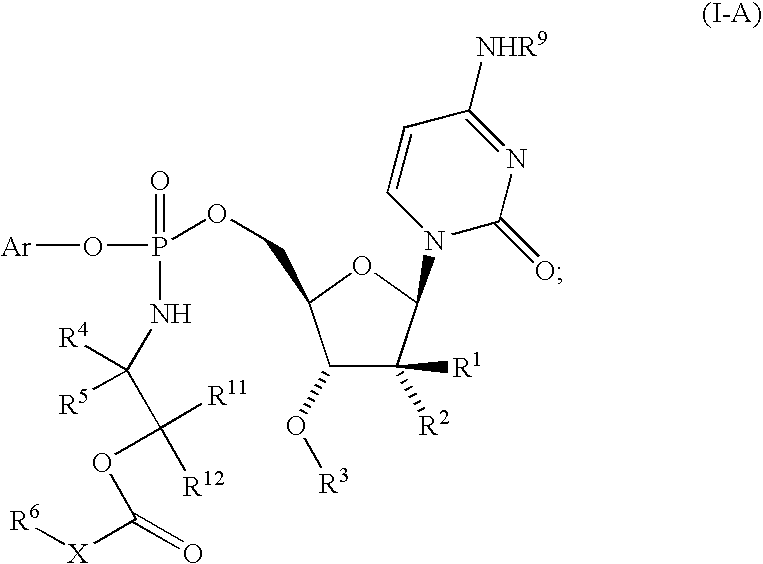
and all variables are as originally defined (i.e., as defined in the Summary of the Invention).

and all variables are as originally defined.

and all variables are as originally defined.
- R3 is selected from the group consisting of hydrogen, C1-16 alkylcarbonyl, C2-18 alkenylcarbonyl, C1-10 alkyloxycarbonyl, C3-6 cycloalkylcarbonyl, C3-6 cycloalkyloxycarbonyl, and an amino acyl residue of structural formula:
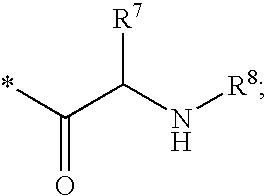
- R10 is selected from the group consisting of hydrogen, methyl, C1-16 alkylcarbonyl, C2-18 alkenylcarbonyl, C1-10 alkyloxycarbonyl, C3-6 cycloalkylcarbonyl, C3-6 cycloalkyloxycarbonyl, and an amino acyl residue of structural formula:
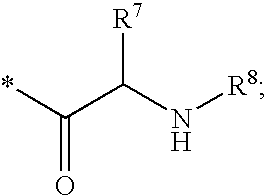
- or R3 and R10 together with the oxygen atoms to which they are attached form a five-membered cyclic carbonate;
- R11 is hydrogen or C1-3 alkyl; and all other variables are as originally defined.

wherein the variables are as originally defined or as defined in any one of the preceding embodiments.

wherein the variables are as originally defined or as defined in any one of the preceding embodiments.

wherein:
R3 is H;
R10 is H;
or R3 and R10 together with the oxygen atoms to which they are attached form acetonide;
R4 is H, methyl, ethyl, propyl, isopropyl, n-butyl, isobutyl, t-butyl, CH(CH3)CH2CH3, or benzyl;
R6 is methyl, ethyl, n-propyl, isopropyl, n-butyl, isobutyl, t-butyl, CH(CH2CH2CH3)2, 3-pentyl, cyclopentyl, cycloheptyl, or phenyl;
R11 is H or CH3;
R13 is hydrogen or CH3;
or, alternatively when R4 is H, R11 together with R13 form a ring of formula:
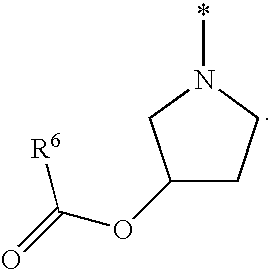


the amino acyl residue contains an asymmetric center and is intended to include the individual R- and S-stereoisomers as well as RS-diastereoisomeric mixtures. In one embodiment, the stereochemistry at the stereogenic carbon corresponds to that of an S-amino acid, that is, the naturally occurring alpha-amino acid stereochemistry, as depicted in the formula:

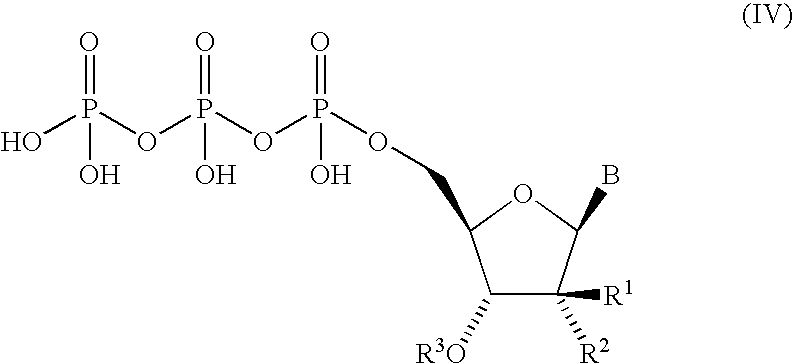
wherein B, R1, R2, and R3 are as defined above. In aspects of this definition, the term refers to either or both of the derivatives of formula IV-A and IV-B:


the amino acid residue contains an asymmetric center and is intended to include the individual R- and S-stereoisomers as well as RS-stereoisomeric mixtures. In one embodiment, the stereochemistry at the stereogenic carbon corresponds to that of an S-amino acid, that is, the naturally occurring alpha-amino acid stereochemistry, as depicted in the formula:
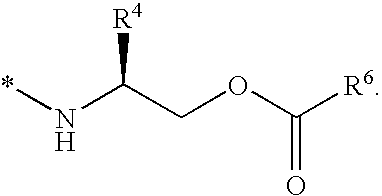
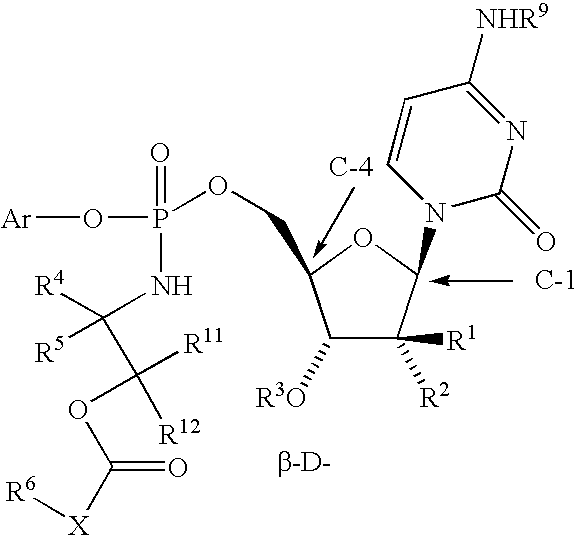


First-Eluting Diastereoisomer:


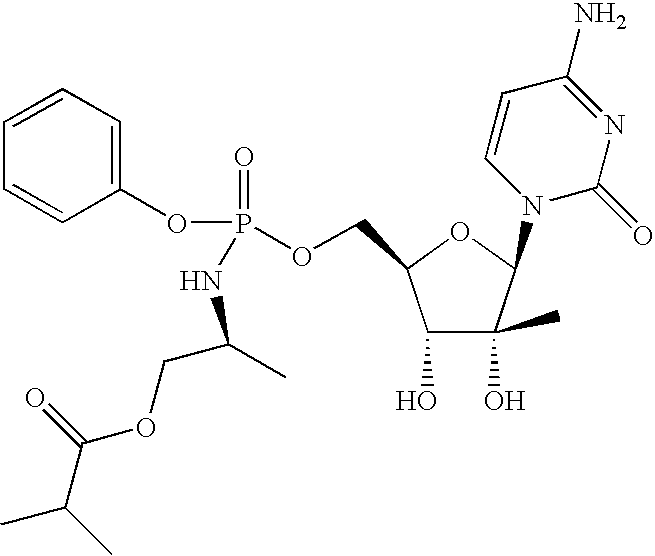


| TABLE 1 | ||||
| MS | ||||
| Ex. | R4 | R6 | Chemical name | (M + 1) |
| 7 | n-Bu | t-Bu | 5′-O-[[[(1S)-1-[(2,2-dimethyl-1- | 597 |
| oxopropoxy)methyl]pentyl]amino]- | ||||
| (phenoxy)-phosphinyl]-2′-C- | ||||
| methylcytidine | ||||
| 8 | Bn | t-Bu | 5′-O-[[[(1S)-2-[(2,-dimethyl-1- | 631 |
| oxopropoxy)-1-(phenylmethyl)]- | ||||
| ethyl]amino]-(phenoxy)-phosphinyl]-2′-C- | ||||
| methylcytidine | ||||




| TABLE 2 | |||||||
| MS | |||||||
| Ex. | Chemical name | R2 | R3 | R4 | R6 | R13 | (M + 1) |
| 14 | cytidine, 5′-O-[[[(1S)-2-(2,2-dimethyl-1-oxopropoxy)-1- | R2 + R3 = 2′, | Bn | t-Bu | H | 671 |
| (phenylmethyl)ethyl]amino]phenoxyphosphinyl]-2′-C-methyl- | 3′- | |||||
| 2′,3′-O-(1-methylethylidene)- | Acetonide | |||||
| 15 | cytidine, 5′-O-[[[(1S)-1-[(2,2-dimethyl-1-oxopropoxy)methyl] | R2 + R3 = 2′, | n-Bu | t-Bu | H | 637 |
| pentyl]amino]phenoxyphosphinyl]-2′-C-methyl-2′,3′-O-(1- | 3′- | |||||
| methylethylidene)- | Acetonide |
| 16 | cytidine, 5′-O-[[[2-(benzoyloxy)ethyl]amino] | OH | H | H | Ph | H | 561 |
| phenoxyphosphinyl]-2′-C-methyl- | |||||||
| 17 | 5′-O-[({(1S)-1-benzyl-2-[(2,2-dimethylpropanoyl)oxy]ethyl} | OH | H | Bn | t-Bu | H | 631 |
| amino)(phenoxy)phosphoryl]-2′-C-methylcytidine | |||||||
| 18 | 5′-O-[{[2-(acetyloxy)ethyl]amino}(phenoxy)phosphoryl]- | OH | H | H | Me | H | 499 |
| 2′-C-methylcytidine | |||||||
| 19 | cytidine, 2′-C-methyl-5′-O-[[methyl[2-(2-methyl-1- | OH | H | H | i-Pr | Me | 541 |
| oxopropoxy)ethyl]amino]phenoxyphosphinyl]- | |||||||
| 20 | 5′-O-[({2-[(2-ethylbutanoyl)oxy]ethyl}amino)(phenoxy) | OH | H | H | 3-Pen | H | 555 |
| phosphoryl]-2′-C-methylcytidine | |||||||
| 21 | 5′-O-[({2-[(cycloheptylcarbonyl)oxy]ethyl}amino)(phenoxy) | OH | H | H | cyclo- | H | 581 |
| phosphoryl]-2′-C-methylcytidine | heptyl | ||||||
| Ph = phenyl, | |||||||
| Bn = benzyl, | |||||||
| t-Bu = tert-butyl, | |||||||
| i-Pr = isopropyl, | |||||||
| 3-Pen = 3-pentyl, | |||||||
| Me = methyl | |||||||
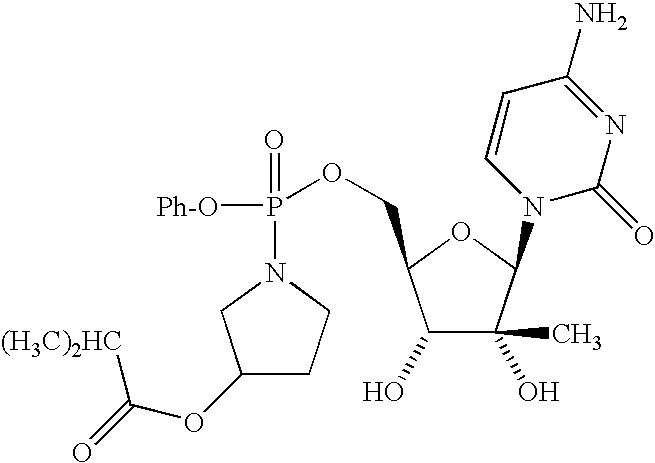
| TABLE 3 | |||
| Replicon Assay | |||
| Example No. | EC50 (μM)a | ||
| 1 | 1.6/0.9 | ||
| 2 | 2.8/4.0 | ||
| 3 | >5.0/0.2 | ||
| 4 | 2.0/0.2 | ||
| 5 | 0.9/0.5 | ||
| 6 | 2.0/1.8 | ||
| 7 | 1.5/0.7 | ||
| 8 | 1.0b | ||
| 9 | 0.5/0.2 | ||
| 10 | 0.2/0.7 | ||
| 11 | 0.5/0.9 | ||
| 12 | 2.2/2.4 | ||
| 13 | 0.5/1.7 | ||
| 14 | >5.0/>5.0 | ||
| 15 | >10b | ||
| 16 | 2.2/5.0 | ||
| 17 | 1.4/0.1 | ||
| 18 | 2.4/1.3 | ||
| 19 | >5.0/>5.0 | ||
| 20 | 2.8/0.6 | ||
| 21 | 0.7/1.2 | ||
| 22 | >5.0/>5.0 | ||
| aValues refer to first and second eluting diastereomers, respectively. | |||
| bMixture of diastereomers was tested. | |||
B. Assay for Intracellular Metabolism:
Part One
| TABLE 4 | |||
| Human Hepat. | |||
| Example No. | AUC (μM × h)a | ||
| 3 | 13/133 | ||
| 5 | 36/34 | ||
| 6 | 46/55 | ||
| 7 | 43/40 | ||
| 8 | 86b | ||
| 9 | 120/54 | ||
| 10 | 157/148 | ||
| 11 | 260/104 | ||
| 12 | 50/14 | ||
| 13 | 47/112 | ||
| 14 | 40/54 | ||
| 17 | 130/190 | ||
| 18 | 20/55 | ||
| 22 | 31/19 | ||
| aValues refer to first and second eluting diastereomers, respectively. | |||
| bMixture of diastereomers was tested. | |||
- Cory, A. H. et al., “Use of an aqueous soluble tetrazolium/formazan assay for cell growth assays in culture,” Cancer Commun. 3: 207 (1991).
b. Determination of In Vitro Antiviral Activity of Compounds Against Dengue, Banzi, and Yellow Fever (CPE Inhibition Assay)
Assay details are provided in the Sidwell and Huffman reference above.
Viruses:
Dengue virus type 2, New Guinea strain, is obtained from the Center for Disease Control. Two lines of African green monkey kidney cells are used to culture the virus (Vero) and to perform antiviral testing (MA-104). Both Yellow fever virus, 17D strain, prepared from infected mouse brain, and Banzi virus, H 336 strain, isolated from the serum of a febrile boy in South Africa, are obtained from ATCC. Vero cells are used with both of these viruses and for assay.
Cells and Media:
MA-104 cells (BioWhittaker, Inc., Walkersville, Md.) and Vero cells (ATCC) are used in Medium 199 with 5% FBS and 0.1% NaHCO3 and without antibiotics.
Assay medium for dengue, yellow fever, and Banzi viruses is MEM, 2% FBS, 0.18% NaHCO3 and 50 μg gentamicin/mL.
Antiviral testing of the compounds of the present invention is performed according to the Sidwell and Huffman reference and similar to the above rhinovirus antiviral testing. Adequate cytopathic effect (CPE) readings are achieved after 5-6 days for each of these viruses.
c. Determination of In Vitro Antiviral Activity of Compounds Against West Nile Virus (CPE Inhibition Assay)
Assay details are provided in the Sidwell and Huffman reference cited above. West Nile virus, New York isolate derived from crow brain, is obtained from the Center for Disease Control. Vero cells are grown and used as described above. Test medium is MEM, 1% FBS, 0.1% NaHCO3 and 50 μg gentamicin/mL.
Antiviral testing of the compounds of the present invention can be performed following the methods of Sidwell and Huffman which are similar to those used to assay for rhinovirus activity. Adequate cytopathic effect (CPE) readings are achieved after 5-6 days.
d. Determination of In Vitro Antiviral Activity of Compounds Against Rhino, Yellow Fever, Dengue, Banzi, and West Nile Viruses (Neutral Red Uptake Assay)
Claims (25)


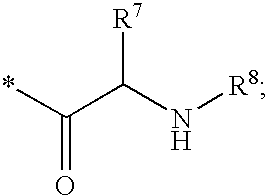


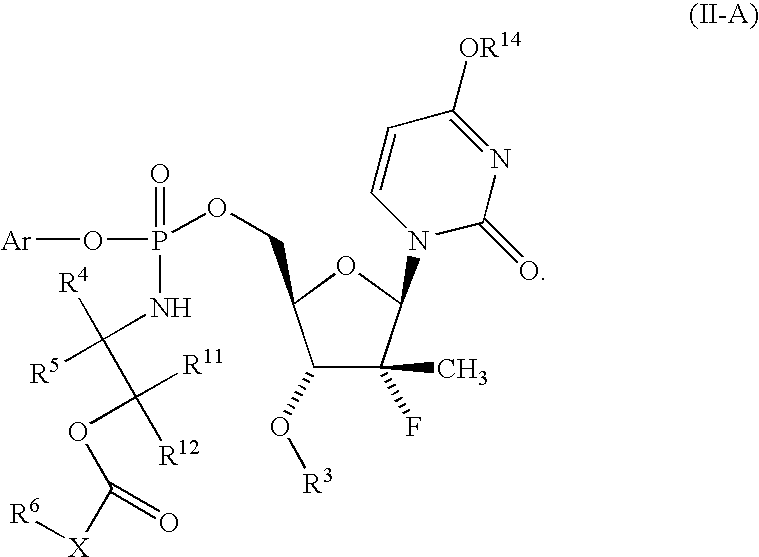
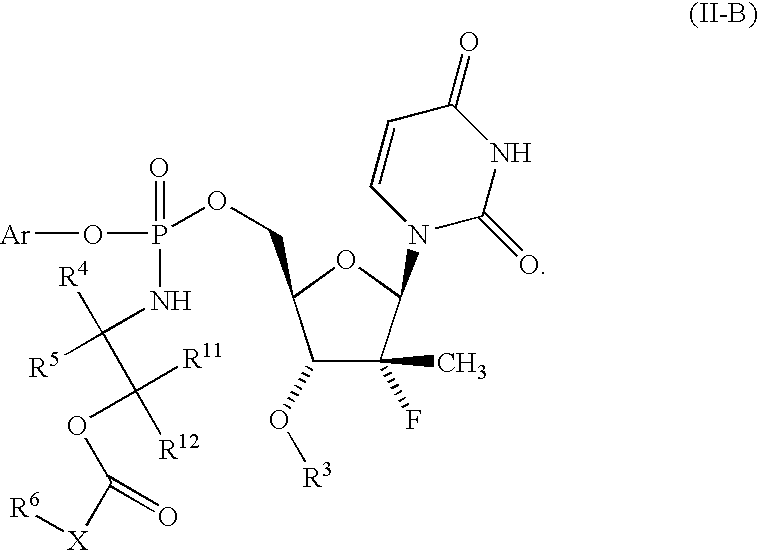

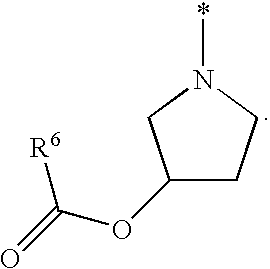
Priority Applications (1)
| Application Number | Priority Date | Filing Date | Title |
|---|---|---|---|
| US12/520,738 US8071568B2 (en) | 2007-01-05 | 2007-12-28 | Nucleoside aryl phosphoramidates for the treatment of RNA-dependent RNA viral infection |
Applications Claiming Priority (3)
| Application Number | Priority Date | Filing Date | Title |
|---|---|---|---|
| US87872807P | 2007-01-05 | 2007-01-05 | |
| US12/520,738 US8071568B2 (en) | 2007-01-05 | 2007-12-28 | Nucleoside aryl phosphoramidates for the treatment of RNA-dependent RNA viral infection |
| PCT/US2007/026468 WO2008085508A2 (en) | 2007-01-05 | 2007-12-28 | Nucleoside aryl phosphoramidates for the treatment of rna-dependent rna viral infection |
Publications (2)
| Publication Number | Publication Date |
|---|---|
| US20100035835A1 US20100035835A1 (en) | 2010-02-11 |
| US8071568B2 true US8071568B2 (en) | 2011-12-06 |
Family
ID=39609204
Family Applications (1)
| Application Number | Title | Priority Date | Filing Date |
|---|---|---|---|
| US12/520,738 Active 2028-06-24 US8071568B2 (en) | 2007-01-05 | 2007-12-28 | Nucleoside aryl phosphoramidates for the treatment of RNA-dependent RNA viral infection |
Country Status (6)
| Country | Link |
|---|---|
| US (1) | US8071568B2 (en) |
| EP (1) | EP2124555B1 (en) |
| JP (1) | JP2010515680A (en) |
| AU (1) | AU2007342367B2 (en) |
| CA (1) | CA2673649A1 (en) |
| WO (1) | WO2008085508A2 (en) |
Cited By (34)
| Publication number | Priority date | Publication date | Assignee | Title |
|---|---|---|---|---|
| US20100152128A1 (en) * | 2007-05-22 | 2010-06-17 | Barbara Attenni | Antiviral Agents |
| US8455451B2 (en) | 2009-09-21 | 2013-06-04 | Gilead Sciences, Inc. | 2'-fluoro substituted carba-nucleoside analogs for antiviral treatment |
| US8673926B2 (en) | 2012-02-14 | 2014-03-18 | University Of Georgia Research Foundation, Inc. | Spiro[2.4]heptanes for treatment of flaviviridae infections |
| US8853171B2 (en) | 2008-04-23 | 2014-10-07 | Gilead Sciences, Inc. | 1′-substituted carba-nucleoside analogs for antiviral treatment |
| US9090642B2 (en) | 2010-07-19 | 2015-07-28 | Gilead Sciences, Inc. | Methods for the preparation of diasteromerically pure phosphoramidate prodrugs |
| WO2016144918A1 (en) | 2015-03-06 | 2016-09-15 | Atea Pharmaceuticals, Inc. | β-D-2'-DEOXY-2'α-FLUORO-2'-β-C-SUBSTITUTED-2-MODIFIED-N6-SUBSTITUTED PURINE NUCLEOTIDES FOR HCV TREATMENT |
| US9447132B2 (en) | 2013-04-12 | 2016-09-20 | Achillion Pharmaceuticals, Inc. | Highly active nucleoside derivative for the treatment of HCV |
| US9724360B2 (en) | 2014-10-29 | 2017-08-08 | Gilead Sciences, Inc. | Methods for treating Filoviridae virus infections |
| WO2017197036A1 (en) | 2016-05-10 | 2017-11-16 | C4 Therapeutics, Inc. | Spirocyclic degronimers for target protein degradation |
| WO2017197051A1 (en) | 2016-05-10 | 2017-11-16 | C4 Therapeutics, Inc. | Amine-linked c3-glutarimide degronimers for target protein degradation |
| WO2017197055A1 (en) | 2016-05-10 | 2017-11-16 | C4 Therapeutics, Inc. | Heterocyclic degronimers for target protein degradation |
| WO2017197046A1 (en) | 2016-05-10 | 2017-11-16 | C4 Therapeutics, Inc. | C3-carbon linked glutarimide degronimers for target protein degradation |
| WO2018013937A1 (en) | 2016-07-14 | 2018-01-18 | Atea Pharmaceuticals, Inc. | Beta-d-2'-deoxy-2'-alpha-fluoro-2'-beta-c-substituted-4'-fluoro-n6-substituted-6-amino-2-substituted purine nucleotides for the treatment of hepatitis c virus infection |
| WO2018048937A1 (en) | 2016-09-07 | 2018-03-15 | Atea Pharmaceuticals, Inc. | 2'-substituted-n6-substituted purine nucleotides for rna virus treatment |
| US10065958B2 (en) | 2010-07-22 | 2018-09-04 | Gilead Sciences, Inc. | Methods and compounds for treating Paramyxoviridae virus infections |
| US10202412B2 (en) | 2016-07-08 | 2019-02-12 | Atea Pharmaceuticals, Inc. | β-D-2′-deoxy-2′-substituted-4′-substituted-2-substituted-N6-substituted-6-aminopurinenucleotides for the treatment of paramyxovirus and orthomyxovirus infections |
| US10251904B2 (en) | 2015-09-16 | 2019-04-09 | Gilead Sciences, Inc. | Methods for treating arenaviridae and coronaviridae virus infections |
| US10519186B2 (en) | 2017-02-01 | 2019-12-31 | Atea Pharmaceuticals, Inc. | Nucleotide hemi-sulfate salt for the treatment of hepatitis C virus |
| EP3641762A1 (en) | 2017-06-20 | 2020-04-29 | C4 Therapeutics, Inc. | N/o-linked degrons and degronimers for protein degradation |
| US10675296B2 (en) | 2017-07-11 | 2020-06-09 | Gilead Sciences, Inc. | Compositions comprising an RNA polymerase inhibitor and cyclodextrin for treating viral infections |
| US10682368B2 (en) | 2017-03-14 | 2020-06-16 | Gilead Sciences, Inc. | Methods of treating feline coronavirus infections |
| US10836787B2 (en) | 2017-05-01 | 2020-11-17 | Gilead Sciences, Inc. | Crystalline forms of (S)-2-ethylbutyl 2-(((S)-(((2R,3S,4R,5R)-5- (4-aminopyrrolo[2,1-f] [1,2,4]triazin-7-yl)-5-cyano-3,4-dihydroxytetrahydrofuran-2-yl)methoxy)(phenoxy) phosphoryl)amino)propanoate |
| US10874687B1 (en) | 2020-02-27 | 2020-12-29 | Atea Pharmaceuticals, Inc. | Highly active compounds against COVID-19 |
| US10988498B2 (en) | 2009-09-21 | 2021-04-27 | Gilead Sciences, Inc. | Processes and intermediates for the preparation of 1′-substituted carba-nucleoside analogs |
| US11491169B2 (en) | 2020-05-29 | 2022-11-08 | Gilead Sciences, Inc. | Remdesivir treatment methods |
| US11613553B2 (en) | 2020-03-12 | 2023-03-28 | Gilead Sciences, Inc. | Methods of preparing 1′-cyano nucleosides |
| US11660307B2 (en) | 2020-01-27 | 2023-05-30 | Gilead Sciences, Inc. | Methods for treating SARS CoV-2 infections |
| US11690860B2 (en) | 2018-04-10 | 2023-07-04 | Atea Pharmaceuticals, Inc. | Treatment of HCV infected patients with cirrhosis |
| US11701372B2 (en) | 2020-04-06 | 2023-07-18 | Gilead Sciences, Inc. | Inhalation formulations of 1'-cyano substituted carba-nucleoside analogs |
| US11780844B2 (en) | 2022-03-02 | 2023-10-10 | Gilead Sciences, Inc. | Compounds and methods for treatment of viral infections |
| US11814406B2 (en) | 2020-08-27 | 2023-11-14 | Gilead Sciences, Inc. | Compounds and methods for treatment of viral infections |
| US11939347B2 (en) | 2020-06-24 | 2024-03-26 | Gilead Sciences, Inc. | 1′-cyano nucleoside analogs and uses thereof |
| US12357577B1 (en) | 2024-02-02 | 2025-07-15 | Gilead Sciences, Inc. | Pharmaceutical formulations and uses thereof |
| US12458656B2 (en) | 2021-06-17 | 2025-11-04 | Atea Pharmaceuticals, Inc. | Advantageous anti-HCV combination therapy |
Families Citing this family (38)
| Publication number | Priority date | Publication date | Assignee | Title |
|---|---|---|---|---|
| GB0623493D0 (en) | 2006-11-24 | 2007-01-03 | Univ Cardiff | Chemical compounds |
| JP2010513484A (en) | 2006-12-20 | 2010-04-30 | メルク・シャープ・エンド・ドーム・コーポレイション | Nucleoside cyclic phosphoramidates for the treatment of RNA-dependent RNA viral infections |
| US7964580B2 (en) | 2007-03-30 | 2011-06-21 | Pharmasset, Inc. | Nucleoside phosphoramidate prodrugs |
| AU2014233579B2 (en) * | 2007-03-30 | 2016-06-23 | Gilead Sciences, Inc. | Nucleoside phosphoramidate prodrugs |
| US8173621B2 (en) | 2008-06-11 | 2012-05-08 | Gilead Pharmasset Llc | Nucleoside cyclicphosphates |
| EA019341B1 (en) | 2008-12-23 | 2014-02-28 | Джилид Фармассет, Ллс. | Nucleoside phosphoramidates |
| EA201100851A1 (en) | 2008-12-23 | 2012-04-30 | Фармассет, Инк. | NUCLEOSIDE ANALOGUES |
| US8716263B2 (en) * | 2008-12-23 | 2014-05-06 | Gilead Pharmasset Llc | Synthesis of purine nucleosides |
| EA025085B1 (en) | 2009-02-10 | 2016-11-30 | Джилид Сайэнс, Инк. | Carba-nucleoside analogs for antiviral treatment |
| EP2408306A4 (en) * | 2009-03-20 | 2012-11-07 | Alios Biopharma Inc | Substituted nucleoside and nucleotide analogs |
| TWI576352B (en) | 2009-05-20 | 2017-04-01 | 基利法瑪席特有限責任公司 | Nucleoside phosphoramidates |
| US8618076B2 (en) | 2009-05-20 | 2013-12-31 | Gilead Pharmasset Llc | Nucleoside phosphoramidates |
| EA201200525A1 (en) | 2009-09-21 | 2012-09-28 | Гайлид Сайэнсиз, Инк. | 2'-FLUORINARY CARB-NUCLEOSIDE ANALOGUES FOR ANTI-VIRUS TREATMENT |
| US7973013B2 (en) | 2009-09-21 | 2011-07-05 | Gilead Sciences, Inc. | 2'-fluoro substituted carba-nucleoside analogs for antiviral treatment |
| US8563530B2 (en) | 2010-03-31 | 2013-10-22 | Gilead Pharmassel LLC | Purine nucleoside phosphoramidate |
| MX2012011171A (en) | 2010-03-31 | 2013-02-01 | Gilead Pharmasset Llc | Nucleoside phosphoramidates. |
| JP2013538230A (en) | 2010-09-20 | 2013-10-10 | ギリアード サイエンシーズ, インコーポレイテッド | 2'-Fluoro substituted carbanucleoside analogues for antiviral therapy |
| BR112013005872A2 (en) | 2010-09-22 | 2019-09-24 | Alios Biopharma Inc | compounds, pharmaceutical composition and their uses |
| JP6069215B2 (en) | 2010-11-30 | 2017-02-01 | ギリアド ファーマセット エルエルシー | Compound |
| EP2697241B1 (en) | 2011-04-13 | 2019-06-12 | Gilead Sciences, Inc. | 1'-substituted pyrimidine n-nucleoside analogs for antiviral treatment |
| US9403863B2 (en) | 2011-09-12 | 2016-08-02 | Idenix Pharmaceuticals Llc | Substituted carbonyloxymethylphosphoramidate compounds and pharmaceutical compositions for the treatment of viral infections |
| SG11201400664WA (en) | 2011-09-16 | 2014-04-28 | Gilead Pharmassett Llc | Methods for treating hcv |
| US8889159B2 (en) | 2011-11-29 | 2014-11-18 | Gilead Pharmasset Llc | Compositions and methods for treating hepatitis C virus |
| WO2013090420A2 (en) * | 2011-12-12 | 2013-06-20 | Catabasis Pharmaceuticals, Inc. | Fatty acid antiviral conjugates and their uses |
| SG11201403086YA (en) | 2011-12-20 | 2014-07-30 | Hoffmann La Roche | 4'-azido, 3'-fluoro substituted nucleoside derivatives as inhibitors of hcv rna replication |
| PT2794629T (en) | 2011-12-20 | 2017-07-20 | Riboscience Llc | 2',4'-difluoro-2'-methyl substituted nucleoside derivatives as inhibitors of hcv rna replication |
| CA2860234A1 (en) | 2011-12-22 | 2013-06-27 | Alios Biopharma, Inc. | Substituted phosphorothioate nucleotide analogs |
| US8916538B2 (en) | 2012-03-21 | 2014-12-23 | Vertex Pharmaceuticals Incorporated | Solid forms of a thiophosphoramidate nucleotide prodrug |
| HK1203356A1 (en) | 2012-03-22 | 2015-10-30 | 艾丽奥斯生物制药有限公司 | Pharmaceutical combinations comprising a thionucleotide analog |
| US20140212491A1 (en) | 2013-01-31 | 2014-07-31 | Gilead Pharmasset Llc | Combination formulation of two antiviral compounds |
| CN105307662B (en) | 2013-05-16 | 2019-06-04 | 里博科学有限责任公司 | 4'-Fluoro-2'-Methyl Substituted Nucleoside Derivatives |
| EA201592185A1 (en) | 2013-05-16 | 2016-05-31 | Рибосайенс Ллк | 4'-AZIDO, 3'-DEOXY-3'-Fluoro-substituted NUCLEOSIDE DERIVATIVES |
| US20180200280A1 (en) | 2013-05-16 | 2018-07-19 | Riboscience Llc | 4'-Fluoro-2'-Methyl Substituted Nucleoside Derivatives as Inhibitors of HCV RNA Replication |
| EP3038601B1 (en) | 2013-08-27 | 2020-04-08 | Gilead Pharmasset LLC | Combination formulation of two antiviral compounds |
| CN113712989A (en) | 2013-10-11 | 2021-11-30 | 艾丽奥斯生物制药有限公司 | Substituted nucleosides, nucleotides and analogs thereof |
| WO2016064797A1 (en) * | 2014-10-20 | 2016-04-28 | Merck Sharp & Dohme Corp. | Process for making nucleoside phosphoramidate compounds |
| CN111194217B (en) | 2017-09-21 | 2024-01-12 | 里伯赛恩斯有限责任公司 | 4’-fluoro-2’-methyl substituted nucleoside derivatives as inhibitors of HCV RNA replication |
| CN111302966A (en) * | 2020-04-03 | 2020-06-19 | 湖南复瑞生物医药技术有限责任公司 | Preparation method of mirabegron intermediate |
Citations (11)
| Publication number | Priority date | Publication date | Assignee | Title |
|---|---|---|---|---|
| US6312662B1 (en) | 1998-03-06 | 2001-11-06 | Metabasis Therapeutics, Inc. | Prodrugs phosphorus-containing compounds |
| US20050009737A1 (en) | 2003-05-30 | 2005-01-13 | Jeremy Clark | Modified fluorinated nucleoside analogues |
| US20050009775A1 (en) | 2001-06-21 | 2005-01-13 | Howes Peter David | Nucleoside compounds in hcv |
| US6914054B2 (en) | 2000-05-23 | 2005-07-05 | Idenix Pharmaceuticals, Inc. | Methods and compositions for treating hepatitis C virus |
| US20050182252A1 (en) | 2004-02-13 | 2005-08-18 | Reddy K. R. | Novel 2'-C-methyl nucleoside derivatives |
| WO2006063149A1 (en) | 2004-12-09 | 2006-06-15 | Regents Of The University Of Minnesota | Nucleosides with antiviral and anticancer activity |
| WO2006121820A1 (en) | 2005-05-05 | 2006-11-16 | Valeant Research & Development | Phosphoramidate prodrugs for treatment of viral infection |
| WO2007022073A2 (en) | 2005-08-12 | 2007-02-22 | Merck & Co., Inc. | Novel 2'-c-methyl and 4'-c-methyl nucleoside derivatives |
| WO2007095269A2 (en) | 2006-02-14 | 2007-08-23 | Merck & Co., Inc. | Nucleoside aryl phosphoramidates for the treatment of rna-dependent rna viral infection |
| US20070265222A1 (en) | 2004-06-24 | 2007-11-15 | Maccoss Malcolm | Nucleoside Aryl Phosphoramidates for the Treatment of Rna-Dependent Rna Viral Infection |
| WO2008079206A1 (en) | 2006-12-20 | 2008-07-03 | Merck & Co., Inc. | Nucleoside cyclic phosphoramidates for the treatment of rna-dependent rna viral infection |
Family Cites Families (35)
| Publication number | Priority date | Publication date | Assignee | Title |
|---|---|---|---|---|
| US3480613A (en) | 1967-07-03 | 1969-11-25 | Merck & Co Inc | 2-c or 3-c-alkylribofuranosyl - 1-substituted compounds and the nucleosides thereof |
| US5413999A (en) | 1991-11-08 | 1995-05-09 | Merck & Co., Inc. | HIV protease inhibitors useful for the treatment of AIDS |
| CA2171743C (en) * | 1993-09-17 | 2007-11-20 | Norbert W. Bischofberger | Nucleotide analogs |
| GB9505025D0 (en) * | 1995-03-13 | 1995-05-03 | Medical Res Council | Chemical compounds |
| BR9908270A (en) | 1998-02-25 | 2004-06-29 | Univ Emory | 2-Fluoro-nucleosides, pharmaceutical compositions and their uses |
| SK13752001A3 (en) | 1999-12-27 | 2002-07-02 | Japan Tobacco, Inc. | Fused-ring compounds and use thereof as drugs |
| US6495677B1 (en) * | 2000-02-15 | 2002-12-17 | Kanda S. Ramasamy | Nucleoside compounds |
| HUP0301112A3 (en) | 2000-02-18 | 2005-04-28 | Shire Biochem Inc Laval | Method for the treatment or prevention of flavivirus infections using nucleoside analogues |
| WO2001077091A2 (en) | 2000-04-05 | 2001-10-18 | Tularik Inc. | Ns5b hcv polymerase inhibitors |
| ATE414520T1 (en) | 2000-04-13 | 2008-12-15 | Pharmasset Inc | 3 OR 2 HYDROXYMETHYL SUBSTITUTED NUCLEOSIDE DERIVATIVES AND THEIR USE FOR TREATING VIRUS INFECTIONS |
| MXPA02011691A (en) | 2000-05-26 | 2004-05-17 | Idenix Cayman Ltd | Methods and compositions for treating flaviviruses and pestiviruses. |
| US6448281B1 (en) | 2000-07-06 | 2002-09-10 | Boehringer Ingelheim (Canada) Ltd. | Viral polymerase inhibitors |
| GB0017676D0 (en) | 2000-07-19 | 2000-09-06 | Angeletti P Ist Richerche Bio | Inhibitors of viral polymerase |
| US20030008841A1 (en) | 2000-08-30 | 2003-01-09 | Rene Devos | Anti-HCV nucleoside derivatives |
| AU2001282528A1 (en) | 2000-09-01 | 2002-03-22 | Shionogi And Co., Ltd. | Compounds having anti-hepatitis c virus effect |
| EP2251015B1 (en) | 2000-10-18 | 2013-02-20 | Gilead Pharmasset LLC | Modified nucleosides for the treatment of viral infections and abnormal cellular proliferation |
| EP1366055A2 (en) | 2000-12-15 | 2003-12-03 | Pharmasset Limited | Antiviral agents for treatment of flaviviridae infections |
| US20040063651A1 (en) | 2000-12-26 | 2004-04-01 | Masahiko Morioka | Remedies for hepatitis c |
| RS50236B (en) | 2001-01-22 | 2009-07-15 | Merck & Co.Inc., | NUCLEOSIDE DERIVATIVES AS INVESTORS OF RNA-DEPENDENT RNA VIRAL POLYMERASES |
| GB0112617D0 (en) * | 2001-05-23 | 2001-07-18 | Hoffmann La Roche | Antiviral nucleoside derivatives |
| GB0114286D0 (en) | 2001-06-12 | 2001-08-01 | Hoffmann La Roche | Nucleoside Derivatives |
| US20040006002A1 (en) | 2001-09-28 | 2004-01-08 | Jean-Pierre Sommadossi | Methods and compositions for treating flaviviruses and pestiviruses using 4'-modified nucleoside |
| JP2005504087A (en) | 2001-09-28 | 2005-02-10 | イデニクス(ケイマン)リミテツド | Methods and compositions for the treatment of hepatitis C virus using 4 'modified nucleosides |
| NZ536123A (en) | 2002-05-06 | 2006-09-29 | Genelabs Tech Inc | Nucleoside derivatives for treating hepatitis C virus infection |
| MY140819A (en) | 2002-06-28 | 2010-01-29 | Idenix Caymans Ltd | Modified 2' and 3'-nucleoside prodrugs for treating flaviviridae |
| JP2005533824A (en) | 2002-06-28 | 2005-11-10 | イデニクス(ケイマン)リミテツド | 2'-C-methyl-3'-OL-valine ester ribofuranosyl cytidine for the treatment of Flaviviridae infections |
| EP1525209B1 (en) | 2002-06-28 | 2017-11-15 | Idenix Pharmaceuticals LLC | 1'-, 2'- and 3' -modified nucleoside derivatives for treating flaviviridae infections |
| JP2005538096A (en) | 2002-07-25 | 2005-12-15 | マイジェニックス インコーポレイテッド | Antiviral 7-deaza D-nucleosides and methods of use thereof |
| KR20050040912A (en) | 2002-08-01 | 2005-05-03 | 파마셋 인코포레이티드 | Compounds with the bicyclo[4.2.1]nonane system for the treatment of flaviviridae infections |
| JP2006505537A (en) | 2002-09-30 | 2006-02-16 | ジェネラブス テクノロジーズ,インコーポレイテッド | Nucleoside derivatives for treating hepatitis C virus infection |
| TWI294882B (en) | 2002-12-09 | 2008-03-21 | Hoffmann La Roche | Anhydrous crystalline azido cytosine hemisulfate derivative |
| TW200510425A (en) | 2003-08-13 | 2005-03-16 | Japan Tobacco Inc | Nitrogen-containing fused ring compound and use thereof as HIV integrase inhibitor |
| US7151089B2 (en) | 2003-10-27 | 2006-12-19 | Genelabs Technologies, Inc. | Nucleoside compounds for treating viral infections |
| US7157434B2 (en) | 2003-10-27 | 2007-01-02 | Genelabs Technologies, Inc. | Nucleoside compounds for treating viral infections |
| AR056327A1 (en) * | 2005-04-25 | 2007-10-03 | Genelabs Tech Inc | NUCLEOSID COMPOUNDS FOR THE TREATMENT OF VIRAL INFECTIONS |
-
2007
- 2007-12-28 WO PCT/US2007/026468 patent/WO2008085508A2/en not_active Ceased
- 2007-12-28 CA CA002673649A patent/CA2673649A1/en not_active Abandoned
- 2007-12-28 JP JP2009544860A patent/JP2010515680A/en active Pending
- 2007-12-28 EP EP07868112.9A patent/EP2124555B1/en not_active Not-in-force
- 2007-12-28 AU AU2007342367A patent/AU2007342367B2/en not_active Ceased
- 2007-12-28 US US12/520,738 patent/US8071568B2/en active Active
Patent Citations (14)
| Publication number | Priority date | Publication date | Assignee | Title |
|---|---|---|---|---|
| US6312662B1 (en) | 1998-03-06 | 2001-11-06 | Metabasis Therapeutics, Inc. | Prodrugs phosphorus-containing compounds |
| US6914054B2 (en) | 2000-05-23 | 2005-07-05 | Idenix Pharmaceuticals, Inc. | Methods and compositions for treating hepatitis C virus |
| US20050009775A1 (en) | 2001-06-21 | 2005-01-13 | Howes Peter David | Nucleoside compounds in hcv |
| US20050009737A1 (en) | 2003-05-30 | 2005-01-13 | Jeremy Clark | Modified fluorinated nucleoside analogues |
| US7429572B2 (en) | 2003-05-30 | 2008-09-30 | Pharmasset, Inc. | Modified fluorinated nucleoside analogues |
| US20070179114A1 (en) | 2004-02-13 | 2007-08-02 | Metabasis Therapeutics, Inc. | Novel 2'-C methyl nucleoside derivatives |
| US20070042989A1 (en) | 2004-02-13 | 2007-02-22 | Metabasis Therapeutics, Inc. | Novel 2'-C-methyl nucleoside derivatives |
| US20050182252A1 (en) | 2004-02-13 | 2005-08-18 | Reddy K. R. | Novel 2'-C-methyl nucleoside derivatives |
| US20070265222A1 (en) | 2004-06-24 | 2007-11-15 | Maccoss Malcolm | Nucleoside Aryl Phosphoramidates for the Treatment of Rna-Dependent Rna Viral Infection |
| WO2006063149A1 (en) | 2004-12-09 | 2006-06-15 | Regents Of The University Of Minnesota | Nucleosides with antiviral and anticancer activity |
| WO2006121820A1 (en) | 2005-05-05 | 2006-11-16 | Valeant Research & Development | Phosphoramidate prodrugs for treatment of viral infection |
| WO2007022073A2 (en) | 2005-08-12 | 2007-02-22 | Merck & Co., Inc. | Novel 2'-c-methyl and 4'-c-methyl nucleoside derivatives |
| WO2007095269A2 (en) | 2006-02-14 | 2007-08-23 | Merck & Co., Inc. | Nucleoside aryl phosphoramidates for the treatment of rna-dependent rna viral infection |
| WO2008079206A1 (en) | 2006-12-20 | 2008-07-03 | Merck & Co., Inc. | Nucleoside cyclic phosphoramidates for the treatment of rna-dependent rna viral infection |
Non-Patent Citations (16)
Cited By (88)
| Publication number | Priority date | Publication date | Assignee | Title |
|---|---|---|---|---|
| US20100152128A1 (en) * | 2007-05-22 | 2010-06-17 | Barbara Attenni | Antiviral Agents |
| USRE46762E1 (en) | 2008-04-23 | 2018-03-27 | Gilead Sciences, Inc | 1′-substituted carba-nucleoside analogs for antiviral treatment |
| US8853171B2 (en) | 2008-04-23 | 2014-10-07 | Gilead Sciences, Inc. | 1′-substituted carba-nucleoside analogs for antiviral treatment |
| US8455451B2 (en) | 2009-09-21 | 2013-06-04 | Gilead Sciences, Inc. | 2'-fluoro substituted carba-nucleoside analogs for antiviral treatment |
| US10988498B2 (en) | 2009-09-21 | 2021-04-27 | Gilead Sciences, Inc. | Processes and intermediates for the preparation of 1′-substituted carba-nucleoside analogs |
| US9090642B2 (en) | 2010-07-19 | 2015-07-28 | Gilead Sciences, Inc. | Methods for the preparation of diasteromerically pure phosphoramidate prodrugs |
| US9487544B2 (en) | 2010-07-19 | 2016-11-08 | Gilead Sciences, Inc. | Methods for the preparation of diasteromerically pure phosphoramidate prodrugs |
| US10696679B2 (en) | 2010-07-22 | 2020-06-30 | Gilead Sciences, Inc. | Methods and compounds for treating paramyxoviridae virus infections |
| US12509466B2 (en) | 2010-07-22 | 2025-12-30 | Gilead Sciences, Inc. | Methods and compounds for treating paramyxoviridae virus infections |
| US10065958B2 (en) | 2010-07-22 | 2018-09-04 | Gilead Sciences, Inc. | Methods and compounds for treating Paramyxoviridae virus infections |
| US11492353B2 (en) | 2010-07-22 | 2022-11-08 | Gilead Sciences, Inc. | Methods and compounds for treating Paramyxoviridae virus infections |
| US8946242B2 (en) | 2012-02-14 | 2015-02-03 | University Of Georgia Research Foundation, Inc. | Spiro[2.4]heptanes for treatment of flaviviridae infections |
| US8921384B2 (en) | 2012-02-14 | 2014-12-30 | Unversity Of Georgia Research Foundation, Inc. | Spiro[2.4]heptanes for treatment of flaviviridae infections |
| US8673926B2 (en) | 2012-02-14 | 2014-03-18 | University Of Georgia Research Foundation, Inc. | Spiro[2.4]heptanes for treatment of flaviviridae infections |
| US9447132B2 (en) | 2013-04-12 | 2016-09-20 | Achillion Pharmaceuticals, Inc. | Highly active nucleoside derivative for the treatment of HCV |
| US11344565B2 (en) | 2014-10-29 | 2022-05-31 | Gilead Sciences, Inc. | Methods for the preparation of ribosides |
| US10695357B2 (en) | 2014-10-29 | 2020-06-30 | Gilead Sciences, Inc. | Methods for treating filoviridae virus infections |
| US11266666B2 (en) | 2014-10-29 | 2022-03-08 | Gilead Sciences, Inc. | Methods for treating Filoviridae virus infections |
| US9724360B2 (en) | 2014-10-29 | 2017-08-08 | Gilead Sciences, Inc. | Methods for treating Filoviridae virus infections |
| US9949994B2 (en) | 2014-10-29 | 2018-04-24 | Gilead Sciences, Inc. | Methods for treating Filoviridae virus infections |
| US10251898B2 (en) | 2014-10-29 | 2019-04-09 | Gilead Sciences, Inc. | Methods for treating Filoviridae virus infections |
| US10239911B2 (en) | 2015-03-06 | 2019-03-26 | Atea Pharmaceuticals, Inc. | Beta-D-2′-deoxy-2′-alpha-fluoro-2′-beta-C-substituted-2-modified-N6-substituted purine nucleotides for HCV treatment |
| US12084473B2 (en) | 2015-03-06 | 2024-09-10 | Atea Pharmaceuticals, Inc. | β-D-2′-deoxy-2′-α-fluoro-2′-β-C-substituted-2-modified-N6-substituted purine nucleotides for HCV treatment |
| EP4667053A2 (en) | 2015-03-06 | 2025-12-24 | ATEA Pharmaceuticals, Inc. | Beta-d-2'-deoxy-2'alpha-fluoro-2'-beta-c-substituted-2-modified-n6-substituted purine nucleotides for hcv treatment |
| US10005811B2 (en) | 2015-03-06 | 2018-06-26 | Atea Pharmaceuticals, Inc. | β-D-2′-deoxy-2′-α-fluoro-2′β-C-substituted-2-modified-N6-substituted purine nucleotides for HCV treatment |
| US10000523B2 (en) | 2015-03-06 | 2018-06-19 | Atea Pharmaceuticals, Inc. | β-D-2′-deoxy-2′-α-fluoro-2′-β-C-substituted-2-modified-N6-substituted purine nucleotides for HCV treatment |
| US9828410B2 (en) | 2015-03-06 | 2017-11-28 | Atea Pharmaceuticals, Inc. | β-D-2′-deoxy-2′-α-fluoro-2′-β-C-substituted-2-modified-N6-substituted purine nucleotides for HCV treatment |
| US10875885B2 (en) | 2015-03-06 | 2020-12-29 | Atea Pharmaceuticals, Inc. | β-d-2′-deoxy-2′-α-fluoro-2′-β-c-substituted-2-modified-n6-substituted purine nucleotides for HCV treatment |
| US10870672B2 (en) | 2015-03-06 | 2020-12-22 | Atea Pharmaceuticals, Inc. | β-D-2′-deoxy-2′-α-fluoro-2′-β-C-substituted-2-modified-N6-substituted purine nucleotides for HCV treatment |
| US10870673B2 (en) | 2015-03-06 | 2020-12-22 | Atea Pharmaceuticals, Inc. | β-D-2′-deoxy-2′-α-fluoro-2′-β-C-substituted-2-modified-N6-substituted purine nucleotides for HCV treatment |
| US10815266B2 (en) | 2015-03-06 | 2020-10-27 | Atea Pharmaceuticals, Inc. | β-D-2′-deoxy-2′-α-fluoro-2′-β-C-substituted-2-modified-N6-substituted purine nucleotides for HCV treatment |
| WO2016144918A1 (en) | 2015-03-06 | 2016-09-15 | Atea Pharmaceuticals, Inc. | β-D-2'-DEOXY-2'α-FLUORO-2'-β-C-SUBSTITUTED-2-MODIFIED-N6-SUBSTITUTED PURINE NUCLEOTIDES FOR HCV TREATMENT |
| US11007208B2 (en) | 2015-09-16 | 2021-05-18 | Gilead Sciences, Inc. | Methods for treating arenaviridae and coronaviridae virus infections |
| US10695361B2 (en) | 2015-09-16 | 2020-06-30 | Gilead Sciences, Inc. | Methods for treating arenaviridae and coronaviridae virus infections |
| US11382926B2 (en) | 2015-09-16 | 2022-07-12 | Gilead Sciences, Inc. | Methods for treating Arenaviridae and Coronaviridae virus infections |
| US10251904B2 (en) | 2015-09-16 | 2019-04-09 | Gilead Sciences, Inc. | Methods for treating arenaviridae and coronaviridae virus infections |
| WO2017197036A1 (en) | 2016-05-10 | 2017-11-16 | C4 Therapeutics, Inc. | Spirocyclic degronimers for target protein degradation |
| WO2017197051A1 (en) | 2016-05-10 | 2017-11-16 | C4 Therapeutics, Inc. | Amine-linked c3-glutarimide degronimers for target protein degradation |
| EP4491236A2 (en) | 2016-05-10 | 2025-01-15 | C4 Therapeutics, Inc. | Heterocyclic degronimers for target protein degradation |
| EP4483875A2 (en) | 2016-05-10 | 2025-01-01 | C4 Therapeutics, Inc. | Spirocyclic degronimers for target protein degradation |
| WO2017197055A1 (en) | 2016-05-10 | 2017-11-16 | C4 Therapeutics, Inc. | Heterocyclic degronimers for target protein degradation |
| WO2017197046A1 (en) | 2016-05-10 | 2017-11-16 | C4 Therapeutics, Inc. | C3-carbon linked glutarimide degronimers for target protein degradation |
| US10202412B2 (en) | 2016-07-08 | 2019-02-12 | Atea Pharmaceuticals, Inc. | β-D-2′-deoxy-2′-substituted-4′-substituted-2-substituted-N6-substituted-6-aminopurinenucleotides for the treatment of paramyxovirus and orthomyxovirus infections |
| WO2018013937A1 (en) | 2016-07-14 | 2018-01-18 | Atea Pharmaceuticals, Inc. | Beta-d-2'-deoxy-2'-alpha-fluoro-2'-beta-c-substituted-4'-fluoro-n6-substituted-6-amino-2-substituted purine nucleotides for the treatment of hepatitis c virus infection |
| EP4088725A1 (en) | 2016-09-07 | 2022-11-16 | ATEA Pharmaceuticals, Inc. | 2'-substituted-n6-substituted purine nucleotides for the treatment of a virus from the picornaviridae family |
| EP3865136A1 (en) | 2016-09-07 | 2021-08-18 | ATEA Pharmaceuticals, Inc. | 2'-substituted-n6-substituted purine nucleotides for corona virus treatment |
| US10946033B2 (en) | 2016-09-07 | 2021-03-16 | Atea Pharmaceuticals, Inc. | 2′-substituted-N6-substituted purine nucleotides for RNA virus treatment |
| WO2018048937A1 (en) | 2016-09-07 | 2018-03-15 | Atea Pharmaceuticals, Inc. | 2'-substituted-n6-substituted purine nucleotides for rna virus treatment |
| US11975016B2 (en) | 2016-09-07 | 2024-05-07 | Atea Pharmaceuticals, Inc. | 2′-substituted-N6-substituted purine nucleotides for RNA virus treatment |
| US12006340B2 (en) | 2017-02-01 | 2024-06-11 | Atea Pharmaceuticals, Inc. | Nucleotide hemi-sulfate salt for the treatment of hepatitis c virus |
| EP4450129A2 (en) | 2017-02-01 | 2024-10-23 | ATEA Pharmaceuticals, Inc. | Nucleotide hemi-sulfate salt for the treatment of hepatitis c virus |
| US10894804B2 (en) | 2017-02-01 | 2021-01-19 | Atea Pharmaceuticals, Inc. | Nucleotide hemi-sulfate salt for the treatment of hepatitis C virus |
| US10519186B2 (en) | 2017-02-01 | 2019-12-31 | Atea Pharmaceuticals, Inc. | Nucleotide hemi-sulfate salt for the treatment of hepatitis C virus |
| US10906928B2 (en) | 2017-02-01 | 2021-02-02 | Atea Pharmaceuticals, Inc. | Nucleotide hemi-sulfate salt for the treatment of hepatitis C virus |
| US11260070B2 (en) | 2017-03-14 | 2022-03-01 | Gilead Sciences, Inc. | Methods of treating feline coronavirus infections |
| US10682368B2 (en) | 2017-03-14 | 2020-06-16 | Gilead Sciences, Inc. | Methods of treating feline coronavirus infections |
| US11597742B2 (en) | 2017-05-01 | 2023-03-07 | Gilead Sciences, Inc. | Crystalline forms of (S)-2-ethylbutyl 2-(((S)-(((2R,3S,4R,5R)-5-(4-aminopyrrolo[2,1-f] [1,2,4]triazin-7-yl)-5-cyano-3,4-dihydroxytetrahydrofuran-2-yl)methoxy) (phenoxy) phosphoryl)amino)propanoate |
| US12030906B2 (en) | 2017-05-01 | 2024-07-09 | Gilead Sciences, Inc. | Crystalline forms of (s)-2-ethylbutyl 2-(((s)-(((2r,3s,4r,5r)-5-(4-aminopyrrolo[2,1-f] [1,2,4]triazin-7-yl)-5-cyano-3,4-dihydroxytetrahydrofuran-2-yl)methoxy) (phenoxy) phosphoryl)amino)propanoate |
| US10836787B2 (en) | 2017-05-01 | 2020-11-17 | Gilead Sciences, Inc. | Crystalline forms of (S)-2-ethylbutyl 2-(((S)-(((2R,3S,4R,5R)-5- (4-aminopyrrolo[2,1-f] [1,2,4]triazin-7-yl)-5-cyano-3,4-dihydroxytetrahydrofuran-2-yl)methoxy)(phenoxy) phosphoryl)amino)propanoate |
| EP3641762A1 (en) | 2017-06-20 | 2020-04-29 | C4 Therapeutics, Inc. | N/o-linked degrons and degronimers for protein degradation |
| US10675296B2 (en) | 2017-07-11 | 2020-06-09 | Gilead Sciences, Inc. | Compositions comprising an RNA polymerase inhibitor and cyclodextrin for treating viral infections |
| US11975017B2 (en) | 2017-07-11 | 2024-05-07 | Gilead Sciences, Inc. | Compositions comprising an RNA polymerase inhibitor and cyclodextrin for treating viral infections |
| US11266681B2 (en) | 2017-07-11 | 2022-03-08 | Gilead Sciences, Inc. | Compositions comprising an RNA polymerase inhibitor and cyclodextrin for treating viral infections |
| US11690860B2 (en) | 2018-04-10 | 2023-07-04 | Atea Pharmaceuticals, Inc. | Treatment of HCV infected patients with cirrhosis |
| US11660307B2 (en) | 2020-01-27 | 2023-05-30 | Gilead Sciences, Inc. | Methods for treating SARS CoV-2 infections |
| US12226429B2 (en) | 2020-02-27 | 2025-02-18 | Atea Pharmaceuticals, Inc. | Highly active compounds against COVID-19 |
| US11813278B2 (en) | 2020-02-27 | 2023-11-14 | Atea Pharmaceuticals, Inc. | Highly active compounds against COVID-19 |
| US11738038B2 (en) | 2020-02-27 | 2023-08-29 | Atea Pharmaceuticals, Inc. | Highly active compounds against COVID-19 |
| US11707480B2 (en) | 2020-02-27 | 2023-07-25 | Atea Pharmaceuticals, Inc. | Highly active compounds against COVID-19 |
| US10874687B1 (en) | 2020-02-27 | 2020-12-29 | Atea Pharmaceuticals, Inc. | Highly active compounds against COVID-19 |
| US11613553B2 (en) | 2020-03-12 | 2023-03-28 | Gilead Sciences, Inc. | Methods of preparing 1′-cyano nucleosides |
| US12012431B2 (en) | 2020-03-12 | 2024-06-18 | Gilead Sciences, Inc. | Methods of preparing 1′-cyano nucleosides |
| US11701372B2 (en) | 2020-04-06 | 2023-07-18 | Gilead Sciences, Inc. | Inhalation formulations of 1'-cyano substituted carba-nucleoside analogs |
| US11903953B2 (en) | 2020-05-29 | 2024-02-20 | Gilead Sciences, Inc. | Remdesivir treatment methods |
| US11975012B2 (en) | 2020-05-29 | 2024-05-07 | Gilead Sciences, Inc. | Remdesivir treatment methods |
| US11491169B2 (en) | 2020-05-29 | 2022-11-08 | Gilead Sciences, Inc. | Remdesivir treatment methods |
| US11939347B2 (en) | 2020-06-24 | 2024-03-26 | Gilead Sciences, Inc. | 1′-cyano nucleoside analogs and uses thereof |
| US12404289B2 (en) | 2020-06-24 | 2025-09-02 | Gilead Sciences, Inc. | 1′-cyano nucleoside analogs and uses thereof |
| US11926645B2 (en) | 2020-08-27 | 2024-03-12 | Gilead Sciences, Inc. | Compounds and methods for treatment of viral infections |
| US12297226B2 (en) | 2020-08-27 | 2025-05-13 | Gilead Sciences, Inc. | Compounds and methods for treatment of viral infections |
| US11814406B2 (en) | 2020-08-27 | 2023-11-14 | Gilead Sciences, Inc. | Compounds and methods for treatment of viral infections |
| US12458656B2 (en) | 2021-06-17 | 2025-11-04 | Atea Pharmaceuticals, Inc. | Advantageous anti-HCV combination therapy |
| US12180217B2 (en) | 2022-03-02 | 2024-12-31 | Gilead Sciences, Inc. | Compounds and methods for treatment of viral infections |
| US11851438B2 (en) | 2022-03-02 | 2023-12-26 | Gilead Sciences, Inc. | 1′-cyano nucleoside analogs and methods for treatment of viral infections |
| US11845755B2 (en) | 2022-03-02 | 2023-12-19 | Gilead Sciences, Inc. | Compounds and methods for treatment of viral infections |
| US12448383B2 (en) | 2022-03-02 | 2025-10-21 | Gilead Sciences, Inc. | Compounds and methods for treatment of viral infections |
| US11780844B2 (en) | 2022-03-02 | 2023-10-10 | Gilead Sciences, Inc. | Compounds and methods for treatment of viral infections |
| US12357577B1 (en) | 2024-02-02 | 2025-07-15 | Gilead Sciences, Inc. | Pharmaceutical formulations and uses thereof |
Also Published As
| Publication number | Publication date |
|---|---|
| US20100035835A1 (en) | 2010-02-11 |
| AU2007342367A1 (en) | 2008-07-17 |
| CA2673649A1 (en) | 2008-07-17 |
| WO2008085508A3 (en) | 2008-09-18 |
| WO2008085508A2 (en) | 2008-07-17 |
| EP2124555A4 (en) | 2014-04-30 |
| AU2007342367B2 (en) | 2012-12-06 |
| EP2124555B1 (en) | 2015-07-08 |
| JP2010515680A (en) | 2010-05-13 |
| EP2124555A2 (en) | 2009-12-02 |
Similar Documents
| Publication | Publication Date | Title |
|---|---|---|
| US8071568B2 (en) | Nucleoside aryl phosphoramidates for the treatment of RNA-dependent RNA viral infection | |
| US8148349B2 (en) | Nucleoside cyclic phosphoramidates for the treatment of RNA-dependent RNA viral infection | |
| US7879815B2 (en) | Nucleoside aryl phosphoramidates for the treatment of RNA-dependent RNA viral infection | |
| AU2005267421B2 (en) | Nucleoside aryl phosphoramidates for the treatment of RNA-dependent RNA viral infection | |
| US20100152128A1 (en) | Antiviral Agents | |
| US7323449B2 (en) | Thionucleoside derivatives as inhibitors of RNA-dependent RNA viral polymerase | |
| US20060264389A1 (en) | Nucleoside derivatives as inhibitors of rna-dependent rna viral polymerase | |
| US20120010164A1 (en) | Antiviral agents | |
| US20080280842A1 (en) | Fluorinated Pyrrolo[2,3-D]Pyrimidine Nucleosides for the Treatment of Rna-Dependent Rna Viral Infection |
Legal Events
| Date | Code | Title | Description |
|---|---|---|---|
| AS | Assignment |
Owner name: ISTITUTO DI RICERCHE DI BIOLOGIA MOLECOLARE P. ANG Free format text: ASSIGNMENT OF ASSIGNORS INTEREST;ASSIGNORS:NARJES, FRANK;GARDELLI, CRISTINA;DONGHI, MONICA;AND OTHERS;REEL/FRAME:023422/0713 Effective date: 20071210 Owner name: MERCK & CO., INC,NEW JERSEY Free format text: ASSIGNMENT OF ASSIGNORS INTEREST;ASSIGNOR:DURETTE, PHILIPPE L.;REEL/FRAME:023422/0772 Effective date: 20071221 Owner name: MERCK & CO., INC, NEW JERSEY Free format text: ASSIGNMENT OF ASSIGNORS INTEREST;ASSIGNOR:DURETTE, PHILIPPE L.;REEL/FRAME:023422/0772 Effective date: 20071221 |
|
| AS | Assignment |
Owner name: MERCK SHARP & DOHME CORP.,NEW JERSEY Free format text: CHANGE OF NAME;ASSIGNOR:MERCK & CO., INC.;REEL/FRAME:023852/0595 Effective date: 20091102 Owner name: MERCK SHARP & DOHME CORP., NEW JERSEY Free format text: CHANGE OF NAME;ASSIGNOR:MERCK & CO., INC.;REEL/FRAME:023852/0595 Effective date: 20091102 |
|
| STCF | Information on status: patent grant |
Free format text: PATENTED CASE |
|
| AS | Assignment |
Owner name: SCHERING CORPORATION, NEW JERSEY Free format text: MERGER;ASSIGNOR:MERCK SHARP & DOHME CORP.;REEL/FRAME:028850/0515 Effective date: 20120426 |
|
| AS | Assignment |
Owner name: MERCK SHARP & DOHME CORP., NEW JERSEY Free format text: CHANGE OF NAME;ASSIGNOR:SCHERING CORPORATION;REEL/FRAME:028866/0511 Effective date: 20120502 |
|
| AS | Assignment |
Owner name: MSD ITALIA S.R.L., ITALY Free format text: ASSIGNMENT OF ASSIGNORS INTEREST;ASSIGNOR:ISTITUTO DI RICERCHE DI BIOLOGIA MOLECOLARE P. ANGELETTI S.P.A.;REEL/FRAME:032790/0618 Effective date: 20140418 |
|
| FPAY | Fee payment |
Year of fee payment: 4 |
|
| MAFP | Maintenance fee payment |
Free format text: PAYMENT OF MAINTENANCE FEE, 8TH YEAR, LARGE ENTITY (ORIGINAL EVENT CODE: M1552); ENTITY STATUS OF PATENT OWNER: LARGE ENTITY Year of fee payment: 8 |
|
| AS | Assignment |
Owner name: MERCK SHARP & DOHME LLC, NEW JERSEY Free format text: MERGER;ASSIGNOR:MERCK SHARP & DOHME CORP.;REEL/FRAME:061102/0145 Effective date: 20220407 |
|
| MAFP | Maintenance fee payment |
Free format text: PAYMENT OF MAINTENANCE FEE, 12TH YEAR, LARGE ENTITY (ORIGINAL EVENT CODE: M1553); ENTITY STATUS OF PATENT OWNER: LARGE ENTITY Year of fee payment: 12 |