US7691917B2 - Silcone-containing prepolymers - Google Patents
Silcone-containing prepolymers Download PDFInfo
- Publication number
- US7691917B2 US7691917B2 US11/762,970 US76297007A US7691917B2 US 7691917 B2 US7691917 B2 US 7691917B2 US 76297007 A US76297007 A US 76297007A US 7691917 B2 US7691917 B2 US 7691917B2
- Authority
- US
- United States
- Prior art keywords
- group
- copolymer
- substituted
- radical
- unsubstituted
- Prior art date
- Legal status (The legal status is an assumption and is not a legal conclusion. Google has not performed a legal analysis and makes no representation as to the accuracy of the status listed.)
- Expired - Fee Related, expires
Links
- 0 *[Si](*)(O[Si](*)(*)[1*](C)OC(=O)N[2*]NC(=O)OC)[1*](C)C Chemical compound *[Si](*)(O[Si](*)(*)[1*](C)OC(=O)N[2*]NC(=O)OC)[1*](C)C 0.000 description 20
Classifications
-
- G—PHYSICS
- G02—OPTICS
- G02B—OPTICAL ELEMENTS, SYSTEMS OR APPARATUS
- G02B1/00—Optical elements characterised by the material of which they are made; Optical coatings for optical elements
- G02B1/04—Optical elements characterised by the material of which they are made; Optical coatings for optical elements made of organic materials, e.g. plastics
- G02B1/041—Lenses
- G02B1/043—Contact lenses
-
- C—CHEMISTRY; METALLURGY
- C07—ORGANIC CHEMISTRY
- C07F—ACYCLIC, CARBOCYCLIC OR HETEROCYCLIC COMPOUNDS CONTAINING ELEMENTS OTHER THAN CARBON, HYDROGEN, HALOGEN, OXYGEN, NITROGEN, SULFUR, SELENIUM OR TELLURIUM
- C07F7/00—Compounds containing elements of Groups 4 or 14 of the Periodic Table
- C07F7/02—Silicon compounds
- C07F7/08—Compounds having one or more C—Si linkages
- C07F7/0834—Compounds having one or more O-Si linkage
- C07F7/0838—Compounds with one or more Si-O-Si sequences
-
- C—CHEMISTRY; METALLURGY
- C08—ORGANIC MACROMOLECULAR COMPOUNDS; THEIR PREPARATION OR CHEMICAL WORKING-UP; COMPOSITIONS BASED THEREON
- C08F—MACROMOLECULAR COMPOUNDS OBTAINED BY REACTIONS ONLY INVOLVING CARBON-TO-CARBON UNSATURATED BONDS
- C08F283/00—Macromolecular compounds obtained by polymerising monomers on to polymers provided for in subclass C08G
- C08F283/12—Macromolecular compounds obtained by polymerising monomers on to polymers provided for in subclass C08G on to polysiloxanes
-
- C—CHEMISTRY; METALLURGY
- C08—ORGANIC MACROMOLECULAR COMPOUNDS; THEIR PREPARATION OR CHEMICAL WORKING-UP; COMPOSITIONS BASED THEREON
- C08F—MACROMOLECULAR COMPOUNDS OBTAINED BY REACTIONS ONLY INVOLVING CARBON-TO-CARBON UNSATURATED BONDS
- C08F290/00—Macromolecular compounds obtained by polymerising monomers on to polymers modified by introduction of aliphatic unsaturated end or side groups
- C08F290/02—Macromolecular compounds obtained by polymerising monomers on to polymers modified by introduction of aliphatic unsaturated end or side groups on to polymers modified by introduction of unsaturated end groups
- C08F290/06—Polymers provided for in subclass C08G
- C08F290/068—Polysiloxanes
-
- C—CHEMISTRY; METALLURGY
- C08—ORGANIC MACROMOLECULAR COMPOUNDS; THEIR PREPARATION OR CHEMICAL WORKING-UP; COMPOSITIONS BASED THEREON
- C08G—MACROMOLECULAR COMPOUNDS OBTAINED OTHERWISE THAN BY REACTIONS ONLY INVOLVING UNSATURATED CARBON-TO-CARBON BONDS
- C08G18/00—Polymeric products of isocyanates or isothiocyanates
- C08G18/06—Polymeric products of isocyanates or isothiocyanates with compounds having active hydrogen
- C08G18/08—Processes
- C08G18/0804—Manufacture of polymers containing ionic or ionogenic groups
- C08G18/0809—Manufacture of polymers containing ionic or ionogenic groups containing cationic or cationogenic groups
- C08G18/0814—Manufacture of polymers containing ionic or ionogenic groups containing cationic or cationogenic groups containing ammonium groups or groups forming them
-
- C—CHEMISTRY; METALLURGY
- C08—ORGANIC MACROMOLECULAR COMPOUNDS; THEIR PREPARATION OR CHEMICAL WORKING-UP; COMPOSITIONS BASED THEREON
- C08G—MACROMOLECULAR COMPOUNDS OBTAINED OTHERWISE THAN BY REACTIONS ONLY INVOLVING UNSATURATED CARBON-TO-CARBON BONDS
- C08G18/00—Polymeric products of isocyanates or isothiocyanates
- C08G18/06—Polymeric products of isocyanates or isothiocyanates with compounds having active hydrogen
- C08G18/28—Polymeric products of isocyanates or isothiocyanates with compounds having active hydrogen characterised by the compounds used containing active hydrogen
- C08G18/67—Unsaturated compounds having active hydrogen
- C08G18/671—Unsaturated compounds having only one group containing active hydrogen
- C08G18/672—Esters of acrylic or alkyl acrylic acid having only one group containing active hydrogen
-
- C—CHEMISTRY; METALLURGY
- C08—ORGANIC MACROMOLECULAR COMPOUNDS; THEIR PREPARATION OR CHEMICAL WORKING-UP; COMPOSITIONS BASED THEREON
- C08G—MACROMOLECULAR COMPOUNDS OBTAINED OTHERWISE THAN BY REACTIONS ONLY INVOLVING UNSATURATED CARBON-TO-CARBON BONDS
- C08G77/00—Macromolecular compounds obtained by reactions forming a linkage containing silicon with or without sulfur, nitrogen, oxygen or carbon in the main chain of the macromolecule
- C08G77/04—Polysiloxanes
- C08G77/14—Polysiloxanes containing silicon bound to oxygen-containing groups
-
- C—CHEMISTRY; METALLURGY
- C08—ORGANIC MACROMOLECULAR COMPOUNDS; THEIR PREPARATION OR CHEMICAL WORKING-UP; COMPOSITIONS BASED THEREON
- C08G—MACROMOLECULAR COMPOUNDS OBTAINED OTHERWISE THAN BY REACTIONS ONLY INVOLVING UNSATURATED CARBON-TO-CARBON BONDS
- C08G77/00—Macromolecular compounds obtained by reactions forming a linkage containing silicon with or without sulfur, nitrogen, oxygen or carbon in the main chain of the macromolecule
- C08G77/04—Polysiloxanes
- C08G77/20—Polysiloxanes containing silicon bound to unsaturated aliphatic groups
-
- C—CHEMISTRY; METALLURGY
- C08—ORGANIC MACROMOLECULAR COMPOUNDS; THEIR PREPARATION OR CHEMICAL WORKING-UP; COMPOSITIONS BASED THEREON
- C08G—MACROMOLECULAR COMPOUNDS OBTAINED OTHERWISE THAN BY REACTIONS ONLY INVOLVING UNSATURATED CARBON-TO-CARBON BONDS
- C08G77/00—Macromolecular compounds obtained by reactions forming a linkage containing silicon with or without sulfur, nitrogen, oxygen or carbon in the main chain of the macromolecule
- C08G77/42—Block-or graft-polymers containing polysiloxane sequences
- C08G77/458—Block-or graft-polymers containing polysiloxane sequences containing polyurethane sequences
-
- C—CHEMISTRY; METALLURGY
- C08—ORGANIC MACROMOLECULAR COMPOUNDS; THEIR PREPARATION OR CHEMICAL WORKING-UP; COMPOSITIONS BASED THEREON
- C08L—COMPOSITIONS OF MACROMOLECULAR COMPOUNDS
- C08L53/00—Compositions of block copolymers containing at least one sequence of a polymer obtained by reactions only involving carbon-to-carbon unsaturated bonds; Compositions of derivatives of such polymers
-
- C—CHEMISTRY; METALLURGY
- C08—ORGANIC MACROMOLECULAR COMPOUNDS; THEIR PREPARATION OR CHEMICAL WORKING-UP; COMPOSITIONS BASED THEREON
- C08L—COMPOSITIONS OF MACROMOLECULAR COMPOUNDS
- C08L53/00—Compositions of block copolymers containing at least one sequence of a polymer obtained by reactions only involving carbon-to-carbon unsaturated bonds; Compositions of derivatives of such polymers
- C08L53/005—Modified block copolymers
-
- C—CHEMISTRY; METALLURGY
- C08—ORGANIC MACROMOLECULAR COMPOUNDS; THEIR PREPARATION OR CHEMICAL WORKING-UP; COMPOSITIONS BASED THEREON
- C08L—COMPOSITIONS OF MACROMOLECULAR COMPOUNDS
- C08L83/00—Compositions of macromolecular compounds obtained by reactions forming in the main chain of the macromolecule a linkage containing silicon with or without sulfur, nitrogen, oxygen or carbon only; Compositions of derivatives of such polymers
- C08L83/10—Block- or graft-copolymers containing polysiloxane sequences
-
- C—CHEMISTRY; METALLURGY
- C08—ORGANIC MACROMOLECULAR COMPOUNDS; THEIR PREPARATION OR CHEMICAL WORKING-UP; COMPOSITIONS BASED THEREON
- C08G—MACROMOLECULAR COMPOUNDS OBTAINED OTHERWISE THAN BY REACTIONS ONLY INVOLVING UNSATURATED CARBON-TO-CARBON BONDS
- C08G2210/00—Compositions for preparing hydrogels
Definitions
- the present invention generally relates to polysiloxane prepolymers and their use as biomedical devices such as ophthalmic lenses.
- Hydrogels represent a desirable class of materials for many biomedical applications, including contact lenses and intraocular lenses. Hydrogels are hydrated, cross-linked polymeric systems that contain water in an equilibrium state. Silicone hydrogels are a known class of hydrogels and are characterized by the inclusion of a silicone-containing material. Typically, a silicone-containing monomer is copolymerized by free radical polymerization with a hydrophilic monomer, with either the silicone-containing monomer or the hydrophilic monomer functioning as a crosslinking agent (a crosslinker being defined as a monomer having multiple polymerizable functionalities) or a separate crosslinker may be employed.
- a crosslinking agent a crosslinker being defined as a monomer having multiple polymerizable functionalities
- silicone hydrogels over non-silicone hydrogels is that the silicone hydrogels typically have higher oxygen permeability due to the inclusion of the silicone-containing monomer. Because such hydrogels are based on monomers polymerizable by free radical, these materials are thermosetting polymers.
- U.S. Pat. No. 5,034,461 discloses neutral polyurethane-containing prepolymers. These prepolymers may be copolymerized with a hydrophilic comonomer to form a silicone hydrogel copolymer that is useful as a contact lens material and other biomedical device applications.
- the prepolymers exemplified in U.S. Pat. No. 5,034,461 do not include any major hydrophilic portion, and therefore, these prepolymers are copolymerized with a hydrophilic monomer to form a hydrogel copolymer.
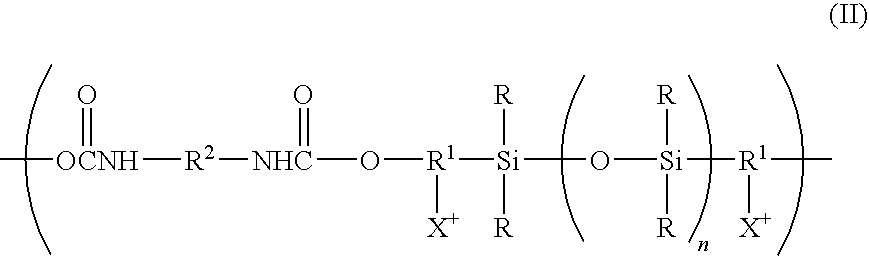
- a prepolymer comprising at least one block of Formula II and terminated with a polymerizable ethylenically unsaturated radical:
- n, R, R 1 , R 2 and X + are as defined herein.
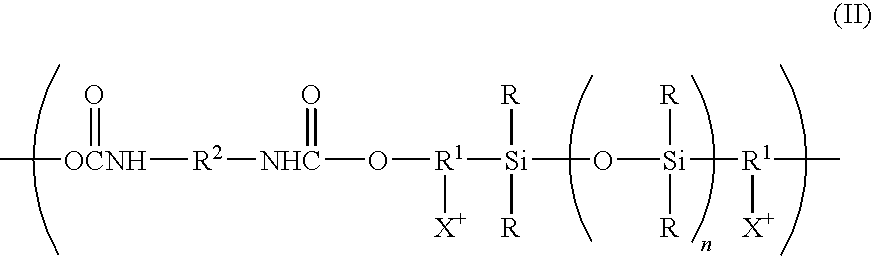
- a copolymer comprising a polymerization product of a monomeric mixture comprising one or more prepolymers comprising at least one block of Formula II and terminated with a polymerizable ethylenically unsaturated radical:
- n, R, R 1 , R 2 and X + are as defined herein.
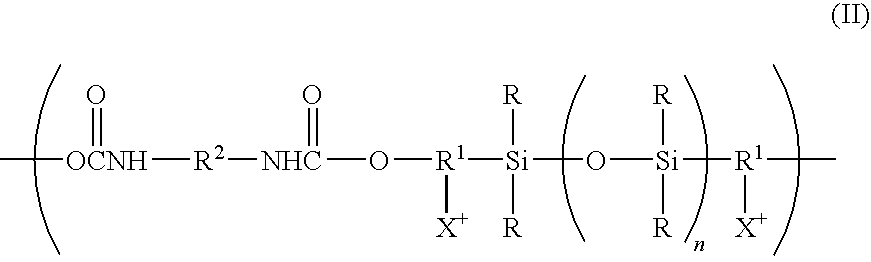
- a biomedical device comprising a polymerization product of a monomeric mixture comprising one or more prepolymers comprising at least one block of Formula II and terminated with a polymerizable ethylenically unsaturated radical:
- n, R, R 1 , R 2 and X + are as defined herein.
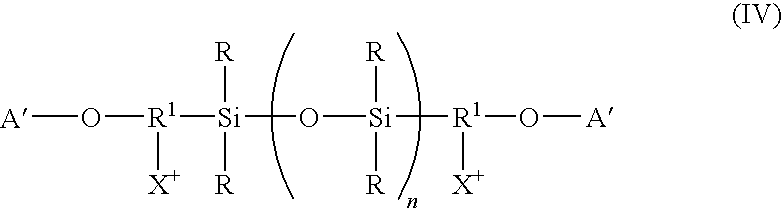
- n, R, R 1 , X + and A′ are as defined herein.
- a copolymer comprising a polymerization product of a monomeric mixture comprising one or more prepolymers of Formula IV:
- n, R, R 1 , X + and A′ are as defined herein.
- a biomedical device comprising a copolymer comprising a polymerization product of a monomeric mixture comprising one or more prepolymers of Formula IV:
- n, R, R 1 , X + and A′ are as defined herein.
- the prepolymers and copolymer of the present invention advantageously provide improved biomedical devices exhibiting a combination of oxygen permeability, surface wettability and physical strength in dry and/or hydrated forms otherwise unavailable.
- the present invention is directed to prepolymers and copolymers useful as biomedical devices intended for direct contact with body tissue or fluid.
- biomedical devices include, but are not limited to, artificial ureters, diaphragms, intrauterine devices, heart valves, catheters, denture liners, prosthetic devices, ophthalmic lens applications, where the lens is intended for direct placement in or on the eye, such as, for example, intraocular devices and contact lenses.
- a wide variety of types of contact lens materials can be produced herein ranging from hard, gas permeable lens materials; soft, hydrogel lens materials to soft, non-hydrogel lens materials.
- a particularly preferred contact lens is a soft, hydrogel lens.
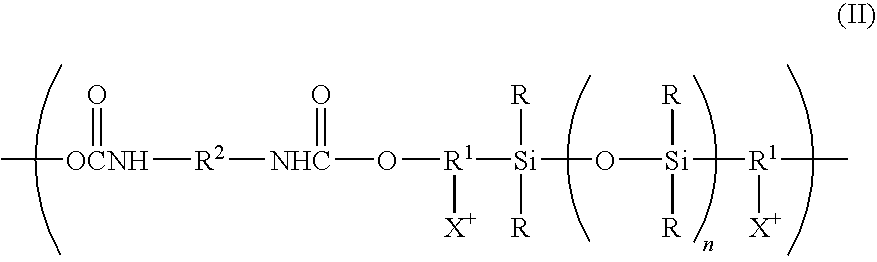
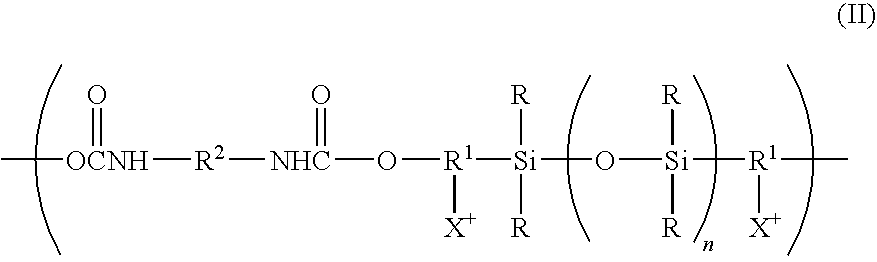
- a prepolymer of the present invention is a prepolymer having at least one block of Formula II and terminated with a polymerizable ethylenically unsaturated radical:
- n is at least 1, preferably from 10 to 100 and more preferably from 20 to 70;
- R is independently a monovalent hydrocarbon radical having 1 to 30 carbon atoms which may include ether linkages therebetween including, by way of example, a straight or branched, substituted or unsubstituted C 1 -C 30 alkyl group, a substituted or unsubstituted C 3 -C 30 cycloalkyl group, a substituted or unsubstituted C 3 -C 30 cycloalkylalkyl group, a substituted or unsubstituted C 3 -C 30 cycloalkenyl group, a substituted or unsubstituted C 5 -C 30 aryl group, and a substituted or unsubstituted C 5 -C 30 arylalkyl group; a halogen substituted monovalent hydrocarbon radical having 1 to about 20 carbon atoms which may include ether linkages therebetween including, by way of example, a C 1
- alkyl groups for use herein include, by way of example, a straight or branched hydrocarbon chain radical containing carbon and hydrogen atoms of from 1 to about 30 carbon atoms with or without unsaturation, to the rest of the molecule, e.g., methyl, ethyl, n-propyl, 1-methylethyl (isopropyl), n-butyl, n-pentyl, etc., and the like.
- fluoroalkyl groups for use herein include, by way of example, a straight or branched alkyl group as defined herein having one or more fluorine atoms attached to the carbon atom, e.g., —CF 3 , —CF 2 CF 3 , —CH 2 CF 3 , —CH 2 CF 2 H, —CF 2 H and the like.
- cycloalkyl groups for use herein include, by way of example, a substituted or unsubstituted non-aromatic mono or multicyclic ring system of about 3 to about 30 carbon atoms such as, for example, cyclopropyl, cyclobutyl, cyclopentyl, cyclohexyl, perhydronapththyl, adamantyl and norbornyl groups bridged cyclic group or sprirobicyclic groups, e.g., sprio-(4,4)-non-2-yl and the like, optionally containing one or more heteroatoms, e.g., O and N, and the like.
- cycloalkylalkyl groups for use herein include, by way of example, a substituted or unsubstituted cyclic ring-containing radical containing from about 3 to about 30 carbon atoms directly attached to the alkyl group which are then attached to the main structure of the monomer at any carbon from the alkyl group that results in the creation of a stable structure such as, for example, cyclopropylmethyl, cyclobutylethyl, cyclopentylethyl and the like, wherein the cyclic ring can optionally contain one or more heteroatoms, e.g., O and N, and the like.
- a substituted or unsubstituted cyclic ring-containing radical containing from about 3 to about 30 carbon atoms directly attached to the alkyl group which are then attached to the main structure of the monomer at any carbon from the alkyl group that results in the creation of a stable structure such as, for example, cyclopropylmethyl, cyclobutyleth
- cycloalkenyl groups for use herein include, by way of example, a substituted or unsubstituted cyclic ring-containing radical containing from about 3 to about 30 carbon atoms with at least one carbon-carbon double bond such as, for example, cyclopropenyl, cyclobutenyl, cyclopentenyl and the like, wherein the cyclic ring can optionally contain one or more heteroatoms, e.g., O and N, and the like.
- aryl groups for use herein include, by way of example, a substituted or unsubstituted monoaromatic or polyaromatic radical containing from about 5 to about 30 carbon atoms such as, for example, phenyl, naphthyl, tetrahydronapthyl, indenyl, biphenyl and the like, optionally containing one or more heteroatoms, e.g., O and N, and the like.
- arylalkyl groups for use herein include, by way of example, a substituted or unsubstituted aryl group as defined herein directly bonded to an alkyl group as defined herein, e.g., —CH 2 C 6 H 5 , —C 2 H 5 C 6 H 5 and the like, wherein the aryl group can optionally contain one or more heteroatoms, e.g., O and N, and the like.
- fluoroaryl groups for use herein include, by way of example, an aryl group as defined herein having one or more fluorine atoms attached to the aryl group.
- ester groups for use herein include, by way of example, a carboxylic acid ester having one to 20 carbon atoms and the like.
- ether or polyether containing groups for use herein include, by way of example, an alkyl ether, cycloalkyl ether, cycloalkylalkyl ether, cycloalkenyl ether, aryl ether, arylalkyl ether wherein the alkyl, cycloalkyl, cycloalkylalkyl, cycloalkenyl, aryl, and arylalkyl groups are as defined herein.
- ether or polyether-containing groups include, by way of example, alkylene oxides, poly(alkylene oxide)s such as ethylene oxide, propylene oxide, butylene oxide, poly(ethylene oxide)s, poly(ethylene glycol)s, poly(propylene oxide)s, poly(butylene oxide)s and mixtures or copolymers thereof, an ether or polyether group of the general formula —(R 3 OR 4 ) t , wherein R 3 is a bond, a substituted or unsubstituted alkyl, cycloalkyl or aryl group as defined herein and R 4 is a substituted or unsubstituted alkyl, cycloalkyl or aryl group as defined herein and t is at least 1, e.g., —CH 2 CH 2 OC 6 H 5 and CH 2 —CH 2 —CH 2 —O—CH 2 —(CF 2 ) z —H where z is 1 to 6, —CH 2 CH 2 OC 2
- an ureido group for use herein include, by way of example, an ureido group having one or more substituents or unsubstituted ureido.
- the ureido group preferably is an ureido group having 1 to 12 carbon atoms.
- substituents include alkyl groups and aryl groups.
- the ureido group include 3-methylureido, 3,3-dimethylureido, and 3-phenylureido.
- amide groups for use herein include, by way of example, an amide of the general formula —R 5 C(O)NR 6 R wherein R 5 , R 6 and R 7 are independently C 1 -C 30 hydrocarbons, e.g., —R 5 can be alkylene groups, arylene groups, cycloalkylene groups and R 6 and R 7 can be alkyl groups, aryl groups, and cycloalkyl groups as defined herein and the like.
- amine groups for use herein include, by way of example, an amine of the general formula —R 8 NR 9 R 10 wherein R 8 is a C 2 -C 30 alkylene, arylene, or cycloalkylene and R 9 and R 10 are independently C 1 -C 30 hydrocarbons such as, for example, alkyl groups, aryl groups, or cycloalkyl groups as defined herein.
- alkoxy groups for use herein include, by way of example, an alkyl group as defined herein attached via oxygen linkage to the rest of the molecule, i.e., of the general formula —OR 11 , wherein R 11 is an alkyl, cycloalkyl, cycloalkylalkyl, cycloalkenyl, aryl or an arylalkyl as defined herein, e.g., —OCH 3 , —OC 2 H 5 , or —OC 6 H 5 , and the like.
- heterocyclic ring groups for use herein include, by way of example, a substituted or unsubstituted stable 3 to about 30 membered ring radical, containing carbon atoms and from one to five heteroatoms, e.g., nitrogen, phosphorus, oxygen, sulfur and mixtures thereof.
- Suitable heterocyclic ring radicals for use herein may be a monocyclic, bicyclic or tricyclic ring system, which may include fused, bridged or spiro ring systems, and the nitrogen, phosphorus, carbon, oxygen or sulfur atoms in the heterocyclic ring radical may be optionally oxidized to various oxidation states.
- the nitrogen atom may be optionally quaternized; and the ring radical may be partially or fully saturated (i.e., heteroaromatic or heteroaryl aromatic).
- heterocyclic ring radicals include, but are not limited to, azetidinyl, acridinyl, benzodioxolyl, benzodioxanyl, benzofurnyl, carbazolyl, cinnolinyl, dioxolanyl, indolizinyl, naphthyridinyl, perhydroazepinyl, phenazinyl, phenothiazinyl, phenoxazinyl, phthalazinyl, pyridyl, pteridinyl, purinyl, quinazolinyl, quinoxalinyl, quinolinyl, isoquinolinyl, tetrazoyl, imidazolyl, tetrahydroisouino
- heteroaryl groups for use herein include, by way of example, a substituted or unsubstituted heterocyclic ring radical as defined herein.
- the heteroaryl ring radical may be attached to the main structure at any heteroatom or carbon atom that results in the creation of a stable structure.
- heteroarylalkyl groups for use herein include, by way of example, a substituted or unsubstituted heteroaryl ring radical as defined herein directly bonded to an alkyl group as defined herein.
- the heteroarylalkyl radical may be attached to the main structure at any carbon atom from the alkyl group that results in the creation of a stable structure.
- heterocyclic groups for use herein include, by way of example, a substituted or unsubstituted heterocylic ring radical as defined herein.
- the heterocyclic ring radical may be attached to the main structure at any heteroatom or carbon atom that results in the creation of a stable structure.
- heterocycloalkyl groups for use herein include, by way of example, a substituted or unsubstituted heterocylic ring radical as defined herein directly bonded to an alkyl group as defined herein.
- the heterocycloalkyl radical may be attached to the main structure at carbon atom in the alkyl group that results in the creation of a stable structure.
- X + include cationic groups of the formula: —X 1 —N + R 16 3 , —X 1 —P + R 17 3 , —X 1 —S + R 17 2 , or —X 1 -Het + , wherein X 1 is a substituted or unsubstituted alkylene group of 1 to about 12 carbon atoms, substituted or unsubstituted arylene group, substituted or unsubstituted alkylene arylene group, substituted or unsubstituted arylene alkylene group, substituted or unsubstituted alkylene aryl alkylene group, substituted or unsubstituted cycloalkylene group, substituted or unsubstituted alkylene cycloalkyl group, substituted or unsubstituted alkylene cycloalkyl group, substituted or unsubstituted cycloalkyl alkylene group or substituted or unsubstituted alkylene cyclo
- the prepolymers are endcapped on at least one end and preferably both ends with a polymerizable ethylenically unsaturated radical, e.g., A and A′.
- a polymerizable ethylenically unsaturated radical include, by way of example, (meth)acrylate-containing radicals, (meth)acrylamide-containing radicals, vinylcarbonate-containing radicals, vinylcarbamate-containing radicals, styrene-containing radicals and the like.
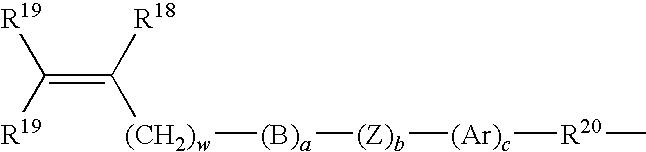
- a polymerizable ethylenically unsaturated radical can be represented by the general formula:
- Suitable endcapping precursors, for forming the polymerizable ethylenically unsaturated radicals include, by way of example, hydroxy-terminated (meth)acrylates, such as 2-hydroxyethylmethacrylate, 2-hydroxyethylacrylate, and 3-hydroxypropylmethacrylate; and amino-terminated (meth)acrylates, such as t-butylaminoethylmethacrylate and aminoethylmethacrylate; and (meth)acrylic acid, especially where the polymeric precursor is end capped with diisocyanate.
- hydroxy-terminated (meth)acrylates such as 2-hydroxyethylmethacrylate, 2-hydroxyethylacrylate, and 3-hydroxypropylmethacrylate
- amino-terminated (meth)acrylates such as t-butylaminoethylmethacrylate and aminoethylmethacrylate
- (meth)acrylic acid especially where the polymeric precursor is end capped with diis
- Suitable end capping precursors for forming the polymerizable ethylenically unsaturated radicals can also include, for example, isocyanate-terminated (meth) acrylates, such as 2-isocyanato ethyl methacrylate, especially where the polymeric precursor is end capped with a hydroxyl.
- isocyanate-terminated (meth) acrylates such as 2-isocyanato ethyl methacrylate, especially where the polymeric precursor is end capped with a hydroxyl.
- (meth) denotes an optional methyl substituent.
- terms such as “(meth)acrylate” denotes either methacrylate or acrylate
- (meth)acrylic acid” denotes either methacrylic acid or acrylic acid.
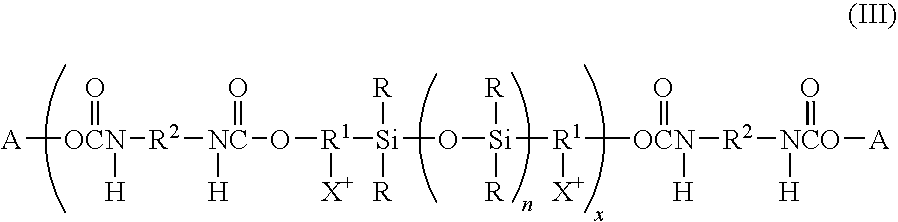
- a prepolymer of the present invention can be represented by general Formula III:
- n, R, R 1 , R 2 and X + have the aforestated meanings;
- x is an integer from 1 to 20 and preferably from 1 to 10 and more preferably from 2 to about 6 and each A is independently a polymerizable ethylenically unsaturated radical as defined herein.
- the prepolymers of this invention can be prepared by first reacting a cationic diol-terminated siloxane represented by general Formula I:
- n, R, R 1 and X + have the aforestated meanings and M ⁇ is a counter ion such as, for example, chloride, bromide, iodide and the like.
- Suitable cationic diol-terminated siloxanes represented by general Formula I can be prepared by methods known in the art and are commercially available from such sources as Siltech Inc. under the tradename Silquat®, e.g., Silquat® Di-12, Silquat® Di-20, Silquat® Di-50 and the like.
- the compounds of Formula I can have a number average molecular weight ranging from about 700 to about 10,000 and preferably from about 1,500 to about 6,000.
- any diisocyanate may be employed in forming the prepolymers of this invention.
- Suitable diisocyanates may be aliphatic or aromatic, and include alkyl, alkyl cycloalkyl, cycloalkyl, alkyl aromatic and aromatic diisocyanates preferably having 6 to 30 carbon atoms in the aliphatic or aromatic moiety.
- diisocyanates include isophorone diisocyanate, hexamethylene-1,6-diisocyanate, 4,4′-dicyclohexylmethane diisocyanate, toluene diisocyanate, 4,4′-diphenyl diisocyanate, 4,4′-diphenylmethane diisocyanate, p-phenylene diisocyanate, 1,4-phenylene 4,4′-diphenyl diisocyanate, 1,3-bis-(4,4′-isocyanto methyl)cyclohexane, and cyclohexane diisocyanate.
- the reaction of a diisocyanate with a cationic diol-terminated polysiloxane is conducted in the presence of a catalyst, such as dibutyl tin dilaurate and in a solvent, such as methylene chloride or tetrahydrofuran and under reflux.
- a catalyst such as dibutyl tin dilaurate
- a solvent such as methylene chloride or tetrahydrofuran and under reflux.
- the cationic polysiloxane and diisocyanate are ordinarily added at a molar ratio less than about 1:1.
- the number of blocks formed for the prepolymer can be controlled by varying the molar ratio of the cationic polysiloxane to diisocyanates.
- a molar ratio of cationic polysiloxane to diisocyanate can range from about 20:21 to about 1:2 and preferably from about 2:3 to about 9:10.
- the reaction of diols with diisocyanates will yield urethane radicals (—NH—COO— or —OCO—NH—).
- a prepolymer of the present invention can be represented by general Formula IV:
- n, R, R 1 and X + have the aforestated meanings and each A′ is independently a polymerizable ethylenically unsaturated-containing radical as defined herein.
- the prepolymers of Formula IV can be prepared by reacting a cationic diol-terminated siloxane represented by general Formula I with a suitable compound having a polymerizable ethylenically unsaturated-containing group.
- a suitable compound having a polymerizable ethylenically unsaturated-containing group include vinyl, allyl, acryloyl, acryloyloxy, methacryloyl, methacryloyloxy, fumaryl, styryl, itaconyl, maleimido, methacrylamido, and acrylamido-containing groups, and combinations thereof.
- These compounds also can have one or two epoxide, isocyanate, isothiocyanate, amine, hydroxyl, thiol, acid chloride or anhydride groups.
- Preferred compounds having a polymerizable ethylenically unsaturated-containing groups include compounds having a acryloyl or methacryloyl group, e.g., acryloyl chloride, methacryloyl chloride and the like; compounds having an anhydride group, e.g., maleic anhydride, itaconic anhydride and the like; compounds having a fumaryl group, e.g., fumaryl chloride and the like; compounds having an itaconyl group, e.g., itaconyl chloride and the like; and compounds having an isocyanate group, e.g., isocyanatoethyl methacrylate and the like.
- the reaction of a cationic diol-terminated siloxane with a compound having a polymerizable ethylenically unsaturated-containing group can be conducted in the presence of a catalyst, such as dibutyl tin dilaurate and in a solvent, such as methylene chloride, and under reflux.
- a catalyst such as dibutyl tin dilaurate
- a solvent such as methylene chloride
- the copolymers of this invention are formed by copolymerizing the foregoing polysiloxane prepolymers of this invention with one or more comonomers. Since the prepolymers are endcapped with polymerizable ethylenically unsaturated radicals, they are polymerizable by free radical polymerization.
- the monomeric mixtures employed in the invention include conventional lens-forming or device-forming monomers.
- the term “monomer” or “monomeric” and like terms denote relatively low molecular weight compounds that are polymerizable by free radical polymerization, as well as higher molecular weight compounds also referred to as “prepolymers”, “macromonomers”, and related terms.)
- the prepolymers of this invention are included in the monomeric mixture at about 5 to about 95 weight percent, and preferably about 20 to about 70 weight percent.
- At least one hydrophilic comonomer can be combined with the silicone-containing prepolymers of this invention in the initial monomeric mixture.
- hydrophilic comonomers include, but are not limited to, unsaturated carboxylic acids, such as methacrylic and acrylic acids; (meth)acrylic substituted alcohols, such as 2-hydroxyethylmethacrylate, 2-hydroxyethylacrylate and glyceryl methacrylate; vinyl lactams, such as N-vinyl pyrrolidone; and (meth)acrylamides, such as methacrylamide and N,N-dimethylacrylamide.
- a hydrogel is a crosslinked polymeric system that can absorb and retain water in an equilibrium state. At least one hydrophilic monomer is included in the monomer mixture at about 20 to about 60 weight percent, and preferably about 25 to about 50 weight percent.
- the initial monomeric mixture can comprise at least one (meth)acrylic substituted alcohol, such as at least one of 2-hydroxyethylmethacrylate and glyceryl methacrylate, preferably in an amount of at least about 1 weight percent of the monomeric mixture, and preferably in an amount of about 2 to about 10 weight percent.
- the monomeric mixture further includes at least one vinyl lactam, such as N-vinyl pyrrolidone and/or at least one (meth)acrylamides, such as N,N-dimethylacrylamide.
- silicone-containing monomers Another class of lens-forming or device-forming monomers is silicone-containing monomers.
- another silicone-containing comonomer which contains from 1 to about 60 silicone atoms, in addition to the polysiloxane prepolymer of this invention, may be included in the initial monomeric mixture, for example, if it is desired to obtain a copolymer with high oxygen permeability.
- One suitable class of silicone containing monomers include known bulky, monofunctional polysiloxanylalkyl monomers represented by Formula V:
- hydrophobic monomers can be added to the monomeric mixtures to modify properties of hydrogels derived therefrom.
- the hydrophobic monomers can be added, for example, to impart mechanical enhancing properties of a hydrogel such as tear strength. This is of particular importance if certain formulations gave hydrogels with tear strength less than ideal for a certain applications such as contact lenses.
- Hydrophobic monomers having aliphatic ring structures are particularly useful for increasing tear strength of a hydrogels. Suitable hydrophobic monomers having aliphatic ring structures include, but are not limited to, isobornenyl acrylate, isobornenyl methacrylate, cyclohexyl methacrylate and the like.
- the monomer mixtures may include the silicone comonomer, in addition to the subject prepolymers, at 0 to about 50 weight percent, preferably about 5 to about 30 weight percent when present.
- the monomer mixture includes a crosslinking monomer (a crosslinking monomer being defined as a monomer having multiple polymerizable functionalities). Since the prepolymers of this invention can be endcapped at both ends with a polymerizable radical, the prepolymers will function as a crosslinker.
- a supplemental crosslinking monomer may be added to the initial monomeric mixture.
- Representative crosslinking monomers include: divinylbenzene, allyl methacrylate, ethyleneglycol dimethacrylate, tetraethyleneglycol dimethacrylate, polyethyleneglycol dimethacrylate, vinyl carbonate derivatives of the glycol dimethacrylates, and methacryloxyethyl vinylcarbonate.
- this monomeric material may be included in the monomer mixture at about 0.1 to about 20 weight percent, and more preferably at about 0.2 to about 10 weight percent.
- the hydrogel copolymer when fully hydrated, has a water content of at least about 20 weight percent, as measured gravimetrically. Especially preferred are hydrogel copolymers having a water content of at least about 30 weight percent.
- the hydrogel copolymer has a tensile modulus no greater than about 100 g/mm 2 , more preferably a modulus between about 40 and about 80 g/mm 2 .
- Modulus may be measured with an Instron (Model 4502) instrument according to ASTM D-1708a, where the hydrogel copolymer film sample is immersed in borate buffered saline.
- An appropriate size of the film sample is gauge length 22 mm and width 4.75 mm, where the sample further has ends forming a dogbone shape to accommodate gripping of the sample with clamps of the Instron instrument, and a thickness of 200 ⁇ 50 microns.
- the hydrogel copolymer have an oxygen permeability of at least about 80 barrers, more preferably at least about 110 barrers, and most preferably at least about 130 barrers.
- the preferred combinations of water content and oxygen permeability may also be described as (i) a water content in the range of at least about 30 to no greater than about 60 weight percent and/or (ii) an oxygen permeability greater than about 110 barrers.
- Oxygen permeability (also referred to as Dk) is determined by the following procedure. Other methods and/or instruments may be used as long as the oxygen permeability values obtained therefrom are equivalent to the described method.
- the oxygen permeability of silicone hydrogels is measured by the polarographic method (ANSI Z80.20-1998) using an O2 Permeometer Model 201T instrument (Createch, Albany, Calif. USA) having a probe containing a central, circular gold cathode at its end and a silver anode insulated from the cathode. Measurements are taken only on pre-inspected pinhole-free, flat silicone hydrogel film samples of three different center thicknesses ranging from 150 to 600 microns.
- Center thickness measurements of the film samples may be measured using a Rehder ET-1 electronic thickness gauge.
- the film samples have the shape of a circular disk. Measurements are taken with the film sample and probe immersed in a bath containing circulating phosphate buffered saline (PBS) equilibrated at 35° C.+/ ⁇ 0.2°. Prior to immersing the probe and film sample in the PBS bath, the film sample is placed and centered on the cathode premoistened with the equilibrated PBS, ensuring no air bubbles or excess PBS exists between the cathode and the film sample, and the film sample is then secured to the probe with a mounting cap, with the cathode portion of the probe contacting only the film sample.
- PBS circulating phosphate buffered saline
- Teflon polymer membrane e.g., having a circular disk shape
- the Teflon membrane is first placed on the pre-moistened cathode, and then the film sample is placed on the Teflon membrane, ensuring no air bubbles or excess PBS exists beneath the Teflon membrane or film sample.
- R 2 correlation coefficient value
- oxygen permeability (Dk) is calculated from the film samples having at least three different thicknesses.
- Any film samples hydrated with solutions other than PBS are first soaked in purified water and allowed to equilibrate for at least 24 hours, and then soaked in PHB and allowed to equilibrate for at least 12 hours.
- the instruments are regularly cleaned and regularly calibrated using RGP standards. Upper and lower limits are established by calculating a +/ ⁇ 8.8% of the Repository values established by William J. Benjamin, et al., The Oxygen Permeability of Reference Materials , Optom V is Sci 7 (12s): 95 (1997), the disclosure of which is incorporated herein in its entirety:
- the monomer mixtures may further include a monomer for increasing the refractive index of the resultant copolymer.
- a monomer for increasing the refractive index of the resultant copolymer examples include aromatic (meth) acrylates, such as phenyl (meth)acrylate, phenylethyl (meth)acrylate and benzyl (meth)acrylate.
- organic diluent may be included in the initial monomeric mixture.
- organic diluent encompasses organic compounds that are substantially unreactive with the components in the initial mixture, and are often used to minimize incompatibility of the monomeric components in this mixture.
- Representative organic diluents include: monohydric alcohols, such as C 2 -C 10 monohydric alcohols; diols such as ethylene glycol; polyols such as glycerin; ethers such as diethylene glycol monoethyl ether and 3-methoxy-1-butanol; ketones such as methyl ethyl ketone; esters such as methyl heptanoate; and aliphatic and aromatic hydrocarbons such as toluene.
- monohydric alcohols such as C 2 -C 10 monohydric alcohols
- diols such as ethylene glycol
- polyols such as glycerin
- ethers such as diethylene glycol monoethyl ether and 3-methoxy-1-butanol
- ketones such as methyl ethyl ketone
- esters such as methyl heptanoate
- aliphatic and aromatic hydrocarbons such as toluene.
- the monomeric mixtures may be charged to a mold, and then subjected to heat and/or light radiation, such as ultraviolet (UV) radiation, to effect curing, or free radical polymerization, of the monomer mixture in the mold.
- heat and/or light radiation such as ultraviolet (UV) radiation
- UV radiation ultraviolet
- Various processes are known for curing a monomeric mixture in the production of contact lenses or other biomedical devices, including spincasting and static casting.
- Spincasting methods involve charging the monomer mixture to a mold, and spinning the mold in a controlled manner while exposing the monomer mixture to light.
- Static casting methods involve charging the monomer mixture between two mold sections forming a mold cavity providing a desired article shape, and curing the monomer mixture by exposure to heat and/or light.
- one mold section is shaped to form the anterior lens surface and the other mold section is shaped to form the posterior lens surface.
- curing of the monomeric mixture in the mold may be followed by a machining operation in order to provide a contact lens or article having a desired final configuration.
- machining operation Such methods are described in U.S. Pat. Nos. 3,408,429, 3,660,545, 4,113,224, 4,197,266, 5,271,875, and 5,260,000.
- the monomer mixtures may be cast in the shape of rods or buttons, which are then lathe cut into a desired shape, for example, into a lens-shaped article.
- the contact lenses obtained herein may be subjected to optional machining operations.
- the optional machining steps may include buffing or polishing a lens edge and/or surface.
- machining processes may be performed before or after the product is released from a mold part, e.g., the lens is dry released from the mold by employing vacuum tweezers to lift the lens from the mold, after which the lens is transferred by means of mechanical tweezers to a second set of vacuum tweezers and placed against a rotating surface to smooth the surface or edges. The lens may then be tamed over in order to machine the other side of the lens.
- the lens may then be transferred to individual lens packages containing a buffered saline solution.
- the saline solution may be added to the package either before or after transfer of the lens.
- Appropriate packaging designs and materials are known in the art.
- a plastic package is releasably sealed with a film. Suitable sealing films are known in the art and include foils, polymer films and mixtures thereof.
- the sealed packages containing the lenses are then sterilized to ensure a sterile product. Suitable sterilization means and conditions are known in the art and include, for example, autoclaving.
- Such other steps can include, for example, coating the formed lens, surface treating the lens during formation (e.g., via mold transfer), inspecting the lens, discarding defective lenses, cleaning the mold halves, reusing the mold halves, and the like and combinations thereof.
- NVP N-vinyl-2-pyrrolidone
- HEMAVC methacryloxyethyl vinyl carbonate
- EGDMA Ethylene glycol dimethacrylate
- D1173 2-hydroxy-2-methyl-1-phenylpropan-1-one (available as Darocur 1173 initiator)
- VazoTM 64 azo bis-isobutylnitrile (AIBN)
- HEMA 0.812 g
- 1,1′-bi-naphthol 10 mg
- Monomer mixtures were made by mixing the following components, listed in Tables 1 and 2 at amounts per weight: prepolymers of Examples 1 and 2; methacryloxypropyl tris(trimethylsiloxy)silane (TRIS); N,N-dimethylacrylamide (DMA); 2-hydroxy ethyl methacrylate (HEMA); N-vinyl pyrrolidone (NVP); and methacryloxyethyl vinylcarbonate (HemaVC).
- TMS methacryloxypropyl tris(trimethylsiloxy)silane
- DMA N,N-dimethylacrylamide
- HEMA 2-hydroxy ethyl methacrylate
- NDP N-vinyl pyrrolidone
- HemaVC methacryloxyethyl vinylcarbonate
- each monomer mixture included: 1,4-bis(2-methacrylamidoethylamino)anthraquinone as a tint (150 ppm); hexanol as a diluent (10 parts by weight); and Darocur-1173TM UV initiator (Ciba Specialty Chemical, Ardsley N.Y.) (0.5 wt %) or VazoTM 64 (a thermal polymerization initiator, said to be 2,2′-azobisisobutyronitrile, DuPont Chemicals, Wilmington, Del.).
- Darocur-1173TM UV initiator Ciba Specialty Chemical, Ardsley N.Y.
- VazoTM 64 a thermal polymerization initiator, said to be 2,2′-azobisisobutyronitrile, DuPont Chemicals, Wilmington, Del.
- the monomer mixtures were cast and cured into films.
- the mixture of Example 3 was cured under UV for 1 hour while the mixtures of Examples 4-11 were cured under the following thermal conditions: held at room temperature for 12 minutes, then ramped up to 100° C. in 54 minutes, and further held at 100° C. for 2 hours.
- Each monomer mixture was cast between three sets of glass plates, each set of plates separated by TeflonTM polymer tapes of different thicknesses, such that three sets of film samples were obtained for each monomer mixture, with film thicknesses of about 200, 400 and 600 microns.
- the cured films were then extracted with isopropanol overnight, followed by hydration in deionized (DI) water, boiled in DI water for 4 hours and then saturated in borate buffered saline or phosphate buffered saline to give hydrogel films.
- DI deionized
- the water content was measured gravimetrically.
- Tensile Modulus and % elongation were conducted in borate buffered saline according to ASTM D-1708a, discussed above. Tear strengths were measured according to ASTM D-1938 under the same physical conditions as for tensile modulus.
- the oxygen permeabilities reported in Dk (or barrer) units, were measured in phosphate buffered saline at 35° C., using acceptable films with three different thicknesses, as discussed above. For mechanical tests, films of around 200 microns were cast. For oxygen permeability tests, films with multiple thickness including 200 microns were cast.
- reaction product was analyzed by MALDI (Model: Voyager-DE STR) to determine if the starting material had been capped with isocyanatoethyl methacrylate. It was determined that the reaction products were IEM-capped. The product was then recovered.
- MALDI Model: Voyager-DE STR
- a monomer mixture was made by mixing the following components, listed in Table 3 at amounts per weight. The mixture was found clear before adding the blue tint.
- Lenses were cast using polypropylene molds, both in an open air bench top and in a dry box filled with nitrogen, and then cured in an oven at under the following thermal conditions: held at room temperature for 12 minutes, then ramped up to 100° C. in 54 minutes, and further held at 100° C. for 2 hours. After casting, the lenses were released from the molds and extracted in isopropanol (IPA) for 60 minutes.
- IPA isopropanol
- a monomer mixture was made by mixing the following components, listed in Table 4 at amounts per weight.
- a monomer mixture was made by mixing the following components, listed in Table 5.
Landscapes
- Chemical & Material Sciences (AREA)
- Organic Chemistry (AREA)
- Health & Medical Sciences (AREA)
- Chemical Kinetics & Catalysis (AREA)
- Medicinal Chemistry (AREA)
- Polymers & Plastics (AREA)
- Physics & Mathematics (AREA)
- General Physics & Mathematics (AREA)
- Optics & Photonics (AREA)
- Engineering & Computer Science (AREA)
- Manufacturing & Machinery (AREA)
- Eyeglasses (AREA)
- Addition Polymer Or Copolymer, Post-Treatments, Or Chemical Modifications (AREA)
- Macromonomer-Based Addition Polymer (AREA)
Abstract
wherein n, R, R1, R2 and X+ are as defined herein.
Description
wherein n, R, R1, R2 and X+ are as defined herein.
wherein n, R, R1, R2 and X+ are as defined herein.
wherein n, R, R1, R2 and X+ are as defined herein.

wherein n, R, R1, X+ and A′ are as defined herein.

wherein n, R, R1, X+ and A′ are as defined herein.
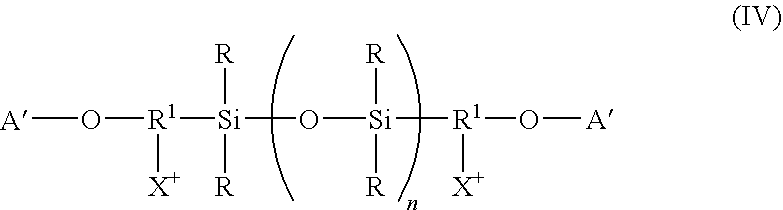
wherein n, R, R1, X+ and A′ are as defined herein.
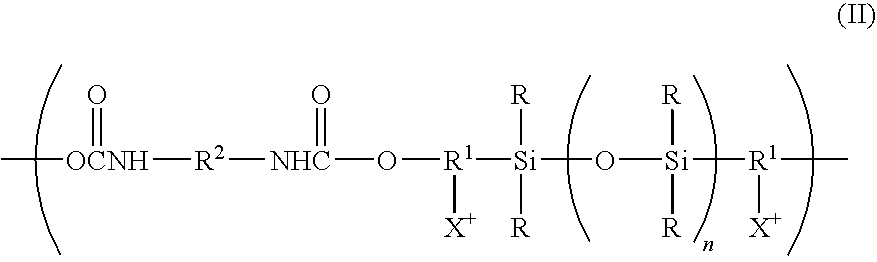
wherein n is at least 1, preferably from 10 to 100 and more preferably from 20 to 70; R is independently a monovalent hydrocarbon radical having 1 to 30 carbon atoms which may include ether linkages therebetween including, by way of example, a straight or branched, substituted or unsubstituted C1-C30 alkyl group, a substituted or unsubstituted C3-C30 cycloalkyl group, a substituted or unsubstituted C3-C30 cycloalkylalkyl group, a substituted or unsubstituted C3-C30 cycloalkenyl group, a substituted or unsubstituted C5-C30 aryl group, and a substituted or unsubstituted C5-C30 arylalkyl group; a halogen substituted monovalent hydrocarbon radical having 1 to about 20 carbon atoms which may include ether linkages therebetween including, by way of example, a C1-C30 fluoro-substituted alkyl group or alkenyl group; a C1-C20 ester group; an ether or polyether-containing group, e.g., an alkyl ether, cycloalkyl ether, cycloalkylalkyl ether, cycloalkenyl ether, aryl ether, arylalkyl ether, polyalkyl ether, polycycloalkyl ether, polycycloalkylalkyl ether, polycycloalkenyl ether, polyaryl ether or polyarylalkyl ether; an ureido group; an amide group; an amine group; a substituted or unsubstituted C1-C30 alkoxy group; a substituted or unsubstituted C5-C30 heteroaryl group; a substituted or unsubstituted C3-C30 heterocyclic ring; a substituted or unsubstituted C4-C30 heterocycloalkyl group; a substituted or unsubstituted C6-C30 heteroarylalkyl group; fluorine; a vinyl group; a C5-C30 fluoroaryl group and combinations thereof; R1 is independently a substituted or unsubstituted divalent hydrocarbon radical having 1 to 30 carbon atoms which may include ether linkages therebetween including, by way of example, a substituted or unsubstituted C1-C30 alkylene, substituted or unsubstituted C3-C30 cycloalkylene, and substituted or unsubstituted C5-C30 arylene radical, substituted radicals of the foregoing in which some of the hydrogen atoms are substituted with halogen atoms, and combinations thereof; X+ is independently a cationic-containing group and R2 is a diradical residue of a diisocyanate.

wherein
- R18 is hydrogen or methyl;
- each R19 is independently hydrogen, an alkyl radical having 1 to 6 carbon atoms, or a —CO—Y—R21 radical wherein Y is —O—, —S— or —NH— and R21 is an alkyl radical having 1 to about 10 carbon atoms;
- R20 is a divalent alkenyl radical having 1 to about 12 carbon atoms;
- B denotes —O— or —NH—; Z denotes —CO—, —OCO— or —COO;
- Ar denotes an aromatic radical having 6 to about 30 carbon atoms;
- w is 0 to 6; a is 0 or 1; b is 0 or 1; and c is 0 or 1.
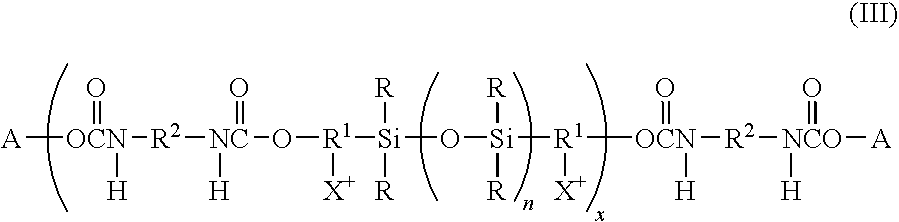
wherein n, R, R1, R2 and X+ have the aforestated meanings; x is an integer from 1 to 20 and preferably from 1 to 10 and more preferably from 2 to about 6 and each A is independently a polymerizable ethylenically unsaturated radical as defined herein.
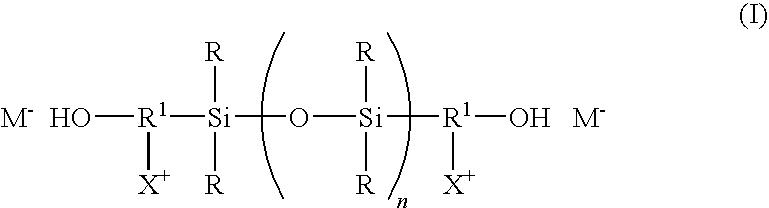
wherein n, R, R1 and X+ have the aforestated meanings and M− is a counter ion such as, for example, chloride, bromide, iodide and the like.
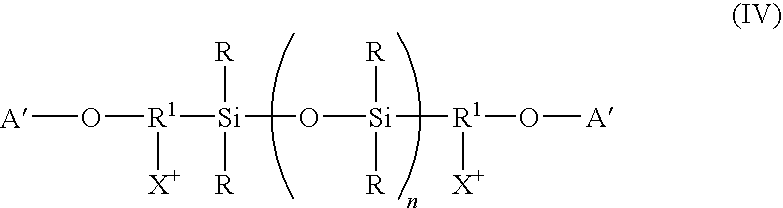
wherein n, R, R1 and X+ have the aforestated meanings and each A′ is independently a polymerizable ethylenically unsaturated-containing radical as defined herein.

- X is —COO—, —CONR24—, —OCOO—, or —OCONR24— wherein each R24 is H or lower alkyl;
- R23 is hydrogen or lower alkyl such as methyl; h is 1 to 10; and each R22 independently is a lower alkyl or halogenated alkyl radical, a phenyl radical or a radical of the formula —Si(R25)3
wherein each R25 is independently a lower alkyl radical or a phenyl radical. Such bulky monomers specifically include methacryloxypropyl tris(trimethylsiloxy)silane (TRIS), pentamethyldisiloxanyl methylmethacrylate, tris(trimethylsiloxy)methacryloxy propylsilane, methyldi(trimethylsiloxy)methacryloxymethyl silane, 3-[tris(trimethylsiloxy)silyl]propyl vinyl carbamate, and 3-[tris(trimethylsiloxy)silyl]propyl vinyl carbonate.
| TABLE 1 | ||
| EXAMPLE | ||
| 3 | 4 | 5 | 6 | 7 | ||
| Cationic | 36.4 | 32 | 60 | 60 | 60 |
| Prepolymer Ex 1 | |||||
| Cationic | |||||
| Prepolymer Ex 2 | |||||
| TRIS | 9.1 | 8 | 20 | 15 | 15 |
| DMA | 4.2 | 3.7 | 0 | 0 | 0 |
| NVP | 13.4 | 25.8 | 20 | 29 | 29 |
| HEMA | 1.5 | 1.3 | 20 | 2.5 | 2.5 |
| HEMAVC | 0.4 | 0.5 | 1 | 1 | 1 |
| IBOMA | 10 | ||||
| h-hexanol | 34.6 | ||||
| 3-Methoxy-1- | 27.8 | 30 | 49 | 40 | |
| Butanol | |||||
| Darocur-1173 | 0.3 | ||||
| Vazo-64 | 0.3 | 0.5 | 0.5 | 0.5 | |
| IMVT | 150 ppm | 150 ppm | 0 | 150 ppm | 150 ppm |
| Properties | |||||
| % water | 54.8 | 61.4 | 34.1 | 48.3 | 38.9 |
| Modulus (g/mm2) | 17 | 35 | 96 | 47 | 187 |
| % elongation | 100 | 53 | 88 | 91 | 91 |
| Tear (g/mm) | 1 | 0.5 | 2 | 2 | 5 |
| DK (barrer) | 142 | 69 | 82 | 156 | 122 |
| TABLE 2 | ||
| EXAMPLE | ||
| 8 | 9 | 10 | 11 | ||
| Cationic Prepolymer | 60 | |||
| Ex 1 | ||||
| Cationic Prepolymer | 60 | 60 | 60 | |
| Ex 2 | ||||
| TRIS | 15 | 15 | 15 | 15 |
| NVP | 29 | 22 | 27 | 29 |
| HEMA | 2.5 | 10 | 5 | 2.5 |
| HEMAVC | 1 | 0.8 | 0.9 | 0.9 |
| EGDMA | 0.4 | 0.4 | 0.4 | |
| IBOMA | 4 | 4 | 4 | 4 |
| 3-Methoxy-1-Butanol | 40 | 10 | 10 | 10 |
| Vazo-64 | 0.5 | 0.6 | 0.6 | 0.6 |
| IMVT | 150 ppm | 150 ppm | 150 ppm | 150 ppm |
| Properties | ||||
| % water | 47.2 | 39.8 | 40.5 | 43.9 |
| Modulus (g/mm2) | 45 | 87 | 69 | 56 |
| % elongation | 120 | 73 | 60 | 41 |
| Tear (g/mm) | 3 | 3 | 2 | 2 |
| DK (barrer) | 149 | 117 | 133 | 120 |
The oxygen permeabilities of these hydrogels having a water content between about 40 to 55% were at least 110 up to 156 DK, which were much higher than those of typical non-ionic silicone hydrogels. Normally, silicone hydrogels having these water contents were less than 90 DK. Therefore, by employing a cationic prepolymer of this invention, it was possible to obtain silicone hydrogels with unusually super high oxygen permeability
| TABLE 3 | |||
| Ingredient | Amount | ||
| Cationic Prepolymer Ex 12 | 9.3 (1.1451 g) | ||
| TRIS | 23.25 (2.8638 g) | ||
| NVP | 41.85 (5.1530 g) | ||
| HEMA | 18.6 (2.2924 g) | ||
| 1,2 propanol | 5 (0.6124 g) | ||
| UV blocker | 1.5 (0.1841 g) | ||
| Vazo-64 | 0.5 (0.061 g) | ||
| Reactive blue tint | 0.0012 g | ||
| TABLE 4 | ||
| Amount | ||
| Ingredient | |||
| Cationic Prepolymer Ex 14 | 9.56 (0.9681 g) | ||
| TRIS | 23.07 (2.33 g) | ||
| NVP | 41.74 (4.2252 g) | ||
| HEMA | 18.56 (1.879 g) | ||
| 1,2 propanol | 5.06 (0.5127 g) | ||
| UV blocker | 1.55 (0.1574 g) | ||
| Vazo-64 | 0.5 (0.0506 g) | ||
| Properties | |||
| % water | 63.7 | ||
| Modulus (g/mm2) | 40 ± 2 | ||
| % elongation | 249 +/− 16 | ||
| Tear (g/mm) | 6 | ||
| DK (barrer) | 40 | ||
The monomer mixture was cast between silane-treated glass plates and cured under heat using the following conditions: held at room temperature for 12 minutes, then ramped up to 100° C. in 54 minutes, and further held at 100° C. for 2 hours. The lenses were released from the glass plates, extracted with IPA for 1.5 hours and hydrated in a borate buffered saline. Extractables: 16.6%.
| TABLE 5 | ||
| Amount | ||
| Ingredient | |||
| Cationic Prepolymer Ex 16 | 202999 g | ||
| TRIS | 5.7519 g | ||
| NVP | 10.3482 g | ||
| HEMA | 4.6029 g | ||
| 1,2 propanol | 1.234 g | ||
| UV blocker | 0.3722 g | ||
| Vazo-64 | 0.12 g | ||
| Properties | |||
| % water | 51 | ||
| Modulus (g/mm2) | 105 | ||
| Tear (g/mm) | 4 | ||
| DK (barrer) | 32 | ||
The monomeric mixture was cast between silane-treated glass plates to obtain films with 3 different thickness of roughly 200, 400 and 600 microns and cured under the following thermal conditions: held at room temperature for 12 minutes, then ramped up to 100° C. in 54 minutes, and further held at 100° C. for 2 hours. The films were then released from the glass plates, extracted with IPA for 3 hours and hydrated in DI water.
Claims (52)

Priority Applications (2)
| Application Number | Priority Date | Filing Date | Title |
|---|---|---|---|
| US11/762,970 US7691917B2 (en) | 2007-06-14 | 2007-06-14 | Silcone-containing prepolymers |
| PCT/US2008/066304 WO2008157111A2 (en) | 2007-06-14 | 2008-06-09 | Silicone-containing prepolymers |
Applications Claiming Priority (1)
| Application Number | Priority Date | Filing Date | Title |
|---|---|---|---|
| US11/762,970 US7691917B2 (en) | 2007-06-14 | 2007-06-14 | Silcone-containing prepolymers |
Publications (2)
| Publication Number | Publication Date |
|---|---|
| US20080312397A1 US20080312397A1 (en) | 2008-12-18 |
| US7691917B2 true US7691917B2 (en) | 2010-04-06 |
Family
ID=40132947
Family Applications (1)
| Application Number | Title | Priority Date | Filing Date |
|---|---|---|---|
| US11/762,970 Expired - Fee Related US7691917B2 (en) | 2007-06-14 | 2007-06-14 | Silcone-containing prepolymers |
Country Status (2)
| Country | Link |
|---|---|
| US (1) | US7691917B2 (en) |
| WO (1) | WO2008157111A2 (en) |
Cited By (12)
| Publication number | Priority date | Publication date | Assignee | Title |
|---|---|---|---|---|
| US20100296051A1 (en) * | 2008-02-12 | 2010-11-25 | Aaren Scientific Inc. | Ophthalmic lens having a yellow dye light blocking component |
| US8480227B2 (en) | 2010-07-30 | 2013-07-09 | Novartis Ag | Silicone hydrogel lenses with water-rich surfaces |
| US9005700B2 (en) | 2011-10-12 | 2015-04-14 | Novartis Ag | Method for making UV-absorbing ophthalmic lenses |
| US9708087B2 (en) | 2013-12-17 | 2017-07-18 | Novartis Ag | Silicone hydrogel lens with a crosslinked hydrophilic coating |
| US10338408B2 (en) | 2012-12-17 | 2019-07-02 | Novartis Ag | Method for making improved UV-absorbing ophthalmic lenses |
| US10449740B2 (en) | 2015-12-15 | 2019-10-22 | Novartis Ag | Method for applying stable coating on silicone hydrogel contact lenses |
| US10830923B2 (en) | 2017-12-13 | 2020-11-10 | Alcon Inc. | Method for producing MPS-compatible water gradient contact lenses |
| US10843422B2 (en) | 2017-06-07 | 2020-11-24 | Alcon, Inc. | Method for producing silicone hydrogel contact lenses |
| US10866344B2 (en) | 2017-06-07 | 2020-12-15 | Alcon Inc. | Silicone hydrogel contact lenses |
| US10875967B2 (en) | 2017-06-07 | 2020-12-29 | Alcon Inc. | Silicone hydrogel contact lenses |
| US11002884B2 (en) | 2014-08-26 | 2021-05-11 | Alcon Inc. | Method for applying stable coating on silicone hydrogel contact lenses |
| US11446215B2 (en) * | 2018-05-18 | 2022-09-20 | Dentsply Sirona Inc. | Macromonomer based light-curable dental impression material |
Families Citing this family (20)
| Publication number | Priority date | Publication date | Assignee | Title |
|---|---|---|---|---|
| US8527026B2 (en) | 1997-03-04 | 2013-09-03 | Dexcom, Inc. | Device and method for determining analyte levels |
| US6001067A (en) | 1997-03-04 | 1999-12-14 | Shults; Mark C. | Device and method for determining analyte levels |
| US20030032874A1 (en) | 2001-07-27 | 2003-02-13 | Dexcom, Inc. | Sensor head for use with implantable devices |
| US10022078B2 (en) | 2004-07-13 | 2018-07-17 | Dexcom, Inc. | Analyte sensor |
| US7379765B2 (en) | 2003-07-25 | 2008-05-27 | Dexcom, Inc. | Oxygen enhancing membrane systems for implantable devices |
| US7920906B2 (en) | 2005-03-10 | 2011-04-05 | Dexcom, Inc. | System and methods for processing analyte sensor data for sensor calibration |
| US9247900B2 (en) | 2004-07-13 | 2016-02-02 | Dexcom, Inc. | Analyte sensor |
| US8277713B2 (en) | 2004-05-03 | 2012-10-02 | Dexcom, Inc. | Implantable analyte sensor |
| US9044199B2 (en) | 2004-07-13 | 2015-06-02 | Dexcom, Inc. | Transcutaneous analyte sensor |
| US8744546B2 (en) | 2005-05-05 | 2014-06-03 | Dexcom, Inc. | Cellulosic-based resistance domain for an analyte sensor |
| WO2007120381A2 (en) | 2006-04-14 | 2007-10-25 | Dexcom, Inc. | Analyte sensor |
| US7901073B2 (en) * | 2007-07-10 | 2011-03-08 | Bausch & Lomb Incorporated | Silicone hydrogel with composite hydrophilic and silicone polymers prepared with selective crosslink agents |
| US8583204B2 (en) | 2008-03-28 | 2013-11-12 | Dexcom, Inc. | Polymer membranes for continuous analyte sensors |
| US8682408B2 (en) | 2008-03-28 | 2014-03-25 | Dexcom, Inc. | Polymer membranes for continuous analyte sensors |
| US11730407B2 (en) | 2008-03-28 | 2023-08-22 | Dexcom, Inc. | Polymer membranes for continuous analyte sensors |
| DE102008002375A1 (en) * | 2008-06-12 | 2009-12-17 | Evonik Röhm Gmbh | Hydrogel based on silicone-containing copolymers |
| WO2010033724A2 (en) | 2008-09-19 | 2010-03-25 | Dexcom, Inc. | Particle-containing membrane and particulate electrode for analyte sensors |
| TWI396702B (en) * | 2009-05-08 | 2013-05-21 | Yun Liang Ouyang | Prepolymer for biomedical materials |
| US20130313733A1 (en) * | 2012-05-25 | 2013-11-28 | Ivan Nunez | Method of making a fully polymerized uv blocking silicone hydrogel lens |
| CN111171494B (en) * | 2018-11-12 | 2021-01-26 | 中国科学院化学研究所 | Impact-resistant shear-thickening polyurethane hydrogel and preparation method thereof |
Citations (102)
| Publication number | Priority date | Publication date | Assignee | Title |
|---|---|---|---|---|
| US3408429A (en) | 1963-09-11 | 1968-10-29 | Ceskoslovenska Akademie Ved | Method for centrifugal casting a contact lens |
| US3660545A (en) | 1961-12-27 | 1972-05-02 | Ceskoslovenska Akademie Ved | Method of centrifugally casting thin edged corneal contact lenses |
| US3808179A (en) | 1972-06-16 | 1974-04-30 | Polycon Laboratories | Oxygen-permeable contact lens composition,methods and article of manufacture |
| US4005024A (en) | 1975-04-22 | 1977-01-25 | The Procter & Gamble Company | Rinse aid composition containing an organosilane |
| US4006176A (en) | 1975-04-22 | 1977-02-01 | The Procter & Gamble Company | Organosilane compounds |
| US4113224A (en) | 1975-04-08 | 1978-09-12 | Bausch & Lomb Incorporated | Apparatus for forming optical lenses |
| US4153641A (en) | 1977-07-25 | 1979-05-08 | Bausch & Lomb Incorporated | Polysiloxane composition and contact lens |
| US4185087A (en) | 1977-12-28 | 1980-01-22 | Union Carbide Corporation | Hair conditioning compositions containing dialkylamino hydroxy organosilicon compounds and their derivatives |
| US4189546A (en) | 1977-07-25 | 1980-02-19 | Bausch & Lomb Incorporated | Polysiloxane shaped article for use in biomedical applications |
| US4197266A (en) | 1974-05-06 | 1980-04-08 | Bausch & Lomb Incorporated | Method for forming optical lenses |
| EP0017121A1 (en) | 1979-03-29 | 1980-10-15 | Henkel Kommanditgesellschaft auf Aktien | Quaternary polysiloxane derivatives, their use in hair cosmetics, and hair washing and hair treatment compositions containing them |
| US4259467A (en) | 1979-12-10 | 1981-03-31 | Bausch & Lomb Incorporated | Hydrophilic contact lens made from polysiloxanes containing hydrophilic sidechains |
| US4260725A (en) | 1979-12-10 | 1981-04-07 | Bausch & Lomb Incorporated | Hydrophilic contact lens made from polysiloxanes which are thermally bonded to polymerizable groups and which contain hydrophilic sidechains |
| US4321261A (en) | 1978-01-05 | 1982-03-23 | Polymer Technology Corporation | Ionic ophthalmic solutions |
| US4388229A (en) | 1981-11-02 | 1983-06-14 | Syntex (U.S.A.) Inc. | Contact lens rejuvenating solution |
| US4418165A (en) | 1980-06-03 | 1983-11-29 | Dow Corning Corporation | Optically clear silicone compositions curable to elastomers |
| US4472327A (en) | 1983-01-31 | 1984-09-18 | Neefe Charles W | Method of making hydrogel cosmetic contact lenses |
| US4486577A (en) * | 1982-10-12 | 1984-12-04 | Ciba-Geigy Corporation | Strong, silicone containing polymers with high oxygen permeability |
| US4495361A (en) | 1983-04-29 | 1985-01-22 | Bausch & Lomb Incorporated | Polysiloxane composition with improved surface wetting characteristics and biomedical devices made thereof |
| US4533714A (en) | 1982-11-10 | 1985-08-06 | L'oreal | Polyquaternary polysiloxane polymers |
| US4555732A (en) | 1984-03-22 | 1985-11-26 | Xerox Corporation | Image sensor correction system |
| US4605712A (en) * | 1984-09-24 | 1986-08-12 | Ciba-Geigy Corporation | Unsaturated polysiloxanes and polymers thereof |
| US4633003A (en) | 1985-11-25 | 1986-12-30 | Alcon Laboratories, Inc. | Siloxane monomers for ophthalmic applications |
| US4640941A (en) | 1985-11-25 | 1987-02-03 | Alcon Laboratories | Hydrogels containing siloxane comonomers |
| US4686267A (en) | 1985-10-11 | 1987-08-11 | Polymer Technology Corporation | Fluorine containing polymeric compositions useful in contact lenses |
| US4745142A (en) | 1985-10-14 | 1988-05-17 | Teijin Limited | Stainproof polyester fiber |
| US4833225A (en) | 1987-02-18 | 1989-05-23 | Th. Goldschdidt AG | Polyquaternary polysiloxane polymers, their synthesis and use in cosmetic preparations |
| US4871530A (en) | 1986-03-19 | 1989-10-03 | L'oreal | Aqueous delayed-foaming cosmetic composition for hair and skin treatment |
| US4891166A (en) * | 1987-06-06 | 1990-01-02 | Th. Goldschmidt Ag | Diquaternary polysiloxanes, their synthesis and use in cosmetic preparations |
| US4910277A (en) | 1988-02-09 | 1990-03-20 | Bambury Ronald E | Hydrophilic oxygen permeable polymers |
| US5006622A (en) | 1987-04-02 | 1991-04-09 | Bausch & Lomb Incorporated | Polymer compositions for contact lenses |
| US5008613A (en) | 1988-08-26 | 1991-04-16 | Siemens Aktiengesellschaft | Voltage tester for graduated optical display of a voltage and method for its manufacture |
| US5013459A (en) | 1989-11-09 | 1991-05-07 | Dow Corning Corporation | Opthalmic fluid dispensing method |
| US5034461A (en) | 1989-06-07 | 1991-07-23 | Bausch & Lomb Incorporated | Novel prepolymers useful in biomedical devices |
| US5039458A (en) | 1987-12-21 | 1991-08-13 | W. R. Grace & Co.-Conn. | Method of making a hydrophilic, biocompatible, protein non-adsorptive contact lens |
| US5070170A (en) | 1988-02-26 | 1991-12-03 | Ciba-Geigy Corporation | Wettable, rigid gas permeable, substantially non-swellable contact lens containing block copolymer polysiloxane-polyoxyalkylene backbone units, and use thereof |
| US5070215A (en) | 1989-05-02 | 1991-12-03 | Bausch & Lomb Incorporated | Novel vinyl carbonate and vinyl carbamate contact lens material monomers |
| US5128408A (en) | 1987-11-16 | 1992-07-07 | Toyo Boseki Kabushiki Kaisha | Gas-permeable material with excellent compatibility with blood |
| US5137448A (en) | 1984-07-31 | 1992-08-11 | Dentsply Research & Development Corp. | Dental impression method with photocuring of impression material in light transmissive tray |
| US5246607A (en) | 1988-11-08 | 1993-09-21 | Th. Goldschmidt Ag | Methylpolysiloxanes with quaternary ammonium groups as corrosion inhibitors for preparations consisting predominantly of water |
| US5260000A (en) | 1992-08-03 | 1993-11-09 | Bausch & Lomb Incorporated | Process for making silicone containing hydrogel lenses |
| US5271875A (en) | 1991-09-12 | 1993-12-21 | Bausch & Lomb Incorporated | Method for molding lenses |
| US5271876A (en) | 1986-12-02 | 1993-12-21 | Solomat Partners, L.P. | Process for analyzing, monitoring and/or controlling the internal structure of non-conductive, moldable material by inducing an electrical effect therein before it is molded |
| US5321108A (en) | 1993-02-12 | 1994-06-14 | Bausch & Lomb Incorporated | Fluorosilicone hydrogels |
| US5328685A (en) * | 1993-03-30 | 1994-07-12 | Helene Curtis, Inc. | Clear conditioning composition |
| US5340583A (en) | 1993-05-06 | 1994-08-23 | Allergan, Inc. | Antimicrobial lenses and lens care systems |
| US5358995A (en) | 1992-05-15 | 1994-10-25 | Bausch & Lomb Incorporated | Surface wettable silicone hydrogels |
| US5359104A (en) | 1989-11-03 | 1994-10-25 | Dow Corning Corporation | Solid antimicrobial |
| US5374662A (en) | 1993-03-15 | 1994-12-20 | Bausch & Lomb Incorporated | Fumarate and fumaramide siloxane hydrogel compositions |
| US5393330A (en) | 1993-06-30 | 1995-02-28 | Osi Specialties, Inc. | Cationic emulsions of alkylalkoxysilanes |
| US5451617A (en) | 1991-09-12 | 1995-09-19 | Bausch & Lomb Incorporated | Wettable silicone hydrogel compositions and methods for their manufacture |
| US5451651A (en) | 1993-12-17 | 1995-09-19 | Bausch & Lomb Incorporated | Urea and urethane monomers for contact lens materials |
| US5707434A (en) | 1996-10-16 | 1998-01-13 | Dow Corning Corporation | Water soluble ammonium siloxane compositions and their use as fiber treatment agents |
| US5710302A (en) | 1995-12-07 | 1998-01-20 | Bausch & Lomb Incorporated | Monomeric units useful for reducing the modules of silicone hydrogels |
| US5714557A (en) | 1995-12-07 | 1998-02-03 | Bausch & Lomb Incorporated | Monomeric units useful for reducing the modulus of low water polymeric silicone compositions |
| US5725736A (en) | 1996-10-25 | 1998-03-10 | Kimberly-Clark Worldwide, Inc. | Tissue containing silicone betaines |
| US5776999A (en) | 1994-09-06 | 1998-07-07 | Ciba Vision Corporation | Methods of using and screening extended wear ophthalmic lenses |
| EP0837104A3 (en) | 1996-10-16 | 1998-08-26 | Dow Corning Corporation | Ammonium siloxane emulsions and their use as fiber treatment agents |
| US5807956A (en) | 1996-03-04 | 1998-09-15 | Osi Specialties, Inc. | Silicone aminopolyalkyleneoxide block copolymers |
| US5830546A (en) | 1991-10-03 | 1998-11-03 | Holvis Holzstoff S.A. | Reservoir system for prolonged diffusion of an active principle |
| US5844026A (en) | 1997-06-30 | 1998-12-01 | Ciba Specialty Chemicals Corporation | N,N',N''-tris{2,4-bis Hydrocarbyloxy-2,2,6,6-tetra-methylpiperidin-4-yl)alkylamino!-s-triazin-6-yl}-3,3'-ethylenediiminodipropylamines, their isomers and bridged derivatives and polymer compositions stabilized therewith |
| US5882687A (en) | 1997-01-10 | 1999-03-16 | Allergan | Compositions and methods for storing contact lenses |
| US5962548A (en) | 1998-03-02 | 1999-10-05 | Johnson & Johnson Vision Products, Inc. | Silicone hydrogel polymers |
| US5994488A (en) | 1996-12-06 | 1999-11-30 | Toray Industries, Inc. | Plastic articles for medical use |
| US6013711A (en) | 1997-06-18 | 2000-01-11 | Ck Witco Corporation | Hydrophilic polysiloxane compositions |
| US6022836A (en) | 1995-07-07 | 2000-02-08 | L'oreal | Detergent cosmetic compositions and their use |
| US6063888A (en) | 1996-04-09 | 2000-05-16 | Dsm N.V. | Liquid curable resin composition |
| US6068929A (en) | 1997-05-02 | 2000-05-30 | Wacker-Chemie Gmbh | Radiation-curing or heat-curing organosiloxane compositions containing (methyl) styrene groups |
| US6132705A (en) | 1996-07-05 | 2000-10-17 | Basf Aktiengesellschaft | Cosmetic or pharmaceutical compositions for use on the skin |
| US6136304A (en) * | 1998-08-21 | 2000-10-24 | Helene Curtis, Inc. | Conditioning compositions |
| US6242554B1 (en) | 1998-11-14 | 2001-06-05 | Th. Goldschmidt Ag | Polysiloxanes having polyether quat functions |
| US6248803B1 (en) | 1998-06-29 | 2001-06-19 | Shin-Etsu Chemical Co., Ltd. | Radiation-curable resin compositions |
| US6258367B1 (en) * | 1998-02-13 | 2001-07-10 | L'oreal | Cosmetic composition comprising at least one nonionic amphiphilic associative polyurethane and at least one quaternary silicone |
| US6346594B1 (en) * | 1998-09-21 | 2002-02-12 | Menicon Co., Ltd. | Ocular lens material and process for producing same |
| US20020082312A1 (en) * | 1998-05-15 | 2002-06-27 | Yu-Chin Lai | Method for polymerizing contact lenses |
| US20020107337A1 (en) * | 1999-12-10 | 2002-08-08 | Rosenzweig Howard S. | Contact lens |
| US6482969B1 (en) | 2001-10-24 | 2002-11-19 | Dow Corning Corporation | Silicon based quaternary ammonium functional compositions and methods for making them |
| US6528465B1 (en) | 1999-04-02 | 2003-03-04 | Laboratoire Medidom S.A. | Viscosity enhanced ophthalmic solution, having a detergent action on contact lenses |
| US6534184B2 (en) | 2001-02-26 | 2003-03-18 | Kion Corporation | Polysilazane/polysiloxane block copolymers |
| US6607717B1 (en) | 2001-10-24 | 2003-08-19 | Dow Corning Corporation | Silicon based quaternary ammonium functional compositions and their applications |
| US6613755B2 (en) | 1999-03-16 | 2003-09-02 | Coating Systems Laboratories, Inc. | Antimicrobial skin preparations containing organosilane quaternaries |
| US6630132B2 (en) | 2001-08-23 | 2003-10-07 | Goldschmidt Ag | UV-light-absorbing quaternary polysiloxanes |
| US20040029981A1 (en) | 2000-07-27 | 2004-02-12 | Christian Herzig | Aqueous compositions |
| US6706680B2 (en) | 2000-10-16 | 2004-03-16 | Goldschmidt Rewo Gmbh & Co. Kg | Use of quaternary polysiloxanes in laundry detergent formulations |
| US6730767B2 (en) | 2001-11-02 | 2004-05-04 | Bausch & Lomb Incorporated | High refractive index aromatic-based siloxane monofunctional macromonomers |
| US6733123B2 (en) * | 2000-11-10 | 2004-05-11 | Wohlk Contact-Linsen Gmbh | Hydrogel contact lenses of high biocompatibility |
| US20040116310A1 (en) * | 2002-12-17 | 2004-06-17 | Bausch & Lomb Incorporated | Surface treatment of medical device |
| US20040120914A1 (en) * | 2002-06-28 | 2004-06-24 | L'oreal | Composition containing a quaternary silicone, a cation and two cationic polymers and method of use |
| US6787603B2 (en) | 2002-11-27 | 2004-09-07 | Dow Corning Corporation | Method of making emulsion containing quaternary ammonium functional silanes and siloxanes |
| US6815074B2 (en) | 2001-05-30 | 2004-11-09 | Novartis Ag | Polymeric materials for making contact lenses |
| US6822016B2 (en) | 2001-09-10 | 2004-11-23 | Johnson & Johnson Vision Care, Inc. | Biomedical devices containing internal wetting agents |
| US20050008613A1 (en) | 2003-05-22 | 2005-01-13 | Coating Systems Laboratories, Inc. | Antimicrobial quaternary ammonium organosilane coatings |
| US6849671B2 (en) | 1998-03-02 | 2005-02-01 | Johnson & Johnson Vision Care, Inc. | Contact lenses |
| US6849755B2 (en) | 2000-10-26 | 2005-02-01 | Shin-Etsu Chemical Co., Ltd. | Organosilicon compound |
| US6852793B2 (en) | 2002-06-19 | 2005-02-08 | Bausch & Lomb Incorporated | Low water content, high refractive index, flexible, polymeric compositions |
| US6867172B2 (en) | 2000-12-07 | 2005-03-15 | Johnson & Johnson Vision Care, Inc. | Methods of inhibiting the adherence of lenses to their packaging |
| US6893595B1 (en) | 1998-07-17 | 2005-05-17 | Biocompatibles Uk Limited | Method for providing coated moulded polymeric articles |
| US20050171232A1 (en) | 2003-11-05 | 2005-08-04 | Ford James D. | Methods of inhibiting the adherence of lenses to their packaging materials |
| US6951894B1 (en) | 1994-09-06 | 2005-10-04 | Ciba Vision Corporation | Extended wear ophthalmic lens |
| US20060074208A1 (en) * | 2004-09-30 | 2006-04-06 | Laredo Walter R | Biomedical devices containing amphiphilic block copolymers |
| US20060072069A1 (en) * | 2004-09-30 | 2006-04-06 | Laredo Walter R | Wettable hydrogels comprising reactive, hydrophilic, polymeric internal wetting agents |
| US20070264503A1 (en) * | 2006-05-11 | 2007-11-15 | Yu-Chin Lai | Polymers comprising polyhydric alcohols, medical devices modified with same, and method of making |
-
2007
- 2007-06-14 US US11/762,970 patent/US7691917B2/en not_active Expired - Fee Related
-
2008
- 2008-06-09 WO PCT/US2008/066304 patent/WO2008157111A2/en not_active Ceased
Patent Citations (118)
| Publication number | Priority date | Publication date | Assignee | Title |
|---|---|---|---|---|
| US3660545A (en) | 1961-12-27 | 1972-05-02 | Ceskoslovenska Akademie Ved | Method of centrifugally casting thin edged corneal contact lenses |
| US3408429A (en) | 1963-09-11 | 1968-10-29 | Ceskoslovenska Akademie Ved | Method for centrifugal casting a contact lens |
| US3808179A (en) | 1972-06-16 | 1974-04-30 | Polycon Laboratories | Oxygen-permeable contact lens composition,methods and article of manufacture |
| US4197266A (en) | 1974-05-06 | 1980-04-08 | Bausch & Lomb Incorporated | Method for forming optical lenses |
| US4113224A (en) | 1975-04-08 | 1978-09-12 | Bausch & Lomb Incorporated | Apparatus for forming optical lenses |
| US4005024A (en) | 1975-04-22 | 1977-01-25 | The Procter & Gamble Company | Rinse aid composition containing an organosilane |
| US4006176A (en) | 1975-04-22 | 1977-02-01 | The Procter & Gamble Company | Organosilane compounds |
| US4153641A (en) | 1977-07-25 | 1979-05-08 | Bausch & Lomb Incorporated | Polysiloxane composition and contact lens |
| US4189546A (en) | 1977-07-25 | 1980-02-19 | Bausch & Lomb Incorporated | Polysiloxane shaped article for use in biomedical applications |
| US4185087A (en) | 1977-12-28 | 1980-01-22 | Union Carbide Corporation | Hair conditioning compositions containing dialkylamino hydroxy organosilicon compounds and their derivatives |
| US4321261A (en) | 1978-01-05 | 1982-03-23 | Polymer Technology Corporation | Ionic ophthalmic solutions |
| EP0017121A1 (en) | 1979-03-29 | 1980-10-15 | Henkel Kommanditgesellschaft auf Aktien | Quaternary polysiloxane derivatives, their use in hair cosmetics, and hair washing and hair treatment compositions containing them |
| US4260725A (en) | 1979-12-10 | 1981-04-07 | Bausch & Lomb Incorporated | Hydrophilic contact lens made from polysiloxanes which are thermally bonded to polymerizable groups and which contain hydrophilic sidechains |
| US4259467A (en) | 1979-12-10 | 1981-03-31 | Bausch & Lomb Incorporated | Hydrophilic contact lens made from polysiloxanes containing hydrophilic sidechains |
| US4418165A (en) | 1980-06-03 | 1983-11-29 | Dow Corning Corporation | Optically clear silicone compositions curable to elastomers |
| US4388229A (en) | 1981-11-02 | 1983-06-14 | Syntex (U.S.A.) Inc. | Contact lens rejuvenating solution |
| US4486577A (en) * | 1982-10-12 | 1984-12-04 | Ciba-Geigy Corporation | Strong, silicone containing polymers with high oxygen permeability |
| US4533714A (en) | 1982-11-10 | 1985-08-06 | L'oreal | Polyquaternary polysiloxane polymers |
| US4472327A (en) | 1983-01-31 | 1984-09-18 | Neefe Charles W | Method of making hydrogel cosmetic contact lenses |
| US4495361A (en) | 1983-04-29 | 1985-01-22 | Bausch & Lomb Incorporated | Polysiloxane composition with improved surface wetting characteristics and biomedical devices made thereof |
| US4555732A (en) | 1984-03-22 | 1985-11-26 | Xerox Corporation | Image sensor correction system |
| US5137448A (en) | 1984-07-31 | 1992-08-11 | Dentsply Research & Development Corp. | Dental impression method with photocuring of impression material in light transmissive tray |
| US5387105A (en) | 1984-07-31 | 1995-02-07 | Dentsply Research & Development Corp. | Dental image formation and organosiloxane |
| US4605712A (en) * | 1984-09-24 | 1986-08-12 | Ciba-Geigy Corporation | Unsaturated polysiloxanes and polymers thereof |
| US4686267A (en) | 1985-10-11 | 1987-08-11 | Polymer Technology Corporation | Fluorine containing polymeric compositions useful in contact lenses |
| US4745142A (en) | 1985-10-14 | 1988-05-17 | Teijin Limited | Stainproof polyester fiber |
| US4640941A (en) | 1985-11-25 | 1987-02-03 | Alcon Laboratories | Hydrogels containing siloxane comonomers |
| US4633003A (en) | 1985-11-25 | 1986-12-30 | Alcon Laboratories, Inc. | Siloxane monomers for ophthalmic applications |
| US4871530A (en) | 1986-03-19 | 1989-10-03 | L'oreal | Aqueous delayed-foaming cosmetic composition for hair and skin treatment |
| US5271876A (en) | 1986-12-02 | 1993-12-21 | Solomat Partners, L.P. | Process for analyzing, monitoring and/or controlling the internal structure of non-conductive, moldable material by inducing an electrical effect therein before it is molded |
| US4833225A (en) | 1987-02-18 | 1989-05-23 | Th. Goldschdidt AG | Polyquaternary polysiloxane polymers, their synthesis and use in cosmetic preparations |
| US5006622A (en) | 1987-04-02 | 1991-04-09 | Bausch & Lomb Incorporated | Polymer compositions for contact lenses |
| US4891166A (en) * | 1987-06-06 | 1990-01-02 | Th. Goldschmidt Ag | Diquaternary polysiloxanes, their synthesis and use in cosmetic preparations |
| US5128408A (en) | 1987-11-16 | 1992-07-07 | Toyo Boseki Kabushiki Kaisha | Gas-permeable material with excellent compatibility with blood |
| US5039458A (en) | 1987-12-21 | 1991-08-13 | W. R. Grace & Co.-Conn. | Method of making a hydrophilic, biocompatible, protein non-adsorptive contact lens |
| US4910277A (en) | 1988-02-09 | 1990-03-20 | Bambury Ronald E | Hydrophilic oxygen permeable polymers |
| US5070170A (en) | 1988-02-26 | 1991-12-03 | Ciba-Geigy Corporation | Wettable, rigid gas permeable, substantially non-swellable contact lens containing block copolymer polysiloxane-polyoxyalkylene backbone units, and use thereof |
| US5008613A (en) | 1988-08-26 | 1991-04-16 | Siemens Aktiengesellschaft | Voltage tester for graduated optical display of a voltage and method for its manufacture |
| US5246607A (en) | 1988-11-08 | 1993-09-21 | Th. Goldschmidt Ag | Methylpolysiloxanes with quaternary ammonium groups as corrosion inhibitors for preparations consisting predominantly of water |
| US5070215A (en) | 1989-05-02 | 1991-12-03 | Bausch & Lomb Incorporated | Novel vinyl carbonate and vinyl carbamate contact lens material monomers |
| US6166236A (en) | 1989-05-02 | 2000-12-26 | Bausch & Lomb Incorporated | Vinyl carbonate and vinyl carbamate contact lens material monomers |
| US5610252A (en) | 1989-05-02 | 1997-03-11 | Bausch & Lomb Incorporated | Vinyl carbonate and vinyl carbamate contact lens material monomers |
| EP0396364B1 (en) | 1989-05-02 | 1997-06-11 | Bausch & Lomb Incorporated | Copolymers of vinyl carbonate and vinyl carbamate as contact lens material |
| US5034461A (en) | 1989-06-07 | 1991-07-23 | Bausch & Lomb Incorporated | Novel prepolymers useful in biomedical devices |
| US5359104A (en) | 1989-11-03 | 1994-10-25 | Dow Corning Corporation | Solid antimicrobial |
| US5013459A (en) | 1989-11-09 | 1991-05-07 | Dow Corning Corporation | Opthalmic fluid dispensing method |
| US5451617A (en) | 1991-09-12 | 1995-09-19 | Bausch & Lomb Incorporated | Wettable silicone hydrogel compositions and methods for their manufacture |
| US5271875A (en) | 1991-09-12 | 1993-12-21 | Bausch & Lomb Incorporated | Method for molding lenses |
| US5830546A (en) | 1991-10-03 | 1998-11-03 | Holvis Holzstoff S.A. | Reservoir system for prolonged diffusion of an active principle |
| US5358995A (en) | 1992-05-15 | 1994-10-25 | Bausch & Lomb Incorporated | Surface wettable silicone hydrogels |
| US5260000A (en) | 1992-08-03 | 1993-11-09 | Bausch & Lomb Incorporated | Process for making silicone containing hydrogel lenses |
| US5539016A (en) | 1993-02-12 | 1996-07-23 | Bausch & Lomb Incorporated | Fluorosilicone hydrogels |
| US5387662A (en) | 1993-02-12 | 1995-02-07 | Bausch & Lomb Incorporated | Fluorosilicone hydrogels |
| US5321108A (en) | 1993-02-12 | 1994-06-14 | Bausch & Lomb Incorporated | Fluorosilicone hydrogels |
| US5420324A (en) | 1993-03-15 | 1995-05-30 | Bausch & Lomb Incorporated | Fumaramide siloxane hydrogel compositions |
| US5496871A (en) | 1993-03-15 | 1996-03-05 | Bausch & Lomb Incorporated | Fumarate and fumaramide siloxane hydrogel compositions |
| US5374662A (en) | 1993-03-15 | 1994-12-20 | Bausch & Lomb Incorporated | Fumarate and fumaramide siloxane hydrogel compositions |
| US5328685A (en) * | 1993-03-30 | 1994-07-12 | Helene Curtis, Inc. | Clear conditioning composition |
| US5515117A (en) | 1993-05-06 | 1996-05-07 | Allergan, Inc. | Antimicrobial lenses and lens care systems |
| US5340583A (en) | 1993-05-06 | 1994-08-23 | Allergan, Inc. | Antimicrobial lenses and lens care systems |
| US5393330A (en) | 1993-06-30 | 1995-02-28 | Osi Specialties, Inc. | Cationic emulsions of alkylalkoxysilanes |
| US5594085A (en) | 1993-12-17 | 1997-01-14 | Bausch & Lomb Incorporated | Urea and urethane monomers for contact lens materials |
| US5648515A (en) | 1993-12-17 | 1997-07-15 | Bausch & Lomb Incorporated | Urea and urethane monomers for contact lens materials |
| US5639908A (en) | 1993-12-17 | 1997-06-17 | Bausch & Lomb Incorporated | Urea and urethane monomers for contact lens materials |
| US5451651A (en) | 1993-12-17 | 1995-09-19 | Bausch & Lomb Incorporated | Urea and urethane monomers for contact lens materials |
| US6951894B1 (en) | 1994-09-06 | 2005-10-04 | Ciba Vision Corporation | Extended wear ophthalmic lens |
| US5776999B1 (en) | 1994-09-06 | 2000-11-21 | Ciba Vision Corp | Methods of using and screening extended wear opthalmic lenses |
| US5776999A (en) | 1994-09-06 | 1998-07-07 | Ciba Vision Corporation | Methods of using and screening extended wear ophthalmic lenses |
| US6022836A (en) | 1995-07-07 | 2000-02-08 | L'oreal | Detergent cosmetic compositions and their use |
| US5714557A (en) | 1995-12-07 | 1998-02-03 | Bausch & Lomb Incorporated | Monomeric units useful for reducing the modulus of low water polymeric silicone compositions |
| US5710302A (en) | 1995-12-07 | 1998-01-20 | Bausch & Lomb Incorporated | Monomeric units useful for reducing the modules of silicone hydrogels |
| US5908906A (en) | 1995-12-07 | 1999-06-01 | Bausch & Lomb Incorporated | Monomeric units useful for reducing the modulus of silicone hydrogels |
| US5807956A (en) | 1996-03-04 | 1998-09-15 | Osi Specialties, Inc. | Silicone aminopolyalkyleneoxide block copolymers |
| US6063888A (en) | 1996-04-09 | 2000-05-16 | Dsm N.V. | Liquid curable resin composition |
| US6132705A (en) | 1996-07-05 | 2000-10-17 | Basf Aktiengesellschaft | Cosmetic or pharmaceutical compositions for use on the skin |
| EP0837103A2 (en) | 1996-10-16 | 1998-04-22 | Dow Corning Corporation | Water soluble ammonium siloxane compositions and their use as fiber treatment agents |
| EP0837104A3 (en) | 1996-10-16 | 1998-08-26 | Dow Corning Corporation | Ammonium siloxane emulsions and their use as fiber treatment agents |
| US5707434A (en) | 1996-10-16 | 1998-01-13 | Dow Corning Corporation | Water soluble ammonium siloxane compositions and their use as fiber treatment agents |
| US5725736A (en) | 1996-10-25 | 1998-03-10 | Kimberly-Clark Worldwide, Inc. | Tissue containing silicone betaines |
| US5994488A (en) | 1996-12-06 | 1999-11-30 | Toray Industries, Inc. | Plastic articles for medical use |
| US5882687A (en) | 1997-01-10 | 1999-03-16 | Allergan | Compositions and methods for storing contact lenses |
| US6068929A (en) | 1997-05-02 | 2000-05-30 | Wacker-Chemie Gmbh | Radiation-curing or heat-curing organosiloxane compositions containing (methyl) styrene groups |
| US6013711A (en) | 1997-06-18 | 2000-01-11 | Ck Witco Corporation | Hydrophilic polysiloxane compositions |
| US5844026A (en) | 1997-06-30 | 1998-12-01 | Ciba Specialty Chemicals Corporation | N,N',N''-tris{2,4-bis Hydrocarbyloxy-2,2,6,6-tetra-methylpiperidin-4-yl)alkylamino!-s-triazin-6-yl}-3,3'-ethylenediiminodipropylamines, their isomers and bridged derivatives and polymer compositions stabilized therewith |
| US6258367B1 (en) * | 1998-02-13 | 2001-07-10 | L'oreal | Cosmetic composition comprising at least one nonionic amphiphilic associative polyurethane and at least one quaternary silicone |
| US5962548A (en) | 1998-03-02 | 1999-10-05 | Johnson & Johnson Vision Products, Inc. | Silicone hydrogel polymers |
| US6849671B2 (en) | 1998-03-02 | 2005-02-01 | Johnson & Johnson Vision Care, Inc. | Contact lenses |
| US20020082312A1 (en) * | 1998-05-15 | 2002-06-27 | Yu-Chin Lai | Method for polymerizing contact lenses |
| US6248803B1 (en) | 1998-06-29 | 2001-06-19 | Shin-Etsu Chemical Co., Ltd. | Radiation-curable resin compositions |
| US6893595B1 (en) | 1998-07-17 | 2005-05-17 | Biocompatibles Uk Limited | Method for providing coated moulded polymeric articles |
| US6136304A (en) * | 1998-08-21 | 2000-10-24 | Helene Curtis, Inc. | Conditioning compositions |
| US6346594B1 (en) * | 1998-09-21 | 2002-02-12 | Menicon Co., Ltd. | Ocular lens material and process for producing same |
| US6242554B1 (en) | 1998-11-14 | 2001-06-05 | Th. Goldschmidt Ag | Polysiloxanes having polyether quat functions |
| US6613755B2 (en) | 1999-03-16 | 2003-09-02 | Coating Systems Laboratories, Inc. | Antimicrobial skin preparations containing organosilane quaternaries |
| US6528465B1 (en) | 1999-04-02 | 2003-03-04 | Laboratoire Medidom S.A. | Viscosity enhanced ophthalmic solution, having a detergent action on contact lenses |
| US20020107337A1 (en) * | 1999-12-10 | 2002-08-08 | Rosenzweig Howard S. | Contact lens |
| US6649722B2 (en) | 1999-12-10 | 2003-11-18 | Novartis Ag | Contact lens |
| US20040029981A1 (en) | 2000-07-27 | 2004-02-12 | Christian Herzig | Aqueous compositions |
| US6706680B2 (en) | 2000-10-16 | 2004-03-16 | Goldschmidt Rewo Gmbh & Co. Kg | Use of quaternary polysiloxanes in laundry detergent formulations |
| US6849755B2 (en) | 2000-10-26 | 2005-02-01 | Shin-Etsu Chemical Co., Ltd. | Organosilicon compound |
| US6733123B2 (en) * | 2000-11-10 | 2004-05-11 | Wohlk Contact-Linsen Gmbh | Hydrogel contact lenses of high biocompatibility |
| US6867172B2 (en) | 2000-12-07 | 2005-03-15 | Johnson & Johnson Vision Care, Inc. | Methods of inhibiting the adherence of lenses to their packaging |
| US6534184B2 (en) | 2001-02-26 | 2003-03-18 | Kion Corporation | Polysilazane/polysiloxane block copolymers |
| US6815074B2 (en) | 2001-05-30 | 2004-11-09 | Novartis Ag | Polymeric materials for making contact lenses |
| US6630132B2 (en) | 2001-08-23 | 2003-10-07 | Goldschmidt Ag | UV-light-absorbing quaternary polysiloxanes |
| US6822016B2 (en) | 2001-09-10 | 2004-11-23 | Johnson & Johnson Vision Care, Inc. | Biomedical devices containing internal wetting agents |
| US6607717B1 (en) | 2001-10-24 | 2003-08-19 | Dow Corning Corporation | Silicon based quaternary ammonium functional compositions and their applications |
| US6482969B1 (en) | 2001-10-24 | 2002-11-19 | Dow Corning Corporation | Silicon based quaternary ammonium functional compositions and methods for making them |
| US6730767B2 (en) | 2001-11-02 | 2004-05-04 | Bausch & Lomb Incorporated | High refractive index aromatic-based siloxane monofunctional macromonomers |
| US6852793B2 (en) | 2002-06-19 | 2005-02-08 | Bausch & Lomb Incorporated | Low water content, high refractive index, flexible, polymeric compositions |
| US20040120914A1 (en) * | 2002-06-28 | 2004-06-24 | L'oreal | Composition containing a quaternary silicone, a cation and two cationic polymers and method of use |
| US6787603B2 (en) | 2002-11-27 | 2004-09-07 | Dow Corning Corporation | Method of making emulsion containing quaternary ammonium functional silanes and siloxanes |
| US20040116310A1 (en) * | 2002-12-17 | 2004-06-17 | Bausch & Lomb Incorporated | Surface treatment of medical device |
| US20050008613A1 (en) | 2003-05-22 | 2005-01-13 | Coating Systems Laboratories, Inc. | Antimicrobial quaternary ammonium organosilane coatings |
| US20050171232A1 (en) | 2003-11-05 | 2005-08-04 | Ford James D. | Methods of inhibiting the adherence of lenses to their packaging materials |
| US20060074208A1 (en) * | 2004-09-30 | 2006-04-06 | Laredo Walter R | Biomedical devices containing amphiphilic block copolymers |
| US20060072069A1 (en) * | 2004-09-30 | 2006-04-06 | Laredo Walter R | Wettable hydrogels comprising reactive, hydrophilic, polymeric internal wetting agents |
| US20070264503A1 (en) * | 2006-05-11 | 2007-11-15 | Yu-Chin Lai | Polymers comprising polyhydric alcohols, medical devices modified with same, and method of making |
Non-Patent Citations (1)
| Title |
|---|
| Benjamin, William J., Oxygen Permeability (Dk) of Thirty-Seven Rigid Contact Lens Materials, Optometry and Vision Science, vol. 79, No. 2, Feb. 2002, pp. 103-111. |
Cited By (26)
| Publication number | Priority date | Publication date | Assignee | Title |
|---|---|---|---|---|
| US20100296051A1 (en) * | 2008-02-12 | 2010-11-25 | Aaren Scientific Inc. | Ophthalmic lens having a yellow dye light blocking component |
| US8394906B2 (en) | 2008-02-12 | 2013-03-12 | Aaren Scientific Inc. | Ophthalmic lens having a yellow dye light blocking component |
| US8529057B2 (en) | 2010-07-30 | 2013-09-10 | Novartis Ag | Silicone hydrogel lens with a crosslinked hydrophilic coating |
| US9816009B2 (en) | 2010-07-30 | 2017-11-14 | Novartis Ag | Silicone hydrogel lenses with water-rich surfaces |
| US8939577B2 (en) | 2010-07-30 | 2015-01-27 | Novartis Ag | Silicone hydrogel lenses with water-rich surfaces |
| US8944592B2 (en) | 2010-07-30 | 2015-02-03 | Novartis Ag | Silicone hydrogel lens with a crosslinked hydrophilic coating |
| US8480227B2 (en) | 2010-07-30 | 2013-07-09 | Novartis Ag | Silicone hydrogel lenses with water-rich surfaces |
| US9239409B2 (en) | 2010-07-30 | 2016-01-19 | Novartis Ag | Silicone hydrogel lens with a crosslinked hydrophilic coating |
| US9244200B2 (en) | 2010-07-30 | 2016-01-26 | Novartis Ag | Silicone hydrogel lenses with water-rich surfaces |
| US9411171B2 (en) | 2010-07-30 | 2016-08-09 | Novartis Ag | Silicone hydrogel lenses with water-rich surfaces |
| US9507173B2 (en) | 2010-07-30 | 2016-11-29 | Novartis Ag | Silicone hydrogel lens with a crosslinked hydrophilic coating |
| US10781340B2 (en) | 2010-07-30 | 2020-09-22 | Alcon Inc. | Silicone hydrogel lenses with water-rich surfaces |
| US9738813B2 (en) | 2010-07-30 | 2017-08-22 | Novartis Ag | Silicone hydrogel lens with a crosslinked hydrophilic coating |
| US9005700B2 (en) | 2011-10-12 | 2015-04-14 | Novartis Ag | Method for making UV-absorbing ophthalmic lenses |
| US10338408B2 (en) | 2012-12-17 | 2019-07-02 | Novartis Ag | Method for making improved UV-absorbing ophthalmic lenses |
| US9708087B2 (en) | 2013-12-17 | 2017-07-18 | Novartis Ag | Silicone hydrogel lens with a crosslinked hydrophilic coating |
| US11002884B2 (en) | 2014-08-26 | 2021-05-11 | Alcon Inc. | Method for applying stable coating on silicone hydrogel contact lenses |
| US10449740B2 (en) | 2015-12-15 | 2019-10-22 | Novartis Ag | Method for applying stable coating on silicone hydrogel contact lenses |
| US10843422B2 (en) | 2017-06-07 | 2020-11-24 | Alcon, Inc. | Method for producing silicone hydrogel contact lenses |
| US10866344B2 (en) | 2017-06-07 | 2020-12-15 | Alcon Inc. | Silicone hydrogel contact lenses |
| US10875967B2 (en) | 2017-06-07 | 2020-12-29 | Alcon Inc. | Silicone hydrogel contact lenses |
| US10830923B2 (en) | 2017-12-13 | 2020-11-10 | Alcon Inc. | Method for producing MPS-compatible water gradient contact lenses |
| US11029446B2 (en) | 2017-12-13 | 2021-06-08 | Alcon Inc. | Method for producing MPS-compatible water gradient contact lenses |
| US11029447B2 (en) | 2017-12-13 | 2021-06-08 | Alcon Inc. | Method for producing MPS-compatible water gradient contact lenses |
| US11256003B2 (en) | 2017-12-13 | 2022-02-22 | Alcon Inc. | Weekly and monthly disposable water gradient contact lenses |
| US11446215B2 (en) * | 2018-05-18 | 2022-09-20 | Dentsply Sirona Inc. | Macromonomer based light-curable dental impression material |
Also Published As
| Publication number | Publication date |
|---|---|
| WO2008157111A3 (en) | 2009-06-18 |
| US20080312397A1 (en) | 2008-12-18 |
| WO2008157111A2 (en) | 2008-12-24 |
Similar Documents
| Publication | Publication Date | Title |
|---|---|---|
| US7691917B2 (en) | Silcone-containing prepolymers | |
| US7468397B2 (en) | Polymerizable siloxane-quaternary amine copolymers | |
| US7759408B2 (en) | Silicon-containing monomers end-capped with polymerizable cationic hydrophilic groups | |
| US7632876B2 (en) | Polysiloxane prepolymers for biomedical devices | |
| US7960447B2 (en) | Cationic end-capped siloxane prepolymer for reduced cross-link density | |
| US7557231B2 (en) | Carboxylic tris-like siloxanyl monomers | |
| US7601766B2 (en) | Carboxylic siloxanyl monomers with pendant polymerizable groups | |
| US8337551B2 (en) | Biomedical devices | |
| US20080076897A1 (en) | Pendant end-capped low modulus cationic siloxanyls | |
| JP2013064143A (en) | Hydrogel copolymer for biomedical device | |
| US20120095177A1 (en) | Fluorinated poly(ether)s end-capped with polymerizable cationic hydrophilic groups | |
| US7528208B2 (en) | Siloxane prepolymer containing pendant and end-capping cationic and polymerizable groups | |
| US20070161769A1 (en) | Polymerizable silicon-containing monomer bearing pendant cationic hydrophilic groups | |
| US8030423B2 (en) | Multi-armed macromonomers | |
| US20080004413A1 (en) | Carboxylic M2Dx-like siloxanyl monomers | |
| US8828420B2 (en) | Siloxane prepolymer containing pendant cationic and polymerizable groups | |
| HK1164348B (en) | Polymerizable siloxane-quaternary amine copolymers |
Legal Events
| Date | Code | Title | Description |
|---|---|---|---|
| AS | Assignment |
Owner name: BAUSCH & LOMB INCORPORATED, NEW YORK Free format text: ASSIGNMENT OF ASSIGNORS INTEREST;ASSIGNORS:LAI, YU-CHIN, MR.;LANG, WEIHONG, MS.;QUINN, EDMOND T., MR.;REEL/FRAME:019429/0676 Effective date: 20070605 Owner name: BAUSCH & LOMB INCORPORATED,NEW YORK Free format text: ASSIGNMENT OF ASSIGNORS INTEREST;ASSIGNORS:LAI, YU-CHIN, MR.;LANG, WEIHONG, MS.;QUINN, EDMOND T., MR.;REEL/FRAME:019429/0676 Effective date: 20070605 |
|
| AS | Assignment |
Owner name: CREDIT SUISSE,NEW YORK Free format text: SECURITY AGREEMENT;ASSIGNORS:BAUSCH & LOMB INCORPORATED;B&L CRL INC.;B&L CRL PARTNERS L.P.;AND OTHERS;REEL/FRAME:020122/0722 Effective date: 20071026 Owner name: CREDIT SUISSE, NEW YORK Free format text: SECURITY AGREEMENT;ASSIGNORS:BAUSCH & LOMB INCORPORATED;B&L CRL INC.;B&L CRL PARTNERS L.P.;AND OTHERS;REEL/FRAME:020122/0722 Effective date: 20071026 |
|
| AS | Assignment |
Owner name: CREDIT SUISSE AG,NEW YORK Free format text: SECURITY AGREEMENT;ASSIGNORS:WP PRISM INC.;BAUSCH & LOMB INCORPORATED;B&L CRL, INC.;AND OTHERS;REEL/FRAME:024380/0286 Effective date: 20100503 Owner name: CREDIT SUISSE AG, NEW YORK Free format text: SECURITY AGREEMENT;ASSIGNORS:WP PRISM INC.;BAUSCH & LOMB INCORPORATED;B&L CRL, INC.;AND OTHERS;REEL/FRAME:024380/0286 Effective date: 20100503 |
|
| AS | Assignment |
Owner name: BAUSCH & LOMB INCORPORATED, NEW YORK Free format text: RELEASE BY SECURED PARTY;ASSIGNOR:CREDIT SUISSE AG, CAYMAN ISLANDS BRANCH;REEL/FRAME:028726/0142 Effective date: 20120518 |
|
| AS | Assignment |
Owner name: CITIBANK N.A., AS ADMINISTRATIVE AGENT, DELAWARE Free format text: SECURITY AGREEMENT;ASSIGNORS:BAUSCH & LOMB INCORPORATED;EYEONICS, INC.;REEL/FRAME:028728/0645 Effective date: 20120518 |
|
| AS | Assignment |
Owner name: WP PRISM INC. (N/K/A BAUSCH & LOMB HOLDINGS INC.), NEW YORK Free format text: RELEASE OF SECURITY INTEREST;ASSIGNOR:CITIBANK N.A., AS ADMINISTRATIVE AGENT;REEL/FRAME:030995/0444 Effective date: 20130805 Owner name: WP PRISM INC. (N/K/A BAUSCH & LOMB HOLDINGS INC.), Free format text: RELEASE OF SECURITY INTEREST;ASSIGNOR:CITIBANK N.A., AS ADMINISTRATIVE AGENT;REEL/FRAME:030995/0444 Effective date: 20130805 Owner name: ISTA PHARMACEUTICALS, NEW YORK Free format text: RELEASE OF SECURITY INTEREST;ASSIGNOR:CITIBANK N.A., AS ADMINISTRATIVE AGENT;REEL/FRAME:030995/0444 Effective date: 20130805 Owner name: BAUSCH & LOMB INCORPORATED, NEW YORK Free format text: RELEASE OF SECURITY INTEREST;ASSIGNOR:CITIBANK N.A., AS ADMINISTRATIVE AGENT;REEL/FRAME:030995/0444 Effective date: 20130805 |
|
| AS | Assignment |
Owner name: GOLDMAN SACHS LENDING PARTNERS LLC, AS COLLATERAL AGENT, NEW YORK Free format text: SECURITY AGREEMENT;ASSIGNOR:BAUSCH & LOMB INCORPORATED;REEL/FRAME:031156/0508 Effective date: 20130830 Owner name: GOLDMAN SACHS LENDING PARTNERS LLC, AS COLLATERAL Free format text: SECURITY AGREEMENT;ASSIGNOR:BAUSCH & LOMB INCORPORATED;REEL/FRAME:031156/0508 Effective date: 20130830 |
|
| FPAY | Fee payment |
Year of fee payment: 4 |
|
| AS | Assignment |
Owner name: BARCLAYS BANK PLC, AS SUCCESSOR AGENT, NEW YORK Free format text: NOTICE OF SUCCESSION OF AGENCY;ASSIGNOR:GOLDMAN SACHS LENDING PARTNERS, LLC;REEL/FRAME:034749/0689 Effective date: 20150108 |
|
| FEPP | Fee payment procedure |
Free format text: MAINTENANCE FEE REMINDER MAILED (ORIGINAL EVENT CODE: REM.) |
|
| LAPS | Lapse for failure to pay maintenance fees |
Free format text: PATENT EXPIRED FOR FAILURE TO PAY MAINTENANCE FEES (ORIGINAL EVENT CODE: EXP.) |
|
| STCH | Information on status: patent discontinuation |
Free format text: PATENT EXPIRED DUE TO NONPAYMENT OF MAINTENANCE FEES UNDER 37 CFR 1.362 |
|
| FP | Lapsed due to failure to pay maintenance fee |
Effective date: 20180406 |
|
| AS | Assignment |
Owner name: 1530065 B.C. LTD., CANADA Free format text: RELEASE BY SECURED PARTY;ASSIGNOR:BARCLAYS BANK PLC, AS COLLATERAL AGENT;REEL/FRAME:070778/0199 Effective date: 20250408 Owner name: 1261229 B.C. LTD., CANADA Free format text: RELEASE BY SECURED PARTY;ASSIGNOR:BARCLAYS BANK PLC, AS COLLATERAL AGENT;REEL/FRAME:070778/0199 Effective date: 20250408 Owner name: VRX HOLDCO LLC, NEW JERSEY Free format text: RELEASE BY SECURED PARTY;ASSIGNOR:BARCLAYS BANK PLC, AS COLLATERAL AGENT;REEL/FRAME:070778/0199 Effective date: 20250408 Owner name: V-BAC HOLDING CORP., CANADA Free format text: RELEASE BY SECURED PARTY;ASSIGNOR:BARCLAYS BANK PLC, AS COLLATERAL AGENT;REEL/FRAME:070778/0199 Effective date: 20250408 Owner name: SOLTA MEDICAL DUTCH HOLDINGS B.V., NETHERLANDS Free format text: RELEASE BY SECURED PARTY;ASSIGNOR:BARCLAYS BANK PLC, AS COLLATERAL AGENT;REEL/FRAME:070778/0199 Effective date: 20250408 Owner name: PRZEDSIEBIORSTWO FARMACEUTYCZNE JELFA SPOLKA AKCYJNA (A/K/A PRZEDSIEBIORSTWO FARMACEUTYCZNE JELFA S.A.), POLAND Free format text: RELEASE BY SECURED PARTY;ASSIGNOR:BARCLAYS BANK PLC, AS COLLATERAL AGENT;REEL/FRAME:070778/0199 Effective date: 20250408 Owner name: ORAPHARMA, INC., NEW JERSEY Free format text: RELEASE BY SECURED PARTY;ASSIGNOR:BARCLAYS BANK PLC, AS COLLATERAL AGENT;REEL/FRAME:070778/0199 Effective date: 20250408 Owner name: ICN POLFA RZESZOW SPOLKA AKCYJNA (A/K/A ICN POLFA RZESZOW S.A.), POLAND Free format text: RELEASE BY SECURED PARTY;ASSIGNOR:BARCLAYS BANK PLC, AS COLLATERAL AGENT;REEL/FRAME:070778/0199 Effective date: 20250408 Owner name: BAUSCH HEALTH, CANADA INC. / SANTE BAUSCH, CANADA INC., CANADA Free format text: RELEASE BY SECURED PARTY;ASSIGNOR:BARCLAYS BANK PLC, AS COLLATERAL AGENT;REEL/FRAME:070778/0199 Effective date: 20250408 Owner name: BAUSCH HEALTH US, LLC, NEW JERSEY Free format text: RELEASE BY SECURED PARTY;ASSIGNOR:BARCLAYS BANK PLC, AS COLLATERAL AGENT;REEL/FRAME:070778/0199 Effective date: 20250408 Owner name: BAUSCH HEALTH POLAND SPOLKA Z OGRANICZONA ODPOWIEDZIALNOSCIA (F/K/A VALEANT PHARMA POLAND SPOLKA Z OGRANICZONA ODPOWIEDZIALNOSCIA), POLAND Free format text: RELEASE BY SECURED PARTY;ASSIGNOR:BARCLAYS BANK PLC, AS COLLATERAL AGENT;REEL/FRAME:070778/0199 Effective date: 20250408 Owner name: BAUSCH HEALTH MAGYARORSZAG KFT (A/K/A BAUSCH HEALTH HUNGARY LLC), HUNGARY Free format text: RELEASE BY SECURED PARTY;ASSIGNOR:BARCLAYS BANK PLC, AS COLLATERAL AGENT;REEL/FRAME:070778/0199 Effective date: 20250408 Owner name: BAUSCH HEALTH HOLDCO LIMITED, IRELAND Free format text: RELEASE BY SECURED PARTY;ASSIGNOR:BARCLAYS BANK PLC, AS COLLATERAL AGENT;REEL/FRAME:070778/0199 Effective date: 20250408 Owner name: BAUSCH HEALTH COMPANIES INC., CANADA Free format text: RELEASE BY SECURED PARTY;ASSIGNOR:BARCLAYS BANK PLC, AS COLLATERAL AGENT;REEL/FRAME:070778/0199 Effective date: 20250408 Owner name: BAUSCH HEALTH AMERICAS, INC., NEW JERSEY Free format text: RELEASE BY SECURED PARTY;ASSIGNOR:BARCLAYS BANK PLC, AS COLLATERAL AGENT;REEL/FRAME:070778/0199 Effective date: 20250408 Owner name: BAUSCH+LOMB OPS B.V., NETHERLANDS Free format text: RELEASE BY SECURED PARTY;ASSIGNOR:BARCLAYS BANK PLC, AS COLLATERAL AGENT;REEL/FRAME:070778/0199 Effective date: 20250408 Owner name: BAUSCH & LOMB MEXICO, S.A. DE C.V., MEXICO Free format text: RELEASE BY SECURED PARTY;ASSIGNOR:BARCLAYS BANK PLC, AS COLLATERAL AGENT;REEL/FRAME:070778/0199 Effective date: 20250408 Owner name: SOLTA MEDICAL IRELAND LIMITED, IRELAND Free format text: RELEASE BY SECURED PARTY;ASSIGNOR:BARCLAYS BANK PLC, AS COLLATERAL AGENT;REEL/FRAME:070778/0199 Effective date: 20250408 Owner name: HUMAX PHARMACEUTICAL S.A., COLOMBIA Free format text: RELEASE BY SECURED PARTY;ASSIGNOR:BARCLAYS BANK PLC, AS COLLATERAL AGENT;REEL/FRAME:070778/0199 Effective date: 20250408 Owner name: MEDICIS PHARMACEUTICAL CORPORATION, NEW JERSEY Free format text: RELEASE BY SECURED PARTY;ASSIGNOR:BARCLAYS BANK PLC, AS COLLATERAL AGENT;REEL/FRAME:070778/0199 Effective date: 20250408 Owner name: SANTARUS, INC., NEW JERSEY Free format text: RELEASE BY SECURED PARTY;ASSIGNOR:BARCLAYS BANK PLC, AS COLLATERAL AGENT;REEL/FRAME:070778/0199 Effective date: 20250408 Owner name: SALIX PHARMACEUTICALS, LTD, NEW JERSEY Free format text: RELEASE BY SECURED PARTY;ASSIGNOR:BARCLAYS BANK PLC, AS COLLATERAL AGENT;REEL/FRAME:070778/0199 Effective date: 20250408 Owner name: SALIX PHARMACEUTICALS, INC., NEW JERSEY Free format text: RELEASE BY SECURED PARTY;ASSIGNOR:BARCLAYS BANK PLC, AS COLLATERAL AGENT;REEL/FRAME:070778/0199 Effective date: 20250408 Owner name: BAUSCH HEALTH IRELAND LIMITED (F/K/A/ VALEANT PHARMACEUTICALS IRELAND LIMITED), IRELAND Free format text: RELEASE BY SECURED PARTY;ASSIGNOR:BARCLAYS BANK PLC, AS COLLATERAL AGENT;REEL/FRAME:070778/0199 Effective date: 20250408 Owner name: PRECISION DERMATOLOGY, INC., NEW JERSEY Free format text: RELEASE BY SECURED PARTY;ASSIGNOR:BARCLAYS BANK PLC, AS COLLATERAL AGENT;REEL/FRAME:070778/0199 Effective date: 20250408 Owner name: SOLTA MEDICAL, INC., NEW JERSEY Free format text: RELEASE BY SECURED PARTY;ASSIGNOR:BARCLAYS BANK PLC, AS COLLATERAL AGENT;REEL/FRAME:070778/0199 Effective date: 20250408 Owner name: SOLTA MEDICAL, INC., NEW JERSEY Free format text: RELEASE OF SECURITY INTEREST;ASSIGNOR:BARCLAYS BANK PLC, AS COLLATERAL AGENT;REEL/FRAME:070778/0199 Effective date: 20250408 Owner name: PRECISION DERMATOLOGY, INC., NEW JERSEY Free format text: RELEASE OF SECURITY INTEREST;ASSIGNOR:BARCLAYS BANK PLC, AS COLLATERAL AGENT;REEL/FRAME:070778/0199 Effective date: 20250408 Owner name: BAUSCH HEALTH IRELAND LIMITED (F/K/A/ VALEANT PHARMACEUTICALS IRELAND LIMITED), IRELAND Free format text: RELEASE OF SECURITY INTEREST;ASSIGNOR:BARCLAYS BANK PLC, AS COLLATERAL AGENT;REEL/FRAME:070778/0199 Effective date: 20250408 Owner name: SALIX PHARMACEUTICALS, INC., NEW JERSEY Free format text: RELEASE OF SECURITY INTEREST;ASSIGNOR:BARCLAYS BANK PLC, AS COLLATERAL AGENT;REEL/FRAME:070778/0199 Effective date: 20250408 Owner name: SALIX PHARMACEUTICALS, LTD, NEW JERSEY Free format text: RELEASE OF SECURITY INTEREST;ASSIGNOR:BARCLAYS BANK PLC, AS COLLATERAL AGENT;REEL/FRAME:070778/0199 Effective date: 20250408 Owner name: SANTARUS, INC., NEW JERSEY Free format text: RELEASE OF SECURITY INTEREST;ASSIGNOR:BARCLAYS BANK PLC, AS COLLATERAL AGENT;REEL/FRAME:070778/0199 Effective date: 20250408 Owner name: MEDICIS PHARMACEUTICAL CORPORATION, NEW JERSEY Free format text: RELEASE OF SECURITY INTEREST;ASSIGNOR:BARCLAYS BANK PLC, AS COLLATERAL AGENT;REEL/FRAME:070778/0199 Effective date: 20250408 Owner name: HUMAX PHARMACEUTICAL S.A., COLOMBIA Free format text: RELEASE OF SECURITY INTEREST;ASSIGNOR:BARCLAYS BANK PLC, AS COLLATERAL AGENT;REEL/FRAME:070778/0199 Effective date: 20250408 Owner name: SOLTA MEDICAL IRELAND LIMITED, IRELAND Free format text: RELEASE OF SECURITY INTEREST;ASSIGNOR:BARCLAYS BANK PLC, AS COLLATERAL AGENT;REEL/FRAME:070778/0199 Effective date: 20250408 Owner name: BAUSCH & LOMB MEXICO, S.A. DE C.V., MEXICO Free format text: RELEASE OF SECURITY INTEREST;ASSIGNOR:BARCLAYS BANK PLC, AS COLLATERAL AGENT;REEL/FRAME:070778/0199 Effective date: 20250408 Owner name: BAUSCH+LOMB OPS B.V., NETHERLANDS Free format text: RELEASE OF SECURITY INTEREST;ASSIGNOR:BARCLAYS BANK PLC, AS COLLATERAL AGENT;REEL/FRAME:070778/0199 Effective date: 20250408 Owner name: BAUSCH HEALTH AMERICAS, INC., NEW JERSEY Free format text: RELEASE OF SECURITY INTEREST;ASSIGNOR:BARCLAYS BANK PLC, AS COLLATERAL AGENT;REEL/FRAME:070778/0199 Effective date: 20250408 Owner name: BAUSCH HEALTH COMPANIES INC., CANADA Free format text: RELEASE OF SECURITY INTEREST;ASSIGNOR:BARCLAYS BANK PLC, AS COLLATERAL AGENT;REEL/FRAME:070778/0199 Effective date: 20250408 Owner name: BAUSCH HEALTH HOLDCO LIMITED, IRELAND Free format text: RELEASE OF SECURITY INTEREST;ASSIGNOR:BARCLAYS BANK PLC, AS COLLATERAL AGENT;REEL/FRAME:070778/0199 Effective date: 20250408 Owner name: BAUSCH HEALTH MAGYARORSZAG KFT (A/K/A BAUSCH HEALTH HUNGARY LLC), HUNGARY Free format text: RELEASE OF SECURITY INTEREST;ASSIGNOR:BARCLAYS BANK PLC, AS COLLATERAL AGENT;REEL/FRAME:070778/0199 Effective date: 20250408 Owner name: BAUSCH HEALTH POLAND SPOLKA Z OGRANICZONA ODPOWIEDZIALNOSCIA (F/K/A VALEANT PHARMA POLAND SPOLKA Z OGRANICZONA ODPOWIEDZIALNOSCIA), POLAND Free format text: RELEASE OF SECURITY INTEREST;ASSIGNOR:BARCLAYS BANK PLC, AS COLLATERAL AGENT;REEL/FRAME:070778/0199 Effective date: 20250408 Owner name: BAUSCH HEALTH US, LLC, NEW JERSEY Free format text: RELEASE OF SECURITY INTEREST;ASSIGNOR:BARCLAYS BANK PLC, AS COLLATERAL AGENT;REEL/FRAME:070778/0199 Effective date: 20250408 Owner name: BAUSCH HEALTH, CANADA INC. / SANTE BAUSCH, CANADA INC., CANADA Free format text: RELEASE OF SECURITY INTEREST;ASSIGNOR:BARCLAYS BANK PLC, AS COLLATERAL AGENT;REEL/FRAME:070778/0199 Effective date: 20250408 Owner name: ICN POLFA RZESZOW SPOLKA AKCYJNA (A/K/A ICN POLFA RZESZOW S.A.), POLAND Free format text: RELEASE OF SECURITY INTEREST;ASSIGNOR:BARCLAYS BANK PLC, AS COLLATERAL AGENT;REEL/FRAME:070778/0199 Effective date: 20250408 Owner name: ORAPHARMA, INC., NEW JERSEY Free format text: RELEASE OF SECURITY INTEREST;ASSIGNOR:BARCLAYS BANK PLC, AS COLLATERAL AGENT;REEL/FRAME:070778/0199 Effective date: 20250408 Owner name: PRZEDSIEBIORSTWO FARMACEUTYCZNE JELFA SPOLKA AKCYJNA (A/K/A PRZEDSIEBIORSTWO FARMACEUTYCZNE JELFA S.A.), POLAND Free format text: RELEASE OF SECURITY INTEREST;ASSIGNOR:BARCLAYS BANK PLC, AS COLLATERAL AGENT;REEL/FRAME:070778/0199 Effective date: 20250408 Owner name: SOLTA MEDICAL DUTCH HOLDINGS B.V., NETHERLANDS Free format text: RELEASE OF SECURITY INTEREST;ASSIGNOR:BARCLAYS BANK PLC, AS COLLATERAL AGENT;REEL/FRAME:070778/0199 Effective date: 20250408 Owner name: V-BAC HOLDING CORP., CANADA Free format text: RELEASE OF SECURITY INTEREST;ASSIGNOR:BARCLAYS BANK PLC, AS COLLATERAL AGENT;REEL/FRAME:070778/0199 Effective date: 20250408 Owner name: VRX HOLDCO LLC, NEW JERSEY Free format text: RELEASE OF SECURITY INTEREST;ASSIGNOR:BARCLAYS BANK PLC, AS COLLATERAL AGENT;REEL/FRAME:070778/0199 Effective date: 20250408 Owner name: 1261229 B.C. LTD., CANADA Free format text: RELEASE OF SECURITY INTEREST;ASSIGNOR:BARCLAYS BANK PLC, AS COLLATERAL AGENT;REEL/FRAME:070778/0199 Effective date: 20250408 Owner name: 1530065 B.C. LTD., CANADA Free format text: RELEASE OF SECURITY INTEREST;ASSIGNOR:BARCLAYS BANK PLC, AS COLLATERAL AGENT;REEL/FRAME:070778/0199 Effective date: 20250408 |