US7413712B2 - Microfluidic rotary flow reactor matrix - Google Patents
Microfluidic rotary flow reactor matrix Download PDFInfo
- Publication number
- US7413712B2 US7413712B2 US10/837,025 US83702504A US7413712B2 US 7413712 B2 US7413712 B2 US 7413712B2 US 83702504 A US83702504 A US 83702504A US 7413712 B2 US7413712 B2 US 7413712B2
- Authority
- US
- United States
- Prior art keywords
- layer
- flow
- flow channels
- flowing
- flow channel
- Prior art date
- Legal status (The legal status is an assumption and is not a legal conclusion. Google has not performed a legal analysis and makes no representation as to the accuracy of the status listed.)
- Expired - Fee Related, expires
Links
- 239000011159 matrix material Substances 0.000 title claims abstract description 66
- 238000000034 method Methods 0.000 claims abstract description 95
- 239000012530 fluid Substances 0.000 claims abstract description 59
- 238000006243 chemical reaction Methods 0.000 claims abstract description 40
- 239000000126 substance Substances 0.000 claims abstract description 24
- 102000004190 Enzymes Human genes 0.000 claims abstract description 20
- 108090000790 Enzymes Proteins 0.000 claims abstract description 20
- 239000012528 membrane Substances 0.000 claims description 101
- 108020004707 nucleic acids Proteins 0.000 claims description 48
- 102000039446 nucleic acids Human genes 0.000 claims description 48
- 150000007523 nucleic acids Chemical class 0.000 claims description 48
- 238000005086 pumping Methods 0.000 claims description 34
- 239000000203 mixture Substances 0.000 claims description 25
- 230000002572 peristaltic effect Effects 0.000 claims description 21
- 238000004891 communication Methods 0.000 claims description 15
- 230000002441 reversible effect Effects 0.000 claims description 10
- 238000010438 heat treatment Methods 0.000 claims description 7
- 238000011084 recovery Methods 0.000 claims description 7
- XLYOFNOQVPJJNP-UHFFFAOYSA-N water Substances O XLYOFNOQVPJJNP-UHFFFAOYSA-N 0.000 claims description 5
- 238000003825 pressing Methods 0.000 claims 8
- 239000003153 chemical reaction reagent Substances 0.000 abstract description 39
- 238000003556 assay Methods 0.000 abstract description 38
- 108090000623 proteins and genes Proteins 0.000 abstract description 12
- 238000012360 testing method Methods 0.000 abstract description 8
- 238000003745 diagnosis Methods 0.000 abstract description 2
- 238000012545 processing Methods 0.000 abstract description 2
- 108091006146 Channels Proteins 0.000 description 375
- 229920001971 elastomer Polymers 0.000 description 100
- 239000000806 elastomer Substances 0.000 description 100
- 239000000523 sample Substances 0.000 description 43
- 210000004027 cell Anatomy 0.000 description 37
- 239000000463 material Substances 0.000 description 37
- 108020004414 DNA Proteins 0.000 description 29
- 229920000642 polymer Polymers 0.000 description 29
- 238000003752 polymerase chain reaction Methods 0.000 description 29
- 239000000758 substrate Substances 0.000 description 28
- 238000002156 mixing Methods 0.000 description 24
- 125000003729 nucleotide group Chemical group 0.000 description 21
- 239000002773 nucleotide Substances 0.000 description 20
- 230000004044 response Effects 0.000 description 19
- 239000000243 solution Substances 0.000 description 19
- 230000000295 complement effect Effects 0.000 description 18
- 238000013459 approach Methods 0.000 description 17
- 239000000047 product Substances 0.000 description 16
- 230000008901 benefit Effects 0.000 description 15
- 238000004519 manufacturing process Methods 0.000 description 14
- -1 cofactors Proteins 0.000 description 13
- 238000011068 loading method Methods 0.000 description 13
- 229920002120 photoresistant polymer Polymers 0.000 description 13
- 230000003321 amplification Effects 0.000 description 12
- 239000011521 glass Substances 0.000 description 12
- 238000003199 nucleic acid amplification method Methods 0.000 description 12
- 230000008569 process Effects 0.000 description 12
- 230000000875 corresponding effect Effects 0.000 description 11
- 238000002474 experimental method Methods 0.000 description 11
- 230000004888 barrier function Effects 0.000 description 10
- 230000027455 binding Effects 0.000 description 10
- 239000003446 ligand Substances 0.000 description 10
- 238000001080 multi-layer soft lithography Methods 0.000 description 10
- 150000001875 compounds Chemical class 0.000 description 9
- 238000011109 contamination Methods 0.000 description 9
- 229920001296 polysiloxane Polymers 0.000 description 9
- 108091093088 Amplicon Proteins 0.000 description 8
- 238000004458 analytical method Methods 0.000 description 8
- 239000013536 elastomeric material Substances 0.000 description 8
- 230000006870 function Effects 0.000 description 8
- 238000002955 isolation Methods 0.000 description 8
- 239000007788 liquid Substances 0.000 description 8
- 230000008859 change Effects 0.000 description 7
- 239000007795 chemical reaction product Substances 0.000 description 7
- 239000002299 complementary DNA Substances 0.000 description 7
- 239000007789 gas Substances 0.000 description 7
- 230000003287 optical effect Effects 0.000 description 7
- 229920000435 poly(dimethylsiloxane) Polymers 0.000 description 7
- 239000004205 dimethyl polysiloxane Substances 0.000 description 6
- 239000000975 dye Substances 0.000 description 6
- 230000000694 effects Effects 0.000 description 6
- 230000014509 gene expression Effects 0.000 description 6
- 102000004169 proteins and genes Human genes 0.000 description 6
- 239000000654 additive Substances 0.000 description 5
- 239000003795 chemical substances by application Substances 0.000 description 5
- 238000001514 detection method Methods 0.000 description 5
- 238000009472 formulation Methods 0.000 description 5
- 238000002347 injection Methods 0.000 description 5
- 239000007924 injection Substances 0.000 description 5
- 230000003993 interaction Effects 0.000 description 5
- 239000013642 negative control Substances 0.000 description 5
- 108091033319 polynucleotide Proteins 0.000 description 5
- 102000040430 polynucleotide Human genes 0.000 description 5
- 239000002157 polynucleotide Substances 0.000 description 5
- 229920002379 silicone rubber Polymers 0.000 description 5
- IJGRMHOSHXDMSA-UHFFFAOYSA-N Atomic nitrogen Chemical compound N#N IJGRMHOSHXDMSA-UHFFFAOYSA-N 0.000 description 4
- KAKZBPTYRLMSJV-UHFFFAOYSA-N Butadiene Chemical compound C=CC=C KAKZBPTYRLMSJV-UHFFFAOYSA-N 0.000 description 4
- 208000026350 Inborn Genetic disease Diseases 0.000 description 4
- RRHGJUQNOFWUDK-UHFFFAOYSA-N Isoprene Chemical compound CC(=C)C=C RRHGJUQNOFWUDK-UHFFFAOYSA-N 0.000 description 4
- 229920002367 Polyisobutene Polymers 0.000 description 4
- 230000004913 activation Effects 0.000 description 4
- 239000000427 antigen Substances 0.000 description 4
- 102000036639 antigens Human genes 0.000 description 4
- 108091007433 antigens Proteins 0.000 description 4
- 230000000903 blocking effect Effects 0.000 description 4
- 239000000872 buffer Substances 0.000 description 4
- 239000007853 buffer solution Substances 0.000 description 4
- 150000005829 chemical entities Chemical class 0.000 description 4
- IJOOHPMOJXWVHK-UHFFFAOYSA-N chlorotrimethylsilane Chemical compound C[Si](C)(C)Cl IJOOHPMOJXWVHK-UHFFFAOYSA-N 0.000 description 4
- 230000001276 controlling effect Effects 0.000 description 4
- 238000001723 curing Methods 0.000 description 4
- 230000009849 deactivation Effects 0.000 description 4
- 238000013461 design Methods 0.000 description 4
- 238000010586 diagram Methods 0.000 description 4
- 239000005546 dideoxynucleotide Substances 0.000 description 4
- 238000001962 electrophoresis Methods 0.000 description 4
- 238000005538 encapsulation Methods 0.000 description 4
- 208000016361 genetic disease Diseases 0.000 description 4
- 238000009396 hybridization Methods 0.000 description 4
- 230000004048 modification Effects 0.000 description 4
- 238000012986 modification Methods 0.000 description 4
- 239000000178 monomer Substances 0.000 description 4
- 238000000879 optical micrograph Methods 0.000 description 4
- 229920002635 polyurethane Polymers 0.000 description 4
- 239000004814 polyurethane Substances 0.000 description 4
- 230000002829 reductive effect Effects 0.000 description 4
- 238000012216 screening Methods 0.000 description 4
- 238000000926 separation method Methods 0.000 description 4
- 238000012163 sequencing technique Methods 0.000 description 4
- 238000004528 spin coating Methods 0.000 description 4
- 108091032973 (ribonucleotides)n+m Proteins 0.000 description 3
- KFZMGEQAYNKOFK-UHFFFAOYSA-N Isopropanol Chemical compound CC(C)O KFZMGEQAYNKOFK-UHFFFAOYSA-N 0.000 description 3
- 239000012807 PCR reagent Substances 0.000 description 3
- 239000005062 Polybutadiene Substances 0.000 description 3
- BLRPTPMANUNPDV-UHFFFAOYSA-N Silane Chemical compound [SiH4] BLRPTPMANUNPDV-UHFFFAOYSA-N 0.000 description 3
- XUIMIQQOPSSXEZ-UHFFFAOYSA-N Silicon Chemical compound [Si] XUIMIQQOPSSXEZ-UHFFFAOYSA-N 0.000 description 3
- 230000001070 adhesive effect Effects 0.000 description 3
- WYTGDNHDOZPMIW-RCBQFDQVSA-N alstonine Natural products C1=CC2=C3C=CC=CC3=NC2=C2N1C[C@H]1[C@H](C)OC=C(C(=O)OC)[C@H]1C2 WYTGDNHDOZPMIW-RCBQFDQVSA-N 0.000 description 3
- 230000015572 biosynthetic process Effects 0.000 description 3
- 238000001818 capillary gel electrophoresis Methods 0.000 description 3
- 230000004663 cell proliferation Effects 0.000 description 3
- 230000001413 cellular effect Effects 0.000 description 3
- 238000012864 cross contamination Methods 0.000 description 3
- 238000005516 engineering process Methods 0.000 description 3
- 239000000989 food dye Substances 0.000 description 3
- 230000003834 intracellular effect Effects 0.000 description 3
- 230000035699 permeability Effects 0.000 description 3
- 229920001084 poly(chloroprene) Polymers 0.000 description 3
- 229920002857 polybutadiene Polymers 0.000 description 3
- 229920001195 polyisoprene Polymers 0.000 description 3
- 239000013641 positive control Substances 0.000 description 3
- 239000011541 reaction mixture Substances 0.000 description 3
- 229910052710 silicon Inorganic materials 0.000 description 3
- 239000010703 silicon Substances 0.000 description 3
- 229910052990 silicon hydride Inorganic materials 0.000 description 3
- 239000004945 silicone rubber Substances 0.000 description 3
- 238000005382 thermal cycling Methods 0.000 description 3
- 229920001187 thermosetting polymer Polymers 0.000 description 3
- 239000013598 vector Substances 0.000 description 3
- CIWBSHSKHKDKBQ-JLAZNSOCSA-N Ascorbic acid Chemical compound OC[C@H](O)[C@H]1OC(=O)C(O)=C1O CIWBSHSKHKDKBQ-JLAZNSOCSA-N 0.000 description 2
- 241000894006 Bacteria Species 0.000 description 2
- 102000053602 DNA Human genes 0.000 description 2
- 102000016928 DNA-directed DNA polymerase Human genes 0.000 description 2
- 108010014303 DNA-directed DNA polymerase Proteins 0.000 description 2
- 238000002965 ELISA Methods 0.000 description 2
- JOYRKODLDBILNP-UHFFFAOYSA-N Ethyl urethane Chemical compound CCOC(N)=O JOYRKODLDBILNP-UHFFFAOYSA-N 0.000 description 2
- 241000233866 Fungi Species 0.000 description 2
- 206010028980 Neoplasm Diseases 0.000 description 2
- 108091028043 Nucleic acid sequence Proteins 0.000 description 2
- 108091034117 Oligonucleotide Proteins 0.000 description 2
- 108091093037 Peptide nucleic acid Proteins 0.000 description 2
- 108700008625 Reporter Genes Proteins 0.000 description 2
- 238000013006 addition curing Methods 0.000 description 2
- 239000000853 adhesive Substances 0.000 description 2
- 238000000246 agarose gel electrophoresis Methods 0.000 description 2
- PYMYPHUHKUWMLA-LMVFSUKVSA-N aldehydo-D-ribose Chemical compound OC[C@@H](O)[C@@H](O)[C@@H](O)C=O PYMYPHUHKUWMLA-LMVFSUKVSA-N 0.000 description 2
- 238000000137 annealing Methods 0.000 description 2
- 238000002802 antimicrobial activity assay Methods 0.000 description 2
- 230000000712 assembly Effects 0.000 description 2
- 238000000429 assembly Methods 0.000 description 2
- 238000004166 bioassay Methods 0.000 description 2
- 230000033228 biological regulation Effects 0.000 description 2
- 230000030833 cell death Effects 0.000 description 2
- 238000001516 cell proliferation assay Methods 0.000 description 2
- 238000004132 cross linking Methods 0.000 description 2
- 238000004925 denaturation Methods 0.000 description 2
- 230000036425 denaturation Effects 0.000 description 2
- 230000000994 depressogenic effect Effects 0.000 description 2
- 238000002405 diagnostic procedure Methods 0.000 description 2
- 238000009792 diffusion process Methods 0.000 description 2
- 239000002019 doping agent Substances 0.000 description 2
- 238000007824 enzymatic assay Methods 0.000 description 2
- 230000002255 enzymatic effect Effects 0.000 description 2
- 238000001704 evaporation Methods 0.000 description 2
- 230000008020 evaporation Effects 0.000 description 2
- 238000010195 expression analysis Methods 0.000 description 2
- MHMNJMPURVTYEJ-UHFFFAOYSA-N fluorescein-5-isothiocyanate Chemical compound O1C(=O)C2=CC(N=C=S)=CC=C2C21C1=CC=C(O)C=C1OC1=CC(O)=CC=C21 MHMNJMPURVTYEJ-UHFFFAOYSA-N 0.000 description 2
- 238000002875 fluorescence polarization Methods 0.000 description 2
- 238000002866 fluorescence resonance energy transfer Methods 0.000 description 2
- 239000012634 fragment Substances 0.000 description 2
- 230000002068 genetic effect Effects 0.000 description 2
- 238000010353 genetic engineering Methods 0.000 description 2
- 230000009477 glass transition Effects 0.000 description 2
- 238000010324 immunological assay Methods 0.000 description 2
- 238000011065 in-situ storage Methods 0.000 description 2
- 238000011534 incubation Methods 0.000 description 2
- 239000003112 inhibitor Substances 0.000 description 2
- 238000001746 injection moulding Methods 0.000 description 2
- 238000003780 insertion Methods 0.000 description 2
- 230000037431 insertion Effects 0.000 description 2
- 230000010354 integration Effects 0.000 description 2
- 150000002500 ions Chemical class 0.000 description 2
- 239000012948 isocyanate Substances 0.000 description 2
- 238000001155 isoelectric focusing Methods 0.000 description 2
- 238000002032 lab-on-a-chip Methods 0.000 description 2
- 230000033001 locomotion Effects 0.000 description 2
- 239000006249 magnetic particle Substances 0.000 description 2
- 238000013507 mapping Methods 0.000 description 2
- 229910052751 metal Inorganic materials 0.000 description 2
- 239000002184 metal Substances 0.000 description 2
- 229910021645 metal ion Inorganic materials 0.000 description 2
- 238000012544 monitoring process Methods 0.000 description 2
- 230000035772 mutation Effects 0.000 description 2
- 229910052757 nitrogen Inorganic materials 0.000 description 2
- 238000005457 optimization Methods 0.000 description 2
- 239000002245 particle Substances 0.000 description 2
- 244000052769 pathogen Species 0.000 description 2
- 238000000206 photolithography Methods 0.000 description 2
- 239000004033 plastic Substances 0.000 description 2
- 229920003023 plastic Polymers 0.000 description 2
- 238000006116 polymerization reaction Methods 0.000 description 2
- 239000002243 precursor Substances 0.000 description 2
- 238000000159 protein binding assay Methods 0.000 description 2
- 239000000376 reactant Substances 0.000 description 2
- 230000022532 regulation of transcription, DNA-dependent Effects 0.000 description 2
- 230000001105 regulatory effect Effects 0.000 description 2
- 238000007789 sealing Methods 0.000 description 2
- 230000035945 sensitivity Effects 0.000 description 2
- 229920005573 silicon-containing polymer Polymers 0.000 description 2
- 239000007787 solid Substances 0.000 description 2
- 239000002904 solvent Substances 0.000 description 2
- 241000894007 species Species 0.000 description 2
- 238000010189 synthetic method Methods 0.000 description 2
- 231100000331 toxic Toxicity 0.000 description 2
- 230000002588 toxic effect Effects 0.000 description 2
- 230000002110 toxicologic effect Effects 0.000 description 2
- 231100000027 toxicology Toxicity 0.000 description 2
- 238000013518 transcription Methods 0.000 description 2
- 230000035897 transcription Effects 0.000 description 2
- 238000012546 transfer Methods 0.000 description 2
- 239000005051 trimethylchlorosilane Substances 0.000 description 2
- 238000003160 two-hybrid assay Methods 0.000 description 2
- 125000000391 vinyl group Chemical group [H]C([*])=C([H])[H] 0.000 description 2
- UKRDPEFKFJNXQM-UHFFFAOYSA-N vinylsilane Chemical compound [SiH3]C=C UKRDPEFKFJNXQM-UHFFFAOYSA-N 0.000 description 2
- 238000004073 vulcanization Methods 0.000 description 2
- ASJSAQIRZKANQN-CRCLSJGQSA-N 2-deoxy-D-ribose Chemical compound OC[C@@H](O)[C@@H](O)CC=O ASJSAQIRZKANQN-CRCLSJGQSA-N 0.000 description 1
- 108010085238 Actins Proteins 0.000 description 1
- 229930182476 C-glycoside Natural products 0.000 description 1
- 150000000700 C-glycosides Chemical class 0.000 description 1
- 102000011727 Caspases Human genes 0.000 description 1
- 108010076667 Caspases Proteins 0.000 description 1
- 208000035473 Communicable disease Diseases 0.000 description 1
- 201000003883 Cystic fibrosis Diseases 0.000 description 1
- 101710099953 DNA mismatch repair protein msh3 Proteins 0.000 description 1
- 230000006820 DNA synthesis Effects 0.000 description 1
- 102000004163 DNA-directed RNA polymerases Human genes 0.000 description 1
- 108090000626 DNA-directed RNA polymerases Proteins 0.000 description 1
- 241000408659 Darpa Species 0.000 description 1
- 102000009058 Death Domain Receptors Human genes 0.000 description 1
- 108010049207 Death Domain Receptors Proteins 0.000 description 1
- 241000588724 Escherichia coli Species 0.000 description 1
- 230000005483 Hooke's law Effects 0.000 description 1
- 238000009015 Human TaqMan MicroRNA Assay kit Methods 0.000 description 1
- 102100034343 Integrase Human genes 0.000 description 1
- 108090000862 Ion Channels Proteins 0.000 description 1
- 102000004310 Ion Channels Human genes 0.000 description 1
- 206010028851 Necrosis Diseases 0.000 description 1
- 108020004711 Nucleic Acid Probes Proteins 0.000 description 1
- 108700020796 Oncogene Proteins 0.000 description 1
- 102000043276 Oncogene Human genes 0.000 description 1
- 238000012408 PCR amplification Methods 0.000 description 1
- 238000002944 PCR assay Methods 0.000 description 1
- 239000004952 Polyamide Substances 0.000 description 1
- KDCGOANMDULRCW-UHFFFAOYSA-N Purine Natural products N1=CNC2=NC=NC2=C1 KDCGOANMDULRCW-UHFFFAOYSA-N 0.000 description 1
- CZPWVGJYEJSRLH-UHFFFAOYSA-N Pyrimidine Chemical compound C1=CN=CN=C1 CZPWVGJYEJSRLH-UHFFFAOYSA-N 0.000 description 1
- 108010092799 RNA-directed DNA polymerase Proteins 0.000 description 1
- 108091028664 Ribonucleotide Proteins 0.000 description 1
- CGNLCCVKSWNSDG-UHFFFAOYSA-N SYBR Green I Chemical compound CN(C)CCCN(CCC)C1=CC(C=C2N(C3=CC=CC=C3S2)C)=C2C=CC=CC2=[N+]1C1=CC=CC=C1 CGNLCCVKSWNSDG-UHFFFAOYSA-N 0.000 description 1
- 108020004682 Single-Stranded DNA Proteins 0.000 description 1
- 229910000831 Steel Inorganic materials 0.000 description 1
- NINIDFKCEFEMDL-UHFFFAOYSA-N Sulfur Chemical compound [S] NINIDFKCEFEMDL-UHFFFAOYSA-N 0.000 description 1
- 108091023040 Transcription factor Proteins 0.000 description 1
- 102000040945 Transcription factor Human genes 0.000 description 1
- 108091061763 Triple-stranded DNA Proteins 0.000 description 1
- 239000007984 Tris EDTA buffer Substances 0.000 description 1
- 241000700605 Viruses Species 0.000 description 1
- 230000009471 action Effects 0.000 description 1
- 230000003213 activating effect Effects 0.000 description 1
- 239000011543 agarose gel Substances 0.000 description 1
- 239000000556 agonist Substances 0.000 description 1
- 201000006288 alpha thalassemia Diseases 0.000 description 1
- 230000004075 alteration Effects 0.000 description 1
- 150000001412 amines Chemical class 0.000 description 1
- 239000005557 antagonist Substances 0.000 description 1
- 230000000844 anti-bacterial effect Effects 0.000 description 1
- 230000000840 anti-viral effect Effects 0.000 description 1
- 239000004599 antimicrobial Substances 0.000 description 1
- 239000003443 antiviral agent Substances 0.000 description 1
- 229940121357 antivirals Drugs 0.000 description 1
- 230000006907 apoptotic process Effects 0.000 description 1
- 239000007864 aqueous solution Substances 0.000 description 1
- PYMYPHUHKUWMLA-UHFFFAOYSA-N arabinose Natural products OCC(O)C(O)C(O)C=O PYMYPHUHKUWMLA-UHFFFAOYSA-N 0.000 description 1
- 238000003491 array Methods 0.000 description 1
- QVGXLLKOCUKJST-UHFFFAOYSA-N atomic oxygen Chemical compound [O] QVGXLLKOCUKJST-UHFFFAOYSA-N 0.000 description 1
- 208000005980 beta thalassemia Diseases 0.000 description 1
- SRBFZHDQGSBBOR-UHFFFAOYSA-N beta-D-Pyranose-Lyxose Natural products OC1COC(O)C(O)C1O SRBFZHDQGSBBOR-UHFFFAOYSA-N 0.000 description 1
- 229910002056 binary alloy Inorganic materials 0.000 description 1
- 238000010256 biochemical assay Methods 0.000 description 1
- 239000012620 biological material Substances 0.000 description 1
- 238000011138 biotechnological process Methods 0.000 description 1
- 230000036772 blood pressure Effects 0.000 description 1
- 238000006664 bond formation reaction Methods 0.000 description 1
- 239000006227 byproduct Substances 0.000 description 1
- 201000011510 cancer Diseases 0.000 description 1
- 208000035269 cancer or benign tumor Diseases 0.000 description 1
- 238000005251 capillar electrophoresis Methods 0.000 description 1
- 239000003054 catalyst Substances 0.000 description 1
- 230000024245 cell differentiation Effects 0.000 description 1
- 230000032823 cell division Effects 0.000 description 1
- 210000000170 cell membrane Anatomy 0.000 description 1
- 230000009087 cell motility Effects 0.000 description 1
- 230000004640 cellular pathway Effects 0.000 description 1
- 230000036755 cellular response Effects 0.000 description 1
- 210000001175 cerebrospinal fluid Anatomy 0.000 description 1
- 238000003486 chemical etching Methods 0.000 description 1
- 239000013626 chemical specie Substances 0.000 description 1
- 238000012875 competitive assay Methods 0.000 description 1
- 230000009137 competitive binding Effects 0.000 description 1
- 239000012141 concentrate Substances 0.000 description 1
- 230000003750 conditioning effect Effects 0.000 description 1
- 238000011217 control strategy Methods 0.000 description 1
- 238000007796 conventional method Methods 0.000 description 1
- 238000001816 cooling Methods 0.000 description 1
- 230000002596 correlated effect Effects 0.000 description 1
- 239000007822 coupling agent Substances 0.000 description 1
- 239000003431 cross linking reagent Substances 0.000 description 1
- 238000005520 cutting process Methods 0.000 description 1
- 230000007423 decrease Effects 0.000 description 1
- 230000003247 decreasing effect Effects 0.000 description 1
- 230000007547 defect Effects 0.000 description 1
- 230000006735 deficit Effects 0.000 description 1
- 238000012217 deletion Methods 0.000 description 1
- 230000037430 deletion Effects 0.000 description 1
- 239000005547 deoxyribonucleotide Substances 0.000 description 1
- 125000002637 deoxyribonucleotide group Chemical group 0.000 description 1
- 230000001419 dependent effect Effects 0.000 description 1
- 230000000881 depressing effect Effects 0.000 description 1
- 238000011161 development Methods 0.000 description 1
- 230000018109 developmental process Effects 0.000 description 1
- 150000001993 dienes Chemical class 0.000 description 1
- 238000010790 dilution Methods 0.000 description 1
- 239000012895 dilution Substances 0.000 description 1
- 208000037265 diseases, disorders, signs and symptoms Diseases 0.000 description 1
- 208000035475 disorder Diseases 0.000 description 1
- 239000006185 dispersion Substances 0.000 description 1
- 230000007783 downstream signaling Effects 0.000 description 1
- 239000003814 drug Substances 0.000 description 1
- 239000000428 dust Substances 0.000 description 1
- 238000000609 electron-beam lithography Methods 0.000 description 1
- 238000001952 enzyme assay Methods 0.000 description 1
- 108700020302 erbB-2 Genes Proteins 0.000 description 1
- 238000011049 filling Methods 0.000 description 1
- 238000011010 flushing procedure Methods 0.000 description 1
- 239000011888 foil Substances 0.000 description 1
- 235000013305 food Nutrition 0.000 description 1
- 238000013467 fragmentation Methods 0.000 description 1
- 238000006062 fragmentation reaction Methods 0.000 description 1
- 230000002496 gastric effect Effects 0.000 description 1
- 238000001502 gel electrophoresis Methods 0.000 description 1
- 238000007429 general method Methods 0.000 description 1
- 238000012252 genetic analysis Methods 0.000 description 1
- PCHJSUWPFVWCPO-UHFFFAOYSA-N gold Chemical compound [Au] PCHJSUWPFVWCPO-UHFFFAOYSA-N 0.000 description 1
- 239000010931 gold Substances 0.000 description 1
- 229910052737 gold Inorganic materials 0.000 description 1
- 239000001046 green dye Substances 0.000 description 1
- 230000012010 growth Effects 0.000 description 1
- 230000036541 health Effects 0.000 description 1
- 239000010720 hydraulic oil Substances 0.000 description 1
- 239000001257 hydrogen Substances 0.000 description 1
- 229910052739 hydrogen Inorganic materials 0.000 description 1
- 238000010348 incorporation Methods 0.000 description 1
- 230000000977 initiatory effect Effects 0.000 description 1
- 239000013067 intermediate product Substances 0.000 description 1
- 238000011835 investigation Methods 0.000 description 1
- 230000002427 irreversible effect Effects 0.000 description 1
- 238000003698 laser cutting Methods 0.000 description 1
- 238000001459 lithography Methods 0.000 description 1
- 238000010551 living anionic polymerization reaction Methods 0.000 description 1
- 238000013178 mathematical model Methods 0.000 description 1
- 230000007246 mechanism Effects 0.000 description 1
- 239000000155 melt Substances 0.000 description 1
- 108020004999 messenger RNA Proteins 0.000 description 1
- 230000004060 metabolic process Effects 0.000 description 1
- 150000002739 metals Chemical class 0.000 description 1
- 230000011987 methylation Effects 0.000 description 1
- 238000007069 methylation reaction Methods 0.000 description 1
- 230000000813 microbial effect Effects 0.000 description 1
- 239000003226 mitogen Substances 0.000 description 1
- 239000011259 mixed solution Substances 0.000 description 1
- 238000010369 molecular cloning Methods 0.000 description 1
- 238000000465 moulding Methods 0.000 description 1
- 210000003205 muscle Anatomy 0.000 description 1
- 230000017074 necrotic cell death Effects 0.000 description 1
- 230000007935 neutral effect Effects 0.000 description 1
- BOPGDPNILDQYTO-NNYOXOHSSA-N nicotinamide-adenine dinucleotide Chemical compound C1=CCC(C(=O)N)=CN1[C@H]1[C@H](O)[C@H](O)[C@@H](COP(O)(=O)OP(O)(=O)OC[C@@H]2[C@H]([C@@H](O)[C@@H](O2)N2C3=NC=NC(N)=C3N=C2)O)O1 BOPGDPNILDQYTO-NNYOXOHSSA-N 0.000 description 1
- 229930027945 nicotinamide-adenine dinucleotide Natural products 0.000 description 1
- 239000002853 nucleic acid probe Substances 0.000 description 1
- 239000002777 nucleoside Substances 0.000 description 1
- 235000015097 nutrients Nutrition 0.000 description 1
- 230000003647 oxidation Effects 0.000 description 1
- 238000007254 oxidation reaction Methods 0.000 description 1
- 239000001301 oxygen Substances 0.000 description 1
- 229910052760 oxygen Inorganic materials 0.000 description 1
- 238000000059 patterning Methods 0.000 description 1
- 230000008855 peristalsis Effects 0.000 description 1
- 229920002647 polyamide Polymers 0.000 description 1
- 230000034190 positive regulation of NF-kappaB transcription factor activity Effects 0.000 description 1
- 231100000683 possible toxicity Toxicity 0.000 description 1
- 238000003793 prenatal diagnosis Methods 0.000 description 1
- 238000003672 processing method Methods 0.000 description 1
- IGFXRKMLLMBKSA-UHFFFAOYSA-N purine Chemical compound N1=C[N]C2=NC=NC2=C1 IGFXRKMLLMBKSA-UHFFFAOYSA-N 0.000 description 1
- 230000035484 reaction time Effects 0.000 description 1
- 230000009257 reactivity Effects 0.000 description 1
- 230000006798 recombination Effects 0.000 description 1
- 238000005215 recombination Methods 0.000 description 1
- 230000010076 replication Effects 0.000 description 1
- 238000011160 research Methods 0.000 description 1
- 238000012827 research and development Methods 0.000 description 1
- 230000003938 response to stress Effects 0.000 description 1
- 108091008146 restriction endonucleases Proteins 0.000 description 1
- 238000012340 reverse transcriptase PCR Methods 0.000 description 1
- 239000002336 ribonucleotide Substances 0.000 description 1
- 125000002652 ribonucleotide group Chemical group 0.000 description 1
- 239000004065 semiconductor Substances 0.000 description 1
- 208000007056 sickle cell anemia Diseases 0.000 description 1
- 238000000992 sputter etching Methods 0.000 description 1
- 230000000087 stabilizing effect Effects 0.000 description 1
- 229910001220 stainless steel Inorganic materials 0.000 description 1
- 239000010935 stainless steel Substances 0.000 description 1
- 230000003068 static effect Effects 0.000 description 1
- 239000010959 steel Substances 0.000 description 1
- 238000003860 storage Methods 0.000 description 1
- 229920000468 styrene butadiene styrene block copolymer Polymers 0.000 description 1
- 238000006467 substitution reaction Methods 0.000 description 1
- 229910052717 sulfur Inorganic materials 0.000 description 1
- 239000011593 sulfur Substances 0.000 description 1
- 230000004083 survival effect Effects 0.000 description 1
- 238000003786 synthesis reaction Methods 0.000 description 1
- 230000001225 therapeutic effect Effects 0.000 description 1
- 238000002560 therapeutic procedure Methods 0.000 description 1
- 238000004448 titration Methods 0.000 description 1
- 231100000419 toxicity Toxicity 0.000 description 1
- 230000001988 toxicity Effects 0.000 description 1
- 230000002103 transcriptional effect Effects 0.000 description 1
- 239000001226 triphosphate Substances 0.000 description 1
- 235000011178 triphosphate Nutrition 0.000 description 1
- WFKWXMTUELFFGS-UHFFFAOYSA-N tungsten Chemical compound [W] WFKWXMTUELFFGS-UHFFFAOYSA-N 0.000 description 1
- 229910052721 tungsten Inorganic materials 0.000 description 1
- 239000010937 tungsten Substances 0.000 description 1
- 238000011144 upstream manufacturing Methods 0.000 description 1
- 230000035899 viability Effects 0.000 description 1
- 235000012431 wafers Nutrition 0.000 description 1
- 239000002699 waste material Substances 0.000 description 1
Images




Classifications
-
- F—MECHANICAL ENGINEERING; LIGHTING; HEATING; WEAPONS; BLASTING
- F04—POSITIVE - DISPLACEMENT MACHINES FOR LIQUIDS; PUMPS FOR LIQUIDS OR ELASTIC FLUIDS
- F04B—POSITIVE-DISPLACEMENT MACHINES FOR LIQUIDS; PUMPS
- F04B43/00—Machines, pumps, or pumping installations having flexible working members
- F04B43/12—Machines, pumps, or pumping installations having flexible working members having peristaltic action
- F04B43/14—Machines, pumps, or pumping installations having flexible working members having peristaltic action having plate-like flexible members
-
- B—PERFORMING OPERATIONS; TRANSPORTING
- B01—PHYSICAL OR CHEMICAL PROCESSES OR APPARATUS IN GENERAL
- B01J—CHEMICAL OR PHYSICAL PROCESSES, e.g. CATALYSIS OR COLLOID CHEMISTRY; THEIR RELEVANT APPARATUS
- B01J19/00—Chemical, physical or physico-chemical processes in general; Their relevant apparatus
- B01J19/0093—Microreactors, e.g. miniaturised or microfabricated reactors
-
- B—PERFORMING OPERATIONS; TRANSPORTING
- B01—PHYSICAL OR CHEMICAL PROCESSES OR APPARATUS IN GENERAL
- B01L—CHEMICAL OR PHYSICAL LABORATORY APPARATUS FOR GENERAL USE
- B01L3/00—Containers or dishes for laboratory use, e.g. laboratory glassware; Droppers
- B01L3/50—Containers for the purpose of retaining a material to be analysed, e.g. test tubes
- B01L3/502—Containers for the purpose of retaining a material to be analysed, e.g. test tubes with fluid transport, e.g. in multi-compartment structures
- B01L3/5027—Containers for the purpose of retaining a material to be analysed, e.g. test tubes with fluid transport, e.g. in multi-compartment structures by integrated microfluidic structures, i.e. dimensions of channels and chambers are such that surface tension forces are important, e.g. lab-on-a-chip
- B01L3/50273—Containers for the purpose of retaining a material to be analysed, e.g. test tubes with fluid transport, e.g. in multi-compartment structures by integrated microfluidic structures, i.e. dimensions of channels and chambers are such that surface tension forces are important, e.g. lab-on-a-chip characterised by the means or forces applied to move the fluids
-
- B—PERFORMING OPERATIONS; TRANSPORTING
- B01—PHYSICAL OR CHEMICAL PROCESSES OR APPARATUS IN GENERAL
- B01L—CHEMICAL OR PHYSICAL LABORATORY APPARATUS FOR GENERAL USE
- B01L3/00—Containers or dishes for laboratory use, e.g. laboratory glassware; Droppers
- B01L3/50—Containers for the purpose of retaining a material to be analysed, e.g. test tubes
- B01L3/502—Containers for the purpose of retaining a material to be analysed, e.g. test tubes with fluid transport, e.g. in multi-compartment structures
- B01L3/5027—Containers for the purpose of retaining a material to be analysed, e.g. test tubes with fluid transport, e.g. in multi-compartment structures by integrated microfluidic structures, i.e. dimensions of channels and chambers are such that surface tension forces are important, e.g. lab-on-a-chip
- B01L3/502738—Containers for the purpose of retaining a material to be analysed, e.g. test tubes with fluid transport, e.g. in multi-compartment structures by integrated microfluidic structures, i.e. dimensions of channels and chambers are such that surface tension forces are important, e.g. lab-on-a-chip characterised by integrated valves
-
- B—PERFORMING OPERATIONS; TRANSPORTING
- B81—MICROSTRUCTURAL TECHNOLOGY
- B81B—MICROSTRUCTURAL DEVICES OR SYSTEMS, e.g. MICROMECHANICAL DEVICES
- B81B3/00—Devices comprising flexible or deformable elements, e.g. comprising elastic tongues or membranes
-
- C—CHEMISTRY; METALLURGY
- C12—BIOCHEMISTRY; BEER; SPIRITS; WINE; VINEGAR; MICROBIOLOGY; ENZYMOLOGY; MUTATION OR GENETIC ENGINEERING
- C12Q—MEASURING OR TESTING PROCESSES INVOLVING ENZYMES, NUCLEIC ACIDS OR MICROORGANISMS; COMPOSITIONS OR TEST PAPERS THEREFOR; PROCESSES OF PREPARING SUCH COMPOSITIONS; CONDITION-RESPONSIVE CONTROL IN MICROBIOLOGICAL OR ENZYMOLOGICAL PROCESSES
- C12Q1/00—Measuring or testing processes involving enzymes, nucleic acids or microorganisms; Compositions therefor; Processes of preparing such compositions
- C12Q1/68—Measuring or testing processes involving enzymes, nucleic acids or microorganisms; Compositions therefor; Processes of preparing such compositions involving nucleic acids
-
- F—MECHANICAL ENGINEERING; LIGHTING; HEATING; WEAPONS; BLASTING
- F04—POSITIVE - DISPLACEMENT MACHINES FOR LIQUIDS; PUMPS FOR LIQUIDS OR ELASTIC FLUIDS
- F04B—POSITIVE-DISPLACEMENT MACHINES FOR LIQUIDS; PUMPS
- F04B43/00—Machines, pumps, or pumping installations having flexible working members
- F04B43/02—Machines, pumps, or pumping installations having flexible working members having plate-like flexible members, e.g. diaphragms
- F04B43/04—Pumps having electric drive
- F04B43/043—Micropumps
-
- B—PERFORMING OPERATIONS; TRANSPORTING
- B01—PHYSICAL OR CHEMICAL PROCESSES OR APPARATUS IN GENERAL
- B01J—CHEMICAL OR PHYSICAL PROCESSES, e.g. CATALYSIS OR COLLOID CHEMISTRY; THEIR RELEVANT APPARATUS
- B01J2219/00—Chemical, physical or physico-chemical processes in general; Their relevant apparatus
- B01J2219/00781—Aspects relating to microreactors
- B01J2219/00783—Laminate assemblies, i.e. the reactor comprising a stack of plates
-
- B—PERFORMING OPERATIONS; TRANSPORTING
- B01—PHYSICAL OR CHEMICAL PROCESSES OR APPARATUS IN GENERAL
- B01J—CHEMICAL OR PHYSICAL PROCESSES, e.g. CATALYSIS OR COLLOID CHEMISTRY; THEIR RELEVANT APPARATUS
- B01J2219/00—Chemical, physical or physico-chemical processes in general; Their relevant apparatus
- B01J2219/00781—Aspects relating to microreactors
- B01J2219/00819—Materials of construction
- B01J2219/00824—Ceramic
- B01J2219/00828—Silicon wafers or plates
-
- B—PERFORMING OPERATIONS; TRANSPORTING
- B01—PHYSICAL OR CHEMICAL PROCESSES OR APPARATUS IN GENERAL
- B01J—CHEMICAL OR PHYSICAL PROCESSES, e.g. CATALYSIS OR COLLOID CHEMISTRY; THEIR RELEVANT APPARATUS
- B01J2219/00—Chemical, physical or physico-chemical processes in general; Their relevant apparatus
- B01J2219/00781—Aspects relating to microreactors
- B01J2219/00819—Materials of construction
- B01J2219/00833—Plastic
-
- B—PERFORMING OPERATIONS; TRANSPORTING
- B01—PHYSICAL OR CHEMICAL PROCESSES OR APPARATUS IN GENERAL
- B01J—CHEMICAL OR PHYSICAL PROCESSES, e.g. CATALYSIS OR COLLOID CHEMISTRY; THEIR RELEVANT APPARATUS
- B01J2219/00—Chemical, physical or physico-chemical processes in general; Their relevant apparatus
- B01J2219/00781—Aspects relating to microreactors
- B01J2219/00891—Feeding or evacuation
-
- B—PERFORMING OPERATIONS; TRANSPORTING
- B01—PHYSICAL OR CHEMICAL PROCESSES OR APPARATUS IN GENERAL
- B01J—CHEMICAL OR PHYSICAL PROCESSES, e.g. CATALYSIS OR COLLOID CHEMISTRY; THEIR RELEVANT APPARATUS
- B01J2219/00—Chemical, physical or physico-chemical processes in general; Their relevant apparatus
- B01J2219/00781—Aspects relating to microreactors
- B01J2219/0095—Control aspects
-
- B—PERFORMING OPERATIONS; TRANSPORTING
- B01—PHYSICAL OR CHEMICAL PROCESSES OR APPARATUS IN GENERAL
- B01L—CHEMICAL OR PHYSICAL LABORATORY APPARATUS FOR GENERAL USE
- B01L2200/00—Solutions for specific problems relating to chemical or physical laboratory apparatus
- B01L2200/10—Integrating sample preparation and analysis in single entity, e.g. lab-on-a-chip concept
-
- B—PERFORMING OPERATIONS; TRANSPORTING
- B01—PHYSICAL OR CHEMICAL PROCESSES OR APPARATUS IN GENERAL
- B01L—CHEMICAL OR PHYSICAL LABORATORY APPARATUS FOR GENERAL USE
- B01L2300/00—Additional constructional details
- B01L2300/08—Geometry, shape and general structure
- B01L2300/0809—Geometry, shape and general structure rectangular shaped
- B01L2300/0816—Cards, e.g. flat sample carriers usually with flow in two horizontal directions
-
- B—PERFORMING OPERATIONS; TRANSPORTING
- B01—PHYSICAL OR CHEMICAL PROCESSES OR APPARATUS IN GENERAL
- B01L—CHEMICAL OR PHYSICAL LABORATORY APPARATUS FOR GENERAL USE
- B01L2300/00—Additional constructional details
- B01L2300/08—Geometry, shape and general structure
- B01L2300/0809—Geometry, shape and general structure rectangular shaped
- B01L2300/0819—Microarrays; Biochips
-
- B—PERFORMING OPERATIONS; TRANSPORTING
- B01—PHYSICAL OR CHEMICAL PROCESSES OR APPARATUS IN GENERAL
- B01L—CHEMICAL OR PHYSICAL LABORATORY APPARATUS FOR GENERAL USE
- B01L2300/00—Additional constructional details
- B01L2300/08—Geometry, shape and general structure
- B01L2300/0861—Configuration of multiple channels and/or chambers in a single devices
-
- B—PERFORMING OPERATIONS; TRANSPORTING
- B01—PHYSICAL OR CHEMICAL PROCESSES OR APPARATUS IN GENERAL
- B01L—CHEMICAL OR PHYSICAL LABORATORY APPARATUS FOR GENERAL USE
- B01L2300/00—Additional constructional details
- B01L2300/08—Geometry, shape and general structure
- B01L2300/0861—Configuration of multiple channels and/or chambers in a single devices
- B01L2300/088—Channel loops
-
- B—PERFORMING OPERATIONS; TRANSPORTING
- B01—PHYSICAL OR CHEMICAL PROCESSES OR APPARATUS IN GENERAL
- B01L—CHEMICAL OR PHYSICAL LABORATORY APPARATUS FOR GENERAL USE
- B01L2300/00—Additional constructional details
- B01L2300/12—Specific details about materials
- B01L2300/123—Flexible; Elastomeric
-
- B—PERFORMING OPERATIONS; TRANSPORTING
- B01—PHYSICAL OR CHEMICAL PROCESSES OR APPARATUS IN GENERAL
- B01L—CHEMICAL OR PHYSICAL LABORATORY APPARATUS FOR GENERAL USE
- B01L2300/00—Additional constructional details
- B01L2300/18—Means for temperature control
- B01L2300/1805—Conductive heating, heat from thermostatted solids is conducted to receptacles, e.g. heating plates, blocks
- B01L2300/1827—Conductive heating, heat from thermostatted solids is conducted to receptacles, e.g. heating plates, blocks using resistive heater
-
- B—PERFORMING OPERATIONS; TRANSPORTING
- B01—PHYSICAL OR CHEMICAL PROCESSES OR APPARATUS IN GENERAL
- B01L—CHEMICAL OR PHYSICAL LABORATORY APPARATUS FOR GENERAL USE
- B01L2400/00—Moving or stopping fluids
- B01L2400/04—Moving fluids with specific forces or mechanical means
- B01L2400/0475—Moving fluids with specific forces or mechanical means specific mechanical means and fluid pressure
- B01L2400/0481—Moving fluids with specific forces or mechanical means specific mechanical means and fluid pressure squeezing of channels or chambers
-
- B—PERFORMING OPERATIONS; TRANSPORTING
- B01—PHYSICAL OR CHEMICAL PROCESSES OR APPARATUS IN GENERAL
- B01L—CHEMICAL OR PHYSICAL LABORATORY APPARATUS FOR GENERAL USE
- B01L2400/00—Moving or stopping fluids
- B01L2400/06—Valves, specific forms thereof
- B01L2400/0633—Valves, specific forms thereof with moving parts
- B01L2400/0655—Valves, specific forms thereof with moving parts pinch valves
-
- B—PERFORMING OPERATIONS; TRANSPORTING
- B01—PHYSICAL OR CHEMICAL PROCESSES OR APPARATUS IN GENERAL
- B01L—CHEMICAL OR PHYSICAL LABORATORY APPARATUS FOR GENERAL USE
- B01L3/00—Containers or dishes for laboratory use, e.g. laboratory glassware; Droppers
- B01L3/50—Containers for the purpose of retaining a material to be analysed, e.g. test tubes
- B01L3/502—Containers for the purpose of retaining a material to be analysed, e.g. test tubes with fluid transport, e.g. in multi-compartment structures
- B01L3/5025—Containers for the purpose of retaining a material to be analysed, e.g. test tubes with fluid transport, e.g. in multi-compartment structures for parallel transport of multiple samples
-
- B—PERFORMING OPERATIONS; TRANSPORTING
- B01—PHYSICAL OR CHEMICAL PROCESSES OR APPARATUS IN GENERAL
- B01L—CHEMICAL OR PHYSICAL LABORATORY APPARATUS FOR GENERAL USE
- B01L3/00—Containers or dishes for laboratory use, e.g. laboratory glassware; Droppers
- B01L3/50—Containers for the purpose of retaining a material to be analysed, e.g. test tubes
- B01L3/502—Containers for the purpose of retaining a material to be analysed, e.g. test tubes with fluid transport, e.g. in multi-compartment structures
- B01L3/5027—Containers for the purpose of retaining a material to be analysed, e.g. test tubes with fluid transport, e.g. in multi-compartment structures by integrated microfluidic structures, i.e. dimensions of channels and chambers are such that surface tension forces are important, e.g. lab-on-a-chip
- B01L3/502707—Containers for the purpose of retaining a material to be analysed, e.g. test tubes with fluid transport, e.g. in multi-compartment structures by integrated microfluidic structures, i.e. dimensions of channels and chambers are such that surface tension forces are important, e.g. lab-on-a-chip characterised by the manufacture of the container or its components
-
- B—PERFORMING OPERATIONS; TRANSPORTING
- B01—PHYSICAL OR CHEMICAL PROCESSES OR APPARATUS IN GENERAL
- B01L—CHEMICAL OR PHYSICAL LABORATORY APPARATUS FOR GENERAL USE
- B01L3/00—Containers or dishes for laboratory use, e.g. laboratory glassware; Droppers
- B01L3/50—Containers for the purpose of retaining a material to be analysed, e.g. test tubes
- B01L3/502—Containers for the purpose of retaining a material to be analysed, e.g. test tubes with fluid transport, e.g. in multi-compartment structures
- B01L3/5027—Containers for the purpose of retaining a material to be analysed, e.g. test tubes with fluid transport, e.g. in multi-compartment structures by integrated microfluidic structures, i.e. dimensions of channels and chambers are such that surface tension forces are important, e.g. lab-on-a-chip
- B01L3/502715—Containers for the purpose of retaining a material to be analysed, e.g. test tubes with fluid transport, e.g. in multi-compartment structures by integrated microfluidic structures, i.e. dimensions of channels and chambers are such that surface tension forces are important, e.g. lab-on-a-chip characterised by interfacing components, e.g. fluidic, electrical, optical or mechanical interfaces
-
- B—PERFORMING OPERATIONS; TRANSPORTING
- B01—PHYSICAL OR CHEMICAL PROCESSES OR APPARATUS IN GENERAL
- B01L—CHEMICAL OR PHYSICAL LABORATORY APPARATUS FOR GENERAL USE
- B01L7/00—Heating or cooling apparatus; Heat insulating devices
- B01L7/52—Heating or cooling apparatus; Heat insulating devices with provision for submitting samples to a predetermined sequence of different temperatures, e.g. for treating nucleic acid samples
-
- G—PHYSICS
- G01—MEASURING; TESTING
- G01N—INVESTIGATING OR ANALYSING MATERIALS BY DETERMINING THEIR CHEMICAL OR PHYSICAL PROPERTIES
- G01N35/00—Automatic analysis not limited to methods or materials provided for in any single one of groups G01N1/00 - G01N33/00; Handling materials therefor
- G01N35/00029—Automatic analysis not limited to methods or materials provided for in any single one of groups G01N1/00 - G01N33/00; Handling materials therefor provided with flat sample substrates, e.g. slides
- G01N2035/00099—Characterised by type of test elements
- G01N2035/00158—Elements containing microarrays, i.e. "biochip"
Definitions
- microfluidic technology offers many possible benefits in chemistry, biology and medicine.
- One important possible benefit is to automate rote work while reducing the consumption of expensive reagents to the nanoliter or sub-nanoliter scale.
- microfluidic matrix geometries offer the advantage of performing N 2 independent reactions with only 2N pipetting steps.
- N 2 matrices for chemical synthesis.
- the reagent consumption scaled only with N, which was so small that there were little practical savings.
- Passive devices also have technical limitations in sample metering and device operation. For example, precise pressure balancing was required during operation of the devices of Kikutani et al., and the kinetics of mixing were limited due to the static nature in the devices of Ismagilov et al.
- An embodiment of a microfluidic matrix device in accordance with the present invention offers an effective solution to the “world-to-chip” interface problem by accomplishing two important goals simultaneously: an economy of scale in reagent consumption is achieved, while simultaneously minimizing pipetting steps.
- N 2 independent assays can be performed with only 2N+1 pipetting steps, using a single aliquot of the enzyme that can be amortized over all the reactors.
- the chip reduces labor relative to conventional fluid handling techniques by using an order of magnitude less pipetting steps and reduces cost by consuming two to three orders of magnitude less reagents per reaction.
- the demonstrated PCR format has immediate applications in medical diagnosis and gene testing. Beyond PCR, the microfluidic matrix chip provides a universal and flexible platform for biological and chemical assays that require parsimonious use of precious reagents and highly automated processing.
- An embodiment of a microfluidic device in accordance with the present invention comprises, a plurality of flow channels defined within an elastomer layer to form a matrix of rotary flow reactors.
- a first set of control lines are proximate to and separated from the flow channels by first elastomer membranes, the first elastomer membranes actuable to introduce fluids into the rotary flow reactors and to isolate the rotary flow reactors.
- a second set of control lines are proximate to and separated from the flow channels by second elastomer membranes, the second elastomer membranes actuable to cause peristaltic pumping of the fluids within the isolated rotary flow reactors.
- a method of conducting a chemical reaction comprising, providing a microfluidic device comprising a plurality of flow channels defined within an elastomer layer to form a matrix of rotary flow reactors, a first set of control lines proximate to and separated from the flow channels by first elastomer membranes, and a second set of control lines proximate to and separated from the flow channels by second elastomer membranes.
- First and second chemicals are introduced to the rotary flow reactors.
- Pressure is applied to the first set of control lines to actuate the first elastomer membranes to isolate the rotary flow reactors, and pressure is applied to the second set of control lines to actuate the second elastomer membranes to cause peristaltic pumping of the fluids within the isolated rotary flow reactors.
- FIG. 1 is an illustration of a first elastomeric layer formed on top of a micromachined mold.
- FIG. 2 is an illustration of a second elastomeric layer formed on top of a micromachined mold.
- FIG. 3 is an illustration of the elastomeric layer of FIG. 2 removed from the micromachined mold and positioned over the top of the elastomeric layer of FIG. 1
- FIG. 4 is an illustration corresponding to FIG. 3 , but showing the second elastomeric layer positioned on top of the first elastomeric layer.
- FIG. 5 is an illustration corresponding to FIG. 4 , but showing the first and second elastomeric layers bonded together.
- FIG. 6 is an illustration corresponding to FIG. 5 , but showing the first micromachined mold removed and a planar substrate positioned in its place.
- FIG. 7A is an illustration corresponding to FIG. 6 , but showing the elastomeric structure sealed onto the planar substrate.
- FIG. 7B is a front sectional view corresponding to FIG. 7A , showing an open flow channel.
- FIGS. 7C-7G are illustrations showing steps of a method for forming an elastomeric structure having a membrane formed from a separate elastomeric layer.
- FIG. 7H is a front sectional view showing the valve of FIG. 7B in an actuated state.
- FIGS. 8A and 8B illustrates valve opening vs. applied pressure for various flow channels.
- FIG. 9 illustrates time response of a 100 ⁇ m ⁇ 100 ⁇ m ⁇ 10 ⁇ m RTV microvalve.
- FIG. 10 is a front sectional view of the valve of FIG. 7B showing actuation of the membrane.
- FIG. 11 is a front sectional view of an alternative embodiment of a valve having a flow channel with a curved upper surface.
- FIG. 12A is a top schematic view of an on/off valve.
- FIG. 12B is a sectional elevation view along line 23 B- 23 B in FIG. 12A
- FIG. 13A is a top schematic view of a peristaltic pumping system.
- FIG. 13B is a sectional elevation view along line 24 B- 24 B in FIG. 13A
- FIG. 14 is a graph showing experimentally achieved pumping rates vs. frequency for an embodiment of the peristaltic pumping system of FIG. 13 .
- FIG. 15A is a top schematic view of one control line actuating multiple flow lines simultaneously.
- FIG. 15B is a sectional elevation view along line 26 B- 26 B in FIG. 15A
- FIG. 16 is a schematic illustration of a multiplexed system adapted to permit flow through various channels.
- FIGS. 17A-D show plan views of one embodiment of a switchable flow array.
- FIGS. 18A-D show plan views of one embodiment of a cell pen array structure.
- FIGS. 19A-19B show plan and cross-sectional views illustrating operation of one embodiment of a cell cage structure in accordance with the present invention.
- FIGS. 20A-20D show plan views of operation of a structure utilizing cross-channel injection in accordance with the embodiment of the present invention.
- FIG. 21 shows a plan view of one embodiment of a rotary mixing structure in accordance with the present invention.
- FIG. 22A shows a simplified plan view illustrating a binary tree microfluidic multiplexor operational diagram.
- FIG. 22B shows a simplified plan view illustrating a tertiary tree microfluidic multiplexor operational diagram.
- FIG. 22C shows a simplified cross-sectional view of the general microfluidic architecture of the devices of FIGS. 22A-B .
- FIG. 23 plots the number of control lines versus the number of flow lines being controlled, for multiplexors of various base numbers.
- FIG. 24 shows a simplified plan view of an embodiment of a microfluidic structure utilizing control channels to control other control channels.
- FIG. 24A shows a simplified cross-sectional view of the structure of FIG. 24 taken along the line A-A′
- FIG. 24B shows a simplified cross-sectional view of the structure of FIG. 24 taken along the line B-B′.
- FIG. 25 shows a simplified cross-sectional view of the general microfluidic architecture of the device of FIGS. 24-24B .
- FIG. 26 shows a simplified plan view of an alternative embodiment of a microfluidic structure utilizing control channels to control other control channels.
- FIG. 26A shows a simplified cross-sectional view of the structure of FIG. 26 taken along the line A-A′.
- FIG. 26B shows a simplified cross-sectional view of the structure of FIG. 26 taken along the line B-B′.
- FIG. 27A shows an optical micrograph of a microfluidic comparator chip.
- FIG. 27B is a simplified schematic view of the microfluidic comparator chip of FIG. 27A .
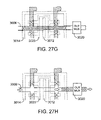
- FIGS. 27C-H are enlarged simplified plan views showing loading of the chamber of the microfluidic structure of FIG. 27A .
- FIG. 28A shows a simplified schematic plan view of one embodiment of a microfluidic matrix architecture in accordance with the present invention.
- FIG. 28B shows an enlarged plan view of a single reactor x.
- FIG. 28C shows a simplified cross-sectional view of the microfluidic matrix of FIG. 28B taken along line 28 C- 28 C′.
- FIG. 28D shows a simplified cross-sectional view of the microfluidic matrix of FIG. 28D taken along line 28 D- 28 D′.
- FIGS. 28E-H show enlarged and simplified plan views illustrating successive steps of operation of the microfluidic matrix of FIGS. 28A-D .
- FIGS. 29A-D show a set of optical micrographs illustrating the isolation and mixing of different dye solutions by an alternative embodiment of a microfluidic matrix device in accordance with the present invention.
- FIG. 30 shows a two-color image of fluorescent emission from a 20 ⁇ 20 matrix chip.
- FIG. 31 shows a scanned fluorescent image illustrating use of the matrix chip to explore combinations of forward and reverse primers.
- FIG. 32 plots fluorescent ratio vs. the initial concentration of the cDNA templates.
- FIG. 33 shows Agarose gel electrophoresis of the PCR amplicon by the chip or by a microtube.
- FIG. 34 shows an exploded view of an alternative embodiment of a microfluidic structure for performing PCR.
- FIG. 35 plots fluorescence versus time for nucleic acids amplified by PCR utilizing the microfluidic structure shown in FIG. 34 .
- FIGS. 36A-D are simplified plan views showing operation of an alternative embodiment of a microfluidic matrix architecture in accordance with the present invention.
- a “flow channel” refers generally to a flow path through which a solution can flow.
- valve refers to a configuration in which a flow channel and a control channel intersect and are separated by an elastomeric membrane that can be deflected into or retracted from the flow channel in response to an actuation force.
- elastomer and “elastomeric” has its general meaning as used in the art.
- Allcock et al. Contemporary Polymer Chemistry, 2nd Ed.
- elastomeric materials exhibit elastic properties because the polymer chains readily undergo torsional motion to permit uncoiling of the backbone chains in response to a force, with the backbone chains recoiling to assume the prior shape in the absence of the force.
- elastomers deform when force is applied, but then return to their original shape when the force is removed.
- the elasticity exhibited by elastomeric materials can be characterized by a Young's modulus.
- the elastomeric materials utilized in the microfluidic devices disclosed herein typically have a Young's modulus of between about 1 Pa-1 TPa, in other instances between about 10 Pa-100 GPa, in still other instances between about 20 Pa-1 GPa, in yet other instances between about 50 Pa-10 MPa, and in certain instances between about 100 Pa-1 MPa. Elastomeric materials having a Young's modulus outside of these ranges can also be utilized depending upon the needs of a particular application.
- microfluidic devices described herein are fabricated from an elastomeric polymer such as GE RTV 615 (formulation), a vinyl-silane crosslinked (type) silicone elastomer (family).
- elastomeric polymer such as GE RTV 615 (formulation), a vinyl-silane crosslinked (type) silicone elastomer (family).
- the present microfluidic systems are not limited to this one formulation, type or even this family of polymer; rather, nearly any elastomeric polymer is suitable. Given the tremendous diversity of polymer chemistries, precursors, synthetic methods, reaction conditions, and potential additives, there are a large number of possible elastomer systems that can be used to make monolithic elastomeric microvalves and pumps.
- nucleic acid refers to include a polymeric form of nucleotides of any length, including, but not limited to, ribonucleotides or deoxyribonucleotides. There is no intended distinction in length between these terms. Further, these terms refer only to the primary structure of the molecule. Thus, in certain embodiments these terms can include triple-, double- and single-stranded DNA, as well as triple-, double- and single-stranded RNA. They also include modifications, such as by methylation and/or by capping, and unmodified forms of the polynucleotide.
- nucleic acid examples include polydeoxyribonucleotides (containing 2-deoxy-D-ribose), polyribonucleotides (containing D-ribose), any other type of polynucleotide which is an N- or C-glycoside of a purine or pyrimidine base, and other polymers containing nonnucleotidic backbones, for example, polyamide (e.g., peptide nucleic acids (PNAs)) and polymorpholino (commercially available from the Anti-Virals, Inc., Corvallis, Oreg., as Neugene) polymers, and other synthetic sequence-specific nucleic acid polymers providing that the polymers contain nucleobases in a configuration which allows for base pairing and base stacking, such as is found in DNA and RNA.
- PNAs peptide nucleic acids
- Neugene commercially available from the Anti-Virals, Inc., Corvallis, Oreg., as Neugene
- a “probe” is an nucleic acid capable of binding to a target nucleic acid of complementary sequence through one or more types of chemical bonds, usually through complementary base pairing, usually through hydrogen bond formation, thus forming a duplex structure.
- the probe binds or hybridizes to a “probe binding site.”
- the probe can be labeled with a detectable label to permit facile detection of the probe, particularly once the probe has hybridized to its complementary target.
- the label attached to the probe can include any of a variety of different labels known in the art that can be detected by chemical or physical means, for example.
- Suitable labels that can be attached to probes include, but are not limited to, radioisotopes, fluorophores, chromophores, mass labels, electron dense particles, magnetic particles, spin labels, molecules that emit chemiluminescence, electrochemically active molecules, enzymes, cofactors, and enzyme substrates.
- Probes can vary significantly in size. Some probes are relatively short. Generally, probes are at least 7 to 15 nucleotides in length. Other probes are at least 20, 30 or 40 nucleotides long. Still other probes are somewhat longer, being at least 50, 60, 70, 80, 90 nucleotides long. Yet other probes are longer still, and are at least 100, 150, 200 or more nucleotides long. Probes can be of any specific length that falls within the foregoing ranges as well.
- a “primer” is a single-stranded polynucleotide capable of acting as a point of initiation of template-directed DNA synthesis under appropriate conditions (i.e., in the presence of four different nucleoside triphosphates and an agent for polymerization, such as, DNA or RNA polymerase or reverse transcriptase) in an appropriate buffer and at a suitable temperature.
- the appropriate length of a primer depends on the intended use of the primer but typically is at least 7 nucleotides long and, more typically range from 10 to 30 nucleotides in length. Other primers can be somewhat longer such as 30 to 50 nucleotides long. Short primer molecules generally require cooler temperatures to form sufficiently stable hybrid complexes with the template.
- a primer need not reflect the exact sequence of the template but must be sufficiently complementary to hybridize with a template.
- primer site or “primer binding site” refers to the segment of the target DNA to which a primer hybridizes.
- primer pair means a set of primers including a 5′ “upstream primer” that hybridizes with the complement of the 5′ end of the DNA sequence to be amplified and a 3′ “downstream primer” that hybridizes with the 3′ end of the sequence to be amplified.
- a primer that is “perfectly complementary” has a sequence fully complementary across the entire length of the primer and has no mismatches.
- the primer is typically perfectly complementary to a portion (subsequence) of a target sequence.
- a “mismatch” refers to a site at which the nucleotide in the primer and the nucleotide in the target nucleic acid with which it is aligned are not complementary.
- substantially complementary when used in reference to a primer means that a primer is not perfectly complementary to its target sequence; instead, the primer is only sufficiently complementary to hybridize selectively to its respective strand at the desired primer-binding site.
- nucleic acid is identical to, or hybridizes selectively to, another nucleic acid molecule.
- Selectivity of hybridization exists when hybridization occurs that is more selective than total lack of specificity.
- selective hybridization will occur when there is at least about 55% identity over a stretch of at least 14-25 nucleotides, preferably at least 65%, more preferably at least 75%, and most preferably at least 90%.
- one nucleic acid hybridizes specifically to the other nucleic acid. See M. Kanehisa, Nucleic Acids Res. 12:203 (1984).
- label refers to a molecule or an aspect of a molecule that can be detected by physical, chemical, electromagnetic and other related analytical techniques.
- detectable labels include, but are not limited to, radioisotopes, fluorophores, chromophores, mass labels, electron dense particles, magnetic particles, spin labels, molecules that emit chemiluminescence, electrochemically active molecules, enzymes, cofactors, enzymes linked to nucleic acid probes and enzyme substrates.
- detectably labeled means that an agent has been conjugated with a label or that an agent has some inherent characteristic (e.g., size, shape or color) that allows it to be detected without having to be conjugated to a separate label.
- Exemplary methods of fabricating the present invention are provided herein. It is to be understood that the present invention is not limited to fabrication by one or the other of these methods. Rather, other suitable methods of fabricating the present microstructures, including modifying the present methods, are also contemplated.
- FIGS. 1 to 7B illustrate sequential steps of a first preferred method of fabricating the present microstructure, (which may be used as a pump or valve).
- FIGS. 8 to 18 illustrate sequential steps of a second preferred method of fabricating the present microstructure, (which also may be used as a pump or valve).
- each layer of elastomer may be cured “in place”.
- channel refers to a recess in the elastomeric structure which can contain a flow of fluid or gas.
- Micro-machined mold 10 may be fabricated by a number of conventional silicon processing methods, including but not limited to photolithography, ion-milling, and electron beam lithography.
- micro-machined mold 10 has a raised line or protrusion 11 extending therealong.
- a first elastomeric layer 20 is cast on top of mold 10 such that a first recess 21 will be formed in the bottom surface of elastomeric layer 20 , (recess 21 corresponding in dimension to protrusion 11 ), as shown.
- a second micro-machined mold 12 having a raised protrusion 13 extending therealong is also provided.
- a second elastomeric layer 22 is cast on top of mold 12 , as shown, such that a recess 23 will be formed in its bottom surface corresponding to the dimensions of protrusion 13 .
- second elastomeric layer 22 is then removed from mold 12 and placed on top of first elastomeric layer 20 .
- recess 23 extending along the bottom surface of second elastomeric layer 22 will form a flow channel 32 .
- the separate first and second elastomeric layers 20 and 22 are then bonded together to form an integrated (i.e.: monolithic) elastomeric structure 24 .
- elastomeric structure 24 is then removed from mold 10 and positioned on top of a planar substrate 14 .
- recess 21 will form a flow channel 30 .
- the present elastomeric structures form a reversible hermetic seal with nearly any smooth planar substrate.
- An advantage to forming a seal this way is that the elastomeric structures may be peeled up, washed, and re-used.
- planar substrate 14 is glass.
- a further advantage of using glass is that glass is transparent, allowing optical interrogation of elastomer channels and reservoirs.
- the elastomeric structure may be bonded onto a flat elastomer layer by the same method as described above, forming a permanent and high-strength bond. This may prove advantageous when higher back pressures are used.
- flow channels 30 and 32 are preferably disposed at an angle to one another with a small membrane 25 of substrate 24 separating the top of flow channel 30 from the bottom of flow channel 32 .
- planar substrate 14 is glass.
- An advantage of using glass is that the present elastomeric structures may be peeled up, washed and reused.
- a further advantage of using glass is that optical sensing may be employed.
- planar substrate 14 may be an elastomer itself, which may prove advantageous when higher back pressures are used.
- the method of fabrication just described may be varied to form a structure having a membrane composed of an elastomeric material different than that forming the walls of the channels of the device. This variant fabrication method is illustrated in FIGS. 7C-7G .
- a first micro-machined mold 10 is provided.
- Micro-machined mold 10 has a raised line or protrusion 11 extending therealong.
- first elastomeric layer 20 is cast on top of first micro-machined mold 10 such that the top of the first elastomeric layer 20 is flush with the top of raised line or protrusion 11 . This may be accomplished by carefully controlling the volume of elastomeric material spun onto mold 10 relative to the known height of raised line 11 . Alternatively, the desired shape could be formed by injection molding.
- second micro-machined mold 12 having a raised protrusion 13 extending therealong is also provided.
- Second elastomeric layer 22 is cast on top of second mold 12 as shown, such that recess 23 is formed in its bottom surface corresponding to the dimensions of protrusion 13 .
- second elastomeric layer 22 is removed from mold 12 and placed on top of third elastomeric layer 222 .
- Second elastomeric layer 22 is bonded to third elastomeric layer 20 to form integral elastomeric block 224 using techniques described in detail below.
- recess 23 formerly occupied by raised line 13 will form flow channel 23 .
- elastomeric block 224 is placed on top of first micro-machined mold 10 and first elastomeric layer 20 . Elastomeric block and first elastomeric layer 20 are then bonded together to form an integrated (i.e.: monolithic) elastomeric structure 24 having a membrane composed of a separate elastomeric layer 222 .
- the variant fabrication method illustrated above in conjunction with FIGS. 7C-7G offers the advantage of permitting the membrane portion to be composed of a separate material than the elastomeric material of the remainder of the structure. This is important because the thickness and elastic properties of the membrane play a key role in operation of the device. Moreover, this method allows the separate elastomer layer to readily be subjected to conditioning prior to incorporation into the elastomer structure. As discussed in detail below, examples of potentially desirable condition include the introduction of magnetic or electrically conducting species to permit actuation of the membrane, and/or the introduction of dopant into the membrane in order to alter its elasticity.
- a shaped layer of elastomeric material could be formed by laser cutting or injection molding, or by methods utilizing chemical etching and/or sacrificial materials as discussed below in conjunction with the second exemplary method.
- An alternative method fabricates a patterned elastomer structure utilizing development of photoresist encapsulated within elastomer material.
- the methods in accordance with the present invention are not limited to utilizing photoresist.
- Other materials such as metals could also serve as sacrificial materials to be removed selective to the surrounding elastomer material, and the method would remain within the scope of the present invention.
- gold metal may be etched selective to RTV 615 elastomer utilizing the appropriate chemical mixture.
- Microfabricated refers to the size of features of an elastomeric structure fabricated in accordance with an embodiment of the present invention.
- variation in at least one dimension of microfabricated structures is controlled to the micron level, with at least one dimension being microscopic (i.e. below 1000 ⁇ m).
- Microfabrication typically involves semiconductor or MEMS fabrication techniques such as photolithography and spincoating that are designed for to produce feature dimensions on the microscopic level, with at least some of the dimension of the microfabricated structure requiring a microscope to reasonably resolve/image the structure.
- flow channels 30 and 32 preferably have width-to-depth ratios of about 10:1.
- a non-exclusive list of other ranges of width-to-depth ratios in accordance with embodiments of the present invention is 0.1:1 to 100:1, more preferably 1:1 to 50:1, more preferably 2:1 to 20:1, and most preferably 3:1 to 15:1.
- flow channels 30 and 32 have widths of about 1 to 1000 microns.
- a non-exclusive list of other ranges of widths of flow channels in accordance with embodiments of the present invention is 0.01 to 1000 microns, more preferably 0.05 to 1000 microns, more preferably 0.2 to 500 microns, more preferably 1 to 250 microns, and most preferably 10 to 200 microns.
- Exemplary channel widths include 0.1 ⁇ m, 1 ⁇ m, 2 ⁇ m, 5 ⁇ m, 10 ⁇ m, 20 ⁇ m, 30 ⁇ m, 40 ⁇ m, 50 ⁇ m, 60 ⁇ m, 70 ⁇ m, 80 ⁇ m, 90 ⁇ m, 100 ⁇ m, 110 ⁇ m, 120 ⁇ m, 130 ⁇ m, 140 ⁇ m, 150 ⁇ m, 160 ⁇ m, 170 ⁇ m, 180 ⁇ m, 190 ⁇ m, 200 ⁇ m, 210 ⁇ m, 220 ⁇ m, 230 ⁇ m, 240 ⁇ m, and 250 ⁇ m.
- Flow channels 30 and 32 have depths of about 1 to 100 microns.
- a non-exclusive list of other ranges of depths of flow channels in accordance with embodiments of the present invention is 0.01 to 1000 microns, more preferably 0.05 to 500 microns, more preferably 0.2 to 250 microns, and more preferably 1 to 100 microns, more preferably 2 to 20 microns, and most preferably 5 to 10 microns.
- Exemplary channel depths include including 0.01 ⁇ m, 0.02 ⁇ m, 0.05 ⁇ m, 0.1 ⁇ m, 0.2 ⁇ m, 0.5 ⁇ m, 1 ⁇ m, 2 ⁇ m, 3 ⁇ m, 4 ⁇ m, 5 ⁇ m, 7.5 ⁇ m, 10 ⁇ m, 12.5 ⁇ m, 15 ⁇ m, 17.5 ⁇ m, 20 ⁇ m, 22.5 ⁇ m, 25 ⁇ m, 30 ⁇ m, 40 ⁇ m, 50 ⁇ m, 75 ⁇ m, 100 ⁇ m, 150 ⁇ m, 200 ⁇ m, and 250 ⁇ m.
- the flow channels are not limited to these specific dimension ranges and examples given above, and may vary in width in order to affect the magnitude of force required to deflect the membrane as discussed at length below in conjunction with FIG. 27 .
- extremely narrow flow channels having a width on the order of 0.01 ⁇ m may be useful in optical and other applications, as discussed in detail below.
- Elastomeric structures which include portions having channels of even greater width than described above are also contemplated by the present invention, and examples of applications of utilizing such wider flow channels include fluid reservoir and mixing channel structures.
- the Elastomeric layers may be cast thick for mechanical stability.
- elastomeric layer 22 of FIG. 1 is 50 microns to several centimeters thick, and more preferably approximately 4 mm thick.
- a non-exclusive list of ranges of thickness of the elastomer layer in accordance with other embodiments of the present invention is between about 0.1 micron to 10 cm, 1 micron to 5 cm, 10 microns to 2 cm, 100 microns to 10 mm.
- membrane 25 of FIG. 7B separating flow channels 30 and 32 has a typical thickness of between about 0.01 and 1000 microns, more preferably 0.05 to 500 microns, more preferably 0.2 to 250, more preferably 1 to 100 microns, more preferably 2 to 50 microns, and most preferably 5 to 40 microns.
- the thickness of elastomeric layer 22 is about 100 times the thickness of elastomeric layer 20 .
- Exemplary membrane thicknesses include 0.01 ⁇ m, 0.02 ⁇ m, 0.03 ⁇ m, 0.05 ⁇ m, 0.1 ⁇ m, 0.2 ⁇ m, 0.3 ⁇ m, 0.5 ⁇ m, 1 ⁇ m, 2 ⁇ m, 3 ⁇ m, 5 ⁇ m, 7.5 ⁇ m, 10 ⁇ m, 12.5 ⁇ m, 15 ⁇ m, 17.5 ⁇ m, 20 ⁇ m, 22.5 ⁇ m, 25 ⁇ m, 30 ⁇ m, 40 ⁇ m, 50 ⁇ m, 75 ⁇ m, 100 ⁇ m, 150 ⁇ m, 200 ⁇ m, 250 ⁇ m, 300 ⁇ m, 400 ⁇ m, 500 ⁇ m, 750 ⁇ m, and 1000 ⁇ m.
- elastomeric layers are bonded together chemically, using chemistry that is intrinsic to the polymers comprising the patterned elastomer layers.
- the bonding comprises two component “addition cure” bonding.
- the various layers of elastomer are bound together in a heterogeneous bonding in which the layers have a different chemistry.
- a homogenous bonding may be used in which all layers would be of the same chemistry.
- the respective elastomer layers may optionally be glued together by an adhesive instead.
- the elastomeric layers may be thermoset elastomers bonded together by heating.
- the elastomeric layers are composed of the same elastomer material, with the same chemical entity in one layer reacting with the same chemical entity in the other layer to bond the layers together.
- bonding between polymer chains of like elastomer layers may result from activation of a crosslinking agent due to light, heat, or chemical reaction with a separate chemical species.
- the elastomeric layers are composed of different elastomeric materials, with a first chemical entity in one layer reacting with a second chemical entity in another layer.
- the bonding process used to bind respective elastomeric layers together may comprise bonding together two layers of RTV 615 silicone.
- RTV 615 silicone is a two-part addition-cure silicone rubber. Part A contains vinyl groups and catalyst; part B contains silicon hydride (Si—H) groups. The conventional ratio for RTV 615 is 10A:1B.
- one layer may be made with 30A:1B (i.e. excess vinyl groups) and the other with 3A:1B (i.e. excess Si—H groups).
- Each layer is cured separately. When the two layers are brought into contact and heated at elevated temperature, they bond irreversibly forming a monolithic elastomeric substrate.
- elastomeric structures are formed utilizing Sylgard 182, 184 or 186, or aliphatic urethane diacrylates such as (but not limited to) Ebecryl 270 or Irr 245 from UCB Chemical.
- two-layer elastomeric structures were fabricated from pure acrylated Urethane Ebe 270.
- a thin bottom layer was spin coated at 8000 rpm for 15 seconds at 170° C.
- the top and bottom layers were initially cured under ultraviolet light for 10 minutes under nitrogen utilizing a Model ELC 500 device manufactured by Electrolite corporation.
- the assembled layers were then cured for an additional 30 minutes. Reaction was catalyzed by a 0.5% vol/vol mixture of Irgacure 500 manufactured by Ciba-Geigy Chemicals.
- the resulting elastomeric material exhibited moderate elasticity and adhesion to glass.
- two-layer elastomeric structures were fabricated from a combination of 25% Ebe 270/50% Irr 245/25% isopropyl alcohol for a thin bottom layer, and pure acrylated Urethane Ebe 270 as a top layer.
- the thin bottom layer was initially cured for 5 min, and the top layer initially cured for 10 minutes, under ultraviolet light under nitrogen utilizing a Model ELC 500 device manufactured by Electrolite corporation.
- the assembled layers were then cured for an additional 30 minutes. Reaction was catalyzed by a 0.5% vol/vol mixture of Irgacure 500 manufactured by Ciba-Geigy Chemicals.
- the resulting elastomeric material exhibited moderate elasticity and adhered to glass.
- bonding methods including activating the elastomer surface, for example by plasma exposure, so that the elastomer layers/substrate will bond when placed in contact.
- activating the elastomer surface for example by plasma exposure
- elastomer layers/substrate will bond when placed in contact.
- one possible approach to bonding together elastomer layers composed of the same material is set forth by Duffy et al, “Rapid Prototyping of Microfluidic Systems in Poly (dimethylsiloxane)”, Analytical Chemistry (1998), 70, 4974-4984, incorporated herein by reference. This paper discusses that exposing polydimethylsiloxane (PDMS) layers to oxygen plasma causes oxidation of the surface, with irreversible bonding occurring when the two oxidized layers are placed into contact.
- PDMS polydimethylsiloxane
- Yet another approach to bonding together successive layers of elastomer is to utilize the adhesive properties of uncured elastomer. Specifically, a thin layer of uncured elastomer such as RTV 615 is applied on top of a first cured elastomeric layer. Next, a second cured elastomeric layer is placed on top of the uncured elastomeric layer. The thin middle layer of uncured elastomer is then cured to produce a monolithic elastomeric structure. Alternatively, uncured elastomer can be applied to the bottom of a first cured elastomer layer, with the first cured elastomer layer placed on top of a second cured elastomer layer. Curing the middle thin elastomer layer again results in formation of a monolithic elastomeric structure.
- a thin layer of uncured elastomer such as RTV 615 is applied on top of a first cured elastomeric layer.
- bonding of successive elastomeric layers may be accomplished by pouring uncured elastomer over a previously cured elastomeric layer and any sacrificial material patterned thereupon. Bonding between elastomer layers occurs due to interpenetration and reaction of the polymer chains of an uncured elastomer layer with the polymer chains of a cured elastomer layer. Subsequent curing of the elastomeric layer will create a bond between the elastomeric layers and create a monolithic elastomeric structure.
- first elastomeric layer 20 may be created by spin-coating an RTV mixture on microfabricated mold 10 at 2000 rpm's for 30 seconds yielding a thickness of approximately 40 microns.
- Second elastomeric layer 22 may be created by spin-coating an RTV mixture on microfabricated mold 12 . Both layers 20 and 22 may be separately baked or cured at about 80° C. for 1.5 hours. The second elastomeric layer 22 may be bonded onto first elastomeric layer 20 at about 80° C. for about 1.5 hours.
- Micromachined molds 10 and 12 may be patterned photoresist on silicon wafers.
- a Shipley SJR 5740 photoresist was spun at 2000 rpm patterned with a high resolution transparency film as a mask and then developed yielding an inverse channel of approximately 10 microns in height. When baked at approximately 200° C. for about 30 minutes, the photoresist reflows and the inverse channels become rounded.
- the molds may be treated with trimethylchlorosilane (TMCS) vapor for about a minute before each use in order to prevent adhesion of silicone rubber.
- TMCS trimethylchlorosilane
- elastomers in general as polymers existing at a temperature between their glass transition temperature and liquefaction temperature.
- Elastomeric materials exhibit elastic properties because the polymer chains readily undergo torsional motion to permit uncoiling of the backbone chains in response to a force, with the backbone chains recoiling to assume the prior shape in the absence of the force.
- elastomers deform when force is applied, but then return to their original shape when the force is removed.
- the elasticity exhibited by elastomeric materials may be characterized by a Young's modulus.
- Elastomeric materials having a Young's modulus of between about 1 Pa-1 TPa, more preferably between about 10 Pa-100 GPa, more preferably between about 20 Pa-1 GPa, more preferably between about 50 Pa-10 MPa, and more preferably between about 100 Pa-1 MPa are useful in accordance with the present invention, although elastomeric materials having a Young's modulus outside of these ranges could also be utilized depending upon the needs of a particular application.
- the systems of the present invention may be fabricated from a wide variety of elastomers.
- the elastomeric layers may preferably be fabricated from silicone rubber.
- other suitable elastomers may also be used.
- the present systems are fabricated from an elastomeric polymer such as GE RTV 615 (formulation), a vinyl-silane crosslinked (type) silicone elastomer (family).
- an elastomeric polymer such as GE RTV 615 (formulation), a vinyl-silane crosslinked (type) silicone elastomer (family).
- the present systems are not limited to this one formulation, type or even this family of polymer; rather, nearly any elastomeric polymer is suitable.
- An important requirement for the preferred method of fabrication of the present microvalves is the ability to bond multiple layers of elastomers together. In the case of multilayer soft lithography, layers of elastomer are cured separately and then bonded together. This scheme requires that cured layers possess sufficient reactivity to bond together. Either the layers may be of the same type, and are capable of bonding to themselves, or they may be of two different types, and are capable of bonding to each other. Other possibilities include the use an adhesive between layers and the use
- elastomeric polymers There are many, many types of elastomeric polymers. A brief description of the most common classes of elastomers is presented here, with the intent of showing that even with relatively “standard” polymers, many possibilities for bonding exist. Common elastomeric polymers include polyisoprene, polybutadiene, polychloroprene, polyisobutylene, poly(styrene-butadiene-styrene), the polyurethanes, and silicones.
- Polyisoprene, polybutadiene, and polychloroprene are all polymerized from diene monomers, and therefore have one double bond per monomer when polymerized.
- This double bond allows the polymers to be converted to elastomers by vulcanization (essentially, sulfur is used to form crosslinks between the double bonds by heating). This would easily allow homogeneous multilayer soft lithography by incomplete vulcanization of the layers to be bonded; photoresist encapsulation would be possible by a similar mechanism.
- Pure Polyisobutylene has no double bonds, but is crosslinked to use as an elastomer by including a small amount ( ⁇ 1%) of isoprene in the polymerization.
- the isoprene monomers give pendant double bonds on the Polyisobutylene backbone, which may then be vulcanized as above.
- Poly(styrene-butadiene-styrene) is produced by living anionic polymerization (that is, there is no natural chain-terminating step in the reaction), so “live” polymer ends can exist in the cured polymer. This makes it a natural candidate for the present photoresist encapsulation system (where there will be plenty of unreacted monomer in the liquid layer poured on top of the cured layer). Incomplete curing would allow homogeneous multilayer soft lithography (A to A bonding). The chemistry also facilitates making one layer with extra butadiene (“A”) and coupling agent and the other layer (“B”) with a butadiene deficit (for heterogeneous multilayer soft lithography). SBS is a “thermoset elastomer”, meaning that above a certain temperature it melts and becomes plastic (as opposed to elastic); reducing the temperature yields the elastomer again. Thus, layers can be bonded together by heating.
- Polyurethanes are produced from di-isocyanates (A-A) and di-alcohols or di-amines (B-B); since there are a large variety of di-isocyanates and di-alcohols/amines, the number of different types of polyurethanes is huge.
- the A vs. B nature of the polymers would make them useful for heterogeneous multilayer soft lithography just as RTV 615 is: by using excess A-A in one layer and excess B-B in the other layer.
- Silicone polymers probably have the greatest structural variety, and almost certainly have the greatest number of commercially available formulations.
- the vinyl-to-(Si—H) crosslinking of RTV 615 (which allows both heterogeneous multilayer soft lithography and photoresist encapsulation) has already been discussed, but this is only one of several crosslinking methods used in silicone polymer chemistry.
- FIGS. 7B and 7H together show the closing of a first flow channel by pressurizing a second flow channel, with FIG. 7B (a front sectional view cutting through flow channel 32 in corresponding FIG. 7A ), showing an open first flow channel 30 ; with FIG. 7H showing first flow channel 30 closed by pressurization of the second flow channel 32 .
- first flow channel 30 and second flow channel 32 are shown.
- Membrane 25 separates the flow channels, forming the top of first flow channel 30 and the bottom of second flow channel 32 . As can be seen, flow channel 30 is “open”.
- pressurization of flow channel 32 causes membrane 25 to deflect downward, thereby pinching off flow F passing through flow channel 30 .
- a linearly actuable valving system is provided such that flow channel 30 can be opened or closed by moving membrane 25 as desired.
- channel 30 in FIG. 7G is shown in a “mostly closed” position, rather than a “fully closed” position).
- Such dead volumes and areas consumed by the moving membrane are approximately two orders of magnitude smaller than known conventional microvalves.
- Smaller and larger valves and switching valves are contemplated in the present invention, and a non-exclusive list of ranges of dead volume includes 1 aL to 1 uL, 100 aL to 100 nL, 1 fL to 10 nL, 100 fL to 1 nL, and 1 pL to 100 pL.
- the extremely small volumes capable of being delivered by pumps and valves in accordance with the present invention represent a substantial advantage. Specifically, the smallest known volumes of fluid capable of being manually metered is around 0.1 ⁇ l. The smallest known volumes capable of being metered by automated systems is about ten-times larger (1 ⁇ l). Utilizing pumps and valves in accordance with the present invention, volumes of liquid of 10 nl or smaller can routinely be metered and dispensed. The accurate metering of extremely small volumes of fluid enabled by the present invention would be extremely valuable in a large number of biological applications, including diagnostic tests and assays.
- deflection of an elastomeric membrane in response to a pressure will be a function of: the length, width, and thickness of the membrane, the flexibility of the membrane (Young's modulus), and the applied actuation force. Because each of these parameters will vary widely depending upon the actual dimensions and physical composition of a particular elastomeric device in accordance with the present invention, a wide range of membrane thicknesses and elasticity's, channel widths, and actuation forces are contemplated by the present invention.
- FIGS. 8A and 8B illustrate valve opening vs. applied pressure for a 100 ⁇ m wide first flow channel 30 and a 50 ⁇ m wide second flow channel 32 .
- the membrane of this device was formed by a layer of General Electric Silicones RTV 615 having a thickness of approximately 30 ⁇ m and a Young's modulus of approximately 750 kPa.
- FIGS. 21 a and 21 b show the extent of opening of the valve to be substantially linear over most of the range of applied pressures.
- Air pressure was applied to actuate the membrane of the device through a 10 cm long piece of plastic tubing having an outer diameter of 0.025′′ connected to a 25 mm piece of stainless steel hypodermic tubing with an outer diameter of 0.025′′ and an inner diameter of 0.013′′. This tubing was placed into contact with the control channel by insertion into the elastomeric block in a direction normal to the control channel. Air pressure was applied to the hypodermic tubing from an external LHDA miniature solenoid valve manufactured by Lee Co.
- air is compressible, and thus experiences some finite delay between the time of application of pressure by the external solenoid valve and the time that this pressure is experienced by the membrane.
- pressure could be applied from an external source to a noncompressible fluid such as water or hydraulic oils, resulting in a near-instantaneous transfer of applied pressure to the membrane.
- a noncompressible fluid such as water or hydraulic oils
- higher viscosity of a control fluid may contribute to delay in actuation.
- the optimal medium for transferring pressure will therefore depend upon the particular application and device configuration, and both gaseous and liquid media are contemplated by the invention.
- external applied pressure as described above has been applied by a pump/tank system through a pressure regulator and external miniature valve
- other methods of applying external pressure are also contemplated in the present invention, including gas tanks, compressors, piston systems, and columns of liquid.
- naturally occurring pressure sources such as may be found inside living organisms, such as blood pressure, gastric pressure, the pressure present in the cerebrospinal fluid, pressure present in the intra-ocular space, and the pressure exerted by muscles during normal flexure.
- Other methods of regulating external pressure are also contemplated, such as miniature valves, pumps, macroscopic peristaltic pumps, pinch valves, and other types of fluid regulating equipment such as is known in the art.
- valves in accordance with embodiments of the present invention have been experimentally shown to be almost perfectly linear over a large portion of its range of travel, with minimal hysteresis. Accordingly, the present valves are ideally suited for microfluidic metering and fluid control.
- the linearity of the valve response demonstrates that the individual valves are well modeled as Hooke's Law springs.
- high pressures in the flow channel i.e.: back pressure
- back pressure can be countered simply by increasing the actuation pressure.
- the present inventors have achieved valve closure at back pressures of 70 kPa, but higher pressures are also contemplated.
- valves and pumps do not require linear actuation to open and close, linear response does allow valves to more easily be used as metering devices.
- the opening of the valve is used to control flow rate by being partially actuated to a known degree of closure.
- Linear valve actuation makes it easier to determine the amount of actuation force required to close the valve to a desired degree of closure.
- Another benefit of linear actuation is that the force required for valve actuation may be easily determined from the pressure in the flow channel. If actuation is linear, increased pressure in the flow channel may be countered by adding the same pressure (force per unit area) to the actuated portion of the valve.
- Linearity of a valve depends on the structure, composition, and method of actuation of the valve structure. Furthermore, whether linearity is a desirable characteristic in a valve depends on the application. Therefore, both linearly and non-linearly actuable valves are contemplated in the present invention, and the pressure ranges over which a valve is linearly actuable will vary with the specific embodiment.
- FIG. 9 illustrates time response (i.e.: closure of valve as a function of time in response to a change in applied pressure) of a 100 ⁇ m ⁇ 100 ⁇ m ⁇ 10 ⁇ m RTV microvalve with 10-cm-long air tubing connected from the chip to a pneumatic valve as described above.
- FIG. 9 Two periods of digital control signal, actual air pressure at the end of the tubing and valve opening are shown in FIG. 9 .
- the pressure applied on the control line is 100 kPa, which is substantially higher than the ⁇ 40 kPa required to close the valve.
- the valve is pushed closed with a pressure 60 kPa greater than required.
- the valve is driven back to its rest position only by its own spring force ( ⁇ 40 kPa).
- ⁇ close is expected to be smaller than ⁇ open.
- the spring constant can be adjusted by changing the membrane thickness; this allows optimization for either fast opening or fast closing.
- the spring constant could also be adjusted by changing the elasticity (Young's modulus) of the membrane, as is possible by introducing dopant into the membrane or by utilizing a different elastomeric material to serve as the membrane (described above in conjunction with FIGS. 7C-7H .)
- the valve opening was measured by fluorescence.
- the flow channel was filled with a solution of fluorescein isothiocyanate (FITC) in buffer (pH ⁇ 8) and the fluorescence of a square area occupying the center ⁇ 1 ⁇ 3rd of the channel is monitored on an epi-fluorescence microscope with a photomultiplier tube with a 10 kHz bandwidth.
- the pressure was monitored with a Wheatstone-bridge pressure sensor (SenSym SCC15GD2) pressurized simultaneously with the control line through nearly identical pneumatic connections.
- the flow channels of the present invention may optionally be designed with different cross sectional sizes and shapes, offering different advantages, depending upon their desired application.
- the cross sectional shape of the lower flow channel may have a curved upper surface, either along its entire length or in the region disposed under an upper cross channel). Such a curved upper surface facilitates valve sealing, as follows.
- flow channel 30 is rectangular in cross sectional shape.
- the cross-section of a flow channel 30 instead has an upper curved surface.
- flow channel 30 a has a curved upper wall 25 A.
- membrane portion 25 When flow channel 32 is pressurized, membrane portion 25 will move downwardly to the successive positions shown by dotted lines 25 A 2 , 25 A 3 , 25 A 4 and 25 A 5 , with edge portions of the membrane moving first into the flow channel, followed by top membrane portions.
- An advantage of having such a curved upper surface at membrane 25 A is that a more complete seal will be provided when flow channel 32 is pressurized.
- the upper wall of the flow channel 30 will provide a continuous contacting edge against planar substrate 14 , thereby avoiding the “island” of contact seen between wall 25 and the bottom of flow channel 30 in FIG. 10 .
- Another advantage of having a curved upper flow channel surface at membrane 25 A is that the membrane can more readily conform to the shape and volume of the flow channel in response to actuation. Specifically, where a rectangular flow channel is employed, the entire perimeter (2 ⁇ flow channel height, plus the flow channel width) must be forced into the flow channel. However where an arched flow channel is used, a smaller perimeter of material (only the semi-circular arched portion) must be forced into the channel. In this manner, the membrane requires less change in perimeter for actuation and is therefore more responsive to an applied actuation force to block the flow channel
- the bottom of flow channel 30 is rounded such that its curved surface mates with the curved upper wall 25 A as seen in FIG. 20 described above.
- the actual conformational change experienced by the membrane upon actuation will depend upon the configuration of the particular elastomeric structure. Specifically, the conformational change will depend upon the length, width, and thickness profile of the membrane, its attachment to the remainder of the structure, and the height, width, and shape of the flow and control channels and the material properties of the elastomer used. The conformational change may also depend upon the method of actuation, as actuation of the membrane in response to an applied pressure will vary somewhat from actuation in response to a magnetic or electrostatic force.
- the desired conformational change in the membrane will also vary depending upon the particular application for the elastomeric structure.
- the valve may either be open or closed, with metering to control the degree of closure of the valve.
- the flow channel could be provided with raised protrusions beneath the membrane portion, such that upon actuation the membrane shuts off only a percentage of the flow through the flow channel, with the percentage of flow blocked insensitive to the applied actuation force.
- membrane thickness profiles and flow channel cross-sections are contemplated by the present invention, including rectangular, trapezoidal, circular, ellipsoidal, parabolic, hyperbolic, and polygonal, as well as sections of the above shapes. More complex cross-sectional shapes, such as the embodiment with protrusions discussed immediately above or an embodiment having concavities in the flow channel, are also contemplated by the present invention.
- the present invention is not limited to this particular orientation.
- Walls and floors of channels could also be formed in the underlying substrate, with only the ceiling of the flow channel constructed from elastomer. This elastomer flow channel ceiling would project downward into the channel in response to an applied actuation force, thereby controlling the flow of material through the flow channel.
- monolithic elastomer structures as described elsewhere in the instant application are preferred for microfluidic applications.
- a substrate including optical waveguides could be constructed so that the optical waveguides direct light specifically to the side of a microfluidic channel.
- FIGS. 12A and 12B show a views of a single on/off valve, identical to the systems set forth above, (for example in FIG. 7A ).
- FIGS. 13A and 13B shows a peristaltic pumping system comprised of a plurality of the single addressable on/off valves as seen in FIG. 12 , but networked together.
- FIG. 14 is a graph showing experimentally achieved pumping rates vs. frequency for the peristaltic pumping system of FIG. 13 .
- FIGS. 15A and 15B show a schematic view of a plurality of flow channels which are controllable by a single control line. This system is also comprised of a plurality of the single addressable on/off valves of FIG.
- FIG. 16 is a schematic illustration of a multiplexing system adapted to permit fluid flow through selected channels, comprised of a plurality of the single on/off valves of FIG. 12 , joined or networked together.
- Flow channel 30 preferably has a fluid (or gas) flow F passing therethrough.
- Flow channel 32 (which crosses over flow channel 30 , as was already explained herein), is pressurized such that membrane 25 separating the flow channels may be depressed into the path of flow channel 30 , shutting off the passage of flow F therethrough, as has been explained.
- “flow channel” 32 can also be referred to as a “control line” which actuates a single valve in flow channel 30 .
- FIGS. 12 to 15 a plurality of such addressable valves are joined or networked together in various arrangements to produce pumps, capable of peristaltic pumping, and other fluidic logic applications.
- a flow channel 30 has a plurality of generally parallel flow channels (i.e.: control lines) 32 A, 32 B and 32 C passing thereover.
- control lines i.e.: control lines
- By pressurizing control line 32 A flow F through flow channel 30 is shut off under membrane 25 A at the intersection of control line 32 A and flow channel 30 .
- pressurizing control line 32 B flow F through flow channel 30 is shut off under membrane 25 B at the intersection of control line 32 B and flow channel 30 , etc.
- control lines 32 A, 32 B, and 32 C are separately addressable. Therefore, peristalsis may be actuated by the pattern of actuating 32 A and 32 C together, followed by 32 A, followed by 32 A and 32 B together, followed by 32 B, followed by 32 B and C together, etc. This corresponds to a successive “101, 100, 110, 010, 011, 001” pattern, where “0” indicates “valve open” and “1” indicates “valve closed.”
- This peristaltic pattern is also known as a 120° pattern (referring to the phase angle of actuation between three valves). Other peristaltic patterns are equally possible, including 60° and 90° patterns.
- a pumping rate of 2.35 nL/s was measured by measuring the distance traveled by a column of water in thin (0.5 mm i.d.) tubing; with 100 ⁇ 100 ⁇ 10 ⁇ m valves under an actuation pressure of 40 kPa.
- the pumping rate increased with actuation frequency until approximately 75 Hz, and then was nearly constant until above 200 Hz.
- the valves and pumps are also quite durable and the elastomer membrane, control channels, or bond have never been observed to fail.
- none of the valves in the peristaltic pump described herein show any sign of wear or fatigue after more than 4 million actuations. In addition to their durability, they are also gentle.
- a solution of E. Coli pumped through a channel and tested for viability showed a 94% survival rate.
- FIG. 14 is a graph showing experimentally achieved pumping rates vs. frequency for the peristaltic pumping system of FIG. 13 .
- FIGS. 15A and 15B illustrates another way of assembling a plurality of the addressable valves of FIG. 12 .
- a plurality of parallel flow channels 30 A, 30 B, and 30 C are provided.
- Flow channel (i.e.: control line) 32 passes thereover across flow channels 30 A, 30 B, and 30 C. Pressurization of control line 32 simultaneously shuts off flows F 1 , F 2 and F 3 by depressing membranes 25 A, 25 B, and 25 C located at the intersections of control line 32 and flow channels 30 A, 30 B, and 30 C.
- FIG. 16 is a schematic illustration of a multiplexing system adapted to selectively permit fluid to flow through selected channels, as follows.
- the downward deflection of membranes separating the respective flow channels from a control line passing thereabove depends strongly upon the membrane dimensions. Accordingly, by varying the widths of flow channel control line 32 in FIGS. 15A and 15B , it is possible to have a control line pass over multiple flow channels, yet only actuate (i.e.: seal) desired flow channels.
- FIG. 16 illustrates a schematic of such a system, as follows.
- a plurality of parallel flow channels 30 A, 30 B, 30 C, 30 D, 30 E and 30 F are positioned under a plurality of parallel control lines 32 A, 32 B, 32 C, and 32 D.
- Control channels 32 A, 32 B, 32 C, and 32 D are adapted to shut off fluid flows F 1 , F 2 , F 3 , F 4 , F 5 and F 6 passing through parallel flow channels 30 A, 30 B, 30 C, 30 D, 30 E and 30 F using any of the valving systems described above, with the following modification.
- control lines 32 A, 32 B, 32 C, and 32 D have both wide and narrow portions.
- control line 32 A is wide in locations disposed over flow channels 30 A, 30 C and 30 E.
- control line 32 B is wide in locations disposed over flow channels 30 B, 30 D and 30 F
- control line 32 C is wide in locations disposed over flow channels 30 A, 30 B, 30 E and 30 F.
- control line 32 A when control line 32 A is pressurized, it will block flows F 1 , F 3 and F 5 in flow channels 30 A, 30 C and 30 E. Similarly, when control line 32 C is pressurized, it will block flows F 1 , F 2 , F 5 and F 6 in flow channels 30 A, 30 B, 30 E and 30 F.
- control lines 32 A and 32 C can be pressurized simultaneously to block all fluid flow except F 4 (with 32 A blocking F 1 , F 3 and F 5 ; and 32 C blocking F 1 , F 2 , F 5 and F 6 ).
- control lines ( 32 ) By selectively pressurizing different control lines ( 32 ) both together and in various sequences, a great degree of fluid flow control can be achieved. Moreover, by extending the present system to more than six parallel flow channels ( 30 ) and more than four parallel control lines ( 32 ), and by varying the positioning of the wide and narrow regions of the control lines, very complex fluid flow control systems may be fabricated. A property of such systems is that it is possible to turn on any one flow channel out of n flow channels with only 2(log 2n) control lines.
- fluid passage can be selectively directed to flow in either of two perpendicular directions.
- FIGS. 17A to 17D An example of such a “switchable flow array” system is provided in FIGS. 17A to 17D .
- FIG. 17A shows a bottom view of a first layer of elastomer 90 , (or any other suitable substrate), having a bottom surface with a pattern of recesses forming a flow channel grid defined by an array of solid posts 92 , each having flow channels passing therearound.
- FIG. 17B is a bottom view of the bottom surface of the second layer of elastomer 95 showing recesses formed in the shape of alternating “vertical” control lines 96 and “horizontal” control lines 94 .
- “Vertical” control lines 96 have the same width therealong, whereas “horizontal” control lines 94 have alternating wide and narrow portions, as shown.
- Elastomeric layer 95 is positioned overtop of elastomeric layer 90 such that “vertical” control lines 96 are positioned over posts 92 as shown in FIG. 17C and “horizontal” control lines 94 are positioned with their wide portions between posts 92 , as shown in FIG. 17D .
- FIGS. 17A-D allows a switchable flow array to be constructed from only two elastomeric layers, with no vertical vias passing between control lines in different elastomeric layers required. If all vertical flow control lines 94 are connected, they may be pressurized from one input. The same is true for all horizontal flow control lines 96 .
- FIGS. 18A-18D show plan views of one embodiment of a cell pen structure in accordance with the present invention.
- Cell pen array 4400 features an array of orthogonally-oriented flow channels 4402 , with an enlarged “pen” structure 4404 at the intersection of alternating flow channels.
- Valve 4406 is positioned at the entrance and exit of each pen structure 4404 .
- Peristaltic pump structures 4408 are positioned on each horizontal flow channel and on the vertical flow channels lacking a cell pen structure.
- FIGS. 18B-18C show the accessing and removal of individually stored cell C by 1) opening valves 4406 on either side of adjacent pens 4404 a and 4404 b, 2) pumping horizontal flow channel 4402 a to displace cells C and G, and then 3) pumping vertical flow channel 4402 b to remove cell C.
- FIG. 18D shows that second cell G is moved back into its prior position in cell pen array 4400 by reversing the direction of liquid flow through horizontal flow channel 4402 a .
- the cell pen array 4404 described above is capable of storing materials within a selected, addressable position for ready access.
- FIGS. 18A-18D utilizes linked valve pairs on opposite sides of the flow channel intersections, this is not required by the present invention.
- Other configurations including linking of adjacent valves of an intersection, or independent actuation of each valve surrounding an intersection, are possible to provide the desired flow characteristics. With the independent valve actuation approach however, it should be recognized that separate control structures would be utilized for each valve, complicating device layout.
- FIGS. 19A and 19B show plan and cross-sectional views (along line 45 B- 45 B′) respectively, of one embodiment of a cell cage structure in accordance with the present invention.
- Cell cage 4500 is formed as an enlarged portion 4500 a of a flow channel 4501 in an elastomeric block 4503 in contact with substrate 4505 .
- Cell cage 4500 is similar to an individual cell pen as described above in FIGS. 18A-18D , except that ends 4500 b and 4500 c of cell cage 4500 do not completely enclose interior region 4500 a . Rather, ends 4500 a and 4500 b of cage 4500 are formed by a plurality of retractable pillars 4502 .
- control channel 4504 overlies pillars 4502 .
- elastomeric pillars 4502 are drawn upward into control channel 4504 , thereby opening end 4500 b of cell cage 4500 and permitting a cell to enter.
- pillars 4502 relax downward against substrate 4505 and prevent a cell from exiting cage 4500 .
- Elastomeric pillars 4502 are of a sufficient size and number to prevent movement of a cell out of cage 4500 , but also include gaps 4508 which allow the flow of nutrients into cage interior 4500 a in order to sustain cell(s) stored therein. Pillars 4502 on opposite end 4500 c are similarly configured beneath second control channel 4506 to permit opening of the cage and removal of the cell as desired.
- the cross-flow channel architecture illustrated shown in FIGS. 18A-18D can be used to perform functions other than the cell pen just described.
- the cross-flow channel architecture can be utilized in mixing applications.
- portion 7400 of a microfabricated mixing structure comprises first flow channel 7402 orthogonal to and intersecting with second flow channel 7404 .
- Control channels 7406 overlie flow channels 7402 and 7404 and form valve pairs 7408 a - b and 7408 c - d that surround each intersection 7412 .
- valve pair 7408 c - d is initially opened while valve pair 7408 a - b is closed, and fluid sample 7410 is flowed to intersection 7412 through flow channel 7404 .
- Valve pair 7408 a - b is then actuated, trapping fluid sample 7410 at intersection 7412 .
- valve pairs 7408 c - d are closed and 7408 a - b are opened, such that fluid sample 7410 is injected from intersection 7412 into flow channel 7402 bearing a cross-flow of fluid.
- the process shown in FIGS. 20A-B can be repeated to accurately dispense any number of fluid samples down cross-flow channel 7402 .
- FIGS. 20A-B show a simplified plan view of another embodiment of an injection structure in accordance with the present invention, wherein junction 7450 between intersecting flow channels 7452 is extended to provide additional volume capacity.
- FIG. 20D shows a simplified plan view of yet another embodiment of an injection structure in accordance with the present invention, wherein elongated junction 7460 between intersecting flow channels 7462 includes branches 7464 to provide still more injection volume capacity.
- Microfluidic control and flow channels in accordance with embodiments of the present invention may be oriented to rotary pump design which circulates fluid through a closed circuit flow channel.
- closed circuit has the meaning known in the art and refers to configurations that are circular and variations thereof such as ellipsoids and ovals, as well as flow circuit paths having corners as are created by triangular, rectangular, or more complex shapes.
- a layer with flow channels 2100 has a plurality of sample inputs 2102 , a mixing T-junction 2104 , a central circulation loop 2106 (i.e., the substantially circular flow channel), and an output channel 2108 .
- the overlay of control channels with a flow channel can form a microvalve. This is so because the control and flow channels are separated by a thin elastomeric membrane that can be deflected into the flow channel or retracted therefrom.
- the substantially circular central loop and the control channels that intersect with it form the central part of the rotary pump.
- the pump(s) which cause solution to be flowed through the substantially circular flow channel consist of a set of at least three control channels 2110 a - c that are adjacent to one another and which intersect the substantially circular branch flow channel 2106 (i.e., the central loop).
- the fluid in the central loop can be peristaltically pumped in a chosen direction, either clockwise or counterclockwise.
- the peristaltic pumping action results from the sequential deflection of the membranes separating the control channels and flow channel into or out of the flow channel.
- the higher the actuation frequency the faster the fluid rotates through the central loop.
- a point of saturation may eventually be reached at which increased frequency does not result in faster fluid flow. This is primarily due to limitations in the rate at which the membrane can return to an unactuated position.
- each pump including three control channels
- a different number of control channels can be utilized, for example, a single serpentine control channel having multiple cross-over points could be used.
- auxiliary flow channels which are in fluid communication with the central loop can be utilized to introduce and withdrawn sample and reactant solutions from the central loop.
- one or more exit or outlet flow channels in fluid communication with the central loop can be utilized to remove solution from the central loop.
- control valves can be utilized at the inlet(s) and the outlet(s) to prevent solution flow into or out from the central loop.
- Flow channel sizes and shapes can vary. With certain devices, the diameter of the channel tends to range from about 1 mm to 2 cm, although the diameter can be considerably larger in certain devices (e.g., 4, 6, 8, or 10 cm). Limits on how small the diameter of the circular flow channel can be are primarily a function of the limits imposed by the multilayer soft lithography processes.
- Channel widths usually vary between 30 ⁇ m and 250 ⁇ m. However, channel width in some devices is as narrow as 1 um. Channels of larger widths can also be utilized, but generally require some type of structural support within the flow channel.
- Channel height generally varies between 5 and 50 ⁇ m. In flow channels having a width of 100 ⁇ m or less, the channel height may be 1 ⁇ m or smaller.
- the flow channel is typically rounded to allow for complete blockage of the channel once the membrane is deflected into the channel.
- the channels have shapes such as octagons or hexagons.
- the flow channels are rounded and 100 ⁇ m wide and 10 ⁇ m high and control channels are 100 ⁇ m wide and 10 ⁇ m high.
- One system that has been utilized in certain studies has utilized a central loop having a diameter of 2 cm, a flow channel width of 100 ⁇ m and a depth of 10 ⁇ m.
- branches present in a closed circuit flow channel may serve to control the dispersion and hence mixing of materials flowed therein.
- each fluid flow channel may be controlled by its own individual valve control channel.
- a non-integrated control strategy cannot be practicably implemented for more complex assemblies comprising thousands or even tens of thousands of individually addressable valves. Accordingly, a variety of techniques may be applied alone or in combination to allow for the fabrication of large scale integrated microfluidic devices having individually addressable valves.
- FIG. 22A shows a simplified plan view illustrating a microfluidic binary tree multiplexor operational diagram.
- Flow channels 1900 defined in a lower elastomer layer contain the fluid of interest, while control channels 1902 defined in an overlying elastomer layer represent control lines containing an actuation fluid such as air or water.
- Valves 1904 are defined by the membranes formed at the intersection of the wider portion 1902 a of a control channel 1902 with a flow channel 1900 .
- the actuation pressure is chosen so that only the wide membranes are fully deflected into the flow channel 1900 .
- the multiplexor structure is based on the sharp increase in pressure required to actuate a valve as the ratio of control channel width: flow channel width is decreased.
- the multiplexor structure shown in FIG. 22A is in the form of a binary tree of valves where each stage selects one out of two total groups of flow channels.
- each combination of open/closed valves in the multiplexor selects for a single channel, so that n flow channels can be addressed with only 2 log 2 n control channels.
- FIG. 22B shows a simplified plan view of an alternative embodiment of a multiplexor structure in accordance with the present invention.
- Multiplexor structure 1950 comprises control channels 1952 formed in an elastomer layer overlying flow channels 1954 of an underlying elastomer layer.
- multiplexor 1950 comprises a tertiary tree of valves, where each stage comprises three bits (“a trit”) and selects one out of three total groups of flow channels.
- Each combination of open/closed valves in the multiplexor 1950 selects for a single channel, so that n flow channels can be addressed with only 3 log 3 n control channels.
- the general microfluidic flow architecture of either of the basic multiplexor devices shown in FIGS. 22A-B may be generically represented in the simplified cross-sectional view of FIG. 22C , wherein second elastomer layer E 2 defining control channel network C overlies first elastomer layer E 1 defining flow channel network F.
- TABLE 2 compares the efficiency of the base 2 multiplexor with the base 3 multiplexor.
- multiplexor structures in accordance with the present invention may comprise stages of unlike base numbers.
- a two-stage multiplexor consisting of a bit stage and a trit stage represents the most efficient way of addressing six flow channels.
- the order of the stages is arbitrary, and will always result in the same number of flow lines being controlled.
- the use of multiplexor structures comprising different binary and tertiary stages allows the efficient addressing of any number of “flow” channels that are the product of the numbers 2 and 3.
- a multiplexor may conceivably use any base number. For example, five may also be used as the base number, if necessary. However, efficiency in utilization of control lines diminishes as the number of control lines moves away from the value of e. This is shown in FIG. 23 , which plots the number of control lines versus the number of flow lines being controlled, for multiplexor structures having different base numbers.
- FIGS. 24-24B illustrate this approach.
- FIG. 24 shows a plan view of one embodiment of a microfluidic device having a first control line controlled by a second control line.
- FIG. 24A shows a cross-sectional view of the microfluidic device of FIG. 24 , taken along line A-A′.
- FIG. 24B shows a cross-sectional view of the microfluidic device of FIG. 24 , taken along line B-B′.
- Microfluidic structure 2100 comprises two flow channels 2102 a - b formed in lowermost elastomer layer 2104 .
- First control channel network 2106 including first inlet 2106 a in fluid communication with first and second branches 2106 b and 2106 c , is formed in a second elastomer layer 2108 overlying first elastomer layer 2104 .
- First branch 2106 b of first control channel network 2106 includes widened portion 2110 overlying first flow channel 2102 a to define first valve 2112 .
- Second branch 2106 c of first control channel network 2106 includes widened portion 2114 overlying second flow channel 2102 b to define second valve 2116 .
- Second control channel network 2118 comprising third control channel 2118 a is formed in third elastomer layer 2120 overlying second elastomer layer 2108 .
- Third control channel 2118 a includes widened portion 2118 b overlying first branch 2106 b of first control channel network 2106 to form valve 2122 .
- the microfluidic device illustrated in FIGS. 24-24B may be operated as follows.
- a fluid that is to be manipulated is present in flow channels 2102 a and 2102 b .
- Application of a pressure to the first control channel network 2106 causes the membranes of valves 2112 and 2116 to deflect downward into their respective flow channels 2102 a and 2102 b , thereby valving flow through the flow channels.
- Second control channel network 2118 applies a pressure to second control channel network 2118 to deflect downward into underlying first branch 2106 c only of first control channel network 2106 . This fixes the valve 2112 in its deflected state, in turn allowing the pressure within the first control channel network 2106 to be varied without affecting the state of valve 2112 .
- elastomeric device 2200 comprises lowest elastomer layer E 1 defining flow channel network F, underlying second elastomer layer E 2 defining first control channel network C 1 .
- First control channel network C 1 in turn underlies second control channel network C 2 that is defined within third elastomer layer E 3 .
- microfluidic device of FIGS. 24-24B is described as being fabricated from three separate elastomer layers, this is not required by the present invention.
- Large scale integrated microfluidic structures in accordance with embodiments of the present invention featuring multiplexed control lines may be fabricated utilizing only two elastomer layers. This approach is shown and illustrated in connection with FIGS. 26-26B .
- FIG. 26 shows a simplified plan view of a microfabricated elastomer device including first and second flow channels 2300 a and 2300 b , and first branched control channel network 2302 overlying flow channels 2300 a and 2300 b to define valves 2304 and 2306 respectively.
- FIG. 26A shows a cross-sectional view of the microfabricated elastomer device of FIG. 26 , taken along line A-A′, with flow channel 2300 a defined in lower elastomer layer 2308 , and first control channel 2302 defined in upper elastomer layer 2310 .
- Lower elastomer layer 2308 further comprises a second control channel network 2312 running underneath first control channel 2302 to define valve 2314 .
- FIG. 26B shows a cross-sectional view of the microfabricated elastomer device of FIG. 26 , taken along line B-B′. While present in the same (lower) elastomer layer 2308 , flow channel network 2300 and second control channel network 2312 are separate and do not intersect one another.
- separate flow channel network F and control channel network C 2 may thus be present on a single (lower) elastomer layer E 1 that is overlaid by another elastomer layer E 2 defining only a control channel network C 1 .
- the microfluidic device illustrated in FIGS. 26-26B may be operated as follows.
- a fluid that is to be manipulated is present in flow channels 2300 a and 2300 b .
- Application of a pressure to the first control channel network 2302 causes the membranes of valves 2304 to deflect downward into their respective flow channels 2300 a and 2300 b , thereby valving flow through the flow channels.
- second control channel network 2312 applies a pressure to second control channel network 2312 to deflect upward into the overlying branch of first control channel network 2302 .
- the microfluidic device of FIGS. 26-26B features a valve that operates by deflecting upward into an adjacent control channel in response to an elevated pressure.
- FIG. 27A shows an optical micrograph of a microfluidic comparator chip 3000 microfabricated with large scale integration technology which is analogous to an array of 256 comparators. Specifically, a second device containing 2056 microvalves was designed which is capable of performing more complex fluidic manipulations. The various inputs have been loaded with colored food dyes to visualize the channels and sub-elements of the fluidic logic.
- FIG. 27B shows a simplified schematic plan view of one portion of the chip of FIG. 27A .
- Comparator chip 3000 is formed from a pair of parallel, serpentine flow channels 3002 and 3004 having inlets 3002 a and 3004 a respectively, and having outlets 3002 b and 3004 b respectively, that are intersected at various points by branched horizontal rows of flow channels 3006 . Portions of the horizontal flow channels located between the serpentine flow channels define mixing locations 3010 .
- a first barrier control line 3012 overlying the center of the connecting channels is actuable to create adjacent chambers, and is deactivable to allow the contents of the adjacent chambers to mix.
- a second barrier control line 3014 doubles back over either end of the adjacent chambers to isolate them from the rest of the horizontal flow channels.
- One end 3006 a of the connecting horizontal flow channel 3006 is in fluid communication with pressure source 3016 , and the other end 3006 b of the connecting horizontal flow channel 3006 is in fluid communication with a sample collection output 3018 through multiplexor 3020 .
- FIGS. 27C-H show simplified enlarged plan views of operation of one mixing element of the structure of FIGS. 27A-B .
- FIG. 27C shows the mixing element prior to loading, with the mixer barrier control line and wrap-around barrier control line unpressurized.
- FIG. 27D shows pressurization of the wrap-around barrier control line and barrier mixer line to activate isolation valves and separation valve to define adjacent chambers 3050 and 3052 .
- FIG. 27E shows loading of the chambers with a first component and a second component by flowing these materials down the respective flow channels.
- FIG. 27F shows pressurization of the vertical compartmentalization control line 3025 and the isolation to define the adjacent chambers.
- FIG. 27G shows depressurization of the mixing barrier control channel to deactivate the separation barrier valve, thereby allowing the different components present in the adjacent chambers to mix freely.
- FIG. 27H shows the deactivation of barrier the isolation control line, causing deactivation of the isolation valves, followed by application of pressure to the control line and deactivation of the multiplexor to allow the combined mixture to be recovered.
- the microchannel layout consists of four central columns in the flow layer consisting of 64 chambers per column, with each chamber containing ⁇ 750 pL of liquid after compartmentalization and mixing. Liquid is loaded into these columns through two separate inputs under low external pressure ( ⁇ 20 kPa), filling up the array in a serpentine fashion. Barrier valves on the control layer function to isolate the sample fluids from each other and from channel networks on the flow layer used to recover the contents of each individual chamber. These networks function under the control of a multiplexor and several other control valves.
- the storage array and comparator microfluidic devices shown in FIGS. 27A-H was fabricated with multilayer soft lithography techniques using two distinct layers.
- the “control” layer which harbors all channels required to actuate the valves, is situated on top of the “flow” layer, which contains the network of channels being controlled.
- a valve is created where a control channel crosses a flow channel.
- the resulting thin membrane in the junction between the two channels can be deflected by hydraulic or pneumatic actuation. All biological assays and fluid manipulations are performed on the “flow” layer.
- Master molds for the microfluidic channels were made by spin-coating positive photoresist (Shipley SJR 5740) on silicon 9 ⁇ m high and patterning them with high resolution (3386 dpi) transparency masks.
- the channels on the photoresist molds were rounded at 120° C. for 20 minutes to create a geometry that allows full valve closure.
- the devices were fabricated by bonding together two layers of two-part cure silicone (Dow Corning Sylgard 184) cast from the photoresist molds.
- the bottom layer of the device containing the “flow” channels, is spin-coated with 20:1 part A:B Sylgard at 2500 rpm for 1 minute.
- the resulting silicone layer is ⁇ 30 ⁇ m thick.
- the top layer of the device containing the “control” channels, is cast as a thick layer ( ⁇ 0.5 cm thick) using 5:1 part A:B Sylgard using a separate mold.
- the two layers are initially cured for 30 minutes at 80° C.
- Control channel interconnect holes are then punched through the thick layer (released from the mold), after which it is sealed, channel side down, on the thin layer, aligning the respective channel networks. Bonding between the assembled layers is accomplished by curing the devices for an additional 45-60 minutes at 80° C. The resulting multilayer devices are cut to size and mounted on RCA cleaned No. 1, 25 mm square glass coverslips, or onto coverslips spin coated with 5:1 part A:B Sylgard at 5000 rpm and cured at 80° C. for 30 minutes, followed by incubation at 80° C. overnight.
- Simultaneous addressing of multiple non-contiguous flow channels is accomplished by fabricating control channels of varying width while keeping the dimension of the flow channel fixed (100 ⁇ m wide and 9 ⁇ m high).
- the pneumatic pressure in the control channels required to close the flow channels scales with the width of the control channel, making it simple to actuate 100 ⁇ m ⁇ 100 ⁇ m valves at relatively low pressures ( ⁇ 40 kPa) without closing off the 50 ⁇ m ⁇ 100 ⁇ m crossover regions, which have a higher actuation threshold.
- the scale bar of FIG. 28A is 6.4 mm.
- FIG. 28B shows an enlarged plan view of one reactor from the upper left hand corner of the matrix shown in FIG. 28A .
- the apparatus of FIG. 28A features alternating row flow channels 6048 and 6049 , intersecting with alternating column flow channels 6050 and 6052 , with alternative pairs of successive flow channels 6050 and 6052 linked by branch flow channels 6086 to define reactor sites at the flow channel vertices.
- Each of flow channel row 6048 includes a common inlet port 6048 a and an outlet port 6048 b .
- Each of flow channel rows 6049 includes a common inlet port 6049 a and an outlet port 6049 b .
- flow channel rows 6048 may contain a primer, while flow channel rows 6049 may contain a no-primer control.
- Each of alternate flow channel columns 6050 include an inlet port 6050 a and an outlet port 6050 b .
- Alternate flow channel columns 6052 include a common inlet port 6052 a and an outlet port 6052 b.
- Each reactor 6002 of matrix 6000 is in pressure communication with control lines present in underlying and overlying elastomer layers. Specifically, First control lines 6016 overlap column flow channels 6050 and 6052 , thereby defining valves 6016 a . First control lines 6016 are in fluid communication with common port 6016 a . Second control lines 6035 overlap row flow channels 6048 and branch flow channels 6086 , thereby defining valves 6036 and 6038 having different widths. Second control lines 6035 are in fluid communication with common port 6035 a.
- First pump line 6018 underlies column flow channel 6052 , thereby defining first push-up pumps 6019 .
- Various separate groupings of first pump line 6018 are in fluid communication with common ports 6018 a .
- Second pump line 6022 underlies branch flow channel 6086 , thereby defining second push-up pumps 6024 .
- Various groupings of second pump line 6022 are in fluid communication with common ports 6022 a.
- FIG. 28B shows an enlarged plan view of a single reactor 6002 featuring relatively large control lines 6016 including stabilizing post structures 6088 , column flow line 6050 containing a first template sample 6008 , a column flow line 6052 containing DNA polymerase 6010 , and a row flow line 6049 containing primer 6012 or a no-primer control.
- Rotary pumping valves 6019 and 6024 are defined between reactor 6006 and underlying pumping control channels 6018 and 6022 .
- FIG. 28C shows a simplified cross-sectional view of the microfluidic matrix of FIG. 28B taken along line 28 C- 28 C′.
- FIG. 28D shows a simplified cross-sectional view of the microfluidic matrix of FIG. 28D taken along line 28 D- 28 D′.
- the device 6000 comprises three layers 6060 , 6062 , and 6064 with distinct functions.
- Layer 6062 containing matrix flow channel structure 6006 is sandwiched between two layers 6060 and 6064 containing integrated hydraulic valves 6016 a and pneumatic pumps 6019 and 6024 , respectively.
- flow channels 6006 are 106 pm wide and 12 ⁇ 14 ⁇ m high.
- Each vertex of the matrix 6000 contains a ring shaped channel (reactor) 6002 of approximate 3 nanoliters.
- Each row of reactors 6002 is connected to a separate input hole 6048 a or 6049 a (about 625 ⁇ m in diameter) through which unique primers or other reagents may be loaded.
- Each column can similarly load the reactors with different DNA templates or other reagents through second input holes 6050 a .
- a third, single common input 6052 a for the addition of polymerase or another reagent is connected to all the reactors in the matrix.
- control layer 6060 the valve system is designed to load each reactor with the three separate reagents while preventing cross contamination.
- 2860 valves displayed horizontally or vertically are controlled by only two independent pressure supply through-holes 6016 b and 6035 b .
- the large valves 6038 (270 ⁇ m wide) or the small valves 6036 (96 ⁇ m wide) can selectively be actuated because they have a different threshold of the hydraulic pressure. This is described by Unger et al. in Science, 288, 113-116 (2000) and Thorsen et al. in Science, 298, 580-584 (2002).
- reagent loading is not blocked by the narrow control channels 6035 a (42 ⁇ m wide) connecting the valve system, because their tiny membrane does not deflect at the actuation pressure used.
- the third, bottom layer 6064 uses a 20 ⁇ 20 array of rotary pumps in order to facilitate mixing the reagents.
- the use of such devices is described by Chou et al., Biomedical Microdevices, 3, 323 (2001), and by Liu et al., Electrophoresis, 23, 1531-1536 (2002).
- each reactor 6002 features only two rotary pump structures 6019 and 6024 .
- a minimum of only two such pumping structures are required to achieve peristaltic pumping, owing to the closed-loop nature of the rotary flow channel reactor at the vertices.
- FIGS. 28E-H show enlarged and simplified plan views of a group of four adjacent reactors in the matrix of FIGS. 28A-D , illustrating successive steps of operation of the microfluidic matrix device.
- active valves in the top control structure 6060 facilitate the loading and isolation of reagents 6008 , 6010 , and 6012 .
- primer sets or other reagents 6012 are loaded along rows 6050 and 6052 respectively, of the matrix.
- Actuation of valves 6036 and 6038 isolates a well-defined volume of primers or other reagents 6012 in each reactor 6002 .
- valves 6036 and 6038 are closed and valves 6016 a opened, to allow for the loading of DNA templates or other reagents 6008 down alternate columns 6050 while polymerase or another reagent 6010 is simultaneously introduced to all reactors from a single inlet 6052 a through alternate columns 6052 .
- Valves 6016 a are then once again actuated, defining the desired volumes of the different reagents 6008 and 6010 such as polymerase and templates, and isolating each reactor 6006 a.
- valves 6036 and 6038 allow for the selective opening of only valves 6036 by reducing the actuation pressure from 260 kPa to 110 kPa, thus bringing all three components 6008 , 6010 , and 6012 into fluidic contact within each reactor 6002 .
- peristaltic pumps 6019 and 6024 in the bottom layer allow for the rapid rotary mixing of all reagents within the reactors 6002 .
- FIGS. 29A-D show a set of optical micrographs illustrating the isolation and mixing of different dye solutions within an alternative embodiment of a microfluidic matrix device in accordance with the present invention. Four reactors are imaged. The scale bar of FIGS. 29A-D is 600 pm.
- the “dead-end” control channels are filled in with the green dye solution. This is feasible because PDMS is gas-permeable. See Hansen et al., Proc. Natl. Acad. Sci. U.S.A., 99, 16531-16536 (2002), incorporated by reference herein for all purposes.
- FIG. 29B different dye solutions are isolated into volume-defined compartments of the individual reactor.
- FIG. 29C the parabolic profile 6100 of the Poisueille flow stretches the interfaces of the reagents along the loop channel, producing long and thin interlaced steams which quickly mix by diffusion (shown here with food dyes), as described by Chou et al. Because of the valve ordering, the solutions are moving counter-clockwise in the first (top) row of reactors, while clockwise in the second (bottom) row.
- the color-mixed solution results from the rotary pumping for half a minute.
- a video of the loading and mixing sequence with food dye is available at http://thebigone.caltech.edu/quake/matrix.
- FIGS. 29A-D differs in certain respects from the embodiment shown FIGS. 28A-H .
- circulation within the reactor is accomplished with three, rather than two, pumping structures. Owing, however, to the closed loop nature of the isolated reactor, it was recognized that peristaltic pumping could be accomplished utilizing only two pumps, thereby simplifying the layout.
- FIGS. 29A-D pumps of adjacent reactors are connected by common, serpentine pumping control channels.
- common pumping lines it was observed that the number of reactors which could be pumped by such common pumping lines was limited, owing to accumulated delay in membrane actuation.
- the embodiment of FIGS. 28A-H features pumping control lines organized in groups sharing different common inlets/outlets, thereby reducing accumulated membrane delay.
- the photoresist (Shipley SJR5740) line height was 12-44 ⁇ m on the fluidic layer mold or the pump layer mold.
- a 25 ⁇ m thick elastomeric layer with a 20:1 ratio was spin-coated on the fluidic layer mold at 1600 RPM for 65 seconds, then cured at 80° C. for 35 minutes.
- the mold for the control layer had higher lines of 25 ⁇ m, which prevents collapse of the thin elastomeric membrane of the fluidic layer.
- General Electric RTV 615 A and B components were mixed in a 4:1 ratio using a Keyence Hybrid mixer. Then the mixture was poured onto the control layer mold in an foil-coated petri dish and baked in the oven at 80° C. for 30 minutes to obtain a thick PDMS block ( ⁇ 3-4 mm).
- control layer was peeled from the mold and punched with through-holes for pressure connection. It was aligned on the thin fluidic layer and then baked at 80° C. for 45 minutes.
- a third pump layer was spin-coated with the RTV615 mixture (20:1) at 2200 RPM for 65 seconds, and then incubated at 80° C. for 45 minutes.
- the bonded device containing the former two control and fluidic layers was peeled and through-holes were punched for loading fluidic samples.
- the bonded device was then aligned onto the third pump layer and baked at 80° C. overnight. Then the rest through-holes were punched on the device for air injection in pumping. After that, the three-layer device was sealed with a piece of glass coverslip (#1, Lakeside microscope accessories) and incubated at 80° C. for no less than 3 hours.
- Nucleic acid amplification reactions have emerged as powerful tools in a variety of genetic analyses and diagnostic applications. The value of these techniques is their ability to rapidly increase the concentration of target nucleic acids of interest that might be present at very low and otherwise undetectable levels. For instance, by utilizing the polymerase chain reaction (PCR) amplification technique, one can amplify a single molecule of a target nucleic acid by 10 6 to 10 9 .
- PCR polymerase chain reaction
- PCR is perhaps the most well-known of a number of different amplification techniques. This well established procedure involves the repetition of heating (denaturation) and cooling (annealing) cycles in the presence of a target nucleic acid, primers that hybridize to the target, deoxynucleotides, a polymerase and cofactors such as metal ions. Each cycle produces a doubling of the amount of the target DNA. The cycles are conducted at characteristic temperatures: 95° C. for denaturing double stranded nucleic acid, 50 to 65° C. for hybridization of primer to the target nucleic acid, and 72 to 77° C.
- Methods for conducting PCR amplifications fall into two general classes.
- the approach typically utilized is a time domain approach in which the amplification reaction mixture is kept stationary and the temperature is cycled. See, e.g., Cheng, et al., Nucleic Acids Res. 24:380-385 (1996); Shoffer, et al., Nucleic Acids Res. 24:375-379 (1996); and Hong, et al. Electrophoresis 22:328-333 (2001), each of which is incorporated herein by reference for all purposes. While methods utilizing this approach can be conducted with relatively small sample volumes, the methods require complex regulation of heater elements and relatively long reaction times.
- FIG. 34 shows a schematic diagram of one embodiment of a microfluidic structure 6300 for performing PCR.
- Top layer 6302 includes control channels 6304 a - d for controlling the pumps and valves.
- Middle layer 6304 defines the inlet 6305 a , rotary 6305 b , and outlet 6305 c fluid flow channels.
- Bottom layer 6306 includes integrated heater structures 6308 and electrical leads 6310 in electrical communication therewith.
- the loop in the fluid layer forms a rotary pump, by which the PCR reagents can be transported over regions of different temperatures.
- the temperatures are set by tungsten heaters evaporated onto glass, which become the bottom substrate of the nanofluidic chip.
- the total volume of the PCR reaction was 12 nL.
- FIG. 35 shows results of Taqman PCR assay performed in the rotary pump chip. Fluorescence was measured in situ at various time points as the PCR reaction mixture was pumped through different temperature regions. A fragment of the ⁇ -actin gene was amplified from human male genomic DNA. The closed circles represent data from an experiment which contained the human template DNA. The open circles represent data from a negative control experiment in which template DNA was withheld.
- Amplification of purified nucleic acid samples in accordance with embodiments of the present invention is not limited to the specific microfluidic structure shown in FIG. 34 . Alternative, more complex microfluidic geometries are possible.
- microfluidic matrix device shown in FIGS. 28A-H could be utilized to perform PCR.
- a number of experiments were performed.
- each row of reactors was alternatively loaded with primers and no-primer controls.
- Each column of reactors was then loaded with the cDNA template and no-template controls.
- the DNA template concentration was titrated along the positive control columns in order to test sensitivity.
- the polymerase was loaded from the single inlet and amortized over all the independent reactors.
- the reactors containing all the necessary reagent components for PCR produced the positive signals (yellow, a mixed color of green and dim red); while those reactors that missed one or two reagent components showed a color of dim red, which derived from the passive reference dye in the buffer solution.
- the expected image is a checkerboard pattern, and any cross-contamination or leakage between compartments will be evident.
- thermocycler DNA Engine, MJ Research. All the individual reactors were still isolated by the hydraulic control channels, which reduced the evaporation of the reagents in the fluidic channels to a negligible level.
- the whole chip was thermocycled in the following protocol: 2 minutes at 50° C., and 1 minute at 96° C.; then 30 cycles: 20 seconds at 96° C.; 40 seconds at 60° C.
- the PCR conditions were verified with conventional methods to show that there are no detectable side products from the non-hot start condition.
- the fluorescence emission from the PCR products in the chip (519 nm and 570 nm) was imaged using a modified DNA array scanner (Applied Precision).
- FIG. 30 shows a two-color image of fluorescent emission from a 20 ⁇ 20 matrix chip. Yellow indicates a positive signal from the sample.
- the no-template or no-primer controls show a dim red produced by the passive reference dye in the buffer.
- the concentration of the DNA templates is as follows (copies per reactor): C 1 &C 3 (6,100), C 5 &C 7 (3,050), C 9 &C 11 (610), C 13 &C 15 (305), C 17 &C 19 (61).
- a threshold fluorescent ratio is established to define the false positive/negative signal. Some reactors in columns 17 & 19 do not show the desired positive signals, establishing the sensitivity of the chip.
- the scale bar of FIG. 30 is 6.4 mm.
- FIG. 31 shows a scanned fluorescent image illustrating use of a 10 ⁇ 10 matrix chip in which an alternative reagent format was used.
- the scale bar of FIG. 31 is 6.4 mm.
- the matrix chip of FIG. 31 was used to explore combinations of forward and reverse primers.
- the three main components with all the other necessary PCR reagents and additives were as follows: component I included both the cDNA template and the polymerase; components II contained forward primers while component III contained reverse primers. Components II and III were loaded in the rows and columns of the matrix, respectively. Then component I, which contained both the cDNA template and the polymerase, was loaded into all the reactors from the single input.
- the chip layout and sample loading sequence are specifically designed so that DNA template contamination among independent reactors is only possible if the valve system fails. Although there exists in principle a chance of slight primer contamination, the absolute numbers are so low that such an effect should not expected to affect the outcome of the assay. Possible primer contamination can be further reduced by flushing buffer solution into the fluidic channels before loading the DNA templates or polymerase.
- FIG. 32 plots fluorescent ratio vs. the initial concentration of the cDNA templates. Each symbol represents the averaged ratio of 20 reactors containing the same template concentration, with an error bar showing the standard deviation. There is no significant difference between the no-template control and the no-primer control. As the concentration decreases to the limit of detection, the standard deviation increases due to a mixture of positive and false negative results.
- microfluidic matrix device An immediate application of the microfluidic matrix device exists in medical diagnostics and genetic testing, where the matrix chip allows N patients to be screened for N mutations or pathogens with PCR or other techniques such as fluorescent-labeled mismatch-binding protein. See Behrensdorf et al., Nucleic Acids Res., 30, e64 (2002).
- Another application of interest is gene expression analysis, where reverse transcriptase PCR can be used to query N mRNA samples for the expression levels of N different genes.
- the chip pattern was slightly modified to connect together all the inputs/outputs for primer loading/unloading.
- the PCR product could be flushed with TE buffer solution (about 40 ⁇ l) and collected with a pipette tip plugged into the wired outputs.
- FIG. 33 shows Agarose gel electrophoresis of the PCR amplicon by the chip or by a microtube.
- FIG. 33 is displayed in 2% Agarose gel with easy-cast electrophoresis system (Model BIA, VWR), stained with Sybr Green I, and documented by the Kodak electrophoresis system.
- the sample of lane 1 of FIG. 33 is 1 ⁇ l PCR amplicon by the microtube.
- the sample of lane 2 of FIG. 33 is 0.5 ⁇ l PCR amplicon by the microtube.
- the sample of lane 3 is a negative control by the microtube.
- the sample of lane 4 is 100 bp DNA ladder.
- the sample of lane 5 is extracted PCR amplicon (400 reactors ⁇ 3 nl/reactor) by the matrix chip.
- embodiments of microfluidic matrix architectures in accordance with the present invention represent an effective solution to the macroscopic/microfluidic interface issue, and demonstrate how microfluidics can achieve impressive economies of scale in reducing the complexity of pipetting operations.
- Each vertex of the matrix has a 3 nanoliter reactor, and a single 2 ⁇ L aliquot of polymerase is amortized over all 400 independent reactions, thus dramatically reducing sample overhead and minimizing reagent consumption.
- the three separate inlet channels can be utilized to flow forward primers, reverse primers, and a mixture of nucleic acid sample and enzyme, respectively, into the three inlets to the flow channels of a microfluidic matrix device.
- control lines of different widths defining membranes of varying size that are actuable at different applied pressures, could formed in a single elastomer layer adjacent to the fluidic flow layer. These various control lines could be utilized to perform reactor gating, isolation, and circulation functions.
- microfluidic devices in accordance with the present invention are not limited to the specific matrix architecture shown and described in connection with FIGS. 28A-H and 29 A-D.
- alternative embodiments of microfluidic devices in accordance with the present invention could include features that allow for recovery of the contents of individual reactors following reaction.
- FIGS. 36A-D show simplified plan views showing operation of one such alternative embodiment.
- FIG. 36A shows an initial step of operation, wherein reactor 6202 of microfluidic matrix device 6200 has been loaded with reagents through column flow channel pairs 6204 and 6206 , followed by reaction by circulation within reactor 6202 isolated by actuation of adjacent valves 6208 , to form reaction product 6218 .
- the pumping structures responsible for circulating fluid within the reactor 6202 have been omitted from FIGS. 36A-D for clarity of illustration.
- each rotary reactor 6202 is fabricated adjacent to a holding chamber 6210 , that is in turn in fluid communication with an additional column flow channel 6212 gated by valves 6214 .
- holding chamber 6210 and recovery flow channel 6212 play a key role in permitting recovery of the contents of individual reactors from the microfluidic matrix.
- FIG. 36C shows the next step in the process, wherein the reaction product 6218 is isolated in holding chamber 6210 , by reactuating valves 6208 .
- FIG. 36D shows the final step in the process, wherein the reaction product 6218 may be flushed from the microfluidic device and recovered at an outlet or other feature, due to the positive pressure within column recovery flow channel 6212 .
- valves 6208 or 6214 are opened, some contamination may occur between neighboring reactors. Such contamination may be caused by convective mixing between the contents of adjacent reactors during pumping along the common row flow channel as shown in FIG. 36B . However, the contamination can be reduced to a minimum level by isolating the contents with the neutral buffer solution in the holding chambers.
- Contamination may also result from the passive diffusion of materials, for example between adjacent reaction products pumped along a common column flow channel as shown in FIG. 36D .
- the amount of such contamination is slight, and its impact can often be neglected for many applications.
- a reaction product comprising medium or high molecular weight DNA takes hours to diffuse a distance of hundreds of microns, while the process of recovering the specified product from the chip can be accomplished in only a few seconds.
- the microfluidic devices described herein can be used as an analytical tool to amplify a target nucleic acid potentially present in a sample and then detect the amplified product to determine whether the target nucleic acid is present or absent in the sample.
- amplification serves to enhance the ability to detect target nucleic acids present at low levels.
- the devices can be used in a wide variety of different applications.
- the devices can be used in various diagnostic applications that involve a determination of whether a particular nucleic acid is present in a sample.
- samples can be tested for the presence of a particular nucleic acid associated with particular pathogens (e.g., certain viruses, bacteria or fungi), for instance.
- pathogens e.g., certain viruses, bacteria or fungi
- the devices can also be utilized for identification purposes, such as in paternity and forensic cases.
- the methods and devices provided herein can also be utilized to amplify low levels of nucleic acid for further examination to detect or characterize specific nucleic acids that are correlated with infectious diseases, genetic disorders or cellular disorders (e.g., oncogenes associated with cancer).
- Genetic disorders are those that involve a specific deletion and/or mutation in genomic DNA. Examples of genetic diseases that can be detected include, but are not limited to, ⁇ - and ⁇ -thalassemia, cystic fibrosis and sickle cell anemia. Because the devices and methods disclosed herein can utilize very small sample volumes, they are useful in amplifying DNA samples obtained in conjunction with the prenatal diagnosis of genetic disease.
- amplified sample can be used in a number of post amplification manipulations and analyses. Examples of such post amplification processes and analyses include, but are not limited to, sequencing of amplified products, cell-typing, DNA fingerprinting and mapping of DNA sequences.
- Amplified products can also be generated for use in various genetic engineering applications. For instance, amplified product can be utilized to conduct recombination studies. In other applications, the devices are used to produce target DNA for insertion into a variety of vectors. Such vectors can then be used to transform cells for the production of desired products such as proteins, or nucleic acids in various therapeutic or biotechnological processes.
- the microfluidic devices in accordance with embodiments of the present invention can also be utilized to conduct sequencing reactions such as chain termination methods using dideoxynucleotides. Sequencing reactions utilizing the devices disclosed herein can be conducted in different formats. One approach is to conduct four separate sequencing reactions, a separate reaction being conducted in four different thermal cycling devices as provided herein. Each of the four reactions contains target nucleic acid, a primer complementary to the target, a mixture of one dideoxynucleotide (ddNTP) (optionally labeled) with its counterpart deoxynucleotide (dNTP), and the other three dNTPs. Thus, each one of the reactions is conducted with a different ddNTP/dNTP mix.
- ddNTP dideoxynucleotide
- dNTP deoxynucleotide
- the different sized extension products can be separated by capillary gel electrophoresis. This separation can be performed in a separation module as described supra that is integrated with the present devices or in a stand alone capillary gel electrophoresis apparatus.
- microfluidic matrix devices can also be utilized in more streamlined formats in which reactions are conducted simultaneously in a single thermal cycling device using differentially labeled dideoxynucleotides.
- the resulting mixture of chain-terminated reaction products are then separated on a single capillary gel electrophoresis column.
- the identity of the dideoxynucleotide incorporated into the primer can be determined on the basis of the label.
- Restriction digests of nucleic acids can also be conducted utilizing the microfluidic matrix devices in accordance with embodiments of the present invention. Temperature control in such reactions initially involves controlling the temperature within the device at a temperature that promotes the activity of the restriction enzyme (e.g., 1-3 hours at 30-50° C. depending upon the particular enzyme. The other temperature is selected to promote enzyme deactivation (e.g., 60° C. for 20 minutes).
- a temperature that promotes the activity of the restriction enzyme e.g., 1-3 hours at 30-50° C. depending upon the particular enzyme.
- the other temperature is selected to promote enzyme deactivation (e.g., 60° C. for 20 minutes).
- Extension is conducted in the presence of one or more labeled non-extendible nucleotides that are complementary to the nucleotide(s) that occupy the variant site and a polymerase.
- the non-extendible nucleotide is a nucleotide analog that prevents further extension by the polymerase once incorporated into the primer. If the added non-extendible nucleotide(s) is(are) complementary to the nucleotide at the variant site, then a labeled non-extendible nucleotide is incorporated onto the 3′ end of the primer to generate a labeled extension product.
- extended primers provide an indication of which nucleotide is present at the variant site of a target nucleic acid.
- the temperature within a temperature control region can be selected to promote the primer annealing, primer extension and denaturation steps involved in these particular analyses, and thus allows these extension reactions to be conducted in a thermal cycling format.
- the matrix chip provides a general method to perform chemical and biological experiments with precious reagents in a highly automated fashion.
- the foregoing discussion of the microfluidic matrix devices has focused on their utility in conducting a large number of nucleic acid amplification reactions, it will be appreciated by those with ordinary skill in the art that such microfluidic devices can be utilized to conduct a wide variety of types of reactions and screening methods.
- the devices can be utilized to conduct synthetic reactions between a plurality of reactants. Using the device shown in FIGS.
- a first set of reagents can be introduced into the horizontal flow channels
- a second set of reagents can be introduced into the vertical flow channels that have an independent inlet
- a third reagent can be introduced into the vertical flow channels that are connected to the shared inlet.
- Embodiments of microfluidic matrix devices according to the present invention can also be utilized to screen compounds for a desired activity.
- typical screening methods involve introducing a set of test compounds into the horizontal flow channels, with another set of compounds, cells, vesicles or the like being introduced via the vertical flow channels. Mixing occurs at the junctions and the presence or absence of the desired activity can then be monitored at vertices of the matrix.
- binding assays can be conducted utilizing the microfluidic devices disclosed herein. Interactions between essentially any ligand and antiligand can be detected. Examples of ligand/antiligand binding interactions that can be investigated include, but are not limited to, enzyme/ligand interactions (e.g., substrates, cofactors, inhibitors); receptor/ligand; antigen/antibody; protein/protein (homophilic/heterophilic interactions); protein/nucleic acid; DNA/DNA; and DNA/RNA.
- the assays can be used to identify agonists and antagonists to receptors of interest, to identify ligands able to bind receptors and trigger an intracellular signal cascade, and to identify complementary nucleic acids, for example.
- Assays can be conducted in direct binding formats in which a ligand and putative antiligand are contacted with one another or in competitive binding formats well known to those of ordinary skill in the art. Binding assays can be conducted in heterogenous formats, as well as homogenous formats. In the homogeneous formats, ligands and antiligands are contacted with one another in solution and binding complexes detected without having to remove uncomplexed ligands and antiligands. Two approaches frequently utilized to conduct homogenous assays are fluorescence polarization (FP) and FRET assays.
- FP fluorescence polarization
- FRET FRET assays.
- Immunological assays are one general category of assays that can be performed with certain of the microfluidic devices disclosed herein. Some assays are conducted to screen a population of antibodies for those that can specifically bind to a particular antigen of interest. In such assays, a test antibody or population of antibodies is contacted with the antigen. Typically, the antigen is attached to a solid support. Examples of immunological assays include enzyme linked immunosorbent assays (ELISA) and competitive assays as are known in the art.
- ELISA enzyme linked immunosorbent assays
- a variety of enzymatic assays can be performed using some of the devices disclosed herein. Such enzymatic assays generally involve introducing an assay mixture containing the necessary components to conduct an assay into a flow channel or junction for reaction with an enzyme that is subsequently introduced.
- the assay mixtures typically contain the substrate(s) for the enzyme, necessary cofactors (e.g., metal ions, NADH, NAPDH), and buffer, for example. If a coupled assay is to be performed, the assay solution will also generally contain the enzyme, substrate(s) and cofactors necessary for the enzymatic couple.
- a number of different cell reporter assays can be conducted with the provided microfluidic devices.
- One common type of reporter assay that can be conducted include those designed to identify agents that can bind to a cellular receptor and trigger the activation of an intracellular signal or signal cascade that activates transcription of a reporter construct. Such assays are useful for identifying compounds that can activate expression of a gene of interest.
- Two-hybrid assays discussed below, are another major group of cell reporter assays that can be performed with the devices. The two-hybrid assays are useful for investigating binding interactions between proteins.
- Cells utilized in screening compounds to identify those able to trigger gene expression typically express a receptor of interest and harbor a heterologous reporter construct.
- the receptor is one which activates transcription of a gene upon binding of a ligand to the receptor.
- the reporter construct is usually a vector that includes a transcriptional control element and a reporter gene operably linked thereto.
- the transcriptional control element is a genetic element that is responsive to an intracellular signal (e.g., a transcription factor) generated upon binding of a ligand to the receptor under investigation.
- the reporter gene encodes a detectable transcriptional or translational product.
- the reporter e.g., an enzyme
- a variety of methods to assay for cell membrane potential can be conducted with the microfluidic devices disclosed herein.
- methods for monitoring membrane potential and ion channel activity can be measured using two alternate methods.
- One general approach is to use fluorescent ion shelters to measure bulk changes in ion concentrations inside cells.
- the second general approach is to use of FRET dyes sensitive to membrane potential.
- Assays of cell proliferation can also be monitored with certain of the microfluidic devices disclosed herein. Such assays can be utilized in a variety of different studies. For example, the cell proliferation assays can be utilized in toxicological analyses, for example. Cell proliferation assays also have value in screening compounds for the treatment of various cell proliferation disorders including tumors.
- microfluidic devices disclosed herein can be utilized to perform a variety of different assays designed to identify toxic conditions, screen agents for potential toxicity, investigate cellular responses to toxic insults and assay for cell death.
- a variety of different parameters can be monitored to assess toxicity. Examples of such parameters include, but are not limited to, cell proliferation, monitoring activation of cellular pathways for toxicological responses by gene or protein expression analysis, DNA fragmentation; changes in the composition of cellular membranes, membrane permeability, activation of components of death-receptors or downstream signaling pathways (e.g., caspases), generic stress responses, NF-kappaB activation and responses to mitogens.
- Related assays are used to assay for apoptosis (a programmed process of cell death) and necrosis.
- some of the devices provided herein can be used to conduct antimicrobial assays, thereby identifying potential antibacterial compounds.
- the term “microbe” as used herein refers to any microscopic and/or unicellular fungus, any bacteria or any protozoan.
- Some antimicrobial assays involve retaining a cell in a cell cage and contacting it with at least one potential antimicrobial compound. The effect of the compound can be detected as any detectable change in the health and/or metabolism of the cell. Examples of such changes, include but are not limited to, alteration in growth, cell proliferation, cell differentiation, gene expression, cell division and the like.
- microfluidic matrix devices in accordance with the present invention could also be used for multi-step assays.
- the products may be isolated into the central compartments of each of the individual reactors.
- the other compartments may then be filled with the reagents for the downstream assays by operating the valve systems exactly in the same way as before. Therefore, the intermediate products need not be extracted off the chip, facilitating the automation of the multi-step assays and simplifying chip design and operation.
- this approach can save the unavoidable loss or dilution of product in the dead volume of the chip and the outlet port.
Landscapes
- Chemical & Material Sciences (AREA)
- Engineering & Computer Science (AREA)
- Health & Medical Sciences (AREA)
- Chemical Kinetics & Catalysis (AREA)
- Organic Chemistry (AREA)
- General Engineering & Computer Science (AREA)
- Analytical Chemistry (AREA)
- General Health & Medical Sciences (AREA)
- Dispersion Chemistry (AREA)
- Clinical Laboratory Science (AREA)
- Hematology (AREA)
- Mechanical Engineering (AREA)
- Life Sciences & Earth Sciences (AREA)
- Proteomics, Peptides & Aminoacids (AREA)
- Wood Science & Technology (AREA)
- Zoology (AREA)
- Physics & Mathematics (AREA)
- Biophysics (AREA)
- Biotechnology (AREA)
- Immunology (AREA)
- Microbiology (AREA)
- Molecular Biology (AREA)
- Microelectronics & Electronic Packaging (AREA)
- Computer Hardware Design (AREA)
- Biochemistry (AREA)
- Bioinformatics & Cheminformatics (AREA)
- Genetics & Genomics (AREA)
- Physical Or Chemical Processes And Apparatus (AREA)
- Apparatus Associated With Microorganisms And Enzymes (AREA)
- Automatic Analysis And Handling Materials Therefor (AREA)
Abstract
Description
w=(BPb 4)/(Eh 3), where: (1)
-
- w=deflection of plate;
- B=shape coefficient (dependent upon length vs. width and support of edges of plate);
- P=applied pressure;
- b=plate width
- E=Young's modulus; and
- h=plate thickness.
| TABLE 2 | |||
| Number of Flow Lines | |||
| Controlled by Control Lines | Enhanced Efficiency | ||
| Number of | |
|
of |
|
| Control Lines | | Multiplexor | Structure | |
| 6 | 8 | 9 | +1 |
| 9 | 23 | 27 | +4 |
| 12 | 64 | 81 | +17 |
| 15 | 181 | 243 | +62 |
| 18 | 512 | 729 | +217 |
Claims (25)
Priority Applications (5)
| Application Number | Priority Date | Filing Date | Title |
|---|---|---|---|
| US10/837,025 US7413712B2 (en) | 2003-08-11 | 2004-04-30 | Microfluidic rotary flow reactor matrix |
| EP04809458A EP1670898A4 (en) | 2003-08-11 | 2004-06-21 | MICROFLUIDIC ROTARY FLOW REACTOR MATRIX |
| PCT/US2004/019982 WO2005030925A2 (en) | 2003-08-11 | 2004-06-21 | Microfluidic rotary flow reactor matrix |
| US12/192,806 US20090087356A1 (en) | 2003-08-11 | 2008-08-15 | Microfluidic Rotary Flow Reactor Matrix |
| US12/508,251 US7964139B2 (en) | 2003-08-11 | 2009-07-23 | Microfluidic rotary flow reactor matrix |
Applications Claiming Priority (2)
| Application Number | Priority Date | Filing Date | Title |
|---|---|---|---|
| US49443203P | 2003-08-11 | 2003-08-11 | |
| US10/837,025 US7413712B2 (en) | 2003-08-11 | 2004-04-30 | Microfluidic rotary flow reactor matrix |
Related Child Applications (1)
| Application Number | Title | Priority Date | Filing Date |
|---|---|---|---|
| US12/192,806 Continuation US20090087356A1 (en) | 2003-08-11 | 2008-08-15 | Microfluidic Rotary Flow Reactor Matrix |
Publications (2)
| Publication Number | Publication Date |
|---|---|
| US20050037471A1 US20050037471A1 (en) | 2005-02-17 |
| US7413712B2 true US7413712B2 (en) | 2008-08-19 |
Family
ID=34138864
Family Applications (3)
| Application Number | Title | Priority Date | Filing Date |
|---|---|---|---|
| US10/837,025 Expired - Fee Related US7413712B2 (en) | 2003-08-11 | 2004-04-30 | Microfluidic rotary flow reactor matrix |
| US12/192,806 Abandoned US20090087356A1 (en) | 2003-08-11 | 2008-08-15 | Microfluidic Rotary Flow Reactor Matrix |
| US12/508,251 Expired - Fee Related US7964139B2 (en) | 2003-08-11 | 2009-07-23 | Microfluidic rotary flow reactor matrix |
Family Applications After (2)
| Application Number | Title | Priority Date | Filing Date |
|---|---|---|---|
| US12/192,806 Abandoned US20090087356A1 (en) | 2003-08-11 | 2008-08-15 | Microfluidic Rotary Flow Reactor Matrix |
| US12/508,251 Expired - Fee Related US7964139B2 (en) | 2003-08-11 | 2009-07-23 | Microfluidic rotary flow reactor matrix |
Country Status (3)
| Country | Link |
|---|---|
| US (3) | US7413712B2 (en) |
| EP (1) | EP1670898A4 (en) |
| WO (1) | WO2005030925A2 (en) |
Cited By (24)
| Publication number | Priority date | Publication date | Assignee | Title |
|---|---|---|---|---|
| US20050260745A1 (en) * | 2004-05-19 | 2005-11-24 | Massachusetts Institute Of Technology | Perfused three-dimensional cell/tissue disease models |
| US20080230387A1 (en) * | 2003-04-03 | 2008-09-25 | Fluidigm Corporation | Microfluidic Devices and Methods of Using Same |
| US20080292504A1 (en) * | 2003-04-03 | 2008-11-27 | Fluigm Corporation | Thermal Reaction Device and Method for Using the Same |
| US20090176230A1 (en) * | 2001-11-30 | 2009-07-09 | Fluidigm Corporation | Microfluidic device and methods of using same |
| US20090181200A1 (en) * | 2007-09-19 | 2009-07-16 | Borenstein Jeffrey T | Microfluidic Structures for Biomedical Applications |
| US20100126927A1 (en) * | 2006-12-14 | 2010-05-27 | Boehringer Ingelheim Microparts Gmbh | Device for the intake or manipulation of a liquid |
| US7749737B2 (en) | 2003-04-03 | 2010-07-06 | Fluidigm Corporation | Thermal reaction device and method for using the same |
| US20100252528A1 (en) * | 2006-07-03 | 2010-10-07 | Fuji Xerox Co., Ltd. | Liquid droplet ejection head, apparatus for ejecting liquid droplet, and method of producing liquid droplet ejection head |
| WO2011011350A2 (en) | 2009-07-20 | 2011-01-27 | Siloam Biosciences, Inc. | Microfluidic assay platforms |
| US8007746B2 (en) | 2003-04-03 | 2011-08-30 | Fluidigm Corporation | Microfluidic devices and methods of using same |
| US20130137169A1 (en) * | 2011-11-28 | 2013-05-30 | Sony Corporation | Microchip and method of producing the same |
| US8828663B2 (en) | 2005-03-18 | 2014-09-09 | Fluidigm Corporation | Thermal reaction device and method for using the same |
| US8871446B2 (en) | 2002-10-02 | 2014-10-28 | California Institute Of Technology | Microfluidic nucleic acid analysis |
| US9090663B2 (en) | 2009-04-21 | 2015-07-28 | The Trustees Of Columbia University In The City Of New York | Systems and methods for the capture and separation of microparticles |
| US9205468B2 (en) | 2009-11-30 | 2015-12-08 | Fluidigm Corporation | Microfluidic device regeneration |
| US9250169B2 (en) | 2007-03-27 | 2016-02-02 | The Trustees Of Columbia University In The City Of New York | Selective capture and release of analytes |
| US9415392B2 (en) | 2009-03-24 | 2016-08-16 | The University Of Chicago | Slip chip device and methods |
| US9447461B2 (en) | 2009-03-24 | 2016-09-20 | California Institute Of Technology | Analysis devices, kits, and related methods for digital quantification of nucleic acids and other analytes |
| US9464319B2 (en) | 2009-03-24 | 2016-10-11 | California Institute Of Technology | Multivolume devices, kits and related methods for quantification of nucleic acids and other analytes |
| US9714443B2 (en) | 2002-09-25 | 2017-07-25 | California Institute Of Technology | Microfabricated structure having parallel and orthogonal flow channels controlled by row and column multiplexors |
| US9777305B2 (en) | 2010-06-23 | 2017-10-03 | Iti Scotland Limited | Method for the assembly of a polynucleic acid sequence |
| US10058276B2 (en) | 2011-07-29 | 2018-08-28 | The Trustees Of Columbia University In The City Of New York | MEMS affinity sensor for continuous monitoring of analytes |
| US10196700B2 (en) | 2009-03-24 | 2019-02-05 | University Of Chicago | Multivolume devices, kits and related methods for quantification and detection of nucleic acids and other analytes |
| US10294471B2 (en) | 2014-08-05 | 2019-05-21 | The Trustees Of Columbia University In The City Of New York | Method of isolating aptamers for minimal residual disease detection |
Families Citing this family (118)
| Publication number | Priority date | Publication date | Assignee | Title |
|---|---|---|---|---|
| US6221654B1 (en) | 1996-09-25 | 2001-04-24 | California Institute Of Technology | Method and apparatus for analysis and sorting of polynucleotides based on size |
| US6833242B2 (en) * | 1997-09-23 | 2004-12-21 | California Institute Of Technology | Methods for detecting and sorting polynucleotides based on size |
| US7214298B2 (en) * | 1997-09-23 | 2007-05-08 | California Institute Of Technology | Microfabricated cell sorter |
| US7244402B2 (en) * | 2001-04-06 | 2007-07-17 | California Institute Of Technology | Microfluidic protein crystallography |
| US7306672B2 (en) * | 2001-04-06 | 2007-12-11 | California Institute Of Technology | Microfluidic free interface diffusion techniques |
| US7144616B1 (en) | 1999-06-28 | 2006-12-05 | California Institute Of Technology | Microfabricated elastomeric valve and pump systems |
| US8052792B2 (en) * | 2001-04-06 | 2011-11-08 | California Institute Of Technology | Microfluidic protein crystallography techniques |
| EP1194693B1 (en) * | 1999-06-28 | 2006-10-25 | California Institute Of Technology | Microfabricated elastomeric valve and pump systems |
| US8709153B2 (en) | 1999-06-28 | 2014-04-29 | California Institute Of Technology | Microfludic protein crystallography techniques |
| US7459022B2 (en) | 2001-04-06 | 2008-12-02 | California Institute Of Technology | Microfluidic protein crystallography |
| US7485454B1 (en) | 2000-03-10 | 2009-02-03 | Bioprocessors Corp. | Microreactor |
| US20050118073A1 (en) * | 2003-11-26 | 2005-06-02 | Fluidigm Corporation | Devices and methods for holding microfluidic devices |
| US7867763B2 (en) * | 2004-01-25 | 2011-01-11 | Fluidigm Corporation | Integrated chip carriers with thermocycler interfaces and methods of using the same |
| US7351376B1 (en) | 2000-06-05 | 2008-04-01 | California Institute Of Technology | Integrated active flux microfluidic devices and methods |
| AU2001290879A1 (en) | 2000-09-15 | 2002-03-26 | California Institute Of Technology | Microfabricated crossflow devices and methods |
| EP2381116A1 (en) | 2000-11-16 | 2011-10-26 | California Institute of Technology | Apparatus and methods for conducting assays and high throughput screening |
| US6692700B2 (en) | 2001-02-14 | 2004-02-17 | Handylab, Inc. | Heat-reduction methods and systems related to microfluidic devices |
| US7829025B2 (en) | 2001-03-28 | 2010-11-09 | Venture Lending & Leasing Iv, Inc. | Systems and methods for thermal actuation of microfluidic devices |
| US8895311B1 (en) | 2001-03-28 | 2014-11-25 | Handylab, Inc. | Methods and systems for control of general purpose microfluidic devices |
| US7010391B2 (en) | 2001-03-28 | 2006-03-07 | Handylab, Inc. | Methods and systems for control of microfluidic devices |
| EP1384022A4 (en) * | 2001-04-06 | 2004-08-04 | California Inst Of Techn | AMPLIFICATION OF NUCLEIC ACID USING MICROFLUIDIC DEVICES |
| US20040132166A1 (en) * | 2001-04-10 | 2004-07-08 | Bioprocessors Corp. | Determination and/or control of reactor environmental conditions |
| US20050032204A1 (en) * | 2001-04-10 | 2005-02-10 | Bioprocessors Corp. | Microreactor architecture and methods |
| US20040058437A1 (en) * | 2001-04-10 | 2004-03-25 | Rodgers Seth T. | Materials and reactor systems having humidity and gas control |
| WO2002083852A2 (en) * | 2001-04-10 | 2002-10-24 | Bioprocessors Corporation | Microfermentor device and cell based screening method |
| US20040058407A1 (en) * | 2001-04-10 | 2004-03-25 | Miller Scott E. | Reactor systems having a light-interacting component |
| US8440093B1 (en) | 2001-10-26 | 2013-05-14 | Fuidigm Corporation | Methods and devices for electronic and magnetic sensing of the contents of microfluidic flow channels |
| JP4355210B2 (en) | 2001-11-30 | 2009-10-28 | フルイディグム コーポレイション | Microfluidic device and method of using microfluidic device |
| US7312085B2 (en) * | 2002-04-01 | 2007-12-25 | Fluidigm Corporation | Microfluidic particle-analysis systems |
| CA2480728A1 (en) * | 2002-04-01 | 2003-10-16 | Fluidigm Corporation | Microfluidic particle-analysis systems |
| US20050026134A1 (en) * | 2002-04-10 | 2005-02-03 | Bioprocessors Corp. | Systems and methods for control of pH and other reactor environment conditions |
| US20050106714A1 (en) * | 2002-06-05 | 2005-05-19 | Zarur Andrey J. | Rotatable reactor systems and methods |
| WO2004000721A2 (en) * | 2002-06-24 | 2003-12-31 | Fluidigm Corporation | Recirculating fluidic network and methods for using the same |
| US11243494B2 (en) | 2002-07-31 | 2022-02-08 | Abs Global, Inc. | Multiple laminar flow-based particle and cellular separation with laser steering |
| US8220494B2 (en) * | 2002-09-25 | 2012-07-17 | California Institute Of Technology | Microfluidic large scale integration |
| AU2004240944A1 (en) * | 2003-05-20 | 2004-12-02 | Fluidigm Corporation | Method and system for microfluidic device and imaging thereof |
| US20050026273A1 (en) * | 2003-06-05 | 2005-02-03 | Zarur Andrey J. | Reactor with memory component |
| CA2532530A1 (en) * | 2003-07-28 | 2005-02-10 | Fluidigm Corporation | Image processing method and system for microfluidic devices |
| EP2407243B1 (en) | 2003-07-31 | 2020-04-22 | Handylab, Inc. | Multilayered microfluidic device |
| US7407799B2 (en) | 2004-01-16 | 2008-08-05 | California Institute Of Technology | Microfluidic chemostat |
| US8852862B2 (en) | 2004-05-03 | 2014-10-07 | Handylab, Inc. | Method for processing polynucleotide-containing samples |
| WO2005121310A2 (en) * | 2004-06-07 | 2005-12-22 | Bioprocessors Corp. | Creation of shear in a reactor |
| US20050271560A1 (en) * | 2004-06-07 | 2005-12-08 | Bioprocessors Corp. | Gas control in a reactor |
| US20060019333A1 (en) * | 2004-06-07 | 2006-01-26 | Rodgers Seth T | Control of reactor environmental conditions |
| EP2752874A1 (en) | 2004-06-07 | 2014-07-09 | Fluidigm Corporation | Method and apparatus for imaging a device under temperature control |
| WO2005120691A1 (en) * | 2004-06-07 | 2005-12-22 | Bioprocessors Corp. | Reactor mixing |
| US7473744B2 (en) * | 2004-11-04 | 2009-01-06 | Fina Technology, Inc. | Process for the production of polymers using a loop reactor |
| US20080264863A1 (en) * | 2004-12-03 | 2008-10-30 | California Institute Of Technology | Microfluidic Sieve Valves |
| WO2006071470A2 (en) * | 2004-12-03 | 2006-07-06 | California Institute Of Technology | Microfluidic devices with chemical reaction circuits |
| WO2006127191A2 (en) | 2005-04-20 | 2006-11-30 | Fluidigm Corporation | Analysis engine and database for manipulating parameters for fluidic systems on a chip |
| US20100064780A1 (en) * | 2005-07-27 | 2010-03-18 | Howard A Stone | Pressure Determination In Microfludic Systems |
| US20070054293A1 (en) * | 2005-08-30 | 2007-03-08 | California Institute Of Technology | Microfluidic chaotic mixing systems and methods |
| WO2007033385A2 (en) * | 2005-09-13 | 2007-03-22 | Fluidigm Corporation | Microfluidic assay devices and methods |
| US7815868B1 (en) * | 2006-02-28 | 2010-10-19 | Fluidigm Corporation | Microfluidic reaction apparatus for high throughput screening |
| US11806718B2 (en) | 2006-03-24 | 2023-11-07 | Handylab, Inc. | Fluorescence detector for microfluidic diagnostic system |
| US7998708B2 (en) | 2006-03-24 | 2011-08-16 | Handylab, Inc. | Microfluidic system for amplifying and detecting polynucleotides in parallel |
| ES2692380T3 (en) | 2006-03-24 | 2018-12-03 | Handylab, Inc. | Method to perform PCR with a cartridge with several tracks |
| US10900066B2 (en) | 2006-03-24 | 2021-01-26 | Handylab, Inc. | Microfluidic system for amplifying and detecting polynucleotides in parallel |
| CN100432224C (en) * | 2006-06-14 | 2008-11-12 | 武汉大学 | Microflow chip and method for preparing polymer microsphere using same |
| US8055034B2 (en) | 2006-09-13 | 2011-11-08 | Fluidigm Corporation | Methods and systems for image processing of microfluidic devices |
| WO2008060604A2 (en) | 2006-11-14 | 2008-05-22 | Handylab, Inc. | Microfluidic system for amplifying and detecting polynucleotides in parallel |
| US8765076B2 (en) | 2006-11-14 | 2014-07-01 | Handylab, Inc. | Microfluidic valve and method of making same |
| US8473216B2 (en) * | 2006-11-30 | 2013-06-25 | Fluidigm Corporation | Method and program for performing baseline correction of amplification curves in a PCR experiment |
| EP2125219B1 (en) | 2007-01-19 | 2016-08-10 | Fluidigm Corporation | High precision microfluidic devices and methods |
| US8287820B2 (en) | 2007-07-13 | 2012-10-16 | Handylab, Inc. | Automated pipetting apparatus having a combined liquid pump and pipette head system |
| US9186677B2 (en) | 2007-07-13 | 2015-11-17 | Handylab, Inc. | Integrated apparatus for performing nucleic acid extraction and diagnostic testing on multiple biological samples |
| US8182763B2 (en) | 2007-07-13 | 2012-05-22 | Handylab, Inc. | Rack for sample tubes and reagent holders |
| US9618139B2 (en) | 2007-07-13 | 2017-04-11 | Handylab, Inc. | Integrated heater and magnetic separator |
| WO2009012185A1 (en) | 2007-07-13 | 2009-01-22 | Handylab, Inc. | Polynucleotide capture materials, and methods of using same |
| US8105783B2 (en) | 2007-07-13 | 2012-01-31 | Handylab, Inc. | Microfluidic cartridge |
| EP2198293B1 (en) | 2007-09-07 | 2012-01-18 | Fluidigm Corporation | Copy number variation determination, methods and systems |
| WO2009082535A2 (en) * | 2007-10-16 | 2009-07-02 | The Regents Of The University Of California | Method and device for microreactor pressure control |
| US20090234332A1 (en) * | 2008-03-17 | 2009-09-17 | The Charles Stark Draper Laboratory, Inc | Artificial microvascular device and methods for manufacturing and using the same |
| CN102056838B (en) | 2008-04-11 | 2013-07-03 | 弗卢丁公司 | Microfluidic devices and methods |
| WO2009139898A2 (en) * | 2008-05-16 | 2009-11-19 | President And Fellows Of Harvard College | Valves and other flow control in fluidic systems including microfluidic systems |
| USD787087S1 (en) | 2008-07-14 | 2017-05-16 | Handylab, Inc. | Housing |
| SG2014012777A (en) | 2008-07-25 | 2014-06-27 | Fluidigm Corp | Method and system for manufacturing integratedfluidic chips |
| WO2010017210A1 (en) | 2008-08-07 | 2010-02-11 | Fluidigm Corporation | Microfluidic mixing and reaction systems for high efficiency screening |
| DE102009001261A1 (en) * | 2008-10-06 | 2010-04-15 | Aj Ebiochip Gmbh | Apparatus and method for performing multiple parallel PCR reactions in the flow-through process |
| US8058630B2 (en) * | 2009-01-16 | 2011-11-15 | Fluidigm Corporation | Microfluidic devices and methods |
| US8691509B2 (en) * | 2009-04-02 | 2014-04-08 | Fluidigm Corporation | Multi-primer amplification method for barcoding of target nucleic acids |
| US8017409B2 (en) * | 2009-05-29 | 2011-09-13 | Ecolab Usa Inc. | Microflow analytical system |
| US8551787B2 (en) * | 2009-07-23 | 2013-10-08 | Fluidigm Corporation | Microfluidic devices and methods for binary mixing |
| SG169918A1 (en) | 2009-10-02 | 2011-04-29 | Fluidigm Corp | Microfluidic devices with removable cover and methods of fabrication and application |
| US20110186165A1 (en) * | 2009-10-05 | 2011-08-04 | Borenstein Jeffrey T | Three-dimensional microfluidic platforms and methods of use and manufacture thereof |
| US20110082563A1 (en) * | 2009-10-05 | 2011-04-07 | The Charles Stark Draper Laboratory, Inc. | Microscale multiple-fluid-stream bioreactor for cell culture |
| WO2012024523A2 (en) * | 2010-08-18 | 2012-02-23 | Ting Edmund Y | Flow-through high hydrostatic pressure microfluidic sample preparation device and related methods therefor |
| US9353406B2 (en) | 2010-10-22 | 2016-05-31 | Fluidigm Corporation | Universal probe assay methods |
| US10908066B2 (en) | 2010-11-16 | 2021-02-02 | 1087 Systems, Inc. | Use of vibrational spectroscopy for microfluidic liquid measurement |
| US9168531B2 (en) | 2011-03-24 | 2015-10-27 | Fluidigm Corporation | Method for thermal cycling of microfluidic samples |
| CN106190806B (en) | 2011-04-15 | 2018-11-06 | 贝克顿·迪金森公司 | Scan real-time microfluid thermal cycler and the method for synchronous thermal cycle and scanning optical detection |
| US9644231B2 (en) | 2011-05-09 | 2017-05-09 | Fluidigm Corporation | Nucleic acid detection using probes |
| EP2707507B1 (en) | 2011-05-09 | 2017-11-01 | Fluidigm Corporation | Probe based nucleic acid detection |
| EP3273253B1 (en) | 2011-09-30 | 2020-08-26 | Becton, Dickinson and Company | Unitized reagent strip |
| USD692162S1 (en) | 2011-09-30 | 2013-10-22 | Becton, Dickinson And Company | Single piece reagent holder |
| CN104040238B (en) | 2011-11-04 | 2017-06-27 | 汉迪拉布公司 | Polynucleotides sample preparation apparatus |
| BR112014018995B1 (en) | 2012-02-03 | 2021-01-19 | Becton, Dickson And Company | systems to perform automated testing |
| CN104411406B (en) | 2012-03-16 | 2017-05-31 | 统计诊断与创新有限公司 | Test box with integrated transfer module |
| WO2014144789A2 (en) * | 2013-03-15 | 2014-09-18 | Fluidigm Corporation | Methods and devices for analysis of defined multicellular combinations |
| WO2015009284A1 (en) * | 2013-07-16 | 2015-01-22 | Premium Genetics (Uk) Ltd. | Microfluidic chip |
| US8961904B2 (en) | 2013-07-16 | 2015-02-24 | Premium Genetics (Uk) Ltd. | Microfluidic chip |
| DE102013221525A1 (en) * | 2013-10-23 | 2015-04-23 | Robert Bosch Gmbh | Analysis unit for carrying out a polymerase chain reaction, analysis device, method for operating such an analysis unit and method for producing such an analysis unit |
| US11796449B2 (en) | 2013-10-30 | 2023-10-24 | Abs Global, Inc. | Microfluidic system and method with focused energy apparatus |
| JP2018509615A (en) | 2015-02-19 | 2018-04-05 | プレミアム ジェネティクス (ユーケー) リミテッド | Scanning infrared measurement system |
| CN108883414B (en) * | 2016-04-29 | 2021-06-01 | 建奥迪斯有限公司 | Methods and components for molecular recovery |
| WO2018204592A1 (en) | 2017-05-04 | 2018-11-08 | University Of Utah Research Foundation | Micro-fluidic device for rapid pcr |
| US10343161B2 (en) | 2017-06-23 | 2019-07-09 | International Business Machines Corporation | Customizable microfluidic device with programmable microfluidic nodes |
| CN109234153B (en) * | 2017-07-10 | 2022-08-09 | 京东方科技集团股份有限公司 | Gene sequencing chip and gene sequencing method thereof |
| TWI650284B (en) | 2017-09-30 | 2019-02-11 | Microjet Technology Co., Ltd | Controlling method of fliud device |
| CN109590032B (en) * | 2017-09-30 | 2021-09-07 | 研能科技股份有限公司 | Control method of fluid device |
| US11331670B2 (en) | 2018-05-23 | 2022-05-17 | Abs Global, Inc. | Systems and methods for particle focusing in microchannels |
| CN113784618B (en) | 2019-04-18 | 2023-12-22 | 艾步思国际有限责任公司 | System and process for continuous addition of cryoprotectant |
| CN111111798A (en) * | 2019-06-04 | 2020-05-08 | 厦门大学 | Micro-fluidic detection chip |
| US11959057B2 (en) | 2019-10-17 | 2024-04-16 | New Jersey Institute Of Technology | Automated addressable microfluidic technology for minimally disruptive manipulation of cells and fluids within living cultures |
| US11628439B2 (en) | 2020-01-13 | 2023-04-18 | Abs Global, Inc. | Single-sheath microfluidic chip |
| JP2023547610A (en) | 2020-10-21 | 2023-11-13 | エイビーエス グローバル、インコーポレイテッド | Methods and systems for processing genetic samples to determine identity or detect contamination |
| EP4248190A4 (en) | 2020-11-23 | 2024-12-25 | ABS Global, Inc. | Modular flow cytometry systems and methods of processing samples |
| DE102022202864A1 (en) | 2022-03-24 | 2023-09-28 | Robert Bosch Gesellschaft mit beschränkter Haftung | Microfluidic device and method for operating a microfluidic device |
Citations (223)
| Publication number | Priority date | Publication date | Assignee | Title |
|---|---|---|---|---|
| US2656508A (en) | 1949-08-27 | 1953-10-20 | Wallace H Coulter | Means for counting particles suspended in a fluid |
| US3570515A (en) | 1969-06-19 | 1971-03-16 | Foxboro Co | Aminar stream cross-flow fluid diffusion logic gate |
| US3747628A (en) | 1971-02-17 | 1973-07-24 | Philips Corp | Fluidic function module for use in a system for constructing fluidic circuits |
| US3839176A (en) | 1971-03-08 | 1974-10-01 | North American Rockwell | Method and apparatus for removing contaminants from liquids |
| US3915652A (en) | 1973-08-16 | 1975-10-28 | Samuel Natelson | Means for transferring a liquid in a capillary open at both ends to an analyzing system |
| US3984307A (en) | 1973-03-05 | 1976-10-05 | Bio/Physics Systems, Inc. | Combined particle sorter and segregation indicator |
| US4046159A (en) | 1974-10-08 | 1977-09-06 | Pegourie Jean Pierre | Pneumatic logic circuits and their integrated circuits |
| US4119368A (en) | 1975-12-25 | 1978-10-10 | Citizen Watch Co. Ltd. | Elastomer display device |
| US4153855A (en) | 1977-12-16 | 1979-05-08 | The United States Of America As Represented By The Secretary Of The Army | Method of making a plate having a pattern of microchannels |
| US4245673A (en) | 1978-03-01 | 1981-01-20 | La Telemechanique Electrique | Pneumatic logic circuit |
| GB2097692A (en) | 1981-01-10 | 1982-11-10 | Shaw Stewart P D | Combining chemical reagents |
| US4373527A (en) | 1979-04-27 | 1983-02-15 | The Johns Hopkins University | Implantable, programmable medication infusion system |
| US4399219A (en) | 1981-01-29 | 1983-08-16 | Massachusetts Institute Of Technology | Process for isolating microbiologically active material |
| US4434704A (en) | 1980-04-14 | 1984-03-06 | Halliburton Company | Hydraulic digital stepper actuator |
| GB2155152A (en) | 1984-03-01 | 1985-09-18 | Allied Corp | A microminiature valve |
| US4575681A (en) | 1982-11-12 | 1986-03-11 | Teleco Oilfield Services Inc. | Insulating and electrode structure for a drill string |
| US4585209A (en) | 1983-10-27 | 1986-04-29 | Harry E. Aine | Miniature valve and method of making same |
| US4662710A (en) | 1982-12-03 | 1987-05-05 | Amp Incorporated | Method and apparatus for breaking an optical fiber |
| US4675300A (en) | 1985-09-18 | 1987-06-23 | The Board Of Trustees Of The Leland Stanford Junior University | Laser-excitation fluorescence detection electrokinetic separation |
| US4786165A (en) | 1986-07-10 | 1988-11-22 | Toa Medical Electronics Co., Ltd. | Flow cytometry and apparatus therefor |
| US4797842A (en) | 1985-03-28 | 1989-01-10 | International Business Machines Corporation | Method of generating finite elements using the symmetric axis transform |
| US4876504A (en) | 1984-04-03 | 1989-10-24 | Public Health Laboratory Service Board | Apparatus for investigating the condition of a bacteria containing suspension through frequency profile of electrical admittance |
| US4898582A (en) | 1988-08-09 | 1990-02-06 | Pharmetrix Corporation | Portable infusion device assembly |
| US4908112A (en) | 1988-06-16 | 1990-03-13 | E. I. Du Pont De Nemours & Co. | Silicon semiconductor wafer for analyzing micronic biological samples |
| US4936465A (en) | 1987-12-07 | 1990-06-26 | Zoeld Tibor | Method and apparatus for fast, reliable, and environmentally safe dispensing of fluids, gases and individual particles of a suspension through pressure control at well defined parts of a closed flow-through system |
| US4963498A (en) | 1985-08-05 | 1990-10-16 | Biotrack | Capillary flow device |
| US4965743A (en) | 1988-07-14 | 1990-10-23 | The United States Of America As Represented By The Administrator Of The National Aeronautics And Space Administration | Discrete event simulation tool for analysis of qualitative models of continuous processing system |
| US4992312A (en) | 1989-03-13 | 1991-02-12 | Dow Corning Wright Corporation | Methods of forming permeation-resistant, silicone elastomer-containing composite laminates and devices produced thereby |
| US5032381A (en) | 1988-12-20 | 1991-07-16 | Tropix, Inc. | Chemiluminescence-based static and flow cytometry |
| US5085562A (en) | 1989-04-11 | 1992-02-04 | Westonbridge International Limited | Micropump having a constant output |
| US5088515A (en) | 1989-05-01 | 1992-02-18 | Kamen Dean L | Valve system with removable fluid interface |
| US5096388A (en) | 1990-03-22 | 1992-03-17 | The Charles Stark Draper Laboratory, Inc. | Microfabricated pump |
| US5100627A (en) | 1989-11-30 | 1992-03-31 | The Regents Of The University Of California | Chamber for the optical manipulation of microscopic particles |
| US5126115A (en) | 1987-10-27 | 1992-06-30 | Fujitsu Limited | Process and apparatus for preparation of single crystal of biopolymer |
| US5126022A (en) | 1990-02-28 | 1992-06-30 | Soane Tecnologies, Inc. | Method and device for moving molecules by the application of a plurality of electrical fields |
| US5164558A (en) | 1991-07-05 | 1992-11-17 | Massachusetts Institute Of Technology | Micromachined threshold pressure switch and method of manufacture |
| US5171132A (en) | 1989-12-27 | 1992-12-15 | Seiko Epson Corporation | Two-valve thin plate micropump |
| US5171764A (en) | 1990-02-16 | 1992-12-15 | Kansai Paint Co., Ltd. | Resin composition for cationically electrodepositable paint containing finely divided gelled polymer based on radically polymerizable hydrolyzable silane monomers |
| US5224843A (en) | 1989-06-14 | 1993-07-06 | Westonbridge International Ltd. | Two valve micropump with improved outlet |
| US5259737A (en) | 1990-07-02 | 1993-11-09 | Seiko Epson Corporation | Micropump with valve structure |
| US5265327A (en) | 1991-09-13 | 1993-11-30 | Faris Sadeg M | Microchannel plate technology |
| US5290240A (en) | 1993-02-03 | 1994-03-01 | Pharmetrix Corporation | Electrochemical controlled dispensing assembly and method for selective and controlled delivery of a dispensing fluid |
| EP0592094A2 (en) | 1992-09-21 | 1994-04-13 | International Business Machines Corporation | Micro-miniature structure fabrication |
| US5307186A (en) | 1991-08-09 | 1994-04-26 | Sharp Kabushiki Kaisha | Liquid crystal light valve having capability of providing high-contrast image |
| US5336062A (en) | 1990-02-27 | 1994-08-09 | Fraunhofer-Gesellschaft Zur Forderung Der Angewandten Forschung E.V. | Microminiaturized pump |
| US5346372A (en) | 1991-07-18 | 1994-09-13 | Aisin Seiki Kabushiki Kaisha | Fluid flow regulating device |
| US5376252A (en) | 1990-05-10 | 1994-12-27 | Pharmacia Biosensor Ab | Microfluidic structure and process for its manufacture |
| US5375979A (en) | 1992-06-19 | 1994-12-27 | Robert Bosch Gmbh | Thermal micropump with values formed from silicon plates |
| US5400741A (en) | 1993-05-21 | 1995-03-28 | Medical Foundation Of Buffalo, Inc. | Device for growing crystals |
| US5423287A (en) | 1992-11-25 | 1995-06-13 | Nissan Motor Company, Ltd. | Crystal growing cell |
| US5434047A (en) | 1987-07-31 | 1995-07-18 | Gen-Probe Incorporated | Assay for polynucleotides employing oligonucleotides to eliminate undesireable cross reactions |
| US5452878A (en) | 1991-06-18 | 1995-09-26 | Danfoss A/S | Miniature actuating device |
| US5454472A (en) | 1991-08-19 | 1995-10-03 | Fraunhofer Gesellschaft Zur Forderung Der Angewandten Forschung E.V. | Method of continuously separating mixtures of microscopic dielectric particles and apparatus for carrying through this method |
| US5487003A (en) | 1992-04-08 | 1996-01-23 | Honda Giken Kogyo Kabushiki Kaisha | Simulation method and device for aiding the design of a fluid torque converter |
| US5496009A (en) | 1994-10-07 | 1996-03-05 | Bayer Corporation | Valve |
| US5498392A (en) | 1992-05-01 | 1996-03-12 | Trustees Of The University Of Pennsylvania | Mesoscale polynucleotide amplification device and method |
| US5500071A (en) | 1994-10-19 | 1996-03-19 | Hewlett-Packard Company | Miniaturized planar columns in novel support media for liquid phase analysis |
| EP0703364A1 (en) | 1994-09-22 | 1996-03-27 | Fraunhofer-Gesellschaft Zur Förderung Der Angewandten Forschung E.V. | Method and device for driving a micropump |
| EP0706004A2 (en) | 1994-10-07 | 1996-04-10 | Bayer Corporation | Relief valve |
| US5512131A (en) | 1993-10-04 | 1996-04-30 | President And Fellows Of Harvard College | Formation of microstamped patterns on surfaces and derivative articles |
| US5525464A (en) | 1987-04-01 | 1996-06-11 | Hyseq, Inc. | Method of sequencing by hybridization of oligonucleotide probes |
| US5529465A (en) | 1991-09-11 | 1996-06-25 | Fraunhofer-Gesellschaft Zur Forderung Der Angewandten Forschung E.V. | Micro-miniaturized, electrostatically driven diaphragm micropump |
| US5558998A (en) | 1992-02-25 | 1996-09-24 | The Regents Of The Univ. Of California | DNA fragment sizing and sorting by laser-induced fluorescence |
| US5571410A (en) | 1994-10-19 | 1996-11-05 | Hewlett Packard Company | Fully integrated miniaturized planar liquid sample handling and analysis device |
| US5574893A (en) | 1992-10-29 | 1996-11-12 | Altera Corporation | Computer logic simulation with dynamic modeling |
| US5580523A (en) | 1994-04-01 | 1996-12-03 | Bard; Allen J. | Integrated chemical synthesizers |
| US5587128A (en) | 1992-05-01 | 1996-12-24 | The Trustees Of The University Of Pennsylvania | Mesoscale polynucleotide amplification devices |
| US5589136A (en) | 1995-06-20 | 1996-12-31 | Regents Of The University Of California | Silicon-based sleeve devices for chemical reactions |
| US5593130A (en) | 1993-06-09 | 1997-01-14 | Pharmacia Biosensor Ab | Valve, especially for fluid handling bodies with microflowchannels |
| US5595650A (en) | 1994-03-03 | 1997-01-21 | Ciba-Geigy Corporation | Device and a method for the separation of fluid substances |
| US5608519A (en) | 1995-03-20 | 1997-03-04 | Gourley; Paul L. | Laser apparatus and method for microscopic and spectroscopic analysis and processing of biological cells |
| US5632876A (en) | 1995-06-06 | 1997-05-27 | David Sarnoff Research Center, Inc. | Apparatus and methods for controlling fluid flow in microchannels |
| EP0779436A2 (en) | 1995-12-13 | 1997-06-18 | Frank T. Hartley | Micromachined peristaltic pump |
| US5641400A (en) | 1994-10-19 | 1997-06-24 | Hewlett-Packard Company | Use of temperature control devices in miniaturized planar column devices and miniaturized total analysis systems |
| US5642015A (en) | 1993-07-14 | 1997-06-24 | The University Of British Columbia | Elastomeric micro electro mechanical systems |
| GB2308460A (en) | 1995-12-19 | 1997-06-25 | Daewoo Electronics Co Ltd | Method for manufacturing an actuated mirror array |
| US5656155A (en) | 1994-04-26 | 1997-08-12 | Ip Holding Company | Thermophilic aerobic waste treatment system |
| US5659171A (en) | 1993-09-22 | 1997-08-19 | Northrop Grumman Corporation | Micro-miniature diaphragm pump for the low pressure pumping of gases |
| US5661222A (en) | 1995-04-13 | 1997-08-26 | Dentsply Research & Development Corp. | Polyvinylsiloxane impression material |
| US5660370A (en) | 1996-03-07 | 1997-08-26 | Integrated Fludics, Inc. | Valve with flexible sheet member and two port non-flexing backer member |
| US5665070A (en) | 1995-01-19 | 1997-09-09 | I-Flow Corporation | Infusion pump with magnetic bag compression |
| US5681024A (en) | 1993-05-21 | 1997-10-28 | Fraunhofer-Gesellschaft zur Forderung der angerwanden Forschung e.V. | Microvalve |
| US5702618A (en) | 1993-10-04 | 1997-12-30 | Research International, Inc. | Methods for manufacturing a flow switch |
| US5716852A (en) | 1996-03-29 | 1998-02-10 | University Of Washington | Microfabricated diffusion-based chemical sensor |
| WO1998007069A1 (en) | 1996-08-12 | 1998-02-19 | The Regents Of The University Of Michigan | Polymer-based micromachining technology for microfluidic devices |
| US5726751A (en) | 1995-09-27 | 1998-03-10 | University Of Washington | Silicon microchannel optical flow cytometer |
| EP0829360A2 (en) | 1996-09-12 | 1998-03-18 | Xerox Corporation | Method and materials for fabricating an ink-jet printhead |
| US5750015A (en) | 1990-02-28 | 1998-05-12 | Soane Biosciences | Method and device for moving molecules by the application of a plurality of electrical fields |
| US5757482A (en) | 1995-04-20 | 1998-05-26 | Perseptive Biosystems, Inc. | Module for optical detection in microscale fluidic analyses |
| US5759014A (en) | 1994-01-14 | 1998-06-02 | Westonbridge International Limited | Micropump |
| EP0845603A1 (en) | 1996-11-27 | 1998-06-03 | Xerox Corporation | Microdevice valve structures for fluid control |
| US5775371A (en) | 1995-03-08 | 1998-07-07 | Abbott Laboratories | Valve control |
| US5779868A (en) | 1996-06-28 | 1998-07-14 | Caliper Technologies Corporation | Electropipettor and compensation means for electrophoretic bias |
| US5788468A (en) | 1994-11-03 | 1998-08-04 | Memstek Products, Llc | Microfabricated fluidic devices |
| US5800690A (en) | 1996-07-03 | 1998-09-01 | Caliper Technologies Corporation | Variable control of electroosmotic and/or electrophoretic forces within a fluid-containing structure via electrical forces |
| WO1998039645A1 (en) | 1997-03-07 | 1998-09-11 | Beckman Coulter, Inc. | A novel capillary |
| US5807522A (en) | 1994-06-17 | 1998-09-15 | The Board Of Trustees Of The Leland Stanford Junior University | Methods for fabricating microarrays of biological samples |
| US5812394A (en) | 1995-07-21 | 1998-09-22 | Control Systems International | Object-oriented computer program, system, and method for developing control schemes for facilities |
| US5833926A (en) | 1994-10-24 | 1998-11-10 | Wita Gmbh | Analytical and dosing system |
| US5836750A (en) | 1997-10-09 | 1998-11-17 | Honeywell Inc. | Electrostatically actuated mesopump having a plurality of elementary cells |
| US5837200A (en) | 1995-06-02 | 1998-11-17 | Bayer Aktiengesellschaft | Sorting device for biological cells or viruses |
| US5839722A (en) | 1996-11-26 | 1998-11-24 | Xerox Corporation | Paper handling system having embedded control structures |
| WO1998052691A1 (en) | 1997-05-16 | 1998-11-26 | Alberta Research Council | Microfluidic system and methods of use |
| US5842787A (en) | 1997-10-09 | 1998-12-01 | Caliper Technologies Corporation | Microfluidic systems incorporating varied channel dimensions |
| US5852495A (en) | 1996-07-16 | 1998-12-22 | Caliper Technologies Corporation | Fourier detection of species migrating in a microchannel |
| US5854684A (en) | 1996-09-26 | 1998-12-29 | Sarnoff Corporation | Massively parallel detection |
| US5856174A (en) | 1995-06-29 | 1999-01-05 | Affymetrix, Inc. | Integrated nucleic acid diagnostic device |
| WO1999000655A2 (en) | 1997-06-27 | 1999-01-07 | Immunetics, Inc. | Rapid flow-through binding assay apparatus and method |
| US5858649A (en) | 1992-07-17 | 1999-01-12 | Aprogenex, Inc. | Amplification of mRNA for distinguishing fetal cells in maternal blood |
| US5858187A (en) | 1996-09-26 | 1999-01-12 | Lockheed Martin Energy Systems, Inc. | Apparatus and method for performing electrodynamic focusing on a microchip |
| US5863502A (en) | 1996-01-24 | 1999-01-26 | Sarnoff Corporation | Parallel reaction cassette and associated devices |
| US5863801A (en) | 1996-06-14 | 1999-01-26 | Sarnoff Corporation | Automated nucleic acid isolation |
| WO1999004361A1 (en) | 1997-07-16 | 1999-01-28 | Diversified Scientific, Inc. | Method for acquiring, storing and analyzing crystal images |
| US5867399A (en) | 1990-04-06 | 1999-02-02 | Lsi Logic Corporation | System and method for creating and validating structural description of electronic system from higher-level and behavior-oriented description |
| US5869004A (en) | 1997-06-09 | 1999-02-09 | Caliper Technologies Corp. | Methods and apparatus for in situ concentration and/or dilution of materials in microfluidic systems |
| US5872010A (en) | 1995-07-21 | 1999-02-16 | Northeastern University | Microscale fluid handling system |
| US5875817A (en) | 1995-08-17 | 1999-03-02 | Ortech Corporation | Digital gas metering system using tri-stable and bi-stable solenoids |
| US5876187A (en) | 1995-03-09 | 1999-03-02 | University Of Washington | Micropumps with fixed valves |
| US5885470A (en) | 1997-04-14 | 1999-03-23 | Caliper Technologies Corporation | Controlled fluid transport in microfabricated polymeric substrates |
| WO1999017093A1 (en) | 1997-09-26 | 1999-04-08 | The Regents Of The University Of Michigan | Moving microdroplets |
| US5932799A (en) | 1997-07-21 | 1999-08-03 | Ysi Incorporated | Microfluidic analyzer module |
| US5942443A (en) | 1996-06-28 | 1999-08-24 | Caliper Technologies Corporation | High throughput screening assay systems in microscale fluidic devices |
| WO1999052633A1 (en) | 1998-04-14 | 1999-10-21 | Ivd Systems | Test cartridge with a single inlet port |
| US5994696A (en) | 1997-01-27 | 1999-11-30 | California Institute Of Technology | MEMS electrospray nozzle for mass spectroscopy |
| WO1999061888A2 (en) | 1998-05-22 | 1999-12-02 | California Institute Of Technology | Microfabricated cell sorter |
| US5997961A (en) | 1998-03-06 | 1999-12-07 | Battelle Memorial Institute | Method of bonding functional surface materials to substrates and applications in microtechnology and antifouling |
| US6004442A (en) | 1994-10-18 | 1999-12-21 | Institut Fur Chemo- Und Biosensorik Munster E.V. | Analyte-selective sensor |
| WO2000000678A1 (en) | 1998-06-26 | 2000-01-06 | University Of Washington | Crystallization media |
| US6042709A (en) | 1996-06-28 | 2000-03-28 | Caliper Technologies Corp. | Microfluidic sampling system and methods |
| US6048498A (en) | 1997-08-05 | 2000-04-11 | Caliper Technologies Corp. | Microfluidic devices and systems |
| WO2000022409A2 (en) | 1998-10-09 | 2000-04-20 | University Of Alberta | Microfluidic devices connected to capillaries with minimal dead volume |
| WO2000021666A1 (en) | 1998-10-14 | 2000-04-20 | Caliper Technologies Corp. | External material accession systems and methods |
| US6056428A (en) | 1996-11-12 | 2000-05-02 | Invention Machine Corporation | Computer based system for imaging and analyzing an engineering object system and indicating values of specific design changes |
| EP0999055A2 (en) | 1998-11-03 | 2000-05-10 | Samsung Electronics Co., Ltd. | Micro injecting device and method of manufacturing the same |
| WO2000030167A1 (en) | 1998-11-19 | 2000-05-25 | California Institute Of Technology | Polymer-based electrospray nozzle for mass spectrometry |
| US6089534A (en) | 1998-01-08 | 2000-07-18 | Xerox Corporation | Fast variable flow microelectromechanical valves |
| WO2000043748A1 (en) | 1999-01-20 | 2000-07-27 | Ysi Incorporated | Fluid flow module |
| US6103537A (en) | 1997-10-02 | 2000-08-15 | Aclara Biosciences, Inc. | Capillary assays involving separation of free and bound species |
| US6107044A (en) | 1997-10-16 | 2000-08-22 | Caliper Technologies Corp. | Apparatus and methods for sequencing nucleic acids in microfluidic systems |
| US6123769A (en) | 1995-03-01 | 2000-09-26 | Sumitomo Metal Industries, Ltd. | Crystallization control method for organic compound and crystallization control solid-state component employed therefor |
| WO2000060345A1 (en) | 1999-04-06 | 2000-10-12 | University Of Alabama At Birmingham Research Foundation | Method for screening crystallization conditions in solution crystal growth |
| US6132685A (en) | 1998-08-10 | 2000-10-17 | Caliper Technologies Corporation | High throughput microfluidic systems and methods |
| US6155282A (en) | 1998-01-20 | 2000-12-05 | Triconex, Incorporated | Two out of three voting solenoid arrangement |
| US6167910B1 (en) | 1998-01-20 | 2001-01-02 | Caliper Technologies Corp. | Multi-layer microfluidic devices |
| EP1065378A2 (en) | 1999-06-28 | 2001-01-03 | California Institute of Technology | Microfabricated elastomeric valve and pump systems |
| US6174365B1 (en) | 1996-07-15 | 2001-01-16 | Sumitomo Metal Industries, Ltd. | Apparatus for crystal growth and crystal growth method employing the same |
| WO2001006529A1 (en) | 1999-07-17 | 2001-01-25 | Moeller Gmbh | Contact system comprising a contact arm with two arms |
| WO2001006575A1 (en) | 1999-07-20 | 2001-01-25 | Sri International | Improved electroactive polymers |
| US6182020B1 (en) | 1992-10-29 | 2001-01-30 | Altera Corporation | Design verification method for programmable logic design |
| WO2001009595A2 (en) | 1999-08-02 | 2001-02-08 | Emerald Biostructures, Inc. | Method and system for creating a crystallization results database |
| US6221654B1 (en) | 1996-09-25 | 2001-04-24 | California Institute Of Technology | Method and apparatus for analysis and sorting of polynucleotides based on size |
| US6235175B1 (en) | 1997-04-25 | 2001-05-22 | Caliper Technologies Corp. | Microfluidic devices incorporating improved channel geometries |
| US6246330B1 (en) | 1998-05-29 | 2001-06-12 | Wyn Y. Nielsen | Elimination-absorber monitoring system |
| WO2001053794A1 (en) | 2000-01-18 | 2001-07-26 | Northeastern University | Parallel sample loading and injection device for multichannel microfluidic devices |
| US6274337B1 (en) | 1996-06-28 | 2001-08-14 | Caliper Technologies Corp. | High throughput screening assay systems in microscale fluidic devices |
| US6296673B1 (en) | 1999-06-18 | 2001-10-02 | The Regents Of The University Of California | Methods and apparatus for performing array microcrystallizations |
| US20010027745A1 (en) | 2000-03-31 | 2001-10-11 | Weigl Bernhard H. | Protein crystallization in microfluidic structures |
| US20010041357A1 (en) | 1999-07-28 | 2001-11-15 | Yves Fouillet | Method for carrying out a biochemical protocol in continuous flow in a microreactor |
| US6329209B1 (en) | 1998-07-14 | 2001-12-11 | Zyomyx, Incorporated | Arrays of protein-capture agents and methods of use thereof |
| WO2001094635A2 (en) | 2000-06-05 | 2001-12-13 | California Institute Of Technology | Integrated active flux microfluidic devices and methods |
| US20020005354A1 (en) | 1997-09-23 | 2002-01-17 | California Institute Of Technology | Microfabricated cell sorter |
| US20020014673A1 (en) | 1992-04-08 | 2002-02-07 | Elm Technology Corporation | Method of making membrane integrated circuits |
| US6345502B1 (en) | 1997-11-12 | 2002-02-12 | California Institute Of Technology | Micromachined parylene membrane valve and pump |
| US6358387B1 (en) | 2000-03-27 | 2002-03-19 | Caliper Technologies Corporation | Ultra high throughput microfluidic analytical systems and methods |
| WO2002030486A2 (en) | 2000-10-13 | 2002-04-18 | Fluidigm Corporation | Microfluidic device based sample injection system for analytical devices |
| US6375871B1 (en) | 1998-06-18 | 2002-04-23 | 3M Innovative Properties Company | Methods of manufacturing microfluidic articles |
| US6376971B1 (en) | 1997-02-07 | 2002-04-23 | Sri International | Electroactive polymer electrodes |
| US20020058332A1 (en) | 2000-09-15 | 2002-05-16 | California Institute Of Technology | Microfabricated crossflow devices and methods |
| WO2002040874A1 (en) * | 2000-11-16 | 2002-05-23 | California Institute Of Technology | Apparatus and methods for conducting assays and high throughput screening |
| US20020064885A1 (en) | 2000-06-28 | 2002-05-30 | William Bedingham | Sample processing devices |
| WO2002043615A2 (en) | 2000-11-28 | 2002-06-06 | California Institute Of Technology | Microfabricated elastomeric valve and pump systems |
| US20020108096A1 (en) | 2000-06-27 | 2002-08-08 | Michael Lee | Microfluidic design automation method and system |
| US20020108097A1 (en) | 2000-06-27 | 2002-08-08 | Fluidigm Corporation | Object oriented microfluidic design method and system |
| WO2002060582A2 (en) | 2000-11-16 | 2002-08-08 | Fluidigm Corporation | Microfluidic devices for introducing and dispensing fluids from microfluidic systems |
| US20020109114A1 (en) | 2000-11-06 | 2002-08-15 | California Institute Of Technology | Electrostatic valves for microfluidic devices |
| US20020127736A1 (en) | 2000-10-03 | 2002-09-12 | California Institute Of Technology | Microfluidic devices and methods of use |
| WO2002082047A2 (en) | 2001-04-06 | 2002-10-17 | California Institute Of Technology | High throughput screening of crystallization of materials |
| US20020158022A1 (en) | 2001-04-06 | 2002-10-31 | Fluidigm Corporation | Microfluidic chromatography |
| US20020164816A1 (en) | 2001-04-06 | 2002-11-07 | California Institute Of Technology | Microfluidic sample separation device |
| US6488832B2 (en) | 1991-05-09 | 2002-12-03 | Nanogen, Inc. | Array based electrophoretic system for the analysis of multiple biological samples |
| US6488872B1 (en) | 1999-07-23 | 2002-12-03 | The Board Of Trustees Of The University Of Illinois | Microfabricated devices and method of manufacturing the same |
| US20020197603A1 (en) | 1997-09-02 | 2002-12-26 | Calvin Y.H. Chow | Electrical current for controlling fluid parameters in microchannels |
| US6500323B1 (en) | 1999-03-26 | 2002-12-31 | Caliper Technologies Corp. | Methods and software for designing microfluidic devices |
| US20030008308A1 (en) * | 2001-04-06 | 2003-01-09 | California Institute Of Technology | Nucleic acid amplification utilizing microfluidic devices |
| US6508988B1 (en) | 2000-10-03 | 2003-01-21 | California Institute Of Technology | Combinatorial synthesis system |
| US6520936B1 (en) | 1999-06-08 | 2003-02-18 | Medtronic Minimed, Inc. | Method and apparatus for infusing liquids using a chemical reaction in an implanted infusion device |
| US20030049659A1 (en) | 2001-05-29 | 2003-03-13 | Lapidus Stanley N. | Devices and methods for isolating samples into subsamples for analysis |
| US6533914B1 (en) | 1999-07-08 | 2003-03-18 | Shaorong Liu | Microfabricated injector and capillary array assembly for high-resolution and high throughput separation |
| US6540895B1 (en) | 1997-09-23 | 2003-04-01 | California Institute Of Technology | Microfabricated cell sorter for chemical and biological materials |
| US6541071B1 (en) | 2000-03-23 | 2003-04-01 | Corning Incorporated | Method for fabricating supported bilayer-lipid membranes |
| US20030080442A1 (en) | 2001-08-30 | 2003-05-01 | Fluidigm Corp. | Electrostatic/electrostrictive actuation of elastomer structures using compliant electrodes |
| WO2003037781A1 (en) | 2000-10-02 | 2003-05-08 | Motorola, Inc. | Microfluidic devices having embedded metal conductors and methods of fabricating said devices |
| US6563111B1 (en) | 1998-09-17 | 2003-05-13 | James E. Moon | Integrated monolithic microfabricated electrospray and liquid chromatography system and method |
| US6569382B1 (en) | 1991-11-07 | 2003-05-27 | Nanogen, Inc. | Methods apparatus for the electronic, homogeneous assembly and fabrication of devices |
| US6581441B1 (en) | 2002-02-01 | 2003-06-24 | Perseptive Biosystems, Inc. | Capillary column chromatography process and system |
| US6585939B1 (en) | 1999-02-26 | 2003-07-01 | Orchid Biosciences, Inc. | Microstructures for use in biological assays and reactions |
| US20030134129A1 (en) | 2001-10-11 | 2003-07-17 | Lammertink Rob G.H. | Devices utilizing self-assembled gel and method of manufacture |
| US6596545B1 (en) | 1998-07-14 | 2003-07-22 | Zyomyx, Inc. | Microdevices for screening biomolecules |
| US20030143120A1 (en) | 2002-01-25 | 2003-07-31 | Waldemar Ruediger | Parallel chemistry reactor with interchangeable vessel carrying inserts |
| US20030175947A1 (en) | 2001-11-05 | 2003-09-18 | Liu Robin Hui | Enhanced mixing in microfluidic devices |
| US6627076B2 (en) | 2001-10-19 | 2003-09-30 | Sandia National Laboratories | Compact microchannel system |
| US6637463B1 (en) | 1998-10-13 | 2003-10-28 | Biomicro Systems, Inc. | Multi-channel microfluidic system design with balanced fluid flow distribution |
| US6662818B2 (en) | 2002-02-01 | 2003-12-16 | Perseptive Biosystems, Inc. | Programmable tracking pressure regulator for control of higher pressures in microfluidic circuits |
| US6664104B2 (en) | 1999-06-25 | 2003-12-16 | Cepheid | Device incorporating a microfluidic chip for separating analyte from a sample |
| US6667124B2 (en) | 2000-07-19 | 2003-12-23 | Honda Giken Kogyo Kabushiki Kaisha | Seal for fuel cell and forming method therefor |
| US6677131B2 (en) | 2001-05-14 | 2004-01-13 | Corning Incorporated | Well frame including connectors for biological fluids |
| US6689473B2 (en) | 2001-07-17 | 2004-02-10 | Surmodics, Inc. | Self assembling monolayer compositions |
| US6716378B2 (en) | 1998-11-04 | 2004-04-06 | The Regents Of The University Of California | Method for forming hierarchically ordered porous oxides |
| US20040072278A1 (en) | 2002-04-01 | 2004-04-15 | Fluidigm Corporation | Microfluidic particle-analysis systems |
| US6736978B1 (en) | 2000-12-13 | 2004-05-18 | Iowa State University Research Foundation, Inc. | Method and apparatus for magnetoresistive monitoring of analytes in flow streams |
| US20040096960A1 (en) | 1999-02-23 | 2004-05-20 | Caliper Technologies Corp. | Manipulation of microparticles in microfluidic systems |
| US6749814B1 (en) | 1999-03-03 | 2004-06-15 | Symyx Technologies, Inc. | Chemical processing microsystems comprising parallel flow microreactors and methods for using same |
| US20040141887A1 (en) | 2002-11-08 | 2004-07-22 | Irm, Llc | Apparatus and methods to process substrate surface features |
| US20040209354A1 (en) | 2002-12-30 | 2004-10-21 | The Regents Of The University Of California | Fluid control structures in microfluidic devices |
| US6847153B1 (en) | 2001-06-13 | 2005-01-25 | The United States Of America As Represented By The Secretary Of The Navy | Polyurethane electrostriction |
| US20050019792A1 (en) | 2001-11-30 | 2005-01-27 | Fluidigm Corporation | Microfluidic device and methods of using same |
| US20050053952A1 (en) | 2002-10-02 | 2005-03-10 | California Institute Of Technology | Microfluidic nucleic acid analysis |
| US6866785B2 (en) | 2001-08-13 | 2005-03-15 | The Board Of Trustees Of The Leland Stanford Junior University | Photopolymerized sol-gel column and associated methods |
| US20050084421A1 (en) | 2003-04-03 | 2005-04-21 | Fluidigm Corporation | Microfluidic devices and methods of using same |
| US20050129581A1 (en) | 2003-04-03 | 2005-06-16 | Fluidigm Corporation | Microfluidic devices and methods of using same |
| US20050164376A1 (en) | 2004-01-16 | 2005-07-28 | California Institute Of Technology | Microfluidic chemostat |
| US20050180891A1 (en) | 2002-09-27 | 2005-08-18 | Webster James R. | Miniaturized fluid delivery and analysis system |
| US20050197652A1 (en) | 2002-05-13 | 2005-09-08 | Fluidigm Corporation | Drug delivery system |
Family Cites Families (4)
| Publication number | Priority date | Publication date | Assignee | Title |
|---|---|---|---|---|
| US4215673A (en) * | 1978-10-02 | 1980-08-05 | Cohen Simon S | Solar energy collector and method of solar energy collection |
| US4808112A (en) * | 1986-09-25 | 1989-02-28 | Tektronix, Inc. | High density connector design using anisotropically pressure-sensitive electroconductive composite sheets |
| US7052545B2 (en) | 2001-04-06 | 2006-05-30 | California Institute Of Technology | High throughput screening of crystallization of materials |
| US6505472B1 (en) * | 2001-08-20 | 2003-01-14 | Praxair Technology, Inc. | Cryogenic condensation system |
-
2004
- 2004-04-30 US US10/837,025 patent/US7413712B2/en not_active Expired - Fee Related
- 2004-06-21 WO PCT/US2004/019982 patent/WO2005030925A2/en not_active Ceased
- 2004-06-21 EP EP04809458A patent/EP1670898A4/en not_active Withdrawn
-
2008
- 2008-08-15 US US12/192,806 patent/US20090087356A1/en not_active Abandoned
-
2009
- 2009-07-23 US US12/508,251 patent/US7964139B2/en not_active Expired - Fee Related
Patent Citations (256)
| Publication number | Priority date | Publication date | Assignee | Title |
|---|---|---|---|---|
| US2656508A (en) | 1949-08-27 | 1953-10-20 | Wallace H Coulter | Means for counting particles suspended in a fluid |
| US3570515A (en) | 1969-06-19 | 1971-03-16 | Foxboro Co | Aminar stream cross-flow fluid diffusion logic gate |
| US3747628A (en) | 1971-02-17 | 1973-07-24 | Philips Corp | Fluidic function module for use in a system for constructing fluidic circuits |
| US3839176A (en) | 1971-03-08 | 1974-10-01 | North American Rockwell | Method and apparatus for removing contaminants from liquids |
| US3984307A (en) | 1973-03-05 | 1976-10-05 | Bio/Physics Systems, Inc. | Combined particle sorter and segregation indicator |
| US3915652A (en) | 1973-08-16 | 1975-10-28 | Samuel Natelson | Means for transferring a liquid in a capillary open at both ends to an analyzing system |
| US4046159A (en) | 1974-10-08 | 1977-09-06 | Pegourie Jean Pierre | Pneumatic logic circuits and their integrated circuits |
| US4119368A (en) | 1975-12-25 | 1978-10-10 | Citizen Watch Co. Ltd. | Elastomer display device |
| US4153855A (en) | 1977-12-16 | 1979-05-08 | The United States Of America As Represented By The Secretary Of The Army | Method of making a plate having a pattern of microchannels |
| US4245673A (en) | 1978-03-01 | 1981-01-20 | La Telemechanique Electrique | Pneumatic logic circuit |
| US4373527A (en) | 1979-04-27 | 1983-02-15 | The Johns Hopkins University | Implantable, programmable medication infusion system |
| US4373527B1 (en) | 1979-04-27 | 1995-06-27 | Univ Johns Hopkins | Implantable programmable medication infusion system |
| US4434704A (en) | 1980-04-14 | 1984-03-06 | Halliburton Company | Hydraulic digital stepper actuator |
| GB2097692A (en) | 1981-01-10 | 1982-11-10 | Shaw Stewart P D | Combining chemical reagents |
| US4399219A (en) | 1981-01-29 | 1983-08-16 | Massachusetts Institute Of Technology | Process for isolating microbiologically active material |
| US4575681A (en) | 1982-11-12 | 1986-03-11 | Teleco Oilfield Services Inc. | Insulating and electrode structure for a drill string |
| US4662710A (en) | 1982-12-03 | 1987-05-05 | Amp Incorporated | Method and apparatus for breaking an optical fiber |
| US4585209A (en) | 1983-10-27 | 1986-04-29 | Harry E. Aine | Miniature valve and method of making same |
| GB2155152A (en) | 1984-03-01 | 1985-09-18 | Allied Corp | A microminiature valve |
| US4581624A (en) | 1984-03-01 | 1986-04-08 | Allied Corporation | Microminiature semiconductor valve |
| US4876504A (en) | 1984-04-03 | 1989-10-24 | Public Health Laboratory Service Board | Apparatus for investigating the condition of a bacteria containing suspension through frequency profile of electrical admittance |
| US4797842A (en) | 1985-03-28 | 1989-01-10 | International Business Machines Corporation | Method of generating finite elements using the symmetric axis transform |
| US4963498A (en) | 1985-08-05 | 1990-10-16 | Biotrack | Capillary flow device |
| US4675300A (en) | 1985-09-18 | 1987-06-23 | The Board Of Trustees Of The Leland Stanford Junior University | Laser-excitation fluorescence detection electrokinetic separation |
| US4786165A (en) | 1986-07-10 | 1988-11-22 | Toa Medical Electronics Co., Ltd. | Flow cytometry and apparatus therefor |
| US5525464A (en) | 1987-04-01 | 1996-06-11 | Hyseq, Inc. | Method of sequencing by hybridization of oligonucleotide probes |
| US5434047A (en) | 1987-07-31 | 1995-07-18 | Gen-Probe Incorporated | Assay for polynucleotides employing oligonucleotides to eliminate undesireable cross reactions |
| US5126115A (en) | 1987-10-27 | 1992-06-30 | Fujitsu Limited | Process and apparatus for preparation of single crystal of biopolymer |
| US4936465A (en) | 1987-12-07 | 1990-06-26 | Zoeld Tibor | Method and apparatus for fast, reliable, and environmentally safe dispensing of fluids, gases and individual particles of a suspension through pressure control at well defined parts of a closed flow-through system |
| US4908112A (en) | 1988-06-16 | 1990-03-13 | E. I. Du Pont De Nemours & Co. | Silicon semiconductor wafer for analyzing micronic biological samples |
| US4965743A (en) | 1988-07-14 | 1990-10-23 | The United States Of America As Represented By The Administrator Of The National Aeronautics And Space Administration | Discrete event simulation tool for analysis of qualitative models of continuous processing system |
| US4898582A (en) | 1988-08-09 | 1990-02-06 | Pharmetrix Corporation | Portable infusion device assembly |
| US5032381A (en) | 1988-12-20 | 1991-07-16 | Tropix, Inc. | Chemiluminescence-based static and flow cytometry |
| US4992312A (en) | 1989-03-13 | 1991-02-12 | Dow Corning Wright Corporation | Methods of forming permeation-resistant, silicone elastomer-containing composite laminates and devices produced thereby |
| US5085562A (en) | 1989-04-11 | 1992-02-04 | Westonbridge International Limited | Micropump having a constant output |
| US5088515A (en) | 1989-05-01 | 1992-02-18 | Kamen Dean L | Valve system with removable fluid interface |
| US5224843A (en) | 1989-06-14 | 1993-07-06 | Westonbridge International Ltd. | Two valve micropump with improved outlet |
| US5100627A (en) | 1989-11-30 | 1992-03-31 | The Regents Of The University Of California | Chamber for the optical manipulation of microscopic particles |
| US5171132A (en) | 1989-12-27 | 1992-12-15 | Seiko Epson Corporation | Two-valve thin plate micropump |
| US5171764A (en) | 1990-02-16 | 1992-12-15 | Kansai Paint Co., Ltd. | Resin composition for cationically electrodepositable paint containing finely divided gelled polymer based on radically polymerizable hydrolyzable silane monomers |
| US5336062A (en) | 1990-02-27 | 1994-08-09 | Fraunhofer-Gesellschaft Zur Forderung Der Angewandten Forschung E.V. | Microminiaturized pump |
| US5750015A (en) | 1990-02-28 | 1998-05-12 | Soane Biosciences | Method and device for moving molecules by the application of a plurality of electrical fields |
| US5126022A (en) | 1990-02-28 | 1992-06-30 | Soane Tecnologies, Inc. | Method and device for moving molecules by the application of a plurality of electrical fields |
| US5096388A (en) | 1990-03-22 | 1992-03-17 | The Charles Stark Draper Laboratory, Inc. | Microfabricated pump |
| US5867399A (en) | 1990-04-06 | 1999-02-02 | Lsi Logic Corporation | System and method for creating and validating structural description of electronic system from higher-level and behavior-oriented description |
| US5376252A (en) | 1990-05-10 | 1994-12-27 | Pharmacia Biosensor Ab | Microfluidic structure and process for its manufacture |
| US5259737A (en) | 1990-07-02 | 1993-11-09 | Seiko Epson Corporation | Micropump with valve structure |
| US6488832B2 (en) | 1991-05-09 | 2002-12-03 | Nanogen, Inc. | Array based electrophoretic system for the analysis of multiple biological samples |
| US5452878A (en) | 1991-06-18 | 1995-09-26 | Danfoss A/S | Miniature actuating device |
| US5164558A (en) | 1991-07-05 | 1992-11-17 | Massachusetts Institute Of Technology | Micromachined threshold pressure switch and method of manufacture |
| US5346372A (en) | 1991-07-18 | 1994-09-13 | Aisin Seiki Kabushiki Kaisha | Fluid flow regulating device |
| US5307186A (en) | 1991-08-09 | 1994-04-26 | Sharp Kabushiki Kaisha | Liquid crystal light valve having capability of providing high-contrast image |
| US5454472A (en) | 1991-08-19 | 1995-10-03 | Fraunhofer Gesellschaft Zur Forderung Der Angewandten Forschung E.V. | Method of continuously separating mixtures of microscopic dielectric particles and apparatus for carrying through this method |
| US5529465A (en) | 1991-09-11 | 1996-06-25 | Fraunhofer-Gesellschaft Zur Forderung Der Angewandten Forschung E.V. | Micro-miniaturized, electrostatically driven diaphragm micropump |
| US5265327A (en) | 1991-09-13 | 1993-11-30 | Faris Sadeg M | Microchannel plate technology |
| US6569382B1 (en) | 1991-11-07 | 2003-05-27 | Nanogen, Inc. | Methods apparatus for the electronic, homogeneous assembly and fabrication of devices |
| US5558998A (en) | 1992-02-25 | 1996-09-24 | The Regents Of The Univ. Of California | DNA fragment sizing and sorting by laser-induced fluorescence |
| US5487003A (en) | 1992-04-08 | 1996-01-23 | Honda Giken Kogyo Kabushiki Kaisha | Simulation method and device for aiding the design of a fluid torque converter |
| US20020014673A1 (en) | 1992-04-08 | 2002-02-07 | Elm Technology Corporation | Method of making membrane integrated circuits |
| US6765279B2 (en) | 1992-04-08 | 2004-07-20 | Elm Technology Corporation | Membrane 3D IC fabrication |
| US6713327B2 (en) | 1992-04-08 | 2004-03-30 | Elm Technology Corporation | Stress controlled dielectric integrated circuit fabrication |
| US20020045297A1 (en) | 1992-04-08 | 2002-04-18 | Elm Technology Corporation. | Membrane 3D IC fabrication |
| US5587128A (en) | 1992-05-01 | 1996-12-24 | The Trustees Of The University Of Pennsylvania | Mesoscale polynucleotide amplification devices |
| US5498392A (en) | 1992-05-01 | 1996-03-12 | Trustees Of The University Of Pennsylvania | Mesoscale polynucleotide amplification device and method |
| US5375979A (en) | 1992-06-19 | 1994-12-27 | Robert Bosch Gmbh | Thermal micropump with values formed from silicon plates |
| US5858649A (en) | 1992-07-17 | 1999-01-12 | Aprogenex, Inc. | Amplification of mRNA for distinguishing fetal cells in maternal blood |
| EP0592094A2 (en) | 1992-09-21 | 1994-04-13 | International Business Machines Corporation | Micro-miniature structure fabrication |
| US5574893A (en) | 1992-10-29 | 1996-11-12 | Altera Corporation | Computer logic simulation with dynamic modeling |
| US6182020B1 (en) | 1992-10-29 | 2001-01-30 | Altera Corporation | Design verification method for programmable logic design |
| US5423287A (en) | 1992-11-25 | 1995-06-13 | Nissan Motor Company, Ltd. | Crystal growing cell |
| US5290240A (en) | 1993-02-03 | 1994-03-01 | Pharmetrix Corporation | Electrochemical controlled dispensing assembly and method for selective and controlled delivery of a dispensing fluid |
| US5400741A (en) | 1993-05-21 | 1995-03-28 | Medical Foundation Of Buffalo, Inc. | Device for growing crystals |
| US5681024A (en) | 1993-05-21 | 1997-10-28 | Fraunhofer-Gesellschaft zur Forderung der angerwanden Forschung e.V. | Microvalve |
| US5593130A (en) | 1993-06-09 | 1997-01-14 | Pharmacia Biosensor Ab | Valve, especially for fluid handling bodies with microflowchannels |
| US5642015A (en) | 1993-07-14 | 1997-06-24 | The University Of British Columbia | Elastomeric micro electro mechanical systems |
| US5659171A (en) | 1993-09-22 | 1997-08-19 | Northrop Grumman Corporation | Micro-miniature diaphragm pump for the low pressure pumping of gases |
| US5702618A (en) | 1993-10-04 | 1997-12-30 | Research International, Inc. | Methods for manufacturing a flow switch |
| US5512131A (en) | 1993-10-04 | 1996-04-30 | President And Fellows Of Harvard College | Formation of microstamped patterns on surfaces and derivative articles |
| US5759014A (en) | 1994-01-14 | 1998-06-02 | Westonbridge International Limited | Micropump |
| US5595650A (en) | 1994-03-03 | 1997-01-21 | Ciba-Geigy Corporation | Device and a method for the separation of fluid substances |
| US5580523A (en) | 1994-04-01 | 1996-12-03 | Bard; Allen J. | Integrated chemical synthesizers |
| US5656155A (en) | 1994-04-26 | 1997-08-12 | Ip Holding Company | Thermophilic aerobic waste treatment system |
| US5807522A (en) | 1994-06-17 | 1998-09-15 | The Board Of Trustees Of The Leland Stanford Junior University | Methods for fabricating microarrays of biological samples |
| EP0703364A1 (en) | 1994-09-22 | 1996-03-27 | Fraunhofer-Gesellschaft Zur Förderung Der Angewandten Forschung E.V. | Method and device for driving a micropump |
| US5496009A (en) | 1994-10-07 | 1996-03-05 | Bayer Corporation | Valve |
| EP0706004A2 (en) | 1994-10-07 | 1996-04-10 | Bayer Corporation | Relief valve |
| US6004442A (en) | 1994-10-18 | 1999-12-21 | Institut Fur Chemo- Und Biosensorik Munster E.V. | Analyte-selective sensor |
| US5641400A (en) | 1994-10-19 | 1997-06-24 | Hewlett-Packard Company | Use of temperature control devices in miniaturized planar column devices and miniaturized total analysis systems |
| USRE36350E (en) | 1994-10-19 | 1999-10-26 | Hewlett-Packard Company | Fully integrated miniaturized planar liquid sample handling and analysis device |
| US5500071A (en) | 1994-10-19 | 1996-03-19 | Hewlett-Packard Company | Miniaturized planar columns in novel support media for liquid phase analysis |
| US5571410A (en) | 1994-10-19 | 1996-11-05 | Hewlett Packard Company | Fully integrated miniaturized planar liquid sample handling and analysis device |
| US5833926A (en) | 1994-10-24 | 1998-11-10 | Wita Gmbh | Analytical and dosing system |
| US5788468A (en) | 1994-11-03 | 1998-08-04 | Memstek Products, Llc | Microfabricated fluidic devices |
| US5665070A (en) | 1995-01-19 | 1997-09-09 | I-Flow Corporation | Infusion pump with magnetic bag compression |
| US6123769A (en) | 1995-03-01 | 2000-09-26 | Sumitomo Metal Industries, Ltd. | Crystallization control method for organic compound and crystallization control solid-state component employed therefor |
| US5775371A (en) | 1995-03-08 | 1998-07-07 | Abbott Laboratories | Valve control |
| US5876187A (en) | 1995-03-09 | 1999-03-02 | University Of Washington | Micropumps with fixed valves |
| US5608519A (en) | 1995-03-20 | 1997-03-04 | Gourley; Paul L. | Laser apparatus and method for microscopic and spectroscopic analysis and processing of biological cells |
| US5661222A (en) | 1995-04-13 | 1997-08-26 | Dentsply Research & Development Corp. | Polyvinylsiloxane impression material |
| US5757482A (en) | 1995-04-20 | 1998-05-26 | Perseptive Biosystems, Inc. | Module for optical detection in microscale fluidic analyses |
| US5837200A (en) | 1995-06-02 | 1998-11-17 | Bayer Aktiengesellschaft | Sorting device for biological cells or viruses |
| US5632876A (en) | 1995-06-06 | 1997-05-27 | David Sarnoff Research Center, Inc. | Apparatus and methods for controlling fluid flow in microchannels |
| US5589136A (en) | 1995-06-20 | 1996-12-31 | Regents Of The University Of California | Silicon-based sleeve devices for chemical reactions |
| US6043080A (en) | 1995-06-29 | 2000-03-28 | Affymetrix, Inc. | Integrated nucleic acid diagnostic device |
| US5856174A (en) | 1995-06-29 | 1999-01-05 | Affymetrix, Inc. | Integrated nucleic acid diagnostic device |
| US5872010A (en) | 1995-07-21 | 1999-02-16 | Northeastern University | Microscale fluid handling system |
| US5812394A (en) | 1995-07-21 | 1998-09-22 | Control Systems International | Object-oriented computer program, system, and method for developing control schemes for facilities |
| US5875817A (en) | 1995-08-17 | 1999-03-02 | Ortech Corporation | Digital gas metering system using tri-stable and bi-stable solenoids |
| US5726751A (en) | 1995-09-27 | 1998-03-10 | University Of Washington | Silicon microchannel optical flow cytometer |
| US6007309A (en) | 1995-12-13 | 1999-12-28 | Hartley; Frank T. | Micromachined peristaltic pumps |
| EP0779436A2 (en) | 1995-12-13 | 1997-06-18 | Frank T. Hartley | Micromachined peristaltic pump |
| US5705018A (en) | 1995-12-13 | 1998-01-06 | Hartley; Frank T. | Micromachined peristaltic pump |
| GB2308460A (en) | 1995-12-19 | 1997-06-25 | Daewoo Electronics Co Ltd | Method for manufacturing an actuated mirror array |
| US5863502A (en) | 1996-01-24 | 1999-01-26 | Sarnoff Corporation | Parallel reaction cassette and associated devices |
| US5660370A (en) | 1996-03-07 | 1997-08-26 | Integrated Fludics, Inc. | Valve with flexible sheet member and two port non-flexing backer member |
| US5716852A (en) | 1996-03-29 | 1998-02-10 | University Of Washington | Microfabricated diffusion-based chemical sensor |
| US5863801A (en) | 1996-06-14 | 1999-01-26 | Sarnoff Corporation | Automated nucleic acid isolation |
| US5779868A (en) | 1996-06-28 | 1998-07-14 | Caliper Technologies Corporation | Electropipettor and compensation means for electrophoretic bias |
| US5942443A (en) | 1996-06-28 | 1999-08-24 | Caliper Technologies Corporation | High throughput screening assay systems in microscale fluidic devices |
| US6274337B1 (en) | 1996-06-28 | 2001-08-14 | Caliper Technologies Corp. | High throughput screening assay systems in microscale fluidic devices |
| US6042709A (en) | 1996-06-28 | 2000-03-28 | Caliper Technologies Corp. | Microfluidic sampling system and methods |
| US5880071A (en) | 1996-06-28 | 1999-03-09 | Caliper Technologies Corporation | Electropipettor and compensation means for electrophoretic bias |
| US5800690A (en) | 1996-07-03 | 1998-09-01 | Caliper Technologies Corporation | Variable control of electroosmotic and/or electrophoretic forces within a fluid-containing structure via electrical forces |
| US6174365B1 (en) | 1996-07-15 | 2001-01-16 | Sumitomo Metal Industries, Ltd. | Apparatus for crystal growth and crystal growth method employing the same |
| US5852495A (en) | 1996-07-16 | 1998-12-22 | Caliper Technologies Corporation | Fourier detection of species migrating in a microchannel |
| WO1998007069A1 (en) | 1996-08-12 | 1998-02-19 | The Regents Of The University Of Michigan | Polymer-based micromachining technology for microfluidic devices |
| EP0829360A2 (en) | 1996-09-12 | 1998-03-18 | Xerox Corporation | Method and materials for fabricating an ink-jet printhead |
| US6221654B1 (en) | 1996-09-25 | 2001-04-24 | California Institute Of Technology | Method and apparatus for analysis and sorting of polynucleotides based on size |
| US5858187A (en) | 1996-09-26 | 1999-01-12 | Lockheed Martin Energy Systems, Inc. | Apparatus and method for performing electrodynamic focusing on a microchip |
| US5854684A (en) | 1996-09-26 | 1998-12-29 | Sarnoff Corporation | Massively parallel detection |
| US6056428A (en) | 1996-11-12 | 2000-05-02 | Invention Machine Corporation | Computer based system for imaging and analyzing an engineering object system and indicating values of specific design changes |
| US5839722A (en) | 1996-11-26 | 1998-11-24 | Xerox Corporation | Paper handling system having embedded control structures |
| US5971355A (en) | 1996-11-27 | 1999-10-26 | Xerox Corporation | Microdevice valve structures to fluid control |
| EP0845603A1 (en) | 1996-11-27 | 1998-06-03 | Xerox Corporation | Microdevice valve structures for fluid control |
| US5994696A (en) | 1997-01-27 | 1999-11-30 | California Institute Of Technology | MEMS electrospray nozzle for mass spectroscopy |
| US6376971B1 (en) | 1997-02-07 | 2002-04-23 | Sri International | Electroactive polymer electrodes |
| WO1998039645A1 (en) | 1997-03-07 | 1998-09-11 | Beckman Coulter, Inc. | A novel capillary |
| US5904824A (en) | 1997-03-07 | 1999-05-18 | Beckman Instruments, Inc. | Microfluidic electrophoresis device |
| US5885470A (en) | 1997-04-14 | 1999-03-23 | Caliper Technologies Corporation | Controlled fluid transport in microfabricated polymeric substrates |
| US6235175B1 (en) | 1997-04-25 | 2001-05-22 | Caliper Technologies Corp. | Microfluidic devices incorporating improved channel geometries |
| WO1998052691A1 (en) | 1997-05-16 | 1998-11-26 | Alberta Research Council | Microfluidic system and methods of use |
| US5869004A (en) | 1997-06-09 | 1999-02-09 | Caliper Technologies Corp. | Methods and apparatus for in situ concentration and/or dilution of materials in microfluidic systems |
| US6149870A (en) | 1997-06-09 | 2000-11-21 | Caliper Technologies Corp. | Apparatus for in situ concentration and/or dilution of materials in microfluidic systems |
| WO1999000655A2 (en) | 1997-06-27 | 1999-01-07 | Immunetics, Inc. | Rapid flow-through binding assay apparatus and method |
| WO1999004361A1 (en) | 1997-07-16 | 1999-01-28 | Diversified Scientific, Inc. | Method for acquiring, storing and analyzing crystal images |
| US5932799A (en) | 1997-07-21 | 1999-08-03 | Ysi Incorporated | Microfluidic analyzer module |
| US6048498A (en) | 1997-08-05 | 2000-04-11 | Caliper Technologies Corp. | Microfluidic devices and systems |
| US6537799B2 (en) | 1997-09-02 | 2003-03-25 | Caliper Technologies Corp. | Electrical current for controlling fluid parameters in microchannels |
| US20020197603A1 (en) | 1997-09-02 | 2002-12-26 | Calvin Y.H. Chow | Electrical current for controlling fluid parameters in microchannels |
| US20020005354A1 (en) | 1997-09-23 | 2002-01-17 | California Institute Of Technology | Microfabricated cell sorter |
| US6540895B1 (en) | 1997-09-23 | 2003-04-01 | California Institute Of Technology | Microfabricated cell sorter for chemical and biological materials |
| WO1999017093A1 (en) | 1997-09-26 | 1999-04-08 | The Regents Of The University Of Michigan | Moving microdroplets |
| US6103537A (en) | 1997-10-02 | 2000-08-15 | Aclara Biosciences, Inc. | Capillary assays involving separation of free and bound species |
| US5836750A (en) | 1997-10-09 | 1998-11-17 | Honeywell Inc. | Electrostatically actuated mesopump having a plurality of elementary cells |
| US5842787A (en) | 1997-10-09 | 1998-12-01 | Caliper Technologies Corporation | Microfluidic systems incorporating varied channel dimensions |
| US6107044A (en) | 1997-10-16 | 2000-08-22 | Caliper Technologies Corp. | Apparatus and methods for sequencing nucleic acids in microfluidic systems |
| US6345502B1 (en) | 1997-11-12 | 2002-02-12 | California Institute Of Technology | Micromachined parylene membrane valve and pump |
| US6089534A (en) | 1998-01-08 | 2000-07-18 | Xerox Corporation | Fast variable flow microelectromechanical valves |
| US6155282A (en) | 1998-01-20 | 2000-12-05 | Triconex, Incorporated | Two out of three voting solenoid arrangement |
| US6167910B1 (en) | 1998-01-20 | 2001-01-02 | Caliper Technologies Corp. | Multi-layer microfluidic devices |
| US6321791B1 (en) | 1998-01-20 | 2001-11-27 | Caliper Technologies Corp. | Multi-layer microfluidic devices |
| US5997961A (en) | 1998-03-06 | 1999-12-07 | Battelle Memorial Institute | Method of bonding functional surface materials to substrates and applications in microtechnology and antifouling |
| WO1999052633A1 (en) | 1998-04-14 | 1999-10-21 | Ivd Systems | Test cartridge with a single inlet port |
| WO1999061888A2 (en) | 1998-05-22 | 1999-12-02 | California Institute Of Technology | Microfabricated cell sorter |
| US6246330B1 (en) | 1998-05-29 | 2001-06-12 | Wyn Y. Nielsen | Elimination-absorber monitoring system |
| US6375871B1 (en) | 1998-06-18 | 2002-04-23 | 3M Innovative Properties Company | Methods of manufacturing microfluidic articles |
| WO2000000678A1 (en) | 1998-06-26 | 2000-01-06 | University Of Washington | Crystallization media |
| US6329209B1 (en) | 1998-07-14 | 2001-12-11 | Zyomyx, Incorporated | Arrays of protein-capture agents and methods of use thereof |
| US6596545B1 (en) | 1998-07-14 | 2003-07-22 | Zyomyx, Inc. | Microdevices for screening biomolecules |
| US6132685A (en) | 1998-08-10 | 2000-10-17 | Caliper Technologies Corporation | High throughput microfluidic systems and methods |
| US6563111B1 (en) | 1998-09-17 | 2003-05-13 | James E. Moon | Integrated monolithic microfabricated electrospray and liquid chromatography system and method |
| US6605472B1 (en) | 1998-10-09 | 2003-08-12 | The Governors Of The University Of Alberta | Microfluidic devices connected to glass capillaries with minimal dead volume |
| WO2000022409A2 (en) | 1998-10-09 | 2000-04-20 | University Of Alberta | Microfluidic devices connected to capillaries with minimal dead volume |
| US6637463B1 (en) | 1998-10-13 | 2003-10-28 | Biomicro Systems, Inc. | Multi-channel microfluidic system design with balanced fluid flow distribution |
| US6149787A (en) | 1998-10-14 | 2000-11-21 | Caliper Technologies Corp. | External material accession systems and methods |
| WO2000021666A1 (en) | 1998-10-14 | 2000-04-20 | Caliper Technologies Corp. | External material accession systems and methods |
| EP0999055A2 (en) | 1998-11-03 | 2000-05-10 | Samsung Electronics Co., Ltd. | Micro injecting device and method of manufacturing the same |
| US6716378B2 (en) | 1998-11-04 | 2004-04-06 | The Regents Of The University Of California | Method for forming hierarchically ordered porous oxides |
| WO2000030167A1 (en) | 1998-11-19 | 2000-05-25 | California Institute Of Technology | Polymer-based electrospray nozzle for mass spectrometry |
| WO2000043748A1 (en) | 1999-01-20 | 2000-07-27 | Ysi Incorporated | Fluid flow module |
| US20040096960A1 (en) | 1999-02-23 | 2004-05-20 | Caliper Technologies Corp. | Manipulation of microparticles in microfluidic systems |
| US6585939B1 (en) | 1999-02-26 | 2003-07-01 | Orchid Biosciences, Inc. | Microstructures for use in biological assays and reactions |
| US6749814B1 (en) | 1999-03-03 | 2004-06-15 | Symyx Technologies, Inc. | Chemical processing microsystems comprising parallel flow microreactors and methods for using same |
| US6500323B1 (en) | 1999-03-26 | 2002-12-31 | Caliper Technologies Corp. | Methods and software for designing microfluidic devices |
| WO2000060345A1 (en) | 1999-04-06 | 2000-10-12 | University Of Alabama At Birmingham Research Foundation | Method for screening crystallization conditions in solution crystal growth |
| US6520936B1 (en) | 1999-06-08 | 2003-02-18 | Medtronic Minimed, Inc. | Method and apparatus for infusing liquids using a chemical reaction in an implanted infusion device |
| US6296673B1 (en) | 1999-06-18 | 2001-10-02 | The Regents Of The University Of California | Methods and apparatus for performing array microcrystallizations |
| US6664104B2 (en) | 1999-06-25 | 2003-12-16 | Cepheid | Device incorporating a microfluidic chip for separating analyte from a sample |
| US6408878B2 (en) | 1999-06-28 | 2002-06-25 | California Institute Of Technology | Microfabricated elastomeric valve and pump systems |
| US20030019833A1 (en) | 1999-06-28 | 2003-01-30 | California Institute Of Technology | Microfabricated elastomeric valve and pump systems |
| WO2001001025A2 (en) | 1999-06-28 | 2001-01-04 | California Institute Of Technology | Microfabricated elastomeric valve and pump systems |
| EP1065378A2 (en) | 1999-06-28 | 2001-01-03 | California Institute of Technology | Microfabricated elastomeric valve and pump systems |
| US6533914B1 (en) | 1999-07-08 | 2003-03-18 | Shaorong Liu | Microfabricated injector and capillary array assembly for high-resolution and high throughput separation |
| WO2001006529A1 (en) | 1999-07-17 | 2001-01-25 | Moeller Gmbh | Contact system comprising a contact arm with two arms |
| WO2001006575A1 (en) | 1999-07-20 | 2001-01-25 | Sri International | Improved electroactive polymers |
| US6488872B1 (en) | 1999-07-23 | 2002-12-03 | The Board Of Trustees Of The University Of Illinois | Microfabricated devices and method of manufacturing the same |
| US20010041357A1 (en) | 1999-07-28 | 2001-11-15 | Yves Fouillet | Method for carrying out a biochemical protocol in continuous flow in a microreactor |
| WO2001009595A2 (en) | 1999-08-02 | 2001-02-08 | Emerald Biostructures, Inc. | Method and system for creating a crystallization results database |
| WO2001009595A3 (en) | 1999-08-02 | 2001-11-29 | Emerald Biostructures Inc | Method and system for creating a crystallization results database |
| WO2001053794A1 (en) | 2000-01-18 | 2001-07-26 | Northeastern University | Parallel sample loading and injection device for multichannel microfluidic devices |
| US6541071B1 (en) | 2000-03-23 | 2003-04-01 | Corning Incorporated | Method for fabricating supported bilayer-lipid membranes |
| US6358387B1 (en) | 2000-03-27 | 2002-03-19 | Caliper Technologies Corporation | Ultra high throughput microfluidic analytical systems and methods |
| US20010027745A1 (en) | 2000-03-31 | 2001-10-11 | Weigl Bernhard H. | Protein crystallization in microfluidic structures |
| US6409832B2 (en) | 2000-03-31 | 2002-06-25 | Micronics, Inc. | Protein crystallization in microfluidic structures |
| US20040248167A1 (en) | 2000-06-05 | 2004-12-09 | Quake Stephen R. | Integrated active flux microfluidic devices and methods |
| US6767706B2 (en) | 2000-06-05 | 2004-07-27 | California Institute Of Technology | Integrated active flux microfluidic devices and methods |
| WO2001094635A2 (en) | 2000-06-05 | 2001-12-13 | California Institute Of Technology | Integrated active flux microfluidic devices and methods |
| US20020037499A1 (en) | 2000-06-05 | 2002-03-28 | California Institute Of Technology | Integrated active flux microfluidic devices and methods |
| US20020108096A1 (en) | 2000-06-27 | 2002-08-08 | Michael Lee | Microfluidic design automation method and system |
| US6885982B2 (en) | 2000-06-27 | 2005-04-26 | Fluidigm Corporation | Object oriented microfluidic design method and system |
| US20050065735A1 (en) | 2000-06-27 | 2005-03-24 | Fluidigm Corporation | Microfluidic design automation method and system |
| US20020108097A1 (en) | 2000-06-27 | 2002-08-08 | Fluidigm Corporation | Object oriented microfluidic design method and system |
| US20020183996A1 (en) | 2000-06-27 | 2002-12-05 | Fluidigm Corporation | Computer aided design method and system for developing a microfluidic system |
| US6829753B2 (en) | 2000-06-27 | 2004-12-07 | Fluidigm Corporation | Microfluidic design automation method and system |
| US20020064885A1 (en) | 2000-06-28 | 2002-05-30 | William Bedingham | Sample processing devices |
| US6667124B2 (en) | 2000-07-19 | 2003-12-23 | Honda Giken Kogyo Kabushiki Kaisha | Seal for fuel cell and forming method therefor |
| US20020058332A1 (en) | 2000-09-15 | 2002-05-16 | California Institute Of Technology | Microfabricated crossflow devices and methods |
| WO2003037781A1 (en) | 2000-10-02 | 2003-05-08 | Motorola, Inc. | Microfluidic devices having embedded metal conductors and methods of fabricating said devices |
| US6508988B1 (en) | 2000-10-03 | 2003-01-21 | California Institute Of Technology | Combinatorial synthesis system |
| US20020127736A1 (en) | 2000-10-03 | 2002-09-12 | California Institute Of Technology | Microfluidic devices and methods of use |
| WO2002030486A2 (en) | 2000-10-13 | 2002-04-18 | Fluidigm Corporation | Microfluidic device based sample injection system for analytical devices |
| US20020109114A1 (en) | 2000-11-06 | 2002-08-15 | California Institute Of Technology | Electrostatic valves for microfluidic devices |
| WO2002060582A2 (en) | 2000-11-16 | 2002-08-08 | Fluidigm Corporation | Microfluidic devices for introducing and dispensing fluids from microfluidic systems |
| WO2002040874A1 (en) * | 2000-11-16 | 2002-05-23 | California Institute Of Technology | Apparatus and methods for conducting assays and high throughput screening |
| WO2002043615A2 (en) | 2000-11-28 | 2002-06-06 | California Institute Of Technology | Microfabricated elastomeric valve and pump systems |
| US6736978B1 (en) | 2000-12-13 | 2004-05-18 | Iowa State University Research Foundation, Inc. | Method and apparatus for magnetoresistive monitoring of analytes in flow streams |
| WO2002082047A2 (en) | 2001-04-06 | 2002-10-17 | California Institute Of Technology | High throughput screening of crystallization of materials |
| US20050000900A1 (en) | 2001-04-06 | 2005-01-06 | Fluidigm Corporation | Microfluidic chromatography |
| US20020158022A1 (en) | 2001-04-06 | 2002-10-31 | Fluidigm Corporation | Microfluidic chromatography |
| US6960437B2 (en) * | 2001-04-06 | 2005-11-01 | California Institute Of Technology | Nucleic acid amplification utilizing microfluidic devices |
| US20030008308A1 (en) * | 2001-04-06 | 2003-01-09 | California Institute Of Technology | Nucleic acid amplification utilizing microfluidic devices |
| US6752922B2 (en) | 2001-04-06 | 2004-06-22 | Fluidigm Corporation | Microfluidic chromatography |
| US20020164816A1 (en) | 2001-04-06 | 2002-11-07 | California Institute Of Technology | Microfluidic sample separation device |
| US6677131B2 (en) | 2001-05-14 | 2004-01-13 | Corning Incorporated | Well frame including connectors for biological fluids |
| US20030049659A1 (en) | 2001-05-29 | 2003-03-13 | Lapidus Stanley N. | Devices and methods for isolating samples into subsamples for analysis |
| US6847153B1 (en) | 2001-06-13 | 2005-01-25 | The United States Of America As Represented By The Secretary Of The Navy | Polyurethane electrostriction |
| US6689473B2 (en) | 2001-07-17 | 2004-02-10 | Surmodics, Inc. | Self assembling monolayer compositions |
| US6866785B2 (en) | 2001-08-13 | 2005-03-15 | The Board Of Trustees Of The Leland Stanford Junior University | Photopolymerized sol-gel column and associated methods |
| US6884346B2 (en) | 2001-08-13 | 2005-04-26 | The Board Of Trustees Of The Leland Stanford Junior University | Bonded phase photopolymerized sol-gel column and associated methods |
| US20030080442A1 (en) | 2001-08-30 | 2003-05-01 | Fluidigm Corp. | Electrostatic/electrostrictive actuation of elastomer structures using compliant electrodes |
| US20030134129A1 (en) | 2001-10-11 | 2003-07-17 | Lammertink Rob G.H. | Devices utilizing self-assembled gel and method of manufacture |
| US6627076B2 (en) | 2001-10-19 | 2003-09-30 | Sandia National Laboratories | Compact microchannel system |
| US20030175947A1 (en) | 2001-11-05 | 2003-09-18 | Liu Robin Hui | Enhanced mixing in microfluidic devices |
| US20050019792A1 (en) | 2001-11-30 | 2005-01-27 | Fluidigm Corporation | Microfluidic device and methods of using same |
| US20030143120A1 (en) | 2002-01-25 | 2003-07-31 | Waldemar Ruediger | Parallel chemistry reactor with interchangeable vessel carrying inserts |
| US6581441B1 (en) | 2002-02-01 | 2003-06-24 | Perseptive Biosystems, Inc. | Capillary column chromatography process and system |
| US6662818B2 (en) | 2002-02-01 | 2003-12-16 | Perseptive Biosystems, Inc. | Programmable tracking pressure regulator for control of higher pressures in microfluidic circuits |
| US20040072278A1 (en) | 2002-04-01 | 2004-04-15 | Fluidigm Corporation | Microfluidic particle-analysis systems |
| US20050197652A1 (en) | 2002-05-13 | 2005-09-08 | Fluidigm Corporation | Drug delivery system |
| US20050180891A1 (en) | 2002-09-27 | 2005-08-18 | Webster James R. | Miniaturized fluid delivery and analysis system |
| US20050053952A1 (en) | 2002-10-02 | 2005-03-10 | California Institute Of Technology | Microfluidic nucleic acid analysis |
| US20040141887A1 (en) | 2002-11-08 | 2004-07-22 | Irm, Llc | Apparatus and methods to process substrate surface features |
| US20040209354A1 (en) | 2002-12-30 | 2004-10-21 | The Regents Of The University Of California | Fluid control structures in microfluidic devices |
| US20050084421A1 (en) | 2003-04-03 | 2005-04-21 | Fluidigm Corporation | Microfluidic devices and methods of using same |
| US20050129581A1 (en) | 2003-04-03 | 2005-06-16 | Fluidigm Corporation | Microfluidic devices and methods of using same |
| US20050164376A1 (en) | 2004-01-16 | 2005-07-28 | California Institute Of Technology | Microfluidic chemostat |
Non-Patent Citations (289)
| Title |
|---|
| "Biochips," Nature Biotechnology, vol. 18, Supplement 2000, pp. IT43-IT44, 2000. |
| "Chapter 9: Microfluidic Devices," Micromachined Transducers Sourcebook, pp. 779-882, 1998. |
| "Electro Microfluidic Dual In-Line Package (EMDIP)," Sandia National Laboratories, 2 pages, no date. |
| "Last Chance For Micromachines," The Economist Technology Quarterly, printed from website http://www.economist.com/science/displayStory.cfm?Story<SUB>-</SUB>ID=442930 on Jan. 25, 2001, 8 pages, Dec. 7, 2000. |
| "The Liver Chip," Technology Review, pp. 64-67, Mar. 2003. |
| "Last Chance For Micromachines," The Economist Technology Quarterly, printed from website http://www.economist.com/science/displayStory.cfm?Story—ID=442930 on Jan. 25, 2001, 8 pages, Dec. 7, 2000. |
| Affholter, Joseph et al., "Engineered A Revolution," Chemistry in Britain, pp. 48-51, Apr. 1999. |
| Ahn, Chong H. et al., "Fluid Micropumps Based On Rotary Magnetic Actuators," Proceedings of 1995 IEEE Micro Electro Mechanical Systems Workshop (MEMS '95), Amsterdam, Netherlands, pp. 408-412, Jan. 29-Feb. 2, 1995. |
| Anderson, Janelle R. et al., "Fabrication Of Topologically Complex Three-Dimensional Microfluidic Systems In PDMS By Rapid Prototyping," Analytical Chemistry, vol. 72, No. 14, pp. 3158-3164, Jul. 15, 2000. |
| Anderson, Rolfe C. et al., "Microfluidic Biochemical Analysis System," Transducers '97, 1997 International Conference on Solid-State Sensors and Actuators, Chicago, Illinois, pp. 477-480, Jun. 16-19, 1997. |
| Angell, James B. et al., "Silicon Micromechanical Devices," Scientific American, pp. cover, 44-55, Apr. 1983. |
| Armani, Deniz et al., "Re-Configurable Fluid Circuits By PDMS Elastomer Micromachining," IEEE Int. Conf. Micro Electro Mech. Syst. Tech. Digest. vol. 12, pp. 222-227, 1999. |
| Arnold, Frances H., "Design By Directed Evolution," Accounts of Chemical Research, vol. 31, No. 3, pp. 125-131, 1998. |
| Ashkin, A. et al., "Optical Trapping And Manipulation Of Single Cells Using Infrared Laser Beams," Nature, vol. 330, No. 24, pp. 769-771, Dec. 31, 1987. |
| Askin, A. et al., "Optical Trapping And Manipulation Of Viruses And Bacteria," Science, vol. 235, pp. 1517-1520, Mar. 20, 1987. |
| Ballantyne, J. P. et al., "Selective Area Metallization By Electron-Beam Controlled Direct Metallic Deposition," J. Vac. Sci. Technol., vol. 10, No. 6, pp. 1094-1097, Nov. 1973. |
| Barron, Annelise E. et al., "Capillary Electrophoresis Of DNA In Uncross-Linked Polymer Solutions," Journal of Chromatography A, vol. 652, pp. 3-16, 1993. |
| Barron, Annelise E. et al., "DNA Separations By Slab Gel And Capillary Electrophoresis—Theory And Practice," Separation and Purification Methods, vol. 24, No. 1, pp. 1-118, 1995. |
| Barron, Annelise E. et al., "The Use Of Coated And Uncoated Capillaries For The Electrophoretic Separation Of DNA In Dilute Polymer-Solutions," Electrophoresis, vol. 16, pp. 64-74, 1995. |
| Belgrader, Phillip et al., "Rapid Pathogen Detection Using A Microchip PCR Array Instrument," Clinical Chemistry, vol. 44, No. 10, pp. 2191-2194, 1998. |
| Benard, W. L. et al., "A Titanium-Nickel Shape-Memory Alloy Actuated Micropump," Transducers '97, 1997 International Conference on Solid-State Sensors and Actuators, Chicago, Illinois, pp. 361-364, Jun. 16-19, 1997. |
| Black, Harvey, "Tiny Technology Promises Tremendous Profits," The Scientist, vol. 15, No. 21, 4 pages, Oct. 29, 2001. |
| Blanch, Harvey W. et al., Biochemical Engineering, pp. 2 cover pages and 305, 1996. |
| Blankenstein, Gert et al., "Modular Concept Of A Laboratory On A Chip For Chemical And Biochemical Analysis," Biosensors & Bioelectronics, vol. 13, Nos. 3-4, pp. 427-438, 1998. |
| Bloomstein, T. M. et al., "Laser-Chemical Three-Dimensional Writing For Microelectromechanics And Application To Standard-Cell Microfluidics," J. Vac. Sci. Technol. B, vol. 10, No. 6, pp. 2671-2674, Nov. 1992. |
| Bousse, Luc et al., "Electrokinetically Controlled Microfluidic Analysis Systems," Annu. Rev. Biophys. Biomol. Struct., vol. 29, pp. 155-181, 2000. |
| Brechtel, R. et al., "Control Of The Electroosmotic Flow By Metal-Salt-Containing Buffers," Journal of Chromatography A, vol. 716, pp. 97-105, 1995. |
| Brush, Michael, "Automated Laboratories," The Scientist, vol. 13, No. 4, 10 pages, Feb. 15, 1999. |
| Bryzek, Janusz et al., "Micromachines On The March", IEEE Spectrum, vol. 31, No. 5, pp. 20-31, May 1994. |
| Buchaillot, Lionel et al., "Silicon Nitride Thin Films Young's Modulus Determination By An Optical Non Destrcutive Method," Jpn. J. Appl. Phys., vol. 36, Part 2, No. 6B, pp. L794-L797, Jun. 15, 1997. |
| Budowle, Bruce et al., "Analysis Of The VNTR Locus DIS80 By The PCR Followed By High-Resolution PAGE," Am. J. Hum. Genet., vol. 48, pp. 137-144, 1991. |
| Buican, Tudor N. et al., "Automated Single-Cell Manipulation And Sorting By Light Trapping," Applied Optics, vol. 26, No. 24, pp. 5311-5316, Dec. 15, 1987. |
| Burbaum, Jonathan J. et al., "New Technologies For High-Throughput Screening," Current Opinion in Chemical Biology, vol. 1, pp. 72-78, 1997. |
| Busch, J. et al., Methods For The Differentiation Of Microorganisms, Journal of Chromatography B, vol. 722, pp. 263-278, 1999. |
| Cai, Warren, et al., "High-Resolution Restriction Maps Of Bacterial Artificial Chromosomes Constructed By Optical Mapping," Proc. Natl. Acad. Sci. USA, vol. 95, pp. 3390-3395, Mar. 1998. |
| Calkins, Kathryn, " Mycometrix: Rubber Chips," BioCentury, 2 pages, Oct. 16, 2000. |
| Castro, Alonso et al., "Fluorescence Detection And Size Measurement Of Single DNA Molecules," Analytical Chemistry, vol. 85, No. 7, pp. 849-852, Apr. 1, 1993. |
| Chan, Jason H. et al., "Microfabricated Polymer Devices For Automated Sample Delivery Of Peptides For Analysis By Electrospray Ionization Tandem Mass Spectrometry," Analytical Chemistry, vol. 71, No. 20, pp. 4437-4444, Oct. 15, 1999. |
| Chang, Jun Keun et al., "Functional Integration Of Serial Dilution And Capillary Electrophoresis On A PDMS Microchip," Biotechnology and Bioprocess Engineering, vol. 8, No. 4, pp. 233-239, 2003. |
| Chen, Chihchen et al., "Gray-Scale Photolithography Using Microfluidic Photomasks," PNAS, vol. 100, No. 4, pp. 1499-1504, Feb. 18, 2003. |
| Chiang, Yuh-Min et al., "Characterizing The Process Of Cast Molding Microfluidic Systems," SPIE, vol. 3877, pp. 303-311, Sep. 1999. |
| Chiu, Chi-Sung et al., "Single Molecule Measurements Calibrate Green Fluorescent Protein Surface Densities On Transparent Beads For Use With 'Knock-In' Animals And Other Expression Systems," Journal of Neuroscience Methods, vol. 105, pp. 55-63, 2001. |
| Chiu, Daniel T. et al., "Patterned Deposition Of Cells And Proteins Onto Surfaces By Using Three-Dimensional Microfluidic Systems," PNAS, vol. 97, No. 6, pp. 2408-2413, Mar. 14, 2000. |
| Chou, Hou-Pu et al., "A Microfabricated Device For Sizing And Sorting DNA Molecules," Proc. Natl. Acad. Sci., vol. 96, pp. 11-13, Jan. 1999. |
| Chou, Hou-Pu et al., "A Microfabricated Rotary Pump," Biomedical Microdevices, vol. 3, No. 4, pp. 323-330, 2001. |
| Chou, Hou-Pu et al., "Integrated Elastomer Fluidic Lab-On-A-Chip-Surface Patterning And DNA Diagnostics," Proceedings of the Solid State Actuator and Sensor Workshop, Hilton Head, South Carolina, 4 pages, 2000. |
| Chou, Hou-Pu et al., "Multiple Disease Diagnostics On A Single Chip," Biophysics Lab, Caltech, pp. 1-4, Mar. 1, 2000. |
| Chou, Hou-Pu et al., "Disposable Microdevices For DNA Analysis And Cell Sorting," Proc. Solid-State Sensor and Actuator Workshop, Hilton Head, South Carolina, pp. 11-14, Jun. 8-11, 1998. |
| Chou, Hou-Pu et al., "Microfabricated Devices For Sizing DNA And Sorting Cells," Micro- and Nanofabricated Structures and Devices for Biomedical Environmental Applications, Proceedings of SPIE, vol. 3258, pp. 181-187, 1998. |
| Costerton, J. William et al., "Microbial Biofilms," Annu. Rev. Microbiol., vol. 49, pp. 711-745, 1995. |
| Cowen, S. et al., "An On-Chip Miniature Liquid Chromatography System: Design, Construction And Characterization," Micro Total Analysis Systems, Proceedings of the μTAS '94 Workshop, University of Twente, The Netherlands, pp. 2 cover pages and 295-298, 1995. |
| Crosland-Taylor, P. J., "A Device For Counting Small Particles Suspended In A Fluid Through A Tube," Nature, vol. 171, pp. 37-38, Jan. 3, 1953. |
| Delamarche, Emmanuel et al., "Patterned Delivery Of Immunoglobulins To Surfaces Using Microfluidic Networks," Science, vol. 276, pp. 779-781, May 2, 1997. |
| Delisa, Matthew P. et al., "Mapping Stress-Induced Changes In Autoinducer Al-2 Production In Chemostat-Cultivated Escherichi coli K-12," Journal of Bacteriology, vol. 183, No. 9, pp. 2918-2928, May 2001. |
| Dharmatilleke, Saman et al., "Three-Dimensional Silicone Device Fabrication And Interconnection Scheme For Microfluidic Applications Using Sacrificial Wax Layers," Micro-Electro-Mechanical Systems (MEMS), vol. 2, pp. 413-418, 2000. |
| Duffy, David C. et al., "Patterning Electroluminescent Materials With Feature Sizes As Small As 5mum Using Elastomeric Membranes As Masks For Dry Lift-Off," Advanced Materials, vol. 11, No. 7, pp. 546-552, 1999. |
| Duffy, David C. et al., "Rapid Prototyping Of Microfluidic Switches In Poly(dimethyl siloxane) And Their Actuation By Electro-Osmotic Flow," J. Micromech. Microeng., vol. 9, pp. 211-217, 1999. |
| Duffy, David C. et al., "Rapid Prototyping Of Microfluidic Systems In Poly(dimethylsiloxane)," Analytical Chemistry, vol. 70, No. 23, pp. 4974-4984, Dec. 1, 1998. |
| Duffy, David C. et al., "Patterning Electroluminescent Materials With Feature Sizes As Small As 5μm Using Elastomeric Membranes As Masks For Dry Lift-Off," Advanced Materials, vol. 11, No. 7, pp. 546-552, 1999. |
| Effenhauser, Carlo S. et al., "Integrated Capillary Electrophoresis On Flexible Silicone Microdevices: Analysis Of DNA Restriction Fragments And Detection Of Single DNA Molecules On Microchips," Analytical Chemistry, vol. 69, No. 17, pp. 3451-3457, Sep. 1, 1997. |
| Effenhauser, Carlo S. et al., "Integrated Chip-Based Capillary Electrophoresis," Electrophoresis, vol. 18, pp. 2203-2213, 1997. |
| Effenhauser, Carlo S. et al., "Miniaturizing A Whole Analytical Laboratory Down To Chip Size," American Laboratory, vol. 26, No. 14, pp. cover, 15, 16, 18, 1994. |
| Effenhauser, Carlo S., "Integrated Chip-Based Microcolumn Separation Systems," Topics in Current Chemistry, vol. 194, pp. cover, 52-82, 1998. |
| Ericson, Christer et al., "Electroosmosis- And Pressure-Driven Chromatography In Chips Using Continuous Beds," Analytical Chemistry, vol. 72, No. 1, Jan. 1, 2000. |
| Eyal, Shulamit et al., "Velocity-Independent Microfluidic Flow Cytometry," Electrophoresis, vol. 23, pp. 2653-2657, 2002. |
| Fahrenberg, J. et al., "A Microvalve System Fabricated By Thermoplastic Molding," J. Micromech. Microeng., vol. 5, pp. 169-171, 1995. |
| Felix, Arthur M. et al., "Pegylated Peptides IV—Enhanced Biological Activity Of Site-Directed Pegylated GRF Analogs," International Journal of Peptide & Protein Research, vol. 46, pp. 253-264, 1995. |
| Felix, Arthur M., "Site-Specific Poly(ethylene glycol)ylation Of Peptides," Poly(Ethylene Glycol) Chemistry and Biological Applications, ACS Symposium Series 680, pp. 2 cover pages, 218-238, 1997. |
| Fettinger, J. C. et al., "Stacked Modules For Micro Flow Systems In Chemical Analysis: Concept And Studies Using An Enlarged Model," Sensors and Actuators B, vol. 17, pp. 19-25, 1993. |
| Fiedler, Stefan et al., "Dielectrophoretic Sorting Of Particles And Cells In A Microsystem," Analytical Chemistry, vol. 70, No. 9, pp. 1909-1915, May 1, 1998. |
| Figeys, Daniel et al., "An Integrated Microfluidics-Tandem Mass Spectrometry System For Automated Protein Analysis," Analytical Chemistry, vol. 70, No. 18, pp. 3728-3734, Sep. 15, 1998. |
| Figeys, Daniel et al., "Nanoflow Solvent Gradient Delivery From A Microfabricated Device For Protein Identifications By Electrospray Ionization Mass Spectrometry," Analytical Chemistry, vol. 70, No. 18, pp. 3721-3727, Sep. 15, 1998. |
| Fitzgerald, Deborah A., "Making Every Nanoliter Count," The Scientist, vol. 15, No. 21, 8 pages, Oct. 29, 2001. |
| Folch, A. et al., "Molding Of Deep Polydimethylsiloxane Microstructures For Microfluidics And Biological Applications," Journal of Biomechanical Engineering, vol. 121, pp. 28-34, Feb. 1999. |
| Fu, Anne Y. et al., "A Microfabricated Fluorescence-Activated Cell-Sorter," Nature Biotechnology, vol. 17, pp. 1109-1111, Nov. 1999. |
| Fu, Anne Y. et al., "An Integrated Microfabricated Cell Sorter," Analytical Chemistry, vol. 74, No. 11, pp. 2451-2457, Jun. 1, 2002. |
| Fulwyler, M. J., "Electronic Separation Of Biological Cells By Volume," Science, pp. 910-911, Nov. 1965. |
| Galambos, Paul et al., "Electrical And Fluidic Packaging Of Surface Micromachined Electro-Microfluidic Devices," 8 pages, no date. |
| Gao, Jun et al., "Integrated Microfluidic System Enabling Protein Digestion, Peptide Separation, And Protein Identification," Analytical Chemistry, vol. 73, No. 11, pp. 2648-2655, Jun. 1, 2001. |
| Garno, Jayne C. et al., "Production Of Periodic Arrays Of Protein Nanostructures Using Particle Lithography," Langmuir, vol. 18, No. 21, pp. 8166-8192, 2002. |
| Gass, V. et al., "Integrated Flow-Regulated Silicon Micropump," Sensors and Actuators A, vol. 43, pp. 335-338, 1994. |
| Geng, Xindu et al., "Retention Model For Proteins In Reversed-Phase Liquid Chromatography," Journal of Chromatography, vol. 296, pp. 15-30, 1984. |
| Gerlach, Torsten, "Pumping Gases By A Silicon Micro Pump With Dynamic Passive Valves," Transducers '97, 1997 International Conference on Solid-State Sensors and Actuators, Chicago, Illinois, pp. 357-360, Jun. 16-19, 1997. |
| Ginsberg, Michael A., "New Laser System Measure DNA Fragments," Biophotonics International, p. 20, Nov./Dec. 1996. |
| Giusti, Alan et al., "Application Of Deoxyribonucleic Acid (DNA) Polymorphisms To The Analysis Of DNA Recovered From Sperm," Journal of Forensic Sciences, vol. 31, No. 2, pp. 409-417, Apr. 1986. |
| Goll, C. et al., "Microvalves With Bistable Buckled Polymer Diaphragms," J. Micromech. Microeng., vol. 6, pp. 77-79, 1996. |
| Gombotz, W. R. et al., "Pegylation: A Tool To Enhance Protein Delivery," Abstracts of Papers, American Chemical Society, vol. 217, Part 2, 2 pages, Mar. 21-25, 1999. |
| Gonzalez, Jesus E. et al., "Improved Indicators Of Cell Membrane Potential That Use Fluorescence Resonance Energy Transfer," Chemistry & Biology. vol. 4, No. 4, pp. 269-277, Apr. 1997. |
| Goodwin, Peter M. et al., "Rapid Sizing Of Individual Fluorescently Stained DNA Fragments By Flow Cytometry," Nucleic Acids Research, vol. 21, No. 4, pp. 803-806, 1993. |
| Gravesen, Peter et al., "Microfluidics-A Review," J. Micromech. Microeng., vol. 3, pp. 168-192, 1993. |
| Greene, Chana, "Characterizing The Properties Of PDMS," pp. 1-11, Summer 2000. |
| Grover, William H. et al., "Monolithic Membrane Valves And Diaphragm Pumps For Practical Large-Scale Integration Into Glass Microfluidic Devices," Sensors and Actuators B, vol. 89, pp. 315-323, 2003. |
| Guërin, L. J. et al., "Simple And Low Cost Fabrication Of Embedded Micro-Channels By Using A New Thick-Film Photoplastic," Transducers '97, 1997 International Conference on Solid-State Sensors and Actuators, Chicago, Illinois, pp. 1419-1422, Jun. 18-19, 1997. |
| Guerra, Patricia I. et al., "PEGylation Prevents The N-Terminal Degradation Of Megakaryocyte Growth And Development Factor," Pharmaceutical Research, vol. 15, No. 12, pp. 1822-1827, 1998. |
| Hancock, Robert E. W., "A Brief On Bacterial Biofilms," Nature Genetics, vol. 29, p. 360, Dec. 2001. |
| Hanes, Jozef, et al., "In Vitro Selection And Evolution Of Functional Proteins By Using Ribosome Display," Proc. Natl. Acad. Sci. USA, vol. 94, pp. 4937-4942, May 1997. |
| Hansen, Carl. L. et al., "A Robust And Scalable Microfluidic Metering Method That Allows Protein Crystal Growth By Free Interface Diffusion," PNAS, vol. 99, No. 26, pp. 16531-16536, Dec. 24, 2002. |
| Harrison, D. Jed et al., "Micromachining A Miniaturized Capillary Electrophoresis-Based Chemical Analysis System On A Chip," Science, vol. 261, pp. 895-897, Aug. 13, 1993. |
| Harrison, D. Jed et al., "Integration Of Analytical Systems Incorporating Chemical Reactions And Electrophoretic Separation," Micro Total Analysis Systems, Proceedings of the μTAS '94 Workshop, University of Twente, The Netherlands, pp. 2 cover pages and 105-111, 1995. |
| Henion, Jack et al., "Capillary Electrophoresis/Mass Spectrometry: From One Meter Capillaries To Chip-Based Devices," 2 pages, 1999. |
| Heo, Jinseok et al., "A Microfluidic Bioreactor Based On Hydrogel-Entrapped E. coli: Cell Viability, Lysis, And Intracellular Enzyme Reactions," Analytical Chemistry, vol. 75, No. 1, pp. 22-26, Jan. 1, 2003. |
| Herbert, D. et al., "The Continuous Culture Of Bacteria; A Theoretical And Experimental Study," J. Gen. Microbiol., vol. 14, pp. 601-622, 1956. |
| Herbert, D., "Continous Culture Of Bacteria," The Journal of General Microbiology, vol. 15, pp. 2 cover pages and iv, 1956. |
| Herbert, D., "Continuous Culture Of Bacteria: Principles And Applications," Chemistry and Industry, pp. 381, Mar. 29, 1958. |
| Hermanson, Greg T. et al., "Chapter 2—Activation Methods," Immobilized Affinity Ligand Techniques, Academic Press, pp. 2 cover pages, 51-136, 1992. |
| Hicks, Jennifer, "Genetics And Drug Discovery Dominate Microarray Research," R&D Magazine, pp. 28-33, Feb. 1999. |
| Hoffmuller, Ulrich et al., "In Vitro Evolution And Selection Of Proteins: Ribosome Display For Larger Libraries," Angew. Chem. Int. Ed., vol. 37, No. 23, pp. 3241-3243, 1998. |
| Hofmann, Oliver et al., "Modular Approach To Fabrication Of Three-Dimensional Microchannel Systems In PDMA-Application To Sheath Flow Microchips," Lab on a Chip, vol. 1, pp. 108-114, 2001. |
| Hong, Jong Wook et al., "A Nanoliter-Scale Nucleic Acid Processor With Parallel Architecture," Nature Biotechnology, vol. 22, No. 4, pp. 1-5, Apr. 2004. |
| Hopfgartner, Gerard et al., "Exact Mass Measurement Of Product Ions For The Structural Elucidation Of Drug Metabolites With A Tandem Quadrupole Orthogonal-Acceleration Time-Of-Flight Mass Spectrometer," Journal of The American Society for Mass Spectrometry, vol. 10, pp. cover, 1305-1314, Dec. 1999. |
| Horn, Howard, "Lab Chips Sector: Microtechnologies Are Changing Healthcare And More," Life Science, pp. 19-21, Mar. 30, 2001. |
| Hornbeck, Larry J. et al., "Bistable Deformable Mirror Device," Spatial Light Modulators and Applications 1988 Technical Digest Series, Summaries of papers presented at the Spatial Light Modulators and Applications Topical Meeting, Optical Society of America, vol. 8, Postconference Edition, A215, pp. 107-110, Jun. 15-19, 1988. |
| Hosokawa, Kazuo et al., "A Microfluidic Device For Mixing Of Capillary-Drive Liquids," IEEJ Trans. SM, vol. 123, No. 1, pp. 23-24, 2003. |
| Hosokawa, Kazuo et al., "Droplet-Based Nano/Picoliter Mixer Using Hydrophobic Microcapillary Vent," 1999 IEEE International Conference on Micro Electro Mechanical Systems, Technical Digest, pp. 388-393, 1999. |
| Hosokawa, Kazuo et al., "Handling Of Picoliter Liquid Samples In A Poly(dimethylsiloxane)-Based Microfluidic Device," Analytical Chemistry, vol. 71, No. 20, pp. 4781-4785, Oct. 15, 1999. |
| Ikuta, Koji et al., "Three Dimensional Micro Integrated Fluid Systems (MIFS) Fabricated By Stereo Lithography," IEEE, pp. 1-6, 1994. |
| Ingraham, John L. et al., Growth Of The Bacterial Cell, pp. 3 cover pages and 230, 1983. |
| Jacobsen, Ken et al., "International Workshop On The Application Of Fluorescence Photobleaching Techniques To Problems In Cell Biology," Federation Proceedings, vol. 42, No. 1, pp. 72-79, Jan. 1983. |
| Jacobson, Stephen C. et al., "High-Speed Separations On A Microchip," Analytical Chemistry, vol. 66, No. 7, pp. 1114-1118, Apr. 1, 1994. |
| Jacobson, Stephen C. et al., "Microfluidic Devices For Electrokinetically Driven Parallel And Serial Mixing," Analytical Chemistry, vol. 71, No. 20, pp. 4455-4459, Oct. 15, 1999. |
| Jacobson, Stephen C. et al., "Open Channel Electrochromatography On A Microchip," Analytical Chemistry, vol. 66, No. 14, pp. 2369-2373, Jul. 15, 1994. |
| Jannasch, H. W. et al., "Experimental Bacterial Ecology Studied In Continuous Culture," Advances in Microbial Physiology, vol. 11, pp. cover and 165-212, 1974. |
| Jeffreys, Alec J. et al., "Hypervariable ‘Minisatellite’ Regions In Human DNA," Nature, vol. 314, pp. 67-73, Mar. 7, 1985. |
| Jerman, Hal, "Electrically-Activated, Normally-Closed Diaphragm Valves," Transducers '91, 1991 International Conference on Solid-State Sensors and Actuators, pp. cover, 1045-1048, 1991. |
| Jermutus, Lutz, et al., "Recent Advances In Producing And Selecting Functional Proteins By Using Cell-Free Translation," Current Opinion in Biotechnology, vol. 9, pp. 534-548, 1998. |
| Jo, Byung-Ho et al., "Fabrication Of Three-Dimensional Microfluidic Systems By Stacking Molded Polydimethylsiloxane (PDMS) Layers" SPIE, vol. 3877, pp. 222-229, Sep. 1999. |
| Jo, Byung-Ho et al., "Three-Dimensional Micro-Channel Fabrication In Polydimethylsiloxane (PDMS) Elastomer," Journal of Microelectromechanical Systems, vol. 9, No. 1, pp. 76-81, Mar. 2000. |
| Ju, Li-Ya et al., "Application Of Silver Staining To The Rapid Typing Of The Polymorphism of HLA-DQ Alleles By Enzymatic Amplification and Allele-Specific Restriction Fragment Length Polymorphism," Electrophoresis, vol. 12, pp. 270-273, 1991. |
| Juárez-Martinez, G. et al., "High-Throughput Screens For Postgenomics: Studies Of Protein Crystallization Using Microsystems Technology," Analytical Chemistry, vol. 74, No. 14, pp. 3505-3510, Jul. 15, 2002. |
| Jung, D. R. et al., "Chemical And Physical Interactions At Metal/Self-Assembled Organic Monolayer Interfaces," pp. 1-54, 1994. |
| Kagan, C. R., "Organic-Inorganic Hybrid Materials As Semiconducting Channels In Thin-Film Field-Effect Transistors," Science, vol. 286, pp. 945-947, Oct. 29, 1999. |
| Kamentsky, Louis A. et al., "Spectrophotometer: New Instrument For Ultrarapid Cell Analysis," Science, vol. 150, pp. 630-631, Oct. 29, 1965. |
| Kanter, Evan et al., "Analysis Of Restriction Fragment Length Polymorphisms In Deoxyribonucleic Acid (DNA) Recovered From Dried Bloodstains," Journal of Forensic Sciences, vol. 31, No. 2, pp. 403-408, Apr. 1986. |
| Kapur, Ravi et al., "Fabrication And Selective Surface Modification Of 3-Dimensionally Textured Biomedical Polymers From Etched Silicon Substrates," Journal of Biomedical Materials Research, vol. 33, pp. 205-216, 1996. |
| Kawano, Yasushi et al., "Rapid Isolation And Identification Of Staphylococcal Exoproteins By Reverse Phase Capillary High Performance Liquid Chromatography-Electrospray Ionization Mass Spectrometry," FEMS Microbiology Letters, vol. 189, pp. 103-108, 2000. |
| Keller, Richard A. et al., "Single-Molecule Fluorescence Analysis In Solution," Applied Spectroscopy, vol. 50, No. 7, pp. 12A-30A, Jul. 1996. |
| Kenis, Paul J. A. et al., "Microfabrication Inside Capillaries Using Multiphase Laminar Flow Patterning," Science, vol. 285, pp. 83-85, Jul. 2, 1999. |
| Khoo, Melvin et al., "A Novel Micromachined Magnetic Membrane Microfluid Pump," pp. 1-4, no date. |
| Kim, Enoch et al., "Micromolding In Capillaries: Applications In Materials Science," J. Am. Chem. Soc., vol. 118, No. 24, pp. 5722-5731, 1996. |
| Kim, Enoch et al., "Polymer Microstructures Formed By Moulding In Capillaries," Nature, vol. 376, pp. 581-584, Aug. 17, 1995. |
| Kirk-Othmer, "Concise Encyclopedia of Chemical Technology," John Wiley & Sons, 5 pages, no date. |
| Kodera, Yoh et al., "Pegylation Of Proteins And Bioactive Substances For Medical And Technical Applications," Prog. Polym. Sci., vol. 23, pp. 1233-1271, 1998. |
| Kopp, Martin U. et al., "Chemical Amplification: Continuous-Flow PCR On A Chip," Science, vol. 280, pp. 1046-1048, May 15, 1998. |
| Kuhn, Lawrence et al., "Silicon Charge Electrode Array For Ink Jet Printing," IEEE Transactions on Electron Devices, vol. ED-25, No. 10, pp. 1257-1260, Oct. 1978. |
| Kumar, Amit et al., "Features Of Gold Having Micrometer To Centimeter Dimensions Can Be Formed Through A Combination Of Stamping With An Elastomeric Stamp And An Alkanethiol 'Ink' Followed By Chemical Etching," Appl. Phys. Lett., vol. 63, No. 14, pp. 2002-2004, Oct. 4, 1993. |
| Kumar, Amit et al., "Patterning Self-Assembled Monolayers: Applications In Materials Science," Langmuir, vol. 10, pp. 1498-1511, 1994. |
| Lagally, E. T. et al., "Single-Module DNA Amplification And Analysis In An Integrated Microfluidic Device," Analytical Chemistry, vol. 73, No. 3, pp. 565-570, Feb. 1, 2001. |
| Lagally, Eric T. et al., "Fully Integrated PCR-Capillary Electrophoresis Microsystem For DNA Analysis," Lab On A Chip, vol. 1, pp. 102-107, 2001. |
| Lagally, Eric T. et al., "Monolithic Integrated Microfluidic DNA Amplification And Capillary Electrophoresis Analysis System," Sensors and Actuators B, vol. 63, pp. 138-146, 2000. |
| Lammerink, T. S. J. et al., "Modular Concept For Fluid Handling Systems," IEEE, pp. 389-394, 1996. |
| Lane, P. G., "Analysis Of A Continuous-Culture Technique For The Selection Of Mutants Tolerant To Extreme Environmental Stress," Biotechnology and Bioengineering, vol. 65, No. 4, pp. 397-406, Nov. 20, 1999. |
| Lawrence, J. R. et al., "Optical Sectioning Of Microbial Biofilms," Journal of Bacteriology, vol. 173, No. 20, pp. 6558-6567, Oct. 1991. |
| Lazar, Iulia M. et al., "Novel Microfabricated Device For Electrokinetically Induced Pressure Flow And Electrospray Ionization Mass Spectrometry," Journal of Chromatography A, vol. 892, pp. 195-201, 2000. |
| Lee, L. Stanford et al., "Prolonged Circulating Lives Of Single-Chain Fv Proteins Conjugated With Polyethylene Glycol: A Comparison Of Conjugation Chemistries And Compounds," Bioconjugate Chem., vol. 10, pp. 973-981, 1999. |
| Lessard, Guillaume A. et al., "A Scanning Apertureless Fluorescence Microscope," 8 pages, no date. |
| Levine, Leanna M. et al., "Measurement Of Specific Protease Activity Utilizing Fluorescence Polarization," Analytical Biochemistry, vol. 247, pp. 83-88, 1997. |
| Li, Jianjun et al., "Integration Of Microfabricated Devices To Capillary Electrophoresis-Electrospray Mass Spectrometry Using A Low Dead Volume Connection: Application To Rapid Analyses Of Proteolytic Digests," Analytical Chemistry, vol. 71, No. 15, pp. 3036-3045, Aug. 1, 1999. |
| Li, Paul C. H. et al., "Transport, Manipulation, And Reaction Of Biological Cells On-Chip Using Electrokinetic Effects," Analytical Chemistry, vol. 69, No. 8, pp. 1564-1568, Apr. 15, 1997. |
| Licklider, Larry et al., "A Micromachined Chip-Based Electrospray Source For Mass Spectrometry," Analytical Chemistry, vol. 72, No. 2, pp. 367-375, Jan. 15, 2000. |
| Lin, L. Y. et al., "Free-Space Micromachined Optical Switches For Optical Networking," IEEE Journal of Selected Topics in Quantum Electronics, vol. 5, No. 1, pp. 4-9, Jan. 1999. |
| Lin, Yuehe et al., "Laser Micromachined Isoelectric Focusing Device On Polymer Substrate For Electrospray Mass Spectrometry," SPIE, vol. 3877, pp. 28-35, Sep. 1999. |
| Liu, Hanghui et al., "Development Of Multichannel Devices With An Array Of Electrospray Tips For High-Throughput Mass Spectrometry," Analytical Chemistry, vol. 72, No. 14, pp. 3303-3310, Jul. 15, 2000. |
| Liu, Jian et al., "A Nanoliter Rotary Device For Polymerase Chain Reaction," Electrophoresis, vol. 23, pp. 1531-1536, 2002. |
| Llopis, Juan et al., "Ligand-Dependent Interactions Of Coactivations Steroid Receptor Coactivator-1 And Peroxisome Proliferator-Activated Receptor Binding Protein With Nuclear Hormone Receptors Can Be Imaged In Live Cells And Are Required For Transcription," PNAS, vol. 97, No. 8, pp. 4363-4368, Apr. 11, 2000. |
| Lötters, J C et al., "The Mechanical Properties Of The Rubber Elastic Polymer Polydimethylsiloxane For Sensor Applications," J. Micromech. Microeng., vol. 7, pp. 145-147, 1997. |
| Lucy, Charles A. et al., "Characterization Of The Cationic Surfactant Induced Reversal Of Electroosmotic Flow In Capillary Electrophoresis," Anal. Chem., vol. 68, pp. 300-305, 1996. |
| Maluf, N., "An Introduction To Microelectromechanical Systems Engineering," Artech House Publishers, Boston London, pp. 42-45, Dec. 1999. |
| Manz, A. et al., "Micromachining Of Monocrystalline Silicon And Glass For Chemical Analysis Systems," Trends in Analytical Chemistry, vol. 10, No. 5, pp. 144-149, 1991. |
| Mare{hacek over (s)}ová, H. et al., "A Chemistat Culture As A Tool For The Improvement Of A Recombinant E. coli Strain Over-Producing Penicillin G Acylase," Biotechnology And Bioengineering, vol. 75, No. 1, pp. 46-52, Oct. 5, 2001. |
| Marshall, Sid, "Fundamental Charges Ahead For Lab Instrumentation," R&D Magazine, 5 pages, Feb. 1999. |
| Marsili, Ray, "Lab-On-A-Chip Poised To Revolutionize Sample Prep," R&D Magazine, 5 pages, Feb. 1999. |
| Mason, T. G. et al., "Shear Rupturing Of Droplets In Complex Fluids," Langmuir, vol. 13, pp. 4600-4613, 1997. |
| Mastrangelo, C. H. et al., "Vacuum-Sealed Silicon Micromachined Incandescent Light Source," IEDM, pp. 503-506, 1989. |
| Maule, John, "Pulsed-Field Gel Electrophoresis," Molecular Biotechnology, vol. 9, pp. 107-126, 1998. |
| McDonald, J. Cooper et al., "Fabrication Of Microfluidic Systems In Poly(dimethylsiloxane)," Electrophoresis, vol. 21, pp. 27-40, 2000. |
| McDonald, J. Cooper et al., "Poly(dimethylsiloxane) As A Material For Fabricating Microfluidic Devices," Accounts of Chemical Research, vol. 35, No. 7, pp. 491-499, 2002. |
| Menchen, Steve et al., "Flowable Networks As DNA Sequencing Media In Capillary Columns," Electrophoresis, vol. 17, pp. 1451-1459, 1996. |
| Moldavan, Andrew, "Photo-Electric Technique For The Counting Of Microscopical Cells," Science, vol. 80, No. 2069, pp. 188-189, Aug. 24, 1934. |
| Monod, Jacques, "The Growth Of Bacterial Cultures," Annual Review of Microbiology, vol. III, pp. cover and 371-394, 1949. |
| Muller, Richard S. et al., "Surface-Micromachined Microoptical Elements And Systems," Proceedings of the IEEE, vol. 86, No. 8, pp. 1705-1720, Aug. 1998. |
| Murray, Vincent et al., "Detection Of Polymorphisms Using Thermal Cycling With A Single Oligonucleotide On A DNA Sequencing Gel," Human Mutation, vol. 2, pp. 118-122, 1993. |
| Nagai, Yasuo et al., "A Fluorescent Indicator For Visualizing cAMP-Induced Phosphorylation In Vivo," Nature Biotechnology, vol. 18, pp. 313-316, Mar. 2000. |
| Nakamura, Yusuke et al., "Variable Number Of Tanden Repeat (VNTR) Markers For Human Gene Mapping," Science, vol. 235, pp. 1616-1622, Mar. 27, 1987. |
| New Objective website, "What Is Electrospray," www.newobjective.com/electrospray.html, 4 pages, Sep. 22, 2000. |
| Ng, Jessamine M. K. et al., "Components For Integrated Poly(Dimethylsiloxane) Microfluidic Systems," Electrophoresis, vol. 23, pp. 3461-3473, 2002. |
| Nielsen, Jens et al., Bioreaction Engineering Principles, Second Edition, pp. 2 cover pages and 42-45, 2003. |
| Novick, Aaron et al., "Description Of The Chemostat," Science, vol. 112, pp. 715-716, Dec. 15, 1950. |
| Novick, Aaron et al., "Experiments With The Chemostat On Spontaneous Mutations Of Bacteria," Proc. N. A. S., vol. 36, pp. 708-719, 1950. |
| Oleschuk, Richard D. et al., "Analytical Microdevices For Mass Spectrometry," Trends In Analytical Chemistry, vol. 19, No. 6., pp. 379-388, 2000. |
| Olsson, Anders et al., "Simulation Studies Of Diffuser And Nozzle Elements For Valve-Less Micropumps," Transducers '97, 1997 International Conference on Solid-State Sensors and Actuators, Chicago, Illinois, pp. 1039-1042, Jun. 16-19, 1997. |
| O'Reilly, Marie-Anne J. et al., "The Technique Of Pulsed Field Gel Electrophoresis And Its Impact On Mulecular Immunology," Journal of Immunological Methods, vol. 131, pp. 1-13, 1990. |
| Parker, Gregory J. et al., "Development Of High Throughput Screening Assays Using Fluorescence Polarization: Nuclear Receptor-Ligand-Binding And Kinase/Phophatase Assays," Journal of Biomolecular Screening, vol. 5, No. 2, pp. 77-88, 2000. |
| Pethig, Ronald et al., "Applications Of Dielectrophoresis In Biotechnology," Tibtech, vol. 15, pp. 426-432, Oct. 1997. |
| Petty, Jeffrey T. et al., "Characterization Of DNA Size Determination Of Small Fragments By Flow Cytometry," Anal. Chem., vol. 67, pp. 1755-1761, 1995. |
| Poplawski, M. E. et al., "A Simple Packaging Process For Chemical Sensors," Solid-State Sensor and Actuator Workshop, Hilton Head, South Carolina, pp. 25-28, Jun. 13-16, 1994. |
| Protana website, "NanoES Products," www.protana.com/products/default.asp, 3 pages, Sep. 19, 2000. |
| Qin, Dong et al., "Elastomeric Light Valves," Adv. Mater., vol. 9, No. 5, pp. 407-410, 1997. |
| Qin, Dong et al., "Photolithography With Transparent Reflective Photomasks," J. Vac. Sci. Technol. B, vol. 16, No. 1, pp. 98-103, Jan. 1998. |
| Qu, Mingbo et al., "Toxicity And Biodegradation Of Formaldehyde In Anaerobic Methanogenic Culture," Biotechnology and Bioengineering, vol. 55, No. 5, pp. 727-736, Sep. 5, 1997. |
| Quake, Stephen T. et al., "From Micro- To Nanofabrication With Soft Materials," Science, vol. 290, pp. 1536-1540, Nov. 24, 2000. |
| Rapp, R. et al., "LIGA Micropump For Gases And Liquids," Sensors and Actuators A, vol. 40, pp. 57-61, Jan. 1994. |
| Roberts, Richard W. et al., "RNA-Peptide Fusions For The In Vitro Selection Of Peptides And Proteins," Proc. Natl. Acad. Sci. USA, vol. 94, pp. 12297-12302, Nov. 1997. |
| Rotman, Boris, "A Simplified Device For Continuouos Growth Of Microorganisms," Journal of Bacteriology, vol. 70, pp. 485-486, 1955. |
| Rouhi, Maureen, "Sizing, Sorting DNA One Piece At A Time," C&EN, pp. 5-6, Jan. 11, 1999. |
| Roylance, Lynn Michelle et al., "A Batch-Fabricated Silicon Accelerometer," IEEE Transactions on Electron Devices, vol. ED-26, No. 12, pp. 1911-1917, Dec. 1979. |
| Samad, Akhtar et al., "Optical Mapping: A Novel, Single-Molecule Approach To Genomic Analysis," Genome Research, pp. 1-4, 1995. |
| Sanjoh, Akira et al., "Spatiotemporal Protein Crystal Growth Studies Using Microfluidic Silicon Devices," Journal of Crystal Growth, vol. 196, pp. 691-702, 1999. |
| Sasserath, J. et al., "Rapid Prototyping And Development Of Microfluidic And BioMEMS Devices," IVD Technology, 12 pages, Jun. 2002. |
| Schasfoort, Richard B. M. et al., "Field-Effect Flow Control For Microfabricated Fluidic Networks," Science, vol. 286, pp. 942-945, Oct. 29, 1999. |
| Schomburg, W. K. et al., "Fabrication Of Polymer Microcomponents With The Amanda-Process," New Materials and Directions, Eurosensors XII, pp. 711-714, Sep. 13-16, 1998. |
| Schueller, Olivier J. A. et al., "Fabrication Of Glassy Carbon Microstructures By Soft Lithography," Sensors and Actuators A, vol. 72, pp. 126-139, 1999. |
| Schwartz, David C. et al., "Optical Mapping Approaches To Molecular Genomics," Current Opinion in Biotechnology, vol. 8, pp. 70-74, 1997. |
| Seethala, Ramakrishna et al., "A Fluorescence Polarization Competition Immunoassay For Tyrosine Kinases," Analytical Biochemistry, vol. 255, pp. 257-262, 1998. |
| Shevchenko, Andrej et al., "Rapid ‘de Novo’Peptide Sequencing By A Combination Of Nanoelectospray, Isotopic Labeling And A Quadrupole/Time-Of-Flight Mass Spectometer," Rapid Communications in Mass Spectrometry, vol. 11, pp. 1015-1024, 1997. |
| Shinohara, Jun et al., "A High Pressure-Resistance Micropump Using Active And Normally-Closed Valves," IEEE, pp. 86-91, 2000. |
| Shoji, Shuichi et al., "Smallest Dead Volume Microvalves For Integrated Chemical Analyzing Systems," Transducers '91, 1991 International Conference on Solid-State Sensors and Actuators, San Francisco, California, pp. cover, 1052-1055, 1991. |
| Shoji, Shuichi, "Fluids For Sensor Systems," Topics in Current Chemistry, vol. 194, pp. 167-188, 1998. |
| Shuler, Michael L. et al., "Chapter 6—How Cell Grow," Bioprocess Basic Concepts, Second Edition, pp. 2 cover pages and 155-200, 2002. |
| Sklar, Larry A. et al., Sample Handling For Kinetics And Molecular Assembly In Flow Cytometry, SPIE, vol. 3256, pp. 144-153, 1998. |
| Smits, J.G., "Piezoelectric Micropump With Three Valves Working Peristaltically," Sensors and Actuators, vol. A21-A23, pp. 203-206, 1990. |
| Sohn, L. L. et al. "Capacitance Cytometry: Measuring Biological Cells One By One," PNAS, vol. 97, No. 20, pp. 10687-10690, Sep. 26, 2000. |
| Spicer, C. C., "The Theory Of Bacterial Constant Growth Apparatus," Biometrics, pp. 225-230, Jun. 1955. |
| Stemmer, Willem P. C. et al., "Rapid Evolution Of A Protein in vitro By DNA Shuffling," Nature, vol. 370, pp. 389-390, Aug. 4, 1994. |
| Swart, Remco et al., "Recent Progress In Open Tubular Liquid Chromatography," Trends in Analytical Chemistry, vol. 16, No. 6, pp. 332-342, 1997. |
| Sweet, Richard G., "Chapter 9—Flow Sorters For Biologic Cells," Flow Cytometry and Sorting, John Wiley & Sons, pp. 5 cover pages and 177-189, 1979. |
| Takahashi, Akiyuki et al., "Measurement Of Intracellular Calcium," Physiological Reviews, vol. 79, No. 4, pp. 1089-1125, Oct. 1999. |
| Tatari, Zohreh et al., "HLA-Cw Allele Analysis By PCR-Restriction Fragment Length Polymorphism: Study Of Known And Additional Alleies," Proc. Natl. Acad. Sci. USA, vol. 92, pp. 8803-8807, Sep. 1995. |
| Tawfik, Dan S. et al., "Man-Made Cell-Like Compartments For Molecular Evolution," Nature Biotechnology, vol. 16, pp. 652-656, Jul. 1998. |
| Taylor, Anne M. et al., "Microfluidic Multicompartment Device For Neuroscience Research," Langmuir, vol. 19, pp. 1551-1556, 2003. |
| Terry, Stephen C. et al., "A Gas Chromatographic Air Analyzer Fabricated On A Silicon Wafer," IEEE Transactions on Electron Devices, vol. ED-26, No. 12, pp. 1880-1886, Dec. 1979. |
| Thompson, L. F. et al., "Introduction To Microlithography," 185th Meeting of the American Chemical Society, Seattle, WA, pp. 2 cover pages, 1-13, Mar. 20-25, 1983. |
| Thorsen, Todd et al., "Dynamic Pattern Formation In A Vesicle-Generating Microfluidic Device," Physical Review Letters, vol. 86, No. 18, pp. 4163-4166, Apr. 30, 2001. |
| Thorsen, Todd et al., "Microfluidic Large-Scale Integration," Science, vol. 298, No. 5593, pp. 580-584, Oct. 18, 2002. |
| Todd, Paul et al., "Chapter 12—Cell Electrophoresis," Flow Cytometry and Sorting, John Wiley & Sons, pp. 5 cover pages and 217-229, 1979. |
| Tufte, O. N. et al., "Silicon Diffused-Element Piezoresistive Diaphragms," Journal of Applied Physics, vol. 33, No. 11, pp. 3322-3327, Nov. 1962. |
| Ullmann's Encyclopedia of Industrial Chemistry, Sections 6 to 6.3, Topic: Carbon Black, Sixth Edition, 7 pages, 1999. |
| Umdanhowar, P. B. et al., "Monodisperse Emulsion Generation Via Drop Break Off In A Coflowing Stream," Langmuir, vol. 16, pp. 347-351, 2000. |
| Unger, Marc A. et al., "Monolithic Microfabricated Valves And Pumps By Multilayer Soft Lithography," Science, vol. 288, pp. 113-116, Apr. 7, 2000. |
| Unger, Marc A. et al., "Single-Molecule Fluorescence Observed With Mercury Lamp Illumination," Biotechniques, vol. 27, No. 5, pp. 1008-1014, Nov. 1999. |
| Vahey, Paul G. et al., "Development Of A Positive Pressure Driven Micro-Fabricated Liquid Chromatographic Analyzer Through Rapid-Prototyping With Poly(dimethylsiloxane) Optimizing Chromatographic Effiency With Sub-Nanoliter Injections," Talanta, vol. 51, pp. 1205-1212, 2000. |
| Van De Pol, F.C.M. et al., "A Thermo-Pneumatic Actuation Principle For A Microminiature Pump And Other Micromechanical Devices," Sensors and Actuators, vol. 17, Nos. 1-2, pp. 139-143, May 3, 1989. |
| Van De Pol, F.C.M. et al., "Micro Liquid Handling Devices—A Review," Micro Systems Technologies, vol. 90, pp. 799-805, 1990. |
| Van Den Berg, A. et al., "Micro Total Analysis Systems," Proceedings of the μTAS '94 Workshop, University of Twente, The Netherlands, 17 pages, Nov. 21-22, 1994. |
| Van Der Woerd, Mark et al., "Lab-On-A-Chip Based Protein Crystallization," National Aeronautics and Space Administration and Caliper, pp. 1-27, Oct. 25, 2001. |
| Van Der Woerd, Mark et al., "The Promise Of Macromolecular Crystallization In Microfluidic Chips," Journal of Structural Biology, vol. 142, pp. 180-187, 2003. |
| Van Dilla, M. A. et al., "Cell Microfluorometry: A Method For Rapid Fluorescence Measurement," Science, vol. 163, pp. 1213-1214, Mar. 14, 1969. |
| Van Dilla, Marvin A. et al., "Chapter 2—Introduction And Resume Of Flow Cytometry And Sorting," Flow Cytometry and Sorting, John Wiley & Sonos, pp. 5 cover pages and 11-37, 1979. |
| Velev, Orlin D., "On-Chip Manipulation Of Free Droplets," Nature, vol. 426, pp. 515-516, Dec. 4, 2003. |
| Veronese, F. M. et al., "Influence Of PEGylation On The Release Of Low And High Molecular-Weight Proteins From PVA Matrices," Journal of Bioactive and Compatible Polymers, vol. 14, pp. 315-330, Jul. 1999. |
| Veronese, Francesco M., "Peptide And Protein PEGylation: A Review Of Problems And Solutions," Biomaterials, vol. 22, pp. 405-417, 2001. |
| Verpoorte, Elisabeth M. J. et al., "Three-Dimensional Micro Flow Manifolds For Miniaturized Chemical Analysis Systems," J. Micromech. Microeng., vol. 7, pp. 246-256, 1994. |
| Vieider, Christian et al., "A Pneumatically Actuated Micro Valve With A Silicon Rubber Membrane For Integration With Fluid Handling Systems," Transducers '95, 8th International Conference on Solid-State Sensors and Actuators and Eurosensors IX, Stockholm, Sweden, pp. 284-286, Jun. 25-29, 1995. |
| Vogelstein, Bert et al., "Digital PCR," Proc. Natl. Acad. Sci. USA, vol. 96, pp. 9236-9241, Aug. 1999. |
| Volkmuth, W. D. et al., "DNA Electrodiffusion In A 2D Array Of Posts," Physical Review Letters, vol. 72, No. 13, pp. 2117-2120, Mar. 28, 1994. |
| Volkmuth, W. D. et al., "DNA Electrophoresis In Microlithographic Arrays," Nature, vol. 358, pp. 600-602, Aug. 13, 1992. |
| Ward, Keith B. et al., "Automatic Preparation Of Protein Crystals Using Laboratory Robotics And Automated Visual Inspection," Journal of Crystal Growth, vol. 90, pp. 325-339, 1988. |
| Washizu, Masao et al., "Molecular Dielectrophoresis Of Biopolymers," IEEE Transactions on Industry Applications, vol. 30, No. 4, pp. 835-843, Jul. 1994. |
| Weigl, Bernhard H., "Microfluidics-Based Lab-On-A-Chip Systems," IVD Technology Magazine, 8 pages, Nov./Dec. 2000. |
| Whelen, A. Christian et al., "The Role Of Nucleic Acid Amplification And Detection In The Clinical Microbiology Laboratory," Annu. Rev. Microbiol., vol. 50, pp. 349-373, 1996. |
| Whitesides, George M. et al., "Flexible Methods For Microfluidics," Physics Today, pp. 42-48, Jun. 2001. |
| Whitesides, George M. et al., "Soft Lithography In Biology And Biochemistry," Annu. Rev. Biomed. Eng., vol. 3, pp. 335-373, 2001. |
| Wiebe, Marilyn G. et al., "Evolution Of A Recombinant (Gucoamylase-Producing) Strain Of Fusarium venenatum A3/5 In Chemostat Culture," Biotechnology and Bioengineering, vol. 73, No. 2, pp. 146-156, Apr. 20, 2001. |
| Wilbur, James L. et al., "Lithographic Molding: A Convenient Route To Structures With Sub-Micrometer Dimensions," Adv. Mater., vol. 7, No. 7, pp. 649-652, 1995. |
| Wilm, Matthias et al., "Femtomole Sequencing Of Proteins From Polyacrylamide Gels By Nano-Electrospray Mass Spectrometry," Nature, vol. 379, pp. 466-469, Feb. 1, 1996. |
| Wu, Chunhung et al., "Viscosity-Adjustable Block Copolymer For DNA Separation By Capillary Electrophoresis," Electrophoresis, vol. 19, pp. 231-241, 1998. |
| Wu, Hongkai et al., "Fabrication Of Complex Three-Dimensional Microchannel Systems In PDMS," J. Am. Chem. Soc., vol. 125, No. 2, pp. 554-559, 2003. |
| Xia, Younan et al., "Complex Optical Surfaces Formed By Replica Molding Against Elastomeric Masters," Science, vol. 273, pp. 347-349, Jul. 19, 1996. |
| Xia, Younan et al., "Micromolding Of Polymers In Capillaries: Applications In Microfabrication," Chem. Mater., vol. 8, No. 7, pp. 1559-1566, 1996. |
| Xia, Younan et al., "Reduction In The Size Of Features Of Patterned SAMs Generated By Microcontact Printing With Mechanical Compression Of The Stamp," Adv. Mater., vol. 7, No. 5, pp. 471-473, 1995. |
| Xia, Younan et al., "Soft Lithography," Angew. Chem. Int. Ed., vol. 37, pp. 551-575, 1998. |
| Xu, Bing et al., "Making Negative Poisson's Ratio Microstructures By Soft Lithography," Adv. Mater., vol. 11, No. 14, pp. 1186-1189, 1999. |
| Xu, Jingdong et al., "Room-Temperature Imprinting Method For Plastic Microchannel Fabrication," Analytical Chemistry, vol. 72, No. 8, pp. 1930-1933, Apr. 15, 2000. |
| Xu, Xiang et al., "Detection Of Programmed Cell Death Using Fluorescence Energy Transfer," Nucleic Acids Research, vol. 26, No. 8, pp. 2034-2035, 1998. |
| Xue, Qifeng et al., "Integrated Multichannel Microchip Electrospray Ionization Mass Spectrometry: Analysis Of Peptides From On-Chip Tryptic Digestion of Melittin," Rapid Communications In Mass Spectrometry, vol. 11, 1253-1256, 1997. |
| Xue, Qifeng et al., "Multichannel Microchip Electrospray Mass Spectrometry," Analytical Chemistry, vol. 69, No. 3, pp. 426-430, Feb. 1, 1997. |
| Yang, T. J. et al., "An Apertureless Near-Field Microscope For Fluorescence Imaging," Applied Physics Letters, vol. 76, No. 3, pp. 378-380, Jan. 17, 2000. |
| Yang, Xing et al., "A Low Power MEMS Silicone/Parylene Valve," Solid-State Sensor and Actuator Workshop, Hilton Head Island, South Carolina, 4 pages, Jun. 7-11, 1998. |
| Yang, Xing et al., "A MEMS Thermopneumatic Silicone Membrane Valve," IEEE 10th Annual International Workshop of Micro Electro Mechanical Systems, Nagoya, Japan, pp. cover, 114-118, Jan. 26-30, 1997. |
| Yazdi, Navid et al., "Micromachined Inertial Sensors," Proceedings of IEEE, vol. 86, No. 8, pp. 1640-1659, Aug. 1998. |
| Yokobayashi, Yohei et al., "Evolutionary Design Of Genetic Circuits And Cell-Cell Communications," Advances in Complex Systems, vol. 6, No. 1, pp. 37-45, 2003. |
| Young, A. M. et al., "Contoured Elastic-Membrane Microvalves For Microfluidic Network Integration," Journal of Biomechanical Engineering, vol. 121, pp. 2-6, Feb. 1999. |
| Zaccolo, Manuela et al., "A Genetically Encoded, Fluorescent Indicator For Cyclic AMP In Living Cells," Nature Cell Biology, vol. 2, pp. 25-29, Jan. 2000. |
| Zalipsky, Samuel, "Chemistry Of Polyethylene Glycol Conjugates With Biologically Active Molecules," Advanced Drug Delivery Reviews, vol. 16, pp. 157-182, 1995. |
| Zdeblick, Mark J. et al., "A Microminiature Electric-To-Fluidic Valve," Transducers '87, Proceedings of the 4th International Conference on Solid-State Sensors and Actuators, reprinted in Micromachanics and MEMS Classic and Seminal Papers to 1990, pp. 2 cover pages, 437-439, Jun. 1987. |
| Zengerle, R. et al., "A Micro Membrane Pump With Electrostatic Actuation," Micro Electro Mechanical Systems '92, Travemünde, Germany, pp. 19-24, Feb. 4-7, 1992. |
| Zengerle, R. et al., "Performance Simulation Of Microminiaturized Membrane Pumps," 7th International Conference on Solid-State Sensors and Actuators, Yokohama, Japan, pp. 2 cover pages, 106-109, Jun. 7-10, 1993. |
| Zhang, B. et al., "Microfabricated Devices For Capillary Electrophoresis-Electrospray Mass Spectrometry," Analytical Chemistry, vol. 71, No. 15, pp. 3258-3264, Aug. 1, 1999. |
| Zhao, Zhan, et al., "An Integrated Biochip Design And Fabrication," Proceedings of SPIE, vol. 4936, pp. 321-326, 2002. |
| Zheng, Bo et al., "A Droplet-Based, Composite PDMS/Glass Capillary Microfluidic System For Evaluating Protein Crystallization Conditions By Microbatch And Vapor-Diffusion Methods With On-Chip X-Ray Diffraction," Angew. Chem., pp. 1-4, 2004. |
Cited By (43)
| Publication number | Priority date | Publication date | Assignee | Title |
|---|---|---|---|---|
| US8343442B2 (en) | 2001-11-30 | 2013-01-01 | Fluidigm Corporation | Microfluidic device and methods of using same |
| US7837946B2 (en) | 2001-11-30 | 2010-11-23 | Fluidigm Corporation | Microfluidic device and methods of using same |
| US20090176230A1 (en) * | 2001-11-30 | 2009-07-09 | Fluidigm Corporation | Microfluidic device and methods of using same |
| US9714443B2 (en) | 2002-09-25 | 2017-07-25 | California Institute Of Technology | Microfabricated structure having parallel and orthogonal flow channels controlled by row and column multiplexors |
| US9579650B2 (en) | 2002-10-02 | 2017-02-28 | California Institute Of Technology | Microfluidic nucleic acid analysis |
| US10940473B2 (en) | 2002-10-02 | 2021-03-09 | California Institute Of Technology | Microfluidic nucleic acid analysis |
| US10328428B2 (en) | 2002-10-02 | 2019-06-25 | California Institute Of Technology | Apparatus for preparing cDNA libraries from single cells |
| US8871446B2 (en) | 2002-10-02 | 2014-10-28 | California Institute Of Technology | Microfluidic nucleic acid analysis |
| US8007746B2 (en) | 2003-04-03 | 2011-08-30 | Fluidigm Corporation | Microfluidic devices and methods of using same |
| US7867454B2 (en) | 2003-04-03 | 2011-01-11 | Fluidigm Corporation | Thermal reaction device and method for using the same |
| US20080292504A1 (en) * | 2003-04-03 | 2008-11-27 | Fluigm Corporation | Thermal Reaction Device and Method for Using the Same |
| US10131934B2 (en) | 2003-04-03 | 2018-11-20 | Fluidigm Corporation | Thermal reaction device and method for using the same |
| US8247178B2 (en) | 2003-04-03 | 2012-08-21 | Fluidigm Corporation | Thermal reaction device and method for using the same |
| US9150913B2 (en) | 2003-04-03 | 2015-10-06 | Fluidigm Corporation | Thermal reaction device and method for using the same |
| US20080230387A1 (en) * | 2003-04-03 | 2008-09-25 | Fluidigm Corporation | Microfluidic Devices and Methods of Using Same |
| US7749737B2 (en) | 2003-04-03 | 2010-07-06 | Fluidigm Corporation | Thermal reaction device and method for using the same |
| US8318479B2 (en) * | 2004-05-19 | 2012-11-27 | Massachusetts Institute Of Technology | Perfused three-dimensional cell/tissue disease models |
| US20050260745A1 (en) * | 2004-05-19 | 2005-11-24 | Massachusetts Institute Of Technology | Perfused three-dimensional cell/tissue disease models |
| US8828663B2 (en) | 2005-03-18 | 2014-09-09 | Fluidigm Corporation | Thermal reaction device and method for using the same |
| US20100252528A1 (en) * | 2006-07-03 | 2010-10-07 | Fuji Xerox Co., Ltd. | Liquid droplet ejection head, apparatus for ejecting liquid droplet, and method of producing liquid droplet ejection head |
| US8176630B2 (en) * | 2006-07-03 | 2012-05-15 | Fuji Xerox Co., Ltd. | Method of producing liquid droplet ejection head |
| US8580072B2 (en) | 2006-12-14 | 2013-11-12 | Boehringer Ingelheim Microparts Gmbh | Process for producing a device for the intake or manipulation of a liquid |
| US20100126927A1 (en) * | 2006-12-14 | 2010-05-27 | Boehringer Ingelheim Microparts Gmbh | Device for the intake or manipulation of a liquid |
| US9250169B2 (en) | 2007-03-27 | 2016-02-02 | The Trustees Of Columbia University In The City Of New York | Selective capture and release of analytes |
| US20130004386A1 (en) * | 2007-09-19 | 2013-01-03 | Borenstein Jeffrey T | Fabricating microfluidic structures for biomedical applications |
| US10265698B2 (en) | 2007-09-19 | 2019-04-23 | The Charles Stark Draper Laboratory, Inc. | Microfluidic structures for biomedical applications |
| US8266791B2 (en) * | 2007-09-19 | 2012-09-18 | The Charles Stark Draper Laboratory, Inc. | Method of fabricating microfluidic structures for biomedical applications |
| US9181082B2 (en) * | 2007-09-19 | 2015-11-10 | The Charles Stark Draper Laboratory, Inc. | microfluidic structures for biomedical applications |
| US20090181200A1 (en) * | 2007-09-19 | 2009-07-16 | Borenstein Jeffrey T | Microfluidic Structures for Biomedical Applications |
| US9493826B2 (en) | 2009-03-24 | 2016-11-15 | California Institute Of Technology | Multivolume devices, kits and related methods for quantification and detection of nucleic acids and other analytes |
| US10370705B2 (en) | 2009-03-24 | 2019-08-06 | University Of Chicago | Analysis devices, kits, and related methods for digital quantification of nucleic acids and other analytes |
| US9447461B2 (en) | 2009-03-24 | 2016-09-20 | California Institute Of Technology | Analysis devices, kits, and related methods for digital quantification of nucleic acids and other analytes |
| US9415392B2 (en) | 2009-03-24 | 2016-08-16 | The University Of Chicago | Slip chip device and methods |
| US9464319B2 (en) | 2009-03-24 | 2016-10-11 | California Institute Of Technology | Multivolume devices, kits and related methods for quantification of nucleic acids and other analytes |
| US10196700B2 (en) | 2009-03-24 | 2019-02-05 | University Of Chicago | Multivolume devices, kits and related methods for quantification and detection of nucleic acids and other analytes |
| US10543485B2 (en) | 2009-03-24 | 2020-01-28 | University Of Chicago | Slip chip device and methods |
| US9090663B2 (en) | 2009-04-21 | 2015-07-28 | The Trustees Of Columbia University In The City Of New York | Systems and methods for the capture and separation of microparticles |
| WO2011011350A2 (en) | 2009-07-20 | 2011-01-27 | Siloam Biosciences, Inc. | Microfluidic assay platforms |
| US9205468B2 (en) | 2009-11-30 | 2015-12-08 | Fluidigm Corporation | Microfluidic device regeneration |
| US9777305B2 (en) | 2010-06-23 | 2017-10-03 | Iti Scotland Limited | Method for the assembly of a polynucleic acid sequence |
| US10058276B2 (en) | 2011-07-29 | 2018-08-28 | The Trustees Of Columbia University In The City Of New York | MEMS affinity sensor for continuous monitoring of analytes |
| US20130137169A1 (en) * | 2011-11-28 | 2013-05-30 | Sony Corporation | Microchip and method of producing the same |
| US10294471B2 (en) | 2014-08-05 | 2019-05-21 | The Trustees Of Columbia University In The City Of New York | Method of isolating aptamers for minimal residual disease detection |
Also Published As
| Publication number | Publication date |
|---|---|
| US7964139B2 (en) | 2011-06-21 |
| WO2005030925A3 (en) | 2006-06-22 |
| EP1670898A4 (en) | 2007-03-21 |
| WO2005030925A2 (en) | 2005-04-07 |
| US20050037471A1 (en) | 2005-02-17 |
| EP1670898A2 (en) | 2006-06-21 |
| US20090087356A1 (en) | 2009-04-02 |
| WO2005030925A9 (en) | 2005-08-25 |
| US20100104477A1 (en) | 2010-04-29 |
Similar Documents
| Publication | Publication Date | Title |
|---|---|---|
| US7413712B2 (en) | Microfluidic rotary flow reactor matrix | |
| US9381512B2 (en) | High efficiency and high precision microfluidic devices and methods | |
| US9714443B2 (en) | Microfabricated structure having parallel and orthogonal flow channels controlled by row and column multiplexors | |
| US9182322B2 (en) | Microfluidic mixing and reaction systems for high efficiency screening | |
| US8220494B2 (en) | Microfluidic large scale integration | |
| US8420017B2 (en) | Microfluidic reaction apparatus for high throughput screening | |
| US8486636B2 (en) | Nucleic acid amplification using microfluidic devices | |
| US8871446B2 (en) | Microfluidic nucleic acid analysis | |
| Marasso et al. | A multilevel Lab on chip platform for DNA analysis | |
| Ferrante | A multilevel Lab on chip platform for DNA analysis | |
| HK1155686A (en) | Microfluidic large scale integration |
Legal Events
| Date | Code | Title | Description |
|---|---|---|---|
| AS | Assignment |
Owner name: CALIFORNIA INSTITUTE OF TECHNOLOGY, CALIFORNIA Free format text: ASSIGNMENT OF ASSIGNORS INTEREST;ASSIGNORS:LIU, JIAN;HANSEN, CARL L.;QUAKE, STEPHEN R.;REEL/FRAME:015761/0143;SIGNING DATES FROM 20040730 TO 20040802 |
|
| AS | Assignment |
Owner name: DARPA, VIRGINIA Free format text: CONFIRMATORY LICENSE;ASSIGNOR:CALIFORNIA INSTITUTE OF TECHNOLOGY;REEL/FRAME:016017/0833 Effective date: 20041117 |
|
| STCF | Information on status: patent grant |
Free format text: PATENTED CASE |
|
| FEPP | Fee payment procedure |
Free format text: PAT HOLDER CLAIMS SMALL ENTITY STATUS, ENTITY STATUS SET TO SMALL (ORIGINAL EVENT CODE: LTOS); ENTITY STATUS OF PATENT OWNER: LARGE ENTITY |
|
| FPAY | Fee payment |
Year of fee payment: 4 |
|
| FPAY | Fee payment |
Year of fee payment: 8 |
|
| FEPP | Fee payment procedure |
Free format text: ENTITY STATUS SET TO UNDISCOUNTED (ORIGINAL EVENT CODE: BIG.); ENTITY STATUS OF PATENT OWNER: LARGE ENTITY |
|
| FEPP | Fee payment procedure |
Free format text: MAINTENANCE FEE REMINDER MAILED (ORIGINAL EVENT CODE: REM.); ENTITY STATUS OF PATENT OWNER: LARGE ENTITY |
|
| LAPS | Lapse for failure to pay maintenance fees |
Free format text: PATENT EXPIRED FOR FAILURE TO PAY MAINTENANCE FEES (ORIGINAL EVENT CODE: EXP.); ENTITY STATUS OF PATENT OWNER: LARGE ENTITY |
|
| STCH | Information on status: patent discontinuation |
Free format text: PATENT EXPIRED DUE TO NONPAYMENT OF MAINTENANCE FEES UNDER 37 CFR 1.362 |
|
| FP | Lapsed due to failure to pay maintenance fee |
Effective date: 20200819 |