US7397387B2 - Light sculpture system and method - Google Patents
Light sculpture system and method Download PDFInfo
- Publication number
- US7397387B2 US7397387B2 US11/180,968 US18096805A US7397387B2 US 7397387 B2 US7397387 B2 US 7397387B2 US 18096805 A US18096805 A US 18096805A US 7397387 B2 US7397387 B2 US 7397387B2
- Authority
- US
- United States
- Prior art keywords
- recited
- user interface
- volumetric
- display
- volume
- Prior art date
- Legal status (The legal status is an assumption and is not a legal conclusion. Google has not performed a legal analysis and makes no representation as to the accuracy of the status listed.)
- Expired - Fee Related, expires
Links
Images




Classifications
-
- G—PHYSICS
- G09—EDUCATION; CRYPTOGRAPHY; DISPLAY; ADVERTISING; SEALS
- G09G—ARRANGEMENTS OR CIRCUITS FOR CONTROL OF INDICATING DEVICES USING STATIC MEANS TO PRESENT VARIABLE INFORMATION
- G09G3/00—Control arrangements or circuits, of interest only in connection with visual indicators other than cathode-ray tubes
- G09G3/005—Control arrangements or circuits, of interest only in connection with visual indicators other than cathode-ray tubes forming an image using a quickly moving array of imaging elements, causing the human eye to perceive an image which has a larger resolution than the array, e.g. an image on a cylinder formed by a rotating line of LEDs parallel to the axis of rotation
-
- G—PHYSICS
- G09—EDUCATION; CRYPTOGRAPHY; DISPLAY; ADVERTISING; SEALS
- G09F—DISPLAYING; ADVERTISING; SIGNS; LABELS OR NAME-PLATES; SEALS
- G09F13/00—Illuminated signs; Luminous advertising
- G09F13/20—Illuminated signs; Luminous advertising with luminescent surfaces or parts
- G09F13/22—Illuminated signs; Luminous advertising with luminescent surfaces or parts electroluminescent
-
- G—PHYSICS
- G09—EDUCATION; CRYPTOGRAPHY; DISPLAY; ADVERTISING; SEALS
- G09F—DISPLAYING; ADVERTISING; SIGNS; LABELS OR NAME-PLATES; SEALS
- G09F9/00—Indicating arrangements for variable information in which the information is built-up on a support by selection or combination of individual elements
- G09F9/30—Indicating arrangements for variable information in which the information is built-up on a support by selection or combination of individual elements in which the desired character or characters are formed by combining individual elements
- G09F9/33—Indicating arrangements for variable information in which the information is built-up on a support by selection or combination of individual elements in which the desired character or characters are formed by combining individual elements being semiconductor devices, e.g. diodes
-
- F—MECHANICAL ENGINEERING; LIGHTING; HEATING; WEAPONS; BLASTING
- F21—LIGHTING
- F21S—NON-PORTABLE LIGHTING DEVICES; SYSTEMS THEREOF; VEHICLE LIGHTING DEVICES SPECIALLY ADAPTED FOR VEHICLE EXTERIORS
- F21S10/00—Lighting devices or systems producing a varying lighting effect
- F21S10/06—Lighting devices or systems producing a varying lighting effect flashing, e.g. with rotating reflector or light source
Definitions
- Illuminated lamps, mood lights and the like for example the well known LavaTM lamp, for displaying kinetic movements have been known to provide interesting room decor.
- passive illuminated displays are known in the art. Two-dimensional planar and cylindrical surface displays using visual persistence have been incorporated into signage, clocks, message displays and the like that are not solid sculptures. However it would be desirable to facilitate the ability for users to perform light sculputure with an active and/or interactive illuminated display in multiple dimensions.
- the present invention relates to Light Sculpture systems and methods, herein 3 dimensional light sculpture, referred to as 3DLS or 3D Light Sculpt.
- the disclosed Light Sculpture systems and methods provide an array of, e.g., 4 columns of LED's that take advantage of visual persistence phenomenon and allow kids to create, animate and save LED sculptures they make on the apparatus.
- the child controls which LED is ON/Off by knobs and buttons located on the front of the apparatus.
- creative play solution is provided that allows users to create, animate, and save their creations. Children may thus create in three-dimensions, personalize with phrases, pictures, designs. Additionally the use of interactive light sculputure may be used as creative room decor that cycles through images, sounds, animations etc.
- the described embodiments teach kids how to think and create in three-dimensions, and allow them to Create, Animate and Save light sculptures they make. Additionally, software cartridges may be provided containing new pre-made sculptures and sound effects allowing kids to experience new images, sounds and give them a place to save all of their creations.
- the base apparatus contains built-in sculptures, animations and ability to create, animate and store new drawings.
- the apparatus also may provide an expansion port allowing for new sounds, sculptures and animations. It may also be desirable to provide high resolution renderings, and multicolor, Red/Green/Blue LED's to illuminate full color image sculptures.
- Features include: 3D Light sculpting that teaches kids to think, draw and create in 3D; customization of sculptures for storage in memory; entertainment by watching the display; and memory cartridges allowing for purchase of content.
- the volumetric display is provided based on the widely known phenomenon of image persistence in the human eye.
- a moving, pulsed light source can be made to appear as a stationary point of light in space if repetitive movement is used which is faster than the eye can follow, and the timing of the light pulses is such that they always occur at the same point in space.
- the embodiments include communications between the stationary portion, i.e. the user interface knobs and buttons and their corresponding electronics, and the rotating PCB and an intuitive user interface that allows the user to easily draw in the 3D volume and interact with the display in real time.
- the user interface is used to create sculptures in the 3D volume of voxels.
- a rotating printed circuit board (PCB) and the plurality of vertical illuminating PCBs are attached.
- a multiplicity of light emitting elements is provided on each of the plurality of illuminating PCBs.
- Microcontrollers are used for sending data output to the multiplicity of light emitting elements of the volumetric three-dimensional display with user interface controls being used to create sculptures in the volume of voxels comprising multiple spatial elements.
- FIG. 1 is a perspective view of the three-dimensional light sculpture system in accordance with the present invention.
- FIG. 2 shows the vertical PCB with LEDs attached.
- FIG. 3 shows the three-inch diameter rotating PCB showing slots for vertical PCBs.
- FIGS. 4A , B and C show three views of the entire rotating PCB assembly.
- FIG. 5 shows the user interface including knobs, slide switch and push buttons.
- FIG. 6 is a program flow diagram showing the main software loop to poll the physical user interface.
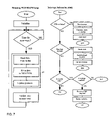
- FIG. 7 is a flowchart identifying subroutines for the microcontroller to output data to the display including timing, animation and communication routines.
- FIG. 8 shows a stationary printed circuit board schematic providing user interface controls to the apparatus.
- FIG. 9 shows a rotating printed circuit board schematic providing microcontroller control circuitry for displaying data to the volumetric display.
- FIG. 10 shows a vertical illuminated printed circuit board schematic providing multiple LEDs used for displaying the voxel elements of the display.
- the volumetric 3D display 10 itself is based on the widely known phenomena of image persistence in the human eye.
- a moving, pulsed light source can be made to appear as a stationary point of light in space if repetitive movement is used which is faster than the eye can follow, and the timing of the light pulses is such that they always occur at the same point in space.
- the display 10 includes a round, horizontal, three inch diameter, rotating printed circuit board 12 (PCB) with 4 vertical PCBs 14 attached.
- PCB printed circuit board
- a method of attachment was used in which the vertical PCB 14 is keyed to fit into a slot on the horizontal PCB 12 which just fits into the thickness of the keying slot.
- the vertical PCB 14 is locked into a perpendicular orientation and no separate connector is required.
- the vertical PCB 14 is oriented so the width of the PCB 14 , not the thickness, points radially outward from the circle.
- the full strength of the width of the vertical PCB 14 in this case 0.25 inches, rather than the thickness, typically 0.062 inches, resists the significant forces present when the board loaded with LEDs 16 is rapidly rotating.
- the 4 vertical PCBs 14 each have eight standard 5 mm light emitting diodes 16 (LEDs) mounted horizontally.
- the vertical PCBs 14 are placed 90 degrees apart from each other, at the compass points, around the circle of the horizontal PCB 12 . This is done for maximum visibility of all LEDs 16 as the PCB assembly rotates, as well as overall balance of the assembly.
- the LEDs 16 are oriented to face out from the center of the circle, and each vertical PCB 14 is a different distance from the center of the circle of the horizontal PCB 12 .
- the two innermost vertical PCBs are placed opposite each other, as are the two outermost. This configuration was chosen for the overall balance of the rotating assembly. Also, the two outermost vertical PCBs are joined at the top via a stiff wire truss. This is to prevent deflection from vertical due to the forces generated from the rotational motion.
- each vertical PCB has 8 LEDs and as it rotates each LED traces out a ring of light. There are then 8 rings of light stacked on top of each other to form a cylinder of light, assuming all LEDs are emitting light. Since there are four staggered vertical PCB subassemblies, there are four concentric cylinders of light.
- the entire rotating assembly includes the horizontal PCB 12 , the 4 vertical PCBs 14 , all 32 LEDs 16 , and other electrical components rotates quickly via an electric motor solidly mounted in the base of the product.
- the assembly rotates at roughly 50 revolutions per second. This is faster than the eye can follow, so the vertical PCBs and the unlit LEDs disappear from view as the whole assembly is rotating at speed.
- a microcontroller 18 On the horizontal rotating PCB 12 there are a number of electrical components, one of which is a microcontroller 18 .
- a Microchip 18F242 controller was used, operating at 20 MHz.
- the display 10 is formed through a time based division of the rotating LEDs as they trace rings above the horizontal PCB.
- One of the functions of the rotating microcontroller 18 is to time the rotation of the PCB.
- There is a stationary infrared LED in the base of the 3DLS under the rotating PCB which is optically isolated from any areas other than directly above it.
- the microcontroller 18 can measure the amount of time taken for one revolution of the PCB by monitoring the signal from the photodetector 20 . Once this revolution time is known, the revolution of the PCB is broken into 64 equal time units. Each of these time units represents 1/64th of a complete revolution.
- the continuous and varying rotation of the PCB is divided into discrete segments.
- Each of these segments represents one volume-pixel, or voxel, for the rotating LEDs on the vertical PCBs.
- the rotating microcontroller 18 also uses the signal from the photodetector 20 to determine its absolute position relative to the infrared LED on the stationary PCB. This position is used as an index, or origin, to make sure the sculpture stays stationary while the user is making the sculpture.
- Each of the 2048 voxels is mapped to a single bit in the built-in RAM of the microcontroller, for a total of 256 8-bit bytes used.
- the microcontroller tracks the time in terms of 1/64th of a revolution.
- the outer voxels are larger than the inner. This was determined to have no effect on the aesthetics of the 3DLS prototype, but similar sized voxels can be implemented throughout the full volume of the display by dividing the outer rings into more segments than the inner rings.
- a 74LVT574 chip which is an octal D-flip-flop with high current capability. It serves the dual purpose of driving the LEDs at the proper current level as well as being an 8-bit memory.
- the microcontroller reads the information stored in the internal RAM for the proper voxel to be displayed.
- a single byte of RAM represents the state of each LED in a single vertical column. So at each transition point, the microcontroller reads the data from the memory mapped image buffer in the internal RAM and stores it on the 74LVT574 chip.
- the 74LVT574 then drives each LED in the vertical stack according to the data supplied by the microcontroller.
- the controller places data on each of the four 74LVT574 chips sequentially, thus effecting the change from one voxel to the adjacent for each of the four columns of LEDs.
- a three dimensional image can be loaded into the internal RAM locations on the microcontroller. As the PCB assembly rotates through a full circle, each memory location is accessed and displayed at the proper time, for the proper interval, so that the full three dimensional image appears.
- An important aspect of the device is the communication between the stationary portion, i.e. the knobs and buttons and their corresponding electronics, and the rotating PCB.
- the IR LED and IR receiver pair is similar to those commonly used for applications like TV remote controls.
- the field of view of the IR receiver used for the data link is such that it is never out of range of the stationary data LED as the receiver circles on the rotating PCB.
- This infrared communication link is separate from the static IR LED and photodetector pair used to determine the position of the rotating PCB.
- the stationary microcontroller In addition to the microcontroller on the rotating PCB, there is a second stationary microcontroller in the base unit. We have also used a Microchip 18F242 here, although there are many choices for controllers which may be better suited for a production version of the device.
- the stationary microcontroller has the duty of monitoring the various knobs and buttons of the user interface and transmitting any changes to the rotating PCB via the IR optical link. Additionally, this controller will interface to plug-in cartridges and access the data and functions stored on them, expanding the capability of the basic unit.
- a simple and intuitive user interface allows the user to easily draw in the 3D volume of the display in real time.
- the portion of the user interface used to create sculptures in the 3D volume of voxels includes 6 physical elements: Three knobs, two pushbuttons, one 3-position slide switch. Another element of the user interface is a movable blinking cursor in the display volume that indicates the current voxel being manipulated.
- knobs are rotary encoders with no absolute start/stop position. The direction and distance of rotation is read from each knob by the stationary microcontroller. See FIG. 5 for the layout of the user interface.
- the first knob, ROTATE is used to spin the display volume about its central axis. Turning this knob clockwise will cause the display to rotate clockwise. A fast turn causes rapid rotation of the display, and a slower turn of the knob easily enables rotation of the display a single voxel at a time.
- the next two knobs move the blinking cursor in the display volume. These knobs are IN/OUT and UP/DOWN.
- the UP/DOWN knob is physically oriented perpendicularly to the IN/OUT and ROTATE knobs.
- the IN/OUT and UP/DOWN knobs move the cursor in a plane that is 8 voxels high and 4 voxels deep directly in front of the user and perpendicular to the user.
- the cursor is confined to this plane.
- the entire volume of the 3D display can be readily accessed. The user only works on the portion of the light sculpture that is directly in front of her. The sculpture is rotated around via the ROTATE knob to work on other portions.
- the next element of the user interface for creation of images in the 3D display is the 3-position slide switch.
- the three positions are labeled DRAW, MOVE, and ERASE. This corresponds to three modes of drawing.
- every move of the three knobs, ROTATE, IN/OUT, and UP/DOWN results in the voxel that was just under the cursor to be set, or lit. For example, with a blank display volume (all voxels are off or unlit), while in DRAW mode spinning the ROTATE knob so the display rotates a full 360 degrees will result in a lit ring floating in the display volume. Likewise, turning the UP/DOWN knob will result in all voxels in a vertical stack to be lit. Turning the IN/OUT knob will draw a line at most 4 voxels deep pointing directly away from the user.
- the ERASE setting of the 3-position switch will cause every voxel encountered while manipulating the three movement knobs to be erased, or turned off.
- the MOVE or center position of the slide switch will leave each voxel that the cursor encounters unchanged as the user manipulates the three movement knobs. A lit voxel stays lit and a dark voxel stays dark in this mode.
- the current mode of the device is indicated not only by the physical position of the slide switch, but also by the blink rate of the cursor. This provides instant visual feedback to the user of the current mode of operation.
- the DRAW mode is indicated by a fast cursor blink rate of approximately 4 Hz.
- MOVE mode uses a medium blink rate of approximately 2 Hz, and ERASE mode is indicated by a slow blink rate of approximately 1 Hz.
- the final user interface element used in the creation of images in the 3D display is the pushbutton labeled FLIP.
- the function of this button is independent of the mode of the device (DRAW, MOVE, or ERASE).
- the FLIP button will, naturally, flip the status of the voxel that the cursor is currently over. That is, if the voxel is on or lit, pushing the FLIP button will turn it off. Pushing the FLIP button on a voxel that is off will turn on that voxel. This allows the user to precisely and quickly toggle individual voxels, greatly easing and speeding the drawing process.
- This pushbutton is physically located away from the other controls in the upper right portion of the control housing section of the base unit and is bright red as a caution cue. The location and color of this button were chosen to minimize the chances of an accidental push, since a press of this button will turn off all voxels in the 3D display, clearing any unsaved changes made by the user.
- the presently described embodiment of the 3DLS can store 4 user created sculptures. This is accomplished through four separate SAVE pushbuttons, illustrated in FIG. 5 .
- the SAVE buttons are labeled A, B, C, and D.
- a simple push of one of these SAVE buttons will store the data from the 3D display into either internal EEPROM storage or into an external serial EEPROM, wherein the user interface controls SAVE functions provide for storing and recalling the data from the 3D display into either non-volatile memory.
- the user or multiple users can work on several sculptures at once.
- SCULPTURES The pushbutton on the upper left of the user interface area of the base unit is labeled SCULPTURES, see FIG. 5 .
- SCULPTURES The pushbutton on the upper left of the user interface area of the base unit.
- Each push of this button will step through the display of a series of pre-made sculptures that are permanently programmed into the unit. Many sculptures can be programmed into the device to demonstrate the striking novelty, beauty, and potential of the three-dimensional display.
- This button also sequentially recalls the user saved sculptures which were saved using the SAVE A-D buttons. Once a permanently stored sculpture is displayed, it can be changed and customized through the drawing portions of the user interface previously described. Of course, a modified sculpture can be saved via one of the SAVE buttons.
- SCULPTURES button the user can recall his own creations or any of a series of preprogrammed sculptures for display and animation simply through multiple pushes of this single button.
- An additional feature of the 3D display is the ability to animate displayed images. For instance, rather than just having the next stored sculpture instantly appear on the display when the SCULPTURES button is pushed, a visually stimulating animation provides a smooth transition between displayed sculptures.
- the prototype of the 3DLS uses a transition that evokes the concept of a sparkling energy filling in the entire volume of the display from bottom to top. This sparkling random energy persists briefly, then drains out the bottom of the display revealing the next sculpture.
- Another transition used in the 3DLS is descriptively labeled elevator-up. This transition causes the sculpture to be displayed to rise smoothly from the floor of the display. Transitions and animations in three dimensions provide a greatly enhanced and stimulating user experience. Additionally, through the various animations or sound reactivity, a function may be added, e.g., via the expansion port, to listen to ambient sounds and then react in three dimensions to the music, ambient sounds or the like.
- the software is provided for the various aspects of the described embodiment. This section is further broken down into three subsections: a) Software to accept input from the user via the various knobs and buttons; b) Software to control the display itself; c) Software for animations.
- the knobs and buttons that make up the physical user interface of the invention are scanned by the stationary 18F242 microcontroller in the base unit.
- a sequentially polled method of scanning is used. See FIG. 6 , Stationary PCB MAIN Loop. Commands are sent to the rotating PCB via the IR optical link. A 38 KHz carrier frequency is superimposed, through software, on the data words sent via this link. This enables the IR receiver unit on the rotating PCB to recognize the signal sent from the base unit.
- the data words to be transmitted to the rotating PCB are “bit-banged” through an output port that drives an IR LED.
- a simple data protocol is used to separate commands generated from a turn of one of the rotary encoders from the other button pushes. The data protocol includes a unique first nibble (4 bits) being sent to identify rotary encoder commands. This data protocol is used to speed the command decode routine in the microcontroller on the rotating PCB.
- the microcontroller 18 on the rotating PCB controls the output of data onto the display itself as well as various necessary timing, animation, and communication routines, see FIG. 7 , MAIN and INTERRUPT routine flowcharts for rotating microcontroller 18 .
- the software developed for the rotating microcontroller includes a main loop which is repeatedly run that displays data stored in the 256 byte RAM display buffer. This main routine is continuously executed. All the rest of the routines for this controller are interrupt driven and are executed as needed.
- An interrupt driven counter/timer is used to determine the revolution time for the rotating PCB. Another counter is used to determine when a voxel transition has occurred (every 1/64th of a revolution).
- the main routine scans for a flag indicating that the voxel transition time has occurred, and then sends the proper data to the four 74LVT574 buffer/driver chips.
- Animation software is also interrupt driven in the rotating PCB.
- flag registers are set which direct the flow of the software code.
- a flag is set enabling the animation code to run.
- the animation flag is set, the animation code is executed during this interrupt.
- the specific animation code to be executed is determined through a separate flag register. All animation code is skipped when the animation mode is disabled.
- this secondary display buffer can become the primary display buffer. When enabled, the secondary buffer becomes the data source for the main display routine. This capability can be useful for some animations.
- the sophisticated animation software can be removed from the rotating PCB where software upgrades are more difficult.
- the rotating PCB can then become just a display device and the evolving software can be housed in the more easily upgradeable base unit or plug-in cartridges.
- a set of pre-made or “canned” three dimensional images can be stored on a cartridge for transmission to the 3D display. These could be original themed sets such as Farm Animals, Space, etc. . . . They could also be licensed characters such as Mickey MouseTM or SpongeBobTM.
- Sounds associated with a light-sculpture such as the moo of a cow in a Farm Animals cartridge, can also be added.
- Sound reactivity can be added through a cartridge with a microphone and some additional circuitry.
- the invention can then react to ambient noises and change the 3 dimensional display as appropriate.
- a computer interface or interface to other 3DLS units can be realized through cartridge expansion. The user could then share her creations with other owners of a 3DLS if the expansion functionality links similarly equipped 3DLS units.
- creations could be shared with anyone in the world through publishing sculpture data files on the internet. This could be achieved through private fan-based web sites or through a central site controlled by a business entity.
Landscapes
- Engineering & Computer Science (AREA)
- Physics & Mathematics (AREA)
- General Physics & Mathematics (AREA)
- Theoretical Computer Science (AREA)
- Computer Hardware Design (AREA)
- Processing Or Creating Images (AREA)
Abstract
Description
-
- 1) rotating slowly clockwise
- The entire voxel volume rotates in sync at roughly 6.5 seconds for a full revolution
- 2) rotating faster counterclockwise
- The entire voxel volume rotates in sync at roughly 3.25 seconds for a full revolution
- 3) multi-go-round
- Each of the 4 concentric cylinders of voxels that make up the 3D display rotate in alternating directions. That is, the outermost cylinder rotates CW, the next rotates CCW, etc. . . .
- 4) liquify
- Visually reminiscent of food in a blender, this animation causes each of the 8 layers of the display to rotate in alternating directions. That is, all voxels on the top layer rotate CW, second from the top CCW, etc. . . .
- 5) round-n-down
- As the entire volume of voxels rotate in synch, the displayed sculpture sinks into the floor of the display. The portion of the image that sinks from view appears at the top of the display. Thus the animation continues smoothly and continuously.
- 6) pumping
- The image on the display alternately sinks into the floor, leaving the display blank, then rises smoothly up again to its original position.
- 7) peeling
- Each of the 4 cylinders that make up the display sink down into the floor of the device and then rise back up, but the 4 cylinders are out of step with each other. The timing is such that the cylinders appear to be peeled off one-by-one in a continuous wave.
- 8) slot machine up
- The image on the 3D display rises quickly up with all voxels in synch. The voxels that disappear from the top of the display appear at the floor of the display. Thus the image continuously rolls upwards.
- 1) rotating slowly clockwise
Claims (41)
Priority Applications (2)
| Application Number | Priority Date | Filing Date | Title |
|---|---|---|---|
| US11/180,968 US7397387B2 (en) | 2004-07-14 | 2005-07-13 | Light sculpture system and method |
| CN 200620112877 CN2936354Y (en) | 2005-07-13 | 2006-04-26 | Light sculpture system |
Applications Claiming Priority (2)
| Application Number | Priority Date | Filing Date | Title |
|---|---|---|---|
| US58770304P | 2004-07-14 | 2004-07-14 | |
| US11/180,968 US7397387B2 (en) | 2004-07-14 | 2005-07-13 | Light sculpture system and method |
Publications (2)
| Publication Number | Publication Date |
|---|---|
| US20060017586A1 US20060017586A1 (en) | 2006-01-26 |
| US7397387B2 true US7397387B2 (en) | 2008-07-08 |
Family
ID=35656554
Family Applications (1)
| Application Number | Title | Priority Date | Filing Date |
|---|---|---|---|
| US11/180,968 Expired - Fee Related US7397387B2 (en) | 2004-07-14 | 2005-07-13 | Light sculpture system and method |
Country Status (1)
| Country | Link |
|---|---|
| US (1) | US7397387B2 (en) |
Cited By (27)
| Publication number | Priority date | Publication date | Assignee | Title |
|---|---|---|---|---|
| US20080186155A1 (en) * | 2005-02-04 | 2008-08-07 | Johnson Controls Technology Company | Persistence of Vision Display |
| US20090002270A1 (en) * | 2007-06-28 | 2009-01-01 | Boundary Net, Incorporated | Composite display |
| US20090323341A1 (en) * | 2007-06-28 | 2009-12-31 | Boundary Net, Incorporated | Convective cooling based lighting fixtures |
| US20100020107A1 (en) * | 2008-07-23 | 2010-01-28 | Boundary Net, Incorporated | Calibrating pixel elements |
| US20100019993A1 (en) * | 2008-07-23 | 2010-01-28 | Boundary Net, Incorporated | Calibrating pixel elements |
| US20100019997A1 (en) * | 2008-07-23 | 2010-01-28 | Boundary Net, Incorporated | Calibrating pixel elements |
| US20100120518A1 (en) * | 2008-11-12 | 2010-05-13 | Milo Borissov | Animated gaming machine tower light |
| US20130321394A1 (en) * | 2012-06-05 | 2013-12-05 | Tait Technologies, Inc. | Three-dimensional display device, system for creating three-dimensional display, and process of creating three-dimensional display |
| US8866703B2 (en) | 2012-03-01 | 2014-10-21 | Crayola Llc | Persistence-of-vision display with stylus input device |
| US9390643B2 (en) | 2012-06-25 | 2016-07-12 | Rufus Butler Seder | Rotatable animation devices with staggered illumination sources |
| USD813954S1 (en) | 2015-09-24 | 2018-03-27 | Ags Llc | Game tower |
| USD818048S1 (en) | 2015-10-05 | 2018-05-15 | Ags Llc | Gaming machine |
| US9984605B2 (en) * | 2016-10-27 | 2018-05-29 | Sherry Berjeron | Wearable display |
| US9997010B2 (en) | 2015-12-18 | 2018-06-12 | Ags Llc | Electronic gaming device with external lighting functionality |
| US10002488B2 (en) | 2015-12-17 | 2018-06-19 | Ags Llc | Electronic gaming device with call tower functionality |
| USD820915S1 (en) | 2015-09-22 | 2018-06-19 | Ags Llc | Gaming machine |
| US20180359934A1 (en) * | 2017-04-06 | 2018-12-20 | Mold Metis, Inc. | Photon delivery devices, systems, and methods |
| USD843473S1 (en) | 2017-04-07 | 2019-03-19 | Ags Llc | Gaming machine |
| USD852890S1 (en) | 2017-11-30 | 2019-07-02 | Ags Llc | Gaming machine |
| USD865873S1 (en) | 2017-08-23 | 2019-11-05 | Ags Llc | Gaming machine |
| USD888837S1 (en) | 2018-02-02 | 2020-06-30 | Ags Llc | Support structure for gaming machine display |
| USD939632S1 (en) | 2018-07-17 | 2021-12-28 | Ags Llc | Gaming machine |
| US11380157B2 (en) | 2019-08-02 | 2022-07-05 | Ags Llc | Servicing and mounting features for gaming machine display screens and toppers |
| USD969927S1 (en) | 2019-08-02 | 2022-11-15 | Ags Llc | Gaming machine |
| USD969926S1 (en) | 2019-04-24 | 2022-11-15 | Ags Llc | Gaming machine |
| USD978810S1 (en) | 2019-07-31 | 2023-02-21 | Ags Llc | LED matrix display |
| USD1105254S1 (en) | 2023-04-18 | 2025-12-09 | Ags Llc | Gaming machine |
Families Citing this family (4)
| Publication number | Priority date | Publication date | Assignee | Title |
|---|---|---|---|---|
| US7477252B2 (en) * | 2004-04-05 | 2009-01-13 | Actuality Systems, Inc. | Processing three dimensional data for spatial three dimensional displays |
| US7431483B1 (en) * | 2007-11-06 | 2008-10-07 | Shih-Lin Lee | Illuminating lamp |
| US7581858B1 (en) * | 2008-02-22 | 2009-09-01 | Gallegos Juan M | Light-emitting device for the interior of a vehicle with music synchronization |
| US10840260B2 (en) | 2019-01-18 | 2020-11-17 | Sandisk Technologies Llc | Through-array conductive via structures for a three-dimensional memory device and methods of making the same |
Citations (21)
| Publication number | Priority date | Publication date | Assignee | Title |
|---|---|---|---|---|
| US3097261A (en) * | 1961-05-01 | 1963-07-09 | Avco Corp | Three-dimensional display |
| US4160973A (en) | 1977-10-11 | 1979-07-10 | Massachusetts Institute Of Technology | Three-dimensional display |
| US4298868A (en) * | 1980-04-11 | 1981-11-03 | Spurgeon John R | Electronic display apparatus |
| US5057827A (en) * | 1988-10-17 | 1991-10-15 | Nobile Fred E | Means and method for producing an optical illusion |
| US5406300A (en) | 1991-12-12 | 1995-04-11 | Avix, Inc. | Swing type aerial display system |
| US5717416A (en) * | 1995-04-11 | 1998-02-10 | The University Of Kansas | Three-dimensional display apparatus |
| US5745197A (en) * | 1995-10-20 | 1998-04-28 | The Aerospace Corporation | Three-dimensional real-image volumetric display system and method |
| US5748157A (en) | 1994-12-27 | 1998-05-05 | Eason; Richard O. | Display apparatus utilizing persistence of vision |
| US6037876A (en) | 1998-04-23 | 2000-03-14 | Limelite Industries, Inc. | Lighted message fan |
| US6115006A (en) * | 1988-04-18 | 2000-09-05 | Brotz; Gregory R. | Rotating display device and method for producing a three-dimensional real image |
| US6144384A (en) * | 1996-02-20 | 2000-11-07 | Yugen Kashia Aloalo International | Voxel data processing using attributes thereof |
| US6265984B1 (en) | 1999-08-09 | 2001-07-24 | Carl Joseph Molinaroli | Light emitting diode display device |
| US6278419B1 (en) * | 1997-06-26 | 2001-08-21 | Light Spin Ltd. | Moving display |
| US6420698B1 (en) * | 1997-04-24 | 2002-07-16 | Cyra Technologies, Inc. | Integrated system for quickly and accurately imaging and modeling three-dimensional objects |
| US6487020B1 (en) * | 1998-09-24 | 2002-11-26 | Actuality Systems, Inc | Volumetric three-dimensional display architecture |
| US6639571B2 (en) * | 2001-09-27 | 2003-10-28 | Dynascan Technology Corp. | Rotating display with design of surrounding a column |
| US6697034B2 (en) * | 1999-12-30 | 2004-02-24 | Craig Stuart Tashman | Volumetric, stage-type three-dimensional display, capable of producing color images and performing omni-viewpoint simulated hidden line removal |
| US6753847B2 (en) * | 2002-01-25 | 2004-06-22 | Silicon Graphics, Inc. | Three dimensional volumetric display input and output configurations |
| US6765566B1 (en) * | 1998-12-22 | 2004-07-20 | Che-Chih Tsao | Method and apparatus for displaying volumetric 3D images |
| US6856303B2 (en) * | 2000-10-24 | 2005-02-15 | Daniel L. Kowalewski | Rotating display system |
| US7099701B2 (en) * | 2002-11-25 | 2006-08-29 | Giant Electronics Ltd. | Rotating LED display device receiving data via infrared transmission |
-
2005
- 2005-07-13 US US11/180,968 patent/US7397387B2/en not_active Expired - Fee Related
Patent Citations (21)
| Publication number | Priority date | Publication date | Assignee | Title |
|---|---|---|---|---|
| US3097261A (en) * | 1961-05-01 | 1963-07-09 | Avco Corp | Three-dimensional display |
| US4160973A (en) | 1977-10-11 | 1979-07-10 | Massachusetts Institute Of Technology | Three-dimensional display |
| US4298868A (en) * | 1980-04-11 | 1981-11-03 | Spurgeon John R | Electronic display apparatus |
| US6115006A (en) * | 1988-04-18 | 2000-09-05 | Brotz; Gregory R. | Rotating display device and method for producing a three-dimensional real image |
| US5057827A (en) * | 1988-10-17 | 1991-10-15 | Nobile Fred E | Means and method for producing an optical illusion |
| US5406300A (en) | 1991-12-12 | 1995-04-11 | Avix, Inc. | Swing type aerial display system |
| US5748157A (en) | 1994-12-27 | 1998-05-05 | Eason; Richard O. | Display apparatus utilizing persistence of vision |
| US5717416A (en) * | 1995-04-11 | 1998-02-10 | The University Of Kansas | Three-dimensional display apparatus |
| US5745197A (en) * | 1995-10-20 | 1998-04-28 | The Aerospace Corporation | Three-dimensional real-image volumetric display system and method |
| US6144384A (en) * | 1996-02-20 | 2000-11-07 | Yugen Kashia Aloalo International | Voxel data processing using attributes thereof |
| US6420698B1 (en) * | 1997-04-24 | 2002-07-16 | Cyra Technologies, Inc. | Integrated system for quickly and accurately imaging and modeling three-dimensional objects |
| US6278419B1 (en) * | 1997-06-26 | 2001-08-21 | Light Spin Ltd. | Moving display |
| US6037876A (en) | 1998-04-23 | 2000-03-14 | Limelite Industries, Inc. | Lighted message fan |
| US6487020B1 (en) * | 1998-09-24 | 2002-11-26 | Actuality Systems, Inc | Volumetric three-dimensional display architecture |
| US6765566B1 (en) * | 1998-12-22 | 2004-07-20 | Che-Chih Tsao | Method and apparatus for displaying volumetric 3D images |
| US6265984B1 (en) | 1999-08-09 | 2001-07-24 | Carl Joseph Molinaroli | Light emitting diode display device |
| US6697034B2 (en) * | 1999-12-30 | 2004-02-24 | Craig Stuart Tashman | Volumetric, stage-type three-dimensional display, capable of producing color images and performing omni-viewpoint simulated hidden line removal |
| US6856303B2 (en) * | 2000-10-24 | 2005-02-15 | Daniel L. Kowalewski | Rotating display system |
| US6639571B2 (en) * | 2001-09-27 | 2003-10-28 | Dynascan Technology Corp. | Rotating display with design of surrounding a column |
| US6753847B2 (en) * | 2002-01-25 | 2004-06-22 | Silicon Graphics, Inc. | Three dimensional volumetric display input and output configurations |
| US7099701B2 (en) * | 2002-11-25 | 2006-08-29 | Giant Electronics Ltd. | Rotating LED display device receiving data via infrared transmission |
Cited By (65)
| Publication number | Priority date | Publication date | Assignee | Title |
|---|---|---|---|---|
| US20080186155A1 (en) * | 2005-02-04 | 2008-08-07 | Johnson Controls Technology Company | Persistence of Vision Display |
| US8111209B2 (en) | 2007-06-28 | 2012-02-07 | Qualcomm Mems Technologies, Inc. | Composite display |
| US8106860B2 (en) | 2007-06-28 | 2012-01-31 | Qualcomm Mems Technologies, Inc. | Luminance balancing |
| US20090002290A1 (en) * | 2007-06-28 | 2009-01-01 | Boundary Net, Incorporated | Rendering an image pixel in a composite display |
| US20090002273A1 (en) * | 2007-06-28 | 2009-01-01 | Boundary Net, Incorporated | Data flow for a composite display |
| US20090002272A1 (en) * | 2007-06-28 | 2009-01-01 | Boundary Net, Incorporated | Composite display |
| US20090002271A1 (en) * | 2007-06-28 | 2009-01-01 | Boundary Net, Incorporated | Composite display |
| US20090323341A1 (en) * | 2007-06-28 | 2009-12-31 | Boundary Net, Incorporated | Convective cooling based lighting fixtures |
| US8319703B2 (en) | 2007-06-28 | 2012-11-27 | Qualcomm Mems Technologies, Inc. | Rendering an image pixel in a composite display |
| US20090002362A1 (en) * | 2007-06-28 | 2009-01-01 | Boundary Net, Incorporated | Image to temporal pixel mapping |
| US20090002270A1 (en) * | 2007-06-28 | 2009-01-01 | Boundary Net, Incorporated | Composite display |
| US8106854B2 (en) | 2007-06-28 | 2012-01-31 | Qualcomm Mems Technologies, Inc. | Composite display |
| US20100020107A1 (en) * | 2008-07-23 | 2010-01-28 | Boundary Net, Incorporated | Calibrating pixel elements |
| US20100019997A1 (en) * | 2008-07-23 | 2010-01-28 | Boundary Net, Incorporated | Calibrating pixel elements |
| US20100019993A1 (en) * | 2008-07-23 | 2010-01-28 | Boundary Net, Incorporated | Calibrating pixel elements |
| US20100120518A1 (en) * | 2008-11-12 | 2010-05-13 | Milo Borissov | Animated gaming machine tower light |
| US8866703B2 (en) | 2012-03-01 | 2014-10-21 | Crayola Llc | Persistence-of-vision display with stylus input device |
| US20130321394A1 (en) * | 2012-06-05 | 2013-12-05 | Tait Technologies, Inc. | Three-dimensional display device, system for creating three-dimensional display, and process of creating three-dimensional display |
| US9390643B2 (en) | 2012-06-25 | 2016-07-12 | Rufus Butler Seder | Rotatable animation devices with staggered illumination sources |
| USD834652S1 (en) | 2015-09-22 | 2018-11-27 | Ags Llc | Gaming machine |
| USD1051993S1 (en) | 2015-09-22 | 2024-11-19 | Ags Llc | Gaming machine |
| USD888834S1 (en) | 2015-09-22 | 2020-06-30 | Ags Llc | Gaming machine |
| USD820915S1 (en) | 2015-09-22 | 2018-06-19 | Ags Llc | Gaming machine |
| USD833534S1 (en) | 2015-09-22 | 2018-11-13 | Ags Llc | Gaming machine |
| USD888835S1 (en) | 2015-09-22 | 2020-06-30 | Ags Llc | Gaming machine |
| USD888836S1 (en) | 2015-09-22 | 2020-06-30 | Ags Llc | Gaming machine |
| USD844063S1 (en) | 2015-09-22 | 2019-03-26 | Ags Llc | Gaming machine |
| USD813954S1 (en) | 2015-09-24 | 2018-03-27 | Ags Llc | Game tower |
| USD889554S1 (en) | 2015-09-24 | 2020-07-07 | Ags Llc | Game tower |
| USD848534S1 (en) | 2015-09-24 | 2019-05-14 | Ags Llc | Game tower |
| USD847905S1 (en) | 2015-09-24 | 2019-05-07 | Ags Llc | Game tower |
| USD854621S1 (en) | 2015-10-05 | 2019-07-23 | Ags Llc | Gaming machine display configuration |
| USD818048S1 (en) | 2015-10-05 | 2018-05-15 | Ags Llc | Gaming machine |
| USD913379S1 (en) | 2015-10-05 | 2021-03-16 | Ags Llc | Gaming machine |
| US10002488B2 (en) | 2015-12-17 | 2018-06-19 | Ags Llc | Electronic gaming device with call tower functionality |
| US10403085B2 (en) | 2015-12-17 | 2019-09-03 | Ags Llc | Electronic gaming device with call tower functionality |
| US11995944B2 (en) | 2015-12-17 | 2024-05-28 | Ags Llc | Electronic gaming device with call tower functionality |
| US11436889B2 (en) | 2015-12-17 | 2022-09-06 | Ags Llc | Electronic gaming device with call tower functionality |
| US10854038B2 (en) | 2015-12-17 | 2020-12-01 | Ags Llc | Electronic gaming device with call tower functionality |
| US11049355B2 (en) | 2015-12-18 | 2021-06-29 | Ags Llc | Electronic gaming device with external lighting functionality |
| US11734989B2 (en) | 2015-12-18 | 2023-08-22 | Ags Llc | Electronic gaming device with external lighting functionality |
| US9997010B2 (en) | 2015-12-18 | 2018-06-12 | Ags Llc | Electronic gaming device with external lighting functionality |
| US10431036B2 (en) | 2015-12-18 | 2019-10-01 | Ags Llc | Electronic gaming device with external lighting functionality |
| US9984605B2 (en) * | 2016-10-27 | 2018-05-29 | Sherry Berjeron | Wearable display |
| US20180359934A1 (en) * | 2017-04-06 | 2018-12-20 | Mold Metis, Inc. | Photon delivery devices, systems, and methods |
| US10869429B2 (en) * | 2017-04-06 | 2020-12-22 | Mold Metis, Inc. | Rotatable illumination device with control and sensing systems |
| USD1057837S1 (en) | 2017-04-07 | 2025-01-14 | Ags Llc | Gaming machine |
| USD905172S1 (en) | 2017-04-07 | 2020-12-15 | Ags Llc | Gaming machine |
| USD872190S1 (en) | 2017-04-07 | 2020-01-07 | Ags Llc | Gaming machine |
| USD843473S1 (en) | 2017-04-07 | 2019-03-19 | Ags Llc | Gaming machine |
| USD865873S1 (en) | 2017-08-23 | 2019-11-05 | Ags Llc | Gaming machine |
| USD926260S1 (en) | 2017-11-30 | 2021-07-27 | Ags Llc | Gaming machine |
| USD852890S1 (en) | 2017-11-30 | 2019-07-02 | Ags Llc | Gaming machine |
| USD888837S1 (en) | 2018-02-02 | 2020-06-30 | Ags Llc | Support structure for gaming machine display |
| USD899526S1 (en) | 2018-02-02 | 2020-10-20 | Ags Llc | Support structure for gaming machine display |
| USD1038252S1 (en) | 2018-02-02 | 2024-08-06 | Ags Llc | Support structure for gaming machine display |
| USD939632S1 (en) | 2018-07-17 | 2021-12-28 | Ags Llc | Gaming machine |
| USD969926S1 (en) | 2019-04-24 | 2022-11-15 | Ags Llc | Gaming machine |
| USD1057027S1 (en) | 2019-04-24 | 2025-01-07 | Ags Llc | Gaming machine |
| USD978810S1 (en) | 2019-07-31 | 2023-02-21 | Ags Llc | LED matrix display |
| USD1053831S1 (en) | 2019-07-31 | 2024-12-10 | Ags Llc | LED matrix display |
| US11380157B2 (en) | 2019-08-02 | 2022-07-05 | Ags Llc | Servicing and mounting features for gaming machine display screens and toppers |
| USD1057026S1 (en) | 2019-08-02 | 2025-01-07 | Ags Llc | Gaming machine |
| USD969927S1 (en) | 2019-08-02 | 2022-11-15 | Ags Llc | Gaming machine |
| USD1105254S1 (en) | 2023-04-18 | 2025-12-09 | Ags Llc | Gaming machine |
Also Published As
| Publication number | Publication date |
|---|---|
| US20060017586A1 (en) | 2006-01-26 |
Similar Documents
| Publication | Publication Date | Title |
|---|---|---|
| US7397387B2 (en) | Light sculpture system and method | |
| KR102435819B1 (en) | Smart magic cube and operating method thereof | |
| US10636389B2 (en) | Rotational display system | |
| US20070097681A1 (en) | Lighting device | |
| US8866703B2 (en) | Persistence-of-vision display with stylus input device | |
| US9390643B2 (en) | Rotatable animation devices with staggered illumination sources | |
| CN103930182A (en) | Substrate assembly for toy parts | |
| US12090409B2 (en) | Game tile system | |
| CN211073602U (en) | Multifunctional shell-replaceable robot and decorative shell thereof | |
| KR101741032B1 (en) | Cylinder led billboard | |
| Heaton | Physical pixels | |
| CN2936354Y (en) | Light sculpture system | |
| KR100328237B1 (en) | solid image device for LED | |
| WO2008039335A1 (en) | Swept volume display | |
| KR102301027B1 (en) | A system and method for constructing a reader participation type electronic book using module | |
| CN101840269A (en) | Keyboard control method for generating light color change | |
| CN219639918U (en) | Display device and timing hourglass display device | |
| JP2007226013A (en) | Stereoscopic image display device | |
| JP4054276B2 (en) | Double dot matrix display | |
| KR102087828B1 (en) | Optical device providing stereoscopic image on the basis of emmiting element | |
| WO2008062180A1 (en) | Skipping apparatus | |
| RU2229169C1 (en) | Advertising device | |
| KR20100124881A (en) | Apparatus and method for displaying three-dimensional animation | |
| KR20050034772A (en) | Apparatus for emiting light using led according to sound pitch, sound volume or tone color | |
| JP3129408U (en) | 3D display device |
Legal Events
| Date | Code | Title | Description |
|---|---|---|---|
| AS | Assignment |
Owner name: RADLCA GAMES LTD., BERMUDA Free format text: ASSIGNMENT OF ASSIGNORS INTEREST;ASSIGNORS:SUZUKI, KENT;VENTURE, VIM;REEL/FRAME:018344/0587 Effective date: 20060929 Owner name: RADICA GAMES LTD., BERMUDA Free format text: ASSIGNMENT OF ASSIGNORS INTEREST;ASSIGNORS:SUZUKI, KENT;VENTURE, VIM;REEL/FRAME:018343/0217 Effective date: 20060929 |
|
| AS | Assignment |
Owner name: MATTEL, INC., CALIFORNIA Free format text: ASSIGNMENT OF ASSIGNORS INTEREST;ASSIGNOR:RADICA GAMES LTD.;REEL/FRAME:021117/0030 Effective date: 20080618 |
|
| FPAY | Fee payment |
Year of fee payment: 4 |
|
| REMI | Maintenance fee reminder mailed | ||
| LAPS | Lapse for failure to pay maintenance fees | ||
| STCH | Information on status: patent discontinuation |
Free format text: PATENT EXPIRED DUE TO NONPAYMENT OF MAINTENANCE FEES UNDER 37 CFR 1.362 |
|
| STCH | Information on status: patent discontinuation |
Free format text: PATENT EXPIRED DUE TO NONPAYMENT OF MAINTENANCE FEES UNDER 37 CFR 1.362 |
|
| FP | Lapsed due to failure to pay maintenance fee |
Effective date: 20160708 |