[go: up one dir, main page]

US7317046B2 - Cyclic phosphazenes, process for preparing them, flame retardant containing them as active ingredient, and resin composition containing them and molded article therefrom - Google Patents

Cyclic phosphazenes, process for preparing them, flame retardant containing them as active ingredient, and resin composition containing them and molded article therefrom Download PDF

Info

Publication number
US7317046B2
US7317046B2 US10/479,235 US47923503A US7317046B2 US 7317046 B2 US7317046 B2 US 7317046B2 US 47923503 A US47923503 A US 47923503A US 7317046 B2 US7317046 B2 US 7317046B2
Authority
US
United States
Prior art keywords
phosphazenes
cyclic
general formula
halogen
flame retardant
Prior art date
Legal status (The legal status is an assumption and is not a legal conclusion. Google has not performed a legal analysis and makes no representation as to the accuracy of the status listed.)
Expired - Fee Related, expires
Application number
US10/479,235
Other versions
US20040152910A1 (en
Inventor
Naohiko Fukuoka
Heinosuke Yasuda
Masayuki Nishimatsu
Yoshinori Ohmae
Current Assignee (The listed assignees may be inaccurate. Google has not performed a legal analysis and makes no representation or warranty as to the accuracy of the list.)
Chemipro Kasei Kaisha Ltd
Original Assignee
Chemipro Kasei Kaisha Ltd
Priority date (The priority date is an assumption and is not a legal conclusion. Google has not performed a legal analysis and makes no representation as to the accuracy of the date listed.)
Filing date
Publication date
Priority claimed from JP2001170319A external-priority patent/JP2002363194A/en
Priority claimed from JP2001170228A external-priority patent/JP2002363193A/en
Application filed by Chemipro Kasei Kaisha Ltd filed Critical Chemipro Kasei Kaisha Ltd
Assigned to CHEMIPRO KASEI KAISHA, LIMITED reassignment CHEMIPRO KASEI KAISHA, LIMITED ASSIGNMENT OF ASSIGNORS INTEREST (SEE DOCUMENT FOR DETAILS). Assignors: FUKUOKA, NAOHIKO, NISHIMATSU, MASAYUKI, OHMAE, YOSHINORI, YASUDA, HEINOSUKE
Publication of US20040152910A1 publication Critical patent/US20040152910A1/en
Application granted granted Critical
Publication of US7317046B2 publication Critical patent/US7317046B2/en
Adjusted expiration legal-status Critical
Expired - Fee Related legal-status Critical Current

Links

Classifications

    • CCHEMISTRY; METALLURGY
    • C09DYES; PAINTS; POLISHES; NATURAL RESINS; ADHESIVES; COMPOSITIONS NOT OTHERWISE PROVIDED FOR; APPLICATIONS OF MATERIALS NOT OTHERWISE PROVIDED FOR
    • C09KMATERIALS FOR MISCELLANEOUS APPLICATIONS, NOT PROVIDED FOR ELSEWHERE
    • C09K21/00Fireproofing materials
    • C09K21/14Macromolecular materials
    • CCHEMISTRY; METALLURGY
    • C07ORGANIC CHEMISTRY
    • C07FACYCLIC, CARBOCYCLIC OR HETEROCYCLIC COMPOUNDS CONTAINING ELEMENTS OTHER THAN CARBON, HYDROGEN, HALOGEN, OXYGEN, NITROGEN, SULFUR, SELENIUM OR TELLURIUM
    • C07F9/00Compounds containing elements of Groups 5 or 15 of the Periodic Table
    • C07F9/02Phosphorus compounds
    • C07F9/547Heterocyclic compounds, e.g. containing phosphorus as a ring hetero atom
    • C07F9/6564Heterocyclic compounds, e.g. containing phosphorus as a ring hetero atom having phosphorus atoms, with or without nitrogen, oxygen, sulfur, selenium or tellurium atoms, as ring hetero atoms
    • C07F9/6581Heterocyclic compounds, e.g. containing phosphorus as a ring hetero atom having phosphorus atoms, with or without nitrogen, oxygen, sulfur, selenium or tellurium atoms, as ring hetero atoms having phosphorus and nitrogen atoms with or without oxygen or sulfur atoms, as ring hetero atoms
    • C07F9/65812Cyclic phosphazenes [P=N-]n, n>=3
    • C07F9/65815Cyclic phosphazenes [P=N-]n, n>=3 n = 3
    • CCHEMISTRY; METALLURGY
    • C07ORGANIC CHEMISTRY
    • C07FACYCLIC, CARBOCYCLIC OR HETEROCYCLIC COMPOUNDS CONTAINING ELEMENTS OTHER THAN CARBON, HYDROGEN, HALOGEN, OXYGEN, NITROGEN, SULFUR, SELENIUM OR TELLURIUM
    • C07F9/00Compounds containing elements of Groups 5 or 15 of the Periodic Table
    • C07F9/02Phosphorus compounds
    • C07F9/547Heterocyclic compounds, e.g. containing phosphorus as a ring hetero atom
    • C07F9/6564Heterocyclic compounds, e.g. containing phosphorus as a ring hetero atom having phosphorus atoms, with or without nitrogen, oxygen, sulfur, selenium or tellurium atoms, as ring hetero atoms
    • C07F9/6581Heterocyclic compounds, e.g. containing phosphorus as a ring hetero atom having phosphorus atoms, with or without nitrogen, oxygen, sulfur, selenium or tellurium atoms, as ring hetero atoms having phosphorus and nitrogen atoms with or without oxygen or sulfur atoms, as ring hetero atoms
    • C07F9/65812Cyclic phosphazenes [P=N-]n, n>=3
    • C07F9/65817Cyclic phosphazenes [P=N-]n, n>=3 n = 4
    • CCHEMISTRY; METALLURGY
    • C07ORGANIC CHEMISTRY
    • C07FACYCLIC, CARBOCYCLIC OR HETEROCYCLIC COMPOUNDS CONTAINING ELEMENTS OTHER THAN CARBON, HYDROGEN, HALOGEN, OXYGEN, NITROGEN, SULFUR, SELENIUM OR TELLURIUM
    • C07F9/00Compounds containing elements of Groups 5 or 15 of the Periodic Table
    • C07F9/02Phosphorus compounds
    • C07F9/547Heterocyclic compounds, e.g. containing phosphorus as a ring hetero atom
    • C07F9/6564Heterocyclic compounds, e.g. containing phosphorus as a ring hetero atom having phosphorus atoms, with or without nitrogen, oxygen, sulfur, selenium or tellurium atoms, as ring hetero atoms
    • C07F9/6581Heterocyclic compounds, e.g. containing phosphorus as a ring hetero atom having phosphorus atoms, with or without nitrogen, oxygen, sulfur, selenium or tellurium atoms, as ring hetero atoms having phosphorus and nitrogen atoms with or without oxygen or sulfur atoms, as ring hetero atoms
    • C07F9/65812Cyclic phosphazenes [P=N-]n, n>=3
    • C07F9/65818Cyclic phosphazenes [P=N-]n, n>=3 n > 4
    • CCHEMISTRY; METALLURGY
    • C08ORGANIC MACROMOLECULAR COMPOUNDS; THEIR PREPARATION OR CHEMICAL WORKING-UP; COMPOSITIONS BASED THEREON
    • C08KUse of inorganic or non-macromolecular organic substances as compounding ingredients
    • C08K5/00Use of organic ingredients
    • C08K5/49Phosphorus-containing compounds
    • C08K5/5399Phosphorus bound to nitrogen
    • CCHEMISTRY; METALLURGY
    • C09DYES; PAINTS; POLISHES; NATURAL RESINS; ADHESIVES; COMPOSITIONS NOT OTHERWISE PROVIDED FOR; APPLICATIONS OF MATERIALS NOT OTHERWISE PROVIDED FOR
    • C09KMATERIALS FOR MISCELLANEOUS APPLICATIONS, NOT PROVIDED FOR ELSEWHERE
    • C09K21/00Fireproofing materials
    • C09K21/06Organic materials
    • C09K21/12Organic materials containing phosphorus

Definitions

  • the present invention relates to cyclic phosphazenes, a process for preparing them, a flame retardant containing them as an active ingredient, and a resin composition containing them and a molded article therefrom.
  • n is an integer of 1 to 20; and the mixture of cyclic and linear chlorophosphazenes is recrystallized in a petroleum ether, etc. to produce chlorophosphazenes represented by formula (3)
  • m is an integer of 3 to 10; and the chlorophosphazenes are reacted with phenols to produce cyclic aryloxyphophazenes.
  • Yokoyama Journal of the Chemical Society of Japan, Vol. 81, No. 3, p. 481 (1960) reports on a condensation reaction of triphosphonitrile chloride with alkaline metal phenolates in the presence of pyridine as catalyst.
  • Japanese Patent Laid-open No. Sho 58-219190 discloses polyhydroxyphenyl phosphonitrilate bearing phenolic hydroxy groups characterized by containing substantially no polycondensation products and no residual chlorine; and a process for preparing the same.
  • This relates to polyhydroxyphenyl phosphonitrilate bearing phenolic hydroxy groups and a process for preparing the same characterized by comprising reacting a phosphonitrile halide with a sodium or potassium salt of a monomethoxy phenol obtained by protecting one hydroxy group of a dihydric phenol with methyl group to produce polyhydroxyphenyl phosphonitrilate, and then reacting the phosphonitrilate with a pyridine hydrohalogenic acid to convert the methoxy moiety into a hydroxy group.
  • the present inventors disclose in Japanese Patent Laid-open No. 2001-2691 a process for preparing a cyclic phosphazene comprising reacting a cyclic halogenated phosphazene with an alkaline metal phenolate in a solvent containing nitrogen-containing linear and/or cyclic organic compound.
  • Phenyl phosphonitrilates prepared by the process described in Journal of the Chemical Society of Japan, Vol. 81, No. 3, p. 481 (1960) are not solid but yellow viscous liquid as they contain linear phosphazenes prepared by ring-opening of cyclic phosphazenes, or unsubstituted phosphazenes having chlorine, and the phosphonitrilates cannot be purified.
  • a preparation process disclosed in Japanese Patent Laid-open No. 2001-2691 discloses phosphazenes containing lower content of halogen compared with the conventional processes, but the content of halogen is as much as about 100 ppm.
  • cyclic halogenated phosphazenes are used as a raw material, it is unavoidable to result in linear phosphazenes due to ring-opening of a part of the cyclic phosphazenes during the reaction.
  • Additives for resin include flame retardants, UV light absorbers, antioxidants, plasticizers, nucleating agents, etc. Needless to say, they have to satisfy several requirements, for example they do not deteriorate stability during fabrication nor pollute molds, further they affect no adverse influence on products, in particular they cause no breed-out that they exude from the surface of resins.
  • metal hydrates or phosphorus flame retardants phosphate esters, ammonium polyphosphates, phosphazenes, etc. have been used as non-halogen flame retardants.
  • Metal hydrates such as aluminum hydroxide or magnesium hydroxide have been regarded to improve a flame retardant effect because endothermic reaction due to dehydration and thermal decomposition of the metal hydrates at a combustion temperature of a resin occurs within a temperature range overlapping with a temperature at which a resin starts thermal decomposition or combustion.
  • the effect affording flame retardance by the metal hydrates alone is not very high, they have to be added in a large quantity, thereby resulting in defects that molded products are adversely affected on the mechanical properties thereof.
  • the conventional phosphorus flame retardants have excellent properties that act as plasticizers or antioxidants by adding to a resin in addition to inherent flame retardant effect.
  • triarylphosphates such as triphenylphosphate, tricresylphosphate or cresyldiphenylphosphate have a low boiling temperature, they have defects that they vaporize during the molding process and thus pollute molds or they cause breed-out which they exude from the surface of resins.
  • Condensed phosphate esters resolve the above-mentioned defects.
  • An object of the present invention is to provide cyclic phosphazenes which solve the defects in the prior technology as mentioned above, can be produced without repeated purification, have an extremely low content of halogen and have a low content of linear phosphazenes; novel processes for preparing the same; flame retardants containing the same as an active ingredient; and resin compositions, containing the cyclic phosphazenes and molded articles therefrom.
  • the present inventors studied intently on reaction conditions and purification conditions under which products substantially free from linear phosphazenes can be produced in the preparation of phosphazenes, and consequently found that linear phosphazenes act as an excellent crystallization solvent and dissolve unsubstituted halogen-containing phosphazenes, and then cyclic phosphazenes having an extremely low content of halogen and an extremely low content of linear phosphazenes can be produced by reacting a mixture of cyclic and linear halogenated phosphazenes with alkaline metal phenolate to produce a mixture of cyclic and linear aryloxyphosphazenes and separating and purifying the mixture by crystallization, and that the cyclic phosphazenes free from linear phosphazenes have higher flame retardant effect than mixtures of cyclic phosphazenes and linear phosphazenes, and the inventors completed the present invention.
  • a first aspect of the present invention relates to cyclic phosphazenes of general formula (1)
  • n is an integer of 1 to 20.
  • a second aspect of the present invention relates to the cyclic phosphazenes according to claim 1 , wherein a content of the linear phosphazenes is 5.0% by weight or less.
  • a third aspect of the present invention relates to cyclic phosphazenes of general formula (1)
  • n is an integer of 1 to 20.
  • a fourth aspect of the present invention relates to the cyclic phosphazenes according to any one of claims 1 to 3 , wherein Q in general formula (1) is an aryloxy and the cyclic phosphazenes are substantially free from halogen.
  • a fifth aspect of the present invention relates to the cyclic phosphazenes according to claim 4 , wherein a content of the halogen is 50 ppm or less.
  • a sixth aspect of the present invention relates to a process for preparing the cyclic phosphazenes according to any one of claims 1 to 5 , characterized by separating and purifying cyclic phosphazenes of general formula (1)
  • n is an integer of 1 to 20.
  • a seventh aspect of the present invention relates to a process for preparing the cyclic phosphazenes according to claim 4 or 5 , characterized by separating and purifying cyclic phosphazenes of general formula (1)
  • n is an integer of 1 to 20.
  • An eighth aspect of the present invention relates to a flame retardant composition containing the cyclic phosphazenes according to any one of claims 1 to 5 as an active ingredient.
  • a ninth aspect of the present invention relates to a resin composition characterized by containing the cyclic phosphazenes according to any one of claims 1 to 5 .
  • a tenth aspect of the present invention relates to a molded article characterized by being molded from the resin composition according to claim 9 .
  • the cyclic phosphazenes of the present invention are the cyclic phosphazene compound of general formula (1) and a mixture thereof, and are characterized by being substantially free from linear phosphazenes of genera formula (2).
  • a mixture of cyclic and linear aryloxyphosphazenes used in the present invention is produced by reacting a mixture of cyclic and linear halogenated phosphazenes with phenols according to a known method. For example, a mixture solution of cyclic and linear halogenated phosphazenes or a solution of cyclic halogenated phosphazenes is added dropwise to a slurry of alkaline metal phenolate and reacted together.
  • the mixture of cyclic and linear halogenated phosphazenes that is a raw material for producing a mixture of cyclic and linear aryloxyphosphazenes used in the present invention is not specifically limited as long as it is, for example a mixture of cyclic halogenated phosphazenes of general formula (3) and linear halogenated phosphazenes of general formula (4).
  • the mixture of cyclic and linear aryloxyphosphazenes is produced depending on the values of m and n in the compounds of general formulae (3) and (4) as raw materials.
  • the present invention provides cyclic aryloxyphosphazenes having an extremely low content of halogen and also an extremely low content of linear aryloxyphosphazenes by crystallizing a mixture of cyclic and linear aryloxyphosphazenes in a solvent containing aromatic non-polar solvent.
  • the content of halogen is not reduced when cyclic aryloxyphosphazenes are purified in a similar manner. It is assumed from this fact that linear aryloxyphosphazenes act as a solvent for dissolving selectively aryloxyphosphazenes containing halogen, thereby resulting in an excellent purification effect.
  • the purification method of the present invention is a very effective method for obtaining cyclic aryloxyphosphazenes having an extremely low content of halogen from a phosphazene mixture in which halogen components remain because of incomplete condensation reaction of a mixture of cyclic and linear halogenated phosphazenes with phenols.
  • the present invention provides cyclic aryloxyphosphazenes having an extremely low content of linear aryloxyphosphazenes by crystallizing a mixture of cyclic and linear aryloxyphosphazenes in a solvent containing aromatic non-polar solvent.
  • a conventional decolorization such as a treatment with active carbon or white earth may be carried out in the preparing process of the present invention.
  • aryloxy includes, for example phenyloxy that is unsubstituted or substituted with a halogen, methyl, ethyl, n-propyl, iso-propyl, tert-butyl, tert-octyl, 2,3-dimethyl, 2,4-dimethyl, 2,5-dimethyl, 2,6-dimethyl, 3,5-dimethyl, hydroxy, methoxy, ethoxy, n-propoxy, iso-propoxy, phenyl, etc.
  • the above-mentioned alkaline metal phenolates may be used alone or in a mixture of two or more. When two kinds of the phenolates are used, it is natural that products have two kinds of aryloxy groups.
  • the cyclic phosphazenes of general formula (1) include the following compounds. For example, in a case where m is 3,
  • the dispersants include tetramethylammonium chloride, tetraethylammonium chloride, tetrabutylammonium bromide, tetrabutylammonium hydroxide, tetrabutylammonium hydrogen sulfate, tetralaurylmethylammonium chloride, di-hardened tallow alkyldimethylammonium acetate, trimethylphenylammonium chloride, benzyl trimethylammonium chloride, cetyl trimethylammonium chloride, stearyl trimethylammonium chloride, distearyl dimethylammonium chloride, etc.
  • the ion exchange resins include Amberlite IR-116, IR-118 (H), IR-120B, IR-122, IR-124 (trade name, Organo Corp.) and Amberlist 15, A-26, A-27, A-21, 252, 200C, 200CT, IRC-50, IRC-84, IRC-718, IRA401, IRA-402, IRA400 (trade name, Organo Corp.), etc.
  • the flame retardant of the present invention is expected to exert a further flame retardant effect by using a mixture of the above-mentioned phosphazenes or a mixture with other flame retardants.
  • the other flame retardants that may be added to the flame retardant of the present invention include metal hydroxides, silicates, organic silicon compounds, fluorine resins, inorganic flame retardants, phosphorus flame retardants, halogen flame retardants and nitrogen flame retardants, and they may be used in a mixture thereof.
  • the metal of the metal hydroxides that may be added to the flame retardant of the present invention includes metals belonging to Groups 2 and 13 of the periodic table (corresponding to Groups 2 and 13 among Groups 1 to 18 in new IUPAC format, that is Groups IIa and IIIb of the former periodic table) and zinc, and preferably magnesium and aluminum.
  • metal hydroxides may be used alone or ones covered with an organic compound, such as a higher aliphatic carboxylic acid, a hydrogenated oil or a salt of a higher aliphatic carboxylic acid in which metal belongs to Groups 1, 2, 12 or 13 of the periodic table (corresponding to Groups 1, 2, 12 or 13 among Groups 1 to 18 in new IUPAC format, that is Groups Ia, IIa, IIb or IIIb of the former periodic table).
  • an organic compound such as a higher aliphatic carboxylic acid, a hydrogenated oil or a salt of a higher aliphatic carboxylic acid in which metal belongs to Groups 1, 2, 12 or 13 of the periodic table (corresponding to Groups 1, 2, 12 or 13 among Groups 1 to 18 in new IUPAC format, that is Groups Ia, IIa, IIb or IIIb of the former periodic table).
  • the metal hydroxides, particularly magnesium hydroxide are on the market in the name of KISUNA-5A, 5B, 5E or 5J (trade name, produced by Kyowa Chemical Industry Co., Ltd.), Magseeds N-3, N-1, Standard type 200, 10 or 10A, Starmag UM, M, L, S, C or CY (trade name, produced by Konoshima Chemical Co., Ltd.) or FR-200 (trade name, produced by Bromochem Far East Co.) and they may be used as such.
  • the silicates that may be added to the flame retardant of the present invention include, for example, sodium silicate, sodium metasilicate, sodium orthosilicate, water glass, magnesium silicate, potassium silicate, potassium magnesium silicate, calcium silicate, aluminum silicate, zirconium silicate, silicate-molybdate, forsterite or olivine, cyclic silicates, such as wollastonite or beryl, linear silicates, such as enstatite, lithium augite or hornblende, etc., layer silicates, such as mica or clay minerals, etc., three-dimensional silicates, such as silicon dioxide, orthoclase or zeolite, etc.
  • the organic silicon compounds that may be added to the flame retardant of the present invention includes, for example, alkoxy silanes, such as tetramethoxysilane, tetraethoxysilane, tetrapropoxysilane, trimethoxysilane, triethoxysilane, tripropoxysilane, methyltrimethoxysilane, methyltriethoxysilane, methyltripropoxysilane, phenyltrimethoxysilane, phenyltriethoxysilane, dimethoxymthylphenylsilane, dimethoxy-3-mercaptopropylmethylsilane, 3-mercaptopropyltrimethoxysilane, 3-aminopropyldiethoxymethylsilane, 3-(2-aminoethylaminopropyl)trimethoxysilane, 3-(2-aminoethyl-aminopropyl) dimethoxymethylsilane, 3-g
  • the fluorine resins that may be added to the flame retardant of the present invention include, for example, polytetrafluoroethylene resin (PTFE), tetrafluoroethylene-hexafluoropropylene copolymer resin (FEP), tetrafluoroethylene-perfluoroalkylvinylether copolymer resin (PFA), tetrafluoroethylene-ethylene copolymer resin (ETFE), poly(chloro-trifluoro ethylene) (CTFE) or poly(vinylidene fluoride) (PVDF), etc.
  • PTFE polytetrafluoroethylene resin
  • FEP tetrafluoroethylene-hexafluoropropylene copolymer resin
  • PFA tetrafluoroethylene-perfluoroalkylvinylether copolymer resin
  • ETFE tetrafluoroethylene-ethylene copolymer resin
  • CTFE poly(chloro-trifluoro ethylene)
  • the inorganic flame retardants that may be added to the flame retardant of the present invention include, for example, diantimony trioxide, diantimony tetraoxide, diantimony pentoxide, sodium antimonate, zinc borate, magnesium oxide or calcium oxide, etc.
  • the phosphorus flame retardants that may be added to the flame retardant of the present invention include, for example, red phosphorus, ammonium polyphosphate, triphenylphosphate, triethylphosphate, trimethylphosphate, tricresylphosphate, trixylenylphosphate, cresylphenylphosphate, tris(3-hydroxypropyl)phosphine oxide, glycidyl- ⁇ -methyl- ⁇ -dibutoxyphosphinyl propionate, dibutylhydroxymethylphosphonate, dibutoxyphosphinylpropylamide, dimethylmethylphosphonate, di(polyoxyethylene)hydroxymethylphosphonate or aromatic condensed phosphates, etc.
  • Red phosphorus may be used alone or one covered with an appropriate inorganic or organic compound, or one diluted with non-halogen organic polymer composition. They are on the market in the name of Nova Red 120, 120UF, 120UFA, Nova Excel ST, W, MG, RX series, several products under Nova Pallet (produced by Rinkagaku Kogyo Co., Ltd.), Hishi Guard CP, CP-15, UR-15, TP-10, Safe TP-10 (produced by Nippon Chemical Industrial), PR-120 (produced by Suzuhiro Chemical Co., Ltd.) and they may be used as such.
  • the nitrogen flame retardants that may be added to the flame retardant of the present invention include, for example, guanidine sulfamate, guanidine phosphate, guanyl urea phosphate, melamine phosphate, dimelamine phosphate, melamine borate, melamine cyanurate, and hindered amine flame retardants include TINUVIN 123, TINUVIN XT, TINUVIN NOR 371, Flamestab NOR 116, TINUVIN 770, TINUVIN 622, CHIMASSORB 944, CHIMASSORB 119, CHIMASSORB 2020, etc.
  • the flame retardant of the present invention may contain further, for example, commonly used additives, such as fillers, reinforcing agents for plastic, lubricants, etc.
  • the fillers that may be added to the flame retardant of the present invention include, for example, calcium carbonate, titanium oxide, clay, calcined clay, silane-treated clay, talc, mica, silica, wollastonite, bentonite, diatomaceous earth, silica sand, ground pumice, slate flour, alumina white, aluminum sulfate, barium sulfate, lithopone, calcium sulfate, molybdenum disulfide, surface treated filler, reclaimed rubber, rubber powder, ebonite powder, shellac, etc.
  • the reinforcing agents for plastic that may be added to the flame retardant of the present invention include, for example, mica powder, graphite, glass fiber, glass beads, volcanic glass hollow sphere, carbon fiber, carbon hollow body, smokeless charcoal powder, synthetic cryolite, silicone resin powder, silica spherical fine particle, polyvinyl alcohol fiber, aramid fiber, alumina fiber, high-strength polyacrylate fiber, etc.
  • the lubricants that may be added to the flame retardant of the present invention include, for example, paraffin wax, liquid paraffin, paraffin synthetic wax, polyethylene wax, composite wax, montan wax, silicone oil, stearic acid, lithium stearate, sodium stearate, magnesium stearate, potassium stearate, aluminum stearate, calcium stearate, zinc stearate, hydroxy stearic acid, magnesium 12-hydroxy stearate, calcium 12-hydroxy stearate, barium 12-hydroxy stearate, zinc 12-hydroxy stearate, calcium laurate, barium laurate or zinc laurate, or coconut oil, palm nucleus oil, herring oil, cod-liver oil, whale oil, palm oil, cottonseed oil, olive oil, peanut oil, soybean oil, linseed oil, castor oil and hardened oil that these oils are hydrogenated.
  • the resin composition of the present invention may contain further, for example, commonly used additives, such as antioxidants, light stabilizers or metal deactivators, or optionally several fillers or electrically-conductive powders, etc.
  • the light stabilizers that may be added besides phosphazenes of the present invention include, for example, 2-(2′-hydroxy-5′-methylphenyl)benzotriazole, 2-(3′,5′-di-tert-butyl-2-hydroxyphenyl)benzotriazole, 2-(5′-tert-butyl-2′-hydroxyphenyl) benzotriazole, 2-[2′-hydroxy-5′-(1,1,3,3-tetramethylbutyl)phenyl]benzotriazole, 2-(3′,5′-di-tert-butyl-2′-hydroxyphenol)-5-chlorobenzotriazole, 2-(3′-tert-butyl-2′-hydroxy-5′-methylphenyl)-5-chlorobenzotriazole, 2-(2′-hydroxy-4′-octoxyphenyl)benzotriazole, 2-(3′,5′-di-tert-amyl-2′-hydroxyphenyl)benzotri
  • the metal deactivators that may be added besides phosphazenes of the present invention include, for example, N,N′-diphenyloxalic acid diamide, N-salicylal-N′-salicyloylhydrazine, N,N′-bis(salicyloyl)hydrazine, N,N′-bis(3,5-di-tert-butyl-4-hydroxyphenylpropionyl)hydrazine, 3-salicyloylamino-1,2,3-triazole, bis(benzylidene)oxalic hydrazide, isophthalic dihydrazide, N,N′-diacetal-adipic dihydrazide, N,N′-bissalicyloyloxalic dihydrazide, N,N′-bissalicyloylthiopropionic dihydrazide, etc.
  • the resins constituting the resin composition containing the phosphazene compositions of the present invention include, for example, polyethylene, polypropylene, ethylene-propylene copolymer, polybutylene, polymethylpenten, ethylene-vinyl acetate copolymer, ethylene-methyl (ethyl) acrylate copolymer, AS resin, ABS resin, PC resin, PC-ABS alloy, polystyrene, PET, PC-PET alloy, polyphenylene ether resin, polyphenylene sulfide resin, polybutadiene resin, polybutylene terephthalate resin, methacrylic resin, polyamide resin, epoxy resin, diallylphthalate resin, silicone resin, unsaturated polyester, etc.
  • the resin composition of the present invention is used for producing several molded articles, and particularly useful as materials for producing coatings, in particular, fireproof protective coatings for wires, cables, electric components, mechanical components, plugs, mounts, casings, covers or housings.
  • unit in “unit mol” in the examples means PNCl 2 and 1 unit mol corresponds to 115.87 g. Percentage (%) is by weight (% by weight) other than yield.
  • the quantity of halogen in obtained phosphazenes was analyzed by coulometric titration method.
  • the content of halogen was determined by pyrolytically decomposing the resulting phosphazene, capturing in a absorbing liquid in a form of hydrogen halide and measuring electrical quantity required for obtaining silver halide by electrolysis of the halide and silver equivalent to halogen.
  • a 1-L flask was equipped with a stirrer, thermometer, receiver of fractional distillation for measurement of moisture content and reflux condenser.
  • the flask was charged with 87.5 g (1.05 mol) of 48% NaOH, 220 mL of toluene and 98.8 g (1.05 mol) of phenol.
  • the mixture was subjected to azeotropic dehydration by heating with stirring (recovered water: 64 mL) to remove moisture in the flask, and then Na (sodium) salt of phenol was formed.
  • hexaphosphazenes were analyzed in the purity with HPLC and confirmed that they were composed of 100.00% by weight of hexaphenoxyphosphazene and 0.00% by weight of linear phenoxyphosphazene.
  • Example 2 The reaction was carried out similarly to Example 1. After the reaction was completed, 200 mL of water was added into the flask to dissolve inorganic salt, and then the organic layer was separated with a separatory funnel. The organic layer was neutralized with 75% sulfuric acid, washed with water, and toluene was distillated off to obtain 113.4 g of hexaphenoxyphosphazenes as pale yellow crystals. The obtained hexaphenoxyphosphazenes were analyzed in the purity with HPLC and confirmed that they were composed of 94.44% by weight of hexaphenoxyphosphazene and 5.56% by weight of linear phenoxyphosphazene. In addition, the chlorine analysis of the resulting phenoxyphosphazene composition by coulometric titration method indicated that the halogen content thereof was 60 ppm.
  • This Comparative Example 1 shows that the conventional method in which a cyclic raw material wherein m is 3 and Q is a halogen in general formula (1) is used provides also linear phenoxyphosphazenes.
  • the reaction was carried out in similar conditions as Comparative Example 1.
  • the organic layer was neutralized and washed with water, and toluene was recovered at atmospheric pressure to 130° C.
  • the reaction mixture was cooled to 60° C., and after adding 100 mL of methanol cooled gradually to 5° C., and separated crystals were filtered to obtain 107.7 g of hexaphosphazenes being the aimed compounds.
  • the halogen content of the resulting phosphazenes was 60 ppm.
  • Tetrahydrofuran and 42.0 g (1.05 mol) of 60% NaH were added in a flask equipped with a stirrer, reflux condenser, thermometer and an addition funnel.
  • a solution of 98.8 g (1.05 mol) of phenol diluted with 180 mL of tetrahydrofuran was added dropwise through the addition funnel. After the conclusion of the dropwise addition, the mixture was heated and stirred at 40° C. for 30 minutes. Then, the temperature was returned to a room temperature. The tetrahydrofuran solution of the resulting Na salt of phenol was subjected to the next reaction at once.
  • a 1-L flask was equipped with a stirrer, thermometer, receiver of fractional distillation for measurement of moisture content and reflux condenser.
  • the flask was charged with 87.5 g (1.05 mol) of 48% NaOH, 220 mL of toluene and 98.8 g (1.05 mol) of phenol.
  • the mixture was subjected to azeotropic dehydration by heating with stirring (recovered water: 64 mL) to remove moisture in the flask, and then Na (sodium) salt of phenol was formed.
  • the obtained filtrate was crystallized by cooling gradually to 5° C. to obtain 95.8 g of cyclic phenoxyphosphazenes.
  • Chlorophosphazene mixture (55.4% compound of general formula (3) wherein m is 3; 14.6% compound of general formula (3) wherein m is 4; 8.2% compound of general formula (3) wherein m is 5 or more; and 21.8% linear phosphazenes of general formula (4)) was used instead of chlorophosphazene mixture (60.8% compound of general formula (3) wherein m is 3; 21.2% compound of general formula (3) wherein m is 4; 6.2% compound of general formula (3) wherein m is 5 or more; and 11.8% linear phosphazenes of general formula (4)) in Example 2, and reacted under similar conditions as those in Example 2. As a result of it, 84.1 g of cyclic phenoxyphosphazenes.
  • Chlorophosphazene mixture (74.7% compound of general formula (3) wherein m is 3; 9.9% compound of general formula (3) wherein m is 4; 11.8% compound of general formula (3) wherein m is 5 or more; and 2.6% linear phosphazenes of general formula (4)) was used instead of chlorophosphazene mixture (60.8% compound of general formula (3) wherein m is 3; 21.2% compound of general formula (3) wherein m is 4; 6.2% compound of general formula (3) wherein m is 5 or more; and 11.8% linear phosphazenes of general formula (4)) in Example 2, and reacted under similar conditions as those in Example 2. As a result of it, 108.6 g of cyclic phenoxyphosphazenes.
  • a mixer was charged with 10.0% by weight of the cyclic phenoxyphosphazenes obtained in Example 1 and 90.0% by weight of polypropylene as a polyolefin resin, and kneaded at 180° C. to obtain a mixture.
  • the obtained mixture was formed into a sheet with a compression molding press (185° C., 3 minutes), and the obtained sheet was subjected to an assessment of flame retardance. The results are shown in Table 1.
  • the phosphazene composition obtained in Comparative Example 1 was used instead of the phenoxyphosphazene obtained in Example 1, and subjected to an assessment of flame retardance in a similar manner as that in Example 6. The results are shown in Table 1.
  • the oxygen index means the minimum oxygen concentration (% by volume) to support combustion of a material.
  • a sample having an oxygen index of 25.0 behaves as follows: it burns on an ignition in an atmosphere having an oxygen concentration of 25.0% or more, and self-extinguishes in an atmosphere having an oxygen concentration of 25.0% or less (hereinafter this is applied similarly). Taking into account what oxygen concentration of the atmosphere is ca. 20.9%, materials having oxygen index over 20.9 self-extinguish under natural surroundings, and therefore are high in flame retardant effect.
  • a mixer was charged with 3.2% by weight of the cyclic phenoxyphosphazenes obtained in Example 2, 32.3% by weight of magnesium hydroxide and 64.5% by weight of polypropylene as a polyolefin resin, and kneaded at 180° C. to obtain a mixture.
  • the obtained mixture was formed into a sheet with a compression molding press (185° C., 3 minutes), and the obtained sheet was subjected to an assessment of flame retardance. The results are shown in Table 2.
  • Phosphazene compositions obtained in Examples 2 to 5 were used instead of the phenoxyphosphazene obtained in Example 2, and subjected to an assessment of flame retardance in a similar manner as that in Example 11. The results are shown in Table 2.
  • Example 2 Only magnesium hydroxide was added without adding phosphazenes obtained in Example 2, and subjected to an assessment of flame retardance in a similar manner as that in Example 11. The results are shown in Table 2.
  • Example A A mixer was charged with 3.2% by weight of the cyclic phenoxyphosphazene obtained in Example 2 (Sample A) or 3.2% by weight of the cyclic phenoxyphosphazene obtained in Comparative Example 1 (Sample B) in addition to 32.3% by weight of magnesium hydroxide and 64.5% by weight of polyolefin, and sheets were formed therefrom in a similar manner as that in Example 11 to produce test pieces.
  • the produced test pieces were subjected to combustion under the following test conditions under which dioxin tends to be produced, and the amount of dioxin in waste gas was measured (based on JIS K 0311). The results are shown in Table 3.
  • Test Condition Furnace in which examples were conducted Horizontal tube furnace; Heating rate: 5° C./min.; Maximum temperature: 900° C. Time required: 180 min.; Time maintained at 900° C.: 60 min.; Supplied gas: Air (1.17 L/min.); Amount to be tested: 5.73 g; and Amount of waste gas: 150.5 NL.
  • toxicity equivalent quotient is 2,3,7,8-tetrachlorodibenzo-p-dioxin (2,3,7,8-TeCDD) toxicity equivalent quotient and means the value determined by converting the amount of generated dioxins to 2,3,7,8-TeCDD toxicity.
  • PCDDs and PCDFs mean polychlorodibenzo-p-dioxines and polychlorodibenzofurans, respectively, and both of them belong to dioxins.

Landscapes

  • Chemical & Material Sciences (AREA)
  • Organic Chemistry (AREA)
  • Health & Medical Sciences (AREA)
  • Biochemistry (AREA)
  • General Health & Medical Sciences (AREA)
  • Molecular Biology (AREA)
  • Life Sciences & Earth Sciences (AREA)
  • Engineering & Computer Science (AREA)
  • Materials Engineering (AREA)
  • Chemical Kinetics & Catalysis (AREA)
  • Medicinal Chemistry (AREA)
  • Polymers & Plastics (AREA)
  • Compositions Of Macromolecular Compounds (AREA)
  • Fireproofing Substances (AREA)

Abstract

The present invention relates to cyclic phosphazenes of general formula (1)
Figure US07317046-20080108-C00001

wherein Q is a halogen and/or an aryloxy group, and m is an integer of 3 to 10, which are characterized by being substantially free from linear phosphazenes of general formula (2)
Figure US07317046-20080108-C00002

wherein Q is a halogen and/or an aryloxy group, and n is an integer of 1 to 20 and by having an extremely low content of halogen, and which are appropriate to flame retardants for resins; processes for preparing the same; flame retardants containing the same as an active ingredient; resin compositions containing the cyclic phosphazenes; and molded articles therefrom.

Description

This application is a 371 of PCT/JP02/05554 filed on Jun. 5, 2002.
TECHNICAL FIELD
The present invention relates to cyclic phosphazenes, a process for preparing them, a flame retardant containing them as an active ingredient, and a resin composition containing them and a molded article therefrom.
BACKGROUND ART
One of the prior processes for preparing cyclic aryloxy phosphazenes is a process of Yokoyama (Journal of the Chemical Society of Japan, Vol. 80, No. 10, p. 118 (1959)) in which phosphorus pentachloride is reacted with ammonium chloride in monochlorobenzene to produce a mixture of cyclic chlorophosphazenes represented by formula (3)
Figure US07317046-20080108-C00003

wherein m is a integer of 3 to 10, with linear chlorophosphazenes represented by formula (4)
Figure US07317046-20080108-C00004

wherein n is an integer of 1 to 20; and the mixture of cyclic and linear chlorophosphazenes is recrystallized in a petroleum ether, etc. to produce chlorophosphazenes represented by formula (3)
Figure US07317046-20080108-C00005

wherein m is an integer of 3 to 10; and the chlorophosphazenes are reacted with phenols to produce cyclic aryloxyphophazenes. Concretely, Yokoyama (Journal of the Chemical Society of Japan, Vol. 81, No. 3, p. 481 (1960)) reports on a condensation reaction of triphosphonitrile chloride with alkaline metal phenolates in the presence of pyridine as catalyst.
In addition, Japanese Patent Laid-open No. Sho 58-219190 discloses polyhydroxyphenyl phosphonitrilate bearing phenolic hydroxy groups characterized by containing substantially no polycondensation products and no residual chlorine; and a process for preparing the same. This relates to polyhydroxyphenyl phosphonitrilate bearing phenolic hydroxy groups and a process for preparing the same characterized by comprising reacting a phosphonitrile halide with a sodium or potassium salt of a monomethoxy phenol obtained by protecting one hydroxy group of a dihydric phenol with methyl group to produce polyhydroxyphenyl phosphonitrilate, and then reacting the phosphonitrilate with a pyridine hydrohalogenic acid to convert the methoxy moiety into a hydroxy group.
The present inventors disclose in Japanese Patent Laid-open No. 2001-2691 a process for preparing a cyclic phosphazene comprising reacting a cyclic halogenated phosphazene with an alkaline metal phenolate in a solvent containing nitrogen-containing linear and/or cyclic organic compound.
In the prior processes for preparing cyclic aryloxyphosphazenes, isolated cyclic chlorophosphazene is used as a raw material. When cyclic chlorophosphazenes are obtained in an industrially large amount from a mixture of cyclic and linear chlorophosphazenes, a large quantity of halogen gas may be generated and pollute remarkably the environment, and results in very low workability. Even though isolated and purified cyclic chlorophosphazenes are reacted with a phenol, the intended cyclic phosphazene is not prepared because linear phosphazenes are given by ring-opening of cyclic phosphazenes during the reaction, unsubstituted phosphazenes having chlorine may remain, or linear phosphazenes are given by the hydrolysis of cyclic phosphazenes during its after-treatment.
Phenyl phosphonitrilates prepared by the process described in Journal of the Chemical Society of Japan, Vol. 81, No. 3, p. 481 (1960) are not solid but yellow viscous liquid as they contain linear phosphazenes prepared by ring-opening of cyclic phosphazenes, or unsubstituted phosphazenes having chlorine, and the phosphonitrilates cannot be purified.
A preparation process disclosed in Japanese Patent Laid-open No. 2001-2691 discloses phosphazenes containing lower content of halogen compared with the conventional processes, but the content of halogen is as much as about 100 ppm. In addition, as cyclic halogenated phosphazenes are used as a raw material, it is unavoidable to result in linear phosphazenes due to ring-opening of a part of the cyclic phosphazenes during the reaction.
In addition, in Japanese Patent Laid-open No. Sho 58-219190 described above, a sodium salt of monomethoxy phenol is used in an amount by a factor of 1.1 based on 1 of chlorine in phosphonitrile halide and the reaction is carried out. However, the reaction is not completed and thus unsubstituted organic halides remain. Consequently, although phosphazenes represented by the above-mentioned general formula (1) contain no halogen in the structural formula thereof, all substituents thereon cannot be necessarily substituted with aryloxy groups, so that halogens still remain on a part of the resulting compounds in the structural formula thereof. In particular, it is difficult to substitute the finally remaining one halogen on a compound, and it is not able to completely substitute even when the reaction is carried out for about 250 hours.
Consequently, although the phosphazenes represented by the above-mentioned general formula (1) are cyclic on the structural formula thereof, the cyclic structure on the above-mentioned general formula (1) cannot be necessarily maintained in the conventional preparation processes, therefore a part of the products becomes linear compounds.
Additives for resin include flame retardants, UV light absorbers, antioxidants, plasticizers, nucleating agents, etc. Needless to say, they have to satisfy several requirements, for example they do not deteriorate stability during fabrication nor pollute molds, further they affect no adverse influence on products, in particular they cause no breed-out that they exude from the surface of resins.
In particular, recently it has become problems that flame retardant compositions containing a resin and a flame retardant in which halogen-containing compounds that have been conventionally main substances for the flameproofing of wires or cables, etc. are used alone or an admixture with antimony compounds, such as antimony oxide generate halogen gas when the compositions are subjected to combustion or molding process, etc. It is further said that the generated gas often deteriorates electrical properties or transmission properties. Therefore, there has been a growing demand for a flame retardant resin composition that generates no halogen gas when it subjected to combustion or molding process, etc.
In order to fulfill these demands, for recent years metal hydrates or phosphorus flame retardants (phosphate esters, ammonium polyphosphates, phosphazenes, etc.) have been used as non-halogen flame retardants.
Metal hydrates, such as aluminum hydroxide or magnesium hydroxide have been regarded to improve a flame retardant effect because endothermic reaction due to dehydration and thermal decomposition of the metal hydrates at a combustion temperature of a resin occurs within a temperature range overlapping with a temperature at which a resin starts thermal decomposition or combustion. However, as the effect affording flame retardance by the metal hydrates alone is not very high, they have to be added in a large quantity, thereby resulting in defects that molded products are adversely affected on the mechanical properties thereof.
The conventional phosphorus flame retardants have excellent properties that act as plasticizers or antioxidants by adding to a resin in addition to inherent flame retardant effect. However, as triarylphosphates, such as triphenylphosphate, tricresylphosphate or cresyldiphenylphosphate have a low boiling temperature, they have defects that they vaporize during the molding process and thus pollute molds or they cause breed-out which they exude from the surface of resins. Condensed phosphate esters resolve the above-mentioned defects. However, when the catalysts used in the preparation of the phosphate esters remain therein, it is known that they result in a lowering of performance due to decomposition of not only the phosphate esters but also resins during the molding process and that the phosphate esters gel, thereby causing a remarkable lowering in productivity. Ammonium polyphosphates have a low heat-stability and thus impose restraints on processing conditions. In addition, as ammonium polyphosphates have a low content of phosphorus, they have also a defects that have to be added in a large quantity.
An object of the present invention is to provide cyclic phosphazenes which solve the defects in the prior technology as mentioned above, can be produced without repeated purification, have an extremely low content of halogen and have a low content of linear phosphazenes; novel processes for preparing the same; flame retardants containing the same as an active ingredient; and resin compositions, containing the cyclic phosphazenes and molded articles therefrom.
DISCLOSURE OF INVENTION
In this connection, the present inventors studied intently on reaction conditions and purification conditions under which products substantially free from linear phosphazenes can be produced in the preparation of phosphazenes, and consequently found that linear phosphazenes act as an excellent crystallization solvent and dissolve unsubstituted halogen-containing phosphazenes, and then cyclic phosphazenes having an extremely low content of halogen and an extremely low content of linear phosphazenes can be produced by reacting a mixture of cyclic and linear halogenated phosphazenes with alkaline metal phenolate to produce a mixture of cyclic and linear aryloxyphosphazenes and separating and purifying the mixture by crystallization, and that the cyclic phosphazenes free from linear phosphazenes have higher flame retardant effect than mixtures of cyclic phosphazenes and linear phosphazenes, and the inventors completed the present invention.
A first aspect of the present invention relates to cyclic phosphazenes of general formula (1)
Figure US07317046-20080108-C00006

wherein Q is a halogen and/or an aryloxy group, and m is an integer of 3 to 10, which are characterized by being substantially free from linear phosphazenes of general formula (2)
Figure US07317046-20080108-C00007

wherein Q is a halogen and/or an aryloxy group, and n is an integer of 1 to 20.
A second aspect of the present invention relates to the cyclic phosphazenes according to claim 1, wherein a content of the linear phosphazenes is 5.0% by weight or less.
A third aspect of the present invention relates to cyclic phosphazenes of general formula (1)
Figure US07317046-20080108-C00008

wherein Q is a halogen and/or an aryloxy group, and m is an integer of 3 to 10, which are produced by separating and purifying a phosphazene composition comprising the cyclic phosphazenes of general formula (1) and linear phosphazenes of general formula (2)
Figure US07317046-20080108-C00009

wherein Q is a halogen and/or an aryloxy group, and n is an integer of 1 to 20.
A fourth aspect of the present invention relates to the cyclic phosphazenes according to any one of claims 1 to 3, wherein Q in general formula (1) is an aryloxy and the cyclic phosphazenes are substantially free from halogen.
A fifth aspect of the present invention relates to the cyclic phosphazenes according to claim 4, wherein a content of the halogen is 50 ppm or less.
A sixth aspect of the present invention relates to a process for preparing the cyclic phosphazenes according to any one of claims 1 to 5, characterized by separating and purifying cyclic phosphazenes of general formula (1)
Figure US07317046-20080108-C00010

wherein Q is a halogen and/or an aryloxy group, and m is an integer of 3 to 10, by crystallization from a phosphazene composition comprising the cyclic phosphazenes of general formula (1) and linear phosphazenes of general formula (2)
Figure US07317046-20080108-C00011

wherein Q is a halogen and/or an aryloxy group, and n is an integer of 1 to 20.
A seventh aspect of the present invention relates to a process for preparing the cyclic phosphazenes according to claim 4 or 5, characterized by separating and purifying cyclic phosphazenes of general formula (1)
Figure US07317046-20080108-C00012

wherein Q is a halogen and/or an aryloxy group, and m is an integer of 3 to 10, by crystallization from a phosphazene composition comprising the cyclic phosphazenes of general formula (1) and linear phosphazenes of general formula (2)
Figure US07317046-20080108-C00013

wherein Q is a halogen and/or an aryloxy group, and n is an integer of 1 to 20.
An eighth aspect of the present invention relates to a flame retardant composition containing the cyclic phosphazenes according to any one of claims 1 to 5 as an active ingredient.
A ninth aspect of the present invention relates to a resin composition characterized by containing the cyclic phosphazenes according to any one of claims 1 to 5.
A tenth aspect of the present invention relates to a molded article characterized by being molded from the resin composition according to claim 9.
In brief, the cyclic phosphazenes of the present invention are the cyclic phosphazene compound of general formula (1) and a mixture thereof, and are characterized by being substantially free from linear phosphazenes of genera formula (2).
A mixture of cyclic and linear aryloxyphosphazenes used in the present invention is produced by reacting a mixture of cyclic and linear halogenated phosphazenes with phenols according to a known method. For example, a mixture solution of cyclic and linear halogenated phosphazenes or a solution of cyclic halogenated phosphazenes is added dropwise to a slurry of alkaline metal phenolate and reacted together.
The mixture of cyclic and linear halogenated phosphazenes that is a raw material for producing a mixture of cyclic and linear aryloxyphosphazenes used in the present invention is not specifically limited as long as it is, for example a mixture of cyclic halogenated phosphazenes of general formula (3) and linear halogenated phosphazenes of general formula (4). The mixture of cyclic and linear aryloxyphosphazenes is produced depending on the values of m and n in the compounds of general formulae (3) and (4) as raw materials.
The present invention provides cyclic aryloxyphosphazenes having an extremely low content of halogen and also an extremely low content of linear aryloxyphosphazenes by crystallizing a mixture of cyclic and linear aryloxyphosphazenes in a solvent containing aromatic non-polar solvent. Strange to say, however, the content of halogen is not reduced when cyclic aryloxyphosphazenes are purified in a similar manner. It is assumed from this fact that linear aryloxyphosphazenes act as a solvent for dissolving selectively aryloxyphosphazenes containing halogen, thereby resulting in an excellent purification effect.
In particular, the purification method of the present invention is a very effective method for obtaining cyclic aryloxyphosphazenes having an extremely low content of halogen from a phosphazene mixture in which halogen components remain because of incomplete condensation reaction of a mixture of cyclic and linear halogenated phosphazenes with phenols.
The present invention provides cyclic aryloxyphosphazenes having an extremely low content of linear aryloxyphosphazenes by crystallizing a mixture of cyclic and linear aryloxyphosphazenes in a solvent containing aromatic non-polar solvent. In the meanwhile, a conventional decolorization, such as a treatment with active carbon or white earth may be carried out in the preparing process of the present invention.
The above-mentioned aryloxy includes, for example phenyloxy that is unsubstituted or substituted with a halogen, methyl, ethyl, n-propyl, iso-propyl, tert-butyl, tert-octyl, 2,3-dimethyl, 2,4-dimethyl, 2,5-dimethyl, 2,6-dimethyl, 3,5-dimethyl, hydroxy, methoxy, ethoxy, n-propoxy, iso-propoxy, phenyl, etc.
The above-mentioned alkaline metal phenolates may be used alone or in a mixture of two or more. When two kinds of the phenolates are used, it is natural that products have two kinds of aryloxy groups.
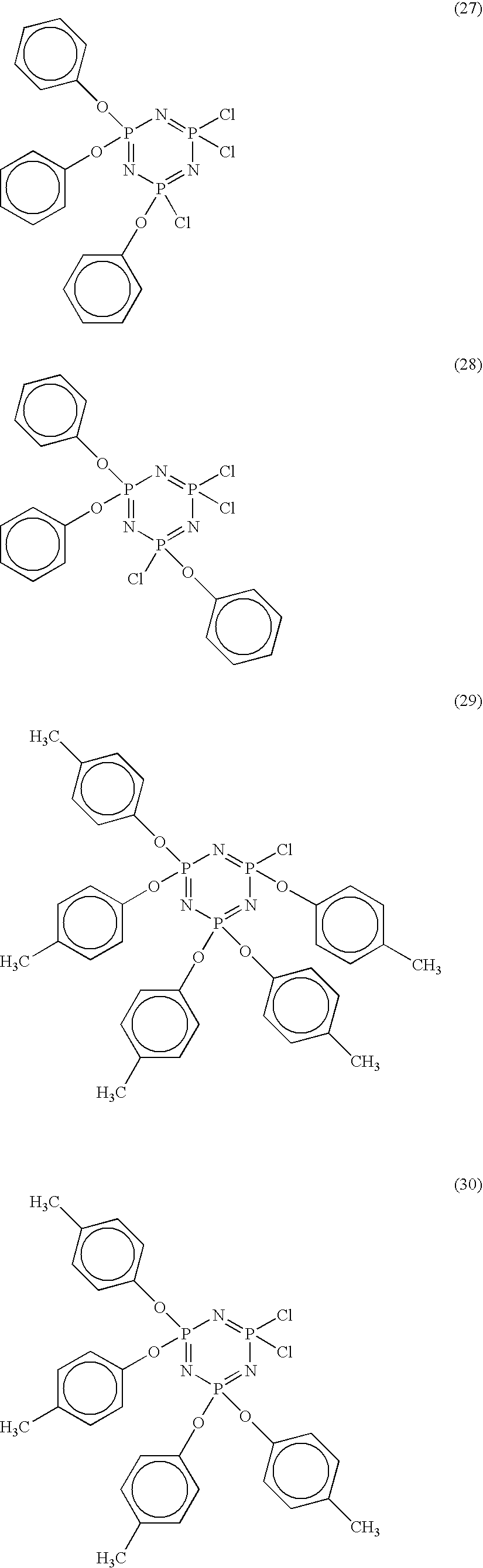
The cyclic phosphazenes of general formula (1) include the following compounds. For example, in a case where m is 3,
Figure US07317046-20080108-C00014
Figure US07317046-20080108-C00015
Figure US07317046-20080108-C00016
Figure US07317046-20080108-C00017
Figure US07317046-20080108-C00018
Figure US07317046-20080108-C00019
Figure US07317046-20080108-C00020
Figure US07317046-20080108-C00021
In a case where m is 4 or 5,
Figure US07317046-20080108-C00022
Figure US07317046-20080108-C00023
Figure US07317046-20080108-C00024
Figure US07317046-20080108-C00025
In the crystallization of phosphazenes in the present invention, commonly used dispersants or ion exchange resins may be added therein.
The dispersants include tetramethylammonium chloride, tetraethylammonium chloride, tetrabutylammonium bromide, tetrabutylammonium hydroxide, tetrabutylammonium hydrogen sulfate, tetralaurylmethylammonium chloride, di-hardened tallow alkyldimethylammonium acetate, trimethylphenylammonium chloride, benzyl trimethylammonium chloride, cetyl trimethylammonium chloride, stearyl trimethylammonium chloride, distearyl dimethylammonium chloride, etc.
The ion exchange resins include Amberlite IR-116, IR-118 (H), IR-120B, IR-122, IR-124 (trade name, Organo Corp.) and Amberlist 15, A-26, A-27, A-21, 252, 200C, 200CT, IRC-50, IRC-84, IRC-718, IRA401, IRA-402, IRA400 (trade name, Organo Corp.), etc.
The flame retardant of the present invention is expected to exert a further flame retardant effect by using a mixture of the above-mentioned phosphazenes or a mixture with other flame retardants.
The other flame retardants that may be added to the flame retardant of the present invention include metal hydroxides, silicates, organic silicon compounds, fluorine resins, inorganic flame retardants, phosphorus flame retardants, halogen flame retardants and nitrogen flame retardants, and they may be used in a mixture thereof.
The metal of the metal hydroxides that may be added to the flame retardant of the present invention includes metals belonging to Groups 2 and 13 of the periodic table (corresponding to Groups 2 and 13 among Groups 1 to 18 in new IUPAC format, that is Groups IIa and IIIb of the former periodic table) and zinc, and preferably magnesium and aluminum. These metal hydroxides may be used alone or ones covered with an organic compound, such as a higher aliphatic carboxylic acid, a hydrogenated oil or a salt of a higher aliphatic carboxylic acid in which metal belongs to Groups 1, 2, 12 or 13 of the periodic table (corresponding to Groups 1, 2, 12 or 13 among Groups 1 to 18 in new IUPAC format, that is Groups Ia, IIa, IIb or IIIb of the former periodic table). The metal hydroxides, particularly magnesium hydroxide are on the market in the name of KISUNA-5A, 5B, 5E or 5J (trade name, produced by Kyowa Chemical Industry Co., Ltd.), Magseeds N-3, N-1, Standard type 200, 10 or 10A, Starmag UM, M, L, S, C or CY (trade name, produced by Konoshima Chemical Co., Ltd.) or FR-200 (trade name, produced by Bromochem Far East Co.) and they may be used as such.
The silicates that may be added to the flame retardant of the present invention include, for example, sodium silicate, sodium metasilicate, sodium orthosilicate, water glass, magnesium silicate, potassium silicate, potassium magnesium silicate, calcium silicate, aluminum silicate, zirconium silicate, silicate-molybdate, forsterite or olivine, cyclic silicates, such as wollastonite or beryl, linear silicates, such as enstatite, lithium augite or hornblende, etc., layer silicates, such as mica or clay minerals, etc., three-dimensional silicates, such as silicon dioxide, orthoclase or zeolite, etc.
The organic silicon compounds that may be added to the flame retardant of the present invention includes, for example, alkoxy silanes, such as tetramethoxysilane, tetraethoxysilane, tetrapropoxysilane, trimethoxysilane, triethoxysilane, tripropoxysilane, methyltrimethoxysilane, methyltriethoxysilane, methyltripropoxysilane, phenyltrimethoxysilane, phenyltriethoxysilane, dimethoxymthylphenylsilane, dimethoxy-3-mercaptopropylmethylsilane, 3-mercaptopropyltrimethoxysilane, 3-aminopropyldiethoxymethylsilane, 3-(2-aminoethylaminopropyl)trimethoxysilane, 3-(2-aminoethyl-aminopropyl) dimethoxymethylsilane, 3-glysidopropyltrimethoxysilane, 3-methacryloxypropyltrimethoxysilane or diethoxy-3-glysidoxypropylmethylsilane, polysloxanes, such as dimethylpolysiloxane, methylhydrogenpolysiloxane or methylphenylpolysiloxane, alkyl, amino, epoxy, carboxyl, mercapto, alcohol, alkyl higher alcohol esters, polyethers, alkylaralkyl-polyether modified silicones.
The fluorine resins that may be added to the flame retardant of the present invention include, for example, polytetrafluoroethylene resin (PTFE), tetrafluoroethylene-hexafluoropropylene copolymer resin (FEP), tetrafluoroethylene-perfluoroalkylvinylether copolymer resin (PFA), tetrafluoroethylene-ethylene copolymer resin (ETFE), poly(chloro-trifluoro ethylene) (CTFE) or poly(vinylidene fluoride) (PVDF), etc.
The inorganic flame retardants that may be added to the flame retardant of the present invention include, for example, diantimony trioxide, diantimony tetraoxide, diantimony pentoxide, sodium antimonate, zinc borate, magnesium oxide or calcium oxide, etc.
The phosphorus flame retardants that may be added to the flame retardant of the present invention include, for example, red phosphorus, ammonium polyphosphate, triphenylphosphate, triethylphosphate, trimethylphosphate, tricresylphosphate, trixylenylphosphate, cresylphenylphosphate, tris(3-hydroxypropyl)phosphine oxide, glycidyl-α-methyl-β-dibutoxyphosphinyl propionate, dibutylhydroxymethylphosphonate, dibutoxyphosphinylpropylamide, dimethylmethylphosphonate, di(polyoxyethylene)hydroxymethylphosphonate or aromatic condensed phosphates, etc.
Red phosphorus may be used alone or one covered with an appropriate inorganic or organic compound, or one diluted with non-halogen organic polymer composition. They are on the market in the name of Nova Red 120, 120UF, 120UFA, Nova Excel ST, W, MG, RX series, several products under Nova Pallet (produced by Rinkagaku Kogyo Co., Ltd.), Hishi Guard CP, CP-15, UR-15, TP-10, Safe TP-10 (produced by Nippon Chemical Industrial), PR-120 (produced by Suzuhiro Chemical Co., Ltd.) and they may be used as such.
The halogen flame retardants that are optionally added to the flame retardant of the present invention include, for example, tris(chloroethyl)phosphate, tris(dichloropropyl)phosphate, bis(2,3-dibromopropyl)-2,3-dichloropropylphosphate, tris(2,3-dibromopropyl)phosphate, bis(chloropropyl)mono-octylphosphate, hexabromobenzene, hexabromobiphenylether, tribromophenol, tetrabromo bisphenol A, tetrabromo phthalic anhydride, hexabromocyclodecane, bis(bromoethylether) tetrabromo bisphenol A, ethylenebistetrabromophthalimide, brominated epoxy oligomer, brominated polystyrene, decabromodiphenylethane, brominated aromatic triazine, tetrabromoethane, octabromotrimethylphenylindane, polydibromophenylene oxide, pentabromobenzyl acrylate, pentabromobenzyl polyacrylate, bis(tribromophenoxy)ethane, dibromocresylglycidyl ether, dibromophenylglycidyl ether, tetrabromophthalate diol tetradibromophthalate ester, etc.
The nitrogen flame retardants that may be added to the flame retardant of the present invention include, for example, guanidine sulfamate, guanidine phosphate, guanyl urea phosphate, melamine phosphate, dimelamine phosphate, melamine borate, melamine cyanurate, and hindered amine flame retardants include TINUVIN 123, TINUVIN XT, TINUVIN NOR 371, Flamestab NOR 116, TINUVIN 770, TINUVIN 622, CHIMASSORB 944, CHIMASSORB 119, CHIMASSORB 2020, etc.
The flame retardant of the present invention may contain further, for example, commonly used additives, such as fillers, reinforcing agents for plastic, lubricants, etc.
The fillers that may be added to the flame retardant of the present invention include, for example, calcium carbonate, titanium oxide, clay, calcined clay, silane-treated clay, talc, mica, silica, wollastonite, bentonite, diatomaceous earth, silica sand, ground pumice, slate flour, alumina white, aluminum sulfate, barium sulfate, lithopone, calcium sulfate, molybdenum disulfide, surface treated filler, reclaimed rubber, rubber powder, ebonite powder, shellac, etc.
The reinforcing agents for plastic that may be added to the flame retardant of the present invention include, for example, mica powder, graphite, glass fiber, glass beads, volcanic glass hollow sphere, carbon fiber, carbon hollow body, smokeless charcoal powder, synthetic cryolite, silicone resin powder, silica spherical fine particle, polyvinyl alcohol fiber, aramid fiber, alumina fiber, high-strength polyacrylate fiber, etc.
The lubricants that may be added to the flame retardant of the present invention include, for example, paraffin wax, liquid paraffin, paraffin synthetic wax, polyethylene wax, composite wax, montan wax, silicone oil, stearic acid, lithium stearate, sodium stearate, magnesium stearate, potassium stearate, aluminum stearate, calcium stearate, zinc stearate, hydroxy stearic acid, magnesium 12-hydroxy stearate, calcium 12-hydroxy stearate, barium 12-hydroxy stearate, zinc 12-hydroxy stearate, calcium laurate, barium laurate or zinc laurate, or coconut oil, palm nucleus oil, herring oil, cod-liver oil, whale oil, palm oil, cottonseed oil, olive oil, peanut oil, soybean oil, linseed oil, castor oil and hardened oil that these oils are hydrogenated.
The resin composition of the present invention may contain further, for example, commonly used additives, such as antioxidants, light stabilizers or metal deactivators, or optionally several fillers or electrically-conductive powders, etc.
The antioxidants that may be added besides phosphazenes of the present invention include, for example, 2,6-di-tert-butyl-4-methylphenol, 2-tert-butyl-4,6-dimethylphenol, 2,6-di-tert-butyl-4-ethylphenol, 2,6-di-tert-butyl-4-n-butylphenol, 2,6-di-tertt-butyl-4-isobutylphenol, 2,6-dicyclopentyl-4-methylphenol, 2-(α-methylcyclohexyl)-4,6-dimethylphenol, 2,6-dioctadecyl-4-methylphenol, 2,4,6-tricyclohexylphenol, 2,6-dinonyl-4-methylphenol, 2,6-di-tert-butyl-4-methoxymethylphenol, 2,4-dimethyl-6-(1′-methyl-undeca-1′-yl)-phenol, 2,4-dimethyl-6-(1′-methyl-trideca-1′-yl)-phenol and a mixture thereof, 2,4-dioctylthiomethyl-6-tert-butylphenol, 2,4-dioctylthiomethyl-6-methylphenol, 2,4-dioctylthiomethyl-6-ethylphenol, 2,6-di-dodecylthiomethyl-4-nonylphenol and a mixture thereof, 2,6-di-tert-butyl-4-methoxyphenol, 2,5-di-tert-butylhydroquinone, 2,5-di-tert-amylhydroquinone, 2,6-diphenyl-4-octadecyloxyphenol, 2,6-di-tert-butylhydroquinone, 2,5-di-tert-butyl-4-hydroxyanisole, 3,5-di-tert-butyl-4-hydroxyanisole, 3,5-di-tert-butyl-4-hydroxyphenyl stearate, bis(3,5-di-tert-butyl-4-hydroxyphenyl)adipate and a mixture thereof, 2,4-bis-octylmercapto-6-(3,5-di-tert-butyl-4-hydroxyanilino)-1,3,5-triazine, 2-octylmercapto-4,6-bis(3,5-di-tert-butyl-4-hydroxyanilino)-1,3,5-triazine, 2-octylmercapto-4,6-bis(3,5-di-tert-butyl-4-hydroxyphenoxy)-1,3,5-triazine, 2,4,6-tris(3,5-di-tert-butyl-4-hydroxyphenoxy)-1,3,5triaziene, 1,3,5-tris(3,5di-tert-butyl-4-hydroxybenzyl)-isocyanurate, 1,3,5-tris(4-tert-butyl-3-hydroxy-2,6-dimethylbenzyl)-isocyanurate, 2,4,6-tris(3,5-di-tert-butyl-4-hydroxyphenylethyl)-1,3,5-triazine, 1,3,5-tris(3,5-di-tert-butyl-4-hydroxyphenylpropionyl)-hexahydro-1,3,5-triazine, 1,3,5-tris(3,5-dicyclohexyl-4-hydroxybenzyl)-isocyanurate, etc. and 2,2′-methylenebis(6-tert-butyl-4-methylphenol), 2,2′-methylenebis(6-tert-butyl-4-ethylphenol, 2,2′-ethylidenebis(4,6-di-tert-butylphenol), 2,2′-ethylidenebis(6-tert-butyl-4-isobutylphenol), 4,4′-methylenebis(2,6-di-tert-butylphenol), 4,4′-methylenebis(6-tert-butyl-2-methylphenol), 1,1-bis(5-tert-butyl-4-hydroxy-2-methylphenyl)butane, ethylene glycol bis[3,3′-bis(3′-tert-butyl-4′-hydroxyphenyl)butyrate], and 1,3,5-tris(3,5-di-tert-butyl-4-hydroxybenzyl)-2,4,6trimethylbenzene, 1,4-bis(3,5-di-tert-butyl-4-hydroxybenzyl)-2,3,5,6-tetramethylbenzene, 2,4,6-tris(3,5-di-tert-butyl-4-hydroxybenzyl)-phenol, and the like.
The light stabilizers that may be added besides phosphazenes of the present invention include, for example, 2-(2′-hydroxy-5′-methylphenyl)benzotriazole, 2-(3′,5′-di-tert-butyl-2-hydroxyphenyl)benzotriazole, 2-(5′-tert-butyl-2′-hydroxyphenyl) benzotriazole, 2-[2′-hydroxy-5′-(1,1,3,3-tetramethylbutyl)phenyl]benzotriazole, 2-(3′,5′-di-tert-butyl-2′-hydroxyphenol)-5-chlorobenzotriazole, 2-(3′-tert-butyl-2′-hydroxy-5′-methylphenyl)-5-chlorobenzotriazole, 2-(2′-hydroxy-4′-octoxyphenyl)benzotriazole, 2-(3′,5′-di-tert-amyl-2′-hydroxyphenyl)benzotriazole, 2-[3′-tert-butyl-2′-hydroxy-5′-(2′octyloxycarbonylethylphenyl)]-5-chlorobenzotriazole etc.; 4-hydroxy-, 4-methoxy-, 4-octoxy-, 4-decyloxy-, 4-dodecyloxy-, 4-benzyloxy-, 4,2′,4′-trihydroxy-, 2′-hydroxy-4,4′-dimethoxy- or 4-(2-ethylhexyloxy)-2-hydroxybenzophenone derivative, etc.; 4-tert-butylphenyl salicylate, phenyl salicylate, octylphenyl salicylate, dibenzoyl resorcinol, bis(4-tert-butylbenzoyl resorcinol), 2,4-di-tert-butylphenyl resorcinol, 3,5-di-tert-butyl-4-hydroxy benzoate, hexadecyl-3,5-di-tert-butyl-4-hydroxy benzoate, etc.; ethyl α-cyano-β,β-diphenyl acrylate, isooctyl α-cyano-β,β-diphenyl acrylate, methyl α-carbomethoxy cinnamate, methyl α-cyano-β-methyl-p-methoxy cinnamate, etc.; bis(2,2,6,6-tetramethyl-4-piperidyl)sebacate, bis(2,2,6,6-tetramethyl-4-piperidyl) saccinate, bis(1,2,2,6,6-pentamethyl-4-piperidyl)sebacate, bis(1-octyloxy-2,2,6,6-tetramethyl-4-piperidyl)sebacate, bis(1,2,2,6,6-pentamethyl-4-piperidyl)adipate, etc.; 4,4′-dioctyloxyoxanilide, 2,2′-diethoxyoxyoxanilide, 2,2′-dioctyloxy-5,5′-di-tert-butyloxanilide, 2,2′-didodecyloxy-5,5′-di-tert-butyloxanilide, 2-ethoxy-2′-ethyloxanilide, N,N′-bis(3-dimethylaminopropyl)oxanilide, 2-ethoxy-5-tert-butyl-2′-ethoxyoxanilide, etc.; 2,4,6-tris(2-hydroxy-4-octyloxyphenyl)-1,3,5-triazine, 2-(2-hydroxy-4-octyloxyphenyl)-4,6-bis(2,4dimethylphenyl)-1,3,5-triazine, 2-(2,4-dihydroxyphenyl)-4,6-bis(2,4-dimethylphenyl)-1,3,5-triazine, 2,4-bis(2-hydroxy-4-propyloxyphenyl)-6-(2,4-dimethylphenyl)-1,3,5-triazine, 2-(2-hydroxy-4-dodecyloxyphenyl)-4,6-bis(2,4-dimethylphenyl)-1,3,5-tiazine, etc.
The metal deactivators that may be added besides phosphazenes of the present invention include, for example, N,N′-diphenyloxalic acid diamide, N-salicylal-N′-salicyloylhydrazine, N,N′-bis(salicyloyl)hydrazine, N,N′-bis(3,5-di-tert-butyl-4-hydroxyphenylpropionyl)hydrazine, 3-salicyloylamino-1,2,3-triazole, bis(benzylidene)oxalic hydrazide, isophthalic dihydrazide, N,N′-diacetal-adipic dihydrazide, N,N′-bissalicyloyloxalic dihydrazide, N,N′-bissalicyloylthiopropionic dihydrazide, etc.
The resins constituting the resin composition containing the phosphazene compositions of the present invention include, for example, polyethylene, polypropylene, ethylene-propylene copolymer, polybutylene, polymethylpenten, ethylene-vinyl acetate copolymer, ethylene-methyl (ethyl) acrylate copolymer, AS resin, ABS resin, PC resin, PC-ABS alloy, polystyrene, PET, PC-PET alloy, polyphenylene ether resin, polyphenylene sulfide resin, polybutadiene resin, polybutylene terephthalate resin, methacrylic resin, polyamide resin, epoxy resin, diallylphthalate resin, silicone resin, unsaturated polyester, etc.
The resin composition of the present invention is used for producing several molded articles, and particularly useful as materials for producing coatings, in particular, fireproof protective coatings for wires, cables, electric components, mechanical components, plugs, mounts, casings, covers or housings.
BEST MODE FOR CARRYING OUT THE INVENTION
Hereinafter, the present invention is concretely described based on examples, however it should be understood that the invention is not necessarily limited thereto. In the meantime, “unit” in “unit mol” in the examples means PNCl2 and 1 unit mol corresponds to 115.87 g. Percentage (%) is by weight (% by weight) other than yield.
The quantity of halogen in obtained phosphazenes was analyzed by coulometric titration method. In the coulometric titration method, the content of halogen was determined by pyrolytically decomposing the resulting phosphazene, capturing in a absorbing liquid in a form of hydrogen halide and measuring electrical quantity required for obtaining silver halide by electrolysis of the halide and silver equivalent to halogen.
EXAMPLE 1
A 1-L flask was equipped with a stirrer, thermometer, receiver of fractional distillation for measurement of moisture content and reflux condenser. The flask was charged with 87.5 g (1.05 mol) of 48% NaOH, 220 mL of toluene and 98.8 g (1.05 mol) of phenol. The mixture was subjected to azeotropic dehydration by heating with stirring (recovered water: 64 mL) to remove moisture in the flask, and then Na (sodium) salt of phenol was formed. Then, the mixture was cooled to 80° C., 25.0 g (0.342 mol) of N,N-dimethylformamide was added and a toluene solution of hexachlorophosphazene (58.0 g (0.16 mol) of compound of general formula (3) wherein m is 3, and 275 mL of toluene) was added dropwise at 80° C. with stirring for 2 hours, and stirred and reacted at the same temperature for 10 hours. After the reaction was completed, 200 mL of water was added into the flask to dissolve inorganic salt, and then the organic layer was separated with a separatory funnel. The organic layer was neutralized and washed with water, and toluene was recovered at atmospheric pressure to 130° C. (in this case remaining toluene was 54 mL). The mixture was cooled to 60° C., and after adding 100 mL of methanol cooled gradually to 5° C., and separated crystals were filtered to obtain 107.7 g of hexaphosphazenes being the aimed compounds. The obtained hexaphosphazenes were analyzed in the purity with HPLC and confirmed that they were composed of 100.00% by weight of hexaphenoxyphosphazene and 0.00% by weight of linear phenoxyphosphazene.
COMPARATIVE EXAMPLE 1
The reaction was carried out similarly to Example 1. After the reaction was completed, 200 mL of water was added into the flask to dissolve inorganic salt, and then the organic layer was separated with a separatory funnel. The organic layer was neutralized with 75% sulfuric acid, washed with water, and toluene was distillated off to obtain 113.4 g of hexaphenoxyphosphazenes as pale yellow crystals. The obtained hexaphenoxyphosphazenes were analyzed in the purity with HPLC and confirmed that they were composed of 94.44% by weight of hexaphenoxyphosphazene and 5.56% by weight of linear phenoxyphosphazene. In addition, the chlorine analysis of the resulting phenoxyphosphazene composition by coulometric titration method indicated that the halogen content thereof was 60 ppm.
This Comparative Example 1 shows that the conventional method in which a cyclic raw material wherein m is 3 and Q is a halogen in general formula (1) is used provides also linear phenoxyphosphazenes.
COMPARATIVE EXAMPLE 2
The reaction was carried out in similar conditions as Comparative Example 1. The organic layer was neutralized and washed with water, and toluene was recovered at atmospheric pressure to 130° C. The reaction mixture was cooled to 60° C., and after adding 100 mL of methanol cooled gradually to 5° C., and separated crystals were filtered to obtain 107.7 g of hexaphosphazenes being the aimed compounds. The halogen content of the resulting phosphazenes was 60 ppm.
COMPARATIVE EXAMPLE 3
Tetrahydrofuran and 42.0 g (1.05 mol) of 60% NaH were added in a flask equipped with a stirrer, reflux condenser, thermometer and an addition funnel. A solution of 98.8 g (1.05 mol) of phenol diluted with 180 mL of tetrahydrofuran was added dropwise through the addition funnel. After the conclusion of the dropwise addition, the mixture was heated and stirred at 40° C. for 30 minutes. Then, the temperature was returned to a room temperature. The tetrahydrofuran solution of the resulting Na salt of phenol was subjected to the next reaction at once. To a 1-L flask equipped with a stirrer, reflux condenser, thermometer and an addition funnel, 600 mL of tetrahydrofuran and 58.0 g (0.167 mol) of hexachlorophosphazene (compound of general formula (3) wherein m is 3) were added and stirred at a room temperature. After hexachlorophosphazene was completely dissolved, the tetrahydrofuran solution of Na salt of phenol was gradually added dropwise through the addition funnel. After the conclusion of the dropwise addition, the reaction mixture was stirred for 24 hours. After the reaction was completed, the mixture was cooled and insoluble material was filtered out. The filtrate was condensed, and crystallized from water/acetone to obtain 107.7 g of hexaphenoxyphosphazenes. The halogen content of the obtained phosphazenes were 5760 ppm.
EXAMPLE 2
A 1-L flask was equipped with a stirrer, thermometer, receiver of fractional distillation for measurement of moisture content and reflux condenser. The flask was charged with 87.5 g (1.05 mol) of 48% NaOH, 220 mL of toluene and 98.8 g (1.05 mol) of phenol. The mixture was subjected to azeotropic dehydration by heating with stirring (recovered water: 64 mL) to remove moisture in the flask, and then Na (sodium) salt of phenol was formed. Then, the mixture was cooled to 80° C., 25.0 g (0.342 mol) of N,N-dimethylformamide was added and a toluene solution of chlorophosphazene mixture (to 275 mL of toluene was dissolved 58.0 g (0.5 unit mol) of a chlorophosphazene mixture comprising 60.8% compound of general formula (3) wherein m is 3; 21.2% compound of general formula (3) wherein m is 4; 6.2% compound of general formula (3) wherein m is 5 or more; and 11.8% linear phosphazenes of general formula (4)) was added dropwise at 80° C. with stirring for 2 hours, and stirred and reacted at the same temperature for 10 hours. After the conclusion of the reaction, 200 mL of water was added into the flask to dissolve inorganic salt, and then the organic layer was separated with a separatory funnel. The organic layer was neutralized with 75% sulfuric acid and washed with water, and toluene was distilled off to obtain 112.9 g of phenoxyphosphazene mixture in a form of brown wax. A 1-L flask equipped with a stirrer, thermometer and condenser was charged with 112.9 g of the obtained phenoxyphosphazene mixture, 50 mL of toluene and 200 mL of methanol, the temperature was raised to 65° C., and insoluble materials were filtered off under heating. The obtained filtrate was crystallized by cooling gradually to 5° C. to obtain 95.8 g of cyclic phenoxyphosphazenes. The obtained phenoxyphosphazenes were analyzed in the purity with HPLC and confirmed that they were composed of 72.38% by weight of hexaphenoxyphosphazene, 24.51% by weight of octaphenoxyphosphazenes, 3.10% by weight of phenoxyphosphazenes of m=5 or more and 0.01% by weight of linear phenoxyphosphazene. Further, the chlorine analysis of the resulting phenoxyphosphazenene composition by coulometric titration method indicated that the halogen content thereof was 5 ppm.
EXAMPLE 3
Chlorophosphazene mixture (55.4% compound of general formula (3) wherein m is 3; 14.6% compound of general formula (3) wherein m is 4; 8.2% compound of general formula (3) wherein m is 5 or more; and 21.8% linear phosphazenes of general formula (4)) was used instead of chlorophosphazene mixture (60.8% compound of general formula (3) wherein m is 3; 21.2% compound of general formula (3) wherein m is 4; 6.2% compound of general formula (3) wherein m is 5 or more; and 11.8% linear phosphazenes of general formula (4)) in Example 2, and reacted under similar conditions as those in Example 2. As a result of it, 84.1 g of cyclic phenoxyphosphazenes. The obtained phosphazenes were analyzed in the purity with HPLC and confirmed that they were composed of 74.03% by weight of hexaphenoxyphosphazene, 19.04% by weight of octaphenoxyphosphazenes, 6.89% by weight of phenoxyphosphazenes of m=5 or more and 0.04% by weight of linear phenoxyphosphazene. Further, the chlorine analysis of the resulting phenoxyphosphazenene composition by coulometric titration method indicated that the halogen content thereof was 3 ppm.
EXAMPLE 4
Chlorophosphazene mixture (74.7% compound of general formula (3) wherein m is 3; 9.9% compound of general formula (3) wherein m is 4; 11.8% compound of general formula (3) wherein m is 5 or more; and 2.6% linear phosphazenes of general formula (4)) was used instead of chlorophosphazene mixture (60.8% compound of general formula (3) wherein m is 3; 21.2% compound of general formula (3) wherein m is 4; 6.2% compound of general formula (3) wherein m is 5 or more; and 11.8% linear phosphazenes of general formula (4)) in Example 2, and reacted under similar conditions as those in Example 2. As a result of it, 108.6 g of cyclic phenoxyphosphazenes. The obtained phosphazenes were analyzed in the purity with HPLC and confirmed that they were composed of 81.30% by weight of hexaphenoxyphosphazene, 10.47% by weight of octaphenoxyphosphazenes, 8.23% by weight of phenoxyphosphazenes of m=5 or more and 0.00% by weight of linear phenoxyphosphazene. Further, the chlorine analysis of the resulting phenoxyphosphazenene composition by coulometric titration method indicated that the halogen content thereof was 10 ppm.
EXAMPLE 5
113.5 g of p-cresol was used instead of 98.8 g of phenol in Example 2, and reacted under similar conditions as those in Example 2. As a result of it, 105.8 g of cyclic p-tolyloxyphosphazene composition. The obtained phosphazenes were analyzed in the purity with HPLC and confirmed that they were composed of 73.44% by weight of hexa p-tolyloxyphosphazene, 22.98% by weight of octa p-tolyloxyphosphazenes, 3.57% by weight of p-tolyloxyphosphazenes of m=5 or more and 0.01% by weight of linear p-tolyloxyphosphazene. Further, the chlorine analysis of the obtained p-tolyloxyphosphazene composition by coulometric titration method indicated that the halogen content thereof was 8 ppm.
EXAMPLE 6
A mixer was charged with 10.0% by weight of the cyclic phenoxyphosphazenes obtained in Example 1 and 90.0% by weight of polypropylene as a polyolefin resin, and kneaded at 180° C. to obtain a mixture. The obtained mixture was formed into a sheet with a compression molding press (185° C., 3 minutes), and the obtained sheet was subjected to an assessment of flame retardance. The results are shown in Table 1.
EXAMPLES 7 TO 10
Phosphazene compositions obtained in Examples 2 to 5 were used instead of the phenoxyphosphazene obtained in Example 1, and subjected to an assessment of flame retardance in a similar manner as that in Example 6. The results are shown in Table 1.
COMPARATIVE EXAMPLE 4
The phosphazene composition obtained in Comparative Example 1 was used instead of the phenoxyphosphazene obtained in Example 1, and subjected to an assessment of flame retardance in a similar manner as that in Example 6. The results are shown in Table 1.
TABLE 1
The results of assessment of flame retardance
Oxygen Index
Example 6 26.5
Example 7 26.1
Example 8 25.8
Example 9 26.3
Example 10 25.7
Comparative Example 4 22.3
The oxygen index means the minimum oxygen concentration (% by volume) to support combustion of a material. For example, a sample having an oxygen index of 25.0 behaves as follows: it burns on an ignition in an atmosphere having an oxygen concentration of 25.0% or more, and self-extinguishes in an atmosphere having an oxygen concentration of 25.0% or less (hereinafter this is applied similarly). Taking into account what oxygen concentration of the atmosphere is ca. 20.9%, materials having oxygen index over 20.9 self-extinguish under natural surroundings, and therefore are high in flame retardant effect.
EXAMPLE 11
A mixer was charged with 3.2% by weight of the cyclic phenoxyphosphazenes obtained in Example 2, 32.3% by weight of magnesium hydroxide and 64.5% by weight of polypropylene as a polyolefin resin, and kneaded at 180° C. to obtain a mixture. The obtained mixture was formed into a sheet with a compression molding press (185° C., 3 minutes), and the obtained sheet was subjected to an assessment of flame retardance. The results are shown in Table 2.
EXAMPLES 12 TO 14
Phosphazene compositions obtained in Examples 2 to 5 were used instead of the phenoxyphosphazene obtained in Example 2, and subjected to an assessment of flame retardance in a similar manner as that in Example 11. The results are shown in Table 2.
COMPARATIVE EXAMPLE 5
Only magnesium hydroxide was added without adding phosphazenes obtained in Example 2, and subjected to an assessment of flame retardance in a similar manner as that in Example 11. The results are shown in Table 2.
TABLE 2
The results of assessment of flame retardance
Oxygen Index
Example 11 30.4
Example 12 30.3
Example 13 30.4
Example 14 30.2
Comparative Example 5 23.0
EXAMPLE 15
A mixer was charged with 3.2% by weight of the cyclic phenoxyphosphazene obtained in Example 2 (Sample A) or 3.2% by weight of the cyclic phenoxyphosphazene obtained in Comparative Example 1 (Sample B) in addition to 32.3% by weight of magnesium hydroxide and 64.5% by weight of polyolefin, and sheets were formed therefrom in a similar manner as that in Example 11 to produce test pieces. The produced test pieces were subjected to combustion under the following test conditions under which dioxin tends to be produced, and the amount of dioxin in waste gas was measured (based on JIS K 0311). The results are shown in Table 3.
Test Condition
Furnace in which examples were conducted: Horizontal tube furnace;
Heating rate:  5° C./min.;
Maximum temperature: 900° C.
Time required: 180 min.;
Time maintained at 900° C.:  60 min.;
Supplied gas: Air (1.17 L/min.);
Amount to be tested: 5.73 g; and
Amount of waste gas: 150.5 NL.
TABLE 3
Generated amount of dioxins
Total PCDDs Total PCDDs
Toxicity Equivalent Toxicity Equivalent
Quotient (TEQ) ng/g-dry Quotient (TEQ) ng/g-dry
Sample A less than 0.001 less than 0.001
(out of detection limit) (out of detection limit)
Sample B 0.132 0.156
The analysis of dioxins generated in the combustion of Sample A indicated that 2,3,7,8-tetrachlorodibenzo-p-dioxin (2,3,7,8-TeCDD), 1,2,3,7,8-pentachlorodibenzo-p-dioxin (1,2,3,7,8-PeCDD) and 2,3,4,7,8-pentachlorodibenzofuran (2,3,4,7,8-PeCDF) that have a strong toxicity were less than the detection lower limit. On the contrary, the analysis of dioxins generated in the combustion of Sample B indicated that 2,3,7,8-tetrachlorodibenzo-p-dioxin (2,3,7,8-TeCDD), 1,2,3,7,8-pentachlorodibenzo-p-dioxin (1,2,3,7,8-PeCDD) and 2,3,4,7,8-pentachlorodibenzofuran (2,3,4,7,8-PeCDF) that have a strong toxicity were present in amounts of 0.009 ng/g-dry, 0.069 ng/g-dry and 0.10 ng/g-dry, respectively, and that total PCDDs toxicity equivalent quotient (ng/g-dry) and total PCDFs toxicity equivalent quotient (ng/g-dry) were values shown in Table 3.
Consequently, the phenoxyphosphazenes of the present invention can be said to be flame retardants good for the environment because they generate a slight amounts of dioxins even combustion condition under which dioxins tend to be generated. In the table, toxicity equivalent quotient (TEQ) is 2,3,7,8-tetrachlorodibenzo-p-dioxin (2,3,7,8-TeCDD) toxicity equivalent quotient and means the value determined by converting the amount of generated dioxins to 2,3,7,8-TeCDD toxicity. In addition, PCDDs and PCDFs mean polychlorodibenzo-p-dioxines and polychlorodibenzofurans, respectively, and both of them belong to dioxins.
EFFECT OF THE INVENTION
The effects of the present invention are as follows:
  • (1) The present invention can provide cyclic phosphazenes having a halogen content of as low as 50 ppm or less, that is being substantially free from halogen although halogen containing compounds are used as a raw material. Therefore, resins containing the phosphazenes as a flame retardant do not generate dioxins even when they are subjected to combustion.
  • (2) The present invention can provide cyclic phosphazenes with a high purity, the linear phosphazenes content of which is 5.0% by weight or less, preferably 1.0% by weight, particularly preferably 0.1% by weight, without repeated purification.
  • (3) When the flame retardants containing cyclic phosphazenes of the present invention is compared with those containing linear phosphazenes in an amount of 5.0% by weight or more, the former is by far excellent in flameproof effect.

Claims (10)

1. A flame retardant containing a composition as an active ingredient, the composition comprising:
cyclic phosphazenes of general formula (1)
Figure US07317046-20080108-C00026
wherein Q is a halogen and/or an aryloxy group, and m is an integer of 3 to 10, which are characterized by being substantially free from linear phosphazenes of general formula (2)
Figure US07317046-20080108-C00027
wherein Q is a halogen and/or an aryloxy group, and n is an integer of 1 to 20.
2. A flame retardant containing a composition as an active ingredient, the composition comprising:
cyclic phosphazenes of general formula (1)
Figure US07317046-20080108-C00028
wherein Q is a halogen and/or an aryloxy group, and m is an integer of 3 to 10, which are produced by separating and purifying a phosphazene composition comprising the cyclic phosphazenes of general formula (1) and linear phosphazenes of general formula (2)
Figure US07317046-20080108-C00029
wherein Q is a halogen and/or an aryloxy group, and n is an integer of 1 to 20.
3. The flame retardant according to claim 1, wherein Q in general formula (1) is an aryloxy and the cyclic phosphazenes are substantially free from halogen.
4. The flame retardant according to claim 3, wherein a content of the halogen is 50 ppm or less.
5. A process for preparing the flame retardant containing the composition comprising the cyclic phosphazenes according to claim 1, characterized by separating and purifying cyclic phosphazenes of general formula (1)
Figure US07317046-20080108-C00030
wherein Q is a halogen and/or an aryloxy group, and m is an integer of 3 to 10, by crystallization from a phosphazene composition comprising the cyclic phosphazenes of general formula (1) and linear phosphazenes of general formula (2)
Figure US07317046-20080108-C00031
wherein Q is a halogen and/or an aryloxy group, and n is an integer of 1 to 20.
6. A process for preparing the flame retardant containing the composition comprising the cyclic phosphazenes according to claim 3, characterized by separating and purifying cyclic phosphazenes of general formula (1)
Figure US07317046-20080108-C00032
wherein Q is a halogen and/or an aryloxy group, and m is an integer of 3 to 10, by crystallization from a phosphazene composition comprising the cyclic phosphazenes of general formula (1) and linear phosphazenes of general formula (2)
Figure US07317046-20080108-C00033
wherein Q is a halogen and/or an aryloxy, and n is an integer of 1 to 20.
7. A resin composition characterized by containing the flame retardant according to claim 1.
8. A molded article characterized by being molded from the resin composition according to claim 7.
9. The flame retardant according to claim 1, prepared by crystallizing a mixture of cyclic and linear aryloxyphosphazenes in a solvent containing aromatic non-polar solvent.
10. The process according to claim 5, wherein the crystallization is carried out in a solvent containing aromatic non-polar solvent.
US10/479,235 2001-06-05 2002-06-05 Cyclic phosphazenes, process for preparing them, flame retardant containing them as active ingredient, and resin composition containing them and molded article therefrom Expired - Fee Related US7317046B2 (en)

Applications Claiming Priority (5)

Application Number Priority Date Filing Date Title
JP2001170319A JP2002363194A (en) 2001-06-05 2001-06-05 Cyclic phosphazenes, method for producing the same, flame retardant containing the same as an active ingredient, resin composition containing the same, and molded article
JP2001170228A JP2002363193A (en) 2001-06-05 2001-06-05 Cyclic phosphazenes, method for producing the same, flame retardant containing the same as an active ingredient, resin composition containing the same, and molded article
JP2001-170228 2001-06-05
JP2001-170319 2001-06-05
PCT/JP2002/005554 WO2002098886A1 (en) 2001-06-05 2002-06-05 Cyclic phosphazenes, process for preparing them, flame retardants containing the same as the active ingredient, and resin compositions and molded articles containing the flame retardants

Publications (2)

Publication Number Publication Date
US20040152910A1 US20040152910A1 (en) 2004-08-05
US7317046B2 true US7317046B2 (en) 2008-01-08

Family

ID=26616399

Family Applications (1)

Application Number Title Priority Date Filing Date
US10/479,235 Expired - Fee Related US7317046B2 (en) 2001-06-05 2002-06-05 Cyclic phosphazenes, process for preparing them, flame retardant containing them as active ingredient, and resin composition containing them and molded article therefrom

Country Status (3)

Country Link
US (1) US7317046B2 (en)
EP (1) EP1403273A4 (en)
WO (1) WO2002098886A1 (en)

Cited By (4)

* Cited by examiner, † Cited by third party
Publication number Priority date Publication date Assignee Title
US20080182931A1 (en) * 2004-07-03 2008-07-31 Waters Investments Limited Performance Enhancement in the Stabilization of Organic Materials
US20100025084A1 (en) * 2006-12-01 2010-02-04 Kyocera Chemical Corporation Photosensitive thermosetting resin composition and flexible printed circuit board
US8841367B2 (en) 2012-05-24 2014-09-23 Sabic Innovative Plastics Ip B.V. Flame retardant polycarbonate compositions, methods of manufacture thereof and articles comprising the same
US9023922B2 (en) 2012-05-24 2015-05-05 Sabic Global Technologies B.V. Flame retardant compositions, articles comprising the same and methods of manufacture thereof

Families Citing this family (16)

* Cited by examiner, † Cited by third party
Publication number Priority date Publication date Assignee Title
TW200540216A (en) 2004-01-16 2005-12-16 Otsuka Chemical Co Ltd Flame retardant agent and flame retardant resin composition
KR100609812B1 (en) * 2004-11-13 2006-08-08 노만균 Polymer Air Purifier Composition
EP2144980B8 (en) * 2007-03-06 2013-03-27 Vanderbilt Chemicals, LLC Lubricant antioxidant compositions containing a metal compound and a hindered amine
US8592628B2 (en) * 2010-06-03 2013-11-26 Battelle Energy Alliance, Llc Phosphazene additives
US9394439B2 (en) * 2012-03-29 2016-07-19 Mitsubishi Gas Chemical Company, Inc. Resin composition, prepreg, resin sheet, and metal foil-clad laminate
AU2015382306B2 (en) * 2015-02-10 2021-01-28 Prysmian S.P.A. Fire resistant cable
KR20250005542A (en) 2015-10-26 2025-01-09 오티아이 루미오닉스 인크. Method for patterning a coating on a surface and device including a patterned coating
ES2796335T3 (en) 2016-01-26 2020-11-26 Prysmian Spa Fire resistant cable system
JP7054840B2 (en) * 2017-08-31 2022-04-15 パナソニックIpマネジメント株式会社 Polyphenylene ether resin composition, and prepregs, metal-clad laminates, and wiring boards using it.
US11751415B2 (en) 2018-02-02 2023-09-05 Oti Lumionics Inc. Materials for forming a nucleation-inhibiting coating and devices incorporating same
CN112752797B (en) 2018-09-26 2022-12-27 帝人株式会社 Flame-retardant polycarbonate resin composition
CN116456753A (en) 2019-03-07 2023-07-18 Oti照明公司 Optoelectronic device
EP3719047A1 (en) * 2019-04-05 2020-10-07 Covestro Deutschland AG Method for the preparation of flame-resistant pur/pir foams
WO2020212953A1 (en) 2019-04-18 2020-10-22 Oti Lumionics Inc. Materials for forming a nucleation-inhibiting coating and devices incorporating the same
JP7576337B2 (en) 2019-05-08 2024-11-01 オーティーアイ ルミオニクス インコーポレーテッド Materials for forming nucleation-inhibiting coatings and devices incorporating same - Patents.com
WO2022123431A1 (en) 2020-12-07 2022-06-16 Oti Lumionics Inc. Patterning a conductive deposited layer using a nucleation inhibiting coating and an underlying metallic coating

Citations (2)

* Cited by examiner, † Cited by third party
Publication number Priority date Publication date Assignee Title
US5652285A (en) * 1994-10-07 1997-07-29 Minnesota Mining And Manufacturing Company Flame retardant thermosettable resin compositions
JPH11263885A (en) * 1998-03-17 1999-09-28 Chemiprokasei Kaisha Ltd Flame-retardant polyolefin resin composition and molded article comprising the same

Family Cites Families (4)

* Cited by examiner, † Cited by third party
Publication number Priority date Publication date Assignee Title
JPS55136105A (en) * 1979-04-07 1980-10-23 Otsuka Chem Co Ltd Production of cyclic phosphazene oligomer
JPS58219190A (en) * 1982-06-15 1983-12-20 Otsuka Chem Co Ltd Phosphonitrilic esters and its preparation
DE3766959D1 (en) * 1987-05-18 1991-02-07 Ethyl Corp HYDRAULIC LIQUIDS.
JP2001002691A (en) * 1999-06-18 2001-01-09 Chemiprokasei Kaisha Ltd Method for producing cyclic phosphazenes

Patent Citations (2)

* Cited by examiner, † Cited by third party
Publication number Priority date Publication date Assignee Title
US5652285A (en) * 1994-10-07 1997-07-29 Minnesota Mining And Manufacturing Company Flame retardant thermosettable resin compositions
JPH11263885A (en) * 1998-03-17 1999-09-28 Chemiprokasei Kaisha Ltd Flame-retardant polyolefin resin composition and molded article comprising the same

Non-Patent Citations (1)

* Cited by examiner, † Cited by third party
Title
Fukuoka et al. 1999, CAS: 131:244114. *

Cited By (11)

* Cited by examiner, † Cited by third party
Publication number Priority date Publication date Assignee Title
US20080182931A1 (en) * 2004-07-03 2008-07-31 Waters Investments Limited Performance Enhancement in the Stabilization of Organic Materials
US7691922B2 (en) * 2004-07-03 2010-04-06 U.S. Borax Inc. Performance enhancement in the stabilization of organic materials
US20100025084A1 (en) * 2006-12-01 2010-02-04 Kyocera Chemical Corporation Photosensitive thermosetting resin composition and flexible printed circuit board
US8206832B2 (en) * 2006-12-01 2012-06-26 Kyocera Chemical Corporation Photosensitive thermosetting resin composition and flexible printed circuit board
US8841367B2 (en) 2012-05-24 2014-09-23 Sabic Innovative Plastics Ip B.V. Flame retardant polycarbonate compositions, methods of manufacture thereof and articles comprising the same
US8895649B2 (en) 2012-05-24 2014-11-25 Sabic Global Technologies B.V. Flame retardant polycarbonate compositions, methods of manufacture thereof and articles comprising the same
US8927661B2 (en) 2012-05-24 2015-01-06 Sabic Global Technologies B.V. Flame retardant polycarbonate compositions, methods of manufacture thereof and articles comprising the same
US9018286B2 (en) 2012-05-24 2015-04-28 Sabic Global Technologies B.V. Flame retardant polycarbonate compositions, methods of manufacture thereof and articles comprising the same
US9023923B2 (en) 2012-05-24 2015-05-05 Sabic Global Technologies B.V. Flame retardant polycarbonate compositions, methods of manufacture thereof and articles comprising the same
US9023922B2 (en) 2012-05-24 2015-05-05 Sabic Global Technologies B.V. Flame retardant compositions, articles comprising the same and methods of manufacture thereof
US9394483B2 (en) 2012-05-24 2016-07-19 Sabic Global Technologies B.V. Flame retardant polycarbonate compositions, methods of manufacture thereof and articles comprising the same

Also Published As

Publication number Publication date
EP1403273A1 (en) 2004-03-31
US20040152910A1 (en) 2004-08-05
EP1403273A4 (en) 2006-05-17
WO2002098886A1 (en) 2002-12-12

Similar Documents

Publication Publication Date Title
US7317046B2 (en) Cyclic phosphazenes, process for preparing them, flame retardant containing them as active ingredient, and resin composition containing them and molded article therefrom
US7947770B2 (en) Flame retardant polycarbonate compositions
KR100455050B1 (en) Cross-linked Phenoxyphosphazene Compound, Process for Producing the Same, Flame Retardant, Flame-Retardant Resin Composition, and Molded Flame-Retardant Resin
KR101416843B1 (en) Oligomeric bis-phosphate flame retardants and compositions containing the same
JP5916160B2 (en) Method for producing epoxy compound composition
JP5700789B2 (en) Phosphorus flame retardant composition, flame retardant resin composition containing the same, and molded article
KR20100118374A (en) Flame retarding polyester resin composition
CN101627079A (en) Flame retardant polycarbonate compositions
CN1275975C (en) Process for preparation of phosphoric esters
JP4732647B2 (en) Flame retardant resin composition
JP2004051697A (en) Flame retardant and polymer composition containing the same
JPH07292050A (en) Phophorus-containing novolak phenol resin and flame-retardant resin composition
JP2002363194A (en) Cyclic phosphazenes, method for producing the same, flame retardant containing the same as an active ingredient, resin composition containing the same, and molded article
JP4309518B2 (en) Flame retardant resin composition
JP2004018475A (en) Cyclic phosphazene compound, phosphazene composition, method for producing the same, flame retardant containing the same as an active ingredient, and molded article containing the same
JP2002322478A (en) Flame retardant, flame-retardant resin composition containing the same, and molded article
JP2003020399A (en) Flame-retardant polyphenylene ether resin composition
JP2002363193A (en) Cyclic phosphazenes, method for producing the same, flame retardant containing the same as an active ingredient, resin composition containing the same, and molded article
JP3193029B2 (en) Flame retardant for resin and flame retardant resin composition
JP2002053865A (en) Flame retardant resin composition
KR20120078474A (en) Flame resistant polyester resins composition
JP2002322188A (en) Phosphazene composition, flame retardant containing the same and method for producing the same
JP2004043339A (en) Phosphazene compound, production method therefor and use thereof
JPH05209086A (en) Flame-retardant thermoplastic resin composition
JP2024146771A (en) Resin composition, molded product

Legal Events

Date Code Title Description
AS Assignment

Owner name: CHEMIPRO KASEI KAISHA, LIMITED, JAPAN

Free format text: ASSIGNMENT OF ASSIGNORS INTEREST;ASSIGNORS:FUKUOKA, NAOHIKO;YASUDA, HEINOSUKE;NISHIMATSU, MASAYUKI;AND OTHERS;REEL/FRAME:015249/0173

Effective date: 20031125

FEPP Fee payment procedure

Free format text: PAT HOLDER CLAIMS SMALL ENTITY STATUS, ENTITY STATUS SET TO SMALL (ORIGINAL EVENT CODE: LTOS); ENTITY STATUS OF PATENT OWNER: SMALL ENTITY

FPAY Fee payment

Year of fee payment: 4

REMI Maintenance fee reminder mailed
LAPS Lapse for failure to pay maintenance fees
STCH Information on status: patent discontinuation

Free format text: PATENT EXPIRED DUE TO NONPAYMENT OF MAINTENANCE FEES UNDER 37 CFR 1.362

STCH Information on status: patent discontinuation

Free format text: PATENT EXPIRED DUE TO NONPAYMENT OF MAINTENANCE FEES UNDER 37 CFR 1.362

FP Lapsed due to failure to pay maintenance fee

Effective date: 20160108