US7312976B2 - Heterogeneous electrochemical supercapacitor and method of manufacture - Google Patents
Heterogeneous electrochemical supercapacitor and method of manufacture Download PDFInfo
- Publication number
- US7312976B2 US7312976B2 US11/359,097 US35909706A US7312976B2 US 7312976 B2 US7312976 B2 US 7312976B2 US 35909706 A US35909706 A US 35909706A US 7312976 B2 US7312976 B2 US 7312976B2
- Authority
- US
- United States
- Prior art keywords
- negative electrode
- electrochemical capacitor
- positive
- heterogeneous electrochemical
- electrodes
- Prior art date
- Legal status (The legal status is an assumption and is not a legal conclusion. Google has not performed a legal analysis and makes no representation as to the accuracy of the status listed.)
- Expired - Fee Related, expires
Links
Images




Classifications
-
- H—ELECTRICITY
- H01—ELECTRIC ELEMENTS
- H01G—CAPACITORS; CAPACITORS, RECTIFIERS, DETECTORS, SWITCHING DEVICES, LIGHT-SENSITIVE OR TEMPERATURE-SENSITIVE DEVICES OF THE ELECTROLYTIC TYPE
- H01G11/00—Hybrid capacitors, i.e. capacitors having different positive and negative electrodes; Electric double-layer [EDL] capacitors; Processes for the manufacture thereof or of parts thereof
- H01G11/22—Electrodes
- H01G11/30—Electrodes characterised by their material
-
- H—ELECTRICITY
- H01—ELECTRIC ELEMENTS
- H01G—CAPACITORS; CAPACITORS, RECTIFIERS, DETECTORS, SWITCHING DEVICES, LIGHT-SENSITIVE OR TEMPERATURE-SENSITIVE DEVICES OF THE ELECTROLYTIC TYPE
- H01G11/00—Hybrid capacitors, i.e. capacitors having different positive and negative electrodes; Electric double-layer [EDL] capacitors; Processes for the manufacture thereof or of parts thereof
- H01G11/22—Electrodes
- H01G11/30—Electrodes characterised by their material
- H01G11/46—Metal oxides
-
- H—ELECTRICITY
- H01—ELECTRIC ELEMENTS
- H01G—CAPACITORS; CAPACITORS, RECTIFIERS, DETECTORS, SWITCHING DEVICES, LIGHT-SENSITIVE OR TEMPERATURE-SENSITIVE DEVICES OF THE ELECTROLYTIC TYPE
- H01G11/00—Hybrid capacitors, i.e. capacitors having different positive and negative electrodes; Electric double-layer [EDL] capacitors; Processes for the manufacture thereof or of parts thereof
- H01G11/54—Electrolytes
- H01G11/58—Liquid electrolytes
-
- Y—GENERAL TAGGING OF NEW TECHNOLOGICAL DEVELOPMENTS; GENERAL TAGGING OF CROSS-SECTIONAL TECHNOLOGIES SPANNING OVER SEVERAL SECTIONS OF THE IPC; TECHNICAL SUBJECTS COVERED BY FORMER USPC CROSS-REFERENCE ART COLLECTIONS [XRACs] AND DIGESTS
- Y02—TECHNOLOGIES OR APPLICATIONS FOR MITIGATION OR ADAPTATION AGAINST CLIMATE CHANGE
- Y02E—REDUCTION OF GREENHOUSE GAS [GHG] EMISSIONS, RELATED TO ENERGY GENERATION, TRANSMISSION OR DISTRIBUTION
- Y02E60/00—Enabling technologies; Technologies with a potential or indirect contribution to GHG emissions mitigation
- Y02E60/13—Energy storage using capacitors
Definitions
- the present invention relates to a heterogeneous electrochemical supercapacitor (HES), and to a method for manufacturing such a capacitor. More particularly, the present invention is directed to an improved HES.
- a HES of the present invention exhibits superior operating parameters in comparison to other electrochemical capacitors of known design.
- the energy associated with the polarizable electrode is potential energy and energy of the non-polarizable electrode is chemical energy, the nature of origin of electric charge and energy with respect to the electrodes differs and, hence, the proposed supercapacitor is considered to be heterogeneous.
- Such supercapacitors can efficiently store and redistribute a large amount of electrical energy.
- such capacitors may be used: as a main power supply; as a back-up power supply; for power quality assurance (i.e., to compensate for short-term power “surges”, “spikes”, and “skips” common to a utility-supplied source of electrical power); to provide load-leveling by storing an amount of electrical energy provided during off-peak hours and re-distributing said electrical energy during periods of peak demand; and as a primary or secondary power source for a variety of vehicles.
- power quality assurance i.e., to compensate for short-term power “surges”, “spikes”, and “skips” common to a utility-supplied source of electrical power
- to provide load-leveling by storing an amount of electrical energy provided during off-peak hours and re-distributing said electrical energy during periods of peak demand
- a primary or secondary power source for a variety of vehicles.
- a HES typically uses only lead and activated carbon as the primary components for manufacturing its electrodes.
- a HES is typically of double electric layer (DEL) design.
- DEL capacitor typically employs a pair of electrodes that are arranged in a spaced apart relationship, and between which resides an electrolyte.
- the electrolyte is generally aqueous in nature.
- a separator typically also resides in the space between the electrodes.
- One or both of the electrodes may store electrical energy through a double layer electrochemical mechanism.
- a layer of electrons forms at the electrode side of the electrode/electrolyte interface.
- a layer of positive ions also forms on the electrolyte side of the electrode/electrolyte interface. The voltage across the interface between the electrode and electrolyte increases with charge accumulation, and is eventually released during discharge of the capacitor.
- One or both of the electrodes of a DEL capacitor may generally be polarizable electrodes.
- a polarizable electrode may comprise, for example, an active material and a current collector to which the active material is affixed.
- the most commonly employed active material is likely one of a plurality of activated carbon materials.
- Activated carbon materials are inexpensive and have a high specific surface are per unit mass.
- Negative electrodes are typically formed from activated carbon materials in the form of an activated carbon powder and binder, or from woven or non-woven activated carbon fiber materials. However, preparation of DEL electrodes from an activated carbon powder is often preferable due to its lower cost.
- Positive electrodes may be formed from various conductive materials, particularly metals.
- one or both of the electrodes may be polarizable.
- constructing a DEL capacitor with one polarizable electrode and one non-polarizable electrode has been shown to provide the DEL capacitor with a specific energy capacity that is greater than that of a capacitor with two polarizable electrodes.
- charge storage at the non-polarizable electrode occurs as a result of oxidation and reduction reactions at the interface of the non-polarizable electrode and the electrolyte.
- Such an electrode is commonly said to exhibit Faradic pseudocapacitive behavior.
- the nonpolarizable electrode is typically comprised substantially of lead.
- At least the negative electrode of such a DEL capacitor is typically affixed by some means to a current collector.
- Current collectors are commonly constructed of a material that exhibits electrical conductivity—typically a metal.
- the electrolyte of a DEL capacitor may consist of an aqueous sulfuric acid. In such a case, certain precautions such as, for example, coating or otherwise protecting the portion of the current collector exposed to the electrolyte may need to be undertaken, as the sulfuric acid electrolyte may erode, or otherwise degrade the current collector material.
- electrochemical capacitors are currently known.
- cost both the cost to manufacture the capacitors, and the cost of storing energy therewith.
- known electrochemical capacitors generally employ materials such as aluminum, nickel, niobium, ruthenium, tantalum, titanium, and tungsten in their construction. These materials are considerably more expensive than the lead material typically used in a HES. Consequently, both the cost to manufacture and the cost to store energy using electrochemical capacitors of typical design can often be prohibitive.
- the HES of the present invention offers advantages over known electrochemical capacitor designs, including that of other HES'.
- the design and manufacture of a HES according to the present invention provides for an electrochemical capacitor of high discharge power.
- a HES of the present invention also exhibits high specific power characteristics, whether measured by weight or by volume.
- the method of manufacturing the HES allows for lower production costs and reduced assembly time.
- a HES of the present invention also has high cycling capacity (a long life cycle).
- a HES of the present invention is the result of at least several factors.
- An active material of higher efficiency than the active material used by typical electrochemical capacitors is also utilized in the construction of both the positive and negative electrodes of the HES of the present invention.
- a HES of the present invention further employs a separator with improved operating parameters.
- the negative electrode current collector is preferably manufactured from a material having a matching layer, which ensures high conductivity, high hydrogen gassing overpotential and high stability within a range of negative electrode operating voltages within the electrolyte environment of the HES.
- a HES of the present invention can have a higher discharge power and higher specific capacitance than typical electrochemical capacitors. Thus, a HES of the present invention can be effectively used as a means of significant electrical energy storage and power output.
- a HES of the present invention relies primarily on lead and activated carbon to form its electrodes. Consequently, a HES of the present invention is also a cost effective means of electrical energy storage.
- Other advantages of a HES of the present invention can be understood from a reading of the following detailed description thereof.
- FIG. 1 illustrates a side view, in cross-section, of one embodiment of a single-cell HES of the present invention
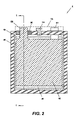
- FIG. 2 is a front view of the HES of FIG. 1 ;
- FIG. 3 depicts an exemplary embodiment of a negative electrode current collector with a matching layer that may be used in an HES of the present invention
- FIG. 4 is a block diagram illustrating one method of preparing a lead-based positive electrode for use in a HES of the present invention
- FIG. 5 is a graph illustrating the superior output characteristics of various positive electrode constructions of the present invention in comparison to a traditional positive electrode.
- FIG. 6 is a table detailing various output parameters of several exemplary HES designs according to the present invention.
- the HES 5 has a positive electrode 10 that resides between two negative electrodes 15 .
- Each negative electrode 15 comprises an active mass 20 having a current collector 25 affixed thereto.
- the positive electrode 10 is separated from the negative electrodes 15 by a separator 30 .
- the assembly 35 of the positive electrode 10 , negative electrodes 15 , and separator 30 is contained within a sealed case 40 .
- An electrolyte 45 is present within the case, and substantially surrounds the assembly 35 .
- each of the positive electrode 10 and the negative electrode current collector 25 are allowed to protrude through the case to form a positive terminal 50 and negative terminal 55 , respectively.
- a seal 60 is provided around each of the terminals 50 , 55 to prevent leakage of the electrolyte 45 from the case 40 .
- the case 40 may also be provided with a relief valve 65 , in order to vent the case 40 should the pressure therein exceed a predetermined level.
- a HES of the present invention offers advantages over typical electrochemical capacitors. These advantages are obtained by carefully controlling particular characteristics of the above-referenced components of the HES 5 .
- the HES has a positive electrode having an active mass of lead dioxide and an aqueous sulfuric acid electrolyte
- doping can increase the performance of the positive electrode. More particularly, it has been found that doping of the positive electrode can significantly increase its factor of active material use and its discharge power, and can reduce its electrical resistance.
- high potential values of lead dioxide and overpotential of oxygen gassing serve to initially limit the range of materials that can be acceptably employed as dopants.
- a dopant is preferably selected that: (1) does not decrease the overpotential of oxygen gassing; (2) does not decrease the specific capacitance and power of charge and discharge; and (3) does not degrade the initial properties and parameters of the separator, the electrolyte, or the negative electrode. It has been found that admixtures of titanium or titanium oxides [Ti n O 2n-1 ] function especially well as dopants for lead-based electrodes. Particularly, the titanium oxides Ti 7 O 13 , Ti 8 O 15 , and combinations thereof, have been shown to produce good results.
- doping of the positive electrode with titanium oxides can increase its factor of active material use approximately to 85%, and may increase its discharge power by approximately 1.5-2.3 times, depending on the amount of dopant(s) added thereto.
- the lead-based positive electrode material may alternatively be doped with admixtures of bismuth, such as, for example, Bi 2 O 3 , or Bi(NO 3 ) 3 .5H 2 O. Doping with admixtures of bismuth can result in a reduction of electrical resistance and an increase in discharge power.
- the performance of a positive electrode operating in a sulfuric acid electrolyte is based largely on contact resistance between a grid portion and an active mass portion of the electrode.
- a n-type semiconductor such as lead dioxide
- the contact resistance between the active mass and metals or other conductive materials will be substantially dependent on the type and concentration of doping atoms added to the lead dioxide.
- doping of the active mass does not change its sign of conductivity, as such has been found to be detrimental to the performance of the positive electrode.
- the dopant(s) is also substantially uniformly distributed throughout substantially the entire volume of the active mass (material).
- Characteristics of the negative electrode of a HES of the present invention are also carefully controlled.
- the double, or dual electric layer discussed earlier, is formed at the interface of the negative electrode and the electrolyte, which, for the purpose of example only, will be assumed to be an aqueous sulfuric acid.
- H + /e H + +e HSO 4 ⁇ HSO 4 ⁇ /p+e
- H + /e is a double electric layer that is formed during charge of the capacitor from protons (H + ) and electrostatic forces (that interact with protons) of electrons (e), which reside in superficial layers of developed surface of negative electrode.
- HSO 4 ⁇ /p is a double electric layer that is formed during discharge of the capacitor from HSO 4 ⁇ ions and electrostatic forces of holes (p) that interact with the ions and which reside in near-surface layers of the developed surface of negative electrode.
- H[S] are complexes that are formed during discharge of the capacitor from protons (H+) and various functional groups [S]. In these complexes, electric charge is localized at functional groups and the protons are in quasibound state.
- the double electric layer that occurs on the negative electrode of a fully charged capacitor is formed from protons and electrons (H + /e). Disintegration of the double electric layer occurs during discharge of the capacitor.
- H[S] forms of complexes H[S] depends on such parameters as: technology of synthesis; crystal structure; size and distribution of pores; electric conductivity type; composition of impurities and defects; electrolyte type; and electrode potential. Along with hydrogen atoms; oxygen atoms, sulfur atoms, and other impurity atoms can also participate in formation of the H[S] complexes. Research shows that when a carbon material is used to form an active mass, its atoms play a key role in forming these complexes. The capacitance contribution of the H[S] complexes to the total capacitance of the negative electrode depends on parameters of the particular carbon material used and on the electrode potential.
- the additional capacitance created by the specified complexes does not exceed 20% of the double electric layer capacitance.
- Both forming and disintegrating of H[S] complexes proceeds against a significant energy barrier and, therefore, leads to more significant energy losses than are produced during the charge/discharge process associated with the double electric layer.
- the specified effect somewhat reduces the charge and discharge rates of the capacitor, but on the other hand, the effect increases its specific energy.
- the capacitance of the negative electrode is closely related to the properties of the material used to form its active mass. For example, when using an activated carbon material, the specific surface area, the size of the pores, the distribution of the pores by volume, the size of the carbon particles, the spatial pattern, the type and value of conductivity, and the chemical purity of the activated carbon, will all affect the capacitance of the negative electrode.
- the pores (holes) of the active mass play a part in forming the double electric layers of the HES.
- not all the pores in the near surface layers of the active mass will contribute to double electric layer formation. For example, if the diameter of a pore is too small, the electrolyte will not be able to penetrate the pore.
- the pores of the active mass should preferably be formed with a diameter that is between approximately 5 ⁇ and approximately 50 ⁇ .
- the active mass should have a pore diameter within the aforesaid range, and also have a specific surface area of between about 1,200-1,700 m 2 /g.
- the effective resistances of the processes of the negative electrode are also related to the porous structure of the active mass. While pores of smaller diameter make it possible to produce a negative electrode with a higher capacitance, the smaller diameter pores can also cause the repeating process of forming and disintegrating the double electric layers to be met with greater resistance. This leads to a degradation of the power characteristics of the negative electrode, and of the HES in general.
- the active mass is provided with pores of larger diameter, the repeating process of forming and disintegrating the double electric layers is met with less resistance, but the specific capacitance of the negative electrode also decreases. Therefore, it can be understood that by manipulating the porosity structure of the active mass of the negative electrode, it is possible to further control (maximize) the specific power and energy characteristics of the HES.
- the material forming the active mass of the negative electrode preferably has a concentration of free charge carriers that is greater than about 5 ⁇ 10 21 cm ⁇ 3 .
- the current collector of the negative electrode can also contribute significantly to the operating characteristics of the HES.
- the particular construction of the current collector can affect the operating voltage range, the usable voltage range, the operating temperature, the specific energy, the specific power, the stability of output, and the cost of the HES.
- the material selected for use as the current collector at least: (1) be stable within a predetermined operating voltage range; (2) ensure good contact with the active mass of the electrode; and (3) have high conductivity. It has been discovered that there is a limited range of materials that meet the above criteria. Within this limited range of materials, it has been observed that lead and its alloys are particularly well suited for use as a negative electrode current collector. Such materials exhibit acceptable stability in many operating electrolytes (or can be made stable), have a high overpotential of hydrogen release, and are relatively low in cost.
- the active mass of the negative electrode may exhibit either hole or electron conductivity.
- the contact resistance of the active mass with a lead-based current collector can be different, depending on the type of conductivity, and may also be non-linear in character due to the polarization of the electrode and the change of the charge and discharge currents. Consequently, to ensure satisfactory (and low) contact resistance, the surface of the current collector is preferably coated with a matching layer (see FIG. 3 ).
- the matching layer may be of various compositions, depending on the mode of operation of the HES and the properties of the material(s) forming the active mass. For example, it has been found that an acid-resistant polymer and a conducting material such as, for example, c-SiTi 2 N 4 , TiCN, TiC, TiN or carbon can be used to create an acceptable matching layer.
- the matching layer may be formed from a conductive composite of remchlorine and Ti 8 O 15 powder.
- the matching layer of the negative electrode current collectors was created based on a mixture of conductive lacquer and lacquer.
- TICOLAK conductive lacquer available from Tico in Russia
- URETHANE-CLEAR lacquer available from Cramolin
- the matching layer preferably also serves to protect the current collector from the electrolyte.
- the positive electrode 10 is constructed from a porous composition of lead dioxide.
- Lead alone, or other lead compounds may also be used.
- the active mass may be Pb 3 O 4 or other forms of lead oxide powders.
- Combinations of lead and/or various lead compounds may also be used to form the positive electrode 10 .
- the lead dioxide material is doped with admixtures of titanium, particularly a combination of Ti 7 O 13 or Ti 8 O 15 .
- Ti n O 2n-1 may also be used; or admixtures of bismuth, such as, for example, Bi 2 O 3 , or Bi(NO 3 ) 3 .5H 2 O can be employed as a dopant.
- a basic positive electrode manufacturing process can be understood by reference to FIG. 4 .
- a combination of lead and lead compounds powders namely Pb, Pb 3 O 4 , and PbO, were mixed in a ratio of 1:9:5, respectively.
- the particle size of the lead powders was between approximately 0.5-3 ⁇ m.
- the mixture of lead-based powders was then combined with an amount of aqueous sulfuric acid and an amount of distilled water to form a paste. This combination and ratio of materials is provided for the purpose of illustration only, and is not meant to limit the composition of the positive electrode in any way.
- a dopant such as titanium or bismuth
- it may be introduced to the electrode paste, such as in the form of a fine particle powder, or may be added to the base electrode material prior to paste preparation.
- the electrode paste was introduced into a conductive electrode grid using a specially constructed device, and was subsequently rolled to compress the paste, to improve contact between the paste and the grid, to extract excess liquid, and to impart a smooth surface to the resulting electrode.
- the conductive grid in this particular example was made of a lead alloy containing approximately 5% of antimony (Sb), although other conductive materials could also be employed for this purpose.
- the electrode was immediately placed in a first environmentally-controlled chamber, where it was kept for approximately 24 hours at a temperature of about 50° C. and a relative humidity of about 95%.
- the electrode was then removed from the first environmentally-controlled chamber and placed into a second environmentally-controlled chamber, where it was dried for approximately an additional 24 hours at a temperature of about 25° C. and a relative humidity of about 50%. It has been found that controlling the drying of the positive electrode in this manner serves to reduce cracking and crumbling thereof.
- the above illustration is not meant to limit the process of manufacturing a positive electrode according to the present invention to the aforementioned steps or parameters. An optimal manufacturing process should be derived for each combination of materials and conditions.
- the negative electrode 15 is preferably constructed by attaching the active mass 20 to the current collector 25 .
- the active mass 20 of the negative electrode 15 consists of a porous matrix of activated carbon, although a wide range of conductive materials could feasibly be used for this purpose.
- the activated carbon may exist in various forms, such as, for example, a powder or a fiber cloth.
- a binding polymer, such as polytetrafluoroethylene, is preferably added to the activated carbon to facilitate formation of the active mass.
- the specific power and energy characteristics of the HES 5 can be controlled by manipulating the porosity structure of the negative electrode active mass 20 .
- the pore diameter of the negative electrode active mass 20 is preferably maintained at between about 5 ⁇ and about 50 ⁇ in diameter, and the surface area of said pores accounts for approximately 60-90% of total developed surface of the active mass.
- the current collector 25 is formed from a lead alloy, such as, for example a mixture of lead and tin. While the current collector 25 may be used as formed, in this embodiment, at least a portion thereof is coated with a matching layer 70 (see FIG. 3 ).
- the matching layer 70 is selected to provide good contact and minimal resistance between the active mass 20 and the current collector 25 .
- the matching layer 70 also protects the current collector 25 from being adversely effected by the electrolyte 45 to which it will be exposed.
- the matching layer 70 may consist of various compounds.
- a mixture of remchlorine and Ti 8 O 15 powder and a mixture of conductive lacquer (e.g., TICOLAK) and lacquer (e.g., URETHANE-CLEAR) have both been found to produce good results when used for this purpose.
- the active mass 20 may be affixed to the current collector 25 by pressing, by an adhesive, or by any other conventional means.
- the single-cell HES 5 may be constructed as shown in FIGS. 1-2 , wherein the positive electrode 10 is placed in a case 40 to reside between two plates of the negative electrode 15 .
- the positive and negative electrodes 10 , 15 are separated by a porous separator 30 , and the case is filled with an electrolyte 45 and sealed.
- a multi-electrode (multi-cell) HES can also be assembled according to the present invention.
- the positive electrodes of the multi-cell HES can be formed, as will be described in more detail below, after assembly of the positive electrodes to the cells in the HES case.
- Positive and negative electrodes as described above may be used in the multi-cell HES.
- the electrode count in such a multi-cell HES may be, for example 1 + /2 ⁇ electrodes, 4 + /5 ⁇ electrodes, or 7 + /8 ⁇ electrodes.
- the positive and negative electrodes are separated by a porous separator. It has been determined that an acceptable separator may be produced from a type 15064XXP Recomat material, which is available from the Bernard Dumas company in France. Other acceptable separator materials may also be used.
- the cells may be filled with electrolyte, such as the aqueous sulfuric acid solution discussed above. Excess air is preferably pumped from the cells to ensure substantially complete filling of the cell volume with electrolyte.
- the electrolyte may be cooled prior to its introduction to the cells. For example, the electrolyte temperature may be reduced to approximately 10° C.
- the electrodes and separator are allowed to soak in the electrolyte for a period of time prior to beginning the positive electrode forming process.
- the forming process is an essential part of lead dioxide electrode manufacture.
- the forming process is known to have a great influence on various characteristics of the positive electrode, such as, for example, its phase and stoichiometric composition of the crystal lattice, the dimension and shape of its crystals, and its specific capacitance and electrical conductivity.
- the particular forming mode employed depends largely on the technology used to initially prepare (manufacture) the positive electrode, including the exact electrode composition.
- the positive electrodes of the multi-cell HES are initially polarized in areas of negative potentials for approximately 10 minutes.
- the current direction is then reversed, and main-mode forming is conducted for approximately 24 hours.
- Various parameters of the positive electrodes such as electrode potential values, cell voltage, and electrolyte temperature, are preferably monitored during forming.
- the positive electrode forming process described with respect to a multi-cell HES is, of course, equally applicable to a single cell HES.
- the forming process should ensure that the positive electrode's active mass is substantially of a single phase.
- the positive electrode consists of lead dioxide (PbO 2 )
- the forming process should ensure that the whole of the active mass consists substantially of ⁇ -phase lead dioxide. That is, the whole of the active mass should consist substantially of ⁇ -phase acicular lead dioxide crystals.
- the structure and maximum size of the crystals will depend on the forming mode.
- the acicular crystals should not exceed about 10-12 ⁇ m in length. Acicular crystals of greater length may result in a reduction of electrode capacitance, porosity and electrical conductivity and, therefore, to a degradation of HES performance. Because acicular crystals grow in length in a direction perpendicular to the forming current, it is possible to control their length by controlling the forming mode.
- a multi-cell HES having 7 positive and 8 negative electrodes was assembled in a case.
- the positive and negative electrodes were separated by a porous separator.
- the positive electrodes were formed from a mixture of Pb, Pb 3 O 4 , and PbO powders that was made into a paste and introduced to a grid of lead and antimony (5%) alloy.
- the active mass of the negative electrodes was manufactured from an activated carbon material, as described above, and attached to a current collector comprised of lead and tin (3%) alloy. Both the positive and negative electrodes were formed in the shape of flat plates for insertion into a case. The cells were filled with an aqueous sulfuric acid electrolyte, and the case was sealed.
- a multi-cell HES having 7 positive and 8 negative electrodes was assembled in a case.
- the positive and negative electrodes were separated by a porous separator.
- the positive electrodes were formed from a mixture of Pb, Pb 3 O 4 , and PbO powders that was doped with admixtures of Ti 7 O 13 and Ti 8 O 15 in a weight ratio of 85%:15%, respectively.
- the mixture was made into a paste, and was introduced to a grid of lead and antimony (5%) alloy.
- the active mass of the negative electrodes was manufactured from an activated carbon material, as described above, and attached to a current collector comprised of lead and tin (3%) alloy.
- Both the positive and negative electrodes were formed in the shape of flat plates for insertion into a case. Once cell assembly was complete, the cells were filled with an aqueous sulfuric acid electrolyte. After a soaking period, the positive electrodes were subjected to the forming process.
- a multi-cell HES having 7 positive and 8 negative electrodes was assembled in a case.
- the positive and negative electrodes were separated by a porous separator.
- the positive electrodes were formed from a mixture of Pb, Pb 3 O 4 , and PbO powders that was doped with a bismuth (Bi 2 O 3 ) powder during paste preparation.
- the positive electrodes were formed by soaking PbO with an acetone solution of bismuth nitrate (Bi(NO 3 ) 3 .5H 2 O).
- a Pb 3 O 4 ⁇ Bi> powder was then obtained from the mixture and used to form a paste.
- the paste was introduced to a grid of lead and antimony (5%) alloy.
- the active mass of the negative electrodes was manufactured from an activated carbon material, as described above, and attached to a current collector comprised of lead and tin (3%) alloy. Both the positive and negative electrodes were formed in the shape of flat plates for insertion into a case. Once cell assembly was complete, the cells were filled with an aqueous sulfuric acid electrolyte. After a soaking period, the positive electrodes were subjected to the forming process.
- a multi-cell HES having 7 positive and 8 negative electrodes was assembled in a case.
- the positive and negative electrodes were separated by a porous separator.
- the positive electrodes were formed from a mixture of Pb, Pb 3 O 4 , and PbO powders that was made into a paste and introduced to a grid of lead and antimony (5%) alloy.
- the active mass of the negative electrodes was manufactured from an activated carbon material, as described above, and attached to a current collector comprised of lead and tin (3%) alloy.
- the current collectors were subjected to heat treatment.
- Both the positive and negative electrodes were formed in the shape of flat plates for insertion into a case.
- the cells were filled with an aqueous sulfuric acid electrolyte, and the case was sealed.
- a multi-cell HES having 7 positive and 8 negative electrodes was assembled in a case.
- the positive and negative electrodes were separated by a porous separator.
- the positive electrodes were formed from a mixture of Pb, Pb 3 O 4 , and PbO powders that was made into a paste and introduced to a grid of lead and antimony (5%) alloy.
- the active mass of the negative electrodes was manufactured from an activated carbon material, as described above, having hole conductivity.
- the active mass was attached to a current collector comprised of lead and tin (3%) alloy, having a matching layer of remchlorine and Ti 8 O 15 coated to both sides thereof.
- the matching layer-coated current collectors were subjected to heat treatment.
- Both the positive and negative electrodes were formed in the shape of flat plates for insertion into a case.
- the cells were filled with an aqueous sulfuric acid electrolyte, and the case was sealed.
- a multi-cell HES having 5 positive and 6 negative electrodes was assembled into a prismatic case of polypropylene copolymer.
- the positive and negative electrodes were separated by a porous separator constructed from type 15064XXP Recomat.
- the positive electrodes were formed from a mixture of Pb, Pb 3 O 4 , and PbO powders that was doped with admixtures of Ti 7 O 13 and Ti 8 O 15 in a weight ratio of 85%:15%, respectively.
- the mixture was made into a paste, and was introduced to a grid of lead and antimony (5%) alloy.
- the active mass of the negative electrodes was manufactured from an activated carbon material.
- the active mass had a specific surface of approximately 1,650 m 2 /g, and a majority of its surface was attributed to pores having an average diameter of between about 5-50 ⁇ .
- the active mass was attached to a current collector comprised of lead and tin (3%) alloy, having a matching layer of remchlorine and Ti 8 O 15 coated to both sides thereof.
- the matching layer-coated current collectors were subjected to heat treatment.
- Both the positive and negative electrodes were formed in the shape of flat plates for insertion into a case. Once cell assembly was complete, the cells were filled with an aqueous sulfuric acid electrolyte. After a soaking period, the positive electrodes were subjected to the forming process. The case was sealed by hermetically welding its lid in place. Terminals of the positive and negative electrodes were sealed to the case by the use of gaskets.
- a multi-cell HES having 5 positive and 6 negative electrodes was assembled in a case.
- the positive and negative electrodes were separated by a porous separator.
- AGM-separator of RECOMAT 15064XXP having 0.4 mm was used as separator.
- the positive electrodes were formed from a mixture of Pb, Pb 3 O 4 , and PbO powders that was made into a paste and introduced to a grid of lead and antimony (5%) alloy.
- the active mass of the negative electrodes was made of activated carbon black and a polymer binder. Specific (measured in weight) capacitance, mass density and specific electric resistance of subsequently produced carbon plates measured 876 F/g, 0.38 g/cm 3 , 0.44 Ohm ⁇ cm, respectively.
- the active mass was attached to a current collector comprised of lead and tin (3%) alloy, and having a matching layer of TICOLAK conductive lacquer and URETHANE-CLEAR lacquer, as described above.
- the TICOLAK and URETHANE-CLEAR were mixed in a ratio of 100 g:30 g, respectively.
- Two coats of the lacquer matching layer mixture were applied to both sides of each current collector. After applying the first coat of the lacquer matching layer mixture to both sides of each current collector, the collectors were allowed to dry at room temperature for approximately five hours. The current collectors were subsequently dried in an open air environment for approximately twenty minutes at about 120° C. The second coat of the lacquer matching layer mixture was applied in a similar manner.
- the total thickness of the matching layer was approximately 30 ⁇ m after two coats of the lacquer matching layer mixture were applied an drying was completed.
- the specific electric resistance of the matching layer measured approximately 1.6 Ohm ⁇ cm and the specific resistance of the current collectors measured about 0.45 Ohm ⁇ cm 2 .
- Both the positive and negative electrodes were formed in the shape of flat plates for insertion into a case. Once cell assembly was complete, the cells were filled with an aqueous sulfuric acid electrolyte. The case was sealed by hermetically welding its lid in place. Terminals of the positive and negative electrodes were sealed to the case by the use of gaskets.
- Capacitance characteristics for several of the positive electrodes used in the HES'of examples 1-7 can be observed in FIG. 5 .
- curve 1 represents an electrode manufactured by traditional technology
- curve 2 represents an electrode manufactured using Pb, PbO, and Pb 3 O 4 powders
- curve 3 represents an electrode manufactured using Pb, PbO, and Pb 3 O 4 powders doped with bismuth
- curve 4 represents an electrode manufactured using Pb, PbO, and Pb 3 O 4 powders doped with a conductive powder of titanium oxide.
- the overall performance characteristics of each HES described in Examples 1-7 can be viewed in FIG. 6 .
- a HES of the present invention offers advantages over known electrochemical capacitors. These advantages are obtained by carefully controlling particular characteristics of the HES. For example, the ratio between the charging capacities of the positive electrode and negative electrode of the HES is carefully selected and controlled. An active material of higher efficiency than the active material used by typical electrochemical capacitors is also utilized in the construction of both the positive and negative electrodes of the HES of the present invention. A separator with improved operating parameters is used. Additionally, the negative electrode current collector is preferably manufactured from a material having a matching layer, which ensures high conductivity, high hydrogen gassing overpotential, and high stability within a range of negative electrode operating potentials within the electrolyte environment of the HES.
Landscapes
- Engineering & Computer Science (AREA)
- Power Engineering (AREA)
- Chemical & Material Sciences (AREA)
- Microelectronics & Electronic Packaging (AREA)
- Materials Engineering (AREA)
- Chemical Kinetics & Catalysis (AREA)
- Electrochemistry (AREA)
- Electric Double-Layer Capacitors Or The Like (AREA)
Abstract
Description
H+/e

HSO4 −
H[S]
In equation (1), H+/e is a double electric layer that is formed during charge of the capacitor from protons (H+) and electrostatic forces (that interact with protons) of electrons (e), which reside in superficial layers of developed surface of negative electrode. In equation (2), HSO4 −/p is a double electric layer that is formed during discharge of the capacitor from HSO4 −ions and electrostatic forces of holes (p) that interact with the ions and which reside in near-surface layers of the developed surface of negative electrode. In equation (3), H[S] are complexes that are formed during discharge of the capacitor from protons (H+) and various functional groups [S]. In these complexes, electric charge is localized at functional groups and the protons are in quasibound state. The double electric layer that occurs on the negative electrode of a fully charged capacitor is formed from protons and electrons (H+/e). Disintegration of the double electric layer occurs during discharge of the capacitor. At discharge, released electrons are transferred to a positive electrode through an external electric circuit and protons are transferred to the electrolyte, which retains its electric neutrality. This process lasts until the negative electrode potential value reaches the value equal to a potential value of zero charge of its active mass. The particular value of this potential depends on the properties of the carbon material used and is in 0-0.35V relative to standard hydrogen electrode potential (SHE). It should be noted that the majority of activated carbon materials suitable for use in capacitors have a zero charge potential of approximately 0.15-0.35V. Hence, once negative electrode potential reaches zero charge (which typically corresponds to a capacitor voltage of approximately 1.4-1.5V) a double electric layer comprising HSO4 − ions and holes is formed in negative electrode. This process lasts until the end of the capacitor's discharge (i.e., upon potential value reaches about 1.0V, which generally corresponds to a capacitor voltage of about 0.7V). Thus, the processes of forming and disintegrating double electric layers (H+/e and HSO4 −/p) during discharge of the capacitor are sequential processes.
H+/e+HSO4 −
where p is electric charge of the hole.
Claims (40)
Applications Claiming Priority (2)
| Application Number | Priority Date | Filing Date | Title |
|---|---|---|---|
| WOPCT/RU05/00344 | 2005-06-24 | ||
| PCT/RU2005/000344 WO2007001199A1 (en) | 2005-06-24 | 2005-06-24 | Heterogeneous electrochemical supercapacitor and method of manufacture |
Publications (2)
| Publication Number | Publication Date |
|---|---|
| US20060291140A1 US20060291140A1 (en) | 2006-12-28 |
| US7312976B2 true US7312976B2 (en) | 2007-12-25 |
Family
ID=35994668
Family Applications (1)
| Application Number | Title | Priority Date | Filing Date |
|---|---|---|---|
| US11/359,097 Expired - Fee Related US7312976B2 (en) | 2005-06-24 | 2006-02-22 | Heterogeneous electrochemical supercapacitor and method of manufacture |
Country Status (5)
| Country | Link |
|---|---|
| US (1) | US7312976B2 (en) |
| EP (1) | EP1897104A1 (en) |
| JP (1) | JP2008544543A (en) |
| CA (1) | CA2612636C (en) |
| WO (1) | WO2007001199A1 (en) |
Cited By (16)
| Publication number | Priority date | Publication date | Assignee | Title |
|---|---|---|---|---|
| US20070128472A1 (en) * | 2005-10-27 | 2007-06-07 | Tierney T K | Cell Assembly and Casing Assembly for a Power Storage Device |
| US20080100990A1 (en) * | 2006-10-26 | 2008-05-01 | Buiel Edward R | Cell Assemby for an Energy Storage Device Using PTFE Binder in Activated Carbon Electrodes |
| US20080113268A1 (en) * | 2006-10-23 | 2008-05-15 | Buiel Edward R | Recombinant Hybrid Energy Storage Device |
| US20080131763A1 (en) * | 2006-10-23 | 2008-06-05 | Buiel Edward R | Electrode with Reduced Resistance Grid and Hybrid Energy Storage Device Having Same |
| US20090035657A1 (en) * | 2006-10-23 | 2009-02-05 | Buiel Edward R | Electrode for Hybrid Energy Storage Device and Method of Making Same |
| US20090103242A1 (en) * | 2007-10-19 | 2009-04-23 | Axion Power International, Inc. | Electrode with Reduced Resistance Grid and Hybrid Energy Storage Device Having Same |
| US20090305138A1 (en) * | 2007-08-31 | 2009-12-10 | Adra Smith Baca | Composite Carbon Electrodes Useful In Electric Double Layer Capacitors And Capacitive Deionization Methods of Making The Same |
| US20100040950A1 (en) * | 2006-10-23 | 2010-02-18 | Axion Power International, Inc. | Negative Electrode for Hybrid Energy Storage Device |
| US7919014B2 (en) | 2006-11-27 | 2011-04-05 | Universal Supercapacitors Llc | Electrode for use with double electric layer electrochemical capacitors having high specific parameters |
| US20110170236A1 (en) * | 2010-01-13 | 2011-07-14 | Young Karl S | Supercapacitors using nanotube fibers and methods of making the same |
| US8472163B2 (en) | 2007-02-19 | 2013-06-25 | Universal Supercapacitors Llc | Negative electrode current collector for heterogeneous electrochemical capacitor and method of manufacture thereof |
| WO2014107151A1 (en) * | 2013-01-03 | 2014-07-10 | Halliburton Energy Services, Inc. | Downhole supercapacitor device |
| CN104133928A (en) * | 2013-04-30 | 2014-11-05 | 达索系统公司 | Computer-implemented method for manipulating three-dimensional modeled objects of an assembly in a three-dimensional scene |
| US8881832B2 (en) | 2013-01-03 | 2014-11-11 | Halliburton Energy Services, Inc. | Downhole supercapacitor device |
| US9576694B2 (en) | 2010-09-17 | 2017-02-21 | Drexel University | Applications for alliform carbon |
| US9752932B2 (en) | 2010-03-10 | 2017-09-05 | Drexel University | Tunable electro-optic filter stack |
Families Citing this family (11)
| Publication number | Priority date | Publication date | Assignee | Title |
|---|---|---|---|---|
| US8313723B2 (en) * | 2005-08-25 | 2012-11-20 | Nanocarbons Llc | Activated carbon fibers, methods of their preparation, and devices comprising activated carbon fibers |
| US20070178310A1 (en) * | 2006-01-31 | 2007-08-02 | Rudyard Istvan | Non-woven fibrous materials and electrodes therefrom |
| EP1996509A4 (en) * | 2006-02-15 | 2010-03-17 | Rudyard Lyle Istvan | Mesoporous activated carbons |
| CA2677816A1 (en) | 2007-02-14 | 2008-08-21 | University Of Kentucky Research Foundation Inc. | Methods of forming activated carbons |
| WO2010006155A2 (en) * | 2008-07-11 | 2010-01-14 | University Of Kentucky Research Foundation Inc. | Activated carbon blacks |
| JP2011009128A (en) * | 2009-06-29 | 2011-01-13 | Gs Yuasa Corp | Capacitor hybrid lead-acid battery and its manufacturing method |
| WO2012125839A1 (en) * | 2011-03-15 | 2012-09-20 | University Of Kentucky Research Foundation | Carbon particles |
| US9947479B2 (en) * | 2015-11-16 | 2018-04-17 | Vishay Sprague, Inc. | Volumetric efficiency wet electrolyte capacitor having a fill port and terminations for surface mounting |
| US11189431B2 (en) | 2018-07-16 | 2021-11-30 | Vishay Sprague, Inc. | Low profile wet electrolytic tantalum capacitor |
| US11024464B2 (en) | 2018-08-28 | 2021-06-01 | Vishay Israel Ltd. | Hermetically sealed surface mount polymer capacitor |
| US11742149B2 (en) | 2021-11-17 | 2023-08-29 | Vishay Israel Ltd. | Hermetically sealed high energy electrolytic capacitor and capacitor assemblies with improved shock and vibration performance |
Citations (118)
| Publication number | Priority date | Publication date | Assignee | Title |
|---|---|---|---|---|
| US3601665A (en) | 1969-09-29 | 1971-08-24 | Thomas C O Nan | Capacitors having a self-depolarizing electrolyte |
| US4438481A (en) | 1982-09-30 | 1984-03-20 | United Chemi-Con, Inc. | Double layer capacitor |
| US4562511A (en) | 1982-06-30 | 1985-12-31 | Matsushita Electric Industrial Co., Ltd. | Electric double layer capacitor |
| US4697224A (en) | 1985-11-01 | 1987-09-29 | Murata Manufacturing Co., Ltd. | Electric double layer capacitor |
| US5045170A (en) | 1989-05-02 | 1991-09-03 | Globe-Union, Inc. | Electrodies containing a conductive metal oxide |
| US5065286A (en) | 1990-01-30 | 1991-11-12 | Isuzu Motors Limited | Electrical double-layer capacitor |
| US5072335A (en) | 1989-08-23 | 1991-12-10 | Isuzu Motors Limited | Electrical double-layer capacitor |
| US5072336A (en) | 1989-08-30 | 1991-12-10 | Isuzu Motors Limited | Electrical double-layer capacitor |
| US5072337A (en) | 1989-08-23 | 1991-12-10 | Isuzu Motors Limited | Electrical double-layer capacitor |
| US5080963A (en) | 1989-05-24 | 1992-01-14 | Auburn University | Mixed fiber composite structures high surface area-high conductivity mixtures |
| US5099398A (en) | 1990-02-20 | 1992-03-24 | Isuzu Motors Limited | Electric double layer capacitor |
| US5102745A (en) | 1989-11-13 | 1992-04-07 | Auburn University | Mixed fiber composite structures |
| US5121301A (en) | 1989-09-14 | 1992-06-09 | Isuzu Motors Limited | Electric double layer capacitor |
| US5142451A (en) | 1989-09-12 | 1992-08-25 | Isuzu Motors Limited | Electric double layer capacitor |
| US5187033A (en) | 1989-06-30 | 1993-02-16 | Matsushita Electric Industrial Co., Ltd. | Lithium secondary battery |
| US5262254A (en) | 1993-03-30 | 1993-11-16 | Valence Technology, Inc. | Positive electrode for rechargeable lithium batteries |
| US5304330A (en) | 1989-05-24 | 1994-04-19 | Auburn University | Preparation of mixed fiber composite structures |
| US5369547A (en) | 1993-03-22 | 1994-11-29 | The Evans Findings Co., Ltd. | Capacitor |
| US5392191A (en) | 1994-08-04 | 1995-02-21 | Motorola, Inc. | Transition metal oxide anodes for aqueous pseudocapacitors |
| US5429893A (en) | 1994-02-04 | 1995-07-04 | Motorola, Inc. | Electrochemical capacitors having dissimilar electrodes |
| US5441830A (en) | 1992-10-29 | 1995-08-15 | Moulton; Russell D. | Electrically-conducting adhesion-promoters on conductive plastic |
| EP0680061A1 (en) | 1994-03-09 | 1995-11-02 | TDK Corporation | Electric double-layer capacitor |
| US5464453A (en) | 1992-09-18 | 1995-11-07 | Pinnacle Research Institute, Inc. | Method to fabricate a reliable electrical storage device and the device thereof |
| US5464706A (en) | 1994-03-02 | 1995-11-07 | Dasgupta; Sankar | Current collector for lithium ion battery |
| US5464707A (en) | 1992-10-29 | 1995-11-07 | Moulton; Russell D. | Electrically-conducting adhesion-promoters |
| US5478676A (en) | 1994-08-02 | 1995-12-26 | Rexam Graphics | Current collector having a conductive primer layer |
| WO1996012313A1 (en) | 1994-10-12 | 1996-04-25 | Bipolar Technologies Corporation | Bipolar battery cells, batteries, and methods |
| US5518839A (en) | 1995-04-12 | 1996-05-21 | Olsen; Ib I. | Current collector for solid electrochemical cell |
| US5527640A (en) | 1992-11-25 | 1996-06-18 | The Regents Of The University Of California, Office Of Technology Transfer | Electrochemical supercapacitors |
| US5568353A (en) | 1995-04-03 | 1996-10-22 | Motorola, Inc. | Electrochemical capacitor and method of making same |
| US5578399A (en) | 1995-09-15 | 1996-11-26 | Olsen; Ib I. | Polymeric current collector for solid state electrochemical device |
| US5578396A (en) | 1994-10-19 | 1996-11-26 | Arthur D. Little, Inc. | Current collector device |
| US5580686A (en) | 1995-10-13 | 1996-12-03 | Arthur D. Little, Inc. | Electrolytic cell and electrolytic process |
| US5600535A (en) | 1994-12-09 | 1997-02-04 | The United States Of America As Represented By The Secretary Of The Army | Amorphous thin film electrode materials from hydrous metal oxides |
| US5604660A (en) | 1995-08-10 | 1997-02-18 | Motorola, Inc. | Electrochemical cell having solid polymer electrolyte and asymmetric inorganic electrodes |
| EP0763836A2 (en) | 1995-08-11 | 1997-03-19 | Nisshinbo Industries, Inc. | Polarizable electrode for electric double-layer capacitor, and electric double-layer capacitor using said polarizable electrode |
| US5621607A (en) | 1994-10-07 | 1997-04-15 | Maxwell Laboratories, Inc. | High performance double layer capacitors including aluminum carbon composite electrodes |
| US5714053A (en) | 1995-07-21 | 1998-02-03 | Motorola, Inc. | Conducting polymer electrodes for energy storage devices and method of making same |
| US5729427A (en) | 1997-01-08 | 1998-03-17 | Motorola, Inc. | Macrocyclic complex modified electrodes and capacitors made therefrom |
| US5824436A (en) | 1997-02-28 | 1998-10-20 | Motorola, Inc. | Electrically conductive polymeric coating for an electrochemical charge storage device |
| WO1999024996A8 (en) | 1997-11-11 | 1999-07-08 | Eksin Npp | Capacitor with dual electric layer |
| CA2137323C (en) | 1993-12-06 | 1999-09-07 | Kazuo Saito | Electric double-layer capacitor |
| US5955215A (en) | 1996-07-19 | 1999-09-21 | Dornier Gmbh | Bipolar electrode-electrolyte unit |
| US5986876A (en) | 1995-08-14 | 1999-11-16 | Aktsionernoe Obschestvo Zakrytogo Tipa "Elton" | Double-layer capacitor |
| US6031711A (en) | 1996-05-15 | 2000-02-29 | Hyperion Catalysis International, Inc. | Graphitic nanofibers in electrochemical capacitors |
| US6031712A (en) | 1997-03-28 | 2000-02-29 | Nec Corporation | Electric double layer capacitor |
| US6063143A (en) | 1995-08-14 | 2000-05-16 | Aktsionernoe Obschestvo Zakrytogo Tipa "Elton" | Process for producing electrodes for chemical sources of electric energy |
| US6064561A (en) | 1997-03-28 | 2000-05-16 | Nec Corporation | Electric double layer capacitor |
| WO2000033336A1 (en) | 1998-11-27 | 2000-06-08 | Sergey Nikolaevich Razumov | Asymmetric electrochemical capacitor |
| US6088217A (en) | 1998-05-31 | 2000-07-11 | Motorola, Inc. | Capacitor |
| US6094338A (en) * | 1997-07-09 | 2000-07-25 | Mitsubishi Chemical Corporation | Electric double-layer capacitor |
| US6115235A (en) * | 1997-02-28 | 2000-09-05 | Showa Denko Kabushiki Kaisha | Capacitor |
| US6181546B1 (en) | 1999-01-19 | 2001-01-30 | Aktsionernoe Obschestvo Zakrytogo Tipa “Elton” | Double layer capacitor |
| US6181545B1 (en) | 1998-09-24 | 2001-01-30 | Telcordia Technologies, Inc. | Supercapacitor structure |
| US6201685B1 (en) | 1998-10-05 | 2001-03-13 | General Electric Company | Ultracapacitor current collector |
| US6205016B1 (en) | 1997-06-04 | 2001-03-20 | Hyperion Catalysis International, Inc. | Fibril composite electrode for electrochemical capacitors |
| US6222723B1 (en) | 1998-12-07 | 2001-04-24 | Joint Stock Company “Elton” | Asymmetric electrochemical capacitor and method of making |
| US6335857B1 (en) | 1998-07-27 | 2002-01-01 | Asahi Glass Company Ltd. | Electric double layer capacitor and electrode therefor |
| US6335858B1 (en) | 1997-12-18 | 2002-01-01 | Nauchno-Proizvodstvennoe Predpriyatie “Exin” | Capacitor with dual electric layer |
| US6339529B1 (en) | 1999-06-21 | 2002-01-15 | Nec Corporation | Electric double layer capacitor and method of forming the same |
| US6341057B1 (en) | 1997-11-05 | 2002-01-22 | Danionics A/S | Double layer capacitor and its manufacturing method |
| US6343003B1 (en) | 1997-11-14 | 2002-01-29 | Nec Corporation | Capacitor element and battery cell |
| US6349027B1 (en) | 1997-10-29 | 2002-02-19 | Asahi Glass Company, Ltd. | Electric double layer capacitor |
| US6350520B1 (en) | 1998-08-26 | 2002-02-26 | Reticle, Inc. | Consolidated amorphous carbon materials, their manufacture and use |
| US6353528B1 (en) | 1998-05-22 | 2002-03-05 | Kyocera Corporation | Solid activated carbon, process for manufacturing the same and electric double layer capacitor using the same |
| US6356433B1 (en) | 2000-03-03 | 2002-03-12 | The Regents Of The University Of California | Conducting polymer ultracapacitor |
| US6356432B1 (en) | 1997-12-30 | 2002-03-12 | Alcatel | Supercapacitor having a non-aqueous electrolyte and an active carbon electrode |
| WO2002019357A8 (en) | 2000-08-29 | 2002-04-04 | Zakrytoe Aktsionernoe Obschest | Electrochemical double-layer capacitor |
| US20020048144A1 (en) | 2000-07-25 | 2002-04-25 | Kuraray Co., Ltd. Kurashiki-Shi Japan | Activated carbon, process for producing the same, polarizable electrode, and electric double layer capacitor |
| US6379402B1 (en) | 1998-09-14 | 2002-04-30 | Asahi Glass Company, Limited | Method for manufacturing large-capacity electric double-layer capacitor |
| US6383640B1 (en) | 2000-03-03 | 2002-05-07 | The Regents Of The University Of California | Conducting polymer for high power ultracapacitor |
| US6383427B2 (en) | 1997-12-24 | 2002-05-07 | Asahi Glass Company, Ltd. | Process for producing an electric double layer capacitor electrode |
| US6402792B1 (en) | 1998-10-08 | 2002-06-11 | Asahi Glass Company Ltd. | Electric double layer capacitor and process for its production |
| US6426862B1 (en) | 1997-12-18 | 2002-07-30 | Nauchno-Proizvodstvennoe Predpriyatie “Exin” | Capacitor with dual electric layer |
| US6430031B1 (en) | 1994-10-07 | 2002-08-06 | Maxwell Electronic Components Group, Inc. | Low resistance bonding in a multi-electrode double layer capacitor having single electrolyte seal and aluminum-impregnated carbon cloth electrodes |
| US20020114126A1 (en) | 2000-05-09 | 2002-08-22 | Mitsubishi Chemical Corporation | Activated carbon for use in electric double layer capacitors |
| US20020122980A1 (en) | 1998-05-19 | 2002-09-05 | Fleischer Niles A. | Electrochemical cell with a non-liquid electrolyte |
| US20020122985A1 (en) | 2001-01-17 | 2002-09-05 | Takaya Sato | Battery active material powder mixture, electrode composition for batteries, secondary cell electrode, secondary cell, carbonaceous material powder mixture for electrical double-layer capacitors, polarizable electrode composition, polarizable electrode, and electrical double-layer capacitor |
| US6449139B1 (en) | 1999-08-18 | 2002-09-10 | Maxwell Electronic Components Group, Inc. | Multi-electrode double layer capacitor having hermetic electrolyte seal |
| US6454815B1 (en) | 1998-08-12 | 2002-09-24 | The United States Of America As Represented By The Secretary Of The Air Force | Alkaline electrochemical capacitor and electrode fabrication |
| US20020136946A1 (en) | 2001-03-21 | 2002-09-26 | Amatucci Glenn G. | High voltage rechargeable electrochemical energy storage system structure |
| US6466429B1 (en) | 2001-05-03 | 2002-10-15 | C And T Co., Inc. | Electric double layer capacitor |
| US6493210B2 (en) | 1998-01-23 | 2002-12-10 | Matsushita Electric Industrial Co., Ltd. | Electrode metal material, capacitor and battery formed of the material and method of producing the material and the capacitor and battery |
| US6503432B1 (en) | 2000-03-02 | 2003-01-07 | E. I. Du Pont De Nemours And Company | Process for forming multilayer articles by melt extrusion |
| US6510043B1 (en) | 2001-12-31 | 2003-01-21 | Luxon Energy Devices Corporation | Cylindrical high voltage supercapacitor having two separators |
| US6512667B2 (en) | 2001-02-01 | 2003-01-28 | Luxon Energy Devices Corporation | Supercapacitors and method for fabricating the same |
| US6515845B1 (en) | 2000-02-22 | 2003-02-04 | Fincell Co., Ltd. | Method for preparing nanoporous carbon materials and electric double-layer capacitors using them |
| US20030031926A1 (en) | 2001-06-13 | 2003-02-13 | Polystor Corporation | Tab surface treatments for polymer-metal laminate electrochemical cell packages |
| US6522522B2 (en) | 2000-02-01 | 2003-02-18 | Cabot Corporation | Capacitors and supercapacitors containing modified carbon products |
| US20030036001A1 (en) | 1995-09-29 | 2003-02-20 | David James | Electrical energy devices |
| US20030070916A1 (en) | 2001-10-12 | 2003-04-17 | Matsushita Electric Industrial Co., Ltd. | Electrochemical device including electrolyte |
| US6563694B2 (en) | 2000-01-31 | 2003-05-13 | Ness Capacitor Co., Ltd. | Electric energy storage device and method for manufacturing the same |
| US6574092B2 (en) | 2000-10-16 | 2003-06-03 | Nisshinbo Industries, Inc. | Carbonaceous material, polarizable electrode for electrical double-layer capacitor, and electrical double-layer capacitor |
| US6576365B1 (en) | 1999-12-06 | 2003-06-10 | E.C.R. - Electro Chemical Research Ltd. | Ultra-thin electrochemical energy storage devices |
| US20030118884A1 (en) | 1998-02-24 | 2003-06-26 | Hampden-Smith Mark J. | Method for fabricating membrane eletrode assemblies |
| US6602742B2 (en) | 2000-11-09 | 2003-08-05 | Foc Frankenburg Oil Company Est. | Supercapacitor and a method of manufacturing such a supercapacitor |
| US6614646B2 (en) | 2000-03-22 | 2003-09-02 | Nkg Insulators, Ltd. | Polarizable electrode for electrical double-layer capacitor |
| US6628504B2 (en) * | 2001-05-03 | 2003-09-30 | C And T Company, Inc. | Electric double layer capacitor |
| US6631074B2 (en) | 2000-05-12 | 2003-10-07 | Maxwell Technologies, Inc. | Electrochemical double layer capacitor having carbon powder electrodes |
| US6702963B2 (en) | 1997-10-17 | 2004-03-09 | Nec Corporation | Method of producing a polarizable electrode |
| US6706079B1 (en) | 2002-05-03 | 2004-03-16 | C And T Company, Inc. | Method of formation and charge of the negative polarizable carbon electrode in an electric double layer capacitor |
| US20040120100A1 (en) | 2002-12-20 | 2004-06-24 | Graftech, Inc. | Composite electrode and current collectors and processes for making the same |
| US20040131944A1 (en) | 2002-10-15 | 2004-07-08 | Polyplus Battery Company | Compositions and methods for protection of active metal anodes and polymer electrolytes |
| US6762926B1 (en) | 2003-03-24 | 2004-07-13 | Luxon Energy Devices Corporation | Supercapacitor with high energy density |
| US20040140458A1 (en) | 1999-04-30 | 2004-07-22 | Nathalie Ravet | Electrode materials with high surface conductivity |
| US20040141282A1 (en) | 1998-07-06 | 2004-07-22 | Aerovox Incorporated, A Delaware Corporation | Non-symmetric capacitor with aluminum cathode current collector |
| US6773468B2 (en) | 2002-02-19 | 2004-08-10 | Cellergy Ltd. | Method of making electrochemical capacitor using a printable composition |
| EP1013506B1 (en) | 1998-12-21 | 2004-08-11 | Audi Ag | Vehicle power supply network |
| US20040191617A1 (en) | 2002-10-15 | 2004-09-30 | Polyplus Battery Company | Ionically conductive membranes for protection of active metal anodes and battery cells |
| US20040197641A1 (en) | 2002-10-15 | 2004-10-07 | Polyplus Battery Company | Active metal/aqueous electrochemical cells and systems |
| US20040199015A1 (en) | 2002-04-24 | 2004-10-07 | Kanako Yuyama | Ionic liquid, method of dehydration, electrical double layer capacitor, and secondary battery |
| US20050019656A1 (en) | 2002-03-22 | 2005-01-27 | Yoon Sang Young | Method for fabricating composite electrodes |
| US6876539B2 (en) | 2001-03-23 | 2005-04-05 | Epcos Ag | Method for producing a composite electrode for electrochemical components, and a composite electrode |
| US20050141170A1 (en) | 2002-03-26 | 2005-06-30 | Matsushita Electric Industrial Co., Ltd. | Thin-film laminated body, thin-film cell, capacitor, and method and equipment for manufacturing thin-film laminated body |
| US6924063B2 (en) | 2001-03-07 | 2005-08-02 | Asahi Glass Company, Limited | Secondary power source |
| US6940706B2 (en) | 2000-05-31 | 2005-09-06 | Kanebo Ltd. | Electrode material and capacitor |
| US20050271798A1 (en) | 2004-04-02 | 2005-12-08 | Maxwell Technologies, Inc. | Electrode formation by lamination of particles onto a current collector |
| US7006346B2 (en) | 2003-04-09 | 2006-02-28 | C And T Company, Inc. | Positive electrode of an electric double layer capacitor |
-
2005
- 2005-06-24 JP JP2008518061A patent/JP2008544543A/en active Pending
- 2005-06-24 EP EP05802869A patent/EP1897104A1/en not_active Withdrawn
- 2005-06-24 CA CA2612636A patent/CA2612636C/en not_active Expired - Fee Related
- 2005-06-24 WO PCT/RU2005/000344 patent/WO2007001199A1/en not_active Ceased
-
2006
- 2006-02-22 US US11/359,097 patent/US7312976B2/en not_active Expired - Fee Related
Patent Citations (135)
| Publication number | Priority date | Publication date | Assignee | Title |
|---|---|---|---|---|
| US3601665A (en) | 1969-09-29 | 1971-08-24 | Thomas C O Nan | Capacitors having a self-depolarizing electrolyte |
| US4562511A (en) | 1982-06-30 | 1985-12-31 | Matsushita Electric Industrial Co., Ltd. | Electric double layer capacitor |
| US4438481A (en) | 1982-09-30 | 1984-03-20 | United Chemi-Con, Inc. | Double layer capacitor |
| US4697224A (en) | 1985-11-01 | 1987-09-29 | Murata Manufacturing Co., Ltd. | Electric double layer capacitor |
| US5045170A (en) | 1989-05-02 | 1991-09-03 | Globe-Union, Inc. | Electrodies containing a conductive metal oxide |
| US5080963A (en) | 1989-05-24 | 1992-01-14 | Auburn University | Mixed fiber composite structures high surface area-high conductivity mixtures |
| US5304330A (en) | 1989-05-24 | 1994-04-19 | Auburn University | Preparation of mixed fiber composite structures |
| US5187033A (en) | 1989-06-30 | 1993-02-16 | Matsushita Electric Industrial Co., Ltd. | Lithium secondary battery |
| US5072335A (en) | 1989-08-23 | 1991-12-10 | Isuzu Motors Limited | Electrical double-layer capacitor |
| US5072337A (en) | 1989-08-23 | 1991-12-10 | Isuzu Motors Limited | Electrical double-layer capacitor |
| US5072336A (en) | 1989-08-30 | 1991-12-10 | Isuzu Motors Limited | Electrical double-layer capacitor |
| US5142451A (en) | 1989-09-12 | 1992-08-25 | Isuzu Motors Limited | Electric double layer capacitor |
| US5121301A (en) | 1989-09-14 | 1992-06-09 | Isuzu Motors Limited | Electric double layer capacitor |
| US5102745A (en) | 1989-11-13 | 1992-04-07 | Auburn University | Mixed fiber composite structures |
| US5065286A (en) | 1990-01-30 | 1991-11-12 | Isuzu Motors Limited | Electrical double-layer capacitor |
| US5099398A (en) | 1990-02-20 | 1992-03-24 | Isuzu Motors Limited | Electric double layer capacitor |
| US5464453A (en) | 1992-09-18 | 1995-11-07 | Pinnacle Research Institute, Inc. | Method to fabricate a reliable electrical storage device and the device thereof |
| US5464707A (en) | 1992-10-29 | 1995-11-07 | Moulton; Russell D. | Electrically-conducting adhesion-promoters |
| US5441830A (en) | 1992-10-29 | 1995-08-15 | Moulton; Russell D. | Electrically-conducting adhesion-promoters on conductive plastic |
| US5527640A (en) | 1992-11-25 | 1996-06-18 | The Regents Of The University Of California, Office Of Technology Transfer | Electrochemical supercapacitors |
| US5369547A (en) | 1993-03-22 | 1994-11-29 | The Evans Findings Co., Ltd. | Capacitor |
| US5262254A (en) | 1993-03-30 | 1993-11-16 | Valence Technology, Inc. | Positive electrode for rechargeable lithium batteries |
| CA2137323C (en) | 1993-12-06 | 1999-09-07 | Kazuo Saito | Electric double-layer capacitor |
| US5429893A (en) | 1994-02-04 | 1995-07-04 | Motorola, Inc. | Electrochemical capacitors having dissimilar electrodes |
| US5547782A (en) | 1994-03-02 | 1996-08-20 | Dasgupta; Sankar | Current collector for lithium ion battery |
| US5464706A (en) | 1994-03-02 | 1995-11-07 | Dasgupta; Sankar | Current collector for lithium ion battery |
| EP0680061A1 (en) | 1994-03-09 | 1995-11-02 | TDK Corporation | Electric double-layer capacitor |
| US5478676A (en) | 1994-08-02 | 1995-12-26 | Rexam Graphics | Current collector having a conductive primer layer |
| US5392191A (en) | 1994-08-04 | 1995-02-21 | Motorola, Inc. | Transition metal oxide anodes for aqueous pseudocapacitors |
| US5621607A (en) | 1994-10-07 | 1997-04-15 | Maxwell Laboratories, Inc. | High performance double layer capacitors including aluminum carbon composite electrodes |
| US6059847A (en) | 1994-10-07 | 2000-05-09 | Maxwell Energy Products, Inc. | Method of making a high performance ultracapacitor |
| US5777428A (en) | 1994-10-07 | 1998-07-07 | Maxwell Energy Products, Inc. | Aluminum-carbon composite electrode |
| US6430031B1 (en) | 1994-10-07 | 2002-08-06 | Maxwell Electronic Components Group, Inc. | Low resistance bonding in a multi-electrode double layer capacitor having single electrolyte seal and aluminum-impregnated carbon cloth electrodes |
| WO1996012313A1 (en) | 1994-10-12 | 1996-04-25 | Bipolar Technologies Corporation | Bipolar battery cells, batteries, and methods |
| US5578396A (en) | 1994-10-19 | 1996-11-26 | Arthur D. Little, Inc. | Current collector device |
| US5600535A (en) | 1994-12-09 | 1997-02-04 | The United States Of America As Represented By The Secretary Of The Army | Amorphous thin film electrode materials from hydrous metal oxides |
| US5568353A (en) | 1995-04-03 | 1996-10-22 | Motorola, Inc. | Electrochemical capacitor and method of making same |
| US5518839A (en) | 1995-04-12 | 1996-05-21 | Olsen; Ib I. | Current collector for solid electrochemical cell |
| US5714053A (en) | 1995-07-21 | 1998-02-03 | Motorola, Inc. | Conducting polymer electrodes for energy storage devices and method of making same |
| US5604660A (en) | 1995-08-10 | 1997-02-18 | Motorola, Inc. | Electrochemical cell having solid polymer electrolyte and asymmetric inorganic electrodes |
| EP0763836A2 (en) | 1995-08-11 | 1997-03-19 | Nisshinbo Industries, Inc. | Polarizable electrode for electric double-layer capacitor, and electric double-layer capacitor using said polarizable electrode |
| US6063143A (en) | 1995-08-14 | 2000-05-16 | Aktsionernoe Obschestvo Zakrytogo Tipa "Elton" | Process for producing electrodes for chemical sources of electric energy |
| US5986876A (en) | 1995-08-14 | 1999-11-16 | Aktsionernoe Obschestvo Zakrytogo Tipa "Elton" | Double-layer capacitor |
| US5578399A (en) | 1995-09-15 | 1996-11-26 | Olsen; Ib I. | Polymeric current collector for solid state electrochemical device |
| US20030036001A1 (en) | 1995-09-29 | 2003-02-20 | David James | Electrical energy devices |
| US5580686A (en) | 1995-10-13 | 1996-12-03 | Arthur D. Little, Inc. | Electrolytic cell and electrolytic process |
| US6414836B1 (en) | 1996-05-15 | 2002-07-02 | Hyperion Catalysis International, Inc | Electrochemical capacitors having electrodes with diverse redox potentials |
| US6031711A (en) | 1996-05-15 | 2000-02-29 | Hyperion Catalysis International, Inc. | Graphitic nanofibers in electrochemical capacitors |
| US5955215A (en) | 1996-07-19 | 1999-09-21 | Dornier Gmbh | Bipolar electrode-electrolyte unit |
| US5729427A (en) | 1997-01-08 | 1998-03-17 | Motorola, Inc. | Macrocyclic complex modified electrodes and capacitors made therefrom |
| US6115235A (en) * | 1997-02-28 | 2000-09-05 | Showa Denko Kabushiki Kaisha | Capacitor |
| US5824436A (en) | 1997-02-28 | 1998-10-20 | Motorola, Inc. | Electrically conductive polymeric coating for an electrochemical charge storage device |
| US6031712A (en) | 1997-03-28 | 2000-02-29 | Nec Corporation | Electric double layer capacitor |
| US6064561A (en) | 1997-03-28 | 2000-05-16 | Nec Corporation | Electric double layer capacitor |
| US6491789B2 (en) | 1997-06-04 | 2002-12-10 | Hyperion Catalysis International, Inc. | Fibril composite electrode for electrochemical capacitors |
| US6205016B1 (en) | 1997-06-04 | 2001-03-20 | Hyperion Catalysis International, Inc. | Fibril composite electrode for electrochemical capacitors |
| US6094338A (en) * | 1997-07-09 | 2000-07-25 | Mitsubishi Chemical Corporation | Electric double-layer capacitor |
| US6702963B2 (en) | 1997-10-17 | 2004-03-09 | Nec Corporation | Method of producing a polarizable electrode |
| US6349027B1 (en) | 1997-10-29 | 2002-02-19 | Asahi Glass Company, Ltd. | Electric double layer capacitor |
| US6341057B1 (en) | 1997-11-05 | 2002-01-22 | Danionics A/S | Double layer capacitor and its manufacturing method |
| WO1999024996A8 (en) | 1997-11-11 | 1999-07-08 | Eksin Npp | Capacitor with dual electric layer |
| US6195252B1 (en) * | 1997-11-11 | 2001-02-27 | Nauchno-Proizvodstvennoe Predpriyatie Eskin | Capacitor with dual electric layer |
| US6343003B1 (en) | 1997-11-14 | 2002-01-29 | Nec Corporation | Capacitor element and battery cell |
| US6335858B1 (en) | 1997-12-18 | 2002-01-01 | Nauchno-Proizvodstvennoe Predpriyatie “Exin” | Capacitor with dual electric layer |
| EP1043744B1 (en) | 1997-12-18 | 2006-04-19 | Nauchno-Proizvodstvennoe Predpriyatie "EKSIN" | Capacitor with dual electric layer |
| US6426862B1 (en) | 1997-12-18 | 2002-07-30 | Nauchno-Proizvodstvennoe Predpriyatie “Exin” | Capacitor with dual electric layer |
| US6383427B2 (en) | 1997-12-24 | 2002-05-07 | Asahi Glass Company, Ltd. | Process for producing an electric double layer capacitor electrode |
| US6356432B1 (en) | 1997-12-30 | 2002-03-12 | Alcatel | Supercapacitor having a non-aqueous electrolyte and an active carbon electrode |
| US6493210B2 (en) | 1998-01-23 | 2002-12-10 | Matsushita Electric Industrial Co., Ltd. | Electrode metal material, capacitor and battery formed of the material and method of producing the material and the capacitor and battery |
| US20030118884A1 (en) | 1998-02-24 | 2003-06-26 | Hampden-Smith Mark J. | Method for fabricating membrane eletrode assemblies |
| US20020122980A1 (en) | 1998-05-19 | 2002-09-05 | Fleischer Niles A. | Electrochemical cell with a non-liquid electrolyte |
| US6353528B1 (en) | 1998-05-22 | 2002-03-05 | Kyocera Corporation | Solid activated carbon, process for manufacturing the same and electric double layer capacitor using the same |
| US6088217A (en) | 1998-05-31 | 2000-07-11 | Motorola, Inc. | Capacitor |
| US20040141282A1 (en) | 1998-07-06 | 2004-07-22 | Aerovox Incorporated, A Delaware Corporation | Non-symmetric capacitor with aluminum cathode current collector |
| US6335857B1 (en) | 1998-07-27 | 2002-01-01 | Asahi Glass Company Ltd. | Electric double layer capacitor and electrode therefor |
| US6454815B1 (en) | 1998-08-12 | 2002-09-24 | The United States Of America As Represented By The Secretary Of The Air Force | Alkaline electrochemical capacitor and electrode fabrication |
| US6350520B1 (en) | 1998-08-26 | 2002-02-26 | Reticle, Inc. | Consolidated amorphous carbon materials, their manufacture and use |
| US6967183B2 (en) | 1998-08-27 | 2005-11-22 | Cabot Corporation | Electrocatalyst powders, methods for producing powders and devices fabricated from same |
| US6379402B1 (en) | 1998-09-14 | 2002-04-30 | Asahi Glass Company, Limited | Method for manufacturing large-capacity electric double-layer capacitor |
| US6181545B1 (en) | 1998-09-24 | 2001-01-30 | Telcordia Technologies, Inc. | Supercapacitor structure |
| US6187061B1 (en) | 1998-09-24 | 2001-02-13 | Glenn G. Amatucci | Supercapacitor structure and method of making same |
| US6201685B1 (en) | 1998-10-05 | 2001-03-13 | General Electric Company | Ultracapacitor current collector |
| US6402792B1 (en) | 1998-10-08 | 2002-06-11 | Asahi Glass Company Ltd. | Electric double layer capacitor and process for its production |
| EP1156500A4 (en) | 1998-11-27 | 2005-04-20 | Universal Resources Ag | Asymmetric electrochemical capacitor |
| WO2000033336A1 (en) | 1998-11-27 | 2000-06-08 | Sergey Nikolaevich Razumov | Asymmetric electrochemical capacitor |
| US6222723B1 (en) | 1998-12-07 | 2001-04-24 | Joint Stock Company “Elton” | Asymmetric electrochemical capacitor and method of making |
| EP1013506B1 (en) | 1998-12-21 | 2004-08-11 | Audi Ag | Vehicle power supply network |
| US6181546B1 (en) | 1999-01-19 | 2001-01-30 | Aktsionernoe Obschestvo Zakrytogo Tipa “Elton” | Double layer capacitor |
| US20040140458A1 (en) | 1999-04-30 | 2004-07-22 | Nathalie Ravet | Electrode materials with high surface conductivity |
| US6855273B2 (en) | 1999-04-30 | 2005-02-15 | Acep, Inc. | Electrode materials with high surface conductivity |
| US6962666B2 (en) | 1999-04-30 | 2005-11-08 | Acep, Inc. | Electrode materials with high surface conductivity |
| US6339529B1 (en) | 1999-06-21 | 2002-01-15 | Nec Corporation | Electric double layer capacitor and method of forming the same |
| US6449139B1 (en) | 1999-08-18 | 2002-09-10 | Maxwell Electronic Components Group, Inc. | Multi-electrode double layer capacitor having hermetic electrolyte seal |
| US6576365B1 (en) | 1999-12-06 | 2003-06-10 | E.C.R. - Electro Chemical Research Ltd. | Ultra-thin electrochemical energy storage devices |
| US6563694B2 (en) | 2000-01-31 | 2003-05-13 | Ness Capacitor Co., Ltd. | Electric energy storage device and method for manufacturing the same |
| US6522522B2 (en) | 2000-02-01 | 2003-02-18 | Cabot Corporation | Capacitors and supercapacitors containing modified carbon products |
| US6515845B1 (en) | 2000-02-22 | 2003-02-04 | Fincell Co., Ltd. | Method for preparing nanoporous carbon materials and electric double-layer capacitors using them |
| US6503432B1 (en) | 2000-03-02 | 2003-01-07 | E. I. Du Pont De Nemours And Company | Process for forming multilayer articles by melt extrusion |
| US6356433B1 (en) | 2000-03-03 | 2002-03-12 | The Regents Of The University Of California | Conducting polymer ultracapacitor |
| US6383640B1 (en) | 2000-03-03 | 2002-05-07 | The Regents Of The University Of California | Conducting polymer for high power ultracapacitor |
| US6614646B2 (en) | 2000-03-22 | 2003-09-02 | Nkg Insulators, Ltd. | Polarizable electrode for electrical double-layer capacitor |
| US20020114126A1 (en) | 2000-05-09 | 2002-08-22 | Mitsubishi Chemical Corporation | Activated carbon for use in electric double layer capacitors |
| US6631074B2 (en) | 2000-05-12 | 2003-10-07 | Maxwell Technologies, Inc. | Electrochemical double layer capacitor having carbon powder electrodes |
| US6940706B2 (en) | 2000-05-31 | 2005-09-06 | Kanebo Ltd. | Electrode material and capacitor |
| US20020048144A1 (en) | 2000-07-25 | 2002-04-25 | Kuraray Co., Ltd. Kurashiki-Shi Japan | Activated carbon, process for producing the same, polarizable electrode, and electric double layer capacitor |
| WO2002019357A8 (en) | 2000-08-29 | 2002-04-04 | Zakrytoe Aktsionernoe Obschest | Electrochemical double-layer capacitor |
| US6574092B2 (en) | 2000-10-16 | 2003-06-03 | Nisshinbo Industries, Inc. | Carbonaceous material, polarizable electrode for electrical double-layer capacitor, and electrical double-layer capacitor |
| US6602742B2 (en) | 2000-11-09 | 2003-08-05 | Foc Frankenburg Oil Company Est. | Supercapacitor and a method of manufacturing such a supercapacitor |
| US20020122985A1 (en) | 2001-01-17 | 2002-09-05 | Takaya Sato | Battery active material powder mixture, electrode composition for batteries, secondary cell electrode, secondary cell, carbonaceous material powder mixture for electrical double-layer capacitors, polarizable electrode composition, polarizable electrode, and electrical double-layer capacitor |
| US6512667B2 (en) | 2001-02-01 | 2003-01-28 | Luxon Energy Devices Corporation | Supercapacitors and method for fabricating the same |
| US6924063B2 (en) | 2001-03-07 | 2005-08-02 | Asahi Glass Company, Limited | Secondary power source |
| US20020136946A1 (en) | 2001-03-21 | 2002-09-26 | Amatucci Glenn G. | High voltage rechargeable electrochemical energy storage system structure |
| US6876539B2 (en) | 2001-03-23 | 2005-04-05 | Epcos Ag | Method for producing a composite electrode for electrochemical components, and a composite electrode |
| US6466429B1 (en) | 2001-05-03 | 2002-10-15 | C And T Co., Inc. | Electric double layer capacitor |
| US6628504B2 (en) * | 2001-05-03 | 2003-09-30 | C And T Company, Inc. | Electric double layer capacitor |
| US20030031926A1 (en) | 2001-06-13 | 2003-02-13 | Polystor Corporation | Tab surface treatments for polymer-metal laminate electrochemical cell packages |
| US20030070916A1 (en) | 2001-10-12 | 2003-04-17 | Matsushita Electric Industrial Co., Ltd. | Electrochemical device including electrolyte |
| US6510043B1 (en) | 2001-12-31 | 2003-01-21 | Luxon Energy Devices Corporation | Cylindrical high voltage supercapacitor having two separators |
| US6937460B2 (en) | 2002-02-19 | 2005-08-30 | Cellergy Ltd. | Electrochemical capacitor and method for its preparation |
| US20050007727A1 (en) | 2002-02-19 | 2005-01-13 | Cellergy Ltd. | Electrochemical capacitor and method for its preparation |
| US6773468B2 (en) | 2002-02-19 | 2004-08-10 | Cellergy Ltd. | Method of making electrochemical capacitor using a printable composition |
| US20050089754A1 (en) | 2002-02-19 | 2005-04-28 | Cellergy Ltd. | Electrochemical cell and method for its preparation |
| US20050019656A1 (en) | 2002-03-22 | 2005-01-27 | Yoon Sang Young | Method for fabricating composite electrodes |
| US20050141170A1 (en) | 2002-03-26 | 2005-06-30 | Matsushita Electric Industrial Co., Ltd. | Thin-film laminated body, thin-film cell, capacitor, and method and equipment for manufacturing thin-film laminated body |
| US20040199015A1 (en) | 2002-04-24 | 2004-10-07 | Kanako Yuyama | Ionic liquid, method of dehydration, electrical double layer capacitor, and secondary battery |
| US6706079B1 (en) | 2002-05-03 | 2004-03-16 | C And T Company, Inc. | Method of formation and charge of the negative polarizable carbon electrode in an electric double layer capacitor |
| WO2003098648A1 (en) | 2002-05-17 | 2003-11-27 | C And T Company, Inc. | Electric double layer capacitor |
| US20040197641A1 (en) | 2002-10-15 | 2004-10-07 | Polyplus Battery Company | Active metal/aqueous electrochemical cells and systems |
| US20040191617A1 (en) | 2002-10-15 | 2004-09-30 | Polyplus Battery Company | Ionically conductive membranes for protection of active metal anodes and battery cells |
| US20040131944A1 (en) | 2002-10-15 | 2004-07-08 | Polyplus Battery Company | Compositions and methods for protection of active metal anodes and polymer electrolytes |
| US6830595B2 (en) | 2002-12-20 | 2004-12-14 | Advanced Energy Technology Inc. | Method of making composite electrode and current collectors |
| US20040120100A1 (en) | 2002-12-20 | 2004-06-24 | Graftech, Inc. | Composite electrode and current collectors and processes for making the same |
| US6762926B1 (en) | 2003-03-24 | 2004-07-13 | Luxon Energy Devices Corporation | Supercapacitor with high energy density |
| US7006346B2 (en) | 2003-04-09 | 2006-02-28 | C And T Company, Inc. | Positive electrode of an electric double layer capacitor |
| US20050271798A1 (en) | 2004-04-02 | 2005-12-08 | Maxwell Technologies, Inc. | Electrode formation by lamination of particles onto a current collector |
Non-Patent Citations (2)
| Title |
|---|
| Evans, David A. & Miller, John R., Hybrid Electrolytic/Electrochemical Capacitor for Electric Vehicles, Proccedings-Electrochemical Society, 1997, pp. 253-257, vol. 96-25. |
| Varakin, I.N., Klementov, A.D., Litvinenko, S.V., Starodubtsev, N.F., & Stepanov, A.B., Electrochemical Ultracapacitors and Modules of "ESMA" Company, Official Proceedings 11th Int. Power Quality, Nov. 1998, pp. 90-98. |
Cited By (29)
| Publication number | Priority date | Publication date | Assignee | Title |
|---|---|---|---|---|
| US20070128472A1 (en) * | 2005-10-27 | 2007-06-07 | Tierney T K | Cell Assembly and Casing Assembly for a Power Storage Device |
| US7998616B2 (en) | 2006-10-23 | 2011-08-16 | Axion Power International, Inc. | Negative electrode for hybrid energy storage device |
| US20080113268A1 (en) * | 2006-10-23 | 2008-05-15 | Buiel Edward R | Recombinant Hybrid Energy Storage Device |
| US20080131763A1 (en) * | 2006-10-23 | 2008-06-05 | Buiel Edward R | Electrode with Reduced Resistance Grid and Hybrid Energy Storage Device Having Same |
| US20090035657A1 (en) * | 2006-10-23 | 2009-02-05 | Buiel Edward R | Electrode for Hybrid Energy Storage Device and Method of Making Same |
| US8023251B2 (en) | 2006-10-23 | 2011-09-20 | Axion Power International, Inc. | Hybrid energy storage device and method of making same |
| US20100040950A1 (en) * | 2006-10-23 | 2010-02-18 | Axion Power International, Inc. | Negative Electrode for Hybrid Energy Storage Device |
| US20100091430A1 (en) * | 2006-10-23 | 2010-04-15 | Axion Power International, Inc. | Hybrid Energy Storage Device and Method of Making Same |
| US8202653B2 (en) | 2006-10-23 | 2012-06-19 | Axion Power International, Inc. | Electrode with reduced resistance grid and hybrid energy storage device having same |
| US8192865B2 (en) | 2006-10-23 | 2012-06-05 | Axion Power International Inc. | Negative electrode for hybrid energy storage device |
| US20080100990A1 (en) * | 2006-10-26 | 2008-05-01 | Buiel Edward R | Cell Assemby for an Energy Storage Device Using PTFE Binder in Activated Carbon Electrodes |
| US7881042B2 (en) * | 2006-10-26 | 2011-02-01 | Axion Power International, Inc. | Cell assembly for an energy storage device with activated carbon electrodes |
| US7919014B2 (en) | 2006-11-27 | 2011-04-05 | Universal Supercapacitors Llc | Electrode for use with double electric layer electrochemical capacitors having high specific parameters |
| US8472163B2 (en) | 2007-02-19 | 2013-06-25 | Universal Supercapacitors Llc | Negative electrode current collector for heterogeneous electrochemical capacitor and method of manufacture thereof |
| US20090305138A1 (en) * | 2007-08-31 | 2009-12-10 | Adra Smith Baca | Composite Carbon Electrodes Useful In Electric Double Layer Capacitors And Capacitive Deionization Methods of Making The Same |
| US20110163273A1 (en) * | 2007-08-31 | 2011-07-07 | Adra Smith Baca | Composite carbon electrodes useful in electric double layer capacitors and capacitive deionization and methods of making the same |
| US7933114B2 (en) * | 2007-08-31 | 2011-04-26 | Corning Incorporated | Composite carbon electrodes useful in electric double layer capacitors and capacitive deionization and methods of making the same |
| US8300385B2 (en) | 2007-08-31 | 2012-10-30 | Corning Incorporated | Composite carbon electrodes useful in electric double layer capacitors and capacitive deionization and methods of making the same |
| US20090103242A1 (en) * | 2007-10-19 | 2009-04-23 | Axion Power International, Inc. | Electrode with Reduced Resistance Grid and Hybrid Energy Storage Device Having Same |
| US20110170236A1 (en) * | 2010-01-13 | 2011-07-14 | Young Karl S | Supercapacitors using nanotube fibers and methods of making the same |
| US8373971B2 (en) * | 2010-01-13 | 2013-02-12 | Karl S. YOUNG | Supercapacitors using nanotube fibers and methods of making the same |
| US9752932B2 (en) | 2010-03-10 | 2017-09-05 | Drexel University | Tunable electro-optic filter stack |
| US9576694B2 (en) | 2010-09-17 | 2017-02-21 | Drexel University | Applications for alliform carbon |
| US10175106B2 (en) | 2010-10-29 | 2019-01-08 | Drexel University | Tunable electro-optic filter stack |
| US9145760B2 (en) | 2013-01-03 | 2015-09-29 | Halliburton Energy Services, Inc. | Downhole supercapacitor device |
| WO2014107151A1 (en) * | 2013-01-03 | 2014-07-10 | Halliburton Energy Services, Inc. | Downhole supercapacitor device |
| US8881832B2 (en) | 2013-01-03 | 2014-11-11 | Halliburton Energy Services, Inc. | Downhole supercapacitor device |
| US9169719B2 (en) | 2013-01-03 | 2015-10-27 | Halliburton Energy Services, Inc. | Downhole supercapacitor device |
| CN104133928A (en) * | 2013-04-30 | 2014-11-05 | 达索系统公司 | Computer-implemented method for manipulating three-dimensional modeled objects of an assembly in a three-dimensional scene |
Also Published As
| Publication number | Publication date |
|---|---|
| CA2612636A1 (en) | 2007-01-04 |
| US20060291140A1 (en) | 2006-12-28 |
| CA2612636C (en) | 2013-10-15 |
| JP2008544543A (en) | 2008-12-04 |
| EP1897104A1 (en) | 2008-03-12 |
| WO2007001199A1 (en) | 2007-01-04 |
Similar Documents
| Publication | Publication Date | Title |
|---|---|---|
| US7312976B2 (en) | Heterogeneous electrochemical supercapacitor and method of manufacture | |
| US7006346B2 (en) | Positive electrode of an electric double layer capacitor | |
| US6628504B2 (en) | Electric double layer capacitor | |
| RU2180144C1 (en) | Double-layer capacitor | |
| CA2677940C (en) | Electrochemical supercapacitor/lead-acid battery hybrid electrical energy storage device | |
| US6466429B1 (en) | Electric double layer capacitor | |
| US4622611A (en) | Double layer capacitors | |
| US6191935B1 (en) | Electric double-layer capacitor having hard granular carbon material penetrating into the aluminum collector electrodes | |
| JP3056054B2 (en) | Zinc secondary battery and zinc electrode | |
| EP3107144A1 (en) | Alkaline secondary battery | |
| KR101149966B1 (en) | Polarizable electrode member, process for producing the same, and electrochemical capacitor utilizing the member | |
| US20060201801A1 (en) | Electrochemical cell suitable for use in electronic device | |
| AU2002257436A1 (en) | Electric double layer capacitor | |
| WO1984001311A1 (en) | Double layer capacitor | |
| CA1070380A (en) | Conductive diluent for pressed nickel electrodes | |
| JP2003526899A (en) | Capacitor with double electric layer | |
| JP2004508705A (en) | Electrolytic capacitor with electric double layer | |
| US20180183040A1 (en) | Electrochemical device including three-dimensional electrode substrate | |
| US8351182B2 (en) | Electric double layer capacitor | |
| RU2391732C2 (en) | Heterogeneous electrochemical supercapacitor and method of manufacturing | |
| CN111816882A (en) | Low-temperature electrode plate, preparation method thereof and low-temperature lithium battery | |
| KR102631866B1 (en) | Electrode for super capacitor, manufacturing method for the same and super capacitor using the same | |
| JPH06302472A (en) | Electric double layer capacitor and its manufacture | |
| JP2002157995A (en) | Polarizable electrode | |
| JP3003712B2 (en) | Electric double layer battery |
Legal Events
| Date | Code | Title | Description |
|---|---|---|---|
| AS | Assignment |
Owner name: UNIVERSAL SUPERCAPACITORS LLC, OHIO Free format text: ASSIGNMENT OF ASSIGNORS INTEREST;ASSIGNORS:KAZARYAN, SAMVEL AVAKOVICH;KHARISOV, GAMIR GALIEVICH;KAZAROV, VLADIMIR ALEXANDROVICH;AND OTHERS;REEL/FRAME:017612/0989 Effective date: 20050412 |
|
| CC | Certificate of correction | ||
| FPAY | Fee payment |
Year of fee payment: 4 |
|
| REMI | Maintenance fee reminder mailed | ||
| LAPS | Lapse for failure to pay maintenance fees | ||
| STCH | Information on status: patent discontinuation |
Free format text: PATENT EXPIRED DUE TO NONPAYMENT OF MAINTENANCE FEES UNDER 37 CFR 1.362 |
|
| STCH | Information on status: patent discontinuation |
Free format text: PATENT EXPIRED DUE TO NONPAYMENT OF MAINTENANCE FEES UNDER 37 CFR 1.362 |
|
| FP | Lapsed due to failure to pay maintenance fee |
Effective date: 20151225 |