US7247387B1 - Material and process for controlled thin polymeric coatings on plastic surface - Google Patents
Material and process for controlled thin polymeric coatings on plastic surface Download PDFInfo
- Publication number
- US7247387B1 US7247387B1 US10/887,672 US88767204A US7247387B1 US 7247387 B1 US7247387 B1 US 7247387B1 US 88767204 A US88767204 A US 88767204A US 7247387 B1 US7247387 B1 US 7247387B1
- Authority
- US
- United States
- Prior art keywords
- coated surface
- chemically coated
- acrylamide
- methacrylamide
- group
- Prior art date
- Legal status (The legal status is an assumption and is not a legal conclusion. Google has not performed a legal analysis and makes no representation as to the accuracy of the status listed.)
- Expired - Lifetime, expires
Links
- 0 C[SiH](C)*[Y] Chemical compound C[SiH](C)*[Y] 0.000 description 10
- WYYSTKNOBMCNQX-UHFFFAOYSA-N C=C(C)C(=O)OCCOC(=O)C(C)(C)C Chemical compound C=C(C)C(=O)OCCOC(=O)C(C)(C)C WYYSTKNOBMCNQX-UHFFFAOYSA-N 0.000 description 2
- LENITZHWGCRIPR-UHFFFAOYSA-O C=C(C)C(=O)OCCOC(=O)C(C)(C)C.C=C(C)C(=O)OC[NH3+] Chemical compound C=C(C)C(=O)OCCOC(=O)C(C)(C)C.C=C(C)C(=O)OC[NH3+] LENITZHWGCRIPR-UHFFFAOYSA-O 0.000 description 2
- OJFOMEMSOUVVMQ-UHFFFAOYSA-N CCC(OCCOC(C(C)(C)Br)=O)=O Chemical compound CCC(OCCOC(C(C)(C)Br)=O)=O OJFOMEMSOUVVMQ-UHFFFAOYSA-N 0.000 description 1
Classifications
-
- C—CHEMISTRY; METALLURGY
- C09—DYES; PAINTS; POLISHES; NATURAL RESINS; ADHESIVES; COMPOSITIONS NOT OTHERWISE PROVIDED FOR; APPLICATIONS OF MATERIALS NOT OTHERWISE PROVIDED FOR
- C09D—COATING COMPOSITIONS, e.g. PAINTS, VARNISHES OR LACQUERS; FILLING PASTES; CHEMICAL PAINT OR INK REMOVERS; INKS; CORRECTING FLUIDS; WOODSTAINS; PASTES OR SOLIDS FOR COLOURING OR PRINTING; USE OF MATERIALS THEREFOR
- C09D133/00—Coating compositions based on homopolymers or copolymers of compounds having one or more unsaturated aliphatic radicals, each having only one carbon-to-carbon double bond, and at least one being terminated by only one carboxyl radical, or of salts, anhydrides, esters, amides, imides, or nitriles thereof; Coating compositions based on derivatives of such polymers
- C09D133/24—Homopolymers or copolymers of amides or imides
- C09D133/26—Homopolymers or copolymers of acrylamide or methacrylamide
-
- C—CHEMISTRY; METALLURGY
- C08—ORGANIC MACROMOLECULAR COMPOUNDS; THEIR PREPARATION OR CHEMICAL WORKING-UP; COMPOSITIONS BASED THEREON
- C08J—WORKING-UP; GENERAL PROCESSES OF COMPOUNDING; AFTER-TREATMENT NOT COVERED BY SUBCLASSES C08B, C08C, C08F, C08G or C08H
- C08J7/00—Chemical treatment or coating of shaped articles made of macromolecular substances
- C08J7/04—Coating
- C08J7/0427—Coating with only one layer of a composition containing a polymer binder
-
- C—CHEMISTRY; METALLURGY
- C08—ORGANIC MACROMOLECULAR COMPOUNDS; THEIR PREPARATION OR CHEMICAL WORKING-UP; COMPOSITIONS BASED THEREON
- C08J—WORKING-UP; GENERAL PROCESSES OF COMPOUNDING; AFTER-TREATMENT NOT COVERED BY SUBCLASSES C08B, C08C, C08F, C08G or C08H
- C08J7/00—Chemical treatment or coating of shaped articles made of macromolecular substances
- C08J7/04—Coating
- C08J7/056—Forming hydrophilic coatings
-
- C—CHEMISTRY; METALLURGY
- C08—ORGANIC MACROMOLECULAR COMPOUNDS; THEIR PREPARATION OR CHEMICAL WORKING-UP; COMPOSITIONS BASED THEREON
- C08J—WORKING-UP; GENERAL PROCESSES OF COMPOUNDING; AFTER-TREATMENT NOT COVERED BY SUBCLASSES C08B, C08C, C08F, C08G or C08H
- C08J7/00—Chemical treatment or coating of shaped articles made of macromolecular substances
- C08J7/12—Chemical modification
- C08J7/16—Chemical modification with polymerisable compounds
-
- C—CHEMISTRY; METALLURGY
- C08—ORGANIC MACROMOLECULAR COMPOUNDS; THEIR PREPARATION OR CHEMICAL WORKING-UP; COMPOSITIONS BASED THEREON
- C08J—WORKING-UP; GENERAL PROCESSES OF COMPOUNDING; AFTER-TREATMENT NOT COVERED BY SUBCLASSES C08B, C08C, C08F, C08G or C08H
- C08J2383/00—Characterised by the use of macromolecular compounds obtained by reactions forming in the main chain of the macromolecule a linkage containing silicon with or without sulfur, nitrogen, oxygen, or carbon only; Derivatives of such polymers
- C08J2383/10—Block- or graft-copolymers containing polysiloxane sequences
-
- C—CHEMISTRY; METALLURGY
- C08—ORGANIC MACROMOLECULAR COMPOUNDS; THEIR PREPARATION OR CHEMICAL WORKING-UP; COMPOSITIONS BASED THEREON
- C08J—WORKING-UP; GENERAL PROCESSES OF COMPOUNDING; AFTER-TREATMENT NOT COVERED BY SUBCLASSES C08B, C08C, C08F, C08G or C08H
- C08J2433/00—Characterised by the use of homopolymers or copolymers of compounds having one or more unsaturated aliphatic radicals, each having only one carbon-to-carbon double bond, and only one being terminated by only one carboxyl radical, or of salts, anhydrides, esters, amides, imides, or nitriles thereof; Derivatives of such polymers
-
- Y—GENERAL TAGGING OF NEW TECHNOLOGICAL DEVELOPMENTS; GENERAL TAGGING OF CROSS-SECTIONAL TECHNOLOGIES SPANNING OVER SEVERAL SECTIONS OF THE IPC; TECHNICAL SUBJECTS COVERED BY FORMER USPC CROSS-REFERENCE ART COLLECTIONS [XRACs] AND DIGESTS
- Y10—TECHNICAL SUBJECTS COVERED BY FORMER USPC
- Y10T—TECHNICAL SUBJECTS COVERED BY FORMER US CLASSIFICATION
- Y10T428/00—Stock material or miscellaneous articles
- Y10T428/31504—Composite [nonstructural laminate]
- Y10T428/31652—Of asbestos
- Y10T428/31663—As siloxane, silicone or silane
Definitions
- the present invention relates to an ordered polymer thin film on the surface of plastics such as contact lenses.
- the polymer coating possesses ordered polymer structure and controlled polymer length, polymer chain density and functionality for increasing contact lens' biocompatibility and its resistance to the binding of biological molecules.
- This invention also relates to a process of forming such controlled thin coatings by surface living radical polymerization of addition monomers on the plastic substrate surface.
- Non-hydrogels do not absorb appreciable amounts of water, whereas hydrogels can absorb and retain water in an equilibrium state.
- Hydrogels generally have water content greater than about five weight percent and more commonly between about 10 to about 80 weight percent. Regardless of their water content, both non-hydrogel and hydrogel contact lenses tend to have relatively hydrophobic, non-wettable surfaces.
- Contact lenses also readily absorb substances from the fluids that surround them. In an industrial setting this can have potentially serious complications as the contact lenses can absorb noxious chemicals and hold them in contact with the cornea for a substantial period of time.
- Unwanted absorption of substances may also result in discoloring of lenses or an uptake of preservatives, resulting in subsequent long-term hypersensitivity problems.
- the hydrophobic surface of the lens especially attracts binding of proteins via hydrophobic interactions.
- the protein layers adsorbed on the contact lens surface can blur vision and further get bacteria attach to them, causing infections, which can lead to permanent visual loss.
- the oxazolinone group is attached to a porous substrate by reaction of the ethylenic unsaturation in the oxazolinone monomer with radicals formed by plasma on the substrate surface.
- U.S. Pat. No. 6,200,626 (Grobe et al., “Surface-treatment of silicone medical devices comprising an intermediate carbon coating and graft polymerization”) disclosed coating silicone hydrogel contact lenses with a carbon-containing layer made from a diolefinic compound having 4 to 8 carbon atoms by the surface plasma treatment, and then graft polymerization of a mixture of monomers comprising hydrophilic monomers onto the carbon layer.
- U.S. Pat. No. 5,364,918 (Valint, Jr.
- the solution polymers could be physically attached to the surface of the contact lens, which eventually leaks into the eye, causing problems to the eye.
- (2) For free radical polymerization process the majority of the polymer is formed in the solution. Both monomers and free polymers formed in the solution could be grafted to the surface of the contact lens, resulting in non-uniform polymer surface and no control on the thickness of the coating.
- (3) For free radical polymerization process there is no order for the polymer thin film. In addition, there is no control of the polymer chain density.
- the present invention provides a uniform and hydrophilic coating on the contact lens surface to render bio-compatibility and suppress bindings of proteins, bacteria or other biological entities.
- the coating comprises of at least one addition polymers prepared from addition monomers selected from a group consisting of acrylates and its derivatives, metharylates and its derivatives, styrene and its derivatives, acrylamide, methacrylamide, N-monosubstituted acrylamide, N-monosubstituted methacrylamide, N,N-bissubstituted acrylamide, N,N-bissubstituted methacrylamide, vinyl acetate, vinyl pyrolidone, vinyl ether, acrylic acid, methacrylic acid, etc.
- the present invention also provides a chemical process for making the chemically coated surface for the contact lens.
- the process comprises:
- This invention is intent to provide chemical surface coatings on the plastics surface, such as the surface of contact lenses, to increase their bio-compatibility and to resist binding of proteins and bacteria secreted from the tears.
- the chemically coated surface comprises of a plastics surface, a coupling agent and a chemical surface coating comprising at least one addition polymer.
- the coupling agents attach onto the plastics surface and provide initiators for forming the chemical surface coating utilizing living radical polymerization reactions that are described in the reference (Matyjaszewski, etc. Chem. Rev. 2001, 101, 2921).
- Plastics such as contact lenses are made from polymeric materials. Some plastics surfaces have adequate functional groups, such as OH, COOH, CHO, Br, Cl, NH 2 , NHR 1 , etc. wherein R 1 is hydrocarbyl or substituted hydrocarbyl, on the surface and can react directly with the coupling agents as described below in this invention. Others need proper treatment to generate adequate functional groups.
- One example is plasma treatment as described by Chabrecek et al. at WO 02/094331 A1 and by Barton et al. at J. Phys. Chem. B 1999, 103, 4423 and by Youngblood et al. at Macromolecules 1999, 32, 6800.
- Plasma treatment preferred in the presence of oxygen, alcohol or other chemicals, and electron beam or other irradiation, is the most common or widely used method for generating hydroxyl, —COOH, amino or other functional groups on the surface of contact lenses.
- Most of the contact lenses are polymeric materials which contain —CH 2 —CH 2 — backbone.
- the reactor containing the plastics substrate is vacuumed to about 0.001 to 0.5 mbar, more preferred is 0.005 to 0.1 mbar.
- the radio frequency (RF) is about 1 to 100 MHz.
- the plasma discharge power is about 10 to 1,000 Watts with preferred power at about 100 to 500 Watts.
- UV/O 3 oxidation of the surface involves UV/O 3 oxidation of the surface as disclosed by Genzer et al. at Science 2000, 290, 2130.
- silicon contained polymers such as hydrogels and polydimethylsiloxane (PDMS)
- UV/O 3 treatment usually generates hydrophilic surface, mainly composed of hydroxyl groups.
- the above examples are used to elaborate methods used to generate functional groups on the plastics surface. However, it should be understood that the scope of this invention is not limited to these examples.
- a coupling agent plays a role of a platform on which a living radical polymerization can be conducted.
- Two types of coupling agents are disclosed here.
- One is a small bifunctional organic molecule where one functional group is used for covalent attaching to the plastics surface, and the other one is used as an initiator species that can generate a “living” radical for initiating polymerization of addition monomers.
- “Living” radical means a chain radical that has negligible chain transfer or termination reactions in the process of polymerization.
- a generic structure of a coupling agent is as following: Z—L—Y Z is a functional group capable of forming a covalent bond with a functional group on the plastics surface.
- Z is OH or halogen.
- Z can include, but are not limited to OH, COOH, CHO, Br, Cl, NH 2 , NHR 1 wherein R 1 is hydrocarbyl or substituted hydrocarbyl.
- L is a divalent organic moiety.
- Y is a functional group capable of generating a living radical for initiating polymerization of addition monomers.
- a preferred coupling agent is as following:
- B is hydrocarbyl or substituted hydrocarbyl
- L is a divalent organic moiety
- Y is a functional group capable of generating a “living” radical for initiating polymerization of addition monomers.
- Plastics surface can have various functional groups on the surface, such as OH, COOH, CHO, Br, Cl, NH 2 , NHR 1 (R 1 is hydrocarbyl or substituted hydrocarbyl).
- Q is a functional group which can react with the corresponding surface functional group to form covalent bond.
- preferred Q is selected from a group consisting of alkoxy, halogen or other hydrolyzable groups. Most preferred Q is selected from a group consisting of alkoxy, OH, Cl and Br.
- the surface is reacted with the coupling agent by contacting a solution of the coupling agent in organic solvents such as toluene, THF, ether and dioxane.
- Coupling reaction can be done with or without catalysts.
- Q is alkoxy
- acid or base can be used as a catalyst.
- Q is a halogen
- it is unnecessary to use a base catalyst but the bases such as triethylamine and pyridine etc. can help the coupling reaction.
- the coupling reaction or self-assembling may need heat to expedite the reaction.
- the temperature range is from room temperature to up to 150° C.
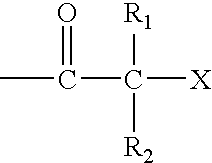
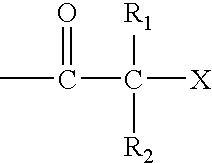
- the functional group Y acts as a “living” radical initiator.
- R 1 , R 2 are independently selected from a group consisting of H, hydrocarbyl and substituted hydrocarbyl.
- X is selected from Cl, Br and I. Preferred is R 1 ⁇ R 2 ⁇ CH 3 , X is Cl or Br.
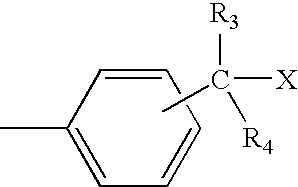
- Y can be a benzyl halogen with a general formula as shown below:
- R 3 , R 4 are independently selected from a group consisting of H, hydrocarbyl and substituted hydrocarbyl.
- X is selected from Cl, Br and I. Preferred is R 3 ⁇ R 4 ⁇ CH 3 , X is Cl or Br.
- the Y group can also be cyclic nitroxides such as 2,2,6,6-tetramethylpiperidinyl-1-oxy (TEMPO) or substituted TEMPO, dithiocarbamates such as RC( ⁇ S)S—.
- TEMPO 2,2,6,6-tetramethylpiperidinyl-1-oxy
- RC( ⁇ S)S— dithiocarbamates
- the “living” radical can be generated by metal complex catalysts or heating or light irradiation.
- the other type of coupling agent can be a polymer or an oligomer that has two functional segments: one providing a binding with the plastics surface and the other providing an initiation species for “living” radical polymerization.
- Preferred polymer or oligomer backbone is a hydrocarbon chain.
- the binding domain with the plastics surface can be backbone or side chain.
- the binding can be achieved by hydrophobic interaction, hydrophilic interaction, electrostatic interaction or chemical bonds.
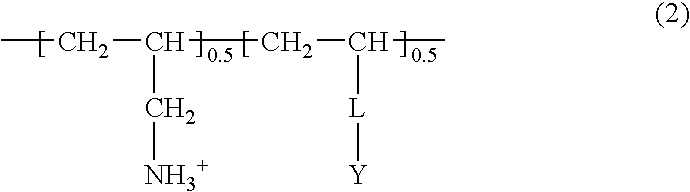
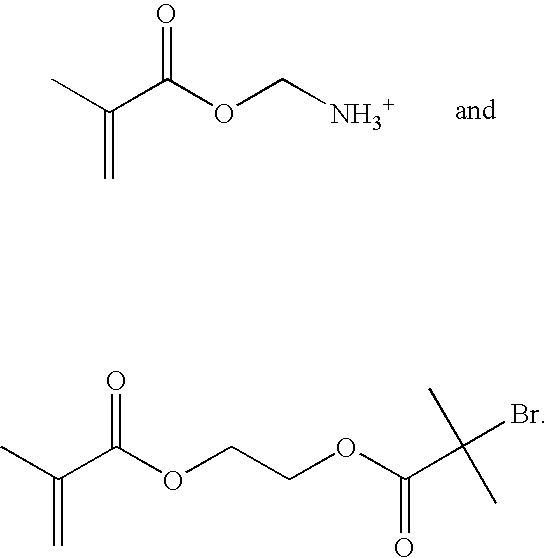
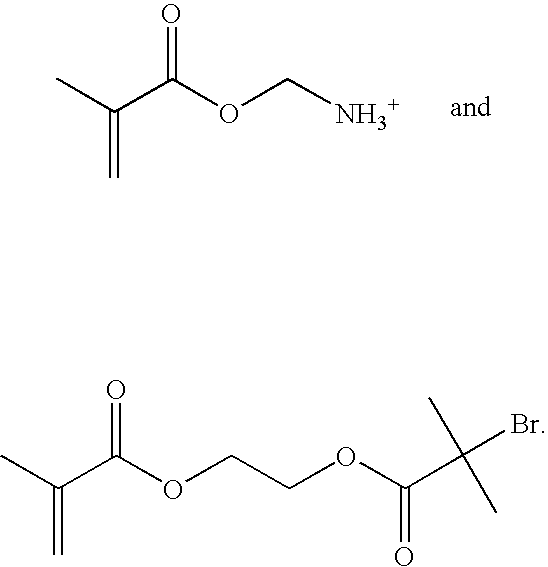
- a plastics substrate treated by radio frequency plasma contains —COOH functional groups on the surface. COOH function group makes the surface negatively charged when pH is higher than 3, a random copolymer shown below (2) can be attached to the plastics surface via electrostatic interaction. Multiple binding sites of a polymeric coupling agent make the coating stable on the surface.
- plastics surface are suitable for hydrophobic binding
- one embodiment is a plastics which has hydrophobic surface as described in U.S. Pat. No. 5,621,018 (Chabrecek et al, “Functonalized photoinitiators, macromers thereof, and the use thereof”).
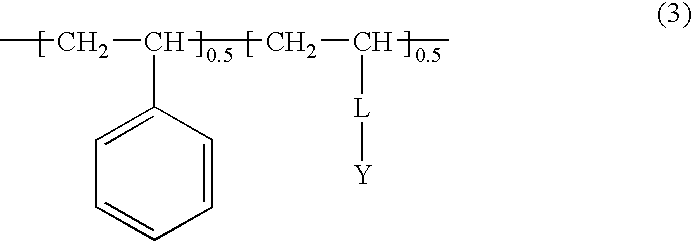
- a random copolymer coupling agent suitable for hydrophobic interaction is shown below:
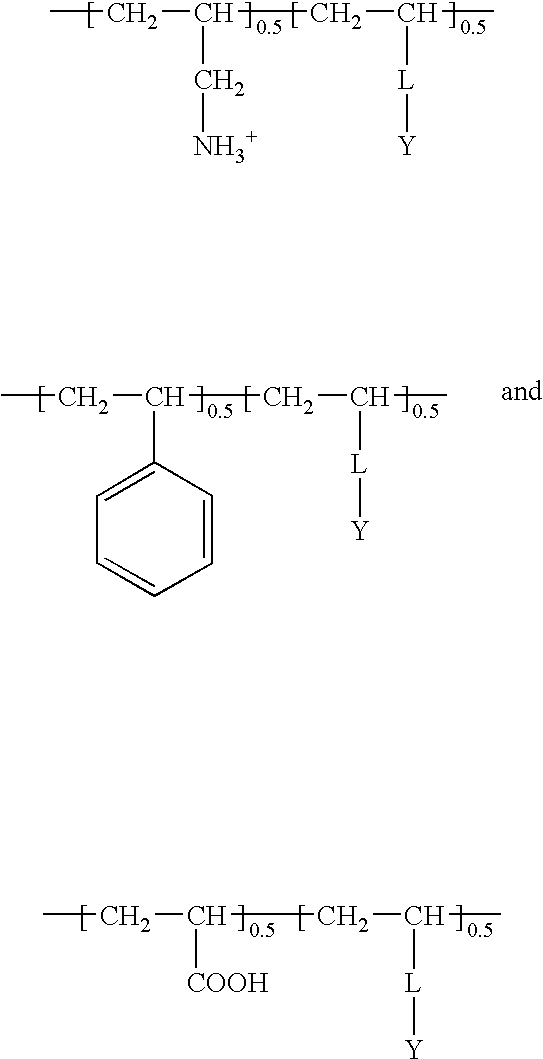
- the binding functional groups on the polymeric or oligomeric coupling agent can also be functional groups that can form covalent bonds with the plastics surface.
- Such functional groups can be OH, COOH, CHO, Br, Cl, NH 2 , NHR 1 (R 1 is hydrocarbyl or substituted hydrocarbyl).
- R 1 is hydrocarbyl or substituted hydrocarbyl.
- L and Y are the same functional groups as in structure 1, i.e. L is a divalent organic moiety, Y is a functional group capable of generating a “living” radical for initiating polymerization of addition monomers.
- a chemical surface coating is achieved by a “living” radical polymerization.
- the process involves contacting a living radical polymerizing solution with the coupling agent attached plastics surface.
- a living radical polymerizing solution comprises of at least one solvent, at least one catalyst and at least one addition monomer.
- the polymerization can be conducted in aqueous or organic solutions. If the addition monomer is soluble in water, aqueous solution is the most preferred because water is a safe solvent and can reduce the cost. If the addition monomer is insoluble in water, in some case, aqueous solution can still be used under the help of suitable surfactant.
- Another preferred solvent system is a mixture of water and a water miscible organic solvent.
- the polymerization can also be conducted in most organic solvents and their mixtures which do not dissolve or swell the plastics surface, e.g.
- Polyamine herein means a molecule with at least two amine groups.
- the most preferred catalysts are CuCl(bipyridine) 2 and CuCl 2 (bipyridine) 2 .
- the presence of both CuX(bipyridine) 2 and CuX 2 (bipyridine) 2 enables generation of confined radicals on the surface that make the polymerization happens only on the surface in a workable speed.
- Addition monomers used in this invention are selected from a group consisting of acrylates and its derivatives, metharylates and its derivatives, styrene and its derivatives, acrylamide, methacrylamide, N-monosubstituted acrylamide, N-monosubstituted methacrylamide, N,N-bissubstituted acrylamide, N,N-bissubstituted methacrylamide, vinyl acetate, vinyl pyrolidone, vinyl ether, acrylic acid, methacrylic acid.
- Reaction between the living radical polymerizing solution and the coupling agent on the plastics surface generates polymer chains from the surface to give covalently attached polymer brushes with high graft density and controlled molecular weight.
- Polymerization proceeds at 0° C. to 150° C.
- the highest temperature used should be below glass transition temperature of the plastics material. Preferred temperature is at 20 to 80° C. and the most preferred is at room temperature.
- the thickness of the chemical surface coating here is controlled by polymerization time and concentration of the monomer and the catalyst.
- the molecular structure of the coating is determined by the structure of the monomers and polymerization process. When a mixture of two or more monomers is added at the same time, a random copolymer coating layer is formed. When a crosslinking agent e.g. a diene is added, a crosslinked polymer coating is produced.
- a suitable crosslinking agent may be used together with addition monomers for the polymerization.
- the crosslinking agent is usually di, tri and tetra-functional molecules.
- the commonly used crosslinking agents in this invention are the di, tri and tetra olefins.
- Preferred crosslinking agents are selected from divinylbenzene, N,N′-methylenebisacrylamide, triallylamine, ethyleneglycoldiacrylate, tetraethyleneglycoldiacrylate, 1,1,1-trimethylolpropanetriacylate and tetraallyloxyethane.
- the cross-linking reaction can greatly increase the stability of the polymer coating and prevent its degradation and leaking.
- This invention also provides a block copolymer coating on the plastics surface.
- Chemical surface coating formed by block copolymers are very useful to tune the surface properties.
- Hydrophobic block such as polymethacrylate and polystyrene can increase the stability of the coating.
- Hydrophilic block such as polyethylene glycol and polyacrylamide creates biocompatibility and enables resistance to biological binding.
- Some special polymer block such as polytetrafluoroethylene can greatly enhance oxygen permeability that makes contact lens wearing more comfortable.
- Tethering block copolymers bonded to surfaces is particularly interesting because it provides responsive, controllable interfaces with nanoscale features.
- the topology of block copolymer also suggests their use in forming multilayered materials where the layers can be arranged in a predetermined order.
- a combination of the polymer blocks with different properties will greatly improve the properties of the contact lens. Growth of such films from tethered initiators complements other layer-by-layer schemes for thin film coatings (Winterton et al, “Single dip process for achieving a layer-by-layer-like coating”, US Patent 2001/0048975A1).
- This invention is particularly powerful for the preparation of surface-tethered block copolymers because the “living” polymer chain radical is confined to the surface. After one polymer chain is formed on the surface, the end group of the polymer chain is still an initiator that can be initiated again to graft another polymer. Therefore, block copolymers can be prepared by the sequential activation of the dormant chain end in the presence of different monomers. Besides, the length of the copolymer chain is controlled by the elapsed polymerization time of each steps of the polymerization. After rinsing to remove residual catalyst and monomer, the polymerization can be reinitiated to extend the chains, or multiblock copolymers can be synthesized by simply switching to a different monomer after each cycle.
- synthesizing surface-tethered block copolymers can be achieved by the sequential addition of two or more monomers during polymerization from a surface.
- monomers include, but not limit to: polyacrylamide-b-poly(hydroxyethyl acrylate), polyacrylamide-b-poly(polyethylene glycol acrylate), polyacrylamide-b-poly(sugar acrylates), polyacrylamide-b-poly(glycide acrylate), etc.
- a specific feature of this invention is that the end groups of the polymer chains on the surface in this invention contain halogens.
- the monomer may have certain functional groups, leading to a polymer chain formed with certain functional groups, such as hydroxyl group. Both of those functional groups can be converted to various functional groups to tune the chemical and physical properties of the polymer coating.
- linear polymer chains are then grown from the surface to give covalently attached polymer brushes with high graft densities and molecular weights.
- suitable polymerization conditions e.g. a monomer, a catalyst and a solvent at certain temperature
- linear polymer chains are then grown from the surface to give covalently attached polymer brushes with high graft densities and molecular weights.
- a second non-initiation molecule with the initiator for the coupling reaction
- the density of the initiator on the surface can be well controlled, resulting in controlled density of polymer chains.
- “Living” radical polymerizations have a number of advantages over traditional free radical procedures, such as free radical polymerization, and photo initiation polymerization. (1)
- the surface “living” radical polymerization only occurs on the surface. There is no free polymer formed in solution. This process dramatically saves the reagents and lowers the manufacturing cost.
- a very thin coating, 200 nm thick polyethylene glycol methacrylate on a pair of 1 cm diameter contact lens only needs 0.1 mg of material.
- No free polymer in solution results in no physically attached polymer onto the surface, which greatly simplifies the clean-up procedure, which also lowers the manufacturing cost.
- (3) The coating prepared by this process is very uniform and well controlled in terms of the thickness and functionality. Compared with surface free radical polymerization which can not control the growth of polymer thin film and usually grows the coating thickness no more than 5 nm, surface “living” radical polymerization can prepare the polymer coating with thickness well controlled from a few of nanometers to a few microns, even though the thickness is preferred from 1 nm to 1,000 nm.
- the functionality can be tuned to make the polymer coating very hydrophilic or hydrophobic or combination of both.
- This process also can be useful for making uniform coating layer with various random- or diblock-, or triblock- and multiblock-copolymers.
- (3) The polymer chains prepared by this process are in order.
- (4) Surface “living” radical polymerization also allows preparing di- and multi-block copolymer chains.
- Block copolymers are prepared by the sequential activation of the dormant chain end in the presence of different monomers. However, the use of traditional free radical process predudes the formation of block copolymer brushes or accurate control of polymer structure.
- a low polymerization temperature that is compatible with temperature-sensitive substrates, and friendly aqueous reaction environment.
- This invention provides a uniform and hydrophilic coating on the contact lens surface to render bio-compatibility and suppress bindings of proteins, bacteria or other biological entities.
- the coated contact lens is capable of continuous wearing over a long period of time and in the mean time providing good wettability and high permeation to oxygen without adverse effects to the comea.
- Polyethylene glycol methacrylate (Average MW 360)
- organic solvents such as acetone, methanol, ethanol, THF, methylene chloride are also from Aldrich.
- Step 1 Activate Contact Lens Surface to Generate Reactive Groups
- a dried Lotrafilcon A lenses (polysiloxane/perfluoroether copolymer) is placed in a plasma reactor equipped with an external ring electrode and a 27.13 MHz radiofrequency (RF) generator.
- An inductively-coupled, cold glow discharge plasma generated by a radiofrequency generator impinges onto the contact lens surfaces which are 10 cm away the lower edge of the plasma zone.
- the reactor which contains the contact lenses is vacuumed to a certain pressure of 0.5 mbar.
- the RF is on the range of 1 to 100 MHz.
- the plasma discharge power is in the range of 10 to 1,000 Watts with preferred power range at 100 to 500 Watts.
- the contact lens surface is oxidized to form functional groups, mainly composed of —OH, —COOH, and —CHO.
- Step 2 Self-Assembling an Initiator Monolayer on the Activated Contact Lens Surface
- PAAm Polyacrylamide
- an acrylamide monomer mixture having a 7.0 M concentration is prepared by adding 20.0 g of acrylamide (MW 71) and 20.0 g of nanopure water to a 100 mL round bottom flask. Then, 1.97 g of bipyridyl (MW 154), 0.114 mg of CuCl 2 (MW 134.5) and 0.417 mg CuCl (MW 99) are added to the flask. The flask is immediately sealed with a rubber septum and the mixture is stirred for 10 min under a nitrogen atmosphere. 5.0 mL of said mixture is transferred by syringe to a flask charged with an initiator monolayer coupled contact lens prepared in Example 3.
- the flask containing the contact lens is flushed with N 2 for 5 minutes and then sealed with a rubber stopper before charging of the chemicals.
- the reaction is allowed to continue for 14 hours, then rinsed with nanopure water and air-dried.
- After coating a polyacrylamide brush thin film on contact lens its surface contact angle becomes 0° with water. Water completely wets the surface.
- a polyethylene glycol methacrylate monomer solution having a 1.5 M concentration is prepared by adding 4.0 g of polyethylene glycol methacrylate (MW 360) and 3.6 g of nanopure water to a 20 mL sample vial. Then, 0.0452 g of bipyridyl (MW 154), 0.0036 mg of CuCl 2 (MW 134.5) and 0.0134 mg CuCl (MW 99) are added to the vial. The vial is immediately sealed with a rubber septum and the mixture is stirred for 10 min under a nitrogen atmosphere.
- polyethylene glycol methacrylate monomer solution having a 1.5 M concentration is prepared by adding 4.0 g of polyethylene glycol methacrylate (MW 360) and 3.6 g of nanopure water to a 20 mL sample vial. Then, 0.0452 g of bipyridyl (MW 154), 0.0036 mg of CuCl 2 (MW 134.5) and 0.0134 mg CuCl (MW 99) are added to the
- the above monomer solution is then transferred into a flask containing an initiator-coupled contact lens by N 2 pressure, then sealed with a rubber septum. The reaction is allowed to proceed at room temperature for 14 hours. Then the contact lens is rinsed with nanopure water. The contact angle of the PEGM brush polymer coated contact lens is 30° with water, indicating very hydrophilic surface.
- an ethylene glycol methacrylate monomer solution having a 1.5 M concentration is prepared by adding 4.0 g of ethylene glycol methacrylate (MW 360) and 3.6 g of nanopure water to a 20 mL sample vial. Then, 0.0452 g of bipyridyl (MW 154), 0.0036 mg of CUCl 2 (MW 134.5) and 0.0134 mg CuCl (MW 99) are added to the vial. The vial is immediately sealed with a rubber septum and the mixture is stirred for 10 min under a nitrogen atmosphere.
- the above monomer solution is then transferred into a flask containing an initiator-coupled contact lens by N 2 pressure. The reaction is allowed to proceed at room temperature for 14 hours. Then the capillary is rinsed with nanopure water.
- the acrylamide monomer solution prepared according to example 4 is transferred into the flask containing PEGM coated contact lens under N 2 pressure. The reaction is allowed to proceed for 14 hours, then rinsed with nanopure water. A copolymer of PEGM/PAAm is grown on the contact lens.
Landscapes
- Chemical & Material Sciences (AREA)
- Organic Chemistry (AREA)
- Health & Medical Sciences (AREA)
- Chemical Kinetics & Catalysis (AREA)
- Medicinal Chemistry (AREA)
- Polymers & Plastics (AREA)
- Life Sciences & Earth Sciences (AREA)
- Engineering & Computer Science (AREA)
- Materials Engineering (AREA)
- Wood Science & Technology (AREA)
- General Chemical & Material Sciences (AREA)
- Eyeglasses (AREA)
Abstract
-
- (a) contacting the plastics surface with a coupling agent solution, then
- (b) contacting the plastics surface with a first living radical polymerizing solution, and optionally
- (c) contacting the plastics surface with a second living radical polymerizing solution.
Description
-
- (a) contacting the plastics surface with a coupling agent solution, then
- (b) contacting the plastics surface with a first living radical polymerizing solution, and optionally
- (c) contacting the plastics surface with a second living radical polymerizing solution.
Z—L—Y
Z is a functional group capable of forming a covalent bond with a functional group on the plastics surface. For example, if the surface function group is COOH, Z is OH or halogen. Z can include, but are not limited to OH, COOH, CHO, Br, Cl, NH2, NHR1 wherein R1 is hydrocarbyl or substituted hydrocarbyl.
L is a divalent organic moiety.
Y is a functional group capable of generating a living radical for initiating polymerization of addition monomers.

Q is a functional group capable of forming a covalent bond with a functional group on the plastics surface, n=3, 2, or 1,
B is hydrocarbyl or substituted hydrocarbyl,
L is a divalent organic moiety,
Y is a functional group capable of generating a “living” radical for initiating polymerization of addition monomers.


Claims (25)


Priority Applications (1)
| Application Number | Priority Date | Filing Date | Title |
|---|---|---|---|
| US10/887,672 US7247387B1 (en) | 2003-07-24 | 2004-07-10 | Material and process for controlled thin polymeric coatings on plastic surface |
Applications Claiming Priority (2)
| Application Number | Priority Date | Filing Date | Title |
|---|---|---|---|
| US48985603P | 2003-07-24 | 2003-07-24 | |
| US10/887,672 US7247387B1 (en) | 2003-07-24 | 2004-07-10 | Material and process for controlled thin polymeric coatings on plastic surface |
Publications (1)
| Publication Number | Publication Date |
|---|---|
| US7247387B1 true US7247387B1 (en) | 2007-07-24 |
Family
ID=38266830
Family Applications (1)
| Application Number | Title | Priority Date | Filing Date |
|---|---|---|---|
| US10/887,672 Expired - Lifetime US7247387B1 (en) | 2003-07-24 | 2004-07-10 | Material and process for controlled thin polymeric coatings on plastic surface |
Country Status (1)
| Country | Link |
|---|---|
| US (1) | US7247387B1 (en) |
Cited By (6)
| Publication number | Priority date | Publication date | Assignee | Title |
|---|---|---|---|---|
| US20120205556A1 (en) * | 2009-07-27 | 2012-08-16 | The Regents Of The University Of California | Prohealing endovascular devices |
| WO2013166358A1 (en) * | 2012-05-03 | 2013-11-07 | Indiana University Research And Technology Corporation | Surface coatings for biological implants and prostheses |
| US9260539B2 (en) | 2013-05-22 | 2016-02-16 | Triblue Corporation | Methods of forming a polymer layer on a polymer surface |
| US20160320635A1 (en) * | 2012-08-27 | 2016-11-03 | Karen L. Havenstrite | Contact lens with a hydrophilic layer |
| US10330951B2 (en) | 2013-11-15 | 2019-06-25 | Tangible Science, Llc | Contact lens with a hydrophilic layer |
| US10525170B2 (en) | 2014-12-09 | 2020-01-07 | Tangible Science, Llc | Medical device coating with a biocompatible layer |
Citations (11)
| Publication number | Priority date | Publication date | Assignee | Title |
|---|---|---|---|---|
| US5344701A (en) | 1992-06-09 | 1994-09-06 | Minnesota Mining And Manufacturing Company | Porous supports having azlactone-functional surfaces |
| US5352714A (en) | 1991-11-05 | 1994-10-04 | Bausch & Lomb Incorporated | Wettable silicone hydrogel compositions and methods for their manufacture |
| US5364918A (en) * | 1990-11-27 | 1994-11-15 | Bausch & Lomb Incorporated | Surface modification of polymer objects |
| US5621018A (en) | 1993-07-02 | 1997-04-15 | Ciba Geigy Corporation | Functionalized photoinitiators, macromers thereof, and the use thereof |
| US5652014A (en) | 1991-08-16 | 1997-07-29 | Galin; Miles A. | Medicament coated refractive anterior chamber ocular implant |
| US5789487A (en) * | 1996-07-10 | 1998-08-04 | Carnegie-Mellon University | Preparation of novel homo- and copolymers using atom transfer radical polymerization |
| US5807937A (en) * | 1995-11-15 | 1998-09-15 | Carnegie Mellon University | Processes based on atom (or group) transfer radical polymerization and novel (co) polymers having useful structures and properties |
| US6200626B1 (en) | 1999-05-20 | 2001-03-13 | Bausch & Lomb Incorporated | Surface-treatment of silicone medical devices comprising an intermediate carbon coating and graft polymerization |
| US6440571B1 (en) | 1999-05-20 | 2002-08-27 | Bausch & Lomb Incorporated | Surface treatment of silicone medical devices with reactive hydrophilic polymers |
| US6653415B1 (en) * | 1998-08-22 | 2003-11-25 | Boettcher Henrik | Method for producing defined layers or layer systems |
| JP2004018556A (en) * | 2002-06-12 | 2004-01-22 | Nisshinbo Ind Inc | POLYMER PARTICLE HAVING LIVING STARTING SPECIES AND METHOD FOR PRODUCING THE SAME |
-
2004
- 2004-07-10 US US10/887,672 patent/US7247387B1/en not_active Expired - Lifetime
Patent Citations (12)
| Publication number | Priority date | Publication date | Assignee | Title |
|---|---|---|---|---|
| US5364918A (en) * | 1990-11-27 | 1994-11-15 | Bausch & Lomb Incorporated | Surface modification of polymer objects |
| US5525691A (en) | 1990-11-27 | 1996-06-11 | Bausch & Lomb Incorporated | Surface modification of polymeric objects |
| US5652014A (en) | 1991-08-16 | 1997-07-29 | Galin; Miles A. | Medicament coated refractive anterior chamber ocular implant |
| US5352714A (en) | 1991-11-05 | 1994-10-04 | Bausch & Lomb Incorporated | Wettable silicone hydrogel compositions and methods for their manufacture |
| US5344701A (en) | 1992-06-09 | 1994-09-06 | Minnesota Mining And Manufacturing Company | Porous supports having azlactone-functional surfaces |
| US5621018A (en) | 1993-07-02 | 1997-04-15 | Ciba Geigy Corporation | Functionalized photoinitiators, macromers thereof, and the use thereof |
| US5807937A (en) * | 1995-11-15 | 1998-09-15 | Carnegie Mellon University | Processes based on atom (or group) transfer radical polymerization and novel (co) polymers having useful structures and properties |
| US5789487A (en) * | 1996-07-10 | 1998-08-04 | Carnegie-Mellon University | Preparation of novel homo- and copolymers using atom transfer radical polymerization |
| US6653415B1 (en) * | 1998-08-22 | 2003-11-25 | Boettcher Henrik | Method for producing defined layers or layer systems |
| US6200626B1 (en) | 1999-05-20 | 2001-03-13 | Bausch & Lomb Incorporated | Surface-treatment of silicone medical devices comprising an intermediate carbon coating and graft polymerization |
| US6440571B1 (en) | 1999-05-20 | 2002-08-27 | Bausch & Lomb Incorporated | Surface treatment of silicone medical devices with reactive hydrophilic polymers |
| JP2004018556A (en) * | 2002-06-12 | 2004-01-22 | Nisshinbo Ind Inc | POLYMER PARTICLE HAVING LIVING STARTING SPECIES AND METHOD FOR PRODUCING THE SAME |
Non-Patent Citations (7)
| Title |
|---|
| Deging Xiao and Mary J. Wirth "Kinetics of Surface-Initiated Atom Transfer Radical Polymerization of Acrylamide on Silica" Macromolecules 2002, 35, 2919-2925. |
| English Translation of JP 2004-018556A. * |
| Huang "Surface-Confined Living Radical Polymerization for Coating in Capillary Eletrophorsis." Anal. Chem. 1998, 4023-4029, 70. American Chemical Society. |
| M. Husseman et al, Macromolecules, 1999, 32, 1424. * |
| Mircea Teodorescu and Krzysztof Matyjaszewski Atom Transfer Radical Polymerization of (Meth)acrylamides Macromolecules 1999, 32, 4826-4831. |
| X. Huang and M.J. Wirth "Surface Initiation of Living Radical Polymerization for Growth of Tethered Chains of Low Polydispersity" Macromolecules 1999, 32, 1694-1696. |
| Xianyi Chen, Steven Armes, Surface Polymerization of Hydrophilic Methacrylates from Ultrafine Silica SOIs in Protic Media at Ambient Temperature: A Novel Approach to Surface Functionalization Using a Polylcetrolyic Macroinitiator, 2003, Adv. Mater, 15(18), 1558-1562. * |
Cited By (16)
| Publication number | Priority date | Publication date | Assignee | Title |
|---|---|---|---|---|
| US8487284B2 (en) * | 2009-07-27 | 2013-07-16 | The Regents Of The University Of California | Prohealing endovascular devices |
| US20120205556A1 (en) * | 2009-07-27 | 2012-08-16 | The Regents Of The University Of California | Prohealing endovascular devices |
| WO2013166358A1 (en) * | 2012-05-03 | 2013-11-07 | Indiana University Research And Technology Corporation | Surface coatings for biological implants and prostheses |
| US20150109573A1 (en) * | 2012-05-03 | 2015-04-23 | Indiana University Research And Technology Corporation | Surface coatings for biological implants and prostheses |
| US9550011B2 (en) * | 2012-05-03 | 2017-01-24 | Indiana University Research And Technology Corporation | Surface coatings for biological implants and prostheses |
| US20220075208A1 (en) * | 2012-08-27 | 2022-03-10 | Tangible Science, Inc. | Contact lens with a hydrophilic layer |
| US20160320635A1 (en) * | 2012-08-27 | 2016-11-03 | Karen L. Havenstrite | Contact lens with a hydrophilic layer |
| US10451896B2 (en) * | 2012-08-27 | 2019-10-22 | Tangible Science, Llc | Contact lens with a hydrophilic layer |
| US12449674B2 (en) * | 2012-08-27 | 2025-10-21 | Tangible Science, Inc. | Contact lens with a hydrophilic layer |
| US11181754B2 (en) | 2012-08-27 | 2021-11-23 | Tangible Science, Llc | Contact lens with a hydrophilic layer |
| US9260539B2 (en) | 2013-05-22 | 2016-02-16 | Triblue Corporation | Methods of forming a polymer layer on a polymer surface |
| US10047206B2 (en) | 2013-05-22 | 2018-08-14 | Triblue Corporation | Methods of forming a polymer layer on a polymer surface |
| US10330951B2 (en) | 2013-11-15 | 2019-06-25 | Tangible Science, Llc | Contact lens with a hydrophilic layer |
| US11433628B2 (en) | 2013-11-15 | 2022-09-06 | Tangible Science, Inc. | Contact lens with a hydrophilic layer |
| US11260150B2 (en) | 2014-12-09 | 2022-03-01 | Tangible Science, Inc. | Medical device coating with a biocompatible layer |
| US10525170B2 (en) | 2014-12-09 | 2020-01-07 | Tangible Science, Llc | Medical device coating with a biocompatible layer |
Similar Documents
| Publication | Publication Date | Title |
|---|---|---|
| CA2743493C (en) | Surface modification of polymers via surface active and reactive end groups | |
| JP4948740B2 (en) | Method for surface modification of substrate and modified substrate obtained therefrom | |
| AU750236B2 (en) | Method for providing coated moulded polymeric articles | |
| US6582754B1 (en) | Coating process | |
| EP1035855B1 (en) | Process for the surface modification of a polymer substrate and polymers formed therefrom | |
| JP5526376B2 (en) | Novel PDMS-PVP block copolymer | |
| US20090171049A1 (en) | Segmented reactive block copolymers | |
| US10098984B2 (en) | Method for grafting polymers on metallic substrates | |
| CN101605838B (en) | Method for treating surfaces containing Si-H groups | |
| EP2035050A2 (en) | Modification of surfaces of polymeric articles by michael addition reaction | |
| WO2009085759A1 (en) | Segmented reactive block copolymers | |
| US7247387B1 (en) | Material and process for controlled thin polymeric coatings on plastic surface | |
| EP4045550A1 (en) | Polymer gels in the formation of polymer brushes | |
| JP4824151B2 (en) | Glass substrate and film forming agent having polymer film containing terminal functional phosphorylcholine-like group | |
| JP2023503546A (en) | Polymer co-networks of poly(pyridine-(meth)-acrylamide) derivatives crosslinked by transition metal ions and linked by polydimethylsiloxane derivatives | |
| US20030194480A1 (en) | Reactive polymers | |
| JP2000212376A (en) | Biocompatible polymer / silica gel hybrid and method for producing the same | |
| JP2019034990A (en) | Porous surface treatment polymer | |
| JP3985087B2 (en) | Crosslinked hydrogel derived from macromonomer having hydrophilic polymer chain | |
| CN119463074A (en) | A non-degradable anti-protein adsorption material and its preparation method and application | |
| WO2019107372A1 (en) | Method for modifying surface of aromatic polyetherketone substrate |
Legal Events
| Date | Code | Title | Description |
|---|---|---|---|
| AS | Assignment |
Owner name: SEPAX TECHNOLOGIES INC., DELAWARE Free format text: ASSIGNMENT OF ASSIGNORS INTEREST;ASSIGNOR:HUANG, XUEYING;REEL/FRAME:019406/0454 Effective date: 20070602 |
|
| FEPP | Fee payment procedure |
Free format text: PETITION RELATED TO MAINTENANCE FEES GRANTED (ORIGINAL EVENT CODE: PMFG); ENTITY STATUS OF PATENT OWNER: SMALL ENTITY |
|
| FEPP | Fee payment procedure |
Free format text: PETITION RELATED TO MAINTENANCE FEES FILED (ORIGINAL EVENT CODE: PMFP); ENTITY STATUS OF PATENT OWNER: SMALL ENTITY |
|
| REMI | Maintenance fee reminder mailed | ||
| LAPS | Lapse for failure to pay maintenance fees | ||
| REIN | Reinstatement after maintenance fee payment confirmed | ||
| FP | Lapsed due to failure to pay maintenance fee |
Effective date: 20110724 |
|
| FPAY | Fee payment |
Year of fee payment: 4 |
|
| SULP | Surcharge for late payment | ||
| PRDP | Patent reinstated due to the acceptance of a late maintenance fee |
Effective date: 20111003 |
|
| STCF | Information on status: patent grant |
Free format text: PATENTED CASE |
|
| REMI | Maintenance fee reminder mailed | ||
| FPAY | Fee payment |
Year of fee payment: 8 |
|
| SULP | Surcharge for late payment |
Year of fee payment: 7 |
|
| FEPP | Fee payment procedure |
Free format text: MAINTENANCE FEE REMINDER MAILED (ORIGINAL EVENT CODE: REM.); ENTITY STATUS OF PATENT OWNER: SMALL ENTITY |
|
| FEPP | Fee payment procedure |
Free format text: 11.5 YR SURCHARGE- LATE PMT W/IN 6 MO, SMALL ENTITY (ORIGINAL EVENT CODE: M2556); ENTITY STATUS OF PATENT OWNER: SMALL ENTITY |
|
| MAFP | Maintenance fee payment |
Free format text: PAYMENT OF MAINTENANCE FEE, 12TH YR, SMALL ENTITY (ORIGINAL EVENT CODE: M2553); ENTITY STATUS OF PATENT OWNER: SMALL ENTITY Year of fee payment: 12 |