US7241787B2 - Substituted N-cycloexylimidazolinones, process for their preparation and their use as medicaments - Google Patents
Substituted N-cycloexylimidazolinones, process for their preparation and their use as medicaments Download PDFInfo
- Publication number
- US7241787B2 US7241787B2 US11/042,713 US4271305A US7241787B2 US 7241787 B2 US7241787 B2 US 7241787B2 US 4271305 A US4271305 A US 4271305A US 7241787 B2 US7241787 B2 US 7241787B2
- Authority
- US
- United States
- Prior art keywords
- alkyl
- group
- independently
- aryl
- another
- Prior art date
- Legal status (The legal status is an assumption and is not a legal conclusion. Google has not performed a legal analysis and makes no representation as to the accuracy of the status listed.)
- Expired - Lifetime, expires
Links
- 0 C*C.CC.[1*][K]CCN1[2H]=CN(C2CCCCC2)C1=O Chemical compound C*C.CC.[1*][K]CCN1[2H]=CN(C2CCCCC2)C1=O 0.000 description 14
- SZCBJMRAOMIUQG-UHFFFAOYSA-N CC(=O)N(C)C1CCN(C2CCC(N3C=CN(C4=CC=C(OC5CCCC5)C=C4)C3=O)CC2)C1 Chemical compound CC(=O)N(C)C1CCN(C2CCC(N3C=CN(C4=CC=C(OC5CCCC5)C=C4)C3=O)CC2)C1 SZCBJMRAOMIUQG-UHFFFAOYSA-N 0.000 description 2
- KDSNLYIMUZNERS-UHFFFAOYSA-N CC(C)CN Chemical compound CC(C)CN KDSNLYIMUZNERS-UHFFFAOYSA-N 0.000 description 2
- IRTNBUPPMDRKEQ-UHFFFAOYSA-N CC.CC(C)CNC1CCC2(CC1)OCCO2 Chemical compound CC.CC(C)CNC1CCC2(CC1)OCCO2 IRTNBUPPMDRKEQ-UHFFFAOYSA-N 0.000 description 2
- YLNJOWQWZMGNKY-UHFFFAOYSA-N CC.O=C1CCC2(CC1)OCCO2 Chemical compound CC.O=C1CCC2(CC1)OCCO2 YLNJOWQWZMGNKY-UHFFFAOYSA-N 0.000 description 2
- PMNQHNFLZZVTFT-UHFFFAOYSA-N CN(C)CCN(C)C1CCC(N2C=CN(C3=CC=C(OC4CCCC4)C=C3)C2=O)CC1 Chemical compound CN(C)CCN(C)C1CCC(N2C=CN(C3=CC=C(OC4CCCC4)C=C3)C2=O)CC1 PMNQHNFLZZVTFT-UHFFFAOYSA-N 0.000 description 2
- HIZILPLGEJEETL-UHFFFAOYSA-N CC(=O)N(C)C1CCN(C2CCC(N3C=CN(C4=CC=C(OC5=CC=CC=C5)C=C4)C3=O)CC2)C1 Chemical compound CC(=O)N(C)C1CCN(C2CCC(N3C=CN(C4=CC=C(OC5=CC=CC=C5)C=C4)C3=O)CC2)C1 HIZILPLGEJEETL-UHFFFAOYSA-N 0.000 description 1
- YUVWBKFDWVCKCM-UHFFFAOYSA-N CC(=O)N(C)C1CCN(C2CCC(N3C=CN(C4=CC=C(OC5CCCC5)N=C4)C3=O)CC2)C1 Chemical compound CC(=O)N(C)C1CCN(C2CCC(N3C=CN(C4=CC=C(OC5CCCC5)N=C4)C3=O)CC2)C1 YUVWBKFDWVCKCM-UHFFFAOYSA-N 0.000 description 1
- HFDVJGVVUPADDM-DDRJZQQSSA-N CC(=O)N[C@@H]1CCN(C2CCC(N3C=CN(C4=CC=C(OC5=CC=CC=C5)C=C4)C3=O)CC2)C1 Chemical compound CC(=O)N[C@@H]1CCN(C2CCC(N3C=CN(C4=CC=C(OC5=CC=CC=C5)C=C4)C3=O)CC2)C1 HFDVJGVVUPADDM-DDRJZQQSSA-N 0.000 description 1
- XFHKUXVUFKMNMP-ITAUSPCMSA-N CC(=O)N[C@@H]1CCN(C2CCC(N3C=CN(C4=CC=C(OC5CCCC5)C=C4)C3=O)CC2)C1 Chemical compound CC(=O)N[C@@H]1CCN(C2CCC(N3C=CN(C4=CC=C(OC5CCCC5)C=C4)C3=O)CC2)C1 XFHKUXVUFKMNMP-ITAUSPCMSA-N 0.000 description 1
- JGELCKZBDZXHPY-QNGMFEMESA-N CC(=O)N[C@@H]1CCN(C2CCC(N3C=CN(C4=CC=C(OC5CCCC5)N=C4)C3=O)CC2)C1 Chemical compound CC(=O)N[C@@H]1CCN(C2CCC(N3C=CN(C4=CC=C(OC5CCCC5)N=C4)C3=O)CC2)C1 JGELCKZBDZXHPY-QNGMFEMESA-N 0.000 description 1
- OUKDUILXHVMHBO-CZUALIRWSA-N CC(C)(C)CC(=O)N[C@@H]1CCCN(C2CCC(N3C=CN(C4=CC=C(OC5CCCC5)C=C4)C3=O)CC2)C1 Chemical compound CC(C)(C)CC(=O)N[C@@H]1CCCN(C2CCC(N3C=CN(C4=CC=C(OC5CCCC5)C=C4)C3=O)CC2)C1 OUKDUILXHVMHBO-CZUALIRWSA-N 0.000 description 1
- ZECBXLHXIYPLPW-UHFFFAOYSA-N CC(C)(C)OC(=O)N1CCC(NC2CCC(N3C=CN(C4=CC=C(OC5=CC=CC=C5)C=C4)C3=O)CC2)C1 Chemical compound CC(C)(C)OC(=O)N1CCC(NC2CCC(N3C=CN(C4=CC=C(OC5=CC=CC=C5)C=C4)C3=O)CC2)C1 ZECBXLHXIYPLPW-UHFFFAOYSA-N 0.000 description 1
- OUMYIWMXBJNOJV-UHFFFAOYSA-N CC(C)(C)OC(=O)N1CCC(NC2CCC(N3C=CN(C4=CC=C(OC5CCCC5)C=C4)C3=O)CC2)C1 Chemical compound CC(C)(C)OC(=O)N1CCC(NC2CCC(N3C=CN(C4=CC=C(OC5CCCC5)C=C4)C3=O)CC2)C1 OUMYIWMXBJNOJV-UHFFFAOYSA-N 0.000 description 1
- YPNAEWHKOTYEBO-UHFFFAOYSA-N CC(C)(C)OC(=O)N1CCC(NC2CCC(N3C=CN(C4=CC=C(OC5CCCC5)N=C4)C3=O)CC2)C1 Chemical compound CC(C)(C)OC(=O)N1CCC(NC2CCC(N3C=CN(C4=CC=C(OC5CCCC5)N=C4)C3=O)CC2)C1 YPNAEWHKOTYEBO-UHFFFAOYSA-N 0.000 description 1
- GINMUKCKFUABCO-UHFFFAOYSA-N CC(C)(C)OC(=O)NC1CCN(C2CCC(N3C=CN(C4=CC=C(OC5=CC=CC=C5)C=C4)C3=O)CC2)C1 Chemical compound CC(C)(C)OC(=O)NC1CCN(C2CCC(N3C=CN(C4=CC=C(OC5=CC=CC=C5)C=C4)C3=O)CC2)C1 GINMUKCKFUABCO-UHFFFAOYSA-N 0.000 description 1
- WGQKLTBEIHBMIH-UHFFFAOYSA-N CC(C)(C)OC(=O)NC1CCN(C2CCC(N3C=CN(C4=CC=C(OC5CCCC5)C=C4)C3=O)CC2)C1 Chemical compound CC(C)(C)OC(=O)NC1CCN(C2CCC(N3C=CN(C4=CC=C(OC5CCCC5)C=C4)C3=O)CC2)C1 WGQKLTBEIHBMIH-UHFFFAOYSA-N 0.000 description 1
- XAHWECHRBPDQHZ-UHFFFAOYSA-N CC(C)(C)OC(=O)NC1CCN(C2CCC(N3C=CN(C4=CC=C(OC5CCCC5)N=C4)C3=O)CC2)C1 Chemical compound CC(C)(C)OC(=O)NC1CCN(C2CCC(N3C=CN(C4=CC=C(OC5CCCC5)N=C4)C3=O)CC2)C1 XAHWECHRBPDQHZ-UHFFFAOYSA-N 0.000 description 1
- PPWHQIYZACLCLL-CZUALIRWSA-N CC(C)(C)OC(=O)N[C@@H]1CCCN(C2CCC(N3C=CN(C4=CC=C(OC5=CC=CC=C5)C=C4)C3=O)CC2)C1 Chemical compound CC(C)(C)OC(=O)N[C@@H]1CCCN(C2CCC(N3C=CN(C4=CC=C(OC5=CC=CC=C5)C=C4)C3=O)CC2)C1 PPWHQIYZACLCLL-CZUALIRWSA-N 0.000 description 1
- NZPGOGNCTPFQTI-DDRJZQQSSA-N CC(C)(C)OC(=O)N[C@@H]1CCCN(C2CCC(N3C=CN(C4=CC=C(OC5CCCC5)N=C4)C3=O)CC2)C1 Chemical compound CC(C)(C)OC(=O)N[C@@H]1CCCN(C2CCC(N3C=CN(C4=CC=C(OC5CCCC5)N=C4)C3=O)CC2)C1 NZPGOGNCTPFQTI-DDRJZQQSSA-N 0.000 description 1
- XFYGWVVMVSDBQD-DDRJZQQSSA-N CC(C)(C)OC(N[C@H](CCC1)CN1C(CC1)CCC1N(CCN1c(cc2)cnc2OC2CCCC2)C1=O)=O Chemical compound CC(C)(C)OC(N[C@H](CCC1)CN1C(CC1)CCC1N(CCN1c(cc2)cnc2OC2CCCC2)C1=O)=O XFYGWVVMVSDBQD-DDRJZQQSSA-N 0.000 description 1
- DZMFFKNKUKYXLV-UHFFFAOYSA-N CC(C)N(CCNC1CCC(N2C=CN(C3=CC=C(OC4=CC=CC=C4)C=C3)C2=O)CC1)C(C)C Chemical compound CC(C)N(CCNC1CCC(N2C=CN(C3=CC=C(OC4=CC=CC=C4)C=C3)C2=O)CC1)C(C)C DZMFFKNKUKYXLV-UHFFFAOYSA-N 0.000 description 1
- SKESCRFIJONFDS-UHFFFAOYSA-N CC(C)N(CCNC1CCC(N2C=CN(C3=CC=C(OC4CCCC4)C=C3)C2=O)CC1)C(C)C Chemical compound CC(C)N(CCNC1CCC(N2C=CN(C3=CC=C(OC4CCCC4)C=C3)C2=O)CC1)C(C)C SKESCRFIJONFDS-UHFFFAOYSA-N 0.000 description 1
- IYMXVVDVQDBBQA-UHFFFAOYSA-N CC(C)N(CCNC1CCC(N2C=CN(C3=CC=C(OC4CCCC4)N=C3)C2=O)CC1)C(C)C Chemical compound CC(C)N(CCNC1CCC(N2C=CN(C3=CC=C(OC4CCCC4)N=C3)C2=O)CC1)C(C)C IYMXVVDVQDBBQA-UHFFFAOYSA-N 0.000 description 1
- GTWUYPXLZTUMQG-UHFFFAOYSA-N CC(C)N1CCN(C2CCC(N3C=CN(C4=CC=C(OC5=CC=CC=C5)C=C4)C3=O)CC2)CC1 Chemical compound CC(C)N1CCN(C2CCC(N3C=CN(C4=CC=C(OC5=CC=CC=C5)C=C4)C3=O)CC2)CC1 GTWUYPXLZTUMQG-UHFFFAOYSA-N 0.000 description 1
- OTYLEWIRHBHCLK-UHFFFAOYSA-N CC(C)N1CCN(C2CCC(N3C=CN(C4=CC=C(OC5CCCC5)C=C4)C3=O)CC2)CC1 Chemical compound CC(C)N1CCN(C2CCC(N3C=CN(C4=CC=C(OC5CCCC5)C=C4)C3=O)CC2)CC1 OTYLEWIRHBHCLK-UHFFFAOYSA-N 0.000 description 1
- DMVWIJYQZUIPLK-UHFFFAOYSA-N CC(C)N1CCN(C2CCC(N3C=CN(C4=CC=C(OC5CCCC5)N=C4)C3=O)CC2)CC1 Chemical compound CC(C)N1CCN(C2CCC(N3C=CN(C4=CC=C(OC5CCCC5)N=C4)C3=O)CC2)CC1 DMVWIJYQZUIPLK-UHFFFAOYSA-N 0.000 description 1
- KFEPQYQUKYXGRW-UHFFFAOYSA-N CC(CN(C)C)NC1CCC(N2C=CN(C3=CC=C(OC4=CC=CC=C4)C=C3)C2=O)CC1 Chemical compound CC(CN(C)C)NC1CCC(N2C=CN(C3=CC=C(OC4=CC=CC=C4)C=C3)C2=O)CC1 KFEPQYQUKYXGRW-UHFFFAOYSA-N 0.000 description 1
- WYZCPMFWOGXHHO-UHFFFAOYSA-N CC(CN(C)C)NC1CCC(N2C=CN(C3=CC=C(OC4CCCC4)N=C3)C2=O)CC1 Chemical compound CC(CN(C)C)NC1CCC(N2C=CN(C3=CC=C(OC4CCCC4)N=C3)C2=O)CC1 WYZCPMFWOGXHHO-UHFFFAOYSA-N 0.000 description 1
- UZJHDIUEKHFFDN-UHFFFAOYSA-N CC(N(C)C(CC1)CN1C(CC1)CCC1N(CCN1c(cc2)cnc2OC2CCCC2)C1=O)=O Chemical compound CC(N(C)C(CC1)CN1C(CC1)CCC1N(CCN1c(cc2)cnc2OC2CCCC2)C1=O)=O UZJHDIUEKHFFDN-UHFFFAOYSA-N 0.000 description 1
- ODOJQRDELBPOPO-UHFFFAOYSA-N CC1=CC(C)=NN1.CC1=CC=C(C)C=C1.CC1=CC=C(C)O1.CC1=CC=C(C)S1.CC1=CC=CC(C)=C1.CC1=CCN(C)CC1.CC1=CN=C(C)C=C1.CC1=CN=C(C)C=C1.CC1=CN=C(C)S1.CC1=CSC(C)=C1.CC1=CSC(C)=N1.CC1=NOC(C)C1.CC1CCC(C)CC1.CC1CCN(C)C1.CC1CCN(C)CC1.CC1CCN(C)CC1.CN1CCC2(C)CC2C1.CN1CCN(C)CC1 Chemical compound CC1=CC(C)=NN1.CC1=CC=C(C)C=C1.CC1=CC=C(C)O1.CC1=CC=C(C)S1.CC1=CC=CC(C)=C1.CC1=CCN(C)CC1.CC1=CN=C(C)C=C1.CC1=CN=C(C)C=C1.CC1=CN=C(C)S1.CC1=CSC(C)=C1.CC1=CSC(C)=N1.CC1=NOC(C)C1.CC1CCC(C)CC1.CC1CCN(C)C1.CC1CCN(C)CC1.CC1CCN(C)CC1.CN1CCC2(C)CC2C1.CN1CCN(C)CC1 ODOJQRDELBPOPO-UHFFFAOYSA-N 0.000 description 1
- ZJQUAZIDOBONMR-UHFFFAOYSA-N CC1=CC(C)=NN1.CC1=CC=C(C)C=C1.CC1=CC=C(C)O1.CC1=CC=C(C)S1.CC1=CCN(C)CC1.CC1=CN=C(C)C=C1.CC1=CN=C(C)C=C1.CC1CCC(C)CC1.CC1CCN(C)CC1.CN1CCN(C)CC1 Chemical compound CC1=CC(C)=NN1.CC1=CC=C(C)C=C1.CC1=CC=C(C)O1.CC1=CC=C(C)S1.CC1=CCN(C)CC1.CC1=CN=C(C)C=C1.CC1=CN=C(C)C=C1.CC1CCC(C)CC1.CC1CCN(C)CC1.CN1CCN(C)CC1 ZJQUAZIDOBONMR-UHFFFAOYSA-N 0.000 description 1
- OLMPBFKBGNTDDB-UHFFFAOYSA-N CC1=CC=C(C)C=C1.CC1=CC=C(C)C=C1.CC1=CC=C(C)N=C1 Chemical compound CC1=CC=C(C)C=C1.CC1=CC=C(C)C=C1.CC1=CC=C(C)N=C1 OLMPBFKBGNTDDB-UHFFFAOYSA-N 0.000 description 1
- IJDNQMDRQITEOD-UHFFFAOYSA-N CCCC Chemical compound CCCC IJDNQMDRQITEOD-UHFFFAOYSA-N 0.000 description 1
- OHVYBVVKIMPHGO-UHFFFAOYSA-N CCCCOC1=CC=C(N2C=CN(C3CCC(N(C)C4CCN(C)C4)CC3)C2=O)C=C1 Chemical compound CCCCOC1=CC=C(N2C=CN(C3CCC(N(C)C4CCN(C)C4)CC3)C2=O)C=C1 OHVYBVVKIMPHGO-UHFFFAOYSA-N 0.000 description 1
- GGFSXLJVEXYCCQ-UHFFFAOYSA-N CCCCOC1=CC=C(N2C=CN(C3CCC(N(C)CCCN(C)C)CC3)C2=O)C=C1 Chemical compound CCCCOC1=CC=C(N2C=CN(C3CCC(N(C)CCCN(C)C)CC3)C2=O)C=C1 GGFSXLJVEXYCCQ-UHFFFAOYSA-N 0.000 description 1
- LJCCHWDPFDLABL-UHFFFAOYSA-N CCCCOC1=CC=C(N2C=CN(C3CCC(N(C)CCN(C)C)CC3)C2=O)C=C1 Chemical compound CCCCOC1=CC=C(N2C=CN(C3CCC(N(C)CCN(C)C)CC3)C2=O)C=C1 LJCCHWDPFDLABL-UHFFFAOYSA-N 0.000 description 1
- UMMZXISIURDJMY-UHFFFAOYSA-N CCCCOC1=CC=C(N2C=CN(C3CCC(N(C)CCNC)CC3)C2=O)C=C1 Chemical compound CCCCOC1=CC=C(N2C=CN(C3CCC(N(C)CCNC)CC3)C2=O)C=C1 UMMZXISIURDJMY-UHFFFAOYSA-N 0.000 description 1
- DVYSSMNVTQVENA-UHFFFAOYSA-N CCCCOC1=CC=C(N2C=CN(C3CCC(N(CC)CCN(C)C)CC3)C2=O)C=C1 Chemical compound CCCCOC1=CC=C(N2C=CN(C3CCC(N(CC)CCN(C)C)CC3)C2=O)C=C1 DVYSSMNVTQVENA-UHFFFAOYSA-N 0.000 description 1
- ZFOXWKFVOUQRJO-UHFFFAOYSA-N CCCCOC1=CC=C(N2C=CN(C3CCC(N4CCC(N(C)C(C)=O)C4)CC3)C2=O)C=C1 Chemical compound CCCCOC1=CC=C(N2C=CN(C3CCC(N4CCC(N(C)C(C)=O)C4)CC3)C2=O)C=C1 ZFOXWKFVOUQRJO-UHFFFAOYSA-N 0.000 description 1
- JAEDGPCXRJFADG-UHFFFAOYSA-N CCCCOC1=CC=C(N2C=CN(C3CCC(N4CCC(N(C)C)C4)CC3)C2=O)C=C1 Chemical compound CCCCOC1=CC=C(N2C=CN(C3CCC(N4CCC(N(C)C)C4)CC3)C2=O)C=C1 JAEDGPCXRJFADG-UHFFFAOYSA-N 0.000 description 1
- ARJLNIZIVRGIBN-UHFFFAOYSA-N CCCCOC1=CC=C(N2C=CN(C3CCC(N4CCC(N(CC)C(C)=O)C4)CC3)C2=O)C=C1 Chemical compound CCCCOC1=CC=C(N2C=CN(C3CCC(N4CCC(N(CC)C(C)=O)C4)CC3)C2=O)C=C1 ARJLNIZIVRGIBN-UHFFFAOYSA-N 0.000 description 1
- AMLVTYBJRPTRBR-UHFFFAOYSA-N CCCCOC1=CC=C(N2C=CN(C3CCC(N4CCC(NC(=O)OC(C)(C)C)C4)CC3)C2=O)C=C1 Chemical compound CCCCOC1=CC=C(N2C=CN(C3CCC(N4CCC(NC(=O)OC(C)(C)C)C4)CC3)C2=O)C=C1 AMLVTYBJRPTRBR-UHFFFAOYSA-N 0.000 description 1
- ONKAPQKEKYJWRC-UHFFFAOYSA-N CCCCOC1=CC=C(N2C=CN(C3CCC(N4CCCN(C)CC4)CC3)C2=O)C=C1 Chemical compound CCCCOC1=CC=C(N2C=CN(C3CCC(N4CCCN(C)CC4)CC3)C2=O)C=C1 ONKAPQKEKYJWRC-UHFFFAOYSA-N 0.000 description 1
- DQKMOAJFSCMNJK-ZKMFCFPVSA-N CCCCOC1=CC=C(N2C=CN(C3CCC(N4CCC[C@@H](NC(=O)OC(C)(C)C)C4)CC3)C2=O)C=C1 Chemical compound CCCCOC1=CC=C(N2C=CN(C3CCC(N4CCC[C@@H](NC(=O)OC(C)(C)C)C4)CC3)C2=O)C=C1 DQKMOAJFSCMNJK-ZKMFCFPVSA-N 0.000 description 1
- YNUOBXKQZAXAMB-UHFFFAOYSA-N CCCCOC1=CC=C(N2C=CN(C3CCC(N4CCN(C(C)C)CC4)CC3)C2=O)C=C1 Chemical compound CCCCOC1=CC=C(N2C=CN(C3CCC(N4CCN(C(C)C)CC4)CC3)C2=O)C=C1 YNUOBXKQZAXAMB-UHFFFAOYSA-N 0.000 description 1
- SRJSCASVMATHEC-UHFFFAOYSA-N CCCCOC1=CC=C(N2C=CN(C3CCC(N4CCN(C)CC4)CC3)C2=O)C=C1 Chemical compound CCCCOC1=CC=C(N2C=CN(C3CCC(N4CCN(C)CC4)CC3)C2=O)C=C1 SRJSCASVMATHEC-UHFFFAOYSA-N 0.000 description 1
- PRQXZEVZINVPQH-UHFFFAOYSA-N CCCCOC1=CC=C(N2C=CN(C3CCC(N4CCN(CC)CC4)CC3)C2=O)C=C1 Chemical compound CCCCOC1=CC=C(N2C=CN(C3CCC(N4CCN(CC)CC4)CC3)C2=O)C=C1 PRQXZEVZINVPQH-UHFFFAOYSA-N 0.000 description 1
- KWHTVOYIPWIOTJ-UHFFFAOYSA-N CCCCOC1=CC=C(N2C=CN(C3CCC(N4CCN(CCCO)CC4)CC3)C2=O)C=C1 Chemical compound CCCCOC1=CC=C(N2C=CN(C3CCC(N4CCN(CCCO)CC4)CC3)C2=O)C=C1 KWHTVOYIPWIOTJ-UHFFFAOYSA-N 0.000 description 1
- FWOHBMRQWUHYGQ-UHFFFAOYSA-N CCCCOC1=CC=C(N2C=CN(C3CCC(N4CCN(CCO)CC4)CC3)C2=O)C=C1 Chemical compound CCCCOC1=CC=C(N2C=CN(C3CCC(N4CCN(CCO)CC4)CC3)C2=O)C=C1 FWOHBMRQWUHYGQ-UHFFFAOYSA-N 0.000 description 1
- TUAGFMRSXCKZAU-ITAUSPCMSA-N CCCCOC1=CC=C(N2C=CN(C3CCC(N4CC[C@@H](NC(C)=O)C4)CC3)C2=O)C=C1 Chemical compound CCCCOC1=CC=C(N2C=CN(C3CCC(N4CC[C@@H](NC(C)=O)C4)CC3)C2=O)C=C1 TUAGFMRSXCKZAU-ITAUSPCMSA-N 0.000 description 1
- PBDRFSIJIJDCHS-UHFFFAOYSA-N CCCCOC1=CC=C(N2C=CN(C3CCC(NC(C)CN(C)C)CC3)C2=O)C=C1 Chemical compound CCCCOC1=CC=C(N2C=CN(C3CCC(NC(C)CN(C)C)CC3)C2=O)C=C1 PBDRFSIJIJDCHS-UHFFFAOYSA-N 0.000 description 1
- OTQTZMCTSOMQSL-UHFFFAOYSA-N CCCCOC1=CC=C(N2C=CN(C3CCC(NC(C)CN(CC)CC)CC3)C2=O)C=C1 Chemical compound CCCCOC1=CC=C(N2C=CN(C3CCC(NC(C)CN(CC)CC)CC3)C2=O)C=C1 OTQTZMCTSOMQSL-UHFFFAOYSA-N 0.000 description 1
- MFRWJCPBGHGYOY-UHFFFAOYSA-N CCCCOC1=CC=C(N2C=CN(C3CCC(NC(CN(C)C)C4=CC=CC=C4)CC3)C2=O)C=C1 Chemical compound CCCCOC1=CC=C(N2C=CN(C3CCC(NC(CN(C)C)C4=CC=CC=C4)CC3)C2=O)C=C1 MFRWJCPBGHGYOY-UHFFFAOYSA-N 0.000 description 1
- ARGQOKJQJOKLOG-UHFFFAOYSA-N CCCCOC1=CC=C(N2C=CN(C3CCC(NC4CCN(C(=O)OC(C)(C)C)C4)CC3)C2=O)C=C1 Chemical compound CCCCOC1=CC=C(N2C=CN(C3CCC(NC4CCN(C(=O)OC(C)(C)C)C4)CC3)C2=O)C=C1 ARGQOKJQJOKLOG-UHFFFAOYSA-N 0.000 description 1
- ADJVWRRETPAIKL-UHFFFAOYSA-N CCCCOC1=CC=C(N2C=CN(C3CCC(NC4CN5CCC4CC5)CC3)C2=O)C=C1 Chemical compound CCCCOC1=CC=C(N2C=CN(C3CCC(NC4CN5CCC4CC5)CC3)C2=O)C=C1 ADJVWRRETPAIKL-UHFFFAOYSA-N 0.000 description 1
- RJGBEGBCPQBDNY-UHFFFAOYSA-N CCCCOC1=CC=C(N2C=CN(C3CCC(NCCN(C(C)C)C(C)C)CC3)C2=O)C=C1 Chemical compound CCCCOC1=CC=C(N2C=CN(C3CCC(NCCN(C(C)C)C(C)C)CC3)C2=O)C=C1 RJGBEGBCPQBDNY-UHFFFAOYSA-N 0.000 description 1
- IXJBRLKIACVWHM-UHFFFAOYSA-N CCCCOC1=CC=C(N2C=CN(C3CCC(NCCN(C)C(=O)OC(C)(C)C)CC3)C2=O)C=C1 Chemical compound CCCCOC1=CC=C(N2C=CN(C3CCC(NCCN(C)C(=O)OC(C)(C)C)CC3)C2=O)C=C1 IXJBRLKIACVWHM-UHFFFAOYSA-N 0.000 description 1
- PWPJZUISNFYSTD-UHFFFAOYSA-N CCCCOC1=CC=C(N2C=CN(C3CCC(NCCN(C)C)CC3)C2=O)C=C1 Chemical compound CCCCOC1=CC=C(N2C=CN(C3CCC(NCCN(C)C)CC3)C2=O)C=C1 PWPJZUISNFYSTD-UHFFFAOYSA-N 0.000 description 1
- AHZPEYIKMHPBBJ-UHFFFAOYSA-N CCCCOC1=CC=C(N2C=CN(C3CCC(NCCN(CC)CC)CC3)C2=O)C=C1 Chemical compound CCCCOC1=CC=C(N2C=CN(C3CCC(NCCN(CC)CC)CC3)C2=O)C=C1 AHZPEYIKMHPBBJ-UHFFFAOYSA-N 0.000 description 1
- XBLVKNPZQLUWRI-UHFFFAOYSA-N CCCCOC1=CC=C(N2C=CN(C3CCC(NCCN(CCO)CCO)CC3)C2=O)C=C1 Chemical compound CCCCOC1=CC=C(N2C=CN(C3CCC(NCCN(CCO)CCO)CC3)C2=O)C=C1 XBLVKNPZQLUWRI-UHFFFAOYSA-N 0.000 description 1
- YFFUTJIGLBSBQS-UHFFFAOYSA-N CCCCOC1=CC=C(N2C=CN(C3CCC(NCCN4CCCCC4)CC3)C2=O)C=C1 Chemical compound CCCCOC1=CC=C(N2C=CN(C3CCC(NCCN4CCCCC4)CC3)C2=O)C=C1 YFFUTJIGLBSBQS-UHFFFAOYSA-N 0.000 description 1
- NIUGTWIISSZDPZ-UHFFFAOYSA-N CCCCOc(cc1)ccc1N(CCN1C(CC2)CCC2N(CC2)CC2N(C)C)C1=O Chemical compound CCCCOc(cc1)ccc1N(CCN1C(CC2)CCC2N(CC2)CC2N(C)C)C1=O NIUGTWIISSZDPZ-UHFFFAOYSA-N 0.000 description 1
- LXUJSUVJZCNHTJ-UHFFFAOYSA-N CCCCOc(cc1)ccc1N(CCN1C(CC2)CCC2NC(C)CN(C)C)C1=O Chemical compound CCCCOc(cc1)ccc1N(CCN1C(CC2)CCC2NC(C)CN(C)C)C1=O LXUJSUVJZCNHTJ-UHFFFAOYSA-N 0.000 description 1
- MUVCTTQRQWYOQD-UHFFFAOYSA-N CCCCOc(cc1)ccc1N(CCN1C(CC2)CCC2NC(CN(C)C)c2ccccc2)C1=O Chemical compound CCCCOc(cc1)ccc1N(CCN1C(CC2)CCC2NC(CN(C)C)c2ccccc2)C1=O MUVCTTQRQWYOQD-UHFFFAOYSA-N 0.000 description 1
- BDWAYXOVAZDHMX-UHFFFAOYSA-N CCCCOc(cc1)ccc1N(CCN1C(CC2)CCC2NCCN(C)C)C1=O Chemical compound CCCCOc(cc1)ccc1N(CCN1C(CC2)CCC2NCCN(C)C)C1=O BDWAYXOVAZDHMX-UHFFFAOYSA-N 0.000 description 1
- UWKNDQWIUBUAIG-UHFFFAOYSA-N CCN(C(C)=O)C1CCN(C2CCC(N3C=CN(C4=CC=C(OC5=CC=CC=C5)C=C4)C3=O)CC2)C1 Chemical compound CCN(C(C)=O)C1CCN(C2CCC(N3C=CN(C4=CC=C(OC5=CC=CC=C5)C=C4)C3=O)CC2)C1 UWKNDQWIUBUAIG-UHFFFAOYSA-N 0.000 description 1
- WZVDYYNDXBVWCH-UHFFFAOYSA-N CCN(C(C)=O)C1CCN(C2CCC(N3C=CN(C4=CC=C(OC5CCCC5)N=C4)C3=O)CC2)C1 Chemical compound CCN(C(C)=O)C1CCN(C2CCC(N3C=CN(C4=CC=C(OC5CCCC5)N=C4)C3=O)CC2)C1 WZVDYYNDXBVWCH-UHFFFAOYSA-N 0.000 description 1
- FGGCCZRRKFPMGW-UHFFFAOYSA-N CCN(CC)CC(C)NC1CCC(N2C=CN(C3=CC=C(OC4=CC=CC=C4)C=C3)C2=O)CC1 Chemical compound CCN(CC)CC(C)NC1CCC(N2C=CN(C3=CC=C(OC4=CC=CC=C4)C=C3)C2=O)CC1 FGGCCZRRKFPMGW-UHFFFAOYSA-N 0.000 description 1
- QPXXWRCGXTVXQK-UHFFFAOYSA-N CCN(CC)CC(C)NC1CCC(N2C=CN(C3=CC=C(OC4CCCC4)C=C3)C2=O)CC1 Chemical compound CCN(CC)CC(C)NC1CCC(N2C=CN(C3=CC=C(OC4CCCC4)C=C3)C2=O)CC1 QPXXWRCGXTVXQK-UHFFFAOYSA-N 0.000 description 1
- MQZZOWGXPKMCHU-UHFFFAOYSA-N CCN(CC)CC(C)NC1CCC(N2C=CN(C3=CC=C(OC4CCCC4)N=C3)C2=O)CC1 Chemical compound CCN(CC)CC(C)NC1CCC(N2C=CN(C3=CC=C(OC4CCCC4)N=C3)C2=O)CC1 MQZZOWGXPKMCHU-UHFFFAOYSA-N 0.000 description 1
- UMWUQMPVMDHSQG-UHFFFAOYSA-N CCN(CC)CCNC1CCC(N2C=CN(C3=CC=C(OC4=CC=CC=C4)C=C3)C2=O)CC1 Chemical compound CCN(CC)CCNC1CCC(N2C=CN(C3=CC=C(OC4=CC=CC=C4)C=C3)C2=O)CC1 UMWUQMPVMDHSQG-UHFFFAOYSA-N 0.000 description 1
- PUDUGVJCSHHQEG-UHFFFAOYSA-N CCN(CC)CCNC1CCC(N2C=CN(C3=CC=C(OC4CCCC4)C=C3)C2=O)CC1 Chemical compound CCN(CC)CCNC1CCC(N2C=CN(C3=CC=C(OC4CCCC4)C=C3)C2=O)CC1 PUDUGVJCSHHQEG-UHFFFAOYSA-N 0.000 description 1
- OFJBUWDQJDXJJJ-UHFFFAOYSA-N CCN(CC)CCNC1CCC(N2C=CN(C3=CC=C(OC4CCCC4)N=C3)C2=O)CC1 Chemical compound CCN(CC)CCNC1CCC(N2C=CN(C3=CC=C(OC4CCCC4)N=C3)C2=O)CC1 OFJBUWDQJDXJJJ-UHFFFAOYSA-N 0.000 description 1
- FWHGVEIDNKXILJ-UHFFFAOYSA-N CCN(CCN(C)C)C1CCC(N2C=CN(C3=CC=C(OC4=CC=CC=C4)C=C3)C2=O)CC1 Chemical compound CCN(CCN(C)C)C1CCC(N2C=CN(C3=CC=C(OC4=CC=CC=C4)C=C3)C2=O)CC1 FWHGVEIDNKXILJ-UHFFFAOYSA-N 0.000 description 1
- MXFVJXFPPQLYII-UHFFFAOYSA-N CCN(CCN(C)C)C1CCC(N2C=CN(C3=CC=C(OC4CCCC4)C=C3)C2=O)CC1 Chemical compound CCN(CCN(C)C)C1CCC(N2C=CN(C3=CC=C(OC4CCCC4)C=C3)C2=O)CC1 MXFVJXFPPQLYII-UHFFFAOYSA-N 0.000 description 1
- SAPZKLITVHYIIZ-UHFFFAOYSA-N CCN(CCN(C)C)C1CCC(N2C=CN(C3=CC=C(OC4CCCC4)N=C3)C2=O)CC1 Chemical compound CCN(CCN(C)C)C1CCC(N2C=CN(C3=CC=C(OC4CCCC4)N=C3)C2=O)CC1 SAPZKLITVHYIIZ-UHFFFAOYSA-N 0.000 description 1
- MMBTXVQRPCHINX-UHFFFAOYSA-N CCN1CCN(C2CCC(N3C=CN(C4=CC=C(OC5=CC=CC=C5)C=C4)C3=O)CC2)CC1 Chemical compound CCN1CCN(C2CCC(N3C=CN(C4=CC=C(OC5=CC=CC=C5)C=C4)C3=O)CC2)CC1 MMBTXVQRPCHINX-UHFFFAOYSA-N 0.000 description 1
- QWTYJNZLGVHDMD-UHFFFAOYSA-N CCN1CCN(C2CCC(N3C=CN(C4=CC=C(OC5CCCC5)C=C4)C3=O)CC2)CC1 Chemical compound CCN1CCN(C2CCC(N3C=CN(C4=CC=C(OC5CCCC5)C=C4)C3=O)CC2)CC1 QWTYJNZLGVHDMD-UHFFFAOYSA-N 0.000 description 1
- BGFQJZJZYZUOID-UHFFFAOYSA-N CCN1CCN(C2CCC(N3C=CN(C4=CC=C(OC5CCCC5)N=C4)C3=O)CC2)CC1 Chemical compound CCN1CCN(C2CCC(N3C=CN(C4=CC=C(OC5CCCC5)N=C4)C3=O)CC2)CC1 BGFQJZJZYZUOID-UHFFFAOYSA-N 0.000 description 1
- HSBZRFAJJFRKIW-UHFFFAOYSA-N CN(C)C1CCN(C2CCC(N3C=CN(C4=CC=C(OC5=CC=CC=C5)C=C4)C3=O)CC2)C1 Chemical compound CN(C)C1CCN(C2CCC(N3C=CN(C4=CC=C(OC5=CC=CC=C5)C=C4)C3=O)CC2)C1 HSBZRFAJJFRKIW-UHFFFAOYSA-N 0.000 description 1
- KXXQAVQMKXPOLD-UHFFFAOYSA-N CN(C)C1CCN(C2CCC(N3C=CN(C4=CC=C(OC5CCCC5)C=C4)C3=O)CC2)C1 Chemical compound CN(C)C1CCN(C2CCC(N3C=CN(C4=CC=C(OC5CCCC5)C=C4)C3=O)CC2)C1 KXXQAVQMKXPOLD-UHFFFAOYSA-N 0.000 description 1
- FHJUCLNAEIRZKJ-UHFFFAOYSA-N CN(C)C1CCN(C2CCC(N3C=CN(C4=CC=C(OC5CCCC5)N=C4)C3=O)CC2)C1 Chemical compound CN(C)C1CCN(C2CCC(N3C=CN(C4=CC=C(OC5CCCC5)N=C4)C3=O)CC2)C1 FHJUCLNAEIRZKJ-UHFFFAOYSA-N 0.000 description 1
- BFBQXMDSWJVSQC-UHFFFAOYSA-N CN(C)CC(NC1CCC(N2C=CN(C3=CC=C(OC4CCCC4)N=C3)C2=O)CC1)C1=CC=CC=C1 Chemical compound CN(C)CC(NC1CCC(N2C=CN(C3=CC=C(OC4CCCC4)N=C3)C2=O)CC1)C1=CC=CC=C1 BFBQXMDSWJVSQC-UHFFFAOYSA-N 0.000 description 1
- JTWJMBWHLACHNH-UHFFFAOYSA-N CN(C)CCCN(C)C1CCC(N2C=CN(C3=CC=C(OC4=CC=CC=C4)C=C3)C2=O)CC1 Chemical compound CN(C)CCCN(C)C1CCC(N2C=CN(C3=CC=C(OC4=CC=CC=C4)C=C3)C2=O)CC1 JTWJMBWHLACHNH-UHFFFAOYSA-N 0.000 description 1
- YPGVWKKBDHZPKE-UHFFFAOYSA-N CN(C)CCCN(C)C1CCC(N2C=CN(C3=CC=C(OC4CCCC4)C=C3)C2=O)CC1 Chemical compound CN(C)CCCN(C)C1CCC(N2C=CN(C3=CC=C(OC4CCCC4)C=C3)C2=O)CC1 YPGVWKKBDHZPKE-UHFFFAOYSA-N 0.000 description 1
- RGZNPPFNNGRMRD-UHFFFAOYSA-N CN(C)CCCN(C)C1CCC(N2C=CN(C3=CC=C(OC4CCCC4)N=C3)C2=O)CC1 Chemical compound CN(C)CCCN(C)C1CCC(N2C=CN(C3=CC=C(OC4CCCC4)N=C3)C2=O)CC1 RGZNPPFNNGRMRD-UHFFFAOYSA-N 0.000 description 1
- QJYVKCCINKQETD-UHFFFAOYSA-N CN(C)CCN(C)C1CCC(N2C=CN(C3=CC=C(OC4=CC=CC=C4)C=C3)C2=O)CC1 Chemical compound CN(C)CCN(C)C1CCC(N2C=CN(C3=CC=C(OC4=CC=CC=C4)C=C3)C2=O)CC1 QJYVKCCINKQETD-UHFFFAOYSA-N 0.000 description 1
- RISYESFWZGDMTK-UHFFFAOYSA-N CN(C)CCN(C)C1CCC(N2C=CN(C3=CC=C(OC4CCCC4)N=C3)C2=O)CC1 Chemical compound CN(C)CCN(C)C1CCC(N2C=CN(C3=CC=C(OC4CCCC4)N=C3)C2=O)CC1 RISYESFWZGDMTK-UHFFFAOYSA-N 0.000 description 1
- AARGFCPLVFIDRB-UHFFFAOYSA-N CN(C)CCNC(CC1)CCC1N(CCN1c(cc2)ccc2OC2CCCC2)C1=O Chemical compound CN(C)CCNC(CC1)CCC1N(CCN1c(cc2)ccc2OC2CCCC2)C1=O AARGFCPLVFIDRB-UHFFFAOYSA-N 0.000 description 1
- KGHOKIBVGGMRKS-UHFFFAOYSA-N CN(C)CCNC1CCC(N2C=CN(C3=CC=C(OC4=CC=CC=C4)C=C3)C2=O)CC1 Chemical compound CN(C)CCNC1CCC(N2C=CN(C3=CC=C(OC4=CC=CC=C4)C=C3)C2=O)CC1 KGHOKIBVGGMRKS-UHFFFAOYSA-N 0.000 description 1
- WHSHFCWHAUWSNR-UHFFFAOYSA-N CN(C)CCNC1CCC(N2C=CN(C3=CC=C(OC4CCCC4)C=C3)C2=O)CC1 Chemical compound CN(C)CCNC1CCC(N2C=CN(C3=CC=C(OC4CCCC4)C=C3)C2=O)CC1 WHSHFCWHAUWSNR-UHFFFAOYSA-N 0.000 description 1
- QRBJPTDTKWSVAT-XUTJKUGGSA-N CN(C)CCO[C@H]1CC[C@H](N2C=CN(C3=CC=C(OC4CCCC4)C=C3)C2=O)CC1 Chemical compound CN(C)CCO[C@H]1CC[C@H](N2C=CN(C3=CC=C(OC4CCCC4)C=C3)C2=O)CC1 QRBJPTDTKWSVAT-XUTJKUGGSA-N 0.000 description 1
- IQGLMOPDOUPDMG-UHFFFAOYSA-N CN(CCNC1CCC(N2C=CN(C3=CC=C(OC4=CC=CC=C4)C=C3)C2=O)CC1)C(=O)OC(C)(C)C Chemical compound CN(CCNC1CCC(N2C=CN(C3=CC=C(OC4=CC=CC=C4)C=C3)C2=O)CC1)C(=O)OC(C)(C)C IQGLMOPDOUPDMG-UHFFFAOYSA-N 0.000 description 1
- ULHSWWMRBLWGQK-UHFFFAOYSA-N CN(CCNC1CCC(N2C=CN(C3=CC=C(OC4CCCC4)C=C3)C2=O)CC1)C(=O)OC(C)(C)C Chemical compound CN(CCNC1CCC(N2C=CN(C3=CC=C(OC4CCCC4)C=C3)C2=O)CC1)C(=O)OC(C)(C)C ULHSWWMRBLWGQK-UHFFFAOYSA-N 0.000 description 1
- IWTWQZLVBGTKTL-UHFFFAOYSA-N CN(CCNC1CCC(N2C=CN(C3=CC=C(OC4CCCC4)N=C3)C2=O)CC1)C(=O)OC(C)(C)C Chemical compound CN(CCNC1CCC(N2C=CN(C3=CC=C(OC4CCCC4)N=C3)C2=O)CC1)C(=O)OC(C)(C)C IWTWQZLVBGTKTL-UHFFFAOYSA-N 0.000 description 1
- LREQZOMHRPJXFI-UHFFFAOYSA-N CN1CCC(N(C)C2CCC(N3C=CN(C4=CC=C(OC5=CC=CC=C5)C=C4)C3=O)CC2)C1 Chemical compound CN1CCC(N(C)C2CCC(N3C=CN(C4=CC=C(OC5=CC=CC=C5)C=C4)C3=O)CC2)C1 LREQZOMHRPJXFI-UHFFFAOYSA-N 0.000 description 1
- ISDQTDFWXYXFDR-UHFFFAOYSA-N CN1CCC(N(C)C2CCC(N3C=CN(C4=CC=C(OC5CCCC5)C=C4)C3=O)CC2)C1 Chemical compound CN1CCC(N(C)C2CCC(N3C=CN(C4=CC=C(OC5CCCC5)C=C4)C3=O)CC2)C1 ISDQTDFWXYXFDR-UHFFFAOYSA-N 0.000 description 1
- ZKCWKFOSYKCCSO-UHFFFAOYSA-N CN1CCC(N(C)C2CCC(N3C=CN(C4=CC=C(OC5CCCC5)N=C4)C3=O)CC2)C1 Chemical compound CN1CCC(N(C)C2CCC(N3C=CN(C4=CC=C(OC5CCCC5)N=C4)C3=O)CC2)C1 ZKCWKFOSYKCCSO-UHFFFAOYSA-N 0.000 description 1
- WYJBEPBJMJGEAN-UHFFFAOYSA-N CN1CCCN(C2CCC(N3C=CN(C4=CC=C(OC5=CC=CC=C5)C=C4)C3=O)CC2)CC1 Chemical compound CN1CCCN(C2CCC(N3C=CN(C4=CC=C(OC5=CC=CC=C5)C=C4)C3=O)CC2)CC1 WYJBEPBJMJGEAN-UHFFFAOYSA-N 0.000 description 1
- IOVDAHZNRNKMSA-UHFFFAOYSA-N CN1CCCN(C2CCC(N3C=CN(C4=CC=C(OC5CCCC5)C=C4)C3=O)CC2)CC1 Chemical compound CN1CCCN(C2CCC(N3C=CN(C4=CC=C(OC5CCCC5)C=C4)C3=O)CC2)CC1 IOVDAHZNRNKMSA-UHFFFAOYSA-N 0.000 description 1
- PALDUWZNTAKQFI-OYRHEFFESA-N CN1CCCN([C@H]2CC[C@@H](N3C=CN(C4=CN=C(OC5CCCC5)C=C4)C3=O)CC2)CC1 Chemical compound CN1CCCN([C@H]2CC[C@@H](N3C=CN(C4=CN=C(OC5CCCC5)C=C4)C3=O)CC2)CC1 PALDUWZNTAKQFI-OYRHEFFESA-N 0.000 description 1
- PALDUWZNTAKQFI-MEMLXQNLSA-N CN1CCCN([C@H]2CC[C@H](N3C=CN(C4=CN=C(OC5CCCC5)C=C4)C3=O)CC2)CC1 Chemical compound CN1CCCN([C@H]2CC[C@H](N3C=CN(C4=CN=C(OC5CCCC5)C=C4)C3=O)CC2)CC1 PALDUWZNTAKQFI-MEMLXQNLSA-N 0.000 description 1
- VIJDDWKUMYGAIX-UHFFFAOYSA-N CN1CCN(C2CCC(N3C=CN(C4=CC=C(OC5=CC=CC=C5)C=C4)C3=O)CC2)CC1 Chemical compound CN1CCN(C2CCC(N3C=CN(C4=CC=C(OC5=CC=CC=C5)C=C4)C3=O)CC2)CC1 VIJDDWKUMYGAIX-UHFFFAOYSA-N 0.000 description 1
- XUHJATSNNHPGMJ-UHFFFAOYSA-N CN1CCN(C2CCC(N3C=CN(C4=CC=C(OC5CCCC5)C=C4)C3=O)CC2)CC1 Chemical compound CN1CCN(C2CCC(N3C=CN(C4=CC=C(OC5CCCC5)C=C4)C3=O)CC2)CC1 XUHJATSNNHPGMJ-UHFFFAOYSA-N 0.000 description 1
- FOUKYBLZKXSKDT-UHFFFAOYSA-N CN1CCN(C2CCC(N3C=CN(C4=CC=C(OC5CCCC5)N=C4)C3=O)CC2)CC1 Chemical compound CN1CCN(C2CCC(N3C=CN(C4=CC=C(OC5CCCC5)N=C4)C3=O)CC2)CC1 FOUKYBLZKXSKDT-UHFFFAOYSA-N 0.000 description 1
- LCIWETFOEIUVBC-UHFFFAOYSA-N CNCCN(C)C1CCC(N2C=CN(C3=CC=C(OC4=CC=CC=C4)C=C3)C2=O)CC1 Chemical compound CNCCN(C)C1CCC(N2C=CN(C3=CC=C(OC4=CC=CC=C4)C=C3)C2=O)CC1 LCIWETFOEIUVBC-UHFFFAOYSA-N 0.000 description 1
- VKRKCBWIVLSRBJ-UHFFFAOYSA-N O=C(CC1)CCC11OCCO1 Chemical compound O=C(CC1)CCC11OCCO1 VKRKCBWIVLSRBJ-UHFFFAOYSA-N 0.000 description 1
- IBNFNJCADBMQMX-UHFFFAOYSA-N O=C1N(C2=CC=C(OC3=CC=CC=C3)C=C2)C=CN1C1CCC(N2CCCNCC2)CC1 Chemical compound O=C1N(C2=CC=C(OC3=CC=CC=C3)C=C2)C=CN1C1CCC(N2CCCNCC2)CC1 IBNFNJCADBMQMX-UHFFFAOYSA-N 0.000 description 1
- AIODDDHQPXIATH-UHFFFAOYSA-N O=C1N(C2=CC=C(OC3=CC=CC=C3)C=C2)C=CN1C1CCC(N2CCN(CCCO)CC2)CC1 Chemical compound O=C1N(C2=CC=C(OC3=CC=CC=C3)C=C2)C=CN1C1CCC(N2CCN(CCCO)CC2)CC1 AIODDDHQPXIATH-UHFFFAOYSA-N 0.000 description 1
- NVIFCUAFBFPOGI-UHFFFAOYSA-N O=C1N(C2=CC=C(OC3=CC=CC=C3)C=C2)C=CN1C1CCC(N2CCN(CCO)CC2)CC1 Chemical compound O=C1N(C2=CC=C(OC3=CC=CC=C3)C=C2)C=CN1C1CCC(N2CCN(CCO)CC2)CC1 NVIFCUAFBFPOGI-UHFFFAOYSA-N 0.000 description 1
- NWEJNQMFYJPNDL-UHFFFAOYSA-N O=C1N(C2=CC=C(OC3=CC=CC=C3)C=C2)C=CN1C1CCC(N2CCNCC2)CC1 Chemical compound O=C1N(C2=CC=C(OC3=CC=CC=C3)C=C2)C=CN1C1CCC(N2CCNCC2)CC1 NWEJNQMFYJPNDL-UHFFFAOYSA-N 0.000 description 1
- OGVVWRBSSYKTDZ-UHFFFAOYSA-N O=C1N(C2=CC=C(OC3=CC=CC=C3)C=C2)C=CN1C1CCC(NC2CN3CCC2CC3)CC1 Chemical compound O=C1N(C2=CC=C(OC3=CC=CC=C3)C=C2)C=CN1C1CCC(NC2CN3CCC2CC3)CC1 OGVVWRBSSYKTDZ-UHFFFAOYSA-N 0.000 description 1
- RCHDLPDKWJERAI-UHFFFAOYSA-N O=C1N(C2=CC=C(OC3=CC=CC=C3)C=C2)C=CN1C1CCC(NCCN(CCO)CCO)CC1 Chemical compound O=C1N(C2=CC=C(OC3=CC=CC=C3)C=C2)C=CN1C1CCC(NCCN(CCO)CCO)CC1 RCHDLPDKWJERAI-UHFFFAOYSA-N 0.000 description 1
- CCCCBQWUUAFJKE-UHFFFAOYSA-N O=C1N(C2=CC=C(OC3=CC=CC=C3)C=C2)C=CN1C1CCC(NCCN2CCCC2)CC1 Chemical compound O=C1N(C2=CC=C(OC3=CC=CC=C3)C=C2)C=CN1C1CCC(NCCN2CCCC2)CC1 CCCCBQWUUAFJKE-UHFFFAOYSA-N 0.000 description 1
- SKZTUVOXOGGJBJ-UHFFFAOYSA-N O=C1N(C2=CC=C(OC3=CC=CC=C3)C=C2)C=CN1C1CCC(NCCN2CCCCC2)CC1 Chemical compound O=C1N(C2=CC=C(OC3=CC=CC=C3)C=C2)C=CN1C1CCC(NCCN2CCCCC2)CC1 SKZTUVOXOGGJBJ-UHFFFAOYSA-N 0.000 description 1
- LGMOSZFBJPASLZ-UHFFFAOYSA-N O=C1N(C2=CC=C(OC3=CC=CC=C3)C=C2)C=CN1C1CCC(NCCN2CCNCC2)CC1 Chemical compound O=C1N(C2=CC=C(OC3=CC=CC=C3)C=C2)C=CN1C1CCC(NCCN2CCNCC2)CC1 LGMOSZFBJPASLZ-UHFFFAOYSA-N 0.000 description 1
- XFWRZYFPSFVMNC-UHFFFAOYSA-N O=C1N(C2=CC=C(OC3CCCC3)C=C2)C=CN1C1CCC(N2CCN(CCCO)CC2)CC1 Chemical compound O=C1N(C2=CC=C(OC3CCCC3)C=C2)C=CN1C1CCC(N2CCN(CCCO)CC2)CC1 XFWRZYFPSFVMNC-UHFFFAOYSA-N 0.000 description 1
- HAGZYFSKTLTGSD-UHFFFAOYSA-N O=C1N(C2=CC=C(OC3CCCC3)C=C2)C=CN1C1CCC(N2CCN(CCO)CC2)CC1 Chemical compound O=C1N(C2=CC=C(OC3CCCC3)C=C2)C=CN1C1CCC(N2CCN(CCO)CC2)CC1 HAGZYFSKTLTGSD-UHFFFAOYSA-N 0.000 description 1
- QRSKIJCWCAYLFO-UHFFFAOYSA-N O=C1N(C2=CC=C(OC3CCCC3)C=C2)C=CN1C1CCC(N2CCNCC2)CC1 Chemical compound O=C1N(C2=CC=C(OC3CCCC3)C=C2)C=CN1C1CCC(N2CCNCC2)CC1 QRSKIJCWCAYLFO-UHFFFAOYSA-N 0.000 description 1
- NKWDFCZFDDHELI-UHFFFAOYSA-N O=C1N(C2=CC=C(OC3CCCC3)C=C2)C=CN1C1CCC(NC2CN3CCC2CC3)CC1 Chemical compound O=C1N(C2=CC=C(OC3CCCC3)C=C2)C=CN1C1CCC(NC2CN3CCC2CC3)CC1 NKWDFCZFDDHELI-UHFFFAOYSA-N 0.000 description 1
- HKXVFYBOPBUGKH-UHFFFAOYSA-N O=C1N(C2=CC=C(OC3CCCC3)C=C2)C=CN1C1CCC(NCCN(CCO)CCO)CC1 Chemical compound O=C1N(C2=CC=C(OC3CCCC3)C=C2)C=CN1C1CCC(NCCN(CCO)CCO)CC1 HKXVFYBOPBUGKH-UHFFFAOYSA-N 0.000 description 1
- FKRGQIOLJSCIBU-UHFFFAOYSA-N O=C1N(C2=CC=C(OC3CCCC3)C=C2)C=CN1C1CCC(NCCN2CCCC2)CC1 Chemical compound O=C1N(C2=CC=C(OC3CCCC3)C=C2)C=CN1C1CCC(NCCN2CCCC2)CC1 FKRGQIOLJSCIBU-UHFFFAOYSA-N 0.000 description 1
- KTLWLOVQZVYADU-UHFFFAOYSA-N O=C1N(C2=CC=C(OC3CCCC3)C=C2)C=CN1C1CCC(NCCN2CCCCC2)CC1 Chemical compound O=C1N(C2=CC=C(OC3CCCC3)C=C2)C=CN1C1CCC(NCCN2CCCCC2)CC1 KTLWLOVQZVYADU-UHFFFAOYSA-N 0.000 description 1
- FIWKLCVXQVLTNR-UHFFFAOYSA-N O=C1N(C2=CC=C(OC3CCCC3)N=C2)C=CN1C1CCC(N2CCN(CCCO)CC2)CC1 Chemical compound O=C1N(C2=CC=C(OC3CCCC3)N=C2)C=CN1C1CCC(N2CCN(CCCO)CC2)CC1 FIWKLCVXQVLTNR-UHFFFAOYSA-N 0.000 description 1
- XIPQZZMFXZXIDF-UHFFFAOYSA-N O=C1N(C2=CC=C(OC3CCCC3)N=C2)C=CN1C1CCC(N2CCN(CCO)CC2)CC1 Chemical compound O=C1N(C2=CC=C(OC3CCCC3)N=C2)C=CN1C1CCC(N2CCN(CCO)CC2)CC1 XIPQZZMFXZXIDF-UHFFFAOYSA-N 0.000 description 1
- VKSAMFNHOHWVEY-UHFFFAOYSA-N O=C1N(C2=CC=C(OC3CCCC3)N=C2)C=CN1C1CCC(N2CCNCC2)CC1 Chemical compound O=C1N(C2=CC=C(OC3CCCC3)N=C2)C=CN1C1CCC(N2CCNCC2)CC1 VKSAMFNHOHWVEY-UHFFFAOYSA-N 0.000 description 1
- YCADUMKRUWUTTK-UHFFFAOYSA-N O=C1N(C2=CC=C(OC3CCCC3)N=C2)C=CN1C1CCC(NC2CN3CCC2CC3)CC1 Chemical compound O=C1N(C2=CC=C(OC3CCCC3)N=C2)C=CN1C1CCC(NC2CN3CCC2CC3)CC1 YCADUMKRUWUTTK-UHFFFAOYSA-N 0.000 description 1
- LYTQAOPQVZHESP-UHFFFAOYSA-N O=C1N(C2=CC=C(OC3CCCC3)N=C2)C=CN1C1CCC(NCCN(CCO)CCO)CC1 Chemical compound O=C1N(C2=CC=C(OC3CCCC3)N=C2)C=CN1C1CCC(NCCN(CCO)CCO)CC1 LYTQAOPQVZHESP-UHFFFAOYSA-N 0.000 description 1
- ZNXXLFOOBIRFMR-UHFFFAOYSA-N O=C1N(C2=CC=C(OC3CCCC3)N=C2)C=CN1C1CCC(NCCN2CCCC2)CC1 Chemical compound O=C1N(C2=CC=C(OC3CCCC3)N=C2)C=CN1C1CCC(NCCN2CCCC2)CC1 ZNXXLFOOBIRFMR-UHFFFAOYSA-N 0.000 description 1
- UISZISQCDMGRPC-UHFFFAOYSA-N O=C1N(C2=CC=C(OC3CCCC3)N=C2)C=CN1C1CCC(NCCN2CCCCC2)CC1 Chemical compound O=C1N(C2=CC=C(OC3CCCC3)N=C2)C=CN1C1CCC(NCCN2CCCCC2)CC1 UISZISQCDMGRPC-UHFFFAOYSA-N 0.000 description 1
- JJMSLIXPKNHIKP-UHFFFAOYSA-N O=C1N(C2=CC=C(OC3CCCC3)N=C2)C=CN1C1CCC(NCCN2CCNCC2)CC1 Chemical compound O=C1N(C2=CC=C(OC3CCCC3)N=C2)C=CN1C1CCC(NCCN2CCNCC2)CC1 JJMSLIXPKNHIKP-UHFFFAOYSA-N 0.000 description 1
- NCQLRFVJDPVASJ-UHFFFAOYSA-N OCCCN(CC1)CCN1C(CC1)CCC1N(CCN1c(cc2)ccc2OC2CCCC2)C1=O Chemical compound OCCCN(CC1)CCN1C(CC1)CCC1N(CCN1c(cc2)ccc2OC2CCCC2)C1=O NCQLRFVJDPVASJ-UHFFFAOYSA-N 0.000 description 1
- QBHMXMWREUHGJQ-UHFFFAOYSA-N OCCN(CC1)CCN1C(CC1)CCC1N(CCN1c(cc2)cnc2OC2CCCC2)C1=O Chemical compound OCCN(CC1)CCN1C(CC1)CCC1N(CCN1c(cc2)cnc2OC2CCCC2)C1=O QBHMXMWREUHGJQ-UHFFFAOYSA-N 0.000 description 1
Classifications
-
- A—HUMAN NECESSITIES
- A61—MEDICAL OR VETERINARY SCIENCE; HYGIENE
- A61K—PREPARATIONS FOR MEDICAL, DENTAL OR TOILETRY PURPOSES
- A61K31/00—Medicinal preparations containing organic active ingredients
- A61K31/33—Heterocyclic compounds
- A61K31/395—Heterocyclic compounds having nitrogen as a ring hetero atom, e.g. guanethidine or rifamycins
- A61K31/41—Heterocyclic compounds having nitrogen as a ring hetero atom, e.g. guanethidine or rifamycins having five-membered rings with two or more ring hetero atoms, at least one of which being nitrogen, e.g. tetrazole
- A61K31/4164—1,3-Diazoles
-
- A—HUMAN NECESSITIES
- A61—MEDICAL OR VETERINARY SCIENCE; HYGIENE
- A61K—PREPARATIONS FOR MEDICAL, DENTAL OR TOILETRY PURPOSES
- A61K31/00—Medicinal preparations containing organic active ingredients
- A61K31/33—Heterocyclic compounds
- A61K31/395—Heterocyclic compounds having nitrogen as a ring hetero atom, e.g. guanethidine or rifamycins
- A61K31/495—Heterocyclic compounds having nitrogen as a ring hetero atom, e.g. guanethidine or rifamycins having six-membered rings with two or more nitrogen atoms as the only ring heteroatoms, e.g. piperazine or tetrazines
- A61K31/496—Non-condensed piperazines containing further heterocyclic rings, e.g. rifampin, thiothixene or sparfloxacin
Definitions
- the invention relates to substituted N-cyclohexylheterocycles and to the physiologically tolerated salts and physiologically functional derivatives thereof.
- WO 03/057220 describes imidazolone derivatives (cyclic urea derivatives) having 5-HT 2c receptor activity which can be used for the treatment of disorders of the central nervous system, such as depression and anxiety, and gastrointestinal complaints. These compounds each have an aromatic group as substituent on the central nitrogen atoms.
- the non-prior-published application with earlier priority and the file number DE 102 33 817.5 likewise relates to cyclic urea derivatives each having an aromatic group as substituent on the central nitrogen atoms, where one of the aromatic groups has at least one nitrogen-containing substituent.
- the aryl-substituted cyclic urea derivatives have an MCH-modulatory effect.
- the compounds are suitable for example as anorectic agents.
- EP-A 0 503 548 and EP-A 0 587 134 describe similar compounds having a pharmacological effect.
- EP 0 503 548 and EP 0 587 134 relate to cyclic urea derivatives which have aggregation-inhibiting effects, to medicaments comprising these compounds and to processes for their preparation.
- the invention was based on the object of providing compounds which bring about a weight reduction in mammals and which are suitable for the prevention and treatment of obesity and diabetes.
- a series of compounds which modulate the activity of MCH receptors has surprisingly been found.
- the compounds are distinguished in particular by antagonism of the MCH1R.
- the invention therefore relates to compounds of the formula I,
- radicals R1 and R2 the index n and the groups K, E, X, D ⁇ G, Q and A preferably have, independently of one another, the following meanings:
- radicals or substituents may occur more than once in the compounds of the formula I, such as, for example, R2, they may all, independently of one another, have the indicated meanings and be identical or different.
- the invention relates to compounds of the formula I in the form of their racemates, enantiomer-enriched mixtures and pure enantiomers, and to their diastereomers and mixtures thereof.
- alkyl, alkenyl and alkynyl radicals in the substituents R1, R2, R3, R4, R5, R6, R7, R8, R9, R10, R11, R12, R13, R14, R15, R16, R17, R18, R19, R20, R21, R22, R23, R24, R25, R26, R27, R28, R29, R30, R31, R32, R33, R34, R35, R36, R37, R38, R39, R40, R41, R42, R43, R44, R45, R46, R46, R47, R48, R49, R50, R51, R52, R53, R54, R55, R56, R57, R58 and R59 may be either straight-chain, branched or optionally halogenated.
- the alkyl, alkenyl and alkynyl radicals in the substituents R1, R2, R3, R4, R5, R6, R7, R8, R9, R10, R11, R12, R13, R14, R15, R16, R17, R18, R19, R20, R21, R22, R23, R24, R25, R26, R27, R28, R29, R30, R31, R32, R33, R34, R35, R36, R37, R38, R39, R40, R41, R42, R43, R44, R45, R46, R47, R48, R49, R50, R51, R52, R53, R54, R55, R56, R57, R58 and R59 may be both straight-chain, branched and/or optionally substituted by substituents such as aryl, heteroaryl, alkoxy or halogen.
- alkyl, alkenyl and alkynyl radicals are part of another group, for example part of an alkoxy group (such as (C 1 –C 4 )-alkoxy-(C 1 –C 4 )-alkyl)).
- Suitable halogens are fluorine, chlorine, bromine and iodine, preferably fluorine, chlorine and bromine, particularly preferably fluorine.
- alkyl groups are: methyl, ethyl, propyl, butyl, pentyl, hexyl, heptyl and octyl. Included therein are both the n isomers of these radicals and branched isomers such as isopropyl, isobutyl, isopentyl, sec-butyl, tert-butyl, neopentyl, 3,3-dimethylbutyl etc.
- alkyl additionally includes alkyl radicals which are unsubstituted or optionally substituted by one or more further radicals, for example 1, 2, 3 or 4 identical or different radicals such as aryl, heteroaryl, alkoxy or halogen. It is moreover possible for the additional substituents to occur in any position of the alkyl radical.
- Cycloalkyl means for the purposes of the present application cycloalkyl and cycloalkyl-alkyl (alkyl which is substituted in turn by cycloalkyl, e.g. cyclopropylmethyl), where cycloalkyl has at least 3 carbon atoms.
- cycloalkyl radicals are: cyclopropyl, cyclobutyl, cyclopentyl, cyclohexyl, cycloheptyl, cyclooctyl, cyclononyl and cyclodecyl.
- Optional possibilities are also polycyclic ring systems such as decalinyl, norbornanyl, bornanyl or adamantanyl.
- the cycloalkyl radicals may be unsubstituted or optionally substituted by one or more further radicals as listed above by way of example for the alkyl radicals.
- alkenyl and alkynyl groups are: vinyl, 1-propenyl, 2-propenyl (allyl), 2-butenyl, 2-methyl-2-propenyl, 3-methyl-2-butenyl, ethynyl, 1-propynyl, 2-propynyl (propargyl), 1-butynyl, 2-butynyl or 3-butynyl.
- Cycloalkenyl means for the purposes of the present application cycloalkenyl radicals and cycloalkenyl-alkyl radicals (alkyl which is substituted by cycloalkenyl), which comprise at least three carbon atoms.
- Examples of cycloalkenyl are: cyclopentenyl, cyclohexenyl, cycloheptenyl and cyclooctenyl.
- the alkenyl radicals and cycloalkenyl radicals may have one to three conjugated or unconjugated double bonds (thus also alk-dienyl and alk-trienyl radicals), preferably one double bond in a straight or branched chain. The same applies to the triple bonds in alkynyl radicals.
- the alkenyl and alkynyl radicals may be unsubstituted or optionally substituted by one or more further radicals as listed above by way of example for the alkyl radicals.
- Aryl refers in the present invention to radicals derived from monocyclic or bicyclic aromatic compounds comprising no ring heteroatoms. Where aryl refers to systems which are not monocyclic, the saturated form (perhydroform) or the partially unsaturated from (for example the dihydroform or tetrahydroform) is also possible, where the respective forms are known and stable, for the second ring.
- aryl also includes in the present invention for example bicyclic radicals in which both rings are aromatic and bicyclic radicals in which only one ring is aromatic.
- aryl examples include: phenyl, naphthyl, indanyl, 1,2-dihydronaphthenyl, 1,4-dihydronaphthenyl, indenyl or 1,2,3,4-tetrahydronaphthyl.
- Aryl is particularly preferably phenyl or naphthyl.
- aryl thus means in particular a phenyl or naphthyl group.
- Heteroaryl radicals mean radicals derived from monocyclic or bicyclic aromatic compounds comprising ring heteroatoms, preferably N, O or S. Otherwise, the statements made about aryl radicals apply to heteroaryl radicals.
- aryl and heteroaryl radicals may be unsubstituted or substituted by one or more further radicals.
- Suitable further radicals are listed by way of example above for the alkyl radicals.
- the compounds of the formula I may comprise one or more centers of asymmetry.
- the compounds of the formula I may therefore be in the form of their racemates, enantiomer-enriched mixtures, pure enantiomers, diastereomers and diastereomer mixtures.
- the present invention includes all these isomeric forms of the compounds of the formula I. These isomeric forms can be obtained by known methods even if not expressly described in some cases.
- Mono-, bi- or spirocyclic rings may be saturated, partially saturated or unsaturated and also bridged.
- C ⁇ C means a group of the formula R′C ⁇ CR′′ in which R′ and R′′ are independently of one another H, (C 1 –C 8 )-alkyl, preferably H.
- Suitable pharmaceutically acceptable acid addition salts of the compounds of the invention are salts of inorganic acids such as hydrochloric acid, hydrobromic, phosphoric, metaphosphoric, nitric, sulfonic and sulfuric acid, and of organic acids such as, for example, acetic acid, benzenesulfonic, benzoic, citric, ethanesulfonic, fumaric, gluconic, glycolic, isethionic, lactic, lactobionic, maleic, malic, methanesulfonic, trifluoromethanesulfonic, succinic, p-toluenesulfonic, tartaric and trifluoroacetic acid.
- inorganic acids such as hydrochloric acid, hydrobromic, phosphoric, metaphosphoric, nitric, sulfonic and sulfuric acid
- organic acids such as, for example, acetic acid, benzenesulfonic, benzoic, citric, ethanesul
- Suitable pharmaceutically acceptable basic salts are ammonium salts, alkali metal salts (such as sodium and potassium salts), alkaline earth metal salts (such as magnesium and calcium salts) and salts of trometamol (2-amino-2-hydroxymethyl-1,3-propanediol), diethanolamine, lysine or ethylenediamine.
- Salts with a pharmaceutically unacceptable anion likewise belong within the framework of the invention as useful intermediates for the preparation or purification of pharmaceutically acceptable salts and/or for use in nontherapeutic, for example in vitro, applications.
- physiologically functional derivative refers to any physiologically tolerated derivative of a compound of the formula I of the invention, for example an ester, which on administration to a mammal such as, for example, a human is able to form (directly or indirectly) a compound of the formula I or an active metabolite thereof.
- Physiologically functional derivatives include prodrugs of the compounds of the invention, as described, for example, in H. Okada et al., Chem. Pharm. Bull. 1994, 42, 57–61. Such prodrugs can be metabolized in vivo to a compound of the invention. These prodrugs may themselves be active or not.
- the compounds of the invention may also exist in various polymorphous forms, for example as amorphous and crystalline polymorphous forms. All polymorphous forms of the compounds of the invention belong within the framework of the invention and are a further aspect of the invention.
- radicals or substituents may occur more than once in the compounds of the formula I, they may all, independently of one another, have the indicated meanings and be identical or different.
- radicals R1, R2, the index n and the groups K, E, X, D, G, A and Q are as follows:
- D and G in the aforementioned compounds of the formula I each to be CH.
- the present invention relates to compounds of the formula I in which the substituents of the cyclohexylene group are in para position relative to one another, i.e. the compounds of the formula I have the following structure Ia:
- very particularly preferred compounds of the formula I are those in which the group Q comprises at least one nitrogen atom, where the nitrogen atom may be present in ring Q and/or in a substituent of ring Q.
- Particularly preferred compounds of the formula I are those in which the group A-Q has one of the following meanings:
- Het is O, S, N(R33), preferably O, N(R33), and m is 3 or 4
- Subst is H, (C 1 –C 6 )-alkyl, hydroxy-C 1 –C 4 )-alkyl, preferably H, (C 1 –C 6 )-alkyl
- the present invention relates to compounds of the formula Iaa
- the compounds of the invention of the formula I can be prepared for example by processes analogous to the preparation processes disclosed in WO 03/057220, for example by cyclization and/or coupling reactions. Suitable starting substances can be prepared by processes known to the skilled worker, and some are commercially available.
- the compounds of the formula I are prepared by a process including the following steps:
- R1, K and Q have the aforementioned meanings.
- This invention further relates to the use of compounds of the formula I and their pharmaceutical compositions as MCH receptor ligands.
- the MCH receptor ligands of the invention are particularly suitable as modulators of the activity of the MCH1R.
- MCH antagonists can have a beneficial influence on centrally related disorders such as, for example, depression (Borowsky, B. et al.; Nature Medicine 2002, 8, 825–30; Review: G. Hervieu, Expert Opin. Ther. Targets 2003, 7, 495–511).
- Compounds of this type are particularly suitable for the treatment and/or prevention of
- the amount of a compound of formula (I) necessary to achieve the desired biological effect depends on a number of factors, for example the specific compound chosen, the intended use, the mode of administration and the clinical condition of the patient.
- the daily dose is generally in the range from 0.001 mg to 100 mg, preferably 0.3 mg to 100 mg (typically from 0.01 mg to 50 mg, preferably 3 mg to 50 mg) per day and per kilogram of bodyweight, for example 0.1–10 mg/kg/day, preferably 3–10 mg/kg.day.
- An intravenous dose may be, for example, in the range from 0.001 mg to 1.0 mg/kg, preferably 0.3 mg to 1.0 mg/kg, which can suitably be administered as infusion of 10 ng to 100 ng per kilogram and per minute.
- Suitable infusion solutions for these purposes may contain, for example, from 0.1 ng to 10 mg, typically from 1 ng to 10 mg, per milliliter.
- Single doses may contain, for example, from 1 mg to 10 g of the active ingredient.
- Single doses may contain, for example, from 1 mg to 10 g of the active ingredient.
- ampoules for injections may contain, for example, from 1 mg to 100 mg
- single-dose formulations which can be administered orally, such as, for example, tablets or capsules may contain, for example, from 0.05 to 1000 mg, typically from 0.5 to 600 mg, or in a further embodiment from 1.0 to 1000 mg, typically from 10 to 600 mg.
- the aforementioned weight data are based on the weight of the free compound from which the salt is derived.
- the compounds of formula (I) may be used as the compound itself, but they are preferably in the form of a pharmaceutical composition with an acceptable carrier.
- the carrier must, of course, be acceptable in the sense that it is compatible with the other ingredients of the composition and is not harmful for the patient's health.
- the carrier may be a solid or a liquid or both and is preferably formulated with the compound as a single dose, for example as a tablet, which may contain from 0.05% to 95% by weight of the active ingredient.
- Other pharmaceutically active substances may likewise be present, including other compounds of formula (I).
- the pharmaceutical compositions of the invention can be produced by one of the known pharmaceutical methods, which essentially consist of mixing the ingredients with pharmacologically acceptable carriers and/or excipients.
- compositions of the invention are those suitable for oral, rectal, topical, peroral (for example sublingual) and parenteral (for example subcutaneous, intramuscular, intradermal or intravenous) administration, although the most suitable mode of administration depends in each individual case on the nature and severity of the condition to be treated and on the nature of the compound of formula (I) used in each case.
- Coated formulations and coated slow-release formulations also belong within the framework of the invention. Preference is given to acid- and gastric juice-resistant formulations. Suitable coatings resistant to gastric juice comprise cellulose acetate phthalate, polyvinyl acetate phthalate, hydroxypropylmethylcellulose phthalate and anionic polymers of methacrylic acid and methyl methacrylate.
- Suitable pharmaceutical preparations for oral administration may be in the form of separate units such as, for example, capsules, cachets, suckable tablets or tablets, each of which contain a defined amount of the compound of formula (I); as powders or granules; as solution or suspension in an aqueous or nonaqueous liquid; or as an oil-in-water or water-in-oil emulsion.
- These compositions may, as already mentioned, be prepared by any suitable pharmaceutical method which includes a step in which the active ingredient and the carrier (which may consist of one or more additional ingredients) are brought into contact.
- the compositions are generally produced by uniform and homogeneous mixing of the active ingredient with a liquid and/or finely divided solid carrier, after which the product is shaped if necessary.
- a tablet can be produced by compressing or molding a powder or granules of the compound, where appropriate with one or more additional ingredients.
- Compressed tablets can be produced by tableting the compound in free-flowing form such as, for example, a powder or granules, where appropriate mixed with a binder, glidant, inert diluent and/or one or more surface-active/dispersing agent(s) in a suitable machine.
- Molded tablets can be produced by molding the compound, which is in powder form and is moistened with an inert liquid diluent, in a suitable machine.
- compositions which are suitable for peroral (sublingual) administration comprise suckable tablets which contain a compound of formula (I) with a flavoring, normally sucrose and gum arabic or tragacanth, and pastilles which comprise the compound in an inert base such as gelatin and glycerol or sucrose and gum arabic.
- compositions suitable for parenteral administration comprise preferably sterile aqueous preparations of a compound of formula (I), which are preferably isotonic with the blood of the intended recipient. These preparations are preferably administered intravenously, although administration may also take place by subcutaneous, intramuscular or intradermal injection. These preparations can preferably be produced by mixing the compound with water and making the resulting solution sterile and isotonic with blood. Injectable compositions of the invention generally contain from 0.1 to 5% by weight of the active compound.
- compositions suitable for rectal administration are preferably in the form of single-dose suppositories. These can be produced by mixing a compound of the formula (I) with one or more conventional solid carriers, for example cocoa butter, and shaping the resulting mixture.
- compositions suitable for topical use on the skin are preferably in the form of ointment, cream, lotion, paste, spray, aerosol or oil.
- Carriers which can be used are petrolatum, lanolin, polyethylene glycols, alcohols and combinations of two or more of these substances.
- the active ingredient is generally present in a concentration of from 0.1 to 15% by weight of the composition, for example from 0.5 to 2%.
- compositions suitable for transdermal uses can be in the form of single plasters which are suitable for long-term close contact with the patient's epidermis.
- Such plasters suitably contain the active ingredient in an aqueous solution which is buffered where appropriate, dissolved and/or dispersed in an adhesive or dispersed in a polymer.
- a suitable active ingredient concentration is about 1% to 35%, preferably about 3% to 15%.
- a particular possibility is for the active ingredient to be released by electrotransport or iontophoresis as described, for example, in Pharmaceutical Research, 2(6): 318 (1986).
- the compounds of the formula I are distinguished by beneficial effects on lipid metabolism, and they are particularly suitable for weight reduction and for maintaining a reduced weight after weight reduction has taken place in mammals and as anorectic agents.
- the compounds are distinguished by their low toxicity and their few side effects.
- the compounds can be employed alone or in combination with other weight-reducing or anorectic active ingredients.
- anorectic active ingredients of this type are mentioned, for example, in the Rote Liste, chapter 01 under weight-reducing agents/appetite suppressants, and they also include active ingredients which increase the energy turnover of the organism and thus lead to weight reduction or else those which influence the general metabolism of the organism in such a way that an increased calorie intake does not lead to an enlargement of the fat depots and a normal calorie intake leads to a reduction of the fat depots of the organism.
- the compounds are suitable for the prophylaxis and, in particular, for the treatment of excessive weight or obesity.
- the compounds are further suitable for the prophylaxis and, in particular, for the treatment of type II diabetes, of arteriosclerosis and for normalizing lipid metabolism and for the treatment of high blood pressure.
- the compounds of the formula I can be administered alone or in combination with one or more further pharmacologically active substances which have, for example, favorable effects on metabolic disturbances or disorders frequently associated therewith.
- further pharmacologically active substances which have, for example, favorable effects on metabolic disturbances or disorders frequently associated therewith. Examples of such medicaments are
- Administration of the active ingredient combination can take place either by separate administration of the active ingredients to the patient or in the form of combination products in which a plurality of active ingredients are present in one pharmaceutical preparation.
- Suitable antidiabetics include all insulins and insulin derivatives, such as, for example, Lantus® or HMR 1964 or Apidra®, and other fast-acting insulins (see, for example U.S. Pat. No. 6,221,633), amylin, GLP-1 and GLP-2 derivatives, as described in WO 01/04146 or else such as those disclosed in WO 98/08871 of Novo Nordisk A/S, and orally effective hypoglycemic active ingredients.
- the orally effective hypoglycemic active ingredients include, preferably, sulfonylureas, biguanidines, meglitinides, oxadiazolidinediones, thiazolidinediones, glucosidase inhibitors, glucagon-receptor-antagonists, GLP-1 agonists, DPP-IV inhibitors, potassium channel openers such as, for example, those disclosed in WO 97/26265 and WO 99/03861 of Novo Nordisk A/S, insulin sensitizers, activators of the insulin receptor kinase GSK3-beta inhibitors, inhibitors of liver enzymes involved in the stimulation of gluconeogenesis and/or glycogenolysis, for example inhibitors of glycogen phosphorylase, modulators of glucose uptake and glucose excretion, compounds which alter lipid metabolism and lead to a change in the blood lipid composition, such as antihyperlipidemic active ingredients and antilipidemic active ingredients, e.g.
- HMGLoA reductase inhibitors include HMGLoA reductase inhibitors, inhibitors of cholesterol transport/of cholesterol uptake, inhibitors of bile acid reabsorption or inhibitors of microsomal triglyceride transfer protein (MTP), compounds which reduce food intake and/or food absorption, PPAR and RXR agonists and active ingredients which act on the ATP-dependent potassium channel of the beta cells.
- MTP microsomal triglyceride transfer protein
- the present compounds are administered in combination with insulin.
- the compounds of the formula I are administered in combination with substances which influence hepatic glucose production such as, for example, glycogen phosphorylase inhibitors (see: WO 01/94300, WO 02/096864, WO 03/084923, WO 03/084922, WO 03/104188).
- substances which influence hepatic glucose production such as, for example, glycogen phosphorylase inhibitors (see: WO 01/94300, WO 02/096864, WO 03/084923, WO 03/084922, WO 03/104188).
- the compounds of the formula I are administered in combination with a sulfonylurea such as, for example, tolbutamide, glibenclamide, glipizide or glimepiride.
- a sulfonylurea such as, for example, tolbutamide, glibenclamide, glipizide or glimepiride.
- the compounds of the formula I are administered in combination with an active ingredient which acts on the ATP-dependent potassium channel of the beta cells, such as, for example, tolbutamide, glibenclamide, glipizide, glimepiride or repaglinide.
- an active ingredient which acts on the ATP-dependent potassium channel of the beta cells, such as, for example, tolbutamide, glibenclamide, glipizide, glimepiride or repaglinide.
- the compounds of the formula I are administered in combination with a biguanide such as, for example, metformin.
- a biguanide such as, for example, metformin.
- the compounds of the formula I are administered in combination with a meglitinide such as, for example, repaglinide.
- the compounds of the formula I are administered in combination with a thiazolidinedione such as, for example, ciglitazone, pioglitazone, rosiglitazone or the compounds disclosed in WO 97/41097 of Dr. Reddy's Research Foundation, in particular 5-[[4-[(3,4-dihydro-3-methyl-4-oxo-2-quinazolinylmethoxy]phenyl]methyl]-2,4-thiazolidinedione.
- a thiazolidinedione such as, for example, ciglitazone, pioglitazone, rosiglitazone or the compounds disclosed in WO 97/41097 of Dr. Reddy's Research Foundation, in particular 5-[[4-[(3,4-dihydro-3-methyl-4-oxo-2-quinazolinylmethoxy]phenyl]methyl]-2,4-thiazolidinedione.
- the compounds of the formula I are administered in combination with a DPPIV inhibitor as described, for example, in WO98/19998, WO99/61431, WO99/67278, WO99/67279, WO01/72290, WO 02/38541, WO03/040174, in particular P 93/01 (1-cyclopentyl-3-methyl-1-oxo-2-pentanammonium chloride), P-31/98, LAF237 (1-[2- ⁇ -hydroxyadamant-1-ylamino)acetyl]pyrrolidine-2-(S)-carbonitrile), TS021 ((2S, 4S)-4-fluoro-1-[[(2-hydroxy-1,1-dimethylethyl)amino]-acetyl]pyrrolidine-2-carbonitrile monobenzenesulfonate).
- a DPPIV inhibitor as described, for example, in WO98/19998, WO99/61431, WO99/67278, WO99/67279
- the compounds of the formula I are administered in combination with a PPARgamma agonist such as, for example, rosiglitazone, pioglitazone.
- the compounds of the formula I are administered in combination with compounds with an inhibitory effect on SGLT-1 and/or 2, as disclosed directly or indirectly for example in PCT/EP03/06841, PCT/EP03/13454 and PCT/EP03/13455.
- the compounds of the formula I are administered in combination with an ⁇ -glucosidase inhibitor such as, for example, miglitol or acarbose.
- an ⁇ -glucosidase inhibitor such as, for example, miglitol or acarbose.
- the compounds of the formula I are administered in combination with more than one of the aforementioned compounds, e.g. in combination with a sulfonylurea and metformin, a sulfonylurea and acarbose, repaglinide and metformin, insulin and a sulfonylurea, insulin and metformin, insulin and troglitazone, insulin and lovastatin, etc.
- the compounds of the formula I are administered in combination with an HMGCoA reductase inhibitor such as lovastatin, fluvastatin, pravastatin, simvastatin, ivastatin, itavastatin, atorvastatin, rosuvastatin.
- an HMGCoA reductase inhibitor such as lovastatin, fluvastatin, pravastatin, simvastatin, ivastatin, itavastatin, atorvastatin, rosuvastatin.
- the compounds of the formula I are administered in combination with a bile acid reabsorption inhibitor (see, for example, U.S. Pat. No. 6,245,744, U.S. Pat. No. 6,221,897, U.S. Pat. No. 6,277,831, EP 0683 773, EP 0683 774).
- a bile acid reabsorption inhibitor see, for example, U.S. Pat. No. 6,245,744, U.S. Pat. No. 6,221,897, U.S. Pat. No. 6,277,831, EP 0683 773, EP 0683 774.
- the compounds of the formula I are administered in combination with a polymeric bile acid adsorbent such as, for example, cholestyramine or colesevelam.
- a polymeric bile acid adsorbent such as, for example, cholestyramine or colesevelam.
- the compounds of the formula I are administered in combination with a cholesterol absorption inhibitor as described for example in WO 0250027, or ezetimibe, tiqueside, pamaqueside.
- the compounds of the formula I are administered in combination with an LDL receptor inducer (see, for example, U.S. Pat. No. 6,342,512).
- the compounds of the formula I are administered in combination with bulking agents, preferably insoluble bulking agents (see, for example, carob/Caromax® (Zunft H J; et al., Carob pulp preparation for treatment of hypercholesterolemia, ADVANCES IN THERAPY (2001 September–October), 18(5), 230–6.)
- Caromax is a carob-containing product from Nutrinova, Nutrition Specialties & Food Ingredients GmbH, Industriepark Hoechst, 65926 Frankfurt/Main)).
- Combination with Caromax® is possible in one preparation or by separate administration of compounds of the formula I and Caromax®.
- Caromax® can in this connection also be administered in the form of food products such as, for example, in bakery products or muesli bars.
- the compounds of the formula I are administered in combination with a PPARalpha agonist.
- the compounds of the formula I are administered in combination with a fibrate such as, for example, fenofibrate, gemfibrozil, clofibrate, bezafibrate.
- a fibrate such as, for example, fenofibrate, gemfibrozil, clofibrate, bezafibrate.
- the compounds of the formula I are administered in combination with nicotinic acid or niacin.
- the compounds of the formula I are administered in combination with a CETP inhibitor, e.g. CP-529, 414 (torcetrapib).
- a CETP inhibitor e.g. CP-529, 414 (torcetrapib).
- the compounds of the formula I are administered in combination with an ACAT inhibitor.
- the compounds of the formula I are administered in combination with an MTP inhibitor such as, for example, implitapide.
- the compounds of the formula I are administered in combination with an antioxidant.
- the compounds of the formula I are administered in combination with a lipoprotein lipase inhibitor.
- the compounds of the formula I are administered in combination with an ATP-citrate lyase inhibitor.
- the compounds of the formula I are administered in combination with a squalene synthetase inhibitor.
- the compounds of the formula I are administered in combination with a lipoprotein(a) antagonist.
- the compounds of the formula I are administered in combination with a lipase inhibitor such as, for example, orlistat.
- the further active ingredient is fenfluramine or dexfenfluramine.
- the further active ingredient is sibutramine. In another embodiment, the further active ingredient is rimonabant.
- the compounds of the formula I are administered in combination with CART modulators (see “Cocaine-amphetamine-regulated transcript influences energy metabolism, anxiety and gastric emptying in mice” Asakawa, A, et al., M.: Hormone and Metabolic Research (2001), 33(9), 554–558), NPY antagonists, e.g. naphthalene-1-sulfonic acid ⁇ 4-[(4-aminoquinazolin-2-ylamino)methyl]-cyclohexylmethyl ⁇ amide hydrochloride (CGP 71683A)), MC4 agonists (e.g.
- 1-(3-ethylbenzofuran-7-yl)piperazine oxalic acid salt (WO 01/09111), BRS3 agonists, galanin antagonists, ghrelin antagonists, MCH antagonists, mGluR5 antagonists, opioid antagonists, growth hormone (e.g. human growth hormone), growth hormone-releasing compounds (6-benzyloxy-1-(2-diisopropylaminoethylcarbamoyl)-3,4-dihydro-1H-isoquinoline-2-carboxylic acid tertiary butyl ester (WO 01/85695)), (NTF, CNTF derivatives (e.g.
- TRH agonists see, for example, EP 0 462 884
- uncoupling protein 2 or 3 modulators leptin agonists
- leptin agonists see, for example, Lee, Daniel W.; Leinung, Matthew C.; Rozhavskaya-Arena, Marina; Grasso, Patricia. Leptin agonists as a potential approach to the treatment of obesity.
- Drugs of the Future 2001), 26(9), 873–881
- DA agonists e.g. bromocriptine, Doprexin
- lipase/amylase inhibitors e.g. WO 00/40569
- PPAR modulators e.g. WO 00/78312
- RXR modulators or TR- ⁇ agonists see, for example, EP 0 462 884
- TRH agonists see, for example, EP 0 462 884
- uncoupling protein 2 or 3 modulators uncoupling protein 2 or 3 modulators
- the further active ingredient is leptin.
- the further active ingredient is dexamphetamine, amphetamine, mazindole or phentermine.
- the compounds of the formula I are administered in combination with medicaments having effects on the coronary circulation and the vascular system, such as, for example, ACE inhibitors (e.g. ramipril), medicaments which act on the angiotensin-renine system, calcium antagonists, beta blockers etc.
- medicaments having effects on the coronary circulation and the vascular system such as, for example, ACE inhibitors (e.g. ramipril), medicaments which act on the angiotensin-renine system, calcium antagonists, beta blockers etc.
- the compounds of the formula I are administered in combination with medicaments having an antiinflammatory effect.
- the compounds of the formula I are administered in combination with medicaments which are employed for cancer therapy and cancer prevention.
- MCH melanin concentrating hormone
- IC50 values measured for exemplary compounds 1, 2, 5 and 8 under the aforementioned conditions were of the order of 0.01 to 2 ⁇ M.
- Exemplary compounds 3, 6 and 9 showed IC50 values of from 2 to 10 ⁇ M.
- the compounds of the invention are bases and can form salts with appropriately strong acids.
- they after purification of the compounds by HPLC chromatography using a trifluoroacetic acid-containing mobile phase they may be in the form of hydrotrifluoroacetates. These can be converted into the free bases shown by simple treatment of a solution of the salts for example with sodium carbonate solution.
- the unit of the stated molecular weights is “g/mol”. Peaks observed in the mass spectrum are indicated as integral quotient of the molar molecular ion mass and of the charge on the molecular ion (m/z).
- 1-(4-cyclopentyloxyphenyl)-3-(4-oxocyclohexyl)-1,3-dihydroimidazol-2-one was obtained from 4-cyclopentyloxyaniline
- 1-(6-cyclopentyloxypyridin-3-yl)-3-(4-oxocyclohexyl)-1,3-dihydroimidazol-2-one was obtained from 6-cyclopentyloxypyridin-3-ylamine
- 1-(4-butoxyphenyl)-3-(4-oxocyclohexyl)-1,3-dihydroimidazol-2-one was obtained from 4-butoxyaniline.
- Trans-4-aminocyclohexanol was reacted by method B with CDI and (4-cyclopentyloxyphenyl)(2,2-diethoxyethyl)amine.
- the isolated crude product was mixed with DMF (2 ml) and TFA (2 ml) and left to stand for 12 hours.
- the reaction solution was diluted with water, and the mixture was extracted with ethyl acetate.
- the organic phase was dried over magnesium sulfate, filtered and concentrated.
- the residue was purified by preparative HPLC.
- the product with the molecular weight of 342.44 C 20 H 26 N 2 O 3 ) was obtained in this way; MS (ESI): 343 ([M+H] + ).
Landscapes
- Health & Medical Sciences (AREA)
- Chemical & Material Sciences (AREA)
- Medicinal Chemistry (AREA)
- Pharmacology & Pharmacy (AREA)
- Epidemiology (AREA)
- Life Sciences & Earth Sciences (AREA)
- Animal Behavior & Ethology (AREA)
- General Health & Medical Sciences (AREA)
- Public Health (AREA)
- Veterinary Medicine (AREA)
- Pharmaceuticals Containing Other Organic And Inorganic Compounds (AREA)
Abstract

in which the radicals have the stated meanings, and the physiologically tolerated salts thereof, and process for their preparation are described. The compounds bring about for example a weight reduction in mammals and are suitable for example for the prevention and treatment of obesity and diabetes.
Description

in which the meanings are
- R1 H, (C1–C8)-alkyl, (C1–C4)-alkoxy-(C1–C4)-alkyl, (C3–C8)-alkenyl, (C3–C8)-alkynyl, a 3 to 10-membered mono-, bi- or spirocyclic ring which may include 0 to 4 heteroatoms selected from the group of oxygen, nitrogen and sulfur, where the ring system may be additionally substituted by F, Cl, Br, CF3, NO2, CN, (C1–C6)-alkyl, O—(C1–C8)-alkyl, S—(C1–C8)-alkyl, (C1–C4)-alkoxy-(C1–C4)-alkyl, (C0–C8)-alkylene-aryl, oxo, CO(R3), CON(R4)(R5), hydroxy, hydroxy-(C1–C4)-alkyl, COO(R6), N(R7)CO(C1–C6)-alkyl, N(R8)(R9) or SO2CH3;
- R3, R4, R5, R6, R7, R8, R9, independently of one another H, (C1–C6)-alkyl;
- K a group of the formula —(CR10OR11)z—, in which one or more —(CR10R11)-groups may be replaced by Z to result in a chemically reasonable radical, a bond, C≡C, C═C;
- Z O, CO, N(R59), S, SO, SO2;
- R10, R11 independently of one another H, (C1–C8)-alkyl, hydroxy-(C1–C4)-alkyl, hydroxy, (C1–C4)-alkoxy-(C1–C4)-alkyl, where R10 and R11 in the z groups may in each case have the same or different meanings;
- z 1, 2, 3, 4, 5, 6;
- R59H, (C1–C8)-alkyl;
- E 3–14 membered bivalent carbo- or heterocyclic ring structure having 0–4 heteroatoms from the group of N, O and S, which may optionally have substituents from the group of H, F, Cl, Br, I, OH, CF3, NO2, CN, OCF3, oxo, O—(C1–C6)-alkyl, O—(C1–C4)-alkoxy-(C1–C4)-alkyl, S—(C1–C6)-alkyl, (C1–C6)-alkyl, (C2–C6)-alkenyl, (C3–C8)cycloalkyl, O—(C3–C8)cycloalkyl, (C3–C8)cycloalkenyl, O—(C3–C8)cycloalkenyl, (C2–C6)-alkynyl, (C0–C8)-alkylene-aryl, O—(C0–C8)-alkylene-aryl, S-aryl, N(R12)(R13), SO2—CH3, COOH, COO—(C1–C6)-alkyl, CON(R14)(R15), N(R16)CO(R17), N(R18)SO2(R19), CO(R20) and be mono or bicyclic; preferably 3–14 membered bivalent carbo- or heterocyclic ring structure with 0–4 heteroatoms from the group of N, O and S, which may optionally have substituents from the group of H, F, Cl, Br, I, OH, CF3, NO2, CN, OCF3, oxo, O—(C1–C6)-alkyl, O—(C1–C4)-alkoxy-(C1–C4)-alkyl, S—(C1–C6)-alkyl, (C1–C6)-alkyl, (C2–C6)-alkenyl, N(R12)(R13), SO2—CH3, N(R16)CO(R17), N(R18)SO2(R19), CO(R20) and be mono- or bicyclic;
- R12, R13, R14, R15, R16, R18 independently of one another H, (C1–C8)-alkyl;
or - R12 and R13, R14 and R15 independently of one another, optionally together with the nitrogen atom to which they are bonded, a 5–6 membered ring which, apart from the nitrogen atom, may also include 0–1 further heteroatoms from the group of N—(C1–C6)-alkyl, oxygen and sulfur;
- R17, R19, R20 independently of one another H, (C1–C8)-alkyl, aryl;
- X a bond, a group of the formula —(CR21R22)y—, in which one or more —(CR21 R22)— groups may be replaced by Y to result in a chemically reasonable radical;
- Y O, CO, N(R23), S, SO, SO2;
- R21, R22 independently of one another H, (C1–C4)-alkyl, where R21 and R22 in the y groups may in each case have the same or different meanings;
- y 1, 2, 3, 4, 5, 6; preferably 2, 3, 4, 5, 6;
- R23H, (C1–C8)-alkyl;
- D, G CH or N;
- R2 OH, O—(C1–C6)-alkyl, O—(C1–C4)-alkoxy-(C1–C4)-alkyl, (C1–C6)-alkyl;
- n 0, 1, 2, 3, 4;
- Q N(R24)(R25), a 3 to 8-membered ring which may include 0 to 3 heteroatoms selected from the group of oxygen, nitrogen and sulfur, where the ring system may additionally be substituted by (C0–C4)-alkylene-N(R24)(R25), preferably N(R24)(R25); F, Cl, Br, CF3, NO2, CN, (C1–C6)-alkyl, O—(C1–C8)-alkyl, (C1–C4)-alkoxy-(C1–C4)-alkyl, (C0–C8)-alkylene-aryl, oxo, CO(R26), CON(R27)(R28), hydroxy, hydroxy-(C1–C4)-alkyl, COO(R29), N(R30)CO(C1–C6)-alkyl or SO2CH3;
- R26, R27, R28, R29, R30 independently of one another H, (C1–C6)-alkyl;
- A a group of the formula —(C(R31)(R32))m—, in which 0–2 members may be replaced by an element from the group of O, S, N(R33), CO, SO2;
- m 0, 1, 2, 3, 4, 5;
- R31, R32, R33 independently of one another H, (C1–C6)-alkyl, aryl;
- R24, R25 independently of one another H, (C1–C8)-alkyl, —(CR34R35)o—R36, (C1–C4)-alkoxy-(C1–C4)-alkyl, (C3–C8)-alkenyl, (C3–C8)-alkynyl, CO—(C1–C8)-alkyl, —CO—(CH2)o—R36, CO(C(R37)(R38))qN(R39)(R40), CO(C(R41)(R42))sO(R43); or R24 and R25 form together with the nitrogen atom to which they are bonded a 4 to 10-membered mono-, bi- or spirocyclic ring which, apart from the nitrogen atom, may include 0 to 4 additional heteroatoms selected from the group of oxygen, nitrogen and sulfur, where the heterocyclic ring system may additionally be substituted by F, Cl, Br, CF3, NO2, CN, (C1–C6)-alkyl, O—(C1–C8)-alkyl, (C1–C4)-alkoxy-(C1–C4)-alkyl, hydroxy-(C1–C4)-alkyl, (C0–C8)-alkylene-aryl, oxo, CO(R44), CON(R45)(R46), hydroxy, COO(R47), N(R48)CO(C1–C6)-alkyl, N(R49)(R50) or SO2CH3;
- o 0, 1, 2, 3, 4, 5, 6;
- q, s independently of one another 0, 1, 2, 3, 4;
- R34, R35 independently of one another H, (C1–C8)-alkyl, hydroxy-(C1–C4)-alkyl, OH, (C1–C4)-alkoxy-(C1–C4)-alkyl;
- R37, R38, R39, R40, R41, R42, R43, R44, R45, R46, R47, R48, R49, R50 independently of one another H, (C1–C6)-alkyl;
- R39 and R40, R45 and R46, R49 and R50 independently of one another, optionally together with the nitrogen atom to which they are bonded a 5–6 membered ring which, apart from the nitrogen atom, may also include 0–1 further heteroatoms from the group of N-(C1–C6)-alkyl, oxygen and sulfur;
- R36 OH, O—(C1–C6)-alkyl, O—(C0–C8)-alkylene-aryl, CON(R51)(R52), N(R53)(R54), 3–12 membered mono-, bi- or spirocyclic ring which may comprise one or more heteroatoms from the group of N, O and S, and the 3–12 membered ring may comprise further substituents such as F, Cl, Br, I, OH, CF3, NO2, CN, OCF3, oxo, O—(C1–C6)-alkyl, (C1–C4)-alkoxy-(C1–C4)-alkyl, S—(C1–C6)-alkyl, (C1–C6)-alkyl, (C2––C6)-alkenyl, (C3–C8)cycloalkyl, O—(C3–C8)cycloalkyl, (C3–C8)cycloalkenyl, O—(C3–C8)cycloalkenyl, (C2–C6)-alkynyl, O—(C0–C8)-alkylene-aryl, (C0–C8)-alkylene-aryl, N(R55)(R56), CO(C1–C6)-alkyl, COO(R57) and S(O)u (R58);
- u 0, 1, 2;
- R51, 52 independently of one another H, (C1–C8)-alkyl, (C2–C6)-alkenyl, (C0–C8)-alkylene-aryl;
- R53, R54 independently of one another H, (C1–C6)-alkyl;
- R55, R56 independently of one another H, (C1–C8)-alkyl;
- R57H, (C1–C8)-alkyl, (C2–C6)-alkenyl, (C0–C8)-alkylene-aryl;
- R58 (C1–C6)-alkyl, 5–10 membered aromatic ring system which may comprise 0–2 further heteroatoms from the group of nitrogen, oxygen and sulfur and be substituted by F, Cl, Br, CF3, NO2, CN, (C1–C8)-alkyl, O—(C1–C8)-alkyl;
and the physiologically tolerated salts thereof.
- R1 H, (C1–C8)-alkyl, (C1–C4)-alkoxy-(C1–C4)-alkyl, a 3–8 membered monocyclic ring which may include 0 to 3 heteroatoms selected from the group of oxygen, nitrogen and sulfur, where the ring system may additionally be substituted by F, Cl, Br, (C1–C6)-alkyl, O—(C1–C8)-alkyl, (C1–C4)-alkoxy-(C1–C4)-alkyl;
- preferably (C1–C8)-alkyl, a 3–7 membered monocyclic ring which may include 0 to 2 heteroatoms selected from the group of oxygen, nitrogen and sulfur, where the ring system may additionally be substituted by F, Cl, Br, (C1–C6)-alkyl, O—(C1–C8)-alkyl;
- particularly preferably (C1–C6)-alkyl, (C3–C7)-cycloalkyl and phenyl.
- K O, a bond, C≡C, CO, OCH2, OCH2CH2,
- preferably O, a bond;
- particularly preferably O.
- E a 5–6 membered monocyclic bivalent carbo- or heterocyclic ring structure having 0–2 heteroatoms from the group of N, O and S, which may optionally have substituents from the group of H, F, Cl, Br, oxo, O—(C1–C6)-alkyl, O—(C1–C4)-alkoxy-(C1–C4)-alkyl, (C1–C6)-alkyl;
- preferably a para- or meta-substituted 6 membered aromatic or heteroaromatic ring structure which may optionally have 1–2 substituents from the group of F, Cl, Br, O—(C1–C6)-alkyl, (C1–C6)-alkyl;
- particularly preferably an unsubstituted 1,4-phenylene or 2,5-pyridylene unit.
- X a bond, CH2CH2, CH2CH2CH2, OCH2CH2;
- preferably a bond, CH2CH2;
- particularly preferably a bond.
- D=G CH═CH, CH═N, N═CH;
- preferably CH═CH, N═CH;
- particularly preferably CH═CH.
- R2 OH, O—(C1–C6)-alkyl, (C1–C6)-alkyl;
- preferably OH, (C1–C6)-alkyl;
- particularly preferably (C1–C6)-alkyl.
- n 0, 1, 2;
- preferably 0, 1;
- particularly preferably 0.
- Q a group of the formula N(R24)(R25), a 3 to 8-membered ring having 0–3 heteroatoms from the group of oxygen, nitrogen and sulfur, where the ring system may additionally be substituted by N(R24)(R25), F, Cl, Br, CF3, NO2, CN, (C1–C6)-alkyl, O—(C1–C8)-alkyl, (C1–C4)-alkoxy-(C1–C4)-alkyl, (C0–C8)-alkylene-aryl, oxo, CO(R26), CON(R27)(R28), hydroxy, COO(R29), N(R30)CO(C1–C6)-alkyl, or SO2CH3;
- preferably a group of the formula N(R24)(R25), a nitrogen-containing 4 to 8-membered ring which, apart from the nitrogen atom, may also comprise further 0–2 heteroatoms from the group of oxygen, nitrogen and sulfur, and where the ring system may additionally be substituted by N(R24)(R25), F, (C1–C6)-alkyl, O—(C1–C8)-alkyl, (C1–C4)-alkoxy-(C1–C4)-alkyl, (C0–C8)-alkylene-aryl, oxo, CO(R26), N(R30)CO(C1–C6)-alkyl, or SO2CH3;
- particularly preferably a group of the formula N(R24)(R25), a nitrogen-containing 5 to 8-membered ring which, apart from the nitrogen atom, may also comprise further 0–1 heteroatoms from the group of oxygen, nitrogen and sulfur, and where the ring system may additionally be substituted by N(R24)(R25), (C1–C6)-alkyl, O—(C1–C8)-alkyl, (C0–C8)-alkylene-aryl, oxo, CO(R26), N(R30)CO(C1–C6)-alkyl, or SO2CH3;
- very particularly preferably a group of the formula N(R24)(R25), a nitrogen-containing 5 to 8-membered ring which, apart from the nitrogen atom, may also comprise further 0–1 heteroatoms from the group of oxygen, nitrogen and sulfur, and where the ring system may additionally be substituted by N(R24)(R25), (C1–C6)-alkyl or N(R30)CO(C1–C6)-alkyl;
- R24, R25 independently of one another H, (C1–C8)-alkyl, —(CR34R35)o—R36, (C1–C4)-alkoxy-(C1–C4)-alkyl, (C3–C8)-alkenyl, (C3–C8)-alkynyl, CO—(C1–C8)-alkyl, —CO—(CH2)o—R36, or R24 and R25 form together with the nitrogen atom to which they are bonded a 4 to 8-membered monocyclic ring which, apart from the nitrogen atom, may include 0 to 2 additional heteroatoms selected from the group of oxygen, nitrogen and sulfur, where the heterocyclic ring system may additionally be substituted by F, (C1–C6)-alkyl, O—(C1–C8)-alkyl, (C1–C4)-alkoxy-(C1–C4)-alkyl, hydroxy-(C1–C4)-alkyl, (C0–C8)-alkylene-aryl, oxo, CO(R44), N(R48)CO(C1–C6)-alkyl, N(R49)(R50) or SO2CH3;
- preferably independently of one another H, (C1–C8)-alkyl, (C1–C4)-alkoxy-(C1–C4)-alkyl, CO—(C1–C8)-alkyl, or R24 and R25 form together with the nitrogen atom to which they are bonded a 4 to 8-membered monocyclic ring which, apart from the nitrogen atom, may include 0 or 1 additional heteroatoms selected from the group of oxygen, nitrogen and sulfur, where the heterocyclic ring system may additionally be substituted by (C1–C6)-alkyl, N(R48)CO(C1–C6)-alkyl or N(R49)(R50);
- particularly preferably independently of one another H, (C1–C8)-alkyl, CO—(C1–C8)-alkyl, or R24 and R25 form together with the nitrogen atom to which they are bonded a 5 to 7-membered monocyclic ring which, apart from the nitrogen atom, may also comprise a further nitrogen atom, where the heterocyclic ring system may additionally be substituted by (C1–C6)-alkyl, N(R48)CO(C1–C6)-alkyl or N(R49)(R50);
- o 0, 1, 2, 3, 4, 5;
- preferably 0, 1, 2, 3, 4;
- particularly preferably 0, 1, 2, 3;
- R34, R35 independently of one another H, (C1–C8)-alkyl, hydroxy-(C1–C4)-alkyl, OH, (C1–4)-alkoxy-(C1–C4)-alkyl;
- preferably H, (C1–C8)-alkyl;
- particularly preferably H;
- R44, R48, R49, R50 independently of one another H, (C1–C6)-alkyl;
- R49 and R50 optionally together with the nitrogen atom to which they are bonded a 5–6 membered ring which, apart from the nitrogen atom, may also include 0–1 further heteroatoms from the group of N-(C1–C6)-alkyl, oxygen and sulfur;
- R36 O—(C1–C6)-alkyl, 5–8 membered monocyclic ring which may comprise 0–2 heteroatoms from the group of N, O and S, and the 5–8 membered ring may comprise further substituents such as F, Cl, Br, oxo, O—(C1–C6)-alkyl, (C1–C4)-alkoxy-(C1–C4)-alkyl, (C1–C6)-alkyl, (C0–C8)-alkylene-aryl, N(R55)(R56);
- preferably O—(C1–C6)-alkyl;
- R55, R56 independently of one another H, (C1–C8)-alkyl;
- R26, R30 independently of one another H, (C1–C6)-alkyl.
- A a group of the formula —(C(R31)(R32))m—, in which one member may be replaced by an element from the group of O, N(R33);
- preferably a bond or a group of the formula —(C(R31)(R32))m— in which one member is replaced by an element from the group of O, N(R33);
- particularly preferably a bond, or a group of the formula (C(R31)(R32))m— in which one member is replaced by an element from the group of O, N(R33), and the group bonds via the heteroatom in position 4 (relative to the cyclic urea) on the cyclohexane ring of the formula I;
- m 0, 1, 2, 3;
- preferably 0, 1, 3;
- R31, R32, R33 independently of one another H, (C1–C6)-alkyl, aryl.
- R1 (C1–C8)-alkyl, (C1–C4)-alkoxy-(C1–C4)-alkyl, a 3 to 10-membered mono-, bi- or spirocyclic ring which may include 0 to 3 heteroatoms selected from the group of oxygen, nitrogen and sulfur, where the ring system may be additionally substituted by F, Cl, Br, CF3, CN, (C1–C6)-alkyl, O—(C1–C8)-alkyl, (C0–C2)-alkylene-aryl, oxo, CO(R3), CON(R4)(R5), hydroxy, N(R7)CO(C1–C6)-alkyl, N(R8)(R9) or SO2CH3;
- preferably (C1–C8)-alkyl, (C1–C4)-alkoxy-(C1–C4)-alkyl, a 3 to 10-membered mono- or bicyclic ring which may include 0 to 2 heteroatoms selected from the group of oxygen, nitrogen and sulfur, where the ring system may be additionally substituted by F, Cl, Br, CF3, CN, (C1–C6)-alkyl, O—(C1–C8)-alkyl, oxo, CO(R3), CON(R4)(R5), N(R7)CO(C1–C6)-alkyl, or SO2CH3;
- R3, R4, R5, R7, R8, R9 independently of one another H, (C1–C8)-alkyl;
- K a bond, OCH2, CH2O, (C(R10)(R11))z, C≡C;
- z 1, 2, 3, 4; preferably 1, 2, 3; particularly preferably 1,2;
- R10, R11 independently of one another H, (C1–C8)-alkyl;
- E 3–8 membered bivalent carbo- or heterocyclic ring structure having 0–4 heteroatoms from the group of N, O and S, which may optionally have substituents from the group of H, F, Cl, Br, OH, CF3, NO2, CN, OCF3, O—(C1–C6)-alkyl, O—(C1–C4)-alkoxy-(C1–C4)-alkyl, S—(C1–C6)-alkyl, (C1–C6)-alkyl, (C2–C6)-alkenyl, O—(C3–C8)cycloalkyl, (C3–C8)cycloalkenyl, (C2–C6)-alkynyl, (C0–C8)-alkylene-aryl, O—(C0–C8)-alkylene-aryl, S-aryl, N(R12)(R13), SO2—CH3, N(R16)CO(R17), N(R18)SO2(R19), CO(R20) and be mono- or bicyclic; preferably 5–7 membered bivalent carbo- or heterocyclic ring structure having 0–3 heteroatoms from the group of N, O and S, which may optionally have substituents from the group of H, F, Cl, Br, OH, CF3, NO2, CN, OCF3, O—(C1–C6)-alkyl, S—(C1–C6)-alkyl, (C1–C6)-alkyl, (C2–C6)-alkenyl, O—(C0–C8)-alkylene-aryl, S-aryl, N(R12)(R13), SO2—CH3, N(R16)CO(R17), CO(R20) and be mono- or bicyclic; particularly preferably 5–7 membered bivalent carbo- or heterocyclic ring structure having 0–2 heteroatoms from the group of N, O and S, which may optionally have substituents from the group of H, F, Cl, Br, OH, CF3, NO2, OCF3, O—(C1–C6)-alkyl, (C1–C6)-alkyl, (C2–C6)-alkenyl, N(R12)(R13), SO2—CH3, CO(R20),
- e.g. E is selected from the group consisting of

which may optionally have substituents from the group of H, F, Cl, Br, OH, CF3, NO2, OCF3, O—(C1–C6)-alkyl, (C1–C6)-alkyl, (C2–C6)-alkenyl, N(R12)(R13), CO(R20), preferably H, F, Cl, Br, O—(C1–C6)-alkyl, (C1–C6)-alkyl, CO(R20);
preferably

which may optionally have the aforementioned substituents;
particularly preferably

- R12, R13, R16, R18 independently of one another H, (C1–C8)-alkyl;
- R17, R19, R20 independently of one another H, (C1–C8)-alkyl, aryl; preferably independently of one another H, (C1–C8)-alkyl;
- X a bond, —CH2—CH2—; preferably a bond;
- D, G either D is N and G is CH or D is CH and G is N or D and G are both CH; D and G are preferably both CH;
- R2 OH, O—(C1–C6)-alkyl, O—(C1–C4)-alkoxy-(C1–C4)-alkyl, (C1–C6)-alkyl; preferably O—(C1–C6)-alkyl, (C1–C6)-alkyl;
- n 0, 1, 2; preferably 0 or 1;
- Q N(R24)(R25), a 3 to 8-membered monocyclic ring which may include 0 to 3 heteroatoms selected from the group of oxygen, nitrogen and sulfur, where the ring system may be additionally substituted by N(R24)(R25), F, Cl, Br, CF3, NO2, CN, (C1–C6)-alkyl, O—(C1–C8)-alkyl, (C1–C4)-alkoxy-(C1–C4)-alkyl, (C0–C8)-alkylene-aryl, oxo, CO(R26), CON(R27)(R28), hydroxy, hydroxy-(C1–C4)-alkyl, COO(R29), N(R30)CO(C1–C6)-alkyl or SO2CH3, preferably N(R24)(R25), F, Cl, (C1–C6)-alkyl, O—(C1–C8)-alkyl, (C1–C4)-alkoxy-(C1–C4)-alkyl, (C0–C8)-alkylene-aryl, oxo, CO(R26), N(R30)CO(C1–C6)-alkyl or SO2CH3;
- R26, R27, R28, R29, R30 independently of one another H, (C1–C6)-alkyl; preferably (C1–C6)-alkyl;
- A a group of the formula —(C(R31)(R32))m— in which 0–2 members may be replaced by an element from the group of O, N(R33), CO; preferably a group of the formula —(C(R31)(R32))m— in which 1 member may be replaced by an element from the group of O, N(R33);
- m 0, 1, 2, 3, 4; preferably 0, 1, 3 or 4;
- R31, R32, R33 independently of one another H, (C1–C6)-alkyl, aryl; preferably H;
- R24, R25 independently of one another H, (C1–C8)-alkyl, —(CH2)o—R36, CO—(C1–C8)-alkyl, or R24 and R25 form together with the nitrogen atom to which they are bonded a 4 to 10-membered, mono-, bi- or spirocyclic ring which, apart from the nitrogen atom, may include 0 to 2 additional heteroatoms selected from the group of oxygen, nitrogen and sulfur, where the heterocyclic ring system may additionally be substituted by F, Cl, (C1–C6)-alkyl, O—(C1–C8)-alkyl, oxo, CO(R44), CON(R45)(R46), hydroxy, N(R48)CO(C1–C6)-alkyl or N(R49)(R50), preferably F, (C1–C6)-alkyl, O—(C1–C8)-alkyl, oxo, CO(R44), N(R48)CO(C1–C6)-alkyl or N(R49)(R50);
- o 0, 1, 2, 3, 4;
- R36 OH, 5–10 membered mono- or bicyclic ring which may comprise one or more heteroatoms from the group of N, O and S, and the 5–10 membered ring may comprise further substituents such as F, Cl, Br, OH, CF3, oxo, O—(C1–C6)-alkyl, (C1–C6)-alkyl, O—(C0–C2)-alkylene-aryl, (C0–C2)-alkylene-aryl and N(R55)(R56); preferably a 5–8 membered monocyclic ring which may comprise 0–2 heteroatoms from the group of N, O and S, and the 5–8 membered ring may comprise further substituents such as F, oxo, O—(C1–C6)-alkyl, (C1–C6)-alkyl, (C0–C2)-alkylene-aryl and N(R55)(R56);
- R44, R45, R46, R48, R49, R50 independently of one another H, (C1–C6)-alkyl;
- R55, R56 independently of one another H, (C1–C8)-alkyl.

where the radicals R1 and R2, the index n and the groups K, E, X, D, G, A and Q have the aforementioned meanings.
- A is a group of the formula —(C(R31)(R32))m— in which 0–2 members may be replaced by an element from the group of O, N(R33), CO; preferably a group of the formula —(C(R31)(R32))m— in which 1 member may be replaced by an element from the group of O, N(R33);
where - m is 1, 2, 3, 4; preferably 1, 3 or 4;
and - R31, R32, R33 are independently of one another H, (C1–C6)-alkyl, aryl; preferably H;
then - Q is N(R24)(R25);
where - R24, R25 are independently of one another H, (C1–C8)-alkyl, —(CH2)o—R36, CO—(C1–C8)-alkyl, or R24 and R25 form together with the nitrogen atom to which they are bonded a 4 to 10-membered mono-, bi- or spirocyclic ring which, apart from the nitrogen atom, may include 0 to 2 additional heteroatoms selected from the group of oxygen, nitrogen and sulfur, where the heterocyclic ring system may additionally be substituted by F, Cl, (C1–C6)-alkyl, O—(C1–C8)-alkyl, oxo, CO(R44), CON(R45)(R46), hydroxy, N(R48)CO(C1–C6)-alkyl or N(R49)(R50), preferably F, (C1–C6)-alkyl, O—(C1–C8)-alkyl, oxo, CO(R44), N(R48)CO(C1–C6)-alkyl or N(R49)(R50);
- o is 0, 1, 2, 3, 4;
- R36 is OH, 5–10 membered mono- or bicyclic ring which may comprise one or more heteroatoms from the group of N, O and S, and the 5–10 membered ring may comprise further substituents such as F, Cl, Br, OH, CF3, oxo, O—(C1–C6)-alkyl, (C1–C6)-alkyl, O—(C0–C2)-alkylene-aryl, (C0–C2)-alkylene-aryl and N(R55)(R56), preferably a 5–8 membered monocyclic ring which may comprise 0–2 heteroatoms from the group of N, O and S, and the 5–8 membered ring may comprise further substituents such as F, oxo, O—(C1–C6)-alkyl, (C1–C6)-alkyl, (C0–C2)-alkylene-aryl and N(R55)(R56);
- R44, R45, R46, R48, R49, R50 are independently of one another H, (C1–C6)-alkyl;
and - R55, R56 are independently of one another H, (C1–C8)-alkyl;
if: - A is a group of the formula —(C(R31)(R32))m— in which 0–2 members may be replaced by an element from the group of O, N(R33), CO; preferably a group of the formula —(C(R31)(R32))m— in which 1 member may be replaced by an element from the group of O, N(R33);
where - m is 0, 1, 2, 3, 4; preferably 0 or 1;
and - R31, R32, R33 are independently of one another H, (C1–C6)-alkyl, aryl; preferably H;
where A very particularly preferably is a bond or N(R33);
then - Q is a 3 to 8-membered monocyclic ring which may include 0 to 3 heteroatoms selected from the group of oxygen, nitrogen and sulfur, where the ring system may additionally be substituted by F, Cl, Br, CF3, NO2, CN; (C1–C6)-alkyl, O—(C1–C8)-alkyl, (C1–C4)-alkoxy-(C1–C4)-alkyl, (C0–C8)-alkylene-aryl, oxo, CO(R26), CON(R27)(R28), hydroxy, hydroxy-(C1–C4)-alkyl, COO(R29), N(R30)CO(C1–C6)-alkyl or SO2CH3; preferably a 5 to 7-membered monocyclic ring which comprises one or two nitrogen atoms, where the ring system may additionally be substituted by (C1–C6)-alkyl, (C1–C4)-alkoxy-(C1–C4)-alkyl or (C0–C2)-alkylene-aryl;
where - R26, R27, R28, R29, R30 are independently of one another H, (C1–C6)-alkyl; preferably (C1–C6)-alkyl;
if: - A is a group of the formula —(C(R31)(R32))m— in which 0–2 members may be replaced by an element from the group of O, N(R33), CO; preferably a group of the formula —(C(R31)(R32))m— in which 1 member may be replaced by an element from the group of O, N(R33);
where - m is 0, 1, 2, 3, 4; preferably o or 1;
and - R31, R32, R33 are independently of one another H, (C1–C6)-alkyl, aryl; preferably H;
- where A very particularly preferably is a bond or N(R33);
then - Q is a 3 to 8-membered monocyclic ring which may include 0 to 3 heteroatoms selected from the group of oxygen, nitrogen and sulfur, where the ring system is additionally substituted by N(R24)(R25) and may additionally be substituted by F, Cl, Br, CF3, NO2, CN, (C1–C6)-alkyl, O—(C1–C8)-alkyl, (C1–C4)-alkoxy-(C1–C4)-alkyl, (C0–C8)-alkylene-aryl, oxo, CO(R26), CON(R27)(R28), hydroxy, hydroxy-(C1–C4)-alkyl, COO(R29), N(R30)CO(C1–C6)-alkyl or SO2CH3; preferably a 3 to 8-membered monocyclic ring which may include 0 to 1 heteroatom selected from the group of oxygen, nitrogen and sulfur, where the ring system is additionally substituted by N(R24)(R25) and may additionally be substituted by F, Cl, Br, CF3, NO2, CN, (C1–C6)-alkyl, O—(C1–C8)-alkyl, (C1–C4)-alkoxy-(C1–C4)-alkyl, (C0–C8)-alkylene-aryl, oxo, CO(R26), CON(R27)(R28), hydroxy, hydroxy-(C1–C4)-alkyl, COO(R29), N(R30)CO(C1–C6)-alkyl or SO2CH3, preferably F, (C1–C6)-alkyl, O—(C1–C8)-alkyl, (C1–C4)-alkoxy-(C1–C4)-alkyl, (C0–C8)-alkylene-aryl, oxo, CO(R26), N(R30)CO(C1–C6)-alkyl or SO2CH3;
where - R26, R27, R28, R29, R30 are independently of one another H, (C1–C6)-alkyl; preferably (C1–C6)-alkyl;
and - R24, R25 are independently of one another H, (C1–C8)-alkyl, —(CH2)o—R36, CO—(C1–C8)-alkyl, or R24 and R25 form together with the nitrogen atom to which they are bonded a 4 to 10-membered mono-, bi- or spirocyclic ring which, apart from the nitrogen atom, may include 0 to 2 additional heteroatoms selected from the group of oxygen, nitrogen and sulfur, where the heterocyclic ring system may additionally be substituted by F, Cl, (C0–C6)-alkyl, O—(C1–C8)-alkyl, oxo, CO(R44), CON(R45)(R46), hydroxy, N(R48)CO(C1–C6)-alkyl or N(R49)(R50), preferably F, (C1–C6)-alkyl, O—(C1–C8)-alkyl, oxo, CO(R44), N(R48)CO(C1–C6)-alkyl or N(R49)(R50);
- o is 0, 1, 2, 3, 4;
- R36 is OH, 5–10 membered mono- or bicyclic ring which may comprise one or more heteroatoms from the group of N, O and S and the 5–10 membered ring may comprise further substituents such as F, Cl, Br, OH, CF3, oxo, O—(C1–C6)-alkyl, (C1–C6)-alkyl, O—(C0–C2)-alkylene-aryl, (C0–C2)-alkylene-aryl and N(R55)(R56), preferably a 5–8 membered monocyclic ring which may comprise 0–2 heteroatoms from the group of N, O and S, and the 5–8 membered ring may comprise further substituents such as F, oxo, O—(C1–C6)-alkyl, (C1–C6)-alkyl, (C0–C2)-alkylene-aryl and N(R55)(R56);
- R44, R45, R46, R48, R49, R50 are independently of one another H, (C1–C6)-alkyl;
and - R55, R56 are independently of one another H, (C1–C8)-alkyl.

in which Het is O, S, N(R33), preferably O, N(R33), and m is 3 or 4

in which Subst is H, (C1–C6)-alkyl, hydroxy-C1–C4)-alkyl, preferably H, (C1–C6)-alkyl

in which the radicals R24, R25, R31, R32 and R33 have the aforementioned meanings.

in which
- W is CH or N, and
the radical R1 and the groups A and Q have the aforementioned meanings.
-
- a) preparation of a compound of the formula II: the basic structure (1,4-dioxaspiro[4.5]decan-8-one) is commercially available. Substituted variants can be prepared by processes known from the literature (see, for example, Nakamura, M. et al.; J. Am. Chem. Soc. 2003, 125(21), 6362–6363; Kawafuchi, H. et al.; Tetrahedron Lett. 2002, 43(11), 2051–2054; Beauhaire, J. et al.; Tetrahedron Lett. 1995, 36(7), 1043–1046)

-
- b) reaction of the compound of the formula II with

under reductive amination conditions, where R=lower alkyl, preferably ethyl or methyl, to give a compound of the formula III

-
- c) coupling of the compound of the formula III with phosgene (or a known phosgene equivalent, for example carbonyldiimidazole) and a primary amine of the formula

and subsequent deprotection of the acetals, with simultaneous cyclization resulting in a compound of the formula IV

-
- d) reaction with a primary or secondary amine under reductive amination conditions, resulting in compounds of the formula I whose A–Q group is linked via a nitrogen atom to the cyclohexylene ring

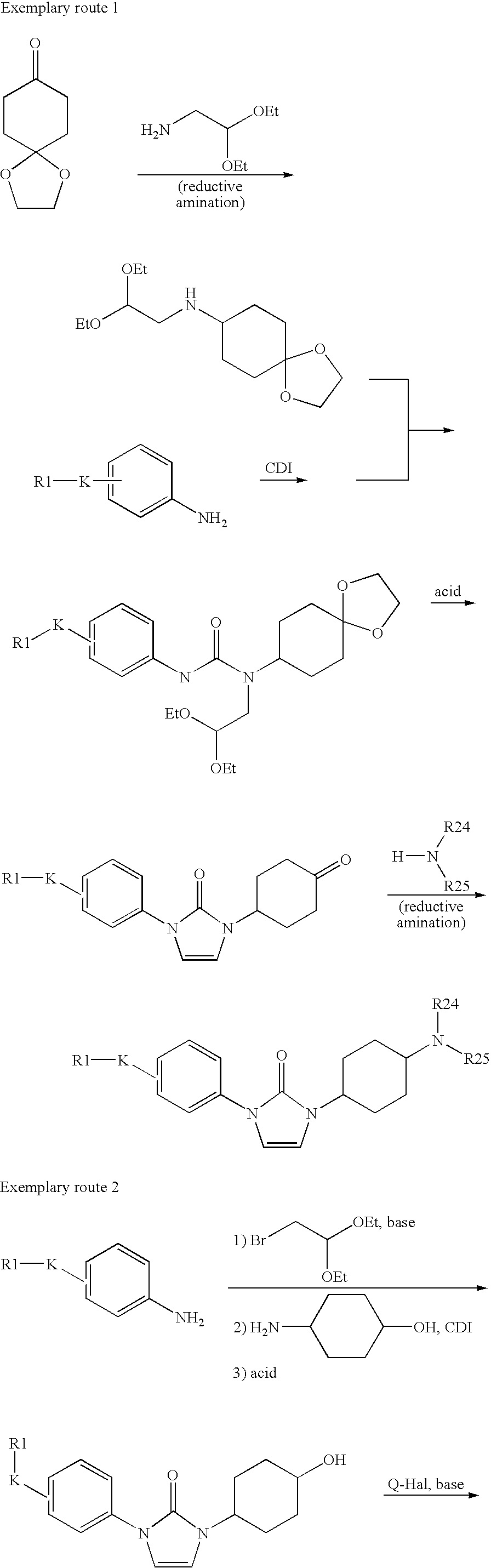

- 1. Obesity
- 2. Diabetes mellitus, especially type 2 diabetes, including the prevention of the sequelae associated therewith.
- Particular aspects in this connection are
- hyperglycemia,
- improvement in insulin resistance,
- improvement in glucose tolerance,
- protection of the pancreatic β cells
- prevention of macro- and microvascular disorders
- 3. Dyslipidemias and their sequelae such as, for example, atherosclerosis, coronary heart disease, cerebrovascular disorders etc, especially those (but not restricted thereto) which are characterized by one or more of the following factors:
- high plasma triglyceride concentrations, high postprandial plasma triglyceride concentrations,
- low HDL cholesterol concentration
- 4. Various other conditions which may be associated with the metabolic syndrome, such as:
- thromboses, hypercoagulable and prothrombotic stages (arterial and venous)
- high blood pressure
- heart failure such as, for example (but not restricted thereto), following myocardial infarction, hypertensive heart disease or cardiomyopathy
- 5. Psychiatric indications such as
- depressions
- anxiety states
- disturbances of the circadian rhythm
- affection disorders
- schizophrenia
- addictive disorders
Formulations
-
- 1. medicaments which lower blood glucose, antidiabetics,
- 2. active ingredients for the treatment of dyslipidemias,
- 3. antiatherosclerotic medicaments,
- 4. antiobesity agents,
- 5. antiinflammatory active ingredients
- 6. active ingredients for the treatment of malignant tumors
- 7. antithrombotic active ingredients
- 8. active ingredients for the treatment of high blood pressure
- 9. active ingredients for the treatment of heart failure and
- 10. active ingredients for the treatment and/or prevention of complications caused by diabetes or associated with diabetes.
- NaBH3CN=sodium cyanoborohydride
- DMF=N,N-dimethylformamide
- EDC=1-(3-dimethylaminopropyl)-3-ethylcarbodiimide
- THF=tetrahydrofuran
- DMSO=dimethyl sulfoxide
- HOBt=1-hydroxybenzotriazole
- HOAt=1-hydroxy-7-azabenzotriazole
- HCl=hydrochloric acid
- HPLC=high performance liquid chromatography
- PyBOP=benzotriazol-1-yloxytris(pyrrolidino)phosphonium hexafluorophosphate
- CDI=carbonyldiimidazole

Method A

| Ex. | Molecular | Molecular | ESI-MS | |
| No. | Structure | formula | weight | [M + H]+ |
| 3 |
 |
C27H34N4O3 | 462.60 | 463 |
| 4 |
 |
C25H32N4O2 | 420.56 | 421 |
| 5 |
 |
C25H30N4O2 | 418.54 | 419 |
| 6 |
 |
C28H32N4O2 | 458.61 | 459 |
| 7 |
 |
C25H32N4O2 | 420.56 | 421 |
| 8 |
 |
C26H32N4O2 | 432.57 | 433 |
| 9 |
 |
C26H32N4O2 | 432.57 | 433 |
| 10 |
 |
C26H34N4O2 | 434.59 | 435 |
| 11 |
 |
C30H38N4O4 | 518.66 | 519 |
| 12 |
 |
C28H36N4O3 | 476.62 | 477 |
| 13 |
 |
C27H34N4O2 | 446.60 | 447 |
| 14 |
 |
C27H35N5O2 | 461.61 | 462 |
| 15 |
 |
C28H36N4O2 | 460.62 | 461 |
| 16 |
 |
C27H36N4O2 | 448.61 | 449 |
| 17 |
 |
C29H40N4O2 | 476.67 | 477 |
| 18 |
 |
C27H34N4O2 | 446.60 | 447 |
| 19 |
 |
C27H36N4O2 | 448.61 | 449 |
| 20 |
 |
C27H34N4O2 | 446.60 | 447 |
| 21 |
 |
C27H36N4O2 | 448.61 | 449 |
| 22 |
 |
C28H34N4O3 | 474.61 | 475 |
| 23 |
 |
C27H36N4O4 | 480.61 | 481 |
| 24 |
 |
C28H38N4O2 | 462.64 | 463 |
| 25 |
 |
C27H34N4O2 | 446.60 | 447 |
| 26 |
 |
C28H36N4O2 | 460.62 | 461 |
| 27 |
 |
C29H38N4O4 | 506.65 | 507 |
| 28 |
 |
C27H34N4O2 | 446.60 | 447 |
| 29 |
 |
C20H38N4O4 | 518.66 | 519 |
| 30 |
 |
C29H36N4O3 | 488.64 | 489 |
| 31 |
 |
C31H40N4O4 | 532.69 | 533 |
| 32 |
 |
C26H34N4O2 | 434.59 | 435 |
| 33 |
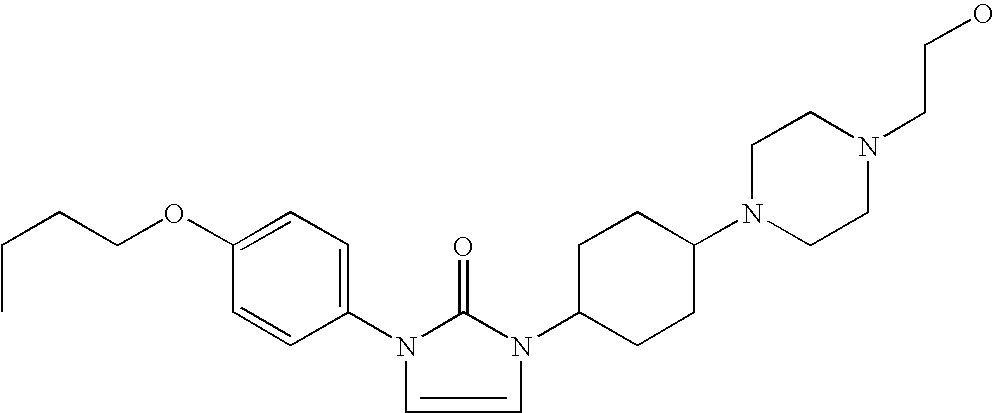 |
C25H38N4O3 | 442.61 | 443 |
| 34 |
 |
C23H36N4O2 | 400.57 | 401 |
| 35 |
 |
C26H38N4O2 | 438.62 | 439 |
| 36 |
 |
C23H36N4O2 | 400.57 | 401 |
| 37 |
 |
C24H36N4O2 | 412.58 | 413 |
| 38 |
 |
C24H38N4O2 | 414.60 | 415 |
| 39 |
 |
C28H42N4O4 | 498.67 | 499 |
| 40 |
 |
C26H40N4O3 | 456.63 | 457 |
| 41 |
 |
C26H40N4O2 | 440.63 | 441 |
| 42 |
 |
C25H40N4O2 | 428.62 | 429 |
| 43 |
 |
C27H44N4O2 | 456.68 | 457 |
| 44 |
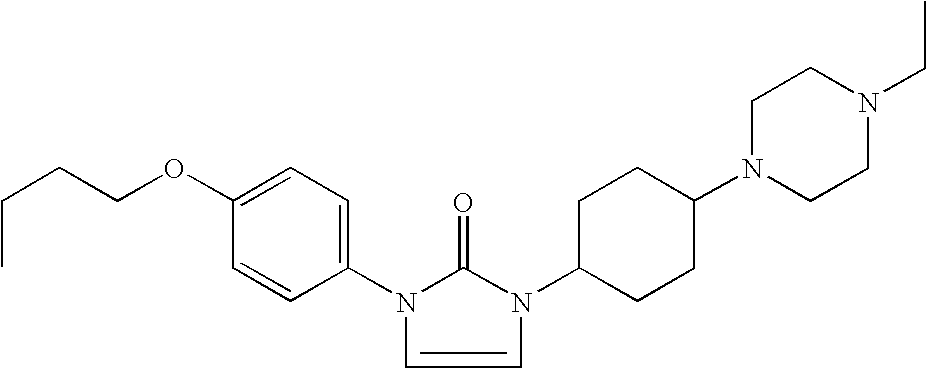 |
C25H38N4O2 | 426.61 | 427 |
| 45 |
 |
C25H40N4O2 | 428.62 | 429 |
| 46 |
 |
C25H38N4O2 | 426.61 | 427 |
| 47 |
 |
C25H40N4O2 | 428.62 | 429 |
| 48 |
 |
C25H36N4O3 | 440.59 | 441 |
| 49 |
 |
C26H38N4O3 | 454.62 | 455 |
| 50 |
 |
C25H40N4O4 | 460.62 | 461 |
| 51 |
 |
C26H42N4O2 | 442.65 | 443 |
| 52 |
 |
C25H38N4O2 | 426.61 | 427 |
| 53 |
 |
C26H40N4O2 | 440.63 | 441 |
| 54 |
 |
C27H42N4O4 | 486.66 | 487 |
| 55 |
 |
C29H40N4O2 | 476.67 | 477 |
| 56 |
 |
C25H38N4O2 | 426.61 | 427 |
| 57 |
 |
C28H42N4O4 | 498.67 | 499 |
| 58 |
 |
C27H40N4O3 | 468.64 | 469 |
| 59 |
 |
C29H44N4O4 | 512.70 | 513 |
| 60 |
 |
C24H38N4O2 | 414.60 | 415 |
| 61 |
 |
C26H38N4O3 | 454.62 | 455 |
| 62 |
 |
C24H36N4O2 | 412.58 | 413 |
| 63 |
 |
C24H34N4O2 | 410.56 | 411 |
| 64 |
 |
C27H38N4O2 | 450.63 | 451 |
| 65 |
 |
C24H36N4O2 | 412.58 | 413 |
| 66 |
 |
C25H36N4O2 | 424.59 | 425 |
| 67 |
 |
C25H38N4O2 | 426.61 | 427 |
| 68 |
 |
C29H42N4O4 | 510.68 | 511 |
| 69 |
 |
C27H40N4O3 | 468.64 | 469 |
| 70 |
 |
C26H38N4O2 | 428.62 | 439 |
| 71 |
 |
C27H40N4O2 | 452.65 | 453 |
| 72 |
 |
C26H40N4O2 | 440.63 | 441 |
| 73 |
 |
C28H44N4O2 | 468.69 | 469 |
| 74 |
 |
C26H38N4O2 | 438.62 | 439 |
| 75 |
 |
C26H40N4O2 | 440.63 | 441 |
| 76 |
 |
C26H40N4O2 | 440.63 | 441 |
| 77 |
 |
C27H38N4O3 | 466.63 | 467 |
| 78 |
 |
C26H40N4O4 | 472.63 | 473 |
| 79 |
 |
C27H42N4O2 | 454.66 | 455 |
| 80 |
 |
C26H38N4O2 | 438.62 | 439 |
| 81 |
 |
C27H40N4O2 | 452.65 | 453 |
| 82 |
 |
C28H42N4O4 | 498.67 | 499 |
| 83 |
 |
C26H38N4O2 | 438.62 | 439 |
| 84 |
 |
C29H42N4O4 | 510.68 | 511 |
| 85 |
 |
C28H40N4O3 | 480.66 | 481 |
| 86 |
 |
C30H44N4O4 | 524.71 | 525 |
| 87 |
 |
C25H37N4O3 | 455.61 | 456 |
| 88 |
 |
C23H33N5O2 | 411.55 | 412 |
| 89 |
 |
C26H37N5O2 | 451.62 | 452 |
| 90 |
 |
C24H35N5O2 | 425.58 | 426 |
| 91 |
 |
C24H37N5O2 | 427.59 | 428 |
| 92 |
 |
C28H41N5O4 | 511.67 | 512 |
| 93 |
 |
C26H39N5O3 | 469.63 | 470 |
| 94 |
 |
C25H37N5O2 | 439.61 | 440 |
| 95 |
 |
C25H38N6O2 | 454.62 | 455 |
| 96 |
 |
C26H39N5O2 | 453.63 | 454 |
| 97 |
 |
C25H39N5O2 | 441.62 | 442 |
| 98 |
 |
C27H43N5O2 | 469.68 | 470 |
| 99 |
 |
C25H37N5O2 | 439.61 | 440 |
| 100 |
 |
C25H39N5O2 | 441.62 | 442 |
| 101 |
 |
C25H39N5O2 | 441.62 | 442 |
| 102 |
 |
C25H35N5O3 | 453.59 | 454 |
| 103 |
 |
C26H37N5O3 | 467.62 | 468 |
| 104 |
 |
C25H39N5O2 | 473.62 | 474 |
| 105 |
 |
C26H41N5O2 | 455.65 | 456 |
| 106 |
 |
C25H37N5O2 | 439.61 | 440 |
| 107 |
 |
C26H39N5O2 | 453.63 | 454 |
| 108 |
 |
C27H41N5O4 | 499.66 | 500 |
| 109 |
 |
C29H39N5O2 | 489.67 | 490 |
| 110 |
 |
C25H37N5O2 | 439.61 | 440 |
| 111 |
 |
C28H41N5O4 | 511.67 | 512 |
| 112 |
 |
C27H39N5O3 | 481.64 | 482 |
| 113 |
 |
C29H43N5O4 | 525.70 | 526 |
| 114 |
 |
C24H37N5O2 | 427.59 | 428 |
| 115 |
 |
C26H38N4O2 | 438.62 | 439 |
| 116 |
 |
C26H36N4O3 | 452.60 | 453 |
| 117 |
 |
C25H37N5O2 | 439.61 | 440 |
| 118 |
 |
C25H37N5O2 | 439.61 | 440 |
Claims (15)


Priority Applications (1)
| Application Number | Priority Date | Filing Date | Title |
|---|---|---|---|
| US11/042,713 US7241787B2 (en) | 2004-01-25 | 2005-01-25 | Substituted N-cycloexylimidazolinones, process for their preparation and their use as medicaments |
Applications Claiming Priority (4)
| Application Number | Priority Date | Filing Date | Title |
|---|---|---|---|
| DE102004003811.2 | 2004-01-25 | ||
| DE102004003811A DE102004003811A1 (en) | 2004-01-25 | 2004-01-25 | Substituted N-cyclohexylimidazolinones, processes for their preparation and their use as medicaments |
| US58445604P | 2004-06-30 | 2004-06-30 | |
| US11/042,713 US7241787B2 (en) | 2004-01-25 | 2005-01-25 | Substituted N-cycloexylimidazolinones, process for their preparation and their use as medicaments |
Publications (2)
| Publication Number | Publication Date |
|---|---|
| US20050176795A1 US20050176795A1 (en) | 2005-08-11 |
| US7241787B2 true US7241787B2 (en) | 2007-07-10 |
Family
ID=34830754
Family Applications (1)
| Application Number | Title | Priority Date | Filing Date |
|---|---|---|---|
| US11/042,713 Expired - Lifetime US7241787B2 (en) | 2004-01-25 | 2005-01-25 | Substituted N-cycloexylimidazolinones, process for their preparation and their use as medicaments |
Country Status (1)
| Country | Link |
|---|---|
| US (1) | US7241787B2 (en) |
Families Citing this family (4)
| Publication number | Priority date | Publication date | Assignee | Title |
|---|---|---|---|---|
| EP1741703A4 (en) * | 2004-03-05 | 2009-11-25 | Banyu Pharma Co Ltd | PYRIDONE DERIVATIVE |
| SA110310332B1 (en) * | 2009-05-01 | 2013-12-10 | Astrazeneca Ab | 3Substituted-azetidin-1-yl)(5-phenyl-1,3,4-oxadiazol-2-yl) methanone compounds ) |
| CN103209979B (en) | 2010-07-06 | 2016-02-10 | 阿斯利康(瑞典)有限公司 | Therapeutic Agent 976 |
| UY34194A (en) | 2011-07-15 | 2013-02-28 | Astrazeneca Ab | ? (3- (4- (SPIROHETEROCYCLIC) METHYL) PHENOXI) AZETIDIN-1-IL) (5- (PHENYL) -1,3,4-OXADIAZOL-2-IL) METHANONE IN THE TREATMENT OF OBESITY? |
Citations (50)
| Publication number | Priority date | Publication date | Assignee | Title |
|---|---|---|---|---|
| US5190923A (en) | 1990-06-18 | 1993-03-02 | Adir Et Compagnie | Peptide compounds containing a cyclic amide structure |
| US5276049A (en) | 1991-03-12 | 1994-01-04 | Dr. Karl Thomae Gmbh | Cyclic urea derivatives, pharmaceutical compositions containing these compounds and methods of using the same |
| WO1994018183A1 (en) | 1993-02-15 | 1994-08-18 | The Wellcome Foundation Limited | Hypolipidaemic condensed 1,4-thiazepines |
| WO1994018184A1 (en) | 1993-02-15 | 1994-08-18 | The Wellcome Foundation Limited | Hypolipidaemic compounds |
| WO1997026265A1 (en) | 1996-01-17 | 1997-07-24 | Novo Nordisk A/S | Fused 1,2,4-thiadiazine and fused 1,4-thiazine derivatives, their preparation and use |
| US5681841A (en) | 1992-09-11 | 1997-10-28 | Karl Thomae Gmbh | Cyclic urea derivatives, pharmaceutical compositions containing these compounds and processes for preparing them |
| WO1998008871A1 (en) | 1996-08-30 | 1998-03-05 | Novo Nordisk A/S | Glp-1 derivatives |
| WO1998019998A2 (en) | 1996-11-07 | 1998-05-14 | Novartis Ag | N-substituted 2-cyanopyrrolidines |
| US5852192A (en) | 1992-03-11 | 1998-12-22 | Dr. Karl Thomae Gmbh | Cyclic urea derivatives, pharmaceutical compositions containing these compounds and processes for preparing them |
| WO1999003861A1 (en) | 1997-07-16 | 1999-01-28 | Novo Nordisk A/S | Fused 1,2,4-thiadiazine derivatives, their preparation and use |
| WO1999015525A1 (en) | 1997-09-19 | 1999-04-01 | Sanofi-Synthelabo | Carboxamidothiazole derivatives, preparation, pharmaceutical compositions containing them |
| WO1999061431A1 (en) | 1998-05-28 | 1999-12-02 | Probiodrug Gesellschaft für Arzneimittelforschung mbH | New dipeptidyl peptidase iv effectors |
| WO1999067279A1 (en) | 1998-06-24 | 1999-12-29 | Probiodrug Gesellschaft für Arzneimittelforschung mbH | Compounds of unstable dipeptidyl peptidase iv inhibitors |
| WO1999067278A1 (en) | 1998-06-24 | 1999-12-29 | Probiodrug Gesellschaft für Arzneimittelforschung mbH | Prodrugs of dipeptidyl peptidase iv inhibitors |
| WO2000040569A1 (en) | 1999-01-08 | 2000-07-13 | Alizyme Therapeutics Limited | 2-amino-benzoxazinone derivatives for the treatment of obesity |
| WO2000063208A1 (en) | 1999-04-16 | 2000-10-26 | Novo Nordisk A/S | Substituted imidazoles, their preparation and use |
| WO2000066585A1 (en) | 1999-04-30 | 2000-11-09 | Neurogen Corporation | 9H-PYRIMIDO[4,5-b]INDOLE DERIVATIVES: CRF1 SPECIFIC LIGANDS |
| WO2000071549A1 (en) | 1999-05-21 | 2000-11-30 | Knoll Gmbh | Thiazoloderivatives and pharmaceutical compositions containing them |
| WO2000078312A1 (en) | 1999-06-18 | 2000-12-28 | Merck & Co., Inc. | Arylthiazolidinedione and aryloxazolidinedione derivatives |
| WO2001004146A2 (en) | 1999-07-09 | 2001-01-18 | Cohesion Technologies, Inc. | Ecarin polypeptides, polynucleotides encoding ecarin, and methods for use thereof |
| WO2001009111A1 (en) | 1999-07-29 | 2001-02-08 | Eli Lilly And Company | Benzofurylpiperazines and benzofurylhomopiperazines: serotonin agonists |
| WO2001021577A2 (en) | 1999-09-20 | 2001-03-29 | Takeda Chemical Industries, Ltd. | Melanin concentrating hormone antagonist |
| US6221633B1 (en) | 1997-06-20 | 2001-04-24 | Aventis Pharma Deutschland Gmbh | Insulin derivatives having a rapid onset of action |
| US6245744B1 (en) | 1998-10-02 | 2001-06-12 | Aventis Pharma Deutschland Gmbh | Aryl-substituted propanolamine derivatives, their preparation, pharmaceuticals comprising them, and their use |
| US6277831B1 (en) | 1999-04-09 | 2001-08-21 | Aventis Pharma Deutschland Gmbh | 1,4-benzothiazepine-1,1-dioxide derivatives substituted by sugar residues, process for their preparation, pharmaceuticals comprising these compounds, and their use |
| WO2001083451A1 (en) | 2000-04-28 | 2001-11-08 | Asahi Kasei Kabushiki Kaisha | Novel bicyclic compounds |
| WO2001085695A1 (en) | 2000-05-11 | 2001-11-15 | Bristol-Myers Squibb Co. | Tetrahydroisoquinoline analogs useful as growth hormone secretagogues |
| WO2001091752A1 (en) | 2000-05-30 | 2001-12-06 | Merck & Co., Inc. | Melanocortin receptor agonists |
| WO2001094300A1 (en) | 2000-06-09 | 2001-12-13 | Aventis Pharma Deutschland Gmbh | Acylphenyl urea derivatives, methods for the production thereof and use thereof as a medicament |
| WO2002002744A2 (en) | 2000-07-05 | 2002-01-10 | Synaptic Pharmaceutical Corporation | Dna encoding a human melanin concentrating hormone receptor (mch1) and uses thereof |
| WO2002006245A1 (en) | 2000-07-05 | 2002-01-24 | Synaptic Pharmarceutical Corporation | Selective melanin concentrating hormone-1 (mch1) receptor antagonists and uses thereof |
| US6342512B1 (en) | 1999-09-01 | 2002-01-29 | Aventis Pharma Deutschland Gmbh | Sulfonylcarboxamide derivatives, process for their preparation and their use as pharmaceuticals |
| WO2002010146A1 (en) | 2000-07-31 | 2002-02-07 | Smithkline Beecham P.L.C. | Carboxamide compounds and their use as antagonists of a human 11cby receptor |
| WO2002038541A1 (en) | 2000-11-10 | 2002-05-16 | Taisho Pharmaceutical Co., Ltd. | Cyanopyrrolidine derivatives |
| WO2002050027A1 (en) | 2000-12-21 | 2002-06-27 | Aventis Pharma Deutschland Gmbh | Novel 1,2-diphenzylazetidinones, method for producing the same, medicaments containing said compounds, and the use thereof for treating disorders of the lipid metabolism |
| WO2002057233A1 (en) | 2000-12-01 | 2002-07-25 | Schering Corporation | Mch antagonists and their use in the treatment of obesity |
| WO2002089729A2 (en) | 2001-05-04 | 2002-11-14 | Tularik Inc. | Fused heterocyclic compounds |
| WO2002096864A1 (en) | 2001-05-25 | 2002-12-05 | Aventis Pharma Deutschland Gmbh | Carboxamide-substituted phenylurea derivatives and method for production thereof as medicaments |
| US6500804B2 (en) | 2000-03-31 | 2002-12-31 | Probiodrug Ag | Method for the improvement of islet signaling in diabetes mellitus and for its prevention |
| WO2003035624A1 (en) | 2001-10-25 | 2003-05-01 | Takeda Chemical Industries, Ltd. | Quinoline compound |
| WO2003040174A2 (en) | 2001-11-09 | 2003-05-15 | Probiodrug Ag | Substituted amino ketone compounds |
| WO2003045313A2 (en) | 2001-11-27 | 2003-06-05 | Merck & Co. Inc. | 2-aminoquinoline compounds |
| WO2003057220A1 (en) | 2002-01-08 | 2003-07-17 | Glaxo Group Limited | Cyclic urea derivatives with 5-ht2c receptor activity |
| WO2003084923A1 (en) | 2002-04-11 | 2003-10-16 | Aventis Pharma Deutschland Gmbh | Acyl-3-carboxyphenylurea derivatives, method for production and use thereof |
| WO2003084922A1 (en) | 2002-04-11 | 2003-10-16 | Aventis Pharma Deutschland Gmbh | Acyl-4-carboxyphenylurea derivatives, method for production and use thereof |
| WO2003087044A2 (en) | 2002-04-09 | 2003-10-23 | 7Tm Pharma A/S | Novel carboxamide compounds for use in mch receptor related disorders |
| WO2003097047A1 (en) | 2002-05-13 | 2003-11-27 | Eli Lilly And Company | Multicyclic compounds for use as melanin concentrating hormone antagonists in the treatment of obesity and diabetes |
| WO2003104188A1 (en) | 2002-06-07 | 2003-12-18 | Aventis Pharma Deutschland Gmbh | N-benzoylureidocinnamate derivatives, method for production and use thereof |
| WO2004011438A1 (en) | 2002-07-25 | 2004-02-05 | Aventis Pharma Deutschland Gmbh | Diaryl-substituted cyclic urea derivatives having an mch-modulatory effect |
| US6890905B2 (en) | 2001-04-02 | 2005-05-10 | Prosidion Limited | Methods for improving islet signaling in diabetes mellitus and for its prevention |
-
2005
- 2005-01-25 US US11/042,713 patent/US7241787B2/en not_active Expired - Lifetime
Patent Citations (53)
| Publication number | Priority date | Publication date | Assignee | Title |
|---|---|---|---|---|
| US5190923A (en) | 1990-06-18 | 1993-03-02 | Adir Et Compagnie | Peptide compounds containing a cyclic amide structure |
| US5276049A (en) | 1991-03-12 | 1994-01-04 | Dr. Karl Thomae Gmbh | Cyclic urea derivatives, pharmaceutical compositions containing these compounds and methods of using the same |
| US5478942A (en) | 1991-03-12 | 1995-12-26 | Karl Thomae Gmbh | Cyclic urea derivatives and pharmaceutical compositions containing these compounds |
| US5650424A (en) | 1991-03-12 | 1997-07-22 | Dr. Karl Thomae Gmbh | Cyclic urea derivatives, pharmaceutical compositions containing these compounds and processes for preparing them |
| US5852192A (en) | 1992-03-11 | 1998-12-22 | Dr. Karl Thomae Gmbh | Cyclic urea derivatives, pharmaceutical compositions containing these compounds and processes for preparing them |
| US5681841A (en) | 1992-09-11 | 1997-10-28 | Karl Thomae Gmbh | Cyclic urea derivatives, pharmaceutical compositions containing these compounds and processes for preparing them |
| US5880284A (en) | 1992-09-11 | 1999-03-09 | Dr. Karl Thomae Gmbh | Cyclic urea derivatives, pharmaceutical compositions containing these compounds and processes for preparing them |
| WO1994018184A1 (en) | 1993-02-15 | 1994-08-18 | The Wellcome Foundation Limited | Hypolipidaemic compounds |
| WO1994018183A1 (en) | 1993-02-15 | 1994-08-18 | The Wellcome Foundation Limited | Hypolipidaemic condensed 1,4-thiazepines |
| WO1997026265A1 (en) | 1996-01-17 | 1997-07-24 | Novo Nordisk A/S | Fused 1,2,4-thiadiazine and fused 1,4-thiazine derivatives, their preparation and use |
| WO1998008871A1 (en) | 1996-08-30 | 1998-03-05 | Novo Nordisk A/S | Glp-1 derivatives |
| WO1998019998A2 (en) | 1996-11-07 | 1998-05-14 | Novartis Ag | N-substituted 2-cyanopyrrolidines |
| US6221633B1 (en) | 1997-06-20 | 2001-04-24 | Aventis Pharma Deutschland Gmbh | Insulin derivatives having a rapid onset of action |
| WO1999003861A1 (en) | 1997-07-16 | 1999-01-28 | Novo Nordisk A/S | Fused 1,2,4-thiadiazine derivatives, their preparation and use |
| WO1999015525A1 (en) | 1997-09-19 | 1999-04-01 | Sanofi-Synthelabo | Carboxamidothiazole derivatives, preparation, pharmaceutical compositions containing them |
| WO1999061431A1 (en) | 1998-05-28 | 1999-12-02 | Probiodrug Gesellschaft für Arzneimittelforschung mbH | New dipeptidyl peptidase iv effectors |
| WO1999067279A1 (en) | 1998-06-24 | 1999-12-29 | Probiodrug Gesellschaft für Arzneimittelforschung mbH | Compounds of unstable dipeptidyl peptidase iv inhibitors |
| WO1999067278A1 (en) | 1998-06-24 | 1999-12-29 | Probiodrug Gesellschaft für Arzneimittelforschung mbH | Prodrugs of dipeptidyl peptidase iv inhibitors |
| US6245744B1 (en) | 1998-10-02 | 2001-06-12 | Aventis Pharma Deutschland Gmbh | Aryl-substituted propanolamine derivatives, their preparation, pharmaceuticals comprising them, and their use |
| WO2000040569A1 (en) | 1999-01-08 | 2000-07-13 | Alizyme Therapeutics Limited | 2-amino-benzoxazinone derivatives for the treatment of obesity |
| US6277831B1 (en) | 1999-04-09 | 2001-08-21 | Aventis Pharma Deutschland Gmbh | 1,4-benzothiazepine-1,1-dioxide derivatives substituted by sugar residues, process for their preparation, pharmaceuticals comprising these compounds, and their use |
| WO2000063208A1 (en) | 1999-04-16 | 2000-10-26 | Novo Nordisk A/S | Substituted imidazoles, their preparation and use |
| WO2000066585A1 (en) | 1999-04-30 | 2000-11-09 | Neurogen Corporation | 9H-PYRIMIDO[4,5-b]INDOLE DERIVATIVES: CRF1 SPECIFIC LIGANDS |
| WO2000071549A1 (en) | 1999-05-21 | 2000-11-30 | Knoll Gmbh | Thiazoloderivatives and pharmaceutical compositions containing them |
| WO2000078312A1 (en) | 1999-06-18 | 2000-12-28 | Merck & Co., Inc. | Arylthiazolidinedione and aryloxazolidinedione derivatives |
| WO2001004146A2 (en) | 1999-07-09 | 2001-01-18 | Cohesion Technologies, Inc. | Ecarin polypeptides, polynucleotides encoding ecarin, and methods for use thereof |
| WO2001009111A1 (en) | 1999-07-29 | 2001-02-08 | Eli Lilly And Company | Benzofurylpiperazines and benzofurylhomopiperazines: serotonin agonists |
| US6342512B1 (en) | 1999-09-01 | 2002-01-29 | Aventis Pharma Deutschland Gmbh | Sulfonylcarboxamide derivatives, process for their preparation and their use as pharmaceuticals |
| WO2001021577A2 (en) | 1999-09-20 | 2001-03-29 | Takeda Chemical Industries, Ltd. | Melanin concentrating hormone antagonist |
| US6500804B2 (en) | 2000-03-31 | 2002-12-31 | Probiodrug Ag | Method for the improvement of islet signaling in diabetes mellitus and for its prevention |
| WO2001083451A1 (en) | 2000-04-28 | 2001-11-08 | Asahi Kasei Kabushiki Kaisha | Novel bicyclic compounds |
| WO2001085695A1 (en) | 2000-05-11 | 2001-11-15 | Bristol-Myers Squibb Co. | Tetrahydroisoquinoline analogs useful as growth hormone secretagogues |
| WO2001091752A1 (en) | 2000-05-30 | 2001-12-06 | Merck & Co., Inc. | Melanocortin receptor agonists |
| WO2001094300A1 (en) | 2000-06-09 | 2001-12-13 | Aventis Pharma Deutschland Gmbh | Acylphenyl urea derivatives, methods for the production thereof and use thereof as a medicament |
| WO2002002744A2 (en) | 2000-07-05 | 2002-01-10 | Synaptic Pharmaceutical Corporation | Dna encoding a human melanin concentrating hormone receptor (mch1) and uses thereof |
| WO2002006245A1 (en) | 2000-07-05 | 2002-01-24 | Synaptic Pharmarceutical Corporation | Selective melanin concentrating hormone-1 (mch1) receptor antagonists and uses thereof |
| WO2002010146A1 (en) | 2000-07-31 | 2002-02-07 | Smithkline Beecham P.L.C. | Carboxamide compounds and their use as antagonists of a human 11cby receptor |
| WO2002038541A1 (en) | 2000-11-10 | 2002-05-16 | Taisho Pharmaceutical Co., Ltd. | Cyanopyrrolidine derivatives |
| WO2002057233A1 (en) | 2000-12-01 | 2002-07-25 | Schering Corporation | Mch antagonists and their use in the treatment of obesity |
| WO2002050027A1 (en) | 2000-12-21 | 2002-06-27 | Aventis Pharma Deutschland Gmbh | Novel 1,2-diphenzylazetidinones, method for producing the same, medicaments containing said compounds, and the use thereof for treating disorders of the lipid metabolism |
| US6890905B2 (en) | 2001-04-02 | 2005-05-10 | Prosidion Limited | Methods for improving islet signaling in diabetes mellitus and for its prevention |
| WO2002089729A2 (en) | 2001-05-04 | 2002-11-14 | Tularik Inc. | Fused heterocyclic compounds |
| WO2002096864A1 (en) | 2001-05-25 | 2002-12-05 | Aventis Pharma Deutschland Gmbh | Carboxamide-substituted phenylurea derivatives and method for production thereof as medicaments |
| WO2003035624A1 (en) | 2001-10-25 | 2003-05-01 | Takeda Chemical Industries, Ltd. | Quinoline compound |
| WO2003040174A2 (en) | 2001-11-09 | 2003-05-15 | Probiodrug Ag | Substituted amino ketone compounds |
| WO2003045313A2 (en) | 2001-11-27 | 2003-06-05 | Merck & Co. Inc. | 2-aminoquinoline compounds |
| WO2003057220A1 (en) | 2002-01-08 | 2003-07-17 | Glaxo Group Limited | Cyclic urea derivatives with 5-ht2c receptor activity |
| WO2003087044A2 (en) | 2002-04-09 | 2003-10-23 | 7Tm Pharma A/S | Novel carboxamide compounds for use in mch receptor related disorders |
| WO2003084922A1 (en) | 2002-04-11 | 2003-10-16 | Aventis Pharma Deutschland Gmbh | Acyl-4-carboxyphenylurea derivatives, method for production and use thereof |
| WO2003084923A1 (en) | 2002-04-11 | 2003-10-16 | Aventis Pharma Deutschland Gmbh | Acyl-3-carboxyphenylurea derivatives, method for production and use thereof |
| WO2003097047A1 (en) | 2002-05-13 | 2003-11-27 | Eli Lilly And Company | Multicyclic compounds for use as melanin concentrating hormone antagonists in the treatment of obesity and diabetes |
| WO2003104188A1 (en) | 2002-06-07 | 2003-12-18 | Aventis Pharma Deutschland Gmbh | N-benzoylureidocinnamate derivatives, method for production and use thereof |
| WO2004011438A1 (en) | 2002-07-25 | 2004-02-05 | Aventis Pharma Deutschland Gmbh | Diaryl-substituted cyclic urea derivatives having an mch-modulatory effect |
Non-Patent Citations (13)
| Title |
|---|
| Asakawa, A., et. al., Cocaine-Amphetamine-Regulated Transcript Influences Energy Metabolism, Anxiety And Gastric Emptying in Mice, Hormone And Metabolic Research (2002, pp. 554-558, vol. 33, No. 9). |
| Beauhaire, J., et. al., Indentification And Synthesis Of Sordidin, a Male Pheromone Emitted by Cosmopolites Sordidus, Tetrahedron Letter (1995, pp. 1043-1046, vol. 36, No. &). |
| Borowsky, B., et. al., Antidepressant, Anxiolytic and Anorectic Effects of a Melanin-Concentrating Hormone-1 Receptor Antagonist, Nature Medicine (2002, pp. 825-830, vol. 8, No. 8). |
| Chen, Y., et. al., Targeted Disruption of the Melanin-Concentrating Hormone Receptor-1 Results in Hyperphagia and Resistance to Diet-Induced Obesity, Endocrinology (2002, pp. 2469-2477, vol. 143). |
| Hervieu, G., et. al., Melanin-concentrating hormone functions in the nervous system: food intake and stress, Expert Opin (2003, pp. 495-511, vol. 7, No. 4). |
| Kawafuchi, H., et. al., Novel Access to Cyclohexane-1,4-Diones and 1,4-Hydroquinones via Radical 1,2-Acyl Rearrangement on 2-(Halomethyl) Cyclopentane-1,3-Diones Using Cobaloxime-Mediated Electroreduction or Tributyltin Hydride, Tetrahedron Letters (2002, pp. 2051-2054, vol. 43). |
| Lee, D.W., et. al., Leptin Agonists As A Potential Approach To The Treatment Of Obesity, Drugs Of The Future (2001, pp. 873-881, vol. 26, Issue 9). |
| Nakamura, M., et. al., Enantioselective Synthesis of alpha-Substituted Ketones by Asymmetric Addition of Chiral Zinc Enamides to 1-Alkenes, J. Am. Chem. Soc. (2003, pp. 6362-6363, vol. 125). |
| Okada, H., et. al., Synthesis And Antitumor Activities Of Prodrugs Of Benzoylphenylureas, Chem. Pharm. Bull (1994, 57-61, vol. 42, No. 1). |
| Pereira-Da-Silva, M., et. al., Hypothalamic Melanin-Concentrating Hormone Is Induced by Cold Exposure and Participates in the Control of Energy Expenditure in Rats, Endocrinology (2003, pp. 4831-4840, vol. 144). |
| Qu, D., et. al., A Role For Melanin-Concentrating Hormone In The Central Regulation Of Feeding Behaviour, Nature (1996, pp. 243-247, vol. 380). |
| Shimada, M., et. al., Mice Lacking Melanin-Concentrating Hormone Are Hypophagic And Lean, Nature (1998, pp. 670-674, vol. 396). |
| Zunft, H.J., et. al., Carob Pulp Preparation for Treament of Hypercholesterolemia, Advances in Natural Therapy (2001, pp. 230-236, vol. 18, No. 5). |
Also Published As
| Publication number | Publication date |
|---|---|
| US20050176795A1 (en) | 2005-08-11 |
Similar Documents
| Publication | Publication Date | Title |
|---|---|---|
| US8299104B2 (en) | Aryl-substituted heterocycles, process for their preparation and their use as medicaments | |
| US7838547B2 (en) | Aryl-substituted polycyclic amines, method for the production thereof, and use thereof as a medicament | |
| US8153649B2 (en) | 3-aminoimidazo 1,2-A pyridine derivatives having an SGLT1- and SGLT2-inhibiting action for the treatment of type 1 and type 2 diabetes | |
| AU2005206307A1 (en) | Aryl substituted heterocycles, method for production and use thereof as medicaments | |
| CN1934090B (en) | Substituted N-cyclohexylimidazolidinones with MCH-modulation | |
| US7402674B2 (en) | 7-Phenylamino-4-quinolone-3-carboxylic acid derivatives, process for their preparation and their use as medicaments | |
| US7241787B2 (en) | Substituted N-cycloexylimidazolinones, process for their preparation and their use as medicaments | |
| HK1105964A (en) | Aryl-substituted polycyclic amines, method for the production thereof, and use thereof as a medicament | |
| HK1105965A (en) | Apyl-substituted polycyclic amines, method for the production thereof, and use thereof as a medicament | |
| MXPA06007953A (en) | Substituted n-cyclohexyl imidazolinones having an mch-modulatory effect |
Legal Events
| Date | Code | Title | Description |
|---|---|---|---|
| AS | Assignment |
Owner name: AVENTIS PHARMA DEUTSCHLAND GMBH, GERMANY Free format text: ASSIGNMENT OF ASSIGNORS INTEREST;ASSIGNORS:SCHWINK, DR. LOTHAR;STENGELIN, DR. SIEGFRIED;BOEHME, DR. THOMAS;AND OTHERS;REEL/FRAME:016025/0403;SIGNING DATES FROM 20050404 TO 20050406 |
|
| AS | Assignment |
Owner name: SANOFI-AVENTIS DEUTSCHLAND GMBH, GERMANY Free format text: CHANGE OF NAME;ASSIGNOR:AVENTIS PHARMA DEUTSCHLAND GMBH;REEL/FRAME:017086/0387 Effective date: 20050901 |
|
| STCF | Information on status: patent grant |
Free format text: PATENTED CASE |
|
| FPAY | Fee payment |
Year of fee payment: 4 |
|
| FPAY | Fee payment |
Year of fee payment: 8 |
|
| MAFP | Maintenance fee payment |
Free format text: PAYMENT OF MAINTENANCE FEE, 12TH YEAR, LARGE ENTITY (ORIGINAL EVENT CODE: M1553); ENTITY STATUS OF PATENT OWNER: LARGE ENTITY Year of fee payment: 12 |