US7222334B2 - Modeling tool for electronic services and associated methods and businesses - Google Patents
Modeling tool for electronic services and associated methods and businesses Download PDFInfo
- Publication number
- US7222334B2 US7222334B2 US09/911,916 US91191601A US7222334B2 US 7222334 B2 US7222334 B2 US 7222334B2 US 91191601 A US91191601 A US 91191601A US 7222334 B2 US7222334 B2 US 7222334B2
- Authority
- US
- United States
- Prior art keywords
- service
- electronic
- composite
- services
- set forth
- Prior art date
- Legal status (The legal status is an assumption and is not a legal conclusion. Google has not performed a legal analysis and makes no representation as to the accuracy of the status listed.)
- Expired - Fee Related, expires
Links
Images




Classifications
-
- G—PHYSICS
- G06—COMPUTING OR CALCULATING; COUNTING
- G06Q—INFORMATION AND COMMUNICATION TECHNOLOGY [ICT] SPECIALLY ADAPTED FOR ADMINISTRATIVE, COMMERCIAL, FINANCIAL, MANAGERIAL OR SUPERVISORY PURPOSES; SYSTEMS OR METHODS SPECIALLY ADAPTED FOR ADMINISTRATIVE, COMMERCIAL, FINANCIAL, MANAGERIAL OR SUPERVISORY PURPOSES, NOT OTHERWISE PROVIDED FOR
- G06Q10/00—Administration; Management
- G06Q10/10—Office automation; Time management
-
- G—PHYSICS
- G06—COMPUTING OR CALCULATING; COUNTING
- G06Q—INFORMATION AND COMMUNICATION TECHNOLOGY [ICT] SPECIALLY ADAPTED FOR ADMINISTRATIVE, COMMERCIAL, FINANCIAL, MANAGERIAL OR SUPERVISORY PURPOSES; SYSTEMS OR METHODS SPECIALLY ADAPTED FOR ADMINISTRATIVE, COMMERCIAL, FINANCIAL, MANAGERIAL OR SUPERVISORY PURPOSES, NOT OTHERWISE PROVIDED FOR
- G06Q30/00—Commerce
- G06Q30/02—Marketing; Price estimation or determination; Fundraising
Definitions
- This application includes a hard copy Appendix comprising an exemplary code listing for a novel COMPOSITE SERVICE DEFINITION LANGUAGE, “CSDL.”
- the present invention relates generally to electronic-commerce and electronic-services and, more particularly, to a modeling tool for development of electronic-services, methodologies related to the tool, uses of the tool, and an electronic-service employing the tool.
- the Internet is not only being used to provide information and perform electronic commercial business transactions ((business-to-business and customer/client-to-business; hereinafter “e-commerce”), but also as a platform, or set of discrete platforms, through which services and products are delivered to businesses and customers.
- e-commerce electronic commercial business transactions
- Internet or “internet” is used herein as both a specific and generic term for any collection of distributed, interconnected networks (ARPANET, DARPANET, World Wide Web, or the like) that are linked together by a set of industry standard protocols (e.g., TCP/IP, HTTP, UDP, and the like) to form a global, or otherwise distributed, network.)
- e-service(s) or “ES”
- ES electronic-service providers
- software vendors and industry consortia are providing models, languages, and tools for describing e-services and making them available to users.
- Such tools and frameworks usually allow the specification of specific e-services in terms of their inherent properties, which can be generic (such as the electronic-service name and location, e.g., fictitious Acme Cars) or service item specific (such as the car size for a car rental service).
- the properties are generally represented by Java vectors or XML documents.
- software vendors provide software platforms (“E-Service Platform,” or simply “ESP”) that allow service providers to register and advertise their services and allow authorized users to lookup and access registered electronic-services.
- E-Service Platform software platforms
- FIG. 1 is a schematic representation of such a ESP system.
- Examples of commercially available platforms are BEA Web Logic CollaborateTM, WebMethods EnterpriseTM, Sun Microsystems JiniTM, IBM WebSphereTM, and present assignee Hewlett-Packard Company's HPTM e-speakTM ESPs 100 (further details being available at http://www.e-speak.hp.com).
- Ovals 103 labeled “ES” represent specific E-Service(s) 103 .
- An exemplary Service Provider 105 such as a public transportation related corporation, may register a plurality of generic services: buying cars, renting cars, selling cars, van or bus services, limousine services, and the like, each being a specific individual E-Service 103 .
- An E-Service Platform 100 itself may be coupled to other platforms 101 for subsidiary or specialized E-Service(s) 103 , such as those which are internal operations of the E-Service Platform related business itself.
- This platform approach enables the uniform representation, search, and access of business applications, both those used for internal operations (such as access to databases or other enterprise applications and the like as would be known in the art) and the ones that are made available to customers, Client 107 , typically via the Internet at an Internet address.
- ESPs 100 , 101 typically allow Service Providers 105 to register specific electronic-services, each represented as an ES 103 oval symbol, and allow authorized Clients 107 to lookup and invoke registered electronic-services.
- Service Providers 105 (or other user in the case of a sub-platform 101 ) must register each service definition with an ESP 100 , 101 (and possibly with other advertising services (not shown)).
- the Service Provider 105 gives information about each electronic service, such as the service name, the methods (operations) that can be performed on the service along with their input/output parameters, the list of authorized users, and the like.
- an electronic-service may provide several methods (operations) to be invoked as part of its internet interface; for instance, an e-music service may allow users to browse or search the catalog, to listen to songs, or to buy discs or downloadable mp3 files.
- a Service Provider 105 specifies who is the handler of the service, i.e., the application or server that must be contacted in order to request actual service executions. (“Client”-“Browser”, “Server” terms are used as the standard model of interaction in a distributed computer network system in which a program at one site sends a request to another site and then waits for a response.
- the requesting program is called the “client,” or “browser” and the program which responds to the request is called the “server.”)
- the service handler can be identified by providing a linking Universal Resource Indicator (“URI ”)—such as in HP e-speak form—or by giving a proxy Java object that will take care of contacting the handler—such as in Jini.
- URI Universal Resource Indicator
- Customers 107 may look for available electronic-services by issuing service selection queries that may simply search electronic-services by name or that can include complex constraints on the service properties as well as ranking criteria in case multiple electronic-services satisfy the search criteria (e.g., not just Acme Car Rentals (fictitious) but Acme Car Rentals, midsize, San Jose airport, this Saturday night.
- Service selection queries return a reference to one or more electronic-services that can be used to invoke them.
- the uniform representation and implementation of applications according to a homogeneous e-service framework creates a need for methods, devices, and tools for composing individual, web-accessible E-Service (possibly offered by different provider companies) into pre-packaged, value added, “composite e-service,” where a composite e-service service is a service composed of more than one individual service and inherent methods thereof.
- a provider 105 having an appropriate tool could offer a travel reservation service by composing hotel and flight reservation services, or it could offer an itinerary planning service by composing road map services, weather services, traffic prediction services, and “utility” services to collect data from the user via the web or to send e-mail notifications.
- EAI Enterprise Application Integration
- IT information technology
- a service provider specifies the flow of service invocations (i.e., the electronic-services to be invoked, their input and output data specification, and their execution dependencies).
- a workflow developer specifies the flow of the work, i.e., the work items to be executed (where a work item represents the invocation of a business function and is a black box from the workflow viewpoint), their input and output data specifications, and their execution dependencies.
- Exemplary traditional workflow management systems such as MQ Workflow (IBM.
- an E-Service 103 may have several states and several state transitions caused by any individual interaction.
- an E-Service 103 access requires: (1) operations to be performed at the service level (e.g., search, authentication, service-level exceptions, and the like) and (2) operations to be performed at the interaction, or method invocation, level (e.g., the invocation of the method and the handling of method-level exceptions, and the like).
- service level e.g., search, authentication, service-level exceptions, and the like
- method invocation, level e.g., the invocation of the method and the handling of method-level exceptions, and the like.
- composition functionality as an e-service itself (or, rather, a meta-service, since it is a service for developing electronic-services); moreover, by providing a new e-service composition functionality as an e-service itself, the service composition facility can be advertised, discovered, delivered, managed, and protected by end-to-end security analogously to any other e-service, thereby exploiting all the advantages and features provided by the ESP 100 .
- composition E-Service Composition E-Service, or simply “CES.”
- the present invention provides a composition model, and associated tools and services, for e-services.
- the present invention provides an electronic metaservice methodology including: receiving a process definition; transforming the process definition into a composite process specification having a plurality of electronic services; and registering the composite process specification with at least one electronic service.
- Another aspect of the present invention is a method of doing an electronic service business via an electronic services platform 100 , the method including: registering with said platform a primary electronic service for composing a practical electronic service system from a generic definition thereof; via said primary electronic service, receiving said generic definition; compiling second electronic services registered with said platform into a composite electronic service; and providing said composite electronic service as said electronic service system.
- Still another aspect of the present invention is a computerized system for creating composite electronic services for an electronic service platform including: computer code for receiving a process definition; computer code for transforming the process definition into a composite process specification having a plurality of electronic services; and computer code for registering the composite process specification with at least one electronic services platform.
- the present invention provides an electronic business system for an electronic services platform environment, the business including: means for receiving a specification of a first electronic service; means for compiling other existing secondary electronic services into the first electronic service; and means for registering said first electronic service in the electronic services platform environment.
- FIG. 1 (Prior Art) is a block diagram representative of an E-Service model.
- FIG. 1A (Prior Art) is a service process diagram.
- FIG. 2 is an exemplary embodiment of a two-level service composition model in accordance with the present invention.
- FIG. 3 is a generic block diagram representative of a Composition E-Service model in accordance with the present invention, referencing the exemplary model as shown in FIG. 2 .
- FIG. 4 is a generic block diagram representative a Composition E-Service compilation architecture in accordance with the present invention as shown in FIGS. 2 and 3 .
- FIG. 5 is a flow chart of a Composition E-Service compilation process in accordance with the present invention as shown in FIGS. 2 and 3 .
- FIG. 6 is a generic block diagram representative a Composition E-Service run-time architecture in accordance with the present invention as shown in FIGS. 2 and 3 .
- FIG. 7 is a flow chart of a Composition E-Service run-time process in accordance with the present invention as shown in FIGS. 2 and 3 .
- FIG. 8 is a block diagram exemplifying a client use of a Composition E-Service as shown in FIGS. 2 , 3 , 6 and 7 .
- FIG. 9 is a block diagram exemplifying provider-provider-designer 105 uses of a Composition E-Service as shown in FIGS. 2 , 3 , 4 , and 5 .
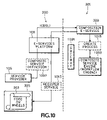
- FIG. 10 is a block diagram of components of a Composition E-Service prototype in accordance with the present invention.
- FIG. 10A is a block diagram of the architecture for registering composite e-services in accordance with the present invention as shown in FIG. 10 .
- FIG. 10B is a flow chart of the method of updating composite e-services in accordance with the present invention as shown in FIG. 10 .
- FIG. 10C is a flow chart of the method for registering composite e-services in accordance with the present invention as shown in FIG. 10 .
- FIG. 10D is a flow chart of the method for deleting composite e-services in accordance with the present invention as shown in FIG. 10 .
- FIG. 11 is a block diagram of invocation of composite services using the prototype as shown in FIG. 10 .
- the present invention provides a two-level process modeling-tool 200 (also referred to herein as simply the “model” or the “tool”) as exemplified by FIG. 2 .
- the tool is useful to the Service Provider 105 , or service provider's IT personnel, or any composite service provider-designer; hereinafter referred to more simply and generically as the “provider-designer 105 .”
- a composite service (the example is for food ordering, delivery, and payment) is specified by a flow of service nodes 203 each representing the usage of a particular E-Service (e.g., the E-Services 103 ( FIG. 1 )).
- the specification, or definition, of a service node 203 includes service -level properties such as:
- service nodes 203 of the top-level 201 define the highest level definition of a service on which methods or operations of the lower level 207 can be and generally are invoked and performed.
- Service nodes 203 define the service invocation setup phase (e.g., search for the best service provider, authenticate, and the like) and method nodes 205 , 205 ′ 205 define the interaction phase, invoking actual physical operations (e.g., delivering goods, receiving payments, and the like).
- Having two different levels 201 , 207 and two different kinds of nodes 203 , 205 provides a tool which simplifies the service composition effort since it allows the definition of a context—the service—in which interactions are performed. This simplification is illustrated by comparing FIG. 2 with FIG.
- the CES graphical construct may include service, decision, and event nodes.
- square boxes represent service nodes 203 while diamonds represent decision-route nodes 115 .
- Service nodes 203 represent invocations of both basic e-services or composite electronic-services; decision-route nodes 115 specify the alternatives and rules controlling the execution flow; and, event nodes 204 (an “event node” is generic for a predetermined system event such as “‘WAIT’ for customer cancellation;” an event node enables composite electronic-services to send and receive several types of notifications (in this example, if the operation receives a “cancel order” it thus leads to a process “complete” node.)
- a composite service instance is an enactment of a composite service. The same composite service may be re-instituted several times, and several instances may be concurrently running. For example, customers could be concurrently using a “food delivery” composite e-service.
- a FoodOnWheels E-Service 303 advertises that it delivers any kind of food to a customer's door.
- FoodOnWheels 303 receives order from a customer and, if the customer has a valid credit card—i.e., “Check credit” labeled service node 203 —FoodOnWheels 303 selects one or more restaurants that can provide the requested food (unless the customer specifies a preference) by accessing a restaurant selection service—i.e., “Restaurant selection” service node 203 .
- FoodOnWheels 303 picks up the food at the restaurant(s) and delivers it to the customer at the requested time, through a food delivery service—i.e., “Wheel delivery” labeled service node 203 .
- Wheel delivery shows a lower level 207 method flow ( FIG. 2 , only).
- the customer's credit card is charged, by invoking a credit card payment service—i.e., “Credit card” labeled service node 203 .
- the present invention is a modeling tool for constructing composite-services, segregating services and methods into a two-level architecture.
- CES 300 is a higher level abstraction imposed onto an E-Service Platform 100 . In general it allows any user, viz., provider-designer 105 to:
- CES 300 is not linked to a specific service composition language. It is a generic component and in principle can accept definitions provided in any known process flow language that composes e-services. Note that the present invention also includes a specific Composite Service Description Language (CSDL) for defining composite E-Services 103 ; CSDL features described in detail hereinafter.
- CSDL Composite Service Description Language
- FIG. 4 illustrates the CES-based e-service registration system architecture 400 and generalized methodology flow for a composite E-Service 200 .
- a composite service provider-designer 105 In order to register a composite service, a composite service provider-designer 105 must give the same information needed to register a basic e-service to the CES 300 (except for the service handler), so that the composite E-Service 200 can be registered and made available to authorized users.
- the Service Provider 105 IT personnel, or composite service designer gives the specifications 401 (CSDL-based) to the CES's “Composite service definition module” 300 ′ to define how electronic-services should be composed.
- FIG. 3 shows the composite service registration process for a composite E-Service 303 (analogous to ES 200 , FIG. 2 ) called FoodOnWheels (described in more detail below).
- a provider-designer 105 who wants to define a new composite service invokes the register method of the CES by sending a packet 307 of the service description (service information plus CSDL flow) as a parameter.
- the CES 300 then registers 309 the composite service with the ESP 100 in order to make it available as a specific E-Service 303 for other authorized customers, e.g., Client 107 .
- the registration with the ESP 100 is analogous to any other service registrations, and therefore the CES 300 must provide all the required information describing the E-Service and restricting access to it, placing it in an appropriate service repository, storage memory, 305 .
- the registration 309 should also specify who is the handler for the e-service.
- FIG. 8 depicts a Client 107 that needs an ES for food delivery.
- a Client 107 queries 801 the ESP 100 , and thus the ESP 100 repository 305 , to find out which electronic-services are available and appropriate to the search terms.
- the Client 107 may ask the ESP 100 to rank the electronic-services according to the specified criteria and return the best one. If the best service happens to be FoodOnWheels 300 , then a reference to this service is returned 802 . As for any other service, the Client 107 can then query the service description stored in the repository 305 and perform 803 method invocations on this service.
- the process is transparent; the Client 107 has no knowledge that the service is in fact an execution of a composition service of the CES 300 (demonstrated by the dashed line connecting CES 300 to ESP 100 ). Being a composite service, Food On Wheels is executed by the CES. Note also that in other embodiments, the composite service may be actually executed by some other entity, possibly created by the CES or another composite service definition.
- a composite service execution module 300 ′′ of the CES 300 receives the request to start a composite service operation, step 701 .
- Access to the composite services repository 305 provides the definition of the composite service to be executed, step 703 .
- a determination of the next service node 203 to be activated is rendered, step 705 .
- the current node's service selection rule is executed, step 707 . If the execution of the current service node 203 's service selection rule returns an error, decision-route node 709 , a notification of an error is dispatched, step 711 , and the operation aborted, step 713 .
- step 715 Assuming no error occurs, authentication is performed, step 715 . Assuming authentication is verified, the current service node 203 's method nodes 205 , 205 ′ are similarly executed, steps 717 , 719 . Once all top-level service nodes 203 and lower-level method nodes 205 , 205 ′ are successfully navigated by the CES 300 , the composite service execution is completed and the results are returned 802 to the Client 107 , e.g., a confirmation of the food order and payment.
- the provider-designer 105 is provided with ancillary generic functions 901 —in the art these are sometimes referred to as “primitives”—for changing and managing e-service definitions, monitoring run-time executions, obtaining analytical-statistical reports, and the like as may be pertinent to any particular implementation.
- ancillary generic functions 901 in the art these are sometimes referred to as “primitives”—for changing and managing e-service definitions, monitoring run-time executions, obtaining analytical-statistical reports, and the like as may be pertinent to any particular implementation.
- This FIGURE demonstrates what happens logically as the FoodOnWheels 303 composite electronic service is not a separate entity per se; the CES 300 offers the primitives transparently to the Client 107 .
- the definitions of composite services are “owned” by the CES 300 as demonstrated by the model architecture of FIG. 10A ( FIG. 10A also relating to maintenance (see also FIG. 10B-10D of an already registered service).
- FIG. 10A shows that the CES 300 is essentially in control of all the main functions including receiving composite service definitions, creating composite service definitions if so requested by a Service Provider 105 (viz., the meta-service described above and in more detail hereinafter), saving composite service definitions in a definition repository 1005 , maintaining each composite service definition, providing monitoring feedback to the Provider, and, in one embodiment, of executing the service.
- the provider-designer 105 can send 1007 a pre-composed composite e-service definition 200 to the CES.
- the CES 300 receives, step 1009 the CSDL definition 200 , compiles it, step 1011 , and registers 1013 it (shown again as exemplary e-service “FoodOnWheels” 303 ) with the ESP 100 .
- the CES 300 itself can create 1015 the composite e-services definition from a generic description provided (in any composition language), compile it, and register it.
- the CES is used as a metaservice, i.e., a service for creating e-services, regardless of whether it is compiled in CSDL or another composition language.
- a provider-designer 105 can update or delete an e-service definition via the CES 300 , resulting in a corresponding update or deletion of the service registration on the ESP 100 . These functions are illustrated by FIGS. 10B and 10D , respectively.
- the updating function starts, as depicted in FIG. 10B , when a request for changes is received 1017 by the CES 300 from the provider-designer 105 .
- the CES recompiles 1019 an updated composite service definition, storing the updated version in the CES service definition repository 1005 .
- the updates required modifying the e-service registered at the ESP 100 repository 305 e.g., change of name, operating parameters, and the like
- the appropriate data is transferred 1023 to the registered version; if there are no registration changes, the flow path ends.
- Deletion of a service is naturally much simpler as depicted by FIG. 10D .
- a deletion request is received 1025 from the provider-designer 105 , it is expunged 1027 , 1029 from both repositories 1005 , 305 .
- the CES 300 allows the Service Provider 105 to monitor the status of service executions (note that since any composite service is itself an e-service, monitoring features provided by CES are in addition to whatever mechanism is provided by the E-Service 303 platform for service monitoring). As examples, the CES 300 allows the Service Provider 105 to check how many instances of its composite service are in execution, at what stage they are in the execution (i.e., which path in the execution flow they have followed, which service is currently being invoked, what is the value of composite service data, and the like), or other characteristics that may be pertinent to any particular implementation.
- E-Service 103 created by the CES 300 also includes method calls that allow Clients 107 to control service executions. More specifically, client users can pause, resume, and cancel a service execution. Note that while Service Providers 105 interact with the CES 300 , Clients 107 of composite electronic-services only interact with the electronic-services through the service reference they got as a result of the lookup, as with a basic E-Service 103 ( FIG. 1 ).
- the CES appropriately creates e-services that provide methods to control service executions. Also in the preferred embodiment, the CES itself provides a method to invoke and control the service executions.
- the CES 300 should be able to compose 1015 any service that is reachable through the ESP 100 to which the CES architecture interconnected (sometimes referred to in the art as “on top of”).
- Advanced ESPs 100 such as HP e-speak platforms, are capable of searching and accessing an E-Service 103 , 303 delivered through ESPs 100 of different kinds, either natively or through gateways (as described in more detail hereinafter).
- the CES 300 conveniently employs the capability of the ESP 100 to access E-Services 103 running on top of heterogeneous ESP 100 platforms rather than re-developing the same interoperability features.
- the services that are invoked as part of the composite service can be on any ESP; moreover, the CES can be defined to compile both CSDL and non-CSDL specifications.
- the present invention also provides a service composition model language; see also the Appendix hereto.
- the CES 300 receives the composite service definition data, step 501 , in the form of a series of node specifications. Taking the first node, step 503 , a determination, decision node 504 , is made as to whether it is a decision-route node 115 or an event node 204 . Whenever a decision-route node 115 or event node 204 is encountered, it is compiled, step 505 , and the process then determines if there are more nodes to be processed or whether it was the last node, decision node 507 .
- the compilation is finished 509 , and the CES moves on to registering the E-Service (described hereinafter with respect to FIG. 6 ). As long as there are “More nodes to be processed,” the flow loops back to taking the next node definition, step 503 .
- the current node is not a decision-route node 115 or an event node 204 , but is a service node 203 .
- the attributes of the data from the provider-designer 105 is verified, step 511 .
- the provider-designer 105 generating the definition is notified, step 513 , and the compilation session is aborted, step 515 .
- a current node definition 503 is verified, that definition is stored, step 517 , in any known manner (depicted as memory stack 518 ).
- a service node 203 can define a service-inherent method(s) or method flow (see FIG. 2 , “Wheel delivery”).
- the CES 300 gets any “next” method node 205 within the current service node 203 just stored, step 519 .
- the current method node specification under analysis, e.g., FIG. 2 , method node 205 is verified, step 521 , and when no error is found (decision-route node/step 522 ), appropriately stored in memory 518 , step 523 .
- a determination, decision-route node/step 525 is made as to whether there are more method nodes 205 , 205 ′ within the current service node 203 , e.g., FIG.
- “next” method node 205 ′ “next” method node 205 ′, and if so the flow loops back to retrieve 519 , verify 521 , and store 523 each such next method node.
- the determination step 507 as to whether there are “More nodes to be processed,” looping back to retrieving the next node, step 503 , or finishing the compilation, step 509 .
- the composite service definition is transferred to the ESP 100 repository 305 ( FIGS. 3 & 4 ).
- Process nodes 113 in traditional workflow graphs as illustrated in FIG. 1A represent administrative or production work items, assigned to human or automated resources. Often, workflow models also impose a resource model, based on roles and/or organizational model levels. Selecting a resource typically involves selecting an employee or an enterprise application by means of a resource language (possibly rich and expressive) that identifies authorized resources depending on the roles they play and on the level they belong to.
- service nodes 203 in an e-service environment as illustrated in FIG. 2 represent service invocations. As part of the service node 203 definition, the provider-designer 105 specifies the service to be invoked.
- the E-Service 103 , 303 is selected depending on its properties, and the selection criteria are specified in the query language supported by the E-Service Platform 100 (or, in general, by an e-service directory), which is usually quite powerful and flexible.
- the CSDL supports and facilitates the definition of service selection criteria for each node in the flow, allowing also criteria that depend on the specific instance in execution (i.e., are sensible to the instance-specific data, such as the customer name or geographical location).
- a second difference can be recognized with respect to input and output data.
- input and output data are typically specified by a set of variable names; the semantics is that the value of the input variables at the time the node 113 is started is passed to the selected resource, and node execution results are inserted into the output variables.
- Communication between a WfMS and the resources is done through adapters, that understand the syntax and semantics of the data and perform the required data mappings.
- E-Services 103 depending on the ESP 100 on which they run, typically communicate in Java or XML format; these two languages dictate the rules and the syntax for data exchanges. Therefore, CSDL provides facility for processing Java and XML objects and transferring them to and from the invoked E-Service 103 .
- CES 300 it simplifies the use of the CES 300 , since providers-designers may define and deploy a new composite service by simply sending a single file that includes all the business logic. There is no need of changing the configuration of several different systems, as it happens with traditional workflow architectures.
- a third notable difference occurs with respect to consideration of the dynamic environment of e-commerce. Unlike “traditional” business processes, E-Services 103 , 303 have to cope with a highly dynamic environment, where new services become available on a daily basis. In order to stay competitive, Service Providers 105 should offer the best available service in every given moment to every specific Customer 107 . Clearly, it is unfeasible to continuously change a traditional workflow to reflect changes in the e-commerce business environment, since these occur too frequently whereas modifying the workflow architecture is a delicate and time-consuming activity (all spaghetti-like paths must be accounted for). Ideally, based on the modeling tool described hereinbefore, the CES 300 should be able to adapt transparently to changes in the e-commerce environment and to the needs of different customers 107 with minimal or no user intervention.
- a fourth notable difference occurs with respect to the use of black boxes versus multi-methods interfaces.
- a work item in a traditional workflow represents the invocation of a business function.
- the work item is a black box from the workflow viewpoint.
- an E-Service 103 , 303 may have several states and state transitions, caused by method invocations. Interacting with an E-Service 103 , 303 requires operations to be performed at the service level (e.g., search and authentication) and operations to be performed at the method level (e.g., method invocations).
- a sixth notable difference occurs because of the nature of business-to-business interactions.
- a number of standards e.g., RosettaNetTM, cXML, CBL
- RosettaNetTM, cXML, CBL are being defined as industry standards or quasi-standards in order to support business-to-business interactions, possibly limited to specific, vertical markets (such as RosettaNet for the IT industry).
- Many applications that support such standards are being or have been developed, and it is likely that many service composition applications will interact with electronic-services that follow one of these standards.
- a CSDL must facilitate the composition of such electronic-services as well as their invocation, checking that the appropriate protocol is followed and that exceptions are thrown out when deviations from the protocol are recognized.
- CSDL reuses some of the conceptualizations developed by the WfMS provider community, it has several innovative features that make it suitable for e-service composition.
- CSDL has a two-level service composition model as described hereinbefore that distinguishes between invocation of electronic-services and of operations within a service. This is important since some aspects of the business logic are specific to a service and need to be specified at the service level, while others are instead specific to each method invocation, as detailed in the following:
- a CES meta-service is described as a service that composes other basic or composite electronic-services.
- Such a metaservice solves the problems of advertising, discovering, delivering, managing, and protecting the novel e-service, providing end-to-end security, wherein the features provided by established ESPs 100 can be used.
- the availability of such a meta-service frees provider organizations from the need for maintaining a proprietary IT capability for e-service composition themselves (onerous to buy, install, and operate).
- the present invention also includes providing a metaservice of providing composition functionality as an e-service itself.
- a composite e-service can be textually specified by, for example, a known manner XML document.
- a composite e-service specification includes the definition of input, output, and local data items (sometimes also called flow variables).
- Input data items are parameters passed to the composite e-service at activation time.
- Output data items represent data returned to the caller at service completion.
- Input and output data items can also be used for routing purposes within composite e-service execution and for transferring data among service nodes 203 .
- Local data items are neither input nor output, but are only used within the composite e-service to perform routing decision or to transfer data among nodes.
- the types of variables can be any basic Java type (e.g., String or Integer), a Java Vector, a generic Object, or an XML document. Each composite service instance has a local copy of the flow variables.
- the definition of the composite e-service also includes security-related specifications.
- the definition of a composite e-service includes information about the authentication certificates (such as those defined by the X.509 industry standard) to be used throughout the flow within service invocations in cases the ESP 100 and the invoked e-service support or even require the use of digital certificates.
- the CES 300 invokes component services with the privileges (i.e., the certificate) of the composite e-service provider-designer 105 .
- the provider-designer 105 may specify that services should be invoked with the privileges of the composite e-service users, or with the privileges specified by the content of a flow variable (for instance, the certificate to be used may be passed to the composite service as one of its input parameters).
- Service nodes 203 represent invocations of a given service.
- the E-Service 103 to be invoked is specified by a search recipe, or service selection rules, defined in the query language supported by the ESP 100 .
- the search recipe is executed, returning a reference to a specific service.
- Recipes can be configured according to the specific service instance in execution: every word in the search recipe that is preceded by a percentage sign “%” is expected to be a reference to a flow variable, and will be replaced by the value of that variable at the time the service node 203 is started. This allows the customization of the search recipe according to the value of flow variables. Note that different activations of a service node 203 may result in the selection of different e-services.
- the composition service model allows this by enabling the definition of a Service Reuse attribute, or service reuse clause, that includes the name of the service node 203 whose service reference is to be reused.
- the definition of the service node 203 may include the certificate to be used when invoking the service's methods 207 .
- the definition at the service level overrides the one done at the top level, i.e., composite service. Since it is assumed that all invocations on the same service will use the same certificate, there is no provision for the definition of a certificate at the method invocation level.
- E-Services 103 , 303 in most ESP 100 models will have an interface that allows several operations to be invoked on them.
- Clients 107 of these electronic-services will typically have to invoke several operations (i.e., call several methods) on the same service.
- CSDL allows the provider-designer 105 to specify, within a service node 203 , the flow of method invocations to be performed on a service.
- the method flow is specified with the same syntax (and semantics) of the top-level flow of electronic-services, with the only difference of concern being with the flow of method nodes 205 , 205 ′ instead of service nodes 203 . If only one method needs to be invoked, then the provider-designer 105 needs not specify the flow structure, but only a single method node.
- CSDL allows the definition of service nodes 203 that have no method nodes 205 , 205 ′ inside.
- the provider-designer 105 might only want to execute a search recipe and get the results, possibly without invoking any method on the selected service. For instance, a node may simply need to get an e-service name, or other designator, in order to pass it to another e-service for handling.
- a method node (1) defines the method to be invoked on a service and its input data, (2) how to handle the reply (and specifically how to suitably map the reply message into flow variables), and (3) how to handle exceptions that may occur during the method invocation.
- the name of the operation to be invoked can be statically specified, or it can be taken from the value of a flow variable; for instance, specified by a string preceded by the percentage sign, %.
- the input data to be sent to the method are specified by a list of variable names or values. In case of variable names, the value of the variable at the time the node is started is sent as input to the method.
- a method invocation on a service returns a result (e.g., an integer or an XML document)
- the provider-designer 105 needs to specify how information in the document can be extracted and inserted into flow variables.
- the mapping is simply specified by describing the name of the flow variable to which this value should be copied.
- method “CheckCredit” node of FIG. 2 returns a Boolean value defining whether the credit check on the customer is positive or negative. In CSDL, this is defined as follows:
- CSDL provides support for XML, and in particular it allows the provider-designer 105 to specify how fragments of the XML output document can be mapped into flow variables.
- a flow variable name assumes the value identified by an XSLT transformation or an XQL query on the output document.
- the XQL query may actually return a set of elements, or a document. Otherwise, CSDL requires the query to identify a single element or attribute, or an exception is raised. For instance, the following mapping specifies that the XQL query:
- customerList/customer[ 0 ] should be applied to the method output, and the result of the query should be put into variable “customer”:
- the definition of the query may be static or may include references to flow variables, as usual preceded by the percentage sign. Note that an analogous approach can be used with any XML query and transformation language
- a Composition E-Service 300 Prototype A Composition E-Service 300 Prototype.
- This section presents a CES 300 prototype, for composing an HP e-speak E-Service 103 , 303 .
- the same design can however be adopted for any other ESP 100 .
- the prototype is built as a higher level architecture of a commercial workflow engine (and specifically, for this embodiment, of HP Process Manager) that handles the execution of the flow. Note that using a commercial workflow engine does not rule out the possibility of developing a proprietary engine.
- FIG. 10 components of a CES prototype 301 , showing also how the components of the prototype handle composite E-Service registrations.
- a component of the CES architecture is the “gateway” 1001 that enables the interaction between a workflow engine 1003 and the ESP 100 .
- the provided gateway 1001 performs appropriate mappings and implementations of CSDL semantics that is not supported by the workflow engine 1003 , as discussed below.
- the CES front-end responds to calls from Service Providers 105 and Clients 107 (even if the latter are unaware of the fact that they are communicating with the CES 300 ).
- Service Providers 105 and Clients 107 even if the latter are unaware of the fact that they are communicating with the CES 300 .
- the CES front-end first translates the composite service definition(s) into the language of the selected workflow engine 1003 .
- the translation generates a process where nodes correspond to method invocations on the ESP 100 or on the selected E-Service 103 , 303 .
- a service composition language can be richer than traditional workflow languages; thus, the translation can be a fairly complex procedure and may require the insertion of several “helper” nodes and data items that, in conjunction with the operations performed by the gateway 1001 (that has knowledge of the semantics of such helper nodes), enable the correct implementation of the CSDL semantics.
- issues to deal with in the translation include:
- the CES 300 registers the new service (e.g., “FoodOnWheels” 303 ) with the HP e-speak ESP 100 .
- the CES 300 itself is the handler for the newly registered service. However, this does not change the validity of the scenario depicted in FIGS. 2 and 8 .
- Clients 107 simply communicate with the E-Service(s) 11303 , 11303 ′, 1303 ′′ through the reference they get on their browser; they are not concerned with how the service is implemented on the server side.
- the CES 300 starts the corresponding process in the flow system (the mapping between the composite e-service name and the process name is defined at registration time and stored within the CES). Activities in the flowchart 200 include method invocations 207 on a given service involved in the composition. From a flow perspective, all activities are assigned to the gateway 1001 .
- the gateway 1001 receives indication of what to do by the workflow engine 1003 as part of the activity definition, along with data items that provide (a) context information about the service on which method calls are being or have to be placed (e.g., service references, search recipes, certificates, and mapping information to process the XML document returned by the method and update the value of flow variables) and (b) the value of the parameters to be passed as part of the method invocation.
- data items that provide (a) context information about the service on which method calls are being or have to be placed (e.g., service references, search recipes, certificates, and mapping information to process the XML document returned by the method and update the value of flow variables) and (b) the value of the parameters to be passed as part of the method invocation.
- the gateway 1001 receives work by the engine 1003 , it activates a new thread in order to process the work. The thread waits for the reply from an E-Service 11303 , 11303 ′, 11303 ′′, executes the mapping rules, and sends the results back
Landscapes
- Business, Economics & Management (AREA)
- Engineering & Computer Science (AREA)
- Strategic Management (AREA)
- Entrepreneurship & Innovation (AREA)
- Physics & Mathematics (AREA)
- Theoretical Computer Science (AREA)
- Human Resources & Organizations (AREA)
- Development Economics (AREA)
- Economics (AREA)
- Marketing (AREA)
- Accounting & Taxation (AREA)
- General Business, Economics & Management (AREA)
- General Physics & Mathematics (AREA)
- Finance (AREA)
- Data Mining & Analysis (AREA)
- Game Theory and Decision Science (AREA)
- Operations Research (AREA)
- Quality & Reliability (AREA)
- Tourism & Hospitality (AREA)
- Management, Administration, Business Operations System, And Electronic Commerce (AREA)
- Stored Programmes (AREA)
Abstract
Description
- (1) search recipes, also referred to as service selection rules,
- (2) authentication,
- (3) certification,
- (4) service-level exception handling rules, and where required,
- (5) the definition of the interaction flow itself, defining how the interaction with the service is conducted, forming a second, or lower-
level 207 of the two-level architecture model. Each single interaction at the model lower-level 207 is modeled by interaction, or method,nodes level 207.Method nodes E-Service 200.Method nodes - (1) the service operation to call, i.e., a specific method to be invoked,
- (2) input data format,
- (3) output data format and handling, and
- (4) interaction-level exception handling rules.
Note that this tool has exception-handling behaviors provided for at both levels, segregating service exception handling and interaction exception handling.
- (1) Register and advertise definitions of composite electronic-services with the
ESP 100 and make them available to authorizedClients 107 just like any other e-service (seeFIG. 1 ); - (2) invoke (start executions of) composite electronic-services (the
CES 300 will execute the service on behalf of the user by appropriately invoking the component electronic-services as defined by the CSDL specifications); and - (3) manage composite electronic-services: the
CES 300 allows the modification or deletion of composite service definitions as well as running instances; - (4) monitor composite electronic-services: the
CES 300 allows customers andService Providers 105 to monitor/track the execution of on-going instances as well as completed composite service executions.
- (1) CSDL allows the definition of how to send XML documents as input to service invocations, and of how to map XML results into composite service data items; this is important since most of the interactions among
E-Service - (2) a flexible mechanism to handle certificates is provided, to enable the definition of which certificates should be sent to a service;
- (3) a number of adaptive and dynamic features are provided, to cope with the rapidly evolving business and IT environment in which
E-Service - (4) facilities for business-to-business interactions are provided in the form of service templates that can be reused by composite e-service providers-
designers 105, so that they do not need to be concerned with technical details about the standard; and - (5) the entire business logic can be defined within a single XML document, thereby making easy and practical to provide and use composition as an e-service.
- (1) mapping the two-level (service and method) model into a single-level one (in other words, the difference is that the user does not see the “spaghetti-like” workflow which is now managed by the CES, hiding the complexity from the user) and
- (2) rewriting the input and output data items of nodes so that they can have all the information required to build XML documents and to map back XML replies into process data.
Claims (28)
Priority Applications (1)
| Application Number | Priority Date | Filing Date | Title |
|---|---|---|---|
| US09/911,916 US7222334B2 (en) | 2001-07-24 | 2001-07-24 | Modeling tool for electronic services and associated methods and businesses |
Applications Claiming Priority (1)
| Application Number | Priority Date | Filing Date | Title |
|---|---|---|---|
| US09/911,916 US7222334B2 (en) | 2001-07-24 | 2001-07-24 | Modeling tool for electronic services and associated methods and businesses |
Publications (2)
| Publication Number | Publication Date |
|---|---|
| US20030023450A1 US20030023450A1 (en) | 2003-01-30 |
| US7222334B2 true US7222334B2 (en) | 2007-05-22 |
Family
ID=25431097
Family Applications (1)
| Application Number | Title | Priority Date | Filing Date |
|---|---|---|---|
| US09/911,916 Expired - Fee Related US7222334B2 (en) | 2001-07-24 | 2001-07-24 | Modeling tool for electronic services and associated methods and businesses |
Country Status (1)
| Country | Link |
|---|---|
| US (1) | US7222334B2 (en) |
Cited By (60)
| Publication number | Priority date | Publication date | Assignee | Title |
|---|---|---|---|---|
| US20050015340A1 (en) * | 2003-06-27 | 2005-01-20 | Oracle International Corporation | Method and apparatus for supporting service enablers via service request handholding |
| US20050021670A1 (en) * | 2003-06-27 | 2005-01-27 | Oracle International Corporation | Method and apparatus for supporting service enablers via service request composition |
| US20050033626A1 (en) * | 2003-06-13 | 2005-02-10 | Sap Ag | Universal worklist service and user interface |
| US20060015873A1 (en) * | 2004-06-25 | 2006-01-19 | International Business Machines Corporation | Method and apparatus for optimizing performance and network traffic in distributed workflow processing |
| US20060022972A1 (en) * | 2004-07-29 | 2006-02-02 | International Business Machines Corporation | Method, system and article of manufacture for testing a software application having a text-based screen with a test tool for a software application having a graphical user interface which uses objects |
| US20060074735A1 (en) * | 2004-10-01 | 2006-04-06 | Microsoft Corporation | Ink-enabled workflow authoring |
| US20060074730A1 (en) * | 2004-10-01 | 2006-04-06 | Microsoft Corporation | Extensible framework for designing workflows |
| US20060074733A1 (en) * | 2004-10-01 | 2006-04-06 | Microsoft Corporation | Framework for seamlessly authoring and editing workflows at design and runtime |
| US20060074731A1 (en) * | 2004-10-01 | 2006-04-06 | Microsoft Corporation | Unified model for authoring and executing flow-based and constraint-based workflows |
| US20060074737A1 (en) * | 2004-10-01 | 2006-04-06 | Microsoft Corporation | Interactive composition of workflow activities |
| US20060074734A1 (en) * | 2004-10-01 | 2006-04-06 | Microsoft Corporation | Declarative representation for an extensible workflow model |
| US20060074736A1 (en) * | 2004-10-01 | 2006-04-06 | Microsoft Corporation | Programming interface for a componentized and extensible workflow model |
| US20060117109A1 (en) * | 2004-12-01 | 2006-06-01 | Oracle International Corporation, A California Corporation | Methods and systems for exposing access network capabilities using an enabler proxy |
| US20060136921A1 (en) * | 2004-11-24 | 2006-06-22 | Detlef Becker | Architecture for a computer-based development environment with self-contained components and a threading model |
| US20060143686A1 (en) * | 2004-12-27 | 2006-06-29 | Oracle International Corporation | Policies as workflows |
| US20060212574A1 (en) * | 2005-03-01 | 2006-09-21 | Oracle International Corporation | Policy interface description framework |
| US20060248121A1 (en) * | 2005-04-15 | 2006-11-02 | Michael Cacenco | System and method for supporting packaging, publishing and republishing of wireless component applications |
| US20070233969A1 (en) * | 2006-03-30 | 2007-10-04 | Microsoft Corporation | Declarative model for concurrency-control across lightweight threads |
| US20070244910A1 (en) * | 2006-04-12 | 2007-10-18 | Microsoft Corporation | Business process meta-model |
| US20070282649A1 (en) * | 2006-06-02 | 2007-12-06 | International Business Machines Corporation | Method, system and computer program product for improving information technology service resiliency |
| US20080033995A1 (en) * | 2006-08-02 | 2008-02-07 | Fabio Casati | Identifying events that correspond to a modified version of a process |
| US20080089503A1 (en) * | 2002-04-30 | 2008-04-17 | At&T Knowledge Ventures, L.P. | Voice enhancing for advance intelligent network services |
| US20080232567A1 (en) * | 2007-03-23 | 2008-09-25 | Oracle International Corporation | Abstract application dispatcher |
| US20090089115A1 (en) * | 2007-10-01 | 2009-04-02 | Oracle International Corporation | Computer-implemented methods and systems for deriving process flow diagrams |
| US20090112875A1 (en) * | 2007-10-29 | 2009-04-30 | Oracle International Corporation | Shared view of customers across business support systems (bss) and a service delivery platform (sdp) |
| US20090132717A1 (en) * | 2007-11-20 | 2009-05-21 | Oracle International Corporation | Session initiation protocol-based internet protocol television |
| EP2073123A1 (en) | 2007-12-21 | 2009-06-24 | Software AG | Method and system for monitoring a service oriented architecture |
| US20090187919A1 (en) * | 2008-01-23 | 2009-07-23 | Oracle International Corporation | Service oriented architecture-based scim platform |
| US20090201917A1 (en) * | 2008-02-08 | 2009-08-13 | Oracle International Corporation | Pragmatic approaches to ims |
| US20090228584A1 (en) * | 2008-03-10 | 2009-09-10 | Oracle International Corporation | Presence-based event driven architecture |
| US20100049826A1 (en) * | 2008-08-21 | 2010-02-25 | Oracle International Corporation | In-vehicle multimedia real-time communications |
| US7739135B2 (en) | 2006-03-30 | 2010-06-15 | Microsoft Corporation | Asynchronous fault handling in process-centric programs |
| US20100185696A1 (en) * | 2009-01-22 | 2010-07-22 | International Business Machines Corporation | Data tranformations for applications supporting different data formats |
| US20100185634A1 (en) * | 2009-01-22 | 2010-07-22 | International Business Machines Corporation | Data tranformations for a source application and multiple target applications supporting different data formats |
| US20100185635A1 (en) * | 2009-01-22 | 2010-07-22 | International Business Machines Corporation | Data tranformations between a source application and service-oriented target applications supporting different data formats |
| US20110119404A1 (en) * | 2009-11-19 | 2011-05-19 | Oracle International Corporation | Inter-working with a walled garden floor-controlled system |
| US20110134804A1 (en) * | 2009-06-02 | 2011-06-09 | Oracle International Corporation | Telephony application services |
| US20110191749A1 (en) * | 2010-01-29 | 2011-08-04 | Martijn Van Liebergen | System and method for generating enterprise applications |
| US8069439B2 (en) | 2006-03-30 | 2011-11-29 | Microsoft Corporation | Framework for modeling continuations in workflows |
| US20120167035A1 (en) * | 2010-12-22 | 2012-06-28 | Electronics And Telecommunications Research Institute | Apparatus and method for developing customer-oriented emotional home application service |
| US8307336B1 (en) * | 2005-03-30 | 2012-11-06 | Oracle America, Inc. | Mechanism for enabling a set of output from a functional component to be presented on different types of clients |
| US8375362B1 (en) * | 2006-11-28 | 2013-02-12 | Emc Corporation | Wizard for web service search adapter |
| US8458703B2 (en) | 2008-06-26 | 2013-06-04 | Oracle International Corporation | Application requesting management function based on metadata for managing enabler or dependency |
| US8533773B2 (en) | 2009-11-20 | 2013-09-10 | Oracle International Corporation | Methods and systems for implementing service level consolidated user information management |
| US8539097B2 (en) | 2007-11-14 | 2013-09-17 | Oracle International Corporation | Intelligent message processing |
| US8589338B2 (en) | 2008-01-24 | 2013-11-19 | Oracle International Corporation | Service-oriented architecture (SOA) management of data repository |
| US8966498B2 (en) | 2008-01-24 | 2015-02-24 | Oracle International Corporation | Integrating operational and business support systems with a service delivery platform |
| US9038082B2 (en) | 2004-05-28 | 2015-05-19 | Oracle International Corporation | Resource abstraction via enabler and metadata |
| US9245236B2 (en) | 2006-02-16 | 2016-01-26 | Oracle International Corporation | Factorization of concerns to build a SDP (service delivery platform) |
| US9269060B2 (en) | 2009-11-20 | 2016-02-23 | Oracle International Corporation | Methods and systems for generating metadata describing dependencies for composable elements |
| US9449288B2 (en) | 2011-05-20 | 2016-09-20 | Deem, Inc. | Travel services search |
| US9503407B2 (en) | 2009-12-16 | 2016-11-22 | Oracle International Corporation | Message forwarding |
| US9509790B2 (en) | 2009-12-16 | 2016-11-29 | Oracle International Corporation | Global presence |
| US9552599B1 (en) | 2004-09-10 | 2017-01-24 | Deem, Inc. | Platform for multi-service procurement |
| US9565297B2 (en) | 2004-05-28 | 2017-02-07 | Oracle International Corporation | True convergence with end to end identity management |
| US10217131B2 (en) | 2005-12-28 | 2019-02-26 | Deem, Inc. | System for resource service provider |
| US10331419B2 (en) * | 2017-11-30 | 2019-06-25 | International Business Machines Corporation | Creating composite templates for service instances |
| US10331421B2 (en) * | 2017-11-30 | 2019-06-25 | International Business Machines Corporation | Execution of a composite template to provision a composite of software service instances |
| US10552849B2 (en) | 2009-04-30 | 2020-02-04 | Deem, Inc. | System and method for offering, tracking and promoting loyalty rewards |
| US11055134B2 (en) | 2017-11-30 | 2021-07-06 | International Business Machines Corporation | Performing an action on a composite of software instances |
Families Citing this family (22)
| Publication number | Priority date | Publication date | Assignee | Title |
|---|---|---|---|---|
| US7899690B1 (en) | 2000-08-18 | 2011-03-01 | The Crawford Group, Inc. | Extended web enabled business to business computer system for rental vehicle services |
| US7275038B1 (en) * | 2000-08-18 | 2007-09-25 | The Crawford Group, Inc. | Web enabled business to business operating system for rental car services |
| US8600783B2 (en) | 2000-08-18 | 2013-12-03 | The Crawford Group, Inc. | Business to business computer system for communicating and processing rental car reservations using web services |
| US20040039612A1 (en) * | 2002-06-14 | 2004-02-26 | Neil Fitzgerald | Method and apparatus for customer direct on-line reservation of rental vehicles |
| US8108231B2 (en) | 2002-06-14 | 2012-01-31 | The Crawford Group, Inc. | Method and apparatus for improved customer direct on-line reservation of rental vehicles |
| US7107333B2 (en) * | 2002-07-24 | 2006-09-12 | International Business Machines Corporation | Method and apparatus for processing workflow through a gateway |
| US20040148299A1 (en) * | 2002-11-25 | 2004-07-29 | Microsoft Corporation | Automated workflow composable action model |
| US20050283337A1 (en) * | 2004-06-22 | 2005-12-22 | Mehmet Sayal | System and method for correlation of time-series data |
| US7970890B1 (en) * | 2004-07-23 | 2011-06-28 | Oracle America Inc. | Extendable telemetry service |
| US7925540B1 (en) * | 2004-10-15 | 2011-04-12 | Rearden Commerce, Inc. | Method and system for an automated trip planner |
| US20060167825A1 (en) * | 2005-01-24 | 2006-07-27 | Mehmet Sayal | System and method for discovering correlations among data |
| US8631391B2 (en) | 2005-01-24 | 2014-01-14 | Hewlett-Packard Development Company, L.P. | Method and a system for process discovery |
| US7529790B1 (en) | 2005-01-27 | 2009-05-05 | Hewlett-Packard Development Company, L.P. | System and method of data analysis |
| US7467145B1 (en) | 2005-04-15 | 2008-12-16 | Hewlett-Packard Development Company, L.P. | System and method for analyzing processes |
| US8423396B1 (en) | 2005-04-28 | 2013-04-16 | Hewlett-Packard Development Company, L.P. | System and method for process discovery |
| US8914770B2 (en) * | 2006-01-26 | 2014-12-16 | International Business Machines Corporation | Generating compatible partner processes in BPEL |
| US8271309B2 (en) | 2006-03-16 | 2012-09-18 | The Crawford Group, Inc. | Method and system for providing and administering online rental vehicle reservation booking services |
| WO2008064100A2 (en) * | 2006-11-22 | 2008-05-29 | Shell Oil Company | Method of imaging of seismic data involving a virtual source, methods of producing a hydrocarbon fluid, and a computer readable medium |
| WO2012084008A1 (en) * | 2010-12-20 | 2012-06-28 | Telefonaktiebolaget L M Ericsson (Publ) | Method of selecting a composite service from a plurality of composite services |
| US20140136322A1 (en) * | 2012-11-15 | 2014-05-15 | Gordon Ray Morehead | System to cross incentivize food and entertainment sales |
| JP7414617B2 (en) * | 2020-03-31 | 2024-01-16 | キヤノン株式会社 | Systems, server devices, and methods |
| US12012110B1 (en) | 2023-10-20 | 2024-06-18 | Crawford Group, Inc. | Systems and methods for intelligently transforming data to generate improved output data using a probabilistic multi-application network |
-
2001
- 2001-07-24 US US09/911,916 patent/US7222334B2/en not_active Expired - Fee Related
Non-Patent Citations (21)
| Title |
|---|
| Agrawal et al., "Vinci: A Service-Oriented Architecture for Rapid Development of Web Applications", ACM, May 1-5, 2001, pp. 355-365. * |
| Benatallah et al., Composing and Maintaining Web-based Virtual Enterprises, undated, pp. 1-20. |
| Casati et al., "Definition, Execution, Analysis, and Optimization of Composite E-Services", Bulletin of the IEEE Computer Society Technical Committee on Data Engineering, 2001, pp. 1-6. * |
| Casati et al., "eFlow: a Platform for Developing and Managing Composite E-Services", IEEE, Proceedings Academia/Industry Working Conference, pp. 341-348, Apr. 2000. * |
| Casati et al., An Open, Flexible, and Configurable System for Service Composition, submitted for publication, Jun. 2001 (8pp., unnumbered). |
| Casati et al., Process Automation as the Foundation for E-Business, Proceedings of the 26th International Converence on Very Large Databases, Cairo, Egypt, 2000. |
| Georgakopoulos, et al., An Overview of Workflow Management: From Process Modeling to Workflow Automation Infrastructure, Kluwer Academic Publ., Boston, MA, 1995, pp. 119-153. |
| Georgakopoulos, et al., Process-based E-Service Integration, undated, MCC 3500 W. Balcones Center Dr., Austin TX, pp. 1-18. |
| Graupner et al., "E-Speak-an Enabling Infrastructure for Web-based E-Services", International Conference on Advances in Infrastructure for Electronic Business, Science, and Ediucation on the Internet, 2000. * |
| Griffel et al.; "Electronic Contracting with COSMOS-How to Establish, Negotiate and Execute Electronic Contracts on the Internet";Enterprise Distributed Object Computing Workshop, 1998. EDOC '98. Proceedings. Second International , Nov. 3-5,1998;pp. 46-55. * |
| Ilnicki et al., "Adaptive and Dynamic Service Composition in eFlow"; HP Labatories Palo Alto; Mar. 2000; pp. 1-20. * |
| Jin et al.; "An Open, Flexible, and Configurable System for Service Composition"; Advanced Issues of E-Commerce and Web-Based Information Systems, 2000. WECWIS 2000. Second International Workshop on , Jun. 8-9, 2000; pp. 125-132. * |
| Karp, Alen H. "E-speak E-xplained", Hewlett-Packard Laboratories Palo Alto, CA, Jul. 27, 2000, pp. 1-18. * |
| Lamanna et al.; "SLAng: A Language for Defining Service Level Agreements"; Distributed Computing Systems, 2003. FTDCS 2003. Proceedings. The Ninth IEEE Workshop on Future Trends of , May 28-30, 2003; pp. 100-106. * |
| Marazakis et al.; "The Aurora Architecture for Developing Network-Centric Applications by Dynamic Composition of Services"; Department of Computer Science, University of Crete and Institute of Computer Science, FORTH; pp. 1-51. * |
| Piccinelli et al.; "Dynamic e-service composition in DySCo"; Distributed Computing Systems Workshop, 2001 International Conference on , Apr. 16-19, 2001 pp. 88-93. * |
| Schranz, Markus W. "Engineering Flexible World Wide Web Services", ACM, 1998. * |
| Staffware PLC, Staffware 2000 Functional Overview, copr. 1998, pp. 1-21. |
| Stammers et al.; "From E-Processes to E-Networks: an E-Service-oriented approach"; HP; pp. 1-5. * |
| Web Services Flow Language (WSFL 1.0), IBM Software Group, May 2001. * |
| Zou et al., "Web-Based Specifcation and Integration of Legacy Services", ACM, Nov. 2000. * |
Cited By (109)
| Publication number | Priority date | Publication date | Assignee | Title |
|---|---|---|---|---|
| US7957509B2 (en) * | 2002-04-30 | 2011-06-07 | At&T Intellectual Property I, L.P. | Voice enhancing for advance intelligent network services |
| US20080089503A1 (en) * | 2002-04-30 | 2008-04-17 | At&T Knowledge Ventures, L.P. | Voice enhancing for advance intelligent network services |
| US20050033626A1 (en) * | 2003-06-13 | 2005-02-10 | Sap Ag | Universal worklist service and user interface |
| US7979296B2 (en) * | 2003-06-13 | 2011-07-12 | Sap Ag | Universal worklist service and user interface |
| US20050021670A1 (en) * | 2003-06-27 | 2005-01-27 | Oracle International Corporation | Method and apparatus for supporting service enablers via service request composition |
| US20050015340A1 (en) * | 2003-06-27 | 2005-01-20 | Oracle International Corporation | Method and apparatus for supporting service enablers via service request handholding |
| US7873716B2 (en) * | 2003-06-27 | 2011-01-18 | Oracle International Corporation | Method and apparatus for supporting service enablers via service request composition |
| US9038082B2 (en) | 2004-05-28 | 2015-05-19 | Oracle International Corporation | Resource abstraction via enabler and metadata |
| US9565297B2 (en) | 2004-05-28 | 2017-02-07 | Oracle International Corporation | True convergence with end to end identity management |
| US9247022B2 (en) | 2004-06-25 | 2016-01-26 | International Business Machines Corporation | Method and apparatus for optimizing performance and network traffic in distributed workflow processing |
| US8423950B2 (en) * | 2004-06-25 | 2013-04-16 | International Business Machines Corporation | Method and apparatus for optimizing performance and network traffic in distributed workflow processing |
| US20060015873A1 (en) * | 2004-06-25 | 2006-01-19 | International Business Machines Corporation | Method and apparatus for optimizing performance and network traffic in distributed workflow processing |
| US20060022972A1 (en) * | 2004-07-29 | 2006-02-02 | International Business Machines Corporation | Method, system and article of manufacture for testing a software application having a text-based screen with a test tool for a software application having a graphical user interface which uses objects |
| US7392506B2 (en) * | 2004-07-29 | 2008-06-24 | International Business Machines Corporation | Method, system and article of manufacture for testing a software application having a text-based screen with a test tool for a software application having a graphical user interface which uses objects |
| US10049330B2 (en) | 2004-09-10 | 2018-08-14 | Deem, Inc. | Platform for multi-service procurement |
| US9552599B1 (en) | 2004-09-10 | 2017-01-24 | Deem, Inc. | Platform for multi-service procurement |
| US10832177B2 (en) | 2004-09-10 | 2020-11-10 | Deem, Inc. | Platform for multi-service procurement |
| US20060074734A1 (en) * | 2004-10-01 | 2006-04-06 | Microsoft Corporation | Declarative representation for an extensible workflow model |
| US7464366B2 (en) * | 2004-10-01 | 2008-12-09 | Microsoft Corporation | Programming interface for a componentized and extensible workflow model |
| US20060074735A1 (en) * | 2004-10-01 | 2006-04-06 | Microsoft Corporation | Ink-enabled workflow authoring |
| US7805324B2 (en) | 2004-10-01 | 2010-09-28 | Microsoft Corporation | Unified model for authoring and executing flow-based and constraint-based workflows |
| US8170901B2 (en) | 2004-10-01 | 2012-05-01 | Microsoft Corporation | Extensible framework for designing workflows |
| US7631291B2 (en) | 2004-10-01 | 2009-12-08 | Microsoft Corporation | Declarative representation for an extensible workflow model |
| US20060074730A1 (en) * | 2004-10-01 | 2006-04-06 | Microsoft Corporation | Extensible framework for designing workflows |
| US8103536B2 (en) | 2004-10-01 | 2012-01-24 | Microsoft Corporation | Unified model for authoring and executing flow-based and constraint-based workflows |
| US20060074733A1 (en) * | 2004-10-01 | 2006-04-06 | Microsoft Corporation | Framework for seamlessly authoring and editing workflows at design and runtime |
| US20100306000A1 (en) * | 2004-10-01 | 2010-12-02 | Microsoft Corporation | Unified model for authoring and executing flow-based and constraint-based workflows |
| US7565640B2 (en) * | 2004-10-01 | 2009-07-21 | Microsoft Corporation | Framework for seamlessly authoring and editing workflows at design and runtime |
| US7451432B2 (en) * | 2004-10-01 | 2008-11-11 | Microsoft Corporation | Transformation of componentized and extensible workflow to a declarative format |
| US20060074732A1 (en) * | 2004-10-01 | 2006-04-06 | Microsoft Corporation | Componentized and extensible workflow model |
| US20060074731A1 (en) * | 2004-10-01 | 2006-04-06 | Microsoft Corporation | Unified model for authoring and executing flow-based and constraint-based workflows |
| US20060074736A1 (en) * | 2004-10-01 | 2006-04-06 | Microsoft Corporation | Programming interface for a componentized and extensible workflow model |
| US20060074737A1 (en) * | 2004-10-01 | 2006-04-06 | Microsoft Corporation | Interactive composition of workflow activities |
| US20060136921A1 (en) * | 2004-11-24 | 2006-06-22 | Detlef Becker | Architecture for a computer-based development environment with self-contained components and a threading model |
| US7707543B2 (en) * | 2004-11-24 | 2010-04-27 | Siemens Aktiengesellschaft | Architecture for a computer-based development environment with self-contained components and a threading model |
| US7860490B2 (en) | 2004-12-01 | 2010-12-28 | Oracle International Corporation | Methods and systems for exposing access network capabilities using an enabler proxy |
| US20060117109A1 (en) * | 2004-12-01 | 2006-06-01 | Oracle International Corporation, A California Corporation | Methods and systems for exposing access network capabilities using an enabler proxy |
| US8032920B2 (en) | 2004-12-27 | 2011-10-04 | Oracle International Corporation | Policies as workflows |
| US20060143686A1 (en) * | 2004-12-27 | 2006-06-29 | Oracle International Corporation | Policies as workflows |
| US8321498B2 (en) | 2005-03-01 | 2012-11-27 | Oracle International Corporation | Policy interface description framework |
| US20060212574A1 (en) * | 2005-03-01 | 2006-09-21 | Oracle International Corporation | Policy interface description framework |
| US8307336B1 (en) * | 2005-03-30 | 2012-11-06 | Oracle America, Inc. | Mechanism for enabling a set of output from a functional component to be presented on different types of clients |
| US20060248121A1 (en) * | 2005-04-15 | 2006-11-02 | Michael Cacenco | System and method for supporting packaging, publishing and republishing of wireless component applications |
| US11443342B2 (en) | 2005-12-28 | 2022-09-13 | Deem, Inc. | System for resource service provider |
| US10217131B2 (en) | 2005-12-28 | 2019-02-26 | Deem, Inc. | System for resource service provider |
| US9245236B2 (en) | 2006-02-16 | 2016-01-26 | Oracle International Corporation | Factorization of concerns to build a SDP (service delivery platform) |
| US7739135B2 (en) | 2006-03-30 | 2010-06-15 | Microsoft Corporation | Asynchronous fault handling in process-centric programs |
| US20070233969A1 (en) * | 2006-03-30 | 2007-10-04 | Microsoft Corporation | Declarative model for concurrency-control across lightweight threads |
| US8069439B2 (en) | 2006-03-30 | 2011-11-29 | Microsoft Corporation | Framework for modeling continuations in workflows |
| US8024405B2 (en) | 2006-03-30 | 2011-09-20 | Microsoft Corporation | Declarative model for concurrency-control across lightweight threads |
| US20070244910A1 (en) * | 2006-04-12 | 2007-10-18 | Microsoft Corporation | Business process meta-model |
| US20070282649A1 (en) * | 2006-06-02 | 2007-12-06 | International Business Machines Corporation | Method, system and computer program product for improving information technology service resiliency |
| US20080033995A1 (en) * | 2006-08-02 | 2008-02-07 | Fabio Casati | Identifying events that correspond to a modified version of a process |
| US8375362B1 (en) * | 2006-11-28 | 2013-02-12 | Emc Corporation | Wizard for web service search adapter |
| US8214503B2 (en) | 2007-03-23 | 2012-07-03 | Oracle International Corporation | Factoring out dialog control and call control |
| US7853647B2 (en) | 2007-03-23 | 2010-12-14 | Oracle International Corporation | Network agnostic media server control enabler |
| US20080288966A1 (en) * | 2007-03-23 | 2008-11-20 | Oracle International Corporation | Call control enabler abstracted from underlying network technologies |
| US20080235354A1 (en) * | 2007-03-23 | 2008-09-25 | Oracle International Corporation | Network agnostic media server control enabler |
| US8321594B2 (en) | 2007-03-23 | 2012-11-27 | Oracle International Corporation | Achieving low latencies on network events in a non-real time platform |
| US20080235230A1 (en) * | 2007-03-23 | 2008-09-25 | Oracle International Corporation | Using location as a presence attribute |
| US20080235380A1 (en) * | 2007-03-23 | 2008-09-25 | Oracle International Corporation | Factoring out dialog control and call control |
| US20080232567A1 (en) * | 2007-03-23 | 2008-09-25 | Oracle International Corporation | Abstract application dispatcher |
| US8675852B2 (en) | 2007-03-23 | 2014-03-18 | Oracle International Corporation | Using location as a presence attribute |
| US8230449B2 (en) | 2007-03-23 | 2012-07-24 | Oracle International Corporation | Call control enabler abstracted from underlying network technologies |
| US8744055B2 (en) | 2007-03-23 | 2014-06-03 | Oracle International Corporation | Abstract application dispatcher |
| US20090089115A1 (en) * | 2007-10-01 | 2009-04-02 | Oracle International Corporation | Computer-implemented methods and systems for deriving process flow diagrams |
| US20090112875A1 (en) * | 2007-10-29 | 2009-04-30 | Oracle International Corporation | Shared view of customers across business support systems (bss) and a service delivery platform (sdp) |
| US8073810B2 (en) | 2007-10-29 | 2011-12-06 | Oracle International Corporation | Shared view of customers across business support systems (BSS) and a service delivery platform (SDP) |
| US8539097B2 (en) | 2007-11-14 | 2013-09-17 | Oracle International Corporation | Intelligent message processing |
| US8161171B2 (en) | 2007-11-20 | 2012-04-17 | Oracle International Corporation | Session initiation protocol-based internet protocol television |
| US20090132717A1 (en) * | 2007-11-20 | 2009-05-21 | Oracle International Corporation | Session initiation protocol-based internet protocol television |
| US8370506B2 (en) | 2007-11-20 | 2013-02-05 | Oracle International Corporation | Session initiation protocol-based internet protocol television |
| EP2073123A1 (en) | 2007-12-21 | 2009-06-24 | Software AG | Method and system for monitoring a service oriented architecture |
| US9654515B2 (en) | 2008-01-23 | 2017-05-16 | Oracle International Corporation | Service oriented architecture-based SCIM platform |
| US20090187919A1 (en) * | 2008-01-23 | 2009-07-23 | Oracle International Corporation | Service oriented architecture-based scim platform |
| US8589338B2 (en) | 2008-01-24 | 2013-11-19 | Oracle International Corporation | Service-oriented architecture (SOA) management of data repository |
| US8966498B2 (en) | 2008-01-24 | 2015-02-24 | Oracle International Corporation | Integrating operational and business support systems with a service delivery platform |
| US20090201917A1 (en) * | 2008-02-08 | 2009-08-13 | Oracle International Corporation | Pragmatic approaches to ims |
| US8401022B2 (en) | 2008-02-08 | 2013-03-19 | Oracle International Corporation | Pragmatic approaches to IMS |
| US8914493B2 (en) | 2008-03-10 | 2014-12-16 | Oracle International Corporation | Presence-based event driven architecture |
| US20090228584A1 (en) * | 2008-03-10 | 2009-09-10 | Oracle International Corporation | Presence-based event driven architecture |
| US8458703B2 (en) | 2008-06-26 | 2013-06-04 | Oracle International Corporation | Application requesting management function based on metadata for managing enabler or dependency |
| US8505067B2 (en) | 2008-08-21 | 2013-08-06 | Oracle International Corporation | Service level network quality of service policy enforcement |
| US10819530B2 (en) | 2008-08-21 | 2020-10-27 | Oracle International Corporation | Charging enabler |
| US20100049826A1 (en) * | 2008-08-21 | 2010-02-25 | Oracle International Corporation | In-vehicle multimedia real-time communications |
| US8090848B2 (en) | 2008-08-21 | 2012-01-03 | Oracle International Corporation | In-vehicle multimedia real-time communications |
| US8856154B2 (en) | 2009-01-22 | 2014-10-07 | International Business Machines Corporation | Data tranformations between a source application and service-oriented target applications supporting different data formats |
| US20100185635A1 (en) * | 2009-01-22 | 2010-07-22 | International Business Machines Corporation | Data tranformations between a source application and service-oriented target applications supporting different data formats |
| US8275779B2 (en) * | 2009-01-22 | 2012-09-25 | International Business Machines Corporation | Data tranformations for applications supporting different data formats |
| US20100185696A1 (en) * | 2009-01-22 | 2010-07-22 | International Business Machines Corporation | Data tranformations for applications supporting different data formats |
| US20100185634A1 (en) * | 2009-01-22 | 2010-07-22 | International Business Machines Corporation | Data tranformations for a source application and multiple target applications supporting different data formats |
| US8301647B2 (en) | 2009-01-22 | 2012-10-30 | International Business Machines Corporation | Data tranformations for a source application and multiple target applications supporting different data formats |
| US10552849B2 (en) | 2009-04-30 | 2020-02-04 | Deem, Inc. | System and method for offering, tracking and promoting loyalty rewards |
| US11720908B2 (en) | 2009-04-30 | 2023-08-08 | Deem, Inc. | System and method for offering, tracking and promoting loyalty rewards |
| US20110134804A1 (en) * | 2009-06-02 | 2011-06-09 | Oracle International Corporation | Telephony application services |
| US8879547B2 (en) | 2009-06-02 | 2014-11-04 | Oracle International Corporation | Telephony application services |
| US20110119404A1 (en) * | 2009-11-19 | 2011-05-19 | Oracle International Corporation | Inter-working with a walled garden floor-controlled system |
| US8583830B2 (en) | 2009-11-19 | 2013-11-12 | Oracle International Corporation | Inter-working with a walled garden floor-controlled system |
| US9269060B2 (en) | 2009-11-20 | 2016-02-23 | Oracle International Corporation | Methods and systems for generating metadata describing dependencies for composable elements |
| US8533773B2 (en) | 2009-11-20 | 2013-09-10 | Oracle International Corporation | Methods and systems for implementing service level consolidated user information management |
| US9509790B2 (en) | 2009-12-16 | 2016-11-29 | Oracle International Corporation | Global presence |
| US9503407B2 (en) | 2009-12-16 | 2016-11-22 | Oracle International Corporation | Message forwarding |
| US20110191749A1 (en) * | 2010-01-29 | 2011-08-04 | Martijn Van Liebergen | System and method for generating enterprise applications |
| US20120167035A1 (en) * | 2010-12-22 | 2012-06-28 | Electronics And Telecommunications Research Institute | Apparatus and method for developing customer-oriented emotional home application service |
| US9449288B2 (en) | 2011-05-20 | 2016-09-20 | Deem, Inc. | Travel services search |
| US9870540B2 (en) | 2011-05-20 | 2018-01-16 | Deem, Inc. | Travel services search |
| US10331421B2 (en) * | 2017-11-30 | 2019-06-25 | International Business Machines Corporation | Execution of a composite template to provision a composite of software service instances |
| US11055134B2 (en) | 2017-11-30 | 2021-07-06 | International Business Machines Corporation | Performing an action on a composite of software instances |
| US10331419B2 (en) * | 2017-11-30 | 2019-06-25 | International Business Machines Corporation | Creating composite templates for service instances |
Also Published As
| Publication number | Publication date |
|---|---|
| US20030023450A1 (en) | 2003-01-30 |
Similar Documents
| Publication | Publication Date | Title |
|---|---|---|
| US7222334B2 (en) | Modeling tool for electronic services and associated methods and businesses | |
| Casati et al. | Developing e-services for composing e-services | |
| Casati et al. | eFlow: a platform for developing and managing composite e-services | |
| Klusch | Intelligent information agents: agent-based information discovery and management on the Internet | |
| Papazoglou et al. | Service-oriented design and development methodology | |
| Cabral et al. | Approaches to semantic web services: an overview and comparisons | |
| US8307109B2 (en) | Methods and systems for real time integration services | |
| Yang et al. | Tackling the challenges of service composition in e-marketplaces | |
| Khalaf et al. | Business processes for Web Services: Principles and applications | |
| Madhusudan et al. | A declarative approach to composing web services in dynamic environments | |
| EP1457907A1 (en) | Software model of business process | |
| US20060053120A1 (en) | Web service registry and method of operation | |
| Aversano et al. | Introducing eservices in business process models | |
| Walker | IBM business transformation enabled by service-oriented architecture | |
| JP2004280820A (en) | Framework for supporting business software application | |
| JP2004535021A (en) | Managing reusable software assets | |
| US20030028389A1 (en) | Modeling toll for electronic services and associated methods | |
| Haller et al. | Exposing Semantic Web Service principles in SOA to solve EAI scenarios | |
| Cingil et al. | An architecture for supply chain integration and automation on the internet | |
| Zhang et al. | A policy-driven approach for software-as-services customization | |
| Lindquist et al. | IBM service management architecture | |
| High et al. | Creating and maintaining coherency in loosely coupled systems | |
| Fantinato et al. | Product line in the business process management domain | |
| Howard et al. | A framework for dynamic semantic web services management | |
| Umar | The emerging role of the Web for enterprise applications and ASPs |
Legal Events
| Date | Code | Title | Description |
|---|---|---|---|
| AS | Assignment |
Owner name: HEWLETT-PACKARD COMPANY, COLORADO Free format text: ASSIGNMENT OF ASSIGNORS INTEREST;ASSIGNORS:CASATI, FABIO;SHAN, MING-CHIEN;SAYAL, MEHMET;REEL/FRAME:012572/0662;SIGNING DATES FROM 20010712 TO 20010713 |
|
| AS | Assignment |
Owner name: HEWLETT-PACKARD DEVELOPMENT COMPANY L.P., TEXAS Free format text: ASSIGNMENT OF ASSIGNORS INTEREST;ASSIGNOR:HEWLETT-PACKARD COMPANY;REEL/FRAME:014061/0492 Effective date: 20030926 Owner name: HEWLETT-PACKARD DEVELOPMENT COMPANY L.P.,TEXAS Free format text: ASSIGNMENT OF ASSIGNORS INTEREST;ASSIGNOR:HEWLETT-PACKARD COMPANY;REEL/FRAME:014061/0492 Effective date: 20030926 |
|
| CC | Certificate of correction | ||
| FPAY | Fee payment |
Year of fee payment: 4 |
|
| REMI | Maintenance fee reminder mailed | ||
| LAPS | Lapse for failure to pay maintenance fees | ||
| STCH | Information on status: patent discontinuation |
Free format text: PATENT EXPIRED DUE TO NONPAYMENT OF MAINTENANCE FEES UNDER 37 CFR 1.362 |
|
| STCH | Information on status: patent discontinuation |
Free format text: PATENT EXPIRED DUE TO NONPAYMENT OF MAINTENANCE FEES UNDER 37 CFR 1.362 |
|
| FP | Lapsed due to failure to pay maintenance fee |
Effective date: 20150522 |