[go: up one dir, main page]

US7198823B2 - Siloxane-based resin containing germanium and an interlayer insulating film for a semiconductor device using the same - Google Patents

Siloxane-based resin containing germanium and an interlayer insulating film for a semiconductor device using the same Download PDF

Info

Publication number
US7198823B2
US7198823B2 US11/342,562 US34256206A US7198823B2 US 7198823 B2 US7198823 B2 US 7198823B2 US 34256206 A US34256206 A US 34256206A US 7198823 B2 US7198823 B2 US 7198823B2
Authority
US
United States
Prior art keywords
siloxane
based resin
monomer
resin
insulating film
Prior art date
Legal status (The legal status is an assumption and is not a legal conclusion. Google has not performed a legal analysis and makes no representation as to the accuracy of the status listed.)
Expired - Fee Related
Application number
US11/342,562
Other versions
US20060141269A1 (en
Inventor
Sang Kyun Lee
Jong Baek Seon
Current Assignee (The listed assignees may be inaccurate. Google has not performed a legal analysis and makes no representation or warranty as to the accuracy of the list.)
Samsung Electronics Co Ltd
Original Assignee
Samsung Electronics Co Ltd
Priority date (The priority date is an assumption and is not a legal conclusion. Google has not performed a legal analysis and makes no representation as to the accuracy of the date listed.)
Filing date
Publication date
Application filed by Samsung Electronics Co Ltd filed Critical Samsung Electronics Co Ltd
Priority to US11/342,562 priority Critical patent/US7198823B2/en
Publication of US20060141269A1 publication Critical patent/US20060141269A1/en
Priority to US11/710,487 priority patent/US7374820B2/en
Application granted granted Critical
Publication of US7198823B2 publication Critical patent/US7198823B2/en
Anticipated expiration legal-status Critical
Expired - Fee Related legal-status Critical Current

Links

Classifications

    • H10P14/60
    • H10W20/48
    • CCHEMISTRY; METALLURGY
    • C08ORGANIC MACROMOLECULAR COMPOUNDS; THEIR PREPARATION OR CHEMICAL WORKING-UP; COMPOSITIONS BASED THEREON
    • C08GMACROMOLECULAR COMPOUNDS OBTAINED OTHERWISE THAN BY REACTIONS ONLY INVOLVING UNSATURATED CARBON-TO-CARBON BONDS
    • C08G77/00Macromolecular compounds obtained by reactions forming a linkage containing silicon with or without sulfur, nitrogen, oxygen or carbon in the main chain of the macromolecule
    • C08G77/48Macromolecular compounds obtained by reactions forming a linkage containing silicon with or without sulfur, nitrogen, oxygen or carbon in the main chain of the macromolecule in which at least two but not all the silicon atoms are connected by linkages other than oxygen atoms
    • C08G77/50Macromolecular compounds obtained by reactions forming a linkage containing silicon with or without sulfur, nitrogen, oxygen or carbon in the main chain of the macromolecule in which at least two but not all the silicon atoms are connected by linkages other than oxygen atoms by carbon linkages
    • CCHEMISTRY; METALLURGY
    • C08ORGANIC MACROMOLECULAR COMPOUNDS; THEIR PREPARATION OR CHEMICAL WORKING-UP; COMPOSITIONS BASED THEREON
    • C08GMACROMOLECULAR COMPOUNDS OBTAINED OTHERWISE THAN BY REACTIONS ONLY INVOLVING UNSATURATED CARBON-TO-CARBON BONDS
    • C08G77/00Macromolecular compounds obtained by reactions forming a linkage containing silicon with or without sulfur, nitrogen, oxygen or carbon in the main chain of the macromolecule
    • C08G77/48Macromolecular compounds obtained by reactions forming a linkage containing silicon with or without sulfur, nitrogen, oxygen or carbon in the main chain of the macromolecule in which at least two but not all the silicon atoms are connected by linkages other than oxygen atoms
    • C08G77/58Metal-containing linkages
    • CCHEMISTRY; METALLURGY
    • C08ORGANIC MACROMOLECULAR COMPOUNDS; THEIR PREPARATION OR CHEMICAL WORKING-UP; COMPOSITIONS BASED THEREON
    • C08LCOMPOSITIONS OF MACROMOLECULAR COMPOUNDS
    • C08L83/00Compositions of macromolecular compounds obtained by reactions forming in the main chain of the macromolecule a linkage containing silicon with or without sulfur, nitrogen, oxygen or carbon only; Compositions of derivatives of such polymers
    • C08L83/14Compositions of macromolecular compounds obtained by reactions forming in the main chain of the macromolecule a linkage containing silicon with or without sulfur, nitrogen, oxygen or carbon only; Compositions of derivatives of such polymers in which at least two but not all the silicon atoms are connected by linkages other than oxygen atoms
    • CCHEMISTRY; METALLURGY
    • C09DYES; PAINTS; POLISHES; NATURAL RESINS; ADHESIVES; COMPOSITIONS NOT OTHERWISE PROVIDED FOR; APPLICATIONS OF MATERIALS NOT OTHERWISE PROVIDED FOR
    • C09DCOATING COMPOSITIONS, e.g. PAINTS, VARNISHES OR LACQUERS; FILLING PASTES; CHEMICAL PAINT OR INK REMOVERS; INKS; CORRECTING FLUIDS; WOODSTAINS; PASTES OR SOLIDS FOR COLOURING OR PRINTING; USE OF MATERIALS THEREFOR
    • C09D183/00Coating compositions based on macromolecular compounds obtained by reactions forming in the main chain of the macromolecule a linkage containing silicon, with or without sulfur, nitrogen, oxygen, or carbon only; Coating compositions based on derivatives of such polymers
    • C09D183/14Coating compositions based on macromolecular compounds obtained by reactions forming in the main chain of the macromolecule a linkage containing silicon, with or without sulfur, nitrogen, oxygen, or carbon only; Coating compositions based on derivatives of such polymers in which at least two but not all the silicon atoms are connected by linkages other than oxygen atoms
    • H10P14/6342
    • H10P14/665
    • H10P14/6686
    • H10P14/6922
    • YGENERAL TAGGING OF NEW TECHNOLOGICAL DEVELOPMENTS; GENERAL TAGGING OF CROSS-SECTIONAL TECHNOLOGIES SPANNING OVER SEVERAL SECTIONS OF THE IPC; TECHNICAL SUBJECTS COVERED BY FORMER USPC CROSS-REFERENCE ART COLLECTIONS [XRACs] AND DIGESTS
    • Y10TECHNICAL SUBJECTS COVERED BY FORMER USPC
    • Y10TTECHNICAL SUBJECTS COVERED BY FORMER US CLASSIFICATION
    • Y10T428/00Stock material or miscellaneous articles
    • Y10T428/31504Composite [nonstructural laminate]
    • Y10T428/31652Of asbestos
    • Y10T428/31663As siloxane, silicone or silane

Definitions

  • the present invention relates to a siloxane-based resin and an interlayer insulating film for a semiconductor device formed using the same. More specifically, the present invention relates to a siloxane-based resin containing germanium and a resinous film useful as an insulating film between interconnecting layers of a semiconductor device.
  • interlayer insulating films have been formed by a CVD (chemical vapor deposition) method using SiO 2 having a dielectric constant of 4.0.
  • CVD chemical vapor deposition
  • U.S. Pat. Nos. 3,615,272; 4,399,266; 4,756,977 and 4,999,397 disclose the formation of insulating films by the SOD (spin on deposition) method using polysilsesquioxanes having dielectric constants of 2.5–3.1 as well as good planarization properties.
  • Hydrogen silsesquioxanes as well as preparation methods thereof are well known in the art.
  • U.S. Pat. No. 3,615,272 discloses a method of preparing a completely condensed, soluble hydrogen silsesquioxane resin, which comprises the steps of condensing trichlorosilanes in a sulfuric acid medium and washing the resulting resin with water or aqueous sulfuric acid.
  • 5,010,159 discloses a method of synthesizing a soluble condensed hydrogen silsesquioxane resin, which comprises the steps of hydrolyzing hydrosilanes in an arylsulfuric acid hydrate-containing hydrolysis medium and contacting the resulting resin with a neutralizing agent.
  • U.S. Pat. No. 6,232,424 describes a highly soluble silicon resin composition having excellent solution stability, which is prepared by hydrolyzing and polycondensing tetraalkoxysilane, organosilane and. organotrialkoxysilane monomers in the presence of water and a catalyst.
  • a silica-based compound is useful for improving the resistance to oxygen plasma and physical properties as well as the thickness of a coating film, which can be obtained through reacting a monomer selected from the group consisting of alkoxysilane, fluorine-containing alkoxysilane and alkylalkoxysilane with a titanium- or zirconium-alkoxide compound in the presence of water and a catalyst.
  • a monomer selected from the group consisting of alkoxysilane, fluorine-containing alkoxysilane and alkylalkoxysilane with a titanium- or zirconium-alkoxide compound in the presence of water and a catalyst.
  • U.S. Pat. No. 5,853,808 discloses that siloxane and silsesquioxane polymers useful for forming a SiO 2 -rich ceramic coating can be obtained from hydrolysis and polycondensation of organosilanes having a ⁇ -substituted alkyl group.
  • EP 0 997 497 A1 discloses that hydrolyzation and polycondensation of a certain combination of alkoxysilanes including mono-, di-, tri-, tetraalkoxysilane and trialkoxysilane dimers can provide resinous materials for insulating films.
  • the present invention features the production of a siloxane-based resin having excellent mechanical properties as well as a very low dielectric constant, and the formation of a low dielectric insulating film using the siloxane-based resin.
  • the present provides a siloxane-based resin having superior mechanical properties, wherein a germanium-containing monomer, subjected to sol-gel polymerization, is provided to increase the mechanical properties with no reduction of the dielectric constant of the siloxane-based resin.
  • the germanium monomer has twice the density compared with the siloxane-based monomer, and thus can provide an improvement in the mechanical properties.
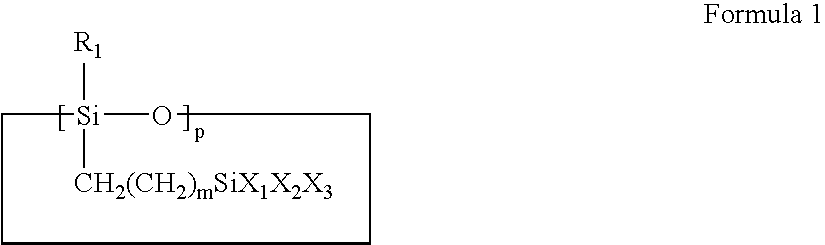
  • One aspect of the present invention relates to a siloxane-based resin that is prepared by hydrolyzing and polycondensing a first monomer of the Formula 1 and a second monomer of Formula 2. in an organic solvent in the presence of an acid or alkaline catalyst and water:
  • R 1 is a hydrogen atom, a C 1-3 alkyl group, or a C 6-15 aryl group;
  • X 1 , X 2 and X 3 are independently a C 1-3 alkyl group, a C 1-10 alkoxy group, or a halogen atom, provided that at least one of X 1 , X 2 and X 3 is hydrolysable;
  • n is an integer of 0–10, and (R 2 ) 4-a Ge(X 4 ) a Formula 2 wherein,
  • R 2 is a hydrogen atom, a C 1-3 alkyl group, or a C 6 –C 15 aryl group;
  • X 4 is a C 1-10 oxy group, or a halogen atom
  • a is an integer of 1–4.
  • Another aspect of the present invention relates to a method of forming an insulating film between interconnecting layers of a semiconductor device, the method comprising the steps of: providing a resin solution by dissolving the inventive siloxane-based resin in an organic solvent; coating a silicon wafer with the resin solution; and heat-curing the resulting coating film.
  • Still another aspect of the present invention relates to an interlayer insulating film made using the inventive siloxane-based resin.
  • the present invention provides a siloxane-based resin having a dielectric constant of 3.0 or less through the polycondensation of a cyclic siloxane monomer of the Formula 1 and a compound containing germanium of the Formula 2:
  • R 1 is a hydrogen atom, a C 1-3 alkyl group, or a C 6-15 aryl group;
  • each of X 1 , X 2 and X 3 are a C 1 –C 3 alkyl group, a C 1 –C 10 alkoxy group, or a halogen atom; provided that at least one of them is hydrolysable;
  • p is an integer of 3–8;
  • n is an integer of 0–10; and (R 2 ) 4-a Ge(X 4 ) a Formula 2 wherein,
  • R 2 is a hydrogen atom, a C 1-3 alkyl group, or a C 6-15 aryl group;
  • X 4 is a C 1-10 alkoxy group, a halogen atom
  • a is an integer of 1–4.
  • the monomer of the Formula 1 and the monomer of the Formula 2 are mixed in a molar ratio of 1:99–99:1.
  • Preferable acid or base catalyst for the preparation of the inventive siloxane-based resin can be exemplified by, but are not limited to, hydrochloric acid, nitric acid, benzene sulfonic acid, oxalic acid, formic acid, potassium hydroxide, sodium hydroxide, triethylamine, sodium bicarbonate and pyridine.
  • Such a catalyst is used so that molar ratio of the catalyst to the monomers is 0.00001:1–10:1.
  • the amount of water used in the preparation of the inventive siloxane-based resin is 1–1000 mol per 1 mol of the monomers, so that molar ratio of water-to the monomers is 1:1–100:1.
  • Non-limiting examples of the organic solvent used in the preparation of the inventive siloxane-based resin include aliphatic hydrocarbon solvents such as hexane; aromatic hydrocarbon solvents such as anisole, mesitylene and xylene; ketone-based solvents such as methyl isobutyl ketone, 1-methyl-2-pyrrolidinone and acetone; ether-based solvents such as cyclohexanone, tetrahydrofuran and isopropyl ether; acetate-based solvents such as ethyl acetate, butyl acetate and propylene glycol methyl ether acetate; alcohol-based solvents such as isopropyl alcohol and butyl alcohol; amide-based solvents such as dimethylacetamide and dimethylformamide; silicon-based solvents; and mixtures thereof.
  • aliphatic hydrocarbon solvents such as hexane
  • aromatic hydrocarbon solvents such as anisole, mesitylene and xylene
  • the hydrolysis and polycondensation reaction is carried out at a temperature of 0–200° C., for 0.1–100 hrs, preferably 5–48 hrs.
  • the siloxane-based resin thus prepared has Mw of 3,000–300,000.
  • the present invention also provides a method of forming an interlayer insulating film for a semiconductor device using the inventive siloxane-based resin.
  • the insulating film has a low dielectric constant, 3.0 or less and exhibits excellent mechanical and heat resistance properties.
  • such an insulating film can be obtained by coating a silicon wafer with a solution containing the inventive siloxane-based resin in an organic solvent and heat-curing the resulting coating film. That is, the inventive siloxane-based resin dissolved in an organic solvent is applied onto a substrate. Then, the organic solvent is evaporated through simple air-drying or by subjecting the substrate, at the beginning of following heat-curing step, to vacuum conditions or to mild heating at a temperature of 200° C.
  • the resinous coating film is cured by heating the substrate at a temperature of 150–600° C., preferably 200–450° C., for 1–150 minutes to provide an insoluble, substantially crack-free film.
  • crack-free film is meant a film without any crack that can be observed with an optical microscope at a magnification of 1000 ⁇ .
  • insoluble film is meant a film that is substantially insoluble in any solvent described as being useful for dissolving the inventive siloxane-based resin.
  • the combined use of a porogen with the inventive siloxane-based resin may further lower the dielectric constant of the final insulating film down to 2.50 or less.
  • porogen is meant any pore-generating compounds.
  • an additional step is required of heating the resinous film over the decomposition temperature of the porogen so that the porogen can be decomposed.
  • the porogen used in the present invention may be any of the pore-generating compounds well known in the art, which can be exemplified by, but are not limited to, cyclodextrin, polycaprolactone, and derivatives thereof.
  • the porogen is mixed with the inventive siloxane-based resin so that weight ratio of the porogen to the resin is 1:99–70:30, wherein both porogen and resin are in the form of solid powder.
  • Preferred organic solvents for the dissolution of the siloxane-based resin or the porogen to provide a liquid coating composition can be exemplified by, but are not limited to, aliphatic hydrocarbon solvents such as hexane; aromatic hydrocarbon solvents such as anisole, mesitylene and xylene; ketone-based solvents such as methyl isobutyl ketone, 1-methyl-2-pyrrolidinone and acetone; ether-based solvents such as cyclohexanone, tetrahydrofuran and isopropyl ether; acetate-based solvents such as ethyl acetate, butyl acetate and propylene glycol methyl ether acetate; alcohol-based solvents such as isopropyl alcohol and butyl alcohol; amide-based solvents such as dimethylacetamide and dimethylformamide; silicon-based solvents; and mixtures thereof.
  • aliphatic hydrocarbon solvents such as hexane
  • the weight ratio of solid component containing the siloxane-based resin- and the porogen is preferably 5–70 wt % based on the total composition.
  • the organic solvent should be used in an amount sufficient to apply the solid components including the siloxane-based resin and the porogen evenly to the surface of a wafer.
  • the organic solvent should amount to 20–99.9 wt %, preferably 70–95 wt % of the liquid coating composition. If the organic solvent content of the liquid coating composition is less than 20 wt %, part of the siloxane-based resin remains undissolved. On the other hand, if the organic solvent content is more than 99.9 wt %, the final resinous film is as thin as 1000 ⁇ or less.
  • the liquid coating composition thus prepared can be applied to a silicon wafer according to various coating methods well known in the art.
  • Non-limiting examples of the coating method useful in the present invention include spin-coating, dip-coating, spray-coating, flow-coating and screen-printing, while spin-coating is most preferred.
  • Example 1–3 is carried out according to the same manner as in the above Example 1–2, except that methylalcohol is replaced with ethylalcohol.
  • the cyclic siloxane monomer (A) and one of the linear siloxane monomers (B) through (D) obtained from the above Example 1 are quantified respectively according to Table 1 below and introduced to a flask, followed by dilution with 15 ⁇ tetrahydrofuran. Subsequently, after cooling the flask down to ⁇ 78° C., certain amounts of deionized water and HCl are slowly added thereto. Then, the flask is warmed to. 70° C., at which temperature the flask is left for 20 hrs so that the reaction could continue.
  • the reaction mixture is transferred to a separatory funnel, followed by addition of diethylether and tetrahydrofuran as much as the tetrahydrofuran used in the previous dilution of the monomer. Then, 3 ⁇ washing is conducted, each round with water one tenth as much as the total solution in the separatory funnel. After washing, volatile materials are evaporated from the remaining solution to afford white powdery polymers. The powder is completely dissolved in a small amount of acetone to obtain a clear solution, and this solution is filtered through a 0.2 ⁇ m syringe filter so as to remove impurities to provide a clear filtrate; to which is then slowly added deionized water.
  • siloxane-based resins obtained from the above Example 2, and their mixture with heptakis (2,3,6-tri-O-methoxy)- ⁇ -cyclodextrin are dissolved in propylene glycol methyl ether acetate (PGMEA), respectively, so that final concentration of the solid matter in the resulting liquid coating compositions is 25 wt %.
  • PMEA propylene glycol methyl ether acetate
  • Each of the coating compositions is then spin-coated onto a silicon wafer for 30 seconds with maintaining the spin rate of 3,000 rpm.
  • the coated wafers are subjected to the sequential soft baking on a hot plate (1 min at 100° C. and another minute at 250° C.) so as to evaporate the organic solvent sufficiently. Thereafter, the temperature is elevated to 420° C. at a rate of 3° C./min under vacuum condition, at which temperature the coating films are allowed to cure for 1 hr to afford test pieces.
  • Each of the test pieces thus prepared is analyzed for film thickness and refractive index.
  • the film thickness and the refractive index are measured at 5 different points every test piece by the use of a profiler and a prism coupler, respectively.
  • the mean thickness and refractive index are set forth in Table 3 along with their uniformity.
  • P-type silicon wafers doped with boron are coated with a 3000 ⁇ thermally-oxidized silicon film, followed by sequential deposition of a 100 ⁇ of titanium layer, a 2000 ⁇ of aluminum layer and a 100 ⁇ of titanium layer using a metal evaporator.
  • a resinous film On the surface of each of these wafers is formed a resinous film according to the same manner as in the above Example 3 in the composition of Table 3.
  • a circular electrode of 1 m diameter which consists of a 100 ⁇ -thick titanium layer and a 5000 ⁇ -thick aluminum layer through a hard mask so as to provide a test piece having MIM (metal-insulator-metal) structure.
  • Test pieces thus prepared are subjected to measurement of capacitance at 100 kHz using PRECISION LCR METER (HP4284A) with Micromanipulator 6200 probe station.
  • Test pieces prepared as in the above Example 4 are analyzed for hardness and elastic modulus using Nanoindenter II (MTS Co.).
  • the resinous film of each test piece is indented until the indentation depth reached 10% of its whole thickness. At this time, to secure the reliability of this measurement, 6 points are indented every test piece, and mean hardness and modulus are taken. The results are set forth in Table 4.
  • the cyclic siloxane monomer (A) and one of the methyl trimethoxysilane monomer (B′) or tetraethoxysilane monomer (D′) are introduced to a flask, followed by dilution with 15 ⁇ tetrahydrofuran. Subsequently, after cooling the flask down to ⁇ 78° C., certain amounts of deionized water and HCl are slowly added thereto. Then, the flask is warmed to 70° C., at which temperature the flask is left for 20 hrs so that the reaction could continue.
  • the reaction mixture is transferred to a separatory funnel, followed by addition of diethylether and tetrahydrofuran as much as the tetrahydrofuran used in the previous dilution of the monomer. Then, 3 ⁇ washing is conducted, each round with water one tenth as much as the total solution in the separatory funnel. After washing, volatile materials are evaporated from the remaining solution to afford white powdery polymers. The powder was completely dissolved in a small amount of acetone to obtain a clear solution, and this solution is filtered through a 0.2 ⁇ m syringe filter so as to remove impurities to provide a clear filtrate, to which is then slowly added deionized water.
  • Test pieces prepared as in the above comparative Example 1 are analyzed for thickness and refractive index using the same manner as the above Example 3, then analyzed for dielectric constant using the same manner as the above Example 4. The results are set forth in Table 6.
  • Test pieces prepared as in the above comparative Example 1 are analyzed for thickness and refractive index using the same manner as the above Example 3, then analyzed for hardness and elastic modulus using the same manner as the above Example 5. The results are set forth in Table 7.
  • the siloxane-based resin having germanium has relatively high hardness and modulus with a low dielectric constant.

Landscapes

  • Chemical & Material Sciences (AREA)
  • Chemical Kinetics & Catalysis (AREA)
  • Organic Chemistry (AREA)
  • Health & Medical Sciences (AREA)
  • Medicinal Chemistry (AREA)
  • Polymers & Plastics (AREA)
  • Life Sciences & Earth Sciences (AREA)
  • Engineering & Computer Science (AREA)
  • Materials Engineering (AREA)
  • Wood Science & Technology (AREA)
  • Silicon Polymers (AREA)
  • Formation Of Insulating Films (AREA)

Abstract

A siloxane-based resin having germanium and an interlayer insulating film for a semiconductor device formed using the same. The siloxane-based resins have a low dielectric constant in addition to excellent mechanical properties so that they are useful materials for an insulating film between interconnecting layers of a semiconductor device.

Description

This non-provisional application is a divisional of Ser. No. 10/734,179, filed Dec. 15, 2003 now U.S. Pat. No. 7,057,002 which claims priority under 35 U.S.C. § 119(a) on Korean Patent Application No. 2003-47731 filed on Jul. 14, 2003, both of which are herein incorporated by reference.
BACKGROUND OF THE INVENTION
This non-provisional application claims priority under 35 U.S.C. § 119(a) on Korean Patent Application No. 2003-47731 filed on Jul. 14, 2003, which is herein incorporated by reference.
1. Field of the Invention
The present invention relates to a siloxane-based resin and an interlayer insulating film for a semiconductor device formed using the same. More specifically, the present invention relates to a siloxane-based resin containing germanium and a resinous film useful as an insulating film between interconnecting layers of a semiconductor device.
2. Description of the Related Art.
As the circuit density of multilevel integrated circuit devices increases, the size feature of a semiconductor device is constantly required to be reduced. The chief obstacle to the feature of size reduction of a semiconductor device is the R(resistance)×C(capacitance) delay due to crosstalk between interconnecting layers. A solution to this problem is to lower the dielectric constant of interlayer insulating films so as to decrease the R×C delay as much as possible. So, there have been various attempts to provide an insulating film having a low dielectric constant.
Conventionally, in the field of semiconductor devices, interlayer insulating films have been formed by a CVD (chemical vapor deposition) method using SiO2 having a dielectric constant of 4.0. However, U.S. Pat. Nos. 3,615,272; 4,399,266; 4,756,977 and 4,999,397 disclose the formation of insulating films by the SOD (spin on deposition) method using polysilsesquioxanes having dielectric constants of 2.5–3.1 as well as good planarization properties.
Hydrogen silsesquioxanes as well as preparation methods thereof are well known in the art. For example, U.S. Pat. No. 3,615,272 discloses a method of preparing a completely condensed, soluble hydrogen silsesquioxane resin, which comprises the steps of condensing trichlorosilanes in a sulfuric acid medium and washing the resulting resin with water or aqueous sulfuric acid. Also, U.S. Pat. No. 5,010,159 discloses a method of synthesizing a soluble condensed hydrogen silsesquioxane resin, which comprises the steps of hydrolyzing hydrosilanes in an arylsulfuric acid hydrate-containing hydrolysis medium and contacting the resulting resin with a neutralizing agent. U.S. Pat. No. 6,232,424 describes a highly soluble silicon resin composition having excellent solution stability, which is prepared by hydrolyzing and polycondensing tetraalkoxysilane, organosilane and. organotrialkoxysilane monomers in the presence of water and a catalyst. U.S. Pat. No. 6,000,339 describes that a silica-based compound is useful for improving the resistance to oxygen plasma and physical properties as well as the thickness of a coating film, which can be obtained through reacting a monomer selected from the group consisting of alkoxysilane, fluorine-containing alkoxysilane and alkylalkoxysilane with a titanium- or zirconium-alkoxide compound in the presence of water and a catalyst. U.S. Pat. No. 5,853,808 discloses that siloxane and silsesquioxane polymers useful for forming a SiO2-rich ceramic coating can be obtained from hydrolysis and polycondensation of organosilanes having a β-substituted alkyl group. Meanwhile, EP 0 997 497 A1 discloses that hydrolyzation and polycondensation of a certain combination of alkoxysilanes including mono-, di-, tri-, tetraalkoxysilane and trialkoxysilane dimers can provide resinous materials for insulating films.
SUMMARY OF THE INVENTION
The present invention features the production of a siloxane-based resin having excellent mechanical properties as well as a very low dielectric constant, and the formation of a low dielectric insulating film using the siloxane-based resin.
That is, the present provides a siloxane-based resin having superior mechanical properties, wherein a germanium-containing monomer, subjected to sol-gel polymerization, is provided to increase the mechanical properties with no reduction of the dielectric constant of the siloxane-based resin. The germanium monomer has twice the density compared with the siloxane-based monomer, and thus can provide an improvement in the mechanical properties.
One aspect of the present invention relates to a siloxane-based resin that is prepared by hydrolyzing and polycondensing a first monomer of the Formula 1 and a second monomer of Formula 2. in an organic solvent in the presence of an acid or alkaline catalyst and water:
Figure US07198823-20070403-C00001

wherein,
R1 is a hydrogen atom, a C1-3 alkyl group, or a C6-15 aryl group;
X1, X2 and X3 are independently a C1-3 alkyl group, a C1-10 alkoxy group, or a halogen atom, provided that at least one of X1, X2 and X3 is hydrolysable;
is an integer of 3–8; and
m is an integer of 0–10, and
(R2)4-aGe(X4)a  Formula 2
wherein,
R2 is a hydrogen atom, a C1-3 alkyl group, or a C6–C15 aryl group;
X4 is a C1-10 oxy group, or a halogen atom; and
a is an integer of 1–4.
Another aspect of the present invention relates to a method of forming an insulating film between interconnecting layers of a semiconductor device, the method comprising the steps of: providing a resin solution by dissolving the inventive siloxane-based resin in an organic solvent; coating a silicon wafer with the resin solution; and heat-curing the resulting coating film.
Still another aspect of the present invention relates to an interlayer insulating film made using the inventive siloxane-based resin.
All of the above features and other features of the present invention will be successfully achieved by following the teachings of the present invention described in the following.
DESCRIPTION OF THE PREFERRED INVENTION
The present invention provides a siloxane-based resin having a dielectric constant of 3.0 or less through the polycondensation of a cyclic siloxane monomer of the Formula 1 and a compound containing germanium of the Formula 2:
Figure US07198823-20070403-C00002

wherein,
R1 is a hydrogen atom, a C1-3 alkyl group, or a C6-15 aryl group;
each of X1, X2 and X3, independently, are a C1–C3 alkyl group, a C1–C10 alkoxy group, or a halogen atom; provided that at least one of them is hydrolysable;
p is an integer of 3–8; and
m is an integer of 0–10; and
(R2)4-aGe(X4)a  Formula 2
wherein,
R2 is a hydrogen atom, a C1-3 alkyl group, or a C6-15 aryl group;
X4 is a C1-10 alkoxy group, a halogen atom; and
a is an integer of 1–4.
In the preparation of the inventive siloxane-based resin, the monomer of the Formula 1 and the monomer of the Formula 2 are mixed in a molar ratio of 1:99–99:1.
Preferable acid or base catalyst for the preparation of the inventive siloxane-based resin can be exemplified by, but are not limited to, hydrochloric acid, nitric acid, benzene sulfonic acid, oxalic acid, formic acid, potassium hydroxide, sodium hydroxide, triethylamine, sodium bicarbonate and pyridine. Such a catalyst is used so that molar ratio of the catalyst to the monomers is 0.00001:1–10:1.
The amount of water used in the preparation of the inventive siloxane-based resin is 1–1000 mol per 1 mol of the monomers, so that molar ratio of water-to the monomers is 1:1–100:1.
Non-limiting examples of the organic solvent used in the preparation of the inventive siloxane-based resin include aliphatic hydrocarbon solvents such as hexane; aromatic hydrocarbon solvents such as anisole, mesitylene and xylene; ketone-based solvents such as methyl isobutyl ketone, 1-methyl-2-pyrrolidinone and acetone; ether-based solvents such as cyclohexanone, tetrahydrofuran and isopropyl ether; acetate-based solvents such as ethyl acetate, butyl acetate and propylene glycol methyl ether acetate; alcohol-based solvents such as isopropyl alcohol and butyl alcohol; amide-based solvents such as dimethylacetamide and dimethylformamide; silicon-based solvents; and mixtures thereof.
According to the present invention, the hydrolysis and polycondensation reaction is carried out at a temperature of 0–200° C., for 0.1–100 hrs, preferably 5–48 hrs.
The siloxane-based resin thus prepared has Mw of 3,000–300,000.
The present invention also provides a method of forming an interlayer insulating film for a semiconductor device using the inventive siloxane-based resin. The insulating film has a low dielectric constant, 3.0 or less and exhibits excellent mechanical and heat resistance properties. According to the present invention, such an insulating film can be obtained by coating a silicon wafer with a solution containing the inventive siloxane-based resin in an organic solvent and heat-curing the resulting coating film. That is, the inventive siloxane-based resin dissolved in an organic solvent is applied onto a substrate. Then, the organic solvent is evaporated through simple air-drying or by subjecting the substrate, at the beginning of following heat-curing step, to vacuum conditions or to mild heating at a temperature of 200° C. or less, so that a resinous coating film can be deposited on the surface of the substrate. Thereafter, the resinous coating film is cured by heating the substrate at a temperature of 150–600° C., preferably 200–450° C., for 1–150 minutes to provide an insoluble, substantially crack-free film. As used herein, by “crack-free film” is meant a film without any crack that can be observed with an optical microscope at a magnification of 1000×. As used herein, by “insoluble film” is meant a film that is substantially insoluble in any solvent described as being useful for dissolving the inventive siloxane-based resin.
According to the present invention, the combined use of a porogen with the inventive siloxane-based resin may further lower the dielectric constant of the final insulating film down to 2.50 or less. As used herein, by “porogen” is meant any pore-generating compounds. In case of using porogen, an additional step is required of heating the resinous film over the decomposition temperature of the porogen so that the porogen can be decomposed.
The porogen used in the present invention may be any of the pore-generating compounds well known in the art, which can be exemplified by, but are not limited to, cyclodextrin, polycaprolactone, and derivatives thereof. The porogen is mixed with the inventive siloxane-based resin so that weight ratio of the porogen to the resin is 1:99–70:30, wherein both porogen and resin are in the form of solid powder.
Preferred organic solvents for the dissolution of the siloxane-based resin or the porogen to provide a liquid coating composition can be exemplified by, but are not limited to, aliphatic hydrocarbon solvents such as hexane; aromatic hydrocarbon solvents such as anisole, mesitylene and xylene; ketone-based solvents such as methyl isobutyl ketone, 1-methyl-2-pyrrolidinone and acetone; ether-based solvents such as cyclohexanone, tetrahydrofuran and isopropyl ether; acetate-based solvents such as ethyl acetate, butyl acetate and propylene glycol methyl ether acetate; alcohol-based solvents such as isopropyl alcohol and butyl alcohol; amide-based solvents such as dimethylacetamide and dimethylformamide; silicon-based solvents; and mixtures thereof.
In the preparation of the liquid coating composition, the weight ratio of solid component containing the siloxane-based resin- and the porogen is preferably 5–70 wt % based on the total composition. And the organic solvent should be used in an amount sufficient to apply the solid components including the siloxane-based resin and the porogen evenly to the surface of a wafer. Thus, the organic solvent should amount to 20–99.9 wt %, preferably 70–95 wt % of the liquid coating composition. If the organic solvent content of the liquid coating composition is less than 20 wt %, part of the siloxane-based resin remains undissolved. On the other hand, if the organic solvent content is more than 99.9 wt %, the final resinous film is as thin as 1000 Å or less.
In the present invention, the liquid coating composition thus prepared can be applied to a silicon wafer according to various coating methods well known in the art. Non-limiting examples of the coating method useful in the present invention include spin-coating, dip-coating, spray-coating, flow-coating and screen-printing, while spin-coating is most preferred.
Hereinafter, the present invention will be described in more detail with reference to the following Examples. However, these Examples are given for the purpose of illustration and are not to be construed as limiting the scope of the present invention.
EXAMPLE 1 Synthesis of Monomer Example 1-1 Synthesis of Cyclic Siloxane-Based Monomer (A)
Figure US07198823-20070403-C00003
To a flask are introduced 10.0 g (29.014 mmol) of 2,4,6,8-tetramethyl-2,4,6,8-tetravinylcyclotetrasiloxane and 0.164 g of platinum(O)-1,3divinyl-1,1,3,3-tetrarmiethyldisiloxane complex (solution in xylene), and then diluted with 300 ml of diethylether. Next, the flask is cooled to −78° C., 17.29 g (127.66 mmol) of trichlorosilane is slowly added thereto, and it is slowly warmed to room temperature. The reaction is continued at room temperature for 40 hrs, and volatile materials are removed from the reaction mixture under a reduced pressure of about 0.1 Torr. To the reaction mixture is added 100 ml of hexane and stirred for 1 hr, followed by filtering through celite to afford a colorless, clear solution. From the solution is then removed hexane under a reduced pressure to afford a liquid compound represented by the following Formula:
Figure US07198823-20070403-C00004
10.0 g (11.28 mmol) of the liquid compound is diluted with 500 ml of tetrahydrofuran, and 13.83 g (136.71 mmol) of triethylamine is added thereto. Thereafter, the mixture is cooled to −78° C., 4.38 g (136.71 mmol) of methyl alcohol is slowly added thereto, and it is slowly warmed to room temperature. The reaction is continued at room temperature for 15 hrs and filtered through celite, and then volatile materials are evaporated from the resulting filtrate under a reduced pressure of about 0.1 Torr. Subsequently, 100 ml of pentane is added to the remaining filtrate and stirred for 1 hr, followed by filtering through celite. To the filtrate is added 5 g of activated carbon and stirred for 10 hrs. Filtrate obtained from the filtration of the stirred solution is subjected to a reduced pressure to remove hexane therefrom and afford monomer (A) as a colorless liquid. The results obtained from NMR analysis of this monomer dissolved in CDCl3 are as follows:
1H NMR(300 MHz) data; δ 0.09 (s, 12H, 4×—CH3), 0.52–0.64 (m, 16H, 4×—CH2CH2—), 3.58 (s, 36H, 4×—[OCH3]3)
Example 1–2 Synthesis of Germanium-Based Monomer (B)
Monomer (B)
CH3Ge(OCH3)3
To a flask is introduced 19.3 g (0.1 mol) of trichloromethylgermanium, and then diluted with 500 ml of tetrahydrofaran. Next, the flask is cooled to 0° C., 35.35 g (0.35 mol) of triethylamine is added thereto, followed by the slow addition of 11.2 g (0.35 mol) of methyl alcohol. Then the reaction temperature is slowly elevated to room temperature. The reaction is continued at room temperature for 15 hrs. At the completion of the reaction, the reaction mixture is filtered through celite, and volatile materials are removed from the filtrate under a reduced pressure of about 0.1 Torr. To the remaining filtrate is added 100 ml of hexane and stirred for 1 hr, followed by filtering through celite. From the filtrate is then removed hexane under a reduced pressure to afford a colorless liquid. Colorless liquid monomer (B) is obtained from simple distillation of the liquid. The results obtained from NMR analysis of this monomer dissolved in CDCl3 are as follows:
1H NMR(300 MHz) data; δ 3.6 (s, 3H)
Example 1–3 Synthesis of Germanium-Based Monomer (C)
Monomer (C)
CH3Ge(OCH2CH3)3
Example 1–3 is carried out according to the same manner as in the above Example 1–2, except that methylalcohol is replaced with ethylalcohol.
The results obtained from NMR analysis of the monomer (C) thus prepared and dissolved in CDCl3 are as follows:
1H NMR(300 MHz) data; δ 1.2 (t, 6H, 3×—CH3), δ 3.8 (q, 9H, 3×—CH2)
Example 1–4 Synthesis of Germanium-Based Monomer (D)
Monomer (D)
Ge(OCH2CH3)4
To a flask is introduced 21.4 g (0.1 mol) of tetrachlrorogermanium, and then diluted with 500 ml of tetrahydrofuran. Next, the flask is cooled to 0° C., 45.45 g (0.45 mol) of triethylamine is added thereto, followed by the slow addition of 14.4 g (0.45 mol) of methyl alcohol. Then the reaction temperature is slowly elevated to room temperature. The reaction is continued at room temperature for 15 hrs. At the completion of the reaction, the reaction mixture is filtered through celite, and volatile materials are removed from the filtrate under a reduced pressure of about 0.1 Torr. To the remaining filtrate is added 100 ml of hexane and stirred for 1 hr, followed by filtering through celite. From the filtrate is then removed hexane under a reduced pressure to afford a colorless liquid. Colorless liquid monomer (D) is obtained from simple distillation of the liquid. The results obtained from NMR analysis of this monomer dissolved in CDCl3 are as follows:
1H NMR (300 MHz) data δ 1.2 (t, 8H, 4×—CH3), δ 3.8 (q, 12H, 4×—CH2)
EXAMPLE 2 Synthesis of Matrix Resin
The cyclic siloxane monomer (A) and one of the linear siloxane monomers (B) through (D) obtained from the above Example 1 are quantified respectively according to Table 1 below and introduced to a flask, followed by dilution with 15× tetrahydrofuran. Subsequently, after cooling the flask down to −78° C., certain amounts of deionized water and HCl are slowly added thereto. Then, the flask is warmed to. 70° C., at which temperature the flask is left for 20 hrs so that the reaction could continue. At the completion of the reaction, the reaction mixture is transferred to a separatory funnel, followed by addition of diethylether and tetrahydrofuran as much as the tetrahydrofuran used in the previous dilution of the monomer. Then, 3× washing is conducted, each round with water one tenth as much as the total solution in the separatory funnel. After washing, volatile materials are evaporated from the remaining solution to afford white powdery polymers. The powder is completely dissolved in a small amount of acetone to obtain a clear solution, and this solution is filtered through a 0.2 μm syringe filter so as to remove impurities to provide a clear filtrate; to which is then slowly added deionized water. As a result, white powdery material is formed, which is then separated from the liquid phase(mixed solution of acetone and water) and dried for 10 hrs at a temperature of 0–20° C. under a reduced pressure of about 0.1 Torr to afford a fractionated siloxane-based resin.
TABLE 1
Silox- Final
ane Monomer (mmol) Resin
Resin (A) (B) (C) (D) HCl(mmol) H2O(mmol) (g)
(a) 12.32 9.17 0.12 250 5.76
(b) 13.87 11.62 0.22 548 10.7
(c) 10.55 4.67 0.145 514 8.77
(d) 10.55 4.67 0.145 514 8.43
(e) 10.55 4.67 0.145 514 8.12
(f) 10.55 4.67 0.145 857 8.34
(g) 10.55 4.67 0.131 514 8.03
(h) 10.55 4.67 0.101 514 8.55
(i) 10.55 4.67 0.080 514 8.34
(j) 10.55 4.67 0.048 514 8.07
EXAMPLE 3 Measurement of Thickness and Refractive Index of Thin Film
The siloxane-based resins obtained from the above Example 2, and their mixture with heptakis (2,3,6-tri-O-methoxy)-β-cyclodextrin are dissolved in propylene glycol methyl ether acetate (PGMEA), respectively, so that final concentration of the solid matter in the resulting liquid coating compositions is 25 wt %. Each of the coating compositions is then spin-coated onto a silicon wafer for 30 seconds with maintaining the spin rate of 3,000 rpm. In a nitrogen atmosphere, the coated wafers are subjected to the sequential soft baking on a hot plate (1 min at 100° C. and another minute at 250° C.) so as to evaporate the organic solvent sufficiently. Thereafter, the temperature is elevated to 420° C. at a rate of 3° C./min under vacuum condition, at which temperature the coating films are allowed to cure for 1 hr to afford test pieces.
Each of the test pieces thus prepared is analyzed for film thickness and refractive index. The film thickness and the refractive index are measured at 5 different points every test piece by the use of a profiler and a prism coupler, respectively. The mean thickness and refractive index are set forth in Table 3 along with their uniformity.
TABLE 2
Thin Film Composition
Pore- Uni- Uni-
Resin forming Refrac- formity formity
Siloxane (wt Material Thick. tive of of
Resin %) (wt %) (Å) Index R.I (%) Thick.(%)
(a) 100 8995 1.3876 0.088 1.87
(a) 70 30 9846 1.3775 0.143 1.34
(b) 100 10254 1.3891 0.063 0.76
(b) 70 30 10457 1.4123 0.044 1.54
(c) 100 10334 1.4136 0.021 0.76
(c) 70 30 9765 1.3543 0.76 1.21
(d) 100 10923 1.4113 0.23 0.23
(d) 70 30 10654 1.3235 0.192 1.05
(e) 100 11129 1.3654 0.022 1.23
(e) 70 30 10537 1.3247 0.054 1.54
(f) 100 11587 1.3675 0.027 0.78
(f) 70 30 9976 1.3208 0.054 0.56
(g) 100 11034 1.3143 0.046 0.59
(g) 70 30 9861 1.3221 0.059 1.16
(h) 100 11738 1.3023 0.013 1.45
(h) 70 30 11587 1.3114 0.049 1.75
(i) 100 10987 1.4211 0.051 1.76
(i) 70 30 9398 1.4367 0.036 1.08
(j) 100 11456 1.4178 0.037 0.84
(j) 70 30 10324 1.3106 0.056 0.38
EXAMPLE 4 Measurement of Dielectric Constant of the Thin Film
P-type silicon wafers doped with boron are coated with a 3000 Å thermally-oxidized silicon film, followed by sequential deposition of a 100 Å of titanium layer, a 2000 Å of aluminum layer and a 100 Å of titanium layer using a metal evaporator. On the surface of each of these wafers is formed a resinous film according to the same manner as in the above Example 3 in the composition of Table 3. Subsequently, on the resinous film is deposited a circular electrode of 1 m diameter which consists of a 100 Å-thick titanium layer and a 5000 Å-thick aluminum layer through a hard mask so as to provide a test piece having MIM (metal-insulator-metal) structure. Test pieces thus prepared are subjected to measurement of capacitance at 100 kHz using PRECISION LCR METER (HP4284A) with Micromanipulator 6200 probe station. Dielectric constant of each test film is calculated from the following equation, wherein “d” value is obtained by the use of an ellipsometer:
k=C×d/∈ 0 ×A
wherein,
k: dielectric constant
C: capacitance
0: dielectric constant in vacuum
d: the thickness of the low dielectric thin film
A: contact area of electrode
TABLE 3
Thin Film Composition
Siloxane Resin Pore-forming Dielectric
Resin (wt %) Material (wt %) Constant
(a) 100 2.56
(a) 70 30 2.21
(b) 100 2.76
(b) 70 30 2.32
(c) 100 2.72
(c) 70 30 2.34
(d) 100 2.67
(d) 70 30 2.24
(e) 100 2.68
(e) 70 30 2.23
(f) 100 2.72
(f) 70 30 2.21
(g) 100 2.79
(g) 70 30 2.24
(h) 100 2.80
(h) 70 30 2.25
(i) 100 2.83
(i) 70 30 2.31
(j) 100 2.86
(j) 70 30 2.21
EXAMPLE 5 Measurement of Hardness and Modulus of the Thin Film
Test pieces prepared as in the above Example 4 are analyzed for hardness and elastic modulus using Nanoindenter II (MTS Co.). The resinous film of each test piece is indented until the indentation depth reached 10% of its whole thickness. At this time, to secure the reliability of this measurement, 6 points are indented every test piece, and mean hardness and modulus are taken. The results are set forth in Table 4.
TABLE 4
Thin Film Composition
Siloxane Resin Pore-forming Hardness Modulus
Resin (wt %) Material (wt %) (GPa) (GPa)
(a) 100 0.72 5.11
(a) 70 30 0.45 3.14
(b) 100 0.75 5.32
(b) 70 30 0.41 3.23
(c) 100 1.23 5.65
(c) 70 30 1.02 3.02
(d) 100 1.10 5.21
(d) 70 30 0.98 3.65
(e) 100 1.42 6.58
(e) 70 30 1.11 3.63
(f) 100 1.34 6.89
(f) 70 30 0.99 3.87
(g) 100 1.09 6.52
(g) 70 30 0.77 3.55
(h) 100 1.17 6.16
(h) 70 30 0.54 3.67
(i) 100 1.14 6.21
(i) 70 30 0.59 3.48
(j) 100 1.04 6.97
(j) 70 30 0.64 3.30
COMPARATIVE EXAMPLE 1 Synthesis of Siloxane-Based Resin
The cyclic siloxane monomer (A) and one of the methyl trimethoxysilane monomer (B′) or tetraethoxysilane monomer (D′) are introduced to a flask, followed by dilution with 15× tetrahydrofuran. Subsequently, after cooling the flask down to −78° C., certain amounts of deionized water and HCl are slowly added thereto. Then, the flask is warmed to 70° C., at which temperature the flask is left for 20 hrs so that the reaction could continue. At the completion of the reaction, the reaction mixture is transferred to a separatory funnel, followed by addition of diethylether and tetrahydrofuran as much as the tetrahydrofuran used in the previous dilution of the monomer. Then, 3× washing is conducted, each round with water one tenth as much as the total solution in the separatory funnel. After washing, volatile materials are evaporated from the remaining solution to afford white powdery polymers. The powder was completely dissolved in a small amount of acetone to obtain a clear solution, and this solution is filtered through a 0.2 μm syringe filter so as to remove impurities to provide a clear filtrate, to which is then slowly added deionized water. As a result, white powdery material is formed, which is then separated from the liquid phase(mixed solution of acetone and water) and dried for 10 hrs at a temperature of 0–20° C. under a reduced pressure of about 0.1 Torr to afford a siloxane-based resin. The results are shown in Table 5, below.
TABLE 5
Monomer (mmol) HCl H2O Final Resin
Composition (A) (B) (C) (mmol) (mmol) (g)
(a′) 12.32 9.17 0.12 250 6.87
(b′) 13.87 11.62 0.22 548 8.84
(c′) 10.55 4.67 0.16 485 8.54
(d′) 10.55 4.67 0.145 514 7.89
(e′) 10.55 4.67 0.145 857 8.23
(f′) 10.55 4.67 0.131 514 8.98
COMPARATIVE EXAMPLE 2 Measurement of Dielectric Constant
Test pieces prepared as in the above comparative Example 1 are analyzed for thickness and refractive index using the same manner as the above Example 3, then analyzed for dielectric constant using the same manner as the above Example 4. The results are set forth in Table 6.
TABLE 6
Thin Film Composition
Siloxane Resin Pore-forming Dielectric
Resin (wt %) Material (wt %) Constant
(a) 100 2.56
(a) 70 30 2.21
(b) 100 2.76
(b) 70 30 2.32
(c) 100 2.72
(c) 70 30 2.34
(e) 100 2.68
(e) 70 30 2.23
(f) 100 2.72
(f) 70 30 2.21
(g) 100 2.79
(g) 70 30 2.24
(a′) 100 2.54
(a′) 70 30 2.22
(b′) 100 2.81
(b′) 70 30 2.32
(c′) 100 2.85
(c′) 70 30 2.31
(d′) 100 2.69
(d′) 70 30 2.29
(e′) 100 2.73
(e′) 70 30 2.23
(f′) 100 2.81
(f′) 70 30 2.34
COMPARATIVE EXAMPLE 3 Measurement of Hardness and Modulus
Test pieces prepared as in the above comparative Example 1 are analyzed for thickness and refractive index using the same manner as the above Example 3, then analyzed for hardness and elastic modulus using the same manner as the above Example 5. The results are set forth in Table 7.
TABLE 7
Thin Film Composition
Siloxane Resin Pore-forming Hardness Modulus
Resin (wt %) Material (wt %) (Gpa) (Gpa)
(a) 100 0.72 5.11
(a) 70 30 0.45 3.14
(b) 100 0.75 5.32
(b) 70 30 0.41 3.23
(c) 100 1.23 5.65
(c) 70 30 1.02 3.02
(e) 100 1.42 6.58
(e) 70 30 1.11 3.63
(f) 100 1.34 6.89
(f) 70 30 0.99 3.89
(g) 100 1.09 6.52
(g) 70 30 0.77 3.55
(a′) 100 0.51 4.21
(a′) 70 30 0.31 3.84
(b′) 100 0.59 4.67
(b′) 70 30 0.34 3.54
(c′) 100 0.98 5.44
(c′) 70 30 0.82 3.54
(e′) 100 1.12 6.12
(e′) 70 30 0.43 2.99
(f′) 100 1.09 6.23
(f′) 70 30 0.68 3.35
(g′) 100 0.87 6.18
(g′) 70 30 0.43 3.27
As apparent from Examples and Comparative Examples, the siloxane-based resin having germanium has relatively high hardness and modulus with a low dielectric constant.
Although the preferred embodiments of the present invention have been disclosed for illustrative purposes, those skilled in the art will appreciate that various modifications, additions and substitutions are possible, without departing from the spirit and scope of the invention as recited in the accompanying claims.
Claims (6)

1. A method of forming an insulating film between interconnecting layers of a semiconductor device, the method comprising the steps of:
providing a liquid coating composition by dissolving a siloxane-based resin in an organic solvent, wherein the siloxane-based resin is prepared by hydrolyzing and polycondensing a first monomer of a Formula 1 and a second monomer of a Formula 2 in an organic solvent in the presence of an acid or alkaline catalyst and water;
coating a silicon wafer with the liquid coating composition to form a coating film thereon; and
heat-curing the coating film,
wherein the Formula 1 is
Figure US07198823-20070403-C00005
wherein R1 is a hydrogen atom, a C1-13 alkyl group or a C6-15 aryl group; each of X1, X2 and X3, independently, is a C1-3 alkyl group, a C1-10 alkoxy group or a halogen atom provided at least one of said C1-3 alkyl group, said C1-10 alkoxy group or said halogen atom is hydrolysable; m is an integer from 0 to 10; and p is an integer from 3 to 8; and
the Formula 2 is

(R2)4-aGe(X4)a  Formula (2)
wherein R2 is a hydrogen atom, a C1-3 alkyl group or a C6-15 aryl group; X4 is a C1-10 alkoxy group or a halogen atom; and a is an integer of 1–3.
2. The method according to claim 1, wherein the siloxane-based resin is mixed with a porogen so that the weight ratio of the resin to the porogen is 99:1–30:70.
3. The method according to claim 2, wherein the porogen is cyclodextrin, polycaprolactone, or derivatives thereof.
4. The method according to claim 2, wherein the weight ratio of solid component containing the siloxane-based resin and the porogen is 5–70 wt % based on the total composition.
5. The method according to claim 1, wherein the heat-curing is performed at 150–600° C. for 1–150 minutes.
6. The method of claim 1, wherein the insulating film has a dielectric constant of 3.0 or less.
US11/342,562 2003-07-14 2006-01-31 Siloxane-based resin containing germanium and an interlayer insulating film for a semiconductor device using the same Expired - Fee Related US7198823B2 (en)

Priority Applications (2)

Application Number Priority Date Filing Date Title
US11/342,562 US7198823B2 (en) 2003-07-14 2006-01-31 Siloxane-based resin containing germanium and an interlayer insulating film for a semiconductor device using the same
US11/710,487 US7374820B2 (en) 2003-07-14 2007-02-26 Siloxane-based resin containing germanium and an interlayer insulating film for a semiconductor device using the same

Applications Claiming Priority (4)

Application Number Priority Date Filing Date Title
KR10-2003-0047731A KR100504291B1 (en) 2003-07-14 2003-07-14 Siloxane-based Resin containing Germanium and Method of Semiconductor Interlayer Insulating Film Using the Same
KR2003-47731 2003-07-14
US10/734,179 US7057002B2 (en) 2003-07-14 2003-12-15 Siloxane-based resin containing germanium and an interlayer insulating film for a semiconductor device using the same
US11/342,562 US7198823B2 (en) 2003-07-14 2006-01-31 Siloxane-based resin containing germanium and an interlayer insulating film for a semiconductor device using the same

Related Parent Applications (1)

Application Number Title Priority Date Filing Date
US10/734,179 Division US7057002B2 (en) 2003-07-14 2003-12-15 Siloxane-based resin containing germanium and an interlayer insulating film for a semiconductor device using the same

Related Child Applications (1)

Application Number Title Priority Date Filing Date
US11/710,487 Division US7374820B2 (en) 2003-07-14 2007-02-26 Siloxane-based resin containing germanium and an interlayer insulating film for a semiconductor device using the same

Publications (2)

Publication Number Publication Date
US20060141269A1 US20060141269A1 (en) 2006-06-29
US7198823B2 true US7198823B2 (en) 2007-04-03

Family

ID=36611978

Family Applications (3)

Application Number Title Priority Date Filing Date
US10/734,179 Expired - Fee Related US7057002B2 (en) 2003-07-14 2003-12-15 Siloxane-based resin containing germanium and an interlayer insulating film for a semiconductor device using the same
US11/342,562 Expired - Fee Related US7198823B2 (en) 2003-07-14 2006-01-31 Siloxane-based resin containing germanium and an interlayer insulating film for a semiconductor device using the same
US11/710,487 Expired - Fee Related US7374820B2 (en) 2003-07-14 2007-02-26 Siloxane-based resin containing germanium and an interlayer insulating film for a semiconductor device using the same

Family Applications Before (1)

Application Number Title Priority Date Filing Date
US10/734,179 Expired - Fee Related US7057002B2 (en) 2003-07-14 2003-12-15 Siloxane-based resin containing germanium and an interlayer insulating film for a semiconductor device using the same

Family Applications After (1)

Application Number Title Priority Date Filing Date
US11/710,487 Expired - Fee Related US7374820B2 (en) 2003-07-14 2007-02-26 Siloxane-based resin containing germanium and an interlayer insulating film for a semiconductor device using the same

Country Status (5)

Country Link
US (3) US7057002B2 (en)
EP (1) EP1498443A1 (en)
JP (1) JP2005036228A (en)
KR (1) KR100504291B1 (en)
CN (1) CN100439420C (en)

Cited By (5)

* Cited by examiner, † Cited by third party
Publication number Priority date Publication date Assignee Title
US20110171447A1 (en) * 2004-08-03 2011-07-14 Ahila Krishnamoorthy Compositions, layers and films for optoelectronic devices, methods of production and uses thereof
US8512870B2 (en) 2009-12-30 2013-08-20 Cheil Industries, Inc. Transparent resin for encapsulation material and electronic device including the same
US8557877B2 (en) 2009-06-10 2013-10-15 Honeywell International Inc. Anti-reflective coatings for optically transparent substrates
US8864898B2 (en) 2011-05-31 2014-10-21 Honeywell International Inc. Coating formulations for optical elements
US10544329B2 (en) 2015-04-13 2020-01-28 Honeywell International Inc. Polysiloxane formulations and coatings for optoelectronic applications

Families Citing this family (8)

* Cited by examiner, † Cited by third party
Publication number Priority date Publication date Assignee Title
KR100645682B1 (en) * 2003-04-17 2006-11-13 주식회사 엘지화학 Organosiloxane Resin and Insulating Film Using the Same
KR100589123B1 (en) * 2004-02-18 2006-06-14 학교법인 서강대학교 Cyclodextrin derivatives useful as pore forming templates and low dielectrics prepared using the same
US7892648B2 (en) * 2005-01-21 2011-02-22 International Business Machines Corporation SiCOH dielectric material with improved toughness and improved Si-C bonding
KR100775100B1 (en) 2005-03-16 2007-11-08 주식회사 엘지화학 A composition for forming an insulating film, an insulating film prepared therefrom, and an electrical or electronic device including the same
KR100824037B1 (en) 2005-03-16 2008-04-21 주식회사 엘지화학 Pore-forming agent composition for forming an insulating film, an insulating film-forming composition comprising the same, a method for producing an insulating film using the same, and an insulating film prepared therefrom
CN101636434B (en) * 2007-02-08 2013-12-11 陶氏康宁公司 Heteroelement siloxane compounds and polymers
JP2011241291A (en) * 2010-05-18 2011-12-01 Tosoh Corp Cyclic polysiloxane, method for producing the same, and use thereof
CN109776840B (en) * 2019-01-30 2021-08-24 武汉华星光电半导体显示技术有限公司 Flexible cover plate and manufacturing method thereof

Citations (15)

* Cited by examiner, † Cited by third party
Publication number Priority date Publication date Assignee Title
US3615272A (en) 1968-11-04 1971-10-26 Dow Corning Condensed soluble hydrogensilsesquioxane resin
US4399266A (en) 1980-08-26 1983-08-16 Japan Synthetic Rubber Co., Ltd. Laddery lower alkylpolysilsesquioxane having heat-resistant thin film-formability and process for preparing same
US4756977A (en) 1986-12-03 1988-07-12 Dow Corning Corporation Multilayer ceramics from hydrogen silsesquioxane
US4999397A (en) 1989-07-28 1991-03-12 Dow Corning Corporation Metastable silane hydrolyzates and process for their preparation
US5010159A (en) 1989-09-01 1991-04-23 Dow Corning Corporation Process for the synthesis of soluble, condensed hydridosilicon resins containing low levels of silanol
US5853808A (en) 1995-09-12 1998-12-29 Gelest Inc. Method of using siloxane polymers
US6000339A (en) 1994-06-30 1999-12-14 Hitachi Chemical Company, Ltd. Material for forming silica-base coated insulation film, process for producing the material, silica-base insulation film, semiconductor device, and process for producing the device
EP0997497A1 (en) 1997-07-15 2000-05-03 Asahi Kasei Kogyo Kabushiki Kaisha Alkoxysilane/organic polymer composition for thin insulating film production and use thereof
US6232424B1 (en) 1999-12-13 2001-05-15 Dow Corning Corporation Soluble silicone resin compositions having good solution stability
US6395826B1 (en) * 1998-03-30 2002-05-28 Bayer Aktiengesellschaft Boron-and/ or aluminum-containing mixtures, hybrid materials, and coatings
EP1217649A2 (en) * 2000-11-29 2002-06-26 Samsung Electronics Co., Ltd. Method for forming insulating film between interconnect layers in microelectronic devices
US6623711B2 (en) * 2001-03-27 2003-09-23 Samsung Electronics Co., Ltd. Siloxane-based resin and method for forming insulating film between interconnect layers in semiconductor devices by using the same
US6787191B2 (en) * 2000-04-04 2004-09-07 Asahi Kasei Kabushiki Kaisha Coating composition for the production of insulating thin films
US6908977B2 (en) * 2002-10-31 2005-06-21 Samsung Electronics Co., Ltd. Siloxane-based resin and method of forming an insulating film between interconnect layers of a semiconductor device using the same
US7014917B2 (en) * 2003-06-02 2006-03-21 Samsung Electronics Co., Ltd. Siloxane-based resin and interlayer insulating film for a semiconductor device made using the same

Family Cites Families (2)

* Cited by examiner, † Cited by third party
Publication number Priority date Publication date Assignee Title
DE19935326A1 (en) * 1999-07-28 2001-02-01 Bayer Ag Use of self-organizing coatings based on fluorine-free polyfunctional organosilanes for the production of ultra-hydrophobic coatings
EP1245642B1 (en) * 2001-03-27 2005-06-08 Samsung Electronics Co., Ltd. Siloxane-based resin and method for forming an insulating film between interconnecting layers in wafers

Patent Citations (17)

* Cited by examiner, † Cited by third party
Publication number Priority date Publication date Assignee Title
US3615272A (en) 1968-11-04 1971-10-26 Dow Corning Condensed soluble hydrogensilsesquioxane resin
US4399266A (en) 1980-08-26 1983-08-16 Japan Synthetic Rubber Co., Ltd. Laddery lower alkylpolysilsesquioxane having heat-resistant thin film-formability and process for preparing same
US4756977A (en) 1986-12-03 1988-07-12 Dow Corning Corporation Multilayer ceramics from hydrogen silsesquioxane
US4999397A (en) 1989-07-28 1991-03-12 Dow Corning Corporation Metastable silane hydrolyzates and process for their preparation
US5010159A (en) 1989-09-01 1991-04-23 Dow Corning Corporation Process for the synthesis of soluble, condensed hydridosilicon resins containing low levels of silanol
US6000339A (en) 1994-06-30 1999-12-14 Hitachi Chemical Company, Ltd. Material for forming silica-base coated insulation film, process for producing the material, silica-base insulation film, semiconductor device, and process for producing the device
US5853808A (en) 1995-09-12 1998-12-29 Gelest Inc. Method of using siloxane polymers
EP0997497A1 (en) 1997-07-15 2000-05-03 Asahi Kasei Kogyo Kabushiki Kaisha Alkoxysilane/organic polymer composition for thin insulating film production and use thereof
US6395826B1 (en) * 1998-03-30 2002-05-28 Bayer Aktiengesellschaft Boron-and/ or aluminum-containing mixtures, hybrid materials, and coatings
US6232424B1 (en) 1999-12-13 2001-05-15 Dow Corning Corporation Soluble silicone resin compositions having good solution stability
US6787191B2 (en) * 2000-04-04 2004-09-07 Asahi Kasei Kabushiki Kaisha Coating composition for the production of insulating thin films
EP1217649A2 (en) * 2000-11-29 2002-06-26 Samsung Electronics Co., Ltd. Method for forming insulating film between interconnect layers in microelectronic devices
US6660822B2 (en) * 2000-11-29 2003-12-09 Samsung Electronics Co., Ltd. Method for forming insulating film between interconnect layers in microelectronic devices
US6623711B2 (en) * 2001-03-27 2003-09-23 Samsung Electronics Co., Ltd. Siloxane-based resin and method for forming insulating film between interconnect layers in semiconductor devices by using the same
US7019099B2 (en) * 2001-03-27 2006-03-28 Samsung Electronics Co., Ltd. Siloxane-based resin and method for forming insulating film between interconnect layers in semiconductor devices by using the same
US6908977B2 (en) * 2002-10-31 2005-06-21 Samsung Electronics Co., Ltd. Siloxane-based resin and method of forming an insulating film between interconnect layers of a semiconductor device using the same
US7014917B2 (en) * 2003-06-02 2006-03-21 Samsung Electronics Co., Ltd. Siloxane-based resin and interlayer insulating film for a semiconductor device made using the same

Non-Patent Citations (1)

* Cited by examiner, † Cited by third party
Title
English language abstract WO 01/74957, Nov. 2001. *

Cited By (7)

* Cited by examiner, † Cited by third party
Publication number Priority date Publication date Assignee Title
US20110171447A1 (en) * 2004-08-03 2011-07-14 Ahila Krishnamoorthy Compositions, layers and films for optoelectronic devices, methods of production and uses thereof
US8901268B2 (en) 2004-08-03 2014-12-02 Ahila Krishnamoorthy Compositions, layers and films for optoelectronic devices, methods of production and uses thereof
US8557877B2 (en) 2009-06-10 2013-10-15 Honeywell International Inc. Anti-reflective coatings for optically transparent substrates
US8784985B2 (en) 2009-06-10 2014-07-22 Honeywell International Inc. Anti-reflective coatings for optically transparent substrates
US8512870B2 (en) 2009-12-30 2013-08-20 Cheil Industries, Inc. Transparent resin for encapsulation material and electronic device including the same
US8864898B2 (en) 2011-05-31 2014-10-21 Honeywell International Inc. Coating formulations for optical elements
US10544329B2 (en) 2015-04-13 2020-01-28 Honeywell International Inc. Polysiloxane formulations and coatings for optoelectronic applications

Also Published As

Publication number Publication date
EP1498443A1 (en) 2005-01-19
US20050014009A1 (en) 2005-01-20
US20070154725A1 (en) 2007-07-05
KR20050008048A (en) 2005-01-21
US7057002B2 (en) 2006-06-06
US20060141269A1 (en) 2006-06-29
CN1576299A (en) 2005-02-09
JP2005036228A (en) 2005-02-10
CN100439420C (en) 2008-12-03
KR100504291B1 (en) 2005-07-27
US7374820B2 (en) 2008-05-20

Similar Documents

Publication Publication Date Title
US7374820B2 (en) Siloxane-based resin containing germanium and an interlayer insulating film for a semiconductor device using the same
US7867574B2 (en) Multi-functional cyclic silicate compound, siloxane-based polymer prepared from the compound and process of producing insulating film using the polymer
US7750176B2 (en) Multi-functional cyclic siloxane compound and process for preparing dielectric film by using siloxane-based polymer prepared from the compound
US8053173B2 (en) Multi-functional linear siloxane compound, a siloxane polymer prepared from the compound, and a process for forming a dielectric film by using the polymer
US7108922B2 (en) Siloxane-based resin and interlayer insulating film formed using the same
EP1245642B1 (en) Siloxane-based resin and method for forming an insulating film between interconnecting layers in wafers
US6623711B2 (en) Siloxane-based resin and method for forming insulating film between interconnect layers in semiconductor devices by using the same
US7071540B2 (en) Siloxane-based resin and a semiconductor interlayer insulating film using the same
US7470634B2 (en) Method for forming interlayer dielectric film for semiconductor device by using polyhedral molecular silsesquioxane
US7014917B2 (en) Siloxane-based resin and interlayer insulating film for a semiconductor device made using the same
US6908977B2 (en) Siloxane-based resin and method of forming an insulating film between interconnect layers of a semiconductor device using the same
US20060134441A1 (en) Siloxane-based polymer and method for forming dielectric film using the polymer

Legal Events

Date Code Title Description
STCF Information on status: patent grant

Free format text: PATENTED CASE

FPAY Fee payment

Year of fee payment: 4

FPAY Fee payment

Year of fee payment: 8

FEPP Fee payment procedure

Free format text: PAYOR NUMBER ASSIGNED (ORIGINAL EVENT CODE: ASPN); ENTITY STATUS OF PATENT OWNER: LARGE ENTITY

FEPP Fee payment procedure

Free format text: MAINTENANCE FEE REMINDER MAILED (ORIGINAL EVENT CODE: REM.); ENTITY STATUS OF PATENT OWNER: LARGE ENTITY

LAPS Lapse for failure to pay maintenance fees

Free format text: PATENT EXPIRED FOR FAILURE TO PAY MAINTENANCE FEES (ORIGINAL EVENT CODE: EXP.); ENTITY STATUS OF PATENT OWNER: LARGE ENTITY

STCH Information on status: patent discontinuation

Free format text: PATENT EXPIRED DUE TO NONPAYMENT OF MAINTENANCE FEES UNDER 37 CFR 1.362

FP Lapsed due to failure to pay maintenance fee

Effective date: 20190403