US7169532B2 - Chemically amplified positive photoresist composition for thick film, thick-film photoresist laminated product, manufacturing method for thick-film resist pattern, and manufacturing method for connection terminal - Google Patents
Chemically amplified positive photoresist composition for thick film, thick-film photoresist laminated product, manufacturing method for thick-film resist pattern, and manufacturing method for connection terminal Download PDFInfo
- Publication number
- US7169532B2 US7169532B2 US11/025,589 US2558904A US7169532B2 US 7169532 B2 US7169532 B2 US 7169532B2 US 2558904 A US2558904 A US 2558904A US 7169532 B2 US7169532 B2 US 7169532B2
- Authority
- US
- United States
- Prior art keywords
- thick
- film
- acid
- chemically amplified
- resin
- Prior art date
- Legal status (The legal status is an assumption and is not a legal conclusion. Google has not performed a legal analysis and makes no representation as to the accuracy of the status listed.)
- Expired - Lifetime
Links
- 229920002120 photoresistant polymer Polymers 0.000 title claims abstract description 93
- 239000000203 mixture Substances 0.000 title claims abstract description 75
- 238000004519 manufacturing process Methods 0.000 title claims description 23
- 150000001875 compounds Chemical class 0.000 claims abstract description 54
- 239000011347 resin Substances 0.000 claims abstract description 52
- 229920005989 resin Polymers 0.000 claims abstract description 52
- 239000002253 acid Substances 0.000 claims abstract description 35
- 239000003513 alkali Substances 0.000 claims abstract description 19
- 230000005855 radiation Effects 0.000 claims abstract description 15
- 230000009471 action Effects 0.000 claims abstract description 9
- 229920001577 copolymer Polymers 0.000 claims abstract description 8
- 239000004925 Acrylic resin Substances 0.000 claims description 17
- 229920000178 Acrylic resin Polymers 0.000 claims description 17
- 125000000391 vinyl group Chemical group [H]C([*])=C([H])[H] 0.000 claims description 15
- RTZKZFJDLAIYFH-UHFFFAOYSA-N Diethyl ether Chemical compound CCOCC RTZKZFJDLAIYFH-UHFFFAOYSA-N 0.000 claims description 13
- 125000004432 carbon atom Chemical group C* 0.000 claims description 13
- 229920002554 vinyl polymer Polymers 0.000 claims description 13
- 125000002496 methyl group Chemical group [H]C([H])([H])* 0.000 claims description 11
- 238000009792 diffusion process Methods 0.000 claims description 7
- 125000004435 hydrogen atom Chemical group [H]* 0.000 claims description 7
- 150000005215 alkyl ethers Chemical class 0.000 claims description 5
- 239000003795 chemical substances by application Substances 0.000 claims description 5
- 239000004020 conductor Substances 0.000 claims description 4
- 239000004793 Polystyrene Substances 0.000 claims description 3
- 229920002223 polystyrene Polymers 0.000 claims description 3
- 150000002170 ethers Chemical class 0.000 claims description 2
- 230000001678 irradiating effect Effects 0.000 claims description 2
- 238000003475 lamination Methods 0.000 claims description 2
- 239000010408 film Substances 0.000 description 89
- 238000007747 plating Methods 0.000 description 49
- 239000000243 solution Substances 0.000 description 39
- -1 methoxyphenyl group Chemical group 0.000 description 30
- 238000000034 method Methods 0.000 description 22
- NIXOWILDQLNWCW-UHFFFAOYSA-M Acrylate Chemical compound [O-]C(=O)C=C NIXOWILDQLNWCW-UHFFFAOYSA-M 0.000 description 20
- 230000015572 biosynthetic process Effects 0.000 description 20
- 239000011248 coating agent Substances 0.000 description 19
- 238000000576 coating method Methods 0.000 description 19
- 125000000217 alkyl group Chemical group 0.000 description 16
- 230000002349 favourable effect Effects 0.000 description 15
- 239000000758 substrate Substances 0.000 description 15
- 229910052751 metal Inorganic materials 0.000 description 13
- 239000002184 metal Substances 0.000 description 13
- 238000003786 synthesis reaction Methods 0.000 description 10
- OKKJLVBELUTLKV-UHFFFAOYSA-N Methanol Chemical compound OC OKKJLVBELUTLKV-UHFFFAOYSA-N 0.000 description 9
- 238000012360 testing method Methods 0.000 description 9
- 150000001491 aromatic compounds Chemical group 0.000 description 8
- 239000006185 dispersion Substances 0.000 description 8
- 239000002904 solvent Substances 0.000 description 8
- LYCAIKOWRPUZTN-UHFFFAOYSA-N Ethylene glycol Chemical compound OCCO LYCAIKOWRPUZTN-UHFFFAOYSA-N 0.000 description 7
- 150000002148 esters Chemical class 0.000 description 7
- 238000003756 stirring Methods 0.000 description 7
- IJGRMHOSHXDMSA-UHFFFAOYSA-N Atomic nitrogen Chemical compound N#N IJGRMHOSHXDMSA-UHFFFAOYSA-N 0.000 description 6
- ZMANZCXQSJIPKH-UHFFFAOYSA-N Triethylamine Chemical compound CCN(CC)CC ZMANZCXQSJIPKH-UHFFFAOYSA-N 0.000 description 6
- 238000004806 packaging method and process Methods 0.000 description 6
- 239000011342 resin composition Substances 0.000 description 6
- YGSDEFSMJLZEOE-UHFFFAOYSA-N salicylic acid Chemical compound OC(=O)C1=CC=CC=C1O YGSDEFSMJLZEOE-UHFFFAOYSA-N 0.000 description 6
- 239000000126 substance Substances 0.000 description 6
- CERQOIWHTDAKMF-UHFFFAOYSA-N Methacrylic acid Chemical compound CC(=C)C(O)=O CERQOIWHTDAKMF-UHFFFAOYSA-N 0.000 description 5
- GSEJCLTVZPLZKY-UHFFFAOYSA-N Triethanolamine Chemical compound OCCN(CCO)CCO GSEJCLTVZPLZKY-UHFFFAOYSA-N 0.000 description 5
- 238000005336 cracking Methods 0.000 description 5
- 125000001495 ethyl group Chemical group [H]C([H])([H])C([H])([H])* 0.000 description 5
- PCHJSUWPFVWCPO-UHFFFAOYSA-N gold Chemical compound [Au] PCHJSUWPFVWCPO-UHFFFAOYSA-N 0.000 description 5
- 229910052737 gold Inorganic materials 0.000 description 5
- 239000010931 gold Substances 0.000 description 5
- 230000008569 process Effects 0.000 description 5
- 230000035945 sensitivity Effects 0.000 description 5
- SMZOUWXMTYCWNB-UHFFFAOYSA-N 2-(2-methoxy-5-methylphenyl)ethanamine Chemical compound COC1=CC=C(C)C=C1CCN SMZOUWXMTYCWNB-UHFFFAOYSA-N 0.000 description 4
- NIXOWILDQLNWCW-UHFFFAOYSA-N 2-Propenoic acid Natural products OC(=O)C=C NIXOWILDQLNWCW-UHFFFAOYSA-N 0.000 description 4
- XLLXMBCBJGATSP-UHFFFAOYSA-N 2-phenylethenol Chemical compound OC=CC1=CC=CC=C1 XLLXMBCBJGATSP-UHFFFAOYSA-N 0.000 description 4
- RYGMFSIKBFXOCR-UHFFFAOYSA-N Copper Chemical compound [Cu] RYGMFSIKBFXOCR-UHFFFAOYSA-N 0.000 description 4
- LFQSCWFLJHTTHZ-UHFFFAOYSA-N Ethanol Chemical compound CCO LFQSCWFLJHTTHZ-UHFFFAOYSA-N 0.000 description 4
- VZCYOOQTPOCHFL-OWOJBTEDSA-N Fumaric acid Chemical compound OC(=O)\C=C\C(O)=O VZCYOOQTPOCHFL-OWOJBTEDSA-N 0.000 description 4
- PXHVJJICTQNCMI-UHFFFAOYSA-N Nickel Chemical compound [Ni] PXHVJJICTQNCMI-UHFFFAOYSA-N 0.000 description 4
- NBIIXXVUZAFLBC-UHFFFAOYSA-N Phosphoric acid Chemical compound OP(O)(O)=O NBIIXXVUZAFLBC-UHFFFAOYSA-N 0.000 description 4
- NQRYJNQNLNOLGT-UHFFFAOYSA-N Piperidine Chemical compound C1CCNCC1 NQRYJNQNLNOLGT-UHFFFAOYSA-N 0.000 description 4
- OFOBLEOULBTSOW-UHFFFAOYSA-N Propanedioic acid Natural products OC(=O)CC(O)=O OFOBLEOULBTSOW-UHFFFAOYSA-N 0.000 description 4
- 125000003178 carboxy group Chemical group [H]OC(*)=O 0.000 description 4
- 229910052802 copper Inorganic materials 0.000 description 4
- 239000010949 copper Substances 0.000 description 4
- 125000006165 cyclic alkyl group Chemical group 0.000 description 4
- LZCLXQDLBQLTDK-UHFFFAOYSA-N ethyl 2-hydroxypropanoate Chemical compound CCOC(=O)C(C)O LZCLXQDLBQLTDK-UHFFFAOYSA-N 0.000 description 4
- 238000011156 evaluation Methods 0.000 description 4
- QSHDDOUJBYECFT-UHFFFAOYSA-N mercury Chemical compound [Hg] QSHDDOUJBYECFT-UHFFFAOYSA-N 0.000 description 4
- 229910052753 mercury Inorganic materials 0.000 description 4
- 239000003960 organic solvent Substances 0.000 description 4
- 125000001997 phenyl group Chemical group [H]C1=C([H])C([H])=C(*)C([H])=C1[H] 0.000 description 4
- 238000002360 preparation method Methods 0.000 description 4
- WQGWDDDVZFFDIG-UHFFFAOYSA-N pyrogallol Chemical compound OC1=CC=CC(O)=C1O WQGWDDDVZFFDIG-UHFFFAOYSA-N 0.000 description 4
- VZCYOOQTPOCHFL-UHFFFAOYSA-N trans-butenedioic acid Natural products OC(=O)C=CC(O)=O VZCYOOQTPOCHFL-UHFFFAOYSA-N 0.000 description 4
- 235000012431 wafers Nutrition 0.000 description 4
- XLYOFNOQVPJJNP-UHFFFAOYSA-N water Substances O XLYOFNOQVPJJNP-UHFFFAOYSA-N 0.000 description 4
- ZWEHNKRNPOVVGH-UHFFFAOYSA-N 2-Butanone Chemical compound CCC(C)=O ZWEHNKRNPOVVGH-UHFFFAOYSA-N 0.000 description 3
- CSCPPACGZOOCGX-UHFFFAOYSA-N Acetone Chemical compound CC(C)=O CSCPPACGZOOCGX-UHFFFAOYSA-N 0.000 description 3
- WEVYAHXRMPXWCK-UHFFFAOYSA-N Acetonitrile Chemical compound CC#N WEVYAHXRMPXWCK-UHFFFAOYSA-N 0.000 description 3
- XEKOWRVHYACXOJ-UHFFFAOYSA-N Ethyl acetate Chemical compound CCOC(C)=O XEKOWRVHYACXOJ-UHFFFAOYSA-N 0.000 description 3
- ZMXDDKWLCZADIW-UHFFFAOYSA-N N,N-Dimethylformamide Chemical compound CN(C)C=O ZMXDDKWLCZADIW-UHFFFAOYSA-N 0.000 description 3
- ABLZXFCXXLZCGV-UHFFFAOYSA-N Phosphorous acid Chemical compound OP(O)=O ABLZXFCXXLZCGV-UHFFFAOYSA-N 0.000 description 3
- KWYUFKZDYYNOTN-UHFFFAOYSA-M Potassium hydroxide Chemical compound [OH-].[K+] KWYUFKZDYYNOTN-UHFFFAOYSA-M 0.000 description 3
- DNIAPMSPPWPWGF-UHFFFAOYSA-N Propylene glycol Chemical compound CC(O)CO DNIAPMSPPWPWGF-UHFFFAOYSA-N 0.000 description 3
- RWRDLPDLKQPQOW-UHFFFAOYSA-N Pyrrolidine Chemical compound C1CCNC1 RWRDLPDLKQPQOW-UHFFFAOYSA-N 0.000 description 3
- HEMHJVSKTPXQMS-UHFFFAOYSA-M Sodium hydroxide Chemical compound [OH-].[Na+] HEMHJVSKTPXQMS-UHFFFAOYSA-M 0.000 description 3
- 150000001252 acrylic acid derivatives Chemical class 0.000 description 3
- 239000000654 additive Substances 0.000 description 3
- 239000007864 aqueous solution Substances 0.000 description 3
- 125000003118 aryl group Chemical group 0.000 description 3
- WPYMKLBDIGXBTP-UHFFFAOYSA-N benzoic acid Chemical compound OC(=O)C1=CC=CC=C1 WPYMKLBDIGXBTP-UHFFFAOYSA-N 0.000 description 3
- 150000001732 carboxylic acid derivatives Chemical class 0.000 description 3
- 238000006243 chemical reaction Methods 0.000 description 3
- KRKNYBCHXYNGOX-UHFFFAOYSA-N citric acid Chemical compound OC(=O)CC(O)(C(O)=O)CC(O)=O KRKNYBCHXYNGOX-UHFFFAOYSA-N 0.000 description 3
- 230000000052 comparative effect Effects 0.000 description 3
- 150000001991 dicarboxylic acids Chemical class 0.000 description 3
- MTHSVFCYNBDYFN-UHFFFAOYSA-N diethylene glycol Chemical compound OCCOCCO MTHSVFCYNBDYFN-UHFFFAOYSA-N 0.000 description 3
- 238000005516 engineering process Methods 0.000 description 3
- RAXXELZNTBOGNW-UHFFFAOYSA-N imidazole Natural products C1=CNC=N1 RAXXELZNTBOGNW-UHFFFAOYSA-N 0.000 description 3
- 125000000959 isobutyl group Chemical group [H]C([H])([H])C([H])(C([H])([H])[H])C([H])([H])* 0.000 description 3
- 239000000463 material Substances 0.000 description 3
- 239000012528 membrane Substances 0.000 description 3
- 238000002156 mixing Methods 0.000 description 3
- 229910052757 nitrogen Inorganic materials 0.000 description 3
- 230000003287 optical effect Effects 0.000 description 3
- FJKROLUGYXJWQN-UHFFFAOYSA-N papa-hydroxy-benzoic acid Natural products OC(=O)C1=CC=C(O)C=C1 FJKROLUGYXJWQN-UHFFFAOYSA-N 0.000 description 3
- 229910052698 phosphorus Inorganic materials 0.000 description 3
- 239000011574 phosphorus Substances 0.000 description 3
- 229920002432 poly(vinyl methyl ether) polymer Polymers 0.000 description 3
- LLHKCFNBLRBOGN-UHFFFAOYSA-N propylene glycol methyl ether acetate Chemical compound COCC(C)OC(C)=O LLHKCFNBLRBOGN-UHFFFAOYSA-N 0.000 description 3
- 150000003254 radicals Chemical class 0.000 description 3
- 229960004889 salicylic acid Drugs 0.000 description 3
- 239000007787 solid Substances 0.000 description 3
- 238000004528 spin coating Methods 0.000 description 3
- 239000004094 surface-active agent Substances 0.000 description 3
- 230000008961 swelling Effects 0.000 description 3
- 238000005406 washing Methods 0.000 description 3
- ABUIKOPEGIZINI-UHFFFAOYSA-N (1-ethylcyclohexyl) 2-methylprop-2-enoate Chemical group CC(=C)C(=O)OC1(CC)CCCCC1 ABUIKOPEGIZINI-UHFFFAOYSA-N 0.000 description 2
- NAWXUBYGYWOOIX-SFHVURJKSA-N (2s)-2-[[4-[2-(2,4-diaminoquinazolin-6-yl)ethyl]benzoyl]amino]-4-methylidenepentanedioic acid Chemical compound C1=CC2=NC(N)=NC(N)=C2C=C1CCC1=CC=C(C(=O)N[C@@H](CC(=C)C(O)=O)C(O)=O)C=C1 NAWXUBYGYWOOIX-SFHVURJKSA-N 0.000 description 2
- JHVQWALHXJPODC-ALCCZGGFSA-N (z)-2-[2-(2-methylprop-2-enoyloxy)ethyl]but-2-enedioic acid Chemical compound CC(=C)C(=O)OCC\C(C(O)=O)=C\C(O)=O JHVQWALHXJPODC-ALCCZGGFSA-N 0.000 description 2
- GWEHVDNNLFDJLR-UHFFFAOYSA-N 1,3-diphenylurea Chemical compound C=1C=CC=CC=1NC(=O)NC1=CC=CC=C1 GWEHVDNNLFDJLR-UHFFFAOYSA-N 0.000 description 2
- RXYPXQSKLGGKOL-UHFFFAOYSA-N 1,4-dimethylpiperazine Chemical compound CN1CCN(C)CC1 RXYPXQSKLGGKOL-UHFFFAOYSA-N 0.000 description 2
- YUTHQCGFZNYPIG-UHFFFAOYSA-N 1-[2-(2-methylprop-2-enoyloxy)ethyl]cyclohexane-1,2-dicarboxylic acid Chemical compound CC(=C)C(=O)OCCC1(C(O)=O)CCCCC1C(O)=O YUTHQCGFZNYPIG-UHFFFAOYSA-N 0.000 description 2
- BFQFFNWLTHFJOZ-UHFFFAOYSA-N 2-(1,3-benzodioxol-5-yl)-4,6-bis(trichloromethyl)-1,3,5-triazine Chemical compound ClC(Cl)(Cl)C1=NC(C(Cl)(Cl)Cl)=NC(C=2C=C3OCOC3=CC=2)=N1 BFQFFNWLTHFJOZ-UHFFFAOYSA-N 0.000 description 2
- QIRUERQWPNHWRC-UHFFFAOYSA-N 2-(1,3-benzodioxol-5-ylmethyl)-4,6-bis(trichloromethyl)-1,3,5-triazine Chemical compound ClC(Cl)(Cl)C1=NC(C(Cl)(Cl)Cl)=NC(CC=2C=C3OCOC3=CC=2)=N1 QIRUERQWPNHWRC-UHFFFAOYSA-N 0.000 description 2
- OZAIFHULBGXAKX-UHFFFAOYSA-N 2-(2-cyanopropan-2-yldiazenyl)-2-methylpropanenitrile Chemical compound N#CC(C)(C)N=NC(C)(C)C#N OZAIFHULBGXAKX-UHFFFAOYSA-N 0.000 description 2
- JAHNSTQSQJOJLO-UHFFFAOYSA-N 2-(3-fluorophenyl)-1h-imidazole Chemical compound FC1=CC=CC(C=2NC=CN=2)=C1 JAHNSTQSQJOJLO-UHFFFAOYSA-N 0.000 description 2
- LBNDGEZENJUBCO-UHFFFAOYSA-N 2-[2-(2-methylprop-2-enoyloxy)ethyl]butanedioic acid Chemical compound CC(=C)C(=O)OCCC(C(O)=O)CC(O)=O LBNDGEZENJUBCO-UHFFFAOYSA-N 0.000 description 2
- XCIXLYIKKUQVST-UHFFFAOYSA-N 2-[2-(3,5-dimethoxyphenyl)ethenyl]-4,6-bis(trichloromethyl)-1,3,5-triazine Chemical compound COC1=CC(OC)=CC(C=CC=2N=C(N=C(N=2)C(Cl)(Cl)Cl)C(Cl)(Cl)Cl)=C1 XCIXLYIKKUQVST-UHFFFAOYSA-N 0.000 description 2
- XOPKKHCDIAYUSK-UHFFFAOYSA-N 2-[2-(5-methylfuran-2-yl)ethenyl]-4,6-bis(trichloromethyl)-1,3,5-triazine Chemical compound O1C(C)=CC=C1C=CC1=NC(C(Cl)(Cl)Cl)=NC(C(Cl)(Cl)Cl)=N1 XOPKKHCDIAYUSK-UHFFFAOYSA-N 0.000 description 2
- PNDRGJCVJPHPOZ-UHFFFAOYSA-N 2-[2-(furan-2-yl)ethenyl]-4,6-bis(trichloromethyl)-1,3,5-triazine Chemical compound ClC(Cl)(Cl)C1=NC(C(Cl)(Cl)Cl)=NC(C=CC=2OC=CC=2)=N1 PNDRGJCVJPHPOZ-UHFFFAOYSA-N 0.000 description 2
- 125000004200 2-methoxyethyl group Chemical group [H]C([H])([H])OC([H])([H])C([H])([H])* 0.000 description 2
- DWTKNKBWDQHROK-UHFFFAOYSA-N 3-[2-(2-methylprop-2-enoyloxy)ethyl]phthalic acid Chemical compound CC(=C)C(=O)OCCC1=CC=CC(C(O)=O)=C1C(O)=O DWTKNKBWDQHROK-UHFFFAOYSA-N 0.000 description 2
- WTQZSMDDRMKJRI-UHFFFAOYSA-N 4-diazoniophenolate Chemical group [O-]C1=CC=C([N+]#N)C=C1 WTQZSMDDRMKJRI-UHFFFAOYSA-N 0.000 description 2
- XLSZMDLNRCVEIJ-UHFFFAOYSA-N 4-methylimidazole Chemical compound CC1=CNC=N1 XLSZMDLNRCVEIJ-UHFFFAOYSA-N 0.000 description 2
- FFWSICBKRCICMR-UHFFFAOYSA-N 5-methyl-2-hexanone Chemical compound CC(C)CCC(C)=O FFWSICBKRCICMR-UHFFFAOYSA-N 0.000 description 2
- KDCGOANMDULRCW-UHFFFAOYSA-N 7H-purine Chemical compound N1=CNC2=NC=NC2=C1 KDCGOANMDULRCW-UHFFFAOYSA-N 0.000 description 2
- DLFVBJFMPXGRIB-UHFFFAOYSA-N Acetamide Chemical compound CC(N)=O DLFVBJFMPXGRIB-UHFFFAOYSA-N 0.000 description 2
- XKRFYHLGVUSROY-UHFFFAOYSA-N Argon Chemical compound [Ar] XKRFYHLGVUSROY-UHFFFAOYSA-N 0.000 description 2
- KXDAEFPNCMNJSK-UHFFFAOYSA-N Benzamide Chemical compound NC(=O)C1=CC=CC=C1 KXDAEFPNCMNJSK-UHFFFAOYSA-N 0.000 description 2
- KAKZBPTYRLMSJV-UHFFFAOYSA-N Butadiene Chemical compound C=CC=C KAKZBPTYRLMSJV-UHFFFAOYSA-N 0.000 description 2
- VYZAMTAEIAYCRO-UHFFFAOYSA-N Chromium Chemical compound [Cr] VYZAMTAEIAYCRO-UHFFFAOYSA-N 0.000 description 2
- QUSNBJAOOMFDIB-UHFFFAOYSA-N Ethylamine Chemical compound CCN QUSNBJAOOMFDIB-UHFFFAOYSA-N 0.000 description 2
- ZHNUHDYFZUAESO-UHFFFAOYSA-N Formamide Chemical compound NC=O ZHNUHDYFZUAESO-UHFFFAOYSA-N 0.000 description 2
- XEEYBQQBJWHFJM-UHFFFAOYSA-N Iron Chemical compound [Fe] XEEYBQQBJWHFJM-UHFFFAOYSA-N 0.000 description 2
- RRHGJUQNOFWUDK-UHFFFAOYSA-N Isoprene Chemical compound CC(=C)C=C RRHGJUQNOFWUDK-UHFFFAOYSA-N 0.000 description 2
- YNAVUWVOSKDBBP-UHFFFAOYSA-N Morpholine Chemical compound C1COCCN1 YNAVUWVOSKDBBP-UHFFFAOYSA-N 0.000 description 2
- SJRJJKPEHAURKC-UHFFFAOYSA-N N-Methylmorpholine Chemical compound CN1CCOCC1 SJRJJKPEHAURKC-UHFFFAOYSA-N 0.000 description 2
- ATHHXGZTWNVVOU-UHFFFAOYSA-N N-methylformamide Chemical compound CNC=O ATHHXGZTWNVVOU-UHFFFAOYSA-N 0.000 description 2
- KDLHZDBZIXYQEI-UHFFFAOYSA-N Palladium Chemical compound [Pd] KDLHZDBZIXYQEI-UHFFFAOYSA-N 0.000 description 2
- QLZHNIAADXEJJP-UHFFFAOYSA-N Phenylphosphonic acid Chemical compound OP(O)(=O)C1=CC=CC=C1 QLZHNIAADXEJJP-UHFFFAOYSA-N 0.000 description 2
- 206010034972 Photosensitivity reaction Diseases 0.000 description 2
- GLUUGHFHXGJENI-UHFFFAOYSA-N Piperazine Chemical compound C1CNCCN1 GLUUGHFHXGJENI-UHFFFAOYSA-N 0.000 description 2
- KAESVJOAVNADME-UHFFFAOYSA-N Pyrrole Chemical compound C=1C=CNC=1 KAESVJOAVNADME-UHFFFAOYSA-N 0.000 description 2
- XUIMIQQOPSSXEZ-UHFFFAOYSA-N Silicon Chemical compound [Si] XUIMIQQOPSSXEZ-UHFFFAOYSA-N 0.000 description 2
- CDBYLPFSWZWCQE-UHFFFAOYSA-L Sodium Carbonate Chemical compound [Na+].[Na+].[O-]C([O-])=O CDBYLPFSWZWCQE-UHFFFAOYSA-L 0.000 description 2
- 239000004115 Sodium Silicate Substances 0.000 description 2
- PPBRXRYQALVLMV-UHFFFAOYSA-N Styrene Chemical compound C=CC1=CC=CC=C1 PPBRXRYQALVLMV-UHFFFAOYSA-N 0.000 description 2
- DZBUGLKDJFMEHC-UHFFFAOYSA-N acridine Chemical compound C1=CC=CC2=CC3=CC=CC=C3N=C21 DZBUGLKDJFMEHC-UHFFFAOYSA-N 0.000 description 2
- 238000007792 addition Methods 0.000 description 2
- 125000003545 alkoxy group Chemical group 0.000 description 2
- 229910052782 aluminium Inorganic materials 0.000 description 2
- XAGFODPZIPBFFR-UHFFFAOYSA-N aluminium Chemical compound [Al] XAGFODPZIPBFFR-UHFFFAOYSA-N 0.000 description 2
- 229910000147 aluminium phosphate Inorganic materials 0.000 description 2
- 125000002029 aromatic hydrocarbon group Chemical group 0.000 description 2
- 125000000484 butyl group Chemical group [H]C([*])([H])C([H])([H])C([H])([H])C([H])([H])[H] 0.000 description 2
- 238000007796 conventional method Methods 0.000 description 2
- LDHQCZJRKDOVOX-NSCUHMNNSA-N crotonic acid Chemical compound C\C=C\C(O)=O LDHQCZJRKDOVOX-NSCUHMNNSA-N 0.000 description 2
- JHIVVAPYMSGYDF-UHFFFAOYSA-N cyclohexanone Chemical compound O=C1CCCCC1 JHIVVAPYMSGYDF-UHFFFAOYSA-N 0.000 description 2
- HPNMFZURTQLUMO-UHFFFAOYSA-N diethylamine Chemical compound CCNCC HPNMFZURTQLUMO-UHFFFAOYSA-N 0.000 description 2
- WEHWNAOGRSTTBQ-UHFFFAOYSA-N dipropylamine Chemical compound CCCNCCC WEHWNAOGRSTTBQ-UHFFFAOYSA-N 0.000 description 2
- 125000005448 ethoxyethyl group Chemical group [H]C([H])([H])C([H])([H])OC([H])([H])C([H])([H])* 0.000 description 2
- 229940116333 ethyl lactate Drugs 0.000 description 2
- 239000001530 fumaric acid Substances 0.000 description 2
- 125000002541 furyl group Chemical group 0.000 description 2
- 229910052736 halogen Inorganic materials 0.000 description 2
- 125000005843 halogen group Chemical group 0.000 description 2
- 150000002367 halogens Chemical class 0.000 description 2
- 238000010438 heat treatment Methods 0.000 description 2
- CATSNJVOTSVZJV-UHFFFAOYSA-N heptan-2-one Chemical compound CCCCCC(C)=O CATSNJVOTSVZJV-UHFFFAOYSA-N 0.000 description 2
- 125000000623 heterocyclic group Chemical group 0.000 description 2
- NAQMVNRVTILPCV-UHFFFAOYSA-N hexane-1,6-diamine Chemical compound NCCCCCCN NAQMVNRVTILPCV-UHFFFAOYSA-N 0.000 description 2
- 150000002430 hydrocarbons Chemical group 0.000 description 2
- WGCNASOHLSPBMP-UHFFFAOYSA-N hydroxyacetaldehyde Natural products OCC=O WGCNASOHLSPBMP-UHFFFAOYSA-N 0.000 description 2
- 230000006872 improvement Effects 0.000 description 2
- 125000001449 isopropyl group Chemical group [H]C([H])([H])C([H])(*)C([H])([H])[H] 0.000 description 2
- VZCYOOQTPOCHFL-UPHRSURJSA-N maleic acid Chemical compound OC(=O)\C=C/C(O)=O VZCYOOQTPOCHFL-UPHRSURJSA-N 0.000 description 2
- 239000011976 maleic acid Substances 0.000 description 2
- LVHBHZANLOWSRM-UHFFFAOYSA-N methylenebutanedioic acid Natural products OC(=O)CC(=C)C(O)=O LVHBHZANLOWSRM-UHFFFAOYSA-N 0.000 description 2
- JESXATFQYMPTNL-UHFFFAOYSA-N mono-hydroxyphenyl-ethylene Natural products OC1=CC=CC=C1C=C JESXATFQYMPTNL-UHFFFAOYSA-N 0.000 description 2
- 150000002763 monocarboxylic acids Chemical class 0.000 description 2
- 239000000178 monomer Substances 0.000 description 2
- 125000004108 n-butyl group Chemical group [H]C([H])([H])C([H])([H])C([H])([H])C([H])([H])* 0.000 description 2
- 125000001624 naphthyl group Chemical group 0.000 description 2
- 229910052759 nickel Inorganic materials 0.000 description 2
- 125000000449 nitro group Chemical group [O-][N+](*)=O 0.000 description 2
- ACVYVLVWPXVTIT-UHFFFAOYSA-N phosphinic acid Chemical compound O[PH2]=O ACVYVLVWPXVTIT-UHFFFAOYSA-N 0.000 description 2
- 230000036211 photosensitivity Effects 0.000 description 2
- 239000002685 polymerization catalyst Substances 0.000 description 2
- 239000011148 porous material Substances 0.000 description 2
- 125000001436 propyl group Chemical group [H]C([*])([H])C([H])([H])C([H])([H])[H] 0.000 description 2
- WGYKZJWCGVVSQN-UHFFFAOYSA-N propylamine Chemical compound CCCN WGYKZJWCGVVSQN-UHFFFAOYSA-N 0.000 description 2
- KIDHWZJUCRJVML-UHFFFAOYSA-N putrescine Chemical compound NCCCCN KIDHWZJUCRJVML-UHFFFAOYSA-N 0.000 description 2
- 229940079877 pyrogallol Drugs 0.000 description 2
- 230000009467 reduction Effects 0.000 description 2
- 150000003839 salts Chemical class 0.000 description 2
- 239000004065 semiconductor Substances 0.000 description 2
- 229910052710 silicon Inorganic materials 0.000 description 2
- 239000010703 silicon Substances 0.000 description 2
- NTHWMYGWWRZVTN-UHFFFAOYSA-N sodium silicate Chemical compound [Na+].[Na+].[O-][Si]([O-])=O NTHWMYGWWRZVTN-UHFFFAOYSA-N 0.000 description 2
- 229910052911 sodium silicate Inorganic materials 0.000 description 2
- 229910000679 solder Inorganic materials 0.000 description 2
- 125000003011 styrenyl group Chemical group [H]\C(*)=C(/[H])C1=C([H])C([H])=C([H])C([H])=C1[H] 0.000 description 2
- 125000001424 substituent group Chemical group 0.000 description 2
- 125000005931 tert-butyloxycarbonyl group Chemical group [H]C([H])([H])C(OC(*)=O)(C([H])([H])[H])C([H])([H])[H] 0.000 description 2
- WGTYBPLFGIVFAS-UHFFFAOYSA-M tetramethylammonium hydroxide Chemical compound [OH-].C[N+](C)(C)C WGTYBPLFGIVFAS-UHFFFAOYSA-M 0.000 description 2
- 125000001544 thienyl group Chemical group 0.000 description 2
- LDHQCZJRKDOVOX-UHFFFAOYSA-N trans-crotonic acid Natural products CC=CC(O)=O LDHQCZJRKDOVOX-UHFFFAOYSA-N 0.000 description 2
- 125000004665 trialkylsilyl group Chemical group 0.000 description 2
- 150000003918 triazines Chemical class 0.000 description 2
- JLGLQAWTXXGVEM-UHFFFAOYSA-N triethylene glycol monomethyl ether Chemical compound COCCOCCOCCO JLGLQAWTXXGVEM-UHFFFAOYSA-N 0.000 description 2
- GETQZCLCWQTVFV-UHFFFAOYSA-N trimethylamine Chemical compound CN(C)C GETQZCLCWQTVFV-UHFFFAOYSA-N 0.000 description 2
- MZVIAOIHWLOXPX-UHFFFAOYSA-N (1,3-dioxoisoindol-2-yl) methanesulfonate Chemical compound C1=CC=C2C(=O)N(OS(=O)(=O)C)C(=O)C2=C1 MZVIAOIHWLOXPX-UHFFFAOYSA-N 0.000 description 1
- PDNYVYRNSBBXNF-UHFFFAOYSA-N (2,5-dioxopyrrol-1-yl) benzenesulfonate Chemical compound O=C1C=CC(=O)N1OS(=O)(=O)C1=CC=CC=C1 PDNYVYRNSBBXNF-UHFFFAOYSA-N 0.000 description 1
- AZYZDWOTYBTZQO-UHFFFAOYSA-N (2,5-dioxopyrrolidin-1-yl) methanesulfonate Chemical compound CS(=O)(=O)ON1C(=O)CCC1=O AZYZDWOTYBTZQO-UHFFFAOYSA-N 0.000 description 1
- XGLBWFAMJODNHB-UHFFFAOYSA-N (2,5-dioxopyrrolidin-1-yl) trichloromethanesulfonate Chemical compound ClC(Cl)(Cl)S(=O)(=O)ON1C(=O)CCC1=O XGLBWFAMJODNHB-UHFFFAOYSA-N 0.000 description 1
- MCVVDMSWCQUKEV-UHFFFAOYSA-N (2-nitrophenyl)methyl 4-methylbenzenesulfonate Chemical compound C1=CC(C)=CC=C1S(=O)(=O)OCC1=CC=CC=C1[N+]([O-])=O MCVVDMSWCQUKEV-UHFFFAOYSA-N 0.000 description 1
- DLDWUFCUUXXYTB-UHFFFAOYSA-N (2-oxo-1,2-diphenylethyl) 4-methylbenzenesulfonate Chemical compound C1=CC(C)=CC=C1S(=O)(=O)OC(C=1C=CC=CC=1)C(=O)C1=CC=CC=C1 DLDWUFCUUXXYTB-UHFFFAOYSA-N 0.000 description 1
- WBUSZOLVSDXDOC-UHFFFAOYSA-M (4-methoxyphenyl)-diphenylsulfanium;trifluoromethanesulfonate Chemical compound [O-]S(=O)(=O)C(F)(F)F.C1=CC(OC)=CC=C1[S+](C=1C=CC=CC=1)C1=CC=CC=C1 WBUSZOLVSDXDOC-UHFFFAOYSA-M 0.000 description 1
- YXSLFXLNXREQFW-UHFFFAOYSA-M (4-methoxyphenyl)-phenyliodanium;trifluoromethanesulfonate Chemical compound [O-]S(=O)(=O)C(F)(F)F.C1=CC(OC)=CC=C1[I+]C1=CC=CC=C1 YXSLFXLNXREQFW-UHFFFAOYSA-M 0.000 description 1
- RLAWXWSZTKMPQQ-UHFFFAOYSA-M (4-tert-butylphenyl)-diphenylsulfanium;trifluoromethanesulfonate Chemical compound [O-]S(=O)(=O)C(F)(F)F.C1=CC(C(C)(C)C)=CC=C1[S+](C=1C=CC=CC=1)C1=CC=CC=C1 RLAWXWSZTKMPQQ-UHFFFAOYSA-M 0.000 description 1
- BJEPYKJPYRNKOW-REOHCLBHSA-N (S)-malic acid Chemical compound OC(=O)[C@@H](O)CC(O)=O BJEPYKJPYRNKOW-REOHCLBHSA-N 0.000 description 1
- AVQQQNCBBIEMEU-UHFFFAOYSA-N 1,1,3,3-tetramethylurea Chemical compound CN(C)C(=O)N(C)C AVQQQNCBBIEMEU-UHFFFAOYSA-N 0.000 description 1
- YBBLOADPFWKNGS-UHFFFAOYSA-N 1,1-dimethylurea Chemical compound CN(C)C(N)=O YBBLOADPFWKNGS-UHFFFAOYSA-N 0.000 description 1
- NZUPFZNVGSWLQC-UHFFFAOYSA-N 1,3,5-tris(2,3-dibromopropyl)-1,3,5-triazinane-2,4,6-trione Chemical compound BrCC(Br)CN1C(=O)N(CC(Br)CBr)C(=O)N(CC(Br)CBr)C1=O NZUPFZNVGSWLQC-UHFFFAOYSA-N 0.000 description 1
- 229940057054 1,3-dimethylurea Drugs 0.000 description 1
- RYHBNJHYFVUHQT-UHFFFAOYSA-N 1,4-Dioxane Chemical compound C1COCCO1 RYHBNJHYFVUHQT-UHFFFAOYSA-N 0.000 description 1
- OESYNCIYSBWEQV-UHFFFAOYSA-N 1-[diazo-(2,4-dimethylphenyl)sulfonylmethyl]sulfonyl-2,4-dimethylbenzene Chemical compound CC1=CC(C)=CC=C1S(=O)(=O)C(=[N+]=[N-])S(=O)(=O)C1=CC=C(C)C=C1C OESYNCIYSBWEQV-UHFFFAOYSA-N 0.000 description 1
- GYQQFWWMZYBCIB-UHFFFAOYSA-N 1-[diazo-(4-methylphenyl)sulfonylmethyl]sulfonyl-4-methylbenzene Chemical compound C1=CC(C)=CC=C1S(=O)(=O)C(=[N+]=[N-])S(=O)(=O)C1=CC=C(C)C=C1 GYQQFWWMZYBCIB-UHFFFAOYSA-N 0.000 description 1
- DURPTKYDGMDSBL-UHFFFAOYSA-N 1-butoxybutane Chemical compound CCCCOCCCC DURPTKYDGMDSBL-UHFFFAOYSA-N 0.000 description 1
- BMVXCPBXGZKUPN-UHFFFAOYSA-N 1-hexanamine Chemical compound CCCCCCN BMVXCPBXGZKUPN-UHFFFAOYSA-N 0.000 description 1
- HYZJCKYKOHLVJF-UHFFFAOYSA-N 1H-benzimidazole Chemical compound C1=CC=C2NC=NC2=C1 HYZJCKYKOHLVJF-UHFFFAOYSA-N 0.000 description 1
- GQHTUMJGOHRCHB-UHFFFAOYSA-N 2,3,4,6,7,8,9,10-octahydropyrimido[1,2-a]azepine Chemical compound C1CCCCN2CCCN=C21 GQHTUMJGOHRCHB-UHFFFAOYSA-N 0.000 description 1
- KMVWNDHKTPHDMT-UHFFFAOYSA-N 2,4,6-tripyridin-2-yl-1,3,5-triazine Chemical compound N1=CC=CC=C1C1=NC(C=2N=CC=CC=2)=NC(C=2N=CC=CC=2)=N1 KMVWNDHKTPHDMT-UHFFFAOYSA-N 0.000 description 1
- IBIAOEWDBQBCLI-UHFFFAOYSA-N 2,4,6-tris(1,3-dibromopropyl)-1,3,5-triazine Chemical compound BrCCC(Br)C1=NC(C(Br)CCBr)=NC(C(Br)CCBr)=N1 IBIAOEWDBQBCLI-UHFFFAOYSA-N 0.000 description 1
- BVBUVHZVGAXBJX-UHFFFAOYSA-N 2,4,6-tris(2,3-dibromopropyl)-1,3,5-triazine Chemical compound BrCC(Br)CC1=NC(CC(Br)CBr)=NC(CC(Br)CBr)=N1 BVBUVHZVGAXBJX-UHFFFAOYSA-N 0.000 description 1
- VZSRBBMJRBPUNF-UHFFFAOYSA-N 2-(2,3-dihydro-1H-inden-2-ylamino)-N-[3-oxo-3-(2,4,6,7-tetrahydrotriazolo[4,5-c]pyridin-5-yl)propyl]pyrimidine-5-carboxamide Chemical compound C1C(CC2=CC=CC=C12)NC1=NC=C(C=N1)C(=O)NCCC(N1CC2=C(CC1)NN=N2)=O VZSRBBMJRBPUNF-UHFFFAOYSA-N 0.000 description 1
- XXXFZKQPYACQLD-UHFFFAOYSA-N 2-(2-hydroxyethoxy)ethyl acetate Chemical compound CC(=O)OCCOCCO XXXFZKQPYACQLD-UHFFFAOYSA-N 0.000 description 1
- OEPOKWHJYJXUGD-UHFFFAOYSA-N 2-(3-phenylmethoxyphenyl)-1,3-thiazole-4-carbaldehyde Chemical compound O=CC1=CSC(C=2C=C(OCC=3C=CC=CC=3)C=CC=2)=N1 OEPOKWHJYJXUGD-UHFFFAOYSA-N 0.000 description 1
- FVNIIPIYHHEXQA-UHFFFAOYSA-N 2-(4-methoxynaphthalen-1-yl)-4,6-bis(trichloromethyl)-1,3,5-triazine Chemical compound C12=CC=CC=C2C(OC)=CC=C1C1=NC(C(Cl)(Cl)Cl)=NC(C(Cl)(Cl)Cl)=N1 FVNIIPIYHHEXQA-UHFFFAOYSA-N 0.000 description 1
- QRHHZFRCJDAUNA-UHFFFAOYSA-N 2-(4-methoxyphenyl)-4,6-bis(trichloromethyl)-1,3,5-triazine Chemical compound C1=CC(OC)=CC=C1C1=NC(C(Cl)(Cl)Cl)=NC(C(Cl)(Cl)Cl)=N1 QRHHZFRCJDAUNA-UHFFFAOYSA-N 0.000 description 1
- NKUYCJUBDAXZRX-UHFFFAOYSA-N 2-[2-(1,3-benzodioxol-5-yl)ethenyl]-4,6-bis(trichloromethyl)-1,3,5-triazine Chemical compound ClC(Cl)(Cl)C1=NC(C(Cl)(Cl)Cl)=NC(C=CC=2C=C3OCOC3=CC=2)=N1 NKUYCJUBDAXZRX-UHFFFAOYSA-N 0.000 description 1
- ZJRNXDIVAGHETA-UHFFFAOYSA-N 2-[2-(3,4-dimethoxyphenyl)ethenyl]-4,6-bis(trichloromethyl)-1,3,5-triazine Chemical compound C1=C(OC)C(OC)=CC=C1C=CC1=NC(C(Cl)(Cl)Cl)=NC(C(Cl)(Cl)Cl)=N1 ZJRNXDIVAGHETA-UHFFFAOYSA-N 0.000 description 1
- YLNWVZWYQSFYQX-UHFFFAOYSA-N 2-[2-(3,5-diethoxyphenyl)ethenyl]-4,6-bis(trichloromethyl)-1,3,5-triazine Chemical compound CCOC1=CC(OCC)=CC(C=CC=2N=C(N=C(N=2)C(Cl)(Cl)Cl)C(Cl)(Cl)Cl)=C1 YLNWVZWYQSFYQX-UHFFFAOYSA-N 0.000 description 1
- ZWTZEEVOWNANLU-UHFFFAOYSA-N 2-[2-(3,5-dipropoxyphenyl)ethenyl]-4,6-bis(trichloromethyl)-1,3,5-triazine Chemical compound CCCOC1=CC(OCCC)=CC(C=CC=2N=C(N=C(N=2)C(Cl)(Cl)Cl)C(Cl)(Cl)Cl)=C1 ZWTZEEVOWNANLU-UHFFFAOYSA-N 0.000 description 1
- OKNVJQFSYJFJJU-UHFFFAOYSA-N 2-[2-(3-ethoxy-5-methoxyphenyl)ethenyl]-4,6-bis(trichloromethyl)-1,3,5-triazine Chemical compound CCOC1=CC(OC)=CC(C=CC=2N=C(N=C(N=2)C(Cl)(Cl)Cl)C(Cl)(Cl)Cl)=C1 OKNVJQFSYJFJJU-UHFFFAOYSA-N 0.000 description 1
- OGUBTLXKPIKDGN-UHFFFAOYSA-N 2-[2-(3-methoxy-5-propoxyphenyl)ethenyl]-4,6-bis(trichloromethyl)-1,3,5-triazine Chemical compound CCCOC1=CC(OC)=CC(C=CC=2N=C(N=C(N=2)C(Cl)(Cl)Cl)C(Cl)(Cl)Cl)=C1 OGUBTLXKPIKDGN-UHFFFAOYSA-N 0.000 description 1
- HMQPNYHPPRQWAB-UHFFFAOYSA-N 2-[2-(5-ethylfuran-2-yl)ethenyl]-4,6-bis(trichloromethyl)-1,3,5-triazine Chemical compound O1C(CC)=CC=C1C=CC1=NC(C(Cl)(Cl)Cl)=NC(C(Cl)(Cl)Cl)=N1 HMQPNYHPPRQWAB-UHFFFAOYSA-N 0.000 description 1
- DFUDOYMVKHXGKQ-UHFFFAOYSA-N 2-[2-(5-propylfuran-2-yl)ethenyl]-4,6-bis(trichloromethyl)-1,3,5-triazine Chemical compound O1C(CCC)=CC=C1C=CC1=NC(C(Cl)(Cl)Cl)=NC(C(Cl)(Cl)Cl)=N1 DFUDOYMVKHXGKQ-UHFFFAOYSA-N 0.000 description 1
- SAFWZKVQMVOANB-UHFFFAOYSA-N 2-[tert-butylsulfonyl(diazo)methyl]sulfonyl-2-methylpropane Chemical compound CC(C)(C)S(=O)(=O)C(=[N+]=[N-])S(=O)(=O)C(C)(C)C SAFWZKVQMVOANB-UHFFFAOYSA-N 0.000 description 1
- SBYMUDUGTIKLCR-UHFFFAOYSA-N 2-chloroethenylbenzene Chemical compound ClC=CC1=CC=CC=C1 SBYMUDUGTIKLCR-UHFFFAOYSA-N 0.000 description 1
- WHNIMRYJAUUVQJ-UHFFFAOYSA-N 2-hydroxy-1,2-diphenylethanone;4-methylbenzenesulfonic acid Chemical class CC1=CC=C(S(O)(=O)=O)C=C1.C=1C=CC=CC=1C(O)C(=O)C1=CC=CC=C1 WHNIMRYJAUUVQJ-UHFFFAOYSA-N 0.000 description 1
- GGXVWQGJAWFVRI-UHFFFAOYSA-N 2-hydroxy-1,2-diphenylpropan-1-one;4-methylbenzenesulfonic acid Chemical compound CC1=CC=C(S(O)(=O)=O)C=C1.C=1C=CC=CC=1C(O)(C)C(=O)C1=CC=CC=C1 GGXVWQGJAWFVRI-UHFFFAOYSA-N 0.000 description 1
- KTWCUGUUDHJVIH-UHFFFAOYSA-N 2-hydroxybenzo[de]isoquinoline-1,3-dione Chemical compound C1=CC(C(N(O)C2=O)=O)=C3C2=CC=CC3=C1 KTWCUGUUDHJVIH-UHFFFAOYSA-N 0.000 description 1
- HXDLWJWIAHWIKI-UHFFFAOYSA-N 2-hydroxyethyl acetate Chemical compound CC(=O)OCCO HXDLWJWIAHWIKI-UHFFFAOYSA-N 0.000 description 1
- 125000000954 2-hydroxyethyl group Chemical group [H]C([*])([H])C([H])([H])O[H] 0.000 description 1
- CFMZSMGAMPBRBE-UHFFFAOYSA-N 2-hydroxyisoindole-1,3-dione Chemical compound C1=CC=C2C(=O)N(O)C(=O)C2=C1 CFMZSMGAMPBRBE-UHFFFAOYSA-N 0.000 description 1
- PPPFYBPQAPISCT-UHFFFAOYSA-N 2-hydroxypropyl acetate Chemical compound CC(O)COC(C)=O PPPFYBPQAPISCT-UHFFFAOYSA-N 0.000 description 1
- HFCUBKYHMMPGBY-UHFFFAOYSA-N 2-methoxyethyl prop-2-enoate Chemical compound COCCOC(=O)C=C HFCUBKYHMMPGBY-UHFFFAOYSA-N 0.000 description 1
- YGBVAGIVGBLKFE-UHFFFAOYSA-N 2-phenylbut-1-en-1-ol Chemical compound CCC(=CO)C1=CC=CC=C1 YGBVAGIVGBLKFE-UHFFFAOYSA-N 0.000 description 1
- MKHXOKALQIHXPI-UHFFFAOYSA-N 2-phenylprop-1-en-1-ol Chemical compound OC=C(C)C1=CC=CC=C1 MKHXOKALQIHXPI-UHFFFAOYSA-N 0.000 description 1
- IWTYTFSSTWXZFU-UHFFFAOYSA-N 3-chloroprop-1-enylbenzene Chemical compound ClCC=CC1=CC=CC=C1 IWTYTFSSTWXZFU-UHFFFAOYSA-N 0.000 description 1
- YBRVSVVVWCFQMG-UHFFFAOYSA-N 4,4'-diaminodiphenylmethane Chemical compound C1=CC(N)=CC=C1CC1=CC=C(N)C=C1 YBRVSVVVWCFQMG-UHFFFAOYSA-N 0.000 description 1
- HLBLWEWZXPIGSM-UHFFFAOYSA-N 4-Aminophenyl ether Chemical compound C1=CC(N)=CC=C1OC1=CC=C(N)C=C1 HLBLWEWZXPIGSM-UHFFFAOYSA-N 0.000 description 1
- QZHXKQKKEBXYRG-UHFFFAOYSA-N 4-n-(4-aminophenyl)benzene-1,4-diamine Chemical compound C1=CC(N)=CC=C1NC1=CC=C(N)C=C1 QZHXKQKKEBXYRG-UHFFFAOYSA-N 0.000 description 1
- LPEKGGXMPWTOCB-UHFFFAOYSA-N 8beta-(2,3-epoxy-2-methylbutyryloxy)-14-acetoxytithifolin Natural products COC(=O)C(C)O LPEKGGXMPWTOCB-UHFFFAOYSA-N 0.000 description 1
- HRPVXLWXLXDGHG-UHFFFAOYSA-N Acrylamide Chemical compound NC(=O)C=C HRPVXLWXLXDGHG-UHFFFAOYSA-N 0.000 description 1
- NLHHRLWOUZZQLW-UHFFFAOYSA-N Acrylonitrile Chemical compound C=CC#N NLHHRLWOUZZQLW-UHFFFAOYSA-N 0.000 description 1
- VHUUQVKOLVNVRT-UHFFFAOYSA-N Ammonium hydroxide Chemical compound [NH4+].[OH-] VHUUQVKOLVNVRT-UHFFFAOYSA-N 0.000 description 1
- 239000005711 Benzoic acid Substances 0.000 description 1
- DKPFZGUDAPQIHT-UHFFFAOYSA-N Butyl acetate Natural products CCCCOC(C)=O DKPFZGUDAPQIHT-UHFFFAOYSA-N 0.000 description 1
- ZAMOUSCENKQFHK-UHFFFAOYSA-N Chlorine atom Chemical compound [Cl] ZAMOUSCENKQFHK-UHFFFAOYSA-N 0.000 description 1
- IEPRKVQEAMIZSS-UHFFFAOYSA-N Di-Et ester-Fumaric acid Natural products CCOC(=O)C=CC(=O)OCC IEPRKVQEAMIZSS-UHFFFAOYSA-N 0.000 description 1
- JYFHYPJRHGVZDY-UHFFFAOYSA-N Dibutyl phosphate Chemical compound CCCCOP(O)(=O)OCCCC JYFHYPJRHGVZDY-UHFFFAOYSA-N 0.000 description 1
- IEPRKVQEAMIZSS-WAYWQWQTSA-N Diethyl maleate Chemical compound CCOC(=O)\C=C/C(=O)OCC IEPRKVQEAMIZSS-WAYWQWQTSA-N 0.000 description 1
- LCGLNKUTAGEVQW-UHFFFAOYSA-N Dimethyl ether Chemical compound COC LCGLNKUTAGEVQW-UHFFFAOYSA-N 0.000 description 1
- XXRCUYVCPSWGCC-UHFFFAOYSA-N Ethyl pyruvate Chemical compound CCOC(=O)C(C)=O XXRCUYVCPSWGCC-UHFFFAOYSA-N 0.000 description 1
- PIICEJLVQHRZGT-UHFFFAOYSA-N Ethylenediamine Chemical compound NCCN PIICEJLVQHRZGT-UHFFFAOYSA-N 0.000 description 1
- YCKRFDGAMUMZLT-UHFFFAOYSA-N Fluorine atom Chemical compound [F] YCKRFDGAMUMZLT-UHFFFAOYSA-N 0.000 description 1
- WJYIASZWHGOTOU-UHFFFAOYSA-N Heptylamine Chemical compound CCCCCCCN WJYIASZWHGOTOU-UHFFFAOYSA-N 0.000 description 1
- CERQOIWHTDAKMF-UHFFFAOYSA-M Methacrylate Chemical compound CC(=C)C([O-])=O CERQOIWHTDAKMF-UHFFFAOYSA-M 0.000 description 1
- GYCMBHHDWRMZGG-UHFFFAOYSA-N Methylacrylonitrile Chemical compound CC(=C)C#N GYCMBHHDWRMZGG-UHFFFAOYSA-N 0.000 description 1
- MGJKQDOBUOMPEZ-UHFFFAOYSA-N N,N'-dimethylurea Chemical compound CNC(=O)NC MGJKQDOBUOMPEZ-UHFFFAOYSA-N 0.000 description 1
- KWYHDKDOAIKMQN-UHFFFAOYSA-N N,N,N',N'-tetramethylethylenediamine Chemical compound CN(C)CCN(C)C KWYHDKDOAIKMQN-UHFFFAOYSA-N 0.000 description 1
- FXHOOIRPVKKKFG-UHFFFAOYSA-N N,N-Dimethylacetamide Chemical compound CN(C)C(C)=O FXHOOIRPVKKKFG-UHFFFAOYSA-N 0.000 description 1
- SECXISVLQFMRJM-UHFFFAOYSA-N N-Methylpyrrolidone Chemical compound CN1CCCC1=O SECXISVLQFMRJM-UHFFFAOYSA-N 0.000 description 1
- AFCARXCZXQIEQB-UHFFFAOYSA-N N-[3-oxo-3-(2,4,6,7-tetrahydrotriazolo[4,5-c]pyridin-5-yl)propyl]-2-[[3-(trifluoromethoxy)phenyl]methylamino]pyrimidine-5-carboxamide Chemical compound O=C(CCNC(=O)C=1C=NC(=NC=1)NCC1=CC(=CC=C1)OC(F)(F)F)N1CC2=C(CC1)NN=N2 AFCARXCZXQIEQB-UHFFFAOYSA-N 0.000 description 1
- UEEJHVSXFDXPFK-UHFFFAOYSA-N N-dimethylaminoethanol Chemical compound CN(C)CCO UEEJHVSXFDXPFK-UHFFFAOYSA-N 0.000 description 1
- OHLUUHNLEMFGTQ-UHFFFAOYSA-N N-methylacetamide Chemical compound CNC(C)=O OHLUUHNLEMFGTQ-UHFFFAOYSA-N 0.000 description 1
- XGEGHDBEHXKFPX-UHFFFAOYSA-N N-methylthiourea Natural products CNC(N)=O XGEGHDBEHXKFPX-UHFFFAOYSA-N 0.000 description 1
- XBDQKXXYIPTUBI-UHFFFAOYSA-M Propionate Chemical compound CCC([O-])=O XBDQKXXYIPTUBI-UHFFFAOYSA-M 0.000 description 1
- 229910052581 Si3N4 Inorganic materials 0.000 description 1
- KDYFGRWQOYBRFD-UHFFFAOYSA-N Succinic acid Natural products OC(=O)CCC(O)=O KDYFGRWQOYBRFD-UHFFFAOYSA-N 0.000 description 1
- RTAQQCXQSZGOHL-UHFFFAOYSA-N Titanium Chemical compound [Ti] RTAQQCXQSZGOHL-UHFFFAOYSA-N 0.000 description 1
- XTXRWKRVRITETP-UHFFFAOYSA-N Vinyl acetate Chemical compound CC(=O)OC=C XTXRWKRVRITETP-UHFFFAOYSA-N 0.000 description 1
- BZHJMEDXRYGGRV-UHFFFAOYSA-N Vinyl chloride Chemical compound ClC=C BZHJMEDXRYGGRV-UHFFFAOYSA-N 0.000 description 1
- LMBCUZJGJVCPSD-UHFFFAOYSA-N [[cyano(phenyl)methylidene]amino] 4-methylbenzenesulfonate Chemical compound C1=CC(C)=CC=C1S(=O)(=O)ON=C(C#N)C1=CC=CC=C1 LMBCUZJGJVCPSD-UHFFFAOYSA-N 0.000 description 1
- UHNRALZVSXNUTL-UHFFFAOYSA-N [[cyano-(2,4-dichlorophenyl)methylidene]amino] benzenesulfonate Chemical compound ClC1=CC(Cl)=CC=C1C(C#N)=NOS(=O)(=O)C1=CC=CC=C1 UHNRALZVSXNUTL-UHFFFAOYSA-N 0.000 description 1
- YLEGKVDNSYZTCN-UHFFFAOYSA-N [[cyano-(2,6-dichlorophenyl)methylidene]amino] benzenesulfonate Chemical compound ClC1=CC=CC(Cl)=C1C(C#N)=NOS(=O)(=O)C1=CC=CC=C1 YLEGKVDNSYZTCN-UHFFFAOYSA-N 0.000 description 1
- LOVKRNMQTUTWQJ-UHFFFAOYSA-N [[cyano-(4-methoxyphenyl)methylidene]amino] 2-chlorobenzenesulfonate Chemical compound C1=CC(OC)=CC=C1C(C#N)=NOS(=O)(=O)C1=CC=CC=C1Cl LOVKRNMQTUTWQJ-UHFFFAOYSA-N 0.000 description 1
- GLGXSTXZLFQYKJ-UHFFFAOYSA-N [cyclohexylsulfonyl(diazo)methyl]sulfonylcyclohexane Chemical compound C1CCCCC1S(=O)(=O)C(=[N+]=[N-])S(=O)(=O)C1CCCCC1 GLGXSTXZLFQYKJ-UHFFFAOYSA-N 0.000 description 1
- XQBQVMYWVQLMHW-UHFFFAOYSA-N [dinitro(phenyl)methyl] 4-methylbenzenesulfonate Chemical compound C1=CC(C)=CC=C1S(=O)(=O)OC([N+]([O-])=O)([N+]([O-])=O)C1=CC=CC=C1 XQBQVMYWVQLMHW-UHFFFAOYSA-N 0.000 description 1
- PYAPYNKZCQXJTD-UHFFFAOYSA-N [dinitro(phenyl)methyl] hydrogen carbonate Chemical compound OC(=O)OC([N+]([O-])=O)([N+]([O-])=O)C1=CC=CC=C1 PYAPYNKZCQXJTD-UHFFFAOYSA-N 0.000 description 1
- STOLYTNTPGXYRW-UHFFFAOYSA-N [nitro(phenyl)methyl] 4-methylbenzenesulfonate Chemical compound C1=CC(C)=CC=C1S(=O)(=O)OC([N+]([O-])=O)C1=CC=CC=C1 STOLYTNTPGXYRW-UHFFFAOYSA-N 0.000 description 1
- WHFDFYJBSORWIP-UHFFFAOYSA-N [nitro(phenyl)methyl] hydrogen carbonate Chemical compound OC(=O)OC([N+]([O-])=O)C1=CC=CC=C1 WHFDFYJBSORWIP-UHFFFAOYSA-N 0.000 description 1
- KXKVLQRXCPHEJC-UHFFFAOYSA-N acetic acid trimethyl ester Natural products COC(C)=O KXKVLQRXCPHEJC-UHFFFAOYSA-N 0.000 description 1
- XRLHGXGMYJNYCR-UHFFFAOYSA-N acetic acid;2-(2-hydroxypropoxy)propan-1-ol Chemical compound CC(O)=O.CC(O)COC(C)CO XRLHGXGMYJNYCR-UHFFFAOYSA-N 0.000 description 1
- 150000007513 acids Chemical class 0.000 description 1
- 230000000996 additive effect Effects 0.000 description 1
- 150000007824 aliphatic compounds Chemical class 0.000 description 1
- 125000002947 alkylene group Chemical group 0.000 description 1
- XYLMUPLGERFSHI-UHFFFAOYSA-N alpha-Methylstyrene Chemical compound CC(=C)C1=CC=CC=C1 XYLMUPLGERFSHI-UHFFFAOYSA-N 0.000 description 1
- BJEPYKJPYRNKOW-UHFFFAOYSA-N alpha-hydroxysuccinic acid Natural products OC(=O)C(O)CC(O)=O BJEPYKJPYRNKOW-UHFFFAOYSA-N 0.000 description 1
- QGZKDVFQNNGYKY-UHFFFAOYSA-N ammonia Natural products N QGZKDVFQNNGYKY-UHFFFAOYSA-N 0.000 description 1
- 125000000129 anionic group Chemical group 0.000 description 1
- 229910052786 argon Inorganic materials 0.000 description 1
- 238000004380 ashing Methods 0.000 description 1
- QVGXLLKOCUKJST-UHFFFAOYSA-N atomic oxygen Chemical compound [O] QVGXLLKOCUKJST-UHFFFAOYSA-N 0.000 description 1
- 239000002585 base Substances 0.000 description 1
- CIZVQWNPBGYCGK-UHFFFAOYSA-N benzenediazonium Chemical class N#[N+]C1=CC=CC=C1 CIZVQWNPBGYCGK-UHFFFAOYSA-N 0.000 description 1
- 235000010233 benzoic acid Nutrition 0.000 description 1
- AOJOEFVRHOZDFN-UHFFFAOYSA-N benzyl 2-methylprop-2-enoate Chemical compound CC(=C)C(=O)OCC1=CC=CC=C1 AOJOEFVRHOZDFN-UHFFFAOYSA-N 0.000 description 1
- OVHDZBAFUMEXCX-UHFFFAOYSA-N benzyl 4-methylbenzenesulfonate Chemical compound C1=CC(C)=CC=C1S(=O)(=O)OCC1=CC=CC=C1 OVHDZBAFUMEXCX-UHFFFAOYSA-N 0.000 description 1
- 125000001797 benzyl group Chemical group [H]C1=C([H])C([H])=C(C([H])=C1[H])C([H])([H])* 0.000 description 1
- ZLSMCQSGRWNEGX-UHFFFAOYSA-N bis(4-aminophenyl)methanone Chemical compound C1=CC(N)=CC=C1C(=O)C1=CC=C(N)C=C1 ZLSMCQSGRWNEGX-UHFFFAOYSA-N 0.000 description 1
- VGZKCAUAQHHGDK-UHFFFAOYSA-M bis(4-tert-butylphenyl)iodanium;trifluoromethanesulfonate Chemical compound [O-]S(=O)(=O)C(F)(F)F.C1=CC(C(C)(C)C)=CC=C1[I+]C1=CC=C(C(C)(C)C)C=C1 VGZKCAUAQHHGDK-UHFFFAOYSA-M 0.000 description 1
- KDYFGRWQOYBRFD-NUQCWPJISA-N butanedioic acid Chemical compound O[14C](=O)CC[14C](O)=O KDYFGRWQOYBRFD-NUQCWPJISA-N 0.000 description 1
- 238000006555 catalytic reaction Methods 0.000 description 1
- NFJPGAKRJKLOJK-UHFFFAOYSA-N chembl1901631 Chemical compound CCCCOP(=O)OCCCC NFJPGAKRJKLOJK-UHFFFAOYSA-N 0.000 description 1
- 238000003486 chemical etching Methods 0.000 description 1
- 239000000460 chlorine Substances 0.000 description 1
- 229910052801 chlorine Inorganic materials 0.000 description 1
- 235000015165 citric acid Nutrition 0.000 description 1
- 239000003086 colorant Substances 0.000 description 1
- 230000001276 controlling effect Effects 0.000 description 1
- 150000004292 cyclic ethers Chemical class 0.000 description 1
- 125000000113 cyclohexyl group Chemical group [H]C1([H])C([H])([H])C([H])([H])C([H])(*)C([H])([H])C1([H])[H] 0.000 description 1
- 229960002887 deanol Drugs 0.000 description 1
- 238000011161 development Methods 0.000 description 1
- 230000018109 developmental process Effects 0.000 description 1
- PIZLBWGMERQCOC-UHFFFAOYSA-N dibenzyl carbonate Chemical compound C=1C=CC=CC=1COC(=O)OCC1=CC=CC=C1 PIZLBWGMERQCOC-UHFFFAOYSA-N 0.000 description 1
- JBSLOWBPDRZSMB-BQYQJAHWSA-N dibutyl (e)-but-2-enedioate Chemical compound CCCCOC(=O)\C=C\C(=O)OCCCC JBSLOWBPDRZSMB-BQYQJAHWSA-N 0.000 description 1
- 150000001993 dienes Chemical class 0.000 description 1
- 150000005690 diesters Chemical class 0.000 description 1
- ZBCBWPMODOFKDW-UHFFFAOYSA-N diethanolamine Chemical compound OCCNCCO ZBCBWPMODOFKDW-UHFFFAOYSA-N 0.000 description 1
- XXJWXESWEXIICW-UHFFFAOYSA-N diethylene glycol monoethyl ether Chemical compound CCOCCOCCO XXJWXESWEXIICW-UHFFFAOYSA-N 0.000 description 1
- YLFBFPXKTIQSSY-UHFFFAOYSA-N dimethoxy(oxo)phosphanium Chemical compound CO[P+](=O)OC YLFBFPXKTIQSSY-UHFFFAOYSA-N 0.000 description 1
- 239000012972 dimethylethanolamine Substances 0.000 description 1
- USIUVYZYUHIAEV-UHFFFAOYSA-N diphenyl ether Chemical compound C=1C=CC=CC=1OC1=CC=CC=C1 USIUVYZYUHIAEV-UHFFFAOYSA-N 0.000 description 1
- ASMQGLCHMVWBQR-UHFFFAOYSA-M diphenyl phosphate Chemical compound C=1C=CC=CC=1OP(=O)([O-])OC1=CC=CC=C1 ASMQGLCHMVWBQR-UHFFFAOYSA-M 0.000 description 1
- OZLBDYMWFAHSOQ-UHFFFAOYSA-N diphenyliodanium Chemical class C=1C=CC=CC=1[I+]C1=CC=CC=C1 OZLBDYMWFAHSOQ-UHFFFAOYSA-N 0.000 description 1
- 238000007598 dipping method Methods 0.000 description 1
- POLCUAVZOMRGSN-UHFFFAOYSA-N dipropyl ether Chemical compound CCCOCCC POLCUAVZOMRGSN-UHFFFAOYSA-N 0.000 description 1
- SZXQTJUDPRGNJN-UHFFFAOYSA-N dipropylene glycol Chemical compound OCCCOCCCO SZXQTJUDPRGNJN-UHFFFAOYSA-N 0.000 description 1
- ODQWQRRAPPTVAG-GZTJUZNOSA-N doxepin Chemical compound C1OC2=CC=CC=C2C(=C/CCN(C)C)/C2=CC=CC=C21 ODQWQRRAPPTVAG-GZTJUZNOSA-N 0.000 description 1
- 238000005323 electroforming Methods 0.000 description 1
- 238000000866 electrolytic etching Methods 0.000 description 1
- 238000010894 electron beam technology Methods 0.000 description 1
- 238000009713 electroplating Methods 0.000 description 1
- 125000006232 ethoxy propyl group Chemical group [H]C([H])([H])C([H])([H])OC([H])([H])C([H])([H])C([H])([H])* 0.000 description 1
- UHKJHMOIRYZSTH-UHFFFAOYSA-N ethyl 2-ethoxypropanoate Chemical compound CCOC(C)C(=O)OCC UHKJHMOIRYZSTH-UHFFFAOYSA-N 0.000 description 1
- 229940117360 ethyl pyruvate Drugs 0.000 description 1
- 229910052731 fluorine Inorganic materials 0.000 description 1
- 239000011737 fluorine Substances 0.000 description 1
- 239000007789 gas Substances 0.000 description 1
- 239000011521 glass Substances 0.000 description 1
- SRCZENKQCOSNAI-UHFFFAOYSA-H gold(3+);trisulfite Chemical compound [Au+3].[Au+3].[O-]S([O-])=O.[O-]S([O-])=O.[O-]S([O-])=O SRCZENKQCOSNAI-UHFFFAOYSA-H 0.000 description 1
- FUZZWVXGSFPDMH-UHFFFAOYSA-N hexanoic acid Chemical compound CCCCCC(O)=O FUZZWVXGSFPDMH-UHFFFAOYSA-N 0.000 description 1
- 239000012456 homogeneous solution Substances 0.000 description 1
- 125000002768 hydroxyalkyl group Chemical group 0.000 description 1
- 238000011835 investigation Methods 0.000 description 1
- 238000010884 ion-beam technique Methods 0.000 description 1
- 229910052742 iron Inorganic materials 0.000 description 1
- 125000006229 isopropoxyethyl group Chemical group [H]C([H])([H])C([H])(OC([H])([H])C([H])([H])*)C([H])([H])[H] 0.000 description 1
- 150000002576 ketones Chemical class 0.000 description 1
- 239000001630 malic acid Substances 0.000 description 1
- 235000011090 malic acid Nutrition 0.000 description 1
- 229910001507 metal halide Inorganic materials 0.000 description 1
- 150000005309 metal halides Chemical class 0.000 description 1
- FQPSGWSUVKBHSU-UHFFFAOYSA-N methacrylamide Chemical compound CC(=C)C(N)=O FQPSGWSUVKBHSU-UHFFFAOYSA-N 0.000 description 1
- BDJSOPWXYLFTNW-UHFFFAOYSA-N methyl 3-methoxypropanoate Chemical compound COCCC(=O)OC BDJSOPWXYLFTNW-UHFFFAOYSA-N 0.000 description 1
- 229940057867 methyl lactate Drugs 0.000 description 1
- CWKLZLBVOJRSOM-UHFFFAOYSA-N methyl pyruvate Chemical compound COC(=O)C(C)=O CWKLZLBVOJRSOM-UHFFFAOYSA-N 0.000 description 1
- XGEGHDBEHXKFPX-NJFSPNSNSA-N methylurea Chemical compound [14CH3]NC(N)=O XGEGHDBEHXKFPX-NJFSPNSNSA-N 0.000 description 1
- 239000012046 mixed solvent Substances 0.000 description 1
- 238000012986 modification Methods 0.000 description 1
- 230000004048 modification Effects 0.000 description 1
- MXHTZQSKTCCMFG-UHFFFAOYSA-N n,n-dibenzyl-1-phenylmethanamine Chemical compound C=1C=CC=CC=1CN(CC=1C=CC=CC=1)CC1=CC=CC=C1 MXHTZQSKTCCMFG-UHFFFAOYSA-N 0.000 description 1
- GNVRJGIVDSQCOP-UHFFFAOYSA-N n-ethyl-n-methylethanamine Chemical compound CCN(C)CC GNVRJGIVDSQCOP-UHFFFAOYSA-N 0.000 description 1
- 125000000740 n-pentyl group Chemical group [H]C([H])([H])C([H])([H])C([H])([H])C([H])([H])C([H])([H])* 0.000 description 1
- 125000004123 n-propyl group Chemical group [H]C([H])([H])C([H])([H])C([H])([H])* 0.000 description 1
- QVEIBLDXZNGPHR-UHFFFAOYSA-N naphthalene-1,4-dione;diazide Chemical group [N-]=[N+]=[N-].[N-]=[N+]=[N-].C1=CC=C2C(=O)C=CC(=O)C2=C1 QVEIBLDXZNGPHR-UHFFFAOYSA-N 0.000 description 1
- 125000002560 nitrile group Chemical group 0.000 description 1
- IZJVVXCHJIQVOL-UHFFFAOYSA-N nitro(phenyl)methanesulfonic acid Chemical compound OS(=O)(=O)C([N+]([O-])=O)C1=CC=CC=C1 IZJVVXCHJIQVOL-UHFFFAOYSA-N 0.000 description 1
- 125000006502 nitrobenzyl group Chemical group 0.000 description 1
- FJDUDHYHRVPMJZ-UHFFFAOYSA-N nonan-1-amine Chemical compound CCCCCCCCCN FJDUDHYHRVPMJZ-UHFFFAOYSA-N 0.000 description 1
- IOQPZZOEVPZRBK-UHFFFAOYSA-N octan-1-amine Chemical compound CCCCCCCCN IOQPZZOEVPZRBK-UHFFFAOYSA-N 0.000 description 1
- 125000000962 organic group Chemical group 0.000 description 1
- CDXVUROVRIFQMV-UHFFFAOYSA-N oxo(diphenoxy)phosphanium Chemical compound C=1C=CC=CC=1O[P+](=O)OC1=CC=CC=C1 CDXVUROVRIFQMV-UHFFFAOYSA-N 0.000 description 1
- RQKYHDHLEMEVDR-UHFFFAOYSA-N oxo-bis(phenylmethoxy)phosphanium Chemical compound C=1C=CC=CC=1CO[P+](=O)OCC1=CC=CC=C1 RQKYHDHLEMEVDR-UHFFFAOYSA-N 0.000 description 1
- 239000001301 oxygen Substances 0.000 description 1
- 229910052760 oxygen Inorganic materials 0.000 description 1
- 229910052763 palladium Inorganic materials 0.000 description 1
- 238000000059 patterning Methods 0.000 description 1
- 230000002093 peripheral effect Effects 0.000 description 1
- 238000005191 phase separation Methods 0.000 description 1
- 125000000843 phenylene group Chemical group C1(=C(C=CC=C1)*)* 0.000 description 1
- NIXKBAZVOQAHGC-UHFFFAOYSA-N phenylmethanesulfonic acid Chemical compound OS(=O)(=O)CC1=CC=CC=C1 NIXKBAZVOQAHGC-UHFFFAOYSA-N 0.000 description 1
- MLCHBQKMVKNBOV-UHFFFAOYSA-N phenylphosphinic acid Chemical compound OP(=O)C1=CC=CC=C1 MLCHBQKMVKNBOV-UHFFFAOYSA-N 0.000 description 1
- 238000000206 photolithography Methods 0.000 description 1
- 239000004014 plasticizer Substances 0.000 description 1
- 229920000642 polymer Polymers 0.000 description 1
- 238000006116 polymerization reaction Methods 0.000 description 1
- 230000000379 polymerizing effect Effects 0.000 description 1
- 238000012545 processing Methods 0.000 description 1
- HJWLCRVIBGQPNF-UHFFFAOYSA-N prop-2-enylbenzene Chemical compound C=CCC1=CC=CC=C1 HJWLCRVIBGQPNF-UHFFFAOYSA-N 0.000 description 1
- QLNJFJADRCOGBJ-UHFFFAOYSA-N propionamide Chemical compound CCC(N)=O QLNJFJADRCOGBJ-UHFFFAOYSA-N 0.000 description 1
- 229940080818 propionamide Drugs 0.000 description 1
- HNJBEVLQSNELDL-UHFFFAOYSA-N pyrrolidin-2-one Chemical compound O=C1CCCN1 HNJBEVLQSNELDL-UHFFFAOYSA-N 0.000 description 1
- MCJGNVYPOGVAJF-UHFFFAOYSA-N quinolin-8-ol Chemical compound C1=CN=C2C(O)=CC=CC2=C1 MCJGNVYPOGVAJF-UHFFFAOYSA-N 0.000 description 1
- 238000010992 reflux Methods 0.000 description 1
- 230000001105 regulatory effect Effects 0.000 description 1
- 229930195734 saturated hydrocarbon Natural products 0.000 description 1
- 238000007650 screen-printing Methods 0.000 description 1
- HQVNEWCFYHHQES-UHFFFAOYSA-N silicon nitride Chemical compound N12[Si]34N5[Si]62N3[Si]51N64 HQVNEWCFYHHQES-UHFFFAOYSA-N 0.000 description 1
- 229910000029 sodium carbonate Inorganic materials 0.000 description 1
- 235000019795 sodium metasilicate Nutrition 0.000 description 1
- 239000007921 spray Substances 0.000 description 1
- 239000003381 stabilizer Substances 0.000 description 1
- 238000003860 storage Methods 0.000 description 1
- 238000006467 substitution reaction Methods 0.000 description 1
- 150000005846 sugar alcohols Polymers 0.000 description 1
- 150000003459 sulfonic acid esters Chemical class 0.000 description 1
- 229910052715 tantalum Inorganic materials 0.000 description 1
- GUVRBAGPIYLISA-UHFFFAOYSA-N tantalum atom Chemical compound [Ta] GUVRBAGPIYLISA-UHFFFAOYSA-N 0.000 description 1
- 125000000999 tert-butyl group Chemical group [H]C([H])([H])C(*)(C([H])([H])[H])C([H])([H])[H] 0.000 description 1
- 229940073455 tetraethylammonium hydroxide Drugs 0.000 description 1
- LRGJRHZIDJQFCL-UHFFFAOYSA-M tetraethylazanium;hydroxide Chemical compound [OH-].CC[N+](CC)(CC)CC LRGJRHZIDJQFCL-UHFFFAOYSA-M 0.000 description 1
- 125000001412 tetrahydropyranyl group Chemical group 0.000 description 1
- 239000010409 thin film Substances 0.000 description 1
- 239000010936 titanium Substances 0.000 description 1
- 229910052719 titanium Inorganic materials 0.000 description 1
- MAKDTFFYCIMFQP-UHFFFAOYSA-N titanium tungsten Chemical compound [Ti].[W] MAKDTFFYCIMFQP-UHFFFAOYSA-N 0.000 description 1
- 125000003944 tolyl group Chemical group 0.000 description 1
- IMNIMPAHZVJRPE-UHFFFAOYSA-N triethylenediamine Chemical compound C1CN2CCN1CC2 IMNIMPAHZVJRPE-UHFFFAOYSA-N 0.000 description 1
- ITMCEJHCFYSIIV-UHFFFAOYSA-N triflic acid Chemical class OS(=O)(=O)C(F)(F)F ITMCEJHCFYSIIV-UHFFFAOYSA-N 0.000 description 1
- 125000000026 trimethylsilyl group Chemical group [H]C([H])([H])[Si]([*])(C([H])([H])[H])C([H])([H])[H] 0.000 description 1
- WLOQLWBIJZDHET-UHFFFAOYSA-N triphenylsulfonium Chemical class C1=CC=CC=C1[S+](C=1C=CC=CC=1)C1=CC=CC=C1 WLOQLWBIJZDHET-UHFFFAOYSA-N 0.000 description 1
- YFTHZRPMJXBUME-UHFFFAOYSA-N tripropylamine Chemical compound CCCN(CCC)CCC YFTHZRPMJXBUME-UHFFFAOYSA-N 0.000 description 1
- 229930195735 unsaturated hydrocarbon Natural products 0.000 description 1
- 238000009736 wetting Methods 0.000 description 1
Classifications
-
- G—PHYSICS
- G03—PHOTOGRAPHY; CINEMATOGRAPHY; ANALOGOUS TECHNIQUES USING WAVES OTHER THAN OPTICAL WAVES; ELECTROGRAPHY; HOLOGRAPHY
- G03F—PHOTOMECHANICAL PRODUCTION OF TEXTURED OR PATTERNED SURFACES, e.g. FOR PRINTING, FOR PROCESSING OF SEMICONDUCTOR DEVICES; MATERIALS THEREFOR; ORIGINALS THEREFOR; APPARATUS SPECIALLY ADAPTED THEREFOR
- G03F7/00—Photomechanical, e.g. photolithographic, production of textured or patterned surfaces, e.g. printing surfaces; Materials therefor, e.g. comprising photoresists; Apparatus specially adapted therefor
- G03F7/004—Photosensitive materials
- G03F7/039—Macromolecular compounds which are photodegradable, e.g. positive electron resists
- G03F7/0392—Macromolecular compounds which are photodegradable, e.g. positive electron resists the macromolecular compound being present in a chemically amplified positive photoresist composition
-
- G—PHYSICS
- G03—PHOTOGRAPHY; CINEMATOGRAPHY; ANALOGOUS TECHNIQUES USING WAVES OTHER THAN OPTICAL WAVES; ELECTROGRAPHY; HOLOGRAPHY
- G03F—PHOTOMECHANICAL PRODUCTION OF TEXTURED OR PATTERNED SURFACES, e.g. FOR PRINTING, FOR PROCESSING OF SEMICONDUCTOR DEVICES; MATERIALS THEREFOR; ORIGINALS THEREFOR; APPARATUS SPECIALLY ADAPTED THEREFOR
- G03F7/00—Photomechanical, e.g. photolithographic, production of textured or patterned surfaces, e.g. printing surfaces; Materials therefor, e.g. comprising photoresists; Apparatus specially adapted therefor
- G03F7/004—Photosensitive materials
- G03F7/0045—Photosensitive materials with organic non-macromolecular light-sensitive compounds not otherwise provided for, e.g. dissolution inhibitors
-
- G—PHYSICS
- G03—PHOTOGRAPHY; CINEMATOGRAPHY; ANALOGOUS TECHNIQUES USING WAVES OTHER THAN OPTICAL WAVES; ELECTROGRAPHY; HOLOGRAPHY
- G03F—PHOTOMECHANICAL PRODUCTION OF TEXTURED OR PATTERNED SURFACES, e.g. FOR PRINTING, FOR PROCESSING OF SEMICONDUCTOR DEVICES; MATERIALS THEREFOR; ORIGINALS THEREFOR; APPARATUS SPECIALLY ADAPTED THEREFOR
- G03F7/00—Photomechanical, e.g. photolithographic, production of textured or patterned surfaces, e.g. printing surfaces; Materials therefor, e.g. comprising photoresists; Apparatus specially adapted therefor
- G03F7/004—Photosensitive materials
- G03F7/039—Macromolecular compounds which are photodegradable, e.g. positive electron resists
- G03F7/0392—Macromolecular compounds which are photodegradable, e.g. positive electron resists the macromolecular compound being present in a chemically amplified positive photoresist composition
- G03F7/0397—Macromolecular compounds which are photodegradable, e.g. positive electron resists the macromolecular compound being present in a chemically amplified positive photoresist composition the macromolecular compound having an alicyclic moiety in a side chain
-
- Y—GENERAL TAGGING OF NEW TECHNOLOGICAL DEVELOPMENTS; GENERAL TAGGING OF CROSS-SECTIONAL TECHNOLOGIES SPANNING OVER SEVERAL SECTIONS OF THE IPC; TECHNICAL SUBJECTS COVERED BY FORMER USPC CROSS-REFERENCE ART COLLECTIONS [XRACs] AND DIGESTS
- Y10—TECHNICAL SUBJECTS COVERED BY FORMER USPC
- Y10S—TECHNICAL SUBJECTS COVERED BY FORMER USPC CROSS-REFERENCE ART COLLECTIONS [XRACs] AND DIGESTS
- Y10S430/00—Radiation imagery chemistry: process, composition, or product thereof
- Y10S430/1053—Imaging affecting physical property or radiation sensitive material, or producing nonplanar or printing surface - process, composition, or product: radiation sensitive composition or product or process of making binder containing
- Y10S430/1055—Radiation sensitive composition or product or process of making
- Y10S430/106—Binder containing
-
- Y—GENERAL TAGGING OF NEW TECHNOLOGICAL DEVELOPMENTS; GENERAL TAGGING OF CROSS-SECTIONAL TECHNOLOGIES SPANNING OVER SEVERAL SECTIONS OF THE IPC; TECHNICAL SUBJECTS COVERED BY FORMER USPC CROSS-REFERENCE ART COLLECTIONS [XRACs] AND DIGESTS
- Y10—TECHNICAL SUBJECTS COVERED BY FORMER USPC
- Y10T—TECHNICAL SUBJECTS COVERED BY FORMER US CLASSIFICATION
- Y10T428/00—Stock material or miscellaneous articles
- Y10T428/26—Web or sheet containing structurally defined element or component, the element or component having a specified physical dimension
- Y10T428/263—Coating layer not in excess of 5 mils thick or equivalent
- Y10T428/264—Up to 3 mils
- Y10T428/265—1 mil or less
-
- Y—GENERAL TAGGING OF NEW TECHNOLOGICAL DEVELOPMENTS; GENERAL TAGGING OF CROSS-SECTIONAL TECHNOLOGIES SPANNING OVER SEVERAL SECTIONS OF THE IPC; TECHNICAL SUBJECTS COVERED BY FORMER USPC CROSS-REFERENCE ART COLLECTIONS [XRACs] AND DIGESTS
- Y10—TECHNICAL SUBJECTS COVERED BY FORMER USPC
- Y10T—TECHNICAL SUBJECTS COVERED BY FORMER US CLASSIFICATION
- Y10T428/00—Stock material or miscellaneous articles
- Y10T428/26—Web or sheet containing structurally defined element or component, the element or component having a specified physical dimension
- Y10T428/269—Web or sheet containing structurally defined element or component, the element or component having a specified physical dimension including synthetic resin or polymer layer or component
Definitions
- the present invention relates to a chemically amplified positive photoresist composition for thick film, a thick-film photoresist laminated product, a manufacturing method for a thick-film resist pattern, and a manufacturing method for a connection terminal. More specifically, the present invention relates to a chemically amplified positive photoresist composition for thick film, a thick-film photoresist laminated product, a manufacturing method for a thick-film resist pattern, and a manufacturing method for a connection terminal, which are ideal for use in the formation of connection terminals such as bumps or metal posts, and wiring patterns, during both the manufacture of circuit substrates, and the manufacture of electronic components such as CSP (chip size packages) that are mounted on such circuit substrates.
- CSP chip size packages
- Photofabrication which is now the most widely used technique for precision microprocessing, is a generic term describing the technology used for manufacturing precision components such as semiconductor packages by applying a photosensitive resin composition to the surface of a processing target to form a coating, patterning this coating using photolithography techniques, and then conducting chemical etching or electrolytic etching, and/or electroforming based mainly around electroplating, using the patterned coating as a mask.
- connection terminals including protruding electrodes (mounting terminals) such as bumps which protrude above the package, and metal posts that connect rewiring extending from peripheral terminals on the wafer with the mounting terminals, must be positioned on the surface of the substrate with very high precision.
- Thick-film photoresists are used for forming thick-film photoresist layers, and can be used, for example, in the formation of bumps or metal posts by a plating process.
- Bumps or metal posts can be formed, for example, by forming a thick-film photoresist layer with a film thickness of approximately 20 ⁇ m on top of a support, exposing the photoresist layer through a predetermined mask pattern, developing the layer to form a resist pattern in which the portions for forming the bumps or metal posts have been selectively removed (stripped), embedding a conductor such as copper into the stripped portions (the resist-free portions) using plating, and then removing the surrounding residual resist pattern.
- Positive photosensitive resin compositions including a compound containing a quinone diazide group have been disclosed as suitable thick-film photoresists for the formation of bumps or wiring (for example, see patent reference 1).
- chemically amplified photoresists including an acid generator are known as photosensitive resin compositions with even better sensitivity than that provided by conventional photosensitive resin compositions including a compound containing a quinone diazide group.
- the characteristic features of a chemically amplified photoresist are that on irradiation (exposure), acid is generated from the acid generator, diffusion of this acid is promoted by post exposure baking, and the base resin or the like of the resin composition then undergoes an acid-catalyzed reaction, thereby altering the alkali solubility of the reacted resin.
- Chemically amplified photoresists include positive photoresists, in which irradiation causes alkali insoluble portions to become alkali soluble, and negative photoresists, in which irradiation causes alkali soluble portions to become alkali insoluble.
- positive photoresists chemically amplified photoresist compositions for plating have already been disclosed (for example, see patent reference 2 and patent reference 3).
- Requirements for the type of thick-film photoresist composition described above include an ability to form a film thickness of at least 10 ⁇ m, favorable adhesion to substrates, favorable resistance to the plating solution and favorable wetting characteristics in the plating solution during the plating treatment used for forming bumps, good conformation of the metal composition formed by the plating treatment to the resist pattern shape, and an ability to easily strip the photoresist using a stripping solution following the plating treatment. Furthermore, with advances in plating technology, multiple plating steps and plating steps that require more severe conditions have become necessary, meaning the photoresist also requires favorable resistance to the plating process itself, to enable it to withstand multiple plating steps.
- the photosensitive resin composition comprising a compound containing a naphthoquinone diazide group disclosed in the patent reference 1, which displays superior plating resistance, improving the sensitivity is problematic.
- the present invention takes the above problems associated with the conventional technology into consideration, with an object of providing a chemically amplified positive photoresist composition for thick film, which enables the formation of a plated product with a favorable and stable shape, displays excellent stress resistance, plating solution resistance, and plating resistance, and is ideal for manufacturing connection terminals and the like, as well as providing a thick-film photoresist laminated product, a manufacturing method for a thick-film resist pattern that uses the laminated product, and a manufacturing method for a connection terminal.
- the inventors of the present invention discovered that in positive thick-film chemically amplified photoresist compositions, the object described above could be achieved by using a resin containing a structural unit with a specific structure as the resin that displays an increase in alkali solubility under the action of acid, and combining this resin with an alkali-soluble resin, and they were hence able to complete the present invention.
- a first aspect of the present invention is a chemically amplified positive photoresist composition for thick film that is used for forming a thick-film photoresist layer with a film thickness of 10 to 150 ⁇ m on top of a support, includising (A) a compound that generates acid on irradiation with active light or radiation, (B) a resin that displays increased alkali solubility under the action of acid, and (C) an alkali-soluble resin, wherein the component (B) includes a resin formed from a copolymer containing a structural unit (b1) represented by a general formula (1) shown below:
- R 1 represents a hydrogen atom or a methyl group
- R 2 represents an acid-labile group
- the quantity of the component (A) is preferably from 0.1 to 20 parts by weight, the quantity of the component (B) is preferably from 5 to 95 parts by weight, and the quantity of the component (C) is preferably from 5 to 95 parts by weight.
- the component (C) preferably includes an acrylic resin (c1), and/or a vinyl resin (c2).
- the acrylic resin (c1) is preferably a resin containing a structural unit derived from a polymerizable compound containing an ether linkage.
- the acrylic resin (c1) is preferably a resin with a polystyrene equivalent weight average molecular weight that falls within a range from 230,000 to 600,000.
- a chemically amplified positive photoresist composition for thick film according to the first aspect may also include an acid diffusion control agent (D).
- D acid diffusion control agent
- a second aspect of the present invention is a thick-film photoresist laminated product comprising a support, and a thick-film photoresist layer with a film thickness of 10 to 150 ⁇ m, formed from a chemically amplified positive photoresist composition for thick film according to the first aspect, laminated on top of the support.
- the film thickness of this thick-film photoresist layer is preferably within a range from 20 to 120 ⁇ m.
- a third aspect of the present invention is a manufacturing method for a thick-film resist pattern, including a lamination step for producing a thick-film photoresist laminated product according to the second aspect, an exposure step for selectively irradiating the thick-film photoresist laminated product with active light or radiation, and a developing step for conducting post exposure developing to produce a thick-film resist pattern.
- a fourth aspect of the present invention is a manufacturing method for a connection terminal, including a step for forming a connection terminal formed from a conductor on a resist-free portion of a thick-film resist pattern produced using the manufacturing method for a thick-film resist pattern according to the third aspect.
- the depth of the resist-free portion is preferably within a range from 10 to 150 ⁇ m, and even more preferably from 20 to 120 ⁇ m.
- This resist-free portion describes the portion for forming bumps and metal posts that has been selectively removed (stripped) during developing of the exposed thick-film photoresist laminated product.
- structural unit refers to a monomer unit used in producing a polymer.
- (meth)acrylate is used as a generic term for both acrylate and methacrylate.
- the present invention provides a chemically amplified positive photoresist composition for thick film, which enables the formation of a plated product with a favorable and stable shape, displays excellent plating step resistance, and is ideal for manufacturing connection terminals and the like, as well as providing a thick-film photoresist laminated product, a manufacturing method for a thick-film resist pattern that uses the laminated product, and a manufacturing method for a connection terminal.
- Using a chemically amplified positive photoresist composition for thick film of the first aspect of the present invention enables particularly favorable formation of resist patterns with aspect ratios of 2 or greater, and this enables the formation of resist-free patterns (resist-free portions) with aspect ratios of 2 or greater.
- Using a chemically amplified positive photoresist composition for thick film according to the first aspect of the present invention even enables the formation of resist patterns with an aspect ratio of 10, and resist-free patterns (resist-free portions) based on such resist patterns.
- a chemically amplified positive photoresist composition for thick film is a composition used for forming a thick-film photoresist layer with a film thickness of 10 to 150 ⁇ m on top of a support, and includes (A) a compound that generates acid on irradiation with active light or radiation, (B) a resin that displays increased alkali solubility under the action of acid, and (C) an alkali-soluble resin, wherein the component (B) comprises a resin formed from a copolymer containing a structural unit (b1) represented by a general formula (1) shown above.
- the compound (A) that generates acid on irradiation with active light or radiation in the present invention (hereafter referred to as the component (A)) is an acid generator, and there are no particular restrictions on the compound, provided it generates acid, either directly or indirectly, on irradiation.
- halogen-containing triazine compounds such as 2,4-bis(trichloromethyl)-6-piperonyl-1,3,5-triazine, 2,4-bis(trichloromethyl)-6-[2-(2-furyl)ethenyl]-s-triazine, 2,4-bis(trichloromethyl)-6-[2-(5-methyl-2-furyl)ethenyl]-s-triazine, 2,4-bis(trichloromethyl)-6-[2-(5-ethyl-2-furyl)ethenyl]-s-triazine, 2,4-bis(trichloromethyl)-6-[2-(5-propyl-2-furyl)ethenyl]-s-triazine, 2,4-bis(trichloromethyl)-6-[2-(3,5-dimethoxyphenyl)ethenyl]-s-triazine, 2,4-bis(trichloromethyl)-6-[2-[
- R 3 to R 5 may be either the same or different, and each represents a halogenated alkyl group
- component (A) examples include ⁇ -(p-toluenesulfonyloxyimino)-phenylacetonitrile, ⁇ -(benzenesulfonyloxyimino)-2,4-dichlorophenylacetonitrile, ⁇ -(benzenesulfonyloxyimino)-2,6-dichlorophenylacetonitrile, ⁇ -(2-chlorobenzenesulfonyloxyimino)-4-methoxyphenylacetonitrile, ⁇ -(ethylsulfonyloxyimino)-1-cyclopentenylacetonitrile, and compounds represented by a general formula (3) shown below.
- aromatic compound group refers to a group formed from a compound that shows the characteristic physical and chemical properties of an aromatic compound, and specific examples include aromatic hydrocarbon groups such as a phenyl group or naphthyl group, and heterocyclic groups such as a furyl group or thienyl group. These groups may also include suitable substituents on the ring, including one or more halogen atoms, alkyl groups, alkoxy groups, or nitro groups.
- R 6 represents an aromatic compound group
- R 7 represents a lower alkyl group
- alkyl groups of 1 to 4 carbon atoms are particularly preferred, including a methyl group, ethyl group, propyl group, and butyl group.
- Examples of the acid generators represented by the above general formula include compounds in which R 6 is a phenyl group, a methylphenyl group or a methoxyphenyl group, and R 7 is a methyl group, namely, ⁇ -(methylsulfonyloxyimino)-1-phenylacetonitrile, ⁇ -(methylsulfonyloxyimino)-1-(p-methylphenyl)acetonitrile, and ⁇ -(methylsulfonyloxyimino)-1-(p-methoxyphenyl)acetonitrile.
- specific examples of the acid generators represented by the above general formula include the acid generators represented by the chemical formulas shown below.
- component (A) include bissulfonyldiazomethanes such as bis(p-toluenesulfonyl)diazomethane, bis(1,1-dimethylethylsulfonyl)diazomethane, bis(cyclohexylsulfonyl)diazomethane, and bis(2,4-dimethylphenylsulfonyl)diazomethane; nitrobenzyl derivatives such as 2-nitrobenzyl p-toluenesulfonate, 2,6-nitrobenzyl p-toluenesulfonate, nitrobenzyl tosylate, dinitrobenzyl tosylate, nitrobenzyl sulfonate, nitrobenzyl carbonate, and dinitrobenzyl carbonate; sulfonic acid esters such as pyrogallol trimesylate, pyrogallol tritosylate,
- preferred compounds for the component (A) include compounds containing at least two oxime sulfonate groups represented by a general formula (4) shown below: R—SO 2 O—N ⁇ C(CN)— (4) (wherein, R represents a substituted or unsubstituted alkyl group or aryl group of, for example, 1 to 8 carbon atoms), and of these, compounds represented by a general formula (5) shown below are particularly preferred.
- A represents a bivalent, substituted or unsubstituted alkylene group of 1 to 8 carbon atoms, or a bivalent aromatic compound group
- R represents a substituted or unsubstituted alkyl group or aryl group of, for example, 1 to 8 carbon atoms
- aromatic compound group refers to a group formed from a compound that shows the characteristic physical and chemical properties of an aromatic compound, and specific examples include aromatic hydrocarbon groups such as a phenyl group or naphthyl group, and heterocyclic groups such as a furyl group or thienyl group.
- These groups may also include suitable substituents on the ring, including one or more halogen atoms, alkyl groups, alkoxy groups, or nitro groups.
- suitable substituents on the ring including one or more halogen atoms, alkyl groups, alkoxy groups, or nitro groups.
- Compounds of the above general formula in which A represents a phenylene group and R represents, for example, a lower alkyl group of 1 to 4 carbon atoms are particularly desirable.
- This component (A) can use either a single compound, or a combination of two or more different compounds.
- the blend quantity of the component (A) is typically within a range from 0.1 to 20 parts by weight, and preferably from 0.2 to 10 parts by weight, per 100 parts by weight of the combined weight of the component (B) and the component (C).
- this quantity is at least 0.1 parts by weight, satisfactory sensitivity can be achieved, and by ensuring the quantity is no more than 20 parts by weight, a favorable solubility is achieved in the solvent, enabling the formation of a homogeneous solution, which tends to improve the storage stability.
- the resin (B) that displays increased alkali solubility under the action of acid (hereafter referred to as the component (B)), used in a chemically amplified positive photoresist composition according to the present invention, includes a resin formed from a copolymer containing (b1) a structural unit (hereafter referred to as a unit (b1)) represented by a general formula (1) shown below:
- R 1 represents a hydrogen atom or a methyl group
- R 2 represents an acid-labile group
- the unit (b1) is a structural unit represented by the general formula (1) shown above.
- R 1 represents either a hydrogen atom or a methyl group.
- R 2 represents an acid-labile group.
- this acid-labile group a variety of different groups may be selected, although groups represented by the formulas (6) and (7) shown below, straight chain, branched, or cyclic alkyl groups of 1 to 6 carbon atoms, tetrahydropyranyl groups, tetrafuranyl groups, and trialkylsilyl groups are preferred.
- R 8 and R 9 each represent, independently, a hydrogen atom, or a straight chain or branched alkyl group of 1 to 6 carbon atoms
- R 10 represents a straight chain, branched, or cyclic alkyl group of 1 to 10 carbon atoms
- R 11 represents a straight chain, branched, or cyclic alkyl group of 1 to 6 carbon atoms
- a represents either 0 or 1.
- Examples of the straight chain or branched alkyl groups include methyl groups, ethyl groups, propyl groups, isopropyl groups, n-butyl groups, iso-butyl groups, and tert-butyl groups, whereas an example of the cyclic alkyl group is a cyclohexyl group.
- Specific examples of the acid-labile group represented by the above formula (6) include a methoxyethyl group, ethoxyethyl group, n-propoxyethyl group, iso-propoxyethyl group, n-butoxyethyl group, iso-butoxyethyl group, tert-butoxyethyl group, cyclohexyloxyethyl group, methoxypropyl group, ethoxypropyl group, 1-methoxy-1-methyl-ethyl group, and 1-ethoxy-1-methyl-ethyl group
- specific examples of the acid-labile group represented by the above formula (7) include a tert-butoxycarbonyl group and a tert-butoxycarbonylmethyl group.
- examples of the aforementioned trialkylsilyl group include groups in which each of the alkyl groups is an alkyl group of 1 to 6 carbon atoms, such as a trimethylsilyl group and a tri-tert-butyldimethylsilyl group.
- unit (b1) either a single structural unit represented by the above general formula (1) can be used, or alternatively, two or more structural units with different structures can be used.
- the quantity of the unit (b1) within the component (B) is preferably within a range from 5 to 95% by weight, and even more preferably from 10 to 90% by weight. If this quantity exceeds 95% by weight, then the sensitivity tends to fall, whereas if the quantity is less than 5% by weight, then the residual film ratio tends to decrease.
- the component (B) may also contain structural units derived from other polymerizable compounds.
- other polymerizable compound means polymerizable compounds other than the monomers that give rise to the aforementioned structural unit (b1).
- Such polymerizable compounds include known radical polymerizable compounds and anionic polymerizable compounds.
- radical polymerizable compounds including monocarboxylic acids such as acrylic acid, methacrylic acid, and crotonic acid, dicarboxylic acids such as maleic acid, fumaric acid, and itaconic acid, methacrylic acid derivatives containing both a carboxyl group and an ester linkage such as 2-methacryloyloxyethylsuccinic acid, 2-methacryloyloxyethylmaleic acid, 2-methacryloyloxyethylphthalic acid, and 2-methacryloyloxyethylhexahydrophthalic acid; alkyl (meth)acrylates such as methyl(meth)acrylate, ethyl(meth)acrylate, and butyl(meth)acrylate; hydroxyalkyl(meth)acrylates such as 2-hydroxyethyl(meth)acrylate and 2-hydroxypropyl(meth)acrylate; aryl(meth)acrylates such as phenyl(meth)
- the component (B) is preferably a resin with a degree of dispersion of at least 1.05.
- the degree of dispersion describes the value obtained by dividing the weight average molecular weight by the number average molecular weight. If the degree of dispersion is less than 1.05, then the stress resistance to plating weakens, and the metal layer produced by the plating treatment tends to be undesirably prone to swelling.
- the blend quantity of the component (B) is typically within a range from 5 to 95 parts by weight, and preferably from 10 to 90 parts by weight, per 100 parts by weight of the combined weight of the component (B) and the component (C). By ensuring this blend quantity is at least 5 parts by weight, cracking becomes far less likely during plating, whereas ensuring the quantity is no more than 95 parts by weight tends to provide a favorable improvement in the sensitivity.
- alkali-soluble resin (C) used in a chemically amplified positive photoresist composition for thick film according to the present invention
- resins selected from amongst known resins commonly used as alkali-soluble resins in conventional chemically amplified photoresists can be used.
- those containing an acrylic resin (c1) and/or a vinyl resin (c2) are preferred.
- the viscosity of the photoresist composition can be improved, enabling the preparation of a composition that is ideal for forming a thick-film photoresist layer with a film thickness of 10 ⁇ m or greater, and the occurrence of chipping or cracking, either during the plating step or during the washing step following plating, can be suppressed.
- the acrylic resin of the component (c1) there are no particular restrictions on the acrylic resin of the component (c1), provided it is an alkali-soluble acrylic resin, although resins comprising a structural unit derived from a polymerizable compound containing an ether linkage are preferred. By incorporating such a structural unit, the adhesion with the substrate during developing can be improved, and a more favorable plating solution resistance is achieved.
- polymerizable compounds containing an ether linkage include radical polymerizable compounds such as (meth)acrylic acid derivatives containing both an ether linkage and an ester linkage, such as 2-methoxyethyl(meth)acrylate, 2-ethoxyethyl(meth)acrylate, methoxytriethylene glycol(meth)acrylate, 3-methoxybutyl(meth)acrylate, ethylcarbitol(meth)acrylate, phenoxypolyethylene glycol(meth)acrylate, methoxypolypropylene glycol(meth)acrylate, and tetrahydrofurfuryl(meth)acrylate, and of these, 2-methoxyethyl(meth)acrylate, 2-ethoxyethyl(meth)acrylate, and methoxytriethylene glycol(meth)acrylate are preferred. These compounds can be used either singularly, or in combinations of two or more different compounds.
- acrylic resin of the component (c1) resins including a structural unit derived from a polymerizable compound containing a carboxyl group are also preferred.
- polymerizable compounds containing a carboxyl group examples include monocarboxylic acids such as acrylic acid, methacrylic acid, and crotonic acid, dicarboxylic acids such as maleic acid, fumaric acid, and itaconic acid, and compounds containing both a carboxyl group and an ester linkage such as 2-methacryloyloxyethylsuccinic acid, 2-methacryloyloxyethylmaleic acid, 2-methacryloyloxyethylphthalic acid, and 2-methacryloyloxyethylhexahydrophthalic acid.
- acrylic acid and methacrylic acid are preferred.
- the polystyrene equivalent weight average molecular weight (hereafter referred to as the weight average molecular weight) of the acrylic resin (c1) is preferably within a range from 230,000 to 600,000, and even more preferably from 240,000 to 500,000. If the weight average molecular weight is at least 230,000, then the stress resistance to plating is excellent, the metal layer produced by the plating treatment is resistant to swelling, the shape of the plated product is favorable, the plating solution resistance is superior, and the occurrence of chipping or cracking, either during the plating step or during the washing step following plating, can be suppressed. Furthermore, ensuring that the weight average molecular weight is no more than 600,000 tends to improve the strippability of the unexposed portions of the resist from the substrate, which is preferred.
- the vinyl resin of the component (c2) is a poly(vinyl low alkyl ether), and comprises a (co)polymer produced by polymerizing either a single vinyl low alkyl ether represented by a general formula (8) shown below, or a mixture of two or more such ethers.
- R 12 represents a straight chain or branched alkyl group of 1 to 5 carbon atoms.
- examples of the straight chain or branched alkyl group of 1 to 5 carbon atoms include a methyl group, ethyl group, n-propyl group, i-propyl group, n-butyl group, i-butyl group, n-pentyl group, and i-pentyl group.
- alkyl groups a methyl group, ethyl group, or i-butyl group is preferred, and a methyl group is particularly desirable.
- poly(vinyl methyl ether) is a particularly preferred poly(vinyl low alkyl ether).
- the blend quantity of the component (C) is typically within a range from 5 to 95 parts by weight, and preferably from 10 to 90 parts by weight, per 100 parts by weight of the combined weight of the component (B) and the component (C). By ensuring this blend quantity is at least 5 parts by weight, cracking resistance can be improved, whereas ensuring the quantity is no more than 95 parts by weight tends to prevent thickness loss during developing.
- an acid diffusion control agent (D) (hereafter referred to as the component (D)) is preferably added to improve the resist pattern shape, and the post exposure stability of the latent image formed by the pattern-wise exposure of the resist layer.
- any of the known compounds typically used as acid diffusion control agents in conventional chemically amplified resists can be selected and used. Incorporating a nitrogen-containing compound (d1) within the component (D) is particularly preferred, and where necessary, (d2) an organic carboxylic acid, a phosphorus oxo acid compound, or a derivative thereof can also be included.
- nitrogen-containing compound of the component (d1) examples include trimethylamine, diethylamine, triethylamine, di-n-propylamine, tri-n-propylamine, tribenzylamine, diethanolamine, triethanolamine, n-hexylamine, n-heptylamine, n-octylamine, n-nonylamine, ethylenediamine, N,N,N′,N′-tetramethylethylenediamine, tetramethylenediamine, hexamethylenediamine, 4,4′-diaminodiphenylmethane, 4,4′-diaminodiphenyl ether, 4,4′-diaminobenzophenone, 4,4′-diaminodiphenylamine, formamide, N-methylformamide, N,N-dimethylformamide, acetamide, N-methylacetamide, N,N-dimethylacetamide, propionamide, benzamide,
- alkanolamines such as triethanolamine are particularly preferred.
- the component (d1) is typically used in quantities within a range from 0 to 5% by weight, and preferably from 0 to 3% by weight, relative to a value of 100% by weight for the combination of the component (B) and the component (C).
- acids such as malonic acid, citric acid, malic acid, succinic acid, benzoic acid, and salicylic acid are ideal, and salicylic acid is particularly desirable.
- Examples of the phosphorus oxo acid compound or derivative thereof include phosphoric acid or derivatives thereof such as esters, including phosphoric acid, di-n-butyl phosphate, and diphenyl phosphate; phosphonic acid or derivatives thereof such as esters, including phosphonic acid, dimethyl phosphonate, di-n-butyl phosphonate, phenylphosphonic acid, diphenyl phosphonate, and dibenzyl phosphonate; and phosphinic acid or derivatives thereof such as esters, including phosphinic acid and phenylphosphinic acid. Of these, phosphonic acid is particularly desirable.
- the component (d2) is typically used in quantities within a range from 0 to 5% by weight, and preferably from 0 to 3% by weight, relative to a value of 100% by weight for the combination of the component (B) and the component (C).
- the component (d2) is preferably used in the same quantity as the component (d1).
- the reason for this requirement is that the component (d2) and the component (d1) are stabilized through the formation of a mutual salt.
- miscible additives can also be added to a chemically amplified positive photoresist composition for thick film of the present invention according to need, provided such addition does not impair the intrinsic characteristics of the present invention, and examples of such miscible additives include additive resins for improving the properties of the resist film, plasticizers, adhesion assistants, stabilizers, colorants, and surfactants.
- a chemically amplified positive photoresist composition for thick film of the present invention may also include a suitable quantity of an organic solvent for the purposes of regulating the composition viscosity.
- this organic solvent include ketones such as acetone, methyl ethyl ketone, cyclohexanone, methyl isoamyl ketone and 2-heptanone; polyhydric alcohols and derivatives thereof such as ethylene glycol, ethylene glycol monoacetate, diethylene glycol, diethylene glycol monoacetate, propylene glycol, propylene glycol monoacetate, dipropylene glycol, or the monomethyl ether, monoethyl ether, monopropyl ether, monobutyl ether or monophenyl ether of dipropylene glycol monoacetate; cyclic ethers such as dioxane; and esters such as methyl lactate, ethyl lactate, methyl acetate, ethyl acetate, butyl a
- the quantity used of such solvents is preferably sufficient to produce a solid fraction concentration for the chemically amplified positive photoresist composition for thick film that falls within a range from 30 to 65% by weight. If this solid fraction concentration is less than 30% by weight, then producing a film thickness that is ideal for the manufacture of a connection terminal becomes problematic, whereas if the solid fraction concentration exceeds 65% by weight, then the fluidity of the composition worsens markedly, making handling difficult, and also making it difficult to achieve a uniform resist film using spin coating methods.
- Preparation of a chemically amplified positive photoresist composition for thick film according to the present invention may be conducted by simply mixing and stirring together each of the components described above using normal methods, or if necessary, by dispersing and mixing the components using a dispersion device such as a dissolver, a homogenizer, or a three roll mill. Furthermore, following mixing of the components, the composition may also be filtered using a mesh or a membrane filter or the like.
- a chemically amplified positive photoresist composition for thick film of the present invention is ideal for forming a thick-film photoresist layer with a film thickness of 10 to 150 ⁇ m, and preferably from 20 to 120 ⁇ m, and even more preferably from 20 to 80 ⁇ m, on the surface of a support.
- a thick-film photoresist laminated product of the present invention includes a support, and a thick-film photoresist layer, formed from an aforementioned chemically amplified positive photoresist composition for thick film, laminated on top of the support.
- suitable examples include substrates for electronic componentry, as well as substrates on which a predetermined wiring pattern has already been formed.
- suitable substrates include metal-based substrates such as silicon, silicon nitride, titanium, tantalum, palladium, titanium-tungsten, copper, chrome, iron, and aluminum, as well as glass substrates.
- suitable materials for the wiring pattern include copper, solder, chrome, aluminum, nickel, and gold.
- the thick-film photoresist laminated product described above can be manufactured using the method described below for example.
- a solution of a chemically amplified positive photoresist composition for thick film prepared in the manner described above is applied to a support, and heating is used to remove the solvent and form the desired coating.
- the application of the solution to the support can be conducted using a method such as spin coating, slit coating, roll coating, screen printing, or an applicator-based method.
- the prebake conditions used for a coating of a composition of the present invention vary depending on factors such as the nature of each of the components within the composition, the blend proportions used, and the thickness with which the composition is applied, although typical conditions involve heating at 70 to 150° C., and preferably at 80 to 140° C., for a period of 2 to 60 minutes.
- the film thickness of a thick-film photoresist layer of the present invention is typically within a range from 10 to 150 ⁇ m, and preferably from 20 to 120 ⁇ m, and even more preferably from 20 to 80 ⁇ m.
- the thick-film photoresist layer is selectively irradiated (exposed), through a mask with a predetermined pattern, with active light or radiation, such as ultraviolet light of wavelength 300 to 500 nm or visible light.
- active light describes light rays that activate the acid generator, thus causing the generation of acid.
- a low pressure mercury lamp, high pressure mercury lamp, ultra high pressure mercury lamp, metal halide lamp, or argon gas laser or the like can be used as the light source for the active light or radiation.
- the term “radiation” refers to ultraviolet radiation, visible light, far ultraviolet radiation, X-rays, electron beams, and ion beams and the like.
- the radiation exposure dose varies depending on the nature of each of the components within the composition, the blend proportions used, and the thickness of the coating, although in those cases where a ultra high pressure mercury lamp is used, a typical exposure dose is within a range from 100 to 10,000 mJ/cm 2 .
- the laminated product is heated using conventional methods, to promote diffusion of the acid and alter the alkali solubility of the exposed portions of the thick-film photoresist layer.
- aqueous solutions of alkali materials such as sodium hydroxide, potassium hydroxide, sodium carbonate, sodium silicate, sodium metasilicate, aqueous ammonia, ethylamine, n-propylamine, diethylamine, di-n-propylamine, triethylamine, methyldiethylamine, dimethylethanolamine, triethanolamine, tetramethylammonium hydroxide, tetraethylammonium hydroxide, pyrrole, piperidine, 1,8-diazabicyclo[5,4,0]-7-undecene, and 1,5-diazabicyclo[4,3,0]-5-nonane.
- An aqueous solution prepared by adding a water-soluble organic solvent such as methanol or ethanol, or
- the developing time varies depending on the nature of each of the components within the composition, the blend proportions used, and the dried film thickness of the composition, but is typically within a range from 1 to 30 minutes.
- suitable methods for the developing process include spin methods, dipping methods, puddle methods, and spray developing methods.
- the structure is washed under running water for 30 to 90 seconds, and is then dried using an air gun or an oven or the like.
- Connection terminals such as metal posts and bumps can then be formed by using plating or the like to embed a conductor formed from a metal or the like within the resist-free portions (the portions removed by the alkali developing solution) of the thus obtained resist pattern.
- plating There are no particular restrictions on the plating method, and any conventional plating method can be used.
- the plating solution a solder plating solution, copper plating solution, gold plating solution, or nickel plating solution can be favorably used.
- the remaining resist pattern is removed in accordance with conventional methods, using a stripping solution or the like.
- the “degree of dispersion” refers to the ratio of weight average molecular weight/number average molecular weight.
- a flask equipped with a stirrer, a reflux condenser, a thermometer, and a dropping funnel was flushed with nitrogen, and subsequently charged with propylene glycol methyl ether acetate as a solvent, and stirring of the solvent was then initiated. The temperature of the solvent was then raised to 80° C.
- the dropping funnel was charged with 2,2′-azobisisobutyronitrile as a polymerization catalyst, 39 mol % of the structural unit represented by the general formula (1) wherein R 1 is a hydrogen atom and R 2 is a tert-butyloxycarbonyl group as the unit (b1), and 61 mol % of the structural unit hydroxystyrene, and following stirring to dissolve the polymerization catalyst, the resulting solution was added dropwise to the flask at a uniform rate over 3 hours. Reaction was then continued for a further 5 hours at 80° C. to allow the polymerization to proceed. The temperature was then cooled to room temperature, yielding a resin (B-1) with a weight average molecular weight of 10,000 and a degree of dispersion of 1.5.
- reaction was conducted in the same manner as the synthesis example 1, yielding a resin (B-2) with a weight average molecular weight of 10,000 and a degree of dispersion of 1.5.
- This resin was then fractionated, yielding 6 resins (C-1) to (C-3) with the different weight average molecular weights shown below.
- a methanol solution of poly(vinyl methyl ether) (weight average molecular weight 25,000) (manufactured by Tokyo Kasei Kogyo Co., Ltd., concentration: 50% by weight) was subjected to a solvent exchange to propylene glycol monomethyl ether acetate using a rotary evaporator, thus yielding a resin (C-4) as a solution with a concentration of 50% by weight.
- (D-1) represents salicylic acid
- (D-2) represents triethanolamine.
- the numerical values in Table 1 represent the number of parts by weight of each component.
- an acid generator (A) (the compound represented by the above chemical formula (10)); 100 parts by weight of a component (B) (comprising 67 parts by weight of a copolymer with a weight average molecular weight of 8,000, containing 67 mol % of hydroxystyrene units, 22 mol % of styrene units, and 11 mol % of 1-ethylcyclohexyl methacrylate units, and 33 parts by weight of a copolymer containing 67 mol % of hydroxystyrene units, 29 mol % of styrene units, and 4 mol % of 1-ethylcyclohexyl methacrylate units); 0.1 parts by weight of triethanolamine as a component (d1); and 0.1 parts by weight of phenylphosphonic acid as a component (d2) were prepared, these components were dissolved in 300 parts by weight of ethyl lactate, a fluorine-based
- Each composition was stirred for 12 hours at room temperature, and the state of the solution immediately following completion of the stirring, and the state of the solution upon leaving the solution to stand for a further 12 hours were observed visually.
- the state of the dispersion was evaluated using the following criteria.
- composition was visually confirmed as being uniformly dispersed following stirring for 12 hours, and remained uniformly dispersed after standing for 12 hours.
- Each composition was applied to a 5-inch gold sputtered wafer (a gold substrate) over a period of 25 seconds, using a spinner operating at 1000 rpm, and the applied composition was then heated on a hotplate at 110° C. for 6 minutes. The thus formed coating was inspected visually, and the coatability was evaluated using the following criteria.
- Thick-film photoresist laminated products with coating films of thickness 20 ⁇ m, 65 ⁇ m, and 120 ⁇ m were formed.
- each composition was applied to a 5-inch gold sputtered wafer over a period of 25 seconds, using a spinner operating at 1800 rpm, so as to form a film thickness of approximately 20 ⁇ m, and was then prebaked on a hotplate at 110° C. for 6 minutes, thus forming a thick-film photoresist laminated product.
- each composition was applied over a period of 25 seconds at 800 rpm, and prebaked on a hotplate at 110° C. for 1 minute, before an additional application for 25 seconds at 800 rpm and subsequent prebaking at 110° C. for 12 minutes, thus forming a thick-film photoresist laminated product.
- each composition was first applied over a period of 25 seconds at 800 rpm and prebaked on a hotplate at 110° C. for 1 minute, then once again applied for 25 seconds at 500 rpm and prebaked on a hotplate at 110° C. for 1 minute, before a final application for 25 seconds at 500 rpm and subsequent prebaking at 110° C. for 20 minutes, thus forming a thick-film photoresist laminated product.
- Each of the thus formed thick-film photoresist laminated products was exposed with ultraviolet radiation through a pattern mask used for measuring resolution, at exposure doses ranging in a stepwise manner from 100 to 10,000 mJ/cm 2 , using a stepper device (NSR-2005i10D, manufactured by Nikon Corporation). Following exposure, the product was heated at 70° C. for 5 minutes, and was then developed in a developing solution (brand name: P-7G from the PMER series, manufactured by Tokyo Ohka Kogyo Co., Ltd.).
- a developing solution brand name: P-7G from the PMER series, manufactured by Tokyo Ohka Kogyo Co., Ltd.
- the developed product was washed under running water, and blown with nitrogen to yield a pattern-wise cured product.
- This cured product was inspected under a microscope, and the developability and resolution were evaluated using the following criteria.
- a pattern with an aspect ratio of 2 or greater was generated at one of the above exposure doses, and no residues were visible.
- the aspect ratio represents the value of (the height of the patterned resist divided by the width of the patterned resist).
- the substrates comprising the pattern-wise cured product prepared for the evaluation of developability and resolution were used as test specimens.
- Each test specimen was subjected to ashing treatment using an oxygen plasma, was subsequently immersed in a gold sulfite plating solution at 65° C. for 40 minutes, and was then washed under running water, yielding a treated test specimen.
- the state of the bumps and the pattern-wise cured product formed on the surface of the treated test specimen were inspected using an optical microscope or an electron microscope, and the resistance of the pattern-wise cured product to the plating solution, the shape of the formed bumps, and the resistance of the pattern-wise cured product to the plating process were evaluated using the following criteria.
- a treated test specimen was prepared in the same manner as for the plating solution resistance evaluation, the state of the bumps and the pattern-wise cured product formed on the surface of the treated test specimen were inspected using an optical microscope or an electron microscope, and the shape of the formed bumps was evaluated using the following criteria. Furthermore, in those cases where the bump shape was favorable, the angle between the substrate and the bumps, and the error ratio relative to the mask dimensions were also measured.
- A The shapes of the bumps were favorable, and displayed good dependence on (good tracking of) the pattern-wise cured product.
- the substrates comprising the pattern-wise cured product prepared for the evaluation of developability and resolution were used as test specimens.
- Each test specimen was immersed for 10 minutes in a stirred stripping solution at 70° C. (Stripper 104, manufactured by Tokyo Ohka Kogyo Co., Ltd.), was subsequently rinsed with alcohol to remove the pattern-wise cured product, and was then inspected, either visually or under an optical microscope, and evaluated using the following criteria.
- Coating films of each of the various film thickness values were formed on 5-inch silicon wafers, and each coating film was exposed with ultraviolet radiation in sections, through a pattern mask used for measuring resolution, at exposure doses ranging from 100 to 10,000 mJ/cm 2 , using a stepper device (NSR-2005i10D, manufactured by Nikon Corporation).
- the exposed coating film was then developed in a developing solution (brand name: P-7G from the PMER series, manufactured by Tokyo Ohka Kogyo Co., Ltd.).
- the developed product was washed under running water, and blown with nitrogen to yield a pattern-wise cured product. This cured product was inspected under a microscope, and the minimum exposure dose required to form a pattern with an aspect ratio of 2 or greater, with no visible residues, in other words, the minimum dose required to form a pattern, was measured.
Landscapes
- Physics & Mathematics (AREA)
- Spectroscopy & Molecular Physics (AREA)
- General Physics & Mathematics (AREA)
- Materials For Photolithography (AREA)
Abstract
Description

(wherein, R1 represents a hydrogen atom or a methyl group, and R2 represents an acid-labile group).

(wherein, R3 to R5 may be either the same or different, and each represents a halogenated alkyl group)

(wherein, R6 represents a monovalent to trivalent organic group, R7 represents a substituted or unsubstituted saturated hydrocarbon group, unsaturated hydrocarbon group, or aromatic compound group, and n represents a natural number within a range from 1 to 3.)
Here, the term “aromatic compound group” refers to a group formed from a compound that shows the characteristic physical and chemical properties of an aromatic compound, and specific examples include aromatic hydrocarbon groups such as a phenyl group or naphthyl group, and heterocyclic groups such as a furyl group or thienyl group. These groups may also include suitable substituents on the ring, including one or more halogen atoms, alkyl groups, alkoxy groups, or nitro groups. Compounds in which R6 represents an aromatic compound group, and R7 represents a lower alkyl group are particularly preferred. Furthermore, as the group R7, alkyl groups of 1 to 4 carbon atoms are particularly preferred, including a methyl group, ethyl group, propyl group, and butyl group. Examples of the acid generators represented by the above general formula, in the case where n=1, include compounds in which R6 is a phenyl group, a methylphenyl group or a methoxyphenyl group, and R7 is a methyl group, namely, α-(methylsulfonyloxyimino)-1-phenylacetonitrile, α-(methylsulfonyloxyimino)-1-(p-methylphenyl)acetonitrile, and α-(methylsulfonyloxyimino)-1-(p-methoxyphenyl)acetonitrile. In the case where n=2, specific examples of the acid generators represented by the above general formula include the acid generators represented by the chemical formulas shown below.
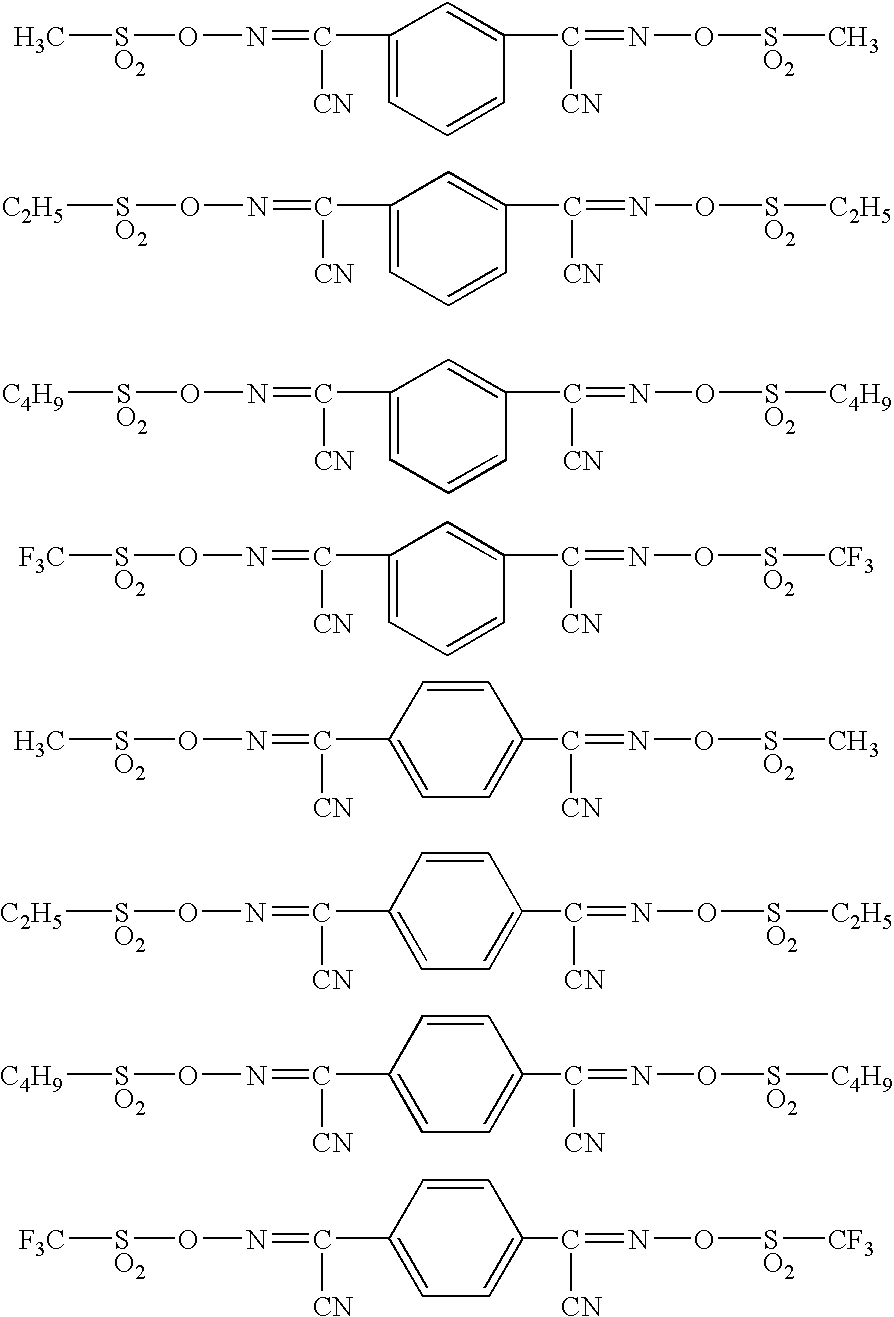
R—SO2O—N═C(CN)— (4)
(wherein, R represents a substituted or unsubstituted alkyl group or aryl group of, for example, 1 to 8 carbon atoms), and of these, compounds represented by a general formula (5) shown below are particularly preferred.
R—SO2O—N═C(CN)—A—C(CN)═N—OSO2—R (5)
(wherein, A represents a bivalent, substituted or unsubstituted alkylene group of 1 to 8 carbon atoms, or a bivalent aromatic compound group, and R represents a substituted or unsubstituted alkyl group or aryl group of, for example, 1 to 8 carbon atoms). Here, the term “aromatic compound group” refers to a group formed from a compound that shows the characteristic physical and chemical properties of an aromatic compound, and specific examples include aromatic hydrocarbon groups such as a phenyl group or naphthyl group, and heterocyclic groups such as a furyl group or thienyl group. These groups may also include suitable substituents on the ring, including one or more halogen atoms, alkyl groups, alkoxy groups, or nitro groups. Compounds of the above general formula in which A represents a phenylene group and R represents, for example, a lower alkyl group of 1 to 4 carbon atoms are particularly desirable.

(wherein, R1 represents a hydrogen atom or a methyl group, and R2 represents an acid-labile group).

(wherein in the above formulas, R8 and R9 each represent, independently, a hydrogen atom, or a straight chain or branched alkyl group of 1 to 6 carbon atoms, R10 represents a straight chain, branched, or cyclic alkyl group of 1 to 10 carbon atoms, R11 represents a straight chain, branched, or cyclic alkyl group of 1 to 6 carbon atoms, and a represents either 0 or 1.)

(wherein in the general formula (8), R12 represents a straight chain or branched alkyl group of 1 to 5 carbon atoms.)

| TABLE 1 | ||
| Example | ||
| 1 | 2 | 3 | 4 | 5 | 6 | 7 | 8 | ||
| A-1 | 0.5 | 0.5 | 0.5 | 0.5 | 0.5 | 0.5 | ||
| A-2 | 0.5 | 2 | ||||||
| B-1 | 40 | 40 | 40 | 35 | 32.5 | 40 | 80 | |
| B-2 | 40 | 40 | 40 | 35 | 32.5 | 40 | 80 | |
| C-1 | 20 | 20 | 20 | |||||
| C-2 | 20 | |||||||
| C-3 | 20 | |||||||
| C-4 | 30 | |||||||
| C-5 | 25 | |||||||
| C-6 | 20 | |||||||
| D-1 | 0.2 | 0.2 | ||||||
| D-2 | 0.2 | 0.2 | ||||||
| TABLE 2 | |||
| Comparative | |||
| Example | example | ||
| 1 | 1 | 1 | 2 | 3 | 4 | 5 | 6 | 7 | 8 | 1 | ||
| Compatibility | A | A | A | A | A | A | A | A | A | A | A |
| Coatability | A | A | B | A | A | A | A | A | A | A | B |
| Film thickness | 20 | 65 | 120 | 20 | 20 | 20 | 20 | 20 | 20 | 20 | 20 |
| Developability | A | A | A | A | A | A | A | A | A | A | A |
| Plating solution | A | A | A | A | A | A | A | A | A | A | C |
| resistance | |||||||||||
| Bump shape | A | A | A | A | A | A | A | A | A | A | C |
| Releasability | A | A | A | A | A | A | A | A | A | A | |
| Photosensitivity | 500 | 2000 | 5000 | 550 | 600 | 500 | 550 | 600 | 200 | 800 | 1000 |
Claims (12)


Priority Applications (1)
| Application Number | Priority Date | Filing Date | Title |
|---|---|---|---|
| US11/025,589 US7169532B2 (en) | 2004-12-29 | 2004-12-29 | Chemically amplified positive photoresist composition for thick film, thick-film photoresist laminated product, manufacturing method for thick-film resist pattern, and manufacturing method for connection terminal |
Applications Claiming Priority (1)
| Application Number | Priority Date | Filing Date | Title |
|---|---|---|---|
| US11/025,589 US7169532B2 (en) | 2004-12-29 | 2004-12-29 | Chemically amplified positive photoresist composition for thick film, thick-film photoresist laminated product, manufacturing method for thick-film resist pattern, and manufacturing method for connection terminal |
Publications (2)
| Publication Number | Publication Date |
|---|---|
| US20060141386A1 US20060141386A1 (en) | 2006-06-29 |
| US7169532B2 true US7169532B2 (en) | 2007-01-30 |
Family
ID=36612040
Family Applications (1)
| Application Number | Title | Priority Date | Filing Date |
|---|---|---|---|
| US11/025,589 Expired - Lifetime US7169532B2 (en) | 2004-12-29 | 2004-12-29 | Chemically amplified positive photoresist composition for thick film, thick-film photoresist laminated product, manufacturing method for thick-film resist pattern, and manufacturing method for connection terminal |
Country Status (1)
| Country | Link |
|---|---|
| US (1) | US7169532B2 (en) |
Cited By (2)
| Publication number | Priority date | Publication date | Assignee | Title |
|---|---|---|---|---|
| US20090215233A1 (en) * | 2008-02-26 | 2009-08-27 | Samsung Electronics Co., Ltd. | Photoresist composition and method of manufacturing array substrate using the same |
| US20100151118A1 (en) * | 2008-12-17 | 2010-06-17 | Eastman Chemical Company | Carrier solvent compositions, coatings compositions, and methods to produce thick polymer coatings |
Families Citing this family (5)
| Publication number | Priority date | Publication date | Assignee | Title |
|---|---|---|---|---|
| KR100897222B1 (en) * | 2004-12-03 | 2009-05-14 | 도오꾜오까고오교 가부시끼가이샤 | Positive resist composition and method of forming resist pattern |
| JP4499591B2 (en) * | 2005-03-23 | 2010-07-07 | 東京応化工業株式会社 | Chemically amplified positive photoresist composition for thick film formation |
| JP5630444B2 (en) * | 2009-12-22 | 2014-11-26 | Jsr株式会社 | Radiation sensitive composition |
| JP5729313B2 (en) * | 2011-01-19 | 2015-06-03 | 信越化学工業株式会社 | Chemically amplified positive resist material and pattern forming method |
| JP7539226B2 (en) * | 2019-08-28 | 2024-08-23 | 東京応化工業株式会社 | Resist composition and method for forming resist pattern |
Citations (10)
| Publication number | Priority date | Publication date | Assignee | Title |
|---|---|---|---|---|
| JP2001281863A (en) | 2000-03-29 | 2001-10-10 | Jsr Corp | Method of producing radiation-sensitive resin composition and plated object |
| JP2001281862A (en) | 2000-03-29 | 2001-10-10 | Jsr Corp | Positive-type radiation-sensitive resin composition for producing plated objects and method for producing plated objects |
| US6365321B1 (en) * | 1999-04-13 | 2002-04-02 | International Business Machines Corporation | Blends of hydroxystyrene polymers for use in chemically amplified positive resist formulations |
| JP2002258479A (en) | 2001-03-06 | 2002-09-11 | Tokyo Ohka Kogyo Co Ltd | Positive type photoresist composition for thick film, photoresist film and bump forming method using the same |
| US20030064319A1 (en) | 2001-05-21 | 2003-04-03 | Tokyo Ohka Kogyo Co., Ltd. | Negative photoresist compositions for the formation of thick films, photoresist films and methods of forming bumps using the same |
| JP2004309778A (en) | 2003-04-07 | 2004-11-04 | Tokyo Ohka Kogyo Co Ltd | Chemically amplifying positive photoresist composition for thick film, thick film photoresist layered body, method for manufacturing thick film resist pattern and method for manufacturing connecting terminal |
| JP2004309775A (en) | 2003-04-07 | 2004-11-04 | Tokyo Ohka Kogyo Co Ltd | Chemically amplifying positive photoresist composition for thick film, thick film photoresist layered body, method for manufacturing thick film resist pattern and method for manufacturing connecting terminal |
| JP2004309776A (en) | 2003-04-07 | 2004-11-04 | Tokyo Ohka Kogyo Co Ltd | Chemically amplifying positive photoresist composition for thick film, thick film photoresist layered body, method for manufacturing thick film resist pattern and method for manufacturing connecting terminal |
| JP2004309777A (en) | 2003-04-07 | 2004-11-04 | Tokyo Ohka Kogyo Co Ltd | Chemically amplifying positive photoresist composition for thick film, thick film photoresist layered body, method for manufacturing thick film resist pattern and method for manufacturing connecting terminal |
| US6830867B2 (en) | 2001-10-03 | 2004-12-14 | Fuji Photo Film Co., Ltd. | Positive photosensitive composition |
-
2004
- 2004-12-29 US US11/025,589 patent/US7169532B2/en not_active Expired - Lifetime
Patent Citations (10)
| Publication number | Priority date | Publication date | Assignee | Title |
|---|---|---|---|---|
| US6365321B1 (en) * | 1999-04-13 | 2002-04-02 | International Business Machines Corporation | Blends of hydroxystyrene polymers for use in chemically amplified positive resist formulations |
| JP2001281863A (en) | 2000-03-29 | 2001-10-10 | Jsr Corp | Method of producing radiation-sensitive resin composition and plated object |
| JP2001281862A (en) | 2000-03-29 | 2001-10-10 | Jsr Corp | Positive-type radiation-sensitive resin composition for producing plated objects and method for producing plated objects |
| JP2002258479A (en) | 2001-03-06 | 2002-09-11 | Tokyo Ohka Kogyo Co Ltd | Positive type photoresist composition for thick film, photoresist film and bump forming method using the same |
| US20030064319A1 (en) | 2001-05-21 | 2003-04-03 | Tokyo Ohka Kogyo Co., Ltd. | Negative photoresist compositions for the formation of thick films, photoresist films and methods of forming bumps using the same |
| US6830867B2 (en) | 2001-10-03 | 2004-12-14 | Fuji Photo Film Co., Ltd. | Positive photosensitive composition |
| JP2004309778A (en) | 2003-04-07 | 2004-11-04 | Tokyo Ohka Kogyo Co Ltd | Chemically amplifying positive photoresist composition for thick film, thick film photoresist layered body, method for manufacturing thick film resist pattern and method for manufacturing connecting terminal |
| JP2004309775A (en) | 2003-04-07 | 2004-11-04 | Tokyo Ohka Kogyo Co Ltd | Chemically amplifying positive photoresist composition for thick film, thick film photoresist layered body, method for manufacturing thick film resist pattern and method for manufacturing connecting terminal |
| JP2004309776A (en) | 2003-04-07 | 2004-11-04 | Tokyo Ohka Kogyo Co Ltd | Chemically amplifying positive photoresist composition for thick film, thick film photoresist layered body, method for manufacturing thick film resist pattern and method for manufacturing connecting terminal |
| JP2004309777A (en) | 2003-04-07 | 2004-11-04 | Tokyo Ohka Kogyo Co Ltd | Chemically amplifying positive photoresist composition for thick film, thick film photoresist layered body, method for manufacturing thick film resist pattern and method for manufacturing connecting terminal |
Non-Patent Citations (3)
| Title |
|---|
| U.S. Appl. No. 11/025,591, filed Dec. 29, 2004, Tokyo Ohka Kogyo Co., Ltd. |
| U.S. Appl. No. 11/025,833, filed Dec. 29, 2004, Tokyo Ohka Kogyo Co., Ltd. |
| U.S. Appl. No. 11/025,870, filed Dec. 29, 2004, Tokyo Ohka Kogyo Co., Ltd. |
Cited By (6)
| Publication number | Priority date | Publication date | Assignee | Title |
|---|---|---|---|---|
| US20090215233A1 (en) * | 2008-02-26 | 2009-08-27 | Samsung Electronics Co., Ltd. | Photoresist composition and method of manufacturing array substrate using the same |
| US7927897B2 (en) * | 2008-02-26 | 2011-04-19 | Samsung Electronics Co., Ltd. | Photoresist composition and method of manufacturing array substrate using the same |
| US20110171581A1 (en) * | 2008-02-26 | 2011-07-14 | Samsung Electronics Co., Ltd. | Photoresist compostion and method of manufacturing array substrate using the same |
| US8808963B2 (en) | 2008-02-26 | 2014-08-19 | Samsung Display Co., Ltd. | Photoresist composition and method of manufacturing array substrate using the same |
| US20100151118A1 (en) * | 2008-12-17 | 2010-06-17 | Eastman Chemical Company | Carrier solvent compositions, coatings compositions, and methods to produce thick polymer coatings |
| US20110165772A1 (en) * | 2008-12-17 | 2011-07-07 | Eastman Chemical Company | Carrier solvent compositions, coatings compositions, and methods to produce thick polymer coatings |
Also Published As
| Publication number | Publication date |
|---|---|
| US20060141386A1 (en) | 2006-06-29 |
Similar Documents
| Publication | Publication Date | Title |
|---|---|---|
| TWI386760B (en) | Thick film with chemical growth type positive photoresist composition, thick film with chemical growth type dry film and thick film photoresist pattern manufacturing method | |
| KR102285531B1 (en) | Chemically amplified positive-type photosensitive resin composition and method for producing resist pattern using the same | |
| JP2012137741A (en) | Chemically amplified positive type photoresist composition for thick film and production method of thick-film resist pattern | |
| US7879525B2 (en) | Chemically amplified photoresist composition, laminated product, and connection element | |
| KR20160117272A (en) | Materials for organic light emitting devices | |
| JP4318945B2 (en) | Chemical amplification type positive photoresist composition for thick film, thick film photoresist laminate, method for producing thick film resist pattern, and method for producing connection terminal | |
| JP2016148740A (en) | Chemically amplified positive photosensitive resin composition for thick film | |
| JP4318946B2 (en) | Chemical amplification type positive photoresist composition for thick film, thick film photoresist laminate, method for producing thick film resist pattern, and method for producing connection terminal | |
| JP2010185986A (en) | Chemically amplified positive photoresist composition for thick film and method for manufacturing thick film resist pattern | |
| EP1861751B1 (en) | Positive-working photoresist composition for thick film formation | |
| KR102289074B1 (en) | Chemically amplified photosensitive resin composition and method for producing resist pattern using the same | |
| KR100861903B1 (en) | Process for producing resist pattern and conductor pattern | |
| JP2008250062A (en) | Chemically amplified positive photoresist composition for thick film and method for manufacturing thick film resist pattern | |
| US7081327B2 (en) | Chemically amplified positive photoresist composition for thick film, thick-film photoresist laminated product, manufacturing method for thick-film resist pattern, and manufacturing method for connection terminal | |
| US7169532B2 (en) | Chemically amplified positive photoresist composition for thick film, thick-film photoresist laminated product, manufacturing method for thick-film resist pattern, and manufacturing method for connection terminal | |
| US20090068342A1 (en) | Positive photoresist composition, thick film photoresist laminate, method for producing thick film resist pattern, and method for producing connecting terminal | |
| KR102536433B1 (en) | Method for forming photosensitive resin layer, method for producing photoresist pattern, and method for producing plated molded article | |
| JP2004309775A (en) | Chemically amplifying positive photoresist composition for thick film, thick film photoresist layered body, method for manufacturing thick film resist pattern and method for manufacturing connecting terminal | |
| WO2006107010A2 (en) | Positive photoresist composition, thick film photoresist laminate, method for producing thick film resist pattern, and method for producing connecting terminal | |
| US7927778B2 (en) | Chemically amplified positive photoresist composition for thick film, thick-film photoresist laminated product, manufacturing method for thick-film resist pattern, and manufacturing method for connection terminal | |
| JP2016148741A (en) | Chemically amplified positive photosensitive resin composition for thick film | |
| JP2004309778A (en) | Chemically amplifying positive photoresist composition for thick film, thick film photoresist layered body, method for manufacturing thick film resist pattern and method for manufacturing connecting terminal | |
| JP2008151953A (en) | Chemically amplified positive photoresist composition for thick film, and manufacturing method of thick film resist pattern | |
| US7951522B2 (en) | Chemically amplified positive photoresist composition for thick film, thick-film photoresist laminated product, manufacturing method for thick-film resist pattern, and manufacturing method for connection terminal | |
| JP2008134473A (en) | Chemically amplified positive photoresist composition for thick film and method for producing thick film resist pattern |
Legal Events
| Date | Code | Title | Description |
|---|---|---|---|
| AS | Assignment |
Owner name: TOKYO OHKA KOGYO CO., LTD., JAPAN Free format text: ASSIGNMENT OF ASSIGNORS INTEREST;ASSIGNORS:OKUI, TOSHIKI;MISUMI, KOICHI;SAITO, KOJI;REEL/FRAME:016599/0822 Effective date: 20050404 |
|
| STCF | Information on status: patent grant |
Free format text: PATENTED CASE |
|
| FEPP | Fee payment procedure |
Free format text: PAYER NUMBER DE-ASSIGNED (ORIGINAL EVENT CODE: RMPN); ENTITY STATUS OF PATENT OWNER: LARGE ENTITY Free format text: PAYOR NUMBER ASSIGNED (ORIGINAL EVENT CODE: ASPN); ENTITY STATUS OF PATENT OWNER: LARGE ENTITY |
|
| FPAY | Fee payment |
Year of fee payment: 4 |
|
| FPAY | Fee payment |
Year of fee payment: 8 |
|
| MAFP | Maintenance fee payment |
Free format text: PAYMENT OF MAINTENANCE FEE, 12TH YEAR, LARGE ENTITY (ORIGINAL EVENT CODE: M1553) Year of fee payment: 12 |