US7141686B2 - E2, E4, Z8-undecatrienoic acid and ester and carboxamide derivatives thereof, organoleptic uses thereof and processes for preparing same - Google Patents
E2, E4, Z8-undecatrienoic acid and ester and carboxamide derivatives thereof, organoleptic uses thereof and processes for preparing same Download PDFInfo
- Publication number
- US7141686B2 US7141686B2 US10/618,367 US61836703A US7141686B2 US 7141686 B2 US7141686 B2 US 7141686B2 US 61836703 A US61836703 A US 61836703A US 7141686 B2 US7141686 B2 US 7141686B2
- Authority
- US
- United States
- Prior art keywords
- ppm
- undecatrienoic acid
- methyl
- ethyl
- flavor
- Prior art date
- Legal status (The legal status is an assumption and is not a legal conclusion. Google has not performed a legal analysis and makes no representation as to the accuracy of the status listed.)
- Expired - Lifetime, expires
Links
- QEICKDSUUQXCOH-QYHQRLDKSA-N CC/C=C\CC/C=C/C=C/C(C)=O Chemical compound CC/C=C\CC/C=C/C=C/C(C)=O QEICKDSUUQXCOH-QYHQRLDKSA-N 0.000 description 6
- GHPODDMCSOYWNE-UHFFFAOYSA-N CC1=CC=C2OCOC2=C1 Chemical compound CC1=CC=C2OCOC2=C1 GHPODDMCSOYWNE-UHFFFAOYSA-N 0.000 description 4
- SICAPXPQXRXPNO-CXZSGCPXSA-N C.C.C.CC/C=C\CC/C=C/C=C/C(=O)O.CC/C=C\CC/C=C/C=C/C(C)=O.CCN(CC)CC.CCOC(=O)Cl.O=[Ag][Ag].[H]C(=O)/C=C/C=C/CC/C=C\CC Chemical compound C.C.C.CC/C=C\CC/C=C/C=C/C(=O)O.CC/C=C\CC/C=C/C=C/C(C)=O.CCN(CC)CC.CCOC(=O)Cl.O=[Ag][Ag].[H]C(=O)/C=C/C=C/CC/C=C\CC SICAPXPQXRXPNO-CXZSGCPXSA-N 0.000 description 2
- OCUXKVCDBHKIIP-QYHQRLDKSA-N C/C=C\CC/C=C/C=C/C(=O)NCC(C)C Chemical compound C/C=C\CC/C=C/C=C/C(=O)NCC(C)C OCUXKVCDBHKIIP-QYHQRLDKSA-N 0.000 description 2
- BXOCHUWSGYYSFW-HVWOQQCMSA-N C/C=C/C=C\CC/C=C/C(=O)NCC(C)C Chemical compound C/C=C/C=C\CC/C=C/C(=O)NCC(C)C BXOCHUWSGYYSFW-HVWOQQCMSA-N 0.000 description 1
- RRGACHGVTJJFEN-LFKFIDTLSA-N C/C=C/C=C\CCC/C=C/C(=O)NCC(C)C Chemical compound C/C=C/C=C\CCC/C=C/C(=O)NCC(C)C RRGACHGVTJJFEN-LFKFIDTLSA-N 0.000 description 1
- NDLUFKQZAVHWQW-NDYRIVJFSA-N CC/C=C\CC/C=C/C=C/C(=O)OC(=O)OCC Chemical compound CC/C=C\CC/C=C/C=C/C(=O)OC(=O)OCC NDLUFKQZAVHWQW-NDYRIVJFSA-N 0.000 description 1
- OBTDXZCTHSIWPN-NRSJTBBXSA-N CCC/C=C/C/C=C/C=C/C(=O)OCC Chemical compound CCC/C=C/C/C=C/C=C/C(=O)OCC OBTDXZCTHSIWPN-NRSJTBBXSA-N 0.000 description 1
- SXIREYMJOXXQLE-XNGSFHTQSA-N CCC/C=C/NC(=O)/C=C\C=C/C=C\CCCC Chemical compound CCC/C=C/NC(=O)/C=C\C=C/C=C\CCCC SXIREYMJOXXQLE-XNGSFHTQSA-N 0.000 description 1
- SUAIANONRYUFAT-QYHQRLDKSA-N CCC/C=C\CC/C=C/C=C/C(=O)O Chemical compound CCC/C=C\CC/C=C/C=C/C(=O)O SUAIANONRYUFAT-QYHQRLDKSA-N 0.000 description 1
- HUGCGAWYTMJTBM-ZUHOWUEJSA-N CCCC/C=C\C=C/C=C/C(=O)OC Chemical compound CCCC/C=C\C=C/C=C/C(=O)OC HUGCGAWYTMJTBM-ZUHOWUEJSA-N 0.000 description 1
Classifications
-
- A—HUMAN NECESSITIES
- A61—MEDICAL OR VETERINARY SCIENCE; HYGIENE
- A61K—PREPARATIONS FOR MEDICAL, DENTAL OR TOILETRY PURPOSES
- A61K8/00—Cosmetics or similar toiletry preparations
- A61K8/18—Cosmetics or similar toiletry preparations characterised by the composition
- A61K8/30—Cosmetics or similar toiletry preparations characterised by the composition containing organic compounds
- A61K8/33—Cosmetics or similar toiletry preparations characterised by the composition containing organic compounds containing oxygen
- A61K8/36—Carboxylic acids; Salts or anhydrides thereof
- A61K8/361—Carboxylic acids having more than seven carbon atoms in an unbroken chain; Salts or anhydrides thereof
-
- A—HUMAN NECESSITIES
- A23—FOODS OR FOODSTUFFS; TREATMENT THEREOF, NOT COVERED BY OTHER CLASSES
- A23L—FOODS, FOODSTUFFS OR NON-ALCOHOLIC BEVERAGES, NOT OTHERWISE PROVIDED FOR; PREPARATION OR TREATMENT THEREOF
- A23L27/00—Spices; Flavouring agents or condiments; Artificial sweetening agents; Table salts; Dietetic salt substitutes; Preparation or treatment thereof
- A23L27/20—Synthetic spices, flavouring agents or condiments
- A23L27/202—Aliphatic compounds
- A23L27/2024—Aliphatic compounds having oxygen as the only hetero atom
- A23L27/2026—Hydroxy compounds
-
- A—HUMAN NECESSITIES
- A23—FOODS OR FOODSTUFFS; TREATMENT THEREOF, NOT COVERED BY OTHER CLASSES
- A23L—FOODS, FOODSTUFFS OR NON-ALCOHOLIC BEVERAGES, NOT OTHERWISE PROVIDED FOR; PREPARATION OR TREATMENT THEREOF
- A23L27/00—Spices; Flavouring agents or condiments; Artificial sweetening agents; Table salts; Dietetic salt substitutes; Preparation or treatment thereof
- A23L27/20—Synthetic spices, flavouring agents or condiments
- A23L27/205—Heterocyclic compounds
- A23L27/2054—Heterocyclic compounds having nitrogen as the only hetero atom
-
- A—HUMAN NECESSITIES
- A61—MEDICAL OR VETERINARY SCIENCE; HYGIENE
- A61K—PREPARATIONS FOR MEDICAL, DENTAL OR TOILETRY PURPOSES
- A61K8/00—Cosmetics or similar toiletry preparations
- A61K8/18—Cosmetics or similar toiletry preparations characterised by the composition
- A61K8/30—Cosmetics or similar toiletry preparations characterised by the composition containing organic compounds
- A61K8/33—Cosmetics or similar toiletry preparations characterised by the composition containing organic compounds containing oxygen
- A61K8/37—Esters of carboxylic acids
-
- A—HUMAN NECESSITIES
- A61—MEDICAL OR VETERINARY SCIENCE; HYGIENE
- A61K—PREPARATIONS FOR MEDICAL, DENTAL OR TOILETRY PURPOSES
- A61K8/00—Cosmetics or similar toiletry preparations
- A61K8/18—Cosmetics or similar toiletry preparations characterised by the composition
- A61K8/30—Cosmetics or similar toiletry preparations characterised by the composition containing organic compounds
- A61K8/40—Cosmetics or similar toiletry preparations characterised by the composition containing organic compounds containing nitrogen
- A61K8/42—Amides
-
- A—HUMAN NECESSITIES
- A61—MEDICAL OR VETERINARY SCIENCE; HYGIENE
- A61K—PREPARATIONS FOR MEDICAL, DENTAL OR TOILETRY PURPOSES
- A61K8/00—Cosmetics or similar toiletry preparations
- A61K8/18—Cosmetics or similar toiletry preparations characterised by the composition
- A61K8/30—Cosmetics or similar toiletry preparations characterised by the composition containing organic compounds
- A61K8/49—Cosmetics or similar toiletry preparations characterised by the composition containing organic compounds containing heterocyclic compounds
- A61K8/4973—Cosmetics or similar toiletry preparations characterised by the composition containing organic compounds containing heterocyclic compounds with oxygen as the only hetero atom
-
- A—HUMAN NECESSITIES
- A61—MEDICAL OR VETERINARY SCIENCE; HYGIENE
- A61Q—SPECIFIC USE OF COSMETICS OR SIMILAR TOILETRY PREPARATIONS
- A61Q11/00—Preparations for care of the teeth, of the oral cavity or of dentures; Dentifrices, e.g. toothpastes; Mouth rinses
-
- A—HUMAN NECESSITIES
- A61—MEDICAL OR VETERINARY SCIENCE; HYGIENE
- A61Q—SPECIFIC USE OF COSMETICS OR SIMILAR TOILETRY PREPARATIONS
- A61Q19/00—Preparations for care of the skin
-
- A—HUMAN NECESSITIES
- A61—MEDICAL OR VETERINARY SCIENCE; HYGIENE
- A61Q—SPECIFIC USE OF COSMETICS OR SIMILAR TOILETRY PREPARATIONS
- A61Q5/00—Preparations for care of the hair
- A61Q5/12—Preparations containing hair conditioners
-
- C—CHEMISTRY; METALLURGY
- C07—ORGANIC CHEMISTRY
- C07C—ACYCLIC OR CARBOCYCLIC COMPOUNDS
- C07C233/00—Carboxylic acid amides
- C07C233/01—Carboxylic acid amides having carbon atoms of carboxamide groups bound to hydrogen atoms or to acyclic carbon atoms
- C07C233/02—Carboxylic acid amides having carbon atoms of carboxamide groups bound to hydrogen atoms or to acyclic carbon atoms having nitrogen atoms of carboxamide groups bound to hydrogen atoms or to carbon atoms of unsubstituted hydrocarbon radicals
- C07C233/09—Carboxylic acid amides having carbon atoms of carboxamide groups bound to hydrogen atoms or to acyclic carbon atoms having nitrogen atoms of carboxamide groups bound to hydrogen atoms or to carbon atoms of unsubstituted hydrocarbon radicals with carbon atoms of carboxamide groups bound to carbon atoms of an acyclic unsaturated carbon skeleton
-
- C—CHEMISTRY; METALLURGY
- C07—ORGANIC CHEMISTRY
- C07C—ACYCLIC OR CARBOCYCLIC COMPOUNDS
- C07C51/00—Preparation of carboxylic acids or their salts, halides or anhydrides
- C07C51/16—Preparation of carboxylic acids or their salts, halides or anhydrides by oxidation
-
- C—CHEMISTRY; METALLURGY
- C07—ORGANIC CHEMISTRY
- C07C—ACYCLIC OR CARBOCYCLIC COMPOUNDS
- C07C51/00—Preparation of carboxylic acids or their salts, halides or anhydrides
- C07C51/16—Preparation of carboxylic acids or their salts, halides or anhydrides by oxidation
- C07C51/295—Preparation of carboxylic acids or their salts, halides or anhydrides by oxidation with inorganic bases, e.g. by alkali fusion
-
- C—CHEMISTRY; METALLURGY
- C07—ORGANIC CHEMISTRY
- C07C—ACYCLIC OR CARBOCYCLIC COMPOUNDS
- C07C57/00—Unsaturated compounds having carboxyl groups bound to acyclic carbon atoms
- C07C57/02—Unsaturated compounds having carboxyl groups bound to acyclic carbon atoms with only carbon-to-carbon double bonds as unsaturation
- C07C57/03—Monocarboxylic acids
-
- C—CHEMISTRY; METALLURGY
- C07—ORGANIC CHEMISTRY
- C07C—ACYCLIC OR CARBOCYCLIC COMPOUNDS
- C07C67/00—Preparation of carboxylic acid esters
- C07C67/12—Preparation of carboxylic acid esters from asymmetrical anhydrides
-
- C—CHEMISTRY; METALLURGY
- C07—ORGANIC CHEMISTRY
- C07C—ACYCLIC OR CARBOCYCLIC COMPOUNDS
- C07C69/00—Esters of carboxylic acids; Esters of carbonic or haloformic acids
- C07C69/52—Esters of acyclic unsaturated carboxylic acids having the esterified carboxyl group bound to an acyclic carbon atom
- C07C69/587—Monocarboxylic acid esters having at least two carbon-to-carbon double bonds
-
- C—CHEMISTRY; METALLURGY
- C07—ORGANIC CHEMISTRY
- C07C—ACYCLIC OR CARBOCYCLIC COMPOUNDS
- C07C69/00—Esters of carboxylic acids; Esters of carbonic or haloformic acids
- C07C69/96—Esters of carbonic or haloformic acids
Definitions
- E2,E4,Z8-Undecatrienoic acid and ester and amide derivatives thereof having beneficial flavor and sensory attributes in the oral cavity and on skin.
- C 10 , C 11 and C 12 alkatrienoic acids and ester and amide derivatives thereof discloses the presence of C 10 , C 11 and C 12 alkatrienoic acids and ester and amide derivatives thereof in a wide variety of botanicals the use thereof to impart flavor and/or a tingling and/or warming sensations in the oral cavity and on skin when used in foodstuffs, chewing gum, oral care products, hair care products, colognes, topical cosmetic products or medicinal products.
- Such C 10 , C 11 and C 12 alkatrienoic acids and ester and amide derivatives thereof are also disclosed as exhibiting biological activity, most notably anti-bacterial, anti-fungal and insecticidal activity.
- the most significant compounds which are members of the genus: “C 10 , C 11 and C 12 alkatrienoic acids and ester and amide derivatives thereof” are those disclosed as follows:
- Isoaffinin having the structure:
- N-isobutyl E2, Z7, E9-undecatrienamide having the structure:
- Our invention relates to novel compounds which are members of the genus:“E2,E4,Z8-undecatrienoic acid and ester and amide derivatives thereof” and a process for augmenting, enhancing or imparting an aroma or taste or somatosensory effect in or to a consumable material which is, in the alternative, a foodstuff, a beverage, a chewing gum, an oral care product, a nasal care product, a cologne, a skin care product, a hair care product, a topical cosmetic product or a medicinal product comprising the step of adding to said consumable material a taste or aroma or somatosensory effect-augmenting, enhancing or imparting quantity and concentration of at least one E2,E4,Z8-undecatrienoic acid derivative defined according to the structure:
- Z represents —OR′′ or —NRR′ with the provisos that when Z is —OR′′, R′′ is hydrogen, C 1 –C 6 straight chain or branched-chain alkyl or C 3 –C 6 straight chain or branched-chain alkenyl; and when Z is —NRR′, R represents, in the alternative, hydrogen, methyl or ethyl and R′ represents methyl, ethyl, n-propyl, cyclopropyl, isopropyl, n-butyl, sec-butyl, isobutyl, 2-methylbutyl, cyclobutyl,
- our invention is directed to augmenting or imparting a flavor or somatosensory effect to a foodstuff, chewing gum, medicinal product, toothpaste, alcoholic beverage, aqueous beverage, dairy product, confection, chocolate, sweet composition or savory composition
- a flavor or sensation augmenting enhancing or imparting quantity and concentration of at least one E2,E4,Z8-undecatrienoic acid derivative defined according to the structure:
- Our invention is also directed to a synthesis process for preparing the 2,4,8-undecatrienoic acid derivatives of our invention by means of first oxidizing the E2, E4, Z8-undecatrienal with silver(I)oxide in aqueous alkali metal hydroxide media followed by acidifcation in order to form the E2, E4, Z8-undecatrienoic acid, which may be utilized as such for its organoleptic and/or somatosensory properties in consumable materials; or which may be further reacted with an alkyl haloformate in admixture with a tertiary amine base in order to form an intermediate which, in turn is reacted with either (a) an amine having the formula RR′NH in order to form a member of the E2, E4, Z8-undecatrienoic acid amide subgenus of our invention or (b) an alcohol having the formula R′′OH in order to form a member of the E2, E4, Z8-undecatrienoic acid ester
- Our invention specifically relates to the novel compositions which are 2,4,8-undecatrienoic acid derivatives which are members of the genus having the structure:
- moiety Z is defined supra, and uses thereof preferably in augmenting or imparting an olfactory effect, flavor or a sensation such as a taste or somatosensory effect to a foodstuff, chewing gum, medicinal product, toothpaste, alcoholic beverage, aqueous beverage, dairy product, confection, chocolate, sweet composition or savory composition particularly providing (a) flavor (b) tingle sensation (c) warming/burning sensation (d) numbing sensation (e) umami taste and (f) salt effects.
- olfactory effective amount is understood to mean the amount of compound in flavor compositions, oral care compositions, nasal care compositions, skin care compositions, hair and scalp care compositions, cosmetic compositions and other consumable materials as defined supra, the individual component will contribute to its particular olfactory characteristics, but the flavor, taste and aroma effect on the overall composition will be the sum of the effects of each of the flavor ingredients.
- taste effects include salt and umami effects.
- the compounds of the invention can be used to alter the taste characteristics of the flavor composition by modifying the taste reaction contributed by another ingredient in the composition. The amount will vary depending on many factors including other ingredients, their relative amounts and the effect that is desired.
- the level of 2,4,8-undecatrienoic acid derivatives used in products is greater than 10 parts per billion, generally provided at a level of from about 50 parts per billion to about 200 parts per million in the finished product, more preferably from about 100 parts per billion to about 100 parts per million by weight.
- the usage level of 2,4,8-undecatrienoic acid derivatives varies depending on the product in which the 2,4,8-undecatrienoic acid derivatives are employed.
- alcoholic beverages the usage level is from about 0.5 to about 25 parts per million, preferably from about 2 to about 10 and most preferably from about 5 to about 10 parts per million by weight.
- Non-alcoholic beverages are flavored at levels of from about 25 parts per billion to about 2 parts per million, preferably from about 100 parts per billion to about 0.5 parts per million and in highly preferred situations of from about 150 to about 400 parts per billion.
- Snack foods can be advantageously flavored using 2,4,8-undecatrienoic acid derivatives of the present invention at levels of from about 5 to about 250 parts per million, preferably from about 25 to about 200 and most preferably from about 35 to about 75 parts per million by weight.
- foodstuff includes both solid and liquid ingestible materials for man or animals, which materials usually do, but need not, have nutritional value.
- foodstuffs include meats, gravies, soups, convenience foods, malt, alcoholic and other beverages, milk and dairy products, seafood, including fish, crustaceans, mollusks and the like, candies, vegetables, cereals, soft drinks, snacks, dog and cat foods, other veterinary products and the like.
- 2,4,8-undecatrienoic acid derivative compounds of this invention When used in a flavoring composition, they can be combined with conventional flavoring materials or adjuvants. Such co-ingredients or flavor adjuvants are well known in the art for such use and have been extensively described in the literature.
- adjuvant materials are: (1) that they be non-reactive with the 2,4,8-undecatrienoic acid derivatives of our invention; (2) that they be organoleptically compatible with the 2,4,8-undecatrienoic acid derivatives of our invention whereby the flavor of the ultimate consumable material to which the 2,4,8-undecatrienoic acid derivatives are added is not detrimentally affected by the use of the adjuvant; and (3) that they be ingestible acceptable and thus nontoxic or otherwise non-deleterious.
- conventional materials can be used and broadly include other flavor materials, vehicles, stabilizers, thickeners, surface active agents, conditioners and flavor intensifiers.
- Such conventional flavoring materials include saturated fatty acids, unsaturated fatty acids and amino acids; alcohols including primary and secondary alcohols, esters, carbonyl compounds including ketones, other than the 2,4,8-undecatrienoic acid derivatives of our invention and aldehydes; lactones; other cyclic organic materials including benzene derivatives, acyclic compounds, heterocyclics such as furans, pyridines, pyrazines and the like; sulfur-containing compounds including thiols, sulfides, disulfides and the like; proteins; lipids, carbohydrates; so-called flavor potentiators such as monosodium glutamate; magnesium glutamate, calcium glutamate, guanylates and inosinates; natural flavoring materials such as hydrolyzates, cocoa, vanilla and caramel; essential oils and extracts such as anise oil, clove oil and the like and artificial flavoring materials such as vanillyl butyl ether, ethyl vanillin and the like.
- flavor adjuvants include but are not limited to the following: anise oil; ethyl-2-methyl butyrate; vanillin; cis-3-heptenol; cis-3-hexenol; trans-2-heptenal; butyl valerate; 2,3-diethyl pyrazine; methyl cyclo-pentenolone; benzaldehyde; valerian oil; 3,4-dimeth-oxyphenol; amyl acetate; amyl cinnamate; ⁇ -butyryl lactone; furfural; trimethyl pyrazine; phenyl acetic acid; isovaleraldehyde; ethyl maltol; ethyl vanillin; ethyl valerate; ethyl butyrate; cocoa extract; coffee extract; peppermint oil; spearmint oil; clove oil; anethol; cardamom oil; wintergreen oil; cinnamic al
- the 2,4,8-undecatrienoic acid derivatives of our invention or compositions incorporating them, as mentioned above, can be combined with one or more vehicles or carriers for adding them to the particular product.
- Vehicles can be water-soluble or oil-soluble edible or otherwise suitable materials such as triacetin, vegetable oil, triethyl citrate, ethyl alcohol, propylene glycol, water and the like.
- Carriers include materials such as gum arabic, carrageenan, xanthan gum, guar gum and the like.
- 2,4,8-undecatrienoic acid derivatives prepared according to our invention can be incorporated with the carriers by conventional means such as spray-drying, extrusion, drum-drying and the like.
- Such carriers can also include materials for coacervating the 2,4,8-undecatrienoic acid derivatives of our invention to provide encapsulated products, as set forth supra.
- the flavoring composition can also contain emulsifiers such as mono- and diglycerides or fatty acids and the like. With these carriers or vehicles, the desired physical form of the compositions can be prepared.
- the quantity of 2,4,8-undecatrienoic acid derivatives utilized should be sufficient to impart the desired flavor characteristic to the product, but on the other hand, the use of an excessive amount of 2,4,8-undecatrienoic acid derivatives is not only wasteful and uneconomical, but in some instances, too large a quantity may unbalance the flavor or other organoleptic properties of the product consumed.
- the quantity used will vary depending upon the ultimate foodstuff; the amount and type of flavor initially present in the foodstuff; the further process or treatment steps to which the foodstuff will be subjected; regional and other preference factors; the type of storage, if any, to which the product will be subjected; and the preconsumption treatment such as baking, frying and so on, given to the product by the ultimate consumer. Accordingly, the terminology “effective amount” and “sufficient amount” is understood in the context of the present invention to be quantitatively adequate to alter the flavor of the foodstuff.
- the synthesis is effected by means of the oxidation of E2,E4,Z8-undecatrienal with silver (I) oxide in sodium hydroxide solution. Acidification liberates the E2,E4,Z8-undecatrienoic acid. Subsequent reaction with ethyl chloroformate in the presence of triethylamine and further reaction of the intermediate with amine or alcohol (added either directly or in solution) according to the scheme:
- X represents —OR′′ or —NRR′ as set forth in the examples herein and wherein when X is —OR′′, R′′ is C 1 –C 6 straight chain or branched-chain alkyl or C 3 –C 6 straight chain or branched-chain alkenyl; and when X is —NRR′, R represents, in the alternative, hydrogen, methyl or ethyl and R′ represents methyl, ethyl, n-propyl, cyclopropyl, isopropyl, n-butyl, sec-butyl, isobutyl, 2-methylbutyl, cyclobutyl,
- the 2,4,8-undecatrienal is added to a suspension of silver (I) oxide (1.1 eq) in water.
- the mixture is stirred at 20° C. and 50% sodium hydroxide solution (equal weight to the aldehyde), is added over 30 minutes allowing the batch to exotherm to 60° C.
- the solution is filtered through celite, and the aqueous filtrate acidified to pH 1 with hydrochloric acid solution, to give 2,4,8-undecatrienoic acid.
- the 2,4,8-undecatrienoic acid may be isolated and utilized for its organoleptic properties, or it may be dissolved in an solvent such as n-hexane, toluene, chloroform, tetrahydrofuran (THF) or dichloromethane to which an alkyl haloformate, preferably ethylchloroformate is added in 1.0 to 2.0 equivalents at temperature ranging from 0° C. to room temperature, most preferably from 10° C. to 20° C. The resulting solution is cooled to ⁇ 10° C.
- an solvent such as n-hexane, toluene, chloroform, tetrahydrofuran (THF) or dichloromethane to which an alkyl haloformate, preferably ethylchloroformate is added in 1.0 to 2.0 equivalents at temperature ranging from 0° C. to room temperature, most preferably from 10° C. to 20° C.
- THF t
- the amine is added in 1.0 to 7.0 equivalents either neat or as a solution in THF and the reaction is aged for about 1–3 hours at room temperature. The reaction is quenched with 10% aqueous hydrochloric acid, washed with 10% sodium hydroxide followed by sodium chloride solution, and the solvent removed.
- the crude product is purified by distillation or recrystallization depending on the physical properties.
- the reaction occurs in 40–80% mole yield based on 2,4,8-undecatrienoic acid.
- the crude product is purified by distillation and the reaction occurs in 60–85% mole yield based on 2,4,8-undecatrienoic acid.
- the 2,4,8-undecatrienoic acid derivatives of the present invention can be admixed with other flavoring agents and incorporated into foodstuffs and other products using techniques well known to those with ordinary skill in the art. Most commonly the 2,4,8-undecatrienoic acid derivatives are simply admixed using the desired ingredients within the proportions stated.
- 2,4,8-Undecatrienal is added to a suspension of silver (I) oxide (1.1 eq) in water.
- the mixture is stirred at 20° C. and concentrated sodium hydroxide solution (equal weight to the aldehyde), is added over 30 minutes allowing the batch to exotherm to 60° C.
- the solution is filtered through celite, and the aqueous filtrate acidified to pH 1 with hydrochloric acid solution, to give 2,4,8-undecatrienoic acid.
- 2,4,8-undecatrienoic acid is dissolved in dichloromethane to which ethylchloroformate is added in 1.0 to 2.0 equivalents at temperature ranging from 0° C. to room temperature, most preferably from 10° C. to 20° C.
- the resulting solution is cooled to ⁇ 10° C. to ⁇ 30° C., and triethylamine is added in 1.0 to 2.0 equivalents such that the temperature range is below 0° C. and the mixture aged for 1 hour.
- the mixture is filtered, and the filtrate cooled to 0° C.
- the amine is added in 1.0 to 7.0 equivalents either neat or as a solution in THF and the reaction is aged for about 1–3 hours at room temperature. The reaction is quenched with 10% aqueous hydrochloric acid, washed with 10% sodium hydroxide followed by sodium chloride solution, and the solvent removed.
- the crude product is purified by distillation or recrystallization depending on the physical properties.
- the reaction occurs in 40–80% mole yield based on 2,4,8-undecatrienoic acid.
- the crude product is purified by distillation and the reaction occurs in 60–85% mole yield based on 2,4,8-undecatrienoic acid.
- amides and esters are synthesized according to the general scheme above with the following specific examples. Equivalents set out are mole equivalents based on starting acid, yields are purified chemical yields based on starting acid.
- E2,E4,Z8-undecatrienoic acid 1 eq, ethyl chloroformate 1.5 eq, triethylamine 1.5 eq, isobutylamine 1.2 eq, quench as per general procedure, yield 75%.
- Flavored beverages were prepared using the above 30° proof alcoholic base. A kiwi flavor was applied to the beverages. This flavor consisted of cis-3 hexenol, trans-2 hexenal, ethyl butyrate, ethyl-2-methyl butyrate, isoamyl butyrate, ethyl acetate, ethyl isovalerate, and trans-2-hexenol in equal proportions.
- the control beverage contained 200 ppm of the above flavor blend. This control beverage exhibited the taste characteristics of a candied kiwi flavor with moderate apple character.
- Another beverage was prepared containing 200 ppm of the same flavor and 3 ppm of N-isobutyl E2,E4,Z8-undecatrienamide prepared according to Example I(B).
- the flavor of this beverage was slightly more melon rind in character than the control. There was also an enhanced perception of alcohol and a tingle effect on the tongue.
- the above formulation was added to a stainless steel pot. With constant mixing, the formulation temperature was raised to 295° F. The pot was then removed from the heat, and 1.0 grams of a cola flavor containing the ingredients in equal amounts: cinnamic aldehyde, ginger oil, lemon oil, lime oil and nutmeg oil was added and blended with the sucrose-corn syrup-water formulation. After the blending was complete, 1.2 grams of citric acid was added. The resulting liquid candy was then deposited into molds, and the molds containing the liquid candy were cooled to room temperature, yielding 200 grams of finished hard candy. The resulting ‘control candy’ exhibited a typical cola flavor having citrus and spice taste and aroma nuances.
- a second candy sample was prepared using the above recipe modified by the addition of 50 ppm of N-isobutyl E2, E4, Z8-undecatrienamide prepared according the procedure of Example I (B). This second candy sample exhibited a moderately strong and substantive cola profile, as well as a taste effect similar to carbonation.
Landscapes
- Chemical & Material Sciences (AREA)
- Organic Chemistry (AREA)
- Health & Medical Sciences (AREA)
- Life Sciences & Earth Sciences (AREA)
- Public Health (AREA)
- Animal Behavior & Ethology (AREA)
- Veterinary Medicine (AREA)
- General Health & Medical Sciences (AREA)
- Birds (AREA)
- Epidemiology (AREA)
- Engineering & Computer Science (AREA)
- Food Science & Technology (AREA)
- Nutrition Science (AREA)
- Emergency Medicine (AREA)
- Polymers & Plastics (AREA)
- Dermatology (AREA)
- Oil, Petroleum & Natural Gas (AREA)
- Oral & Maxillofacial Surgery (AREA)
- Inorganic Chemistry (AREA)
- Seasonings (AREA)
- Organic Low-Molecular-Weight Compounds And Preparation Thereof (AREA)
- Fats And Perfumes (AREA)
- Cosmetics (AREA)
Abstract
Described is a genus of E2,E4,Z8-undecatrienoic acid derivatives defined according to the structure:

wherein Z represents —OR″ or —NRR′ with the provisos that when Z is —OR″, R″ is hydrogen, C1–C6 straight chain or branched-chain alkyl or C3–C6 straight chain or branched-chain alkenyl; and when Z is —NRR′, R represents, in the alternative, hydrogen, methyl or ethyl and R′ represents methyl, ethyl, n-propyl, cyclopropyl, isopropyl, n-butyl, sec-butyl, isobutyl, 2-methylbutyl, cyclobutyl,

cyclopentyl or allyl. The E2,E4,Z8-undecatrienoic acid derivatives are useful in imparting, augmenting and/or enhancing flavors, aromas and somatosensory effects in or to consumable materials such as foods, beverages, skin care products, oral care products, medicinal products and the like. Also described is a synthesis process for producing such derivatives.
Description
E2,E4,Z8-Undecatrienoic acid and ester and amide derivatives thereof having beneficial flavor and sensory attributes in the oral cavity and on skin.
The prior art discloses the presence of C10, C11 and C12 alkatrienoic acids and ester and amide derivatives thereof in a wide variety of botanicals the use thereof to impart flavor and/or a tingling and/or warming sensations in the oral cavity and on skin when used in foodstuffs, chewing gum, oral care products, hair care products, colognes, topical cosmetic products or medicinal products. Such C10, C11 and C12 alkatrienoic acids and ester and amide derivatives thereof are also disclosed as exhibiting biological activity, most notably anti-bacterial, anti-fungal and insecticidal activity. The most significant compounds which are members of the genus: “C10, C11 and C12 alkatrienoic acids and ester and amide derivatives thereof” are those disclosed as follows:
(a) Amides:
Spilanthol or Affinin having the structure

the use of which in oral care, skin care and medicinal products is disclosed in Nakanatsu et al, Published European Patent Application EP 1,121,927 A2; the use of which as an oral sensate, flavor enhancer and potentiator is disclosed in U.S. Published patent application 2002/0122778 A1; and the pungency of which is disclosed in Nakatani et al “Pungent Alkamides from Spilanthes acmella L. var. oleracea Clarke, Biosci. Biotech. Biochem., 56(5), 759–762 (1992);
Isoaffinin having the structure:
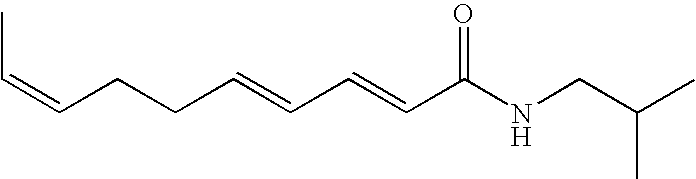
disclosed in Gamboa-Leon et al., “Isobutylamide numbing agents of toothache grass”, Biochemical Systematics and Ecology 28 (2000)1019–1021;
N-isobutyl E2, Z7, E9-undecatrienamide having the structure:

disclosed in Rameswak et al., “Bioactive N-isobutylamides from flower buds of Spilanthes acmella”, Phytochemistry 51 (1999) 729–732;
The disclosure of the compound having the structure:

by Snider et al., “Synthesis of the N-((1E)-Alkenyl)-(2Z,4Z)-heptadienamide Side Clain of Salicilihalamide A and Apicularens A and B”, Organic Letters (2000), Vol.2, No. 3, pp. 407–408.
(b) Acids:
The presence of dodecatrienoic acid (structure not specified) in a Hop Plant named “YCR Accession No. 14” having an aroma with sharp, floral and spicy notes, as disclosed in Zimmermann, U.S. Plant Patent PP12,213 P2;
The disclosure of the compound having the structure:

by Crombie, “Amides of Vegetable Origin, Part VII, Synthesis of N-isobutyldodeca-trans-2:trans-4:trans-8- and trans-2:trans-4:cis-8-trienamide and their relation to Sanshool I”, J.Chem.Soc. 1955, pp. 4244–4249.
Published application for U.S. Patent 2003/0068330 A1 published on Apr. 10, 2003 discloses 2,6,10-dodecatrienoic acid (without specifying any particular isomer thereof) for potentiating the activity of Nerve Growth Factor (NGF).
(c) Esters:
The disclosure of the compound having the structure:

by Furber et al., “Stereospecific Diene Synthesis using Acetylene Carbocupration; Preparation of Navel Orangeworm Pheremone and Leukotriene Analogues”, J. Chem. Soc. Perkin Trans. I, 1986, pp. 1809–1815;
The disclosure of the compound having the structure:

by Tanaka et al., “Structure and Synthesis of a New Hypotensive Vasodilator Isolated from Streptomyces Aureofaciens”, Tetrahedron Letters, Vol. 22, No. 35, pp. 3421–3422, 1981.
Despite the existence in the prior art and in commerce of such a vast number of C10, C11, and C12 alkatrienoic acids and ester and amide derivatives thereof, there is an increasing ongoing need for flavor ingredients, skin care ingredients, oral care ingredients and hair care ingredients that exhibit organoleptically-acceptable somatosensory activity or flavor property, particularly at relatively low threshold levels.
Our invention relates to novel compounds which are members of the genus:“E2,E4,Z8-undecatrienoic acid and ester and amide derivatives thereof” and a process for augmenting, enhancing or imparting an aroma or taste or somatosensory effect in or to a consumable material which is, in the alternative, a foodstuff, a beverage, a chewing gum, an oral care product, a nasal care product, a cologne, a skin care product, a hair care product, a topical cosmetic product or a medicinal product comprising the step of adding to said consumable material a taste or aroma or somatosensory effect-augmenting, enhancing or imparting quantity and concentration of at least one E2,E4,Z8-undecatrienoic acid derivative defined according to the structure:

wherein Z represents —OR″ or —NRR′ with the provisos that when Z is —OR″, R″ is hydrogen, C1–C6 straight chain or branched-chain alkyl or C3–C6 straight chain or branched-chain alkenyl; and when Z is —NRR′, R represents, in the alternative, hydrogen, methyl or ethyl and R′ represents methyl, ethyl, n-propyl, cyclopropyl, isopropyl, n-butyl, sec-butyl, isobutyl, 2-methylbutyl, cyclobutyl,

cyclopentyl or allyl.
More specifically, and more preferably, our invention is directed to augmenting or imparting a flavor or somatosensory effect to a foodstuff, chewing gum, medicinal product, toothpaste, alcoholic beverage, aqueous beverage, dairy product, confection, chocolate, sweet composition or savory composition comprising the step of adding to foodstuff, chewing gum, medicinal product, toothpaste, alcoholic beverage, aqueous beverage, dairy product, confection, chocolate, sweet composition or savory composition a flavor or sensation augmenting, enhancing or imparting quantity and concentration of at least one E2,E4,Z8-undecatrienoic acid derivative defined according to the structure:
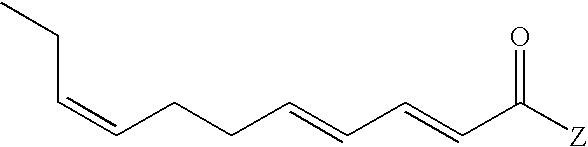
wherein the moiety Z is defined supra.
As used herein the compounds of our invention having the structure:

will be referred hereinafter to as “2,4,8-undecatrienoic acid derivatives”.
Our invention is also directed to a synthesis process for preparing the 2,4,8-undecatrienoic acid derivatives of our invention by means of first oxidizing the E2, E4, Z8-undecatrienal with silver(I)oxide in aqueous alkali metal hydroxide media followed by acidifcation in order to form the E2, E4, Z8-undecatrienoic acid, which may be utilized as such for its organoleptic and/or somatosensory properties in consumable materials; or which may be further reacted with an alkyl haloformate in admixture with a tertiary amine base in order to form an intermediate which, in turn is reacted with either (a) an amine having the formula RR′NH in order to form a member of the E2, E4, Z8-undecatrienoic acid amide subgenus of our invention or (b) an alcohol having the formula R″OH in order to form a member of the E2, E4, Z8-undecatrienoic acid ester subgenus of our invention.
Our invention specifically relates to the novel compositions which are 2,4,8-undecatrienoic acid derivatives which are members of the genus having the structure:
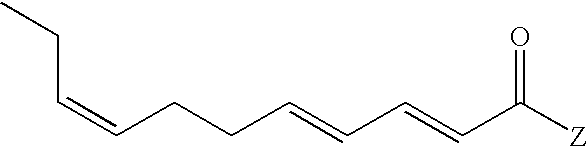
wherein the moiety Z is defined supra, and uses thereof preferably in augmenting or imparting an olfactory effect, flavor or a sensation such as a taste or somatosensory effect to a foodstuff, chewing gum, medicinal product, toothpaste, alcoholic beverage, aqueous beverage, dairy product, confection, chocolate, sweet composition or savory composition particularly providing (a) flavor (b) tingle sensation (c) warming/burning sensation (d) numbing sensation (e) umami taste and (f) salt effects.
Specific members of the 2,4,8-undecatrienoic acid derivative genus of our invention have organoleptic and somatosensory properties as set forth in the following Table I:
| TABLE I | |||||
| Primary Flavor or | |||||
| Z | R | R′ | R″ | Compound | Sensory Characteristic |
| —NRR′ | H | isobutyl | N/A | N-isobutyl E2,E4,Z8- | Strong tingle at 10 ppm. |
| undecatrienamide | Green, cucumber and | ||||
| melon flavor with | |||||
| pleasant seashore aroma. | |||||
| —NRR′ | methyl | methyl | N/A | N,N-dimethyl E2,E4,Z8- | At 1 ppm, a flaxseed oil, |
| undecatrienamide | cod liver oil taste with | ||||
| light tingle and pleasant | |||||
| seashore aroma nuances. | |||||
| —OR″ | N/A | N/A | H | E2,E4,Z8-undecatrienoic | At 1 ppm in water, a cod |
| acid | liver oil taste with green, | ||||
| fatty nuances. | |||||
| —OR″ | N/A | N/A | —CH3 | Methyl E2,E4,Z8- | At 1 ppm, a pleasant |
| undecatrienoate | seashore aroma, and a | ||||
| sardine-like taste having a | |||||
| fruity topnote and an | |||||
| aesthetically pleasing | |||||
| astringent effect. | |||||
The following Table II sets forth examples of processes and compositions where the 2,4,8-undecatrienoic acid derivatives of our invention are utilized. Each of the useful ingredients set forth in the cited references, including the examples thereof is usable in the practice of our invention:
| TABLE II | |
| Reference Containing Examples Where the | |
| Nature of Use of the 2,4,8-Undecatrienoic | 2,4,8-Undecatrienoic Acid Derivative of |
| Acid Derivatives of our Invention | our Invention are Utilizable |
| Skin care | U.S. Pat. No. 6,096,324 |
| Cosmetics, toiletries and bath agents | U.S. Pat. No. 6,328,982 |
| Skin care, cosmetic and hair care compositions | U.S. Pat. No. 6,544,499 |
| Nasal cavity care compositions | U.S. Pat. No. 6,576,224 |
| Dental care compositions | U.S. Pat. No. 6,576,225 |
| Personal wash sunscreen compositions | U.S. Pat. No. 6,576,228 |
| Hair Care Compositions | Application for U.S. Patent 2001/0043912 A1 |
| published on Nov. 22, 2001 | |
| Skin care compositions | Application for U.S. Patent 2002/0039591 A1 |
| published on Apr. 4, 2002 | |
| Oral sensates, flavor enhancers and potentiators | Application for U.S. Patent 2002/0122778 A1 |
| published on Sep. 5, 2002 | |
| Hair care compositions | Application for U.S. Patent 2003/0035784 A1 |
| published on Feb. 20, 2003 | |
| Hair and scalp care compositions | Application for U.S. Patent 2003/0095938 A1 |
| published on May 22, 2003 | |
| Food, pharmaceutical and personal care | European Published Application EP 1,121,927 |
| products | A2 published Aug. 8, 2001 |
| Anti-dandruff and anti-itch compositions | Application for U.S. Patent 10/067,596 filed on |
| Feb. 5, 2002 (IFF-25) | |
| Taste and sensory effect compositions | Application for U.S. Patent 10/411,672 filed on |
| Apr. 11, 2003 (IFF-53) | |
As used herein olfactory effective amount is understood to mean the amount of compound in flavor compositions, oral care compositions, nasal care compositions, skin care compositions, hair and scalp care compositions, cosmetic compositions and other consumable materials as defined supra, the individual component will contribute to its particular olfactory characteristics, but the flavor, taste and aroma effect on the overall composition will be the sum of the effects of each of the flavor ingredients. As used herein taste effects include salt and umami effects. Thus the compounds of the invention can be used to alter the taste characteristics of the flavor composition by modifying the taste reaction contributed by another ingredient in the composition. The amount will vary depending on many factors including other ingredients, their relative amounts and the effect that is desired.
The level of 2,4,8-undecatrienoic acid derivatives used in products is greater than 10 parts per billion, generally provided at a level of from about 50 parts per billion to about 200 parts per million in the finished product, more preferably from about 100 parts per billion to about 100 parts per million by weight.
The usage level of 2,4,8-undecatrienoic acid derivatives varies depending on the product in which the 2,4,8-undecatrienoic acid derivatives are employed. For example, alcoholic beverages the usage level is from about 0.5 to about 25 parts per million, preferably from about 2 to about 10 and most preferably from about 5 to about 10 parts per million by weight. Non-alcoholic beverages are flavored at levels of from about 25 parts per billion to about 2 parts per million, preferably from about 100 parts per billion to about 0.5 parts per million and in highly preferred situations of from about 150 to about 400 parts per billion. Snack foods can be advantageously flavored using 2,4,8-undecatrienoic acid derivatives of the present invention at levels of from about 5 to about 250 parts per million, preferably from about 25 to about 200 and most preferably from about 35 to about 75 parts per million by weight.
The term “foodstuff” as used herein includes both solid and liquid ingestible materials for man or animals, which materials usually do, but need not, have nutritional value. Thus, foodstuffs include meats, gravies, soups, convenience foods, malt, alcoholic and other beverages, milk and dairy products, seafood, including fish, crustaceans, mollusks and the like, candies, vegetables, cereals, soft drinks, snacks, dog and cat foods, other veterinary products and the like.
When the 2,4,8-undecatrienoic acid derivative compounds of this invention are used in a flavoring composition, they can be combined with conventional flavoring materials or adjuvants. Such co-ingredients or flavor adjuvants are well known in the art for such use and have been extensively described in the literature. Requirements of such adjuvant materials are: (1) that they be non-reactive with the 2,4,8-undecatrienoic acid derivatives of our invention; (2) that they be organoleptically compatible with the 2,4,8-undecatrienoic acid derivatives of our invention whereby the flavor of the ultimate consumable material to which the 2,4,8-undecatrienoic acid derivatives are added is not detrimentally affected by the use of the adjuvant; and (3) that they be ingestible acceptable and thus nontoxic or otherwise non-deleterious. Apart from these requirements, conventional materials can be used and broadly include other flavor materials, vehicles, stabilizers, thickeners, surface active agents, conditioners and flavor intensifiers.
Such conventional flavoring materials include saturated fatty acids, unsaturated fatty acids and amino acids; alcohols including primary and secondary alcohols, esters, carbonyl compounds including ketones, other than the 2,4,8-undecatrienoic acid derivatives of our invention and aldehydes; lactones; other cyclic organic materials including benzene derivatives, acyclic compounds, heterocyclics such as furans, pyridines, pyrazines and the like; sulfur-containing compounds including thiols, sulfides, disulfides and the like; proteins; lipids, carbohydrates; so-called flavor potentiators such as monosodium glutamate; magnesium glutamate, calcium glutamate, guanylates and inosinates; natural flavoring materials such as hydrolyzates, cocoa, vanilla and caramel; essential oils and extracts such as anise oil, clove oil and the like and artificial flavoring materials such as vanillyl butyl ether, ethyl vanillin and the like.
Specific preferred flavor adjuvants include but are not limited to the following: anise oil; ethyl-2-methyl butyrate; vanillin; cis-3-heptenol; cis-3-hexenol; trans-2-heptenal; butyl valerate; 2,3-diethyl pyrazine; methyl cyclo-pentenolone; benzaldehyde; valerian oil; 3,4-dimeth-oxyphenol; amyl acetate; amyl cinnamate; γ-butyryl lactone; furfural; trimethyl pyrazine; phenyl acetic acid; isovaleraldehyde; ethyl maltol; ethyl vanillin; ethyl valerate; ethyl butyrate; cocoa extract; coffee extract; peppermint oil; spearmint oil; clove oil; anethol; cardamom oil; wintergreen oil; cinnamic aldehyde; ethyl-2-methyl valerate; γ-hexenyl lactone; 2,4-decadienal; 2,4-heptadienal; methyl thiazole alcohol (4-methyl-5-β-hydroxyethyl thiazole); 2-methyl butanethiol; 4-mercapto-2-butanone; 3-mercapto-2-pentanone; 1-mercapto-2-propane; benzaldehyde; furfural; furfuryl alcohol; 2-mercapto propionic acid; alkyl pyrazine; methyl pyrazine; 2-ethyl-3-methyl pyrazine; tetramethyl pyrazine; polysulfides; dipropyl disulfide; methyl benzyl disulfide; alkyl thiophene; 2,3-dimethyl thiophene; 5-methyl furfural; acetyl furan; 2,4-decadienal; guaiacol; phenyl acetaldehyde; β-decalactone; d-limonene; acetoin; amyl acetate; maltol; ethyl butyrate; levulinic acid; piperonal; ethyl acetate; n-octanal; n-pentanal; n-hexanal; diacetyl; monosodium glutamate; monopotassium glutamate; sulfur-containing amino acids, e.g., cysteine; hydrolyzed vegetable protein; 2-methylfuran-3-thiol; 2-methyldihydrofuran-3-thiol; 2,5-dimethylfuran-3-thiol; hydrolyzed fish protein; tetramethyl pyrazine; propylpropenyl disulfide; propylpropenyl trisulfide; diallyl disulfide; diallyl trisulfide; dipropenyl disulfide; dipropenyl trisulfide; 4-methyl-2-[(methylthio)-ethyl]-1,3-dithiolane; 4,5-dimethyl-2-(methylthiomethyl)-1,3-dithiolne; and 4-methyl-2-(methylthiomethyl)-1,3-dithiolane. These and other flavor ingredients are provided in U.S. Pat. Nos. 6,110,520 and 6,333,180.
The 2,4,8-undecatrienoic acid derivatives of our invention or compositions incorporating them, as mentioned above, can be combined with one or more vehicles or carriers for adding them to the particular product. Vehicles can be water-soluble or oil-soluble edible or otherwise suitable materials such as triacetin, vegetable oil, triethyl citrate, ethyl alcohol, propylene glycol, water and the like. Carriers include materials such as gum arabic, carrageenan, xanthan gum, guar gum and the like.
2,4,8-undecatrienoic acid derivatives prepared according to our invention can be incorporated with the carriers by conventional means such as spray-drying, extrusion, drum-drying and the like. Such carriers can also include materials for coacervating the 2,4,8-undecatrienoic acid derivatives of our invention to provide encapsulated products, as set forth supra. When the carrier is an emulsion, the flavoring composition can also contain emulsifiers such as mono- and diglycerides or fatty acids and the like. With these carriers or vehicles, the desired physical form of the compositions can be prepared.
The quantity of 2,4,8-undecatrienoic acid derivatives utilized should be sufficient to impart the desired flavor characteristic to the product, but on the other hand, the use of an excessive amount of 2,4,8-undecatrienoic acid derivatives is not only wasteful and uneconomical, but in some instances, too large a quantity may unbalance the flavor or other organoleptic properties of the product consumed. The quantity used will vary depending upon the ultimate foodstuff; the amount and type of flavor initially present in the foodstuff; the further process or treatment steps to which the foodstuff will be subjected; regional and other preference factors; the type of storage, if any, to which the product will be subjected; and the preconsumption treatment such as baking, frying and so on, given to the product by the ultimate consumer. Accordingly, the terminology “effective amount” and “sufficient amount” is understood in the context of the present invention to be quantitatively adequate to alter the flavor of the foodstuff.
With reference to the novel compounds of our invention, the synthesis is effected by means of the oxidation of E2,E4,Z8-undecatrienal with silver (I) oxide in sodium hydroxide solution. Acidification liberates the E2,E4,Z8-undecatrienoic acid. Subsequent reaction with ethyl chloroformate in the presence of triethylamine and further reaction of the intermediate with amine or alcohol (added either directly or in solution) according to the scheme:

wherein X represents —OR″ or —NRR′ as set forth in the examples herein and wherein when X is —OR″, R″ is C1–C6 straight chain or branched-chain alkyl or C3–C6 straight chain or branched-chain alkenyl; and when X is —NRR′, R represents, in the alternative, hydrogen, methyl or ethyl and R′ represents methyl, ethyl, n-propyl, cyclopropyl, isopropyl, n-butyl, sec-butyl, isobutyl, 2-methylbutyl, cyclobutyl,

cyclopentyl or allyl. The 2,4,8-undecatrienal is added to a suspension of silver (I) oxide (1.1 eq) in water. The mixture is stirred at 20° C. and 50% sodium hydroxide solution (equal weight to the aldehyde), is added over 30 minutes allowing the batch to exotherm to 60° C. The solution is filtered through celite, and the aqueous filtrate acidified to pH 1 with hydrochloric acid solution, to give 2,4,8-undecatrienoic acid.
The 2,4,8-undecatrienoic acid may be isolated and utilized for its organoleptic properties, or it may be dissolved in an solvent such as n-hexane, toluene, chloroform, tetrahydrofuran (THF) or dichloromethane to which an alkyl haloformate, preferably ethylchloroformate is added in 1.0 to 2.0 equivalents at temperature ranging from 0° C. to room temperature, most preferably from 10° C. to 20° C. The resulting solution is cooled to −10° C. to −30° C., and an aromatic or aliphatic tertiary amine such as pyridine, 4(N,N-dimethylamino)pyridine or triethylamine is added in 1.0 to 2.0 equivalents such that the temperature range is below 0° C. and the mixture aged for 1 hour. The mixture is filtered, and the filtrate cooled to 0° C. At this point an intermediate having, for example the structure:

is formed, when the alkyl haloformate is ethyl chloroformate.
For Amides:
The amine is added in 1.0 to 7.0 equivalents either neat or as a solution in THF and the reaction is aged for about 1–3 hours at room temperature. The reaction is quenched with 10% aqueous hydrochloric acid, washed with 10% sodium hydroxide followed by sodium chloride solution, and the solvent removed.
The crude product is purified by distillation or recrystallization depending on the physical properties. The reaction occurs in 40–80% mole yield based on 2,4,8-undecatrienoic acid.
For Esters:
An alcohol of the formula R″OH, e.g., ethyl alcohol (10 eq) is added and the reaction is stirred overnight at room temperature. The reaction is quenched with 10% aqueous hydrochloric acid, washed 5% sodium hydroxide solution and finally with water and the solvent is removed.
The crude product is purified by distillation and the reaction occurs in 60–85% mole yield based on 2,4,8-undecatrienoic acid.
The 2,4,8-undecatrienoic acid derivatives of the present invention can be admixed with other flavoring agents and incorporated into foodstuffs and other products using techniques well known to those with ordinary skill in the art. Most commonly the 2,4,8-undecatrienoic acid derivatives are simply admixed using the desired ingredients within the proportions stated.
The following examples are provided as specific embodiments of the present invention. Other modifications of this invention will be readily apparent to those skilled in the art, without departing from the scope of this invention. As used herein, both the specification and the following examples all percentages are weight percent unless noted to the contrary.
The following reaction sequence was used to prepare the specific compounds described by the NMR data set forth below:
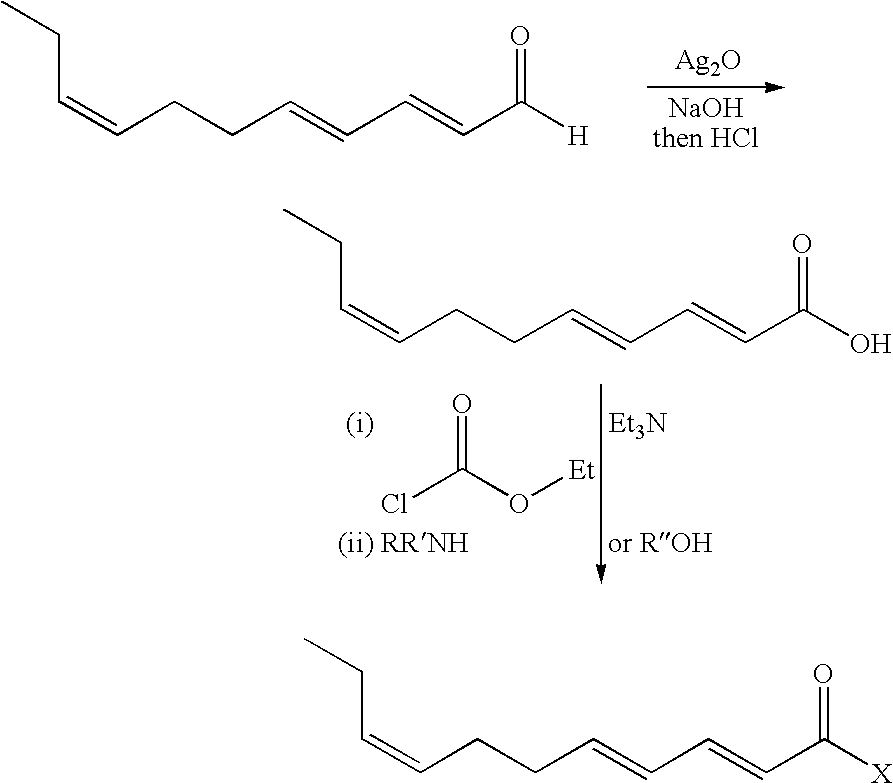
2,4,8-Undecatrienal is added to a suspension of silver (I) oxide (1.1 eq) in water. The mixture is stirred at 20° C. and concentrated sodium hydroxide solution (equal weight to the aldehyde), is added over 30 minutes allowing the batch to exotherm to 60° C. The solution is filtered through celite, and the aqueous filtrate acidified to pH 1 with hydrochloric acid solution, to give 2,4,8-undecatrienoic acid.
2,4,8-undecatrienoic acid is dissolved in dichloromethane to which ethylchloroformate is added in 1.0 to 2.0 equivalents at temperature ranging from 0° C. to room temperature, most preferably from 10° C. to 20° C. The resulting solution is cooled to −10° C. to −30° C., and triethylamine is added in 1.0 to 2.0 equivalents such that the temperature range is below 0° C. and the mixture aged for 1 hour. The mixture is filtered, and the filtrate cooled to 0° C.
For Amides:
The amine is added in 1.0 to 7.0 equivalents either neat or as a solution in THF and the reaction is aged for about 1–3 hours at room temperature. The reaction is quenched with 10% aqueous hydrochloric acid, washed with 10% sodium hydroxide followed by sodium chloride solution, and the solvent removed.
The crude product is purified by distillation or recrystallization depending on the physical properties. The reaction occurs in 40–80% mole yield based on 2,4,8-undecatrienoic acid.
For Esters:
Alcohol (10 eq) is added and the reaction is stirred overnight at room temperature. The reaction is quenched with 10% % aqueous hydrochloric acid, washed 5% sodium hydroxide solution and finally with water and the solvent is removed.
The crude product is purified by distillation and the reaction occurs in 60–85% mole yield based on 2,4,8-undecatrienoic acid.
The amides and esters are synthesized according to the general scheme above with the following specific examples. Equivalents set out are mole equivalents based on starting acid, yields are purified chemical yields based on starting acid.
The following examples I(A)–I(D) set forth syntheses of specific 2,4,8-undecatrienoic acid derivatives of our invention and include NMR data.
E2,E4,Z8-undecatrienoic acid
E2,E4,Z8-undecatrienal 1 eq, silver (I) oxide 1.1 eq, concentrated sodium hydroxide solution 1 weight eq, acidified to pH1 with conc. hydrogen chloride solution, yield=43%.
| 0.96 ppm | (t, 3H, J=7.53Hz) |
| 2.04 ppm | (quintet, 2H, J=7.41Hz) |
| 2.19 ppm | (t, 2H, J=6.27Hz) |
| 2.24 ppm | (t, 2H, J=6.23Hz) |
| 5.32 ppm | (m, 1H) |
| 5.40 ppm | (m, 1H) |
| 5.79 ppm | (d, 1H, J=15.35Hz) |
| 6.20 ppm | (m, 2H) |
| 7.34 ppm | (d, 1H, J=15.34Hz, of d, J=10.12Hz) |
N-isobutyl E2,E4,Z8-undecatrienamide
E2,E4,Z8-undecatrienoic acid 1 eq, ethyl chloroformate 1.5 eq, triethylamine 1.5 eq, isobutylamine 1.2 eq, quench as per general procedure, yield=75%.
| 0.93 | ppm | (d, 6H, J=6.64 Hz) |
| 0.95 | ppm | (t, 3H, J=7.52 Hz) |
| 1.80 | ppm | (septet, 1H, J=6.73 Hz) |
| 2.03 | ppm | (quintet, 2H, J=7.40 Hz) |
| 2.19 | ppm | (m, 4H) |
| 3.17 | ppm | (t, 2H, J=6.48 Hz) |
| 5.16–5.37 | ppm | (m, 2H) |
| 5.39 | ppm | (br. s, 1H) |
| 5.76 | ppm | (d, 1H, J=15.01 Hz) |
| 6.02–6.19 | ppm | (m, 2H, j) |
| 7.19 | ppm | (d, 1H, J=14.96 Hz, of d, J=10.24 Hz) |
N,N-dimethyl E2,E4,Z8-undecatrienamide
E2,E4,Z8-undecatrienoic acid 1 eq, ethyl chloroformate 1.5 eq, triethylamine 1.5 eq, dimethylamine (2.0M solution in THF) 3.0 eq, quench as per general procedure, yield=67%.
| 0.95 | ppm | (t, 3H, J=7.54Hz) |
| 1.25 | ppm | (t, 3H, J=7.10Hz) |
| 2.03 | ppm | (quintet, 2H, J=7.39Hz) |
| 2.19 | ppm | (m, 4H) |
| 2.90 | ppm | (s) |
| 3.01 | ppm | (s, 3H) |
| 3.07 | ppm | (s, 3H) |
| 4.11 | ppm | (q, 2H, J=7.12Hz) |
| 5.28–5.43 | ppm | (m, 2H) |
| 6.02–6.10 | ppm | (m, 1H) |
| 6.17–6.25 | ppm | (m, 1H) |
| 6.26 | ppm | (d, 1H, J=14.79Hz) |
| 7.23 | ppm | (d, 1H, J=14.76Hz, of d, J=10.26Hz) |
Methyl E2,E4, Z8-undecatrienoate
E2,E4,Z8-undecatrienoic acid 1 eq, ethyl chloroformate 1.5 eq, triethylamine 1.5 eq, methanol 10.0 eq, quench as per general procedure, yield=83%.
| 0.95 | ppm | (t, 3H, J=7.53Hz) |
| 1.25 | ppm | (t, 3H, J=7.15Hz) |
| 2.04 | ppm | (quintet, 2H, J=7.67Hz) |
| 2.22 | ppm | (m, 4H) |
| 3.73 | ppm | (s, 3H) |
| 4.12 | ppm | (q, 2H, J=7.14Hz) |
| 5.26–5.46 | ppm | (m, 2H) |
| 5.80 | ppm | (d, 1H, J=15.45Hz) |
| 6.08–6.23 | ppm | (m, 2H) |
| 7.26 | ppm | (d, 1H, J=15.39Hz, of d, J=9.97Hz) |
The following formulation was prepared:
| Ingredients | Volume | ||
| 190° Proof food grade Ethyl Alcohol | 157.89 mL | ||
| High Fructose Corn Syrup 55 (77° Brix) | 217.00 mL | ||
| Citric Acid (50% solution) | 3.00 mL | ||
| Water | 622.11 mL | ||
Flavored beverages were prepared using the above 30° proof alcoholic base. A kiwi flavor was applied to the beverages. This flavor consisted of cis-3 hexenol, trans-2 hexenal, ethyl butyrate, ethyl-2-methyl butyrate, isoamyl butyrate, ethyl acetate, ethyl isovalerate, and trans-2-hexenol in equal proportions. The control beverage contained 200 ppm of the above flavor blend. This control beverage exhibited the taste characteristics of a candied kiwi flavor with moderate apple character. Another beverage was prepared containing 200 ppm of the same flavor and 3 ppm of N-isobutyl E2,E4,Z8-undecatrienamide prepared according to Example I(B). The flavor of this beverage was slightly more melon rind in character than the control. There was also an enhanced perception of alcohol and a tingle effect on the tongue.
The following formulation was prepared:
| Ingredients | Parts by Weight | ||
| Sucrose | 137 grams | ||
| Corn Syrup 42 DE | 91 grams | ||
| Water | 46 grams | ||
The above formulation was added to a stainless steel pot. With constant mixing, the formulation temperature was raised to 295° F. The pot was then removed from the heat, and 1.0 grams of a cola flavor containing the ingredients in equal amounts: cinnamic aldehyde, ginger oil, lemon oil, lime oil and nutmeg oil was added and blended with the sucrose-corn syrup-water formulation. After the blending was complete, 1.2 grams of citric acid was added. The resulting liquid candy was then deposited into molds, and the molds containing the liquid candy were cooled to room temperature, yielding 200 grams of finished hard candy. The resulting ‘control candy’ exhibited a typical cola flavor having citrus and spice taste and aroma nuances. A second candy sample was prepared using the above recipe modified by the addition of 50 ppm of N-isobutyl E2, E4, Z8-undecatrienamide prepared according the procedure of Example I (B). This second candy sample exhibited a moderately strong and substantive cola profile, as well as a taste effect similar to carbonation.
Claims (4)
1. An E2,E4,Z8-undecatrienoic acid derivative defined according to the structure:
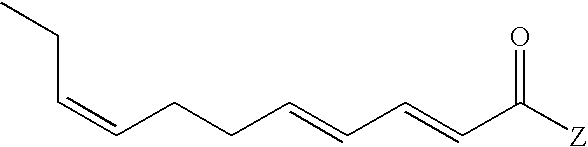
wherein Z represents —OR″ or —NRR′ with the provisos that when Z is —OR″, R″ is hydrogen, C1–C6 straight chain or branched-chain alkyl or C3–C6 straight chain or branched-chain alkenyl; and when Z is —NRR′, R represents, in the alternative, hydrogen, methyl or ethyl and R′ represents methyl, ethyl, n-propyl, cyclopropyl, isopropyl, n-butyl, sec-butyl, 2-methylbutyl, cyclobutyl,

cyclopentyl or allyl.
2. The E2,E4,Z8-undecatrienoic acid derivative of claim 1 wherein Z is —NRR′, R is selected from the group consisting of hydrogen, methyl and ethyl and R′ is selected from the group consisting of hydrogen and C1–C6 alkyl.
3. The E2,E4,Z8-undecatrienoic acid derivative of claim 2 wherein Z is —NRR′, R is methyl and R′ is methyl.
4. The E2,E4,Z8-undecatrienoic acid derivative of claim 1 wherein Z is —OR″ and R″ is selected from the group consisting of hydrogen and methyl.
Priority Applications (7)
| Application Number | Priority Date | Filing Date | Title |
|---|---|---|---|
| US10/618,367 US7141686B2 (en) | 2003-07-10 | 2003-07-10 | E2, E4, Z8-undecatrienoic acid and ester and carboxamide derivatives thereof, organoleptic uses thereof and processes for preparing same |
| US10/861,751 US7098350B2 (en) | 2003-07-10 | 2004-06-04 | E2,E4,Z8-undecatrienoic acid and ester and carboxamide derivatives thereof, organoleptic uses thereof and processes for preparing same |
| ES09167852T ES2425188T3 (en) | 2003-07-10 | 2004-07-08 | E2, E4, Z8-undecatrienoic acid and ester and carboxamide derivatives thereof, organoleptic uses thereof and processes for preparing them |
| EP04254095A EP1496042B1 (en) | 2003-07-10 | 2004-07-08 | E2, E4,Z8-Undecatrienoic acid and ester and carboxamide derivatives thereof, organoleptic uses thereof and processes for preparing same |
| EP09167852.4A EP2112135B1 (en) | 2003-07-10 | 2004-07-08 | E2, E4,Z8-undecatrienoic acid and ester and carboxamide derivatives thereof, organoleptic uses thereof and processes for preparing same |
| DE602004024005T DE602004024005D1 (en) | 2003-07-10 | 2004-07-08 | E2, E4, Z8 undecatrienoic acid, esters and amide derivatives, their organoleptic uses and processes for their preparation |
| ES04254095T ES2335663T3 (en) | 2003-07-10 | 2004-07-08 | E2, E4, Z8-UNDECATRIENIC ACID AND ESTER AND CARBOXAMIDE AND ITS DERIVATIVES, ORGANOLEPTIC USES AND PROCEDURE FOR THEIR PREPARATION. |
Applications Claiming Priority (1)
| Application Number | Priority Date | Filing Date | Title |
|---|---|---|---|
| US10/618,367 US7141686B2 (en) | 2003-07-10 | 2003-07-10 | E2, E4, Z8-undecatrienoic acid and ester and carboxamide derivatives thereof, organoleptic uses thereof and processes for preparing same |
Related Child Applications (1)
| Application Number | Title | Priority Date | Filing Date |
|---|---|---|---|
| US10/861,751 Continuation-In-Part US7098350B2 (en) | 2003-07-10 | 2004-06-04 | E2,E4,Z8-undecatrienoic acid and ester and carboxamide derivatives thereof, organoleptic uses thereof and processes for preparing same |
Publications (2)
| Publication Number | Publication Date |
|---|---|
| US20050010062A1 US20050010062A1 (en) | 2005-01-13 |
| US7141686B2 true US7141686B2 (en) | 2006-11-28 |
Family
ID=33565119
Family Applications (2)
| Application Number | Title | Priority Date | Filing Date |
|---|---|---|---|
| US10/618,367 Expired - Lifetime US7141686B2 (en) | 2003-07-10 | 2003-07-10 | E2, E4, Z8-undecatrienoic acid and ester and carboxamide derivatives thereof, organoleptic uses thereof and processes for preparing same |
| US10/861,751 Expired - Lifetime US7098350B2 (en) | 2003-07-10 | 2004-06-04 | E2,E4,Z8-undecatrienoic acid and ester and carboxamide derivatives thereof, organoleptic uses thereof and processes for preparing same |
Family Applications After (1)
| Application Number | Title | Priority Date | Filing Date |
|---|---|---|---|
| US10/861,751 Expired - Lifetime US7098350B2 (en) | 2003-07-10 | 2004-06-04 | E2,E4,Z8-undecatrienoic acid and ester and carboxamide derivatives thereof, organoleptic uses thereof and processes for preparing same |
Country Status (4)
| Country | Link |
|---|---|
| US (2) | US7141686B2 (en) |
| EP (1) | EP2112135B1 (en) |
| DE (1) | DE602004024005D1 (en) |
| ES (2) | ES2335663T3 (en) |
Cited By (1)
| Publication number | Priority date | Publication date | Assignee | Title |
|---|---|---|---|---|
| US20110136668A1 (en) * | 2008-08-05 | 2011-06-09 | Lopez-Bucio Jose | System for protection of plants from pathogens using alkamides |
Families Citing this family (4)
| Publication number | Priority date | Publication date | Assignee | Title |
|---|---|---|---|---|
| US20100034944A1 (en) * | 2008-08-06 | 2010-02-11 | Martha Lubenova Beyazova | Use of Avocado Derivatives in Flavor Applications |
| DE102008042421A1 (en) * | 2008-09-26 | 2010-04-01 | Symrise Gmbh & Co. Kg | Geranylamine derivatives of oxalic acid |
| WO2016081713A1 (en) | 2014-11-21 | 2016-05-26 | Synventive Molding Solutions, Inc. | Valve system in an injection molding system |
| WO2025160646A1 (en) * | 2024-01-31 | 2025-08-07 | Oxiteno S.A. Indústria E Comércio | Ester compound, process for the preparation thereof, use of a compound, and personal or household care formulation |
Citations (74)
| Publication number | Priority date | Publication date | Assignee | Title |
|---|---|---|---|---|
| US3111127A (en) | 1961-06-27 | 1963-11-19 | Brown & Williamson Tobacco Corp | Smoking tobacco product and method of making the same |
| US4029759A (en) | 1972-02-28 | 1977-06-14 | Lever Brothers Company | Compositions containing compounds producing a cooling sensation |
| US4032661A (en) | 1972-07-20 | 1977-06-28 | Wilkinson Sword Limited | Cyclic sulphoxides and sulphones having a physiological cooling action on the human body |
| US4150052A (en) | 1971-02-04 | 1979-04-17 | Wilkinson Sword Limited | N-substituted paramenthane carboxamides |
| US4153679A (en) | 1972-04-18 | 1979-05-08 | Wilkinson Sword Limited | Acyclic carboxamides having a physiological cooling effect |
| US4185106A (en) | 1972-07-11 | 1980-01-22 | Hoechst Aktiengesellschaft | Pyridones as antidandruff agents |
| US4226988A (en) | 1971-02-04 | 1980-10-07 | Wilkinson Sword Limited | N-substituted paramenthane carboxamides |
| JPS5687505A (en) | 1979-12-18 | 1981-07-16 | Sumitomo Chem Co Ltd | Insecticidal composition |
| US4296093A (en) | 1973-04-16 | 1981-10-20 | Wilkinson Sword Limited | Cyclic carboxamides having a physiological cooling effect |
| US4470982A (en) | 1980-12-22 | 1984-09-11 | The Procter & Gamble Company | Shampoo compositions |
| US4472421A (en) | 1974-06-22 | 1984-09-18 | Bayer Aktiengesellschaft | Azole antimycotics and their use in treating skin conditions caused by Pityrosporum ovale |
| US5009893A (en) | 1989-07-17 | 1991-04-23 | Warner-Lambert Company | Breath-freshening edible compositions of methol and a carboxamide |
| WO1993023005A1 (en) | 1992-05-18 | 1993-11-25 | The Procter & Gamble Company | Coolant compositions |
| US5545424A (en) | 1994-10-12 | 1996-08-13 | Takasago International Corporation | 4-(1-menthoxymethyl)-2-phenyl-1,3-dioxolane or its derivatives and flavor composition containing the same |
| US5624666A (en) | 1995-01-20 | 1997-04-29 | The Procter & Gamble Company | Anti-dandruff shampoos with particulate active agent and cationic polymer |
| US5641480A (en) | 1994-12-08 | 1997-06-24 | Lever Brothers Company, Division Of Conopco, Inc. | Hair care compositions comprising heteroatom containing alkyl aldonamide compounds |
| WO1998007404A1 (en) | 1996-08-23 | 1998-02-26 | Kao Corporation | Aqueous skin cosmetic composition containing a water-insoluble powder |
| US5725865A (en) | 1995-08-29 | 1998-03-10 | V. Mane Fils S.A. | Coolant compositions |
| US5730965A (en) | 1996-06-13 | 1998-03-24 | Dermatology Home Products, Inc. | Shampoo for treating seborrheic dermatitis, dandruff or psoriasis |
| US5843466A (en) | 1995-08-29 | 1998-12-01 | V. Mane Fils S.A. | Coolant compositions |
| WO1999007235A1 (en) | 1997-08-11 | 1999-02-18 | Warner-Lambert Company | Enhanced flavoring compositions containing n-ethyl-p-menthane-3-carboxamide and method of making and using same |
| US5955066A (en) | 1995-10-16 | 1999-09-21 | The Procter & Gamble Company | Conditioning shampoo compositions having improved stability |
| US6096324A (en) | 1995-06-13 | 2000-08-01 | Laboratory Skin Care | Methods of delivering materials into the skin, and compositions used therein |
| WO2000045815A1 (en) | 1999-02-02 | 2000-08-10 | Avon Products, Inc. | Methods for alleviating discomfort of a hot flash and compositions therefor |
| US6110520A (en) | 1999-03-25 | 2000-08-29 | International Flavors & Fragrances Inc. | Process for preparing GAMM-hexalactone, products produced therefrom dan organoleptic uses of said products |
| US6200554B1 (en) | 1996-10-16 | 2001-03-13 | The Procter & Gamble Company | Conditioning shampoo compositions having improved silicone deposition |
| US6210695B1 (en) | 1997-06-04 | 2001-04-03 | The Procter & Gamble Company | Leave-on antimicrobial compositions |
| US6248315B1 (en) | 1995-09-01 | 2001-06-19 | The Procter & Gamble Company | Hair styling shampoos containing organic oil |
| US6251463B1 (en) | 1998-03-12 | 2001-06-26 | International Flavors & Fragrances Inc. | Use of spray-dried and freeze-dried sugarcane leaf essence in improving taste of flavored calcium supplements, foodstuffs, beverages, chewing gum, oral care compositions and calcium supplement |
| EP1121927A2 (en) | 2000-02-04 | 2001-08-08 | Takasago International Corporation | A composition causing different skin sensations |
| EP1122233A1 (en) | 2000-02-04 | 2001-08-08 | Takasago International Corporation | A (1'R, 2'S, 5'R)-3-l-menthoxyalkan-1-ol cooling sensate |
| US6294186B1 (en) | 1997-06-04 | 2001-09-25 | Peter William Beerse | Antimicrobial compositions comprising a benzoic acid analog and a metal salt |
| US6297203B1 (en) | 1997-05-05 | 2001-10-02 | The Procter & Gamble | Styling shampoo compositions containing cationic styling polymers and cationic deposition polymers |
| US6299900B1 (en) | 1996-02-19 | 2001-10-09 | Monash University | Dermal penetration enhancers and drug delivery systems involving same |
| US6303817B1 (en) | 2000-08-10 | 2001-10-16 | International Flavors & Fragrances Inc. | Method for making amides |
| US20010032645A1 (en) | 1997-01-29 | 2001-10-25 | Cronk Peter J. | Adhesively applied external nasal strips and dilators containing medications and fragrances |
| USPP12213P2 (en) | 1999-04-06 | 2001-11-20 | Yakima Chief Ranches, Inc. | Hop plant named ‘YCR Accession No. 14’ |
| US20010043912A1 (en) | 2000-04-03 | 2001-11-22 | Michael Daniel Wayne | Hair care compositions containing selected frizz control agents |
| US6328982B1 (en) | 1998-08-04 | 2001-12-11 | Takasago International Corporation | Cool feeling composition |
| US6333180B1 (en) | 1999-12-21 | 2001-12-25 | International Flavors & Fragrances Inc. | Bioprocess for the high-yield production of food flavor-acceptable jasmonic acid and methyl jasmonate |
| US6338855B1 (en) | 1996-10-25 | 2002-01-15 | The Procter & Gamble Company | Cleansing articles for skin and/or hair which also deposit skin care actives |
| US20020012640A1 (en) | 2000-06-13 | 2002-01-31 | Fatemeh Mohammadi | Cosmetic composition for stressed skin under extreme conditions |
| US6365215B1 (en) | 2000-11-09 | 2002-04-02 | International Flavors & Fragrances Inc. | Oral sensory perception-affecting compositions containing dimethyl sulfoxide, complexes thereof and salts thereof |
| US6365601B1 (en) | 1999-09-16 | 2002-04-02 | Council Of Scientific And Industrial Research | Process for extraction of piperine from piper species |
| US20020039591A1 (en) | 1999-10-01 | 2002-04-04 | Joseph Scott Dahle | Topical applications for skin treatment |
| US6391886B1 (en) | 2000-12-04 | 2002-05-21 | The Procter & Gamble Company | Oral compositions having improved consumer aesthetics |
| WO2002051392A1 (en) | 2000-12-27 | 2002-07-04 | Wm. Wrigley Jr. Company | Chewing gums and related products that provide breath freshening characteristics |
| US20020122778A1 (en) | 2000-12-15 | 2002-09-05 | Philip Wolfson | Herbal composition for improving oral hygiene, for providing local anesthesia, for use as an oral sensate, flavor enhancer and potentiator, and methods of using same |
| US6451844B1 (en) | 1998-09-18 | 2002-09-17 | Quest International Bv | Use of menthyl-2 pyrrolidone-5-carboxylate as an insect repellent |
| US6455080B1 (en) | 1997-12-29 | 2002-09-24 | Wm. Wrigley Jr., Company | Chewing gum containing controlled release acyclic carboxamide and method of making |
| US20020142015A1 (en) | 2000-12-12 | 2002-10-03 | Takasago International Corporation | Warming composition |
| US20020173436A1 (en) | 2000-09-20 | 2002-11-21 | Steffen Sonnenberg | Multiphase soaps |
| US20030035784A1 (en) | 2001-03-05 | 2003-02-20 | Kao Corporation | Hair cosmetic, aminocarboxylic acid amide and method for producing the same |
| US6544499B1 (en) | 1999-01-08 | 2003-04-08 | The Procter & Gamble Company | Topical compositions comprising protected functional thiols |
| US20030068330A1 (en) | 2000-02-08 | 2003-04-10 | Takeshi Goto | Nerve growth factor activity potentiating agents |
| US20030072842A1 (en) | 2001-05-11 | 2003-04-17 | Johnson Sonya S. | Chewing gum having prolonged sensory benefits |
| US20030082129A1 (en) | 2001-08-07 | 2003-05-01 | Buckingham Anne Marie | Hair and skin care compositions containing siloxane-based polyamide copolymers |
| US20030082124A1 (en) | 2001-10-24 | 2003-05-01 | Alexander Hammer M. D | Liquid lipstick |
| US20030095936A1 (en) | 2001-11-19 | 2003-05-22 | Orrea Light | Lip gloss composition |
| US20030095938A1 (en) | 2000-06-09 | 2003-05-22 | Farmaka S.R.L. | Cosmetic compositions for the care of scalp and hair |
| US6572914B1 (en) | 1994-10-10 | 2003-06-03 | The Procter & Gamble Co. | Beverage supply system |
| US6576228B1 (en) | 2000-03-10 | 2003-06-10 | Unilever Home & Personal Care Usa Division Of Conopco, Inc. | Personal wash sunscreen compositions which deposit and lather well |
| US6576225B1 (en) | 1999-05-06 | 2003-06-10 | Kerrhawe Sa | Dental care composition |
| US6576224B1 (en) | 1999-07-06 | 2003-06-10 | Sinuspharma, Inc. | Aerosolized anti-infectives, anti-inflammatories, and decongestants for the treatment of sinusitis |
| US6579513B1 (en) | 2002-01-03 | 2003-06-17 | Playtex Products, Inc. | Hygiene mouthspray composition |
| US6579514B1 (en) | 2002-05-08 | 2003-06-17 | David M. Hall | Anti infective periodontic compositions |
| US6579543B1 (en) | 2002-02-22 | 2003-06-17 | Jackie H. McClung | Composition for topical application to skin |
| US6579535B2 (en) | 1998-11-19 | 2003-06-17 | Advanced Technology Pharmaceuticals Corporation | Chewable tablets containing mannitol and Aspartame |
| US6579516B1 (en) | 1995-06-13 | 2003-06-17 | Zahra Mansouri | Methods of delivering materials into the skin, and compositions used therein |
| US20030113357A1 (en) | 2000-05-23 | 2003-06-19 | The Procter & Gamble Company | Skin Care Compositions |
| US20030152682A1 (en) | 2001-12-27 | 2003-08-14 | Ley Jakob Peter | Use of ferulic acid amides as flavor compounds |
| WO2004000787A2 (en) | 2002-06-20 | 2003-12-31 | Symrise Gmbh & Co. Kg | Production of cis-pellitorin and use as a flavouring |
| WO2004011415A1 (en) | 2002-07-25 | 2004-02-05 | Givaudan Sa | Flavourant compounds |
| US20040241312A1 (en) | 2002-11-14 | 2004-12-02 | Ian Lucas Gatfield | Use of trans-pellitorin in the form of an aromatic substance |
Family Cites Families (6)
| Publication number | Priority date | Publication date | Assignee | Title |
|---|---|---|---|---|
| GB1438205A (en) | 1974-08-27 | 1976-06-03 | Lion Dentifrice Co Ltd | Dentifrice composition |
| US4997672A (en) | 1987-03-10 | 1991-03-05 | Virginia Commonwealth University | Salt taste enhancer |
| US5288510A (en) | 1992-05-18 | 1994-02-22 | George Gregory | Palatable low salt substitutes |
| US6541050B1 (en) | 1998-11-27 | 2003-04-01 | Campbell Soup Company | Salt flavor enhancing compositions, food products including such compositions, and methods for preparing such products |
| ATE354288T1 (en) | 1999-11-29 | 2007-03-15 | Kyowa Hakko Food Specialties C | METHOD AND MEANS FOR FLAVOR ENHANCEMENT OF SODIUM CHLORIDE, SPICES WITH SODIUM CHLORIDE FLAVOR AND FOODS WITH ENHANCED SODIUM CHLORIDE FLAVOR |
| JP3573102B2 (en) * | 2001-04-20 | 2004-10-06 | ソニー株式会社 | Negative electrode active material and non-aqueous electrolyte secondary battery |
-
2003
- 2003-07-10 US US10/618,367 patent/US7141686B2/en not_active Expired - Lifetime
-
2004
- 2004-06-04 US US10/861,751 patent/US7098350B2/en not_active Expired - Lifetime
- 2004-07-08 DE DE602004024005T patent/DE602004024005D1/en not_active Expired - Lifetime
- 2004-07-08 EP EP09167852.4A patent/EP2112135B1/en not_active Expired - Lifetime
- 2004-07-08 ES ES04254095T patent/ES2335663T3/en not_active Expired - Lifetime
- 2004-07-08 ES ES09167852T patent/ES2425188T3/en not_active Expired - Lifetime
Patent Citations (75)
| Publication number | Priority date | Publication date | Assignee | Title |
|---|---|---|---|---|
| US3111127A (en) | 1961-06-27 | 1963-11-19 | Brown & Williamson Tobacco Corp | Smoking tobacco product and method of making the same |
| US4150052A (en) | 1971-02-04 | 1979-04-17 | Wilkinson Sword Limited | N-substituted paramenthane carboxamides |
| US4226988A (en) | 1971-02-04 | 1980-10-07 | Wilkinson Sword Limited | N-substituted paramenthane carboxamides |
| US4029759A (en) | 1972-02-28 | 1977-06-14 | Lever Brothers Company | Compositions containing compounds producing a cooling sensation |
| US4153679A (en) | 1972-04-18 | 1979-05-08 | Wilkinson Sword Limited | Acyclic carboxamides having a physiological cooling effect |
| US4185106A (en) | 1972-07-11 | 1980-01-22 | Hoechst Aktiengesellschaft | Pyridones as antidandruff agents |
| US4032661A (en) | 1972-07-20 | 1977-06-28 | Wilkinson Sword Limited | Cyclic sulphoxides and sulphones having a physiological cooling action on the human body |
| US4296093A (en) | 1973-04-16 | 1981-10-20 | Wilkinson Sword Limited | Cyclic carboxamides having a physiological cooling effect |
| US4472421A (en) | 1974-06-22 | 1984-09-18 | Bayer Aktiengesellschaft | Azole antimycotics and their use in treating skin conditions caused by Pityrosporum ovale |
| JPS5687505A (en) | 1979-12-18 | 1981-07-16 | Sumitomo Chem Co Ltd | Insecticidal composition |
| US4470982A (en) | 1980-12-22 | 1984-09-11 | The Procter & Gamble Company | Shampoo compositions |
| US5009893A (en) | 1989-07-17 | 1991-04-23 | Warner-Lambert Company | Breath-freshening edible compositions of methol and a carboxamide |
| WO1993023005A1 (en) | 1992-05-18 | 1993-11-25 | The Procter & Gamble Company | Coolant compositions |
| US6572914B1 (en) | 1994-10-10 | 2003-06-03 | The Procter & Gamble Co. | Beverage supply system |
| US5545424A (en) | 1994-10-12 | 1996-08-13 | Takasago International Corporation | 4-(1-menthoxymethyl)-2-phenyl-1,3-dioxolane or its derivatives and flavor composition containing the same |
| US5641480A (en) | 1994-12-08 | 1997-06-24 | Lever Brothers Company, Division Of Conopco, Inc. | Hair care compositions comprising heteroatom containing alkyl aldonamide compounds |
| US5624666A (en) | 1995-01-20 | 1997-04-29 | The Procter & Gamble Company | Anti-dandruff shampoos with particulate active agent and cationic polymer |
| US6579516B1 (en) | 1995-06-13 | 2003-06-17 | Zahra Mansouri | Methods of delivering materials into the skin, and compositions used therein |
| US6096324A (en) | 1995-06-13 | 2000-08-01 | Laboratory Skin Care | Methods of delivering materials into the skin, and compositions used therein |
| US5725865A (en) | 1995-08-29 | 1998-03-10 | V. Mane Fils S.A. | Coolant compositions |
| US5843466A (en) | 1995-08-29 | 1998-12-01 | V. Mane Fils S.A. | Coolant compositions |
| US6248315B1 (en) | 1995-09-01 | 2001-06-19 | The Procter & Gamble Company | Hair styling shampoos containing organic oil |
| US5955066A (en) | 1995-10-16 | 1999-09-21 | The Procter & Gamble Company | Conditioning shampoo compositions having improved stability |
| US6299900B1 (en) | 1996-02-19 | 2001-10-09 | Monash University | Dermal penetration enhancers and drug delivery systems involving same |
| US5730965A (en) | 1996-06-13 | 1998-03-24 | Dermatology Home Products, Inc. | Shampoo for treating seborrheic dermatitis, dandruff or psoriasis |
| WO1998007404A1 (en) | 1996-08-23 | 1998-02-26 | Kao Corporation | Aqueous skin cosmetic composition containing a water-insoluble powder |
| US6200554B1 (en) | 1996-10-16 | 2001-03-13 | The Procter & Gamble Company | Conditioning shampoo compositions having improved silicone deposition |
| US6338855B1 (en) | 1996-10-25 | 2002-01-15 | The Procter & Gamble Company | Cleansing articles for skin and/or hair which also deposit skin care actives |
| US20010032645A1 (en) | 1997-01-29 | 2001-10-25 | Cronk Peter J. | Adhesively applied external nasal strips and dilators containing medications and fragrances |
| US6297203B1 (en) | 1997-05-05 | 2001-10-02 | The Procter & Gamble | Styling shampoo compositions containing cationic styling polymers and cationic deposition polymers |
| US6210695B1 (en) | 1997-06-04 | 2001-04-03 | The Procter & Gamble Company | Leave-on antimicrobial compositions |
| US6294186B1 (en) | 1997-06-04 | 2001-09-25 | Peter William Beerse | Antimicrobial compositions comprising a benzoic acid analog and a metal salt |
| WO1999007235A1 (en) | 1997-08-11 | 1999-02-18 | Warner-Lambert Company | Enhanced flavoring compositions containing n-ethyl-p-menthane-3-carboxamide and method of making and using same |
| US20030082271A1 (en) | 1997-09-18 | 2003-05-01 | Wm. Wrigley, Jr. Company | Chewing gum containing controlled release acyclic carboxamides |
| US6455080B1 (en) | 1997-12-29 | 2002-09-24 | Wm. Wrigley Jr., Company | Chewing gum containing controlled release acyclic carboxamide and method of making |
| US6251463B1 (en) | 1998-03-12 | 2001-06-26 | International Flavors & Fragrances Inc. | Use of spray-dried and freeze-dried sugarcane leaf essence in improving taste of flavored calcium supplements, foodstuffs, beverages, chewing gum, oral care compositions and calcium supplement |
| US6328982B1 (en) | 1998-08-04 | 2001-12-11 | Takasago International Corporation | Cool feeling composition |
| US6451844B1 (en) | 1998-09-18 | 2002-09-17 | Quest International Bv | Use of menthyl-2 pyrrolidone-5-carboxylate as an insect repellent |
| US6579535B2 (en) | 1998-11-19 | 2003-06-17 | Advanced Technology Pharmaceuticals Corporation | Chewable tablets containing mannitol and Aspartame |
| US6544499B1 (en) | 1999-01-08 | 2003-04-08 | The Procter & Gamble Company | Topical compositions comprising protected functional thiols |
| WO2000045815A1 (en) | 1999-02-02 | 2000-08-10 | Avon Products, Inc. | Methods for alleviating discomfort of a hot flash and compositions therefor |
| US6110520A (en) | 1999-03-25 | 2000-08-29 | International Flavors & Fragrances Inc. | Process for preparing GAMM-hexalactone, products produced therefrom dan organoleptic uses of said products |
| USPP12213P2 (en) | 1999-04-06 | 2001-11-20 | Yakima Chief Ranches, Inc. | Hop plant named ‘YCR Accession No. 14’ |
| US6576225B1 (en) | 1999-05-06 | 2003-06-10 | Kerrhawe Sa | Dental care composition |
| US6576224B1 (en) | 1999-07-06 | 2003-06-10 | Sinuspharma, Inc. | Aerosolized anti-infectives, anti-inflammatories, and decongestants for the treatment of sinusitis |
| US6365601B1 (en) | 1999-09-16 | 2002-04-02 | Council Of Scientific And Industrial Research | Process for extraction of piperine from piper species |
| US20020039591A1 (en) | 1999-10-01 | 2002-04-04 | Joseph Scott Dahle | Topical applications for skin treatment |
| US6333180B1 (en) | 1999-12-21 | 2001-12-25 | International Flavors & Fragrances Inc. | Bioprocess for the high-yield production of food flavor-acceptable jasmonic acid and methyl jasmonate |
| EP1121927A2 (en) | 2000-02-04 | 2001-08-08 | Takasago International Corporation | A composition causing different skin sensations |
| EP1122233A1 (en) | 2000-02-04 | 2001-08-08 | Takasago International Corporation | A (1'R, 2'S, 5'R)-3-l-menthoxyalkan-1-ol cooling sensate |
| US20030068330A1 (en) | 2000-02-08 | 2003-04-10 | Takeshi Goto | Nerve growth factor activity potentiating agents |
| US6576228B1 (en) | 2000-03-10 | 2003-06-10 | Unilever Home & Personal Care Usa Division Of Conopco, Inc. | Personal wash sunscreen compositions which deposit and lather well |
| US20010043912A1 (en) | 2000-04-03 | 2001-11-22 | Michael Daniel Wayne | Hair care compositions containing selected frizz control agents |
| US20030113357A1 (en) | 2000-05-23 | 2003-06-19 | The Procter & Gamble Company | Skin Care Compositions |
| US20030095938A1 (en) | 2000-06-09 | 2003-05-22 | Farmaka S.R.L. | Cosmetic compositions for the care of scalp and hair |
| US20020012640A1 (en) | 2000-06-13 | 2002-01-31 | Fatemeh Mohammadi | Cosmetic composition for stressed skin under extreme conditions |
| US6303817B1 (en) | 2000-08-10 | 2001-10-16 | International Flavors & Fragrances Inc. | Method for making amides |
| US20020173436A1 (en) | 2000-09-20 | 2002-11-21 | Steffen Sonnenberg | Multiphase soaps |
| US6365215B1 (en) | 2000-11-09 | 2002-04-02 | International Flavors & Fragrances Inc. | Oral sensory perception-affecting compositions containing dimethyl sulfoxide, complexes thereof and salts thereof |
| US6391886B1 (en) | 2000-12-04 | 2002-05-21 | The Procter & Gamble Company | Oral compositions having improved consumer aesthetics |
| US20020142015A1 (en) | 2000-12-12 | 2002-10-03 | Takasago International Corporation | Warming composition |
| US20020122778A1 (en) | 2000-12-15 | 2002-09-05 | Philip Wolfson | Herbal composition for improving oral hygiene, for providing local anesthesia, for use as an oral sensate, flavor enhancer and potentiator, and methods of using same |
| WO2002051392A1 (en) | 2000-12-27 | 2002-07-04 | Wm. Wrigley Jr. Company | Chewing gums and related products that provide breath freshening characteristics |
| US20030035784A1 (en) | 2001-03-05 | 2003-02-20 | Kao Corporation | Hair cosmetic, aminocarboxylic acid amide and method for producing the same |
| US20030072842A1 (en) | 2001-05-11 | 2003-04-17 | Johnson Sonya S. | Chewing gum having prolonged sensory benefits |
| US20030082129A1 (en) | 2001-08-07 | 2003-05-01 | Buckingham Anne Marie | Hair and skin care compositions containing siloxane-based polyamide copolymers |
| US20030082124A1 (en) | 2001-10-24 | 2003-05-01 | Alexander Hammer M. D | Liquid lipstick |
| US20030095936A1 (en) | 2001-11-19 | 2003-05-22 | Orrea Light | Lip gloss composition |
| US20030152682A1 (en) | 2001-12-27 | 2003-08-14 | Ley Jakob Peter | Use of ferulic acid amides as flavor compounds |
| US6579513B1 (en) | 2002-01-03 | 2003-06-17 | Playtex Products, Inc. | Hygiene mouthspray composition |
| US6579543B1 (en) | 2002-02-22 | 2003-06-17 | Jackie H. McClung | Composition for topical application to skin |
| US6579514B1 (en) | 2002-05-08 | 2003-06-17 | David M. Hall | Anti infective periodontic compositions |
| WO2004000787A2 (en) | 2002-06-20 | 2003-12-31 | Symrise Gmbh & Co. Kg | Production of cis-pellitorin and use as a flavouring |
| WO2004011415A1 (en) | 2002-07-25 | 2004-02-05 | Givaudan Sa | Flavourant compounds |
| US20040241312A1 (en) | 2002-11-14 | 2004-12-02 | Ian Lucas Gatfield | Use of trans-pellitorin in the form of an aromatic substance |
Non-Patent Citations (25)
| Title |
|---|
| "Alkamides from Artemisia dracunculus", Bouchra Saadali et al., Phytochemistry, Pergamon Press, Vol. 58, No. 7, Dec. 2001, pp. 1083-1086. |
| "Isobutylamide numbing agents of toothache grass, Ctenium aromaticum" Rubi Gamboa-Leon et al., Biochemical Systematics and ecology, vol. 28, 2000, pp. 1019-1021. |
| "Pellitorine Isomers. II. The Synthesis of N-Isobutyl-trans-2, trans-4-decadienamide<SUP>1,2,3</SUP>", Martine Jacobson, vol. 75, Jun. 5, 1953, pp. 2584-2586. |
| "Pellitorine Isomers. II. The Synthesis of N-Isobutyl-trans-2, trans-4-decadienamide1,2,3", Martine Jacobson, vol. 75, Jun. 5, 1953, pp. 2584-2586. |
| ACS Symposium Series 867, Challenges in Taste Chemistry and Biology, Sponsored by the ACS Division of Agricultural and Food Chemistry, Chapter 9, Pungent and Tingling Compounds in Asian Cuisine, Galopin, et al, pp. 139-152, 2004. |
| ACS Symposium Series 867, Challenges in Taste Chemistry and Biology, Sponsored by the ACS Division of Agricultural and Food Chemistry, Chapter 9, Pungent and Tingling Compounds in Asian Cuisine, Galopin, et al. pp. 139-152. |
| Crombie, Amides of Vegetable origin, Part VII, Synthesis of N-isobutyldodeca-trans-2:trans-4:trans-8- and trans-2:trans-4:cis-8-trienamide and their relation to Sanshool I, J.Chem.Soc., 1955, pp. 4244-4249. |
| English abstract of Saureamide In Hochruckextrakten Aus Muntokpfeffer in English. H. Kollmannsberger und S. Nitz, Chem. Mikrobiol. Technol. Lebensm. 14, 87-94 (1992). |
| Furber, et al, Stereospecific Diene Synthesis using Acetylene Carbocupration; Preparation of Navel Orangeworm Pheremone and Leukotriene Analogues, J.Chem.Soc. Perkin Trans.I, 1986, pp. 1809-1815. |
| Galophin et al., Abs. pf Papers, 224th ACS National Meeting, Boston, MA, Aug. 18022, 2002, pp. 139-152. * |
| Gamboa-Leon, et al., Isbutylamide numbing agents of toothache grass, Biochemical Systematics and Ecology 28 (2000), 1019-1021. |
| Jaloner, et al. A Molecular Approach to Flavor Synthesis. I. Menthol Esters of Varying Size and Polarity, Journal of Polymer Science:Polymer Chemistry Edition, vol. 18, 2933-2940 (1980). |
| Nakatani, et al, Pungent Alkamides from Spilanthes acmella L. var. oleracea Clarke, Biosci. Biotech. Biochem., 56(5), 759-762 (1992). |
| Ottinger, et al, Systematic Studies on Structure and Physiological Activity of Cyclic Alpha-Keto Enamines, a Novel Class of "Cooling" Compounds, J.Agric.Food Chem., 2001,49,5383-5390. |
| Prior Art Submission Under 37 CFR 1.291. |
| Rameswak, et al, Bioactive N-isobutylamides from flower buds of Spilanthes acmella, Phytochemistry 51, (1999), 729-732. |
| Rule, et al. Optical Activity and the Polarity of Substituent Groups Part VIII. Growing-chain Effects and the Ortho-Effect in Benzoic Esters, J.Chem.Soc 1928 (Part I), pp. 1347-1361. |
| SciFinder (Nov. 20, 2002; Trademark of Chemical Abstracts Service), to wit: malonamic acid, p-menth-3-yl ester, �-(8C1) having CAS Registry No. 6129-88-0. |
| SciFinder (Nov. 20, 2002; Trademark of Chemical Abstracts Service), to wit: malonamic acid, p-menth-3-yl ester, ±-(8C1) having CAS Registry No. 6129-88-0. |
| Search for Unsaturated Dienoic Acid Compounds GRAS Flavoring Substances 20, Food Technology, vol. 55, No. 12, Dec. 2001 at p. 53. |
| Snider, et al, Synthesis of the N- (1E)-Alkenyl) -2z, 4z) -heptadienamide Side Chain of Salicylihalamide A and Apicularens A and B, Organic Letters (2000), vol. 2, No. 3, pp. 407-408. |
| Tanaka, et al, Structure and Synthesis of a New Hypotensive Vasodilator Isolated from Streptomyces Aureofaciens, Tetrahedron Letters, vol. 22, No. 35, pp. 3421-3422, 1981. |
| U.S. Appl. No. 10/411,672, filed Apr. 11, 2003, Dewis et al. |
| U.S. Appl. No. 10/643,542, filed Aug. 19, 2003, Flammer et al. |
| U.S. Appl. No. 611,025, filed Jul. 1, 2003, Dewis et al. |
Cited By (2)
| Publication number | Priority date | Publication date | Assignee | Title |
|---|---|---|---|---|
| US20110136668A1 (en) * | 2008-08-05 | 2011-06-09 | Lopez-Bucio Jose | System for protection of plants from pathogens using alkamides |
| US8536091B2 (en) | 2008-08-05 | 2013-09-17 | José López-Bucio | System for protection of plants from pathogens using alkamides |
Also Published As
| Publication number | Publication date |
|---|---|
| ES2425188T3 (en) | 2013-10-14 |
| US20050010062A1 (en) | 2005-01-13 |
| US20050197387A1 (en) | 2005-09-08 |
| US7098350B2 (en) | 2006-08-29 |
| DE602004024005D1 (en) | 2009-12-24 |
| EP2112135A2 (en) | 2009-10-28 |
| EP2112135B1 (en) | 2013-06-19 |
| EP2112135A3 (en) | 2011-02-16 |
| ES2335663T3 (en) | 2010-03-31 |
Similar Documents
| Publication | Publication Date | Title |
|---|---|---|
| EP1493336B1 (en) | Monomenthyl ester derivatives of dicarboxylic acids, processes for preparing same, and uses thereof for their cooling/refreshing effect in consumable materials | |
| US7329767B2 (en) | Conjugated dienamides, methods of production thereof, compositions containing same and uses thereof | |
| US8075937B2 (en) | Alkyldienamides exhibiting taste and sensory effect in flavor compositions | |
| US7361376B2 (en) | Alkyldienamides exhibiting taste and sensory effect in flavor compositions | |
| US7794768B2 (en) | Saturated and unsaturated N-alkamides exhibiting taste and flavor enhancement effect in flavor compositions | |
| US7923577B2 (en) | Menthylcarboxamides and their use as cooling agents | |
| US20110070329A1 (en) | 1-tert-Butylcyclohexanecarboxamide and uses thereof as cooling compounds | |
| JP2007510634A (en) | Use of alkenecarboxylic acid N-alkylamides as fragrances | |
| US20110070171A1 (en) | 1-tert-Butylcyclohexanecarboxamide and uses thereof as cooling compounds | |
| US7141686B2 (en) | E2, E4, Z8-undecatrienoic acid and ester and carboxamide derivatives thereof, organoleptic uses thereof and processes for preparing same | |
| US8487130B2 (en) | Menthylcarboxamides and their use as cooling agents | |
| US8007840B2 (en) | Conjugated dienamides, methods of production thereof, compositions containing same and uses thereof | |
| EP1496042B1 (en) | E2, E4,Z8-Undecatrienoic acid and ester and carboxamide derivatives thereof, organoleptic uses thereof and processes for preparing same | |
| US7615661B2 (en) | Thioester compounds and their use in fragrance or flavor applications | |
| CN1706788A (en) | E2, E4,Z8-undecatrienoic acid and ester and carboxamide derivatives thereof, organoleptic uses thereof and processes for preparing same |
Legal Events
| Date | Code | Title | Description |
|---|---|---|---|
| AS | Assignment |
Owner name: INTERNATIONAL FLAVORS & FRAGRANCES INC., NEW YORK Free format text: ASSIGNMENT OF ASSIGNORS INTEREST;ASSIGNORS:DEWIS, MARK L.;HUBER, MICHELLE E.;REEL/FRAME:014610/0399 Effective date: 20030714 |
|
| STCF | Information on status: patent grant |
Free format text: PATENTED CASE |
|
| FPAY | Fee payment |
Year of fee payment: 4 |
|
| FPAY | Fee payment |
Year of fee payment: 8 |
|
| MAFP | Maintenance fee payment |
Free format text: PAYMENT OF MAINTENANCE FEE, 12TH YEAR, LARGE ENTITY (ORIGINAL EVENT CODE: M1553) Year of fee payment: 12 |