US7122696B2 - Processes for preparation of N-protected-β-amino alcohols and N-protected-β-amino epoxides - Google Patents
Processes for preparation of N-protected-β-amino alcohols and N-protected-β-amino epoxides Download PDFInfo
- Publication number
- US7122696B2 US7122696B2 US10/432,353 US43235303A US7122696B2 US 7122696 B2 US7122696 B2 US 7122696B2 US 43235303 A US43235303 A US 43235303A US 7122696 B2 US7122696 B2 US 7122696B2
- Authority
- US
- United States
- Prior art keywords
- diol
- tert
- carbon atoms
- aminoalcohol
- protected
- Prior art date
- Legal status (The legal status is an assumption and is not a legal conclusion. Google has not performed a legal analysis and makes no representation as to the accuracy of the status listed.)
- Expired - Fee Related, expires
Links
- 238000000034 method Methods 0.000 title claims abstract description 72
- 150000002009 diols Chemical class 0.000 claims abstract description 65
- XLYOFNOQVPJJNP-UHFFFAOYSA-N water Substances O XLYOFNOQVPJJNP-UHFFFAOYSA-N 0.000 claims abstract description 45
- 239000012046 mixed solvent Substances 0.000 claims abstract description 31
- 150000001875 compounds Chemical class 0.000 claims abstract description 23
- OKKJLVBELUTLKV-UHFFFAOYSA-N Methanol Chemical compound OC OKKJLVBELUTLKV-UHFFFAOYSA-N 0.000 claims description 48
- LYCAIKOWRPUZTN-UHFFFAOYSA-N Ethylene glycol Chemical compound OCCO LYCAIKOWRPUZTN-UHFFFAOYSA-N 0.000 claims description 42
- KFZMGEQAYNKOFK-UHFFFAOYSA-N Isopropanol Chemical compound CC(C)O KFZMGEQAYNKOFK-UHFFFAOYSA-N 0.000 claims description 35
- LFQSCWFLJHTTHZ-UHFFFAOYSA-N Ethanol Chemical compound CCO LFQSCWFLJHTTHZ-UHFFFAOYSA-N 0.000 claims description 29
- 125000004432 carbon atom Chemical group C* 0.000 claims description 25
- 239000002904 solvent Substances 0.000 claims description 25
- WEVYAHXRMPXWCK-UHFFFAOYSA-N Acetonitrile Chemical compound CC#N WEVYAHXRMPXWCK-UHFFFAOYSA-N 0.000 claims description 15
- CSCPPACGZOOCGX-UHFFFAOYSA-N Acetone Chemical compound CC(C)=O CSCPPACGZOOCGX-UHFFFAOYSA-N 0.000 claims description 14
- 239000000203 mixture Substances 0.000 claims description 14
- BDERNNFJNOPAEC-UHFFFAOYSA-N propan-1-ol Chemical compound CCCO BDERNNFJNOPAEC-UHFFFAOYSA-N 0.000 claims description 12
- DNIAPMSPPWPWGF-VKHMYHEASA-N (+)-propylene glycol Chemical compound C[C@H](O)CO DNIAPMSPPWPWGF-VKHMYHEASA-N 0.000 claims description 10
- YPFDHNVEDLHUCE-UHFFFAOYSA-N 1,3-propanediol Substances OCCCO YPFDHNVEDLHUCE-UHFFFAOYSA-N 0.000 claims description 10
- 229920000166 polytrimethylene carbonate Polymers 0.000 claims description 10
- WYURNTSHIVDZCO-UHFFFAOYSA-N Tetrahydrofuran Chemical compound C1CCOC1 WYURNTSHIVDZCO-UHFFFAOYSA-N 0.000 claims description 8
- 125000000217 alkyl group Chemical group 0.000 claims description 7
- 125000003710 aryl alkyl group Chemical group 0.000 claims description 7
- 125000003118 aryl group Chemical group 0.000 claims description 7
- PEDCQBHIVMGVHV-UHFFFAOYSA-N Glycerine Chemical compound OCC(O)CO PEDCQBHIVMGVHV-UHFFFAOYSA-N 0.000 claims description 6
- 125000001424 substituent group Chemical group 0.000 claims description 6
- ZWEHNKRNPOVVGH-UHFFFAOYSA-N 2-Butanone Chemical compound CCC(C)=O ZWEHNKRNPOVVGH-UHFFFAOYSA-N 0.000 claims description 4
- 125000005843 halogen group Chemical group 0.000 claims description 4
- YLQBMQCUIZJEEH-UHFFFAOYSA-N tetrahydrofuran Natural products C=1C=COC=1 YLQBMQCUIZJEEH-UHFFFAOYSA-N 0.000 claims description 4
- NTIZESTWPVYFNL-UHFFFAOYSA-N Methyl isobutyl ketone Chemical compound CC(C)CC(C)=O NTIZESTWPVYFNL-UHFFFAOYSA-N 0.000 claims description 3
- UIHCLUNTQKBZGK-UHFFFAOYSA-N Methyl isobutyl ketone Natural products CCC(C)C(C)=O UIHCLUNTQKBZGK-UHFFFAOYSA-N 0.000 claims description 3
- 235000011187 glycerol Nutrition 0.000 claims description 3
- 229940043265 methyl isobutyl ketone Drugs 0.000 claims description 3
- 239000003495 polar organic solvent Substances 0.000 abstract description 19
- -1 e.g. Chemical class 0.000 abstract description 12
- 229940122440 HIV protease inhibitor Drugs 0.000 abstract description 4
- 239000003814 drug Substances 0.000 abstract description 4
- 239000004030 hiv protease inhibitor Substances 0.000 abstract description 4
- 239000000543 intermediate Substances 0.000 abstract description 3
- GFGQSTIUFXHAJS-STQMWFEESA-N tert-butyl n-[(2s,3r)-4-chloro-3-hydroxy-1-phenylbutan-2-yl]carbamate Chemical compound CC(C)(C)OC(=O)N[C@H]([C@@H](O)CCl)CC1=CC=CC=C1 GFGQSTIUFXHAJS-STQMWFEESA-N 0.000 description 49
- 239000012535 impurity Substances 0.000 description 30
- 239000000243 solution Substances 0.000 description 25
- 239000013078 crystal Substances 0.000 description 24
- 238000002425 crystallisation Methods 0.000 description 21
- 230000008025 crystallization Effects 0.000 description 20
- 238000001914 filtration Methods 0.000 description 14
- 238000004128 high performance liquid chromatography Methods 0.000 description 13
- YXFVVABEGXRONW-UHFFFAOYSA-N Toluene Chemical compound CC1=CC=CC=C1 YXFVVABEGXRONW-UHFFFAOYSA-N 0.000 description 12
- 238000000746 purification Methods 0.000 description 12
- IMNFDUFMRHMDMM-UHFFFAOYSA-N N-Heptane Chemical compound CCCCCCC IMNFDUFMRHMDMM-UHFFFAOYSA-N 0.000 description 9
- 238000004519 manufacturing process Methods 0.000 description 9
- GFGQSTIUFXHAJS-CHWSQXEVSA-N tert-butyl n-[(2r,3s)-4-chloro-3-hydroxy-1-phenylbutan-2-yl]carbamate Chemical compound CC(C)(C)OC(=O)N[C@@H]([C@H](O)CCl)CC1=CC=CC=C1 GFGQSTIUFXHAJS-CHWSQXEVSA-N 0.000 description 9
- VLKZOEOYAKHREP-UHFFFAOYSA-N n-Hexane Chemical compound CCCCCC VLKZOEOYAKHREP-UHFFFAOYSA-N 0.000 description 8
- 238000011084 recovery Methods 0.000 description 7
- VEXZGXHMUGYJMC-UHFFFAOYSA-N Hydrochloric acid Chemical compound Cl VEXZGXHMUGYJMC-UHFFFAOYSA-N 0.000 description 6
- 239000003960 organic solvent Substances 0.000 description 6
- 239000000047 product Substances 0.000 description 6
- 238000006243 chemical reaction Methods 0.000 description 5
- 239000003638 chemical reducing agent Substances 0.000 description 5
- 230000000694 effects Effects 0.000 description 5
- 239000011259 mixed solution Substances 0.000 description 5
- 239000012452 mother liquor Substances 0.000 description 5
- 238000003756 stirring Methods 0.000 description 5
- PGXNTBSLOHRUQM-FYZOBXCZSA-N CC(C)(C)OC(=O)N[C@@H]([Y])[C@@H]1CO1 Chemical compound CC(C)(C)OC(=O)N[C@@H]([Y])[C@@H]1CO1 PGXNTBSLOHRUQM-FYZOBXCZSA-N 0.000 description 4
- PGXNTBSLOHRUQM-RGMNGODLSA-N CC(C)(C)OC(=O)N[C@H]([Y])[C@H]1CO1 Chemical compound CC(C)(C)OC(=O)N[C@H]([Y])[C@H]1CO1 PGXNTBSLOHRUQM-RGMNGODLSA-N 0.000 description 4
- WERYXYBDKMZEQL-UHFFFAOYSA-N butane-1,4-diol Chemical compound OCCCCO WERYXYBDKMZEQL-UHFFFAOYSA-N 0.000 description 4
- 238000002955 isolation Methods 0.000 description 4
- 239000012280 lithium aluminium hydride Substances 0.000 description 4
- JAKDNFBATYIEIE-LBPRGKRZSA-N tert-butyl n-[(2s)-4-chloro-3-oxo-1-phenylbutan-2-yl]carbamate Chemical compound CC(C)(C)OC(=O)N[C@H](C(=O)CCl)CC1=CC=CC=C1 JAKDNFBATYIEIE-LBPRGKRZSA-N 0.000 description 4
- PUPZLCDOIYMWBV-UHFFFAOYSA-N (+/-)-1,3-Butanediol Chemical compound CC(O)CCO PUPZLCDOIYMWBV-UHFFFAOYSA-N 0.000 description 3
- QTBSBXVTEAMEQO-UHFFFAOYSA-N Acetic acid Chemical compound CC(O)=O QTBSBXVTEAMEQO-UHFFFAOYSA-N 0.000 description 3
- FYIRMZVIMMBOTR-OGFXRTJISA-N CC[C@@H](O)[C@@H]([Y])NC(=O)OC(C)(C)C Chemical compound CC[C@@H](O)[C@@H]([Y])NC(=O)OC(C)(C)C FYIRMZVIMMBOTR-OGFXRTJISA-N 0.000 description 3
- FYIRMZVIMMBOTR-FJXQXJEOSA-N CC[C@H](O)[C@H]([Y])NC(=O)OC(C)(C)C Chemical compound CC[C@H](O)[C@H]([Y])NC(=O)OC(C)(C)C FYIRMZVIMMBOTR-FJXQXJEOSA-N 0.000 description 3
- RTZKZFJDLAIYFH-UHFFFAOYSA-N Diethyl ether Chemical compound CCOCC RTZKZFJDLAIYFH-UHFFFAOYSA-N 0.000 description 3
- CTQNGGLPUBDAKN-UHFFFAOYSA-N O-Xylene Chemical compound CC1=CC=CC=C1C CTQNGGLPUBDAKN-UHFFFAOYSA-N 0.000 description 3
- DNIAPMSPPWPWGF-UHFFFAOYSA-N Propylene glycol Chemical compound CC(O)CO DNIAPMSPPWPWGF-UHFFFAOYSA-N 0.000 description 3
- HEMHJVSKTPXQMS-UHFFFAOYSA-M Sodium hydroxide Chemical compound [OH-].[Na+] HEMHJVSKTPXQMS-UHFFFAOYSA-M 0.000 description 3
- 239000002253 acid Substances 0.000 description 3
- KRKNYBCHXYNGOX-UHFFFAOYSA-N citric acid Chemical compound OC(=O)CC(O)(C(O)=O)CC(O)=O KRKNYBCHXYNGOX-UHFFFAOYSA-N 0.000 description 3
- MTHSVFCYNBDYFN-UHFFFAOYSA-N diethylene glycol Chemical compound OCCOCCO MTHSVFCYNBDYFN-UHFFFAOYSA-N 0.000 description 3
- 230000003287 optical effect Effects 0.000 description 3
- JAKDNFBATYIEIE-GFCCVEGCSA-N tert-butyl n-[(2r)-4-chloro-3-oxo-1-phenylbutan-2-yl]carbamate Chemical compound CC(C)(C)OC(=O)N[C@@H](C(=O)CCl)CC1=CC=CC=C1 JAKDNFBATYIEIE-GFCCVEGCSA-N 0.000 description 3
- GFGQSTIUFXHAJS-QWHCGFSZSA-N tert-butyl n-[(2s,3s)-4-chloro-3-hydroxy-1-phenylbutan-2-yl]carbamate Chemical compound CC(C)(C)OC(=O)N[C@H]([C@H](O)CCl)CC1=CC=CC=C1 GFGQSTIUFXHAJS-QWHCGFSZSA-N 0.000 description 3
- 239000008096 xylene Substances 0.000 description 3
- 0 CC(C)(C)OC(N[C@@](*)[C@]1OC1)=O Chemical compound CC(C)(C)OC(N[C@@](*)[C@]1OC1)=O 0.000 description 2
- YMWUJEATGCHHMB-UHFFFAOYSA-N Dichloromethane Chemical compound ClCCl YMWUJEATGCHHMB-UHFFFAOYSA-N 0.000 description 2
- QAOWNCQODCNURD-UHFFFAOYSA-N Sulfuric acid Chemical compound OS(O)(=O)=O QAOWNCQODCNURD-UHFFFAOYSA-N 0.000 description 2
- DKGAVHZHDRPRBM-UHFFFAOYSA-N Tert-Butanol Chemical compound CC(C)(C)O DKGAVHZHDRPRBM-UHFFFAOYSA-N 0.000 description 2
- HEDRZPFGACZZDS-MICDWDOJSA-N Trichloro(2H)methane Chemical compound [2H]C(Cl)(Cl)Cl HEDRZPFGACZZDS-MICDWDOJSA-N 0.000 description 2
- 125000004429 atom Chemical group 0.000 description 2
- 229910052801 chlorine Inorganic materials 0.000 description 2
- MVPPADPHJFYWMZ-UHFFFAOYSA-N chlorobenzene Chemical compound ClC1=CC=CC=C1 MVPPADPHJFYWMZ-UHFFFAOYSA-N 0.000 description 2
- 238000010960 commercial process Methods 0.000 description 2
- UAEPNZWRGJTJPN-UHFFFAOYSA-N methylcyclohexane Chemical compound CC1CCCCC1 UAEPNZWRGJTJPN-UHFFFAOYSA-N 0.000 description 2
- 239000012044 organic layer Substances 0.000 description 2
- BWHMMNNQKKPAPP-UHFFFAOYSA-L potassium carbonate Chemical compound [K+].[K+].[O-]C([O-])=O BWHMMNNQKKPAPP-UHFFFAOYSA-L 0.000 description 2
- 238000000926 separation method Methods 0.000 description 2
- 238000011916 stereoselective reduction Methods 0.000 description 2
- NVPOUMXZERMIJK-CHWSQXEVSA-N tert-butyl n-[(1r)-1-[(2s)-oxiran-2-yl]-2-phenylethyl]carbamate Chemical compound C([C@@H](NC(=O)OC(C)(C)C)[C@@H]1OC1)C1=CC=CC=C1 NVPOUMXZERMIJK-CHWSQXEVSA-N 0.000 description 2
- NVPOUMXZERMIJK-STQMWFEESA-N tert-butyl n-[(1s)-1-[(2r)-oxiran-2-yl]-2-phenylethyl]carbamate Chemical compound C([C@H](NC(=O)OC(C)(C)C)[C@H]1OC1)C1=CC=CC=C1 NVPOUMXZERMIJK-STQMWFEESA-N 0.000 description 2
- 238000005160 1H NMR spectroscopy Methods 0.000 description 1
- XNWFRZJHXBZDAG-UHFFFAOYSA-N 2-METHOXYETHANOL Chemical compound COCCO XNWFRZJHXBZDAG-UHFFFAOYSA-N 0.000 description 1
- RMZNXRYIFGTWPF-UHFFFAOYSA-N 2-nitrosoacetic acid Chemical compound OC(=O)CN=O RMZNXRYIFGTWPF-UHFFFAOYSA-N 0.000 description 1
- JTNCEQNHURODLX-UHFFFAOYSA-N 2-phenylethanimidamide Chemical compound NC(=N)CC1=CC=CC=C1 JTNCEQNHURODLX-UHFFFAOYSA-N 0.000 description 1
- WKBOTKDWSSQWDR-UHFFFAOYSA-N Bromine atom Chemical compound [Br] WKBOTKDWSSQWDR-UHFFFAOYSA-N 0.000 description 1
- 239000004215 Carbon black (E152) Substances 0.000 description 1
- ZAMOUSCENKQFHK-UHFFFAOYSA-N Chlorine atom Chemical compound [Cl] ZAMOUSCENKQFHK-UHFFFAOYSA-N 0.000 description 1
- XDTMQSROBMDMFD-UHFFFAOYSA-N Cyclohexane Chemical compound C1CCCCC1 XDTMQSROBMDMFD-UHFFFAOYSA-N 0.000 description 1
- VGGSQFUCUMXWEO-UHFFFAOYSA-N Ethene Chemical compound C=C VGGSQFUCUMXWEO-UHFFFAOYSA-N 0.000 description 1
- 239000005977 Ethylene Substances 0.000 description 1
- FAPWRFPIFSIZLT-UHFFFAOYSA-M Sodium chloride Chemical class [Na+].[Cl-] FAPWRFPIFSIZLT-UHFFFAOYSA-M 0.000 description 1
- 125000003277 amino group Chemical group 0.000 description 1
- 239000007864 aqueous solution Substances 0.000 description 1
- 239000012300 argon atmosphere Substances 0.000 description 1
- 239000002585 base Substances 0.000 description 1
- 125000001797 benzyl group Chemical group [H]C1=C([H])C([H])=C(C([H])=C1[H])C([H])([H])* 0.000 description 1
- 230000015572 biosynthetic process Effects 0.000 description 1
- 238000009835 boiling Methods 0.000 description 1
- GDTBXPJZTBHREO-UHFFFAOYSA-N bromine Substances BrBr GDTBXPJZTBHREO-UHFFFAOYSA-N 0.000 description 1
- 229910052794 bromium Inorganic materials 0.000 description 1
- 239000006227 byproduct Substances 0.000 description 1
- 239000007810 chemical reaction solvent Substances 0.000 description 1
- 239000000460 chlorine Substances 0.000 description 1
- 125000001309 chloro group Chemical group Cl* 0.000 description 1
- PSEHHVRCDVOTID-NAVXHOJHSA-N chloro-bis[(1s,3s,4r,5s)-4,6,6-trimethyl-3-bicyclo[3.1.1]heptanyl]borane Chemical compound C([C@@H]([C@H]1C)B(Cl)[C@@H]2[C@@H](C)[C@@]3(C[C@](C2)(C3(C)C)[H])[H])[C@]2([H])C(C)(C)[C@@]1([H])C2 PSEHHVRCDVOTID-NAVXHOJHSA-N 0.000 description 1
- 230000000911 decarboxylating effect Effects 0.000 description 1
- 150000002334 glycols Chemical class 0.000 description 1
- 150000003944 halohydrins Chemical class 0.000 description 1
- 150000004678 hydrides Chemical class 0.000 description 1
- 229930195733 hydrocarbon Natural products 0.000 description 1
- 150000002430 hydrocarbons Chemical class 0.000 description 1
- 239000010410 layer Substances 0.000 description 1
- 238000004811 liquid chromatography Methods 0.000 description 1
- 238000001819 mass spectrum Methods 0.000 description 1
- 238000002844 melting Methods 0.000 description 1
- 230000008018 melting Effects 0.000 description 1
- GYNNXHKOJHMOHS-UHFFFAOYSA-N methyl-cycloheptane Natural products CC1CCCCCC1 GYNNXHKOJHMOHS-UHFFFAOYSA-N 0.000 description 1
- 238000002156 mixing Methods 0.000 description 1
- 238000010899 nucleation Methods 0.000 description 1
- 150000002894 organic compounds Chemical class 0.000 description 1
- 229910000343 potassium bisulfate Inorganic materials 0.000 description 1
- 229910000027 potassium carbonate Inorganic materials 0.000 description 1
- 239000000376 reactant Substances 0.000 description 1
- 230000035484 reaction time Effects 0.000 description 1
- 238000001953 recrystallisation Methods 0.000 description 1
- 238000011946 reduction process Methods 0.000 description 1
- 238000006722 reduction reaction Methods 0.000 description 1
- 238000010898 silica gel chromatography Methods 0.000 description 1
- 239000007787 solid Substances 0.000 description 1
- 239000000758 substrate Substances 0.000 description 1
- 238000003786 synthesis reaction Methods 0.000 description 1
- GFGQSTIUFXHAJS-UHFFFAOYSA-N tert-butyl n-(4-chloro-3-hydroxy-1-phenylbutan-2-yl)carbamate Chemical compound CC(C)(C)OC(=O)NC(C(O)CCl)CC1=CC=CC=C1 GFGQSTIUFXHAJS-UHFFFAOYSA-N 0.000 description 1
- YUPAWYWJNZDARM-UHFFFAOYSA-N tri(butan-2-yl)borane Chemical compound CCC(C)B(C(C)CC)C(C)CC YUPAWYWJNZDARM-UHFFFAOYSA-N 0.000 description 1
Classifications
-
- C—CHEMISTRY; METALLURGY
- C07—ORGANIC CHEMISTRY
- C07D—HETEROCYCLIC COMPOUNDS
- C07D303/00—Compounds containing three-membered rings having one oxygen atom as the only ring hetero atom
- C07D303/02—Compounds containing oxirane rings
- C07D303/36—Compounds containing oxirane rings with hydrocarbon radicals, substituted by nitrogen atoms
-
- C—CHEMISTRY; METALLURGY
- C07—ORGANIC CHEMISTRY
- C07C—ACYCLIC OR CARBOCYCLIC COMPOUNDS
- C07C269/00—Preparation of derivatives of carbamic acid, i.e. compounds containing any of the groups, the nitrogen atom not being part of nitro or nitroso groups
- C07C269/08—Separation; Purification; Stabilisation; Use of additives
-
- C—CHEMISTRY; METALLURGY
- C07—ORGANIC CHEMISTRY
- C07C—ACYCLIC OR CARBOCYCLIC COMPOUNDS
- C07C271/00—Derivatives of carbamic acids, i.e. compounds containing any of the groups, the nitrogen atom not being part of nitro or nitroso groups
- C07C271/06—Esters of carbamic acids
- C07C271/08—Esters of carbamic acids having oxygen atoms of carbamate groups bound to acyclic carbon atoms
- C07C271/10—Esters of carbamic acids having oxygen atoms of carbamate groups bound to acyclic carbon atoms with the nitrogen atoms of the carbamate groups bound to hydrogen atoms or to acyclic carbon atoms
- C07C271/16—Esters of carbamic acids having oxygen atoms of carbamate groups bound to acyclic carbon atoms with the nitrogen atoms of the carbamate groups bound to hydrogen atoms or to acyclic carbon atoms to carbon atoms of hydrocarbon radicals substituted by singly-bound oxygen atoms
-
- C—CHEMISTRY; METALLURGY
- C07—ORGANIC CHEMISTRY
- C07B—GENERAL METHODS OF ORGANIC CHEMISTRY; APPARATUS THEREFOR
- C07B2200/00—Indexing scheme relating to specific properties of organic compounds
- C07B2200/07—Optical isomers
Definitions
- the present invention relates to (a) a process for producing an N-protected- ⁇ -aminoalcohol of improved purity (i) by dissolving a certain N-protected- ⁇ -aminoalcohol in a polar organic solvent, followed by crystallizing the solute by adding water to the resulting solution (i.e., a process for producing a purity-improved N-protected- ⁇ -aminoalcohol, wherein a certain N-protected- ⁇ -aminoalcohol is first dissolved in a polar organic solvent, and the resulting solution is then added with water, whereby the N-protected- ⁇ -aminoalcohol is precipitated or crystallized in a purer state), or (ii) crystallizing a certain N-protected- ⁇ -aminoalcohol from a diol or a diol-based mixed solvent, and (b) a process for producing the corresponding N-protected- ⁇ -aminoepoxid
- N-protected- ⁇ -aminoalcohol e.g., such as (2R,3S)-3-tert-butoxycarbonylamino-1-halo-2-hydroxy-4-phenylbutane, (2S,3R)-3-tert-butoxycarbonylamino-1-halo-2-hydroxy-4-phenylbutane, or the like and the corresponding N-protected- ⁇ -amino poxide are both useful as synthetic interm diates for medicine compounds, such as, e.g., HIV protease inhibitor, or the like.
- Such an N-protected- ⁇ -aminoalcohol e.g., (2R,3S)-3-tert-butoxycarbonylamino-1-chloro-2-hydroxy-4-phenylbutane can be produced, e.g., by reducing (3S)-3-tert-butoxycarbonylamino-1-chloro-4-phenyl-2-butanone.
- (2S,3R)-3-tert-butoxycarbonylamino-1-chloro-2-hydroxy-4-phenylbutane can be produced, e.g., by reducing (3R)-3-tert-butoxycarbonylamino-1-chloro-4-phenyl-2-butanone.
- Japanese Patent Applicaton Laid-open (Kokai) No. 8-225557 discloses purification and isolation of a halohydrin by crystallization from an appropriate solvent, e.g., ethanol, methanol, isopropanol, toluene, aceton, acetonitrile, water or a mixture thereof.
- an appropriate solvent e.g., ethanol, methanol, isopropanol, toluene, aceton, acetonitrile, water or a mixture thereof.
- WO00/43357 discloses purification/isolation of (2R,3S)-3-tert-butoxycarbonylamino-1-chloro-2-hydroxy-4-phenylbutane in the presence of a hydrocarbon-based solvent.
- a highly polar impurity is difficult to remove according to this method.
- a purity-enhaned (i.e., purity-improved) N-protected- ⁇ -aminoalcohol such as, e.g., a (2R,3S)- or (2S,3R)-3-tert-butoxycarbonylamino-1-halo-2-hydroxy-4-phenylbutane, or the like
- the inventors of the present invention have found, after having extensively and intensively studied to attain the above object, that impurities, such as, e.g., diastereomer or highly polar impurities, can be effectively removed from a crude N-protected- ⁇ -aminoalcohol, such as, a (2R,3S)-3-tert-butoxycarbonylamino-1-halo-2-hydroxy-4-phenylbutane or a (2S,3R)-3-tert-butoxycarbonylamino-1-halo-2-hydroxy-4-phenylbutane as the optical isomer thereof and thereby the N-protected- ⁇ -aminoalcohol of improved or enhanced purity can be obtained by crystallization from a polar organic solvent in which the crude compound has been dissolved, by addition of water, or by crystallization from a diol or a diol-based mixed solvent, and achieved, on the basis of these findings, the process of the present invention for producing an N-protected- ⁇
- the present invention relates to a process for producing a (2R,3S)-N-tert-butoxycarbonyl- ⁇ -aminoalcohol or a (2S,3R)-N-tert-butoxycarbonyl- ⁇ -aminoalcohol of improved purity which process comprises
- Y represents an alkyl group of 1 to 10 carbon atoms, an aryl group of 6 to 15 carbon atoms or an aralkyl group of 7 to 20 carbon atoms, each of which may have substituent(s); and X represents a halogen atom] or a (2S,3R)-N-tert-butoxycarbonyl- ⁇ -aminoalcohol represented by the following general formula (2):
- the present invention also relates to a process for producing a (2R,3S)-N-tert-butoxycarbonyl- ⁇ -aminoepoxide represented by the following general formula (3):
- Y represents an alkyl group of 1 to 10 carbon atoms, an aryl group of 6 to 15 carbon atoms or an aralkyl group of 7 to 20 carbon atoms, each of which may have substituent(s)] or a (2S,3R)-N-tert-butoxycarbonyl- ⁇ -aminoepoxide represented by the following general formula (4):
- Y represents the same meaning as in the above] which process comprises treating, with a base, the (2R,3S)-N-tert-butoxycarbonyl- ⁇ -aminoalcohol or (2S,3R)-N-tert-butoxycarbonyl- ⁇ -aminoalcohol of improved purity as produced in accordance with the process of the present invention for producing an N-protected- ⁇ -aminoalcohol.
- a (2R,3S)-N-tert-butoxycarbonyl- ⁇ -aminoalcohol represented by the above general formula (1) and (2S,3R)-N-tert-butoxycarbonyl- ⁇ -aminoalcohol represented by the above general formula (2) can be obtained by reducing the corresponding halomethyl ketone derivatives, respectively.
- (2R,3S)-3-tert-butoxycarbonylamino-1-chloro-2-hydroxy-4-phenylbutane for example, can be obtained by reducing (3S)-3-tert-butoxycarbonylamino-1-chloro-2-hydroxy-4-phenyl-2-butanone, for example.
- the preferable reductants include tri-tert-butoxy lithium aluminum hydride, (+)-B-chlorodiisopinocamphenylborane and tri-sec-butyl boron patassium hydride, and the like. Of these reductants, tri-tert-butoxy lithium aluminum hydride is particularly preferable.
- (3S)-3-tert-butoxycarbonylamino-1-chloro-4-phenyl-2-butanone and (3R)-3-tert-butoxycarbonylamino-1-chloro-4-phenyl-2-butanone can be produced by various methods, e.g., by reacting an amino acid ester whose amino group has been protected, with a metallic enolate prepared from an ⁇ -haloacetic acid (WO96-23756), followed by decarboxylating, and other known methods disclosed by, e.g., Japanese Patent Application Laid-open (Kokai) No. 6-206857 (EP580402) and WO00-44706.
- the (2R,3S) isomer or the (2S,3R) isomer is dissolved in a polar organic solvent, and then crystallized from the resulting solution by adding water thereto, or each isomer is crystallized from a diol or a diol-based mixed solvent.
- the (2R,3S) isomer or the (2S,3R) isomer is dissolved in a polar organic solvent.
- polar organic solvents useful for the present invention there may be mentioned those organic solvents compatible with water, e.g., methanol, ethanol, 1-propanol, 2-propanol, tert-butanol, acetone, 2-butanone, acetonitrile, tetrahydrofuran, 2-methoxyethanol, ethylene glycol, 1,3-propanediol and an optional mixture thereof.
- methanol and 2-propanol are particularly preferable.
- Another solvent, e.g., water may be also present within the limits not harmful to the object of the present invention.
- a diol and a diol-based mixed solvent, described later, are also included in the inventive polar organic solvents.
- Temperature at which the (2R,3S) or (2S,3R) isomer is dissolved in a polar organic solvent is not particularly limited. However, it is preferably ⁇ 10 to 70° C., more preferably 0 to 40° C. Quantity of such a polar organic solvent to be used is also not particularly limited. However, 2 to 20 ml of the solvent per 1 g of the (2R,3S) or (2S,3R) isomer may be used.
- Quantity of water to be added is not particularly limited. However, it is preferably 5 to 95% by weight on the polar organic solvent, more preferably 25 to 85%.
- Temperature at which the crystallization is carried out is preferably ⁇ 10 to 70° C., particularly preferably 0 to 40° C.
- Temperature of water to be added or incorporated for the crystallization is not particularly limited. However, it is preferably the same temperature as the crystallization temperature. How water is incorporated is not particularly limited. However, it is preferably incorporated gradually over a period of from 30 minutes to 4 hours.
- the crystallization may be carried out while the solution subjected to crystallization is being stirred or allowed to stand. Seeding of seed crystals can facilitate the crystallization, while or after water is being or has been added, as required. Moreover, the solution may be cooled, as required, while or after water is being or has been added, in such that the crystallization can be carried our at a lower temperature.
- the impurity diastereomer When an alcohol, e.g., methanol or the like, is used as the polar organic solvent, the impurity diastereomer has a lower solubility than the target diastereomer to be crystallized in the mixed solvent prepared beforehand by incorporating in or adding to water in the alcohol.
- the (2R,3S) or (2S,3R) isomer containing the impurity diastereomer is first dissolved in a polar organic solvent and then crystallized by adding water afterwards, the target (2R,3S) or (2S,3R) isomer is crystallized preferentially, with the result that the impurity diastereomer is left in the mother liquor.
- Such crude (2R,3S) or (2S,3R) isomer to be purified by the process of the present invention preferably contains the impurity diastereomer at a ratio of 90:10 or less in order to fully realize the effect of removing the impurity diastereomer as one of the effects of the present invention, although the diastereomer ratio varies depending on the kind of the polar organic solvent used.
- the (2R,3S) or (2S,3R) isomer of high purity can be efficiently produced, because it is crystallized out of the solution while leaving behind not only the impurity diastereomer but also highly polar impurities.
- the crystal separated from the mother liquor may be washed with water, a mixed solvent of water and an alcohol, or an organic solvent, such as, e.g., heptane, hexane, or the like.
- the (2R,3S) or (2S,3R) isomer is dissolved in a diol or a diol-based mixed solvent. Temperature at which it is dissolved is not particularly limited. However, it is preferably 40 to 70° C.
- diols useful for the present invention there may be mentioned those of 1 to 6 carbon atoms, such as, e.g., ethylene glycol, propylene glycol, butylene glycol, 1,3-propanediol, 1,3-butanediol, 1,4-butanediol, diethylene glycol, and the like of these glycols, ethylene glycol and 1,3-propanediol are particularly preferable. These may be used either individually or in combination of two or more thereof.
- the diol-based mixed solvent means a mixed solvent of a diol and water or a mixed solvent of a diol and an organic solvent miscible with the diol.
- a diol there may be mentioned any one of those named just above.
- organic solvents compatible with a diol there may be mentioned acetone, 2-butanone, methylisobutylketone, acetonitrile, tetrahydrofuran, methanol, ethanol, 1-propanol, 2-propanol, glycerin, and the like. These may be used either individually or in combination of two or more thereof.
- the compositional (mixing) ratio of the dial to the other solvent is not particularly limited. However, it is preferably 50 v/v % or more (v/v % means volumetric ratio of the diol in the mixed solvent).
- Quantity of a diol or a diol-based mixed solvent to be used is not particularly limited. However, 2 to 20 ml of the solvent per 1 g of the (2R,3S) or (2S,3R) isomer may be used.
- crystallization it is recommended to carry out the crystallization while the system is being cooled, preferably at 10 to 30° C.
- the crystallization may be carried out while the solution is being stirred or allowed to stand. Use of seed crystals can facilitate the crystallization process, if required.
- the impurity diastereomer has a lower solubility than the target diastereomer to be crystallized.
- th target diastereomer is found to be crystallized preferentially, with the result that the impurity diastereomer is left in the solution.
- a crude (2R,3S) isomer or (2S,3R) isomer to be subjected to the production process (isolation, purification process) of the present invention preferably contains the impurity diastereomer at a ratio of 90:10 or less in order to fully realize the effect of removing the impurity diastereomer as one of the effects of the present invention, although the diastereomer ratio varies depending on the kind of the solvent used.
- the process of the present invention can efficiently produce the (2R,3S) or (2S,3R) isomer of high purity, because it is crystallized out of the solution while leaving behind not only the impurity diastereomer but also highly polar impurities.
- the crystals separated from the mother liquor may be washed with water, a mixed solvent of water and an alcohol, or an organic solvent, such as, egg., heptane, hexane, or the like, as has been described earlier.
- the (2R,3S) or (2S,3R) isomer to be treated or treated by the process of the present invention may be dissolved in a specific solvent before or after it is subjected to the inventive crystallization, whereby the insoluble impurities can be removed. This can remove the impurity diastereomer to a still higher extent.
- the preferable solvents for the above purpose include organic compounds, such as, e.g., xylene, toluene, chlorobenzene, n-hexane, n-heptane, cyclohexane, methylcyclohexane, and the like; and a mixed solvent of water and an alcohol, such as, e.g., methanol, ethanol, 2-propanol, or the like.
- organic compounds such as, e.g., xylene, toluene, chlorobenzene, n-hexane, n-heptane, cyclohexane, methylcyclohexane, and the like
- a mixed solvent of water and an alcohol such as, e.g., methanol, ethanol, 2-propanol, or the like.
- a mixed solvent of 2-propanol and water, and toluene and xylene are particularly preferable.
- the impurity diastereomer is dissolved in the above solvents only sparingly, and can be removed as insoluble matter in a slurried state. Moreover, it may be crystallized after being dissolved in a solvent at above room temperature and then cooled to an appropriate temperature.
- Quantity of a solvent to be used is preferably 1 to 50 times of the weight of the target compound to be dissolved therein. Usually, it is dissolved in the solvent with stirring at ⁇ 20° C. to below the boiling point of the solvent to be used.
- xylene for example
- the resulting solution is preferably filtered while it is still hot to remove the insolubles.
- toluene for another example, is used as the solvent, it is dissolved at around room temperature to ⁇ 20° C. The resulting solution may be filtered to remove the insolubles.
- the solution is preferably filtered at around 0 to 50° C.
- the impurity diastereomer can be separated as solid by removing the insolubles by filtration or the like.
- the (2R,3S) isomer obtained as in the above can be converted to the corresponding N-protected- ⁇ -aminoepoxide represented by the following general formula (3), i.e., (2R,3S)-3-tert-butoxycarbonylaminoepoxide, by treating with a base.
- general formula (3) i.e., (2R,3S)-3-tert-butoxycarbonylaminoepoxide
- the (2S,3R) isomer can be converted to the corresponding (2S,3R)-3-tert-butoxycarbonylaminoepoxide represented by the following general formula (4), by treating with a base.
- reaction solvents ethanol, a mixed solvent of water and ethanol, 2-propanol or acetone, and the like are preferably used.
- Quantity of the base to be used can be normally 1 to 10 equivalents, preferably 1 to 5 equivalents, per 1 equivalent of the reactant substrate.
- Reaction temperature can be normally ⁇ 10 to 80° C., preferably 0 to 60° C.
- Reaction time is preferably from around 10 minutes to 50 hours.
- the reaction is allowed to proceed normally with stirring, and on completion, may be terminated by addition with an acid.
- an acid hydrochloric acid, sulfuric acid, acetic acid, citric acid, an aqueous solution of potassium bisulfate, or the like can be preferably used.
- the compound represented by each of the general formulae (3) and (4) is useful as an intermediate for medicine compounds, such as, e.g., HIV protease inhibitor and the like, as has been described earlier.
- X represents a halogen atom such as a chlorine, bromine or the like atom in the above general formulae (1) and (2). Of these atoms, a chlorine atom is preferred for the purpose of the present invention.
- Y represents an alkyl group, an aryl group or an aralkyl group in the above general formulae (1)–(4). Of these groups, a benzyl group is preferred for the purpose of the present invention.
- Embodiment (A) A process for producing (2R,3S)-3-tert-butoxycarbonylamino-1-chloro-2-hydoroxy-4-phenybutane or (2S,3R)-3-tert-butoxycarbonylamino-1-chloro-2-hydoroxy-4-phenybutane, which process comprises
- Embodiment (B) A process for producing (2R,3S)-3-tert-butoxycarbonylamino-1,2-epoxy-4-phenylbutane represented by the following formula (7):
- the present invention will be described in more detail with reference to Examples, which by no means limit the present invention, needless to say.
- the ratios of the target diastereomer to its undesired diastereomer as described in Examples are all molar ratios.
- the resulting solution was added with water (2.5 ml) dropwise over a period of 20 minutes, and then seeded with seed crystals, followed by stirring for 30 minutes.
- the mixture was cooled from 20° C. to 0° C. over a period of 1 hour, and then stirred for 40 minutes, followed by filtering.
- the crystals collected by filtering were dried, and the (2R,3S) diastereomer was obtained in a recovery yield of 78.2% (0.618 g).
- the (2R,3S):(2S,3S) ratio was 100:0, and the (2R,3S) diastereomer purity was 99.4%, as determined by the HPLC area ratio.
- the resulting solution was cooled from 60° C. to 48° C. over a period of 1 hour, and then seeded with seed crystals.
- the mixture was cooled from 48° C. to 20° C. over a period of 3 hours and then stirred for 2 hours, followed by filtering.
- the crystals collected by filtering were washed with a 1:1 mixed solution of methanol and water (3 ml).
- the washed crystals were dried, and the (2R,3S)-3-tert-butoxycarbonylamino-1-chloro-2-hydroxy-4-phenylbutane diastereomer was obtained in a recovery yield of 69.4% (0.686 g).
- the (2R,3S):(2S,3S) ratio was 100:0, and the (2R,3S) diastereomer purity was 99.5%, as determined by the HPLC area ratio.
- the resulting solution was cooled from 60° C. to 30° C. over a period of 3 hours, and then seeded with seed crystals, The mixture was cooled from 30° C. to 20° C. over a period of 1 hour and then stirred for 2 hours, followed by filtering.
- the crystals collected by filtering were washed with a 1:1 mixed solution of methanol and water (3 ml). The washed crystals were dried, and the (2R,3S)-3-tert-butoxycarbonylamino-1-chloro-2-hydroxy-4-phenylbutane diastereomer was obtained in a recovery yield of 58.2% (0574 g).
- the (2R,3S):(2S,3S) ratio was 100:0, and the (2R,3S) diastereomer purity was 99.5%, as determined by the HPLC area ratio.
- N-protected- ⁇ -aminoalcohols such as, e.g., (2R,3S)- or (2S,3R)-3-tert-butoxycarbonylamino-1-chloro-2-hydroxy-4-phenylbutane or the like
- the impurity diastereomer and highly polar impurities can be efficiently removed according to the present invention, and therefore, purity-enhanced or -improved N-protected- ⁇ -aminoalcohols can be obtained.
- the production process of the present invention can be a highly productive process for producing synthetic intermediates for medicine compounds, such as, e.g., HIV protease inhibitor, or the like, in the production on an industrial scale.
Landscapes
- Chemical & Material Sciences (AREA)
- Organic Chemistry (AREA)
- Organic Low-Molecular-Weight Compounds And Preparation Thereof (AREA)
Abstract
Herein are disclosed a process for increasing in purity, or purifying, an N-protected-β-aminoalcohol which process comprises (i) adding water to a polar organic solvent in which an N-protected-β-aminoalcohol such as a (2R,3S)- or (2S,3R)-3-tert-butoxycarbonylamino-1-halo-2-hydroxy-4-phenylbutane or the like, or (ii) crystallizing such an N-protected-β-aminoalcohol from a diol or a diol-based mixed solvent, and a process for producing the corresponding N-protected-β-aminoepoxide which process comprises treating, with a base, the thus purity-enhanced N-protected-β-aminoalcohol. Such N-protected-β-aminoalcohols and N-protected-β-aminoepoxides are both useful as synthetic intermediates for medicine compounds, such as, e.g., HIV protease inhibitor and the like.
Description
The present invention relates to (a) a process for producing an N-protected-β-aminoalcohol of improved purity (i) by dissolving a certain N-protected-β-aminoalcohol in a polar organic solvent, followed by crystallizing the solute by adding water to the resulting solution (i.e., a process for producing a purity-improved N-protected-β-aminoalcohol, wherein a certain N-protected-β-aminoalcohol is first dissolved in a polar organic solvent, and the resulting solution is then added with water, whereby the N-protected-β-aminoalcohol is precipitated or crystallized in a purer state), or (ii) crystallizing a certain N-protected-β-aminoalcohol from a diol or a diol-based mixed solvent, and (b) a process for producing the corresponding N-protected-β-aminoepoxide by treating an N-protected-β-aminoalcohol produced by the above process, with a base.
An N-protected-β-aminoalcohol, e.g., such as (2R,3S)-3-tert-butoxycarbonylamino-1-halo-2-hydroxy-4-phenylbutane, (2S,3R)-3-tert-butoxycarbonylamino-1-halo-2-hydroxy-4-phenylbutane, or the like and the corresponding N-protected-β-amino poxide are both useful as synthetic interm diates for medicine compounds, such as, e.g., HIV protease inhibitor, or the like.
Such an N-protected-β-aminoalcohol, e.g., (2R,3S)-3-tert-butoxycarbonylamino-1-chloro-2-hydroxy-4-phenylbutane can be produced, e.g., by reducing (3S)-3-tert-butoxycarbonylamino-1-chloro-4-phenyl-2-butanone.
Likewise, (2S,3R)-3-tert-butoxycarbonylamino-1-chloro-2-hydroxy-4-phenylbutane can be produced, e.g., by reducing (3R)-3-tert-butoxycarbonylamino-1-chloro-4-phenyl-2-butanone.
Reduction of (3S)-3-tert-butoxycarbonylamino-1-chloro-4-phenyl-2-butanone with the use of an appropriate reductant produces, as a by-product, a diastereomer of the target compound, (2S,3S)-3-tert-butoxycarbonylamino-1-chloro-2-hydroxy-4-phenylbutane.
More specifically, it is reported that when it is reduced with tri-tert-butoxy lithium aluminum hydride in ether, (2S,3S)-3-tert-butoxycarbonylamino-1-chloro-2-hydroxy-4-phenylbutane as the undesired diastereomer is formed in an amount of about 1 equivalent per 5 to 8 equivalents of the (2R,3S) diastereomer as the target compound. (Refer to, e.g., the following reports with respect to stereoselective reduction of halomethylketone derivatives: P. Raddats et al; J. Med. Chem., 1991, 34, 11, 3269; A. A. Malik: The 3rd International Conference on Organic Process Research & Development, Development of a Commercial Process for 2S,3S and 2R,3S-epoxides, 10–12th Jul. 2000, Montreal; T. Archibald: Scientific Update Conference Manual, Chiral USA '99, Full Scale Chiral Separations Using SMB, 4th May 1999, San Francisco, Scientific Update; etc.). As might be understood from the above reports, production of (2R,3S)- or (2S,3R)-3-tert-butoxycarbonylamino-1-chloro-2-hydroxy-4-phenylbutane involves serious problems of the impurity diastereomer having to be removed.
In the above reports is disclosed a method of isolating (2R,3S)-3-tert-butoxycarbonylamino-1-chloro-2-hydroxy-4-phenylbutane by silica gel chromatography or high-speed liquid chromatography. These methods, however, may not be industrially preferable, because they need an expensive carrier and a large quantity of solvent, and are complicated ones and time-consuming.
The last report cited above discloses at page 3, that (2R,3S)-3-tert-butoxycarbonylamino-1-chloro-2-hydroxy-4-phenylbutane can only be purified by crystallization upto 94:6 in terms of a ratio of the target compound to its undesired diastereomer (as the impurity), because it has a lower melting point and higher solubility than the undesired diastereomer, and that its purification to a higher level cannot be realized by recrystallization.
Japanese Patent Applicaton Laid-open (Kokai) No. 8-225557 (U.S. Pat. No. 5,481,011) discloses purification and isolation of a halohydrin by crystallization from an appropriate solvent, e.g., ethanol, methanol, isopropanol, toluene, aceton, acetonitrile, water or a mixture thereof. However, the patent document only describes, in the example section, crystallization/isolation of (2S,3S)-N-carbamate-protected-β-aminoalcohol, but is silent as to the effects on the purification and yield, of crystallization of (2R,3S)-3-tert-butoxycarbonylamino-1-chloro-2-hydroxy-4-phenylbutane or the like, which is considered to be difficult to purify.
WO00/43357 discloses purification/isolation of (2R,3S)-3-tert-butoxycarbonylamino-1-chloro-2-hydroxy-4-phenylbutane in the presence of a hydrocarbon-based solvent. However, a highly polar impurity is difficult to remove according to this method.
It is an object of the present invention to provide a process for producing industrially a purity-enhaned (i.e., purity-improved) N-protected-β-aminoalcohol, such as, e.g., a (2R,3S)- or (2S,3R)-3-tert-butoxycarbonylamino-1-halo-2-hydroxy-4-phenylbutane, or the like, and to a process for producing the corresponding N-protected-β-aminoepoxide from such an N-protected-β-aminoalcohol.
The inventors of the present invention have found, after having extensively and intensively studied to attain the above object, that impurities, such as, e.g., diastereomer or highly polar impurities, can be effectively removed from a crude N-protected-β-aminoalcohol, such as, a (2R,3S)-3-tert-butoxycarbonylamino-1-halo-2-hydroxy-4-phenylbutane or a (2S,3R)-3-tert-butoxycarbonylamino-1-halo-2-hydroxy-4-phenylbutane as the optical isomer thereof and thereby the N-protected-β-aminoalcohol of improved or enhanced purity can be obtained by crystallization from a polar organic solvent in which the crude compound has been dissolved, by addition of water, or by crystallization from a diol or a diol-based mixed solvent, and achieved, on the basis of these findings, the process of the present invention for producing an N-protected-β-aminoalcohol.
They have further found that an N-protected-β-aminoalcohol produced by the above process to have an improved purity can be converted into the corresponding N-protected-β-aminoepoxide without being accompanied by impurities difficult to remove, when it is treated with a base, and achieved, on the basis of these findings, the process of the present invention for producing an N-protected-β-aminoepoxide.
Accordingly, the present invention relates to a process for producing a (2R,3S)-N-tert-butoxycarbonyl-β-aminoalcohol or a (2S,3R)-N-tert-butoxycarbonyl-β-aminoalcohol of improved purity which process comprises
(i) dissolving, in a polar organic solvent, a (2R,3S)-N-tert-butoxycarbonyl-β-aminoalcohol represented by the following general formula (1):

[wherein, Y represents an alkyl group of 1 to 10 carbon atoms, an aryl group of 6 to 15 carbon atoms or an aralkyl group of 7 to 20 carbon atoms, each of which may have substituent(s); and X represents a halogen atom] or a (2S,3R)-N-tert-butoxycarbonyl-β-aminoalcohol represented by the following general formula (2):

[wherein, X and Y each represent the same meaning as in the above] and crystallizing the compound represented by the above general formula (1) or (2) from the resulting solution by addition of water, or
(ii) crystallizing the compound represented by the above general formula (1) or (2) from a diol or a diol-based mixed solvent.
The present invention also relates to a process for producing a (2R,3S)-N-tert-butoxycarbonyl-β-aminoepoxide represented by the following general formula (3):

[wherein, Y represents an alkyl group of 1 to 10 carbon atoms, an aryl group of 6 to 15 carbon atoms or an aralkyl group of 7 to 20 carbon atoms, each of which may have substituent(s)] or a (2S,3R)-N-tert-butoxycarbonyl-β-aminoepoxide represented by the following general formula (4):
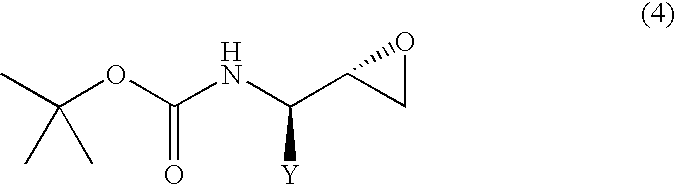
[wherein, Y represents the same meaning as in the above] which process comprises treating, with a base, the (2R,3S)-N-tert-butoxycarbonyl-β-aminoalcohol or (2S,3R)-N-tert-butoxycarbonyl-β-aminoalcohol of improved purity as produced in accordance with the process of the present invention for producing an N-protected-β-aminoalcohol.
The present invention will be described in greater detail.
A (2R,3S)-N-tert-butoxycarbonyl-β-aminoalcohol represented by the above general formula (1) and (2S,3R)-N-tert-butoxycarbonyl-β-aminoalcohol represented by the above general formula (2) can be obtained by reducing the corresponding halomethyl ketone derivatives, respectively. (2R,3S)-3-tert-butoxycarbonylamino-1-chloro-2-hydroxy-4-phenylbutane, for example, can be obtained by reducing (3S)-3-tert-butoxycarbonylamino-1-chloro-2-hydroxy-4-phenyl-2-butanone, for example.
It is known that a reduction process produces (2R,3S)-3-tert-butoxycarbonylamino-1-chloro-2-hydroxy-4-phenylbutane and (2S,3S)-3-tert-butoxycarbonylamino-1-chloro-2-hydroxy-4-phenylbutane in a produced ratio varying dependently on the type of a reductant used. Therefore, the produced ratio of the impurity diastereomer can be controlled to some extent by selecting an appropriate reductant. (Refer to, e.g., the following reports with respect to stereoselective reduction of halomethylketone derivatives: P. Raddats et al; J. Med. Chem., 1991, 34, 11, 3269; A. A. Malik: The 3rd International Conference on Organic Process Research & Development, Development of a Commercial Process for 2S,3S and 2R,3S-epoxides, 10–12th Jul. 2000, Montreal; T. Archibald: Scientific Update Conference Manual, Chiral USA '9, Full Scale Chiral Separations Using SMB, 4th May 1999, San Francisco, Scientific Update; etc.).
This is the same in connection with the produced ratio of the (2S,3R) form to the (2R,3R) form when (3R)-3-tert-butoxycarbonylamino-1-chloro-4-phenyl-2-butanone is reduced.
The preferable reductants include tri-tert-butoxy lithium aluminum hydride, (+)-B-chlorodiisopinocamphenylborane and tri-sec-butyl boron patassium hydride, and the like. Of these reductants, tri-tert-butoxy lithium aluminum hydride is particularly preferable.
Incidentally, (3S)-3-tert-butoxycarbonylamino-1-chloro-4-phenyl-2-butanone and (3R)-3-tert-butoxycarbonylamino-1-chloro-4-phenyl-2-butanone can be produced by various methods, e.g., by reacting an amino acid ester whose amino group has been protected, with a metallic enolate prepared from an α-haloacetic acid (WO96-23756), followed by decarboxylating, and other known methods disclosed by, e.g., Japanese Patent Application Laid-open (Kokai) No. 6-206857 (EP580402) and WO00-44706.
Next will be described a process for producing an N-protected-β-aminoalcohol represented by the above general formula (1), whose purity has been enhanced, i.e., a (2R,3S)-3-tert-butoxycarbonylaminoalcohol (which may be hereinafter referred to as “the (2R,3S) isomer”) or its optical isomer (2S,3R)-3-tert-butoxycarbonylaminoalcohol (which may be hereinafter referred to as “the (2S,3R) isomer”).
According to the process of the present invention, the (2R,3S) isomer or the (2S,3R) isomer is dissolved in a polar organic solvent, and then crystallized from the resulting solution by adding water thereto, or each isomer is crystallized from a diol or a diol-based mixed solvent.
First, the crystallization method will be described, wherein the (2R,3S) isomer or the (2S,3R) isomer is dissolved in a polar organic solvent, and then crystallized by adding water to the resulting solution.
First of all, the (2R,3S) isomer or the (2S,3R) isomer is dissolved in a polar organic solvent. As such polar organic solvents useful for the present invention, there may be mentioned those organic solvents compatible with water, e.g., methanol, ethanol, 1-propanol, 2-propanol, tert-butanol, acetone, 2-butanone, acetonitrile, tetrahydrofuran, 2-methoxyethanol, ethylene glycol, 1,3-propanediol and an optional mixture thereof. Of these solvents, methanol and 2-propanol are particularly preferable. Another solvent, e.g., water, may be also present within the limits not harmful to the object of the present invention. A diol and a diol-based mixed solvent, described later, are also included in the inventive polar organic solvents.
Temperature at which the (2R,3S) or (2S,3R) isomer is dissolved in a polar organic solvent is not particularly limited. However, it is preferably −10 to 70° C., more preferably 0 to 40° C. Quantity of such a polar organic solvent to be used is also not particularly limited. However, 2 to 20 ml of the solvent per 1 g of the (2R,3S) or (2S,3R) isomer may be used.
Next, a solution of the (2R,3S) or (2S,3R) isomer dissolved in the organic solvent is added with water, whereby said (2R,3S) or (2S,3R) isomer is caused to crystallize.
Quantity of water to be added is not particularly limited. However, it is preferably 5 to 95% by weight on the polar organic solvent, more preferably 25 to 85%.
Temperature at which the crystallization is carried out is preferably −10 to 70° C., particularly preferably 0 to 40° C. Temperature of water to be added or incorporated for the crystallization is not particularly limited. However, it is preferably the same temperature as the crystallization temperature. How water is incorporated is not particularly limited. However, it is preferably incorporated gradually over a period of from 30 minutes to 4 hours.
The crystallization may be carried out while the solution subjected to crystallization is being stirred or allowed to stand. Seeding of seed crystals can facilitate the crystallization, while or after water is being or has been added, as required. Moreover, the solution may be cooled, as required, while or after water is being or has been added, in such that the crystallization can be carried our at a lower temperature.
When an alcohol, e.g., methanol or the like, is used as the polar organic solvent, the impurity diastereomer has a lower solubility than the target diastereomer to be crystallized in the mixed solvent prepared beforehand by incorporating in or adding to water in the alcohol. According to the process of the present invention, however, where the (2R,3S) or (2S,3R) isomer containing the impurity diastereomer is first dissolved in a polar organic solvent and then crystallized by adding water afterwards, the target (2R,3S) or (2S,3R) isomer is crystallized preferentially, with the result that the impurity diastereomer is left in the mother liquor. Such crude (2R,3S) or (2S,3R) isomer to be purified by the process of the present invention preferably contains the impurity diastereomer at a ratio of 90:10 or less in order to fully realize the effect of removing the impurity diastereomer as one of the effects of the present invention, although the diastereomer ratio varies depending on the kind of the polar organic solvent used.
According to the process of the present invention as described above, the (2R,3S) or (2S,3R) isomer of high purity can be efficiently produced, because it is crystallized out of the solution while leaving behind not only the impurity diastereomer but also highly polar impurities. The crystal separated from the mother liquor may be washed with water, a mixed solvent of water and an alcohol, or an organic solvent, such as, e.g., heptane, hexane, or the like.
Next will be described the crystallization of the (2R,3S) isomer or its optical isomer, the (2S,3R) isomer from a diol or a diol-based mixed solvent. According to the present crystallization, when a diol or a diol-based mixed solvent is employed as the polar organic solvent, crystallization can be carried out without any water being added.
First, the (2R,3S) or (2S,3R) isomer is dissolved in a diol or a diol-based mixed solvent. Temperature at which it is dissolved is not particularly limited. However, it is preferably 40 to 70° C.
As such diols useful for the present invention, there may be mentioned those of 1 to 6 carbon atoms, such as, e.g., ethylene glycol, propylene glycol, butylene glycol, 1,3-propanediol, 1,3-butanediol, 1,4-butanediol, diethylene glycol, and the like of these glycols, ethylene glycol and 1,3-propanediol are particularly preferable. These may be used either individually or in combination of two or more thereof.
The diol-based mixed solvent means a mixed solvent of a diol and water or a mixed solvent of a diol and an organic solvent miscible with the diol. As such a diol, there may be mentioned any one of those named just above. As such organic solvents compatible with a diol, there may be mentioned acetone, 2-butanone, methylisobutylketone, acetonitrile, tetrahydrofuran, methanol, ethanol, 1-propanol, 2-propanol, glycerin, and the like. These may be used either individually or in combination of two or more thereof. The compositional (mixing) ratio of the dial to the other solvent is not particularly limited. However, it is preferably 50 v/v % or more (v/v % means volumetric ratio of the diol in the mixed solvent).
Quantity of a diol or a diol-based mixed solvent to be used is not particularly limited. However, 2 to 20 ml of the solvent per 1 g of the (2R,3S) or (2S,3R) isomer may be used.
It is recommended to carry out the crystallization while the system is being cooled, preferably at 10 to 30° C. The crystallization may be carried out while the solution is being stirred or allowed to stand. Use of seed crystals can facilitate the crystallization process, if required.
In, e.g., ethylene glycol, or the like, among diols or diol-based mixed solvents, the impurity diastereomer has a lower solubility than the target diastereomer to be crystallized. However, th target diastereomer is found to be crystallized preferentially, with the result that the impurity diastereomer is left in the solution. Therefore, a crude (2R,3S) isomer or (2S,3R) isomer to be subjected to the production process (isolation, purification process) of the present invention preferably contains the impurity diastereomer at a ratio of 90:10 or less in order to fully realize the effect of removing the impurity diastereomer as one of the effects of the present invention, although the diastereomer ratio varies depending on the kind of the solvent used.
Like in the one described earlier, the process of the present invention can efficiently produce the (2R,3S) or (2S,3R) isomer of high purity, because it is crystallized out of the solution while leaving behind not only the impurity diastereomer but also highly polar impurities. The crystals separated from the mother liquor may be washed with water, a mixed solvent of water and an alcohol, or an organic solvent, such as, egg., heptane, hexane, or the like, as has been described earlier.
Incidentally, the (2R,3S) or (2S,3R) isomer to be treated or treated by the process of the present invention may be dissolved in a specific solvent before or after it is subjected to the inventive crystallization, whereby the insoluble impurities can be removed. This can remove the impurity diastereomer to a still higher extent.
The preferable solvents for the above purpose include organic compounds, such as, e.g., xylene, toluene, chlorobenzene, n-hexane, n-heptane, cyclohexane, methylcyclohexane, and the like; and a mixed solvent of water and an alcohol, such as, e.g., methanol, ethanol, 2-propanol, or the like. Of these solvents, a mixed solvent of 2-propanol and water, and toluene and xylene are particularly preferable.
The impurity diastereomer is dissolved in the above solvents only sparingly, and can be removed as insoluble matter in a slurried state. Moreover, it may be crystallized after being dissolved in a solvent at above room temperature and then cooled to an appropriate temperature.
Quantity of a solvent to be used is preferably 1 to 50 times of the weight of the target compound to be dissolved therein. Usually, it is dissolved in the solvent with stirring at −20° C. to below the boiling point of the solvent to be used. When xylene, for example, is used as the solvent, it is dissolved at around 35 to 70° C. The resulting solution is preferably filtered while it is still hot to remove the insolubles. When toluene, for another example, is used as the solvent, it is dissolved at around room temperature to −20° C. The resulting solution may be filtered to remove the insolubles. When a mixed solvent of 2-propanol and water is used, the solution is preferably filtered at around 0 to 50° C. to remove the insolubles. It is possible for those who are skilled in the art to determine easily more preferable conditions, as required, for a specific solvent to be used. The impurity diastereomer can be separated as solid by removing the insolubles by filtration or the like.
It is possible to increase the ratio of the target diastereomer to the impurity diastereomer to, e.g., 95:5 or more, or still higher to 98:2 or more by the above procedure before the process of the present invention is carried out.
The (2R,3S) isomer obtained as in the above, can be converted to the corresponding N-protected-β-aminoepoxide represented by the following general formula (3), i.e., (2R,3S)-3-tert-butoxycarbonylaminoepoxide, by treating with a base.

Likewise, the (2S,3R) isomer can be converted to the corresponding (2S,3R)-3-tert-butoxycarbonylaminoepoxide represented by the following general formula (4), by treating with a base.
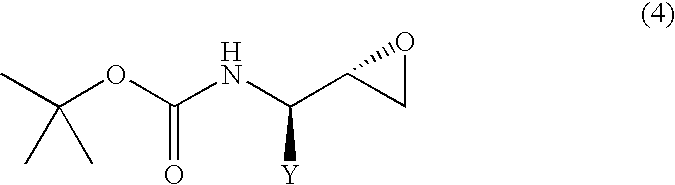
These reactions are known to those who are skilled in the art, because they are disclosed by, e.g., Japanese Patent Application Laid-open (Kokai) No. 6-206857 (EP580402), and the like.
As such bases, sodium hydroxide, potassium carbonate, and the like are preferably used. As such reaction solvents, ethanol, a mixed solvent of water and ethanol, 2-propanol or acetone, and the like are preferably used. Quantity of the base to be used can be normally 1 to 10 equivalents, preferably 1 to 5 equivalents, per 1 equivalent of the reactant substrate. Reaction temperature can be normally −10 to 80° C., preferably 0 to 60° C. Reaction time is preferably from around 10 minutes to 50 hours. The reaction is allowed to proceed normally with stirring, and on completion, may be terminated by addition with an acid. As such an acid, hydrochloric acid, sulfuric acid, acetic acid, citric acid, an aqueous solution of potassium bisulfate, or the like can be preferably used.
The compound represented by each of the general formulae (3) and (4) is useful as an intermediate for medicine compounds, such as, e.g., HIV protease inhibitor and the like, as has been described earlier.
By the way, X represents a halogen atom such as a chlorine, bromine or the like atom in the above general formulae (1) and (2). Of these atoms, a chlorine atom is preferred for the purpose of the present invention. On the other hand, Y represents an alkyl group, an aryl group or an aralkyl group in the above general formulae (1)–(4). Of these groups, a benzyl group is preferred for the purpose of the present invention.
Accordingly, there may be mentioned as preferred embodiments of the present invention,
Embodiment (A): A process for producing (2R,3S)-3-tert-butoxycarbonylamino-1-chloro-2-hydoroxy-4-phenybutane or (2S,3R)-3-tert-butoxycarbonylamino-1-chloro-2-hydoroxy-4-phenybutane, which process comprises
(i) adding water to an polar organic solvent in which (2R,3S)-3-tert-butoxycarbonylamino-1-chloro-2-hydroxy-4-phenylbutane represented by the following formula (5):
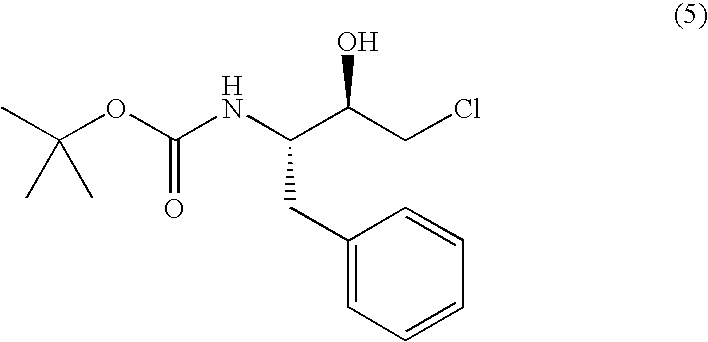
or (2S,3R)-3-tert-butoxycarbonylamino-1-chloro-2-hydroxy-4-phenylbutane represented by the following formula (6):

has been dissolved whereby said (2R,3S)-3-tert-butoxycarbonylamino-1-chloro-2-hydroxy-4-phenylbutane or said (2S,3R)-3-tert-butoxycarbonylamino-1-chloro-2-hydroxy-4-phenylbutane is crystallized, or
(ii) crystallizing (2R,3S)-3-tert-butoxycarbonylamino-1-chloro-2-hydroxy-4-phenylbutan represented by the above formula (5) or (2S,3R)-3-tert-butoxycarbonylamino-1-chloro-2-hydroxy-4-phenylbutane represented by the above formula (6) from a diol or a diol-based mixed solvent, and
Embodiment (B): A process for producing (2R,3S)-3-tert-butoxycarbonylamino-1,2-epoxy-4-phenylbutane represented by the following formula (7):

or (2S,3R)-3-tert-butoxycarbonylamino-1,2-epoxy-4-phenylbutane represented by the following formula (8):
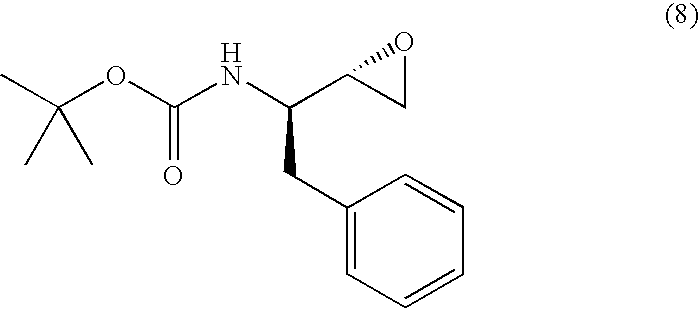
which process comprises producing (2R,3S)-3-tert-butoxycarbonylamino-1-chloro-2-hydroxy-4-phenylbutane or (2S,3R)-3-tert-butoxycarbonylamino-1-chloro-2-hydroxy-4-phenylbutane in accordance with the above-described production process, and treating, with a base, said (2R,3S)-3-tert-butoxycarbonylamino-1-chloro-2-hydroxy-4-phenylbutane or said (2S,3R)-3-tert-butoxycarbonylamino-1-chloro-2-hydroxy-4-phenylbutane.
The present invention will be described in more detail with reference to Examples, which by no means limit the present invention, needless to say. The ratios of the target diastereomer to its undesired diastereomer as described in Examples, are all molar ratios.
Synthesis of (2R,3S)-3-tert-butoxycarbonylamino-1-chloro-2-hydroxy-4-phenylbutane:
In an argon atmosphere, dehydrated diethyl ether (100 mL) was added with tri-tert-butoxy lithium aluminum hydride (4.7 g). The resulting mixture was cooled to 0° C., and then added with (3S)-3-tert-butoxycarbonylamino-1-chloro-4-phenyl-2-butanone (5.0 g), and stirred at 0° C. for 3 hours. The reaction solution was added with 1N hydrochloric acid (37 ml) to terminate the reaction, and then separated into two layers. The organic layer was, after separated, washed with 1N hydrochloric acid and then with saturated saline. The washed organic layer was concentrated in vacuo to remove the solvent, and the residue was added with methanol (23.2 ml) at room temperature, whereby it was dissolved therein. The resulting methanol solution was analyzed by HPLC. It was confirmed that the diastereomer mixture of 3-tert-butoxycarbonylamino-1-chloro-2-hydroxy-4-phenylbutane was produced in a total yield of 92.1%. The production ratio of the target (2R,3S) diastereomer to the impurity (2S,3S) diastereomer was (2R,3S):(2S,3S)=87.4:12.6.
The resulting methanol solution was cooled to 0° C., and added with water (6 ml). After the resulting mixture had been seeded with seed crystals, water (22.2 ml) was added thereto dropwise over a period of 1 hour. The mixture was stirred for 2 hours The crystals formed were filtered, and washed with heptane (15 ml) twice and then with water (25 ml) also twice. The washed crystals were dried, and the (2R,3S)-3-tert-butoxycarbonylamino-1-chloro-2-hydroxy-4-phenylbutane diastereomer was obtained in a yield of 85.4% (4.30 g). The production ratio of the target (2R,3S) diastereomer to the impurity (2S,3S) diastereomer was (2R,3S):(2S,3S)=87.0:13.0 therein.
Purification of (2R,38)-3-tert-butoxycarbonylamino-1-chloro-2-hydroxy-4-phenylbutane:
A crude (2R,3S)-3-tert-butoxycarbonylamino-1-chloro-2-hydroxy-4-phenylbutane diastereomer product (21.9 g) as prepared in the same manner as that of Reference Example 1, and containing the (2S,3S) diastereomer at a (2R,3S):(2S,3S) ratio of 84.9:15.1, was added with 2-propanol (49.2 ml) and water (16.4 ml), to be dissolved therein at 70° C. The resulting solution was cooled to 20° C. over a period of 4 hours. Further, it was stirred at 20° C. for 16 hours, and then cooled to 15° C., at which temperature it was stirred for 1 hour. The insolubles produced were removed by filtration. The mother liquor was concentrated to dryness, and the (2R,3S)-3-tert-butoxycarbonylamino-1-chloro-2-hydroxy-4-phenylbutane diastereomer was obtained in a recovery yield of 81.9% (17.9 g). The production ratio of the target (2R,3S) diastereomer to the impurity (2S,3S) diastereomer was (2R,3S):(2S,3S)=98.4:1.6 therein.
Purification of (2R,3S)-3-tert-butoxycarbonylamino-1-chloro-2-hydroxy-4-phenylbutane (1):
A crude (2R,3S)-3-tert-butoxycarbonylamino-1-chloro-2-hydroxy-4-phenylbutane diastereomer product (0.997 g) as prepared in the same manner as that of Reference Example 2, and containing 0.790 g and 0.013 g of the (2R,3S) and (2S,3S) diastereomers, respectively (therefore, (2R,3S):(2S,3S) ratio being 98.4:1.6, and the (2R,3S) diastereomer purity being 94.2%, as determined by the HPLC area ratio), was added with methanol (4.0 ml) as a polar organic solvent to be dissolved therein at room temperature (20° C.). The resulting solution was added with water (2.5 ml) dropwise over a period of 20 minutes, and then seeded with seed crystals, followed by stirring for 30 minutes. The mixture was cooled from 20° C. to 0° C. over a period of 1 hour, and then stirred for 40 minutes, followed by filtering. The crystals collected by filtering were dried, and the (2R,3S) diastereomer was obtained in a recovery yield of 78.2% (0.618 g). The (2R,3S):(2S,3S) ratio was 100:0, and the (2R,3S) diastereomer purity was 99.4%, as determined by the HPLC area ratio.
1H-NMR(CDCl3, 300 MHz) δppm: 1.38 (s, 9H), 2.91 (dd, J=8.1, 13.2 Hz, 1H), 3.01 (dd, J=7.1, 13.2 Hz, 1H), 3.14 (d, J=4.0 Hz, 1H), 3.53 (s, 1H), 3.55 (d, J=2.3 Hz, 1H), 3.70–3.77 (m, 1H), 3.79–3.89 (m, 1H), 4.88 (bd, 1H), 7.19–7.35 (m, 5H).
Mass spectra m/e: 322 (M+Na+).
[α]D 20=−28.3° (c=0.50, CH2Cl2).
Purification of (2R,3S)-3-tert-butoxycarbonylamino-1-chloro-2-hydroxy-4-phenylbutane (2):
A crude (2R,3S)-3-tert-butoxycarbonylamino-1-chloro-2-hydroxy-4-phenylbutane diastereomer product (1.007 g) as prepared in the same manner as that of Reference Example 2, and containing 0.982 g and 0.017 g of the (2R,3S) and (2S,3S) diastereomers, respectively ((2R,3S):(2S,3S) ratio being 98.3:1.7, and the (2R,3S) diastereomer purity being 97.5%, as determined by the HPLC area ratio), was added with ethylene glycol (5 ml) to be dissolved therein at 60° C. The resulting solution was cooled from 60° C. to 50° C. over a period of 1 hour, and then seeded with seed crystals, followed by stirring for 30 minutes. The mixture was cooled from 50° C. to 20° C. over a period of 3 hours, and then stirred for 2 hours, followed by filtering. The crystals collected by filtering were washed with a 1:1 mixed solution of ethylene glycol and water (3 ml) and water (3 ml) in this order. The washed crystals were dried, and the (2R,3S)-3-tert-butoxycarbonylamino-1-chloro-2-hydroxy-4-phenylbutane diastereomer was obtained in a recovery yield of 67.1% (0.660 g). The (2R,3S):(2S,3S) ratio was 99.94:0.06, and the (2R,3S) diastereomer purity was 99.8%, as determined by the HPLC area ratio.
Purification of (2R,3S)-3-tert-butoxycarbonylamino-1-chloro-2-hydroxy-4-phenylbutane (3):
A crude (2R,3S)-3-tert-butoxycarbonylamino-1-chloro-2-hydroxy-4-phenylbutane diastereomer product (1.000 g) as prepared in the same manner as that of Reference Example 2, and containing 0.972 g and 0.017 g of the (2R,3S) and (2S,3S) diastereomers, respectively ((2R,3S):(2S,3S) ratio being 98.3:1.7, and the (2R,3S) diastereomer purity being 97.2%, as determined by the HPLC area ratio), was added with 1,3-propanediol (5 ml) to be dissolved therein at 60° C. The resulting solution was cooled from 60° C. to 40° C. over a period of 2 hours, and then seeded with seed crystals. The mixture was cooled from 40° C. to 5° C. over a period of 3 hours and 30 minutes, and then stirred for 2 hours, followed by filtering. The crystals collected by filtering were washed with a 1:1 mixed solution of methanol and water (3 ml). The washed crystals were dried, and the (2R,3S)-3-tert-butoxycarbonylamino-1-chloro-2-hydroxy-4-phenylbutane diastereomer was obtained in a recovery yield of 63.8% (0.620 g). The (2R,3S):(2R,3S) ratio was 100:0, and the (2R,3S) diastereomer purity was 99.5%, as determined by the HPLC area ratio.
Purification of (2R,3S)-3-tert-butoxycarbonylamino-1-chloro-2-hydroxy-4-phenylbutane (4):
A crude (2R,3S)-3-tert-butoxycarbonylamino-1-chloro-2-hydroxy-4-phenylbutane diastereomer product (1.000 g) as prepared in the same manner as that of Reference Example 2, and containing 0.981 g and 0.016 g of the (2R,3S) and (2S,3S) diastereomers, respectively ((2R,3S):(2S,3S) ratio being 98.4:1.6, and the (2R,3S) diastereomer purity being 98.1%, as determined by the HPLC area ratio), was added with ethylene glycol (4 ml) and 1,4-butanediol (0.6 ml) to be dissolved therein at 60° C. The resulting solution was cooled from 60° C. to 48° C. over a period of 1 hour, and then seeded with seed crystals. The mixture was cooled from 48° C. to 20° C. over a period of 3 hours and then stirred for 2 hours, followed by filtering. The crystals collected by filtering were washed with a 1:1 mixed solution of methanol and water (3 ml). The washed crystals were dried, and the (2R,3S)-3-tert-butoxycarbonylamino-1-chloro-2-hydroxy-4-phenylbutane diastereomer was obtained in a recovery yield of 69.4% (0.686 g). The (2R,3S):(2S,3S) ratio was 100:0, and the (2R,3S) diastereomer purity was 99.5%, as determined by the HPLC area ratio.
Purification of (2R,3S)-3-tert-butoxycarbonylamino-1-chloro-2-hydroxy-4-phenylbutane (5):
A crude (2R,3S)-3-tert-butoxycarbonylamino-1-chloro-2-hydroxy-4-phenylbutane diastereomer product (1.000 g) as prepared in the same manner as that of Reference Example 2, and containing 0.981 g and 0.016 g of the (2R,33) and (2S,3S) diastereomers, respectively ((2R,3S):(2S,3S) ratio being 98.4:1.6, and the (2R,3S) diastereomer purity being 98.1%, as determined by the HPLC area ratio), was added with ethylene glycon (6 ml), 2-propanol (2.4 ml) and water (1.7 ml) to be dissolved therein at 60° C. The resulting solution was cooled from 60° C. to 30° C. over a period of 3 hours, and then seeded with seed crystals, The mixture was cooled from 30° C. to 20° C. over a period of 1 hour and then stirred for 2 hours, followed by filtering. The crystals collected by filtering were washed with a 1:1 mixed solution of methanol and water (3 ml). The washed crystals were dried, and the (2R,3S)-3-tert-butoxycarbonylamino-1-chloro-2-hydroxy-4-phenylbutane diastereomer was obtained in a recovery yield of 58.2% (0574 g). The (2R,3S):(2S,3S) ratio was 100:0, and the (2R,3S) diastereomer purity was 99.5%, as determined by the HPLC area ratio.
Purification of (2R,3S)-3-tert-butoxycarbonylamino-1-chloro-2-hydroxy-4-phenylbutane (6):
A mother liquor (3.68 g) as prepared in the same manner as that of Reference Example 2, ((2R,3S)-3-tert-butoxycarbonylamino-1-chloro-2-hydroxy-4-phenylbutane) and containing 0.982 g and 0.017 g of the (2R,3S) and (2S,3S) diastereomers, respectively ((2R,3S):(2S,3S) ratio being 98.3:1.7, and the (2R,3S) diastereomer purity being 97.9%, as determined by the HPLC area ratio), was heated to 40° C. and added with ethylene glycol (6 ml) and water (1.2 ml). The resulting solution was cooled from 40° C. to 30° C. over a period of 1 hour, and then seeded with seed crystals, followd by stirring for 1 hour. The mixture was cooled from 30° C. to 20° C. over a period of 1 hour, and then stirred for 2 hours, followed by filtering. The crystals collected by filtering were washed with a 1:1 mixed solution of methanol and water (3 ml). The washed crystals were dried, and the (2R,3S)-3-tert-butoxycarbonylamino-1-chloro-2-hydroxy-4-phenylbutane diastereomer was obtained in a recovery yield of 58.5% (0.576 g). The (2R,3S):(2S,3S) ratio was 100:0, and the (2R,3S) diastereomer purity was 99.8%, as determined by the HPLC area ratio.
In the production of N-protected-β-aminoalcohols such as, e.g., (2R,3S)- or (2S,3R)-3-tert-butoxycarbonylamino-1-chloro-2-hydroxy-4-phenylbutane or the like, the impurity diastereomer and highly polar impurities can be efficiently removed according to the present invention, and therefore, purity-enhanced or -improved N-protected-β-aminoalcohols can be obtained. From this purity-enhanced N-protected-β-aminoalcohols (i.e., the N-protected-β-aminoalcohols of enhanced or improved purity) can, in turn, be produced highly pure N-protected-β-aminoepoxides. Accordingly, the production process of the present invention can be a highly productive process for producing synthetic intermediates for medicine compounds, such as, e.g., HIV protease inhibitor, or the like, in the production on an industrial scale.
Claims (28)
1. A process for producing a (2R,3S)-N-tert-butoxycarbonyl-β-aminoalcohol or a (2S,3R)-N-tert-butoxycarbonyl-β-aminoalcohol, comprising:
crystallizing a compound represented by formula (1) or (2):
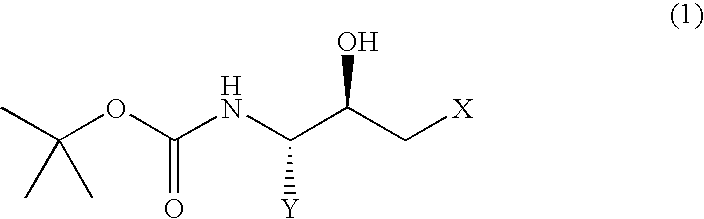
wherein
Y represents an alkyl group of 1 to 10 carbon atoms, an aryl group of 6 to 15 carbon atoms or an aralkyl group of 7 to 20 carbon atoms, each of which may have substituent(s); and
X represents a halogen atom,

wherein
X and Y are each as defined above, from a diol or a diol-based mixed solvent.
2. The process of claim 1 , wherein the compound represented by formula (1) is crystallized.
3. The process of claim 1 , wherein the compound represented by formula (1) is crystallized.
4. A process for producing a (2R,3S)-N-tert-butoxycarbonyl-β-aminoepoxide represented by the following general formula (3):
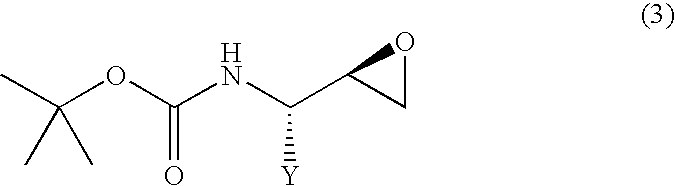
wherein
Y represents an alkyl group of 1 to 10 carbon atoms, an aryl group of 6 to 15 carbon atoms or an aralkyl group of 7 to 20 carbon atoms, each of which may have substituent(s), or a (2S,3R)-N-tert-butoxycarbonyl-β-aminoepoxide represented by the following general formula

wherein Y is as defined above, comprising treating, with a base, the (2R,3S)-N-tert-butoxycarbonyl-β-aminoalcohol or (2S,3R)-N-tert-butoxycarbonyl-β-aminoalcohol as produced in accordance with the process of claim 1 .
5. The process of claim 2 , wherein the diol has 1 to 6 carbon atoms.
6. The process of claim 3 , wherein the diol has 1 to 6 carbon atoms.
7. The process of claim 2 , wherein the diol is ethylene glycol or 1,3-propanediol.
8. The process of claim 3 , wherein the diol is ethylene glycol or 1,3-propanediol.
9. The process of claim 1 , wherein the compound of formula (1) or (2) is crystalillized from a diol.
10. The process of claim 9 , wherein the diol has 1 to 6 carbon atoms.
11. The process of claim 9 , wherein the diol is ethylene glycol or 1,3-propanediol.
12. The process of claim 1 , wherein the compound of formula (1) or (2) is crystalillized from a diol-based mixed solvent.
13. The process of claim 12 , wherein the diol-based mixed solvent contains a diol and at least one solvent miscible with the diol.
14. The process of claim 13 , wherein the solvent miscible with the diol is selected from the group consisting of acetone, 2-butanone, methylisobutylketone, acetonitrile, tetrahydrofuran, methanol, ethanol, 1-propanol, 2-propanol, glycerin and mixtures thereof.
15. A process for producing a (2R,3S)-N-tert-butoxycarbonyl-β-aminoalcohol or a (2S,3R)-N-tert-butoxycarbonyl-β-aminoalcohol which process comprises
dissolving, in a diol or diol-based mixed solvent, a compound represented by formula (1) or (2):
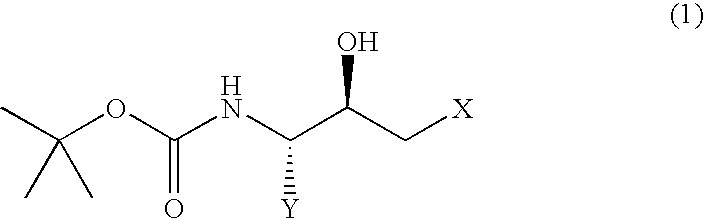
wherein
Y represents an alkyl group of 1 to 10 carbon atoms, an aryl group of 6 to 15 carbon atoms or an aralkyl group of 7 to 20 carbon atoms, each of which may have substituent(s); and
X represents a halogen atom,
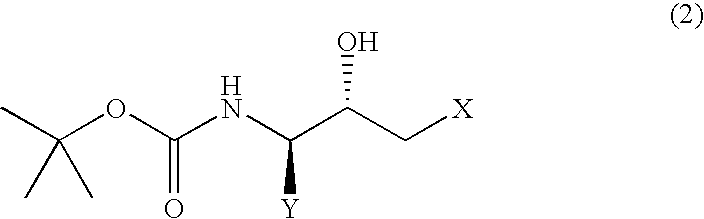
wherein X and Y are each as defined above, and crystallizing the compound represented by formula (1) or (2) from the resulting solution by addition of water.
16. The process of claim 15 , wherein the compound represented by formula (1) is dissolved in a diol or diol-based mixed solvent and crystallized from the resulting solution by the addition of water.
17. The process of claim 15 , wherein the compound represented by formula (2) is dissolved in a diol or diol-based mixed solvent and crystallized from the resulting solution by the addition of water.
18. The process of claim 16 , wherein the diol has 1 to 6 carbon atoms.
19. The process of claim 17 , wherein the diol and the diol has 1 to 6 carbon atoms.
20. The process of claim 16 , wherein the diol is ethylene glycol or 1,3-propanediol.
21. The process of claim 17 , wherein the diol is ethylene glycol or 1,3-propanediol.
22. The process of claim 15 , wherein the compound of formula (1) or (2) is crystalillized from a diol.
23. The process of claim 22 , wherein the diol has 1 to 6 carbon atoms.
24. The process of claim 22 , wherein the diol is ethylene glycol or 1,3-propanediol.
25. The process of claim 15 , wherein the compound of formula (1) or (2) is crystalillized from a diol-based mixed solvent.
26. The process of claim 25 , wherein the diol-based mixed solvent contains a diol and at least one solvent miscible with the diol.
27. The process of claim 26 , wherein the solvent miscible with the diol is selected from the group consisting of acetone, 2-butanone, methylisobutylketone, acetonitrile, tetrahydrofuran, methanol, ethanol, 1-propanol, 2-propanol, glycerin and mixtures thereof.
28. A process for producing a (2R,3S)-N-tert-butoxycarbonyl-β-aminoepoxide represented by the following general formula (3):

wherein
Y represents an alkyl group of 1 to 10 carbon atoms, an aryl group of 6 to 15 carbon atoms or an aralkyl group of 7 to 20 carbon atoms, each of which may have substituent(s), or a (2S,3R)-N-tert-butoxycarbonyl-β-aminoepoxide represented by the following general formula
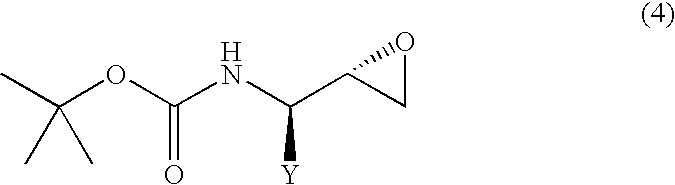
wherein Y is as defined above, comprising treating, with a base, the (2R,3S)-N-tert-butoxycarbonyl-β-aminoalcohol or (2S,3R)-N-tert-butoxycarbonyl-β-aminoalcohol as produced in accordance with the process of claim 15 .
Applications Claiming Priority (4)
| Application Number | Priority Date | Filing Date | Title |
|---|---|---|---|
| JP2000365536 | 2000-11-30 | ||
| JP2001051109 | 2001-02-26 | ||
| JP2001072364 | 2001-03-14 | ||
| PCT/JP2001/010476 WO2002044136A1 (en) | 2000-11-30 | 2001-11-30 | PROCESSES FOR PREPARATION OF N-PROTECTED-ss-AMINO ALCOHOLS AND N-PROTECTED-ss-AMINO EPOXIDES |
Publications (2)
| Publication Number | Publication Date |
|---|---|
| US20040220417A1 US20040220417A1 (en) | 2004-11-04 |
| US7122696B2 true US7122696B2 (en) | 2006-10-17 |
Family
ID=27345329
Family Applications (1)
| Application Number | Title | Priority Date | Filing Date |
|---|---|---|---|
| US10/432,353 Expired - Fee Related US7122696B2 (en) | 2000-11-30 | 2001-11-30 | Processes for preparation of N-protected-β-amino alcohols and N-protected-β-amino epoxides |
Country Status (4)
| Country | Link |
|---|---|
| US (1) | US7122696B2 (en) |
| EP (1) | EP1346979A4 (en) |
| JP (1) | JPWO2002044136A1 (en) |
| WO (1) | WO2002044136A1 (en) |
Cited By (1)
| Publication number | Priority date | Publication date | Assignee | Title |
|---|---|---|---|---|
| US20110178305A1 (en) * | 2008-05-08 | 2011-07-21 | Ranbaxy Laboratories Limited | Process for the preparation of 3,4-epoxy-2-amino-1-substituted butane derivatives and intermediate compounds thereof |
Families Citing this family (2)
| Publication number | Priority date | Publication date | Assignee | Title |
|---|---|---|---|---|
| KR101299972B1 (en) * | 2011-03-30 | 2013-08-26 | 순천향대학교 산학협력단 | Production method of (3S)-3-(tert-butoxycarbonyl)amino-1-chloro-4-phenyl-2-butanol using by sodiumborohydride |
| WO2016047277A1 (en) * | 2014-09-22 | 2016-03-31 | 三菱レイヨン株式会社 | Method for producing 3-chloro-2-hydroxypropyl (meth)acrylate and method for producing glycidyl (meth)acrylate |
Citations (11)
| Publication number | Priority date | Publication date | Assignee | Title |
|---|---|---|---|---|
| EP0691345A2 (en) | 1994-07-05 | 1996-01-10 | Bristol-Myers Squibb Company | HIV protease inhibitor combinations |
| EP0703209A2 (en) | 1994-09-23 | 1996-03-27 | F. Hoffmann-La Roche AG | Process for the preparation of halogenated alpha-amino-ketones and alpha-amino-alcohols |
| EP0774453A1 (en) | 1995-11-17 | 1997-05-21 | Ajinomoto Co., Inc. | Process for producing 3-amino-2-oxo-1-halogenopropane derivatives |
| EP0827943A1 (en) | 1996-01-29 | 1998-03-11 | Kaneka Corporation | Processes for the reduction of carbonyl compounds |
| EP0969000A1 (en) | 1997-06-03 | 2000-01-05 | Kaneka Corporation | PROCESS FOR REDUCING $G(a)-AMINO KETONES |
| WO2000043357A1 (en) | 1999-01-21 | 2000-07-27 | Kaneka Corporation | Method for purifying and isolating (2s,3s)- or (2r,3s)-halohydrin derivatives |
| CA2325919A1 (en) | 1999-01-29 | 2000-08-03 | Kaneka Corporation | Processes for the preparation of threo-1,2-epoxy-3-amino-4-phenylbutane derivatives |
| EP1050532A2 (en) | 1999-05-03 | 2000-11-08 | Aerojet Fine Chemicals LLC | Preparation of S,S and R,S amino acid isosteres |
| EP1052257A1 (en) | 1998-01-28 | 2000-11-15 | Nippon Kayaku Kabushiki Kaisha | Process for producing optically active threo-3-amino-1,2-epoxy compounds |
| JP2000319235A (en) | 1999-03-05 | 2000-11-21 | Ajinomoto Co Inc | PRODUCTION OF alpha-AMINOKETONE COMPOUND |
| JP2001039940A (en) | 1999-07-28 | 2001-02-13 | Ajinomoto Co Inc | PREPARATION OF alpha-AMINOHALOMETHYLKETONE DERIVATIVE |
Family Cites Families (1)
| Publication number | Priority date | Publication date | Assignee | Title |
|---|---|---|---|---|
| US5481011A (en) * | 1994-12-13 | 1996-01-02 | Bristol-Myers Squibb Company | Process for preparing N-protected amino acid α-halomethyl ketones and alcohols from N-protected amino acid esters |
-
2001
- 2001-11-30 JP JP2002546506A patent/JPWO2002044136A1/en active Pending
- 2001-11-30 WO PCT/JP2001/010476 patent/WO2002044136A1/en not_active Ceased
- 2001-11-30 US US10/432,353 patent/US7122696B2/en not_active Expired - Fee Related
- 2001-11-30 EP EP01998194A patent/EP1346979A4/en not_active Withdrawn
Patent Citations (12)
| Publication number | Priority date | Publication date | Assignee | Title |
|---|---|---|---|---|
| EP0691345A2 (en) | 1994-07-05 | 1996-01-10 | Bristol-Myers Squibb Company | HIV protease inhibitor combinations |
| EP0703209A2 (en) | 1994-09-23 | 1996-03-27 | F. Hoffmann-La Roche AG | Process for the preparation of halogenated alpha-amino-ketones and alpha-amino-alcohols |
| EP0774453A1 (en) | 1995-11-17 | 1997-05-21 | Ajinomoto Co., Inc. | Process for producing 3-amino-2-oxo-1-halogenopropane derivatives |
| EP0827943A1 (en) | 1996-01-29 | 1998-03-11 | Kaneka Corporation | Processes for the reduction of carbonyl compounds |
| EP0969000A1 (en) | 1997-06-03 | 2000-01-05 | Kaneka Corporation | PROCESS FOR REDUCING $G(a)-AMINO KETONES |
| EP1052257A1 (en) | 1998-01-28 | 2000-11-15 | Nippon Kayaku Kabushiki Kaisha | Process for producing optically active threo-3-amino-1,2-epoxy compounds |
| WO2000043357A1 (en) | 1999-01-21 | 2000-07-27 | Kaneka Corporation | Method for purifying and isolating (2s,3s)- or (2r,3s)-halohydrin derivatives |
| CA2325919A1 (en) | 1999-01-29 | 2000-08-03 | Kaneka Corporation | Processes for the preparation of threo-1,2-epoxy-3-amino-4-phenylbutane derivatives |
| JP2000319235A (en) | 1999-03-05 | 2000-11-21 | Ajinomoto Co Inc | PRODUCTION OF alpha-AMINOKETONE COMPOUND |
| EP1050532A2 (en) | 1999-05-03 | 2000-11-08 | Aerojet Fine Chemicals LLC | Preparation of S,S and R,S amino acid isosteres |
| US6605732B1 (en) * | 1999-05-03 | 2003-08-12 | Aerojet Fine Chemicals Llc | Clean, high-yield preparation of S,S and R,S amino acid isosteres |
| JP2001039940A (en) | 1999-07-28 | 2001-02-13 | Ajinomoto Co Inc | PREPARATION OF alpha-AMINOHALOMETHYLKETONE DERIVATIVE |
Cited By (1)
| Publication number | Priority date | Publication date | Assignee | Title |
|---|---|---|---|---|
| US20110178305A1 (en) * | 2008-05-08 | 2011-07-21 | Ranbaxy Laboratories Limited | Process for the preparation of 3,4-epoxy-2-amino-1-substituted butane derivatives and intermediate compounds thereof |
Also Published As
| Publication number | Publication date |
|---|---|
| EP1346979A1 (en) | 2003-09-24 |
| EP1346979A4 (en) | 2005-11-09 |
| US20040220417A1 (en) | 2004-11-04 |
| JPWO2002044136A1 (en) | 2004-04-02 |
| WO2002044136A1 (en) | 2002-06-06 |
Similar Documents
| Publication | Publication Date | Title |
|---|---|---|
| US5936104A (en) | Process for producing 1,2-epoxy-3-amino-4-phenylbutane derivatives | |
| US6605732B1 (en) | Clean, high-yield preparation of S,S and R,S amino acid isosteres | |
| KR100708221B1 (en) | Method for producing epoxide crystal | |
| US6333415B1 (en) | Intermediates and processes for the preparation of optically active octanoic acid derivatives | |
| US7122696B2 (en) | Processes for preparation of N-protected-β-amino alcohols and N-protected-β-amino epoxides | |
| KR102255357B1 (en) | A process for the preparation of 2-amino-1,3-propane diol compounds and salts thereof | |
| WO2008096373A2 (en) | Process for synthesizing highly pure nateglinide polymorphs | |
| WO2016115962A1 (en) | Preparation method for nebivolol intermediate and preparation method for nebivolol | |
| JPH06184069A (en) | Production of alpha-hydroxy-beta-aminocarboxylic acid | |
| US7268228B2 (en) | Optically active aziridine-2-carboxylate derivatives and a process for preparing them | |
| JPWO2000044706A1 (en) | Method for producing α-aminoketones | |
| US20070129443A1 (en) | Production method of aminochlorohydrin sulfate | |
| GB2363379A (en) | Processes for the preparation of alpha-aminoketones | |
| US5670653A (en) | Process for the manufacture of (4,5)-trans-oxazolidines | |
| US6806384B2 (en) | Production method of β-amino-α-hydroxycarboxylic acid | |
| EP1078919B1 (en) | Synthesis of alpha-amino-alpha',alpha'-dihaloketones and process for the preparation of beta)-amino acid derivatives by the use of the same | |
| WO2006090265A2 (en) | Processes for the preparation of levetiracetam, its intermediate and the use of levetiracetam in pharmaceutical compositions | |
| JP3855323B2 (en) | Method for producing 3-amino-2-oxo-1-halogenopropane derivative | |
| KR0182192B1 (en) | Selective preparation of optically active (3R, 4S) -3-alkoxy-4-phenyl-2-azetidinone | |
| JP2000319235A (en) | PRODUCTION OF alpha-AMINOKETONE COMPOUND | |
| JP2005298337A (en) | Process for producing β-hydroxyamino acid derivative and its intermediate | |
| JP2002080470A (en) | Method of producing crystalline epoxide | |
| EP1188749A1 (en) | Process for the preparation of intermediate compounds of drugs | |
| JPS6092248A (en) | Inversion of steric configuration of aminopropanediol | |
| KR20050000463A (en) | The Preparation Method of Optically Active Benzoxazine Derivatives |
Legal Events
| Date | Code | Title | Description |
|---|---|---|---|
| AS | Assignment |
Owner name: AJINOMOTO CO., INC., JAPAN Free format text: ASSIGNMENT OF ASSIGNORS INTEREST;ASSIGNORS:HIROSE, NAOKO;ONISHI, TOMOYUKI;HIDEURA, DAIGAKU;AND OTHERS;REEL/FRAME:014724/0875 Effective date: 20030812 |
|
| REMI | Maintenance fee reminder mailed | ||
| LAPS | Lapse for failure to pay maintenance fees | ||
| STCH | Information on status: patent discontinuation |
Free format text: PATENT EXPIRED DUE TO NONPAYMENT OF MAINTENANCE FEES UNDER 37 CFR 1.362 |
|
| FP | Lapsed due to failure to pay maintenance fee |
Effective date: 20101017 |