US7115619B2 - N8, N13 -disubstituted quino[4,3,2-kl]acridinium salts as therapeutic agents - Google Patents
N8, N13 -disubstituted quino[4,3,2-kl]acridinium salts as therapeutic agents Download PDFInfo
- Publication number
- US7115619B2 US7115619B2 US10/398,767 US39876703A US7115619B2 US 7115619 B2 US7115619 B2 US 7115619B2 US 39876703 A US39876703 A US 39876703A US 7115619 B2 US7115619 B2 US 7115619B2
- Authority
- US
- United States
- Prior art keywords
- ome
- independently
- alkyl
- tbu
- nbu
- Prior art date
- Legal status (The legal status is an assumption and is not a legal conclusion. Google has not performed a legal analysis and makes no representation as to the accuracy of the status listed.)
- Expired - Fee Related, expires
Links
- 0 [1*]C1=C([2*])C=C2C3=CC=CC4=C3/C(=[N+](/[H])C2=C1)C1=C(C=CC=C1)N4 Chemical compound [1*]C1=C([2*])C=C2C3=CC=CC4=C3/C(=[N+](/[H])C2=C1)C1=C(C=CC=C1)N4 0.000 description 7
- RIROHRQSULRCDM-UHFFFAOYSA-N CC1=CC2=C3C(=C1)C1=CC(C)=C(C)C=C1/[N+](C)=C\3C1=C(C=C(C)C(C)=C1)N2C Chemical compound CC1=CC2=C3C(=C1)C1=CC(C)=C(C)C=C1/[N+](C)=C\3C1=C(C=C(C)C(C)=C1)N2C RIROHRQSULRCDM-UHFFFAOYSA-N 0.000 description 5
- ULJIFKUWEOSDIG-UHFFFAOYSA-N CN1C2=C(C=CC=C2)/C2=N/C3=CC=CC=C3C3=CC=CC1=C32 Chemical compound CN1C2=C(C=CC=C2)/C2=N/C3=CC=CC=C3C3=CC=CC1=C32 ULJIFKUWEOSDIG-UHFFFAOYSA-N 0.000 description 5
- OPWUIWJAASVVEB-UHFFFAOYSA-N CC1=C(C)C(C)=C2C(=C1C)C1=C(C)C(C)=C(C)C3=C1/C(=[N+]\2C)C1=C(C(C)=C(C)C(C)=C1C)N3C Chemical compound CC1=C(C)C(C)=C2C(=C1C)C1=C(C)C(C)=C(C)C3=C1/C(=[N+]\2C)C1=C(C(C)=C(C)C(C)=C1C)N3C OPWUIWJAASVVEB-UHFFFAOYSA-N 0.000 description 4
- SYVRMSGTOBSZGL-IZPJNTPMSA-N C.CC(=O)OCCCC1=CC2=C3C(=C1)C1=CC(/C=C/C(=O)N4CCOCC4)=CC=C1/[N+](C)=C\3C1=CC=CC=C1N2C.CC(=O)OCCCC1=CC=C2C(=C1)C1=CC(CCCOC(C)=O)=CC3=C1/C(=[N+]\2C)C1=CC=CC=C1N3C.CC1=CC2=C3C(=C1)C1=CC=CC=C1[N+](C)=C3C1=CC=C(/C=C/C(=O)N3CCOCC3)C=C1N2C.CN1C2=CC=CC=C2/C2=[N+](\C)C3=CC=C(Cl)C=C3C3=CC(/C=C/C(=O)N4CCOCC4)=CC1=C32.COC1=CC2=C3C(=C1)C1=CC(/C=C/C(=O)N4CCOCC4)=CC=C1/[N+](C)=C\3C1=CC=CC=C1N2C.[I-].[I-].[I-].[I-].[I-] Chemical compound C.CC(=O)OCCCC1=CC2=C3C(=C1)C1=CC(/C=C/C(=O)N4CCOCC4)=CC=C1/[N+](C)=C\3C1=CC=CC=C1N2C.CC(=O)OCCCC1=CC=C2C(=C1)C1=CC(CCCOC(C)=O)=CC3=C1/C(=[N+]\2C)C1=CC=CC=C1N3C.CC1=CC2=C3C(=C1)C1=CC=CC=C1[N+](C)=C3C1=CC=C(/C=C/C(=O)N3CCOCC3)C=C1N2C.CN1C2=CC=CC=C2/C2=[N+](\C)C3=CC=C(Cl)C=C3C3=CC(/C=C/C(=O)N4CCOCC4)=CC1=C32.COC1=CC2=C3C(=C1)C1=CC(/C=C/C(=O)N4CCOCC4)=CC=C1/[N+](C)=C\3C1=CC=CC=C1N2C.[I-].[I-].[I-].[I-].[I-] SYVRMSGTOBSZGL-IZPJNTPMSA-N 0.000 description 3
- GFJLJZQBPHXGPL-UHFFFAOYSA-N CC(=O)OC1=CC2=C3C(=C1)C1=CC=CC=C1/[N+](C)=C\3C1=CC=CC=C1N2C.CN1C2=CC(Cl)=CC=C2/C2=[N+](\C)C3=CC=C(Cl)C=C3C3=CC=CC1=C32.COC(=O)CCC1=CC=C2C(=C1)C1=CC=CC3=C1/C(=[N+]\2C)C1=CC=CC=C1N3C.COC1=CC2=C3C(=C1)C1=CC(Cl)=CC=C1/[N+](C)=C\3C1=CC=CC=C1N2C.COC1=CC2=C3C(=C1)C1=CC=CC=C1/[N+](C)=C\3C1=CC=CC=C1N2C.[I-].[I-].[I-].[I-].[I-] Chemical compound CC(=O)OC1=CC2=C3C(=C1)C1=CC=CC=C1/[N+](C)=C\3C1=CC=CC=C1N2C.CN1C2=CC(Cl)=CC=C2/C2=[N+](\C)C3=CC=C(Cl)C=C3C3=CC=CC1=C32.COC(=O)CCC1=CC=C2C(=C1)C1=CC=CC3=C1/C(=[N+]\2C)C1=CC=CC=C1N3C.COC1=CC2=C3C(=C1)C1=CC(Cl)=CC=C1/[N+](C)=C\3C1=CC=CC=C1N2C.COC1=CC2=C3C(=C1)C1=CC=CC=C1/[N+](C)=C\3C1=CC=CC=C1N2C.[I-].[I-].[I-].[I-].[I-] GFJLJZQBPHXGPL-UHFFFAOYSA-N 0.000 description 3
- DNCXWMNLZKWVMN-UHFFFAOYSA-J CC1=CC2=C3C(=C1)C1=CC(Cl)=CC=C1/[N+](C)=C\3C1C=C(Cl)C=CC1N2C.CC1=CC2=C3C(=C1)C1=CC(F)=CC=C1/[N+](C)=C\3C1C=C(F)C=CC1N2C.CC1=CC2=C3C(=C1)C1=CC=CC=C1/[N+](C)=C\3C1C=CC=CC1N2C.CC1=CC=C2C(=C1)C1=CC(C)=CC3=C1/C(=[N+]\2C)C1C=C(C)C=CC1N3C.CN1C2=CC=CC=C2/C2=[N+](\C)C3=CC=C(Cl)C=C3C3=CC=CC1=C32.CN1C2=CC=CC=C2/C2=[N+](\C)C3=CC=CC=C3C3=CC=CC1=C32.CS(=O)(=O)O[O-].CS(=O)(=O)O[O-].CS(=O)(=O)O[O-].CS(=O)(=O)O[O-].[I-].[I-] Chemical compound CC1=CC2=C3C(=C1)C1=CC(Cl)=CC=C1/[N+](C)=C\3C1C=C(Cl)C=CC1N2C.CC1=CC2=C3C(=C1)C1=CC(F)=CC=C1/[N+](C)=C\3C1C=C(F)C=CC1N2C.CC1=CC2=C3C(=C1)C1=CC=CC=C1/[N+](C)=C\3C1C=CC=CC1N2C.CC1=CC=C2C(=C1)C1=CC(C)=CC3=C1/C(=[N+]\2C)C1C=C(C)C=CC1N3C.CN1C2=CC=CC=C2/C2=[N+](\C)C3=CC=C(Cl)C=C3C3=CC=CC1=C32.CN1C2=CC=CC=C2/C2=[N+](\C)C3=CC=CC=C3C3=CC=CC1=C32.CS(=O)(=O)O[O-].CS(=O)(=O)O[O-].CS(=O)(=O)O[O-].CS(=O)(=O)O[O-].[I-].[I-] DNCXWMNLZKWVMN-UHFFFAOYSA-J 0.000 description 3
- KTPNFEYUPVGWKD-UHFFFAOYSA-M CC1=CC=C2C(=C1)C1=CC(C)=CC3=C1/C(=N\2C)C1C=C(C)C=CC1N3C.CS(=O)(=O)O[O-] Chemical compound CC1=CC=C2C(=C1)C1=CC(C)=CC3=C1/C(=N\2C)C1C=C(C)C=CC1N3C.CS(=O)(=O)O[O-] KTPNFEYUPVGWKD-UHFFFAOYSA-M 0.000 description 3
- PUGCTPRAUJXGOP-UHFFFAOYSA-M CN1C2=CC=CC=C2/C2=N(\C)C3=CC=CC=C3C3=CC=CC1=C32.[I-] Chemical compound CN1C2=CC=CC=C2/C2=N(\C)C3=CC=CC=C3C3=CC=CC1=C32.[I-] PUGCTPRAUJXGOP-UHFFFAOYSA-M 0.000 description 3
- CWZWFRZKWCXKEA-UHFFFAOYSA-M CC(=O)OC1=CC2=C3C(=C1)C1=CC=CC=C1/N(C)=C\3C1=CC=CC=C1N2C.[I-] Chemical compound CC(=O)OC1=CC2=C3C(=C1)C1=CC=CC=C1/N(C)=C\3C1=CC=CC=C1N2C.[I-] CWZWFRZKWCXKEA-UHFFFAOYSA-M 0.000 description 2
- OPAFSNHCZXIHSN-BNSHTTSQSA-M CC(=O)OCCCC1=CC2=C3C(=C1)C1=CC(/C=C/C(=O)N4CCOCC4)=CC=C1/N(C)=C\3C1=CC=CC=C1N2C.[I-] Chemical compound CC(=O)OCCCC1=CC2=C3C(=C1)C1=CC(/C=C/C(=O)N4CCOCC4)=CC=C1/N(C)=C\3C1=CC=CC=C1N2C.[I-] OPAFSNHCZXIHSN-BNSHTTSQSA-M 0.000 description 2
- DVVSMRSRRRJBEL-UHFFFAOYSA-M CC(=O)OCCCC1=CC=C2C(=C1)C1=CC(CCCOC(C)=O)=CC3=C1/C(=N\2C)C1=CC=CC=C1N3C.[I-] Chemical compound CC(=O)OCCCC1=CC=C2C(=C1)C1=CC(CCCOC(C)=O)=CC3=C1/C(=N\2C)C1=CC=CC=C1N3C.[I-] DVVSMRSRRRJBEL-UHFFFAOYSA-M 0.000 description 2
- OEGHOWQXQQBVOC-UHFFFAOYSA-M CC(=O)OCCCC1=CC=C2C(=C1)N(C)C1=C3C(=CC(CCCOC(C)=O)=C1)C1=CC=CC=C1/N(C)=C/23.[I-] Chemical compound CC(=O)OCCCC1=CC=C2C(=C1)N(C)C1=C3C(=CC(CCCOC(C)=O)=C1)C1=CC=CC=C1/N(C)=C/23.[I-] OEGHOWQXQQBVOC-UHFFFAOYSA-M 0.000 description 2
- STUZWKXHIFOVQH-UHFFFAOYSA-N CC(OCCCc(cc1)cc2c1nc-1c3c2cc(CCCOC(C)=O)cc3N(C)c2ccccc-12)=O Chemical compound CC(OCCCc(cc1)cc2c1nc-1c3c2cc(CCCOC(C)=O)cc3N(C)c2ccccc-12)=O STUZWKXHIFOVQH-UHFFFAOYSA-N 0.000 description 2
- LYPXYOGFJLWEEB-UHFFFAOYSA-N CC(OCCCc1cc(N(C)c2ccccc2-2)c3c-2nc(ccc(Cl)c2)c2c3c1)=O Chemical compound CC(OCCCc1cc(N(C)c2ccccc2-2)c3c-2nc(ccc(Cl)c2)c2c3c1)=O LYPXYOGFJLWEEB-UHFFFAOYSA-N 0.000 description 2
- AWHFEJBEMAOKMZ-UHFFFAOYSA-M CC1=CC2=C3C(=C1)C1=CC(Cl)=CC=C1/N(C)=C\3C1C=C(Cl)C=CC1N2C.CS(=O)(=O)O[O-] Chemical compound CC1=CC2=C3C(=C1)C1=CC(Cl)=CC=C1/N(C)=C\3C1C=C(Cl)C=CC1N2C.CS(=O)(=O)O[O-] AWHFEJBEMAOKMZ-UHFFFAOYSA-M 0.000 description 2
- WHSRTPYOOUCZIT-UHFFFAOYSA-M CC1=CC2=C3C(=C1)C1=CC(F)=CC=C1/N(C)=C\3C1C=C(F)C=CC1N2C.CS(=O)(=O)O[O-] Chemical compound CC1=CC2=C3C(=C1)C1=CC(F)=CC=C1/N(C)=C\3C1C=C(F)C=CC1N2C.CS(=O)(=O)O[O-] WHSRTPYOOUCZIT-UHFFFAOYSA-M 0.000 description 2
- AGBQYIBCVBFQJM-UHFFFAOYSA-M CC1=CC2=C3C(=C1)C1=CC=CC=C1/N(C)=C\3C1C=CC=CC1N2C.CS(=O)(=O)O[O-] Chemical compound CC1=CC2=C3C(=C1)C1=CC=CC=C1/N(C)=C\3C1C=CC=CC1N2C.CS(=O)(=O)O[O-] AGBQYIBCVBFQJM-UHFFFAOYSA-M 0.000 description 2
- OCCIBGIEIBQGAJ-UHFFFAOYSA-N CC1=NC2=C(C=C1)C=C(Cl)C=C2 Chemical compound CC1=NC2=C(C=C1)C=C(Cl)C=C2 OCCIBGIEIBQGAJ-UHFFFAOYSA-N 0.000 description 2
- GPIARMSVZOEZCV-UHFFFAOYSA-N CC1=NC2=C(C=C1)C=C(F)C=C2 Chemical compound CC1=NC2=C(C=C1)C=C(F)C=C2 GPIARMSVZOEZCV-UHFFFAOYSA-N 0.000 description 2
- RDRRWIMGNRAPHX-UHFFFAOYSA-M CN1C2=CC(Cl)=CC=C2/C2=N(\C)C3=CC=C(Cl)C=C3C3=CC=CC1=C32.[I-] Chemical compound CN1C2=CC(Cl)=CC=C2/C2=N(\C)C3=CC=C(Cl)C=C3C3=CC=CC1=C32.[I-] RDRRWIMGNRAPHX-UHFFFAOYSA-M 0.000 description 2
- IEGLGXPVMZYVSU-UHFFFAOYSA-M CN1C2=CC(Cl)=CC=C2/C2=N(\C)C3=CC=CC=C3C3=CC=CC1=C32.[I-] Chemical compound CN1C2=CC(Cl)=CC=C2/C2=N(\C)C3=CC=CC=C3C3=CC=CC1=C32.[I-] IEGLGXPVMZYVSU-UHFFFAOYSA-M 0.000 description 2
- JQGMKAXJUALMIJ-BNSHTTSQSA-M CN1C2=CC=CC=C2/C2=N(\C)C3=CC=C(/C=C/C(=O)N4CCOCC4)C=C3C3=CC=CC1=C32.[I-] Chemical compound CN1C2=CC=CC=C2/C2=N(\C)C3=CC=C(/C=C/C(=O)N4CCOCC4)C=C3C3=CC=CC1=C32.[I-] JQGMKAXJUALMIJ-BNSHTTSQSA-M 0.000 description 2
- AIKMDAPFOVHRFT-HCUGZAAXSA-M CN1C2=CC=CC=C2/C2=N(\C)C3=CC=C(Cl)C=C3C3=CC(/C=C/C(=O)N4CCOCC4)=CC1=C32.[I-] Chemical compound CN1C2=CC=CC=C2/C2=N(\C)C3=CC=C(Cl)C=C3C3=CC(/C=C/C(=O)N4CCOCC4)=CC1=C32.[I-] AIKMDAPFOVHRFT-HCUGZAAXSA-M 0.000 description 2
- ZUCIWRKFPBAKAW-UHFFFAOYSA-M CN1C2=CC=CC=C2/C2=N(\C)C3=CC=C(Cl)C=C3C3=CC=CC1=C32.[I-] Chemical compound CN1C2=CC=CC=C2/C2=N(\C)C3=CC=C(Cl)C=C3C3=CC=CC1=C32.[I-] ZUCIWRKFPBAKAW-UHFFFAOYSA-M 0.000 description 2
- GONAUSAMSJHOCM-UHFFFAOYSA-N CN1C2=CC=CC=C2C(=O)C2=C1C=CC=C2Br Chemical compound CN1C2=CC=CC=C2C(=O)C2=C1C=CC=C2Br GONAUSAMSJHOCM-UHFFFAOYSA-N 0.000 description 2
- ZCVPMGWCNWTFFH-UNGNXWFZSA-M COC(=O)/C=C/C1=CC=C2C(=C1)C1=CC=CC3=C1/C(=N\2C)C1=CC=CC=C1N3C.[I-] Chemical compound COC(=O)/C=C/C1=CC=C2C(=C1)C1=CC=CC3=C1/C(=N\2C)C1=CC=CC=C1N3C.[I-] ZCVPMGWCNWTFFH-UNGNXWFZSA-M 0.000 description 2
- JNFYOHKJWVNRGP-UHFFFAOYSA-M COC(=O)CCC1=CC=C2C(=C1)C1=CC=CC3=C1/C(=N\2C)C1=CC=CC=C1N3C.[I-] Chemical compound COC(=O)CCC1=CC=C2C(=C1)C1=CC=CC3=C1/C(=N\2C)C1=CC=CC=C1N3C.[I-] JNFYOHKJWVNRGP-UHFFFAOYSA-M 0.000 description 2
- UXEFZXAPWGDUNQ-UHFFFAOYSA-M COC(=O)OC1=CC2=C3C(=C1)C1=CC=CC=C1/N(C)=C\3C1=CC=CC=C1N2C.[I-] Chemical compound COC(=O)OC1=CC2=C3C(=C1)C1=CC=CC=C1/N(C)=C\3C1=CC=CC=C1N2C.[I-] UXEFZXAPWGDUNQ-UHFFFAOYSA-M 0.000 description 2
- OCUBFJMZYYIVBO-UHFFFAOYSA-N COC1=CC2=C(C(=O)C3=CC=CC=C3N2C)C(O)=C1 Chemical compound COC1=CC2=C(C(=O)C3=CC=CC=C3N2C)C(O)=C1 OCUBFJMZYYIVBO-UHFFFAOYSA-N 0.000 description 2
- FTSRVPHLAOBSJE-UHFFFAOYSA-N COC1=CC2=C(C(=O)C3=CC=CC=C3N2C)C(OS(=O)(=O)C(F)(F)F)=C1 Chemical compound COC1=CC2=C(C(=O)C3=CC=CC=C3N2C)C(OS(=O)(=O)C(F)(F)F)=C1 FTSRVPHLAOBSJE-UHFFFAOYSA-N 0.000 description 2
- ADRIUXDTFLCPSG-UHFFFAOYSA-M COC1=CC2=C3C(=C1)C1=CC(Cl)=CC=C1/N(C)=C\3C1=CC=CC=C1N2C.[I-] Chemical compound COC1=CC2=C3C(=C1)C1=CC(Cl)=CC=C1/N(C)=C\3C1=CC=CC=C1N2C.[I-] ADRIUXDTFLCPSG-UHFFFAOYSA-M 0.000 description 2
- SAEQKSJZGFRPBK-LBEJWNQZSA-M COC1=CC2=C3C(=C1)C1=CC=CC=C1/N(C)=C\3C1=CC=C(/C=C/C(=O)N3CCOCC3)C=C1N2C.[I-] Chemical compound COC1=CC2=C3C(=C1)C1=CC=CC=C1/N(C)=C\3C1=CC=C(/C=C/C(=O)N3CCOCC3)C=C1N2C.[I-] SAEQKSJZGFRPBK-LBEJWNQZSA-M 0.000 description 2
- LXGPFJOAMFKEEZ-UHFFFAOYSA-M COC1=CC2=C3C(=C1)C1=CC=CC=C1/N(C)=C\3C1=CC=C(Cl)C=C1N2C.[I-] Chemical compound COC1=CC2=C3C(=C1)C1=CC=CC=C1/N(C)=C\3C1=CC=C(Cl)C=C1N2C.[I-] LXGPFJOAMFKEEZ-UHFFFAOYSA-M 0.000 description 2
- VJUANBINRYHOQM-UHFFFAOYSA-M COC1=CC2=C3C(=C1)C1=CC=CC=C1/N(C)=C\3C1=CC=CC=C1N2C.[I-] Chemical compound COC1=CC2=C3C(=C1)C1=CC=CC=C1/N(C)=C\3C1=CC=CC=C1N2C.[I-] VJUANBINRYHOQM-UHFFFAOYSA-M 0.000 description 2
- UUYHLLISCJBICG-UHFFFAOYSA-N C#CCNC(=O)C(F)(F)F.CN1C2=CC=CC=C2/C2=N/C3=CC=C(Cl)C=C3C3=CC(C#CCNC(=O)C(F)(F)F)=CC1=C32.CN1C2=CC=CC=C2/C2=N/C3=CC=C(Cl)C=C3C3=CC(OS(=O)(=O)C(F)(F)F)=CC1=C32 Chemical compound C#CCNC(=O)C(F)(F)F.CN1C2=CC=CC=C2/C2=N/C3=CC=C(Cl)C=C3C3=CC(C#CCNC(=O)C(F)(F)F)=CC1=C32.CN1C2=CC=CC=C2/C2=N/C3=CC=C(Cl)C=C3C3=CC(OS(=O)(=O)C(F)(F)F)=CC1=C32 UUYHLLISCJBICG-UHFFFAOYSA-N 0.000 description 1
- OJLWSFNPHQACAS-CITOEQSFSA-N C/C=C/C=O.CC1=CC2=C(C=C1)N=C(C)C=C2.CC1=CC=C(N)C=C1 Chemical compound C/C=C/C=O.CC1=CC2=C(C=C1)N=C(C)C=C2.CC1=CC=C(N)C=C1 OJLWSFNPHQACAS-CITOEQSFSA-N 0.000 description 1
- SCZSPPOWUKAPDY-UHFFFAOYSA-N C1=CC=C2C(=C1)/N=C1/C3=C(C=CC=C3)NC3=C1C2=CC=C3 Chemical compound C1=CC=C2C(=C1)/N=C1/C3=C(C=CC=C3)NC3=C1C2=CC=C3 SCZSPPOWUKAPDY-UHFFFAOYSA-N 0.000 description 1
- QRYKEHFHIRDWSU-UHFFFAOYSA-N C1=CC=C2C(=C1)/N=C1/C3=CC=CC=C3NC3=C1C2=CC=C3.CN1C2=CC=CC=C2/C2=N/C3=CC=CC=C3C3=CC=CC1=C32 Chemical compound C1=CC=C2C(=C1)/N=C1/C3=CC=CC=C3NC3=C1C2=CC=C3.CN1C2=CC=CC=C2/C2=N/C3=CC=CC=C3C3=CC=CC1=C32 QRYKEHFHIRDWSU-UHFFFAOYSA-N 0.000 description 1
- NUPVLJKMDBKQMC-PFNYCKIMSA-N C=CC(=O)N1CCOCC1.CC(=O)OCCCC1=CC2=C3C(=C1)C1=CC(/C=C/C(=O)N4CCOCC4)=CC=C1/N=C\3C1=CC=CC=C1N2C.CC(=O)OCCCC1=CC2=C3C(=C1)C1=CC(Cl)=CC=C1/N=C\3C1=CC=CC=C1N2C Chemical compound C=CC(=O)N1CCOCC1.CC(=O)OCCCC1=CC2=C3C(=C1)C1=CC(/C=C/C(=O)N4CCOCC4)=CC=C1/N=C\3C1=CC=CC=C1N2C.CC(=O)OCCCC1=CC2=C3C(=C1)C1=CC(Cl)=CC=C1/N=C\3C1=CC=CC=C1N2C NUPVLJKMDBKQMC-PFNYCKIMSA-N 0.000 description 1
- IEBDTSCRQXPXCM-SWSRPJROSA-N C=CC(=O)N1CCOCC1.CN1C2=CC=CC=C2/C2=N/C3=CC=C(Cl)C=C3C3=CC(/C=C/C(=O)N4CCOCC4)=CC1=C32.CN1C2=CC=CC=C2/C2=N/C3=CC=C(Cl)C=C3C3=CC(OS(=O)(=O)C(F)(F)F)=CC1=C32 Chemical compound C=CC(=O)N1CCOCC1.CN1C2=CC=CC=C2/C2=N/C3=CC=C(Cl)C=C3C3=CC(/C=C/C(=O)N4CCOCC4)=CC1=C32.CN1C2=CC=CC=C2/C2=N/C3=CC=C(Cl)C=C3C3=CC(OS(=O)(=O)C(F)(F)F)=CC1=C32 IEBDTSCRQXPXCM-SWSRPJROSA-N 0.000 description 1
- RITAFUGLDXMISE-SFKRKKMESA-N C=CCNC(=O)C(F)(F)F.CN1C2=CC=CC=C2/C2=N/C3=CC=C(Cl)C=C3C3=CC(/C=C/CNC(=O)C(F)(F)F)=CC1=C32.CN1C2=CC=CC=C2/C2=N/C3=CC=C(Cl)C=C3C3=CC(OS(=O)(=O)C(F)(F)F)=CC1=C32 Chemical compound C=CCNC(=O)C(F)(F)F.CN1C2=CC=CC=C2/C2=N/C3=CC=C(Cl)C=C3C3=CC(/C=C/CNC(=O)C(F)(F)F)=CC1=C32.CN1C2=CC=CC=C2/C2=N/C3=CC=C(Cl)C=C3C3=CC(OS(=O)(=O)C(F)(F)F)=CC1=C32 RITAFUGLDXMISE-SFKRKKMESA-N 0.000 description 1
- VTHXAEYHWCFNEL-UHFFFAOYSA-N CB(C)CCCOC(C)=O.CC(=O)OCCCC1=CC2=C3C(=C1)C1=CC(Cl)=CC=C1/N=C\3C1=CC=CC=C1N2C.CC(=O)OCCCC1=CC=C2/N=C3/C4=CC=CC=C4N(C)C4=C3C(=CC(CCCOC(C)=O)=C4)C2=C1 Chemical compound CB(C)CCCOC(C)=O.CC(=O)OCCCC1=CC2=C3C(=C1)C1=CC(Cl)=CC=C1/N=C\3C1=CC=CC=C1N2C.CC(=O)OCCCC1=CC=C2/N=C3/C4=CC=CC=C4N(C)C4=C3C(=CC(CCCOC(C)=O)=C4)C2=C1 VTHXAEYHWCFNEL-UHFFFAOYSA-N 0.000 description 1
- CXMSBTXLKMEODW-UHFFFAOYSA-N CB(C)CCCOC(C)=O.CC(=O)OCCCC1=CC2=C3C(=C1)C1=CC(Cl)=CC=C1/N=C\3C1=CC=CC=C1N2C.CN1C2=CC=CC=C2/C2=N/C3=CC=C(Cl)C=C3C3=CC(OS(=O)(=O)C(F)(F)F)=CC1=C32 Chemical compound CB(C)CCCOC(C)=O.CC(=O)OCCCC1=CC2=C3C(=C1)C1=CC(Cl)=CC=C1/N=C\3C1=CC=CC=C1N2C.CN1C2=CC=CC=C2/C2=N/C3=CC=C(Cl)C=C3C3=CC(OS(=O)(=O)C(F)(F)F)=CC1=C32 CXMSBTXLKMEODW-UHFFFAOYSA-N 0.000 description 1
- RNALPDBOKHHQHZ-ZRDIBKRKSA-N CC(=O)OCCCC1=CC2=C3C(=C1)C1=CC(/C=C/C(=O)N4CCOCC4)=CC=C1/N=C\3C1=CC=CC=C1N2C Chemical compound CC(=O)OCCCC1=CC2=C3C(=C1)C1=CC(/C=C/C(=O)N4CCOCC4)=CC=C1/N=C\3C1=CC=CC=C1N2C RNALPDBOKHHQHZ-ZRDIBKRKSA-N 0.000 description 1
- VGOUAGBZLPQNJD-UHFFFAOYSA-N CC(=O)OCCCC1=CC2=C3C(=C1)C1=CC=CC=C1/N=C\3C1=CC=C(Cl)C=C1N2C Chemical compound CC(=O)OCCCC1=CC2=C3C(=C1)C1=CC=CC=C1/N=C\3C1=CC=C(Cl)C=C1N2C VGOUAGBZLPQNJD-UHFFFAOYSA-N 0.000 description 1
- INFMRIJSSBEGPV-UHFFFAOYSA-N CC(=O)OCCCC1=CC=C2C(=C1)N(C)C1=C3C(=CC(CCCOC(C)=O)=C1)C1=CC=CC=C1/N=C/23 Chemical compound CC(=O)OCCCC1=CC=C2C(=C1)N(C)C1=C3C(=CC(CCCOC(C)=O)=C1)C1=CC=CC=C1/N=C/23 INFMRIJSSBEGPV-UHFFFAOYSA-N 0.000 description 1
- XVKRXOWRHMDNRH-UHFFFAOYSA-N CC(C)(C)C(=O)Cl.COCNC1=CC=CC=C1.NC1=CC=CC=C1 Chemical compound CC(C)(C)C(=O)Cl.COCNC1=CC=CC=C1.NC1=CC=CC=C1 XVKRXOWRHMDNRH-UHFFFAOYSA-N 0.000 description 1
- GIAJZMJDKJWGNY-UHFFFAOYSA-N CC(C)(C)C(=O)NC1=C(B(O)O)C=C(Cl)C=C1 Chemical compound CC(C)(C)C(=O)NC1=C(B(O)O)C=C(Cl)C=C1 GIAJZMJDKJWGNY-UHFFFAOYSA-N 0.000 description 1
- MXRAJVMTCAUABO-UHFFFAOYSA-N CC(C)(C)C(=O)NC1=C(B(O)O)C=CC=C1 Chemical compound CC(C)(C)C(=O)NC1=C(B(O)O)C=CC=C1 MXRAJVMTCAUABO-UHFFFAOYSA-N 0.000 description 1
- PRCUDJXDCWUEDT-UHFFFAOYSA-O CC(C)=C(C)O.CC(C)=C(C)[O-].[H+].[H+].[H]C(C)(C)C(C)=O Chemical compound CC(C)=C(C)O.CC(C)=C(C)[O-].[H+].[H+].[H]C(C)(C)C(C)=O PRCUDJXDCWUEDT-UHFFFAOYSA-O 0.000 description 1
- VLPVDKGKQYVLPH-UHFFFAOYSA-N CC(Oc1cc(N(C)c2ccccc2-2)c3c-2[n+](C)c(cccc2)c2c3c1)=O Chemical compound CC(Oc1cc(N(C)c2ccccc2-2)c3c-2[n+](C)c(cccc2)c2c3c1)=O VLPVDKGKQYVLPH-UHFFFAOYSA-N 0.000 description 1
- XCHMFBMIQZDRCP-UHFFFAOYSA-N CC.CC.CC.CN1C2=C(C=CC=C2)/C2=[N+](\C)C3=CC=CC=C3C3=CC=CC1=C32 Chemical compound CC.CC.CC.CN1C2=C(C=CC=C2)/C2=[N+](\C)C3=CC=CC=C3C3=CC=CC1=C32 XCHMFBMIQZDRCP-UHFFFAOYSA-N 0.000 description 1
- VRDHLWRTHKSCJW-UHFFFAOYSA-N CC.CC.CC.CN1C2=CC=CC=C2C2=CC=CC3=N(C)C4=C(C=CC=C4)C1=C23 Chemical compound CC.CC.CC.CN1C2=CC=CC=C2C2=CC=CC3=N(C)C4=C(C=CC=C4)C1=C23 VRDHLWRTHKSCJW-UHFFFAOYSA-N 0.000 description 1
- JNOCBXJBDSPGIJ-UHFFFAOYSA-M CC1=C(C)C(C)=C2C(=C1C)C(=O)C1=C(C(C)=C(C)C(C)=C1Br)N2C.CC1=C(C)C(C)=C2C(=C1C)C1=C(C)C(C)=C(C)C3=C1/C(=N\2C)C1=C(C)C(C)=C(C)C(C)=C1N3C.COCNC1=C(B(O)O)C(C)=C(C)C(C)=C1C.[I-] Chemical compound CC1=C(C)C(C)=C2C(=C1C)C(=O)C1=C(C(C)=C(C)C(C)=C1Br)N2C.CC1=C(C)C(C)=C2C(=C1C)C1=C(C)C(C)=C(C)C3=C1/C(=N\2C)C1=C(C)C(C)=C(C)C(C)=C1N3C.COCNC1=C(B(O)O)C(C)=C(C)C(C)=C1C.[I-] JNOCBXJBDSPGIJ-UHFFFAOYSA-M 0.000 description 1
- NAIBIIIGHMULFK-UHFFFAOYSA-N CC1=C(C)C=C2C(=C1)/N=C1/C3=C(C=CC=C3)N(C)C3=C1C2=CC=C3 Chemical compound CC1=C(C)C=C2C(=C1)/N=C1/C3=C(C=CC=C3)N(C)C3=C1C2=CC=C3 NAIBIIIGHMULFK-UHFFFAOYSA-N 0.000 description 1
- YTBBWLUSTNKFJL-UHFFFAOYSA-N CC1=CC2=C(C=C1)/C1=[N+](\C)C3=CC(C)=C(C)C=C3C3=CC(C)=CC(=C31)N2C Chemical compound CC1=CC2=C(C=C1)/C1=[N+](\C)C3=CC(C)=C(C)C=C3C3=CC(C)=CC(=C31)N2C YTBBWLUSTNKFJL-UHFFFAOYSA-N 0.000 description 1
- RTEMTXHRRMITNH-UHFFFAOYSA-N CC1=CC2=C(C=C1)/C1=[N+](\C)C3=CC(C)=C(C)C=C3C3=CC=CC(=C31)N2C Chemical compound CC1=CC2=C(C=C1)/C1=[N+](\C)C3=CC(C)=C(C)C=C3C3=CC=CC(=C31)N2C RTEMTXHRRMITNH-UHFFFAOYSA-N 0.000 description 1
- UFXOXVICCKCYIQ-UHFFFAOYSA-N CC1=CC2=C(C=C1)/C1=[N+](\C)C3=CC=CC=C3C3=CC(C)=CC(=C31)N2C Chemical compound CC1=CC2=C(C=C1)/C1=[N+](\C)C3=CC=CC=C3C3=CC(C)=CC(=C31)N2C UFXOXVICCKCYIQ-UHFFFAOYSA-N 0.000 description 1
- GNSLQBOPKJPQBD-UHFFFAOYSA-N CC1=CC2=C(C=C1)/C1=[N+](\C)C3=CC=CC=C3C3=CC=CC(=C31)N2C Chemical compound CC1=CC2=C(C=C1)/C1=[N+](\C)C3=CC=CC=C3C3=CC=CC(=C31)N2C GNSLQBOPKJPQBD-UHFFFAOYSA-N 0.000 description 1
- UXPKWUDELGIALL-UHFFFAOYSA-L CC1=CC2=C(C=C1)N(C)=C(C)C=C2.CC1=CC2=C(C=C1)N=C(C)C=C2.CC1=N(C)C2=C(C=CC=C2)C=C1.CC1=NC2=C(C=CC=C2)C=C1.COS(=O)(=O)[O-].COS(=O)(=O)[O-] Chemical compound CC1=CC2=C(C=C1)N(C)=C(C)C=C2.CC1=CC2=C(C=C1)N=C(C)C=C2.CC1=N(C)C2=C(C=CC=C2)C=C1.CC1=NC2=C(C=CC=C2)C=C1.COS(=O)(=O)[O-].COS(=O)(=O)[O-] UXPKWUDELGIALL-UHFFFAOYSA-L 0.000 description 1
- AATHJYZCLIYMKR-UHFFFAOYSA-M CC1=CC2=C(C=C1)N(C)=C(C)C=C2.COS(=O)(=O)[O-] Chemical compound CC1=CC2=C(C=C1)N(C)=C(C)C=C2.COS(=O)(=O)[O-] AATHJYZCLIYMKR-UHFFFAOYSA-M 0.000 description 1
- UVDWRNKNAIUWIL-UHFFFAOYSA-M CC1=CC2=C(C=C1)N(C)=C(C)C=C2.CS(=O)(=O)O[O-] Chemical compound CC1=CC2=C(C=C1)N(C)=C(C)C=C2.CS(=O)(=O)O[O-] UVDWRNKNAIUWIL-UHFFFAOYSA-M 0.000 description 1
- IRMVARNBXRWZPU-UHFFFAOYSA-N CC1=CC2=C(C=C1)N(C)C1=C3C(=CC(C)=C1)C1=CC(C)=C(C)C=C1/[N+](C)=C/23 Chemical compound CC1=CC2=C(C=C1)N(C)C1=C3C(=CC(C)=C1)C1=CC(C)=C(C)C=C1/[N+](C)=C/23 IRMVARNBXRWZPU-UHFFFAOYSA-N 0.000 description 1
- PQDMTOTXYCYURG-UHFFFAOYSA-N CC1=CC2=C(C=C1)N(C)C1=C3C(=CC(C)=C1)C1=CC=CC=C1/[N+](C)=C/23 Chemical compound CC1=CC2=C(C=C1)N(C)C1=C3C(=CC(C)=C1)C1=CC=CC=C1/[N+](C)=C/23 PQDMTOTXYCYURG-UHFFFAOYSA-N 0.000 description 1
- PEQNVOHQHGJBQE-UHFFFAOYSA-N CC1=CC2=C(C=C1)N(C)C1=C3C(=CC=C1)C1=CC(C)=C(C)C=C1/[N+](C)=C/23 Chemical compound CC1=CC2=C(C=C1)N(C)C1=C3C(=CC=C1)C1=CC(C)=C(C)C=C1/[N+](C)=C/23 PEQNVOHQHGJBQE-UHFFFAOYSA-N 0.000 description 1
- QDLDPZTUEUWLLY-UHFFFAOYSA-N CC1=CC2=C(C=C1)N(C)C1=C3C(=CC=C1)C1=CC=CC=C1/[N+](C)=C/23 Chemical compound CC1=CC2=C(C=C1)N(C)C1=C3C(=CC=C1)C1=CC=CC=C1/[N+](C)=C/23 QDLDPZTUEUWLLY-UHFFFAOYSA-N 0.000 description 1
- JJPSZKIOGBRMHK-UHFFFAOYSA-N CC1=CC2=C(C=C1)N=C(C)C=C2 Chemical compound CC1=CC2=C(C=C1)N=C(C)C=C2 JJPSZKIOGBRMHK-UHFFFAOYSA-N 0.000 description 1
- WORGJHSFQDQPSI-UHFFFAOYSA-N CC1=CC2=C(C=C1C)N(C)C1=C3C(=CC=C1)C1=CC(C)=C(C)C=C1/[N+](C)=C/23 Chemical compound CC1=CC2=C(C=C1C)N(C)C1=C3C(=CC=C1)C1=CC(C)=C(C)C=C1/[N+](C)=C/23 WORGJHSFQDQPSI-UHFFFAOYSA-N 0.000 description 1
- KBYFEHAUKQEZDV-UHFFFAOYSA-N CC1=CC2=C3C(=C1)C1=CC=CC=C1/[N+](C)=C\3C1=C(C=CC=C1)N2C Chemical compound CC1=CC2=C3C(=C1)C1=CC=CC=C1/[N+](C)=C\3C1=C(C=CC=C1)N2C KBYFEHAUKQEZDV-UHFFFAOYSA-N 0.000 description 1
- LNQMGWPAUUNCQR-UHFFFAOYSA-N CC1=CC=C2/N=C3/C4=C(C=CC=C4)NC4=C3C(=CC=C4)C2=C1 Chemical compound CC1=CC=C2/N=C3/C4=C(C=CC=C4)NC4=C3C(=CC=C4)C2=C1 LNQMGWPAUUNCQR-UHFFFAOYSA-N 0.000 description 1
- DEIURPWMTUNODL-UHFFFAOYSA-N CC1=CC=C2/N=C3/C4=CC=CC=C4N(C)C4=C3C(=CC=C4)C2=C1.CN1C2=CC=CC=C2/C2=N/C3=CC=C(Cl)C=C3C3=CC=CC1=C32 Chemical compound CC1=CC=C2/N=C3/C4=CC=CC=C4N(C)C4=C3C(=CC=C4)C2=C1.CN1C2=CC=CC=C2/C2=N/C3=CC=C(Cl)C=C3C3=CC=CC1=C32 DEIURPWMTUNODL-UHFFFAOYSA-N 0.000 description 1
- IEBOTYYAWGHTMH-UHFFFAOYSA-N CC1=CC=C2C(=C1)C1=CC(C)=CC3=C1/C(=[N+]\2C)C1=C(C=C(C)C=C1)N3C Chemical compound CC1=CC=C2C(=C1)C1=CC(C)=CC3=C1/C(=[N+]\2C)C1=C(C=C(C)C=C1)N3C IEBOTYYAWGHTMH-UHFFFAOYSA-N 0.000 description 1
- ATYKVHMGZIAMLP-UHFFFAOYSA-N CC1=CC=C2C(=C1)C1=CC(C)=CC3=C1/C(=[N+]\2C)C1=C(C=CC(C)=C1)N3C Chemical compound CC1=CC=C2C(=C1)C1=CC(C)=CC3=C1/C(=[N+]\2C)C1=C(C=CC(C)=C1)N3C ATYKVHMGZIAMLP-UHFFFAOYSA-N 0.000 description 1
- NYLFQKYZWFQBGV-UHFFFAOYSA-N CC1=CC=C2C(=C1)C1=CC(C)=CC3=C1/C(=[N+]\2C)C1=C(C=CC=C1)N3C Chemical compound CC1=CC=C2C(=C1)C1=CC(C)=CC3=C1/C(=[N+]\2C)C1=C(C=CC=C1)N3C NYLFQKYZWFQBGV-UHFFFAOYSA-N 0.000 description 1
- ZILZZWXVSGNEMU-UHFFFAOYSA-N CC1=CC=C2C(=C1)C1=CC=CC3=C1/C(=N\2C)C1=CC=CC=C1N3C Chemical compound CC1=CC=C2C(=C1)C1=CC=CC3=C1/C(=N\2C)C1=CC=CC=C1N3C ZILZZWXVSGNEMU-UHFFFAOYSA-N 0.000 description 1
- QSMFCFKAMDHBHU-UHFFFAOYSA-N CC1=CC=C2C(=C1)C1=CC=CC3=C1/C(=[N+]\2C)C1=C(C=C(C)C=C1)N3C Chemical compound CC1=CC=C2C(=C1)C1=CC=CC3=C1/C(=[N+]\2C)C1=C(C=C(C)C=C1)N3C QSMFCFKAMDHBHU-UHFFFAOYSA-N 0.000 description 1
- KQDGNYXLNCPBPZ-UHFFFAOYSA-N CC1=CC=C2C(=C1)C1=CC=CC3=C1/C(=[N+]\2C)C1=C(C=CC(C)=C1)N3C Chemical compound CC1=CC=C2C(=C1)C1=CC=CC3=C1/C(=[N+]\2C)C1=C(C=CC(C)=C1)N3C KQDGNYXLNCPBPZ-UHFFFAOYSA-N 0.000 description 1
- OQRSZRZBQQGVEO-UHFFFAOYSA-N CC1=CC=C2C(=C1)C1=CC=CC3=C1/C(=[N+]\2C)C1=C(C=CC=C1)N3C Chemical compound CC1=CC=C2C(=C1)C1=CC=CC3=C1/C(=[N+]\2C)C1=C(C=CC=C1)N3C OQRSZRZBQQGVEO-UHFFFAOYSA-N 0.000 description 1
- XLMHICHIOABDGK-UHFFFAOYSA-N CC1=CC=C2C3=CC(C)=CC4=C3/C(=[N+](/C)C2=C1)C1=C(C=C(C)C=C1)N4C Chemical compound CC1=CC=C2C3=CC(C)=CC4=C3/C(=[N+](/C)C2=C1)C1=C(C=C(C)C=C1)N4C XLMHICHIOABDGK-UHFFFAOYSA-N 0.000 description 1
- IWCWGXDBSVVIQU-UHFFFAOYSA-N CC1=CC=C2C3=CC(C)=CC4=C3/C(=[N+](/C)C2=C1)C1=C(C=CC(C)=C1)N4C Chemical compound CC1=CC=C2C3=CC(C)=CC4=C3/C(=[N+](/C)C2=C1)C1=C(C=CC(C)=C1)N4C IWCWGXDBSVVIQU-UHFFFAOYSA-N 0.000 description 1
- XLRYKOUHUODBFB-UHFFFAOYSA-N CC1=CC=C2C3=CC(C)=CC4=C3/C(=[N+](/C)C2=C1)C1=C(C=CC=C1)N4C Chemical compound CC1=CC=C2C3=CC(C)=CC4=C3/C(=[N+](/C)C2=C1)C1=C(C=CC=C1)N4C XLRYKOUHUODBFB-UHFFFAOYSA-N 0.000 description 1
- DYPZOSBZTMNCQQ-UHFFFAOYSA-N CC1=CC=C2C3=CC=CC4=C3/C(=[N+](/C)C2=C1)C1=C(C=C(C)C=C1)N4C Chemical compound CC1=CC=C2C3=CC=CC4=C3/C(=[N+](/C)C2=C1)C1=C(C=C(C)C=C1)N4C DYPZOSBZTMNCQQ-UHFFFAOYSA-N 0.000 description 1
- FVEBAOFDRSLXOR-UHFFFAOYSA-N CC1=CC=C2C3=CC=CC4=C3/C(=[N+](/C)C2=C1)C1=C(C=CC(C)=C1)N4C Chemical compound CC1=CC=C2C3=CC=CC4=C3/C(=[N+](/C)C2=C1)C1=C(C=CC(C)=C1)N4C FVEBAOFDRSLXOR-UHFFFAOYSA-N 0.000 description 1
- OYPBTTRYTCCRTH-UHFFFAOYSA-N CC1=CC=C2C3=CC=CC4=C3/C(=[N+](/C)C2=C1)C1=C(C=CC=C1)N4C Chemical compound CC1=CC=C2C3=CC=CC4=C3/C(=[N+](/C)C2=C1)C1=C(C=CC=C1)N4C OYPBTTRYTCCRTH-UHFFFAOYSA-N 0.000 description 1
- WNRAJVYYNTUPIG-UHFFFAOYSA-N CC1=CC=CC2=C1/C1=N/C3=CC=CC=C3C3=CC=CC(=C31)N2 Chemical compound CC1=CC=CC2=C1/C1=N/C3=CC=CC=C3C3=CC=CC(=C31)N2 WNRAJVYYNTUPIG-UHFFFAOYSA-N 0.000 description 1
- RLGPOAKKCOCLOC-UHFFFAOYSA-M CC1=N(C)C2=C(C=C1)C=C(Cl)C=C2.CS(=O)(=O)O[O-] Chemical compound CC1=N(C)C2=C(C=C1)C=C(Cl)C=C2.CS(=O)(=O)O[O-] RLGPOAKKCOCLOC-UHFFFAOYSA-M 0.000 description 1
- TUQLIRGBTVZVMQ-UHFFFAOYSA-M CC1=N(C)C2=C(C=C1)C=C(F)C=C2.CS(=O)(=O)O[O-] Chemical compound CC1=N(C)C2=C(C=C1)C=C(F)C=C2.CS(=O)(=O)O[O-] TUQLIRGBTVZVMQ-UHFFFAOYSA-M 0.000 description 1
- LGGOJELFBBITHZ-UHFFFAOYSA-M CC1=N(C)C2=C(C=CC=C2)C=C1.CS(=O)(=O)O[O-] Chemical compound CC1=N(C)C2=C(C=CC=C2)C=C1.CS(=O)(=O)O[O-] LGGOJELFBBITHZ-UHFFFAOYSA-M 0.000 description 1
- XZGLNCKSNVGDNX-UHFFFAOYSA-N CC1=NN=NN1 Chemical compound CC1=NN=NN1 XZGLNCKSNVGDNX-UHFFFAOYSA-N 0.000 description 1
- OYJLGDXINJNQMV-UHFFFAOYSA-M CCN1C2=CC=C(C)C=C2C2=CC(C)=CC3=N(CC)C4=C(C=C(C)C=C4)C1=C23.[I-] Chemical compound CCN1C2=CC=C(C)C=C2C2=CC(C)=CC3=N(CC)C4=C(C=C(C)C=C4)C1=C23.[I-] OYJLGDXINJNQMV-UHFFFAOYSA-M 0.000 description 1
- UADFAFHXRWBDCM-UHFFFAOYSA-M CCN1C2=CC=CC=C2C2=CC(C)=CC3=N(CC)C4=C(C=CC=C4)C1=C23.[I-] Chemical compound CCN1C2=CC=CC=C2C2=CC(C)=CC3=N(CC)C4=C(C=CC=C4)C1=C23.[I-] UADFAFHXRWBDCM-UHFFFAOYSA-M 0.000 description 1
- PVUJTIXGNUVMBG-JXMROGBWSA-N CN(c1c-2cccc1)c1cc(/C=C/C(N3CCOCC3)=O)cc3c1c-2[n+](C)c(cc1)c3cc1Cl Chemical compound CN(c1c-2cccc1)c1cc(/C=C/C(N3CCOCC3)=O)cc3c1c-2[n+](C)c(cc1)c3cc1Cl PVUJTIXGNUVMBG-JXMROGBWSA-N 0.000 description 1
- MSFKZNOBXNRNJW-ACCUITESSA-N CN(c1ccccc1-1)c2c3c-1[n+](C)c(ccc(/C=C/C(N1CCOCC1)=O)c1)c1c3ccc2 Chemical compound CN(c1ccccc1-1)c2c3c-1[n+](C)c(ccc(/C=C/C(N1CCOCC1)=O)c1)c1c3ccc2 MSFKZNOBXNRNJW-ACCUITESSA-N 0.000 description 1
- NVCINNHOIHPDRP-UHFFFAOYSA-N CN(c1ccccc1-1)c2c3c-1[n+](C)c(ccc(Cl)c1)c1c3ccc2 Chemical compound CN(c1ccccc1-1)c2c3c-1[n+](C)c(ccc(Cl)c1)c1c3ccc2 NVCINNHOIHPDRP-UHFFFAOYSA-N 0.000 description 1
- IHMZQQVGQIKENS-UHFFFAOYSA-N CN1C(=O)C2=CC=CC=C2C1=O.CN1C(=O)C=CC1=O.CN1C(=O)CCC1=O Chemical compound CN1C(=O)C2=CC=CC=C2C1=O.CN1C(=O)C=CC1=O.CN1C(=O)CCC1=O IHMZQQVGQIKENS-UHFFFAOYSA-N 0.000 description 1
- VESMQUANQWZUQI-UHFFFAOYSA-N CN1C2=C(C=CC=C2)/C2=N/C3=CC(Cl)=CC=C3C3=CC=CC1=C32 Chemical compound CN1C2=C(C=CC=C2)/C2=N/C3=CC(Cl)=CC=C3C3=CC=CC1=C32 VESMQUANQWZUQI-UHFFFAOYSA-N 0.000 description 1
- MLPNCMRNZYXKDV-UHFFFAOYSA-N CN1C2=C(C=CC=C2)/C2=[N+](\C)C3=CC=CC=C3C3=CC=CC1=C32 Chemical compound CN1C2=C(C=CC=C2)/C2=[N+](\C)C3=CC=CC=C3C3=CC=CC1=C32 MLPNCMRNZYXKDV-UHFFFAOYSA-N 0.000 description 1
- ZQPWQLWDUHVRDB-UHFFFAOYSA-N CN1C2=CC(Cl)=CC=C2/C2=N/C3=CC=C(Cl)C=C3C3=CC=CC1=C32 Chemical compound CN1C2=CC(Cl)=CC=C2/C2=N/C3=CC=C(Cl)C=C3C3=CC=CC1=C32 ZQPWQLWDUHVRDB-UHFFFAOYSA-N 0.000 description 1
- DXQUCALCTQNKCO-UHFFFAOYSA-N CN1C2=CC(Cl)=CC=C2/C2=N/C3=CC=CC=C3C3=CC(O)=CC1=C32 Chemical compound CN1C2=CC(Cl)=CC=C2/C2=N/C3=CC=CC=C3C3=CC(O)=CC1=C32 DXQUCALCTQNKCO-UHFFFAOYSA-N 0.000 description 1
- HQWLRZKVCLXGIP-UHFFFAOYSA-N CN1C2=CC(Cl)=CC=C2/C2=N/C3=CC=CC=C3C3=CC(OS(=O)(=O)C(F)(F)F)=CC1=C32 Chemical compound CN1C2=CC(Cl)=CC=C2/C2=N/C3=CC=CC=C3C3=CC(OS(=O)(=O)C(F)(F)F)=CC1=C32 HQWLRZKVCLXGIP-UHFFFAOYSA-N 0.000 description 1
- AEYWCOAAMBHGLI-UHFFFAOYSA-N CN1C2=CC(Cl)=CC=C2/C2=N/C3=CC=CC=C3C3=CC=CC1=C32 Chemical compound CN1C2=CC(Cl)=CC=C2/C2=N/C3=CC=CC=C3C3=CC=CC1=C32 AEYWCOAAMBHGLI-UHFFFAOYSA-N 0.000 description 1
- DGSQFRJRDKJCMT-UHFFFAOYSA-N CN1C2=CC(Cl)=CC=C2C(=O)C2=C1C=CC=C2Br Chemical compound CN1C2=CC(Cl)=CC=C2C(=O)C2=C1C=CC=C2Br DGSQFRJRDKJCMT-UHFFFAOYSA-N 0.000 description 1
- IXGMJSMBFMCTBF-UHFFFAOYSA-N CN1C2=CC(Cl)=CC=C2C(=O)C2=C1C=CC=C2Br.NC1=CC(Br)=CC=C1.O=C(O)C1=CC=C(Cl)C=C1Cl Chemical compound CN1C2=CC(Cl)=CC=C2C(=O)C2=C1C=CC=C2Br.NC1=CC(Br)=CC=C1.O=C(O)C1=CC=C(Cl)C=C1Cl IXGMJSMBFMCTBF-UHFFFAOYSA-N 0.000 description 1
- SIPQNVYEVTYZNZ-LQROPDIESA-N CN1C2=CC=CC=C2/C2=N(\C)C3=CC=C(/C=C/C(=O)N4CCOCC4)C=C3C3=CC=CC1=C32.CN1C2=CC=CC=C2/C2=N/C3=CC=C(/C=C/C(=O)N4CCOCC4)C=C3C3=CC=CC1=C32.CN1C2=CC=CC=C2/C2=N/C3=CC=C(Cl)C=C3C3=CC=CC1=C32 Chemical compound CN1C2=CC=CC=C2/C2=N(\C)C3=CC=C(/C=C/C(=O)N4CCOCC4)C=C3C3=CC=CC1=C32.CN1C2=CC=CC=C2/C2=N/C3=CC=C(/C=C/C(=O)N4CCOCC4)C=C3C3=CC=CC1=C32.CN1C2=CC=CC=C2/C2=N/C3=CC=C(Cl)C=C3C3=CC=CC1=C32 SIPQNVYEVTYZNZ-LQROPDIESA-N 0.000 description 1
- VITCLZOFVDKTPR-UHFFFAOYSA-N CN1C2=CC=CC=C2/C2=N(\C)C3=CC=CC=C3C3=CC=CC1=C32 Chemical compound CN1C2=CC=CC=C2/C2=N(\C)C3=CC=CC=C3C3=CC=CC1=C32 VITCLZOFVDKTPR-UHFFFAOYSA-N 0.000 description 1
- JWBFIGOQWHYTBF-AATRIKPKSA-N CN1C2=CC=CC=C2/C2=N/C3=CC=C(/C=C/C#N)C=C3C3=CC=CC1=C32 Chemical compound CN1C2=CC=CC=C2/C2=N/C3=CC=C(/C=C/C#N)C=C3C3=CC=CC1=C32 JWBFIGOQWHYTBF-AATRIKPKSA-N 0.000 description 1
- IZRSRVUPXWMLAY-ZRDIBKRKSA-N CN1C2=CC=CC=C2/C2=N/C3=CC=C(/C=C/C(=O)N4CCOCC4)C=C3C3=CC=CC1=C32 Chemical compound CN1C2=CC=CC=C2/C2=N/C3=CC=C(/C=C/C(=O)N4CCOCC4)C=C3C3=CC=CC1=C32 IZRSRVUPXWMLAY-ZRDIBKRKSA-N 0.000 description 1
- DCZKUPBGRMMGSJ-ZRDIBKRKSA-N CN1C2=CC=CC=C2/C2=N/C3=CC=C(/C=C/C(N)=O)C=C3C3=CC=CC1=C32 Chemical compound CN1C2=CC=CC=C2/C2=N/C3=CC=C(/C=C/C(N)=O)C=C3C3=CC=CC1=C32 DCZKUPBGRMMGSJ-ZRDIBKRKSA-N 0.000 description 1
- NLIFJKAPVFLSCW-UHFFFAOYSA-N CN1C2=CC=CC=C2/C2=N/C3=CC=C(C#N)C=C3C3=CC=CC1=C32 Chemical compound CN1C2=CC=CC=C2/C2=N/C3=CC=C(C#N)C=C3C3=CC=CC1=C32 NLIFJKAPVFLSCW-UHFFFAOYSA-N 0.000 description 1
- HSXKRCBFXWZVLV-RMKNXTFCSA-N CN1C2=CC=CC=C2/C2=N/C3=CC=C(Cl)C=C3C3=CC(/C=C/C(=O)N4CCOCC4)=CC1=C32 Chemical compound CN1C2=CC=CC=C2/C2=N/C3=CC=C(Cl)C=C3C3=CC(/C=C/C(=O)N4CCOCC4)=CC1=C32 HSXKRCBFXWZVLV-RMKNXTFCSA-N 0.000 description 1
- DHBNFRQSLTYGDG-SNAWJCMRSA-N CN1C2=CC=CC=C2/C2=N/C3=CC=C(Cl)C=C3C3=CC(/C=C/CNC(=O)C(F)(F)F)=CC1=C32 Chemical compound CN1C2=CC=CC=C2/C2=N/C3=CC=C(Cl)C=C3C3=CC(/C=C/CNC(=O)C(F)(F)F)=CC1=C32 DHBNFRQSLTYGDG-SNAWJCMRSA-N 0.000 description 1
- ONMQAZTWZVKFMQ-UHFFFAOYSA-N CN1C2=CC=CC=C2/C2=N/C3=CC=C(Cl)C=C3C3=CC(C#CCNC(=O)C(F)(F)F)=CC1=C32 Chemical compound CN1C2=CC=CC=C2/C2=N/C3=CC=C(Cl)C=C3C3=CC(C#CCNC(=O)C(F)(F)F)=CC1=C32 ONMQAZTWZVKFMQ-UHFFFAOYSA-N 0.000 description 1
- LAOPKSDOLSMQJW-UHFFFAOYSA-N CN1C2=CC=CC=C2/C2=N/C3=CC=C(Cl)C=C3C3=CC(O)=CC1=C32 Chemical compound CN1C2=CC=CC=C2/C2=N/C3=CC=C(Cl)C=C3C3=CC(O)=CC1=C32 LAOPKSDOLSMQJW-UHFFFAOYSA-N 0.000 description 1
- HSYGFRHEXYBOGG-UHFFFAOYSA-N CN1C2=CC=CC=C2/C2=N/C3=CC=C(Cl)C=C3C3=CC(O)=CC1=C32.CN1C2=CC=CC=C2/C2=N/C3=CC=C(Cl)C=C3C3=CC(OS(=O)(=O)C(F)(F)F)=CC1=C32.COC1=CC2=C3C(=C1)C1=CC(Cl)=CC=C1/N=C\3C1=CC=CC=C1N2C Chemical compound CN1C2=CC=CC=C2/C2=N/C3=CC=C(Cl)C=C3C3=CC(O)=CC1=C32.CN1C2=CC=CC=C2/C2=N/C3=CC=C(Cl)C=C3C3=CC(OS(=O)(=O)C(F)(F)F)=CC1=C32.COC1=CC2=C3C(=C1)C1=CC(Cl)=CC=C1/N=C\3C1=CC=CC=C1N2C HSYGFRHEXYBOGG-UHFFFAOYSA-N 0.000 description 1
- SYHHJZVJCGYQNA-UHFFFAOYSA-N CN1C2=CC=CC=C2/C2=N/C3=CC=C(Cl)C=C3C3=CC(OS(=O)(=O)C(F)(F)F)=CC1=C32 Chemical compound CN1C2=CC=CC=C2/C2=N/C3=CC=C(Cl)C=C3C3=CC(OS(=O)(=O)C(F)(F)F)=CC1=C32 SYHHJZVJCGYQNA-UHFFFAOYSA-N 0.000 description 1
- HAQYDTFVVILFTO-UHFFFAOYSA-N CN1C2=CC=CC=C2/C2=N/C3=CC=C(Cl)C=C3C3=CC=CC1=C32 Chemical compound CN1C2=CC=CC=C2/C2=N/C3=CC=C(Cl)C=C3C3=CC=CC1=C32 HAQYDTFVVILFTO-UHFFFAOYSA-N 0.000 description 1
- ARNVXOBFTOQXOA-JPVDRHFQSA-N CN1C2=CC=CC=C2/C2=N/C3=CC=C(Cl)C=C3C3=CC=CC1=C32.COC(=O)/C=C/C1=CC=C2/N=C3/C4=CC=CC=C4N(C)C4=C3C(=CC=C4)C2=C1.COC(=O)CCC1=CC=C2/N=C3/C4=CC=CC=C4N(C)C4=C3C(=CC=C4)C2=C1 Chemical compound CN1C2=CC=CC=C2/C2=N/C3=CC=C(Cl)C=C3C3=CC=CC1=C32.COC(=O)/C=C/C1=CC=C2/N=C3/C4=CC=CC=C4N(C)C4=C3C(=CC=C4)C2=C1.COC(=O)CCC1=CC=C2/N=C3/C4=CC=CC=C4N(C)C4=C3C(=CC=C4)C2=C1 ARNVXOBFTOQXOA-JPVDRHFQSA-N 0.000 description 1
- HNZNAAQHIKBASN-UHFFFAOYSA-N CN1C2=CC=CC=C2/C2=N/C3=CC=CC=C3C3=CC(O)=CC1=C32 Chemical compound CN1C2=CC=CC=C2/C2=N/C3=CC=CC=C3C3=CC(O)=CC1=C32 HNZNAAQHIKBASN-UHFFFAOYSA-N 0.000 description 1
- PXXPSCMPBIYZJW-UHFFFAOYSA-N CN1C2=CC=CC=C2C(=O)C2=C1C=CC=C2Br.COCNC1=C(B=O)C=CC=C1.COCNC1=C(C2=CC=CC3=C2C(=O)C2=CC=CC=C2N3C)C=CC=C1 Chemical compound CN1C2=CC=CC=C2C(=O)C2=C1C=CC=C2Br.COCNC1=C(B=O)C=CC=C1.COCNC1=C(C2=CC=CC3=C2C(=O)C2=CC=CC=C2N3C)C=CC=C1 PXXPSCMPBIYZJW-UHFFFAOYSA-N 0.000 description 1
- YSVGCAXQRXKGBR-UHFFFAOYSA-N CN1C2=CC=CC=C2C(=O)C2=C1C=CC=C2C1=C(NC(=O)C(C)(C)C)C=CC=C1 Chemical compound CN1C2=CC=CC=C2C(=O)C2=C1C=CC=C2C1=C(NC(=O)C(C)(C)C)C=CC=C1 YSVGCAXQRXKGBR-UHFFFAOYSA-N 0.000 description 1
- FLZWCWGVYWAPQY-UHFFFAOYSA-N CN1c2cc(Cl)ccc2-c2[n+](C)c(cccc3)c3c3cccc1c23 Chemical compound CN1c2cc(Cl)ccc2-c2[n+](C)c(cccc3)c3c3cccc1c23 FLZWCWGVYWAPQY-UHFFFAOYSA-N 0.000 description 1
- SQSQEQWKAFUWBX-UHFFFAOYSA-N CNc(ccc1c2)nc1ccc2F Chemical compound CNc(ccc1c2)nc1ccc2F SQSQEQWKAFUWBX-UHFFFAOYSA-N 0.000 description 1
- HDPGBYFSLXCXFW-UHFFFAOYSA-L COC(=O)/C1=C2\CCCC\N2=C2/C3=C(C=CC=C3)NC3=C2C1=CC=C3.COC(=O)/C1=C2\CCC\N2=C2/C3=C(C=CC=C3)NC3=C2C1=CC=C3.[Cl-].[Cl-] Chemical compound COC(=O)/C1=C2\CCCC\N2=C2/C3=C(C=CC=C3)NC3=C2C1=CC=C3.COC(=O)/C1=C2\CCC\N2=C2/C3=C(C=CC=C3)NC3=C2C1=CC=C3.[Cl-].[Cl-] HDPGBYFSLXCXFW-UHFFFAOYSA-L 0.000 description 1
- FBFWCIRUSIYFDR-ACCUITESSA-N COC(=O)/C=C/C1=CC=C2/N=C3/C4=CC=CC=C4N(C)C4=C3C(=CC=C4)C2=C1 Chemical compound COC(=O)/C=C/C1=CC=C2/N=C3/C4=CC=CC=C4N(C)C4=C3C(=CC=C4)C2=C1 FBFWCIRUSIYFDR-ACCUITESSA-N 0.000 description 1
- WORZCDARRKGTNI-UHFFFAOYSA-N COC(=O)C1=CC=CC=C1N.O=C1C2=CC=CC=C2NC2=C1C(O)=CC(O)=C2.OC1=CC(O)=CC(O)=C1 Chemical compound COC(=O)C1=CC=CC=C1N.O=C1C2=CC=CC=C2NC2=C1C(O)=CC(O)=C2.OC1=CC(O)=CC(O)=C1 WORZCDARRKGTNI-UHFFFAOYSA-N 0.000 description 1
- QWNLGCPYFMWAAC-UHFFFAOYSA-N COC(=O)CCC1=CC=C2/N=C3/C4=CC=CC=C4N(C)C4=C3C(=CC=C4)C2=C1 Chemical compound COC(=O)CCC1=CC=C2/N=C3/C4=CC=CC=C4N(C)C4=C3C(=CC=C4)C2=C1 QWNLGCPYFMWAAC-UHFFFAOYSA-N 0.000 description 1
- MLNHKNBVNJADNP-UHFFFAOYSA-N COC(=O)CCC1=CC=C2C(=C1)C1=CC=CC3=C1/C(=N\2C)C1=CC=CC=C1N3C Chemical compound COC(=O)CCC1=CC=C2C(=C1)C1=CC=CC3=C1/C(=N\2C)C1=CC=CC=C1N3C MLNHKNBVNJADNP-UHFFFAOYSA-N 0.000 description 1
- LFHGJRWGLFEXHA-UHFFFAOYSA-O COC(c1c(CCC2)[n+]2c-2c3c1cccc3Nc1ccccc-21)=O Chemical compound COC(c1c(CCC2)[n+]2c-2c3c1cccc3Nc1ccccc-21)=O LFHGJRWGLFEXHA-UHFFFAOYSA-O 0.000 description 1
- IXBJTIFVALRDIP-UHFFFAOYSA-O COC(c1c(CCCC2)[n+]2c-2c3c1cccc3Nc1ccccc-21)=O Chemical compound COC(c1c(CCCC2)[n+]2c-2c3c1cccc3Nc1ccccc-21)=O IXBJTIFVALRDIP-UHFFFAOYSA-O 0.000 description 1
- AYELYOFFEXNXFR-UHFFFAOYSA-N COC1=CC2=C(C(=O)C3=CC=C(Cl)C=C3N2C)C(O)=C1 Chemical compound COC1=CC2=C(C(=O)C3=CC=C(Cl)C=C3N2C)C(O)=C1 AYELYOFFEXNXFR-UHFFFAOYSA-N 0.000 description 1
- UWDZDDANIKWOMH-UHFFFAOYSA-N COC1=CC2=C(C(=O)C3=CC=C(Cl)C=C3N2C)C(OS(=O)(=O)C(F)(F)F)=C1 Chemical compound COC1=CC2=C(C(=O)C3=CC=C(Cl)C=C3N2C)C(OS(=O)(=O)C(F)(F)F)=C1 UWDZDDANIKWOMH-UHFFFAOYSA-N 0.000 description 1
- HZRZKIJYQBAHAW-LBEJWNQZSA-M COC1=CC2=C3C(=C1)C1=CC(/C=C/C(=O)N4CCOCC4)=CC=C1/N(C)=C\3C1=CC=CC=C1N2C.[I-] Chemical compound COC1=CC2=C3C(=C1)C1=CC(/C=C/C(=O)N4CCOCC4)=CC=C1/N(C)=C\3C1=CC=CC=C1N2C.[I-] HZRZKIJYQBAHAW-LBEJWNQZSA-M 0.000 description 1
- FCDZLAHKVXNQIJ-UHFFFAOYSA-N COC1=CC2=C3C(=C1)C1=CC(Cl)=CC=C1/N=C\3C1=CC=C(Cl)C=C1N2C Chemical compound COC1=CC2=C3C(=C1)C1=CC(Cl)=CC=C1/N=C\3C1=CC=C(Cl)C=C1N2C FCDZLAHKVXNQIJ-UHFFFAOYSA-N 0.000 description 1
- LHLDSCFJHGGUNP-UHFFFAOYSA-N COC1=CC2=C3C(=C1)C1=CC(Cl)=CC=C1/N=C\3C1=CC=CC=C1N2C Chemical compound COC1=CC2=C3C(=C1)C1=CC(Cl)=CC=C1/N=C\3C1=CC=CC=C1N2C LHLDSCFJHGGUNP-UHFFFAOYSA-N 0.000 description 1
- ZIJLRJHDEOQRQN-CYKUZDTHSA-N COC1=CC2=C3C(=C1)C1=CC=CC=C1/N(C)=C\3C1=CC=C(/C=C/C(=O)N3CCOCC3)C=C1N2C.COC1=CC2=C3C(=C1)C1=CC=CC=C1/N=C\3C1=CC=C(/C=C/C(=O)N3CCOCC3)C=C1N2C.COC1=CC2=C3C(=C1)C1=CC=CC=C1/N=C\3C1=CC=C(Cl)C=C1N2C Chemical compound COC1=CC2=C3C(=C1)C1=CC=CC=C1/N(C)=C\3C1=CC=C(/C=C/C(=O)N3CCOCC3)C=C1N2C.COC1=CC2=C3C(=C1)C1=CC=CC=C1/N=C\3C1=CC=C(/C=C/C(=O)N3CCOCC3)C=C1N2C.COC1=CC2=C3C(=C1)C1=CC=CC=C1/N=C\3C1=CC=C(Cl)C=C1N2C ZIJLRJHDEOQRQN-CYKUZDTHSA-N 0.000 description 1
- YYYCAUHNNBPBFX-CSKARUKUSA-N COC1=CC2=C3C(=C1)C1=CC=CC=C1/N=C\3C1=CC=C(/C=C/C(=O)N3CCOCC3)C=C1N2C Chemical compound COC1=CC2=C3C(=C1)C1=CC=CC=C1/N=C\3C1=CC=C(/C=C/C(=O)N3CCOCC3)C=C1N2C YYYCAUHNNBPBFX-CSKARUKUSA-N 0.000 description 1
- BMEHGNIAEKJBHW-UHFFFAOYSA-N COC1=CC2=C3C(=C1)C1=CC=CC=C1/N=C\3C1=CC=C(Cl)C=C1N2C Chemical compound COC1=CC2=C3C(=C1)C1=CC=CC=C1/N=C\3C1=CC=C(Cl)C=C1N2C BMEHGNIAEKJBHW-UHFFFAOYSA-N 0.000 description 1
- IKVGLZNVFKSKKR-UHFFFAOYSA-N COC1=CC2=C3C(=C1)C1=CC=CC=C1/N=C\3C1=CC=CC=C1N2C Chemical compound COC1=CC2=C3C(=C1)C1=CC=CC=C1/N=C\3C1=CC=CC=C1N2C IKVGLZNVFKSKKR-UHFFFAOYSA-N 0.000 description 1
- GXQROTLHGWITHO-UHFFFAOYSA-N COCNC1=C(B=O)C(Cl)=CC=C1.COCNC1=CC(Cl)=CC=C1.NC1=CC(Cl)=CC=C1 Chemical compound COCNC1=C(B=O)C(Cl)=CC=C1.COCNC1=CC(Cl)=CC=C1.NC1=CC(Cl)=CC=C1 GXQROTLHGWITHO-UHFFFAOYSA-N 0.000 description 1
- VBBTVMIXENVLBO-UHFFFAOYSA-N COCNC1=C(B=O)C=C(Cl)C=C1.COCNC1=CC=C(Cl)C=C1.NC1=CC=C(Cl)C=C1 Chemical compound COCNC1=C(B=O)C=C(Cl)C=C1.COCNC1=CC=C(Cl)C=C1.NC1=CC=C(Cl)C=C1 VBBTVMIXENVLBO-UHFFFAOYSA-N 0.000 description 1
- HUBHWZCMKBAQJN-UHFFFAOYSA-N COCNC1=C(B=O)C=CC=C1.COCNC1=CC=CC=C1.[Li]C1=C(NCOC)C=CC=C1 Chemical compound COCNC1=C(B=O)C=CC=C1.COCNC1=CC=CC=C1.[Li]C1=C(NCOC)C=CC=C1 HUBHWZCMKBAQJN-UHFFFAOYSA-N 0.000 description 1
- GZFDGWAAYMFNAO-UHFFFAOYSA-N COCNC1=C(B=O)C=CC=C1Cl.COCNC1=CC=CC=C1Cl.NC1=CC=CC=C1Cl Chemical compound COCNC1=C(B=O)C=CC=C1Cl.COCNC1=CC=CC=C1Cl.NC1=CC=CC=C1Cl GZFDGWAAYMFNAO-UHFFFAOYSA-N 0.000 description 1
- RISZZUOGUDJKCB-UHFFFAOYSA-N Cc(cc1)cc2c1[n+](C)c(C)cc2 Chemical compound Cc(cc1)cc2c1[n+](C)c(C)cc2 RISZZUOGUDJKCB-UHFFFAOYSA-N 0.000 description 1
- NBLTYXPRXWCUNM-UHFFFAOYSA-N ClC1=CC=C2/N=C3/C4=C(C=CC=C4)NC4=C3C(=CC=C4)C2=C1 Chemical compound ClC1=CC=C2/N=C3/C4=C(C=CC=C4)NC4=C3C(=CC=C4)C2=C1 NBLTYXPRXWCUNM-UHFFFAOYSA-N 0.000 description 1
- VCDFTKJMMCUTBO-UHFFFAOYSA-N NC1=CC(Br)=CC=C1.O=C(O)C1=CC=CC=C1Cl.O=C(O)C1=CC=CC=C1NC1=CC=CC(Br)=C1 Chemical compound NC1=CC(Br)=CC=C1.O=C(O)C1=CC=CC=C1Cl.O=C(O)C1=CC=CC=C1NC1=CC=CC(Br)=C1 VCDFTKJMMCUTBO-UHFFFAOYSA-N 0.000 description 1
- QZWHWMGMUABEBO-UHFFFAOYSA-N NC1=CC=C2C(=C1)/N=C1/C3=C(C=CC=C3)NC3=C1C2=CC=C3 Chemical compound NC1=CC=C2C(=C1)/N=C1/C3=C(C=CC=C3)NC3=C1C2=CC=C3 QZWHWMGMUABEBO-UHFFFAOYSA-N 0.000 description 1
- AKCRQHGQIJBRMN-UHFFFAOYSA-N Nc1ccccc1Cl Chemical compound Nc1ccccc1Cl AKCRQHGQIJBRMN-UHFFFAOYSA-N 0.000 description 1
- PLTVNLKTGUPGHQ-UHFFFAOYSA-N O=C(O)C1=CC=C(Cl)C=C1NC1=CC=CC(Br)=C1 Chemical compound O=C(O)C1=CC=C(Cl)C=C1NC1=CC=CC(Br)=C1 PLTVNLKTGUPGHQ-UHFFFAOYSA-N 0.000 description 1
- IRGQJNUPNQPHQP-UHFFFAOYSA-N O=C(O)C1=CC=CC=C1NC1=CC=CC(Br)=C1 Chemical compound O=C(O)C1=CC=CC=C1NC1=CC=CC(Br)=C1 IRGQJNUPNQPHQP-UHFFFAOYSA-N 0.000 description 1
- QUCUVZYAANLRGR-UHFFFAOYSA-N O=C1C2=CC=C(Cl)C=C2NC2=C1C(O)=CC(O)=C2 Chemical compound O=C1C2=CC=C(Cl)C=C2NC2=C1C(O)=CC(O)=C2 QUCUVZYAANLRGR-UHFFFAOYSA-N 0.000 description 1
- ZAZKBTBBNHNEKW-UHFFFAOYSA-N O=C1C2=CC=CC=C2NC2=C1C(Br)=CC=C2 Chemical compound O=C1C2=CC=CC=C2NC2=C1C(Br)=CC=C2 ZAZKBTBBNHNEKW-UHFFFAOYSA-N 0.000 description 1
- RWJOWUMRFOUHTR-UHFFFAOYSA-N O=C1C2=CC=CC=C2NC2=C1C(O)=CC(O)=C2 Chemical compound O=C1C2=CC=CC=C2NC2=C1C(O)=CC(O)=C2 RWJOWUMRFOUHTR-UHFFFAOYSA-N 0.000 description 1
- KCXQFHNUMYIGBA-UHFFFAOYSA-N O=[N+]([O-])C1=CC=C2C(=C1)/N=C1/C3=C(C=CC=C3)NC3=C1C2=CC=C3 Chemical compound O=[N+]([O-])C1=CC=C2C(=C1)/N=C1/C3=C(C=CC=C3)NC3=C1C2=CC=C3 KCXQFHNUMYIGBA-UHFFFAOYSA-N 0.000 description 1
- QZWHWMGMUABEBO-UHFFFAOYSA-O [H]/[N+]1=C2\C3=C(C=CC=C3)NC3=C2C(=CC=C3)C2=CC=C(N)C=C21 Chemical compound [H]/[N+]1=C2\C3=C(C=CC=C3)NC3=C2C(=CC=C3)C2=CC=C(N)C=C21 QZWHWMGMUABEBO-UHFFFAOYSA-O 0.000 description 1
Classifications
-
- C—CHEMISTRY; METALLURGY
- C07—ORGANIC CHEMISTRY
- C07D—HETEROCYCLIC COMPOUNDS
- C07D471/00—Heterocyclic compounds containing nitrogen atoms as the only ring hetero atoms in the condensed system, at least one ring being a six-membered ring with one nitrogen atom, not provided for by groups C07D451/00 - C07D463/00
- C07D471/02—Heterocyclic compounds containing nitrogen atoms as the only ring hetero atoms in the condensed system, at least one ring being a six-membered ring with one nitrogen atom, not provided for by groups C07D451/00 - C07D463/00 in which the condensed system contains two hetero rings
- C07D471/06—Peri-condensed systems
-
- A—HUMAN NECESSITIES
- A61—MEDICAL OR VETERINARY SCIENCE; HYGIENE
- A61P—SPECIFIC THERAPEUTIC ACTIVITY OF CHEMICAL COMPOUNDS OR MEDICINAL PREPARATIONS
- A61P35/00—Antineoplastic agents
Definitions
- This invention pertains generally to the field of telomerase inhibitors, and more specifically to certain N 8 ,N 13 -disubstituted quino[4,3,2-kl]acridinium salts which inhibit telomerase.
- the present invention also pertains to pharmaceutical compositions comprising such compounds, and the use of such compounds and compositions, both in vitro and in vivo, to inhibit telomerase, to regulate cell proliferation, and in the treatment of proliferative conditions, such as cancer.
- Mammalian cells are normally subject to tight controls regulating replication in order to maintain organ structure and function. Conversely, the disease of cancer is characterized by uncontrolled proliferation. Compromise of any of the steps involved in cell cycle regulation could be involved in escape from regulatory mechanisms and therefore lead to neoplasia. However, even if a cell escapes proliferation suppression, there are limitations to the number of replicative cycles it can progress through before safety mechanisms cause cell cycle shutdown, and this restriction is thought to be a component of the process of organismal aging. Although ageing is a complex process, a major candidate for the molecular signal for replicative senescence is that of telomere shortening.
- Telomeres are nucleoprotein structures at the ends of linear chromosomes consisting of DNA sequences arranged in tandemly repeated units which extend from less than 100 to several thousands of bases. In contrast to chromosome ends created by random breakage, telomeres are stable structures not prone to degradation or fusion with other chromosome ends and are not subject to DNA repair mechanisms.
- both strands of DNA separate and daughter strands are synthesized in a slightly different manner on the leading and lagging strand. While the lead strand replicates in a continuous fashion using conventional DNA polymerase, the lagging strand replicates in a discontinuous fashion using Okazaki fragments. The gaps between individual Okazaki fragments are filled by the regular DNA polymerase. However, this sets the stage for a potential “end replication problem.” This arises because Okazaki fragment priming will not necessarily start at the very end of the DNA and because the RNA primer, once removed, would result in a portion of unreplicated 3′-DNA (an unrepaired 3′-overhang).
- telomere shortening functions as a “mitotic clock” and limits division in somatic cells to about 50–70 times, thereby contributing to cell aging.
- telomeres become critically shortened (“mortality stage 2,” M2).
- M2 memory stage 2
- telomerase a specialized DNA polymerase called “telomerase” appears and utilizes its internal RNA template to synthesize the telomeric sequence and compensate for the loss of telomeric DNA due to incomplete replication. This prevents further shortening of telomeres, and the resulting stabilization of their length contributes to immortalization.
- telomeres and telomerase are recognized targets for anti-neoplastic (e.g., cancer) chemotherapy.
- telomere shortening may cause tumour cell death well before damage to regenerative tissues occurs, thereby minimizing undesirable side-effects.
- telomeres and telomerase and their role as anti-proliferative targets, see, for example, Sharma et al., 1997; Urquidi et al., 1998; Perry et al., 1998b; Autexier, 1999; and Neidle et al., 1999, and references therein.
- acridine derivatives have attracted the attention of medicinal chemists because of their broad-ranging biological properties (see, for example, Albert, 1966).
- a number of polycyclic systems which incorporate the acridine structure have been prepared and/or isolated and their biological properties investigated.
- Several pyrido[2,3,4-kl]acridines have been isolated from marine organisms in two phyla, the tunicates and sponges, where they are presumably employed as chemical warfare agents to deter marine predators.
- the present invention pertains to N 8 ,N 13 -disubstituted-quino[4,3,2-kl]acridinium salts, and the discovery of their surprising and unexpected activity as telomerase inhibitors.
- telomerase inhibitors are ones which are characterized by one or more of the following properties:
- one aim of the present invention is the provision of compounds which are potent telomerase inhibitors, antiproliferative agents, anti-cancer agents, etc. which offer one or more of the above properties and advantages.
- N 8 ,N 13 -disubstituted quino[4,3,2-kl]acridinium salts described herein, offer one or more of the above properties and advantages, and additionally are surprisingly and unexpectedly more active than corresponding known analogues.
- One aspect of the present invention pertains to compounds, specifically, N 8 ,N 13 -disubstituted quino[4,3,2-kl]acridinium salts, as described herein (with the proviso).
- compositions comprising a compound as described herein (with or without the proviso) and a pharmaceutically acceptable carrier.
- Another aspect of the present invention pertains to a method of inhibiting telomerase in vitro or in vivo, comprising contacting a cell with an effective amount of a compound as described herein (without the proviso).
- Another aspect of the present invention pertains to methods of regulating (e.g., inhibiting) cell proliferation, comprising contacting a cell with an effective amount of an active compound, as described herein, whether in vitro or in vivo.
- Another aspect of the present invention pertains to methods of treating a proliferative condition in a subject comprising administering to said subject a therapeutically-effective amount of an active compound, as described herein (without the proviso).
- the proliferative condition is cancer.
- Another aspect of the present invention pertains to an active compound, as described herein (without the proviso), for use in a method of treatment of the human or animal body.
- Another aspect of the present invention pertains to an active compound, as described herein (without the proviso), for use in a method of treatment of cancer of the human or animal body.
- Another aspect of the present invention pertains to use of an active compound, as described herein (without the proviso), for the manufacture of a medicament for use in the treatment of a proliferative condition.
- the proliferative condition is cancer.
- kits comprising (a) an active compound, preferably provided as a pharmaceutical composition and in a suitable container and/or with suitable packaging; and (b) instructions for use, for example, written instructions on how to administer the active compound.
- Another aspect of the present invention pertains to compounds obtainable by a method of synthesis as described herein, or a method comprising a method of synthesis as described herein.
- Another aspect of the present invention pertains to compounds obtained by a method of synthesis as described herein, or a method comprising a method of synthesis as described herein.
- Another aspect of the present invention pertains to novel intermediates, as described herein, which are suitable for use in the methods of synthesis described herein.
- Another aspect of the present invention pertains to the use of such novel intermediates, as described herein, in the methods of synthesis described herein.
- the present invention pertains generally to a class of compounds referred to herein as “quino[4,3,2-kl]acridinium salts” (or more particularly, “N 8 ,N 13 -disubstituted quino[4,3,2-kl]acridinium salts”), which have the following general formula:
- a reference to one such structure is to be considered a reference to all possible corresponding resonance structures.
- another resonance structure of the above compound has the positive charge on the nitrogen atom at the 8-position, instead of at the 13-position:
- pairs of substituents i.e., R A , R B , R C , R N8 , and R N13
- substituents R A2 and R A3 together with the carbon atoms they are attached, form a ring which is fused to the parent phenyl ring (i.e., the A-ring).
- p is an integer from 0 to 4.
- p is an integer from 0 to 3.
- p is an integer from 0 to 2.
- p is 0 or 1.
- p is an integer from 1 to 4.
- p is an integer from 1 to 3.
- p is 1 or 2.
- p is 1.
- p is 2.
- p is 3.
- p is 4.
- q is an integer from 0 to 3.
- q is an integer from 0 to 2.
- q is 0 or 1.
- q is an integer from 1 to 3.
- q is 1 or 2.
- q is 1.
- q is 2.
- q is 3.
- r is an integer from 0 to 4.
- r is an integer from 0 to 3.
- r is an integer from 0 to 2.
- r is 0 or 1.
- r is an integer from 1 to 4.
- r is an integer from 1 to 3.
- r is 1 or 2.
- r is 1.
- r is 2.
- r is 3.
- r is 4.
- p is 0, q is 0 and r is 0.
- p is 0, q is 0 and r is 1.
- p is 0, q is 0 and r is 2.
- p is 1, q is 0 and r is 0.
- p is 1, q is 0 and r is 1.
- p is 1, q is 0 and r is 2.
- p is 2
- q is 0 and r is 0.
- p is 2
- q is 0
- r is 1.
- p is 2
- q is 0
- r is 2.
- p is 0, q is 1 and r is 0.
- p is 0, q is 1 and r is 1.
- p is 0, q is 1 and r is 2.
- p is 1, q is 1 and r is 0.
- p is 1, q is 1 and r is 1.
- p is 1, q is 1 and r is 2.
- p is 2, q is 1 and r is 0.
- p is 2, q is 1 and r is 1.
- p is 2, q is 1 and r is 2.
- the compounds have the following formula:
- R A1 and R A4 are both —H.
- R A1 , RA 2 , and R A4 are all —H.
- R A1 , R A3 , and R A4 are all —H.
- R A1 , RA 2 , RA 3 , and R A4 are all —H.
- R A1 , R A2 , and R A4 are all —H, and R A3 is not —H.
- R A1 , R A3 , and R A4 are all —H, and R A2 is not —H.
- R B5 and R B7 are both —H.
- R B5 , R B6 , and R B7 are all —H.
- R B5 and R B7 are both —H, and R B6 is not —H.
- R C9 and R C12 are both —H.
- R C9 , R C10 , and R C12 are all —H.
- R C9 , R C10 , and R C12 are all —H.
- R C9 , R C10 , R C11 , and R C12 are all —H.
- R C9 , R C10 , and R C12 are all —H, and R C11 is not —H.
- R C9 , R C11 , and R C12 are all —H, and R C10 is not —H.
- R A1 and R A4 are both —H; R B5 and R B7 are both —H; R C9 and R C12 are both —H, and the compounds have the following formula:
- R A1 , R A2 , R A3 , and R A4 are all —H; R B5 , R B6 , and R B7 are all —H; and R C9 , R C10 , R C11 , and R C12 are all —H (i.e., 8,13-disubstituted).
- R A1 , R A3 , and R A4 are all —H; R B5 , R B6 , and R B7 are all —H; R C9 , R C10 , R C11 , and R C12 are all —H; and R A2 is not —H (i.e., 2,8,13-trisubstituted).
- R A1 , R A2 , and R A4 are all —H; R B5 , R B6 , and R B7 are all —H; R C9 , R C10 , R C11 , and R C12 are all —H; and R A3 is not —H (i.e., 3,8,13-trisubstituted).
- R A1 , R A2 , R A3 , and R A4 are all —H;
- R B5 and R B7 are both —H;
- R C9 , R C10 , R C11 , and R C12 are all —H;
- R B6 is not —H (i.e., 6,8,13-trisubstituted).
- R A1 , R A2 , R A3 , and R A4 are all —H; R B5 , R B6 , and R B7 are all —H; R C9 , R C11 , and R C12 are all —H; and RC 10 is not —H (i.e., 8,10,13-trisubstituted).
- R A1 , R A2 , R A3 , and R A4 are all —H;
- R B5 , R B6 , and R B7 are all —H;
- R C9 , R C10 , and R C12 are all —H; and
- RC 11 is not —H (i.e., 8,11,13-trisubstituted).
- R A1 , R A3 , and R A4 are all —H;
- R B5 and R B7 are both —H;
- R C9 , R C10 , R C11 , and R C12 are all —H;
- R A2 and R B6 are both not —H (i.e., 2,6,8,13-tetrasubstituted).
- R A1 , R A3 , and R A4 are all —H; R B5 , R B6 , and R B7 are all —H; R C9 , R C11 , and R C12 are all —H; and R A2 and R C10 are both not —H (i.e., 2,8,10,13-tetrasubstituted).
- R A1 , R A3 , and R A4 are all —H; R B5 , R B6 , and R B7 are all —H; R C9 , R C10 , and R C12 are all —H; and R A2 and R C11 are both not —H (i.e., 2,8,11,13-tetrasubstituted).
- R A1 , R A2 , and R A4 are all —H;
- R B5 and R B7 are both —H;
- R C9 , R C10 , R C11 , and R C12 are all —H;
- R A3 and R B6 are both not —H (i.e., 3,6,8,13-tetrasubstituted).
- R A1 , R A2 , and R A4 are all —H; R B5 , R B6 , and R B7 are all —H; R C9 , R C11 , and R C12 are all —H; and R A3 and R C10 are both not —H (i.e., 3,8,10,13-tetrasubstituted).
- R A1 , R A2 , and R A4 are all —H; R B5 , R B6 , and R B7 are all —H; R C9 , R C10 , and R C12 are all —H; and R A3 and R C11 are both not —H (i.e., 3,8,11,13-tetrasubstituted).
- R A1 , R A2 , R A3 , and R A4 are all —H;
- R B5 and R B7 are both —H;
- R C9 , R C11 , and R C12 are all —H;
- R B6 and R C10 are both not —H (i.e., 6,8,10,13-tetrasubstituted).
- R A1 , R A2 , R A3 and R A4 are all —H;
- R B5 and R B7 are both —H;
- R C9 , R C10 , and R C12 are all —H;
- R B6 and R C11 are both not —H (i.e., 6,8,11,13-tetrasubstituted).
- R A1 , R A3 , and R A4 are all —H;
- R B5 and R B7 are both —H;
- R C9 , R C11 , and R C12 are all —H;
- R A2 , R B6 , and R C10 are all not —H (i.e., 2,6,8,10,13-pentasubstituted).
- R A1 , R A3 , and R A4 are all —H;
- R B5 and R B7 are both —H;
- R C9 , R C10 , and R C12 are all —H;
- R A2 , R B6 , and R C11 are all not —H (i.e., 2,6,8,11,13-pentasubstituted).
- R A1 , R A2 , and R A4 are all —H;
- R B5 and R B7 are both —H;
- R C9 , R C11 , and R C12 are all —H;
- R A3 , R B6 , and R C10 are all not —H (i.e., 3,6,8,10,13-pentasubstituted).
- R A1 , R A2 , and R A4 are all —H;
- R B5 and R B7 are both —H;
- R C9 , R C10 , and R C12 are all —H;
- R A3 , R B6 , and R C11 are all not —H (i.e., 3,6,8,11,13-pentasubstituted).
- R A1 and R A4 are both —H; R B5 , R B6 , and R B7 are all —H; R C9 , R C11 , and R C12 are all —H; and R A2 , R A3 , and R C10 are all not —H (i.e., 2,3,8,10,13-pentasubstituted).
- R A1 and R A4 are both —H; R B5 , R B6 , and R B7 are all —H; R C9 , R C10 , and R C12 are all —H; and R A2 , R A3 , and R C11 are all not —H (i.e., 2,3,8,11,13-pentasubstituted).
- R A1 and R A4 are both —H; R B5 , R B6 , and R B7 are all —H; R C9 and R C12 are both —H; and R A2 , R A3 , R C10 , and R C11 are all not —H (i.e., 2,3,8,10,11,13-hexasubstituted).
- R A1 and R A4 are both —H;
- R B5 and R B7 are both —H;
- R C9 , R C11 , and R C12 are all —H;
- R A2 , R A3 , R A6 , and R C10 are all not —H (i.e., 2,3,6,8,10,13-hexasubstituted).
- R A1 and R A4 are both —H; R B5 and R B7 are both —H; R C9 , R C10 , and R C12 are all —H; and R A2 , R A3 , R A6 , and R C11 are all not —H (i.e., 2,3,6,8,1 1,13-hexasubstituted).
- R A1 and R A4 are both —H; R B5 and R B7 are both —H; R C9 and R C12 are both —H; and R A2 , R A3 , R A6 , R C10 , and R C11 are all not —H (i.e., 2,3,6,8,10,11,13-heptasubstituted).
- the compound is, with reference to the above formulae:
- Compounds of the present invention are N 8 ,N 13 -disubstituted quino[4,3,2-kl]acridinium salts, and R N8 and R N13 are each independently a nitrogen substituent.
- the compounds have nitrogen substituents which (a) are electron withdrawing groups; (b) which do not adversely affect the planarity or near-planarity of the quino[4,3,2-kl]acridinium ion; or (c) both (a) and (b).
- R N8 and R N13 are each independently C 1-7 alkyl (including, e.g., unsubstituted C 1-7 alkyl, C 1-7 haloalkyl, C 1-7 hydroxyalkyl, C 1-7 alkoxyalkyl, C 1-7 carboxyalkyl, C 1-7 aminoalkyl, C 5-20 aryl-C 1-7 alkyl); C 3-20 heterocyclyl; or C 5-20 aryl (including, e.g., C 5-20 carboaryl, C 5-20 heteroaryl, C 1-7 alkyl-C 5-20 aryl and C 5-20 haloaryl)).
- C 1-7 alkyl including, e.g., unsubstituted C 1-7 alkyl, C 1-7 haloalkyl, C 1-7 hydroxyalkyl, C 1-7 alkoxyalkyl, C 1-7 carboxyalkyl, C 1-7 aminoalkyl, C 5-20 aryl-C 1-7 alkyl
- R N8 and R N13 are each independently C 1-7 alkyl (including, e.g., unsubstituted C 1-7 alkyl, C 1-7 haloalkyl, C 1-7 hydroxyalkyl, C 1-7 alkoxyalkyl, C 1-7 carboxyalkyl, C 1-7 aminoalkyl, C 5-20 aryl-C 1-7 alkyl).
- R N8 and R N13 are each independently C 1-4 alkyl (including, e.g., unsubstituted C 1-4 alkyl, C 1-4 haloalkyl, C 1-4 hydroxyalkyl, C 1-4 alkoxyalkyl, C 1-4 carboxyalkyl, C 1-4 aminoalkyl, C 5-20 aryl-C 1-7 alkyl).
- R N8 and R N13 are each independently unsubstituted C 1-4 alkyl, C 1-4 haloalkyl, C 1-4 hydroxyalkyl, C 1-4 alkoxyalkyl, C 1-4 carboxyalkyl, or C 1-4 aminoalkyl.
- R N8 and R N13 are each independently:
- R N8 and R N13 are each independently: -Me, -Et, -nPr, -iPr, -nBu, or -tBu.
- R N8 and R N13 are each independently: -Me or -Et.
- R N8 and R N13 are each C 1 alkyl (including, e.g., unsubstituted C 1 alkyl and substituted C 1 alkyl), for example, -Me, —CF 3 , —CHF 2 , —CH 2 F, —CH 2 OH, or —CH 2 NH 2 .
- R N8 and R N13 are each -Me.
- R N8 and R N13 are as defined in any of the above embodiments, with the proviso that R N8 and R N13 are not both -Et.
- each one of R A , R B , R C , R A1 , R A2 , R A3 , R A4 , R B5 , R B6 , R B7 , R C9 , R C10 , R C11 , and R C12 is independently a ring substituent.
- any ring substituents are (a) are electron withdrawing groups; (b) do not adversely affect the planarity or near-planarity of the quino[4,3,2-kl]acridinium ion; or (c) both (a) and (b).
- each one of R A , R B , R C , R A1 , R A2 , R A3 ,R A4 , R B5 , R B6 , R B7 , R C9 , R C10 , R C11 , and R C12 is independently:
- each one of R A , R B , R C , R A1 , R A2 , R A3 ,R A4 , R B5 , R B6 , R B7 , R C9 , R C10 , R C11 , and R C12 is independently selected from:
- each one of R A , R B , R C , R A1 , R A2 , R A3 ,R A4 , R B5 , R B6 , R B7 , R C9 , R C10 , R C11 , and R C12 is independently:
- each one of R A , R B , R C , R A1 , R A2 , R A3 , R A4 , R B5 , R B6 , R B7 , R C9 , R C10 , R C11 , and R C12 is independently:
- each one of R A , R B , R C , R A1 , R A2 , R A3 ,R A4 , R B5 , R B6 , R B7 , R C9 , R C10 , R C11 , and R C12 is independently:
- each one of R A , R B , R C , R A1 , R A2 , R A3 ,R A4 , R B5 , R B6 , R B7 , R C9 , R C10 , R C11 , and R C12 is independently selected from:
- each one of R A , R B , R C , R A1 , R A2 , R A3 ,R A4 , R B5 , R B6 , R B7 , R C9 , R C10 , R C11 , and R C12 is independently:
- each one of R A , R B , R C , R A1 , R A2 , R A3 ,R A4 , R B5 , R B6 , R B7 , R C9 , R C10 , R C11 , and R C12 is independently:
- each one of R A , R B , R C , R A1 , R A2 , R A3 ,R A4 , R B5 , R B6 , R B7 , R C9 , R C10 , R C11 , and R C12 is independently: —F, —Cl, -Me, —OMe, —C( ⁇ O)OMe, —OC( ⁇ O)Me, or —OC( ⁇ O)OMe.
- each one of R A , R B , R C , R A1 , R A2 , R A3 , R A4 , R B5 , R B6 , R B7 , R C9 , R C10 , R C11 , and R C12 is independently: —F, —Cl, -Me, —OMe, or —CH 2 CH 2 COOMe.
- the quino[4,3,2-kl]acridinium salts of the present invention comprise (i) a quino[4,3,2-kl]acridinium cation, and (ii) one or more anions, collectively denoted herein as Q ⁇ .
- the quino[4,3,2-kl]acridinium cation carries a+1 charge.
- the anion may carry a ⁇ 1 charge, in which case the molar ratio of anion:cation is 1:1.
- the anion may carry a more negative charge (e.g., ⁇ 2, ⁇ 3), in which case the molar ratio of anion:cation is determined accordingly (e.g., 1:2, 1:3, respectively).
- the anions may be a mixture, for example, a mixture of anions carrying a ⁇ 1 charge (e.g., Cl ⁇ and I ⁇ ), in which case the molar ratio of anion:cation is still 1:1; or a mixture of anions carrying different charges.
- the anion is independently derived from one or more of: the following inorganic acids: hydrochloric, hydrobromic, hydroiodic, sulfuric, sulfurous, nitric, nitrous, phosphoric, and phosphorous; the following organic acids: acetic, propionic, succinic, gycolic, stearic, lactic, malic, tartaric, citric, ascorbic, maleic, hydroxymaleic, phenylacetic, glutamic, benzoic, salicylic, sulfanilic, 2-acetyoxybenzoic, fumaric, toluenesulfonic, methanesulfonic, ethanesulfonic, ethane disulfonic, oxalic, isethionic, and valeric; and the following polymeric acids: tannic acid, carboxymethyl cellulose.
- inorganic acids hydrochloric, hydrobromic, hydroiodic, sulfuric, sulfurous, nitric, nitrous
- the anion is independently derived from one or more of: the following inorganic acids: hydrochloric, hydrobromic, hydroiodic; and the following organic acids: methanesulfonic, ethanesulfonic, isethionic, fumaric, or gluconic.
- the anion independently is chloride, bromide, iodide, methylsulfate (i.e., MeOSO 3 ⁇ ), ethylsulfate (i.e., EtOSO 3 ⁇ ), isethionate, fumarate, or gluconate.
- the anion is independently iodide or methylsulfate (i.e., MeOSO 3 ⁇ ).
- the anion is methylsulfate.
- the anion is iodide.
- carbo refers to compounds and/or groups which have only carbon and hydrogen atoms.
- hetero refers to compounds and/or groups which have at least one heteroatom, for example, multivalent heteroatoms (which are also suitable as ring heteroatoms) such as boron, silicon, nitrogen, phosphorus, oxygen, and sulfur, and monovalent heteroatoms, such as fluorine, chlorine, bromine, and iodine.
- multivalent heteroatoms which are also suitable as ring heteroatoms
- monovalent heteroatoms such as fluorine, chlorine, bromine, and iodine.
- saturated refers to compounds and/or groups which do not have any carbon-carbon double bonds or carbon-carbon triple bonds.
- unsaturated refers to compounds and/or groups which have at least one carbon-carbon double bond or carbon-carbon triple bond.
- aliphatic refers to compounds and/or groups which are linear or branched, but not cyclic (also known as “acyclic” or “open-chain” groups).
- cyclic refers to compounds and/or groups which have one ring, or two or more rings (e.g., spiro, fused, bridged).
- ring refers to a closed ring of from 3 to 10 covalently linked atoms, more preferably 3 to 8 covalently linked atoms.
- aromatic ring refers to a closed ring of from 3 to 10 covalently linked atoms, more preferably 5 to 8 covalently linked atoms, more preferably 5 or 6 covalently linked atoms, which ring is aromatic.
- heterocyclic ring refers to a closed ring of from 3 to 10 covalently linked atoms, more preferably 3 to 8 covalently linked atoms, wherein at least one of the ring atoms is a multivalent ring heteroatom, for example, nitrogen, phosphorus, silicon, oxygen, and sulfur, though more commonly nitrogen, oxygen, and sulfur.
- alicyclic refers to compounds and/or groups which have one ring, or two or more rings (e.g., spiro, fused, bridged), wherein said ring(s) are not aromatic.
- aromatic refers to compounds and/or groups which have one ring, or two or more rings (e.g., fused), wherein said ring(s) are aromatic.
- heterocyclic refers to cyclic compounds and/or groups which have one heterocyclic ring, or two or more heterocyclic rings (e.g., spiro, fused, bridged), wherein said ring(s) may be alicyclic or aromatic.
- heterocyclic refers to cyclic compounds and/or groups which have one heterocyclic ring, or two or more heterocyclic rings (e.g., fused), wherein said ring(s) is aromatic.
- substituted refers to a parent group which bears one or more substituents.
- substituted is used herein in the conventional sense and refers to a chemical moiety which is covalently attached to, appended to, or if appropriate, fused to, a parent group.
- substituents are well known, and methods for their formation and introduction into a variety of parent groups are also well known.
- C 1-7 alkyl refers to a monovalent moiety obtained by removing a hydrogen atom from a C 1-7 hydrocarbon compound having from 1 to 7 carbon atoms, which may be aliphatic or alicyclic, or a combination thereof, and which may be saturated, partially unsaturated, or fully unsaturated.
- C 1-4 alkyl (and similar terms), as used herein, pertains to analogous moieties having from 1 to 4 carbon atoms.
- Examples of (unsubstituted) saturated linear C 1-7 alkyl groups include, but are not limited to, methyl, ethyl, n-propyl, n-butyl, and n-pentyl (amyl).
- Examples of (unsubstituted) saturated branched C 1-7 alkyl groups include, but are not limited to, iso-propyl, iso-butyl, sec-butyl, tert-butyl, and neo-pentyl.
- saturated alicyclic (carbocyclic) C 1-7 alkyl groups include, but are not limited to, unsubstituted groups such as cyclopropyl, cyclobutyl, cyclopentyl, and cyclohexyl, as well as substituted groups (e.g., groups which comprise such groups), such as methylcyclopropyl, dimethylcyclopropyl, methylcyclobutyl, dimethylcyclobutyl, methylcyclopentyl, dimethylcyclopentyl, methylcyclohexyl, dimethylcyclohexyl, cyclopropylmethyl and cyclohexylmethyl.
- Examples of (unsubstituted) unsaturated C 1-7 alkyl groups which have one or more carbon-carbon double bonds include, but are not limited to, ethenyl (vinyl, —CH ⁇ CH 2 ), 2-propenyl (allyl, —CH—CH ⁇ CH 2 ), isopropenyl (—C(CH 3 ) ⁇ CH 2 ), butenyl, pentenyl, and hexenyl.
- C 1-7 alkyl groups which have one or more carbon-carbon triple bonds
- C 2-7 alkynyl groups include, but are not limited to, ethynyl (ethinyl) and 2-propynyl (propargyl).
- Examples of unsaturated alicyclic (carbocyclic) C 1-7 alkyl groups which have one or more carbon-carbon double bonds include, but are not limited to, unsubstituted groups such as cyclopropenyl, cyclobutenyl, cyclopentenyl, and cyclohexenyl, as well as substituted groups (e.g., groups which comprise such groups) such as cyclopropenylmethyl and cyclohexenylmethyl.
- C 3-20 heterocyclyl refers to a monovalent moiety obtained by removing a hydrogen atom from a ring atom of a C 3-20 heterocyclic compound, said compound having one ring, or two or more rings (e.g., spiro, fused, bridged), and having from 3 to 20 ring atoms, atoms, of which from 1 to 10 are ring heteroatoms, and wherein at least one of said ring(s) is a heterocyclic ring.
- each ring has from 3 to 7 ring atoms, of which from 1 to 4 are ring heteroatoms.
- “C 3-20 ” denotes ring atoms, whether carbon atoms or heteroatoms.
- non-aromatic monocyclic heterocyclyl groups include, but are not limited to, those derived from:
- substituted (non-aromatic) monocyclic heterocyclyl groups include saccharides, in cyclic form, for example, furanoses (C 5 ), such as arabinofuranose, lyxofuranose, ribofuranose, and xylofuranse, and pyranoses (C 6 ), such as allopyranose, altropyranose, glucopyranose, mannopyranose, gulopyranose, idopyranose, galactopyranose, and talopyranose.
- furanoses C 5
- arabinofuranose such as arabinofuranose, lyxofuranose, ribofuranose, and xylofuranse
- pyranoses C 6
- allopyranose altropyranose
- glucopyranose glucopyranose
- mannopyranose gulopyranose
- idopyranose galactopyranose
- heterocyclyl groups which are also heteroaryl groups are described below with aryl groups.
- C 5-20 aryl refers to a monovalent moiety obtained by removing a hydrogen atom from an aromatic ring atom of a C 5-20 aromatic compound, said compound having one ring, or two or more rings (e.g., fused), and having from 5 to 20 ring atoms, and wherein at least one of said ring(s) is an aromatic ring.
- each ring has from 5 to 7 ring atoms.
- the ring atoms may be all carbon atoms, as in “carboaryl groups,” in which case the group may conveniently be referred to as a “C 5-20 carboaryl” group.
- carboaryl groups include, but are not limited to, those derived from benzene (i.e., phenyl) (C 6 ), naphthalene (C 10 ), azulene (C 10 ), anthracene (C 14 ), phenanthrene (C 14 ), naphthacene (C 18 ), and pyrene (C 16 ).
- benzene i.e., phenyl
- C 10 naphthalene
- azulene C 10
- anthracene C 14
- phenanthrene C 14
- naphthacene C 18
- pyrene C 16
- aryl groups which comprise fused rings include, but are not limited to, groups derived from indene (C 9 ), isoindene (C 9 ), and fluorene (C 13 ).
- the ring atoms may include one or more heteroatoms, including but not limited to oxygen, nitrogen, and sulfur, as in “heteroaryl groups.”
- the group may conveniently be referred to as a “C 5-20 heteroaryl” group, wherein “C 5-20 ” denotes ring atoms, whether carbon atoms or heteroatoms.
- each ring has from 5 to 7 ring atoms, of which from 0 to 4 are ring heteroatoms.
- monocyclic heteroaryl groups include, but are not limited to, those derived from:
- heterocyclic groups (some of which are also heteroaryl groups) which comprise fused rings, include, but are not limited to:
- Heterocyclic groups which have a nitrogen ring atom in the form of an —NH— group may be N-substituted, that is, as —NR—.
- pyrrole may be N-methyl substituted, to give N-methypyrrole.
- N-substitutents include, but are not limited to C 1-7 alkyl, C 3-20 heterocyclyl, C 5-20 aryl, and acyl groups.
- Heterocyclic groups which have a nitrogen ring atom in the form of an —N ⁇ group may be substituted in the form of an N-oxide, that is, as —N( ⁇ O) ⁇ (also denoted —N + ( ⁇ O ⁇ ) ⁇ ).
- N-oxide that is, as —N( ⁇ O) ⁇ (also denoted —N + ( ⁇ O ⁇ ) ⁇ ).
- quinoline may be substituted to give quinoline N-oxide; pyridine to give pyridine N-oxide; benzofurazan to give benzofurazan N-oxide (also known as benzofuroxan).
- Cyclic groups may additionally bear one or more oxo ( ⁇ O) groups on ring carbon atoms.
- Monocyclic examples of such groups include, but are not limited to, those derived from:
- Polycyclic examples of such groups include, but are not limited to, those derived from:
- cyclic groups which bear one or more oxo ( ⁇ O) groups on ring carbon atoms include, but are not limited to, those derived from:
- Hydrogen —H. Note that if the substituent at a particular position is hydrogen, it may be convenient to refer to the compound as being “unsubstituted” at that position.
- Halo —F, —Cl, —Br, and —I.
- Ether —OR, wherein R is an ether substituent, for example, a C 1-7 alkyl group (also referred to as a C 1-7 alkoxy group, discussed below), a C 3-20 heterocyclyl group (also referred to as a C 3-20 heterocyclyloxy group), or a C 5-20 aryl group (also referred to as a C 5-20 aryloxy group), preferably a C 1-7 alkyl group.
- R is an ether substituent, for example, a C 1-7 alkyl group (also referred to as a C 1-7 alkoxy group, discussed below), a C 3-20 heterocyclyl group (also referred to as a C 3-20 heterocyclyloxy group), or a C 5-20 aryl group (also referred to as a C 5-20 aryloxy group), preferably a C 1-7 alkyl group.
- C 1-7 alkoxy —OR, wherein R is a C 1-7 alkyl group.
- Examples of C 1-7 alkoxy groups include, but are not limited to, —OCH 3 (methoxy), —OCH 2 CH 3 (ethoxy) and —OC(CH 3 ) 3 (tert-butoxy).
- R is an acyl substituent, for example, a C 1-7 alkyl group (also referred to as C 1-7 alkylacyl or C 1-7 alkanoyl), a C 3-20 heterocyclyl group (also referred to as C 3-20 heterocyclylacyl), or a C 5-20 aryl group (also referred to as C 5-20 arylacyl), preferably a C 1-7 alkyl group.
- R is an acyl substituent, for example, a C 1-7 alkyl group (also referred to as C 1-7 alkylacyl or C 1-7 alkanoyl), a C 3-20 heterocyclyl group (also referred to as C 3-20 heterocyclylacyl), or a C 5-20 aryl group (also referred to as C 5-20 arylacyl), preferably a C 1-7 alkyl group.
- acyl groups include, but are not limited to, —C( ⁇ O)CH 3 (acetyl), —C( ⁇ O)CH 2 CH 3 (propionyl), —C( ⁇ O)C(CH 3 ) 3 (butyryl), and —C( ⁇ O)Ph (benzoyl, phenone).
- Ester (carboxylate, carboxylic acid ester, oxycarbonyl): —C( ⁇ O)OR, wherein R is an ester substituent, for example, a C 1-7 alkyl group, a C 3-20 heterocyclyl group, or a C 5-20 aryl group, preferably a C 1-7 alkyl group.
- ester groups include, but are not limited to, —C( ⁇ O)OCH 3 , —C( ⁇ O)OCH 2 CH 3 , —C( ⁇ O)OC(CH 3 ) 3 , and —C( ⁇ O)OPh.
- R is an acyloxy substituent, for example, a C 1-7 alkyl group, a C 3-20 heterocyclyl group, or a C 5-20 aryl group, preferably a C 1-7 alkyl group.
- acyloxy groups include, but are not limited to, —OC( ⁇ O)CH 3 (acetoxy), —OC( ⁇ O)CH 2 CH 3 , —OC( ⁇ O)C(CH 3 ) 3 , —OC( ⁇ O)Ph, and —OC( ⁇ O)CH 2 Ph.
- Oxycarbonyloxy —OC( ⁇ O)OR, wherein R is an ester substituent, for example, a C 1-7 alkyl group, a C 3-20 heterocyclyl group, or a C 5-20 aryl group, preferably a C 1-7 alkyl group.
- ester groups include, but are not limited to, —OC( ⁇ O)OCH 3 , —OC( ⁇ O)OCH 2 CH 3 , —OC( ⁇ O)OC(CH 3 ) 3 , and —OC( ⁇ O)OPh.
- amido groups include, but are not limited to, —C( ⁇ O)NH 2 , —C( ⁇ O)NHCH 3 , —C( ⁇ O)N(CH 3 ) 2 , —C( ⁇ O)NHCH 2 CH 3 , and —C( ⁇ O)N(CH 2 CH 3 ) 2 , as well as amido groups in which R 1 and R 2 , together with the nitrogen atom to which they are attached, form a heterocyclic structure as in, for example, piperidinocarbonyl, morpholinocarbonyl, thiomorpholinocarbonyl, and piperazinocarbonyl.
- acylamido groups include, but are not limited to, —NHC( ⁇ O)CH 3 , —NHC( ⁇ O)CH 2 CH 3 , and —NHC( ⁇ O)Ph.
- R 1 and R 2 may together form a cyclic structure, as in, for example, for example, succinimidyl, maleimidyl, and phthalimidyl:
- Tetrazolyl a five membered aromatic ring having four nitrogen atoms and one carbon atom
- R 1 and R 2 are independently amino substituents, for example, hydrogen, a C 1-7 alkyl group (also referred to as C 1-7 alkylamino or di-C 1-7 alkylamino), a C 3-20 heterocyclyl group, or a C 5-20 aryl group, preferably H or a C 1-7 alkyl group, or, in the case of a “cyclic” amino group, R 1 and R 2 , taken together with the nitrogen atom to which they are attached, form a heterocyclic ring having from 4 to 8 ring atoms.
- R 1 and R 2 are independently amino substituents, for example, hydrogen, a C 1-7 alkyl group (also referred to as C 1-7 alkylamino or di-C 1-7 alkylamino), a C 3-20 heterocyclyl group, or a C 5-20 aryl group, preferably H or a C 1-7 alkyl group, or, in the case of a “cyclic” amino group, R 1 and R 2 ,
- amino groups include, but are not limited to, —NH 2 , —NHCH 3 , —NHC(CH 3 ) 2 , —N(CH 3 ) 2 , —N(CH 2 CH 3 ) 2 , and —NHPh.
- cyclic amino groups include, but are not limited to, aziridino, azetidino, pyrrolidino, piperidino, piperazino, morpholino, and thiomorpholino.
- C 1-7 alkylthio groups include, but are not limited to, —SCH 3 and —SCH 2 CH 3 .
- Sulfonamido —S( ⁇ O) 2 NR 1 R 2 , wherein R 1 and R 2 are independently amino substituents, as defined for amino groups.
- R 1 and R 2 are independently amino substituents, as defined for amino groups.
- sulfonamido groups include, but are not limited to, —S( ⁇ O) 2 NH 2 , —S( ⁇ O) 2 NH(CH 3 ), —S( ⁇ O) 2 N(CH 3 ) 2 , —S( ⁇ O) 2 NH(CH 2 CH 3 ), —S( ⁇ O) 2 N(CH 2 CH 3 ) 2 , and —S( ⁇ O) 2 NHPh.
- a C 1-7 alkyl group may be substituted with, for example, hydroxy (also referred to as a C 1-7 hydroxyalkyl group), C 1-7 alkoxy (also referred to as a C 1-7 alkoxyalkyl group), amino (also referred to as a C 1-7 aminoalkyl group), halo (also referred to as a C 1-7 haloalkyl group), carboxy (also referred to as a C 1-7 carboxyalkyl group), and C 5-20 aryl (also referred to as a C 5-20 aryl-C 1-7 alkyl group).
- a C 5-20 aryl group may be substituted with, for example, hydroxy (also referred to as a C 5-20 hydroxyaryl group), halo (also referred to as a C 5-20 haloaryl group), amino (also referred to as a C 5-20 aminoaryl group, e.g., as in aniline), C 1-7 alkyl (also referred to as a C 1-7 alkyl-C 5-20 aryl group, e.g., as in toluene), and C 1-7 alkoxy (also referred to as a C 1-7 alkoxy-C 5-20 aryl group, e.g., as in anisole).
- hydroxy also referred to as a C 5-20 hydroxyaryl group
- halo also referred to as a C 5-20 haloaryl group
- amino also referred to as a C 5-20 aminoaryl group, e.g., as in aniline
- C 1-7 alkyl also referred to as a C
- C 1-7 haloalkyl group refers to a C 1-7 alkyl group in which at least one hydrogen atom (e.g., 1, 2, 3) has been replaced with a halogen atom (e.g., F, Cl, Br, I). If more than one hydrogen atom has been replaced with a halogen atom, the halogen atoms may independently be the same or different.
- a hydrogen atom e.g., 1, 2, 3
- a halogen atom e.g., F, Cl, Br, I
- Every hydrogen atom may be replaced with a halogen atom, in which case the group may conveniently be referred to as a C 1-7 perhaloalkyl group.”
- C 1-7 haloalkyl groups include, but are not limited to, —CF 3 , —CHF 2 , —CH 2 F, —CCl 3 , —CBr 3 , —CH 2 CH 2 F, —CH 2 CHF 2 , —CH 2 CF 3 .
- C 1-7 hydroxyalkyl refers to a C 1-7 alkyl group in which at least one hydrogen atom has been replaced with a hydroxy group.
- Examples of C 1-7 hydroxyalkyl groups include, but are not limited to, —CH 2 OH, —CH 2 CH 2 OH, and —CH(OH)CH 2 OH.
- C 1-7 carboxyalkyl The term “C 1-7 carboxyalkyl group,” as used herein, pertains to a C 1-7 alkyl group in which at least one hydrogen atom has been replaced with a carboxy group. Examples of C 1-7 carboxyalkyl groups include, but are not limited to, —CH 2 COOH and —CH 2 CH 2 COOH.
- C 1-7 acyloxyalkyl The term “C 1-7 acyloxyalkyl group,” as used herein, pertains to a C 1-7 alkyl group in which at least one hydrogen atom has been replaced with an acyloxy group. Examples of C 1-7 acyloxyalkyl groups include, but are not limited to, —CH 2 OC( ⁇ O)R, —CH 2 CH 2 OC( ⁇ O)R, and —CH ⁇ CHOC( ⁇ O)R.
- C 1-7 oxycarbonylalkyl The term “C 1-7 oxycarbonylalkyl group,” as used herein, pertains to a C 1-7 alkyl group in which at least one hydrogen atom has been replaced with an oxycarboxy group. Examples of C 1-7 oxycarbonylalkyl groups include, but are not limited to, —CH 2 C( ⁇ O)OR, —CH 2 CH 2 C( ⁇ O)OR, and —CH ⁇ CHC( ⁇ O)OR.
- C 1-7 oxycarbonyloxyalkyl The term “C 1-7 oxycarbonyloxyalkyl group,” as used herein, pertains to a C 1-7 alkyl group in which at least one hydrogen atom has been replaced with an oxycarboxyoxy group. Examples of C 1-7 oxycarbonyloxyalkyl groups include, but are not limited to, —CH 2 OC( ⁇ O)OR, —CH 2 CH 2 OC( ⁇ O)OR, and —CH ⁇ CHOC( ⁇ O)OR.
- C 1-7 aminoalkyl refers to a C 1-7 alkyl group in which at least one hydrogen atom has been replaced with an amino group.
- Examples of C 1-7 aminoalkyl groups include, but are not limited to, —CH 2 NH 2 , —CH 2 CH 2 NH 2 , and —CH 2 CH 2 N(CH 3 ) 2 .
- C 1-7 aminoalkylamino pertains to an amino group, —NR 1 R 2 , in which one of the substituents, R 1 or R 2 , is itself a C 1-7 aminoalkyl group (—C 1-7 alkyl-NR 1 R 2 ).
- the C 1-7 aminoalkylamino may be represented, for example, by the formula —NR 1 —C 1-7 alkyl-NR 1 R 2 .
- amino-C 1-7 alkylamino groups include, but are not limited to, groups of the formula —NR 1 (CH 2 ) n NR 1 R 2 , where n is 1 to 6, for example, —NHCH 2 NH 2 , —NH(CH 2 ) 2 NH 2 , —NH(CH 2 ) 3 NH 2 , —NH(CH 2 ) 4 NH 2 , —NH(CH 2 ) 5 NH 2 , —NH(CH 2 ) 6 NH 2 , —NHCH 2 NH(Me), —NH(CH 2 ) 2 NH(Me), —NH(CH 2 ) 3 NH(Me), —NH(CH 2 ) 4 NH(Me), —NH(CH 2 ) 5 NH(Me), —NH(CH 2 ) 6 NH(Me), —NHCH 2 NH(Et), —NH(CH 2 ) 2 NH(Et), —NH(CH 2 ) 3 NH
- C 1-7 amidoalkyl refers to a C 1-7 alkyl group in which at least one hydrogen atom has been replaced with an amido group.
- Examples of C 1-7 amidoalkyl groups include, but are not limited to, —CH 2 C( ⁇ O)NH 2 , —CH 2 CH 2 C( ⁇ O)NH 2 , and —CH ⁇ CHC( ⁇ O)NH 2 .
- C 1-7 acylamidoalkyl The term “C 1-7 acylamidoalkyl group,” as used herein, pertains to a C 1-7 alkyl group in which at least one hydrogen atom has been replaced with an acylamido group.
- Examples of C 1-7 acylamidoalkyl groups include, but are not limited to, —CH 2 NHC( ⁇ O)R, —CH 2 CH 2 NHC( ⁇ O)R, and —CH ⁇ CHNHC( ⁇ O)R.
- C 1-7 cyanoalkyl The term “C 1-7 cyanoalkyl group,” as used herein, pertains to a C 1-7 alkyl group in which at least one hydrogen atom has been replaced with a cyano group. Examples of C 1-7 cyanoalkyl groups include, but are not limited to, —CH 2 CN, —CH 2 CH 2 CN, and —CH ⁇ CHCN.
- C 1-7 alkyl-C 5-20 aryl describes certain C 5-20 aryl groups which have been substituted with a C 1-7 alkyl group. Examples of such groups include, but are not limited to, tolyl (as in toluene), xylyl (as in xylene), mesityl (as in mesitylene), styryl (as in styrene), and cumenyl (as in cumene).
- C 5-20 aryl-C 1-7 alkyl The term “C 5-20 aryl-C 1-7 alkyl,” as used herein, describers certain C 1-7 alkyl groups which have been substituted with a C 5-20 aryl group. Examples of such groups include, but are not limited to, benzyl (phenylmethyl), tolylmethyl, phenylethyl, and triphenylmethyl (trityl).
- C 5-20 haloaryl describes certain C 5-20 aryl groups which have been substituted with one or more halo groups. Examples of such groups include, but are not limited to, halophenyl (e.g., fluorophenyl, chlorophenyl, bromophenyl, or iodophenyl, whether ortho-, meta-, or parasubstututed), dihalophenyl, trihalophenyl, tetrahalophenyl, and pentahalophenyl.
- halophenyl e.g., fluorophenyl, chlorophenyl, bromophenyl, or iodophenyl, whether ortho-, meta-, or parasubstututed
- dihalophenyl e.g., fluorophenyl, chlorophenyl, bromophenyl, or iodophenyl, whether ortho-, meta-, or parasubstut
- a reference to carboxylic acid also includes the anionic (carboxylate) form (—COO ⁇ ), a salt or solvate thereof, as well as conventional protected forms.
- a reference to an amino group includes the protonated form (—N + HR 1 R 2 ), a salt or solvate of the amino group, for example, a hydrochloride salt, as well as conventional protected forms of an amino group.
- a reference to a hydroxyl group also includes the anionic form (—O ⁇ ), a salt or solvate thereof, as well as conventional protected forms of a hydroxyl group.
- a certain compound may exist in one or more particular geometric, optical, enantiomeric, diasteriomeric, epimeric, stereoisomeric, tautomeric, conformational, or anomeric forms, including but not limited to, cis- and trans-forms; E- and Z-forms; c-, t-, and r-forms; endo- and exo-forms; R-, S-, and meso-forms; D- and L-forms; (+) and ( ⁇ ) forms; keto-, enol-, and enolate-forms; syn- and anti-forms; synclinal- and anticlinal-forms; ⁇ - and ⁇ -forms; axial and equatorial forms; boat-, chair-, twist-, envelope-, and halfchair-forms; and combinations thereof, hereinafter collectively referred to as “isomers” (or “isomeric forms”).
- isomers are structural (or constitutional) isomers (i.e., isomers which differ in the connections between atoms rather than merely by the position of atoms in space).
- a reference to a methoxy group, —OCH 3 is not to be construed as a reference to its structural isomer, a hydroxymethyl group, —CH 2 OH.
- a reference to ortho-chlorophenyl is not to be construed as a reference to its structural isomer, meta-chlorophenyl.
- a reference to a class of structures may well include structurally isomeric forms falling within that class (e.g., C 1-7 alkyl includes n-propyl and iso-propyl; butyl includes n-, iso-, sec-, and tert-butyl; methoxyphenyl includes ortho-, meta-, and para-methoxyphenyl).
- C 1-7 alkyl includes n-propyl and iso-propyl
- butyl includes n-, iso-, sec-, and tert-butyl
- methoxyphenyl includes ortho-, meta-, and para-methoxyphenyl
- keto/enol (illustrated below), imine/enamine, amide/imino alcohol, amidine/amidine, nitroso/oxime, thioketone/enethiol, N-nitroso/hydroxyazo, and nitro/aci-nitro.
- H may be in any isotopic form, including 1 H, 2 H (D), and 3 H (T); C may be in any isotopic form, including 12 C, 13 C, and 14 C; Omay be in any isotopic form, including 16 O and 18 O; and the like.
- a reference to a particular compound includes all such isomeric forms, including racemic and other mixtures thereof.
- Methods for the preparation (e.g., asymmetric synthesis) and separation (e.g., fractional crystallisation and chromatographic means) of such isomeric forms are either known in the art or are readily obtained by adapting the methods taught herein in a known manner.
- a reference to a particular compound also includes ionic, salt, solvate (e.g., hydrate), protected forms, and prodrugs thereof, for example, as discussed below.
- a corresponding salt of the active compound for example, a pharmaceutically-acceptable salt.
- a pharmaceutically-acceptable salt examples are discussed in Berge et al., 1977, “Pharmaceutically Acceptable Salts,” J. Pharm. Sci ., Vol. 66, pp. 1–19.
- a salt may be formed with a suitable cation.
- suitable inorganic cations include, but are not limited to, alkali metal ions such as Na+ and K+, alkaline earth cations such as Ca 2+ and Mg 2+ , and other cations such as Al +3 .
- Suitable organic cations include, but are not limited to, ammonium ion (i.e., NH 4 + ) and substituted ammonium ions (e.g., NH 3 R + , NH 2 R 2 + , NHR 3 + , NR 4 + ).
- suitable substituted ammonium ions are those derived from: ethylamine, diethylamine, dicyclohexylamine, triethylamine, butylamine, ethylenediamine, ethanolamine, diethanolamine, piperazine, benzylamine, phenylbenzylamine, choline, meglumine, and tromethamine, as well as amino acids, such as lysine and arginine.
- An example of a common quaternary ammonium ion is N(CH 3 ) 4 + .
- a salt may be formed with a suitable anion.
- suitable inorganic anions include, but are not limited to, those derived from the following inorganic acids: hydrochloric, hydrobromic, hydroiodic, sulfuric, sulfurous, nitric, nitrous, phosphoric, and phosphorous.
- Suitable organic anions include, but are not limited to, those derived from the following organic acids: acetic, propionic, succinic, gycolic, stearic, palmitic, lactic, malic, pamoic, tartaric, citric, gluconic, ascorbic, maleic, hydroxymaleic, phenylacetic, glutamic, aspartic, benzoic, cinnamic, pyruvic, salicyclic, sulfanilic, 2-acetyoxybenzoic, fumaric, toluenesulfonic, methanesulfonic, ethanesulfonic, ethane disulfonic, oxalic, isethionic, valeric, and gluconic.
- suitable polymeric anions include, but are not limited to, those derived from the following polymeric acids: tannic acid, carboxymethyl cellulose.
- solvate is used herein in the conventional sense to refer to a complex of solute (e.g., active compound, salt of active compound) and solvent. If the solvent is water, the solvate may be conveniently referred to as a hydrate, for example, a mono-hydrate, a di-hydrate, a tri-hydrate, etc.
- the term “chemically protected form,” as used herein, pertains to a compound in which one or more reactive functional groups are protected from undesirable chemical reactions, that is, are in the form of a protected or protecting group (also known as a masked or masking group).
- a protected or protecting group also known as a masked or masking group.
- a hydroxy group may be protected as an ether (—OR) or an ester (—OC( ⁇ O)R), for example, as: a t-butyl ether; a benzyl, benzhydryl (diphenylmethyl), or trityl (triphenylmethyl) ether; a trimethylsilyl or t-butyldimethylsilyl ether; or an acetyl ester (—OC( ⁇ O)CH 3 , —OAc).
- an aldehyde or ketone group may be protected as an acetal or ketal, respectively, in which the carbonyl group (>C ⁇ O) is converted to a diether (>C(OR) 2 ), by reaction with, for example, a primary alcohol.
- the aldehyde or ketone group is readily regenerated by hydrolysis using a large excess of water in the presence of acid.
- an amine group may be protected, for example, as an amide (—NRCO—R) or a urethane (—NRCO—OR), for example, as: a methyl amide (—NHCO—CH 3 ); a benzyloxy amide (—NHCO—OCH 2 C 6 H 5 , —NH-Cbz); as a t-butoxy amide (—NHCO—OC(CH 3 ) 3 , —NH-Boc); a 2-biphenyl-2-propoxy amide (—NHCO—OC(CH 3 ) 2 C 6 H 4 C 6 H 5 , —NH-Bpoc), as a 9-fluorenylmethoxy amide (—NH-Fmoc), as a 6-nitroveratryloxy amide (—NH-Nvoc), as a 2-trimethylsilylethyloxy amide (—NH-Teoc), as a 2,2,2-trichloroethyloxy amide (—NH-Troc),
- a carboxylic acid group may be protected as an ester for example, as: an C 1-7 alkyl ester (e.g., a methyl ester; a t-butyl ester); a C 1-7 haloalkyl ester (e.g., a C 1-7 trihaloalkyl ester); a triC 1-7 alkylsilyl-C 1-7 alkyl ester; or a C 5-20 aryl-C 1-7 alkyl ester (e.g., a benzyl ester; a nitrobenzyl ester); or as an amide, for example, as a methyl amide.
- an C 1-7 alkyl ester e.g., a methyl ester; a t-butyl ester
- a C 1-7 haloalkyl ester e.g., a C 1-7 trihaloalkyl ester
- a thiol group may be protected as a thioether (—SR), for example, as: a benzyl thioether; an acetamidomethyl ether (—S—CH 2 NHC( ⁇ O)CH 3 ).
- SR thioether
- benzyl thioether an acetamidomethyl ether (—S—CH 2 NHC( ⁇ O)CH 3 ).
- prodrug refers to a compound which, when metabolised, yields the desired active compound.
- the prodrug is inactive, or less active than the active compound, but may provide advantageous handling, administration, or metabolic properties.
- some prodrugs are esters of the active compound; during metabolysis, the ester group is cleaved to yield the active drug.
- some prodrugs are esters of the active compound (e.g., a physiologically acceptable metabolically labile ester). During metabolism, the ester group (—C( ⁇ O)OR) is cleaved to yield the active drug.
- esters may be formed by esterification, for example, of any of the carboxylic acid groups (—C( ⁇ O)OH) in the parent compound, with, where appropriate, prior protection of any other reactive groups present in the parent compound, followed by deprotection if required.
- metabolically labile esters include those wherein R is C 1-7 alkyl (e.g., -Me, -Et); C 1-7 aminoalkyl (e.g., aminoethyl; 2-(N,N-diethylamino)ethyl; 2-(4-morpholino)ethyl); and acyloxy-C 1-7 alkyl (e.g., acyloxymethyl; acyloxyethyl; e.g., pivaloyloxymethyl; acetoxymethyl; 1-acetoxyethyl; 1-(1-methoxy-1-methyl)ethyl-carbonxyloxyethyl; 1-(benzoyloxy)ethyl; isopropoxy-carbonyloxymethyl; 1-isopropoxy-carbonyloxyethyl; cyclohexyl-carbonyloxymethyl; 1-cyclohexyl-carbonyloxyethyl; cyclohexyloxy--carbon
- prodrugs are activated enzymatically to yield the active compound, or a compound which, upon further chemical reaction, yields the active compound.
- the prodrug may be a sugar derivative or other glycoside conjugate, or may be an amino acid ester derivative.
- quino[4,3,2-kl]acridinium salts of the present invention may be prepared, for example, by the methods described herein, or by adapting these or other well known methods in well known ways.
- quino[4,3,2-kl]acridinium salts may be prepared via the corresponding quinolinium salt.
- a haloaniline is reacted with crotonaldehyde to give the corresponding quinoline salt, for example, by reaction in the presence of acid and an oxidant (see, for example, Song et al., 1993):
- quinoline salt is then neutralised, for example, with potassium carbonate, to give the corresponding quinoline:
- the quinoline is then N-alkylated, for example, by reaction with an alkyl sulfate (e.g., dimethylsulfate), to give the corresponding N-alkylated quinolinium salt:
- alkyl sulfate e.g., dimethylsulfate
- N-alkylated quinolinium salts may be prepared from the corresponding quinolines (e.g., 2-methylquinoline, 2,6-dimethylquinoline), for example, by reaction with an alkyl sulfate (e.g., dimethylsulfate), to give the corresponding N-alkylated quinolinium salt:
- N-alkylated quinolinium salt is then converted to the corresponding N 8 ,N 13 -dialkylated quino[4,3,2-kl]acridinium salt, for example, by reaction with a strongly basic secondary amine, such as piperidine or pyrrolidine (see, for example, Oszczapowicz et al., 1988), where X is hydrogen, halo (e.g., —F, —Cl), or methyl:
- Suzuki cross-coupling may also be used to prepare many quino[4,3,2-kl]acridinium salts.
- an acylaminobenzene boronic acid is coupled to an N-substituted acridone having a leaving group at the 1-position, for example, by reaction with triphenylphosphine palladium(0), to give the corresponding 1-substituted, N-substituted acridone:
- the 1-substituted, N-substituted acridone is then converted to the corresponding N 8 -substituted quino[4,3,2-kl]acridine, for example, by reaction with POCl 3 or other acidss (e.g., 5M HCl/THF, 5M HCl/EtOH).
- POCl 3 or other acidss (e.g., 5M HCl/THF, 5M HCl/EtOH).
- N 8 -substituted quino[4,3,2-kl]acridine is then N 13 -alkylated, for example, by reaction with alkyl halide such as methyl iodide, to give the corresponding N 8 ,N 13 -dialkylated quino[4,3,2-kl]acridine salt:
- N 8 ,N 13 -dialkylated quino[4,3,2-kl]acridine salts may be prepared.
- Suitable acylaminobenzene boronic acids may also be prepared. See, for example, Gullier et al., 1995; Timari et al., 1996.
- pivaloyl protected anilines i.e., PhNH—COC(CH 3 ) 3
- aniline trimethylacetyl chloride and potassium carbonate:
- alkyl lithium e.g., n-BuLi
- 2-lithium intermediate which is then reacted first with trimethylborate, and then with water, to give the corresponding 2-pivaloylaminobenzene boronic acid:
- Substituted anilines give corresponding pivaloyl protected anilines.
- substituted anilines include 2-halo, 3-halo, and 4-halo, which predominantly give rise to 3-halo, 6-halo, and 5-halo variants of 2-pivaloylamino-benzene boronic acid.
- Suitable acridones having a leaving group at the 1-position may be prepared.
- a suitably substituted benzoic acid e.g., 2-chlorobenzoic acid
- a suitably substituted aniline e.g., 3-bromoaniline
- the secondary amine is then converted to the corresponding acridone, for example, by reaction with concentrated acid (e.g., H 2 SO 4 ):
- concentrated acid e.g., H 2 SO 4
- the acridone is then N-alkylated, for example, by reaction with alkyl sulfate (e.g., dimethylsulfate), to give the corresponding N-alkylated,1-substituted acridone:
- alkyl sulfate e.g., dimethylsulfate
- N-alkylated, 1-substituted acridones may be prepared.
- 2,4-dichlorobenzoic acid the corresponding 1-bromo-6-chloro product is obtained:
- suitable acridones having a leaving group at the 1-position may be prepared by reaction of a suitably substituted anthranilate and a suitably substituted phlorglucinol, for example, in the presence of catalytic para-toluenesulfonic acid, to give the corresponding substituted 1-hydroxy acridone (see, for example, Reisch et al., 1991):
- the substituted 1-hydroxy acridone is then N-alkylated, for example, with alkyl halide (e.g., methyl iodide), to give the corresponding substituted N-alkylated, 1-hydroxy acridone:
- alkyl halide e.g., methyl iodide
- the substituted N-alkylated,1-hydroxy acridone is then converted to the corresponding substituted N-alkylated acridone with a leaving group at the 1-position, for example, by reaction with triflic anhydride:
- Alkylation of quino[4,3,2-kl]acridines may also be used to prepare many quino[4,3,2-kl]acridinium salts.
- the quino[4,3,2-kl]acridine is first reacted with an alkylsulfate (e.g., dimethylsulfate) to give the corresponding N 8 -alkylated quino[4,3,2-kl]acridine:
- N 8 -alkylated quino[4,3,2-kl]acridine is then reacted with an alkyl halide (e.g., methyl iodide) to give the corresponding substituted N 8 ,N 13 -dialkylated quino[4,3,2-kl]acridinium salt:
- an alkyl halide e.g., methyl iodide
- N 8 -alkylated quino[4,3,2-kl]acridine may be derivatised before the final alkylation step.
- halo groups for example, at the 2-, 3-, 6-, 10, or 11-position, may be replaced with, for example, alkyl or aryl groups.
- a 3-chloro-N 8 -alkylated quino[4,3,2-kl]acridine may be reacted with methyl acrylate (i.e., CH 2 ⁇ CHCOOCH 3 ) to form the 3-(CH 2 ⁇ CHCOOCH 3 ) product and then hydrogenated to form the 3-(CH 2 CH 2 COOCH 3 ) product (see, for example, Littke et al., 1999):
- This product may then be N 13 -alkylated, as above, to give the corresponding substituted N 8 ,N 13 -dialkylated quino[4,3,2-kl]acridinium salt:
- a 3-chloro-N 8 -alkylated quino[4,3,2-kl]acridine may be reacted with an amine (i.e., HNR 1 R 2 ) to form the 3-amino (3-NR 1 R 2 ) product (see, for example, Wolfe et al., 2000):
- This product may then be N 13 -alkylated, as above (typically with the 3-amino group in protected form), to give the corresponding substituted N 8 ,N 13 -dialkylated quino[4,3,2-kl]acridinium salt:
- 10-substituted compounds may be prepared starting from the corresponding 10-chloro-N 8 -alkylated quino[4,3,2-kl]acridine.
- the 10-chloro compound may be reacted with an acrylate or acylamide, and subsequently N 13 -alkylated.
- 6-substituted compounds may be prepared starting from the corresponding 6-activated-N 8 -alkylated quino[4,3,2-kl]acridine.
- a suitable 6-triflate-N 8 -alkylated quino[4,3,2-kl]acridine may be prepared from the 6-hydroxy compound, e.g., by reaction with triflic anhydride and a suitable base; the 6-hydroxy compound may be prepared from the 6-methoxy compound, e.g., by reaction with AlCl 3 .
- An example is shown below.
- 6-subsituted-N 8 -alkylated quino[4,3,2-kl]acridine may then be prepared from the 6-triflate comopund, for example, using a Suzuki, Heck, or Sonogashira reaction. Some examples of these methods are shown below. The products may be subsequently N 13 -alkylated.
- the present invention provides active compounds, specifically, active quino[4,3,2-kl]acridinium salts, as described herein, which are capable of inhibiting telomerase (for example, inhibiting telomerase activity, inhibiting formation of telomerase complexes, inhibiting activity of telomerase complexes, etc.).
- active pertains to compounds which are capable of inhibiting telomerase and/or of regulating cell proliferation, and specifically includes both compounds with intrinsic activity (drugs) as well as prodrugs of such compounds, which prodrugs may themselves exhibit little or no intrinsic activity.
- telomerase inhibition is assessed whether or not a candidate compound inhibits telomerase activity.
- one assay which may conveniently be used in order to assess the telomerase inhibition offered by a particular compound is described in the examples below.
- the present invention also provides methods of inhibiting telomerase in a cell, comprising contacting said cell with an effective amount of an active compound, preferably in the form of a pharmaceutically acceptable composition. Such a method may be practised in vitro or in vivo.
- the present invention also provides active compounds which regulate cell proliferation, as well as methods of regulating cell proliferation, comprising contacting a cell with an effective amount of an active compound, preferably in the form of a pharmaceutically acceptable composition. Such a method may be practised in vitro or in vivo.
- a sample of cells e.g., from a tumour
- a candidate compound brought into contact with the cells, and the effect of the compound on those cells observed.
- effect the morphological status of the cells may be determined (e.g., alive or dead), or the expression levels of genes associated with cell cycle regulation determined.
- this may be used as a prognostic or diagnostic marker of the efficacy of the compound in methods of treating a patient carrying cells of the same type (e.g., the tumour or a tumour of the same cellular type).
- the present invention further provides active compounds which are antiproliferative agents.
- antiproliferative agent as used herein, pertain to a compound which treats a proliferative condition (i.e., a compound which is useful in the treatment of a proliferative condition).
- One of ordinary skill in the art is readily able to determine whether or not a candidate compound treats a proliferative condition for any particular cell line. For example, one assay which may conveniently be used to assess the activity offered by a particular compound is described in the examples below.
- proliferative condition refers to an unwanted or uncontrolled cellular proliferation of excessive or abnormal cells which is undesired, such as, neoplastic or hyperplastic growth, whether in vitro or in vivo.
- proliferative conditions include, but are not limited to, pre-malignant and malignant cellular proliferation, including but not limited to, malignant neoplasms and tumours, cancers, leukemias, psoriasis, bone diseases, fibroproliferative disorders (e.g., of connective tissues), and atherosclerosis. Any type of cell may be treated, including but not limited to, lung, colon, breast, ovarian, prostate, liver, pancreas, brain, and skin.
- Antiproliferative compounds of the present invention have application in the treatment of cancer, and so the present invention further provides anticancer agents.
- anticancer agent as used herein, pertains to a compound which treats a cancer (i.e., a compound which is useful in the treatment of a cancer).
- the anti-cancer effect may arise through one or more mechanisms, including but not limited to, the regulation of cell proliferation, the inhibition of angiogenesis (the formation of new blood vessels), the inhibition of metastasis (the spread of a tumour from its origin), the inhibition of invasion (the spread of tumour cells into neighbouring normal structures), or the promotion of apoptosis (programmed cell death).
- the invention further provides a method of treatment of the human or animal body, the method comprising administering to a subject in need of treatment a therapeutically-effective amount of an active compound, preferably in the form of a pharmaceutical composition.
- treatment pertains generally to treatment and therapy, whether of a human or an animal (e.g., in veterinary applications), in which some desired therapeutic effect is achieved, for example, the inhibition of the progress of the condition, and includes a reduction in the rate of progress, a halt in the rate of progress, amelioration of the condition, and cure of the condition.
- Treatment as a prophylactic measure i.e., prophylaxis is also included.
- terapéuticaally-effective amount pertains to that amount of an active compound, or a material, composition or dosage from comprising an active compound, which is effective for producing some desired therapeutic effect, commensurate with a reasonable benefit/risk ratio.
- treatment includes combination treatments and therapies, in which two or more treatments or therapies are combined, for example, sequentially or simultaneously.
- treatments and therapies include, but are not limited to, chemotherapy (the administration of active agents, including, e.g., drugs, antibodies (e.g., as in immunotherapy), prodrugs (e.g., as in photodynamic therapy, GDEPT, ADEPT, etc.); surgery; radiation therapy; and gene therapy.
- the invention further provides active compounds for use in a method of treatment of the human or animal body, for example, in the treatment of a proliferative condition, for example cancer.
- the invention further provides the use of an active compound for the manufacture of a medicament, for example, for the treatment of a proliferative condition, as discussed above.
- Active compounds may also be used as cell culture additives to inhibit telomerase, for example, in order to regulate cell proliferation in vitro.
- Active compounds may also be used, as described above, in combination therapies, that is, in conjunction with other agents, for example, cytotoxic agents.
- Active compounds may also be used as part of an in vitro assay, for example, in order to determine whether a candidate host is likely to benefit from treatment with the compound in question.
- Active compounds may also be used as a standard, for example, in an assay, in order to identify other active compounds, other telomerase inhibitors, other antiproliferative agents, etc.
- the active compound or pharmaceutical composition comprising the active compound may be administered to a subject by any convenient route of administration, whether systemically/peripherally or topically (i.e., at the site of desired action).
- Routes of administration include, but are not limited to, oral (e.g, by ingestion); buccal; sublingual; transdermal (including, e.g., by a patch, plaster, etc.); transmucosal (including, e.g., by a patch, plaster, etc.); intranasal (e.g., by nasal spray); ocular (e.g., by eyedrops); pulmonary (e.g., by inhalation or insufflation therapy using, e.g., via an aerosol, e.g., through the mouth or nose); rectal (e.g., by suppository or enema); vaginal (e.g., by pessary); parenteral, for example, by injection, including subcutaneous, intradermal, intramuscular, intravenous, intraarterial, intracardiac, intrathecal, intraspinal, intracapsular, subcapsular, intraorbital, intraperitoneal, intratracheal, subcuticular,
- the subject may be a prokaryote (e.g., bacteria) or a eukaryote (e.g., protoctista, fungi, plants, animals).
- a prokaryote e.g., bacteria
- a eukaryote e.g., protoctista, fungi, plants, animals.
- the subject may be a protoctista, an alga, or a protozoan.
- the subject may be a plant, an angiosperm, a dicotyledon, a monocotyledon, a gymnosperm, a conifer, a ginkgo, a cycad, a fern, a horsetail, a clubmoss, a liverwort, or a moss.
- the subject may be an animal.
- the subject may be a chordate, an invertebrate, an echinoderm (e.g., starfish, sea urchins, brittlestars), an arthropod, an annelid (segmented worms) (e.g., earthworms, lugworms, leeches), a mollusk (cephalopods (e.g., squids, octopi), pelecypods (e.g., oysters, mussels, clams), gastropods (e.g., snails, slugs)), a nematode (round worms), a platyhelminthes (flatworms) (e.g., planarians, flukes, tapeworms), a cnidaria (e.g., jelly fish, sea anemones, corals), or a porifera (e.g., sponges).
- a nematode round worms
- the subject may be an arthropod, an insect (e.g., beetles, butterflies, moths), a chilopoda (centipedes), a diplopoda (millipedes), a crustacean (e.g., shrimps, crabs, lobsters), or an arachnid (e.g., spiders, scorpions, mites).
- an insect e.g., beetles, butterflies, moths
- a chilopoda centipedes
- a diplopoda millipedes
- crustacean e.g., shrimps, crabs, lobsters
- an arachnid e.g., spiders, scorpions, mites
- the subject may be a chordate, a vertebrate, a mammal, a bird, a reptile (e.g., snakes, lizards, crocodiles), an amphibian (e.g., frogs, toads), a bony fish (e.g., salmon, plaice, eel, lungfish), a cartilaginous fish (e.g., sharks, rays), or a jawless fish (e.g., lampreys, hagfish).
- a reptile e.g., snakes, lizards, crocodiles
- an amphibian e.g., frogs, toads
- a bony fish e.g., salmon, plaice, eel, lungfish
- cartilaginous fish e.g., sharks, rays
- jawless fish e.g., lampreys, hagfish
- the subject may be a mammal, a placental mammal, a marsupial (e.g., kangaroo, wombat), a monotreme (e.g., duckbilled platypus), a rodent (e.g., a guinea pig, a hamster, a rat, a mouse), murine (e.g., a mouse), a lagomorph (e.g., a rabbit), avian (e.g., a bird), canine (e.g., a dog), feline (e.g., a cat), equine (e.g., a horse), porcine (e.g., a pig), ovine (e.g., a sheep), bovine (e.g., a cow), a primate, simian (e.g., a monkey or ape), a monkey (e.g., marmoset, baboon), an ape
- the subject may be any of its forms of development, for example, a spore, a seed, an egg, a larva, a pupa, or a foetus.
- the subject is a human.
- composition comprising at least one active ingredient, as defined above, together with one or more pharmaceutically acceptable carriers, excipients, buffers, adjuvants, stabilisers, or other materials well known to those skilled in the art and optionally other therapeutic agents.
- the present invention further provides pharmaceutical compositions, as defined above, and methods of making a pharmaceutical composition comprising admixing at least one active ingredient, as defined above, together with one or more pharmaceutically acceptable carriers, excipients, buffers, adjuvants, stabilisers, or other materials, as described herein.
- pharmaceutically acceptable refers to compounds, materials, compositions, and/or dosage forms which are, within the scope of sound medical judgement, suitable for use in contact with the tissues of a subject (e.g., human) without excessive toxicity, irritation, allergic response, or other problem or complication, commensurate with a reasonable benefit/risk ratio.
- a subject e.g., human
- Each carrier, excipient, etc. must also be “acceptable” in the sense of being compatible with the other ingredients of the formulation.
- the formulations may conveniently be presented in unit dosage form and may be prepared by any methods well known in the art of pharmacy. Such methods include the step of bringing into association the active ingredient with the carrier which constitutes one or more accessory ingredients. In general, the formulations are prepared by uniformly and intimately bringing into association the active ingredient with liquid carriers or finely divided solid carriers or both, and then if necessary shaping the product.
- Formulations may be in the form of liquids, solutions, suspensions, emulsions, tablets, losenges, granules, powders, capsules, cachets, pills, ampoules, suppositories, pessaries, ointments, gels, pastes, creams, sprays, foams, lotions, oils, boluses, electuaries, or aerosols.
- Formulations suitable for oral administration may be presented as discrete units such as capsules, cachets or tablets, each containing a predetermined amount of the active ingredient; as a powder or granules; as a solution or suspension in an aqueous or non-aqueous liquid; or as an oil-in-water liquid emulsion or a water-in-oil liquid emulsion; as a bolus; as an electuary; or as a paste.
- a tablet may be made by compression or moulding, optionally with one or more accessory ingredients.
- Compressed tablets may be prepared by compressing in a suitable machine the active ingredient in a free-flowing form such as a powder or granules, optionally mixed with a binder (e.g., povidone, gelatin, hydroxypropylmethyl cellulose), lubricant, inert diluent, preservative, disintegrant (e.g., sodium starch glycolate, cross-linked povidone, cross-linked sodium carboxymethyl cellulose), surface-active or dispersing agent.
- Moulded tablets may be made by moulding in a suitable machine a mixture of the powdered compound moistened with an inert liquid diluent.
- the tablets may optionally be coated or scored and may be formulated so as to provide slow or controlled release of the active ingredient therein using, for example, hydroxypropylmethyl cellulose in varying proportions to provide the desired release profile. Tablets may optionally be provided with an enteric coating, to provide release in parts of the gut other than the stomach.
- Formulations suitable for topical administration may be formulated as an ointment, cream, suspension, lotion, powder, solution, paste, gel, spray, aerosol, or oil.
- a formulation may comprise a patch or a dressing such as a bandage or adhesive plaster impregnated with active ingredients and optionally one or more excipients or diluents.
- Formulations suitable for topical administration in the mouth include losenges comprising the active ingredient in a flavored basis, usually sucrose and acacia or tragacanth; pastilles comprising the active ingredient in an inert basis such as gelatin and glycerin, or sucrose and acacia; and mouthwashes comprising the active ingredient in a suitable liquid carrier.
- Formulations suitable for topical administration to the eye also include eye drops wherein the active ingredient is dissolved or suspended in a suitable carrier, especially an aqueous solvent for the active ingredient.
- Formulations suitable for nasal administration wherein the carrier is a solid, include a coarse powder having a particle size, for example, in the range of about 20 to about 500 microns which is administered in the manner in which snuff is taken, i.e., by rapid inhalation through the nasal passage from a container of the powder held close up to the nose.
- Suitable formulations wherein the carrier is a liquid for administration as, for example, nasal spray, nasal drops, or by aerosol administration by nebuliser include aqueous or oily solutions of the active ingredient.
- Formulations suitable for topical administration via the skin include ointments, creams, and emulsions.
- the active ingredient may optionally be employed with either a paraffinic or a water-miscible ointment base.
- the active ingredients may be formulated in a cream with an oil-in-water cream base.
- the aqueous phase of the cream base may include, for example, at least about 30% w/w of a polyhydric alcohol, i.e., an alcohol having two or more hydroxyl groups such as propylene glycol, butane-1,3-diol, mannitol, sorbitol, glycerol and polyethylene glycol and mixtures thereof.
- the topical formulations may desirably include a compound which enhances absorption or penetration of the active ingredient through the skin or other affected areas. Examples of such dermal penetration enhancers include dimethylsulfoxide and related analogues.
- the oily phase may optionally comprise merely an emulsifier (otherwise known as an emulgent), or it may comprises a mixture of at least one emulsifier with a fat or an oil or with both a fat and an oil.
- an emulsifier otherwise known as an emulgent
- a hydrophilic emulsifier is included together with a lipophilic emulsifier which acts as a stabiliser. It is also preferred to include both an oil and a fat.
- the emulsifier(s) with or without stabiliser(s) make up the so-called emulsifying wax
- the wax together with the oil and/or fat make up the so-called emulsifying ointment base which forms the oily dispersed phase of the cream formulations.
- Suitable emulgents and emulsion stabilisers include Tween 60, Span 80, cetostearyl alcohol, myristyl alcohol, glyceryl monostearate and sodium lauryl sulfate.
- suitable oils or fats for the formulation is based on achieving the desired cosmetic properties, since the solubility of the active compound in most oils likely to be used in pharmaceutical emulsion formulations may be very low.
- the cream should preferably be a non-greasy, non-staining and washable product with suitable consistency to avoid leakage from tubes or other containers.
- Straight or branched chain, mono- or dibasic alkyl esters such as di-isoadipate, isocetyl stearate, propylene glycol diester of coconut fatty acids, isopropyl myristate, decyl oleate, isopropyl palmitate, butyl stearate, 2-ethylhexyl palmitate or a blend of branched chain esters known as Crodamol CAP may be used, the last three being preferred esters. These may be used alone or in combination depending on the properties required. Alternatively, high melting point lipids such as white soft paraffin and/or liquid paraffin or other mineral oils can be used.
- Formulations suitable for rectal administration may be presented as a suppository with a suitable base comprising, for example, cocoa butter or a salicylate.
- Formulations suitable for vaginal administration may be presented as pessaries, tampons, creams, gels, pastes, foams or spray formulations containing in addition to the active ingredient, such carriers as are known in the art to be appropriate.
- Formulations suitable for parenteral administration include aqueous and non-aqueous isotonic, pyrogen-free, sterile injection solutions which may contain anti-oxidants, buffers, preservatives, stabilisers, bacteriostats and solutes which render the formulation isotonic with the blood of the intended recipient; and aqueous and non-aqueous sterile suspensions which may include suspending agents and thickening agents, and liposomes or other microparticulate systems which are designed to target the compound to blood components or one or more organs.
- Suitable isotonic vehicles for use in such formulations include Sodium Chloride Injection, Ringer's Solution, or Lactated Ringer's Injection.
- concentration of the active ingredient in the solution is from about 1 ng/ml to about 10 ⁇ g/ml, for example from about 10 ng/ml to about 1 ⁇ g/ml.
- the formulations may be presented in unit-dose or multi-dose sealed containers, for example, ampoules and vials, and may be stored in a freese-dried (lyophilised) condition requiring only the addition of the sterile liquid carrier, for example water for injections, immediately prior to use.
- Extemporaneous injection solutions and suspensions may be prepared from sterile powders, granules, and tablets.
- Formulations may be in the form of liposomes or other microparticulate systems which are designed to target the active compound to blood components or one or more organs.
- appropriate dosages of the active compounds, and compositions comprising the active compounds can vary from patient to patient. Determining the optimal dosage will generally involve the balancing of the level of therapeutic benefit against any risk or deleterious side effects of the treatments of the present invention.
- the selected dosage level will depend on a variety of factors including, but not limited to, the activity of the particular compound, the route of administration, the time of administration, the rate of excretion of the compound, the duration of the treatment, other drugs, compounds, and/or materials used in combination, and the age, sex, weight, condition, general health, and prior medical history of the patient.
- the amount of compound and route of administration will ultimately be at the discretion of the physician, although generally the dosage will be to achieve local concentrations at the site of action which achieve the desired effect.
- Administration in vivo can be effected in one dose, continuously or intermittently throughout the course of treatment. Methods of determining the most effective means and dosage of administration are well known to those of skill in the art and will vary with the formulation used for therapy, the purpose of the therapy, the target cell being treated, and the subject being treated. Single or multiple administrations can be carried out with the dose level and pattern being selected by the treating physician.
- a suitable dose of the active compound is in the range of about 0.1 to about 250 mg per kilogram body weight of the subject per day.
- the active ingredient is a salt, an ester, prodrug, or the like
- the amount administered is calculated on the basis the parent compound and so the actual weight to be used is increased proportionately.
- kits comprising (a) the active ingredient, preferably provided in a suitable container and/or with suitable packaging; and (b) instructions for use, for example, written instructions on how to administer the active compound, etc.
- the written instructions may also include a list of indications for which the active ingredient is a suitable treatment.
- Dry solvents were used as supplied by Aldrich chem. co. (Gillingham, UK) except THF which was distilled from sodium wire and benzophenone.
- Tri-t-butyl phosphine and caesium carbonate were supplied from Strem chem co. (Royston, UK); tetrakistriphenylphosphine palladium (0) was prepared according to literature procedure (see, e.g., Coulson, 1990); dry phlorglucinol was supplied by Lancaster Synthesis (Morcambe, UK); all commercially available starting materials were used without further purification. Reactions were carried out under uncontrolled atmosphere unless otherwise stated.
- 6-Chloro-2-methyl quinoline, 3 (3 g, 16.9 mmol) was alkylated with dimethylsulphate (2.13 g, 16.9 mmol) as above to give the title compound (4.88 g, 16.1 mmol, 95%).
- 6-Fluoro-2-methylquinoline, 4 (25 g, 0.15 mol) was alkylated with dimethylsulphate (1.89 g, 0.15 mmol) as above to give the title compound (37.5 g, 0.13 mol, 86%).
- Aryl triflates The appropriate aryl triflate electrophile, palladium acetate (10 mol %), triphenyl phosphine (20 mol %), Cs 2 CO 3 (2 eq), and dioxane were combined and the mixture heated to 100° C. for 16 hrs. On cooling, DCM was added and the products adsorbed onto silica, and eluted by column chromatography (4:1 hexane:ethyl acetate to 3:1 heaxane:ethyl acetate), the combined fractions evaporated, the product triturated with hexane and the resulting solid collected by filtration.
- Aryl chlorides The appropriate chloroalkyl-8-methyl-8H-quino[4,3,2-kl]acridine electrophile, tris(dibenzylideneacetone)dipalladium (0) (4 mol %), tri-t-butyl phosphine (8 mol %) in dioxane (0.05M), Cs 2 CO 3 (2 eq), and dioxane were added to the mixture and the reaction heated to 150° C. for 18 hrs. On cooling, DCM was added and the products adsorbed onto silica, and eluted by column chromatography the combined fractions evaporated, the product triturated with hexane and the resulting solid collected by filtration.
- Compounds were tested using a Taq assay to eliminate broad-spectrum polymerase inhibitors and thus filter out any false positives which might have occurred in the TRAP assay. Thus, preferred compounds are “Taq-negative.” Compounds were tested as their acid addition salts at 10, 20 and 50 ⁇ M final concentrations in a PCR 50 ⁇ L master mix containing 10 ng pCI-neo mammalian expression vector (Promega, Southampton, UK) and forward (GGAGTTCCGCGTTACATAAC) and reverse (GTCTGCTCGAAGCATTAACC) primers (200 nmol) as described in the art (see, e.g., Perry et al., 1998a).
- the product of approximately 1 kb was visualized on a 2% w/w agarose gel following amplification (30 cycles of 941 C. for 1 min, 551 C. for 1 min and 721 C. for 2.5 min). All compounds were found to be Taq negative.
- telomerase-mediated extension of the forward primer (TS: 5′-AATCCGTCGAGCAGAGTT, Oswel Ltd., Southampton, UK) contained in a 40 ⁇ L reaction mix comprising TRAP buffer (20 mM Tris-HCl (pH 8.3), 68 mM KCl, 1.5 mM MgCl 2 , 1 mM EGTA, 0.05% v/v Tween 20), 0.05 ⁇ g bovine serum albumin, 50 ⁇ M of each deoxynucleotide triphosphate, 0.1 ⁇ g TS primer, and 3 ⁇ Ci of [ ⁇ - 32 P]dCTP (Amersham plc, UK).
- Protein (0.04 ⁇ g) was then incubated with the reaction mix ⁇ agent (acid addition and quaternary dimethiodide salts) at final concentrations of up to 50 ⁇ M for 20 min at 251 C.
- a 3-step PCR was then performed: 94° C. for 30 s, 50° C. for 30 s, and 721 C. for 1 min for 31 cycles.
- Telomerase-extended PCR products in the presence or absence of compounds were then determined either by electrophoretic separation using 8% w/w acrylamide denaturing gels and analysis by phosphorimaging or autoradiography, or by harvesting on Whatman filters (25 mm glass microfibre) and analysis by liquid scintillation counting. The data are summarized in Table 1.
- SRB sulforhodamine B
- test compounds were dissolved at 500 ⁇ M in water and immediately added to wells in quadruplicate at final concentrations of 0.05, 0.25, 1, 5 and 25 ⁇ M. Following an incubation period of 96 hr, remaining cells were fixed with ice-cold 10% w/v trichloroacetic acid (30 min) and stained with 0.4% SRB in 1% v/v acetic acid (15 min). Mean absorbance at 540 nm for each drug concentration was expressed as a percentage of the control untreated well absorbance, and IC 50 values (concentration required to inhibit cell growth by 50%) were determined for each agent. The data are summarized in Table 1.
Landscapes
- Chemical & Material Sciences (AREA)
- Organic Chemistry (AREA)
- Health & Medical Sciences (AREA)
- Chemical Kinetics & Catalysis (AREA)
- General Chemical & Material Sciences (AREA)
- Medicinal Chemistry (AREA)
- Nuclear Medicine, Radiotherapy & Molecular Imaging (AREA)
- Pharmacology & Pharmacy (AREA)
- Life Sciences & Earth Sciences (AREA)
- Animal Behavior & Ethology (AREA)
- General Health & Medical Sciences (AREA)
- Public Health (AREA)
- Veterinary Medicine (AREA)
- Pharmaceuticals Containing Other Organic And Inorganic Compounds (AREA)
- Pyridine Compounds (AREA)
- Nitrogen Condensed Heterocyclic Rings (AREA)
Abstract
Description


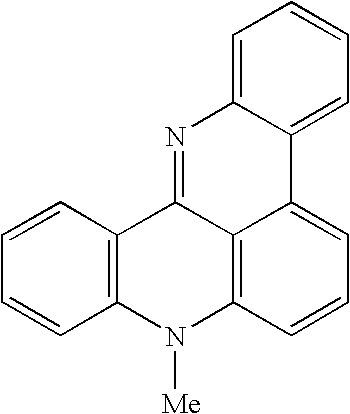


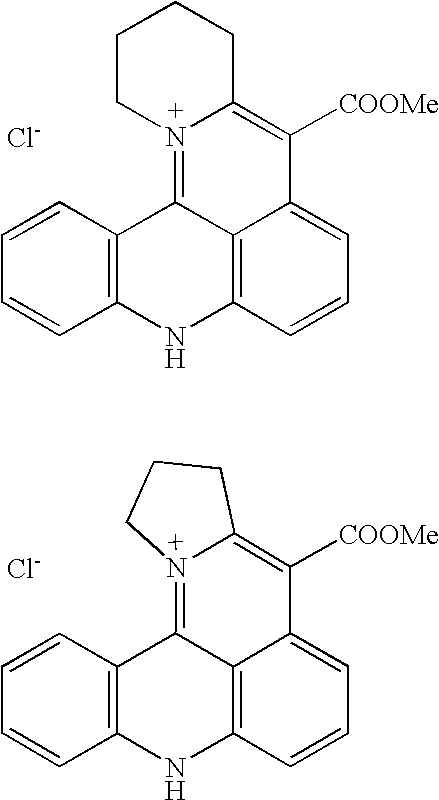
-
- (a) no inhibition of Taq polymerase at 10–50 μM (in order to provide specificity and eliminate broad-spectrum polymerase inhibitors);
- (b) cell free telomerase inhibition (at <1 μM) at concentrations more than 5 to 10-fold less than for concentrations for acute cytotoxicity;
- (c) shortening of telomere length in tumour cells at concentrations 5 to 10-fold less than concentrations for acute cytotoxicity;
- (d) telomere shortening in human tumour xenografts; and,
- (e) oral bioavailability.
-
- (f) improved activity.
- (g) improved selectivity (e.g., against tumour cells versus normal cells).
- (h) complement the activity of other treatments (e.g., chemotherapeutic agents);
- (i) reduced intensity of undesired side-effects;
- (j) fewer undesired side-effects;
- (k) simpler methods of administration;
- (l) reduction in required dosage amounts;
- (m) reduction in required frequency of administration;
- (n) increased ease of synthesis, purification, handling, storage, etc.;
- (o) reduced cost of synthesis, purification, handling, storage, etc.
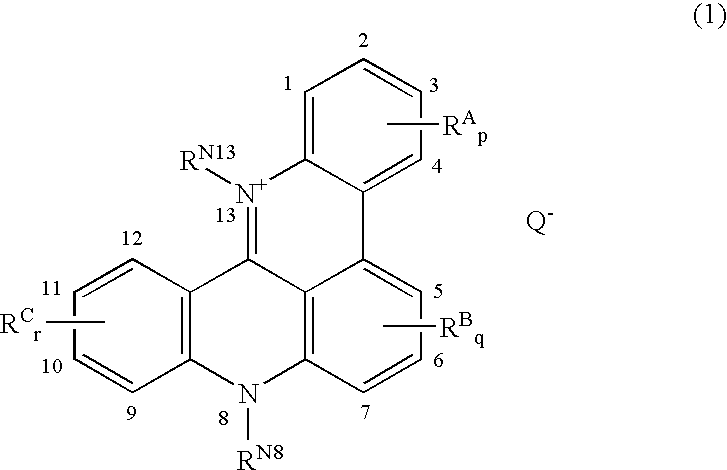
wherein:
-
- p is independently an integer from 0 to 4;
- q is independently an integer from 0 to 3;
- r is independently an integer from 0 to 4;
- each RA is independently —H or a ring substituent;
- each RB is independently —H or a ring substituent;
- each RC is independently —H or a ring substituent;
- RN8 is independently a nitrogen substituent;
- RN13 is independently a nitrogen substituent; and,
- Q is independently an anion;
and pharmaceutically acceptable salts, solvates, amides, esters, ethers, chemically protected forms, and prodrugs thereof.

- 8,13-diethyl-6-methyl-8H-quino[4,3,2-kl]acridinium iodide (RA1 is —H; RA2 is —H; RA3 is —H; RA4 is —H; RB5 is —H; RB6 is -Me; RB7 is —H; RN8 is -Et; RC9 is —H; RC10 is —H; RC11 is —H; RC12 is —H; RN13 is -Et; and Q− is I−);
- or:
- 8,13-diethyl-3,6,11-trimethyl-8H-quino[4,3,2-kl]acridinium iodide (RA1 is —H; RA2 is —H; RA3 is -Me; RA4 is —H; RB5 is —H; RB6 is -Me; RB7 is —H; RN8 is -Et; RC9 is —H; RC10 is -Me; RC11 is —H; RC12 is —H; RN13 is -Et; and Q− is I−).

wherein:
-
- each one of RA1, RA2, RA3, and RA4 is independently —H or a ring substituent;
- each one of RB5, RB6, and RB7 is independently —H or a ring substituent;
- each one of RC9, RC10, RC11, and RC12 is independently —H or a ring substituent;
- RN8 is independently a nitrogen substituent;
- RN13 is independently a nitrogen substituent; and,
- Q is independently an anion;
and pharmaceutically acceptable salts, solvates, amides, esters, ethers, chemically protected forms, and prodrugs thereof.
Substituent Positions
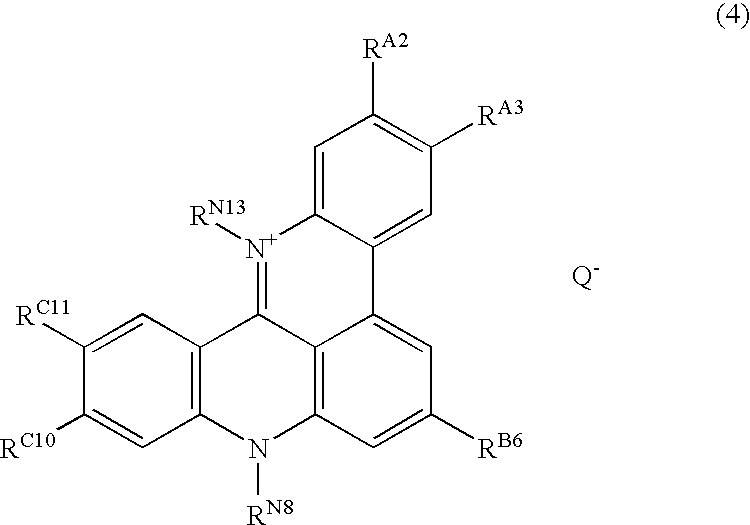
wherein:
-
- each of RA2 and RA3 is independently —H or a ring substituent;
- RB6 is —H or a ring substituent;
- each of RC10 and RC11 is independently —H or a ring substituent;
- RN8 is a nitrogen substituent;
- RN13 is a nitrogen substituent; and,
- Q is an anion.


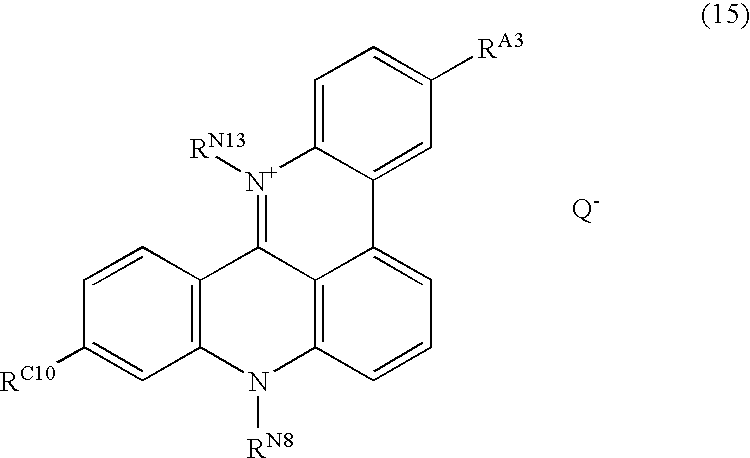


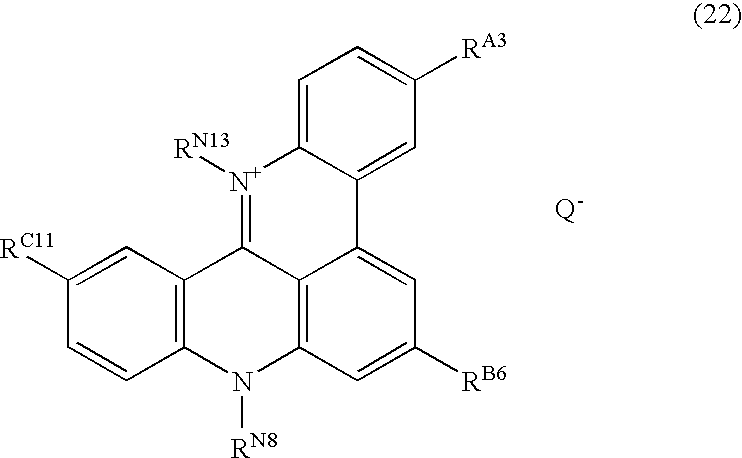

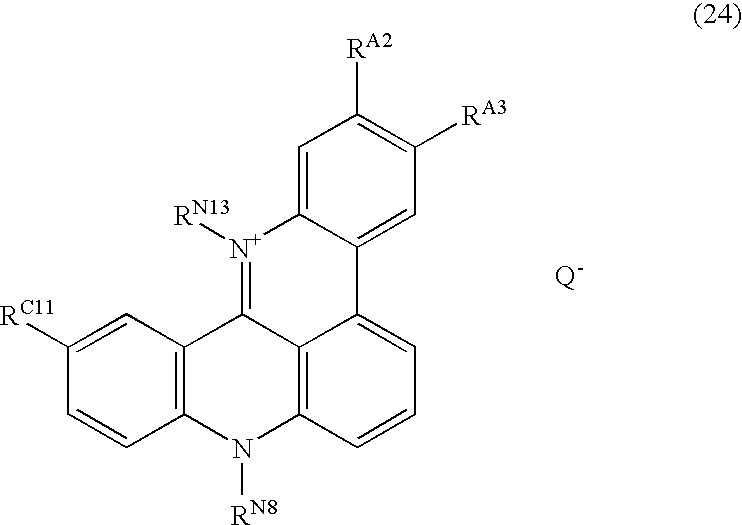


- 3-substituted;
- 6-substituted;
- 10-substituted;
- 3,6-disubstituted;
- 3,10-disubstituted;
- 6,10-disubstituted;
- 3,6,10-trisubstituted; or
- 3,6,11-trisubstituted.
Nitrogen Substituents
-
- -Me, -Et, -nPr, -iPr, -nBu, -tBu;
- —CF3, —CHF2, —CH2F, —CCl3, —CBr3, —CH2CH2F, —CH2CHF2, —CH2CF3;
- —CH2OMe, —CH2CH2OMe, —CH(OH)CH2OMe;
- —CH2OEt, —CH2CH2OEt, —CH(OH)CH2OEt;
- —CH2OH, —CH2CH2OH, —CH(OH)CH2OH;
- —CH2COOH—CH2CH2COOH;
- —CH2NH2,—CH2CH2NH2, or —CH2CH2NMe2.
-
- halo;
- hydroxy;
- ether (e.g., C1-7alkoxy);
- formyl;
- acyl (e.g., C1-7alkylacyl, C5-20arylacyl);
- carboxy;
- ester;
- acyloxy;
- oxycarbonyloxy;
- amido;
- acylamido;
- tetrazolyl;
- amino (including, e.g., C1-7aminoalkylamino);
- nitro;
- cyano;
- azido;
- sulfhydryl;
- thioether (e.g., C1-7alkylthio);
- sulfonamido; or
- C1-7alkyl (including, e.g., unsubstituted C1-7alkyl, C1-7haloalkyl, C1-7hydroxyalkyl, C1-7carboxyalkyl, C1-7acyloxyalkyl, C1-7oxycarbonylalkyl, C1-7oxycarbonyloxyalkyl, C1-7aminoalkyl, C1-7amidoalkyl, C1-7acylamidoalkyl, C1-7cyanoalkyl, C5-20aryl-C1-7alkyl, etc.).
-
- —F, —Cl, —Br, —I;
- —OH;
- —OMe, —OEt, —O(nPr), —O(iPr), —O(nBu), —O(tBu), —OCH2Ph;
- —OCF3, —OCHF2, —OCH2F, —OCCl3, —OCBr3, —OCH2CH2F, —OCH2CHF2, —OCH2CF3;
- C(═O)H;
- —C(═O)Me, —C(═O)Et, —C(═O)(nPr), —C(═O)(iPr), —C(═O)(nBu), —C(═O)(tBu), —C(═O)Ph;
- —C(═O)OH;
- —C(═O)OMe, —C(═O)OEt, —C(═O)O(nPr), —C(═O)O(iPr), —C(═O)O(nBu), —C(═O)O(tBu);
- —OC(═O)Me, —OC(═O)Et, —OC(═O)(nPr), —OC(═O)(iPr), —OC(═O)(nBu), —OC(═O)(tBu);
- —OC(═O)OMe, —OC(═O)OEt, —OC(═O)O(nPr), —OC(═O)O(iPr), —OC(═O)O(nBu), —OC(═O)(tBu);
- —C(═O)NH2, —C(═O)NHMe, —C(═O)NHEt, —C(═O)NH(nPr), —C(═O)NH(iPr), —C(═O)NH(nBu), —C(═O)NH(tBu), —C(═O)NMe2, —C(═O)NEt2, —C(═O)N(nPr)2, —C(═O)N(iPr)2, —C(═O)N(nBu)2, —C(═O)N(tBu)2;
- —NHC(═O)Me, —NHC(═O)Et, —NHC(═O)(nPr), —NHC(═O)(iPr), —NHC(═O)(nBu), —NHC(═O)(tBu), —NHC(═O)Ph, succinimidyl, maleimidyl;
- tetrazolyl;
- —NH2, —NHMe, —NHEt, —NH(nPr), —NH(iPr), —NH(nBu), —NH(tBu), —NMe2, —NEt2, —N(nPr)2, —N(iPr)2, —N(nBu)2, —N(tBu)2;
- —NH(CH2)2NH2, —NH(CH2)3NH2, —NH(CH2)4NH2, —NH(CH2)5NH2, —NH(CH2)6NH2, —NHCH2NH(Me), —NH(CH2)2NH(Me), —NH(CH2)3NH(Me), —NH(CH2)4NH(Me), —NH(CH2)5NH(Me), —NH(CH2)6NH(Me), —NHCH2NH(Et), —NH(CH2)2NH(Et), —NH(CH2)3NH(Et), —NH(CH2)4NH(Et), —NH(CH2)5NH(Et), —NH(CH2)6NH(Et);
- —NO2;
- —CN;
- —N3;
- —SH;
- —SMe, —SEt, —S(nPr), —S(iPr), —S(nBu), —S(tBu), —SCH2Ph;
- —S(═O)2NH2, —S(═O)2NHMe, —S(═O)2NMe2, —S(═O)2NHEt, —S(═O)2NEt2, —S(═O)2NH(nPr), —S(═O)2N(nPr)2, —S(═O)2NH(iPr), —S(═O)2N(iPr)2, —S(═O)2NH(nBu), —S(═O)2N(nBu)2, —S(═O)2NH(tBu), —S(═O)2N(tBu)2, —S(═O)2NHPh;
- -Me, -Et, -nPr, -iPr, -nBu, -tBu;
- —CF3, —CHF2, —CH2F, —CCl3, —CBr3, —CH2CH2F, —CH2CHF2, —CH2CF3;
- —CH2OH, —CH2CH2OH, —CH(OH)CH2OH;
- —CH2COOH, —CH2CH2COOH, —CH2CH2CH2COOH;
- —CH2OC(═O)Me, —CH2CH2OC(═O)Me, —CH═CHOC(═O)Me;
- —CH2C(═O)OMe, —CH2CH2C(═O)OMe, —CH═CHC(═O)OMe;
- —CH2OC(═O)OMe, —CH2CH2OC(═O)OMe, —CH═CHOC(═O)OMe;
- —CH2NH2, —CH2CH2NH2, —CH═CHNH2, —CH2CH2NMe2;
- —CH2NHC(═O)Me, —CH2CH2NHC(═O)Me, —CH═CHNHC(═O)Me;
- —CH2C(═O)NH2, —CH2CH2C(═O)NH2, —CH═CHC(═O)NH2;
- —CH2CN, —CH2CH2CN, —CH═CHCN.
-
- halo;
- ether (e.g., C1-7alkoxy);
- ester;
- acyloxy;
- oxycarbonyloxy;
- amido;
- acylamido;
- amino (including, e.g., C1-7aminoalkylamino);
- nitro;
- cyano;
- azido; or,
- C1-7alkyl (including, e.g., unsubstituted C1-7alkyl, C1-7haloalkyl, C1-7hydroxyalkyl, C1-7carboxyalkyl, C1-7acyloxyalkyl, C1-7oxycarbonylalkyl, C1-7oxycarbonyloxyalkyl, C1-7aminoalkyl, C1-7amidoalkyl, C1-7acylamidoalkyl, C1-7cyanoalkyl, C5-20aryl-C1-7alkyl, etc.).
-
- —F, —Cl, —Br, —I;
- —OMe, —OEt, —O(nPr), —O(iPr), —O(nBu), —O(tBu), —OCH2Ph;
- —OCF3, —OCHF2, —OCH2F, —OCCl3, —OCBr3, —OCH2CH2F, —OCH2CHF2, —OCH2CF3;
- —C(═O)Me, —C(═O)Et, —C(═O)(nPr), —C(═O)(iPr), —C(═O)(nBu), —C(═O)(tBu), —C(═O)Ph;
- —C(═O)OMe, —C(═O)OEt, —C(═O)O(nPr), —C(═O)O(iPr), —C(═O)O(nBu), —C(═O)O(tBu);
- —OC(═O)Me, —OC(═O)Et, —OC(═O)(nPr), —OC(═O)(iPr), —OC(═O)(nBu), —OC(═O)(tBu);
- —OC(═O)OMe, —OC(═O)OEt, —OC(═O)O(nPr), —OC(═O)O(iPr), —OC(═O)O(nBu), —OC(═O)O(tBu);
- —C(═O)NH2, —C(═O)NHMe, —C(═O)NHEt, —C(═O)NH(nPr), —C(═O)NH(iPr), —C(═O)NH(nBu), —C(═O)NH(tBu), —C(═O)NMe2, —C(═O)NEt2, —C(═O)N(nPr)2, —C(═O)N(iPr)2, —C(═O)N(nBu)2, —C(═O)N (tBu)2;
- —NHC(═O)Me, —NHC(═O)Et, —NHC(═O)(nPr), —NHC(═O)(iPr), —NHC(═O)(nBu), —NHC(═O)(tBu), —NHC(═O)Ph, succinimidyl, maleimidyl;
- —NH2, —NHMe, —NHEt, —NH(nPr), —NH(iPr), —NH(nBu), —NH(tBu), —NMe2, —NEt2, —N(nPr)2, —N(iPr)2, —N(nBu)2, —N(tBu)2;
- —NH(CH2)2NH2, —NH(CH2)3NH2, —NH(CH2)4NH2, —NH(CH2)5NH2, —NH(CH2)6NH2, —NHCH2NH(Me), —NH(CH2)2NH(Me), —NH(CH2)3NH(Me), —NH(CH2)4NH(Me), —NH(CH2)5NH(Me), —NH(CH2)6NH(Me), —NHCH2NH(Et), —NH(CH2)2NH(Et), —NH(CH2)3NH(Et), —NH(CH2)4NH(Et), —NH(CH2)5NH(Et), —NH(CH2)6NH(Et);
- —NO2;
- —CN;
- —N3;
- -Me, -Et, -nPr, -iPr, -nBu, -tBu;
- —CF3, —CHF2, —CH2F, —CCl3, —CBr3, —CH2CH2F, —CH2CHF2, —CH2CF3;
- —CH2OH, —CH2CH2OH, —CH(OH)CH2OH;
- —CH2COOH, —CH2CH2COOH, —CH2CH2CH2COOH;
- —CH2OC(═O)Me, —CH2CH2OC(═O)Me, —CH═CHOC(═O)Me;
- —CH2C(═O)OMe, —CH2CH2C(═O)OMe, —CH═CHC(═O)OMe;
- —CH2OC(═O)OMe, —CH2CH2OC(═O)OMe, —CH═CHOC(═O)OMe;
- —CH2NH2, —CH2CH2NH2, —CH═CHNH2, —CH2CH2NMe2;
- —CH2NHC(═O)Me, —CH2CH2NHC(═O)Me, —CH═CHNHC(═O)Me;
- —CH2C(═O)NH2, —CH2CH2C(═O)NH2, —CH═CHC(═O)NH2;
- —CH2CN, —CH2CH2CN, —CH═CHCN.
-
- halo;
- C1-7alkoxy;
- ester;
- acyloxy;
- oxycarbonyloxy;
- acylamido;
- amino (including, e.g., C1-7aminoalkylamino);
- nitro;
- cyano;
- azido; or,
- C1-7alkyl (including, e.g., unsubstituted C1-7alkyl, C1-7haloalkyl, C1-7hydroxyalkyl, C1-7carboxyalkyl, C1-7acyloxyalkyl, C1-7oxycarbonylalkyl, C1-7oxycarbonyloxyalkyl, C1-7aminoalkyl, C1-7amidoalkyl, C1-7acylamidoalkyl, C1-7cyanoalkyl, C5-20aryl-C1-7alkyl, etc.).
-
- —F, —Cl, —Br, —I;
- —OMe, —OEt, —O(nPr), —O(iPr), —O(nBu), —O(tBu), —OCH2Ph;
- —OCF3, —OCHF2, —OCH2F, —OCCl3, —OCBr3, —OCH2CH2F, —OCH2CHF2, —OCH2CF3;
- —C(═O)OMe, —C(═O)OEt, —C(═O)O(nPr), —C(═O)O(iPr), —C(═O)O(nBu), —C(═O)O(tBu);
- —OC(═O)Me, —OC(═O)Et, —OC(═O)(nPr), —OC(═O)(iPr), —OC(═O)(nBu), —OC(═O)(tBu);
- —OC(═O)OMe, —OC(═O)OEt, —OC(═O)O(nPr), —OC(═O)O(iPr), —OC(═O)O(nBu), —OC(═O)O(tBu);
- —NHC(═O)Me, —NHC(═O)Et, —NHC(═O)(nPr), —NHC(═O)(iPr), —NHC(═O)(nBu), —NHC(═O)(tBu), —NHC(═O)Ph, succinimidyl, maleimidyl;
- —NH2, —NHMe, —NHEt, —NH(nPr), —NH(iPr), —NH(nBu), —NH(tBu), —NMe2, —NEt2, —N(nPr)2, —N(iPr)2, —N(nBu)2, —N(tBu)2;
- —NH(CH2)2NH2, —NH(CH2)3NH2, —NH(CH2)4NH2, —NH(CH2)5NH2, —NH(CH2)6NH2, —NHCH2NH(Me), —NH(CH2)2NH(Me), —NH(CH2)3NH(Me), —NH(CH2)4NH(Me), —NH(CH2)5NH(Me), —NH(CH2)6NH(Me), —NHCH2NH(Et), —NH(CH2)2NH(Et), —NH(CH2)3NH(Et), —NH(CH2)4NH(Et), —NH(CH2)5NH(Et), —NH(CH2)6NH(Et);
- —NO2;
- —CN;
- —N3;
- -Me, -Et, -nPr, -iPr, -nBu, -tBu;
- —CF3, —CHF2, —CH2F, —CCl3, —CBr3, —CH2CH2F, —CH2CHF2, —CH2CF3;
- —CH2OH, —CH2CH2OH, —CH(OH)CH2OH;
- —CH2COOH, —CH2CH2COOH, —CH2CH2CH2COOH;
- —CH2OC(═O)Me, —CH2CH2OC(═O)Me, —CH═CHOC(═O)Me;
- —CH2C(═O)OMe, —CH2CH2C(═O)OMe, —CH═CHC(═O)OMe;
- —CH2OC(═O)OMe, —CH2CH2OC(═O)OMe, —CH═CHOC(═O)OMe;
- —CH2NH2, —CH2CH2NH2, —CH═CHNH2, —CH2CH2NMe2;
- —CH2NHC(═O)Me, —CH2CH2NHC(═O)Me, —CH═CHNHC(═O)Me;
- —CH2C(═O)NH2, —CH2CH2C(═O)NH2, —CH═CHC(═O)NH2;
- —CH2CN, —CH2CH2CN, —CH═CHCN.
-
- halo;
- ether (e.g., C1-7alkoxy);
- ester;
- acyloxy;
- oxycarbonyloxy;
- cyano; or,
- C1-7alkyl (including, e.g., unsubstituted C1-7alkyl, C1-7haloalkyl, C1-7hydroxyalkyl, C1-7carboxyalkyl, C1-7acyloxyalkyl, C1-7oxycarbonylalkyl, C1-7oxycarbonyloxyalkyl, C1-7aminoalkyl, C1-7amidoalkyl, C1-7acylamidoalkyl, C1-7cyanoalkyl, C5-20aryl-C1-7alkyl, etc.).
-
- —F, —Cl, -Me, —OMe, —CN,
- —C(═O)OMe, —OC(═O)Me, —OC(═O)OMe,
- —CH2CH2C(═O)OMe,
- —CH2CH2OC(═O)Me,
- —CH═CHC(═O)OMe,
- —CH═CHOC(═O)Me,
- —CH═CHC(═O)NH2,
- —CH═CHC(═O)(morpholin-4-yl),
- —CH═CHCH2NHC(═O)CF3,
- —CH═CHCN, or
- —C≡CCH2NHC(═O)CF3.
| 1 |  | 9 | RHPS01 |
| 2 |  | 10 | RHPS02 |
| 3 |  | 11 | RHPS03 |
| 4 |  | 12 | RHPS04 |
| 5 | 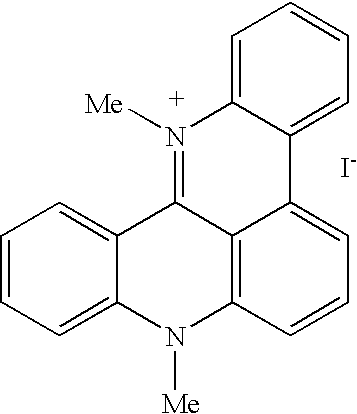 | 55 | RHPS05 |
| 6 |  | 56 | RHPS06 |
| 7 |  | 58 | RHPS07 |
| 8 |  | 59 | RHPS08 |
| 16 |  | 65 | RHPS09 |
| 9 |  | 60 | RHPS10 |
| 10 |  | 63 | RHPS11 |
| 11 |  | 61 | RHPS12 |
| 12 | 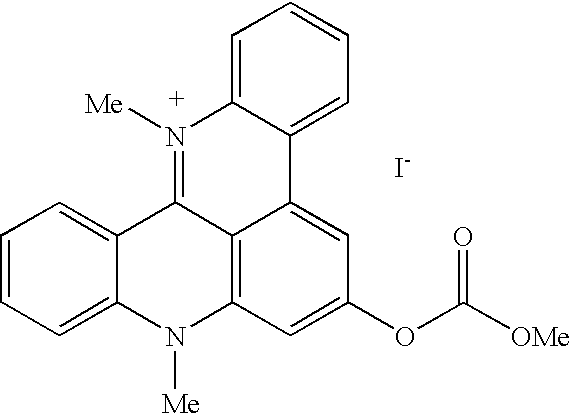 | 62 | RHPS13 |
| 13 |  | 57 | RHPS14 |
| 14 |  | 64 | RHPS15 |
| 15 | 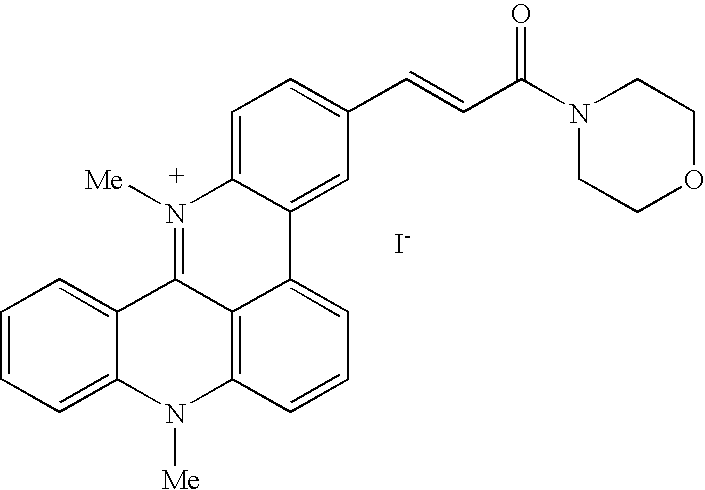 | 66 | RHPS16 |
| 17 |  | 71 | RHPS17 |
| 18 |  | 70 | RHPS18 |
| 19 |  | 69 | RHPS19 |
| 20 |  | RHPS20 | |
| 21 |  | 67 | RHPS21 |
| 22 |  | 68 | RHPS22 |
Chemical Terms
- N1: aziridine (C3), azetidine (C4), pyrrolidine (tetrahydropyrrole) (C5), pyrroline (e.g., 3-pyrroline, 2,5-dihydropyrrole) (C5), 2H-pyrrole or 3H-pyrrole (isopyrrole, isoazole) (C5), piperidine (C6), dihydropyridine (C6), tetrahydropyridine (C6), azepine (C7);
- O1: oxirane (C3), oxetane (C4), oxolane (tetrahydrofuran) (C5), oxole (dihydrofuran) (C5), oxane (tetrahydropyran) (C6), dihydropyran (C6), pyran (C6), oxepin (C7);
- S1: thiirane (C3), thietane (C4), thiolane (tetrahydrothiophene) (C5), thiane (tetrahydrothiopyran) (C6), thiepane (C7);
- O2: dioxolane (C5), dioxane (C6), and dioxepane (C7);
- O3: trioxane (C6);
- N2: imidazolidine (C5), pyrazolidine (diazolidine) (C5), imidazoline (C5), pyrazoline (dihydropyrazole) (C5), piperazine (C6);
- N1O1: tetrahydrooxazole (C5), dihydrooxazole (C5), tetrahydroisoxazole (C5), dihydroisoxazole (C5), morpholine (C6), tetrahydrooxazine (C6), dihydrooxazine (C6), oxazine (C6);
- N1S1: thiazoline (C5), thiazolidine (C5), thiomorpholine (C6);
- N2O1: oxadiazine (C6);
- O1S1: oxathiole (C5) and oxathiane (thioxane) (C6); and,
- N1O1S1: oxathiazine (C6).
- N1: pyrrole (azole) (C5), pyridine (azine) (C6);
- O1: furan (oxole) (C5);
- S1: thiophene (thiole) (C5);
- N1O1: oxazole (C5), isoxazole (C5), isoxazine (C6);
- N2O1: oxadiazole (furazan) (C5);
- N3O1: oxatriazole (C5);
- N1S1: thiazole (C5), isothiazole (C5);
- N2: imidazole (1,3-diazole) (C5), pyrazole (1,2-diazole) (C5), pyridazine (1,2-diazine) (C6), pyrimidine (1,3-diazine) (C6) (e.g., cytosine, thymine, uracil), pyrazine (1,4-diazine) (C6);
- N3: triazole (C5), triazine (C6); and,
- N4: tetrazole (C5).
-
- C9heterocyclic groups (with 2 fused rings) derived from benzofuran (O1), isobenzofuran (O1), indole (N1), isoindole (N1), purine (N4) (e.g., adenine, guanine), benzimidazole (N2), benzoxazole (N1O1), benzisoxazole (N1O1), benzodioxole (O2), benzofurazan (N2O1), benzotriazole (N3), benzothiofuran (S1), benzothiazole (N1S1), benzothiadiazole (N2S);
- C10heterocyclic groups (with 2 fused rings) derived from benzodioxan (O2), quinoline (N1), isoquinoline (N1), benzoxazine (N1O1), benzodiazine (N2), pyridopyridine (N2), quinoxaline (N2), quinazoline (N2);
- C13heterocyclic groups (with 3 fused rings) derived from carbazole (N1), dibenzofuran (O1), dibenzothiophene (S1); and,
- C14heterocyclic groups (with 3 fused rings) derived from acridine (N1), xanthene (O1), phenoxathiin (O1S1), phenazine (N2), phenoxazine (N1O1), phenothiazine (N1S1), thianthrene (S2), phenanthridine (N1), phenanthroline (N2), phenazine (N2).
- C5: cyclopentanone, cyclopentenone, cyclopentadienone;
- C6: cyclohexanone, cyclohexenone, cyclohexadienone;
- O1: furanone (C5), pyrone (C6);
- N1: pyrrolidone (pyrrolidinone) (C5), piperidinone (piperidone) (C6), piperidinedione (C6);
- N2: imidazolidone (imidazolidinone) (C5), pyrazolone (pyrazolinone) (C5), piperazinone (C6), piperazinedione (C6), pyridazinone (C6), pyrimidinone (C6) (e.g., cytosine), pyrimidinedione (C6) (e.g., thymine, uracil), barbituric acid (C6);
- N1S1: thiazolone (C5), isothiazolone (C5);
- N1O1: oxazolinone (C5).
- C9: indenedione;
- N1: oxindole (C9);
- O1: benzopyrone (e.g., coumarin, isocoumarin, chromone) (C10);
- N1O1: benzoxazolinone (C9), benzoxazolinone (C10);
- N2: quinazolinedione (C10);
- N4: purinone (C9) (e.g., guanine).
-
- cyclic anhydrides (—C(═O)—O—C(═O)— in a ring), including but not limited to maleic anhydride (C5), succinic anhydride (C5), and glutaric anhydride (C6);
- cyclic carbonates (—O—C(═O)—O— in a ring), such as ethylene carbonate (C5) and 1,2-propylene carbonate (C5);
- imides (—C(═O)—NR—C(═O)— in a ring), including but not limited to, succinimide (C5), maleimide (C5), phthalimide, and glutarimide (C6);
- lactones (cyclic esters, —O—C(═O)— in a ring), including, but not limited to, β-propiolactone, γ-butyrolactone, δ-valerolactone (2-piperidone), and ε-caprolactone;
- lactams (cyclic amides, —NR—C(═O)— in a ring), including, but not limited to, β-propiolactam (C4), γ-butyrolactam (2-pyrrolidone) (C5), δ-valerolactam (C6), and ε-caprolactam (C7);
- cyclic carbamates (—O—C(═O)—NR— in a ring), such as 2-oxazolidone (C5);
- cyclic ureas (—NR—C(═O)—NR— in a ring), such as 2-imidazolidone (C5) and pyrimidine-2,4-dione (e.g., thymine, uracil) (C6).

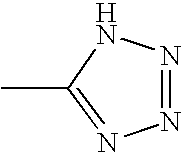


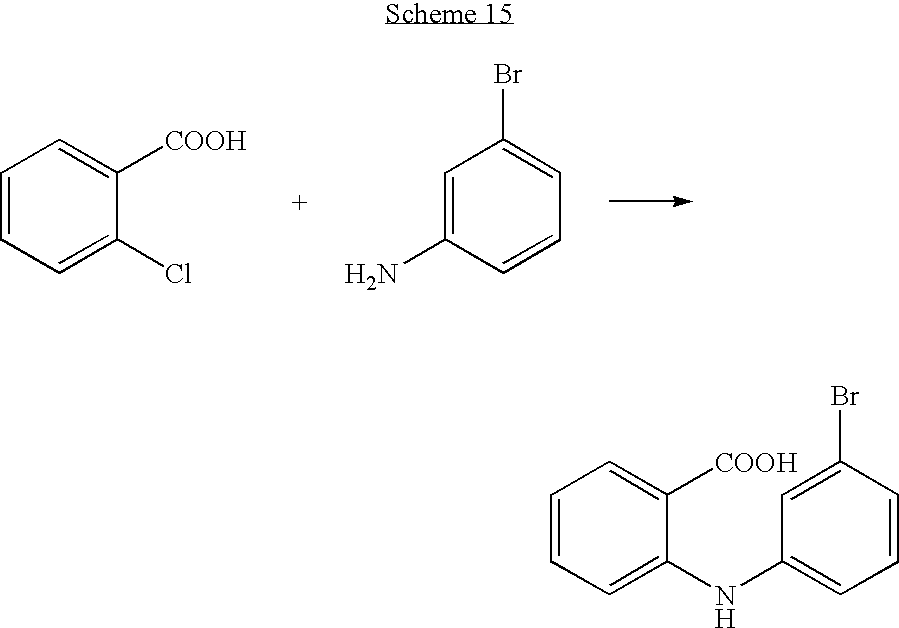


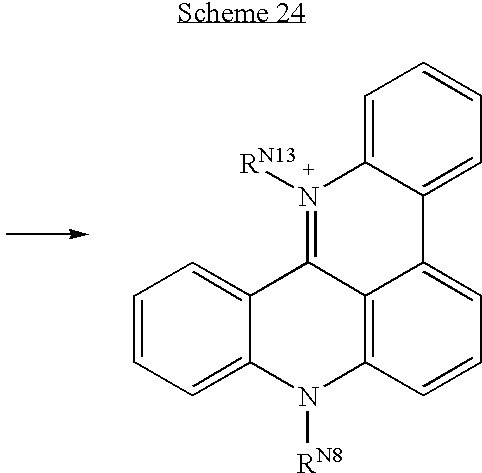


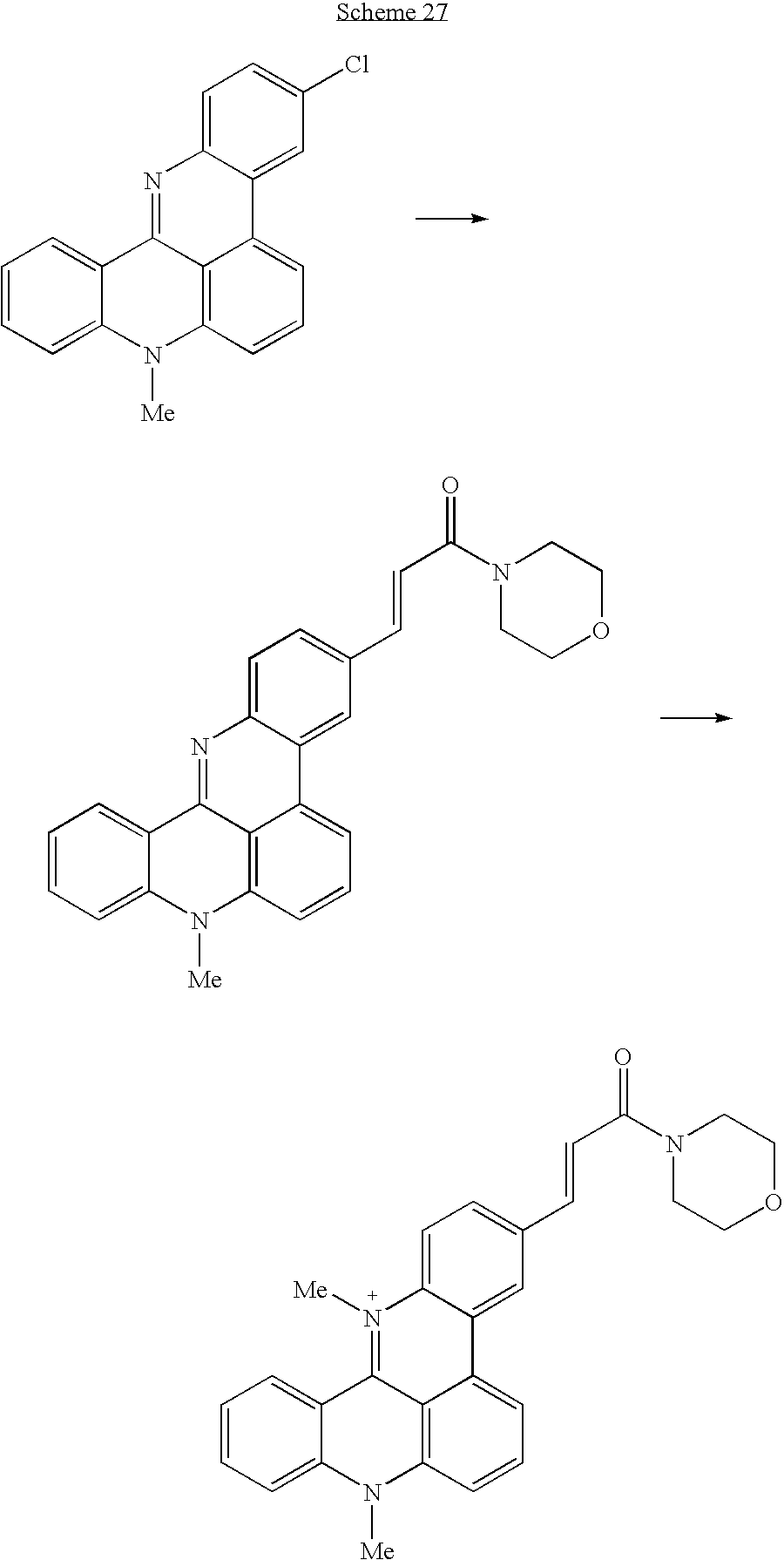


Uses


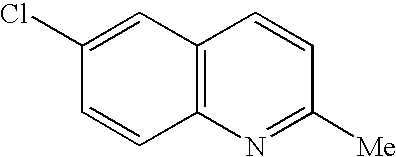


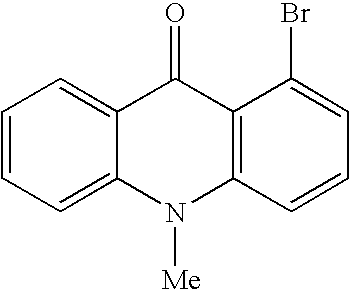


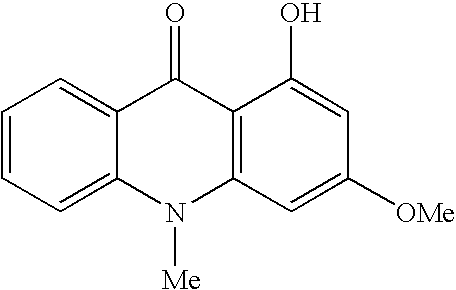

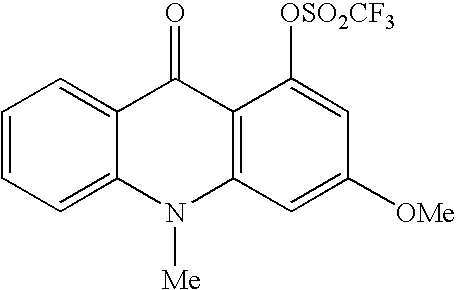


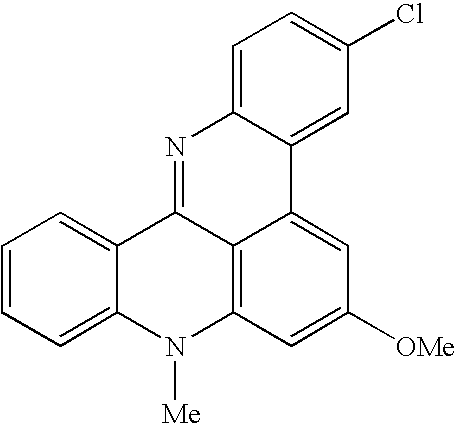
Synthesis 1

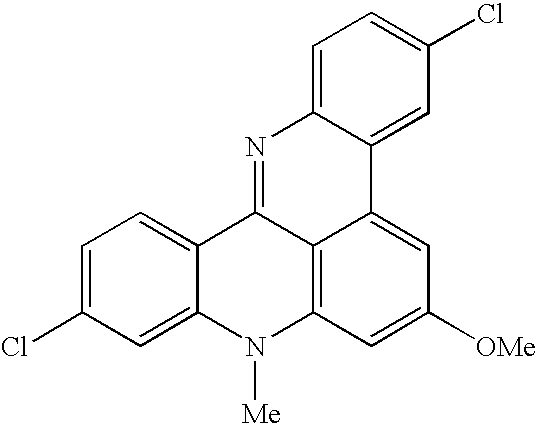
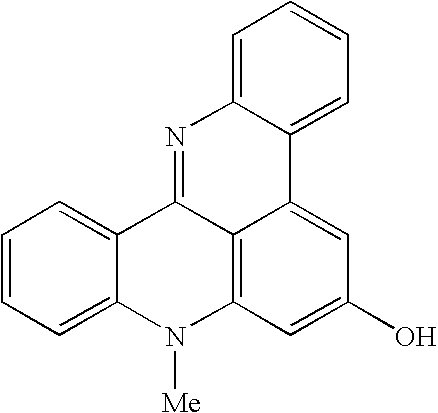


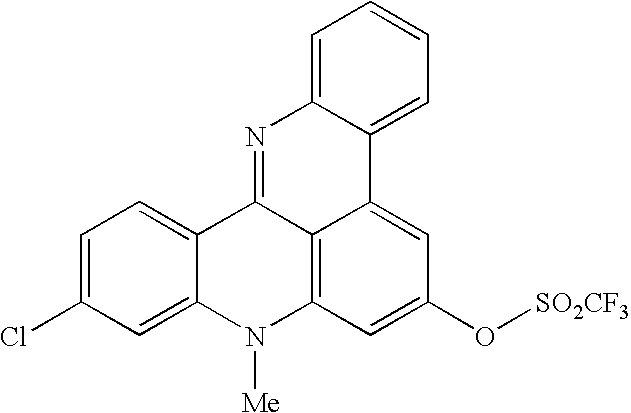


- (A): Collected by filtration and washed with diethyl ether; or,
- (B): Dissolved in DCM and purified by column chromatography (5–10% MeOH in DCM); or,
- (C): Dissolved in DCM and purified by preparative tlc (5% MeOH in DCM).


- A2780: human ovarian carcinoma cell line.
- CH1: human ovarian carcinoma cell line.
- SKOV-3: human ovarian carcinoma cell line.
- A431: human vulval carcinoma cells (short telomeres).
- GM847: carcinoma cell line immortalised by ALT pathway.
| TABLE 1 |
| Telomerase Inhibitory Activity and Cytotoxicity |
| Cytotoxicity IC50 (μM) |
| telIC50 | SKOV- | |||||
| Compound | (μM) | A2780 | CH1 | 3 | A431 | GM847 |
| 1 | 9 | RHPS01 | 0.74 | 0.9 | 0.37 | 3.6 | — | — |
| 2 | 10 | RHPS02 | 0.24 | 1.3 | 1.4 | 9.3 | — | — |
| 3 | 11 | RHPS03 | 0.18 | 0.33 | 0.29 | 0.75 | — | — |
| 4 | 12 | RHPS04 | 0.31 | 1.1 | 0.50 | 23.0 | — | — |
| 5 | 55 | RHPS05 | 1.55 | 1.6 | 1.1 | 18.0 | — | — |
| 6 | 56 | RHPS06 | 0.26 | 1.1 | 0.5 | 12.5 | — | — |
| 7 | 58 | RHPS07 | 0.94 | 14.5 | 3.8 | >25 | — | — |
| 8 | 59 | RHPS08 | 0.47 | 0.62 | 0.13 | 3.6 | — | — |
| 9 | 65 | RHPS09 | 3.02 | >25 | 11.5 | >25 | — | — |
| 10 | 60 | RHPS10 | 0.24 | — | 1.1 | 6.3 | 3.2 | 0.8 |
| 11 | 63 | RHPS11 | 1.70 | — | 1.6 | 3.5 | 1.7 | 17.7 |
| 12 | 61 | RHPS12 | 0.28 | — | 0.3 | 10.0 | 1.0 | 0.4 |
| 13 | 62 | RHPS13 | 0.57 | — | 0.2 | 1.5 | 0.4 | 0.5 |
| 14 | 64 | RHPS15 | 0.19 | — | 2.2 | 19.0 | 3.2 | 4.5 |
| 15 | 66 | RHPS16 | 0.37 | — | 17.8 | >25.0 | 12.5 | >25.0 |
- Albert, A., 1966, The Acridines, 2nd Edition, Edward Arnold (Publishers) Ltd., London.
- Autexier, 1999, “Telomerase as a Possible Target for Anticancer Therapy,” Chemistry & Biology, November 1999, Vol. 6, pp. R299-R303.
- Bostock-Smith, C. E., et al., 1999 (Part 6), Biochemistry, Vol. 38, No. 1, pp. 6723–6731.
- Coulson, D. R., 1990, Inorg. Synth., p. 28.
- Gimenez-Arnau et al., 1998, “Antitumour Polycyclic Acridines, Part 4,” Anti-Cancer Drug Design, Vol. 13, pp. 431–451.
- Gimenez-Arnau et al., 1998, “Antitumour Polycyclic Acridines, Part 2,” Anti-Cancer Drug Design, Vol. 13, pp. 125–143.
- Gullier, F.; Nivoliers, F.; Godard, A.; Marsais, F.; Queguiner, G.; Siddiqui, M. A.; Sneikus, V., 1995, J. Org. Chem., Vol. 60, p. 292
- Hagan, D. J., et al., 1997 (Part 1), J. Chem. Soc., Perkin Trans. I, pp. 2739–2746.
- Hagan, D. J., et al., 1998 (Part 3), J. Chem. Soc., Perkin Trans. I, pp. 915–923.
- Hodgeman, D. K. C.; Prager, R. H., 1972, Aus. J. Chem., Vol. 25, p. 194
- Jaroszewska-Manaj, J., et al., 2000, Magn. Reson. Chem., Vol. 38, No. 6, pp. 482–485.
- Julino, M., et al., 1998 (Part 5), J. Chem. Soc., Perkin Trans. I, pp. 1677–1684.
- Katritzky, A. R., et al., 1999, J. Heterocyclic Chem., Vol. 36, pp. 927–932.
- Littke, A. F., et al., 1999, J. Org. Chem., Vol. 64, pp. 10–11.
- Missailidis, S., et al., 1997, Spectrosc. Biol. Mol.: Mod. Trends, (Euro. Conf.), 7th, Eds. Carmona, P., et al., pp. 391–392.
- Mitchell, G., et al., 1987, J. Chem. Soc., Perkin Trans. 1, Vol. 2, pp. 403–412.
- Neidle et al., 1999, “Telomerase as an Anti-Cancer Target: Current Status and Future Prospects,” Anti-Cancer Drug Design, Vol. 14, pp. 341–347.
- Oszczapowicz, J.; Jaroszewska-Manaj, J.; Ciszak, E.; Gdaniec, M., 1988, Tetrahedron, Vol. 44, No. 21, pp. 6645–6650.
- Perry et al., 1998a, “1,4- and 2,6-Disubstituted Amidoanthracene-9,10-dione Derivatives as Inhibitors of Human Telomerase,” J. Med. Chem., Vol. 41, pp. 3253–3260.
- Perry et al., 1998b, “Telomeres and Telomerase: Targets for Cancer Chemotherapy?,” Exp. Opin. Ther. Patents, Vol. 8, No. 12, pp. 1567–1586.
- Prager, R. H., et al., 1972, Aus. J. Chem., Vol. 25, p. 194.
- Reisch, J.; Herath, M. T. B.; Kumar, N. S., 1991, Liebigs Ann. Chem., pp. 695–689.
- Sharma et al., 1997, “Preclinical and Clinical Strategies for Development of Telomerase and Telomere Inhibitors,” Annals of Oncology, Vol. 8, pp. 1063–1074.
- Song, Z; Mertzmann, M.; Hughes, D. L., 1993, “Substituted quinolines were prepared by a modified Scraup synthesis,” J. Heterocyclic Chem., Vol. 30, p. 17.
- Stanslas, J., et al., 2000, J. Med. Chem., Vol. 43, pp. 1563–1572.
- Timari, G.; Soos, T.; Hajos, G.; Messmer, A.; Nacsa, J.; Molnar, J.,1996, Bioorg. Med. Chem. Lett., Vol. 6, No. 23, p. 2831–2836.
- Urquidi et al., 1998, “Telomerase in Cancer: Clinical Applications,” Ann. Med., Vol. 30, pp. 419–430.
- Wolfe, J. P., et al., 2000, J. Org. Chem., Vol. 65, p. 1158.
Claims (58)


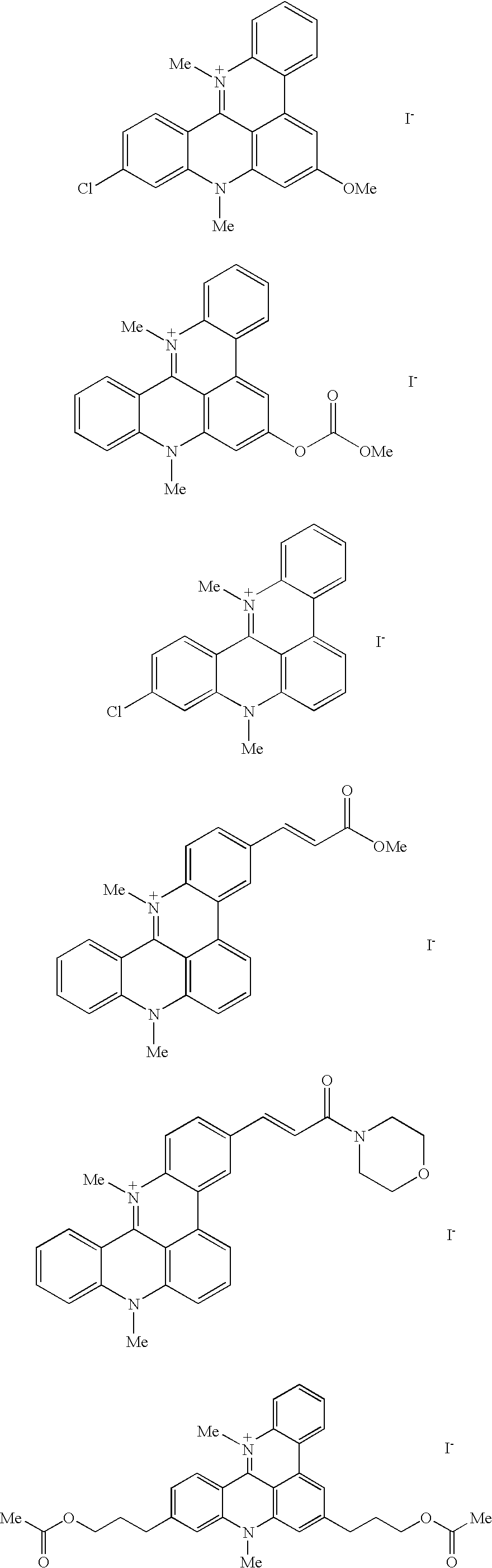


Applications Claiming Priority (2)
| Application Number | Priority Date | Filing Date | Title |
|---|---|---|---|
| US23926700P | 2000-10-12 | 2000-10-12 | |
| PCT/GB2001/004557 WO2002030932A2 (en) | 2000-10-12 | 2001-10-12 | N8,n13-disubstituted quino[4,3,2-kl]acridinium salts as therapeutic agents |
Publications (2)
| Publication Number | Publication Date |
|---|---|
| US20040063739A1 US20040063739A1 (en) | 2004-04-01 |
| US7115619B2 true US7115619B2 (en) | 2006-10-03 |
Family
ID=22901392
Family Applications (1)
| Application Number | Title | Priority Date | Filing Date |
|---|---|---|---|
| US10/398,767 Expired - Fee Related US7115619B2 (en) | 2000-10-12 | 2001-10-12 | N8, N13 -disubstituted quino[4,3,2-kl]acridinium salts as therapeutic agents |
Country Status (7)
| Country | Link |
|---|---|
| US (1) | US7115619B2 (en) |
| EP (1) | EP1330456B8 (en) |
| AT (1) | ATE512964T1 (en) |
| AU (1) | AU2001295718A1 (en) |
| DK (1) | DK1330456T3 (en) |
| ES (1) | ES2367968T3 (en) |
| WO (1) | WO2002030932A2 (en) |
Cited By (4)
| Publication number | Priority date | Publication date | Assignee | Title |
|---|---|---|---|---|
| US20080279961A1 (en) * | 2007-05-11 | 2008-11-13 | Burger Angelika M | Telomere targeting agents as stem cells directed treatments |
| WO2008149353A3 (en) * | 2007-06-04 | 2010-02-25 | Ben Gurion University Of The Negev Research And Development Authority | Telomerase activating compounds and methods of use thereof |
| US9974774B2 (en) | 2013-07-26 | 2018-05-22 | Race Oncology Ltd. | Combinatorial methods to improve the therapeutic benefit of bisantrene and analogs and derivatives thereof |
| US10111880B2 (en) | 2013-11-05 | 2018-10-30 | Ben-Gurion University Of The Negev Research And Development Authority | Compounds for the treatment of diabetes and disease complications arising from same |
Families Citing this family (2)
| Publication number | Priority date | Publication date | Assignee | Title |
|---|---|---|---|---|
| GB201016442D0 (en) | 2010-09-30 | 2010-11-17 | Pharminox Ltd | Novel acridine derivatives |
| WO2012175991A1 (en) | 2011-06-24 | 2012-12-27 | Pharminox Limited | Fused pentacyclic anti - proliferative compounds |
-
2001
- 2001-10-12 WO PCT/GB2001/004557 patent/WO2002030932A2/en not_active Ceased
- 2001-10-12 DK DK01976448.9T patent/DK1330456T3/en active
- 2001-10-12 EP EP01976448A patent/EP1330456B8/en not_active Expired - Lifetime
- 2001-10-12 ES ES01976448T patent/ES2367968T3/en not_active Expired - Lifetime
- 2001-10-12 US US10/398,767 patent/US7115619B2/en not_active Expired - Fee Related
- 2001-10-12 AU AU2001295718A patent/AU2001295718A1/en not_active Abandoned
- 2001-10-12 AT AT01976448T patent/ATE512964T1/en active
Non-Patent Citations (28)
Cited By (14)
| Publication number | Priority date | Publication date | Assignee | Title |
|---|---|---|---|---|
| US20080279961A1 (en) * | 2007-05-11 | 2008-11-13 | Burger Angelika M | Telomere targeting agents as stem cells directed treatments |
| US10214481B2 (en) | 2007-06-04 | 2019-02-26 | Ben-Gurion University Of The Negev Research And Development Aithority | Telomerase activating compounds and methods of use thereof |
| EA022472B1 (en) * | 2007-06-04 | 2016-01-29 | Бен-Гурион Юниверсити Оф Дзе Негев Рисерч Энд Дивелопмент Оторити | COMPOUNDS ACTIVATING TELOMERASE AND METHODS OF THEIR APPLICATION |
| US9663448B2 (en) | 2007-06-04 | 2017-05-30 | Ben-Gurion University Of The Negev Research And Development Authority | Tri-aryl compounds and compositions comprising the same |
| US9670138B2 (en) | 2007-06-04 | 2017-06-06 | Ben-Gurion University Of The Negev Research And Development Authority | Telomerase activating compounds and methods of use thereof |
| US9670139B2 (en) | 2007-06-04 | 2017-06-06 | Ben-Gurion University Of The Negev Research And Development Authority | Telomerase activating compounds and methods of use thereof |
| WO2008149353A3 (en) * | 2007-06-04 | 2010-02-25 | Ben Gurion University Of The Negev Research And Development Authority | Telomerase activating compounds and methods of use thereof |
| US9974774B2 (en) | 2013-07-26 | 2018-05-22 | Race Oncology Ltd. | Combinatorial methods to improve the therapeutic benefit of bisantrene and analogs and derivatives thereof |
| US9993460B2 (en) | 2013-07-26 | 2018-06-12 | Race Oncology Ltd. | Compositions to improve the therapeutic benefit of bisantrene and analogs and derivatives thereof |
| US10500192B2 (en) | 2013-07-26 | 2019-12-10 | Race Oncology Ltd. | Combinatorial methods to improve the therapeutic benefit of bisantrene and analogs and derivatives thereof |
| US10548876B2 (en) | 2013-07-26 | 2020-02-04 | Race Oncology Ltd. | Compositions to improve the therapeutic benefit of bisantrene and analogs and derivatives thereof |
| US11135201B2 (en) | 2013-07-26 | 2021-10-05 | Race Oncology Ltd. | Compositions to improve the therapeutic benefit of bisantrene and analogs and derivatives thereof |
| US11147800B2 (en) | 2013-07-26 | 2021-10-19 | Race Oncology Ltd. | Combinatorial methods to improve the therapeutic benefit of bisantrene and analogs and derivatives thereof |
| US10111880B2 (en) | 2013-11-05 | 2018-10-30 | Ben-Gurion University Of The Negev Research And Development Authority | Compounds for the treatment of diabetes and disease complications arising from same |
Also Published As
| Publication number | Publication date |
|---|---|
| AU2001295718A1 (en) | 2002-04-22 |
| EP1330456B9 (en) | 2012-01-25 |
| US20040063739A1 (en) | 2004-04-01 |
| EP1330456B8 (en) | 2012-02-08 |
| DK1330456T3 (en) | 2011-10-03 |
| EP1330456B1 (en) | 2011-06-15 |
| WO2002030932A2 (en) | 2002-04-18 |
| EP1330456A2 (en) | 2003-07-30 |
| ATE512964T1 (en) | 2011-07-15 |
| WO2002030932A3 (en) | 2002-08-22 |
| ES2367968T3 (en) | 2011-11-11 |
Similar Documents
| Publication | Publication Date | Title |
|---|---|---|
| US7732483B2 (en) | DNA-PK inhibitors | |
| US11786533B2 (en) | Use of EZH2 inhibitors for treating cancer | |
| US7196085B2 (en) | Phthalazinone derivatives | |
| US7300930B2 (en) | Therapeutic acridone and acridine compounds | |
| US7205311B2 (en) | Therapeutic acridone and acridine compounds | |
| US7115619B2 (en) | N8, N13 -disubstituted quino[4,3,2-kl]acridinium salts as therapeutic agents | |
| AU2002317303B2 (en) | 4-aryl quinols and analogs thereof as therapeutic agents | |
| US7947703B2 (en) | Phenanthridinium derivatives as DNA binding agents | |
| AU2002317303A1 (en) | 4-aryl quinols and analogs thereof as therapeutic agents | |
| US7105518B2 (en) | Thiopyrane-4-ones as DNA protein kinase inhibitors | |
| JPH05117273A (en) | Medicinal compound | |
| US20240400536A1 (en) | Idebenone derivatives and their use in treating plants | |
| US7112698B2 (en) | 4-(c2-6alkoxy)-substituted chalcones as therapeutic agents | |
| US20080319001A1 (en) | Cancer Treatment Using Specific 3,6,9-Substituted Acridines |
Legal Events
| Date | Code | Title | Description |
|---|---|---|---|
| AS | Assignment |
Owner name: CANCER RESEARCH TECHNOLOGY LIMITED, UNITED KINGDOM Free format text: ASSIGNMENT OF ASSIGNORS INTEREST;ASSIGNOR:CANCER RESEARCH VENTURES LIMITED;REEL/FRAME:015582/0983 Effective date: 20021031 Owner name: CANCER RESEARCH CAMPAIGN TECHNOLOGY LIMITED, UNITE Free format text: ASSIGNMENT OF ASSIGNORS INTEREST;ASSIGNORS:STEVENS, MALCOLM F.G.;KELLAND, LLOYD R.;UNIVERSITY OF NOTTINGHAM, THE;AND OTHERS;REEL/FRAME:015580/0545 Effective date: 20010307 Owner name: CANCER RESEARCH VENTURES LIMITED, GREAT BRITAIN Free format text: ASSIGNMENT OF ASSIGNORS INTEREST;ASSIGNOR:CANCER RESEARCH CAMPAIGN TECHNOLOGY LIMITED;REEL/FRAME:015579/0403 Effective date: 20010131 |
|
| FEPP | Fee payment procedure |
Free format text: PAYOR NUMBER ASSIGNED (ORIGINAL EVENT CODE: ASPN); ENTITY STATUS OF PATENT OWNER: LARGE ENTITY |
|
| FPAY | Fee payment |
Year of fee payment: 4 |
|
| CC | Certificate of correction | ||
| REMI | Maintenance fee reminder mailed | ||
| LAPS | Lapse for failure to pay maintenance fees | ||
| STCH | Information on status: patent discontinuation |
Free format text: PATENT EXPIRED DUE TO NONPAYMENT OF MAINTENANCE FEES UNDER 37 CFR 1.362 |
|
| STCH | Information on status: patent discontinuation |
Free format text: PATENT EXPIRED DUE TO NONPAYMENT OF MAINTENANCE FEES UNDER 37 CFR 1.362 |
|
| FP | Lapsed due to failure to pay maintenance fee |
Effective date: 20141003 |