US7070933B2 - Inversion probes - Google Patents
Inversion probes Download PDFInfo
- Publication number
- US7070933B2 US7070933B2 US10/388,918 US38891803A US7070933B2 US 7070933 B2 US7070933 B2 US 7070933B2 US 38891803 A US38891803 A US 38891803A US 7070933 B2 US7070933 B2 US 7070933B2
- Authority
- US
- United States
- Prior art keywords
- probe
- target
- arm
- inversion
- stem
- Prior art date
- Legal status (The legal status is an assumption and is not a legal conclusion. Google has not performed a legal analysis and makes no representation as to the accuracy of the status listed.)
- Expired - Lifetime, expires
Links
Images


Classifications
-
- C—CHEMISTRY; METALLURGY
- C12—BIOCHEMISTRY; BEER; SPIRITS; WINE; VINEGAR; MICROBIOLOGY; ENZYMOLOGY; MUTATION OR GENETIC ENGINEERING
- C12Q—MEASURING OR TESTING PROCESSES INVOLVING ENZYMES, NUCLEIC ACIDS OR MICROORGANISMS; COMPOSITIONS OR TEST PAPERS THEREFOR; PROCESSES OF PREPARING SUCH COMPOSITIONS; CONDITION-RESPONSIVE CONTROL IN MICROBIOLOGICAL OR ENZYMOLOGICAL PROCESSES
- C12Q1/00—Measuring or testing processes involving enzymes, nucleic acids or microorganisms; Compositions therefor; Processes of preparing such compositions
- C12Q1/68—Measuring or testing processes involving enzymes, nucleic acids or microorganisms; Compositions therefor; Processes of preparing such compositions involving nucleic acids
- C12Q1/6813—Hybridisation assays
- C12Q1/6816—Hybridisation assays characterised by the detection means
-
- C—CHEMISTRY; METALLURGY
- C07—ORGANIC CHEMISTRY
- C07H—SUGARS; DERIVATIVES THEREOF; NUCLEOSIDES; NUCLEOTIDES; NUCLEIC ACIDS
- C07H21/00—Compounds containing two or more mononucleotide units having separate phosphate or polyphosphate groups linked by saccharide radicals of nucleoside groups, e.g. nucleic acids
- C07H21/04—Compounds containing two or more mononucleotide units having separate phosphate or polyphosphate groups linked by saccharide radicals of nucleoside groups, e.g. nucleic acids with deoxyribosyl as saccharide radical
-
- C—CHEMISTRY; METALLURGY
- C12—BIOCHEMISTRY; BEER; SPIRITS; WINE; VINEGAR; MICROBIOLOGY; ENZYMOLOGY; MUTATION OR GENETIC ENGINEERING
- C12Q—MEASURING OR TESTING PROCESSES INVOLVING ENZYMES, NUCLEIC ACIDS OR MICROORGANISMS; COMPOSITIONS OR TEST PAPERS THEREFOR; PROCESSES OF PREPARING SUCH COMPOSITIONS; CONDITION-RESPONSIVE CONTROL IN MICROBIOLOGICAL OR ENZYMOLOGICAL PROCESSES
- C12Q1/00—Measuring or testing processes involving enzymes, nucleic acids or microorganisms; Compositions therefor; Processes of preparing such compositions
- C12Q1/68—Measuring or testing processes involving enzymes, nucleic acids or microorganisms; Compositions therefor; Processes of preparing such compositions involving nucleic acids
- C12Q1/6813—Hybridisation assays
- C12Q1/6834—Enzymatic or biochemical coupling of nucleic acids to a solid phase
- C12Q1/6837—Enzymatic or biochemical coupling of nucleic acids to a solid phase using probe arrays or probe chips
-
- C—CHEMISTRY; METALLURGY
- C12—BIOCHEMISTRY; BEER; SPIRITS; WINE; VINEGAR; MICROBIOLOGY; ENZYMOLOGY; MUTATION OR GENETIC ENGINEERING
- C12Q—MEASURING OR TESTING PROCESSES INVOLVING ENZYMES, NUCLEIC ACIDS OR MICROORGANISMS; COMPOSITIONS OR TEST PAPERS THEREFOR; PROCESSES OF PREPARING SUCH COMPOSITIONS; CONDITION-RESPONSIVE CONTROL IN MICROBIOLOGICAL OR ENZYMOLOGICAL PROCESSES
- C12Q1/00—Measuring or testing processes involving enzymes, nucleic acids or microorganisms; Compositions therefor; Processes of preparing such compositions
- C12Q1/68—Measuring or testing processes involving enzymes, nucleic acids or microorganisms; Compositions therefor; Processes of preparing such compositions involving nucleic acids
- C12Q1/6876—Nucleic acid products used in the analysis of nucleic acids, e.g. primers or probes
Definitions
- the complementary arm sequences of the molecular beacon Upon hybridizing a target polynucleotide, the complementary arm sequences of the molecular beacon become separated, thereby shifting the probe to an open conformation. This shift is detectable as a flourescent signal resulting from the reduced energy transfer between the fluorophore and the quencher (see Tyagi et al., Nature Biotechnology 14:303 (1996); Fang et al., Analytical Chemistry, Dec. 1, 2000 issue:747A).
- Molecular beacons are fully described in U.S. Pat. Nos. 5,925,517 and 6,150,097, the disclosures of which are hereby incorporated by reference.
- the second arm which includes a second arm sequence of bases joined to a second arm backbone, is joined to the target-complementary sequence of bases at its second boundary through a second arm linkage.
- at least one of the first and second arm linkages is an inversion linkage.
- the first arm and the second arm interact with each other in the absence of the target polynucleotide to form a stem duplex.
- both the extension arm and the inversion arm have lengths in the range of from 6–8 bases.
- the detectable label when the detectable label includes a pair of interactive labels, with the first label being joined to the first arm and the second label being joined to the second arm, the pair of interactive labels is a pair of FRET interactive labels.
- the detectable label when the detectable label includes a pair of interactive labels, with the first label being joined to the first arm and the second label being joined to the second arm, the pair of interactive labels is a pair of non-FRET interactive labels.
- fluorescein is one member of the pair of non-FRET interactive labels.
- the inversion arm or the extension arm when at least one of the loop, the inversion arm or the extension arm includes at least one nucleotide analog, it is the extension arm that includes at least one nucleotide analog.
- this nucleotide analog can be any of isocytosine and isoguanine.
- the inversion arm or the extension arm when at least one of the loop, the inversion arm or the extension arm includes at least one nucleotide analog, it is the inversion arm that includes at least one nucleotide analog.
- the target-complementary sequence of bases contained within a dual inversion probe has a length in the range of from 16–22 bases, and when the first arm has a length of from 5–12 bases, the second arm has a length of from 5–12 bases.
- the target-complementary sequence of bases contained within a dual inversion probe has a length in the range of from 10–25 bases, both the first arm and the second arm have lengths in the range of from 6–8 bases.
- a pair of interactive labels more particularly a pair of FRET interactive labels.
- a second aspect of the invention regards a method of determining whether a test sample contains a target polynucleotide. This method involves first providing a hybridization probe, as described above. Next, there is a step for contacting the hybridization probe with any of the target polynucleotide that may be present in the test sample under hybridization-promoting conditions. Finally, there is a step for detecting the formation of hybrid duplexes which include the hybridization probe and the target polynucleotide as an indication of the presence of the target polynucleotide sequence in the test sample.
- an “inversion arm” of a parallel-stem hybridization probe is a single strand of polynucleotide that extends from one boundary of the target-complementary loop of the probe, and that is able to form a stem duplex upon hybridization with the extension arm of the parallel-stem hybridization probe.
- the inversion arm corresponds to the segment of the probe that is positioned between the inversion linkage and the nearest probe terminus, and may include nucleobase analogs.
- target or “target polynucleotide” is meant a specific deoxyribonucleotide or ribonucleotide molecule containing a target nucleobase sequence which may be hybridized by a probe or amplification primer.
- targets include viral polynucleotides, bacterial polynucleotides (such as rRNA), and eukaryotic mRNA.
- a target polynucleotide includes a target sequence to be replicated, which may be either single-stranded or double-stranded, and which may include sequences in addition to the target sequence.
- FIG. 3 is a schematic illustration showing the folded structures of three probes in the absence of a complementary target polynucleotide. Label moieties are omitted from the illustration.
- the 1093 probe is a conventional molecular beacon.
- the 1034 probe incorporates an inversion linkage but cannot form a stem duplex.
- the 1094 probe is a parallel-stem hybridization probe.
- the schematic diagrams of the 1034 and 1094 probes include the 5′-5′ inversion linkage. Sequences of the 1059 and 1061 targets are presented in the 3′ to 5′ orientation to show complementarity with the probe sequences. Label moieties are omitted from the illustration.
- FIGS. 6A–6F are line graphs showing either fluorescence hybridization signal values or signal-to-noise ratios (S/N) plotted against increasing concentrations of the 1059 target polynucleotide.
- FIG. 6A represents fluorescence signal results obtained using the 1093 probe at concentrations of 0.3 ⁇ M ( ⁇ ), 0.25 ⁇ M ( ⁇ ), 0.2 ⁇ M ( ⁇ ), 0.15 ⁇ M ( ⁇ ), and 0.1 ⁇ M ( ⁇ ).
- FIG. 6B represents S/N results calculated from the information presented in FIG. 6A .
- FIG. 6C represents the fluorescence signal results obtained using the 1094 probe at concentrations of 0.2 ⁇ M ( ⁇ ), 0.15 ⁇ M ( ⁇ ), 0.1 ⁇ M ( ⁇ ), and 0.05 ⁇ M ( ⁇ ).
- FIG. 6D represents S/N results calculated from the information presented in FIG. 6C .
- FIG. 6E represents the fluorescence signal results obtained using combinations of the 1093 and 1094 probes at different concentrations. These combinations included 1093/1094 at 0.3 ⁇ M/0 ⁇ M ( ⁇ ); 1093/1094 at 0.25 ⁇ M/0.05 ⁇ M ( ⁇ ); 1093/1094 at 0.2 ⁇ M/0.1 ⁇ M ( ⁇ ); 1093/1094 at 0.15 ⁇ M/0.15 ⁇ M ( ⁇ ); and 1093/1094 at 0.1 ⁇ M/0.2 ⁇ M ( ⁇ ).
- FIG. 6F represents S/N results calculated from the information presented in FIG. 6E .
- the symbols shown in FIGS. 6B , 6 D and 6 F correspond to the symbols shown in FIGS. 6A , 6 C and 6 E, respectively.
- FIG. 7 is a nucleotide sequence alignment showing the 1261 molecular beacon and the 1262 parallel-stem hybridization probe hybridized with a target polynucleotide. Vertical lines in the alignments indicate complementary nucleobase interactions. The sequence of the 1269 target is presented in the 3′ to 5′ orientation to show complementarity with the probe sequences. Label moieties are omitted from the illustration.
- FIGS. 9A–9B schematically illustrate structural differences between parallel-stem hybridization probes and dual inversion probes.
- FIG. 9A shows a line diagram representing the structure of an example parallel-stem hybridization probe.
- FIG. 9B shows a line diagram representing the structure of an example dual inversion probe. The locations of 3′-3′ and 5′-5′ inversion linkages are indicated in the diagrams. Arrows indicate orientation of the backbones in the 5′ to 3′ direction, and highlight the relationship between the orientations of the arm structures and target-complementary sequences in the different probe species. Detectable labels are omitted from the diagrams.
- inversion probe species meaning parallel-stem hybridization probes and dual inversion probes, share structural and functional features in common with each other.
- both inversion probe species have stem-and-loop configurations where the polarity of the backbone of at least one arm that participates in stem formation is opposite the polarity of the target-complementary sequence of bases which comprise the loop portions of the probes.
- Parallel-stem hybridization probes have one arm with a polarity opposite the polarity of the target-complementary sequence of bases (illustrated in FIG. 9A ).
- the inversion arm of a parallel-stem hybridization probe is prevented from interacting with target sequences because the polarities of the arms and the target are the same when the probe and the target are hybridized to each other.
- the extension arm of the parallel-stem hybridization probe can similarly be prevented from interacting with the target by including therein a sequence of base analogs that promote parallel-strand duplex formation while inhibiting antiparallel-strand duplex formation. Since both arms of the dual inversion probe have polarities that are the same as the target when the probe and target are hybridized to each other, neither arm is able to hybridize target sequences.
- the parallel-stem probes disclosed herein include a loop region comprising a target-complementary nucleobase sequence and a pair of “arms” flanking the target-complementary sequence.
- a paired set of interactive labels Under assay conditions in the absence of target, arms of the parallel-stem probe interact to form a “parallel-stem duplex.”
- Hybridization of a parallel-stem probe to a target polynucleotide effects a conformational change that results in loss of the stem duplex structure. In certain preferred embodiments this conformational change is detected as a change in the properties of at least one member of a pair of interactive labels.
- the arms of a parallel-stem probe are configured to have a parallel relationship.
- interactions between at least one of the arms of the probe and the nucleic acid target advantageously are substantially precluded when the probe is hybridized to the target.
- interactions between both of the arms of the parallel-stem probe and the nucleic acid target are substantially precluded.
- Flanking the two ends of the target-complementary nucleobase sequence is a pair of arms (one arm at either boundary of the target-complementary nucleobase sequence) that reversibly interacts by means of complementary base pairing.
- Each of the two arms includes a sequence of nucleobases joined to a backbone, such as one of those described in the preceding paragraph.
- Each of the arms can hybridize to the other to form the stem duplex under detection conditions when the target-complementary nucleobase sequence is not bound to the target.
- Stem duplexes of the invented probes characteristically have a substantially parallel-stranded structure, so that the probe has two 5′ termini or two 3′ termini (in the case of a phosphodiester backbone).
- Alternative probe structures based on a PNA backbone will have two amino or two carboxy termini.
- one member of an interactive label pair may be linked to the parallel stem probe at or within several nucleobases of terminus 1
- the second member of the interactive label pair may be linked to the parallel stem probe at or within several nucleobases of terminus 2 .
- each label is linked to the parallel-stem hybridization probe at or within 8 , more preferably at or within 5 nucleobases distant from the probe termini.
- Dual inversion probes can be made from DNA, RNA, PNA or other nucleotide analogs, or some combination of these.
- the probes may particularly include modified nucleotides or nucleotide analogs in the target-complementary nucleobase sequence or in the arm portions of the probe.
- FIG. 10 schematically illustrates the structure of a dual inversion probe as it exists in the closed conformation.
- dual inversion probe 100 includes a target-complementary loop 3 , a first arm 4 and a second arm 5 , each being linked to and extending from target-complementary loop 3 to end at the probe termini, identified as a first terminus 1 and a second terminus 2 , respectively, in the figure.
- Target-complementary loop 3 can be defined as extending from a first boundary 6 to a second boundary 7 .
- additional nucleobases having antiparallel complementarity may be interposed between the first and second boundaries 6 and 7 of target-complementary loop 3 and the antiparallel stem duplex 8 , and further, that those additional nucleobases may participate in target binding.
- the first arm 4 and second arm 5 of the dual inversion probe are held together through complementary nucleobase pairing (illustrated by dashed horizontal lines between the two arms) to form an antiparallel stem duplex 8 .
- first arm 4 and second arm 5 reversibly interact through complementary nucleobase pairing sufficiently strongly to maintain antiparallel stem duplex 8 in the closed state under detection conditions in the absence of target sequence, but sufficiently weakly that the hybridization of the target-complementary loop 3 and its target sequence is thermodynamically favored over the intramolecular interaction of arms 4 and 5 .
- Both radiolabels and acridinium ester labels can be joined to an inversion probe in either the loop region or stem region of the probe.
- certain preferred labels are chosen such that energy transfer is the mode of interaction between the labels.
- the measurable physical characteristics of the labels could, among other modes, be a decrease in the lifetime of the excited state of one label, a complete or partial quenching of the fluorescence of one label, an enhancement of the fluorescence of one label or a depolarization of the fluorescence of one label.
- the labels may be excited with a narrow wavelength band of radiation or a wide wavelength band of radiation.
- the emitted radiation may be monitored in a narrow or a wide range of wavelengths, either with the aid of an instrument or by direct visual observation.
- Highly preferred label moieties for inversion probes include a fluorophore and a second moiety having fluorescence quenching properties (i.e., a “quencher”).
- the characteristic signal is likely fluorescence of a particular wavelength, but alternatively could be a visible light signal.
- fluorescence is involved, changes in emission are preferably due to FRET, or to radiative energy transfer or non-FRET modes.
- a fluorescent signal is generated at a first level, which may be very low.
- Non-fluorescent acceptors such as DABCYL and the QSY 7 dyes advantageously eliminate the potential problem of background fluorescence resulting from direct (i.e., non-sensitized) acceptor excitation.
- Preferred fluorophore moieties that can be used as one member of a donor-acceptor pair include fluorescein.
- Highly preferred quencher moieties that can be used as another member of a donor-acceptor pair include 4-[4-(dimethylamino)phenylazo]benzoic acid (DABCYL).
- Lengths of the target-complementary loops and arm sequences of inversion probes are chosen to allow proper thermodynamic functioning under the conditions of the projected hybridization assay.
- the length of a target-complementary sequence of bases which comprise the loop can range from 7 to about 140 nucleobases, preferably from 10 nucleobases to about 140 nucleobases, still more preferably from 10 nucleobases to 25 nucleobases, still more preferably 16 nucleobases to 22 nucleobases, and yet still more preferably from 8 nucleobases to 25 nucleobases.
- the energy released by the formation of the stem duplex should be less than the energy released by the formation of the hybrid between the target-complementary loop of the probe and the polynucleotide target at the detection temperature of the assay.
- target-mediated opening of the probe will be thermodynamically favored.
- the Tm of the target-complementary loop:target hybrid should be higher than the Tm of the stem duplex.
- the length of the arms and their nucleobase content will affect the Tm of a stem duplex.
- a length and a nucleobase content of the arms may easily be calculated (see Chen et al., J. Am. Chem. Soc. 123:1267 (2001)).
- the Tm of the stem duplex of a probe also can be empirically determined for given assay conditions. Based on the foregoing descriptions of probe function, it should be clear that the thermodynamics of inversion probes having stem duplexes will vary with length and nucleobase composition of the stem, and target-complementary sequence, as well as assay conditions.
- the fluorophore and quencher moieties preferably are linked anywhere along the arm portions of the probe, subject to certain provisions.
- the fluorophore and quencher moieties should be proximate to each other in the closed conformation of the probe to give a relatively lower fluorescence signal, yet should be sufficiently separated from each other in the open conformation to give a relatively higher fluorescence signal.
- multiple labels i.e., multiple fluorophore and quencher moieties
- Multiple labels permit assays with higher sensitivity.
- a multiplicity of labels can be achieved by distributing a number of fluorophore moieties on one arm and a corresponding number of quencher moieties on the other arm, such that each fluorophore moiety will be close to a quencher moiety when the stem duplex forms.
- the inversion probes described herein may comprise nucleic acid molecules that can be assembled by commonly known methods of solid-phase synthesis, by ligation of synthetic sequences or restriction fragments or by a combination of these techniques.
- the simplest inversion probes can be assembled by synthesis of a single oligonucleotide comprising arm sequences flanking the target complementary sequence.
- Labeled nucleotides can be used in oligonucleotide synthesis, for example to introduce a fluorophore moiety and a quencher moiety at oppositely disposed termini of the probe.
- label moieties can be linked to the termini of the probe after synthesis of the main structure of the nucleobase-containing probe.
- assays for detecting target polynucleotides using the invented probes are conducted in homogeneous formats. These assays may involve direct detection of polynucleotides, or alternatively may involve detection of amplicons produced in an amplification reaction that uses a particular polynucleotide as a template. When amplicons are detected by the parallel-stem probes described herein, the detection may be an end-point detection (i.e., detection of amplicons at the conclusion of the amplification reaction), or alternatively may involve real-time monitoring of amplicon synthesis during the amplification reaction.
- Immobilized probes according to the invention advantageously may be used in assays for the simultaneous determination of a predetermined set of target sequences.
- a series of inversion probes can be prepared, each comprising a different sequence in its target-complementary loop region.
- Each probe may then be linked to the same support surface, such as those elaborated above, at its own predetermined location through covalent bonds or non-covalent interactions.
- the support After contacting the support and the sample under hybridization conditions, the support may be stimulated with light of an appropriate frequency. Fluorescence will occur at those locations where immobilized probes have formed hybrids with target molecules from the sample.
- Arrays or microarrays of immobilized inversion probes are particularly preferred embodiments of structures or devices incorporating immobilized probes in accordance with the invention. Immobilization of inversion probes by linkage through the target-complementary loop is particularly preferred.
- Oligonucleotides containing inversion linkages were synthesized using standard laboratory procedures. More particularly, to prepare oligonucleotides containing 3′-3′ internucleotide linkages, synthesis was first performed in the 5′ to 3′ direction beginning with 5′-derivatized CPG columns and 5′-phosphoranidites. Subsequent coupling cycles were repeated in the 5′ to 3′ direction (forming 3′-5′ linkages) until the first of the adjacent bidirectional segments was complete. The direction of synthesis was reversed to 3′ to 5′ by replacing 5′-phosphoramidites with standard 3′-phosphoramidites. The first linkage formed after the reversal of synthesis direction was a 3′-3′ internucleotide linkage.
- the third probe was a parallel-stem hybridization probe.
- the third probe named 1094, had the structure: 3′-DABCYL- GGTGTG -5′-5′-GGGUACAGUGCAGGGG iCAiCAiCiC -Fluorescein-3′ (SEQ ID NO:3).
- Example 1 describes the methods used to establish that the arm segments of the model parallel-stem hybridization probe advantageously did not interact with target sequences.
- the model target sequence employed in the following procedure was an HIV-1 polynucleotide sequence.
- Tm values calculated from A 494 measurements generally confirmed trends observed in the Tm values that were calculated from A 260 measurements. Only results obtained using A 260 measurements are presented here because these readings could be obtained for all but the 1034 probe by itself.
- This probe was designed to have a structure that did not include a stable stem region, and did not exhibit a discrete melting transition measurable at the 494 nm absorbance wavelength which monitors energy absorption by the fluorescein fluorophore or at the 260 mn wavelength which monitors energy absorbance by the nucleobases.
- Table 1 summarizes the thermal stabilities for the three probes that were used to demonstrate utility of a model parallel-stem hybridization probe.
- Tm values for the 1094, 1093 and 1034 self-reporting probes listed in the table there were significant differences between the stabilities of the stem regions for these molecules.
- the measured Tm values for hybrids that included the 1093 probe and either of the two model targets provided baseline information about stem interactions with target sequences.
- the difference between the referenced Tm values indicated a difference in stabilities that was attributed to differential interaction between the arms of the stem and the targets. This result confirmed that the arm components could positively interact with target polynucleotide sequences that were complementary, as shown in FIG. 4A .
- the measured Tm values for hybrids that included the 1094 parallel-stem hybridization probe validated the model structures shown in FIG. 3 and FIG. 4C by supporting a key prediction based on the following reasoning. If the presence of 5-methyl-iC nucleobases in the extension arm of the 1094 probe prevented interaction with target polynucleotide sequences falling outside the region hybridized by the target-complementary loop of the probe, then the Tm of the 1094/1061 hybrid should be similar to the Tm of the 1094/1059 hybrid. As indicated by the entries in Table 1, the Tms of both hybrids that included the 1094 probe were similar to each other. These results established that the arms of the 1094 probe did not interact with sequences present in the target.
- Samples containing the 1093 molecular beacon, the 1094 parallel-stem hybridization probe, or a combination of these two probes were hybridized at one of several probe concentrations with 0–0.3 ⁇ M of the 1059 target polynucleotide essentially as described above.
- Samples containing the 1093 molecular beacon had probe concentrations of either 0.1 ⁇ M, 0.15 ⁇ M, 0.2 ⁇ M, 0.25 ⁇ M or 0.3 ⁇ M.
- Samples containing the 1094 parallel-stem hybridization probe had probe concentrations of 0.05 ⁇ M, 0.1 ⁇ M, 0.15 ⁇ M or 0.2 ⁇ M.
- FIG. 6A shows the corrected fluorescence signals for different concentrations of the 1093 molecular beacon following hybridization across a range of target polynucleotide concentrations.
- the magnitudes of the fluorescence signals clearly paralleled the amount of probe that was present in each sample.
- samples containing higher amounts of the molecular beacon yielded stronger signals than samples containing lower amounts of the probe across the range of target concentrations.
- the same trend was observed in samples containing the 1094 parallel-stem hybridization probe, as indicated by the results appearing in FIG. 6C .
- FIGS. 6B , 6 D and 6 F show the signal-to-noise ratios for the data presented in FIGS. 6A , 6 C and 6 E, respectively.
- FIG. 6B shows that the series of curves obtained in procedures using the 1093 molecular beacon had different initial slopes and different, but closely related values at the maximum target concentration that was tested in the procedure.
- FIG. 6D shows that the curves generated using the data obtained for the parallel-stem hybridization probe had a different character. More particularly, these curves differed from each other in their initial slopes, but not in their maximum values at the highest target polynucleotide concentration used in the procedure.
- This additional probe employed a different inversion linkage that gave rise to a probe having two 5′ ends instead of two 3′ ends, and had a different stem sequence and length.
- this new parallel-stem hybridization probe did not contain nucleobase analogs, and was directed to a different polynucleotide target sequence.
- This additional probe, named 1262 had the structure: 5′-DABCYL- AAAAAAAAAAAA GCAGGATGAAGAGGAA-3′-3′- TTTTTTTTTTTTTT -Fluorescein-5′ (SEQ ID NO:8).
- the 1262 probe included a 3′-3′ inversion linkage and had a parallel-stem duplex consisting of conventional A:T base pairing. As indicated above, A:T base pairs may participate in either parallel or antiparallel duplex formation. The presence of the inversion linkage in this probe forced the parallel stranded conformation. In contrast to the 1094 parallel-stem hybridization probe, the fluorophore label on the 1262 probe was linked to the terminus of the inversion arm instead of the terminus of the extension arm.
- a related probe with a conventional molecular beacon configuration was named 1261 and had the structure: 5′-DABCYL- AAAAAAAAAAAA GCAGGATGAAGAGGAA TTTTTTTTTTTTTTTTTT-Fluoriscein-3′ (SEQ ID NO:6).
- the 1261 probe had a sequence identical to the sequence of the 1262 probe, but did not include an inversion linkage. Underlined nucleotides in the probe sequences indicate residues that participated in the formation of stem duplexes.
- the target-complementary sequence of bases in the loop portions of the 1261 and 1262 probes is given by GCAGGATGAAGAGGAA (SEQ ID NO:10). Notably, the probes and target used in these procedures were entirely made of DNA.
- the results presented in Table 2 and in FIG. 8 showed that the 1262 parallel-stem hybridization probe hybridized to the 1269 target polynucleotide in a manner consistent with the functionality of a self-reporting molecular beacon.
- the Tm value for the 1262 parallel-stem hybridization probe was somewhat lower than the Tm of the 1261 molecular beacon, as expected. This trend was repeated in the results obtained for each of the probes when hybridized with the target polynucleotide.
- FIG. 8 shows that the 1261 molecular beacon exhibited a low level of background fluorescence in the absence of target polynucleotide, and that fluorescence emission increased with increasing levels of target.
- a stem-and-loop hybridization probe can have an arm structure with a backbone polarity opposite the polarity of a target-complementary loop sequence, and that an inverted arm structure was substantially precluded from interacting with the target, even when the nucleobase sequences of the arm and the target had a complementary order.
- a single inversion linkage positioned between one of the probe termini and the target-complementary sequence of the probe was sufficient to inhibit interactions between the target and the inverted arm of the probe.
- Each of the probe constructs included a DABCYL quencher moiety at one probe terminus and a fluorescein fluorophore moiety at the opposite probe terminus.
- the structures of oligonucleotides, including probes and synthetic target molecules, that were used for demonstrating the utility of dual inversion probes are presented in Tables 3–6.
- Each of the entries shown in Tables 3–6 served either as a molecular beacon probe, a dual inversion probe, an RNA target containing a natural sequence complementary to the loop portions of the probes, or an RNA target made complementary to both the loop portions and the arm sequences of the probes.
- the 1521 pan-bacterial rRNA specific molecular beacon had arms 8 base pairs long with a deoxy backbone, and a target-complementary 2′-OMe loop that was 16 bases long.
- the 1522 pan-bacterial rRNA specific dual inversion probe had arms 8 base pairs long with a deoxy backbone, and a target-complementary 2′-OMe loop that was 16 bases long.
- the 1254 62-mer synthetic RNA target was used for hybridizing the pan-bacterial specific probes.
- the 1307 oligonucleotide was a 75-mer synthetic RNA target that was used for hybridizing pan-fungal probes.
- the 1533 oligonucleotide was essentially the same as the 1307 oligonucleotide except that the sequence flanking the probe-complementary sequence of 1307 was exactly complementary to the arm sequences of the 1531 pan-fungal molecular beacon.
- the 1541 oligonucleotide was an Enterobacteriaceae rRNA specific molecular beacon that had arms 8 base pairs long with a deoxy backbone, and a target-complementary 2′-OMe loop that was 17 bases long.
- the 1553 oligonucleotide was essentially the same as the 1327 oligonucleotide except that the sequence flanking the probe-complementary sequence of 1327 was exactly complementary to the arm sequences of the 1551 Gram positive molecular beacon probe.
- each of the probes listed in Tables 3–6 was hybridized with one of two different synthetic target oligonucleotides, also listed in the tables.
- the first target contained a sequence complementary to the target-complementary loops of the corresponding probes, but not to the flanking arm sequences.
- the second target further contained sequences fully complementary to the arm sequences of the molecular beacon.
- flanking sequences were ordered to be complementary to the arm sequences of the corresponding dual inversion probes, those arm sequences were precluded from interacting with the second target because the polarity of the backbone was reversed.
- the arms of only the molecular beacon, and not the arms of the dual inversion probe were additionally able to hybridize over their lengths with the second target.
- Differential interactions of the two probes with the second target reflected the differential ability of the arm structures of the molecular beacon and the dual inversion probe to interact with the target.
- the molecular beacon and dual inversion probes listed in Tables 3–6 were hybridized to corresponding synthetic RNA targets, also presented in the tables. All probes were synthesized by solid phase phosphite triester chemistry using either DABCYL-linked controlled pore glass and 5′ fluorescein-labeled phosphoramidite, or fluorescein-linked controlled pore glass and 5′ DABCYL-labeled phosphoramidite on a Perkin-Elmer (Foster City, Calif.) EXPEDITE model 8909 automated synthesizer and methods that will be familiar to those having an ordinary level of skill in the art.
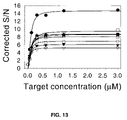
- “Background” fluorescence was determined as the fluorescent signal measured by the instrument in the absence of any probe or target. “Signal” in this system is represented by the magnitude of the fluorescent emission. “Background-subtracted fluorescent signals” were calculated by subtracting background fluorescence from the measured signals. “Noise” in the system represented the magnitude of the fluorescent signal measured for labeled probe in the absence of any target. “Background-subtracted signal-to-noise” (corrected S/N) ratios were calculated by dividing background-subtracted fluorescent signals by the value of background-subtracted noise [(signal-background)/(noise-background)]. These procedures established the performance characteristics of authentic molecular beacons in this experimental system, and provided a basis of comparison for each of the dual inversion probes.
- FIGS. 11A–D indicated that the dual inversion probes and corresponding molecular beacons showed qualitatively similar behaviors.
- the graphical presentation of corrected S/N shown in the figures represents interactions between the various probes and corresponding targets that were not fully complementary to the arm sequences of the molecular beacons.
- the graphs clearly show that each of the probes exhibited increased fluorescence following hybridization to the target oligonucleotide. This was consistent with an expected transition from a closed state to an open state following interaction with a complementary target, as would result from the physical separation of the fluorophore and quencher moieties due to opening of a stem structure that was closed in the absence of target.
- the carbon atoms of the propyl linker essentially duplicate the spacing of the three carbon atoms that are typically positioned between the 3′ and 5′ oxygen atoms of a ribose or deoxyribose moiety that comprises a polynucleotide backbone.
- the 5′-5′ inversion linkage of the 1504 probe similarly included a propyl linker.
- the 3′-3′ inversion linkage of the 1505 probe included an 8 atom “triethylene glycol” linker having the structure —(CH 2 ) 2 O(CH 2 ) 2 O(CH 2 ) 2 —.
- the 5′-5′ inversion linkage of the 1506 probe included a triethylene glycol linker.
- Example 6 describes the methods used to demonstrate that dual inversion probes which included at least one chemical linker at the position of the inversion linkage transitioned from a closed conformation to an open conformation following hybridization with a target polynucleotide.
- non-nucleotide linkers that are unlabeled, such as the propyl and triethylene glycol linkers employed in the foregoing Example
- other non-nucleotide linkers can be included in the structures of parallel-stem hybridization probes and dual inversion probes. More particularly, labeled or unlabeled non-nucleotide linkers can be joined to either or both of the arm structures, to the target-complementary loop structures, or even at the positions of one or both of the inversion linkages of the invented probes.
- the inversion probe includes at least one inversion linkage that includes a non-nucleotide linker.
- the chemical linker is a non-nucleotide linker of the type described by Arnold et al., in U.S. Pat. No. 6,031,091, the disclosure of this patent document being incorporated by reference herein.
- This patent document particularly discloses how to make and use phosphoramidites for incorporating non-nucleotide linkers into the structure of synthetic polynucleotides, and further discloses how to attach detectable labels, including chemiluminescent and fluorescent moieties, to the non-nucleotide linker.
- Non-nucleotide linkers can be incorporated into any of the loop region, the arm structures, or even the inversion linkages of the inversion probes as long as the presence of the linker does not prevent hybrid formation between the probe and its target polynucleotide.
Landscapes
- Chemical & Material Sciences (AREA)
- Life Sciences & Earth Sciences (AREA)
- Organic Chemistry (AREA)
- Health & Medical Sciences (AREA)
- Proteomics, Peptides & Aminoacids (AREA)
- Engineering & Computer Science (AREA)
- Zoology (AREA)
- Wood Science & Technology (AREA)
- Biochemistry (AREA)
- Molecular Biology (AREA)
- Biotechnology (AREA)
- Analytical Chemistry (AREA)
- General Health & Medical Sciences (AREA)
- Genetics & Genomics (AREA)
- Immunology (AREA)
- Microbiology (AREA)
- Biophysics (AREA)
- Physics & Mathematics (AREA)
- Bioinformatics & Cheminformatics (AREA)
- General Engineering & Computer Science (AREA)
- Measuring Or Testing Involving Enzymes Or Micro-Organisms (AREA)
Abstract
Description
| TABLE 1 |
| Quantifying Probe: Target Interactions |
| Tm at 260 nm | |||
| Probe Features | (in ° C.) | ||
| |
||
| 1093 | Molecular Beacon | 61.8 |
| 1034 | Linear Probe with Inversion | not detected |
| |
||
| 1094 | Parallel-Stem Hybridization Probe | 44.6† |
| Probe/ |
||
| 1093/1061 | Molecular Beacon | 72.8† |
| 1093/1059 | Molecular Beacon | 52.2† |
| 1034/1061 | Linear Probe with Inversion | 79.1† |
| |
||
| 1034/1059 | Linear Probe with Inversion | 68.9 |
| |
||
| 1094/1061 | Parallel-Stem Hybridization Probe | 79.6† |
| 1094/1059 | Parallel-Stem Hybridization Probe | 77.8† |
| †Value represents the averaged measurements of two trials | ||
| TABLE 2 |
| Quantifying Probe: Target Interactions |
| Tm at 260 nm | |||
| Probe Features | (in ° C.) | ||
| |
||
| 1261 | Molecular Beacon | 47.9 |
| 1262 | Parallel-Stem Hybridization Probe | 36.9 |
| Probe/ |
||
| 1261/1269 | Molecular Beacon | 48.4 |
| 1262/1269 | Parallel-Stem Hybridization Probe | 41.4 |
| TABLE 3 |
| Oligonucleotides Used for illustrating the Utility |
| of Dual Inversion Probes |
| (Pan-Bacterial Probes and Targets) |
| Oligo | SEQ ID | |
| Name | Sequence | NO: |
| 1521 | 5′-[F]-CCGAGGACCGACAAGGAAUUUCGCGTCCTCGG- | 11 |
| [D]-3′ | ||
| 1522 | 5′-[D]-GGCTCCTG-3′-3′-CGCUUUAAGGAACAGC-5′-5′- | 12 |
| CAGGAGCC-[F]-3′ | ||
| 1254 | 5′- | 13 |
| GGCCGUACCUAUAACGGUCCUAAGGUAGCGAAAUUCC | ||
| UUGUCGGGUAAGUUCCGACCUGCAC-3′ | ||
| 1523 | 5′- | 14 |
| GGCCGUACCUAUAACGGUCCCGAGGACGCGAAAUUCC | ||
| UUGUCGGUCCUCGGCCGACCUGCAC-3′ | ||
| “[F]” represents fluorescein | ||
| “[D]” represents DABCYL | ||
| TABLE 4 |
| Oligonucleotides Used for Illustrating the Utility |
| of Dual Inversion Probes |
| (Pan-Fungal Probes and Targets) |
| Oligo | SEQ ID | |
| Name | Sequence | NO: |
| 1531 | 5′-[F]- | 15 |
| CCGAGGACGUCUGGACCUGGUGAGUUUCCCGTCCTCG | ||
| G-[D]-3′ | ||
| 1532 | 5′-[D]-GGCTCCTG-3′-3′- | 16 |
| CCCUUUGAGUGGUCCAGGUCUG-5′-5′-CAGGAGCC | ||
| -[F]-3′ | ||
| 1307 | 5′- | 17 |
| CUGCGGCUUAAUUUGACUCAACACGGGGAAACUCACC | ||
| AGGUCCAGACACAAUAAGGAUUGACAGAUUGAGAGC | ||
| UC-3′ | ||
| 1533 | 5′- | 18 |
| CUGCGGCUUAAUUUGACCCGAGGACGGGAAACUCACC | ||
| AGGUCCAGACGUCCUCCGGAUUGACAGAUUGAGAGC | ||
| UC-3′ | ||
| “[F]” represents fluorescein | ||
| “[D]” represents DABCYL | ||
| TABLE 5 |
| Oligonucleotides Used for Illustrating the Utility |
| of Dual Inversion Probes |
| (Enterobacteriaceae Probes and Targets) |
| Oligo | SEQ ID | |
| Name | Sequence | NO: |
| 1541 | 5′-[F]-CCGAGGACCCGCUUGCUCUCGCGAGGTCCT | 19 |
| CGG-[D]-3′ | ||
| 1542 | 5′-[D]-GGCTCCTG-3′-3′- |
20 |
| CC-5′-5′-CAGGAGCC-[F]-3′ | ||
| 1317 | 5′- | 21 |
| GGGCUACACACGUGCUACAAUGGCGCAUACAAAGAG | ||
| AAGCGACCUCGCGAGAGCAAGCGGACCUCAUAAAGUG | ||
| CGUCGUAGUCCGG-3′ | ||
| 1543 | 5′- | 22 |
| GGGCUACACACGUGCUACAAUGGCGCAUACAAAGACC | ||
| GAGGACCUCGCGAGAGCAAGCGGGUCCUCGGAAGUGC | ||
| GUCGUAGUCCGG-3′ | ||
| “[F]” represents fluorescein | ||
| “[D]” represents DABCYL | ||
| TABLE 6 |
| Oligonucleotides Used for Illustrating the Utility |
| of Dual Inversion Probes |
| (Gram Positive Bacterial Probes and Targets) |
| SEQ | ||
| Oligo | ID | |
| Name | Sequence | NO: |
| 1551 | 5′-[F]- | 23 |
| CCGAGGACGAGGGAACCUUUGGGCGCGTCCTCGG-[D]- | ||
| 3′ | ||
| 1552 | 5′-[D]-GGCTCCTG-3′-3′-CGCGGGUUUCCAAGGGAG- | 24 |
| 5′-5′-CAGGAGCC-[F]-3′ | ||
| 1327 | 5′- | 25 |
| UGGGGCGGUUGCCUCCUAAAGAGUAACGGAGGCGCCC | ||
| AAAGGUUCCCUCAGCCUGGUCGGCAAUCAGGUGUU-3′ | ||
| 1553 | 5′- | 26 |
| UGGGGCGGUUGCCUCCUAAAGAGCCGAGGACGCGCCC | ||
| AAAGGUUCCCUCGUCCUCGGCGGCAAUCAGGUGUU-3′ | ||
| “[F]” represents fluorescein | ||
| “[D]” represents DABCYL | ||
| TABLE 7 |
| Oligonucleotides Used for Illustrating the Utility |
| of Inversion Probes Having Inversion Linkages that |
| Include Chemical Linkers |
| SEQ | ||
| Oligo | ID | |
| Name | Sequence | NO: |
| 1501 | 5′-[D]-GGTGTGGGGUACAGUGCAGGGGCACACC-[F]- | 27 |
| 3′ | ||
| 1502 | 5′-[D]-GGTGTG-3′-3′-GGGUACAGUGCAGGGG-5′-5′- | 28 |
| CACACC-[F]-3′ | ||
| 1503 | 5′-[D]-GGTGTG-3′-linker-3′-GGGUACAGUGCAGG | 29 |
| GG-5′-5′-CACACC-[F]-3′ | ||
| 1504 | 5′-[D]-GGTGTG-3′-3′-GGGUACAGUGCAGGGG-5′- | 30 |
| linker-5′-CACACC-[F]-3′ | ||
| 1505 | 5′-[D]-GGTGTG-3′-linker-3′-GGGUACAGUGCAGG | 31 |
| GG-5′-5′-CACACC-[F]-3′ | ||
| 1506 | 5′-[D]-GGTGTG-3′-3′-GGGUACAGUGCAGGGG-5′- | 32 |
| linker-5′-CACACC-[F]-3′ | ||
| 1507 | 5′-[D]-GGTGTG-3′-linker-3′-GGGUACAGUGCAGG | 33 |
| GG-5′-linker-5′-CACACC-[F]-3′ | ||
| 1508 | 5′-[D]-GGTGTG-3′-linker-3′-GGGUACAGUGCAGG | 34 |
| GG-5′-linker-5′-CACACC-[F]-3′ | ||
| “[F]” represents fluorescein | ||
| “[D]” represents DABCYL | ||
Claims (19)
Priority Applications (2)
| Application Number | Priority Date | Filing Date | Title |
|---|---|---|---|
| US10/388,918 US7070933B2 (en) | 2001-09-28 | 2003-03-14 | Inversion probes |
| US11/477,988 US20060246500A1 (en) | 2001-09-28 | 2006-06-29 | Polynucleotide detection method employing self-reporting dual inversion probes |
Applications Claiming Priority (3)
| Application Number | Priority Date | Filing Date | Title |
|---|---|---|---|
| US32560001P | 2001-09-28 | 2001-09-28 | |
| US25927202A | 2002-09-27 | 2002-09-27 | |
| US10/388,918 US7070933B2 (en) | 2001-09-28 | 2003-03-14 | Inversion probes |
Related Parent Applications (1)
| Application Number | Title | Priority Date | Filing Date |
|---|---|---|---|
| US25927202A Continuation-In-Part | 2001-09-28 | 2002-09-27 |
Related Child Applications (1)
| Application Number | Title | Priority Date | Filing Date |
|---|---|---|---|
| US11/477,988 Continuation US20060246500A1 (en) | 2001-09-28 | 2006-06-29 | Polynucleotide detection method employing self-reporting dual inversion probes |
Publications (2)
| Publication Number | Publication Date |
|---|---|
| US20040005595A1 US20040005595A1 (en) | 2004-01-08 |
| US7070933B2 true US7070933B2 (en) | 2006-07-04 |
Family
ID=30002762
Family Applications (2)
| Application Number | Title | Priority Date | Filing Date |
|---|---|---|---|
| US10/388,918 Expired - Lifetime US7070933B2 (en) | 2001-09-28 | 2003-03-14 | Inversion probes |
| US11/477,988 Abandoned US20060246500A1 (en) | 2001-09-28 | 2006-06-29 | Polynucleotide detection method employing self-reporting dual inversion probes |
Family Applications After (1)
| Application Number | Title | Priority Date | Filing Date |
|---|---|---|---|
| US11/477,988 Abandoned US20060246500A1 (en) | 2001-09-28 | 2006-06-29 | Polynucleotide detection method employing self-reporting dual inversion probes |
Country Status (1)
| Country | Link |
|---|---|
| US (2) | US7070933B2 (en) |
Cited By (9)
| Publication number | Priority date | Publication date | Assignee | Title |
|---|---|---|---|---|
| WO2006002167A3 (en) * | 2004-06-17 | 2007-03-01 | Univ Florida Res Foudation Inc | Multi-acceptor molecular probes and applications thereof |
| US20070166731A1 (en) * | 2004-01-02 | 2007-07-19 | University Of Rochester | Method of identifying hairpin dna probes by partial fold analysis |
| US20080016758A1 (en) * | 2005-07-18 | 2008-01-24 | Postech Foundation | Method for the production of mushroom mycelia using starch pulp liquid medium |
| US20080182759A1 (en) * | 2006-12-18 | 2008-07-31 | Arcxis Biotechnologies | Selection of aptamers based on geometry |
| US20090106853A1 (en) * | 2004-02-18 | 2009-04-23 | Kambiz Shekdar | Methods and materials using signaling probes |
| US20100184614A1 (en) * | 2007-05-23 | 2010-07-22 | Zheng Ye | Microarray systems and methods for identifying dna-binding proteins |
| US20100212040A1 (en) * | 1999-11-23 | 2010-08-19 | Chromocell Corporation | Isolation of living cells and preparation of cell lines based on detection and quantification of preselected cellular ribonucleic acid sequences |
| US8957002B2 (en) | 2007-11-05 | 2015-02-17 | University Of Rochester | DNA microarray having hairpin probes tethered to nanostructured metal surface |
| US9127317B2 (en) | 2012-03-02 | 2015-09-08 | Winthrop-University Hospital | Method for using probe based PCR detection to measure the levels of circulating demethylated β cell derived DNA as a measure of β cell loss in diabetes |
Families Citing this family (19)
| Publication number | Priority date | Publication date | Assignee | Title |
|---|---|---|---|---|
| AT501931B1 (en) * | 2004-12-10 | 2007-08-15 | Chemiefaser Lenzing Ag | CELLULOSE STAPLE FIBER AND ITS USE |
| EP1870478A1 (en) * | 2006-06-20 | 2007-12-26 | Hitachi, Ltd. | Biosensor element and method for manufacturing the same |
| US20090162863A1 (en) * | 2007-12-13 | 2009-06-25 | Hitachi High-Technologies Corporation | Nucleic acid detection probe |
| US8538733B2 (en) * | 2008-01-25 | 2013-09-17 | Life Technologies Corporation | Methods for the analysis of dissociation melt curve data |
| AU2009246363B2 (en) * | 2008-05-13 | 2013-10-24 | Gen-Probe Incorporated | Inactivatable target capture oligomers for use in the selective hybridization and capture of target nucleic acid sequences |
| US12129514B2 (en) | 2009-04-30 | 2024-10-29 | Molecular Loop Biosolutions, Llc | Methods and compositions for evaluating genetic markers |
| US20120165202A1 (en) * | 2009-04-30 | 2012-06-28 | Good Start Genetics, Inc. | Methods and compositions for evaluating genetic markers |
| AU2010242073C1 (en) | 2009-04-30 | 2015-12-24 | Good Start Genetics, Inc. | Methods and compositions for evaluating genetic markers |
| US12410463B2 (en) | 2009-09-18 | 2025-09-09 | The Trustees Of The University Of Pennsylvania | Molecular beacons |
| US9828628B2 (en) * | 2010-11-24 | 2017-11-28 | The Regents Of The University Of California | Nucleotide-based probes and methods for the detection and quantification of macromolecules and other analytes |
| US9163281B2 (en) | 2010-12-23 | 2015-10-20 | Good Start Genetics, Inc. | Methods for maintaining the integrity and identification of a nucleic acid template in a multiplex sequencing reaction |
| WO2012106668A2 (en) * | 2011-02-03 | 2012-08-09 | Fluidigm Corporation | Multifunctional probe-primers |
| US8209130B1 (en) | 2012-04-04 | 2012-06-26 | Good Start Genetics, Inc. | Sequence assembly |
| US10227635B2 (en) | 2012-04-16 | 2019-03-12 | Molecular Loop Biosolutions, Llc | Capture reactions |
| US10851414B2 (en) | 2013-10-18 | 2020-12-01 | Good Start Genetics, Inc. | Methods for determining carrier status |
| US11408024B2 (en) | 2014-09-10 | 2022-08-09 | Molecular Loop Biosciences, Inc. | Methods for selectively suppressing non-target sequences |
| EP4095261B1 (en) | 2015-01-06 | 2025-05-28 | Molecular Loop Biosciences, Inc. | Screening for structural variants |
| CN111378746A (en) * | 2018-12-27 | 2020-07-07 | 北京福安华生物科技有限公司 | Artificial mimic nucleic acid molecular beacon and kit for detecting rs12415607 site polymorphism of CASP7 gene |
| CN119799904B (en) * | 2025-03-14 | 2025-12-23 | 温州医科大学 | Product for KRAS gene detection based on combination of dumbbell probe and RCA and application of product |
Citations (32)
| Publication number | Priority date | Publication date | Assignee | Title |
|---|---|---|---|---|
| WO1991006626A2 (en) | 1989-10-23 | 1991-05-16 | Gilead Sciences, Inc. | Triple helix formation in oligonucleotide therapy |
| WO1992010590A1 (en) | 1990-12-10 | 1992-06-25 | Gilead Sciences, Inc. | Inhibition of transcription by formation of triple helixes |
| WO1993009127A1 (en) | 1991-11-07 | 1993-05-13 | Gilead Sciences, Inc. | Enhanced triple-helix formation directed by oligonucleotides composed of 2'-deoxy-7-deazaxanthosine and 2'-deoxy-7-deazaguanosine and related analogs |
| WO1993010820A1 (en) | 1991-11-26 | 1993-06-10 | Gilead Sciences, Inc. | Enhanced triple-helix and double-helix formation with oligomers containing modified pyrimidines |
| US5312728A (en) | 1988-09-30 | 1994-05-17 | Public Health Research Institute Of The City Of New York, Inc. | Assays and kits incorporating nucleic acid probes containing improved molecular switch |
| WO1994024144A2 (en) | 1993-04-19 | 1994-10-27 | Gilead Sciences, Inc. | Enhanced triple-helix and double-helix formation with oligomers containing modified purines |
| WO1995000638A2 (en) | 1993-06-23 | 1995-01-05 | Genesys Pharma Inc. | Antisense oligonucleotides and therapeutic use thereof in human immunodeficiency virus infection |
| WO1995007918A2 (en) | 1993-09-17 | 1995-03-23 | Gilead Sciences, Inc. | Pyrimidine derivatives for labeled binding partners |
| US5484908A (en) | 1991-11-26 | 1996-01-16 | Gilead Sciences, Inc. | Oligonucleotides containing 5-propynyl pyrimidines |
| US5594121A (en) | 1991-11-07 | 1997-01-14 | Gilead Sciences, Inc. | Enhanced triple-helix and double-helix formation with oligomers containing modified purines |
| US5677439A (en) | 1990-08-03 | 1997-10-14 | Sanofi | Oligonucleotide analogues containing phosphate diester linkage substitutes, compositions thereof, and precursor dinucleotide analogues |
| US5721218A (en) | 1989-10-23 | 1998-02-24 | Gilead Sciences, Inc. | Oligonucleotides with inverted polarity |
| US5750669A (en) | 1990-07-02 | 1998-05-12 | Hoechst Aktiengesellschaft | Oligonucleotide analogs with terminal 3'-3' or 5'-5' internucleotide linkages |
| US5780610A (en) | 1994-08-30 | 1998-07-14 | Collins; Mark L. | Reduction of nonspecific hybridization by using novel base-pairing schemes |
| US5830653A (en) | 1991-11-26 | 1998-11-03 | Gilead Sciences, Inc. | Methods of using oligomers containing modified pyrimidines |
| WO1999009045A1 (en) | 1997-08-20 | 1999-02-25 | Somagenics, Inc. | Antisense and antigene therapeutics with improved binding properties and methods for their use |
| US5888733A (en) | 1995-11-16 | 1999-03-30 | Dako A/S | In situ hybridization to detect specific nucleic acid sequences in eucaryotic samples |
| WO1999024452A2 (en) | 1997-11-07 | 1999-05-20 | Isis Pharmaceuticals, Inc. | Pyrimidine derivatives for labeled binding partners |
| US5925517A (en) * | 1993-11-12 | 1999-07-20 | The Public Health Research Institute Of The City Of New York, Inc. | Detectably labeled dual conformation oligonucleotide probes, assays and kits |
| US6001657A (en) | 1995-10-12 | 1999-12-14 | North Carolina State University | Antibodies that selectively bind quadruplex nucleic acids |
| WO1999064625A2 (en) | 1998-06-05 | 1999-12-16 | Ribotargets Limited | Methods and kits for discovery of rna-binding compounds |
| US6007992A (en) | 1997-11-10 | 1999-12-28 | Gilead Sciences, Inc. | Pyrimidine derivatives for labeled binding partners |
| US6028183A (en) | 1997-11-07 | 2000-02-22 | Gilead Sciences, Inc. | Pyrimidine derivatives and oligonucleotides containing same |
| US6037130A (en) | 1998-07-28 | 2000-03-14 | The Public Health Institute Of The City Of New York, Inc. | Wavelength-shifting probes and primers and their use in assays and kits |
| US6037120A (en) | 1995-10-12 | 2000-03-14 | Benner; Steven Albert | Recognition of oligonucleotides containing non-standard base pairs |
| US6147199A (en) | 1991-12-09 | 2000-11-14 | Boehringer Mannheim | 2-deoxy-isoguanosines isoteric analogues and isoguanosine containing oligonucleotides |
| US6150097A (en) * | 1996-04-12 | 2000-11-21 | The Public Health Research Institute Of The City Of New York, Inc. | Nucleic acid detection probes having non-FRET fluorescence quenching and kits and assays including such probes |
| WO2001032924A1 (en) | 1999-10-29 | 2001-05-10 | Cygene, Inc. | Compositions and methods of synthesis and use of novel nucleic acid structures |
| US6235484B1 (en) * | 1999-05-03 | 2001-05-22 | Gen-Probe Incorporated | Polynucleotide probes for detection and quantitation of actinomycetes |
| US6235887B1 (en) | 1991-11-26 | 2001-05-22 | Isis Pharmaceuticals, Inc. | Enhanced triple-helix and double-helix formation directed by oligonucleotides containing modified pyrimidines |
| US6355421B1 (en) | 1997-10-27 | 2002-03-12 | Boston Probes, Inc. | Methods, kits and compositions pertaining to PNA molecular beacons |
| WO2002101092A2 (en) | 2001-06-08 | 2002-12-19 | Isis Innovation Limited | Oligonucleotides for detecting hybridisation |
-
2003
- 2003-03-14 US US10/388,918 patent/US7070933B2/en not_active Expired - Lifetime
-
2006
- 2006-06-29 US US11/477,988 patent/US20060246500A1/en not_active Abandoned
Patent Citations (39)
| Publication number | Priority date | Publication date | Assignee | Title |
|---|---|---|---|---|
| US5312728A (en) | 1988-09-30 | 1994-05-17 | Public Health Research Institute Of The City Of New York, Inc. | Assays and kits incorporating nucleic acid probes containing improved molecular switch |
| WO1991006626A2 (en) | 1989-10-23 | 1991-05-16 | Gilead Sciences, Inc. | Triple helix formation in oligonucleotide therapy |
| US5721218A (en) | 1989-10-23 | 1998-02-24 | Gilead Sciences, Inc. | Oligonucleotides with inverted polarity |
| US5750669A (en) | 1990-07-02 | 1998-05-12 | Hoechst Aktiengesellschaft | Oligonucleotide analogs with terminal 3'-3' or 5'-5' internucleotide linkages |
| US5677439A (en) | 1990-08-03 | 1997-10-14 | Sanofi | Oligonucleotide analogues containing phosphate diester linkage substitutes, compositions thereof, and precursor dinucleotide analogues |
| WO1992010590A1 (en) | 1990-12-10 | 1992-06-25 | Gilead Sciences, Inc. | Inhibition of transcription by formation of triple helixes |
| WO1993009127A1 (en) | 1991-11-07 | 1993-05-13 | Gilead Sciences, Inc. | Enhanced triple-helix formation directed by oligonucleotides composed of 2'-deoxy-7-deazaxanthosine and 2'-deoxy-7-deazaguanosine and related analogs |
| US5594121A (en) | 1991-11-07 | 1997-01-14 | Gilead Sciences, Inc. | Enhanced triple-helix and double-helix formation with oligomers containing modified purines |
| US5484908A (en) | 1991-11-26 | 1996-01-16 | Gilead Sciences, Inc. | Oligonucleotides containing 5-propynyl pyrimidines |
| US6235887B1 (en) | 1991-11-26 | 2001-05-22 | Isis Pharmaceuticals, Inc. | Enhanced triple-helix and double-helix formation directed by oligonucleotides containing modified pyrimidines |
| US5645985A (en) | 1991-11-26 | 1997-07-08 | Gilead Sciences, Inc. | Enhanced triple-helix and double-helix formation with oligomers containing modified pyrimidines |
| WO1993010820A1 (en) | 1991-11-26 | 1993-06-10 | Gilead Sciences, Inc. | Enhanced triple-helix and double-helix formation with oligomers containing modified pyrimidines |
| US5830653A (en) | 1991-11-26 | 1998-11-03 | Gilead Sciences, Inc. | Methods of using oligomers containing modified pyrimidines |
| US6147199A (en) | 1991-12-09 | 2000-11-14 | Boehringer Mannheim | 2-deoxy-isoguanosines isoteric analogues and isoguanosine containing oligonucleotides |
| WO1994024144A2 (en) | 1993-04-19 | 1994-10-27 | Gilead Sciences, Inc. | Enhanced triple-helix and double-helix formation with oligomers containing modified purines |
| US5811537A (en) | 1993-06-23 | 1998-09-22 | Novopharm Biotech Inc. | Antisense oligonucleotides targeted against human immunodeficiency virus |
| US5594122A (en) | 1993-06-23 | 1997-01-14 | Genesys Pharma Inc. | Antisense oligonucleotides targeted against human immunodeficiency virus |
| WO1995000638A2 (en) | 1993-06-23 | 1995-01-05 | Genesys Pharma Inc. | Antisense oligonucleotides and therapeutic use thereof in human immunodeficiency virus infection |
| US5502177A (en) | 1993-09-17 | 1996-03-26 | Gilead Sciences, Inc. | Pyrimidine derivatives for labeled binding partners |
| US6005096A (en) | 1993-09-17 | 1999-12-21 | Gilead Sciences, Inc. | Pyrimidine derivatives |
| US5763588A (en) | 1993-09-17 | 1998-06-09 | Gilead Sciences, Inc. | Pyrimidine derivatives for labeled binding partners |
| WO1995007918A2 (en) | 1993-09-17 | 1995-03-23 | Gilead Sciences, Inc. | Pyrimidine derivatives for labeled binding partners |
| US6103476A (en) | 1993-11-12 | 2000-08-15 | The Public Health Research Institute Of The City Of New York, Inc. | Detectably labeled, dual conformation oligonucleotide probes, assays and kits |
| US5925517A (en) * | 1993-11-12 | 1999-07-20 | The Public Health Research Institute Of The City Of New York, Inc. | Detectably labeled dual conformation oligonucleotide probes, assays and kits |
| US5780610A (en) | 1994-08-30 | 1998-07-14 | Collins; Mark L. | Reduction of nonspecific hybridization by using novel base-pairing schemes |
| US6001657A (en) | 1995-10-12 | 1999-12-14 | North Carolina State University | Antibodies that selectively bind quadruplex nucleic acids |
| US6037120A (en) | 1995-10-12 | 2000-03-14 | Benner; Steven Albert | Recognition of oligonucleotides containing non-standard base pairs |
| US5888733A (en) | 1995-11-16 | 1999-03-30 | Dako A/S | In situ hybridization to detect specific nucleic acid sequences in eucaryotic samples |
| US6150097A (en) * | 1996-04-12 | 2000-11-21 | The Public Health Research Institute Of The City Of New York, Inc. | Nucleic acid detection probes having non-FRET fluorescence quenching and kits and assays including such probes |
| WO1999009045A1 (en) | 1997-08-20 | 1999-02-25 | Somagenics, Inc. | Antisense and antigene therapeutics with improved binding properties and methods for their use |
| US6355421B1 (en) | 1997-10-27 | 2002-03-12 | Boston Probes, Inc. | Methods, kits and compositions pertaining to PNA molecular beacons |
| WO1999024452A2 (en) | 1997-11-07 | 1999-05-20 | Isis Pharmaceuticals, Inc. | Pyrimidine derivatives for labeled binding partners |
| US6028183A (en) | 1997-11-07 | 2000-02-22 | Gilead Sciences, Inc. | Pyrimidine derivatives and oligonucleotides containing same |
| US6007992A (en) | 1997-11-10 | 1999-12-28 | Gilead Sciences, Inc. | Pyrimidine derivatives for labeled binding partners |
| WO1999064625A2 (en) | 1998-06-05 | 1999-12-16 | Ribotargets Limited | Methods and kits for discovery of rna-binding compounds |
| US6037130A (en) | 1998-07-28 | 2000-03-14 | The Public Health Institute Of The City Of New York, Inc. | Wavelength-shifting probes and primers and their use in assays and kits |
| US6235484B1 (en) * | 1999-05-03 | 2001-05-22 | Gen-Probe Incorporated | Polynucleotide probes for detection and quantitation of actinomycetes |
| WO2001032924A1 (en) | 1999-10-29 | 2001-05-10 | Cygene, Inc. | Compositions and methods of synthesis and use of novel nucleic acid structures |
| WO2002101092A2 (en) | 2001-06-08 | 2002-12-19 | Isis Innovation Limited | Oligonucleotides for detecting hybridisation |
Non-Patent Citations (59)
Cited By (17)
| Publication number | Priority date | Publication date | Assignee | Title |
|---|---|---|---|---|
| US20100212040A1 (en) * | 1999-11-23 | 2010-08-19 | Chromocell Corporation | Isolation of living cells and preparation of cell lines based on detection and quantification of preselected cellular ribonucleic acid sequences |
| US7442510B2 (en) * | 2004-01-02 | 2008-10-28 | University Of Rochester | Method of identifying hairpin DNA probes by partial fold analysis |
| US7598034B2 (en) | 2004-01-02 | 2009-10-06 | University Of Rochester | Method of identifying hairpin DNA probes by partial fold analysis |
| US20070166731A1 (en) * | 2004-01-02 | 2007-07-19 | University Of Rochester | Method of identifying hairpin dna probes by partial fold analysis |
| US8916503B2 (en) | 2004-02-18 | 2014-12-23 | Chromocell Corporation | Methods and materials using signaling probes |
| US20090106853A1 (en) * | 2004-02-18 | 2009-04-23 | Kambiz Shekdar | Methods and materials using signaling probes |
| WO2006002167A3 (en) * | 2004-06-17 | 2007-03-01 | Univ Florida Res Foudation Inc | Multi-acceptor molecular probes and applications thereof |
| US8652851B2 (en) | 2004-06-17 | 2014-02-18 | University Of Florida Research Foundation, Inc. | Multi-acceptor molecular probes and applications thereof |
| US20100248385A1 (en) * | 2004-06-17 | 2010-09-30 | University Of Florida Research Foundation, Inc. | Multi-acceptor molecular probes and applications thereof |
| US20080016758A1 (en) * | 2005-07-18 | 2008-01-24 | Postech Foundation | Method for the production of mushroom mycelia using starch pulp liquid medium |
| US20080182759A1 (en) * | 2006-12-18 | 2008-07-31 | Arcxis Biotechnologies | Selection of aptamers based on geometry |
| US9938641B2 (en) | 2006-12-18 | 2018-04-10 | Fluidigm Corporation | Selection of aptamers based on geometry |
| US20100184614A1 (en) * | 2007-05-23 | 2010-07-22 | Zheng Ye | Microarray systems and methods for identifying dna-binding proteins |
| US8957002B2 (en) | 2007-11-05 | 2015-02-17 | University Of Rochester | DNA microarray having hairpin probes tethered to nanostructured metal surface |
| US9127317B2 (en) | 2012-03-02 | 2015-09-08 | Winthrop-University Hospital | Method for using probe based PCR detection to measure the levels of circulating demethylated β cell derived DNA as a measure of β cell loss in diabetes |
| US9920372B2 (en) | 2012-03-02 | 2018-03-20 | Nyu Winthrop Hospital | Method for using probe based PCR detection to measure the levels of circulating demethylated beta cell derived DNA as a measure of beta cell loss in diabetes |
| US10221457B2 (en) | 2012-03-02 | 2019-03-05 | Nyu Winthrop Hospital | Method for using probe based PCR detection to measure the levels of circulating demethylated beta cell derived DNA as a measure of beta cell loss in diabetes |
Also Published As
| Publication number | Publication date |
|---|---|
| US20060246500A1 (en) | 2006-11-02 |
| US20040005595A1 (en) | 2004-01-08 |
Similar Documents
| Publication | Publication Date | Title |
|---|---|---|
| US7070933B2 (en) | Inversion probes | |
| US6815164B2 (en) | Methods and probes for detection and/or quantification of nucleic acid sequences | |
| US6251600B1 (en) | Homogeneous nucleotide amplification and assay | |
| EP1440311B1 (en) | Affinity-shifted probes for quantifying analyte polynucleotides | |
| JP5730239B2 (en) | Method for multiplexing recombinase polymerase amplification | |
| CA2849023C (en) | Probe:antiprobe compositions for high specificity dna or rna detection | |
| CN102762744B (en) | Target detection using target signal generating primers | |
| US20120040349A1 (en) | Method for detecting nucleic acids | |
| AU2002213096A1 (en) | Methods and probes for detection and/or quantification of nucleic acid sequences | |
| BRPI0616466B1 (en) | composition of multicomponent nucleic acid enzymes (mnazime), methods for detecting the presence of at least one combination facilitator, a target and a nucleic acid sequence variant, methods for fabricating a mnazime plurality, testing partial catalytic nucleic sequences and identify their positions, as well as use of at least one oligonucleotide | |
| JP2001523111A (en) | Target-dependent reactions using structure-bridged oligonucleotides | |
| US7504218B2 (en) | Key probe compositions and methods for polynucleotide detection | |
| US20140274779A1 (en) | Multiplex allele detection | |
| US20060194222A1 (en) | Triplex probe compositions and methods for polynucleotide detection | |
| US20070020656A1 (en) | Snapback oligonucleotide probe | |
| US7538202B2 (en) | Enzyme-free isothermal exponential amplification of nucleic acids and nucleic acid analog signals | |
| ES2759991T3 (en) | Assay to detect and quantify HIV-1 | |
| AU2003293367A1 (en) | Compositions and methods for polynucleotide detection | |
| Ranasinghe | Novel techniques for genetic analysis |
Legal Events
| Date | Code | Title | Description |
|---|---|---|---|
| AS | Assignment |
Owner name: GEN-PROBE INCORPORATED, CALIFORNIA Free format text: ASSIGNMENT OF ASSIGNORS INTEREST;ASSIGNOR:BROWNE, KENNETH A.;REEL/FRAME:014045/0527 Effective date: 20031008 |
|
| STCF | Information on status: patent grant |
Free format text: PATENTED CASE |
|
| FPAY | Fee payment |
Year of fee payment: 4 |
|
| AS | Assignment |
Owner name: GOLDMAN SACHS BANK USA, NEW YORK Free format text: SECURITY AGREEMENT;ASSIGNORS:HOLOGIC, INC.;BIOLUCENT, LLC;CYTYC CORPORATION;AND OTHERS;REEL/FRAME:028810/0745 Effective date: 20120801 |
|
| FPAY | Fee payment |
Year of fee payment: 8 |
|
| AS | Assignment |
Owner name: CYTYC SURGICAL PRODUCTS, LIMITED PARTNERSHIP, MASSACHUSETTS Free format text: SECURITY INTEREST RELEASE REEL/FRAME 028810/0745;ASSIGNOR:GOLDMAN SACHS BANK USA, AS COLLATERAL AGENT;REEL/FRAME:035820/0239 Effective date: 20150529 Owner name: SUROS SURGICAL SYSTEMS, INC., MASSACHUSETTS Free format text: SECURITY INTEREST RELEASE REEL/FRAME 028810/0745;ASSIGNOR:GOLDMAN SACHS BANK USA, AS COLLATERAL AGENT;REEL/FRAME:035820/0239 Effective date: 20150529 Owner name: THIRD WAVE TECHNOLOGIES, INC., MASSACHUSETTS Free format text: SECURITY INTEREST RELEASE REEL/FRAME 028810/0745;ASSIGNOR:GOLDMAN SACHS BANK USA, AS COLLATERAL AGENT;REEL/FRAME:035820/0239 Effective date: 20150529 Owner name: CYTYC SURGICAL PRODUCTS, LIMITED PARTNERSHIP, MASS Free format text: SECURITY INTEREST RELEASE REEL/FRAME 028810/0745;ASSIGNOR:GOLDMAN SACHS BANK USA, AS COLLATERAL AGENT;REEL/FRAME:035820/0239 Effective date: 20150529 Owner name: BIOLUCENT, LLC, MASSACHUSETTS Free format text: SECURITY INTEREST RELEASE REEL/FRAME 028810/0745;ASSIGNOR:GOLDMAN SACHS BANK USA, AS COLLATERAL AGENT;REEL/FRAME:035820/0239 Effective date: 20150529 Owner name: GEN-PROBE INCORPORATED, MASSACHUSETTS Free format text: SECURITY INTEREST RELEASE REEL/FRAME 028810/0745;ASSIGNOR:GOLDMAN SACHS BANK USA, AS COLLATERAL AGENT;REEL/FRAME:035820/0239 Effective date: 20150529 Owner name: HOLOGIC, INC., MASSACHUSETTS Free format text: SECURITY INTEREST RELEASE REEL/FRAME 028810/0745;ASSIGNOR:GOLDMAN SACHS BANK USA, AS COLLATERAL AGENT;REEL/FRAME:035820/0239 Effective date: 20150529 Owner name: CYTYC CORPORATION, MASSACHUSETTS Free format text: SECURITY INTEREST RELEASE REEL/FRAME 028810/0745;ASSIGNOR:GOLDMAN SACHS BANK USA, AS COLLATERAL AGENT;REEL/FRAME:035820/0239 Effective date: 20150529 |
|
| AS | Assignment |
Owner name: BANK OF AMERICA, N.A., AS COLLATERAL AGENT, NORTH CAROLINA Free format text: SECURITY AGREEMENT;ASSIGNORS:HOLOGIC, INC.;BIOLUCENT, LLC;CYTYC CORPORATION;AND OTHERS;REEL/FRAME:036307/0199 Effective date: 20150529 Owner name: BANK OF AMERICA, N.A., AS COLLATERAL AGENT, NORTH Free format text: SECURITY AGREEMENT;ASSIGNORS:HOLOGIC, INC.;BIOLUCENT, LLC;CYTYC CORPORATION;AND OTHERS;REEL/FRAME:036307/0199 Effective date: 20150529 |
|
| AS | Assignment |
Owner name: CYTYC SURGICAL PRODUCTS, LIMITED PARTNERSHIP, MASSACHUSETTS Free format text: CORRECTIVE ASSIGNMENT TO CORRECT THE INCORRECT PATENT NO. 8081301 PREVIOUSLY RECORDED AT REEL: 035820 FRAME: 0239. ASSIGNOR(S) HEREBY CONFIRMS THE SECURITY INTEREST RELEASE;ASSIGNOR:GOLDMAN SACHS BANK USA, AS COLLATERAL AGENT;REEL/FRAME:044727/0529 Effective date: 20150529 Owner name: GOLDMAN SACHS BANK USA, NEW YORK Free format text: CORRECTIVE ASSIGNMENT TO CORRECT THE INCORRECT PATENT NO. 8081301 PREVIOUSLY RECORDED AT REEL: 028810 FRAME: 0745. ASSIGNOR(S) HEREBY CONFIRMS THE SECURITY AGREEMENT;ASSIGNORS:HOLOGIC, INC.;BIOLUCENT, LLC;CYTYC CORPORATION;AND OTHERS;REEL/FRAME:044432/0565 Effective date: 20120801 Owner name: CYTYC SURGICAL PRODUCTS, LIMITED PARTNERSHIP, MASS Free format text: CORRECTIVE ASSIGNMENT TO CORRECT THE INCORRECT PATENT NO. 8081301 PREVIOUSLY RECORDED AT REEL: 035820 FRAME: 0239. ASSIGNOR(S) HEREBY CONFIRMS THE SECURITY INTEREST RELEASE;ASSIGNOR:GOLDMAN SACHS BANK USA, AS COLLATERAL AGENT;REEL/FRAME:044727/0529 Effective date: 20150529 Owner name: THIRD WAVE TECHNOLOGIES, INC., MASSACHUSETTS Free format text: CORRECTIVE ASSIGNMENT TO CORRECT THE INCORRECT PATENT NO. 8081301 PREVIOUSLY RECORDED AT REEL: 035820 FRAME: 0239. ASSIGNOR(S) HEREBY CONFIRMS THE SECURITY INTEREST RELEASE;ASSIGNOR:GOLDMAN SACHS BANK USA, AS COLLATERAL AGENT;REEL/FRAME:044727/0529 Effective date: 20150529 Owner name: HOLOGIC, INC., MASSACHUSETTS Free format text: CORRECTIVE ASSIGNMENT TO CORRECT THE INCORRECT PATENT NO. 8081301 PREVIOUSLY RECORDED AT REEL: 035820 FRAME: 0239. ASSIGNOR(S) HEREBY CONFIRMS THE SECURITY INTEREST RELEASE;ASSIGNOR:GOLDMAN SACHS BANK USA, AS COLLATERAL AGENT;REEL/FRAME:044727/0529 Effective date: 20150529 Owner name: BIOLUCENT, LLC, MASSACHUSETTS Free format text: CORRECTIVE ASSIGNMENT TO CORRECT THE INCORRECT PATENT NO. 8081301 PREVIOUSLY RECORDED AT REEL: 035820 FRAME: 0239. ASSIGNOR(S) HEREBY CONFIRMS THE SECURITY INTEREST RELEASE;ASSIGNOR:GOLDMAN SACHS BANK USA, AS COLLATERAL AGENT;REEL/FRAME:044727/0529 Effective date: 20150529 Owner name: GEN-PROBE INCORPORATED, MASSACHUSETTS Free format text: CORRECTIVE ASSIGNMENT TO CORRECT THE INCORRECT PATENT NO. 8081301 PREVIOUSLY RECORDED AT REEL: 035820 FRAME: 0239. ASSIGNOR(S) HEREBY CONFIRMS THE SECURITY INTEREST RELEASE;ASSIGNOR:GOLDMAN SACHS BANK USA, AS COLLATERAL AGENT;REEL/FRAME:044727/0529 Effective date: 20150529 Owner name: SUROS SURGICAL SYSTEMS, INC., MASSACHUSETTS Free format text: CORRECTIVE ASSIGNMENT TO CORRECT THE INCORRECT PATENT NO. 8081301 PREVIOUSLY RECORDED AT REEL: 035820 FRAME: 0239. ASSIGNOR(S) HEREBY CONFIRMS THE SECURITY INTEREST RELEASE;ASSIGNOR:GOLDMAN SACHS BANK USA, AS COLLATERAL AGENT;REEL/FRAME:044727/0529 Effective date: 20150529 Owner name: CYTYC CORPORATION, MASSACHUSETTS Free format text: CORRECTIVE ASSIGNMENT TO CORRECT THE INCORRECT PATENT NO. 8081301 PREVIOUSLY RECORDED AT REEL: 035820 FRAME: 0239. ASSIGNOR(S) HEREBY CONFIRMS THE SECURITY INTEREST RELEASE;ASSIGNOR:GOLDMAN SACHS BANK USA, AS COLLATERAL AGENT;REEL/FRAME:044727/0529 Effective date: 20150529 |
|
| MAFP | Maintenance fee payment |
Free format text: PAYMENT OF MAINTENANCE FEE, 12TH YEAR, LARGE ENTITY (ORIGINAL EVENT CODE: M1553) Year of fee payment: 12 |