US6933302B2 - Nitrogen-based homo-camptothecin derivatives - Google Patents
Nitrogen-based homo-camptothecin derivatives Download PDFInfo
- Publication number
- US6933302B2 US6933302B2 US10/454,718 US45471803A US6933302B2 US 6933302 B2 US6933302 B2 US 6933302B2 US 45471803 A US45471803 A US 45471803A US 6933302 B2 US6933302 B2 US 6933302B2
- Authority
- US
- United States
- Prior art keywords
- hcpt
- hydroxy
- amino
- compound
- lower alkyl
- Prior art date
- Legal status (The legal status is an assumption and is not a legal conclusion. Google has not performed a legal analysis and makes no representation as to the accuracy of the status listed.)
- Expired - Lifetime
Links
- 0 [2*]C1=C2CN3C(=O)C4=C(C=C3C2=NC2=C1C([3*])=C([4*])C([5*])=C2[6*])C(C)(CC)C([12*])([13*])C(=O)OC4 Chemical compound [2*]C1=C2CN3C(=O)C4=C(C=C3C2=NC2=C1C([3*])=C([4*])C([5*])=C2[6*])C(C)(CC)C([12*])([13*])C(=O)OC4 0.000 description 7
- MLVNPTDRXVLYBG-FHIAPGCQSA-N CCC(=O)C1=C(COC=O)C(=O)N2CC3=CC4=C(C=CC=C4)N=C3C2=C1.CCC1(O)CC(=O)OCC2=C1C=C1C3=NC4=C(C=CC=C4)C=C3CN1C2=O.CC[C@@]1(O)C(=O)OCC2=C1C=C1C3=NC4=C(C=CC=C4)C=C3CN1C2=O Chemical compound CCC(=O)C1=C(COC=O)C(=O)N2CC3=CC4=C(C=CC=C4)N=C3C2=C1.CCC1(O)CC(=O)OCC2=C1C=C1C3=NC4=C(C=CC=C4)C=C3CN1C2=O.CC[C@@]1(O)C(=O)OCC2=C1C=C1C3=NC4=C(C=CC=C4)C=C3CN1C2=O MLVNPTDRXVLYBG-FHIAPGCQSA-N 0.000 description 1
- IUVFADDDGRNPGR-UHFFFAOYSA-N CCC1(OC(=O)C2=CC=N(C(=O)OC(C)(C)C)C=C2)CC(=O)OCC2=C1C=C1C3=N/C4=CC=CC=C4/C=C\3CN1C2=O Chemical compound CCC1(OC(=O)C2=CC=N(C(=O)OC(C)(C)C)C=C2)CC(=O)OCC2=C1C=C1C3=N/C4=CC=CC=C4/C=C\3CN1C2=O IUVFADDDGRNPGR-UHFFFAOYSA-N 0.000 description 1
- TWRSSIIIEIUUBL-UHFFFAOYSA-N CCC1(OC(=O)CCN2=CC=OC=C2)CC(=O)OCC2=C1C=C1C3=N/C4=CC=CC=C4/C=C\3CN1C2=O Chemical compound CCC1(OC(=O)CCN2=CC=OC=C2)CC(=O)OCC2=C1C=C1C3=N/C4=CC=CC=C4/C=C\3CN1C2=O TWRSSIIIEIUUBL-UHFFFAOYSA-N 0.000 description 1
- BEDRDROKDSOVOL-UHFFFAOYSA-N CCC1(OC(=O)CCN2CCC(C#N)(C3=CC=CC=C3)CC2)CC(=O)OCC2=C1C=C1C3=N/C4=CC=CC=C4/C=C\3CN1C2=O Chemical compound CCC1(OC(=O)CCN2CCC(C#N)(C3=CC=CC=C3)CC2)CC(=O)OCC2=C1C=C1C3=N/C4=CC=CC=C4/C=C\3CN1C2=O BEDRDROKDSOVOL-UHFFFAOYSA-N 0.000 description 1
- CNUHBAAPLJYPDZ-UHFFFAOYSA-N CCC1(OC(=O)CCN2CCCCC2)CC(=O)OCC2=C1C=C1C3=N/C4=CC=CC=C4/C=C\3CN1C2=O Chemical compound CCC1(OC(=O)CCN2CCCCC2)CC(=O)OCC2=C1C=C1C3=N/C4=CC=CC=C4/C=C\3CN1C2=O CNUHBAAPLJYPDZ-UHFFFAOYSA-N 0.000 description 1
- VTDIWMPYBAVEDY-UHFFFAOYSA-N CCCN1CCCCC1 Chemical compound CCCN1CCCCC1 VTDIWMPYBAVEDY-UHFFFAOYSA-N 0.000 description 1
- BNYOAJKBXQOINY-UHFFFAOYSA-N CCCN1CCN(C2=CC=C(Cl)C(Cl)=C2)CC1.CCCN1CCN(C2=CC=C(OCC)C=C2)CC1.CCCN1CCN(C2=CC=C3OCOC3=C2)CC1.CCN1CCC2=CC(OC)=C(OC)C=C2C1 Chemical compound CCCN1CCN(C2=CC=C(Cl)C(Cl)=C2)CC1.CCCN1CCN(C2=CC=C(OCC)C=C2)CC1.CCCN1CCN(C2=CC=C3OCOC3=C2)CC1.CCN1CCC2=CC(OC)=C(OC)C=C2C1 BNYOAJKBXQOINY-UHFFFAOYSA-N 0.000 description 1
- VSJKWCGYPAHWDS-FQEVSTJZSA-N CC[C@@]1(O)C(=O)OCC2=C1C=C1C3=NC4=C(C=CC=C4)C=C3CN1C2=O Chemical compound CC[C@@]1(O)C(=O)OCC2=C1C=C1C3=NC4=C(C=CC=C4)C=C3CN1C2=O VSJKWCGYPAHWDS-FQEVSTJZSA-N 0.000 description 1
- PAEZRCINULFAGO-OAQYLSRUSA-N CC[C@@]1(O)CC(=O)OCC2=C1C=C1C3=NC4=C(C=CC=C4)C=C3CN1C2=O Chemical compound CC[C@@]1(O)CC(=O)OCC2=C1C=C1C3=NC4=C(C=CC=C4)C=C3CN1C2=O PAEZRCINULFAGO-OAQYLSRUSA-N 0.000 description 1
- UFHFLCQGNIYNRP-OUBTZVSYSA-N [2HH] Chemical compound [2HH] UFHFLCQGNIYNRP-OUBTZVSYSA-N 0.000 description 1
Classifications
-
- C—CHEMISTRY; METALLURGY
- C07—ORGANIC CHEMISTRY
- C07D—HETEROCYCLIC COMPOUNDS
- C07D491/00—Heterocyclic compounds containing in the condensed ring system both one or more rings having oxygen atoms as the only ring hetero atoms and one or more rings having nitrogen atoms as the only ring hetero atoms, not provided for by groups C07D451/00 - C07D459/00, C07D463/00, C07D477/00 or C07D489/00
- C07D491/22—Heterocyclic compounds containing in the condensed ring system both one or more rings having oxygen atoms as the only ring hetero atoms and one or more rings having nitrogen atoms as the only ring hetero atoms, not provided for by groups C07D451/00 - C07D459/00, C07D463/00, C07D477/00 or C07D489/00 in which the condensed system contains four or more hetero rings
Definitions
- This invention relates to novel nitrogen based homo-camptothecin derivatives that are useful for treating various types of cancer.
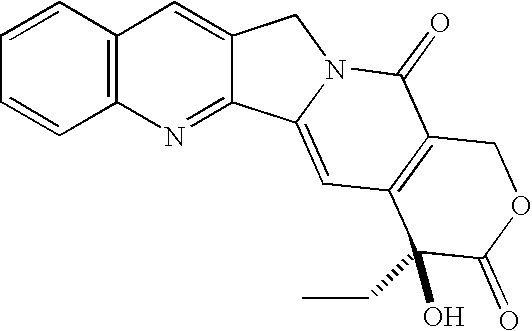
- Camptothecin (“CPT”), shown below, is an indole alkaloid natural product isolated from the oriental tree Camptotheca acuminata , which has substantial anti-tumor activity in animal models.
- the compound has a pentacyclic ring system with an asymmetric center in ring E with a 20 S configuration.
- the pentacyclic ring system includes a pyrrolo [3, 4-b] quinoline (rings A, B and C), a conjugated pyridone ring D), and six membered lactone (ring E) with an 20 ⁇ -hydroxyl group.
- CPT inhibited both DNA and RNA synthesis.
- CPT and CPT analogues interfere with the mechanism of action of the cellular enzyme topoisomerase I, which is important in a number of cellular processes (e.g., DNA replication and recombination, RNA transcription, chromosome decondensation, etc.).
- CPT and CPT analogues A significant problem with CPT and CPT analogues is the chemical lability of the ⁇ -hydroxy lactone functionality. Rapid in situ hydrolysis of the ⁇ -hydroxy lactone provides a ring opened carboxylate form which is relatively inactive, as was shown in early clinical studies with CPT sodium.
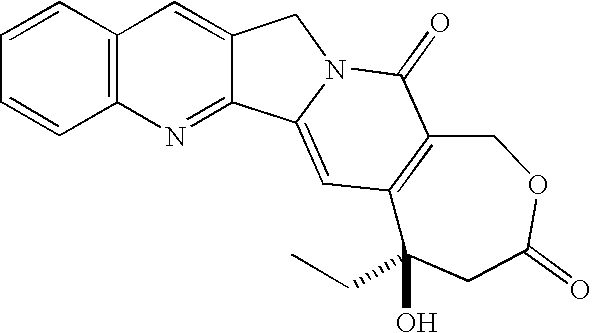
- hCPT homo-Camptothecin
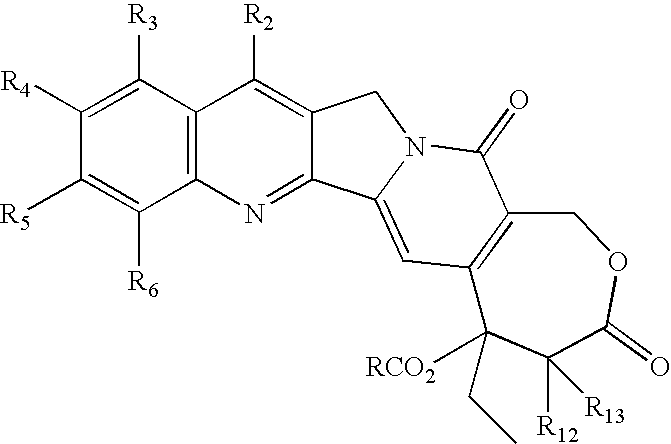
- One aspect of this invention is a compound of the formula (I), below,
- compositions useful for treating cancer in a warm-blooded animal which composition comprises compound of the invention as defined herein in combination with a pharmaceutically acceptable excipient.
- Another aspect of this invention is a method for treating cancer in a warm-blooded animal, which method comprises administering a therapeutically effective amount of a compound of the invention as defined herein.
- the compound is administered in a therapeutically effective dose by appropriate administration, e.g., orally, topically, or parenterally.
- Another aspect of this invention is process for preparing compounds of this invention by reacting camptothecin (hCPT) or a hCPT analog with a compound of the formula R—C(O)X, wherein R is R a R b N(CH 2 ) 2 , where R a and R b are as defined herein, and X is e.g., bromide, chloride, hydroxy, alkoxy of 1-11 carbons.
- this invention can be viewed as a (C-20) ester of hCPT or a hCPT analogue (preferably, a (20S) ester of hCPT or a hCPT analogue).
- hCPT has a hydroxy at the 20 position, which may be esterified in accordance with the process of this invention to form the corresponding ester in good yield.
- the resulting ester is unique in that it has an electronegative entity in the chain, which is believed to aid in stabilizing the E ring of the homo-camptothecin molecule.
- the novel compounds of the invention are active against tumors in mice and are generally well tolerated. They are useful for treating various types of cancer and can be formulated to prepare pharmaceutical preparations for oral, topical, or parenteral administration.
- the C-20 esters exert their effect in part by stabilizing the E ring of the hCPT molecule.
- the esters may accomplish this through steric hinderance by preventing enzymatic access to the E ring, through the presence of an electron-withdrawing group in the ester chain, i.e., a nitrogen atom, and through facilitating the hydrogen-binding or Van Der Waals forces of the E ring end of the hCPT molecule with the enzyme to inhibit binding and thus enzyme activity to sever the E ring.
- hCPT is an abbreviation for homo-camptothecin, which may be synthesized from CPT by methods known in the art.
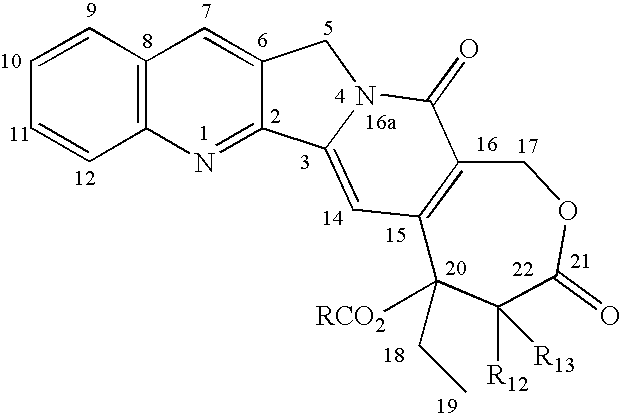
- the chemical formula of homo-camptothecin and its numbering system are as follows: The compound has a hydroxy at the 20-position that may be esterified to make the compounds of this invention.
- the numbring system for CPT is based on the system for CPT as set forth in U.S. Pat. No. 6,403,604 issued to Yang, et.al Jun. 11, 2002, which patent in its entirety is incorporated herein by reference.
- alkyl refers to a monovalent, saturated aliphatic hydrocarbon radical having the indicated number of carbon atoms.
- a “C1-6 alkyl” or an “alkyl of 1-6 carbons” or “Alk 1-6” would refer to any alkyl group containing one to six carbons in the structure.
- C1-20 alkyl refers to any alkyl group having one to twenty carbons.
- Alkyl may be a straight chain (i.e., linear) or a branched chain.
- Lower alkyl refers to an alkyl of 1-6 carbons.
- lower alkyl radicals include methyl, ethyl, n-propyl, n-butyl, n-pentyl, n-hexyl, isopropyl, isobutyl, isopentyl, amyl, sec-butyl, tert-butyl, tert-pentyl and the like.
- Higher alkyl refers to alkyls of seven carbons and above.
- n-heptyl n-octyl, n-nonyl, n-decyl, n-dodecyl, n-tetradecyl, n-hexadecyl, n-octadecyl, n-eicosyl, and the like, along with branched variations thereof.
- the radical may be optionally substituted with substituents at positions that do not significantly interfere with the preparation of compounds falling within the scope of this invention and that do not significantly reduce the efficacy of the compounds.
- the alkyl may be optionally substituted with one to five substituents independently selected from the group consisting of halo, lower alkoxy, hydroxy, cyano, nitro, or amino.
- alkoxy refers to a monovalent radical of the formula RO—, where R is an alkyl as defined herein.
- Lower alkoxy refers to an alkoxy of 1-6 carbon atoms, with higher alkoxy is an alkoxy of seven or more carbon atoms.
- Representative lower alkoxy radicals include methoxy, ethoxy, n-propoxy, n-butoxy, n-pentyloxy, n-hexyloxy, isopropoxy, isobutoxy, isopentyloxy, amyloxy, sec-butoxy, tert-butoxy, tert-pentyloxy, and the like.
- Higher alkoxy radicals include those corresponding to the higher alkyl radicals set forth herein.
- the radical may be optionally substituted with substituents at positions that do not significantly interfere with the preparation of compounds falling within the scope of this invention and that do not significantly reduce the efficacy of the compounds.
- the radical may be optionally substituted with one to five substituents independently selected from the group consisting of halo, lower alkyl, lower alkoxy, hydroxy, cyano, nitro, or amino.
- cycloalkyl refers to a monovalent, alicyclic, saturated hydrocarbon radical having three or more carbons forming the ring. While known cycloalkyl compounds may have up to 30 or more carbon atoms, generally there will be three to seven carbons in the ring. The latter include, for example, cyclopropyl, cyclobutyl, cyclopentyl, cyclohexyl, and cycloheptyl.
- the radical may be optionally substituted with substituents at positions that do not significantly interfere with the preparation of compounds falling within the scope of this invention and that do not significantly reduce the efficacy of the compounds.
- the cycloalkyl is optionally substituted with one to five substituents independently selected from the group consisting of halo, lower alkyl, lower alkoxy, hydroxy, cyano, nitro, amino, halogenated lower alkyl, halogenated lower alkoxy, hydroxycarbonyl, lower alkoxycarbonyl, lower alkylcarbonyloxy, and lower alkylcarbonylamino.
- hydroxycarbonyl is a monovolent radical having the formula —C(O)OH.
- lower alkoxycarbonyl is a monovalent radical having the formula —C(O)OAlk, where Alk is lower alkyl.
- lower alkylcarboxyloxy is a monovalent radical having the formula —OC(O)Alk, where Alk is lower alkyl.
- lower alkylcarbonylamino is a monovalent radical having the formula —NHC(O)Alk, where Alk is lower alkyl.
- a “halo” substitutent is a monovalent halogen radical chosen from chloro, bromo, iodo, and fluoro.
- a “halogenated” compound is one substituted with one or more halo sustituent.
- a “phenyl” is a radical formed by removal of a hydrogen from a benzene ring.
- the phenyl is optionally substituted with from one to five substituents independently selected from the group consisting of halo, lower alkyl, lower alkoxy, hydroxy, cyano, nitro, amino, halogenated lower alkyl, halogenated lower alkoxy, carbonyl, hydroxycarbonyl, lower alkylcarbonyloxy, benzyloxy, optionally substituted piperidino, lower alkoxycarbonyl, and lower alkylcarbonylamino.
- a “carbamoyloxy” is a monovalent radical of the formula R 13 R 14 NC(O)O— (i.e., an aminocarbonyloxy) where R 13 and R 14 together form a cyclic amino with the nitrogen atom, or each of R 13 and R 14 is independently hydrogen, lower alkyl, hydroxy lower alkyl, hydroxy lower alkyl, amino lower alkyl, lower cycloalkyl, phenyl (substituted or unsubstituted), or benzyl (substituted or unsubstituted).
- Examples include aminocarbonyloxy, methylaminocarbonyloxy, dimethyl aminocarbonyloxy, [4-(1-piperidino)-1-piperidino] carbonyloxy, 1-morpholinocarbonyloxy, 1-pyrrolidinyl, 1-piperazinecarbonyloxy, and others delineated herein.
- a “5-membered heterocyclic ring” is a monovalent radical of a 5-member closed ring containing carbon and at least one other element, generally nitrogen, oxygen, or sulfur and may be fully saturated, partially saturated, or unsaturated (i.e., aromatic in nature). Generally the heterocycle will contain no more than two hetero atoms. Representative examples of unsaturated 5-membered heterocycles with only one hetero atom include 2- or 3-pyrrolyl, 2- or 3-furanyl, and 2- or 3-thiophenyl. Corresponding partially saturated or fully saturated radicals include 3-pyrrolin-2-yl, 2- or 3-pyrrolidinyl, 2- or 3-tetrahydrofuranyl, and 2- or 3-tetrahydrothiophenyl.
- Representative unsaturated 5-membered heterocyclic radicals having two hetero atoms include imidazolyl, oxazolyl, thiazolyl, pyrazolyl, and the like. The corresponding fully saturated and partially saturated radicals are also included.
- the heterocyclic radical is bonded through an available carbon atom in the heteocyclic ring.
- the radical may be optionally substituted with substituents at positions that do not significantly interfere with the preparation of compounds falling within the scope of this invention and that do not significantly reduce the efficacy of the compounds.
- the ring is optionally substituted with one or two substituents selected from the group consisting of halo, lower alkyl, lower alkoxy, hydroxy, cyano, nitro, amino, halogenated lower alkyl, halogenated lower alkoxy, hydroxycarbonyl, lower alkoxycarbonyl, lower alkylcarbonyloxy, and lower alkylcarbonylamino.
- a “6-membered heterocyclic ring” is a monovalent radical of a 6-member closed ring containing carbon and at least one other element, generally nitrogen, oxygen, or sulfur and may be fully saturated, partially saturated, or unsaturated (i.e., aromatic in nature). Generally the heterocycle will contain no more than two hetero atoms. Representative examples of unsaturated 6-membered heterocycles with only one hetero atom include 2-, 3-, or 4-pyridinyl, 2H-pyranyl, and 4H-pryanyl. Corresponding partially saturated or fully saturated radicals include 2-, 3-, or 4-piperidinyl, 2-, 3-, or 4-tetrahydropyranyl and the like.
- Representative unsaturated 6-membered heterocyclic radicals having two hetero atoms include 3- or 4-pyridazinyl, 2-, 4-, or 5-pyrimidinyl, 2-pyrazinyl, and the like.
- the corresponding fully saturated and partially saturated radicals are also included, e.g., 2-piperazine.
- the heterocyclic radical is bonded through an available carbon atom in the heterocyclic ring.
- the radical may be optionally substituted with substituents at positions that do not significantly interfere with the preparation of compounds falling within the scope of this invention and that do not significantly reduce the efficacy of the compounds.
- the ring is optionally substituted with one or two substituents selected from the group consisting of halo, lower alkyl, lower alkoxy, hydroxy, cyano, nitro, amino, halogenated lower alkyl, halogenated lower alkoxy, hydroxycarbonyl, lower alkoxycarbonyl, lower alkylcarbonyloxy, and lower alkylcarbonylamino.
- a “cyclic amino” is a monovalent radical of a saturated 5-, 6-, or 7-membered cyclic amine ring having no more than one additional hetero atom such as nitrogen, oxygen, or sulfur, or a 5-, 6-, or 7-membered cyclic amine fused to another, carbocyclic ring or rings.
- Representative examples include, e.g., 1-pyrrolidino, 1-piperidino, morpholino, piperazino, 3-benzopiperidino, and the like. These may be substituted or unsubstituted.
- substituted generally they will have no more than 2 substituents chosen from lower alkyl, lower cycloalkyl, hydroxy lower alkyl, phenyl (substituted or unsubstituted), benyzl (substituted or unsubstituted), aminocarbonylmethyl, lower alkylaminocarbonylmethyl, amino, mono- or di-lower alkylamino, cyclic amino, or a 5- or 6-membered heterocyclic ring.
- substituents chosen from lower alkyl, lower cycloalkyl, hydroxy lower alkyl, phenyl (substituted or unsubstituted), benyzl (substituted or unsubstituted), aminocarbonylmethyl, lower alkylaminocarbonylmethyl, amino, mono- or di-lower alkylamino, cyclic amino, or a 5- or 6-membered heterocyclic ring.
- An “imide ring” is a cyclic imide wherein the nitrogen of the cyclic structure is bonded on each side to a carbonyl group, which in turn is bound to carbon atoms to form a ring.
- An imide ring would include, e.g., phthalimide (which may be substituted on the benzene ring)maleimide, 1,8-naphthalimide (which may be substituted on the naphthyl ring— e.g 3-nitro-1,8-naphthalimide, 4-nitronaphalimide, 4-bromo-napthalimide, and the like). Others will be apparent to one of skill in the art.
- MTD is the abbreviation for maximum tolerated does.
- nM is the abbreviation for nanomolar.
- One aspect of this invention is a compound of the formula wherein R is R a R b N—(CH2)m; m is an integer from 1-10; and
- a preferred aspect is a compound of formula (I) wherein each R 2 , R 3 , R 4 , R 5 , R 6 , R 12 and R 13 is H (or the preferences given hereinafter), m is 2, and R a R b N is a cyclic amino or cyclic imido radical.
- R 2 , R 3 , R 4 , R 5 , R 6 , R 12 and R 13 is H (or the preferences given hereinafter), m is 2, and R a R b NCH 2 —CH 2 is one of the following cyclic amino ethyl or cyclic imido ethyl radicals:
- R 2 , R 3 , R 4 , R 5 , R 6 , R 12 and R 13 may be a substituent other than only hydrogen.
- R 2 , R 3 , R 4 , R 5 , R 6 , R 12 and R 13 may be a substituent other than only hydrogen.
- R 5 and R 6 are hydrogen, especially those wherein R 3 is hydrogen;
- R 2 is (3-chloro-n-propyl)dimethylsilyl, tert-butyldimethylsilyl, acetoxymethyl, cyano, formylethenyl, ethoxycarbonyl-ethenyl, cyanoethenyl, 2,2-dicyanoethenyl, (2-cyano-2-ethoxycarbony)ethenyl, ethoxycarbonylethyl, methyl, ethyl, or n-propyl; and R 4 is hydroxy, acetoxy, amino, nitro, cyano, chloro, bromo, fluoro, lower alkyl, higher alkyl, lower alkoxy, carbamoyloxy, or formyl.
- R 2 is ethyl and R 4 is carbamoyloxy are of further interest.
- Carbamoyloxy substituents that are preferred include 1-pyrazinylcarbonyloxy, 4-(i-propylaminocarbonylmethyl)-1-pyrazinyl-carbonyloxy, or [4-(1-piperidio)-1-piperidinocarbonyloxy.
- each of R 2 , R 5 , and R 6 is hydrogen, for example, those wherein R 3 is amino, nitro, cyano, halo, OH, lower alkylamino, di-lower alkylamino, lower alkyl, lower alkoxy, 1-piperidino, 1-mopholino, aminomethyl, lower alkylaminomethyl, cycloalkylaminomethyl, di-lower alkylaminomethyl, cyclic aminomethyl, acetoxy, acetylamino, lower alkoxymethyl, omega hydroxy lower alkylaminomethyl, cyanomethyl and R 4 is hydroxy, acetoxy, cyano, nitro, amino, halo, formyl, lower alkoxy, carbamoyloxy.
- R 2 , R 3 , R 5 and R 6 is hydrogen and R 4 is —OC(O)Alkyl 1-20 .
- R 12 is lower alkyl, cyano, hydroxycarbonyl, lower alkoxycarbonyl, cycloalkyl, alkylcarbonylamino, 1-napthyl, 2-napthyl or phenyl and R 13 is hydrogen.
- R 12 is lower alkyl, cycloalkyl, 1-napthyl, 2-napthyl or phenyl, more preferably, R 12 is lower alkyl or phenyl.
- R 12 is hydrogen and R 13 is lower alkyl, cyano, hydroxycarbonyl, lower alkoxycarbonyl, cycloalkyl, alkylcarbonylamino, 1-napthyl, 2-napthyl or phenyl.
- R 13 is lower alkyl, cycloalkyl, 1-napthyl, 2-napthyl or phenyl, more preferably, R 13 is lower alkyl or phenyl.
- R 12 and R 13 are hydrogen, lower alkyl, cyano, hydroxycarbonyl, lower alkoxycarbonyl, cycloalkyl, alkylcarbonylamino, 1-napthyl, 2-napthyl or phenyl.
- R 12 and R 13 are hydrogen, lower alkyl, cycloalkyl, 1-napthyl, 2-napthyl or phenyl, more preferably, R 12 and R 13 are hydrogen, lower alkyl or phenyl.
- compositions useful for treating cancer in a warm-blooded animal which composition comprises compound of the invention as defined herein in combination with a pharmaceutically acceptable excipient.
- the composition is prepared in accordance with known formulation techniques to provide a composition suitable for oral, topical, transdermal, rectal, by inhalation, parenteral (intravenous, intramuscular, or intraperitoneal) administration, and the like.
- parenteral intravenous, intramuscular, or intraperitoneal
- compositions of the invention are found by reference to the 18 th or 19 th Edition of Remington's Pharmaceutical. Sciences, Published by the Mack Publishing Co., Easton, Pa. 18040. The pertinent portions are incorporated herein by reference.
- Unit doses or multiple dose forms are contemplated, each offering advantages in certain clinical settings.
- the unit dose would contain a predetermined quantity of active compound calculated to produce the desired effect(s) in the setting of treating cancer.
- the multiple dose form may be particularly useful when multiples of single doses, or fractional doses, are required to achieve the desired ends. Either of these dosing forms may have specifications that are dictated by or directly dependent upon the unique characteristic of the particular compound, the particular therapeutic effect to be achieved, and any limitations inherent in the art of preparing the particular compound for treatment of cancer.
- a unit dose will contain a therapeutically effective amount sufficient to treat cancer in a subject and may contain from about 1.0 to 1000 mg of compound, for example about 50 to 500 mg.
- the compound will preferably be administered orally in a suitable formulation as an ingestible tablet, a buccal tablet, capsule, caplet, elixir, suspension, syrup, trouche, wafer, lozenge, and the like.
- a suitable formulation as an ingestible tablet, a buccal tablet, capsule, caplet, elixir, suspension, syrup, trouche, wafer, lozenge, and the like.
- the most straightforward formulation is a tablet or capsule (individually or collectively designated as an “oral dosage unit”).
- Suitable formulations are prepared in accordance with a standard formulating techniques available that match the characteristics of the compound to the excipients available for formulating an appropriate composition.
- a tablet or capsule will preferably contain about 50 to about 500 mg of a compound of Formula (I).
- the form may deliver a compound rapidly or may be a sustained-release preparation.
- the compound may be enclosed in a hard or soft capsule, may be compressed into tablets, or may be incorporated with beverages, food or otherwise into the diet.
- the percentage of the final composition and the preparations may, of course, be varied and may conveniently range between 1 and 90% of the weight of the final form, e.g., tablet.
- the amount in such therapeutically useful compositions is such that a suitable dosage will be obtained.
- Preferred compositions according to the current invention are prepared so that an oral dosage unit form contains between about 5.0 to about 50% by weight (% w) in dosage units weighing between 5 and 1000 mg.
- the suitable formulation of an oral dosage unit may also contain: a binder, such as gum tragacanth, acacia, corn starch, gelatin; sweetening agents such as lactose or sucrose; disintegrating agents such as corn starch, alginic acid and the like; a lubricant such as magnesium stearate; or flavoring such a peppermint, oil of wintergreen or the like.
- a binder such as gum tragacanth, acacia, corn starch, gelatin
- sweetening agents such as lactose or sucrose
- disintegrating agents such as corn starch, alginic acid and the like
- a lubricant such as magnesium stearate
- flavoring such as peppermint, oil of wintergreen or the like.
- Various other material may be present as coating or to otherwise modify the physical form of the oral dosage unit.
- the oral dosage unit may be coated with shellac, a sugar or both.
- Syrup or elixir may contain the compound
- a compound may be administered parenterally, e.g., intravenously, intramuscularly, intravenously, subcutaneously, or interperitonieally.
- the carrier or excipient or excipient mixture can be a solvent or a dispersive medium containing, for example, various polar or non-polar solvents, suitable mixtures thereof, or oils.
- carrier or excipient means a pharmaceutically acceptable carrier or excipient and includes any and all solvents, dispersive agents or media, coating(s), antimicrobial agents, iso/hypo/hypertonic agents, absorption-modifying agents, and the like.
- the use of such substances and the agents for pharmaceutically active substances is well known in the art. Except insofar as any conventional media or agent is incompatible with the active ingredient, use in therapeutic compositions is contemplated. Moreover, other or supplementary active ingredients can also be incorporated into the final composition.
- Solutions of the compound may be prepared in suitable diluents such as water, ethanol, glycerol, liquid polyethylene glycol(s), various oils, and/or mixtures thereof, and others known to those skilled in the art.
- suitable diluents such as water, ethanol, glycerol, liquid polyethylene glycol(s), various oils, and/or mixtures thereof, and others known to those skilled in the art.
- the pharmaceutical forms suitable for injectable use include sterile solutions, dispersions, emulsions, and sterile powders.
- the final form must be stable under conditions of manufacture and storage. Furthermore, the final pharmaceutical form must be protected against contamination and must, therefore, be able to inhibit the growth of microorganisms such as bacteria or fungi.
- a single intravenous or intraperitoneal dose can be administered. Alternatively, a slow long term infusion or multiple short term daily infusions may be utilized, typically lasting from 1 to 8 days. Alternate day or dosing once every several days may also be utilized.
- Sterile, injectable solutions are prepared by incorporating a compound in the required amount into one or more appropriate solvents to which other ingredients, listed above or known to those skilled in the art, may be added as required.
- Sterile injectable solutions are prepared by incorporating the compound in the required amount in the appropriate solvent with various other ingredients as required. Sterilizing procedures, such as filtration, then follow.
- dispersions are made by incorporating the compound into a sterile vehicle which also contains the dispersion medium and the required other ingredients as indicated above. In the case of a sterile powder, the preferred methods include vacuum drying or freeze drying to which any required ingredients are added.
- the final form must be sterile and must also be able to pass readily through an injection device such as a hollow needle.
- the proper viscosity may be achieved and maintained by the proper choice of solvents or excipients.
- the use of molecular or particulate coatings such as lecithin, the proper selection of particle size in dispersions, or the use of materials with surfactant properties may be utilized.
- Prevention or inhibition of growth of microorganisms may be achieved through the addition of one or more antimicrobial agents such as chlorobutanol, ascorbic acid, parabens, thermerosal, or the like. It may also be preferable to include agents that alter the tonicity such as sugars or salts.
- antimicrobial agents such as chlorobutanol, ascorbic acid, parabens, thermerosal, or the like. It may also be preferable to include agents that alter the tonicity such as sugars or salts.
- the compounds of this invention tend to be water soluble, in some cases, e.g., where a compound of the invention is less water soluble, it may be useful to provide liposomal delivery.
- the system restrains the compound of the invention by incorporating, encapsulating, surrounding, or entrapping the compound of the invention in, on, or by lipid vesicles or liposomes, or by micelles.
- Liposomes have been used successfully to administer medications to cancer patients, and have been shown to be useful clinically in the delivery of anticancer drugs such as doxorubicin, daunorubicin, and cisplatinum complexes.
- anticancer drugs such as doxorubicin, daunorubicin, and cisplatinum complexes.
- micelles have also been used to deliver medications to patients, (Broden et al., Acta Pharm Suec. 19: 267-284 (1982)) and micelles have been used as drug carriers and for targeted drug delivery, (D. D. Lasic, Nature 335: 279-280 (1992); and, Supersaxo et al., Pharm Res. 8: 1280-1291 (1991)), including cancer medications, (Fung et al., Biomater. Artif. Cells. Artif. Organs 16: 439 et seq. (1988); and Yokoyama et al., Cancer Res. 51: 3229-3236 (1991)), al of which are incorporated herein in their entireties by reference.
- the liposomes and/or micelles containing the compound of the invention can be administered to a cancer patient, typically intravenously. Further guidance for preparing liposomal compositions useful in this invention may be found in U.S. Pat. No. 6,096,336, which is incorporated herein by reference.
- Another aspect of this invention is a method for treating cancer in a warm-blooded animal, which method comprises administering a therapeutically effective amount of a compound of the invention as defined herein.
- a compound useful in this invention is administered to an appropriate subject in need of these compounds in a therapeutically effective dose by a medically acceptable route of administration such as orally, parentally (e.g., intramuscularly, intravenously, subcutaneously, interperitoneally), transdermally, rectally, by inhalation and the like.
- cancer is to be considered in the broadest general definition as a malignant neoplasm, an abnormal mass of tissue, the growth of which exceeds and is uncoordinated with that of normal tissues and persists in the same excessive manner after cessation of the stimuli that evoked the change. It might be added that the abnormal mass is purposeless, preys on the host, and is virtually autonomous. A cancer can also be considered as a malignant tumor.
- a further discussion of neoplasia is found at “Robbins Pathologic Basis of Disease,” Sixth Edition, by R. S. Cotran, V. Kumar, and T. Collins, Chapter 8 (W. B. Saunders Company). This information from Chapter 8 is incorporated herein by reference.
- Table A provides examples of the types of cancers, i.e., malignant tumors or neoplasia that may be treated by administering a compound of this invention.
- the compounds of the invention are thus useful in the treatment of leukemia and solid tumors, such as colon, colo-rectal, ovarian, mammary, prostate, lung, kidney and also melanoma tumors.
- the dosage range adopted will depend on the route of administration and on the age, weight and condition of the patient being treated.
- the compounds may be administered, for example, by the parenteral route, for example, intramuscularly, intravenously or by bolus infusion.
- a “therapeutically effective amount” of hCPT derivatives of the present invention is intended to mean that amount of the compound which will inhibit the growth of, or retard cancer, or kill malignant cells, and cause the regression and palliation of malignant tumors, i.e., reduce the volume or size of such tumors or eliminate the tumor entirely.
- body surface area may be approximately determined from the height and weight of an individual (see, e.g., Scientific Tables, Geigy Pharmaceuticals, Ardsley, N.Y. pp. 537-538 (1970)).
- a suitable dose range is from 1 to 1000 mg of equivalent per m 2 body surface area of a compound of the invention, for instance from 50 to 500 mg/m 2 .
- the exact timing of administration of the dosages can be varied to achieve optimal results.
- Intralipid 20 as the carrier for the hCPT derivative
- the actual dosage of hCPT derivative reaching the patient will be less. This is due to some loss of the hCPT derivative on the walls of the syringes, needles and preparation vessels, which is prevalent with the Intralipid 20 suspension.
- a carrier such as cottonseed oil
- this above described loss is not so prevalent because the hCPT derivative does not adhere as much to the surface of syringes, etc.
- Another important feature of the method provided by the present invention relates to the relatively low apparent overall toxicity of the hCPT derivatives administered in accordance with the teachings herein.
- Overall toxicity can be judged using various criteria. For example, loss of body weight in a subject over 10% of the initially recorded body weight (i.e., before treatment) can be considered as one sign of toxicity.
- loss of overall mobility and activity and signs of diarrhea or cystitis in a subject can also be interpreted as evidence of toxicity.
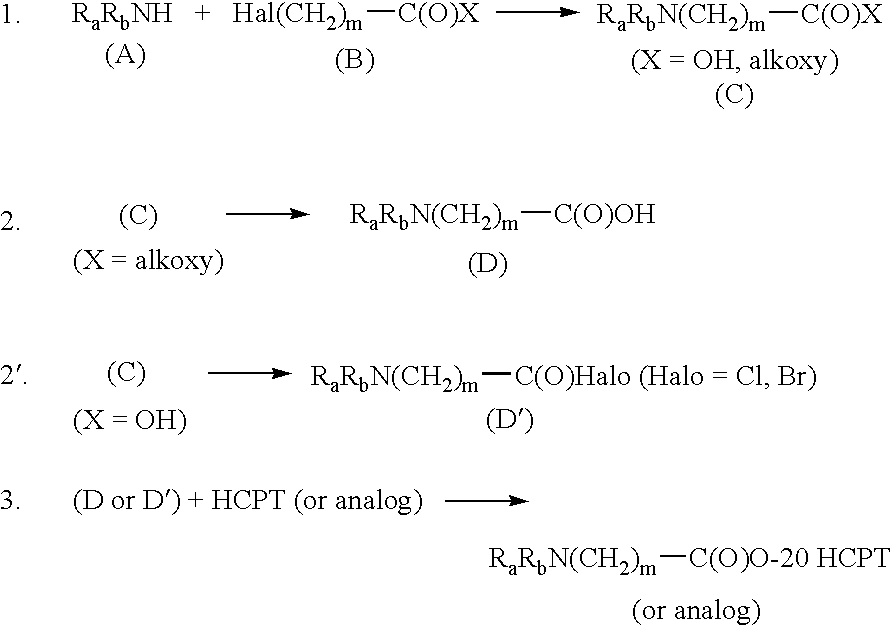
- Another aspect of this invention is process for preparing compounds of this invention by reacting camptothecin (HCPT) or a HCPT analog with a compound of the formula R—C(O)X, wherein R is R a R b N(CH 2 ) m , R a and R b are as defined herein, and X is e.g., bromide, chloride, hydroxy, alkoxy of 1-11 carbons (e.g., —O(CH 2 ) n CH 3 where n is an integer of 1-10) or R—C(O)O—(R is defined hereinbefore).
- X is OH.
- the compound shown as R a R b N(CH 2 ) m C(O)X can be referred to as an aminoalkanoic acid or aminoalkanoic acid derivative, e.g., where m is 2, it is an “aminopropionic acid” or an “aminopropionic acid derivative.”
- One way that such an aminoalkanic acid (e.g., aminopropionic acid) is obtained is by reacting an appropriate amino R a R b NH or the imido R a R b NH (or their acid addition salt) with an omega-halosubstituted alkanoic acid (e.g., 3-halopropionic ester), then hydrolyzing the ester to form the acid.
- halopropionic acid esters examples include the ethyl ester of 3-bromopropionic acid, 3-chloropropionic acid, or 3-iodopropionic acid.
- Other corresponding alkyl esters e.g., methyl, propyl, and the like, are useful but ethyl is preferred).
- the ethyl ester of 3-bromopropionic acid is preferred.
- the acid halides are obtained by reacting the corresponding aminopropionic acid with halogenated agents (such as SOCl 2 , PCl 3 , POCl 3 , PCl 5 , PBr 3 , and so on).
- the acid chloride is preferred.
- step 1 the reaction conditions will vary depending on the exact reactants employed.
- solvents useful in the reaction may be aqueous or nonaqueous.
- a solvent will be a polar organic solvent miscible with water such as a lower alkanol (ethanol is preferred).
- examples of other useful polar solvents include methanol, propanol, acetone, and dimethyformamide (DMF).
- the reaction will generally take place in the presence of an alkaline salt such as sodium bicarbonate.
- the reaction temperature will vary with the reactant, and the solvents, and will range from about 20° C. to about 180° C., preferably at reflux temperature until the free amine disappears, i.e., it is not detected anymore.
- the time needed for the reaction to be complete will generally be no more than about 20 hours, preferably no more than about 6 hours.
- step 2 the compound of formula (C) is converted to a compound of formula (D) by a hydrolysis reaction, generally performed in two stages.
- the reaction conditions for this step will vary in accordance with the compound being reacted.
- solvents useful in the conversion may be aqueous, preferably, a solvent will be water, either alone or with a water-miscible organic solvent.
- An example of a particularly useful solvent is a mixture of water and dioxane.
- the pH of the first stage of reaction will be basic, e.g., in the range of 10 to 14, preferably about 12 to 14.
- a suitable inorganic base such as an alkaline earth hydroxide, e.g., sodium hydroxide, is useful.
- the reaction temperature will range from about 0° C.
- the time needed for the reaction to be complete will generally be no more than 10 hours, preferably no more than about 4 hours.
- the mixture is then acidified to a pH of less than 4, e.g., 3, with an appropriate acid such as hydrochloric acid and extracted, if needed, with a suitable solvent such as ethyl acetate in accordance with standard chemical synthetic methods. Often the resulting propionic acid precipitates as a solid and is filtered off.
- step 2′ the compound of formula C (i.e., the aminopropionic acid) is converted into the corresponding acid halide by reacting with a halogenated agent such as SOCl 2 , PCl 3 , POCl 3 , PCl 5 , PBr 3 , and the like under appropriate conditions.
- a halogenated agent such as SOCl 2 , PCl 3 , POCl 3 , PCl 5 , PBr 3 , and the like under appropriate conditions.
- step 3 of the process a compound of formula (D) or (D′) is reacted with hCPT or a hCPT analog in about equimolar amounts up to about a 4:1 ratio (D or D′:hCPT) under conditions suitable for the formation of the compounds of this invention as the 20-(S) stereoisomer.
- the reaction takes place in the presence of suitable coupling agent such as a carbodiimide compound, e.g., disopropylcarbodiimide, but preferably 1-(3-dimethylaminopropyl)-3-ethyl carbodiimide hydrochloride (EDCI) and 4-(dimethylamino)pyridine (DMAP) in the presence of a suitable solvent, preferably a nonaqueous, nonpolar solvent.
- a suitable solvent preferably a nonaqueous, nonpolar solvent.
- the molar amount of DMAP is about 1-2 times or more of the molar amount of the hCPT compound used, while the amount of EDCI is about 5-7 (preferably about 6) times the molar amount of the hCPT compound used.
- useful solvents in this step include halogenated alkanes, e.g., dichoromethane or trichloromethane) and DMF. Dichloromethane is particularly useful.
- the reaction temperature will range from about 20° C. to about 40° C., preferably about 20° C. to about 25° C.
- the time needed for the reaction to be complete will generally be no more than about 20 hours, usually less than about 10 hours.
- a compound of formula (I) wherein one of R 2 -R 6 is R a R b N(CH 2 )—C(O)O— along with R being R a R b N(CH 2 ) 2 is obtained by reacting an analog where one of R 2 -R 6 (particularly R 4 ) is a hydroxy.
- the compound e.g., the 10 hydroxy hCPT
- An alternative process for preparing preferred compounds of this invention involve starting with a suitable anhydride and converting it to an imidopropionic acid, which is in turn reacted with hCPT or a hCPT analog to give a compound of the invention in accordance with Step 3 of the reaction sequence above.
- This anhydride conversion can be visualized as follows:
- the anhydride is reacted with ⁇ -alanine in the presence of a suitable solvent and a catalyst.
- suitable solvents include polar, water-miscible solvents, such as alcohols, acetone, dioxane, and the like. Ethanol is preferred.
- a suitable catalyst is dimethylaminopyridine (DMAP).
- DMAP dimethylaminopyridine
- the reaction is carried out at reflux temperature for less than 10 hours, e.g., about three. Adding water results in the precipitation of the compound, which is then dried to give the resulting imidopropionic acid designated as (D).
- This compound is then reacted with hCPT or a hCPT analog to give a compound of this invention.
- step 1 of the reaction sequence above suitable amines represented by formula (A) include the following:
- step 2 suitable 3-cyclicaminopropionic acid esters represented by formula (C) include the following:
- a suitable hCPT analogue is a compound that is hCPT substituted at the 7, 9, 10, 11, 12 or 22 positions as described in this document.
- the hCPT analogue may be substituted with substituents known in the art or that can be prepared by one of skill in the art given the disclosure herein (i.e., from CPT analogues). Representative articles that teach how to make CPT analogues or where such analogues may be procured are found in the following journals (which are incorporated herein by reference).
- Suitable CPT analogs include the following, where the number in parenthesis following the name refers to journal article listed above:
- CPT and CPT analogues may be converted to hCPT and hCPT analogues by the following partial synthesis illustrated for CPT (Lavergne et al., Ann. N.Y. Acad. Sci. 2000, 922: 100-111). Alternatively, total synthesis of hCPT analogues may be performed by analogy to the procedure described in Lavergne et al., Ann. N.Y. Acad. Sci. 2000, 922: 100-111.
- step 3 suitable 3-aminopionic acids of formula (D) including the following:
- the following examples are given to provide representative compounds included as part of this invention.
- the examples also provide descriptions of in vitro and in vivo assays to aid in determining the utility of the compounds.
- the homo-camptothecin esters in examples 1-15 were prepared by the corresponding aminopropionic acid and homo-camptothecin.
- chemical formulas will be used to name compounds (e.g., NaHCO 3 is sodium bicarbonate) as appropriate.
- naming the compounds generally two approaches are used. One approach used in the section heading of each example is to refer to the compound as the homo-camptothecin C-20-ester of the propionic acid. The other approach used is to refer to the compound as the homo-camptothecin-20-O-3-propionate.
- Example 1 the homo-camptothecin-20-ester of 3-phthalimidopropionic acid is the same compound as homo-camptothecin-20-O-3-phthalimidopropionate.
- This example explains how to prepare non-substituted and substituted homo-camptothecin-20-esters of 2-phthalimidopropionic acid.
- homo-camptothecin analogs for homo-camptothecin (hCPT) in part A of this example other compounds of this invention are prepared.
- hCPT analogs the standard numbering system for homo-camptothecin will be employed with “hCPT” being used as an abbreviation for homo-camptothecin.
- homo irinotecan is the hCPT derivative obtained from irinotecan
- homo topotecan is the hCPT derivative obtained from topotecan in this and other examples.
- Other homo-camptothecin analogs include the following:
- This example explains how to prepare non-substituted and substituted homo-camptothecin-20-esters of 3-maleimidopropionic acid.
- homo-camptothecin analogs for homo-camptothecin (hCPT) in part A of this example other compounds of this invention are prepared.
- hCPT analogs the standard numbering system for homo-camptothecin will be employed with “hCPT” being used as an abbreviation for homo-camptothecin.
- Other homo-camptothecin analogs include the following:
- This example explains how to prepare non-substituted and substituted homo-camptothecin-20-esters of 3-(3-nitro-1,8-naphthalimide)propionic acid.
- homo-camptothecin analogs for homo-camptothecin (hCPT) in part A of this example other compounds of this invention are prepared.
- hCPT analogs the standard numbering system for homo-camptothecin will be employed with “hCPT” being used as an abbreviation for homo-camptothecin.
- Other homo-camptothecin analogs include the following:
- This example explains how to prepare non-substituted and substituted homo-camptothecin-20-esters of 3-(4-nitro-1,8-naphthalimide)propionic acid.
- homo-camptothecin analogs for homo-camptothecin (hCPT) in part A of this example other compounds of this invention are prepared.
- hCPT analogs the standard numbering system for homo-camptothecin will be employed with “hCPT” being used as an abbreviation for homo-camptothecin.
- Other homo-camptothecin analogs include the following:
- This example explains how to prepare non-substituted and substituted homo-camptothecin-20-ester of 3-(4-bromo-1,8-naphthalimide)propionic acid.
- homo-camptothecin analogs for homo-camptothecin (hCPT) in part A of this example other compounds of this invention are prepared.
- hCPT analogs the standard numbering system for homo-camptothecin will be employed with “hCPT” being used as an abbreviation for homo-camptothecin.
- Other homo-camptothecin analogs include the following:
- homo-camptothecin analogs for homo-camptothecin (hCPT) in part A of this example other compounds of this invention are prepared.
- hCPT analogs the standard numbering system for homo-camptothecin will be employed with “hCPT” being used as an abbreviation for homo-camptothecin.
- Other homo-camptothecin analogs include the following:
- This example explains how to prepare non-substituted and substituted homo-camptothecin-20-esters of 3-[(4-benzyl)piperazin-1-yl]propionic acid.
- homo-camptothecin analogs for homo-camptothecin (hCPT) in part A of this example other compounds of this invention are prepared.
- hCPT analogs the standard numbering system for homo-camptothecin will be employed with “hCPT” being used as an abbreviation for homo-camptothecin.
- Other homo-camptothecin analogs include the following:
- This example explains how to prepare non-substituted and substituted homo-camptothecin-20-esters of 3-[4-(3-methoxyphenyl)-1-piperazinyl]propionic acid.
- homo-camptothecin analogs for homo-camptothecin (hCPT) in part A of this example other compounds of this invention are prepared.
- hCPT analogs the standard numbering system for homo-camptothecin will be employed with “hCPT” being used as an abbreviation for homo-camptothecin.
- Other homo-camptothecin analogs include the following:
- This example explains how to prepare non-substituted and substituted homo-camptothecin-20-esters of 3-[4-(4-nitrophenyl)-1-piperazinyl]propionic acid.
- homo-camptothecin analogs for homo-camptothecin (hCPT) in part A of this example other compounds of this invention are prepared.
- hCPT analogs the standard numbering system for homo-camptothecin will be employed with “hCPT” being used as an abbreviation for homo-camptothecin.
- Other homo-camptothecin analogs include the following:
- This example explains how to prepare non-substituted and substituted homo-camptothecin-20-esters of 3-(4-phenyl-1-piperazinyl)propionic acid.
- homo-camptothecin analogs for homo-camptothecin (hCPT) in part A of this example other compounds of this invention are prepared.
- hCPT analogs the standard numbering system for homo-camptothecin will be employed with “hCPT” being used as an abbreviation for homo-camptothecin.
- Other homo-camptothecin analogs include the following:
- This example explains how to prepare non-substituted and substituted homo-camptothecin-20-esters of 3-[4-(2-chlorophenyl)-1-piperazinyl]propionic acid.
- homo-camptothecin analogs for homo-camptothecin (hCPT) in part A of this example other compounds of this invention are prepared.
- hCPT analogs the standard numbering system for homo-camptothecin will be employed with “hCPT” being used as an abbreviation for homo-camptothecin.
- Other homo-camptothecin analogs include the following:
- This example explains how to prepare non-substituted and substituted homo-camptothecin-20-esters of 3-[4-(4-fluorophenyl)-1-piperazinyl]propionic acid.
- homo-camptothecin analogs for homo-camptothecin (hCPT) in part A of this example other compounds of this invention are prepared.
- hCPT analogs the standard numbering system for homo-camptothecin will be employed with “hCPT” being used as an abbreviation for homo-camptothecin.
- Other homo-camptothecin analogs include the following:
- homo-camptothecin analogs for homo-camptothecin (hCPT) in part A of this example other compounds of this invention are prepared.
- hCPT analogs the standard numbering system for homo-camptothecin will be employed with “hCPT” being used as an abbreviation for homo-camptothecin.
- Other homo-camptothecin analogs include the following:
- homo-camptothecin analogs for homo-camptothecin (hCPT) in part A of this example other compounds of this invention are prepared.
- hCPT analogs the standard numbering system for homo-camptothecin will be employed with “hCPT” being used as an abbreviation for homo-camptothecin.
- Other homo-camptothecin analogs include the following:
- This example explains how to prepare non-substituted and substituted homo-camptothecin-20-esters of 3-[4-(4-acetylphenyl)-1-piperazinyl]propionic acid.
- homo-camptothecin analogs for homo-camptothecin (hCPT) in part A of this example other compounds of this invention are prepared.
- hCPT analogs the standard numbering system for homo-camptothecin will be employed with “hCPT” being used as an abbreviation for homo-camptothecin.
- Other homo-camptothecin analogs include the following:
- the target molecule was synthesized as follows. A flask was charged with homocamptothecin (HCPT) (50 mg, 0.13 mmol) and then 15 mL of dry dichloromethane. The solution was allowed to stir for 10 minutes at ambient temperature. 1-(3-Dimethylamino-propyl)-3-ethyl-carbodiimide hydrochloride (EDCI) (147 mg, 0.79 mmol), 4-(dimethylamino)pyridine (DMAP) (17 mg, 0.17 mmol) and 1-piperdine propionic acid (69 mg, 0.43 mmol) were added. The reaction was allowed to stir for 20 hours at ambient temperature. The reaction was quenched and washed as described in the general procedure.
- HCPT homocamptothecin
- EDCI 1-(3-Dimethylamino-propyl)-3-ethyl-carbodiimide hydrochloride
- DMAP 4-(dimethylamino)pyridine
- homo-camptothecin analogues for homo-camptothecin (hCPT) in part A of this example other compounds of this invention are prepared.
- hCPT homo-camptothecin analogues
- the standard numbering system for homo-camptothecin will be employed with “hCPT” being used as an abbreviation for homo-camptothecin.
- Other homo-camptothecin analogues include the following:
- the reaction mixture is diluted with dichloromethane (25 mL) and washed with saturated aqueous sodium bicarbonate solution (3 ⁇ 15 mL). The organic layer is dried over anhydrous magnesium sulfate, filtered and concentrated under reduced pressure.
- the crude product is purified by flash chromatography (silica gel, 25:75 hexanes-ethyl acetate) to afford, after concentration of the appropriate fractions and removal of traces of solvent (vacuum pump), as a solid. Spectral data and a melting point are obtained.
- A. Homocamptothecin-20-O ester of 1-BOC-piperidine-4-carboxylic Acid The target molecule is synthesized using the above procedure of this example. The flask is charged with homocamptothecin (hCPT) (20 mg, 0.05 mmol) and then 7 mL of dry chloroform. The solution will be allowed to stir for 10 minutes at ambient temperature.
- hCPT homocamptothecin
- homo-camptothecin analogues for homo-camptothecin (hCPT) in parts A-C of this example other compounds of this invention are. prepared. In naming homo-camptothecin analogues, the standard numbering system for homo-camptothecin will be employed with “hCPT” being used as an abbreviation for homo-camptothecin.
- Other homo-camptothecin analogues include the following:
- This example provides directions for growing cells and testing compounds of the invention for their effect on the growth of the cells. All cells can be purchased from DCTDC Tumor Repository, NCI, NIH.
- VM46 Five hundred cells (VM46) are plated in 60 mm Petri dishes containing 2.7 ml of medium (modified McCoy's 5a medium containing 10% fetal bovine serum and 100 units/ml penicillin and 100 mg/ml streptomycin). The cells are incubated in a CO 2 incubator at 37° C. for 5 hours for attachment to the bottom of Petri dishes. Drugs are made fresh in medium at ten times the final concentration, and then 0.3 ml of this stock solution is added to the 2.7 ml of medium in the dish. The cells are then incubated with drugs for 72 hours at 37° C.
- medium modified McCoy's 5a medium containing 10% fetal bovine serum and 100 units/ml penicillin and 100 mg/ml streptomycin.
- the drug-containing media are decanted, the dishes are rinsed with 4 ml of Hank's Balance Salt Solution (HBSS), 5 ml of fresh medium is added, and the dishes are returned to the incubator for colony formation. The cell colonies are counted using colony counter after incubation for 8 days for VM46 cells. Cell survival (%) is calculated .
- HBSS Hank's Balance Salt Solution
- ID50 the drug concentration producing 50% inhibition of colony formation
- Results are shown in Table I for hCPT as a compound of this invention taught in Example 16.
- This Example Provides Directions for Performing In Vivo Toxicity Tests of the Compounds of the Invention on C3H/HeJ Mice.
- Acute toxicities of the compounds of this invention are evaluated on C3H/HeJ mice (body weight 18-22 g).
- the MTD40 (maximum tolerated dose at day 40) values are determined by the standard procedure described by Gad and Chengelis (see, for example, “ Acute Toxicology Testing ,” 2 nd Ed., Shayne O. Gad and Christopher P. Chengelis, pp. 186-195 (Academic Press).) In the consecutive type studies, 2 mice are dosed at low and moderate doses of 40 and 100 mg/kg. If no severe and irreversible toxicity (euthanasia is required) occurs at these doses, a new pair of animals is initiated at 180 mg/kg, which is 1.8 times higher than 100 mg/kg.
- Sequential dosages (about 3 doses on 3 pairs of animals, i.e., 2 mice for each drug dose) are increased by a factor of 1.8 until severe and irreversible toxicity (euthanasia is required) occurred. Then another pair of animals is initiated at the highest nonlethal dosage, and successive dosages were increased by a factor of 1.15. The result of this exercise is two dosages, one apparently nonlethal and the other lethal if severe and irreversible toxicity occurs and euthanasia is required, separated by a factor of 1.15. Six mice are dosed at each dosage. If no severe and irreversible toxicity occurs at the lower dosage and at least one with severe and irreversible toxicity occurs at the higher dose, then the lower dose is considered to be the MTD.
- the compounds of this invention are administered to C3H/HeJ mice by intraperitoneal injection. Drug toxicity is evaluated on mice checked daily for 45 days. The toxicity parameters reported will be the MTD40.
- the MTD is defined as the highest dose causing no severe irreversible toxicity in one treatment group, but at least one animal exhibiting severe and irreversible toxicity and being euthanized at the next higher dose.
- This example provides directions for performing in vivo efficacy tests of the compounds of the invention on C3H/HeJ mice bearing MTG-B tumors.
- mice bearing MTG-B tumors are performed on C3H/HeJ mice bearing MTG-B tumors.
- the tumors grow exponentially following implantation into the flanks of the mice and reached a diameter of 8 mm (268.08 mm 3 ) by day 7 to 10.
- Treatment is initiated at that time, with the first day of treatment designated as day 0 for calculation and plots.
- the mice are injected i.p. with three drug dose levels (1 ⁇ 3, 1 ⁇ 2, 1 5 MTD) using both a single injection and the schedule of Q2D 5 3 (every 2 days for a total of 3 treatments at 1 ⁇ 3 MTD).
- Control groups of mice bearing 8 mm diameter tumors are treated with vehicle alone. After drug treatment, the mice are observed twice a day.
- T anticancer drugs
- C surviving days measured from day 0 for control mice
- Tumor sizes may be measured by caliper every day.
- Tumor growth delay (T ⁇ C value) is determined by calculation of the median time (in days) required for the treatment group and control group tumors to reach 1,000 mg.
- the survival time of the control mice is six (6) days.
- This example provides guidance for determining the inhibition of topoisomerase I.
- This procedure is an intact cell assay and is a modification of a published procedure found at Cancer Res. 1986, 46, 2021-2026. A more recent publication can be found at J. Med. Chem. 1993, 36 2689-2700 at 2699.
- the modification of the previous procedure was used to quantitate the amount of topoisomerase I mediated DNA cleavage in intact cells.
- the DNA of HL-60 cells growing in culture is labeled by [ 3 H] thymidine incorporation.
- the cells are exposed to compounds to be tested and lysed, and the protein is precipitated. Radioactive DNA in cleavable complex formation with topoisomerase I coprecipitates with the protein.
- the amount of cleavable complex formation is quantitated by counting the pellet with a liquid scintillation counter.
Landscapes
- Chemical & Material Sciences (AREA)
- Organic Chemistry (AREA)
- Pharmaceuticals Containing Other Organic And Inorganic Compounds (AREA)
Abstract
Description
-
- wherein R is RaRbN—(CH2)m;
- m is an integer from 1-10; and
- (i) one of Ra or Rb is H and the other is
- lower alkyl substituted with one to five substituents independently selected from the group consisting of halo, lower alkoxy, hydroxy, cyano, nitro, or amino;
- phenyl optionally substituted with from one to five substituents independently selected from the group consisting of halo, lower alkyl, lower alkoxy, hydroxy, cyano, nitro, amino, halogenated lower alkyl, halogenated lower alkoxy, formyl, lower alkyl carbonyl, hydroxycarbonyl, lower alkylcarbonyloxy, benzyloxy, optionally substituted piperidino, lower alkoxycarbonyl, and lower alkylcarbonylamino;
- cycloalkyl of 3-7 carbons, optionally substituted with one to five substituents independently selected from the group consisting of halo, lower alkyl, lower alkoxy, hydroxy, cyano, nitro, amino, halogenated lower alkyl, halogenated lower alkoxy, hydroxycarbonyl, lower alkoxycarbonyl, lower alkylcarbonyloxy, and lower alkylcarbonylamino; or
- lower alkoxy; or
- (ii) each of Ra and Rb is independently a substituent as above; or
- (iii) RaRb together with N form a cyclic amine or imide ring; and
- R2 is hydrogen, halo, lower alkyl, lower alkoxy, hydroxy, RC(O)O (R defined hereinbefore), cyano, nitro, amino, halogenated lower alkyl, halogenated lower alkoxy, hydroxycarbonyl, —C(O)H, lower alkoxycarbonyl, tri lower alkylsilyl, lower alkylcarbonyloxy, lower alkylcarbonylamino, lower alkylcarbonyloxymethyl, substituted vinyl, 1-hydroxy-2-nitroethyl, alkoxycarbonylethyl, aminocarbonyl, alkylcarbonyl, alkylcarbonylmethyl, benzoylmethyl, benzylcarbonyloxymethyl, or mono- or di lower alkoxymethyl;
- R3 is hydrogen, halo, lower alkyl, lower alkoxy, hydroxy, RC(O)O (R defined hereinbefore) cyano, nitro, amino, halogenated lower alkyl, halogenated lower alkoxy, hydroxycarbonyl, lower alkoxycarbonyl, CH2NR7R8 (where each of R7 and R8 is independently H—, alkyl of 1-6 carbons, optionally substituted phenyl, hydroxy lower alkyl, amino lower alkyl, or mono- or dialkylamino lower alkyl, or R7 and R8 taken together with —N— represent a cyclic amino-), —C(O)H, CH2 R9 (where R9 is lower alkoxy, CN, amino lower alkoxy, mono- or di-lower alkylamino lower alkoxy, lower alkylthio, amino lower alkylthio, or mono- or di-lower alkylamino lower alkylthio), or NR10R11 (where each of R10 and R11 is independently hydrogen, lower alkyl, phenyl, hydroxy lower alkyl, amino lower alkyl, or mono- or di-lower alkyl, or R10 and R11 taken together with —N— represent a cyclic amino), dialkylamino alkyl, lower alkylcarbonyloxy, or lower alkylcarbonylamino;
- R4 is hydrogen, halo, lower alkyl, lower alkoxy, hydroxy, RC(O)O (R defined hereinbefore) cyano, nitro, amino, amino lower alkyl, halogenated lower alkyl, halogenated lower alkoxy, hydroxycarbonyl, lower alkoxycarbonyl, carbamoyloxy, lower alkylcarbonyloxy, or lower alkylcarbonylamino, or R4 together with R5 is methylenedioxy or ethylenedioxy;
- R5 is hydrogen, halo, lower alkyl, lower alkoxy, hydroxy, RC(O)O (R defined hereinbefore), cyano, nitro, amino, halogenated lower alkyl, halogenated lower alkoxy, hydroxycarbonyl, lower alkoxycarbonyl, lower alkylcarbonyloxy, or lower alkylcarbonylamino or R5 together with R4 is methylenedioxy or ethylenedioxy;
- R6 is hydrogen, halo, lower alkyl, lower alkoxy, hydroxy, RC(O)O (R defined hereinbefore), cyano, nitro, amino, halogenated lower alkyl, halogenated lower alkoxy, hydroxcarbonyl, lower alkoxycarbonyl, lower alkylcarbonyloxy, or lower alkylcarbonylamino; and
- R12 and R13 are independently hydrogen, lower alkyl, cyano, hydroxycarbonyl, lower alkoxycarbonyl, cycloalkyl, alkylcarbonylamino, 1-napthyl, 2-napthyl or phenyl.
The compound has a hydroxy at the 20-position that may be esterified to make the compounds of this invention. The numbring system for CPT is based on the system for CPT as set forth in U.S. Pat. No. 6,403,604 issued to Yang, et.al Jun. 11, 2002, which patent in its entirety is incorporated herein by reference.

wherein R is RaRbN—(CH2)m; m is an integer from 1-10; and
- (i) one of Ra or Rb is H and the other is
- lower alkyl substituted with one to five substituents independently selected from the group consisting of halo, lower alkoxy, hydroxy, cyano, nitro, or amino;
- phenyl optionally substituted with from one to five substituents independently selected from the group consisting of halo, lower alkyl, lower alkoxy, hydroxy, cyano, nitro, amino, halogenated lower alkyl, halogenated lower alkoxy, formyl, lower alkyl carbonyl, hydroxycarbonyl, lower alkylcarbonyloxy, benzyloxy, optionally substituted piperidino, lower alkoxycarbonyl, and lower alkylcarbonylamino;
- cycloalkyl of 3-7 carbons, optionally substituted with one to five substituents independently selected from the group consisting of halo, lower alkyl, lower alkoxy, hydroxy, cyano, nitro, amino, halogenated lower alkyl, halogenated lower alkoxy, hydroxycarbonyl, lower alkoxycarbonyl, lower alkylcarbonyloxy, and lower alkylcarbonylamino; or
- lower alkoxy; or
- (ii) each of Ra and Rb is independently a substituent as above; or
- (iii) RaRb together with N form a cyclic amine or imide ring; and
- R2 is hydrogen, halo, lower alkyl, lower alkoxy, hydroxy, RC(O)O (R defined hereinbefore), cyano, nitro, amino, halogenated lower alkyl, halogenated lower alkoxy, hydroxycarbonyl, —C(O)H, lower alkoxycarbonyl, tri lower alkylsilyl, lower alkylcarbonyloxy, lower alkylcarbonylamino, lower alkylcarbonyloxymethyl, substituted vinyl, 1-hydroxy-2-nitroethyl, alkoxycarbonylethyl, aminocarbonyl, alkylcarbonyl, alkylcarbonyloxymethyl, benzoylmethyl, benzylcarbonyloxymethyl mono- or di lower alkoxymethyl, alkoxyiminomethyl, methylpiperazinomethyl, or together with R3 is —CH2(NH2)CH2CH2—;
- R3 is hydrogen, halo, lower alkyl, lower alkoxy, hydroxy, RC(O)O (R defined hereinbefore) cyano, nitro, amino, halogenated lower alkyl, halogenated lower alkoxy, hydroxycarbonyl, lower alkoxycarbonyl, CH2NR7R8 (where each of R7 and R8 is independently H—, alkyl of 1-6 carbons, optionally substituted phenyl, hydroxy lower alkyl, amino lower alkyl, or mono- or dialkylamino lower alkyl, or R7 and R8 taken together with —N— represent a cyclic amino-), —C(O)H, CH2 R9 (where R9 is lower alkoxy, CN, amino lower alkoxy, mono- or di-lower alkylamino lower alkoxy, lower alkylthio, amino lower alkylthio, or mono- or di-lower alkylamino lower alkylthio), or NR10R11 (where each of R10 and R11 is independently hydrogen, lower alkyl, phenyl, hydroxy lower alkyl, amino lower alkyl, or mono- or di-lower alkyl, or R10 and R11 taken together with —N— represent a cyclic amino), dialkylamino alkyl, lower alkylcarbonyloxy, lower alkylcarbonylamino or trialkysilylethylene;
- R4 is hydrogen, halo, lower alkyl, lower alkoxy, hydroxy, RC(O)O (R defined hereinbefore) cyano, nitro, amino, amino lower alkyl, halogenated lower alkyl, halogenated lower alkoxy, hydroxycarbonyl, lower alkoxycarbonyl, carbamoyloxy, lower alkylcarbonyloxy, or lower alkylcarbonylamino, or R4 together with R53 is methylenedioxy or ethylenedioxy;
- R5 is hydrogen, halo, lower alkyl, lower alkoxy, hydroxy, RC(O)O (R defined hereinbefore), cyano, nitro, amino, halogenated lower alkyl, halogenated lower alkoxy, hydroxycarbonyl, lower alkoxycarbonyl, lower alkylcarbonyloxy, or lower alkylcarbonylamino or together with R4 is methylenedioxy or ethylenedioxy;
- R6 is hydrogen, halo, lower alkyl, lower alkoxy, hydroxy, RC(O)O (R defined hereinbefore), cyano, nitro, amino, halogenated lower alkyl, halogenated lower alkoxy, hydroxcarbonyl, lower alkoxycarbonyl, lower alkylcarbonyloxy, or lower alkylcarbonylamino; and
- R12 and R13 are independently hydrogen, lower alkyl, cyano, hydroxycarbonyl, lower alkoxycarbonyl, cycloalkyl, alkylcarbonylamino, 1-napthyl, 2-napthyl or phenyl. Preferred aspects of the compounds of this invention are set forth herein in the specification and claims.


| TABLE A | |
| Tissue of Origin | Malignant |
| Composed of One | |
| Parenchymal Cell Type | |
| Mesenchymal tumors | |
| Connective tissue and | Fibrosarcoma |
| derivatives | Liposarcoma |
| Chondrosarcome | |
| Osteogenic sarcoma | |
| Endothelial and | |
| related tissues | |
| Blood vessels | Angiosarcoma |
| Lymph vessels | Lymphangiosarcoma |
| Synovium | Synovial sarcoma |
| Mesothelium | Mesothelioma |
| Brain coverings | Invasive meningioma |
| Blood cells and | |
| related cells | |
| Hematopoietic cells | Leukemias |
| Lymphoid tissue | Malignant lymphomas |
| Muscle | |
| Smooth | Leiomyosarcoma |
| Straited | Rhabdomyosarcoma |
| Epthelial tumors | |
| Stratified squamous | Squamous cell or |
| epidermoid carcinoma | |
| Basal cells of skin or adnexa | Basal cell carcinoma |
| Epithelial lining | |
| Glands or ducts | Adenocarcinoma |
| Papillary carcinoma | |
| Cystadenocarcinoma | |
| Respiratory passages | Bronchogenic carcinoma |
| Bronchial adenoma (carcinoid) | |
| Neuroectoderm | Malignant melanoma |
| Renal epithelium | Renal cell carcinoma |
| Liver cells | Hepatocellular carcinoma |
| Urinary tract epithelium | Transitional cell carcinoma |
| (transitional) | |
| Placental epithelium | Choriocarcinoma |
| (trophoblast) | |
| Testicular epithelium | Seminoma |
| (germ cells) | Embryonal carcinoma |
| More Than One Neoplastic | |
| Cell-Mixed Tumors, Usually | |
| Derived From One Germ Layer | |
| Salivary glands | Malignant mixed tumor of |
| salivary gland origin | |
| Breast | Malignant cystosarcoma phyllodes |
| Renal anlage | Wilms tumor |
| More Than One Neoplastic | |
| Cell Type Derived From | |
| More Than One Germ | |
| Layer-Teratogenous | |
| Totipotential cells in gonads or in | Immature teratoma, terato- |
| embryonic rests | carcinoma |
R—C(O)O—(R is defined hereinbefore). Preferably X is OH. The compound shown as RaRbN(CH2)mC(O)X can be referred to as an aminoalkanoic acid or aminoalkanoic acid derivative, e.g., where m is 2, it is an “aminopropionic acid” or an “aminopropionic acid derivative.” One way that such an aminoalkanic acid (e.g., aminopropionic acid) is obtained is by reacting an appropriate amino RaRbNH or the imido RaRbNH (or their acid addition salt) with an omega-halosubstituted alkanoic acid (e.g., 3-halopropionic ester), then hydrolyzing the ester to form the acid. Examples of preferred halopropionic acid esters include the ethyl ester of 3-bromopropionic acid, 3-chloropropionic acid, or 3-iodopropionic acid. Other corresponding alkyl esters (e.g., methyl, propyl, and the like, are useful but ethyl is preferred). The ethyl ester of 3-bromopropionic acid is preferred. In some cases, it may be useful to prepare an acid halide from the corresponding aminopropionic acid. The acid halides are obtained by reacting the corresponding aminopropionic acid with halogenated agents (such as SOCl2, PCl3, POCl3, PCl5, PBr3, and so on). The acid chloride is preferred. Once the acid or its derivative is prepared, it is reacted with HCPT to form the C-20-ester of HCPT, i.e., compounds of this invention. This reaction sequence can be generalized as follows:

-
- 1-(3-trifluoromethyl)phenylpiperazine;
- 1-(4-benzyl)piperazine;
- 1-[4-(3-methoxyphenyl)]piperazine;
- 1-[4-(4-nitrophenyl)]piperazine;
- 1-(4-phenyl)piperazine;
- 1-[4-(2-chlorophenyl)]piperazine (as the HCl salt);
- 1-[4-(4-fluorophenyl)]piperazine;
- 3-[4-(4-acetylphenyl)piperazine;
- 4-benzylpiperidine;
- piperidine;
- piperazine;
- morpholine; and the like.
-
- ethyl 3-[4-(3-trifluoromethylphenyl)-1-piperazinyl]propionate;
- ethyl 3-(4-benzyl-1-piperazinyl)propionate;
- ethyl 3-[4-(4-nitrophenyl)-1-piperazinyl]propionate;
- ethyl 3-(4-phenyl-1-piperazinyl)propionate;
- ethyl 3-[4-(2-chlorophenyl)-1-piperazinyl]propionate;
- ethyl 3-[4-(4-fluorophenyl)-1-piperazinyl]propionate;
- ethyl 3-(4-benzyl-1-piperidino)propionate;
- ethyl 3-[4-(4-acetylphenyl)-1-piperazinyl]propionate; and the like.
-
- 1. J. Med. Chem. 1998, 41, 31-37
- 2. J. Med. Chem. 2000, 43, 3970-3980
- 3. J. Med. Chem. 1993, 36, 2689-2700
- 4. J. Med. Chem. 1991, 34, 98-107
- 5. J. Med. Chem. 2000, 43, 3963-3969
- 6. Chem. Pharm. Bull. 39(10) 2574-2580 (1991)
- 7. Chem. Pharm. Bull. 39(6) 1446-1454 (1991)
- 8. A
NTIMICROBIAL AGENTS AND CHEMOTHERAPY , December 1999, p. 2862-2868 - 9. European Journal of Cancer, Vol. 34, No. 10, pp. 1500-1503, 1998
- 10. CANCER RESEARCH 55, 753-760, Feb. 15, 1995
- 11. Anti-Cancer Drug Design (1998), 13, 145-157
- 12. Bioorganic & Medicinal Chemistry Letters 8 (1998) 415-418
- 13. CANCER RESEARCH 61, 6034-6037, Aug. 15, 2001
- 14. Clinical Cancer Research 2002, 8, 641-661
-
- camptothecin (CPT);
- exatecan mesylate (14-AKA DX8951f)
- (20S)-7-ethyl-10-[4-(1-piperidino)-1-piperidino]carbonyloxy)-CPT (AKA-irinotecan);
- (20S)-9-nitro CPT (1);
- (20S)-7-chloro-n-propyldimethylsilyl CPT (2);
- (20S)-10-hydroxy-7-chloro-n-propyldimethylsilyl CPT (2);
- (20S)-10-acetoxy-7-chloro-n-propyldimethylsilyl CPT (2);
- (20S)-7-tert-butyldimethylsilyl CPT (2);
- (20S)-10-hydroxy-7-tert-butyldimethylsilyl CPT (2);
- (20S)-10-acetoxy-7-tert-butyldimethylsilyl CPT (2);
- (20S)-9-hydroxy CPT (3);
- (20S)-9-amino CPT (3);
- (20S)-10-amino CPT (3);
- (20S)-9-amino-10-hydroxy CPT (3);
- (20S)-9-amino-10,11-methylenedioxy CPT (3);
- (20S)-9-methylamino CPT;
- (20S)-9-methyl CPT (3);
- (20S)-9-dimethylamino CPT;
- (20S)-9-chloro CPT (3);
- (20S)-9-trimethylsilylethyl CPT (14-AKA Karenitecin);
- (20S)-7-(4-methylpiperazinomethylene)-10,11-ethylenedioxy CPT (14)
- (20S)-9-dimethylaminomethyl-10-hydroxy CPT (3-AKA topotecan);
- (20S)-9-fluoro CPT (3);
- (20S)-9-piperidino CPT;
- (20S)-9-dimethylaminomethyl-10-hydroxy CPT (3);
- (20S)-9-morpholinomethyl CPT (4);
- (20S)-10-hydroxy CPT (3);
- (20S)-9,10-dichloro CPT (3);
- (20S)-10-bromo CPT (3);
- (20S)-10-chloro CPT (3);
- (20S)-10-methyl CPT (3);
- (20S)-10-fluoro CPT (3);
- (20S)-10-nitro CPT (3);
- (20S)-10,11-methylenedioxy CPT (3);
- (20S)-10-formyl CPT (3);
- (20S)-10-nonylcarbonyloxy CPT (12);
- (20S)-10-undecylcarbonyloxy CPT (12);
- (20S)-10-pentadecylcarbonyloxy CPT.(12);
- (20S)-10-heptadecylcarbonyloxy CPT (12);
- (20S)-10-nonadecylcarbonyloxy CPT (12);
- (20S)-9-nitro-10,11-methylenedioxy CPT (3);
- (20S)-9-(4-methylpiperazinylmethyl)-10-hydroxy (CPT) (4);
- (20S)-9-[4-(1-piperidino)-1-piperidinomethyl]-10-hydroxy CPT (4);
- (20S)-9-methyl-10,11-methylenedioxy CPT;
- (20S)-9-chloro-10,11-methylenedioxy CPT (3);
- (20S)-9-cyano-10,11-methylenedioxy CPT;
- (20S)-9-acetoxy-10,11-methylenedioxy CPT;
- (20S)-9-acetylamino-10,11-methylenedioxy CPT;
- (20S)-9-aminomethyl-10-hydroxy CPT;
- (20S)-9-ethoxymethyl-10-hydroxy CPT (4);
- (20S)-9-methylaminomethyl-10-hydroxy CPT;
- (20S)-9-n-propylaminomethyl-10-hydroxy CPT (4);
- (20S)-9-dimethylaminomethyl-10-hydroxy CPT (4);
- (20S)-9-cyclohexylaminomethyl-10-hydroxy CPT (4);
- (20S)-9-(2-hydroxyethyl)aminomethyl-10-hydroxy CPT (4);
- (20S)-9-(trimethylammonio)methyl-10-hydroxy CPT, methanesulfonate (4);
- (20S)-9-morpholinomethyl-10-hydroxy CPT (4);
- (20S)-9-cyanomethyl-10-hydroxy CPT (4);
- (20S)-CPT-7-aldehyde (5);
- (20S)-10-methoxy CPT-7-aldehyde (5);
- (20S)-7-acetoxymethyl CPT (5);
- (20S)-7-acetoxymethyl-10-methyl CPT (5);
- (20S)-7-cyano-10-methoxy CPT (5);
- (20S)-7-cyano CPT (5);
- (20S)-7-formylethenyl CPT (5);
- (20S)-7-ethoxycarbonylethenyl CPT (5);
- (20S)-7-cyanoethenyl CPT (5);
- (20S)-7-(2,2-dicyanoethenyl) CPT (5);
- (20S)-7-(2-cyano-2-ethoxycarbonyl)ethenyl CPT (5);
- (20S)-7-ethoxycarbonylethyl CPT (5);
- (20S)-7-ethyl CPT (6);
- (20S)-7-n-propyl CPT (6);
- (20S)-7-acetoxymethyl CPT (6);
- (20S)-7-n-propylcarbonyloxymethyl CPT (6);
- (20S)-7-ethoxycarbonyl CPT (6);
- (20S)-7-ethyl-10-hydroxy CPT;
- (20S)-7-ethyl-10-acetyloxy CPT;
- (20S)-7-methyl-10-aminocarbonyloxy CPT;
- (20S)-7-n-propyl-10-piperidinocarbonyloxy CPT;
- (20S)-7-ethyl-10-(2-dimethylamino)ethyl CPT; and
- (20S)-7-ethyl-10-carbamoyloxy derivatives of CPT such as
- (20S)-7-ethyl-10-[4-(1-piperidino)-piperidino carbonyloxy CPT (7);
- (20S)-7-ethyl-10-(1-piperazine)carbonyloxy CPT (7);
- (20S)-7-ethyl-10-(4-i-propylaminocarbonylmethylpiperazine)carbonyloxy CPT (7);
- (20S)-7-ethyl-10-[4(1-pyrrolidinyl)piperazine]carbonyloxy CPT (7);
- (20S)-7-ethyl-10-[(4-(dimethylamino)-1-piperidino]carbonyloxy CPT (7);
- (20S)-7-ethyl-10-[4-(di-n-propylamino)-1-piperidinol]carbonyloxy CPT (7);
- (20S)-7-ethyl-10-[(4-(di-n-butylamino)-1-piperidino]carbonyloxy CPT (7);
- (20S)-7-ethyl-10-[4-(1-pyrrolidino)-1-piperidino)]carbonyloxy CPT (7);
- (20S)-7-butoxyiminomethyl CPT;
- (20S)-7-ethyl-10-[4-(1-piperidino)-1-piperidino]carbonyloxy CPT (7);
- (20S)-7-ethyl-10-[N-methyl-N-2-(dimethylamino)ethylamino]carbonyloxy CPT (7) and the like.
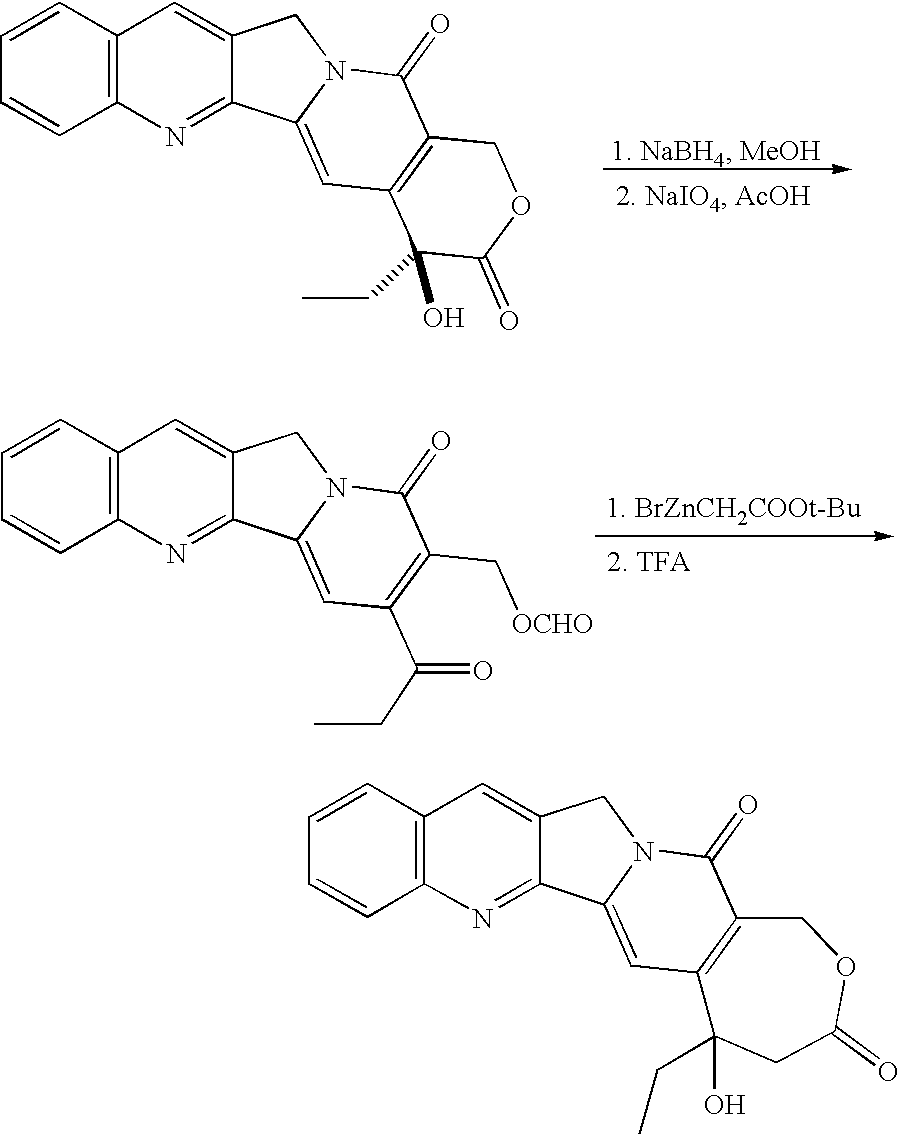
Alternatively, total synthesis of hCPT analogues may be performed by analogy to the procedure described in Lavergne et al., Ann. N.Y. Acad. Sci. 2000, 922: 100-111.
-
- 3-phthalimidopropionic acid;
- 3-maleimidopropionic acid;
- 3-(3-nitro 1,8-naphthalimide)propionic acid;
- 3-(4-nito-1,8-naphthalimide)propionic acid;
- 3-(4-bromo-1,8-naphthalimido)propionic acid;
- 3-[4-(3-trifluoromethylphenyl)-1-piperazinyl]-propionic acid;
- 3-[(4-benzyl)-1-piperazinyl]propionic acid;
- 3-[4-(3-methoxyphenyl)-1-piperazinyl]propionic acid;
- 3-[4-(4-nitrophenyl)-1-piperazinyl]propionic acid;
- 3-(4-phenyl-1-piperazinyl)propionic acid;
- 3-[4-(2-chlorophenyl)-1-piperazinyl]propionic acid;
- 3-[4-(4-fluorophenyrl)-1-piperazinyl]propionic acid;
- 3-(1-piperidino)propionic acid;
- 3-[1-(4-benzyl)piperidino]propionic acid;
- 3-[4-(4-acetylphenyl-1-piperazinyl]propionic acid;
- 3-[4-(3,4-dichlorophenyl)-1-piperazinyl]propionic acid;
- 3-[4-(3,4-methylenedioxyphenyl)-1-piperazinyl]propionic acid;
- 3-[4-(4-chlorophenyl)-1-piperidinyl]propionic acid;
- 3-(4-formyl-1-piperazinyl)propionic acid;
- 3-(4-ethyl-1-piperazinyl)propionic acid;
- 3-[4-(4-chlorophenyl)phenylmethyl-1-piperazinyl]propionic acid;
- 3-(4-cyano-4-phenyl-1-piperidinyl)propionic acid;
- 3-trans-4-cinnamyl-1-piperazinyl)propionic acid;
- 3-[4-(2-methylphenyl)-1-piperazinyl]propionic acid;
- 3-[4-(2,3-dimethylphenyl)-1-piperazinyl]propionic acid;
- 3-[4-(1-piperidino)-1-piperidino]propionic acid;
- 3-[4-(2-pyrimidinyl)-1-piperazinyl]propionic acid;
- 3-(4-cyclohexyl-1-piperazinyl)propionic acid;
- 3-[4-(α-(2-pyridyl)benzyl-1-piperazinyl]propionic acid;
- 3-(4-morpholino)propionic acid;
- 3-(1-pyrrolinyl)propionic acid;
- 4-[4-(3-trifluoromethylphenyl)-1-piperazinyl]butyric acid;
- 5-[4-(3-trifluoromethylphenyl)-1-piperazinly]valeric acid; and the like.
-
- 10,11-methylenedioxy hCPT;
- 9-nitro hCPT;
- 9-amino hCPT;
- 9-amino-10-hydroxy hCPT;
- 9-methylamino hCPT;
- 9-dimethylamino hCPT;
- 9-dimethylaminomethyl-10-hydroxy hCPT (homo topotecan);
- 9-piperidino hCPT;
- 9-morpholino hCPT
- 7-ethyl-10-[4-(1-piperidino)-1-piperidino]carbonyloxy)-hCPT (homo irinotecan);
- 7-t-butyldimethylsilyl hCPT;
- 7-t-butyldimethylsilyl-10-hydroxy hCPT;
- 9-nitro-10,11-methylenedioxy hCPT;
- 9-amino-10,11-methylenedioxy hCPT;
- 9-methyl-10,11-methylenedioxy hCPT;
- 9-chloro-10,11-methylenedioxy hCPT;
- 9-cyano-10,11-methylenedioxy hCPT;
- 9-acetyloxy-10,11-methylenedioxy hCPT;
- 9-acetylamino-10,11-methylenedioxy hCPT;
- 9-aminomethyl-10-hydroxy hCPT;
- 9-methylaminomethyl-10-hydroxy hCPT;
- 9-dimethylaminomethyl-10-hydroxy hCPT;
- 9-(2-hydroxyethyl)aminomethyl-10-hydroxy hCPT;
- 9-morpholinomethyl-10-hydroxy hCPT;
- 7-ethyl-10-hydroxy hCPT;
- 7-ethyl-10-acetyloxy hCPT;
- 7-methyl-10-aminocarbonyloxy hCPT;
- 7-n-propyl-10-piperidinocarbonyloxy hCPT;
- 7-ethyl-10-(2-dimethylamino)ethyl hCPT; and the like.
-
- 10,11-methylenedioxy hCPT;
- 9-nitro hCPT;
- 9-amino hCPT;
- 9-amino-10-hydroxy hCPT;
- 9-methylamino hCPT;
- 9-dimethylamino hCPT;
- 9-dimethylaminomethyl-10-hydroxy hCPT (homo topotecan);
- 9-piperidino hCPT;
- 9-morpholino hCPT
- 7-ethyl-10-[4-(1-piperidino)-1-piperidino]carbonyloxy)-hCPT (homo irinotecan);
- 7-t-butyldimethylsilyl hCPT;
- 7-t-butyldimethylsilyl-10-hydroxy hCPT;
- 9-nitro-10,11-methylenedioxy hCPT;
- 9-amino-10,11-methylenedioxy hCPT;
- 9-methyl-10,11-methylenedioxy hCPT;
- 9-chloro-10,11-methylenedioxy hCPT;
- 9-cyano-10,11-methylenedioxy hCPT;
- 9-acetyloxy-10,11-methylenedioxy hCPT;
- 9-acetylamino-10,11-methylenedioxy hCPT;
- 9-aminomethyl-10-hydroxy hCPT;
- 9-methylaminomethyl-10-hydroxy hCPT;
- 9-dimethylaminomethyl-10-hydroxy hCPT;
- 9-(2-hydroxyethyl)aminomethyl-10-hydroxy hCPT;
- 9-morpholinomethyl-10-hydroxy hCPT;
- 7-ethyl-10-hydroxy hCPT;
- 7-ethyl-10-acetyloxy hCPT;
- 7-methyl-10-aminocarbonyloxy hCPT;
- 7-n-propyl-10-piperidinocarbonyloxy hCPT;
- 7-ethyl-10-(2-dimethylamino)ethyl hCPT; and the like.
-
- 10,11-methylenedioxy hCPT;
- 9-nitro hCPT;
- 9-amino hCPT;
- 9-amino-10-hydroxy hCPT;
- 9-methylamino hCPT;
- 9-dimethylamino hCPT;
- 9-dimethylaminomethyl-10-hydroxy hCPT (homo topotecan);
- 9-piperidino hCPT;
- 9-morpholino hCPT
- 7-ethyl-10-[4-(1-piperidino)-1-piperidino]carbonyloxy)-hCPT (homo irinotecan);
- 7-t-butyldimethylsilyl hCPT;
- 7-t-butyldimethylsilyl-10-hydroxy hCPT;
- 9-nitro-10,11-methylenedioxy hCPT;
- 9-amino-10,11-methylenedioxy hCPT;
- 9-methyl-10,11-methylenedioxy hCPT;
- 9-chloro-10,11-methylenedioxy hCPT;
- 9-cyano-10,11-methylenedioxy hCPT;
- 9-acetyloxy-10,11-methylenedioxy hCPT;
- 9-acetylamino-10,11-methylenedioxy hCPT;
- 9-aminomethyl-10-hydroxy hCPT;
- 9-methylaminomethyl-10-hydroxy hCPT;
- 9-dimethylaminomethyl-10-hydroxy hCPT;
- 9-(2-hydroxyethyl)aminomethyl-10-hydroxy hCPT;
- 9-morpholinomethyl-10-hydroxy hCPT;
- 7-ethyl-10-hydroxy hCPT;
- 7-ethyl-10-acetyloxy hCPT;
- 7-methyl-10-aminocarbonyloxy hCPT;
- 7-n-propyl-10-piperidinocarbonyloxy hCPT;
- 7-ethyl-10-(2-dimethylamino)ethyl hCPT; and the like.
-
- 10,11-methylenedioxy hCPT;
- 9-nitro hCPT;
- 9-amino hCPT;
- 9-amino-10-hydroxy hCPT;
- 9-methylamino hCPT;
- 9-dimethylamino hCPT;
- 9-dimethylaminomethyl-10-hydroxy hCPT (homo topotecan);
- 9-piperidino hCPT;
- 9-morpholino hCPT
- 7-ethyl-10-[4-(1-piperidino)-1-piperidino]carbonyloxy)-hCPT (homo irinotecan);
- 7-t-butyldimethylsilyl hCPT;
- 7-t-butyldimethylsilyl-10-hydroxy hCPT;
- 9-nitro-10,11-methylenedioxy hCPT;
- 9-amino-10,11-methylenedioxy hCPT;
- 9-methyl-10,11-methylenedioxy hCPT;
- 9-chloro-10,11-methylenedioxy hCPT;
- 9-cyano-10,11-methylenedioxy hCPT;
- 9-acetyloxy-10,11-methylenedioxy hCPT;
- 9-acetylamino-10,11-methylenedioxy hCPT;
- 9-aminomethyl-10-hydroxy hCPT;
- 9-methylaminomethyl-10-hydroxy hCPT;
- 9-dimethylaminomethyl-10-hydroxy hCPT;
- 9-(2-hydroxyethyl)aminomethyl-10-hydroxy hCPT;
- 9-morpholinomethyl-10-hydroxy hCPT;
- 7-ethyl-10-hydroxy hCPT;
- 7-ethyl-10-acetyloxy hCPT;
- 7-methyl-10-aminocarbonyloxy hCPT;
- 7-n-propyl-10-piperidinocarbonyloxy hCPT;
- 7-ethyl-10-(2-dimethylamino)ethyl hCPT; and the like.
-
- 10,11-methylenedioxy hCPT;
- 9-nitro hCPT;
- 9-amino hCPT;
- 9-amino-10-hydroxy hCPT;
- 9-methylamino hCPT;
- 9-dimethylamino hCPT;
- 9-dimethylaminomethyl-10-hydroxy hCPT (homo topotecan);
- 9-piperidino hCPT;
- 9-morpholino hCPT
- 7-ethyl-10-[4-(1-piperidino)-1-piperidino]carbonyloxy)-hCPT (homo irinotecan);
- 7-t-butyldimethylsilyl hCPT;
- 7-t-butyldimethylsilyl-10-hydroxy hCPT;
- 9-nitro-10,11-methylenedioxy hCPT;
- 9-amino-10,11-methylenedioxy hCPT;
- 9-methyl-10,11-methylenedioxy hCPT;
- 9-chloro-10,11-methylenedioxy hCPT;
- 9-cyano-10,11-methylenedioxy hCPT;
- 9-acetyloxy-10,11-methylenedioxy hCPT;
- 9-acetylamino-10,11-methylenedioxy hCPT;
- 9-aminomethyl-10-hydroxy hCPT;
- 9-methylaminomethyl-10-hydroxy hCPT;
- 9-dimethylaminomethyl-10-hydroxy hCPT;
- 9-(2-hydroxyethyl)aminomethyl-10-hydroxy hCPT;
- 9-morpholinomethyl-10-hydroxy hCPT;
- 7-ethyl-10-hydroxy hCPT;
- 7-ethyl-10-acetyloxy hCPT;
- 7-methyl-10-aminocarbonyloxy hCPT;
- 7-n-propyl-10-piperidinocarbonyloxy hCPT;
- 7-ethyl-10-(2-dimethylamino)ethyl hCPT; and the like.
-
- 10,11-methylenedioxy hCPT;
- 9-nitro hCPT;
- 9-amino hCPT;
- 9-amino-10-hydroxy hCPT;
- 9-methylamino hCPT;
- 9-dimethylamino hCPT;
- 9-dimethylaminomethyl-10-hydroxy hCPT (homo topotecan);
- 9-piperidino hCPT;
- 9-morpholino hCPT
- 7-ethyl-10-[4-(1-piperidino)-1-piperidino]carbonyloxy)-hCPT (homo irinotecan);
- 7-t-butyldimethylsilyl hCPT;
- 7-t-butyldimethylsilyl-10-hydroxy hCPT;
- 9-nitro-10,11-methylenedioxy hCPT;
- 9-amino-10,11-methylenedioxy hCPT;
- 9-methyl-10,11-methylenedioxy hCPT;
- 9-chloro-10,11-methylenedioxy hCPT;
- 9-cyano-10,11-methylenedioxy hCPT;
- 9-acetyloxy-10,11-methylenedioxy hCPT;
- 9-acetylamino-10,11-methylenedioxy hCPT;
- 9-aminomethyl-10-hydroxy hCPT;
- 9-methylaminomethyl-10-hydroxy hCPT;
- 9-dimethylaminomethyl-10-hydroxy hCPT;
- 9-(2-hydroxyethyl)aminomethyl-10-hydroxy hCPT;
- 9-morpholinomethyl-10-hydroxy hCPT;
- 7-ethyl-10-hydroxy hCPT;
- 7-ethyl-10-acetyloxy hCPT;
- 7-methyl-10-aminocarbonyloxy hCPT;
- 7-n-propyl-10-piperidinocarbonyloxy hCPT;
- 7-ethyl-10-(2-dimethylamino)ethyl hCPT; and the like.
-
- 10,11-methylenedioxy hCPT;
- 9-nitro hCPT;
- 9-amino hCPT;
- 9-amino-10-hydroxy hCPT;
- 9-methylamino hCPT;
- 9-dimethylamino hCPT;
- 9-dimethylaminomethyl-10-hydroxy hCPT (homo topotecan);
- 9-piperidino hCPT;
- 9-morpholino hCPT
- 7-ethyl-10-[4-(1-piperidino)-1-piperidino]carbonyloxy)-hCPT (homo irinotecan);
- 7-t-butyldimethylsilyl hCPT;
- 7-t-butyldimethylsilyl-10-hydroxy hCPT;
- 9-nitro-10,11-methylenedioxy hCPT;
- 9-amino-10,11-methylenedioxy hCPT;
- 9-methyl-10,11-methylenedioxy hCPT;
- 9-chloro-10,11-methylenedioxy hCPT;
- 9-cyano-10,11-methylenedioxy hCPT;
- 9-acetyloxy-10,11-methylenedioxy hCPT;
- 9-acetylamino-10,11-methylenedioxy hCPT;
- 9-aminomethyl-10-hydroxy hCPT;
- 9-methylaminomethyl-10-hydroxy hCPT;
- 9-dimethylaminomethyl-10-hydroxy hCPT;
- 9-(2-hydroxyethyl)aminomethyl-10-hydroxy hCPT;
- 9-morpholinomethyl-10-hydroxy hCPT;
- 7-ethyl-10-hydroxy hCPT;
- 7-ethyl-10-acetyloxy hCPT;
- 7-methyl-10-aminocarbonyloxy hCPT;
- 7-n-propyl-10-piperidinocarbonyloxy hCPT;
- 7-ethyl-10-(2-dimethylamino)ethyl hCPT; and the like.
-
- 10,11-methylenedioxy hCPT;
- 9-nitro hCPT;
- 9-amino hCPT;
- 9-amino-10-hydroxy hCPT;
- 9-methylamino hCPT;
- 9-dimethylamino hCPT;
- 9-dimethylaminomethyl-10-hydroxy hCPT (homo topotecan);
- 9-piperidino hCPT;
- 9-morpholino hCPT
- 7-ethyl-10-[4-(1-piperidino)-1-piperidino]carbonyloxy)-hCPT (homo irinotecan);
- 7-t-butyldimethylsilyl hCPT;
- 7-t-butyldimethylsilyl-10-hydroxy hCPT;
- 9-nitro-10,11-methylenedioxy hCPT;
- 9-amino-10,11-methylenedioxy hCPT;
- 9-methyl-10,11-methylenedioxy hCPT;
- 9-chloro-10,11-methylenedioxy hCPT;
- 9-cyano-10,11-methylenedioxy hCPT;
- 9-acetyloxy-10,11-methylenedioxy hCPT;
- 9-acetylamino-10,11-methylenedioxy hCPT;
- 9-aminomethyl-10-hydroxy hCPT;
- 9-methylaminomethyl-10-hydroxy hCPT;
- 9-dimethylaminomethyl-10-hydroxy hCPT;
- 9-(2-hydroxyethyl)aminomethyl-10-hydroxy hCPT;
- 9-morpholinomethyl-10-hydroxy hCPT;
- 7-ethyl-10-hydroxy hCPT;
- 7-ethyl-10-acetyloxy hCPT;
- 7-methyl-10-aminocarbonyloky hCPT;
- 7-n-propyl-10-piperidinocarbonyloxy hCPT;
- 7-ethyl-10-(2-dimethylamino)ethyl hCPT; and the like.
-
- 10,11-methylenedioxy hCPT;
- 9-nitro hCPT;
- 9-amino hCPT;
- 9-amino-10-hydroxy hCPT;
- 9-methylamino hCPT;
- 9-dimethylamino hCPT;
- 9-dimethylaminomethyl-10-hydroxy hCPT (homo topotecan);
- 9-piperidino hCPT;
- 9-morpholino hCPT
- 7-ethyl-10-[4-(1-piperidino)-1-piperidino]carbonyloxy)-hCPT (homo irinotecan);
- 7-t-butyldimethylsilyl hCPT;
- 7-t-butyldimethylsilyl-10-hydroxy hCPT;
- 9-nitro-10,11-methylenedioxy hCPT;
- 9-amino-10,11-methylenedioxy hCPT;
- 9-methyl-10,11-methylenedioxy hCPT;
- 9-chloro-10,11-methylenedioxy hCPT;
- 9-cyano-10,11-methylenedioxy hCPT;
- 9-acetyloxy-10,11-methylenedioxy hCPT;
- 9-acetylamino-10,11-methylenedioxy hCPT;
- 9-aminomethyl-10-hydroxy hCPT;
- 9-methylaminomethyl-10-hydroxy hCPT;
- 9-dimethylaminomethyl-10-hydroxy hCPT;
- 9-(2-hydroxyethyl)aminomethyl-10-hydroxy hCPT;
- 9-morpholinomethyl-10-hydroxy hCPT;
- 7-ethyl-10-hydroxy hCPT;
- 7-ethyl-10-acetyloxy hCPT;
- 7-methyl-10-aminocarbonyloxy hCPT;
- 7-n-propyl-10-piperidinocarbonyloxy hCPT;
- 7-ethyl-10-(2-dimethylamino)ethyl hCPT; and the like.
-
- 10,11-methylenedioxy hCPT;
- 9-nitro hCPT;
- 9-amino hCPT;
- 9-amino-10-hydroxy hCPT;
- 9-methylamino hCPT;
- 9-dimethylamino hCPT;
- 9-dimethylaminomethyl-10-hydroxy hCPT (homo topotecan);
- 9-piperidino hCPT;
- 9-morpholino hCPT
- 7-ethyl-10-[4-(1-piperidino)-1-piperidino]carbonyloxy)-hCPT (homo irinotecan);
- 7-t-butyldimethylsilyl hCPT;
- 7-t-butyldimethylsilyl-10-hydroxy hCPT;
- 9-nitro-10,11-methylenedioxy hCPT;
- 9-amino-10,11-methylenedioxy hCPT;
- 9-methyl-10,11-methylenedioxy hCPT;
- 9-chloro-10,11-methylenedioxy hCPT;
- 9-cyano-10,11-methylenedioxy hCPT;
- 9-acetyloxy-10,11-methylenedioxy hCPT;
- 9-acetylamino-10,11-methylenedioxy hCPT;
- 9-aminomethyl-10-hydroxy hCPT;
- 9-methylaminomethyl-10-hydroxy hCPT;
- 9-dimethylaminomethyl-10-hydroxy hCPT;
- 9-(2-hydroxyethyl)aminomethyl-10-hydroxy hCPT;
- 9-morpholinomethyl-10-hydroxy hCPT;
- 7-ethyl-10-hydroxy hCPT;
- 7-ethyl-10-acetyloxy hCPT;
- 7-methyl-10-aminocarbonyloxy hCPT;
- 7-n-propyl-10-piperidinocarbonyloxy hCPT;
- 7-ethyl-10-(2-dimethylamino)ethyl hCPT; and the like.
-
- 10,11-methylenedioxy hCPT;
- 9-nitro hCPT;
- 9-amino hCPT;
- 9-amino-10-hydroxy hCPT;
- 9-methylamino hCPT;
- 9-dimethylamino hCPT;
- 9-dimethylaminomethyl-10-hydroxy hCPT (homo topotecan);
- 9-piperidino hCPT;
- 9-morpholino hCPT
- 7-ethyl-10-[4-(1-piperidino)-1-piperidino]carbonyloxy)-hCPT (homo irinotecan);
- 7-t-butyldimethylsilyl hCPT;
- 7-t-butyldimethylsilyl-10-hydroxy hCPT;
- 9-nitro-10,11-methylenedioxy hCPT;
- 9-amino-10,11-methylenedioxy hCPT;
- 9-methyl-10,11-methylenedioxy hCPT;
- 9-chloro-10,11-methylenedioxy hCPT;
- 9-cyano-10,11-methylenedioxy hCPT;
- 9-acetyloxy-10,11-methylenedioxy hCPT;
- 9-acetylamino-10,11-methylenedioxy hCPT;
- 9-aminomethyl-10-hydroxy hCPT;
- 9-methylaminomethyl-10-hydroxy hCPT;
- 9-dimethylaminomethyl-10-hydroxy hCPT;
- 9-(2-hydroxyethyl)aminomethyl-10-hydroxy hCPT;
- 9-morpholinomethyl-10-hydroxy hCPT;
- 7-ethyl-10-hydroxy hCPT;
- 7-ethyl-10-acetyloxy hCPT;
- 7-methyl-10-aminocarbonyloxy hCPT;
- 7-n-propyl-10-piperidinocarbonyloxy hCPT;
- 7-ethyl-10-(2-dimethylamino)ethyl hCPT; and the like.
-
- 10,11-methylenedioxy hCPT;
- 9-nitro hCPT;
- 9-amino hCPT;
- 9-amino-10-hydroxy hCPT;
- 9-methylamino hCPT;
- 9-dimethylamino hCPT;
- 9-dimethylaminomethyl-10-hydroxy hCPT (homo topotecan);
- 9-piperidino hCPT;
- 9-morpholino hCPT
- 7-ethyl-10-[4-(1-piperidino)-1-piperidino]carbonyloxy)-hCPT (homo irinotecan);
- 7-t-butyldimethylsilyl hCPT;
- 7-t-butyldimethylsilyl-10-hydroxy hCPT;
- 9-nitro-10,11-methylenedioxy hCPT;
- 9-amino-10,11-methylenedioxy hCPT;
- 9-methyl-10,11-methylenedioxy hCPT;
- 9-chloro-10,11-methylenedioxy hCPT;
- 9-cyano-10,11-methylenedioxy hCPT;
- 9-acetyloxy-10,11-methylenedioxy hCPT;
- 9-acetylamino-10,11-methylenedioxy hCPT;
- 9-aminomethyl-10-hydroxy hCPT;
- 9-methylaminomethyl-10-hydroxy hCPT;
- 9-dimethylaminomethyl-10-hydroxy hCPT;
- 9-(2-hydroxyethyl)aminomethyl-10-hydroxy hCPT;
- 9-morpholinomethyl-10-hydroxy hCPT;
- 7-ethyl-10-hydroxy hCPT;
- 7-ethyl-10-acetyloxy hCPT;
- 7-methyl-10-aminocarbonyloxy hCPT;
- 7-n-propyl-10-piperidinocarbonyloxy hCPT;
- 7-ethyl-10-(2-dimethylamino)ethyl hCPT; and the like.
-
- 10,11-methylenedioxy hCPT;
- 9-nitro hCPT;
- 9-amino hCPT;
- 9-amino-10-hydroxy hCPT;
- 9-methylamino hCPT;
- 9-dimethylamino hCPT;
- 9-dimethylaminomethyl-10-hydroxy hCPT (homo topotecan);
- 9-piperidino hCPT;
- 9-morpholino hCPT
- 7-ethyl-10-[4-(1-piperidino)-1-piperidino]carbonyloxy)-hCPT (homo irinotecan);
- 7-t-butyldimethylsilyl hCPT;
- 7-t-butyldimethylsilyl-10-hydroxy hCPT;
- 9-nitro-10,11-methylenedioxy hCPT;
- 9-amino-10,11-methylenedioxy hCPT;
- 9-methyl-10,11-methylenedioxy hCPT;
- 9-chloro-10,11-methylenedioxy hCPT;
- 9-cyano-10,11-methylenedioxy hCPT;
- 9-acetyloxy-10,11-methylenedioxy hCPT;
- 9-acetylamino-10,11-methylenedioxy hCPT;
- 9-aminomethyl-10-hydroxy hCPT;
- 9-methylaminomethyl-10-hydroxy hCPT;
- 9-dimethylaminomethyl-10-hydroxy hCPT;
- 9-(2-hydroxyethyl)aminomethyl-10-hydroxy hCPT;
- 9-morpholinomethyl-10-hydroxy hCPT;
- 7-ethyl-10-hydroxy hCPT;
- 7-ethyl-10-acetyloxy hCPT;
- 7-methyl-10-aminocarbonyloxy hCPT;
- 7-n-propyl-10-piperidinocarbonyloxy hCPT;
- 7-ethyl-10-(2-dimethylamino)ethyl hCPT; and the like.
-
- 10,11-methylenedioxy hCPT;
- 9-nitro hCPT;
- 9-amino hCPT;
- 9-amino-10-hydroxy hCPT;
- 9-methylamino hCPT;
- 9-dimethylamino hCPT;
- 9-dimethylaminomethyl-10-hydroxy hCPT (homo topotecan);
- 9-piperidino hCPT;
- 9-morpholino hCPT
- 7-ethyl-10-[4-(1-piperidino)-1-piperidino]carbonyloxy)-hCPT (homo irinotecan);
- 7-t-butyldimethylsilyl hCPT;
- 7-t-butyldimethylsilyl-10-hydroxy hCPT;
- 9-nitro-10,11-methylenedioxy hCPT;
- 9-amino-10,11-methylenedioxy hCPT;
- 9-methyl-10,11-methylenedioxy hCPT;
- 9-chloro-10,11-methylenedioxy hCPT;
- 9-cyano-10,11-methylenedioxy hCPT;
- 9-acetyloxy-10,11-methylenedioxy hCPT;
- 9-acetylamino-10,11-methylenedioxy hCPT;
- 9-aminomethyl-10-hydroxy hCPT;
- 9-methylaminomethyl-10-hydroxy hCPT;
- 9-dimethylaminomethyl-10-hydroxy hCPT;
- 9-(2-hydroxyethyl)aminomethyl-10-hydroxy hCPT;
- 9-morpholinomethyl-10-hydroxy hCPT;
- 7-ethyl-10-hydroxy hCPT;
- 7-ethyl-10-acetyloxy hCPT;
- 7-methyl-10-aminocarbonyloxy hCPT;
- 7-n-propyl-10-piperidinocarbonyloxy hCPT;
- 7-ethyl-10-(2-dimethylamino)ethyl hCPT; and the like.
-
- 10,11-methylenedioxy hCPT;
- 9-nitro hCPT;
- 9-amino hCPT;
- 9-amino-10-hydroxy hCPT;
- 9-methylamino hCPT;
- 9-dimethylamino hCPT;
- 9-dimethylaminomethyl-10-hydroxy hCPT (homo topotecan);
- 9-piperidino hCPT;
- 9-morpholino hCPT
- 7-ethyl-10-[4-(1-piperidino)-1-piperidino]carbonyloxy)-hCPT (homo irinotecan);
- 7-t-butyldimethylsilyl hCPT;
- 7-t-butyldimethylsilyl-10-hydroxy hCPT;
- 9-nitro-10,11-methylenedioxy hCPT;
- 9-amino-10,11-methylenedioxy hCPT;
- 9-methyl-10,11-methylenedioxy hCPT;
- 9-chloro-10,11-methylenedioxy hCPT;
- 9-cyano-10,11-methylenedioxy hCPT;
- 9-acetyloxy-10,11-methylenedioxy hCPT;
- 9-acetylamino-10,11-methylenedioxy hCPT;
- 9-aminomethyl-10-hydroxy HCPT;
- 9-methylaminomethyl-10-hydroxy HCPT;
- 9-dimethylaminomethyl-10-hydroxy hCPT;
- 9-(2-hydroxyethyl)aminomethyl-10-hydroxy hCPT;
- 9-morpholinomethyl-10-hydroxy hCPT;
- 7-ethyl-10-hydroxy hCPT;
- 7-ethyl-10-acetyloxy hCPT;
- 7-methyl-10-aminocarbonyloxy hCPT;
- 7-n-propyl-10-piperidinocarbonyloxy hCPT;
- 7-ethyl-10-(2-dimethylamino)ethyl hCPT; and the like.
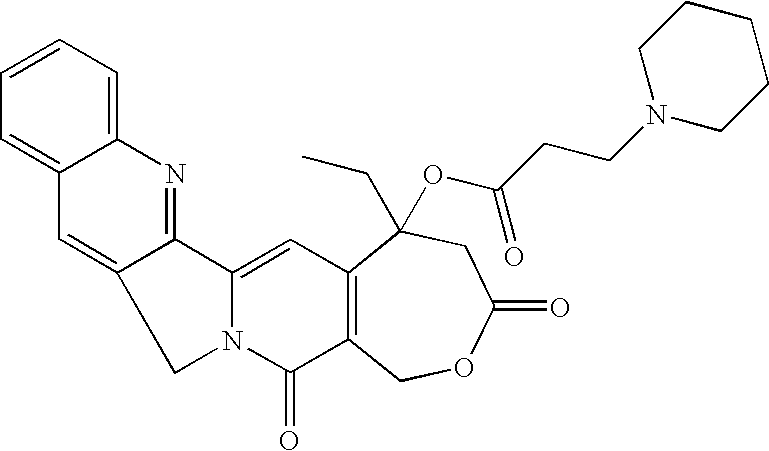
A. Homocamptothecin-20-O ester of 1-piperidine Propionic Acid (021219)
-
- 10,11-methylenedioxy hCPT;
- 9-nitro hCPT;
- 9-amino hCPT;
- 9-amino-10-hydroxy hCPT;
- 9-methylamino hCPT;
- 9-dimethylamino hCPT;
- 9-dimethylaminomethyl-10-hydroxy Hcpt (homo topotecan);
- 9-piperidino hCPT;
- 9-morpholino hCPT
- 7-ethyl-10-[4-(1-piperidino)-1-piperidino]carbonyloxy)-hCPT (homo irinotecan);
- 7-t-butyldimethylsilyl hCPT;
- 7-t-butyldimethylsilyl-10-hydroxy hCPT;
- 9-nitro-10,11-methylenedioxy hCPT;
- 9-amino-10,11-methylenedioxy hCPT;
- 9-methyl-10,11-methylenedioxy hCPT;
- 9-chloro-10,11-methylenedioxy hCPT;
- 9-cyano-10,11-methylenedioxy hCPT;
- 9-acetyloxy-10,11-methylenedioxy hCPT;
- 9-acetylamino-10,11-methylenedioxy hCPT;
- 9-aminomethyl-10-hydroxy hCPT;
- 9-methylaminomethyl-10-hydroxy hCPT;
- 9-dimethylaminomethyl-10-hydroxy hCPT;
- 9-(2-hydroxyethyl)aminomethyl-10-hydroxy hCPT;
- 9-morpholinomethyl-10-hydroxy hCPT;
- 7-ethyl-10-hydroxy hCPT;
- 7-ethyl-10-acetyloxy hCPT;
- 7-methyl-10-aminocarbonyloxy hCPT;
- 7-n-propyl-10-piperidinocarbonyloxy hCPT;
- 7-ethyl-10-(2-dimethylamino)ethyl hCPT; and the like.
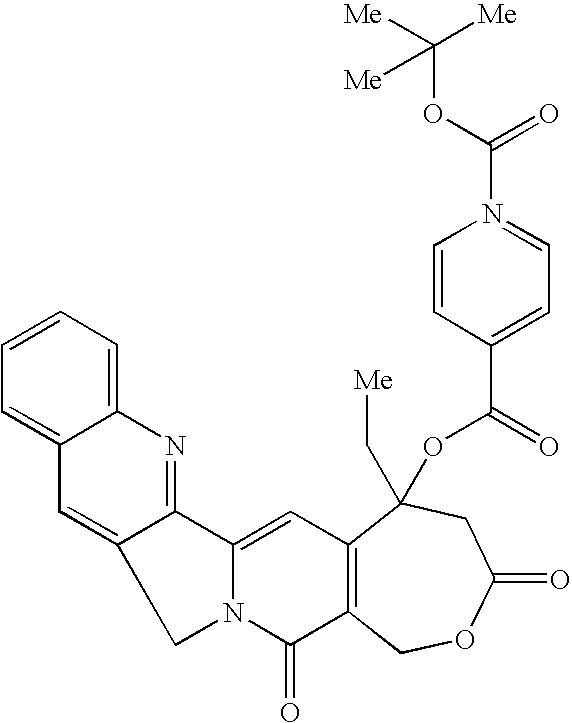
The target molecule is synthesized using the above procedure of this example. The flask is charged with homocamptothecin (hCPT) (20 mg, 0.05 mmol) and then 7 mL of dry chloroform. The solution will be allowed to stir for 10 minutes at ambient temperature. 1-(3-Dimethylamino-propyl)-3-ethyl-carbodiimide hydrochloride (EDCI) (61 mg, 0.31 mmol), 4-(dimethylamino)pyridine (DMAP) (12 mg, 0.12 mmol) and 1-BOC-piperdine-4-carboxylic acid (34 mg, 0.15 mmol) is added. The reaction will be allowed to stir for 20 hours at ambient temperature and worked up according to the procedure.
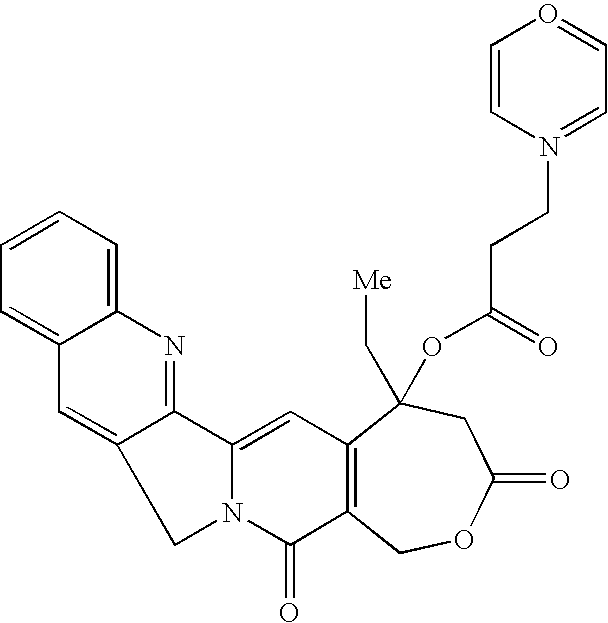
The target molecule is synthesized using the above procedure for this example. The flask is charged with homocamptothecin (hCPT) (20 mg, 0.05 mmol) and then 7 mL of dry chloroform. The solution is allowed to stir for 10 minutes at ambient temperature. 1-(3-Dimethylamino-propyl)-3-ethyl-carbodiimide hydrochloride (EDCI) (61 mg, 0.31 mmol), 4-(dimethylamino)pyridine (DMAP) (12 mg, 0.12 mmol) and N-morpholine propionic acid (23 mg, 0.15 mmol) is added. The reaction is allowed to stir for 20 hours at ambient temperature and worked up according to the procedure.
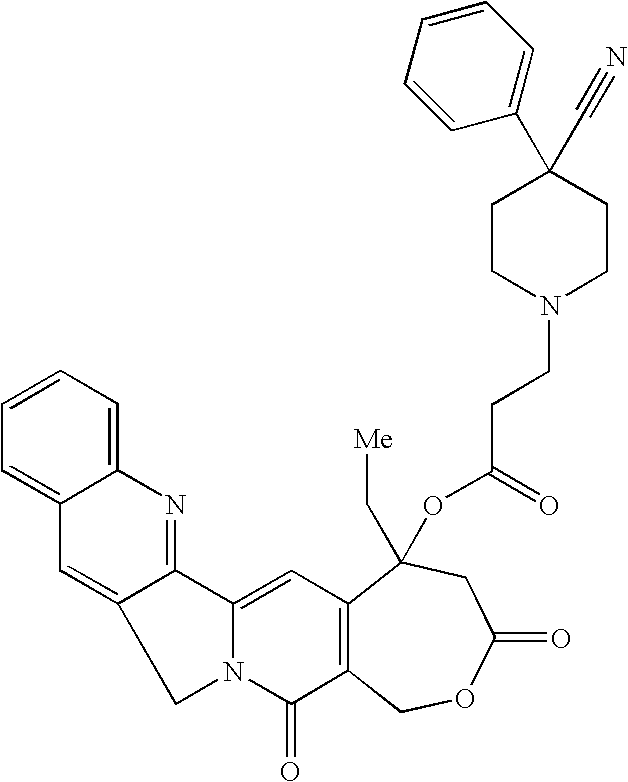
The target molecule is synthesized using the above procedure for this example. The flask is be charged with homocamptothecin (hCPT) (20 mg, 0.05 mmol) and then 7 mL of dry chloroform. The solution is allowed to stir for 10 minutes at ambient temperature. 1-(3-Dimethylamino-propyl)-3-ethyl-carbodiimide hydrochloride (EDCI) (61 mg, 0.31 mmol), 4-(dimethylamino)pyridine (DMAP) (12 mg, 0.12 mmol) and 4-cyano-4-phenyl-piperidine propionic acid (43 mg, 0.15 mmol) is added. The reaction is allowed to stir for 20 hours at ambient temperature and worked up according to the procedure.
-
- 10,11-methylenedioxy hCPT;
- 9-nitro hCPT;
- 9-amino hCPT;
- 9-amino-10-hydroxy hCPT;
- 9-methylamino hCPT;
- 9-dimethylamino hCPT;
- 9-dimethylaminomethyl-10-hydroxy Hcpt (homo topotecan);
- 9-piperidino hCPT;
- 9-morpholino hCPT
- 7-ethyl-10-[4-(1-piperidino)-1-piperidino]carbonyloxy)-hCPT (homo irinotecan);
- 7-t-butyldimethylsilyl hCPT;
- 7-t-butyldimethylsilyl-10-hydroxy hCPT;
- 9-nitro-10,11-methylenedioxy hCPT;
- 9-amino-10,11-methylenedioxy hCPT;
- 9-methyl-10,11-methylenedioxy hCPT;
- 9-chloro-10,11-methylenedioxy hCPT;
- 9-cyano-10,11-methylenedioxy hCPT;
- 9-acetyloxy-10,11-methylenedioxy hCPT;
- 9-acetylamino-10,11-methylenedioxy hCPT;
- 9-aminomethyl-10-hydroxy hCPT;
- 9-methylaminomethyl-10-hydroxy hCPT;
- 9-dimethylaminomethyl-10-hydroxy hCPT;
- 9-(2-hydroxyethyl)aminomethyl-10-hydroxy hCPT;
- 9-morpholinomethyl-10-hydroxy hCPT;
- 7-ethyl-10-hydroxy hCPT;
- 7-ethyl-10-acetyloxy hCPT;
- 7-methyl-10-aminocarbonyloxy hCPT;
- 7-n-propyl-10-piperidinocarbonyloxy hCPT;
7-ethyl-10-(2-dimethylamino)ethyl hCPT; and the like.
| TABLE I | |||
| Compound | Value of ID50 (NM) | ||
| hCPT | 4 | ||
| 021219 | 3.5 | ||
-
- J. Med. Chem. 2000, 43, 3970-3980;
- Anal. Biochem. 1993, 212, 285-287; and
- Biochemistry 1994, 33, 10325-10336.
See also J. Med. Chem. 1998, 41, 31-37.
Claims (50)
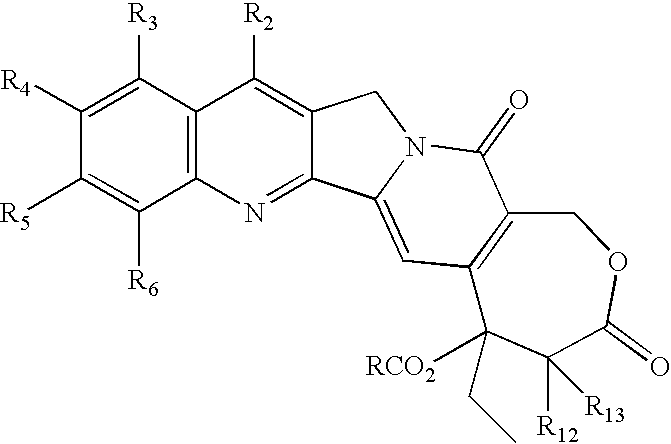

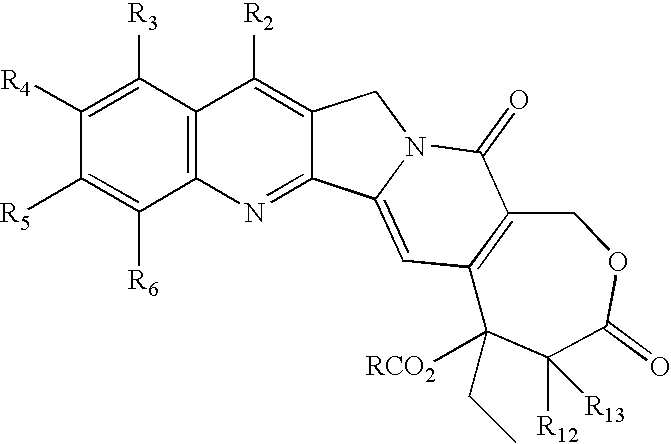
Priority Applications (1)
| Application Number | Priority Date | Filing Date | Title |
|---|---|---|---|
| US10/454,718 US6933302B2 (en) | 2002-06-03 | 2003-06-03 | Nitrogen-based homo-camptothecin derivatives |
Applications Claiming Priority (2)
| Application Number | Priority Date | Filing Date | Title |
|---|---|---|---|
| US38546802P | 2002-06-03 | 2002-06-03 | |
| US10/454,718 US6933302B2 (en) | 2002-06-03 | 2003-06-03 | Nitrogen-based homo-camptothecin derivatives |
Publications (2)
| Publication Number | Publication Date |
|---|---|
| US20040063740A1 US20040063740A1 (en) | 2004-04-01 |
| US6933302B2 true US6933302B2 (en) | 2005-08-23 |
Family
ID=29712172
Family Applications (1)
| Application Number | Title | Priority Date | Filing Date |
|---|---|---|---|
| US10/454,718 Expired - Lifetime US6933302B2 (en) | 2002-06-03 | 2003-06-03 | Nitrogen-based homo-camptothecin derivatives |
Country Status (3)
| Country | Link |
|---|---|
| US (1) | US6933302B2 (en) |
| AU (1) | AU2003243380A1 (en) |
| WO (1) | WO2003101998A1 (en) |
Cited By (3)
| Publication number | Priority date | Publication date | Assignee | Title |
|---|---|---|---|---|
| WO2007048002A2 (en) | 2005-10-21 | 2007-04-26 | California Pacific Medical Center | Camptothecin derivatives as chemoradiosensitizing agents |
| US20070111664A1 (en) * | 2001-06-06 | 2007-05-17 | Qualcomm Incorporated | Method and apparatus for canceling pilot interference in a wireless communication system |
| US20140128421A1 (en) * | 2011-04-18 | 2014-05-08 | East China Normal University | Camptothecin compound containing stable 7-membered lactone ring, preparation method and use |
Families Citing this family (11)
| Publication number | Priority date | Publication date | Assignee | Title |
|---|---|---|---|---|
| EP1967189A1 (en) | 2004-02-18 | 2008-09-10 | GPC Biotech AG | Methods for treating resistant or refractory tumors |
| KR20070008710A (en) | 2004-04-27 | 2007-01-17 | 웰스테트 바이올로직스 코포레이션 | Cancer treatment method using virus and camptothecin |
| CA2584493A1 (en) | 2004-06-18 | 2006-01-05 | Gpc Biotech, Inc. | Kinase inhibitors for treating cancers |
| GB0419850D0 (en) * | 2004-09-07 | 2004-10-13 | Angeletti P Ist Richerche Bio | Therapeutic agents |
| MX2007015407A (en) | 2005-07-14 | 2008-02-19 | Wellstat Biologics Corp | Cancer treatment using viruses, fluoropyrimidines and camptothecins. |
| FR2889528B1 (en) * | 2005-08-05 | 2007-09-07 | Servier Lab | NOVEL CAMPTOTHECIN ANALOG COMPOUNDS, PROCESS FOR PREPARING THEM AND PHARMACEUTICAL COMPOSITIONS CONTAINING THEM |
| FR2889527A1 (en) * | 2005-08-05 | 2007-02-09 | Servier Lab | NOVEL CAMPTOTHECIN ANALOG COMPOUNDS, PROCESS FOR PREPARING THEM AND PHARMACEUTICAL COMPOSITIONS CONTAINING THEM |
| CA2622574A1 (en) | 2005-09-15 | 2007-03-22 | Painceptor Pharma Corporation | Methods of modulating neurotrophin-mediated activity |
| CN101851195B (en) * | 2008-08-27 | 2011-10-12 | 中国科学院上海有机化学研究所 | Quinoline compound and synthetic method and application thereof in synthesizing camptothecin alkaloid |
| US10517961B2 (en) | 2015-09-25 | 2019-12-31 | ZY Therapeutics, Inc. | Drug formulation based on particulates comprising polysaccharide-vitamin conjugate |
| CN110437263A (en) * | 2018-05-03 | 2019-11-12 | 遵义医学院 | HCPT 5- alkene Norcantharidin acid ester derivant and its Regioselective synthesis |
Citations (29)
| Publication number | Priority date | Publication date | Assignee | Title |
|---|---|---|---|---|
| US4399282A (en) | 1979-07-10 | 1983-08-16 | Kabushiki Kaisha Yakult Honsha | Camptothecin derivatives |
| US4943579A (en) | 1987-10-06 | 1990-07-24 | The United States Of America As Represented By The Secretary Of The Department Of Health And Human Services | Water soluble prodrugs of camptothecin |
| WO1995010304A1 (en) | 1993-10-08 | 1995-04-20 | Pharmacia S.P.A | Polymer-bound camptothecin derivatives |
| JP2524804B2 (en) * | 1988-03-29 | 1996-08-14 | 株式会社ヤクルト本社 | Novel camptothecin derivative and method for producing the same |
| WO1996026950A1 (en) | 1995-03-01 | 1996-09-06 | Pharmacia S.P.A. | Increased bioavailability of biologically active compounds by linking to polypyrrolecarboxamidonaphthalene derivatives |
| WO1997019085A1 (en) | 1995-11-22 | 1997-05-29 | Research Triangle Institute | Camptothecin compounds with combined topoisomerase i inhibition and dna alkylation properties |
| WO1997028165A1 (en) | 1996-01-30 | 1997-08-07 | The Stehlin Foundation For Cancer Research | Derivatives of camptothecin for use in treating cancer |
| WO1998013059A1 (en) | 1996-09-27 | 1998-04-02 | Bristol-Myers Squibb Company | Hydrolyzable prodrugs for delivery of anticancer drugs to metastatic cells |
| WO1998014459A1 (en) | 1996-09-30 | 1998-04-09 | Bayer Aktiengesellschaft | Glycoconjugates from modified camptothecin derivates (20-o-linkage) |
| WO1998028304A1 (en) | 1996-12-20 | 1998-07-02 | Societe De Conseils De Recherches Et D'applications Scientifiques (S.C.R.A.S.) | Pro-drugs and counterparts of camptothecin, their application as medicines |
| WO1998035940A1 (en) | 1997-02-14 | 1998-08-20 | Bionumerik Pharmaceuticals, Inc. | Highly lipophilic camptothecin derivatives |
| EP0861842A1 (en) | 1995-06-08 | 1998-09-02 | Kyorin Pharmaceutical Co., Ltd. | Novel water-soluble fluoroethylcamptothecin derivative and process for production thereof |
| WO1998051703A1 (en) | 1997-05-14 | 1998-11-19 | Bayer Aktiengesellschaft | 20(s) camptothecin glycoconjugates |
| WO1999017805A1 (en) | 1997-10-03 | 1999-04-15 | Pharmacia & Upjohn S.P.A. | Bioactive derivatives of camptothecin |
| US5916896A (en) | 1994-07-20 | 1999-06-29 | Research Triange Institute | Water-soluble esters of camptothecin compounds |
| US5965566A (en) | 1993-10-20 | 1999-10-12 | Enzon, Inc. | High molecular weight polymer-based prodrugs |
| US6028078A (en) | 1996-08-19 | 2000-02-22 | Bionumerik Pharmaceuticals, Inc. | Highly lipophilic camptothecin derivatives |
| US6057303A (en) | 1998-10-20 | 2000-05-02 | Bionumerik Pharmaceuticals, Inc. | Highly lipophilic Camptothecin derivatives |
| US6096336A (en) | 1996-01-30 | 2000-08-01 | The Stehlin Foundation For Cancer Research | Liposomal prodrugs comprising derivatives of camptothecin and methods of treating cancer using these prodrugs |
| US6113906A (en) | 1993-10-27 | 2000-09-05 | Enzon, Inc. | Water-soluble non-antigenic polymer linkable to biologically active material |
| US6114529A (en) | 1996-10-30 | 2000-09-05 | Tanabe Seiyaku Co., Ltd. | S type 2-substituted hydroxy-2-indolidinylbutyric ester compounds and process for preparation thereof |
| WO2000066127A1 (en) | 1999-05-04 | 2000-11-09 | Bionumerik Pharmaceuticals, Inc. | Novel highly lipophilic camptothecin analogs |
| WO2000067801A2 (en) | 1999-05-06 | 2000-11-16 | University Of Kentucky Research Foundation | Prodrugs of chemotherapeutic agents with oxaalkanoic acids |
| US6153655A (en) | 1998-04-17 | 2000-11-28 | Enzon, Inc. | Terminally-branched polymeric linkers and polymeric conjugates containing the same |
| US6207832B1 (en) | 1999-04-09 | 2001-03-27 | University Of Pittsburgh | Camptothecin analogs and methods of preparation thereof |
| US6339091B1 (en) * | 1995-06-21 | 2002-01-15 | Societe De Conseils De Recherches Et D'applications Scientifiques (S.C.R.A.S.) | Comptothecin analogues, preparation methods therefor, use thereof as drugs, and pharmaceutical compositions containing said analogues |
| US6350756B1 (en) | 2001-01-18 | 2002-02-26 | California Pacific Medical Center | Camptothecin derivatives |
| US6403604B1 (en) | 2001-03-01 | 2002-06-11 | California Pacific Medical Center | Nitrogen-based camptothecin derivatives |
| WO2003014069A1 (en) | 2001-08-10 | 2003-02-20 | Pharmacia Italia Spa | Fluoro linkers and their use as linkers for enzyme-activated drug conjugates |
-
2003
- 2003-06-03 US US10/454,718 patent/US6933302B2/en not_active Expired - Lifetime
- 2003-06-03 AU AU2003243380A patent/AU2003243380A1/en not_active Abandoned
- 2003-06-03 WO PCT/US2003/017501 patent/WO2003101998A1/en not_active Ceased
Patent Citations (32)
| Publication number | Priority date | Publication date | Assignee | Title |
|---|---|---|---|---|
| US4399282A (en) | 1979-07-10 | 1983-08-16 | Kabushiki Kaisha Yakult Honsha | Camptothecin derivatives |
| US4943579A (en) | 1987-10-06 | 1990-07-24 | The United States Of America As Represented By The Secretary Of The Department Of Health And Human Services | Water soluble prodrugs of camptothecin |
| JP2524804B2 (en) * | 1988-03-29 | 1996-08-14 | 株式会社ヤクルト本社 | Novel camptothecin derivative and method for producing the same |
| WO1995010304A1 (en) | 1993-10-08 | 1995-04-20 | Pharmacia S.P.A | Polymer-bound camptothecin derivatives |
| US6127355A (en) | 1993-10-20 | 2000-10-03 | Enzon, Inc. | High molecular weight polymer-based prodrugs |
| US5965566A (en) | 1993-10-20 | 1999-10-12 | Enzon, Inc. | High molecular weight polymer-based prodrugs |
| US6113906A (en) | 1993-10-27 | 2000-09-05 | Enzon, Inc. | Water-soluble non-antigenic polymer linkable to biologically active material |
| US6040313A (en) | 1994-07-20 | 2000-03-21 | Research Triangle Institute | Water-soluble esters of camptothecin compounds |
| US5916896A (en) | 1994-07-20 | 1999-06-29 | Research Triange Institute | Water-soluble esters of camptothecin compounds |
| WO1996026950A1 (en) | 1995-03-01 | 1996-09-06 | Pharmacia S.P.A. | Increased bioavailability of biologically active compounds by linking to polypyrrolecarboxamidonaphthalene derivatives |
| EP0861842A1 (en) | 1995-06-08 | 1998-09-02 | Kyorin Pharmaceutical Co., Ltd. | Novel water-soluble fluoroethylcamptothecin derivative and process for production thereof |
| US6339091B1 (en) * | 1995-06-21 | 2002-01-15 | Societe De Conseils De Recherches Et D'applications Scientifiques (S.C.R.A.S.) | Comptothecin analogues, preparation methods therefor, use thereof as drugs, and pharmaceutical compositions containing said analogues |
| WO1997019085A1 (en) | 1995-11-22 | 1997-05-29 | Research Triangle Institute | Camptothecin compounds with combined topoisomerase i inhibition and dna alkylation properties |
| US6120793A (en) | 1996-01-30 | 2000-09-19 | The Stehlin Foundation For Cancer Research | Methods of treating cancer using these derivatives |
| WO1997028165A1 (en) | 1996-01-30 | 1997-08-07 | The Stehlin Foundation For Cancer Research | Derivatives of camptothecin for use in treating cancer |
| US6096336A (en) | 1996-01-30 | 2000-08-01 | The Stehlin Foundation For Cancer Research | Liposomal prodrugs comprising derivatives of camptothecin and methods of treating cancer using these prodrugs |
| US6028078A (en) | 1996-08-19 | 2000-02-22 | Bionumerik Pharmaceuticals, Inc. | Highly lipophilic camptothecin derivatives |
| WO1998013059A1 (en) | 1996-09-27 | 1998-04-02 | Bristol-Myers Squibb Company | Hydrolyzable prodrugs for delivery of anticancer drugs to metastatic cells |
| WO1998014459A1 (en) | 1996-09-30 | 1998-04-09 | Bayer Aktiengesellschaft | Glycoconjugates from modified camptothecin derivates (20-o-linkage) |
| US6114529A (en) | 1996-10-30 | 2000-09-05 | Tanabe Seiyaku Co., Ltd. | S type 2-substituted hydroxy-2-indolidinylbutyric ester compounds and process for preparation thereof |
| WO1998028304A1 (en) | 1996-12-20 | 1998-07-02 | Societe De Conseils De Recherches Et D'applications Scientifiques (S.C.R.A.S.) | Pro-drugs and counterparts of camptothecin, their application as medicines |
| WO1998035940A1 (en) | 1997-02-14 | 1998-08-20 | Bionumerik Pharmaceuticals, Inc. | Highly lipophilic camptothecin derivatives |
| WO1998051703A1 (en) | 1997-05-14 | 1998-11-19 | Bayer Aktiengesellschaft | 20(s) camptothecin glycoconjugates |
| WO1999017805A1 (en) | 1997-10-03 | 1999-04-15 | Pharmacia & Upjohn S.P.A. | Bioactive derivatives of camptothecin |
| US6153655A (en) | 1998-04-17 | 2000-11-28 | Enzon, Inc. | Terminally-branched polymeric linkers and polymeric conjugates containing the same |
| US6057303A (en) | 1998-10-20 | 2000-05-02 | Bionumerik Pharmaceuticals, Inc. | Highly lipophilic Camptothecin derivatives |
| US6207832B1 (en) | 1999-04-09 | 2001-03-27 | University Of Pittsburgh | Camptothecin analogs and methods of preparation thereof |
| WO2000066127A1 (en) | 1999-05-04 | 2000-11-09 | Bionumerik Pharmaceuticals, Inc. | Novel highly lipophilic camptothecin analogs |
| WO2000067801A2 (en) | 1999-05-06 | 2000-11-16 | University Of Kentucky Research Foundation | Prodrugs of chemotherapeutic agents with oxaalkanoic acids |
| US6350756B1 (en) | 2001-01-18 | 2002-02-26 | California Pacific Medical Center | Camptothecin derivatives |
| US6403604B1 (en) | 2001-03-01 | 2002-06-11 | California Pacific Medical Center | Nitrogen-based camptothecin derivatives |
| WO2003014069A1 (en) | 2001-08-10 | 2003-02-20 | Pharmacia Italia Spa | Fluoro linkers and their use as linkers for enzyme-activated drug conjugates |
Non-Patent Citations (31)
Cited By (12)
| Publication number | Priority date | Publication date | Assignee | Title |
|---|---|---|---|---|
| US20070111664A1 (en) * | 2001-06-06 | 2007-05-17 | Qualcomm Incorporated | Method and apparatus for canceling pilot interference in a wireless communication system |
| WO2007048002A2 (en) | 2005-10-21 | 2007-04-26 | California Pacific Medical Center | Camptothecin derivatives as chemoradiosensitizing agents |
| US20070093432A1 (en) * | 2005-10-21 | 2007-04-26 | California Pacific Medical Center | Camptothecin derivatives as chemoradiosensitizing agents |
| WO2007048002A3 (en) * | 2005-10-21 | 2007-09-13 | California Pacific Med Center | Camptothecin derivatives as chemoradiosensitizing agents |
| US20080318873A1 (en) * | 2005-10-21 | 2008-12-25 | California Pacific Medical Center | Camptothecin derivatives as chemoradiosensitizing agents |
| US7875602B2 (en) | 2005-10-21 | 2011-01-25 | Sutter West Bay Hospitals | Camptothecin derivatives as chemoradiosensitizing agents |
| US20110184009A1 (en) * | 2005-10-21 | 2011-07-28 | Sutter West Bay Hospitals, Dba California Pacific Medical Center | Camptothecin derivatives as chemoradiosensitizing agents |
| CN101300009B (en) * | 2005-10-21 | 2013-04-03 | 莎特西湾医院 | Camptothecin derivatives as chemoradiosensitizing agents |
| US8563537B2 (en) | 2005-10-21 | 2013-10-22 | Sutter West Bay Hospital | Camptothecin derivatives as chemoradiosensitizing agents |
| US8779138B2 (en) | 2005-10-21 | 2014-07-15 | Sutter West Bay Hospital | Camptothecin derivatives as chemoradiosensitizing agents |
| US20140128421A1 (en) * | 2011-04-18 | 2014-05-08 | East China Normal University | Camptothecin compound containing stable 7-membered lactone ring, preparation method and use |
| US9115150B2 (en) * | 2011-04-18 | 2015-08-25 | East China Normal University | Camptothecin compound containing stable 7-membered lactone ring, preparation method and use |
Also Published As
| Publication number | Publication date |
|---|---|
| AU2003243380A1 (en) | 2003-12-19 |
| AU2003243380A8 (en) | 2003-12-19 |
| US20040063740A1 (en) | 2004-04-01 |
| WO2003101998A1 (en) | 2003-12-11 |
Similar Documents
| Publication | Publication Date | Title |
|---|---|---|
| US6825207B2 (en) | Nitrogen-based camptothecin derivatives | |
| US7605262B2 (en) | Podophyllotoxin derivatives | |
| US6855720B2 (en) | Nitrogen-based camptothecin derivatives | |
| USRE39707E1 (en) | Camptothecin derivatives | |
| US6933302B2 (en) | Nitrogen-based homo-camptothecin derivatives | |
| AU2002243367A1 (en) | Camptothecin derivatives | |
| US6825236B2 (en) | Colchicine derivatives | |
| US20040034050A1 (en) | Homo-camptothecin derivatives | |
| AU2002250039A1 (en) | Nitrogen-based camptothecin derivatives |
Legal Events
| Date | Code | Title | Description |
|---|---|---|---|
| AS | Assignment |
Owner name: CALIFORNIA PACIFIC MEDICAL CENTER, CALIFORNIA Free format text: ASSIGNMENT OF ASSIGNORS INTEREST;ASSIGNOR:YANG, LI-XI;REEL/FRAME:014098/0296 Effective date: 20031003 Owner name: CATHOLIC HEALTHCARE WEST, DOING BUSINESS AS ST. MA Free format text: ASSIGNMENT OF ASSIGNORS INTEREST;ASSIGNOR:YANG, LI-XI;REEL/FRAME:014098/0296 Effective date: 20031003 |
|
| STCF | Information on status: patent grant |
Free format text: PATENTED CASE |
|
| CC | Certificate of correction | ||
| FPAY | Fee payment |
Year of fee payment: 4 |
|
| AS | Assignment |
Owner name: SUTTER WEST BAY HOSPITALS, DBA CALIFORNIA PACIFIC Free format text: CHANGE OF NAME;ASSIGNOR:CALIFORNIA PACIFIC MEDICAL CENTER;REEL/FRAME:023180/0332 Effective date: 20090424 |
|
| FEPP | Fee payment procedure |
Free format text: PAYOR NUMBER ASSIGNED (ORIGINAL EVENT CODE: ASPN); ENTITY STATUS OF PATENT OWNER: SMALL ENTITY |
|
| AS | Assignment |
Owner name: SUTTER WEST BAY HOSPITALS, DBA CALIFORNIA PACIFIC Free format text: CORRECTIVE ASSIGNMENT TO CORRECT THE ASSIGNEE'S ADDRESS FROM 475 BRANNAN STREET, SUITE 200, SAN FRANCISCO, CA 94107 PREVIOUSLY RECORDED ON REEL 023180 FRAME 0332;ASSIGNOR:CALIFORNIA PACIFIC MEDICAL CENTER;REEL/FRAME:023701/0074 Effective date: 20090424 |
|
| FPAY | Fee payment |
Year of fee payment: 8 |
|
| REMI | Maintenance fee reminder mailed | ||
| FPAY | Fee payment |
Year of fee payment: 12 |
|
| SULP | Surcharge for late payment |
Year of fee payment: 11 |