US6828317B2 - Antimicrobial thiadiazinone derivatives and their application for treatment of bacterial infections - Google Patents
Antimicrobial thiadiazinone derivatives and their application for treatment of bacterial infections Download PDFInfo
- Publication number
- US6828317B2 US6828317B2 US10/357,515 US35751503A US6828317B2 US 6828317 B2 US6828317 B2 US 6828317B2 US 35751503 A US35751503 A US 35751503A US 6828317 B2 US6828317 B2 US 6828317B2
- Authority
- US
- United States
- Prior art keywords
- oxo
- compound
- formula
- oxazolidin
- thiadiazin
- Prior art date
- Legal status (The legal status is an assumption and is not a legal conclusion. Google has not performed a legal analysis and makes no representation as to the accuracy of the status listed.)
- Expired - Fee Related
Links
- 208000035143 Bacterial infection Diseases 0.000 title claims description 5
- 208000022362 bacterial infectious disease Diseases 0.000 title claims description 5
- 230000000845 anti-microbial effect Effects 0.000 title description 5
- 150000001875 compounds Chemical class 0.000 claims abstract description 242
- 238000000034 method Methods 0.000 claims abstract description 76
- 239000008194 pharmaceutical composition Substances 0.000 claims abstract description 15
- 150000003839 salts Chemical class 0.000 claims abstract description 12
- -1 1,2,3,4-tetrazolyl Chemical group 0.000 claims description 57
- 125000004178 (C1-C4) alkyl group Chemical group 0.000 claims description 15
- IJGRMHOSHXDMSA-UHFFFAOYSA-N Atomic nitrogen Chemical group N#N IJGRMHOSHXDMSA-UHFFFAOYSA-N 0.000 claims description 14
- 125000003118 aryl group Chemical group 0.000 claims description 13
- 125000000217 alkyl group Chemical group 0.000 claims description 11
- 125000002496 methyl group Chemical group [H]C([H])([H])* 0.000 claims description 11
- 229910052760 oxygen Inorganic materials 0.000 claims description 11
- 241000124008 Mammalia Species 0.000 claims description 9
- 125000001424 substituent group Chemical group 0.000 claims description 9
- 229910052717 sulfur Inorganic materials 0.000 claims description 9
- 125000005913 (C3-C6) cycloalkyl group Chemical group 0.000 claims description 8
- 125000005843 halogen group Chemical group 0.000 claims description 8
- NNWFHBBQTSZBKK-JTQLQIEISA-N n-[[(5s)-3-[3-fluoro-4-(5-oxo-4h-1,3,4-thiadiazin-2-yl)phenyl]-2-oxo-1,3-oxazolidin-5-yl]methyl]acetamide Chemical compound O=C1O[C@@H](CNC(=O)C)CN1C(C=C1F)=CC=C1C1=NNC(=O)CS1 NNWFHBBQTSZBKK-JTQLQIEISA-N 0.000 claims description 8
- 125000001495 ethyl group Chemical group [H]C([H])([H])C([H])([H])* 0.000 claims description 7
- 229910052757 nitrogen Inorganic materials 0.000 claims description 7
- IVEHJYFWFOGHRD-UHFFFAOYSA-N 2h-thiadiazin-5-one Chemical compound O=C1CSNN=C1 IVEHJYFWFOGHRD-UHFFFAOYSA-N 0.000 claims description 6
- 239000003937 drug carrier Substances 0.000 claims description 6
- 208000015181 infectious disease Diseases 0.000 claims description 6
- RPXZUEUKEAJPRR-NSHDSACASA-N n-[[(5s)-3-[4-(6,6-dimethyl-5-oxo-4h-1,3,4-thiadiazin-2-yl)-3-fluorophenyl]-2-oxo-1,3-oxazolidin-5-yl]methyl]acetamide Chemical compound O=C1O[C@@H](CNC(=O)C)CN1C(C=C1F)=CC=C1C1=NNC(=O)C(C)(C)S1 RPXZUEUKEAJPRR-NSHDSACASA-N 0.000 claims description 6
- 239000001301 oxygen Substances 0.000 claims description 6
- 125000004518 1,2,5-thiadiazol-3-yl group Chemical group S1N=C(C=N1)* 0.000 claims description 5
- 125000004777 2-fluoroethyl group Chemical group [H]C([H])(F)C([H])([H])* 0.000 claims description 5
- 125000004105 2-pyridyl group Chemical group N1=C([*])C([H])=C([H])C([H])=C1[H] 0.000 claims description 5
- 125000003349 3-pyridyl group Chemical group N1=C([H])C([*])=C([H])C([H])=C1[H] 0.000 claims description 5
- 125000000339 4-pyridyl group Chemical group N1=C([H])C([H])=C([*])C([H])=C1[H] 0.000 claims description 5
- QVGXLLKOCUKJST-UHFFFAOYSA-N atomic oxygen Chemical group [O] QVGXLLKOCUKJST-UHFFFAOYSA-N 0.000 claims description 5
- 125000001309 chloro group Chemical group Cl* 0.000 claims description 5
- 125000000753 cycloalkyl group Chemical group 0.000 claims description 5
- 125000001028 difluoromethyl group Chemical group [H]C(F)(F)* 0.000 claims description 5
- JBGMFWOJKNQDHD-NSHDSACASA-N tert-butyl n-[[(5s)-3-[3-fluoro-4-(5-oxo-4h-1,3,4-thiadiazin-2-yl)phenyl]-2-oxo-1,3-oxazolidin-5-yl]methyl]carbamate Chemical compound O=C1O[C@@H](CNC(=O)OC(C)(C)C)CN1C(C=C1F)=CC=C1C1=NNC(=O)CS1 JBGMFWOJKNQDHD-NSHDSACASA-N 0.000 claims description 5
- IBUJLYLKJPPOLF-NSHDSACASA-N tert-butyl n-[[(5s)-3-[3-fluoro-4-(5-sulfanylidene-4h-1,3,4-thiadiazin-2-yl)phenyl]-2-oxo-1,3-oxazolidin-5-yl]methyl]carbamate Chemical compound O=C1O[C@@H](CNC(=O)OC(C)(C)C)CN1C(C=C1F)=CC=C1C1=NNC(=S)CS1 IBUJLYLKJPPOLF-NSHDSACASA-N 0.000 claims description 5
- 125000001607 1,2,3-triazol-1-yl group Chemical group [*]N1N=NC([H])=C1[H] 0.000 claims description 4
- 125000002373 5 membered heterocyclic group Chemical group 0.000 claims description 4
- 125000004070 6 membered heterocyclic group Chemical group 0.000 claims description 4
- NINIDFKCEFEMDL-UHFFFAOYSA-N Sulfur Chemical group [S] NINIDFKCEFEMDL-UHFFFAOYSA-N 0.000 claims description 4
- IRYPWVNMZJGGSI-QMMMGPOBSA-N [(5s)-3-[3-fluoro-4-(5-oxo-4h-1,3,4-thiadiazin-2-yl)phenyl]-2-oxo-1,3-oxazolidin-5-yl]methylurea Chemical compound O=C1O[C@@H](CNC(=O)N)CN1C(C=C1F)=CC=C1C1=NNC(=O)CS1 IRYPWVNMZJGGSI-QMMMGPOBSA-N 0.000 claims description 4
- IROQNSBIECIHOT-CHPOKUKFSA-N [2-[4-[(5s)-5-(acetamidomethyl)-2-oxo-1,3-oxazolidin-3-yl]-2-fluorophenyl]-5-oxo-4h-1,3,4-thiadiazin-6-yl] acetate Chemical compound O=C1O[C@@H](CNC(=O)C)CN1C(C=C1F)=CC=C1C1=NNC(=O)C(OC(C)=O)S1 IROQNSBIECIHOT-CHPOKUKFSA-N 0.000 claims description 4
- 125000003342 alkenyl group Chemical group 0.000 claims description 4
- 125000005842 heteroatom Chemical group 0.000 claims description 4
- KISABMKFTFRVAU-NKUHCKNESA-N methyl 2-[4-[(5s)-5-(acetamidomethyl)-2-oxo-1,3-oxazolidin-3-yl]-2-fluorophenyl]-5-oxo-4h-1,3,4-thiadiazine-6-carboxylate Chemical compound N1C(=O)C(C(=O)OC)SC(C=2C(=CC(=CC=2)N2C(O[C@@H](CNC(C)=O)C2)=O)F)=N1 KISABMKFTFRVAU-NKUHCKNESA-N 0.000 claims description 4
- SFXQWNGHPVQHGQ-VIFPVBQESA-N methyl n-[[(5s)-3-[3-fluoro-4-(5-oxo-4h-1,3,4-thiadiazin-2-yl)phenyl]-2-oxo-1,3-oxazolidin-5-yl]methyl]carbamate Chemical compound O=C1O[C@@H](CNC(=O)OC)CN1C(C=C1F)=CC=C1C1=NNC(=O)CS1 SFXQWNGHPVQHGQ-VIFPVBQESA-N 0.000 claims description 4
- NCYWOTYJIFUVPF-NSHDSACASA-N n-[[(5s)-3-[3-fluoro-4-(4-methyl-5-oxo-1,3,4-thiadiazin-2-yl)phenyl]-2-oxo-1,3-oxazolidin-5-yl]methyl]acetamide Chemical compound S1CC(=O)N(C)N=C1C1=CC=C(N2C(O[C@@H](CNC(C)=O)C2)=O)C=C1F NCYWOTYJIFUVPF-NSHDSACASA-N 0.000 claims description 4
- YVIUDRBSCPDSET-VIFPVBQESA-N n-[[(5s)-3-[3-fluoro-4-(5-oxo-4h-1,3,4-thiadiazin-2-yl)phenyl]-2-oxo-1,3-oxazolidin-5-yl]methyl]-2-hydroxyacetamide Chemical compound O=C1O[C@@H](CNC(=O)CO)CN1C(C=C1F)=CC=C1C1=NNC(=O)CS1 YVIUDRBSCPDSET-VIFPVBQESA-N 0.000 claims description 4
- BHSNLWBSJFCLFN-HNNXBMFYSA-N n-[[(5s)-3-[3-fluoro-4-(5-oxo-4h-1,3,4-thiadiazin-2-yl)phenyl]-2-oxo-1,3-oxazolidin-5-yl]methyl]-3-(4-fluorophenyl)-3-oxopropanamide Chemical compound C1=CC(F)=CC=C1C(=O)CC(=O)NC[C@@H]1OC(=O)N(C=2C=C(F)C(C=3SCC(=O)NN=3)=CC=2)C1 BHSNLWBSJFCLFN-HNNXBMFYSA-N 0.000 claims description 4
- LZYQELACQCOYFV-NSHDSACASA-N n-[[(5s)-3-[3-fluoro-4-(5-oxo-4h-1,3,4-thiadiazin-2-yl)phenyl]-2-oxo-1,3-oxazolidin-5-yl]methyl]cyclopropanecarboxamide Chemical compound FC1=CC(N2C(O[C@@H](CNC(=O)C3CC3)C2)=O)=CC=C1C1=NNC(=O)CS1 LZYQELACQCOYFV-NSHDSACASA-N 0.000 claims description 4
- RRQICYIOZZTRIE-JTQLQIEISA-N n-[[(5s)-3-[3-fluoro-4-(5-oxo-4h-1,3,4-thiadiazin-2-yl)phenyl]-2-oxo-1,3-oxazolidin-5-yl]methyl]ethanethioamide Chemical compound O=C1O[C@@H](CNC(=S)C)CN1C(C=C1F)=CC=C1C1=NNC(=O)CS1 RRQICYIOZZTRIE-JTQLQIEISA-N 0.000 claims description 4
- JUBWYZQQQCLLAN-BUSXIPJBSA-N n-[[(5s)-3-[3-fluoro-4-(5-oxo-6-phenyl-4h-1,3,4-thiadiazin-2-yl)phenyl]-2-oxo-1,3-oxazolidin-5-yl]methyl]acetamide Chemical compound O=C1O[C@@H](CNC(=O)C)CN1C(C=C1F)=CC=C1C1=NNC(=O)C(C=2C=CC=CC=2)S1 JUBWYZQQQCLLAN-BUSXIPJBSA-N 0.000 claims description 4
- AZEOFACQNRBNKI-SFVWDYPZSA-N n-[[(5s)-3-[3-fluoro-4-(5-oxo-6-propan-2-yl-4h-1,3,4-thiadiazin-2-yl)phenyl]-2-oxo-1,3-oxazolidin-5-yl]methyl]acetamide Chemical compound N1C(=O)C(C(C)C)SC(C=2C(=CC(=CC=2)N2C(O[C@@H](CNC(C)=O)C2)=O)F)=N1 AZEOFACQNRBNKI-SFVWDYPZSA-N 0.000 claims description 4
- ZGIJNSUTOQUPGR-SFVWDYPZSA-N n-[[(5s)-3-[3-fluoro-4-(5-oxo-6-propyl-4h-1,3,4-thiadiazin-2-yl)phenyl]-2-oxo-1,3-oxazolidin-5-yl]methyl]acetamide Chemical compound N1C(=O)C(CCC)SC(C=2C(=CC(=CC=2)N2C(O[C@@H](CNC(C)=O)C2)=O)F)=N1 ZGIJNSUTOQUPGR-SFVWDYPZSA-N 0.000 claims description 4
- CWSQQZHCAZBTLA-JTQLQIEISA-N n-[[(5s)-3-[3-fluoro-4-(5-sulfanylidene-4h-1,3,4-thiadiazin-2-yl)phenyl]-2-oxo-1,3-oxazolidin-5-yl]methyl]acetamide Chemical compound O=C1O[C@@H](CNC(=O)C)CN1C(C=C1F)=CC=C1C1=NNC(=S)CS1 CWSQQZHCAZBTLA-JTQLQIEISA-N 0.000 claims description 4
- GCDKJLDNOWCUSW-JTQLQIEISA-N n-[[(5s)-3-[3-fluoro-4-(5-sulfanylidene-4h-1,3,4-thiadiazin-2-yl)phenyl]-2-oxo-1,3-oxazolidin-5-yl]methyl]ethanethioamide Chemical compound O=C1O[C@@H](CNC(=S)C)CN1C(C=C1F)=CC=C1C1=NNC(=S)CS1 GCDKJLDNOWCUSW-JTQLQIEISA-N 0.000 claims description 4
- RCXVRGFBFWUADC-QHGLUPRGSA-N n-[[(5s)-3-[3-fluoro-4-(6-fluoro-5-oxo-4h-1,3,4-thiadiazin-2-yl)phenyl]-2-oxo-1,3-oxazolidin-5-yl]methyl]acetamide Chemical compound O=C1O[C@@H](CNC(=O)C)CN1C(C=C1F)=CC=C1C1=NNC(=O)C(F)S1 RCXVRGFBFWUADC-QHGLUPRGSA-N 0.000 claims description 4
- AULNKVUZKVHAMK-LBPRGKRZSA-N n-[[(5s)-3-[3-fluoro-4-(9-oxo-5-thia-7,8-diazaspiro[3.5]non-6-en-6-yl)phenyl]-2-oxo-1,3-oxazolidin-5-yl]methyl]acetamide Chemical compound O=C1O[C@@H](CNC(=O)C)CN1C(C=C1F)=CC=C1C(S1)=NNC(=O)C11CCC1 AULNKVUZKVHAMK-LBPRGKRZSA-N 0.000 claims description 4
- FIQONJKJDNESKL-KCJUWKMLSA-N n-[[(5s)-3-[3-fluoro-4-[(6r)-6-methyl-5-oxo-4h-1,3,4-thiadiazin-2-yl]phenyl]-2-oxo-1,3-oxazolidin-5-yl]methyl]acetamide Chemical compound N1C(=O)[C@@H](C)SC(C=2C(=CC(=CC=2)N2C(O[C@@H](CNC(C)=O)C2)=O)F)=N1 FIQONJKJDNESKL-KCJUWKMLSA-N 0.000 claims description 4
- FIQONJKJDNESKL-KWQFWETISA-N n-[[(5s)-3-[3-fluoro-4-[(6s)-6-methyl-5-oxo-4h-1,3,4-thiadiazin-2-yl]phenyl]-2-oxo-1,3-oxazolidin-5-yl]methyl]acetamide Chemical compound N1C(=O)[C@H](C)SC(C=2C(=CC(=CC=2)N2C(O[C@@H](CNC(C)=O)C2)=O)F)=N1 FIQONJKJDNESKL-KWQFWETISA-N 0.000 claims description 4
- UJNMWSMZFJANHH-ZSOXZCCMSA-N n-[[(5s)-3-[3-fluoro-4-[6-(2-hydroxyethyl)-5-oxo-4h-1,3,4-thiadiazin-2-yl]phenyl]-2-oxo-1,3-oxazolidin-5-yl]methyl]acetamide Chemical compound O=C1O[C@@H](CNC(=O)C)CN1C(C=C1F)=CC=C1C1=NNC(=O)C(CCO)S1 UJNMWSMZFJANHH-ZSOXZCCMSA-N 0.000 claims description 4
- SLNUHOGZHXSKHN-BUSXIPJBSA-N n-[[(5s)-3-[3-fluoro-4-[6-(4-hydroxyphenyl)-5-oxo-4h-1,3,4-thiadiazin-2-yl]phenyl]-2-oxo-1,3-oxazolidin-5-yl]methyl]acetamide Chemical compound O=C1O[C@@H](CNC(=O)C)CN1C(C=C1F)=CC=C1C1=NNC(=O)C(C=2C=CC(O)=CC=2)S1 SLNUHOGZHXSKHN-BUSXIPJBSA-N 0.000 claims description 4
- BRJOGFIIXKKPJF-NKUHCKNESA-N n-[[(5s)-3-[3-fluoro-4-[6-(hydroxymethyl)-5-oxo-4h-1,3,4-thiadiazin-2-yl]phenyl]-2-oxo-1,3-oxazolidin-5-yl]methyl]acetamide Chemical compound O=C1O[C@@H](CNC(=O)C)CN1C(C=C1F)=CC=C1C1=NNC(=O)C(CO)S1 BRJOGFIIXKKPJF-NKUHCKNESA-N 0.000 claims description 4
- GVPPDMOYTFCXCZ-RPIUDXSGSA-N n-[[(5s)-3-[4-(6,6-dimethyl-1,5-dioxo-4h-1,3,4-thiadiazin-2-yl)-3-fluorophenyl]-2-oxo-1,3-oxazolidin-5-yl]methyl]acetamide Chemical compound O=C1O[C@@H](CNC(=O)C)CN1C(C=C1F)=CC=C1C1=NNC(=O)C(C)(C)S1=O GVPPDMOYTFCXCZ-RPIUDXSGSA-N 0.000 claims description 4
- WBSBCGPRQDOKHP-ZSOXZCCMSA-N n-[[(5s)-3-[4-(6-ethyl-5-oxo-4h-1,3,4-thiadiazin-2-yl)-3-fluorophenyl]-2-oxo-1,3-oxazolidin-5-yl]methyl]acetamide Chemical compound N1C(=O)C(CC)SC(C=2C(=CC(=CC=2)N2C(O[C@@H](CNC(C)=O)C2)=O)F)=N1 WBSBCGPRQDOKHP-ZSOXZCCMSA-N 0.000 claims description 4
- 239000011593 sulfur Chemical group 0.000 claims description 4
- JJEACDPQQOWLOJ-JTQLQIEISA-N (5s)-3-[3-fluoro-4-(5-oxo-4h-1,3,4-thiadiazin-2-yl)phenyl]-5-(1,2-oxazol-3-yloxymethyl)-1,3-oxazolidin-2-one Chemical compound FC1=CC(N2C(O[C@H](COC3=NOC=C3)C2)=O)=CC=C1C1=NNC(=O)CS1 JJEACDPQQOWLOJ-JTQLQIEISA-N 0.000 claims description 3
- DAGNIRQXWCSCAL-JTQLQIEISA-N (5s)-3-[3-fluoro-4-(5-oxo-4h-1,3,4-thiadiazin-2-yl)phenyl]-5-[(1,2-oxazol-3-ylamino)methyl]-1,3-oxazolidin-2-one Chemical compound FC1=CC(N2C(O[C@@H](CNC3=NOC=C3)C2)=O)=CC=C1C1=NNC(=O)CS1 DAGNIRQXWCSCAL-JTQLQIEISA-N 0.000 claims description 3
- 125000001399 1,2,3-triazolyl group Chemical group N1N=NC(=C1)* 0.000 claims description 3
- 125000001376 1,2,4-triazolyl group Chemical group N1N=C(N=C1)* 0.000 claims description 3
- GSHLTHPBUTVWDE-UHFFFAOYSA-N [4-[3-[[3-[3-fluoro-4-(5-oxo-4h-1,3,4-thiadiazin-2-yl)phenyl]-2-oxo-1,3-oxazolidin-5-yl]methylamino]-3-oxoprop-1-enyl]phenyl] dihydrogen phosphate Chemical compound C1=CC(OP(O)(=O)O)=CC=C1C=CC(=O)NCC1OC(=O)N(C=2C=C(F)C(C=3SCC(=O)NN=3)=CC=2)C1 GSHLTHPBUTVWDE-UHFFFAOYSA-N 0.000 claims description 3
- 230000037396 body weight Effects 0.000 claims description 3
- 125000002883 imidazolyl group Chemical group 0.000 claims description 3
- XHTCXNOSPDAQNB-LBPRGKRZSA-N methyl 2-[2-[4-[(5s)-5-(acetamidomethyl)-2-oxo-1,3-oxazolidin-3-yl]-2-fluorophenyl]-5-oxo-1,3,4-thiadiazin-4-yl]acetate Chemical compound S1CC(=O)N(CC(=O)OC)N=C1C1=CC=C(N2C(O[C@@H](CNC(C)=O)C2)=O)C=C1F XHTCXNOSPDAQNB-LBPRGKRZSA-N 0.000 claims description 3
- IMKOMYZYNQNRNS-KRWDZBQOSA-N n-[[(5s)-3-[3-fluoro-4-(5-oxo-4h-1,3,4-thiadiazin-2-yl)phenyl]-2-oxo-1,3-oxazolidin-5-yl]methyl]-3-[4-(hydroxyiminomethyl)phenyl]prop-2-enamide Chemical compound C1=CC(C=NO)=CC=C1C=CC(=O)NC[C@@H]1OC(=O)N(C=2C=C(F)C(C=3SCC(=O)NN=3)=CC=2)C1 IMKOMYZYNQNRNS-KRWDZBQOSA-N 0.000 claims description 3
- JSCVCBVYQQADGT-SFHVURJKSA-N n-[[(5s)-3-[3-fluoro-4-(5-oxo-4h-1,3,4-thiadiazin-2-yl)phenyl]-2-oxo-1,3-oxazolidin-5-yl]methyl]-3-[4-(methoxyiminomethyl)phenyl]prop-2-enamide Chemical compound C1=CC(C=NOC)=CC=C1C=CC(=O)NC[C@@H]1OC(=O)N(C=2C=C(F)C(C=3SCC(=O)NN=3)=CC=2)C1 JSCVCBVYQQADGT-SFHVURJKSA-N 0.000 claims description 3
- WGDHESRFVHPCDN-NSHDSACASA-N n-[[(5s)-3-[3-fluoro-4-(5-oxo-4h-1,3,4-thiadiazin-2-yl)phenyl]-2-oxo-1,3-oxazolidin-5-yl]methyl]-3-oxobutanamide Chemical compound O=C1O[C@@H](CNC(=O)CC(=O)C)CN1C(C=C1F)=CC=C1C1=NNC(=O)CS1 WGDHESRFVHPCDN-NSHDSACASA-N 0.000 claims description 3
- MJLJRAFNNFFMLL-JTQLQIEISA-N n-[[(5s)-3-[3-fluoro-4-(5-oxo-4h-1,3,4-thiadiazin-2-yl)phenyl]-2-oxo-1,3-oxazolidin-5-yl]methyl]propanamide Chemical compound O=C1O[C@@H](CNC(=O)CC)CN1C(C=C1F)=CC=C1C1=NNC(=O)CS1 MJLJRAFNNFFMLL-JTQLQIEISA-N 0.000 claims description 3
- SVORUYABEUNKDC-NSHDSACASA-N n-[[(5s)-3-[4-(6,6-dimethyl-1,1,5-trioxo-4h-1,3,4-thiadiazin-2-yl)-3-fluorophenyl]-2-oxo-1,3-oxazolidin-5-yl]methyl]acetamide Chemical compound O=C1O[C@@H](CNC(=O)C)CN1C(C=C1F)=CC=C1C1=NNC(=O)C(C)(C)S1(=O)=O SVORUYABEUNKDC-NSHDSACASA-N 0.000 claims description 3
- 230000003287 optical effect Effects 0.000 claims description 3
- 125000003226 pyrazolyl group Chemical group 0.000 claims description 3
- 125000000168 pyrrolyl group Chemical group 0.000 claims description 3
- CYXJDEGAYPVHKK-UHFFFAOYSA-N n-[[3-[3-fluoro-4-(5-oxo-4h-1,3,4-thiadiazin-2-yl)phenyl]-2-oxo-1,3-oxazolidin-5-yl]methyl]-3-(4-hydroxyphenyl)prop-2-enamide Chemical compound C1=CC(O)=CC=C1C=CC(=O)NCC1OC(=O)N(C=2C=C(F)C(C=3SCC(=O)NN=3)=CC=2)C1 CYXJDEGAYPVHKK-UHFFFAOYSA-N 0.000 claims description 2
- LMBFAGIMSUYTBN-MPZNNTNKSA-N teixobactin Chemical compound C([C@H](C(=O)N[C@@H]([C@@H](C)CC)C(=O)N[C@@H](CO)C(=O)N[C@H](CCC(N)=O)C(=O)N[C@H]([C@@H](C)CC)C(=O)N[C@@H]([C@@H](C)CC)C(=O)N[C@@H](CO)C(=O)N[C@H]1C(N[C@@H](C)C(=O)N[C@@H](C[C@@H]2NC(=N)NC2)C(=O)N[C@H](C(=O)O[C@H]1C)[C@@H](C)CC)=O)NC)C1=CC=CC=C1 LMBFAGIMSUYTBN-MPZNNTNKSA-N 0.000 claims 8
- 125000004778 2,2-difluoroethyl group Chemical group [H]C([H])(*)C([H])(F)F 0.000 claims 4
- 208000001860 Eye Infections Diseases 0.000 claims 1
- 208000011323 eye infectious disease Diseases 0.000 claims 1
- 206010040872 skin infection Diseases 0.000 claims 1
- IZXIZTKNFFYFOF-UHFFFAOYSA-N 2-Oxazolidone Chemical class O=C1NCCO1 IZXIZTKNFFYFOF-UHFFFAOYSA-N 0.000 abstract description 8
- 239000003242 anti bacterial agent Substances 0.000 abstract description 3
- OKKJLVBELUTLKV-UHFFFAOYSA-N Methanol Chemical compound OC OKKJLVBELUTLKV-UHFFFAOYSA-N 0.000 description 132
- YMWUJEATGCHHMB-UHFFFAOYSA-N Dichloromethane Chemical compound ClCCl YMWUJEATGCHHMB-UHFFFAOYSA-N 0.000 description 101
- IAZDPXIOMUYVGZ-WFGJKAKNSA-N Dimethyl sulfoxide Chemical compound [2H]C([2H])([2H])S(=O)C([2H])([2H])[2H] IAZDPXIOMUYVGZ-WFGJKAKNSA-N 0.000 description 88
- 239000000203 mixture Substances 0.000 description 76
- QTBSBXVTEAMEQO-UHFFFAOYSA-N Acetic acid Chemical compound CC(O)=O QTBSBXVTEAMEQO-UHFFFAOYSA-N 0.000 description 51
- 238000005160 1H NMR spectroscopy Methods 0.000 description 50
- ZMXDDKWLCZADIW-UHFFFAOYSA-N N,N-Dimethylformamide Chemical compound CN(C)C=O ZMXDDKWLCZADIW-UHFFFAOYSA-N 0.000 description 48
- 239000000543 intermediate Substances 0.000 description 36
- 239000011541 reaction mixture Substances 0.000 description 32
- 239000007787 solid Substances 0.000 description 31
- ZMANZCXQSJIPKH-UHFFFAOYSA-N Triethylamine Chemical compound CCN(CC)CC ZMANZCXQSJIPKH-UHFFFAOYSA-N 0.000 description 30
- 238000006243 chemical reaction Methods 0.000 description 30
- VFRSADQPWYCXDG-LEUCUCNGSA-N ethyl (2s,5s)-5-methylpyrrolidine-2-carboxylate;2,2,2-trifluoroacetic acid Chemical compound OC(=O)C(F)(F)F.CCOC(=O)[C@@H]1CC[C@H](C)N1 VFRSADQPWYCXDG-LEUCUCNGSA-N 0.000 description 29
- 239000004480 active ingredient Substances 0.000 description 28
- JUJWROOIHBZHMG-UHFFFAOYSA-N Pyridine Chemical compound C1=CC=NC=C1 JUJWROOIHBZHMG-UHFFFAOYSA-N 0.000 description 26
- WYURNTSHIVDZCO-UHFFFAOYSA-N Tetrahydrofuran Chemical compound C1CCOC1 WYURNTSHIVDZCO-UHFFFAOYSA-N 0.000 description 26
- 0 [2*]C1=CC(*C[Y])=CC([3*])=C1C1=NN([4*])C(=C)C([5*])([6*])C1 Chemical compound [2*]C1=CC(*C[Y])=CC([3*])=C1C1=NN([4*])C(=C)C([5*])([6*])C1 0.000 description 26
- XEKOWRVHYACXOJ-UHFFFAOYSA-N Ethyl acetate Chemical compound CCOC(C)=O XEKOWRVHYACXOJ-UHFFFAOYSA-N 0.000 description 25
- 239000000047 product Substances 0.000 description 25
- XLYOFNOQVPJJNP-UHFFFAOYSA-N water Substances O XLYOFNOQVPJJNP-UHFFFAOYSA-N 0.000 description 25
- 238000009472 formulation Methods 0.000 description 19
- WEVYAHXRMPXWCK-UHFFFAOYSA-N Acetonitrile Chemical compound CC#N WEVYAHXRMPXWCK-UHFFFAOYSA-N 0.000 description 18
- IMOMRFZQJWARIU-QMMMGPOBSA-N (5s)-5-(aminomethyl)-3-[3-fluoro-4-(5-oxo-4h-1,3,4-thiadiazin-2-yl)phenyl]-1,3-oxazolidin-2-one Chemical compound O=C1O[C@@H](CN)CN1C(C=C1F)=CC=C1C1=NNC(=O)CS1 IMOMRFZQJWARIU-QMMMGPOBSA-N 0.000 description 16
- 239000003153 chemical reaction reagent Substances 0.000 description 16
- HQKMJHAJHXVSDF-UHFFFAOYSA-L magnesium stearate Chemical compound [Mg+2].CCCCCCCCCCCCCCCCCC([O-])=O.CCCCCCCCCCCCCCCCCC([O-])=O HQKMJHAJHXVSDF-UHFFFAOYSA-L 0.000 description 16
- 239000000243 solution Substances 0.000 description 16
- 244000005700 microbiome Species 0.000 description 15
- DAELXBARSWVXQD-ZDUSSCGKSA-N tert-butyl n-[[(5s)-3-[3-fluoro-4-[[(2-methylpropan-2-yl)oxycarbonylamino]carbamothioyl]phenyl]-2-oxo-1,3-oxazolidin-5-yl]methyl]carbamate Chemical compound O=C1O[C@@H](CNC(=O)OC(C)(C)C)CN1C1=CC=C(C(=S)NNC(=O)OC(C)(C)C)C(F)=C1 DAELXBARSWVXQD-ZDUSSCGKSA-N 0.000 description 15
- JGFZNNIVVJXRND-UHFFFAOYSA-N N,N-Diisopropylethylamine (DIPEA) Chemical compound CCN(C(C)C)C(C)C JGFZNNIVVJXRND-UHFFFAOYSA-N 0.000 description 14
- 239000003814 drug Substances 0.000 description 14
- 239000004615 ingredient Substances 0.000 description 14
- 201000010099 disease Diseases 0.000 description 13
- 208000037265 diseases, disorders, signs and symptoms Diseases 0.000 description 13
- UMJSCPRVCHMLSP-UHFFFAOYSA-N pyridine Natural products COC1=CC=CN=C1 UMJSCPRVCHMLSP-UHFFFAOYSA-N 0.000 description 13
- WFDIJRYMOXRFFG-UHFFFAOYSA-N Acetic anhydride Chemical compound CC(=O)OC(C)=O WFDIJRYMOXRFFG-UHFFFAOYSA-N 0.000 description 12
- CSNNHWWHGAXBCP-UHFFFAOYSA-L Magnesium sulfate Chemical compound [Mg+2].[O-][S+2]([O-])([O-])[O-] CSNNHWWHGAXBCP-UHFFFAOYSA-L 0.000 description 12
- QWXYZCJEXYQNEI-OSZHWHEXSA-N intermediate I Chemical compound COC(=O)[C@@]1(C=O)[C@H]2CC=[N+](C\C2=C\C)CCc2c1[nH]c1ccccc21 QWXYZCJEXYQNEI-OSZHWHEXSA-N 0.000 description 12
- RIOQSEWOXXDEQQ-UHFFFAOYSA-N triphenylphosphine Chemical compound C1=CC=CC=C1P(C=1C=CC=CC=1)C1=CC=CC=C1 RIOQSEWOXXDEQQ-UHFFFAOYSA-N 0.000 description 12
- YLQBMQCUIZJEEH-UHFFFAOYSA-N Furan Chemical compound C=1C=COC=1 YLQBMQCUIZJEEH-UHFFFAOYSA-N 0.000 description 11
- WMFOQBRAJBCJND-UHFFFAOYSA-M Lithium hydroxide Chemical compound [Li+].[OH-] WMFOQBRAJBCJND-UHFFFAOYSA-M 0.000 description 11
- 230000015572 biosynthetic process Effects 0.000 description 11
- 229940079593 drug Drugs 0.000 description 11
- 238000003786 synthesis reaction Methods 0.000 description 11
- 239000003826 tablet Substances 0.000 description 11
- 229920002472 Starch Polymers 0.000 description 10
- 235000019439 ethyl acetate Nutrition 0.000 description 10
- BWHMMNNQKKPAPP-UHFFFAOYSA-L potassium carbonate Chemical compound [K+].[K+].[O-]C([O-])=O BWHMMNNQKKPAPP-UHFFFAOYSA-L 0.000 description 10
- 235000019698 starch Nutrition 0.000 description 10
- DTQVDTLACAAQTR-UHFFFAOYSA-N Trifluoroacetic acid Chemical compound OC(=O)C(F)(F)F DTQVDTLACAAQTR-UHFFFAOYSA-N 0.000 description 9
- VLKZOEOYAKHREP-UHFFFAOYSA-N n-Hexane Chemical compound CCCCCC VLKZOEOYAKHREP-UHFFFAOYSA-N 0.000 description 9
- 239000008107 starch Substances 0.000 description 9
- IAZDPXIOMUYVGZ-UHFFFAOYSA-N Dimethylsulphoxide Chemical compound CS(C)=O IAZDPXIOMUYVGZ-UHFFFAOYSA-N 0.000 description 8
- 230000000694 effects Effects 0.000 description 8
- 239000001257 hydrogen Substances 0.000 description 8
- 229910052739 hydrogen Inorganic materials 0.000 description 8
- 235000019359 magnesium stearate Nutrition 0.000 description 8
- 239000000546 pharmaceutical excipient Substances 0.000 description 8
- RYHBNJHYFVUHQT-UHFFFAOYSA-N 1,4-Dioxane Chemical compound C1COCCO1 RYHBNJHYFVUHQT-UHFFFAOYSA-N 0.000 description 7
- VEXZGXHMUGYJMC-UHFFFAOYSA-N Hydrochloric acid Chemical compound Cl VEXZGXHMUGYJMC-UHFFFAOYSA-N 0.000 description 7
- 239000002253 acid Substances 0.000 description 7
- 239000002552 dosage form Substances 0.000 description 7
- 150000007530 organic bases Chemical class 0.000 description 7
- 239000002244 precipitate Substances 0.000 description 7
- 238000003756 stirring Methods 0.000 description 7
- 230000009466 transformation Effects 0.000 description 7
- MHAJPDPJQMAIIY-UHFFFAOYSA-N Hydrogen peroxide Chemical compound OO MHAJPDPJQMAIIY-UHFFFAOYSA-N 0.000 description 6
- 241001465754 Metazoa Species 0.000 description 6
- HEMHJVSKTPXQMS-UHFFFAOYSA-M Sodium hydroxide Chemical compound [OH-].[Na+] HEMHJVSKTPXQMS-UHFFFAOYSA-M 0.000 description 6
- 230000000844 anti-bacterial effect Effects 0.000 description 6
- 239000002585 base Substances 0.000 description 6
- 239000012267 brine Substances 0.000 description 6
- 239000002775 capsule Substances 0.000 description 6
- 125000004432 carbon atom Chemical group C* 0.000 description 6
- 150000002148 esters Chemical class 0.000 description 6
- 238000003818 flash chromatography Methods 0.000 description 6
- 229910052943 magnesium sulfate Inorganic materials 0.000 description 6
- 239000000463 material Substances 0.000 description 6
- 239000003960 organic solvent Substances 0.000 description 6
- HPALAKNZSZLMCH-UHFFFAOYSA-M sodium;chloride;hydrate Chemical compound O.[Na+].[Cl-] HPALAKNZSZLMCH-UHFFFAOYSA-M 0.000 description 6
- 239000000725 suspension Substances 0.000 description 6
- 208000024891 symptom Diseases 0.000 description 6
- OKKJLVBELUTLKV-MZCSYVLQSA-N Deuterated methanol Chemical compound [2H]OC([2H])([2H])[2H] OKKJLVBELUTLKV-MZCSYVLQSA-N 0.000 description 5
- 241000282412 Homo Species 0.000 description 5
- 150000001412 amines Chemical class 0.000 description 5
- WPYMKLBDIGXBTP-UHFFFAOYSA-N benzoic acid Chemical compound OC(=O)C1=CC=CC=C1 WPYMKLBDIGXBTP-UHFFFAOYSA-N 0.000 description 5
- 238000005859 coupling reaction Methods 0.000 description 5
- 239000007903 gelatin capsule Substances 0.000 description 5
- 125000000623 heterocyclic group Chemical group 0.000 description 5
- CFHGBZLNZZVTAY-UHFFFAOYSA-N lawesson's reagent Chemical compound C1=CC(OC)=CC=C1P1(=S)SP(=S)(C=2C=CC(OC)=CC=2)S1 CFHGBZLNZZVTAY-UHFFFAOYSA-N 0.000 description 5
- VNWKTOKETHGBQD-UHFFFAOYSA-N methane Natural products C VNWKTOKETHGBQD-UHFFFAOYSA-N 0.000 description 5
- 229910000027 potassium carbonate Inorganic materials 0.000 description 5
- 239000000843 powder Substances 0.000 description 5
- 239000000651 prodrug Substances 0.000 description 5
- 229940002612 prodrug Drugs 0.000 description 5
- 238000012360 testing method Methods 0.000 description 5
- 230000001225 therapeutic effect Effects 0.000 description 5
- HBAQYPYDRFILMT-UHFFFAOYSA-N 8-[3-(1-cyclopropylpyrazol-4-yl)-1H-pyrazolo[4,3-d]pyrimidin-5-yl]-3-methyl-3,8-diazabicyclo[3.2.1]octan-2-one Chemical class C1(CC1)N1N=CC(=C1)C1=NNC2=C1N=C(N=C2)N1C2C(N(CC1CC2)C)=O HBAQYPYDRFILMT-UHFFFAOYSA-N 0.000 description 4
- RTZKZFJDLAIYFH-UHFFFAOYSA-N Diethyl ether Chemical compound CCOCC RTZKZFJDLAIYFH-UHFFFAOYSA-N 0.000 description 4
- 229920000168 Microcrystalline cellulose Polymers 0.000 description 4
- 241000186367 Mycobacterium avium Species 0.000 description 4
- YTPLMLYBLZKORZ-UHFFFAOYSA-N Thiophene Chemical compound C=1C=CSC=1 YTPLMLYBLZKORZ-UHFFFAOYSA-N 0.000 description 4
- 125000004429 atom Chemical group 0.000 description 4
- 238000004113 cell culture Methods 0.000 description 4
- 239000003795 chemical substances by application Substances 0.000 description 4
- XBDQKXXYIPTUBI-UHFFFAOYSA-N dimethylselenoniopropionate Natural products CCC(O)=O XBDQKXXYIPTUBI-UHFFFAOYSA-N 0.000 description 4
- 239000000284 extract Substances 0.000 description 4
- 238000004128 high performance liquid chromatography Methods 0.000 description 4
- 238000001727 in vivo Methods 0.000 description 4
- 239000007788 liquid Substances 0.000 description 4
- 239000002609 medium Substances 0.000 description 4
- JDIBFNJZIAYBBG-YMNIQAILSA-N methyl 2-[4-[(5s)-5-(aminomethyl)-2-oxo-1,3-oxazolidin-3-yl]-2-fluorophenyl]-5-oxo-4h-1,3,4-thiadiazine-6-carboxylate Chemical compound N1C(=O)C(C(=O)OC)SC(C=2C(=CC(=CC=2)N2C(O[C@@H](CN)C2)=O)F)=N1 JDIBFNJZIAYBBG-YMNIQAILSA-N 0.000 description 4
- 235000019813 microcrystalline cellulose Nutrition 0.000 description 4
- 239000008108 microcrystalline cellulose Substances 0.000 description 4
- 229940016286 microcrystalline cellulose Drugs 0.000 description 4
- 239000006187 pill Substances 0.000 description 4
- VVWRJUBEIPHGQF-UHFFFAOYSA-N propan-2-yl n-propan-2-yloxycarbonyliminocarbamate Chemical compound CC(C)OC(=O)N=NC(=O)OC(C)C VVWRJUBEIPHGQF-UHFFFAOYSA-N 0.000 description 4
- 150000003254 radicals Chemical class 0.000 description 4
- DYHSDKLCOJIUFX-UHFFFAOYSA-N tert-butoxycarbonyl anhydride Chemical compound CC(C)(C)OC(=O)OC(=O)OC(C)(C)C DYHSDKLCOJIUFX-UHFFFAOYSA-N 0.000 description 4
- RRVLTLIXIIZSQN-ZDUSSCGKSA-N tert-butyl n-[[(5s)-3-[3-fluoro-4-[[(2-methylpropan-2-yl)oxycarbonylamino]carbamoyl]phenyl]-2-oxo-1,3-oxazolidin-5-yl]methyl]carbamate Chemical compound O=C1O[C@@H](CNC(=O)OC(C)(C)C)CN1C1=CC=C(C(=O)NNC(=O)OC(C)(C)C)C(F)=C1 RRVLTLIXIIZSQN-ZDUSSCGKSA-N 0.000 description 4
- 229920002554 vinyl polymer Polymers 0.000 description 4
- NDVDHUDPYDMSRI-KNVGNIICSA-N (5s)-5-(aminomethyl)-3-[3-fluoro-4-(5-oxo-6-phenyl-4h-1,3,4-thiadiazin-2-yl)phenyl]-1,3-oxazolidin-2-one Chemical compound O=C1O[C@@H](CN)CN1C(C=C1F)=CC=C1C1=NNC(=O)C(C=2C=CC=CC=2)S1 NDVDHUDPYDMSRI-KNVGNIICSA-N 0.000 description 3
- FKFWHOGTPBDSIF-NKUHCKNESA-N (5s)-5-(aminomethyl)-3-[3-fluoro-4-(5-oxo-6-propan-2-yl-4h-1,3,4-thiadiazin-2-yl)phenyl]-1,3-oxazolidin-2-one Chemical compound N1C(=O)C(C(C)C)SC(C=2C(=CC(=CC=2)N2C(O[C@@H](CN)C2)=O)F)=N1 FKFWHOGTPBDSIF-NKUHCKNESA-N 0.000 description 3
- CQKZPVCVUUDEBC-NKUHCKNESA-N (5s)-5-(aminomethyl)-3-[3-fluoro-4-(5-oxo-6-propyl-4h-1,3,4-thiadiazin-2-yl)phenyl]-1,3-oxazolidin-2-one Chemical compound N1C(=O)C(CCC)SC(C=2C(=CC(=CC=2)N2C(O[C@@H](CN)C2)=O)F)=N1 CQKZPVCVUUDEBC-NKUHCKNESA-N 0.000 description 3
- QWRNMVPPKBGHES-BYDSUWOYSA-N (5s)-5-(aminomethyl)-3-[3-fluoro-4-(6-fluoro-5-oxo-4h-1,3,4-thiadiazin-2-yl)phenyl]-1,3-oxazolidin-2-one Chemical compound O=C1O[C@@H](CN)CN1C(C=C1F)=CC=C1C1=NNC(=O)C(F)S1 QWRNMVPPKBGHES-BYDSUWOYSA-N 0.000 description 3
- PMMTUOKWYRCAOJ-JTQLQIEISA-N (5s)-5-(aminomethyl)-3-[3-fluoro-4-(9-oxo-5-thia-7,8-diazaspiro[3.5]non-6-en-6-yl)phenyl]-1,3-oxazolidin-2-one Chemical compound O=C1O[C@@H](CN)CN1C(C=C1F)=CC=C1C(S1)=NNC(=O)C11CCC1 PMMTUOKWYRCAOJ-JTQLQIEISA-N 0.000 description 3
- HOWMQENDSHMFPE-QHGLUPRGSA-N (5s)-5-(aminomethyl)-3-[3-fluoro-4-[6-(2-hydroxyethyl)-5-oxo-4h-1,3,4-thiadiazin-2-yl]phenyl]-1,3-oxazolidin-2-one Chemical compound O=C1O[C@@H](CN)CN1C(C=C1F)=CC=C1C1=NNC(=O)C(CCO)S1 HOWMQENDSHMFPE-QHGLUPRGSA-N 0.000 description 3
- ZTTSVRDZWDFGGY-YMNIQAILSA-N (5s)-5-(aminomethyl)-3-[3-fluoro-4-[6-(hydroxymethyl)-5-oxo-4h-1,3,4-thiadiazin-2-yl]phenyl]-1,3-oxazolidin-2-one Chemical compound O=C1O[C@@H](CN)CN1C(C=C1F)=CC=C1C1=NNC(=O)C(CO)S1 ZTTSVRDZWDFGGY-YMNIQAILSA-N 0.000 description 3
- XEBLRPAFMAFAIL-VIFPVBQESA-N (5s)-5-(aminomethyl)-3-[4-(6,6-dimethyl-5-oxo-4h-1,3,4-thiadiazin-2-yl)-3-fluorophenyl]-1,3-oxazolidin-2-one Chemical compound N1C(=O)C(C)(C)SC(C=2C(=CC(=CC=2)N2C(O[C@@H](CN)C2)=O)F)=N1 XEBLRPAFMAFAIL-VIFPVBQESA-N 0.000 description 3
- BHXAQSKEJJVMEN-QHGLUPRGSA-N (5s)-5-(aminomethyl)-3-[4-(6-ethyl-5-oxo-4h-1,3,4-thiadiazin-2-yl)-3-fluorophenyl]-1,3-oxazolidin-2-one Chemical compound N1C(=O)C(CC)SC(C=2C(=CC(=CC=2)N2C(O[C@@H](CN)C2)=O)F)=N1 BHXAQSKEJJVMEN-QHGLUPRGSA-N 0.000 description 3
- 125000004200 2-methoxyethyl group Chemical group [H]C([H])([H])OC([H])([H])C([H])([H])* 0.000 description 3
- CSCPPACGZOOCGX-UHFFFAOYSA-N Acetone Chemical compound CC(C)=O CSCPPACGZOOCGX-UHFFFAOYSA-N 0.000 description 3
- 229920001817 Agar Polymers 0.000 description 3
- 241000894006 Bacteria Species 0.000 description 3
- 241000606768 Haemophilus influenzae Species 0.000 description 3
- UFHFLCQGNIYNRP-UHFFFAOYSA-N Hydrogen Chemical compound [H][H] UFHFLCQGNIYNRP-UHFFFAOYSA-N 0.000 description 3
- SIKJAQJRHWYJAI-UHFFFAOYSA-N Indole Chemical compound C1=CC=C2NC=CC2=C1 SIKJAQJRHWYJAI-UHFFFAOYSA-N 0.000 description 3
- GUBGYTABKSRVRQ-QKKXKWKRSA-N Lactose Natural products OC[C@H]1O[C@@H](O[C@H]2[C@H](O)[C@@H](O)C(O)O[C@@H]2CO)[C@H](O)[C@@H](O)[C@H]1O GUBGYTABKSRVRQ-QKKXKWKRSA-N 0.000 description 3
- OFOBLEOULBTSOW-UHFFFAOYSA-N Malonic acid Chemical compound OC(=O)CC(O)=O OFOBLEOULBTSOW-UHFFFAOYSA-N 0.000 description 3
- RWRDLPDLKQPQOW-UHFFFAOYSA-N Pyrrolidine Chemical compound C1CCNC1 RWRDLPDLKQPQOW-UHFFFAOYSA-N 0.000 description 3
- 229930006000 Sucrose Natural products 0.000 description 3
- CZMRCDWAGMRECN-UGDNZRGBSA-N Sucrose Chemical compound O[C@H]1[C@H](O)[C@@H](CO)O[C@@]1(CO)O[C@@H]1[C@H](O)[C@@H](O)[C@H](O)[C@@H](CO)O1 CZMRCDWAGMRECN-UGDNZRGBSA-N 0.000 description 3
- MLLQILYQCOZJEL-MBIQTGHCSA-N [4-[2-[4-[(5s)-5-(aminomethyl)-2-oxo-1,3-oxazolidin-3-yl]-2-fluorophenyl]-5-oxo-4h-1,3,4-thiadiazin-6-yl]phenyl] methanesulfonate Chemical compound C1=CC(OS(=O)(=O)C)=CC=C1C1C(=O)NN=C(C=2C(=CC(=CC=2)N2C(O[C@@H](CN)C2)=O)F)S1 MLLQILYQCOZJEL-MBIQTGHCSA-N 0.000 description 3
- 239000008272 agar Substances 0.000 description 3
- 125000003277 amino group Chemical group 0.000 description 3
- XSCHRSMBECNVNS-UHFFFAOYSA-N benzopyrazine Natural products N1=CC=NC2=CC=CC=C21 XSCHRSMBECNVNS-UHFFFAOYSA-N 0.000 description 3
- 230000008499 blood brain barrier function Effects 0.000 description 3
- 210000001218 blood-brain barrier Anatomy 0.000 description 3
- KRKNYBCHXYNGOX-UHFFFAOYSA-N citric acid Chemical compound OC(=O)CC(O)(C(O)=O)CC(O)=O KRKNYBCHXYNGOX-UHFFFAOYSA-N 0.000 description 3
- 230000008878 coupling Effects 0.000 description 3
- 238000010168 coupling process Methods 0.000 description 3
- 239000012043 crude product Substances 0.000 description 3
- 238000010511 deprotection reaction Methods 0.000 description 3
- 238000010790 dilution Methods 0.000 description 3
- 239000012895 dilution Substances 0.000 description 3
- 239000000796 flavoring agent Substances 0.000 description 3
- 125000001153 fluoro group Chemical group F* 0.000 description 3
- 239000006260 foam Substances 0.000 description 3
- 150000002431 hydrogen Chemical class 0.000 description 3
- IXCSERBJSXMMFS-UHFFFAOYSA-N hydrogen chloride Substances Cl.Cl IXCSERBJSXMMFS-UHFFFAOYSA-N 0.000 description 3
- 229910000041 hydrogen chloride Inorganic materials 0.000 description 3
- 125000002887 hydroxy group Chemical group [H]O* 0.000 description 3
- RAXXELZNTBOGNW-UHFFFAOYSA-N imidazole Natural products C1=CNC=N1 RAXXELZNTBOGNW-UHFFFAOYSA-N 0.000 description 3
- 230000002401 inhibitory effect Effects 0.000 description 3
- 150000007529 inorganic bases Chemical class 0.000 description 3
- 239000008101 lactose Substances 0.000 description 3
- FYOTYDTXGWOGFF-WMCAAGNKSA-N methyl 2-[c-[2-fluoro-4-[(5s)-5-[[(2-methylpropan-2-yl)oxycarbonylamino]methyl]-2-oxo-1,3-oxazolidin-3-yl]phenyl]-n-[(2-methylpropan-2-yl)oxycarbonylamino]carbonimidoyl]sulfanylpropanoate Chemical compound C1=C(F)C(C(=NNC(=O)OC(C)(C)C)SC(C)C(=O)OC)=CC=C1N1C(=O)O[C@@H](CNC(=O)OC(C)(C)C)C1 FYOTYDTXGWOGFF-WMCAAGNKSA-N 0.000 description 3
- 150000007522 mineralic acids Chemical class 0.000 description 3
- 150000007524 organic acids Chemical class 0.000 description 3
- 239000002245 particle Substances 0.000 description 3
- 125000001997 phenyl group Chemical group [H]C1=C([H])C([H])=C(*)C([H])=C1[H] 0.000 description 3
- 239000003495 polar organic solvent Substances 0.000 description 3
- 239000001267 polyvinylpyrrolidone Substances 0.000 description 3
- 235000013855 polyvinylpyrrolidone Nutrition 0.000 description 3
- 229920000036 polyvinylpyrrolidone Polymers 0.000 description 3
- 230000003389 potentiating effect Effects 0.000 description 3
- 238000002360 preparation method Methods 0.000 description 3
- 230000008569 process Effects 0.000 description 3
- 230000002829 reductive effect Effects 0.000 description 3
- 229920006395 saturated elastomer Polymers 0.000 description 3
- 239000002904 solvent Substances 0.000 description 3
- 239000007858 starting material Substances 0.000 description 3
- 239000000126 substance Substances 0.000 description 3
- 239000005720 sucrose Substances 0.000 description 3
- 239000000829 suppository Substances 0.000 description 3
- 239000000454 talc Substances 0.000 description 3
- 229910052623 talc Inorganic materials 0.000 description 3
- 235000012222 talc Nutrition 0.000 description 3
- DNRPEZNDHREUNN-JTQLQIEISA-N tert-butyl n-[[4-[(5r)-5-(azidomethyl)-2-oxo-1,3-oxazolidin-3-yl]-2-fluorobenzoyl]amino]carbamate Chemical compound C1=C(F)C(C(=O)NNC(=O)OC(C)(C)C)=CC=C1N1C(=O)O[C@@H](CN=[N+]=[N-])C1 DNRPEZNDHREUNN-JTQLQIEISA-N 0.000 description 3
- 239000001974 tryptic soy broth Substances 0.000 description 3
- 108010050327 trypticase-soy broth Proteins 0.000 description 3
- KFWSFLCMQHNLFO-BUSXIPJBSA-N (2-oxooxolan-3-yl) 2-fluoro-n-[(2-methylpropan-2-yl)oxycarbonylamino]-4-[(5s)-5-[[(2-methylpropan-2-yl)oxycarbonylamino]methyl]-2-oxo-1,3-oxazolidin-3-yl]benzenecarboximidothioate Chemical compound O=C1O[C@@H](CNC(=O)OC(C)(C)C)CN1C(C=C1F)=CC=C1C(=NNC(=O)OC(C)(C)C)SC1C(=O)OCC1 KFWSFLCMQHNLFO-BUSXIPJBSA-N 0.000 description 2
- FRJJJAKBRKABFA-TYFAACHXSA-N (4r,6s)-6-[(e)-2-[6-chloro-4-(4-fluorophenyl)-2-propan-2-ylquinolin-3-yl]ethenyl]-4-hydroxyoxan-2-one Chemical compound C(\[C@H]1OC(=O)C[C@H](O)C1)=C/C=1C(C(C)C)=NC2=CC=C(Cl)C=C2C=1C1=CC=C(F)C=C1 FRJJJAKBRKABFA-TYFAACHXSA-N 0.000 description 2
- NXMSOMQRNSEFMO-NETXQHHPSA-N (5s)-5-(aminomethyl)-3-[3-fluoro-4-(6-methyl-5-oxo-4h-1,3,4-thiadiazin-2-yl)phenyl]-1,3-oxazolidin-2-one Chemical compound N1C(=O)C(C)SC(C=2C(=CC(=CC=2)N2C(O[C@@H](CN)C2)=O)F)=N1 NXMSOMQRNSEFMO-NETXQHHPSA-N 0.000 description 2
- UWYZHKAOTLEWKK-UHFFFAOYSA-N 1,2,3,4-tetrahydroisoquinoline Chemical compound C1=CC=C2CNCCC2=C1 UWYZHKAOTLEWKK-UHFFFAOYSA-N 0.000 description 2
- RHFWLPWDOYJEAL-UHFFFAOYSA-N 1,2-oxazol-3-amine Chemical compound NC=1C=CON=1 RHFWLPWDOYJEAL-UHFFFAOYSA-N 0.000 description 2
- FUOSTELFLYZQCW-UHFFFAOYSA-N 1,2-oxazol-3-one Chemical compound OC=1C=CON=1 FUOSTELFLYZQCW-UHFFFAOYSA-N 0.000 description 2
- FCEHBMOGCRZNNI-UHFFFAOYSA-N 1-benzothiophene Chemical compound C1=CC=C2SC=CC2=C1 FCEHBMOGCRZNNI-UHFFFAOYSA-N 0.000 description 2
- AIHWNXXNIJBUJH-UHFFFAOYSA-N 1-sulfanylidene-2h-thiadiazine Chemical class S=S1NN=CC=C1 AIHWNXXNIJBUJH-UHFFFAOYSA-N 0.000 description 2
- ULMNNJWATZVKCZ-UHFFFAOYSA-N 2,2,2-trichloroethyl n-(1,2-oxazol-3-yl)carbamate Chemical compound ClC(Cl)(Cl)COC(=O)NC=1C=CON=1 ULMNNJWATZVKCZ-UHFFFAOYSA-N 0.000 description 2
- WYRJJHYGMMBUSE-NSHDSACASA-N 2,2,2-trichloroethyl n-[[(5s)-3-[3-fluoro-4-(5-oxo-4h-1,3,4-thiadiazin-2-yl)phenyl]-2-oxo-1,3-oxazolidin-5-yl]methyl]-n-(1,2-oxazol-3-yl)carbamate Chemical compound FC1=CC(N2C(O[C@H](CN(C(=O)OCC(Cl)(Cl)Cl)C3=NOC=C3)C2)=O)=CC=C1C1=NNC(=O)CS1 WYRJJHYGMMBUSE-NSHDSACASA-N 0.000 description 2
- HZAXFHJVJLSVMW-UHFFFAOYSA-N 2-Aminoethan-1-ol Chemical compound NCCO HZAXFHJVJLSVMW-UHFFFAOYSA-N 0.000 description 2
- PWMAISFPPSHLCU-UHFFFAOYSA-N 3-[4-(methoxyiminomethyl)phenyl]prop-2-enoic acid Chemical compound CON=CC1=CC=C(C=CC(O)=O)C=C1 PWMAISFPPSHLCU-UHFFFAOYSA-N 0.000 description 2
- NHQDETIJWKXCTC-UHFFFAOYSA-N 3-chloroperbenzoic acid Chemical compound OOC(=O)C1=CC=CC(Cl)=C1 NHQDETIJWKXCTC-UHFFFAOYSA-N 0.000 description 2
- XMIIGOLPHOKFCH-UHFFFAOYSA-N 3-phenylpropionic acid Chemical compound OC(=O)CCC1=CC=CC=C1 XMIIGOLPHOKFCH-UHFFFAOYSA-N 0.000 description 2
- NXMSOMQRNSEFMO-UHFFFAOYSA-N 5-(aminomethyl)-3-[3-fluoro-4-(6-methyl-5-oxo-4h-1,3,4-thiadiazin-2-yl)phenyl]-1,3-oxazolidin-2-one Chemical compound N1C(=O)C(C)SC(C=2C(=CC(=CC=2)N2C(OC(CN)C2)=O)F)=N1 NXMSOMQRNSEFMO-UHFFFAOYSA-N 0.000 description 2
- KDCGOANMDULRCW-UHFFFAOYSA-N 7H-purine Chemical compound N1=CNC2=NC=NC2=C1 KDCGOANMDULRCW-UHFFFAOYSA-N 0.000 description 2
- UJOBWOGCFQCDNV-UHFFFAOYSA-N 9H-carbazole Chemical compound C1=CC=C2C3=CC=CC=C3NC2=C1 UJOBWOGCFQCDNV-UHFFFAOYSA-N 0.000 description 2
- 241000606125 Bacteroides Species 0.000 description 2
- LQBSYFAOPWGMSD-WIGPPNDVSA-N CC(C)(C)C1=C[C@H](C(C)(C)C)OC1=O.CC(C)(C)C1=NO[C@@H](C(C)(C)C)C1.CC(C)(C)[C@H]1CN(C(C)(C)C)C(=O)O1.CC(C)(C)c1c[C@H](C(C)(C)C)OC1=O Chemical compound CC(C)(C)C1=C[C@H](C(C)(C)C)OC1=O.CC(C)(C)C1=NO[C@@H](C(C)(C)C)C1.CC(C)(C)[C@H]1CN(C(C)(C)C)C(=O)O1.CC(C)(C)c1c[C@H](C(C)(C)C)OC1=O LQBSYFAOPWGMSD-WIGPPNDVSA-N 0.000 description 2
- 241001112696 Clostridia Species 0.000 description 2
- RGHNJXZEOKUKBD-SQOUGZDYSA-N D-gluconic acid Chemical group OC[C@@H](O)[C@@H](O)[C@H](O)[C@@H](O)C(O)=O RGHNJXZEOKUKBD-SQOUGZDYSA-N 0.000 description 2
- LFQSCWFLJHTTHZ-UHFFFAOYSA-N Ethanol Chemical compound CCO LFQSCWFLJHTTHZ-UHFFFAOYSA-N 0.000 description 2
- 241000192125 Firmicutes Species 0.000 description 2
- VZCYOOQTPOCHFL-OWOJBTEDSA-N Fumaric acid Chemical compound OC(=O)\C=C\C(O)=O VZCYOOQTPOCHFL-OWOJBTEDSA-N 0.000 description 2
- AEMRFAOFKBGASW-UHFFFAOYSA-N Glycolic acid Chemical compound OCC(O)=O AEMRFAOFKBGASW-UHFFFAOYSA-N 0.000 description 2
- WTDHULULXKLSOZ-UHFFFAOYSA-N Hydroxylamine hydrochloride Chemical compound Cl.ON WTDHULULXKLSOZ-UHFFFAOYSA-N 0.000 description 2
- AFVFQIVMOAPDHO-UHFFFAOYSA-N Methanesulfonic acid Chemical compound CS(O)(=O)=O AFVFQIVMOAPDHO-UHFFFAOYSA-N 0.000 description 2
- 229910003827 NRaRb Inorganic materials 0.000 description 2
- IMKOMYZYNQNRNS-WIOUGXRPSA-N O=C(/C=C/C1=CC=C(/C=N/O)C=C1)NC[C@H]1CN(C2=CC=C(C3=NNC(=O)CS3)C(F)=C2)C(=O)O1 Chemical compound O=C(/C=C/C1=CC=C(/C=N/O)C=C1)NC[C@H]1CN(C2=CC=C(C3=NNC(=O)CS3)C(F)=C2)C(=O)O1 IMKOMYZYNQNRNS-WIOUGXRPSA-N 0.000 description 2
- WYRJJHYGMMBUSE-LLVKDONJSA-N O=C1CSC(C2=CC=C(N3C[C@H](CN(C(=O)OCC(Cl)(Cl)Cl)C4=NOC=C4)OC3=O)C=C2F)=NN1 Chemical compound O=C1CSC(C2=CC=C(N3C[C@H](CN(C(=O)OCC(Cl)(Cl)Cl)C4=NOC=C4)OC3=O)C=C2F)=NN1 WYRJJHYGMMBUSE-LLVKDONJSA-N 0.000 description 2
- PCNDJXKNXGMECE-UHFFFAOYSA-N Phenazine Natural products C1=CC=CC2=NC3=CC=CC=C3N=C21 PCNDJXKNXGMECE-UHFFFAOYSA-N 0.000 description 2
- XYFCBTPGUUZFHI-UHFFFAOYSA-N Phosphine Chemical compound P XYFCBTPGUUZFHI-UHFFFAOYSA-N 0.000 description 2
- NBIIXXVUZAFLBC-UHFFFAOYSA-N Phosphoric acid Chemical compound OP(O)(O)=O NBIIXXVUZAFLBC-UHFFFAOYSA-N 0.000 description 2
- GLUUGHFHXGJENI-UHFFFAOYSA-N Piperazine Chemical compound C1CNCCN1 GLUUGHFHXGJENI-UHFFFAOYSA-N 0.000 description 2
- NQRYJNQNLNOLGT-UHFFFAOYSA-N Piperidine Chemical compound C1CCNCC1 NQRYJNQNLNOLGT-UHFFFAOYSA-N 0.000 description 2
- KYQCOXFCLRTKLS-UHFFFAOYSA-N Pyrazine Chemical compound C1=CN=CC=N1 KYQCOXFCLRTKLS-UHFFFAOYSA-N 0.000 description 2
- WTKZEGDFNFYCGP-UHFFFAOYSA-N Pyrazole Chemical compound C=1C=NNC=1 WTKZEGDFNFYCGP-UHFFFAOYSA-N 0.000 description 2
- CZPWVGJYEJSRLH-UHFFFAOYSA-N Pyrimidine Chemical compound C1=CN=CN=C1 CZPWVGJYEJSRLH-UHFFFAOYSA-N 0.000 description 2
- KAESVJOAVNADME-UHFFFAOYSA-N Pyrrole Chemical compound C=1C=CNC=1 KAESVJOAVNADME-UHFFFAOYSA-N 0.000 description 2
- LCTONWCANYUPML-UHFFFAOYSA-N Pyruvic acid Chemical compound CC(=O)C(O)=O LCTONWCANYUPML-UHFFFAOYSA-N 0.000 description 2
- SMWDFEZZVXVKRB-UHFFFAOYSA-N Quinoline Chemical compound N1=CC=CC2=CC=CC=C21 SMWDFEZZVXVKRB-UHFFFAOYSA-N 0.000 description 2
- UIIMBOGNXHQVGW-UHFFFAOYSA-M Sodium bicarbonate Chemical compound [Na+].OC([O-])=O UIIMBOGNXHQVGW-UHFFFAOYSA-M 0.000 description 2
- WQDUMFSSJAZKTM-UHFFFAOYSA-N Sodium methoxide Chemical compound [Na+].[O-]C WQDUMFSSJAZKTM-UHFFFAOYSA-N 0.000 description 2
- 241000295644 Staphylococcaceae Species 0.000 description 2
- 235000021355 Stearic acid Nutrition 0.000 description 2
- QAOWNCQODCNURD-UHFFFAOYSA-N Sulfuric acid Chemical compound OS(O)(=O)=O QAOWNCQODCNURD-UHFFFAOYSA-N 0.000 description 2
- HCHKCACWOHOZIP-UHFFFAOYSA-N Zinc Chemical compound [Zn] HCHKCACWOHOZIP-UHFFFAOYSA-N 0.000 description 2
- ZBDVVHLPZKOHBE-UCFFOFKASA-N [4-[2-[4-[(5s)-5-(acetamidomethyl)-2-oxo-1,3-oxazolidin-3-yl]-2-fluorophenyl]-5-oxo-4h-1,3,4-thiadiazin-6-yl]phenyl] methanesulfonate Chemical compound O=C1O[C@@H](CNC(=O)C)CN1C(C=C1F)=CC=C1C1=NNC(=O)C(C=2C=CC(OS(C)(=O)=O)=CC=2)S1 ZBDVVHLPZKOHBE-UCFFOFKASA-N 0.000 description 2
- DPXJVFZANSGRMM-UHFFFAOYSA-N acetic acid;2,3,4,5,6-pentahydroxyhexanal;sodium Chemical compound [Na].CC(O)=O.OCC(O)C(O)C(O)C(O)C=O DPXJVFZANSGRMM-UHFFFAOYSA-N 0.000 description 2
- 239000012445 acidic reagent Substances 0.000 description 2
- 150000007513 acids Chemical class 0.000 description 2
- DZBUGLKDJFMEHC-UHFFFAOYSA-N acridine Chemical compound C1=CC=CC2=CC3=CC=CC=C3N=C21 DZBUGLKDJFMEHC-UHFFFAOYSA-N 0.000 description 2
- 230000009471 action Effects 0.000 description 2
- 241001148470 aerobic bacillus Species 0.000 description 2
- 238000002814 agar dilution Methods 0.000 description 2
- 238000010171 animal model Methods 0.000 description 2
- 229940088710 antibiotic agent Drugs 0.000 description 2
- 239000004599 antimicrobial Substances 0.000 description 2
- 239000007864 aqueous solution Substances 0.000 description 2
- 238000003556 assay Methods 0.000 description 2
- 150000001540 azides Chemical class 0.000 description 2
- 235000010233 benzoic acid Nutrition 0.000 description 2
- 229960004365 benzoic acid Drugs 0.000 description 2
- 150000004657 carbamic acid derivatives Chemical class 0.000 description 2
- 239000001768 carboxy methyl cellulose Substances 0.000 description 2
- 239000006285 cell suspension Substances 0.000 description 2
- 235000010980 cellulose Nutrition 0.000 description 2
- 229920002678 cellulose Polymers 0.000 description 2
- 239000001913 cellulose Substances 0.000 description 2
- 229940125782 compound 2 Drugs 0.000 description 2
- 229940126214 compound 3 Drugs 0.000 description 2
- 229940125898 compound 5 Drugs 0.000 description 2
- 239000002285 corn oil Substances 0.000 description 2
- 235000005687 corn oil Nutrition 0.000 description 2
- 125000000113 cyclohexyl group Chemical group [H]C1([H])C([H])([H])C([H])([H])C([H])(*)C([H])([H])C1([H])[H] 0.000 description 2
- 125000001559 cyclopropyl group Chemical group [H]C1([H])C([H])([H])C1([H])* 0.000 description 2
- 230000003111 delayed effect Effects 0.000 description 2
- GIASDNDMAAUOEJ-HNNXBMFYSA-N dimethyl 2-[c-[2-fluoro-4-[(5s)-5-[[(2-methylpropan-2-yl)oxycarbonylamino]methyl]-2-oxo-1,3-oxazolidin-3-yl]phenyl]-n-[(2-methylpropan-2-yl)oxycarbonylamino]carbonimidoyl]sulfanylpropanedioate Chemical compound C1=C(F)C(C(=NNC(=O)OC(C)(C)C)SC(C(=O)OC)C(=O)OC)=CC=C1N1C(=O)O[C@@H](CNC(=O)OC(C)(C)C)C1 GIASDNDMAAUOEJ-HNNXBMFYSA-N 0.000 description 2
- ZUOUZKKEUPVFJK-UHFFFAOYSA-N diphenyl Chemical compound C1=CC=CC=C1C1=CC=CC=C1 ZUOUZKKEUPVFJK-UHFFFAOYSA-N 0.000 description 2
- 238000012377 drug delivery Methods 0.000 description 2
- 239000008387 emulsifying waxe Substances 0.000 description 2
- 239000012055 enteric layer Substances 0.000 description 2
- GXRMYOIXBMFFLX-SFHVURJKSA-N ethyl 1-[c-[2-fluoro-4-[(5s)-5-[[(2-methylpropan-2-yl)oxycarbonylamino]methyl]-2-oxo-1,3-oxazolidin-3-yl]phenyl]-n-[(2-methylpropan-2-yl)oxycarbonylamino]carbonimidoyl]sulfanylcyclobutane-1-carboxylate Chemical compound C=1C=C(N2C(O[C@@H](CNC(=O)OC(C)(C)C)C2)=O)C=C(F)C=1C(=NNC(=O)OC(C)(C)C)SC1(C(=O)OCC)CCC1 GXRMYOIXBMFFLX-SFHVURJKSA-N 0.000 description 2
- CXURWZFJNVWAIA-KRWDZBQOSA-N ethyl 2-[c-[2-fluoro-4-[(5s)-5-[[(2-methylpropan-2-yl)oxycarbonylamino]methyl]-2-oxo-1,3-oxazolidin-3-yl]phenyl]-n-[(2-methylpropan-2-yl)oxycarbonylamino]carbonimidoyl]sulfanyl-2-methylpropanoate Chemical compound C1=C(F)C(C(=NNC(=O)OC(C)(C)C)SC(C)(C)C(=O)OCC)=CC=C1N1C(=O)O[C@@H](CNC(=O)OC(C)(C)C)C1 CXURWZFJNVWAIA-KRWDZBQOSA-N 0.000 description 2
- FXFIAMPERAJFEJ-YMXDCFFPSA-N ethyl 2-[c-[2-fluoro-4-[(5s)-5-[[(2-methylpropan-2-yl)oxycarbonylamino]methyl]-2-oxo-1,3-oxazolidin-3-yl]phenyl]-n-[(2-methylpropan-2-yl)oxycarbonylamino]carbonimidoyl]sulfanyl-3-methylbutanoate Chemical compound C1=C(F)C(C(=NNC(=O)OC(C)(C)C)SC(C(=O)OCC)C(C)C)=CC=C1N1C(=O)O[C@@H](CNC(=O)OC(C)(C)C)C1 FXFIAMPERAJFEJ-YMXDCFFPSA-N 0.000 description 2
- MMIJGGJVALMECE-YMXDCFFPSA-N ethyl 2-[c-[2-fluoro-4-[(5s)-5-[[(2-methylpropan-2-yl)oxycarbonylamino]methyl]-2-oxo-1,3-oxazolidin-3-yl]phenyl]-n-[(2-methylpropan-2-yl)oxycarbonylamino]carbonimidoyl]sulfanylpentanoate Chemical compound C1=C(F)C(C(=NNC(=O)OC(C)(C)C)SC(CCC)C(=O)OCC)=CC=C1N1C(=O)O[C@@H](CNC(=O)OC(C)(C)C)C1 MMIJGGJVALMECE-YMXDCFFPSA-N 0.000 description 2
- 235000019634 flavors Nutrition 0.000 description 2
- 239000008187 granular material Substances 0.000 description 2
- 125000004404 heteroalkyl group Chemical group 0.000 description 2
- 125000005241 heteroarylamino group Chemical group 0.000 description 2
- BXWNKGSJHAJOGX-UHFFFAOYSA-N hexadecan-1-ol Chemical compound CCCCCCCCCCCCCCCCO BXWNKGSJHAJOGX-UHFFFAOYSA-N 0.000 description 2
- 150000002430 hydrocarbons Chemical class 0.000 description 2
- 125000004435 hydrogen atom Chemical group [H]* 0.000 description 2
- RCCPEORTSYDPMB-UHFFFAOYSA-N hydroxy benzenecarboximidothioate Chemical compound OSC(=N)C1=CC=CC=C1 RCCPEORTSYDPMB-UHFFFAOYSA-N 0.000 description 2
- 125000004029 hydroxymethyl group Chemical group [H]OC([H])([H])* 0.000 description 2
- 238000000338 in vitro Methods 0.000 description 2
- 238000001802 infusion Methods 0.000 description 2
- SUMDYPCJJOFFON-UHFFFAOYSA-N isethionic acid Chemical compound OCCS(O)(=O)=O SUMDYPCJJOFFON-UHFFFAOYSA-N 0.000 description 2
- 125000001449 isopropyl group Chemical group [H]C([H])([H])C([H])(*)C([H])([H])[H] 0.000 description 2
- AWJUIBRHMBBTKR-UHFFFAOYSA-N isoquinoline Chemical compound C1=NC=CC2=CC=CC=C21 AWJUIBRHMBBTKR-UHFFFAOYSA-N 0.000 description 2
- JVTAAEKCZFNVCJ-UHFFFAOYSA-N lactic acid Chemical compound CC(O)C(O)=O JVTAAEKCZFNVCJ-UHFFFAOYSA-N 0.000 description 2
- 239000002502 liposome Substances 0.000 description 2
- 229940057995 liquid paraffin Drugs 0.000 description 2
- LSMMBIQKYNAJNL-YMXDCFFPSA-N methyl 2-[c-[2-fluoro-4-[(5s)-5-[[(2-methylpropan-2-yl)oxycarbonylamino]methyl]-2-oxo-1,3-oxazolidin-3-yl]phenyl]-n-[(2-methylpropan-2-yl)oxycarbonylamino]carbonimidoyl]sulfanyl-3-[(2-methylpropan-2-yl)oxy]propanoate Chemical compound C1=C(F)C(C(=NNC(=O)OC(C)(C)C)SC(COC(C)(C)C)C(=O)OC)=CC=C1N1C(=O)O[C@@H](CNC(=O)OC(C)(C)C)C1 LSMMBIQKYNAJNL-YMXDCFFPSA-N 0.000 description 2
- GBHNTAMXGBBMEI-UCFFOFKASA-N methyl 2-[c-[2-fluoro-4-[(5s)-5-[[(2-methylpropan-2-yl)oxycarbonylamino]methyl]-2-oxo-1,3-oxazolidin-3-yl]phenyl]-n-[(2-methylpropan-2-yl)oxycarbonylamino]carbonimidoyl]sulfanylbutanoate Chemical compound C1=C(F)C(C(=NNC(=O)OC(C)(C)C)SC(CC)C(=O)OC)=CC=C1N1C(=O)O[C@@H](CNC(=O)OC(C)(C)C)C1 GBHNTAMXGBBMEI-UCFFOFKASA-N 0.000 description 2
- YDCHPLOFQATIDS-UHFFFAOYSA-N methyl 2-bromoacetate Chemical compound COC(=O)CBr YDCHPLOFQATIDS-UHFFFAOYSA-N 0.000 description 2
- OLDXZXYJMTWTBM-UHFFFAOYSA-N methyl 2-methylsulfonyloxy-2-(4-methylsulfonyloxyphenyl)acetate Chemical compound COC(=O)C(OS(C)(=O)=O)C1=CC=C(OS(C)(=O)=O)C=C1 OLDXZXYJMTWTBM-UHFFFAOYSA-N 0.000 description 2
- 230000000813 microbial effect Effects 0.000 description 2
- TXXHDPDFNKHHGW-UHFFFAOYSA-N muconic acid Chemical group OC(=O)C=CC=CC(O)=O TXXHDPDFNKHHGW-UHFFFAOYSA-N 0.000 description 2
- GWFAQNMEGZSADN-KRWDZBQOSA-N n-[[(5s)-3-[3-fluoro-4-(5-oxo-4h-1,3,4-thiadiazin-2-yl)phenyl]-2-oxo-1,3-oxazolidin-5-yl]methyl]-3-(4-formylphenyl)prop-2-enamide Chemical compound FC1=CC(N2C(O[C@@H](CNC(=O)C=CC=3C=CC(C=O)=CC=3)C2)=O)=CC=C1C1=NNC(=O)CS1 GWFAQNMEGZSADN-KRWDZBQOSA-N 0.000 description 2
- FUZZWVXGSFPDMH-UHFFFAOYSA-N n-hexanoic acid Natural products CCCCCC(O)=O FUZZWVXGSFPDMH-UHFFFAOYSA-N 0.000 description 2
- QIQXTHQIDYTFRH-UHFFFAOYSA-N octadecanoic acid Chemical group CCCCCCCCCCCCCCCCCC(O)=O QIQXTHQIDYTFRH-UHFFFAOYSA-N 0.000 description 2
- OQCDKBAXFALNLD-UHFFFAOYSA-N octadecanoic acid Chemical group CCCCCCCC(C)CCCCCCCCC(O)=O OQCDKBAXFALNLD-UHFFFAOYSA-N 0.000 description 2
- 239000003921 oil Substances 0.000 description 2
- 235000019198 oils Nutrition 0.000 description 2
- 239000007800 oxidant agent Substances 0.000 description 2
- 239000012188 paraffin wax Substances 0.000 description 2
- 244000052769 pathogen Species 0.000 description 2
- 239000008177 pharmaceutical agent Substances 0.000 description 2
- 229940124531 pharmaceutical excipient Drugs 0.000 description 2
- RDOWQLZANAYVLL-UHFFFAOYSA-N phenanthridine Chemical compound C1=CC=C2C3=CC=CC=C3C=NC2=C1 RDOWQLZANAYVLL-UHFFFAOYSA-N 0.000 description 2
- 239000003880 polar aprotic solvent Substances 0.000 description 2
- IOLCXVTUBQKXJR-UHFFFAOYSA-M potassium bromide Chemical compound [K+].[Br-] IOLCXVTUBQKXJR-UHFFFAOYSA-M 0.000 description 2
- 125000002924 primary amino group Chemical group [H]N([H])* 0.000 description 2
- 235000019260 propionic acid Nutrition 0.000 description 2
- 125000001436 propyl group Chemical group [H]C([*])([H])C([H])([H])C([H])([H])[H] 0.000 description 2
- 238000000746 purification Methods 0.000 description 2
- IUVKMZGDUIUOCP-BTNSXGMBSA-N quinbolone Chemical compound O([C@H]1CC[C@H]2[C@H]3[C@@H]([C@]4(C=CC(=O)C=C4CC3)C)CC[C@@]21C)C1=CCCC1 IUVKMZGDUIUOCP-BTNSXGMBSA-N 0.000 description 2
- 230000009467 reduction Effects 0.000 description 2
- YGSDEFSMJLZEOE-UHFFFAOYSA-N salicylic acid Chemical group OC(=O)C1=CC=CC=C1O YGSDEFSMJLZEOE-UHFFFAOYSA-N 0.000 description 2
- 210000002966 serum Anatomy 0.000 description 2
- 229910052708 sodium Inorganic materials 0.000 description 2
- 239000011734 sodium Substances 0.000 description 2
- WXMKPNITSTVMEF-UHFFFAOYSA-M sodium benzoate Chemical compound [Na+].[O-]C(=O)C1=CC=CC=C1 WXMKPNITSTVMEF-UHFFFAOYSA-M 0.000 description 2
- 239000004299 sodium benzoate Substances 0.000 description 2
- 235000010234 sodium benzoate Nutrition 0.000 description 2
- 235000019812 sodium carboxymethyl cellulose Nutrition 0.000 description 2
- 229920001027 sodium carboxymethylcellulose Polymers 0.000 description 2
- LPXPTNMVRIOKMN-UHFFFAOYSA-M sodium nitrite Chemical compound [Na+].[O-]N=O LPXPTNMVRIOKMN-UHFFFAOYSA-M 0.000 description 2
- 239000008247 solid mixture Substances 0.000 description 2
- 238000001228 spectrum Methods 0.000 description 2
- 239000008117 stearic acid Chemical group 0.000 description 2
- 239000008223 sterile water Substances 0.000 description 2
- 125000003107 substituted aryl group Chemical group 0.000 description 2
- 239000006188 syrup Substances 0.000 description 2
- 235000020357 syrup Nutrition 0.000 description 2
- DKACXUFSLUYRFU-UHFFFAOYSA-N tert-butyl n-aminocarbamate Chemical compound CC(C)(C)OC(=O)NN DKACXUFSLUYRFU-UHFFFAOYSA-N 0.000 description 2
- IOGXOCVLYRDXLW-UHFFFAOYSA-N tert-butyl nitrite Chemical compound CC(C)(C)ON=O IOGXOCVLYRDXLW-UHFFFAOYSA-N 0.000 description 2
- 239000012414 tert-butyl nitrite Substances 0.000 description 2
- 150000003512 tertiary amines Chemical class 0.000 description 2
- 125000004568 thiomorpholinyl group Chemical group 0.000 description 2
- 229930192474 thiophene Natural products 0.000 description 2
- VZCYOOQTPOCHFL-UHFFFAOYSA-N trans-butenedioic acid Natural products OC(=O)C=CC(O)=O VZCYOOQTPOCHFL-UHFFFAOYSA-N 0.000 description 2
- 238000000844 transformation Methods 0.000 description 2
- CSRZQMIRAZTJOY-UHFFFAOYSA-N trimethylsilyl iodide Chemical compound C[Si](C)(C)I CSRZQMIRAZTJOY-UHFFFAOYSA-N 0.000 description 2
- 238000005303 weighing Methods 0.000 description 2
- 239000000230 xanthan gum Substances 0.000 description 2
- 235000010493 xanthan gum Nutrition 0.000 description 2
- 229920001285 xanthan gum Polymers 0.000 description 2
- 229940082509 xanthan gum Drugs 0.000 description 2
- QBYIENPQHBMVBV-HFEGYEGKSA-N (2R)-2-hydroxy-2-phenylacetic acid Chemical compound O[C@@H](C(O)=O)c1ccccc1.O[C@@H](C(O)=O)c1ccccc1 QBYIENPQHBMVBV-HFEGYEGKSA-N 0.000 description 1
- GHYOCDFICYLMRF-UTIIJYGPSA-N (2S,3R)-N-[(2S)-3-(cyclopenten-1-yl)-1-[(2R)-2-methyloxiran-2-yl]-1-oxopropan-2-yl]-3-hydroxy-3-(4-methoxyphenyl)-2-[[(2S)-2-[(2-morpholin-4-ylacetyl)amino]propanoyl]amino]propanamide Chemical compound C1(=CCCC1)C[C@@H](C(=O)[C@@]1(OC1)C)NC([C@H]([C@@H](C1=CC=C(C=C1)OC)O)NC([C@H](C)NC(CN1CCOCC1)=O)=O)=O GHYOCDFICYLMRF-UTIIJYGPSA-N 0.000 description 1
- LJIOTBMDLVHTBO-CUYJMHBOSA-N (2s)-2-amino-n-[(1r,2r)-1-cyano-2-[4-[4-(4-methylpiperazin-1-yl)sulfonylphenyl]phenyl]cyclopropyl]butanamide Chemical compound CC[C@H](N)C(=O)N[C@]1(C#N)C[C@@H]1C1=CC=C(C=2C=CC(=CC=2)S(=O)(=O)N2CCN(C)CC2)C=C1 LJIOTBMDLVHTBO-CUYJMHBOSA-N 0.000 description 1
- DDCPKNYKNWXULB-YFKPBYRVSA-N (2s)-2-azaniumyl-3-[(2-methylpropan-2-yl)oxy]propanoate Chemical compound CC(C)(C)OC[C@H]([NH3+])C([O-])=O DDCPKNYKNWXULB-YFKPBYRVSA-N 0.000 description 1
- QFLWZFQWSBQYPS-AWRAUJHKSA-N (3S)-3-[[(2S)-2-[[(2S)-2-[5-[(3aS,6aR)-2-oxo-1,3,3a,4,6,6a-hexahydrothieno[3,4-d]imidazol-4-yl]pentanoylamino]-3-methylbutanoyl]amino]-3-(4-hydroxyphenyl)propanoyl]amino]-4-[1-bis(4-chlorophenoxy)phosphorylbutylamino]-4-oxobutanoic acid Chemical compound CCCC(NC(=O)[C@H](CC(O)=O)NC(=O)[C@H](Cc1ccc(O)cc1)NC(=O)[C@@H](NC(=O)CCCCC1SC[C@@H]2NC(=O)N[C@H]12)C(C)C)P(=O)(Oc1ccc(Cl)cc1)Oc1ccc(Cl)cc1 QFLWZFQWSBQYPS-AWRAUJHKSA-N 0.000 description 1
- 125000000229 (C1-C4)alkoxy group Chemical group 0.000 description 1
- MIOPJNTWMNEORI-GMSGAONNSA-N (S)-camphorsulfonic acid Chemical compound C1C[C@@]2(CS(O)(=O)=O)C(=O)C[C@@H]1C2(C)C MIOPJNTWMNEORI-GMSGAONNSA-N 0.000 description 1
- BJEPYKJPYRNKOW-REOHCLBHSA-N (S)-malic acid Chemical compound OC(=O)[C@@H](O)CC(O)=O BJEPYKJPYRNKOW-REOHCLBHSA-N 0.000 description 1
- LBOUHDMYVURTMA-AATRIKPKSA-N (e)-3-(4-formylphenyl)prop-2-enoic acid Chemical compound OC(=O)\C=C\C1=CC=C(C=O)C=C1 LBOUHDMYVURTMA-AATRIKPKSA-N 0.000 description 1
- WBYWAXJHAXSJNI-VOTSOKGWSA-M .beta-Phenylacrylic acid Natural products [O-]C(=O)\C=C\C1=CC=CC=C1 WBYWAXJHAXSJNI-VOTSOKGWSA-M 0.000 description 1
- SCYULBFZEHDVBN-UHFFFAOYSA-N 1,1-Dichloroethane Chemical compound CC(Cl)Cl SCYULBFZEHDVBN-UHFFFAOYSA-N 0.000 description 1
- 125000001766 1,2,4-oxadiazol-3-yl group Chemical group [H]C1=NC(*)=NO1 0.000 description 1
- 125000004505 1,2,4-oxadiazol-5-yl group Chemical group O1N=CN=C1* 0.000 description 1
- BBVIDBNAYOIXOE-UHFFFAOYSA-N 1,2,4-oxadiazole Chemical compound C=1N=CON=1 BBVIDBNAYOIXOE-UHFFFAOYSA-N 0.000 description 1
- 125000004515 1,2,4-thiadiazol-3-yl group Chemical group S1N=C(N=C1)* 0.000 description 1
- 125000004516 1,2,4-thiadiazol-5-yl group Chemical group S1N=CN=C1* 0.000 description 1
- 125000001305 1,2,4-triazol-3-yl group Chemical group [H]N1N=C([*])N=C1[H] 0.000 description 1
- 125000001414 1,2,4-triazol-5-yl group Chemical group [H]N1N=C([H])N=C1[*] 0.000 description 1
- JGRCHNVLXORPNM-UHFFFAOYSA-N 1,2-oxazol-4-one Chemical compound O=C1CON=C1 JGRCHNVLXORPNM-UHFFFAOYSA-N 0.000 description 1
- FKASFBLJDCHBNZ-UHFFFAOYSA-N 1,3,4-oxadiazole Chemical compound C1=NN=CO1 FKASFBLJDCHBNZ-UHFFFAOYSA-N 0.000 description 1
- 125000004522 1,3,4-thiadiazol-5-yl group Chemical group S1C=NN=C1* 0.000 description 1
- AXTPKYQMUDUCFW-UHFFFAOYSA-N 1,3-thiazole 1,1-dioxide Chemical compound O=S1(=O)C=CN=C1 AXTPKYQMUDUCFW-UHFFFAOYSA-N 0.000 description 1
- OGYGFUAIIOPWQD-UHFFFAOYSA-N 1,3-thiazolidine Chemical compound C1CSCN1 OGYGFUAIIOPWQD-UHFFFAOYSA-N 0.000 description 1
- ONBQEOIKXPHGMB-VBSBHUPXSA-N 1-[2-[(2s,3r,4s,5r)-3,4-dihydroxy-5-(hydroxymethyl)oxolan-2-yl]oxy-4,6-dihydroxyphenyl]-3-(4-hydroxyphenyl)propan-1-one Chemical compound O[C@@H]1[C@H](O)[C@@H](CO)O[C@H]1OC1=CC(O)=CC(O)=C1C(=O)CCC1=CC=C(O)C=C1 ONBQEOIKXPHGMB-VBSBHUPXSA-N 0.000 description 1
- UNILWMWFPHPYOR-KXEYIPSPSA-M 1-[6-[2-[3-[3-[3-[2-[2-[3-[[2-[2-[[(2r)-1-[[2-[[(2r)-1-[3-[2-[2-[3-[[2-(2-amino-2-oxoethoxy)acetyl]amino]propoxy]ethoxy]ethoxy]propylamino]-3-hydroxy-1-oxopropan-2-yl]amino]-2-oxoethyl]amino]-3-[(2r)-2,3-di(hexadecanoyloxy)propyl]sulfanyl-1-oxopropan-2-yl Chemical compound O=C1C(SCCC(=O)NCCCOCCOCCOCCCNC(=O)COCC(=O)N[C@@H](CSC[C@@H](COC(=O)CCCCCCCCCCCCCCC)OC(=O)CCCCCCCCCCCCCCC)C(=O)NCC(=O)N[C@H](CO)C(=O)NCCCOCCOCCOCCCNC(=O)COCC(N)=O)CC(=O)N1CCNC(=O)CCCCCN\1C2=CC=C(S([O-])(=O)=O)C=C2CC/1=C/C=C/C=C/C1=[N+](CC)C2=CC=C(S([O-])(=O)=O)C=C2C1 UNILWMWFPHPYOR-KXEYIPSPSA-M 0.000 description 1
- AMMPLVWPWSYRDR-UHFFFAOYSA-N 1-methylbicyclo[2.2.2]oct-2-ene-4-carboxylic acid Chemical compound C1CC2(C(O)=O)CCC1(C)C=C2 AMMPLVWPWSYRDR-UHFFFAOYSA-N 0.000 description 1
- WJFKNYWRSNBZNX-UHFFFAOYSA-N 10H-phenothiazine Chemical compound C1=CC=C2NC3=CC=CC=C3SC2=C1 WJFKNYWRSNBZNX-UHFFFAOYSA-N 0.000 description 1
- TZMSYXZUNZXBOL-UHFFFAOYSA-N 10H-phenoxazine Chemical compound C1=CC=C2NC3=CC=CC=C3OC2=C1 TZMSYXZUNZXBOL-UHFFFAOYSA-N 0.000 description 1
- BAXOFTOLAUCFNW-UHFFFAOYSA-N 1H-indazole Chemical compound C1=CC=C2C=NNC2=C1 BAXOFTOLAUCFNW-UHFFFAOYSA-N 0.000 description 1
- VEPOHXYIFQMVHW-XOZOLZJESA-N 2,3-dihydroxybutanedioic acid (2S,3S)-3,4-dimethyl-2-phenylmorpholine Chemical compound OC(C(O)C(O)=O)C(O)=O.C[C@H]1[C@@H](OCCN1C)c1ccccc1 VEPOHXYIFQMVHW-XOZOLZJESA-N 0.000 description 1
- GHSASJFWQVRZRM-KNVGNIICSA-N 2-[2-[4-[(5s)-5-(acetamidomethyl)-2-oxo-1,3-oxazolidin-3-yl]-2-fluorophenyl]-5-oxo-4h-1,3,4-thiadiazin-6-yl]ethyl acetate Chemical compound O=C1O[C@@H](CNC(=O)C)CN1C(C=C1F)=CC=C1C1=NNC(=O)C(CCOC(C)=O)S1 GHSASJFWQVRZRM-KNVGNIICSA-N 0.000 description 1
- MLXDUYUQINCFFV-UHFFFAOYSA-N 2-acetyloxyacetic acid Chemical compound CC(=O)OCC(O)=O MLXDUYUQINCFFV-UHFFFAOYSA-N 0.000 description 1
- 125000000022 2-aminoethyl group Chemical group [H]C([*])([H])C([H])([H])N([H])[H] 0.000 description 1
- 125000003006 2-dimethylaminoethyl group Chemical group [H]C([H])([H])N(C([H])([H])[H])C([H])([H])C([H])([H])* 0.000 description 1
- PDMAWCHFAXBCLZ-UHFFFAOYSA-N 2-formyl-3-phenylprop-2-enoic acid Chemical compound OC(=O)C(C=O)=CC1=CC=CC=C1 PDMAWCHFAXBCLZ-UHFFFAOYSA-N 0.000 description 1
- 125000002941 2-furyl group Chemical group O1C([*])=C([H])C([H])=C1[H] 0.000 description 1
- AUVALWUPUHHNQV-UHFFFAOYSA-N 2-hydroxy-3-propylbenzoic acid Chemical class CCCC1=CC=CC(C(O)=O)=C1O AUVALWUPUHHNQV-UHFFFAOYSA-N 0.000 description 1
- 125000000954 2-hydroxyethyl group Chemical group [H]C([*])([H])C([H])([H])O[H] 0.000 description 1
- UPHOPMSGKZNELG-UHFFFAOYSA-N 2-hydroxynaphthalene-1-carboxylic acid Chemical group C1=CC=C2C(C(=O)O)=C(O)C=CC2=C1 UPHOPMSGKZNELG-UHFFFAOYSA-N 0.000 description 1
- VLRSADZEDXVUPG-UHFFFAOYSA-N 2-naphthalen-1-ylpyridine Chemical compound N1=CC=CC=C1C1=CC=CC2=CC=CC=C12 VLRSADZEDXVUPG-UHFFFAOYSA-N 0.000 description 1
- 125000003903 2-propenyl group Chemical group [H]C([*])([H])C([H])=C([H])[H] 0.000 description 1
- 125000000389 2-pyrrolyl group Chemical group [H]N1C([*])=C([H])C([H])=C1[H] 0.000 description 1
- 125000000175 2-thienyl group Chemical group S1C([*])=C([H])C([H])=C1[H] 0.000 description 1
- VHMICKWLTGFITH-UHFFFAOYSA-N 2H-isoindole Chemical compound C1=CC=CC2=CNC=C21 VHMICKWLTGFITH-UHFFFAOYSA-N 0.000 description 1
- SKBPZNKPAQDVBE-UHFFFAOYSA-N 2h-tetrazole;thiadiazole Chemical compound C1=CSN=N1.C=1N=NNN=1 SKBPZNKPAQDVBE-UHFFFAOYSA-N 0.000 description 1
- DTRXJUBOVAOEMN-UHFFFAOYSA-N 3-(4-diethoxyphosphoryloxyphenyl)prop-2-enoic acid Chemical compound CCOP(=O)(OCC)OC1=CC=C(C=CC(O)=O)C=C1 DTRXJUBOVAOEMN-UHFFFAOYSA-N 0.000 description 1
- XLZYKTYMLBOINK-UHFFFAOYSA-N 3-(4-hydroxybenzoyl)benzoic acid Chemical compound OC(=O)C1=CC=CC(C(=O)C=2C=CC(O)=CC=2)=C1 XLZYKTYMLBOINK-UHFFFAOYSA-N 0.000 description 1
- BMYNFMYTOJXKLE-UHFFFAOYSA-N 3-azaniumyl-2-hydroxypropanoate Chemical compound NCC(O)C(O)=O BMYNFMYTOJXKLE-UHFFFAOYSA-N 0.000 description 1
- LFJJGHGXHXXDFT-UHFFFAOYSA-N 3-bromooxolan-2-one Chemical compound BrC1CCOC1=O LFJJGHGXHXXDFT-UHFFFAOYSA-N 0.000 description 1
- ZRPLANDPDWYOMZ-UHFFFAOYSA-N 3-cyclopentylpropionic acid Chemical compound OC(=O)CCC1CCCC1 ZRPLANDPDWYOMZ-UHFFFAOYSA-N 0.000 description 1
- 125000003682 3-furyl group Chemical group O1C([H])=C([*])C([H])=C1[H] 0.000 description 1
- 125000001397 3-pyrrolyl group Chemical group [H]N1C([H])=C([*])C([H])=C1[H] 0.000 description 1
- 125000001541 3-thienyl group Chemical group S1C([H])=C([*])C([H])=C1[H] 0.000 description 1
- QWSQNLKNOPXCKY-UHFFFAOYSA-N 3h-1,2,4-dithiazole 1-oxide Chemical compound O=S1SCN=C1 QWSQNLKNOPXCKY-UHFFFAOYSA-N 0.000 description 1
- KWIVRAVCZJXOQC-UHFFFAOYSA-N 3h-oxathiazole Chemical compound N1SOC=C1 KWIVRAVCZJXOQC-UHFFFAOYSA-N 0.000 description 1
- CBKDCOKSXCTDAA-UHFFFAOYSA-N 4,5,6,7-tetrahydro-1-benzothiophene Chemical compound C1CCCC2=C1C=CS2 CBKDCOKSXCTDAA-UHFFFAOYSA-N 0.000 description 1
- IVPFWEFMGOMJGG-ZETCQYMHSA-N 4-[(5r)-5-(azidomethyl)-2-oxo-1,3-oxazolidin-3-yl]-2-fluorobenzoic acid Chemical compound C1=C(F)C(C(=O)O)=CC=C1N1C(=O)O[C@@H](CN=[N+]=[N-])C1 IVPFWEFMGOMJGG-ZETCQYMHSA-N 0.000 description 1
- BYHBHNKBISXCEP-QPJJXVBHSA-N 4-acetoxycinnamic acid Chemical compound CC(=O)OC1=CC=C(\C=C\C(O)=O)C=C1 BYHBHNKBISXCEP-QPJJXVBHSA-N 0.000 description 1
- RJWBTWIBUIGANW-UHFFFAOYSA-N 4-chlorobenzenesulfonic acid Chemical compound OS(=O)(=O)C1=CC=C(Cl)C=C1 RJWBTWIBUIGANW-UHFFFAOYSA-N 0.000 description 1
- KDDQRKBRJSGMQE-UHFFFAOYSA-N 4-thiazolyl Chemical group [C]1=CSC=N1 KDDQRKBRJSGMQE-UHFFFAOYSA-N 0.000 description 1
- GDRVFDDBLLKWRI-UHFFFAOYSA-N 4H-quinolizine Chemical compound C1=CC=CN2CC=CC=C21 GDRVFDDBLLKWRI-UHFFFAOYSA-N 0.000 description 1
- CWDWFSXUQODZGW-UHFFFAOYSA-N 5-thiazolyl Chemical group [C]1=CN=CS1 CWDWFSXUQODZGW-UHFFFAOYSA-N 0.000 description 1
- 244000215068 Acacia senegal Species 0.000 description 1
- 235000006491 Acacia senegal Nutrition 0.000 description 1
- QTBSBXVTEAMEQO-UHFFFAOYSA-M Acetate Chemical compound CC([O-])=O QTBSBXVTEAMEQO-UHFFFAOYSA-M 0.000 description 1
- GUBGYTABKSRVRQ-XLOQQCSPSA-N Alpha-Lactose Chemical compound O[C@@H]1[C@@H](O)[C@@H](O)[C@@H](CO)O[C@H]1O[C@@H]1[C@@H](CO)O[C@H](O)[C@H](O)[C@H]1O GUBGYTABKSRVRQ-XLOQQCSPSA-N 0.000 description 1
- 241000416162 Astragalus gummifer Species 0.000 description 1
- 239000005711 Benzoic acid Substances 0.000 description 1
- 125000002853 C1-C4 hydroxyalkyl group Chemical group 0.000 description 1
- SXHCQGSTLBVFDY-JTQLQIEISA-N CC(=O)OC(=O)NC[C@H]1CN(C2=CC=C(C3=NNC(=O)CS3)C(F)=C2)C(=O)O1 Chemical compound CC(=O)OC(=O)NC[C@H]1CN(C2=CC=C(C3=NNC(=O)CS3)C(F)=C2)C(=O)O1 SXHCQGSTLBVFDY-JTQLQIEISA-N 0.000 description 1
- MSBSSZRNNQHBMX-URPWPPKMSA-N CC(=O)OC1=CC=C(/C=C/C(=O)NC[C@H]2CN(C3=CC(F)=C(C4=NNC(=O)CS4)C=C3)C(=O)O2)C=C1 Chemical compound CC(=O)OC1=CC=C(/C=C/C(=O)NC[C@H]2CN(C3=CC(F)=C(C4=NNC(=O)CS4)C=C3)C(=O)O2)C=C1 MSBSSZRNNQHBMX-URPWPPKMSA-N 0.000 description 1
- KFWSFLCMQHNLFO-KRKFZPBWSA-N CC(C)(C)OC(=O)NC[C@H]1CN(C2=CC=C(/C(=N/NC(=O)OC(C)(C)C)SC3CCOC3=O)C(F)=C2)C(=O)O1 Chemical compound CC(C)(C)OC(=O)NC[C@H]1CN(C2=CC=C(/C(=N/NC(=O)OC(C)(C)C)SC3CCOC3=O)C(F)=C2)C(=O)O1 KFWSFLCMQHNLFO-KRKFZPBWSA-N 0.000 description 1
- WDFHVBNQFIOCAZ-JTQLQIEISA-N CC(C)(C)OC(=O)NNC(=O)C1=CC=C(N2C[C@H](CN)OC2=O)C=C1F Chemical compound CC(C)(C)OC(=O)NNC(=O)C1=CC=C(N2C[C@H](CN)OC2=O)C=C1F WDFHVBNQFIOCAZ-JTQLQIEISA-N 0.000 description 1
- UTERDFXJLMDMOH-AKGZTFGVSA-N CC(C[C@H](C)O1)C1=N Chemical compound CC(C[C@H](C)O1)C1=N UTERDFXJLMDMOH-AKGZTFGVSA-N 0.000 description 1
- KMMVGJQXNDXTIF-ULXWTLNYSA-N CC1=NO[C@@H](C)C1.C[C@H]1CN(C)C(=O)O1.Cc1c[C@H](C)OC1=O Chemical compound CC1=NO[C@@H](C)C1.C[C@H]1CN(C)C(=O)O1.Cc1c[C@H](C)OC1=O KMMVGJQXNDXTIF-ULXWTLNYSA-N 0.000 description 1
- GBHNTAMXGBBMEI-QYCOYPMESA-N CCC(S/C(=N\NC(=O)OC(C)(C)C)C1=CC=C(N2C[C@H](CNC(=O)OC(C)(C)C)OC2=O)C=C1F)C(=O)OC Chemical compound CCC(S/C(=N\NC(=O)OC(C)(C)C)C1=CC=C(N2C[C@H](CNC(=O)OC(C)(C)C)OC2=O)C=C1F)C(=O)OC GBHNTAMXGBBMEI-QYCOYPMESA-N 0.000 description 1
- MYLKYOVODZRMHU-ISUAXXGWSA-N CCC.CCC.CCC.C[C@H]1CC(C(C)(C)C)=NO1.C[C@H]1CN(C(C)(C)C)C(=O)O1.C[C@H]1cc(C(C)(C)C)C(=O)O1 Chemical compound CCC.CCC.CCC.C[C@H]1CC(C(C)(C)C)=NO1.C[C@H]1CN(C(C)(C)C)C(=O)O1.C[C@H]1cc(C(C)(C)C)C(=O)O1 MYLKYOVODZRMHU-ISUAXXGWSA-N 0.000 description 1
- RUPPEBVVONXFHU-BOZLYILZSA-N CCCC(S/C(=N\NC(=O)OC(C)(C)C)C1=CC=C(N2C[C@H](CNC(=O)OC(C)(C)C)OC2=O)C=C1F)C(=O)OC Chemical compound CCCC(S/C(=N\NC(=O)OC(C)(C)C)C1=CC=C(N2C[C@H](CNC(=O)OC(C)(C)C)OC2=O)C=C1F)C(=O)OC RUPPEBVVONXFHU-BOZLYILZSA-N 0.000 description 1
- CXURWZFJNVWAIA-BHJSKKOASA-N CCOC(=O)C(C)(C)S/C(=N\NC(=O)OC(C)(C)C)C1=CC=C(N2C[C@H](CNC(=O)OC(C)(C)C)OC2=O)C=C1F Chemical compound CCOC(=O)C(C)(C)S/C(=N\NC(=O)OC(C)(C)C)C1=CC=C(N2C[C@H](CNC(=O)OC(C)(C)C)OC2=O)C=C1F CXURWZFJNVWAIA-BHJSKKOASA-N 0.000 description 1
- UYJHGUARAAGRMW-BVNLMKGBSA-N CCOC(=O)C(F)S/C(=N\NC(=O)OC(C)(C)C)C1=CC=C(N2C[C@H](CNC(=O)OC(C)(C)C)OC2=O)C=C1F Chemical compound CCOC(=O)C(F)S/C(=N\NC(=O)OC(C)(C)C)C1=CC=C(N2C[C@H](CNC(=O)OC(C)(C)C)OC2=O)C=C1F UYJHGUARAAGRMW-BVNLMKGBSA-N 0.000 description 1
- FXFIAMPERAJFEJ-KMQKKRTISA-N CCOC(=O)C(S/C(=N\NC(=O)OC(C)(C)C)C1=CC=C(N2C[C@H](CNC(=O)OC(C)(C)C)OC2=O)C=C1F)C(C)C Chemical compound CCOC(=O)C(S/C(=N\NC(=O)OC(C)(C)C)C1=CC=C(N2C[C@H](CNC(=O)OC(C)(C)C)OC2=O)C=C1F)C(C)C FXFIAMPERAJFEJ-KMQKKRTISA-N 0.000 description 1
- MDGGKFQOFIDVCX-YSRQTLSOSA-N CCOC(=O)C(S/C(=N\NC(=O)OC(C)(C)C)C1=CC=C(N2C[C@H](CNC(=O)OC(C)(C)C)OC2=O)C=C1F)C1=CC=C(OS(C)(=O)=O)C=C1 Chemical compound CCOC(=O)C(S/C(=N\NC(=O)OC(C)(C)C)C1=CC=C(N2C[C@H](CNC(=O)OC(C)(C)C)OC2=O)C=C1F)C1=CC=C(OS(C)(=O)=O)C=C1 MDGGKFQOFIDVCX-YSRQTLSOSA-N 0.000 description 1
- GXRMYOIXBMFFLX-SRNVOGGSSA-N CCOC(=O)C1(S/C(=N\NC(=O)OC(C)(C)C)C2=CC=C(N3C[C@H](CNC(=O)OC(C)(C)C)OC3=O)C=C2F)CCC1 Chemical compound CCOC(=O)C1(S/C(=N\NC(=O)OC(C)(C)C)C2=CC=C(N3C[C@H](CNC(=O)OC(C)(C)C)OC3=O)C=C2F)CCC1 GXRMYOIXBMFFLX-SRNVOGGSSA-N 0.000 description 1
- JZZMBKLTRBFKRF-BESKYLIDSA-N CCOP(=O)(OCC)OC1=CC=C(/C=C/C(=O)NC[C@H]2CN(C3=CC(F)=C(C4=NNC(=O)CS4)C=C3)C(=O)O2)C=C1 Chemical compound CCOP(=O)(OCC)OC1=CC=C(/C=C/C(=O)NC[C@H]2CN(C3=CC(F)=C(C4=NNC(=O)CS4)C=C3)C(=O)O2)C=C1 JZZMBKLTRBFKRF-BESKYLIDSA-N 0.000 description 1
- JSCVCBVYQQADGT-DEGBNRHLSA-N CO/N=C/C1=CC=C(/C=C/C(=O)NC[C@H]2CN(C3=CC=C(C4=NNC(=O)CS4)C(F)=C3)C(=O)O2)C=C1 Chemical compound CO/N=C/C1=CC=C(/C=C/C(=O)NC[C@H]2CN(C3=CC=C(C4=NNC(=O)CS4)C(F)=C3)C(=O)O2)C=C1 JSCVCBVYQQADGT-DEGBNRHLSA-N 0.000 description 1
- LSMMBIQKYNAJNL-OEQWYPBTSA-N COC(=O)C(COC(C)(C)C)S/C(=N\NC(=O)OC(C)(C)C)C1=CC=C(N2C[C@H](CNC(=O)OC(C)(C)C)OC2=O)C=C1F Chemical compound COC(=O)C(COC(C)(C)C)S/C(=N\NC(=O)OC(C)(C)C)C1=CC=C(N2C[C@H](CNC(=O)OC(C)(C)C)OC2=O)C=C1F LSMMBIQKYNAJNL-OEQWYPBTSA-N 0.000 description 1
- GIASDNDMAAUOEJ-UASBVEKZSA-N COC(=O)C(S/C(=N\NC(=O)OC(C)(C)C)C1=CC=C(N2C[C@H](CNC(=O)OC(C)(C)C)OC2=O)C=C1F)C(=O)OC Chemical compound COC(=O)C(S/C(=N\NC(=O)OC(C)(C)C)C1=CC=C(N2C[C@H](CNC(=O)OC(C)(C)C)OC2=O)C=C1F)C(=O)OC GIASDNDMAAUOEJ-UASBVEKZSA-N 0.000 description 1
- DLRKOIXTHVLHKM-UQUNAXAWSA-N COC(=O)C(S/C(=N\NC(=O)OC(C)(C)C)C1=CC=C(N2C[C@H](CNC(=O)OC(C)(C)C)OC2=O)C=C1F)C1=CC=CC=C1 Chemical compound COC(=O)C(S/C(=N\NC(=O)OC(C)(C)C)C1=CC=C(N2C[C@H](CNC(=O)OC(C)(C)C)OC2=O)C=C1F)C1=CC=CC=C1 DLRKOIXTHVLHKM-UQUNAXAWSA-N 0.000 description 1
- AFALRIRACTVVPY-HZXCKYEYSA-N COC(=O)CS/C(=N\NC(=O)OC(C)(C)C)C1=CC=C(N2C[C@H](CNC(=O)OC(C)(C)C)OC2=O)C=C1F Chemical compound COC(=O)CS/C(=N\NC(=O)OC(C)(C)C)C1=CC=C(N2C[C@H](CNC(=O)OC(C)(C)C)OC2=O)C=C1F AFALRIRACTVVPY-HZXCKYEYSA-N 0.000 description 1
- FYOTYDTXGWOGFF-GLXKCUSFSA-N COC(=O)[C@@H](C)S/C(=N\NC(=O)OC(C)(C)C)C1=CC=C(N2C[C@H](CNC(=O)OC(C)(C)C)OC2=O)C=C1F Chemical compound COC(=O)[C@@H](C)S/C(=N\NC(=O)OC(C)(C)C)C1=CC=C(N2C[C@H](CNC(=O)OC(C)(C)C)OC2=O)C=C1F FYOTYDTXGWOGFF-GLXKCUSFSA-N 0.000 description 1
- FYOTYDTXGWOGFF-XKDQSKNSSA-N COC(=O)[C@H](C)S/C(=N\NC(=O)OC(C)(C)C)C1=CC=C(N2C[C@H](CNC(=O)OC(C)(C)C)OC2=O)C=C1F Chemical compound COC(=O)[C@H](C)S/C(=N\NC(=O)OC(C)(C)C)C1=CC=C(N2C[C@H](CNC(=O)OC(C)(C)C)OC2=O)C=C1F FYOTYDTXGWOGFF-XKDQSKNSSA-N 0.000 description 1
- QJAUILMZNDKKCU-BYPYZUCNSA-N C[C@@H](CN1C)[ClH]C1=N Chemical compound C[C@@H](CN1C)[ClH]C1=N QJAUILMZNDKKCU-BYPYZUCNSA-N 0.000 description 1
- NXMSOMQRNSEFMO-CBAPKCEASA-N C[C@@H]1SC(C2=CC=C(N3C[C@H](CN)OC3=O)C=C2F)=NNC1=O Chemical compound C[C@@H]1SC(C2=CC=C(N3C[C@H](CN)OC3=O)C=C2F)=NNC1=O NXMSOMQRNSEFMO-CBAPKCEASA-N 0.000 description 1
- DOBCCCCDMABCIV-BYPYZUCNSA-N C[C@H]1CN(C)C(=O)O1 Chemical compound C[C@H]1CN(C)C(=O)O1 DOBCCCCDMABCIV-BYPYZUCNSA-N 0.000 description 1
- NXMSOMQRNSEFMO-APPZFPTMSA-N C[C@H]1SC(C2=CC=C(N3C[C@H](CN)OC3=O)C=C2F)=NNC1=O Chemical compound C[C@H]1SC(C2=CC=C(N3C[C@H](CN)OC3=O)C=C2F)=NNC1=O NXMSOMQRNSEFMO-APPZFPTMSA-N 0.000 description 1
- GAWIXWVDTYZWAW-UHFFFAOYSA-N C[CH]O Chemical group C[CH]O GAWIXWVDTYZWAW-UHFFFAOYSA-N 0.000 description 1
- WWZKQHOCKIZLMA-UHFFFAOYSA-N Caprylic acid Natural products CCCCCCCC(O)=O WWZKQHOCKIZLMA-UHFFFAOYSA-N 0.000 description 1
- 239000004215 Carbon black (E152) Substances 0.000 description 1
- PTHCMJGKKRQCBF-UHFFFAOYSA-N Cellulose, microcrystalline Chemical compound OC1C(O)C(OC)OC(CO)C1OC1C(O)C(O)C(OC)C(CO)O1 PTHCMJGKKRQCBF-UHFFFAOYSA-N 0.000 description 1
- WBYWAXJHAXSJNI-SREVYHEPSA-N Cinnamic acid Chemical compound OC(=O)\C=C/C1=CC=CC=C1 WBYWAXJHAXSJNI-SREVYHEPSA-N 0.000 description 1
- FBPFZTCFMRRESA-FSIIMWSLSA-N D-Glucitol Natural products OC[C@H](O)[C@H](O)[C@@H](O)[C@H](O)CO FBPFZTCFMRRESA-FSIIMWSLSA-N 0.000 description 1
- FBPFZTCFMRRESA-KVTDHHQDSA-N D-Mannitol Chemical compound OC[C@@H](O)[C@@H](O)[C@H](O)[C@H](O)CO FBPFZTCFMRRESA-KVTDHHQDSA-N 0.000 description 1
- FBPFZTCFMRRESA-JGWLITMVSA-N D-glucitol Chemical compound OC[C@H](O)[C@@H](O)[C@H](O)[C@H](O)CO FBPFZTCFMRRESA-JGWLITMVSA-N 0.000 description 1
- RGHNJXZEOKUKBD-UHFFFAOYSA-N D-gluconic acid Chemical group OCC(O)C(O)C(O)C(O)C(O)=O RGHNJXZEOKUKBD-UHFFFAOYSA-N 0.000 description 1
- FEWJPZIEWOKRBE-JCYAYHJZSA-N Dextrotartaric acid Chemical compound OC(=O)[C@H](O)[C@@H](O)C(O)=O FEWJPZIEWOKRBE-JCYAYHJZSA-N 0.000 description 1
- YXHKONLOYHBTNS-UHFFFAOYSA-N Diazomethane Chemical compound C=[N+]=[N-] YXHKONLOYHBTNS-UHFFFAOYSA-N 0.000 description 1
- QOSSAOTZNIDXMA-UHFFFAOYSA-N Dicylcohexylcarbodiimide Chemical compound C1CCCCC1N=C=NC1CCCCC1 QOSSAOTZNIDXMA-UHFFFAOYSA-N 0.000 description 1
- MYMOFIZGZYHOMD-UHFFFAOYSA-N Dioxygen Chemical compound O=O MYMOFIZGZYHOMD-UHFFFAOYSA-N 0.000 description 1
- 239000012988 Dithioester Substances 0.000 description 1
- BDAGIHXWWSANSR-UHFFFAOYSA-M Formate Chemical compound [O-]C=O BDAGIHXWWSANSR-UHFFFAOYSA-M 0.000 description 1
- 108010010803 Gelatin Proteins 0.000 description 1
- WQZGKKKJIJFFOK-GASJEMHNSA-N Glucose Natural products OC[C@H]1OC(O)[C@H](O)[C@@H](O)[C@@H]1O WQZGKKKJIJFFOK-GASJEMHNSA-N 0.000 description 1
- WHUUTDBJXJRKMK-UHFFFAOYSA-N Glutamic acid Chemical group OC(=O)C(N)CCC(O)=O WHUUTDBJXJRKMK-UHFFFAOYSA-N 0.000 description 1
- 229920000084 Gum arabic Polymers 0.000 description 1
- 239000007821 HATU Substances 0.000 description 1
- CPELXLSAUQHCOX-UHFFFAOYSA-N Hydrogen bromide Chemical compound Br CPELXLSAUQHCOX-UHFFFAOYSA-N 0.000 description 1
- WRYCSMQKUKOKBP-UHFFFAOYSA-N Imidazolidine Chemical compound C1CNCN1 WRYCSMQKUKOKBP-UHFFFAOYSA-N 0.000 description 1
- WHUUTDBJXJRKMK-VKHMYHEASA-N L-glutamic acid Chemical group OC(=O)[C@@H](N)CCC(O)=O WHUUTDBJXJRKMK-VKHMYHEASA-N 0.000 description 1
- 229930195725 Mannitol Natural products 0.000 description 1
- 239000012359 Methanesulfonyl chloride Substances 0.000 description 1
- 241000588655 Moraxella catarrhalis Species 0.000 description 1
- TXXHDPDFNKHHGW-CCAGOZQPSA-N Muconic acid Chemical group OC(=O)\C=C/C=C\C(O)=O TXXHDPDFNKHHGW-CCAGOZQPSA-N 0.000 description 1
- 235000009421 Myristica fragrans Nutrition 0.000 description 1
- MBBZMMPHUWSWHV-BDVNFPICSA-N N-methylglucamine Chemical compound CNC[C@H](O)[C@@H](O)[C@H](O)[C@H](O)CO MBBZMMPHUWSWHV-BDVNFPICSA-N 0.000 description 1
- IMOMRFZQJWARIU-UHFFFAOYSA-N NCC1CN(C2=CC=C(C3=NNC(=O)CS3)C(F)=C2)C(=O)O1 Chemical compound NCC1CN(C2=CC=C(C3=NNC(=O)CS3)C(F)=C2)C(=O)O1 IMOMRFZQJWARIU-UHFFFAOYSA-N 0.000 description 1
- XEYFVFZXWDNAEU-QMMMGPOBSA-N NC[C@H]1CN(C2=CC=C(C3=NNC(=S)CS3)C(F)=C2)C(=O)O1 Chemical compound NC[C@H]1CN(C2=CC=C(C3=NNC(=S)CS3)C(F)=C2)C(=O)O1 XEYFVFZXWDNAEU-QMMMGPOBSA-N 0.000 description 1
- 238000005481 NMR spectroscopy Methods 0.000 description 1
- GRYLNZFGIOXLOG-UHFFFAOYSA-N Nitric acid Chemical compound O[N+]([O-])=O GRYLNZFGIOXLOG-UHFFFAOYSA-N 0.000 description 1
- IOVCWXUNBOPUCH-UHFFFAOYSA-N Nitrous acid Chemical compound ON=O IOVCWXUNBOPUCH-UHFFFAOYSA-N 0.000 description 1
- CYXJDEGAYPVHKK-ICFOYXHFSA-N O=C(/C=C/C1=CC=C(O)C=C1)NC[C@H]1CN(C2=CC=C(C3=NNC(=O)CS3)C(F)=C2)C(=O)O1 Chemical compound O=C(/C=C/C1=CC=C(O)C=C1)NC[C@H]1CN(C2=CC=C(C3=NNC(=O)CS3)C(F)=C2)C(=O)O1 CYXJDEGAYPVHKK-ICFOYXHFSA-N 0.000 description 1
- GSHLTHPBUTVWDE-ICFOYXHFSA-N O=C(/C=C/C1=CC=C(OP(=O)(O)O)C=C1)NC[C@H]1CN(C2=CC(F)=C(C3=NNC(=O)CS3)C=C2)C(=O)O1 Chemical compound O=C(/C=C/C1=CC=C(OP(=O)(O)O)C=C1)NC[C@H]1CN(C2=CC(F)=C(C3=NNC(=O)CS3)C=C2)C(=O)O1 GSHLTHPBUTVWDE-ICFOYXHFSA-N 0.000 description 1
- UNFWAIQNCHVXPF-MRVPVSSYSA-N O=C1CSC(C2=CC=C(N3C[C@H](CO)OC3=O)C=C2F)=NN1 Chemical compound O=C1CSC(C2=CC=C(N3C[C@H](CO)OC3=O)C=C2F)=NN1 UNFWAIQNCHVXPF-MRVPVSSYSA-N 0.000 description 1
- JJEACDPQQOWLOJ-SNVBAGLBSA-N O=C1CSC(C2=CC=C(N3C[C@H](COC4=NOC=C4)OC3=O)C=C2F)=NN1 Chemical compound O=C1CSC(C2=CC=C(N3C[C@H](COC4=NOC=C4)OC3=O)C=C2F)=NN1 JJEACDPQQOWLOJ-SNVBAGLBSA-N 0.000 description 1
- GWFAQNMEGZSADN-JZLODUJNSA-N O=CC1=CC=C(/C=C/C(=O)NC[C@H]2CN(C3=CC=C(C4=NNC(=O)CS4)C(F)=C3)C(=O)O2)C=C1 Chemical compound O=CC1=CC=C(/C=C/C(=O)NC[C@H]2CN(C3=CC=C(C4=NNC(=O)CS4)C(F)=C3)C(=O)O2)C=C1 GWFAQNMEGZSADN-JZLODUJNSA-N 0.000 description 1
- KDLHZDBZIXYQEI-UHFFFAOYSA-N Palladium Chemical compound [Pd] KDLHZDBZIXYQEI-UHFFFAOYSA-N 0.000 description 1
- 235000019483 Peanut oil Nutrition 0.000 description 1
- 238000006778 Pummerer Sulfoxide rearrangement reaction Methods 0.000 description 1
- 238000006956 Pummerer reaction Methods 0.000 description 1
- IWYDHOAUDWTVEP-UHFFFAOYSA-N R-2-phenyl-2-hydroxyacetic acid Natural products OC(=O)C(O)C1=CC=CC=C1 IWYDHOAUDWTVEP-UHFFFAOYSA-N 0.000 description 1
- 229920001800 Shellac Polymers 0.000 description 1
- VYPSYNLAJGMNEJ-UHFFFAOYSA-N Silicium dioxide Chemical compound O=[Si]=O VYPSYNLAJGMNEJ-UHFFFAOYSA-N 0.000 description 1
- KDYFGRWQOYBRFD-UHFFFAOYSA-N Succinic acid Natural products OC(=O)CCC(O)=O KDYFGRWQOYBRFD-UHFFFAOYSA-N 0.000 description 1
- QAOWNCQODCNURD-UHFFFAOYSA-L Sulfate Chemical compound [O-]S([O-])(=O)=O QAOWNCQODCNURD-UHFFFAOYSA-L 0.000 description 1
- FEWJPZIEWOKRBE-UHFFFAOYSA-N Tartaric acid Natural products [H+].[H+].[O-]C(=O)C(O)C(O)C([O-])=O FEWJPZIEWOKRBE-UHFFFAOYSA-N 0.000 description 1
- FZWLAAWBMGSTSO-UHFFFAOYSA-N Thiazole Chemical compound C1=CSC=N1 FZWLAAWBMGSTSO-UHFFFAOYSA-N 0.000 description 1
- 229920001615 Tragacanth Polymers 0.000 description 1
- GSEJCLTVZPLZKY-UHFFFAOYSA-N Triethanolamine Chemical compound OCCN(CCO)CCO GSEJCLTVZPLZKY-UHFFFAOYSA-N 0.000 description 1
- OKJPEAGHQZHRQV-UHFFFAOYSA-N Triiodomethane Natural products IC(I)I OKJPEAGHQZHRQV-UHFFFAOYSA-N 0.000 description 1
- 241000748245 Villanova Species 0.000 description 1
- DGEZNRSVGBDHLK-UHFFFAOYSA-N [1,10]phenanthroline Chemical compound C1=CN=C2C3=NC=CC=C3C=CC2=C1 DGEZNRSVGBDHLK-UHFFFAOYSA-N 0.000 description 1
- ZBDVVHLPZKOHBE-UHFFFAOYSA-N [4-[2-[4-[5-(acetamidomethyl)-2-oxo-1,3-oxazolidin-3-yl]-2-fluorophenyl]-5-oxo-4h-1,3,4-thiadiazin-6-yl]phenyl] methanesulfonate Chemical compound O=C1OC(CNC(=O)C)CN1C(C=C1F)=CC=C1C1=NNC(=O)C(C=2C=CC(OS(C)(=O)=O)=CC=2)S1 ZBDVVHLPZKOHBE-UHFFFAOYSA-N 0.000 description 1
- LBGCRGLFTKVXDZ-UHFFFAOYSA-M ac1mc2aw Chemical compound [Al+3].[Cl-].C12=CC=CC=C2C(N=C2[N-]C(C3=CC=CC=C32)=N2)=NC1=NC([C]1C=CC=CC1=1)=NC=1N=C1[C]3C=CC=CC3=C2[N-]1 LBGCRGLFTKVXDZ-UHFFFAOYSA-M 0.000 description 1
- 235000010489 acacia gum Nutrition 0.000 description 1
- 230000021736 acetylation Effects 0.000 description 1
- 238000006640 acetylation reaction Methods 0.000 description 1
- 229940081735 acetylcellulose Drugs 0.000 description 1
- 230000002378 acidificating effect Effects 0.000 description 1
- 239000011149 active material Substances 0.000 description 1
- 230000010933 acylation Effects 0.000 description 1
- 238000005917 acylation reaction Methods 0.000 description 1
- 239000000443 aerosol Substances 0.000 description 1
- 235000010443 alginic acid Nutrition 0.000 description 1
- 229920000615 alginic acid Polymers 0.000 description 1
- 229910001413 alkali metal ion Inorganic materials 0.000 description 1
- 150000001350 alkyl halides Chemical class 0.000 description 1
- 230000002152 alkylating effect Effects 0.000 description 1
- 230000029936 alkylation Effects 0.000 description 1
- 238000005804 alkylation reaction Methods 0.000 description 1
- BJEPYKJPYRNKOW-UHFFFAOYSA-N alpha-hydroxysuccinic acid Natural products OC(=O)C(O)CC(O)=O BJEPYKJPYRNKOW-UHFFFAOYSA-N 0.000 description 1
- 229910052782 aluminium Inorganic materials 0.000 description 1
- 229910000147 aluminium phosphate Inorganic materials 0.000 description 1
- 150000001408 amides Chemical class 0.000 description 1
- 210000003484 anatomy Anatomy 0.000 description 1
- 238000009635 antibiotic susceptibility testing Methods 0.000 description 1
- 239000008365 aqueous carrier Substances 0.000 description 1
- 239000003125 aqueous solvent Substances 0.000 description 1
- 239000007900 aqueous suspension Substances 0.000 description 1
- HONIICLYMWZJFZ-UHFFFAOYSA-N azetidine Chemical compound C1CNC1 HONIICLYMWZJFZ-UHFFFAOYSA-N 0.000 description 1
- 230000008901 benefit Effects 0.000 description 1
- SRSXLGNVWSONIS-UHFFFAOYSA-N benzenesulfonic acid Chemical compound OS(=O)(=O)C1=CC=CC=C1 SRSXLGNVWSONIS-UHFFFAOYSA-N 0.000 description 1
- 229940092714 benzenesulfonic acid Drugs 0.000 description 1
- 229940050390 benzoate Drugs 0.000 description 1
- GONOPSZTUGRENK-UHFFFAOYSA-N benzyl(trichloro)silane Chemical compound Cl[Si](Cl)(Cl)CC1=CC=CC=C1 GONOPSZTUGRENK-UHFFFAOYSA-N 0.000 description 1
- WQZGKKKJIJFFOK-VFUOTHLCSA-N beta-D-glucose Chemical compound OC[C@H]1O[C@@H](O)[C@H](O)[C@@H](O)[C@@H]1O WQZGKKKJIJFFOK-VFUOTHLCSA-N 0.000 description 1
- 230000003115 biocidal effect Effects 0.000 description 1
- 239000003181 biological factor Substances 0.000 description 1
- 239000004305 biphenyl Substances 0.000 description 1
- 235000010290 biphenyl Nutrition 0.000 description 1
- 230000000903 blocking effect Effects 0.000 description 1
- 230000036765 blood level Effects 0.000 description 1
- 210000004556 brain Anatomy 0.000 description 1
- 125000001246 bromo group Chemical group Br* 0.000 description 1
- KDYFGRWQOYBRFD-NUQCWPJISA-N butanedioic acid Chemical compound O[14C](=O)CC[14C](O)=O KDYFGRWQOYBRFD-NUQCWPJISA-N 0.000 description 1
- 125000004369 butenyl group Chemical group C(=CCC)* 0.000 description 1
- 125000000484 butyl group Chemical group [H]C([*])([H])C([H])([H])C([H])([H])C([H])([H])[H] 0.000 description 1
- 239000001506 calcium phosphate Substances 0.000 description 1
- 229910000389 calcium phosphate Inorganic materials 0.000 description 1
- 235000011010 calcium phosphates Nutrition 0.000 description 1
- 239000000378 calcium silicate Substances 0.000 description 1
- 229910052918 calcium silicate Inorganic materials 0.000 description 1
- 229960003340 calcium silicate Drugs 0.000 description 1
- 235000012241 calcium silicate Nutrition 0.000 description 1
- OYACROKNLOSFPA-UHFFFAOYSA-N calcium;dioxido(oxo)silane Chemical compound [Ca+2].[O-][Si]([O-])=O OYACROKNLOSFPA-UHFFFAOYSA-N 0.000 description 1
- 150000001718 carbodiimides Chemical class 0.000 description 1
- 229910052799 carbon Inorganic materials 0.000 description 1
- KXDHJXZQYSOELW-UHFFFAOYSA-N carbonic acid monoamide Natural products NC(O)=O KXDHJXZQYSOELW-UHFFFAOYSA-N 0.000 description 1
- 150000001244 carboxylic acid anhydrides Chemical class 0.000 description 1
- 230000003177 cardiotonic effect Effects 0.000 description 1
- 239000000969 carrier Substances 0.000 description 1
- 239000003054 catalyst Substances 0.000 description 1
- 238000009903 catalytic hydrogenation reaction Methods 0.000 description 1
- 229920002301 cellulose acetate Polymers 0.000 description 1
- 210000004289 cerebral ventricle Anatomy 0.000 description 1
- 229960000541 cetyl alcohol Drugs 0.000 description 1
- 239000003638 chemical reducing agent Substances 0.000 description 1
- 235000013985 cinnamic acid Nutrition 0.000 description 1
- 229930016911 cinnamic acid Natural products 0.000 description 1
- WCZVZNOTHYJIEI-UHFFFAOYSA-N cinnoline Chemical compound N1=NC=CC2=CC=CC=C21 WCZVZNOTHYJIEI-UHFFFAOYSA-N 0.000 description 1
- 235000015165 citric acid Nutrition 0.000 description 1
- 238000000576 coating method Methods 0.000 description 1
- 239000003240 coconut oil Substances 0.000 description 1
- 235000019864 coconut oil Nutrition 0.000 description 1
- 229940075614 colloidal silicon dioxide Drugs 0.000 description 1
- 239000000084 colloidal system Substances 0.000 description 1
- 229940125904 compound 1 Drugs 0.000 description 1
- 229940125773 compound 10 Drugs 0.000 description 1
- 229940125797 compound 12 Drugs 0.000 description 1
- 229940126142 compound 16 Drugs 0.000 description 1
- 238000010276 construction Methods 0.000 description 1
- 238000007796 conventional method Methods 0.000 description 1
- 235000012343 cottonseed oil Nutrition 0.000 description 1
- 239000002385 cottonseed oil Substances 0.000 description 1
- 125000004122 cyclic group Chemical group 0.000 description 1
- 125000001995 cyclobutyl group Chemical group [H]C1([H])C([H])([H])C([H])(*)C1([H])[H] 0.000 description 1
- 125000001511 cyclopentyl group Chemical group [H]C1([H])C([H])([H])C([H])([H])C([H])(*)C1([H])[H] 0.000 description 1
- YMGUBTXCNDTFJI-UHFFFAOYSA-N cyclopropanecarboxylic acid Chemical compound OC(=O)C1CC1 YMGUBTXCNDTFJI-UHFFFAOYSA-N 0.000 description 1
- 238000011161 development Methods 0.000 description 1
- 239000008121 dextrose Substances 0.000 description 1
- 238000006193 diazotization reaction Methods 0.000 description 1
- MQYQOVYIJOLTNX-UHFFFAOYSA-N dichloromethane;n,n-dimethylformamide Chemical group ClCCl.CN(C)C=O MQYQOVYIJOLTNX-UHFFFAOYSA-N 0.000 description 1
- ZBCBWPMODOFKDW-UHFFFAOYSA-N diethanolamine Chemical compound OCCNCCO ZBCBWPMODOFKDW-UHFFFAOYSA-N 0.000 description 1
- JZZMBKLTRBFKRF-UHFFFAOYSA-N diethyl [4-[3-[[3-[3-fluoro-4-(5-oxo-4h-1,3,4-thiadiazin-2-yl)phenyl]-2-oxo-1,3-oxazolidin-5-yl]methylamino]-3-oxoprop-1-enyl]phenyl] phosphate Chemical compound C1=CC(OP(=O)(OCC)OCC)=CC=C1C=CC(=O)NCC1OC(=O)N(C=2C=C(F)C(C=3SCC(=O)NN=3)=CC=2)C1 JZZMBKLTRBFKRF-UHFFFAOYSA-N 0.000 description 1
- UCQFCFPECQILOL-UHFFFAOYSA-N diethyl hydrogen phosphate Chemical compound CCOP(O)(=O)OCC UCQFCFPECQILOL-UHFFFAOYSA-N 0.000 description 1
- WASQWSOJHCZDFK-UHFFFAOYSA-N diketene Chemical compound C=C1CC(=O)O1 WASQWSOJHCZDFK-UHFFFAOYSA-N 0.000 description 1
- 239000003085 diluting agent Substances 0.000 description 1
- NEMOJKROKMMQBQ-UHFFFAOYSA-N dimethyl 2-bromopropanedioate Chemical compound COC(=O)C(Br)C(=O)OC NEMOJKROKMMQBQ-UHFFFAOYSA-N 0.000 description 1
- 239000012153 distilled water Substances 0.000 description 1
- 125000005022 dithioester group Chemical group 0.000 description 1
- MOTZDAYCYVMXPC-UHFFFAOYSA-N dodecyl hydrogen sulfate Chemical group CCCCCCCCCCCCOS(O)(=O)=O MOTZDAYCYVMXPC-UHFFFAOYSA-N 0.000 description 1
- 229940112141 dry powder inhaler Drugs 0.000 description 1
- 210000001198 duodenum Anatomy 0.000 description 1
- 239000008157 edible vegetable oil Substances 0.000 description 1
- 239000003995 emulsifying agent Substances 0.000 description 1
- 230000001804 emulsifying effect Effects 0.000 description 1
- 239000000839 emulsion Substances 0.000 description 1
- 239000002702 enteric coating Substances 0.000 description 1
- AFAXGSQYZLGZPG-UHFFFAOYSA-N ethanedisulfonic acid Chemical compound OS(=O)(=O)CCS(O)(=O)=O AFAXGSQYZLGZPG-UHFFFAOYSA-N 0.000 description 1
- CCIVGXIOQKPBKL-UHFFFAOYSA-M ethanesulfonate Chemical compound CCS([O-])(=O)=O CCIVGXIOQKPBKL-UHFFFAOYSA-M 0.000 description 1
- UTVNSHXHFRIXMM-UHFFFAOYSA-N ethyl 1-bromocyclobutane-1-carboxylate Chemical compound CCOC(=O)C1(Br)CCC1 UTVNSHXHFRIXMM-UHFFFAOYSA-N 0.000 description 1
- ULNDTPIRBQGESN-UHFFFAOYSA-N ethyl 2-bromo-2-fluoroacetate Chemical compound CCOC(=O)C(F)Br ULNDTPIRBQGESN-UHFFFAOYSA-N 0.000 description 1
- IOLQWGVDEFWYNP-UHFFFAOYSA-N ethyl 2-bromo-2-methylpropanoate Chemical compound CCOC(=O)C(C)(C)Br IOLQWGVDEFWYNP-UHFFFAOYSA-N 0.000 description 1
- ORSIRXYHFPHWTN-UHFFFAOYSA-N ethyl 2-bromopentanoate Chemical compound CCCC(Br)C(=O)OCC ORSIRXYHFPHWTN-UHFFFAOYSA-N 0.000 description 1
- VLOUFSKXRCPIQR-UHFFFAOYSA-N ethyl 2-hydroxy-2-(4-hydroxyphenyl)acetate Chemical compound CCOC(=O)C(O)C1=CC=C(O)C=C1 VLOUFSKXRCPIQR-UHFFFAOYSA-N 0.000 description 1
- PQJJJMRNHATNKG-UHFFFAOYSA-N ethyl bromoacetate Chemical compound CCOC(=O)CBr PQJJJMRNHATNKG-UHFFFAOYSA-N 0.000 description 1
- 125000004494 ethyl ester group Chemical group 0.000 description 1
- KCOPWUJJPSTRIZ-UHFFFAOYSA-N ethyl ethanedithioate Chemical compound CCSC(C)=S KCOPWUJJPSTRIZ-UHFFFAOYSA-N 0.000 description 1
- 239000000706 filtrate Substances 0.000 description 1
- 238000001914 filtration Methods 0.000 description 1
- 239000012054 flavored emulsion Substances 0.000 description 1
- 235000020375 flavoured syrup Nutrition 0.000 description 1
- 235000013355 food flavoring agent Nutrition 0.000 description 1
- 235000003599 food sweetener Nutrition 0.000 description 1
- 239000012458 free base Substances 0.000 description 1
- 239000001530 fumaric acid Substances 0.000 description 1
- 235000011087 fumaric acid Nutrition 0.000 description 1
- 125000000524 functional group Chemical group 0.000 description 1
- JKFAIQOWCVVSKC-UHFFFAOYSA-N furazan Chemical compound C=1C=NON=1 JKFAIQOWCVVSKC-UHFFFAOYSA-N 0.000 description 1
- 239000008273 gelatin Substances 0.000 description 1
- 229920000159 gelatin Polymers 0.000 description 1
- 229940014259 gelatin Drugs 0.000 description 1
- 235000019322 gelatine Nutrition 0.000 description 1
- 235000011852 gelatine desserts Nutrition 0.000 description 1
- 239000000174 gluconic acid Chemical group 0.000 description 1
- 235000012208 gluconic acid Nutrition 0.000 description 1
- 239000004220 glutamic acid Chemical group 0.000 description 1
- 235000013922 glutamic acid Nutrition 0.000 description 1
- 229940047650 haemophilus influenzae Drugs 0.000 description 1
- 229910052736 halogen Inorganic materials 0.000 description 1
- 150000002367 halogens Chemical class 0.000 description 1
- 230000036541 health Effects 0.000 description 1
- 238000010438 heat treatment Methods 0.000 description 1
- 238000007074 heterocyclization reaction Methods 0.000 description 1
- 239000008240 homogeneous mixture Substances 0.000 description 1
- 229930195733 hydrocarbon Natural products 0.000 description 1
- XNXVOSBNFZWHBV-UHFFFAOYSA-N hydron;o-methylhydroxylamine;chloride Chemical compound Cl.CON XNXVOSBNFZWHBV-UHFFFAOYSA-N 0.000 description 1
- 125000004356 hydroxy functional group Chemical group O* 0.000 description 1
- NPZTUJOABDZTLV-UHFFFAOYSA-N hydroxybenzotriazole Substances O=C1C=CC=C2NNN=C12 NPZTUJOABDZTLV-UHFFFAOYSA-N 0.000 description 1
- KGVPNLBXJKTABS-UHFFFAOYSA-N hymexazol Chemical compound CC1=CC(O)=NO1 KGVPNLBXJKTABS-UHFFFAOYSA-N 0.000 description 1
- 239000000819 hypertonic solution Substances 0.000 description 1
- 229940021223 hypertonic solution Drugs 0.000 description 1
- MTNDZQHUAFNZQY-UHFFFAOYSA-N imidazoline Chemical compound C1CN=CN1 MTNDZQHUAFNZQY-UHFFFAOYSA-N 0.000 description 1
- 238000011534 incubation Methods 0.000 description 1
- PZOUSPYUWWUPPK-UHFFFAOYSA-N indole Natural products CC1=CC=CC2=C1C=CN2 PZOUSPYUWWUPPK-UHFFFAOYSA-N 0.000 description 1
- RKJUIXBNRJVNHR-UHFFFAOYSA-N indolenine Natural products C1=CC=C2CC=NC2=C1 RKJUIXBNRJVNHR-UHFFFAOYSA-N 0.000 description 1
- LPAGFVYQRIESJQ-UHFFFAOYSA-N indoline Chemical compound C1=CC=C2NCCC2=C1 LPAGFVYQRIESJQ-UHFFFAOYSA-N 0.000 description 1
- HOBCFUWDNJPFHB-UHFFFAOYSA-N indolizine Chemical compound C1=CC=CN2C=CC=C21 HOBCFUWDNJPFHB-UHFFFAOYSA-N 0.000 description 1
- 239000011261 inert gas Substances 0.000 description 1
- 230000002458 infectious effect Effects 0.000 description 1
- 230000005764 inhibitory process Effects 0.000 description 1
- 238000002347 injection Methods 0.000 description 1
- 239000007924 injection Substances 0.000 description 1
- 238000011081 inoculation Methods 0.000 description 1
- 238000001361 intraarterial administration Methods 0.000 description 1
- 125000002346 iodo group Chemical group I* 0.000 description 1
- INQOMBQAUSQDDS-UHFFFAOYSA-N iodomethane Chemical compound IC INQOMBQAUSQDDS-UHFFFAOYSA-N 0.000 description 1
- 150000002500 ions Chemical class 0.000 description 1
- 125000000959 isobutyl group Chemical group [H]C([H])([H])C([H])(C([H])([H])[H])C([H])([H])* 0.000 description 1
- NIZHERJWXFHGGU-UHFFFAOYSA-N isocyanato(trimethyl)silane Chemical compound C[Si](C)(C)N=C=O NIZHERJWXFHGGU-UHFFFAOYSA-N 0.000 description 1
- ZLTPDFXIESTBQG-UHFFFAOYSA-N isothiazole Chemical compound C=1C=NSC=1 ZLTPDFXIESTBQG-UHFFFAOYSA-N 0.000 description 1
- CTAPFRYPJLPFDF-UHFFFAOYSA-N isoxazole Chemical compound C=1C=NOC=1 CTAPFRYPJLPFDF-UHFFFAOYSA-N 0.000 description 1
- ZLVXBBHTMQJRSX-VMGNSXQWSA-N jdtic Chemical compound C1([C@]2(C)CCN(C[C@@H]2C)C[C@H](C(C)C)NC(=O)[C@@H]2NCC3=CC(O)=CC=C3C2)=CC=CC(O)=C1 ZLVXBBHTMQJRSX-VMGNSXQWSA-N 0.000 description 1
- 239000004310 lactic acid Substances 0.000 description 1
- 235000014655 lactic acid Nutrition 0.000 description 1
- 239000010410 layer Substances 0.000 description 1
- 231100000518 lethal Toxicity 0.000 description 1
- 230000001665 lethal effect Effects 0.000 description 1
- 230000000670 limiting effect Effects 0.000 description 1
- 150000002632 lipids Chemical class 0.000 description 1
- 239000011344 liquid material Substances 0.000 description 1
- 244000144972 livestock Species 0.000 description 1
- 239000007937 lozenge Substances 0.000 description 1
- 239000000314 lubricant Substances 0.000 description 1
- 239000001115 mace Substances 0.000 description 1
- VZCYOOQTPOCHFL-UPHRSURJSA-N maleic acid Chemical compound OC(=O)\C=C/C(O)=O VZCYOOQTPOCHFL-UPHRSURJSA-N 0.000 description 1
- 239000011976 maleic acid Substances 0.000 description 1
- 239000001630 malic acid Substances 0.000 description 1
- 235000011090 malic acid Nutrition 0.000 description 1
- 229960002510 mandelic acid Drugs 0.000 description 1
- 239000000594 mannitol Substances 0.000 description 1
- 235000010355 mannitol Nutrition 0.000 description 1
- 238000004949 mass spectrometry Methods 0.000 description 1
- 238000002844 melting Methods 0.000 description 1
- 230000008018 melting Effects 0.000 description 1
- 229910021645 metal ion Inorganic materials 0.000 description 1
- 229940098779 methanesulfonic acid Drugs 0.000 description 1
- QARBMVPHQWIHKH-UHFFFAOYSA-N methanesulfonyl chloride Chemical compound CS(Cl)(=O)=O QARBMVPHQWIHKH-UHFFFAOYSA-N 0.000 description 1
- JLEJCNOTNLZCHQ-GSVOUGTGSA-N methyl (2r)-2-chloropropanoate Chemical compound COC(=O)[C@@H](C)Cl JLEJCNOTNLZCHQ-GSVOUGTGSA-N 0.000 description 1
- JLEJCNOTNLZCHQ-VKHMYHEASA-N methyl (2s)-2-chloropropanoate Chemical compound COC(=O)[C@H](C)Cl JLEJCNOTNLZCHQ-VKHMYHEASA-N 0.000 description 1
- NHFBYYMNJUMVOT-UHFFFAOYSA-N methyl 2-bromo-2-phenylacetate Chemical compound COC(=O)C(Br)C1=CC=CC=C1 NHFBYYMNJUMVOT-UHFFFAOYSA-N 0.000 description 1
- UFQQDNMQADCHGH-UHFFFAOYSA-N methyl 2-bromobutanoate Chemical compound CCC(Br)C(=O)OC UFQQDNMQADCHGH-UHFFFAOYSA-N 0.000 description 1
- ZSEUQFAHPLXARP-UHFFFAOYSA-N methyl 2-fluoro-3-oxo-3-phenylpropanoate Chemical compound COC(=O)C(F)C(=O)C1=CC=CC=C1 ZSEUQFAHPLXARP-UHFFFAOYSA-N 0.000 description 1
- 229920000609 methyl cellulose Polymers 0.000 description 1
- XMJHPCRAQCTCFT-UHFFFAOYSA-N methyl chloroformate Chemical compound COC(Cl)=O XMJHPCRAQCTCFT-UHFFFAOYSA-N 0.000 description 1
- 150000004702 methyl esters Chemical class 0.000 description 1
- WBYWAXJHAXSJNI-UHFFFAOYSA-N methyl p-hydroxycinnamate Natural products OC(=O)C=CC1=CC=CC=C1 WBYWAXJHAXSJNI-UHFFFAOYSA-N 0.000 description 1
- 239000001923 methylcellulose Substances 0.000 description 1
- 235000010981 methylcellulose Nutrition 0.000 description 1
- 244000000010 microbial pathogen Species 0.000 description 1
- 238000003801 milling Methods 0.000 description 1
- 239000002480 mineral oil Substances 0.000 description 1
- 235000010446 mineral oil Nutrition 0.000 description 1
- 238000002156 mixing Methods 0.000 description 1
- 230000004048 modification Effects 0.000 description 1
- 238000012986 modification Methods 0.000 description 1
- 125000002757 morpholinyl group Chemical group 0.000 description 1
- KVBGVZZKJNLNJU-UHFFFAOYSA-N naphthalene-2-sulfonic acid Chemical compound C1=CC=CC2=CC(S(=O)(=O)O)=CC=C21 KVBGVZZKJNLNJU-UHFFFAOYSA-N 0.000 description 1
- 125000001624 naphthyl group Chemical group 0.000 description 1
- 230000007935 neutral effect Effects 0.000 description 1
- 229910017604 nitric acid Inorganic materials 0.000 description 1
- 125000004433 nitrogen atom Chemical group N* 0.000 description 1
- 239000012454 non-polar solvent Substances 0.000 description 1
- 231100000252 nontoxic Toxicity 0.000 description 1
- 230000003000 nontoxic effect Effects 0.000 description 1
- 231100000956 nontoxicity Toxicity 0.000 description 1
- 239000012038 nucleophile Substances 0.000 description 1
- 239000012053 oil suspension Substances 0.000 description 1
- 239000002674 ointment Substances 0.000 description 1
- 235000005985 organic acids Nutrition 0.000 description 1
- WCPAKWJPBJAGKN-UHFFFAOYSA-N oxadiazole Chemical compound C1=CON=N1 WCPAKWJPBJAGKN-UHFFFAOYSA-N 0.000 description 1
- 230000001590 oxidative effect Effects 0.000 description 1
- LVSJDHGRKAEGLX-UHFFFAOYSA-N oxolane;2,2,2-trifluoroacetic acid Chemical compound C1CCOC1.OC(=O)C(F)(F)F LVSJDHGRKAEGLX-UHFFFAOYSA-N 0.000 description 1
- BYHBHNKBISXCEP-UHFFFAOYSA-N p-acetoxy-cinnamic acid Natural products CC(=O)OC1=CC=C(C=CC(O)=O)C=C1 BYHBHNKBISXCEP-UHFFFAOYSA-N 0.000 description 1
- FJKROLUGYXJWQN-UHFFFAOYSA-N papa-hydroxy-benzoic acid Chemical group OC(=O)C1=CC=C(O)C=C1 FJKROLUGYXJWQN-UHFFFAOYSA-N 0.000 description 1
- 239000000312 peanut oil Substances 0.000 description 1
- 150000004965 peroxy acids Chemical class 0.000 description 1
- 230000000144 pharmacologic effect Effects 0.000 description 1
- 229950000688 phenothiazine Drugs 0.000 description 1
- 229910000073 phosphorus hydride Inorganic materials 0.000 description 1
- LFSXCDWNBUNEEM-UHFFFAOYSA-N phthalazine Chemical compound C1=NN=CC2=CC=CC=C21 LFSXCDWNBUNEEM-UHFFFAOYSA-N 0.000 description 1
- XKJCHHZQLQNZHY-UHFFFAOYSA-N phthalimide Chemical compound C1=CC=C2C(=O)NC(=O)C2=C1 XKJCHHZQLQNZHY-UHFFFAOYSA-N 0.000 description 1
- 125000003386 piperidinyl group Chemical group 0.000 description 1
- IUGYQRQAERSCNH-UHFFFAOYSA-N pivalic acid Chemical compound CC(C)(C)C(O)=O IUGYQRQAERSCNH-UHFFFAOYSA-N 0.000 description 1
- 230000036470 plasma concentration Effects 0.000 description 1
- 239000002798 polar solvent Substances 0.000 description 1
- NNFCIKHAZHQZJG-UHFFFAOYSA-N potassium cyanide Chemical compound [K+].N#[C-] NNFCIKHAZHQZJG-UHFFFAOYSA-N 0.000 description 1
- WSHYKIAQCMIPTB-UHFFFAOYSA-M potassium;2-oxo-3-(3-oxo-1-phenylbutyl)chromen-4-olate Chemical compound [K+].[O-]C=1C2=CC=CC=C2OC(=O)C=1C(CC(=O)C)C1=CC=CC=C1 WSHYKIAQCMIPTB-UHFFFAOYSA-M 0.000 description 1
- 238000012746 preparative thin layer chromatography Methods 0.000 description 1
- 239000003755 preservative agent Substances 0.000 description 1
- 150000003141 primary amines Chemical group 0.000 description 1
- 230000002035 prolonged effect Effects 0.000 description 1
- 125000004368 propenyl group Chemical group C(=CC)* 0.000 description 1
- 229940080818 propionamide Drugs 0.000 description 1
- 125000006239 protecting group Chemical group 0.000 description 1
- CPNGPNLZQNNVQM-UHFFFAOYSA-N pteridine Chemical compound N1=CN=CC2=NC=CN=C21 CPNGPNLZQNNVQM-UHFFFAOYSA-N 0.000 description 1
- 230000000541 pulsatile effect Effects 0.000 description 1
- 239000008213 purified water Substances 0.000 description 1
- 125000004944 pyrazin-3-yl group Chemical group [H]C1=C([H])N=C(*)C([H])=N1 0.000 description 1
- 125000002206 pyridazin-3-yl group Chemical group [H]C1=C([H])C([H])=C(*)N=N1 0.000 description 1
- 125000004940 pyridazin-4-yl group Chemical group N1=NC=C(C=C1)* 0.000 description 1
- PBMFSQRYOILNGV-UHFFFAOYSA-N pyridazine Chemical compound C1=CC=NN=C1 PBMFSQRYOILNGV-UHFFFAOYSA-N 0.000 description 1
- 125000000246 pyrimidin-2-yl group Chemical group [H]C1=NC(*)=NC([H])=C1[H] 0.000 description 1
- 125000004527 pyrimidin-4-yl group Chemical group N1=CN=C(C=C1)* 0.000 description 1
- 125000004528 pyrimidin-5-yl group Chemical group N1=CN=CC(=C1)* 0.000 description 1
- 229940107700 pyruvic acid Drugs 0.000 description 1
- JWVCLYRUEFBMGU-UHFFFAOYSA-N quinazoline Chemical compound N1=CN=CC2=CC=CC=C21 JWVCLYRUEFBMGU-UHFFFAOYSA-N 0.000 description 1
- 230000000241 respiratory effect Effects 0.000 description 1
- 230000004044 response Effects 0.000 description 1
- 229910052701 rubidium Inorganic materials 0.000 description 1
- 229960004889 salicylic acid Drugs 0.000 description 1
- 125000002914 sec-butyl group Chemical group [H]C([H])([H])C([H])([H])C([H])(*)C([H])([H])[H] 0.000 description 1
- 239000012056 semi-solid material Substances 0.000 description 1
- 238000000926 separation method Methods 0.000 description 1
- 238000012163 sequencing technique Methods 0.000 description 1
- 239000008159 sesame oil Substances 0.000 description 1
- 235000011803 sesame oil Nutrition 0.000 description 1
- 239000004208 shellac Substances 0.000 description 1
- ZLGIYFNHBLSMPS-ATJNOEHPSA-N shellac Chemical compound OCCCCCC(O)C(O)CCCCCCCC(O)=O.C1C23[C@H](C(O)=O)CCC2[C@](C)(CO)[C@@H]1C(C(O)=O)=C[C@@H]3O ZLGIYFNHBLSMPS-ATJNOEHPSA-N 0.000 description 1
- 229940113147 shellac Drugs 0.000 description 1
- 235000013874 shellac Nutrition 0.000 description 1
- 229910000030 sodium bicarbonate Inorganic materials 0.000 description 1
- 235000017557 sodium bicarbonate Nutrition 0.000 description 1
- 235000010288 sodium nitrite Nutrition 0.000 description 1
- 239000008279 sol Substances 0.000 description 1
- 239000011343 solid material Substances 0.000 description 1
- 239000000600 sorbitol Substances 0.000 description 1
- 235000010356 sorbitol Nutrition 0.000 description 1
- 239000003381 stabilizer Substances 0.000 description 1
- 239000012058 sterile packaged powder Substances 0.000 description 1
- 230000001954 sterilising effect Effects 0.000 description 1
- 238000004659 sterilization and disinfection Methods 0.000 description 1
- 210000002784 stomach Anatomy 0.000 description 1
- 238000007920 subcutaneous administration Methods 0.000 description 1
- 125000004434 sulfur atom Chemical group 0.000 description 1
- 239000000375 suspending agent Substances 0.000 description 1
- 230000002459 sustained effect Effects 0.000 description 1
- 239000003765 sweetening agent Substances 0.000 description 1
- 230000009885 systemic effect Effects 0.000 description 1
- 239000007916 tablet composition Substances 0.000 description 1
- 235000002906 tartaric acid Nutrition 0.000 description 1
- 239000011975 tartaric acid Substances 0.000 description 1
- 125000005931 tert-butyloxycarbonyl group Chemical group [H]C([H])([H])C(OC(*)=O)(C([H])([H])[H])C([H])([H])[H] 0.000 description 1
- 238000012956 testing procedure Methods 0.000 description 1
- 125000003718 tetrahydrofuranyl group Chemical group 0.000 description 1
- 231100001274 therapeutic index Toxicity 0.000 description 1
- YGNGABUJMXJPIJ-UHFFFAOYSA-N thiatriazole Chemical compound C1=NN=NS1 YGNGABUJMXJPIJ-UHFFFAOYSA-N 0.000 description 1
- 238000005636 thioacylation reaction Methods 0.000 description 1
- 150000003564 thiocarbonyl compounds Chemical class 0.000 description 1
- 125000003396 thiol group Chemical group [H]S* 0.000 description 1
- 238000007280 thionation reaction Methods 0.000 description 1
- KJAMZCVTJDTESW-UHFFFAOYSA-N tiracizine Chemical compound C1CC2=CC=CC=C2N(C(=O)CN(C)C)C2=CC(NC(=O)OCC)=CC=C21 KJAMZCVTJDTESW-UHFFFAOYSA-N 0.000 description 1
- JOXIMZWYDAKGHI-UHFFFAOYSA-N toluene-4-sulfonic acid Chemical compound CC1=CC=C(S(O)(=O)=O)C=C1 JOXIMZWYDAKGHI-UHFFFAOYSA-N 0.000 description 1
- 230000000699 topical effect Effects 0.000 description 1
- 239000012049 topical pharmaceutical composition Substances 0.000 description 1
- 231100000331 toxic Toxicity 0.000 description 1
- 230000002588 toxic effect Effects 0.000 description 1
- 231100000419 toxicity Toxicity 0.000 description 1
- 230000001988 toxicity Effects 0.000 description 1
- 235000010487 tragacanth Nutrition 0.000 description 1
- 239000000196 tragacanth Substances 0.000 description 1
- 229940116362 tragacanth Drugs 0.000 description 1
- 230000037317 transdermal delivery Effects 0.000 description 1
- QORWJWZARLRLPR-UHFFFAOYSA-H tricalcium bis(phosphate) Chemical compound [Ca+2].[Ca+2].[Ca+2].[O-]P([O-])([O-])=O.[O-]P([O-])([O-])=O QORWJWZARLRLPR-UHFFFAOYSA-H 0.000 description 1
- 125000004205 trifluoroethyl group Chemical group [H]C([H])(*)C(F)(F)F 0.000 description 1
- LENZDBCJOHFCAS-UHFFFAOYSA-N tris Chemical compound OCC(N)(CO)CO LENZDBCJOHFCAS-UHFFFAOYSA-N 0.000 description 1
- 229960000281 trometamol Drugs 0.000 description 1
- 238000009827 uniform distribution Methods 0.000 description 1
- 239000012808 vapor phase Substances 0.000 description 1
- 239000003981 vehicle Substances 0.000 description 1
- 125000000391 vinyl group Chemical group [H]C([*])=C([H])[H] 0.000 description 1
- 239000000080 wetting agent Substances 0.000 description 1
- 229910052725 zinc Inorganic materials 0.000 description 1
- 239000011701 zinc Substances 0.000 description 1
Classifications
-
- C—CHEMISTRY; METALLURGY
- C07—ORGANIC CHEMISTRY
- C07D—HETEROCYCLIC COMPOUNDS
- C07D417/00—Heterocyclic compounds containing two or more hetero rings, at least one ring having nitrogen and sulfur atoms as the only ring hetero atoms, not provided for by group C07D415/00
- C07D417/02—Heterocyclic compounds containing two or more hetero rings, at least one ring having nitrogen and sulfur atoms as the only ring hetero atoms, not provided for by group C07D415/00 containing two hetero rings
- C07D417/10—Heterocyclic compounds containing two or more hetero rings, at least one ring having nitrogen and sulfur atoms as the only ring hetero atoms, not provided for by group C07D415/00 containing two hetero rings linked by a carbon chain containing aromatic rings
-
- A—HUMAN NECESSITIES
- A61—MEDICAL OR VETERINARY SCIENCE; HYGIENE
- A61P—SPECIFIC THERAPEUTIC ACTIVITY OF CHEMICAL COMPOUNDS OR MEDICINAL PREPARATIONS
- A61P17/00—Drugs for dermatological disorders
-
- A—HUMAN NECESSITIES
- A61—MEDICAL OR VETERINARY SCIENCE; HYGIENE
- A61P—SPECIFIC THERAPEUTIC ACTIVITY OF CHEMICAL COMPOUNDS OR MEDICINAL PREPARATIONS
- A61P27/00—Drugs for disorders of the senses
- A61P27/02—Ophthalmic agents
-
- A—HUMAN NECESSITIES
- A61—MEDICAL OR VETERINARY SCIENCE; HYGIENE
- A61P—SPECIFIC THERAPEUTIC ACTIVITY OF CHEMICAL COMPOUNDS OR MEDICINAL PREPARATIONS
- A61P31/00—Antiinfectives, i.e. antibiotics, antiseptics, chemotherapeutics
-
- A—HUMAN NECESSITIES
- A61—MEDICAL OR VETERINARY SCIENCE; HYGIENE
- A61P—SPECIFIC THERAPEUTIC ACTIVITY OF CHEMICAL COMPOUNDS OR MEDICINAL PREPARATIONS
- A61P31/00—Antiinfectives, i.e. antibiotics, antiseptics, chemotherapeutics
- A61P31/04—Antibacterial agents
Definitions
- the present invention relates to novel thiadiazinone derivatives of oxazolidinones, pharmaceutical compositions thereof, methods for their use, and methods for preparing the thiadiazinone derivatives. These compounds have potent activities against gram-positive and gram-negative bacteria.
- Effective antibacterials should exhibit potent activity against a number of human and veterinary pathogens, including gram-positive aerobic bacteria such as multiply-resistant staphylococci and streptococci, anaerobic microorganisms such as bacteroides and clostridia species, and acid-fast microorganisms such as Mycobacterium tuberculosis and Mycobacterium avium.
- gram-positive aerobic bacteria such as multiply-resistant staphylococci and streptococci
- anaerobic microorganisms such as bacteroides and clostridia species
- acid-fast microorganisms such as Mycobacterium tuberculosis and Mycobacterium avium.
- oxazolidinone compounds are the most recent synthetic class of antimicrobials active against a number of pathogenic microorganisms.
- oxazolidinones generally do not demonstrate useful levels of activity against aerobic gram-negative microorganisms.
- the use of these oxazolidinone antibacterial agents is limited to infectious states caused by gram-positive bacteria.
- the present invention provides structurally novel pharmaceutical compounds with an expanded spectrum of antibacterial activity, including activity against gram-positive microorganisms and gram-negative microorganisms.
- the present invention relates to a compound of the following formula I:
- A is a structure of the following formula i, ii, iii, or iv
- X is O or S
- R 2 , R 3 , R 7 , and R 8 are independently
- R 5 and R 6 are independently
- n, p, q, r and s at each occurrence is independently 0, 1, or 2.
- the dotted line within structure iii indicates an optional double bond at that position.
- alkyl, alkenyl, or cycloalkyl groups at each occurrence above independently are optionally substituted with one, two, or three substituents selected from the group consisting of halo, aryl, het 1 , and het 2 .
- Het 1 at each occurrence is independently a C-linked 5 or 6 membered heterocyclic ring having 1 to 4 heteroatoms selected from the group consisting of oxygen, nitrogen, and sulfur within the ring.
- Het 2 at each occurrence is independently a N-linked 5 or 6 membered heterocyclic ring having 1 to 4 nitrogen and optionally having one oxygen or sulfur within the ring.
- the compounds of formula I of the present invention exhibit an expanded spectrum of antibacterial activity, including activity against gram-positive microorganisms and gram-negative microorganisms, such as Haemophilus influenzae and Moraxella catarrhalis.
- the present invention relates to a pharmaceutical composition
- a pharmaceutical composition comprising a compound of formula I, or a pharmaceutically acceptable salt thereof, and a pharmaceutically acceptable carrier.
- the present invention provides a method for treating gram-positive microbial infections in humans or other warm-blooded animals by administering to the subject in need a therapeutically effective amount of a compound of formula I or a pharmaceutically acceptable salt thereof.
- the compound of formula I may be administered orally, parenterally, transdermally, topically, rectally, or intranasally.
- the present invention provides a method for treating gram-negative microbial infections in humans or other warm-blooded animals by administering to the subject in need a therapeutically effective amount of a compound of formula I or a pharmaceutically acceptable salt thereof.
- the compound of formula I may be administered orally, parenterally, transdermally, topically, rectally, or intranasally.
- the present invention provides novel intermediates and processes for preparing compounds of formula I.
- C i-j indicates a moiety of the integer “i” to the integer “j” carbon atoms, inclusive.
- C 1-7 alkyl refers to alkyl of one to seven carbon atoms, inclusive.
- cycloalkyl means a cyclic saturated monovalent hydrocarbon group of three to six carbon atoms, e.g., cyclopropyl, cyclohexyl, and the like.
- the cycloalkyl group may be optionally substituted with one, two, or three substituents selected from the group consisting of halo, aryl, het 1 , or het 2 .
- heteroalkyl means an alkyl or cycloalkyl group, as defined above, having a substituent containing a heteroatom selected from N, O, or S(O) n , where n is an integer from 0 to 2, including, hydroxy (OH), C 1-4 alkoxy, amino, thio (—SH), and the like.
- substituents include —NR a R b , —OR a , or —S(O) n R c , wherein R a is hydrogen, C 1-4 alkyl, C 3-6 cycloalkyl, optionally substituted aryl, optionally substituted heterocyclic, or —COR (where R is C 1-4 alkyl); R b is hydrogen, C 1-4 alkyl, —SO 2 R (where R is C 1-4 alkyl or C 1-4 hydroxyalkyl), —SO 2 NRR′ (where R and R′ are independently of each other hydrogen or C 1-4 alkyl), —CONR′R′′ (where R′and R′′ are independently of each other hydrogen or C 1-4 alkyl); n is an integer from 0 to 2; and R c is hydrogen, C 1-4 alkyl, C 3-6 cycloalkyl, optionally substituted aryl, or NR a R b where R a and R b are as defined above.
- Representative examples include, but are not limited to 2-methoxyethyl (—CH 2 CH 2 OCH 3 ), 2-hydroxyethyl (—CH 2 CH 2 OH), hydroxymethyl (—CH 2 OH), 2-aminoethyl (—CH 2 CH 2 NH 2 ), 2-dimethylaminoethyl (—CH 2 CH 2 NHCH 3 ), benzyloxymethyl, thiophen-2-ylthiomethyl, and the like.
- Aryl refers to phenyl, biphenyl, or naphthyl, optionally substituted with 1 to 3 substituents independently selected from halo, —C 1-4 alkyl, —OH, —OC 1-4 alkyl, —S(O) n C 1-4 alkyl wherein n is 0, 1, or 2, —C 1-4 alkylNH 2 , —NHC 1-4 alkyl, —C( ⁇ O)H, or —C ⁇ N—OR d wherein R d is hydrogen or —C 1-4 alkyl.
- heterocylic rings include, but are not limited to, azetidine, pyrrole, imidazole, pyrazole, pyridine, pyrazine, pyrimidine, pyridazine, indolizine, isoindole, indole, dihydroindole, indazole, purine, quinolizine, isoquinoline, quinoline, phthalazine, naphthylpyridine, quinoxaline, quinazoline, cinnoline, pteridine, carbazole, carboline, phenanthridine, acridine, phenanthroline, isothiazole, phenazine, isoxazole, isoxazolinone, phenoxazine, phenothiazine, imidazolidine, imidazoline, piperidine, piperazine, indoline, phthalimide, 1,2,3,4-tetrahydro-isoquino
- het 1 refers to a C-linked five- (5) or six- (6) membered heterocyclic ring.
- Representative examples of “het 1 ” include, but are not limited to, pyridine, thiophene, furan, pyrazole, pyrimidine, 2-pyridyl, 3-pyridyl, 4-pyridyl, 2-pyrimidinyl, 4-pyrimidinyl, 5-pyrimidinyl, 3-pyridazinyl, 4-pyridazinyl, 3-pyrazinyl, 4-oxo-2-imidazolyl, 2-imidazolyl, 4-imidazolyl, 3-isoxaz-olyl, 4-isoxazolyl, 5-isoxazolyl, 3-pyrazolyl, 4-pyrazolyl, 5-pyrazolyl, 2-oxazolyl, 4-oxazolyl, 4-oxo-2-oxazolyl, 5-oxazolyl, 1,2,3-oxathiazole,
- het 2 refers to a N-linked five- (5) or six- (6) membered heterocyclic ring having 1 to 4 nitrogen atoms, and optionally having one oxygen or sulfur atom.
- Representative examples of“het 2 ” include, but are not limited to pyrrolyl, imidazolyl, pyrazolyl, 1,2,3-triazolyl, 1,2,4-triazolyl, 1,2,3,4-tetrazolyl, and isoxazolidinonyl group.
- aryl group optionally mono- or di-substituted with an alkyl group means that the alkyl may but need not be present, and the description includes situations where the aryl group is mono- or disubstituted with an alkyl group and situations where the aryl group is not substituted with the alkyl group.
- stereoisomers that are not mirror images of one another are termed “diastereomers” and those that are non-superimposable mirror images of each other are termed “enantiomers”.
- enantiomers When a compound has an asymmetric center, for example, it is bonded to four different groups, a pair of enantiomers is possible.
- An enantiomer can be characterized by the absolute configuration of its asymmetric center and is described by the R- and S-sequencing rules of Cahn and Prelog, or by the manner in which the molecule rotates the plane of polarized light and designated as dextrorotatory or levorotatory (i.e., as (+) or ( ⁇ )-isomers respectively).
- a chiral compound can exist as either individual enantiomer or as a mixture thereof. A mixture containing equal proportions of the enantiomers is called a “racemic mixture”.
- the compounds of this invention may possess one or more asymmetric centers; such compounds can therefore be produced as individual (R)- or (S)-stereoisomers or as mixtures thereof. Unless indicated otherwise, the description or naming of a particular compound in the specification and claims is intended to include both individual enantiomers and mixtures, racemic or otherwise, thereof.
- the methods for the determination of stereochemistry and the separation of stereoisomers are well-known in the art (see discussion in Chapter 4 of “Advanced Organic Chemistry”, 4th edition J. March, John Wiley and Sons, New York, 1992).
- a “pharmaceutically acceptable carrier” means a carrier that is useful in preparing a pharmaceutical composition that is generally safe, non-toxic and neither biologically nor otherwise undesirable, and includes a carrier that is acceptable for veterinary use as well as human pharmaceutical use. “A pharmaceutically acceptable carrier” as used in the specification and claims includes both one and more than one such carrier.
- a “pharmaceutically acceptable salt” of a compound means a salt that is pharmaceutically acceptable and that possesses the desired pharmacological activity of the parent compound.
- Such salts include:
- acid addition salts formed with inorganic acids such as hydrochloric acid, hydrobromic acid, sulfuric acid, nitric acid, phosphoric acid, and the like; or formed with organic acids such as acetic acid, propionic acid, hexanoic acid, cyclopentanepropionic acid, glycolic acid, pyruvic acid, lactic acid, malonic acid, succinic acid, malic acid, maleic acid, fumaric acid, tartaric acid, citric acid, benzoic acid, 3-(4-hydroxybenzoyl)benzoic acid, cinnamic acid, mandelic acid, methanesulfonic acid, ethanesulfonic acid, 1,2-ethanedisulfonic acid, 2-hydroxyethanesulfonic acid, benzenesulfonic acid, 4-chlorobenzenesulfonic acid, 2-naphthalenesulfonic acid, 4-toluenesulfonic acid, camphorsulfonic acid,
- Treating” or “treatment” of a disease includes:
- Leaving group has the meaning conventionally associated with it in synthetic organic chemistry, i.e., an atom or group capable of being displaced by a nucleophile and includes halogen, C 1-4 alkylsulfonyloxy, ester, or amino such as chloro, bromo, iodo, mesyloxy, tosyloxy, trifluorosulfonyloxy, methoxy, N,O-dimethylhydroxyl-amino, and the like.
- Pro-drugs mean any compound which releases an active parent drug according to a compound of the subject invention in vivo when such prodrug is administered to a mammalian subject.
- Prodrugs of a compound of the subject invention are prepared by modifying functional groups present in a compound of the subject invention in such a way that the modifications may be cleaved in vivo to release the parent compound.
- Prodrugs include compounds of the subject invention wherein a hydroxy, sulfhydryl or amino group in the compound is bonded to any group that may be cleaved in vivo to regenerate the free hydroxyl, amino, or sulfhydryl group, respectively.
- prodrugs include, but are not limited to esters (e.g., acetate, formate, and benzoate derivatives), carbamates (e.g., N,N-dimethylaminocarbonyl) of hydroxy functional groups in compounds of the subject invention, and the like.
- esters e.g., acetate, formate, and benzoate derivatives
- carbamates e.g., N,N-dimethylaminocarbonyl
- mamal refers to all mammals including humans, livestock, and companion animals.
- the compounds of the present invention are generally named according to the IUPAC or CAS nomenclature system. Abbreviations which are well known to one of ordinary skill in the art may be used (e.g. “Ph” for phenyl, “Me” for methyl, “Et” for ethyl, “h” for hour or hours and “rt” for room temperature).
- C 1-4 alkyl can be methyl, ethyl, propyl, isopropyl, butyl, iso-butyl, sec-butyl, and isomeric forms thereof.
- C 2-4 alkenyl can be vinyl, propenyl, allyl, butenyl, and isomeric forms thereof (including cis and trans isomers).
- C 3-6 cycloalkyl can be cyclopropyl, cyclobutyl, cyclopentyl, cyclohexyl, and isomeric forms thereof.
- C 1-4 heteroalkyl can be hydroxymethyl, hydroxyethyl, and 2-methoxyethyl.
- halo can be fluoro (F) or chloro (Cl).
- R 1 can be —C 1-4 alkyl, optionally substituted with one, two or three fluoro (F) or chloro (Cl).
- R 1 can be —H, —CH 3 , —CHF 2 , —CF 3 , —CHCl 2 , —CH 2 CF 3 , —CH 2 CH 3 , —CH 2 CHF 2 , or —CH 2 CH 2 F.
- R 1 can be —CH— 2 OH, —CH 2 CH 2 OH, or —NH 2 .
- R 1 can be —CH ⁇ CH-aryl. Specifically, R 1 can be —CH ⁇ CH-het 1 or —CH ⁇ CH-het 2 .
- R 1 can be —CH 2 C( ⁇ O)C 1-4 alkyl.
- R 7 and R 8 are both —H.
- R 2 and R 3 independently can be —H or —F.
- R 2 and R 3 are —H and the other is —F.
- X can be O or S.
- n 0.
- R 4 , R 5 and R 6 can be —H.
- R 2 and R 3 independently can be —H or —F; and R 4 , R 5 , and R 6 can be —H.
- R 4 can be —H, —C 1-4 alkyl, or —C( ⁇ O)OC 1-4 alkyl.
- R 5 and R 6 independently can be —H, —C 1-4 alkyl, —C 3-6 cycloalkyl, or aryl.
- R 5 and R 6 is —H and the other is —C 1-4 alkyl, —C 3-6 cycloalkyl, or aryl.
- R 5 and R 6 taken together are —C 3-6 cycloalkyl.
- -het 1 can be 2-pyridyl, 3-pyridyl, 4-pyridyl, 3-isoxazolyl, 4-isoxaz-olyl, 5-isoxaz-olyl, 1,2,3-triazol-1-yl, or 1,2,5-thiadiazol-3-yl group.
- -het 2 can be pyrrolyl, imidazolyl, pyrazolyl, 1,2,3-triazolyl, 1,2,4-triazolyl, 1,2,3,4-tetrazolyl, and isoxazolidinonyl group.
- Some preferred compounds of the present invention are those wherein the structure i, ii, or iii has an optical configuration as depicted below:
- One preferred group of compounds of the present invention are the compounds of the following formula II:
- R 1 -R 6 and n are as defined previously for formula I.
- Another preferred group of compounds of the present invention are the compounds of the following formula III
- R 1 -R 6 and n are as defined previously for formula I.
- R 1 -R 6 and n are as defined previously for formula I.
- a further preferred group of compounds of the present invention are the compounds of the following formula V
- R 2 -R 6 , n, and het 1 are as defined previously for formula I.
- R 2 -R 6 , n, and het 1 are as defined previously for formula I.
- R 2 -R 6 , n, and het 1 are as defined previously for formula I.
- a further preferred group of compounds of the present invention are the compounds of the following formula VIII:
- R 2 -R 6 , n, and het 2 are as defined previously for formula I.
- a particularly preferred group of compounds includes the following compounds:
- Additional preferred compounds include the following compounds:
- the compounds of this invention can be prepared in accordance with one or more of the Schemes discussed below. Syntheses of thiadiazinones are precedented in the prior art, although no antimicrobial thiadiazinone compounds have been reported. Thus, thiadiazinone compounds with cardiotonic properties have been prepared from ethyl bromoacetate with thioarylhydrazides in presence of aqueous sodium hydroxide as described by Brown, et al. in U.S. Pat. No. 4,489,074 incorporated herein by reference. It should be noted, however, that the above protocol has limited application due to the use of a strong base (3N aqueous sodium hydroxide).
- Scheme 1 serves to illustrate one general synthesis of thiadiazinone derivatives bearing an oxazolidinone group.
- a benzene carboxylic acid reagent, compound 1, (such as oxazolidinone derivative of Scheme 1 prepared as described by Gordeev et al. in U.S. Pat. No. 6,239,152) is coupled with a suitable N-protected hydrazine reagent, such as N-(tert-butoxycarbonyl)hydrazine.
- a suitable N-protected hydrazine reagent such as N-(tert-butoxycarbonyl)hydrazine.
- This reaction can be performed with any number of known coupling reagents, such as HATU, HOBt, or carbodiimides.
- the coupling reaction is typically performed in a polar aprotic solvent, such as dimethylformamide, acetonitrile, or mixtures thereof, in presence of an organic base, such as triethylamine or (N,N-diisopropyl)ethylamine (DIEA).
- a polar aprotic solvent such as dimethylformamide, acetonitrile, or mixtures thereof
- organic base such as triethylamine or (N,N-diisopropyl)ethylamine (DIEA).
- DIEA dimethylformamide
- the process is typically carried out between about 0° C. to about 50° C. for a period of time sufficient to provide for the Boc-protected hydrazine derivative, compound 2.
- the 5-azidomethyl group of compound 2 is reduced into the amine functionality of compound 3.
- This transformation can be performed by a phosphine reduction using, e.g., triphenylphosphine in a polar organic solvent, such as tetrahydrofuran with added water (the water may be optionally added after the azide is allowed to react first with triphenylphosphine).
- the reaction is typically performed at temperatures in a range of from about 25° C. to about 70° C.
- the azide can be reduced using a catalytic hydrogenation (e.g., with hydrogen in presence of a Pd catalyst, such as 5-10% Pd on carbon).
- the 5-aminomethyl group of compound 3 is then protected (e.g., as a Boc-derivative as shown in Scheme 1) to provide for compound 4.
- This protection may be conducted in a suitable organic solvent in the presence of an organic base such as pyridine.
- the amine protection is then followed by a conversion of the hydrazide into thiohydrazide, compound 5, with a Lawesson's reagent.
- This conversion may be conducted in suitable organic solvent, such as dioxane or tetrahydrofuran, and is typically performed at temperatures in a range of from about 25° C. to about 100° C.
- Both the amine protection reaction and the conversion reaction using Lawesson's reagent are performed under conditions well precedented in the chemical literature.
- Lawesson's chemistry was reviewed by Cava et al. in Tetrahedron, 1985, vol. 41, pp. 5061-5087.
- the next step involves an alkylation of the resulting protected thiohydrazide reagent, compound 5, with a suitable alpha-substituted ester reagent (such as methyl or ethyl ester) to provide for compound 6.
- a suitable alpha-substituted ester reagent such as methyl or ethyl ester
- the ester bears a good leaving group in a position alpha to the ester functionality, e.g., bromo, iodo, nitrobenzenesulfonyloxy, mesyloxy (OMs), or a like group.
- the reaction is typically performed in a polar organic solvent such as acetonitrile, tetrahydrofuran, or dimethylformamide in the presence of an organic or inorganic base, such as potassium carbonate, pyridine, or triethylamine.
- a polar organic solvent such as acetonitrile, tetrahydrofuran, or dimethylformamide
- an organic or inorganic base such as potassium carbonate, pyridine, or triethylamine.
- a typical range of temperatures for this transformation is from about 0° C. to about 50° C.
- the following step involves deprotection of an acid-sensitive thiohydrazide protective group of compound 6 (exemplified by Boc in Scheme 1) to provide for compound 7.
- an acid-sensitive thiohydrazide protective group of compound 6 exemplified by Boc in Scheme 1
- This transformation of Scheme 1 is conveniently performed in presence of organic or inorganic acids, such as trifluoroacetic acid or hydrogen chloride.
- the reaction is carried out in organic solvent, such as dichloromethane, dichloroethane, dioxane, or tetrahydrofuran, at temperatures in a range from about 10° C. to about 60° C.
- the starting material has an acid-sensitive protected 5-aminomethyl group (as exemplified in Scheme 1)
- the resulted thiadiazinone product, compound 7 bears the unprotected amine functionality conveniently suitable for subsequent transformations.
- the 5-aminomethyl group of compound 7 can be acylated or thioacylated using reactions well known in the art to provide for compound 8.
- acylations may be performed by reactions of the amines with carboxylic acid anhydrides or esters. These transformations are generally performed at 0° C. to 50° C. using polar solvents, such as acetonitrile, dimethylformamide, tetrahydrofuran, and methanol or mixtures thereof with optional apolar solvents, such as dichloromethane.
- polar solvents such as acetonitrile, dimethylformamide, tetrahydrofuran, and methanol or mixtures thereof with optional apolar solvents, such as dichloromethane.
- organic or inorganic base such as pyridine, triethylamine, or potassium carbonate.
- Thioacylations are prepared by allowing amine intermediates to react with dithioesters or thionoesters and a tertiary amine base such as triethylamine. In this reaction it is often convenient to employ an excess of the tertiary amine base with an amine salt prepared by Boc deprotection in step 2 without first isolating the free base. Solvents such as tetrahydrofuran, methylene chloride or preferably methanol, and temperatures in the range of about 24° C. to about 50° C. may be used for this reaction.
- Solvents such as tetrahydrofuran, methylene chloride or preferably methanol, and temperatures in the range of about 24° C. to about 50° C. may be used for this reaction.
- Other thiocarbonyl compounds of the Scheme 1 can be prepared according to procedures as disclosed in PCT International Publication WO 98/54161, herein incorporated by reference in its entirety.
- the 5-aminomethyl group can be converted into a hydroxyl group using reactions well known in the art to provide for compound 9.
- this conversion may be achieved via a diazotization of an amine with a nitrous acid source (such as tert-butyl nitrite in presence of acetic acid) followed by a treatment with an aqueous base, such as lithium hydroxide.
- the above thiadiazinone compounds can be N-alkylated as exemplified in below in Scheme 2.
- This transformation may be achieved starting with compound 8a (where X ⁇ O and R′ ⁇ CH3) for compound 8 and using any number of typical alkylating reagents, such as alkyl halides (R 4 X) or alkyl triflates in presence of an organic or inorganic base, such as potassium carbonate, triethylamine, or pyridine.
- the reaction is typically conducted in a polar organic solvent, such as dimethylformamide or acetonitrile, at temperatures from about 0° C. to about 50° C., to provide for compound 10.
- thiadiazinone compounds can be further converted into thiadiazinone S-oxide and/or S-dioxide derivatives as exemplified below in Scheme 3.
- Peracids, alkyl hydroperoxides, and hydrogen peroxide are all suitable oxidizing agents.
- the reaction is typically performed in organic solvent, such as acetic acid, at temperatures from about 25° C. to about 100° C. If the reaction is carried out in aqueous acetic acid or other acidic reagents, Pummerer rearrangement products are possible.
- thiadiazinone compounds can be converted into antimicrobial thiadiazinethione derivatives as exemplified below in Scheme 4.
- This reaction is performed under conditions described for a traditional Lawesson's thionation chemistry (see, e.g., Cava et al. in Tetrahedron, 1985, vol. 41, pp. 5061-5087).
- the reaction is typically performed in organic solvent, such as dioxane or tetrahydrofuran, at temperatures from about 25° C. to about 100° C. whereupon compound 8b (X and X′ ⁇ O) is converted to compound 11.
- Alcohol thiadiazinone derivatives of Scheme 1, compound 9, can be further converted into heteroaryl amine (or heteroarylether) analogs using chemistry described for non-thiadiazinone compounds by Perova et al. in Zh. Org. Khim., 1994, vol. 30, pp. 1660-1663. It should be further noted that no thiadiazinone or thiadiazinethione compounds have been disclosed in the aforementioned publication. One example of such transformation is provided in Scheme 5 below.
- the alcohol thiadiazinone derivative is coupled with an appropriate amino-isoxazole or hydroxy-isoxazole, for example, compound 9, 3-(2,2,2-trichloro-ethoxycarbonylamino)isoxazole [prepared according to the procedure found in WO 00/21960] or 3-hydroxyisoxazole.
- This reaction can be performed with a suitable coupling reagent, such as diisopropyl azodicarboxylate (DIAD).
- the coupling reaction is typically performed in a polar aprotic solvent, such as dimethylformamide, acetonitrile, tetrahydrofuran, or mixtures thereof, in the presence of an organic base, such as triphenylphosphine.
- the process is typically carried out at about 0° C. to about 50° C.
- the resulting carbamic acid of compound 12 can then be reduced to the heteroaryl amine of compound 13.
- This reduction may be achieved with any number of typical reducing agents, such as zinc in the presence of an organic or inorganic acid, such as acetic acid or hydrochloric acid.
- the 6-oxy substituted derivatives, compound 16 can be produced by a Pummerer reaction of the parent thiadiazinone, compound 8b, in an acylating agent, such as acetic anhydride, in the presence of an oxidant, such as hydrogen peroxide as shown in Scheme 6 below.
- an acylating agent such as acetic anhydride
- an oxidant such as hydrogen peroxide as shown in Scheme 6 below.
- an intermediate S-oxide can be isolated and then treated with an acylating agent. This treatment with the acylating agent can occur with or without base and with optional heating at 40° C. to 60° C. for 1 hour.
- the compounds of the subject invention exhibit potent activities against a variety of microorganisms, including gram positive and gram negative microorganisms. Accordingly, the compounds of the subject invention have broad antibacterial activity.
- the compounds of the present invention are useful antimicrobial agents and may be effective against a number of human and veterinary pathogens, including gram positive aerobic bacteria such as multiply-resistant staphylococci and streptococci, Gram negative microorganisms such as H. influenzae and M catarrahlis , as well as anaerobic microorganisms such as bacteroides and clostridia species, and acid-fast microorganisms such as Mycobacterium tuberculosis and Mycobacterium avium.
- gram positive aerobic bacteria such as multiply-resistant staphylococci and streptococci
- Gram negative microorganisms such as H. influenzae and M catarrahlis
- anaerobic microorganisms such as bacteroides and clostridia
- the in vitro activity of compounds of the subject invention may be assessed by standard testing procedures such as the determination of minimum inhibitory concentration (MIC) by agar dilution as described in “Approved Standard. Methods for Dilution Antimicrobial Susceptibility Tests for Bacteria that Grow Aerobically,” 3 rd ed., published 1993 by the National Committee for Clinical Laboratory standards, Villanova, Pa., USA.
- MIC minimum inhibitory concentration
- the in vitro MICs of test compounds may be determined by a standard agar dilution method.
- a stock drug solution of each analog is prepared in a preferred solvent, usually DMSO:H 2 O (1:3).
- Serial 2-fold dilutions of each sample are made using 1.0 ml aliquots of sterile distilled water.
- To each 1.0 ml aliquot of drug is added 9 ml of molten Mueller Hinton agar medium.
- the drug-supplemented agar is mixed, poured into 15 ⁇ 100 mm petri dishes, and allowed to solidify and dry prior to inoculation.
- Vials of each of the test microorganisms are maintained frozen in the vapor phase of a liquid nitrogen freezer. Test cultures are grown overnight at 35° C. on the medium appropriate for the microorganism. Colonies are harvested with a sterile swab, and cell suspensions are prepared in Trypticase Soy broth (TSB) to equal the turbidity of a 0.5 McFarland standard. A 1:20 dilution of each suspension is made in TSB. The plates containing the drug supplemented agar are inoculated with a 0.001 ml drop of the cell suspension using a Steers replicator, yielding approximately 10 4 to 10 5 cells per spot. The plates are incubated overnight at 35° C.
- TTB Trypticase Soy broth
- the compounds of the subject invention will be administered in a therapeutically effective amount by any of the accepted modes of administration for agents that serve similar utilities.
- the compounds of the subject invention may be administered orally, parenterally, transdermally, topically, rectally, or intranasally.
- the actual amount of the compound of the subject invention, i.e., the active ingredient will depend on a number of factors, such as the severity of the disease, i.e., the infection, to be treated, the age and relative health of the subject, the potency of the compound used, the route and form of administration, and other actors, all of which are within the purview of the attending clinician.
- Toxicity and therapeutic efficacy of such compounds can be determined by standard pharmaceutical procedures in cell cultures or experimental animals, e.g., for determining the LD 50 (the dose lethal to 50% of the population) and the ED 50 (the dose therapeutically effective in 50% of the population).
- the dose ratio between toxic and therapeutic effects is the therapeutic index and it can be expressed as the ratio LD 50 /ED 50 .
- Compounds that exhibit large therapeutic indices are preferred.
- the data obtained from the cell culture assays and animal studies can be used in formulating a range of dosage for use in humans.
- the dosage of such compounds lies preferably within a range of circulating concentrations that include the ED 50 with little or no toxicity.
- the dosage may vary within this range depending upon the dosage form employed and the route of administration utilized.
- the therapeutically effective dose can be estimated initially from cell culture assays.
- a dose may be formulated in animal models to achieve a circulating plasma concentration range which includes the IC 50 (i.e., the concentration of the test compound which achieves a half-maximal inhibition of symptoms) as determined in cell culture.
- IC 50 i.e., the concentration of the test compound which achieves a half-maximal inhibition of symptoms
- levels in plasma may be measured, for example, by high performance liquid chromatography.
- the compounds of the subject invention are usually administered in the form of pharmaceutical compositions. These compounds can be administered by a variety of routes including oral, parenteral, transdermal, topical, rectal, and intranasal.
- compositions are prepared in a manner well known in the pharmaceutical art and comprise at least one active compound.
- compositions which contain, as the active ingredient, one or more of the compounds of the subject invention above associated with pharmaceutically acceptable carriers.
- the active ingredient is usually mixed with an excipient, diluted by an excipient or enclosed within such a carrier which can be in the form of a capsule, sachet, paper or other container.
- the excipient serves as a diluent, it can be a solid, semi-solid, or liquid material, which acts as a vehicle, carrier or medium for the active ingredient.
- compositions can be in the form of tablets, pills, powders, lozenges, sachets, cachets, elixirs, suspensions, emulsions, solutions, syrups, aerosols (as a solid or in a liquid medium), ointments containing, for example, up to 10% by weight of the active compound, soft and hard gelatin capsules, suppositories, sterile injectable solutions, and sterile packaged powders.
- the active compound In preparing a formulation, it may be necessary to mill the active compound to provide the appropriate particle size prior to combining with the other ingredients. If the active compound is substantially insoluble, it ordinarily is milled to a particle size of less than 200 mesh. If the active compound is substantially water soluble, the particle size is normally adjusted by milling to provide a substantially uniform distribution in the formulation, e.g. about 40 mesh.
- excipients include lactose, dextrose, sucrose, sorbitol, mannitol, starches, gum acacia, calcium phosphate, alginates, tragacanth, gelatin, calcium silicate, microcrystalline cellulose, polyvinylpyrrolidone, cellulose, sterile water, syrup, and methyl cellulose.
- the formulations can additionally include: lubricating agents such as talc, magnesium stearate, and mineral oil; wetting agents; emulsifying and suspending agents; preserving agents such as methyl- and propylhydroxy-benzoates; sweetening agents; and flavoring agents.
- the compositions of the invention can be formulated so as to provide quick, sustained or delayed release of the active ingredient after administration to the patient by employing procedures known in the art.
- the quantity of active component, that is the compound according to the subject invention, in the pharmaceutical composition and unit dosage form thereof may be varied or adjusted widely depending upon the particular application, the potency of the particular compound and the desired concentration.
- compositions are preferably formulated in a unit dosage form, each dosage containing from about 5 to about 100 mg, more usually about 10 to about 30 mg, of the active ingredient.
- unit dosage forms refers to physically discrete units suitable as unitary dosages for human subjects and other mammals, each unit containing a predetermined quantity of active material calculated to produce the desired therapeutic effect, in association with a suitable pharmaceutical excipient.
- the compound of the subject invention above is employed at no more than about 20 weight percent of the pharmaceutical composition, more preferably no more than about 15 weight percent, with the balance being pharmaceutically inert carrier(s).
- the active compound is effective over a wide dosage range and is generally administered in a pharmaceutically or therapeutically effective amount. It, will be understood, however, that the amount of the compound actually administered will be determined by a physician, in the light of the relevant circumstances, including the condition to be treated, the severity of the bacterial infection being treated, the chosen route of administration, the actual compound administered, the age, weight, and response of the individual patient, the severity of the patient's symptoms, and the like.
- the compounds or pharmaceutical compositions thereof will be administered orally, topically, transdermally, and/or parenterally at a dosage to obtain and maintain a concentration, that is, an amount, or blood-level of active component in the animal undergoing treatment which will be antibacterially effective.
- a concentration that is, an amount, or blood-level of active component in the animal undergoing treatment which will be antibacterially effective.
- such antibacterially or therapeutically effective amount of dosage of active component i.e., an effective dosage
- an effective dosage will be in the range of about 0.1 to about 100, more preferably about 1.0 to about 50 mg/kg of body weight/day.
- the principal active ingredient is mixed with a pharmaceutical excipient to form a solid preformulation composition containing a homogeneous mixture of a compound of the present invention.
- a solid preformulation composition containing a homogeneous mixture of a compound of the present invention.
- the active ingredient is dispersed evenly throughout the composition so that the composition may be readily subdivided into equally effective unit dosage forms such as tablets, pills and capsules.
- This solid preformulation is then subdivided into unit dosage forms of the type described above containing from, for example, 0.1 to about 500 mg of the active ingredient of the present invention.
- the tablets or pills of the present invention may be coated or otherwise compounded to provide a dosage form affording the advantage of prolonged action.
- the tablet or pill can comprise an inner dosage and an outer dosage component, the latter being in the form of an envelope over the former.
- the two components can be separated by an enteric layer, which serves to resist disintegration in the stomach and permit the inner component to pass intact into the duodenum or to be delayed in release.
- enteric layers or coatings such materials including a number of polymeric acids and mixtures of polymeric acids with such materials as shellac, cetyl alcohol, and cellulose acetate.
- liquid forms in which the novel compositions of the present invention may be incorporated for administration orally or by injection include aqueous solutions, suitably flavored syrups, aqueous or oil suspensions, and flavored emulsions with edible oils such as corn oil, cottonseed oil, sesame oil, coconut oil, or peanut oil, as well as elixirs and similar pharmaceutical vehicles.
- compositions for inhalation or insufflation include solutions and suspensions in pharmaceutically acceptable, aqueous or organic solvents, or mixtures thereof, and powders.
- the liquid or solid compositions may contain suitable pharmaceutically acceptable excipients as described supra.
- the compositions are administered by the oral or nasal respiratory route for local or systemic effect.
- Compositions in preferably pharmaceutically acceptable solvents may be nebulized by use of inert gases. Nebulized solutions may be inhaled directly from the nebulizing device or the nebulizing device may be attached to a facemask tent, or intermittent positive pressure-breathing machine. Solution, suspension, or powder compositions may be administered, preferably orally or nasally, from devices that deliver the formulation in an appropriate manner.
- Hard gelatin capsules containing the following ingredients are prepared:
- Quantity Ingredient (mg/capsule) Active Ingredient 30.0 Starch 305.0 Magnesium stearate 5.0
- the above ingredients are mixed and filled into hard gelatin capsules in 340 mg quantities.
- a tablet formula is prepared using the ingredients below:
- the components are blended and compressed to form tablets, each weighing 240 mg.
- a dry powder inhaler formulation is prepared containing the following components:
- the active ingredient is mixed with the lactose and the mixture is added to a dry powder inhaling appliance.
- Tablets each containing 30 mg of active ingredient, are prepared as follows
- Quantity Ingredient (mg/tablet) Active Ingredient 30.0 mg Starch 45.0 mg Microcrystalline cellulose 35.0 mg Polyvinylpyrrolidone 4.0 mg (as 10% solution in sterile water) Sodium carboxymethyl starch 4.5 mg Magnesium stearate 0.5 mg Talc 1.0 mg Total 120 mg
- the active ingredient, starch and cellulose are passed through a No. 20 mesh U.S. sieve and mixed thoroughly.
- the solution of polyvinylpyrrolidone is mixed with the resultant powders, which are then passed through a 16 mesh U.S. sieve.
- the granules so produced are dried at 50° to 60° C. and passed through a 16 mesh U.S. sieve.
- the sodium carboxymethyl starch, magnesium stearate, and talc previously passed through a No. 30 mesh U.S. sieve, are then added to the granules which, after mixing, are compressed on a tablet machine to yield tablets each weighing 120 mg.
- Capsules each containing 40 mg of medicament are made as follows:
- Quantity Ingredient (mg/capsule) Active Ingredient 40.0 mg Starch 109.0 mg Magnesium stearate 1.0 mg Total 150.0 mg
- the active ingredient, starch and magnesium stearate are blended, passed through a No. 20 mesh U.S. sieve, and filled into hard gelatin capsules in 150 mg quantities.
- Suppositories each containing 25 mg of active ingredient are made as follows:
- Ingredient Amount Active Ingredient 25 mg Saturated fatty acid glycerides to 2,000 mg
- the active ingredient is passed through a No. 60 mesh U.S. sieve and suspended in the saturated fatty acid glycerides previously melted using the minimum heat necessary. The mixture is then poured into a suppository mold of nominal 2.0 g capacity and allowed to cool.
- Suspensions each containing 50 mg of medicament per 5.0 mL dose are made as follows:
- Ingredient Amount Active Ingredient 50.0 mg Xanthan gum 4.0 mg Sodium carboxymethyl cellulose (11%) Microcrystalline cellulose (89%) 50.0 mg Sucrose 1.75 g Sodium benzoate 10.0 mg Flavor and Color q.v. Purified water to 5.0 mL
- the active ingredient, sucrose and xanthan gum are blended, passed through a No. 10 mesh U.S. sieve, and then mixed with a previously made solution of the microcrystalline cellulose and sodium carboxymethyl cellulose in water.
- the sodium benzoate, flavor, and color are diluted with some of the water and added with stirring. Sufficient water is then added to produce the required volume.
- Quantity Ingredient (mg/capsule) Active Ingredient 15.0 mg Starch 407.0 mg Magnesium stearate 3.0 mg Total 425.0 mg
- the active ingredient, starch, and magnesium stearate are blended, passed through a No. 20 mesh U.S. sieve, and filled into hard gelatin capsules in 425.0 mg quantities.
- a subcutaneous formulation may be prepared as follows:
- a topical formulation may be prepared as follows:
- Ingredient Quantity Active Ingredient 1-10 g Emulsifying Wax 30 g Liquid Paraffin 20 g White Soft Paraffin to 100 g
- the white soft paraffin is heated until molten.
- the liquid paraffin and emulsifying wax are incorporated and stirred until dissolved.
- the active ingredient is added and stirring is continued until dispersed.
- the mixture is then cooled until solid.
- transdermal delivery devices Such transdermal patches may be used to provide continuous or discontinuous infusion of the compounds of the present invention in controlled amounts.
- the construction and use of transdermal patches for the delivery of pharmaceutical agents is well known in the art. See, e.g., U.S. Pat. No. 5,023,252, issued Jun. 11, 1991, herein incorporated by reference.
- patches may be constructed for continuous, pulsatile, or on demand delivery of pharmaceutical agents.
- Indirect techniques usually involve formulating the compositions to provide for drug latentiation by the conversion of hydrophilic drugs into lipid-soluble drugs.
- Latentiation is generally achieved through blocking of the hydroxy, carbonyl, sulfate, and primary amine groups present on the drug to render the drug more lipid soluble and amenable to transportation across the blood-brain barrier.
- the delivery of hydrophilic drugs may be enhanced by intra-arterial infusion of hypertonic solutions that can transiently open the blood-brain barrier.
- the compounds described herein are suitable for use in a variety of drug delivery systems described above. Additionally, in order to enhance the in vivo serum half-life of the administered compound, the compounds may be encapsulated, introduced into the lumen of liposomes, prepared as a colloid, or other conventional techniques may be employed which provide an extended serum half-life of the compounds.
- a variety of methods are available for preparing liposomes, as described in, e.g., Szoka, et al., U.S. Pat. Nos. 4,235,871, 4,501,728 and 4,837,028 each of which is incorporated herein by reference.
- the compounds administered to a patient are in the form of pharmaceutical compositions described above. These compositions may be sterilized by conventional sterilization techniques, or may be sterile filtered. The resulting aqueous solutions may be packaged for use as is, or lyophilized, the lyophilized preparation being combined with a sterile aqueous carrier prior to administration.
- the pH of the compound preparations typically will be between 3 and 11, more preferably from 5 to 9 and most preferably from 7 and 8. It will be understood that use of certain of the foregoing excipients, carriers, or stabilizers will result in the formation of pharmaceutical salts.
- DCM dichloromethane
- DMF dimethylformamide
- DMSO dimethyl sulfoxide
- HPLC high pressure liquid chromatography
- TFA trifluoroacetic acid
- All of the starting materials used in the synthesis of the compounds of the present invention are known compounds some of which are commercially available from at least one or more of the following companies: Aldrich, Fluka, Lancaster, Sigma, Chemservice, Bachem, Maybridge, NovaBiochem, Alfa and TCI. Additionally, the term “Aldrich” indicates that the compound or reagent used in the following procedures is commercially available from Aldrich Chemical Company, Inc., 1001 West Saint Paul Avenue, Milwaukee, Wis. 53233 USA; the term “Fluka” indicates that the compound or reagent is commercially available from Fluka Chemical Corp., 980 South 2nd Street, Ronkonkoma N.Y.
- the term “Lancaster” indicates that the compound or reagent is commercially available from Lancaster Synthesis, Inc., P.O. Box 100 Windham, N.H. 03087 USA; the term “Sigma” indicates that the compound or reagent is commercially available from Sigma, P.O. Box 14508, St. Louis Mo. 63178 USA; the term “Chemservice” indicates that the compound or reagent is commercially available from Chemservice Inc., Westchester, Pa., USA; the term “Bachem” indicates that the compound or reagent is commercially available from Bachem Bioscience Inc., 3700 Horizon Drive, Renaissance at Gulph Mills, King of Prussia, Pa.
- Maybridge indicates that the compound or reagent is commercially available from Maybridge Chemical Co. Trevillett, Tintagel, Cornwall PL34 OHW United Kingdom
- TCI indicates that the compound or reagent is commercially available from TCI America, 9211 North Harborgate St., Portland, Oreg., 97203, OR., USA
- Alfa indicates that the compound or reagent is commercially available from Johnson Matthey Catalog Company, Inc. 30 Bond Street, Ward Hill, Mass. 01835-0747
- Nova Biochem indicates that the compound or reagent is commercially available from NovaBiochem USA, 10933 North Torrey Pines Road, P.O. Box 12087, La Jolla Calif. 92039-2087.
- Trifluoroacetic acid/dichloromethane (2 ml) is added to [ ⁇ 4-[5(S)-(tert-butoxycarbonylaminomethyl)-2-oxo-oxazolidin-3-yl]-2-fluorophenyl ⁇ -(tert-butoxycarbonylhydrazono)-methylsulfanyl]-acetic acid methyl ester (0.25 g, 0.449 mmol) and the mixture is stirred at room temperature for 30 minutes.
- Methyl bromoacetate (0.064 ml, 0.681 mmol) is added to N′- ⁇ 4-[5(S)-(tert-butoxycarbonylaminomethyl)-2-oxo-oxazolidin-3-yl]-2-fluorothiobenzoyl ⁇ -hydrazinecarboxylic acid tert-butyl ester (0.300 g, 0.619 mmol) and triethylamine (0.1 ml, 0.717 mmol) in DMF (3 ml) and the mixture is stirred at 65° C. for 10 h. The reaction mixture is evaporated and the residue is dissolved in ethyl acetate.
- N′- ⁇ 4-[5(S)-(tert-Butoxycarbonylaminomethyl)-2-oxo-oxazolidin-3-yl]-2-fluorobenzoyl ⁇ -hydrazinecarboxylic acid tert-butyl ester (1.73 g, 0.0037 mol) and Lawesson's reagent (1.50 g, 0.0037 mol) are suspended in dioxane and heated at 85° C. overnight.
- Di-tert-butyl dicarbonate (2.03 ml, 0.00884 mol) is added dropwise to a mixture of N′-[4-(5(S)-aminomethyl-2-oxo-oxazolidin-3-yl]-2-fluorobenzoyl ⁇ -hydrazinecarboxylic acid tert-butyl ester (3.09 g, 0.00839 mol) and pyridine (1.02 ml, 0.0126 mol) in DCM (50 ml) at 0° C. The reaction mixture is stirred at 0° C. for 1 hour, allowed to warm to room temperature and then stirred another 1 hour.
- Triphenylphosphine (2.58 g, 0.00981 mol) is added portion-wise to a solution of N′-[4-(5(R)-azidomethyl-2-oxo-oxazolidin-3-yl)-2-fluorobenzoyl]-hydrazinecarboxylic acid tert-butyl ester (3.52 g, 0.00892 mol) in THF (30 ml) and then stirred at room temperature for 2 h at room temperature. Water (2.57 ml, 0.143 mol) is added and the mixture heated at 40° C. overnight.
- Diisopropylethylamine (4.67 ml, 0.0268 mol) is added to a mixture of 4-(5(R)-Azidomethyl-2-oxo-oxazolidin-3-yl)-2-fluorobenzoic acid (2.50 g, 0.00892 mol) [prepared according to the procedure described in U.S. Pat. No. 6,239,152] and O-(7-azabenzotriazol-1-yl)-N,N,N′,N′-tetramethyluronium hexafluorophosphate (3.73 g, 0.00981 mol) in DMF (30 ml) and stirred for 20 minutes at room temperature.
- Trifluoroacetic acid/dichloromethane (2 ml) is added to 2-[ ⁇ 4-[5(S)-(tert-butoxycarbonylaminomethyl-2-oxo-oxazolidin-3-yl]-2-fluorophenyl ⁇ -(tert-butoxycarbonylhydrazono)-methylsulfanyl]-propionic acid methyl ester and the mixture is stirred at room temperature for 30 minutes.
- 1,3-Dicyclohexylcarbodiimide (0.153 g, 0.740 mmol) is added to a mixture of 2-[4-(5(S)-aminomethyl-2-oxo-oxazolidin-3-yl)-2-fluorophenyl]-4H-[1,3,4]thiadiazin-5-one (0.200 g, 0.617 mmol), N,N-diisopropylethylamine (0.161 ml, 0.927 mmol) and propionic acid (0.051 ml, 0.680 mmol) in DMF (3 ml). The mixture is stirred overnight at room temperature and then partially evaporated under vacuum.
- Trimethylsilyl isocyanate (0.138 ml, 1.02 mmol) is added to a mixture of 2-[4-(5(S)-aminomethyl-2-oxo-oxazolidin-3-yl)-2-fluorophenyl]-4H-[1,3,4] thiadiazin-5-one (0.30 g, 0.925 mmol) in THF (10 ml). The mixture is stirred at room temperature overnight and then is evaporated to dryness.
- Methyl chloroformate (0.0786 ml, 1.02 mmol) is added dropwise at 0° C. to 2-[4-(5(S)-aminomethyl-2-oxo-oxazolidin-3-yl)-2-fluorophenyl]-4H-[1,3,4]thiadiazin-5-one (0.300 g, 0.925 mmol) and triethylamine (0.193 ml, 1.39 mmol) in THF (10 ml) and the mixture is stirred at 0° C. for 10 minutes and then is allowed to warm to room temperature.
- Di-tert-butyl dicarbonate (0.223 ml, 0.971 mmol) is added to 2-[4-(5(S)-aminomethyl-2-oxo-oxazolidin-3-yl)-2-fluorophenyl]-4H-[1,3,4]thiadiazin-5-one (0.300 g, 0.925 mmol) and pyridine (0.112 ml, 1.39 mmol) in DMF (3 ml) and is stirred overnight at room temperature.
- Diketene (0.0590 ml, 0.648 mmol) is added dropwise to a solution of 2-[4-(5(S)-aminomethyl-2-oxo-oxazolidin-3-yl)-2-fluorophenyl]-4H-[1,3,4]thiadiazin-5-one (0.200 g, 0.617 mmol) and triethylamine (0.0946 ml, 0.679 mmol) in DMF (2 ml) and is stirred overnight at room temperature.
- Hydroxylamine hydrochloride (0.0106 g, 0.152 mmol) is added to N- ⁇ 3-[3-fluoro-4-(5-oxo-5,6-dihydro-4H-[1,3,4]thiadiazin-2-yl)-phenyl]-2-oxo-oxazolidin-5(S)-ylmethyl ⁇ -3-(4-formyl-phenyl)-acrylamide (0.076 g, 0.145 mmol) dissolved in pyridine (3 ml) and is stirred overnight at room temperature.
- N,N-Diisopropylethylamine (0.169 ml, 0.972 mmol) is added to 4-formylcinnamic acid (0.057 g, 0.324 mmol) and O-(7-azabenzotriazol-1-yl)-N,N,N′,N′-tetramethyluronium hexafluorophosphate (0.129 g, 0.340 mmol) in DMF (2 ml) and is stirred for 20 minutes at room temperature.
- N,N-Diisopropylethylamine (0.160 ml, 1.15 mmol) is added to 3-[4-(methoxyimino-methyl)-phenyl]-acrylic acid (0.0786 g, 0.383 mmol) and O-(7-azabenzotriazol-1-yl)-N,N,N′,N′-tetramethyluronium hexafluorophosphate (0.152 g, 0.402 mmol) in DMF (3 ml) and is stirred for 20 minutes at room temperature.
- Methoxylamine hydrochloride (0.996 g, 0.0119 mol) is added to a solution of formylcinnamic acid (2 g, 0.0114 mol) in pyridine (20 ml) and is stirred for 2 hours. The reaction mixture is evaporated under vacuum and the residue is diluted with 2N aqueous HCl. The resulting precipitate is filtered and dried under vacuum (2.00 g, 85%).
- Ethyl dithioacetate (0.0708 ml, 0.747 mmol) is added to 2-[4-(5(S)-aminomethyl-2-oxo-oxazolidin-3-yl)-2-fluorophenyl]-4H-[1,3,4]thiadiazin-5-one (0.200 g, 0.617 mmol) and triethylamine (0.0946 ml, 0.679 mmol) in DMF (3 ml) and is stirred at room temperature overnight.
- Lawesson's reagent (0.232 g, 0.573 mmol) and N- ⁇ 3-[3-fluoro-4-(5-oxo-5,6-dihydro-4H-[1,3,4]thiadiazin-2-yl)-phenyl]-2-oxo-oxazolidin-5(S)-ylmethyl ⁇ -acetamide (0.200 g, 0.546 mmol) in dioxane (5 ml) are heated at 65° C. for 6 hours.
- Trifluoroacetic acid/dichloromethane (2 ml) is added to ⁇ 3-[3-fluoro-4-(5-thioxo-5,6-dihydro-4H-[1,3,4]thiadiazin-2-yl)-phenyl]-2-oxo-oxazolidin-5(S)-ylmethyl ⁇ -carbamic acid tert-butyl ester and the mixture is stirred at room temperature for 30 minutes. The reaction is evaporated to dryness and the trifluoroacetate salt is used directly in the next step.
- Lawesson's reagent (0.0715 g, 0.177 mmol) and ⁇ 3-[3-fluoro-4-(5-oxo-5,6-dihydro-4H-[1,3,4]thiadiazin-2-yl)-phenyl]-2-oxo-oxazolidin-5(S)-ylmethyl ⁇ -carbamic acid tert-butyl ester (0.100 g, 0.236 mmol) in dioxane (5 ml) are heated at 65° C. for 6 hours.
- m-Chloroperoxybenzoic acid (77%, 0.0568 g, 0.254 mmol) is added to N- ⁇ 3-[4-(6,6-dimethyl-5-oxo-5,6-dihydro-4H-[1,3,4]thiadiazin-2-yl)-3-fluorophenyl]-2-oxo-oxazolidin-5(S)-ylmethyl ⁇ -acetamide (0.100 g, 0.254 mmol) in acetic acid (3 ml) and the mixture stirred at room temperature overnight.
- m-Chloroperoxybenzoic acid (77%, 0.114 g, 0.508 mmol) is added to N- ⁇ 3-[4-(6,6-dimethyl-5-oxo-5,6-dihydro-4H-[1,3,4]thiadiazin-2-yl)-3-fluorophenyl]-2-oxo-oxazolidin-5(S)-ylmethyl ⁇ -acetamide (0.100 g, 0.254 mmol) in acetic acid (3 ml) and the mixture is stirred at 50° C. overnight.
- Hydrogen peroxide (30% aqueous sol, 0.0558 ml, 0.546 mmol) is added to N- ⁇ 3-[3-Fluoro-4-(5-oxo-5,6-dihydro-4H-[1,3,4]thiadiazin-2-yl)-phenyl]-2-oxo-oxazolidin-5(S)-ylmethyl ⁇ -acetamide (0.100 g, 0.273 mmol) in acetic acid (2 ml) and is heated at 65° C. overnight.
- tert-Butyl nitrite (0.557 ml, 4.69 mmol) is added dropwise at room temperature to 2-[4-(5(S)-aminomethyl-2-oxo-oxazolidin-3-yl)-2-fluorophenyl]-4H-[1,3,4]thiadiazin-5-one (0.304 g, 0.938 mmol) and acetic acid (2 ml) in 1,4-dioxane (20 ml) and the mixture is stirred for 1 hour. The reaction mixture is evaporated to dryness and the residue is dissolved in a mixture of DMF (3 ml) and methanol (20 ml).
- Zinc dust (0.115 g, 1.76 mmol) is added to ⁇ 3-[3-Fluoro-4-(5-oxo-5,6-dihydro-4H-[1,3,4]thiadiazin-2-yl)-phenyl]-2-oxo-oxazolidin-5(S)-ylmethyl ⁇ -isoxazol-3-yl-carbamic acid 2,2,2-trichloro-ethyl ester (0.100 g, 0.176 mmol ) in acetic acid (3 ml) and the mixture is stirred vigorously at room temperature for 2 hours. The reaction mixture is filtered, the filtrate evaporated to dryness, and the residue is purified by PTLC (10% MeOH/DCM) to give the product.
- Diisopropyl azodicarboxylate (0.182 ml, 0.923 mmol) is added dropwise and the mixture is allowed to warm to room temperature. The reaction mixture is evaporated to dryness and the residue is purified by PTLC (10% MeOH/DCM) to give product.
- Diisopropyl azodicarboxylate (0.145 ml, 0.738 mmol) is added dropwise at room temperature to a mixture of 2-[2-fluoro-4-(5(R)-hydroxymethyl)-2-oxo-oxazolidin-3-yl)-phenyl]-4H-[1,3,4]thiadiazin-5-one (0.200 g, 0.615 mmol), 3-hydroxyisoxazole (0.0627 g, 0.738 mmol) [prepared according to the method found in U.S. Pat. No. 3,687,968], and triphenylphosphine (0.209 g, 0.800 mmol) in THF (10 ml). The reaction mixture is stirred at room temperature for 2 hours and then evaporated to dryness. The residue is purified by PTLC (10% MeOH/DCM).
- Acetic acid 4-[2-([3-[fluoro-4-(5-oxo-5,6-dihydro-4H-[1,3,4]thiadiazin-2-yl)-phenyl]-2-oxo-oxazolidin-5-ylmethyl ⁇ -carbamoyl)-vinyl]-phenyl ester (0.050 g, 0.0976 mmol) is dissolved in a 0.1 M lithium hydroxide in methanol (1.5 ml) and is stirred at room temperature for 15 minutes. The reaction mixture is neutralized with acetic acid and the resulting precipitate is collected by filtration.
- N,N-Diisopropylethylamine (0.507 ml, 2.91 mmol) is added to 3-(4-Acetoxyphenyl)-acrylic acid (0.200 g, 0.97 mmol) and O-(7-azabenzotriazol-1-yl)-N,N,N′,N′-tetramethyluronium hexafluorophosphate (0.553 g, 1.46 mmol) in DMF (8 ml) and is stirred for 20 minutes at room temperature.
- N,N-Diisopropylethylamine (0.507 ml, 2.91 mmol) was added to 3-[4-(diethoxy-phosphoryloxy)phenyl]acrylic acid (0.065 g, 0.217 mmol) [prepared according to the procedure described in Tetrahedron Lett 1996, 37, 3635] and O-(7-azabenzotriazol-1-yl)-N,N,N′,N′-tetramethyluronium hexafluorophosphate (0.124 g 0.326 mmol) in DMF (3 ml) and stirred for 20 minutes at room temperature.
Landscapes
- Health & Medical Sciences (AREA)
- Chemical & Material Sciences (AREA)
- Organic Chemistry (AREA)
- Pharmacology & Pharmacy (AREA)
- Animal Behavior & Ethology (AREA)
- Chemical Kinetics & Catalysis (AREA)
- General Chemical & Material Sciences (AREA)
- Medicinal Chemistry (AREA)
- Nuclear Medicine, Radiotherapy & Molecular Imaging (AREA)
- Veterinary Medicine (AREA)
- Public Health (AREA)
- Life Sciences & Earth Sciences (AREA)
- General Health & Medical Sciences (AREA)
- Bioinformatics & Cheminformatics (AREA)
- Engineering & Computer Science (AREA)
- Communicable Diseases (AREA)
- Oncology (AREA)
- Ophthalmology & Optometry (AREA)
- Dermatology (AREA)
- Pharmaceuticals Containing Other Organic And Inorganic Compounds (AREA)
- Plural Heterocyclic Compounds (AREA)
Abstract
The present invention provides certain thiadiazinone derivatives of oxazolidinones of the following formula I:or pharmaceutically acceptable salts thereof that are antibacterial agents, pharmaceutical compositions containing them, methods for their use, and methods for preparing these compounds.
Description
This application claims priority under 35 U.S.C. §119 to Provisional Application No. 60/354,598, filed in the United States on Feb. 5, 2002, the entire contents of which are hereby incorporated by reference.
The present invention relates to novel thiadiazinone derivatives of oxazolidinones, pharmaceutical compositions thereof, methods for their use, and methods for preparing the thiadiazinone derivatives. These compounds have potent activities against gram-positive and gram-negative bacteria.
Due to ever-increasing antibiotic resistance, structurally novel antibacterials with a new mode of action have become increasingly important in the treatment of bacterial infections. Effective antibacterials should exhibit potent activity against a number of human and veterinary pathogens, including gram-positive aerobic bacteria such as multiply-resistant staphylococci and streptococci, anaerobic microorganisms such as bacteroides and clostridia species, and acid-fast microorganisms such as Mycobacterium tuberculosis and Mycobacterium avium.
Among newer antibacterial agents, oxazolidinone compounds are the most recent synthetic class of antimicrobials active against a number of pathogenic microorganisms. However, oxazolidinones generally do not demonstrate useful levels of activity against aerobic gram-negative microorganisms. Thus, the use of these oxazolidinone antibacterial agents is limited to infectious states caused by gram-positive bacteria.
Accordingly, it is among the objects of the present invention to provide pharmaceutical compounds that have broad antibacterial activity, including against gram-positive bacteria and gram-negative bacteria.
The present invention provides structurally novel pharmaceutical compounds with an expanded spectrum of antibacterial activity, including activity against gram-positive microorganisms and gram-negative microorganisms.
The present invention relates to a compound of the following formula I: 
or a pharmaceutically acceptable salt thereof wherein:
A is a structure of the following formula i, ii, iii, or iv 
X is O or S;
Y is
(a) —NHC(═O)R1,
(b) —NHC(═S)R1,
(c) —NHC(═NCN)R1,
(d) —NH-het1,
(e) —O-het1,
(f) —S-het1,
(g) —het2, or
(h) —OH;
R1 is
(a) —H
(b) —NH2,
(c) —NHC1-4alkyl,
(d) —C1-4alkyl,
(e) —C2-4alkenyl,
(f) —C1-4heteroalkyl,
(g) —(CH2)mC(═O)C1-4alkyl,
(h) —OC1-4alkyl,
(i) —SC1-4alkyl,
(j) —(CH2)pC3-6cycloalkyl,
(k) —(CH2)rC(═O)-aryl, or
(l) —(CH2)sC(═O)-het1;
R2, R3, R7, and R8 are independently
(a) —H,
(b) —Cl,
(c) —F,
(d) —CH3,
(e) —NH2, or
(f) —OH;
R4 is
(a) —H,
(b) —C1-4alkyl,
(c) —C1-4heteroalkyl,
(d) —(CH2)qC(═O)OC1-4alkyl,
(e) —(CH2)mC(═O)C1-4alkyl,
(f) -aryl, or
(g) -het1;
R5 and R6 are independently
(a) —H,
(b) —F,
(c) —C1-4alkyl,
(d) —C3-6cycloalkyl,
(e) —C1-4heteroalkyl,
(f) -aryl,
(g) -het1,
(h) —OC1-4alkyl,
(i) —O(C═O) C1-4alkyl,
(j) —O(C═O)OH,
(k) —(C═O)OC1-4alkyl; or
(l) R5 and R6 taken together are C3-6cycloalkyl; and
m, n, p, q, r and s at each occurrence, is independently 0, 1, or 2.
The dotted line within structure iii indicates an optional double bond at that position.
The alkyl, alkenyl, or cycloalkyl groups at each occurrence above independently are optionally substituted with one, two, or three substituents selected from the group consisting of halo, aryl, het1, and het2. Het1 at each occurrence is independently a C-linked 5 or 6 membered heterocyclic ring having 1 to 4 heteroatoms selected from the group consisting of oxygen, nitrogen, and sulfur within the ring. Het2 at each occurrence is independently a N-linked 5 or 6 membered heterocyclic ring having 1 to 4 nitrogen and optionally having one oxygen or sulfur within the ring.
The compounds of formula I of the present invention exhibit an expanded spectrum of antibacterial activity, including activity against gram-positive microorganisms and gram-negative microorganisms, such as Haemophilus influenzae and Moraxella catarrhalis.
In another aspect, the present invention relates to a pharmaceutical composition comprising a compound of formula I, or a pharmaceutically acceptable salt thereof, and a pharmaceutically acceptable carrier.
In an additional aspect, the present invention provides a method for treating gram-positive microbial infections in humans or other warm-blooded animals by administering to the subject in need a therapeutically effective amount of a compound of formula I or a pharmaceutically acceptable salt thereof. The compound of formula I may be administered orally, parenterally, transdermally, topically, rectally, or intranasally.
In a further aspect, the present invention provides a method for treating gram-negative microbial infections in humans or other warm-blooded animals by administering to the subject in need a therapeutically effective amount of a compound of formula I or a pharmaceutically acceptable salt thereof. The compound of formula I may be administered orally, parenterally, transdermally, topically, rectally, or intranasally.
In yet another aspect, the present invention provides novel intermediates and processes for preparing compounds of formula I.
Unless otherwise stated, the following terms used in the specification and claims have the meanings given below:
The carbon atom content of various hydrocarbon-containing moieties is indicated by a prefix designating the minimum and maximum number of carbon atoms in the moiety, i.e., the prefix Ci-j indicates a moiety of the integer “i” to the integer “j” carbon atoms, inclusive. Thus, for example, C1-7 alkyl refers to alkyl of one to seven carbon atoms, inclusive.
The terms alkyl, alkenyl, etc. refer to both straight and branched groups, but reference to an individual radical such as “propyl” embraces only the straight chain radical, a branched chain isomer such as “isopropyl” being specifically referred to. The alkyl, alkenyl, etc. group may be optionally substituted with one, two, or three substituents selected from the group consisting of halo, aryl, het1, or het2. Representative examples include, but are not limited to, difluoromethyl, 2-fluoroethyl, trifluoroethyl. —CH═CH-aryl, —CH═CH-het1, —CH2-phenyl, and the like.
The term “cycloalkyl” means a cyclic saturated monovalent hydrocarbon group of three to six carbon atoms, e.g., cyclopropyl, cyclohexyl, and the like. The cycloalkyl group may be optionally substituted with one, two, or three substituents selected from the group consisting of halo, aryl, het1, or het2.
The term “heteroalkyl” means an alkyl or cycloalkyl group, as defined above, having a substituent containing a heteroatom selected from N, O, or S(O)n, where n is an integer from 0 to 2, including, hydroxy (OH), C1-4alkoxy, amino, thio (—SH), and the like. Representative substituents include —NRaRb, —ORa, or —S(O)n Rc, wherein Ra is hydrogen, C1-4alkyl, C3-6cycloalkyl, optionally substituted aryl, optionally substituted heterocyclic, or —COR (where R is C1-4alkyl); Rb is hydrogen, C1-4alkyl, —SO2R (where R is C1-4alkyl or C1-4hydroxyalkyl), —SO2NRR′ (where R and R′ are independently of each other hydrogen or C1-4alkyl), —CONR′R″ (where R′and R″ are independently of each other hydrogen or C1-4alkyl); n is an integer from 0 to 2; and Rc is hydrogen, C1-4alkyl, C3-6cycloalkyl, optionally substituted aryl, or NRaRb where Ra and Rb are as defined above. Representative examples include, but are not limited to 2-methoxyethyl (—CH2CH2OCH3), 2-hydroxyethyl (—CH2CH2OH), hydroxymethyl (—CH2OH), 2-aminoethyl (—CH2CH2NH2), 2-dimethylaminoethyl (—CH2CH2NHCH3), benzyloxymethyl, thiophen-2-ylthiomethyl, and the like.
The term “halo” refers to fluoro (F), chloro (Cl), bromo (Br), or iodo (I).
Aryl refers to phenyl, biphenyl, or naphthyl, optionally substituted with 1 to 3 substituents independently selected from halo, —C1-4alkyl, —OH, —OC1-4alkyl, —S(O)nC1-4alkyl wherein n is 0, 1, or 2, —C1-4alkylNH2, —NHC1-4alkyl, —C(═O)H, or —C═N—ORd wherein Rd is hydrogen or —C1-4alkyl.
The term heterocyclic ring refers to an aromatic ring or a saturated or unsaturated ring that is not aromatic of 3 to 10 carbon atoms and 1 to 4 heteroatoms selected from the group consisting of oxygen, nitrogen, and S(O)n within the ring, where n is defined above. The heterocyclic ring may be optionally substituted with halo, —C1-4alkyl, —OH, —OC1-4alkyl, —S(O)nC1-4alkyl wherein n is 0, 1, or 2, —C1-4alkylNH2, —NHC1-4alkyl, —C(═O)H, or —C═N—ORd wherein Rd is hydrogen or C1-4alkyl.
Examples of heterocylic rings include, but are not limited to, azetidine, pyrrole, imidazole, pyrazole, pyridine, pyrazine, pyrimidine, pyridazine, indolizine, isoindole, indole, dihydroindole, indazole, purine, quinolizine, isoquinoline, quinoline, phthalazine, naphthylpyridine, quinoxaline, quinazoline, cinnoline, pteridine, carbazole, carboline, phenanthridine, acridine, phenanthroline, isothiazole, phenazine, isoxazole, isoxazolinone, phenoxazine, phenothiazine, imidazolidine, imidazoline, piperidine, piperazine, indoline, phthalimide, 1,2,3,4-tetrahydro-isoquinoline, 4,5,6,7-tetrahydrobenzo[b]thiophene, thiazole, thiadiazole tetrazole, thiazolidine, thiophene, benzo[b]thiophene, morpholinyl, thiomorpholinyl (also referred to as thiamorpholinyl), piperidinyl, pyrrolidine, tetrahydrofuranyl, and the like.
Specifically, het1 refers to a C-linked five- (5) or six- (6) membered heterocyclic ring. Representative examples of “het1” include, but are not limited to, pyridine, thiophene, furan, pyrazole, pyrimidine, 2-pyridyl, 3-pyridyl, 4-pyridyl, 2-pyrimidinyl, 4-pyrimidinyl, 5-pyrimidinyl, 3-pyridazinyl, 4-pyridazinyl, 3-pyrazinyl, 4-oxo-2-imidazolyl, 2-imidazolyl, 4-imidazolyl, 3-isoxaz-olyl, 4-isoxazolyl, 5-isoxazolyl, 3-pyrazolyl, 4-pyrazolyl, 5-pyrazolyl, 2-oxazolyl, 4-oxazolyl, 4-oxo-2-oxazolyl, 5-oxazolyl, 1,2,3-oxathiazole, 1,2,3-oxadiazole, 1,2,4-oxadiazole, 1,2,5-oxadiazole, 1,3,4-oxadiazole, 2-thiazolyl, 4-thiazolyl, 5-thiazolyl, 3-isothiazole, 4-isothiazole, 5-isothiazole, 2-furanyl, 3-furanyl, 2-thienyl, 3-thienyl, 2-pyrrolyl, 3-pyrrolyl, 3-isopyrrolyl, 4-isopyrrolyl, 5-isopyrrolyl, 1,2,3,-oxathiazole-1-oxide, 1,2,4-oxadiazol-3-yl, 1,2,4-oxadiazol-5-yl, 5-oxo-1,2,4-oxadiazol-3-yl, 1,2,4-thiadiazol-3-yl, 1,2,5-thiadiazol-3-yl, 1,2,4-thiadiazol-5-yl, 3-oxo-1,2,4-thiadiazol-5-yl, 1,3,4-thiadiazol-5-yl, 2-oxo-1,3,4-thiadiazol-5-yl, 1,2,4-triazol-3-yl, 1,2,4-triazol-5-yl, 1,2,3,4-tetrazol-5-yl, 5-oxazolyl, 3-isothiazolyl, 4-isothiazolyl and 5-isothiazolyl, 1,3,4,-oxadiazole, 4-oxo-2-thiazolinyl, or 5-methyl-1,3,4-thiadiazol-2-yl, thiazoledione, 1,2,3,4-thiatriazole, or 1,2,4-dithiazolone.
Specifically, het2 refers to a N-linked five- (5) or six- (6) membered heterocyclic ring having 1 to 4 nitrogen atoms, and optionally having one oxygen or sulfur atom. Representative examples of“het2” include, but are not limited to pyrrolyl, imidazolyl, pyrazolyl, 1,2,3-triazolyl, 1,2,4-triazolyl, 1,2,3,4-tetrazolyl, and isoxazolidinonyl group.
“Optional” or “optionally” means that the subsequently described event or circumstance may, but need not, occur, and that the description includes instances where the event or circumstance occurs and instances in which it does not. For example, “aryl group optionally mono- or di-substituted with an alkyl group” means that the alkyl may but need not be present, and the description includes situations where the aryl group is mono- or disubstituted with an alkyl group and situations where the aryl group is not substituted with the alkyl group.
Compounds that have the same molecular formula but differ in the nature or sequence of bonding of their atoms or the arrangement of their atoms in space are termed “isomers”. Isomers that differ in the arrangement of their atoms in space are termed “stereoisomers”.
Stereoisomers that are not mirror images of one another are termed “diastereomers” and those that are non-superimposable mirror images of each other are termed “enantiomers”. When a compound has an asymmetric center, for example, it is bonded to four different groups, a pair of enantiomers is possible. An enantiomer can be characterized by the absolute configuration of its asymmetric center and is described by the R- and S-sequencing rules of Cahn and Prelog, or by the manner in which the molecule rotates the plane of polarized light and designated as dextrorotatory or levorotatory (i.e., as (+) or (−)-isomers respectively). A chiral compound can exist as either individual enantiomer or as a mixture thereof. A mixture containing equal proportions of the enantiomers is called a “racemic mixture”.
The compounds of this invention may possess one or more asymmetric centers; such compounds can therefore be produced as individual (R)- or (S)-stereoisomers or as mixtures thereof. Unless indicated otherwise, the description or naming of a particular compound in the specification and claims is intended to include both individual enantiomers and mixtures, racemic or otherwise, thereof. The methods for the determination of stereochemistry and the separation of stereoisomers are well-known in the art (see discussion in Chapter 4 of “Advanced Organic Chemistry”, 4th edition J. March, John Wiley and Sons, New York, 1992).
A “pharmaceutically acceptable carrier” means a carrier that is useful in preparing a pharmaceutical composition that is generally safe, non-toxic and neither biologically nor otherwise undesirable, and includes a carrier that is acceptable for veterinary use as well as human pharmaceutical use. “A pharmaceutically acceptable carrier” as used in the specification and claims includes both one and more than one such carrier.
A “pharmaceutically acceptable salt” of a compound means a salt that is pharmaceutically acceptable and that possesses the desired pharmacological activity of the parent compound. Such salts include:
(1) acid addition salts, formed with inorganic acids such as hydrochloric acid, hydrobromic acid, sulfuric acid, nitric acid, phosphoric acid, and the like; or formed with organic acids such as acetic acid, propionic acid, hexanoic acid, cyclopentanepropionic acid, glycolic acid, pyruvic acid, lactic acid, malonic acid, succinic acid, malic acid, maleic acid, fumaric acid, tartaric acid, citric acid, benzoic acid, 3-(4-hydroxybenzoyl)benzoic acid, cinnamic acid, mandelic acid, methanesulfonic acid, ethanesulfonic acid, 1,2-ethanedisulfonic acid, 2-hydroxyethanesulfonic acid, benzenesulfonic acid, 4-chlorobenzenesulfonic acid, 2-naphthalenesulfonic acid, 4-toluenesulfonic acid, camphorsulfonic acid, 4-methylbicyclo[2.2.2]oct-2-ene-1-carboxylic acid, glucoheptonic acid, 4,4′-methylenebis-(3-hydroxy-2-ene-1-carboxylic acid), 3-phenylpropionic acid, trimethylacetic acid, tertiary butylacetic acid, lauryl sulfuric acid, gluconic acid, glutamic acid, hydroxynaphthoic acid, salicylic acid, stearic acid, muconic acid, and the like; or
(2) salts formed when an acidic proton present in the parent compound either is replaced by a metal ion, e.g., an alkali metal ion, an alkaline earth ion, or an aluminum ion; or coordinates with an organic base such as ethanolamine, diethanolamine, triethanolamine, tromethamine, N-methylglucamine, and the like.
“Treating” or “treatment” of a disease includes:
(1) preventing the disease, i.e. causing the clinical symptoms of the disease not to develop in a mammal that may be exposed to or predisposed to the disease but does not yet experience or display symptoms of the disease,
(2) inhibiting the disease, i.e., arresting or reducing the development of the disease or its clinical symptoms, or
(3) relieving the disease, i.e., causing regression of the disease or its clinical symptoms.
A “therapeutically effective amount” means the amount of a compound that, when administered to a mammal for treating a disease, is sufficient to effect such treatment for the disease. The “therapeutically effective amount” will vary depending on the compound, the disease and its severity and the age, weight, etc., of the mammal to be treated.
“Leaving group” has the meaning conventionally associated with it in synthetic organic chemistry, i.e., an atom or group capable of being displaced by a nucleophile and includes halogen, C1-4alkylsulfonyloxy, ester, or amino such as chloro, bromo, iodo, mesyloxy, tosyloxy, trifluorosulfonyloxy, methoxy, N,O-dimethylhydroxyl-amino, and the like.
“Pro-drugs” mean any compound which releases an active parent drug according to a compound of the subject invention in vivo when such prodrug is administered to a mammalian subject. Prodrugs of a compound of the subject invention are prepared by modifying functional groups present in a compound of the subject invention in such a way that the modifications may be cleaved in vivo to release the parent compound. Prodrugs include compounds of the subject invention wherein a hydroxy, sulfhydryl or amino group in the compound is bonded to any group that may be cleaved in vivo to regenerate the free hydroxyl, amino, or sulfhydryl group, respectively. Examples of prodrugs include, but are not limited to esters (e.g., acetate, formate, and benzoate derivatives), carbamates (e.g., N,N-dimethylaminocarbonyl) of hydroxy functional groups in compounds of the subject invention, and the like.
The term “mammal” refers to all mammals including humans, livestock, and companion animals.
The compounds of the present invention are generally named according to the IUPAC or CAS nomenclature system. Abbreviations which are well known to one of ordinary skill in the art may be used (e.g. “Ph” for phenyl, “Me” for methyl, “Et” for ethyl, “h” for hour or hours and “rt” for room temperature).
Illustrative Embodiments
Within the broadest definition of the present invention, certain compounds of the compounds of formula I may be preferred. Specific and preferred values listed below for radicals, substituents, and ranges, are for illustration only; they do not exclude other defined values or other values within defined ranges for the radicals and substituents.
In some preferred compounds of the present invention —C1-4alkyl can be methyl, ethyl, propyl, isopropyl, butyl, iso-butyl, sec-butyl, and isomeric forms thereof.
In some preferred compounds of the present invention —C2-4alkenyl can be vinyl, propenyl, allyl, butenyl, and isomeric forms thereof (including cis and trans isomers).
In some preferred compounds of the present invention —C3-6cycloalkyl can be cyclopropyl, cyclobutyl, cyclopentyl, cyclohexyl, and isomeric forms thereof.
In some preferred compounds of the present invention —C1-4 heteroalkyl can be hydroxymethyl, hydroxyethyl, and 2-methoxyethyl.
In some preferred compounds of the present invention halo can be fluoro (F) or chloro (Cl).
In some preferred compounds of the present invention R1 can be —C1-4alkyl, optionally substituted with one, two or three fluoro (F) or chloro (Cl).
In some preferred compounds of the present invention R1 can be —H, —CH3, —CHF2, —CF3, —CHCl2, —CH2CF3, —CH2CH3, —CH2CHF2, or —CH2CH2F.
In some preferred compounds of the present invention R1 can be —CH—2OH, —CH2CH2OH, or —NH2.
In some preferred compounds of the present invention R1 can be —CH═CH-aryl. Specifically, R1 can be —CH═CH-het1 or —CH═CH-het2.
In some preferred compounds of the present invention R1 can be —CH2C(═O)C1-4alkyl.
In some preferred compounds of the present invention R7 and R8 are both —H.
In some preferred compounds of the present invention R2 and R3 independently can be —H or —F.
In some preferred compounds of the present invention one of R2 and R3 is —H and the other is —F.
In some preferred compounds of the present invention X can be O or S.
In some preferred compounds of the present invention n can be 0.
In some preferred compounds of the present invention R4, R5 and R6 can be —H.
In some preferred compounds of the present invention R2 and R3 independently can be —H or —F; and R4, R5, and R6 can be —H.
In some preferred compounds of the present invention R4 can be —H, —C1-4alkyl, or —C(═O)OC1-4alkyl.
In some preferred compounds of the present invention R5 and R6 independently can be —H, —C1-4alkyl, —C3-6cycloalkyl, or aryl.
In some preferred compounds of the present invention one of R5 and R6 is —H and the other is —C1-4alkyl, —C3-6cycloalkyl, or aryl.
In some preferred compounds of the present invention R5 and R6 taken together are —C3-6cycloalkyl.
In some preferred compounds of the present invention -het1 can be 2-pyridyl, 3-pyridyl, 4-pyridyl, 3-isoxazolyl, 4-isoxaz-olyl, 5-isoxaz-olyl, 1,2,3-triazol-1-yl, or 1,2,5-thiadiazol-3-yl group.
In some preferred compounds of the present invention -het2 can be pyrrolyl, imidazolyl, pyrazolyl, 1,2,3-triazolyl, 1,2,4-triazolyl, 1,2,3,4-tetrazolyl, and isoxazolidinonyl group.
Some preferred compounds of the present invention are those wherein the structure i, ii, or iii has an optical configuration as depicted below: 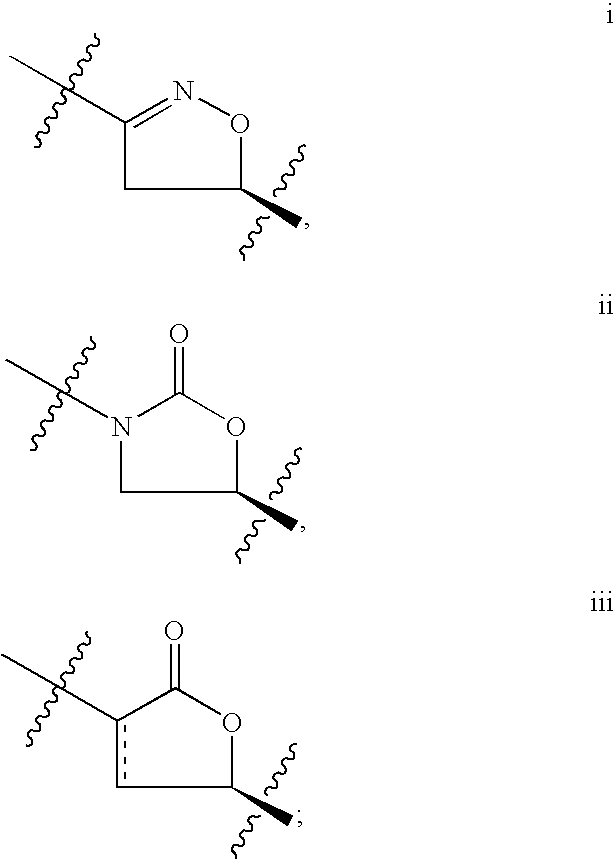
The dotted line within structure iii indicates an optional double bond at that position. It will also be appreciated by those skilled in the art that compounds of the present invention may have additional chiral centers and be isolated in optically active and racemic forms. The present invention encompasses any racemic, optically active, tautomeric, or stereoisomeric form, or mixture thereof, of a compound of the invention.
One preferred group of compounds of the present invention are the compounds of the following formula II: 
wherein R1-R6and n are as defined previously for formula I.
Another preferred group of compounds of the present invention are the compounds of the following formula III 
wherein R1-R6 and n are as defined previously for formula I.
An additional preferred group of compounds of the present invention are the compounds of the following formula IV 
wherein R1-R6 and n are as defined previously for formula I.
A further preferred group of compounds of the present invention are the compounds of the following formula V 
wherein R2-R6, n, and het1 are as defined previously for formula I.
Another preferred group of compounds of the present invention are the compounds of the following formula VI 
wherein R2-R6, n, and het1 are as defined previously for formula I.
An additional preferred group of compounds of the present invention are the compounds of the following formula VII 
wherein R2-R6, n, and het1 are as defined previously for formula I.
A further preferred group of compounds of the present invention are the compounds of the following formula VIII: 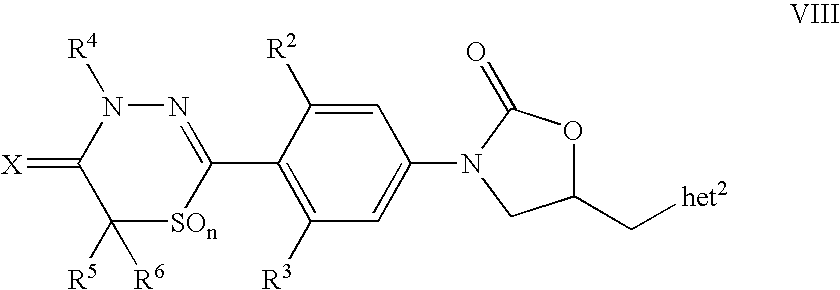
wherein R2-R6, n, and het2 are as defined previously for formula I.
A particularly preferred group of compounds includes the following compounds:
(a) N-{3-[3-fluoro-4-(5-oxo-5,6-dihydro-4H-[1,3,4]thiadiazin-2-yl)-phenyl]-2-oxo-oxazolidin-5(S)-ylmethyl}-acetamide;
(b) N-{3-[3-fluoro-4-(6(S)-methyl-5-oxo-5,6-dihydro-4H-[1,3,4]thiadiazin 2-yl)-phenyl]-2-oxo-oxazolidin-5(S)-ylmethyl}-acetamide;
(c) N-{3-[3-fluoro-4-(6(R)-methyl-5-oxo-5,6-dihydro-4H-[1,3,4]thiadiazin 2-yl)-phenyl]-2-oxo-oxazolidin-5(S)-ylmethyl}-acetamide;
(d) N-{3-[3-fluoro-4-(5-oxo-5,6-dihydro-4H-[1,3,4]thiadiazin-2-yl)-phenyl 2-oxo-oxazolidin-5(S)-ylmethyl}-propionamide;
(e) cyclopropanecarboxylic acid {3-[3-fluoro-4-(5-oxo-5,6-dihydro-4H-[1,3,4]thiadiazin-2-yl)-phenyl]-2-oxo-oxazolidin-5 (S)-ylmethyl}-amide;
(f) {3-[3-fluoro-4-(5-oxo-5,6-dihydro-4H-[1,3,4]thiadiazin-2-yl)-phenyl]-2-oxo-oxazolidin-5(S)-ylmethyl}-urea;
(g) N-{3-[3-fluoro-4-(5-oxo-5,6-dihydro-4H-[1,3,4]thiadiazin-2-yl)-phenyl]-2-oxo-oxazolidin-5(S)-ylmethyl}-carbamic acid methyl ester;
(h) N-{3-[3-fluoro-4-(5-oxo-5,6-dihydro-4H-[1,3,4]thiadiazin-2-yl)-phenyl]-2-oxo-oxazolidin-5(S)-ylmethyl}-thioacetamide;
(i) N-{3-[3-fluoro-4-(5-thioxo-5,6-dihydro-4H-[1,3,4]thiadiazin-2-yl)-phenyl]-2-oxo-oxazolidin-5(S)-ylmethyl}-thioacetamide;
(j) N-{3-[3-fluoro-4-(5-thioxo-5,6-dihydro-4H-[1,3,4]thiadiazin-2-yl)-phenyl]-2-oxo-oxazolidin-5(S)-ylmethyl}-acetamide;
(k) 2-[2-fluoro-4-(5(R)-hydroxymethyl)-2-oxo-oxazolidin-3-yl)-phenyl]-4H-[1,3,4]thiadiazin-5-one;
(l) 2-{2-fluoro-4-[5(S)-(isoxazol-3-ylaminomethyl)-2-oxo-oxazolidin-3-yl phenyl}-4H-[1,3,4]thiadiazin-5-one;
(m) 2-{2-fluoro-4-[5(S)-(isoxazol-3-yloxymethyl)-2-oxo-oxazolidin-3-yl]-phenyl}-4H-[1,3,4]thiadiazin-5-one; and
(n) N-{3-[3-fluoro-4-(5-oxo-5,6-dihydro-4H-[1,3,4]thiadiazin-2-yl)-phenyl]-2-oxo-oxazolidin-5-ylmethyl}-3-(4-hydroxyphenyl)-acrylamide.
Additional preferred compounds include the following compounds:
(a) N-{3-[4-(6,6-dimethyl-5-oxo-5,6-dihydro-4H-[1,3,4]thiadiazin-2-yl)-3-fluorophenyl]-2-oxo-oxazolidin-5(S)-ylmethyl}-acetamide;
(b) N-{3-[3-fluoro-4-(6-ethyl-5-oxo-5,6-dihydro-4H-[1,3,4]thiadiazin-2-yl)-phenyl]-2-oxo-oxazolidin-5(S)-ylmethyl}-acetamide;
(c) N-{3-[3-fluoro-4-(9-oxo-5-thia-7,8-diazaspiro[3.5]non-6-en-6-yl)-phenyl]-2-oxo-oxazolidin-5(S)-ylmethyl}-acetamide;
(d) N-{3-[3-fluoro-4-(5-oxo-6-phenyl-5,6-dihydro-4H-[1,3,4]thiadiazin-2-yl)-phenyl]-2-oxo-oxazolidin-5(S)-ylmethyl}-acetamide;
(e) N-{3-[3-fluoro-4-(5-oxo-5,6-dihydro-4H-[1,3,4]thiadiazin-2-yl)-phenyl]-2-oxo-oxazolidin-5 (S)-ylmethyl}-2-hydroxyacetamide;
(f) N-{3-[3-fluoro-4-(5-oxo-5,6-dihydro-4H-[1,3,4]thiadiazin-2-yl)-phenyl]-2-oxo-oxazolidin-5(S)-ylmethyl}-carbamic acid tert-butyl ester;
(g) N-{3-[3-fluoro-4-(5-oxo-5,6-dihydro-4H-[1,3,4]thiadiazin-2-yl)-phenyl]-2-oxo-oxazolidin-5(S)-ylmethyl}-3-oxo-butyramide;
(h) N-{3-[3-fluoro-4-(5-oxo-5,6-dihydro-4H-[1,3,4]thiadiazin-2-yl)-phenyl]-2-oxo-oxazolidin-5(S)-ylmethyl}-3-(4-fluorophenyl)-3-oxo-propionamide;
(i) N-{3-[3-fluoro-4-(5-oxo-5,6-dihydro-4H-[1,3,4]thiadiazin-2-yl)-phenyl]-2-oxo-oxazolidin-5(S)-ylmethyl}-3-[4-(hydroxyimino-methyl)-phenyl]-acrylamide;
(j) N-{3-[3-fluoro-4-(5-oxo-5,6-dihydro-4H-[1,3,4]thiadiazin-2-yl)-phenyl]-2-oxo-oxazolidin-5(S)-ylmethyl}-3-[4-(methoxyimino-methyl)-phenyl]-acrylamide;
(k) N-{3-[4-(6,6-dimethyl-1,1,5-trioxo-1,4,5,6-tetrahydro-1λ6-[1,3,4]thia-diazine-2-yl)-3-fluorophenyl]-2-oxo-oxazolidin-5(S)-ylmethyl}acetamide;
(l) N-{3-[3-fluoro-4-(4-methyl-5-oxo-5,6-dihydro-4H-[1,3,4]thiadiazin-2-yl)-phenyl]-2-oxo-oxazolidin-5(S)-ylmethyl}-acetamide; and
(m) phosphoric acid mono-{4-[2-({3-[3-fluoro-4-(5-oxo-5,6-dihydro-4H-[1,3,4]thiadiazin-2-yl)-phenyl]-2-oxo-oxazolidin-5-ylmethyl}-carbamoyl)-vinyl]-phenyl}ester.
Further preferred compounds include the following compounds:
(a) N-{3-[3-fluoro-4-(5-oxo-6-propyl-5,6-dihydro-4H-[1,3,4]thiadiazin-2-yl)-phenyl]-2-oxo-oxazolidin-5(S)-ylmethyl}-acetamide;
(b) N-{3-[3-fluoro-4-(6-isopropyl-5-oxo-5,6-dihydro-4H-[1,3,4]thiadiazin-2-yl)-phenyl]-2-oxo-oxazolidin-5(S)-ylmethyl}-acetamide;
(c) N-{3-[3-fluoro-4-(6-fluoro-5-oxo-5,6-dihydro-4H-[1,3,4]thiadiazin-2-yl)-phenyl]-2-oxo-oxazolidin-5(S)-ylmethyl}-acetamide;
(d) N-{3-[3-fluoro-4-(6-hydroxymethyl-5-oxo-5,6-dihydro-4H-[1,3,4]thiadiazin-2-yl)-phenyl]-2-oxo-oxazolidin-5(S)-ylmethyl}-acetamide;
(e) N-{3-[3-fluoro-4-(6-(2-hydroxyethyl)-5-oxo-5,6-dihydro-4H-[1,3,4]thiadiazin-2-yl)-phenyl]-2-oxo-oxazolidin-5(S)-ylmethyl}-acetamide;
(f) 2-{4-[5(S)-(acetylaminomethyl)-2-oxo-oxazolidin-3-yl]-2-fluorophenyl}-5-oxo-5,6-dihydro-4H-[1,3,4]thiadiazine-6-carboxylic acid methyl ester;
(g) N-(3-{3-fluoro-4-(6-(4-hydroxyphenyl)-5-oxo-5,6-dihydro-4H-[1,3,4]thiadiazin-2-yl]-phenyl}-2-oxo-oxazolidin-5(S)-ylmethyl)-acetamide;
(h) N-{3-[3-fluoro-4-(5-thioxo-5,6-dihydro-4H-[1,3,4]thiadiazin-2-yl)-phenyl]-2-oxo-oxazolidin-5(S)-ylmethyl}-carbamic acid tert-butyl ester;
(i) N-{3-[4-(6,6-dimethyl-1,5-dioxo-1,4,5,6-tetrahydro-1λ4-[1,3,4]-thiadiazin-2-yl)-3-fluorophenyl]-2-oxo-oxazolidin-5(S)-ylmethyl}-acetamide;
(j) acetic acid 2-{4-[5(S)-(acetylaminomethyl)-2-oxo-oxazolidin-3-yl]-2-fluorophenyl}-5-oxo-5,6-dihydro-4H-[1,3,4]thiadiazin-6-yl ester; and
(k) (2-{4-[5(S)-(acetylaminomethyl)-2-oxo-oxazolidin-3-yl]-2-fluorophenyl}-5-oxo-5,6-dihydro-[1,3,4]thiadiazin-4-yl)-acetic acid methyl ester.
General Synthetic Schemes
The compounds of this invention can be prepared in accordance with one or more of the Schemes discussed below. Syntheses of thiadiazinones are precedented in the prior art, although no antimicrobial thiadiazinone compounds have been reported. Thus, thiadiazinone compounds with cardiotonic properties have been prepared from ethyl bromoacetate with thioarylhydrazides in presence of aqueous sodium hydroxide as described by Brown, et al. in U.S. Pat. No. 4,489,074 incorporated herein by reference. It should be noted, however, that the above protocol has limited application due to the use of a strong base (3N aqueous sodium hydroxide). Importantly, it is not applicable for a synthesis of amide and carbamate derivatives (such as oxazolidinone compounds described herein) that can react with the strong aqueous bases. According to the subject invention, a new and convenient stepwise protocol useful for preparation of antimicrobial thiadiazinones has been developed.
Scheme 1 below serves to illustrate one general synthesis of thiadiazinone derivatives bearing an oxazolidinone group. 
where X′═O, S and R, R1, R2, R3, R7 and R8 are as defined herein.
First, a benzene carboxylic acid reagent, compound 1, (such as oxazolidinone derivative of Scheme 1 prepared as described by Gordeev et al. in U.S. Pat. No. 6,239,152) is coupled with a suitable N-protected hydrazine reagent, such as N-(tert-butoxycarbonyl)hydrazine. This reaction can be performed with any number of known coupling reagents, such as HATU, HOBt, or carbodiimides. The coupling reaction is typically performed in a polar aprotic solvent, such as dimethylformamide, acetonitrile, or mixtures thereof, in presence of an organic base, such as triethylamine or (N,N-diisopropyl)ethylamine (DIEA). The process is typically carried out between about 0° C. to about 50° C. for a period of time sufficient to provide for the Boc-protected hydrazine derivative, compound 2.
Next, the 5-azidomethyl group of compound 2 is reduced into the amine functionality of compound 3. This transformation can be performed by a phosphine reduction using, e.g., triphenylphosphine in a polar organic solvent, such as tetrahydrofuran with added water (the water may be optionally added after the azide is allowed to react first with triphenylphosphine). The reaction is typically performed at temperatures in a range of from about 25° C. to about 70° C. Optionally, the azide can be reduced using a catalytic hydrogenation (e.g., with hydrogen in presence of a Pd catalyst, such as 5-10% Pd on carbon).
The 5-aminomethyl group of compound 3 is then protected (e.g., as a Boc-derivative as shown in Scheme 1) to provide for compound 4. This protection may be conducted in a suitable organic solvent in the presence of an organic base such as pyridine. The amine protection is then followed by a conversion of the hydrazide into thiohydrazide, compound 5, with a Lawesson's reagent. This conversion may be conducted in suitable organic solvent, such as dioxane or tetrahydrofuran, and is typically performed at temperatures in a range of from about 25° C. to about 100° C. Both the amine protection reaction and the conversion reaction using Lawesson's reagent are performed under conditions well precedented in the chemical literature. By way of example, Lawesson's chemistry was reviewed by Cava et al. in Tetrahedron, 1985, vol. 41, pp. 5061-5087.
The next step involves an alkylation of the resulting protected thiohydrazide reagent, compound 5, with a suitable alpha-substituted ester reagent (such as methyl or ethyl ester) to provide for compound 6. The ester bears a good leaving group in a position alpha to the ester functionality, e.g., bromo, iodo, nitrobenzenesulfonyloxy, mesyloxy (OMs), or a like group. The reaction is typically performed in a polar organic solvent such as acetonitrile, tetrahydrofuran, or dimethylformamide in the presence of an organic or inorganic base, such as potassium carbonate, pyridine, or triethylamine. A typical range of temperatures for this transformation is from about 0° C. to about 50° C.
The following step involves deprotection of an acid-sensitive thiohydrazide protective group of compound 6 (exemplified by Boc in Scheme 1) to provide for compound 7. Under reaction conditions, the acid-induced N-deprotection is immediately followed by a high-yielding heterocyclization into the desired thiadiazinone derivative. This transformation of Scheme 1 is conveniently performed in presence of organic or inorganic acids, such as trifluoroacetic acid or hydrogen chloride. The reaction is carried out in organic solvent, such as dichloromethane, dichloroethane, dioxane, or tetrahydrofuran, at temperatures in a range from about 10° C. to about 60° C. When the starting material has an acid-sensitive protected 5-aminomethyl group (as exemplified in Scheme 1), the resulted thiadiazinone product, compound 7, bears the unprotected amine functionality conveniently suitable for subsequent transformations.
Thus, the 5-aminomethyl group of compound 7 can be acylated or thioacylated using reactions well known in the art to provide for compound 8. In this way, acylations may be performed by reactions of the amines with carboxylic acid anhydrides or esters. These transformations are generally performed at 0° C. to 50° C. using polar solvents, such as acetonitrile, dimethylformamide, tetrahydrofuran, and methanol or mixtures thereof with optional apolar solvents, such as dichloromethane. These reactions are preferably conducted in presence of an organic or inorganic base, such as pyridine, triethylamine, or potassium carbonate. Thioacylations are prepared by allowing amine intermediates to react with dithioesters or thionoesters and a tertiary amine base such as triethylamine. In this reaction it is often convenient to employ an excess of the tertiary amine base with an amine salt prepared by Boc deprotection in step 2 without first isolating the free base. Solvents such as tetrahydrofuran, methylene chloride or preferably methanol, and temperatures in the range of about 24° C. to about 50° C. may be used for this reaction. Other thiocarbonyl compounds of the Scheme 1 can be prepared according to procedures as disclosed in PCT International Publication WO 98/54161, herein incorporated by reference in its entirety.
Optionally, the 5-aminomethyl group can be converted into a hydroxyl group using reactions well known in the art to provide for compound 9. For example, this conversion may be achieved via a diazotization of an amine with a nitrous acid source (such as tert-butyl nitrite in presence of acetic acid) followed by a treatment with an aqueous base, such as lithium hydroxide.
If desired, the above thiadiazinone compounds can be N-alkylated as exemplified in below in Scheme 2. This transformation may be achieved starting with compound 8a (where X═O and R′═CH3) for compound 8 and using any number of typical alkylating reagents, such as alkyl halides (R4X) or alkyl triflates in presence of an organic or inorganic base, such as potassium carbonate, triethylamine, or pyridine. The reaction is typically conducted in a polar organic solvent, such as dimethylformamide or acetonitrile, at temperatures from about 0° C. to about 50° C., to provide for compound 10. 
Optionally, thiadiazinone compounds can be further converted into thiadiazinone S-oxide and/or S-dioxide derivatives as exemplified below in Scheme 3. Peracids, alkyl hydroperoxides, and hydrogen peroxide are all suitable oxidizing agents. The reaction is typically performed in organic solvent, such as acetic acid, at temperatures from about 25° C. to about 100° C. If the reaction is carried out in aqueous acetic acid or other acidic reagents, Pummerer rearrangement products are possible. 
Optionally, thiadiazinone compounds can be converted into antimicrobial thiadiazinethione derivatives as exemplified below in Scheme 4. This reaction is performed under conditions described for a traditional Lawesson's thionation chemistry (see, e.g., Cava et al. in Tetrahedron, 1985, vol. 41, pp. 5061-5087). The reaction is typically performed in organic solvent, such as dioxane or tetrahydrofuran, at temperatures from about 25° C. to about 100° C. whereupon compound 8b (X and X′═O) is converted to compound 11. 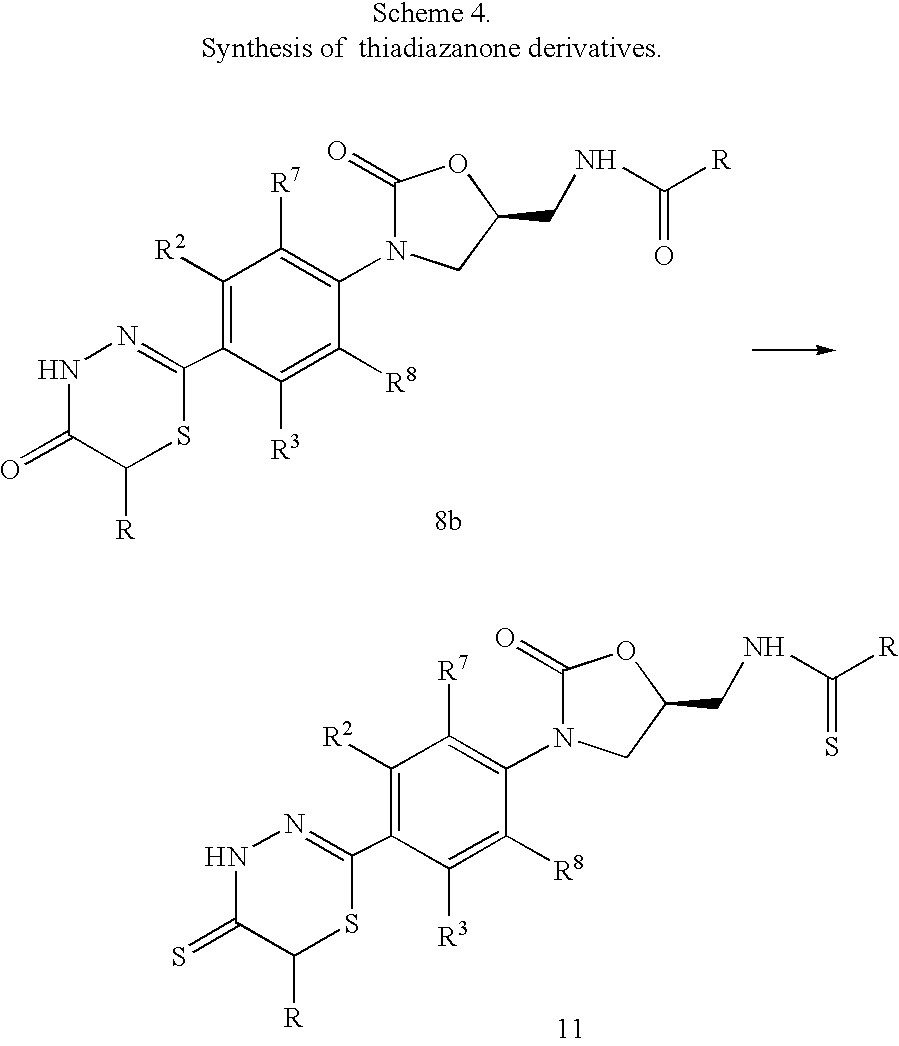
Alcohol thiadiazinone derivatives of Scheme 1, compound 9, can be further converted into heteroaryl amine (or heteroarylether) analogs using chemistry described for non-thiadiazinone compounds by Perova et al. in Zh. Org. Khim., 1994, vol. 30, pp. 1660-1663. It should be further noted that no thiadiazinone or thiadiazinethione compounds have been disclosed in the aforementioned publication. One example of such transformation is provided in Scheme 5 below. In this example the alcohol thiadiazinone derivative is coupled with an appropriate amino-isoxazole or hydroxy-isoxazole, for example, compound 9, 3-(2,2,2-trichloro-ethoxycarbonylamino)isoxazole [prepared according to the procedure found in WO 00/21960] or 3-hydroxyisoxazole. This reaction can be performed with a suitable coupling reagent, such as diisopropyl azodicarboxylate (DIAD). The coupling reaction is typically performed in a polar aprotic solvent, such as dimethylformamide, acetonitrile, tetrahydrofuran, or mixtures thereof, in the presence of an organic base, such as triphenylphosphine. The process is typically carried out at about 0° C. to about 50° C.
When coupling to an amino-isoxazole, the resulting carbamic acid of compound 12 can then be reduced to the heteroaryl amine of compound 13. This reduction may be achieved with any number of typical reducing agents, such as zinc in the presence of an organic or inorganic acid, such as acetic acid or hydrochloric acid. 
The 6-oxy substituted derivatives, compound 16, can be produced by a Pummerer reaction of the parent thiadiazinone, compound 8b, in an acylating agent, such as acetic anhydride, in the presence of an oxidant, such as hydrogen peroxide as shown in Scheme 6 below. Optionally, an intermediate S-oxide can be isolated and then treated with an acylating agent. This treatment with the acylating agent can occur with or without base and with optional heating at 40° C. to 60° C. for 1 hour. 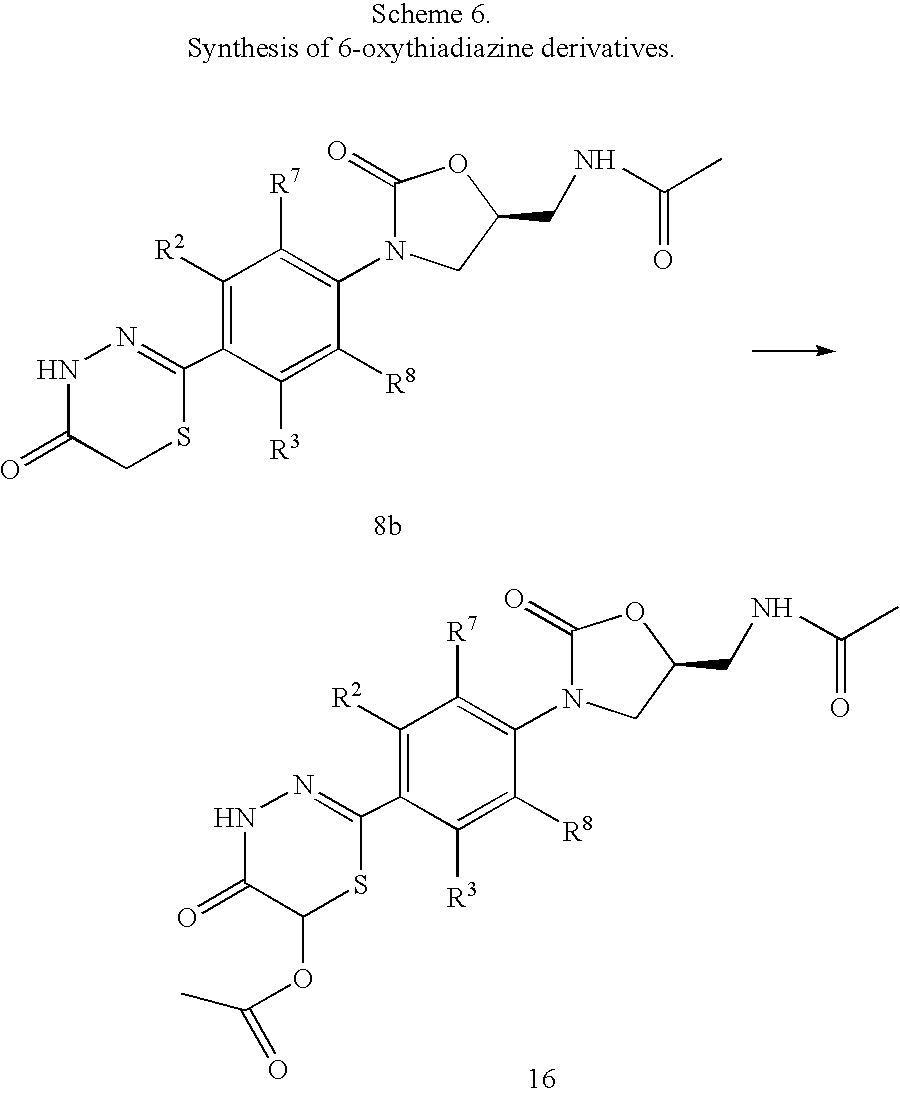
Compounds where A is chosen from formulas i, iii, or iv can be prepared using the methods described herein above substituting the appropriate starting materials.
Utility and Testing
The compounds of the subject invention exhibit potent activities against a variety of microorganisms, including gram positive and gram negative microorganisms. Accordingly, the compounds of the subject invention have broad antibacterial activity. Thus, the compounds of the present invention are useful antimicrobial agents and may be effective against a number of human and veterinary pathogens, including gram positive aerobic bacteria such as multiply-resistant staphylococci and streptococci, Gram negative microorganisms such as H. influenzae and M catarrahlis, as well as anaerobic microorganisms such as bacteroides and clostridia species, and acid-fast microorganisms such as Mycobacterium tuberculosis and Mycobacterium avium.
The in vitro activity of compounds of the subject invention may be assessed by standard testing procedures such as the determination of minimum inhibitory concentration (MIC) by agar dilution as described in “Approved Standard. Methods for Dilution Antimicrobial Susceptibility Tests for Bacteria that Grow Aerobically,” 3rd ed., published 1993 by the National Committee for Clinical Laboratory standards, Villanova, Pa., USA.
The in vitro MICs of test compounds may be determined by a standard agar dilution method. A stock drug solution of each analog is prepared in a preferred solvent, usually DMSO:H2O (1:3). Serial 2-fold dilutions of each sample are made using 1.0 ml aliquots of sterile distilled water. To each 1.0 ml aliquot of drug is added 9 ml of molten Mueller Hinton agar medium. The drug-supplemented agar is mixed, poured into 15×100 mm petri dishes, and allowed to solidify and dry prior to inoculation.
Vials of each of the test microorganisms are maintained frozen in the vapor phase of a liquid nitrogen freezer. Test cultures are grown overnight at 35° C. on the medium appropriate for the microorganism. Colonies are harvested with a sterile swab, and cell suspensions are prepared in Trypticase Soy broth (TSB) to equal the turbidity of a 0.5 McFarland standard. A 1:20 dilution of each suspension is made in TSB. The plates containing the drug supplemented agar are inoculated with a 0.001 ml drop of the cell suspension using a Steers replicator, yielding approximately 104 to 105 cells per spot. The plates are incubated overnight at 35° C.
Following incubation the Minimum Inhibitory Concentration (MIC μg/ml), the lowest concentration of drug that inhibits visible growth of the microorganism, is read and recorded. The data is shown in Table I.
| TABLE I |
| Antimicrobial activity of selected compounds |
| S. pneumoniae | |||
| UC9912 | S. aureus UC9213 | H. influenzae 30063 | |
| Example # | MIC, μg/mL | MIC, μg/mL | MIC, μg/mL |
| 1 | <0.06 | 0.5 | 1 |
| 2 | 0.25 | 1 | 4 |
| 3 | 0.25 | 1 | 4 |
| 4 | 0.25 | 2 | 16 |
| 5 | 2 | 4 | 32 |
| 8 | 0.5 | 2 | 32 |
| 9 | 0.5 | 4 | 16 |
| 15 | <0.06 | 1 | 2 |
| 16 | 0.125 | 2 | 2 |
| 17 | 0.125 | 2 | 4 |
| 18 | 0.125 | 2 | 4 |
| 19 | 0.125 | 1 | 4 |
| 20 | 2 | 2 | 64 |
| 21 | 0.5 | 4 | 8 |
| 22 | 1 | 4 | 16 |
| 23 | 0.25 | 1 | 8 |
| 24 | 0.06 | 1 | >64 |
| 25 | <0.06 | 0.125 | 0.5 |
| 26 | <0.06 | 0.25 | 1 |
| 32 | 0.5 | 2 | 16 |
| 34 | 0.25 | 0.125 | 1 |
Administration and Pharmaceutical Formulations
In general, the compounds of the subject invention will be administered in a therapeutically effective amount by any of the accepted modes of administration for agents that serve similar utilities. By way of example, the compounds of the subject invention may be administered orally, parenterally, transdermally, topically, rectally, or intranasally. The actual amount of the compound of the subject invention, i.e., the active ingredient, will depend on a number of factors, such as the severity of the disease, i.e., the infection, to be treated, the age and relative health of the subject, the potency of the compound used, the route and form of administration, and other actors, all of which are within the purview of the attending clinician.
Toxicity and therapeutic efficacy of such compounds can be determined by standard pharmaceutical procedures in cell cultures or experimental animals, e.g., for determining the LD50 (the dose lethal to 50% of the population) and the ED50 (the dose therapeutically effective in 50% of the population). The dose ratio between toxic and therapeutic effects is the therapeutic index and it can be expressed as the ratio LD50/ED50. Compounds that exhibit large therapeutic indices are preferred.
The data obtained from the cell culture assays and animal studies can be used in formulating a range of dosage for use in humans. The dosage of such compounds lies preferably within a range of circulating concentrations that include the ED50 with little or no toxicity. The dosage may vary within this range depending upon the dosage form employed and the route of administration utilized. For any compound used in the method of the invention, the therapeutically effective dose can be estimated initially from cell culture assays. A dose may be formulated in animal models to achieve a circulating plasma concentration range which includes the IC50 (i.e., the concentration of the test compound which achieves a half-maximal inhibition of symptoms) as determined in cell culture. Such information can be used to more accurately determine useful doses in humans. Levels in plasma may be measured, for example, by high performance liquid chromatography.
When employed as pharmaceuticals, the compounds of the subject invention are usually administered in the form of pharmaceutical compositions. These compounds can be administered by a variety of routes including oral, parenteral, transdermal, topical, rectal, and intranasal.
These compounds are effective as both injectable and oral compositions. Such compositions are prepared in a manner well known in the pharmaceutical art and comprise at least one active compound.
This invention also includes pharmaceutical compositions which contain, as the active ingredient, one or more of the compounds of the subject invention above associated with pharmaceutically acceptable carriers. In making the compositions of this invention, the active ingredient is usually mixed with an excipient, diluted by an excipient or enclosed within such a carrier which can be in the form of a capsule, sachet, paper or other container. When the excipient serves as a diluent, it can be a solid, semi-solid, or liquid material, which acts as a vehicle, carrier or medium for the active ingredient. Thus, the compositions can be in the form of tablets, pills, powders, lozenges, sachets, cachets, elixirs, suspensions, emulsions, solutions, syrups, aerosols (as a solid or in a liquid medium), ointments containing, for example, up to 10% by weight of the active compound, soft and hard gelatin capsules, suppositories, sterile injectable solutions, and sterile packaged powders.
In preparing a formulation, it may be necessary to mill the active compound to provide the appropriate particle size prior to combining with the other ingredients. If the active compound is substantially insoluble, it ordinarily is milled to a particle size of less than 200 mesh. If the active compound is substantially water soluble, the particle size is normally adjusted by milling to provide a substantially uniform distribution in the formulation, e.g. about 40 mesh.
Some examples of suitable excipients include lactose, dextrose, sucrose, sorbitol, mannitol, starches, gum acacia, calcium phosphate, alginates, tragacanth, gelatin, calcium silicate, microcrystalline cellulose, polyvinylpyrrolidone, cellulose, sterile water, syrup, and methyl cellulose. The formulations can additionally include: lubricating agents such as talc, magnesium stearate, and mineral oil; wetting agents; emulsifying and suspending agents; preserving agents such as methyl- and propylhydroxy-benzoates; sweetening agents; and flavoring agents. The compositions of the invention can be formulated so as to provide quick, sustained or delayed release of the active ingredient after administration to the patient by employing procedures known in the art.
The quantity of active component, that is the compound according to the subject invention, in the pharmaceutical composition and unit dosage form thereof may be varied or adjusted widely depending upon the particular application, the potency of the particular compound and the desired concentration.
The compositions are preferably formulated in a unit dosage form, each dosage containing from about 5 to about 100 mg, more usually about 10 to about 30 mg, of the active ingredient. The term “unit dosage forms” refers to physically discrete units suitable as unitary dosages for human subjects and other mammals, each unit containing a predetermined quantity of active material calculated to produce the desired therapeutic effect, in association with a suitable pharmaceutical excipient. Preferably, the compound of the subject invention above is employed at no more than about 20 weight percent of the pharmaceutical composition, more preferably no more than about 15 weight percent, with the balance being pharmaceutically inert carrier(s).
The active compound is effective over a wide dosage range and is generally administered in a pharmaceutically or therapeutically effective amount. It, will be understood, however, that the amount of the compound actually administered will be determined by a physician, in the light of the relevant circumstances, including the condition to be treated, the severity of the bacterial infection being treated, the chosen route of administration, the actual compound administered, the age, weight, and response of the individual patient, the severity of the patient's symptoms, and the like.
In therapeutic use for treating, or combating, bacterial infections in warm-blooded animals, the compounds or pharmaceutical compositions thereof will be administered orally, topically, transdermally, and/or parenterally at a dosage to obtain and maintain a concentration, that is, an amount, or blood-level of active component in the animal undergoing treatment which will be antibacterially effective. Generally, such antibacterially or therapeutically effective amount of dosage of active component (i.e., an effective dosage) will be in the range of about 0.1 to about 100, more preferably about 1.0 to about 50 mg/kg of body weight/day.
For preparing solid compositions such as tablets, the principal active ingredient is mixed with a pharmaceutical excipient to form a solid preformulation composition containing a homogeneous mixture of a compound of the present invention. When referring to these preformulation compositions as homogeneous, it is meant that the active ingredient is dispersed evenly throughout the composition so that the composition may be readily subdivided into equally effective unit dosage forms such as tablets, pills and capsules. This solid preformulation is then subdivided into unit dosage forms of the type described above containing from, for example, 0.1 to about 500 mg of the active ingredient of the present invention.
The tablets or pills of the present invention may be coated or otherwise compounded to provide a dosage form affording the advantage of prolonged action. For example, the tablet or pill can comprise an inner dosage and an outer dosage component, the latter being in the form of an envelope over the former. The two components can be separated by an enteric layer, which serves to resist disintegration in the stomach and permit the inner component to pass intact into the duodenum or to be delayed in release. A variety of materials can be used for such enteric layers or coatings, such materials including a number of polymeric acids and mixtures of polymeric acids with such materials as shellac, cetyl alcohol, and cellulose acetate.
The liquid forms in which the novel compositions of the present invention may be incorporated for administration orally or by injection include aqueous solutions, suitably flavored syrups, aqueous or oil suspensions, and flavored emulsions with edible oils such as corn oil, cottonseed oil, sesame oil, coconut oil, or peanut oil, as well as elixirs and similar pharmaceutical vehicles.
Compositions for inhalation or insufflation include solutions and suspensions in pharmaceutically acceptable, aqueous or organic solvents, or mixtures thereof, and powders. The liquid or solid compositions may contain suitable pharmaceutically acceptable excipients as described supra. Preferably the compositions are administered by the oral or nasal respiratory route for local or systemic effect. Compositions in preferably pharmaceutically acceptable solvents may be nebulized by use of inert gases. Nebulized solutions may be inhaled directly from the nebulizing device or the nebulizing device may be attached to a facemask tent, or intermittent positive pressure-breathing machine. Solution, suspension, or powder compositions may be administered, preferably orally or nasally, from devices that deliver the formulation in an appropriate manner.
The following formulation examples illustrate representative pharmaceutical compositions of the present invention.
Hard gelatin capsules containing the following ingredients are prepared:
| Quantity | |||
| Ingredient | (mg/capsule) | ||
| Active Ingredient | 30.0 | ||
| Starch | 305.0 | ||
| Magnesium stearate | 5.0 | ||
The above ingredients are mixed and filled into hard gelatin capsules in 340 mg quantities.
A tablet formula is prepared using the ingredients below:
| Quantity | |||
| Ingredient | (mg/tablet) | ||
| Active Ingredient | 25.0 | ||
| Cellulose, microcrystalline | 200.0 | ||
| Colloidal silicon dioxide | 10.0 | ||
| Stearic acid | 5.0 | ||
The components are blended and compressed to form tablets, each weighing 240 mg.
A dry powder inhaler formulation is prepared containing the following components:
| Ingredient | Weight % | ||
| Active Ingredient | 5 | ||
| Lactose | 95 | ||
The active ingredient is mixed with the lactose and the mixture is added to a dry powder inhaling appliance.
Tablets, each containing 30 mg of active ingredient, are prepared as follows
| Quantity | |||
| Ingredient | (mg/tablet) | ||
| Active Ingredient | 30.0 mg | ||
| Starch | 45.0 mg | ||
| Microcrystalline cellulose | 35.0 mg | ||
| Polyvinylpyrrolidone | 4.0 mg | ||
| (as 10% solution in sterile water) | |||
| Sodium carboxymethyl starch | 4.5 mg | ||
| Magnesium stearate | 0.5 mg | ||
| Talc | 1.0 mg | ||
| Total | 120 mg | ||
The active ingredient, starch and cellulose are passed through a No. 20 mesh U.S. sieve and mixed thoroughly. The solution of polyvinylpyrrolidone is mixed with the resultant powders, which are then passed through a 16 mesh U.S. sieve. The granules so produced are dried at 50° to 60° C. and passed through a 16 mesh U.S. sieve. The sodium carboxymethyl starch, magnesium stearate, and talc, previously passed through a No. 30 mesh U.S. sieve, are then added to the granules which, after mixing, are compressed on a tablet machine to yield tablets each weighing 120 mg.
Capsules, each containing 40 mg of medicament are made as follows:
| Quantity | |||
| Ingredient | (mg/capsule) | ||
| Active Ingredient | 40.0 mg | ||
| Starch | 109.0 mg | ||
| Magnesium stearate | 1.0 mg | ||
| Total | 150.0 mg | ||
The active ingredient, starch and magnesium stearate are blended, passed through a No. 20 mesh U.S. sieve, and filled into hard gelatin capsules in 150 mg quantities.
Suppositories, each containing 25 mg of active ingredient are made as follows:
| Ingredient | Amount | ||
| Active Ingredient | 25 mg | ||
| Saturated fatty acid glycerides to | 2,000 mg | ||
The active ingredient is passed through a No. 60 mesh U.S. sieve and suspended in the saturated fatty acid glycerides previously melted using the minimum heat necessary. The mixture is then poured into a suppository mold of nominal 2.0 g capacity and allowed to cool.
Suspensions, each containing 50 mg of medicament per 5.0 mL dose are made as follows:
| Ingredient | Amount | ||
| Active Ingredient | 50.0 mg | ||
| Xanthan gum | 4.0 mg | ||
| Sodium carboxymethyl cellulose (11%) | |||
| Microcrystalline cellulose (89%) | 50.0 mg | ||
| Sucrose | 1.75 g | ||
| Sodium benzoate | 10.0 mg | ||
| Flavor and Color | q.v. | ||
| Purified water to | 5.0 mL | ||
The active ingredient, sucrose and xanthan gum are blended, passed through a No. 10 mesh U.S. sieve, and then mixed with a previously made solution of the microcrystalline cellulose and sodium carboxymethyl cellulose in water. The sodium benzoate, flavor, and color are diluted with some of the water and added with stirring. Sufficient water is then added to produce the required volume.
| Quantity | |||
| Ingredient | (mg/capsule) | ||
| Active Ingredient | 15.0 mg | ||
| Starch | 407.0 mg | ||
| Magnesium stearate | 3.0 mg | ||
| Total | 425.0 mg | ||
The active ingredient, starch, and magnesium stearate are blended, passed through a No. 20 mesh U.S. sieve, and filled into hard gelatin capsules in 425.0 mg quantities.
A subcutaneous formulation may be prepared as follows:
| Ingredient | Quantity | ||
| Active Ingredient | 5.0 mg | ||
| Corn Oil | 1.0 mL | ||
A topical formulation may be prepared as follows:
| Ingredient | Quantity | ||
| Active Ingredient | 1-10 | g | ||
| Emulsifying Wax | 30 | g | ||
| Liquid Paraffin | 20 | g | ||
| White Soft Paraffin | to 100 | g | ||
The white soft paraffin is heated until molten. The liquid paraffin and emulsifying wax are incorporated and stirred until dissolved. The active ingredient is added and stirring is continued until dispersed. The mixture is then cooled until solid.
Another preferred formulation employed in the methods of the present invention employs transdermal delivery devices (“patches”). Such transdermal patches may be used to provide continuous or discontinuous infusion of the compounds of the present invention in controlled amounts. The construction and use of transdermal patches for the delivery of pharmaceutical agents is well known in the art. See, e.g., U.S. Pat. No. 5,023,252, issued Jun. 11, 1991, herein incorporated by reference. Such patches may be constructed for continuous, pulsatile, or on demand delivery of pharmaceutical agents.
Frequently, it will be desirable or necessary to introduce the pharmaceutical composition to the brain, either directly or indirectly. Direct techniques usually involve placement of a drug delivery catheter into the host's ventricular system to bypass the blood-brain barrier. One such implantable delivery system used for the transport of biological factors to specific anatomical regions of the body is described in U.S. Pat. No. 5,011,472 which is herein incorporated by reference.
Indirect techniques, which are generally preferred, usually involve formulating the compositions to provide for drug latentiation by the conversion of hydrophilic drugs into lipid-soluble drugs. Latentiation is generally achieved through blocking of the hydroxy, carbonyl, sulfate, and primary amine groups present on the drug to render the drug more lipid soluble and amenable to transportation across the blood-brain barrier. Alternatively, the delivery of hydrophilic drugs may be enhanced by intra-arterial infusion of hypertonic solutions that can transiently open the blood-brain barrier.
Other suitable formulations for use in the present invention can be found in Remington's Pharmaceutical Sciences, Mace Publishing Company, Philadelphia, Pa., 17th ed. (1985).
As noted above, the compounds described herein are suitable for use in a variety of drug delivery systems described above. Additionally, in order to enhance the in vivo serum half-life of the administered compound, the compounds may be encapsulated, introduced into the lumen of liposomes, prepared as a colloid, or other conventional techniques may be employed which provide an extended serum half-life of the compounds. A variety of methods are available for preparing liposomes, as described in, e.g., Szoka, et al., U.S. Pat. Nos. 4,235,871, 4,501,728 and 4,837,028 each of which is incorporated herein by reference.
As noted above, the compounds administered to a patient are in the form of pharmaceutical compositions described above. These compositions may be sterilized by conventional sterilization techniques, or may be sterile filtered. The resulting aqueous solutions may be packaged for use as is, or lyophilized, the lyophilized preparation being combined with a sterile aqueous carrier prior to administration. The pH of the compound preparations typically will be between 3 and 11, more preferably from 5 to 9 and most preferably from 7 and 8. It will be understood that use of certain of the foregoing excipients, carriers, or stabilizers will result in the formation of pharmaceutical salts.
The following synthetic and biological examples are offered to illustrate this invention and are not to be construed in any way as limiting the scope of this invention.
In the discussion above and in the examples below, the following abbreviations have the following meanings. If an abbreviation is not defined, it has its generally accepted meaning.
| Boc = | tert-butoxycarbonyl | ||
| bs = | broad singlet | ||
| dd = | doublet of doublets | ||
| DCM = | dichloromethane | ||
| DMF = | dimethylformamide | ||
| DMSO = | dimethyl sulfoxide | ||
| g = | grams | ||
| 1HNMR = | proton nuclear magnetic resonance | ||
| h = | hours | ||
| HPLC = | high pressure liquid chromatography | ||
| Hz = | hertz | ||
| m = | multiplet | ||
| M = | molar | ||
| mg = | milligram | ||
| ml = | milliliter | ||
| mm = | millimeter | ||
| mmol = | millimol | ||
| mp = | melting point | ||
| MS = | mass spectrometry | ||
| MHz = | megahertz | ||
| N = | normal | ||
| s = | singlet | ||
| t = | triplet | ||
| TFA = | trifluoroacetic acid | ||
| THF = | tetrahydrofuran | ||
| PTLC = | preparative thin layer chromatography | ||
All of the starting materials used in the synthesis of the compounds of the present invention are known compounds some of which are commercially available from at least one or more of the following companies: Aldrich, Fluka, Lancaster, Sigma, Chemservice, Bachem, Maybridge, NovaBiochem, Alfa and TCI. Additionally, the term “Aldrich” indicates that the compound or reagent used in the following procedures is commercially available from Aldrich Chemical Company, Inc., 1001 West Saint Paul Avenue, Milwaukee, Wis. 53233 USA; the term “Fluka” indicates that the compound or reagent is commercially available from Fluka Chemical Corp., 980 South 2nd Street, Ronkonkoma N.Y. 11779 USA; the term “Lancaster” indicates that the compound or reagent is commercially available from Lancaster Synthesis, Inc., P.O. Box 100 Windham, N.H. 03087 USA; the term “Sigma” indicates that the compound or reagent is commercially available from Sigma, P.O. Box 14508, St. Louis Mo. 63178 USA; the term “Chemservice” indicates that the compound or reagent is commercially available from Chemservice Inc., Westchester, Pa., USA; the term “Bachem” indicates that the compound or reagent is commercially available from Bachem Bioscience Inc., 3700 Horizon Drive, Renaissance at Gulph Mills, King of Prussia, Pa. 19406 USA; the term “Maybridge” indicates that the compound or reagent is commercially available from Maybridge Chemical Co. Trevillett, Tintagel, Cornwall PL34 OHW United Kingdom; and the term “TCI” indicates that the compound or reagent is commercially available from TCI America, 9211 North Harborgate St., Portland, Oreg., 97203, OR., USA; the term “Alfa” indicates that the compound or reagent is commercially available from Johnson Matthey Catalog Company, Inc. 30 Bond Street, Ward Hill, Mass. 01835-0747; and the term “Nova Biochem” indicates that the compound or reagent is commercially available from NovaBiochem USA, 10933 North Torrey Pines Road, P.O. Box 12087, La Jolla Calif. 92039-2087.
In the examples below, all temperatures are in degrees Celsius (unless otherwise indicated) and the following general procedures are used to prepared the compounds as indicated.
N-{3-[3-Fluoro-4-(5-oxo-5,6-dihydro-4H-[1,3,4]thiadiazin-2-yl)-phenyl]-2-oxo-oxazolidin-5(S)-ylmethyl}-acetamide 
2-[4-(5(S)-Aminomethyl-2-oxo-oxazolidin-3-yl)-2-fluorophenyl]-4H-[1,3,4]thiadiazin-5-one (0.100 g, 0.308 mmol) is dissolved in pyridine (2 ml) and acetic anhydride (0.032 ml, 0.339 mmol) is added. The reaction is stirred at room temperature for 4 hours and then evaporated to dryness. The residue is purified by PTLC (10% MeOH/DCM) to give pure product as a white solid (0.086 g, 76%); 1HNMR (300 MHz, DMSO-d6) δ 1.82 (s, 3H), 3.41 (t, J=5.5, 2H), 3.59 (s, 2H), 3.76 (dd, J=6.6, 9.1, 2H), 4.14 (t, J=9.1 Hz, 1H), 4.71-4.79 (m, 1H), 7.42 (dd, J=2.2, 8.5 Hz, 1H), 7.58 (dd, J=2.2, 14, 1H), 7.69 (t, J=8.5, 1H), 8.25 (t, J=5.8 Hz, 1H), 11.6 (s, 1H); Rf (10% MeOH/DCM)=0.52; mp 206-9; MS (m/z): [M+H]+=367.
The intermediates for this compound are prepared as follows:
I. 2-[4-(5(S)-Aminomethyl-2-oxo-oxazolidin-3-yl)-2-fluorophenyl]-4H-[1,3,4]thiadiazin-5-one 
20% Trifluoroacetic acid/dichloromethane (2 ml) is added to [{4-[5(S)-(tert-butoxycarbonylaminomethyl)-2-oxo-oxazolidin-3-yl]-2-fluorophenyl}-(tert-butoxycarbonylhydrazono)-methylsulfanyl]-acetic acid methyl ester (0.25 g, 0.449 mmol) and the mixture is stirred at room temperature for 30 minutes. The reaction is evaporated to dryness and the TFA salt is neutralized with saturated aqueous sodium bicarbonate to give a white precipitate which is washed well with water and dried under vacuum (0.14 g, 99%); 1HNMR (300 MHz, MeOH-d4) δ 3.33-3.43 (m, 2H), 3.53 (s, 2H), 3.88 (dd, J=6.6, 9.3 Hz, 1H), 4.30 (t, J=9.1 Hz, 1H), 4.90-5.03 (m, 1H), 7.39 (dd, J=2,2, 8.8 Hz, 1H), 7.63 (dd, J=2.2, 14 Hz, 1H), 7.73 (t, J=8.2 Hz, 1H); Rf(10% MeOH/DCM)=0.077; MS (m/z): [M+H]+=325.
II. [{4-[5(S)-(tert-Butoxycarbonylaminomethyl)-2-oxo-oxazolidin-3-yl]-2-fluorophenyl}-(tert-butoxycarbonylhydrazono)-methylsulfanyl]-acetic acid methyl ester 
Methyl bromoacetate (0.064 ml, 0.681 mmol) is added to N′-{4-[5(S)-(tert-butoxycarbonylaminomethyl)-2-oxo-oxazolidin-3-yl]-2-fluorothiobenzoyl}-hydrazinecarboxylic acid tert-butyl ester (0.300 g, 0.619 mmol) and triethylamine (0.1 ml, 0.717 mmol) in DMF (3 ml) and the mixture is stirred at 65° C. for 10 h. The reaction mixture is evaporated and the residue is dissolved in ethyl acetate. The solution is washed with water and brine, dried (MgSO4), and evaporated to give crude product which is purified by flash column chromatography (30% EtOAc/Hexane) to give an oil (0.29 g, 84%); 1HNMR (300 MHz, DMSO-d6) δ 1.34 (s, 9H), 1.45 (s, 9H), 3.29 (t, J=5.5 Hz, 2H), 3.48 (s, 3H), 3.50 (s, 2H), 3.82 (dd, J=6.3, 9.3 Hz, 1H), 4.14 (t, J=9.1 Hz, 1H), 4.69-4.77 (m, 1H), 7.25 (t, J=5.8 Hz, 1H), 7.37-7.40 (m, 2H), 7.55 (dd, J=1.1, 14 Hz, 1H), 9.77 (s, 1H); mp 153-5; Rf (10% MeOH/DCM)=0.23 MS (m/z): [M+H]+=557.
III. N′-{4-[5(S)-(tert-Butoxycarbonylaminomethyl)-2-oxo-oxazolidin-3-yl]-2-fluorothiobenzoyl}-hydrazinecarboxylic acid tert-butyl ester 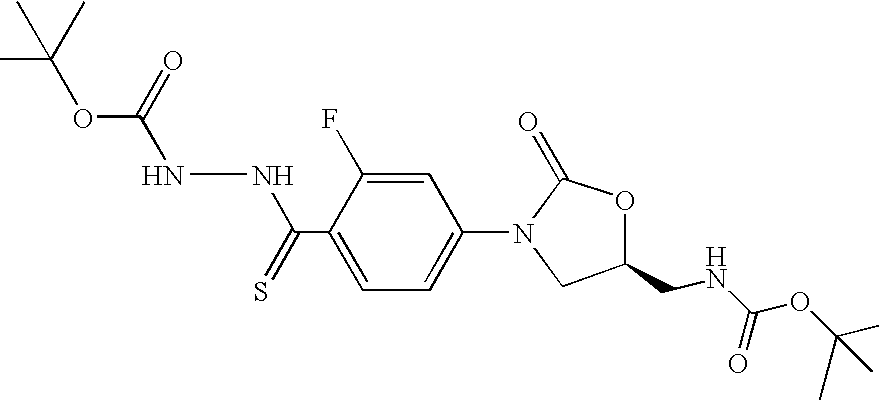
N′-{4-[5(S)-(tert-Butoxycarbonylaminomethyl)-2-oxo-oxazolidin-3-yl]-2-fluorobenzoyl}-hydrazinecarboxylic acid tert-butyl ester (1.73 g, 0.0037 mol) and Lawesson's reagent (1.50 g, 0.0037 mol) are suspended in dioxane and heated at 85° C. overnight. The reaction mixture is evaporated to dryness and the residue is purified by flash column chromatography (gradient from DCM to 5% acetone/DCM) to give product as a yellow solid (1.17 g, 65%); 1HNMR (300 MHz, DMSO-d6) δ 1.35 (s, 9H), 1.42 (s, 9H), 3.28 (t, J=5 Hz, 2H), 3.80 (dd, J=6.1, 9.1 Hz, 1H), 4.13 (t, J=8.8 Hz, 1H), 4.68-4.76 (m, 1H), 7.24 (t, J=5.8 Hz, 1H), 7.32-7.36 (m, 1H), 7.47-7.59 (m, 2H), 11.8 (s, 1H); Rf(10% MeOH/DCM)=0.77.
IV. N′-{4-[5(S)-(tert-Butoxycarbonylaminomethyl)-2-oxo-oxazolidin-3-yl]-2-fluorobenzoyl}-hydrazinecarboxylic acid tert-butyl ester 
Di-tert-butyl dicarbonate (2.03 ml, 0.00884 mol) is added dropwise to a mixture of N′-[4-(5(S)-aminomethyl-2-oxo-oxazolidin-3-yl]-2-fluorobenzoyl}-hydrazinecarboxylic acid tert-butyl ester (3.09 g, 0.00839 mol) and pyridine (1.02 ml, 0.0126 mol) in DCM (50 ml) at 0° C. The reaction mixture is stirred at 0° C. for 1 hour, allowed to warm to room temperature and then stirred another 1 hour. The reaction mixture is washed with 2N HCl and brine, dried (MgSO4) and evaporated. The residue is purified by flash column chromatography (50% EtOAc/DCM) to give product as a white solid (2.95 g, 75%); 1HNMR (300 MHz, DMSO-d6) δ 1.34 (s, 9H), 1.42 (s, 9H), 3.28 (t, J=5 Hz, 2H), 3.82 (dd, J=6.0, 9.1 Hz, 1H), 4.14 (t, J=8.8 Hz, 1H), 4.69-4.77 (m, 1H), 7.24 (t, J=5.8 Hz, 1H), 7.39 (dd, J=2, 8.8 Hz), 7.54 (dd, J=2.2, 13.5 Hz, 1H), 7.66 (t, J=8.2 Hz, 1H), 8.95 (s, 1H); Rf(10% MeOH/DCM)=0.63.
V. N′-[4-(5(S)-Aminomethyl-2-oxo-oxazolidin-3-yl]-2-fluorobenzoyl]-hydrazinecarboxylic acid tert-butyl ester 
Triphenylphosphine (2.58 g, 0.00981 mol) is added portion-wise to a solution of N′-[4-(5(R)-azidomethyl-2-oxo-oxazolidin-3-yl)-2-fluorobenzoyl]-hydrazinecarboxylic acid tert-butyl ester (3.52 g, 0.00892 mol) in THF (30 ml) and then stirred at room temperature for 2 h at room temperature. Water (2.57 ml, 0.143 mol) is added and the mixture heated at 40° C. overnight. The reaction mixture is evaporated and the residue is purified by flash column chromatography (gradient DCM to 2% MeOH/DCM) to give product as an oil (3.09 g, 94%); 1HNMR (300 MHz, DMSO-d6) δ 1.42 (s, 9H), 2.79-2.92 (m, 2H), 3.89 (dd, J=6.6, 9.1 Hz, 1H), 4.10 (t, J=8.8 Hz, 1H), 4.63-4.71 (m, 1H), 7.42 (dd, J=1.9, 8.5 Hz, 1H), 7.56 (dd, J=2.2, 13.2, 1H), 7.66 (t, J=8.2, 1H); Rf(10% MeOH/DCM)=0.15.
VI. N′-[4-(5(R)-Azidomethyl-2-oxo-oxazolidin-3-yl)-2-fluorobenzoyl]-hydrazinecarboxylic acid tert-butyl ester 
Diisopropylethylamine (4.67 ml, 0.0268 mol) is added to a mixture of 4-(5(R)-Azidomethyl-2-oxo-oxazolidin-3-yl)-2-fluorobenzoic acid (2.50 g, 0.00892 mol) [prepared according to the procedure described in U.S. Pat. No. 6,239,152] and O-(7-azabenzotriazol-1-yl)-N,N,N′,N′-tetramethyluronium hexafluorophosphate (3.73 g, 0.00981 mol) in DMF (30 ml) and stirred for 20 minutes at room temperature. tert-Butyl carbazate (1.30 g, 0.00981 mol) is then added and the mixture stirred at room temperature overnight. The reaction mixture is evaporated under vacuum and the residue diluted with water. The resulting precipitate is filtered and dried under vacuum to give product as a white solid (3.52 g, 99%); 1HNMR (300 MHz, DMSO-d6) δ 1.42 (s, 9H), 3.72-3.76 (m, 2H), 3.81 (dd, J=6.0, 9.3 Hz, 1H), 4.17 (t, J=9.1 Hz, 1H), 4.88-4.96 (m, 1H), 7.43 (dd, J=2.2, 8.8 Hz, 1H), 7.57 (dd, J=2.2, 13.2, 1H), 7.66 (t, J=8.2, 1H), 8.96 (s, 1H), 9.92 (s, 1H); Rf(EtOAc)=0.54; mp 173-5.
N-{3-[3-Fluoro-4-(6(S)-methyl-5-oxo-5,6-dihydro-4H-[1,3,4]thiadiazin-2-yl)-phenyl]-2-oxo-oxazolidin-5(S)-ylmethyl}-acetamide 
2-[4-(5-Aminomethyl-2-oxo-oxazolidin-3-yl)-2-fluorophenyl]-6-methyl-4H-[1,3,4]thiadiazin-5-one, trifluoroacetate salt is dissolved in pyridine (2 ml) and acetic anhydride (0.0163 ml, 0.173 mmol) is added. The reaction is stirred at room temperature for 4 hours and then evaporated to dryness. The residue is purified by PTLC (10% MeOH/DCM) to give pure product as a white solid (0.046 g, 76%); 1HNMR (300 MHz, DMSO-d6) δ 1.34 (d, J=7.1 Hz, 3H), 1.82 (s, 3H), 3.41 (t, J=5.5, 2H), 3.71-3.82 (m, 2H), 4.14 (t, J=9.3 Hz, 1H), 4.71-4.79 (m, 1H), 7.41 (dd, J=1.9, 8.8 Hz, 1H), 7.58 (dd, J=1.7, 14, 1H), 7.68 (t, J=8.5, 1H), 8.25 (t, J=5.5 Hz, 1H), 11.7 (s, 1H); mp 200-2; MS (m/z): [M+H]+=381.
The intermediates for this compound are prepared as follows:
I. 2-[4-(5(S)-Aminomethyl-2-oxo-oxazolidin-3-yl)-2-fluorophenyl]-6-methyl-4H-[1,3,4]thiadiazin-5-one, trifluoroacetate salt 
20% Trifluoroacetic acid/dichloromethane (2 ml) is added to 2-[{4-[5(S)-(tert-butoxycarbonylaminomethyl-2-oxo-oxazolidin-3-yl]-2-fluorophenyl}-(tert-butoxycarbonylhydrazono)-methylsulfanyl]-propionic acid methyl ester and the mixture is stirred at room temperature for 30 minutes. The reaction is evaporated to dryness and the TFA salt used directly in the next step; 1HNMR (300 MHz, MeOH-d4) δ 1.46 (d, J=7.1 3H), 3.33-3.43 (m, 2H), 3.67 (q, J=7.1 Hz, 1H), 3.88 (dd, J=6.6, 9.6 Hz, 1H), 4.30 (t, J=9.3 Hz, 1H), 4.90-5.01 (m, 1H), 7.39 (dd, J=2,2, 8.8 Hz, 1H), 7.63 (dd, J=2.2, 13.5 Hz, 1H), 7.70 (t, J=8.5 Hz, 1H); MS (m/z): [M+H]+=453.
II. 2-[{4-[5(S)-(tert-Butoxycarbonylaminomethyl)-2-oxo-oxazolidin-3-yl]-2-fluorophenyl}-(tert-butoxycarbonylhydrazono)-methylsulfanyl]-propionic acid methyl ester 
Prepared from methyl (S)-(−)-2-chloropropionate (0.0243 ml, 0.227 mmol) and N′-{4-[5(S)-(tert-butoxycarbonylaminomethyl)-2-oxo-oxazolidin-3-yl]-2-fluorothiobenzoyl}-hydrazinecarboxylic acid tert-butyl ester (0.100 g, 0.206 mmol) according to the procedure of Example 1, Intermediate II (0.090 g, 77%); 1HNMR (300 MHz, DMSO-d6) δ 1.31 (d, J=7.1 Hz, 3H), 1.34 (s, 9H), 1.45 (s, 9H), 3.29 (t, J=5.2 Hz, 2H), overlapping 3.51 (q, J=7.1 Hz, 1H) and 3.51 (s, 3H), 3.83 (dd, J=6.0, 9.1 Hz, 1H), 4.14 (t, J=9.1 Hz, 1H), 4.71-4.75 (m, 1H), 7.25 (t, J=5.8 Hz, 1H), 7.39 (dd, J=1.9, 8.8 Hz, 1H), 7.48 (t, J=8.5 Hz, 1H), 7.56 (dd, J=1.9, 13, 1H), 9.74 (s, 1H); MS (m/z): [M+H]+=571.
N-{3-[3-Fluoro-4-(6(R)-methyl-5-oxo-5,6-dihydro-4H-[1,3,4]thiadiazin-2-yl)-phenyl]-2-oxo-oxazolidin-5(S)-ylmethyl}-acetamide 
Prepared from 2-[4-(5-aminomethyl-2-oxo-oxazolidin-3-yl)-2-fluorophenyl]-6-methyl-4H-[1,3,4]thiadiazin-5-one, trifluoroacetate salt according to the method of Example 2 (0.086 g, 93%); 1HNMR (300 MHz, DMSO-d6) δ 1.34 (d, J=7.1 Hz, 3H), 1.82 (s, 3H), 3.42 (t, J=5.2 Hz, 2H), 3.73-3.82 (m, 2H), 4.14 (t, J=9.1 Hz, 1H), 4.71-4.78 (m, 1H), 7.39 (dd, J=1.9, 8.8 Hz, 1H), 7.58 (dd, J=1.9, 14, 1H), 7.68 (t, J=8.5, 1H), 8.25 (t, J=5.8 Hz, 1H), 11.7 (s, 1H) mp 205-6; MS (m/z): [M+H]+=381.
The intermediates for this compound are prepared as follows:
I. 2-[4-(5(S)-Aminomethyl-2-oxo-oxazolidin-3-yl)-2-fluorophenyl]-6-methyl-4H-[1,3,4]thiadiazin-5-one, trifluoroacetate salt 
Prepared from 2-[{4-[5(S)-(tert-butoxycarbonylaminomethyl)-2-oxo-oxazolidin-3-yl]-2-fluorophenyl}-(tert-butoxycarbonylhydrazono)-methylsulfanyl]-propionic acid methyl ester according to the method of Example 2, Intermediate I; 1HNMR (300 MHz, MeOH-d4) δ 1.46 (d, J=7.1 3H), 3.33-3.43 (m, 2H), 3.67 (q, J=7.1 Hz, 1H), 3.88 (dd, J=6.6, 9.6 Hz, 1H), 4.30 (t, J=9.3 Hz, 1H), 4.90-5.01 (m, 1H), 7.39 (dd, J=2,2, 8.8 Hz, 1H), 7.63 (dd, J=2.2, 13.5 Hz, 1H), 7.71 (t, J=8.5 Hz, 1H); MS (m/z): [M+H]+=453.
II. 2-[{4-[5(S)-(tert-Butoxycarbonylaminomethyl)-2-oxo-oxazolidin-3-yl]-2-fluorophenyl}-(tert-butoxycarbonylhydrazono)-methylsulfanyl]-propionic acid methyl ester 
Prepared from methyl (R)-(+)-2-chloropropionate (0.0241 ml, 0.227 mmol) and N′-{4-[5(S)-(tert-butoxycarbonylaminomethyl)-2-oxo-oxazolidin-3-yl]-2-fluorothiobenzoyl}-hydrazinecarboxylic acid tert-butyl ester (0.100 g, 0.206 mmol) according to the procedure of Example 1, Intermediate II (0.092 g, 78%); 1HNMR (300 MHz, DMSO-d6) δ 1.31 (d, J=7.1 Hz, 3H), 1.34 (s, 9H), 1.45 (s, 9H), 3.29 (t, J=5.2 Hz, 2H), overlapping 3.51 (q, J=7.1 Hz, 1H) and 3.51 (s, 3H), 3.83 (dd, J=6.0, 9.1 Hz, 1H), 4.14 (t, J=9.1 Hz, 1H), 4.69-4.77 (m, 1H), 7.25 (t, J=5.8 Hz, 1H), 7.39 (dd, J=1.9, 8.8 Hz, 1H), 7.48 (t, J=8.5 Hz, 1H), 7.56 (dd, J=1.9, 13, 1H), 9.74 (s, 1H); MS (m/z): [M+H]+=571.
N-{3-[4-(6,6-Dimethyl-5-oxo-5,6-dihydro-4H-[1,3,4]thiadiazin-2-yl)-3-fluorophenyl]-2-oxo-oxazolidin-5(S)-ylmethyl}-acetamide 
Prepared from 2-[4-(5(S)-aminomethyl-2-oxo-oxazolidin-3-yl)-2-fluorophenyl]-6,6-dimethyl-4H-[1,3,4]thiadiazin-5-one, trifluoroacetate salt according to the method of Example 2 (0.053 g, 86%); 1HNMR (300 MHz, DMSO-d6) δ 1.40 (s, 6H), 1.82 (s, 3H), 3.42 (t, J=5.5 Hz, 2H), 3.76 (dd, J=6.6, 9.3 Hz, 1H), 4.14 (t, J=9.1 Hz, 1H), 4.71-4.78 (m, 1H), 7.41 (dd, J=2.2, 8.8 Hz, 1H), 7.58 (dd, J=1.9, 14, 1H), 7.66 (t, J=8.8 Hz, 1H), 8.25 (t, J=5.8 Hz, 1H), 11.7 (s, 1H); mp 179-81; MS (m/z): [M+H]+=395.
The intermediates for this compound are prepared as follows:
I. 2-[4-(5(S)-Aminomethyl-2-oxo-oxazolidin-3-yl)-2-fluorophenyl]-6,6-dimethyl-4H-[1,3,4]thiadiazin-5-one, trifluoroacetate salt 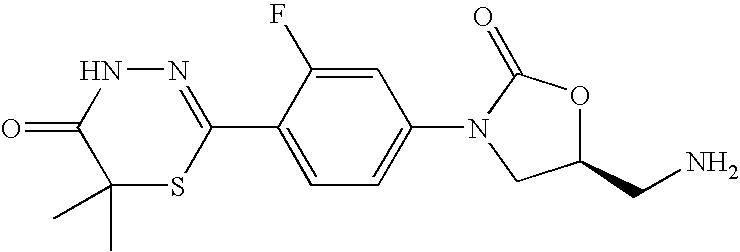
Prepared from 2-[{4-[5(S)-(tert-butoxycarbonylaminomethyl)-2-oxo-oxazolidin-3-yl]-2-fluorophenyl}-(tert-butoxycarbonylhydrazono)-methylsulfanyl]-2-methylpropionic acid ethyl ester according to the method of Example 2, Intermediate I; 1HNMR (300 MHz, MeOH-d4) δ 1.48 (s, 6H), 3.33-3.43 (m, 2H), 3.88 (dd, J=6.6, 9.6 Hz, 1H), 4.30 (t, J=9.3 Hz, 1H), 4.90-5.03 (m, 1H), 7.39 (dd, J=2,2, 8.8 Hz, 1H), 7.62 (dd, J=2.2, 14 Hz, 1H), 7.69 (t, J=8.5 Hz, 1H); (MS (m/z): [M+H]+=467.
II. 2-[{4-[5(S)-(tert-Butoxycarbonylaminomethyl)-2-oxo-oxazolidin-3-yl]-2-fluorophenyl}-(tert-butoxycarbonylhydrazono)methylsulfanyl]-2-methylpropionic acid ethyl ester 
Prepared from ethyl 2-bromoisobutyrate (0.0333 ml, 0.227 mmol) and N′-{4-[5(S)-(tert-butoxycarbonylaminomethyl)-2-oxo-oxazolidin-3-yl]-2-fluorothiobenzoyl}-hydrazinecarboxylic acid tert-butyl ester (0.100 g, 0.206 mmol) according to the procedure of Example 1, Intermediate II (0.094 g, 76%); 1HNMR (300 MHz, DMSO-d6) δ 1.10 (t, J=7.1 Hz, 3H), 1.35 (s, 9H), 1.38 (s, 6H), 1.46 (s, 9H), 3.29 (t, J=5.5 Hz, 2H), overlapping 3.78 (q, J=7.1 Hz, 2H) and 3.81 (dd, J=6.6, 9.3 Hz, 1H), 4.13 (t, J=9.1 Hz, 1H), 4.70-4.75 (m, 1H), 7.24 (t, J=5.8 Hz, 1H), 7.34 (dd, J=1.6, 8.5 Hz, 1H), overlapping 7.50 (t, J=8.8 Hz, 1H) and 7.50 (dd, J=2.2, 13 Hz, 1H), 9.65 (s, 1H); MS (m/z): [M+H]+=599.
N-{3-[3-Fluoro-4-(6-ethyl-5-oxo-5,6-dihydro-4H-[1,3,4]thiadiazin-2-yl)-phenyl]-2-oxo-oxazolidin-5(S)-ylmethyl}-acetamide 
Prepared from 2-[4-(5(S)-aminomethyl-2-oxo-oxazolidin-3-yl)-2-fluorophenyl]-6-ethyl-4H-[1,3,4]thiadiazin-5-one, trifluoroacetate salt according to the method of Example 2 (0.055 g, 80%); 1H NMR (300 MHz, DMSO-d6) δ 0.99 (t, J=7.8 Hz, 3H), 1.55-1.60 (m, 1H), 1.76-1.81 (m, 1H), 1.83 (s, 3H), 3.42 (t, J=5.4 Hz, 2H), 3.63 (dd, J=6.3, 7.8 Hz, 1H), 3.74-3.79 (m, 1H), 4.15 (t, J=9.1 Hz, 1H), 4.74-4.77 (m, 1H), 7.42 (dd, J=1.8, 8.7 Hz, 1H), 7.59 (dd, J=2.4, 13.8 Hz, 1H), 7.66 (t, J=8.7 Hz, 1H), 8.25 (t, J=5.7 Hz, 1H); mp 177-9; MS (m/z): [M+H]+=395.
The intermediates for this compound are prepared as follows:
I. 2-[4-(5(S)-Aminomethyl-2-oxo-oxazolidin-3-yl)-2-fluorophenyl]-6-ethyl-4H-[1,3,4]thiadiazin-5-one, trifluoroacetate salt 
Prepared from 2-[{4-[5(S)-(tert-butoxycarbonylaminomethyl)-2-oxo-oxazolidin-3-yl]-2-fluorophenyl}-(tert-butoxycarbonylhydrazono)-methylsulfanyl]-butyric acid methyl ester according to the method of Example 2, Intermediate I; MS (m/z): [M+H]+=467.
II. 2-[{4-[5(S)-(tert-Butoxycarbonylaminomethyl)-2-oxo-oxazolidin-3-yl]-2-fluorophenyl}-(tert-butoxycarbonylhydrazono)-methylsulfanyl]-butyric acid methyl ester 
Prepared from methyl 2-bromobutyrate (0.0261 ml, 0.227 mmol) and N′-{4-[5(S)-(tert-butoxycarbonylaminomethyl)-2-oxo-oxazolidin-3-yl]-2-fluorobenzoyl}-hydrazinecarboxylic acid tert-butyl ester (0.100 g, 0.206 mmol) according to the procedure of Example 1, Intermediate II (0.102 g, 85%); MS (m/z): [M+H]+=585.
N-{3-[3-Fluoro-4-(5-oxo-6-propyl-5,6-dihydro-4H-[1,3,4]thiadiazin-2-yl)-phenyl]-2-oxo-oxazolidin-5(S)-ylmethyl}-acetamide 
Prepared from 2-[4-(5(S)-aminomethyl-2-oxo-oxazolidin-3-yl)-2-fluorophenyl]-6-propyl-4H-[1,3,4]thiadiazin-5-one, trifluoroacetate salt according to the method of Example 2 (0.050 g, 68%); 1H NMR (300 MHz, DMSO-d6) δ 0.89 (t, J=7.2 Hz, 3H), 1.40-1.53 (m, 2H), 1.69-1.72 (m, 2H), 1.83 (s, 3H), 3.43 (t, J=5.4 Hz, 2H), 3.69 (dd, J=6.3, 7.8 Hz, 1H), 3.77 (dd, J=6.6, 9.3 Hz, 1H), 4.15 (t, J=9.3 Hz, 1H), 4.76-4.77 (m, 1H), 7.42 (dd, J=1.8, 8.4 Hz, 1H), 7.59 (dd, J=2.4, 13.8 Hz, 1H), 7.66 (t, J=8.7 Hz, 1H), 8.28 (t, J=5.7 Hz, 1H); foam; MS (m/z): [M+H]+=409.
The intermediates for this compound are prepared as follows:
I. 2-[4-(5(S)-Aminomethyl-2-oxo-oxazolidin-3-yl)-2-fluorophenyl]-6-propyl-4H-[1,3,4]thiadiazin-5-one, trifluoroacetate salt 
Prepared from 2-[{4-[5(S)-(tert-butoxycarbonylaminomethyl)-2-oxo-oxazolidin-3-yl]-2-fluorophenyl}-(tert-butoxycarbonylhydrazono)-methylsulfanyl]-pentanoic acid ethyl ester according to the method of Example 2, Intermediate I; MS (m/z): [M+H]+=481.
II. 2-[{4-[5(S)-(tert-Butoxycarbonylaminomethyl)-2-oxo-oxazolidin-3-yl]-2-fluorophenyl}-(tert-butoxycarbonylhydrazono)-methylsulfanyl]-pentanoic acid ethyl ester 
Prepared from ethyl 2-bromovalerate (0.0359 ml, 0.227 mmol) and N′-{4-[5(S)-(tert-butoxycarbonylaminomethyl)-2-oxo-oxazolidin-3-yl]-2-fluorothiobenzoyl}-hydrazinecarboxylic acid tert-butyl ester (0.100 g, 0.206 mmol) according to the procedure of Example 1, Intermediate II (0.111 g, 88%); MS (m/z): [M+H]+=613.
N-{3-[3-Fluoro-4-(6-isopropyl-5-oxo-5,6-dihydro-4H-[1,3,4]thiadiazin-2-yl)-phenyl]-2-oxo-oxazolidin-5(S)-ylmethyl}-acetamide 
Prepared from 2-[4-(5(S)-aminomethyl-2-oxo-oxazolidin-3-yl)-2-fluorophenyl]-6-isopropyl-4H-[1,3,4]thiadiazin-5-one, trifluoroacetate salt according to the method of Example 2 (0.045 g, 70%); 1H NMR (300 MHz, DMSO-d6) δ 0.97-1.01 (m, 6H), 1.83 (s, 3H), 1.92-1.97 (m, 1H), 3.42 (t, J=5.4 Hz, 2H), 3.52 (d, J=7.2 Hz, 1H), 3.77 (dd, J=6.6, 9.3 Hz, 1H), 4.15 (t, J=9.0 Hz, 1H), 4.74-4.77 (m, 1H), 7.42 (dd, J=1.8, 8.7 Hz, 1H), 7.59 (dd, J=2.1, 13.8 Hz, 1H), 7.66 (t, J=8.7 Hz, 1H), 8.27 (t, J=5.7 Hz, 1H); mp 201-3; MS (m/z): [M+H]+=409.
The intermediates for this compound are prepared as follows:
I. 2-[4-(5(S)-Aminomethyl-2-oxo-oxazolidin-3-yl)-2-fluorophenyl]-6-isopropyl-4H[1,3,4]thiadiazin-5-one, trifluoroacetate salt 
Prepared from 2-[{4-[5(S)-(tert-butoxycarbonylaminomethyl)-2-oxo-oxazolidin-3-yl]-2-fluorophenyl}-(tert-butoxycarbonylhydrazono)-methylsulfanyl]-3-methylbutyric acid ethyl ester according to the method of Example 2, Intermediate I; MS (m/z): [M+H]+=481.
II. 2-[{4-[5(S)-(tert-Butoxycarbonylaminomethyl)-2-oxo-oxazolidin-3-yl]-2-fluorophenyl}-(tert-butoxycarbonylhydrazono)-methylsulfanyl]-3-methylbutyric acid ethyl ester 
Prepared from ethyl 2-bromoisovalerate (0.039 ml, 0.227 mmol) and N′-{4-[5(S)-(tert-butoxycarbonylaminomethyl)-2-oxo-oxazolidin-3-yl]-2-fluorothiobenzoyl}-hydrazinecarboxylic acid tert-butyl ester (0.100 g, 0.206 mmol) according to the procedure of Example 1, Intermediate II (0.097 g, 77%); MS (m/z): [M+H]+=613.
N-{3-[3-Fluoro-4-(9-oxo-5-thia-7,8-diazaspiro[3.5]non-6-en-6-yl)-phenyl]-2-oxo-oxazolidin-5(S)-ylmethyl}-acetamide 
Prepared from 6-[4-(5(S)-aminomethyl-2-oxo-oxazolidin-3-yl)-2-fluorophenyl]-5-thia-7,8-diazaspiro[3.5]non-6-en-9-one, trifluoroacetate salt according to the method of Example 2 (0.100 g, 50%); 1H NMR (300 MHz, DMSO-d6) δ 1.82 (s, 3H), 1.93-1.98 (m, 1H), 2.07-2.15 (m, 3H), 2.63-2.70 (m, 2H), 3.42 (t, J=5.4 Hz, 2H), 3.76 (dd, J=6.6, 9.3 Hz, 1H), 4.14 (t, J=9.3 Hz, 1H), 4.73-4.78 (m, 1H), 7.41 (dd, J=2.1, 8.7 Hz, 1H), 7.58 (dd, J=2.1, 13.5 Hz, 1H), 7.67 (t, J=9.0 Hz, 1H), 8.24 (t, J=5.7 Hz, 1H); mp 214-5; MS (m/z): [M+H]+=407.
The intermediates for this compound are prepared as follows:
I. 6-[4-(5(S)-Aminomethyl-2-oxo-oxazolidin-3-yl)-2-fluorophenyl]-5-thia-7,8-diazaspiro[3.5]non-6-en-9-one, trifluoroacetate salt 
Prepared from 1-[{4-[5(S)-(tert-butoxycarbonylaminomethyl)-2-oxo-oxazolidin-3-yl]-2-fluorophenyl}-(tert-butoxycarbonylhydrazono)-methylsulfanyl]-cyclobutanecarboxylic acid ethyl ester according to the method of Example 2, Intermediate I; MS (m/z): [M+H]+=479.
II. 1-[{4-[5(S)-(tert-Butoxycarbonylaminomethyl)-2-oxo-oxazolidin-3-yl]-2-fluorophenyl}-(tert-butoxycarbonylhydrazono)-methylsulfanyl]-cyclobutanecarboxylic acid ethyl ester 
Prepared from ethyl 1-bromocyclobutanecarboxylate (0.110 ml, 0.681 mmol) and N′-{4-[5(S)-(tert-butoxycarbonylaminomethyl)-2-oxo-oxazolidin-3-yl]-2-fluorothiobenzoyl}-hydrazinecarboxylic acid tert-butyl ester (0.300 g, 0.619 mmol) according to the procedure of Example 1, Intermediate II (0.30 g, 80%); MS (m/z): [M+H]+=611.
N-{3-[3-Fluoro-4-(5-oxo-6-phenyl-5,6-dihydro-4H-[1,3,4]thiadiazin-2-yl)-phenyl]-2-oxo-oxazolidin-5(S)-ylmethyl}-acetamide 
Prepared from 2-[4-(5(S)-aminomethyl-2-oxo-oxazolidin-3-yl)-2-fluorophenyl]-6-phenyl-4H-[1,3,4]thiadiazin-5-one, trifluoroacetate salt according to the method of Example 2 (0.053 g, 90%); 1HNMR (300 MHz, DMSO-d6) δ 1.81 (s, 3H), 3.40 (t, J=5.5 Hz, 2H), 3.47 (dd, J=6.6, 9.3 Hz, 1H), 4.12 (t, J=9.1 Hz, 1H), 4.70-4.78 (m, 1H), 5.15 (s, 1H), 7.30-7.41 (m, 6H), overlapping 7.57 (dd, J=1.9, 14 Hz, 1H) and 7.59 (t, J=8.8 Hz, 1H), 12.0 (s, 1H); mp 122-3; MS (m/z): [M+H]+=443.
The intermediates for this compound are prepared as follows
I. 2-[4-(5(S)-Aminomethyl-2-oxo-oxazolidin-3-yl)-2-fluorophenyl]-6-phenyl-4H-[1,3,4]thiadiazin-5-one, trifluoroacetate salt 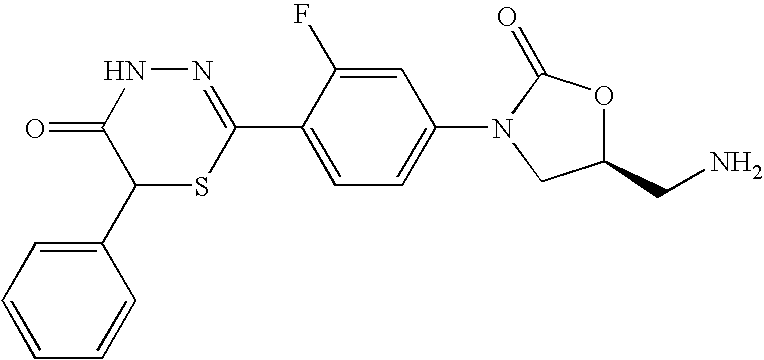
Prepared from [{4-[5(S)-(tert-butoxycarbonylaminomethyl)-2-oxo-oxazolidin-3-yl]-2-fluorophenyl}-(tert-butoxycarbonylhydrazono)-methylsulfanyl]-phenylacetic acid methyl ester according to the method of Example 2, Intermediate I; 1HNMR (300 MHz, MeOH-d4) δ 3.33-3.40 (m, 2H), 3.85 (dd, J=6.6, 9.6 Hz, 1H), 4.27 (t, J=9.3 Hz, 1H), 4.92 (s, 1H), 4.92-5.03 (m, 1H), 7.30-7.39 (m, 6H), 7.56-7.64 (m, 2H); MS (m/z): [M+H]+=515.
II. [{4-[5(S)-(tert-Butoxycarbonylaminomethyl)-2-oxo-oxazolidin-3-yl]-2-fluorophenyl}-(tert-butoxycarbonylhydrazono)-methylsulfanyl]-phenylacetic acid methyl ester 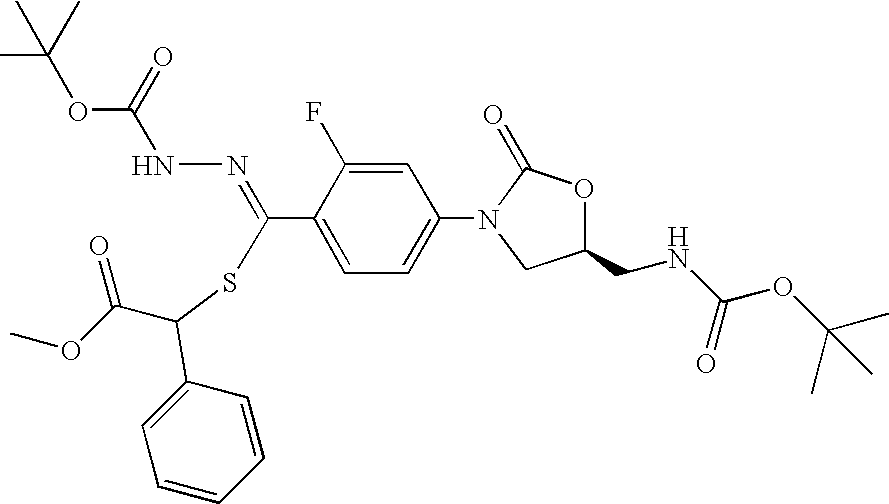
Prepared from methyl α-bromophenylacetate (0.0357 ml, 0.227 mmol) and N′-{4-[5(S)-(tert-butoxycarbonylaminomethyl)-2-oxo-oxazolidin-3-yl]-2-fluorothiobenzoyl}-hydrazinecarboxylic acid tert-butyl ester (0.100 g, 0.206 mmol) according to the procedure of Example 1, Intermediate II (0.085 g, 65%); 1HNMR (300 MHz, DMSO-d6) δ 1.35 (s, 9H), 1.44 (s, 9H), 3.30 (t, J=5.2 Hz, 2H), 3.49 (s, 3H), 3.83 (dd, J=6.6, 9.3 Hz, 1H), 4.15 (t, J=9.1 Hz, 1H), overlapping 4.70-4.77 (m, 1H) and 4.73 (s, 1H), 7.22-7.38 (m, 8H), 9.83 (s, 1H); MS (m/z): [M+H]+=633.
N-{3-[3-Fluoro-4-(6-fluoro-5-oxo-5,6-dihydro-4H-[1,3,4]thiadiazin-2-yl)-phenyl]-2-oxo-oxazolidin-5(S)-ylmethyl}-acetamide 
Prepared from 2-[4-(5(S)-aminomethyl-2-oxo-oxazolidin-3-yl)-2-fluorophenyl]-6-fluoro-4H-[1,3,4]thiadiazin-5-one, trifluoroacetate salt according to the method of Example 2 (0.019 g, 30%); 1HNMR (300 MHz, DMSO-d6) δ 1.82 (s, 3H), 3.42 (t, J=5.5, 2H), 3.75 (dd, J=6.3, 9.1, 2H), 4.14 (t, J=9.1 Hz, 1H), 4.70-4.83 (m, 1H), 6.61 (d, J=49 Hz, 1H), 7.45 (dd, J=2.2, 8.5 Hz, 1H), 7.60 (dd, J=2.2, 14, 1H), 7.69 (t, J=8.5, 1H), 8.25 (t, J=5.8 Hz, 1H); mp 218-20; MS (m/z): [M+H]+=385.
The intermediates for this compound are prepared as follows:
I. 2-[4-(5(S)-Aminomethyl-2-oxo-oxazolidin-3-yl)-2-fluorophenyl]-6-fluoro-4H-[1,3,4]thiadiazin-5-one, trifluoroacetate salt 
Prepared from [{4-[5(S)-(tert-butoxycarbonylaminomethyl)-2-oxo-oxazolidin-3-yl]-2-fluorophenyl}-(tert-butoxycarbonylhydrazono)-methylsulfanyl]-fluoroacetic acid ethyl ester according to the method of Example 2, Intermediate I; MS (m/z): [M+H]+=457.
II. [{4-[5(S)-(tert-Butoxycarbonylaminomethyl)-2-oxo-oxazolidin-3-yl]-2-fluorophenyl}-(tert-butoxycarbonylhydrazono)-methylsulfanyl]-fluoroacetic acid ethyl ester 
Prepared from ethyl bromofluoroacetate (0.0268 ml, 0.227 mmol) and N′-{4-[5(S)-(tert-Butoxycarbonylaminomethyl)-2-oxo-oxazolidin-3-yl]-2-fluorothiobenzoyl}-hydrazinecarboxylic acid tert-butyl ester (0.100 g, 0.206 mmol) according to the procedure of Example 1, Intermediate II (0.095 g, 78%); MS (m/z): [M+H]+=589.
N-{3-[3-Fluoro-4-(6-hydroxymethyl-5-oxo-5,6-dihydro-4H-[1,3,4]thiadiazin-2-yl)-phenyl]-2-oxo-oxazolidin-5(S)-ylmethyl}-acetamide 
Prepared from 2-[4-(5(S)-aminomethyl-2-oxo-oxazolidin-3-yl)-2-fluorophenyl]-6-hydroxymethyl-4H-[1,3,4]thiadiazin-5-one, trifluoroacetate salt according to the method of Example 2 (0.059 g, 27%); 1H NMR (300 MHz, DMSO-d6) δ 1.83 (s, 3H), 3.66-3.81 (m, 6H), 4.15 (t, J=9.0 Hz, 1H), 4.75-4.76 (m, 1H), 7.41 (dd, J=2.1, 9.0 Hz, 1H), 7.59 (dd, J=1.8, 13.8 Hz, 1H), 7.69 (t, J=8.4 Hz, 1H), 8.30 (t, J=5.4 Hz, 1H); foam; MS (m/z): [M+H]+=397.
The intermediates for this compound are prepared as follows:
I. 2-[4-(5(S)-Aminomethyl-2-oxo-oxazolidin-3-yl)-2-fluorophenyl]-6-hydroxymethyl-4H-[1,3,4]thiadiazin-5-one, trifluoroacetate salt 
Prepared from 3-tert-butoxy-2-[{4-[5(S)-(tert-butoxycarbonylaminomethyl)-2-oxo-oxazolidin-3-yl]-2-fluorophenyl}-(tert-butoxycarbonylhydrazono)-methylsulfanyl]-propionic acid methyl ester according to the method of Example 2, Intermediate I; MS (m/z): [M+H]+=469.
II. 3-tert-Butoxy-2-[{4-[5(S)-(tert-butoxycarbonylaminomethyl)-2-oxo-oxazolidin-3-yl]-2-fluorophenyl}-(tert-butoxycarbonylhydrazono)-methylsulfanyl]-propionic acid methyl ester 
Prepared from 2(S)-bromo-3-tert-butoxypropionic acid methyl ester (0.153 g, 0.681 mmol) and N′-{4-[5(S)-(tert-butoxycarbonylaminomethyl)-2-oxo-oxazolidin-3-yl]-2-fluorothiobenzoyl}-hydrazinecarboxylic acid tert-butyl ester (0.300 g, 0.619 mmol) according to the procedure of Example 1, Intermediate II (0.35 g, 89%); MS (m/z): [M+H
III. 2(S)-Bromo-3-tert-butoxypropionic acid methyl ester
Sodium nitrite (4.1 g, 59 mmol) is added in small portions to a solution of potassium bromide (13.9 g, 116 mol) in 0.75 M aqueous HBr (180 ml) cooled to −5° C. L-Serine tert-butyl ether (5.00 g, 31 mmol) is then added portion-wise and the reaction stirred at −5° C. for 2 hours. The reaction mixture is extracted with cold ethyl acetate and the extracts washed with brine, dried (MgSO4), and evaporated to give residue which is purified by flash column chromatography (1% acetic acid in 30% EtOAc/Hexane) (5.2 g, 75%). The acid is treated with excess diazomethane in ether and evaporated to give the methyl ester used directly in the next step.
N-{3-[3-Fluoro-4-(6-(2-hydroxyethyl)-5-oxo-5,6-dihydro-4H-[1,3,4]thiadiazin-2-yl)-phenyl]-2-oxo-oxazolidin-5(S)-ylmethyl}-acetamide 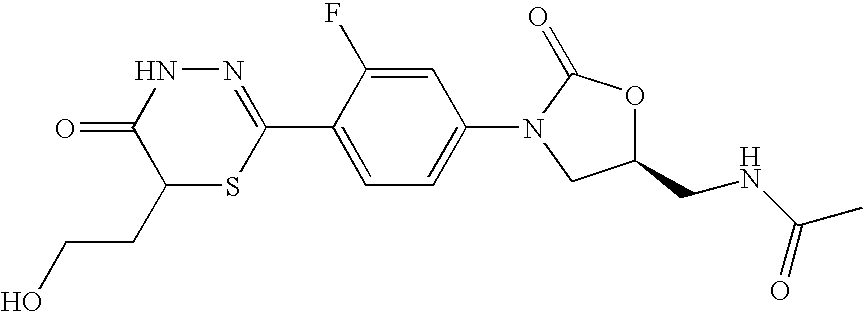
Prepared from 2-[4-(5(S)-aminomethyl-2-oxo-oxazolidin-3-yl)-2-fluorophenyl]-6-(2-hydroxyethyl)-4H-[1,3,4]thiadiazin-5-one, trifluoroacetate salt according to the method of Example 2 (0.021 g, 31%). MS (m/z): [M+H]+=411. A second acetylation product is isolated and identified as acetic acid 2-(2-{4-[5(S)-(acetylaminomethyl)-2-oxo-oxazolidin-3-yl]-2-fluorophenyl}-5-oxo-5,6-dihydro-4H[1,3,4]thiadiazin-6-yl)-ethyl ester (0.025 g, 37%); 1H NMR (300 MHz, DMSO-d6) δ 1.83-1.91 (m, 1H), 2.00 (s, 3H), 2.06-2.14 (m, 1H), 3.43 (t, J=5.4 Hz, 2H), 3.74-3.83 (m, 2H), 4.08-4.18 (m, 3H), 7.43 (dd, J=2.1, 8.7 Hz, 1H), 7.59 (dd, J=1.8, 13.5 Hz, 1H), 7.69 (t, J=8.7 Hz, 1H), 8.26 (t, J=5.7 Hz, 1H); mp 223-4; MS (m/z): [M+H]+=453.
The intermediates for this compound are prepared as follows:
I. 2-[4-(5(S)-Aminomethyl-2-oxo-oxazolidin-3-yl)-2-fluorophenyl]-6-(2-hydroxyethyl)-4H-[1,3,4]thiadiazin-5-one, trifluoroacetate salt 
Prepared from N′-[{4-[5(S)-(tert-butoxycarbonylaminomethyl)-2-oxo-oxazolidin-3-yl]-2-fluorophenyl}-(2-oxo-tetrahydro-furan-3-ylsulfanyl)-methylene]-hydrazinecarboxylic acid tert-butyl ester according to the method of Example 2, Intermediate I; MS (m/z): [M+H]+=483.
II. N′-[{4-[5(S)-(tert-Butoxycarbonylaminomethyl)-2-oxo-oxazolidin-3-yl]-2-fluorophenyl}-(2-oxo-tetrahydro-furan-3-ylsulfanyl)-methylene]-hydrazinecarboxylic acid tert-butyl ester 
Prepared from α-bromo-γ-butyrolactone (0.021 ml, 0.227 mmol) and N′-{4-[5(S)-(tert-butoxycarbonylaminomethyl)-2-oxo-oxazolidin-3-yl]-2-fluorothiobenzoyl}-hydrazinecarboxylic acid tert-butyl ester (0.100 g, 0.206 mmol) according to the procedure of Example 1, Intermediate II (0.95 g, 80%); MS (m/z): [M+H]+=569.
2-{4-[5(S)-(Acetylaminomethyl)-2-oxo-oxazolidin-3-yl]-2-fluorophenyl}-5-oxo-5,6-dihydro-4H-[1,3,4]thiadiazine-6-carboxylic acid methyl ester 
Prepared from 2-[4-(5(S)-aminomethyl-2-oxo-oxazolidin-3-yl)-2-fluorophenyl]-5-oxo-5,6-dihydro-4H-[1,3,4]thiadiazine-6-carboxylic acid methyl ester, trifluoroacetate salt according to the method of Example 2 (0.030 g, 40%); 1H NMR (300 MHz, DMSO-d6) δ 1.83 (s, 3H), 3.17 (s, 3H), 3.43 (t, J=5.1 Hz, 2H), 3.70-3.79 (m, 2H), 4.15 (t, J=9.0 Hz, 1H), 4.76-4.77 (m, 1H), 7.36-7.69 (m, 3H), 8.25 (t, J=5.4 Hz, 1H); foam; MS (m/z): [M+H]+=425.
The intermediates for this compound are prepared as follows:
I. 2-[4-(5(S)-Aminomethyl-2-oxo-oxazolidin-3-yl)-2-fluorophenyl]-5-oxo-5,6-dihydro-4H-[1,3,4]thiadiazine-6-carboxylic acid methyl ester, trifluoroacetate salt 
Prepared from 2-[{4-[5(S)-(tert-butoxycarbonylaminomethyl)-2-oxo-oxazolidin-3-yl]-2-fluorophenyl}-(tert-butoxycarbonylhydrazono)-methylsulfanyl]-malonic acid dimethyl ester according to the method of Example 2, Intermediate I; MS (m/z): [M+H]+=497.
II. 2-[{4-[5(S)-(tert-Butoxycarbonylaminomethyl)-2-oxo-oxazolidin-3-yl]-2-fluorophenyl}-(tert-butoxycarbonylhydrazono)-methylsulfanyl]-malonic acid dimethyl ester 
Prepared from dimethyl bromomalonate (0.030 ml, 0.227 mmol) and N′-{4-[5(S)-(tert-butoxycarbonylaminomethyl)-2-oxo-oxazolidin-3-yl]-2-fluorothiobenzoyl}-hydrazinecarboxylic acid tert-butyl ester (0.100 g, 0.206 mmol) according to the procedure of Example 1, Intermediate II (0.11 g, 83%); MS (m/z): [M+H]+=615.
N-(3-{3-Fluoro-4-(6-(4-hydroxyphenyl)-5-oxo-5,6-dihydro-4H-[1,3,4]thiadiazin-2-yl]-phenyl}-2-oxo-oxazolidin-5(S)-ylmethyl)-acetamide 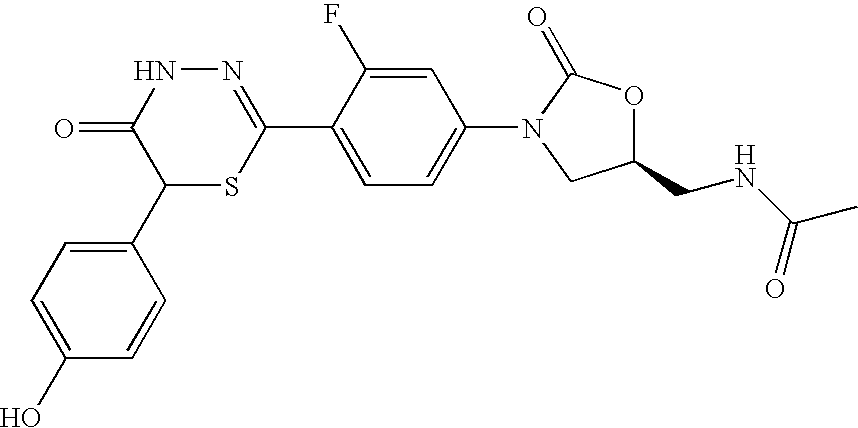
25% Sodium methoxide solution in methanol (0.027 ml, 0.117 mmol) is added to methanesulfonic acid 4-(2-{4-[5-(acetylaminomethyl)-2-oxo-oxazolidin-3-yl]-2-fluorophenyl}-5-oxo-5,6-dihydro-4H-[1,3,4]thiadiazin-6-yl)-phenyl ester (0.050 g, 0.0932 mmol) in methanol (2 ml) and the mixture is stirred at room temperature overnight. The reaction mixture is neutralized with acetic acid (0.020 ml), evaporated to dryness and the residue is purified by PTLC (10% MeOH/DCM) to give product as a white solid (0.039 g, 92%); 1H NMR (300 MHz, DMSO-d6) δ 1.80 (s, 3H), 3.40-3.45 (bs, 2H), 3.74 (dd, J=6.9, 10.5 Hz, 1H), 4.12 (t, J=9.3 Hz, 1H), 4.70-4.79 (m, 1H), 4.98 (s, 3H), 6.73 (d, J=8.4 Hz, 2H), 7.08 (d, J=8.7 Hz, 1H), 7.37 (dd, J=1.8, 8.7 Hz, 1H), 7.55-7.60 (m, 2H), 8.25 (t, J=5.7 Hz, 1H); mp >200 (decomp.); MS (m/z): [M+H]+=459.
The intermediates for this compound are prepared as follows:
I. Methanesulfonic acid 4-(2-{4-[5(S)-(acetylaminomethyl)-2-oxo-oxazolidin-3-yl]-2-fluorophenyl}-5-oxo-5,6-dihydro-4H-[1,3,4]thiadiazin-6-yl)-phenyl ester 
Prepared from methanesulfonic acid 4-{2-[4-(5(S)-aminomethyl-2-oxo-oxazolidin-3-yl)-2-fluorophenyl]-5-oxo-5,6-dihydro-4H-[1,3,4]thiadiazin-6-yl}-phenyl ester, trifluoroacetate salt according to the method of Example 2 (0.064 g,76%). MS (m/z): [M+H]+=537.
II. Methanesulfonic acid 4-{2-[4-(5(S)-aminomethyl-2-oxo-oxazolidin-3-yl)-2-fluorophenyl]-5-oxo-5,6-dihydro-4H-[1,3,4]thiadiazin-6-yl}-phenyl ester, trifluoroacetate salt 
Prepared from [{4-[5(S)-(tert-butoxycarbonylaminomethyl)-2-oxo-oxazolidin-3-yl]-2-fluorophenyl}-(tert-butoxycarbonylhydrazono)-methylsulfanyl]-(4-methanesulfonyloxyphenyl)-acetic acid ethyl ester according to the method of Example 2, Intermediate I. MS (m/z): [M+H]+=609.
III. [{4-[5(S)-(tert-Butoxycarbonylaminomethyl)-2-oxo-oxazolidin-3-yl]-2-fluorophenyl}-(tert-butoxycarbonylhydrazono)-methylsulfanyl]-(4-methanesulfonyloxyphenyl)-acetic acid ethyl ester 
Prepared from methanesulfonyloxy(4-methanesulfonyloxyphenyl)-acetic acid methyl ester (0.080 g, 0.227 mmol) and N′-{4-[5(S)-(tert-butoxycarbonylaminomethyl)-2-oxo-oxazolidin-3-yl]-2-fluorothiobenzoyl}-hydrazinecarboxylic acid tert-butyl ester (0.100 g, 0.206 mmol) according to the procedure of Example 1, Intermediate II (0.118 g, 77%). MS (m/z): [M+H]+=741.
IV. Methanesulfonyloxy(4-methanesulfonyloxyphenyl)-acetic acid methyl ester
Methanesulfonyl chloride (0.395 ml, 5.10 mmol) is added dropwise at 0° C. to ethyl 4-hydroxymandelate (0.500 g, 2.55 mmol) and triethylamine (0.889 ml, 6.38 mmol) in DMF (5 ml) and the mixture is allowed to warm to room temperature overnight. The reaction mixture is diluted with water and extracted with ethyl acetate. The extract is washed with brine, dried (MgSO4), and evaporated to give oily residue which is purified by flash column chromatography (30% EtOAc/Hexane) (0.75 g, 82%). MS (m/z): [M+H]+=353.
N-{3-[3-Fluoro-4-(5-oxo-5,6-dihydro-4H-[1,3,4]thiadiazin-2-yl)-phenyl]-2-oxo-oxazolidin-5(S)-ylmethyl}-propionamide 
1,3-Dicyclohexylcarbodiimide (0.153 g, 0.740 mmol) is added to a mixture of 2-[4-(5(S)-aminomethyl-2-oxo-oxazolidin-3-yl)-2-fluorophenyl]-4H-[1,3,4]thiadiazin-5-one (0.200 g, 0.617 mmol), N,N-diisopropylethylamine (0.161 ml, 0.927 mmol) and propionic acid (0.051 ml, 0.680 mmol) in DMF (3 ml). The mixture is stirred overnight at room temperature and then partially evaporated under vacuum. The residue is diluted with water (5 ml) and the resulting precipitate is filtered and dried under vacuum. Purification by PTLC (10% MeOH/DCM) gives pure product as a white solid (0.21 g, 90%); 1HNMR (300 MHz, DMSO-d6) δ 0.94 (t, J=7.7 Hz, 3H), 2.08 (q, J=7.7 Hz, 2H), 3.40-3.48 (m, 2H), 3.59 (s, 2H), 3.77 (dd, J=6.0, 9.1 Hz, 1H), 4.14 (t, J=9.1 Hz, 1H), 4.74-4.78 (m, 1H), 7.41 (dd, J=2.2, 8.8 Hz, 1H), 7.52 (dd, J=2.2, 14 Hz, 1H), 7.69 (t, J=8.5 Hz, 1H), 8.16 (t, J=5.8 Hz, 1H), 11.6 (s, 1H); mp 192-3; MS (m/z): [M+H]+=381.
Cyclopropanecarboxylic acid {3-[3-fluoro-4-(5-oxo-5,6-dihydro-4H-[1,3,4]thiadiazin-2-yl)-phenyl]-2-oxo-oxazolidin-5(S)-ylmethyl}-amide 
Prepared from 2-[4-(5(S)-aminomethyl-2-oxo-oxazolidin-3-yl)-2-fluorophenyl]-4H-[1,3,4]thiadiazin-5-one (0.30 g, 0.925 mmol and cyclopropanecarboxylic acid (0.0812 ml, 1.02 mmol) according to the method of Example 15 (0.30 g, 84%); 1HNMR (300 MHz, DMSO-d6) δ 0.59-0.68 (m, 4H), 1.53-1.62 (m, 1H), 3.44 (t, J=5.2 Hz, 2H), 3.58 (s, 2H), 3.72 (dd, J=6.3, 9.1 Hz, 1H), 4.14 (t, J=9.1 Hz, 1H), 4.72-4.78 (m, 1H), 7.41 (dd, J=2.2, 8.5 Hz, 1H), 7.53 (dd, J=2.2, 14 Hz, 1H), 7.68 (t, J=8.8 Hz, 1H), 8.46 (t, J=5.8 Hz, 1H), 11.6 (s, 1H); mp 239-40; MS (m/z): [M+H]+=393.
N-{3-[3-Fluoro-4-(5-oxo-5,6-dihydro-4H-[1,3,4]thiadiazin-2-yl)-phenyl]-2-oxo-oxazolidin-5(S)-ylmethyl}-2-hydroxyacetamide 
Prepared from 2-[4-(5(S)-aminomethyl-2-oxo-oxazolidin-3-yl)-2-fluorophenyl]-4H-[1,3,4]thiadiazin-5-one (0.300 g, 0.925 mmol) and acetoxyacetic acid (0.120 g, 1.02 mmol) according to the method of Example 15. The crude product is deacetylated by dissolving in 0.1M LiOH in methanol (10 ml) and stirring for 2 hours at room temperature. The reaction mixture is neutralized with acetic acid, evaporated under vacuum, and the residue is purified by PTLC to give product as a white solid (0.27 g, 78%); 1HNMR (300 MHz, DMSO-d6) δ 3.39-3.54 (m, 2H), 3.59 (s, 2H), 3.82-3.87 (m, 3H), 4.14 (t, J=9.1 Hz, 1H), 4.75-4.83 (m, 1H), 5.53 (t, J=5.5 Hz, 1H), 7.38 (dd, J=2.2, 8.5 Hz, 1H), 7.52 (dd, J=2.2, 14 Hz, 1H), 7.69 (t, J=8.8 Hz, 1H), 8.07 (t, J=6.0 Hz, 1H), 11.6 (s, 1H); mp 157-8; MS (m/z): [M+H]+=383.
{3-[3-Fluoro-4-(5-oxo-5,6-dihydro-4H-[1,3,4]thiadiazin-2-yl)-phenyl]-2-oxo-oxazolidin-5(S)-ylmethyl}-urea 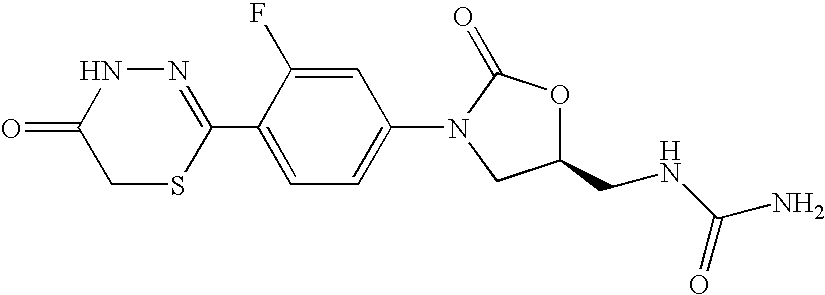
Trimethylsilyl isocyanate (0.138 ml, 1.02 mmol) is added to a mixture of 2-[4-(5(S)-aminomethyl-2-oxo-oxazolidin-3-yl)-2-fluorophenyl]-4H-[1,3,4] thiadiazin-5-one (0.30 g, 0.925 mmol) in THF (10 ml). The mixture is stirred at room temperature overnight and then is evaporated to dryness. The residue is purified by PTLC (10% MeOH/DCM) to give product as a white solid (0.22 g, 65%); 1HNMR (300 MHz, DMSO-d6) δ 3.29-3.36 (m, 2H), 3.59 (s, 2H), 3.78 (dd, J=6.3, 9.1 Hz, 1H), 4.13 (t, J=9.1 Hz, 1H), 4.69-4.77 (m, 1H), 5.58 (s, 1H), 6.31 (t, J=6.0 Hz, 1H), 7.42 (dd, J=2.2, 8.8 Hz, 1H), 7.59 (dd, J=2.2, 14 Hz, 1H), 7.68 (t, J=8.8 Hz, 1H), 11.6 (s, 1H); mp 235-6; MS (m/z): [M+H]+=368.
N-{3-[3-Fluoro-4-(5-oxo-5,6-dihydro-4H-[1,3,4]thiadiazin-2-yl)-phenyl]-2-oxo-oxazolidin-5(S)-ylmethyl-carbamic acid methyl ester 
Methyl chloroformate (0.0786 ml, 1.02 mmol) is added dropwise at 0° C. to 2-[4-(5(S)-aminomethyl-2-oxo-oxazolidin-3-yl)-2-fluorophenyl]-4H-[1,3,4]thiadiazin-5-one (0.300 g, 0.925 mmol) and triethylamine (0.193 ml, 1.39 mmol) in THF (10 ml) and the mixture is stirred at 0° C. for 10 minutes and then is allowed to warm to room temperature. The reaction mixture is evaporated to dryness and the residue is purified by PTLC (10% MeOH/DCM) to give product as a white solid (g, 0.29 g, 82%); 1HNMR (300 MHz, DMSO-d6) δ 3.35 (t, J=5.5 Hz, 2H), 3.52 (s, 3H), 3.59 (s, 2H), 3.80 (dd, J=6.3, 9.1 Hz, 1H), 4.15 (t, J=9.1 Hz, 1H), 4.70-4.79 (m, 1H), 7.38 (dd, J=2.2, 8.5 Hz, 1H), 7.52 (dd, J=2.2, 14 Hz, 1H), 7.69 (t, J=8.8 Hz, 1H), 8.07 (t, J=6.0 Hz, 1H), 11.6 (s, 1H);mp 210; MS (m/z): [M+H]+=383.
N-{3-[3-Fluoro-4-(5-oxo-5,6-dihydro-4H-[1,3,4]thiadiazin-2-yl)-phenyl]-2-oxo-oxazolidin-5(S)-ylmethyl}-carbamic acid tert-butyl ester 
Di-tert-butyl dicarbonate (0.223 ml, 0.971 mmol) is added to 2-[4-(5(S)-aminomethyl-2-oxo-oxazolidin-3-yl)-2-fluorophenyl]-4H-[1,3,4]thiadiazin-5-one (0.300 g, 0.925 mmol) and pyridine (0.112 ml, 1.39 mmol) in DMF (3 ml) and is stirred overnight at room temperature. The reaction mixture is evaporated to dryness and the residue is purified by PTLC (10% MeOH/DCM) to give a white solid (0.37 g, 94%); 1HNMR (300 MHz, DMSO-d6) δ 1.34 (s, 9H), 3.27 (t, J=5.5 Hz, 2H), 3.59 (s, 2H), 3.82 (dd, J=6.6, 9.3 Hz, 1H), 4.14 (t, J=9.1 Hz, 1H), 4.69-4.77 (m, 1H), 7.23 (t, J=5.5 Hz, 1H), 7.42 (dd, J=2.2, 8.8 Hz, 1H), 7.57 (dd, J=1.9, 14 Hz, 1H), 7.68 (t, J=8.8 Hz, 1H), 11.6 (s, 1H); mp 167-8; MS (m/z): [M+H]+=425.
N-{3-[3-Fluoro-4-(5-oxo-5,6-dihydro-4H-[1,3,4]thiadiazin-2-yl)-phenyl]-2-oxo-oxazolidin-5(S)-ylmethyl}-3-oxo-butyramide 
Diketene (0.0590 ml, 0.648 mmol) is added dropwise to a solution of 2-[4-(5(S)-aminomethyl-2-oxo-oxazolidin-3-yl)-2-fluorophenyl]-4H-[1,3,4]thiadiazin-5-one (0.200 g, 0.617 mmol) and triethylamine (0.0946 ml, 0.679 mmol) in DMF (2 ml) and is stirred overnight at room temperature. The reaction mixture is evaporated to dryness and the residue is purified by PTLC (10% MeOH/DCM) to give a white solid (0.22 g, 89%); 1HNMR (300 MHz, DMSO-d6) δ 2.08 (s, 3H), 3.34 (s, 2H), 3.42-3.54 (m, 2H), 3.59 (s, 2H), 3.78 (dd, J=6.3, 9.1 Hz, 1H), 4.14 (t, J=9.1 Hz, 1H), 4.75-4.83 (m, 1H), 7.37 (dd, J=2.2, 8.5 Hz, 1H), 7.52 (dd, J=2.2, 14 Hz, 1H), 7.69 (t, J=8.8 Hz, 1H), 8.45 (t, J=5.8 Hz, 1H), 11.6 (s, 1H); mp 176-8; MS (m/z): [M+H]+=409.
N-{3-[3-Fluoro-4-(5-oxo-5,6-dihydro-4H-[1,3,4]thiadiazin-2-yl)-phenyl]-2-oxo-oxazolidin-5(S)-ylmethyl}-3-(4-fluorophenyl)-3-oxo-propionamide 
2-[4-(5(S)-Aminomethyl-2-oxo-oxazolidin-3-yl)-2-fluorophenyl]-4H-[1,3,4]thiadiazin-5-one (0.100 g, 0.308 mmol), methyl fluorobenzoylacetate (0.052 ml, 0.323 mmol), and potassium cyanide (5 mg, 0.077 mmol) are mixed together in DMF and heated at 85° C. for 45 minutes. The reaction mixture is evaporated to dryness and the residue is purified by PTLC (10% MeOH/DCM) to give product as a white solid (0.030 g, 20%); 1HNMR (300 MHz, DMSO-d6) δ 3.41-3.54 (m, 2H), 3.59 (s, 2H), 3.74 (dd, J=6.3, 9.3 Hz, 1H), 3.87-4.01 (m, 2H), 4.12 (t, J=9.1 Hz, 1H), 4.76-4.84 (m, 1H), 7.25-7.33 (m, 2H), 7.38 (dd, J=2.2, 8.8 Hz, 1H), 7.55 (dd, J=1.9, 14 Hz, 1H), 7.65 (t, J=8.8 Hz, 1H), 7.95-8.00 (m, 2H), 8.59 (t, J=5.8 Hz, 1H), 11.6 (s, 1H); mp 184-7; MS (m/z): [M+H]+=489.
N-{3-[3-Fluoro-4-(5-oxo-5,6-dihydro-4H-[1,3,4]thiadiazin-2-yl)-phenyl]-2-oxo-oxazolidin-5(S)-ylmethyl}-3-[4-(hydroxyimino-methyl)-phenyl]-acrylamide 
Hydroxylamine hydrochloride (0.0106 g, 0.152 mmol) is added to N-{3-[3-fluoro-4-(5-oxo-5,6-dihydro-4H-[1,3,4]thiadiazin-2-yl)-phenyl]-2-oxo-oxazolidin-5(S)-ylmethyl}-3-(4-formyl-phenyl)-acrylamide (0.076 g, 0.145 mmol) dissolved in pyridine (3 ml) and is stirred overnight at room temperature. The reaction mixture is evaporated to dryness and the residue is purified by PTLC (10% MeOH/DCM) to give pure product as a white solid (0.065 g, 90%); 1H NMR (300 MHz, DMSO-d6) δ 3.59 (bs, 4H), 3.83 (dd, J=6.3, 11.7 Hz, 1H), 4.20 (t, J=9.3 Hz, 1H), 4.80-4.90 (m, 1H), 6.70 (d, J=15.6 Hz, 1H), 7.42-7.72 (m, 8H), 8.15 (s, 1H), 8.54 (t, J=5.4 Hz, 1H); mp 144-5; MS (m/z): [M+H]+=498.
The intermediate for the synthesis of above compound is prepared as follows:
I. N-{3-[3-Fluoro-4-(5-oxo-5,6-dihydro-4H-[1,3,4]thiadiazin-2-yl)-phenyl]-2-oxo-oxazolidin-5(S)-ylmethyl}-3-(4-formyl-phenyl)-acrylamide 
N,N-Diisopropylethylamine (0.169 ml, 0.972 mmol) is added to 4-formylcinnamic acid (0.057 g, 0.324 mmol) and O-(7-azabenzotriazol-1-yl)-N,N,N′,N′-tetramethyluronium hexafluorophosphate (0.129 g, 0.340 mmol) in DMF (2 ml) and is stirred for 20 minutes at room temperature. 2-[4-(5(S)-aminomethyl-2-oxo-oxazolidin-3-yl)-2-fluorophenyl]-4H-[1,3,4]thiadiazin-5-one (0.100 g, 0.308 mmol) is added and stirring is continued at room temperature overnight. The reaction mixture is partially evaporated under vacuum and the residue is diluted with water (5 ml). The resulting precipitate is filtered and dried under vacuum to give crude product used directly in the next step (0.076 g, 51%). MS (m/z): [M+H]+=483.
N-{3-[3-Fluoro-4-(5-oxo-5,6-dihydro-4H-[1,3,4]thiadiazin-2-yl)-phenyl]-2-oxo-oxazolidin-5(S)-ylmethyl}-3-[4-(methoxyimino-methyl)-phenyl]-acrylamide 
N,N-Diisopropylethylamine (0.160 ml, 1.15 mmol) is added to 3-[4-(methoxyimino-methyl)-phenyl]-acrylic acid (0.0786 g, 0.383 mmol) and O-(7-azabenzotriazol-1-yl)-N,N,N′,N′-tetramethyluronium hexafluorophosphate (0.152 g, 0.402 mmol) in DMF (3 ml) and is stirred for 20 minutes at room temperature. 2-[4-(5(S)-aminomethyl-2-oxo-oxazolidin-3-yl)-2-fluorophenyl]-4H-[1,3,4]thiadiazin-5-one (0.118 g, 0.365 mmol) is added and stirring is continued at room temperature overnight. The reaction mixture is partially evaporated under vacuum and the residue diluted with water (5 ml). The resulting precipitate is filtered and dried under vacuum. Purification by PTLC (10% MeOH/DCM) gives pure product as a white solid (0.080 g, 43%); 1H NMR (300 MHz, DMSO-d6) δ 3.59 (bs, 4H), 3.82 (dd, J=6.9, 9.3 Hz, 1H), 3.90 (s, 3H), 4.20 (t, J=9.0 Hz, 1H), 4.83-4.87 (m, 1H), 6.73 (d, J=15.9 Hz, 1H), 7.42-7.72 (m, 8H), 8.24 (s, 1H), 8.55 (t, J=5.7 Hz, 1H), mp 175 (decomp); MS (m/z): [M+H]+=512.
The intermediate for the synthesis of above compound is prepared as follows:
I. 3-[4-(Methoxyimino-methyl)-phenyl]-acrylic acid
Methoxylamine hydrochloride (0.996 g, 0.0119 mol) is added to a solution of formylcinnamic acid (2 g, 0.0114 mol) in pyridine (20 ml) and is stirred for 2 hours. The reaction mixture is evaporated under vacuum and the residue is diluted with 2N aqueous HCl. The resulting precipitate is filtered and dried under vacuum (2.00 g, 85%).
N-{3-[3-Fluoro-4-(5-oxo-5,6-dihydro-4H-[1,3,4]thiadiazin-2-yl)-phenyl]-2-oxo-oxazolidin-5(S)-ylmethyl}-thioacetamide 
Ethyl dithioacetate (0.0708 ml, 0.747 mmol) is added to 2-[4-(5(S)-aminomethyl-2-oxo-oxazolidin-3-yl)-2-fluorophenyl]-4H-[1,3,4]thiadiazin-5-one (0.200 g, 0.617 mmol) and triethylamine (0.0946 ml, 0.679 mmol) in DMF (3 ml) and is stirred at room temperature overnight. The reaction mixture is evaporated to dryness and the residue is purified by PTLC (10% MeOH/DCM) to give a white solid (0.21 g, 90%); 1HNMR (300 MHz, DMSO-d6) δ 2.43 (s, 3H), 3.59 (s, 2H), overlapping 3.84 (dd, J=6.6, 9.1, 2H) and 3.92 (t, J=4.7 Hz, 2H), 4.19 (t, J=9.1 Hz, 1H), 4.92-5.05 (m, 1H), 7.43 (dd, J=2.2, 8.5 Hz, 1H), 7.58 (dd, J=2.2, 14, 1H), 7.69 (t, J=8.5, 1H), 10.4 (t, J=5.8 Hz, 1H), 11.6 (s, 1H); mp 182-3; MS (m/z): [M+H]+=383.
N-{3-[3-Fluoro-4-(5-thioxo-5,6-dihydro-4H-[1,3,4]thiadiazin-2-yl)-phenyl]-2-oxo-oxazolidin-5(S)-ylmethyl}-thioacetamide 
Lawesson's reagent (0.232 g, 0.573 mmol) and N-{3-[3-fluoro-4-(5-oxo-5,6-dihydro-4H-[1,3,4]thiadiazin-2-yl)-phenyl]-2-oxo-oxazolidin-5(S)-ylmethyl}-acetamide (0.200 g, 0.546 mmol) in dioxane (5 ml) are heated at 65° C. for 6 hours. The reaction mixture is evaporated to dryness and the residue is purified by PTLC (10% MeOH/DCM) to give a bright yellow solid (0.16 g, 75%); 1HNMR (300 MHz, DMSO-d6) δ 2.43 (s, 3H), 3.85 (dd, J=6.9, 9.3 Hz, 2H), 3.92 (t, 5.7 Hz, 2H), 4.01 (s, 2H), 4.20 (t, J=9.1 Hz, 1H), 4.94-5.03 (m, 1H), 7.47 (dd, J=2.2, 8.8 Hz, 1H), 7.61 (dd, J=2.2, 14 Hz, 1H), 7.74 (t, J=8.8 Hz, 1H), 10.4 (t, J=5.2 Hz, 1H); mp 158-61; MS (m/z): [M+H]+=399.
N-{3-[3-Fluoro-4-(5-thioxo-5,6-dihydro-4H-[1,3,4]thiadiazin-2-yl)-phenyl]-2-oxo-oxazolidin-5(S)-ylmethyl}-acetamide 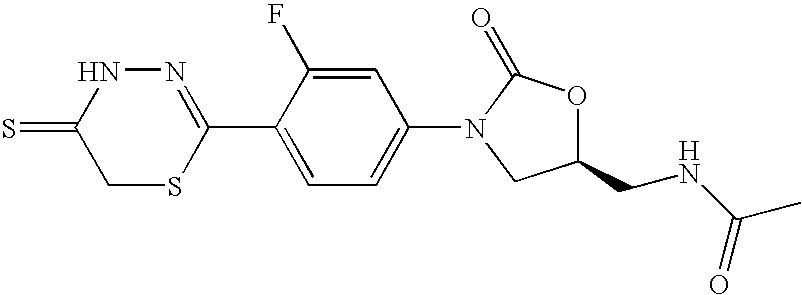
5(S)-Aminomethyl-3-[3-fluoro-4-(5-thioxo-5,6-dihydro-4H-[1,3,4]thiadiazin-2-yl)-phenyl]-oxazolidin-2-one, trifluoroacetate salt is dissolved in pyridine and acetic anhydride (0.0163 ml, 0.173 mmol) is added. The reaction is stirred at room temperature for 4 hours and then evaporated to dryness. The residue is purified by PTLC (10% MeOH/DCM) to give product.
The intermediate for the synthesis of above compound is prepared as follows:
I. 5(S)-Aminomethyl-3-[3-fluoro-4-(5-thioxo-5,6-dihydro-4H-[1,3,4]thiadiazin-2-yl)-phenyl]-oxazolidin-2-one trifluoroacetate salt 
20% Trifluoroacetic acid/dichloromethane (2 ml) is added to {3-[3-fluoro-4-(5-thioxo-5,6-dihydro-4H-[1,3,4]thiadiazin-2-yl)-phenyl]-2-oxo-oxazolidin-5(S)-ylmethyl}-carbamic acid tert-butyl ester and the mixture is stirred at room temperature for 30 minutes. The reaction is evaporated to dryness and the trifluoroacetate salt is used directly in the next step.
N-{3-[3-Fluoro-4-(5-thioxo-5,6-dihydro-4H-[1,3,4]thiadiazin-2-yl)-phenyl]-2-oxo-oxazolidin-5(S)-ylmethyl}-carbamic acid tert-butyl ester 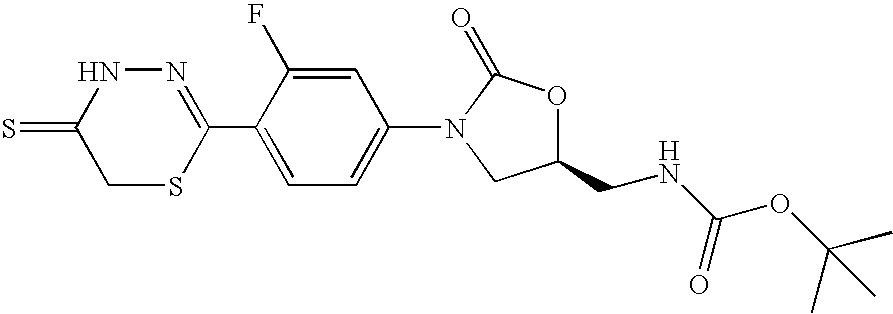
Lawesson's reagent (0.0715 g, 0.177 mmol) and {3-[3-fluoro-4-(5-oxo-5,6-dihydro-4H-[1,3,4]thiadiazin-2-yl)-phenyl]-2-oxo-oxazolidin-5(S)-ylmethyl}-carbamic acid tert-butyl ester (0.100 g, 0.236 mmol) in dioxane (5 ml) are heated at 65° C. for 6 hours. The reaction mixture is evaporated to dryness and the residue is purified by PTLC (10% MeOH/DCM) to give bright yellow solid (0.088 g, 85%); 1HNMR (300 MHz, DMSO-d6) δ 1.34 (s, 9H), 3.28 (t, J=5.5 Hz, 2H), 3.82 (dd, J=6.0, 9.1 Hz, 1H), 4.01 (s, 2H), 4.14 (t, J=9.3 Hz, 1H), 4.70-4.78 (m, 1H), 7.24 (t, J=5.8 Hz, 1H), 7.45 (dd, J=2.2, 8.8 Hz, 1H), 7.60 (dd, J=2.2, 14 Hz, 1H), 7.73 (t, J=8.8 Hz, 1H), 8.07 (t, J=6.0 Hz, 1H); mp 134-6; MS (m/z): [M+H]+=441.
N-{3-[4-(6,6-Dimethyl-1,5-dioxo-1,4,5,6-tetrahydro-1λ4-[1,3,4]-thiadiazin-2-yl)-3-fluorophenyl]-2-oxo-oxazolidin-5(S)-ylmethyl}-acetamide 
m-Chloroperoxybenzoic acid (77%, 0.0568 g, 0.254 mmol) is added to N-{3-[4-(6,6-dimethyl-5-oxo-5,6-dihydro-4H-[1,3,4]thiadiazin-2-yl)-3-fluorophenyl]-2-oxo-oxazolidin-5(S)-ylmethyl}-acetamide (0.100 g, 0.254 mmol) in acetic acid (3 ml) and the mixture stirred at room temperature overnight. The reaction mixture is evaporated to dryness and the residue is purified by PTLC (10% MeOH/DCM) to give white solid (0.048 g, 50%); 1HNMR (300 MHz, DMSO-d6) δ 1.38 (s, 3H), 1.53 (s, 3H), 1.82 (s, 3H), 3.42 (t, J5.5 Hz, 2H), 3.78 (dd, J=6.6, 9.3 Hz, 1H), 4.17 (t, J=9.1 Hz, 1H), 4.73-4.81 (m, 1H), 7.47-7.51 (m, 1H), 7.63-7.73 (m, 2H), 8.25 (t, J=5.8 Hz, 1H), 12.1 (s, 1H); mp 153-5; Rf(10% MeOH/DCM)=0.23; MS (m/z): [M+H]+=383.
N-{3-[4-(6,6-Dimethyl-1,1,5-trioxo-1,4,5,6-tetrahydro-1λ6-[1,3,4]thiadiazin-2-yl)-3-fluorophenyl]-2-oxo-oxazolidin-5(S)-ylmethyl}-acetamide 
m-Chloroperoxybenzoic acid (77%, 0.114 g, 0.508 mmol) is added to N-{3-[4-(6,6-dimethyl-5-oxo-5,6-dihydro-4H-[1,3,4]thiadiazin-2-yl)-3-fluorophenyl]-2-oxo-oxazolidin-5(S)-ylmethyl}-acetamide (0.100 g, 0.254 mmol) in acetic acid (3 ml) and the mixture is stirred at 50° C. overnight. The reaction mixture is evaporated to dryness and the residue is purified by PTLC (10% MeOH/DCM) to give white solid (0.073 g, 72%); 1HNMR (300 MHz, DMSO-d6) δ 1.50 (s, 6H), 1.82 (s, 3H), 3.42 (t, J=5.5 Hz, 2H), 3.78 (dd, J=6.6, 9.1 Hz, 1H), 4.17 (t, J=9.1 Hz, 1H), 4.72-4.81 (m, 1H), 7.50 (dd, J=1.7, 8.8 Hz, 1H), 7.64-7.70 (m, 2H), 8.24 (t, J=5.8 Hz, 1H); mp 127-8; Rf(10% MeOH/DCM)=0.48; MS (m/z): [M+H]+=399.
Acetic acid 2-{4-[5(S)-(acetylaminomethyl)-2-oxo-oxazolidin-3-yl]-2-fluorophenyl}-5-oxo-5,6-dihydro-4H-[1,3,4]thiadiazin-6-yl ester 
Hydrogen peroxide (30% aqueous sol, 0.0558 ml, 0.546 mmol) is added to N-{3-[3-Fluoro-4-(5-oxo-5,6-dihydro-4H-[1,3,4]thiadiazin-2-yl)-phenyl]-2-oxo-oxazolidin-5(S)-ylmethyl}-acetamide (0.100 g, 0.273 mmol) in acetic acid (2 ml) and is heated at 65° C. overnight. The reaction mixture is evaporated to dryness and the residue is purified by PTLC (10% MeOH/DCM) to give white solid (0.089 g, 82%); 1HNMR (300 MHz, DMSO-d6) δ 1.82 (s, 3H), 2.09 (s, 3H), 3.41 (t, J=5.5 Hz, 2H), 3.56 (dd, J=6.6, 9.1 Hz, 1H), 4.14 (t, J=9.1 Hz, 1H), 4.70-4.80 (m, 1H), 7.42 (dd, J=2.2, 8.8 Hz, 1H), 7.59 (dd, J=2.2, 14 Hz, 1H), 7.65 (t, J=8.5 Hz, 1H), 8.25 (t, J=5.8 Hz, 1H); mp 174-7; MS (m/z): [M+H]+=425.
N-{3-[3-Fluoro-4-(4-methyl-5-oxo-5,6-dihydro-[1,3,4]thiadiazin-2-yl)-phenyl]-2-oxo-oxazolidin-5(S)-ylmethyl}-acetamide 
A mixture of N-{3-[3-fluoro-4-(5-oxo-5,6-dihydro-4H-[1,3,4]thiadiazin-2-yl)-phenyl]-2-oxo-oxazolidin-5(S)-ylmethyl}-acetamide (0.100 g, 0.273 mmol), potassium carbonate (0.075 g, 0.546 mmol), and iodomethane (0.0187 ml, 0.300 mmol) in DMF (3 ml) is heated at 80° C. overnight. The reaction mixture is filtered and evaporated to dryness. The residue is purified by PTLC (10% MeOH/DCM) to give product as a white solid (0.104 g, 90%); 1HNMR (300 MHz, DMSO-d6) δ 1.82 (s, 3H), 3.39 (s, 3H), 3.42 (t, J=5.5, 2H), 3.66 (s, 2H), 3.76 (dd, J=6.6, 9.3 Hz, 1H), 4.14 (t, J=9.1 Hz, 1H), 4.71-4.80 (m, 1H), 7.43 (dd, J=2.2, 8.8 Hz, 1H), 7.59 (dd, J=1.9, 14 Hz, 1H), 7.72 (t, J=8.8 Hz, 1H), 8.25 (t, J=5.8 Hz, 1H); mp 179-80; MS (m/z): [M+H]+=381.
(2-14-[5(S)-(Acetylaminomethyl)-2-oxo-oxazolidin-3-yl]-2-fluorophenyl}-5-oxo-5,6-dihydro-[1,3,4]thiadiazin-4-yl)-acetic acid methyl ester 
Prepared from N-{3-[3-fluoro-4-(5-oxo-5,6-dihydro-4H-[1,3,4]thiadiazin-2-yl)-phenyl]-2-oxo-oxazolidin-5(S)-ylmethyl}-acetamide (0.100 g, 0.273 mmol), potassium carbonate (0.075 g, 0.546 mmol), and methyl bromoacetate (0.0284 ml, 0.300 mmol) according to the procedure of Example 32 (0.062 g, 60%); 1HNMR (300 MHz, DMSO-d6) δ 1.82 (s, 3H), 3.39-3.44 (m, 2H), 3.67 (s, 3H), overlapping 3.74-3.79 (m, 1H) and 3.75 (s, 2H), 4.14 (t, J=9.1 Hz, 1H), 4.61 (s, 2H), 4.71-4.80 (m, 1H), 7.42 (dd, J=2.2, 8.8 Hz, 1H), 7.59 (dd, J=2.2, 14 Hz, 1H), 7.70 (t, J=8.5 Hz, 1H), 8.25 (t, J=5.8 Hz, 1H); mp 157-8; MS (m/z): [M+H]+=439.
2-[2-Fluoro-4-(5(R)-hydroxymethyl)-2-oxo-oxazolidin-3-yl)-phenyl]-4H-[1,3,4]thiadiazin-5-one 
tert-Butyl nitrite (0.557 ml, 4.69 mmol) is added dropwise at room temperature to 2-[4-(5(S)-aminomethyl-2-oxo-oxazolidin-3-yl)-2-fluorophenyl]-4H-[1,3,4]thiadiazin-5-one (0.304 g, 0.938 mmol) and acetic acid (2 ml) in 1,4-dioxane (20 ml) and the mixture is stirred for 1 hour. The reaction mixture is evaporated to dryness and the residue is dissolved in a mixture of DMF (3 ml) and methanol (20 ml). A 0.1 M solution of lithium hydroxide in methanol (12 ml, 1.2 mmol) is added and the mixture is stirred for 30 minutes at room temperature. Acetic acid is added until neutral and the mixture is evaporated to dryness. The residue is purified by PTLC (10% MeOH/DCM) δ give product as a white solid (0.170 g, 56%); 1HNMR (300 MHz, DMSO-d6) δ overlapping 3.52-3.60 (m, 1H) and 3.59 (s, 2H), 3.66-3.71 (m, 1H), 3.85 (dd, J=6.3, 9.1, 2H), 4.11 (t, J=9.1 Hz, 1H), 4.68-4.79 (m, 1H), 5.24 (t, J=5.5 Hz, 1H), 7.46 (dd, J=2.2, 8.5 Hz, 1H), 7.60 (dd, J=2.2, 14, 1H), 7.68 (t, J=8.5, 11H), 11.6 (s, 1H); mp 224-7; MS (m/z): [M+H]+=326.
2-{2-Fluoro-4-[5(S)-(isoxazol-3-ylaminomethyl)-2-oxo-oxazolidin-3-yl]-phenyl}-4H-[1,3,4]thiadiazin-5-one 
Zinc dust (0.115 g, 1.76 mmol) is added to {3-[3-Fluoro-4-(5-oxo-5,6-dihydro-4H-[1,3,4]thiadiazin-2-yl)-phenyl]-2-oxo-oxazolidin-5(S)-ylmethyl}-isoxazol-3-yl-carbamic acid 2,2,2-trichloro-ethyl ester (0.100 g, 0.176 mmol ) in acetic acid (3 ml) and the mixture is stirred vigorously at room temperature for 2 hours. The reaction mixture is filtered, the filtrate evaporated to dryness, and the residue is purified by PTLC (10% MeOH/DCM) to give the product.
The intermediate for the synthesis of above compound is prepared as follows:
I. {3-[3-Fluoro-4-(5-oxo-5,6-dihydro-4H-[1,3,4]thiadiazin-2-yl)-phenyl]-2oxo-oxazolidin-5(S)-ylmethyl}-isoxazol-3-yl-carbamic acid 2,2,2-trichloro-ethyl ester 
2-[2-Fluoro-4-(5(R)-hydroxymethyl)-2-oxo-oxazolidin-3-yl)-phenyl]-4H-[1,3,4]thiadiazin-5-one (0.200 g, 0.615 mmol), 3-(2,2,2-trichloroethoxycarbonylamino)isoxazole (0.239 g, 0.923 mmol) (prepared similarly to the compound in Example 3 on page 58 of WO 00/21960), and triphenylphosphine (0.241 g, 0.923 mmol) are dissolved in DMF (5 ml) and cooled in an ice bath. Diisopropyl azodicarboxylate (0.182 ml, 0.923 mmol) is added dropwise and the mixture is allowed to warm to room temperature. The reaction mixture is evaporated to dryness and the residue is purified by PTLC (10% MeOH/DCM) to give product.
2-{2-Fluoro-4-[5(S)-(isoxazol-3-yloxymethyl)-2-oxo-oxazolidin-3-yl]-phenyl}-4H-[1,3,4]thiadiazin-5-one 
Diisopropyl azodicarboxylate (0.145 ml, 0.738 mmol) is added dropwise at room temperature to a mixture of 2-[2-fluoro-4-(5(R)-hydroxymethyl)-2-oxo-oxazolidin-3-yl)-phenyl]-4H-[1,3,4]thiadiazin-5-one (0.200 g, 0.615 mmol), 3-hydroxyisoxazole (0.0627 g, 0.738 mmol) [prepared according to the method found in U.S. Pat. No. 3,687,968], and triphenylphosphine (0.209 g, 0.800 mmol) in THF (10 ml). The reaction mixture is stirred at room temperature for 2 hours and then evaporated to dryness. The residue is purified by PTLC (10% MeOH/DCM).
N-{3-[3-Fluoro-4-(5-oxo-5,6-dihydro-4H-[1,3,4]thiadiazin-2-yl-phenyl]-2-oxo-oxazolidin-5-ylmethyl}-3-(4-hydroxyphenyl)-acrylamide 
Acetic acid 4-[2-([3-[fluoro-4-(5-oxo-5,6-dihydro-4H-[1,3,4]thiadiazin-2-yl)-phenyl]-2-oxo-oxazolidin-5-ylmethyl}-carbamoyl)-vinyl]-phenyl ester (0.050 g, 0.0976 mmol) is dissolved in a 0.1 M lithium hydroxide in methanol (1.5 ml) and is stirred at room temperature for 15 minutes. The reaction mixture is neutralized with acetic acid and the resulting precipitate is collected by filtration. The white solid is washed with water, methanol and ether, and then dried under vacuum (0.032 g, 70%); 1HNMR (300 MHz, DMSO-d6) δ overlapping 3.57 (t, J=5.4, 2H) and 3.59 (s, 2H), 3.81 (dd, J=6.3, 9 Hz, 1H), 4.18 (t, J=9 Hz, 1H), 4.83 (m, 1H), 6.45 (d, J=15.9 Hz, 1H), 6.78 (d, J=8.4 Hz, 2H), 7.32-7.45 (m, 4H), 7.60 (dd, J=2.1, 13.8 Hz, 2H), 7.69 (t, J=8.4 Hz, 1H), 8.39 (t, J=6 Hz, 1H), 9.86 (s, 1H); MS (m/z): [M+H]+=471.
The intermediate for the synthesis of above compound is prepared as follows:
I. Acetic acid 4-[2-([3-[fluoro-4-(5-oxo-5,6-dihydro-4H-[1,3,4]thiadiazin-2-2-oxo-oxazolidin-5-ylmethyl}-carbamoyl)-vinyl]-phenyl ester 
N,N-Diisopropylethylamine (0.507 ml, 2.91 mmol) is added to 3-(4-Acetoxyphenyl)-acrylic acid (0.200 g, 0.97 mmol) and O-(7-azabenzotriazol-1-yl)-N,N,N′,N′-tetramethyluronium hexafluorophosphate (0.553 g, 1.46 mmol) in DMF (8 ml) and is stirred for 20 minutes at room temperature. 2-[4-(5(S)-aminomethyl-2-oxo-oxazolidin-3-yl)-2-fluorophenyl]-4H-[1,3,4]thiadiazin-5-one (0.378 g, 1.16 mmol; prepared as described for Example 1) is added and stirring at room temperature is continued overnight. The reaction mixture is partially evaporated under vacuum, diluted with water (5 ml), and extracted with ethyl acetate (50 ml). The extract is washed with brine, dried (MgSO4), and evaporated. The residue was purified by PTLC (5% MeOH/DCM) to give pure product as a white solid (0.2 g, 40%); MS (m/z): [M+H]+=513.
Phosphoric acid mono-{4-[2-({3-[3-fluoro-4-(5-oxo-5,6-dihydro-4H-[1,3,4]thiadiazin-2-yl)-phenyl]-2-oxo-oxazolidin-5-ylmethyl}-carbamoyl)-vinyl]-phenyl} ester 
Phosphoric acid diethyl ester 4-[2-([3-[3-fluoro-4-(5-oxo-5,6-dihydro-4H-[1,3,4]thiadiazin-2-yl)-phenyl]-2-oxo-oxazolidin-5-ylmethyl}-carbamoyl)-vinyl]-phenyl ester (0.170 g, 0.280 mmol) is suspended in acetonitrile and iodotrimethylsilane (0.060 ml, 0.420 mmol) is added dropwise. The suspension becomes clear and the reaction is stirred at room temperature for 2 hours under nitrogen. The mixture is concentrated under vacuum, and the residue is diluted with water (5 ml) and washed with dichloromethane (3×10 ml). The aqueous layer is evaporated under vacuum and the residue is purified by HPLC (methanol/water gradient) to give pure product as a white solid (0.062 g, 40%); 1HNMR (300 MHz, DMSO-d6) 3.59 (m, 4H), 3.82 (dd, J=6.6, 9.3 Hz, 1H), 4.19 (t, J=9 Hz, 1H), 4.85 (m, 1H), 6.60 (d, J=15.6 Hz, 1H), 7.19 (d, J=8.4 Hz, 2H), 7.40-7.72 (m, 6H), 8.51 (t, J=6 Hz, 1H), 11.6 (s, 1H); MS (m/z): [M+H]+=551.
The intermediate for the synthesis of above compound is prepared as follows:
I. Phosphoric acid diethyl ester-{4-[2-({3-[3-fluoro-4-(5-oxo-5,6-dihydro-4H-[1,3,4]thiadiazin-2-yl)-phenyl]-2-oxo-oxazolidin-5-ylmethyl}-carbamoyl)-vinyl]-phenyl} ester 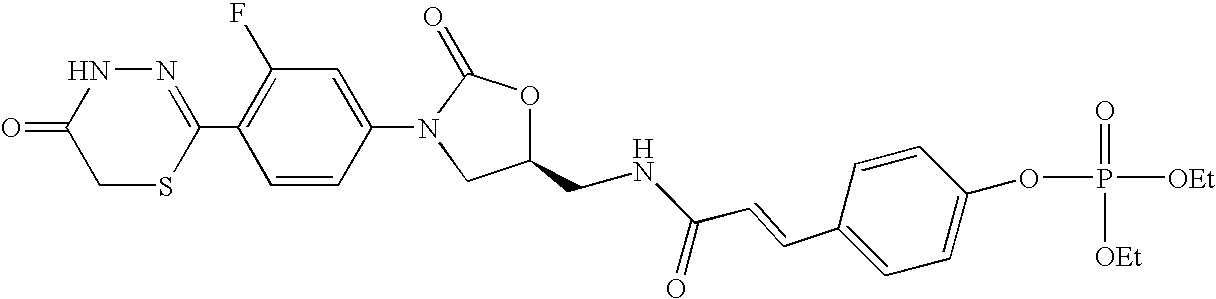
N,N-Diisopropylethylamine (0.507 ml, 2.91 mmol) was added to 3-[4-(diethoxy-phosphoryloxy)phenyl]acrylic acid (0.065 g, 0.217 mmol) [prepared according to the procedure described in Tetrahedron Lett 1996, 37, 3635] and O-(7-azabenzotriazol-1-yl)-N,N,N′,N′-tetramethyluronium hexafluorophosphate (0.124 g 0.326 mmol) in DMF (3 ml) and stirred for 20 minutes at room temperature. 2-[4-(5(S)-aminomethyl-2-oxo-oxazolidin-3-yl)-2-fluorophenyl]-4H-[1,3,4]thiadiazin-5-one (0.084 g, 0.259 mmol) was added and stirring continued at room temperature overnight. The reaction mixture was partially evaporated under vacuum, diluted with water (5 ml), and extracted with ethyl acetate (50 ml). The extract was washed with brine, dried (MgSO4), and evaporated. The residue was purified by PTLC (5% MeOH/DCM) to give pure product as a white solid (0.71 g, 54%); MS (m/z): [M+H]+=607.
While the invention has been described and illustrated herein by references to various specific material, procedures and examples, it is understood that the invention is not restricted to the particular material combinations of material, and procedures selected for that purpose. Numerous variations of such details can be implied as will be appreciated by those skilled in the art.
Claims (73)
1. A compound of the following formula I 
or a pharmaceutically acceptable salt thereof wherein:
A is a structure of the following formula i, ii, iii, or iv 
X is O or S;
Y is
(a) —NHC(═O)R1,
(b) —NHC(═S)R1,
(c) —NHC(═NCN)R1,
(d) —NH-het1,
(e) —O-het1,
(f) —S-het1,
(g) -het2, or
(h) —OH;
R1 is
(a) —H
(b) —NH2,
(c) —NHC1-4alkyl,
(d) —C1-4alkyl,
(e) —C2-4alkenyl,
(i) —C1-4heteroalkyl,
(g) —(CH2)mC(═O)C1-4alkyl,
(h) —OC1-4alkyl,
(i) —SC1-4alkyl,
(j) —(CH2)pC3-6cycloalkyl,
(k) —(CH2)rC(═O)aryl, or
(l) —(CH2)sC(═O)het1;
R2, R3, R7, and R8 are independently
(a) —H,
(b) —Cl,
(c) —F,
(d) —CH3,
(e) —NH2, or
(f) —OH;
R4 is
(a) —H,
(b) —C1-4alkyl,
(c) —C1-4heteroalkyl,
(d) —(CH2)qC(═O)OC1-4alkyl,
(e) —(CH2)mC(═O)C1-4alkyl,
(f) -aryl, or
(g) -het1;
R5 and R6 are independently
(a) —H,
(b) —F,
(c) —C1-4alkyl,
(d) —C3-6cycloalkyl,
(e) —C1-4heteroalkyl,
(f) -aryl,
(g) -het1,
(h) —OC1-4alkyl,
(i) —O(C═O)C1-4alkyl,
(j) —(C═O)OC1-4alkyl; or
(k) R5 and R6 taken together are C3-6cycloalkyl;
n, m, p, q, r and s at each occurrence are independently 0, 1, or 2;
het1 at each occurrence is independently a C-linked 5 or 6 membered heterocyclic ring having 1 to 4 heteroatoms selected from the group consisting of oxygen, nitrogen, and sulfur within the ring;
het2 at each occurrence is independently a N-linked 5 or 6 membered heterocyclic ring having 1 to 4 nitrogen and optionally having one oxygen or sulfur within the ring; and
wherein at each occurrence the alkyl, alkenyl, and cycloalkyl groups independently are optionally substituted with one, two, or three substituents selected from the group consisting of halo, aryl, het1, and het2.
2. A compound of formula I according to claim 1 , wherein A is an optical configuration of the following formula i, ii, or iii: 
3. A compound of formula I according to claim 1 , wherein A is an optical configuration of the following formula ii: 
4. A compound of formula I according to claim 1 , wherein R1 is —C1-4alkyl or —C1-4heteroalkyl.
5. A compound of formula I according to claim 1 , wherein R1 is methyl, difluoromethyl, ethyl, 2-fluoroethyl, or 2,2-difluoroethyl.
6. A compound of formula I according to claim 1 , wherein R2 and R3 are independently —H or —F.
7. A compound of formula I according to claim 1 , wherein one of R2 and R3 is —H and the other is —F.
8. A compound of formula I according to claim 1 , wherein R4 is —H, —C1-4alkyl, or —C(═O)OC1-4alkyl.
9. A compound of formula I according to claim 1 , wherein R5 and R6 are —H.
10. A compound of formula I according to claim 1 , wherein one of R5 and R6 is —H and the other is —C1-4alkyl, —C3-6cycloalkyl, or -aryl.
11. A compound of formula I according to claim 1 , wherein R5 and R6 taken together are —C3-6cycloalkyl.
12. A compound of formula I according to claim 1 , wherein n is 0.
13. A compound of formula I according to claim 1 , wherein the compound is of the following formula II 
14. A compound of formula II according to claim 13 , wherein R1 is —C1-4alkyl or —C1-4heteroalkyl.
15. A compound of formula II according to claim 13 , wherein R1 is methyl, difluoromethyl, ethyl, 2-fluoroethyl, or 2,2-difluoroethyl.
16. A compound of formula II according to claim 13 , wherein R2 and R3 are independently —H or —F.
17. A compound of formula II according to claim 13 , wherein one of R2 and R3 is —H and the other is —F.
18. A compound of formula II according to claim 13 , wherein R4 is —H, —C1-4alkyl, or —C(═O)OC1-4alkyl.
19. A compound of formula II according to claim 13 , wherein R5 and R6 are —H.
20. A compound of formula II according to claim 13 , wherein one of R5 and R6 is —H and the other is —C1-4alkyl, —C3-6cycloalkyl, or -aryl.
21. A compound of formula II according to claim 13 , wherein R5 and R6 taken together are —C3-6cycloalkyl.
22. A compound of formula I according to claim 1 , wherein the compound is of the following formula III 
23. A compound of formula III according to claim 22 , wherein R1 is —C1-4alkyl or —C1-4heteroalkyl.
24. A compound of formula III according to claim 22 , wherein R1 is methyl, difluoromethyl, ethyl, 2-fluoroethyl, or 2,2-difluoroethyl.
25. A compound of formula III according to claim 22 , wherein R2 and R3 are independently —H or —F.
26. A compound of formula III according to claim 22 , wherein one of R2 and R3 is —H and the other is —F.
27. A compound of formula III according to claim 22 , wherein R4 is —H, —C1-4alkyl, or —C(═O)OC1-4alkyl.
28. A compound of formula III according to claim 22 , wherein R5 and R6 are —H.
29. A compound of formula III according to claim 22 , wherein one of R5 and R6 is —H and the other is —C1-4alkyl, —C3-6cycloalkyl, or -aryl.
30. A compound of formula III according to claim 22 , wherein R5 and R6 taken together are —C3-6cycloalkyl.
31. A compound of formula I according to claim 1 , wherein the compound is of the following formula IV 
32. A compound of formula IV according to claim 31 , wherein R1 is —C1-4alkyl or —C1-4heteroalkyl.
33. A compound of formula IV according to claim 31 , wherein R1 is methyl, difluoromethyl, ethyl, 2-fluoroethyl, or 2,2-difluoroethyl.
34. A compound of formula IV according to claim 31 , wherein R2 and R3 are independently —H or —F.
35. A compound of formula IV according to claim 31 , wherein one of R2 and R3 is —H and the other is —F.
36. A compound of formula IV according to claim 31 , wherein R4 is —H, —C14alkyl, or —C(═O)OC1-4alkyl.
37. A compound of formula IV according to claim 31 , wherein R5 and R6 are —H.
38. A compound of formula IV according to claim 31 , wherein one of R5 and R6 is —H and the other is —C1-4alkyl, —C3-6cycloalkyl, or -aryl.
39. A compound of formula IV according to claim 31 , wherein R5 and R6 taken together are —C3-6cycloalkyl.
40. A compound of formula I according to claim 1 , wherein the compound is of the following formula V 
41. A compound of formula V according to claim 40 , wherein one of R2 and R3 is —H and the other is —F.
42. A compound of formula V according to claim 40 , wherein R4 is —H, —C1-4alkyl, or —C(═O)OC1-4alkyl.
43. A compound of formula V according to claim 40 , wherein one of R5 and R6 is —H and the other is —C1-4alkyl, —C3-6cycloalkyl, or -aryl.
44. A compound of formula V according to claim 40 , wherein R5 and R6 taken together are C3-6cycloalkyl.
45. A compound of formula V according to claim 40 , wherein -het1 is 2-pyridyl, 3-pyridyl, 4-pyridyl, 3-isoxaz-olyl, 4-is-oxaz-olyl, 5-isoxaz-olyl, 1,2,3-triazol-1-yl, or 1,2,5-thiadiazol-3-yl group.
46. A compound of formula I according to claim 1 , wherein the compound is of the following formula VI 
47. A compound of formula VI according to claim 46 , wherein one of R2 and R3 is —H and the other is —F.
48. A compound of formula VI according to claim 46 , wherein R4 is —H, —C1-4alkyl, or —C(═O)OC1-4alkyl.
49. A compound of formula VI according to claim 46 , wherein one of R5 and R6 is —H and the other is —C1-4alkyl, —C3-6cycloalkyl, or -aryl.
50. A compound of formula VI according to claim 46 , wherein R5 and R6taken together are C3-6cycloalkyl.
51. A compound of formula VI according to claim 46 , wherein het1 is 2-pyridyl, 3-pyridyl, 4-pyridyl, 3-isoxaz-olyl, 4-is-oxaz-olyl, 5-isoxaz-olyl, 1,2,3-triazol-1-yl, or 1,2,5-thiadiazol-3-yl.
52. A compound of formula I according to claim 1 , wherein the compound is of the following formula VII 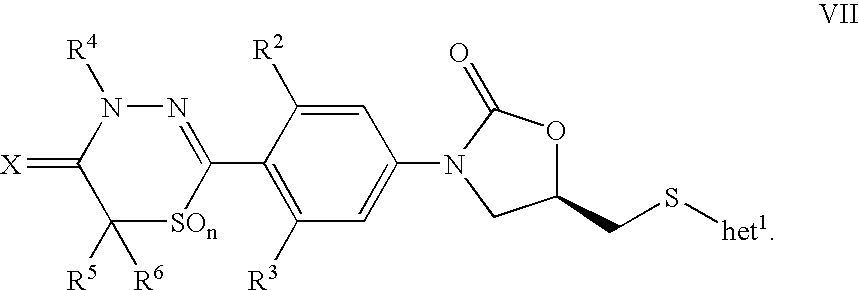
53. A compound of formula VII according to claim 52 , wherein one of R2 and R3 is —H and the other is —F.
54. A compound of formula VII according to claim 52 , wherein R4 is —H, —C1-4alkyl, or —C(═O)OC1-4alkyl.
55. A compound of formula VII according to claim 52 , wherein one of R5 and R6 is —H and the other is —C1-4alkyl, —C3-6cycloalkyl, or -aryl.
56. A compound of formula VII according to claim 52 , wherein R5 and R6 taken together are C3-6cycloalkyl.
57. A compound of formula VII according to claim 52 , wherein het1 is 2-pyridyl, 3-pyridyl, 4-pyridyl, 3-isoxaz-olyl, 4-is-oxaz-olyl, 5-isoxaz-olyl, 1,2,3-triazol-1-yl, or 1,2,5-thiadiazol-3-yl.
58. A compound of formula I according to claim 1 , wherein the compound is of the following formula VIII 
59. A compound of formula VIII according to claim 58 , wherein one of R2 and R3 is —H and the other is —F.
60. A compound of formula VIII according to claim 58 , wherein R4 —H, —C1-4alkyl, or —C(═O)OC1-4alkyl.
61. A compound of formula VIII according to claim 58 , wherein one of R5 and R6 is —H and the other is —C1-4alkyl, —C3-6cycloalkyl, or -aryl.
62. A compound of formula VIII according to claim 58 , wherein R5 and R6 taken together are C3-6cycloalkyl.
63. A compound of formula VIII according to claim 58 , wherein het2 is pyrrolyl, imidazolyl, pyrazolyl, 1,2,3-triazolyl, 1,2,4-triazolyl, 1,2,3,4-tetrazolyl, or isoxazolidinonyl.
64. A compound according to claim 1 , which is selected from the group consisting of
(a) N-{3-[3-fluoro-4-(5-oxo-5,6-dihydro-4H-[1,3,4]thiadiazin-2-yl)-phenyl]-2-oxo-oxazolidin-5(S)-ylmethyl}-acetamide;
(b) N-{3-[3-fluoro-4-(6(S)-methyl-5-oxo-5,6-dihydro-4H-[1,3,4]thiadiazin-2-yl)-phenyl]-2-oxo-oxazolidin-5(S)-ylmethyl}-acetamide;
(c) N-{3-[3-fluoro-4-(6(R)-methyl-5-oxo-5,6-dihydro-4H-[1,3,4]thiadiazin-2-yl)-phenyl]-2-oxo-oxazolidin-5(S)-ylmethyl}-acetamide;
(d) N-{3-[3-fluoro-4-(5-oxo-5,6-dihydro-4H-[1,3,4]thiadiazin-2-yl)-phenyl]-2-oxo-oxazolidin-5(S)-ylmethyl}-propionamide;
(e) cyclopropanecarboxylic acid {3-[3-fluoro-4-(5-oxo-5,6-dihydro-4H-[1,3,4]thiadiazin-2-yl)-phenyl]-2-oxo-oxazolidin-5(S)-ylmethyl}-amide;
(f) {3-[3-fluoro-4-(5-oxo-5,6-dihydro-4H-[1,3,4]thiadiazin-2-yl)-phenyl]-2-oxo-oxazolidin-5(S)-ylmethyl}-urea;
(g) N-{3-[3-fluoro-4-(5-oxo-5,6-dihydro-4H-[1,3,4]thiadiazin-2-yl)-phenyl]-2-oxo-oxazolidin-5(S)-ylmethyl}-carbamic acid methyl ester;
(h) N-{3-[3-fluoro-4-(5-oxo-5,6-dihydro-4H-[1,3,4]thiadiazin-2-yl)-phenyl]-2-oxo-oxazolidin-5(S)-ylmethyl}-thioacetamide;
(i) N-{3-[3-fluoro-4-(5-thioxo-5,6-dihydro-4H-[1,3,4]thiadiazin-2-yl)-phenyl]-2-oxo-oxazolidin-5(S)-ylmethyl}-thioacetamide;
(j) N-{3-[3-fluoro-4-(5-thioxo-5,6-dihydro-4H-[1,3,4]thiadiazin-2-yl)-phenyl]-2-oxo-oxazolidin-5(S)-ylmethyl}-acetamide;
(k) 2-[2-fluoro-4-(5(R)-hydroxymethyl)-2-oxo-oxazolidin-3-yl)-phenyl]-4H-[1,3,4]thiadiazin-5-one;
(l) 2-{2-fluoro-4-[5(S)-(isoxazol-3-ylaminomethyl)-2-oxo-oxazolidin-3-yl]-phenyl}-4H-[1,3,4]thiadiazin-5-one;
(m) 2-{2-fluoro-4-[5(S)-(isoxazol-3-yloxymethyl)-2-oxo-oxazolidin-3-yl]-phenyl}-4H-[1,3,4]thiadiazin-5-one; and
(n) N-{3-[3-fluoro-4-(5-oxo-5,6-dihydro-4H-[1,3,4]thiadiazin-2-yl)-phenyl]-2-oxo-oxazolidin-5-ylmethyl}-3-(4-hydroxyphenyl)-acrylamide.
65. A compound according to claim 1 , which is selected from the group consisting of
(a) N-{3-[4-(6,6-dimethyl-5-oxo-5,6-dihydro-4H-[1,3,4]thiadiazin-2-yl)-3-fluorophenyl]-2-oxo-oxazolidin-5(S)-ylmethyl}-acetamide;
(b) N-{3-[3-fluoro-4-(6-ethyl-5-oxo-5,6-dihydro-4H-[1,3,4]thiadiazin-2-yl)-phenyl]-2-oxo-oxazolidin-5(S)-ylmethyl}-acetamide;
(c) N-{3-[3-fluoro-4-(9-oxo-5-thia-7,8-diazaspiro[3.5]non-6-en-6-yl)-phenyl]-2-oxo-oxazolidin-5(S)-ylmethyl}-acetamide;
(d) N-{3-[3-fluoro-4-(5-oxo-6-phenyl-5,6-dihydro-4H-[1,3,4]thiadiazin-2-yl)-phenyl]-2-oxo-oxazolidin-5(S)-ylmethyl}-acetamide;
(e) N-{3-[3-fluoro-4-(5-oxo-5,6-dihydro-4H-[1,3,4]thiadiazin-2-yl)-phenyl]-2-oxo-oxazolidin-5(S)-ylmethyl}-2-hydroxyacetamide;
(f) N-{3-[3-fluoro-4-(5-oxo-5,6-dihydro-4H-[1,3,4]thiadiazin-2-yl)-phenyl]-2-oxo-oxazolidin-5(S)-ylmethyl}-carbamic acid tert-butyl ester;
(g) N-{3-[3-fluoro-4-(5-oxo-5,6-dihydro-4H-[1,3,4]thiadiazin-2-yl)-phenyl]-2-oxo-oxazolidin-5(S)-ylmethyl}-3-oxo-butyramide;
(h) N-{3-[3-fluoro-4-(5-oxo-5,6-dihydro-4H-[1,3,4]thiadiazin-2-yl)-phenyl]-2-oxo-oxazolidin-5(S)-ylmethyl}-3-(4-fluorophenyl)-3-oxo-propionamide;
(i) N-{3-[3-fluoro-4-(5-oxo-5,6-dihydro-4H-[1,3,4]thiadiazin-2-yl)-phenyl]-2-oxo-oxazolidin-5(S)-ylmethyl}-3-[4-(hydroxyimino-methyl)-phenyl]-acrylamide;
(j) N-{3-[3-fluoro-4-(5-oxo-5,6-dihydro-4H-[1,3,4]thiadiazin-2-yl)-phenyl]-2-oxo-oxazolidin-5(S)-ylmethyl}-3-[4-(methoxyimino-methyl)-phenyl]-acrylamide;
(k) N-{3-[4-(6,6-dimethyl-1,1,5-trioxo-1,4,5,6-tetrahydro-1λ6-[1,3,4]thiadiazin-2-yl)-3-fluorophenyl]-2-oxo-oxazolidin-5(S)-ylmethyl}-acetamide;
(l) N-{3-[3-fluoro-4-(4-methyl-5-oxo-5,6-dihydro-4H-[1,3,4]thiadiazin-2-yl)-phenyl]-2-oxo-oxazolidin-5(S)-ylmethyl}-acetamide; and
(m) phosphoric acid mono-{4-[2-({3-[3-fluoro-4-(5-oxo-5,6-dihydro-4H-[1,3,4]thiadiazin-2-yl)-phenyl]-2-oxo-oxazolidin-5-ylmethyl}-carbamoyl)-vinyl]-phenyl} ester.
66. A compound according to claim 1 , which is selected from the group consisting of
(a) N-{3-[3-fluoro-4-(5-oxo-6-propyl-5,6-dihydro-4H-[1,3,4]thiadiazin-2-yl)-phenyl]-2-oxo-oxazolidin-5(S)-ylmethyl}-acetamide;
(b) N-{3-[3-fluoro-4-(6-isopropyl-5-oxo-5,6-dihydro-4H-[1,3,4]thiadiazin-2-yl)-phenyl]-2-oxo-oxazolidin-5(S)-ylmethyl}-acetamide;
(c) N-{3-[3-fluoro-4-(6-fluoro-5-oxo-5,6-dihydro-4H-[1,3,4]thiadiazin-2-yl)-phenyl]-2-oxo-oxazolidin-5(S)-ylmethyl}-acetamide;
(d) N-{3-[3-fluoro-4-(6-hydroxymethyl-5-oxo-5,6-dihydro-4H-[1,3,4]thiadiazin-2-yl)-phenyl]-2-oxo-oxazolidin-5(S)-ylmethyl}-acetamide;
(e) N-{3-[3-fluoro-4-(6-(2-hydroxyethyl)-5-oxo-5,6-dihydro-4H-[1,3,4]thiadiazin-2-yl)-phenyl]-2-oxo-oxazolidin-5(S)-ylmethyl}-acetamide;
(f) 2-{4-[5(S)-(acetylaminomethyl)-2-oxo-oxazolidin-3-yl]-2-fluorophenyl}-5-oxo-5,6-dihydro-4H-[1,3,4]thiadiazine-6-carboxylic acid methyl ester;
(g) N-(3-{3-fluoro-4-(6-(4-hydroxyphenyl)-5-oxo-5,6-dihydro-4H-[1,3,4]thiadiazin-2-yl]-phenyl}-2-oxo-oxazolidin-5(S)-ylmethyl)-acetamide;
(h) N-{3-[3-fluoro-4-(5-thioxo-5,6-dihydro-4H-[1,3,4]thiadiazin-2-yl)-phenyl]-2-oxo-oxazolidin-5(S)-ylmethyl}-carbamic acid tert-butyl ester;
(i) N-{3-[4-(6,6-dimethyl-1,5-dioxo-1,4,5,6-tetrahydro-1λ4-[1,3,4]-thiadiazin-2-yl)-3-fluorophenyl]-2-oxo-oxazolidin-5(S)-ylmethyl}-acetamide;
(j) acetic acid 2-{4-[5(S)-(acetylaminomethyl)-2-oxo-oxazolidin-3-yl]-2-fluorophenyl}-5-oxo-5,6-dihydro-4H-[1,3,4]thiadiazin-6-yl ester; and
(k) (2-{4-[5(S)-(acetylaminomethyl)-2-oxo-oxazolidin-3-yl]-2-fluorophenyl}-5-oxo-5,6-dihydro-[1,3,4]thiadiazin-4-yl)-acetic acid methyl ester.
67. A method for the treatment of a bacterial infection in a mammal comprising administering to the mammal a therapeutically effective amount of a compound of claim 1 .
68. The method according to claim 67 , wherein the compound is administered to the mammal orally, parenterally, transdermally, topically, rectally, or intranasally in a pharmaceutical composition.
69. The method according to claim 67 , wherein the compound is administered in an amount of from about 0.1 to about 100 mg/kg of body weight/day.
70. The method according to claim 69 , wherein the compound is administered in an amount of from about 1 to about 50 mg/kg of body weight/day.
71. The method according to claim 67 , wherein the infection is a skin infection.
72. The method according to claim 67 , wherein the infection is an eye infection.
73. A pharmaceutical composition comprising a therapeutically effective amount of a compound of claim 1 and a pharmaceutically acceptable carrier.
Priority Applications (1)
| Application Number | Priority Date | Filing Date | Title |
|---|---|---|---|
| US10/357,515 US6828317B2 (en) | 2002-02-05 | 2003-02-04 | Antimicrobial thiadiazinone derivatives and their application for treatment of bacterial infections |
Applications Claiming Priority (2)
| Application Number | Priority Date | Filing Date | Title |
|---|---|---|---|
| US35459802P | 2002-02-05 | 2002-02-05 | |
| US10/357,515 US6828317B2 (en) | 2002-02-05 | 2003-02-04 | Antimicrobial thiadiazinone derivatives and their application for treatment of bacterial infections |
Publications (2)
| Publication Number | Publication Date |
|---|---|
| US20040014746A1 US20040014746A1 (en) | 2004-01-22 |
| US6828317B2 true US6828317B2 (en) | 2004-12-07 |
Family
ID=27734400
Family Applications (1)
| Application Number | Title | Priority Date | Filing Date |
|---|---|---|---|
| US10/357,515 Expired - Fee Related US6828317B2 (en) | 2002-02-05 | 2003-02-04 | Antimicrobial thiadiazinone derivatives and their application for treatment of bacterial infections |
Country Status (8)
| Country | Link |
|---|---|
| US (1) | US6828317B2 (en) |
| EP (1) | EP1472247A1 (en) |
| JP (1) | JP2005519931A (en) |
| AU (1) | AU2003209241A1 (en) |
| BR (1) | BR0307468A (en) |
| CA (1) | CA2475036A1 (en) |
| MX (1) | MXPA04007468A (en) |
| WO (1) | WO2003066631A1 (en) |
Families Citing this family (2)
| Publication number | Priority date | Publication date | Assignee | Title |
|---|---|---|---|---|
| CA2499105A1 (en) * | 2002-10-10 | 2004-04-22 | Pharmacia & Upjohn Company Llc | Antimicrobial 1-aryl dihydropyridone compounds |
| JP5161070B2 (en) | 2006-03-31 | 2013-03-13 | 財団法人乙卯研究所 | Novel compounds having a heterocycle |
Citations (3)
| Publication number | Priority date | Publication date | Assignee | Title |
|---|---|---|---|---|
| WO1993009103A1 (en) | 1991-11-01 | 1993-05-13 | The Upjohn Company | Substituted aryl- and heteroarylphenyloxazolidinones useful as antibacterial agents |
| WO1993023384A1 (en) | 1992-05-08 | 1993-11-25 | The Upjohn Company | Oxazolidinones containing a substituted diazine moiety and their use as antimicrobials |
| WO1994013649A1 (en) | 1992-12-08 | 1994-06-23 | The Upjohn Company | Tropone-substituted phenyloxazolidinone antibacterial agents |
-
2003
- 2003-02-04 EP EP03707388A patent/EP1472247A1/en not_active Withdrawn
- 2003-02-04 MX MXPA04007468A patent/MXPA04007468A/en unknown
- 2003-02-04 WO PCT/US2003/001082 patent/WO2003066631A1/en not_active Ceased
- 2003-02-04 JP JP2003566004A patent/JP2005519931A/en active Pending
- 2003-02-04 US US10/357,515 patent/US6828317B2/en not_active Expired - Fee Related
- 2003-02-04 BR BR0307468-4A patent/BR0307468A/en not_active IP Right Cessation
- 2003-02-04 AU AU2003209241A patent/AU2003209241A1/en not_active Abandoned
- 2003-02-04 CA CA002475036A patent/CA2475036A1/en not_active Abandoned
Patent Citations (3)
| Publication number | Priority date | Publication date | Assignee | Title |
|---|---|---|---|---|
| WO1993009103A1 (en) | 1991-11-01 | 1993-05-13 | The Upjohn Company | Substituted aryl- and heteroarylphenyloxazolidinones useful as antibacterial agents |
| WO1993023384A1 (en) | 1992-05-08 | 1993-11-25 | The Upjohn Company | Oxazolidinones containing a substituted diazine moiety and their use as antimicrobials |
| WO1994013649A1 (en) | 1992-12-08 | 1994-06-23 | The Upjohn Company | Tropone-substituted phenyloxazolidinone antibacterial agents |
Also Published As
| Publication number | Publication date |
|---|---|
| WO2003066631A1 (en) | 2003-08-14 |
| MXPA04007468A (en) | 2004-11-10 |
| US20040014746A1 (en) | 2004-01-22 |
| EP1472247A1 (en) | 2004-11-03 |
| CA2475036A1 (en) | 2003-08-14 |
| BR0307468A (en) | 2004-11-09 |
| JP2005519931A (en) | 2005-07-07 |
| AU2003209241A1 (en) | 2003-09-02 |
Similar Documents
| Publication | Publication Date | Title |
|---|---|---|
| US8178683B2 (en) | Antimicrobial ortho-fluorophenyl oxazolidinones for treatment of bacterial infections | |
| US9163043B2 (en) | Oxazolidinone derivatives | |
| EP1987025B1 (en) | Benzoxazinone and benzoxazepinone oxazolidinones as antibacterial agents | |
| CZ34097A3 (en) | Substituted oxazolidinones, process of their preparation, their use and pharmaceutical composition containing thereof | |
| EP0994874A1 (en) | Thiadiazolyl and oxadiazolyl phenyl oxazolidinone antibacterial agents | |
| US20080090884A1 (en) | Antimicrobial [3.1.0] bicyclohexylphenyl- oxazolidinone derivatives and analogues | |
| US20120157434A1 (en) | Antimicrobial heterocyclic compounds for treatment of bacterial infections | |
| JP2007505890A (en) | Acyloxymethyl carbamate prodrugs of oxazolidinones | |
| US6281210B1 (en) | Benzoic acid esters of oxazolidinones having a hydroxyacetylpiperazine substituent | |
| US6875784B2 (en) | Antimibicrobial [3.1.0.] bicyclic oxazolidinone derivatives | |
| US6828317B2 (en) | Antimicrobial thiadiazinone derivatives and their application for treatment of bacterial infections | |
| WO2005082897A1 (en) | Oxazolidinone antibacterial agents | |
| US20040142939A1 (en) | N-Aryl-2-oxazolidinone-5-carboxamides and their derivatives | |
| US20090221655A1 (en) | Antibacterial agents | |
| WO2007088478A1 (en) | Indazole oxazolidinones as antibacterial agents | |
| JP2008544979A (en) | Homomorpholine oxazolidinone as an antibacterial agent | |
| JP2006522093A (en) | N-aryl-2-oxazolidinone-5-carboxamide derivatives having antibacterial activity | |
| WO2005082900A2 (en) | Oxazolidinone amidoximes as antibacterial agents | |
| CA2589250A1 (en) | Diazepine oxazolidinones as antibacterial agents |
Legal Events
| Date | Code | Title | Description |
|---|---|---|---|
| FEPP | Fee payment procedure |
Free format text: PAYOR NUMBER ASSIGNED (ORIGINAL EVENT CODE: ASPN); ENTITY STATUS OF PATENT OWNER: LARGE ENTITY |
|
| REMI | Maintenance fee reminder mailed | ||
| LAPS | Lapse for failure to pay maintenance fees | ||
| STCH | Information on status: patent discontinuation |
Free format text: PATENT EXPIRED DUE TO NONPAYMENT OF MAINTENANCE FEES UNDER 37 CFR 1.362 |
|
| FP | Lapsed due to failure to pay maintenance fee |
Effective date: 20081207 |