US6627647B1 - Substituted 1-(4-aminophenyl)imidazoles and their use as anti-inflammatory agents - Google Patents
Substituted 1-(4-aminophenyl)imidazoles and their use as anti-inflammatory agents Download PDFInfo
- Publication number
- US6627647B1 US6627647B1 US09/533,207 US53320700A US6627647B1 US 6627647 B1 US6627647 B1 US 6627647B1 US 53320700 A US53320700 A US 53320700A US 6627647 B1 US6627647 B1 US 6627647B1
- Authority
- US
- United States
- Prior art keywords
- alkyl
- phenyl
- heterocyclyl
- optionally substituted
- nhc
- Prior art date
- Legal status (The legal status is an assumption and is not a legal conclusion. Google has not performed a legal analysis and makes no representation as to the accuracy of the status listed.)
- Expired - Lifetime
Links
- LVOASPZGXNAHJI-UHFFFAOYSA-N 4-imidazol-1-ylaniline Chemical class C1=CC(N)=CC=C1N1C=NC=C1 LVOASPZGXNAHJI-UHFFFAOYSA-N 0.000 title description 9
- 229940121363 anti-inflammatory agent Drugs 0.000 title description 2
- 239000002260 anti-inflammatory agent Substances 0.000 title description 2
- -1 -OH Chemical group 0.000 claims abstract description 80
- 150000001875 compounds Chemical class 0.000 claims abstract description 64
- 125000000217 alkyl group Chemical group 0.000 claims abstract description 61
- 125000000623 heterocyclic group Chemical group 0.000 claims abstract description 53
- 229910052736 halogen Inorganic materials 0.000 claims abstract description 32
- 125000003118 aryl group Chemical group 0.000 claims abstract description 31
- 125000001997 phenyl group Chemical group [H]C1=C([H])C([H])=C(*)C([H])=C1[H] 0.000 claims abstract description 28
- 125000003545 alkoxy group Chemical group 0.000 claims abstract description 26
- 125000003342 alkenyl group Chemical group 0.000 claims abstract description 25
- 150000002367 halogens Chemical class 0.000 claims abstract description 21
- 125000004178 (C1-C4) alkyl group Chemical group 0.000 claims abstract description 18
- 125000006350 alkyl thio alkyl group Chemical group 0.000 claims abstract description 18
- 125000004183 alkoxy alkyl group Chemical group 0.000 claims abstract description 17
- RAXXELZNTBOGNW-UHFFFAOYSA-N imidazole Natural products C1=CNC=N1 RAXXELZNTBOGNW-UHFFFAOYSA-N 0.000 claims abstract description 17
- 125000004452 carbocyclyl group Chemical group 0.000 claims abstract description 15
- 125000000956 methoxy group Chemical group [H]C([H])([H])O* 0.000 claims abstract description 14
- 125000001160 methoxycarbonyl group Chemical group [H]C([H])([H])OC(*)=O 0.000 claims abstract description 14
- 125000002023 trifluoromethyl group Chemical group FC(F)(F)* 0.000 claims abstract description 14
- 125000004663 dialkyl amino group Chemical group 0.000 claims abstract description 13
- 125000004169 (C1-C6) alkyl group Chemical group 0.000 claims abstract description 12
- 125000000449 nitro group Chemical group [O-][N+](*)=O 0.000 claims abstract description 10
- 125000004414 alkyl thio group Chemical group 0.000 claims abstract description 9
- 125000004209 (C1-C8) alkyl group Chemical group 0.000 claims abstract description 8
- 125000005913 (C3-C6) cycloalkyl group Chemical group 0.000 claims abstract description 8
- 229910052739 hydrogen Inorganic materials 0.000 claims abstract description 8
- 125000003282 alkyl amino group Chemical group 0.000 claims abstract description 7
- 125000004687 alkyl sulfinyl alkyl group Chemical group 0.000 claims abstract description 7
- 125000000882 C2-C6 alkenyl group Chemical group 0.000 claims abstract description 6
- 125000003601 C2-C6 alkynyl group Chemical group 0.000 claims abstract description 6
- 229910006074 SO2NH2 Inorganic materials 0.000 claims abstract description 6
- 125000004985 dialkyl amino alkyl group Chemical group 0.000 claims abstract description 6
- 125000004688 alkyl sulfonyl alkyl group Chemical group 0.000 claims abstract description 5
- 125000006552 (C3-C8) cycloalkyl group Chemical group 0.000 claims abstract description 4
- 125000000278 alkyl amino alkyl group Chemical group 0.000 claims abstract description 4
- 125000002147 dimethylamino group Chemical group [H]C([H])([H])N(*)C([H])([H])[H] 0.000 claims abstract description 4
- 125000000876 trifluoromethoxy group Chemical group FC(F)(F)O* 0.000 claims abstract description 4
- 238000000034 method Methods 0.000 claims description 57
- 108010002350 Interleukin-2 Proteins 0.000 claims description 17
- 239000002671 adjuvant Substances 0.000 claims description 12
- 125000000304 alkynyl group Chemical group 0.000 claims description 12
- 239000000460 chlorine Substances 0.000 claims description 12
- 125000004076 pyridyl group Chemical group 0.000 claims description 12
- 125000001624 naphthyl group Chemical group 0.000 claims description 11
- 239000008194 pharmaceutical composition Substances 0.000 claims description 11
- 238000011282 treatment Methods 0.000 claims description 11
- 239000003937 drug carrier Substances 0.000 claims description 10
- 125000000168 pyrrolyl group Chemical group 0.000 claims description 10
- 125000006217 methyl sulfide group Chemical group [H]C([H])([H])S* 0.000 claims description 9
- 125000003349 3-pyridyl group Chemical group N1=C([H])C([*])=C([H])C([H])=C1[H] 0.000 claims description 8
- 125000004093 cyano group Chemical group *C#N 0.000 claims description 8
- 230000004073 interleukin-2 production Effects 0.000 claims description 8
- IJGRMHOSHXDMSA-UHFFFAOYSA-N nitrogen Substances N#N IJGRMHOSHXDMSA-UHFFFAOYSA-N 0.000 claims description 8
- BLNVISNJTIRAHF-UHFFFAOYSA-N 4-chlorobenzamide Chemical compound NC(=O)C1=CC=C(Cl)C=C1 BLNVISNJTIRAHF-UHFFFAOYSA-N 0.000 claims description 7
- 125000001511 cyclopentyl group Chemical group [H]C1([H])C([H])([H])C([H])([H])C([H])(*)C1([H])[H] 0.000 claims description 7
- 125000002541 furyl group Chemical group 0.000 claims description 7
- 125000000339 4-pyridyl group Chemical group N1=C([H])C([H])=C([*])C([H])=C1[H] 0.000 claims description 6
- 229910052801 chlorine Inorganic materials 0.000 claims description 6
- 125000000113 cyclohexyl group Chemical group [H]C1([H])C([H])([H])C([H])([H])C([H])(*)C([H])([H])C1([H])[H] 0.000 claims description 6
- 125000002950 monocyclic group Chemical group 0.000 claims description 6
- 125000003373 pyrazinyl group Chemical group 0.000 claims description 6
- 125000002098 pyridazinyl group Chemical group 0.000 claims description 6
- 125000000714 pyrimidinyl group Chemical group 0.000 claims description 6
- 125000001544 thienyl group Chemical group 0.000 claims description 6
- 208000023275 Autoimmune disease Diseases 0.000 claims description 5
- 125000001559 cyclopropyl group Chemical group [H]C1([H])C([H])([H])C1([H])* 0.000 claims description 5
- 208000037265 diseases, disorders, signs and symptoms Diseases 0.000 claims description 5
- 125000002883 imidazolyl group Chemical group 0.000 claims description 5
- 125000001041 indolyl group Chemical group 0.000 claims description 5
- 208000027866 inflammatory disease Diseases 0.000 claims description 5
- 125000000842 isoxazolyl group Chemical group 0.000 claims description 5
- 229910052757 nitrogen Inorganic materials 0.000 claims description 5
- 229910052717 sulfur Chemical group 0.000 claims description 5
- 125000002941 2-furyl group Chemical group O1C([*])=C([H])C([H])=C1[H] 0.000 claims description 4
- 125000000175 2-thienyl group Chemical group S1C([*])=C([H])C([H])=C1[H] 0.000 claims description 4
- NINIDFKCEFEMDL-UHFFFAOYSA-N Sulfur Chemical group [S] NINIDFKCEFEMDL-UHFFFAOYSA-N 0.000 claims description 4
- 125000001309 chloro group Chemical group Cl* 0.000 claims description 4
- 125000001153 fluoro group Chemical group F* 0.000 claims description 4
- 125000003392 indanyl group Chemical group C1(CCC2=CC=CC=C12)* 0.000 claims description 4
- 125000001449 isopropyl group Chemical group [H]C([H])([H])C([H])(*)C([H])([H])[H] 0.000 claims description 4
- 238000004519 manufacturing process Methods 0.000 claims description 4
- 125000002757 morpholinyl group Chemical group 0.000 claims description 4
- 125000003386 piperidinyl group Chemical group 0.000 claims description 4
- 125000003226 pyrazolyl group Chemical group 0.000 claims description 4
- 229920006395 saturated elastomer Polymers 0.000 claims description 4
- 239000011593 sulfur Chemical group 0.000 claims description 4
- 125000000999 tert-butyl group Chemical group [H]C([H])([H])C(*)(C([H])([H])[H])C([H])([H])[H] 0.000 claims description 4
- 125000000335 thiazolyl group Chemical group 0.000 claims description 4
- 125000000391 vinyl group Chemical group [H]C([*])=C([H])[H] 0.000 claims description 4
- 229920002554 vinyl polymer Chemical group 0.000 claims description 4
- 125000002785 azepinyl group Chemical group 0.000 claims description 3
- 125000003785 benzimidazolyl group Chemical group N1=C(NC2=C1C=CC=C2)* 0.000 claims description 3
- 125000002047 benzodioxolyl group Chemical group O1OC(C2=C1C=CC=C2)* 0.000 claims description 3
- 125000004541 benzoxazolyl group Chemical group O1C(=NC2=C1C=CC=C2)* 0.000 claims description 3
- 125000000596 cyclohexenyl group Chemical group C1(=CCCCC1)* 0.000 claims description 3
- 125000002632 imidazolidinyl group Chemical group 0.000 claims description 3
- 125000002636 imidazolinyl group Chemical group 0.000 claims description 3
- 125000002183 isoquinolinyl group Chemical group C1(=NC=CC2=CC=CC=C12)* 0.000 claims description 3
- 125000002971 oxazolyl group Chemical group 0.000 claims description 3
- 125000005476 oxopyrrolidinyl group Chemical group 0.000 claims description 3
- 229910052760 oxygen Inorganic materials 0.000 claims description 3
- 239000001301 oxygen Chemical group 0.000 claims description 3
- 125000001422 pyrrolinyl group Chemical group 0.000 claims description 3
- 125000002943 quinolinyl group Chemical group N1=C(C=CC2=CC=CC=C12)* 0.000 claims description 3
- 125000003718 tetrahydrofuranyl group Chemical group 0.000 claims description 3
- 125000001412 tetrahydropyranyl group Chemical group 0.000 claims description 3
- 125000003507 tetrahydrothiofenyl group Chemical group 0.000 claims description 3
- 125000003831 tetrazolyl group Chemical group 0.000 claims description 3
- 125000001984 thiazolidinyl group Chemical group 0.000 claims description 3
- 125000004568 thiomorpholinyl group Chemical group 0.000 claims description 3
- WCNFFKHKJLERFM-UHFFFAOYSA-N thiomorpholinyl sulfone group Chemical group N1(CCSCC1)S(=O)(=O)N1CCSCC1 WCNFFKHKJLERFM-UHFFFAOYSA-N 0.000 claims description 3
- 125000001425 triazolyl group Chemical group 0.000 claims description 3
- 125000004933 β-carbolinyl group Chemical group C1(=NC=CC=2C3=CC=CC=C3NC12)* 0.000 claims description 3
- 125000006704 (C5-C6) cycloalkyl group Chemical group 0.000 claims description 2
- 125000006023 1-pentenyl group Chemical group 0.000 claims description 2
- 125000004105 2-pyridyl group Chemical group N1=C([*])C([H])=C([H])C([H])=C1[H] 0.000 claims description 2
- 125000003682 3-furyl group Chemical group O1C([H])=C([*])C([H])=C1[H] 0.000 claims description 2
- ZAMOUSCENKQFHK-UHFFFAOYSA-N Chlorine atom Chemical group [Cl] ZAMOUSCENKQFHK-UHFFFAOYSA-N 0.000 claims description 2
- QVGXLLKOCUKJST-UHFFFAOYSA-N atomic oxygen Chemical group [O] QVGXLLKOCUKJST-UHFFFAOYSA-N 0.000 claims description 2
- 229910052794 bromium Inorganic materials 0.000 claims description 2
- 229910052731 fluorine Inorganic materials 0.000 claims description 2
- 125000005842 heteroatom Chemical group 0.000 claims description 2
- 125000004129 indan-1-yl group Chemical group [H]C1=C([H])C([H])=C2C(=C1[H])C([H])([H])C([H])([H])C2([H])* 0.000 claims description 2
- 125000004123 n-propyl group Chemical group [H]C([H])([H])C([H])([H])C([H])([H])* 0.000 claims description 2
- QJGQUHMNIGDVPM-UHFFFAOYSA-N nitrogen group Chemical group [N] QJGQUHMNIGDVPM-UHFFFAOYSA-N 0.000 claims description 2
- 125000000565 sulfonamide group Chemical group 0.000 claims description 2
- MXKWUMVYTOMOGA-UHFFFAOYSA-N 1-[4-(2,3-dihydro-1h-inden-2-ylmethylamino)phenyl]-4-pyridin-3-ylimidazole-2-carbonitrile Chemical compound C=1N(C=2C=CC(NCC3CC4=CC=CC=C4C3)=CC=2)C(C#N)=NC=1C1=CC=CN=C1 MXKWUMVYTOMOGA-UHFFFAOYSA-N 0.000 claims 1
- OUYUKBCJZYKUCH-UHFFFAOYSA-N 1-[4-[(2,6-dimethylphenyl)methylamino]phenyl]-4-pyridin-3-ylimidazole-2-carbonitrile Chemical compound CC1=CC=CC(C)=C1CNC1=CC=C(N2C(=NC(=C2)C=2C=NC=CC=2)C#N)C=C1 OUYUKBCJZYKUCH-UHFFFAOYSA-N 0.000 claims 1
- FMTISUVLKKISJW-UHFFFAOYSA-N 1-[4-[(2-chloro-6-fluorophenyl)methylamino]phenyl]-4-pyridin-3-ylimidazole-2-carbonitrile Chemical compound FC1=CC=CC(Cl)=C1CNC1=CC=C(N2C(=NC(=C2)C=2C=NC=CC=2)C#N)C=C1 FMTISUVLKKISJW-UHFFFAOYSA-N 0.000 claims 1
- NMFKQMGMRIYYSG-UHFFFAOYSA-N 1-[4-[(2-chloro-6-methylphenyl)methylamino]phenyl]-4-pyridin-3-ylimidazole-2-carbonitrile Chemical compound CC1=CC=CC(Cl)=C1CNC1=CC=C(N2C(=NC(=C2)C=2C=NC=CC=2)C#N)C=C1 NMFKQMGMRIYYSG-UHFFFAOYSA-N 0.000 claims 1
- MHRSOOKHZAEFTD-UHFFFAOYSA-N 1-[4-[[4-(3-cyanopropoxy)phenyl]methylamino]phenyl]-4-pyridin-3-ylimidazole-2-carbonitrile Chemical compound C1=CC(OCCCC#N)=CC=C1CNC1=CC=C(N2C(=NC(=C2)C=2C=NC=CC=2)C#N)C=C1 MHRSOOKHZAEFTD-UHFFFAOYSA-N 0.000 claims 1
- LDMGEKRSUNILLO-UHFFFAOYSA-N 1-[4-[[6-(3-cyanopropoxy)pyridin-3-yl]methylamino]phenyl]-4-pyridin-3-ylimidazole-2-carbonitrile Chemical compound C1=NC(OCCCC#N)=CC=C1CNC1=CC=C(N2C(=NC(=C2)C=2C=NC=CC=2)C#N)C=C1 LDMGEKRSUNILLO-UHFFFAOYSA-N 0.000 claims 1
- SNLQRXXEXFVXOB-UHFFFAOYSA-N 1-[4-[[6-[3-(1,3-dioxolan-2-yl)propoxy]pyridin-3-yl]methylamino]phenyl]-3-pyridin-4-yl-2h-imidazole-2-carbonitrile Chemical compound N#CC1N(C=2C=CN=CC=2)C=CN1C(C=C1)=CC=C1NCC(C=N1)=CC=C1OCCCC1OCCO1 SNLQRXXEXFVXOB-UHFFFAOYSA-N 0.000 claims 1
- HSVOVKSXNGDZEA-UHFFFAOYSA-N 4-(2-ethyl-4-pyridin-3-ylimidazol-1-yl)-n-[(2-fluoro-6-methylphenyl)methyl]aniline Chemical compound CCC1=NC(C=2C=NC=CC=2)=CN1C(C=C1)=CC=C1NCC1=C(C)C=CC=C1F HSVOVKSXNGDZEA-UHFFFAOYSA-N 0.000 claims 1
- FJMLZDROUUGZLE-UHFFFAOYSA-N 4-(2-ethyl-4-pyridin-3-ylimidazol-1-yl)-n-[(2-methylphenyl)methyl]aniline Chemical compound CCC1=NC(C=2C=NC=CC=2)=CN1C(C=C1)=CC=C1NCC1=CC=CC=C1C FJMLZDROUUGZLE-UHFFFAOYSA-N 0.000 claims 1
- ACWTVRHIZNVHQN-UHFFFAOYSA-N 4-(3-cyanopropoxy)-n-[4-(2-cyano-4-pyridin-3-ylimidazol-1-yl)phenyl]benzamide Chemical compound C=1C=C(OCCCC#N)C=CC=1C(=O)NC(C=C1)=CC=C1N(C(=N1)C#N)C=C1C1=CC=CN=C1 ACWTVRHIZNVHQN-UHFFFAOYSA-N 0.000 claims 1
- REINYAHDYWFUAG-UHFFFAOYSA-N 4-[4-[[4-(2-ethyl-4-pyridin-3-ylimidazol-1-yl)anilino]methyl]phenoxy]butanenitrile Chemical compound CCC1=NC(C=2C=NC=CC=2)=CN1C(C=C1)=CC=C1NCC1=CC=C(OCCCC#N)C=C1 REINYAHDYWFUAG-UHFFFAOYSA-N 0.000 claims 1
- 201000010099 disease Diseases 0.000 claims 1
- 230000002401 inhibitory effect Effects 0.000 claims 1
- OAAVBGHNIQFAFG-UHFFFAOYSA-N n-(2,3-dihydro-1h-inden-2-ylmethyl)-4-(2-ethyl-4-pyridin-3-ylimidazol-1-yl)aniline Chemical compound C=1N(C=2C=CC(NCC3CC4=CC=CC=C4C3)=CC=2)C(CC)=NC=1C1=CC=CN=C1 OAAVBGHNIQFAFG-UHFFFAOYSA-N 0.000 claims 1
- HKNWJLLBWTUCPB-UHFFFAOYSA-N n-[(2-chloro-6-fluorophenyl)methyl]-4-(2-ethyl-4-pyridin-3-ylimidazol-1-yl)aniline Chemical compound CCC1=NC(C=2C=NC=CC=2)=CN1C(C=C1)=CC=C1NCC1=C(F)C=CC=C1Cl HKNWJLLBWTUCPB-UHFFFAOYSA-N 0.000 claims 1
- HTUVHWBQGIYXMG-UHFFFAOYSA-N n-[4-(2-cyano-4-pyridin-3-ylimidazol-1-yl)phenyl]-4-[3-(1,3-dioxolan-2-yl)propoxy]benzamide Chemical compound C=1C=C(OCCCC2OCCO2)C=CC=1C(=O)NC(C=C1)=CC=C1N(C(=N1)C#N)C=C1C1=CC=CN=C1 HTUVHWBQGIYXMG-UHFFFAOYSA-N 0.000 claims 1
- CWFYLEMHTQXMCP-UHFFFAOYSA-N n-[4-(2-ethyl-4-pyridin-3-ylimidazol-1-yl)phenyl]-1-methylindole-2-carboxamide Chemical compound C=1N(C=2C=CC(NC(=O)C=3N(C4=CC=CC=C4C=3)C)=CC=2)C(CC)=NC=1C1=CC=CN=C1 CWFYLEMHTQXMCP-UHFFFAOYSA-N 0.000 claims 1
- AIFOYDUPSNLDFC-UHFFFAOYSA-N n-[4-(2-ethyl-4-pyridin-3-ylimidazol-1-yl)phenyl]pyridine-3-carboxamide Chemical compound CCC1=NC(C=2C=NC=CC=2)=CN1C(C=C1)=CC=C1NC(=O)C1=CC=CN=C1 AIFOYDUPSNLDFC-UHFFFAOYSA-N 0.000 claims 1
- 125000005843 halogen group Chemical group 0.000 abstract description 15
- YMWUJEATGCHHMB-UHFFFAOYSA-N Dichloromethane Chemical compound ClCCl YMWUJEATGCHHMB-UHFFFAOYSA-N 0.000 description 45
- 238000006243 chemical reaction Methods 0.000 description 20
- OKKJLVBELUTLKV-UHFFFAOYSA-N Methanol Chemical compound OC OKKJLVBELUTLKV-UHFFFAOYSA-N 0.000 description 18
- ZMXDDKWLCZADIW-UHFFFAOYSA-N N,N-Dimethylformamide Chemical compound CN(C)C=O ZMXDDKWLCZADIW-UHFFFAOYSA-N 0.000 description 17
- 125000004432 carbon atom Chemical group C* 0.000 description 16
- 102000000588 Interleukin-2 Human genes 0.000 description 14
- XLYOFNOQVPJJNP-UHFFFAOYSA-N water Substances O XLYOFNOQVPJJNP-UHFFFAOYSA-N 0.000 description 14
- XEKOWRVHYACXOJ-UHFFFAOYSA-N Ethyl acetate Chemical compound CCOC(C)=O XEKOWRVHYACXOJ-UHFFFAOYSA-N 0.000 description 13
- 239000007787 solid Substances 0.000 description 13
- 239000002904 solvent Substances 0.000 description 12
- RTZKZFJDLAIYFH-UHFFFAOYSA-N Diethyl ether Chemical compound CCOCC RTZKZFJDLAIYFH-UHFFFAOYSA-N 0.000 description 11
- IAZDPXIOMUYVGZ-UHFFFAOYSA-N Dimethylsulphoxide Chemical compound CS(C)=O IAZDPXIOMUYVGZ-UHFFFAOYSA-N 0.000 description 11
- 0 [1*]C1=CN(C2=CC=C(*[3*])C=C2)C([2*])=N1 Chemical compound [1*]C1=CN(C2=CC=C(*[3*])C=C2)C([2*])=N1 0.000 description 11
- 239000000543 intermediate Substances 0.000 description 11
- 239000000203 mixture Substances 0.000 description 11
- 150000003254 radicals Chemical class 0.000 description 11
- 150000001412 amines Chemical class 0.000 description 10
- SJRJJKPEHAURKC-UHFFFAOYSA-N N-Methylmorpholine Chemical compound CN1CCOCC1 SJRJJKPEHAURKC-UHFFFAOYSA-N 0.000 description 9
- ZMANZCXQSJIPKH-UHFFFAOYSA-N Triethylamine Chemical compound CCN(CC)CC ZMANZCXQSJIPKH-UHFFFAOYSA-N 0.000 description 9
- VHYFNPMBLIVWCW-UHFFFAOYSA-N 4-Dimethylaminopyridine Chemical compound CN(C)C1=CC=NC=C1 VHYFNPMBLIVWCW-UHFFFAOYSA-N 0.000 description 8
- 239000007832 Na2SO4 Substances 0.000 description 8
- KDLHZDBZIXYQEI-UHFFFAOYSA-N Palladium Chemical compound [Pd] KDLHZDBZIXYQEI-UHFFFAOYSA-N 0.000 description 8
- PMZURENOXWZQFD-UHFFFAOYSA-L Sodium Sulfate Chemical compound [Na+].[Na+].[O-]S([O-])(=O)=O PMZURENOXWZQFD-UHFFFAOYSA-L 0.000 description 8
- UIIMBOGNXHQVGW-UHFFFAOYSA-M Sodium bicarbonate Chemical compound [Na+].OC([O-])=O UIIMBOGNXHQVGW-UHFFFAOYSA-M 0.000 description 8
- 239000011541 reaction mixture Substances 0.000 description 8
- 229910052938 sodium sulfate Inorganic materials 0.000 description 8
- QAEDZJGFFMLHHQ-UHFFFAOYSA-N trifluoroacetic anhydride Chemical compound FC(F)(F)C(=O)OC(=O)C(F)(F)F QAEDZJGFFMLHHQ-UHFFFAOYSA-N 0.000 description 8
- 230000015572 biosynthetic process Effects 0.000 description 7
- UHOVQNZJYSORNB-UHFFFAOYSA-N Benzene Chemical compound C1=CC=CC=C1 UHOVQNZJYSORNB-UHFFFAOYSA-N 0.000 description 6
- IAZDPXIOMUYVGZ-WFGJKAKNSA-N Dimethyl sulfoxide Chemical compound [2H]C([2H])([2H])S(=O)C([2H])([2H])[2H] IAZDPXIOMUYVGZ-WFGJKAKNSA-N 0.000 description 6
- JUJWROOIHBZHMG-UHFFFAOYSA-N Pyridine Chemical compound C1=CC=NC=C1 JUJWROOIHBZHMG-UHFFFAOYSA-N 0.000 description 6
- 210000001744 T-lymphocyte Anatomy 0.000 description 6
- YXFVVABEGXRONW-UHFFFAOYSA-N Toluene Chemical compound CC1=CC=CC=C1 YXFVVABEGXRONW-UHFFFAOYSA-N 0.000 description 6
- DTQVDTLACAAQTR-UHFFFAOYSA-N Trifluoroacetic acid Chemical compound OC(=O)C(F)(F)F DTQVDTLACAAQTR-UHFFFAOYSA-N 0.000 description 6
- 239000002552 dosage form Substances 0.000 description 6
- 235000019439 ethyl acetate Nutrition 0.000 description 6
- 239000000284 extract Substances 0.000 description 6
- 125000002887 hydroxy group Chemical group [H]O* 0.000 description 6
- 230000028993 immune response Effects 0.000 description 6
- BWHMMNNQKKPAPP-UHFFFAOYSA-L potassium carbonate Chemical compound [K+].[K+].[O-]C([O-])=O BWHMMNNQKKPAPP-UHFFFAOYSA-L 0.000 description 6
- 239000000243 solution Substances 0.000 description 6
- 125000001424 substituent group Chemical group 0.000 description 6
- 238000003786 synthesis reaction Methods 0.000 description 6
- QTBSBXVTEAMEQO-UHFFFAOYSA-N Acetic acid Chemical compound CC(O)=O QTBSBXVTEAMEQO-UHFFFAOYSA-N 0.000 description 5
- 239000012267 brine Substances 0.000 description 5
- 239000003054 catalyst Substances 0.000 description 5
- 210000004027 cell Anatomy 0.000 description 5
- 239000003638 chemical reducing agent Substances 0.000 description 5
- 230000000694 effects Effects 0.000 description 5
- 150000003839 salts Chemical class 0.000 description 5
- HPALAKNZSZLMCH-UHFFFAOYSA-M sodium;chloride;hydrate Chemical compound O.[Na+].[Cl-] HPALAKNZSZLMCH-UHFFFAOYSA-M 0.000 description 5
- QAOWNCQODCNURD-UHFFFAOYSA-N Sulfuric acid Chemical compound OS(O)(=O)=O QAOWNCQODCNURD-UHFFFAOYSA-N 0.000 description 4
- 239000002253 acid Substances 0.000 description 4
- 150000001336 alkenes Chemical class 0.000 description 4
- 150000001345 alkine derivatives Chemical class 0.000 description 4
- 125000000753 cycloalkyl group Chemical group 0.000 description 4
- 208000035475 disorder Diseases 0.000 description 4
- 150000002148 esters Chemical class 0.000 description 4
- 239000001257 hydrogen Substances 0.000 description 4
- 208000026278 immune system disease Diseases 0.000 description 4
- 150000002828 nitro derivatives Chemical class 0.000 description 4
- XHXFXVLFKHQFAL-UHFFFAOYSA-N phosphoryl trichloride Chemical compound ClP(Cl)(Cl)=O XHXFXVLFKHQFAL-UHFFFAOYSA-N 0.000 description 4
- 229910000030 sodium bicarbonate Inorganic materials 0.000 description 4
- 239000000126 substance Substances 0.000 description 4
- 239000000725 suspension Substances 0.000 description 4
- WYURNTSHIVDZCO-UHFFFAOYSA-N tetrahydrofuran Substances C1CCOC1 WYURNTSHIVDZCO-UHFFFAOYSA-N 0.000 description 4
- WFQDTOYDVUWQMS-UHFFFAOYSA-N 1-fluoro-4-nitrobenzene Chemical compound [O-][N+](=O)C1=CC=C(F)C=C1 WFQDTOYDVUWQMS-UHFFFAOYSA-N 0.000 description 3
- 238000005160 1H NMR spectroscopy Methods 0.000 description 3
- XRHGYUZYPHTUJZ-UHFFFAOYSA-N 4-chlorobenzoic acid Chemical compound OC(=O)C1=CC=C(Cl)C=C1 XRHGYUZYPHTUJZ-UHFFFAOYSA-N 0.000 description 3
- 229960000549 4-dimethylaminophenol Drugs 0.000 description 3
- USFZMSVCRYTOJT-UHFFFAOYSA-N Ammonium acetate Chemical compound N.CC(O)=O USFZMSVCRYTOJT-UHFFFAOYSA-N 0.000 description 3
- 239000005695 Ammonium acetate Substances 0.000 description 3
- UFHFLCQGNIYNRP-UHFFFAOYSA-N Hydrogen Chemical compound [H][H] UFHFLCQGNIYNRP-UHFFFAOYSA-N 0.000 description 3
- WMFOQBRAJBCJND-UHFFFAOYSA-M Lithium hydroxide Chemical compound [Li+].[OH-] WMFOQBRAJBCJND-UHFFFAOYSA-M 0.000 description 3
- 108060001084 Luciferase Proteins 0.000 description 3
- 239000005089 Luciferase Substances 0.000 description 3
- VYPSYNLAJGMNEJ-UHFFFAOYSA-N Silicium dioxide Chemical compound O=[Si]=O VYPSYNLAJGMNEJ-UHFFFAOYSA-N 0.000 description 3
- HEMHJVSKTPXQMS-UHFFFAOYSA-M Sodium hydroxide Chemical compound [OH-].[Na+] HEMHJVSKTPXQMS-UHFFFAOYSA-M 0.000 description 3
- 229910021626 Tin(II) chloride Inorganic materials 0.000 description 3
- 229940043376 ammonium acetate Drugs 0.000 description 3
- 235000019257 ammonium acetate Nutrition 0.000 description 3
- 238000003556 assay Methods 0.000 description 3
- 125000003178 carboxy group Chemical group [H]OC(*)=O 0.000 description 3
- 150000001732 carboxylic acid derivatives Chemical class 0.000 description 3
- 239000003153 chemical reaction reagent Substances 0.000 description 3
- 230000008878 coupling Effects 0.000 description 3
- 238000010168 coupling process Methods 0.000 description 3
- 238000005859 coupling reaction Methods 0.000 description 3
- 239000003814 drug Substances 0.000 description 3
- 238000001704 evaporation Methods 0.000 description 3
- 230000008020 evaporation Effects 0.000 description 3
- 230000005764 inhibitory process Effects 0.000 description 3
- 230000001404 mediated effect Effects 0.000 description 3
- 230000004048 modification Effects 0.000 description 3
- 238000012986 modification Methods 0.000 description 3
- VLKZOEOYAKHREP-UHFFFAOYSA-N n-Hexane Chemical compound CCCCCC VLKZOEOYAKHREP-UHFFFAOYSA-N 0.000 description 3
- 210000000056 organ Anatomy 0.000 description 3
- 229910052763 palladium Inorganic materials 0.000 description 3
- 229910000027 potassium carbonate Inorganic materials 0.000 description 3
- 125000002924 primary amino group Chemical group [H]N([H])* 0.000 description 3
- 239000000047 product Substances 0.000 description 3
- 238000000425 proton nuclear magnetic resonance spectrum Methods 0.000 description 3
- 238000000746 purification Methods 0.000 description 3
- UMJSCPRVCHMLSP-UHFFFAOYSA-N pyridine Natural products COC1=CC=CN=C1 UMJSCPRVCHMLSP-UHFFFAOYSA-N 0.000 description 3
- 230000009467 reduction Effects 0.000 description 3
- 239000000741 silica gel Substances 0.000 description 3
- 229910002027 silica gel Inorganic materials 0.000 description 3
- 238000004293 19F NMR spectroscopy Methods 0.000 description 2
- NGNBDVOYPDDBFK-UHFFFAOYSA-N 2-[2,4-di(pentan-2-yl)phenoxy]acetyl chloride Chemical compound CCCC(C)C1=CC=C(OCC(Cl)=O)C(C(C)CCC)=C1 NGNBDVOYPDDBFK-UHFFFAOYSA-N 0.000 description 2
- SKDHHIUENRGTHK-UHFFFAOYSA-N 4-nitrobenzoyl chloride Chemical compound [O-][N+](=O)C1=CC=C(C(Cl)=O)C=C1 SKDHHIUENRGTHK-UHFFFAOYSA-N 0.000 description 2
- OIIFBUDLPDQPRC-UHFFFAOYSA-N 5-nitro-2-phenyl-1h-imidazole Chemical class N1C([N+](=O)[O-])=CN=C1C1=CC=CC=C1 OIIFBUDLPDQPRC-UHFFFAOYSA-N 0.000 description 2
- 206010048396 Bone marrow transplant rejection Diseases 0.000 description 2
- DHMQDGOQFOQNFH-UHFFFAOYSA-N Glycine Chemical compound NCC(O)=O DHMQDGOQFOQNFH-UHFFFAOYSA-N 0.000 description 2
- VEXZGXHMUGYJMC-UHFFFAOYSA-N Hydrochloric acid Chemical compound Cl VEXZGXHMUGYJMC-UHFFFAOYSA-N 0.000 description 2
- 206010020751 Hypersensitivity Diseases 0.000 description 2
- MZRVEZGGRBJDDB-UHFFFAOYSA-N N-Butyllithium Chemical compound [Li]CCCC MZRVEZGGRBJDDB-UHFFFAOYSA-N 0.000 description 2
- ISWSIDIOOBJBQZ-UHFFFAOYSA-N Phenol Chemical compound OC1=CC=CC=C1 ISWSIDIOOBJBQZ-UHFFFAOYSA-N 0.000 description 2
- YGYAWVDWMABLBF-UHFFFAOYSA-N Phosgene Chemical compound ClC(Cl)=O YGYAWVDWMABLBF-UHFFFAOYSA-N 0.000 description 2
- 229960000583 acetic acid Drugs 0.000 description 2
- 150000008065 acid anhydrides Chemical class 0.000 description 2
- 150000007513 acids Chemical class 0.000 description 2
- 230000002411 adverse Effects 0.000 description 2
- 230000007815 allergy Effects 0.000 description 2
- 150000001408 amides Chemical class 0.000 description 2
- VZTDIZULWFCMLS-UHFFFAOYSA-N ammonium formate Chemical compound [NH4+].[O-]C=O VZTDIZULWFCMLS-UHFFFAOYSA-N 0.000 description 2
- MUALRAIOVNYAIW-UHFFFAOYSA-N binap Chemical group C1=CC=CC=C1P(C=1C(=C2C=CC=CC2=CC=1)C=1C2=CC=CC=C2C=CC=1P(C=1C=CC=CC=1)C=1C=CC=CC=1)C1=CC=CC=C1 MUALRAIOVNYAIW-UHFFFAOYSA-N 0.000 description 2
- 125000001246 bromo group Chemical group Br* 0.000 description 2
- 239000003795 chemical substances by application Substances 0.000 description 2
- 239000012043 crude product Substances 0.000 description 2
- 230000018044 dehydration Effects 0.000 description 2
- 238000006297 dehydration reaction Methods 0.000 description 2
- 238000003818 flash chromatography Methods 0.000 description 2
- 125000001072 heteroaryl group Chemical group 0.000 description 2
- 238000004128 high performance liquid chromatography Methods 0.000 description 2
- 238000001727 in vivo Methods 0.000 description 2
- 230000002757 inflammatory effect Effects 0.000 description 2
- PGHMRUGBZOYCAA-ADZNBVRBSA-N ionomycin Chemical compound O1[C@H](C[C@H](O)[C@H](C)[C@H](O)[C@H](C)/C=C/C[C@@H](C)C[C@@H](C)C(/O)=C/C(=O)[C@@H](C)C[C@@H](C)C[C@@H](CCC(O)=O)C)CC[C@@]1(C)[C@@H]1O[C@](C)([C@@H](C)O)CC1 PGHMRUGBZOYCAA-ADZNBVRBSA-N 0.000 description 2
- PGHMRUGBZOYCAA-UHFFFAOYSA-N ionomycin Natural products O1C(CC(O)C(C)C(O)C(C)C=CCC(C)CC(C)C(O)=CC(=O)C(C)CC(C)CC(CCC(O)=O)C)CCC1(C)C1OC(C)(C(C)O)CC1 PGHMRUGBZOYCAA-UHFFFAOYSA-N 0.000 description 2
- 239000000463 material Substances 0.000 description 2
- PSHKMPUSSFXUIA-UHFFFAOYSA-N n,n-dimethylpyridin-2-amine Chemical compound CN(C)C1=CC=CC=N1 PSHKMPUSSFXUIA-UHFFFAOYSA-N 0.000 description 2
- BASFCYQUMIYNBI-UHFFFAOYSA-N platinum Chemical compound [Pt] BASFCYQUMIYNBI-UHFFFAOYSA-N 0.000 description 2
- 150000003217 pyrazoles Chemical class 0.000 description 2
- 230000001105 regulatory effect Effects 0.000 description 2
- 235000017557 sodium bicarbonate Nutrition 0.000 description 2
- 239000007858 starting material Substances 0.000 description 2
- 238000003756 stirring Methods 0.000 description 2
- 125000001712 tetrahydronaphthyl group Chemical group C1(CCCC2=CC=CC=C12)* 0.000 description 2
- 238000004809 thin layer chromatography Methods 0.000 description 2
- AXZWODMDQAVCJE-UHFFFAOYSA-L tin(II) chloride (anhydrous) Chemical compound [Cl-].[Cl-].[Sn+2] AXZWODMDQAVCJE-UHFFFAOYSA-L 0.000 description 2
- VZCYOOQTPOCHFL-UHFFFAOYSA-N trans-butenedioic acid Natural products OC(=O)C=CC(O)=O VZCYOOQTPOCHFL-UHFFFAOYSA-N 0.000 description 2
- LSPHULWDVZXLIL-UHFFFAOYSA-N (+/-)-Camphoric acid Chemical compound CC1(C)C(C(O)=O)CCC1(C)C(O)=O LSPHULWDVZXLIL-UHFFFAOYSA-N 0.000 description 1
- TXUICONDJPYNPY-UHFFFAOYSA-N (1,10,13-trimethyl-3-oxo-4,5,6,7,8,9,11,12,14,15,16,17-dodecahydrocyclopenta[a]phenanthren-17-yl) heptanoate Chemical compound C1CC2CC(=O)C=C(C)C2(C)C2C1C1CCC(OC(=O)CCCCCC)C1(C)CC2 TXUICONDJPYNPY-UHFFFAOYSA-N 0.000 description 1
- 125000006273 (C1-C3) alkyl group Chemical group 0.000 description 1
- RYHBNJHYFVUHQT-UHFFFAOYSA-N 1,4-Dioxane Chemical compound C1COCCO1 RYHBNJHYFVUHQT-UHFFFAOYSA-N 0.000 description 1
- PWKNBLFSJAVFAB-UHFFFAOYSA-N 1-fluoro-2-nitrobenzene Chemical compound [O-][N+](=O)C1=CC=CC=C1F PWKNBLFSJAVFAB-UHFFFAOYSA-N 0.000 description 1
- SQSLDTPGOWJZKE-UHFFFAOYSA-N 1-methyl-2-(4-nitrophenyl)-4-(trifluoromethyl)imidazole Chemical compound CN1C=C(C(F)(F)F)N=C1C1=CC=C([N+]([O-])=O)C=C1 SQSLDTPGOWJZKE-UHFFFAOYSA-N 0.000 description 1
- IIZPXYDJLKNOIY-JXPKJXOSSA-N 1-palmitoyl-2-arachidonoyl-sn-glycero-3-phosphocholine Chemical compound CCCCCCCCCCCCCCCC(=O)OC[C@H](COP([O-])(=O)OCC[N+](C)(C)C)OC(=O)CCC\C=C/C\C=C/C\C=C/C\C=C/CCCCC IIZPXYDJLKNOIY-JXPKJXOSSA-N 0.000 description 1
- 150000004842 1-phenylimidazoles Chemical class 0.000 description 1
- YBYIRNPNPLQARY-UHFFFAOYSA-N 1H-indene Natural products C1=CC=C2CC=CC2=C1 YBYIRNPNPLQARY-UHFFFAOYSA-N 0.000 description 1
- QMQZIXCNLUPEIN-UHFFFAOYSA-N 1h-imidazole-2-carbonitrile Chemical class N#CC1=NC=CN1 QMQZIXCNLUPEIN-UHFFFAOYSA-N 0.000 description 1
- UVKYYIXAFSFZEA-UHFFFAOYSA-N 2-methyl-1-(4-nitrophenyl)-4-(trifluoromethyl)imidazole Chemical compound CC1=NC(C(F)(F)F)=CN1C1=CC=C([N+]([O-])=O)C=C1 UVKYYIXAFSFZEA-UHFFFAOYSA-N 0.000 description 1
- 229940080296 2-naphthalenesulfonate Drugs 0.000 description 1
- MOJYDLJMKAMQDC-UHFFFAOYSA-N 2-phenyl-1h-imidazol-5-amine Chemical class N1C(N)=CN=C1C1=CC=CC=C1 MOJYDLJMKAMQDC-UHFFFAOYSA-N 0.000 description 1
- FPQQSJJWHUJYPU-UHFFFAOYSA-N 3-(dimethylamino)propyliminomethylidene-ethylazanium;chloride Chemical compound Cl.CCN=C=NCCCN(C)C FPQQSJJWHUJYPU-UHFFFAOYSA-N 0.000 description 1
- ZRPLANDPDWYOMZ-UHFFFAOYSA-N 3-cyclopentylpropionic acid Chemical compound OC(=O)CCC1CCCC1 ZRPLANDPDWYOMZ-UHFFFAOYSA-N 0.000 description 1
- XMIIGOLPHOKFCH-UHFFFAOYSA-M 3-phenylpropionate Chemical compound [O-]C(=O)CCC1=CC=CC=C1 XMIIGOLPHOKFCH-UHFFFAOYSA-M 0.000 description 1
- CSFIQHZIFKIQNO-UHFFFAOYSA-N 4-pyrazol-1-ylaniline Chemical class C1=CC(N)=CC=C1N1N=CC=C1 CSFIQHZIFKIQNO-UHFFFAOYSA-N 0.000 description 1
- FHZALEJIENDROK-UHFFFAOYSA-N 5-bromo-1h-imidazole Chemical compound BrC1=CN=CN1 FHZALEJIENDROK-UHFFFAOYSA-N 0.000 description 1
- IXVCTTCVYGDFSO-UHFFFAOYSA-N 5-bromo-2-phenyl-1h-imidazole Chemical compound BrC1=CNC(C=2C=CC=CC=2)=N1 IXVCTTCVYGDFSO-UHFFFAOYSA-N 0.000 description 1
- TYOXIFXYEIILLY-UHFFFAOYSA-N 5-methyl-2-phenyl-1h-imidazole Chemical compound N1C(C)=CN=C1C1=CC=CC=C1 TYOXIFXYEIILLY-UHFFFAOYSA-N 0.000 description 1
- FHVDTGUDJYJELY-UHFFFAOYSA-N 6-{[2-carboxy-4,5-dihydroxy-6-(phosphanyloxy)oxan-3-yl]oxy}-4,5-dihydroxy-3-phosphanyloxane-2-carboxylic acid Chemical compound O1C(C(O)=O)C(P)C(O)C(O)C1OC1C(C(O)=O)OC(OP)C(O)C1O FHVDTGUDJYJELY-UHFFFAOYSA-N 0.000 description 1
- HBAQYPYDRFILMT-UHFFFAOYSA-N 8-[3-(1-cyclopropylpyrazol-4-yl)-1H-pyrazolo[4,3-d]pyrimidin-5-yl]-3-methyl-3,8-diazabicyclo[3.2.1]octan-2-one Chemical class C1(CC1)N1N=CC(=C1)C1=NNC2=C1N=C(N=C2)N1C2C(N(CC1CC2)C)=O HBAQYPYDRFILMT-UHFFFAOYSA-N 0.000 description 1
- QTBSBXVTEAMEQO-UHFFFAOYSA-M Acetate Chemical compound CC([O-])=O QTBSBXVTEAMEQO-UHFFFAOYSA-M 0.000 description 1
- 102000004506 Blood Proteins Human genes 0.000 description 1
- 108010017384 Blood Proteins Proteins 0.000 description 1
- FERIUCNNQQJTOY-UHFFFAOYSA-M Butyrate Chemical compound CCCC([O-])=O FERIUCNNQQJTOY-UHFFFAOYSA-M 0.000 description 1
- FERIUCNNQQJTOY-UHFFFAOYSA-N Butyric acid Natural products CCCC(O)=O FERIUCNNQQJTOY-UHFFFAOYSA-N 0.000 description 1
- NEBVLXCWJWHWFK-UHFFFAOYSA-N CC(=O)CN.CC(=O)CN(C(C)=O)C1=CC=C([N+](=O)[O-])C=C1.CC(=O)CNC1=CC=C([N+](=O)[O-])C=C1.CC(=O)N(CC(=O)O)C1=CC=C([N+](=O)[O-])C=C1.CC1=NC(C(F)(F)F)=CN1C1=CC=C(N)C=C1.CC1=NC(C(F)(F)F)=CN1C1=CC=C(NC(=O)C2=CC=C(Cl)C=C2)C=C1.CC1=NC(C(F)(F)F)=CN1C1=CC=C([N+](=O)[O-])C=C1.O=C(O)C1=CC=C(Cl)C=C1.O=[N+]([O-])C1=CC=C(F)C=C1 Chemical compound CC(=O)CN.CC(=O)CN(C(C)=O)C1=CC=C([N+](=O)[O-])C=C1.CC(=O)CNC1=CC=C([N+](=O)[O-])C=C1.CC(=O)N(CC(=O)O)C1=CC=C([N+](=O)[O-])C=C1.CC1=NC(C(F)(F)F)=CN1C1=CC=C(N)C=C1.CC1=NC(C(F)(F)F)=CN1C1=CC=C(NC(=O)C2=CC=C(Cl)C=C2)C=C1.CC1=NC(C(F)(F)F)=CN1C1=CC=C([N+](=O)[O-])C=C1.O=C(O)C1=CC=C(Cl)C=C1.O=[N+]([O-])C1=CC=C(F)C=C1 NEBVLXCWJWHWFK-UHFFFAOYSA-N 0.000 description 1
- YWMKBKCPTVIXLM-UHFFFAOYSA-N CC1=CN(C2=CC=C(N)C=C2)C(C2=CC=CC=C2)=N1.CC1=CN(C2=CC=C(NC(=O)C3=CC=C(Cl)C=C3)C=C2)C(C2=CC=CC=C2)=N1.CC1=CN(C2=CC=C([N+](=O)[O-])C=C2)C(C2=CC=CC=C2)=N1.CC1=CNC(C2=CC=CC=C2)=N1.O=C(O)C1=CC=C(Cl)C=C1.O=[N+]([O-])C1=CC=C(F)C=C1 Chemical compound CC1=CN(C2=CC=C(N)C=C2)C(C2=CC=CC=C2)=N1.CC1=CN(C2=CC=C(NC(=O)C3=CC=C(Cl)C=C3)C=C2)C(C2=CC=CC=C2)=N1.CC1=CN(C2=CC=C([N+](=O)[O-])C=C2)C(C2=CC=CC=C2)=N1.CC1=CNC(C2=CC=CC=C2)=N1.O=C(O)C1=CC=C(Cl)C=C1.O=[N+]([O-])C1=CC=C(F)C=C1 YWMKBKCPTVIXLM-UHFFFAOYSA-N 0.000 description 1
- DVUATIOGGXCVQR-UHFFFAOYSA-N CCC(C)=O.CN(CC(=O)O)C(=O)C1=CC=C([N+](=O)[O-])C=C1.CN1C=C(C(F)(F)F)N=C1C1=CC=C(N)C=C1.CN1C=C(C(F)(F)F)N=C1C1=CC=C(NC(=O)C2=CC=C(Cl)C=C2)C=C1.CN1C=C(C(F)(F)F)N=C1C1=CC=C([N+](=O)[O-])C=C1.COC(=O)CN(C)C(=O)C1=CC=C([N+](=O)[O-])C=C1.O=C(Cl)C1=CC=C([N+](=O)[O-])C=C1.O=C(O)C1=CC=C(Cl)C=C1 Chemical compound CCC(C)=O.CN(CC(=O)O)C(=O)C1=CC=C([N+](=O)[O-])C=C1.CN1C=C(C(F)(F)F)N=C1C1=CC=C(N)C=C1.CN1C=C(C(F)(F)F)N=C1C1=CC=C(NC(=O)C2=CC=C(Cl)C=C2)C=C1.CN1C=C(C(F)(F)F)N=C1C1=CC=C([N+](=O)[O-])C=C1.COC(=O)CN(C)C(=O)C1=CC=C([N+](=O)[O-])C=C1.O=C(Cl)C1=CC=C([N+](=O)[O-])C=C1.O=C(O)C1=CC=C(Cl)C=C1 DVUATIOGGXCVQR-UHFFFAOYSA-N 0.000 description 1
- KRKNYBCHXYNGOX-UHFFFAOYSA-K Citrate Chemical compound [O-]C(=O)CC(O)(CC([O-])=O)C([O-])=O KRKNYBCHXYNGOX-UHFFFAOYSA-K 0.000 description 1
- 206010009900 Colitis ulcerative Diseases 0.000 description 1
- 208000011231 Crohn disease Diseases 0.000 description 1
- 229930105110 Cyclosporin A Natural products 0.000 description 1
- PMATZTZNYRCHOR-CGLBZJNRSA-N Cyclosporin A Chemical compound CC[C@@H]1NC(=O)[C@H]([C@H](O)[C@H](C)C\C=C\C)N(C)C(=O)[C@H](C(C)C)N(C)C(=O)[C@H](CC(C)C)N(C)C(=O)[C@H](CC(C)C)N(C)C(=O)[C@@H](C)NC(=O)[C@H](C)NC(=O)[C@H](CC(C)C)N(C)C(=O)[C@H](C(C)C)NC(=O)[C@H](CC(C)C)N(C)C(=O)CN(C)C1=O PMATZTZNYRCHOR-CGLBZJNRSA-N 0.000 description 1
- 108010036949 Cyclosporine Proteins 0.000 description 1
- 102000004127 Cytokines Human genes 0.000 description 1
- 108090000695 Cytokines Proteins 0.000 description 1
- 206010012442 Dermatitis contact Diseases 0.000 description 1
- FEWJPZIEWOKRBE-JCYAYHJZSA-N Dextrotartaric acid Chemical compound OC(=O)[C@H](O)[C@@H](O)C(O)=O FEWJPZIEWOKRBE-JCYAYHJZSA-N 0.000 description 1
- MYMOFIZGZYHOMD-UHFFFAOYSA-N Dioxygen Chemical compound O=O MYMOFIZGZYHOMD-UHFFFAOYSA-N 0.000 description 1
- VZCYOOQTPOCHFL-OWOJBTEDSA-N Fumaric acid Chemical compound OC(=O)\C=C\C(O)=O VZCYOOQTPOCHFL-OWOJBTEDSA-N 0.000 description 1
- 239000004471 Glycine Substances 0.000 description 1
- 208000009329 Graft vs Host Disease Diseases 0.000 description 1
- 208000035895 Guillain-Barré syndrome Diseases 0.000 description 1
- CPELXLSAUQHCOX-UHFFFAOYSA-N Hydrogen bromide Chemical compound Br CPELXLSAUQHCOX-UHFFFAOYSA-N 0.000 description 1
- 206010062016 Immunosuppression Diseases 0.000 description 1
- 208000022559 Inflammatory bowel disease Diseases 0.000 description 1
- CKLJMWTZIZZHCS-REOHCLBHSA-N L-aspartic acid Chemical compound OC(=O)[C@@H](N)CC(O)=O CKLJMWTZIZZHCS-REOHCLBHSA-N 0.000 description 1
- JVTAAEKCZFNVCJ-UHFFFAOYSA-M Lactate Chemical compound CC(O)C([O-])=O JVTAAEKCZFNVCJ-UHFFFAOYSA-M 0.000 description 1
- 241001465754 Metazoa Species 0.000 description 1
- AFVFQIVMOAPDHO-UHFFFAOYSA-N Methanesulfonic acid Chemical compound CS(O)(=O)=O AFVFQIVMOAPDHO-UHFFFAOYSA-N 0.000 description 1
- 206010049567 Miller Fisher syndrome Diseases 0.000 description 1
- 108010049175 N-substituted Glycines Proteins 0.000 description 1
- 238000005481 NMR spectroscopy Methods 0.000 description 1
- 229930193140 Neomycin Natural products 0.000 description 1
- PVNIIMVLHYAWGP-UHFFFAOYSA-N Niacin Chemical compound OC(=O)C1=CC=CN=C1 PVNIIMVLHYAWGP-UHFFFAOYSA-N 0.000 description 1
- 108700026244 Open Reading Frames Proteins 0.000 description 1
- MUBZPKHOEPUJKR-UHFFFAOYSA-N Oxalic acid Chemical compound OC(=O)C(O)=O MUBZPKHOEPUJKR-UHFFFAOYSA-N 0.000 description 1
- 229910019213 POCl3 Inorganic materials 0.000 description 1
- XBDQKXXYIPTUBI-UHFFFAOYSA-M Propionate Chemical compound CCC([O-])=O XBDQKXXYIPTUBI-UHFFFAOYSA-M 0.000 description 1
- 201000004681 Psoriasis Diseases 0.000 description 1
- 108700008625 Reporter Genes Proteins 0.000 description 1
- 239000006146 Roswell Park Memorial Institute medium Substances 0.000 description 1
- 230000024932 T cell mediated immunity Effects 0.000 description 1
- 108700009124 Transcription Initiation Site Proteins 0.000 description 1
- 206010052779 Transplant rejections Diseases 0.000 description 1
- 206010067584 Type 1 diabetes mellitus Diseases 0.000 description 1
- 201000006704 Ulcerative Colitis Diseases 0.000 description 1
- RAFKCLFWELPONH-UHFFFAOYSA-N acetonitrile;dichloromethane Chemical compound CC#N.ClCCl RAFKCLFWELPONH-UHFFFAOYSA-N 0.000 description 1
- WETWJCDKMRHUPV-UHFFFAOYSA-N acetyl chloride Chemical compound CC(Cl)=O WETWJCDKMRHUPV-UHFFFAOYSA-N 0.000 description 1
- 239000012346 acetyl chloride Substances 0.000 description 1
- 230000004913 activation Effects 0.000 description 1
- 208000038016 acute inflammation Diseases 0.000 description 1
- 230000006022 acute inflammation Effects 0.000 description 1
- 150000001263 acyl chlorides Chemical class 0.000 description 1
- WNLRTRBMVRJNCN-UHFFFAOYSA-L adipate(2-) Chemical compound [O-]C(=O)CCCCC([O-])=O WNLRTRBMVRJNCN-UHFFFAOYSA-L 0.000 description 1
- 229940072056 alginate Drugs 0.000 description 1
- 235000010443 alginic acid Nutrition 0.000 description 1
- 229920000615 alginic acid Polymers 0.000 description 1
- 239000002168 alkylating agent Substances 0.000 description 1
- 229940100198 alkylating agent Drugs 0.000 description 1
- 208000026935 allergic disease Diseases 0.000 description 1
- HSFWRNGVRCDJHI-UHFFFAOYSA-N alpha-acetylene Natural products C#C HSFWRNGVRCDJHI-UHFFFAOYSA-N 0.000 description 1
- AWUCVROLDVIAJX-UHFFFAOYSA-N alpha-glycerophosphate Natural products OCC(O)COP(O)(O)=O AWUCVROLDVIAJX-UHFFFAOYSA-N 0.000 description 1
- PNEYBMLMFCGWSK-UHFFFAOYSA-N aluminium oxide Inorganic materials [O-2].[O-2].[O-2].[Al+3].[Al+3] PNEYBMLMFCGWSK-UHFFFAOYSA-N 0.000 description 1
- CEGOLXSVJUTHNZ-UHFFFAOYSA-K aluminium tristearate Chemical compound [Al+3].CCCCCCCCCCCCCCCCCC([O-])=O.CCCCCCCCCCCCCCCCCC([O-])=O.CCCCCCCCCCCCCCCCCC([O-])=O CEGOLXSVJUTHNZ-UHFFFAOYSA-K 0.000 description 1
- 229940063655 aluminum stearate Drugs 0.000 description 1
- 150000001409 amidines Chemical class 0.000 description 1
- 125000003277 amino group Chemical group 0.000 description 1
- 150000001450 anions Chemical class 0.000 description 1
- 239000005557 antagonist Substances 0.000 description 1
- 230000003110 anti-inflammatory effect Effects 0.000 description 1
- 150000001499 aryl bromides Chemical class 0.000 description 1
- 229940009098 aspartate Drugs 0.000 description 1
- 239000012131 assay buffer Substances 0.000 description 1
- 125000004429 atom Chemical group 0.000 description 1
- 230000003305 autocrine Effects 0.000 description 1
- 229940077388 benzenesulfonate Drugs 0.000 description 1
- SRSXLGNVWSONIS-UHFFFAOYSA-M benzenesulfonate Chemical compound [O-]S(=O)(=O)C1=CC=CC=C1 SRSXLGNVWSONIS-UHFFFAOYSA-M 0.000 description 1
- 229940050390 benzoate Drugs 0.000 description 1
- WPYMKLBDIGXBTP-UHFFFAOYSA-N benzoic acid Chemical compound OC(=O)C1=CC=CC=C1 WPYMKLBDIGXBTP-UHFFFAOYSA-N 0.000 description 1
- XMIIGOLPHOKFCH-UHFFFAOYSA-N beta-phenylpropanoic acid Natural products OC(=O)CCC1=CC=CC=C1 XMIIGOLPHOKFCH-UHFFFAOYSA-N 0.000 description 1
- 230000004071 biological effect Effects 0.000 description 1
- 229960000074 biopharmaceutical Drugs 0.000 description 1
- 230000000903 blocking effect Effects 0.000 description 1
- 230000031709 bromination Effects 0.000 description 1
- 238000005893 bromination reaction Methods 0.000 description 1
- AOJDZKCUAATBGE-UHFFFAOYSA-N bromomethane Chemical compound Br[CH2] AOJDZKCUAATBGE-UHFFFAOYSA-N 0.000 description 1
- 239000000872 buffer Substances 0.000 description 1
- MIOPJNTWMNEORI-UHFFFAOYSA-N camphorsulfonic acid Chemical compound C1CC2(CS(O)(=O)=O)C(=O)CC1C2(C)C MIOPJNTWMNEORI-UHFFFAOYSA-N 0.000 description 1
- 239000007894 caplet Substances 0.000 description 1
- 239000002775 capsule Substances 0.000 description 1
- 239000000969 carrier Substances 0.000 description 1
- 230000004663 cell proliferation Effects 0.000 description 1
- 239000001913 cellulose Substances 0.000 description 1
- 229920002678 cellulose Polymers 0.000 description 1
- 238000005119 centrifugation Methods 0.000 description 1
- 208000037976 chronic inflammation Diseases 0.000 description 1
- 230000006020 chronic inflammation Effects 0.000 description 1
- 229960001265 ciclosporin Drugs 0.000 description 1
- 238000010367 cloning Methods 0.000 description 1
- 238000004440 column chromatography Methods 0.000 description 1
- 238000002648 combination therapy Methods 0.000 description 1
- 238000010276 construction Methods 0.000 description 1
- 208000010247 contact dermatitis Diseases 0.000 description 1
- 238000007796 conventional method Methods 0.000 description 1
- 238000001816 cooling Methods 0.000 description 1
- 238000002425 crystallisation Methods 0.000 description 1
- 230000008025 crystallization Effects 0.000 description 1
- 125000004122 cyclic group Chemical group 0.000 description 1
- 125000001995 cyclobutyl group Chemical group [H]C1([H])C([H])([H])C([H])(*)C1([H])[H] 0.000 description 1
- 125000001162 cycloheptenyl group Chemical group C1(=CCCCCC1)* 0.000 description 1
- 125000000582 cycloheptyl group Chemical group [H]C1([H])C([H])([H])C([H])([H])C([H])([H])C([H])(*)C([H])([H])C1([H])[H] 0.000 description 1
- 125000002433 cyclopentenyl group Chemical group C1(=CCCC1)* 0.000 description 1
- 230000016396 cytokine production Effects 0.000 description 1
- 238000010511 deprotection reaction Methods 0.000 description 1
- 125000005046 dihydronaphthyl group Chemical group 0.000 description 1
- 238000010790 dilution Methods 0.000 description 1
- 239000012895 dilution Substances 0.000 description 1
- 230000008034 disappearance Effects 0.000 description 1
- MOTZDAYCYVMXPC-UHFFFAOYSA-N dodecyl hydrogen sulfate Chemical compound CCCCCCCCCCCCOS(O)(=O)=O MOTZDAYCYVMXPC-UHFFFAOYSA-N 0.000 description 1
- 229940043264 dodecyl sulfate Drugs 0.000 description 1
- 238000012377 drug delivery Methods 0.000 description 1
- 239000003792 electrolyte Substances 0.000 description 1
- 238000004520 electroporation Methods 0.000 description 1
- 239000000839 emulsion Substances 0.000 description 1
- 239000003623 enhancer Substances 0.000 description 1
- CCIVGXIOQKPBKL-UHFFFAOYSA-M ethanesulfonate Chemical compound CCS([O-])(=O)=O CCIVGXIOQKPBKL-UHFFFAOYSA-M 0.000 description 1
- BADWIIDKTXQYLW-UHFFFAOYSA-N ethenylstannane Chemical class [SnH3]C=C BADWIIDKTXQYLW-UHFFFAOYSA-N 0.000 description 1
- RIFGWPKJUGCATF-UHFFFAOYSA-N ethyl chloroformate Chemical compound CCOC(Cl)=O RIFGWPKJUGCATF-UHFFFAOYSA-N 0.000 description 1
- 125000004494 ethyl ester group Chemical group 0.000 description 1
- 125000001495 ethyl group Chemical group [H]C([H])([H])C([H])([H])* 0.000 description 1
- 125000002534 ethynyl group Chemical group [H]C#C* 0.000 description 1
- 125000002485 formyl group Chemical class [H]C(*)=O 0.000 description 1
- 125000000524 functional group Chemical group 0.000 description 1
- 238000004817 gas chromatography Methods 0.000 description 1
- 239000012362 glacial acetic acid Substances 0.000 description 1
- 239000003862 glucocorticoid Substances 0.000 description 1
- 150000002332 glycine derivatives Chemical class 0.000 description 1
- 208000024908 graft versus host disease Diseases 0.000 description 1
- 239000008187 granular material Substances 0.000 description 1
- 239000003102 growth factor Substances 0.000 description 1
- 229940093915 gynecological organic acid Drugs 0.000 description 1
- 150000004820 halides Chemical class 0.000 description 1
- 230000036541 health Effects 0.000 description 1
- MNWFXJYAOYHMED-UHFFFAOYSA-N heptanoic acid Chemical compound CCCCCCC(O)=O MNWFXJYAOYHMED-UHFFFAOYSA-N 0.000 description 1
- FUZZWVXGSFPDMH-UHFFFAOYSA-N hexanoic acid Chemical compound CCCCCC(O)=O FUZZWVXGSFPDMH-UHFFFAOYSA-N 0.000 description 1
- 150000002431 hydrogen Chemical class 0.000 description 1
- XMBWDFGMSWQBCA-UHFFFAOYSA-N hydrogen iodide Chemical compound I XMBWDFGMSWQBCA-UHFFFAOYSA-N 0.000 description 1
- QAOWNCQODCNURD-UHFFFAOYSA-M hydrogensulfate Chemical compound OS([O-])(=O)=O QAOWNCQODCNURD-UHFFFAOYSA-M 0.000 description 1
- 230000007062 hydrolysis Effects 0.000 description 1
- 238000006460 hydrolysis reaction Methods 0.000 description 1
- HQZMRJBVCVYVQA-UHFFFAOYSA-N hydron;methyl 2-(methylamino)acetate;chloride Chemical compound Cl.CNCC(=O)OC HQZMRJBVCVYVQA-UHFFFAOYSA-N 0.000 description 1
- 150000002460 imidazoles Chemical class 0.000 description 1
- 150000002466 imines Chemical class 0.000 description 1
- 230000002519 immonomodulatory effect Effects 0.000 description 1
- 230000036737 immune function Effects 0.000 description 1
- 230000036039 immunity Effects 0.000 description 1
- 230000001506 immunosuppresive effect Effects 0.000 description 1
- 229960003444 immunosuppressant agent Drugs 0.000 description 1
- 239000003018 immunosuppressive agent Substances 0.000 description 1
- 238000011534 incubation Methods 0.000 description 1
- 125000003454 indenyl group Chemical group C1(C=CC2=CC=CC=C12)* 0.000 description 1
- 230000006698 induction Effects 0.000 description 1
- 238000001802 infusion Methods 0.000 description 1
- 239000003112 inhibitor Substances 0.000 description 1
- 230000000977 initiatory effect Effects 0.000 description 1
- 238000001990 intravenous administration Methods 0.000 description 1
- 125000002346 iodo group Chemical group I* 0.000 description 1
- 150000002500 ions Chemical class 0.000 description 1
- SUMDYPCJJOFFON-UHFFFAOYSA-N isethionic acid Chemical compound OCCS(O)(=O)=O SUMDYPCJJOFFON-UHFFFAOYSA-N 0.000 description 1
- 239000012948 isocyanate Substances 0.000 description 1
- 150000002513 isocyanates Chemical class 0.000 description 1
- 239000000787 lecithin Substances 0.000 description 1
- 235000010445 lecithin Nutrition 0.000 description 1
- 229940067606 lecithin Drugs 0.000 description 1
- 239000007788 liquid Substances 0.000 description 1
- 229910052744 lithium Inorganic materials 0.000 description 1
- 239000012280 lithium aluminium hydride Substances 0.000 description 1
- 239000007937 lozenge Substances 0.000 description 1
- 238000003670 luciferase enzyme activity assay Methods 0.000 description 1
- 238000004020 luminiscence type Methods 0.000 description 1
- 206010025135 lupus erythematosus Diseases 0.000 description 1
- 239000012139 lysis buffer Substances 0.000 description 1
- VZCYOOQTPOCHFL-UPHRSURJSA-N maleic acid Chemical compound OC(=O)\C=C/C(O)=O VZCYOOQTPOCHFL-UPHRSURJSA-N 0.000 description 1
- 238000004949 mass spectrometry Methods 0.000 description 1
- 108020004999 messenger RNA Proteins 0.000 description 1
- 239000002207 metabolite Substances 0.000 description 1
- 150000004702 methyl esters Chemical class 0.000 description 1
- 125000002496 methyl group Chemical group [H]C([H])([H])* 0.000 description 1
- 150000007522 mineralic acids Chemical class 0.000 description 1
- XMWFMEYDRNJSOO-UHFFFAOYSA-N morpholine-4-carbonyl chloride Chemical compound ClC(=O)N1CCOCC1 XMWFMEYDRNJSOO-UHFFFAOYSA-N 0.000 description 1
- 201000006417 multiple sclerosis Diseases 0.000 description 1
- KVBGVZZKJNLNJU-UHFFFAOYSA-M naphthalene-2-sulfonate Chemical compound C1=CC=CC2=CC(S(=O)(=O)[O-])=CC=C21 KVBGVZZKJNLNJU-UHFFFAOYSA-M 0.000 description 1
- 229960004927 neomycin Drugs 0.000 description 1
- 235000001968 nicotinic acid Nutrition 0.000 description 1
- 239000011664 nicotinic acid Substances 0.000 description 1
- 150000002825 nitriles Chemical class 0.000 description 1
- LQNUZADURLCDLV-IDEBNGHGSA-N nitrobenzene Chemical group [O-][N+](=O)[13C]1=[13CH][13CH]=[13CH][13CH]=[13CH]1 LQNUZADURLCDLV-IDEBNGHGSA-N 0.000 description 1
- LQNUZADURLCDLV-UHFFFAOYSA-N nitrobenzene Substances [O-][N+](=O)C1=CC=CC=C1 LQNUZADURLCDLV-UHFFFAOYSA-N 0.000 description 1
- 231100000252 nontoxic Toxicity 0.000 description 1
- 230000003000 nontoxic effect Effects 0.000 description 1
- 239000012038 nucleophile Substances 0.000 description 1
- 238000010534 nucleophilic substitution reaction Methods 0.000 description 1
- 150000007524 organic acids Chemical class 0.000 description 1
- 235000005985 organic acids Nutrition 0.000 description 1
- 210000005105 peripheral blood lymphocyte Anatomy 0.000 description 1
- JRKICGRDRMAZLK-UHFFFAOYSA-L peroxydisulfate Chemical compound [O-]S(=O)(=O)OOS([O-])(=O)=O JRKICGRDRMAZLK-UHFFFAOYSA-L 0.000 description 1
- 230000000144 pharmacologic effect Effects 0.000 description 1
- 229940075930 picrate Drugs 0.000 description 1
- OXNIZHLAWKMVMX-UHFFFAOYSA-M picrate anion Chemical compound [O-]C1=C([N+]([O-])=O)C=C([N+]([O-])=O)C=C1[N+]([O-])=O OXNIZHLAWKMVMX-UHFFFAOYSA-M 0.000 description 1
- 229950010765 pivalate Drugs 0.000 description 1
- IUGYQRQAERSCNH-UHFFFAOYSA-N pivalic acid Chemical compound CC(C)(C)C(O)=O IUGYQRQAERSCNH-UHFFFAOYSA-N 0.000 description 1
- 229910052697 platinum Inorganic materials 0.000 description 1
- 230000029279 positive regulation of transcription, DNA-dependent Effects 0.000 description 1
- 231100000683 possible toxicity Toxicity 0.000 description 1
- LPNYRYFBWFDTMA-UHFFFAOYSA-N potassium tert-butoxide Chemical compound [K+].CC(C)(C)[O-] LPNYRYFBWFDTMA-UHFFFAOYSA-N 0.000 description 1
- 230000003389 potentiating effect Effects 0.000 description 1
- 239000000843 powder Substances 0.000 description 1
- 239000002244 precipitate Substances 0.000 description 1
- 125000006239 protecting group Chemical group 0.000 description 1
- 108090000623 proteins and genes Proteins 0.000 description 1
- 230000019908 regulation of T cell activation Effects 0.000 description 1
- 230000035456 regulation of T cell proliferation Effects 0.000 description 1
- 238000003757 reverse transcription PCR Methods 0.000 description 1
- 206010039073 rheumatoid arthritis Diseases 0.000 description 1
- 238000007363 ring formation reaction Methods 0.000 description 1
- FSYKKLYZXJSNPZ-UHFFFAOYSA-N sarcosine Chemical class C[NH2+]CC([O-])=O FSYKKLYZXJSNPZ-UHFFFAOYSA-N 0.000 description 1
- 108700027361 sarcosine methyl ester Proteins 0.000 description 1
- VXGABWCSZZWXPC-UHFFFAOYSA-N sarcosine methyl ester hydrochloride Natural products CNCC(=O)OC VXGABWCSZZWXPC-UHFFFAOYSA-N 0.000 description 1
- 238000012216 screening Methods 0.000 description 1
- 238000009097 single-agent therapy Methods 0.000 description 1
- AWUCVROLDVIAJX-GSVOUGTGSA-N sn-glycerol 3-phosphate Chemical compound OC[C@@H](O)COP(O)(O)=O AWUCVROLDVIAJX-GSVOUGTGSA-N 0.000 description 1
- WRIKHQLVHPKCJU-UHFFFAOYSA-N sodium bis(trimethylsilyl)amide Chemical compound C[Si](C)(C)N([Na])[Si](C)(C)C WRIKHQLVHPKCJU-UHFFFAOYSA-N 0.000 description 1
- BEOOHQFXGBMRKU-UHFFFAOYSA-N sodium cyanoborohydride Chemical compound [Na+].[B-]C#N BEOOHQFXGBMRKU-UHFFFAOYSA-N 0.000 description 1
- MFRIHAYPQRLWNB-UHFFFAOYSA-N sodium tert-butoxide Chemical compound [Na+].CC(C)(C)[O-] MFRIHAYPQRLWNB-UHFFFAOYSA-N 0.000 description 1
- 239000012321 sodium triacetoxyborohydride Substances 0.000 description 1
- 241000894007 species Species 0.000 description 1
- 239000001119 stannous chloride Substances 0.000 description 1
- 235000011150 stannous chloride Nutrition 0.000 description 1
- KDYFGRWQOYBRFD-UHFFFAOYSA-L succinate(2-) Chemical compound [O-]C(=O)CCC([O-])=O KDYFGRWQOYBRFD-UHFFFAOYSA-L 0.000 description 1
- 125000004434 sulfur atom Chemical group 0.000 description 1
- 239000000829 suppository Substances 0.000 description 1
- 208000024891 symptom Diseases 0.000 description 1
- 239000006188 syrup Substances 0.000 description 1
- 235000020357 syrup Nutrition 0.000 description 1
- 229940037128 systemic glucocorticoids Drugs 0.000 description 1
- 239000003826 tablet Substances 0.000 description 1
- 229940095064 tartrate Drugs 0.000 description 1
- DLMMECNXMLGJFP-UHFFFAOYSA-N tert-butyl 2-(4-nitroanilino)acetate Chemical compound CC(C)(C)OC(=O)CNC1=CC=C([N+]([O-])=O)C=C1 DLMMECNXMLGJFP-UHFFFAOYSA-N 0.000 description 1
- SJMDMGHPMLKLHQ-UHFFFAOYSA-N tert-butyl 2-aminoacetate Chemical compound CC(C)(C)OC(=O)CN SJMDMGHPMLKLHQ-UHFFFAOYSA-N 0.000 description 1
- OSWULUXZFOQIRU-UHFFFAOYSA-N tert-butyl 2-aminoacetate;hydrochloride Chemical compound Cl.CC(C)(C)OC(=O)CN OSWULUXZFOQIRU-UHFFFAOYSA-N 0.000 description 1
- JOXIMZWYDAKGHI-UHFFFAOYSA-N toluene-4-sulfonic acid Chemical compound CC1=CC=C(S(O)(=O)=O)C=C1 JOXIMZWYDAKGHI-UHFFFAOYSA-N 0.000 description 1
- 230000001988 toxicity Effects 0.000 description 1
- 231100000419 toxicity Toxicity 0.000 description 1
- 239000003053 toxin Substances 0.000 description 1
- 231100000765 toxin Toxicity 0.000 description 1
- 108700012359 toxins Proteins 0.000 description 1
- 230000009466 transformation Effects 0.000 description 1
- 238000000844 transformation Methods 0.000 description 1
- 238000011269 treatment regimen Methods 0.000 description 1
- 125000002221 trityl group Chemical group [H]C1=C([H])C([H])=C([H])C([H])=C1C([*])(C1=C(C(=C(C(=C1[H])[H])[H])[H])[H])C1=C([H])C([H])=C([H])C([H])=C1[H] 0.000 description 1
- ZDPHROOEEOARMN-UHFFFAOYSA-N undecanoic acid Chemical compound CCCCCCCCCCC(O)=O ZDPHROOEEOARMN-UHFFFAOYSA-N 0.000 description 1
- 238000011144 upstream manufacturing Methods 0.000 description 1
Classifications
-
- C—CHEMISTRY; METALLURGY
- C07—ORGANIC CHEMISTRY
- C07D—HETEROCYCLIC COMPOUNDS
- C07D233/00—Heterocyclic compounds containing 1,3-diazole or hydrogenated 1,3-diazole rings, not condensed with other rings
- C07D233/54—Heterocyclic compounds containing 1,3-diazole or hydrogenated 1,3-diazole rings, not condensed with other rings having two double bonds between ring members or between ring members and non-ring members
- C07D233/64—Heterocyclic compounds containing 1,3-diazole or hydrogenated 1,3-diazole rings, not condensed with other rings having two double bonds between ring members or between ring members and non-ring members with substituted hydrocarbon radicals attached to ring carbon atoms, e.g. histidine
-
- A—HUMAN NECESSITIES
- A61—MEDICAL OR VETERINARY SCIENCE; HYGIENE
- A61P—SPECIFIC THERAPEUTIC ACTIVITY OF CHEMICAL COMPOUNDS OR MEDICINAL PREPARATIONS
- A61P37/00—Drugs for immunological or allergic disorders
- A61P37/02—Immunomodulators
- A61P37/06—Immunosuppressants, e.g. drugs for graft rejection
Definitions
- T-cells play an important role in regulating immune response (F. Powrie and R. L. Coffman, Immunol. Today, 1993, 14, 270). Indeed, activation of T-cells is often the initiating event in many inflammatory and autoimmune diseases.
- IL-2 is an autocrine growth factor which plays an essential role in the regulation of T-cell activation and proliferation. Clinical studies have shown that interference with IL-2 activity effectively suppresses immune response in vivo (T. A. Waldmann, Immunol. Today, 1993, 14, 264). Accordingly, agents which inhibit IL-2 production are therapeutically useful for selectively suppressing immune response in a patient in need of such immunosuppression.
- U.S. application Ser. No. 09/324,933 discloses substituted 1-(4-aminophenyl)pyrazoles as anti-inflammatory agents.
- WO9919303 describes substituted phenyl-, heteroaryl- and heterocyclyl-substituted pyrazoles as useful in the treatment of allergy, inflammatory and autoimmune diseases.
- WO9951580 describes substituted pyrazoles as inhibitors of cytokine production.
- the compounds of this invention are 1-(4-aminophenyl)imidazoles optionally substituted on the imidazole ring and on the amino group on the 4-position of the phenyl ring, having antiinflammatory activity by virtue of their ability to inhibit IL-2 production in T-lymphocytes.
- the invention comprises 1-(4-aminophenyl)imidazoles of Formulas Ia and Ib
- R 1 and R 2 which may be the same or different, are CF 3 ; halogen; CN; branched or unbranched C 1-8 alkyl; branched or unbranched C 1-8 alkenyl; C 3-8 cycloalkyl optionally substituted with OH, CN or methoxy; C 1-8 alkoxy; C 1-4 alkyloxyalkyl; C 1-8 alkylthio; C 1-4 alkylthioalkyl; C 1-8 dialkylamino; C 1-4 dialkylaminoalkyl; CO 2 R 4 where R 4 is C 1-4 alkyl or C 1-4 alkenyl optionally substituted with carbocyclyl or heterocyclyl; aryl or heterocyclyl connected to the imidazole in any position that makes a stable bond which aryl or heterocyclyl may be optionally substituted with halogen, C 1-4 alkyl, C 1-4 alkenyl, CN, Me 2 N, CO 2 Me, OMe, aryl
- L is —NHC(O)—; —NHC(O)O—; —NHC(O)C(O)—; —NHC(S)—; —NH—; —NHC(O)NH—; —NHC(S)NH—; —NHCH— 2 ; —NHCH(R 5 )— where R 5 is H, CN, C 1-6 alkyl, C 1-6 alkyloxyoalkyl C 1-6 alkythioalkyl, C 1-6 alkylsulfinylalkyl, C 1-6 alkysulfonylalkyl, C 3-6 cycloalkyl, heterocyclyl or aryl optionally substituted with a halogen, C 1-4 alkyl, CN, Me 2 N, CO 2 Me or OMe; or L is —NHC(R 5 )-lower alkyl;
- R 3 is C 1-8 alkyl; C 1-8 alkyloxy; C 1-8 alkylthio; C 1-8 alkylamino; C 1-4 alkoxyalkyl; C 1-4 alkylthioalkyl; C 1-4 alkylaminoalkyl; C 1-4 dialkylalkylaminoalkyl; carbocyclyl or heterocyclyl, which carbocyclyl or heterocyclyl may optionally be substituted with one or more of the following: halogen, —CN, —NO 2 , —SO 2 NH 2 or R 6 (where R 6 is phenyl, heterocyclyl, C 3-6 -cycloalkyl, C 1-6 -alkyl, C 2-6 -alkenyl, C 1-6 -alkyloxyalkyl, C 1-6 -alkylthioalkyl, C 1-6 -alkylsulfinylalkyl, C 1-6 -alkylsulfonylalkyl or C
- DMAP is 4-dimethylamino pyridine
- DMF is dimethylformamide
- DMSO dimethylsulfoxide
- Et is ethyl
- EtOAc is ethyl acetate
- Me is methyl
- MeOH is methanol
- EDC is 1-(3-dimethylaminopropyl)-3-ethylcarbodimide hydrochloride.
- alkyl refers to a saturated aliphatic radical containing from one to ten carbon atoms. “Alkyl” refers to both branched and unbranched alkyl groups. Preferred alkyl groups are straight chain alkyl groups containing from one to eight carbon atoms and branched alkyl groups containing from three to eight carbon atoms. More preferred alkyl groups are straight chain alkyl groups containing from one to six carbon atoms and branched alkyl groups containing from three to six carbon atoms.
- Alkyl includes unsubstituted alkyl radicals, those radicals that are partially or fully halogenated and those radicals substituted with one to four, preferably one or two, substituents selected from amino, cyano, nitro, methoxy, ethoxy and hydroxy.
- cycloalkyl refers to the cyclic analog of an alkyl group, as defined above.
- Preferred cycloalkyl groups are saturated cycloalkyl groups containing from three to eight carbon atoms, and more preferably three to six carbon atoms.
- Alkyl and “cycloalkyl”, as used herein, include unsubstituted alkyl and cycloalkyl radicals, those radicals that are partially or fully halogenated and those radicals substituted with one to four, preferably one or two, substituents selected from halo, amino, cyano, nitro, methoxy, ethoxy and hydroxy. It should be understood that any combination term using an “alk” or “alkyl” prefix refers to analogs according to the above definition of “alkyl”. For example, terms such as “alkoxy”, “alkythio” refer to alkyl groups linked to a second group via an oxygen or sulfur atom.
- alkenyl and alkynyl refer to a mono- or polyunsaturated aliphatic hydrocarbon radical containing from two to twelve carbon atoms, containing at least one double or triple bond, respectively.
- Alkenyl and alkynyl refer to both branched and unbranched alkenyl and alkynyl groups. Preferred alkenyl and alkynyl groups are straight chain alkenyl or alkynyl groups containing from two to eight carbon atoms and branched alkenyl or alkynyl groups containing from five to ten carbon atoms.
- alkenyl and alkynyl groups are straight chain alkenyl or alkynyl groups containing from two to six carbon atoms and branched alkenyl or alkynyl groups containing from five to eight carbon atoms.
- alkenyl and alkynyl include unsubstituted alkenyl or alkynyl radicals, those radicals that are partially or fully halogenated and those radicals substituted with one to four, preferably one or two, substituents selected from halo, amino, cyano, nitro, methoxy, ethoxy and hydroxy.
- aryl refers to phenyl and naphthyl, phenyl and naphthyl that are partially or fully halogenated and phenyl and naphthyl substituted with halo, alkyl, hydroxy, nitro, —COOH, —CO(lower alkoxy), —CO(lower alkyl), amino, alkylamino, dialkylamino, alkoxy, —NCOH, —NCO(lower alkyl), —NSO 2 -Ph(halo) 0-3 , Ph, —O-Ph; naphthyl, —O-naphthyl, pyrrolyl, pyrrolyl substituted with lower alkyl, pyridyl, pyridinyl, pyrazinyl, pyrimidinyl and pyridazinyl.
- halo refers to a halogen radical selected from fluoro, chloro, bromo or iodo. Preferred halo groups are fluoro, chloro and bromo.
- carbocyclyl refers to a stable 3-8 membered (but preferably, 5 or 6 membered) monocyclic or 7-11 membered bicyclic radical which may be either saturated or unsaturated, aromatic or non-aromatic.
- Preferred carbocycles include, for example, phenyl, naphthyl, cyclopropyl, cyclobutyl, cyclopentyl, cyclohexyl, cycloheptyl, cyclopentenyl, cyclohexenyl, cycloheptenyl, indanyl, indenyl, dihydronaphthyl and tetrahydronaphthyl.
- Carbocyclyl refers to unsubstituted carbocyclic radicals, those radicals that are partially or fully halogenated and those radicals substituted with alkyl; hydroxyl; nitro; —COOH; —CO(lower alkoxy); —CO(lower alkyl); amino; alkylamino; dialkylamino; alkoxy; —NCHO; —NCO(lower alkyl); —NSO 2 -Ph(halo) 0-3 , Ph; —O-Ph; naphthyl; —O-naphthyl; pyrrolyl; pyrrolyl substituted with lower alkyl; pyridyl; pyridinyl; pyrazinyl; pyrimidinyl and pyrid
- heterocycle refers to a stable 5-8 membered (but preferably, 5 or 6 membered) monocyclic or 8-11 membered bicyclic heterocycle radical which may be either saturated or unsaturated, aromatic or non-aromatic, and which may be optionally benzo- or pyridofused if monocyclic.
- Each heterocycle consists of carbon atoms and from 1 to 4 heteroatoms selected from the group consisting of nitrogen, oxygen and sulfur.
- nitrogen and “sulfur” include any oxidized form of nitrogen and sulfur and the quaternized form of any basic nitrogen.
- the heterocycle may be attached by any atom of the cycle, which results in the creation of a stable structure.
- Preferred heterocycles include, for example, benzimidazolyl, furyl, imidazolyl, imidazolinyl, imidazolidinyl, quinolinyl, isoquinolinyl, indolyl, oxazolyl, pyridyl, pyrrolyl, pyrrolinyl, pyrazolyl, pyrazinyl, pyrimidinyl, pyridazinyl, quinoxolyl, piperidinyl, morpholinyl, thiomorpholinyl, furyl, thienyl, triazolyl, thiazolyl, ⁇ -carbolinyl, tetrazolyl, thiazolidinyl, benzofuranoyl, thiomorpholinyl sulfone, benzoxazolyl, oxopiperidinyl, oxopyrrolidinyl, oxoazepinyl, azepinyl
- heterocycles of this invention include imidazolyl, pyridyl, pyrrolyl, pyrazolyl, piperidinyl, morpholinyl, furyl, thienyl, thiazolyl and the benzo- and pyrido-fused derivatives thereof.
- Heterocyclyl refers to unsubstituted heterocycle radicals, those radicals that are partially or fully halogenated and those radicals substituted with alkyl, hydroxyl, nitro, —COOH, —CO(lower alkoxy), —CO(lower alkyl), amino, alkylamino, dialkylamino, alkoxy, —NCHO, —NCO(lower alkyl), —NSO 2 -Ph(halo) 0-3 , Ph, —O-Ph, naphthyl, —O-naphthyl, pyrrolyl, pyrrolyl substituted with lower alkyl, pyridyl, pyridinyl, pyrazinyl, pyrimidinyl and pyridazinyl.
- lower used in conjunction with other terms (e.g., “alkyl”, “alkoxy” and the like) refers to a radical containing from one to six, preferably from one to five and more preferably, from one to four carbon atoms.
- a “lower alkyl” group is a branched or unbranched alkyl radical containing from one to six carbon atoms.
- patient refers to a warm-blooded animal, and preferably a human.
- pharmaceutically acceptable carrier or “pharmaceutically acceptable adjuvant” refers to a non-toxic carrier or adjuvant that may be administered to a patient together with a compound of this invention and which does not destroy the pharmacological activity of that compound.
- any compounds of this invention containing one or more asymmetric carbon atoms may occur as racemates and racemic mixtures, single enantiomers, diastereomeric mixtures and individual diastereomers. All such isomeric forms of these compounds are expressly included in the present invention.
- Each stereogenic center may be in the R or S configuration, or a combination of configurations.
- the compounds of this invention are defined to include pharmaceutically acceptable derivatives thereof.
- a “pharmaceutically acceptable derivative” refers to any pharmaceutically acceptable salt, ester, or salt of an ester of a compound of this invention, or any other compound which, upon administration to a patient, is capable of providing (directly or indirectly) a compound of this invention, a pharmacologically active metabolite or pharmacologically active residue thereof.
- stable refers to compounds which possess stability sufficient to permit manufacture and administration to a patient by conventional methods known in the art. Typically, such compounds are stable at a temperature of 40° C. or less, in the absence of moisture or other chemically reactive conditions, for at least a week.
- the compounds of this invention may be used in the form of salts derived from inorganic or organic acids. Included among such acid salts, for example, are the following: acetate, adipate, alginate, aspartate, benzoate, benzenesulfonate, bisulfate, butyrate, citrate, camphorate, camphorsulfonate, cyclopentanepropionate, digluconate, dodecylsulfate, ethanesulfonate, fumarate, glucoheptanoate, glycerophosphate, hemisulfate, heptanoate, hexanoate, hydrochloride, hydrobromide, hydroiodide, 2-hydroxyethanesulfonate, lactate, maleate, methanesulfonate, 2-naphthalenesulfonate, nicotinate, oxalate, pectinate, persulfate, 3-phenylpropionat
- This invention relates to substituted 1-(4-aminophenyl)imidazoles and analogs thereof that inhibit interleukin-2 (IL-2) production.
- this invention relates to a novel class of substituted 1-(4-aminophenyl)imidazoles and pharmaceutical compositions comprising these compounds. Because of their selective immunomodulating properties, the compounds and pharmaceutical compositions of this invention are particularly well suited for preventing and treating immune disorders, including autoimmune disease, inflammatory disease, organ transplant rejection and other disorders associated with IL-2 mediated immune response.
- R 1 and R 2 which may be the same or different, are CF 3; halogen; CN; branched or unbranched C 1-8 alkyl; branched or unbranched C 1-8 alkenyl; C 3-8 cycloalkyl optionally substituted with OH, CN or methoxy; C 1-8 alkoxy; C 1-4 alkyloxyalkyl; C 1-8 alkylthio; C 1-4 alkylthioalkyl; C 1-8 dialkylamino; C 1-4 dialkylaminoalkyl; CO 2 R 4 where R 4 is C 1-4 alkyl or C 1-4 alkenyl optionally substituted with carbocyclyl or heterocyclyl; aryl or heterocyclyl connected to the imidazole in any position that makes a stable bond which aryl or heterocyclyl may be optionally substituted with halogen, C 1-4 alkyl, C 1-4 alkenyl, CN, Me 2 N, CO 2 Me, OMe, aryl,
- L is —NHC(O)—; —NHC(O)O—; —NHC(O)C(O)—; —NHC(S)—; —NH—; —NHC(O)NH—; —NHC(S)NH—; —NHCH— 2 ; —NHCH(R 5 )— where R 5 is H, CN, C 1-6 alkyl, C 1-6 alkyloxyoalkyl C 1-6 alkythioalkyl, C 1-6 alkylsulfinylalkyl, C 1-6 alkysulfonylalkyl, C 3-6 cycloalkyl, heterocyclyl or aryl optionally substituted with a halogen, C 1-4 alkyl, CN, Me 2 N, CO 2 Me or OMe; or L is —NHC(R 5 )-lower alkyl;
- R 3 is C 1-8 alkyl; C 1-8 alkyloxy; C 1-8 alkylthio; C 1-8 alkylamino; C 1-4 alkoxyalkyl; C 1-4 alkylthioalkyl; C 1-4 alkylaminoalkyl C 1-4 dialkylalkylaminoalkyl; carbocyclyl or heterocyclyl, which carbocyclyl or heterocyclyl may optionally be substituted with one or more of the following:
- R 6 is phenyl, heterocyclyl, C 3-6 cycloalkyl, C 1-6 alkyl, C 2-6 alkenyl, C 1-6 alkyloxyalkyl, C 1-6 alkylthioalkyl, C 1-6 alkylsulfinylalkyl, C 1-6 alkylsulfonylalkyl or C 2-6 alkynyl) and R 6 may be optionally substituted with halogen, —OH, alkyloxy, —CN, —COO-lower alkyl, —CONH-lower alkyl, —CON(lower alkyl) 2 , dialkylamino, phenyl or heterocylcyl; or R 3 is —CO 2 R 6 ; —N(R 6 )2; —NH(R 6 ); —C(O)R 6 ; —OR 6 ;
- novel substituted 1-(4-aminophenyl)imidazoles of Formula Ia or Ib are those wherein:
- R 1 is straight-chained, branched or cyclo-C 3-8 alkyl, alkenyl, or alkynyl; C 1-3 alkyloxyalkyl, C 1-5 alkyloxy, C 1-3 alkylthioalkyl, C 1-5 alkylthio, CF 3 ; heterocyclyl or aryl optionally substituted with halogen, C 1-4 alkyl, CN, alkoxy or Me 2 N;
- R 2 is halogen, Me, Et, CF 3 , CN, cyclopropyl, vinyl, SMe, OMe, heterocyclyl or aryl optionally substituted with halogen, C 1-4 alkyl, CN, alkoxy or Me 2 N;
- L is —NHC(O)—, —NH—, —NHC(O)NH, or —NHCH(R 5 )—, where R 5 is H, C 1-4 alkyl, or CN and
- R 3 is C 1-6 alkyl, C 1-4 alkyloxyalkyl, C 1-4 alkylthioalkyl, cyclohexyl, cyclopentyl, indanyl, indolyl, phenyl, thienyl, naphthyl, isoxazolyl or pyridyl, optionally substituted with one or more halogen, —CN, —NO 2 , SO 2 NH 2 , or R 6 where R 6 is C 1-6 alkyl, C 2-6 alkenyl, C 1-6 alkyloxyalkyl, C 1-6 alkylthioalkyl, or C 2-6 alkynyl, optionally substituted with OH, CN, —COO-lower alkyl, —CONH-lower alkyl, —CON(lower alkyl) 2 , dialkylamino, or heterocycyl, CO 2 R 6, —N(R 6 ) 2 , —NH(R
- R 1 is Et, i-Pr, n-Pr, t-Bu, cyclopentyl, CF 3 , —OEt, MeOCH 2 —, 2- or 3-tetrahydrofuranyl, 2-, 3-, or 4-pyridyl, 2-furanyl, or 2-thiazolyl;
- R 2 is CN, CF 3 , Cl, Me, Et, SMe, cyclopropyl, vinyl, or 2-furanyl;
- L is —NHC(O)—, —NH— or —NHCH 2 —;
- R 3 is a phenyl ring which is optionally substituted with one to three groups selected from C 1-3 alkyl, chloro, fluoro, CF 3 , OC 1-4 alkyl, OC 3-5 alkenyl, CO 2 C 1-2 alkyl, SMe, CN, NO 2 , NMe 2 and O(CH 2 ) p R 7 , where p is 3 or 4 and R 7 is CN, CO 2 Me, 2-(1,3-dioxolanyl), OH, or OC 6 H 5 ; 1- or 2-indanyl, 2-tetrahydropyranyl, or a heterocycle selected from the group consisting of 2-thienyl, 3-furanyl, 3- or 4-pyridyl, 4-isoxazolyl, 1-isoquinolinyl, 2-indolyl, 2-benzothienyl and 4-pyrazolyl, which may be optionally substituted with one to three groups selected from Cl, Br, Me, CN, CF 3
- R 1 is i-Pr, CF 3 , 3-pyridyl or 4-pyridyl;
- R 2 is CN, CF 3 , Cl, Me, SMe or Et;
- L is —NHC(O)—, —NH— or —NHCH 2 —;
- R 3 is a phenyl ring which is optionally substituted with O(CH 2 ) 3 R 8 , where R 8 is CN, OH or 2-(1,3-dioxolanyl); OC 3-4 alkyl, O(CH 2 ) 4 OH, 1-pentenyl, one to three groups selected from Me, Cl, F and CN; 3-pyridyl optionally substituted in the 6-position with O(CH 2 ) 2 OEt or O(CH 2 ) 3 R 8 , where R 8 is CN, OH or 2-(1,3-dioxolanyl); 4-pyridinyl optionally substituted with a chlorine, 2-thienyl optionally substituted with Me or Br, 3,5-dimethyl-4-isoxazolyl, 1-methyl-2-indolyl, cyclopentyl, cyclohexyl, 1-indanyl or n-pent-3-yl.
- Compounds of Formula Ia or Ib in which L is —NHC(O)— may be prepared by one of the methods outlined below.
- a (4-aminophenyl) disubstituted imidazole 1a or 1b may be reacted with a carboxylic acid 2 under suitable coupling conditions known to one skilled in the art, for example in the presence of EDC and a base catalyst such as N,N-dimethylaminopyridine in a suitable solvent such as methylene chloride acetonitrile or DMF (Method A).
- 1a or 1b could be coupled with an acid halide 3 in the presence of a suitable base such as triethylamine in a suitable solvent such as methylene chloride (Method B).
- Compounds of Formula Ia or Ib in which L is —NH— and R 3 is a heteroaryl ring may be prepared, as illustrated below, by reaction of 1a or 1b with a heterocycle 4 containing a labile substituent such as a halogen, which may be displaced by nucleophilic substitution (Method C).
- the reaction may be carried out in a sealed tube or an open vessel, at ambient temperature or heated to 150° C. in a suitable solvent such as dioxane or THF.
- a base such as sodium bis-trimethylsilyl amide may be added to the reaction.
- L is —NHC(O)NH—
- a suitable solvent such as methylene chloride or toluene
- An amine such as triethylamine may be added.
- 1a or 1b could be reacted with an amine carbonyl chloride such as N-morpholine carbonyl chloride 7 in a suitable solvent such as methylene chloride (Method E).
- Intermediates 5a and 5b may be prepared from 1a and 1b, respectively, by methods known to those skilled in the art, for example by reaction of 1a or 1b with phosgene or a phosgene equivalent in the presence of a suitable base such as potassium carbonate, in a suitable solvent, such as methylene chloride.
- a suitable base such as potassium carbonate
- amine 1a or 1b could react with an aldehyde 9, and the intermediate imine 10 reacted with a reducing agent such as sodium cyanoborohydride or sodium triacetoxyborohydride (Method I).
- a reducing agent such as sodium cyanoborohydride or sodium triacetoxyborohydride (Method I).
- 10 could be reacted with a nucleophile such as an alkyl or aryl lithium reagent (Method I).
- Desired 3,5-disubstituted imidazoles may be prepared by methods known to those skilled in the art, such as by reaction of an alpha-bromoketone (R 1 C(O)CH 2 Br) with an amidine (R 2 C( ⁇ NH)NH 2 ) (for example, see T. L. Little and S. E. Webber, J. Org Chem., 1994, 59, 7299).
- a protected glycine such as glycine t-butyl ester
- a 4-halonitrobenzene such as 4-fluoronitrobenzene
- a suitable base such as potassium carbonate
- R 2 C(O)Cl an acyl chloride
- R 2 C(O)Cl an acyl chloride
- Removal of the t-butyl ester by reaction with a suitable acid such as trifluoroacetic acid, is followed treatment with trifluoroacetic anhydride resulting in cyclization to mesoionic species 14.
- Method K may be adapted to prepare compounds of the invention with other R 1 .
- an acid chloride R 1 C(O)Cl
- acid anhydride R 1 C(O)OC(O)R 1
- a suitable base such as dimethylaminopyridine
- Method K may be modified to produce compounds of formula Ib as illustrated by Method K′.
- an N-substituted glycine ester such as the methyl ester shown below is reacted with 4-nitrobenzoyl chloride in a suitable solvent such as methylene chloride or THF, in the presence of a suitable base, such as triethylamine or N-methylmorpholine to provide 17.
- Method L illustrates another procedure by which 2-cyanoimidazoles may be obtained.
- a suitably protected substituted imidazole where the protecting group P is trityl for example, may be reacted with a strong base, such as n-butyl lithium, and the resulting anion reacted with ethyl chloroformate to give the ethyl ester.
- Deprotection may be followed by reaction with nitrofluorobenzene (Method J) to give the nitrophenyl imidazole ester.
- the ester may then be converted to the nitrile by methods known to those skilled in the art, for example by conversion to the amide and dehydration as illustrated below.
- Method P describes an alternate procedure for preparing compounds of Formula Ia or Ib where L is —NH—.
- a palladium catalyst preferably Pd 2 (dba) 3 , 2,2′-bis(diphenylphosphino)-1,1′-binapthyl (BINAP)
- BINAP 2,2′-bis(diphenylphosphino)-1,1′-binapthyl
- the 1-phenylimidazole analogs of Formula Ia and Ib inhibit production of IL-2.
- the compounds of this invention inhibit IL-2 production by T-cells.
- This inhibition of IL-2production is therapeutically useful for selectively suppressing immune function.
- the result of such selectively suppressed immunity includes reduced cell proliferation of peripheral blood lymphocytes and cellular immune response.
- the inhibition of IL-2 production is an attractive means for preventing and treating a variety of immune disorders, including inflammatory diseases, autoimmune diseases, organ and bone marrow transplant rejection and other disorders associated with IL-2 mediated immune response.
- the compounds of Formula I may be used to prevent or treat acute or chronic inflammation, allergies, contact dermatitis, psoriasis, rheumatoid arthritis, multiple sclerosis, type 1 diabetes, inflammatory bowel disease, Guillain-Barre syndrome, Crohn's disease, ulcerative colitis, graft versus host disease (and other forms of organ or bone marrow transplant rejection) and lupus erythematosus.
- Other disorders associated with IL-2 mediated immune response will be evident to those of ordinary skill in the art and can also be treated with the compounds and compositions of this invention.
- the compounds of this invention may be administered in any conventional dosage form in any conventional manner. Such methods of treatment, including their dosage levels and other requirements, may be selected by those of ordinary skill in the art from available methods and techniques.
- a compound of this invention may be combined with a pharmaceutically acceptable carrier or adjuvant for administration to a patient in need of such treatment in a pharmaceutically acceptable manner and in an amount effective to treat (including lessening the severity of symptoms) the immune disorder.
- the compounds of this invention may be administered alone or in combination with conventional therapeutics, such as conventional immunosuppressants.
- conventional therapeutics such as conventional immunosuppressants.
- combination therapies utilize lower dosages of the conventional therapeutics, thus avoiding possible toxicity and adverse side effects incurred when those agents are used as monotherapies.
- the compounds of this invention may be physically combined with the conventional therapeutics into a single pharmaceutical composition.
- the compounds may then be administered together in a single dosage form.
- the compounds may be administered separately (either serially or in parallel). Separate dosing allows for greater flexibility in the dosing regime.
- the compounds of Formula Ia and Ib and the pharmaceutical compositions containing those compounds may be administered to a patient in any conventional manner and in any pharmaceutically acceptable dosage from, including, but not limited to, intravenously, intramuscularly, subcutaneously, intrasynovially, by infusion, sublingually, transdermally, orally, topically or by inhalation.
- the preferred modes of administration are oral and intravenous.
- Dosage forms of the compounds of this invention include pharmaceutically acceptable carriers and adjuvants known to those of ordinary skill in the art. These carriers and adjuvants include, for example, ion exchangers, alumina, aluminum stearate, lecithin, serum proteins, buffer substances, water, salts or electrolytes and cellulose-based substances.
- Preferred dosage forms include tablet, capsule, caplet, liquid, solution, suspension, emulsion, lozenges, syrup, reconstitutable powder, granule, suppository and transdermal patch. Methods for preparing such dosage forms are known (see, for example, H. C. Ansel and N. G.
- Dosage levels and requirements are well-recognized in the art and may be selected by those of ordinary skill in the art from available methods and techniques suitable for a particular patient. Typically, dosage levels range from about 10-1000 mg/dose for a 70 kg patient. Although one dose per day may be sufficient, up to 5 doses per day may be given. For oral doses, up to 5000 mg/day may be required. As the skilled artisan will appreciate, lower or higher doses may be required depending on particular factors. For instance, specific dosage and treatment regimens will depend on factors such as the patient's general health profile, the severity and course of the patient's disorder or disposition thereto and the judgment of the treating physician.
- N-acylated tert-butyl ester (3.2 g) was treated with neat trifluoroacetic acid (50 mL) at room temperature for 1 hr. After evaporation of the trifluoroacetic acid, the residue was taken up in ice-cold water, the resulting yellow precipitate filtered off, washed with water and dried providing the corresponding carboxylic acid (2.4 g).
- Trifluoroacetic anhydride (2.12 mL, 15 mmol) was added to a suspension of the above carboxylic acid (1.19 g, 5 mmol) in CH 2 Cl 2 and stirred at room temperature for 2 hr. The residue obtained after evaporation of excess reagents was triturated with ether to give a reddish yellow solid. This solid was taken up in DMF (20 mL) and ammonium acetate (0.77 g, 10 mmol) was added and the mixture heated at 70° C. for 2 hr. DMF was evaporated under vacuum, the residue was taken up in CH 2 Cl 2 and cooled on ice. The precipitated solid was filtered and washed with cold CH 2 Cl 2 to give a light brownish solid (1.1 g, 76%).
- Lithium hydroxide (1.23 g, 30 mmol) in 25 mL water was added to a solution of the above sarcosine derivative (3.6 g, 14.3 mmol) in MeOH (50 mL) and the mixture was stirred at room temperature for 1 hr.
- the MeOH was evaporated and the aqueous residue acidified with 1N H 2 SO 4 , extracted with EtOAc (3 ⁇ 75 mL), the combined extracts washed with brine (3 ⁇ 25 mL), dried over anhydrous Na 2 SO 4 and concentrated to give a light cream-colored solid (3 g, 88%).
- Trifluoroacetic anhydride (2.12 mL, 15 mmol) was added to a suspension of the above glycine derivative (1.19 g, 5 mmol) in CH 2 Cl 2 and the reaction was stirred at room temperature for 2 hr. The residue obtained after evaporation of excess reagents was triturated with ether to give a reddish yellow solid. This solid was taken up in DMF (20 mL) and ammonium acetate (0.77 g, 10 mmol) was added and the mixture heated at 70° C. for 2 hr. The DMF was evaporated under vacuum and the residue taken up in ether and cooled on ice. The precipitated solid was filtered and washed with cold ether to give a light brownish solid (0.87 g, 60%).
- the IL-2 promoter assay measures transcriptional activation of a luciferase reporter gene which has been placed under control of the IL-2 promoter/enhancer. All the known regulatory features of the IL-2 gene are contained within a ⁇ 300 bp sequence immediately upstream of the open reading frame. The region ⁇ 328 to +35 relative to the transcription start site of the IL-2 gene is obtained by RT-PCR of human genomic DNA and is subcloned into the promoterless luciferase reporter vector pGL2-Basic (Promega).
- pIL2P-luc a vector containing a neomycin resistance gene, pcDNA/Neo (Invitrogen)
- pcDNA/Neo a neomycin resistance gene
- the cells are pelleted by centrifugation, washed once with PBS, resuspended in RPMI (phenol red-free) containing 5% FBS, and dispensed into 96-well, white microtiter plates (Packard) at 50,000 cells/well.
- the cells are pre-incubated with compounds (1 ⁇ g/ml) for 15 min prior to addition of ionomycin (1 ⁇ g/ml) and PMA (10 ng/ml) in a final volume of 100 ⁇ l. Following a 5 hr incubation at 37° C. in a humidified incubator, 100 ⁇ l of Luc-Lite lysis buffer/luciferase assay buffer (Promega) is added and luminescence measured using a Packard TopCount scintillation counter/luminometer.
Landscapes
- Organic Chemistry (AREA)
- Chemical & Material Sciences (AREA)
- Health & Medical Sciences (AREA)
- Immunology (AREA)
- Engineering & Computer Science (AREA)
- Bioinformatics & Cheminformatics (AREA)
- Medicinal Chemistry (AREA)
- General Chemical & Material Sciences (AREA)
- Chemical Kinetics & Catalysis (AREA)
- Nuclear Medicine, Radiotherapy & Molecular Imaging (AREA)
- Transplantation (AREA)
- Pharmacology & Pharmacy (AREA)
- Life Sciences & Earth Sciences (AREA)
- Animal Behavior & Ethology (AREA)
- General Health & Medical Sciences (AREA)
- Public Health (AREA)
- Veterinary Medicine (AREA)
- Pharmaceuticals Containing Other Organic And Inorganic Compounds (AREA)
Abstract
A compound of Formula Iawherein:R1 and R2, which are the same or different, are CF3; halogen; CN; branched or unbranched C1-8 alkyl; branched or unbranched C1-8 alkenyl; C3-8 cycloalkyl optionally substituted with OH, CN, or methoxy; C1-8 alkoxy; C1-4 alkyloxyalkyl; C1-8 alkylthio; C1-4 alkylthioalkyl; C1-8 dialkylamino; C1-4 dialkylaminoalkyl; CO2R4 where R4 is C1-4 alkyl or C1-4 alkenyl optionally substituted with carbocyclyl or heterocyclyl; or aryl or heterocyclyl connected to the imidazole in any position that makes a stable bond wherein the aryl or the heterocyclyl thereof is optionally substituted with halogen, C1-4 alkyl, C1-4 alkenyl, CN, Me2N, CO2Me, OMe, aryl, heterocyclyl, or R4;L is -NHC(O)-; -NHC(O)O-; -NHC(O)C(O)-; -NHC(S)-; -NH-; -NHC(O)NH-; -NHC(S)NH-; -NHCH2-; -NHCH(R5)-, wherein R5 is H, CN, C1-6 alkyl, C1-6 alkyloxyalkyl, C1-6 alkylthioalkyl, C1-6 alkylsulfinylalkyl, C1-6 alkylsulfonylalkyl, C3-6 cycloalkyl, heterocyclyl, or aryl optionally substituted with a halogen, C1-4 alkyl, CN, Me2N, CO2Me, or OMe; or -NHC(R5)-lower alkyl; andR3 is C1-8 alkyl; C1-8 alkyloxy; C1-8 alkylthio; C1-8 alkylamino; C1-4 alkoxyalkyl; C1-4 alkylthioalkyl; C1-4 alkylaminoalkyl; C1-4 dialkylaminoalkyl; -CO2R6; -N(R6)2; -NH(R6); -C(O)R6; -OR6; S(O)nR6, wherein n is 0, 1, or 2; -SO2NHR6; -SO2N(R6)2; or carbocyclyl or heterocyclyl, wherein the carbocyclyl or heterocyclyl thereof is optionally substituted with one or more of the following: halogen, -CN, -NO2, -SO2NH2, CF3, OCF3, OC1-4alkyl, OC3-5alkenyl, CO2C1-2alkyl, SMe, NMe2, R6, or O(CH2)pR7, where p is 3 or 4 and R7 is CN, CO2Me, 2-(1,3-dioxolanyl), OH, or OC6H5,wherein:R6 is phenyl, heterocyclyl, C3-6 cycloalkyl, C1-6 alkyl, C2-6 alkenyl, C1-6 alkyloxyalkyl, C1-6 alkylthioalkyl, C1-6 alkylsulfinylalkyl, C1-6 alkylsulfonylalkyl, or C2-6 alkynyl and R6 is optionally substituted with halogen, -OH, alkyloxy, -CN, -COO-lower alkyl, -CONH-lower alkyl, -CON(lower alkyl)2, dialkylamino, phenyl, or heterocyclyl,or a pharmaceutically acceptable derivative thereof.
Description
It has been well established that T-cells play an important role in regulating immune response (F. Powrie and R. L. Coffman, Immunol. Today, 1993, 14, 270). Indeed, activation of T-cells is often the initiating event in many inflammatory and autoimmune diseases. IL-2 is an autocrine growth factor which plays an essential role in the regulation of T-cell activation and proliferation. Clinical studies have shown that interference with IL-2 activity effectively suppresses immune response in vivo (T. A. Waldmann, Immunol. Today, 1993, 14, 264). Accordingly, agents which inhibit IL-2 production are therapeutically useful for selectively suppressing immune response in a patient in need of such immunosuppression.
Previously, others have attempted to interfere with the activity of IL-2 by using cytokine antagonists, monoclonal antibodies, toxins and other biologics which seek to prevent IL-2 from binding to its receptor (G. Mazur and I. Frydecka, Acta Haematol. Pol., 1993, 24, 307). More recently, others have attempted to inhibit IL-2 production at the T-cell level, for example by blocking the expression of IL-2 mRNA with glucocorticoids or cyclosporin A. However, to date, the reported compounds suffer from several disadvantages such as low potency, poor in vivo activity, toxicity and poor oral bioavailability. Accordingly, a need exists for compounds that can effectively inhibit IL-2 production for preventing and treating immune disorders.
U.S. application Ser. No. 09/324,933 discloses substituted 1-(4-aminophenyl)pyrazoles as anti-inflammatory agents. WO9919303 describes substituted phenyl-, heteroaryl- and heterocyclyl-substituted pyrazoles as useful in the treatment of allergy, inflammatory and autoimmune diseases. WO9951580 describes substituted pyrazoles as inhibitors of cytokine production.
The compounds of this invention are 1-(4-aminophenyl)imidazoles optionally substituted on the imidazole ring and on the amino group on the 4-position of the phenyl ring, having antiinflammatory activity by virtue of their ability to inhibit IL-2 production in T-lymphocytes.
In its broadest generic aspect, the invention comprises 1-(4-aminophenyl)imidazoles of Formulas Ia and Ib 
wherein:
R1 and R2, which may be the same or different, are CF3; halogen; CN; branched or unbranched C1-8 alkyl; branched or unbranched C1-8 alkenyl; C3-8 cycloalkyl optionally substituted with OH, CN or methoxy; C1-8 alkoxy; C1-4 alkyloxyalkyl; C1-8 alkylthio; C1-4 alkylthioalkyl; C1-8 dialkylamino; C1-4 dialkylaminoalkyl; CO2R4 where R4 is C1-4 alkyl or C1-4 alkenyl optionally substituted with carbocyclyl or heterocyclyl; aryl or heterocyclyl connected to the imidazole in any position that makes a stable bond which aryl or heterocyclyl may be optionally substituted with halogen, C1-4 alkyl, C1-4 alkenyl, CN, Me2N, CO2Me, OMe, aryl, heterocyclyl or R4;
L is —NHC(O)—; —NHC(O)O—; —NHC(O)C(O)—; —NHC(S)—; —NH—; —NHC(O)NH—; —NHC(S)NH—; —NHCH—2; —NHCH(R5)— where R5 is H, CN, C1-6 alkyl, C1-6 alkyloxyoalkyl C1-6 alkythioalkyl, C1-6 alkylsulfinylalkyl, C1-6 alkysulfonylalkyl, C3-6 cycloalkyl, heterocyclyl or aryl optionally substituted with a halogen, C1-4 alkyl, CN, Me2N, CO2Me or OMe; or L is —NHC(R5)-lower alkyl;
R3 is C1-8 alkyl; C1-8 alkyloxy; C1-8 alkylthio; C1-8 alkylamino; C1-4 alkoxyalkyl; C1-4 alkylthioalkyl; C1-4 alkylaminoalkyl; C1-4 dialkylalkylaminoalkyl; carbocyclyl or heterocyclyl, which carbocyclyl or heterocyclyl may optionally be substituted with one or more of the following: halogen, —CN, —NO2, —SO2NH2 or R6 (where R6 is phenyl, heterocyclyl, C3-6-cycloalkyl, C1-6-alkyl, C2-6-alkenyl, C1-6-alkyloxyalkyl, C1-6-alkylthioalkyl, C1-6-alkylsulfinylalkyl, C1-6-alkylsulfonylalkyl or C2-6-alkynyl) and R6 may be optionally substituted with halogen, —OH, alkyloxy, —CN, —COO-lower alkyl, —CONH-lower alkyl, —CON (lower alkyl)2, dialkylamino, phenyl or heterocylcyl; or R3 is —CO2R6; —N(R2); —NH(R6); —C(O)R6; —OR6; S(O)nR6 where n is O, 1 or 2; —SO2NHR6; or —SO2N(R6)2; or a pharmaceutically acceptable derivative thereof.
In order that the invention herein described may be more fully understood, the following detailed description is set forth. As used herein, the following abbreviations are used:
DMAP is 4-dimethylamino pyridine;
DMF is dimethylformamide;
DMSO is dimethylsulfoxide;
Et is ethyl;
EtOAc is ethyl acetate;
Me is methyl;
MeOH is methanol; and
EDC is 1-(3-dimethylaminopropyl)-3-ethylcarbodimide hydrochloride.
Also, as used herein, each of the following terms, used alone or in conjunction with other terms, are defined as follows (except where noted to the contrary):
The term “alkyl” refers to a saturated aliphatic radical containing from one to ten carbon atoms. “Alkyl” refers to both branched and unbranched alkyl groups. Preferred alkyl groups are straight chain alkyl groups containing from one to eight carbon atoms and branched alkyl groups containing from three to eight carbon atoms. More preferred alkyl groups are straight chain alkyl groups containing from one to six carbon atoms and branched alkyl groups containing from three to six carbon atoms. “Alkyl”, as used herein, includes unsubstituted alkyl radicals, those radicals that are partially or fully halogenated and those radicals substituted with one to four, preferably one or two, substituents selected from amino, cyano, nitro, methoxy, ethoxy and hydroxy. The term “cycloalkyl” refers to the cyclic analog of an alkyl group, as defined above. Preferred cycloalkyl groups are saturated cycloalkyl groups containing from three to eight carbon atoms, and more preferably three to six carbon atoms. “Alkyl” and “cycloalkyl”, as used herein, include unsubstituted alkyl and cycloalkyl radicals, those radicals that are partially or fully halogenated and those radicals substituted with one to four, preferably one or two, substituents selected from halo, amino, cyano, nitro, methoxy, ethoxy and hydroxy. It should be understood that any combination term using an “alk” or “alkyl” prefix refers to analogs according to the above definition of “alkyl”. For example, terms such as “alkoxy”, “alkythio” refer to alkyl groups linked to a second group via an oxygen or sulfur atom.
The terms “alkenyl” and “alkynyl” refer to a mono- or polyunsaturated aliphatic hydrocarbon radical containing from two to twelve carbon atoms, containing at least one double or triple bond, respectively. “Alkenyl” and “alkynyl” refer to both branched and unbranched alkenyl and alkynyl groups. Preferred alkenyl and alkynyl groups are straight chain alkenyl or alkynyl groups containing from two to eight carbon atoms and branched alkenyl or alkynyl groups containing from five to ten carbon atoms. More preferred alkenyl and alkynyl groups are straight chain alkenyl or alkynyl groups containing from two to six carbon atoms and branched alkenyl or alkynyl groups containing from five to eight carbon atoms. “Alkenyl” and “alkynyl”, as used herein, include unsubstituted alkenyl or alkynyl radicals, those radicals that are partially or fully halogenated and those radicals substituted with one to four, preferably one or two, substituents selected from halo, amino, cyano, nitro, methoxy, ethoxy and hydroxy.
The term “aryl” refers to phenyl and naphthyl, phenyl and naphthyl that are partially or fully halogenated and phenyl and naphthyl substituted with halo, alkyl, hydroxy, nitro, —COOH, —CO(lower alkoxy), —CO(lower alkyl), amino, alkylamino, dialkylamino, alkoxy, —NCOH, —NCO(lower alkyl), —NSO2-Ph(halo)0-3, Ph, —O-Ph; naphthyl, —O-naphthyl, pyrrolyl, pyrrolyl substituted with lower alkyl, pyridyl, pyridinyl, pyrazinyl, pyrimidinyl and pyridazinyl.
The term “halo” refers to a halogen radical selected from fluoro, chloro, bromo or iodo. Preferred halo groups are fluoro, chloro and bromo.
The term “carbocyclyl” refers to a stable 3-8 membered (but preferably, 5 or 6 membered) monocyclic or 7-11 membered bicyclic radical which may be either saturated or unsaturated, aromatic or non-aromatic. Preferred carbocycles include, for example, phenyl, naphthyl, cyclopropyl, cyclobutyl, cyclopentyl, cyclohexyl, cycloheptyl, cyclopentenyl, cyclohexenyl, cycloheptenyl, indanyl, indenyl, dihydronaphthyl and tetrahydronaphthyl. Most preferred heterocycles of this invention are phenyl, naphthyl, cyclohexyl, tetrahydronaphthyl and indanyl. “Carbocyclyl” refers to unsubstituted carbocyclic radicals, those radicals that are partially or fully halogenated and those radicals substituted with alkyl; hydroxyl; nitro; —COOH; —CO(lower alkoxy); —CO(lower alkyl); amino; alkylamino; dialkylamino; alkoxy; —NCHO; —NCO(lower alkyl); —NSO2-Ph(halo)0-3, Ph; —O-Ph; naphthyl; —O-naphthyl; pyrrolyl; pyrrolyl substituted with lower alkyl; pyridyl; pyridinyl; pyrazinyl; pyrimidinyl and pyridazinyl.
The term “heterocycle” refers to a stable 5-8 membered (but preferably, 5 or 6 membered) monocyclic or 8-11 membered bicyclic heterocycle radical which may be either saturated or unsaturated, aromatic or non-aromatic, and which may be optionally benzo- or pyridofused if monocyclic. Each heterocycle consists of carbon atoms and from 1 to 4 heteroatoms selected from the group consisting of nitrogen, oxygen and sulfur. As used herein, “nitrogen” and “sulfur” include any oxidized form of nitrogen and sulfur and the quaternized form of any basic nitrogen. The heterocycle may be attached by any atom of the cycle, which results in the creation of a stable structure. Preferred heterocycles include, for example, benzimidazolyl, furyl, imidazolyl, imidazolinyl, imidazolidinyl, quinolinyl, isoquinolinyl, indolyl, oxazolyl, pyridyl, pyrrolyl, pyrrolinyl, pyrazolyl, pyrazinyl, pyrimidinyl, pyridazinyl, quinoxolyl, piperidinyl, morpholinyl, thiomorpholinyl, furyl, thienyl, triazolyl, thiazolyl, β-carbolinyl, tetrazolyl, thiazolidinyl, benzofuranoyl, thiomorpholinyl sulfone, benzoxazolyl, oxopiperidinyl, oxopyrrolidinyl, oxoazepinyl, azepinyl, isoxazolyl, tetrahydropyranyl, tetrahydrofuranyl, thiadiazoyl, benzodioxolyl, tetrahydrothiophenyl and sulfolanyl. Most preferred heterocycles of this invention include imidazolyl, pyridyl, pyrrolyl, pyrazolyl, piperidinyl, morpholinyl, furyl, thienyl, thiazolyl and the benzo- and pyrido-fused derivatives thereof. “Heterocyclyl” refers to unsubstituted heterocycle radicals, those radicals that are partially or fully halogenated and those radicals substituted with alkyl, hydroxyl, nitro, —COOH, —CO(lower alkoxy), —CO(lower alkyl), amino, alkylamino, dialkylamino, alkoxy, —NCHO, —NCO(lower alkyl), —NSO2-Ph(halo)0-3, Ph, —O-Ph, naphthyl, —O-naphthyl, pyrrolyl, pyrrolyl substituted with lower alkyl, pyridyl, pyridinyl, pyrazinyl, pyrimidinyl and pyridazinyl.
The term “lower” used in conjunction with other terms (e.g., “alkyl”, “alkoxy” and the like) refers to a radical containing from one to six, preferably from one to five and more preferably, from one to four carbon atoms. For example, a “lower alkyl” group is a branched or unbranched alkyl radical containing from one to six carbon atoms.
The term “patient” refers to a warm-blooded animal, and preferably a human.
The term “pharmaceutically acceptable carrier” or “pharmaceutically acceptable adjuvant” refers to a non-toxic carrier or adjuvant that may be administered to a patient together with a compound of this invention and which does not destroy the pharmacological activity of that compound.
It should be understood that any compounds of this invention containing one or more asymmetric carbon atoms may occur as racemates and racemic mixtures, single enantiomers, diastereomeric mixtures and individual diastereomers. All such isomeric forms of these compounds are expressly included in the present invention. Each stereogenic center may be in the R or S configuration, or a combination of configurations.
The compounds of this invention are defined to include pharmaceutically acceptable derivatives thereof. A “pharmaceutically acceptable derivative” refers to any pharmaceutically acceptable salt, ester, or salt of an ester of a compound of this invention, or any other compound which, upon administration to a patient, is capable of providing (directly or indirectly) a compound of this invention, a pharmacologically active metabolite or pharmacologically active residue thereof.
Combinations of substituents and variables encompassed by this invention are only those that result in the formation of stable compounds. The term “stable” as used herein, refers to compounds which possess stability sufficient to permit manufacture and administration to a patient by conventional methods known in the art. Typically, such compounds are stable at a temperature of 40° C. or less, in the absence of moisture or other chemically reactive conditions, for at least a week.
The compounds of this invention may be used in the form of salts derived from inorganic or organic acids. Included among such acid salts, for example, are the following: acetate, adipate, alginate, aspartate, benzoate, benzenesulfonate, bisulfate, butyrate, citrate, camphorate, camphorsulfonate, cyclopentanepropionate, digluconate, dodecylsulfate, ethanesulfonate, fumarate, glucoheptanoate, glycerophosphate, hemisulfate, heptanoate, hexanoate, hydrochloride, hydrobromide, hydroiodide, 2-hydroxyethanesulfonate, lactate, maleate, methanesulfonate, 2-naphthalenesulfonate, nicotinate, oxalate, pectinate, persulfate, 3-phenylpropionate, picrate, pivalate, propionate, succinate, tartrate, tosylate and undecanoate.
This invention relates to substituted 1-(4-aminophenyl)imidazoles and analogs thereof that inhibit interleukin-2 (IL-2) production. In one embodiment, this invention relates to a novel class of substituted 1-(4-aminophenyl)imidazoles and pharmaceutical compositions comprising these compounds. Because of their selective immunomodulating properties, the compounds and pharmaceutical compositions of this invention are particularly well suited for preventing and treating immune disorders, including autoimmune disease, inflammatory disease, organ transplant rejection and other disorders associated with IL-2 mediated immune response.
The substituted 1-(4-aminophenyl)imidazoles of this invention are represented by Formulas Ia and Ib 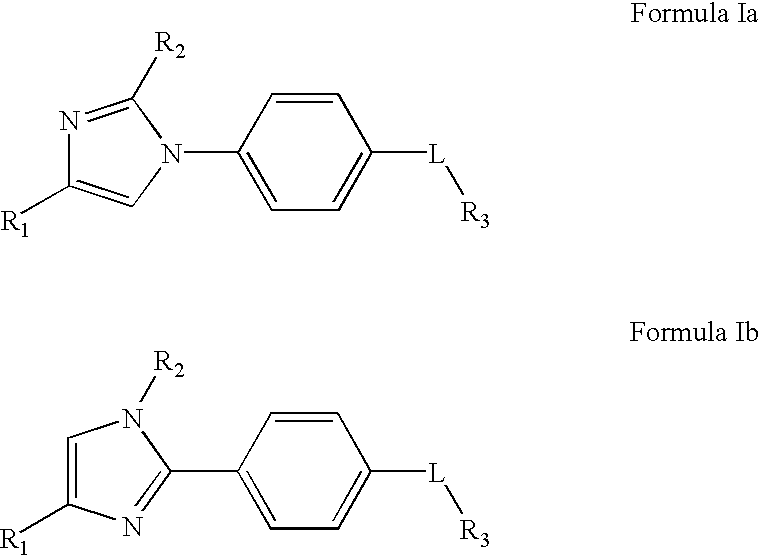
wherein:
R1 and R2, which may be the same or different, are CF3; halogen; CN; branched or unbranched C1-8 alkyl; branched or unbranched C1-8 alkenyl; C3-8 cycloalkyl optionally substituted with OH, CN or methoxy; C1-8 alkoxy; C1-4 alkyloxyalkyl; C1-8 alkylthio; C1-4 alkylthioalkyl; C1-8 dialkylamino; C1-4 dialkylaminoalkyl; CO2R4 where R4 is C1-4 alkyl or C1-4 alkenyl optionally substituted with carbocyclyl or heterocyclyl; aryl or heterocyclyl connected to the imidazole in any position that makes a stable bond which aryl or heterocyclyl may be optionally substituted with halogen, C1-4 alkyl, C1-4 alkenyl, CN, Me2N, CO2Me, OMe, aryl, heterocyclyl or R4;
L is —NHC(O)—; —NHC(O)O—; —NHC(O)C(O)—; —NHC(S)—; —NH—; —NHC(O)NH—; —NHC(S)NH—; —NHCH—2; —NHCH(R5)— where R5 is H, CN, C1-6 alkyl, C1-6 alkyloxyoalkyl C1-6 alkythioalkyl, C1-6 alkylsulfinylalkyl, C1-6 alkysulfonylalkyl, C3-6 cycloalkyl, heterocyclyl or aryl optionally substituted with a halogen, C1-4 alkyl, CN, Me2N, CO2Me or OMe; or L is —NHC(R5)-lower alkyl;
R3 is C1-8 alkyl; C1-8 alkyloxy; C1-8 alkylthio; C1-8 alkylamino; C1-4 alkoxyalkyl; C1-4 alkylthioalkyl; C1-4 alkylaminoalkyl C1-4 dialkylalkylaminoalkyl; carbocyclyl or heterocyclyl, which carbocyclyl or heterocyclyl may optionally be substituted with one or more of the following:
halogen, —CN, —NO2, —SO2NH2 or R6 (where R6 is phenyl, heterocyclyl, C3-6 cycloalkyl, C1-6 alkyl, C2-6 alkenyl, C1-6 alkyloxyalkyl, C1-6 alkylthioalkyl, C1-6 alkylsulfinylalkyl, C1-6 alkylsulfonylalkyl or C2-6 alkynyl) and R6 may be optionally substituted with halogen, —OH, alkyloxy, —CN, —COO-lower alkyl, —CONH-lower alkyl, —CON(lower alkyl)2, dialkylamino, phenyl or heterocylcyl; or R3 is —CO2R6; —N(R6)2; —NH(R6); —C(O)R6; —OR6; S(O)nR6 where n is O, 1 or 2; —SO2NHR6; or —SO2N(R6)2; or a pharmaceutically acceptable derivative thereof.
Preferably, the novel substituted 1-(4-aminophenyl)imidazoles of Formula Ia or Ib are those wherein:
R1 is straight-chained, branched or cyclo-C3-8alkyl, alkenyl, or alkynyl; C1-3alkyloxyalkyl, C1-5 alkyloxy, C1-3alkylthioalkyl, C1-5alkylthio, CF3; heterocyclyl or aryl optionally substituted with halogen, C1-4alkyl, CN, alkoxy or Me2N;
R2 is halogen, Me, Et, CF3, CN, cyclopropyl, vinyl, SMe, OMe, heterocyclyl or aryl optionally substituted with halogen, C1-4 alkyl, CN, alkoxy or Me2N;
L is —NHC(O)—, —NH—, —NHC(O)NH, or —NHCH(R5)—, where R5 is H, C1-4 alkyl, or CN and
R3 is C1-6 alkyl, C1-4 alkyloxyalkyl, C1-4 alkylthioalkyl, cyclohexyl, cyclopentyl, indanyl, indolyl, phenyl, thienyl, naphthyl, isoxazolyl or pyridyl, optionally substituted with one or more halogen, —CN, —NO2, SO2NH2, or R6 where R6 is C1-6 alkyl, C2-6 alkenyl, C1-6 alkyloxyalkyl, C1-6 alkylthioalkyl, or C2-6 alkynyl, optionally substituted with OH, CN, —COO-lower alkyl, —CONH-lower alkyl, —CON(lower alkyl)2, dialkylamino, or heterocycyl, CO2R6, —N(R6)2, —NH(R6), —C(O)R6, —OR6, S(O)nR6 where n is 0, 1 or 2, —SO2NHR6, —SO2N(R6)2.
More preferred are novel substituted 1-(4-aminophenyl)imidazoles of Formula Ia or Ib wherein:
R1 is Et, i-Pr, n-Pr, t-Bu, cyclopentyl, CF3, —OEt, MeOCH2—, 2- or 3-tetrahydrofuranyl, 2-, 3-, or 4-pyridyl, 2-furanyl, or 2-thiazolyl;
R2 is CN, CF3, Cl, Me, Et, SMe, cyclopropyl, vinyl, or 2-furanyl;
L is —NHC(O)—, —NH— or —NHCH2—; and
R3 is a phenyl ring which is optionally substituted with one to three groups selected from C1-3alkyl, chloro, fluoro, CF3, OC1-4alkyl, OC3-5alkenyl, CO2C1-2alkyl, SMe, CN, NO2, NMe2 and O(CH2)pR7, where p is 3 or 4 and R7 is CN, CO2Me, 2-(1,3-dioxolanyl), OH, or OC6H5; 1- or 2-indanyl, 2-tetrahydropyranyl, or a heterocycle selected from the group consisting of 2-thienyl, 3-furanyl, 3- or 4-pyridyl, 4-isoxazolyl, 1-isoquinolinyl, 2-indolyl, 2-benzothienyl and 4-pyrazolyl, which may be optionally substituted with one to three groups selected from Cl, Br, Me, CN, CF3, OCF3, NO2, or O(CH2)pR7, where p is 3 or 4 and R7 is CN, CO2Me, 2-(1,3-dioxolanyl), OH, or OC6H5; C5-6 alkyl, C5-6cycloalkyl, or cyclohexenyl.
Especially preferred are novel substituted 1-(4-aminophenyl)imidazoles of Formula Ia or Ib wherein:
R1 is i-Pr, CF3, 3-pyridyl or 4-pyridyl;
R2 is CN, CF3, Cl, Me, SMe or Et;
L is —NHC(O)—, —NH— or —NHCH2—; and
R3 is a phenyl ring which is optionally substituted with O(CH2)3R8, where R8 is CN, OH or 2-(1,3-dioxolanyl); OC3-4alkyl, O(CH2)4OH, 1-pentenyl, one to three groups selected from Me, Cl, F and CN; 3-pyridyl optionally substituted in the 6-position with O(CH2)2OEt or O(CH2)3R8, where R8 is CN, OH or 2-(1,3-dioxolanyl); 4-pyridinyl optionally substituted with a chlorine, 2-thienyl optionally substituted with Me or Br, 3,5-dimethyl-4-isoxazolyl, 1-methyl-2-indolyl, cyclopentyl, cyclohexyl, 1-indanyl or n-pent-3-yl.
Compounds of Formula Ia or Ib in which L is —NHC(O)— may be prepared by one of the methods outlined below. For example, a (4-aminophenyl) disubstituted imidazole 1a or 1b may be reacted with a carboxylic acid 2 under suitable coupling conditions known to one skilled in the art, for example in the presence of EDC and a base catalyst such as N,N-dimethylaminopyridine in a suitable solvent such as methylene chloride acetonitrile or DMF (Method A). Alternatively, 1a or 1b could be coupled with an acid halide 3 in the presence of a suitable base such as triethylamine in a suitable solvent such as methylene chloride (Method B). 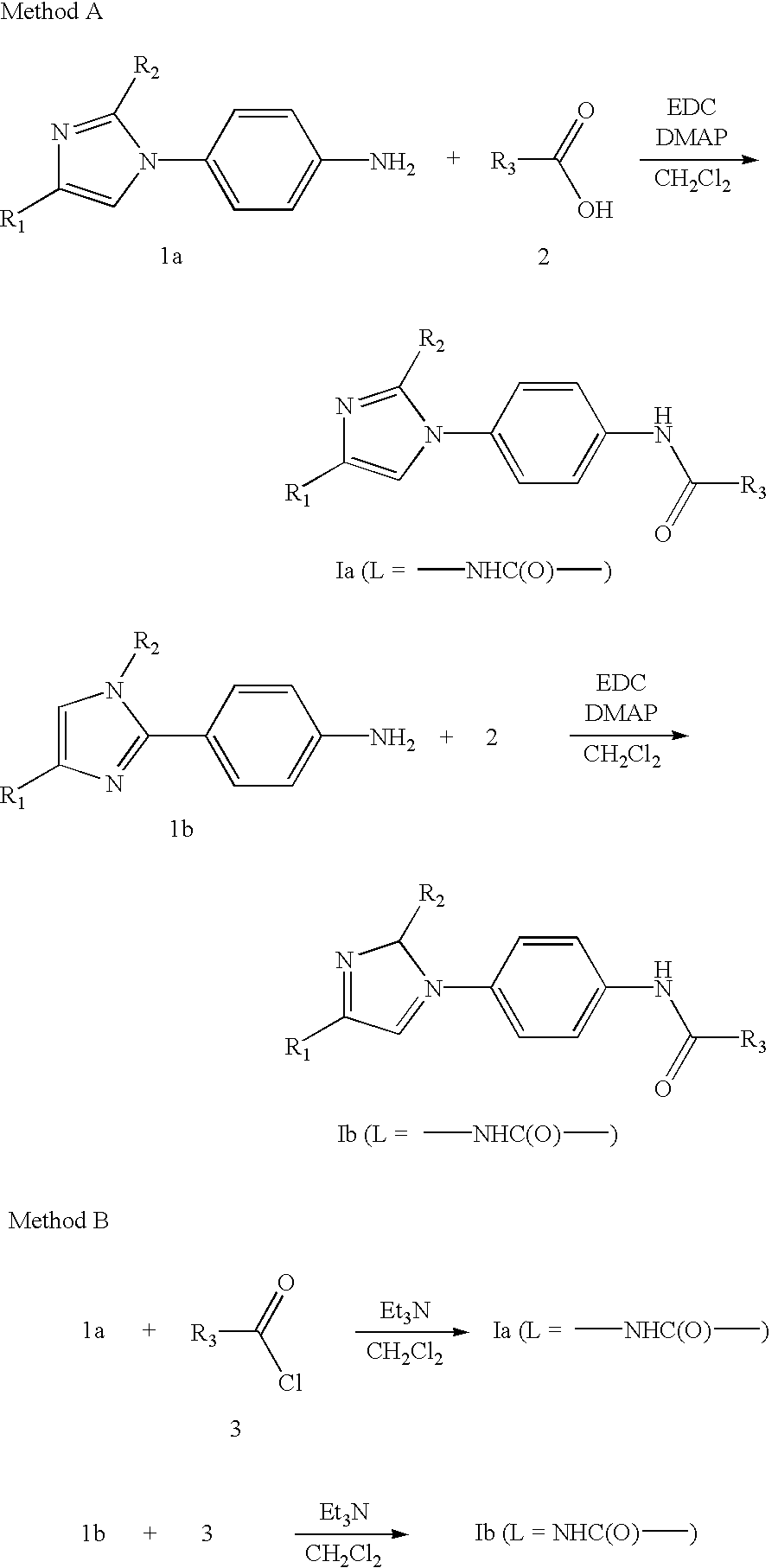
Compounds of Formula Ia or Ib in which L is —NH— and R3 is a heteroaryl ring may be prepared, as illustrated below, by reaction of 1a or 1b with a heterocycle 4 containing a labile substituent such as a halogen, which may be displaced by nucleophilic substitution (Method C). The reaction may be carried out in a sealed tube or an open vessel, at ambient temperature or heated to 150° C. in a suitable solvent such as dioxane or THF. A base such as sodium bis-trimethylsilyl amide may be added to the reaction. 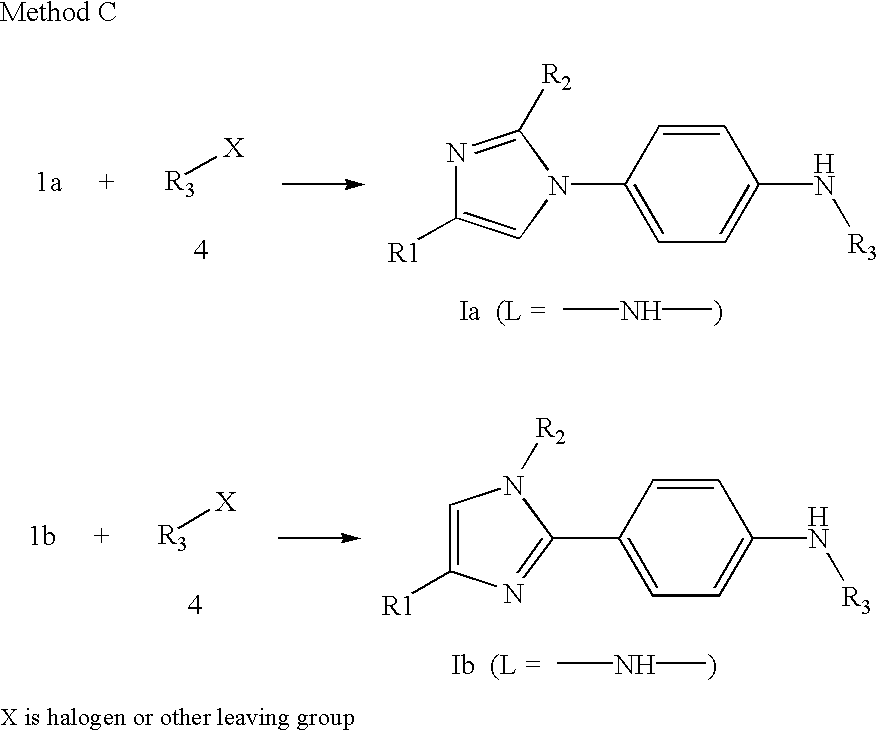
Compounds in which L is —NHC(O)NH— may be prepared by reaction of isocyanate 5a or 5b with an amine 6 in a suitable solvent such as methylene chloride or toluene (Method D). An amine such as triethylamine may be added. Alternatively, 1a or 1b could be reacted with an amine carbonyl chloride such as N-morpholine carbonyl chloride 7 in a suitable solvent such as methylene chloride (Method E). Intermediates 5a and 5b may be prepared from 1a and 1b, respectively, by methods known to those skilled in the art, for example by reaction of 1a or 1b with phosgene or a phosgene equivalent in the presence of a suitable base such as potassium carbonate, in a suitable solvent, such as methylene chloride. 
Methods by which compounds in which L is —NHCH(R5)— or —NHCH2 may be prepared are illustrated below. The procedures are illustrated for Ia, but may be used for Ib as well by substituting the appropriate starting material. For example, these compounds may be prepared by reduction of the corresponding amide (Ia or Ib, L is —NHC(O)—) with a suitable reducing agent such as lithium aluminum hydride, in a suitable solvent such as THF or diethyl ether (Method F). Alternatively, amine 1a or 1b could react with an alkylating agent 8 (Method G) where X is a suitable leaving group such as a halogen. In another alternate procedure, amine 1a or 1b could react with an aldehyde 9, and the intermediate imine 10 reacted with a reducing agent such as sodium cyanoborohydride or sodium triacetoxyborohydride (Method I). Alternatively, 10 could be reacted with a nucleophile such as an alkyl or aryl lithium reagent (Method I). 
Intermediates useful in the synthesis of compounds of formula Ia may be prepared as described below. A 3,5-disubstituted imidazole may be reacted with nitrobenzene substituted in the 4-position with a leaving group such as a halogen in the presence of a base (Method J). The nitrophenylimidazoles (11) produced could then be reduced to aminophenyl imidazoles by using a reducing agent such as SnCl2 or hydrogen or a hydrogen source such as ammonium formate in the presence of a catalyst such as palladium. Desired 3,5-disubstituted imidazoles may be prepared by methods known to those skilled in the art, such as by reaction of an alpha-bromoketone (R1C(O)CH2Br) with an amidine (R2C(═NH)NH2) (for example, see T. L. Little and S. E. Webber, J. Org Chem., 1994, 59, 7299). 
Intermediates 1a, in which R1 is CF3, useful in several of the Methods described above, may be prepared using a general procedure described in the chemical literature (M. Kawase et al., Heterocycles, 1995, 41, 1617) and illustrated by Method K below. 
In this procedure, a protected glycine, such as glycine t-butyl ester, is reacted with a 4-halonitrobenzene, such as 4-fluoronitrobenzene, in the presence of a suitable base, such as potassium carbonate, to provide 12, This is acylated with an acyl chloride R2C(O)Cl, to provide 13. Removal of the t-butyl ester by reaction with a suitable acid such as trifluoroacetic acid, is followed treatment with trifluoroacetic anhydride resulting in cyclization to mesoionic species 14. Treatment with ammonium acetate provides 15, which under suitable dehydration conditions, for example treatment with POCl3 in pyridine, provides imidazole 16. This may then be reduced as described above (Method J) to the desired 1a (R1=CF3).
Method K may be adapted to prepare compounds of the invention with other R1. By substituting an acid chloride (R1C(O)Cl) or acid anhydride (R1C(O)OC(O)R1) and a suitable base, such as dimethylaminopyridine, for trifluoroacetic anhydride in the conversion of 13 to 14 above, one may obtain 14a with the desired R1. This may then be converted to the desired 1a as described in Method K. 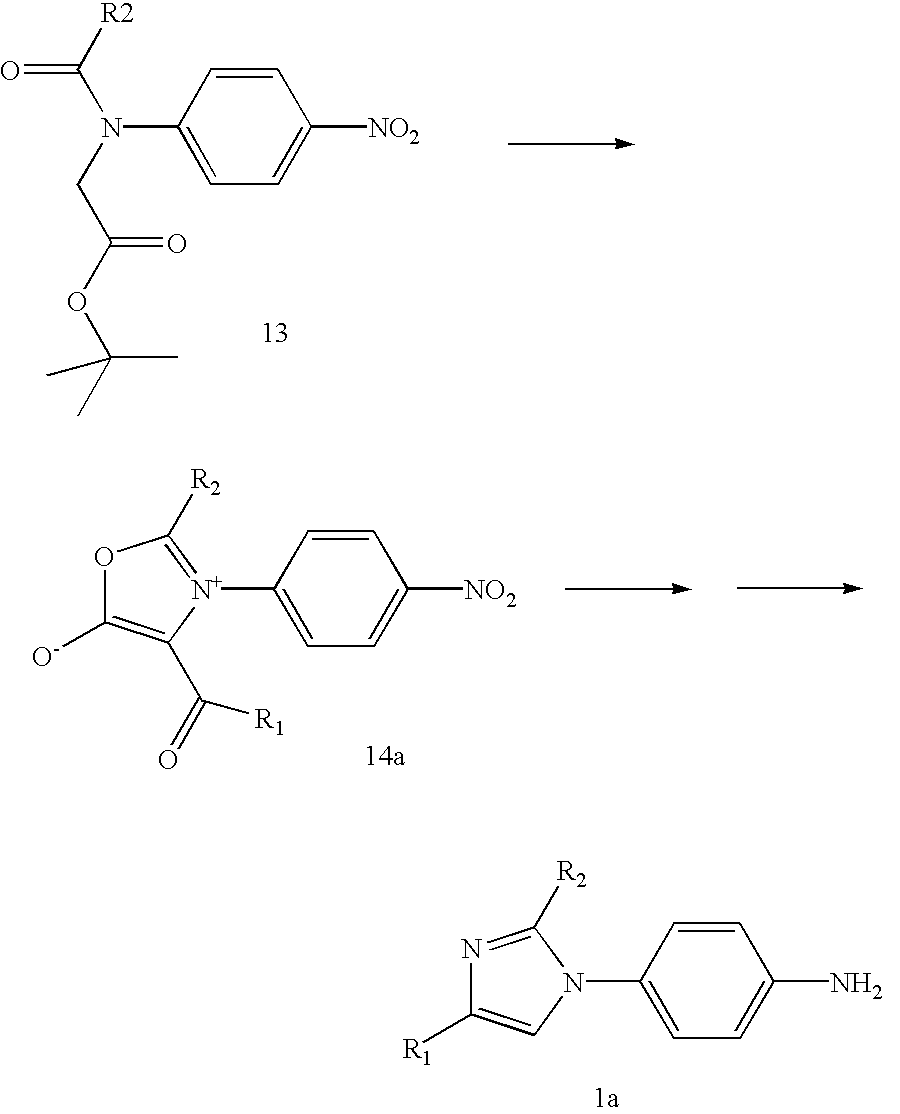
By altering the positions of the substituents, Method K may be modified to produce compounds of formula Ib as illustrated by Method K′. In this procedure, an N-substituted glycine ester, such as the methyl ester shown below is reacted with 4-nitrobenzoyl chloride in a suitable solvent such as methylene chloride or THF, in the presence of a suitable base, such as triethylamine or N-methylmorpholine to provide 17. Hydrolysis, followed by treatment with an acid chloride or acid anhydride, in a fashion analogous to the conversion of 13 to 14a, provides 18. This is then converted to the desired intermediate 1b as described for the conversion of 14 to 1a in Method K. 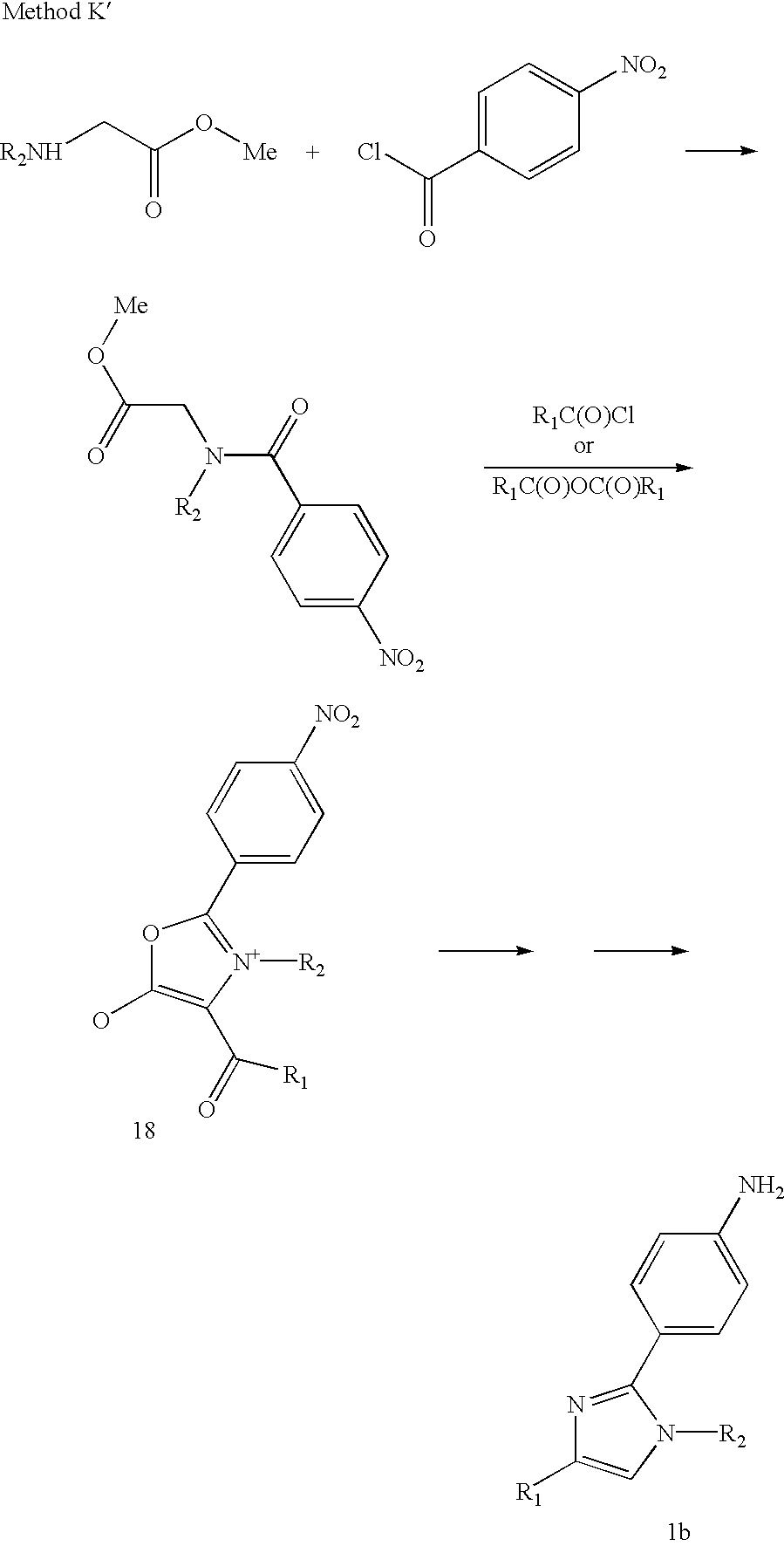
Method L illustrates another procedure by which 2-cyanoimidazoles may be obtained. A suitably protected substituted imidazole, where the protecting group P is trityl for example, may be reacted with a strong base, such as n-butyl lithium, and the resulting anion reacted with ethyl chloroformate to give the ethyl ester. Deprotection may be followed by reaction with nitrofluorobenzene (Method J) to give the nitrophenyl imidazole ester. The ester may then be converted to the nitrile by methods known to those skilled in the art, for example by conversion to the amide and dehydration as illustrated below. 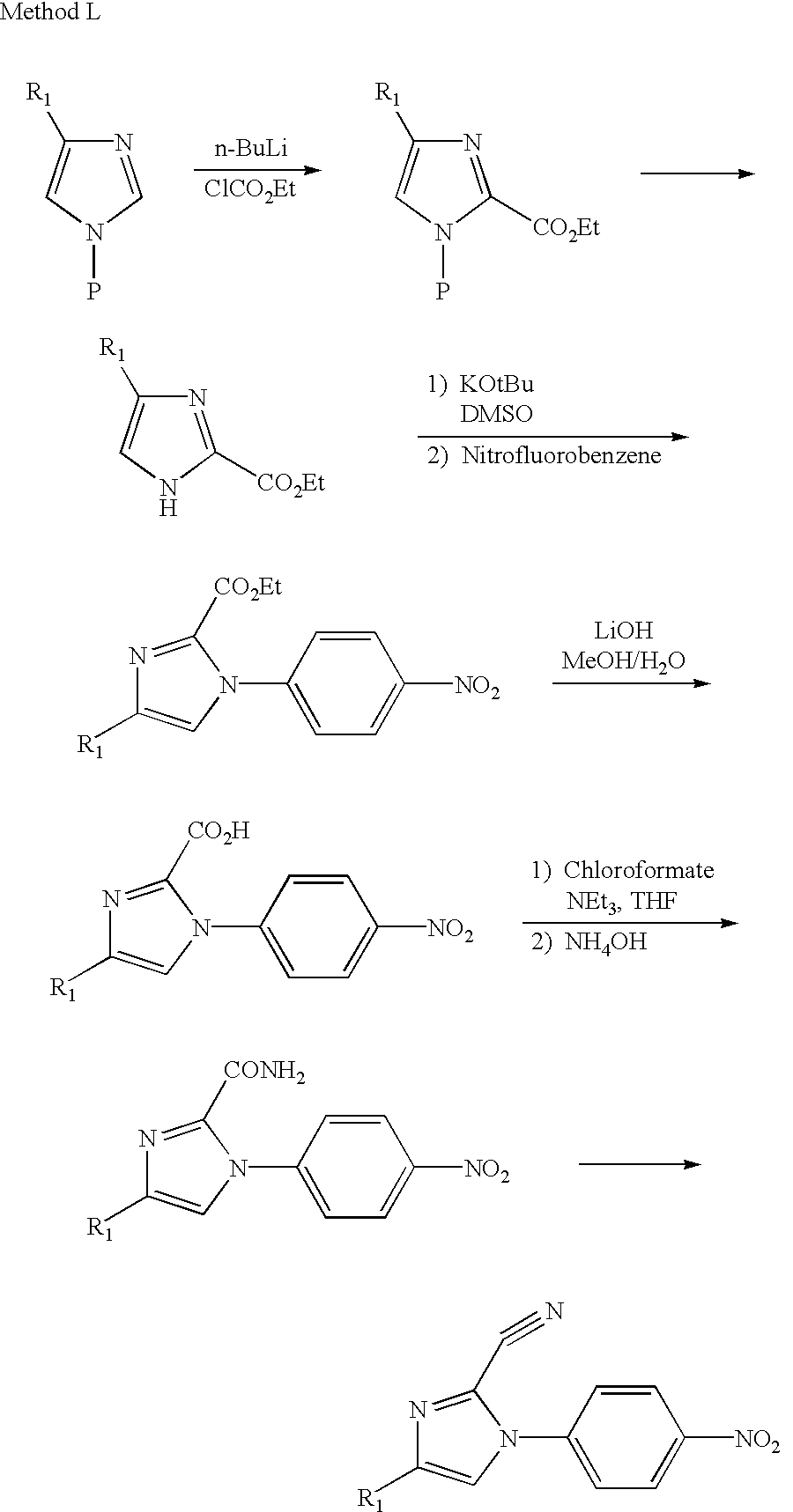
Several additional intermediates useful for the synthesis of compounds of formula Ia could be obtained from the 5-bromoimidazole 17, which may be prepared by bromination of the corresponding R1-substituted nitrophenylimidazole. For example, as illustrated in Method M, 17 may be cross coupled with a terminal acetylene 18, where Z may be, for example, hydrogen, or an alkyl group or any other group not adversely affecting the reaction, using conditions described by T. Sakamoto et al., (Synthesis, 1983, 312) to provide an alkyne at R2 (19). Alternatively, reaction with vinylstannanes 20, Z defined as above, under conditions described by J. W. Stille (Angew. Chem. Int. Ed. Engl., 1986, 25, 508), provides an alkene at R2 (21) (Method N). Reaction with substituted or unsubstituted aryl- or heteroarylboronic acids (22) under conditions described by N. Miyaura et al. (Chem. Rev. 1995, 95, 2457) provides 23 with aryl or heteroaryl groups at R2 (Method O). Alkynes 19 and alkenes 21 may be converted to the corresponding alkyl groups by reduction with a suitable reducing agent such as hydrogen in the presence of a suitable catalyst such as platinum or palladium to provide 1a (see Method J), with an alkyl group at R2. Alternatively, reaction with a reducing agent that leaves alkenes and alkynes intact, such as SnCl2 provides 1a with alkenes or alkynes at R2. 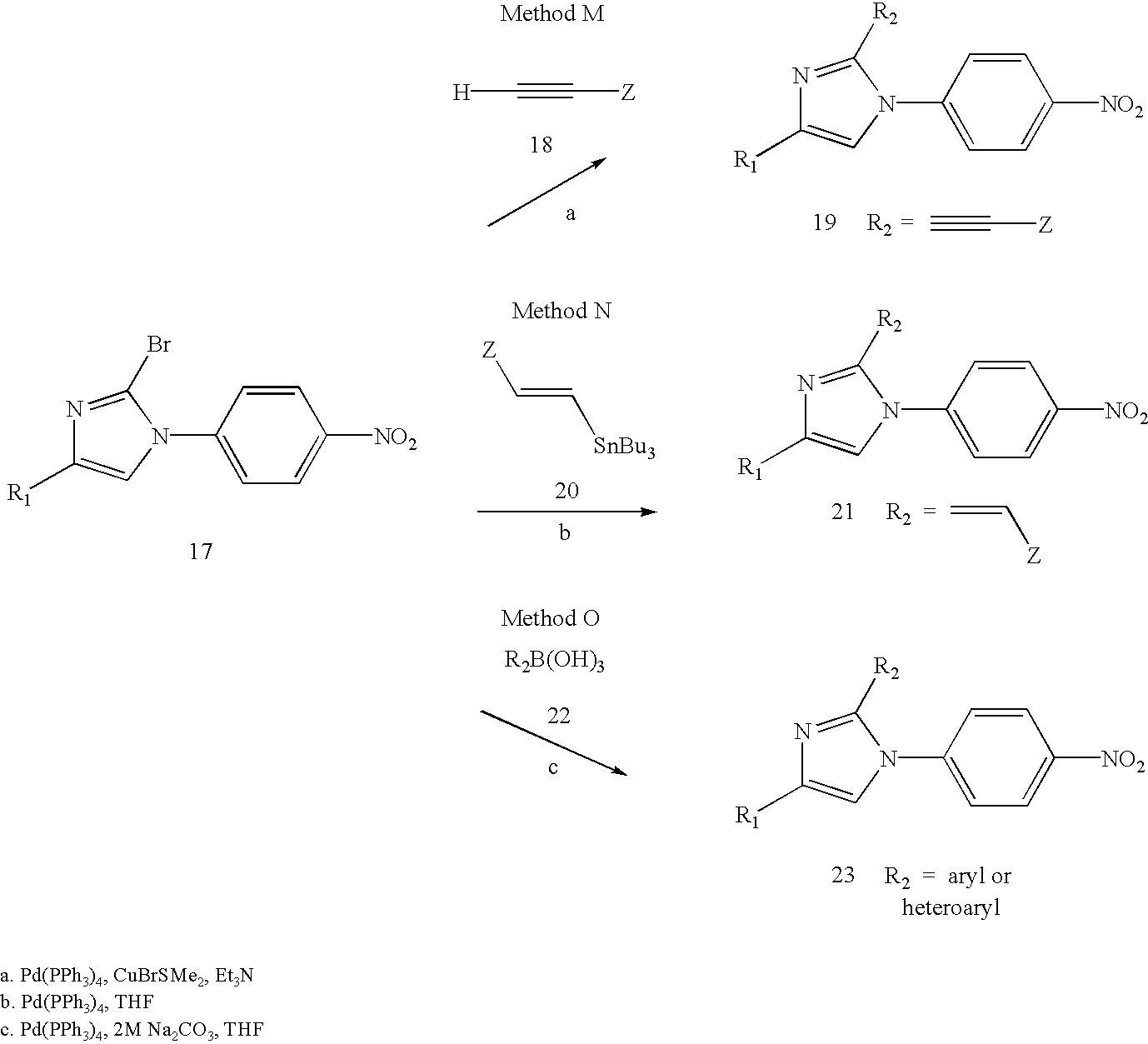
Method P describes an alternate procedure for preparing compounds of Formula Ia or Ib where L is —NH—. As illustrated in below, intermediate 1a may be heated at about 70° C. with an aryl bromide in the presence of a palladium catalyst, preferably Pd2(dba)3, 2,2′-bis(diphenylphosphino)-1,1′-binapthyl (BINAP), and a base, preferably NaOt-Bu, in a solvent such as toluene, as described by S. Buchwald et al. (J. Amer. Chem. Soc., 1993, 119, 8451) to provide Ia (L=—NH—). Using the same Method and starting with intermediate 1b would provide Ib (L=—NH—). Alternately, one could employ the same conditions with the bromophenylimidazole 24 and an amine, R3NH2, as illustrated for Ia below. 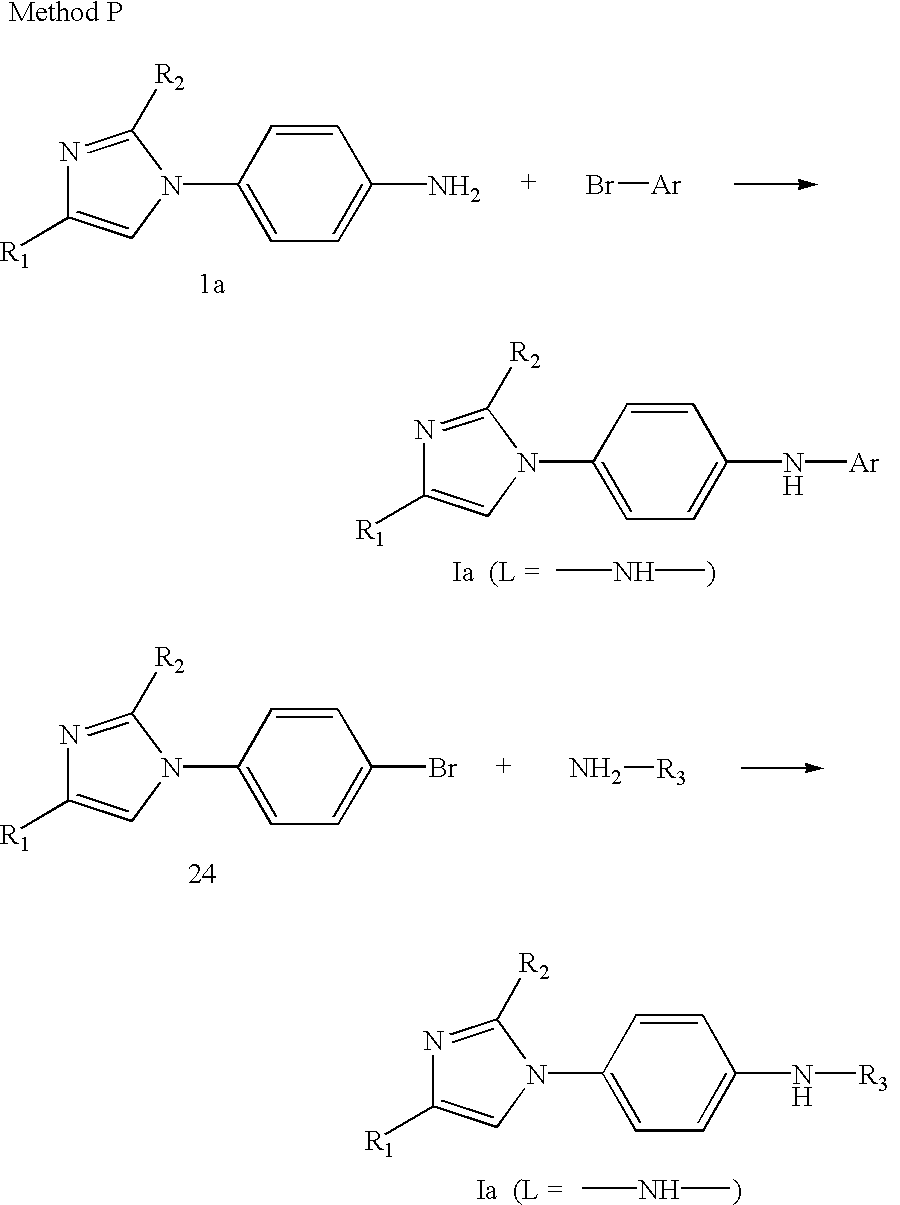
As can be appreciated by chemists possessing ordinary skill in the art, the synthetic schemes described above are for illustrative purposes only and may be modified using conventional synthetic methodology to produce any of the analogs of Formula I. Depending on precisely how the synthetic schemes are modified, the specific reaction conditions might also require modification. Such modifications may involve the use of higher or lower temperature or pressure, conditions other than those reported herein, or the addition of further synthetic steps such as functional group transformations. However, since progress of the reactions is easily monitored by techniques such as high performance liquid chromatography, gas chromatography, mass spectroscopy, thin layer chromatography, nuclear magnetic resonance spectroscopy and the like, such modifications are well within the skill of the art. Likewise, it should be appreciated that initial products from these Methods could be further modified to make additional compounds of this invention. Intermediates used in the Methods described above may be commercially available or could be prepared from commercially available materials by methods described in the chemical literature and known to people skilled in the art.
The 1-phenylimidazole analogs of Formula Ia and Ib inhibit production of IL-2. Without wishing to be bound by theory, the compounds of this invention inhibit IL-2 production by T-cells. This inhibition of IL-2production is therapeutically useful for selectively suppressing immune function. The result of such selectively suppressed immunity includes reduced cell proliferation of peripheral blood lymphocytes and cellular immune response. Thus, the inhibition of IL-2 production is an attractive means for preventing and treating a variety of immune disorders, including inflammatory diseases, autoimmune diseases, organ and bone marrow transplant rejection and other disorders associated with IL-2 mediated immune response. In particular, the compounds of Formula I may be used to prevent or treat acute or chronic inflammation, allergies, contact dermatitis, psoriasis, rheumatoid arthritis, multiple sclerosis, type 1 diabetes, inflammatory bowel disease, Guillain-Barre syndrome, Crohn's disease, ulcerative colitis, graft versus host disease (and other forms of organ or bone marrow transplant rejection) and lupus erythematosus. Other disorders associated with IL-2 mediated immune response will be evident to those of ordinary skill in the art and can also be treated with the compounds and compositions of this invention.
The compounds of this invention may be administered in any conventional dosage form in any conventional manner. Such methods of treatment, including their dosage levels and other requirements, may be selected by those of ordinary skill in the art from available methods and techniques. For example, a compound of this invention may be combined with a pharmaceutically acceptable carrier or adjuvant for administration to a patient in need of such treatment in a pharmaceutically acceptable manner and in an amount effective to treat (including lessening the severity of symptoms) the immune disorder.
The compounds of this invention may be administered alone or in combination with conventional therapeutics, such as conventional immunosuppressants. Advantageously, such combination therapies utilize lower dosages of the conventional therapeutics, thus avoiding possible toxicity and adverse side effects incurred when those agents are used as monotherapies. The compounds of this invention may be physically combined with the conventional therapeutics into a single pharmaceutical composition. Advantageously, the compounds may then be administered together in a single dosage form. Alternatively, the compounds may be administered separately (either serially or in parallel). Separate dosing allows for greater flexibility in the dosing regime.
According to this invention, the compounds of Formula Ia and Ib and the pharmaceutical compositions containing those compounds may be administered to a patient in any conventional manner and in any pharmaceutically acceptable dosage from, including, but not limited to, intravenously, intramuscularly, subcutaneously, intrasynovially, by infusion, sublingually, transdermally, orally, topically or by inhalation. The preferred modes of administration are oral and intravenous.
Dosage forms of the compounds of this invention include pharmaceutically acceptable carriers and adjuvants known to those of ordinary skill in the art. These carriers and adjuvants include, for example, ion exchangers, alumina, aluminum stearate, lecithin, serum proteins, buffer substances, water, salts or electrolytes and cellulose-based substances. Preferred dosage forms include tablet, capsule, caplet, liquid, solution, suspension, emulsion, lozenges, syrup, reconstitutable powder, granule, suppository and transdermal patch. Methods for preparing such dosage forms are known (see, for example, H. C. Ansel and N. G. Popovish, Pharmaceutical Dosage Forms and Drug Delivery Systems, 5th ed., Lea and Febiger, 1990). Dosage levels and requirements are well-recognized in the art and may be selected by those of ordinary skill in the art from available methods and techniques suitable for a particular patient. Typically, dosage levels range from about 10-1000 mg/dose for a 70 kg patient. Although one dose per day may be sufficient, up to 5 doses per day may be given. For oral doses, up to 5000 mg/day may be required. As the skilled artisan will appreciate, lower or higher doses may be required depending on particular factors. For instance, specific dosage and treatment regimens will depend on factors such as the patient's general health profile, the severity and course of the patient's disorder or disposition thereto and the judgment of the treating physician.
Synthetic Examples
In order that this invention be more fully understood, the following examples are set forth. These examples are for the purpose of illustrating preferred embodiments of this invention, and are not to be construed as limiting the scope of the invention in any way.
Synthesis of N-[4-(4-methyl-2-phenylimidazol-1-yl)]phenyl]4-chlorobenzamide (Methods J and A) 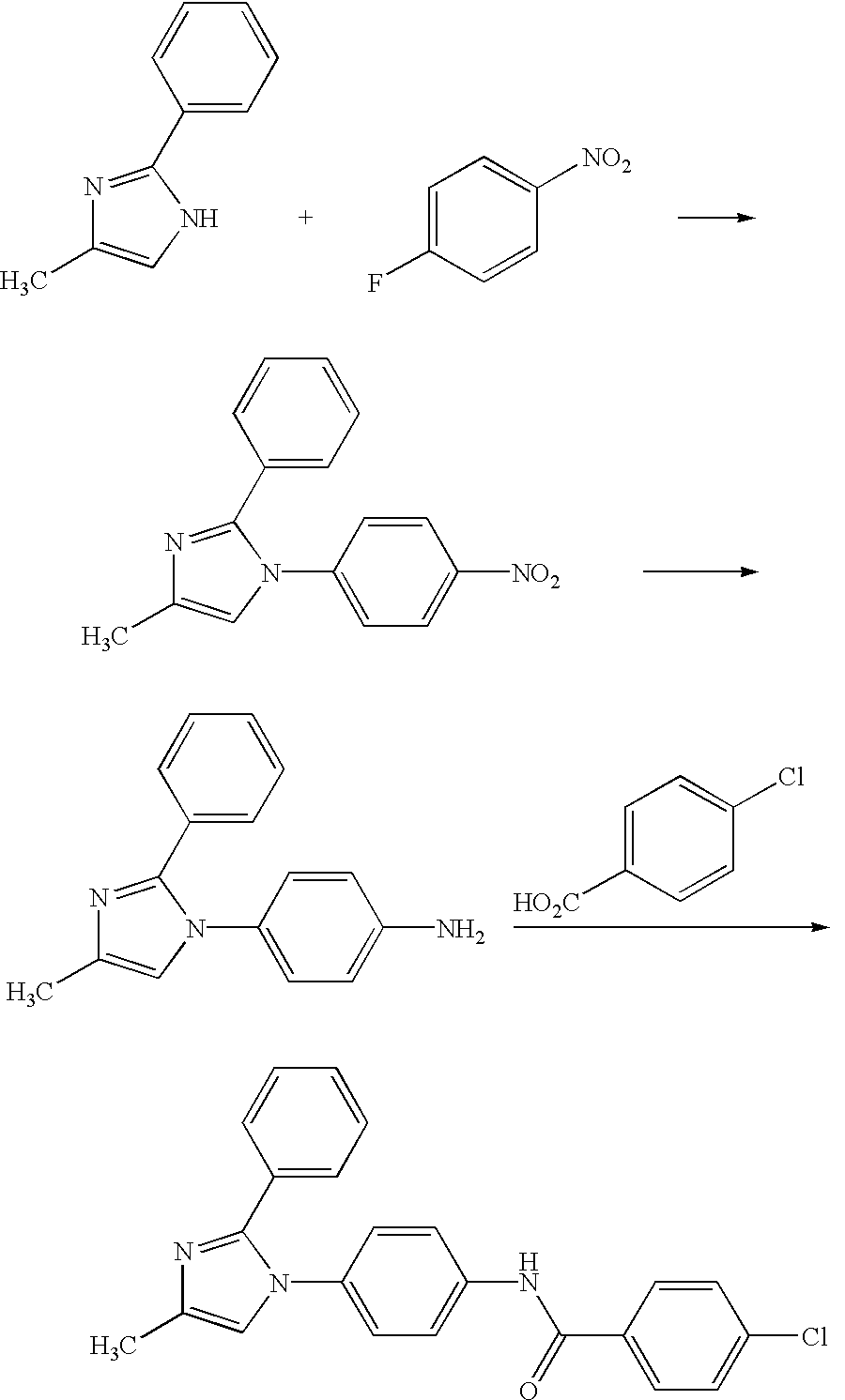
Potassium-t-butoxide (2.24 g, 20 mmol) was added to anhydrous DMSO (16 mL) and stirred at room temperature for 5-10 min until most of the solid dissolved. Then 4-methyl-2-phenylimidazole (3.16 g, 20 mmol) was added and stirring was continued at room temperature for 10 min. 1-Fluoro-4-nitrobenzene (2.12 mL, 20 mmol) was added to the clear solution and the mixture was heated at 90° C. for 1 hr. The reaction mixture was allowed to cool to room temperature and was poured onto crushed ice and extracted with CH2Cl2 (3×100 mL). The combined extracts were washed with brine, dried over anhydrous Na2SO4 and concentrated to give a light yellow, thick oil. The yield of crude product was 80%. Proton NMR indicated the product was a single regioisomer.
To a stirred solution of the above nitro compound (6 mmol) in glacial acetic acid (30 mL) was added stannous chloride (8.1 g, 35.9 mmol) in conc. HCl (15 mL). The reaction mixture was stirred at room temperature. TLC after 1 hr showed complete disappearance of the nitro compound. The reaction mixture was cooled in ice, and the pH was brought to 12 by the addition of 10N NaOH. After stirring at room temperature for 15 min, the mixture was diluted with water (50 mL), extracted with CH2Cl2 (3×50 mL), the combined CH2Cl2 extracts washed with brine (3×25 mL), dried over anhydrous Na2SO4 and concentrated to give the desired amine as a reddish orange, thick oil.
4-Chlorobenzoic acid (2 mmol), EDC (2.2 mmol) and DMAP (0.2 mmol) were stirred in CH2Cl2 (5 mL) and DMF (1mL) for 5 min and then the amine from above (1.5 mmol) was added and the reaction mixture stirred for 16 hr. The solvent was evaporated under vacuum, the residue taken up in water and the precipitated solid filtered off. The crude product was purified by column chromatography over silica gel to give the title compound (m.p. 146-149° C., 70% yield) which was pure by HPLC analysis. 1H NMR (DMSO-d6): δ2.21 (3H, s), 7.17 (1H, s), 7.25-7.34 (7H, m), 7.62 (2H, d, J=9 Hz), 7.83 (2H, d, J=9 Hz), 7.98 (2H, d, J=9 Hz), 10.5 (1H, s).
Synthesis of N-[4-(2-methyl-4-trifluoromethylimidazol-1-yl)]phenyl]4-chlorobenzamide (Methods K and A) 
A mixture of glycine tert-butyl ester hydrochloride (3.35 g, 20 mmol), 4-nitrofluorobenzene (2.82 g, 20 mmol) and potassium carbonate (4.2 g, 30 mmol) in DMSO (15 mL) was heated at 90° C. for 22 hr. The reaction mixture was allowed to cool to room temperature and then poured onto crushed ice. The precipitated yellow solid was filtered, washed with water and dried (Na2SO4) to give N-(4-nitrophenyl)glycine tert-butyl ester (4.1 g, 81%).
To a stirred solution of the above nitro compound (2.77 g, 11 mmol) and N-methylmorpholine (2.6 mL, 24 mmol) in CH2Cl2 (20 mL) maintained at 0° C. was added acetyl chloride (1.6 mL, 22 mmol)followed by DMAP (122 mg, 1 mmol). The reaction was stirred at room temperature for 24 hr. The solvent was evaporated and the residue treated with ice-cold 1N H2SO4 (200 mL), extracted with CH2Cl2 (3×100 mL), the combined extracts washed with ice-cold 1N H2SO4 (3×50 mL), water (3×50 mL), dried over anhydrous Na2SO4 and concentrated to give a brownish yellow oil (3.2 g, 100%). Proton NMR indicated it to be the N-acetylated material containing 10% of the starting material. This was used without further purification.
The N-acylated tert-butyl ester (3.2 g) was treated with neat trifluoroacetic acid (50 mL) at room temperature for 1 hr. After evaporation of the trifluoroacetic acid, the residue was taken up in ice-cold water, the resulting yellow precipitate filtered off, washed with water and dried providing the corresponding carboxylic acid (2.4 g).
Trifluoroacetic anhydride (2.12 mL, 15 mmol) was added to a suspension of the above carboxylic acid (1.19 g, 5 mmol) in CH2Cl2 and stirred at room temperature for 2 hr. The residue obtained after evaporation of excess reagents was triturated with ether to give a reddish yellow solid. This solid was taken up in DMF (20 mL) and ammonium acetate (0.77 g, 10 mmol) was added and the mixture heated at 70° C. for 2 hr. DMF was evaporated under vacuum, the residue was taken up in CH2Cl2 and cooled on ice. The precipitated solid was filtered and washed with cold CH2Cl2 to give a light brownish solid (1.1 g, 76%).
A mixture of the above intermediate (0.29 g, 1 mmol), phosphorous oxychloride (223 μL, 2.4 mmol) and pyridine (0.71 mL, 8.8 mmol) was heated at 90° C. for 2 hr. The reaction mixture, after cooling to room temperature, was treated with 10% NaHCO3 (50 mL), extracted with EtOAc (3×50 mL), the combined extracts washed with 10% NaHCO3 (1×50 mL), brine (1×50 mL), dried over anhydrous Na2SO4 and the solvent evaporated to give a dark brownish, thick oil (250 mg, 92%). Proton NMR was consistent with N-(p-nitrophenyl)-2-methyl-4-trifluoromethyl imidazole.
To a suspension of the above nitro compound (1 mmol) in MeOH (6 mL) and acetic acid (1 mL) was added 10% Pd/C (75 mg) followed by ammonium formate (100 mg) and the reaction mixture was stirred for 15 min. The catalyst was filtered off, the MeOH evaporated and the residue taken up in 10% NaHCO3 (25 mL), extracted with CH2Cl2 (2×50 mL), the combined extracts washed with brine, dried over anhydrous Na2SO4 and concentrated to give a reddish brown oil which solidified on standing to the corresponding amine.
Coupling of the above amine with 4-chlorobenzoic acid was carried out by the same method as described in Example 1 to give the title compound. The title compound was purified by flash column chromatography over silica gel eluting with 8% EtOAc/CH2Cl2 and a fraction with Rf 0.25 collected and final purification was carried out by crystallization in hexane/benzene. The yield for the final two steps was 80%. Mp 194-195° C.; 1H NMR (DMSO-d6) δ2.31 (3H, s), 7.51 (2H, d, J=9 Hz), 7.63 (2H, d, J=9 Hz), 7.94-8.02 (5H, m), 10.55 (1H, s)); 19F NMR (CDCL3) δ−61.5 (s).
Synthesis of N-[4-(1-methyl-4-trifluoromethylimidazol-2-yl)]phenyl]4-chlorobenzamide (Methods L and A) 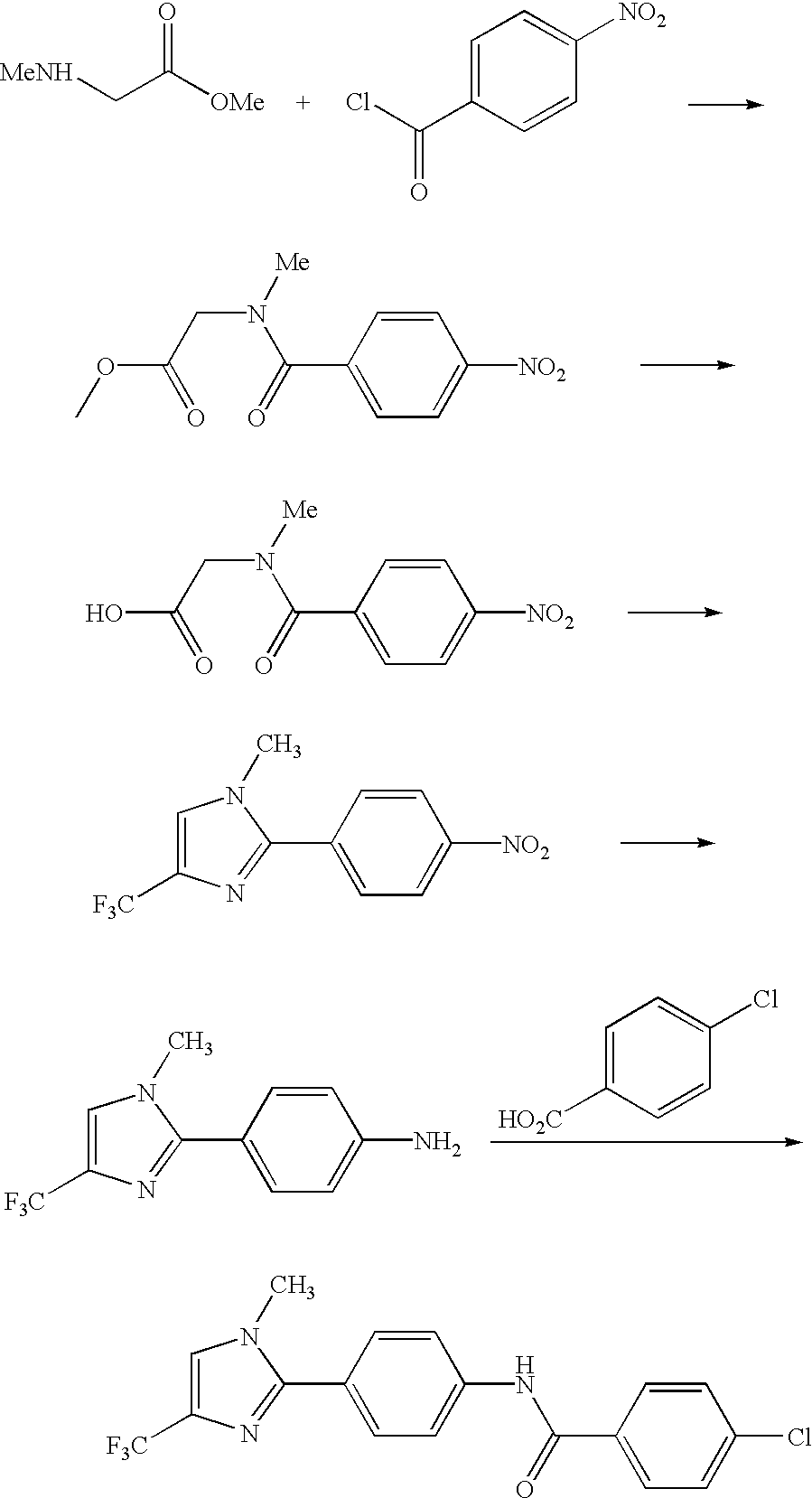
4-Nitrobenzoyl chloride (3.71 g, 20 mmol) was added to a stirred solution of sarcosine methyl ester hydrochloride (2.8 g, 20 mmol) and N-methylmorpholine (4.6 mL, 42 mmol) in CH2Cl2 (20 mL) and the mixture was stirred overnight at room temperature for 16 hr. The reaction mixture was diluted with CH2Cl2 (200 mL), washed with 1N H2SO4 (3×50 mL), 10% NaHCO3 (3×50 mL), water (3×50 mL), dried over anhydrous Na2SO4 and concentrated to give a light yellow, thick oil which solidified on standing (3.6 g, 72%).
Lithium hydroxide (1.23 g, 30 mmol) in 25 mL water was added to a solution of the above sarcosine derivative (3.6 g, 14.3 mmol) in MeOH (50 mL) and the mixture was stirred at room temperature for 1 hr. The MeOH was evaporated and the aqueous residue acidified with 1N H2SO4, extracted with EtOAc (3×75 mL), the combined extracts washed with brine (3×25 mL), dried over anhydrous Na2SO4 and concentrated to give a light cream-colored solid (3 g, 88%).
Trifluoroacetic anhydride (2.12 mL, 15 mmol) was added to a suspension of the above glycine derivative (1.19 g, 5 mmol) in CH2Cl2 and the reaction was stirred at room temperature for 2 hr. The residue obtained after evaporation of excess reagents was triturated with ether to give a reddish yellow solid. This solid was taken up in DMF (20 mL) and ammonium acetate (0.77 g, 10 mmol) was added and the mixture heated at 70° C. for 2 hr. The DMF was evaporated under vacuum and the residue taken up in ether and cooled on ice. The precipitated solid was filtered and washed with cold ether to give a light brownish solid (0.87 g, 60%).
The above intermediate (2 mmol) was reacted with phosphorous oxychloride and pyridine as described in Example 2 and worked up in analogous fashion to give quantitative yield of 1-methyl-2-(p-nitrophenyl)-4-trifluoromethyl imidazole as a light brown solid. Reduction of the nitro group and coupling of the resulting amine to 4-chlorobenzoic acid to give the title compound was carried out as described in Example 2. The yield for the two steps was 80%.
Purification was carried out by flash column chromatography over silica gel eluting with 8% EtOAc/CH2Cl2 and the fraction with Rf 0.26 was collected and crystallized from benzene. Mp 221-223° C.; 1H NMR (DMSO-d6) δ3.81 (3H, s), 7.63 (2H, d, J=9 Hz), 7.72 (2H, d, J=9 Hz), 7.92 (3H, d, J=9 Hz), 8.0 (2H, d, J=9 Hz), 10.51 (1H, s)); 19F NMR (CDCL3) δ−61.3 (s).
Assessment of Biological Properties
IL-2 Promoter Assay
The IL-2 promoter assay measures transcriptional activation of a luciferase reporter gene which has been placed under control of the IL-2 promoter/enhancer. All the known regulatory features of the IL-2 gene are contained within a ˜300 bp sequence immediately upstream of the open reading frame. The region −328 to +35 relative to the transcription start site of the IL-2 gene is obtained by RT-PCR of human genomic DNA and is subcloned into the promoterless luciferase reporter vector pGL2-Basic (Promega). The resulting construct, pIL2P-luc, and a vector containing a neomycin resistance gene, pcDNA/Neo (Invitrogen), are linearized and stably transfected into Jurkat cells (a human T-cell line) by electroporation. Following G-418 selection and dilution cloning, a cell line was established, J.1F/C6., which exhibited a strong induction of luciferase activity upon treatment with ionomycin and PMA (up to 100-fold), and potent inhibition by FK506 (IC50=0.3 nM).
For screening compounds, the cells are pelleted by centrifugation, washed once with PBS, resuspended in RPMI (phenol red-free) containing 5% FBS, and dispensed into 96-well, white microtiter plates (Packard) at 50,000 cells/well. The cells are pre-incubated with compounds (1 μg/ml) for 15 min prior to addition of ionomycin (1 μg/ml) and PMA (10 ng/ml) in a final volume of 100 μl. Following a 5 hr incubation at 37° C. in a humidified incubator, 100 μl of Luc-Lite lysis buffer/luciferase assay buffer (Promega) is added and luminescence measured using a Packard TopCount scintillation counter/luminometer.
The synthetic examples and were screened in this assay and had IC50s below 10 microM
While we have described a number of embodiments of this invention, it is apparent that our basic constructions may be altered to provide other embodiments which utilize the products and methods of this invention. Therefore, it will be appreciated that the scope of this invention is to be defined by the appended claims, rather than by the specific embodiments that have been presented herein by way of example.
Claims (17)
1. A compound of Formula Ia 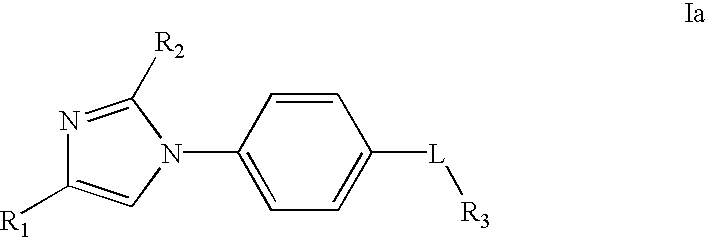
wherein:
R1 and R2, which are the same or different, are CF3; halogen; CN; branched or unbranched C1-8 alkyl; branched or unbranched C1-8 alkenyl; C3-8 cycloalkyl optionally substituted with OH, CN, or methoxy; C1-8 alkoxy; C1-4 alkyloxyalkyl; C1-8 alkylthio; C1-4 alkylthioalkyl; C1-8 dialkylamino; C1-4 dialkylaminoalkyl; CO2R4 where R4 is C1-4 alkyl or C1-4 alkenyl optionally substituted with carbocyclyl or heterocyclyl; or aryl or heterocyclyl connected to the imidazole in any position that makes a stable bond wherein the aryl or the heterocyclyl thereof is optionally substituted with halogen, C1-4 alkyl, C1-4 alkenyl, CN, Me2N, CO2Me, OMe, aryl, heterocyclyl, or R4;
L is —NHC(O)—; —NHC(O)O—; —NHC(O)C(O)—; —NHC(S)—; —NH—; —NHC(O)NH—; —NHC(S)NH—; —NHCH2—; —NHCH(R5)—, wherein R5 is H, CN, C1-6 alkyl, C1-6 alkyloxyalkyl, C1-6 alkylthioalkyl, C1-6 alkylsulfinylalkyl, C1-6 alkylsulfonylalkyl, C3-6 cycloalkyl, heterocyclyl, or aryl optionally substituted with a halogen, C1-4 alkyl, CN, Me2N, CO2Me, or OMe; or —NHC(R5)-lower alkyl; and
R3 is C1-8 alkyl; C1-8 alkyloxy; C1-8 alkylthio; C1-8 alkylamino; C1-4 alkoxyalkyl; C1-4 alkylthioalkyl; C1-4 alkylaminoalkyl; C1-4 dialkylaminoalkyl; —CO2R6; —N(R6)2; —NH(R6); —C(O)R6; —OR6; S(O)nR6, wherein n is 0, 1, or 2; —SO2NHR6; —SO2N(R6)2; or carbocyclyl or heterocyclyl, wherein the carbocyclyl or heterocyclyl thereof is optionally substituted with one or more of the following:
halogen, —CN, —NO2, —SO2NH2, CF3, OCF3, OC1-4alkyl, OC3-5alkenyl, CO2C1-2alkyl, SMe, NMe2, R6, or O(CH2)pR7, where p is 3 or 4and R7 is CN, CO2Me, 2-(1,3-dioxolanyl), OH, or OC6H5,
wherein:
R6 is phenyl, heterocyclyl, C3-6 cycloalkyl, C1-6 alkyl, C2-6 alkenyl, C1-6 alkyloxyalkyl, C1-6 alkylthioalkyl, C1-6 alkylsulfinylalkyl, C1-6 alkylsulfonylalkyl, or C2-6 alkynyl and R6 is optionally substituted with halogen, —OH, alkyloxy, —CN, —COO-lower alkyl, —CONH-lower alkyl, —CONH-lower alkyl, —CON(lower alkyl)2, dialkylamino, phenyl, or heterocyclyl,
each aryl group is independently a phenyl group or naphthyl group,
each carbocyclyl group is independently a stable saturated or unsaturated, aromatic or non-aromatic, 3 to 8 membered monocyclic or 7 to 11 membered bicyclic radical, and
each heterocyclyl group is independently a stable saturated or unsaturated, aromatic or non-aromatic, 5 to 8 membered monocyclic or 8 to 11 membered bicyclic heterocycle radical including 1 to 4 heteroatoms selected from the group consisting of nitrogen, oxygen, and sulfur, and is optionally benzo- or pyridofused if monocyclic,
or a pharmaceutically acceptable derivative thereof.
2. The compound as recited in claim 1 , wherein:
R1 is straight-chained, branched, or cyclo-C3-8 alkyl, alkenyl, or alkynyl; C1-3 alkyloxyalkyl; C1-5 alkyloxy; C1-3 alkylthioalkyl; C1-5 alkylthio; CF3; or heterocyclyl or aryl optionally substituted with halogen, C1-4 alkyl, CN, alkoxy, or Me2N;
R2 is halogen; Me; Et; CF3; CN; cyclopropyl; vinyl, SMe, OMe, heterocyclyl or aryl optionally substituted with halogen, C1-4 alkyl, CN, alkoxy, or Me2N;
L is —NHC(O)—, —NH—, —NHC(O)NH, or —NHCH(R5)—, wherein R5 is H, C1-4 alkyl, or CN; and
R3 is C1-6 alkyl; C1-4 alkyloxyalkyl; C1-4 alkylthioalkyl; cyclohexyl; cyclopentyl; indanyl; indolyl; phenyl; thienyl; naphthyl; isoxazolyl or pyridyl; optionally substituted with one or more halogen, —CN, —NO2, SO2NH2, or R6 (where R6 is C1-6 alkyl, C2-6 alkenyl, C1-6 alkyloxyalky, C1-6 alkylthioalkyl, or C2-6 alkynyl) or R6 optionally substituted with OH, CN, —COO-lower alkyl, —CONH-lower alkyl, —CON(lower alkyl)2, dialkylamino, or heterocyclyl; or
R3 is CO2R6; —N(R6)2; —NH(R6); —C(O)R6; —OR6; S(O)nR6 where n is 0, 1, or 2; —SO2NHR6, or —SO2N(R6)2.
3. The compound according to claim 1 , wherein:
R1 is Et, i-Pr, n-Pr, t-Bu, cyclopentyl, CF3, —OEt, MeOCH2—, 2- or 3-tetrahydrofuranyl, 2-, 3-, or 4-pyridyl, 2-furanyl, or 2-thiazolyl;
R2 is CN, CF3, Cl, Me, Et, SMe, cyclopropyl, vinyl, or 2-furanyl;
L is —NHC(O)—, —NH—, or —NHCH2—; and
R3 is a phenyl ring optionally substituted with one to three groups selected fromC1-3 alkyl, chloro, fluoro, CF3, OC1-4alkyl, OC3-5alkenyl, CO2C1-2alkyl, SMe, CN, NO2, NMe2 and O(CH2)pR7, where p is 3 or 4 and R7 is CN, CO2Me, 2-(1,3-dioxolanyl), OH, or OC6H5; 1- or 2-indanyl; 2-tetrahydropyranyl; or a heterocycle selected from the group consisting of 2-thienyl, 3-furanyl, 3- or 4-pyridyl; 4-isoxazolyl; 1-isoquinolinyl; 2-indolyl; 2-benzothienyl or 4-pyrazolyl optionally substituted with one to three groups selected from Cl, Br, Me, CN, CF3, OCF3, NO2, or O(CH2)pR7, where p is 3 or 4 and R7 is CN, CO2Me, 2-(1,3-dioxolanyl), OH, or OC6H5; C5-6 alkyl, C5-6cycloalkyl; or cyclohexenyl.
4. The compound according to claim 1 , wherein:
R1 is i-Pr, CF3, 3-pyridyl or 4-pyridyl;
R2 is CN, CF3, Cl, Me, SMe or Et;
L is —NHC(O)—, —NH—, or —NHCH2—; and
R3 is a phenyl ring optionally substituted with O(CH2)3R8, wherein R8 is CN, OH, or 2-(1,3-dioxolanyl); OC3-4alkyl; O(CH2)4OH; 1-pentenyl, one to three groups selected from Me, Cl, F, and CN; 3-pyridyl optionally substituted in the 6-position with O(CH2)2OEt or O(CH2)3R8, where R8 is CN, OH or 2-(1,3-dioxolanyl); 4-pyridinyl optionally substituted with a chlorine, 2-thienyl optionally substituted with Me or Br, 3,5-dimethyl-4-isoxazolyl, 1-methyl-2-indolyl, cyclopentyl, cyclohexyl, 1-indanyl or n-pent-3-yl.
5. A compound selected from the group consisting of:
(a) N-[4-(2-Ethyl-4-pyridin-3-yl-imidazol-1-yl)phenyl]pyridine-3-carboxamide;
(b) (2-Chloro-6-fluorobenzyl)-[4-(2-ethyl-4-pyridin-3-yl-imidazol-1-yl)phenyl]amine;
(c) (2-Methylbenzyl)-[4-(2-ethyl-4-pyridin-3-yl-imidazol-1-yl)phenyl]amine;
(d) [6-(3-Cyanopropoxy)pyridin-3-ylmethyl]-[4-(2-cyano-4-pyridin-3-yl-imidazol-1-yl)phenyl]amine;
(e) [6-(3-[1,3]Dioxolan-2-ylpropoxy)pyridin-3-ylmethyl]-[4-(2-cyano-3-pyridin-4-yl-imidazol-1-yl)phenyl]amine;
(f) N-[4-(2-Ethyl-4-pyridin-3-yl-imidazol-1-yl)phenyl]-1-methylindole-2-carboxamide;
(g) (2-Chloro-6-fluorobenzyl)-[4-(2-cyano-4-pyridin-3-yl-imidazol-1-yl)phenyl]amine;
(h) [4-(2-Cyano-4-pyridin-3-yl-imidazol-1-yl)phenyl]-(2,6-dimethylbenzyl)-amine;
(i) (2-Chloro-6-methylbenzyl)-[4-(2-cyano-4-pyridin-3-yl-imidazol-1-yl)phenyl]amine;
(j) [4-(2-Cyano-4-pyridin-3-yl-imidazol-1-yl)phenyl]-(2-indanylmethyl)amine;
(k) [4-(2-Ethyl-4-pyridin-3-yl-imidazol-1-yl)phenyl]-(2-indanylmethyl)amine;
(l) [4-(2-Ethyl-4-pyridin-3-yl-imidazol-1-yl)phenyl]-(2-fluoro-6-methylbenzyl)amine;
(m) 4-(3-Cyanopropoxy)-N-[4-(2-cyano-4-pyridin-3-yl-imidazol-1-yl)phenyl]benzamide;
(n) N-[4-(2-Cyano-4-pyridin-3-yl-imidazol-1-yl)phenyl]-4-(3-[1,3]dioxolan-2-yl-propoxy)benzamide;
(o) [4-(3-Cyanopropoxy)benzyl]-[4-(2-ethyl-4-pyridin-3-yl-imidazol-1-yl)phenyl]amine;
(p) [4-(3-Cyanopropoxy)benzyl]-[4-(2-cyano-4-pyridin-3-yl-imidazol-1-yl)phenyl]amine;
(q) N-[4-(4-Methyl-2-phenylimidazol-1-yl)]phenyl]4-chlorobenzamide;
(r) N-[4-(2-Methyl-4-trifluoromethylimidazol-1-yl)]phenyl]4-chlorobenzamide;
(s) N-[4-(1-Methyl-4-trifluoromethylimidazol-2-yl)]phenyl]4-chlorobenzamide; and
(t) N-[4-(1-Ethyl-4-pyridin-3-yl-imidazol-2-yl)]phenyl]4-chlorobenzamide.
6. A method of treating an inflammatory disease which comprises administering to a patient in need of such treatment a therapeutically effective amount of a compound as recited in claim 1 .
7. A method of treating an autoimmune disease which comprises administering to a patient in need of such treatment a therapeutically effective amount of a compound as recited in claim 1 .
8. A method of treating a disease in which excessive production of IL-2 is a contributing factor, which comprises administering to a patient in need of such treatment a IL-2 production inhibiting amount of a compound as recited in claim 1 .
9. A pharmaceutical composition comprising an effective amount of compound according to claim 1 and a pharmaceutically acceptable carrier or adjuvant.
10. The compound according to claim 1 , wherein each heterocyclyl group is independently selected from the group consisting of: benzimidazolyl, furyl, imidazolyl, imidazolinyl, imidazolidinyl, quinolinyl, isoquinolinyl, indolyl, oxazolyl, pyridyl, pyrrolyl, pyrrolinyl, pyrazolyl, pyrazinyl, pyrimidinyl, pyridazinyl, quinoxolyl, piperidinyl, morpholinyl, thiomorpholinyl, furyl, thienyl, triazolyl, thiazolyl, β-carbolinyl, tetrazolyl, thiazolidinyl, benzofuranoyl, thiomorpholinyl sulfone, benzoxazolyl, oxopiperidinyl, oxopyrrolidinyl, oxoazepinyl, azepinyl, isoxazolyl, tetrahydropyranyl, tetrahydrofuranyl, thiadiazoyl, benzodioxolyl, tetrahydrothiophenyl, and sulfolanyl.
11. The compound according to claim 2 , wherein each heterocyclyl group is independently selected from the group consisting of: benzimidazolyl, furyl, imidazolyl, imidazolinyl, imidazolidinyl, quinolinyl, isoquinolinyl, indolyl, oxazolyl, pyridyl, pyrrolyl, pyrrolinyl, pyrazolyl, pyrazinyl, pyrimidinyl, pyridazinyl, quinoxolyl, piperidinyl, morpholinyl, thiomorpholinyl, furyl, thienyl, triazolyl, thiazolyl, β-carbolinyl, tetrazolyl, thiazolidinyl, benzofuranoyl, thiomorpholinyl sulfone, benzoxazolyl, oxopiperidinyl, oxopyrrolidinyl, oxoazepinyl, azepinyl, isoxazolyl, tetrahydropyranyl, tetrahydrofuranyl, thiadiazoyl, benzodioxolyl, tetrahydrothiophenyl, and sulfolanyl.
12. A pharmaceutical composition comprising an effective amount of compound according to claim 10 and a pharmaceutically acceptable carrier or adjuvant.
13. A pharmaceutical composition comprising an effective amount of compound according to claim 11 and a pharmaceutically acceptable carrier or adjuvant.
14. A pharmaceutical composition comprising an effective amount of compound according to claim 2 and a pharmaceutically acceptable carrier or adjuvant.
15. A pharmaceutical composition comprising an effective amount of compound according to claim 3 and a pharmaceutically acceptable carrier or adjuvant.
16. A pharmaceutical composition comprising an effective amount of compound according to claim 4 and a pharmaceutically acceptable carrier or adjuvant.
17. A pharmaceutical composition comprising an effective amount of compound according to claim 5 and a pharmaceutically acceptable carrier or adjuvant.
Priority Applications (2)
| Application Number | Priority Date | Filing Date | Title |
|---|---|---|---|
| US09/533,207 US6627647B1 (en) | 2000-03-23 | 2000-03-23 | Substituted 1-(4-aminophenyl)imidazoles and their use as anti-inflammatory agents |
| PCT/US2001/009262 WO2001070703A2 (en) | 2000-03-23 | 2001-03-22 | Substituted 1-(4-aminophenyl)imidazoles and their use as anti-inflammatory agents |
Applications Claiming Priority (1)
| Application Number | Priority Date | Filing Date | Title |
|---|---|---|---|
| US09/533,207 US6627647B1 (en) | 2000-03-23 | 2000-03-23 | Substituted 1-(4-aminophenyl)imidazoles and their use as anti-inflammatory agents |
Publications (1)
| Publication Number | Publication Date |
|---|---|
| US6627647B1 true US6627647B1 (en) | 2003-09-30 |
Family
ID=24124954
Family Applications (1)
| Application Number | Title | Priority Date | Filing Date |
|---|---|---|---|
| US09/533,207 Expired - Lifetime US6627647B1 (en) | 2000-03-23 | 2000-03-23 | Substituted 1-(4-aminophenyl)imidazoles and their use as anti-inflammatory agents |
Country Status (2)
| Country | Link |
|---|---|
| US (1) | US6627647B1 (en) |
| WO (1) | WO2001070703A2 (en) |
Cited By (10)
| Publication number | Priority date | Publication date | Assignee | Title |
|---|---|---|---|---|
| US20040147531A1 (en) * | 2001-08-31 | 2004-07-29 | Neurochem (International) Limited | Amidine derivatives for treating amyloidosis |
| US20040192743A1 (en) * | 2003-02-12 | 2004-09-30 | Mjalli Adnan M.M. | Substituted azole derivatives as therapeutic agents |
| US20050182118A1 (en) * | 2004-01-23 | 2005-08-18 | Neurochem (International) Limited | Amidine derivatives for treating amyloidosis |
| US20050187277A1 (en) * | 2004-02-12 | 2005-08-25 | Mjalli Adnan M. | Substituted azole derivatives, compositions, and methods of use |
| US20060199846A1 (en) * | 2005-01-14 | 2006-09-07 | Mitchell Scott A | Certain substituted ureas as modulators of kinase activity |
| US20060211738A1 (en) * | 2005-01-14 | 2006-09-21 | Mitchell Scott A | Certain substituted diphenyl ureas, as modulators of kinase activity |
| US20060270702A1 (en) * | 2005-05-03 | 2006-11-30 | Mitchell Scott A | Certain substituted ureas, as modulators of kinase activity |
| US20070043084A1 (en) * | 2003-05-08 | 2007-02-22 | Astellas Pharma Inc. | 1,2-Diarylimidazoles useful as inhibitors of cox |
| US20100113331A1 (en) * | 2006-01-30 | 2010-05-06 | Transtech Pharma, Inc. | Substituted Imidazole Derivatives, Compositions, and Methods of Use as PtPase Inhibitors |
| WO2011075478A1 (en) * | 2009-12-16 | 2011-06-23 | N30 Pharmaceuticals, Llc | Novel thiophene inhibitors of s-nitrosoglutathione reductase |
Families Citing this family (3)
| Publication number | Priority date | Publication date | Assignee | Title |
|---|---|---|---|---|
| ES2525217T3 (en) * | 2005-06-27 | 2014-12-19 | Exelixis Patent Company Llc | LXR modulators based on imidazole |
| CN101528728B (en) * | 2006-08-03 | 2014-01-01 | 罗塔药品股份有限公司 | 6-1H-imidazo-quinazoline and quinolines derivatives, new potent analgesics and anti-inflammatory agents |
| EP2315588B1 (en) | 2008-06-20 | 2012-12-19 | Rottapharm S.p.A. | 6-1h-imidazo-quinazoline and quinolines derivatives, new mao inhibitors and imidazoline receptor ligands |
Citations (4)
| Publication number | Priority date | Publication date | Assignee | Title |
|---|---|---|---|---|
| US4301169A (en) | 1978-11-14 | 1981-11-17 | Eisai Co., Ltd. | Novel imidazole compound and anti-depressing agent containing the same |
| WO1995002591A1 (en) | 1993-07-16 | 1995-01-26 | Smithkline Beecham Corporation | Tri-substituted imidazoles having multiple therapeutic properties |
| WO1996003388A1 (en) | 1994-07-28 | 1996-02-08 | G.D. Searle & Co. | 1,2-substituted imidazolyl compounds for the treatment of inflammation |
| WO1999028317A1 (en) * | 1997-11-29 | 1999-06-10 | Astrazeneca Uk Limited | Substituted phenyloxazolidinones and their use as antibiotics |
-
2000
- 2000-03-23 US US09/533,207 patent/US6627647B1/en not_active Expired - Lifetime
-
2001
- 2001-03-22 WO PCT/US2001/009262 patent/WO2001070703A2/en not_active Ceased
Patent Citations (4)
| Publication number | Priority date | Publication date | Assignee | Title |
|---|---|---|---|---|
| US4301169A (en) | 1978-11-14 | 1981-11-17 | Eisai Co., Ltd. | Novel imidazole compound and anti-depressing agent containing the same |
| WO1995002591A1 (en) | 1993-07-16 | 1995-01-26 | Smithkline Beecham Corporation | Tri-substituted imidazoles having multiple therapeutic properties |
| WO1996003388A1 (en) | 1994-07-28 | 1996-02-08 | G.D. Searle & Co. | 1,2-substituted imidazolyl compounds for the treatment of inflammation |
| WO1999028317A1 (en) * | 1997-11-29 | 1999-06-10 | Astrazeneca Uk Limited | Substituted phenyloxazolidinones and their use as antibiotics |
Cited By (19)
| Publication number | Priority date | Publication date | Assignee | Title |
|---|---|---|---|---|
| US20040147531A1 (en) * | 2001-08-31 | 2004-07-29 | Neurochem (International) Limited | Amidine derivatives for treating amyloidosis |
| US20040192743A1 (en) * | 2003-02-12 | 2004-09-30 | Mjalli Adnan M.M. | Substituted azole derivatives as therapeutic agents |
| US20070043084A1 (en) * | 2003-05-08 | 2007-02-22 | Astellas Pharma Inc. | 1,2-Diarylimidazoles useful as inhibitors of cox |
| US20050182118A1 (en) * | 2004-01-23 | 2005-08-18 | Neurochem (International) Limited | Amidine derivatives for treating amyloidosis |
| US7262223B2 (en) | 2004-01-23 | 2007-08-28 | Neurochem (International) Limited | Amidine derivatives for treating amyloidosis |
| US20050187277A1 (en) * | 2004-02-12 | 2005-08-25 | Mjalli Adnan M. | Substituted azole derivatives, compositions, and methods of use |
| US20110092553A1 (en) * | 2004-02-12 | 2011-04-21 | Transtech Pharma, Inc. | Substituted Azole Derivatives, Compositions, and Methods of Use |
| US20060199846A1 (en) * | 2005-01-14 | 2006-09-07 | Mitchell Scott A | Certain substituted ureas as modulators of kinase activity |
| US7625931B2 (en) | 2005-01-14 | 2009-12-01 | Cgi Pharmaceuticals, Inc. | Certain substituted diphenyl ureas, as modulators of kinase activity |
| US20060211738A1 (en) * | 2005-01-14 | 2006-09-21 | Mitchell Scott A | Certain substituted diphenyl ureas, as modulators of kinase activity |
| US20060270702A1 (en) * | 2005-05-03 | 2006-11-30 | Mitchell Scott A | Certain substituted ureas, as modulators of kinase activity |
| US7777040B2 (en) | 2005-05-03 | 2010-08-17 | Cgi Pharmaceuticals, Inc. | Certain substituted ureas, as modulators of kinase activity |
| US20100113331A1 (en) * | 2006-01-30 | 2010-05-06 | Transtech Pharma, Inc. | Substituted Imidazole Derivatives, Compositions, and Methods of Use as PtPase Inhibitors |
| US7723369B2 (en) | 2006-01-30 | 2010-05-25 | Transtech Pharma, Inc. | Substituted imidazole derivatives, compositions, and methods of use as PTPase inhibitors |
| US8404731B2 (en) | 2006-01-30 | 2013-03-26 | Transtech Pharma, Inc. | Substituted imidazole derivatives, compositions, and methods of use as PTPase inhibitors |
| WO2011075478A1 (en) * | 2009-12-16 | 2011-06-23 | N30 Pharmaceuticals, Llc | Novel thiophene inhibitors of s-nitrosoglutathione reductase |
| JP2013514363A (en) * | 2009-12-16 | 2013-04-25 | エヌサーティー・ファーマシューティカルズ・インコーポレーテッド | Novel thiophene inhibitor of S-nitrosoglutathione reductase |
| US8586624B2 (en) | 2009-12-16 | 2013-11-19 | N30 Pharmaceuticals, Inc. | Thiophene inhibitors of S-nitrosoglutathione reductase |
| US8859611B2 (en) | 2009-12-16 | 2014-10-14 | N30 Pharmaceuticals, Inc. | Thiophene inhibitors of S-nitrosoglutathione reductase |
Also Published As
| Publication number | Publication date |
|---|---|
| WO2001070703A2 (en) | 2001-09-27 |
| WO2001070703A3 (en) | 2002-05-23 |
Similar Documents
| Publication | Publication Date | Title |
|---|---|---|
| US6506747B1 (en) | Substituted 1-(4-aminophenyl)pyrazoles and their use as anti-inflammatory agents | |
| US6268365B1 (en) | Src family SH2 domain inhibitors | |
| EP1024138B1 (en) | Pyrazole derivatives | |
| EP2297112B1 (en) | Pyrazole compounds as ccr1 antagonists | |
| AU2009245715B2 (en) | Trisubstituted pyrazoles as acetylcholine receptor modulators | |
| KR101804588B1 (en) | Hematopoietic growth factor mimetic small molecule compounds and their uses | |
| US6093723A (en) | 4-substituted beta-carbolines and analogs thereof | |
| US6020349A (en) | Constrained somatostatin agonists and antagonists | |
| US5017573A (en) | Indazole-3-carboxylic acid derivatives | |
| US6627647B1 (en) | Substituted 1-(4-aminophenyl)imidazoles and their use as anti-inflammatory agents | |
| JPWO2009005076A1 (en) | Amide compounds | |
| JP2002542245A (en) | Substituted imidazoles, their manufacture and use | |
| JP2001518895A (en) | Somatostatin agonist | |
| US6353007B1 (en) | Substituted 1-(4-aminophenyl)indoles and their use as anti-inflammatory agents | |
| SG173557A1 (en) | Derivatives of azaspiranyl-alkylcarbamates of 5-member heterocyclic compounds, preparation thereof and therapeutic use thereof | |
| CN115210233B (en) | 1,3,4-oxadiazole derivative compounds as histone deacetylase 6 inhibitors and pharmaceutical compositions containing the same | |
| US7790884B2 (en) | Acylaminopiperidine compound | |
| CA2824536A1 (en) | Protease activated receptor 2 (par2) antagonists | |
| KR20220141331A (en) | P2X3 modifier | |
| JP2002517480A (en) | Phenylalanine derivatives as integrin inhibitors | |
| KR20120014202A (en) | 5-membered heterocyclic compound cyclopenta [C] pyrrolylalkylcarbamate derivative, preparation thereof and therapeutic use thereof | |
| KR20080067656A (en) | Benzamide Compounds Useful as Histone Deacetylase Inhibitors | |
| US6451820B1 (en) | Substituted 1-(4-aminophenly)triazoles and their use as anti-inflammatory agents | |
| JP2001525398A (en) | Selective β3 adrenergic agonist | |
| JP2008088057A (en) | N-substituted-N- (4-piperidinyl) amide derivatives |
Legal Events
| Date | Code | Title | Description |
|---|---|---|---|
| AS | Assignment |
Owner name: BOEHRINGER INGELHEIM PHARMACEUTICALS, INC., CONNEC Free format text: ASSIGNMENT OF ASSIGNORS INTEREST;ASSIGNOR:BETAGERI, R.;REEL/FRAME:010916/0837 Effective date: 20000612 |
|
| STCF | Information on status: patent grant |
Free format text: PATENTED CASE |
|
| FEPP | Fee payment procedure |
Free format text: PAYOR NUMBER ASSIGNED (ORIGINAL EVENT CODE: ASPN); ENTITY STATUS OF PATENT OWNER: LARGE ENTITY |
|
| FPAY | Fee payment |
Year of fee payment: 4 |
|
| FPAY | Fee payment |
Year of fee payment: 8 |
|
| FPAY | Fee payment |
Year of fee payment: 12 |