US6599899B2 - Benzoxazinones as peroxisome proliferator activated receptor gamma modulators and method of treatment - Google Patents
Benzoxazinones as peroxisome proliferator activated receptor gamma modulators and method of treatment Download PDFInfo
- Publication number
- US6599899B2 US6599899B2 US09/853,798 US85379801A US6599899B2 US 6599899 B2 US6599899 B2 US 6599899B2 US 85379801 A US85379801 A US 85379801A US 6599899 B2 US6599899 B2 US 6599899B2
- Authority
- US
- United States
- Prior art keywords
- benzoxazin
- hexyl
- hydrogen
- dihydro
- oxo
- Prior art date
- Legal status (The legal status is an assumption and is not a legal conclusion. Google has not performed a legal analysis and makes no representation as to the accuracy of the status listed.)
- Expired - Lifetime, expires
Links
- 238000000034 method Methods 0.000 title claims abstract description 35
- 108010016731 PPAR gamma Proteins 0.000 title abstract description 12
- HQQTZCPKNZVLFF-UHFFFAOYSA-N 4h-1,2-benzoxazin-3-one Chemical class C1=CC=C2ONC(=O)CC2=C1 HQQTZCPKNZVLFF-UHFFFAOYSA-N 0.000 title abstract description 7
- 102000012132 Peroxisome proliferator-activated receptor gamma Human genes 0.000 title description 2
- 150000001875 compounds Chemical class 0.000 claims abstract description 66
- 208000008589 Obesity Diseases 0.000 claims abstract description 6
- 235000020824 obesity Nutrition 0.000 claims abstract description 6
- WLJVXDMOQOGPHL-UHFFFAOYSA-N phenylacetic acid Chemical compound OC(=O)CC1=CC=CC=C1 WLJVXDMOQOGPHL-UHFFFAOYSA-N 0.000 claims description 54
- -1 hydroxy, amino, nitro, sulfonylamino Chemical group 0.000 claims description 43
- 229910052739 hydrogen Inorganic materials 0.000 claims description 32
- 239000001257 hydrogen Substances 0.000 claims description 31
- 239000000203 mixture Substances 0.000 claims description 31
- 125000001301 ethoxy group Chemical group [H]C([H])([H])C([H])([H])O* 0.000 claims description 27
- 229960003424 phenylacetic acid Drugs 0.000 claims description 27
- 125000003178 carboxy group Chemical group [H]OC(*)=O 0.000 claims description 21
- 208000037265 diseases, disorders, signs and symptoms Diseases 0.000 claims description 20
- 229910052736 halogen Inorganic materials 0.000 claims description 18
- 150000002367 halogens Chemical class 0.000 claims description 18
- 125000004435 hydrogen atom Chemical group [H]* 0.000 claims description 18
- 150000003839 salts Chemical class 0.000 claims description 14
- NOESYZHRGYRDHS-UHFFFAOYSA-N insulin Substances N1C(=O)C(NC(=O)C(CCC(N)=O)NC(=O)C(CCC(O)=O)NC(=O)C(C(C)C)NC(=O)C(NC(=O)CN)C(C)CC)CSSCC(C(NC(CO)C(=O)NC(CC(C)C)C(=O)NC(CC=2C=CC(O)=CC=2)C(=O)NC(CCC(N)=O)C(=O)NC(CC(C)C)C(=O)NC(CCC(O)=O)C(=O)NC(CC(N)=O)C(=O)NC(CC=2C=CC(O)=CC=2)C(=O)NC(CSSCC(NC(=O)C(C(C)C)NC(=O)C(CC(C)C)NC(=O)C(CC=2C=CC(O)=CC=2)NC(=O)C(CC(C)C)NC(=O)C(C)NC(=O)C(CCC(O)=O)NC(=O)C(C(C)C)NC(=O)C(CC(C)C)NC(=O)C(CC=2NC=NC=2)NC(=O)C(CO)NC(=O)CNC2=O)C(=O)NCC(=O)NC(CCC(O)=O)C(=O)NC(CCCNC(N)=N)C(=O)NCC(=O)NC(CC=3C=CC=CC=3)C(=O)NC(CC=3C=CC=CC=3)C(=O)NC(CC=3C=CC(O)=CC=3)C(=O)NC(C(C)O)C(=O)N3C(CCC3)C(=O)NC(CCCCN)C(=O)NC(C)C(O)=O)C(=O)NC(CC(N)=O)C(O)=O)=O)NC(=O)C(C(C)CC)NC(=O)C(CO)NC(=O)C(C(C)O)NC(=O)C1CSSCC2NC(=O)C(CC(C)C)NC(=O)C(NC(=O)C(CCC(N)=O)NC(=O)C(CC(N)=O)NC(=O)C(NC(=O)C(N)CC=1C=CC=CC=1)C(C)C)CC1=CN=CN1 NOESYZHRGYRDHS-UHFFFAOYSA-N 0.000 claims description 12
- 125000001997 phenyl group Chemical group [H]C1=C([H])C([H])=C(*)C([H])=C1[H] 0.000 claims description 11
- 125000004169 (C1-C6) alkyl group Chemical group 0.000 claims description 9
- WQZGKKKJIJFFOK-GASJEMHNSA-N Glucose Natural products OC[C@H]1OC(O)[C@H](O)[C@@H](O)[C@@H]1O WQZGKKKJIJFFOK-GASJEMHNSA-N 0.000 claims description 9
- WQZGKKKJIJFFOK-VFUOTHLCSA-N beta-D-glucose Chemical compound OC[C@H]1O[C@@H](O)[C@H](O)[C@@H](O)[C@@H]1O WQZGKKKJIJFFOK-VFUOTHLCSA-N 0.000 claims description 9
- 239000008103 glucose Substances 0.000 claims description 9
- 230000004153 glucose metabolism Effects 0.000 claims description 8
- 230000037356 lipid metabolism Effects 0.000 claims description 8
- 150000002148 esters Chemical group 0.000 claims description 7
- 229940125396 insulin Drugs 0.000 claims description 7
- 229910052760 oxygen Chemical group 0.000 claims description 7
- 239000001301 oxygen Chemical group 0.000 claims description 7
- UFHFLCQGNIYNRP-UHFFFAOYSA-N Hydrogen Chemical compound [H][H] UFHFLCQGNIYNRP-UHFFFAOYSA-N 0.000 claims description 6
- 206010022489 Insulin Resistance Diseases 0.000 claims description 6
- QVGXLLKOCUKJST-UHFFFAOYSA-N atomic oxygen Chemical group [O] QVGXLLKOCUKJST-UHFFFAOYSA-N 0.000 claims description 6
- 125000004191 (C1-C6) alkoxy group Chemical group 0.000 claims description 5
- MTNDZQHUAFNZQY-UHFFFAOYSA-N imidazoline Chemical compound C1CN=CN1 MTNDZQHUAFNZQY-UHFFFAOYSA-N 0.000 claims description 5
- 125000002883 imidazolyl group Chemical group 0.000 claims description 5
- 125000004076 pyridyl group Chemical group 0.000 claims description 5
- 125000000714 pyrimidinyl group Chemical group 0.000 claims description 5
- 125000002023 trifluoromethyl group Chemical group FC(F)(F)* 0.000 claims description 5
- 206010020772 Hypertension Diseases 0.000 claims description 4
- 208000017442 Retinal disease Diseases 0.000 claims description 4
- 206010038923 Retinopathy Diseases 0.000 claims description 4
- 206010012601 diabetes mellitus Diseases 0.000 claims description 4
- 201000001119 neuropathy Diseases 0.000 claims description 4
- 230000007823 neuropathy Effects 0.000 claims description 4
- 230000003287 optical effect Effects 0.000 claims description 4
- 208000033808 peripheral neuropathy Diseases 0.000 claims description 4
- 201000010065 polycystic ovary syndrome Diseases 0.000 claims description 4
- 229940002612 prodrug Drugs 0.000 claims description 4
- 239000000651 prodrug Chemical group 0.000 claims description 4
- 230000002829 reductive effect Effects 0.000 claims description 4
- 201000001320 Atherosclerosis Diseases 0.000 claims description 3
- 208000019622 heart disease Diseases 0.000 claims description 3
- 208000028867 ischemia Diseases 0.000 claims description 3
- 208000017169 kidney disease Diseases 0.000 claims description 3
- 208000023516 stroke disease Diseases 0.000 claims description 3
- 230000002401 inhibitory effect Effects 0.000 claims description 2
- 150000002431 hydrogen Chemical class 0.000 claims 8
- 125000002887 hydroxy group Chemical group [H]O* 0.000 claims 2
- 239000008194 pharmaceutical composition Substances 0.000 abstract description 13
- 102000000536 PPAR gamma Human genes 0.000 abstract description 10
- 208000001072 type 2 diabetes mellitus Diseases 0.000 abstract description 7
- XEKOWRVHYACXOJ-UHFFFAOYSA-N Ethyl acetate Chemical compound CCOC(C)=O XEKOWRVHYACXOJ-UHFFFAOYSA-N 0.000 description 52
- RTZKZFJDLAIYFH-UHFFFAOYSA-N ether Substances CCOCC RTZKZFJDLAIYFH-UHFFFAOYSA-N 0.000 description 38
- VLKZOEOYAKHREP-UHFFFAOYSA-N n-Hexane Chemical compound CCCCCC VLKZOEOYAKHREP-UHFFFAOYSA-N 0.000 description 38
- 239000000243 solution Substances 0.000 description 28
- ZMXDDKWLCZADIW-UHFFFAOYSA-N N,N-Dimethylformamide Chemical compound CN(C)C=O ZMXDDKWLCZADIW-UHFFFAOYSA-N 0.000 description 26
- XLYOFNOQVPJJNP-UHFFFAOYSA-N water Substances O XLYOFNOQVPJJNP-UHFFFAOYSA-N 0.000 description 26
- HEDRZPFGACZZDS-MICDWDOJSA-N Trichloro(2H)methane Chemical compound [2H]C(Cl)(Cl)Cl HEDRZPFGACZZDS-MICDWDOJSA-N 0.000 description 24
- 108020004414 DNA Proteins 0.000 description 21
- QRCGFTXRXYMJOS-UHFFFAOYSA-N 4h-1,4-benzoxazin-3-one Chemical compound C1=CC=C2NC(=O)COC2=C1 QRCGFTXRXYMJOS-UHFFFAOYSA-N 0.000 description 18
- 235000019439 ethyl acetate Nutrition 0.000 description 18
- YMWUJEATGCHHMB-UHFFFAOYSA-N Dichloromethane Chemical compound ClCCl YMWUJEATGCHHMB-UHFFFAOYSA-N 0.000 description 17
- 239000000047 product Substances 0.000 description 17
- 239000007787 solid Substances 0.000 description 17
- 239000002904 solvent Substances 0.000 description 16
- LFQSCWFLJHTTHZ-UHFFFAOYSA-N Ethanol Chemical compound CCO LFQSCWFLJHTTHZ-UHFFFAOYSA-N 0.000 description 15
- WYURNTSHIVDZCO-UHFFFAOYSA-N Tetrahydrofuran Chemical compound C1CCOC1 WYURNTSHIVDZCO-UHFFFAOYSA-N 0.000 description 13
- 235000002639 sodium chloride Nutrition 0.000 description 13
- 239000003826 tablet Substances 0.000 description 13
- 208000035475 disorder Diseases 0.000 description 11
- 239000012267 brine Substances 0.000 description 10
- 238000006243 chemical reaction Methods 0.000 description 10
- HPALAKNZSZLMCH-UHFFFAOYSA-M sodium;chloride;hydrate Chemical compound O.[Na+].[Cl-] HPALAKNZSZLMCH-UHFFFAOYSA-M 0.000 description 10
- UHOVQNZJYSORNB-UHFFFAOYSA-N Benzene Chemical compound C1=CC=CC=C1 UHOVQNZJYSORNB-UHFFFAOYSA-N 0.000 description 9
- OKKJLVBELUTLKV-UHFFFAOYSA-N Methanol Chemical compound OC OKKJLVBELUTLKV-UHFFFAOYSA-N 0.000 description 9
- RAXXELZNTBOGNW-UHFFFAOYSA-N imidazole Natural products C1=CNC=N1 RAXXELZNTBOGNW-UHFFFAOYSA-N 0.000 description 9
- 0 B.CC.CC.C[RaH].[1*]C1=CC=CC=C1C*[Y]C1=CC(C)=C(C)C=C1 Chemical compound B.CC.CC.C[RaH].[1*]C1=CC=CC=C1C*[Y]C1=CC(C)=C(C)C=C1 0.000 description 8
- WMFOQBRAJBCJND-UHFFFAOYSA-M Lithium hydroxide Chemical compound [Li+].[OH-] WMFOQBRAJBCJND-UHFFFAOYSA-M 0.000 description 8
- 239000007832 Na2SO4 Substances 0.000 description 8
- OFBQJSOFQDEBGM-UHFFFAOYSA-N Pentane Chemical compound CCCCC OFBQJSOFQDEBGM-UHFFFAOYSA-N 0.000 description 8
- PMZURENOXWZQFD-UHFFFAOYSA-L Sodium Sulfate Chemical compound [Na+].[Na+].[O-]S([O-])(=O)=O PMZURENOXWZQFD-UHFFFAOYSA-L 0.000 description 8
- RHDGNLCLDBVESU-UHFFFAOYSA-N but-3-en-4-olide Chemical compound O=C1CC=CO1 RHDGNLCLDBVESU-UHFFFAOYSA-N 0.000 description 8
- 239000002775 capsule Substances 0.000 description 8
- 239000003937 drug carrier Substances 0.000 description 8
- 235000019441 ethanol Nutrition 0.000 description 8
- 238000010898 silica gel chromatography Methods 0.000 description 8
- 229910052938 sodium sulfate Inorganic materials 0.000 description 8
- 239000000556 agonist Substances 0.000 description 7
- KFZMGEQAYNKOFK-UHFFFAOYSA-N Isopropanol Chemical compound CC(C)O KFZMGEQAYNKOFK-UHFFFAOYSA-N 0.000 description 6
- 239000004480 active ingredient Substances 0.000 description 6
- 238000003556 assay Methods 0.000 description 6
- 230000037396 body weight Effects 0.000 description 6
- 239000012230 colorless oil Substances 0.000 description 6
- 125000001495 ethyl group Chemical group [H]C([H])([H])C([H])([H])* 0.000 description 6
- 239000007788 liquid Substances 0.000 description 6
- 238000002360 preparation method Methods 0.000 description 6
- 239000000725 suspension Substances 0.000 description 6
- 125000000999 tert-butyl group Chemical group [H]C([H])([H])C(*)(C([H])([H])[H])C([H])([H])[H] 0.000 description 6
- YLQBMQCUIZJEEH-UHFFFAOYSA-N tetrahydrofuran Natural products C=1C=COC=1 YLQBMQCUIZJEEH-UHFFFAOYSA-N 0.000 description 6
- NMOITQIHWFRQNO-UHFFFAOYSA-N CC1SC(=O)CC1=O Chemical compound CC1SC(=O)CC1=O NMOITQIHWFRQNO-UHFFFAOYSA-N 0.000 description 5
- 102000004877 Insulin Human genes 0.000 description 5
- 108090001061 Insulin Proteins 0.000 description 5
- 201000010099 disease Diseases 0.000 description 5
- 230000000694 effects Effects 0.000 description 5
- 238000004128 high performance liquid chromatography Methods 0.000 description 5
- 239000000463 material Substances 0.000 description 5
- 108020004999 messenger RNA Proteins 0.000 description 5
- 150000004702 methyl esters Chemical class 0.000 description 5
- 239000003921 oil Substances 0.000 description 5
- 235000019198 oils Nutrition 0.000 description 5
- 239000006187 pill Substances 0.000 description 5
- 239000000843 powder Substances 0.000 description 5
- 125000006239 protecting group Chemical group 0.000 description 5
- 125000001424 substituent group Chemical group 0.000 description 5
- CCVYRRGZDBSHFU-UHFFFAOYSA-N (2-hydroxyphenyl)acetic acid Chemical compound OC(=O)CC1=CC=CC=C1O CCVYRRGZDBSHFU-UHFFFAOYSA-N 0.000 description 4
- CSNNHWWHGAXBCP-UHFFFAOYSA-L Magnesium sulfate Chemical compound [Mg+2].[O-][S+2]([O-])([O-])[O-] CSNNHWWHGAXBCP-UHFFFAOYSA-L 0.000 description 4
- KDLHZDBZIXYQEI-UHFFFAOYSA-N Palladium Chemical compound [Pd] KDLHZDBZIXYQEI-UHFFFAOYSA-N 0.000 description 4
- VYPSYNLAJGMNEJ-UHFFFAOYSA-N Silicium dioxide Chemical compound O=[Si]=O VYPSYNLAJGMNEJ-UHFFFAOYSA-N 0.000 description 4
- 239000002253 acid Substances 0.000 description 4
- 238000007792 addition Methods 0.000 description 4
- 239000011230 binding agent Substances 0.000 description 4
- 239000000969 carrier Substances 0.000 description 4
- 238000010511 deprotection reaction Methods 0.000 description 4
- KPUWHANPEXNPJT-UHFFFAOYSA-N disiloxane Chemical compound [SiH3]O[SiH3] KPUWHANPEXNPJT-UHFFFAOYSA-N 0.000 description 4
- 239000002552 dosage form Substances 0.000 description 4
- 239000004615 ingredient Substances 0.000 description 4
- HQKMJHAJHXVSDF-UHFFFAOYSA-L magnesium stearate Chemical compound [Mg+2].CCCCCCCCCCCCCCCCCC([O-])=O.CCCCCCCCCCCCCCCCCC([O-])=O HQKMJHAJHXVSDF-UHFFFAOYSA-L 0.000 description 4
- BWHMMNNQKKPAPP-UHFFFAOYSA-L potassium carbonate Chemical compound [K+].[K+].[O-]C([O-])=O BWHMMNNQKKPAPP-UHFFFAOYSA-L 0.000 description 4
- 239000000523 sample Substances 0.000 description 4
- 235000000346 sugar Nutrition 0.000 description 4
- 239000000375 suspending agent Substances 0.000 description 4
- RIOQSEWOXXDEQQ-UHFFFAOYSA-N triphenylphosphine Chemical compound C1=CC=CC=C1P(C=1C=CC=CC=1)C1=CC=CC=C1 RIOQSEWOXXDEQQ-UHFFFAOYSA-N 0.000 description 4
- LNAZSHAWQACDHT-XIYTZBAFSA-N (2r,3r,4s,5r,6s)-4,5-dimethoxy-2-(methoxymethyl)-3-[(2s,3r,4s,5r,6r)-3,4,5-trimethoxy-6-(methoxymethyl)oxan-2-yl]oxy-6-[(2r,3r,4s,5r,6r)-4,5,6-trimethoxy-2-(methoxymethyl)oxan-3-yl]oxyoxane Chemical compound CO[C@@H]1[C@@H](OC)[C@H](OC)[C@@H](COC)O[C@H]1O[C@H]1[C@H](OC)[C@@H](OC)[C@H](O[C@H]2[C@@H]([C@@H](OC)[C@H](OC)O[C@@H]2COC)OC)O[C@@H]1COC LNAZSHAWQACDHT-XIYTZBAFSA-N 0.000 description 3
- 241000416162 Astragalus gummifer Species 0.000 description 3
- IAZDPXIOMUYVGZ-UHFFFAOYSA-N Dimethylsulphoxide Chemical compound CS(C)=O IAZDPXIOMUYVGZ-UHFFFAOYSA-N 0.000 description 3
- PEDCQBHIVMGVHV-UHFFFAOYSA-N Glycerine Chemical compound OCC(O)CO PEDCQBHIVMGVHV-UHFFFAOYSA-N 0.000 description 3
- 235000010643 Leucaena leucocephala Nutrition 0.000 description 3
- 240000007472 Leucaena leucocephala Species 0.000 description 3
- 241001465754 Metazoa Species 0.000 description 3
- AFVFQIVMOAPDHO-UHFFFAOYSA-N Methanesulfonic acid Chemical compound CS(O)(=O)=O AFVFQIVMOAPDHO-UHFFFAOYSA-N 0.000 description 3
- HEMHJVSKTPXQMS-UHFFFAOYSA-M Sodium hydroxide Chemical compound [OH-].[Na+] HEMHJVSKTPXQMS-UHFFFAOYSA-M 0.000 description 3
- 229920002472 Starch Polymers 0.000 description 3
- 229920001615 Tragacanth Polymers 0.000 description 3
- 150000007513 acids Chemical class 0.000 description 3
- 230000009471 action Effects 0.000 description 3
- 239000012190 activator Substances 0.000 description 3
- 210000000577 adipose tissue Anatomy 0.000 description 3
- 150000001408 amides Chemical group 0.000 description 3
- 125000003118 aryl group Chemical group 0.000 description 3
- 125000004432 carbon atom Chemical group C* 0.000 description 3
- 210000004027 cell Anatomy 0.000 description 3
- 208000029078 coronary artery disease Diseases 0.000 description 3
- FAMRKDQNMBBFBR-BQYQJAHWSA-N diethyl azodicarboxylate Substances CCOC(=O)\N=N\C(=O)OCC FAMRKDQNMBBFBR-BQYQJAHWSA-N 0.000 description 3
- 239000003814 drug Substances 0.000 description 3
- 239000000839 emulsion Substances 0.000 description 3
- 125000000623 heterocyclic group Chemical group 0.000 description 3
- 125000004356 hydroxy functional group Chemical group O* 0.000 description 3
- 238000011534 incubation Methods 0.000 description 3
- 239000007924 injection Substances 0.000 description 3
- 238000002347 injection Methods 0.000 description 3
- 150000002632 lipids Chemical class 0.000 description 3
- 239000000314 lubricant Substances 0.000 description 3
- 239000012139 lysis buffer Substances 0.000 description 3
- 238000004519 manufacturing process Methods 0.000 description 3
- 229920000609 methyl cellulose Polymers 0.000 description 3
- 239000001923 methylcellulose Substances 0.000 description 3
- 235000010981 methylcellulose Nutrition 0.000 description 3
- 229960002900 methylcellulose Drugs 0.000 description 3
- 210000003205 muscle Anatomy 0.000 description 3
- ISWSIDIOOBJBQZ-UHFFFAOYSA-N phenol group Chemical group C1(=CC=CC=C1)O ISWSIDIOOBJBQZ-UHFFFAOYSA-N 0.000 description 3
- 239000003755 preservative agent Substances 0.000 description 3
- 150000003138 primary alcohols Chemical class 0.000 description 3
- 230000008569 process Effects 0.000 description 3
- 239000003586 protic polar solvent Substances 0.000 description 3
- 235000019698 starch Nutrition 0.000 description 3
- BCNZYOJHNLTNEZ-UHFFFAOYSA-N tert-butyldimethylsilyl chloride Chemical compound CC(C)(C)[Si](C)(C)Cl BCNZYOJHNLTNEZ-UHFFFAOYSA-N 0.000 description 3
- 239000000196 tragacanth Substances 0.000 description 3
- 235000010487 tragacanth Nutrition 0.000 description 3
- 229940116362 tragacanth Drugs 0.000 description 3
- TUQOTMZNTHZOKS-UHFFFAOYSA-N tributylphosphine Chemical compound CCCCP(CCCC)CCCC TUQOTMZNTHZOKS-UHFFFAOYSA-N 0.000 description 3
- 239000003981 vehicle Substances 0.000 description 3
- FWIBCWKHNZBDLS-VKHMYHEASA-N (3s)-3-hydroxyoxolan-2-one Chemical compound O[C@H]1CCOC1=O FWIBCWKHNZBDLS-VKHMYHEASA-N 0.000 description 2
- 125000000008 (C1-C10) alkyl group Chemical group 0.000 description 2
- ZOBPZXTWZATXDG-UHFFFAOYSA-N 1,3-thiazolidine-2,4-dione Chemical group O=C1CSC(=O)N1 ZOBPZXTWZATXDG-UHFFFAOYSA-N 0.000 description 2
- ANOOTOPTCJRUPK-UHFFFAOYSA-N 1-iodohexane Chemical compound CCCCCCI ANOOTOPTCJRUPK-UHFFFAOYSA-N 0.000 description 2
- IQUPABOKLQSFBK-UHFFFAOYSA-N 2-nitrophenol Chemical compound OC1=CC=CC=C1[N+]([O-])=O IQUPABOKLQSFBK-UHFFFAOYSA-N 0.000 description 2
- UJVBZCCNLAAMOV-UHFFFAOYSA-N 2h-1,2-benzothiazine Chemical class C1=CC=C2C=CNSC2=C1 UJVBZCCNLAAMOV-UHFFFAOYSA-N 0.000 description 2
- CMLFRMDBDNHMRA-UHFFFAOYSA-N 2h-1,2-benzoxazine Chemical compound C1=CC=C2C=CNOC2=C1 CMLFRMDBDNHMRA-UHFFFAOYSA-N 0.000 description 2
- IJGRMHOSHXDMSA-UHFFFAOYSA-N Atomic nitrogen Chemical compound N#N IJGRMHOSHXDMSA-UHFFFAOYSA-N 0.000 description 2
- 208000002177 Cataract Diseases 0.000 description 2
- HEDRZPFGACZZDS-UHFFFAOYSA-N Chloroform Chemical compound ClC(Cl)Cl HEDRZPFGACZZDS-UHFFFAOYSA-N 0.000 description 2
- 108010010803 Gelatin Proteins 0.000 description 2
- 238000006751 Mitsunobu reaction Methods 0.000 description 2
- 108091034117 Oligonucleotide Proteins 0.000 description 2
- 102000003728 Peroxisome Proliferator-Activated Receptors Human genes 0.000 description 2
- 108090000029 Peroxisome Proliferator-Activated Receptors Proteins 0.000 description 2
- XYFCBTPGUUZFHI-UHFFFAOYSA-N Phosphine Chemical compound P XYFCBTPGUUZFHI-UHFFFAOYSA-N 0.000 description 2
- YASAKCUCGLMORW-UHFFFAOYSA-N Rosiglitazone Chemical compound C=1C=CC=NC=1N(C)CCOC(C=C1)=CC=C1CC1SC(=O)NC1=O YASAKCUCGLMORW-UHFFFAOYSA-N 0.000 description 2
- KEAYESYHFKHZAL-UHFFFAOYSA-N Sodium Chemical compound [Na] KEAYESYHFKHZAL-UHFFFAOYSA-N 0.000 description 2
- FAPWRFPIFSIZLT-UHFFFAOYSA-M Sodium chloride Chemical compound [Na+].[Cl-] FAPWRFPIFSIZLT-UHFFFAOYSA-M 0.000 description 2
- DTQVDTLACAAQTR-UHFFFAOYSA-N Trifluoroacetic acid Chemical compound OC(=O)C(F)(F)F DTQVDTLACAAQTR-UHFFFAOYSA-N 0.000 description 2
- 206010067584 Type 1 diabetes mellitus Diseases 0.000 description 2
- JLCPHMBAVCMARE-UHFFFAOYSA-N [3-[[3-[[3-[[3-[[3-[[3-[[3-[[3-[[3-[[3-[[3-[[5-(2-amino-6-oxo-1H-purin-9-yl)-3-[[3-[[3-[[3-[[3-[[3-[[5-(2-amino-6-oxo-1H-purin-9-yl)-3-[[5-(2-amino-6-oxo-1H-purin-9-yl)-3-hydroxyoxolan-2-yl]methoxy-hydroxyphosphoryl]oxyoxolan-2-yl]methoxy-hydroxyphosphoryl]oxy-5-(5-methyl-2,4-dioxopyrimidin-1-yl)oxolan-2-yl]methoxy-hydroxyphosphoryl]oxy-5-(6-aminopurin-9-yl)oxolan-2-yl]methoxy-hydroxyphosphoryl]oxy-5-(6-aminopurin-9-yl)oxolan-2-yl]methoxy-hydroxyphosphoryl]oxy-5-(6-aminopurin-9-yl)oxolan-2-yl]methoxy-hydroxyphosphoryl]oxy-5-(6-aminopurin-9-yl)oxolan-2-yl]methoxy-hydroxyphosphoryl]oxyoxolan-2-yl]methoxy-hydroxyphosphoryl]oxy-5-(5-methyl-2,4-dioxopyrimidin-1-yl)oxolan-2-yl]methoxy-hydroxyphosphoryl]oxy-5-(4-amino-2-oxopyrimidin-1-yl)oxolan-2-yl]methoxy-hydroxyphosphoryl]oxy-5-(5-methyl-2,4-dioxopyrimidin-1-yl)oxolan-2-yl]methoxy-hydroxyphosphoryl]oxy-5-(5-methyl-2,4-dioxopyrimidin-1-yl)oxolan-2-yl]methoxy-hydroxyphosphoryl]oxy-5-(6-aminopurin-9-yl)oxolan-2-yl]methoxy-hydroxyphosphoryl]oxy-5-(6-aminopurin-9-yl)oxolan-2-yl]methoxy-hydroxyphosphoryl]oxy-5-(4-amino-2-oxopyrimidin-1-yl)oxolan-2-yl]methoxy-hydroxyphosphoryl]oxy-5-(4-amino-2-oxopyrimidin-1-yl)oxolan-2-yl]methoxy-hydroxyphosphoryl]oxy-5-(4-amino-2-oxopyrimidin-1-yl)oxolan-2-yl]methoxy-hydroxyphosphoryl]oxy-5-(6-aminopurin-9-yl)oxolan-2-yl]methoxy-hydroxyphosphoryl]oxy-5-(4-amino-2-oxopyrimidin-1-yl)oxolan-2-yl]methyl [5-(6-aminopurin-9-yl)-2-(hydroxymethyl)oxolan-3-yl] hydrogen phosphate Polymers Cc1cn(C2CC(OP(O)(=O)OCC3OC(CC3OP(O)(=O)OCC3OC(CC3O)n3cnc4c3nc(N)[nH]c4=O)n3cnc4c3nc(N)[nH]c4=O)C(COP(O)(=O)OC3CC(OC3COP(O)(=O)OC3CC(OC3COP(O)(=O)OC3CC(OC3COP(O)(=O)OC3CC(OC3COP(O)(=O)OC3CC(OC3COP(O)(=O)OC3CC(OC3COP(O)(=O)OC3CC(OC3COP(O)(=O)OC3CC(OC3COP(O)(=O)OC3CC(OC3COP(O)(=O)OC3CC(OC3COP(O)(=O)OC3CC(OC3COP(O)(=O)OC3CC(OC3COP(O)(=O)OC3CC(OC3COP(O)(=O)OC3CC(OC3COP(O)(=O)OC3CC(OC3COP(O)(=O)OC3CC(OC3COP(O)(=O)OC3CC(OC3CO)n3cnc4c(N)ncnc34)n3ccc(N)nc3=O)n3cnc4c(N)ncnc34)n3ccc(N)nc3=O)n3ccc(N)nc3=O)n3ccc(N)nc3=O)n3cnc4c(N)ncnc34)n3cnc4c(N)ncnc34)n3cc(C)c(=O)[nH]c3=O)n3cc(C)c(=O)[nH]c3=O)n3ccc(N)nc3=O)n3cc(C)c(=O)[nH]c3=O)n3cnc4c3nc(N)[nH]c4=O)n3cnc4c(N)ncnc34)n3cnc4c(N)ncnc34)n3cnc4c(N)ncnc34)n3cnc4c(N)ncnc34)O2)c(=O)[nH]c1=O JLCPHMBAVCMARE-UHFFFAOYSA-N 0.000 description 2
- 239000000654 additive Substances 0.000 description 2
- 125000000217 alkyl group Chemical group 0.000 description 2
- 230000003579 anti-obesity Effects 0.000 description 2
- 239000007900 aqueous suspension Substances 0.000 description 2
- 239000002585 base Substances 0.000 description 2
- 239000007894 caplet Substances 0.000 description 2
- 239000003153 chemical reaction reagent Substances 0.000 description 2
- 239000003795 chemical substances by application Substances 0.000 description 2
- 238000004296 chiral HPLC Methods 0.000 description 2
- HVYWMOMLDIMFJA-DPAQBDIFSA-N cholesterol Chemical compound C1C=C2C[C@@H](O)CC[C@]2(C)[C@@H]2[C@@H]1[C@@H]1CC[C@H]([C@H](C)CCCC(C)C)[C@@]1(C)CC2 HVYWMOMLDIMFJA-DPAQBDIFSA-N 0.000 description 2
- 238000000576 coating method Methods 0.000 description 2
- 239000003086 colorant Substances 0.000 description 2
- 230000004069 differentiation Effects 0.000 description 2
- 239000002270 dispersing agent Substances 0.000 description 2
- 239000006185 dispersion Substances 0.000 description 2
- 229940079593 drug Drugs 0.000 description 2
- 239000012055 enteric layer Substances 0.000 description 2
- FAMRKDQNMBBFBR-UHFFFAOYSA-N ethyl n-ethoxycarbonyliminocarbamate Chemical compound CCOC(=O)N=NC(=O)OCC FAMRKDQNMBBFBR-UHFFFAOYSA-N 0.000 description 2
- 239000000796 flavoring agent Substances 0.000 description 2
- 235000003599 food sweetener Nutrition 0.000 description 2
- 239000005338 frosted glass Substances 0.000 description 2
- 239000008273 gelatin Substances 0.000 description 2
- 229920000159 gelatin Polymers 0.000 description 2
- 235000019322 gelatine Nutrition 0.000 description 2
- 235000011852 gelatine desserts Nutrition 0.000 description 2
- 239000008187 granular material Substances 0.000 description 2
- BXWNKGSJHAJOGX-UHFFFAOYSA-N hexadecan-1-ol Chemical compound CCCCCCCCCCCCCCCCO BXWNKGSJHAJOGX-UHFFFAOYSA-N 0.000 description 2
- 125000004051 hexyl group Chemical group [H]C([H])([H])C([H])([H])C([H])([H])C([H])([H])C([H])([H])C([H])([H])* 0.000 description 2
- 201000001421 hyperglycemia Diseases 0.000 description 2
- 238000007918 intramuscular administration Methods 0.000 description 2
- 238000001990 intravenous administration Methods 0.000 description 2
- 208000002551 irritable bowel syndrome Diseases 0.000 description 2
- 239000002502 liposome Substances 0.000 description 2
- 210000005228 liver tissue Anatomy 0.000 description 2
- 235000019359 magnesium stearate Nutrition 0.000 description 2
- 229910052943 magnesium sulfate Inorganic materials 0.000 description 2
- 230000014759 maintenance of location Effects 0.000 description 2
- 238000002156 mixing Methods 0.000 description 2
- OQJBFFCUFALWQL-UHFFFAOYSA-N n-(piperidine-1-carbonylimino)piperidine-1-carboxamide Chemical compound C1CCCCN1C(=O)N=NC(=O)N1CCCCC1 OQJBFFCUFALWQL-UHFFFAOYSA-N 0.000 description 2
- 229920001206 natural gum Polymers 0.000 description 2
- 229910052757 nitrogen Inorganic materials 0.000 description 2
- 239000012074 organic phase Substances 0.000 description 2
- 238000007911 parenteral administration Methods 0.000 description 2
- 239000008177 pharmaceutical agent Substances 0.000 description 2
- HYAFETHFCAUJAY-UHFFFAOYSA-N pioglitazone Chemical compound N1=CC(CC)=CC=C1CCOC(C=C1)=CC=C1CC1C(=O)NC(=O)S1 HYAFETHFCAUJAY-UHFFFAOYSA-N 0.000 description 2
- BASFCYQUMIYNBI-UHFFFAOYSA-N platinum Chemical compound [Pt] BASFCYQUMIYNBI-UHFFFAOYSA-N 0.000 description 2
- 229910000027 potassium carbonate Inorganic materials 0.000 description 2
- 238000000425 proton nuclear magnetic resonance spectrum Methods 0.000 description 2
- 230000001105 regulatory effect Effects 0.000 description 2
- 229910000104 sodium hydride Inorganic materials 0.000 description 2
- 239000012312 sodium hydride Substances 0.000 description 2
- 239000008107 starch Substances 0.000 description 2
- 230000000707 stereoselective effect Effects 0.000 description 2
- 239000000126 substance Substances 0.000 description 2
- 238000006467 substitution reaction Methods 0.000 description 2
- 150000008163 sugars Chemical class 0.000 description 2
- 229910052717 sulfur Inorganic materials 0.000 description 2
- 239000000829 suppository Substances 0.000 description 2
- 239000003765 sweetening agent Substances 0.000 description 2
- 208000024891 symptom Diseases 0.000 description 2
- 238000003786 synthesis reaction Methods 0.000 description 2
- 150000001467 thiazolidinediones Chemical class 0.000 description 2
- 210000001519 tissue Anatomy 0.000 description 2
- 150000003626 triacylglycerols Chemical class 0.000 description 2
- 239000002691 unilamellar liposome Substances 0.000 description 2
- FWIBCWKHNZBDLS-GSVOUGTGSA-N (3r)-3-hydroxyoxolan-2-one Chemical compound O[C@@H]1CCOC1=O FWIBCWKHNZBDLS-GSVOUGTGSA-N 0.000 description 1
- 125000006552 (C3-C8) cycloalkyl group Chemical group 0.000 description 1
- HYZJCKYKOHLVJF-UHFFFAOYSA-N 1H-benzimidazole Chemical compound C1=CC=C2NC=NC2=C1 HYZJCKYKOHLVJF-UHFFFAOYSA-N 0.000 description 1
- LRYZPFWEZHSTHD-HEFFAWAOSA-O 2-[[(e,2s,3r)-2-formamido-3-hydroxyoctadec-4-enoxy]-hydroxyphosphoryl]oxyethyl-trimethylazanium Chemical class CCCCCCCCCCCCC\C=C\[C@@H](O)[C@@H](NC=O)COP(O)(=O)OCC[N+](C)(C)C LRYZPFWEZHSTHD-HEFFAWAOSA-O 0.000 description 1
- JECYUBVRTQDVAT-UHFFFAOYSA-N 2-acetylphenol Chemical class CC(=O)C1=CC=CC=C1O JECYUBVRTQDVAT-UHFFFAOYSA-N 0.000 description 1
- 125000004493 2-methylbut-1-yl group Chemical group CC(C*)CC 0.000 description 1
- 125000005916 2-methylpentyl group Chemical group 0.000 description 1
- SHASOVNNKCSWPT-UHFFFAOYSA-N 2h-pyrido[2,3-e]oxazine Chemical class C1=CN=C2C=CNOC2=C1 SHASOVNNKCSWPT-UHFFFAOYSA-N 0.000 description 1
- XMTQQYYKAHVGBJ-UHFFFAOYSA-N 3-(3,4-DICHLOROPHENYL)-1,1-DIMETHYLUREA Chemical compound CN(C)C(=O)NC1=CC=C(Cl)C(Cl)=C1 XMTQQYYKAHVGBJ-UHFFFAOYSA-N 0.000 description 1
- LFJJGHGXHXXDFT-UHFFFAOYSA-N 3-bromooxolan-2-one Chemical compound BrC1CCOC1=O LFJJGHGXHXXDFT-UHFFFAOYSA-N 0.000 description 1
- FWIBCWKHNZBDLS-UHFFFAOYSA-N 3-hydroxyoxolan-2-one Chemical compound OC1CCOC1=O FWIBCWKHNZBDLS-UHFFFAOYSA-N 0.000 description 1
- FHVDTGUDJYJELY-UHFFFAOYSA-N 6-{[2-carboxy-4,5-dihydroxy-6-(phosphanyloxy)oxan-3-yl]oxy}-4,5-dihydroxy-3-phosphanyloxane-2-carboxylic acid Chemical compound O1C(C(O)=O)C(P)C(O)C(O)C1OC1C(C(O)=O)OC(OP)C(O)C1O FHVDTGUDJYJELY-UHFFFAOYSA-N 0.000 description 1
- HBAQYPYDRFILMT-UHFFFAOYSA-N 8-[3-(1-cyclopropylpyrazol-4-yl)-1H-pyrazolo[4,3-d]pyrimidin-5-yl]-3-methyl-3,8-diazabicyclo[3.2.1]octan-2-one Chemical class C1(CC1)N1N=CC(=C1)C1=NNC2=C1N=C(N=C2)N1C2C(N(CC1CC2)C)=O HBAQYPYDRFILMT-UHFFFAOYSA-N 0.000 description 1
- 229920001817 Agar Polymers 0.000 description 1
- 102000002260 Alkaline Phosphatase Human genes 0.000 description 1
- 108020004774 Alkaline Phosphatase Proteins 0.000 description 1
- GUBGYTABKSRVRQ-XLOQQCSPSA-N Alpha-Lactose Chemical compound O[C@@H]1[C@@H](O)[C@@H](O)[C@@H](CO)O[C@H]1O[C@@H]1[C@@H](CO)O[C@H](O)[C@H](O)[C@H]1O GUBGYTABKSRVRQ-XLOQQCSPSA-N 0.000 description 1
- 208000035143 Bacterial infection Diseases 0.000 description 1
- GUBGYTABKSRVRQ-DCSYEGIMSA-N Beta-Lactose Chemical compound OC[C@H]1O[C@@H](O[C@H]2[C@H](O)[C@@H](O)[C@H](O)O[C@@H]2CO)[C@H](O)[C@@H](O)[C@H]1O GUBGYTABKSRVRQ-DCSYEGIMSA-N 0.000 description 1
- SUDVAVGZAVRBAA-UNDSNRBDSA-N CCCCCCN1C(=O)C(CCOC2=CC=CC=C2CC(=O)O)OC2=CC=CC=C21.[H][C@@]1(CCOC2=CC=CC=C2CC(=O)O)OC2=CC=CC=C2N(CCCCCC)C1=O.[H][C@]1(CCOC2=CC=CC=C2CC(=O)O)OC2=CC=CC=C2N(CCCCCC)C1=O Chemical compound CCCCCCN1C(=O)C(CCOC2=CC=CC=C2CC(=O)O)OC2=CC=CC=C21.[H][C@@]1(CCOC2=CC=CC=C2CC(=O)O)OC2=CC=CC=C2N(CCCCCC)C1=O.[H][C@]1(CCOC2=CC=CC=C2CC(=O)O)OC2=CC=CC=C2N(CCCCCC)C1=O SUDVAVGZAVRBAA-UNDSNRBDSA-N 0.000 description 1
- 206010006895 Cachexia Diseases 0.000 description 1
- 206010007572 Cardiac hypertrophy Diseases 0.000 description 1
- 208000006029 Cardiomegaly Diseases 0.000 description 1
- 229920002261 Corn starch Polymers 0.000 description 1
- FBPFZTCFMRRESA-FSIIMWSLSA-N D-Glucitol Natural products OC[C@H](O)[C@H](O)[C@@H](O)[C@H](O)CO FBPFZTCFMRRESA-FSIIMWSLSA-N 0.000 description 1
- FBPFZTCFMRRESA-JGWLITMVSA-N D-glucitol Chemical compound OC[C@H](O)[C@@H](O)[C@H](O)[C@H](O)CO FBPFZTCFMRRESA-JGWLITMVSA-N 0.000 description 1
- GSNUFIFRDBKVIE-UHFFFAOYSA-N DMF Natural products CC1=CC=C(C)O1 GSNUFIFRDBKVIE-UHFFFAOYSA-N 0.000 description 1
- 229920002307 Dextran Polymers 0.000 description 1
- 235000019739 Dicalciumphosphate Nutrition 0.000 description 1
- 208000010412 Glaucoma Diseases 0.000 description 1
- 201000005569 Gout Diseases 0.000 description 1
- 102000004286 Hydroxymethylglutaryl CoA Reductases Human genes 0.000 description 1
- 108090000895 Hydroxymethylglutaryl CoA Reductases Proteins 0.000 description 1
- 208000031226 Hyperlipidaemia Diseases 0.000 description 1
- 208000013016 Hypoglycemia Diseases 0.000 description 1
- 206010061218 Inflammation Diseases 0.000 description 1
- GUBGYTABKSRVRQ-QKKXKWKRSA-N Lactose Natural products OC[C@H]1O[C@@H](O[C@H]2[C@H](O)[C@@H](O)C(O)O[C@@H]2CO)[C@H](O)[C@@H](O)[C@H]1O GUBGYTABKSRVRQ-QKKXKWKRSA-N 0.000 description 1
- 206010054805 Macroangiopathy Diseases 0.000 description 1
- 241000124008 Mammalia Species 0.000 description 1
- 206010029164 Nephrotic syndrome Diseases 0.000 description 1
- REYJJPSVUYRZGE-UHFFFAOYSA-N Octadecylamine Chemical compound CCCCCCCCCCCCCCCCCCN REYJJPSVUYRZGE-UHFFFAOYSA-N 0.000 description 1
- 108020005187 Oligonucleotide Probes Proteins 0.000 description 1
- 208000001132 Osteoporosis Diseases 0.000 description 1
- 102000023984 PPAR alpha Human genes 0.000 description 1
- 235000019483 Peanut oil Nutrition 0.000 description 1
- 229920001800 Shellac Polymers 0.000 description 1
- VMHLLURERBWHNL-UHFFFAOYSA-M Sodium acetate Chemical compound [Na+].CC([O-])=O VMHLLURERBWHNL-UHFFFAOYSA-M 0.000 description 1
- BCKXLBQYZLBQEK-KVVVOXFISA-M Sodium oleate Chemical compound [Na+].CCCCCCCC\C=C/CCCCCCCC([O-])=O BCKXLBQYZLBQEK-KVVVOXFISA-M 0.000 description 1
- 235000021355 Stearic acid Nutrition 0.000 description 1
- 208000006011 Stroke Diseases 0.000 description 1
- CZMRCDWAGMRECN-UGDNZRGBSA-N Sucrose Chemical compound O[C@H]1[C@H](O)[C@@H](CO)O[C@@]1(CO)O[C@@H]1[C@H](O)[C@@H](O)[C@H](O)[C@@H](CO)O1 CZMRCDWAGMRECN-UGDNZRGBSA-N 0.000 description 1
- 229930006000 Sucrose Natural products 0.000 description 1
- NINIDFKCEFEMDL-UHFFFAOYSA-N Sulfur Chemical compound [S] NINIDFKCEFEMDL-UHFFFAOYSA-N 0.000 description 1
- 229940123464 Thiazolidinedione Drugs 0.000 description 1
- 240000008042 Zea mays Species 0.000 description 1
- 235000005824 Zea mays ssp. parviglumis Nutrition 0.000 description 1
- 235000002017 Zea mays subsp mays Nutrition 0.000 description 1
- DPXJVFZANSGRMM-UHFFFAOYSA-N acetic acid;2,3,4,5,6-pentahydroxyhexanal;sodium Chemical compound [Na].CC(O)=O.OCC(O)C(O)C(O)C(O)C=O DPXJVFZANSGRMM-UHFFFAOYSA-N 0.000 description 1
- 229940081735 acetylcellulose Drugs 0.000 description 1
- 230000004913 activation Effects 0.000 description 1
- 230000006978 adaptation Effects 0.000 description 1
- 239000000443 aerosol Substances 0.000 description 1
- 239000008272 agar Substances 0.000 description 1
- 229940023476 agar Drugs 0.000 description 1
- 235000010419 agar Nutrition 0.000 description 1
- 150000001298 alcohols Chemical class 0.000 description 1
- 229940072056 alginate Drugs 0.000 description 1
- 235000010443 alginic acid Nutrition 0.000 description 1
- 229920000615 alginic acid Polymers 0.000 description 1
- 229910000102 alkali metal hydride Inorganic materials 0.000 description 1
- 150000008046 alkali metal hydrides Chemical class 0.000 description 1
- 150000001336 alkenes Chemical class 0.000 description 1
- 125000003342 alkenyl group Chemical group 0.000 description 1
- 150000001345 alkine derivatives Chemical class 0.000 description 1
- 125000003545 alkoxy group Chemical group 0.000 description 1
- 150000001346 alkyl aryl ethers Chemical class 0.000 description 1
- 150000001350 alkyl halides Chemical class 0.000 description 1
- 125000000304 alkynyl group Chemical group 0.000 description 1
- VZTDIZULWFCMLS-UHFFFAOYSA-N ammonium formate Chemical compound [NH4+].[O-]C=O VZTDIZULWFCMLS-UHFFFAOYSA-N 0.000 description 1
- 238000010171 animal model Methods 0.000 description 1
- 238000000137 annealing Methods 0.000 description 1
- 239000005557 antagonist Substances 0.000 description 1
- 230000003178 anti-diabetic effect Effects 0.000 description 1
- 239000003472 antidiabetic agent Substances 0.000 description 1
- 239000007864 aqueous solution Substances 0.000 description 1
- 125000003710 aryl alkyl group Chemical group 0.000 description 1
- 125000005165 aryl thioxy group Chemical group 0.000 description 1
- 125000004104 aryloxy group Chemical group 0.000 description 1
- 229940090047 auto-injector Drugs 0.000 description 1
- 208000022362 bacterial infectious disease Diseases 0.000 description 1
- 230000008901 benefit Effects 0.000 description 1
- 239000000440 bentonite Substances 0.000 description 1
- 229910000278 bentonite Inorganic materials 0.000 description 1
- 229940092782 bentonite Drugs 0.000 description 1
- 235000012216 bentonite Nutrition 0.000 description 1
- SVPXDRXYRYOSEX-UHFFFAOYSA-N bentoquatam Chemical compound O.O=[Si]=O.O=[Al]O[Al]=O SVPXDRXYRYOSEX-UHFFFAOYSA-N 0.000 description 1
- 230000015572 biosynthetic process Effects 0.000 description 1
- 230000000903 blocking effect Effects 0.000 description 1
- 229910052794 bromium Inorganic materials 0.000 description 1
- 239000000872 buffer Substances 0.000 description 1
- 125000000484 butyl group Chemical group [H]C([*])([H])C([H])([H])C([H])([H])C([H])([H])[H] 0.000 description 1
- 239000001506 calcium phosphate Substances 0.000 description 1
- 229910052799 carbon Inorganic materials 0.000 description 1
- 239000001768 carboxy methyl cellulose Substances 0.000 description 1
- 239000003054 catalyst Substances 0.000 description 1
- 229920002301 cellulose acetate Polymers 0.000 description 1
- 229960000541 cetyl alcohol Drugs 0.000 description 1
- 229910052801 chlorine Inorganic materials 0.000 description 1
- 235000012000 cholesterol Nutrition 0.000 description 1
- 238000004587 chromatography analysis Methods 0.000 description 1
- 239000003240 coconut oil Substances 0.000 description 1
- 235000019864 coconut oil Nutrition 0.000 description 1
- 238000013329 compounding Methods 0.000 description 1
- 235000005822 corn Nutrition 0.000 description 1
- 239000008120 corn starch Substances 0.000 description 1
- 238000012937 correction Methods 0.000 description 1
- 235000012343 cottonseed oil Nutrition 0.000 description 1
- 239000002385 cottonseed oil Substances 0.000 description 1
- 239000012043 crude product Substances 0.000 description 1
- 125000000753 cycloalkyl group Chemical group 0.000 description 1
- GHVNFZFCNZKVNT-UHFFFAOYSA-N decanoic acid Chemical class CCCCCCCCCC(O)=O GHVNFZFCNZKVNT-UHFFFAOYSA-N 0.000 description 1
- 230000007812 deficiency Effects 0.000 description 1
- 239000003405 delayed action preparation Substances 0.000 description 1
- 230000003111 delayed effect Effects 0.000 description 1
- 230000005595 deprotonation Effects 0.000 description 1
- 238000010537 deprotonation reaction Methods 0.000 description 1
- 239000007933 dermal patch Substances 0.000 description 1
- 238000001514 detection method Methods 0.000 description 1
- 238000011161 development Methods 0.000 description 1
- 238000003745 diagnosis Methods 0.000 description 1
- NEFBYIFKOOEVPA-UHFFFAOYSA-K dicalcium phosphate Chemical compound [Ca+2].[Ca+2].[O-]P([O-])([O-])=O NEFBYIFKOOEVPA-UHFFFAOYSA-K 0.000 description 1
- 229940038472 dicalcium phosphate Drugs 0.000 description 1
- 229910000390 dicalcium phosphate Inorganic materials 0.000 description 1
- 235000005911 diet Nutrition 0.000 description 1
- 230000037213 diet Effects 0.000 description 1
- 239000003085 diluting agent Substances 0.000 description 1
- KAKKHKRHCKCAGH-UHFFFAOYSA-L disodium;(4-nitrophenyl) phosphate;hexahydrate Chemical compound O.O.O.O.O.O.[Na+].[Na+].[O-][N+](=O)C1=CC=C(OP([O-])([O-])=O)C=C1 KAKKHKRHCKCAGH-UHFFFAOYSA-L 0.000 description 1
- 210000001198 duodenum Anatomy 0.000 description 1
- 239000000975 dye Substances 0.000 description 1
- 239000008157 edible vegetable oil Substances 0.000 description 1
- 238000000921 elemental analysis Methods 0.000 description 1
- 238000003821 enantio-separation Methods 0.000 description 1
- 230000019439 energy homeostasis Effects 0.000 description 1
- 239000002702 enteric coating Substances 0.000 description 1
- 238000002474 experimental method Methods 0.000 description 1
- 201000005577 familial hyperlipidemia Diseases 0.000 description 1
- 231100000502 fertility decrease Toxicity 0.000 description 1
- 239000012467 final product Substances 0.000 description 1
- 235000019634 flavors Nutrition 0.000 description 1
- 235000020375 flavoured syrup Nutrition 0.000 description 1
- 229910052731 fluorine Inorganic materials 0.000 description 1
- 235000013355 food flavoring agent Nutrition 0.000 description 1
- 238000009472 formulation Methods 0.000 description 1
- 238000001640 fractional crystallisation Methods 0.000 description 1
- 235000021588 free fatty acids Nutrition 0.000 description 1
- 239000007897 gelcap Substances 0.000 description 1
- 230000002068 genetic effect Effects 0.000 description 1
- 230000009229 glucose formation Effects 0.000 description 1
- 230000004190 glucose uptake Effects 0.000 description 1
- 150000002321 glycerophosphoglycerophosphoglycerols Chemical class 0.000 description 1
- 150000002334 glycols Chemical class 0.000 description 1
- 239000003979 granulating agent Substances 0.000 description 1
- 125000001475 halogen functional group Chemical group 0.000 description 1
- 230000036541 health Effects 0.000 description 1
- 238000010438 heat treatment Methods 0.000 description 1
- 231100000304 hepatotoxicity Toxicity 0.000 description 1
- 239000008240 homogeneous mixture Substances 0.000 description 1
- 229940088597 hormone Drugs 0.000 description 1
- 239000005556 hormone Substances 0.000 description 1
- 230000000871 hypocholesterolemic effect Effects 0.000 description 1
- 230000002218 hypoglycaemic effect Effects 0.000 description 1
- 239000012729 immediate-release (IR) formulation Substances 0.000 description 1
- 230000001771 impaired effect Effects 0.000 description 1
- 230000006698 induction Effects 0.000 description 1
- 208000027866 inflammatory disease Diseases 0.000 description 1
- 230000004054 inflammatory process Effects 0.000 description 1
- 230000005764 inhibitory process Effects 0.000 description 1
- 238000010255 intramuscular injection Methods 0.000 description 1
- 239000007927 intramuscular injection Substances 0.000 description 1
- 229910052740 iodine Inorganic materials 0.000 description 1
- 125000000959 isobutyl group Chemical group [H]C([H])([H])C([H])(C([H])([H])[H])C([H])([H])* 0.000 description 1
- FZWBNHMXJMCXLU-BLAUPYHCSA-N isomaltotriose Chemical compound O[C@@H]1[C@@H](O)[C@H](O)[C@@H](CO)O[C@@H]1OC[C@@H]1[C@@H](O)[C@H](O)[C@@H](O)[C@@H](OC[C@@H](O)[C@@H](O)[C@H](O)[C@@H](O)C=O)O1 FZWBNHMXJMCXLU-BLAUPYHCSA-N 0.000 description 1
- 125000001449 isopropyl group Chemical group [H]C([H])([H])C([H])(*)C([H])([H])[H] 0.000 description 1
- 239000008101 lactose Substances 0.000 description 1
- 238000012417 linear regression Methods 0.000 description 1
- 230000004130 lipolysis Effects 0.000 description 1
- 210000004185 liver Anatomy 0.000 description 1
- 230000007056 liver toxicity Effects 0.000 description 1
- 238000004020 luminiscence type Methods 0.000 description 1
- 238000001819 mass spectrum Methods 0.000 description 1
- 230000001404 mediated effect Effects 0.000 description 1
- 229940098779 methanesulfonic acid Drugs 0.000 description 1
- 125000002496 methyl group Chemical group [H]C([H])([H])* 0.000 description 1
- 238000012986 modification Methods 0.000 description 1
- 230000004048 modification Effects 0.000 description 1
- DDBRXOJCLVGHLX-UHFFFAOYSA-N n,n-dimethylmethanamine;propane Chemical class CCC.CN(C)C DDBRXOJCLVGHLX-UHFFFAOYSA-N 0.000 description 1
- 125000004108 n-butyl group Chemical group [H]C([H])([H])C([H])([H])C([H])([H])C([H])([H])* 0.000 description 1
- 125000001280 n-hexyl group Chemical group C(CCCCC)* 0.000 description 1
- XFKCWRFSPKYBHR-UHFFFAOYSA-N n-methylmethanamine;propane Chemical class CCC.CNC XFKCWRFSPKYBHR-UHFFFAOYSA-N 0.000 description 1
- 125000000740 n-pentyl group Chemical group [H]C([H])([H])C([H])([H])C([H])([H])C([H])([H])C([H])([H])* 0.000 description 1
- 125000004123 n-propyl group Chemical group [H]C([H])([H])C([H])([H])C([H])([H])* 0.000 description 1
- 125000001624 naphthyl group Chemical group 0.000 description 1
- 125000001971 neopentyl group Chemical group [H]C([*])([H])C(C([H])([H])[H])(C([H])([H])[H])C([H])([H])[H] 0.000 description 1
- 208000009928 nephrosis Diseases 0.000 description 1
- 231100001027 nephrosis Toxicity 0.000 description 1
- 230000007935 neutral effect Effects 0.000 description 1
- QJGQUHMNIGDVPM-UHFFFAOYSA-N nitrogen group Chemical group [N] QJGQUHMNIGDVPM-UHFFFAOYSA-N 0.000 description 1
- 231100000252 nontoxic Toxicity 0.000 description 1
- 230000003000 nontoxic effect Effects 0.000 description 1
- 238000010899 nucleation Methods 0.000 description 1
- 230000000414 obstructive effect Effects 0.000 description 1
- QIQXTHQIDYTFRH-UHFFFAOYSA-N octadecanoic acid Chemical compound CCCCCCCCCCCCCCCCCC(O)=O QIQXTHQIDYTFRH-UHFFFAOYSA-N 0.000 description 1
- OQCDKBAXFALNLD-UHFFFAOYSA-N octadecanoic acid Natural products CCCCCCCC(C)CCCCCCCCC(O)=O OQCDKBAXFALNLD-UHFFFAOYSA-N 0.000 description 1
- 239000012053 oil suspension Substances 0.000 description 1
- 239000002751 oligonucleotide probe Substances 0.000 description 1
- 239000006186 oral dosage form Substances 0.000 description 1
- 201000008482 osteoarthritis Diseases 0.000 description 1
- 230000003647 oxidation Effects 0.000 description 1
- 238000007254 oxidation reaction Methods 0.000 description 1
- 229910052763 palladium Inorganic materials 0.000 description 1
- 239000003182 parenteral nutrition solution Substances 0.000 description 1
- 230000001575 pathological effect Effects 0.000 description 1
- 239000000312 peanut oil Substances 0.000 description 1
- 108091008725 peroxisome proliferator-activated receptors alpha Proteins 0.000 description 1
- 239000008024 pharmaceutical diluent Substances 0.000 description 1
- 239000000546 pharmaceutical excipient Substances 0.000 description 1
- 229940124531 pharmaceutical excipient Drugs 0.000 description 1
- 150000008103 phosphatidic acids Chemical class 0.000 description 1
- 150000008105 phosphatidylcholines Chemical class 0.000 description 1
- 150000008104 phosphatidylethanolamines Chemical class 0.000 description 1
- 229940067605 phosphatidylethanolamines Drugs 0.000 description 1
- 150000003905 phosphatidylinositols Chemical class 0.000 description 1
- 229940067626 phosphatidylinositols Drugs 0.000 description 1
- 150000008106 phosphatidylserines Chemical class 0.000 description 1
- 229910000073 phosphorus hydride Inorganic materials 0.000 description 1
- 229960005095 pioglitazone Drugs 0.000 description 1
- 230000036470 plasma concentration Effects 0.000 description 1
- 229910052697 platinum Inorganic materials 0.000 description 1
- 239000001267 polyvinylpyrrolidone Substances 0.000 description 1
- 235000013855 polyvinylpyrrolidone Nutrition 0.000 description 1
- 210000000229 preadipocyte Anatomy 0.000 description 1
- 230000002028 premature Effects 0.000 description 1
- 238000004321 preservation Methods 0.000 description 1
- 230000002035 prolonged effect Effects 0.000 description 1
- 229940043274 prophylactic drug Drugs 0.000 description 1
- 102000005962 receptors Human genes 0.000 description 1
- 108020003175 receptors Proteins 0.000 description 1
- 230000004044 response Effects 0.000 description 1
- 229960004586 rosiglitazone Drugs 0.000 description 1
- 229920006395 saturated elastomer Polymers 0.000 description 1
- 125000002914 sec-butyl group Chemical group [H]C([H])([H])C([H])([H])C([H])(*)C([H])([H])[H] 0.000 description 1
- 150000003333 secondary alcohols Chemical class 0.000 description 1
- 230000028327 secretion Effects 0.000 description 1
- 238000010956 selective crystallization Methods 0.000 description 1
- 238000000926 separation method Methods 0.000 description 1
- 239000008159 sesame oil Substances 0.000 description 1
- 235000011803 sesame oil Nutrition 0.000 description 1
- 239000004208 shellac Substances 0.000 description 1
- ZLGIYFNHBLSMPS-ATJNOEHPSA-N shellac Chemical compound OCCCCCC(O)C(O)CCCCCCCC(O)=O.C1C23[C@H](C(O)=O)CCC2[C@](C)(CO)[C@@H]1C(C(O)=O)=C[C@@H]3O ZLGIYFNHBLSMPS-ATJNOEHPSA-N 0.000 description 1
- 229940113147 shellac Drugs 0.000 description 1
- 235000013874 shellac Nutrition 0.000 description 1
- 239000000377 silicon dioxide Substances 0.000 description 1
- 201000002859 sleep apnea Diseases 0.000 description 1
- 239000001632 sodium acetate Substances 0.000 description 1
- 235000017281 sodium acetate Nutrition 0.000 description 1
- WXMKPNITSTVMEF-UHFFFAOYSA-M sodium benzoate Chemical compound [Na+].[O-]C(=O)C1=CC=CC=C1 WXMKPNITSTVMEF-UHFFFAOYSA-M 0.000 description 1
- 235000010234 sodium benzoate Nutrition 0.000 description 1
- 239000004299 sodium benzoate Substances 0.000 description 1
- 235000019812 sodium carboxymethyl cellulose Nutrition 0.000 description 1
- 229920001027 sodium carboxymethylcellulose Polymers 0.000 description 1
- 239000011780 sodium chloride Substances 0.000 description 1
- RYYKJJJTJZKILX-UHFFFAOYSA-M sodium octadecanoate Chemical compound [Na+].CCCCCCCCCCCCCCCCCC([O-])=O RYYKJJJTJZKILX-UHFFFAOYSA-M 0.000 description 1
- 239000008247 solid mixture Substances 0.000 description 1
- 239000000600 sorbitol Substances 0.000 description 1
- 235000010356 sorbitol Nutrition 0.000 description 1
- 125000006850 spacer group Chemical group 0.000 description 1
- 239000007921 spray Substances 0.000 description 1
- 238000010561 standard procedure Methods 0.000 description 1
- 229940032147 starch Drugs 0.000 description 1
- 239000007858 starting material Substances 0.000 description 1
- 239000008117 stearic acid Substances 0.000 description 1
- 239000008174 sterile solution Substances 0.000 description 1
- 239000008223 sterile water Substances 0.000 description 1
- 238000003756 stirring Methods 0.000 description 1
- 210000002784 stomach Anatomy 0.000 description 1
- 238000003860 storage Methods 0.000 description 1
- 238000007920 subcutaneous administration Methods 0.000 description 1
- 239000005720 sucrose Substances 0.000 description 1
- 239000011593 sulfur Substances 0.000 description 1
- 125000004434 sulfur atom Chemical group 0.000 description 1
- 239000006228 supernatant Substances 0.000 description 1
- 238000013268 sustained release Methods 0.000 description 1
- 239000012730 sustained-release form Substances 0.000 description 1
- 239000006188 syrup Substances 0.000 description 1
- 235000020357 syrup Nutrition 0.000 description 1
- 239000000454 talc Substances 0.000 description 1
- 229910052623 talc Inorganic materials 0.000 description 1
- 235000012222 talc Nutrition 0.000 description 1
- 238000012360 testing method Methods 0.000 description 1
- 229940124597 therapeutic agent Drugs 0.000 description 1
- 229940126585 therapeutic drug Drugs 0.000 description 1
- JOXIMZWYDAKGHI-UHFFFAOYSA-N toluene-4-sulfonic acid Chemical compound CC1=CC=C(S(O)(=O)=O)C=C1 JOXIMZWYDAKGHI-UHFFFAOYSA-N 0.000 description 1
- 230000000699 topical effect Effects 0.000 description 1
- 230000037317 transdermal delivery Effects 0.000 description 1
- 230000009466 transformation Effects 0.000 description 1
- GXPHKUHSUJUWKP-UHFFFAOYSA-N troglitazone Chemical compound C1CC=2C(C)=C(O)C(C)=C(C)C=2OC1(C)COC(C=C1)=CC=C1CC1SC(=O)NC1=O GXPHKUHSUJUWKP-UHFFFAOYSA-N 0.000 description 1
- 229960001641 troglitazone Drugs 0.000 description 1
- GXPHKUHSUJUWKP-NTKDMRAZSA-N troglitazone Natural products C([C@@]1(OC=2C(C)=C(C(=C(C)C=2CC1)O)C)C)OC(C=C1)=CC=C1C[C@H]1SC(=O)NC1=O GXPHKUHSUJUWKP-NTKDMRAZSA-N 0.000 description 1
- 238000000825 ultraviolet detection Methods 0.000 description 1
- 239000000230 xanthan gum Substances 0.000 description 1
- 229920001285 xanthan gum Polymers 0.000 description 1
- 235000010493 xanthan gum Nutrition 0.000 description 1
- 229940082509 xanthan gum Drugs 0.000 description 1
- 229930195724 β-lactose Natural products 0.000 description 1
Classifications
-
- C—CHEMISTRY; METALLURGY
- C07—ORGANIC CHEMISTRY
- C07D—HETEROCYCLIC COMPOUNDS
- C07D265/00—Heterocyclic compounds containing six-membered rings having one nitrogen atom and one oxygen atom as the only ring hetero atoms
- C07D265/28—1,4-Oxazines; Hydrogenated 1,4-oxazines
- C07D265/34—1,4-Oxazines; Hydrogenated 1,4-oxazines condensed with carbocyclic rings
- C07D265/36—1,4-Oxazines; Hydrogenated 1,4-oxazines condensed with carbocyclic rings condensed with one six-membered ring
-
- A—HUMAN NECESSITIES
- A61—MEDICAL OR VETERINARY SCIENCE; HYGIENE
- A61P—SPECIFIC THERAPEUTIC ACTIVITY OF CHEMICAL COMPOUNDS OR MEDICINAL PREPARATIONS
- A61P3/00—Drugs for disorders of the metabolism
-
- A—HUMAN NECESSITIES
- A61—MEDICAL OR VETERINARY SCIENCE; HYGIENE
- A61P—SPECIFIC THERAPEUTIC ACTIVITY OF CHEMICAL COMPOUNDS OR MEDICINAL PREPARATIONS
- A61P3/00—Drugs for disorders of the metabolism
- A61P3/08—Drugs for disorders of the metabolism for glucose homeostasis
- A61P3/10—Drugs for disorders of the metabolism for glucose homeostasis for hyperglycaemia, e.g. antidiabetics
Definitions
- This invention relates to benzoxazinone derivatives useful for the treatment of Non-Insulin Dependant Diabetes Mellitus (NIDDM) and complications thereof and disorders related to lipid metabolism and energy homeostasis such as obesity.
- NIDDM Non-Insulin Dependant Diabetes Mellitus
- the compound acts through the Peroxisome Proliferator Activated Receptor gamma (PPAR ⁇ ), and is orally active as PPAR ⁇ modulator.
- PPAR ⁇ Peroxisome Proliferator Activated Receptor gamma
- Diabetes is a disease caused by multiple factors and characterized by hyperglycemia which may be associated with increased and premature mortality due to an increased risk for microvascular and macrovascular diseases such as nephropathy, neuropathy, retinopathy, atherosclerosis, polycystic ovary syndrome (PCOS), hypertension, ischemia, stroke, and heart disease.
- Type I diabetes results from genetic deficiency of insulin, the hormone regulating glucose metabolism.
- Type II diabetes is known as non-insulin dependent diabetes mellitus (NIDDM), and is due to a profound resistance to insulin regulatory effect on glucose and lipid metabolism in the main insulin-sensitive tissues, i.e., muscle, liver and adipose tissue.
- NIDDM non-insulin dependent diabetes mellitus
- This insulin resistance or reduced insulin sensitivity results in insufficient insulin activation of glucose uptake, oxidation and storage in muscle and inadequate insulin repression of lipolysis in adipose tissue as well as glucose production and secretion in liver.
- Many Type II diabetics are also obese, and obesity is believed to cause and/or exacerbate many health and social problems such as coronary heart disease, stroke, obstructive sleep apnoea, gout, hyperlipidemia, osteoarthritis, reduced fertility, and impaired psychosocial function.
- thiazolidinediones have been suggested to be capable of ameliorating many symptoms of NIDDM by binding to the peroxisome proliferator activated receptor (PPAR) family of receptors. They increase insulin sensitivity in muscle, liver and adipose tissue in several animal models of NIDDM resulting in correction of the elevated plasma levels of glucose, triglycerides and nonesterified free fatty acids without any occurrence of hypoglycemia.
- PPAR peroxisome proliferator activated receptor
- undesirable effects have occurred in animal and/or human studies including cardiac hypertrophy, hemadilution and liver toxicity.
- PPAR ⁇ agonists currently in development have thiazolidinedione ring as their common chemical structure. PPAR ⁇ agonists have been demonstrated to be extremely useful for the treatment of NIDDM and other disorders involving insulin resistance. Recently, troglitazone, rosiglitazone, and pioglitazone have been approved for treatment of type II diabetes. There is also indication that benzimidazole-containing thiazolidinedione derivatives may be used to treat irritable bowel disorder (IBD), inflammation, and cataract (JP 10195057).
- IBD irritable bowel disorder
- inflammation inflammation
- cataract JP 10195057
- JP 09012576 discloses benzothiazine derivatives stated as useful therapeutic agents for circulatory system disease and glaucoma.
- JP 09012575 discloses benzoxazine and benzothiazine derivatives stated to be useful as prophylactic drugs and/or therapeutic drugs in hyperlipemia, hyperglycemia, obesity, diseases attributable to sugar tolerance insufficiency, hypertension, osteoporosis, cachexia, and complications of diabetes such as retinopathy, nephrosis, neuropathy, cataract, coronary artery disease and arteriosclerosis.
- WO 99/20614 discloses ⁇ -aryl- ⁇ -oxysubstituted alkylcarboxylic acids stated as antiobesity and hypocholesterolemic compounds which may have agonist activity against PPAR ⁇ and/or PPAR ⁇ , and optionally inhibit HMG CoA reductase.
- WO 97/17333 (Frechette et al.) and U.S. Pat. Nos. 5,696,117 and 5,854,242 to Frechette et al. generically disclose compounds of Formula I. They describe benzoxazine and pyrido-oxazine compounds having a moiety of a fused phenyl or fused pyridyl, pharmaceutical compositions containing the compounds, and methods for their production and their use in treating bacterial infections.
- WO 99/38845 (De La Brouse-Elwood et al.) discloses the following compounds,
- substituents are as described in the reference, which are stated to modulate the PPAR ⁇ receptor and are stated as useful in the diagnosis and treatment of type II diabetes (and complications thereof) and inflammatory disorders.
- the present invention is directed to the compounds of Formulae I,
- Q is a fused phenyl or fused pyridyl moiety
- Z 1 is hydrogen, halogen, C 1 -C 6 alkyl, C 1 -C 6 alkoxy, phenyl, hydroxy, amino, nitro, sulfonylamino or trifluoromethyl;
- Z 2 is hydrogen or halogen
- X is hydrogen or oxygen
- n is an integer from 0-3;
- Y is selected from
- R 1 , R 2 and R 3 are independently hydrogen, C 1 -C 6 alkyl, or t-butoxycarbonyl;
- R 4 and R 5 are independently t-butoxycarbonyl or hydrogen, or R 4 and R 5 may be joined together to form an imidazoline, imidazolyl or pyrimidine ring;
- R 6 is hydrogen, hydroxy, or halogen
- R 7 is CO 2 H or C(O)NH(CH 2 ) p OH wherein p is an integer from 1-4.
- the present invention is directed to the following compounds:
- Illustrative of the invention is a pharmaceutical composition comprising a pharmaceutically acceptable carrier and any of the compounds described above.
- Illustrating the invention is a pharmaceutical composition made by mixing any of the compounds described above and a pharmaceutically acceptable carrier.
- An illustration of the invention is a process for making a pharmaceutical composition comprising mixing any of the compounds described above and a pharmaceutically acceptable carrier.
- An embodiment of the invention is a method of treating a subject suffering from a disorder in glucose and lipid metabolism including, but not limited to, NIDDM, obesity, nephropathy, neuropathy, retinopathy, atherosclerosis polycystic ovary syndrome, ischemia, hypertension, stroke, and heart disease, which comprises administering to the subject a therapeutically effective amount of any of the compounds or pharmaceutical compositions described above.
- a disorder in glucose and lipid metabolism including, but not limited to, NIDDM, obesity, nephropathy, neuropathy, retinopathy, atherosclerosis polycystic ovary syndrome, ischemia, hypertension, stroke, and heart disease
- Another example of the invention is a method of inhibiting in a subject the onset of a disorder in glucose and lipid metabolism, which comprises administering to the subject a prophylactically effective dose of any compound of the compounds or pharmaceutical compositions described above.
- the present invention provides a compound of Formula I,
- Q is a fused phenyl or fused pyridyl moiety
- Z 1 is hydrogen, halogen, C 1 -C 6 alkyl, C 1 -C 6 alkoxy, phenyl, hydroxy, amino, nitro, sulfonylamino or trifluoromethyl;
- Z 2 is hydrogen or halogen
- X is hydrogen or oxygen
- n is an integer from 0-3;
- Y is selected from
- R 1 , R 2 and R 3 are independently hydrogen, C 1 -C 6 alkyl, or t-butoxycarbonyl;
- R 4 and R 5 are independently t-butoxycarbonyl or hydrogen, or R 4 and R 5 may be joined together to form an imidazoline, imidazolyl or pyrimidine ring;
- R 6 is hydrogen, hydroxy, or halogen
- R 7 is CO 2 H or C(O)NH(CH 2 ) p OH wherein p is an integer from 1-4.
- the present invention provides benzoxazinone compounds selected from
- alkyl and “alkoxy” as used herein, whether used alone or as part of a substituent group, include straight and branched chains having 1 to 10 carbon atoms, or any number within this range.
- alkyl radicals include methyl, ethyl, n-propyl, isopropyl, n-butyl, isobutyl, sec-butyl, t-butyl, n-pentyl, 3-(2-methyl)butyl, 2-pentyl, 2-methylbutyl, neopentyl, n-hexyl, 2-hexyl, 2-methylpentyl, and the like.
- Alkoxy radicals are oxygen ethers formed from the previously described straight or branched chain alkyl groups. Cycloalkyl groups contain 3 to 8 ring carbons and preferably 5 to 7 ring carbons. Similarly, alkenyl and alkynyl groups include straight and branched chain alkenes and alkynes having 1 to 10 carbon atoms, or any number within this range.
- aryl employed alone or in combination with other terms (e.g., aryloxy, arylthioxy, arylalkyl), is an aromatic radical which can be a single ring or multiple rings which are fused together or linked covalently.
- Illustrative aryl groups may be phenyl or naphthyl optionally substituted with one or more of the following: H, C 1 -C 10 alkyl, C 3 -C 8 cycloalkyl, COOR 1 , CONR 1 R 2 , OH, C 1 -C 10 alkyl ether, aryl or heterocyclyl ether, OC(O)R 1 , OC(O)OR 1 , OC(O)NR 1 R 2 , NR 1 R 2 , NR 3 C(O)R 1 , NR 3 C(O)OR 1 , NR 3 C(O)NR 1 R 2 , halogen or halo (F, Cl, Br, I).
- Heterocyclyl or “heterocycle” is a 3- to 8-member saturated or unsaturated heterocyclic group containing 1-4 nitrogens, an oxygen, or a sulfur atom; or one nitrogen and either oxygen or sulfur.
- composition is intended to encompass a product comprising the specified ingredients in the specified amounts, as well as any product which results, directly or indirectly, from combinations of the specified ingredients in the specified amounts.
- subject refers to an animal, preferably a mammal, most preferably a human, who has been the object of treatment, observation or experiment.
- therapeutically effective amount means that amount of active compound or pharmaceutical agent that elicits the biological or medicinal response in a tissue system, animal or human that is being sought by a researcher, veterinarian, medical doctor or other clinician, which includes alleviation of the symptoms of the disease or disorder being treated.
- prophylactically effective amount refers to that amount of active compound or pharmaceutical agent that inhibits in a subject the onset of a disorder as being sought by a researcher, veterinarian, medical doctor or other clinician, the delaying of which disorder is mediated by modulating the actions of PPAR ⁇ .
- these compounds can activate or block the actions of PPAR ⁇ .
- the utility of the compounds to treat the above disorders in glucose and lipid metabolism can be determined according to the procedures described herein.
- the present invention therefore provides a method of treating disorders in glucose and lipid metabolism in a subject in need thereof which comprises administering any of the compounds as defined herein in a quantity effective to treat such disorders.
- the compound may be administered to a patient by any conventional route of administration, including, but not limited to, intravenous, oral, subcutaneous, intramuscular, intradermal and parenteral.
- the present invention also provides pharmaceutical compositions comprising one or more compounds of this invention in association with a pharmaceutically acceptable carrier.
- the pharmaceutical composition may contain between about 0.1 mg and 1000 mg, preferably about 100 to 500 mg, of the compound, and may be constituted into any form suitable for the mode of administration selected.
- Carriers include necessary and inert pharmaceutical excipients, including, but not limited to, binders, suspending agents, lubricants, flavorants, sweeteners, preservatives, dyes, and coatings.
- compositions suitable for oral administration include solid forms, such as pills, tablets, caplets, capsules (each including immediate release, timed release and sustained release formulations), granules, and powders, and liquid forms, such as solutions, syrups, elixirs, emulsions, and suspensions.
- forms useful for parenteral administration include sterile solutions, emulsions and suspensions.
- compositions of this invention one or more compounds of the present invention or salt thereof of the invention as the active ingredient, is intimately admixed with a pharmaceutical carrier according to conventional pharmaceutical compounding techniques, which carrier may take a wide variety of forms depending on the form of preparation desired for administration, e.g., oral or parenteral such as intramuscular.
- a pharmaceutical carrier may take a wide variety of forms depending on the form of preparation desired for administration, e.g., oral or parenteral such as intramuscular.
- any of the usual pharmaceutical media may be employed.
- suitable carriers and additives include water, glycols, oils, alcohols, flavoring agents, preservatives, coloring agents and the like;
- suitable carriers and additives include starches, sugars, diluents, granulating agents, lubricants, binders, disintegrating agents and the like. Because of their ease in administration, tablets and capsules represent the most advantageous oral dosage unit form, in which case solid pharmaceutical carriers are obviously employed. If desired, tablets may be sugar coated or enteric coated by standard techniques.
- the carrier will usually comprise sterile water, though other ingredients, for example, for purposes such as aiding solubility or for preservation, may be included. Injectable suspensions may also be prepared, in which case appropriate liquid carriers, suspending agents and the like may be employed.
- the pharmaceutical compositions herein will contain, per dosage unit, e.g., tablet, capsule, powder, injection, teaspoonful and the like, an amount of the active ingredient necessary to deliver an effective dose as described above.
- the pharmaceutical compositions herein will contain, per unit dosage unit, e.g., tablet, capsule, powder, injection, suppository, teaspoonful and the like, from about 0.01 mg to 30 mg/kg of body weight per day.
- the range is from about 0.03 to about 15 mg/kg of body weight per day, most preferably, from about 0.05 to about 10 mg/kg of body weight per day.
- the compounds may be administered on a regimen of 1 to 2 times per day. The dosages, however, may be varied depending upon the requirement of the patients, the severity of the condition being treated and the compound being employed. The use of either daily administration or post-periodic dosing may be employed.
- compositions are in unit dosage forms such as tablets, pills, capsules, powders, granules, sterile parenteral solutions or suspensions, metered aerosol or liquid sprays, drops, ampoules, auto-injector devices or suppositories; for oral parenteral, intranasal, sublingual or rectal administration, or for administration by inhalation or insufflation.
- the composition may be presented in a form suitable for once-weekly or once-monthly administration; for example, an insoluble salt of the active compound, such as the decanoate salt, may be adapted to provide a depot preparation for intramuscular injection.
- a pharmaceutical carrier e.g.
- a solid preformulation composition containing a homogeneous mixture of a compound of the present invention, or a pharmaceutically acceptable salt thereof.
- preformulation compositions as homogeneous, it is meant that the active ingredient is dispersed evenly throughout the composition so that the composition may be readily subdivided into equally effective dosage forms such as tablets, pills and capsules.
- This solid preformulation composition is then subdivided into unit dosage forms of the type described above containing from 0.1 to about 500 mg of the active ingredient of the present invention.
- the tablets or pills of the novel composition can be coated or otherwise compounded to provide a dosage form affording the advantage of prolonged action.
- the tablet or pill can comprise an inner dosage and an outer dosage component, the latter being in the form of an envelope over the former.
- the two components can be separated by an enteric layer which serves to resist disintegration in the stomach and permits the inner component to pass intact into the duodenum or to be delayed in release.
- enteric layers or coatings such materials including a number of polymeric acids with such materials as shellac, cetyl alcohol and cellulose acetate.
- liquid forms in which the novel compositions of the present invention may be incorporated for administration orally or by injection include, aqueous solutions, suitably flavoured syrups, aqueous or oil suspensions, and flavoured emulsions with edible oils such as cottonseed oil, sesame oil, coconut oil or peanut oil, as well as elixirs and similar pharmaceutical vehicles.
- Suitable dispersing or suspending agents for aqueous suspensions include synthetic and natural gums such as tragacanth, acacia, alginate, dextran, sodium carboxymethylcellulose, methylcellulose, polyvinyl-pyrrolidone or gelatin.
- liquid forms in suitably flavored suspending or dispersing agents may also include the synthetic and natural gums, for example, tragacanth, acacia, methyl-cellulose and the like.
- tragacanth for example, tragacanth, acacia, methyl-cellulose and the like.
- methyl-cellulose for example, tragacanth, acacia, methyl-cellulose and the like.
- sterile suspensions and solutions are desired.
- Isotonic preparations which generally contain suitable preservatives are employed when intravenous administration is desired.
- compounds of the present invention may be administered in a single daily dose, or the total daily dosage may be administered in divided doses of two, three or four times daily.
- compounds for the present invention can be administered in intranasal form via topical use of suitable intranasal vehicles, or via transdermal skin patches well known to those of ordinary skill in that art.
- the dosage administration will, of course, be continuous rather than intermittent throughout the dosage regimen.
- the active drug component can be combined with an oral, non-toxic pharmaceutically acceptable inert carrier such as ethanol, glycerol, water and the like.
- suitable binders include, without limitation, starch, gelatin, natural sugars such as glucose or beta-lactose, corn sweeteners, natural and synthetic gums such as acacia, tragacanth or sodium oleate, sodium stearate, magnesium stearate, sodium benzoate, sodium acetate, sodium chloride and the like.
- Disintegrators include, without limitation, starch, methyl cellulose, agar, bentonite, xanthan gum and the like.
- the daily dosage of the products may be varied over a wide range from 1 to 1000 mg per adult human per day.
- the compositions are preferably provided in the form of tablets containing, 0.01, 0.05, 0.1, 0.5, 1.0, 2.5, 5.0, 10.0, 15.0, 25.0, 50.0, 100, 150, 200, 250 and 500 milligrams of the active ingredient for the symptomatic adjustment of the dosage to the patient to be treated.
- An effective amount of the drug is ordinarily supplied at a dosage level of from about 0.01 mg/kg to about 30 mg/kg of body weight per day.
- the range is from about 0.03 to about 15 mg/kg of body weight per day, and more particularly, from about 0.05 to about 10 mg/kg of body weight per day.
- the compounds may be administered on a regimen of 1 to 2 times per day.
- Optimal dosages to be administered may be readily determined by those skilled in the art, and will vary with the particular compound used, the mode of administration, the strength of the preparation, the mode of administration, and the advancement of the disease condition. In addition, factors associated with the particular patient being treated, including patient age, weight, diet and time of administration, will result in the need to adjust dosages.
- the compound of the present invention can also be administered in the form of liposome delivery systems, such as small unilamellar vesicles, large unilamellar vesicles, and multilamellar vesicles.
- Liposomes can be formed from a variety of lipids, including but not limited to amphipathic lipids such as phosphatidylcholines, sphingomyelins, phosphatidylethanolamines, phophatidylcholines, cardiolipins, phosphatidylserines, phosphatidylglycerols, phosphatidic acids, phosphatidylinositols, diacyl trimethylammonium propanes, diacyl dimethylammonium propanes, and stearylamine, neutral lipids such as triglycerides, and combinations thereof. They may either contain cholesterol or may be cholesterol-free.
- Diastereoisomers may be separated by physical separation methods such as fractional crystallization and chromatographic techniques, and enantiomers may be separated from each other by the selective crystallization of the diastereomeric salts with optically active acids or bases or by chiral chromatography. Pure stereoisomers may also be prepared synthetically from appropriate stereochemically pure starting materials, or by using stereoselective reactions.
- any of the processes for preparation of the compounds of the present invention it may be necessary and/or desirable to protect sensitive or reactive groups on any of the molecules concerned. This may be achieved by means of conventional protecting groups, such as those described in Protective Groups in Organic Chemistry, ed. J. F. W. McOmie, Plenum Press, 1973; and T. W. Greene & P. G. M. Wuts, Protective Groups in Organic Synthesis, Third Edition, John Wiley & Sons, 1999.
- the protecting groups may be removed at a convenient subsequent stage using methods known from the art.
- Z 1 is hydrogen, halogen, C 1 -C 6 alkyl, C 1 -C 6 alkoxy, phenyl, OH, amino, nitro, sulfonylamino or trifluoromethyl;
- Z 2 is hydrogen or halogen
- A is hexyl
- n is an integer from 0-3;
- G is selected from
- R 1 , R 2 and R 3 are independently hydrogen, C 1 -C 6 alkyl, or t-butoxycarbonyl;
- R 4 and R 5 are independently t-butoxycarbonyl or hydrogen, or R 4 and R 5 may be joined together to form an imidazoline, imidazolyl or pyrimidine ring;
- R 6 is hydrogen, hydroxy, or halogen
- R 7 is CO 2 H or C(O)NH(CH 2 ) p OH wherein p is an integer from 1-4.
- the benzoxazinones can be made by conversion of a compound of the Formula 1 to a compound of the Formula 2.
- a chiral alcohol such as (S)- or (R)-2-hydroxybutyrolactone
- a chiral compound of the Formula 2 is obtained.
- a particularly useful example of this transformation is the use of the Mitsunobu reaction, which is delineated in the examples.
- a compound of the Formula 1 is exposed to a chiral secondary alcohol, such as 2-hydroxybutyrolactone, a phosphine, such as triphenylphosphine or tributylphosphine, and an azo compound, such as diethylazo dicarboxylate or the like, in a variety of non-protic solvents, such as THF, benzene, or DMF, to provide the corresponding ether of the general Formula 2. Maintaining stereochemical integrity throughout the course of the process provides chiral products Ia and Ib.
- a chiral secondary alcohol such as 2-hydroxybutyrolactone
- a phosphine such as triphenylphosphine or tributylphosphine
- an azo compound such as diethylazo dicarboxylate or the like
- the ether of the general Formula 2 is reduced to yield compound of the Formula 3 with a reagent such as hydrogen gas or ammonium formate, and a catalyst, such as palladium or platinum, in an appropriate solvent, such as methanol, ethanol, or ethyl acetate, at an appropriate temperature.
- a reagent such as hydrogen gas or ammonium formate
- a catalyst such as palladium or platinum
- an appropriate solvent such as methanol, ethanol, or ethyl acetate
- the primary alcohol is protected with a variety of reagents, such as tert-butyldimethylsilyl chloride and imidazole, in a non-protic polar solvent, such as DMF or THF, with or without heating.
- the choice of protecting group may be easily determined by one skilled in the art.
- the phenolic ether (2(3H)-furanone, dihydro-3-(2-nitrophenoxy)-, 21.88 g, 0.1 mol) was suspended in 200 mL ethanol and 200 mL EtOAc, then shaken overnight with 10% Pd/C and H 2 (45 psi) at room temperature. The solution was filtered through Celite and solvent was removed in vacuo. The crude benzoxazinone (2H-1,4-benzoxazin-3(4H)-one, 2-(2-hydroxyethyl)-) was dissolved in 200 anh. DMF, imidazole (14.1 g, 0.21 mol) was added, and the solution was cooled to 0° C.
- tert-Butyldimethylsilyl chloride (31.2 g, 0.21 mol) was added as a solid and the reaction was stirred overnight, under N 2 , as the bath thawed.
- the reaction was poured into 1.4 L water containing approx. 200 g salt, and washed with 4 ⁇ 150 mL of 4:1 diethyl ether/EtOAc.
- the combined organics were washed with 6 ⁇ 100 mL water and 100 mL brine.
- the organics were dried (Na 2 SO 4 ), filtered, and solvent was removed in vacuo.
- the product was isolated by silica gel chromatography with hexane/ethyl acetate.
- Silyl ether (2H-1,4-benzoxazin-3(4H)-one, 2-[2-[[(1,1-dimethylethyl)dimethylsilyl]oxy]ethyl]-4-hexyl-) was dissolved in 75 mL methanol and 3 mL water. Methanesulfonic acid (0.5 mL) was added and the mixture was stirred at room temperature for 2 h. Solvent was removed in vacuo and the product was isolated by silica gel chromatography with hexane/ethyl acetate.
- the analytical chiral HPLC was performed on a Hewlett-Packard 1090 Series II AminoQuant HPLC fitted with a Daicel Chemical Industries, LTD Chiralpak AD column (4.6 mm ⁇ 25 cm). Sample concentration was 1 mg/mL in eluting solvent, flow rate was 1 mL/min, UV detection was at 254 nm. Solvent and retention time of the chiral and racemic are listed with the individual experimental.
- the product from the second column was crystallized from ethyl acetate/hexane to yield 12.28 g of 2(3H)-furanone, dihydro-3-(2-nitrophenoxy)-, (3R)- as a pale yellow solid.
- the phenolic ether (2(3H)-furanone, dihydro-3-(2-nitrophenoxy)-, (3R)-, 21.16 g, 0.095 mol) was suspended in 400 mL ethanol, then shaken for 3 h with 10% Pd/C and H 2 (45 psi) at room temperature. The solution was filtered through Celite and solvent was removed in vacuo. The crude benzoxazinone (2H-1,4-benzoxazin-3(4H)-one, 2-(2-hydroxyethyl)-, (2R)-, calc. for 18.4 g, 0.095 mol) was dissolved in 200 anh.
- the mixture was transferred to a separatory funnel.
- the organic phase was washed with 4 ⁇ 100 mL water, and 100 mL brine.
- the organics were dried (Na 2 SO 4 ), filtered, and solvent was removed in vacuo.
- the product was purified by silica gel chromatography with hexane/ethyl acetate.
- the ester (benzeneacetic acid, 2-[2-[(2R)-4-hexyl-3,4-dihydro-3-oxo-2H-1,4-benzoxazin-2-yl]ethoxy]-, methyl ester) was obtained as a colorless oil (24.3 g, 0.057 mol).
- the differentiation assay may be initiated.
- Medium may be removed and replaced with 150 ul of differentiation medium containing vehicle (DMSO) or test compounds with a known aP2 activator or such aP2 activator alone. Cells may be returned to incubator for 24 hours culture.
- DMSO differentiation medium containing vehicle
- Result may be expressed as percent inhibition of aP2 mRNA production activated by the aP2 activator.
- IC 50 's may be determined by non-linear regression with a sigmoidal fit curve.
- cells may be lysed with lysis buffer (Bayer Diagnostics) containing the aP2 oligonucleotides. After a 15 minutes incubation at 53° C. or 30 minutes at 37° C. incubator, 70 ⁇ l of the lysis buffer from each well may be added to a corresponding capture well (preincubated with 70 ⁇ l of blocking buffer (Bayer Diagnostics)). The capture plate may be incubated overnight at 53° C. in a plate incubator (Bayer Diagnostics). After this incubation, the bDNA and labeled probes may be annealed as directed by the manufacturer.
- lysis buffer Boyer Diagnostics
- 70 ⁇ l of the lysis buffer from each well may be added to a corresponding capture well (preincubated with 70 ⁇ l of blocking buffer (Bayer Diagnostics)).
- the capture plate may be incubated overnight at 53° C. in a plate incubator (Bayer Diagnostics). After this incubation, the bDNA and labeled probes may be
- oligonucleotide probes designed to anneal to the aP2 mRNA and function in the bDNA mRNA detection system are designed with ProbeDesigner software (Bayer Diagnostics). This software package analyzes a target sequence of interest with a series of algorithms in order to determine which regions of the sequence can perform as locations for capture, label, or spacer probe annealing.
- the sequence of the oligonucleotides are as follows:
Landscapes
- Chemical & Material Sciences (AREA)
- Organic Chemistry (AREA)
- Health & Medical Sciences (AREA)
- Diabetes (AREA)
- General Chemical & Material Sciences (AREA)
- General Health & Medical Sciences (AREA)
- Hematology (AREA)
- Obesity (AREA)
- Engineering & Computer Science (AREA)
- Chemical Kinetics & Catalysis (AREA)
- Veterinary Medicine (AREA)
- Medicinal Chemistry (AREA)
- Nuclear Medicine, Radiotherapy & Molecular Imaging (AREA)
- Public Health (AREA)
- Pharmacology & Pharmacy (AREA)
- Life Sciences & Earth Sciences (AREA)
- Animal Behavior & Ethology (AREA)
- Bioinformatics & Cheminformatics (AREA)
- Emergency Medicine (AREA)
- Endocrinology (AREA)
- Pharmaceuticals Containing Other Organic And Inorganic Compounds (AREA)
Abstract
The invention is directed to benzoxazinone derivatives useful as peroxisome proliferator activated receptor gamma (PPARγ) modulators. Pharmaceutical compositions comprising compounds of the present invention and methods of treating conditions such as NIDDM and obesity are also disclosed.
Description
This application claims priority from U.S. Serial No. 60/203,859, filed May 12, 2000.
This invention relates to benzoxazinone derivatives useful for the treatment of Non-Insulin Dependant Diabetes Mellitus (NIDDM) and complications thereof and disorders related to lipid metabolism and energy homeostasis such as obesity. The compound acts through the Peroxisome Proliferator Activated Receptor gamma (PPARγ), and is orally active as PPARγ modulator.
Diabetes is a disease caused by multiple factors and characterized by hyperglycemia which may be associated with increased and premature mortality due to an increased risk for microvascular and macrovascular diseases such as nephropathy, neuropathy, retinopathy, atherosclerosis, polycystic ovary syndrome (PCOS), hypertension, ischemia, stroke, and heart disease. Type I diabetes (IDDM) results from genetic deficiency of insulin, the hormone regulating glucose metabolism. Type II diabetes is known as non-insulin dependent diabetes mellitus (NIDDM), and is due to a profound resistance to insulin regulatory effect on glucose and lipid metabolism in the main insulin-sensitive tissues, i.e., muscle, liver and adipose tissue. This insulin resistance or reduced insulin sensitivity results in insufficient insulin activation of glucose uptake, oxidation and storage in muscle and inadequate insulin repression of lipolysis in adipose tissue as well as glucose production and secretion in liver. Many Type II diabetics are also obese, and obesity is believed to cause and/or exacerbate many health and social problems such as coronary heart disease, stroke, obstructive sleep apnoea, gout, hyperlipidemia, osteoarthritis, reduced fertility, and impaired psychosocial function.
A class of compounds, thiazolidinediones (glitazones), have been suggested to be capable of ameliorating many symptoms of NIDDM by binding to the peroxisome proliferator activated receptor (PPAR) family of receptors. They increase insulin sensitivity in muscle, liver and adipose tissue in several animal models of NIDDM resulting in correction of the elevated plasma levels of glucose, triglycerides and nonesterified free fatty acids without any occurrence of hypoglycemia. However, undesirable effects have occurred in animal and/or human studies including cardiac hypertrophy, hemadilution and liver toxicity.
Most PPARγ agonists currently in development have thiazolidinedione ring as their common chemical structure. PPARγ agonists have been demonstrated to be extremely useful for the treatment of NIDDM and other disorders involving insulin resistance. Recently, troglitazone, rosiglitazone, and pioglitazone have been approved for treatment of type II diabetes. There is also indication that benzimidazole-containing thiazolidinedione derivatives may be used to treat irritable bowel disorder (IBD), inflammation, and cataract (JP 10195057).
JP 09012576 (Yoshitake et al.) discloses benzothiazine derivatives stated as useful therapeutic agents for circulatory system disease and glaucoma.
JP 09012575 (Hiroaki et al.) discloses benzoxazine and benzothiazine derivatives stated to be useful as prophylactic drugs and/or therapeutic drugs in hyperlipemia, hyperglycemia, obesity, diseases attributable to sugar tolerance insufficiency, hypertension, osteoporosis, cachexia, and complications of diabetes such as retinopathy, nephrosis, neuropathy, cataract, coronary artery disease and arteriosclerosis.
WO 99/20614 (Lohray et al.) discloses β-aryl-α-oxysubstituted alkylcarboxylic acids stated as antiobesity and hypocholesterolemic compounds which may have agonist activity against PPARα and/or PPARγ, and optionally inhibit HMG CoA reductase.
WO 97/17333 (Frechette et al.) and U.S. Pat. Nos. 5,696,117 and 5,854,242 to Frechette et al. generically disclose compounds of Formula I. They describe benzoxazine and pyrido-oxazine compounds having a moiety of a fused phenyl or fused pyridyl, pharmaceutical compositions containing the compounds, and methods for their production and their use in treating bacterial infections.
U.S. Pat. No. 5,859,051 to Adams et al. discloses the following acetylphenols, 
wherein substituents are as described in the reference, which are stated to be useful as antiobesity and antidiabetic compounds without the thiazolidinedione moiety.
WO 99/38845 (De La Brouse-Elwood et al.) discloses the following compounds, 
wherein substituents are as described in the reference, which are stated to modulate the PPARγ receptor and are stated as useful in the diagnosis and treatment of type II diabetes (and complications thereof) and inflammatory disorders.
The present invention is directed to the compounds of Formulae I, 
or an optical isomer, enantiomer, diastereomer, racemate or racemic mixture thereof, ester, prodrug form, or a pharmaceutically acceptable salt thereof, wherein
Q is a fused phenyl or fused pyridyl moiety;
Z1 is hydrogen, halogen, C1-C6 alkyl, C1-C6 alkoxy, phenyl, hydroxy, amino, nitro, sulfonylamino or trifluoromethyl;
Z2 is hydrogen or halogen;
X is hydrogen or oxygen;
n is an integer from 0-3; and
Y is selected from
(a) NHR1R2, N+R1R2R3;
(b) NHC(NR4)NR5;
(c) CO2H, CHO;
(d) CH(R6)COOH, CH(R6)COOCH3, CH═CHR7, CH═C(COOH)2;
(e) a moiety of the formula 
(f) 5-tetrazolyl,
wherein
R1, R2 and R3 are independently hydrogen, C1-C6 alkyl, or t-butoxycarbonyl;
R4 and R5 are independently t-butoxycarbonyl or hydrogen, or R4 and R5 may be joined together to form an imidazoline, imidazolyl or pyrimidine ring;
R6 is hydrogen, hydroxy, or halogen; and
R7 is CO2H or C(O)NH(CH2)pOH wherein p is an integer from 1-4.
In particular, the present invention is directed to the following compounds:
benzeneacetic acid, 2-[2-(4-hexyl-3,4-dihydro-3-oxo-2H-1,4-benzoxazin-2-yl)ethoxy]-;
benzeneacetic acid, 2-[2-[(2R)-4-hexyl-3,4-dihydro-3-oxo-2H-1,4-benzoxazin-2-yl]ethoxy]-; and
benzeneacetic acid, 2-[2-[(2S)-4-hexyl-3,4-dihydro-3-oxo-2H-1,4-benzoxazin-2-yl]ethoxy]-.
Illustrative of the invention is a pharmaceutical composition comprising a pharmaceutically acceptable carrier and any of the compounds described above. Illustrating the invention is a pharmaceutical composition made by mixing any of the compounds described above and a pharmaceutically acceptable carrier. An illustration of the invention is a process for making a pharmaceutical composition comprising mixing any of the compounds described above and a pharmaceutically acceptable carrier.
An embodiment of the invention is a method of treating a subject suffering from a disorder in glucose and lipid metabolism including, but not limited to, NIDDM, obesity, nephropathy, neuropathy, retinopathy, atherosclerosis polycystic ovary syndrome, ischemia, hypertension, stroke, and heart disease, which comprises administering to the subject a therapeutically effective amount of any of the compounds or pharmaceutical compositions described above.
Another example of the invention is a method of inhibiting in a subject the onset of a disorder in glucose and lipid metabolism, which comprises administering to the subject a prophylactically effective dose of any compound of the compounds or pharmaceutical compositions described above.
The present invention provides a compound of Formula I, 
or an optical isomer, enantiomer, diastereomer, racemate or racemic mixture thereof, ester, prodrug form, or a pharmaceutically acceptable salt thereof, wherein
Q is a fused phenyl or fused pyridyl moiety;
Z1 is hydrogen, halogen, C1-C6 alkyl, C1-C6 alkoxy, phenyl, hydroxy, amino, nitro, sulfonylamino or trifluoromethyl;
Z2 is hydrogen or halogen;
X is hydrogen or oxygen;
n is an integer from 0-3; and
Y is selected from
(a) NHR1R2, N+R1R2R3;
(b) NHC(NR4)NR5;
(c) CO2H, CHO;
(d) CH(R6)COOH, CH(R6)COOCH3, CH═CHR7, CH═C(COOH)2;
(e) a moiety of the formula 
(f) 5-tetrazolyl,
wherein
R1, R2 and R3 are independently hydrogen, C1-C6 alkyl, or t-butoxycarbonyl;
R4 and R5 are independently t-butoxycarbonyl or hydrogen, or R4 and R5 may be joined together to form an imidazoline, imidazolyl or pyrimidine ring;
R6 is hydrogen, hydroxy, or halogen; and
R7 is CO2H or C(O)NH(CH2)pOH wherein p is an integer from 1-4.
Preferably, the present invention provides benzoxazinone compounds selected from
benzeneacetic acid, 2-[2-(4-hexyl-3,4-dihydro-3-oxo-2H-1,4-benzoxazin-2-yl)ethoxy]-;
benzeneacetic acid, 2-[2-[(2R)-4-hexyl-3,4-dihydro-3-oxo-2H-1,4-benzoxazin-2-yl]ethoxy]-; and
benzeneacetic acid, 2-[2-[(2S)-4-hexyl-3,4-dihydro-3-oxo-2H-1,4-benzoxazin-2-yl]ethoxy]-;
which are represented by Formulae Ia, Ib, and Ic, respectively: 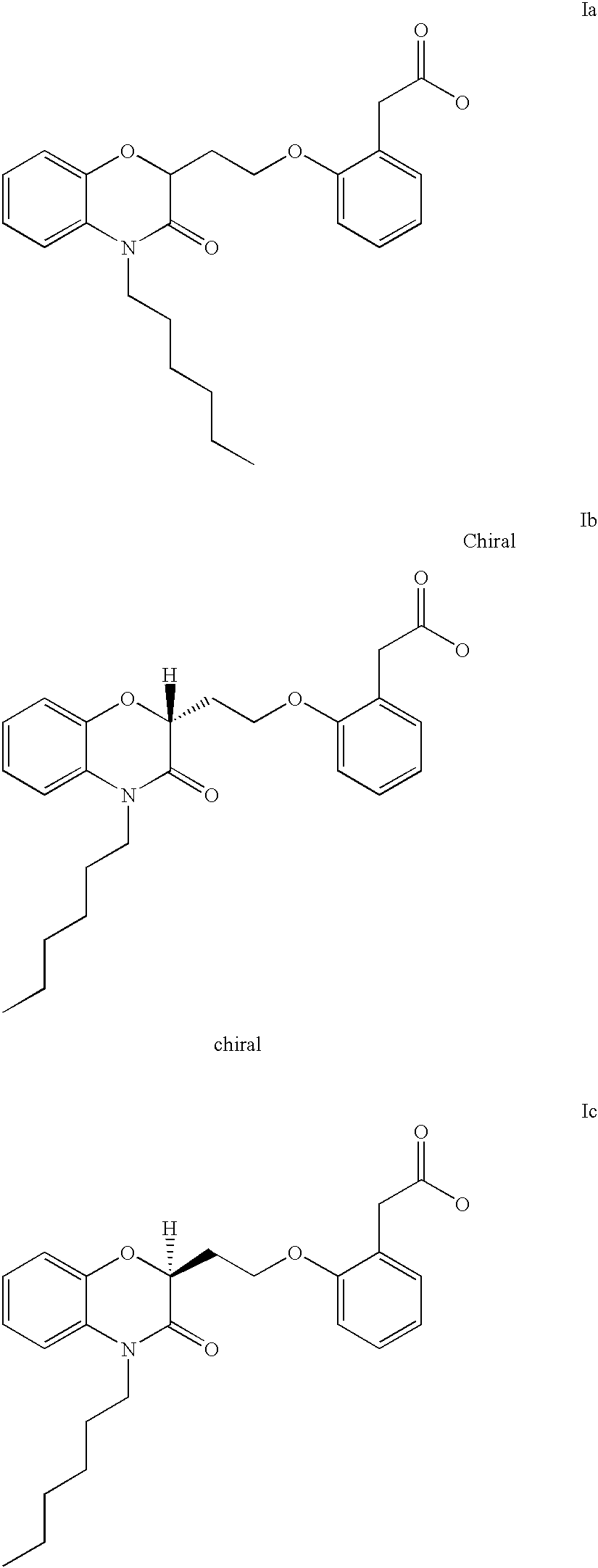
Unless otherwise noted, “alkyl” and “alkoxy” as used herein, whether used alone or as part of a substituent group, include straight and branched chains having 1 to 10 carbon atoms, or any number within this range. For example, alkyl radicals include methyl, ethyl, n-propyl, isopropyl, n-butyl, isobutyl, sec-butyl, t-butyl, n-pentyl, 3-(2-methyl)butyl, 2-pentyl, 2-methylbutyl, neopentyl, n-hexyl, 2-hexyl, 2-methylpentyl, and the like. Alkoxy radicals are oxygen ethers formed from the previously described straight or branched chain alkyl groups. Cycloalkyl groups contain 3 to 8 ring carbons and preferably 5 to 7 ring carbons. Similarly, alkenyl and alkynyl groups include straight and branched chain alkenes and alkynes having 1 to 10 carbon atoms, or any number within this range.
Unless otherwise stated, “aryl,” employed alone or in combination with other terms (e.g., aryloxy, arylthioxy, arylalkyl), is an aromatic radical which can be a single ring or multiple rings which are fused together or linked covalently. Illustrative aryl groups may be phenyl or naphthyl optionally substituted with one or more of the following: H, C1-C10 alkyl, C3-C8 cycloalkyl, COOR1, CONR1R2, OH, C1-C10 alkyl ether, aryl or heterocyclyl ether, OC(O)R1, OC(O)OR1, OC(O)NR1R2, NR1R2, NR3C(O)R1, NR3C(O)OR1, NR3C(O)NR1R2, halogen or halo (F, Cl, Br, I).
“Heterocyclyl” or “heterocycle” is a 3- to 8-member saturated or unsaturated heterocyclic group containing 1-4 nitrogens, an oxygen, or a sulfur atom; or one nitrogen and either oxygen or sulfur.
It is intended that the definition of any substituent or variable at a particular location in a molecule be independent of its definitions elsewhere in that molecule. It is understood that substituents and substitution patterns on the compounds of this invention can be selected by one of ordinary skill in the art to provide compounds that are chemically stable and that can be readily synthesized by techniques known in the art as well as those methods set forth herein.
As used herein, the term “composition” is intended to encompass a product comprising the specified ingredients in the specified amounts, as well as any product which results, directly or indirectly, from combinations of the specified ingredients in the specified amounts.
The term “subject” as used herein, refers to an animal, preferably a mammal, most preferably a human, who has been the object of treatment, observation or experiment.
Methods are known in the art for determining therapeutically and prophylactically effective doses for the instant pharmaceutical composition. The term “therapeutically effective amount” as used herein, means that amount of active compound or pharmaceutical agent that elicits the biological or medicinal response in a tissue system, animal or human that is being sought by a researcher, veterinarian, medical doctor or other clinician, which includes alleviation of the symptoms of the disease or disorder being treated. The term “prophylactically effective amount” refers to that amount of active compound or pharmaceutical agent that inhibits in a subject the onset of a disorder as being sought by a researcher, veterinarian, medical doctor or other clinician, the delaying of which disorder is mediated by modulating the actions of PPARγ.
Depending upon the biological environment (e.g., cell type, pathological condition of the host, etc.), these compounds can activate or block the actions of PPARγ. The utility of the compounds to treat the above disorders in glucose and lipid metabolism can be determined according to the procedures described herein. The present invention therefore provides a method of treating disorders in glucose and lipid metabolism in a subject in need thereof which comprises administering any of the compounds as defined herein in a quantity effective to treat such disorders. The compound may be administered to a patient by any conventional route of administration, including, but not limited to, intravenous, oral, subcutaneous, intramuscular, intradermal and parenteral.
The present invention also provides pharmaceutical compositions comprising one or more compounds of this invention in association with a pharmaceutically acceptable carrier. The pharmaceutical composition may contain between about 0.1 mg and 1000 mg, preferably about 100 to 500 mg, of the compound, and may be constituted into any form suitable for the mode of administration selected. Carriers include necessary and inert pharmaceutical excipients, including, but not limited to, binders, suspending agents, lubricants, flavorants, sweeteners, preservatives, dyes, and coatings. Compositions suitable for oral administration include solid forms, such as pills, tablets, caplets, capsules (each including immediate release, timed release and sustained release formulations), granules, and powders, and liquid forms, such as solutions, syrups, elixirs, emulsions, and suspensions. Forms useful for parenteral administration include sterile solutions, emulsions and suspensions.
To prepare the pharmaceutical compositions of this invention, one or more compounds of the present invention or salt thereof of the invention as the active ingredient, is intimately admixed with a pharmaceutical carrier according to conventional pharmaceutical compounding techniques, which carrier may take a wide variety of forms depending on the form of preparation desired for administration, e.g., oral or parenteral such as intramuscular. In preparing the compositions in oral dosage form, any of the usual pharmaceutical media may be employed. Thus, for liquid oral preparations, such as for example, suspensions, elixirs and solutions, suitable carriers and additives include water, glycols, oils, alcohols, flavoring agents, preservatives, coloring agents and the like; for solid oral preparations such as, for example, powders, capsules, caplets, gelcaps and tablets, suitable carriers and additives include starches, sugars, diluents, granulating agents, lubricants, binders, disintegrating agents and the like. Because of their ease in administration, tablets and capsules represent the most advantageous oral dosage unit form, in which case solid pharmaceutical carriers are obviously employed. If desired, tablets may be sugar coated or enteric coated by standard techniques. For parenterals, the carrier will usually comprise sterile water, though other ingredients, for example, for purposes such as aiding solubility or for preservation, may be included. Injectable suspensions may also be prepared, in which case appropriate liquid carriers, suspending agents and the like may be employed. The pharmaceutical compositions herein will contain, per dosage unit, e.g., tablet, capsule, powder, injection, teaspoonful and the like, an amount of the active ingredient necessary to deliver an effective dose as described above. The pharmaceutical compositions herein will contain, per unit dosage unit, e.g., tablet, capsule, powder, injection, suppository, teaspoonful and the like, from about 0.01 mg to 30 mg/kg of body weight per day. Preferably, the range is from about 0.03 to about 15 mg/kg of body weight per day, most preferably, from about 0.05 to about 10 mg/kg of body weight per day. The compounds may be administered on a regimen of 1 to 2 times per day. The dosages, however, may be varied depending upon the requirement of the patients, the severity of the condition being treated and the compound being employed. The use of either daily administration or post-periodic dosing may be employed.
Preferably these compositions are in unit dosage forms such as tablets, pills, capsules, powders, granules, sterile parenteral solutions or suspensions, metered aerosol or liquid sprays, drops, ampoules, auto-injector devices or suppositories; for oral parenteral, intranasal, sublingual or rectal administration, or for administration by inhalation or insufflation. Alternatively, the composition may be presented in a form suitable for once-weekly or once-monthly administration; for example, an insoluble salt of the active compound, such as the decanoate salt, may be adapted to provide a depot preparation for intramuscular injection. For preparing solid compositions such as tablets, the principal active ingredient is mixed with a pharmaceutical carrier, e.g. conventional tableting ingredients such as corn starch, lactose, sucrose, sorbitol, talc, stearic acid, magnesium stearate, dicalcium phosphate or gums, and other pharmaceutical diluents, e.g. water, to form a solid preformulation composition containing a homogeneous mixture of a compound of the present invention, or a pharmaceutically acceptable salt thereof. When referring to these preformulation compositions as homogeneous, it is meant that the active ingredient is dispersed evenly throughout the composition so that the composition may be readily subdivided into equally effective dosage forms such as tablets, pills and capsules. This solid preformulation composition is then subdivided into unit dosage forms of the type described above containing from 0.1 to about 500 mg of the active ingredient of the present invention. The tablets or pills of the novel composition can be coated or otherwise compounded to provide a dosage form affording the advantage of prolonged action. For example, the tablet or pill can comprise an inner dosage and an outer dosage component, the latter being in the form of an envelope over the former. The two components can be separated by an enteric layer which serves to resist disintegration in the stomach and permits the inner component to pass intact into the duodenum or to be delayed in release. A variety of materials can be used for such enteric layers or coatings, such materials including a number of polymeric acids with such materials as shellac, cetyl alcohol and cellulose acetate.
The liquid forms in which the novel compositions of the present invention may be incorporated for administration orally or by injection include, aqueous solutions, suitably flavoured syrups, aqueous or oil suspensions, and flavoured emulsions with edible oils such as cottonseed oil, sesame oil, coconut oil or peanut oil, as well as elixirs and similar pharmaceutical vehicles. Suitable dispersing or suspending agents for aqueous suspensions, include synthetic and natural gums such as tragacanth, acacia, alginate, dextran, sodium carboxymethylcellulose, methylcellulose, polyvinyl-pyrrolidone or gelatin. The liquid forms in suitably flavored suspending or dispersing agents may also include the synthetic and natural gums, for example, tragacanth, acacia, methyl-cellulose and the like. For parenteral administration, sterile suspensions and solutions are desired. Isotonic preparations which generally contain suitable preservatives are employed when intravenous administration is desired.
Advantageously, compounds of the present invention may be administered in a single daily dose, or the total daily dosage may be administered in divided doses of two, three or four times daily. Furthermore, compounds for the present invention can be administered in intranasal form via topical use of suitable intranasal vehicles, or via transdermal skin patches well known to those of ordinary skill in that art. To be administered in the form of a transdermal delivery system, the dosage administration will, of course, be continuous rather than intermittent throughout the dosage regimen.
For instance, for oral administration in the form of a tablet or capsule, the active drug component can be combined with an oral, non-toxic pharmaceutically acceptable inert carrier such as ethanol, glycerol, water and the like. Moreover, when desired or necessary, suitable binders; lubricants, disintegrating agents and coloring agents can also be incorporated into the mixture. Suitable binders include, without limitation, starch, gelatin, natural sugars such as glucose or beta-lactose, corn sweeteners, natural and synthetic gums such as acacia, tragacanth or sodium oleate, sodium stearate, magnesium stearate, sodium benzoate, sodium acetate, sodium chloride and the like. Disintegrators include, without limitation, starch, methyl cellulose, agar, bentonite, xanthan gum and the like.
The daily dosage of the products may be varied over a wide range from 1 to 1000 mg per adult human per day. For oral administration, the compositions are preferably provided in the form of tablets containing, 0.01, 0.05, 0.1, 0.5, 1.0, 2.5, 5.0, 10.0, 15.0, 25.0, 50.0, 100, 150, 200, 250 and 500 milligrams of the active ingredient for the symptomatic adjustment of the dosage to the patient to be treated. An effective amount of the drug is ordinarily supplied at a dosage level of from about 0.01 mg/kg to about 30 mg/kg of body weight per day. Particularly, the range is from about 0.03 to about 15 mg/kg of body weight per day, and more particularly, from about 0.05 to about 10 mg/kg of body weight per day. The compounds may be administered on a regimen of 1 to 2 times per day.
Optimal dosages to be administered may be readily determined by those skilled in the art, and will vary with the particular compound used, the mode of administration, the strength of the preparation, the mode of administration, and the advancement of the disease condition. In addition, factors associated with the particular patient being treated, including patient age, weight, diet and time of administration, will result in the need to adjust dosages.
The compound of the present invention can also be administered in the form of liposome delivery systems, such as small unilamellar vesicles, large unilamellar vesicles, and multilamellar vesicles. Liposomes can be formed from a variety of lipids, including but not limited to amphipathic lipids such as phosphatidylcholines, sphingomyelins, phosphatidylethanolamines, phophatidylcholines, cardiolipins, phosphatidylserines, phosphatidylglycerols, phosphatidic acids, phosphatidylinositols, diacyl trimethylammonium propanes, diacyl dimethylammonium propanes, and stearylamine, neutral lipids such as triglycerides, and combinations thereof. They may either contain cholesterol or may be cholesterol-free.
From Formula I it is evident that some of the compounds of the invention may have one or more asymmetric carbon atoms in their structure. As represented in Formulae Ib and Ic, the exo/endo orientation of a single bond is indicated by dotted hash (into the page) and solid hash (out of the page), respectively. It is intended that the present invention includes within its scope the stereochemically pure isomeric forms of the compounds as well as their racemates. Stereochemically pure isomeric forms may be obtained by the application of art known principles. Diastereoisomers may be separated by physical separation methods such as fractional crystallization and chromatographic techniques, and enantiomers may be separated from each other by the selective crystallization of the diastereomeric salts with optically active acids or bases or by chiral chromatography. Pure stereoisomers may also be prepared synthetically from appropriate stereochemically pure starting materials, or by using stereoselective reactions.
During any of the processes for preparation of the compounds of the present invention, it may be necessary and/or desirable to protect sensitive or reactive groups on any of the molecules concerned. This may be achieved by means of conventional protecting groups, such as those described in Protective Groups in Organic Chemistry, ed. J. F. W. McOmie, Plenum Press, 1973; and T. W. Greene & P. G. M. Wuts, Protective Groups in Organic Synthesis, Third Edition, John Wiley & Sons, 1999. The protecting groups may be removed at a convenient subsequent stage using methods known from the art.
The chemistry of preparing compounds of Formula I is described in detail in U.S. Pat. Nos. 5,696,117 and 5,854,242, both to Frechette et al., and WO 97/17333 (Frechette et al.), all of which are hereby incorporated by reference in their entirety.
This invention will be better understood by reference to the schemes and examples that follow, but those skilled in the art will readily appreciate that these are only illustrative of the invention as described more fully in the claims which follow thereafter.
The compounds of Formula I may be synthesized with the chemistry outlined in Scheme 1 wherein
Z1 is hydrogen, halogen, C1-C6 alkyl, C1-C6 alkoxy, phenyl, OH, amino, nitro, sulfonylamino or trifluoromethyl;
Z2 is hydrogen or halogen;
A is hexyl;
n is an integer from 0-3; and
G is selected from
(a) NHR1R2, N+R1R2R3;
(b) NHC(NR4)NR5;
(c) CO2H, CHO;
(d) CH(R6)COOH, CH(R6)COOCH3, CH═CHR7, CH═C(COOH)2;
(e) a moiety of the formula 
(f) 5-tetrazolyl,
wherein
R1, R2 and R3 are independently hydrogen, C1-C6 alkyl, or t-butoxycarbonyl;
R4 and R5 are independently t-butoxycarbonyl or hydrogen, or R4 and R5 may be joined together to form an imidazoline, imidazolyl or pyrimidine ring;
R6 is hydrogen, hydroxy, or halogen; and
R7 is CO2H or C(O)NH(CH2)pOH wherein p is an integer from 1-4. 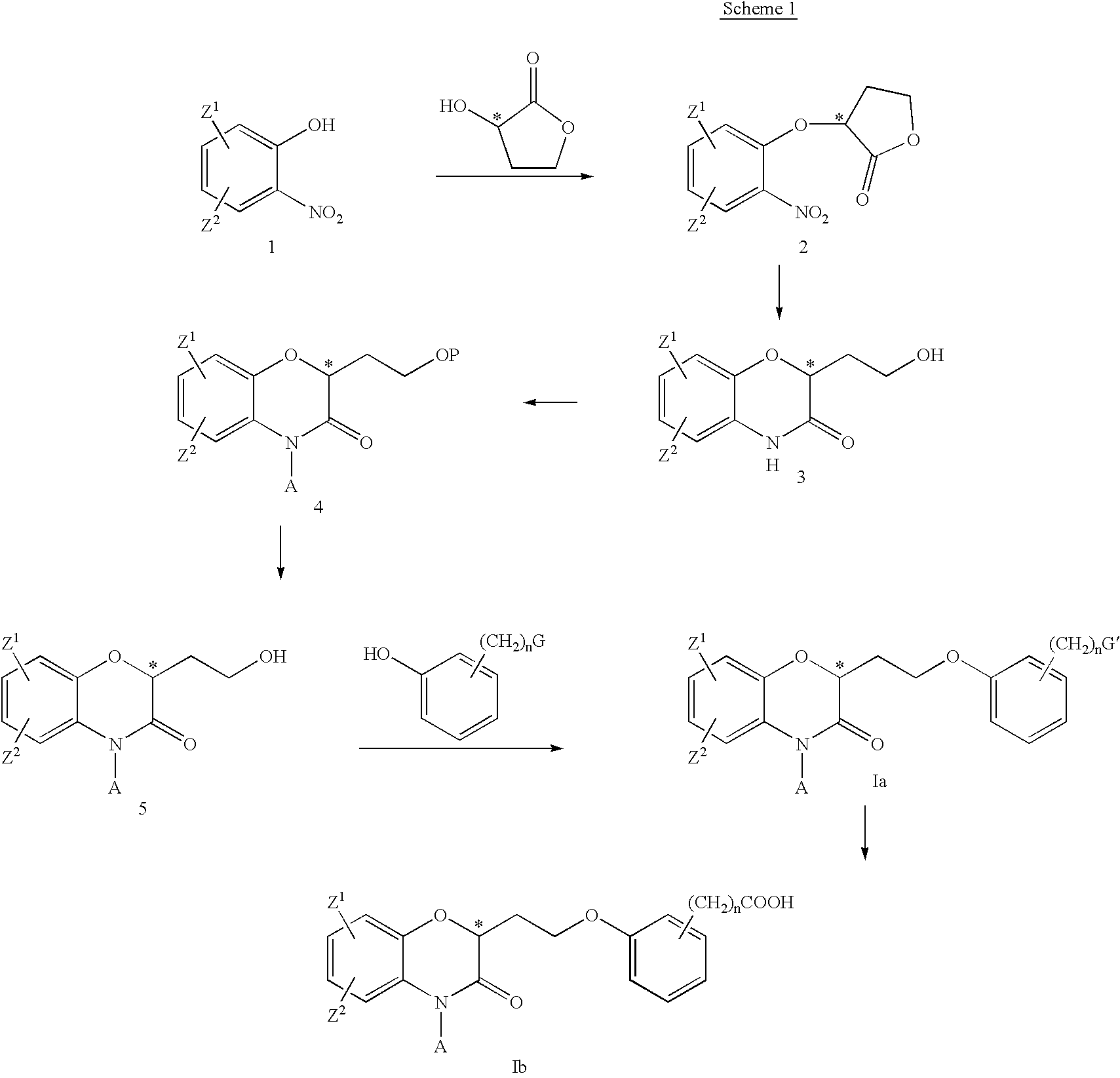
In accordance with Scheme 1, the benzoxazinones can be made by conversion of a compound of the Formula 1 to a compound of the Formula 2. For example, when a chiral alcohol, such as (S)- or (R)-2-hydroxybutyrolactone, is coupled under conditions that preserve stereochemical integrity, either by retention or inversion of absolute configuration, a chiral compound of the Formula 2 is obtained. A particularly useful example of this transformation is the use of the Mitsunobu reaction, which is delineated in the examples. In this reaction, a compound of the Formula 1 is exposed to a chiral secondary alcohol, such as 2-hydroxybutyrolactone, a phosphine, such as triphenylphosphine or tributylphosphine, and an azo compound, such as diethylazo dicarboxylate or the like, in a variety of non-protic solvents, such as THF, benzene, or DMF, to provide the corresponding ether of the general Formula 2. Maintaining stereochemical integrity throughout the course of the process provides chiral products Ia and Ib. For example, the ether of the general Formula 2 is reduced to yield compound of the Formula 3 with a reagent such as hydrogen gas or ammonium formate, and a catalyst, such as palladium or platinum, in an appropriate solvent, such as methanol, ethanol, or ethyl acetate, at an appropriate temperature. The primary alcohol is protected with a variety of reagents, such as tert-butyldimethylsilyl chloride and imidazole, in a non-protic polar solvent, such as DMF or THF, with or without heating. The choice of protecting group may be easily determined by one skilled in the art. Substitution of the amide of the general Formula 3 by deprotonation with a base, such as an alkali metal hydride, in a non-protic polar solvent, such as DMF (N,N-dimethylformamide) or THF (tetrahydrofuran), and addition of an alkyl halide or mesylate or tosylate or the like followed by deprotection of the alcohol gives compounds of general Formula 4. The choice of deprotection methods may be easily determined by one skilled in the art. The ether of the general Formula 5 can be obtained by a reaction such as the Mitsunobu reaction as described by Frechette, et al., and delineated in the following examples. Deprotection of the alcohol gives the corresponding compounds of Formula 6 that can be further converted to the alkyl aryl ether of Formula Ia by adding HO—Ar—(CH2)nG′ (G′ is G as described above other than —COOH), which are commercially available and/or may be readily prepared by known methods. Thus deprotection of the ester to the acid yields the desired product of Formula Ib.
The following examples are intended to illustrate the invention but not to limit it.
Proton NMR was performed on a Bruker 300 MHz NMR spectrometer; J values are reported in Hertz.
A mixture of 2-nitrophenol (20 g, 0.14 mol) and K2CO3 (25.2 g, 0.18 mol) in 280 mL DMF (N,N-dimethylformamide) was cooled to 0° C. 2-Bromobutyrolactone was added dropwise, the reaction was stirred for 45 min at 0° C., then stirred at room temperature for 3 hours (h). The mixture was poured into 2 L water containing approx. 200 g salt, and the solution was washed with 6×100 mL of 1:1 diethyl ether/ethyl acetate. The combined organics were washed with 2×100 mL sat'd aq. K2CO3, 5×100 mL water and 100 mL brine, dried (Na2SO4), and filtered. Solvent was removed in vacuo to yield a phenolic ether (2(3H)-furanone, dihydro-3-(2-nitrophenoxy)-) as an off-white solid (21.88 g, 0.1 mol). 1H (CDCl3): 7.84 (d, 1H, J=7.9), 7.57 (t, 1H, J=7.5), 7.49 (d, 1H, J=7.9), 7.16 (t, 1H, J=7.5), 5.03 (t, 1H, J=7.4), 4.58 (m, 1H), 4.42 (m, 1H), 2.8-2.6 (m, 2H).
The phenolic ether (2(3H)-furanone, dihydro-3-(2-nitrophenoxy)-, 21.88 g, 0.1 mol) was suspended in 200 mL ethanol and 200 mL EtOAc, then shaken overnight with 10% Pd/C and H2 (45 psi) at room temperature. The solution was filtered through Celite and solvent was removed in vacuo. The crude benzoxazinone (2H-1,4-benzoxazin-3(4H)-one, 2-(2-hydroxyethyl)-) was dissolved in 200 anh. DMF, imidazole (14.1 g, 0.21 mol) was added, and the solution was cooled to 0° C. tert-Butyldimethylsilyl chloride (31.2 g, 0.21 mol) was added as a solid and the reaction was stirred overnight, under N2, as the bath thawed. The reaction was poured into 1.4 L water containing approx. 200 g salt, and washed with 4×150 mL of 4:1 diethyl ether/EtOAc. The combined organics were washed with 6×100 mL water and 100 mL brine. The organics were dried (Na2SO4), filtered, and solvent was removed in vacuo. The product was isolated by silica gel chromatography with hexane/ethyl acetate. Obtain the silyl ether (2H-1,4-benzoxazin-3(4H)-one, 2-[2-[[(1,1-dimethylethyl)dimethylsilyl]oxy]ethyl]-) as a volatile solid (7.0 g, 0.022 mol). 1H (CDCl3): 6.89 (m, 3H), 6.80 (m, 1H), 4.70 (m, 1H), 3.78 (m, 2H), 2.15 (m, 1H), 1.94 (m, 1H), 0.83 (s, 9H), 0.07 (s, 6H).
A solution of (2H-1,4-benzoxazin-3(4H)-one, 2-[2-[[(1,1-dimethylethyl)dimethylsilyl]oxy]ethyl]-, 15.00 g, 0.049 mol) in 250 mL anh. DMF, under N2, was cooled to 0° C. Sodium hydride (75% dispersion in oil, 1.62 g, 0.054 mol) was added in two portions of 0.81 g with five minute intervals between additions. The solution was stirred for and additional 40 min at 0° C. 1-Iodohexane (7.2 mL, 0.049 mol) in 20 mL DMF was added dropwise, the ice bath was replaced with an oil bath, and the solution was stirred at 65° C. for 5 h. The mixture was cooled to room temperature and poured into 1.5 L water containing approx. 200 g salt. The aqueous mixture was washed with 4×125 mL of 1:1 diethyl ether/ethyl acetate. The combined organic were washed with 6×125 mL water and 125 mL brine. The organics were dried (Na2SO4), filtered, and solvent was removed in vacuo. The product was isolated by silica gel chromatography with hexane/ethyl acetate. The alkylated amide (2H-1,4-benzoxazin-3(4H)-one, 2-[2-[[(1,1-dimethylethyl)dimethylsilyl]oxy]ethyl]-4-hexyl-) was obtained as a colorless oil (18.03 g, 0.046 mol). 1H (CDCl3): 7.0 (m, 4H), 4.72 (dd, 1H, J=10.0, 3.6), 3.95-3.75 (m, 4H), 2.17 (m, 1H), 1.93 (m, 1H), 1.33 (m, 6H), 0.89 (s, 12H), 0.07 (s, 6H).
Silyl ether (2H-1,4-benzoxazin-3(4H)-one, 2-[2-[[(1,1-dimethylethyl)dimethylsilyl]oxy]ethyl]-4-hexyl-) was dissolved in 75 mL methanol and 3 mL water. Methanesulfonic acid (0.5 mL) was added and the mixture was stirred at room temperature for 2 h. Solvent was removed in vacuo and the product was isolated by silica gel chromatography with hexane/ethyl acetate. The primary alcohol (2H-1,4-benzoxazin-3(4H)-one, 4-hexyl-2-(2-hydroxyethyl)-) was obtained as a colorless oil (11.16 g, 0.04 mol). 1H (CDCl3) 7.01 (m, 4H), 4.69 (t, 1H, J=7.0), 3.88 (m, 4H), 2.44 (t, 1H, J=5.8), 2.20 (m, 2H), 1.65 (m, 2H), 1.33 (m, 6H), 0.89 (br t, 3H).
A solution of (2H-1,4-benzoxazin-3(4H)-one, 4-hexyl-2-(2-hydroxyethyl)-, 11.16 g, 0.04 mol), (2-hydroxyphenyl)acetic acid (10 g, 0.06 mol), and tributylphosphine (14.9 mL, 0.06 mol) in 670 mL anhydrous benzene, under N2, was cooled to 4° C. 1,1′-(Azodicarbonyl)dipiperidine (15.1 g, 0.06 mol) was added in one portion, and the solution was stirred, with an overhead stirrer, at room temperature overnight. The organic phase was washed with 4×50 mL 2 N NaOH, 50 mL water and 50 mL brine. The organics were dried (Na2SO4), filtered, and solvent was removed in vacuo. The product was purified by silica gel chromatography with hexane/ethyl acetate. The ester (benzeneacetic acid, 2-[2-(4-hexyl-3,4-dihydro-3-oxo-2H-1,4-benzoxazin-2-yl)ethoxy]-, methyl ester) was obtained as a colorless oil (9.7 g, 0.023 mol). 1H (CDCl3): 7.28-6.89 (m, 8H), 4.76 (dd, 1H, J=9.4, 4), 4.28-4.21 (m, 2H), 3.92 (t, 2H, J=7.7), 3.60 (two singlets, 5H), 2.49 (m, 1H), 2.23 (m, 1H), 1.66 (m, 2H), 1.34 (m, 6H), 0.89 (br t, 3H).
A solution of (benzeneacetic acid, 2-[2-(4-hexyl-3,4-dihydro-3-oxo-2H-1,4-benzoxazin-2-yl)ethoxy]-, methyl ester, 26.5 g, 0.062 mol) in 500 mL THF was cooled to 0° C. 200 mL 0.95 N aq. LiOH (0.19 mol LiOH) at 10° C. was added in one portion. The solution was stirred at room temperature overnight, open to air. The solution was poured into 1.2 L water and 11 mL conc. HCl. Extract with 4×120 mL dichloromethane. The combined organics were washed with 120 mL water/60 mL brine combination, dried (MgSO4), and filtered. Solvent was removed in vacuo. The oily residue was diluted with 1 L pentane and 200 mL diethyl ether, heated on a steam bath, and scratched with a frosted glass rod until the material became a white solid. The mixture was cooled to 0° C. for 1.5 hours, then filtered and washed with 2×100 mL pentane. The amorphous white solid (the title compound) was dried in a vacuum oven at 40° C. (21.5 g, 0.052 mol). m.p. 80.0-81.5° C. 1H (CDCl3) 7.28-6.89 (m, 8H), 4.88 (dd, 1H, J=9, 3.5), 4.20 (m, 2H), 3.91 (t, 2H, J=7.8), 3.67 (d, 1H, J=16), 3.60 (d, 1H, J=16), 2.43 (m, 1H), 2.23 (m, 1H), 1.65 (m, 2H), 1.33 (m, 6H), 0.88 (br t, 3H).
The steps below describe the stereospecific synthesis of benzeneacetic acid, 2-[2-[(2R)-4-hexyl-3,4-dihydro-3-oxo-2H-1,4-benzoxazin-2-yl]ethoxy]-.
(S)-(−)-α-Hydroxy-γ-butyrolactone was purchased and used in the first step. Proton NMR was performed on a Bruker 300 MHz NMR spectrometer, J values are reported in Hertz. Stereochemical integrity was confirmed for 2(3H)-furanone, dihydro-3-(2-nitrophenoxy)-, (3R)-, 2H-1,4-benzoxazin-3(4H)-one, 4-hexyl-2-(2-hydroxyethyl)-, (2R)-, and final product (the title compound) with chiral HPLC. The analytical chiral HPLC was performed on a Hewlett-Packard 1090 Series II AminoQuant HPLC fitted with a Daicel Chemical Industries, LTD Chiralpak AD column (4.6 mm×25 cm). Sample concentration was 1 mg/mL in eluting solvent, flow rate was 1 mL/min, UV detection was at 254 nm. Solvent and retention time of the chiral and racemic are listed with the individual experimental.
2(3H)-furanone, dihydro-3-(2-nitrophenoxy)-, (3R)-
A solution of 2-nitrophenol (27.8 g, 0.2 mol), (S)-(−)-α-hydroxy-γ-butyrolactone (15.3 mL, 0.2 mol) and triphenylphosphine (78.6 g, 0.3 mol) in 550 mL anhydrous THF, under N2, was cooled to −20° C. A room temperature solution of diethylazodicarboxylate (DEAD, 47.5 mL, 0.3 mol) in 20 mL THF was added dropwise over 30 min. The reaction was stirred for 17 h as the cold bath thawed. The mixture was poured into 3 L water containing approx. 200 g salt, and the solution was washed with 6×100 mL of 1:1 diethyl ether/ethyl acetate. The combined organics were washed with 5×100 mL water and 100 mL brine, dried (Na2SO4), and filtered. The crude product was chromatographed on silica using CH2Cl2, then 95:5 CH2Cl2/ethyl acetate to yield slightly impure product and impure product. A second column was run on the impure product from the first column, eluting with 7:3 CH2Cl2/hexane, then CH2Cl2. The product from the second column was crystallized from ethyl acetate/hexane to yield 12.28 g of 2(3H)-furanone, dihydro-3-(2-nitrophenoxy)-, (3R)- as a pale yellow solid. The supernatant was combined with the slightly impure 2(3H)-furanone, dihydro-3-(2-nitrophenoxy)-, (3R)- from the first column and crystallized from ethyl acetate/hexane to yield 8.88 g of 2(3H)-furanone, dihydro-3-(2-nitrophenoxy)-, (3R)- as a pale yellow solid (12.28 g+8.88 g=21.16 g, 0.095 mol). 1H (CDCl3): 7.84 (d, 1H, J=7.9), 7.57 (t, 1H, J=7.5), 7.49 (d, 1H, J=7.9), 7.16 (t, 1H, J=7.5), 5.03 (t, 1H, J=7.4), 4.58 (m, 1H), 4.42 (m, 1H), 2.8-2.6 (m, 2H). By HPLC the enantiomeric purity was >99% for each crystalline sample (8:2 hexane/isopropanol, ret. time chiral=13.8 min, ret. time racemic=11.1 min, 13.7 min).
2H-1,4-benzoxazin-3(4H)-one, 2-[2-[[(1,1-dimethylethyl)dimethylsilyl]oxy]ethyl]-, (2R)-
The phenolic ether (2(3H)-furanone, dihydro-3-(2-nitrophenoxy)-, (3R)-, 21.16 g, 0.095 mol) was suspended in 400 mL ethanol, then shaken for 3 h with 10% Pd/C and H2 (45 psi) at room temperature. The solution was filtered through Celite and solvent was removed in vacuo. The crude benzoxazinone (2H-1,4-benzoxazin-3(4H)-one, 2-(2-hydroxyethyl)-, (2R)-, calc. for 18.4 g, 0.095 mol) was dissolved in 200 anh. DMF, imidazole (16.3 g, 0.24 mol) was added, and the solution was cooled to 0° C. tert-Butyldimethylsilyl chloride (28.6 g, 0.19 mol) was added as a solid and the reaction was stirred overnight, under N2, as the bath thawed. The reaction was poured into 1.4 L water containing approx. 200 g salt, and washed with 4×150 mL of 4:1 diethyl ether/dichloromethane. The combined organics were washed with 6×100 mL water and 100 mL brine. The organics were dried (Na2SO4), filtered, and solvent was removed in vacuo. The product was isolated by silica gel chromatography with hexane/ethyl acetate. Obtain the silyl ether (2H-1,4-benzoxazin-3(4H)-one, 2-[2-[[(1,1-dimethylethyl)dimethylsilyl]oxy]ethyl]-, (2R)-) as a volatile solid (26.75 g, 0.087 mol). 1H (CDCl3): 6.89 (m, 3H), 6.80 (m, 1H), 4.70 (m, 1H), 3.78 (m, 2H), 2.15 (m, 1H), 1.94 (m, 1H), 0.83 (s, 9H), 0.07 (s, 6H). HPLC was not obtained due to the lipophilicity of the compound.
2H-1,4-benzoxazin-3(4H)-one, 2-[2-[[(1,1-dimethylethyl)dimethylsilyl]oxy]ethyl]-4-hexyl-, (2R)-
A solution of (2H-1,4-benzoxazin-3(4H)-one, 2-[2-[[(1,1-dimethylethyl)dimethylsilyl]oxy]ethyl]-, (2R)-, 26.75 g, 0.087 mol) in 435 mL anh. DMF, under N2, was cooled to 0° C. Sodium hydride (75% dispersion in oil, 2.48 g, 0.083 mol) was added in four portions of 0.62 g with five minute intervals between additions. The solution was stirred for and additional 40 min at 0° C. 1-Iodohexane (12.8 mL, 0.087 mol) in 25 mL DMF was added dropwise, the ice bath was replaced with an oil bath, and the solution was stirred at 65° C. overnight. The mixture was cooled to room temperature and poured into 3 L water containing approx. 200 g salt. The aqueous mixture was washed with 4×125 mL of 1:1 diethyl ether/ethyl acetate. The combined organic were washed with 6×125 mL water and 125 mL brine. The organics were dried (Na2SO4), filtered, and solvent was removed in vacuo. The product was isolated by silica gel chromatography with hexane/ethyl acetate. The alkylated amide (2H-1,4-benzoxazin-3(4H)-one, 2-[2-[[(1,1-dimethylethyl)dimethylsilyl]oxy]ethyl]-4-hexyl-, (2R)-) was obtained as a colorless oil. 1H (CDCl3): 7.0 (m, 4H), 4.72 (dd, 1H, J=10.0, 3.6), 3.95-3.75 (m, 4H), 2.17 (m, 1H), 1.93 (m, 1H), 1.33 (m, 6H), 0.89 (s, 12H), 0.07 (s, 6H).
2H-1,4-benzoxazin-3(4H)-one, 4-hexyl-2-(2-hydroxyethyl)-, (2R)-
Silyl ether (2H-1,4-benzoxazin-3(4H)-one, 2-[2-[[(1,1-dimethylethyl)dimethylsilyl]oxy]ethyl]-4-hexyl-, (2R)-) was dissolved in 150 mL methanol. 6 N aq. HCl (0.5 mL) was added and the mixture was stirred at room temperature for 5 h. Solvent was removed in vacuo and the product was isolated by silica gel chromatography with hexane/ethyl acetate. The primary alcohol (2H-1,4-benzoxazin-3(4H)-one, 4-hexyl-2-(2-hydroxyethyl)-, (2R)-) was obtained as a colorless oil (16.7 g, 0.060 mol). 1H (CDCl3): 7.01 (m, 4H), 4.69 (t, 1H, J=7.0), 3.88 (m, 4H), 2.44 (t, 1H, J=5.8), 2.20 (m, 2H), 1.65 (m, 2H), 1.33 (m, 6H), 0.89 (br t, 3H). By HPLC the enantiomeric purity was 97.4:2.1 (9:1 hexane/isopropanol, ret. time chiral=7.5 min, ret. time racemic=7.6 min, 8.5 min).
Benzeneacetic acid, 2-[2-[(2R)-4-hexyl-3,4-dihydro-3-oxo-2H-1,4-benzoxazin-2-yl]ethoxy]-, methyl ester
A solution of (2H-1,4-benzoxazin-3(4H)-one, 4-hexyl-2-(2-hydroxyethyl)-, (2R)-) (16.7 g, 0.06 mol), (2-hydroxyphenyl)acetic acid (15 g, 0.09 mol), and tributylphosphine (22.4 mL, 0.09 mol) in 1 L anhydrous benzene, under N2, was cooled to 10° C. 1,1′-(Azodicarbonyl)dipiperidine (22.7 g, 0.09 mol) was added in one portion, and the solution was stirred, with an overhead stirrer, at room temperature overnight. 130 mL water was added and stirring continued for 40 minutes. The mixture was transferred to a separatory funnel. The organic phase was washed with 4×100 mL water, and 100 mL brine. The organics were dried (Na2SO4), filtered, and solvent was removed in vacuo. The product was purified by silica gel chromatography with hexane/ethyl acetate. The ester (benzeneacetic acid, 2-[2-[(2R)-4-hexyl-3,4-dihydro-3-oxo-2H-1,4-benzoxazin-2-yl]ethoxy]-, methyl ester) was obtained as a colorless oil (24.3 g, 0.057 mol). 1H (CDCl3): 7.28-6.89 (m, 8H), 4.76 (dd, 1H, J=9.4, 4), 4.28-4.21 (m, 2H), 3.92 (t, 2H, J=7.7), 3.60 (two singlets, 5H), 2.49 (m, 1H), 2.23 (m, 1H), 1.66 (m, 2H), 1.34 (m, 6H), 0.89 (br t, 3H).
Benzeneacetic acid, 2-[2-[(2R)-4-hexyl-3,4-dihydro-3-oxo-2H-1,4-benzoxazin-2-yl]ethoxy]-
A solution of (benzeneacetic acid, 2-[2-[(2R)-4-hexyl-3,4-dihydro-3-oxo-2H-1,4-benzoxazin-2-yl]ethoxy]-, methyl ester) (24.3 g, 0.057 mol) in 500 mL THF was cooled to 0° C. 200 mL 0.85 N aq. LiOH (0.17 mol LiOH) at 10° C. was added in one portion. The solution was stirred at room temperature overnight, open to air. The solution was poured into 1 L water and the solution was brought to pH 4 by portionwise addition of 28.5 mL of 6 N HCl. Extract with 4×120 mL dichloromethane. The combined organics were washed with 120 mL water/60 mL brine combination, dried (MgSO4), and filtered. Solvent was removed in vacuo. The oily residue was diluted with 1 L pentane and 200 mL diethyl ether, heated on a steam bath, and scratched with a frosted glass rod until the material became a white solid. The mixture was cooled to 0° C. for 1.5 hours, then filtered and washed with 2×100 mL pentane. The amorphous white solid (the title compound) was dried in a vacuum oven at 40° C. (17.5 g, 0.043 mol). m.p. 80.0-81.5° C. [α]D 25=+31.2° (c=1, CHCl3). 1H (CDCl3) 7.28-6.89 (m, 8H), 4.88 (dd, 1H, J=9, 3.5), 4.20 (m, 2H), 3.91 (t, 2H, J=7.8), 3.67 (d, 1H, J=16), 3.60 (d, 1H, J=16), 2.43 (m, 1H), 2.23 (m, 1H), 1.65 (m, 2H), 1.33 (m, 6H), 0.88 (br t, 3H). Passed elemental analysis (C, H, N). By HPLC the enantiomeric purity was 99:1 (80:20:0.1 hexane/isopropanol/trifluoroacetic acid, ret. time chiral=7.2 min, ret. time racemic=7.2 min, 8.7 min).
Twenty-four hours after the initial seeding of the 96-well plates by hand (around 20,000/well), the differentiation assay may be initiated. Medium may be removed and replaced with 150 ul of differentiation medium containing vehicle (DMSO) or test compounds with a known aP2 activator or such aP2 activator alone. Cells may be returned to incubator for 24 hours culture. At the termination of the challenge, medium may be removed and 100 μl of lysis buffer may be added to initiate the bDNA aP2 mRNA assay. The branched DNA assay may be performed according to the manufacturer's protocol (Bayer Diagnostics; Emeryville, Calif.). Result may be expressed as percent inhibition of aP2 mRNA production activated by the aP2 activator. IC50's may be determined by non-linear regression with a sigmoidal fit curve.
Following the challenge of the preadipocytes, cells may be lysed with lysis buffer (Bayer Diagnostics) containing the aP2 oligonucleotides. After a 15 minutes incubation at 53° C. or 30 minutes at 37° C. incubator, 70 μl of the lysis buffer from each well may be added to a corresponding capture well (preincubated with 70 μl of blocking buffer (Bayer Diagnostics)). The capture plate may be incubated overnight at 53° C. in a plate incubator (Bayer Diagnostics). After this incubation, the bDNA and labeled probes may be annealed as directed by the manufacturer. Following a 30-minute incubation with the luminescent alkaline phosphatase substrate, dioxitane, the luminescence may be quantitated in a Dynex MLX microtiter plate luminometer. Oligonucleotide probes designed to anneal to the aP2 mRNA and function in the bDNA mRNA detection system are designed with ProbeDesigner software (Bayer Diagnostics). This software package analyzes a target sequence of interest with a series of algorithms in order to determine which regions of the sequence can perform as locations for capture, label, or spacer probe annealing. The sequence of the oligonucleotides are as follows:
| CATTTTGTGAGTTTTCTAGGATTATTCTTTTCTCTTGGAAAGAAAGT | SEQ ID NO.1 | |
| ATGTTAGGTTTGGCCATGCCTTTCTCTTGGAAAGAAAGT | SEQ ID NO.2 | |
| CCTCTCGTTTTCTCTTTATGGTTTTCTCTTGGAAAGAAAGT | SEQ ID NO.3 | |
| GCTTATGCTCTCTCATAAACTCTCGTGGTTTCTCTTGGAAAGAAAGT | SEQ ID NO.4 | |
| CCAGGTACCTACAAAAGCATCACATTTAGGCATAGGACCCGTGTCT | SEQ ID NO.5 | |
| GCCCACTCCTACTTCTTTCATATAATCATTTAGGCATAGGACCCGTGTCT | SEQ ID NO.6 | |
| AGCCACTTTCCTGGTGGCAAATTTAGGCATAGGACCCGTGTCT | SEQ ID NO.7 | |
| CATCCCCATTCACACTGATGATCTTTAGGCATAGGACCCGTGTCT | SEQ ID NO.8 | |
| GTACCAGGACACCCCCATCTAAGGTTTTTAGGCATAGGACCCGTGTCT | SEQ ID NO.9 | |
| GGTTGATTTTCCATCCCATTTCTGCACATTTTAGGCATAGGACCCGTGTCT | SEQ ID NO.10 | |
| GCATTCCACCACCAGTTTATCATTTTAGGCATAGGACCCGTGTCT | SEQ ID NO.11 | |
| GCGAACTTCAGTCCAGGTCAACGTCCCTTGTTTAGGCATAGGACCCGTGTCT | SEQ ID NO.12 | |
| TCCCACAGAATGTTGTAGAGTTCAATTTTAGGCATAGGACCCGTGTCT | SEQ ID NO.13 | |
| AAAACAACAATATCTTTTTGAACAATATATTTAGGCATAGGACCCGTGTCT | SEQ ID NO.14 | |
| TCAAAGTTTTCACTGGAGACAAGTTT | SEQ ID NO.15 | |
| AAAGGTACTTTCAGATTTAATGGTGATCA | SEQ ID NO.16 | |
| CTGGCCCAGTATGAAGGAAATCTCAGTATTTTT | SEQ ID NO.17 | |
| TCTGCAGTGACTTCGTCAAATTC | SEQ ID NO.18 | |
| ATGGTGCTCTTGACTTTCCTGTCA | SEQ ID NO.19 | |
| AAGTGACGCCTTTCATGAC | SEQ ID NO.20 |
The procedure is described in detail in Burris et al., Molecular Endocrinology, 1999, 13:410, which is hereby incorporated by reference, and aP2 assay results of agonist intrinsic activity may be presented as fold increase over vehicle in induction of aP2 mRNA production. Table 1 below sets forth the mass spectra data and the agonist intrinsic activity of some compounds of the present invention.
| TABLE 1 |
| Some compounds of this invention |
 |
| Com- | Agonist | |||
| pound | MS; | Intrinsic | ||
| No. | A | Pos(n)G | MH+ | Activity |
| 1 | n-Hex | 2(1)COOH | 412 | 40.4 |
| 2 | R enant.; n-Hex | 2(1)COOH | 412 | — |
| 3 | S enant.; n-Hex | 2(1)COOH | 412 | — |
| 4 | n-Hex | 2(1)COOCH3 | 426 | — |
| Keys: Hex = hexyl. | ||||
While the foregoing specification teaches the principles of the present invention, with examples provided for the purpose of illustration, it will be understood that the practice of the invention encompasses all of the usual variations, adaptations and/or modifications as come within the scope of the following claims and their equivalents.
Claims (17)
1. A method of treating a subject suffering from a disorder in glucose and lipid metabolism, which comprises administering to the subject a therapeutically effective amount of the compound of the Formula (I), 
or an optical isomer, enantiomer, diastereomer, racemate or racemic mixture thereof, ester, prodrug form, or a pharmaceutically acceptable salt thereof, wherein
Q is a fused phenyl or fused pyridyl moiety;
Z1 is hydrogen, halogen, C1-C6 alkyl, C1-C6 alkoxy, phenyl, hydroxy, amino, nitro, sulfonylamino or trifluoromethyl;
Z2 is hydrogen or halogen;
X is hydrogen or oxygen;
n is an integer from 0-3; and
Y is selected from
(a) N+HR1R2, N+R1R2R3;
(b) NHC(═NR4)NHR5;
(c) CO2H, CHO;
(d) CH(R6)COOH, CH(R6)COOCH3, CH═CHR7, CH═C(COOH)2;
(e) a moiety of the formula 
(f) 5-tetrazolyl,
wherein
R1, R2 and R3 are independently hydrogen, C1-C 6 alkyl, or t-butoxycarbonyl;
R4 and R5 are independently t-butoxycarbonyl or hydrogen, or R4 and R5 may be joined together to form an imidazoline, imidazolyl or pyrimidine ring;
R6 is hydrogen, hydroxy, or halogen; and
R7 is CO2H or C(O)NH(CH2)pOH wherein p is an integer from 1-4.
2. A method of inhibiting in a subject the onset of a disorder in glucose and lipid metabolism, which comprises administering to the subject a prophylactically effective dose of a compound of the Formula (I), 
or an optical isomer, enantiomer, diastereomer, racemate or racemic mixture thereof, ester, prodrug form, or a pharmaceutically acceptable salt thereof, wherein
Q is a fused phenyl or fused pyridyl moiety;
Z1 is hydrogen, halogen, C1-C6 alkyl, C1-C6 alkoxy, phenyl, hydroxy, amino, nitro, sulfonylamino or trifluoromethyl;
Z2 is hydrogen or halogen;
X is hydrogen or oxygen;
n is an integer from 0-3; and
Y is selected from
(a) N+HR1R2, N+R1R2R3;
(b) NHC(═NR4)NHR5;
(c) CO2H, CHO;
(d) CH(R6)COOH, CH(R6)COOCH3, CH═CHR7, CH═C(COOH)2;
(e) a moiety of the formula 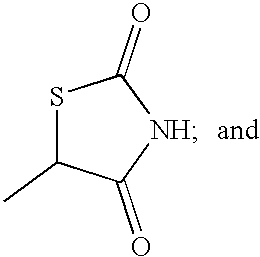
(f) 5-tetrazolyl,
wherein
R1, R2 and R3 are independently hydrogen, C1-C6 alkyl, or t-butoxycarbonyl;
R4 and R5 are independently t-butoxycarbonyl or hydrogen, or R4 and R5 may be joined together to form an imidazoline, imidazolyl or pyrimidine ring;
R6 is hydrogen, hydroxy, or halogen; and
R7 is CO2H or C(O)NH(CH2)pOH wherein p is an integer from 1-4.
3. A method of claim 1 wherein said disorder is a condition of reduced insulin sensitivity.
4. A method of claim 3 wherein said condition of reduced insulin sensitivity is Non-Insulin Dependant Diabetes Mellitus or obesity.
5. A method of claim 1 wherein said disorder is selected from nephropathy, neuropathy, retinopathy, atherosclerosis polycystic ovary syndrome, ischemia, hypertension, stroke, and heart disease.
6. A method of claim 1 , wherein Y is COOH or COOCH3.
7. A method of claim 2 , wherein Y is COOH or COOCH3.
8. A method of claim 1 , wherein R6 is hydrogen or halogen when n is 1.
9. A method of claim 6 , wherein the compound is selected from
benzeneacetic acid, 2-[2-(4-hexyl-3,4-dihydro-3-oxo-2H-1,4-benzoxazin-2-yl)ethoxy]-;
benzeneacetic acid, 2-[2-[(2R)-4-hexyl-3,4-dihydro-3-oxo-2H-1,4-benzoxazin-2-yl]ethoxy]-; and
benzeneacetic acid, 2-[2-[(2S)-4-hexyl-3,4-dihydro-3-oxo-2H-1,4-benzoxazin-2-yl]ethoxy]-.
10. A method of claim 9 , wherein said compound is benzeneacetic acid, 2-[2-(4-hexyl-3,4-dihydro-3-oxo-2H-1,4-benzoxazin-2-yl)ethoxy]-.
11. A method of claim 9 , wherein said compound is benzeneacetic acid, 2-[2-[(2R)-4-hexyl-3,4-dihydro-3-oxo-2H-1,4-benzoxazin-2-yl]ethoxy]-.
12. A method of claim 9 , wherein said compound is benzeneacetic acid, 2-[2-[(2S)-4-hexyl-3,4-dihydro-3-oxo-2H-1,4-benzoxazin-2-yl]ethoxy]-.
13. A method of claim 2 , wherein R6 is hydrogen or halogen when n is 1.
14. A method of claim 7 , wherein the compound is selected from
benzeneacetic acid, 2-[2-(4-hexyl-3,4-dihydro-3-oxo-2H-1,4-benzoxazin-2-yl)ethoxy]-;
benzeneacetic acid, 2-[2-[(2R)-4-hexyl-3,4-dihydro-3-oxo-2H-1,4-benzoxazin-2-yl]ethoxy]-; and
benzeneacetic acid, 2-[2-[(2S)-4-hexyl-3,4-dihydro-3-oxo-2H-1,4-benzoxazin-2-yl]ethoxy]-.
15. A method of claim 14 , wherein said compound is benzeneacetic acid, 2-[2-(4-hexyl-3,4-dihydro-3-oxo-2H-1,4-benzoxazin-2-yl)ethoxy]-.
16. A method of claim 14 , wherein said compound is benzeneacetic acid, 2-[2-[(2R)-4-hexyl-3,4-dihydro-3-oxo-2H-1,4-benzoxazin-2-yl]ethoxy]-.
17. A method of claim 14 , wherein said compound is benzeneacetic acid, 2-[2-[(2S)-4-hexyl-3,4-dihydro-3-oxo-2H-1,4-benzoxazin-2-yl]ethoxy]-.
Priority Applications (5)
| Application Number | Priority Date | Filing Date | Title |
|---|---|---|---|
| EP01933315A EP1280782A2 (en) | 2000-05-12 | 2001-05-11 | Novel benzoxazinones as peroxisome proliferator activated receptor gamma modulators and method of treatment |
| US09/853,798 US6599899B2 (en) | 2000-05-12 | 2001-05-11 | Benzoxazinones as peroxisome proliferator activated receptor gamma modulators and method of treatment |
| PCT/US2001/015320 WO2001087860A2 (en) | 2000-05-12 | 2001-05-11 | Novel benzoxazinones as peroxisome proliferator activated receptor gamma modulators and method of treatment |
| AU2001259747A AU2001259747A1 (en) | 2000-05-12 | 2001-05-11 | Novel benzoxazinones as peroxisome proliferator activated receptor gamma modulators and method of treatment |
| TW092100740A TW200412347A (en) | 2000-05-12 | 2003-01-15 | Novel benzoxazinones as peroxisome proliferator activated receptor gamma modulators and method of treatment |
Applications Claiming Priority (2)
| Application Number | Priority Date | Filing Date | Title |
|---|---|---|---|
| US20385900P | 2000-05-12 | 2000-05-12 | |
| US09/853,798 US6599899B2 (en) | 2000-05-12 | 2001-05-11 | Benzoxazinones as peroxisome proliferator activated receptor gamma modulators and method of treatment |
Publications (2)
| Publication Number | Publication Date |
|---|---|
| US20020103193A1 US20020103193A1 (en) | 2002-08-01 |
| US6599899B2 true US6599899B2 (en) | 2003-07-29 |
Family
ID=26898966
Family Applications (1)
| Application Number | Title | Priority Date | Filing Date |
|---|---|---|---|
| US09/853,798 Expired - Lifetime US6599899B2 (en) | 2000-05-12 | 2001-05-11 | Benzoxazinones as peroxisome proliferator activated receptor gamma modulators and method of treatment |
Country Status (5)
| Country | Link |
|---|---|
| US (1) | US6599899B2 (en) |
| EP (1) | EP1280782A2 (en) |
| AU (1) | AU2001259747A1 (en) |
| TW (1) | TW200412347A (en) |
| WO (1) | WO2001087860A2 (en) |
Cited By (2)
| Publication number | Priority date | Publication date | Assignee | Title |
|---|---|---|---|---|
| WO2006102426A3 (en) * | 2005-03-21 | 2007-05-03 | Metabolex Inc | Methods for avoiding edema in the treatment of metabolic, inflammatory, and cardiovascular disorders |
| US9308198B2 (en) | 2006-09-08 | 2016-04-12 | Rhode Island Hospital | Treatment, prevention, and reversal of alcohol-induced brain disease |
Families Citing this family (4)
| Publication number | Priority date | Publication date | Assignee | Title |
|---|---|---|---|---|
| US7041691B1 (en) | 1999-06-30 | 2006-05-09 | Amgen Inc. | Compounds for the modulation of PPARγ activity |
| US6908908B2 (en) * | 2000-05-12 | 2005-06-21 | Ortho-Mcneil Pharmaceutical, Inc. | Biologically active 4H-benzo [1,4] oxazin-3-ones |
| US20030171399A1 (en) | 2000-06-28 | 2003-09-11 | Tularik Inc. | Quinolinyl and benzothiazolyl modulators |
| US7223761B2 (en) | 2003-10-03 | 2007-05-29 | Amgen Inc. | Salts and polymorphs of a potent antidiabetic compound |
Citations (5)
| Publication number | Priority date | Publication date | Assignee | Title |
|---|---|---|---|---|
| WO1991019702A1 (en) | 1990-06-14 | 1991-12-26 | Pfizer Inc. | 3-aryl-2-hydroxypropionic acid derivatives and analogs as hypoglycemic agents |
| WO1996004260A1 (en) | 1994-07-29 | 1996-02-15 | Smithkline Beecham Plc | Benzoxazoles and pyridine derivatives useful in the treatment of the type ii diabetes |
| WO1997017333A1 (en) | 1995-11-07 | 1997-05-15 | Ortho Pharmaceutical Corporation | Benzoxazine antimicrobial agents |
| WO1997028167A1 (en) | 1996-01-30 | 1997-08-07 | Ortho Pharmaceutical Corporation | 2-substituted amino and thio alkyl benzoxazine antimicrobial agents |
| WO1999020614A1 (en) | 1998-05-27 | 1999-04-29 | Dr. Reddy's Research Foundation | Bicyclic compounds, process for their preparation and pharmaceutical compositions containing them |
-
2001
- 2001-05-11 US US09/853,798 patent/US6599899B2/en not_active Expired - Lifetime
- 2001-05-11 AU AU2001259747A patent/AU2001259747A1/en not_active Abandoned
- 2001-05-11 EP EP01933315A patent/EP1280782A2/en not_active Withdrawn
- 2001-05-11 WO PCT/US2001/015320 patent/WO2001087860A2/en not_active Ceased
-
2003
- 2003-01-15 TW TW092100740A patent/TW200412347A/en unknown
Patent Citations (6)
| Publication number | Priority date | Publication date | Assignee | Title |
|---|---|---|---|---|
| WO1991019702A1 (en) | 1990-06-14 | 1991-12-26 | Pfizer Inc. | 3-aryl-2-hydroxypropionic acid derivatives and analogs as hypoglycemic agents |
| WO1996004260A1 (en) | 1994-07-29 | 1996-02-15 | Smithkline Beecham Plc | Benzoxazoles and pyridine derivatives useful in the treatment of the type ii diabetes |
| WO1997017333A1 (en) | 1995-11-07 | 1997-05-15 | Ortho Pharmaceutical Corporation | Benzoxazine antimicrobial agents |
| US5854242A (en) * | 1995-11-07 | 1998-12-29 | Ortho Pharmaceutical Corporation | Benzoxazine antimicrobial agents |
| WO1997028167A1 (en) | 1996-01-30 | 1997-08-07 | Ortho Pharmaceutical Corporation | 2-substituted amino and thio alkyl benzoxazine antimicrobial agents |
| WO1999020614A1 (en) | 1998-05-27 | 1999-04-29 | Dr. Reddy's Research Foundation | Bicyclic compounds, process for their preparation and pharmaceutical compositions containing them |
Non-Patent Citations (2)
| Title |
|---|
| Hilliard, James J., et al.: "Multiple mechanisms of action for inhibitors of histidine protein kinases from bacterial two-component systems" Antimicrob. Agents Chemother. (1999) 43(7), 1693-1699. |
| PCT Search Report of PCT/US01/15320, Mailed Dec. 27, 2001. |
Cited By (4)
| Publication number | Priority date | Publication date | Assignee | Title |
|---|---|---|---|---|
| WO2006102426A3 (en) * | 2005-03-21 | 2007-05-03 | Metabolex Inc | Methods for avoiding edema in the treatment of metabolic, inflammatory, and cardiovascular disorders |
| US20080269189A1 (en) * | 2005-03-21 | 2008-10-30 | Sanders Martin E | Method for Avoiding Edema in the Treatment or Prevention of Ppary-Responsive Diseases, Including Cancer |
| US8288438B2 (en) | 2005-03-21 | 2012-10-16 | Metabolex, Inc. | Methods for avoiding edema in the treatment or prevention of PPARγ-responsive diseases, including cancer |
| US9308198B2 (en) | 2006-09-08 | 2016-04-12 | Rhode Island Hospital | Treatment, prevention, and reversal of alcohol-induced brain disease |
Also Published As
| Publication number | Publication date |
|---|---|
| US20020103193A1 (en) | 2002-08-01 |
| WO2001087860A3 (en) | 2002-03-28 |
| EP1280782A2 (en) | 2003-02-05 |
| TW200412347A (en) | 2004-07-16 |
| WO2001087860A2 (en) | 2001-11-22 |
| AU2001259747A1 (en) | 2001-11-26 |
Similar Documents
| Publication | Publication Date | Title |
|---|---|---|
| EP0295656B1 (en) | Benzothiazole derivative, its use, and pharmaceutical compositions comprising it | |
| US20070010670A1 (en) | Nitrogen-containing fused ring compounds and use thereof | |
| SK282412B6 (en) | Method of asymmetric synthesis of n-protected-4-chloro-[[(r)- cyclopropylethinyl-hydroxy-trifluoromethyl]-methyl]aniline | |
| EP0243018B1 (en) | Thiolactam-n-acetic acid derivatives, their production and use | |
| KR20000065247A (en) | Methods for the preparation of novel heterocyclic compounds, their pharmaceutical compositions and their use in the treatment of diabetes and related diseases | |
| CZ234997A3 (en) | Process for preparing cyclopropylacetylene | |
| FI93013C (en) | A process for the preparation of therapeutically useful pyridopyridazinone derivatives | |
| EP0787727A1 (en) | Benzoazine derivative or salt thereof and pharmaceutical composition comprising the same | |
| EP1280784B1 (en) | Biologically active 4h-benzo 1,4|oxazin-3-ones | |
| US6599899B2 (en) | Benzoxazinones as peroxisome proliferator activated receptor gamma modulators and method of treatment | |
| HUT58316A (en) | Process for producing carbostiryl derivatives and pharmaceutical compositions containing them | |
| KR940003071B1 (en) | Benzoxazine derivatives and process for preparaing thereof | |
| JPS6152834B2 (en) | ||
| US6908908B2 (en) | Biologically active 4H-benzo [1,4] oxazin-3-ones | |
| WO2001087861A2 (en) | Methods of treatment using benzoxazinones as peroxisome proliferator activated receptor gamma modulators | |
| JP2005519117A (en) | Quinoline derivatives | |
| AU616608B2 (en) | 4,5,6,7-tetrasubstituted benzoxazolones | |
| US4714702A (en) | Quinazolinone derivative | |
| US20080113974A1 (en) | Heterocyclic Oxime Compounds, A Process For Their Preparation And Pharmaceutical Compositions Containing Them. | |
| CN111233820B (en) | Fingolimod derivative containing crown ether and di (2-methoxyethoxy) structure | |
| EP1240148A1 (en) | Benzo[a]phenazin-11-carboxamide derivatives and their use as joint inhibitors of topomerase i and ii | |
| US20050165026A1 (en) | Cyclic diamine compound and pharmaceutical containing the same | |
| US20250296939A1 (en) | Benzothiophene compound | |
| IE880475L (en) | Labile ketone derivatives of 3-substituted-1-alkylamino¹2-propanols and their use as ß-adrenergic blockers | |
| PL176649B1 (en) | Combination of pharmacologically active compounds for preventing or treating hiv infections or treating aids or arc |
Legal Events
| Date | Code | Title | Description |
|---|---|---|---|
| AS | Assignment |
Owner name: ORTHO-MCNEIL PHARMACEUTICAL, INC., NEW JERSEY Free format text: ASSIGNMENT OF ASSIGNORS INTEREST;ASSIGNORS:BURRIS, THOMAS P.;RYBCZYNSKI, PHILIP J.;REEL/FRAME:012183/0954;SIGNING DATES FROM 20010824 TO 20010910 |
|
| STCF | Information on status: patent grant |
Free format text: PATENTED CASE |
|
| FPAY | Fee payment |
Year of fee payment: 4 |
|
| FPAY | Fee payment |
Year of fee payment: 8 |
|
| FPAY | Fee payment |
Year of fee payment: 12 |