US6472487B2 - Modified vinyl polymers containing amphiphilic hydrocarbon moieties - Google Patents
Modified vinyl polymers containing amphiphilic hydrocarbon moieties Download PDFInfo
- Publication number
- US6472487B2 US6472487B2 US09/855,049 US85504901A US6472487B2 US 6472487 B2 US6472487 B2 US 6472487B2 US 85504901 A US85504901 A US 85504901A US 6472487 B2 US6472487 B2 US 6472487B2
- Authority
- US
- United States
- Prior art keywords
- polymer
- group
- conh
- radical
- alkyl
- Prior art date
- Legal status (The legal status is an assumption and is not a legal conclusion. Google has not performed a legal analysis and makes no representation as to the accuracy of the status listed.)
- Expired - Lifetime
Links
- 125000000391 vinyl group Chemical group [H]C([*])=C([H])[H] 0.000 title claims abstract description 27
- 229920002554 vinyl polymer Polymers 0.000 title claims abstract description 20
- 125000001183 hydrocarbyl group Chemical group 0.000 title 1
- 229920000642 polymer Polymers 0.000 claims abstract description 118
- 229910052739 hydrogen Inorganic materials 0.000 claims abstract description 29
- 239000001257 hydrogen Substances 0.000 claims abstract description 29
- 229920001059 synthetic polymer Polymers 0.000 claims abstract description 29
- 229920002678 cellulose Polymers 0.000 claims abstract description 23
- 239000001913 cellulose Substances 0.000 claims abstract description 23
- 239000000178 monomer Substances 0.000 claims description 56
- 150000002430 hydrocarbons Chemical group 0.000 claims description 46
- 229930195733 hydrocarbon Natural products 0.000 claims description 41
- 229920001400 block copolymer Polymers 0.000 claims description 38
- 229920000578 graft copolymer Polymers 0.000 claims description 33
- 150000001338 aliphatic hydrocarbons Chemical class 0.000 claims description 26
- 125000003178 carboxy group Chemical group [H]OC(*)=O 0.000 claims description 25
- 125000004178 (C1-C4) alkyl group Chemical group 0.000 claims description 23
- 239000004215 Carbon black (E152) Substances 0.000 claims description 18
- 125000002496 methyl group Chemical group [H]C([H])([H])* 0.000 claims description 17
- 239000000203 mixture Substances 0.000 claims description 15
- UFHFLCQGNIYNRP-UHFFFAOYSA-N Hydrogen Chemical compound [H][H] UFHFLCQGNIYNRP-UHFFFAOYSA-N 0.000 claims description 14
- 125000003118 aryl group Chemical group 0.000 claims description 13
- XSXHWVKGUXMUQE-UHFFFAOYSA-N osmium dioxide Inorganic materials O=[Os]=O XSXHWVKGUXMUQE-UHFFFAOYSA-N 0.000 claims description 13
- 150000004945 aromatic hydrocarbons Chemical class 0.000 claims description 10
- 239000004721 Polyphenylene oxide Substances 0.000 claims description 9
- 229920000570 polyether Polymers 0.000 claims description 9
- 125000001931 aliphatic group Chemical group 0.000 claims description 8
- 229920002401 polyacrylamide Polymers 0.000 abstract description 40
- 229920002451 polyvinyl alcohol Polymers 0.000 abstract description 5
- 239000004372 Polyvinyl alcohol Substances 0.000 abstract description 4
- 229920002125 Sokalan® Polymers 0.000 abstract description 3
- -1 aliphatic amines Chemical class 0.000 description 77
- 125000002091 cationic group Chemical group 0.000 description 37
- 239000000463 material Substances 0.000 description 29
- 150000003254 radicals Chemical class 0.000 description 26
- 125000000217 alkyl group Chemical group 0.000 description 24
- 229920001223 polyethylene glycol Polymers 0.000 description 22
- 239000000835 fiber Substances 0.000 description 20
- 238000010348 incorporation Methods 0.000 description 19
- 229920006395 saturated elastomer Polymers 0.000 description 19
- 239000000126 substance Substances 0.000 description 17
- 125000000129 anionic group Chemical group 0.000 description 16
- 238000007334 copolymerization reaction Methods 0.000 description 13
- LEQAOMBKQFMDFZ-UHFFFAOYSA-N glyoxal Chemical group O=CC=O LEQAOMBKQFMDFZ-UHFFFAOYSA-N 0.000 description 13
- 239000000654 additive Substances 0.000 description 12
- 238000000034 method Methods 0.000 description 12
- 238000006243 chemical reaction Methods 0.000 description 11
- GQOKIYDTHHZSCJ-UHFFFAOYSA-M dimethyl-bis(prop-2-enyl)azanium;chloride Chemical compound [Cl-].C=CC[N+](C)(C)CC=C GQOKIYDTHHZSCJ-UHFFFAOYSA-M 0.000 description 11
- 125000000524 functional group Chemical group 0.000 description 11
- 230000014759 maintenance of location Effects 0.000 description 11
- XLYOFNOQVPJJNP-UHFFFAOYSA-N water Substances O XLYOFNOQVPJJNP-UHFFFAOYSA-N 0.000 description 11
- HRPVXLWXLXDGHG-UHFFFAOYSA-N Acrylamide Chemical compound NC(=O)C=C HRPVXLWXLXDGHG-UHFFFAOYSA-N 0.000 description 10
- 101500021084 Locusta migratoria 5 kDa peptide Proteins 0.000 description 10
- 239000000047 product Substances 0.000 description 10
- 239000004094 surface-active agent Substances 0.000 description 10
- 0 *C(C)(C)CC(C)CCC(C)CCC.C.C.C.C.C.C.C.C.C.C Chemical compound *C(C)(C)CC(C)CCC(C)CCC.C.C.C.C.C.C.C.C.C.C 0.000 description 9
- 150000001299 aldehydes Chemical class 0.000 description 9
- 229920001451 polypropylene glycol Polymers 0.000 description 9
- 210000001519 tissue Anatomy 0.000 description 9
- 125000001301 ethoxy group Chemical group [H]C([H])([H])C([H])([H])O* 0.000 description 8
- LDYTVHIKTYWDBL-UHFFFAOYSA-N CCC1C[N+](C)(C)CC1CC Chemical compound CCC1C[N+](C)(C)CC1CC LDYTVHIKTYWDBL-UHFFFAOYSA-N 0.000 description 7
- 150000001408 amides Chemical class 0.000 description 7
- 150000001413 amino acids Chemical class 0.000 description 7
- 239000007900 aqueous suspension Substances 0.000 description 7
- 239000002202 Polyethylene glycol Substances 0.000 description 6
- 230000000996 additive effect Effects 0.000 description 6
- 125000003368 amide group Chemical group 0.000 description 6
- 150000008064 anhydrides Chemical class 0.000 description 6
- 230000032050 esterification Effects 0.000 description 6
- 238000005886 esterification reaction Methods 0.000 description 6
- 229940015043 glyoxal Drugs 0.000 description 6
- 150000002500 ions Chemical class 0.000 description 6
- 238000004519 manufacturing process Methods 0.000 description 6
- 125000002572 propoxy group Chemical group [*]OC([H])([H])C(C([H])([H])[H])([H])[H] 0.000 description 6
- 150000003839 salts Chemical class 0.000 description 6
- NIXOWILDQLNWCW-UHFFFAOYSA-N 2-Propenoic acid Natural products OC(=O)C=C NIXOWILDQLNWCW-UHFFFAOYSA-N 0.000 description 5
- KMQLBDXJINKLEC-UHFFFAOYSA-N C.C.C.C.C.C.C.C.C.C.CCCCCC Chemical compound C.C.C.C.C.C.C.C.C.C.CCCCCC KMQLBDXJINKLEC-UHFFFAOYSA-N 0.000 description 5
- 230000015572 biosynthetic process Effects 0.000 description 5
- 238000006266 etherification reaction Methods 0.000 description 5
- 238000007046 ethoxylation reaction Methods 0.000 description 5
- 238000006116 polymerization reaction Methods 0.000 description 5
- 230000008569 process Effects 0.000 description 5
- 238000003786 synthesis reaction Methods 0.000 description 5
- 229920003043 Cellulose fiber Polymers 0.000 description 4
- 230000002378 acidificating effect Effects 0.000 description 4
- 150000003973 alkyl amines Chemical group 0.000 description 4
- 238000013459 approach Methods 0.000 description 4
- 239000007864 aqueous solution Substances 0.000 description 4
- 239000003795 chemical substances by application Substances 0.000 description 4
- 229920001577 copolymer Polymers 0.000 description 4
- 125000002887 hydroxy group Chemical group [H]O* 0.000 description 4
- 230000033444 hydroxylation Effects 0.000 description 4
- 238000005805 hydroxylation reaction Methods 0.000 description 4
- 230000004048 modification Effects 0.000 description 4
- 238000012986 modification Methods 0.000 description 4
- 235000019422 polyvinyl alcohol Nutrition 0.000 description 4
- 210000004872 soft tissue Anatomy 0.000 description 4
- 239000000243 solution Substances 0.000 description 4
- 238000006277 sulfonation reaction Methods 0.000 description 4
- SMZOUWXMTYCWNB-UHFFFAOYSA-N 2-(2-methoxy-5-methylphenyl)ethanamine Chemical compound COC1=CC=C(C)C=C1CCN SMZOUWXMTYCWNB-UHFFFAOYSA-N 0.000 description 3
- CERQOIWHTDAKMF-UHFFFAOYSA-M Methacrylate Chemical compound CC(=C)C([O-])=O CERQOIWHTDAKMF-UHFFFAOYSA-M 0.000 description 3
- HEMHJVSKTPXQMS-UHFFFAOYSA-M Sodium hydroxide Chemical compound [OH-].[Na+] HEMHJVSKTPXQMS-UHFFFAOYSA-M 0.000 description 3
- 150000001412 amines Chemical class 0.000 description 3
- 229920005601 base polymer Polymers 0.000 description 3
- 230000008901 benefit Effects 0.000 description 3
- 125000004122 cyclic group Chemical group 0.000 description 3
- 230000001419 dependent effect Effects 0.000 description 3
- 238000001035 drying Methods 0.000 description 3
- 150000002170 ethers Chemical class 0.000 description 3
- 125000002768 hydroxyalkyl group Chemical group 0.000 description 3
- 230000005012 migration Effects 0.000 description 3
- 238000013508 migration Methods 0.000 description 3
- 238000002156 mixing Methods 0.000 description 3
- 230000037361 pathway Effects 0.000 description 3
- 239000007787 solid Substances 0.000 description 3
- 229920001187 thermosetting polymer Polymers 0.000 description 3
- QLAJNZSPVITUCQ-UHFFFAOYSA-N 1,3,2-dioxathietane 2,2-dioxide Chemical compound O=S1(=O)OCO1 QLAJNZSPVITUCQ-UHFFFAOYSA-N 0.000 description 2
- CMCBDXRRFKYBDG-UHFFFAOYSA-N 1-dodecoxydodecane Chemical compound CCCCCCCCCCCCOCCCCCCCCCCCC CMCBDXRRFKYBDG-UHFFFAOYSA-N 0.000 description 2
- ATVJXMYDOSMEPO-UHFFFAOYSA-N 3-prop-2-enoxyprop-1-ene Chemical class C=CCOCC=C ATVJXMYDOSMEPO-UHFFFAOYSA-N 0.000 description 2
- NIXOWILDQLNWCW-UHFFFAOYSA-M Acrylate Chemical compound [O-]C(=O)C=C NIXOWILDQLNWCW-UHFFFAOYSA-M 0.000 description 2
- QGZKDVFQNNGYKY-UHFFFAOYSA-N Ammonia Chemical compound N QGZKDVFQNNGYKY-UHFFFAOYSA-N 0.000 description 2
- IJGRMHOSHXDMSA-UHFFFAOYSA-N Atomic nitrogen Chemical compound N#N IJGRMHOSHXDMSA-UHFFFAOYSA-N 0.000 description 2
- LYCAIKOWRPUZTN-UHFFFAOYSA-N Ethylene glycol Chemical compound OCCO LYCAIKOWRPUZTN-UHFFFAOYSA-N 0.000 description 2
- 239000004698 Polyethylene Substances 0.000 description 2
- 125000002252 acyl group Chemical group 0.000 description 2
- 125000003172 aldehyde group Chemical group 0.000 description 2
- 229910052784 alkaline earth metal Inorganic materials 0.000 description 2
- 229940037003 alum Drugs 0.000 description 2
- XFOZBWSTIQRFQW-UHFFFAOYSA-M benzyl-dimethyl-prop-2-enylazanium;chloride Chemical compound [Cl-].C=CC[N+](C)(C)CC1=CC=CC=C1 XFOZBWSTIQRFQW-UHFFFAOYSA-M 0.000 description 2
- 125000003917 carbamoyl group Chemical group [H]N([H])C(*)=O 0.000 description 2
- 125000006297 carbonyl amino group Chemical group [H]N([*:2])C([*:1])=O 0.000 description 2
- 125000004093 cyano group Chemical group *C#N 0.000 description 2
- 238000000151 deposition Methods 0.000 description 2
- 238000011161 development Methods 0.000 description 2
- 230000000694 effects Effects 0.000 description 2
- 239000004744 fabric Substances 0.000 description 2
- 238000005189 flocculation Methods 0.000 description 2
- 230000016615 flocculation Effects 0.000 description 2
- 239000006260 foam Substances 0.000 description 2
- 150000004820 halides Chemical class 0.000 description 2
- 230000002209 hydrophobic effect Effects 0.000 description 2
- 150000002734 metacrylic acid derivatives Chemical class 0.000 description 2
- 239000003607 modifier Substances 0.000 description 2
- 230000007935 neutral effect Effects 0.000 description 2
- 150000002894 organic compounds Chemical class 0.000 description 2
- 239000002245 particle Substances 0.000 description 2
- 150000003013 phosphoric acid derivatives Chemical class 0.000 description 2
- 239000004584 polyacrylic acid Substances 0.000 description 2
- 239000011148 porous material Substances 0.000 description 2
- 108090000765 processed proteins & peptides Proteins 0.000 description 2
- 102000004196 processed proteins & peptides Human genes 0.000 description 2
- 238000010526 radical polymerization reaction Methods 0.000 description 2
- 229920005989 resin Polymers 0.000 description 2
- 239000011347 resin Substances 0.000 description 2
- 238000006467 substitution reaction Methods 0.000 description 2
- 150000003458 sulfonic acid derivatives Chemical class 0.000 description 2
- 150000003467 sulfuric acid derivatives Chemical class 0.000 description 2
- GETQZCLCWQTVFV-UHFFFAOYSA-N trimethylamine Chemical compound CN(C)C GETQZCLCWQTVFV-UHFFFAOYSA-N 0.000 description 2
- 125000000923 (C1-C30) alkyl group Chemical group 0.000 description 1
- NKJOXAZJBOMXID-UHFFFAOYSA-N 1,1'-Oxybisoctane Chemical compound CCCCCCCCOCCCCCCCC NKJOXAZJBOMXID-UHFFFAOYSA-N 0.000 description 1
- DURPTKYDGMDSBL-UHFFFAOYSA-N 1-butoxybutane Chemical compound CCCCOCCCC DURPTKYDGMDSBL-UHFFFAOYSA-N 0.000 description 1
- LTSWUFKUZPPYEG-UHFFFAOYSA-N 1-decoxydecane Chemical compound CCCCCCCCCCOCCCCCCCCCC LTSWUFKUZPPYEG-UHFFFAOYSA-N 0.000 description 1
- HBXWUCXDUUJDRB-UHFFFAOYSA-N 1-octadecoxyoctadecane Chemical compound CCCCCCCCCCCCCCCCCCOCCCCCCCCCCCCCCCCCC HBXWUCXDUUJDRB-UHFFFAOYSA-N 0.000 description 1
- ZMEOQSPSHNKBRQ-UHFFFAOYSA-N 2-methylprop-2-enoic acid;1,3,5-tris(1-phenylethyl)-2-[2,4,6-tris(1-phenylethyl)phenoxy]benzene Chemical compound CC(=C)C(O)=O.C=1C(C(C)C=2C=CC=CC=2)=C(OC=2C(=CC(=CC=2C(C)C=2C=CC=CC=2)C(C)C=2C=CC=CC=2)C(C)C=2C=CC=CC=2)C(C(C)C=2C=CC=CC=2)=CC=1C(C)C1=CC=CC=C1 ZMEOQSPSHNKBRQ-UHFFFAOYSA-N 0.000 description 1
- 125000003903 2-propenyl group Chemical group [H]C([*])([H])C([H])=C([H])[H] 0.000 description 1
- RAUBDEVYZNGFQN-UHFFFAOYSA-O C.C.C.C.C.C.C.C.[Cl-].[H]C(=O)C([H])(O)NC(=O)C(CC(CC)C(N)=O)CC1C[N+](C)(C)CC1CC Chemical compound C.C.C.C.C.C.C.C.[Cl-].[H]C(=O)C([H])(O)NC(=O)C(CC(CC)C(N)=O)CC1C[N+](C)(C)CC1CC RAUBDEVYZNGFQN-UHFFFAOYSA-O 0.000 description 1
- CZGBKWILJUIXNI-UHFFFAOYSA-N C.C.C=CC(N)=O.CCC(C)C(N)=O Chemical compound C.C.C=CC(N)=O.CCC(C)C(N)=O CZGBKWILJUIXNI-UHFFFAOYSA-N 0.000 description 1
- SKWUCRPCYNZZIL-UHFFFAOYSA-O C.CC.CC(C)C(=O)NCN(C)C.CC(C)C(=O)NC[N+](C)(C)C.CC(C)C(N)=O Chemical compound C.CC.CC(C)C(=O)NCN(C)C.CC(C)C(=O)NC[N+](C)(C)C.CC(C)C(N)=O SKWUCRPCYNZZIL-UHFFFAOYSA-O 0.000 description 1
- ZAQGYOXQJGZOFB-UHFFFAOYSA-O C=C(C)C(=O)OCCC.CCCOC(=O)C(C)(C)C(C)C(N)=O.[CH+]=CC(N)=O Chemical compound C=C(C)C(=O)OCCC.CCCOC(=O)C(C)(C)C(C)C(N)=O.[CH+]=CC(N)=O ZAQGYOXQJGZOFB-UHFFFAOYSA-O 0.000 description 1
- LUXWHURUCWHGMT-UHFFFAOYSA-N CCC(C)OC.CCC1C[N+](C)(C)CC12CC21(C(C)=O)=CC(C)(C(N)=O)C1.CCCOC.[Cl-].[Cl-].[H]C(=O)C(O)NC(=O)C1(C(C)C(N)=O)C=C2(C(C)=O)(C1)CC21C[N+](C)(C)CC1CC.[H]C(=O)C([H])=O Chemical compound CCC(C)OC.CCC1C[N+](C)(C)CC12CC21(C(C)=O)=CC(C)(C(N)=O)C1.CCCOC.[Cl-].[Cl-].[H]C(=O)C(O)NC(=O)C1(C(C)C(N)=O)C=C2(C(C)=O)(C1)CC21C[N+](C)(C)CC1CC.[H]C(=O)C([H])=O LUXWHURUCWHGMT-UHFFFAOYSA-N 0.000 description 1
- AGNWPELFZFORPX-UHFFFAOYSA-N CCC1CN(C)(C)CC1CC Chemical compound CCC1CN(C)(C)CC1CC AGNWPELFZFORPX-UHFFFAOYSA-N 0.000 description 1
- MSMCFBLKXJFOAD-UHFFFAOYSA-P CCOCO.[Cl-].[Cl-].[H]C(O)(NC(=O)C(CC[N+](C)(C)CCC)C(C)C(N)=O)C(=O)Cl.[H]C(O)(NC(=O)C(CC[N+](C)(C)CCC)C(C)C(N)=O)C(=O)OCOCC Chemical compound CCOCO.[Cl-].[Cl-].[H]C(O)(NC(=O)C(CC[N+](C)(C)CCC)C(C)C(N)=O)C(=O)Cl.[H]C(O)(NC(=O)C(CC[N+](C)(C)CCC)C(C)C(N)=O)C(=O)OCOCC MSMCFBLKXJFOAD-UHFFFAOYSA-P 0.000 description 1
- 229910020364 ClSO2 Inorganic materials 0.000 description 1
- XZMCDFZZKTWFGF-UHFFFAOYSA-N Cyanamide Chemical compound NC#N XZMCDFZZKTWFGF-UHFFFAOYSA-N 0.000 description 1
- SNRUBQQJIBEYMU-UHFFFAOYSA-N Dodecane Natural products CCCCCCCCCCCC SNRUBQQJIBEYMU-UHFFFAOYSA-N 0.000 description 1
- DGAQECJNVWCQMB-PUAWFVPOSA-M Ilexoside XXIX Chemical compound C[C@@H]1CC[C@@]2(CC[C@@]3(C(=CC[C@H]4[C@]3(CC[C@@H]5[C@@]4(CC[C@@H](C5(C)C)OS(=O)(=O)[O-])C)C)[C@@H]2[C@]1(C)O)C)C(=O)O[C@H]6[C@@H]([C@H]([C@@H]([C@H](O6)CO)O)O)O.[Na+] DGAQECJNVWCQMB-PUAWFVPOSA-M 0.000 description 1
- 238000006683 Mannich reaction Methods 0.000 description 1
- CERQOIWHTDAKMF-UHFFFAOYSA-N Methacrylic acid Chemical compound CC(=C)C(O)=O CERQOIWHTDAKMF-UHFFFAOYSA-N 0.000 description 1
- NDEWGLSWUYGXQI-UHFFFAOYSA-N O=S(Cl)Cl.[Cl-].[Cl-].[H]C(=O)C([H])(O)NC(=O)C1C(C(CC)C(N)=O)C1C(=C)(C)C[N+](C)(C)CC=C.[H]C(C)(NC(=O)C(CC(C)C(N)=O)CC(=C)(C)C[N+](C)(C)CC=C)C(=O)Cl Chemical compound O=S(Cl)Cl.[Cl-].[Cl-].[H]C(=O)C([H])(O)NC(=O)C1C(C(CC)C(N)=O)C1C(=C)(C)C[N+](C)(C)CC=C.[H]C(C)(NC(=O)C(CC(C)C(N)=O)CC(=C)(C)C[N+](C)(C)CC=C)C(=O)Cl NDEWGLSWUYGXQI-UHFFFAOYSA-N 0.000 description 1
- RRAQGPNOVYEVCW-UHFFFAOYSA-N OC(=O)C=C.C1=CC(CCCCCCCCC)=CC=C1OC1=CC=C(CCCCCCCCC)C=C1 Chemical compound OC(=O)C=C.C1=CC(CCCCCCCCC)=CC=C1OC1=CC=C(CCCCCCCCC)C=C1 RRAQGPNOVYEVCW-UHFFFAOYSA-N 0.000 description 1
- 229920003171 Poly (ethylene oxide) Polymers 0.000 description 1
- ZLMJMSJWJFRBEC-UHFFFAOYSA-N Potassium Chemical compound [K] ZLMJMSJWJFRBEC-UHFFFAOYSA-N 0.000 description 1
- DNIAPMSPPWPWGF-UHFFFAOYSA-N Propylene glycol Chemical class CC(O)CO DNIAPMSPPWPWGF-UHFFFAOYSA-N 0.000 description 1
- 239000002253 acid Substances 0.000 description 1
- 150000003926 acrylamides Chemical class 0.000 description 1
- 150000001252 acrylic acid derivatives Chemical class 0.000 description 1
- 239000000853 adhesive Substances 0.000 description 1
- 230000001070 adhesive effect Effects 0.000 description 1
- 150000001298 alcohols Chemical class 0.000 description 1
- 150000001335 aliphatic alkanes Chemical class 0.000 description 1
- 239000003513 alkali Substances 0.000 description 1
- 229910052783 alkali metal Inorganic materials 0.000 description 1
- 150000001340 alkali metals Chemical class 0.000 description 1
- 150000001342 alkaline earth metals Chemical class 0.000 description 1
- 150000001336 alkenes Chemical class 0.000 description 1
- 150000001345 alkine derivatives Chemical class 0.000 description 1
- 150000008051 alkyl sulfates Chemical class 0.000 description 1
- 125000003277 amino group Chemical group 0.000 description 1
- 229910021529 ammonia Inorganic materials 0.000 description 1
- 150000003863 ammonium salts Chemical group 0.000 description 1
- 239000002280 amphoteric surfactant Substances 0.000 description 1
- 229920006318 anionic polymer Polymers 0.000 description 1
- 150000001450 anions Chemical class 0.000 description 1
- 150000005840 aryl radicals Chemical class 0.000 description 1
- 125000004429 atom Chemical group 0.000 description 1
- 230000006399 behavior Effects 0.000 description 1
- 230000009286 beneficial effect Effects 0.000 description 1
- 125000001797 benzyl group Chemical group [H]C1=C([H])C([H])=C(C([H])=C1[H])C([H])([H])* 0.000 description 1
- 239000011230 binding agent Substances 0.000 description 1
- 238000012661 block copolymerization Methods 0.000 description 1
- 238000012662 bulk polymerization Methods 0.000 description 1
- 125000000484 butyl group Chemical group [H]C([*])([H])C([H])([H])C([H])([H])C([H])([H])[H] 0.000 description 1
- 230000021523 carboxylation Effects 0.000 description 1
- 238000006473 carboxylation reaction Methods 0.000 description 1
- 150000001732 carboxylic acid derivatives Chemical class 0.000 description 1
- 150000001735 carboxylic acids Chemical class 0.000 description 1
- 230000008859 change Effects 0.000 description 1
- 239000013626 chemical specie Substances 0.000 description 1
- 238000004140 cleaning Methods 0.000 description 1
- 239000011248 coating agent Substances 0.000 description 1
- 238000000576 coating method Methods 0.000 description 1
- 150000001875 compounds Chemical class 0.000 description 1
- 125000002704 decyl group Chemical group [H]C([H])([H])C([H])([H])C([H])([H])C([H])([H])C([H])([H])C([H])([H])C([H])([H])C([H])([H])C([H])([H])C([H])([H])* 0.000 description 1
- 239000002761 deinking Substances 0.000 description 1
- 238000001212 derivatisation Methods 0.000 description 1
- 230000001627 detrimental effect Effects 0.000 description 1
- 125000003438 dodecyl group Chemical group [H]C([H])([H])C([H])([H])C([H])([H])C([H])([H])C([H])([H])C([H])([H])C([H])([H])C([H])([H])C([H])([H])C([H])([H])C([H])([H])C([H])([H])* 0.000 description 1
- 230000001804 emulsifying effect Effects 0.000 description 1
- 239000000839 emulsion Substances 0.000 description 1
- 238000007720 emulsion polymerization reaction Methods 0.000 description 1
- 230000007613 environmental effect Effects 0.000 description 1
- 150000002148 esters Chemical class 0.000 description 1
- RTZKZFJDLAIYFH-UHFFFAOYSA-N ether Substances CCOCC RTZKZFJDLAIYFH-UHFFFAOYSA-N 0.000 description 1
- 230000001747 exhibiting effect Effects 0.000 description 1
- 230000001815 facial effect Effects 0.000 description 1
- 239000012467 final product Substances 0.000 description 1
- 239000010419 fine particle Substances 0.000 description 1
- 239000008394 flocculating agent Substances 0.000 description 1
- 239000012530 fluid Substances 0.000 description 1
- 125000002485 formyl group Chemical group [H]C(*)=O 0.000 description 1
- 238000010528 free radical solution polymerization reaction Methods 0.000 description 1
- 229910052736 halogen Inorganic materials 0.000 description 1
- 125000001475 halogen functional group Chemical group 0.000 description 1
- 150000002367 halogens Chemical class 0.000 description 1
- 125000004051 hexyl group Chemical group [H]C([H])([H])C([H])([H])C([H])([H])C([H])([H])C([H])([H])C([H])([H])* 0.000 description 1
- 150000002431 hydrogen Chemical class 0.000 description 1
- 230000007062 hydrolysis Effects 0.000 description 1
- 238000006460 hydrolysis reaction Methods 0.000 description 1
- XLYOFNOQVPJJNP-UHFFFAOYSA-M hydroxide Chemical compound [OH-] XLYOFNOQVPJJNP-UHFFFAOYSA-M 0.000 description 1
- 150000004679 hydroxides Chemical class 0.000 description 1
- 150000002440 hydroxy compounds Chemical class 0.000 description 1
- WGCNASOHLSPBMP-UHFFFAOYSA-N hydroxyacetaldehyde Natural products OCC=O WGCNASOHLSPBMP-UHFFFAOYSA-N 0.000 description 1
- MTNDZQHUAFNZQY-UHFFFAOYSA-N imidazoline Chemical class C1CN=CN1 MTNDZQHUAFNZQY-UHFFFAOYSA-N 0.000 description 1
- 230000006872 improvement Effects 0.000 description 1
- 239000003999 initiator Substances 0.000 description 1
- 239000000314 lubricant Substances 0.000 description 1
- 125000002960 margaryl group Chemical group [H]C([*])([H])C([H])([H])C([H])([H])C([H])([H])C([H])([H])C([H])([H])C([H])([H])C([H])([H])C([H])([H])C([H])([H])C([H])([H])C([H])([H])C([H])([H])C([H])([H])C([H])([H])C([H])([H])C([H])([H])[H] 0.000 description 1
- 125000005394 methallyl group Chemical group 0.000 description 1
- 125000001421 myristyl group Chemical group [H]C([*])([H])C([H])([H])C([H])([H])C([H])([H])C([H])([H])C([H])([H])C([H])([H])C([H])([H])C([H])([H])C([H])([H])C([H])([H])C([H])([H])C([H])([H])C([H])([H])[H] 0.000 description 1
- 229910052757 nitrogen Inorganic materials 0.000 description 1
- 125000001400 nonyl group Chemical group [H]C([*])([H])C([H])([H])C([H])([H])C([H])([H])C([H])([H])C([H])([H])C([H])([H])C([H])([H])C([H])([H])[H] 0.000 description 1
- 125000002347 octyl group Chemical group [H]C([*])([H])C([H])([H])C([H])([H])C([H])([H])C([H])([H])C([H])([H])C([H])([H])C([H])([H])[H] 0.000 description 1
- 239000003605 opacifier Substances 0.000 description 1
- 125000000913 palmityl group Chemical group [H]C([*])([H])C([H])([H])C([H])([H])C([H])([H])C([H])([H])C([H])([H])C([H])([H])C([H])([H])C([H])([H])C([H])([H])C([H])([H])C([H])([H])C([H])([H])C([H])([H])C([H])([H])C([H])([H])[H] 0.000 description 1
- 125000002958 pentadecyl group Chemical group [H]C([*])([H])C([H])([H])C([H])([H])C([H])([H])C([H])([H])C([H])([H])C([H])([H])C([H])([H])C([H])([H])C([H])([H])C([H])([H])C([H])([H])C([H])([H])C([H])([H])C([H])([H])[H] 0.000 description 1
- LCDOENXNMQXGFS-UHFFFAOYSA-N phenoxybenzene;prop-2-enoic acid Chemical compound OC(=O)C=C.C=1C=CC=CC=1OC1=CC=CC=C1 LCDOENXNMQXGFS-UHFFFAOYSA-N 0.000 description 1
- 229920000233 poly(alkylene oxides) Polymers 0.000 description 1
- 229920000141 poly(maleic anhydride) Polymers 0.000 description 1
- 229920000058 polyacrylate Polymers 0.000 description 1
- 229920000573 polyethylene Polymers 0.000 description 1
- 229920001444 polymaleic acid Polymers 0.000 description 1
- 229920001155 polypropylene Polymers 0.000 description 1
- 229920001296 polysiloxane Polymers 0.000 description 1
- 229920001343 polytetrafluoroethylene Polymers 0.000 description 1
- 229910052700 potassium Inorganic materials 0.000 description 1
- 239000011591 potassium Substances 0.000 description 1
- 239000000843 powder Substances 0.000 description 1
- 238000002360 preparation method Methods 0.000 description 1
- 125000001749 primary amide group Chemical group 0.000 description 1
- 238000007639 printing Methods 0.000 description 1
- 150000003856 quaternary ammonium compounds Chemical class 0.000 description 1
- 229920005604 random copolymer Polymers 0.000 description 1
- 239000002994 raw material Substances 0.000 description 1
- 230000009257 reactivity Effects 0.000 description 1
- 238000011084 recovery Methods 0.000 description 1
- 230000009467 reduction Effects 0.000 description 1
- 230000000717 retained effect Effects 0.000 description 1
- 238000004513 sizing Methods 0.000 description 1
- 229910052708 sodium Inorganic materials 0.000 description 1
- 239000011734 sodium Substances 0.000 description 1
- 230000003381 solubilizing effect Effects 0.000 description 1
- 239000007921 spray Substances 0.000 description 1
- 238000005507 spraying Methods 0.000 description 1
- 235000020354 squash Nutrition 0.000 description 1
- 125000004079 stearyl group Chemical group [H]C([*])([H])C([H])([H])C([H])([H])C([H])([H])C([H])([H])C([H])([H])C([H])([H])C([H])([H])C([H])([H])C([H])([H])C([H])([H])C([H])([H])C([H])([H])C([H])([H])C([H])([H])C([H])([H])C([H])([H])C([H])([H])[H] 0.000 description 1
- 238000003756 stirring Methods 0.000 description 1
- 239000000725 suspension Substances 0.000 description 1
- 238000010557 suspension polymerization reaction Methods 0.000 description 1
- 230000002194 synthesizing effect Effects 0.000 description 1
- GHVWODLSARFZKM-UHFFFAOYSA-N trimethyl-[3-methyl-3-(prop-2-enoylamino)butyl]azanium;chloride Chemical compound [Cl-].C[N+](C)(C)CCC(C)(C)NC(=O)C=C GHVWODLSARFZKM-UHFFFAOYSA-N 0.000 description 1
- 229920003169 water-soluble polymer Polymers 0.000 description 1
- 238000009736 wetting Methods 0.000 description 1
Classifications
-
- D—TEXTILES; PAPER
- D21—PAPER-MAKING; PRODUCTION OF CELLULOSE
- D21H—PULP COMPOSITIONS; PREPARATION THEREOF NOT COVERED BY SUBCLASSES D21C OR D21D; IMPREGNATING OR COATING OF PAPER; TREATMENT OF FINISHED PAPER NOT COVERED BY CLASS B31 OR SUBCLASS D21G; PAPER NOT OTHERWISE PROVIDED FOR
- D21H17/00—Non-fibrous material added to the pulp, characterised by its constitution; Paper-impregnating material characterised by its constitution
- D21H17/20—Macromolecular organic compounds
- D21H17/33—Synthetic macromolecular compounds
- D21H17/34—Synthetic macromolecular compounds obtained by reactions only involving carbon-to-carbon unsaturated bonds
-
- C—CHEMISTRY; METALLURGY
- C08—ORGANIC MACROMOLECULAR COMPOUNDS; THEIR PREPARATION OR CHEMICAL WORKING-UP; COMPOSITIONS BASED THEREON
- C08F—MACROMOLECULAR COMPOUNDS OBTAINED BY REACTIONS ONLY INVOLVING CARBON-TO-CARBON UNSATURATED BONDS
- C08F220/00—Copolymers of compounds having one or more unsaturated aliphatic radicals, each having only one carbon-to-carbon double bond, and only one being terminated by only one carboxyl radical or a salt, anhydride ester, amide, imide or nitrile thereof
- C08F220/02—Monocarboxylic acids having less than ten carbon atoms; Derivatives thereof
- C08F220/04—Acids; Metal salts or ammonium salts thereof
- C08F220/06—Acrylic acid; Methacrylic acid; Metal salts or ammonium salts thereof
-
- C—CHEMISTRY; METALLURGY
- C08—ORGANIC MACROMOLECULAR COMPOUNDS; THEIR PREPARATION OR CHEMICAL WORKING-UP; COMPOSITIONS BASED THEREON
- C08F—MACROMOLECULAR COMPOUNDS OBTAINED BY REACTIONS ONLY INVOLVING CARBON-TO-CARBON UNSATURATED BONDS
- C08F220/00—Copolymers of compounds having one or more unsaturated aliphatic radicals, each having only one carbon-to-carbon double bond, and only one being terminated by only one carboxyl radical or a salt, anhydride ester, amide, imide or nitrile thereof
- C08F220/02—Monocarboxylic acids having less than ten carbon atoms; Derivatives thereof
- C08F220/10—Esters
- C08F220/12—Esters of monohydric alcohols or phenols
- C08F220/16—Esters of monohydric alcohols or phenols of phenols or of alcohols containing two or more carbon atoms
- C08F220/18—Esters of monohydric alcohols or phenols of phenols or of alcohols containing two or more carbon atoms with acrylic or methacrylic acids
-
- C—CHEMISTRY; METALLURGY
- C08—ORGANIC MACROMOLECULAR COMPOUNDS; THEIR PREPARATION OR CHEMICAL WORKING-UP; COMPOSITIONS BASED THEREON
- C08F—MACROMOLECULAR COMPOUNDS OBTAINED BY REACTIONS ONLY INVOLVING CARBON-TO-CARBON UNSATURATED BONDS
- C08F220/00—Copolymers of compounds having one or more unsaturated aliphatic radicals, each having only one carbon-to-carbon double bond, and only one being terminated by only one carboxyl radical or a salt, anhydride ester, amide, imide or nitrile thereof
- C08F220/02—Monocarboxylic acids having less than ten carbon atoms; Derivatives thereof
- C08F220/52—Amides or imides
- C08F220/54—Amides, e.g. N,N-dimethylacrylamide or N-isopropylacrylamide
- C08F220/56—Acrylamide; Methacrylamide
-
- C—CHEMISTRY; METALLURGY
- C08—ORGANIC MACROMOLECULAR COMPOUNDS; THEIR PREPARATION OR CHEMICAL WORKING-UP; COMPOSITIONS BASED THEREON
- C08F—MACROMOLECULAR COMPOUNDS OBTAINED BY REACTIONS ONLY INVOLVING CARBON-TO-CARBON UNSATURATED BONDS
- C08F222/00—Copolymers of compounds having one or more unsaturated aliphatic radicals, each having only one carbon-to-carbon double bond, and at least one being terminated by a carboxyl radical and containing at least one other carboxyl radical in the molecule; Salts, anhydrides, esters, amides, imides, or nitriles thereof
- C08F222/36—Amides or imides
- C08F222/40—Imides, e.g. cyclic imides
-
- C—CHEMISTRY; METALLURGY
- C08—ORGANIC MACROMOLECULAR COMPOUNDS; THEIR PREPARATION OR CHEMICAL WORKING-UP; COMPOSITIONS BASED THEREON
- C08F—MACROMOLECULAR COMPOUNDS OBTAINED BY REACTIONS ONLY INVOLVING CARBON-TO-CARBON UNSATURATED BONDS
- C08F265/00—Macromolecular compounds obtained by polymerising monomers on to polymers of unsaturated monocarboxylic acids or derivatives thereof as defined in group C08F20/00
- C08F265/04—Macromolecular compounds obtained by polymerising monomers on to polymers of unsaturated monocarboxylic acids or derivatives thereof as defined in group C08F20/00 on to polymers of esters
- C08F265/06—Polymerisation of acrylate or methacrylate esters on to polymers thereof
-
- C—CHEMISTRY; METALLURGY
- C08—ORGANIC MACROMOLECULAR COMPOUNDS; THEIR PREPARATION OR CHEMICAL WORKING-UP; COMPOSITIONS BASED THEREON
- C08F—MACROMOLECULAR COMPOUNDS OBTAINED BY REACTIONS ONLY INVOLVING CARBON-TO-CARBON UNSATURATED BONDS
- C08F293/00—Macromolecular compounds obtained by polymerisation on to a macromolecule having groups capable of inducing the formation of new polymer chains bound exclusively at one or both ends of the starting macromolecule
- C08F293/005—Macromolecular compounds obtained by polymerisation on to a macromolecule having groups capable of inducing the formation of new polymer chains bound exclusively at one or both ends of the starting macromolecule using free radical "living" or "controlled" polymerisation, e.g. using a complexing agent
-
- C—CHEMISTRY; METALLURGY
- C08—ORGANIC MACROMOLECULAR COMPOUNDS; THEIR PREPARATION OR CHEMICAL WORKING-UP; COMPOSITIONS BASED THEREON
- C08F—MACROMOLECULAR COMPOUNDS OBTAINED BY REACTIONS ONLY INVOLVING CARBON-TO-CARBON UNSATURATED BONDS
- C08F297/00—Macromolecular compounds obtained by successively polymerising different monomer systems using a catalyst of the ionic or coordination type without deactivating the intermediate polymer
-
- C—CHEMISTRY; METALLURGY
- C09—DYES; PAINTS; POLISHES; NATURAL RESINS; ADHESIVES; COMPOSITIONS NOT OTHERWISE PROVIDED FOR; APPLICATIONS OF MATERIALS NOT OTHERWISE PROVIDED FOR
- C09D—COATING COMPOSITIONS, e.g. PAINTS, VARNISHES OR LACQUERS; FILLING PASTES; CHEMICAL PAINT OR INK REMOVERS; INKS; CORRECTING FLUIDS; WOODSTAINS; PASTES OR SOLIDS FOR COLOURING OR PRINTING; USE OF MATERIALS THEREFOR
- C09D151/00—Coating compositions based on graft polymers in which the grafted component is obtained by reactions only involving carbon-to-carbon unsaturated bonds; Coating compositions based on derivatives of such polymers
- C09D151/003—Coating compositions based on graft polymers in which the grafted component is obtained by reactions only involving carbon-to-carbon unsaturated bonds; Coating compositions based on derivatives of such polymers grafted on to macromolecular compounds obtained by reactions only involving unsaturated carbon-to-carbon bonds
-
- C—CHEMISTRY; METALLURGY
- C09—DYES; PAINTS; POLISHES; NATURAL RESINS; ADHESIVES; COMPOSITIONS NOT OTHERWISE PROVIDED FOR; APPLICATIONS OF MATERIALS NOT OTHERWISE PROVIDED FOR
- C09D—COATING COMPOSITIONS, e.g. PAINTS, VARNISHES OR LACQUERS; FILLING PASTES; CHEMICAL PAINT OR INK REMOVERS; INKS; CORRECTING FLUIDS; WOODSTAINS; PASTES OR SOLIDS FOR COLOURING OR PRINTING; USE OF MATERIALS THEREFOR
- C09D153/00—Coating compositions based on block copolymers containing at least one sequence of a polymer obtained by reactions only involving carbon-to-carbon unsaturated bonds; Coating compositions based on derivatives of such polymers
-
- C—CHEMISTRY; METALLURGY
- C08—ORGANIC MACROMOLECULAR COMPOUNDS; THEIR PREPARATION OR CHEMICAL WORKING-UP; COMPOSITIONS BASED THEREON
- C08F—MACROMOLECULAR COMPOUNDS OBTAINED BY REACTIONS ONLY INVOLVING CARBON-TO-CARBON UNSATURATED BONDS
- C08F8/00—Chemical modification by after-treatment
- C08F8/14—Esterification
-
- C—CHEMISTRY; METALLURGY
- C08—ORGANIC MACROMOLECULAR COMPOUNDS; THEIR PREPARATION OR CHEMICAL WORKING-UP; COMPOSITIONS BASED THEREON
- C08F—MACROMOLECULAR COMPOUNDS OBTAINED BY REACTIONS ONLY INVOLVING CARBON-TO-CARBON UNSATURATED BONDS
- C08F8/00—Chemical modification by after-treatment
- C08F8/26—Removing halogen atoms or halogen-containing groups from the molecule
-
- C—CHEMISTRY; METALLURGY
- C08—ORGANIC MACROMOLECULAR COMPOUNDS; THEIR PREPARATION OR CHEMICAL WORKING-UP; COMPOSITIONS BASED THEREON
- C08F—MACROMOLECULAR COMPOUNDS OBTAINED BY REACTIONS ONLY INVOLVING CARBON-TO-CARBON UNSATURATED BONDS
- C08F8/00—Chemical modification by after-treatment
- C08F8/28—Condensation with aldehydes or ketones
-
- C—CHEMISTRY; METALLURGY
- C08—ORGANIC MACROMOLECULAR COMPOUNDS; THEIR PREPARATION OR CHEMICAL WORKING-UP; COMPOSITIONS BASED THEREON
- C08F—MACROMOLECULAR COMPOUNDS OBTAINED BY REACTIONS ONLY INVOLVING CARBON-TO-CARBON UNSATURATED BONDS
- C08F8/00—Chemical modification by after-treatment
- C08F8/30—Introducing nitrogen atoms or nitrogen-containing groups
Definitions
- two or more chemical functionalities can be combined into a single molecule, such that the combined molecule imparts at least two distinct product properties to the final paper product that heretofore have been imparted through the use of two or more different molecules.
- synthetic polymers which are commonly used in the paper industry as dry strength resins, wet strength resins and retention aids, can be combined into a single molecule with amphiphilic hydrocarbons which are utilized in the paper industry as surface modifiers, release agents, antifoams, softeners, debonders and lubricants.
- the resulting molecule is a synthetic polymer having moieties capable of bonding to cellulose and amphiphilic hydrocarbon moieties which can provide several potential benefits, depending on the specific combination employed, including: strength aids that impart softness; softeners that do not reduce strength; wet strength with improved wet/dry strength ratio; surface feel modifiers with reduced linting and sloughing; strength aids with controlled absorbency; retention aids that soften; and improved retention of the amphiphilic hydrocarbon when added as a wet end additive.
- the “synthetic polymers”, as described herein, have a portion of their structure derived from the polymerization of ethylenically unsaturated compounds which contain pendant groups that can form hydrogen bonds, ionic bonds or covalent bonds with cellulose molecules in fibers, thereby increasing interfiber bonding. They include polyacrylamide, polyvinyl alcohol, polyacrylic acid, polymaleic anhydride, polymaleic acid, polyitaconic acid, cationic polyacrylamides, anionic polyacrylamides, and the like.
- the synthetic polymers as described herein may be water soluble, organic soluble or soluble in mixtures of water and water miscible organic compounds. Preferably they are water-soluble or water dispersible but this is not a necessity of the invention.
- salts of the above mentioned acidic polymers are also included within the definition.
- Substances which can be combined with the acidic portion of the polymers to make the salts include the alkali metals such as Potassium and Sodium usually added in form of their hydroxides, the aliphatic amines and alkanol amines, such salts and methods of preparing such salts being well known to those skilled in the art.
- amphiphilic hydrocarbon moieties are organic compounds including alkanes, alkenes, alkynes, cyclic aliphatic and aromatic hydrocarbons that contain surface-active agents or are capable of acting as a surface active agent.
- the hydrocarbon portion of such materials may be linear or branched, saturated or unsaturated, substituted or unsubstituted.
- the synthetic polymers of this invention may be applied to the paper web by any of the means known to those skilled in the art.
- Such means include wet end addition, spray addition on the wet web, as a creping chemical sprayed on the Yankee dryer, or as a post treatment addition, including spraying, printing or coating.
- the invention resides in a synthetic polymer having moieties capable of bonding to cellulose and containing one or more amphiphilic hydrocarbon moieties, said synthetic polymer having the following structure:
- Q 1 a monomer unit or a block or graft copolymer containing a pendant group capable of forming hydrogen or covalent bonds with cellulose.
- Suitable pendant groups for hydrogen bonding are —CONH 2 , —COOH, —COO ⁇ M + , —OH and mixtures of said groups.
- Preferred pendant groups for covalent bonding are aldehydes and anhydrides.
- M + can be any suitable counter ion including Na + , K + , Ca +2 and the like.
- Q 2 a block or graft copolymer unit where the amphiphilic functionality is built in. It may be alkyl hydrocarbons with hydrophilic (such as —OH, ethoxy, and propoxy groups) functionality, or aliphatic hydrocarbons with hydrophilic functionality. The hydrocarbons could be linear or branched, saturated or unsaturated, substituted or unsubstituted, with 2 or more hydrocarbons.
- Q 1 may take the form of —Z 1 —Q 1 —Z 1 — where Z 1 is any bridging radical whose purpose is to provide incorporation into the polymer backbone and Q 1 is as defined previously.
- Q 3 a monomer unit or a block or graft copolymer containing a charge functionality.
- charge functionality is preferably cationic but may be anionic or amphoteric;
- Q 4 a monomer unit or a block or graft copolymer containing a hydrophilic moiety, which is desirable for making the material into a form suitable for papermaking.
- Q 4 may take the form of —Z 2 —Q 4 —Z 2 ′— where Z 2 , Z 2 ′ are any bridging radicals, the same or different, whose purpose is to provide incorporation into the polymer backbone and Q 4 is as defined previously.
- Q 4 may be incorporated to offset the increased polymer hydrophobicity caused by introduction of the amphiphilic hydrocarbon moieties.
- Q 4 moieties are (but not limited to) the aliphatic polyether derivatives of the formula —[(CR 1 R 2 ) x O] y —R 3 , wherein R 1 , R 2 is H or CH 3 , x ⁇ 2, y ⁇ 1 and R 3 is any suitable terminal group including —CH 3 , —H, —C 2 H 5 , —NH 2 .
- counterion when the Q 3 or other charged moiety is present in the synthetic polymer, that a suitable counterion will be necessary. Such counterions may or may not be represented in the formulas. Where such counterions are not represented in the formula it should be understood that such an ion will exist. The specific counterion is not critical for the invention, such counterion is only necessary for providing charge balance. For cationically charged groups the most common anions are those of the halides and alkyl sulfates. For anionically charged groups on the polymer the most common counter ions will be those of the alkali and alkaline earth metals as well as cationic ammonia and amine derivatives.
- the invention resides in a synthetic polymer having the following structure:
- R 1 , R 1 ′, R 2 , R 3 H, C 1-4 alkyl
- Q 4 a monomer unit or a block or graft copolymer containing a hydrophilic moiety, which is desirable for making the material into a form suitable for papermaking.
- Q 4 may take the form of —Z 2 —Q 4 —Z 2 ′— where Z 2 , Z 2 ′ are any bridging radicals, the same or different, whose purpose is to provide incorporation into the polymer backbone and Q 4 is as defined previously.
- Q 4 may be incorporated to offset the increased polymer hydrophobicity caused by introduction of the amphiphilic moieties.
- R 0 any group capable of forming hydrogen or covalent bonds with cellulose. Preferred are —CONH 2 , —COOH, COO ⁇ M + , —OH, —CONHCHOHCHO and mixtures of said groups;
- a 1 —H, —COOH
- R 4 Z—R 6 radical where:
- Z aryl, —CH 2 —, —COO—, —CONR′—, —O—, —S—, —OSO 2 O—, —CONHCO—, —CONHCHOHCHOO— or any other radical capable of bridging the R 6 group to the vinyl backbone portion of the molecule.
- R′ H, alkyl
- R 6 an amphiphilic hydrocarbon; It may be an alkyl hydrocarbon radical with hydrophilic functionality such as —OH, or ethoxy or propoxy groups, or an aliphatic hydrocarbon radical with hydrophilic functionality.
- the hydrocarbons can be linear or branched, saturated or unsaturated, substituted or unsubstituted, with 2 or more hydrocarbons.
- R 5 Z 2 —R 10 —W
- Z 2 aryl, —CH 2 —, —COO—, —CONH—, —O—, —S—, —OSO 2 O—, any radical capable of bridging the R 10 group to the vinyl backbone portion of the molecule;
- R 10 any linear or branched, aliphatic or aromatic hydrocarbon of 2 or more carbons, preferably —(CH 2 CH 2 )—, —C(CH 3 ) 2 CH 2 CH 2 —;
- W —N + R 11 , R 12 , R 13 where R 11 , R 12 , R 13 is a C 1-4 alkyl group.
- [CH 2 CR 3 R 5 ] c — may also be the residue formed by co-polymerization with dimethyldiallyl ammonium chloride.
- the charge-containing residue [CH 2 CR 3 R 5 ] c — will be the form of monomers with repeat units of structure:
- the invention resides in a paper sheet, such as a tissue sheet, comprising a synthetic polymer having moieties capable of bonding to cellulose and containing an amphiphilic hydrocarbon moiety, said polymer having the following structure:
- Q 1 a monomer unit or a block or graft copolymer containing a pendant group capable of forming hydrogen or covalent bonds with cellulose.
- Preferred pendant groups for hydrogen bonding are —CONH 2 , —COOH, —COO ⁇ M + , —OH and mixtures of said groups.
- Preferred pendant groups for covalent bonding are aldehydes and anhydrides.
- M + can be any suitable counter ion including Na + , K + , Ca +2 and the like.
- Q 2 a block or graft copolymer unit where the amphiphilic functionality is built in. It may be alkyl hydrocarbons with hydrophilic (such as —OH, ethoxy and propoxy groups) functionality, or aliphatic hydrocarbons with hydrophilic functionality. The hydrocarbons could be linear or branched, saturated or unsaturated, substituted or unsubstituted, with 2 or more hydrocarbons.
- Q 1 may take the form of —Z 1 —Q 1 —Z 1 — where Z 1 is any bridging radical whose purpose is to provide incorporation into the polymer backbone and Q 1 is as defined previously.
- Q 3 a monomer unit or a block or graft copolymer containing a charge functionality.
- charge functionality is preferably cationic but may be anionic or amphoteric;
- Q 4 a monomer unit or a block or graft copolymer containing a hydrophilic moiety, which is desirable for making the material into a form suitable for papermaking.
- Q 4 may take the form of —Z 2 —Q 4 —Z 2 ′— where Z 2 , Z 2 ′ are any bridging radicals, the same or different, whose purpose is to provide incorporation into the polymer backbone and Q 4 is as defined previously.
- Q 4 may be incorporated to offset the increased polymer hydrophobicity caused by introduction of the amphiphilic hydrocarbon moieties.
- Q 4 moieties are (but not limited to) the aliphatic polyether derivatives of the formula —[(CR 1 R 2 ) x O] y —R 3 , wherein R 1 , R 2 is H or CH 3 , x ⁇ 2, y ⁇ 1 and R 3 is any suitable terminal group including —CH 3 , —H, —C 2 H 5 , —NH 2 .
- a paper sheet such as a tissue sheet, comprising a synthetic polymer having hydrogen bonding capability and containing an amphiphilic hydrocarbon moiety, said polymer having the following structure:
- R 1 , R 1 ′, R 2 , R 3 H, C 1-4 alkyl
- Q 4 a monomer unit or a block or graft copolymer containing a hydrophilic moiety, which is desirable for making the material into a form suitable for papermaking.
- Q 4 may take the form of —Z 2 —Q 4 —Z 2 ′— where Z 2 , Z 2 ′ are any bridging radicals, the same or different, whose purpose is to provide incorporation into the polymer backbone and Q 4 is as defined previously.
- Q 4 may be incorporated to offset the increased polymer hydrophobicity caused by introduction of the amphiphilic moieties.
- Q 4 moieties are (but is not limited to) the aliphatic polyether derivatives of the formula —[(CR 1 R 2 ) x O] y —R 3 , wherein R 1 , R 2 is H or CH 3 , x ⁇ 2, y ⁇ 1 and R 3 is any suitable terminal group including —CH 3 , —H, —C 2 H 5 , —NH 2 ;
- R 0 any group capable of forming hydrogen or covalent bonds with cellulose. Suitable groups are —CONH 2 , —COOH, COO ⁇ M + , —OH, —CONHCHOHCHO, and anhydride including mixtures of said groups;
- a 1 H, COOH
- R 4 Z—R 6 radical where:
- Z aryl, —CH 2 —, —COO—, —CONR′—, —O—, —S—, —OSO 2 O—, —CONHCO—, —CONHCHOHCHOO— or any radical capable of bridging the R 6 group to the vinyl backbone portion of the molecule.
- R′ —H, alkyl
- R 6 an amphiphilic hydrocarbon radical; It may be an alkyl hydrocarbon radical with hydrophilic functionality such as —OH, or ethoxy or propoxy groups, or an aliphatic hydrocarbon radical with hydrophilic functionality.
- the hydrocarbons can be linear or branched, saturated or unsaturated, substituted or unsubstituted, with 2 or more hydrocarbons.
- R 5 Z 2 —R 10 —W
- Z 2 aryl, —CH 2 , —COO—, —CONH—, —O—, —S—, —OSO 2 O— or any radical capable of bridging the R 10 group to the vinyl backbone portion of the molecule;
- R 10 any linear or branched, aliphatic or aromatic hydrocarbon of 2 or more carbons, preferably —(CH 2 CH 2 )—, —C(CH 3 ) 2 CH 2 CH 2 —;
- W —N + R 11 , R 12 , R 13 where R 11 , R 12 , R 13 is a C 1-4 alkyl group.
- [CH 2 CR 3 R 5 ] c — may also be the residue formed by co-polymerization with dimethyldiallyl ammonium chloride.
- the charge-containing residue [CH 2 CR 3 R 5 ] c — will be the form of monomers with repeat units of structure:
- the invention resides in a method of making a paper sheet, such as a tissue sheet, comprising the steps of: (a) forming an aqueous suspension of papermaking fibers; (b) depositing the aqueous suspension of papermaking fibers onto a forming fabric to form a web; and (c) dewatering and drying the web to form a paper sheet, wherein a synthetic polymeric additive is added to the aqueous suspension of fibers or to the web, said polymeric additive having the following structure:
- Q 1 a monomer unit or a block or graft copolymer containing a pendant group capable of forming hydrogen or covalent bonds with cellulose.
- Preferred pendant groups for hydrogen bonding are —CONH 2 , —COOH, —COO ⁇ M + , —OH and mixtures of said groups.
- Preferred pendant groups for covalent bonding are aldehydes and anhydrides.
- M + can be any suitable counter ion including Na + , K + , Ca +2 and the like.
- Q 2 a block or graft copolymer unit where the amphiphilic functionality is built in. It may be alkyl hydrocarbons with hydrophilic (such as —OH, or ethoxy groups) functionality, or aliphatic hydrocarbons with hydrophilic functionality. The hydrocarbons could be linear or branched, saturated or unsaturated, substituted or unsubstituted, with 2 or more hydrocarbons.
- Q 1 may take the form of —Z 1 —Q 1 —Z 1 — where Z 1 is any bridging radical whose purpose is to provide incorporation into the polymer backbone and Q 1 is as defined previously.
- Q 3 a monomer unit or a block or graft copolymer containing a charge functionality.
- charge functionality is preferably cationic but may be anionic or amphoteric;
- Q 4 a monomer unit or a block or graft copolymer containing a hydrophilic moiety, which is desirable for making the material into a form suitable for papermaking.
- Q 4 may take the form of —Z 2 —Q 4 —Z 2 ′— where Z 2 , Z 2 ′ are any bridging radicals, the same or different, whose purpose is to provide incorporation into the polymer backbone and Q 4 is as defined previously.
- Q 4 may be incorporated to offset the increased polymer hydrophobicity caused by introduction of the amphiphilic hydrocarbon moieties.
- Q 4 moieties are (but not limited to) the aliphatic polyether derivatives of the formula —[(CR 1 R 2 ) x O] y —R 3 , wherein R 1 , R 2 is H or CH 3 , x ⁇ 2, y ⁇ 1 and R 3 is any suitable terminal group including —CH 3 , —H, —C 2 H 5 , —NH 2 .
- the invention resides in a method of making a paper sheet, such as a tissue sheet, comprising the steps of: (a) forming an aqueous suspension of papermaking fibers; (b) depositing the aqueous suspension of papermaking fibers onto a forming fabric to form a web; and (c) dewatering and drying the web to form a paper sheet, wherein a synthetic polymeric additive is added to the aqueous suspension of fibers or to the web, said polymeric additive having the following structure:
- R 1 , R 1 ′, R 2 , R 3 H, C 1-4 alkyl
- Q 4 a monomer unit or a block or graft copolymer containing a hydrophilic moiety, which is desirable for making the material into a form suitable for papermaking.
- Q 4 may take the form of —Z 2 —Q 4 —Z 2 ′— where Z 2 , Z 2 ′ are any bridging radicals, the same or different, whose purpose is to provide incorporation into the polymer backbone and Q 4 is as defined previously.
- Q 4 may be incorporated to offset the increased polymer hydrophobicity caused by introduction of the amphiphilic hydrocarbon moieties.
- Q 4 moieties are (but is not limited to) the aliphatic polyether derivatives of the formula —[(CR 1 R 2 ) x O] y —R 3 , wherein R 1 , R 2 is H or CH 3 , x ⁇ 2, y ⁇ 1 and R 3 is any suitable terminal group including —CH 3 , —H, —C 2 H 5 , —NH 2 ;
- R 0 any group capable of forming hydrogen or covalent bonds with cellulose. Preferred are —CONH 2 , COOH, COO ⁇ , —OH, CONHCHOHCHO, and anhydride including mixtures of said groups;
- a 1 —H, —COOH
- R 4 Z—R 6 radical where:
- Z aryl, —CH 2 —, —COO—, —CONR′—, —O—, —S—, —OSO 2 O—, —CONHCO—, —CONHCHOHCHOO— or any radical capable of bridging the R 6 group to the vinyl backbone portion of the molecule.
- R 1 H, alkyl
- R 6 an amphiphilic hydrocarbon radical; It may be an alkyl hydrocarbon radical with hydrophilic functionality such as —OH, or ethoxy or propoxy groups, or an aliphatic hydrocarbon radical with hydrophilic functionality.
- the hydrocarbons can be linear or branched, saturated or unsaturated, substituted or unsubstituted, with 2 or more hydrocarbons.
- R 5 Z 2 —R 10 —W
- Z 2 aryl, —CH 2 —, —COO—, —CONH—, —O—, —S—, —OSO 2 O— or any radical capable of bridging the R 10 group to the vinyl backbone portion of the molecule;
- R 10 any linear or branched, aliphatic or aromatic hydrocarbon of 2 or more carbons, preferably —(CH 2 CH 2 )—, —C(CH 3 ) 2 CH 2 CH 2 —;
- W —N + R 11 , R 12 , R 13 where R 11 , R 12 , R 13 is a C 1-4 alkyl group.
- [CH 2 CR 3 R 5 ] c — may also be the residue formed by co-polymerization with dimethyldiallyl ammonium chloride.
- the charge-containing residue [CH 2 CR 3 R 5 ] c — will be the form of monomers with repeat units of structure:
- the amount of the modified vinyl polymer containing amphiphilic hydrocarbon moieties added to the papermaking fibers can be from about 0.02 to about 4 weight percent, on a dry fiber basis, more specifically from about 0.05 to about 3 weight percent, and still more specifically from about 0.1 to about 2 weight percent.
- the modified vinyl polymer can be added to the fibers at any point in the process where the fibers are suspended in water.
- modified vinyl polymers they can be made via free radical polymerization of vinyl monomers of the form:
- R 1 , R 2 , R 3 , R 4 may be H, halogen, alkyl, functional alkyl, aryl, functional aryl.
- R 4 —CONH 2
- polyacrylamides are used as dry strength additives in addition to their widespread use as drainage and retention aids. They are water soluble polymers containing primary amide groups that can form hydrogen bonds with cellulose molecules in fibers thereby increasing interfiber bonding. They are synthesized by the free radical polymerization or photoinitiated polymerization of acrylamide as shown in FIG. 1 . Any free radical initiator or photoinitiator may be used. The polymerization may be done via a variety of procedures including solution, bulk, suspension and emulsion polymerizations.
- PAMs are nonionic materials and have very little attraction to papermaking fibers. Therefore it is necessary to incorporate charged groups into the polymer structure to make it useful for papermaking. Both anionic and cationic polyacrylamides are known in the art.
- Anionic polyacrylamides can be produced by: (1) copolymerization of acrylamide with acrylic acid; and (2) hydrolysis of some of the amide groups on the polyacrylamide chain.
- the resultant polymer will contain a mixture of acrylamide and acrylic acid groups.
- Anionic polyacrylamides were first produced in the 1950's via copolymerization of acrylamide with acrylic acid.
- the acrylic acid groups introduce an ionizable carboxyl group on the polymer backbone. Ionization of these carboxyl groups is highly pH dependent where above pH 7 essentially 100% of the carboxyl groups are ionized. Since anionic polyacrylamides are negatively charged they are not directly attracted to the like charged cellulose fibers. A cationic substance such as alum must be used in conjunction with them to promote their retention.
- Cationic polyacrylamides are produced by copolymerization of acrylamide with cationic monomers or by modification of some of the amide groups. A typical reaction is illustrated in FIG. 2 for co-polymerization with Methacryuloyloxyethyl trimethyl ammonium methosulfate (METAMS).
- METAMS Methacryuloyloxyethyl trimethyl ammonium methosulfate
- Typical cationic monomers include: (1) methacryuloyloxyethyl trimethyl ammonium methosulfate; (2) dimethyldiallyl ammonium chloride (DMDAAC); (3) 3-acryloamido-3-methyl butyl trimethyl ammonium chloride (AMBTAC); (4) trimethylamino methacrylate; and (5) vinyl benzyl trimethyl ammonium chloride (VBTAC).
- DMDAAC dimethyldiallyl ammonium chloride
- AMBTAC 3-acryloamido-3-methyl butyl trimethyl ammonium chloride
- VTAC vinyl benzyl trimethyl ammonium chloride
- Such materials have structures similar to that shown in FIG. 2 for METAMS copolymerized cationic PAM.
- cationic polyacrylamides will contain from about 5 to about 70% mole percent cationic groups.
- PAMs are supplied as ready to use aqueous solutions or as water-soluble powders which must be dissolved prior to use. They may be added to thin or thick stock at a point of good mixing for best results. Addition rates of 0.1% to 0.5% of dry fiber typically give best results. High addition rates may cause overcationization of the furnish and reduce the effectiveness of other additives.
- cationic PAM's When used as dry strength additives usually around 5-10 mole % of the monomers will contain charged groups. Unlike the anionic PAM's, cationic PAM's are effectively charged across the entire pH range. Typical molecular weights for cationic PAM dry strength aids are in the range of 10,000 to 500,000. The molecular weight is important so as to be low enough to not bridge between particles and cause flocculation, and yet high enough to retard migration of the polymer into the pores of the fibers. Such migration would cause a reduction in dry strength activity.
- polyacrylamide retention aids When used as retention aids a broader range of molecular weights and charge densities may be employed. Key characteristics of polyacrylamide retention aids include the molecular weight, the type of charge, the charge density and the delivery form. For the average molecular weight, the range can be: low (1,000-100,000); medium (100,000-1,000,000); high (1,000,000-5,000,000); very high (>5,000,000).
- the charge type can be nonionic, cationic, anionic or amphoteric.
- the charge density can be: low (1-10%); medium (10-40%); high (40-80%); or very high (80-100%).
- the delivery form can be either an emulsion, an aqueous solution or a dry solid.
- High molecular weight/low charge density flocculants are used most often for retention of fine particles in high shear and turbulence environments.
- Low molecular weight/high charge density products are used for their charge modifying capabilities and for retention in low shear environments.
- a second class of charged polyacrylamides that has found widespread use in tissue and papermaking is the so-called “glyoxylated” polyacrylamides.
- Coscia, et al., U.S. Pat. No. 3,556,932 assigned to the American Cyanamid Company describes the preparation and properties of glyoxylated polyacrylamides in detail.
- These polymers are ionic or nonionic water-soluble polyvinyl amides, having sufficient glyoxal substituents to be thermosetting. Where a cationic charge is employed, the amount of cationic component in the polymers should be sufficient to render the polymer substantive to cellulose fibers in aqueous suspensions. The amount of cationic charge in these polymers may vary.
- incorporación of the charge onto the polymer backbone can be accomplished through any of the methods known in the art.
- a preferred approach is to incorporate a cationic vinyl monomer with the acrylamide or other vinyl monomers during the polymerization of the base polymer.
- the specific monomer used to introduce the cationic charge onto the polyacrylamide is not overly critical and may be chosen from any such monomers known to be capable of incorporating a cationic charge into a polyacrylamide backbone.
- Dimethyldiallyl ammonium chloride is an especially preferred monomer for introducing the cationic charge.
- the cationic charge moiety may be absent from the polymer backbone.
- Anionic versions of the polymers may be easily prepared from the appropriate raw materials, these anionic polymers capable of being deposited on fibers with use of alum or various cationic retention aids.
- the minimum amount of pendant amide groups that need to be reacted with the glyoxal for the polymer to be thermosetting is around two mole percent of the total number of available amide groups. It is usually preferred to have an even higher degree of reaction so as to promote greater wet strength development, although above a certain level additional glyoxal provides only minimal wet strength improvement.
- the optimal ratio of glyoxylated to non-glyoxylated acrylamide groups is around 10 to 20 mole percent of the total number of amide reactive groups available on the parent polymer.
- the reaction can be easily carried out in dilute solution by stirring the glyoxal with the polyacrylamide base polymer at temperatures of about 25° C. to 100° C. at a neutral or slightly alkaline pH. Generally the reaction is run until a slight increase in viscosity is noted. The majority of the glyoxal reacts at only one of its functionalities yielding the desired aldehyde functional acrylamide.
- the molecular weight of the acrylamide base polymer is not overly critical to the ability to react with glyoxal and generally polymers of molecular weight less than two million are adequately water soluble and dilutable so as not to not severely hinder reaction capability.
- lower molecular weight polymers having a molecular weight less than 25,000 are generally preferred due to their lower solution viscosity and ease at which they can be diluted in water.
- Molecular weight and degree of glyoxylation can have an impact on level of wet strength development and ability to disperse readily in water. It might be expected that certain performance characteristics could be tailored by blending polymers of different molecular weights and substitution levels. For example, Dauplaise, et al., U.S. Pat.
- No. 5,723,022 discloses the unique performance gained by mixing low and high Mw acrylamides having different levels of glyoxylation.
- Glyoxylated polyacrylamides are generally delivered as dilute aqueous solutions having a solids content of 10% or less. More highly concentrated solutions can be prepared but the risk of gel formation occurs as the solids content is increased. Shelf life is also reduced at elevated temperatures.
- FIG. 4 A structure for a typical cationic glyoxylated polyacrylamide is shown in FIG. 4 .
- the polymer is retained on the fiber by means of the cationic quaternary amine group that is attracted to anionic sites on the cellulose.
- the amide and aldehyde functionalities are reactive.
- Approximately 2-30 mol % of the entire glyoxylated PAM copolymer exists as the active aldehyde group.
- the pendant amide groups on this polymer form hydrogen bonds with cellulose increasing the dry strength of the sheet.
- the aldehyde group can either cross-link with an amide group in another part of the polymer or react with a hydroxyl group on cellulose fibers.
- Glyoxylated polyacrylamides have many beneficial properties. They increase both the wet and dry strength of the paper. Though slightly acidic conditions are preferred, they thermoset or “cure” at pH's in the approximate range of 4-8 and moderately elevated temperatures that are common to most papermaking systems. Since they can be cured over a broad pH range including neutral pH, precise control of pH is not required in the paper making system. The polymers develop the large majority of their wet and dry strength wile passing through the drying section of the paper process with sheet temperatures as low as 70° F. to 90° F. being adequate. An additional advantage to the glyoxylated polyacrylamides is that they possess what is referred to as “temporary wet strength”.
- a portion of the wet strength developed within the paper web is lost when soaked in water for a moderate period of time. This feature allows use of these materials in products such as bath tissue where water break-up is a required product attribute. In addition all of the wet strength can be lost rapidly under alkaline conditions. This makes these materials very amenable to broke repulping operations not requiring additional chemicals or processes which add to overall paper manufacturing costs.
- Amphiphilic hydrocarbon moieties are a group of surface active agents (surfactants) capable of modifying the interface between phases.
- Surfactants are widely used by the industry for cleaning (detergency), solubilizing, dispersing, suspending, emulsifying, wetting and foam control. In the papermaking industry, they are often used for deinking, dispersing and foam control. They have an amphiphilic molecular structure containing at least one hydrophilic (polar) region and at least one lipophilic (non-polar, hydrophobic) region within the same molecule. When placed in a given interface, the hydrophilic end leans toward the polar phase while the lipophilic end orients itself toward the non-polar phase.
- FIG. 5 shows a possible schematic pathway for making a variety of surfactants:
- surfactants can be grouped as amphoteric, anionic, cationic and nonionic.
- the charges on the hydrophilic end change with the environmental pH: positive in acidic pH, negative at high pH and become zwitterions at the intermediate pH.
- Surfactants included in this category include alkylamido alkyl amines and alkyl substituted amino acids.
- R 0 a C 4 or higher alkyl or aliphatic hydrocarbon, normal or branched, saturated or unsaturated, substituted or unsubstituted;
- R 1 hydroxy or carboxy ended alkyl or hydroxyalkyl groups, C chain ⁇ 2C, with or without ethoxylation, propoxylation or other substitution;
- Z H or other cationic counterion.
- R 1 alkyl or aliphatic hydrocarbon, normal or branched, saturated or unsaturated, substituted or unsubstituted, C chain ⁇ 4C;
- R′ carboxylic end of the amino acid.
- Anionics consist of five major chemical structures: acylated amino acids/acyl peptides, carboxylic acids and salts, sulfonic acid derivatives, sulfuric acid derivatives and phosphoric acid derivatives.
- R 0 alkyl or aliphatic hydrocarbon, normal or branched, saturated or unsaturated, substituted or unsubstituted, C chain ⁇ 4C;
- R 1 alkyl substituted amino acid moiety; or —(NH—CHX—CO) n —NH—CHX—
- X amino acid sidechain
- Z H or other cationic counterion.
- R alkyl or aliphatic hydrocarbon, normal or branched, saturated or unsaturated, substituted or unsubstituted, with or without esterification, with or without etherification, C chain ⁇ 4C;
- R alkyl or aliphatic hydrocarbon, normal or branched, saturated or unsaturated, substituted or unsubstituted, with or without esterification, with or without etherification, with or without sulfonation, with or without hydroxylation, C chain ⁇ 4C;
- R 1 alkyl or hydroxy alkyl, C chain ⁇ 1C;
- R aliphatic hydrocarbon, normal or branched, saturated or unsaturated, substituted or unsubstituted, with or without esterification, with or without etherification, with or without sulfonation, with or without hydroxylation, with or without ethoxylation or propoxylation, C chain ⁇ 4C
- R aliphatic hydrocarbon, normal or branched, saturated or unsaturated, substituted or unsubstituted, with or without esterification, with or without etherification, with or without sulfonation, with or without hydroxylation, with or without ethoxylation or propoxylation, C chain ⁇ 4C;
- cationics these are surfactants with positively charged atom, most commonly nitrogen, on the hydrophobic end.
- the charge may be permanent and non-pH dependent (such as quaternary ammonium compounds) or pH dependent (such as cationic amines). They include alkyl substituted ammonium salts, heterocyclic ammonium salts, alkyl substituted imidazolinium salts and alkyl amines.
- R H, alkyl, hydroxyalkyl, ethoxylated and/or propoxylation alkyl, benzyl, or aliphatic hydrocarbon, normal or branched, saturated or unsaturated, substituted or unsubstituted, with or without esterification, with or without etherification, with or without sulfonation, with or without hydroxylation, with or without carboxylation, with or without ethoxylation or propoxylation, C chain ⁇ 4C.
- the R groups may be the same or different; and
- Z Counterion including halide, hydroxide, etc.
- the hydrophilic end often contains a polyether (polyoxyethylene) or one or more hydroxyl groups. They generally include alcohols, alkylphenols, esters, ethers, amine oxides, alkylamines, alkylamides, polyalkylene oxide block copolymers.
- modified vinyl polymers and amphiphilic hydrocarbons can be combined onto a single molecule for purposes of this invention. These include, but are not limited to: (1) direct monomer incorporation or copolymerization; (2) derivatization of functional groups on the polymer backbone; and (3) block co-polymerization.
- the portion of the synthetic polymer [Q 1 ] capable of forming hydrogen, covalent and ionic bonds can constitute from about 10 to about 95 mole percent of the total polymer, more specifically from about 20 to about 90 mole percent of the total polymer and still more specifically from about 30 to about 85 mole percent of the total polymer.
- the amphiphilic hydrocarbon portion [Q 2 ] of the synthetic polymer can constitute from about 1 to about 90 mole percent of the synthetic polymer, more specifically from about 2 to about 80 mole percent of the synthetic polymer and still more specifically from about 3 to about 70 mole percent of the synthetic polymer.
- the charge containing portion [Q 3 ] of the synthetic polymer can be comprised of monomer units constituting from 0 to about 80 mole percent of the total monomer units in the synthetic polymer, more specifically from 0 to about 30 mole percent and still more specifically from about 2 to about 20 mole percent.
- the [Q 4 ] functionality will be comprised of monomer units constituting from 0 to about 80 mole percent of the total monomer units in the synthetic polymer, more specifically from 0 to about 40 mole percent and still more specifically from 0 to about 20 mole percent.
- the molecular weight of the synthetic polymers of the present invention will largely depend on the specific application of the material and is not overly critical to the invention.
- the weight average molecular weight range can be from about 1,000 to about 5,000,000, more specifically from about 10,000 to about 2,000,000 and still more specifically from about 20,000 to about 1,000,000.
- these polymers are added for dry strength it is important that the molecular weight of the polymer be low enough so as to not bridge between particles and cause flocculation, and yet high enough so as to retard migration of the polymer into the pores of the fibers.
- These materials can have weight average molecular weights in the range of from about 5,000 to about 2,000,000, more specifically from about 10,000 to about 1,500,000 and still more specifically from about 20,000 to about 1,000,000.
- incorporación of the amphiphilic moieties can be accomplished via copolymerization with vinyl type monomers containing amphiphilic groups. Almost any vinyl type monomer containing a pendant amphiphilic moiety can be co-polymerized with acrylamide or a similar vinyl monomer containing a pendant hydrogen-bonding moiety to be incorporated into the polymer backbone. Generically the synthesis can be described in FIG. 7 .
- R 1 , R 1 ′, R 1 ′′, R 1 ′′′, R 1 ′′′′ H, C 1-4 alkyl;
- R 0 any group capable of forming hydrogen bonds. Preferred but not limited to are —CONH 2 , COOH, COO— including mixtures of said groups;
- a 1 H, COOH
- R 4 an amphiphilic hydrocarbon radical; It may be an alkyl hydrocarbon radical with hydrophilic functionality such as —OH, or ethoxy or propoxy groups, or an aliphatic hydrocarbon radical with hydrophilic functionality.
- the hydrocarbons can be linear or branched, saturated or unsaturated, substituted or unsubstituted, with 2 or more hydrocarbons.
- R 5 Z 2 —R 10 —W, where:
- Z 2 Ar, CH 2 , COO—, CONH—, —O—, —S—, —OSO 2 O—, any radical capable of bridging the R 10 group to the vinyl backbone portion of the molecule.
- R 10 any linear or branched, aliphatic or aromatic hydrocarbon of 2 or more carbons, preferably —(CH 2 CH 2 )—, —C(CH 3 ) 2 CH 2 CH 2 —;
- W —N+R 11 , R 12 , R 13 , where R 11 , R 12 , R 13 is a C 1-4 alkyl group.
- R 5 may also be the residue formed by co-polymerization with dimethyldiallyl ammonium chloride.
- the residue will be the form of monomers with repeat units of structure
- R 14 a hydrophilic moiety, which is desirable for making the material into a form suitable for papermaking to compensate for any increased hydrophobicity that may be introduced via incorporation of the amphiphilic hydrocarbon moiety.
- mono-aryl ether derivatives which include poly(ethylene glycol) 4-nonylphenyl ether acrylate, poly(ethylene glycol) phenyl ether acrylate, poly(ethylene glycol) 2,4,6-tris(1-phenylethyl)phenyl ether methacrylate and the like.
- Such monomers can easily be derived from the esterification of acrylic acid, methacrylic acid and the like with the poly(ethylene glycol) and poly(propylene) glycol and corresponding mono ethers including but not limited to such materials as poly(ethylene glycol) mono butyl ether, poly(ethylene glycol) mono octyl ether, poly(ethylene glycol) mono decyl ether, poly(ethylene glycol) mono dodecyl ether, poly(ethylene glycol) mono lauryl ether, poly(ethylene glycol) mono octadecyl ether, the corresponding poly(propylene glycol) and mixed poly(propylene glycol) and poly(ethylene glycol) mono ether derivatives.
- allyl ether derivatives of polyethylene glycol and polypropylene glycol are generally synthesized from the reaction of an allyl halide and hydroxy compound in the presence of sodium hydroxide.
- monomers include allyl polyethylene glycol, methallyl polyethylene glycol, methoxy allyl polyethylene glycol, butoxy allyl polyethylene glycol and the like.
- allyl ether materials generally conforming to the formula:
- R H, C 1-4 alkyl
- R′ polyethylene glycol, polypropylene glycol, or mixed polyethylene/polypropylene glycol radical
- R′′ C 1 -C 30 alkyl or aryl radical
- the copolymers of these materials with hydroxyalkyl acrylates were found to be useful for binders in various applications. Additional examples include but are not limited to such materials as those described by Valint, et al., in U.S. Pat. No. 5,177,165 and Robinson in U.S. Pat. No. 5,874,495.
- any of the generic amphoteric materials described previously can be incorporated via the aforementioned copolymerization technique provided there is a single ethylenically unsaturated point within the amphoteric molecule. They would be incorporated directly into the polymer during the polymerization process as described in FIG. 7. When incorporated into the polymer in this manner the amphiphilic hydrocarbons are arranged in a pendant fashion off the polymer backbone. Polymers of the type shown in FIG. 7, which maintain pendant unsubstituted amide functionality, may further be modified to produce materials exhibiting temporary wet strength as well as dry strength. Most notably this may be accomplished through reaction with glyoxal. A specific reaction scheme is given in FIG. 8 .
- the second approach to synthesis of materials of this invention is to modify the functional groups on the polymer backbone.
- the vinyl type polymers including the modified polyacrylamides, polyacrylic acid and polyvinyl alcohol contain functional groups that may be further derivatized to produce materials of FIG. 4 .
- the polymer functional groups which may be reacted upon include but are not limited to: amide, carboxyl, hydroxyl, cyano, and aldehyde (from glyoxylation or similar reaction). The general scheme for such syntheses is shown in FIG. 9 .
- R 1 H, C 1-4 alkyl
- Q 1 a monomer unit or a block or graft copolymer containing a pendant group capable of forming hydrogen or covalent bonds with cellulose.
- Preferred pendant groups for hydrogen bonding are —CONH 2 , —COO ⁇ + M, —OH and mixtures of said groups.
- Preferred pendant groups for covalent bonding are aldehydes and anhydrides.
- M+ can be any suitable counter ion including Na + , K + , Ca +2 and the like;
- Q 3 a monomer unit or a block or graft copolymer containing a charge functionality.
- charge functionality is preferably cationic but may be anionic or amphoteric;
- Z 4 —CONHCHOHCHO, —CHO, —CONH 2 , —COOH, —CN, —OH, —SH, —NH 2 , —R′OH, —R′CHO, —R′CONH 2 , —R′COOH, —R′CN, —R′OH, —R′SH, —R′NH 2 , —RSO3H, —ROSO 3 H, or any other functional group capable of being reacted upon in a manner so as to incorporate the amphiphilic hydrocarbon moiety into the polymer and R′ can be any bridging radical whose purpose is to attach the functional group to the polymer; and
- Q 4 a monomer unit or a block or graft copolymer containing a hydrophilic moiety, which is desirable for making the material into a form suitable for papermaking.
- Q 4 may take the form of —Z 2 —Q 4 —Z 2 ′— where Z 2 , Z 2 ′ are any bridging radicals, the same or different, whose purpose is to provide incorporation into the polymer backbone and Q 4 is as defined previously.
- Q 4 may be incorporated to offset the increased polymer hydrophobicity caused by introduction of the aliphatic hydrocarbon moieties.
- Q 4 moieties are (but is not limited to) the aliphatic polyether derivatives of the formula —[(CR 1 R 2 ) x O] y —R 3 , wherin R 1 , R 2 is H or CH 3 , x ⁇ 2, y ⁇ 2 and R 3 is any suitable terminal group including —CH 3 , —H, —C 2 H 5 , —NH 2 .
- R 6 an amphiphilic hydrocarbon radical.
- R alkyl, aliphatic hydrocarbon, branched or linear or cyclic, substituted or non-substituted, with or without ethoxylation
- R′ ethoxylated alkyl or aliphatic hydrocarbon, branched or linear or cyclic, substituted or nonsubstituted.
- R 0 any group capable of forming hydrogen or covalent bonds with cellulose.
- Preferred are 13 CONH 2 , COOH, COO—, —OH, —CONHCHOHCHO including mixtures of said groups;
- a 1 H, COOH
- R 2 a block or graft copolymer where the amphiphilic functionality is built in. It may be alkyl hydrocarbons with hydrophilic (such as —OH, or ethoxy groups) functionality, or aliphatic hydrocarbons with hydrophilic functionality. The hydrocarbons could be linear or branched, saturated or unsaturated, substituted or unsubstituted, with 4 or more hydrocarbons.
- Z any bridging radical whose purpose is to provide incorporation into the polymer backbone
- R 5 Z 2 —R 10 —W, where:
- Z 2 Ar, CH 2 , COO—, CONH—, —O—, —S—, —OSO 2 O—, any radical capable of bridging the R 10 group to the vinyl backbone portion of the molecule;
- R 10 any linear or branched, aliphatic or aromatic hydrocarbon of 2 or more carbons, preferably —(CH 2 CH 2 )—, —C(CH 3 ) 2 CH 2 CH 2 —;
- W —N+R 11 , R 12 , R 13 where R 11 , R 12 , R 13 is a C 1-4 alkyl group.
- R 5 may also be the residue formed by co-polymerization with dimethyldiallyl ammonium chloride.
- the residue will be the form of monomers with repeat units of structure
Landscapes
- Chemical & Material Sciences (AREA)
- Chemical Kinetics & Catalysis (AREA)
- Organic Chemistry (AREA)
- Health & Medical Sciences (AREA)
- Medicinal Chemistry (AREA)
- Polymers & Plastics (AREA)
- Materials Engineering (AREA)
- Life Sciences & Earth Sciences (AREA)
- Engineering & Computer Science (AREA)
- Wood Science & Technology (AREA)
- General Chemical & Material Sciences (AREA)
- Inorganic Chemistry (AREA)
- Paper (AREA)
- Graft Or Block Polymers (AREA)
- Addition Polymer Or Copolymer, Post-Treatments, Or Chemical Modifications (AREA)
Abstract
Synthetic polymers having moieties capable of covalent or hydrogen bonding to cellulose and one or more amphiphilic moieties are disclosed. These polymers are capable of providing two distinct properties to paper products, such as tissues, which properties heretofore have been imparted through the use of at least two different molecules. The backbone of these synthetic polymers is based on modified vinyl polymers, such as polyvinyl alcohol, polyacrylamides and polyacrylic acids.
Description
This application is a divisional of Ser. No. 09/449,260 filed Nov. 24, 1999 is now U.S. Pat. No. 6,287,418 entitled Modified Vinyl Polymers Containing Amphiphilic Hydrocarbon Moieties, filed on Nov. 24, 1999 as Ser. No. 09/449,260 and issued on Sep. 11, 2001. U.S. Pat. No. 6,287,418 claims priority from provisional Ser. No. 60/117,165 filed Jan. 25, 1999. The entirety of U.S. Pat. No. 6,287,418 is hereby incorporated by reference.
In the manufacture of paper products, such as facial tissue, bath tissue, paper towels, dinner napkins and the like, a wide variety of product properties are imparted to the final product through the use of chemical additives. Examples of such additives include softeners, debonders, wet strength agents, dry strength agents, sizing agents, opacifiers and the like. In many instances, more than one chemical additive is added to the product at some point in the manufacturing process. Unfortunately, there are instances where certain chemical additives may not be compatible with each other or may be detrimental to the efficiency of the papermaking process, such as can be the case with the effect of wet end chemicals on the downstream efficiency of creping adhesives. Another limitation, which is associated with wet end chemical addition, is the limited availability of adequate bonding sites on the papermaking fibers to which the chemicals can attach themselves. Under such circumstances, more than one chemical functionality compete for the limited available bonding sites, often times resulting in the insufficient retention of one or both chemicals on the fibers.
Therefore, there is a need for a means of applying more than one chemical functionality to a paper web which mitigates the limitations created by limited number of bonding sites.
In certain instances, two or more chemical functionalities can be combined into a single molecule, such that the combined molecule imparts at least two distinct product properties to the final paper product that heretofore have been imparted through the use of two or more different molecules. More specifically, synthetic polymers, which are commonly used in the paper industry as dry strength resins, wet strength resins and retention aids, can be combined into a single molecule with amphiphilic hydrocarbons which are utilized in the paper industry as surface modifiers, release agents, antifoams, softeners, debonders and lubricants. The resulting molecule is a synthetic polymer having moieties capable of bonding to cellulose and amphiphilic hydrocarbon moieties which can provide several potential benefits, depending on the specific combination employed, including: strength aids that impart softness; softeners that do not reduce strength; wet strength with improved wet/dry strength ratio; surface feel modifiers with reduced linting and sloughing; strength aids with controlled absorbency; retention aids that soften; and improved retention of the amphiphilic hydrocarbon when added as a wet end additive.
The “synthetic polymers”, as described herein, have a portion of their structure derived from the polymerization of ethylenically unsaturated compounds which contain pendant groups that can form hydrogen bonds, ionic bonds or covalent bonds with cellulose molecules in fibers, thereby increasing interfiber bonding. They include polyacrylamide, polyvinyl alcohol, polyacrylic acid, polymaleic anhydride, polymaleic acid, polyitaconic acid, cationic polyacrylamides, anionic polyacrylamides, and the like. The synthetic polymers as described herein may be water soluble, organic soluble or soluble in mixtures of water and water miscible organic compounds. Preferably they are water-soluble or water dispersible but this is not a necessity of the invention. Also included within the definition are the salts of the above mentioned acidic polymers. Substances which can be combined with the acidic portion of the polymers to make the salts include the alkali metals such as Potassium and Sodium usually added in form of their hydroxides, the aliphatic amines and alkanol amines, such salts and methods of preparing such salts being well known to those skilled in the art.
Also as used herein, “amphiphilic hydrocarbon moieties” are organic compounds including alkanes, alkenes, alkynes, cyclic aliphatic and aromatic hydrocarbons that contain surface-active agents or are capable of acting as a surface active agent. The hydrocarbon portion of such materials may be linear or branched, saturated or unsaturated, substituted or unsubstituted.
Depending upon the chemical and the desired impact on the paper sheet, the synthetic polymers of this invention may be applied to the paper web by any of the means known to those skilled in the art. Such means include wet end addition, spray addition on the wet web, as a creping chemical sprayed on the Yankee dryer, or as a post treatment addition, including spraying, printing or coating.
Hence in one aspect, the invention resides in a synthetic polymer having moieties capable of bonding to cellulose and containing one or more amphiphilic hydrocarbon moieties, said synthetic polymer having the following structure: 
where:
a, b>0;
c, d≧0 such that c+d>0;
W≧1;
Q1=a monomer unit or a block or graft copolymer containing a pendant group capable of forming hydrogen or covalent bonds with cellulose. Suitable pendant groups for hydrogen bonding are —CONH2, —COOH, —COO−M+, —OH and mixtures of said groups. Preferred pendant groups for covalent bonding are aldehydes and anhydrides. M+ can be any suitable counter ion including Na+, K+, Ca+2 and the like.
Q2=a block or graft copolymer unit where the amphiphilic functionality is built in. It may be alkyl hydrocarbons with hydrophilic (such as —OH, ethoxy, and propoxy groups) functionality, or aliphatic hydrocarbons with hydrophilic functionality. The hydrocarbons could be linear or branched, saturated or unsaturated, substituted or unsubstituted, with 2 or more hydrocarbons. Q1 may take the form of —Z1—Q1—Z1— where Z1 is any bridging radical whose purpose is to provide incorporation into the polymer backbone and Q1 is as defined previously.
Q3=a monomer unit or a block or graft copolymer containing a charge functionality. Such charge functionality is preferably cationic but may be anionic or amphoteric; and
Q4=a monomer unit or a block or graft copolymer containing a hydrophilic moiety, which is desirable for making the material into a form suitable for papermaking. Q4 may take the form of —Z2—Q4—Z2′— where Z2, Z2′ are any bridging radicals, the same or different, whose purpose is to provide incorporation into the polymer backbone and Q4 is as defined previously. Q4 may be incorporated to offset the increased polymer hydrophobicity caused by introduction of the amphiphilic hydrocarbon moieties. Examples of suitable Q4 moieties are (but not limited to) the aliphatic polyether derivatives of the formula —[(CR1R2)xO]y—R3, wherein R1, R2 is H or CH3, x≧2, y≧1 and R3 is any suitable terminal group including —CH3, —H, —C2H5, —NH2.
It should be appreciated that when the Q3 or other charged moiety is present in the synthetic polymer, that a suitable counterion will be necessary. Such counterions may or may not be represented in the formulas. Where such counterions are not represented in the formula it should be understood that such an ion will exist. The specific counterion is not critical for the invention, such counterion is only necessary for providing charge balance. For cationically charged groups the most common anions are those of the halides and alkyl sulfates. For anionically charged groups on the polymer the most common counter ions will be those of the alkali and alkaline earth metals as well as cationic ammonia and amine derivatives.
More specifically, the invention resides in a synthetic polymer having the following structure: 
where:
W≧1;
R1, R1′, R2, R3=H, C1-4 alkyl;
a, b>0;
c, d≧0 such that c+d>0;
Q4=a monomer unit or a block or graft copolymer containing a hydrophilic moiety, which is desirable for making the material into a form suitable for papermaking. Q4 may take the form of —Z2—Q4—Z2′— where Z2, Z2′ are any bridging radicals, the same or different, whose purpose is to provide incorporation into the polymer backbone and Q4 is as defined previously. Q4 may be incorporated to offset the increased polymer hydrophobicity caused by introduction of the amphiphilic moieties.
R0=any group capable of forming hydrogen or covalent bonds with cellulose. Preferred are —CONH2, —COOH, COO−M+, —OH, —CONHCHOHCHO and mixtures of said groups;
A1=—H, —COOH;
R4=Z—R6 radical where:
Z=aryl, —CH2—, —COO—, —CONR′—, —O—, —S—, —OSO2O—, —CONHCO—, —CONHCHOHCHOO— or any other radical capable of bridging the R6 group to the vinyl backbone portion of the molecule. (R′=H, alkyl);
R6=an amphiphilic hydrocarbon; It may be an alkyl hydrocarbon radical with hydrophilic functionality such as —OH, or ethoxy or propoxy groups, or an aliphatic hydrocarbon radical with hydrophilic functionality. The hydrocarbons can be linear or branched, saturated or unsaturated, substituted or unsubstituted, with 2 or more hydrocarbons.
R5=Z2—R10—W;
Z2=aryl, —CH2—, —COO—, —CONH—, —O—, —S—, —OSO2O—, any radical capable of bridging the R10 group to the vinyl backbone portion of the molecule;
R10=any linear or branched, aliphatic or aromatic hydrocarbon of 2 or more carbons, preferably —(CH2CH2)—, —C(CH3)2CH2CH2—; and
W=—N+R11, R12, R13 where R11, R12, R13 is a C1-4 alkyl group.
—[CH2CR3R5]c— may also be the residue formed by co-polymerization with dimethyldiallyl ammonium chloride. In this case the charge-containing residue [CH2CR3R5]c— will be the form of monomers with repeat units of structure: 
In another aspect, the invention resides in a paper sheet, such as a tissue sheet, comprising a synthetic polymer having moieties capable of bonding to cellulose and containing an amphiphilic hydrocarbon moiety, said polymer having the following structure: 
where:
a, b>0;
c, d≧0 such that c+d>0;
W≧1;
Q1=a monomer unit or a block or graft copolymer containing a pendant group capable of forming hydrogen or covalent bonds with cellulose. Preferred pendant groups for hydrogen bonding are —CONH2, —COOH, —COO−M+, —OH and mixtures of said groups. Preferred pendant groups for covalent bonding are aldehydes and anhydrides. M+ can be any suitable counter ion including Na+, K+, Ca+2 and the like.
Q2=a block or graft copolymer unit where the amphiphilic functionality is built in. It may be alkyl hydrocarbons with hydrophilic (such as —OH, ethoxy and propoxy groups) functionality, or aliphatic hydrocarbons with hydrophilic functionality. The hydrocarbons could be linear or branched, saturated or unsaturated, substituted or unsubstituted, with 2 or more hydrocarbons. Q1 may take the form of —Z1—Q1—Z1— where Z1 is any bridging radical whose purpose is to provide incorporation into the polymer backbone and Q1 is as defined previously.
Q3=a monomer unit or a block or graft copolymer containing a charge functionality. Such charge functionality is preferably cationic but may be anionic or amphoteric; and
Q4=a monomer unit or a block or graft copolymer containing a hydrophilic moiety, which is desirable for making the material into a form suitable for papermaking. Q4 may take the form of —Z2—Q4—Z2′— where Z2, Z2′ are any bridging radicals, the same or different, whose purpose is to provide incorporation into the polymer backbone and Q4 is as defined previously. Q4 may be incorporated to offset the increased polymer hydrophobicity caused by introduction of the amphiphilic hydrocarbon moieties. Examples of suitable Q4 moieties are (but not limited to) the aliphatic polyether derivatives of the formula —[(CR1R2)xO]y—R3, wherein R1, R2 is H or CH3, x≧2, y≧1 and R3 is any suitable terminal group including —CH3, —H, —C2H5, —NH2.
More specifically, the invention resides in a paper sheet, such as a tissue sheet, comprising a synthetic polymer having hydrogen bonding capability and containing an amphiphilic hydrocarbon moiety, said polymer having the following structure: 
where:
W≧1;
R1, R1′, R2, R3=H, C1-4 alkyl;
a, b>0;
c, d>,=0;
Q4=a monomer unit or a block or graft copolymer containing a hydrophilic moiety, which is desirable for making the material into a form suitable for papermaking. Q4 may take the form of —Z2—Q4—Z2′— where Z2, Z2′ are any bridging radicals, the same or different, whose purpose is to provide incorporation into the polymer backbone and Q4 is as defined previously. Q4 may be incorporated to offset the increased polymer hydrophobicity caused by introduction of the amphiphilic moieties. Examples of suitable Q4 moieties are (but is not limited to) the aliphatic polyether derivatives of the formula —[(CR1R2)xO]y—R3, wherein R1, R2 is H or CH3, x≧2, y≧1 and R3 is any suitable terminal group including —CH3, —H, —C2H5, —NH2;
R0=any group capable of forming hydrogen or covalent bonds with cellulose. Suitable groups are —CONH2, —COOH, COO−M+, —OH, —CONHCHOHCHO, and anhydride including mixtures of said groups;
A1=H, COOH;
R4=Z—R6 radical where:
Z=aryl, —CH2—, —COO—, —CONR′—, —O—, —S—, —OSO2O—, —CONHCO—, —CONHCHOHCHOO— or any radical capable of bridging the R6 group to the vinyl backbone portion of the molecule. (R′=—H, alkyl);
R6=an amphiphilic hydrocarbon radical; It may be an alkyl hydrocarbon radical with hydrophilic functionality such as —OH, or ethoxy or propoxy groups, or an aliphatic hydrocarbon radical with hydrophilic functionality. The hydrocarbons can be linear or branched, saturated or unsaturated, substituted or unsubstituted, with 2 or more hydrocarbons.
R5=Z2—R10—W;
Z2=aryl, —CH2, —COO—, —CONH—, —O—, —S—, —OSO2O— or any radical capable of bridging the R10 group to the vinyl backbone portion of the molecule;
R10=any linear or branched, aliphatic or aromatic hydrocarbon of 2 or more carbons, preferably —(CH2CH2)—, —C(CH3)2CH2CH2—; and
W=—N+R11, R12, R13 where R11, R12, R13 is a C1-4 alkyl group.
—[CH2CR3R5]c— may also be the residue formed by co-polymerization with dimethyldiallyl ammonium chloride. In this case the charge-containing residue [CH2CR3R5]c— will be the form of monomers with repeat units of structure: 
In another aspect, the invention resides in a method of making a paper sheet, such as a tissue sheet, comprising the steps of: (a) forming an aqueous suspension of papermaking fibers; (b) depositing the aqueous suspension of papermaking fibers onto a forming fabric to form a web; and (c) dewatering and drying the web to form a paper sheet, wherein a synthetic polymeric additive is added to the aqueous suspension of fibers or to the web, said polymeric additive having the following structure: 
where:
a, b>0;
c, d≧0 such that c+d>0;
w≧1;
Q1=a monomer unit or a block or graft copolymer containing a pendant group capable of forming hydrogen or covalent bonds with cellulose. Preferred pendant groups for hydrogen bonding are —CONH2, —COOH, —COO−M+, —OH and mixtures of said groups. Preferred pendant groups for covalent bonding are aldehydes and anhydrides. M+ can be any suitable counter ion including Na+, K+, Ca+2 and the like.
Q2=a block or graft copolymer unit where the amphiphilic functionality is built in. It may be alkyl hydrocarbons with hydrophilic (such as —OH, or ethoxy groups) functionality, or aliphatic hydrocarbons with hydrophilic functionality. The hydrocarbons could be linear or branched, saturated or unsaturated, substituted or unsubstituted, with 2 or more hydrocarbons. Q1 may take the form of —Z1—Q1—Z1— where Z1 is any bridging radical whose purpose is to provide incorporation into the polymer backbone and Q1 is as defined previously.
Q3=a monomer unit or a block or graft copolymer containing a charge functionality. Such charge functionality is preferably cationic but may be anionic or amphoteric; and
Q4=a monomer unit or a block or graft copolymer containing a hydrophilic moiety, which is desirable for making the material into a form suitable for papermaking. Q4 may take the form of —Z2—Q4—Z2′— where Z2, Z2′ are any bridging radicals, the same or different, whose purpose is to provide incorporation into the polymer backbone and Q4 is as defined previously. Q4 may be incorporated to offset the increased polymer hydrophobicity caused by introduction of the amphiphilic hydrocarbon moieties. Examples of suitable Q4 moieties are (but not limited to) the aliphatic polyether derivatives of the formula —[(CR1R2)xO]y—R3, wherein R1, R2 is H or CH3, x≧2, y≧1 and R3 is any suitable terminal group including —CH3, —H, —C2H5, —NH2.
More specifically, the invention resides in a method of making a paper sheet, such as a tissue sheet, comprising the steps of: (a) forming an aqueous suspension of papermaking fibers; (b) depositing the aqueous suspension of papermaking fibers onto a forming fabric to form a web; and (c) dewatering and drying the web to form a paper sheet, wherein a synthetic polymeric additive is added to the aqueous suspension of fibers or to the web, said polymeric additive having the following structure: 
where:
w≧1;
R1, R1′, R2, R3=H, C1-4 alkyl;
a, b>0;
c, d≧0;
Q4=a monomer unit or a block or graft copolymer containing a hydrophilic moiety, which is desirable for making the material into a form suitable for papermaking. Q4 may take the form of —Z2—Q4—Z2′— where Z2, Z2′ are any bridging radicals, the same or different, whose purpose is to provide incorporation into the polymer backbone and Q4 is as defined previously. Q4 may be incorporated to offset the increased polymer hydrophobicity caused by introduction of the amphiphilic hydrocarbon moieties. Examples of suitable Q4 moieties are (but is not limited to) the aliphatic polyether derivatives of the formula —[(CR1R2)xO]y—R3, wherein R1, R2 is H or CH3, x≧2, y≧1 and R3 is any suitable terminal group including —CH3, —H, —C2H5, —NH2;
R0=any group capable of forming hydrogen or covalent bonds with cellulose. Preferred are —CONH2, COOH, COO−, —OH, CONHCHOHCHO, and anhydride including mixtures of said groups;
A1=—H, —COOH;
R4=Z—R6 radical where:
Z=aryl, —CH2—, —COO—, —CONR′—, —O—, —S—, —OSO2O—, —CONHCO—, —CONHCHOHCHOO— or any radical capable of bridging the R6 group to the vinyl backbone portion of the molecule. (R1=H, alkyl);
R6=an amphiphilic hydrocarbon radical; It may be an alkyl hydrocarbon radical with hydrophilic functionality such as —OH, or ethoxy or propoxy groups, or an aliphatic hydrocarbon radical with hydrophilic functionality. The hydrocarbons can be linear or branched, saturated or unsaturated, substituted or unsubstituted, with 2 or more hydrocarbons.
R5=Z2—R10—W;
Z2=aryl, —CH2—, —COO—, —CONH—, —O—, —S—, —OSO2O— or any radical capable of bridging the R10 group to the vinyl backbone portion of the molecule;
R10=any linear or branched, aliphatic or aromatic hydrocarbon of 2 or more carbons, preferably —(CH2CH2)—, —C(CH3)2CH2CH2—; and
W=—N+R11, R12, R13 where R11, R12, R13 is a C1-4 alkyl group.
—[CH2CR3R5]c— may also be the residue formed by co-polymerization with dimethyldiallyl ammonium chloride. In this case the charge-containing residue [CH2CR3R5]c— will be the form of monomers with repeat units of structure: 
The amount of the modified vinyl polymer containing amphiphilic hydrocarbon moieties added to the papermaking fibers can be from about 0.02 to about 4 weight percent, on a dry fiber basis, more specifically from about 0.05 to about 3 weight percent, and still more specifically from about 0.1 to about 2 weight percent. The modified vinyl polymer can be added to the fibers at any point in the process where the fibers are suspended in water.
Methods of making paper products that can benefit from the various aspects of this invention are well known to those skilled in the papermaking art. Exemplary patents include U.S. Pat. No. 5,785,813 issued Jul. 28, 1998 to Smith et al. entitled “Method of Treating a Papermaking Furnish For Making Soft Tissue”; U.S. Pat. No. 5,772,845 issued Jun. 30, 1998 to Farrington, Jr. et al. entitled “Soft Tissue”; U.S. Pat. No. 5,746,887 issued May 5, 1998 to Wendt et al. entitled “Method of Making Soft Tissue Products”; and U.S. Pat. No. 5,591,306 issued Jan. 7, 1997 to Kaun entitled “Method For Making Soft Tissue Using Cationic Silicones”, all of which are hereby incorporated by reference.
To further describe the invention, examples of the synthesis of some of the various chemical species are given below.
Vinyl Polymers
First with regard to the modified vinyl polymers, they can be made via free radical polymerization of vinyl monomers of the form:
where R1, R2, R3, R4 may be H, halogen, alkyl, functional alkyl, aryl, functional aryl. For papermaking the polyacrylamides (R4=—CONH2), polyvinyl alcohols (R4=—OH), and polyacrylates (R4=—COOR′, R′=H, Me) are the most widely used.
Of the modified vinyl polymers, polyacrylamides (PAM) are used as dry strength additives in addition to their widespread use as drainage and retention aids. They are water soluble polymers containing primary amide groups that can form hydrogen bonds with cellulose molecules in fibers thereby increasing interfiber bonding. They are synthesized by the free radical polymerization or photoinitiated polymerization of acrylamide as shown in FIG. 1. Any free radical initiator or photoinitiator may be used. The polymerization may be done via a variety of procedures including solution, bulk, suspension and emulsion polymerizations. 
PAMs are nonionic materials and have very little attraction to papermaking fibers. Therefore it is necessary to incorporate charged groups into the polymer structure to make it useful for papermaking. Both anionic and cationic polyacrylamides are known in the art.
Anionic polyacrylamides can be produced by: (1) copolymerization of acrylamide with acrylic acid; and (2) hydrolysis of some of the amide groups on the polyacrylamide chain. The resultant polymer will contain a mixture of acrylamide and acrylic acid groups. Anionic polyacrylamides were first produced in the 1950's via copolymerization of acrylamide with acrylic acid. The acrylic acid groups introduce an ionizable carboxyl group on the polymer backbone. Ionization of these carboxyl groups is highly pH dependent where above pH 7 essentially 100% of the carboxyl groups are ionized. Since anionic polyacrylamides are negatively charged they are not directly attracted to the like charged cellulose fibers. A cationic substance such as alum must be used in conjunction with them to promote their retention.
To avoid the need for a cationic promoter, another approach is to incorporate cationic groups directly into the polymer backbone. Having been commercially produced since the late 1960's these cationically charged polyacrylamides are the most common form of dry strength PAM's. Cationic polyacrylamides are produced by copolymerization of acrylamide with cationic monomers or by modification of some of the amide groups. A typical reaction is illustrated in FIG. 2 for co-polymerization with Methacryuloyloxyethyl trimethyl ammonium methosulfate (METAMS). Typical cationic monomers include: (1) methacryuloyloxyethyl trimethyl ammonium methosulfate; (2) dimethyldiallyl ammonium chloride (DMDAAC); (3) 3-acryloamido-3-methyl butyl trimethyl ammonium chloride (AMBTAC); (4) trimethylamino methacrylate; and (5) vinyl benzyl trimethyl ammonium chloride (VBTAC). Such materials have structures similar to that shown in FIG. 2 for METAMS copolymerized cationic PAM. 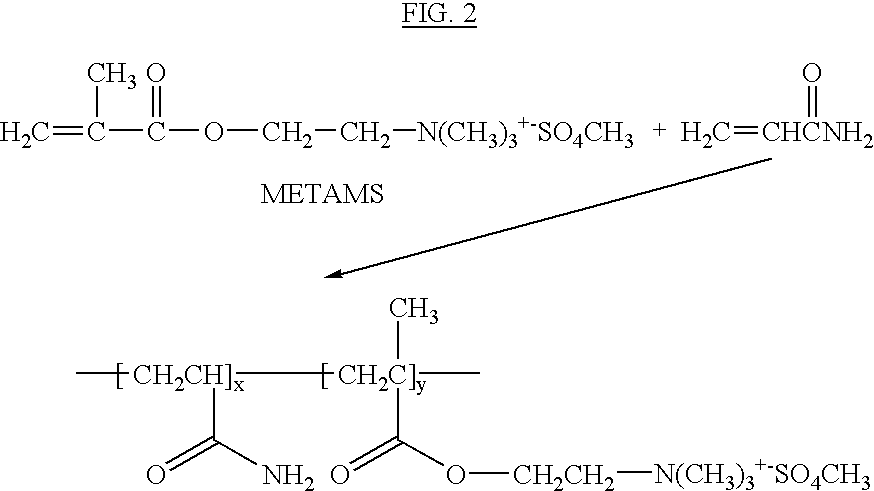
The incorporation of cationic groups through modification of non-ionic polyacrylamide is most often accomplished via the Mannich reaction as illustrated in FIG. 3. Generally cationic polyacrylamides will contain from about 5 to about 70% mole percent cationic groups. 
Generally dry strength PAMs are supplied as ready to use aqueous solutions or as water-soluble powders which must be dissolved prior to use. They may be added to thin or thick stock at a point of good mixing for best results. Addition rates of 0.1% to 0.5% of dry fiber typically give best results. High addition rates may cause overcationization of the furnish and reduce the effectiveness of other additives.
When used as dry strength additives usually around 5-10 mole % of the monomers will contain charged groups. Unlike the anionic PAM's, cationic PAM's are effectively charged across the entire pH range. Typical molecular weights for cationic PAM dry strength aids are in the range of 10,000 to 500,000. The molecular weight is important so as to be low enough to not bridge between particles and cause flocculation, and yet high enough to retard migration of the polymer into the pores of the fibers. Such migration would cause a reduction in dry strength activity.
When used as retention aids a broader range of molecular weights and charge densities may be employed. Key characteristics of polyacrylamide retention aids include the molecular weight, the type of charge, the charge density and the delivery form. For the average molecular weight, the range can be: low (1,000-100,000); medium (100,000-1,000,000); high (1,000,000-5,000,000); very high (>5,000,000). The charge type can be nonionic, cationic, anionic or amphoteric. The charge density can be: low (1-10%); medium (10-40%); high (40-80%); or very high (80-100%). The delivery form can be either an emulsion, an aqueous solution or a dry solid.
High molecular weight/low charge density flocculants are used most often for retention of fine particles in high shear and turbulence environments. Low molecular weight/high charge density products are used for their charge modifying capabilities and for retention in low shear environments.
A second class of charged polyacrylamides that has found widespread use in tissue and papermaking is the so-called “glyoxylated” polyacrylamides. Coscia, et al., U.S. Pat. No. 3,556,932 assigned to the American Cyanamid Company, describes the preparation and properties of glyoxylated polyacrylamides in detail. These polymers are ionic or nonionic water-soluble polyvinyl amides, having sufficient glyoxal substituents to be thermosetting. Where a cationic charge is employed, the amount of cationic component in the polymers should be sufficient to render the polymer substantive to cellulose fibers in aqueous suspensions. The amount of cationic charge in these polymers may vary. It may be less than 10 mole percent or as high as around 50 mole percent. Indeed many commercial versions are sold with a charge density of around 5 mole percent. Incorporation of the charge onto the polymer backbone can be accomplished through any of the methods known in the art. A preferred approach is to incorporate a cationic vinyl monomer with the acrylamide or other vinyl monomers during the polymerization of the base polymer. As with the non-glyoxylated polyacrylamides, the specific monomer used to introduce the cationic charge onto the polyacrylamide is not overly critical and may be chosen from any such monomers known to be capable of incorporating a cationic charge into a polyacrylamide backbone. Dimethyldiallyl ammonium chloride is an especially preferred monomer for introducing the cationic charge. Where substantivity to cellulose fibers in aqueous solution is not required the cationic charge moiety may be absent from the polymer backbone. Anionic versions of the polymers may be easily prepared from the appropriate raw materials, these anionic polymers capable of being deposited on fibers with use of alum or various cationic retention aids.
The minimum amount of pendant amide groups that need to be reacted with the glyoxal for the polymer to be thermosetting is around two mole percent of the total number of available amide groups. It is usually preferred to have an even higher degree of reaction so as to promote greater wet strength development, although above a certain level additional glyoxal provides only minimal wet strength improvement. The optimal ratio of glyoxylated to non-glyoxylated acrylamide groups is around 10 to 20 mole percent of the total number of amide reactive groups available on the parent polymer. The reaction can be easily carried out in dilute solution by stirring the glyoxal with the polyacrylamide base polymer at temperatures of about 25° C. to 100° C. at a neutral or slightly alkaline pH. Generally the reaction is run until a slight increase in viscosity is noted. The majority of the glyoxal reacts at only one of its functionalities yielding the desired aldehyde functional acrylamide.
The molecular weight of the acrylamide base polymer is not overly critical to the ability to react with glyoxal and generally polymers of molecular weight less than two million are adequately water soluble and dilutable so as not to not severely hinder reaction capability. In practice, lower molecular weight polymers having a molecular weight less than 25,000 are generally preferred due to their lower solution viscosity and ease at which they can be diluted in water. Molecular weight and degree of glyoxylation, however, can have an impact on level of wet strength development and ability to disperse readily in water. It might be expected that certain performance characteristics could be tailored by blending polymers of different molecular weights and substitution levels. For example, Dauplaise, et al., U.S. Pat. No. 5,723,022 discloses the unique performance gained by mixing low and high Mw acrylamides having different levels of glyoxylation. Glyoxylated polyacrylamides are generally delivered as dilute aqueous solutions having a solids content of 10% or less. More highly concentrated solutions can be prepared but the risk of gel formation occurs as the solids content is increased. Shelf life is also reduced at elevated temperatures.
A structure for a typical cationic glyoxylated polyacrylamide is shown in FIG. 4. The polymer is retained on the fiber by means of the cationic quaternary amine group that is attracted to anionic sites on the cellulose. In terms of chemical reactivity, only the amide and aldehyde functionalities are reactive. Approximately 2-30 mol % of the entire glyoxylated PAM copolymer exists as the active aldehyde group. The pendant amide groups on this polymer form hydrogen bonds with cellulose increasing the dry strength of the sheet. The aldehyde group can either cross-link with an amide group in another part of the polymer or react with a hydroxyl group on cellulose fibers. 
where:
w≧1
x, y, z≧1
If the aldehyde links with the amide a permanent covalent cross-link is formed which increases permanent wet strength. If the aldehyde forms a covalent hemi-acetal bond to the cellulose, wet strength is also increased. However, this bond is not permanent and will break when immersed in water resulting in temporary instead of permanent wet strength. Hence, Parez is normally used to increase dry strength and temporary wet strength, such as is desired for bath tissue.
Glyoxylated polyacrylamides have many beneficial properties. They increase both the wet and dry strength of the paper. Though slightly acidic conditions are preferred, they thermoset or “cure” at pH's in the approximate range of 4-8 and moderately elevated temperatures that are common to most papermaking systems. Since they can be cured over a broad pH range including neutral pH, precise control of pH is not required in the paper making system. The polymers develop the large majority of their wet and dry strength wile passing through the drying section of the paper process with sheet temperatures as low as 70° F. to 90° F. being adequate. An additional advantage to the glyoxylated polyacrylamides is that they possess what is referred to as “temporary wet strength”. A portion of the wet strength developed within the paper web is lost when soaked in water for a moderate period of time. This feature allows use of these materials in products such as bath tissue where water break-up is a required product attribute. In addition all of the wet strength can be lost rapidly under alkaline conditions. This makes these materials very amenable to broke repulping operations not requiring additional chemicals or processes which add to overall paper manufacturing costs.
Amphiphilic Hydrocarbon Moieties
Amphiphilic hydrocarbon moieties are a group of surface active agents (surfactants) capable of modifying the interface between phases. Surfactants are widely used by the industry for cleaning (detergency), solubilizing, dispersing, suspending, emulsifying, wetting and foam control. In the papermaking industry, they are often used for deinking, dispersing and foam control. They have an amphiphilic molecular structure containing at least one hydrophilic (polar) region and at least one lipophilic (non-polar, hydrophobic) region within the same molecule. When placed in a given interface, the hydrophilic end leans toward the polar phase while the lipophilic end orients itself toward the non-polar phase. 
The hydrophilic end can be added to a hydrophobe synthetically to create the amphiphilic molecular structure. FIG. 5 shows a possible schematic pathway for making a variety of surfactants: 
Based on the charge, surfactants can be grouped as amphoteric, anionic, cationic and nonionic.
First with regard to the amphoteric surfactants, the charges on the hydrophilic end change with the environmental pH: positive in acidic pH, negative at high pH and become zwitterions at the intermediate pH. Surfactants included in this category include alkylamido alkyl amines and alkyl substituted amino acids.
Structure commonly shared by alkylamido alkyl amines: 
where:
R0=a C4 or higher alkyl or aliphatic hydrocarbon, normal or branched, saturated or unsaturated, substituted or unsubstituted;
n≧2;
R1=hydroxy or carboxy ended alkyl or hydroxyalkyl groups, C chain≧2C, with or without ethoxylation, propoxylation or other substitution; and
Z=H or other cationic counterion.
Structure shared commonly by alkyl substituted amino acids:
where:
R1=alkyl or aliphatic hydrocarbon, normal or branched, saturated or unsaturated, substituted or unsubstituted, C chain≧4C;
n≧2;
Z=H or other cationic counterion; and
R′=carboxylic end of the amino acid.
With regard to the anionics, the hydrophilic end of the surfactant molecule is negatively charged. Anionics consist of five major chemical structures: acylated amino acids/acyl peptides, carboxylic acids and salts, sulfonic acid derivatives, sulfuric acid derivatives and phosphoric acid derivatives.
The structure commonly shared by acylated amino acids and acyl peptides is shown as follows:
or
where:
R0=alkyl or aliphatic hydrocarbon, normal or branched, saturated or unsaturated, substituted or unsubstituted, C chain≧4C;
R1=alkyl substituted amino acid moiety; or —(NH—CHX—CO)n—NH—CHX—
where n≧1, X=amino acid sidechain; or alkyl —NHCOR′ where R′=aliphatic hydrocarbon, normal or branched, saturated or unsaturated, substituted or unsubstituted, C chain≧4C; and
Z=H or other cationic counterion.
The structure commonly shared by carboxylic acid and salts is shown as follows:
where:
R=alkyl or aliphatic hydrocarbon, normal or branched, saturated or unsaturated, substituted or unsubstituted, with or without esterification, with or without etherification, C chain≧4C; and
Z=H or other cationic counterion;
The structure commonly shared by sulfonic acid derivatives is shown as follows:
or
or
or
or
or
where
R=alkyl or aliphatic hydrocarbon, normal or branched, saturated or unsaturated, substituted or unsubstituted, with or without esterification, with or without etherification, with or without sulfonation, with or without hydroxylation, C chain≧4C;
R1=alkyl or hydroxy alkyl, C chain≧1C;
n≧1;
Z=H or other counterion.
The structure commonly shared by sulfuric acid derivatives is shown as follows:
where
R=aliphatic hydrocarbon, normal or branched, saturated or unsaturated, substituted or unsubstituted, with or without esterification, with or without etherification, with or without sulfonation, with or without hydroxylation, with or without ethoxylation or propoxylation, C chain≧4C
Z=H or other counterion.
The structure commonly shared by phosphoric acid derivatives is shown as follows:
where:
R=aliphatic hydrocarbon, normal or branched, saturated or unsaturated, substituted or unsubstituted, with or without esterification, with or without etherification, with or without sulfonation, with or without hydroxylation, with or without ethoxylation or propoxylation, C chain≧4C; and
Z=H or other counterion.
With regard to the cationics, these are surfactants with positively charged atom, most commonly nitrogen, on the hydrophobic end. The charge may be permanent and non-pH dependent (such as quaternary ammonium compounds) or pH dependent (such as cationic amines). They include alkyl substituted ammonium salts, heterocyclic ammonium salts, alkyl substituted imidazolinium salts and alkyl amines.
The structure commonly shared by this group is shown as follows:
where:
R=H, alkyl, hydroxyalkyl, ethoxylated and/or propoxylation alkyl, benzyl, or aliphatic hydrocarbon, normal or branched, saturated or unsaturated, substituted or unsubstituted, with or without esterification, with or without etherification, with or without sulfonation, with or without hydroxylation, with or without carboxylation, with or without ethoxylation or propoxylation, C chain≧4C. The R groups may be the same or different; and
Z=Counterion including halide, hydroxide, etc.
With regard to the nonionics, in this group the molecule has no charge. The hydrophilic end often contains a polyether (polyoxyethylene) or one or more hydroxyl groups. They generally include alcohols, alkylphenols, esters, ethers, amine oxides, alkylamines, alkylamides, polyalkylene oxide block copolymers.
Modified Vinyl Polymers Containing Amphiphilic Hydrocarbon Moieties
There are several envisioned pathways in which modified vinyl polymers and amphiphilic hydrocarbons can be combined onto a single molecule for purposes of this invention. These include, but are not limited to: (1) direct monomer incorporation or copolymerization; (2) derivatization of functional groups on the polymer backbone; and (3) block co-polymerization.
The molar and weight ratios of the various functional groups on the polymer will largely depend on the specific application of the material and is not a critical aspect of the invention. However, the portion of the synthetic polymer [Q1] capable of forming hydrogen, covalent and ionic bonds can constitute from about 10 to about 95 mole percent of the total polymer, more specifically from about 20 to about 90 mole percent of the total polymer and still more specifically from about 30 to about 85 mole percent of the total polymer. The amphiphilic hydrocarbon portion [Q2] of the synthetic polymer can constitute from about 1 to about 90 mole percent of the synthetic polymer, more specifically from about 2 to about 80 mole percent of the synthetic polymer and still more specifically from about 3 to about 70 mole percent of the synthetic polymer. The charge containing portion [Q3] of the synthetic polymer can be comprised of monomer units constituting from 0 to about 80 mole percent of the total monomer units in the synthetic polymer, more specifically from 0 to about 30 mole percent and still more specifically from about 2 to about 20 mole percent. The [Q4] functionality will be comprised of monomer units constituting from 0 to about 80 mole percent of the total monomer units in the synthetic polymer, more specifically from 0 to about 40 mole percent and still more specifically from 0 to about 20 mole percent.
Likewise the molecular weight of the synthetic polymers of the present invention will largely depend on the specific application of the material and is not overly critical to the invention. The weight average molecular weight range can be from about 1,000 to about 5,000,000, more specifically from about 10,000 to about 2,000,000 and still more specifically from about 20,000 to about 1,000,000. Where these polymers are added for dry strength it is important that the molecular weight of the polymer be low enough so as to not bridge between particles and cause flocculation, and yet high enough so as to retard migration of the polymer into the pores of the fibers. These materials can have weight average molecular weights in the range of from about 5,000 to about 2,000,000, more specifically from about 10,000 to about 1,500,000 and still more specifically from about 20,000 to about 1,000,000.
Direct Monomer Incorporation
Incorporation of the amphiphilic moieties can be accomplished via copolymerization with vinyl type monomers containing amphiphilic groups. Almost any vinyl type monomer containing a pendant amphiphilic moiety can be co-polymerized with acrylamide or a similar vinyl monomer containing a pendant hydrogen-bonding moiety to be incorporated into the polymer backbone. Generically the synthesis can be described in FIG. 7. 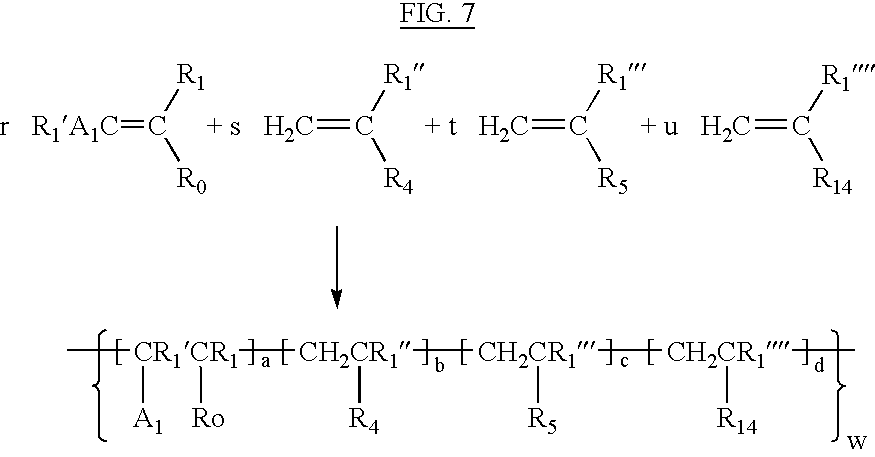
where:
R1, R1′, R1″, R1′″, R1″″=H, C1-4 alkyl;
a, b≧1;
c, d≧0;
w≧1;
r, s≧1;
t, u≧0;
a*w=r; b*w=s; c*w=t; d*w=u;
R0=any group capable of forming hydrogen bonds. Preferred but not limited to are —CONH2, COOH, COO— including mixtures of said groups;
A1=H, COOH;
R4=an amphiphilic hydrocarbon radical; It may be an alkyl hydrocarbon radical with hydrophilic functionality such as —OH, or ethoxy or propoxy groups, or an aliphatic hydrocarbon radical with hydrophilic functionality. The hydrocarbons can be linear or branched, saturated or unsaturated, substituted or unsubstituted, with 2 or more hydrocarbons.
R5=Z2—R10—W, where:
Z2=Ar, CH2, COO—, CONH—, —O—, —S—, —OSO2O—, any radical capable of bridging the R10 group to the vinyl backbone portion of the molecule. R10=any linear or branched, aliphatic or aromatic hydrocarbon of 2 or more carbons, preferably —(CH2CH2)—, —C(CH3)2CH2CH2—;
W=—N+R11, R12, R13, where R11, R12, R13 is a C1-4 alkyl group.
R5 may also be the residue formed by co-polymerization with dimethyldiallyl ammonium chloride. In this case the residue will be the form of monomers with repeat units of structure 
R14=a hydrophilic moiety, which is desirable for making the material into a form suitable for papermaking to compensate for any increased hydrophobicity that may be introduced via incorporation of the amphiphilic hydrocarbon moiety.
A wide variety of ethylenically unsaturated vinyl monomers containing amphiphilic moieties are known in the art. Poly(ethylene glycol) and poly(propylene glycol) based acrylates, methacrylates and derivatives including poly(ethylene glycol) acrylate, poly(propylene glycol) acrylate, poly(ethylene glycol) methacrylate, poly(propylene glycol) methacrylate, poly(ethylene glycol) mono-ether acrylates and methacrylates including methyl, butyl, hexyl, octyl, nonyl, decyl, dodecyl, tetradecyl, pentadecyl, hexadecyl, heptadecyl, octadecyl as well as the analogous poly(propylene glycol) derivatives and the like are known commercially available materials. Also known are the mono-aryl ether derivatives which include poly(ethylene glycol) 4-nonylphenyl ether acrylate, poly(ethylene glycol) phenyl ether acrylate, poly(ethylene glycol) 2,4,6-tris(1-phenylethyl)phenyl ether methacrylate and the like. Such monomers can easily be derived from the esterification of acrylic acid, methacrylic acid and the like with the poly(ethylene glycol) and poly(propylene) glycol and corresponding mono ethers including but not limited to such materials as poly(ethylene glycol) mono butyl ether, poly(ethylene glycol) mono octyl ether, poly(ethylene glycol) mono decyl ether, poly(ethylene glycol) mono dodecyl ether, poly(ethylene glycol) mono lauryl ether, poly(ethylene glycol) mono octadecyl ether, the corresponding poly(propylene glycol) and mixed poly(propylene glycol) and poly(ethylene glycol) mono ether derivatives.
Also known are the corresponding allyl ether derivatives of polyethylene glycol and polypropylene glycol. Such materials are generally synthesized from the reaction of an allyl halide and hydroxy compound in the presence of sodium hydroxide. Examples of such monomers include allyl polyethylene glycol, methallyl polyethylene glycol, methoxy allyl polyethylene glycol, butoxy allyl polyethylene glycol and the like. Such allyl ether materials generally conforming to the formula:
Where:
R=H, C1-4 alkyl
R′=polyethylene glycol, polypropylene glycol, or mixed polyethylene/polypropylene glycol radical
R″=C1-C30 alkyl or aryl radical
They would be expected to incorporate into any vinyl type polymer such as a PAM, PVA, etc. Evani, et al., U.S. Pat. No. 4,921,902 describes incorporation of such monomers into a non-ionic polyacrylamide backbone, such materials being found useful for mobility control and fracturing fluids in oil recovery operations.
Other examples of amphiphilic monomers that would expected to be incorporated via this process include carboxybetaines and sulfobetaines as described by Samour in U.S. Pat. No. 3,671,502. The copolymers of these materials with hydroxyalkyl acrylates were found to be useful for binders in various applications. Additional examples include but are not limited to such materials as those described by Valint, et al., in U.S. Pat. No. 5,177,165 and Robinson in U.S. Pat. No. 5,874,495.
The aforementioned examples are not meant to limit the scope of the invention. Indeed any of the generic amphoteric materials described previously can be incorporated via the aforementioned copolymerization technique provided there is a single ethylenically unsaturated point within the amphoteric molecule. They would be incorporated directly into the polymer during the polymerization process as described in FIG. 7. When incorporated into the polymer in this manner the amphiphilic hydrocarbons are arranged in a pendant fashion off the polymer backbone. Polymers of the type shown in FIG. 7, which maintain pendant unsubstituted amide functionality, may further be modified to produce materials exhibiting temporary wet strength as well as dry strength. Most notably this may be accomplished through reaction with glyoxal. A specific reaction scheme is given in FIG. 8. 
It should be appreciated that several different polymeric structures are possible when synthesizing polymers in the aforementioned manner. Such characteristics can be tailored into the polymer depending on the synthesis pathway chosen. If the monomers are mixed concurrently a random A-B-A-B-A-B type copolymer will be formed. If the monomers are mixed consecutively AAAAA-BBBB-AAAAA-BBBB type block copolymers can be formed. The size of the individual blocks can be controlled through any of the means known in the art. Although not critical to the invention those skilled in the art will recognize the potential for different behaviors depending upon the specific structure of the copolymer. Where more than one co-monomer is used mixtures of random and block copolymers can be designed depending on the synthetic approach used.
Derivitization of Functional Groups on the Polymer Backbone
The second approach to synthesis of materials of this invention is to modify the functional groups on the polymer backbone. The vinyl type polymers, including the modified polyacrylamides, polyacrylic acid and polyvinyl alcohol contain functional groups that may be further derivatized to produce materials of FIG. 4. The polymer functional groups which may be reacted upon include but are not limited to: amide, carboxyl, hydroxyl, cyano, and aldehyde (from glyoxylation or similar reaction). The general scheme for such syntheses is shown in FIG. 9. 
where:
R1=H, C1-4 alkyl;
a, b≧1;
c, d≧0;
Q1=a monomer unit or a block or graft copolymer containing a pendant group capable of forming hydrogen or covalent bonds with cellulose. Preferred pendant groups for hydrogen bonding are —CONH2, —COO− +M, —OH and mixtures of said groups. Preferred pendant groups for covalent bonding are aldehydes and anhydrides. M+ can be any suitable counter ion including Na+, K+, Ca+2 and the like;
Q3=a monomer unit or a block or graft copolymer containing a charge functionality. Such charge functionality is preferably cationic but may be anionic or amphoteric;
Z4=—CONHCHOHCHO, —CHO, —CONH2, —COOH, —CN, —OH, —SH, —NH2, —R′OH, —R′CHO, —R′CONH2, —R′COOH, —R′CN, —R′OH, —R′SH, —R′NH2, —RSO3H, —ROSO3H, or any other functional group capable of being reacted upon in a manner so as to incorporate the amphiphilic hydrocarbon moiety into the polymer and R′ can be any bridging radical whose purpose is to attach the functional group to the polymer; and
Q4=a monomer unit or a block or graft copolymer containing a hydrophilic moiety, which is desirable for making the material into a form suitable for papermaking. Q4 may take the form of —Z2—Q4—Z2′— where Z2, Z2′ are any bridging radicals, the same or different, whose purpose is to provide incorporation into the polymer backbone and Q4 is as defined previously. Q4 may be incorporated to offset the increased polymer hydrophobicity caused by introduction of the aliphatic hydrocarbon moieties. Examples of suitable Q4 moieties are (but is not limited to) the aliphatic polyether derivatives of the formula —[(CR1R2)xO]y—R3, wherin R1, R2 is H or CH3, x≧2, y≧2 and R3 is any suitable terminal group including —CH3, —H, —C2H5, —NH2.
Z5=HOOC—, ClOC—, HO—, HS—, —COOOC—, H2N—, HCO—, ClSO2O—, XOC—(X=halo), ClCOO—, or any other functional group capable of reaction with a Z4 type functional group so as to attach the —R6 residue onto the polymer;
R6=an amphiphilic hydrocarbon radical.
If the end block functional groups (Z4 and/or R0) is not reactive enough, further modification can be made prior to the incorporation of the amphiphilic moieties to ensure better yield. The general scheme for such modification is shown in FIG. 10. 
Some specific examples of such reactions are given in FIGS. 11-12. 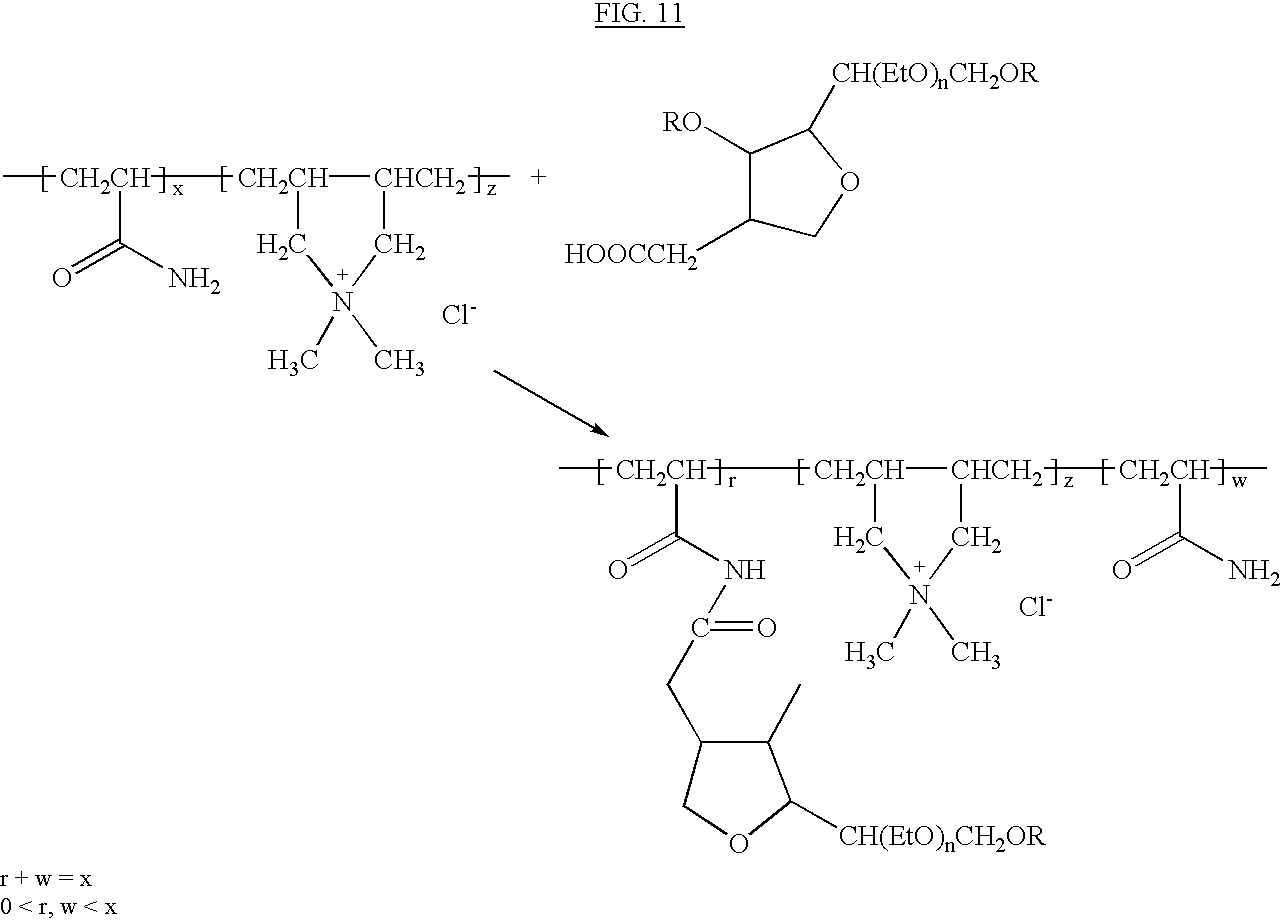
where
R=H, alkyl, aliphatic hydrocarbon, substituted or non-substituted, linear or branched or cyclic, C>,=6 
where
R=alkyl, aliphatic hydrocarbon, branched or linear or cyclic, substituted or non-substituted, with or without ethoxylation
R′=ethoxylated alkyl or aliphatic hydrocarbon, branched or linear or cyclic, substituted or nonsubstituted.
Block Copolymerization
PAM's containing block copolymers of polyethylene, polytetraflouroethylene, or any other linear or branched, saturated or unsaturated, substituted or non-substituted, hydrocarbon where such co-polymers are incorporated either as block copolymers as grafts onto the vinyl backbone. Note that since these polymers maintain pendant amide functionality they are capable of being glyoxylated to form materials possessing temporary wet strength. A general example of such materials is shown in FIG. 13. 
where:
R0=any group capable of forming hydrogen or covalent bonds with cellulose. Preferred are 13 CONH2, COOH, COO—, —OH, —CONHCHOHCHO including mixtures of said groups;
A1=H, COOH;
Q=radical of form —Z—R2—Z—;
R2=a block or graft copolymer where the amphiphilic functionality is built in. It may be alkyl hydrocarbons with hydrophilic (such as —OH, or ethoxy groups) functionality, or aliphatic hydrocarbons with hydrophilic functionality. The hydrocarbons could be linear or branched, saturated or unsaturated, substituted or unsubstituted, with 4 or more hydrocarbons.
Z=any bridging radical whose purpose is to provide incorporation into the polymer backbone;
R5=Z2—R10—W, where:
Z2=Ar, CH2, COO—, CONH—, —O—, —S—, —OSO2O—, any radical capable of bridging the R10 group to the vinyl backbone portion of the molecule;
R10=any linear or branched, aliphatic or aromatic hydrocarbon of 2 or more carbons, preferably —(CH2CH2)—, —C(CH3)2CH2CH2—;
W=—N+R11, R12, R13 where R11, R12, R13 is a C1-4 alkyl group.
R5 may also be the residue formed by co-polymerization with dimethyldiallyl ammonium chloride. In this case the residue will be the form of monomers with repeat units of structure 
It will be appreciated that the foregoing examples, given for purposes of illustration, are not to be considered as limiting the scope of this invention, which is defined by the following claims and all equivalents thereto.
Claims (45)
1. A synthetic polymer containing one or more amphiphilic hydrocarbon moieties, said synthetic polymer having the following structure: 
where:
a,b>0;
c≧0;
d>0;
w≧1;
Q1=a monomer unit or a block or graft copolymer containing a pendant group capable of forming hydrogen or covalent bonds with cellulose;
Q2=an ethylenically unsaturated vinyl polymer unit or a block or graft copolymer containing the amphiphilic moiety;
Q3=a monomer unit or a block or graft copolymer containing a charge functionality; and
Q4=a monomer unit or a block or graft copolymer containing a hydrophilic moiety.
2. The polymer of claim 1 wherein the pendant group on Q1 capable of forming hydrogen or covalent bonds is selected from the group consisting of —CONH2, —COOH, —COO−M +, —OH, —CONHCHOHCHO and mixtures thereof, wherein M+ is a counter ion.
3. The polymer of claim 1 wherein Q2 is of the form —Z1—Q2—Z1′— where Z1, Z1′ are bridging radicals, which can be the same or different.
4. The polymer of claim 1 wherein Q4 is of the form —Z2—Q4—Z2′— where Z2, Z2′ are bridging radicals, which can be the same or different.
5. The polymer of claim 1 wherein Q4 is a radical of the form —CHR1CR0R1′— wherein R0 is an aliphatic polyether derivative of the formula —[(CR2R2)xO]y—R3
where:
R1, R1′ is —H, C1-4 alkyl;
R2, R2′ is —H or —CH3;
x≧2;
y≧2; and
R3 is a terminal group selected from the group consisting of —CH3, —H, —C2H5, and —NH2.
6. The polymer of claim 1 wherein Q3 is 
7. The polymer of claim 1 wherein Q3 is a radical of the form —CHR1CR20R1′— wherein
R20=a pendant group of the form Z1—R10—W, where Z1 is a radical bonding the R10 group to the polymer;
R1, R1′=H or a C1-4 alkyl group;
R10=any linear or branched, aliphatic or aromatic hydrocarbon of 2 or more carbons; and
W=—N+R11, R12, R13 where R11, R12, R13 is a C1-4 alkyl group.
8. The polymer of claim 7 wherein Z1 is selected from the group consisting of aryl, —CH2—, —COO—, —CONH—, —O—, —S—, and —OSO2O—.
9. The polymer of claim 7 wherein R10 is —(CH2CH2)— or —C(CH3)2CH2CH2—.
10. The polymer of claim 1 wherein “c” is 0.
11. The polymer of claim 1 wherein “d” is 0.
12. The polymer of claim 1 wherein the pendant group on Q1 capable of forming hydrogen bonds is —CONH2.
13. The polymer of claim 1 wherein the pendant group on Q1 capable of forming covalent bonds is —CONHCHOHCHO.
14. The polymer of claim 1 wherein Q1 has —CONH2 and —CONHCHOHCHO pendant groups.
15. A synthetic polymer having a moiety capable of forming covalent or hydrogen bonds with cellulose and containing one or more amphiphilic hydrocarbon moieties, said polymer having the following structure: 
where:
w≧1;
R1, R1′, R2, R3=H or C1-4 alkyl;
a, b>0;
c≧0;
d>0;
R0=a group capable of forming hydrogen or covalent bonds with cellulose;
Q4=a monomer unit or a block or graft copolymer containing a hydrophilic moiety;
A1=—H, —COOH;
R4=a Z1—R6 radical,
where:
Z1=any radical capable of bonding the R6 group to the polymer;
R6=a block or graft copolymer containing the amphiphilic hydrocarbon;
R5=Z10—R10—W,
where:
Z10=any radical capable of bonding the R10 group to the polymer;
R10=any linear or branched, aliphatic or aromatic hydrocarbon of 2 or more carbons; and
W=—N+R11,R12,R13, where R11, R12, R13 are C1-4 alkyl groups.
16. The polymer of claim 15 wherein R0 is selected from the group consisting of —CONH2, —COOH, —COO−M+, —OH, —CONHCHOHCHO, and mixtures thereof, wherein M+ is a counter ion.
17. The polymer of claim 15 wherein Q4 is of the form —Z2—Q4—Z2′— where Z2, Z2′ are bridging radicals, which can be the same or different.
18. The polymer of claim 15 wherein Z1 is selected from the group consisting of aryl, —CH2—, —COO—, —CONR′—, —O—, —S—, —OSO2O—, —CONHCO—, and —CONHCHOHCHOO—, and where R′ is H or C1-4 alkyl.
19. The polymer of claim 15 wherein Z1 is selected from the group consisting of aryl, —CH2—, —COO—, —CONH—, —O—, —S—, and —OSO2O—.
20. The polymer of claim 15 wherein R10 is —(CH2CH2)— or —C(CH3)2CH2CH2—.
21. The polymer of claim 15 wherein A1 is —H and R0 is —CONH2.
22. The polymer of claim 15 wherein A1 is —H and R0 is —CONHCHOHCHO.
23. The polymer of claim 15 wherein R0 consists of both —CONH2 and —CONHCHOHCHO groups.
24. A synthetic polymer having a moiety capable of forming covalent or hydrogen bonds with cellulose and containing one or more amphiphilic hydrocarbon moieties, said polymer having the following: 
where:
w≧1;
R1, R1′, R2, R3=H or C1-4 alkyl;
a, b>0;
c≧0;
d>0;
R0=a group capable of forming hydrogen or covalent bonds with cellulose;
Q4=a monomer unit or a block or graft copolymer containing a hydrophilic moiety;
A1=—H, —COOH;
R4=a Z1—R6 radical,
where:
Z1=any radical capable of bonding the R6 group to the polymer; and
R6=an amphiphilic hydrocarbon radical.
25. A synthetic radical polymer containing one or more amphiphilic hydrocarbon moieties, said synthetic polymer having the following structure: 
where:
a, b>0;
c,d ≧0 such that c+d>0;
w≧1;
Q1=a monomer unit or a block or graft copolymer containing pendant group capable of forming hydrogen or covalent bonds with cellulose;
Q2=a block or graft copolymer containing the amphiphilic moiety;
Q3=a radical of the form —CHR1CR20R1′—wherein
R20=a pendant group of the form Z1—R10—W, where Z1 is a radical bonding the R10 group to the polymer;
R1, R1′=H or a C1-4 alkyl group;
R10=any linear or branched, aliphatic or aromatic hydrocarbon of 2 or more carbons; and
W=—N+R11,R12,R13 where R11,R12,R13 is a C1-4 alkyl group; and
Q4=a monomer unit or a block or graft copolymer containing a hydrophilic moiety.
26. The polymer of claim 25 wherein the pendant group on Q1 capable of forming hydrogen or covalent bonds is selected from the group consisting of —CONH2, —COOH, —COO−M+, —OH, —CONHCHOHCHO and mixtures thereof, wherein M+is a counter ion.
27. The polymer of claim 25 wherein Q2 is of the form —Z1—Q2—Z1′—where Z1, Z1′ are bridging radicals, which can be the same or different.
28. The polymer of claim 25 wherein Z1 is selected from the group consisting of aryl, —CH2—, —COO—,—CONH—, —O—,—S—, and —OSO2O—.
29. The polymer of claim 25 wherein R10 is —(CH2CH2)— or —C(CH3)2CH2CH2—.
30. The polymer of claim 25 wherein the pendant group on Q1 capable of forming hydrogen bonds is —CONH2.
31. The polymer of claim 25 wherein the pendant group on Q1 capable of forming covalent bonds is —CONHCHOHCHO.
32. The polymer of claim 25 wherein Q1 has —CONH2 and —CONHCHOHCHO pendant groups.
33. A synthetic polymer containing one or more amphiphilic hydrocarbon moieties, said synthetic polymer having the following structure: 
where:
a, b>0;
c,d≧0 such that c+d>0;
w≧1;
Q1=is a monomer unit or a block or graft copolymer containing a pendant group selected from the group consisting of —CONH2, CONHCHOHCHO and combinations thereof;
Q2=a block or graft copolymer containing the amphiphilic moiety;
Q3=a monomer unit or a block or graft copolymer containing a charge functionality; and
Q4=a monomer unit or a block or graft copolymer containing a hydrophilic moiety.
34. The polymer of claim 33 wherein Q2 is of the form —Z1—Q2—Z1′— where Z1,Z1′ are bridging radicals, which can be the same or different.
35. The polymer of claim 33 wherein Q4 is of the form —Z2—Q4—Z2′— where Z2,Z2′ are bridging radicals, which can be the same or different.
36. The polymer of claim 33 wherein Q4 is a radical of the form —CHR1CR0R1′—wherein R0 is an aliphatic polyether derivative of the formula —[(CR2R2)x]y—R3
where:
R1, R1′ is —H, C1-4 alkyl;
R2, R2′ is —H or —CH3;
x≧2;
y≧2; and
R3 is a terminal group selected from the group consisting of —CH3, —H, —C2H5, and —NH2.
37. The polymer of claim 33 wherein Q3 is 
38. The polymer of claim 33 wherein Q3 is a radical of the form —CHR1CR20R1′— wherein R20=a pendant group of the form Z1—R10—W, where Z1 is a radical bonding the R10 group to the polymer;
R1, R1′=H or a C1-4 alkyl group;
R10=any linear or branched, aliphatic or aromatic hydrocarbon of 2 or more carbons; and
W=—N+R11,R12,R13 where R11,R12,R13 is a C1-4 alkyl group.
39. The polymer of claim 38 wherein Z1 is selected from the group consisting of aryl, —CH2—, —COO—, —CONH—, —O—,—S—, and —OSO2O—.
40. The polymer of claim 38 wherein R10 is —(CH2CH2)— or —C(CH3)2CH2CH2.
41. The polymer of claim 33 wherein “c” is 0.
42. The polymer of claim 33 wherein “d” is 0.
43. The polymer of claim 33 wherein the pendant group of Q1 is —CONH2.
44. The polymer of claim 33 wherein the pendant group of Q1 is —CONHCHOHCHO.
45. The polymer of claim 33 wherein the pendant groups of Q1 include —CONH2 and —CONHCHOHCHO pendant groups.
Priority Applications (1)
| Application Number | Priority Date | Filing Date | Title |
|---|---|---|---|
| US09/855,049 US6472487B2 (en) | 1999-01-25 | 2001-05-14 | Modified vinyl polymers containing amphiphilic hydrocarbon moieties |
Applications Claiming Priority (3)
| Application Number | Priority Date | Filing Date | Title |
|---|---|---|---|
| US11716599P | 1999-01-25 | 1999-01-25 | |
| US09/449,260 US6287418B1 (en) | 1999-01-25 | 1999-11-24 | Modified vinyl polymers containing amphiphilic hydrocarbon moieties |
| US09/855,049 US6472487B2 (en) | 1999-01-25 | 2001-05-14 | Modified vinyl polymers containing amphiphilic hydrocarbon moieties |
Related Parent Applications (1)
| Application Number | Title | Priority Date | Filing Date |
|---|---|---|---|
| US09/449,260 Division US6287418B1 (en) | 1999-01-25 | 1999-11-24 | Modified vinyl polymers containing amphiphilic hydrocarbon moieties |
Publications (2)
| Publication Number | Publication Date |
|---|---|
| US20020004571A1 US20020004571A1 (en) | 2002-01-10 |
| US6472487B2 true US6472487B2 (en) | 2002-10-29 |
Family
ID=26814996
Family Applications (1)
| Application Number | Title | Priority Date | Filing Date |
|---|---|---|---|
| US09/855,049 Expired - Lifetime US6472487B2 (en) | 1999-01-25 | 2001-05-14 | Modified vinyl polymers containing amphiphilic hydrocarbon moieties |
Country Status (9)
| Country | Link |
|---|---|
| US (1) | US6472487B2 (en) |
| EP (1) | EP1161467B1 (en) |
| KR (1) | KR100565406B1 (en) |
| CN (1) | CN1337972A (en) |
| AU (1) | AU758134B2 (en) |
| BR (1) | BR0007707B1 (en) |
| CO (1) | CO5180563A1 (en) |
| DE (1) | DE60025468T2 (en) |
| WO (1) | WO2000043428A1 (en) |
Cited By (17)
| Publication number | Priority date | Publication date | Assignee | Title |
|---|---|---|---|---|
| US6916402B2 (en) | 2002-12-23 | 2005-07-12 | Kimberly-Clark Worldwide, Inc. | Process for bonding chemical additives on to substrates containing cellulosic materials and products thereof |
| US20050161181A1 (en) * | 2004-01-26 | 2005-07-28 | St. John Michael R. | Method of using aldehyde-functionalized polymers to enhance paper machine dewatering |
| US20060263769A1 (en) * | 2005-05-09 | 2006-11-23 | Panomics, Inc. | Multiplex capture of nucleic acids |
| US7670459B2 (en) | 2004-12-29 | 2010-03-02 | Kimberly-Clark Worldwide, Inc. | Soft and durable tissue products containing a softening agent |
| US7678232B2 (en) | 2000-12-22 | 2010-03-16 | Kimberly-Clark Worldwide, Inc. | Process for incorporating poorly substantive paper modifying agents into a paper sheet via wet end addition |
| US20100132522A1 (en) * | 2008-09-19 | 2010-06-03 | Peterson Michael E | Trimmer |
| US20110146925A1 (en) * | 2009-12-18 | 2011-06-23 | Bode Heinrich E | Aldehyde-functionalized polymers with enhanced stability |
| US20110308750A1 (en) * | 2010-05-26 | 2011-12-22 | Fpinnovations | Hydrophobic lignocellulosic material and process therefor |
| US8709207B2 (en) | 2010-11-02 | 2014-04-29 | Nalco Company | Method of using aldehyde-functionalized polymers to increase papermachine performance and enhance sizing |
| US8840759B2 (en) | 2010-11-02 | 2014-09-23 | Ecolab Usa Inc. | Method of using aldehyde-functionalized polymers to increase papermachine performance and enhance sizing |
| US9702086B2 (en) | 2014-10-06 | 2017-07-11 | Ecolab Usa Inc. | Method of increasing paper strength using an amine containing polymer composition |
| US9920482B2 (en) | 2014-10-06 | 2018-03-20 | Ecolab Usa Inc. | Method of increasing paper strength |
| US9951475B2 (en) | 2014-01-16 | 2018-04-24 | Ecolab Usa Inc. | Wet end chemicals for dry end strength in paper |
| US10006170B2 (en) | 2015-08-06 | 2018-06-26 | Ecolab Usa Inc. | Aldehyde-functionalized polymers for paper strength and dewatering |
| US10145067B2 (en) | 2007-09-12 | 2018-12-04 | Ecolab Usa Inc. | Method of improving dewatering efficiency, increasing sheet wet web strength, increasing sheet wet strength and enhancing filler retention in papermaking |
| US10648133B2 (en) | 2016-05-13 | 2020-05-12 | Ecolab Usa Inc. | Tissue dust reduction |
| US11560443B2 (en) | 2019-09-11 | 2023-01-24 | Buckman Laboratories International, Inc. | Grafted polyvinyl alcohol polymer, formulations containing the same, and creping methods |
Families Citing this family (25)
| Publication number | Priority date | Publication date | Assignee | Title |
|---|---|---|---|---|
| US6224714B1 (en) | 1999-01-25 | 2001-05-01 | Kimberly-Clark Worldwide, Inc. | Synthetic polymers having hydrogen bonding capability and containing polysiloxane moieties |
| US6673205B2 (en) | 2001-05-10 | 2004-01-06 | Fort James Corporation | Use of hydrophobically modified polyaminamides with polyethylene glycol esters in paper products |
| US20030013806A1 (en) | 2001-05-25 | 2003-01-16 | Schut David M. | Under-/overprinting fluid component for enhancing ink stability in printing |
| SE0103425D0 (en) * | 2001-10-16 | 2001-10-16 | Borealis Tech Oy | Pipe for hot fluids |
| US6824650B2 (en) | 2001-12-18 | 2004-11-30 | Kimberly-Clark Worldwide, Inc. | Fibrous materials treated with a polyvinylamine polymer |
| US7214633B2 (en) | 2001-12-18 | 2007-05-08 | Kimberly-Clark Worldwide, Inc. | Polyvinylamine treatments to improve dyeing of cellulosic materials |
| KR100475994B1 (en) * | 2002-01-11 | 2005-03-10 | 주식회사 태평양 | Amphiphilic copolymers having polyethylenimine chain as a graft chain and the preparation method thereof |
| US20050178517A1 (en) * | 2002-03-28 | 2005-08-18 | Tomoyuki Nakano | Bulky paper |
| US7994079B2 (en) | 2002-12-17 | 2011-08-09 | Kimberly-Clark Worldwide, Inc. | Meltblown scrubbing product |
| US7041197B2 (en) | 2003-04-15 | 2006-05-09 | Fort James Corporation | Wet strength and softness enhancement of paper products |
| US7875676B2 (en) * | 2006-09-07 | 2011-01-25 | Ciba Specialty Chemicals Corporation | Glyoxalation of vinylamide polymer |
| JP2010539320A (en) * | 2007-09-19 | 2010-12-16 | エージェンシー フォー サイエンス,テクノロジー アンド リサーチ | Amphiphilic polymer and method for forming the same |
| US20120247697A1 (en) | 2011-03-29 | 2012-10-04 | Kemira Oyj | Polyamine Polyamidoamine Epihaloohydrin Compositions and Processes for Preparing and Using the Same |
| EP2748373B1 (en) | 2011-08-25 | 2024-02-21 | Solenis Technologies Cayman, L.P. | Method for increasing the advantages of strength aids in the production of paper and paperboard |
| RU2581862C2 (en) | 2011-09-30 | 2016-04-20 | Кемира Ойй | Paper and methods for production of paper |
| US9777434B2 (en) | 2011-12-22 | 2017-10-03 | Kemira Dyj | Compositions and methods of making paper products |
| WO2013179139A1 (en) | 2012-05-30 | 2013-12-05 | Kemira Oyj | Compositions and methods of making paper products |
| PT2864542T (en) | 2012-06-22 | 2019-02-15 | Kemira Oyj | Compositions and methods of making paper products |
| KR20150064078A (en) | 2012-09-26 | 2015-06-10 | 케미라 오와이제이 | Absorbent materials, products including absorbent materials, compositions, and methods of making absorbent materials |
| US9562326B2 (en) | 2013-03-14 | 2017-02-07 | Kemira Oyj | Compositions and methods of making paper products |
| US10435843B2 (en) | 2016-02-16 | 2019-10-08 | Kemira Oyj | Method for producing paper |
| RU2696382C1 (en) | 2016-02-16 | 2019-08-01 | Кемира Ойй | Paper production method |
| CA3015649C (en) | 2016-02-29 | 2022-08-16 | Kemira Oyj | A softener composition |
| CN111663353B (en) * | 2020-05-15 | 2022-04-22 | 仙鹤股份有限公司 | High-flexibility cotton paper and preparation method thereof |
| EP4682309A1 (en) * | 2024-07-18 | 2026-01-21 | Wenatex Forschung - Entwicklung - Produktion GmbH | Textile article, method for functionalizing a textile article and textile article obtainable therefrom and method for binding a fabric |
Citations (20)
| Publication number | Priority date | Publication date | Assignee | Title |
|---|---|---|---|---|
| US3671502A (en) | 1970-11-12 | 1972-06-20 | Kendall & Co | Betaine copolymers with hydroxyalkylacrylates and hydroxyalkylmethacrylates |
| US4728696A (en) | 1985-12-02 | 1988-03-01 | The Dow Chemical Company | Amphiphilic monomer and hydrophobe associative composition containing a polymer of a water-soluble monomer and said amphiphilic monomer |
| US4921902A (en) | 1984-02-02 | 1990-05-01 | The Dow Chemical Company | Hydrophobie associative composition containing a polymer of a water-soluble monomer and an amphiphilic monomer |
| US5177165A (en) | 1990-11-27 | 1993-01-05 | Bausch & Lomb Incorporated | Surface-active macromonomers |
| US5320711A (en) | 1988-12-19 | 1994-06-14 | Cytec Technology Corp. | Emulsified mannich acrylamide polymers |
| US5507914A (en) | 1994-08-12 | 1996-04-16 | Nalco Chemical Company | Process for enhancing the freeness of papermaking pulp |
| US5591306A (en) | 1994-08-08 | 1997-01-07 | Kimberly-Clark Corporation | Method for making soft tissue using cationic silicones |
| US5651861A (en) | 1995-12-18 | 1997-07-29 | Rhone-Poulenc Inc. | Process for removing inks from waste paper |
| US5695607A (en) | 1994-04-01 | 1997-12-09 | James River Corporation Of Virginia | Soft-single ply tissue having very low sidedness |
| US5723022A (en) | 1996-07-11 | 1998-03-03 | Cytec Technology Corp. | Temporary wet strength resins |
| US5746887A (en) | 1994-04-12 | 1998-05-05 | Kimberly-Clark Worldwide, Inc. | Method of making soft tissue products |
| US5772845A (en) | 1993-06-24 | 1998-06-30 | Kimberly-Clark Worldwide, Inc. | Soft tissue |
| US5785813A (en) | 1997-02-24 | 1998-07-28 | Kimberly-Clark Worldwide Inc. | Method of treating a papermaking furnish for making soft tissue |
| US5789516A (en) | 1997-04-07 | 1998-08-04 | Dow Corning Corporation | Method of making silicone-organic block copolymers |
| WO1998045530A1 (en) | 1997-04-10 | 1998-10-15 | Rhodia Inc. | Process for removing waterborne flexographic inks from substrates |
| US5852095A (en) | 1994-04-20 | 1998-12-22 | Asahi Kasei Kogyo Kabushiki Kaisha | Aqueous, silicone-modified acrylate polymer emulsion |
| US5874495A (en) | 1994-10-03 | 1999-02-23 | Rhodia Inc. | Polymers useful as PH responsive thickeners and monomers therefor |
| US5904810A (en) | 1996-10-25 | 1999-05-18 | Kimberly-Clark Worldwide, Inc. | Tissue containing cationic amidoamine compounds |
| US6224714B1 (en) | 1999-01-25 | 2001-05-01 | Kimberly-Clark Worldwide, Inc. | Synthetic polymers having hydrogen bonding capability and containing polysiloxane moieties |
| US6287418B1 (en) | 1999-01-25 | 2001-09-11 | Kimberly-Clark Worldwide, Inc. | Modified vinyl polymers containing amphiphilic hydrocarbon moieties |
-
2000
- 2000-01-21 CO CO00003476A patent/CO5180563A1/en not_active Application Discontinuation
- 2000-01-25 EP EP00906996A patent/EP1161467B1/en not_active Expired - Lifetime
- 2000-01-25 BR BRPI0007707-0A patent/BR0007707B1/en not_active IP Right Cessation
- 2000-01-25 DE DE60025468T patent/DE60025468T2/en not_active Expired - Lifetime
- 2000-01-25 WO PCT/US2000/001617 patent/WO2000043428A1/en not_active Ceased
- 2000-01-25 AU AU28567/00A patent/AU758134B2/en not_active Ceased
- 2000-01-25 CN CN00803043A patent/CN1337972A/en active Pending
- 2000-01-25 KR KR1020017009283A patent/KR100565406B1/en not_active Expired - Fee Related
-
2001
- 2001-05-14 US US09/855,049 patent/US6472487B2/en not_active Expired - Lifetime
Patent Citations (20)
| Publication number | Priority date | Publication date | Assignee | Title |
|---|---|---|---|---|
| US3671502A (en) | 1970-11-12 | 1972-06-20 | Kendall & Co | Betaine copolymers with hydroxyalkylacrylates and hydroxyalkylmethacrylates |
| US4921902A (en) | 1984-02-02 | 1990-05-01 | The Dow Chemical Company | Hydrophobie associative composition containing a polymer of a water-soluble monomer and an amphiphilic monomer |
| US4728696A (en) | 1985-12-02 | 1988-03-01 | The Dow Chemical Company | Amphiphilic monomer and hydrophobe associative composition containing a polymer of a water-soluble monomer and said amphiphilic monomer |
| US5320711A (en) | 1988-12-19 | 1994-06-14 | Cytec Technology Corp. | Emulsified mannich acrylamide polymers |
| US5177165A (en) | 1990-11-27 | 1993-01-05 | Bausch & Lomb Incorporated | Surface-active macromonomers |
| US5772845A (en) | 1993-06-24 | 1998-06-30 | Kimberly-Clark Worldwide, Inc. | Soft tissue |
| US5695607A (en) | 1994-04-01 | 1997-12-09 | James River Corporation Of Virginia | Soft-single ply tissue having very low sidedness |
| US5746887A (en) | 1994-04-12 | 1998-05-05 | Kimberly-Clark Worldwide, Inc. | Method of making soft tissue products |
| US5852095A (en) | 1994-04-20 | 1998-12-22 | Asahi Kasei Kogyo Kabushiki Kaisha | Aqueous, silicone-modified acrylate polymer emulsion |
| US5591306A (en) | 1994-08-08 | 1997-01-07 | Kimberly-Clark Corporation | Method for making soft tissue using cationic silicones |
| US5507914A (en) | 1994-08-12 | 1996-04-16 | Nalco Chemical Company | Process for enhancing the freeness of papermaking pulp |
| US5874495A (en) | 1994-10-03 | 1999-02-23 | Rhodia Inc. | Polymers useful as PH responsive thickeners and monomers therefor |
| US5651861A (en) | 1995-12-18 | 1997-07-29 | Rhone-Poulenc Inc. | Process for removing inks from waste paper |
| US5723022A (en) | 1996-07-11 | 1998-03-03 | Cytec Technology Corp. | Temporary wet strength resins |
| US5904810A (en) | 1996-10-25 | 1999-05-18 | Kimberly-Clark Worldwide, Inc. | Tissue containing cationic amidoamine compounds |
| US5785813A (en) | 1997-02-24 | 1998-07-28 | Kimberly-Clark Worldwide Inc. | Method of treating a papermaking furnish for making soft tissue |
| US5789516A (en) | 1997-04-07 | 1998-08-04 | Dow Corning Corporation | Method of making silicone-organic block copolymers |
| WO1998045530A1 (en) | 1997-04-10 | 1998-10-15 | Rhodia Inc. | Process for removing waterborne flexographic inks from substrates |
| US6224714B1 (en) | 1999-01-25 | 2001-05-01 | Kimberly-Clark Worldwide, Inc. | Synthetic polymers having hydrogen bonding capability and containing polysiloxane moieties |
| US6287418B1 (en) | 1999-01-25 | 2001-09-11 | Kimberly-Clark Worldwide, Inc. | Modified vinyl polymers containing amphiphilic hydrocarbon moieties |
Cited By (26)
| Publication number | Priority date | Publication date | Assignee | Title |
|---|---|---|---|---|
| US7678232B2 (en) | 2000-12-22 | 2010-03-16 | Kimberly-Clark Worldwide, Inc. | Process for incorporating poorly substantive paper modifying agents into a paper sheet via wet end addition |
| US6916402B2 (en) | 2002-12-23 | 2005-07-12 | Kimberly-Clark Worldwide, Inc. | Process for bonding chemical additives on to substrates containing cellulosic materials and products thereof |
| US20100089542A1 (en) * | 2004-01-26 | 2010-04-15 | St John Michael R | Aldehyde-functionalized polymers |
| US7641766B2 (en) * | 2004-01-26 | 2010-01-05 | Nalco Company | Method of using aldehyde-functionalized polymers to enhance paper machine dewatering |
| US7901543B2 (en) | 2004-01-26 | 2011-03-08 | Nalco Company | Aldehyde-functionalized polymers |
| US20050161181A1 (en) * | 2004-01-26 | 2005-07-28 | St. John Michael R. | Method of using aldehyde-functionalized polymers to enhance paper machine dewatering |
| USRE45383E1 (en) * | 2004-01-26 | 2015-02-24 | Nalco Company | Method of using aldehyde-functionalized polymers to enhance paper machine dewatering |
| USRE44936E1 (en) * | 2004-01-26 | 2014-06-10 | Nalco Company | Aldehyde-functionalized polymers |
| US7670459B2 (en) | 2004-12-29 | 2010-03-02 | Kimberly-Clark Worldwide, Inc. | Soft and durable tissue products containing a softening agent |
| US20060263769A1 (en) * | 2005-05-09 | 2006-11-23 | Panomics, Inc. | Multiplex capture of nucleic acids |
| US10145067B2 (en) | 2007-09-12 | 2018-12-04 | Ecolab Usa Inc. | Method of improving dewatering efficiency, increasing sheet wet web strength, increasing sheet wet strength and enhancing filler retention in papermaking |
| US20100132522A1 (en) * | 2008-09-19 | 2010-06-03 | Peterson Michael E | Trimmer |
| US8753480B2 (en) | 2009-12-18 | 2014-06-17 | Nalco Company | Aldehyde-functionalized polymers with enhanced stability |
| US20110146925A1 (en) * | 2009-12-18 | 2011-06-23 | Bode Heinrich E | Aldehyde-functionalized polymers with enhanced stability |
| US8288502B2 (en) | 2009-12-18 | 2012-10-16 | Nalco Company | Aldehyde-functionalized polymers with enhanced stability |
| US8679292B2 (en) * | 2010-05-26 | 2014-03-25 | Fpinnovations | Composite of hydrophobic lignocellulose material bonded to complementary material |
| US20110308750A1 (en) * | 2010-05-26 | 2011-12-22 | Fpinnovations | Hydrophobic lignocellulosic material and process therefor |
| US8840759B2 (en) | 2010-11-02 | 2014-09-23 | Ecolab Usa Inc. | Method of using aldehyde-functionalized polymers to increase papermachine performance and enhance sizing |
| US8709207B2 (en) | 2010-11-02 | 2014-04-29 | Nalco Company | Method of using aldehyde-functionalized polymers to increase papermachine performance and enhance sizing |
| US9951475B2 (en) | 2014-01-16 | 2018-04-24 | Ecolab Usa Inc. | Wet end chemicals for dry end strength in paper |
| US9702086B2 (en) | 2014-10-06 | 2017-07-11 | Ecolab Usa Inc. | Method of increasing paper strength using an amine containing polymer composition |
| US9840810B2 (en) | 2014-10-06 | 2017-12-12 | Ecolab Usa Inc. | Method of increasing paper bulk strength by using a diallylamine acrylamide copolymer in a size press formulation containing starch |
| US9920482B2 (en) | 2014-10-06 | 2018-03-20 | Ecolab Usa Inc. | Method of increasing paper strength |
| US10006170B2 (en) | 2015-08-06 | 2018-06-26 | Ecolab Usa Inc. | Aldehyde-functionalized polymers for paper strength and dewatering |
| US10648133B2 (en) | 2016-05-13 | 2020-05-12 | Ecolab Usa Inc. | Tissue dust reduction |
| US11560443B2 (en) | 2019-09-11 | 2023-01-24 | Buckman Laboratories International, Inc. | Grafted polyvinyl alcohol polymer, formulations containing the same, and creping methods |
Also Published As
| Publication number | Publication date |
|---|---|
| KR20010104700A (en) | 2001-11-26 |
| AU758134B2 (en) | 2003-03-13 |
| CN1337972A (en) | 2002-02-27 |
| EP1161467B1 (en) | 2006-01-11 |
| BR0007707B1 (en) | 2010-01-26 |
| EP1161467A1 (en) | 2001-12-12 |
| CO5180563A1 (en) | 2002-07-30 |
| DE60025468D1 (en) | 2006-04-06 |
| KR100565406B1 (en) | 2006-03-30 |
| WO2000043428A1 (en) | 2000-07-27 |
| US20020004571A1 (en) | 2002-01-10 |
| AU2856700A (en) | 2000-08-07 |
| BR0007707A (en) | 2002-01-15 |
| DE60025468T2 (en) | 2006-08-03 |
Similar Documents
| Publication | Publication Date | Title |
|---|---|---|
| US6472487B2 (en) | Modified vinyl polymers containing amphiphilic hydrocarbon moieties | |
| US6287418B1 (en) | Modified vinyl polymers containing amphiphilic hydrocarbon moieties | |
| EP1165640B1 (en) | Synthetic polymers having hydrogen bonding capability and containing aliphatic hydrocarbon moieties | |
| US6632904B2 (en) | Synthetic polymers having hydrogen bonding capability and containing polysiloxane moieties | |
| KR101434689B1 (en) | Michael addition reaction adducts as additives for paper and paper | |
| WO2003070796A1 (en) | (meth)acrylamide polymer, process for production thereof, paper making chemicals, papers containing the same | |
| ZA200202152B (en) | Wet strength agent and method for production thereof. | |
| CA2427343C (en) | Soft tissue with improved lint and slough properties | |
| JP2913756B2 (en) | How to size paper | |
| JP3509003B2 (en) | Papermaking method | |
| CA2296891A1 (en) | Modified condensation polymers containing azetidinium groups in conjunction with amphiphilic hydrocarbon moieties | |
| MXPA01007124A (en) | Modified vinyl polymers containing amphiphilic hydrocarbon moieties | |
| MXPA00000876A (en) | Modified condensation polymers containing azetidinium groups in conjunction with amphiphilic hydrocarbon moieties . | |
| CN101228317A (en) | Hydrophobic polymers and their use in preparing cellulosic fiber compositions | |
| MXPA01007209A (en) | Synthetic polymers having hydrogen bonding capability and containing aliphatic hydrocarbon moieties |
Legal Events
| Date | Code | Title | Description |
|---|---|---|---|
| STCF | Information on status: patent grant |
Free format text: PATENTED CASE |
|
| FPAY | Fee payment |
Year of fee payment: 4 |
|
| FPAY | Fee payment |
Year of fee payment: 8 |
|
| FPAY | Fee payment |
Year of fee payment: 12 |
|
| AS | Assignment |
Owner name: KIMBERLY-CLARK WORLDWIDE, INC., WISCONSIN Free format text: NAME CHANGE;ASSIGNOR:KIMBERLY-CLARK WORLDWIDE, INC.;REEL/FRAME:034880/0742 Effective date: 20150101 |