US6417403B1 - Process for preparing chiral (s)-2,3-disubstituted-1-propylamine derivatives - Google Patents
Process for preparing chiral (s)-2,3-disubstituted-1-propylamine derivatives Download PDFInfo
- Publication number
- US6417403B1 US6417403B1 US09/673,123 US67312300A US6417403B1 US 6417403 B1 US6417403 B1 US 6417403B1 US 67312300 A US67312300 A US 67312300A US 6417403 B1 US6417403 B1 US 6417403B1
- Authority
- US
- United States
- Prior art keywords
- disubstituted
- derivatives according
- preparing chiral
- chiral
- group
- Prior art date
- Legal status (The legal status is an assumption and is not a legal conclusion. Google has not performed a legal analysis and makes no representation as to the accuracy of the status listed.)
- Expired - Fee Related
Links
- -1 (s)-2,3-disubstituted-1-propylamine Chemical class 0.000 title claims abstract description 53
- 238000004519 manufacturing process Methods 0.000 title claims description 33
- 238000006969 Curtius rearrangement reaction Methods 0.000 claims abstract description 13
- 125000003277 amino group Chemical group 0.000 claims abstract description 9
- 125000002915 carbonyl group Chemical group [*:2]C([*:1])=O 0.000 claims abstract description 8
- VEXZGXHMUGYJMC-UHFFFAOYSA-N Hydrochloric acid Chemical group Cl VEXZGXHMUGYJMC-UHFFFAOYSA-N 0.000 claims description 32
- 239000011541 reaction mixture Substances 0.000 claims description 30
- QAOWNCQODCNURD-UHFFFAOYSA-N Sulfuric acid Chemical class OS(O)(=O)=O QAOWNCQODCNURD-UHFFFAOYSA-N 0.000 claims description 20
- 150000001875 compounds Chemical class 0.000 claims description 18
- XLYOFNOQVPJJNP-UHFFFAOYSA-N water Substances O XLYOFNOQVPJJNP-UHFFFAOYSA-N 0.000 claims description 16
- 238000007167 Hofmann rearrangement reaction Methods 0.000 claims description 13
- 238000006243 chemical reaction Methods 0.000 claims description 13
- LPXPTNMVRIOKMN-UHFFFAOYSA-M sodium nitrite Chemical group [Na+].[O-]N=O LPXPTNMVRIOKMN-UHFFFAOYSA-M 0.000 claims description 10
- 125000002887 hydroxy group Chemical group [H]O* 0.000 claims description 9
- 238000010992 reflux Methods 0.000 claims description 9
- 239000002904 solvent Substances 0.000 claims description 8
- IOVCWXUNBOPUCH-UHFFFAOYSA-M Nitrite anion Chemical compound [O-]N=O IOVCWXUNBOPUCH-UHFFFAOYSA-M 0.000 claims description 7
- 125000004432 carbon atom Chemical group C* 0.000 claims description 7
- 125000005843 halogen group Chemical group 0.000 claims description 7
- 229910052751 metal Inorganic materials 0.000 claims description 7
- 239000002184 metal Substances 0.000 claims description 7
- QTBSBXVTEAMEQO-UHFFFAOYSA-N Acetic acid Chemical group CC(O)=O QTBSBXVTEAMEQO-UHFFFAOYSA-N 0.000 claims description 6
- PXIPVTKHYLBLMZ-UHFFFAOYSA-N Sodium azide Chemical group [Na+].[N-]=[N+]=[N-] PXIPVTKHYLBLMZ-UHFFFAOYSA-N 0.000 claims description 6
- 125000001797 benzyl group Chemical group [H]C1=C([H])C([H])=C(C([H])=C1[H])C([H])([H])* 0.000 claims description 6
- 125000000217 alkyl group Chemical group 0.000 claims description 5
- 125000000717 hydrazino group Chemical group [H]N([*])N([H])[H] 0.000 claims description 5
- 125000001997 phenyl group Chemical group [H]C1=C([H])C([H])=C(*)C([H])=C1[H] 0.000 claims description 5
- 235000010288 sodium nitrite Nutrition 0.000 claims description 5
- 150000001540 azides Chemical class 0.000 claims description 4
- QWOJMRHUQHTCJG-UHFFFAOYSA-N CC([CH2-])=O Chemical group CC([CH2-])=O QWOJMRHUQHTCJG-UHFFFAOYSA-N 0.000 claims description 3
- MDFFNEOEWAXZRQ-UHFFFAOYSA-N aminyl Chemical compound [NH2] MDFFNEOEWAXZRQ-UHFFFAOYSA-N 0.000 claims description 3
- 125000004429 atom Chemical group 0.000 claims description 3
- 125000003700 epoxy group Chemical group 0.000 claims description 3
- 229910052736 halogen Inorganic materials 0.000 claims description 3
- 150000002367 halogens Chemical class 0.000 claims description 3
- 229910000000 metal hydroxide Inorganic materials 0.000 claims description 3
- 150000004692 metal hydroxides Chemical class 0.000 claims description 3
- 239000003495 polar organic solvent Substances 0.000 claims description 3
- 125000001273 sulfonato group Chemical group [O-]S(*)(=O)=O 0.000 claims description 3
- AZFNGPAYDKGCRB-XCPIVNJJSA-M [(1s,2s)-2-amino-1,2-diphenylethyl]-(4-methylphenyl)sulfonylazanide;chlororuthenium(1+);1-methyl-4-propan-2-ylbenzene Chemical compound [Ru+]Cl.CC(C)C1=CC=C(C)C=C1.C1=CC(C)=CC=C1S(=O)(=O)[N-][C@@H](C=1C=CC=CC=1)[C@@H](N)C1=CC=CC=C1 AZFNGPAYDKGCRB-XCPIVNJJSA-M 0.000 claims description 2
- TZLVRPLSVNESQC-UHFFFAOYSA-N potassium azide Chemical compound [K+].[N-]=[N+]=[N-] TZLVRPLSVNESQC-UHFFFAOYSA-N 0.000 claims description 2
- 239000004304 potassium nitrite Substances 0.000 claims description 2
- 235000010289 potassium nitrite Nutrition 0.000 claims description 2
- 125000002029 aromatic hydrocarbon group Chemical group 0.000 claims 2
- 238000007259 addition reaction Methods 0.000 claims 1
- 125000003158 alcohol group Chemical group 0.000 claims 1
- 238000002360 preparation method Methods 0.000 abstract description 14
- 238000000034 method Methods 0.000 abstract description 8
- 230000008707 rearrangement Effects 0.000 abstract 1
- RTZKZFJDLAIYFH-UHFFFAOYSA-N Diethyl ether Chemical compound CCOCC RTZKZFJDLAIYFH-UHFFFAOYSA-N 0.000 description 36
- 230000003287 optical effect Effects 0.000 description 21
- CSNNHWWHGAXBCP-UHFFFAOYSA-L Magnesium sulfate Chemical compound [Mg+2].[O-][S+2]([O-])([O-])[O-] CSNNHWWHGAXBCP-UHFFFAOYSA-L 0.000 description 18
- YXFVVABEGXRONW-UHFFFAOYSA-N Toluene Chemical compound CC1=CC=CC=C1 YXFVVABEGXRONW-UHFFFAOYSA-N 0.000 description 18
- XEKOWRVHYACXOJ-UHFFFAOYSA-N Ethyl acetate Chemical compound CCOC(C)=O XEKOWRVHYACXOJ-UHFFFAOYSA-N 0.000 description 15
- 238000005160 1H NMR spectroscopy Methods 0.000 description 14
- HEDRZPFGACZZDS-MICDWDOJSA-N Trichloro(2H)methane Chemical compound [2H]C(Cl)(Cl)Cl HEDRZPFGACZZDS-MICDWDOJSA-N 0.000 description 14
- 229960004132 diethyl ether Drugs 0.000 description 12
- 239000012044 organic layer Substances 0.000 description 11
- 239000000543 intermediate Substances 0.000 description 10
- CSCPPACGZOOCGX-UHFFFAOYSA-N Acetone Chemical compound CC(C)=O CSCPPACGZOOCGX-UHFFFAOYSA-N 0.000 description 9
- UHOVQNZJYSORNB-UHFFFAOYSA-N Benzene Chemical compound C1=CC=CC=C1 UHOVQNZJYSORNB-UHFFFAOYSA-N 0.000 description 9
- OKKJLVBELUTLKV-UHFFFAOYSA-N Methanol Chemical compound OC OKKJLVBELUTLKV-UHFFFAOYSA-N 0.000 description 9
- 229910052943 magnesium sulfate Inorganic materials 0.000 description 9
- 0 *C[C@@H]([Y])CC(C)=O.*C[C@@H]([Y])CN* Chemical compound *C[C@@H]([Y])CC(C)=O.*C[C@@H]([Y])CN* 0.000 description 8
- UIIMBOGNXHQVGW-UHFFFAOYSA-M Sodium bicarbonate Chemical compound [Na+].OC([O-])=O UIIMBOGNXHQVGW-UHFFFAOYSA-M 0.000 description 8
- 125000004005 formimidoyl group Chemical group [H]\N=C(/[H])* 0.000 description 8
- 125000000956 methoxy group Chemical group [H]C([H])([H])O* 0.000 description 7
- WVDDGKGOMKODPV-UHFFFAOYSA-N Benzyl alcohol Chemical compound OCC1=CC=CC=C1 WVDDGKGOMKODPV-UHFFFAOYSA-N 0.000 description 6
- LFQSCWFLJHTTHZ-UHFFFAOYSA-N Ethanol Chemical compound CCO LFQSCWFLJHTTHZ-UHFFFAOYSA-N 0.000 description 6
- ZMANZCXQSJIPKH-UHFFFAOYSA-N Triethylamine Chemical compound CCN(CC)CC ZMANZCXQSJIPKH-UHFFFAOYSA-N 0.000 description 6
- 239000007864 aqueous solution Substances 0.000 description 6
- 239000012467 final product Substances 0.000 description 6
- 230000007062 hydrolysis Effects 0.000 description 6
- 238000006460 hydrolysis reaction Methods 0.000 description 6
- 230000003247 decreasing effect Effects 0.000 description 5
- OKTJSMMVPCPJKN-UHFFFAOYSA-N Carbon Chemical group [C] OKTJSMMVPCPJKN-UHFFFAOYSA-N 0.000 description 4
- HEDRZPFGACZZDS-UHFFFAOYSA-N Chloroform Chemical compound ClC(Cl)Cl HEDRZPFGACZZDS-UHFFFAOYSA-N 0.000 description 4
- CPELXLSAUQHCOX-UHFFFAOYSA-N Hydrogen bromide Chemical class Br CPELXLSAUQHCOX-UHFFFAOYSA-N 0.000 description 4
- 239000012153 distilled water Substances 0.000 description 4
- CBOIHMRHGLHBPB-UHFFFAOYSA-N hydroxymethyl Chemical compound O[CH2] CBOIHMRHGLHBPB-UHFFFAOYSA-N 0.000 description 4
- 150000007522 mineralic acids Chemical class 0.000 description 4
- 229910000030 sodium bicarbonate Inorganic materials 0.000 description 4
- 239000000243 solution Substances 0.000 description 4
- 239000007858 starting material Substances 0.000 description 4
- WEVYAHXRMPXWCK-UHFFFAOYSA-N Acetonitrile Chemical compound CC#N WEVYAHXRMPXWCK-UHFFFAOYSA-N 0.000 description 3
- KXDHJXZQYSOELW-UHFFFAOYSA-M Carbamate Chemical group NC([O-])=O KXDHJXZQYSOELW-UHFFFAOYSA-M 0.000 description 3
- YMWUJEATGCHHMB-UHFFFAOYSA-N Dichloromethane Chemical compound ClCCl YMWUJEATGCHHMB-UHFFFAOYSA-N 0.000 description 3
- WMFOQBRAJBCJND-UHFFFAOYSA-M Lithium hydroxide Chemical compound [Li+].[OH-] WMFOQBRAJBCJND-UHFFFAOYSA-M 0.000 description 3
- VYPSYNLAJGMNEJ-UHFFFAOYSA-N Silicium dioxide Chemical compound O=[Si]=O VYPSYNLAJGMNEJ-UHFFFAOYSA-N 0.000 description 3
- HEMHJVSKTPXQMS-UHFFFAOYSA-M Sodium hydroxide Chemical compound [OH-].[Na+] HEMHJVSKTPXQMS-UHFFFAOYSA-M 0.000 description 3
- 150000001298 alcohols Chemical class 0.000 description 3
- DAMJAHUBTRVKPI-JTQLQIEISA-N benzyl n-[(2s)-2,3-dihydroxypropyl]carbamate Chemical compound OC[C@@H](O)CNC(=O)OCC1=CC=CC=C1 DAMJAHUBTRVKPI-JTQLQIEISA-N 0.000 description 3
- 125000003178 carboxy group Chemical group [H]OC(*)=O 0.000 description 3
- KRKNYBCHXYNGOX-UHFFFAOYSA-N citric acid Chemical compound OC(=O)CC(O)(C(O)=O)CC(O)=O KRKNYBCHXYNGOX-UHFFFAOYSA-N 0.000 description 3
- 239000000706 filtrate Substances 0.000 description 3
- 125000001449 isopropyl group Chemical group [H]C([H])([H])C([H])(*)C([H])([H])[H] 0.000 description 3
- 239000000741 silica gel Substances 0.000 description 3
- 229910002027 silica gel Inorganic materials 0.000 description 3
- ARZSRJNMSIMAKS-BYPYZUCNSA-N (2s)-4-aminobutane-1,2-diol Chemical compound NCC[C@H](O)CO ARZSRJNMSIMAKS-BYPYZUCNSA-N 0.000 description 2
- FUDDLSHBRSNCBV-VKHMYHEASA-N (4s)-4-hydroxyoxolan-2-one Chemical compound O[C@@H]1COC(=O)C1 FUDDLSHBRSNCBV-VKHMYHEASA-N 0.000 description 2
- HXKKHQJGJAFBHI-UHFFFAOYSA-N 1-aminopropan-2-ol Chemical class CC(O)CN HXKKHQJGJAFBHI-UHFFFAOYSA-N 0.000 description 2
- IJGRMHOSHXDMSA-UHFFFAOYSA-N Atomic nitrogen Chemical compound N#N IJGRMHOSHXDMSA-UHFFFAOYSA-N 0.000 description 2
- WKBOTKDWSSQWDR-UHFFFAOYSA-N Bromine atom Chemical compound [Br] WKBOTKDWSSQWDR-UHFFFAOYSA-N 0.000 description 2
- 108090000790 Enzymes Proteins 0.000 description 2
- 102000004190 Enzymes Human genes 0.000 description 2
- WSFSSNUMVMOOMR-UHFFFAOYSA-N Formaldehyde Chemical compound O=C WSFSSNUMVMOOMR-UHFFFAOYSA-N 0.000 description 2
- 239000004367 Lipase Substances 0.000 description 2
- 102000004882 Lipase Human genes 0.000 description 2
- 108090001060 Lipase Proteins 0.000 description 2
- QQONPFPTGQHPMA-UHFFFAOYSA-N Propene Chemical compound CC=C QQONPFPTGQHPMA-UHFFFAOYSA-N 0.000 description 2
- WQDUMFSSJAZKTM-UHFFFAOYSA-N Sodium methoxide Chemical compound [Na+].[O-]C WQDUMFSSJAZKTM-UHFFFAOYSA-N 0.000 description 2
- XXROGKLTLUQVRX-UHFFFAOYSA-N allyl alcohol Chemical compound OCC=C XXROGKLTLUQVRX-UHFFFAOYSA-N 0.000 description 2
- 150000004945 aromatic hydrocarbons Chemical class 0.000 description 2
- QVGXLLKOCUKJST-UHFFFAOYSA-N atomic oxygen Chemical group [O] QVGXLLKOCUKJST-UHFFFAOYSA-N 0.000 description 2
- 235000019445 benzyl alcohol Nutrition 0.000 description 2
- VEOPYCLUUWICPS-SNVBAGLBSA-N benzyl n-[(2s)-3-bromo-2-hydroxypropyl]carbamate Chemical compound BrC[C@@H](O)CNC(=O)OCC1=CC=CC=C1 VEOPYCLUUWICPS-SNVBAGLBSA-N 0.000 description 2
- BKRMSRFJLDEBMT-JTQLQIEISA-N benzyl n-[[(2s)-oxiran-2-yl]methyl]carbamate Chemical compound C=1C=CC=CC=1COC(=O)NC[C@H]1CO1 BKRMSRFJLDEBMT-JTQLQIEISA-N 0.000 description 2
- 239000002876 beta blocker Substances 0.000 description 2
- 229940097320 beta blocking agent Drugs 0.000 description 2
- GDTBXPJZTBHREO-UHFFFAOYSA-N bromine Substances BrBr GDTBXPJZTBHREO-UHFFFAOYSA-N 0.000 description 2
- 229910052794 bromium Inorganic materials 0.000 description 2
- AOJDZKCUAATBGE-UHFFFAOYSA-N bromomethane Chemical compound Br[CH2] AOJDZKCUAATBGE-UHFFFAOYSA-N 0.000 description 2
- 150000001733 carboxylic acid esters Chemical group 0.000 description 2
- 238000004440 column chromatography Methods 0.000 description 2
- 238000007796 conventional method Methods 0.000 description 2
- 239000012043 crude product Substances 0.000 description 2
- 229910001873 dinitrogen Inorganic materials 0.000 description 2
- 125000004185 ester group Chemical group 0.000 description 2
- 239000007789 gas Substances 0.000 description 2
- IKDUDTNKRLTJSI-UHFFFAOYSA-N hydrazine hydrate Chemical compound O.NN IKDUDTNKRLTJSI-UHFFFAOYSA-N 0.000 description 2
- 239000012948 isocyanate Substances 0.000 description 2
- IQPQWNKOIGAROB-UHFFFAOYSA-N isocyanate group Chemical group [N-]=C=O IQPQWNKOIGAROB-UHFFFAOYSA-N 0.000 description 2
- 150000002513 isocyanates Chemical class 0.000 description 2
- 235000019421 lipase Nutrition 0.000 description 2
- REVRTXFQAIRDES-BYPYZUCNSA-N methyl n-[(2s)-2,3-dihydroxypropyl]carbamate Chemical compound COC(=O)NC[C@H](O)CO REVRTXFQAIRDES-BYPYZUCNSA-N 0.000 description 2
- 229930014626 natural product Natural products 0.000 description 2
- KJIFKLIQANRMOU-UHFFFAOYSA-N oxidanium;4-methylbenzenesulfonate Chemical compound O.CC1=CC=C(S(O)(=O)=O)C=C1 KJIFKLIQANRMOU-UHFFFAOYSA-N 0.000 description 2
- 150000003014 phosphoric acid esters Chemical class 0.000 description 2
- 239000002244 precipitate Substances 0.000 description 2
- 239000011734 sodium Substances 0.000 description 2
- JHJLBTNAGRQEKS-UHFFFAOYSA-M sodium bromide Chemical compound [Na+].[Br-] JHJLBTNAGRQEKS-UHFFFAOYSA-M 0.000 description 2
- RBTCRFLJLUNCLL-UHFFFAOYSA-N (1-chloro-2-methyl-1-oxopropan-2-yl) acetate Chemical compound CC(=O)OC(C)(C)C(Cl)=O RBTCRFLJLUNCLL-UHFFFAOYSA-N 0.000 description 1
- IUBSYMUCCVWXPE-AWEZNQCLSA-N (2s)-1-[4-(2-methoxyethyl)phenoxy]-3-(propan-2-ylamino)propan-2-ol Chemical compound COCCC1=CC=C(OC[C@@H](O)CNC(C)C)C=C1 IUBSYMUCCVWXPE-AWEZNQCLSA-N 0.000 description 1
- QMIHXAJYTULEFD-AENDTGMFSA-N (2s)-1-amino-3-bromopropan-2-ol;hydrochloride Chemical compound Cl.NC[C@H](O)CBr QMIHXAJYTULEFD-AENDTGMFSA-N 0.000 description 1
- ZCPJBHYNOFIAPJ-AENDTGMFSA-N (2s)-1-amino-3-chloropropan-2-ol;hydrochloride Chemical compound Cl.NC[C@H](O)CCl ZCPJBHYNOFIAPJ-AENDTGMFSA-N 0.000 description 1
- KQEBGRLRYABJRL-DFWYDOINSA-N (2s)-3-aminopropane-1,2-diol;hydrochloride Chemical compound Cl.NC[C@H](O)CO KQEBGRLRYABJRL-DFWYDOINSA-N 0.000 description 1
- LWSBHZZYVWIYLG-DFWYDOINSA-N (2s)-3-aminopropane-1,2-diol;sulfuric acid Chemical compound OS(O)(=O)=O.NC[C@H](O)CO LWSBHZZYVWIYLG-DFWYDOINSA-N 0.000 description 1
- CTKINSOISVBQLD-VKHMYHEASA-N (S)-Glycidol Chemical compound OC[C@H]1CO1 CTKINSOISVBQLD-VKHMYHEASA-N 0.000 description 1
- BLJRIMJGRPQVNF-JTQLQIEISA-N (S)-timolol (anhydrous) Chemical compound CC(C)(C)NC[C@H](O)COC1=NSN=C1N1CCOCC1 BLJRIMJGRPQVNF-JTQLQIEISA-N 0.000 description 1
- HEWZVZIVELJPQZ-UHFFFAOYSA-N 2,2-dimethoxypropane Chemical compound COC(C)(C)OC HEWZVZIVELJPQZ-UHFFFAOYSA-N 0.000 description 1
- KQIGMPWTAHJUMN-VKHMYHEASA-N 3-aminopropane-1,2-diol Chemical compound NC[C@H](O)CO KQIGMPWTAHJUMN-VKHMYHEASA-N 0.000 description 1
- BMYNFMYTOJXKLE-UHFFFAOYSA-N 3-azaniumyl-2-hydroxypropanoate Chemical compound NCC(O)C(O)=O BMYNFMYTOJXKLE-UHFFFAOYSA-N 0.000 description 1
- ZAFNJMIOTHYJRJ-UHFFFAOYSA-N Diisopropyl ether Chemical compound CC(C)OC(C)C ZAFNJMIOTHYJRJ-UHFFFAOYSA-N 0.000 description 1
- 108010073038 Penicillin Amidase Proteins 0.000 description 1
- 239000005708 Sodium hypochlorite Substances 0.000 description 1
- DKGAVHZHDRPRBM-UHFFFAOYSA-N Tert-Butanol Chemical compound CC(C)(C)O DKGAVHZHDRPRBM-UHFFFAOYSA-N 0.000 description 1
- 229960003116 amyl nitrite Drugs 0.000 description 1
- 239000002220 antihypertensive agent Substances 0.000 description 1
- 229940127088 antihypertensive drug Drugs 0.000 description 1
- 230000003197 catalytic effect Effects 0.000 description 1
- 239000007810 chemical reaction solvent Substances 0.000 description 1
- WBLIXGSTEMXDSM-UHFFFAOYSA-N chloromethane Chemical compound Cl[CH2] WBLIXGSTEMXDSM-UHFFFAOYSA-N 0.000 description 1
- 238000001816 cooling Methods 0.000 description 1
- 230000006324 decarbonylation Effects 0.000 description 1
- 238000006606 decarbonylation reaction Methods 0.000 description 1
- 230000007423 decrease Effects 0.000 description 1
- MKRTXPORKIRPDG-UHFFFAOYSA-N diphenylphosphoryl azide Chemical compound C=1C=CC=CC=1P(=O)(N=[N+]=[N-])C1=CC=CC=C1 MKRTXPORKIRPDG-UHFFFAOYSA-N 0.000 description 1
- POLCUAVZOMRGSN-UHFFFAOYSA-N dipropyl ether Chemical compound CCCOCCC POLCUAVZOMRGSN-UHFFFAOYSA-N 0.000 description 1
- 229940079593 drug Drugs 0.000 description 1
- 239000003814 drug Substances 0.000 description 1
- 238000006735 epoxidation reaction Methods 0.000 description 1
- METKIMKYRPQLGS-LBPRGKRZSA-N esatenolol Chemical compound CC(C)NC[C@H](O)COC1=CC=C(CC(N)=O)C=C1 METKIMKYRPQLGS-LBPRGKRZSA-N 0.000 description 1
- CCGKOQOJPYTBIH-UHFFFAOYSA-N ethenone Chemical compound C=C=O CCGKOQOJPYTBIH-UHFFFAOYSA-N 0.000 description 1
- RIFGWPKJUGCATF-UHFFFAOYSA-N ethyl chloroformate Chemical compound CCOC(Cl)=O RIFGWPKJUGCATF-UHFFFAOYSA-N 0.000 description 1
- 238000000605 extraction Methods 0.000 description 1
- 239000000463 material Substances 0.000 description 1
- 244000005700 microbiome Species 0.000 description 1
- 239000000203 mixture Substances 0.000 description 1
- CSDTZUBPSYWZDX-UHFFFAOYSA-N n-pentyl nitrite Chemical compound CCCCCON=O CSDTZUBPSYWZDX-UHFFFAOYSA-N 0.000 description 1
- 229960004255 nadolol Drugs 0.000 description 1
- 238000010534 nucleophilic substitution reaction Methods 0.000 description 1
- 239000003960 organic solvent Substances 0.000 description 1
- 229910052700 potassium Inorganic materials 0.000 description 1
- SATVIFGJTRRDQU-UHFFFAOYSA-N potassium hypochlorite Chemical compound [K+].Cl[O-] SATVIFGJTRRDQU-UHFFFAOYSA-N 0.000 description 1
- WGYKZJWCGVVSQN-UHFFFAOYSA-N propylamine Chemical class CCCN WGYKZJWCGVVSQN-UHFFFAOYSA-N 0.000 description 1
- 230000006340 racemization Effects 0.000 description 1
- 239000002994 raw material Substances 0.000 description 1
- 238000001953 recrystallisation Methods 0.000 description 1
- 229940109716 s-atenolol Drugs 0.000 description 1
- 150000003839 salts Chemical class 0.000 description 1
- 239000012047 saturated solution Substances 0.000 description 1
- 229910052708 sodium Inorganic materials 0.000 description 1
- SUKJFIGYRHOWBL-UHFFFAOYSA-N sodium hypochlorite Chemical compound [Na+].Cl[O-] SUKJFIGYRHOWBL-UHFFFAOYSA-N 0.000 description 1
- CRWJEUDFKNYSBX-UHFFFAOYSA-N sodium;hypobromite Chemical compound [Na+].Br[O-] CRWJEUDFKNYSBX-UHFFFAOYSA-N 0.000 description 1
- 239000007787 solid Substances 0.000 description 1
- 230000002194 synthesizing effect Effects 0.000 description 1
- 229960004605 timolol Drugs 0.000 description 1
Classifications
-
- C—CHEMISTRY; METALLURGY
- C07—ORGANIC CHEMISTRY
- C07C—ACYCLIC OR CARBOCYCLIC COMPOUNDS
- C07C209/00—Preparation of compounds containing amino groups bound to a carbon skeleton
- C07C209/54—Preparation of compounds containing amino groups bound to a carbon skeleton by rearrangement reactions
- C07C209/56—Preparation of compounds containing amino groups bound to a carbon skeleton by rearrangement reactions from carboxylic acids involving a Hofmann, Curtius, Schmidt, or Lossen-type rearrangement
-
- C—CHEMISTRY; METALLURGY
- C07—ORGANIC CHEMISTRY
- C07C—ACYCLIC OR CARBOCYCLIC COMPOUNDS
- C07C213/00—Preparation of compounds containing amino and hydroxy, amino and etherified hydroxy or amino and esterified hydroxy groups bound to the same carbon skeleton
- C07C213/02—Preparation of compounds containing amino and hydroxy, amino and etherified hydroxy or amino and esterified hydroxy groups bound to the same carbon skeleton by reactions involving the formation of amino groups from compounds containing hydroxy groups or etherified or esterified hydroxy groups
Definitions
- the present invention relates to a process for preparing chiral (S)-2,3-disubstituted-1-propylamine derivatives and more particularly, to the process for preparing chiral (S)-2,3-disubstituted-1-propylamine derivatives expressed in the following formula 1, performed in such a manner that a carbonyl group of chiral (S)-3,4-disubstituted-1-butanecarbonyl derivatives expressed in the following formula 2 is converted to an amine group through decarbonylation without influence on chirality, whereby preparing amine compound whose carbon backbone number is decreased bad one:
- R 1 represents hydrochloric acid salt (H.HCl), sulfuric acid salt (H.H 2 SO 4 ) or —C(O)OR 2 ;
- R 2 represents linear or branched alkyl chain having carbon atoms of 1-10, benzyl or phenyl group;
- X and Y which are same or different, represents a halogen atom, hydroxy group, acetate group, sulfonate group, or in which X and Y are combined to form epoxy group, acetonide group;
- Z represents NH 2 , NHNH 2 or hydroxy group.
- a chiral (S)-2,3-disubstituted-1-propylamine derivatives expressed in the formula 1 has been well known as key intermediates for preparing ⁇ -blocker used as anti-hypertensive drug.
- ⁇ -Blocker drugs employing (S)-3-amino-1,2-propanediol or salt thereof as raw material include (S)-atenolol, (S)-metoprolol, (S)-nadolol, (S)-timolol.
- U.S. Pat. No. 4,900,847(1990) discloses a process for preparing chiral (S)-2,3-epoxypropanol through catalytic asymmetric epoxidation of allylic alcohol.
- the process shows higher yield than the above-described, biological selective hydrolysis, while it shows low optical isomeric efficiency, 89%ee.
- the conventional methods as described above exhibit yield no more than 50%, performed in such a way that racemic compound having 3 carbon atoms in backbone is prepared and then chiral hydroxy group is introduced into it so as to prepare optical active intermediates having 3 carbon atoms in backbone.
- an object of this invention is to provide a novel process for the preparation of chiral (S)-2,3-disubstituted-1-propylamine derivatives using chiral (S)-3,4-disubstituted-1-butanecarbonyl derivatives with high purity as starting material that may be economically obtained from natural product, whereby decreasing the production cost and solving the problems of the conventional methods, i.e. lower optical purity and yield, performed in such a way that chiral center is introduced.
- This invention is characterized by a process for preparing chiral (S)-2,3-disubstituted-1-propylamine derivatives expressed in the following formula 1, in which a carbonyl group of chiral (S)-3,4-disubstituted-1-butanecarbonyl derivatives expressed in the following formula 2 is converted to an amine group:
- R 1 represents hydrochloric acid salt (H.HCl), sulfuric acid salt (H.H 2 SO 4 ) or —C(O)OR 2 ;
- R 2 represents linear or branched alkyl chain having carbon atoms of 1-10, benzyl or phenyl group;
- X and Y which are same or different, represents a halogen atom, hydroxy group, acetate group, sulfonate group, or in which X and Y are combined to form epoxy group, acetonide;
- Z represents NH 2 , NHNH 2 or hydroxy group.
- the following scheme 1 shows a preparing example of a compound of formula 1 through Hofmann Rearrangement using a compound of formula 2 (where, Z is NH 2 ).
- a chiral (S)-3,4-disubstituted-1-butylamide represented in formula 2a is oxidized to induce Hofmann Rearrangement, which generates isocyanate intermediate and then converted to amino group, finally producing a compound of this invention.
- R 1 is inorganic acid salt
- hydrochloric acid or sulfuric acid should be added to a reaction mixture containing an intermediate represented in formula 3; if the final product whose R 1 is carbamate is desired, alcohols should be added to.
- the chiral (S)-3,4-disubstituted-1-butylamide used as starting material in scheme 1 is prepared with optical purity of at least 99%ee by very inexpensive and simple method (Japanese Unexamined Publication No. Sho64-13069), from (S)-3-hydroxybutyrolactone obtained through known method (U.S. Pat. Nos. 5,374,773; 5,319,110; and 5,292,939).
- the following scheme 2 represents a preparing example of a compound of formula 1 through Curtius Rearrangement using a compound of formula 2 (where, Z is NHNH 2 ).
- X, Y and R 1 are the same as the above-specified; and M is alkaline metal atom such as Na and K.
- the step of conversion of hydrazide group of the compound represented in formula 2b to acylazide group is conducted preferably at temperature of ⁇ 78-50° C.; if the temperature is less than ⁇ 78° C., the reaction is scarcely proceeded; but in case of exceeding 50° C., the acylazide is decomposed.
- alkaline metallic nitrite such as sodium nitrite and potassium nitrite is employed as metallic nitrite. It is preferred that alkylnitrite of C 1 -C 10 is employed as alkylnitrite; more preferably, alkylnitrite of C 1 -C 6 .
- the following scheme 3 represents a preparing example of a compound of formula 1 through Curtius Rearrangement using a compound of formula 2 (where, Z is OH).
- R act is carboxylic acid ester or phosphoric acid ester.
- the step of conversion of carboxyl group of the compound represented in formula 2c to acylazide group is conducted preferably at temperature of ⁇ 78-50° C.; if the temperature is less than ⁇ 78° C., the reaction is scarcely proceeded; but in case of exceeding 50° C., the acylazide is decomposed.
- aromatic hydrocarbon such as benzene and toluene is preferred.
- the haloformate expressed in the following formula 7 or the phosphoryl halide expressed in the following formula 8 is added as reacting material:
- X is a halogen atom
- R is alkyl group of C 1 -C 5 , benzyl or phenyl group.
- a solvent for extraction of acylazide in aqueous solution includes organic solvent which is immiscible with water such as chloroform, dichloromethane, diethylether, diisopropylether, dipropylether, benzene and tolune.
- the process of this invention provides chiral (S)-2,3-disubstituted-1-propylamine derivatives with high optical purity and high yield by Curtius Rearrangement or Hofmann Rearrangement that may not influence on chiral hydroxyl group but decreases the number of carbon backbone.
- chiral (S)-3,4-disubstituted-1-butanecarbonyl derivatives used as starting material may be easily obtained from natural product or prepared by simple and inexpensive method, thereby decreasing the production cost.
Landscapes
- Chemical & Material Sciences (AREA)
- Organic Chemistry (AREA)
- Chemical Kinetics & Catalysis (AREA)
- Organic Low-Molecular-Weight Compounds And Preparation Thereof (AREA)
- Epoxy Compounds (AREA)
Abstract
A process for the preparation of chiral (S)-2,3-disubstituted-1-propylamine derivatives, in which a carbonyl group of (S) 3,4-disubstituted-1-butanecarbonyl derivatives is converted to an amine group, and the conversion reaction is performed through Curtius rearrangement or Hoffman rearrangement.
Description
This application is 371 of PCT/KR99/00178 filed Apr. 14, 1999.
1. Field of the Invention
The present invention relates to a process for preparing chiral (S)-2,3-disubstituted-1-propylamine derivatives and more particularly, to the process for preparing chiral (S)-2,3-disubstituted-1-propylamine derivatives expressed in the following formula 1, performed in such a manner that a carbonyl group of chiral (S)-3,4-disubstituted-1-butanecarbonyl derivatives expressed in the following formula 2 is converted to an amine group through decarbonylation without influence on chirality, whereby preparing amine compound whose carbon backbone number is decreased bad one: 
wherein,
R1 represents hydrochloric acid salt (H.HCl), sulfuric acid salt (H.H2SO4) or —C(O)OR2;
R2 represents linear or branched alkyl chain having carbon atoms of 1-10, benzyl or phenyl group;
X and Y which are same or different, represents a halogen atom, hydroxy group, acetate group, sulfonate group, or in which X and Y are combined to form epoxy group, acetonide group; and
Z represents NH2, NHNH2 or hydroxy group.
2. Description of the Related Art
A chiral (S)-2,3-disubstituted-1-propylamine derivatives expressed in the formula 1 has been well known as key intermediates for preparing β-blocker used as anti-hypertensive drug. β-Blocker drugs employing (S)-3-amino-1,2-propanediol or salt thereof as raw material include (S)-atenolol, (S)-metoprolol, (S)-nadolol, (S)-timolol. A numerous study has been conducted on a process for synthesizing a compound expressed in the formula 2 or derivatives thereof as follows:
In the case of a compound having 3 carbon atoms in backbone and chiral hydroxy group at C-2, an introduction of oxygen functional group with chirality to C-2 position may be achieved from a racemic compound having 3 carbon atoms in backbone by biologically selective hydrolysis employing microorganism or enzyme.
Tetrahedron Lett. 27, 2061(1992) discloses the process for preparing chiral 1-amino-2-propanol derivatives through selective hydrolysis of racemic 2-hydroxy-1-propylamide protected by N-phenylacetyl using benzylpenicillinacylase. However, the theoretical yield of hydrolysis using the above enzyme is no more than 50%; thus optical purity is extremely low as optical isomeric ratio is 65:35.
Agric. Biol. Chem., 48, 2055(1984) and Agric. Biol. Chem., 49, 1669(1985) discloses a process for preparing (S)-ester through selective hydrolysis of racemic 2-oxazolidoneester using lipase; however, the yield thereof is 35%, that is to say, very low; and additional 5 steps are required to convert prepared (R)-alcohol to desired (S)-alcohol.
A process for preparing chiral (S)-2,3-dichloro-1-propylacetate through selective hydrolysis of racemic 2,3-dichloro-1-propylacetate using lipase is described in Agric. Biol. Chem., 46, 1593(1982); however, the yield thereof is 9-25% which is too low to be commercialized; and on top of that, 4 steps are required to manufacture racemic 2,3-dichloro-1-propylacetate from propene.
U.S. Pat. No. 4,900,847(1990) discloses a process for preparing chiral (S)-2,3-epoxypropanol through catalytic asymmetric epoxidation of allylic alcohol. The process shows higher yield than the above-described, biological selective hydrolysis, while it shows low optical isomeric efficiency, 89%ee. The conventional methods as described above exhibit yield no more than 50%, performed in such a way that racemic compound having 3 carbon atoms in backbone is prepared and then chiral hydroxy group is introduced into it so as to prepare optical active intermediates having 3 carbon atoms in backbone.
Accordingly, an object of this invention is to provide a novel process for the preparation of chiral (S)-2,3-disubstituted-1-propylamine derivatives using chiral (S)-3,4-disubstituted-1-butanecarbonyl derivatives with high purity as starting material that may be economically obtained from natural product, whereby decreasing the production cost and solving the problems of the conventional methods, i.e. lower optical purity and yield, performed in such a way that chiral center is introduced.
This invention is characterized by a process for preparing chiral (S)-2,3-disubstituted-1-propylamine derivatives expressed in the following formula 1, in which a carbonyl group of chiral (S)-3,4-disubstituted-1-butanecarbonyl derivatives expressed in the following formula 2 is converted to an amine group: 
wherein,
R1 represents hydrochloric acid salt (H.HCl), sulfuric acid salt (H.H2SO4) or —C(O)OR2;
R2 represents linear or branched alkyl chain having carbon atoms of 1-10, benzyl or phenyl group;
X and Y which are same or different, represents a halogen atom, hydroxy group, acetate group, sulfonate group, or in which X and Y are combined to form epoxy group, acetonide; and
Z represents NH2, NHNH2 or hydroxy group.
This invention is explained in more detail as follows:
This invention relates to a process for preparing amine compound whose carbon backbone number is decreased by one, performed in such a manner that a carbonyl group is converted to an amine group without influence on chirality of starting material. The principle mechanism of this invention is explained by Curtius Rearrangement or Hofmann Rearrangement. As reported thus far; there have not been preparative examples that propyl amine derivatives with chiral oxygen substituents at C-2 are prepared simultaneously with decreasing of carbon backbone number from 4 to 3 by Curtius Rearrangement or Hofmann Rearrangement.
This fact may be described as follows:
The following scheme 1 shows a preparing example of a compound of formula 1 through Hofmann Rearrangement using a compound of formula 2 (where, Z is NH2). 
wherein, X, Y and R1 are the same as the above-specified.
According to the scheme 1, a chiral (S)-3,4-disubstituted-1-butylamide represented in formula 2a is oxidized to induce Hofmann Rearrangement, which generates isocyanate intermediate and then converted to amino group, finally producing a compound of this invention. If the final product whose R1 is inorganic acid salt (eg., hydrochloric acid salt (H.HCl), sulfuric acid salt (H.H2SO4)) is desired, hydrochloric acid or sulfuric acid should be added to a reaction mixture containing an intermediate represented in formula 3; if the final product whose R1 is carbamate is desired, alcohols should be added to.
According to this invention, it is preferred that the Hofmann Rearrangement is performed in the presence of alkaline metal hydroxide and halogen, or MOX (where, M is alkaline metal atom and X is halogen atom) which is generated in reaction of alkaline metal hydroxide and halogen, such as sodium hypochlorite, sodium hypobromite and potassium hypochlorite.
In the Hofmann Rearrangement, it is preferred that water or polar organic solvent is employed as solvent; more preferably, C1-C10 alcohol. The reaction temperature is preferably in the range of 0-100° C.; more preferably 0-60° C. If the temperature is lower than 0° C., the reaction is scarcely proceeded; but in case of exceeding 100° C., the racemization on chiral center is occurred.
The chiral (S)-3,4-disubstituted-1-butylamide used as starting material in scheme 1 is prepared with optical purity of at least 99%ee by very inexpensive and simple method (Japanese Unexamined Publication No. Sho64-13069), from (S)-3-hydroxybutyrolactone obtained through known method (U.S. Pat. Nos. 5,374,773; 5,319,110; and 5,292,939).
The following scheme 2 represents a preparing example of a compound of formula 1 through Curtius Rearrangement using a compound of formula 2 (where, Z is NHNH2). 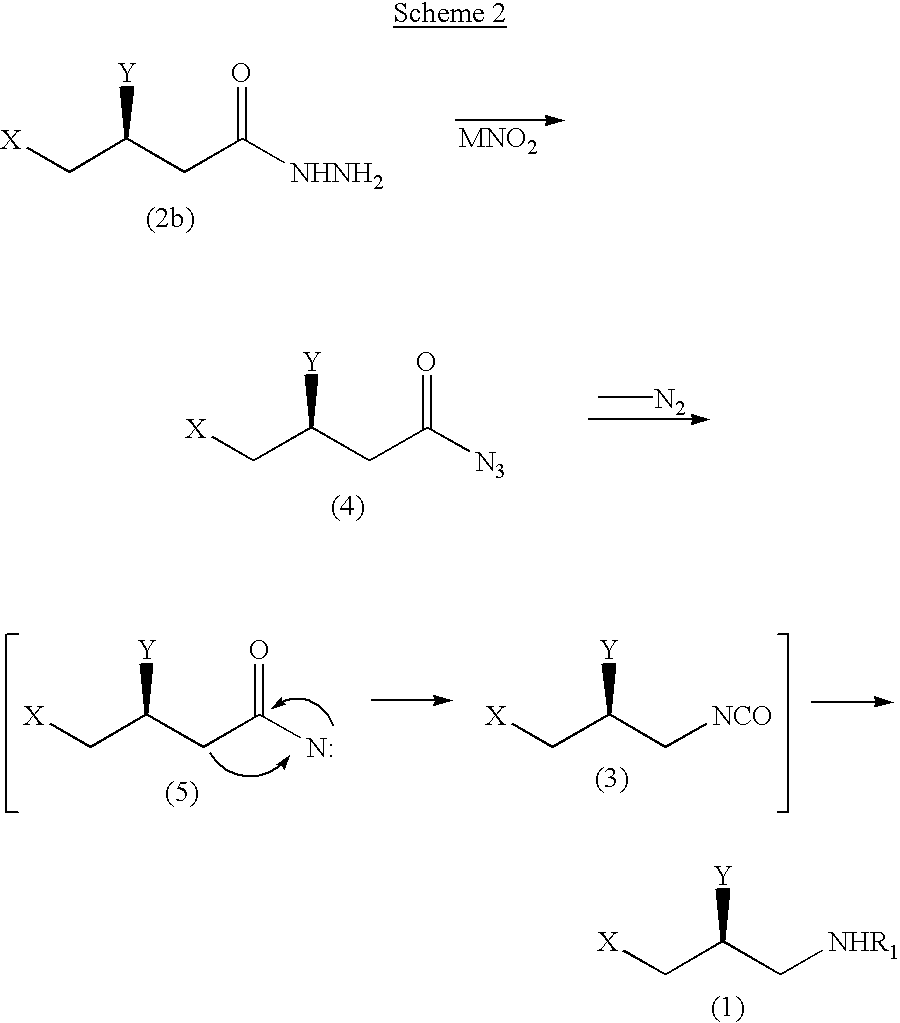
wherein, X, Y and R1 are the same as the above-specified; and M is alkaline metal atom such as Na and K.
As shown in the scheme 2, (S)-3,4-disubstituted-1-butylhydrazide represented in formula 2b is reacted with metallic nitrite or alkylnitrite to convert hydrazide group to acylazide group and then is subjected to reflux under reaction solvent, thereby releasing nitrogen gas, finally converting acylnitrene group of intermediate represented in formula 5 to isocyanate group.
In the above reaction, the step of conversion of hydrazide group of the compound represented in formula 2b to acylazide group is conducted preferably at temperature of −78-50° C.; if the temperature is less than −78° C., the reaction is scarcely proceeded; but in case of exceeding 50° C., the acylazide is decomposed. Preferably, alkaline metallic nitrite such as sodium nitrite and potassium nitrite is employed as metallic nitrite. It is preferred that alkylnitrite of C1-C10 is employed as alkylnitrite; more preferably, alkylnitrite of C1-C6.
As a solvent for reflux so as to convert the compound represented in formula 4 to the compound represented in formula 3, aromatic hydrocarbon such as benzene and toluene is preferred.
If an inorganic acid such as hydrochloric acid or sulfuric acid is added to a reaction mixture containing intermediate represented in formula 3, the final product whose R1 is inorganic acid salt (eg., hydrochloric acid salt (H.HCl), sulfuric acid salt (H.H2SO4)) is obtained. If alcohols in place of inorganic acid is added, the final product whose R1 is carbamate is provided.
The following scheme 3 represents a preparing example of a compound of formula 1 through Curtius Rearrangement using a compound of formula 2 (where, Z is OH). 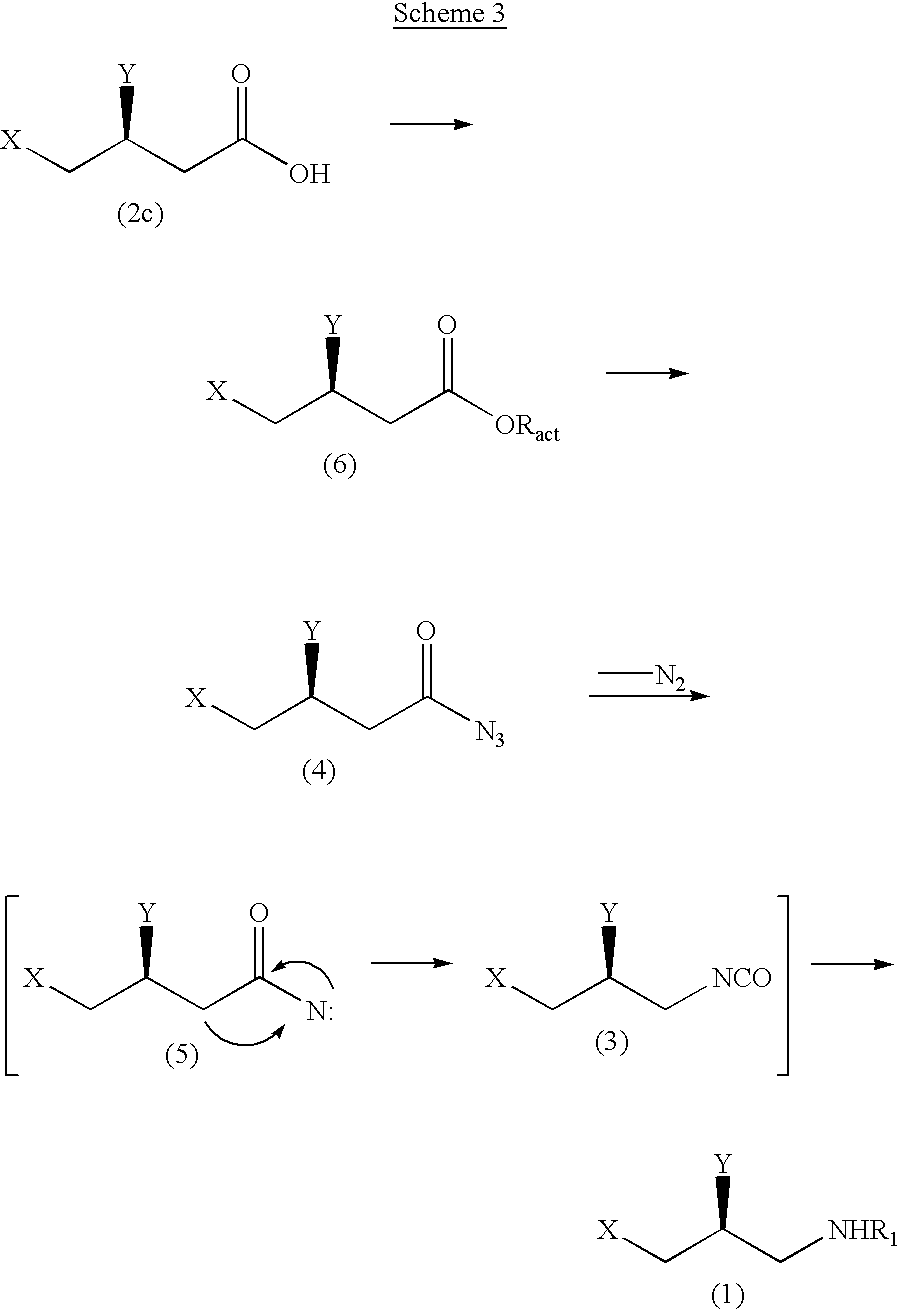
wherein, X, Y and R1 are the same as the above-specified; and Ract is carboxylic acid ester or phosphoric acid ester.
As shown in the scheme 3, carboxyl group of (S)-3,4-disubstituted-1-butyric acid represented in formula 2c is converted to activated ester group (eg., carboxylic acid ester or phosphoric acid ester) and then is subjected to nucleophilic substitution by using alkaline metal azide (eg., sodium azide, potassium azide), thereby preparing acylazide intermediate expressed in formula 4. Thereafter, the acylazide intermediate is subjected to reflux in the presence of suitable solvent, thereby releasing nitrogen gas and finally acylnitrene group of intermediate represented in formula 5 is converted to isocyanate group by Curtius Rearrangement.
In the above reaction, the step of conversion of carboxyl group of the compound represented in formula 2c to acylazide group is conducted preferably at temperature of −78-50° C.; if the temperature is less than −78° C., the reaction is scarcely proceeded; but in case of exceeding 50° C., the acylazide is decomposed. As a solvent for reaction, aromatic hydrocarbon such as benzene and toluene is preferred. In the step of conversion of the above carboxyl group to activated ester group, the haloformate expressed in the following formula 7 or the phosphoryl halide expressed in the following formula 8 is added as reacting material: 
wherein,
X is a halogen atom; and
R is alkyl group of C1-C5, benzyl or phenyl group.
If an inorganic acid such as hydrochloric acid or sulfuric acid is added to a reaction mixture containing isocyanate intermediate represented in formula 3, the final product whose R1 is inorganic acid salt (eg., hydrochloric acid salt (H.HCl), sulfuric acid salt (H.H2SO4)) is obtained. If alcohols in place of inorganic acid is added, the final product whose R1 is carbamate is provided.
A solvent for extraction of acylazide in aqueous solution includes organic solvent which is immiscible with water such as chloroform, dichloromethane, diethylether, diisopropylether, dipropylether, benzene and tolune.
The following specific examples are intended to be illustrative of the invention and should not be construed as limiting the scope of the invention as defined by appended claims.
Chiral (S)-3-hydroxybutyrolactone (16.32 g, 0.16 mol), hydrazine monohydrate (purity 80% 20 g, 0.32 mol) and ethanol (200 ml) in 500 ml flask equipped with thermometer and reflux condenser were stirred for 2 hours under reflux. The reaction mixture was cooled down to room temperature and stirred for additional 2 hours A white precipitate was filtered and dried to yield (S)-3,4-dihydroxy-1-butylhydrazide (95%, optical purity>99%ee).
1H-NMR(D20, ppm): δ3.92 (m, 1H, —CHOH), 3.32-3.47 (m, 2H, CH2OH), 2.12-2.30 (m, 2H, CH2—CO)
To 30% hydrobromic acid/acetic acid (62 ml, 0.23 mol) in 100 ml flask equipped with thermometer was added (S)-3,4-dihydroxy-1-butylhydrazide (13.4 g, 0.1 mol). The reaction mixture was stirred for 1 hour at ambient temperature. The precipitate was filtered, washed with 50 ml diethyl ether and dried to give (S)-3-acetoxy-4-bromo-1-butylhydrazide hydrobromic acid salt (93%, optical purity>99%).
1H-NMR(D2O, ppm): δ5.34(m, 1H, —CHOAc), 3.50(m, 2H, CH2Br), 2.75 (m, 2H, CH2—CO), 2.06 (s, OCOCH3)
(S)-3-Acetoxy-4-bromo-1-butylhydrazide hydrobromic acid salt (21.8 g, 0.092 mol), distilled water (80 ml), concentrated hydrochloric acid (40 ml) and diethyl ether (100 ml) in 250 ml flask equipped with thermometer were stirred at 0° C. To the reaction mixture was dropped a solution of sodium nitrite(16 g, 0.23 mol) in water (30 ml) while keeping temperature at lower than 10° C. After dropping, the reaction was extracted twice with diethyl ether (100 ml). The combined organic layer was dried over anhydrous MgSO4 and filtered. The filtrate was evaporated. Toluene (50 ml) was added to the residue and refluxed for 15 min. to generate N2 gas and then concentrated hydrochloric acid (40 ml) was added and refluxed for another 30 min. to generate CO2. The reaction mixture was cooled down and evaporated to give white (S)-3-bromo-2-hydroxy-1-propyl amine hydrochloric acid salt (93%, optical purity>99%,)
1H-NMR (D2O, ppm) : δ4.03 (m, 1H, —CHOH), 3.41 (m, 2H, CH2Br), 3.17 (d, 1H, CHaN), 2.96 (t, 1H, CHbN)
(S)-3-Acetoxy-4-bromo-1-butylhydrazide hydrobromic acid salt (21.8 g, 0.092 mol), distilled water (80 ml), concentrated hydrochloric acid (40 ml) and stirred at 0° C. To the reaction mixture was dropped sodium nitrite (16 g, 0.23 mol) in water (30 ml) while keeping temperature at lower than 10° C. After dropping, the reaction mixture was extracted twice with diethyl ether (100 ml). The combined organic layer was dried over anhydrous MgSO4 and filtered. The filtrate was evaporated. Toluene (50 ml) and benzyl alcohol (9.9 g, 0.092 mol) were added to the residue and then the reaction mixture was refluxed for 2 hours. The reaction mixture was evaporated to give white (S)-3-bromo-2-hydroxy-1-propylcarbamate benzyl ester (94%, optical purity>99%).
1H-NMR (CDCl3, ppm): δ7.39 (s, 5H, Ph), 5.52 (brs, 1H, NH), 5.28 (s, 2H, CH2—Ph), 4.02 (m, 1H, CH—O), 3.48 (m, 2H, CH2—Br), 3.36 (m, 2H, CH2N)
(S)4-Chloro-3-hydroxy-1-butylhydrazide (18 g, 0.119 mol) in 250 ml three-necked flask equipped with thermometer was dissolved in a mixture of 6 g hydrochloric acid in ethanol. Amyl nitrite (19.3 g, 0.165 mol) was added and the reaction mixture was heated to 60° C. for 2 hours. After cooling down the reaction mixture, diethyl ether (100 ml) was added and stirred. To the pricipitate filtered was added concentrated hydrochloric acid (200 ml). The reaction mixture was stirred for 2 hours at 90° C. It was cooled down in the ice bath and triturated with diethyl ether (300 ml) to give (S)-3-chloro-2-hydroxy-1-propylamine hydrochloric acid salt (91%, optical purity>99%ee).
1H-NMR (D2O, ppm): δ4.12 (m, 1H, —CHOH), 3.42-3.62 (m, 2H, CH2Cl), 3.20 (d, 1H, CHaN), 3.02 (t, 1H, CHbN)
(S)-3,4-Dihydroxy-1-butylhydrazide (13.4 g, 0.1 mol), distilled water (80 ml), concentrated sulfuric acid (30 ml) and diethyl ether (100 ml) in 250 ml flask equipped with thermometer were stirred at 0° C. To the reaction mixture was dropped a solution of sodium nitrite (16 g, 0.23 mol) in distilled water (30 ml) while keeping the temperature at lower than 10° C. After dropping, the reaction mixture was extracted twice with diethyl ether (150 ml). The combined organic layer was dried over anhydrous MgSO4 and filtered. The filtrate was evaporated. Toluene (50 ml) was added to the residue and refluxed for 15 min. to generate N2 gas. Concentrated sulfuric acid (30 ml) was added to the reaction mixture and refluxed for 1 hour to generate CO2. The reaction mixture was then cooled and evaporated to give white (S)-2,3-dihydroxy-1-propylamine sulfuric acid salt (93%, optical purity>99%ee).
1H-NMR (D2O, ppm): δ3.92 (m, 1H, —CHOH), 3.53 (m, 2H, CH2OH), 3.15-2.93 (m, 2H, CH2N)
(S)-3-Hydroxyburyrolactone (102 g, 1 mol), 2,2-dimethoxypropane (200 ml), acetone (100 ml), methanol (20 ml) and p-toluenesulfonic acid monohydrate (10 g, 0.053 mol) in 11 flask equipped with thermometer and reflux condenser were refluxed for 3 hours. The reaction mixture was dissolved in diethyl ether (500 ml) and washed with a saturated solution of NaHCO3 (100 ml). The organic solution was dried over anhydrous MgSO4 and evaporated under the vacuum to give (S)-3,4-O-isopropyl iden-3,4-dihydroxy-1-butyric acid methyl ester (92%, optical purity>99%ee).
1H-NMR (CDCl3, ppm): δ4.41 (m, 1H, —CHO), 4.08 (m, 1H, CH2aO), 3.63 (s, 3H, OCH3), 3.58 (m, 1H, CH2bO), 2.42-2.68 (m, 2H, CH2CO), 1.34 (s, 3H, OCH3)
(S)-3,4-O-Isopropyliden-3,4-dihydroxy-1-butyric acid methyl ester (37.1 g, 0.0213 mol) in 500 ml three-necked flask equipped with thermometer was dissolved in THF (30 ml) and water (140 ml). Lithium hydroxide (2.2 g, 0.064 mol) was dropped at ambient temperature and stirred for 12 hours. 10% Aqueous solution of citric acid was added to adjust pH 4. The reaction mixture was extracted three times with diethyl ether (150 ml). The combined organic layer was dried over anhydrous MgSO4 and evaporated to give (S)-3,4-O-isopropyliden-3,4-dihydroxy-1-butyric acid (92%, optical purity>99%ee).
1H-NMR (CDCl3, ppm): δ4.47 (m, 1H, CHO), 4.19 (m, 1H, —CH2O), 3.69 (m, 1H, CH2O), 2.80-2.17 (m, 2H, CH2O), 1.44 (s, 3H, OCH3), 1.37 (s, 3H, OCH3)
(S)-3,4-O-Isopropyliden-3,4-dihydroxy-1-butyric acid (3.2 g, 0.02 mol) in 500 ml three-necked flask was dissolved in acetone (100 ml) and cooled down to −10° C. Triethylamine (2.22 g, 0.022 mol) was added by keeping temperature at −10° C. and stirred for 20 min. Ethylchloroformate (2.39 g, 0.022 mol) was added and stirred for 30 min. by keeping temperature at 0° C. Sodium azide (2.6 g, 0.04 mol) dissolved in water (30 ml) was added and stirred for additional 30 min. by keeping temperature at 0° C. The reaction mixture was extracted three times with diethyl ether (100 ml). The combined organic layer was dried over anhydrous MgSO4 and evaporated to dryness. Toluene (20 ml) was added to the residue. Benzyl alcohol (2.16 g, 0.02 mol) was added and refluxed for 1 hour. The reaction mixture was evaporated and purified by column chromatograpy on silica gel to give (S)-2,3-O-isopropyliden-2,3-dihydroxy-1-propylcarbamate benzyl ester (93%, optical purity>99%ee).
1H-NMR (CDCl3, ppm): δ7.29 (s, 5H, Ph), 5.61 (brs, 1H, NH), 5.05 (s, 2H, CH2Ph), 4.12 (m, 1H, CH—O), 3.94 (m, 1H, CH2a—O), 3.59 (m, 1H, CH2b—O), 3.14-3.40 (m, 2H, CH2N), 1.37 (s, 3H,OCH3), 1.29 (s, 3H, OCH3)
(S)-3,4-O-Isopropyliden-3,4-dihydroxy-1-butyric acid (3.2 g, 0.02 mol) in 500 ml three-necked flask was dissolved in acetone (230 ml) and stirred. Diphenylphosphorylazide (5.1 ml, 0.024 mol) and triethylamine (3.24 ml, 0.024 mol) were added and heated to reflux for 2 hours. 2-Methyl-2-propanol (3.24 ml, 0.04 mol) was added and refluxed for additional 12 hours. The reaction mixture was evaporated and dissolved in water. The reaction mixture was extracted three times with ethyl acetate (50 ml). The organic layer was washed with sat. aqueous solution of NaHCO3 and dried over anhydrous MgSO4. The organic layer was evaporated to dryness and purified by column chromatography on silica gel to give (S)-2,3-O-isopropyliden-2,3-dihydroxy-1-propylcarbamate t-butylester. (91%, optical purity>99%ee).
1H-NMR (CDCl3, ppm): δ5.54 (brs, 1H, NH), 4.22 (m, 1H, CH—O), 4.05 (m, 1H, CH2a—O), 3.64 (m, 1H, CH2b—O), 3.24-3.48 (m, 2H, CH2N), 1.43 (s, 9H, O(CH3)3), 1.33 (s, 6H, 2OCH3)
(S)-2,3-O-Isopropyliden-2,3-dihydroxy-1-propylcarbamate benzyl ester (2.51 g, 0.01 mol) in 100 ml flask was dissolved in acetonitrile (30 ml). 1N hydrochloric acid was added and stirred for 12 hours. The reaction mixture was extracted three times with ethyl acetate (50 ml). The combined organic layer was dried over anhydrous MgSO4 and evaporated to give (S)-2,3-dihydroxy-1-propylcarbamate benzyl ester (90%, optical purity>99%ee).
1H-NMR (CDCl3, ppm) : δ7.37 (s, 5H, Ph), 5.13 (s, 2H, CH2—Ph), 3.91 (m, 1H, CH—O), 3.62 (m, 2H, CH2—O), 3.36 (m, 2H, CH2N)
(S)-2,3-Dihydroxy-1-propylcarbamate benzyl ester (2.11 g, 0.01 mol) in 100 ml flask was dissolved in CHCl3 (30 ml). 1-Chlorocarbonyl-1-methylethylacetate (1.8 ml, 0.013 mol) was added and stirred for 3 hours at ambient temperature. Sat. aqueous solution of NaHCO3 (20 ml) was added and extracted three times with ethyl acetate (50 ml). The organic layer was evaporated and dissolved in THF (50 ml). Sodium methoxide (0.53 g, 0.01 mol) was added and stirred for 6 hours. Sat. aqueous solution of NaHCO3 (50 ml) was added and extracted with ethyl acetate (50 ml). The organic layer was dried over anhydrous MgSO4 and evaporated to dryness. The crude product was purified by column chromatography on silica gel to give (S)-2,3-epoxy-1-propylcarbamate benzyl ester (90%, optical purity>99%ee).
1H-NMR (CDCl3, ppm): δ7.37 (s, 5H, Ph), 5.13 (s, 2H, CH2—Ph), 4.98 (brs, 1H, NH), 3.66 (m, 1H, CH—O), 3.33-3.13 (m, 2H, CH2—O), 2.81-2.60 (m, 2H, CH2N)
NaOH (75 g) was dissolved in water (600 ml) in 500 ml three-necked flask equipped with thermometer and bromine (40 ml) was added with keeping temperature at 0° C. (S)3,4-Dihydroxy-1-butylamide (36.17 g, 0.301 mol) was added and stirred for 1 hour for 50° C. To aqueous solution distilled from reaction mixture was added 1N HCl. The reaction mixture was heated for 1 hour, distilled out water and dried to give white solid, (S)-2,3-dihydroxy-1-propyl amine hydrochloric acid salt (33.72 g, 87%, optical purity>99%ee).
1H-NMR (D2O, ppm) : δ3.82 (m, 1H, —CHOH), 3.52 (m, 2H, CH2OH), 3.08-2.81 (m, 2H, CH2N)
(S)-3,4-Dihydroxy-1-butylamide (22.2 g, 0.1 mol) in 500 ml flask equipped with thermometer was dissolved in methanol (90 ml). To the reaction mixture was added a solution of metallic Na (4.6 g, 0.2 mol) in methanol (145 ml). Bromine (16 g, 0.1 mol) was added and refluxed for 10 min. The reaction mixture was evaporated, dissolved in ethyl acetate and washed with water to remove sodium bromide. The organic layer was evaporated and dried. The crude product was purified by recrystallization from ethanol to give (S)-2,3-dihydroxy-1-propylcarbamate methyl ester (13.6 g, 91%, optical purity>99%ee).
1H-NMR (D2O, ppm): δ5.21 (brs, 1H, NH), 3.79 (m, 1H, —CHOH), 3.60 (m, 2H, CH2OH), 3.65 (s, 3H, OCH3), 3.60 (m, 2H, CH2N)
As explained above, the process of this invention provides chiral (S)-2,3-disubstituted-1-propylamine derivatives with high optical purity and high yield by Curtius Rearrangement or Hofmann Rearrangement that may not influence on chiral hydroxyl group but decreases the number of carbon backbone. In addition, chiral (S)-3,4-disubstituted-1-butanecarbonyl derivatives used as starting material may be easily obtained from natural product or prepared by simple and inexpensive method, thereby decreasing the production cost.
Claims (21)
1. A process for preparing chiral (S)-2,3-disubstituted-1-propylamine derivatives expressed in the following formula 1, characterized in that a carbonyl group of chiral (S)-3,4-disubstituted-1-butanecarbonyl derivatives expressed in the following formula 2 is converted to an amine group: 
wherein,
R1 represents hydrochloric acid salt (H—HCl), sulfuric acid salt (H—H2SO4) or —C(O)OR2;
R2 represents linear or branched alkyl chain having carbon atoms of 1-10, benzyl or phenyl group;
X and Y which are same or different, represents a halogen atom, hydroxy group, acetate group, sulfonate group, or in which X and Y are combined to form epoxy group, acetonide group; and
Z represents NH2, NHNH2 or hydroxy group.
2. The process for preparing chiral (S)-2,3-disubstituted-1-propylamine derivatives according to claim 1 , wherein the conversion reaction is performed through Curtius Rearrangement or Hofmann Rearrangement.
3. The process for preparing chiral (S)-2,3-disubstituted-1-propylamine derivatives according to claim 1 , wherein the carbonyl group of chiral (S)-3,4-disubstituted-1-butanecarbonyl derivatives expressed in the formula 2, in which Z is NHNH2, is converted to amine group through Curtius Rearrangement.
4. The process for preparing chiral (S)-2,3-disubstituted-1-propylamine derivatives according to claim 3 , wherein the Curtius Rearrangement employs metallic nitrite or alkylnitrite of C1-C10.
5. The process for preparing chiral (S)-2,3-disubstituted-1-propylamine derivatives according to claim 4 , wherein the metallic nitrite is sodium nitrite or potassium nitrite.
6. The process for preparing chiral (S)-2,3-disubstituted-1-propylamine derivatives according to claim 4 , wherein the metallic nitrite or alkylnitrite of C1-C10 is added at temperature in the range of −78-50° C.
7. The process for preparing chiral (S)-2,3-disubstituted-1-propylamine derivatives according to claim 4 , wherein a reaction mixture is subjected to reflux following the addition of metallic nitrite or alkylnitrite of C1-C10.
8. The process for preparing chiral (S)-2,3-disubstituted-1-propylamine derivatives according to claim 7 , wherein a solvent for reflux is aromatic hydrocarbon.
9. The process for preparing chiral (S)-2,3-disubstituted-1-propylamine derivatives according to claim 1 , wherein the carbonyl group of chiral (S)-3,4-disubstituted-1-butanecarbonyl derivatives expressed in the formula 2, in which Z is —OH, is converted to amine group through Curtius Rearrangement.
10. The process for preparing chiral (S)-2,3-disubstituted-1-propylamine derivatives according to claim 9 , wherein Curtius Rearrangement is performed in such a manner that haloformate or phosphoryl halide is added to the compound expressed in formula 2 (where, Z is —OH) and alkaline metal azide is subsequently added.
11. The process for preparing chiral (S)-2,3-disubstituted-1-propylamine derivatives according to claim 10 , wherein the haloformate is a compound of the following formula 7 and the phosphoryl halide is a compound of the following formula 8: 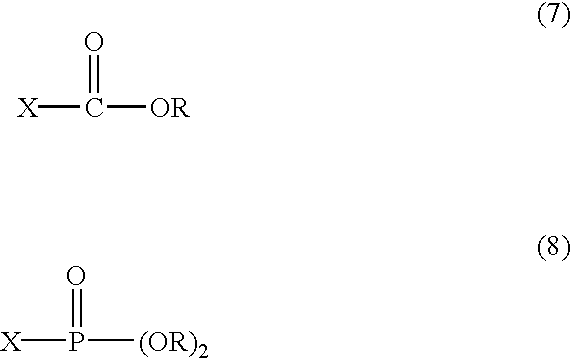
wherein,
X is halogen atom; and
R is alkyl group of C1-C5, benzyl, or phenyl group.
12. The process for preparing chiral (S)-2,3-disubstituted-1-propylamine derivatives according to claim 10 or 11 , wherein the addition reaction is performed at temperature in the range of −78-50° C.
13. The process for preparing chiral (S)-2,3-disubstituted-1-propylamine derivatives according to claim 10 , wherein the alkaline metal azide is sodium azide or potassium azide.
14. The process for preparing chiral (S)-2,3-disubstituted-1-propylamine derivatives according to claim 10 or 13 , wherein a reaction temperature is maintained in the range of 50-150° C. following the addition of alkaline metal azide.
15. The process for preparing chiral (S)-2,3-disubstituted-1-propylamine derivatives according to claim 9 , wherein a solvent for Curtius Rearrangement is aromatic hydrocarbon.
16. The process for preparing chiral (S)-2,3-disubstituted-1-propylamine derivatives according to claim 1 , wherein the carbonyl group of chiral (S)-3,4-disubstituted-1-butanecarbonyl derivatives expressed in the formula 2, in which Z is —NH2, is converted to amine group through Hofmann Rearrangement.
17. The process for preparing chiral (S)-2,3-disubstituted-1-propylamine derivatives according to claim 16 , wherein the Hofmann Rearrangement is performed in the presence of alkaline metal hydroxide and halogen, or MOX (where, M is alkaline metal atom and X is halogen atom).
18. The process for preparing chiral (S)-2,3-disubstituted-1-propylamine derivatives according to claim 16 or 17 , wherein a solvent for the Hofmann Rearrangement is water or polar organic solvent.
19. The process for preparing chiral (S)-2,3-disubstituted-1-propylamine derivatives according to claim 18 , wherein the polar organic solvent is alcohol of C1-C10.
20. The process for preparing chiral (S)-2,3-disubstituted-1-propylamine derivatives according to claim 16 , wherein the Hofmann Rearrangement is performed at temperature in the range of 0-100° C.
21. The process for preparing chiral (S)-2,3-disubstituted-1-propylamine derivatives according to claim 16 , wherein the Hofmann Rearrangement is performed at temperature in the range of 0-60° C.
Applications Claiming Priority (7)
| Application Number | Priority Date | Filing Date | Title |
|---|---|---|---|
| KR1019980013173A KR100469946B1 (en) | 1998-04-14 | 1998-04-14 | Manufacturing method of chiral (S) -2,3-substituted-1-propylamine derivative |
| KR98-13172 | 1998-04-14 | ||
| KR98-13173 | 1998-04-14 | ||
| KR98-13174 | 1998-04-14 | ||
| KR1019980013174A KR100469947B1 (en) | 1998-04-14 | 1998-04-14 | Manufacturing method of chiral (S) -3-amino-1,2-propanediol |
| KR1019980013172A KR100489649B1 (en) | 1998-04-14 | 1998-04-14 | (S) -3-substituted-2-hydroxypropylamine preparation method |
| PCT/KR1999/000178 WO1999052855A1 (en) | 1998-04-14 | 1999-04-14 | A process for preparing chiral (s)-2,3-disubstituted-1-propylamine derivatives |
Publications (1)
| Publication Number | Publication Date |
|---|---|
| US6417403B1 true US6417403B1 (en) | 2002-07-09 |
Family
ID=27349711
Family Applications (1)
| Application Number | Title | Priority Date | Filing Date |
|---|---|---|---|
| US09/673,123 Expired - Fee Related US6417403B1 (en) | 1998-04-14 | 1999-04-14 | Process for preparing chiral (s)-2,3-disubstituted-1-propylamine derivatives |
Country Status (9)
| Country | Link |
|---|---|
| US (1) | US6417403B1 (en) |
| EP (1) | EP1071654B1 (en) |
| JP (1) | JP2002511445A (en) |
| CN (1) | CN1301248A (en) |
| AT (1) | ATE252543T1 (en) |
| AU (1) | AU3345599A (en) |
| CA (1) | CA2328124A1 (en) |
| DE (1) | DE69912264T2 (en) |
| WO (1) | WO1999052855A1 (en) |
Cited By (4)
| Publication number | Priority date | Publication date | Assignee | Title |
|---|---|---|---|---|
| US20060229349A1 (en) * | 2005-04-06 | 2006-10-12 | Josyula Vara Prasad V N | 7-Fluoro-1,3-dihydro-indol-2-one oxazolidinones as antibacterial agents |
| US20060229348A1 (en) * | 2005-04-06 | 2006-10-12 | Josyula Vara Prasad V N | Oxindole oxazolidinone as antibacterial agent |
| WO2012103279A3 (en) * | 2011-01-26 | 2012-09-20 | Ariad Pharmaceuticals, Incorporated | Methods and compositions for the synthesis of multimerizing agents |
| US9556163B2 (en) | 2011-05-06 | 2017-01-31 | Egis Gyogyszergyar Nyilvanosan Mukodo Reszvenytarsasag | Process for the preparation of a rivaroxaban and intermediates formed in said process |
Families Citing this family (6)
| Publication number | Priority date | Publication date | Assignee | Title |
|---|---|---|---|---|
| EP1331218B1 (en) * | 1998-06-01 | 2006-12-27 | Michigan State University | Process for the preparation of protected 3-amino-1,2-dihydroxy-propane acetal and derivatives thereof |
| US6040464A (en) * | 1998-06-01 | 2000-03-21 | Board Of Trustees Operating Michigan State University | Process for the preparation of protected 3-amino-1,2-dihydroxypropane acetal and derivatives thereof |
| US6403804B1 (en) | 1998-12-07 | 2002-06-11 | Takasago International Corporation | Process for preparing optically active oxazolidinone derivative |
| WO2004002973A1 (en) * | 2002-06-28 | 2004-01-08 | Kaneka Corporation | Process for preparation of optically active 1-substituted amino-2,3-epoxypropanes, intermediates for the synthesis thereof and process for preparation of the intermediates |
| US10022531B2 (en) | 2016-01-21 | 2018-07-17 | Teva Medical Ltd. | Luer lock adaptor |
| EP4122597A3 (en) * | 2017-10-05 | 2023-02-15 | Novomer, Inc. | A process for producing a diisocyanate product, a process for producing an aromatic isocyanate product and a process for producing a polyurethane product |
Citations (6)
| Publication number | Priority date | Publication date | Assignee | Title |
|---|---|---|---|---|
| US3855283A (en) | 1969-07-29 | 1974-12-17 | American Cyanamid Co | Levo 1-amino-3-chloro-2-propanol and acid addition salts thereof |
| WO1983001770A1 (en) | 1981-11-12 | 1983-05-26 | American Hospital Supply Corp | 2-hydroxypropylamine aryl ester derivatives |
| US4900847A (en) | 1985-04-04 | 1990-02-13 | Massachusetts Institute Of Technology | Catalytic asymmetric epoxidation |
| WO1991010642A1 (en) | 1990-01-22 | 1991-07-25 | Nobel Chemicals Ab | Process for preparing homochiral amines and process for preparing intermediates for the preparation thereof, and the intermediates prepared in accordance with this process |
| US5292939A (en) | 1991-05-13 | 1994-03-08 | Board Of Trustees Operating Michigan State University | Process for the preparation of 3,4-dihydroxybutanoic acid and salts thereof |
| EP0628536A2 (en) | 1993-05-11 | 1994-12-14 | Hoechst Aktiengesellschaft | Process for the preparation of amines |
-
1999
- 1999-04-14 DE DE69912264T patent/DE69912264T2/en not_active Expired - Fee Related
- 1999-04-14 CN CN99806311A patent/CN1301248A/en active Pending
- 1999-04-14 CA CA002328124A patent/CA2328124A1/en not_active Abandoned
- 1999-04-14 AU AU33455/99A patent/AU3345599A/en not_active Abandoned
- 1999-04-14 AT AT99914788T patent/ATE252543T1/en not_active IP Right Cessation
- 1999-04-14 EP EP99914788A patent/EP1071654B1/en not_active Expired - Lifetime
- 1999-04-14 US US09/673,123 patent/US6417403B1/en not_active Expired - Fee Related
- 1999-04-14 WO PCT/KR1999/000178 patent/WO1999052855A1/en not_active Ceased
- 1999-04-14 JP JP2000543418A patent/JP2002511445A/en active Pending
Patent Citations (8)
| Publication number | Priority date | Publication date | Assignee | Title |
|---|---|---|---|---|
| US3855283A (en) | 1969-07-29 | 1974-12-17 | American Cyanamid Co | Levo 1-amino-3-chloro-2-propanol and acid addition salts thereof |
| WO1983001770A1 (en) | 1981-11-12 | 1983-05-26 | American Hospital Supply Corp | 2-hydroxypropylamine aryl ester derivatives |
| US4900847A (en) | 1985-04-04 | 1990-02-13 | Massachusetts Institute Of Technology | Catalytic asymmetric epoxidation |
| WO1991010642A1 (en) | 1990-01-22 | 1991-07-25 | Nobel Chemicals Ab | Process for preparing homochiral amines and process for preparing intermediates for the preparation thereof, and the intermediates prepared in accordance with this process |
| US5292939A (en) | 1991-05-13 | 1994-03-08 | Board Of Trustees Operating Michigan State University | Process for the preparation of 3,4-dihydroxybutanoic acid and salts thereof |
| US5319110A (en) | 1991-05-13 | 1994-06-07 | Board Of Trustees Operating Michigan State University | Process for the preparation of 3,4-dihydroxybutanoic acid and salts thereof |
| US5374773A (en) | 1991-05-13 | 1994-12-20 | Board Of Trustees Operating Michigan State University | Process for the preparation of 3,4-dihydroxybutanoic acid and salts thereof |
| EP0628536A2 (en) | 1993-05-11 | 1994-12-14 | Hoechst Aktiengesellschaft | Process for the preparation of amines |
Non-Patent Citations (5)
| Title |
|---|
| Agric. Biol. chem., 46, 1593 (1982). |
| Agric. Biol. Chem., 49, 1669 (1985). |
| Argic. Biol. Chem., 48, 2055 (1984). |
| Pine, Hendrickson, Cram and Hammond, Organic Chemistry 4 ed., McGraw-Hill Inc., NY, 1980, pp. 906-908.* * |
| Tetrahedron Letters, vol. 27, No. 18, pp. 2061-2062, 1986. |
Cited By (7)
| Publication number | Priority date | Publication date | Assignee | Title |
|---|---|---|---|---|
| US20060229349A1 (en) * | 2005-04-06 | 2006-10-12 | Josyula Vara Prasad V N | 7-Fluoro-1,3-dihydro-indol-2-one oxazolidinones as antibacterial agents |
| US20060229348A1 (en) * | 2005-04-06 | 2006-10-12 | Josyula Vara Prasad V N | Oxindole oxazolidinone as antibacterial agent |
| US7435751B2 (en) | 2005-04-06 | 2008-10-14 | Vara Prasad Venkata Nagendra Josyula | 7-Fluoro-1,3-dihydro-indol-2-one oxazolidinones as antibacterial agents |
| WO2012103279A3 (en) * | 2011-01-26 | 2012-09-20 | Ariad Pharmaceuticals, Incorporated | Methods and compositions for the synthesis of multimerizing agents |
| US9024028B2 (en) | 2011-01-26 | 2015-05-05 | Ariad Pharmaceuticals, Inc. | Methods and compositions for the synthesis of multimerizing agents |
| US9573934B2 (en) | 2011-01-26 | 2017-02-21 | Ariad Pharmaceuticals, Inc. | Methods and compositions for the synthesis of multimerizing agents |
| US9556163B2 (en) | 2011-05-06 | 2017-01-31 | Egis Gyogyszergyar Nyilvanosan Mukodo Reszvenytarsasag | Process for the preparation of a rivaroxaban and intermediates formed in said process |
Also Published As
| Publication number | Publication date |
|---|---|
| EP1071654A1 (en) | 2001-01-31 |
| DE69912264D1 (en) | 2003-11-27 |
| WO1999052855A1 (en) | 1999-10-21 |
| AU3345599A (en) | 1999-11-01 |
| DE69912264T2 (en) | 2004-07-22 |
| CA2328124A1 (en) | 1999-10-21 |
| JP2002511445A (en) | 2002-04-16 |
| EP1071654B1 (en) | 2003-10-22 |
| CN1301248A (en) | 2001-06-27 |
| ATE252543T1 (en) | 2003-11-15 |
Similar Documents
| Publication | Publication Date | Title |
|---|---|---|
| JPH05213838A (en) | Preparation of fluoxetine | |
| US6417403B1 (en) | Process for preparing chiral (s)-2,3-disubstituted-1-propylamine derivatives | |
| EP0413064B1 (en) | Preparation of 2-phenyl-1, 3-propane diol and its dicarbamate | |
| EP0348223B1 (en) | Novel process for the preparation of serinol | |
| JP3351563B2 (en) | Method for producing 3-hydroxybutyric acid derivative | |
| EP0349217A2 (en) | Novel process for the preparation of bronopol | |
| CN100528858C (en) | Process for synthesising heliotropine and its derivatives | |
| JP2006513246A (en) | Production of water-soluble β-hydroxynitrile | |
| CA2615832A1 (en) | Method for producing nebivolol | |
| EP1109797B1 (en) | Process for manufacturing an optically active (s)-3,4-epoxybutyric acid salt | |
| JP2000063321A (en) | Production of long-chain beta-hydroxycarboxylic acid of high optical purity | |
| EP0483674B1 (en) | A process for producing an aliphatic amide and salts thereof | |
| JP2000256244A (en) | Method for producing 4-methyltetrafluorobenzyl alcohol derivative | |
| JPH0637449B2 (en) | Process for producing optically active atenolol and its intermediates | |
| JP2857402B2 (en) | Method for preparing 2-phenyl-1,3-propanediol dicarbamate | |
| JP2833672B2 (en) | Method for producing β-ketonitrile | |
| RU2051903C1 (en) | Process for preparing (+)-(e)-4-ethyl-2(e)-hydroxyimino)- 3-nitro-3-hexeneamide | |
| KR100469947B1 (en) | Manufacturing method of chiral (S) -3-amino-1,2-propanediol | |
| KR100469946B1 (en) | Manufacturing method of chiral (S) -2,3-substituted-1-propylamine derivative | |
| US6281379B1 (en) | Process for producing norstatin derivatives | |
| KR100461561B1 (en) | (S) -3-carboxy-4-bromobutyric acid production method | |
| JPS647973B2 (en) | ||
| JP2002516893A (en) | Method for preparing protected 3-amino-1,2-dihydroxypropane acetal and derivatives thereof | |
| JPH07242614A (en) | Optically active oxime derivative and method for producing the same | |
| JPH06733B2 (en) | Process for producing optically active 3-hydroxy-4-halogeno-butyronitrile |
Legal Events
| Date | Code | Title | Description |
|---|---|---|---|
| REMI | Maintenance fee reminder mailed | ||
| LAPS | Lapse for failure to pay maintenance fees | ||
| STCH | Information on status: patent discontinuation |
Free format text: PATENT EXPIRED DUE TO NONPAYMENT OF MAINTENANCE FEES UNDER 37 CFR 1.362 |
|
| FP | Lapsed due to failure to pay maintenance fee |
Effective date: 20060709 |