US6387942B2 - Method of treating disorders related to protease-activated receptors-induced cell activation - Google Patents
Method of treating disorders related to protease-activated receptors-induced cell activation Download PDFInfo
- Publication number
- US6387942B2 US6387942B2 US09/883,742 US88374201A US6387942B2 US 6387942 B2 US6387942 B2 US 6387942B2 US 88374201 A US88374201 A US 88374201A US 6387942 B2 US6387942 B2 US 6387942B2
- Authority
- US
- United States
- Prior art keywords
- phenyl
- furyl
- benzyl
- nrr
- independently
- Prior art date
- Legal status (The legal status is an assumption and is not a legal conclusion. Google has not performed a legal analysis and makes no representation as to the accuracy of the status listed.)
- Expired - Lifetime
Links
- 238000000034 method Methods 0.000 title claims abstract description 68
- 102000002020 Protease-activated receptors Human genes 0.000 title claims abstract description 10
- 108050009310 Protease-activated receptors Proteins 0.000 title claims abstract description 10
- 230000020411 cell activation Effects 0.000 title claims abstract description 8
- 150000001875 compounds Chemical class 0.000 claims abstract description 32
- 125000003118 aryl group Chemical group 0.000 claims abstract description 30
- 125000003226 pyrazolyl group Chemical group 0.000 claims abstract description 22
- 125000001997 phenyl group Chemical group [H]C1=C([H])C([H])=C(*)C([H])=C1[H] 0.000 claims description 30
- -1 hydrothio Chemical group 0.000 claims description 27
- 125000002541 furyl group Chemical group 0.000 claims description 7
- 125000000956 methoxy group Chemical group [H]C([H])([H])O* 0.000 claims description 4
- 125000000168 pyrrolyl group Chemical group 0.000 claims description 4
- 125000001544 thienyl group Chemical group 0.000 claims description 4
- 125000000217 alkyl group Chemical group 0.000 claims description 3
- 125000002924 primary amino group Chemical group [H]N([H])* 0.000 claims description 3
- 125000004001 thioalkyl group Chemical group 0.000 claims description 3
- 125000004178 (C1-C4) alkyl group Chemical group 0.000 claims description 2
- 125000004183 alkoxy alkyl group Chemical group 0.000 claims description 2
- 125000004453 alkoxycarbonyl group Chemical group 0.000 claims description 2
- 125000004103 aminoalkyl group Chemical group 0.000 claims description 2
- 125000003917 carbamoyl group Chemical group [H]N([H])C(*)=O 0.000 claims description 2
- 125000003178 carboxy group Chemical group [H]OC(*)=O 0.000 claims description 2
- 125000002768 hydroxyalkyl group Chemical group 0.000 claims description 2
- 125000001475 halogen functional group Chemical group 0.000 claims 8
- 125000004414 alkyl thio group Chemical group 0.000 claims 3
- 125000002915 carbonyl group Chemical group [*:2]C([*:1])=O 0.000 claims 2
- 125000003545 alkoxy group Chemical group 0.000 claims 1
- 125000006264 diethylaminomethyl group Chemical group [H]C([H])([H])C([H])([H])N(C([H])([H])*)C([H])([H])C([H])([H])[H] 0.000 claims 1
- 125000004356 hydroxy functional group Chemical group O* 0.000 claims 1
- IAZDPXIOMUYVGZ-WFGJKAKNSA-N Dimethyl sulfoxide Chemical compound [2H]C([2H])([2H])S(=O)C([2H])([2H])[2H] IAZDPXIOMUYVGZ-WFGJKAKNSA-N 0.000 description 36
- 230000015572 biosynthetic process Effects 0.000 description 32
- 238000003786 synthesis reaction Methods 0.000 description 32
- 238000005160 1H NMR spectroscopy Methods 0.000 description 28
- 239000000203 mixture Substances 0.000 description 25
- YMWUJEATGCHHMB-UHFFFAOYSA-N Dichloromethane Chemical compound ClCCl YMWUJEATGCHHMB-UHFFFAOYSA-N 0.000 description 20
- HEDRZPFGACZZDS-MICDWDOJSA-N Trichloro(2H)methane Chemical compound [2H]C(Cl)(Cl)Cl HEDRZPFGACZZDS-MICDWDOJSA-N 0.000 description 20
- OKKJLVBELUTLKV-UHFFFAOYSA-N Methanol Chemical compound OC OKKJLVBELUTLKV-UHFFFAOYSA-N 0.000 description 18
- 239000000243 solution Substances 0.000 description 18
- XLYOFNOQVPJJNP-UHFFFAOYSA-N water Substances O XLYOFNOQVPJJNP-UHFFFAOYSA-N 0.000 description 17
- 239000007858 starting material Substances 0.000 description 13
- BAXOFTOLAUCFNW-UHFFFAOYSA-N 1H-indazole Chemical compound C1=CC=C2C=NNC2=C1 BAXOFTOLAUCFNW-UHFFFAOYSA-N 0.000 description 11
- 208000037265 diseases, disorders, signs and symptoms Diseases 0.000 description 11
- LJMZRBZETLXDSO-UHFFFAOYSA-N 1h-thieno[3,2-c]pyrazole Chemical group N1N=CC2=C1C=CS2 LJMZRBZETLXDSO-UHFFFAOYSA-N 0.000 description 10
- VYPSYNLAJGMNEJ-UHFFFAOYSA-N Silicium dioxide Chemical compound O=[Si]=O VYPSYNLAJGMNEJ-UHFFFAOYSA-N 0.000 description 9
- HEMHJVSKTPXQMS-UHFFFAOYSA-M Sodium hydroxide Chemical compound [OH-].[Na+] HEMHJVSKTPXQMS-UHFFFAOYSA-M 0.000 description 9
- LFQSCWFLJHTTHZ-UHFFFAOYSA-N Ethanol Chemical compound CCO LFQSCWFLJHTTHZ-UHFFFAOYSA-N 0.000 description 8
- 239000002904 solvent Substances 0.000 description 8
- 208000010110 spontaneous platelet aggregation Diseases 0.000 description 8
- CSNNHWWHGAXBCP-UHFFFAOYSA-L Magnesium sulfate Chemical compound [Mg+2].[O-][S+2]([O-])([O-])[O-] CSNNHWWHGAXBCP-UHFFFAOYSA-L 0.000 description 7
- 208000035475 disorder Diseases 0.000 description 7
- 238000010992 reflux Methods 0.000 description 7
- 239000007787 solid Substances 0.000 description 7
- HDJLSECJEQSPKW-UHFFFAOYSA-N Methyl 2-Furancarboxylate Chemical compound COC(=O)C1=CC=CO1 HDJLSECJEQSPKW-UHFFFAOYSA-N 0.000 description 6
- CDBYLPFSWZWCQE-UHFFFAOYSA-L Sodium Carbonate Chemical compound [Na+].[Na+].[O-]C([O-])=O CDBYLPFSWZWCQE-UHFFFAOYSA-L 0.000 description 6
- 108090000190 Thrombin Proteins 0.000 description 6
- YXFVVABEGXRONW-UHFFFAOYSA-N Toluene Chemical compound CC1=CC=CC=C1 YXFVVABEGXRONW-UHFFFAOYSA-N 0.000 description 6
- 230000002401 inhibitory effect Effects 0.000 description 6
- 150000003839 salts Chemical class 0.000 description 6
- 229960004072 thrombin Drugs 0.000 description 6
- MXBKCOLSUUYOHT-UHFFFAOYSA-N 3-phenyl-1h-indazole Chemical compound C1=CC=CC=C1C1=NNC2=CC=CC=C12 MXBKCOLSUUYOHT-UHFFFAOYSA-N 0.000 description 5
- QTBSBXVTEAMEQO-UHFFFAOYSA-N Acetic acid Chemical compound CC(O)=O QTBSBXVTEAMEQO-UHFFFAOYSA-N 0.000 description 5
- 239000005457 ice water Substances 0.000 description 5
- 239000008194 pharmaceutical composition Substances 0.000 description 5
- 239000002244 precipitate Substances 0.000 description 5
- MUVDDQLNMMNMMN-UHFFFAOYSA-N 1-benzyl-3-phenylindazole Chemical compound N1=C(C=2C=CC=CC=2)C2=CC=CC=C2N1CC1=CC=CC=C1 MUVDDQLNMMNMMN-UHFFFAOYSA-N 0.000 description 4
- 229910015844 BCl3 Inorganic materials 0.000 description 4
- HEDRZPFGACZZDS-UHFFFAOYSA-N Chloroform Chemical compound ClC(Cl)Cl HEDRZPFGACZZDS-UHFFFAOYSA-N 0.000 description 4
- VEXZGXHMUGYJMC-UHFFFAOYSA-N Hydrochloric acid Chemical compound Cl VEXZGXHMUGYJMC-UHFFFAOYSA-N 0.000 description 4
- WGLPBDUCMAPZCE-UHFFFAOYSA-N Trioxochromium Chemical compound O=[Cr](=O)=O WGLPBDUCMAPZCE-UHFFFAOYSA-N 0.000 description 4
- JAXYWRKRWWTUBX-UHFFFAOYSA-N [2-(1-benzylindazol-3-yl)furan-3-yl]methanol Chemical compound C1=COC(C=2C3=CC=CC=C3N(CC=3C=CC=CC=3)N=2)=C1CO JAXYWRKRWWTUBX-UHFFFAOYSA-N 0.000 description 4
- UHOVQNZJYSORNB-UHFFFAOYSA-N benzene Substances C1=CC=CC=C1 UHOVQNZJYSORNB-UHFFFAOYSA-N 0.000 description 4
- PASDCCFISLVPSO-UHFFFAOYSA-N benzoyl chloride Chemical compound ClC(=O)C1=CC=CC=C1 PASDCCFISLVPSO-UHFFFAOYSA-N 0.000 description 4
- 238000006243 chemical reaction Methods 0.000 description 4
- 238000004440 column chromatography Methods 0.000 description 4
- 238000001816 cooling Methods 0.000 description 4
- 201000010099 disease Diseases 0.000 description 4
- DGCOVLUYNUVONV-UHFFFAOYSA-N ethyl 3-(1-benzylindazol-3-yl)benzoate Chemical compound CCOC(=O)C1=CC=CC(C=2C3=CC=CC=C3N(CC=3C=CC=CC=3)N=2)=C1 DGCOVLUYNUVONV-UHFFFAOYSA-N 0.000 description 4
- LPROLPQTWKDPNU-UHFFFAOYSA-N ethyl 4-(1-benzylindazol-3-yl)benzoate Chemical compound C1=CC(C(=O)OCC)=CC=C1C(C1=CC=CC=C11)=NN1CC1=CC=CC=C1 LPROLPQTWKDPNU-UHFFFAOYSA-N 0.000 description 4
- 125000005843 halogen group Chemical group 0.000 description 4
- VLKZOEOYAKHREP-UHFFFAOYSA-N n-Hexane Chemical compound CCCCCC VLKZOEOYAKHREP-UHFFFAOYSA-N 0.000 description 4
- 239000012044 organic layer Substances 0.000 description 4
- 239000000377 silicon dioxide Substances 0.000 description 4
- 125000001424 substituent group Chemical group 0.000 description 4
- 239000000725 suspension Substances 0.000 description 4
- 238000011282 treatment Methods 0.000 description 4
- FAQYAMRNWDIXMY-UHFFFAOYSA-N trichloroborane Chemical compound ClB(Cl)Cl FAQYAMRNWDIXMY-UHFFFAOYSA-N 0.000 description 4
- IFQUPKAISSPFTE-UHFFFAOYSA-N 4-benzoylbenzoic acid Chemical compound C1=CC(C(=O)O)=CC=C1C(=O)C1=CC=CC=C1 IFQUPKAISSPFTE-UHFFFAOYSA-N 0.000 description 3
- RTZKZFJDLAIYFH-UHFFFAOYSA-N Diethyl ether Chemical compound CCOCC RTZKZFJDLAIYFH-UHFFFAOYSA-N 0.000 description 3
- FAPWRFPIFSIZLT-UHFFFAOYSA-M Sodium chloride Chemical compound [Na+].[Cl-] FAPWRFPIFSIZLT-UHFFFAOYSA-M 0.000 description 3
- 230000002776 aggregation Effects 0.000 description 3
- 238000004220 aggregation Methods 0.000 description 3
- NHOWLEZFTHYCTP-UHFFFAOYSA-N benzylhydrazine Chemical compound NNCC1=CC=CC=C1 NHOWLEZFTHYCTP-UHFFFAOYSA-N 0.000 description 3
- 239000011575 calcium Substances 0.000 description 3
- 239000002775 capsule Substances 0.000 description 3
- 239000012043 crude product Substances 0.000 description 3
- 239000003814 drug Substances 0.000 description 3
- 239000003937 drug carrier Substances 0.000 description 3
- 230000000694 effects Effects 0.000 description 3
- 239000000284 extract Substances 0.000 description 3
- 239000000706 filtrate Substances 0.000 description 3
- 150000007857 hydrazones Chemical class 0.000 description 3
- 150000002576 ketones Chemical class 0.000 description 3
- 125000001160 methoxycarbonyl group Chemical group [H]C([H])([H])OC(*)=O 0.000 description 3
- FILYPAWPUAUFFC-UHFFFAOYSA-N methyl 5-benzoylfuran-2-carboxylate Chemical compound O1C(C(=O)OC)=CC=C1C(=O)C1=CC=CC=C1 FILYPAWPUAUFFC-UHFFFAOYSA-N 0.000 description 3
- 229910000029 sodium carbonate Inorganic materials 0.000 description 3
- 238000003756 stirring Methods 0.000 description 3
- WXPWZZHELZEVPO-UHFFFAOYSA-N (4-methylphenyl)-phenylmethanone Chemical compound C1=CC(C)=CC=C1C(=O)C1=CC=CC=C1 WXPWZZHELZEVPO-UHFFFAOYSA-N 0.000 description 2
- FGTYTUFKXYPTML-UHFFFAOYSA-N 2-benzoylbenzoic acid Chemical compound OC(=O)C1=CC=CC=C1C(=O)C1=CC=CC=C1 FGTYTUFKXYPTML-UHFFFAOYSA-N 0.000 description 2
- CPULOHPFZMGPTC-UHFFFAOYSA-N 3-(1-benzylindazol-3-yl)benzoic acid Chemical compound OC(=O)C1=CC=CC(C=2C3=CC=CC=C3N(CC=3C=CC=CC=3)N=2)=C1 CPULOHPFZMGPTC-UHFFFAOYSA-N 0.000 description 2
- LTEBBLMZCSMKFF-UHFFFAOYSA-N 4-(1-benzylindazol-3-yl)benzoic acid Chemical compound C1=CC(C(=O)O)=CC=C1C(C1=CC=CC=C11)=NN1CC1=CC=CC=C1 LTEBBLMZCSMKFF-UHFFFAOYSA-N 0.000 description 2
- CSCPPACGZOOCGX-UHFFFAOYSA-N Acetone Chemical compound CC(C)=O CSCPPACGZOOCGX-UHFFFAOYSA-N 0.000 description 2
- 201000001320 Atherosclerosis Diseases 0.000 description 2
- RUHMYQDQTVOWIW-UHFFFAOYSA-N CC.CC.CC.CC.CC.CC.CCN1C=CC(C)=N1.[Ar].[Ar].[Ar].[Ar].[Ar].[Ar] Chemical compound CC.CC.CC.CC.CC.CC.CCN1C=CC(C)=N1.[Ar].[Ar].[Ar].[Ar].[Ar].[Ar] RUHMYQDQTVOWIW-UHFFFAOYSA-N 0.000 description 2
- OYPRJOBELJOOCE-UHFFFAOYSA-N Calcium Chemical compound [Ca] OYPRJOBELJOOCE-UHFFFAOYSA-N 0.000 description 2
- UXVMQQNJUSDDNG-UHFFFAOYSA-L Calcium chloride Chemical compound [Cl-].[Cl-].[Ca+2] UXVMQQNJUSDDNG-UHFFFAOYSA-L 0.000 description 2
- WQZGKKKJIJFFOK-GASJEMHNSA-N Glucose Natural products OC[C@H]1OC(O)[C@H](O)[C@@H](O)[C@@H]1O WQZGKKKJIJFFOK-GASJEMHNSA-N 0.000 description 2
- 229910004373 HOAc Inorganic materials 0.000 description 2
- 229910021578 Iron(III) chloride Inorganic materials 0.000 description 2
- KFZMGEQAYNKOFK-UHFFFAOYSA-N Isopropanol Chemical compound CC(C)O KFZMGEQAYNKOFK-UHFFFAOYSA-N 0.000 description 2
- TWRXJAOTZQYOKJ-UHFFFAOYSA-L Magnesium chloride Chemical compound [Mg+2].[Cl-].[Cl-] TWRXJAOTZQYOKJ-UHFFFAOYSA-L 0.000 description 2
- UIIMBOGNXHQVGW-UHFFFAOYSA-M Sodium bicarbonate Chemical compound [Na+].OC([O-])=O UIIMBOGNXHQVGW-UHFFFAOYSA-M 0.000 description 2
- 208000007536 Thrombosis Diseases 0.000 description 2
- 208000007814 Unstable Angina Diseases 0.000 description 2
- GJYFYOXDTYXMQN-UHFFFAOYSA-N [3-(1-benzylindazol-3-yl)phenyl]methanol Chemical compound OCC1=CC=CC(C=2C3=CC=CC=C3N(CC=3C=CC=CC=3)N=2)=C1 GJYFYOXDTYXMQN-UHFFFAOYSA-N 0.000 description 2
- FUIFWIQDRYVTCH-UHFFFAOYSA-N [4-(1-benzylindazol-3-yl)phenyl]methanol Chemical compound C1=CC(CO)=CC=C1C(C1=CC=CC=C11)=NN1CC1=CC=CC=C1 FUIFWIQDRYVTCH-UHFFFAOYSA-N 0.000 description 2
- VSCWAEJMTAWNJL-UHFFFAOYSA-K aluminium trichloride Chemical compound Cl[Al](Cl)Cl VSCWAEJMTAWNJL-UHFFFAOYSA-K 0.000 description 2
- 239000007864 aqueous solution Substances 0.000 description 2
- 230000008901 benefit Effects 0.000 description 2
- RWCCWEUUXYIKHB-UHFFFAOYSA-N benzophenone Chemical compound C=1C=CC=CC=1C(=O)C1=CC=CC=C1 RWCCWEUUXYIKHB-UHFFFAOYSA-N 0.000 description 2
- 239000012965 benzophenone Substances 0.000 description 2
- 229910052791 calcium Inorganic materials 0.000 description 2
- 239000000969 carrier Substances 0.000 description 2
- 239000001913 cellulose Substances 0.000 description 2
- 229920002678 cellulose Polymers 0.000 description 2
- 239000003795 chemical substances by application Substances 0.000 description 2
- 230000008878 coupling Effects 0.000 description 2
- 238000010168 coupling process Methods 0.000 description 2
- 238000005859 coupling reaction Methods 0.000 description 2
- 239000013078 crystal Substances 0.000 description 2
- HPNMFZURTQLUMO-UHFFFAOYSA-N diethylamine Chemical compound CCNCC HPNMFZURTQLUMO-UHFFFAOYSA-N 0.000 description 2
- 239000002552 dosage form Substances 0.000 description 2
- OTYJRBJRMVNCQV-UHFFFAOYSA-N ethyl 4-benzoylbenzoate Chemical compound C1=CC(C(=O)OCC)=CC=C1C(=O)C1=CC=CC=C1 OTYJRBJRMVNCQV-UHFFFAOYSA-N 0.000 description 2
- CRLNTRZMHKNJSR-UHFFFAOYSA-N furan-2-yl(phenyl)methanone Chemical compound C=1C=CC=CC=1C(=O)C1=CC=CO1 CRLNTRZMHKNJSR-UHFFFAOYSA-N 0.000 description 2
- 239000008103 glucose Substances 0.000 description 2
- 238000000338 in vitro Methods 0.000 description 2
- RBTARNINKXHZNM-UHFFFAOYSA-K iron trichloride Chemical compound Cl[Fe](Cl)Cl RBTARNINKXHZNM-UHFFFAOYSA-K 0.000 description 2
- 239000010410 layer Substances 0.000 description 2
- JEHCHYAKAXDFKV-UHFFFAOYSA-J lead tetraacetate Chemical compound CC(=O)O[Pb](OC(C)=O)(OC(C)=O)OC(C)=O JEHCHYAKAXDFKV-UHFFFAOYSA-J 0.000 description 2
- HQKMJHAJHXVSDF-UHFFFAOYSA-L magnesium stearate Chemical compound [Mg+2].CCCCCCCCCCCCCCCCCC([O-])=O.CCCCCCCCCCCCCCCCCC([O-])=O HQKMJHAJHXVSDF-UHFFFAOYSA-L 0.000 description 2
- 208000010125 myocardial infarction Diseases 0.000 description 2
- 125000001147 pentyl group Chemical group C(CCCC)* 0.000 description 2
- 239000000651 prodrug Substances 0.000 description 2
- 229940002612 prodrug Drugs 0.000 description 2
- 230000002194 synthesizing effect Effects 0.000 description 2
- VZGDMQKNWNREIO-UHFFFAOYSA-N tetrachloromethane Chemical compound ClC(Cl)(Cl)Cl VZGDMQKNWNREIO-UHFFFAOYSA-N 0.000 description 2
- 230000001225 therapeutic effect Effects 0.000 description 2
- JOXIMZWYDAKGHI-UHFFFAOYSA-N toluene-4-sulfonic acid Chemical compound CC1=CC=C(S(O)(=O)=O)C=C1 JOXIMZWYDAKGHI-UHFFFAOYSA-N 0.000 description 2
- URBLVRAVOIVZFJ-UHFFFAOYSA-N (3-methylphenyl)-phenylmethanone Chemical compound CC1=CC=CC(C(=O)C=2C=CC=CC=2)=C1 URBLVRAVOIVZFJ-UHFFFAOYSA-N 0.000 description 1
- SMNDYUVBFMFKNZ-UHFFFAOYSA-N 2-furoic acid Chemical class OC(=O)C1=CC=CO1 SMNDYUVBFMFKNZ-UHFFFAOYSA-N 0.000 description 1
- AXJXRLHTQQONQR-UHFFFAOYSA-N 3-benzoylbenzoic acid Chemical compound OC(=O)C1=CC=CC(C(=O)C=2C=CC=CC=2)=C1 AXJXRLHTQQONQR-UHFFFAOYSA-N 0.000 description 1
- QCQCHGYLTSGIGX-GHXANHINSA-N 4-[[(3ar,5ar,5br,7ar,9s,11ar,11br,13as)-5a,5b,8,8,11a-pentamethyl-3a-[(5-methylpyridine-3-carbonyl)amino]-2-oxo-1-propan-2-yl-4,5,6,7,7a,9,10,11,11b,12,13,13a-dodecahydro-3h-cyclopenta[a]chrysen-9-yl]oxy]-2,2-dimethyl-4-oxobutanoic acid Chemical compound N([C@@]12CC[C@@]3(C)[C@]4(C)CC[C@H]5C(C)(C)[C@@H](OC(=O)CC(C)(C)C(O)=O)CC[C@]5(C)[C@H]4CC[C@@H]3C1=C(C(C2)=O)C(C)C)C(=O)C1=CN=CC(C)=C1 QCQCHGYLTSGIGX-GHXANHINSA-N 0.000 description 1
- TVNDPZYOQCCHTJ-UHFFFAOYSA-N 5-thiophen-2-yl-1h-pyrazole Chemical compound C1=CSC(C=2NN=CC=2)=C1 TVNDPZYOQCCHTJ-UHFFFAOYSA-N 0.000 description 1
- QTBSBXVTEAMEQO-UHFFFAOYSA-M Acetate Chemical compound CC([O-])=O QTBSBXVTEAMEQO-UHFFFAOYSA-M 0.000 description 1
- GUBGYTABKSRVRQ-XLOQQCSPSA-N Alpha-Lactose Chemical compound O[C@@H]1[C@@H](O)[C@@H](O)[C@@H](CO)O[C@H]1O[C@@H]1[C@@H](CO)O[C@H](O)[C@H](O)[C@H]1O GUBGYTABKSRVRQ-XLOQQCSPSA-N 0.000 description 1
- QGZKDVFQNNGYKY-UHFFFAOYSA-O Ammonium Chemical compound [NH4+] QGZKDVFQNNGYKY-UHFFFAOYSA-O 0.000 description 1
- KZMGYPLQYOPHEL-UHFFFAOYSA-N Boron trifluoride etherate Chemical compound FB(F)F.CCOCC KZMGYPLQYOPHEL-UHFFFAOYSA-N 0.000 description 1
- CPELXLSAUQHCOX-UHFFFAOYSA-M Bromide Chemical compound [Br-] CPELXLSAUQHCOX-UHFFFAOYSA-M 0.000 description 1
- HOOKDUWVFVFOGR-UHFFFAOYSA-N CC1=CC(/C2=N/N(CC3=CC=CC=C3)C3=C2C=CC=C3)=CC=C1.CC1=CC=C(/C2=N/N(CC3=CC=CC=C3)C3=C2C=CC=C3)O1 Chemical compound CC1=CC(/C2=N/N(CC3=CC=CC=C3)C3=C2C=CC=C3)=CC=C1.CC1=CC=C(/C2=N/N(CC3=CC=CC=C3)C3=C2C=CC=C3)O1 HOOKDUWVFVFOGR-UHFFFAOYSA-N 0.000 description 1
- BQRUSZAVSCMXNN-AYURXZPTSA-I CCC1=CC=C(C2=NN(CC3=CC=CC=C3)C3=C2C=CC=C3)O1.CO.COC(=O)C1=CC=C(C(=O)C2=CC=CC=C2)O1.COC(=O)C1=CC=C(C2=NN(CC3=CC=CC=C3)C3=C2C=CC=C3)O1.COC(=O)C1=CC=CO1.COCC1=CC=C(C2=NN(CC3=CC=CC=C3)C3=C2C=CC=C3)O1.Cl[Fe](Cl)Cl.O=C(Cl)C1=CC=CC=C1.O=C(O)C1=CC=C(C2=NN(CC3=CC=CC=C3)C3=C2C=CC=C3)O1.OCC1=CC=C(C2=NN(CC3=CC=CC=C3)C3=C2C=CC=C3)O1.O[Ac].O[Na].[Ac]O[Pb](O[Ac])(O[Ac])O[Ac].[H]N(CC1=CC=CC=C1)/N=C(\C1=CC=CC=C1)C1=CC=C(C(=O)OC)O1.[H]N(N)CC1=CC=CC=C1 Chemical compound CCC1=CC=C(C2=NN(CC3=CC=CC=C3)C3=C2C=CC=C3)O1.CO.COC(=O)C1=CC=C(C(=O)C2=CC=CC=C2)O1.COC(=O)C1=CC=C(C2=NN(CC3=CC=CC=C3)C3=C2C=CC=C3)O1.COC(=O)C1=CC=CO1.COCC1=CC=C(C2=NN(CC3=CC=CC=C3)C3=C2C=CC=C3)O1.Cl[Fe](Cl)Cl.O=C(Cl)C1=CC=CC=C1.O=C(O)C1=CC=C(C2=NN(CC3=CC=CC=C3)C3=C2C=CC=C3)O1.OCC1=CC=C(C2=NN(CC3=CC=CC=C3)C3=C2C=CC=C3)O1.O[Ac].O[Na].[Ac]O[Pb](O[Ac])(O[Ac])O[Ac].[H]N(CC1=CC=CC=C1)/N=C(\C1=CC=CC=C1)C1=CC=C(C(=O)OC)O1.[H]N(N)CC1=CC=CC=C1 BQRUSZAVSCMXNN-AYURXZPTSA-I 0.000 description 1
- BHPQYMZQTOCNFJ-UHFFFAOYSA-N Calcium cation Chemical compound [Ca+2] BHPQYMZQTOCNFJ-UHFFFAOYSA-N 0.000 description 1
- VEXZGXHMUGYJMC-UHFFFAOYSA-M Chloride anion Chemical compound [Cl-] VEXZGXHMUGYJMC-UHFFFAOYSA-M 0.000 description 1
- 229920000858 Cyclodextrin Polymers 0.000 description 1
- FBPFZTCFMRRESA-KVTDHHQDSA-N D-Mannitol Chemical compound OC[C@@H](O)[C@@H](O)[C@H](O)[C@H](O)CO FBPFZTCFMRRESA-KVTDHHQDSA-N 0.000 description 1
- 108091006027 G proteins Proteins 0.000 description 1
- 102000030782 GTP binding Human genes 0.000 description 1
- 108091000058 GTP-Binding Proteins 0.000 description 1
- 108010010803 Gelatin Proteins 0.000 description 1
- OWYWGLHRNBIFJP-UHFFFAOYSA-N Ipazine Chemical compound CCN(CC)C1=NC(Cl)=NC(NC(C)C)=N1 OWYWGLHRNBIFJP-UHFFFAOYSA-N 0.000 description 1
- GUBGYTABKSRVRQ-QKKXKWKRSA-N Lactose Natural products OC[C@H]1O[C@@H](O[C@H]2[C@H](O)[C@@H](O)C(O)O[C@@H]2CO)[C@H](O)[C@@H](O)[C@H]1O GUBGYTABKSRVRQ-QKKXKWKRSA-N 0.000 description 1
- JLVVSXFLKOJNIY-UHFFFAOYSA-N Magnesium ion Chemical compound [Mg+2] JLVVSXFLKOJNIY-UHFFFAOYSA-N 0.000 description 1
- 229930195725 Mannitol Natural products 0.000 description 1
- 241001465754 Metazoa Species 0.000 description 1
- 229910002651 NO3 Inorganic materials 0.000 description 1
- 206010028980 Neoplasm Diseases 0.000 description 1
- NHNBFGGVMKEFGY-UHFFFAOYSA-N Nitrate Chemical compound [O-][N+]([O-])=O NHNBFGGVMKEFGY-UHFFFAOYSA-N 0.000 description 1
- 229910019142 PO4 Inorganic materials 0.000 description 1
- 108091005804 Peptidases Proteins 0.000 description 1
- NPYPAHLBTDXSSS-UHFFFAOYSA-N Potassium ion Chemical compound [K+] NPYPAHLBTDXSSS-UHFFFAOYSA-N 0.000 description 1
- 239000004365 Protease Substances 0.000 description 1
- 102000001708 Protein Isoforms Human genes 0.000 description 1
- 108010029485 Protein Isoforms Proteins 0.000 description 1
- 102100037486 Reverse transcriptase/ribonuclease H Human genes 0.000 description 1
- FKNQFGJONOIPTF-UHFFFAOYSA-N Sodium cation Chemical compound [Na+] FKNQFGJONOIPTF-UHFFFAOYSA-N 0.000 description 1
- DBMJMQXJHONAFJ-UHFFFAOYSA-M Sodium laurylsulphate Chemical compound [Na+].CCCCCCCCCCCCOS([O-])(=O)=O DBMJMQXJHONAFJ-UHFFFAOYSA-M 0.000 description 1
- 229920002472 Starch Polymers 0.000 description 1
- QAOWNCQODCNURD-UHFFFAOYSA-L Sulfate Chemical compound [O-]S([O-])(=O)=O QAOWNCQODCNURD-UHFFFAOYSA-L 0.000 description 1
- QAOWNCQODCNURD-UHFFFAOYSA-N Sulfuric acid Chemical compound OS(O)(=O)=O QAOWNCQODCNURD-UHFFFAOYSA-N 0.000 description 1
- 230000003213 activating effect Effects 0.000 description 1
- 230000004913 activation Effects 0.000 description 1
- 239000012190 activator Substances 0.000 description 1
- 230000000702 anti-platelet effect Effects 0.000 description 1
- 239000003146 anticoagulant agent Substances 0.000 description 1
- 238000003556 assay Methods 0.000 description 1
- 125000004429 atom Chemical group 0.000 description 1
- 239000000440 bentonite Substances 0.000 description 1
- 229910000278 bentonite Inorganic materials 0.000 description 1
- SVPXDRXYRYOSEX-UHFFFAOYSA-N bentoquatam Chemical compound O.O=[Si]=O.O=[Al]O[Al]=O SVPXDRXYRYOSEX-UHFFFAOYSA-N 0.000 description 1
- 239000011230 binding agent Substances 0.000 description 1
- 239000001110 calcium chloride Substances 0.000 description 1
- 229910001628 calcium chloride Inorganic materials 0.000 description 1
- 229910001424 calcium ion Inorganic materials 0.000 description 1
- 201000011510 cancer Diseases 0.000 description 1
- 150000007942 carboxylates Chemical class 0.000 description 1
- 125000002843 carboxylic acid group Chemical group 0.000 description 1
- 235000010980 cellulose Nutrition 0.000 description 1
- 239000002026 chloroform extract Substances 0.000 description 1
- 230000015271 coagulation Effects 0.000 description 1
- 238000005345 coagulation Methods 0.000 description 1
- 229940075614 colloidal silicon dioxide Drugs 0.000 description 1
- 229940097362 cyclodextrins Drugs 0.000 description 1
- 229940079593 drug Drugs 0.000 description 1
- 150000002148 esters Chemical class 0.000 description 1
- CGWFVEFHQWJOKI-UHFFFAOYSA-N ethyl 2-benzoylbenzoate Chemical compound CCOC(=O)C1=CC=CC=C1C(=O)C1=CC=CC=C1 CGWFVEFHQWJOKI-UHFFFAOYSA-N 0.000 description 1
- SZBYXCZWBXXBMZ-UHFFFAOYSA-N ethyl 3-benzoylbenzoate Chemical compound CCOC(=O)C1=CC=CC(C(=O)C=2C=CC=CC=2)=C1 SZBYXCZWBXXBMZ-UHFFFAOYSA-N 0.000 description 1
- 238000001704 evaporation Methods 0.000 description 1
- 230000008020 evaporation Effects 0.000 description 1
- 239000000945 filler Substances 0.000 description 1
- 239000000499 gel Substances 0.000 description 1
- 239000008273 gelatin Substances 0.000 description 1
- 229920000159 gelatin Polymers 0.000 description 1
- 235000019322 gelatine Nutrition 0.000 description 1
- 235000011852 gelatine desserts Nutrition 0.000 description 1
- XMBWDFGMSWQBCA-UHFFFAOYSA-N hydrogen iodide Chemical compound I XMBWDFGMSWQBCA-UHFFFAOYSA-N 0.000 description 1
- 125000004029 hydroxymethyl group Chemical group [H]OC([H])([H])* 0.000 description 1
- 238000012750 in vivo screening Methods 0.000 description 1
- 230000005764 inhibitory process Effects 0.000 description 1
- 150000002500 ions Chemical class 0.000 description 1
- 239000008101 lactose Substances 0.000 description 1
- 239000007788 liquid Substances 0.000 description 1
- 239000000314 lubricant Substances 0.000 description 1
- 229910001629 magnesium chloride Inorganic materials 0.000 description 1
- 229910001425 magnesium ion Inorganic materials 0.000 description 1
- 235000019359 magnesium stearate Nutrition 0.000 description 1
- 239000000594 mannitol Substances 0.000 description 1
- 235000010355 mannitol Nutrition 0.000 description 1
- 238000004519 manufacturing process Methods 0.000 description 1
- 239000000463 material Substances 0.000 description 1
- 125000004184 methoxymethyl group Chemical group [H]C([H])([H])OC([H])([H])* 0.000 description 1
- SSTLDYNLPHSCMS-UHFFFAOYSA-N methyl 5-[n-(benzylamino)-c-phenylcarbonimidoyl]furan-2-carboxylate Chemical compound O1C(C(=O)OC)=CC=C1C(C=1C=CC=CC=1)=NNCC1=CC=CC=C1 SSTLDYNLPHSCMS-UHFFFAOYSA-N 0.000 description 1
- 238000012986 modification Methods 0.000 description 1
- 230000004048 modification Effects 0.000 description 1
- 125000005824 oxyalkoxy group Chemical group 0.000 description 1
- FXLOVSHXALFLKQ-UHFFFAOYSA-N para-methylbenzaldehyde Natural products CC1=CC=C(C=O)C=C1 FXLOVSHXALFLKQ-UHFFFAOYSA-N 0.000 description 1
- 239000006201 parenteral dosage form Substances 0.000 description 1
- 230000008506 pathogenesis Effects 0.000 description 1
- 239000003208 petroleum Substances 0.000 description 1
- 239000000546 pharmaceutical excipient Substances 0.000 description 1
- NBIIXXVUZAFLBC-UHFFFAOYSA-K phosphate Chemical compound [O-]P([O-])([O-])=O NBIIXXVUZAFLBC-UHFFFAOYSA-K 0.000 description 1
- 239000010452 phosphate Substances 0.000 description 1
- 229910001414 potassium ion Inorganic materials 0.000 description 1
- 230000035755 proliferation Effects 0.000 description 1
- 238000000746 purification Methods 0.000 description 1
- 238000010791 quenching Methods 0.000 description 1
- 239000011541 reaction mixture Substances 0.000 description 1
- 238000012216 screening Methods 0.000 description 1
- 229910000030 sodium bicarbonate Inorganic materials 0.000 description 1
- 229910000033 sodium borohydride Inorganic materials 0.000 description 1
- 239000012279 sodium borohydride Substances 0.000 description 1
- 239000011780 sodium chloride Substances 0.000 description 1
- AJPJDKMHJJGVTQ-UHFFFAOYSA-M sodium dihydrogen phosphate Chemical compound [Na+].OP(O)([O-])=O AJPJDKMHJJGVTQ-UHFFFAOYSA-M 0.000 description 1
- 229910001415 sodium ion Inorganic materials 0.000 description 1
- 235000019333 sodium laurylsulphate Nutrition 0.000 description 1
- 229910000162 sodium phosphate Inorganic materials 0.000 description 1
- 159000000000 sodium salts Chemical class 0.000 description 1
- 239000012265 solid product Substances 0.000 description 1
- 239000008107 starch Substances 0.000 description 1
- 235000019698 starch Nutrition 0.000 description 1
- 238000010189 synthetic method Methods 0.000 description 1
- QEMXHQIAXOOASZ-UHFFFAOYSA-N tetramethylammonium Chemical compound C[N+](C)(C)C QEMXHQIAXOOASZ-UHFFFAOYSA-N 0.000 description 1
- 125000002813 thiocarbonyl group Chemical group *C(*)=S 0.000 description 1
- QIQITDHWZYEEPA-UHFFFAOYSA-N thiophene-2-carbonyl chloride Chemical compound ClC(=O)C1=CC=CS1 QIQITDHWZYEEPA-UHFFFAOYSA-N 0.000 description 1
- 230000002792 vascular Effects 0.000 description 1
Classifications
-
- C—CHEMISTRY; METALLURGY
- C07—ORGANIC CHEMISTRY
- C07D—HETEROCYCLIC COMPOUNDS
- C07D231/00—Heterocyclic compounds containing 1,2-diazole or hydrogenated 1,2-diazole rings
- C07D231/54—Heterocyclic compounds containing 1,2-diazole or hydrogenated 1,2-diazole rings condensed with carbocyclic rings or ring systems
- C07D231/56—Benzopyrazoles; Hydrogenated benzopyrazoles
-
- A—HUMAN NECESSITIES
- A61—MEDICAL OR VETERINARY SCIENCE; HYGIENE
- A61K—PREPARATIONS FOR MEDICAL, DENTAL OR TOILETRY PURPOSES
- A61K31/00—Medicinal preparations containing organic active ingredients
- A61K31/33—Heterocyclic compounds
- A61K31/395—Heterocyclic compounds having nitrogen as a ring hetero atom, e.g. guanethidine or rifamycins
- A61K31/41—Heterocyclic compounds having nitrogen as a ring hetero atom, e.g. guanethidine or rifamycins having five-membered rings with two or more ring hetero atoms, at least one of which being nitrogen, e.g. tetrazole
- A61K31/415—1,2-Diazoles
-
- A—HUMAN NECESSITIES
- A61—MEDICAL OR VETERINARY SCIENCE; HYGIENE
- A61P—SPECIFIC THERAPEUTIC ACTIVITY OF CHEMICAL COMPOUNDS OR MEDICINAL PREPARATIONS
- A61P7/00—Drugs for disorders of the blood or the extracellular fluid
- A61P7/02—Antithrombotic agents; Anticoagulants; Platelet aggregation inhibitors
-
- A—HUMAN NECESSITIES
- A61—MEDICAL OR VETERINARY SCIENCE; HYGIENE
- A61P—SPECIFIC THERAPEUTIC ACTIVITY OF CHEMICAL COMPOUNDS OR MEDICINAL PREPARATIONS
- A61P9/00—Drugs for disorders of the cardiovascular system
- A61P9/10—Drugs for disorders of the cardiovascular system for treating ischaemic or atherosclerotic diseases, e.g. antianginal drugs, coronary vasodilators, drugs for myocardial infarction, retinopathy, cerebrovascula insufficiency, renal arteriosclerosis
-
- C—CHEMISTRY; METALLURGY
- C07—ORGANIC CHEMISTRY
- C07D—HETEROCYCLIC COMPOUNDS
- C07D405/00—Heterocyclic compounds containing both one or more hetero rings having oxygen atoms as the only ring hetero atoms, and one or more rings having nitrogen as the only ring hetero atom
- C07D405/02—Heterocyclic compounds containing both one or more hetero rings having oxygen atoms as the only ring hetero atoms, and one or more rings having nitrogen as the only ring hetero atom containing two hetero rings
- C07D405/04—Heterocyclic compounds containing both one or more hetero rings having oxygen atoms as the only ring hetero atoms, and one or more rings having nitrogen as the only ring hetero atom containing two hetero rings directly linked by a ring-member-to-ring-member bond
-
- C—CHEMISTRY; METALLURGY
- C07—ORGANIC CHEMISTRY
- C07D—HETEROCYCLIC COMPOUNDS
- C07D491/00—Heterocyclic compounds containing in the condensed ring system both one or more rings having oxygen atoms as the only ring hetero atoms and one or more rings having nitrogen atoms as the only ring hetero atoms, not provided for by groups C07D451/00 - C07D459/00, C07D463/00, C07D477/00 or C07D489/00
- C07D491/02—Heterocyclic compounds containing in the condensed ring system both one or more rings having oxygen atoms as the only ring hetero atoms and one or more rings having nitrogen atoms as the only ring hetero atoms, not provided for by groups C07D451/00 - C07D459/00, C07D463/00, C07D477/00 or C07D489/00 in which the condensed system contains two hetero rings
- C07D491/04—Ortho-condensed systems
-
- C—CHEMISTRY; METALLURGY
- C07—ORGANIC CHEMISTRY
- C07D—HETEROCYCLIC COMPOUNDS
- C07D495/00—Heterocyclic compounds containing in the condensed system at least one hetero ring having sulfur atoms as the only ring hetero atoms
- C07D495/02—Heterocyclic compounds containing in the condensed system at least one hetero ring having sulfur atoms as the only ring hetero atoms in which the condensed system contains two hetero rings
- C07D495/04—Ortho-condensed systems
Definitions
- Thrombin a coagulation protease, activates G protein-coupled protease-activated receptors (PARs) which in turn induce cell activation such as platelet aggregation and proliferation of vascular smooth vessel cells.
- PARs G protein-coupled protease-activated receptors
- Aggregation of the activated platelets contributes to pathogenesis of many diseases, e.g., atherosclerosis, myocardial infarction, unstable angina pectoris, and thrombosis. It is therefore desirable to discover a drug which can treat such diseases by specifically inhibiting the activation of PARs, e.g., by means of inhibiting thrombin.
- This invention relates to a method of treating a disorder related to PAR-induced platelet aggregation.
- the method includes administering to a subject -n need thereof a compound having a pyrazolyl core and three aryl groups: (1) a first aryl group, via an alkylene linker, bonded to 1-N of the pyrazolyl core, (2) a second aryl group fused at 4-C and 5-C of the pyrazolyl core, and (3) a third aryl group bonded directly to 3-C of the pyrazolyl core.
- Each of these three aryl groups is phenyl, thienyl, furyl, or pyrrolyl, which is optionally mono-substituted or multi-substituted with halo (e.g., —Cl), alkyl (e.g., —C 5 H 11 ), carboxyl, alkoxycarbonyl [e.g., —(C ⁇ O)—O—C 5 H 11 ], thiocarbonyl [e.g., —(C ⁇ O)—S—C 4 H 9 ], aminocarbonyl [e.g., —(C ⁇ O)—N(C 3 H 7 ) 2 ], hydroxyalkyl (e.g., —C 6 H 12 OH), alkoxyalkyl (e.g., —C 3 H 6 —O— i C 4 H 9 ), amino, aminoalkyl [e.g., —C 3 H 6 N(C 3 H 7 ) 2 ], thio
- Formula (I) includes a pyrazolyl core and three aryl groups, i.e., Ar 1 , Ar 2 , and Ar 3 , as the three aryl groups described above.
- Ar 1 , Ar 2 , and Ar 3 independently, is phenyl, thienyl, furyl, or pyrrolyl; each of R 1 , R 2 , R 3 , R 4 , R 5 , and R 6 , independently, is H, halo, —R, —C( ⁇ O)OH, —C( ⁇ O)OR, —C( ⁇ O)SH, —C( ⁇ O)SR, —C( ⁇ O)NRR′, —ROH, —ROR′, —RSH, —OR, —OH, —SR, —SH, —NRR′, —NHR, —RNR′R′′, —RNHR′, or —RSR′, or R 1 and R 2 together, R 3 and R 4 together, or
- a subset of the compounds of formula (I) are featured by that n is 1, Ar 3 is phenyl, and each of R 5 and R 6 , independently, is H, halo, —R, —C( ⁇ O)OH, —C( ⁇ O)OR, —C( ⁇ O)SH, —C( ⁇ O)SR, —C( ⁇ O)NRR′, —ROH, —ROR′, —RSH, —NRR′, —NHR, —RNR′R′′, —RNHR′, or —RSR′, or R 5 and R 6 together are —ORO—.
- n is 1, Ar 3 is furyl, and each of R 5 and R 6 , independently, is H, halo, —R, —C( ⁇ O)OH, —C( ⁇ O)OR, —C( ⁇ O)SH, —C( ⁇ O)SR, —C( ⁇ O)NRR′, —ROH, —ROR′, —RSH, —NRR′, —NHR, —RNR′R′′, —RNHR′, or —RSR′, or R 5 and R 6 together are —ORO—.
- the fused pyrazolyl compounds described above include their pharmaceutically acceptable salts and prodrugs, if applicable.
- a salt can be formed between a positively charged substituent (e.g., amino) in a fused pyrazolyl compound and a negatively charged counterion (e.g., chloride, bromide, iodide, sulfate, nitrate, phosphate, or acetate).
- a negatively charged substituent (e.g., carboxylate) in a fused pyrazolyl compound can form a salt with a positively charged ion (e.g., sodium ion, potassium ion, magnesium ion, calcium ion, or an ammonium cation such as tetramethylammonium ion).
- a positively charged ion e.g., sodium ion, potassium ion, magnesium ion, calcium ion, or an ammonium cation such as tetramethylammonium ion.
- the salts that can be used in the method of this invention include a hydrochloride salt of 1-benzyl-3-(5′-aminomethyl)furyl-indazole and a sodium salt of 1-benzyl-3-(3′-carboxyl)phenyl-indazole.
- the prodrugs include esters and other pharmaceutically acceptable derivatives, which, upon administration to a subject, are capable of providing fused
- a fused pyrazolyl compound is formulated into a pharmaceutical composition before it is administered to a subject in need of treatment of a disorder related to PAR-induced cell activation (e.g., atherosclerosis, myocardial infarction, unstable angina pectoris and thrombosis).
- a disorder related to PAR-induced cell activation e.g., atherosclerosis, myocardial infarction, unstable angina pectoris and thrombosis.
- the composition which contains an effective amount of the compound (or its salt) and a pharmaceutically acceptable carrier for use in treating a disorder or disease aforementioned.
- the carriers include colloidal silicon dioxide, magnesium stearate, cellulose, sodium lauryl sulfate, and D&C Yellow# 10.
- the invention also relates to the use of such a composition for the manufacture of a medicament for the treatment of above-mentioned disorders or diseases.
- This invention relates to using a fused pyrazolyl compound to treat a disorder caused by PAR-induced cell activation.
- a method of synthesizing the fused pyrazolyl compound is as follows: An aryl aryl ketone is first prepared by coupling an arylcarbonyl chloride with another aryl compound. Each aryl compound is optionally mono- or multi-substituted. The ketone then reacts with an arylalkylhydrazine, the aryl group of which is also optionally mono- or multi-substituted, to form a hydrazone containing three aryl groups. The hydrazone is transformed into a fused pyrazolyl compound.
- an aryl group is connected to 1-N of the pyrazolyl core via an alkylene linker, another aryl group is fused at 4-C and 5-C of the pyrazolyl core, and the third aryl group is directly connected to 3-C of the pyrazolyl core.
- Derivatives of the fused pyrazolyl compound may be obtained by modifying the substituents on any of the aryl groups.
- the methoxycarbonyl group can be reduced with Ca(BH 4 ) 2 in THF to hydroxymethyl group to form compound (3).
- Compound (3) can be successively treated with BCl 3 and diethylamine to obtain an N,N-diethylaminomethyl derivative, i.e., compound (4).
- compound (3) can also be successively treated with BCl 3 and methanol to obtain a methoxymethyl derivative, i.e., compound (5).
- derivatives of compounds (1)-(5) can be obtained by using other 2-furoates, benzoyl chlorides, or benzylhydrazones, in which the aryl group is mono- or multi-substituted.
- 1-Benzyl-3-phenyl-indazole compounds can be prepared by following the reaction procedure shown in Scheme 1 except that benzophenone, optionally mono- or multi-substituted, is used instead of 2-furyl phenyl ketone.
- benzophenone is oxidized with CrO 3 to form benzoylbenzoic acid.
- the benzoylbenzoic acid is then treated with ethanol to form ethyl benzoylbenzoate, which can be transformed into 1-benzyl-3-phenyl-indazole.
- 1-Benzyl-3-phenyl-indazole can be further transformed into its derivatives by modifying the substituent(s) on the three aryl groups, if applicable.
- Fused pyrazolyl compounds containing a thienopyrazole moiety can also be prepared by following the synthetic method shown in Scheme 1, except that 2-thienyl aryl ketone is used instead of 2-furyl phenyl ketone.
- the mono- or multi- substitutents, if any, of the thienopyrazolyl compounds thus obtained, can be further modified to afford additional thienopyrazolyl compounds.
- An effective amount of a fused pyrazolyl compound or its salt is formulated with a pharmaceutically acceptable carrier to form a pharmaceutical composition before administered to a subject in need of treatment of a disorder related to PAR-induced platelet aggregation.
- “An effective amount” refers to the amount of the compound which is required to confer therapeutic effect on the treated subject.
- the interrelationship of dosages for animals and humans (based on milligrams per meter squared of body surface) is described by Freireich et al., Cancer Chemother. Rep., 1966, 50, 219. Body surface area may be approximately determined from height and weight of the patient. See, e.g., Scientific Tables, Geigy Pharmaceuticals, Ardley, New York, 1970, 537. Effective doses will also vary, as recognized by those skilled in the art, depending on the route of administration, excipient usage, and possibility of co-usage with other therapeutic treatments including use of other anti-platelet aggregation agents.
- the pharmaceutical composition may be administered via a parenteral route, e.g., topically, subcutaneously, intraperitoneally, intramuscularly, and intravenously.
- parenteral dosage forms include aqueous solutions of the active compound, in an isotonic saline, 5% glucose, or any other well-known pharmaceutically acceptable carrier.
- Solubilizing agents such as cyclodextrins, or other solubilizing agents well known to those familiar with the art, can also be included in the pharmaceutical composition.
- a fused pyrazolyl compound to be used to practice the method of the invention can be formulated into dosage forms for other routes of administration (e.g., orally, mucosally, or percutaneously) utilizing well-known methods.
- the pharmaceutical composition can be formulated, for example, in dosage forms for oral administration in a capsule, a gel seal, or a tablet.
- Capsules may comprise any well-known pharmaceutically acceptable material such as gelatin or cellulose derivatives. Tablets may be formulated in accordance with the conventional procedure by compressing mixtures of the active compounds, a solid carrier, and a lubricant. Examples of solid carriers include starch and sugar bentonite.
- the compound can also be administered in a form of a hard shell tablet or capsule containing, for example, lactose or mannitol as a binder, a conventional filler, and a tableting agent.
- a suitable in vitro inhibition assay can be used to preliminarily evaluate a fused pyrazolyl compound's ability to inhibit cell activation induced by PARs, which are pre-activated by thrombin.
- a platelet suspension in Tyrode's solution can be prepared and incubated with a compound to be tested, thrombin added to trigger platelet aggregation, and the aggregation measured turbidimetrically with a light-transmission aggremometer.
- In vivo screening can be performed by following procedures well known in the art.
- Calcium borohydride was first prepared by stirring anhydrous calcium chloride (88.8 mg, 0.8 mmole) with sodium borohydride (60 mg, 1.6 mmole) in anhydrous THF (20 mL) for 4 hours. Then a 30 mL THF solution containing 88.0 mg 1-benzyl-3-(5′-methoxycarbonyl-2′-furyl)indazole (0.27 mmole) was added dropwise to the calcium borohydride solution at 30 ⁇ 2° C. The mixture was heated under reflux for 6 hours, cooled, quenched into crushed ice, placed at a reduced pressure to remove THF, and filtered to obtain a solid product. The solid was extracted with dichloromethane.
- 3-Methylbenzophenone was treated sequentially with the procedures (a), (b), (c), and (d) in Example 18 to obtain, in the corresponding order, 3-benzoylbenzoic acid (yield: 72%), ethyl 3-benzoylbenzoate (yield: 86.3%), and 1-benzyl-3-(3′-ethoxycarbonylphenyl)indazole in a yield of 25.5%.
- a platelet suspension in a Tyrode's solution was prepared according to a procedure described by Wu et al., Br. J Pharm ., 1995, 116: 1973-1978.
- the Tyrode's solution had the following composition (mM): NaCl (136.8), KCl (2.8), NaHCO 3 (11.9), MgCl 2 (1.1), NaH 2 PO 4 (0.33), CaCl 2 (1.0), and glucose (11.2).
- the platelet number in the platelet suspension was adjusted to 4.5 ⁇ 10 8 platelets/mL with the aid of a Coulter Counter (Model ZM).
- Each compound to be tested was added to an aliquot of the platelet suspension, which was then incubated at 37° C. for 3 minutes under a stirring condition (1200 rpm) prior to addition of thrombin to activate PARs.
- Platelet aggregation was measured turbidimetrically with a light-ransmission aggremometer. The extent of platelet aggregation was determined at 5 minutes after the addition of thrombin. The percentage of aggregation was calculated by the method described in Teng et al., Biochem. Biophys. Acta ., 1987, 924: 375-382.
- Examples 1-26 Compounds prepared in Examples 1-26 were tested and all showed inhibitory activity at different levels.
- 1-benzyl-3-(5′-diethylaminomethyl)furyl-indazole unexpectedly showed much higher activity than a number of other compounds, e.g., 1-benzyl-3-(5′-hydroxymethyl)furyl-indazole.
- 1-benzyl-3-(3′-ethoxycarbonyl)-phenyl-indazole showed activity at least 10 times that of several other tested compounds, e.g., 1-benzyl-3-(4′-ethoxycarbonyl)phenyl-indazole. It also unexpectedly exerted little or no effect on platelet activating factors other than PARs.
Landscapes
- Chemical & Material Sciences (AREA)
- Organic Chemistry (AREA)
- Health & Medical Sciences (AREA)
- Veterinary Medicine (AREA)
- Medicinal Chemistry (AREA)
- Pharmacology & Pharmacy (AREA)
- Life Sciences & Earth Sciences (AREA)
- Animal Behavior & Ethology (AREA)
- General Health & Medical Sciences (AREA)
- Public Health (AREA)
- Bioinformatics & Cheminformatics (AREA)
- Engineering & Computer Science (AREA)
- Chemical Kinetics & Catalysis (AREA)
- Epidemiology (AREA)
- Nuclear Medicine, Radiotherapy & Molecular Imaging (AREA)
- General Chemical & Material Sciences (AREA)
- Vascular Medicine (AREA)
- Heart & Thoracic Surgery (AREA)
- Cardiology (AREA)
- Urology & Nephrology (AREA)
- Diabetes (AREA)
- Hematology (AREA)
- Plural Heterocyclic Compounds (AREA)
- Pharmaceuticals Containing Other Organic And Inorganic Compounds (AREA)
Abstract
A method of treating a disorder related to cell activation induced by protease-activated receptors. The method includes administering to a subject in need thereof a compound having a pyrazolyl core; an aryl group, via an via an alkylene linker, bonded to 1-N of the pyrazolyl core; a second aryl group fused at 4-C and 5-C of the pyrazolyl core; and a third aryl group bonded directly to 3-C of the pyrazolyl core.
Description
Pursuant to 35 U.S.C. § 119(e), this application claims the benefit of prior U.S. provisional application 60/212,408, filed Jun. 19, 2000.
Thrombin, a coagulation protease, activates G protein-coupled protease-activated receptors (PARs) which in turn induce cell activation such as platelet aggregation and proliferation of vascular smooth vessel cells. See Coughlin, Proc. Natl. Acad. Sci. USA, 1999, 96: 11023-11027. Aggregation of the activated platelets contributes to pathogenesis of many diseases, e.g., atherosclerosis, myocardial infarction, unstable angina pectoris, and thrombosis. It is therefore desirable to discover a drug which can treat such diseases by specifically inhibiting the activation of PARs, e.g., by means of inhibiting thrombin.
This invention relates to a method of treating a disorder related to PAR-induced platelet aggregation. The method includes administering to a subject -n need thereof a compound having a pyrazolyl core and three aryl groups: (1) a first aryl group, via an alkylene linker, bonded to 1-N of the pyrazolyl core, (2) a second aryl group fused at 4-C and 5-C of the pyrazolyl core, and (3) a third aryl group bonded directly to 3-C of the pyrazolyl core. Each of these three aryl groups, independently, is phenyl, thienyl, furyl, or pyrrolyl, which is optionally mono-substituted or multi-substituted with halo (e.g., —Cl), alkyl (e.g., —C5H11), carboxyl, alkoxycarbonyl [e.g., —(C═O)—O—C5H11], thiocarbonyl [e.g., —(C═O)—S—C4H9], aminocarbonyl [e.g., —(C═O)—N(C3H7)2], hydroxyalkyl (e.g., —C6H12OH), alkoxyalkyl (e.g., —C3H6—O—iC4H9), amino, aminoalkyl [e.g., —C3H6N(C3H7)2], thioalkyl (e.g., —C4H8SC4H9), or oxyalkoxy (e.g., —OCH2CH2O— as a disubstituent). The compound is administered to the subject in an amount effective for treating the disorder,
Shown below is a formula which encompasses a number of the fused pyrazolyl compounds described above: 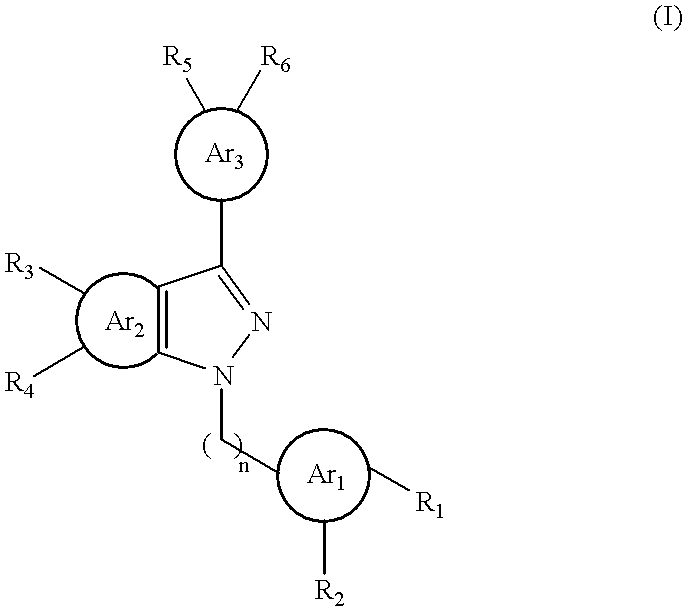
Formula (I) includes a pyrazolyl core and three aryl groups, i.e., Ar1, Ar2, and Ar3, as the three aryl groups described above. Each of Ar1, Ar2, and Ar3, independently, is phenyl, thienyl, furyl, or pyrrolyl; each of R1, R2, R3, R4, R5, and R6, independently, is H, halo, —R, —C(═O)OH, —C(═O)OR, —C(═O)SH, —C(═O)SR, —C(═O)NRR′, —ROH, —ROR′, —RSH, —OR, —OH, —SR, —SH, —NRR′, —NHR, —RNR′R″, —RNHR′, or —RSR′, or R1 and R2 together, R3 and R4 together, or R5 and R6 together, are —ORO—, wherein each of R, R′, and R″, independently, is C1-4alkyl; and n is 1, or 2, or 3.
A subset of the compounds of formula (I) are featured by that n is 1, Ar3 is phenyl, and each of R5 and R6, independently, is H, halo, —R, —C(═O)OH, —C(═O)OR, —C(═O)SH, —C(═O)SR, —C(═O)NRR′, —ROH, —ROR′, —RSH, —NRR′, —NHR, —RNR′R″, —RNHR′, or —RSR′, or R5 and R6 together are —ORO—.
Another subset of the compounds of formula (I) are featured by that n is 1, Ar3 is furyl, and each of R5 and R6, independently, is H, halo, —R, —C(═O)OH, —C(═O)OR, —C(═O)SH, —C(═O)SR, —C(═O)NRR′, —ROH, —ROR′, —RSH, —NRR′, —NHR, —RNR′R″, —RNHR′, or —RSR′, or R5 and R6 together are —ORO—.
Set forth below are some specific examples of the compounds which can be used to practice the method of this invention: 1-benzyl-3-(3′-ethoxycarbonyl)phenyl-indazole, 1-benzyl-3-(3′-hydroxymethyl)phenyl-indazole, 1-benzyl-3-(5′-diethylaminomethyl)-furyl-indazole, 1-benzyl-3-(5′-methoxymethyl)furyl-indazole, 1-benzyl-3-(5′-hydroxymethyl)furyl-6-methyl-indazole, 1-benzyl-3-(5′-hydroxymethyl)-furyl-indazole, 1-benzyl-3-(5′-hydroxymethyl)-furyl-6-fluoro-indazole, 1-benzyl-3-(5′-hydroxymethyl)-furyl-6-methoxy-indazole, and 1-benzyl-3-(5′-hydroxymethyl)-furyl-5, 6-methylenedioxo-indazole.
The structures of 1-benzyl-3-(3′-ethoxycarbonyl)phenyl-indazole and 1-benzyl-3-(5′-diethylaminomethyl)-furyl-indazole are shown below with the atoms on the aryl groups numbered: 
For brevity, the fused pyrazolyl compounds described above include their pharmaceutically acceptable salts and prodrugs, if applicable. Such a salt can be formed between a positively charged substituent (e.g., amino) in a fused pyrazolyl compound and a negatively charged counterion (e.g., chloride, bromide, iodide, sulfate, nitrate, phosphate, or acetate). Likewise, a negatively charged substituent (e.g., carboxylate) in a fused pyrazolyl compound can form a salt with a positively charged ion (e.g., sodium ion, potassium ion, magnesium ion, calcium ion, or an ammonium cation such as tetramethylammonium ion). Examples of the salts that can be used in the method of this invention include a hydrochloride salt of 1-benzyl-3-(5′-aminomethyl)furyl-indazole and a sodium salt of 1-benzyl-3-(3′-carboxyl)phenyl-indazole. Examples of the prodrugs include esters and other pharmaceutically acceptable derivatives, which, upon administration to a subject, are capable of providing fused pyrazolyl compounds described above.
A fused pyrazolyl compound is formulated into a pharmaceutical composition before it is administered to a subject in need of treatment of a disorder related to PAR-induced cell activation (e.g., atherosclerosis, myocardial infarction, unstable angina pectoris and thrombosis). Thus, also within the scope of the invention is the composition which contains an effective amount of the compound (or its salt) and a pharmaceutically acceptable carrier for use in treating a disorder or disease aforementioned. Examples of the carriers include colloidal silicon dioxide, magnesium stearate, cellulose, sodium lauryl sulfate, and D&C Yellow# 10. The invention also relates to the use of such a composition for the manufacture of a medicament for the treatment of above-mentioned disorders or diseases.
It was unexpected that the method of this invention specifically inhibits PAR-induced cell activation, e.g., platelet aggregation, with no or little inhibitory effect on that induced by other platelet activators. Other advantages or features of the invention will be apparent from the following detailed description of several embodiments, and also from the appending claims.
This invention relates to using a fused pyrazolyl compound to treat a disorder caused by PAR-induced cell activation.
A method of synthesizing the fused pyrazolyl compound is as follows: An aryl aryl ketone is first prepared by coupling an arylcarbonyl chloride with another aryl compound. Each aryl compound is optionally mono- or multi-substituted. The ketone then reacts with an arylalkylhydrazine, the aryl group of which is also optionally mono- or multi-substituted, to form a hydrazone containing three aryl groups. The hydrazone is transformed into a fused pyrazolyl compound. In the fused pyrazolyl compound, an aryl group is connected to 1-N of the pyrazolyl core via an alkylene linker, another aryl group is fused at 4-C and 5-C of the pyrazolyl core, and the third aryl group is directly connected to 3-C of the pyrazolyl core. Derivatives of the fused pyrazolyl compound may be obtained by modifying the substituents on any of the aryl groups.
Synthesis of three types of fused pyrazolyl compounds, i.e., 1-benzyl-3-furyl-indazole, 1-benzyl-3-phenyl-indazole, and thienylpyrazole.
Shown in Scheme 1 below is a method of synthesizing five 1-benzyl-3-furyl-indazole compounds, indicated as (1)-(5), all of which can be used to practice the method of the invention. 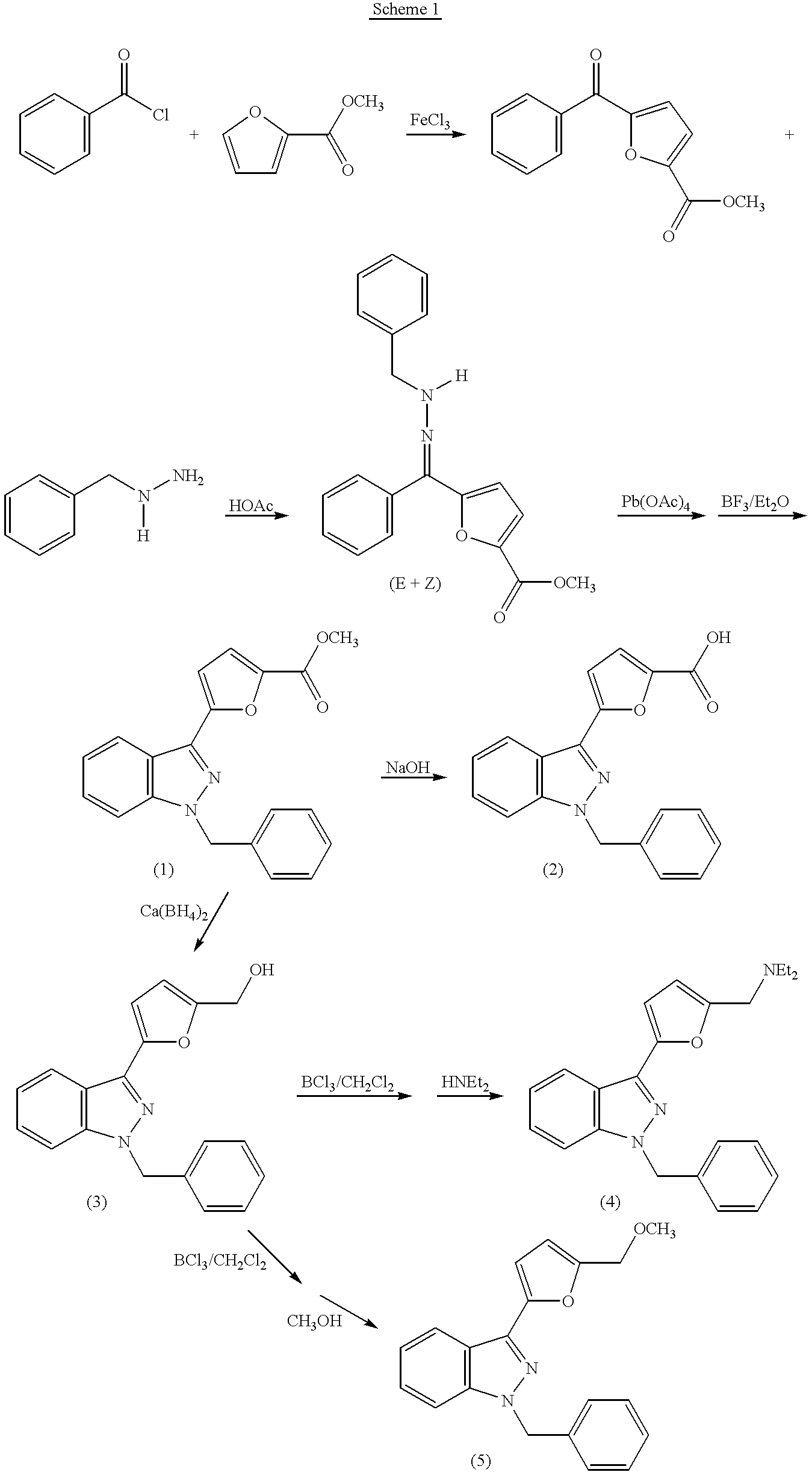
As shown in Scheme 1,5′-methoxycarbonyl-2-furyl phenyl ketone, prepared by coupling methyl 2-furoate with benzoyl chloride, reacts with benzylhydrazine to form a benzylhydrazone as a mixture of E- and Z-form isomers. The isoform mixture is then treated with a mixture of Pb(OAc)4 and BF3/Et2O in CH2Cl2 at room temperature, via a same azo intermediate, to give compound (1). The methoxycarbonyl group in compound (1) can be hydrolyzed with NaOH to carboxylic acid group to form compound (2). Alternatively, the methoxycarbonyl group can be reduced with Ca(BH4)2 in THF to hydroxymethyl group to form compound (3). Compound (3) can be successively treated with BCl3 and diethylamine to obtain an N,N-diethylaminomethyl derivative, i.e., compound (4). Optionally, compound (3) can also be successively treated with BCl3 and methanol to obtain a methoxymethyl derivative, i.e., compound (5). Although not shown in the scheme, derivatives of compounds (1)-(5) can be obtained by using other 2-furoates, benzoyl chlorides, or benzylhydrazones, in which the aryl group is mono- or multi-substituted.
1-Benzyl-3-phenyl-indazole compounds can be prepared by following the reaction procedure shown in Scheme 1 except that benzophenone, optionally mono- or multi-substituted, is used instead of 2-furyl phenyl ketone. As an initial step, benzophenone is oxidized with CrO3 to form benzoylbenzoic acid. The benzoylbenzoic acid is then treated with ethanol to form ethyl benzoylbenzoate, which can be transformed into 1-benzyl-3-phenyl-indazole. 1-Benzyl-3-phenyl-indazole can be further transformed into its derivatives by modifying the substituent(s) on the three aryl groups, if applicable.
Fused pyrazolyl compounds containing a thienopyrazole moiety can also be prepared by following the synthetic method shown in Scheme 1, except that 2-thienyl aryl ketone is used instead of 2-furyl phenyl ketone. The mono- or multi- substitutents, if any, of the thienopyrazolyl compounds thus obtained, can be further modified to afford additional thienopyrazolyl compounds.
An effective amount of a fused pyrazolyl compound or its salt is formulated with a pharmaceutically acceptable carrier to form a pharmaceutical composition before administered to a subject in need of treatment of a disorder related to PAR-induced platelet aggregation. “An effective amount” refers to the amount of the compound which is required to confer therapeutic effect on the treated subject. The interrelationship of dosages for animals and humans (based on milligrams per meter squared of body surface) is described by Freireich et al., Cancer Chemother. Rep., 1966, 50, 219. Body surface area may be approximately determined from height and weight of the patient. See, e.g., Scientific Tables, Geigy Pharmaceuticals, Ardley, New York, 1970, 537. Effective doses will also vary, as recognized by those skilled in the art, depending on the route of administration, excipient usage, and possibility of co-usage with other therapeutic treatments including use of other anti-platelet aggregation agents.
The pharmaceutical composition may be administered via a parenteral route, e.g., topically, subcutaneously, intraperitoneally, intramuscularly, and intravenously. Examples of parenteral dosage forms include aqueous solutions of the active compound, in an isotonic saline, 5% glucose, or any other well-known pharmaceutically acceptable carrier. Solubilizing agents, such as cyclodextrins, or other solubilizing agents well known to those familiar with the art, can also be included in the pharmaceutical composition.
A fused pyrazolyl compound to be used to practice the method of the invention can be formulated into dosage forms for other routes of administration (e.g., orally, mucosally, or percutaneously) utilizing well-known methods. The pharmaceutical composition can be formulated, for example, in dosage forms for oral administration in a capsule, a gel seal, or a tablet. Capsules may comprise any well-known pharmaceutically acceptable material such as gelatin or cellulose derivatives. Tablets may be formulated in accordance with the conventional procedure by compressing mixtures of the active compounds, a solid carrier, and a lubricant. Examples of solid carriers include starch and sugar bentonite. The compound can also be administered in a form of a hard shell tablet or capsule containing, for example, lactose or mannitol as a binder, a conventional filler, and a tableting agent.
A suitable in vitro inhibition assay can be used to preliminarily evaluate a fused pyrazolyl compound's ability to inhibit cell activation induced by PARs, which are pre-activated by thrombin. For example, a platelet suspension in Tyrode's solution can be prepared and incubated with a compound to be tested, thrombin added to trigger platelet aggregation, and the aggregation measured turbidimetrically with a light-transmission aggremometer. In vivo screening can be performed by following procedures well known in the art.
Without further elaboration, it is believed that one skilled in the art can, based on the description herein, utilize the present invention to its fullest extent. All publications recited herein are hereby incorporated by reference in their entirety. The following specific examples, which describe synthesis and biological testing of various compounds that can be used to practice the method of this invention, are therefore, to be construed as merely illustrative, and not limitative of the remainder of the disclosure in any way whatsoever.
(a) Synthesis of 5-Methoxycarbonyl-2-furyl Phenyl Ketone
Anhydrous ferric chloride (0.42 g, 2.6 mmole) and benzoyl chloride (29.6 g, 0.21 mole), were dissolved in CCl4 (40 mL) and added dropwise over 10 min with methyl-2-furoate (25.2 g, 0.20 mmole). The reaction mixture was then heated under reflux for 36 hours, and after cooling was added with water (120 mL). The mixture was stirred for 1 hour and then allowed to sit until it separated into two layers. The water layer and precipitate were extracted with chloroform. The chloroform extract was dried over anhydrous magnesium sulfate and then filtered. The solvent of the filtrate was removed under a reduced pressure; the residue was recrystallized from isopropanol to afford 28.4 g 5-methoxycarbonyl-2-furyl phenyl ketone in a yield of 65.0%.
mp: 70-73° C. MS (%), m/z: 230 (M+). IR (KBr) γmax: 1720, 1650 cm−1(C═O). 1H-NMR (CDCl3, 200 MHz) δ: 3.86 (3H, s, —CH3), 7.26-7.32 (2H, m, H-3′,5′), 7.40-7.65 (3H, m, H-3,4,4′), and 8.05-8.10 (2H, m, H-2′, 6′).
(b) Synthesis of 1-Benzyl-3-(5′-methoxycarbonyl-2′-furyl)indazole
5-Methoxycarbonyl-2-furyl phenyl ketone (5.5 g, 0.024 mole) was dissolved in methanol (60 mL), added with benzylhydrazine (9 g, 0.07 mole) and acetic acid (0.5 mL) and then heated under reflux till the reaction was completed. After cooling, the solvent was evaporated. The resultant residue was extracted with chloroform and washed with dilute HCl solution, then water, and then dried over anhydrous magnesium sulfate and filtered. The solvent of the filtrate was removed to give 5-methoxycarbonylfuryl phenyl ketone benzylhydrazone.
A solution of hydrazone thus obtained in dichloromathane (100 mL) was added dropwise to the solution of Pb(OAc)4 (28.2g, 0.06 mole) in dichloromethane (400 mL). After addition, the mixture was allowed to react at 30±2° C. for 30 min, and BF3.Et2O (containing 47% of BF3, 122 mL) was added. The mixture was heated under reflux for 30 min and then poured into ice water (1000 mL) to terminate the reaction. The organic layer was separated and washed sequentially with water and 10% sodium carbonate solution, then neutralized by water wash. It was dried over anhydrous magnesium sulfate and was concentrated under vacuum to an oily crude product. Ethanol was then added to the crude product, and the mixture was allowed to precipitate by freeze overnight. The solid precipitate was collected and recrystallized from ethanol to give 3.7 g 1-benzyl-3-(5′-methoxycarbonyl-2′-furyl)indazole in a yield of 47.0%.
mp: 117-118° C. MS (%), m/z: 332 (M+). IR (KBr) γmax: 1720 cm−1(C═O). 1H-NMR (CDCl3) δ: 3.95 (3H, s, CH3), 5.66 (2H, s, ═NCH2—), 7.02 (1H, d, J=3.5 Hz, H-3′), 7.20-7.40 (9H. m, H-5, 6, 7, 4′, phenyl), and 8.26 (1H, dd, J=8.1, 1.5 Hz, H-4).
4′-Fluorophenyl 5-methoxycarbonyl-2-furyl ketone (5.96 g, 24 mmole) was prepared as in Example 1 (a), and used as the starting material to obtain 4.1 g 1-benzyl-3-(5′-methoxycarbonyl-2′-furyl)-6-fluoroindazole in a yield of 48.8%, according to the procedure described in Example 1 (b).
mp: 108-109° C. MS (%), m/z: 350 (M+). IR (KBr) γmax: 1710 cm−1(C═O). 1H-NMR (DMSO-d6, 200 MHz) δ: 3.87 (3H, s, —CH3), 5.73 (2H, s, ═NCH2—), 7.18-7.37 (7H, m, H-5,3′, phenyl), 7.45 (1H, d, J=3.5 Hz, H-4),7.77 (1H, dd, J=10.0, 1.5 Hz, C7-H), and 8.17 (1H. dd, J=8.0, 6.3 Hz, C4-H).
5-Methoxycarbonyl-2-furyl 4′-methylphenyl ketone (5.85 g, 0.024 mole) was similarly prepared and used as the starting material to obtain 3.7 g 1-benzyl-3-(5-methoxycarbonyl-2′-furyl)-6-methylindazole in a yield of 45.1 %.
mp: 102-104° C. MS (%), m/z: 346 (M+) IR (KBr) γmax: 1720 cm−1(C═O). 1H-NMR(DMSO-d6) δ: 2.46 (3H, s, —CH3), 3.87 (3H, s, —OCH2—), 5.71 (2H, s, ═NCH2—), 7.14-7.36 (7H, m, H-5, 3″, phenyl), 7.45 (1H, d, J=3.4 Hz, H-4); 7.59 (1H, s, H-7); and 8.10 (1H, d. J=8.0 Hz, H-4).
5-Methoxycarbonyl-2-furyl 4′-methoxylphenyl ketone (6.24 g. 0.024 mole) was similarly prepared and used as the starting material to obtain 4.4 g 1-benzyl-3-(5′-methoxycarbonyl-2′-furyl)-6-methoxyindazole in a yield of 50.2%.
mp: 108-109° C. MS (%), m/z: 362 (M+). IR (KBr) γmax: 1710 cm−1(C═O). 1H-NMR (DMSO-d6, 200 MHz) δ: 3.85 (3H, s, —OCH3), 3.88 (3H, s, —COOCH3), 5.71 (2H, s, ═NCH2—), 6.95 (1H, d, J=8.5 Hz, H-5), 7.16 (1H, d. J=3.5 Hz, H-3′), 7.24-7.36 (6H, m, H-7, phenyl), 7.40 (1H, d, J=3.5 Hz, H-4), and 7.98 (1H, d, J=8.5 Hz, H-4).
5-Methoxycarbonyl-2-furyl-3′, 4′-methylenedioxophenyl ketone (6.6 g. 0.024 mole) was similarly prepared and used as the starting material to obtain 5.7 g 1-benzyl-3-(5′1-methoxycarbonyl-2′furyl)-5,6-methylenedioxoindazole in a yield of 63.8%.
mp: 190-192° C. MS (%), m/z: 376 (M+). IR (KBr) γmax: 1724 cm−1(C═O). 1H-NMR (CDCl3, 200 MHz) δ: 3.93 (3H, s, —OCH3), 5.51 (2H, s, ═NCH2—), 5.98 (2H, s, —OCH2O—), 6.62 (1H, s, H-7), 6.91 (1H, d, J=3.8 Hz, H-3′), 7.18-7.32 (6H, m, H-4′, phenyl), and 7.52 (1H, s, H-4).
1-Benzyl-3-(5′-methoxycarbonyl-2 ′-furl)indazole (100 mg, 0.32 mmole) was dissolved in a mixture of methanol (8 mL) and sodium hydroxide solution (75 mg in 3 mL water) then heated under reflux. After cooling, the solvent was removed under a reduced pressure. The residue was dissolved in water (1.5 mL), and the aqueous solution was acidified with a diluted HCl solution to generate a crystal. The crystal was collected, and then recrystallized from acetone to obtain 73 mg 1-benzyl-3-(5′-hydroxycarbonyl-2′-furyl)indazole in a yield of 71.7%.
mp: 202-203° C. MS (%), m/z: 318 (M+). IR (KBr) γmax: 3450 cm−1(—OH) and 1700 cm−1(C═O). 1H-NMR (DMSO-d6, 200 MHz) δ: 5.76 (2H, s, ═NCH2—), 7.20 (1H, d, J=3.5 Hz, H-3′), 7.26-7.35 (6H, m, H-5, phenyl), 7.38 (1H, d, J=3.5 Hz, H-4′), 7.49 (1H, t, J=8.2 Hz, H-6), 7.80 (1H, dd, J=8.2, 1.5 Hz, H-7), and 8.15 (1H, d, J=8.1, 1.5 Hz, H-4).
1-Benzyl-3-(5′-methoxycarbonyl-2′-furyl)-6-fluoroindazole (112 mg, 0.32 mmole) was used as the starting material and treated according to the procedure described in Example 6 to obtain 70 mg 1-benzyl-3-(5′-hydroxycarbonyl-2′-furyl)-6-fluoroindazole in a yield of 65%.
mp: 252-253° C. MS (%), m/z: 336 (M+). IR (KBr) γmax: 3450 cm−1(—OH) and 1690 cm−1(C═O). 1H-NMR (DMSO-d6, 200 MHz) δ: 5.72 (2H, s, ═NCH2—), 7.21 (1H, d, J=3.5 Hz, H-3), 7.23-7.33 (6H, m, H-5, phenyl), 7.39 (1H, d, J=3.5 Hz, H-4), 7.79 (1H, dd, J=9.8, 18 Hz, H-7), and 8.17 (1H, dd, J=8.5, 5.3 Hz, H-4).
1-Benzyl-3-(5′-methoxycarbonyl-2′-furyl)-6-methylindazole (111 mg, 0.32 mmole) was used as the starting material and treated according to the procedure described in Example 6 to obtain 95 mg 1-benzyl-3-(5-hydroxycarbonyl-2′-furyl)-6-methylindazole in a yield of 89%.
mp: 201-202° C. MS (%), m/z: 332 (M+). IR (KBr) γmax: 3450 cm−1(—OH), 1700 cm−1(C═O). 1H-NMR (DMSO-d6, 200 MHz) δ: 2.46 (3H, s, —CH3), 5.70 (2H, s, ═NCH2—), 7.16(1H, d, J=3.5 Hz, H-3′), 7.23-7.33 (6H, m, H-5, phenyl), 7.38 (1H, d, J=3.5 Hz, H-4), 7.61 (1H, d, J=1.4 Hz, H-7), and 8.00 (1H, d, J=8.2 Hz, H-4).
1-Benzyl-3-(5′-methoxycarbonyl-2′-furyl)-6-methoxyindazole (116 mg, 0.32 mmole) was used as the starting material and treated according to the procedure described in Example 6 to obtain 88.1 mg 1-benzyl-3-(5′-hydroxycarbonyl-2′-furyl)-6-methoxyindazole in a yield of 77.3%.
mp: 222-223° C. MS (%), m/z: 348 (M+) IR (KBr) γmax: 3450 cm−1(—OH) and 1710 cm−1(C═O) 1H-NMR (DMSO-d6, 200 MHz) δ: 3.84 (3H, s, —OCH3), 5.70 (2H, s, ═NCH2—), 6.95 (1H, dd, J=8.3, 1.8 Hz, H-3′), 7.12 (1H, d, J=3.4 Hz, H-3), 7.25-7.38 (7H, m, H-7,4, phenyl), and 7.98 (1H, d, J=8.3 Hz, H-4).
1-Benzyl-3-(5′-methoxycarbonyl-2′-furyl)-5,6-methylenedioxoindazole (120 mg, 0.32 mmole) was used as the starting material and treated according to the procedure described in Example 6 to obtain 87.5 mg 1-benzyl-3-(5′-hydroxycarbonyl-2′-furyl)-5,6-methylenedioxoindazole in a yield of 75.5%.
mp: 291-292° C. MS (%), m/z: 362 (M+) IR (KBr) γmax: 3479 cm−1(—OH) and 1720 cm−1(C═O) 1H-NMR (DMSO-d6, 200 MHz) δ: 5.62 (2H, s, ═NCH2—), 6.11 (2H, s, —OCH2O—), 7.09 (1H, d, J=3.6, H-3′), 7.20-7.36 (7H, m, H-7, 4′, phenyl), and 7.43 (1H, s, H-4).
Calcium borohydride was first prepared by stirring anhydrous calcium chloride (88.8 mg, 0.8 mmole) with sodium borohydride (60 mg, 1.6 mmole) in anhydrous THF (20 mL) for 4 hours. Then a 30 mL THF solution containing 88.0 mg 1-benzyl-3-(5′-methoxycarbonyl-2′-furyl)indazole (0.27 mmole) was added dropwise to the calcium borohydride solution at 30±2° C. The mixture was heated under reflux for 6 hours, cooled, quenched into crushed ice, placed at a reduced pressure to remove THF, and filtered to obtain a solid product. The solid was extracted with dichloromethane. The extract was concentrated to 50 mL and a solid precipitated after petroleum ether was added. The precipitate was collected and purified by column chromatography (silica gel-benzene) to obtain 70.0 mg 1-benzyl-3-(5′-hydroxymethyl-2′-furyl)indazole in a yield of 87%.
mp: 108-109° C. MS (%), m/z: 304 (M+). IR (KBr) γmax: 3350 cm−1(—OH). 1H-NMR (DMSO-d6, 200 MHz) δ: 4.51 (2H, d, J=5.5 Hz, —H2O—), 5.31 (1H, t, J=5.5 Hz, —OH), 5.70 (2H, s, ═NCH2—), 6.48 (1H, d, J=3.4 Hz, H-4′), 6.97 (1H, d, J=3.4 Hz, H-3′), 7.21-7.31 (6H, m, H-5, phenyl), 7.45 (1H, t, J=8.2 Hz, H-6), 7.75 (1H, dd, J=8.2, 1.8 Hz, H-7), and 8.12 (1 H. dd, J=8.2. 1.0 Hz. C4-H).
1-Benzyl-3-(5′-methoxycarbonyl-2′-furyl)-6-fluoroindazole (93 mg, 0.27 mmole) was used as the starting material and treated according to the procedure described in Example 11 to obtain 75.0 mg 1-benzyl-3-(5′-hydroxymethyl-2′-furyl)-6-fluoroindazole in a yield of 88.0%.
mp: 110-112° C. MS (%), m/z; 322 (M+). IR (KBr) γmax: 3450 cm−1(—OH). 1H-NMR (DMSO-d6, 200 MHz) δ: 4.49 (2H, br, —CH2O—), 5.45 (1H, br, —OH), 5.88 (1H, s, ═NCH2—), 6.48 (1H, d, J=3.2 Hz, H-4′), 6.98 (1H, d, J=3.2 Hz, H-3′), 7.10-7.18 (1H, m, H-7),7.24-7.36 (5H, m, phenyl-H), 7.70 (1H, dd, J=10.0, 2.0 Hz, C5-H), and 8.15 (1H, dd, J=8.5, 5.1 Hz, H-4).
1-Benzyl-3-(5′-methoxycarbonyl-2′-furyl)-6-methylindazole (92 mg. 0.27 mmole) was used as the starting material and treated according to the procedure described in Example 11 to obtain 74.0 mg 1-benzyl-3-(5′-hydroxymethyl-2′-furyl)-6-methylindazole in a yield of 88%.
mp: 112-114° C. MS (%), m/z: 318 (M+). IR (KBr) γmax: 3400 cm−1(—OH). 1H-NMR (DMSO-d6, 200 MHz) δ: 2.44 (3H, s, —CH3), 4.50 (2H, d. J=5.2 Hz, —CH2O—), 5.30 (1H, br, —OH), 5.64 (2H, s, ═NCH2—), 6.45 (1H, d, J=3.3 Hz, H-4′), 6.07 (1H, d, J=3.3 Hz, H-3′), 7.08 (1H, dd, J=8.3, 1.0 Hz, H-5), 7.19-7.36 (5H, m, phenyl-H), 7.57 (1H, d, J=1.0 Hz, H-7), and 7.98 (1H, dd, J=8.3, 1.0Hz, H-4).
1-Benzyl-3-(5′-methoxycarbonyl-2′-furyl)-6-methoxyindazole (96 mg, 0.27 mmole) was used as the starting material and treated according to the procedure described in Example 11 to obtain 80 mg 1-benzyl-3-(5′-hydroxymethyl-2′-furyl)-6-methoxyindazole in a yield of 90.0%.
mp: 109-110° C. MS (%), m/z: 334 (M+). IR (KBr) γmax: 3300-3400 cm−1(—OH). 1H-NMR (CDCl3, 200 MHz) δ: 1.90 (1H, br, —OH), 3.80 (3H, s, —CH3), 4.74 (2H, d, J=2.0 Hz, Hz, —CH2O—), 5.59 (2H, s, ═NCH2—), 6.47 (1H, d, J=3.2 Hz, H-4′), 6.59 (1H, d, J=2.0 Hz, H-7), 6.84 (1H, d, J=3.2, 1.0 Hz, H-3′), 6.88 (1H, dd, J=8.5, 1.5 Hz, H-5), 7.17-7.31 (5H, m, phenyl-H), and 7.91 (1H, d. J=8.5 Hz, H-4).
1-Benzyl-3-(5 ′-methoxycarbonyl-2′-furyl)-5,6-methylenedioxoindazole (101 mg, 0.27 mmole) was used as the starting material and treated according to the procedure described in Example 11 to obtain 84.5 mg 1-benzyl-3-(5′-hydroxymethyl-2′-furyl)-5,6-methylenedioxoindazole in a yield of 90%.
mp: 122-123° C. MS (%), m/z: 348 (M+). IR (KBr) γmax: 3387 cm−1(—OH). 1H-NMR (CDCl3) δ: 2.05 (1H, br, —OH), 4.71 (2H, s, —CH2O—), 5.53 (2H, s, ═NCH2—), 5.99 (2H, s, —OCH2O—), 6.43 (1H, d, J=3.3 Hz, H-4′), 6.61 (1H, s, H-7), 6.76 (1H, d, J=3.3 Hz, H-3′), and 7.20-7.31 (6H, m, H-4, phenyl).
To a solution of 1-benzyl-3-(5′-hydroxymethyl-2′-furyl)indazole (0.2g, 0.66 mmole) dissolved in CH2Cl2 (5 mL) was added 1.0 M BCl3/CH2Cl2 solution (1.5 mL) at −10±2° C. The mixture was allowed to react for 4 hours at this temperature. Then, methanol (5 mL) was added and the stirring continued for another 1 hour before quenched into ice water. The mixture was extracted with CH2Cl2, and the organic extract was neutralized by water wash, dried over anhydrous magnesium sulfate, evaporated for solvent removal, and purified by column chromatography (silica gel-benzene) to obtain 0.1 g 1-benzyl-3-(5′-methoxymethyl-2′-furyl)indazole in liquid in a yield of 50.0%.
MS (%), m/z: 318 (M+). IR (KBr) γmax: 1610 cm−1(C-O). 1H-NMR (CDCl3, 200 MHz) δ: 3.45 (3H, s, —CH2OCH 3), 4.56 (3H, s, —CH 2OCH3), 5.29 (2H, s, ═NCH2−), 6.52 (1H, d, J=3.3 Hz, H-4′), 6.91 (1H, d, J=3.3 Hz, H-3′), 7.18-7.36 (8H, m, H-5,6,7, phenyl), and 8.12 (1H, dd, J=8.1, 1.1 Hz, H-4).
To a solution of 1-benzyl-3-(5′-hydroxymethyl-2′-furyl)indazole (1.0 g, 3.3 mmole) dissolved in CH2Cl2 (50 mL) was added dropwise 1.0 M BCl3/CH2Cl2 solution (20 mL) at −10±2° C. The mixture was allowed to react for 40 minutes at this temperature. Diethylamine (30 mL) was added, and the mixture was heated under reflux for 4 hours followed by quench into ice water. The mixture was extracted with CH2Cl2. The organic extract was neutralized by water wash, dried over anhydrous magnesium sulfate, and evaporated to leave a residue which upon purification by column chromatography (silica gel-benzene) afforded 0.1 6g 1-benzyl-3-(5′-diethylaminomethyl-2′-furyl)indazole in a yield of 39.0%.
MS (%), m/z: 359 (M+). IR (KBr) γmax: 1350 cm1 (C-N). 1H-NMR (CDCl3, 200 MHz) δ: 1.16 (6H, t, J=7.1 Hz, —N(CH2 CH 3)2), 2.63 (4H, q, J=7.1 Hz, —N(CH 2CH3)2), 3.86 (2H, s, —CH2N−), 5.64 (2H, s, ═NCH2—), 6.37 (1H, d, J=3.3 Hz, H-4′), 6.87 (1H, d, J=3.3 Hz, H-3′), 7.10-7.40 (8H, m, H-5,6,7, phenyl), and 8.10 (1H, d, J=8.2 Hz, H-4).
(a) To the mixture of anhydrous AlCl3 (85 g, 0.64 mole) with dried toluene (90 mL) was added benzoyl chloride (50 mL, 0.43 mole) dropwise at 10±2° C. The mixture was warmed to 30±2° C. and stirred for 12 hours, and then heated to 100±5° C. and stirred for another 2 hr before it was cooled and added into ice water (200 mL) to terminate the reaction. The organic layer was separated and washed successively with water, 5% sodium carbonate and then water again till neutralized. The organic layer was dried over anhydrous magnesium sulfate and evaporated for solvent removal. The residue was recrystallized from n-hexane to obtain 62.1 g 4-methylbenzophenone in a yield 73.5%. mp: 55-57° C.
(b) To a mixture of 4-methylbenzophenone (25 g, 0.127 mole) with HOAc (130 mL) was added successively CrO3 (35 g), H2O (80 mL) and conc. H2SO4 (25 mL). The mixture was heated for 3 hours at 100±5° C. and then quenched by adding ice water (500 mL) to yield a crude 4-benzoylbenzoic acid solid which was dissolved in a 10% KOH solution and filtered. The filtrate was acidified with diluted HCl to pH 2.0 and precipitate by subjected to ice bath. The precipitate was collected to obtain 21.3 g 4-benzoylbenzoic acid in a yield of 74.1%.
(c) A mixture of 4-benzoylbenzoic acid (20 g, 88.4 mmole), toluene (5 mL), p-toluenesulfonic acid (1 g) and ethanol (20 mL) was refluxed for 12 hours, cooled, washed with 5% sodium carbonate, and neutralized by water wash. The organic layer was dried over anhydrous magnesium sulfate and concentrated to obtain 22 g ethyl 4-benzoylbenzoate in a yield 90.5%.
(d) A mixture of ethyl 4-benzoylbenzoate (13.7 g, 54 mmole), benzylhydrazine (8 g, 65 mmole), ethanole (50 mL) and HOAc (1 mL) was refluxed for 12 hours and then treated with the procedure described in Example 1 to yield a crude product that was purified by column chromatography (silica gel-benzene), and recrystallized from n-hexane to give 4.8g 1-benzyl-3-(4′-ethoxycarbonylphenyl)indazole in a yield of 25.5%.
mp: 95-96° C. IR (KBr) γmax: 1710, 1620cm−1(C═O). MS (%), m/z: 356 (M+). 1H-NMR (CDCl3, 200 MHz) δ: 1.35 (3H, t, J=8.0 Hz, —CH2 CH 3), 4.35 (2H, q, J=8.0 Hz, —CH 2CH3), 5.78 (2H, s, ═NCH2—), and 7.40-8.40 (13H, m, aromatic protons).
3-Methylbenzophenone was treated sequentially with the procedures (a), (b), (c), and (d) in Example 18 to obtain, in the corresponding order, 3-benzoylbenzoic acid (yield: 72%), ethyl 3-benzoylbenzoate (yield: 86.3%), and 1-benzyl-3-(3′-ethoxycarbonylphenyl)indazole in a yield of 25.5%.
mp: 85-86° C. MS (%), m/z: 356 (M+). IR (KBr) γmax: 1720, 1610 cm−1(C═O). 1H-NMR (CDCl3, 200 MHz) δ: 1.43 (3H, t, J=7.0 Hz, —CH2 CH 3), 4.44 (2H, q, J=7.0 Hz, —CH 2CH3), 5.68 (2H, s, ═NCH2—), and 7.20-8.20 (13H, m, aromatic protons).
To a solution of 1-benzyl-3-(4′-ethoxycarbonylphenyl)indazole (1 g, 2.8 mmole) dissolved in 10 mL methanol was added a sodium hydroxide solution (0.56 g in 20 mL water). After the mixture was heated under reflux for 6 hours, the methanol was removed by evaporation. The residue thus obtained was acidified with diluted HCl. After cooling in an ice bath, a solid precipitated and was collected to obtain 0.87 g 1-benzyl-3-(4′-hydroxycarbonyl-phenyl)-indazole in a yield of 94.5%.
mp: 205-207° C. MS (%), m/z: 328 (M+). IR (KBr) γmax: 3500-3300 cm−1(OH) and 1700 cm, (C═O). 1H-NMR (DMSO-d6, 200 MHz) δ: 5.77 (2H, s, ═NCH2—), 7.20-8.20 (13H, m, aromatic protons), and 13.0 (1H, br, —OH).
1-Benzyl-3-(3 ′-ethoxycarbonylphenyl)indazole (0.49 g, 0.11 mmole) was treated following the procedure described in Example 20 to obtain 0.83 g 1-benzyl-3-(3′-hydroxycarbonylphenyl)indazole in a yield of 90.2%.
mp: 190-192° C. MS (%), m/z: 328 (M+). IR (KBr) γmax: 3500-3300 cm−1 (—OH) and 1700 cm−1 (C═O). 1H-NMR (DMSO-d6, 200 MHz) δ: 5.76 (2H, s, ═NCH2-), and 7.20-8.20 (13H, m, aromatic protons).
1-Benzyl-3-(4′-ethoxycarbonylphenyl)indazole (0.4 g, 1.2 mmole) was treated following the procedure described in Example 12 to obtain 0.24 g 1-benzyl-3-(4′-hydroxymethylphenyl)indazole in a yield of 67.2%.
mp: 110-112° C. MS (%), m/z: 314 (M+). IR (KBr) γmax: 3300-2500 cm−1(OH). 1H-NMR (DMSO-d6, 200 MHz) δ: 4.58 (2H, d, J=5.8 Hz, —CH2O—), 5.31 (1H, t, J=5.2 Hz, —OH), 5.73 (2H, s, ═NCH2—), and 7.20-8.20 (13H, m, aromatic protons).
1-Benzyl-3-(3′-ethoxycarbonylphenyl)indazole (0.4 g, 1.2 mmole) was treated following the procedure described in Example 12 to obtain 0.22 g 1-benzyl-3-(3′-hydroxymethylphenyl)indazole in a yield of 64.1 %.
mp: 98-99° C. MS (%), m/z: 314 (M+). IR (KBr) γmax: 3300-2500 cm−1 (OH). 1H-NMR (DMSO-d6, 200 MHz) δ: 4.78 (2H, s, —CH2O—), 5.65 (2H, s, ═NCH2—), and 7.20-8.20 (13H, m, aromatic protons).
(a) Synthesis of 5-Methoxycarbonyl-2-furyl 2′-thienyl ketone
2-Thiophenecarbonyl chloride (30.5 g, 0.21 mole), methyl 2-furoate (24 g, 0.19 mole), and anhydrous ferric chloride (0.42 g, 2.6 mmole) were allowed to react following the procedure described in Example 1 to obtain 28.7 g 5-methoxycarbonyl-2-furyl 2′-thienyl ketone in a yield of 63.8%.
mp: 103-106° C. MS (%), m/z: 236 (M+). IR (KBr) γmax: 1720, 1620cm−1(C═O). 1H-NMR (CDCl3, 200 MHz) δ: 3.98 (3H, s, —CH3), 7.22-7.31 (2H, m, H-3,4), 7.41 (1H, d, J=3.5 Hz, H-4′), 7.76 (1H, d, J=3.5 Hz, H-3′), and 8.36 (1H, d, J=4.5 Hz, H-5).
(b) Synthesis of 1-Benzyl-3-(5′-methoxycarbonyl-2′-furyl)thieno[3,2-c]pyrazole
5-Methoxycarbonyl-2-furyl 2′-thienyl ketone (5.7 g, 0.024 mole) was used as the starting material and treated following the same procedure described in Example 1 to obtain 1.2 g 1-benzyl-3-(5′-methoxycarbonyl-2′-furyl)thieno[3,2-c]pyrazole in a yield of 14.8%.
mp: 142-143° C. MS (%), m/z: 338 (M+). IR (KBr) γmax: 1720 cm−1(C═O). 1H-NMR (DMSO-d6, 200 MHz) δ: 3.85 (3H, s, —CH3), 5.62 (2H, s, ═NCH2—), 6.92 (1H, d, J=3.5 Hz, H-3′), 7.24 (1H, d, J=4.8 Hz, H-6), 7.26-7.35 (5H, m, phenyl-H), 7.43 (1H, d, J=3.5 Hz, H-4′), and 7.77 (1H, dd, J=4.8, 1.5 Hz, H-5).
1-Benzyl-3-(5′-methoxycarbonyl-2′-furyl)thieno[3,2-c]pyrazole (108 mg, 0.32 mmole) was treated following the procedure described in Example 6 to obtain 83.3 mg 1-benzyl-3-(5′-hydroxycarbonyl-2′-furyl)thieno[3,2-c]pyrazole in a yield of 80.3%.
mp: 221-224° C. MS (%), m/z: 324 (M+). IR (KBr) γmax: 3500 cm−1(—OH), 1720 cm−1(C═O). 1H-NMR (DMSO-d6, 200 MHz) δ: 5.62 (2H, s, ═NCH2—), 6.90 (1H, d, J=3.5 Hz, H-3′), 7.26 (1H, d, J=4.8 Hz, H-6), 7.25-7.35 (6H, m, H-4′, phenyl), and 7.78 (1H, d, J=4.8 Hz, C5-H).
1-Benzyl-3-(5′-methoxycarbonyl-2′-furyl)thieno[3,2-c]pyrazole (90 mg, 0.27 mole) was treated following the procedure described in Example 11 to obtain 63.4 mg 1-benzyl-3-(5′-hydroxymethyl-2′-furyl)thieno[3,2-c]pyrazole in a yield of 69.3%.
mp: 103-104° C. MS (%),m/z: 310 (M+). IR (KBr) γmax: 3360 cm−1(—OH). 1H-NMR (DMSO-d6, 200 MHz) δ: 4.46 (2H, d, J=5.3 Hz, —CH2O—), 5.27 (1H, t, J=5.3 Hz, —OH), 5.55 (2H, s, ═NCH2—), 6.43 (1H, d, J=3.2 Hz, H-4′), 6.64 (1H, d, J=3.2 Hz, H-3′), 7.20 (1H, d, J=4.8 Hz, H-6), 7.27-7.35 (5H, m, phenyl-H), and 7.72 (1H. d, J=4.8 Hz, H-5).
In vitro inhibitory activity of the fused pyrazolyl compounds was preliminarily evaluated by the following method: A platelet suspension in a Tyrode's solution was prepared according to a procedure described by Wu et al., Br. J Pharm., 1995, 116: 1973-1978. The Tyrode's solution had the following composition (mM): NaCl (136.8), KCl (2.8), NaHCO3 (11.9), MgCl2 (1.1), NaH2PO4 (0.33), CaCl2 (1.0), and glucose (11.2). The platelet number in the platelet suspension was adjusted to 4.5×10⁸ platelets/mL with the aid of a Coulter Counter (Model ZM). Each compound to be tested was added to an aliquot of the platelet suspension, which was then incubated at 37° C. for 3 minutes under a stirring condition (1200 rpm) prior to addition of thrombin to activate PARs. Platelet aggregation was measured turbidimetrically with a light-ransmission aggremometer. The extent of platelet aggregation was determined at 5 minutes after the addition of thrombin. The percentage of aggregation was calculated by the method described in Teng et al., Biochem. Biophys. Acta., 1987, 924: 375-382.
Compounds prepared in Examples 1-26 were tested and all showed inhibitory activity at different levels. For example, 1-benzyl-3-(5′-diethylaminomethyl)furyl-indazole unexpectedly showed much higher activity than a number of other compounds, e.g., 1-benzyl-3-(5′-hydroxymethyl)furyl-indazole. Further, 1-benzyl-3-(3′-ethoxycarbonyl)-phenyl-indazole showed activity at least 10 times that of several other tested compounds, e.g., 1-benzyl-3-(4′-ethoxycarbonyl)phenyl-indazole. It also unexpectedly exerted little or no effect on platelet activating factors other than PARs.
From the above description, one skilled in the art can easily ascertain the essential characteristics of the present invention, and without departing from the spirit and scope thereof, can make various changes and modifications of the invention to adapt it to various usages and conditions. Thus, other embodiments are also within the claims.
Claims (30)
1. A method of treating a disorder related to protease activated receptor-induced cell activation, comprising administering to a subject, in need thereof a compound having a pyrazolyl core; a first aryl group, via an alkylene linker, bonded to 1-N of the pyrazolyl core; a second aryl group fused at 4-C and 5-C of the pyrazolyl core; and a third aryl group bonded directly to 3-C of the pyrazolyl core; wherein each of the three aryl groups, independently, is phenyl, thienyl, furyl, or pyrrolyl, optionally substituted with halo, hydroxy, hydrothio, alkyl, alkoxy, alkylthio, (alkylthio)alkyl, carboxyl, alkoxycarbonyl, (thioalkyl)carbonyl, (alkylthio)carbonyl, aminocarbonyl, hydroxyalkyl, alkoxyalkyl, amino, aminoalkyl, thioalkyl, or alkylenedioxo; said compound being in an amount effective for treating the disorder.
2. The method of claim 1 , wherein the compound is of the following formula: 
in which each of the first, second, and third aryl groups, Ar1, Ar2, and Ar3, independently, is phenyl, thienyl, furyl, or pyrrolyl; each of R1, R2, R3, R4, R5, and R6, independently, is H, halo, —OR, —OH, —SR, —SH, —R, —C(═O)OH, —C(═O)OR, —C(═O)SH, —C(═O)SR, —C(═O)NRR′, —ROH, —ROR′, —RSR′, —RSH, —NRR′, —NHR, —NH2, —RNR′R″, —RNH2, —RNHR′, or —RSR′, or R1 and R2 together, R3 and R4 together, or R5 and R6 together are —ORO—, wherein each of R, R′, and R″, independently, is C1-4 alkyl; n is 1, or 2, or 3.
3. The method of claim 2 , wherein Ar1 is phenyl; Ar2 is 6-substituted phenyl; and Ar3 is 5′-substituted furyl or 3′-substituted phenyl.
4. The method of claim 2 , wherein n is 1.
5. The method of claim 4 , wherein Ar3 is furyl and each of R5 and R6, independently, is H, halo, —R, —C(═O)OH, —C(═O)OR, —C(═O)SH, —C(═O)SR, —C(═O)NRR′, —ROH, —ROR′, —RSH, —NRR′, —NHR, —NH2, —RNR′R″, —RNHR′, —RNH2, or —RSR′, or R5 and R6 together are —ORO—.
6. The method of claim 4 , wherein Ar3 is phenyl and each of R5 and R6, independently, is H, halo, —R, —C(═O)OH, —C(═O)OR, —C(═O)SH, —C(═O)SR, —C(═O)NRR′, —ROH, —ROR′, —RSH, —NRR′, —NHR, —NH2, —RNR′R″, —RNHR′, —RNH2, or —RSR′, or R5 and R6 together are —ORO—.
7. The method of claim 6 , wherein Ar3 is phenyl, R5 is H, and R6 is at 4′—C.
8. The method of claim 6 , wherein Ar3 is phenyl, R5 is at 4′—C, and R6 is at 5′—C.
9. The method of claim 7 , wherein R5 is H, —C(═O)OH, —C(═O)OR, —C(═O)SH, —C(═O)SR, or —C(═O)NRR′, and R6 is H.
10. The method of claim 9 , wherein R5 is —C(═O)OR.
11. The method of claim 10 , wherein R5 is —C(═O)OEt.
12. The method of claim 11 , wherein Ar2 is phenyl and each of R3 and R4, independently, is H, halo, —R, —C(═O)OH, —C(═O)OR, —C(═O)SH, —C(═O)SR, —C(═O)NRR′, —ROH, —ROR′, —RSH, —NRR′, —NHR, —NH2, —RNR′R″, —RNHR′, —RNH2, or —RSR′, or R3 and R4 together are —ORO—.
13. The method of claim 12 , wherein Ar1 is phenyl and each of R1 and R2, independently, is H, halo, —R, —C(═O)OH, —C(═O)OR, —C(═O)SH, —C(═O)SR, —C(═O)NRR′, —ROH, —ROR′, —RSH, —NRR′, —NHR, —RNR′R″, —RNHR′, or —RSR′, or R1 and R2 together are —ORO—.
14. The method of claim 13 , wherein each of R1 and R2 is H.
15. The method of claim 14 , wherein R3 is at 5—C and R4 is at 6—C.
16. The method of claim 15 , wherein each of R3 and R4 is H.
17. The method of claim 5 , wherein R5 is H and R6 is at 5′—C.
18. The method of claim 17 , wherein R6 is —R, —ROH, —ROR′, —RSH, —NH2, —NRR′, —NHR, —RNR′R″, —RNHR′, —RNH2, or —RSR′.
19. The method of claim 18 , wherein Ar1 is phenyl and each of R1 and R2, independently, is H, halo, —R, —ROH, —ROR′, —NH2, —NRR′, —RSR′, —OR, —OH, —SR, or —SH.
20. The method of claim 18 , wherein Ar2 is phenyl, R3 is at 5—C, and R4 is at 6—C.
21. The method of claim 20 , wherein Ar1 is phenyl and each of R1 and R2, independently, is H, halo, —R, —ROH, —ROR′, —NH2, —NRR′, —RSR′, —OR, —OH, —SR, or —SH.
22. The method of claim 21 , wherein each of R1 and R2 is H.
23. The method of claim 22 , wherein R6 is —CH2OH.
24. The method of claim 23 , wherein R3 is H.
25. The method of claim 24 , wherein R4 is —CH3.
26. The method of claim 24 , wherein R4 is —OCH3.
27. The method of claim 22 , wherein R6 is —CH2OCH3.
28. The method of claim 27 , wherein each of R3 and R4 is H.
29. The method of claim 22 , wherein R6 is —CH2NEt2.
30. The method of claim 29 , wherein each of R3 and R4 is H.
Priority Applications (1)
| Application Number | Priority Date | Filing Date | Title |
|---|---|---|---|
| US09/883,742 US6387942B2 (en) | 2000-06-19 | 2001-06-18 | Method of treating disorders related to protease-activated receptors-induced cell activation |
Applications Claiming Priority (2)
| Application Number | Priority Date | Filing Date | Title |
|---|---|---|---|
| US21240800P | 2000-06-19 | 2000-06-19 | |
| US09/883,742 US6387942B2 (en) | 2000-06-19 | 2001-06-18 | Method of treating disorders related to protease-activated receptors-induced cell activation |
Publications (2)
| Publication Number | Publication Date |
|---|---|
| US20020004518A1 US20020004518A1 (en) | 2002-01-10 |
| US6387942B2 true US6387942B2 (en) | 2002-05-14 |
Family
ID=22790879
Family Applications (1)
| Application Number | Title | Priority Date | Filing Date |
|---|---|---|---|
| US09/883,742 Expired - Lifetime US6387942B2 (en) | 2000-06-19 | 2001-06-18 | Method of treating disorders related to protease-activated receptors-induced cell activation |
Country Status (4)
| Country | Link |
|---|---|
| US (1) | US6387942B2 (en) |
| EP (1) | EP1166785A1 (en) |
| CN (1) | CN1215060C (en) |
| HK (1) | HK1041887B (en) |
Cited By (6)
| Publication number | Priority date | Publication date | Assignee | Title |
|---|---|---|---|---|
| US20030220385A1 (en) * | 2001-12-26 | 2003-11-27 | Che-Ming Teng | Treatment of disorder related to low cyclic GMP levels |
| WO2005030121A3 (en) * | 2003-06-30 | 2005-11-10 | Bizbiotech Co Ltd | Compounds, compositions and methods |
| US20060063930A1 (en) * | 2004-08-20 | 2006-03-23 | Agoston Gregory E | Compositions and methods comprising proteinase activated receptor antagonists |
| US20080252028A1 (en) * | 2007-04-16 | 2008-10-16 | Ming-Tai Huang | Shock absorbing device for toy stroller |
| US7495089B2 (en) | 1995-10-23 | 2009-02-24 | The Children's Medical Center Corporation | Therapeutic antiangiogenic endostatin compositions |
| US9789087B2 (en) | 2015-08-03 | 2017-10-17 | Thomas Jefferson University | PAR4 inhibitor therapy for patients with PAR4 polymorphism |
Families Citing this family (23)
| Publication number | Priority date | Publication date | Assignee | Title |
|---|---|---|---|---|
| EP1420023B1 (en) * | 2001-01-24 | 2006-12-06 | Yung Shin Pharmaceutical Ind. Co., Ltd. | Use of fused pyrazolyl compounds for the preparation of a medicament for treating hypertension |
| US6518294B2 (en) | 2001-01-24 | 2003-02-11 | Yung Shin Pharmaceutical Ind. Co. | Fused pyrazolyl compounds |
| US7166293B2 (en) * | 2002-03-29 | 2007-01-23 | Carlsbad Technology, Inc. | Angiogenesis inhibitors |
| US7378532B2 (en) * | 2004-03-26 | 2008-05-27 | Yung Shin Pharmaceutical Ind. Co., Ltd. | Fused pyrazolyl compound |
| CA2565965A1 (en) | 2004-05-06 | 2006-07-27 | Plexxikon, Inc. | Pde4b inhibitors and uses therefor |
| CA2583428A1 (en) | 2004-09-03 | 2006-03-09 | Plexxikon, Inc. | Bicyclic heteroaryl pde4b inhibitors |
| LT3632919T (en) | 2012-04-26 | 2023-02-27 | Bristol-Myers Squibb Company | IMIDAZOTHIADIAZOLE AND IMIDAZOPYRAZINE DERIVATIVES AS PROTEASE-ACTIVATED RECEPTOR 4 (PAR4) INHIBITORS FOR THE TREATMENT OF PLATELET AGGREGATION |
| ES2625029T3 (en) | 2012-04-26 | 2017-07-18 | Bristol-Myers Squibb Company | Imidazothiadiazole derivatives as inhibitors of the protease activated receptor 4 (Par4) for the treatment of platelet aggregation |
| BR112014026651A8 (en) | 2012-04-26 | 2018-01-16 | Bristol Myers Squibb Co | imidazotiadiazole and imidazopyridazine derivatives as protease activated receptor 4 (par4) inhibitors for the treatment of platelet aggregation |
| JP2015516983A (en) * | 2012-04-26 | 2015-06-18 | ブリストル−マイヤーズ スクイブ カンパニーBristol−Myers Squibb Company | PAR4 agonist peptide |
| WO2014026329A1 (en) * | 2012-08-15 | 2014-02-20 | Merck Sharp & Dohme Corp. | N-alkylated indole and indazole compounds as rorgammat inhibitors and uses thereof |
| JP2016520570A (en) | 2013-04-22 | 2016-07-14 | アンスティテュ ナシオナル ドゥ ラ ルシェルシュ アグロノミックInstitut National De La Recherche Agronomique | PAR-4 antagonist for use in the treatment or prevention of influenza A virus infection |
| WO2015124570A1 (en) | 2014-02-18 | 2015-08-27 | INSERM (Institut National de la Santé et de la Recherche Médicale) | Methods and pharmaceutical composition for the treatment of influenza a virus infection |
| ES2929208T3 (en) | 2015-02-26 | 2022-11-25 | Univ Montreal | Imidazothiadiazole compounds as PAR4 inhibitors |
| US10238638B2 (en) | 2015-02-26 | 2019-03-26 | Universite De Montreal | Benzothiazole and benzothiophene compounds |
| ES2900014T3 (en) | 2015-10-19 | 2022-03-15 | Univ Montreal | Heterocyclic compounds as inhibitors of platelet aggregation |
| US9963466B2 (en) | 2016-03-07 | 2018-05-08 | Vanderbilt University | Substituted 5-membered heterocyclic analogs as protease activated receptor 4 (PAR-4) antagonists |
| EP3484874B1 (en) | 2016-07-14 | 2020-04-29 | Bristol-Myers Squibb Company | Monocyclic heteroaryl substituted compounds |
| WO2018013774A1 (en) | 2016-07-14 | 2018-01-18 | Bristol-Myers Squibb Company | Bicyclic heteroaryl substituted compounds |
| CN109689664B (en) * | 2016-07-14 | 2022-04-15 | 百时美施贵宝公司 | Tricyclic heteroaryl substituted quinoline and azaquinoline compounds as PAR4 inhibitors |
| CN109689649B (en) | 2016-07-14 | 2022-07-19 | 百时美施贵宝公司 | Bicyclic heteroaryl substituted compounds |
| CN113150005B (en) * | 2021-04-09 | 2022-08-30 | 中国药科大学 | Quinoxaline compound, preparation method and application thereof in medicine |
| CN118772140A (en) * | 2023-04-07 | 2024-10-15 | 四川大学 | A class of compounds and their use in treating hDHODH-mediated diseases |
Citations (3)
| Publication number | Priority date | Publication date | Assignee | Title |
|---|---|---|---|---|
| EP0667345A1 (en) | 1994-02-14 | 1995-08-16 | Yung Shin Pharm. Ind. Co. Ltd. | 1-Benzyl-3-(substituted aryl)-condensed pyrazole derivatives as inhibitors of platelet aggregation |
| WO1998016223A1 (en) | 1996-10-14 | 1998-04-23 | Bayer Aktiengesellschaft | Use of condensated (hetaryl-substituted) 1-benzal-3-pyrazol derivates for treating special diseases of the cardiovascular and the central nervous systems |
| CA2249542A1 (en) | 1997-10-06 | 1999-04-06 | Hoechst Marion Roussel Deutschland Gmbh | Pyrazole derivatives, their preparation and their use in pharmaceuticals |
-
2001
- 2001-06-18 US US09/883,742 patent/US6387942B2/en not_active Expired - Lifetime
- 2001-06-19 CN CNB011243236A patent/CN1215060C/en not_active Expired - Fee Related
- 2001-06-19 EP EP01113662A patent/EP1166785A1/en not_active Withdrawn
-
2002
- 2002-05-22 HK HK02103834.2A patent/HK1041887B/en not_active IP Right Cessation
Patent Citations (4)
| Publication number | Priority date | Publication date | Assignee | Title |
|---|---|---|---|---|
| EP0667345A1 (en) | 1994-02-14 | 1995-08-16 | Yung Shin Pharm. Ind. Co. Ltd. | 1-Benzyl-3-(substituted aryl)-condensed pyrazole derivatives as inhibitors of platelet aggregation |
| US5574168A (en) | 1994-02-14 | 1996-11-12 | Yung Shin Pharm. Ind. Co., Ltd. | 1-(substituted benzyl)-3-(substituted aryl)-condensed pyrazole derivatives and processes of making the same |
| WO1998016223A1 (en) | 1996-10-14 | 1998-04-23 | Bayer Aktiengesellschaft | Use of condensated (hetaryl-substituted) 1-benzal-3-pyrazol derivates for treating special diseases of the cardiovascular and the central nervous systems |
| CA2249542A1 (en) | 1997-10-06 | 1999-04-06 | Hoechst Marion Roussel Deutschland Gmbh | Pyrazole derivatives, their preparation and their use in pharmaceuticals |
Non-Patent Citations (8)
| Title |
|---|
| "How the protease thrombin talks to cells" by Shaun R. Coughlin. Proc. Natl. Acad. Sci. USA, vol. 96, Sep. 1999, pp. 11023-11027. |
| "Protease-Activated Receptors and Platelet Function" by Shaun R. Coughlin. (C)F. K. Schattauer Verlagsgesellschaft mbH (Stuttgart) 82(2) 353-356 1999. |
| "Protease-Activated Receptors and Platelet Function" by Shaun R. Coughlin. ©F. K. Schattauer Verlagsgesellschaft mbH (Stuttgart) 82(2) 353-356 1999. |
| Coughlin et al., "How to protease throbim talks to cells," Proc. Natl. Acad. Sci., 1999, 96, 11023-11027. |
| Effects of the soluble guanylyl cyclase activator, YC-1, on vascular tone, cyclic GMP levels and phosphodiesterase activity by Jan Galle, Ulrike Zabel, Ulrich Hubner, Armin Hatzelmann, Birgit Wagner, Christoph Wanner and Harald H.H.W. Schmidt, British Journal of Pharmacology, vol. 127, 1999. pp. 195-203. |
| Ko et al., "YC-1, a Novel Activator of Platelet Guanylate Cyclase," Blood, 1994, 84, 4226-4233. |
| Wu et al., "YC-1 inhibited human platelet aggregation through NO-independent activation of soluble guanylate cyclase," British Journal of Pharmacology, 1995, 116, 1973-1978. |
| Yu et al., "Inhibition of Platelet Function by A 02131-1, a Novel Inhibitor of cGMP-Specific Phosphodiesterase, In Vitro and In Vivo," Blood, 1996, 87, 3758-3767. |
Cited By (11)
| Publication number | Priority date | Publication date | Assignee | Title |
|---|---|---|---|---|
| US7495089B2 (en) | 1995-10-23 | 2009-02-24 | The Children's Medical Center Corporation | Therapeutic antiangiogenic endostatin compositions |
| US7867975B2 (en) | 1995-10-23 | 2011-01-11 | The Children's Medical Center Corporation | Therapeutic antiangiogenic endostatin compositions |
| US20030220385A1 (en) * | 2001-12-26 | 2003-11-27 | Che-Ming Teng | Treatment of disorder related to low cyclic GMP levels |
| US7345079B2 (en) * | 2001-12-26 | 2008-03-18 | Yung Shin Pharmaceuticals Industrial Co., Ltd | Treatment of disorder related to low cyclic GMP levels |
| WO2005030121A3 (en) * | 2003-06-30 | 2005-11-10 | Bizbiotech Co Ltd | Compounds, compositions and methods |
| US7226941B2 (en) | 2003-06-30 | 2007-06-05 | Hif Bio, Inc. | Compound for treating angiogenesis |
| AU2004275694B2 (en) * | 2003-06-30 | 2008-03-06 | Bizbiotech Co., Ltd. | Compounds, compositions and methods |
| EP1646382A4 (en) * | 2003-06-30 | 2010-07-21 | Hif Bio Inc | Compounds, compositions and methods |
| US20060063930A1 (en) * | 2004-08-20 | 2006-03-23 | Agoston Gregory E | Compositions and methods comprising proteinase activated receptor antagonists |
| US20080252028A1 (en) * | 2007-04-16 | 2008-10-16 | Ming-Tai Huang | Shock absorbing device for toy stroller |
| US9789087B2 (en) | 2015-08-03 | 2017-10-17 | Thomas Jefferson University | PAR4 inhibitor therapy for patients with PAR4 polymorphism |
Also Published As
| Publication number | Publication date |
|---|---|
| EP1166785A1 (en) | 2002-01-02 |
| CN1215060C (en) | 2005-08-17 |
| HK1041887A1 (en) | 2002-07-26 |
| US20020004518A1 (en) | 2002-01-10 |
| CN1331076A (en) | 2002-01-16 |
| HK1041887B (en) | 2005-11-04 |
Similar Documents
| Publication | Publication Date | Title |
|---|---|---|
| US6387942B2 (en) | Method of treating disorders related to protease-activated receptors-induced cell activation | |
| WO2022261210A1 (en) | Kras modulators and uses thereof | |
| CA2774367C (en) | Compounds and therapeutic use thereof for protein kinase inhibition | |
| JPH10182583A (en) | New hydroxamic acid derivative | |
| US6518294B2 (en) | Fused pyrazolyl compounds | |
| SK18452002A3 (en) | COMT-inhibiting coumarin derivatives, pharmaceutical compositions containing them, and uses thereof | |
| WO2010010935A1 (en) | Optically active heterocyclidene-n-arylacetamide derivative | |
| JP2002080367A (en) | Medicine for inhibiting protease-activated receptor- inductive cell activity | |
| US7378532B2 (en) | Fused pyrazolyl compound | |
| KR100801587B1 (en) | Methods of treating disorders associated with cell activity induced by protease-active receptors | |
| CA2140953A1 (en) | Polyhydronorharman synthase inhibitors | |
| US6335330B1 (en) | Crystalline pharmaceutical product | |
| AU2016381152B2 (en) | Indolizine derivatives, composition and methods of use | |
| CN119241549A (en) | A compound having an unsaturated alkane functional group, preparation method and application thereof | |
| CN101602750B (en) | Naphthyl, (replacement) aryl, piperazinyl amidine compounds | |
| EP1420023B1 (en) | Use of fused pyrazolyl compounds for the preparation of a medicament for treating hypertension | |
| US7345079B2 (en) | Treatment of disorder related to low cyclic GMP levels | |
| KR100777552B1 (en) | Fused pyrazolyl compounds | |
| KR20020001013A (en) | Methods of Inhibiting Thrombin-induced Platelet Aggregation | |
| JP4903941B2 (en) | Condensed pyrazole compounds | |
| AU2004201386B2 (en) | 5-heterocyclyl pyrazolo[4,3-d]pyrimidin-7-ones for the treatment of male erectile dysfunction | |
| HK1050194B (en) | Fused pyrazolyl compounds | |
| HK40097518A (en) | Deuterated dhodh inhibitors | |
| JP2003516972A (en) | N- (1-phenylethyl) -5-phenyl-imidazol-2-amine compounds, compositions and uses thereof | |
| KR20040057377A (en) | Treatment of disorder related to low cyclic gmp levels |
Legal Events
| Date | Code | Title | Description |
|---|---|---|---|
| AS | Assignment |
Owner name: YUNG SHIN PHARMACEUTICAL IND. CO., LTD., TAIWAN Free format text: ASSIGNMENT OF ASSIGNORS INTEREST;ASSIGNORS:TENG, CHE-MING;KUO, SHENG-CHU;LEE, FANG YU;REEL/FRAME:012205/0221;SIGNING DATES FROM 20010906 TO 20010912 |
|
| STCF | Information on status: patent grant |
Free format text: PATENTED CASE |
|
| FEPP | Fee payment procedure |
Free format text: PAYOR NUMBER ASSIGNED (ORIGINAL EVENT CODE: ASPN); ENTITY STATUS OF PATENT OWNER: LARGE ENTITY |
|
| FPAY | Fee payment |
Year of fee payment: 4 |
|
| FPAY | Fee payment |
Year of fee payment: 8 |
|
| FPAY | Fee payment |
Year of fee payment: 12 |