US6316566B1 - Package encapsulant compositions for use in electronic devices - Google Patents
Package encapsulant compositions for use in electronic devices Download PDFInfo
- Publication number
- US6316566B1 US6316566B1 US09/336,246 US33624699A US6316566B1 US 6316566 B1 US6316566 B1 US 6316566B1 US 33624699 A US33624699 A US 33624699A US 6316566 B1 US6316566 B1 US 6316566B1
- Authority
- US
- United States
- Prior art keywords
- chain
- alkyl
- maleimide
- solution
- compounds
- Prior art date
- Legal status (The legal status is an assumption and is not a legal conclusion. Google has not performed a legal analysis and makes no representation as to the accuracy of the status listed.)
- Expired - Lifetime
Links
- 0 C.CC*C(=O)NCNC(=O)CCOC(=O)NCNC(=O)*CC Chemical compound C.CC*C(=O)NCNC(=O)CCOC(=O)NCNC(=O)*CC 0.000 description 7
- NVFRHTXXOPZSNK-UHFFFAOYSA-N C.C.CCC(=O)OCOC(=O)CC(=O)OCOC(=O)CC Chemical compound C.C.CCC(=O)OCOC(=O)CC(=O)OCOC(=O)CC NVFRHTXXOPZSNK-UHFFFAOYSA-N 0.000 description 2
- RCYVUJUDNLAHTJ-UHFFFAOYSA-N C.C.CCOC(=O)CC(=O)OCOC(=O)CC(=O)OCC Chemical compound C.C.CCOC(=O)CC(=O)OCOC(=O)CC(=O)OCC RCYVUJUDNLAHTJ-UHFFFAOYSA-N 0.000 description 2
- HZSAZNPWHKCGKO-UHFFFAOYSA-N CC1=CC(=O)N(C)C1=O Chemical compound CC1=CC(=O)N(C)C1=O HZSAZNPWHKCGKO-UHFFFAOYSA-N 0.000 description 2
- RYFCKWOMDKDLEZ-UHFFFAOYSA-N CCC(=O)OCOC(=O)CC Chemical compound CCC(=O)OCOC(=O)CC RYFCKWOMDKDLEZ-UHFFFAOYSA-N 0.000 description 2
- DYKZMHHGHPBCEN-PBOAOLMHSA-N C.C#CCO.C#CCOC(=O)C(=C=C=C=C=C=C=C=C=C=C=C=C=C=C=C=C=C=C=C=C=C=C=C=C=C=C=C=C=C=C=C=C=C)C(=O)OCC#C.C=C=C=C=C=C=C=C=C=C=C=C=C=C=C=C=C=C=C=C=C=C=C=C=C=C=C=C=C=C=C=C=C=C(C(=O)O)C(=O)O.C=C=C=C=C=C=C=C=C=C=C=C=C=C=C=C=C=C=C=C=C=C=C=C=C=C=C=C=C=C=C=C=C=C(C(=O)OC/C=C/SCCCCCCCCCCCC)C(=O)OC/C=C/SCCCCCCCCCCCC.CCCCCCCCCCCCS Chemical compound C.C#CCO.C#CCOC(=O)C(=C=C=C=C=C=C=C=C=C=C=C=C=C=C=C=C=C=C=C=C=C=C=C=C=C=C=C=C=C=C=C=C=C)C(=O)OCC#C.C=C=C=C=C=C=C=C=C=C=C=C=C=C=C=C=C=C=C=C=C=C=C=C=C=C=C=C=C=C=C=C=C=C(C(=O)O)C(=O)O.C=C=C=C=C=C=C=C=C=C=C=C=C=C=C=C=C=C=C=C=C=C=C=C=C=C=C=C=C=C=C=C=C=C(C(=O)OC/C=C/SCCCCCCCCCCCC)C(=O)OC/C=C/SCCCCCCCCCCCC.CCCCCCCCCCCCS DYKZMHHGHPBCEN-PBOAOLMHSA-N 0.000 description 1
- JIOHXOKXPGOKCX-UHFFFAOYSA-M C.C.C.C.C.C1=CC=CC=C1.C1=CC=CC=C1.C1=CC=CC=C1.C1=CC=CC=C1.C1=CC=CC=C1.CC.CC.CC.CC.CC.CC.CNC(=O)OC.COC.COC(C)=O.COC(C)=O.II.[V].[V]I Chemical compound C.C.C.C.C.C1=CC=CC=C1.C1=CC=CC=C1.C1=CC=CC=C1.C1=CC=CC=C1.C1=CC=CC=C1.CC.CC.CC.CC.CC.CC.CNC(=O)OC.COC.COC(C)=O.COC(C)=O.II.[V].[V]I JIOHXOKXPGOKCX-UHFFFAOYSA-M 0.000 description 1
- ASASCYLWGQHLGL-UHFFFAOYSA-N C.C.CC(=O)NC1=CC=CC=C1.CC(=O)O.CC(=O)O.CC(C)(C)C(=O)C1=CC=CC(C(=O)C(C)(C)C)=C1.CC(C)(C1=CC=CC=C1)C1=CC=CC=C1.CNC(C)=O.CNC(C)=O.COC.COC Chemical compound C.C.CC(=O)NC1=CC=CC=C1.CC(=O)O.CC(=O)O.CC(C)(C)C(=O)C1=CC=CC(C(=O)C(C)(C)C)=C1.CC(C)(C1=CC=CC=C1)C1=CC=CC=C1.CNC(C)=O.CNC(C)=O.COC.COC ASASCYLWGQHLGL-UHFFFAOYSA-N 0.000 description 1
- FQJHEWPYMDUXPZ-UHFFFAOYSA-K C.C1=CC=CC=C1.C1=CC=CC=C1.C1=CC=CC=C1.CC.CC.CC.COC.I[V]I.[V]I Chemical compound C.C1=CC=CC=C1.C1=CC=CC=C1.C1=CC=CC=C1.CC.CC.CC.COC.I[V]I.[V]I FQJHEWPYMDUXPZ-UHFFFAOYSA-K 0.000 description 1
- HYYLLTKJWXDSEY-UHFFFAOYSA-K C1=CC=CC=C1.C1=CC=CC=C1.CC.CC.CSC.I[V](I)I Chemical compound C1=CC=CC=C1.C1=CC=CC=C1.CC.CC.CSC.I[V](I)I HYYLLTKJWXDSEY-UHFFFAOYSA-K 0.000 description 1
- KOWFCAFSTUKYDD-UHFFFAOYSA-N C=C=C=C=C=C=C=C=C=C=C=C=C=C=C=C=C=C=C=C=C=C=C=C=C=C=C=C=C=C=C=C=C=C=C=C(N)N.C=C=C=C=C=C=C=C=C=C=C=C=C=C=C=C=C=C=C=C=C=C=C=C=C=C=C=C=C=C=C=C=C=C=C=C(N1C(=O)C=CC1=O)N1C(=O)C=CC1=O Chemical compound C=C=C=C=C=C=C=C=C=C=C=C=C=C=C=C=C=C=C=C=C=C=C=C=C=C=C=C=C=C=C=C=C=C=C=C(N)N.C=C=C=C=C=C=C=C=C=C=C=C=C=C=C=C=C=C=C=C=C=C=C=C=C=C=C=C=C=C=C=C=C=C=C=C(N1C(=O)C=CC1=O)N1C(=O)C=CC1=O KOWFCAFSTUKYDD-UHFFFAOYSA-N 0.000 description 1
- HTZPGDVNOZXTLF-UHFFFAOYSA-N C=C=C=C=C=C=C=C=C=C=C=C=C=C=C=C=C=C=C=C=C=C=C=C=C=C=C=C=C=C=C=C=C=C=C=C(N)N.C=C=C=C=C=C=C=C=C=C=C=C=C=C=C=C=C=C=C=C=C=C=C=C=C=C=C=C=C=C=C=C=C=C=C=C(NC(=O)C1=CC=C(N)C=C1)NC(=O)C1=CC=C(N)C=C1.C=C=C=C=C=C=C=C=C=C=C=C=C=C=C=C=C=C=C=C=C=C=C=C=C=C=C=C=C=C=C=C=C=C=C=C(NC(=O)C1=CC=C(N2C(=O)C=CC2=O)C=C1)NC(=O)C1=CC=C(N2C(=O)C=CC2=O)C=C1.C=C=C=C=C=C=C=C=C=C=C=C=C=C=C=C=C=C=C=C=C=C=C=C=C=C=C=C=C=C=C=C=C=C=C=C(NC(=O)C1=CC=C([N+](=O)[O-])C=C1)NC(=O)C1=CC=C([N+](=O)[O-])C=C1.CC(=O)C1=CC=C([N+](=O)[O-])C=C1 Chemical compound C=C=C=C=C=C=C=C=C=C=C=C=C=C=C=C=C=C=C=C=C=C=C=C=C=C=C=C=C=C=C=C=C=C=C=C(N)N.C=C=C=C=C=C=C=C=C=C=C=C=C=C=C=C=C=C=C=C=C=C=C=C=C=C=C=C=C=C=C=C=C=C=C=C(NC(=O)C1=CC=C(N)C=C1)NC(=O)C1=CC=C(N)C=C1.C=C=C=C=C=C=C=C=C=C=C=C=C=C=C=C=C=C=C=C=C=C=C=C=C=C=C=C=C=C=C=C=C=C=C=C(NC(=O)C1=CC=C(N2C(=O)C=CC2=O)C=C1)NC(=O)C1=CC=C(N2C(=O)C=CC2=O)C=C1.C=C=C=C=C=C=C=C=C=C=C=C=C=C=C=C=C=C=C=C=C=C=C=C=C=C=C=C=C=C=C=C=C=C=C=C(NC(=O)C1=CC=C([N+](=O)[O-])C=C1)NC(=O)C1=CC=C([N+](=O)[O-])C=C1.CC(=O)C1=CC=C([N+](=O)[O-])C=C1 HTZPGDVNOZXTLF-UHFFFAOYSA-N 0.000 description 1
- VPSRXLWDNKEIOL-UHFFFAOYSA-N C=C=C=C=C=C=C=C=C=C=C=C=C=C=C=C=C=C=C=C=C=C=C=C=C=C=C=C=C=C=C=C=C=C=C=C(O)O.C=C=C=C=C=C=C=C=C=C=C=C=C=C=C=C=C=C=C=C=C=C=C=C=C=C=C=C=C=C=C=C=C=C=C=C(OC(=O)C=C)OC(=O)C=C.C=CC(=O)Cl Chemical compound C=C=C=C=C=C=C=C=C=C=C=C=C=C=C=C=C=C=C=C=C=C=C=C=C=C=C=C=C=C=C=C=C=C=C=C(O)O.C=C=C=C=C=C=C=C=C=C=C=C=C=C=C=C=C=C=C=C=C=C=C=C=C=C=C=C=C=C=C=C=C=C=C=C(OC(=O)C=C)OC(=O)C=C.C=CC(=O)Cl VPSRXLWDNKEIOL-UHFFFAOYSA-N 0.000 description 1
- ZLWNCSJDLGESPD-UHFFFAOYSA-N C=CC(ONOC(C=C)=O)=O Chemical compound C=CC(ONOC(C=C)=O)=O ZLWNCSJDLGESPD-UHFFFAOYSA-N 0.000 description 1
- JMDGZIIMVHXZFW-UHFFFAOYSA-N C=COCCCCCCCCCC(CCCCCCCC)C(CCCCCCCCC)CCCCCCCCOC=C Chemical compound C=COCCCCCCCCCC(CCCCCCCC)C(CCCCCCCCC)CCCCCCCCOC=C JMDGZIIMVHXZFW-UHFFFAOYSA-N 0.000 description 1
- PZPHCASMYUCIAL-XOMXBQTJSA-N CC(CCCNC(=O)CCC/C=C/CCC(C#N)CCC(=O)NCCCC(C)CN1C(=O)C=CC1=O)CN1C(=O)C=CC1=O.CC(CN)CCCNC(=O)CCC/C=C/CCC(C#N)CCC(=O)NCCCC(C)CN Chemical compound CC(CCCNC(=O)CCC/C=C/CCC(C#N)CCC(=O)NCCCC(C)CN1C(=O)C=CC1=O)CN1C(=O)C=CC1=O.CC(CN)CCCNC(=O)CCC/C=C/CCC(C#N)CCC(=O)NCCCC(C)CN PZPHCASMYUCIAL-XOMXBQTJSA-N 0.000 description 1
- KOWGLVIJKNYNFW-UHFFFAOYSA-N CC1(C)CC(N=C=O)CC(C)(CN=C=O)C1.CC1(C)CC(NC(=O)OCCN2C(=O)C=CC2=O)CC(C)(CNC(=O)OCCN2C(=O)C=CC2=O)C1.O=C1C=CC(=O)N1CCO Chemical compound CC1(C)CC(N=C=O)CC(C)(CN=C=O)C1.CC1(C)CC(NC(=O)OCCN2C(=O)C=CC2=O)CC(C)(CNC(=O)OCCN2C(=O)C=CC2=O)C1.O=C1C=CC(=O)N1CCO KOWGLVIJKNYNFW-UHFFFAOYSA-N 0.000 description 1
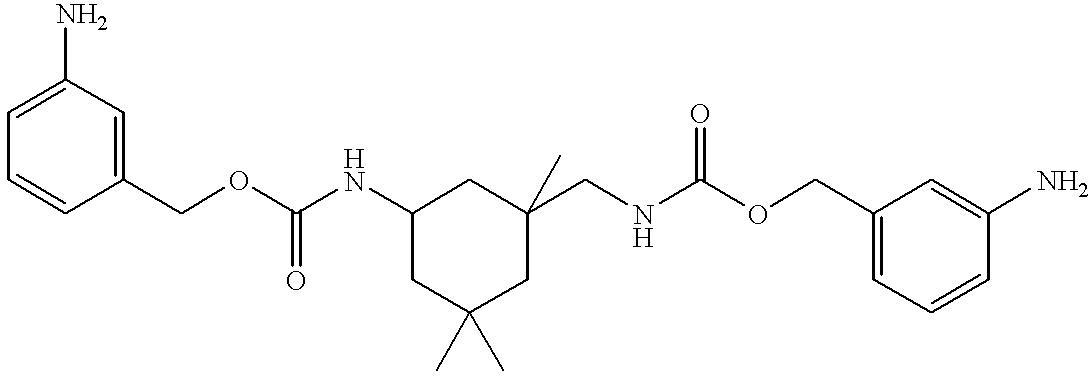
- VRGRJCXVSUAYDM-UHFFFAOYSA-N CC1(C)CC(NC(=O)OCC2=CC(N)=CC=C2)CC(C)(CNC(=O)OCC2=CC=CC(N)=C2)C1 Chemical compound CC1(C)CC(NC(=O)OCC2=CC(N)=CC=C2)CC(C)(CNC(=O)OCC2=CC=CC(N)=C2)C1 VRGRJCXVSUAYDM-UHFFFAOYSA-N 0.000 description 1
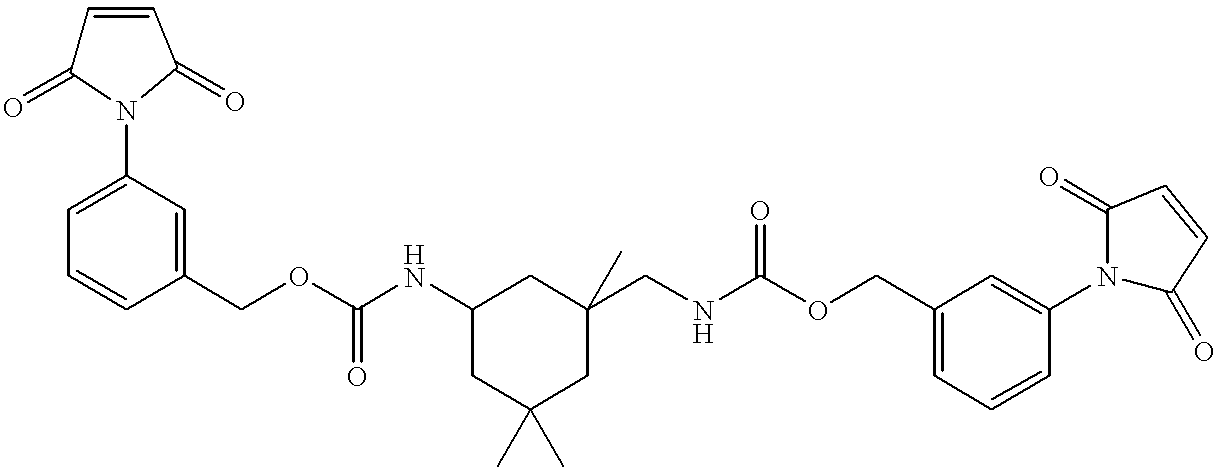
- TZUIWJUTKPOXJW-UHFFFAOYSA-N CC1(C)CC(NC(=O)OCC2=CC(N3C(=O)C=CC3=O)=CC=C2)CC(C)(CNC(=O)OCC2=CC=CC(N3C(=O)C=CC3=O)=C2)C1 Chemical compound CC1(C)CC(NC(=O)OCC2=CC(N3C(=O)C=CC3=O)=CC=C2)CC(C)(CNC(=O)OCC2=CC=CC(N3C(=O)C=CC3=O)=C2)C1 TZUIWJUTKPOXJW-UHFFFAOYSA-N 0.000 description 1
- WRKLFXHOOUBSNA-UHFFFAOYSA-N CC1(C)CC(NC(=O)OCC2=CC([N+](=O)[O-])=CC=C2)CC(C)(CNC(=O)OCC2=CC=CC([N+](=O)[O-])=C2)C1 Chemical compound CC1(C)CC(NC(=O)OCC2=CC([N+](=O)[O-])=CC=C2)CC(C)(CNC(=O)OCC2=CC=CC([N+](=O)[O-])=C2)C1 WRKLFXHOOUBSNA-UHFFFAOYSA-N 0.000 description 1
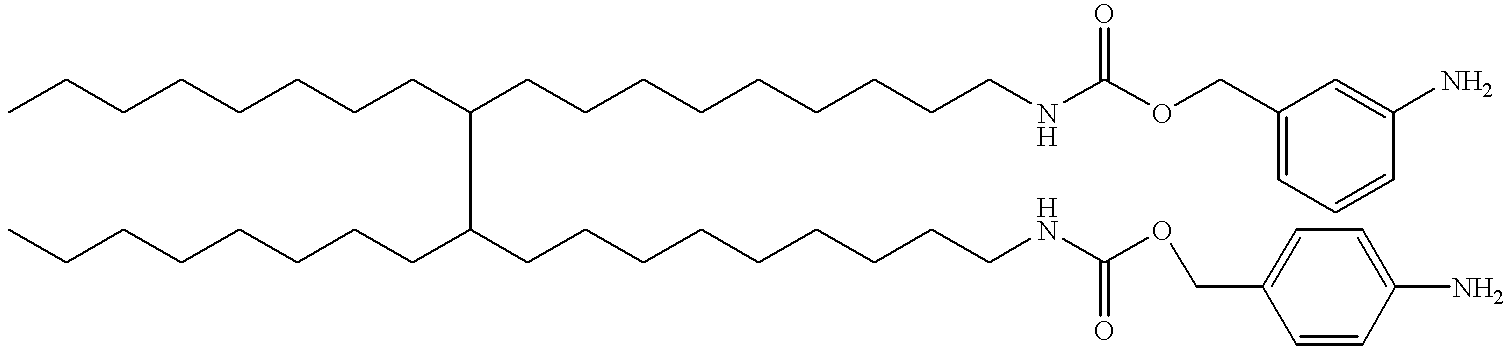
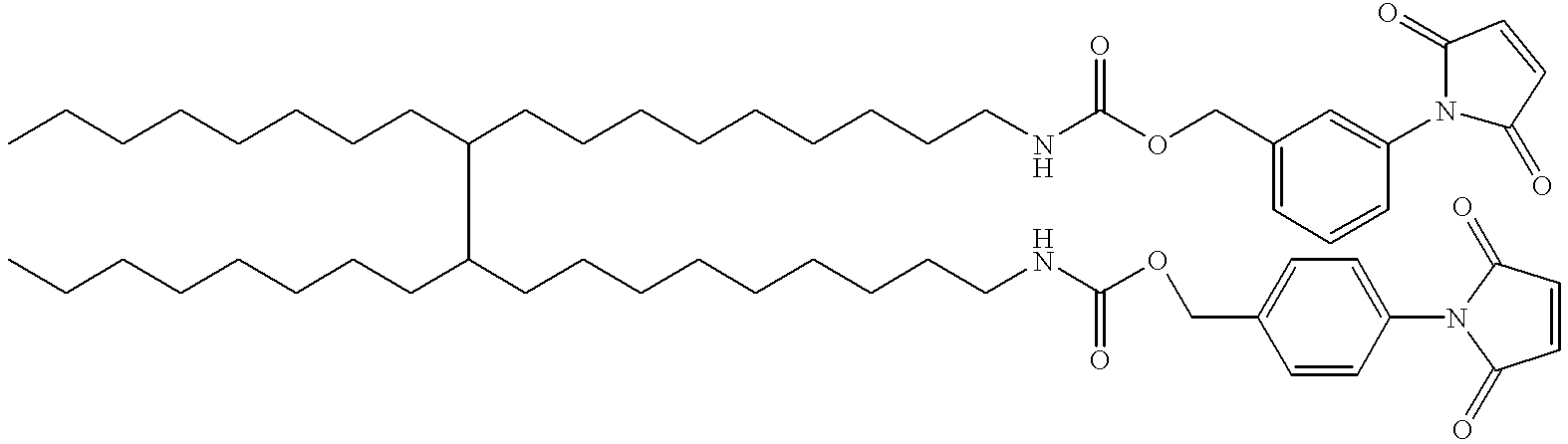
- KLWYWANDCNAUCJ-UHFFFAOYSA-N CCCCCCCCC(CCCCCCCCCNC(=O)OCC1=CC=C(N)C=C1)C(CCCCCCCC)CCCCCCCCCNC(=O)OCC1=CC=CC(N)=C1 Chemical compound CCCCCCCCC(CCCCCCCCCNC(=O)OCC1=CC=C(N)C=C1)C(CCCCCCCC)CCCCCCCCCNC(=O)OCC1=CC=CC(N)=C1 KLWYWANDCNAUCJ-UHFFFAOYSA-N 0.000 description 1
- MXJWVBJCGRBJJG-UHFFFAOYSA-N CCCCCCCCC(CCCCCCCCCNC(=O)OCC1=CC=C(N2C(=O)C=CC2=O)C=C1)C(CCCCCCCC)CCCCCCCCCNC(=O)OCC1=CC=CC(N2C(=O)C=CC2=O)=C1 Chemical compound CCCCCCCCC(CCCCCCCCCNC(=O)OCC1=CC=C(N2C(=O)C=CC2=O)C=C1)C(CCCCCCCC)CCCCCCCCCNC(=O)OCC1=CC=CC(N2C(=O)C=CC2=O)=C1 MXJWVBJCGRBJJG-UHFFFAOYSA-N 0.000 description 1
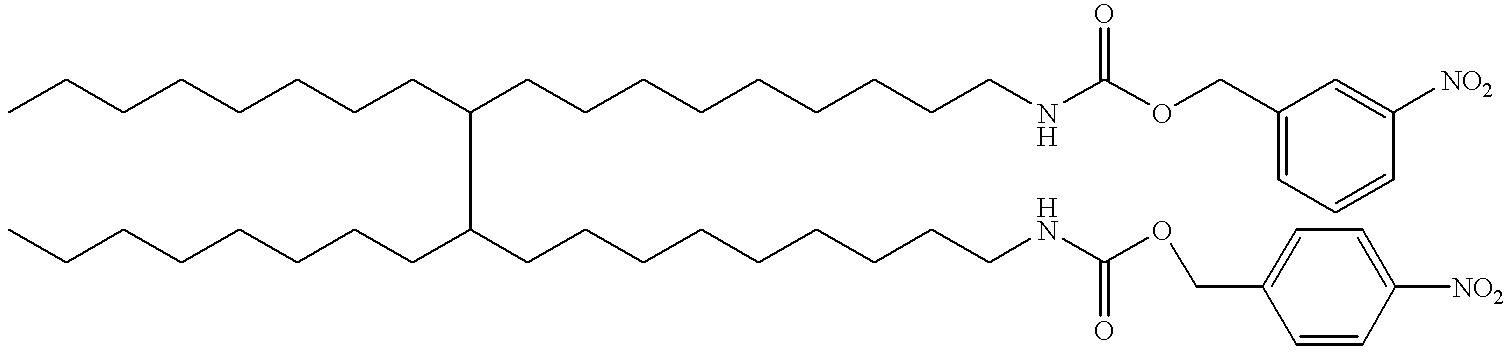
- DZQOCWRBGDGZOI-UHFFFAOYSA-N CCCCCCCCC(CCCCCCCCCNC(=O)OCC1=CC=C([N+](=O)[O-])C=C1)C(CCCCCCCC)CCCCCCCCCNC(=O)OCC1=CC=CC([N+](=O)[O-])=C1 Chemical compound CCCCCCCCC(CCCCCCCCCNC(=O)OCC1=CC=C([N+](=O)[O-])C=C1)C(CCCCCCCC)CCCCCCCCCNC(=O)OCC1=CC=CC([N+](=O)[O-])=C1 DZQOCWRBGDGZOI-UHFFFAOYSA-N 0.000 description 1
- NGUQNEUPDGSXME-UHFFFAOYSA-N CCCCCCCCCC(CCCCCCCCOC(=O)CCCCCN1C(=O)C=CC1=O)C(CCCCCCCC)CCCCCCCCCOC(=O)CCCCCN1C(=O)C=CC1=O Chemical compound CCCCCCCCCC(CCCCCCCCOC(=O)CCCCCN1C(=O)C=CC1=O)C(CCCCCCCC)CCCCCCCCCOC(=O)CCCCCN1C(=O)C=CC1=O NGUQNEUPDGSXME-UHFFFAOYSA-N 0.000 description 1
- ZECGXFRANIEGLV-UHFFFAOYSA-N CCCCCCCCCCCCCCCC(=O)Cl.CCCCCCCCCCCCCCCC(=O)OCCN1C(=O)C=CC1=O.O=C1C=CC(=O)N1CCO Chemical compound CCCCCCCCCCCCCCCC(=O)Cl.CCCCCCCCCCCCCCCC(=O)OCCN1C(=O)C=CC1=O.O=C1C=CC(=O)N1CCO ZECGXFRANIEGLV-UHFFFAOYSA-N 0.000 description 1
- IODMDUKWZIFCHD-UHFFFAOYSA-N O=C(CCCCCN1C(=O)C=CC1=O)OCC(OC(=O)CCCCCN1C(=O)C=CC1=O)OC(=O)CCCCCN1C(=O)C=CC1=O Chemical compound O=C(CCCCCN1C(=O)C=CC1=O)OCC(OC(=O)CCCCCN1C(=O)C=CC1=O)OC(=O)CCCCCN1C(=O)C=CC1=O IODMDUKWZIFCHD-UHFFFAOYSA-N 0.000 description 1
- TXFICKOAVNTSKH-UHFFFAOYSA-N O=C(CCCCCN1C(=O)C=CC1=O)OCCCCCCCCCCOC(=O)CCCCCN1C(=O)C=CC1=O Chemical compound O=C(CCCCCN1C(=O)C=CC1=O)OCCCCCCCCCCOC(=O)CCCCCN1C(=O)C=CC1=O TXFICKOAVNTSKH-UHFFFAOYSA-N 0.000 description 1
- OUPZKGBUJRBPGC-UHFFFAOYSA-N O=C(N(CC1OC1)C(N1CC2OC2)=O)N(CC2OC2)C1=O Chemical compound O=C(N(CC1OC1)C(N1CC2OC2)=O)N(CC2OC2)C1=O OUPZKGBUJRBPGC-UHFFFAOYSA-N 0.000 description 1
- WOJKKJKETHYEAC-UHFFFAOYSA-N O=C(O)CCCCCN1C(=O)C=CC1=O Chemical compound O=C(O)CCCCCN1C(=O)C=CC1=O WOJKKJKETHYEAC-UHFFFAOYSA-N 0.000 description 1
- YUNNXIPWEULUHK-UHFFFAOYSA-N O=C1C=CC(=O)N1C1=CC=C(O)C=C1.O=C1C=CC(=O)N1C1=CC=C(OCC(O)COC2=NC(OCC(O)COC3=CC=C(N4C(=O)C=CC4=O)C=C3)=NC(OCC(O)COC3=CC=C(N4C(=O)C=CC4=O)C=C3)=N2)C=C1.O=C1N(CC2CO2)C(=O)N(CC2CO2)C(=O)N1CC1CO1 Chemical compound O=C1C=CC(=O)N1C1=CC=C(O)C=C1.O=C1C=CC(=O)N1C1=CC=C(OCC(O)COC2=NC(OCC(O)COC3=CC=C(N4C(=O)C=CC4=O)C=C3)=NC(OCC(O)COC3=CC=C(N4C(=O)C=CC4=O)C=C3)=N2)C=C1.O=C1N(CC2CO2)C(=O)N(CC2CO2)C(=O)N1CC1CO1 YUNNXIPWEULUHK-UHFFFAOYSA-N 0.000 description 1
- QJABCJMXTAZJPO-UHFFFAOYSA-N OC(COc(cc1)ccc1N(C(C=C1)=O)C1=O)COc1nc(OCC(COc(cc2)ccc2N(C(C=C2)=O)C2=O)O)nc(OCC(COc(cc2)ccc2N(C(C=C2)=O)C2=O)O)n1 Chemical compound OC(COc(cc1)ccc1N(C(C=C1)=O)C1=O)COc1nc(OCC(COc(cc2)ccc2N(C(C=C2)=O)C2=O)O)nc(OCC(COc(cc2)ccc2N(C(C=C2)=O)C2=O)O)n1 QJABCJMXTAZJPO-UHFFFAOYSA-N 0.000 description 1
- BLLFPKZTBLMEFG-UHFFFAOYSA-N Oc(cc1)ccc1N(C(C=C1)=O)C1=O Chemical compound Oc(cc1)ccc1N(C(C=C1)=O)C1=O BLLFPKZTBLMEFG-UHFFFAOYSA-N 0.000 description 1
Classifications
-
- H10W74/47—
-
- B—PERFORMING OPERATIONS; TRANSPORTING
- B01—PHYSICAL OR CHEMICAL PROCESSES OR APPARATUS IN GENERAL
- B01D—SEPARATION
- B01D35/00—Filtering devices having features not specifically covered by groups B01D24/00 - B01D33/00, or for applications not specifically covered by groups B01D24/00 - B01D33/00; Auxiliary devices for filtration; Filter housing constructions
-
- C—CHEMISTRY; METALLURGY
- C08—ORGANIC MACROMOLECULAR COMPOUNDS; THEIR PREPARATION OR CHEMICAL WORKING-UP; COMPOSITIONS BASED THEREON
- C08F—MACROMOLECULAR COMPOUNDS OBTAINED BY REACTIONS ONLY INVOLVING CARBON-TO-CARBON UNSATURATED BONDS
- C08F290/00—Macromolecular compounds obtained by polymerising monomers on to polymers modified by introduction of aliphatic unsaturated end or side groups
- C08F290/02—Macromolecular compounds obtained by polymerising monomers on to polymers modified by introduction of aliphatic unsaturated end or side groups on to polymers modified by introduction of unsaturated end groups
- C08F290/06—Polymers provided for in subclass C08G
-
- C—CHEMISTRY; METALLURGY
- C08—ORGANIC MACROMOLECULAR COMPOUNDS; THEIR PREPARATION OR CHEMICAL WORKING-UP; COMPOSITIONS BASED THEREON
- C08F—MACROMOLECULAR COMPOUNDS OBTAINED BY REACTIONS ONLY INVOLVING CARBON-TO-CARBON UNSATURATED BONDS
- C08F290/00—Macromolecular compounds obtained by polymerising monomers on to polymers modified by introduction of aliphatic unsaturated end or side groups
- C08F290/02—Macromolecular compounds obtained by polymerising monomers on to polymers modified by introduction of aliphatic unsaturated end or side groups on to polymers modified by introduction of unsaturated end groups
- C08F290/06—Polymers provided for in subclass C08G
- C08F290/065—Polyamides; Polyesteramides; Polyimides
-
- C—CHEMISTRY; METALLURGY
- C08—ORGANIC MACROMOLECULAR COMPOUNDS; THEIR PREPARATION OR CHEMICAL WORKING-UP; COMPOSITIONS BASED THEREON
- C08G—MACROMOLECULAR COMPOUNDS OBTAINED OTHERWISE THAN BY REACTIONS ONLY INVOLVING UNSATURATED CARBON-TO-CARBON BONDS
- C08G18/00—Polymeric products of isocyanates or isothiocyanates
- C08G18/06—Polymeric products of isocyanates or isothiocyanates with compounds having active hydrogen
- C08G18/28—Polymeric products of isocyanates or isothiocyanates with compounds having active hydrogen characterised by the compounds used containing active hydrogen
- C08G18/2805—Compounds having only one group containing active hydrogen
- C08G18/285—Nitrogen containing compounds
-
- C—CHEMISTRY; METALLURGY
- C08—ORGANIC MACROMOLECULAR COMPOUNDS; THEIR PREPARATION OR CHEMICAL WORKING-UP; COMPOSITIONS BASED THEREON
- C08G—MACROMOLECULAR COMPOUNDS OBTAINED OTHERWISE THAN BY REACTIONS ONLY INVOLVING UNSATURATED CARBON-TO-CARBON BONDS
- C08G18/00—Polymeric products of isocyanates or isothiocyanates
- C08G18/06—Polymeric products of isocyanates or isothiocyanates with compounds having active hydrogen
- C08G18/70—Polymeric products of isocyanates or isothiocyanates with compounds having active hydrogen characterised by the isocyanates or isothiocyanates used
- C08G18/72—Polyisocyanates or polyisothiocyanates
- C08G18/73—Polyisocyanates or polyisothiocyanates acyclic
-
- B—PERFORMING OPERATIONS; TRANSPORTING
- B01—PHYSICAL OR CHEMICAL PROCESSES OR APPARATUS IN GENERAL
- B01D—SEPARATION
- B01D2201/00—Details relating to filtering apparatus
- B01D2201/31—Other construction details
Definitions
- This invention relates to package encapsulant compositions for electronic devices that protect the electronic component and its metallization from environmental corrosion and mechanical damage.
- Microelectronic devices contain millions of electrical circuit components, mainly transistors assembled in integrated circuit (IC) chips, but also resistors, capacitors, and other components.
- the integrated circuit component may comprise a single bare chip, a single encapsulated chip, or an encapsulated package of single or multi-chips. These electronic components are interconnected to form the circuits, and eventually are connected to and supported on a carrier or substrate, such as a printed wire board.
- the various materials used to manufacture the integrated circuits and their related interconnect materials are susceptible to environmental, moisture, and mechanical damage. Protection is provided by encapsulation of the electronic component within a polymeric material. Encapsulation can be performed by a transfer molding process in which the component is loaded into a mold cavity, constrained, and the polymeric encapsulant transferred from a reservoir into the cavity under pressure. Typically, the encapsulant is a thermosetting polymer, which then cross-links and cures to form the final assembly. Encapsulation also can be performed by dispensing an aliquot of polymeric encapsulant onto the component, such as a chip or integrated circuit supported on a substrate, and subsequently curing the composition.
- thermosetting package encapsulation materials For most commercial and industrial end uses, particularly those utilizing chip-on-board packages and multi-chip modules, the encapsulation is accomplished with polymeric thermosetting materials.
- the preferred thermosetting package encapsulation materials must have a viscosity and a thixotropic index that allows easy dispensability by syringe, sufficient adhesion to the components, low ionic content to avoid corrosion of the metallization, adequate mechanical strength, high thermal and moisture resistance at application temperatures, and matched coefficient of thermal expansion to the materials it contacts.
- thermoplastics In order to achieve the required mechanical performance and reworkability, relatively high molecular weight thermoplastics would be the preferred compositions for package materials. These materials, however, have high viscosity or even solid film form, which are drawbacks to the manufacturing process. Therefore, there is a need for new encapsulant compositions that are easily dispensable to conform with automated manufacturing processes, and that are reworkable.
- This invention is a curable encapsulant composition for electronic components that comprises one or more compounds containing one or more maleimide functionality, or one or more compounds containing one or more vinyl functionality, or a combination of compounds containing maleimide or vinyl functionality, a free-radical initiator and/or a photoinitiator, and optionally one or more fillers.
- a compound containing one maleimide functionality will be referred to hereinafter as a mono-functional maleimide compound.
- a compound containing more than one maleimide functionality will be referred to hereinafter as a poly-functional maleimide compound.
- a compound containing one vinyl functionality will be referred to hereinafter as a mono-functional vinyl compound.
- a compound containing more than one vinyl functionality will be referred to hereinafter as a poly-functional vinyl compound.
- the functionality is defined herein to be a carbon to carbon double bond.
- this invention is also a cured encapsulant composition that results after the curing of the just described curable encapsulant composition.
- this invention is an electronic component electrically and mechanically connected to a substrate, encapsulated in a cured encapsulant composition, in which the cured encapsulant was prepared from a composition comprising one or more mono- or polyfunctional maleimide compounds, or one or more mono- or polyfunctional vinyl compounds other than maleimide compounds, or a combination of maleimide and vinyl compounds, a free radical curing agent and/or a photoinitiator, and optionally one or more fillers.
- the maleimide and vinyl compounds used in the package encapsulant compositions of this invention are curable compounds, meaning that they are capable of polymerization, with or without crosslinking.
- to cure will mean to polymerize, with or without crosslinking.
- Cross-linking as is understood in the art, is the attachment of two polymer chains by bridges of an element, a molecular group, or a compound, and in general will take place upon heating.
- cross-linking density is increased, the properties of a material can be changed from thermoplastic to thermosetting, which consequently increases polymeric strength, heat-and electrical resistance, and resistance to solvents and other chemicals.
- the package encapsulants of this invention can be prepared from mono-functional compounds to limit the cross-link density.
- a minor amount of poly-functional compounds can be added to provide some cross-linking and strength to the composition, provided the amount of poly-functional compounds is limited to an amount that does not diminish the desired thermoplastic properties.
- the strength and elasticity of individual package encapsulants can be tailored to a particular end-use application.
- the cross-link density can also be controlled to give a wide range of glass transition temperatures in the cured encapsulant to withstand subsequent processing and operation temperatures.
- thermoplastic composition should be chosen so that the electronic component can be pried off the substrate. Any residue package encapsulant can be heated until it softens and then be easily removed.
- the maleimide compounds and the vinyl compounds may be used independently, or in combination.
- the maleimide or vinyl compounds, or both, will be present in the curable package encapsulant compositions in an amount from 2 to 98 weight percent based on the organic components present (excluding any fillers).
- the package encapsulant compositions will further comprise at least one free-radical initiator, which is defined to be a chemical species that decomposes to a molecular fragment having one or more unpaired electrons, highly reactive and usually short-lived, which is capable of initiating a chemical reaction by means of a chain mechanism.
- the free-radical initiator will be present in an amount of 0.1 to 10 percent, preferably 0.1 to 3.0 percent, by weight of the maleimide or vinyl compound, or a combination of both maleimide and vinyl compounds (excluding any filler).
- the free radical curing mechanism gives a fast cure and provides the composition with a long shelf life before cure.
- Preferred free-radical initiators include peroxides, such as butyl peroctoates and dicumyl peroxide, and azo compounds, such as 2,2′-azobis(2-methyl-propanenitrile) and 2,2′-azobis(2-methyl-butanenitrile).
- the encapsulant compositions may contain a photoinitiator, such as is sold by Ciba Specialty Chemicals under the trademark Irgacure, in lieu of the free-radical initiator, and the curing process may then be initiated by UV radiation.
- the photoinitiator will be present in an amount of 0.1 to 10 percent, preferably 0.1 to 3.0 percent, by weight of the maleimide or vinyl compound, or a combination of both maleimide and vinyl compounds (excluding any filler).
- both photoinitiation and free-radical initiation may be desirable.
- the curing process can be started by UV irradiation, and in a later processing step, curing can be completed by the application of heat to accomplish a free-radical cure.
- these compositions will cure within a temperature range of 80° to 180° C., and curing will be effected within a length of time of 5 minutes to 4 hours.
- the time and temperature curing profile for each encapsulant composition will vary, and different compositions can be designed to provide the curing profile that will be suited to the particular industrial manufacturing process.
- thermoplastic properties are desired for the package encapsulant
- Ease of application is achieved by using relatively low molecular weight reactive oligomers or pre-polymers and curing these in situ after application to the electronic assembly of component and substrate. Applying the materials in an uncured state gives high processibility, and the resultant cured thermoplastic encapsulant provides high mechanical performance.
- inert inorganic fillers are used in the package encapsulant to adjust the coefficient of thermal expansion to more closely mirror that of the circuit interconnect, and to mechanically reinforce the interconnect.
- suitable thermally conductive fillers include silica, graphite, aluminum nitride, silicon carbide, boron nitride, diamond dust, and clays.
- the fillers will be present typically in an amount of 20-80 percent by weight of the total package encapsulant composition.
- C(O) refers to a carbonyl group
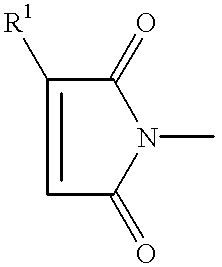
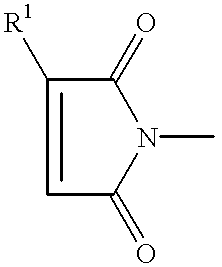
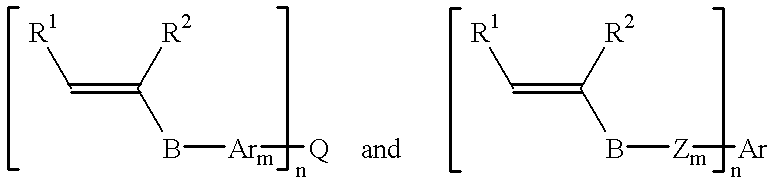
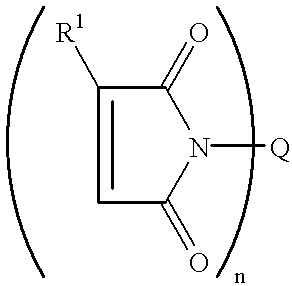
- the maleimide compounds suitable for use in the package encapsulant compositions of this invention have a structure represented by the formula: [M—AR m ] n —Q, or by the formula: [M—Z m ] n —AR.
- the compound when lower case “n” is the integer 1, the compound will be a mono-functional compound; and when lower case “n” is an integer 2 to 6, the compound will be a poly-functional compound.
- M is a maleimide moiety having the structure
- R 1 is H or C 1 to C 5 alkyl
- each Ar independently is an aromatic group selected from the aromatic groups having the structures (I) through (V):
- Q is a linear or branched chain alkyl, alkyloxy, alkyl amine, alkyl sulfide, alkylene, alkyleneoxy, alkylene amine, alkylene sulfide, aryl, aryloxy, or aryl sulfide species having up to about 100 atoms in the chain, which may contain saturated or unsaturated cyclic or heterocyclic substituents pendant from the chain or as part of the backbone in the chain, and in which any heteroatom present may or may not be directly attached to X;
- each R 2 independently is an alkyl, aryl, or arylalkyl group having 1 to 18 carbon atoms
- R 3 is an alkyl or alkyloxy chain having up to 100 atoms in the chain, which chain may contain aryl substituents
- X is O, S, N, or P
- n is 0 to 50;
- R 3 is an alkyl or alkyloxy chain having up to 100 atoms in the chain, which chain may contain aryl substituents;
- n is 1 to 6.
- Ar is structure (II), (III), (IV) or (V), and more preferably is structure (II).
- Q is a linear or branched chain alkyl, alkyloxy, alkylene, or alkyleneoxy species having up to about 100 atoms in the chain, as described with pendant saturated or unsaturated cyclic or heterocyclic substituents, or a siloxane as described, and more preferably is a linear or branched chain alkyl species or siloxane, as described.
- M is a maleimide moiety having the structure
- R 1 is H or C 1 to C 5 alkyl
- Z is a linear or branched chain alkyl, alkyloxy, alkyl amine, alkyl sulfide, alkylene, alkyleneoxy, alkylene amine, alkylene sulfide, aryl, aryloxy, or aryl sulfide species having up to about 100 atoms in the chain, which may contain saturated or unsaturated cyclic or heterocyclic substituents pendant from the chain or as part of the backbone in the chain, and in which any heteroatom present may or may not be directly attached to K;
- each R 2 independently is an alkyl, aryl, or arylalkyl group having 1 to 18 carbon atoms
- R 3 is an alkyl or alkyloxy chain having up to 100 atoms in the chain, which chain may contain aryl substituents
- X is O, S, N, or P
- n is 0 to 50;
- R 3 is an alkyl or alkyloxy chain having up to 100 atoms in the chain, which chain may contain aryl substituents;
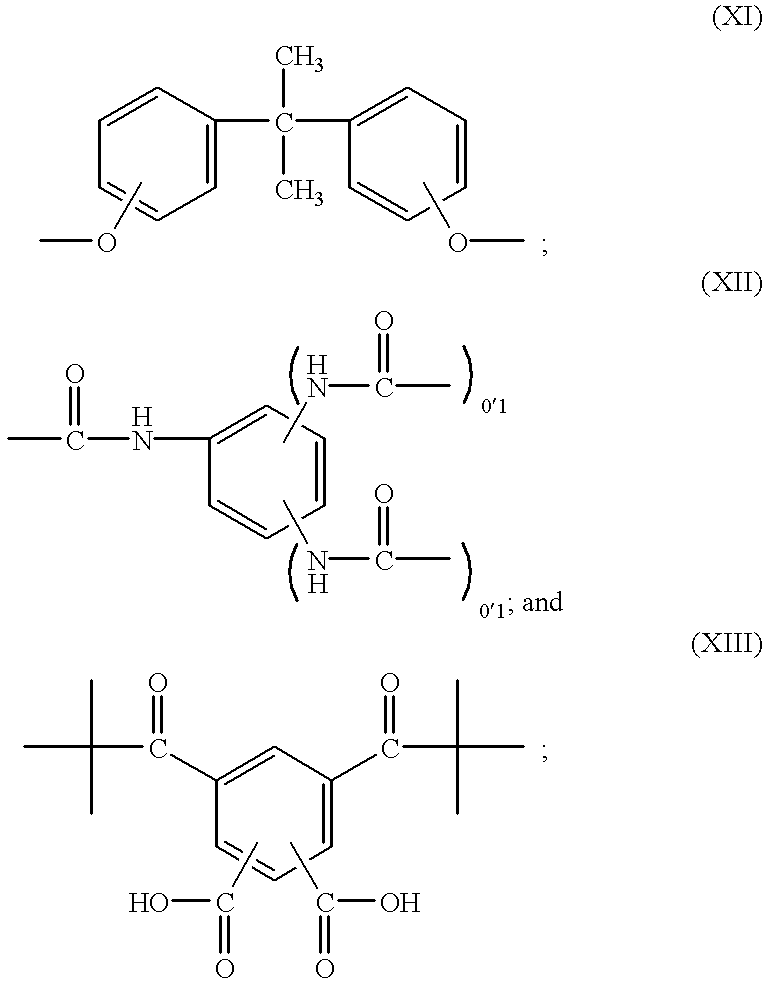
- Ar is an aromatic group selected from the aromatic groups having the structures (VI) through (XIII) (although only one bond may be shown to represent connection to the aromatic group K, this will be deemed to represent any number of additional bonds as described and defined by n):
- R 5 , R 6 , and R 7 are a linear or branched chain alkyl, alkyloxy, alkyl amine, alkyl sulfide, alkylene, alkyleneoxy, alkylene amine, alkylene sulfide, aryl, aryloxy, or aryl sulfide species having up to about 100 atoms in the chain, which may contain saturated or unsaturated cyclic or heterocyclic substituents pendant from the chain or as part of the backbone in the chain, and in which any heteroatom present may or may not be directly attached to the aromatic ring; or R 5 , R 6 , and R 7 are a siloxane having the structure —(CR 1 2 ) e —[SiR 4 2 —O] f —SiR 4 2 —(CH 3 ) g — in which the R 1 substituent is H or an alkyl group having 1 to 5 carbon atoms and the R 4 substituent independently for each position is an alkyl
- n is 1 to 6.
- Z is a linear or branched chain alkyl, alkyloxy, alkylene, or alkyleneoxy species having up to about 100 atoms in the chain, as described with pendant saturated or unsaturated cyclic or heterocyclic substituents, or a siloxane as described, and more preferably is a linear or branched chain alkyl species or siloxane, as described.
- Ar is structure (VIII), (X) or (XI), more preferably is structure (X) or (XI), and most preferably is structure (X).
- the more preferred maleimide compounds are N-butylphenyl maleimide and N-ethylphenyl maleimide.
- R 1 and R 2 are H or an alkyl having 1 to 5 carbon atoms, or together form a 5 to 9 membered ring with the carbons forming the vinyl group;
- B is C, S, N, O, C(O), O—C(O), C(O)—O, C(O)NH or C(O)N(R 8 ), in which R 8 is C 1 to C 5 alkyl;
- m is 0 or 1;
- n is 1-6; and Ar, Q, Z, and Ar are as described above.
- B is O, C(O), O—C(O), C(O)—O, C(O)NH or C(O)N(R 8 ); more preferably B is O, C(O), O—C(O), C(O)—O, or C(O)N(R 8 ).
- the encapsulant may also contain a coupling agent.
- a coupling agent as used herein is a chemical species containing a polymerizable functional group for reaction with the maleimide and other vinyl compound, and a functional group capable of condensing with metal hydroxides present on the surface of the substrate.
- Such coupling agents and the preferred amounts for use in compositions for particular substrates are known in the art.
- Suitable coupling agents are silanes, silicate esters, metal acrylates or methacrylates, titanates, and compounds containing a chelating ligand, such as phosphine, mercaptan, and acetoacetate.
- coupling agents typically will be in amounts up to 10 percent by weight, and preferably in amounts of 0.1-3.0 percent by weight, of the maleimide and other monofunctional vinyl compound.
- the encapsulant compositions may contain compounds that lend additional flexibility and toughness to the resultant cured encapsulant.
- Such compounds may be any thermoset or thermoplastic material having a Tg of 50° C. or less, and typically will be a polymeric material characterized by free rotation about the chemical bonds, such as can be obtained by the presence of carbon-carbon double bonds adjacent to carbon-carbon single bonds, the presence of ester and ether groups, and the absence of ring structures.
- Suitable such modifiers include polyacrylates, poly(butadiene), polyTHF (polymerized tetrahydrofuran), CTBN (carboxy-terminated butyronitrile) rubber, and polypropylene glycol.
- toughening compounds may be in an amount up to about 15 percent by weight of the maleimide and other monofunctional vinyl compound.
- siloxanes can be added to the package encapsulant formulations to impart elastomeric properties.
- Suitable siloxanes are the methacryloxypropyl-terminated polydimethyl siloxanes, and the aminopropyl-terminated polydimethylsiloxanes, available from United Chemical Technologies.
- adhesion promoters may also be added as needed.
- adhesion promoters are known to those skilled in the art.
- Another embodiment of this invention includes the maleimides having the formulae [M—Ar m ] n —Q and [M—Z m ] n —Ar as described herein in which Q and Z can be an ester having the structure
- each R 3 can independently be an alkyl or alkyloxy chain having up to 100 atoms in the chain, which chain may contain aryl substituents, or
- a siloxane having the structure —(CR 1 2 ) e —[SiR 4 2 —O] f —SiR 4 2 —(CR 1 2 ) g — in which the R 1 substituent independently for each position is H or an alkyl group having 1 to 5 carbon atoms, the R 4 substituent independently for each position is an alkyl group having 1 to 5 carbon atoms or an aryl group, e and g are independently 1 to 10 and f is 1 to 50.
- B is C, S, N, O, C(O), C(O)NH or C(O)N(R 8 ), in which R 8 is C 1 to C 5 alkyl.
- each R 3 can independently be an alkyl or alkyloxy chain having up to 100 atoms in the chain, which chain may contain aryl substituents,
- Another embodiment of this invention includes the composition as described herein containing an anionic or cationic curing initiator.
- the types and useful amounts of such initiators are well known in the art.
- compositions were investigated for viscosity and thixotropic index for the uncured composition, and for curing profile, glass transition temperature, coefficient of thermal expansion, thermal mechanical analysis, and reworkability for the cured composition.
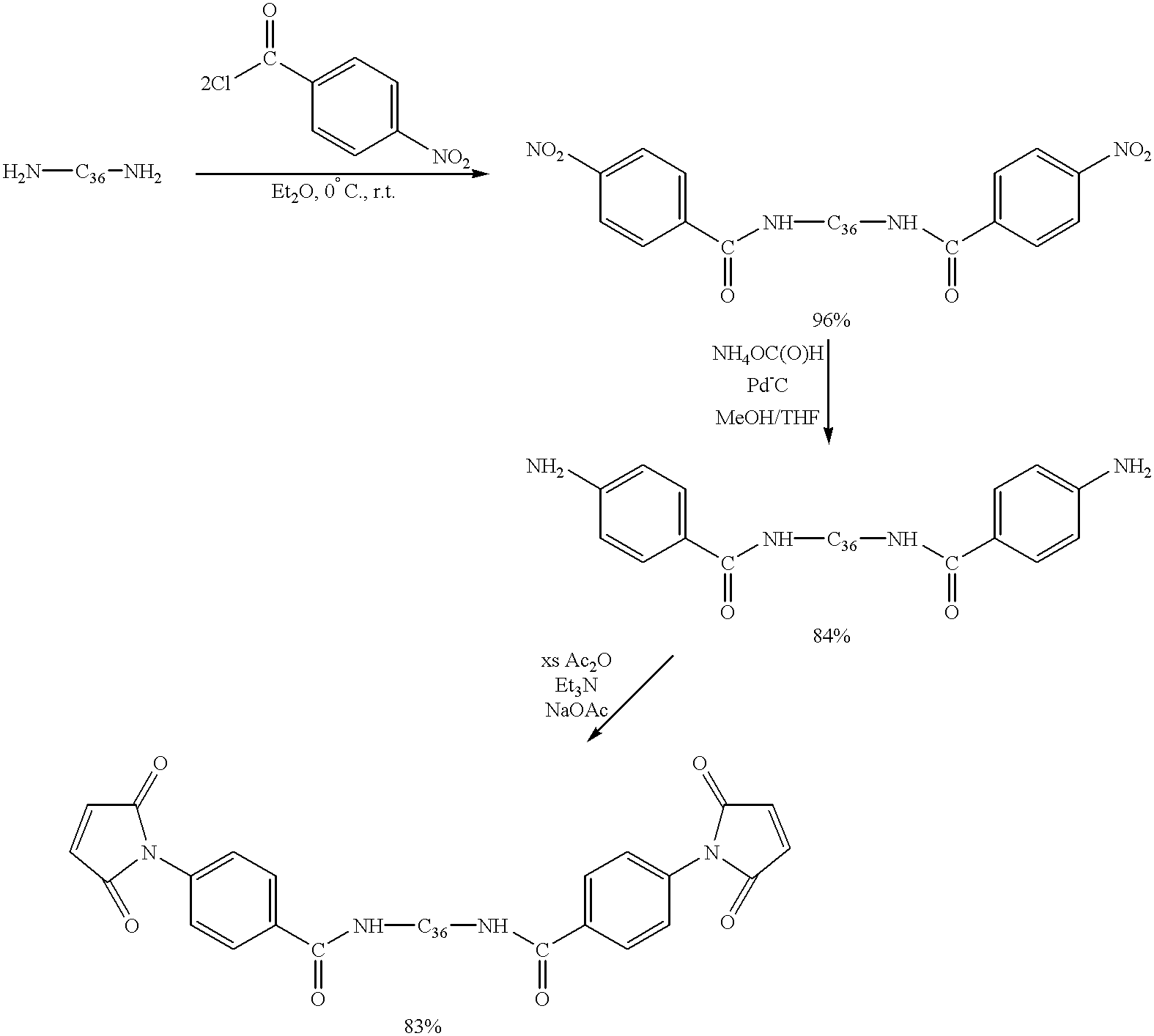
- Dimer diamine (sold as Versamine 552 by Henkel, 20.0 g, 37 mmol) was solvated in Et 2 O (200 mL) in a 500 mL three-necked flask equipped with an addition funnel, magnetic stirring, internal temperature probe and nitrogen inlet/outlet.
- NaOH aq (11.7 mL of 6.25 M solution diluted with 100 mL H 2 O, 73 mmol) was added with vigorous stirring. This solution was placed under a steady flow of nitrogen and cooled to 3° C. on an ice bath with stirring.
- the addition funnel was charged with p-nitrobenzoyl chloride (13.6 g, 73 mmol) in iethyl ether (Et 2 O) (50 mL), and this solution was added to the reaction vessel over the course of 60 minutes, maintaining an internal T ⁇ 10° C.
- the reaction was stirred at ⁇ 3° C. for an additional 60 minutes after this addition was complete, then allowed to warm to room temperature and stirred for another 4 hours.
- the solution was transferred to a separatory funnel and the isolated organic layer washed with distilled H 2 O (300 mL), 5% HCl aq (300 mL), NaCl aq (250 mL) and distilled H 2 O (2 ⁇ 250 mL).
- the dinitro compound described above (5.0 g, 5.9 mmol) was dissolved in methanol (MeOH) (25 mL) and THF (5 mL) in a 250 mL three-necked flask equipped with magnetic stirring, reflux condensor and nitrogen inlet/outlet. The solution was placed under nitrogen, and 5% Pd-C (0.96 g) were added with stirring. Ammonium formate (3.4 g, 55 mmol) was added and the reaction stirred at room temperature for 2 hours. Carbon dioxide evolution was immediately observed. The reaction solution was filtered, and bulk filtrate solvent was removed via rotary evaporator.
- Emulsions were broken by adding NaCl when necessary.
- the organic layer was isolated, dried over MgSO 4 anhyd. and solvent removed in vacuo to yield the bismaleimide, a brown solid (2.0 g, 83%).
- the resin exhibited satisfactory 1 H NMR, 13 C NMR and IR spectra, which indicated slight contamination with acetic acid.
- the solution was removed from the freezer and allowed to warm to room temperature. Hydroquinone (0.0513 g) was added to the solution. A partial strip of the THF was carried out on a rotary evaporator with the temperature maintained below 28° C. The solution was concentrated to approximately 800 ml. Much particulate matter was visible. The solution was placed in freezer overnight.
- the mixture was removed from the freezer and allowed to warm.
- the solids were filtered, rinsing with THF.
- the filtrate was transferred to a 2 L multi-neck flask equipped with a mechanical stirrer, vacuum line connected to a trap, and a glass tube attached by tubing to a drying tube.
- the remaining THF was stripped at room temperature by pulling a vacuum and bubbling air through the material while stirring.
- the resultant thick, creamy-tan colored semi-solid was placed in the freezer overnight.
- the semi-solid was removed from the freezer and allowed to warm.
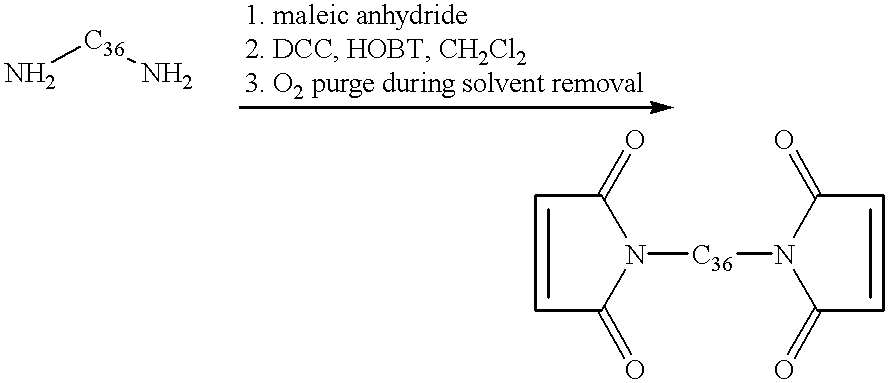
- the semi-solid was dissolved in 450 ml each of methanol and hexane, and washed with 50% methanol/water (4 ⁇ 250 ml) to remove 1-hydroxybenzotriazole (HOBT). It was attempted to extract the product with hexane. After addition of 300 ml of hexane separation was not observed. The mixture was washed with additional water (3 ⁇ 250 ml). The organic phase was placed in the freezer overnight.
- HOBT 1-hydroxybenzotriazole
- the material was removed from the freezer. Two layers were apparent. The upper layer was clear and yellow in color. The bottom layer was a orange and cloudy. The material was poured cold into a separatory funnel. The top layer was hexane and the desired product. The bottom layer was extracted with hexane (6 ⁇ 200 ml), separation occurred easily. The combined extracts were dried over anhydrous magnesium sulfate and filtered, rinsing the solids with hexane. The solvent was stripped to an approximate volume of 750 ml on a rotary evaporator with the temperature not exceeding 24° C. The remaining solvent was stripped off using a vacuum/air bubbling set-up at room temperature to give the desired product in 67% yield.
- Tris(epoxypropyl)isocyanurate (99.0 g, 0.33 mol) is dissolved in THF (500 mL) in a 2 L three-necked flask equipped with mechanical stirrer, internal temperature probe and nitrogen inlet/outlet.
- hyroxyphenylmaleimide (189.2 g, 1 mol)
- benzyldimethylamine 1. g, 0.05 wt. %).
- the solution is heated to 80° C. for 7 hours.
- the reaction is allowed to cool to room temperature, is filtered, and the filtrant washed with 5% HCl aq (500 mL) and distilled H 2 O (1 L).
- the resulting solid, triazinetris-(maleimide) is vacuum dried at room temperature.
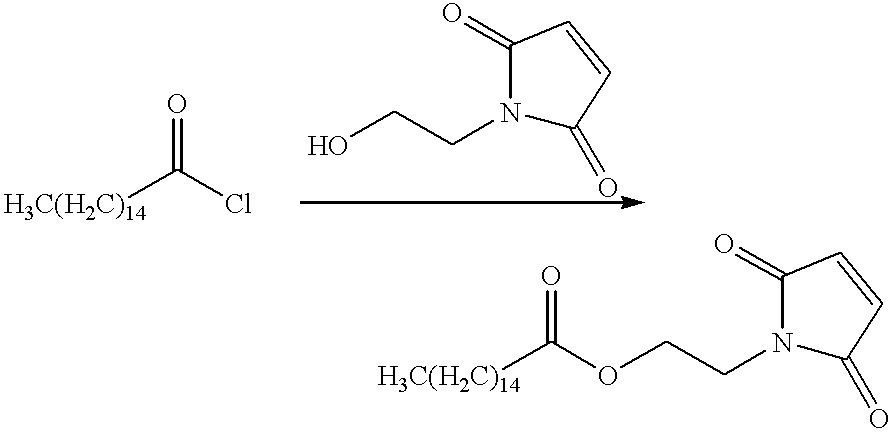
- Palmitoyl chloride (274.9 g, 1 mol) is dissolved in Et 2 O (500 mL) in a 2 L three-necked flask equipped with mechanical stirrer, internal temperature probe, addition funnel and nitrogen inlet/outlet.
- NaHCO 3 (84.0 g, 1 mol) in distilled H 2 O (500 mL) is added with vigorous stirring and the solution cooled on an ice bath under nitrogen.
- the addition funnel is charged with hydroxyethylmaleimide (141 g, 1 mol) in Et 2 O (100 mL) and this solution added to the reaction over a period of 30 minutes, maintaining an internal T ⁇ 10° C. during the addition.
- the reaction is stirred for another 30 minutes on ice, then allowed to warm to room temperature and stirred for 4 hours.
- the reaction is transferred to a separatory funnel and the isolated organic layer washed with distilled H 2 O (500 mL), 5% HCl aq (500 mL) and distilled H 2 O (2 ⁇ 500 mL).
- the organics are isolated, dried over MgSO 4 anhyd., filtered and solvent removed in vacuo to yield the aliphatic maleimide.
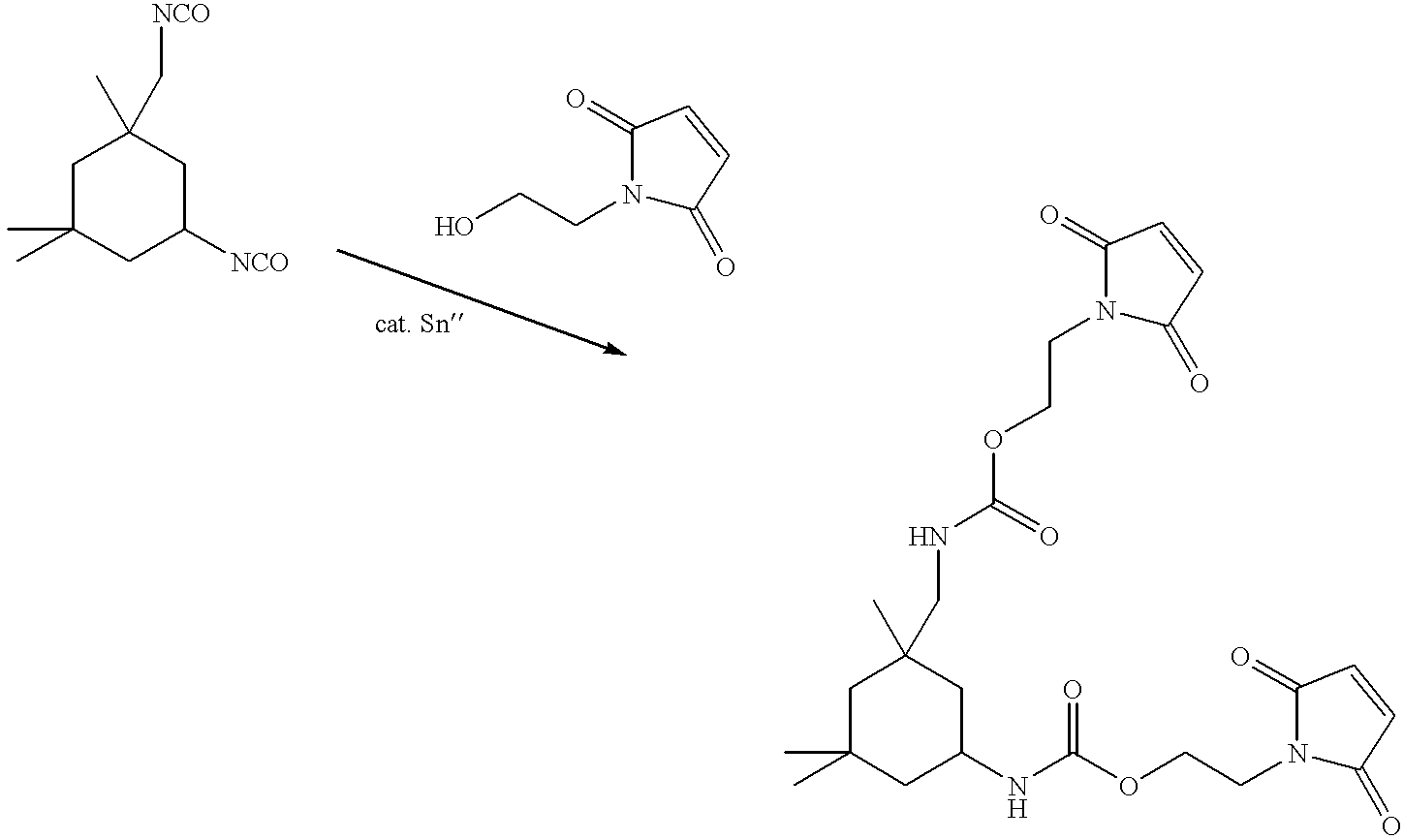
- the addition funnel is charged with hydroxyethylmaleimide (141 g, 1 mol) dissolved in THF (100 mL). This solution is added to the isocyanate solution over 30 minutes, and the resulting mixture heated for an additional 4 hours at 70° C. The reaction is allowed to cool to room temperature and solvent removed in vacuo. The remaining oil is dissolved in CH 2 Cl 2 ( 1 L) and washed with 10% HCl aq (1 L) and distilled H 2 O (2 ⁇ 1 L). The isolated organics are dried over MgSO 4 , filtered and the solvent removed in vacuo to yield the maleimide.
- Bis(1, 10-phenanthroline)Pd(OAc) 2 (0.21 g, 0.54 mmol) was dissolved in a mixture of butyl vinyl ether (8.18 g, 81.7 mmols), heptane (100 mL) and “dimer diol” (sold as Pripol 2033 by Unichema, 15.4 g, 27.2 mmol) in 2 L three-necked flask equipped with a mechanical stirrer under nitrogen. This solution was heated to light reflux for 6 h. The solution was allowed to cool to room temperature and subsequently poured onto activated carbon (20 g) and stirred for 1 hour.
- a dimer diol (sold as Pripol 2033 by Unichema, 284.4 g, 500 mmol) is dissolved in dry acetone (500 mL) in a 1 L three-necked flask equipped with mechanical stirrer, addition funnel and internal temperature probe under nitrogen. Triethylamine (101.2 g, 1 mol) is added to this solution and the solution cooled to 4° C. on an ice bath. Acryloyl chloride (90.5 g, 1 mol) solvated in dry acetone (100 mL) is charged into the addition funnel and added to the stirred reaction solution over the course of 60 minutes, maintaining an internal temperature ⁇ 10° C.
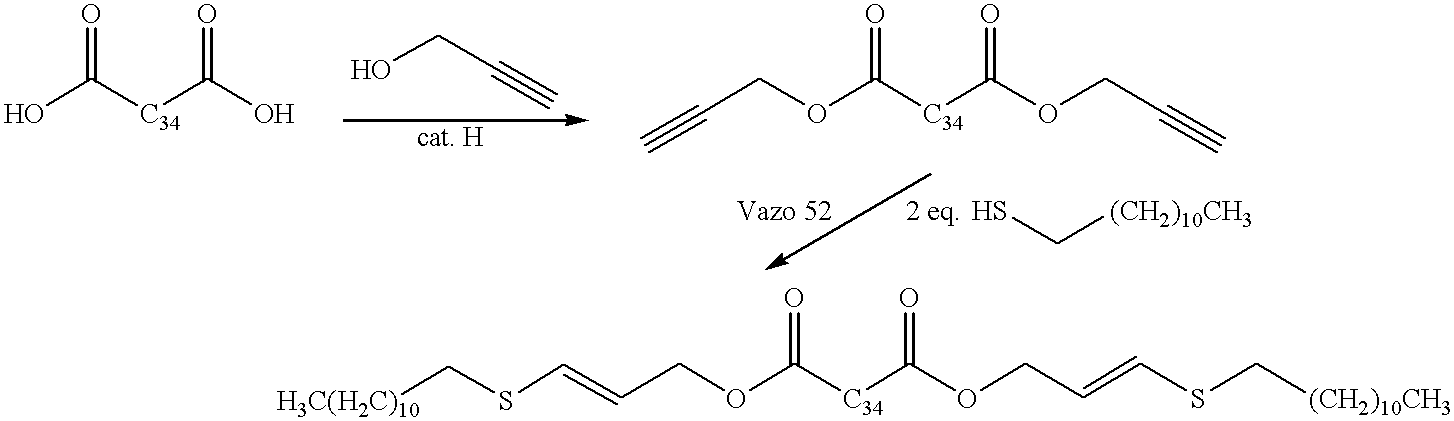
- Dimer acid (sold under the trademark Empol 1024 by Unichema) (574.6 g, 1 mol) and propargyl alcohol (112.1 g, 2 mol) are solvated in toluene (1 L) in a 3 L three-necked flask equipped with mechanical stirring and a Dean-Stark distillation apparatus. Concentrated H 2 SO 4 (6 mL) is added and the solution refluxed for 6 hours until 36 mL of H 2 O is azeotropically distilled. The solution is allowed to cool to room temperature, is washed with H 2 O (2 ⁇ 1 L), dried over MgSO 4 anhyd. and the solvent removed in vacuo to yield the propargyl ester intermediate as an oil.
- This ester intermediate (650.7 g, 1 mol) is solvated in THF (200 mL) in a 1 L three-necked flask equipped with reflux condensor, mechanical stirrer and internal temperature probe under nitrogen.
- Lauryl mercaptan 404.8 g, 2 mol
- 2,2′-azobis(2,4-dimethylpentanenitrile) (sold under the trademark Vazo 52 by DuPont) (11 g) are added and the resulting mixture heated to 70° C. on an oil bath with stirring for 7 hours. The reaction is allowed to cool to room temperature and solvent removed in vacuo to yield the alkenyl sulfide as an oil.
- Package encapsulant compositions were prepared by mixing together the organic components and then by blending the components with a silica filler in a weight percent ratio of 17% organic to 83% silica under high shear until homogeneous.
- the silica was FB-6S silica from Denka.
- the resulting compositions were light yellow slurries.
- the organic components, silica ratio by weight, glass transition temperature (Tg), and coefficient of thermal expansion (CTE) are reported here:
- composition 11-A to 11-D were tested for reworkability using as a test vehicle a 250 ⁇ 250 mil 2 silicon die bonded with the composition to a FR-4 circuit board substrate.
- the encapsulant composition was dispensed onto the chip adhered to the substrate and the assembly cured at 160° C. for 30 minutes. After the assembly again reached room temperature, a sponge was saturated with methyl isobutyl ketone and used to wipe the encapsulant in a continuous, circular motion. The encapsulant was gradually softened, and it dissolved within 10 minutes sufficiently to leave no residue on the substrate.
- a package encapsulant composition was prepared by combining the following ingredients with vigorous manual mixing until a homogenous paste was obtained:
- Bismaleimide 1.01 g (prepared from polytetramethylene oxide- di-p-aminobenzoate, sold as Versalink P-650 by Henkel) Cyclohexanedimethanol divinylether 0.19 g (International Specialty Products): ⁇ , ⁇ -Dimethoxy- ⁇ -phenylacetophenone 0.06 g (sold as Irgacure 651 by Ciba Specialty Chemicals) Hydrophilic Fused Silica 3.78 g (sold by Denka, ⁇ 5 micron)
- a 250 mil ⁇ 250 mil silicon die placed on FR-4 laminate was encapsulated with the above paste and irradiated for 30 seconds using a pulsed xenon UV source (RC-500B Pulsed UV Curing System, Xenon Corporation).
- the encapsulant exhibited a hard, fully cured surface and held the die firmly to the laminate material when force was applied.
- the sample assembly was subsequently placed in a 175° C. oven for 20 minutes.
- the encapsulated die was allowed to cool to room temperature and then forcibly removed from the laminate. No regions of uncured encapsulant were detected around the die edge, the laminate/adhesive interface or the adhesive/air surface interface.
- a package encapsulant composition was prepared by combining the following ingredients with vigorous manual mixing until a homogenous paste was obtained:
- Bismaleimide 1.01 g (prepared from polytetramethylene oxide- di-p-aminobenzoate, sold as Versalink P-650 by Henkel) Cyclohexanedimethanol divinylether 0.19 g (International Specialty Products): t-Butyl-2-ethylhexanoate 0.03 g Hydrophilic Fused Silica 3.78 g (sold by Denka, ⁇ 5 micron)
- a 250 mil ⁇ 250 mil silicon die placed on FR-4 laminate was encapsulated with the above paste and placed in a 150° C. oven for 30 min.
- the test assembly was allowed to cool to room temperature and the die was forcibly removed from the laminate. No regions of uncured encapsulant were detected around the die edge, the laminate/adhesive interface or the adhesive/air surface interface.
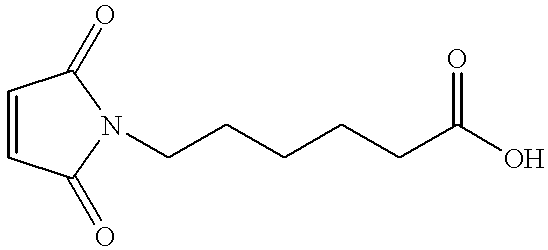
- the acid functional maleimide, 6-maleimidocaproic acid was synthesized using known methodology.
- 1 Aminocaproic acid (100 g, 7.6 ⁇ 10 ⁇ 1 mols) was dissolved in glacial acetic acid (50 mL) in a 500 mL four-necked flask equipped with mechanical stirring, an internal temperature probe and an addition funnel.
- the addition funnel was charged with a solution of maleic anhydride (74.8 g, 7.6 ⁇ 10 ⁇ 1 mols) dissolved in acetonitrile (75 mL). This solution was added to the aminocaproic acid at room temperature dropwise over 1 hour, maintaining an internal reaction temperature less than 35° C. The reaction was stirred for three hours after the addition was complete.
- the amic acid described above (166 g, 7.2 ⁇ 10 ⁇ 1 mols) was solvated in a solution of toluene (200 mL), benzene (200 mL) and triethylamine (211 mL, 1.51 mol) in a 1 L three-necked flask equipped with mechanical stirring and a Dean-Stark trap under nitrogen. This solution was heated to reflux for 4 h and the water produced collected in the Dean-Stark trap. Distilled water 400 mL) was added to the reaction flask to dissolve the triethylammonium salt of the product which largely separated from the bulk solution during the reaction.
- Pripol 2033 (“dimer diol”, Uniqema, 92.4 g, 1.69 ⁇ 10 ⁇ 1 mols), 6-maleimidocaproic acid (75.0 g, 3.55 ⁇ 10 ⁇ 1 mols) and H 2 SO 4 (0.50 mL, ⁇ 8.5 ⁇ 10 ⁇ 3 mols) were slurried in toluene (300 mL) in a 1 L four-necked flask equipped with mechanical stirrer, a Dean-Stark trap and an internal temperature probe under nitrogen. The reaction was heated to light reflux for two hours and the water evolved collected in the Dean-Stark trap.
- the trap was drained and ⁇ 50 mL of toluene solvent was distilled off of the reaction to remove trace moisture and drive the esterification equilibrium to completion.
- the reaction was allowed to cool to room temperature, additional toluene (100 mL) was added (on the laboratory scale it is preferable to add diethyl ether in place of toluene at this point), and the solution was washed with saturated NaHCO 3 aq. (300 mL) and distilled water (300 mL).
- the organic layer was isolated and dried over anhydrous MgSO 4 , and the solvent removed in vacuo to yield an orange oil (107.2 g, 68%).
- the material can be further purified by eluting a toluene solution of the resin through a short plug of silica or alumina.
- This liquid bismaleimide resin exhibited acceptable FT-IR, 1 H NMR, and 13 C NMR data. Typical, ⁇ ⁇ 2500 cPs.
- Example B The general procedure described in Example B was applied substituting decane diol (29.5 g, 1.69 ⁇ 10 ⁇ 1 mols) for Pripol 2033. This process yielded a solid, moderately soluble bismaleimide (54.9 g, 58%). The product exhibited satisfactory FT-IR and 1 H NMR data.
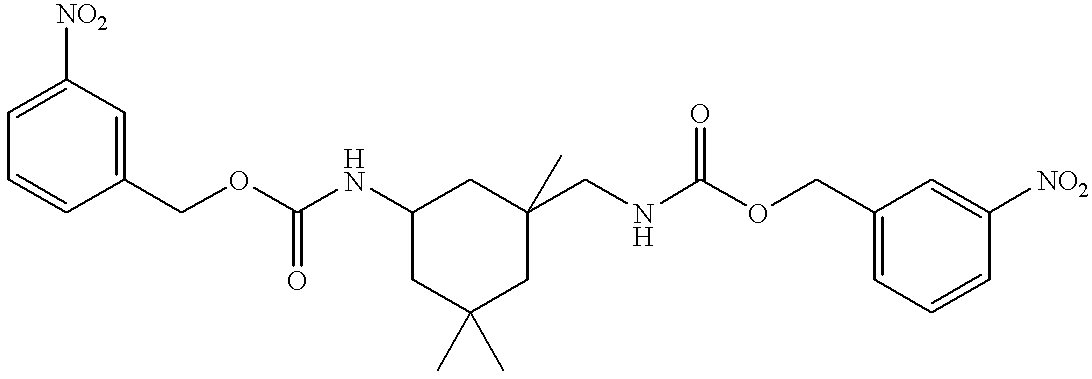
- Isophorone diisocyanate 100.0 g, 4.5 ⁇ 10 ⁇ 1 mols
- m-nitrobenzyl alcohol 137.8 g, 9.0 ⁇ 10 ⁇ 1 mols
- dibutyl tin dilaurate 2.8 g, 4.5 ⁇ 10 ⁇ 3 mols
- the resulting solution was heated to 90° C. for 4 h. No isocyanate band was observed in the IR of the solids portion of the sample.
- the solution was allowed to cool to room temperature and washed with distilled H 2 O (100 mL).
- the organic layer was isolated and solvent removed in vacuo to yield a yellow liquid which exhibited acceptable FT-IR and 1 H NMR characteristics.
- the dinitro compound from Example E. (8.28 g, 1.57 ⁇ 10 ⁇ 2 mols) was dissolved in ethanol (100 mL) in a 500 mL three-necked round bottom flask equipped with magnetic stirring under nitrogen. Cyclohexene (28.6 mL, 2.82 ⁇ 10 ⁇ 1 mols) was added, followed by 5% Pd/C (4.14 g). The resulting slurry was refluxed lightly for 6.5 h. The FT-IR of a filtered aliquot of this solution exhibited no nitro stretching bands at 1529 cm ⁇ 1 and 1352 cm ⁇ 1 . The bulk solution was allowed to cool to room temperature and filtered. Solvent was removed in vacuo to yield a yellow semisolid (6.6 g, 90%) which exhibited acceptable FT-IR and 1 H NMR spectral characteristics.
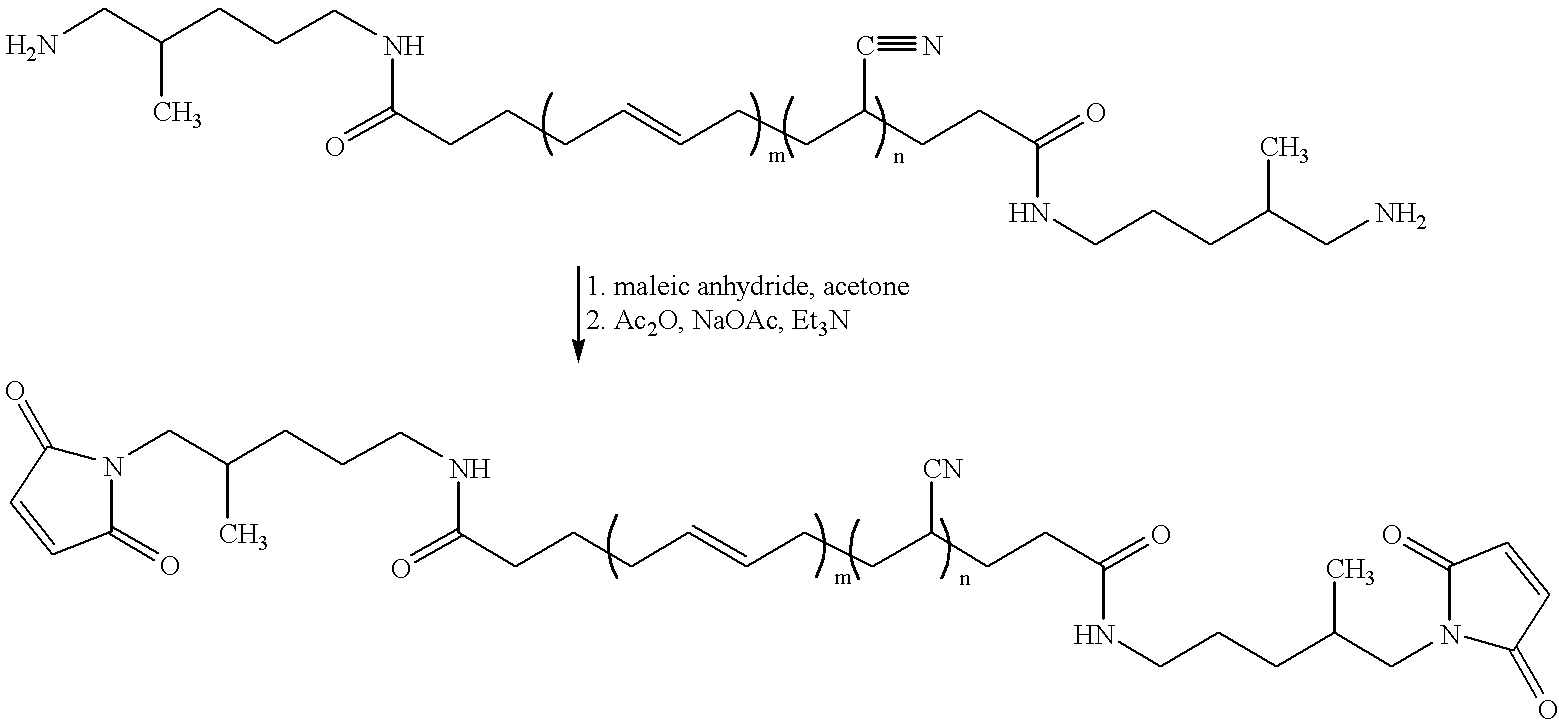
- Example F The diamine from Example F (6.6 g, 1.41 ⁇ 1 ⁇ 2 mols) was solvated in acetone (60 mL) in a 250 mL four-necked flask equipped with magnetic stirrer and addition funnel under nitrogen and cooled to 4° C.
- Maleic anhydride (2.76 g, 2.82 ⁇ 10 ⁇ 2 mols) dissloved in acetone (20 mL) was added over the course of 30 minutes.
- the resulting solution was stirred at 4° C. for for 1 h, and subsequently was allowed to warm to room temperature and stirred overnight.
- FT-IR analysis indicated no maleic anhydride remained as judged by the absence of the anhydride stretching band at ⁇ 1810 cm ⁇ 1 .
- DDI 1410 (Henkel, “Dimer Diisocyanate”, 99.77 g, 1.65 ⁇ 10 ⁇ 1 mols based on 13.96% NCO), m-nitrobenzyl alcohol (50.8 g, 3.32 ⁇ 10 ⁇ 1 mols) and dibutyltin dilaurate (0.5 mL, 8.3 ⁇ 10 ⁇ 4 mols) were solvated in toluene (150 mL) in a 1 L four-necked flask equipped with mechanical stirrer, reflux condensor and internal temperature probe under nitrogen. The reaction was heated to 85° C. for 2.5 h.
- aqueous layer was isolated and washed with ethyl acetate (100 mL). The organic layers were combined, washed with distilled water (300 mL) and dried over anhydrous MgSO 4 . The slurry was filtered and solvent removed from the filtrate in vacuo to yield yellow, sticky solid (33.8 g, 92%).
Landscapes
- Chemical & Material Sciences (AREA)
- Chemical Kinetics & Catalysis (AREA)
- Health & Medical Sciences (AREA)
- Medicinal Chemistry (AREA)
- Polymers & Plastics (AREA)
- Organic Chemistry (AREA)
- Addition Polymer Or Copolymer, Post-Treatments, Or Chemical Modifications (AREA)
- Macromonomer-Based Addition Polymer (AREA)
- Polymerisation Methods In General (AREA)
- Structures Or Materials For Encapsulating Or Coating Semiconductor Devices Or Solid State Devices (AREA)
- Compositions Of Macromolecular Compounds (AREA)
- Paints Or Removers (AREA)
Abstract
Description
















| Composition | Sample 11-A | Sample 11-B | Sample 11-C | Sample 11-D |
| Maleimide | N-4-butyl- | N-4-ethyl- | Dimer | Bismalei- |
| phenyl | phenyl | diamine | mide* | |
| maleimide | maleimide | bismaleimide | 1.0 g | |
| 22.9 g | 20.1 g | 1.0 g | 82.0 wt % | |
| 51.9 wt % | 48.7 wt % | 82.0 wt % | ||
| Vinyl-t-butyl- | 20.4 g | 20.4 g | 0.2 g | 0.2 g |
| benzoate | 46.2 wt % | 49.4 wt % | 16.4 wt % | 16.4 wt % |
| Dicumyl | 0.45 g | 0.40 g | 0.01 g | 0.01 g |
| peroxide | 1.0 wt % | 1.0 wt % | 0.8 wt % | 0.8 wt % |
| Methacyloxy | 0.40 g | 0.40 g | 0.01 g | 0.01 g |
| trimethoxy- | 0.9 wt % | 1.0 wt % | 0.8 wt % | 0.8 wt % |
| silane | ||||
| Tg | 140° C. | 145° C. | 42° C. | 37° C. |
| CTE | 16 ppm/° C. | 15 ppm/° C. | 16 ppm/° C. | 15 ppm/° C. |
| *(prepared from polytetramethylene oxide-di-p-aminobenzoate, sold as Versalink P-650 by Henkel) | ||||
| Bismaleimide | 1.01 | g | ||
| (prepared from polytetramethylene oxide- | ||||
| di-p-aminobenzoate, | ||||
| sold as Versalink P-650 by Henkel) | ||||
| Cyclohexanedimethanol divinylether | 0.19 | g | ||
| (International Specialty Products): | ||||
| α,α-Dimethoxy-α-phenylacetophenone | 0.06 | g | ||
| (sold as Irgacure 651 by Ciba Specialty Chemicals) | ||||
| Hydrophilic Fused Silica | 3.78 | g | ||
| (sold by Denka, ˜5 micron) | ||||
| Bismaleimide | 1.01 | g | ||
| (prepared from polytetramethylene oxide- | ||||
| di-p-aminobenzoate, | ||||
| sold as Versalink P-650 by Henkel) | ||||
| Cyclohexanedimethanol divinylether | 0.19 | g | ||
| (International Specialty Products): | ||||
| t-Butyl-2-ethylhexanoate | 0.03 | g | ||
| Hydrophilic Fused Silica | 3.78 | g | ||
| (sold by Denka, ˜5 micron) | ||||


Claims (2)


Priority Applications (15)
| Application Number | Priority Date | Filing Date | Title |
|---|---|---|---|
| US09/336,246 US6316566B1 (en) | 1998-07-02 | 1999-06-18 | Package encapsulant compositions for use in electronic devices |
| SG9903554A SG82011A1 (en) | 1998-07-02 | 1999-06-25 | Package encapsulant compositions for use in electronic devices |
| CNB991192028A CN1140603C (en) | 1998-07-02 | 1999-06-30 | Sealing composition for electronic device |
| CNB2003101243619A CN1264886C (en) | 1998-07-02 | 1999-06-30 | Package seal composition for electronic device |
| EP99112725A EP0969063B1 (en) | 1998-07-02 | 1999-07-01 | Adhesive compositions for use in package encapsulant compositions for electronic devices |
| DE69935758T DE69935758T2 (en) | 1998-07-02 | 1999-07-01 | Adhesive compositions for use in encapsulation package compositions for use in the electronic assembly |
| MYPI99002773A MY121433A (en) | 1998-07-02 | 1999-07-01 | Package encapsulant compositions for use in electronic devices |
| KR1019990026624A KR100591977B1 (en) | 1998-07-02 | 1999-07-02 | Package encapsulant compositions for use in electronic devices |
| JP18937699A JP3299522B2 (en) | 1998-07-02 | 1999-07-02 | Curable package encapsulant composition |
| TW088111221A TW482775B (en) | 1998-07-02 | 1999-12-07 | Package encapsulant compositions for use in electronic devices |
| HK00105055.1A HK1025987B (en) | 1998-07-02 | 2000-08-14 | Package encapsulant compositions for use in electronic devices |
| HK04108689.5A HK1065814B (en) | 1998-07-02 | 2000-08-14 | Package encapsulant compositions for use in electronic devices |
| US09/894,540 US6350838B2 (en) | 1998-07-02 | 2001-06-28 | Package encapsulant compositions for use in electronic devices |
| KR1020060016236A KR100613214B1 (en) | 1998-07-02 | 2006-02-20 | Package encapsulant compositions for use in electronic devices |
| KR1020060016237A KR100613215B1 (en) | 1998-07-02 | 2006-02-20 | Package encapsulant compositions for use in electronic devices |
Applications Claiming Priority (2)
| Application Number | Priority Date | Filing Date | Title |
|---|---|---|---|
| US9149398P | 1998-07-02 | 1998-07-02 | |
| US09/336,246 US6316566B1 (en) | 1998-07-02 | 1999-06-18 | Package encapsulant compositions for use in electronic devices |
Related Child Applications (1)
| Application Number | Title | Priority Date | Filing Date |
|---|---|---|---|
| US09/894,540 Division US6350838B2 (en) | 1998-07-02 | 2001-06-28 | Package encapsulant compositions for use in electronic devices |
Publications (1)
| Publication Number | Publication Date |
|---|---|
| US6316566B1 true US6316566B1 (en) | 2001-11-13 |
Family
ID=26784020
Family Applications (2)
| Application Number | Title | Priority Date | Filing Date |
|---|---|---|---|
| US09/336,246 Expired - Lifetime US6316566B1 (en) | 1998-07-02 | 1999-06-18 | Package encapsulant compositions for use in electronic devices |
| US09/894,540 Expired - Lifetime US6350838B2 (en) | 1998-07-02 | 2001-06-28 | Package encapsulant compositions for use in electronic devices |
Family Applications After (1)
| Application Number | Title | Priority Date | Filing Date |
|---|---|---|---|
| US09/894,540 Expired - Lifetime US6350838B2 (en) | 1998-07-02 | 2001-06-28 | Package encapsulant compositions for use in electronic devices |
Country Status (9)
| Country | Link |
|---|---|
| US (2) | US6316566B1 (en) |
| EP (1) | EP0969063B1 (en) |
| JP (1) | JP3299522B2 (en) |
| KR (3) | KR100591977B1 (en) |
| CN (2) | CN1264886C (en) |
| DE (1) | DE69935758T2 (en) |
| MY (1) | MY121433A (en) |
| SG (1) | SG82011A1 (en) |
| TW (1) | TW482775B (en) |
Cited By (20)
| Publication number | Priority date | Publication date | Assignee | Title |
|---|---|---|---|---|
| US20040014903A1 (en) * | 2002-07-19 | 2004-01-22 | Musa Osama M. | Curable compositions containing thiazole functionality |
| US20040102566A1 (en) * | 2002-11-25 | 2004-05-27 | Henkel Loctite Corporation | B-stageable die attach adhesives |
| US20040225026A1 (en) * | 2003-05-05 | 2004-11-11 | Mizori Farhad G. | Imide-linked maleimide and polymaleimide compounds |
| US20050136620A1 (en) * | 1994-09-02 | 2005-06-23 | Henkel Corporation | Maleimide compounds in liquid form |
| US20050272888A1 (en) * | 2004-06-04 | 2005-12-08 | Dershem Stephen M | Free-radical curable polyesters and methods for use thereof |
| US7645899B1 (en) | 1994-09-02 | 2010-01-12 | Henkel Corporation | Vinyl compounds |
| US7868113B2 (en) | 2007-04-11 | 2011-01-11 | Designer Molecules, Inc. | Low shrinkage polyester thermosetting resins |
| US7875688B2 (en) | 2004-06-04 | 2011-01-25 | Designer Molecules, Inc. | Free-radical curable polyesters and methods for use thereof |
| US7884174B2 (en) | 2003-05-05 | 2011-02-08 | Designer Molecules, Inc. | Imide-linked maleimide and polymaleimide compounds |
| US8008419B2 (en) | 2008-08-13 | 2011-08-30 | Designer Molecules, Inc. | Siloxane monomers and methods for use thereof |
| US8043534B2 (en) | 2005-10-21 | 2011-10-25 | Designer Molecules, Inc. | Maleimide compositions and methods for use thereof |
| US8063161B2 (en) | 2007-04-16 | 2011-11-22 | Designer Molecules, Inc. | Low temperature curing acrylate and maleimide based formulations and methods for use thereof |
| US8308892B2 (en) | 2008-04-09 | 2012-11-13 | Designer Molecules, Inc. | Di-cinnamyl compounds and methods for use thereof |
| US8378017B2 (en) | 2005-12-29 | 2013-02-19 | Designer Molecules, Inc. | Thermosetting adhesive compositions |
| US8415812B2 (en) | 2009-09-03 | 2013-04-09 | Designer Molecules, Inc. | Materials and methods for stress reduction in semiconductor wafer passivation layers |
| US8513375B2 (en) | 2003-05-05 | 2013-08-20 | Designer Molecules, Inc. | Imide-linked maleimide and polymaleimide compounds |
| US20130228901A1 (en) * | 2009-09-03 | 2013-09-05 | Designer Molecules, Inc. | Materials and methods for stress reduction in semiconductor wafer passivation layers |
| US8637611B2 (en) | 2008-08-13 | 2014-01-28 | Designer Molecules, Inc. | Amide-extended crosslinking compounds and methods for use thereof |
| US8686162B2 (en) | 2010-08-25 | 2014-04-01 | Designer Molecules Inc, Inc. | Maleimide-functional monomers in amorphous form |
| US10854547B2 (en) * | 2018-03-13 | 2020-12-01 | Infineon Technologies Ag | Chip package with cross-linked thermoplastic dielectric |
Families Citing this family (9)
| Publication number | Priority date | Publication date | Assignee | Title |
|---|---|---|---|---|
| US6355750B1 (en) * | 1998-07-02 | 2002-03-12 | National Starch And Chemical Investment Holding Corporation | Dye attach adhesives for use in microelectronic devices |
| CN1109086C (en) * | 2000-07-19 | 2003-05-21 | 湖北省化学研究所 | Reaction-type flame-retarding adhesive for flexible PCB and its preparing process |
| US6818680B2 (en) | 2002-09-23 | 2004-11-16 | Corning Incorporated | Curable adhesive compositions |
| US20060009539A1 (en) * | 2004-07-12 | 2006-01-12 | Herr Donald E | Maleimide-based radiation curable compositions |
| TWM271321U (en) * | 2004-09-10 | 2005-07-21 | Aiptek Int Inc | Flip-chip packaging device |
| JP2014062050A (en) * | 2012-09-19 | 2014-04-10 | Fujifilm Corp | Polyvalent functional maleimide-based polymerizable compound, and curable composition and ink composition containing the same |
| JP6120072B2 (en) * | 2012-10-17 | 2017-04-26 | Jsr株式会社 | Liquid crystal alignment agent |
| US20160111380A1 (en) * | 2014-10-21 | 2016-04-21 | Georgia Tech Research Corporation | New structure of microelectronic packages with edge protection by coating |
| TWI861146B (en) * | 2019-08-07 | 2024-11-11 | 美商陶氏全球科技公司 | Anhydride and aromatic functionalized polyorganosiloxanes |
Citations (36)
| Publication number | Priority date | Publication date | Assignee | Title |
|---|---|---|---|---|
| US3403172A (en) | 1964-01-03 | 1968-09-24 | Agriculture Usa | Hard, high-melting waxes from longchain n-allylamides |
| EP0028994A2 (en) | 1979-11-09 | 1981-05-20 | Rhone-Poulenc Specialites Chimiques | Compositions and method for the encapsulation of electronic components by a mouldable material based on a thermohardenable prepolymer |
| US4311636A (en) | 1978-12-14 | 1982-01-19 | Basf Aktiengesellschaft | Flame-retardant thermoplastic materials and molded parts therefrom |
| EP0051165A1 (en) | 1980-11-03 | 1982-05-12 | BURROUGHS CORPORATION (a Michigan corporation) | Repairable IC package with thermoplastic chip attach |
| US4336311A (en) | 1980-08-25 | 1982-06-22 | Sprague Electric Company | Humidity- and salt-resistant electronic component |
| US4485218A (en) | 1982-02-18 | 1984-11-27 | General Electric Company | Encapsulating composition for inductive devices containing elastomeric polybutadiene having predominate trans-1,4 configuration |
| US4533975A (en) | 1983-12-27 | 1985-08-06 | North American Philips Corporation | Radiation hardenable coating and electronic components coated therewith |
| US4540650A (en) | 1982-09-13 | 1985-09-10 | Merck Patent Gesellschaft Mit Beschrankter Haftung | Photoresists suitable for forming relief structures of highly heat-resistant polymers |
| US4613637A (en) | 1983-12-27 | 1986-09-23 | Hughes Aircraft Company | Copolymers utilizing isoimides and method of preparing same |
| US4623559A (en) | 1985-07-12 | 1986-11-18 | Westinghouse Electric Corp. | U.V. cured flexible polyester-monoacrylate protective thermistor coatings having good edge coverage and method of coating |
| US4663424A (en) | 1984-11-27 | 1987-05-05 | Bayer Aktiengesellschaft | Aromatic polyester with dimethylmaleimide end groups |
| US4720445A (en) | 1986-02-18 | 1988-01-19 | Allied Corporation | Copolymers from maleimide and aliphatic vinyl ethers and esters used in positive photoresist |
| US4826995A (en) | 1987-11-25 | 1989-05-02 | Texaco Inc. | Bismaleimide derivatives of higher molecular weight polyoxyalkyleneamines |
| JPH01152174A (en) | 1987-12-08 | 1989-06-14 | Honny Chem Ind Co Ltd | Electrodeposition coating method |
| US4876358A (en) | 1987-11-25 | 1989-10-24 | Texaco Inc. | Oxyethylene bismaleimide derivatives |
| EP0357110A1 (en) | 1988-08-05 | 1990-03-07 | Akzo N.V. | Two component coating curable at ambient temperature via a Diels-Alder reaction |
| US4980436A (en) | 1986-09-17 | 1990-12-25 | Sumitomo Chemical Company, Limited | Thermosetting resin composition from alkenyl aryloxy triazine compound and poly maleimide |
| US4999136A (en) | 1988-08-23 | 1991-03-12 | Westinghouse Electric Corp. | Ultraviolet curable conductive resin |
| US5017406A (en) | 1988-12-08 | 1991-05-21 | Dow Corning Corporation | UV curable compositions cured with polysilane and peroxide initiators |
| EP0475655A2 (en) | 1990-09-03 | 1992-03-18 | SOKEN CHEMICAL & ENGINEERING CO. LTD., | Anisotropic conductive adhesive compositions |
| JPH04146984A (en) | 1990-10-11 | 1992-05-20 | Soken Kagaku Kk | Resin for adhesive and adhesive containing the resin |
| US5137936A (en) | 1989-07-26 | 1992-08-11 | Matsushita Electric Industrial Co., Ltd. | Method for packaging electronic parts and adhesive for use in said method |
| US5258426A (en) | 1989-02-23 | 1993-11-02 | Kabushiki Kaisha Toshiba | Semiconductor device encapsulant |
| US5272377A (en) | 1990-10-31 | 1993-12-21 | Kabushiki Kaisha Toshiba | Maleimide resin composition and resin encapsulated semiconductor device manufactured using the composition |
| US5314950A (en) | 1993-01-22 | 1994-05-24 | Cytec Technology Corp. | Heat resistant resin composition comprising polymers of N-(substituted) maleimides and improved process for the preparation of said maleimides |
| US5347258A (en) | 1993-04-07 | 1994-09-13 | Zycon Corporation | Annular resistor coupled with printed circuit board through-hole |
| US5426008A (en) | 1990-04-19 | 1995-06-20 | W. R. Grace & Co.-Conn. | Photocurable self-retainable gel, shaped article prepared therefrom, applications and preparations thereof |
| WO1996007691A2 (en) | 1994-09-02 | 1996-03-14 | Quantum Materials, Inc. | Thermosetting resin compositions containing maleimide and/or vinyl compounds |
| US5532296A (en) | 1991-07-30 | 1996-07-02 | Cytec Technology Corp. | Bismaleimide resin systems toughened by addition of preformed functionalized low Tg elastomer particles |
| US5602205A (en) | 1993-01-22 | 1997-02-11 | Cytec Technology Corp. | N-(substituted) maleimides and compositions incorporating the same |
| US5627222A (en) | 1991-07-30 | 1997-05-06 | Cytec Technology Corp. | Toughened, fiber-reinforced thermosetting resin matrix prepregs and composites made therefrom |
| WO1997018254A1 (en) | 1995-11-13 | 1997-05-22 | Cytec Technology Corp. | Thermosetting polymers for composite and adhesive applications |
| US5726391A (en) | 1996-12-16 | 1998-03-10 | Shell Oil Company | Thermosetting Encapsulants for electronics packaging |
| US5760337A (en) | 1996-12-16 | 1998-06-02 | Shell Oil Company | Thermally reworkable binders for flip-chip devices |
| JPH10168413A (en) | 1996-12-16 | 1998-06-23 | Sumitomo Bakelite Co Ltd | Anisotropically conductive adhesive |
| US5863664A (en) | 1993-06-16 | 1999-01-26 | Minnesota Mining And Manufacturing Company | Energy-curable cyanate/ethylenically unsaturated compositions |
Family Cites Families (16)
| Publication number | Priority date | Publication date | Assignee | Title |
|---|---|---|---|---|
| US4581461A (en) * | 1983-04-07 | 1986-04-08 | National Starch And Chemical Corporation | Maleated siloxane derivatives |
| IL88477A0 (en) * | 1987-11-27 | 1989-06-30 | Hercules Inc | Maleimide-based thermosettable resin compositions |
| KR930003695B1 (en) * | 1988-09-12 | 1993-05-08 | 미쯔이도오아쯔가가꾸 가부시기가이샤 | Resin Composition for Semiconductor Sealing |
| JP2718156B2 (en) * | 1989-03-20 | 1998-02-25 | 日立化成工業株式会社 | Heat resistant adhesive composition |
| EP0390565A3 (en) * | 1989-03-31 | 1992-02-26 | Mitsui Petrochemical Industries, Ltd. | Imide prepolymers, cured products, method for making the same, laminate preparation, and encapsulating compositions |
| KR950005314B1 (en) * | 1989-09-11 | 1995-05-23 | 신에쓰 가가꾸 고오교 가부시끼가이샤 | Thermosetting resin composition |
| US5310830A (en) * | 1990-06-28 | 1994-05-10 | Konishi Co., Ltd. | Epoxy resin, maleimide and OH- and epoxy-containing compound |
| KR960008127B1 (en) * | 1990-06-30 | 1996-06-20 | 제일모직 주식회사 | Resin composition for encapsulating semiconductor elements having a improved heat resistance |
| EP0507603B1 (en) * | 1991-04-04 | 1999-06-23 | Shin-Etsu Chemical Co., Ltd. | Thermosetting resin compositions and their manufacture |
| JP2570923B2 (en) * | 1991-06-07 | 1997-01-16 | 信越化学工業株式会社 | Thermosetting resin composition |
| US5290882A (en) * | 1991-08-13 | 1994-03-01 | Shin-Etsu Chemical Co., Ltd. | Thermosetting resin compositions |
| JP2669247B2 (en) * | 1992-02-13 | 1997-10-27 | 信越化学工業株式会社 | Thermosetting resin composition |
| JPH0855940A (en) * | 1994-08-12 | 1996-02-27 | Sumitomo Chem Co Ltd | Thermosetting resin composition |
| US5789757A (en) * | 1996-09-10 | 1998-08-04 | The Dexter Corporation | Malemide containing formulations and uses therefor |
| JPH10101796A (en) * | 1996-09-30 | 1998-04-21 | Matsushita Electric Works Ltd | Imide resin composition |
| US6281314B1 (en) * | 1998-07-02 | 2001-08-28 | National Starch And Chemical Investment Holding Corporation | Compositions for use in the fabrication of circuit components and printed wire boards |
-
1999
- 1999-06-18 US US09/336,246 patent/US6316566B1/en not_active Expired - Lifetime
- 1999-06-25 SG SG9903554A patent/SG82011A1/en unknown
- 1999-06-30 CN CNB2003101243619A patent/CN1264886C/en not_active Expired - Lifetime
- 1999-06-30 CN CNB991192028A patent/CN1140603C/en not_active Expired - Lifetime
- 1999-07-01 EP EP99112725A patent/EP0969063B1/en not_active Expired - Lifetime
- 1999-07-01 DE DE69935758T patent/DE69935758T2/en not_active Expired - Lifetime
- 1999-07-01 MY MYPI99002773A patent/MY121433A/en unknown
- 1999-07-02 JP JP18937699A patent/JP3299522B2/en not_active Expired - Lifetime
- 1999-07-02 KR KR1019990026624A patent/KR100591977B1/en not_active Expired - Lifetime
- 1999-12-07 TW TW088111221A patent/TW482775B/en not_active IP Right Cessation
-
2001
- 2001-06-28 US US09/894,540 patent/US6350838B2/en not_active Expired - Lifetime
-
2006
- 2006-02-20 KR KR1020060016237A patent/KR100613215B1/en not_active Expired - Lifetime
- 2006-02-20 KR KR1020060016236A patent/KR100613214B1/en not_active Expired - Lifetime
Patent Citations (36)
| Publication number | Priority date | Publication date | Assignee | Title |
|---|---|---|---|---|
| US3403172A (en) | 1964-01-03 | 1968-09-24 | Agriculture Usa | Hard, high-melting waxes from longchain n-allylamides |
| US4311636A (en) | 1978-12-14 | 1982-01-19 | Basf Aktiengesellschaft | Flame-retardant thermoplastic materials and molded parts therefrom |
| EP0028994A2 (en) | 1979-11-09 | 1981-05-20 | Rhone-Poulenc Specialites Chimiques | Compositions and method for the encapsulation of electronic components by a mouldable material based on a thermohardenable prepolymer |
| US4336311A (en) | 1980-08-25 | 1982-06-22 | Sprague Electric Company | Humidity- and salt-resistant electronic component |
| EP0051165A1 (en) | 1980-11-03 | 1982-05-12 | BURROUGHS CORPORATION (a Michigan corporation) | Repairable IC package with thermoplastic chip attach |
| US4485218A (en) | 1982-02-18 | 1984-11-27 | General Electric Company | Encapsulating composition for inductive devices containing elastomeric polybutadiene having predominate trans-1,4 configuration |
| US4540650A (en) | 1982-09-13 | 1985-09-10 | Merck Patent Gesellschaft Mit Beschrankter Haftung | Photoresists suitable for forming relief structures of highly heat-resistant polymers |
| US4613637A (en) | 1983-12-27 | 1986-09-23 | Hughes Aircraft Company | Copolymers utilizing isoimides and method of preparing same |
| US4533975A (en) | 1983-12-27 | 1985-08-06 | North American Philips Corporation | Radiation hardenable coating and electronic components coated therewith |
| US4663424A (en) | 1984-11-27 | 1987-05-05 | Bayer Aktiengesellschaft | Aromatic polyester with dimethylmaleimide end groups |
| US4623559A (en) | 1985-07-12 | 1986-11-18 | Westinghouse Electric Corp. | U.V. cured flexible polyester-monoacrylate protective thermistor coatings having good edge coverage and method of coating |
| US4720445A (en) | 1986-02-18 | 1988-01-19 | Allied Corporation | Copolymers from maleimide and aliphatic vinyl ethers and esters used in positive photoresist |
| US4980436A (en) | 1986-09-17 | 1990-12-25 | Sumitomo Chemical Company, Limited | Thermosetting resin composition from alkenyl aryloxy triazine compound and poly maleimide |
| US4826995A (en) | 1987-11-25 | 1989-05-02 | Texaco Inc. | Bismaleimide derivatives of higher molecular weight polyoxyalkyleneamines |
| US4876358A (en) | 1987-11-25 | 1989-10-24 | Texaco Inc. | Oxyethylene bismaleimide derivatives |
| JPH01152174A (en) | 1987-12-08 | 1989-06-14 | Honny Chem Ind Co Ltd | Electrodeposition coating method |
| EP0357110A1 (en) | 1988-08-05 | 1990-03-07 | Akzo N.V. | Two component coating curable at ambient temperature via a Diels-Alder reaction |
| US4999136A (en) | 1988-08-23 | 1991-03-12 | Westinghouse Electric Corp. | Ultraviolet curable conductive resin |
| US5017406A (en) | 1988-12-08 | 1991-05-21 | Dow Corning Corporation | UV curable compositions cured with polysilane and peroxide initiators |
| US5258426A (en) | 1989-02-23 | 1993-11-02 | Kabushiki Kaisha Toshiba | Semiconductor device encapsulant |
| US5137936A (en) | 1989-07-26 | 1992-08-11 | Matsushita Electric Industrial Co., Ltd. | Method for packaging electronic parts and adhesive for use in said method |
| US5426008A (en) | 1990-04-19 | 1995-06-20 | W. R. Grace & Co.-Conn. | Photocurable self-retainable gel, shaped article prepared therefrom, applications and preparations thereof |
| EP0475655A2 (en) | 1990-09-03 | 1992-03-18 | SOKEN CHEMICAL & ENGINEERING CO. LTD., | Anisotropic conductive adhesive compositions |
| JPH04146984A (en) | 1990-10-11 | 1992-05-20 | Soken Kagaku Kk | Resin for adhesive and adhesive containing the resin |
| US5272377A (en) | 1990-10-31 | 1993-12-21 | Kabushiki Kaisha Toshiba | Maleimide resin composition and resin encapsulated semiconductor device manufactured using the composition |
| US5532296A (en) | 1991-07-30 | 1996-07-02 | Cytec Technology Corp. | Bismaleimide resin systems toughened by addition of preformed functionalized low Tg elastomer particles |
| US5627222A (en) | 1991-07-30 | 1997-05-06 | Cytec Technology Corp. | Toughened, fiber-reinforced thermosetting resin matrix prepregs and composites made therefrom |
| US5314950A (en) | 1993-01-22 | 1994-05-24 | Cytec Technology Corp. | Heat resistant resin composition comprising polymers of N-(substituted) maleimides and improved process for the preparation of said maleimides |
| US5602205A (en) | 1993-01-22 | 1997-02-11 | Cytec Technology Corp. | N-(substituted) maleimides and compositions incorporating the same |
| US5347258A (en) | 1993-04-07 | 1994-09-13 | Zycon Corporation | Annular resistor coupled with printed circuit board through-hole |
| US5863664A (en) | 1993-06-16 | 1999-01-26 | Minnesota Mining And Manufacturing Company | Energy-curable cyanate/ethylenically unsaturated compositions |
| WO1996007691A2 (en) | 1994-09-02 | 1996-03-14 | Quantum Materials, Inc. | Thermosetting resin compositions containing maleimide and/or vinyl compounds |
| WO1997018254A1 (en) | 1995-11-13 | 1997-05-22 | Cytec Technology Corp. | Thermosetting polymers for composite and adhesive applications |
| US5726391A (en) | 1996-12-16 | 1998-03-10 | Shell Oil Company | Thermosetting Encapsulants for electronics packaging |
| US5760337A (en) | 1996-12-16 | 1998-06-02 | Shell Oil Company | Thermally reworkable binders for flip-chip devices |
| JPH10168413A (en) | 1996-12-16 | 1998-06-23 | Sumitomo Bakelite Co Ltd | Anisotropically conductive adhesive |
Non-Patent Citations (2)
| Title |
|---|
| Carol K. Sauers, "The Dehydration of N-Arylmaleamic Acids with Acetic Anhydride", The Journal of Organic Chemistry, vol. 34, No. 8, Aug. 1969, pp. 2275-2279. |
| Robert J. Cotter et al., "The Synthesis of N-Substituted Isomaleimides", vol. 26, Jan. 1961, pp. 10-15. |
Cited By (31)
| Publication number | Priority date | Publication date | Assignee | Title |
|---|---|---|---|---|
| US7102015B2 (en) * | 1994-09-02 | 2006-09-05 | Henkel Corporation | Maleimide compounds in liquid form |
| US7645899B1 (en) | 1994-09-02 | 2010-01-12 | Henkel Corporation | Vinyl compounds |
| US20050136620A1 (en) * | 1994-09-02 | 2005-06-23 | Henkel Corporation | Maleimide compounds in liquid form |
| US6706835B2 (en) * | 2002-07-19 | 2004-03-16 | National Starch And Chemical Investment Holding Corporation | Curable compositions containing thiazole functionality |
| US20040014903A1 (en) * | 2002-07-19 | 2004-01-22 | Musa Osama M. | Curable compositions containing thiazole functionality |
| US7851254B2 (en) | 2002-11-25 | 2010-12-14 | Henkel Corporation | B-stageable die attach adhesives |
| US20080160315A1 (en) * | 2002-11-25 | 2008-07-03 | Henkel Corporation | B-stageable die attach adhesives |
| US7176044B2 (en) | 2002-11-25 | 2007-02-13 | Henkel Corporation | B-stageable die attach adhesives |
| US20040102566A1 (en) * | 2002-11-25 | 2004-05-27 | Henkel Loctite Corporation | B-stageable die attach adhesives |
| US8513375B2 (en) | 2003-05-05 | 2013-08-20 | Designer Molecules, Inc. | Imide-linked maleimide and polymaleimide compounds |
| US20040225026A1 (en) * | 2003-05-05 | 2004-11-11 | Mizori Farhad G. | Imide-linked maleimide and polymaleimide compounds |
| US7208566B2 (en) | 2003-05-05 | 2007-04-24 | Designer Molecules, Inc. | Imide-linked maleimide and polymaleimide compounds |
| US7884174B2 (en) | 2003-05-05 | 2011-02-08 | Designer Molecules, Inc. | Imide-linked maleimide and polymaleimide compounds |
| US9278909B2 (en) | 2003-05-05 | 2016-03-08 | Designer Molecules, Inc. | Amide-extended crosslinking compounds and methods for use thereof |
| US20080191173A1 (en) * | 2004-06-04 | 2008-08-14 | Dershem Stephen M | Free-radical curable polyesters and methods for use thereof |
| US7786234B2 (en) | 2004-06-04 | 2010-08-31 | Designer Molecules, Inc. | Free-radical curable polyesters and methods for use thereof |
| US7875688B2 (en) | 2004-06-04 | 2011-01-25 | Designer Molecules, Inc. | Free-radical curable polyesters and methods for use thereof |
| US7285613B2 (en) | 2004-06-04 | 2007-10-23 | Designer Molecules, Inc. | Free-radical curable polyesters and methods for use thereof |
| US20050272888A1 (en) * | 2004-06-04 | 2005-12-08 | Dershem Stephen M | Free-radical curable polyesters and methods for use thereof |
| US8043534B2 (en) | 2005-10-21 | 2011-10-25 | Designer Molecules, Inc. | Maleimide compositions and methods for use thereof |
| US8378017B2 (en) | 2005-12-29 | 2013-02-19 | Designer Molecules, Inc. | Thermosetting adhesive compositions |
| US7868113B2 (en) | 2007-04-11 | 2011-01-11 | Designer Molecules, Inc. | Low shrinkage polyester thermosetting resins |
| US8063161B2 (en) | 2007-04-16 | 2011-11-22 | Designer Molecules, Inc. | Low temperature curing acrylate and maleimide based formulations and methods for use thereof |
| US8308892B2 (en) | 2008-04-09 | 2012-11-13 | Designer Molecules, Inc. | Di-cinnamyl compounds and methods for use thereof |
| US8637611B2 (en) | 2008-08-13 | 2014-01-28 | Designer Molecules, Inc. | Amide-extended crosslinking compounds and methods for use thereof |
| US8008419B2 (en) | 2008-08-13 | 2011-08-30 | Designer Molecules, Inc. | Siloxane monomers and methods for use thereof |
| US8415812B2 (en) | 2009-09-03 | 2013-04-09 | Designer Molecules, Inc. | Materials and methods for stress reduction in semiconductor wafer passivation layers |
| US20130228901A1 (en) * | 2009-09-03 | 2013-09-05 | Designer Molecules, Inc. | Materials and methods for stress reduction in semiconductor wafer passivation layers |
| US8710682B2 (en) * | 2009-09-03 | 2014-04-29 | Designer Molecules Inc, Inc. | Materials and methods for stress reduction in semiconductor wafer passivation layers |
| US8686162B2 (en) | 2010-08-25 | 2014-04-01 | Designer Molecules Inc, Inc. | Maleimide-functional monomers in amorphous form |
| US10854547B2 (en) * | 2018-03-13 | 2020-12-01 | Infineon Technologies Ag | Chip package with cross-linked thermoplastic dielectric |
Also Published As
| Publication number | Publication date |
|---|---|
| EP0969063A3 (en) | 2000-02-23 |
| HK1025987A1 (en) | 2000-12-01 |
| TW482775B (en) | 2002-04-11 |
| KR20060030493A (en) | 2006-04-10 |
| KR20060030492A (en) | 2006-04-10 |
| KR100613215B1 (en) | 2006-08-22 |
| MY121433A (en) | 2006-01-28 |
| KR20000011447A (en) | 2000-02-25 |
| EP0969063A2 (en) | 2000-01-05 |
| US20010056162A1 (en) | 2001-12-27 |
| US6350838B2 (en) | 2002-02-26 |
| JP2000103817A (en) | 2000-04-11 |
| DE69935758T2 (en) | 2007-12-27 |
| CN1244562A (en) | 2000-02-16 |
| DE69935758D1 (en) | 2007-05-24 |
| CN1140603C (en) | 2004-03-03 |
| EP0969063B1 (en) | 2007-04-11 |
| CN1511911A (en) | 2004-07-14 |
| KR100591977B1 (en) | 2006-06-20 |
| JP3299522B2 (en) | 2002-07-08 |
| SG82011A1 (en) | 2001-07-24 |
| KR100613214B1 (en) | 2006-08-22 |
| CN1264886C (en) | 2006-07-19 |
Similar Documents
| Publication | Publication Date | Title |
|---|---|---|
| US6316566B1 (en) | Package encapsulant compositions for use in electronic devices | |
| US6265530B1 (en) | Die attach adhesives for use in microelectronic devices | |
| US6281314B1 (en) | Compositions for use in the fabrication of circuit components and printed wire boards | |
| EP0969064B1 (en) | Method of making an electronic component using reworkable underfill encapsulants | |
| US6355750B1 (en) | Dye attach adhesives for use in microelectronic devices | |
| US6063828A (en) | Underfill encapsulant compositions for use in electronic devices | |
| US6350841B1 (en) | Underfill encapsulants prepared from allylated amide compounds | |
| KR100566552B1 (en) | Allylated amide compounds and die attach adhesives prepared therefrom | |
| EP0969058A2 (en) | Method of making encapsulated electronic component with reworkable package encapsulants | |
| JP3087754B2 (en) | Package encapsulant made of allylated amide compound | |
| EP0969028A2 (en) | Circuit composition comprising allylated amide compounds | |
| EP0969062A2 (en) | Method of making electronic components using reworkable adhesives | |
| EP0969059A2 (en) | Compositions for use in the fabrication of circuit components and printed wire boards | |
| KR20000011445A (en) | Package encapsulants prepared from allylated amide compounds |
Legal Events
| Date | Code | Title | Description |
|---|---|---|---|
| AS | Assignment |
Owner name: NATIONAL STARCH AND CHEMICAL INVESTMENT HOLDING CO Free format text: ASSIGNMENT OF ASSIGNORS INTEREST;ASSIGNORS:BODAN, MA;TONG, QUINN K.;REEL/FRAME:010129/0219 Effective date: 19990629 |
|
| STCF | Information on status: patent grant |
Free format text: PATENTED CASE |
|
| FPAY | Fee payment |
Year of fee payment: 4 |
|
| REMI | Maintenance fee reminder mailed | ||
| FPAY | Fee payment |
Year of fee payment: 8 |
|
| SULP | Surcharge for late payment |
Year of fee payment: 7 |
|
| AS | Assignment |
Owner name: HENKEL CORPORATION, CONNECTICUT Free format text: MERGER;ASSIGNOR:NATIONAL STARCH AND CHEMICAL INVESTMENT HOLDING CORPORATION;REEL/FRAME:024982/0803 Effective date: 20090105 |
|
| FPAY | Fee payment |
Year of fee payment: 12 |
|
| AS | Assignment |
Owner name: HENKEL CORPORATION, CONNECTICUT Free format text: MERGER;ASSIGNOR:NATIONAL STARCH AND CHEMICAL INVESTMENT HOLDING CORPORATION;REEL/FRAME:033825/0960 Effective date: 20090105 |
|
| AS | Assignment |
Owner name: HENKEL US IP LLC, CONNECTICUT Free format text: ASSIGNMENT OF ASSIGNORS INTEREST;ASSIGNOR:HENKEL CORPORATION;REEL/FRAME:034186/0588 Effective date: 20141106 |
|
| AS | Assignment |
Owner name: HENKEL IP & HOLDING GMBH, GERMANY Free format text: ASSIGNMENT OF ASSIGNORS INTEREST;ASSIGNOR:HENKEL US IP LLC;REEL/FRAME:035101/0856 Effective date: 20150225 |