US6313240B1 - Process for producing ethylene/α-olefin copolymer - Google Patents
Process for producing ethylene/α-olefin copolymer Download PDFInfo
- Publication number
- US6313240B1 US6313240B1 US08/198,579 US19857994A US6313240B1 US 6313240 B1 US6313240 B1 US 6313240B1 US 19857994 A US19857994 A US 19857994A US 6313240 B1 US6313240 B1 US 6313240B1
- Authority
- US
- United States
- Prior art keywords
- tetrakis
- compound
- borate
- group
- olefin
- Prior art date
- Legal status (The legal status is an assumption and is not a legal conclusion. Google has not performed a legal analysis and makes no representation as to the accuracy of the status listed.)
- Expired - Lifetime
Links
- FSDMWTINGBRJSL-UHFFFAOYSA-N C[Al](C)C Chemical compound C[Al](C)C FSDMWTINGBRJSL-UHFFFAOYSA-N 0.000 description 2
- GJVXBLHEMSXBBJ-UHFFFAOYSA-N C[Hf]1(C)CCC1 Chemical compound C[Hf]1(C)CCC1 GJVXBLHEMSXBBJ-UHFFFAOYSA-N 0.000 description 2
- ZPHRBIVHPODUJP-UHFFFAOYSA-N C[Hf](C)(C)C.C[Hf]1(C)CCC1 Chemical compound C[Hf](C)(C)C.C[Hf]1(C)CCC1 ZPHRBIVHPODUJP-UHFFFAOYSA-N 0.000 description 1
Classifications
-
- C—CHEMISTRY; METALLURGY
- C08—ORGANIC MACROMOLECULAR COMPOUNDS; THEIR PREPARATION OR CHEMICAL WORKING-UP; COMPOSITIONS BASED THEREON
- C08F—MACROMOLECULAR COMPOUNDS OBTAINED BY REACTIONS ONLY INVOLVING CARBON-TO-CARBON UNSATURATED BONDS
- C08F210/00—Copolymers of unsaturated aliphatic hydrocarbons having only one carbon-to-carbon double bond
- C08F210/16—Copolymers of ethene with alpha-alkenes, e.g. EP rubbers
-
- C—CHEMISTRY; METALLURGY
- C08—ORGANIC MACROMOLECULAR COMPOUNDS; THEIR PREPARATION OR CHEMICAL WORKING-UP; COMPOSITIONS BASED THEREON
- C08F—MACROMOLECULAR COMPOUNDS OBTAINED BY REACTIONS ONLY INVOLVING CARBON-TO-CARBON UNSATURATED BONDS
- C08F4/00—Polymerisation catalysts
- C08F4/42—Metals; Metal hydrides; Metallo-organic compounds; Use thereof as catalyst precursors
- C08F4/44—Metals; Metal hydrides; Metallo-organic compounds; Use thereof as catalyst precursors selected from light metals, zinc, cadmium, mercury, copper, silver, gold, boron, gallium, indium, thallium, rare earths or actinides
- C08F4/60—Metals; Metal hydrides; Metallo-organic compounds; Use thereof as catalyst precursors selected from light metals, zinc, cadmium, mercury, copper, silver, gold, boron, gallium, indium, thallium, rare earths or actinides together with refractory metals, iron group metals, platinum group metals, manganese, rhenium technetium or compounds thereof
- C08F4/62—Refractory metals or compounds thereof
- C08F4/64—Titanium, zirconium, hafnium or compounds thereof
- C08F4/659—Component covered by group C08F4/64 containing a transition metal-carbon bond
- C08F4/65908—Component covered by group C08F4/64 containing a transition metal-carbon bond in combination with an ionising compound other than alumoxane, e.g. (C6F5)4B-X+
-
- C—CHEMISTRY; METALLURGY
- C08—ORGANIC MACROMOLECULAR COMPOUNDS; THEIR PREPARATION OR CHEMICAL WORKING-UP; COMPOSITIONS BASED THEREON
- C08F—MACROMOLECULAR COMPOUNDS OBTAINED BY REACTIONS ONLY INVOLVING CARBON-TO-CARBON UNSATURATED BONDS
- C08F4/00—Polymerisation catalysts
- C08F4/42—Metals; Metal hydrides; Metallo-organic compounds; Use thereof as catalyst precursors
- C08F4/44—Metals; Metal hydrides; Metallo-organic compounds; Use thereof as catalyst precursors selected from light metals, zinc, cadmium, mercury, copper, silver, gold, boron, gallium, indium, thallium, rare earths or actinides
- C08F4/60—Metals; Metal hydrides; Metallo-organic compounds; Use thereof as catalyst precursors selected from light metals, zinc, cadmium, mercury, copper, silver, gold, boron, gallium, indium, thallium, rare earths or actinides together with refractory metals, iron group metals, platinum group metals, manganese, rhenium technetium or compounds thereof
- C08F4/62—Refractory metals or compounds thereof
- C08F4/64—Titanium, zirconium, hafnium or compounds thereof
- C08F4/659—Component covered by group C08F4/64 containing a transition metal-carbon bond
- C08F4/65912—Component covered by group C08F4/64 containing a transition metal-carbon bond in combination with an organoaluminium compound
-
- C—CHEMISTRY; METALLURGY
- C08—ORGANIC MACROMOLECULAR COMPOUNDS; THEIR PREPARATION OR CHEMICAL WORKING-UP; COMPOSITIONS BASED THEREON
- C08F—MACROMOLECULAR COMPOUNDS OBTAINED BY REACTIONS ONLY INVOLVING CARBON-TO-CARBON UNSATURATED BONDS
- C08F4/00—Polymerisation catalysts
- C08F4/42—Metals; Metal hydrides; Metallo-organic compounds; Use thereof as catalyst precursors
- C08F4/44—Metals; Metal hydrides; Metallo-organic compounds; Use thereof as catalyst precursors selected from light metals, zinc, cadmium, mercury, copper, silver, gold, boron, gallium, indium, thallium, rare earths or actinides
- C08F4/60—Metals; Metal hydrides; Metallo-organic compounds; Use thereof as catalyst precursors selected from light metals, zinc, cadmium, mercury, copper, silver, gold, boron, gallium, indium, thallium, rare earths or actinides together with refractory metals, iron group metals, platinum group metals, manganese, rhenium technetium or compounds thereof
- C08F4/62—Refractory metals or compounds thereof
- C08F4/64—Titanium, zirconium, hafnium or compounds thereof
- C08F4/659—Component covered by group C08F4/64 containing a transition metal-carbon bond
- C08F4/6592—Component covered by group C08F4/64 containing a transition metal-carbon bond containing at least one cyclopentadienyl ring, condensed or not, e.g. an indenyl or a fluorenyl ring
- C08F4/65922—Component covered by group C08F4/64 containing a transition metal-carbon bond containing at least one cyclopentadienyl ring, condensed or not, e.g. an indenyl or a fluorenyl ring containing at least two cyclopentadienyl rings, fused or not
-
- Y—GENERAL TAGGING OF NEW TECHNOLOGICAL DEVELOPMENTS; GENERAL TAGGING OF CROSS-SECTIONAL TECHNOLOGIES SPANNING OVER SEVERAL SECTIONS OF THE IPC; TECHNICAL SUBJECTS COVERED BY FORMER USPC CROSS-REFERENCE ART COLLECTIONS [XRACs] AND DIGESTS
- Y10—TECHNICAL SUBJECTS COVERED BY FORMER USPC
- Y10S—TECHNICAL SUBJECTS COVERED BY FORMER USPC CROSS-REFERENCE ART COLLECTIONS [XRACs] AND DIGESTS
- Y10S526/00—Synthetic resins or natural rubbers -- part of the class 520 series
- Y10S526/943—Polymerization with metallocene catalysts
Definitions
- the present invention relates to a process for producing an ethylene/ ⁇ -olefin copolymer with an olefin polymerization catalyst constituted of a metallocene compound, an organoaluminum compound, and an ionizable ionic compound.
- the low-pressure Ziegler process for polymerization of ethylene or an ⁇ -olefin is well known in the related technical fields.
- the catalyst for the process is generally prepared by treating a mixture of an organometallic compound or hydride of a metal of Group 1A to 3A of Periodic Table with a compound of a transition metal (Group 3B to 2B of Periodic Table) in a suspension or a solution, or in the absence of a solvent or a diluent.
- catalysts which are active in olefin polymerization.
- the catalyst are combination of a cyclopentadienyl derivative of a metal such as titanium, zirconium, and hafnium (Group 4B of Periodic Table) with aluminoxane.
- a metal such as titanium, zirconium, and hafnium (Group 4B of Periodic Table)
- aluminoxane Group 4B of Periodic Table
- Japanese Patent Laid-Open No. 3-207704 discloses ionic metallocene compound prepared by reacting a metallocene with an ionizing ionic compound.
- PCT Patent Application WO 92/01723 discloses a process of ⁇ -olefin polymerization by use of a catalyst system prepared by reacting a halogenated metallocene with an organometallic compound and then bringing the reaction product into contact with an ionizing ionic compound.
- This catalyst system is advantageous in olefin polymerization.
- ethylene and ⁇ -olefin are copolymerized by use of such a catalyst at a high temperature, the resulting copolymer has a low molecular weight disadvantageously.
- Japanese Patent Application Laid-Open No. 60-217209 discloses production of a high-molecular-weight olefin polymer by use of a catalyst comprising a hafnium compound as the metallocene component.
- this catalyst is much less active than the catalyst having zirconium as the ligand, and is disadvantageous in production efficiency of the copolymer.
- the inventors of the present invention made comprehensive studies to solve the above problems, and found that an ethylene/ ⁇ -olefin copolymer is obtained with a high catalyst activity by copolymerizing ethylene with ⁇ -olefin by use of a specific ionic metallocene catalyst at a temperature of not lower than 120° C.
- the present invention has been accomplished based on the above findings.
- the present invention intends to provide a process for producing ethylene/ ⁇ -olefin copolymer of high molecular weight with high efficiency at a high temperature.
- the present invention provides a process for producing an ethylene/ ⁇ -olefin copolymer by copolymerization of ethylene with an ⁇ -olefin having three or more carbons by use of an olefin polymerization catalyst at a polymerization temperature of not lower than 120° C., the olefin polymerization catalyst comprising, as constitutional components, a) a metallocene compound, b) an ionizing ionic compound, and c) an organoaluminum compound: the metallocene compound (a) being a hafnium compound represented by the general formula (1) or (2):
- Cp 1 and Cp 2 are independently a substituted or unsubstituted cyclopentadienyl group; idenyl group or fluorenyl group;
- R 1 is a substituted or unsubstituted lower alkylene group, a dialkylsilanediyl group, a dialkylgermanediyl group, an alkylphosphinediyl group, or an alkylimino group, R 1 crosslinking Cp 1 and Cp 2 together;
- R 2 and R 3 are independently a hydrogen atom, a halogen atom, a hydrocarbon group an alkoxy group, or an aryloxy group of 1 to 12 carbons, the ionizing ionic compound (b) being a compound which is capable of changing the metallocene compound (a) into a cationic form and does not further react the cationic form of the metallocene compound, and the organoaluminum compound (c) being represented by the general formula (3)
- R 4 , R 4′ , and R 4′′ are independently a hydrogen atom, a halogen atom, an amino group, an alkyl group, an alkoxy group, or an aryl group, at least one thereof being an alkyl group.
- the metallocene compound (a) used in the present invention is a hafnium compound represented by the general formula (1) or (2).
- the metallocene compound is exemplified specifically by
- methylphenylmethylenebis(indenyl)hafnium dichloride and the like, but is not limited thereto.
- the ionizing ionic compound (b) used in the present invention is a compound which is capable of making the aforementioned metallocene compound (a) cationic, and does not reacts further the formed cationic metallocene compound.
- the ionizing ionic compound is exemplified specifically by boron compounds such as
- triphenylcarbenium tetrakis(p-tolyl)aluminate triphenylcarbenium tetrakis(p-tolyl)aluminate
- triphenylcarbenium tetrakis(m-tolyl)aluminate triphenylcarbenium tetrakis(m-tolyl)aluminate
- potassium tetrakis(2,4-dimetylphenyl)aluminate potassium tetrakis(3,5-dimethylphenyl)aluminate, and potassium tetrafluoroaluminate; and the like, but is not limited thereto.
- the organoaluminum compound (c) used in the present invention is a compound represented by the general formula (3), and exemplified specifically by aluminum compounds such as trimethylaluminum, triethylaluminum, triisopropylaluminum, diisopropylaluminum chloride, isopropylaluminum dichloride, tributylaluminum, triisobutyl aluminum, diisobutylaluminum chloride, isobutylaluminum dichloride, tri(t-butyl)aluminum, di(t-butyl)aluminum chloride, t-butylaluminum dichloride, triamylaluminum, diamylaluminum chloride, amylaluminum dichloride, and the like, but is not limited thereto.
- aluminum compounds such as trimethylaluminum, triethylaluminum, triisopropylaluminum, diisopropylaluminum chloride,
- the catalyst may be prepared by mixing the metallocene compound (a), the ionizing ionic compound (b), and the organoaluminum compound (c) mentioned above, for example, in an inert solvent.
- the method of catalyst preparation is not limited thereto.
- the amount of the ionizing ionic compound (b) is preferably in the range of from about 0.1 to 100 moles, more preferably from 0.5 to 30 moles, per mole of the metallocene compound (a).
- the amount of the organoaluminum compound (c) is preferably in the range of from 1 to 10000 moles per mole of the metallocene compound (a), but is not limited thereto.
- the ⁇ -olefin of 3 or more carbons used in the present invention includes propylene, 1-butene, 4-methyl-1-pentene, 1-hexene, 1-octene, and styrene, but is not limited thereto.
- the olefin may be a mixture of two or more thereof.
- the process of polymerization includes solution polymerization processes and known high-temperature high-pressure processes.
- the polymerization temperature is preferably in the range of from 120° C. to 300° C., but is not limited thereto provided that the temperature is not lower than 120° C
- the polymerization pressure is preferably in the range of from atmospheric pressure to 200 kg/cm 2 , but is not limited thereto.
- the polymerization temperature is preferably in the range of from 120° C. to 300° C., but is not limited thereto provided that the temperature is not lower than 120° C.
- the polymerization pressure is preferably in the range of from 500 to 3500 kg/cm 2 , but is not limited thereto.
- the ethylene/ ⁇ -olefin copolymers obtained in Examples were subjected to gel permeation chromatography (GPC) employing the apparatus of Model 150C made by Waters Co. with a column of TSK-GEL GMHHR-H(S) (made by Tosoh Corp.) and o-dichlorobenzene as the eluent at a temperature of 140° C. at a sample concentration of 7 mg in 10 ml of o-dichlorobenzene.
- GPC gel permeation chromatography
- a copolymer was prepared in the same manner as in Example 1 except that ethylenebis(indenyl)zirconium dichloride was used in place of ethylenebis(indenyl)hafnium dichloride. The results are shown in Table 1.
- a copolymer was prepared in the same manner as in Example 1 except that the polymerization was conducted at a temperature of 170° C. The results are shown in Table 1.
- a copolymer was prepared in the same manner as in Comparative Example 1 except that the polymerization was conducted at a temperature of 170° C. The results are shown in Table 1.
- a copolymer was prepared in the same manner as in Example 1 except that bis(cyclopentadienyl)hafnium dichloride was used in place of ethylenebis(indenyl)hafnium dichloride. The results are shown in Table 1.
- a copolymer was prepared in the same manner as in Example 3 except that bis(cyclopentadienyl)zirconium dichloride was used in place of bis(cyclopentadienyl)hafnium dichloride. The results are shown in Table 1.
- a copolymer was prepared in the same manner as in Example 3 except that isopropylidene(fluorenyl)-(cyclopentadienyl)hafnium dichloride was used in place of bis(cyclopentadienyl)hafnium dichloride. The results are shown in Table 1.
- a copolymer was prepared in the same manner as in Example 3 except that isopropylidene(fluorenyl)-(cyclopentadienyl)zirconium dichloride was used in place of bis(cyclopentadienyl)hafnium dichloride. The results are shown in Table 1.
- a reactor for high-temperature high-pressure polymerization was employed for the polymerization. Ethylene and hexene were fed continuously with pressure to the reactor to keep the total pressure at 950 kg/cm 2 and the concentration of hexene at 34.0 mol %, and the reactor was stirred at 1500 rpm.
- a solution of triisobutylaluminum in toluene was added to a solution of ethylenebis(indenyl)hafnium dichloride in toluene in an aluminum-to-hafnium mole ratio of 250:1. Further thereto, a solution of N,N-dimethylanilinium tetrakis(pentafluoro-phenyl)borate in toluene was added in a boron-to-hafnium mole ratio of 2:1 to prepare the catalyst solution.
- the resulting catalyst solution was continuously fed into the reactor to allow the polymerization to proceed at the reactor temperature of 180° C.
- the results are shown in Table 2.
- the polymerization was conducted in the same manner as in Example 5 except that the polymerization temperature was controlled to be at 175° C. and the hexene concentration was adjusted to 36.0 mol %. The results are shown in Table 2.
- the polymerization was conducted in the same manner as in Example 5 except that the polymerization temperature was controlled to be at 165° C. and the hexene concentration was adjusted to 35.0 mol %. The results are shown in Table 2.
- the polymerization was conducted in the same manner as in Example 5 except that ethylenebis(indenyl)zirconium dichloride was used in place of ethylenebis(indenyl)hafnium dichloride, the polymerization temperature was controlled to be at 155° C., and the hexene concentration was adjusted to 32.0 mol %. The results are shown in Table 2.
- the copolymerization of ethylene with ⁇ -olefin with a hafnium metal-containing ionic metallocene catalyst at a polymerization temperature of not lower than 120° C. enables copolymer production with high catalyst activity with high efficiency.
Landscapes
- Chemical & Material Sciences (AREA)
- Health & Medical Sciences (AREA)
- Chemical Kinetics & Catalysis (AREA)
- Medicinal Chemistry (AREA)
- Polymers & Plastics (AREA)
- Organic Chemistry (AREA)
- Transition And Organic Metals Composition Catalysts For Addition Polymerization (AREA)
Abstract
A process for producing an ethylene/alpha-olefin copolymer is provided in which ethylene is copolymerized with an alpha-olefin having three or more carbons by use of an olefin polymerization catalyst at a polymerization temperature of not lower than 120° C. The olefin polymerization catalyst comprises, as constitutional components, a) a metallocene compound comprising hafnium, b) an ionizing ionic compound, and c) an organoaluminum compound, the ionizing ionic compound (b) being a compound which is capable of changing the metallocene compound (a) into a cationic form and does not further react the cationic form of the metallocene compound.
Description
1. Field of the Invention
The present invention relates to a process for producing an ethylene/α-olefin copolymer with an olefin polymerization catalyst constituted of a metallocene compound, an organoaluminum compound, and an ionizable ionic compound.
2. Description of the Related Art
The low-pressure Ziegler process for polymerization of ethylene or an α-olefin is well known in the related technical fields. The catalyst for the process is generally prepared by treating a mixture of an organometallic compound or hydride of a metal of Group 1A to 3A of Periodic Table with a compound of a transition metal (Group 3B to 2B of Periodic Table) in a suspension or a solution, or in the absence of a solvent or a diluent.
In recent years, special kinds of catalysts are being developed which are active in olefin polymerization. Examples of the catalyst are combination of a cyclopentadienyl derivative of a metal such as titanium, zirconium, and hafnium (Group 4B of Periodic Table) with aluminoxane. (See, for example, J. Boor: “Ziegler-Natta Catalyst and Polymerization”, Academic Press, New York (1979), and H. Sinn and W. Kaminsky: Adv. Organomet. Chem. 1899 (1980).) These catalysts have ability of forming a stereospecific olefin polymer with high catalyst activity.
Nevertheless, such catalysts have not been used industrially mainly because of the following reasons: the aluminoxane cannot readily be produced in a reproducible form, hindering preparation of the catalyst and the polymer with required reproducibility, and the expensive aluminoxane has to be used in a considerably high ratio to the transition metal compound to achieve sufficient activity.
To offset the above disadvantages, Japanese Patent Laid-Open No. 3-207704 discloses ionic metallocene compound prepared by reacting a metallocene with an ionizing ionic compound. PCT Patent Application WO 92/01723 discloses a process of α-olefin polymerization by use of a catalyst system prepared by reacting a halogenated metallocene with an organometallic compound and then bringing the reaction product into contact with an ionizing ionic compound. This catalyst system is advantageous in olefin polymerization. However, when ethylene and α-olefin are copolymerized by use of such a catalyst at a high temperature, the resulting copolymer has a low molecular weight disadvantageously.
Japanese Patent Application Laid-Open No. 60-217209 discloses production of a high-molecular-weight olefin polymer by use of a catalyst comprising a hafnium compound as the metallocene component. In copolymerization of ethylene with α-olefin, however, this catalyst is much less active than the catalyst having zirconium as the ligand, and is disadvantageous in production efficiency of the copolymer.
The inventors of the present invention made comprehensive studies to solve the above problems, and found that an ethylene/α-olefin copolymer is obtained with a high catalyst activity by copolymerizing ethylene with α-olefin by use of a specific ionic metallocene catalyst at a temperature of not lower than 120° C. The present invention has been accomplished based on the above findings.
The present invention intends to provide a process for producing ethylene/α-olefin copolymer of high molecular weight with high efficiency at a high temperature.
The present invention provides a process for producing an ethylene/α-olefin copolymer by copolymerization of ethylene with an α-olefin having three or more carbons by use of an olefin polymerization catalyst at a polymerization temperature of not lower than 120° C., the olefin polymerization catalyst comprising, as constitutional components, a) a metallocene compound, b) an ionizing ionic compound, and c) an organoaluminum compound: the metallocene compound (a) being a hafnium compound represented by the general formula (1) or (2): 
wherein Cp1 and Cp2 are independently a substituted or unsubstituted cyclopentadienyl group; idenyl group or fluorenyl group; R1 is a substituted or unsubstituted lower alkylene group, a dialkylsilanediyl group, a dialkylgermanediyl group, an alkylphosphinediyl group, or an alkylimino group, R1 crosslinking Cp1 and Cp2 together; R2 and R3 are independently a hydrogen atom, a halogen atom, a hydrocarbon group an alkoxy group, or an aryloxy group of 1 to 12 carbons, the ionizing ionic compound (b) being a compound which is capable of changing the metallocene compound (a) into a cationic form and does not further react the cationic form of the metallocene compound, and the organoaluminum compound (c) being represented by the general formula (3): 
wherein R4, R4′, and R4″ are independently a hydrogen atom, a halogen atom, an amino group, an alkyl group, an alkoxy group, or an aryl group, at least one thereof being an alkyl group.
The metallocene compound (a) used in the present invention is a hafnium compound represented by the general formula (1) or (2). The metallocene compound is exemplified specifically by
bis(cyclopentedienyl)hafnium dichloride,
bis(methylcyclopentedienyl)hafnium dichloride,
bis(butylcyclopentedienyl)hafnium dichloride,
ethylenebis(indenyl)hafnium dichloride,
dimethylsilanediylbis(2,4,5-trimethylcyclopentadienyl)hafnium dichloride,
dimethylsilanediylbis(3-methylcyclopentadienyl)hafnium dichloride,
dimethylsilanediylbis(4-t-butyl,2-methylcyclopentadienyl)hafnium dichloride,
diethylsilanediylbis(2,4,5-trimethylcyclopentadienyl)hafnium dichloride,
diethylsilanediylbis(2,4-dimethylcyclopentadienyl)hafnium dichloride,
diethylsilanediylbis(3-methylcyclopentadienyl)hafnium dichloride,
diethylsilanediylbis(4-t-butyl,2-methylcyclopentadienyl)hafnium dichloride,
isopropylidene(cyclopentadienyl)(fluorenyl)hafnium dichloride,
diphenylmethylene(cyclopentadienyl)(fluorenyl)hafnium dichloride,
methylphenylmethylene(cyclopentadienyl)(fluorenyl)hafnium dichloride,
isopropylidene(cyclopentadienyl)(2,7-di-t-butylfluorenyl)hafnium dichloride,
diphenylmethylene(cyclopentadienyl)(2,7-di-t-butylfluorenyl)hafnium dichloride,
methylphenylmethylene(cyclopentadienyl)(2,7-di-t-butylfluorenyl)hafnium dichloride,
isopropylidenebis(cyclopentadienyl)hafnium dichloride,
diphenylmethylenebis(cyclopentadienyl)hafnium dichloride,
methylphenylmethylenebis(cyclopentadienyl)hafnium dichloride,
isopropylidene(cyclopentadienyl)(tetramethylcyclopentadienyl)hafnium dichloride,
diphenylmethylene(cyclopentadienyl)(tetramethylcyclopentadienyl)hafnium dichloride,
isopropylidenebis(indenyl)hafnium dichloride,
diphenylmethylenebis(indenyl)hafnium dichloride,
methylphenylmethylenebis(indenyl)hafnium dichloride, and the like, but is not limited thereto.
The ionizing ionic compound (b) used in the present invention is a compound which is capable of making the aforementioned metallocene compound (a) cationic, and does not reacts further the formed cationic metallocene compound. The ionizing ionic compound is exemplified specifically by boron compounds such as
tri(n-butyl)ammonium tetrakis(p-tolyl)borate,
tri(n-butyl)ammonium tetrakis(m-tolyl)borate,
tri(n-butyl)ammonium tetrakis(2,4-dimetylphenyl)borate,
tri(n-butyl)ammonium tetrakis(3,5-dimethylphenyl)borate,
tri(n-butyl)ammonium tetrakis(pentafluorophenyl)borate,
N,N-dimethylanilinium tetrakis(p-tolyl)borate,
N,N-dimethylanilinium tetrakis(m-tolyl)borate,
N,N-dimethylanilinium tetrakis(2,4-dimetylphenyl)borate,
N,N-dimethylanilinium tetrakis(3,5-dimethylphenyl)borate,
N,N-dimethylanilinium tetrakis(pentafluorophenyl)borate,
triphenylcarbenium tetrakis(p-tolyl)borate,
triphenylcarbenium tetrakis(m-tolyl)borate,
triphenylcarbenium tetrakis(2,4-dimetylphenyl)borate,
triphenylcarbenium tetrakis(3,5-dimethylphenyl)borate,
triphenylcarbenium tetrakis(pentafluorophenyl)borate,
tropylium tetrakis(p-tolyl)borate,
tropylium tetrakis(m-tolyl)borate,
tropylium tetrakis(2,4-dimetylphenyl)borate,
tropylium tetrakis(3,5-dimethylphenyl)borate,
tropylium tetrakis(pentafluorophenyl)borate,
lithium tetrakis(pentafluorophenyl)borate,
lithium tetrakis(phenyl)borate,
lithium tetrakis(p-tolyl)borate,
lithium tetrakis(m-tolyl)borate,
lithium tetrakis(2,4-dimetylphenyl)borate,
lithium tetrakis(3,5-dimethylphenyl)borate,
lithium tetrafluoroborate,
sodium tetrakis(pentafluorophenyl)borate,
sodium tetrakis(phenyl)borate,
sodium tetrakis(p-tolyl)borate,
sodium tetrakis(m-tolyl)borate,
sodium tetrakis(2,4-dimetylphenyl)borate,
sodium tetrakis(3,5-dimethylphenyl)borate,
sodium tetrafluoroborate,
potassium tetrakis(pentafluorophenyl)borate,
potassium tetrakis(phenyl)borate,
potassium tetrakis(p-tolyl)borate,
potassium tetrakis(m-tolyl)borate,
potassium tetrakis(2,4-dimetylphenyl)borate,
potassium tetrakis(3,5-dimethylphenyl)borate, and
potassium tetrafluoroborate;
aluminum compounds such as
tri(n-butyl)ammonium tetrakis(p-tolyl)aluminate,
tri(n-butyl)ammonium tetrakis(m-tolyl)aluminate,
tri(n-butyl)ammonium tetrakis(2,4-dimetylphenyl)aluminate,
tri(n-butyl)ammonium tetrakis(3,5-dimethylphenyl)aluminate,
tri(n-butyl)ammonium tetrakis(pentafluorophenyl)aluminate,
N,N-dimethylanilinium tetrakis(p-tolyl)aluminate,
N,N-dimethylanilinium tetrakis(m-tolyl)aluminate,
N,N-dimethylanilinium tetrakis(2,4-dimetylphenyl)aluminate,
N,N-dimethylanilinium tetrakis(3,5-dimethylphenyl)aluminate,
N,N-dimethylanilinium
tetrakis(pentafluorophenyl)aluminate,
triphenylcarbenium tetrakis(p-tolyl)aluminate,
triphenylcarbenium tetrakis(m-tolyl)aluminate,
triphenylcarbenium tetrakis(2,4-dimetylphenyl)aluminate,
triphenylcarbenium tetrakis(3,5-dimethylphenyl)aluminate,
triphenylcarbenium tetrakis(pentafluorophenyl)aluminate,
tropylium tetrakis(p-tolyl)aluminate,
tropylium tetrakis(m-tolyl)aluminate,
tropylium tetrakis(2,4-dimetylphenyl)aluminate,
tropylium tetrakis(3,5-dimethylphenyl)aluminate,
tropylium tetrakis(pentafluorophenyl)aluminate,
lithium tetrakis(pentafluorophenyl)aluminate,
lithium tetrakis(phenyl)aluminate,
lithium tetrakis(p-tolyl)aluminate,
lithium tetrakis( m-tolyl)aluminate,
lithium tetrakis(2,4-dimetylphenyl)aluminate,
lithium tetrakis(3,5-dimethylphenyl)aluminate,
lithium tetrafluoroaluminate,
sodium tetrakis(pentafluorophenyl)aluminate,
sodium tetrakis(phenyl)aluminate,
sodium tetrakis(p-tolyl)aluminate,
sodium tetrakis(m-tolyl)aluminate,
sodium tetrakis(2,4-dimetylphenyl)aluminate,
sodium tetrakis(3,5-dimethylphenyl)aluminate,
sodium tetrafluoroaluminate,
potassium tetrakis(pentafluorophenyl)aluminate,
potassium tetrakis(phenyl)aluminate,
potassium tetrakis(p-tolyl)aluminate,
potassium tetrakis(m-tolyl)aluminate,
potassium tetrakis(2,4-dimetylphenyl)aluminate, potassium tetrakis(3,5-dimethylphenyl)aluminate, and potassium tetrafluoroaluminate; and the like, but is not limited thereto.
The organoaluminum compound (c) used in the present invention is a compound represented by the general formula (3), and exemplified specifically by aluminum compounds such as trimethylaluminum, triethylaluminum, triisopropylaluminum, diisopropylaluminum chloride, isopropylaluminum dichloride, tributylaluminum, triisobutyl aluminum, diisobutylaluminum chloride, isobutylaluminum dichloride, tri(t-butyl)aluminum, di(t-butyl)aluminum chloride, t-butylaluminum dichloride, triamylaluminum, diamylaluminum chloride, amylaluminum dichloride, and the like, but is not limited thereto.
The catalyst may be prepared by mixing the metallocene compound (a), the ionizing ionic compound (b), and the organoaluminum compound (c) mentioned above, for example, in an inert solvent. The method of catalyst preparation is not limited thereto.
The amount of the ionizing ionic compound (b) is preferably in the range of from about 0.1 to 100 moles, more preferably from 0.5 to 30 moles, per mole of the metallocene compound (a).
The amount of the organoaluminum compound (c) is preferably in the range of from 1 to 10000 moles per mole of the metallocene compound (a), but is not limited thereto.
The α-olefin of 3 or more carbons used in the present invention includes propylene, 1-butene, 4-methyl-1-pentene, 1-hexene, 1-octene, and styrene, but is not limited thereto. The olefin may be a mixture of two or more thereof.
The process of polymerization includes solution polymerization processes and known high-temperature high-pressure processes.
In the solution polymerization, the polymerization temperature is preferably in the range of from 120° C. to 300° C., but is not limited thereto provided that the temperature is not lower than 120° C, and the polymerization pressure is preferably in the range of from atmospheric pressure to 200 kg/cm2, but is not limited thereto.
In the high-pressure polymerization, the polymerization temperature is preferably in the range of from 120° C. to 300° C., but is not limited thereto provided that the temperature is not lower than 120° C., and the polymerization pressure is preferably in the range of from 500 to 3500 kg/cm2, but is not limited thereto.
The present invention is described below in more detail by reference to Examples without limiting the invention thereto.
The procedures of polymerization, reaction, and solvent purification were conducted in an inert atmosphere. The solvent used in the reaction was purified, dried, and/or deoxidized preliminarily in a conventional method. The compounds used in the reactions were synthesized and identified in conventional methods.
The ethylene/α-olefin copolymers obtained in Examples were subjected to gel permeation chromatography (GPC) employing the apparatus of Model 150C made by Waters Co. with a column of TSK-GEL GMHHR-H(S) (made by Tosoh Corp.) and o-dichlorobenzene as the eluent at a temperature of 140° C. at a sample concentration of 7 mg in 10 ml of o-dichlorobenzene.
In a 1-liter reactor, was placed 600 ml of an aliphatic hydrocarbon (IP Solvent 1620, made by Idemitsu Petrochemical Co.) as the solvent. Thereto, 20 ml of hexene was added, and the reactor was kept at a temperature of 150° C. Ethylene was fed to the reactor at an ethylene pressure of 20 kg/cm.
Separately, in another vessel, 1 μmol of ethylenebis(indenyl)hafnium dichloride was dissolved in toluene, and thereto a solution of triisobutylaluminum in toluene (triisobutyl aluminum concentration: 20% by weight) was added in an amount of 250 μmol in terms of aluminum. The mixture was stirred for one hour. This mixture was added to a solution of 2 pmol of N,N-dimethylanilinium tetrakis(pentafluorophenyl)borate in 2 ml of toluene and the mixture was stirred for 10 minutes. The resulting mixture was introduced into the aforementioned reactor with the aid of nitrogen pressure.
After the introduction of the mixture into the reactor, the content in the reactor was stirred at 1500 rpm by keeping the temperature at 150° C. for one hour to allow copolymerization to proceed. The obtained reaction product was dried in vacuo at 100° C. for 6 hours. Thereby an ethylene/hexene copolymer was obtained in a yield of 31 g. The weight-average molecular weight (Mw) and other measured data are shown in Table 1.
A copolymer was prepared in the same manner as in Example 1 except that ethylenebis(indenyl)zirconium dichloride was used in place of ethylenebis(indenyl)hafnium dichloride. The results are shown in Table 1.
A copolymer was prepared in the same manner as in Example 1 except that the polymerization was conducted at a temperature of 170° C. The results are shown in Table 1.
A copolymer was prepared in the same manner as in Comparative Example 1 except that the polymerization was conducted at a temperature of 170° C. The results are shown in Table 1.
A copolymer was prepared in the same manner as in Example 1 except that bis(cyclopentadienyl)hafnium dichloride was used in place of ethylenebis(indenyl)hafnium dichloride. The results are shown in Table 1.
A copolymer was prepared in the same manner as in Example 3 except that bis(cyclopentadienyl)zirconium dichloride was used in place of bis(cyclopentadienyl)hafnium dichloride. The results are shown in Table 1.
A copolymer was prepared in the same manner as in Example 3 except that isopropylidene(fluorenyl)-(cyclopentadienyl)hafnium dichloride was used in place of bis(cyclopentadienyl)hafnium dichloride. The results are shown in Table 1.
A copolymer was prepared in the same manner as in Example 3 except that isopropylidene(fluorenyl)-(cyclopentadienyl)zirconium dichloride was used in place of bis(cyclopentadienyl)hafnium dichloride. The results are shown in Table 1.
A reactor for high-temperature high-pressure polymerization was employed for the polymerization. Ethylene and hexene were fed continuously with pressure to the reactor to keep the total pressure at 950 kg/cm2 and the concentration of hexene at 34.0 mol %, and the reactor was stirred at 1500 rpm.
Separately, in another vessel, a solution of triisobutylaluminum in toluene was added to a solution of ethylenebis(indenyl)hafnium dichloride in toluene in an aluminum-to-hafnium mole ratio of 250:1. Further thereto, a solution of N,N-dimethylanilinium tetrakis(pentafluoro-phenyl)borate in toluene was added in a boron-to-hafnium mole ratio of 2:1 to prepare the catalyst solution.
The resulting catalyst solution was continuously fed into the reactor to allow the polymerization to proceed at the reactor temperature of 180° C. The results are shown in Table 2.
The polymerization was conducted in the same manner as in Example 5 except that the polymerization temperature was controlled to be at 175° C. and the hexene concentration was adjusted to 36.0 mol %. The results are shown in Table 2.
The polymerization was conducted in the same manner as in Example 5 except that the polymerization temperature was controlled to be at 165° C. and the hexene concentration was adjusted to 35.0 mol %. The results are shown in Table 2.
The polymerization was conducted in the same manner as in Example 5 except that ethylenebis(indenyl)zirconium dichloride was used in place of ethylenebis(indenyl)hafnium dichloride, the polymerization temperature was controlled to be at 155° C., and the hexene concentration was adjusted to 32.0 mol %. The results are shown in Table 2.
The copolymerization of ethylene with α-olefin with a hafnium metal-containing ionic metallocene catalyst at a polymerization temperature of not lower than 120° C. enables copolymer production with high catalyst activity with high efficiency.
| TABLE 1 | |||
| Polymerization conditions | |||
| Metallocene | Temperature | Hexene | Pressure | Yield | Melting point | ||||
| compound used | (° C.) | (ml) | (kg/cm2) | (g) | Mw | Mw/Mn | (° C.) | ||
| Example 1 | Et(indenyl)2HfCl2 | 150 | 20 | 20 | 31 | 64400 | 2.5 | 102, 120 |
| Example 2 | Et(indenyl)2HfCl2 | 170 | 20 | 20 | 17 | 38500 | 2.6 | 107, 121 |
| Comparative | Et(indenyl)2ZrCl2 | 150 | 20 | 20 | 40 | 20400 | 2.2 | 124 |
| Example 1 | ||||||||
| Comparative | Et(indenyl)2ZrCl2 | 170 | 20 | 20 | 28 | 16500 | 2.0 | 124 |
| Example 2 | ||||||||
| Example 3 | Cp2HfCl2 | 150 | 20 | 20 | 18 | 57300 | 2.2 | 122 |
| Comparative | CpZrCl2 | 150 | 20 | 20 | 24 | 14200 | 1.9 | 126 |
| Example 3 | ||||||||
| Example 4 | iPr(Cp)(fluorenyl)HfCl2 | 150 | 20 | 20 | 4 | 170000 | 3.2 | 79, 119 |
| Comparative | iPr(Cp)(fluorenyl)ZrCl2 | 150 | 20 | 20 | 6 | 40000 | 2.5 | 118, 125 |
| Example 4 | ||||||||
| TABLE 2 | |||||||
| Polymerization | metallocene catalyst | Catalyst solution | |||||
| temperature | Brone | Aluminum | metallocen/B/Al | concentraion | feed rate | ||
| (° C.) | metallocene | compound | compound | (molar ratio) | (μmol/l) | (cc/hour) | |
| Example 5 | 180 | H-1 | B-1 | i-Bu3Al | 1/2/250 | 650 | 165 |
| Example 6 | 175 | H-1 | B-1 | i-Bu3Al | 1/2/250 | 650 | 290 |
| Example 7 | 165 | H-1 | B-1 | i-Bu3Al | 1/2/250 | 650 | 180 |
| Comparative | 165 | Z-1 | B-1 | i-Bu3Al | 1/2/250 | 650 | 290 |
| Example 5 | |||||||
| 1-Hexene | Ethylene pressure | Productivity | Mw | MFR | Density | Melting point | |||
| (mol %) | (kg/cm2) | (kg/hr) | (×104) | (g/10 min) | (g/cm3) | (° C.) | |||
| Example 5 | 34.0 | 950 | 12.3 | 7.2 | 3.3 | 0.919 | 116 | ||
| Example 6 | 36.0 | 950 | 10.9 | 10.2 | 1.2 | 0.907 | 95, 114 | ||
| Example 7 | 35.0 | 950 | 11.0 | 10.5 | 1.1 | 0.912 | 98, 114 | ||
| Comparative | 32.0 | 950 | 26.2 | 3.7 | 70.0 | 0.932 | 124 | ||
| Example 5 | |||||||||
| H-1: Et(indenyl)2HfCl2, | |||||||||
| Z-1: Et(indenyl)2ZrCl2, | |||||||||
| B-1: (Ph(Me)2NH)(B(C6F5)4) | |||||||||
Claims (2)
1. A process for producing an ethylene/α-olefin copolymer by copolymerization of ethylene with an α-olefin having three or more carbons by use of an olefin polymerization catalyst at a polymerization temperature of not lower than 120° C., the olefin polymerization catalyst comprising, a) a metallocene compound, b) an ionizing ionic compound, and c) an organoaluminum compound: the metallocene compound (a) being a hafnium compound represented by the general formula (1): 
wherein Cp1 and Cp2 are independently a substituted or unsubstituted cyclopentadienyl group; a substituted or unsubstituted indenyl group, or a substituted or unsubstituted fluorenyl group; R1 is a substituted or unsubstituted lower alkylene group or a dialkylsilanediyl group, R1 crosslinking Cp1 and Cp2 together; R2 and R3 are independently halogen atoms, the ionizing ionic compound (b) being a compound which is capable of changing the metallocene compound (a) into a cationic form; and
the organoaluminum compound (c) being represented by the general formula (3): 
wherein R4, R4′ and R4″ are independently an alkyl group,
wherein said ionizing ionic compound is a salt of an anion and a cation;
said cation is selected from the group consisting of tri(n-butyl)ammonium, N,N-dimethylanilinium, triphenylcarbenium, tropylium and lithium; and
said anion is selected from the group consisting of tetrakis(p-tolyl)borate, tetrakis(m-tolyl)borate, tetrakis(2,4-dimethylphenyl)borate, tetrakis(3,5-dimethylphenyl)borate and tetrakis(pentafluorophenyl)borate.
2. The process of claim 1, wherein the metallocene compound (a) is a hafnium compound represented by the general formula (1): 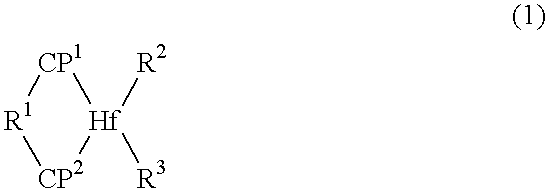
wherein Cp1 is a substituted or unsubstituted cyclopentadienyl group; and Cp2 is a substituted or unsubstituted fluorenyl group.
Applications Claiming Priority (2)
| Application Number | Priority Date | Filing Date | Title |
|---|---|---|---|
| JP5-032008 | 1993-02-22 | ||
| JP3200893 | 1993-02-22 |
Publications (1)
| Publication Number | Publication Date |
|---|---|
| US6313240B1 true US6313240B1 (en) | 2001-11-06 |
Family
ID=12346850
Family Applications (1)
| Application Number | Title | Priority Date | Filing Date |
|---|---|---|---|
| US08/198,579 Expired - Lifetime US6313240B1 (en) | 1993-02-22 | 1994-02-18 | Process for producing ethylene/α-olefin copolymer |
Country Status (4)
| Country | Link |
|---|---|
| US (1) | US6313240B1 (en) |
| EP (1) | EP0612768B1 (en) |
| KR (1) | KR100311245B1 (en) |
| DE (1) | DE69406693T2 (en) |
Cited By (14)
| Publication number | Priority date | Publication date | Assignee | Title |
|---|---|---|---|---|
| US20030229188A1 (en) * | 2002-05-31 | 2003-12-11 | Sandor Nagy | High-temperature solution process for polyolefin manufacture |
| US20050267273A1 (en) * | 2001-02-08 | 2005-12-01 | Mitsui Chemicals, Inc. | Ethylene polymer, preparation process thereof and molded articles of the same |
| US20100036069A1 (en) * | 2006-05-17 | 2010-02-11 | Konze Wayde V | High efficiency solution polymerization process |
| US9969827B2 (en) | 2014-02-13 | 2018-05-15 | Mitsui Chemicals, Inc. | Process for producing ethylene/α-olefin copolymer |
| US20190135959A1 (en) * | 2017-11-07 | 2019-05-09 | Nova Chemicals (International) S.A. | Manufacturing ethylene interpolymer products at higher production rate |
| US20190135960A1 (en) * | 2017-11-07 | 2019-05-09 | Nova Chemicals (International) S.A. | Process to manufacture ethylene interpolymer products |
| US20190135958A1 (en) * | 2017-11-07 | 2019-05-09 | Nova Chemicals (International) S.A. | Ethylene interpolymer products and films |
| US10442921B2 (en) | 2017-04-19 | 2019-10-15 | Nova Chemicals (International) S.A. | Means for increasing the molecular weight and decreasing the density employing mixed homogeneous catalyst formulations |
| US10442920B2 (en) | 2017-04-19 | 2019-10-15 | Nova Chemicals (International) S.A. | Means for increasing the molecular weight and decreasing the density of ethylene interpolymers employing homogeneous and heterogeneous catalyst formulations |
| US10882987B2 (en) | 2019-01-09 | 2021-01-05 | Nova Chemicals (International) S.A. | Ethylene interpolymer products having intermediate branching |
| US11046843B2 (en) | 2019-07-29 | 2021-06-29 | Nova Chemicals (International) S.A. | Ethylene copolymers and films with excellent sealing properties |
| US11312845B2 (en) * | 2017-11-07 | 2022-04-26 | Nova Chemicals (International) S.A. | Ethylene interpolymer products and films |
| EP4303223A1 (en) | 2022-07-05 | 2024-01-10 | Hanwha TotalEnergies Petrochemical Co., Ltd. | Novel transition metal compound, transition metal catalyst composition containing the same, and method for producing copolymer of ethylene and alpha-olefin using the same |
| KR20240143451A (en) | 2023-03-24 | 2024-10-02 | 한화토탈에너지스 주식회사 | Catalyst system for producing ethylene-based polymers in a high temperature solution polymerization process and manufacturing method of ethylene-based polymer using the same |
Families Citing this family (58)
| Publication number | Priority date | Publication date | Assignee | Title |
|---|---|---|---|---|
| US6545088B1 (en) | 1991-12-30 | 2003-04-08 | Dow Global Technologies Inc. | Metallocene-catalyzed process for the manufacture of EP and EPDM polymers |
| DE69511352T2 (en) | 1994-10-03 | 2000-03-30 | Sumitomo Chemical Co., Ltd. | Process for producing a copolymer rubber |
| EP0709393A3 (en) * | 1994-10-25 | 2003-04-16 | Tosoh Corporation | Olefin polymerization catalyst and process for producing olefin polymer |
| US6639030B2 (en) * | 1994-10-25 | 2003-10-28 | Tosoh Corporation | Process for production of olefin polymer |
| ES2116188B1 (en) * | 1994-12-30 | 1999-04-01 | Repsol Quimica Sa | PROCESS OF OBTAINING POLYOLEFINES WITH WIDE, BIMODAL OR MULTIMODAL MOLECULAR WEIGHT DISTRIBUTIONS. |
| US5696213A (en) * | 1995-04-21 | 1997-12-09 | Exxon Chemical Patents Inc. | Ethylene-α-olefin-diolefin elastomers solution polymerization process |
| US5756609A (en) * | 1995-10-19 | 1998-05-26 | Amoco Corporation | Homogeneous metallocene-based olefin polymerization system with increased activity |
| US5767208A (en) * | 1995-10-20 | 1998-06-16 | Exxon Chemical Patents Inc. | High temperature olefin polymerization process |
| DE19617229A1 (en) * | 1996-04-30 | 1997-11-06 | Basf Ag | Process for the production of low molecular weight ethylene polymers under high pressure |
| HU223533B1 (en) | 1996-06-17 | 2004-08-30 | Exxonmobil Chemical Patents Inc. | Mixed transition metal catalyst systems for olefin polymerization |
| US6812184B1 (en) | 1996-06-17 | 2004-11-02 | Exxonmobil Chemical Patents Inc. | Supported late transition metal catalyst systems |
| CN1125829C (en) * | 1996-06-17 | 2003-10-29 | 埃克森美孚化学专利公司 | Boosted Polymerization Using Transition Metal Catalyst Systems |
| DE69715213T2 (en) * | 1996-07-23 | 2003-04-30 | The Dow Chemical Co., Midland | OLEFIN POLYMERIZATION CATALYST COMPOSITION CONTAINING A GROUP 13 CONNECTION |
| US6242545B1 (en) | 1997-12-08 | 2001-06-05 | Univation Technologies | Polymerization catalyst systems comprising substituted hafinocenes |
| US8497330B2 (en) | 1997-12-08 | 2013-07-30 | Univation Technologies, Llc | Methods for polymerization using spray dried and slurried catalyst |
| ATE293132T1 (en) | 1998-03-04 | 2005-04-15 | Exxonmobil Chem Patents Inc | NON-COORDINATING ANIONS FOR THE POLYMERIZATION OF OLEFINS |
| IT1301681B1 (en) | 1998-06-11 | 2000-07-07 | Siac It Additivi Carburanti | ETHYLENE POLYMERS WITH ALFA-OLEFINE. |
| DE69916834T2 (en) | 1998-06-12 | 2004-09-30 | Univation Technologies, LLC, Houston | METHOD FOR POLYMERIZING OLEFINES USING ACTIVATED LEWIS ACID BASE COMPLEXES |
| JP2002520452A (en) | 1998-07-16 | 2002-07-09 | ユニベーション・テクノロジーズ・エルエルシー | Aluminum-based Lewis acid promoter for olefin polymerization. |
| US6486088B1 (en) | 1998-10-23 | 2002-11-26 | Exxonmobil Chemical Patents Inc. | High activity carbenium-activated polymerization catalysts |
| CN1138796C (en) | 1998-10-23 | 2004-02-18 | 埃克森美孚化学专利公司 | Bridge metallocenes for olefine copolymerization |
| US6300433B1 (en) * | 1998-10-23 | 2001-10-09 | Exxonmobil Chemical Patents Inc. | Olefin copolymerization process with bridged hafnocenes |
| EP1425345A1 (en) | 2001-06-22 | 2004-06-09 | Exxonmobil Chemical Patents Inc. | Metallocene-produced very low density polyethylenes or linear lowdensity polyethylenes as impact modifiers |
| US6936675B2 (en) | 2001-07-19 | 2005-08-30 | Univation Technologies, Llc | High tear films from hafnocene catalyzed polyethylenes |
| JP4221363B2 (en) | 2001-07-19 | 2009-02-12 | ユニベーション・テクノロジーズ・エルエルシー | Polyethylene film with improved physical properties |
| AU2003259234A1 (en) | 2002-07-31 | 2004-02-25 | Exxonmobil Chemical Patents Inc. | Silane crosslinkable polyethylene |
| EP1537175B1 (en) | 2002-09-05 | 2008-05-14 | ExxonMobil Chemical Patents Inc. | Shrink film |
| ATE494321T1 (en) | 2002-09-05 | 2011-01-15 | Exxonmobil Chem Patents Inc | STRETCH FILM WRAPPING PROCESS |
| US7541402B2 (en) | 2002-10-15 | 2009-06-02 | Exxonmobil Chemical Patents Inc. | Blend functionalized polyolefin adhesive |
| US7223822B2 (en) | 2002-10-15 | 2007-05-29 | Exxonmobil Chemical Patents Inc. | Multiple catalyst and reactor system for olefin polymerization and polymers produced therefrom |
| KR101113341B1 (en) | 2002-10-15 | 2012-09-27 | 엑손모빌 케미칼 패턴츠 인코포레이티드 | Multiple catalyst system for olefin polymerization and polymers produced therefrom |
| US7700707B2 (en) | 2002-10-15 | 2010-04-20 | Exxonmobil Chemical Patents Inc. | Polyolefin adhesive compositions and articles made therefrom |
| US7550528B2 (en) | 2002-10-15 | 2009-06-23 | Exxonmobil Chemical Patents Inc. | Functionalized olefin polymers |
| US7683140B2 (en) | 2004-05-20 | 2010-03-23 | Univation Technologies, Llc | Method for determining temperature value indicative of resin stickiness from data generated by polymerization reaction monitoring |
| US7754830B2 (en) | 2004-05-20 | 2010-07-13 | Univation Technologies, Llc | Polymerization reaction monitoring with determination of induced condensing agent concentration for preventing discontinuity events |
| US7078467B1 (en) | 2005-06-14 | 2006-07-18 | Univation Technologies, Llc | Single catalyst low, medium and high density polyethylenes |
| US7282546B2 (en) * | 2005-06-22 | 2007-10-16 | Fina Technology, Inc. | Cocatalysts for reduction of production problems in metallocene-catalyzed polymerizations |
| US7951873B2 (en) | 2006-05-05 | 2011-05-31 | Exxonmobil Chemical Patents Inc. | Linear low density polymer blends and articles made therefrom |
| TWI448447B (en) | 2006-07-24 | 2014-08-11 | Gruenenthal Chemie | Method for preparing (1R,2R)-3-(3-dimethylamino-1-ethyl-2-methyl-propyl)-phenol |
| KR20090064432A (en) | 2006-09-07 | 2009-06-18 | 유니베이션 테크놀로지즈, 엘엘씨 | A method of determining a temperature value indicating resin adhesion from data generated by polymerization reaction monitoring |
| CA2662793A1 (en) | 2006-09-07 | 2008-03-13 | Univation Technologies, Llc | Methods for on-line determination of degree of resin stickiness using a model for depression of melt initiation temperature |
| US8378042B2 (en) | 2009-04-28 | 2013-02-19 | Exxonmobil Chemical Patents Inc. | Finishing process for amorphous polymers |
| US9127151B2 (en) | 2009-04-28 | 2015-09-08 | Exxonmobil Chemical Patents Inc. | Polymer compositions having improved properties as viscosity index improvers and use thereof in lubricating oils |
| US20120028865A1 (en) | 2010-07-28 | 2012-02-02 | Sudhin Datta | Viscosity Modifiers Comprising Blends of Ethylene-Based Copolymers |
| US8618033B2 (en) | 2010-01-22 | 2013-12-31 | Exxonmobil Chemical Patents Inc. | Ethylene copolymers, methods for their production, and use |
| KR101367364B1 (en) | 2009-12-31 | 2014-02-26 | 주식회사 엘지화학 | Cocatalyst having excellent solubility for olefin polymerization and preparation methode thereof |
| JP5498588B2 (en) | 2010-01-27 | 2014-05-21 | エクソンモービル・ケミカル・パテンツ・インク | Copolymers, compositions thereof and methods for their production |
| JP5753264B2 (en) | 2010-07-28 | 2015-07-22 | エクソンモービル ケミカル パテンツ インコーポレイテッド | Viscosity modifiers containing blends of ethylene-based copolymers |
| WO2012015572A1 (en) | 2010-07-28 | 2012-02-02 | Exxonmobil Chemical Patents Inc. | Viscosity modifiers comprising blends of ethylene-based copolymers |
| SG186167A1 (en) | 2010-07-28 | 2013-01-30 | Exxonmobil Chem Patents Inc | Ethylene based copolymer compositions as viscosity modifiers and methods for making them |
| US10316176B2 (en) | 2012-02-03 | 2019-06-11 | Exxonmobil Chemical Patents Inc. | Polymer compositions and methods of making them |
| US9139794B2 (en) | 2012-02-03 | 2015-09-22 | Exxonmobil Chemical Patents Inc. | Process for the production of polymeric compositions useful as oil modifiers |
| JP6088548B2 (en) | 2012-02-03 | 2017-03-01 | エクソンモービル ケミカル パテンツ インコーポレイテッド | Method for producing a polymer composition useful as an oil modifier |
| US10647626B2 (en) | 2016-07-12 | 2020-05-12 | Chevron Phillips Chemical Company Lp | Decene oligomers |
| JP7221875B2 (en) | 2017-03-30 | 2023-02-14 | ボレアリス エージー | Boron-activated metallocene catalysts |
| US11466149B2 (en) | 2018-07-23 | 2022-10-11 | Exxonmobil Chemical Patents Inc. | Preparation of bimodal rubber, thermoplastic vulcanizates, and articles made therefrom |
| WO2020023193A1 (en) | 2018-07-23 | 2020-01-30 | Exxonmobil Chemical Patents Inc. | Preparation of bimodal rubber, thermoplastic vulcanizates, and articles made therefrom |
| WO2022228260A1 (en) | 2021-04-25 | 2022-11-03 | 中国石油化工股份有限公司 | Propylene-based copolymer, preparation method therefor and use thereof, and polypropylene composition containing same |
Citations (9)
| Publication number | Priority date | Publication date | Assignee | Title |
|---|---|---|---|---|
| EP0277004A1 (en) * | 1987-01-30 | 1988-08-03 | Exxon Chemical Patents Inc. | Catalysts, method of preparing these catalysts and method of using said catalysts |
| US4935474A (en) * | 1983-06-06 | 1990-06-19 | Exxon Research & Engineering Company | Process and catalyst for producing polyethylene having a broad molecular weight distribution |
| WO1991014713A1 (en) | 1990-03-20 | 1991-10-03 | Exxon Chemical Patents Inc. | Catalyst system of enhanced productivity |
| US5084534A (en) * | 1987-06-04 | 1992-01-28 | Exxon Chemical Patents, Inc. | High pressure, high temperature polymerization of ethylene |
| EP0513380A1 (en) * | 1990-11-30 | 1992-11-19 | Idemitsu Kosan Company Limited | Process for producing olefinic polymer |
| WO1993025590A1 (en) * | 1992-06-15 | 1993-12-23 | Exxon Chemical Patents Inc. | High temperature polymerization process using ionic catalysts to produce polyolefins |
| US5324800A (en) * | 1983-06-06 | 1994-06-28 | Exxon Chemical Patents Inc. | Process and catalyst for polyolefin density and molecular weight control |
| US5408017A (en) * | 1987-01-30 | 1995-04-18 | Exxon Chemical Patents Inc. | High temperature polymerization process using ionic catalysts to produce polyolefins |
| US5444134A (en) * | 1991-07-11 | 1995-08-22 | Idemitsu Kosan Co., Ltd. | Process for producing olefin based polymers and olefin polymerization catalyst |
-
1994
- 1994-02-18 US US08/198,579 patent/US6313240B1/en not_active Expired - Lifetime
- 1994-02-19 KR KR1019940002971A patent/KR100311245B1/en not_active Expired - Fee Related
- 1994-02-21 EP EP94102576A patent/EP0612768B1/en not_active Expired - Lifetime
- 1994-02-21 DE DE69406693T patent/DE69406693T2/en not_active Expired - Fee Related
Patent Citations (9)
| Publication number | Priority date | Publication date | Assignee | Title |
|---|---|---|---|---|
| US4935474A (en) * | 1983-06-06 | 1990-06-19 | Exxon Research & Engineering Company | Process and catalyst for producing polyethylene having a broad molecular weight distribution |
| US5324800A (en) * | 1983-06-06 | 1994-06-28 | Exxon Chemical Patents Inc. | Process and catalyst for polyolefin density and molecular weight control |
| EP0277004A1 (en) * | 1987-01-30 | 1988-08-03 | Exxon Chemical Patents Inc. | Catalysts, method of preparing these catalysts and method of using said catalysts |
| US5408017A (en) * | 1987-01-30 | 1995-04-18 | Exxon Chemical Patents Inc. | High temperature polymerization process using ionic catalysts to produce polyolefins |
| US5084534A (en) * | 1987-06-04 | 1992-01-28 | Exxon Chemical Patents, Inc. | High pressure, high temperature polymerization of ethylene |
| WO1991014713A1 (en) | 1990-03-20 | 1991-10-03 | Exxon Chemical Patents Inc. | Catalyst system of enhanced productivity |
| EP0513380A1 (en) * | 1990-11-30 | 1992-11-19 | Idemitsu Kosan Company Limited | Process for producing olefinic polymer |
| US5444134A (en) * | 1991-07-11 | 1995-08-22 | Idemitsu Kosan Co., Ltd. | Process for producing olefin based polymers and olefin polymerization catalyst |
| WO1993025590A1 (en) * | 1992-06-15 | 1993-12-23 | Exxon Chemical Patents Inc. | High temperature polymerization process using ionic catalysts to produce polyolefins |
Cited By (31)
| Publication number | Priority date | Publication date | Assignee | Title |
|---|---|---|---|---|
| US20050267273A1 (en) * | 2001-02-08 | 2005-12-01 | Mitsui Chemicals, Inc. | Ethylene polymer, preparation process thereof and molded articles of the same |
| US7592403B2 (en) * | 2001-02-08 | 2009-09-22 | Mitsui Chemicals, Inc. | Ethylene polymer, preparation process thereof and molded articles of the same |
| US20030229188A1 (en) * | 2002-05-31 | 2003-12-11 | Sandor Nagy | High-temperature solution process for polyolefin manufacture |
| US6756455B2 (en) | 2002-05-31 | 2004-06-29 | Equistar Chemicals, Lp | High-temperature solution process for polyolefin manufacture |
| US20100036069A1 (en) * | 2006-05-17 | 2010-02-11 | Konze Wayde V | High efficiency solution polymerization process |
| US8202953B2 (en) | 2006-05-17 | 2012-06-19 | Dow Global Technologies Llc | High efficiency solution polymerization process |
| US8299189B2 (en) | 2006-05-17 | 2012-10-30 | Dow Global Technologies, Llc | Ethylene/α-olefin/diene solution polymerization process and polymer |
| US9969827B2 (en) | 2014-02-13 | 2018-05-15 | Mitsui Chemicals, Inc. | Process for producing ethylene/α-olefin copolymer |
| US10738183B2 (en) | 2017-04-19 | 2020-08-11 | Nova Chemicals (International) S.A. | Means for increasing the molecular weight and decreasing the density of ethylene interpolymers employing homogeneous and heterogeneous catalyst formulations |
| US11015044B2 (en) | 2017-04-19 | 2021-05-25 | Nova Chemicals (International) S.A. | Means for increasing the molecular weight and decreasing the density of ethylene interpolymers employing mixed homogeneous catalyst formulations |
| US11111368B2 (en) | 2017-04-19 | 2021-09-07 | Nova Chemicals (International) S.A. | Means for increasing the molecular weight and decreasing the density of ethylene interpolymers employing homogeneous and heterogeneous catalyst formulations |
| US10442921B2 (en) | 2017-04-19 | 2019-10-15 | Nova Chemicals (International) S.A. | Means for increasing the molecular weight and decreasing the density employing mixed homogeneous catalyst formulations |
| US10442920B2 (en) | 2017-04-19 | 2019-10-15 | Nova Chemicals (International) S.A. | Means for increasing the molecular weight and decreasing the density of ethylene interpolymers employing homogeneous and heterogeneous catalyst formulations |
| US20190135959A1 (en) * | 2017-11-07 | 2019-05-09 | Nova Chemicals (International) S.A. | Manufacturing ethylene interpolymer products at higher production rate |
| US11312845B2 (en) * | 2017-11-07 | 2022-04-26 | Nova Chemicals (International) S.A. | Ethylene interpolymer products and films |
| CN111770939A (en) * | 2017-11-07 | 2020-10-13 | 诺瓦化学品(国际)股份有限公司 | Improved method for making ethylene interpolymer products |
| CN111788238A (en) * | 2017-11-07 | 2020-10-16 | 诺瓦化学品(国际)股份有限公司 | Ethylene Interpolymer Products and Films |
| US11773197B2 (en) | 2017-11-07 | 2023-10-03 | Nova Chemicals (International) S.A. | Manufacturing ethylene interpolymer products at higher production rate |
| US10995166B2 (en) | 2017-11-07 | 2021-05-04 | Nova Chemicals (International) S.A. | Ethylene interpolymer products and films |
| US10683376B2 (en) | 2017-11-07 | 2020-06-16 | Nova Chemicals (International) S.A. | Manufacturing ethylene interpolymer products at higher production rate |
| US11708437B2 (en) | 2017-11-07 | 2023-07-25 | Nova Chemicals (International) S.A. | Ethylene interpolymer products and films |
| US20190135958A1 (en) * | 2017-11-07 | 2019-05-09 | Nova Chemicals (International) S.A. | Ethylene interpolymer products and films |
| US20190135960A1 (en) * | 2017-11-07 | 2019-05-09 | Nova Chemicals (International) S.A. | Process to manufacture ethylene interpolymer products |
| CN111788238B (en) * | 2017-11-07 | 2023-01-24 | 诺瓦化学品(国际)股份有限公司 | Ethylene interpolymer products and films |
| US11584845B2 (en) | 2017-11-07 | 2023-02-21 | Nova Chemicals (International) S.A. | Ethylene interpolymer products and films |
| US10882987B2 (en) | 2019-01-09 | 2021-01-05 | Nova Chemicals (International) S.A. | Ethylene interpolymer products having intermediate branching |
| US12351705B2 (en) | 2019-01-09 | 2025-07-08 | Nova Chemicals (International) S.A. | Ethylene interpolymer products having intermediate branching |
| US11046843B2 (en) | 2019-07-29 | 2021-06-29 | Nova Chemicals (International) S.A. | Ethylene copolymers and films with excellent sealing properties |
| EP4303223A1 (en) | 2022-07-05 | 2024-01-10 | Hanwha TotalEnergies Petrochemical Co., Ltd. | Novel transition metal compound, transition metal catalyst composition containing the same, and method for producing copolymer of ethylene and alpha-olefin using the same |
| KR20240005309A (en) | 2022-07-05 | 2024-01-12 | 한화토탈에너지스 주식회사 | A novel transition metal complexes, a transition metal catalyst composition comprising the same, and a method for preparing a copolymer of ethylene and α-olefin using the same |
| KR20240143451A (en) | 2023-03-24 | 2024-10-02 | 한화토탈에너지스 주식회사 | Catalyst system for producing ethylene-based polymers in a high temperature solution polymerization process and manufacturing method of ethylene-based polymer using the same |
Also Published As
| Publication number | Publication date |
|---|---|
| EP0612768A1 (en) | 1994-08-31 |
| DE69406693T2 (en) | 1998-03-19 |
| DE69406693D1 (en) | 1997-12-18 |
| KR100311245B1 (en) | 2001-12-15 |
| EP0612768B1 (en) | 1997-11-12 |
Similar Documents
| Publication | Publication Date | Title |
|---|---|---|
| US6313240B1 (en) | Process for producing ethylene/α-olefin copolymer | |
| US6207774B1 (en) | Process for producing ethylene/α-olefin copolymer | |
| EP0570982B1 (en) | Catalysts and process for producing olefin polymers | |
| EP0868445B1 (en) | High temperature olefin polymerization process | |
| EP1060198B1 (en) | Noncoordinating anions for olefin polymerization | |
| US5767208A (en) | High temperature olefin polymerization process | |
| JP2002503736A (en) | Ethylene copolymerization method | |
| EP0324856A1 (en) | Process for polymerizing olefin | |
| EP0582268B1 (en) | Olefin polymerization catalyst and olefin polymerization process | |
| US5321107A (en) | Olefin polymerization catalyst and process for the polymerization of olefins | |
| US6355592B1 (en) | Catalyst system of enhanced productivity and its use in polymerization process | |
| EP0328348B1 (en) | Olefin polymerization catalyst and process for the polymerization of olefins | |
| KR100445364B1 (en) | Method for producing olefin polymerization catalyst and olefin polymer | |
| EP1063244A2 (en) | High temperature olefin polymerization process | |
| JP2882257B2 (en) | Method for producing ethylene / α-olefin copolymer | |
| US6639030B2 (en) | Process for production of olefin polymer | |
| JPH0820606A (en) | Catalyst for .ALPHA.-olefin polymerization and method for producing .ALPHA.-olefin polymer using the same | |
| JP3070257B2 (en) | Method for producing olefin polymer | |
| JP3404906B2 (en) | Method for producing olefin copolymer | |
| JP3070256B2 (en) | Method for producing olefin polymer | |
| US20020103315A1 (en) | Catalyst composition for the polymerization of olefins | |
| JP3773304B2 (en) | Olefin polymerization catalyst component, olefin polymerization catalyst containing the component, and method for producing polyolefin | |
| JPH0782309A (en) | Olefin polymerization catalyst and production of polyolefin | |
| JPH05320241A (en) | Production of olefin polymer | |
| JPH05320240A (en) | Production of olefin polymer |
Legal Events
| Date | Code | Title | Description |
|---|---|---|---|
| AS | Assignment |
Owner name: TOSOH CORPORATION, JAPAN Free format text: ASSIGNMENT OF ASSIGNORS INTEREST;ASSIGNORS:HASEGAWA, SAIKI;SONE, MAKOTO;YASUDA, HISAMI;AND OTHERS;REEL/FRAME:007022/0611 Effective date: 19940209 |
|
| STCF | Information on status: patent grant |
Free format text: PATENTED CASE |
|
| FEPP | Fee payment procedure |
Free format text: PAYOR NUMBER ASSIGNED (ORIGINAL EVENT CODE: ASPN); ENTITY STATUS OF PATENT OWNER: LARGE ENTITY |
|
| FPAY | Fee payment |
Year of fee payment: 4 |
|
| FPAY | Fee payment |
Year of fee payment: 8 |
|
| FPAY | Fee payment |
Year of fee payment: 12 |