US6265519B1 - Thiolamide curing agents - Google Patents
Thiolamide curing agents Download PDFInfo
- Publication number
- US6265519B1 US6265519B1 US09/206,821 US20682198A US6265519B1 US 6265519 B1 US6265519 B1 US 6265519B1 US 20682198 A US20682198 A US 20682198A US 6265519 B1 US6265519 B1 US 6265519B1
- Authority
- US
- United States
- Prior art keywords
- thiol
- curing
- curing agents
- amine
- thiolamide
- Prior art date
- Legal status (The legal status is an assumption and is not a legal conclusion. Google has not performed a legal analysis and makes no representation as to the accuracy of the status listed.)
- Expired - Fee Related
Links
- DENPQNAWGQXKCU-UHFFFAOYSA-N thiophene-2-carboxamide Chemical compound NC(=O)C1=CC=CS1 DENPQNAWGQXKCU-UHFFFAOYSA-N 0.000 title abstract description 16
- 239000003795 chemical substances by application Substances 0.000 claims abstract description 64
- 150000003573 thiols Chemical class 0.000 claims abstract description 50
- 238000000034 method Methods 0.000 claims abstract description 20
- 239000007795 chemical reaction product Substances 0.000 claims abstract 3
- 239000003054 catalyst Substances 0.000 claims description 20
- 150000001408 amides Chemical class 0.000 claims description 18
- 239000000203 mixture Substances 0.000 claims description 16
- 150000002118 epoxides Chemical class 0.000 claims description 12
- 239000004593 Epoxy Substances 0.000 claims description 9
- WADSJYLPJPTMLN-UHFFFAOYSA-N 3-(cycloundecen-1-yl)-1,2-diazacycloundec-2-ene Chemical compound C1CCCCCCCCC=C1C1=NNCCCCCCCC1 WADSJYLPJPTMLN-UHFFFAOYSA-N 0.000 claims description 7
- DKIDEFUBRARXTE-UHFFFAOYSA-N 3-mercaptopropanoic acid Chemical compound OC(=O)CCS DKIDEFUBRARXTE-UHFFFAOYSA-N 0.000 claims description 4
- PXKLMJQFEQBVLD-UHFFFAOYSA-N bisphenol F Chemical compound C1=CC(O)=CC=C1CC1=CC=C(O)C=C1 PXKLMJQFEQBVLD-UHFFFAOYSA-N 0.000 claims description 4
- 238000010438 heat treatment Methods 0.000 claims description 4
- WPZSAUFQHYFIPG-UHFFFAOYSA-N propanethioamide Chemical compound CCC(N)=S WPZSAUFQHYFIPG-UHFFFAOYSA-N 0.000 claims description 4
- NFDXQGNDWIPXQL-UHFFFAOYSA-N 1-cyclooctyldiazocane Chemical compound C1CCCCCCC1N1NCCCCCC1 NFDXQGNDWIPXQL-UHFFFAOYSA-N 0.000 claims description 2
- GYXHHICIFZSKKZ-UHFFFAOYSA-N 2-sulfanylacetamide Chemical compound NC(=O)CS GYXHHICIFZSKKZ-UHFFFAOYSA-N 0.000 claims description 2
- 239000012973 diazabicyclooctane Substances 0.000 claims description 2
- 239000011541 reaction mixture Substances 0.000 claims 3
- PPNCOQHHSGMKGI-UHFFFAOYSA-N 1-cyclononyldiazonane Chemical compound C1CCCCCCCC1N1NCCCCCCC1 PPNCOQHHSGMKGI-UHFFFAOYSA-N 0.000 claims 1
- FGJUEFUBALDIGU-UHFFFAOYSA-N 2-hydroxy-2-sulfanylacetic acid Chemical compound OC(S)C(O)=O FGJUEFUBALDIGU-UHFFFAOYSA-N 0.000 claims 1
- 150000001875 compounds Chemical class 0.000 abstract description 37
- 150000001412 amines Chemical class 0.000 abstract description 26
- 238000002360 preparation method Methods 0.000 abstract description 9
- 238000006243 chemical reaction Methods 0.000 description 29
- 125000003277 amino group Chemical group 0.000 description 23
- 239000000178 monomer Substances 0.000 description 17
- 239000000047 product Substances 0.000 description 17
- 239000002253 acid Substances 0.000 description 15
- 229920000647 polyepoxide Polymers 0.000 description 15
- 229920005989 resin Polymers 0.000 description 15
- 239000011347 resin Substances 0.000 description 15
- IJGRMHOSHXDMSA-UHFFFAOYSA-N Atomic nitrogen Chemical compound N#N IJGRMHOSHXDMSA-UHFFFAOYSA-N 0.000 description 12
- YXFVVABEGXRONW-UHFFFAOYSA-N Toluene Chemical compound CC1=CC=CC=C1 YXFVVABEGXRONW-UHFFFAOYSA-N 0.000 description 12
- 125000000217 alkyl group Chemical group 0.000 description 12
- 125000003342 alkenyl group Chemical group 0.000 description 11
- 239000003822 epoxy resin Substances 0.000 description 11
- 125000003118 aryl group Chemical group 0.000 description 10
- 125000003396 thiol group Chemical group [H]S* 0.000 description 9
- LYCAIKOWRPUZTN-UHFFFAOYSA-N Ethylene glycol Chemical compound OCCO LYCAIKOWRPUZTN-UHFFFAOYSA-N 0.000 description 8
- 125000003700 epoxy group Chemical group 0.000 description 8
- 150000002148 esters Chemical class 0.000 description 7
- XLYOFNOQVPJJNP-UHFFFAOYSA-N water Substances O XLYOFNOQVPJJNP-UHFFFAOYSA-N 0.000 description 7
- -1 aliphatic amines Chemical class 0.000 description 6
- LNEPOXFFQSENCJ-UHFFFAOYSA-N haloperidol Chemical compound C1CC(O)(C=2C=CC(Cl)=CC=2)CCN1CCCC(=O)C1=CC=C(F)C=C1 LNEPOXFFQSENCJ-UHFFFAOYSA-N 0.000 description 6
- 229910052757 nitrogen Inorganic materials 0.000 description 6
- 229920000642 polymer Polymers 0.000 description 6
- 239000003153 chemical reaction reagent Substances 0.000 description 5
- CWERGRDVMFNCDR-UHFFFAOYSA-N thioglycolic acid Chemical compound OC(=O)CS CWERGRDVMFNCDR-UHFFFAOYSA-N 0.000 description 5
- RTAQQCXQSZGOHL-UHFFFAOYSA-N Titanium Chemical compound [Ti] RTAQQCXQSZGOHL-UHFFFAOYSA-N 0.000 description 4
- 230000008901 benefit Effects 0.000 description 4
- 239000001257 hydrogen Substances 0.000 description 4
- 229910052739 hydrogen Inorganic materials 0.000 description 4
- 125000004435 hydrogen atom Chemical class [H]* 0.000 description 4
- 239000000463 material Substances 0.000 description 4
- 238000006116 polymerization reaction Methods 0.000 description 4
- KOODSCBKXPPKHE-UHFFFAOYSA-N propanethioic s-acid Chemical compound CCC(S)=O KOODSCBKXPPKHE-UHFFFAOYSA-N 0.000 description 4
- 150000003335 secondary amines Chemical class 0.000 description 4
- 238000003860 storage Methods 0.000 description 4
- PEDCQBHIVMGVHV-UHFFFAOYSA-N Glycerine Chemical compound OCC(O)CO PEDCQBHIVMGVHV-UHFFFAOYSA-N 0.000 description 3
- AFVFQIVMOAPDHO-UHFFFAOYSA-N Methanesulfonic acid Chemical compound CS(O)(=O)=O AFVFQIVMOAPDHO-UHFFFAOYSA-N 0.000 description 3
- ZMANZCXQSJIPKH-UHFFFAOYSA-N Triethylamine Chemical compound CCN(CC)CC ZMANZCXQSJIPKH-UHFFFAOYSA-N 0.000 description 3
- 239000013466 adhesive and sealant Substances 0.000 description 3
- 125000002947 alkylene group Chemical group 0.000 description 3
- 230000015572 biosynthetic process Effects 0.000 description 3
- IISBACLAFKSPIT-UHFFFAOYSA-N bisphenol A Chemical compound C=1C=C(O)C=CC=1C(C)(C)C1=CC=C(O)C=C1 IISBACLAFKSPIT-UHFFFAOYSA-N 0.000 description 3
- YHWCPXVTRSHPNY-UHFFFAOYSA-N butan-1-olate;titanium(4+) Chemical compound [Ti+4].CCCC[O-].CCCC[O-].CCCC[O-].CCCC[O-] YHWCPXVTRSHPNY-UHFFFAOYSA-N 0.000 description 3
- 238000000576 coating method Methods 0.000 description 3
- 230000008878 coupling Effects 0.000 description 3
- 238000010168 coupling process Methods 0.000 description 3
- 238000005859 coupling reaction Methods 0.000 description 3
- 238000004132 cross linking Methods 0.000 description 3
- 150000001923 cyclic compounds Chemical class 0.000 description 3
- 238000006477 desulfuration reaction Methods 0.000 description 3
- 230000023556 desulfurization Effects 0.000 description 3
- 229920001971 elastomer Polymers 0.000 description 3
- 125000000524 functional group Chemical group 0.000 description 3
- 150000003141 primary amines Chemical class 0.000 description 3
- 230000009257 reactivity Effects 0.000 description 3
- 239000010936 titanium Substances 0.000 description 3
- 239000009261 D 400 Substances 0.000 description 2
- ZHNUHDYFZUAESO-UHFFFAOYSA-N Formamide Chemical compound NC=O ZHNUHDYFZUAESO-UHFFFAOYSA-N 0.000 description 2
- MHAJPDPJQMAIIY-UHFFFAOYSA-N Hydrogen peroxide Chemical compound OO MHAJPDPJQMAIIY-UHFFFAOYSA-N 0.000 description 2
- VYPSYNLAJGMNEJ-UHFFFAOYSA-N Silicium dioxide Chemical compound O=[Si]=O VYPSYNLAJGMNEJ-UHFFFAOYSA-N 0.000 description 2
- 230000002378 acidificating effect Effects 0.000 description 2
- 150000007513 acids Chemical class 0.000 description 2
- 150000001252 acrylic acid derivatives Chemical class 0.000 description 2
- 230000001464 adherent effect Effects 0.000 description 2
- 238000007098 aminolysis reaction Methods 0.000 description 2
- 150000004982 aromatic amines Chemical class 0.000 description 2
- 239000006227 byproduct Substances 0.000 description 2
- 125000002915 carbonyl group Chemical group [*:2]C([*:1])=O 0.000 description 2
- 230000015556 catabolic process Effects 0.000 description 2
- 238000006555 catalytic reaction Methods 0.000 description 2
- 239000003431 cross linking reagent Substances 0.000 description 2
- 150000001925 cycloalkenes Chemical class 0.000 description 2
- 238000006731 degradation reaction Methods 0.000 description 2
- 230000009977 dual effect Effects 0.000 description 2
- 239000012467 final product Substances 0.000 description 2
- 239000000499 gel Substances 0.000 description 2
- 238000006460 hydrolysis reaction Methods 0.000 description 2
- 150000002432 hydroperoxides Chemical class 0.000 description 2
- 238000011065 in-situ storage Methods 0.000 description 2
- 230000000670 limiting effect Effects 0.000 description 2
- NUJOXMJBOLGQSY-UHFFFAOYSA-N manganese dioxide Chemical compound O=[Mn]=O NUJOXMJBOLGQSY-UHFFFAOYSA-N 0.000 description 2
- 150000002734 metacrylic acid derivatives Chemical class 0.000 description 2
- 235000019645 odor Nutrition 0.000 description 2
- 230000003647 oxidation Effects 0.000 description 2
- 238000007254 oxidation reaction Methods 0.000 description 2
- 238000005691 oxidative coupling reaction Methods 0.000 description 2
- 229920001223 polyethylene glycol Polymers 0.000 description 2
- 229920001451 polypropylene glycol Polymers 0.000 description 2
- 150000003139 primary aliphatic amines Chemical class 0.000 description 2
- 230000008569 process Effects 0.000 description 2
- 239000005060 rubber Substances 0.000 description 2
- 239000000126 substance Substances 0.000 description 2
- 229910052717 sulfur Inorganic materials 0.000 description 2
- 238000003786 synthesis reaction Methods 0.000 description 2
- 238000012360 testing method Methods 0.000 description 2
- 239000010409 thin film Substances 0.000 description 2
- 150000007970 thio esters Chemical class 0.000 description 2
- 229910052719 titanium Inorganic materials 0.000 description 2
- OGBWMWKMTUSNKE-UHFFFAOYSA-N 1-(2-methylprop-2-enoyloxy)hexyl 2-methylprop-2-enoate Chemical compound CCCCCC(OC(=O)C(C)=C)OC(=O)C(C)=C OGBWMWKMTUSNKE-UHFFFAOYSA-N 0.000 description 1
- VILCJCGEZXAXTO-UHFFFAOYSA-N 2,2,2-tetramine Chemical compound NCCNCCNCCN VILCJCGEZXAXTO-UHFFFAOYSA-N 0.000 description 1
- NBNGHXWJFSMASY-UHFFFAOYSA-N 2,3,4-tris(dimethylamino)phenol Chemical compound CN(C)C1=CC=C(O)C(N(C)C)=C1N(C)C NBNGHXWJFSMASY-UHFFFAOYSA-N 0.000 description 1
- AOBIOSPNXBMOAT-UHFFFAOYSA-N 2-[2-(oxiran-2-ylmethoxy)ethoxymethyl]oxirane Chemical compound C1OC1COCCOCC1CO1 AOBIOSPNXBMOAT-UHFFFAOYSA-N 0.000 description 1
- LPUUPYOHXHWKAR-UHFFFAOYSA-N 2-ethyl-2-(hydroxymethyl)propane-1,3-diol 3,3,3-tris(sulfanyl)propanoic acid Chemical compound SC(CC(=O)O)(S)S.C(O)C(CC)(CO)CO LPUUPYOHXHWKAR-UHFFFAOYSA-N 0.000 description 1
- BRIXOPDYGQCZFO-UHFFFAOYSA-N 4-ethylphenylsulfonic acid Chemical compound CCC1=CC=C(S(O)(=O)=O)C=C1 BRIXOPDYGQCZFO-UHFFFAOYSA-N 0.000 description 1
- NIXOWILDQLNWCW-UHFFFAOYSA-M Acrylate Chemical compound [O-]C(=O)C=C NIXOWILDQLNWCW-UHFFFAOYSA-M 0.000 description 1
- 229920003319 Araldite® Polymers 0.000 description 1
- MZBZSLIHZQIZCX-UHFFFAOYSA-N C#C(#N)(=C=O)#C=S.C#C(#N)(=C=O)#C=S(CO)CC(C)=O.C=CC(=O)OC Chemical compound C#C(#N)(=C=O)#C=S.C#C(#N)(=C=O)#C=S(CO)CC(C)=O.C=CC(=O)OC MZBZSLIHZQIZCX-UHFFFAOYSA-N 0.000 description 1
- KYPLOINPBBUZAU-UHFFFAOYSA-N C#C(=C=O)#C=S Chemical compound C#C(=C=O)#C=S KYPLOINPBBUZAU-UHFFFAOYSA-N 0.000 description 1
- UEFQOLBMRMKPKC-UHFFFAOYSA-N C#C.C#C(=C=O)#C=S.C#C=N.N#C(#CC=S)#C=O Chemical compound C#C.C#C(=C=O)#C=S.C#C=N.N#C(#CC=S)#C=O UEFQOLBMRMKPKC-UHFFFAOYSA-N 0.000 description 1
- GLUUGHFHXGJENI-UHFFFAOYSA-N C1CNCCN1 Chemical compound C1CNCCN1 GLUUGHFHXGJENI-UHFFFAOYSA-N 0.000 description 1
- FHFKKFALQQWRFS-UHFFFAOYSA-N C1CNCCN1.C=C(=C)(=C)(=N)(=S)=C=O.C=O.C=O.C=O.C=O.CN.CN.CO.O=C1CCC(=O)CC1.O=C1CCCS1.O=C1CSC(=O)CS1 Chemical compound C1CNCCN1.C=C(=C)(=C)(=N)(=S)=C=O.C=O.C=O.C=O.C=O.CN.CN.CO.O=C1CCC(=O)CC1.O=C1CCCS1.O=C1CSC(=O)CS1 FHFKKFALQQWRFS-UHFFFAOYSA-N 0.000 description 1
- GQHQHAAFLJARON-UHFFFAOYSA-N C1CO1.CCOCC1CO1 Chemical compound C1CO1.CCOCC1CO1 GQHQHAAFLJARON-UHFFFAOYSA-N 0.000 description 1
- WSFSSNUMVMOOMR-UHFFFAOYSA-N C=O Chemical compound C=O WSFSSNUMVMOOMR-UHFFFAOYSA-N 0.000 description 1
- LEUJDZPTKCVWAQ-UHFFFAOYSA-N CC(O)S(C)=C#C(=N)=C=O.CC1CO1.N=C(=C=O)#C=S Chemical compound CC(O)S(C)=C#C(=N)=C=O.CC1CO1.N=C(=C=O)#C=S LEUJDZPTKCVWAQ-UHFFFAOYSA-N 0.000 description 1
- IQGXKAIJLVWHFD-UHFFFAOYSA-N CN.[H]C1(C)CSCC(=O)O1.[H]N=C(=C)(=C=O)=S(C)C(C)O Chemical compound CN.[H]C1(C)CSCC(=O)O1.[H]N=C(=C)(=C=O)=S(C)C(C)O IQGXKAIJLVWHFD-UHFFFAOYSA-N 0.000 description 1
- 239000004971 Cross linker Substances 0.000 description 1
- FBPFZTCFMRRESA-FSIIMWSLSA-N D-Glucitol Natural products OC[C@H](O)[C@H](O)[C@@H](O)[C@H](O)CO FBPFZTCFMRRESA-FSIIMWSLSA-N 0.000 description 1
- FBPFZTCFMRRESA-JGWLITMVSA-N D-glucitol Chemical compound OC[C@H](O)[C@@H](O)[C@H](O)[C@H](O)CO FBPFZTCFMRRESA-JGWLITMVSA-N 0.000 description 1
- BRLQWZUYTZBJKN-UHFFFAOYSA-N Epichlorohydrin Chemical compound ClCC1CO1 BRLQWZUYTZBJKN-UHFFFAOYSA-N 0.000 description 1
- 238000004566 IR spectroscopy Methods 0.000 description 1
- XFSHOMFWLOXRFN-UHFFFAOYSA-N N#C(#CC=S)#C=O Chemical compound N#C(#CC=S)#C=O XFSHOMFWLOXRFN-UHFFFAOYSA-N 0.000 description 1
- HXUPLHAPVCVGAD-UHFFFAOYSA-N O=C1CCCS1.O=C1CSC(=O)CS1 Chemical compound O=C1CCCS1.O=C1CSC(=O)CS1 HXUPLHAPVCVGAD-UHFFFAOYSA-N 0.000 description 1
- ISWSIDIOOBJBQZ-UHFFFAOYSA-N Phenol Chemical compound OC1=CC=CC=C1 ISWSIDIOOBJBQZ-UHFFFAOYSA-N 0.000 description 1
- 239000004698 Polyethylene Substances 0.000 description 1
- 239000002202 Polyethylene glycol Substances 0.000 description 1
- XBDQKXXYIPTUBI-UHFFFAOYSA-M Propionate Chemical compound CCC([O-])=O XBDQKXXYIPTUBI-UHFFFAOYSA-M 0.000 description 1
- NINIDFKCEFEMDL-UHFFFAOYSA-N Sulfur Chemical compound [S] NINIDFKCEFEMDL-UHFFFAOYSA-N 0.000 description 1
- 239000004809 Teflon Substances 0.000 description 1
- 229920006362 Teflon® Polymers 0.000 description 1
- OKKRPWIIYQTPQF-UHFFFAOYSA-N Trimethylolpropane trimethacrylate Chemical compound CC(=C)C(=O)OCC(CC)(COC(=O)C(C)=C)COC(=O)C(C)=C OKKRPWIIYQTPQF-UHFFFAOYSA-N 0.000 description 1
- NIXOWILDQLNWCW-UHFFFAOYSA-N acrylic acid group Chemical group C(C=C)(=O)O NIXOWILDQLNWCW-UHFFFAOYSA-N 0.000 description 1
- 125000002252 acyl group Chemical group 0.000 description 1
- 238000007792 addition Methods 0.000 description 1
- 239000000853 adhesive Substances 0.000 description 1
- 238000004026 adhesive bonding Methods 0.000 description 1
- 230000001070 adhesive effect Effects 0.000 description 1
- 150000001336 alkenes Chemical class 0.000 description 1
- 229910052782 aluminium Inorganic materials 0.000 description 1
- XAGFODPZIPBFFR-UHFFFAOYSA-N aluminium Chemical compound [Al] XAGFODPZIPBFFR-UHFFFAOYSA-N 0.000 description 1
- 150000008064 anhydrides Chemical class 0.000 description 1
- 238000009835 boiling Methods 0.000 description 1
- 125000004432 carbon atom Chemical group C* 0.000 description 1
- 150000001732 carboxylic acid derivatives Chemical class 0.000 description 1
- 230000003197 catalytic effect Effects 0.000 description 1
- 238000012668 chain scission Methods 0.000 description 1
- 239000011248 coating agent Substances 0.000 description 1
- 238000010924 continuous production Methods 0.000 description 1
- 238000001816 cooling Methods 0.000 description 1
- 125000004122 cyclic group Chemical group 0.000 description 1
- 150000001924 cycloalkanes Chemical class 0.000 description 1
- 230000003247 decreasing effect Effects 0.000 description 1
- 150000005690 diesters Chemical class 0.000 description 1
- GYZLOYUZLJXAJU-UHFFFAOYSA-N diglycidyl ether Chemical compound C1OC1COCC1CO1 GYZLOYUZLJXAJU-UHFFFAOYSA-N 0.000 description 1
- 238000010494 dissociation reaction Methods 0.000 description 1
- 230000005593 dissociations Effects 0.000 description 1
- 239000000806 elastomer Substances 0.000 description 1
- 125000006575 electron-withdrawing group Chemical group 0.000 description 1
- 239000011552 falling film Substances 0.000 description 1
- 239000000945 filler Substances 0.000 description 1
- 238000009472 formulation Methods 0.000 description 1
- 229910021485 fumed silica Inorganic materials 0.000 description 1
- VOZRXNHHFUQHIL-UHFFFAOYSA-N glycidyl methacrylate Chemical group CC(=C)C(=O)OCC1CO1 VOZRXNHHFUQHIL-UHFFFAOYSA-N 0.000 description 1
- 150000004820 halides Chemical class 0.000 description 1
- 229920006158 high molecular weight polymer Polymers 0.000 description 1
- 230000003301 hydrolyzing effect Effects 0.000 description 1
- 125000002887 hydroxy group Chemical group [H]O* 0.000 description 1
- 239000003112 inhibitor Substances 0.000 description 1
- 239000007788 liquid Substances 0.000 description 1
- 230000007774 longterm Effects 0.000 description 1
- 238000004519 manufacturing process Methods 0.000 description 1
- 230000007246 mechanism Effects 0.000 description 1
- 229910052751 metal Inorganic materials 0.000 description 1
- 239000002184 metal Substances 0.000 description 1
- 150000002739 metals Chemical class 0.000 description 1
- 229940098779 methanesulfonic acid Drugs 0.000 description 1
- PHQOGHDTIVQXHL-UHFFFAOYSA-N n'-(3-trimethoxysilylpropyl)ethane-1,2-diamine Chemical compound CO[Si](OC)(OC)CCCNCCN PHQOGHDTIVQXHL-UHFFFAOYSA-N 0.000 description 1
- 230000007935 neutral effect Effects 0.000 description 1
- 229920003986 novolac Polymers 0.000 description 1
- 150000001451 organic peroxides Chemical class 0.000 description 1
- 239000007800 oxidant agent Substances 0.000 description 1
- 230000001590 oxidative effect Effects 0.000 description 1
- 229910052760 oxygen Inorganic materials 0.000 description 1
- 238000004806 packaging method and process Methods 0.000 description 1
- 230000036961 partial effect Effects 0.000 description 1
- 150000002978 peroxides Chemical class 0.000 description 1
- 239000002530 phenolic antioxidant Substances 0.000 description 1
- 229920001568 phenolic resin Polymers 0.000 description 1
- 239000005011 phenolic resin Substances 0.000 description 1
- 125000001997 phenyl group Chemical group [H]C1=C([H])C([H])=C(*)C([H])=C1[H] 0.000 description 1
- 230000000704 physical effect Effects 0.000 description 1
- 150000004885 piperazines Chemical class 0.000 description 1
- 150000003053 piperidines Chemical class 0.000 description 1
- 229920000233 poly(alkylene oxides) Polymers 0.000 description 1
- 239000004848 polyfunctional curative Substances 0.000 description 1
- 229920005862 polyol Polymers 0.000 description 1
- 150000003077 polyols Chemical class 0.000 description 1
- 229920001021 polysulfide Polymers 0.000 description 1
- 239000005077 polysulfide Substances 0.000 description 1
- 150000008117 polysulfides Polymers 0.000 description 1
- 239000002243 precursor Substances 0.000 description 1
- 150000003222 pyridines Chemical class 0.000 description 1
- 150000003254 radicals Chemical class 0.000 description 1
- 230000009467 reduction Effects 0.000 description 1
- 230000002829 reductive effect Effects 0.000 description 1
- 238000010992 reflux Methods 0.000 description 1
- 239000007787 solid Substances 0.000 description 1
- 239000000600 sorbitol Substances 0.000 description 1
- 230000003068 static effect Effects 0.000 description 1
- 239000011593 sulfur Substances 0.000 description 1
- 150000003512 tertiary amines Chemical class 0.000 description 1
- 150000003609 titanium compounds Chemical class 0.000 description 1
- 230000007704 transition Effects 0.000 description 1
- 229960001124 trientine Drugs 0.000 description 1
- 229920006305 unsaturated polyester Polymers 0.000 description 1
- 238000011179 visual inspection Methods 0.000 description 1
- 239000003039 volatile agent Substances 0.000 description 1
Classifications
-
- C—CHEMISTRY; METALLURGY
- C08—ORGANIC MACROMOLECULAR COMPOUNDS; THEIR PREPARATION OR CHEMICAL WORKING-UP; COMPOSITIONS BASED THEREON
- C08G—MACROMOLECULAR COMPOUNDS OBTAINED OTHERWISE THAN BY REACTIONS ONLY INVOLVING UNSATURATED CARBON-TO-CARBON BONDS
- C08G59/00—Polycondensates containing more than one epoxy group per molecule; Macromolecules obtained by polymerising compounds containing more than one epoxy group per molecule using curing agents or catalysts which react with the epoxy groups
- C08G59/18—Macromolecules obtained by polymerising compounds containing more than one epoxy group per molecule using curing agents or catalysts which react with the epoxy groups ; e.g. general methods of curing
- C08G59/68—Macromolecules obtained by polymerising compounds containing more than one epoxy group per molecule using curing agents or catalysts which react with the epoxy groups ; e.g. general methods of curing characterised by the catalysts used
- C08G59/687—Macromolecules obtained by polymerising compounds containing more than one epoxy group per molecule using curing agents or catalysts which react with the epoxy groups ; e.g. general methods of curing characterised by the catalysts used containing sulfur
-
- C—CHEMISTRY; METALLURGY
- C08—ORGANIC MACROMOLECULAR COMPOUNDS; THEIR PREPARATION OR CHEMICAL WORKING-UP; COMPOSITIONS BASED THEREON
- C08G—MACROMOLECULAR COMPOUNDS OBTAINED OTHERWISE THAN BY REACTIONS ONLY INVOLVING UNSATURATED CARBON-TO-CARBON BONDS
- C08G59/00—Polycondensates containing more than one epoxy group per molecule; Macromolecules obtained by polymerising compounds containing more than one epoxy group per molecule using curing agents or catalysts which react with the epoxy groups
- C08G59/18—Macromolecules obtained by polymerising compounds containing more than one epoxy group per molecule using curing agents or catalysts which react with the epoxy groups ; e.g. general methods of curing
- C08G59/40—Macromolecules obtained by polymerising compounds containing more than one epoxy group per molecule using curing agents or catalysts which react with the epoxy groups ; e.g. general methods of curing characterised by the curing agents used
- C08G59/44—Amides
- C08G59/442—Thioamides
Definitions
- the present invention relates to thiolamide curing agents and methods for their preparation and use. More particularly, this invention provides thiolamide curing agents that have increased pot life and can be cured at a variety of times and temperatures using a wide range of catalysts and catalyst amounts.
- coatings, adhesives and sealants are formed by effecting the polymerization of a suitable monomer.
- the physical properties of the final product, the stability of the reagents in storage and the rate of curing under a given set of conditions can be greatly effected by the choice of curing agent that is utilized for crosslinking.
- Many monomers/resins have epoxide functional groups and/or unsaturated bonds that can participate in polymerization and crosslinking. Resins with epoxide functional groups are very useful due to their ability to bond together metals and many other substances extremely well. They form strongly adherent coatings and are widely used in applications as diverse as gluing together aircraft parts to coating electronic circuit boards.
- Curing agents that themselves become a part of the polymerized product, usually by forming crosslinkages, are also known as hardeners.
- the extent of such crosslinkages and their nature often control the bulk properties, such as resistance to tensile or shear stress, water resistance and the like, of the polymerized product.
- Epoxy groups react at ambient temperatures with primary aliphatic amines to form secondary amines and with secondary amines to form tertiary amines. Reaction rates depend on epoxy and amine structure and concentration. Terminal epoxy groups, such as glycidyl ether and esters, are generally more reactive than internal epoxy groups, which are more sterically hindered. Reactivity of amines tends to increase with base strength and decrease with steric crowding. Generally, aliphatic amines are more reactive than aromatic amines, which are much less basic.
- adhesive strength especially in the use of epoxy resins, peel strength, tensile and shear strength, hardness and scratch resistance, nature of materials bonded, thermal expansion, creep, heat resistance, water resistance, dielectric strength, strains introduced due to the curing process, and, of course, cost, color and compatibility.
- Amine-curing agents are available in a variety of forms for different applications. Therefore, there is a need for curing agents that retain the advantages of the availability of, and the experience gained with, amine-curing agents while permitting greater control over storage and the rate of curing. Preferably, such improved curing agents should be available at a low cost and in a variety of structural forms.
- thiol group One of the desirable alternative functional groups for the purpose of affording control over the curing rate and storage properties of curing agents is the thiol group because its reaction rates can be readily controlled.
- the use of curing agents with thiol functional groups (thiol-curing agents) is known.
- thiol-curing agents unlike amine-curing agents, synthesis limitations make it difficult to make a wide variety of curing agents with thiol functional groups.
- preparation of curing agents with thiols also results in the release of offensive odors.
- U.S. Pat. No. 3,318,974 discloses a method for curing unsaturated polyesters with peroxides in the presence of thioglycolic acid.
- Another U.S. Pat. No. 3,291,716 describes the use of thiol containing compounds in the curing of epoxy resins.
- thiol containing compounds e.g. trimethylol propane trimercaptopropionate
- amines e.g. trimethylol propane trimercaptopropionate
- R 1 is selected from the group consisting of polyoxalkylene, alkyl, alkyl having additional amine groups, alkenyl, alkenyl having additional amine groups, aromatic, cycloalkane, cycloalkene, cyclic compounds which include R 1 as part of the ring, and mixtures thereof; wherein R 2 is selected from the group consisting of an alkyl, alkenyl, aromatic, cyclic compounds which include R 2 as part of the ring, and mixtures thereof, and wherein R 5 is selected from the group consisting of alkyl, alkyl having additional amine groups, alkenyl, alkenyl having additional amine groups, aromatic, cycloaliphatic, hydrogen, and mixtures thereof.
- R 1 includes a polyalkylene oxide backbone with one or more additional aminogroups, preferably located near the chain ends.
- the present invention provides a wide array of thiol functional amide curing agents and methods for their production such that the choices of structures available in curing agents curing through thiol functional groups are substantially equivalent to those possible with curing agents curing through amine groups.
- the present invention makes the wide variety of amine functional and backbone chemistries available in thiol functionalized chemistries.
- hybrid curing agents with both amine and thiol groups are also made possible by this invention.
- R 1 , R 2 , R 3 , R 4 and R 5 are as defined above.
- R 9 is selected from the group consisting of hydrogen, alkyl, alkenyl, aromatic and cycloaromatic groups.
- the flask is heated until approximately 9 ml of water has been collected in the Dean-Stark trap ( ⁇ 2-3 hrs). 1 ml of the preprepared TBT/MSA catalyst is added with a syringe through the septum inlet. Refluxing is continued until 13.4 ml of water has been collected (98% of theory), which takes an additional 5-6 hours.
- the resulting material was stripped of volatiles in-situ using a mechanical vacuum pump and a liquid nitrogen cooled vacuum trap. The material was allowed to cool and stored under nitrogen. 25 gms of the above resin, 3.5 g of Bis-F epoxy, and 0.5 g of Diazabicycloundecene sets to a gel within 10 minutes.
- Bis F epoxy resin (eew 170—174) is mixed with sufficient polypropylene glycol (425) dimercapto propionate to result in a net epoxide equivalent weight of 600. This unreacted mixture is loaded into the “1” side of a 1:2 ratio mixpack dual-syringe disposable dispenser.
- the thiopropionamide of Jeffamine T-3000 is mixed with 1% by wt. of aminoethylamino propyltrimethoxy silane and 3% by wt. of DBU. This is placed in the “2” side of the 1:2 ratio mixpack.
- the mixpack is fitted with a 48 element static mixer and the product dispensed into a Teflon dogbone mold maintained at 80° C., using the handgun supplied with the mixpack.
- the mixture gels within 4 minutes. After cooling and demolding 15 minutes later the cured elastomer exhibits greater than 100% elongation. It exhibts excellent adhesion in a cohesive failure test when cured on unprimed aluminum.
Landscapes
- Chemical & Material Sciences (AREA)
- Health & Medical Sciences (AREA)
- Chemical Kinetics & Catalysis (AREA)
- Medicinal Chemistry (AREA)
- Polymers & Plastics (AREA)
- Organic Chemistry (AREA)
- Epoxy Resins (AREA)
Abstract
The present invention relates to thiolamide curing agents and methods for their preparation and use. The thiolamide curing agents are the reaction product of a thiol containing compound and an amine containing compound.
Description
The present invention relates to thiolamide curing agents and methods for their preparation and use. More particularly, this invention provides thiolamide curing agents that have increased pot life and can be cured at a variety of times and temperatures using a wide range of catalysts and catalyst amounts.
Many coatings, adhesives and sealants are formed by effecting the polymerization of a suitable monomer. The physical properties of the final product, the stability of the reagents in storage and the rate of curing under a given set of conditions can be greatly effected by the choice of curing agent that is utilized for crosslinking. Many monomers/resins have epoxide functional groups and/or unsaturated bonds that can participate in polymerization and crosslinking. Resins with epoxide functional groups are very useful due to their ability to bond together metals and many other substances extremely well. They form strongly adherent coatings and are widely used in applications as diverse as gluing together aircraft parts to coating electronic circuit boards.
Curing agents that themselves become a part of the polymerized product, usually by forming crosslinkages, are also known as hardeners. The extent of such crosslinkages and their nature often control the bulk properties, such as resistance to tensile or shear stress, water resistance and the like, of the polymerized product.
An important class of curing compounds have amine functional groups. Epoxy groups react at ambient temperatures with primary aliphatic amines to form secondary amines and with secondary amines to form tertiary amines. Reaction rates depend on epoxy and amine structure and concentration. Terminal epoxy groups, such as glycidyl ether and esters, are generally more reactive than internal epoxy groups, which are more sterically hindered. Reactivity of amines tends to increase with base strength and decrease with steric crowding. Generally, aliphatic amines are more reactive than aromatic amines, which are much less basic.
Often times, functional groups such as amines, in particular primary aliphatic amines, are too reactive and difficult to control in reactions with epoxide monomers at ambient temperatures. Thus, two package systems are commonly employed so that the epoxide resin is stored separately from the amine-curing agent. This results in the need for dual container packaging and limited pot life.
The structure of the amine-curing agent, e.g., the length of the molecule and the number of amine functional groups available on each molecule, affect the final properties of the product. In addition, the ratio of the curing agent to the monomers and the presence of fillers, if any, also affects the final product. For instance, curing agents with aromatic amines may produce a product with better thermal properties while curing agents comprising aliphatic poly-amines may provide products with superior flexibility. Other properties of interest are adhesive strength, especially in the use of epoxy resins, peel strength, tensile and shear strength, hardness and scratch resistance, nature of materials bonded, thermal expansion, creep, heat resistance, water resistance, dielectric strength, strains introduced due to the curing process, and, of course, cost, color and compatibility.
Amine-curing agents are available in a variety of forms for different applications. Therefore, there is a need for curing agents that retain the advantages of the availability of, and the experience gained with, amine-curing agents while permitting greater control over storage and the rate of curing. Preferably, such improved curing agents should be available at a low cost and in a variety of structural forms.
One of the desirable alternative functional groups for the purpose of affording control over the curing rate and storage properties of curing agents is the thiol group because its reaction rates can be readily controlled. The use of curing agents with thiol functional groups (thiol-curing agents) is known. However, unlike amine-curing agents, synthesis limitations make it difficult to make a wide variety of curing agents with thiol functional groups. Furthermore, preparation of curing agents with thiols also results in the release of offensive odors.
U.S. Pat. No. 3,318,974 discloses a method for curing unsaturated polyesters with peroxides in the presence of thioglycolic acid. Another U.S. Pat. No. 3,291,716 describes the use of thiol containing compounds in the curing of epoxy resins. Thus, while curing unsaturated resins and epoxide resins with thiol containing compounds is described, the choice of such compounds is limited due to difficulties in efficient synthesis. Although mixtures of thiol containing compounds (e.g. trimethylol propane trimercaptopropionate) with amines are known curing agents, there is no substantial reaction between these compounds to produce thioglycolamides. That is, they co-cure as separate entities with the epoxide.
It is an object of the present invention to overcome the drawbacks of amine-curing agents while retaining the advantages associated with amine-curing agents by making possible suitable thiol-curing agents.
It is an objective of the present invention to provide a method for preparing curing agents that cure through thiol groups.
It is another objective of the invention to provide a method for preparing a curing agent with thiol groups from compounds having at least one amine group.
It is a further object of the invention to provide curing agents whose rate of curing can be controlled to provide desired properties such as viscosity, storage and extent of curing.
The present invention is directed to thiol functional amide curing agents and methods for their preparation and use. The thiol functional amide curing agents of the present invention are useful as curing agents for a wide variety of resins, including adhesives and sealants. In an important aspect, the curing agents of the present invention have increased pot life and can be cured at a variety of times and temperatures using a wide range of catalysts and catalyst amounts. Further, the curing agents of the invention have excellent thermal and oxidative stability and provide adhesives and sealants with improved properties of flexibility and elongation. Importantly, the use of the thiol functional amide curing agents of the present invention is not accompanied by the offensive odors commonly associated with sulfur containing compounds.
In an important aspect, the present invention provides a thiol functional amide curing agent having the general formula 
wherein R1 is selected from the group consisting of polyoxalkylene, alkyl, alkyl having additional amine groups, alkenyl, alkenyl having additional amine groups, aromatic, cycloalkane, cycloalkene, cyclic compounds which include R1 as part of the ring, and mixtures thereof; wherein R2 is selected from the group consisting of an alkyl, alkenyl, aromatic, cyclic compounds which include R2 as part of the ring, and mixtures thereof, and wherein R5 is selected from the group consisting of alkyl, alkyl having additional amine groups, alkenyl, alkenyl having additional amine groups, aromatic, cycloaliphatic, hydrogen, and mixtures thereof. In a very important aspect, R1 includes a polyalkylene oxide backbone with one or more additional aminogroups, preferably located near the chain ends.
In another important aspect, the present invention provides a method for preparing thiol functional amide curing agents. In accordance with the method of the invention, a compound with at least one thiol group and one carbonyl group is reacted with a compound having at least one amine group. The thiol containing compound may be in the form of a thiol functional acid, ester, halide, anhydride or other acyl derivative or thioacetyl derivative. The amine containing compound has at least one amine but may have additional amines and additional functional groups. In a very important aspect of the invention, the molar ratio of thiol group containing compounds to amine group containing compounds is about 2:1 to about 1:2.
In yet another important aspect, thiol functional amide curing agents of the present invention are provided substantially without free amines. Thiol functional amide curing agents without free amines are stable when stored under neutral to slightly acidic conditions even when mixed with resins, such as epoxide resins, thus prolonging the pot life. The relative amount of strong base controls the rate of the reaction thus providing flexibility in selecting curing times. The disulfide bonds that can be formed between thiols upon oxidation allow for additional crosslinks. In one embodiment, the curing agent can be mixed with a weak acid strong base combination and suitable monomers/resin. Curing may be achieved up on heating which results in dissociation of the weak acid releasing the strong base to catalyze the curing via the thiol functional groups.
The present invention provides a wide array of thiol functional amide curing agents and methods for their production such that the choices of structures available in curing agents curing through thiol functional groups are substantially equivalent to those possible with curing agents curing through amine groups. Hence, the present invention makes the wide variety of amine functional and backbone chemistries available in thiol functionalized chemistries. Furthermore, hybrid curing agents with both amine and thiol groups are also made possible by this invention.
Another important advantage provided by the composition of the present invention is a reduction in the functionality of the resin. The thiol functional amide curing agents of the present invention provide a lower crosslink density than conventional amine-cure chemistries. The lower crosslink density allows for the preparation of substantially long linear polymer chains which enables the preparation of elastomeric polymers.
In an important aspect, thiol functional amide curing agents of the present invention are prepared by reacting a compound having at least one thiol group and one carbonyl group with a compound having at least one amine group.
Thiol Containing Compounds
Compounds having at least one thiol group which are useful in the present application include compounds having the following general formula 
wherein R2 is defined as above and R3 is selected from the group consisting of hydrogen, alkyl, alkenyl, aromatic, and cycloaliphatic groups, and R4 is S or O.
In an important aspect of the invention, compounds having the general formula (2) include 
where R3 is defined as above and x=1 to 12; and in a very important aspect R3 is H and x=1 or 2.
In an alternative aspect of the invention, the thiol containing compound may include compounds such as 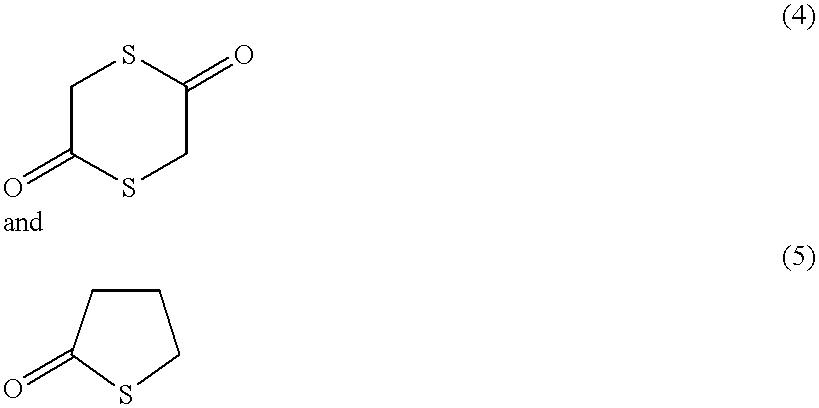
In a very important aspect of the invention, the thiol containing compounds are thioglycolic acid and/or its esters and thiopropionic acid and/or its esters.
Amine Containing Compounds
Compounds having at least one amine group which are useful in the present invention include compounds having the following general structure
wherein R1 may contain additional primary or secondary amine groups and is selected from the group consisting of polyoxalkylene, alkyl, alkyl having additional amine groups, alkenyl, alkenyl having additional amine groups, aromatic, cycloakane, cycloalkene, cyclic compounds which include R1 as part of the ring, and mixtures thereof, and R5 is selected from the group consisting of alkyl, alkyl having additional amine groups, alkenyl, alkenyl having additional amine groups, aromatic, cycloaliphatic, hydrogen, and mixtures thereof.
In an important aspect of the invention, the amine group need not exclusively be a primary amine, as the amine containing compound may include additional amine groups. An example of a secondary amine such as a R1R5NH compound useful in the present invention may include the following. 
In a very important aspect of the invention, the amine containing compound is any polyoxyalkylene amine of the Jeffamine® “D” and “T” series.
Preparation of Thiolamide Curing Agents
In another important aspect, the present invention provides a method for preparing thiol functional amide curing agents. The general reaction for the preparation of thiol functional amide curing agents is as follows. 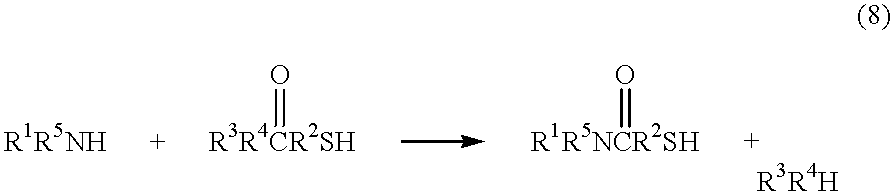
wherein R1, R2, R3, R4 and R5 are as defined above.
Some exemplary reactions of amine and thiol containing compounds are as follows 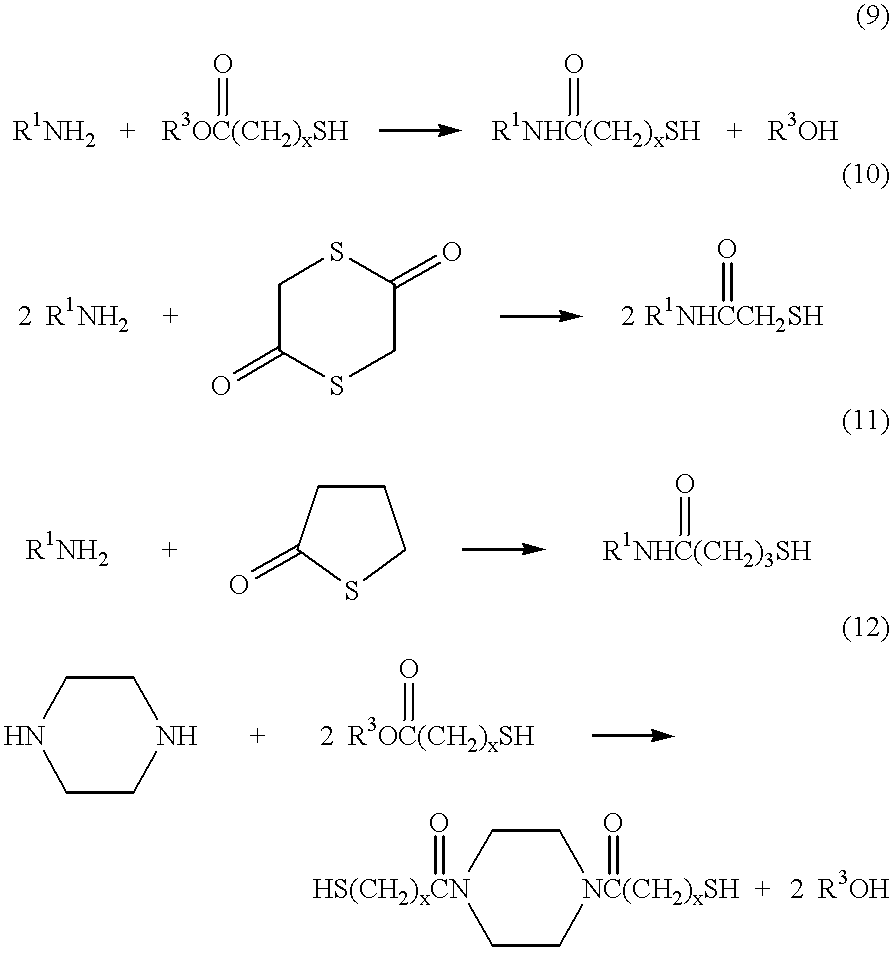
Where R6is a methylene, ethylene, propylene or other alkylene, aromatic, or cycloaliphatic radicle.
The formation of the thiolamide compounds may be aided by the use of catalysts and suitable conditions. The suitable catalysts are acids and titanium compounds. Some desulfurization (—H2S) of the thiol precursors at high temperatures is promoted by acids, so titanate based catalysis is preferred. Tetraalkoxy titatanates of the formula Ti(OR)4, where R is an alkyl group of 1-10 carbon atoms are preferred. Titanium chelates can also be used. Most preferred embodiments are marketed by Dupont under the Tyzor trademark. When the thiol containing compound is a thiol acid, it is best to add the titanium catalyst late in the reaction, preferably after ⅔ of the theoretical amount of water has been evolved. The catalyst may be attached to a solid support to carry out a continuous production process.
Unless activated esters (such as phenyl esters, thiol esters, etc.) are used, thioglycolic or thiopropionic acids are the preferred thiol containing compounds. This is due to the fact that aminolysis of simple esters proceeds well only at very high temperature (>180° C.) and that desulfurization (—H2S) of the thiol becomes a competing reaction at this high temperature, at least with the Jeffamine® series of amines. Amines which are more reactive, such as piperidines, piperazines, primary amines should experience less difficulty reacting with a thiol containing ester. Diesters, such as ethylene glycol dimercapto acetate, display enhanced reactivity. The presece of the hydroxyl functional group (from partial aminolysis) or a cyclic transition state may contribute to the enhanced reactivity. Reactions using ethylene glycol diesters are conveniently carried out at reduced pressure to remove the ethylene glycol as formed.
Desulfurization of the reaction is minimized by minimizing the time-temperature profile that the reagents are exposed to during preparation of the curing agent. Because the reaction is difficult to catalyze, minimizing the time-temperature profile is most conveniently accomplished via an excess of one of the reagents and removal of byproducts to bring the reaction to completion.
Purity of the thiolamide curing agent is important if one desires to build high molecular weight polymer compositions especially if long linear chains are desired. The presence of unreacted thiol acids in the thiolamide curing agent is undesirable because it combines with the basic amine catalyst used for curing the epoxy compositions. It also prematurely terminates the polymer chain. The thiolamide curing agent of the invention preferably has a purity of at least about 90% thiolamide as determined by percentage of conversion. In an important aspect of the invention, the most convenient route to the purest product having the least amount of thiol acid in the thiolamide product was obtained by reacting stochiometric amounts of the reagents in the presence of a catalyst. However, this reaction proceeded slowly taking about 9 hours.
In an important aspect of the invention, reactions can be driven to completion by using an excess of one of the reagents. Specifically, product is obtained by reacting the amine with an excess of thiol acid, and a minimum of catalyst. The product obtained included unreacted thiol acid and suspected thiolesters byproduct. It is suspected that with equivalent catalysts reaction with an excess of acid will proceed more rapidly than with stochiometric quantities. Thin film stripping under high vacuum can be used to remove unreacted thiol acid. This approach minimizes the time-temperature profile of the product and concomitant degradation via loss of H2S.
Curing of Epoxy Resins
In an important aspect of the invention, the thiolamide curing agent of the present invention may be used in connection with epoxy resins. Epoxy resin is a generic term used to refer to monomers with at least one epoxy group. In the present context, epoxy resin refers to monomers with at least two groups that can participate in polymerization and at least one of which is an epoxy group.
Some commonly used epoxy resins include epoxies prepared by the reaction of epichlorohydrin with bisphenol A, or with hydrogenated bisphenol A, or with bisphenol F, or with Novolac phenolic resins, or with polyols such as glycerol, sorbitol, polyethylene or polypropylene glycol.
As an example the structure of polyethylene glycol diglycidyl ether is shown below. 
In addition, Shell EPON HPT 1076 and Ciba Araldite MY 0510 are examples of trifunctional epoxy resins.
The reaction of thiols with epoxies is very slow unless promoted by bases. Some useful bases include triethylamine, pyridines, tris(dimethylamino) phenol, diazabicyclo-octane, diazabicylononane, diazabicycloundecene (DBU). Often a weakly acidic substance such as a phenol or carboxylic acid can be used to extend pot life at room temperature. Upon heating, the weak acid dissociates and the base catalyzes the reaction of the thiol with the epoxy. In an important aspect, heating is conducted at about 60° C. to about 130° C. for about 1 to about 10 minutes.
Bi- or poly-functional thioglycolamides, prepared as described here, should preferably be stored under an inert atmosphere to minimize the risk of slow coupling and resultant increase in viscosity. Useful articles can be fabricated from thioglycolamides via the oxidative coupling reaction alone or in conjunction with other curing reactions, such as a mixed curing scheme with epoxy resin and an organic hydroperoxide comprising one side of a formulation and the thioglycolamide and an amine catalyst comprising the second half. The presence of hydrogen peroxide results in almost instantaneous coupling. More hindered organic peroxides and hydroperoxides may be used to get curing times from minutes to hours. However, this curing is due to the oxidative coupling of the thiols as opposed to coupling with the monomers/resin.
In making polysulfide rubbers, additionally, the monomers are mixed with an oxidizing agent such as MnO2, air and the curing agent. Further additions may be made by adjusting the pH or catalyst levels to influence the rate of oxidation.
An example of a reaction of a thiolamide group and an epoxy group is shown below 
wherein R7 is an alkylene, an aromatic or a cycloaliphatic.
In an important aspect of the invention, it is to be noted that not all of the amines have to be reacted to form amide linkages. Unreacted amino groups can also participate in the curing reactions because amine co-curing is compatible with the base-catalyzed reaction mechanism for the thiol and epoxide moieties, as is discussed below.
The new curing agent so obtained cures through the thiol functional groups in the presence of a base. The degree of cross-linking can be increased by utilizing epoxy polymers with relatively more epoxide functional groups or utilizing thiolglycolamides of higher functionality. One may also leave some of the amino groups on the amine containing compound unconverted to thioglycolamides or use additional stochiometric crosslinking agents (e.g. triethylene tetramine), catalytic crosslinking agents (e.g. methylimidizole) or any combination of the above.
Curing agents based on thiopropionic acid and longer chain derivatives display enhanced thermal and hydrolytic stability compared to the corresponding thioglycolic acid derivatives. Thiopropionamides display enhanced high temperature stability because the driving force leading to a type of “back biting” chain scission is less. Thermodynamically, self-hydrolysis to a 7 membered ring is less favored than that to a 6 membered ring.
A thioglycolamide-cured resin self-hydrolyzes as follows: 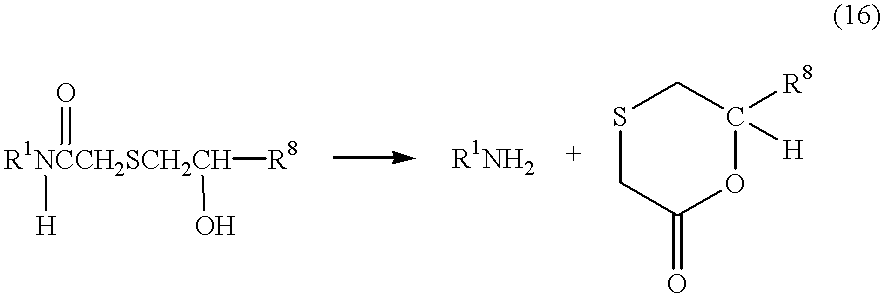
Wherein R8 is an alkylene, aromatic or a cycloaliphatic.
Because of the great stability of the amide bond self-hydrolysis is ordinarily not a problem. The greater stability of the thiopropionamides only becomes apparent during long term performance testing at elevated temperatures (>1000 hours @ 125° C. or greater).
Curing Resins Containing Unsaturated Bonds
Thiol-curing agent can be used to polymerize and crosslink monomers with unsaturated bonds as well. Examples of such resins are acrylate-containing monomers. Additionally, monomers may have dual functionality, for instance with acrylic and epoxy moieties. An example of such a monomer is glycidyl methacrylate. When used with such monomers, the thiol groups can form linkages with both the epoxide and the unsaturated bonds available on the monomers, and possibly at different rates. The advantage of such a curing scheme can be in the control of the viscosity and flow properties at different times of the polymer as it cures.
The reaction of thiol-curing agents and unsaturated compounds with electron withdrawing groups, such as acrylates and methacrylates, can be extremely rapid (seconds) in the presence of a strong base. Acrylates cure many times faster than methacrylates, sometimes uncontrollably so. The reactions with ordinary olefins are much slower, but may still find use in curing rubber articles especially when combined with accelerators, catalysts, and free radical sources well known in the art. Similarly, the presence of amines can result in the reaction of the amines with the epoxide rings in addition to catalyzing the reaction with the thiol moiety. The product formed by polyfunctional curing agents and monomers can be a highly crosslinked insoluble mass.
The reaction of a curing agent with a thiolamide group and an unsaturated monomer is shown below 
where R9 is selected from the group consisting of hydrogen, alkyl, alkenyl, aromatic and cycloaromatic groups.
The following examples illustrate methods for carrying out the invention and should be understood to be illustrative of, but not limiting upon, the scope of the invention which is defined in the appended claims.
Catalyst is made from a mixture of 1 mole Tyzor TBT (Titanium tetra butoxide) and 1 mole of anhydrous methane sulfonic acid, diluted to 44% by wt. in toluene. A 2 liter 3-neck flask is charged with 800 g Jeffamine T-3000 (now called Huntsman XTJ-509), 80 g of 3-mercaptopropionic acid and 150 ml. toluene. 1 neck is fitted with a Dean-Stark trap, one neck is fitted with a septum inlet, and the third neck is fitted with a nitrogen inlet. The flask is swept with nitrogen and the nitrogen is turned off. The flask is heated until approximately 9 ml of water has been collected in the Dean-Stark trap (˜2-3 hrs). 1 ml of the preprepared TBT/MSA catalyst is added with a syringe through the septum inlet. Refluxing is continued until 13.4 ml of water has been collected (98% of theory), which takes an additional 5-6 hours. The resulting material was stripped of volatiles in-situ using a mechanical vacuum pump and a liquid nitrogen cooled vacuum trap. The material was allowed to cool and stored under nitrogen. 25 gms of the above resin, 3.5 g of Bis-F epoxy, and 0.5 g of Diazabicycloundecene sets to a gel within 10 minutes.
Of Jeffamine D-400, 208 g, 1.01 M of thiopropionic acid and 0.1 g of ethylbenzene sulfonic acid are heated under Dean-Stark conditions in toluene until the theoretical amount of water is collected. The product is vacuum stripped and stored under nitrogen.
Of bis-thiopropionamide of Jeffamine D-400, 236 g. are rapidly combined with a preformed mixture of 80 g of hexane diol dimethacrylate, 20 g trimethylolpropane trimethacrylate, 4 g DBU (diazabicycloundecene), 1 g Cab-O-Sil EH-5 fumed silica, and 1 g of hindered phenolic antioxidant/polymerization inhibitor. A relatively large amount of trifunctional crosslinker was used to compensate for the lack of purity in the difunctional compound, which leads to early chain termination. The product rapidly cures to a tough, rubbery, adherent polymer.
Bis F epoxy resin (eew 170—174) is mixed with sufficient polypropylene glycol (425) dimercapto propionate to result in a net epoxide equivalent weight of 600. This unreacted mixture is loaded into the “1” side of a 1:2 ratio mixpack dual-syringe disposable dispenser. The thiopropionamide of Jeffamine T-3000 is mixed with 1% by wt. of aminoethylamino propyltrimethoxy silane and 3% by wt. of DBU. This is placed in the “2” side of the 1:2 ratio mixpack.
The mixpack is fitted with a 48 element static mixer and the product dispensed into a Teflon dogbone mold maintained at 80° C., using the handgun supplied with the mixpack. The mixture gels within 4 minutes. After cooling and demolding 15 minutes later the cured elastomer exhibits greater than 100% elongation. It exhibts excellent adhesion in a cohesive failure test when cured on unprimed aluminum.
One-half amine equivalents of Jeffamine T-3000 (approximately 500 g), 1 mole of mercaptopropionic acid (106 g) and 150 ml of toluene were charged into a stirred 2l flask and refluxed with the aid of a Dean-Stark separator until the theoretical amount of water carried over (about 8 hrs). Of titanate catalyst 100-500 mg was added.
The product of this reaction was subjected to thin film stripping under vacuum (0.5 mm Hg range) with the aid of a falling film still to remove gross amounts of low-boiling material in-situ. Removal of 18.8 grams of mercaptopropionic acid was accomplished. Of mercaptopropionic thiolamide resin, 555.6 g remained which is more than the theoretical amount. The resin had a pH of 3 indicating that the acid was still present in the resin. I.R. spectroscopy indicated the presence of undesirable thiol acid by a peak at ˜1734 cm−1 substantially above base line. Visual inspection indicated that the product is lighter in color (revealing less degradation of the product). Restripping decreased the peak further.
This description is intended to disclose the modes for practicing the invention without limiting the scope of the invention to only the expressly disclosed modes. Permutations that would be apparent to one skilled in the art are included within the scope of the claimed invention.
Claims (6)
1. A method for curing an epoxide with a thiol functional amide curing agent, the method comprising:
mixing a thiol functional amide curing agent composed essentially of thioglycolamide, thiopropionamide, or a mixture thereof with an epoxide and a basic catalyst to produce a reaction mixture; and
heating the reaction mixture to a temperature in the range of about 20 degrees C. to about 130 degrees C.
2. A method according to claim 1 wherein the thiol functional amide curing agent is the reaction product of mercaptoglycolic acid and polyoxyalkalene amide.
3. A method according to claim 1 wherein the thiol functional amide curing agent is composed essentially of the reaction product of mercaptopropionic acid and polyoxyalkalene amide.
4. A method according to claim 1 wherein the reaction mixture is heated to the temperature for about 1 to about 10 minutes.
5. The method according to claim 1 wherein the epoxide is composed essentially of bisphenol F epoxy.
6. The method according to claim 1 wherein the basic catalyst is composed essentially of diazabicyclooctane, diazabicyclononane, diazabicycloundecene or a mixture thereof.
Priority Applications (1)
| Application Number | Priority Date | Filing Date | Title |
|---|---|---|---|
| US09/206,821 US6265519B1 (en) | 1998-12-08 | 1998-12-08 | Thiolamide curing agents |
Applications Claiming Priority (1)
| Application Number | Priority Date | Filing Date | Title |
|---|---|---|---|
| US09/206,821 US6265519B1 (en) | 1998-12-08 | 1998-12-08 | Thiolamide curing agents |
Publications (1)
| Publication Number | Publication Date |
|---|---|
| US6265519B1 true US6265519B1 (en) | 2001-07-24 |
Family
ID=22768123
Family Applications (1)
| Application Number | Title | Priority Date | Filing Date |
|---|---|---|---|
| US09/206,821 Expired - Fee Related US6265519B1 (en) | 1998-12-08 | 1998-12-08 | Thiolamide curing agents |
Country Status (1)
| Country | Link |
|---|---|
| US (1) | US6265519B1 (en) |
Cited By (3)
| Publication number | Priority date | Publication date | Assignee | Title |
|---|---|---|---|---|
| US11873381B2 (en) | 2018-02-19 | 2024-01-16 | Arkema Inc. | Accelerated peroxide-cured resin compositions having extended open times |
| CN119286354A (en) * | 2024-11-13 | 2025-01-10 | 廊坊市泰铭金属涂装材料有限公司 | A low temperature curing powder coating and preparation method thereof |
| WO2025047453A1 (en) * | 2023-09-01 | 2025-03-06 | 三井化学株式会社 | Polymerizable composition, resin, molded article, optical material, and lens |
Citations (11)
| Publication number | Priority date | Publication date | Assignee | Title |
|---|---|---|---|---|
| CA568993A (en) * | 1959-01-13 | B. Howard John | Catalysts for the reaction of polyepoxy compounds with organic polysulfides | |
| US3492269A (en) | 1964-03-26 | 1970-01-27 | Dynamit Nobel Ag | Epoxy resin hardening process using inorganic metal salt accelerators |
| US4696992A (en) | 1986-11-17 | 1987-09-29 | Ashland Oil, Inc. | Thiol carbamates as latent accelerators for curing epoxy resins |
| US4894431A (en) | 1988-05-23 | 1990-01-16 | Ciba-Geigy Corporation | Accelerated curing systems for epoxy resins |
| US5214098A (en) | 1989-11-21 | 1993-05-25 | Ciba-Geigy Corporation | Hardenable epoxide resin mixtures containing a latent hardener, an amine and a thiol |
| US5310826A (en) | 1989-04-26 | 1994-05-10 | Akzo N.V. | Thiolic compound polymerization cocatalysts |
| US5688877A (en) | 1993-12-24 | 1997-11-18 | The Dow Chemical Company | Kinetically controlled in-situ generation of catalytic species for the curing of epoxy/amine compositions |
| US5703138A (en) | 1994-01-12 | 1997-12-30 | Dymax Corporation | Oxygen-curable coating composition |
| US5712321A (en) | 1996-02-01 | 1998-01-27 | Dymax Corporation | Dual-curing coating formulation and method |
| US5747599A (en) | 1994-12-12 | 1998-05-05 | Kansai Paint Company, Limited | Thermosetting coating composition |
| US5753722A (en) | 1995-12-13 | 1998-05-19 | Taiyo Ink Manufacturing Co., Ltd. | Photocurable and thermosetting matte liquid resist composition |
-
1998
- 1998-12-08 US US09/206,821 patent/US6265519B1/en not_active Expired - Fee Related
Patent Citations (11)
| Publication number | Priority date | Publication date | Assignee | Title |
|---|---|---|---|---|
| CA568993A (en) * | 1959-01-13 | B. Howard John | Catalysts for the reaction of polyepoxy compounds with organic polysulfides | |
| US3492269A (en) | 1964-03-26 | 1970-01-27 | Dynamit Nobel Ag | Epoxy resin hardening process using inorganic metal salt accelerators |
| US4696992A (en) | 1986-11-17 | 1987-09-29 | Ashland Oil, Inc. | Thiol carbamates as latent accelerators for curing epoxy resins |
| US4894431A (en) | 1988-05-23 | 1990-01-16 | Ciba-Geigy Corporation | Accelerated curing systems for epoxy resins |
| US5310826A (en) | 1989-04-26 | 1994-05-10 | Akzo N.V. | Thiolic compound polymerization cocatalysts |
| US5214098A (en) | 1989-11-21 | 1993-05-25 | Ciba-Geigy Corporation | Hardenable epoxide resin mixtures containing a latent hardener, an amine and a thiol |
| US5688877A (en) | 1993-12-24 | 1997-11-18 | The Dow Chemical Company | Kinetically controlled in-situ generation of catalytic species for the curing of epoxy/amine compositions |
| US5703138A (en) | 1994-01-12 | 1997-12-30 | Dymax Corporation | Oxygen-curable coating composition |
| US5747599A (en) | 1994-12-12 | 1998-05-05 | Kansai Paint Company, Limited | Thermosetting coating composition |
| US5753722A (en) | 1995-12-13 | 1998-05-19 | Taiyo Ink Manufacturing Co., Ltd. | Photocurable and thermosetting matte liquid resist composition |
| US5712321A (en) | 1996-02-01 | 1998-01-27 | Dymax Corporation | Dual-curing coating formulation and method |
Cited By (4)
| Publication number | Priority date | Publication date | Assignee | Title |
|---|---|---|---|---|
| US11873381B2 (en) | 2018-02-19 | 2024-01-16 | Arkema Inc. | Accelerated peroxide-cured resin compositions having extended open times |
| WO2025047453A1 (en) * | 2023-09-01 | 2025-03-06 | 三井化学株式会社 | Polymerizable composition, resin, molded article, optical material, and lens |
| CN119286354A (en) * | 2024-11-13 | 2025-01-10 | 廊坊市泰铭金属涂装材料有限公司 | A low temperature curing powder coating and preparation method thereof |
| CN119286354B (en) * | 2024-11-13 | 2025-09-12 | 廊坊市泰铭金属涂装材料有限公司 | Low-temperature curing powder coating and preparation method thereof |
Similar Documents
| Publication | Publication Date | Title |
|---|---|---|
| EP3347406B1 (en) | Polymerizable compositions, polymerized compositions, and methods of making and using the same | |
| JP5790155B2 (en) | Curable resin composition | |
| KR101521044B1 (en) | Curable resin composition | |
| JP5772235B2 (en) | Curable resin composition | |
| WO1998031722A1 (en) | One-pack cold moisture curable resin compositions | |
| JP5772231B2 (en) | Curable resin composition | |
| JP6095016B2 (en) | Two-component epoxy adhesive with adjustable gel time | |
| WO2000040654A1 (en) | Curable resin composition | |
| JPH08269203A (en) | Thiol-group-containing polyether polymer and its production | |
| EP0257435A2 (en) | Novel boron trifluoride-poly(alkylene oxide) amine catalysts for curing epoxy resins | |
| EP0238058A2 (en) | Sag resistant two-component epoxy structural adhesive | |
| JPH0778110B2 (en) | One-component flexible epoxy resin composition | |
| JP5264105B2 (en) | Curable resin composition | |
| EP0054379A1 (en) | Liquid polythioethers | |
| JP2002309077A (en) | Two-part curable composition | |
| US6265519B1 (en) | Thiolamide curing agents | |
| EP0547905A1 (en) | Polysulfide-modified epoxy resins | |
| JP3892270B2 (en) | One-part moisture-curing flexible resin composition | |
| JP3973266B2 (en) | Moisture curable one-part epoxy resin adhesive composition | |
| JP4812245B2 (en) | Moisture curable one-component resin composition and method for producing the same | |
| JP2008285538A (en) | Curable resin composition and adhesive composition using the same | |
| JP2022101570A (en) | Urea-terminated butadiene polymer and butadiene acrylonitrile copolymer | |
| JP6811938B2 (en) | Thioether-containing isocyanate and curable resin composition | |
| JP4027755B2 (en) | Curable resin composition | |
| JPH0790168A (en) | Curable composition |
Legal Events
| Date | Code | Title | Description |
|---|---|---|---|
| AS | Assignment |
Owner name: MOLEX INCORPORATED, ILLINOIS Free format text: ASSIGNMENT OF ASSIGNORS INTEREST;ASSIGNOR:KREBAUM, PAUL;REEL/FRAME:009636/0201 Effective date: 19981208 |
|
| FPAY | Fee payment |
Year of fee payment: 4 |
|
| REMI | Maintenance fee reminder mailed | ||
| LAPS | Lapse for failure to pay maintenance fees | ||
| STCH | Information on status: patent discontinuation |
Free format text: PATENT EXPIRED DUE TO NONPAYMENT OF MAINTENANCE FEES UNDER 37 CFR 1.362 |
|
| FP | Lapsed due to failure to pay maintenance fee |
Effective date: 20090724 |