US6254852B1 - Porous inorganic targeted ultrasound contrast agents - Google Patents
Porous inorganic targeted ultrasound contrast agents Download PDFInfo
- Publication number
- US6254852B1 US6254852B1 US09/356,178 US35617899A US6254852B1 US 6254852 B1 US6254852 B1 US 6254852B1 US 35617899 A US35617899 A US 35617899A US 6254852 B1 US6254852 B1 US 6254852B1
- Authority
- US
- United States
- Prior art keywords
- contrast agent
- agent according
- inorganic material
- particles
- porous
- Prior art date
- Legal status (The legal status is an assumption and is not a legal conclusion. Google has not performed a legal analysis and makes no representation as to the accuracy of the status listed.)
- Expired - Fee Related
Links
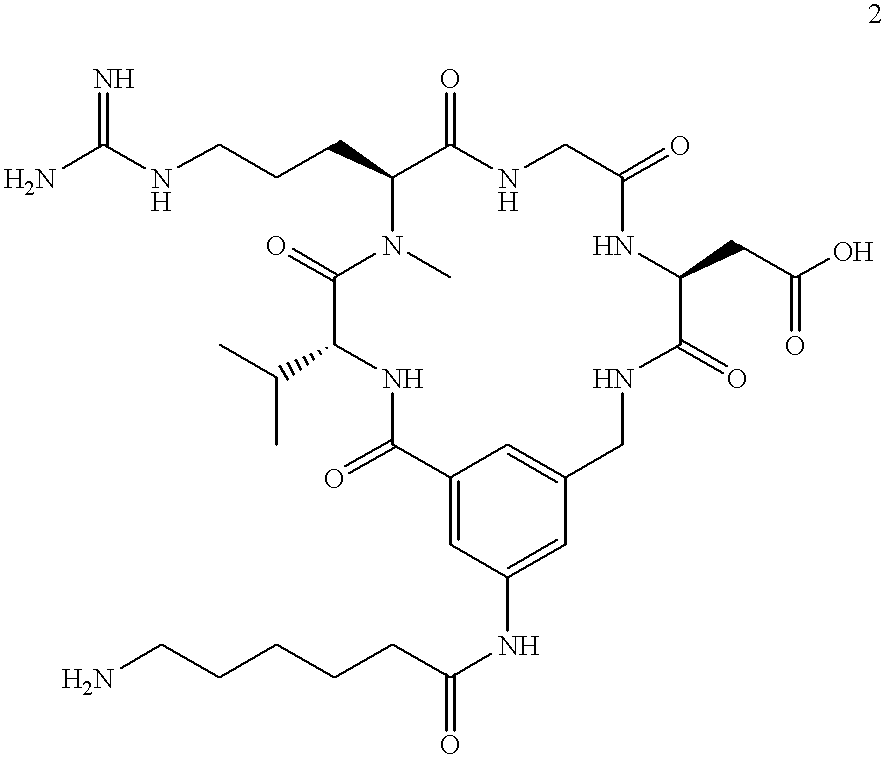
- JVBMRJFKTRWIIF-VMODYCNZSA-N CC(C)[C@H]1NC(=O)C2=CC(NC(=O)CCCCCN)=CC(=C2)CNC(=O)[C@H](CC(=O)O)NC(=O)CNC(=O)[C@H](CCCNC(=N)N)N(C)C1=O Chemical compound CC(C)[C@H]1NC(=O)C2=CC(NC(=O)CCCCCN)=CC(=C2)CNC(=O)[C@H](CC(=O)O)NC(=O)CNC(=O)[C@H](CCCNC(=N)N)N(C)C1=O JVBMRJFKTRWIIF-VMODYCNZSA-N 0.000 description 1
- HDEHVSALVSTKQV-UHFFFAOYSA-N CCCC1=C(OCCCOC2=C(CC)C=C(C3=CC=C(F)C=C3)C(O)=C2)C=CC2=C1OC(C(=O)O)CC2 Chemical compound CCCC1=C(OCCCOC2=C(CC)C=C(C3=CC=C(F)C=C3)C(O)=C2)C=CC2=C1OC(C(=O)O)CC2 HDEHVSALVSTKQV-UHFFFAOYSA-N 0.000 description 1
Classifications
-
- A—HUMAN NECESSITIES
- A61—MEDICAL OR VETERINARY SCIENCE; HYGIENE
- A61K—PREPARATIONS FOR MEDICAL, DENTAL OR TOILETRY PURPOSES
- A61K49/00—Preparations for testing in vivo
- A61K49/22—Echographic preparations; Ultrasound imaging preparations ; Optoacoustic imaging preparations
- A61K49/222—Echographic preparations; Ultrasound imaging preparations ; Optoacoustic imaging preparations characterised by a special physical form, e.g. emulsions, liposomes
- A61K49/225—Microparticles, microcapsules
Definitions
- the invention relates generally to targeted ultrasound contrast agents having porous particles of an inorganic material containing an entrapped gas or liquid and having an average particle diameter of about 0.05 to 500 microns.
- the outer surfaces of the particles incorporate a targeting ligand to target delivery of the contrast agent.
- An ultrasonic scanner is placed on the body surface overlying the area to be imaged.
- the sound waves generated by the scanner are directed toward the area to be imaged.
- the scanner detects sound waves reflected from the underlying area and translates the signal into images.
- the acoustic properties of a substance will depend upon the velocity of the ultrasonic transmissions and the density of the substance. Changes in the substance's acoustic properties will be most prominent at the interface of components of the substance differing in density, such as solid, liquid, and gas components.
- the changes in acoustic properties (e.g., density) of the substance cause changes in the reflection characteristics, resulting in a more intense sound reflection signal received by the ultrasonic scanner.
- Ultrasound contrast agents are introduced into the body organ system being imaged using ultrasound, and there act to influence the ultrasound signal in a way that enhances the ultrasound image.
- the contrast agent may be ingested or injected into and perfuse the microvasculature of the tissue desired to be imaged, to provide clearer images of the tissue.
- Such ultrasound contrast agents may be useful in helping to diagnose diseases earlier and more accurately.
- Liquid and solid contrast agents containing entrapped gas are known in the art.
- the microbubbles provided by these contrast agents act as sound wave reflectors because of the acoustic differences between the gas microbubble and surrounding liquid.
- Feinstein U.S. Pat. No. 4,572,203, describes “microbubbles” of about 6-20 microns diameter produced by sonication of certain viscous solutions, as ultrasound contrast agents.
- Feinstein also describes solid or semi-solid metal-containing microparticles, such as glass or graphite, not containing trapped air, small enough to pass through capillaries, as ultrasound contrast agents.
- Hilmann et al. European Patent Application Publication Number 122,624, contains microparticles comprised of a solid surface-active substance, including various organic lipophilic compounds, with enclosed air, as ultrasound contrast agents. Also described is the combination of particles of the surface-active material and particles of a non-surface active material, such as sodium chloride, sodium citrate, sodium acetate, sodium tartrate, and various saccharides.
- Glajch et al U.S. Pat. No. 5,147,631, discloses porous particles of an inorganic material containing an entrapped gas or liquid.
- the materials disclosed include monomeric or polymeric borates, monomeric or polymeric aluminas, monomeric or polymeric carbonates, monomeric or polymeric silicas, monomeric or polymeric phosphates; and pharmaceutically acceptable organic or inorganic cationic salts thereof.
- contrast agents described above are proposed for general ultrasound contrast imaging of the vasculature and especially for heart imaging.
- imaging of specific organs, systems, or other areas of the body would be useful for a variety of diagnosing specific disease states. Examples of this include the specific imaging or tumors, blood clots, and areas of infection in a directed manner.
- Quay, et al., European Patent Application Number 96630007.1 illustrates the use of compositions including a cell adhesion molecule (CAM) ligand which is incorporated into a desired molecule to form a conjugate.
- CAM cell adhesion molecule
- the CAM is incoporated in a surfactant or albumin carrier and also comprises a chemical with sufficiently high vapor pressure to be a gas at body temperature.
- the present invention relates to targeted ultrasound contrast agents comprising inorganic porous particles useful for ultrasound imaging and a targeting ligand that directs the particles to a body organ or disease site.
- Such contrast agents may be an important adjunct in ultrasound diagnostic procedures, for example, for cardiovascular, oncologic, and gastrointestinal uses.
- the inorganic porous particles of the invention provide contrast for ultrasound imaging; i.e., the particles act to reflect ultrasound waves and thereby enhance the ultrasound signal when introduced into the organ system being imaged using ultrasound.
- the present invention provides novel targeted ultrasound contrast agents, comprising: a pharmaceutically acceptable carrier and porous particles of an inorganic material having an average particle diameter of about 0.05 to 500 microns and containing entrapped gas or liquid, and containing, on the outside surface of the particle, a targeting ligand to target delivery of the contrast agent.
- a pharmaceutically acceptable carrier and porous particles of an inorganic material having an average particle diameter of about 0.05 to 500 microns and containing entrapped gas or liquid, and containing, on the outside surface of the particle, a targeting ligand to target delivery of the contrast agent.
- the entrapped gas or liquid provides a suitable echogenic interface to enhance an ultrasound image.
- the targeting ligand is attached to the porous inorganic particles by coating, adsorbing, layering, or reacting the outside surface of the particle with the targeting ligand.
- Representative targeting ligands include RGD-containing peptides, other compounds that bind to members of the integrin, selectin, and IgG receptor superfamilies as well as cell surface substances which cause white blood cells to move towards sites of infection/inflammation, i.e., fMLF and leukotriene receptors (LTA, B, C, D 4 ).
- porous inorganic particles of the invention may be coated with a variety of organic polymeric and lipid materials to control the stability, pharmacokinetics, targeting, and biological effects of the particles in vivo.
- porous inorganic particles of the invention are administered parentally or nonparentally with a pharmaceutically acceptable carrier to a person, to thereby enhance the ultrasound image of a tissue or organ system of that person.
- the present invention provides a novel targeted ultrasound contrast agent, comprising: a pharmaceutically acceptable carrier and a particle of the formula:
- P is a porous particle of an inorganic material having an average particle diameter of about 0.05 to 500 microns and containing an entrapped gas or liquid,
- L is absent or is a linker
- T is a targeting ligand.
- the inorganic material is selected from borates, aluminas, carbonates, silicates, silicas, aluminosilicates, and phosphates, and organic or inorganic cationic salts thereof, and monomeric and polymeric forms, and mixtures of monomeric and polymeric forms thereof.
- the inorganic material is in a form selected from crystalline, amorphous, or a mixture of crystalline and amorphous.
- T binds to a target selected from a cytokine, selectin, integrin, immunoglobin superfamily, and cadherin.
- T binds to a target selected from a GpIIb/IIIa receptor, fibrin, fibrinogen, thrombin, vitronectin, epithelial growth factor, vascular endothelial growth factor, platelet derived growth factor, and LTB 4 receptors.
- T binds to a target selected from a GpIIb/IIIa receptor, vitronectin, and LTB 4 receptors.
- L is a silane
- L is a silane of the formula:
- n 0, 1, 2, or 3
- n 0 or 1
- R 1 is selected from CH 3 , CH 2 CH 3 , CH(CH 3 ) 2 , and CH 2 CH 2 CH 3 ,
- R 2 is selected from CH 3 , CH 2 CH 3 , CH(CH 3 ) 2 , CH 2 CH 2 CH 3 , cyclopropyl, cyclobutyl, cyclopentyl, and cyclohexyl,
- R 3 is selected from CH 3 , CH 2 CH 3 , CH(CH 3 ) 2 , CH 2 CH 2 CH 3 , cyclopropyl, cyclobutyl, cyclopentyl, and cyclohexyl,
- R 4 is selected from the group C 1-6 alkyl substituted with 1-2 R 5 , C 2-6 alkenyl substituted with 1-2 R 5 , phenyl substituted with 1 R 5 , C 3-6 cycloalkyl substituted with 1-2 R 5 , and glycidyl, and
- R 5 at each occurrence, is OH or NH 2 .
- L, prior to conjugation with P and T is selected from (3-aminopropyl)dimethylethoxysilane and (3-glycidoxypropyl)dimethylethoxysilane.
- the entrapped gas is selected from the group consisting of air, O 2 , N 2 , H 2 , CO 2 , He, Ne, Ar, CF 4 , C 2 F 6 , C 3 F 8 , cyclo-C 4 F 8 , C 4 F 10 , C 5 F 12 , cyclo-C 5 F 10 , cyclo-C 4 F 7 (1-trifluoromethyl), propane (2-trifluoromethyl)-1,1,1,3,3,3 hexafluoro, and butane (2-trifluoromethyl)-1,1,1,3,3,4,4,4 nonafluoro.
- the average particle diameter is 0.05 to 10 microns.
- the porous particles have a single pore which is entirely or partially enclosed by a shell of the inorganic material.
- the shell thickness is 1-45% of the average particle diameter.
- the porous particles have a plurality of pores which are entirely or partially enclosed by the inorganic material.
- porous particles of inorganic material have a density of less than about 90% of the density of the inorganic material in a solid non-porous state.
- the porous particles of inorganic material have a density of less than about 60% of the density of the inorganic material in a solid non-porous state.
- porous particles of inorganic material have a density of 0.2% to 50% of the density of the inorganic material in a solid non-porous state.
- porous particles of inorganic material are substantially spherical in shape.
- the inorganic material is selected from the group consisting of SiO 2 , aluminum oxides, aluminum hydroxides, alkali salts of aluminosilicates, and H 3 BO 3 .
- porous particles of inorganic material are coated with an organic material.
- the organic material is selected from the group consisting of ethylcellulose, hydroxpropylcellulose, methylcellulose, hydroxypropylmethylcellulose, polyvinylpyrrolidine, polyethylene, glycol, albumin, gelatin, starch, collagen, dextran, modified dextrans, polylactide/polyglycolide, polyalkylcyanoacrylates, polyacrylamide, cholesterol, phosphatidylcholine, phosphatidylinositol, polysorbates, polyethlyene ethers, polyethylene esters, and polyoxyethylene/polyoxypropylene block polymers.
- the inorganic material is comprised of monomeric or polymeric forms, or a mixture of monomeric and polymeric forms, of phosphate.
- the inorganic material comprises monomeric or polymeric forms, or a mixture of monomeric and polymeric forms, of one or more alkali cation phosphate salts.
- the alkali cations are sodium, potassium, or calcium.
- the present invention provides a novel method of ultrasound imaging in a mammal, comprising: introducing to the mammal an amount of a targeted ultrasound contrast agent of the present invention effective to alter the ultrasound echogenicity of the target to be imaged.
- the inorganic material useful in the present invention may exist in an amorphous or glass state or in a crystalline state or in a mixture of amorphous and crystalline forms.
- the inorganic material useful in this invention includes borates, aluminas, carbonates, bicarbonates, silicas, silicates, aluminosilicates, and phosphates in the form of monomeric salts or as polymeric or condensed forms, or as mixtures of monomeric and polymeric forms. Particles comprising mixtures of these materials are also expected to be useful in the present invention.
- Inorganic materials useful in the present invention include, but are not limited to, SiO 2 , alkali salts of CO 3 2 ⁇ and HCO 3 ⁇ , alkali salts of HPO 4 2 ⁇ , aluminum oxides and hydroxides, such as Al 2 O 3 , alkali salts of aluminosilicates, and H 3 BO 3 .
- Phosphates include various monomeric and condensed or polymeric crystalline forms and various noncrystalline or amorphous forms (including glass forms), as outlined below in Scheme I (adapted from Kirk and Othmer, Encyclopedia of Chemical Technology) and as described in Van Wazer (1958) Phosphorus and Its Compounds, Volume 1, pp 419-770, Interscience Publishers, New York, a standard textbook in the field of phosphate chemistry.
- phosphates also includes derivatives of phosphates containing additional elements.
- nitrogen can be incorporated into phosphate glasses to form oxynitride glasses, as described by Reidmeyer et al. (1986) J. Non-crystalline Solids 85: 186-203, the teaching of which is incorporated herein by reference.
- Nitriding the phosphate starting glass is expected to decrease the dissolution rate of the solid in water and increase the chemical stability of the solid.
- the preparation of phosphorus oxynitride glass by melting sodium metaphosphate in anhydrous ammonia to produce glasses containing up to 12 wt % nitrogen is described by Reidmeyer et al.
- Porous particles of oxynitride glasses and crystalline solids useful in the present invention can be prepared using the methods, described below.
- Silicates and silicas includes any and all siliceous materials in the particulate form stated above.
- Typical silica material includes SiO 2 , silicate-containing minerals, and synthetic silicates such as silica gels, powders, porous glass and those prepared by hydrolysis of calcium silicide or sodium silicate.
- the preparation of porous silica particles is described in Bergna and Kirkland, U.S. Pat. No. 4,131,542, Kirkland, U.S. Pat. No. 3,782,075, and Kirkland, U.S. Pat. No. 3,505,785, the contents of which are incorporated herein by reference.
- the inorganic particles of the invention have the advantages of good mechanical stability and rigidity, which are important attributes lacking in other materials used as ultrasound contrast agents, such as sonicated albumin microspheres and perflurorocarbon emulsions.
- inorganic particles can be prepared and fabricated, using known techniques, into a variety of shapes, sizes, and extents of porosity, in order to obtain the most desirable contrast effects.
- inorganic porous particles can be prepared with a range of different solubilities in aqueous solution, such as a body fluid. The solubility of the inorganic porous particle may affect the rate of biodegradation and clearance of the agent in vivo and may, thereby, be an important property affecting the biological responses and toxicity associated with the ultrasound contrast agent.
- the inorganic porous particles useful in the present invention comprise an inorganic solid material that encloses or partially encloses one or more pores or cavities.
- the porous particles of the invention contain an entrapped gas or liquid to provide a suitable echogenic interface to enhance an ultrasound image.
- the pore or pores may be completely enclosed or encapsulated by the inorganic material or may be partially enclosed and open to the surface of the particle.
- the particles are porous or hollow and contain an entrapped or partially entrapped gas or liquid in the pore or pores.
- Porous inorganic particles useful in this invention include particles having a single pore enclosed by a solid shell; i.e., hollow particles. Alternatively, the porous particle may have a single pore which is partially enclosed by a solid shell.
- the porous particles of the invention also include particles containing a plurality of pores.
- the pores may be interconnected and may connect to an opening at the surface of the particle.
- the particles may also contain pores which are completely enclosed and are not interconnected or open to the surface of the particle. Particles with non-interconnected and completely enclosed pores are known as closed cell foam type particles.
- the inorganic particles useful in the present invention may range in size and shape or morphology.
- a variety of particle shapes are useful in the present invention.
- the particles may range from roughly spherical shapes to rod-like shapes and may be regular or irregular in shape.
- the particle size, measured as the average particle diameter should be in the range of about 0.01 microns to 1 millimeter.
- the term average particle diameter refers to the effective particle diameter or Stokes diameter of the particle.
- the particles are preferably about 0.2-10 microns in diameter.
- larger particles may be acceptable or preferred.
- the porous inorganic particle should preferably be about 0.2, 0.4, 0.6, 0.8, 1, 2, 3, 4, 5, 6, 7, 8, 9, or 10 microns in diameter and thereby small enough to pass through capillaries, which are about 8 to 10 microns in diameter, so as to perfuse the tissue.
- the porous inorganic particles of the invention should be small enough to permit their passage through capillaries without being filtered out and capable of perfusing the tissue and produce an enhanced ultrasound image that is of resolution sufficient to distinguish, for example, between well perfused and poorly perfused tissue for the detection and diagnosis of ischemia.
- the porous gas-containing inorganic particles of the invention should have a density that is less than about 90, 80, 70, or 60% of the density of the solid nonporous inorganic material, preferably less than 60% of the density of the solid nonporous inorganic material.
- the density of the gas-containing porous inorganic particles of the invention is preferably about 0.2, 0.4, 0.6, 0.8, 1, 5, 10, 20, 30, 40, or 50% of the density of the non-porous inorganic material.
- the pore diameter may vary depending on the size of the particle and the number of pores, to achieve the preferred particle density. Thus, the pore size may range from about 20 angstrom to 500 microns.
- the pore diameters may be about 20, 100, 200, 300, 500, 1000 or 2000 angstroms for porous particles having a plurality of pores.
- the thickness of the solid shell may vary.
- the shell thickness may be about 1-45% of the diameter of the particle.
- the pore size may correspondingly be about 0.2, 1, 10, 100, 200, 300, 400, or 500 microns.
- the porous inorganic particles typically have a specific surface area of about 1, 10, 50, 100, 200, 500, 1000, or 1500 m 2 /g. Because the porous inorganic particles of the present invention are modified on or near the outer surface the effective (i.e., derivatizable) surface area includes only the outer surface of the porous particle. Thus, it is only a small portion of the specific surface area of the porous particle. Typically, the effective surface area is less than 10 m 2 /g of porous particle.
- the porous inorganic particles of the invention may have a gas volume per gram of particle of greater than 0.05 mL/g, and preferably about 0.05, 0.1, 1, 5, 10, 20, 30, 40, or 50 mL/g.
- Porous inorganic particles of the invention useful as ultrasound contrast agents, may be prepared using standard methods for the preparation of porous particles.
- porous inorganic particles may be prepared using standard methods involving the spraying of a metal salt solution into a furnace at elevated temperatures, such as standard spray drying, evaporation decomposition, high temperature aerosol decomposition, or drop-generator procedures.
- the high temperature aerosol decomposition (HTAD) process is described by Moser and Lennhoff (1989) Chem. Eng. Comm. 83: 241-259, the teaching of which is incorporated herein by reference.
- This procedure involves the spraying of a metal salt solution into a tube furnace at elevated termperatures, resulting in solvent evaporation, salt decomposition, and metal oxide ceramic particle formation.
- the HTAD of Moser and Lennhoff may be used for the synthesis of metal oxide particles having a range of surface areas and a range of particle morphologies, from nearly perfect hollow spheres to fragmented particles.
- materials having the desired morphology (spheres or fragmented particles), high or low surface area, phase purity, compositional purity, pore size distribution, and aqueous solubility may be obtained.
- Hollow inorganic particles may also be prepared by the process of coating a template or core particle composed of a material, such as polystyrene latex, with the inorganic material to form a shell around the core particle, and then subsequently removing the template or core material. Removal of the core can be achieved, for example, by heating and calcination of the core material. In such a process, the inorganic particle size, pore size, and thickness of the inorganic shell can be controlled quite precisely.
- a process of preparing hollow spherical particles is described by Kawahashi and Matijevic (1990) J. of Colloid and Interface Science 143:103-110.
- the gas in the pore or pores of the porous inorganic particle may be a pure gas or mixture of gases, such as air.
- gases such as air.
- elemental gases such as O 2 , N 2 , H 2 , He, argon, and other noble gases
- other light gases such as CO 2 , CF 4 , or C 2 F 6 , C 3 F 8 , C 4 F 10 , and other fluorocarbon gases are expected to provide useful ultrasound contrast properties.
- the gases may be incorporated into the pores of the particles, for example, by exchange at high temperature and/or high pressure.
- the perfluorocarbon have less than six carbon atoms, e.g., CF 4 , C 2 F 6 , C 3 F 8 , cyclo-C 4 F 8 , C 4 F 10 , C 5 F 12 , cyclo-C 5 F 10 , cyclo-C 4 F 7 (1-trifluoromethyl), propane (2-trifluoromethyl)-1,1,1,3,3,3 hexafluoro, and butane (2-trifluoromethyl)-1,1,1,3,3,3,4,4,4 nonafluoro.
- the corresponding unsaturated versions of the above compounds for example C 2 F 4 , C 3 F 6 , the isomers of C 4 F 8 .
- halogenated versions of hydrocarbons where other halogens are used to replace F (e.g., Cl, Br, I) would also be useful, but may not be as desirable as the perfluorinated versions.
- mixtures of these gases especially mixtures of perfluorocarbons with other perfluorocarbons and mixtures of perfluorocarbons with other inert gases, such as air, N 2 , O 2 , He, would be useful.
- liquids with boiling points below 37° C. can also be used. Examples of these can be found in Quay, U.S. Pat. No. 5,595,723, the contents of which are herein incorporated by reference.
- the porous inorganic particles useful in the present invention may have a range of solubility in aqueous solution. Porous inorganic particles of any desired solubility can be obtained in several ways. The solubility can be controlled by selection of the desired particle surface area, the particle shell thickness, and/or the type of solid used in the particle.
- the inorganic particles may be comprised of a relatively insoluble solid, such as silicate materials, or may be relatively soluble in aqueous solution. For example, as discussed below, the solubility of phosphate materials can be controlled by the temperature and heating time used to prepare various amorphous or crystalline forms of phosphate material.
- the porous inorganic particles must have a sufficiently slow dissolution rate in aqueous solution so as to exist in vivo following administration for at least about 1-30 minutes to provide enough time for the imaging procedure to be performed.
- aqueous solution so as to exist in vivo following administration for at least about 1-30 minutes to provide enough time for the imaging procedure to be performed.
- Porous inorganic particles having slower dissolution rates (i.e., reduced solubility) or insoluble particles, such as silica or alumina particles, may be desired for other uses, such as gastrointestinal imaging applications.
- the porous inorganic particles of the present invention are modified on or near the outer surface of the particles to include a targeting ligand, i.e., a biologically active molecule or cell adhesion molecule.
- a targeting ligand i.e., a biologically active molecule or cell adhesion molecule.
- the biologically active molecule can be a protein, antibody, antibody fragment, peptide or polypeptide, or peptidomimetic that is comprised of a recognition sequence or unit for a receptor or binding site expressed at the site of the disease, or for a receptor or binding site expressed on platelets or leukocytes.
- the exact chemical composition of the biologically active molecule is selected based on the disease state to be diagnosed, the mechanism of localization to be utilized, and to provide an optimium combination of rates of localization and clearance.
- Targets to which the targeting ligand can be selected to bind to include a wide variety of molecules including cytokines, selectins, integrins, immunoglobulin (Ig) superfamily and cadhedrins.
- Cytokines are cellular regulatory proteins. They are produced by specific cells in response to a variety of stimuli and they can influence the behavior of target cells. They may act systemically or locally. Examples of cytokines include: Angiogenin, Epidermal growth factor, erythropoietin, Fibroblast Growth Factor (FGF), FGF basic, FGF-3, FGF-4, FGF-5, FGF-6, FGF-7, vascular endothelial growth factor (VEGF), platelet derived growth factor (PDGF), placental growth factor (PlGF), granulocyte-colony stimulating factor, granulocytemacrophage colony stimulating factor, GROa/MGSA, hepatocyte growth factor, heparin binding epidermal growth factor, interferon (IFN), IFNa/B, IFNd, insulin-like growth factor (IGF), IGF-I, IGF-II, interleukin (IL), IL-1a, IL-1b, IL-1ra, IL-2,
- Selectins immunoglobulin (Ig) superfamily, and cadhedrins are expressed on cell surfaces and are involved in cell adhesion. Selectins have been implicated in the initial interactions between leukocytes and vascular endothelia leading to lymphocyte homing, platelet binding, and neutrophil extravasation. Examples of selectins include E-selectins, L-selectins, and P-selectins. Examples of immunoglobulin superfamily: Intercellular Adhesion molecule (ICAM), ICAM-1, ICAM-2, ICAM-3, Vascular cell adhesion molecule (VCAM), VCAM-1, VCAM-1 (alt), platelet endothelial cell adhesion molecule and mucosal addressin cell adhesion molecule. Examples of cadhedrins include CD44-H-CAM/GP90-Hermes.
- Integrins are heterodimeric glycoprotein receptors consisting of a and b subunits that share a common b-subunit which combines non-covalently with an a-subunit to create functionally distinct receptors.
- One of their role is to integrate the ECM outside the cell with actin containing cytoskeleton inside the cell.
- Integrin receptors are involved in adhesion in thrombus formation and restenosis, growth, tumor cell recognition and metastasis of cancer cells, angiogenesis, autoimmune diseases, infection and inflammation. Thrombus formation is dependent on platelet aggregation. Platelet aggregation is in turn dependent on the binding of fibrinogen and other serum proteins to the integrin glycoprotein receptor IIb/IIa located on the platelet plasma membranes.
- integrins examples include the VLA family: VLA-11, VLA-2, VLA-3, VLA-4, VLA-5, VLA-6, bla7, bla8, Blav; the LEUCAM family; LFA-1 Mac-1 and p150.95; and the cytoadhesion family: CD41a, vitronectin receptor, b 3 a v , b 4 a 6 , b 5 a v , b 6 a v , b 7 a 4 , LPAM-1, b 7 a IEL , b 8 a 8 , and others.
- thromboembolic disease is taken to include both venous and arterial disorders and pulmonary embolism, resulting from the formation of blood clots.
- the biologically active molecule is selected from the group including the cyclic IIb/IIIa receptor antagonist compounds described in co-pending U.S. Ser. No. 08/218,861 (equivalent to WO 94/22494); the RGD containing peptides described in U.S. Pat. Nos. 4,578,079, 4,792,525, the applications PCT US88/04403, PCT US89/01742, PCT US90/03788, PCT US91/02356 and by Ojima et. al., 204th Meeting of the Amer. Chem.
- the biologically active molecule is selected from the group including the leukocyte binding peptides described in PCT WO93/17719 (excluding the technetium binding group), PCT WO92/13572 (excluding the technetium binding group) or U.S. Ser. No. 08/140,000; the chemotactic peptides described in Eur. Pat. Appl. 90108734.6 or A. Fischman et. al., Semin. Nuc. Med., 1994, 24, 154; the leukostimulatory agents described in U.S. Pat. No. 5,277,892, and LTB4 antagonists described in co-pending application U.S. Ser. No. 08/943,659, the contents of which are herein incorporated by reference.
- the biologically active molecule is selected from the group of somatostatin analogs described in UK Application 8927255.3 or PCT WO94/00489, the selectin binding peptides described in PCT WO94/05269, the biological-function domains described in PCT WO93/12819, Platelet Factor 4, the growth factors (PDGF, EGF, FGF, TNF MCSF or Il1-8), and vitronectin antagonists described in W. Hoekstra, Curr. Med. Chem. 1998, 5, 195-204, and R. Haubner, Angew. Chem. Int. Ed. Eng. 1997, 36, 1374-89, and references therein.
- the biologically active molecule may also represent proteins, antibodies, antibody fragments, peptides, polypeptides, or peptidomimetics that bind to receptors or binding sites on other tissues, organs, enzymes or fluids.
- Examples include the ⁇ -amyloid proteins that have been demonstrated to accumulate in patients with Alzheimer's disease, T cell protein, atrial naturetic factor derived peptides that bind to myocardial and renal receptors, antimyosin antibodies that bind to areas of infarcted tissues, or nitroimidazole derivatives that localize in hypoxic areas in vivo.
- KGD found in Barbourin
- SPENP found in Elegantin and von Willebrand factor
- CS-1 its core, cyclic and optimized peptide sequences which are responsible for selective VLA-4 inhibition
- PRARI implicated in heparin binding domain and focal adhesion formation and Disagregin which is involved in fibronectin binding.
- Non-RGD integrin ligands include collagen, specific for a 1 b 1 , a 2 b 1 , and a 3 b 1 , laminin and kalinin, specific for a 2 b 1 , a 3 b 1 , and a 6 b 1 .
- V-CAM specific for a 4 b 1 ; ICAM-1 and ICAM-2, specific for a L b 1 and a M b 1 .
- CAM ligands or CAMLIG
- CAM ligands useful in the present invention include oligosaccharides terminating in the Sialyl Lewis X (SLex) sequence: a-Sialic-acid (2 ⁇ 3)bGa1(1 ⁇ 4)[aFuc(1 ⁇ 3)bGlc-NAc-OR which bind to a number of selectins: MAdCAM-1, CD34 and GlyCAM-1 which bind to L-selectins; PSGL-1 which bind to a number of P-selectins; LFA-1, and Mac-1 which bind to various ICAM′2; VLA4 which binds to VCAM-1; PECAM-1 which binds to PECAM-1.
- Sex Sialyl Lewis X
- peptides which may serve as CAM ligands in this invention include those disclosed in WO 94/07918, WO 94/19024, WO 93/25244, WO 93/23085, and WO 94/28942 which are hereby incorporated by reference.
- Attachment of the targeting ligand to the porous particle either directly or with a covalent or non-covalent tether should provide a site-directed ultrasound contrast agent whose selectivity is related to the binding coefficient and specificity of the ligand.
- One method of attaching a targeting ligand is to incorporate a silane bonded to a silica surface on the particle (for general principles, see “The preparation of immobilized proteins covalently coupled through silane coupling agents to inorganic supports,” by H. H. Weetall, Adv. Mol. Cell Biol., 15A (1996) pp. 161-192). If the particle itself is silica, the desired silane can be directly reacted with the particle to modify the surface.
- silanes are those to which a targeting ligand can be attached.
- the silane contains an amino group, an epoxy group, or a diol moiety (e.g., —(CH(OH)—CH 2 (OH)).
- Silanes contemplated for use as linkers are of the formula:
- R 1 is C 1-3 alkyl
- R 2 is C 1-6 alkyl or C 3-6 cycloalkyl
- R 3 is C 1-6 alkyl or C 3-6 cycloalkyl
- R 4 is selected from the group C 1-6 alkyl substituted with 1-2 R 5 , C 2-6 alkenyl substituted with 1-2 R 5 , phenyl substituted with 1 R 5 , C 3-6 cycloalkyl substituted with 1-2 R 5 , and glycidyl, R 5 , at each occurrence, is OH or NH 2 .
- silanes which may be used include, but are not limited to 4-aminobutyldimethylmethoxysilane, 4-aminobutyltriethoxysilane, (aminoethylaminomethyl)phenethyltrimethoxysilane, N-(2-aminoethyl)-3-aminopropylmethyldimethoxysilane, N-(2-aminoethyl)-3-aminopropyltrimethoxysilane, N-(2-aminoethyl)-3-aminopropyltris(2-ethylhexoxy)silane, N-(6-aminohexyl)aminopropyl-trimethoxysilane, 3-(1-aminopropoxy)-3,3-dimethyl-1-propenyl-trimethoxysilane, 3-aminopropyltris(methoxyethoxyethoxy)silane, 3-aminopropy
- the silane contains a linear alkyl linkage between the silane and the amino group, epoxy group, or diol moiety.
- the silane is (3-aminopropyl)dimethylethoxysilane or (3-glycidoxypropyl)dimethylethoxysilane.
- Glajch et al U.S. Pat. No. 4,705,725, the contents of which are herein incorporated by reference, describe a number of methods of attaching silanes to particle surfaces. Once the silane has been attached to the particle, the selected targeting ligand can then be bonded to the amino, gylcidyl or diol group.
- silanols Si—OH groups
- silica sol small silica particles
- the matrix of the main substance e.g., calcium phosphate particles.
- silica sol small silica particles
- the main substance e.g., calcium phosphate particles
- the targeting ligand could also be attached directly to the particle by first reacting an appropriate silane linker to the targeting ligand and then attaching the silane-ligand complex to the particle through the silicon bond on the complex.
- an acidic group on the targeting ligand could be bonded to the amino portion of (3-aminopropyl)dimethylethoxysilane and then the complex could be bonded to the particle through the ethoxysilane portion.
- the number of targeting ligands per particle can vary from 1 to a maximum dependent upon the surface area and size of the particle and the number of activatable groups on the surface of the particle. As one of ordinary skill in the art would recognize, the number of ligands desired per particle will depend on a number of factors including the size of the ligand and the affinity of the ligand for its target. Thus, when a high affinity targeting ligand is being used, fewer ligands need to be attached to the particle than when a low affinity targeting ligand is being used. The number of ligands attached to the particle will also depend on the number of activatable surface molecules (e.g., silanols) present on the surface of the particle.
- activatable surface molecules e.g., silanols
- 1, 2, 3, 4, 5, 10, 15, 20, 25, 30, 35, 40, 45, or 50% of the activatable surface molecules are derivatized with a targeting ligand with or without a linker (e.g., a silane linker). More preferably, 10, 11, 12, 13, 14, 15, 16, 17, 18, 19, or 20% of the activatable silanols are derivatized. For example, if about 8 ⁇ M/m 2 of activatable silanols are present on a silica particle, then it would be desirable for 0.05, 0.1, 0.2, 0.4, 0.6, 0.8, 1.0, 1.2, 1.4, 1.6, 1.8, or 2.0 ⁇ M/m 2 to be derivatized.
- the porous inorganic targeted particles of the present invention are administered with an acceptable carrier to a person to enhance the contrast and resolution of ultrasound imaging of the tissue or organ system that is being targeted and imaged.
- the inorganic particles must have acceptable biocompatibility and toxicity properties in humans.
- the biocompatibility criteria will depend in part on the type of ultrasound imaging application and route of administration of the ultrasound contrast agent. For example, the biocompatibility criteria may be different for gastrointestinal administration than for parenteral administration of the contrast agent.
- Physiologically acceptable pharmaceutical carrier fluids are used to transport and preferably stabilize the suspension of the particles (prevent sedimentation), and retard the dissolution of the particles.
- Useful carrier fluids include, but are not limited to water; aqueous solutions of one or more physiologically acceptable inorganic salts, such as physiological buffered solutions; aqueous solutions of mono- or disaccharides, such as galactose and lactose; and physiologically acceptable monofunctional or polyfunctional alcohols or their aqueous solutions.
- carrier fluids which enhance the adherence of the contrast agent to the organ or tissue walls or surface. Suitable pharmaceutical carriers are described in Remington's Pharmaceutical Sciences, Mack Publishing Co., a standard reference text in this field.
- the porous inorganic particles of the invention may be coated with an organic material, such as those materials described below, to control the stability, pharmacokinetics, targeting, and biological effects of the particles in vivo. Such coating is preferably done before attachment of the targeting ligand, but in some cases may be done afterwards. Coating or microencapsulation of the particles can be used to enhance their stability in the formulation, to prevent aggregation, to alter their tissue distribution in the body and their elimination from the body, to reduce toxicity or enhance effectiveness, to reduce the adherence of biological materials which trigger immune reactions or thromboembolic reactions, to control the dissolution rate of soluble particles, and to control the permeation of water and other substances into and out of the particle matrix, among other uses.
- an organic material such as those materials described below
- organic materials to form the coating include organic polymeric substances including cellulose polymers such as ethylcellulose, hydroxypropylcellulose, methylcellulose, and hydroxypropylmethylcellulose, polyvinylpyrrolidone, polyethylene glycol, albumin, gelatin, starch, collagen, dextran and modified dextrans, polylactide/polyglycolide, polyalkylcyanoacrylates, polyacrylamide, lipids such as cholesterol, phosphatidylcholine, and phosphatidylinositol, and surfactants such as polysorbates, polyethylene ethers and esters, and polyoxyethylene/polyoxypropylene block polymers.
- cellulose polymers such as ethylcellulose, hydroxypropylcellulose, methylcellulose, and hydroxypropylmethylcellulose
- polyvinylpyrrolidone polyethylene glycol, albumin, gelatin, starch, collagen, dextran and modified dextrans
- polylactide/polyglycolide polyalkyl
- the inorganic particles of the invention may also optionally be coated with a surface-active substance, such as those described by Hilman et al., European Patent Application Publication Number 122,624. Many of these coatings will also be useful for the attachment of targeting ligands through coating, adsorbing, covalent, or non-covalent bonding.
- aqueous solution of sodium silicate is introduced into a spray drying apparatus or into a high temperature aerosol decomposition (HTAD) apparatus of the type described originally by Roy et al. (1956) J. Am. Ceram. Soc. 39: 434 and as reviewed in Moser and Lennhoff (1989) Chem. Eng. Comm. 83: 241-259.
- HTAD high temperature aerosol decomposition
- the crust-forming step and the subsequent evaporation steps may be carried out at temperatures of less than about 250° C., in order to prevent any condensation, polymerization, or other chemical changes in the silica shell material during formation of the particle during the spray drying or HTAD process.
- the overall size of the resulting particles should be no greater than about 5-10 microns. The particles should be collected in a manner that attrition and exposure to moisture is avoided.
- the resultant hollow silica particles are then heated in a temperature controlled furnace at a temperature and for a time that will produce condensed forms of silica.
- the temperature and duration of the heating of the porous partilces is selected such that the particles obtained have the desired solubility in aqueous solution.
- the hollow particles so obtained after heat treatment were then reacted with an aminopropyl-dimethylethoxysilane as follows to produce a hollow particles with a modified surface.
- Four grams of hollow particles were heated overnight at 110° C. under vacuum (3 in. Hg) to remove adsorbed water, and then placed in a dry nitrogen atmosphere.
- To this solid was added 40 mL dry xylene, 5.2 ⁇ L pyridine, and 53 mg of (3-aminopropyl)dimethylethoxysilane. The mixture was refluxed at 138° C. for 72 h under slow nitrogen purge.
- the cooled reaction mixture was filtered and the particles washed with 500 mL each of toluene, methylene chloride, methanol, 50% methanol/water, and methanol, in that order.
- the material was refluxed for 30 min in fresh tetrahydrofuran and fresh acetone (40 mL of each solvent) to remove any unreacted silane.
- the particles were then dried at 110° C. in a vacuum oven.
- the aminopropyl functionalized particles were then slurried in sufficient dimethylformamide (DMF) or acetonitrile-DMF mixture (3:1) in a rotating reactor to give a mobile slurry.
- DMF dimethylformamide
- acetonitrile-DMF mixture 3:1
- HBTU 2-(1H-benzotriazole-1-yl)-1,1,3,3-tetramethyluronium hexafluorophosphate
- the slurry is agitated by slow rotation for 36 hours or until a picric acid test shows no free amine binding sites.
- the slurry is filtered, washed in turn with DMF, methylene chloride, methanol, 50% methanol/water, and acetone and then dried at 110° C. in a vacuum oven.
- the resulting hollow particles were placed in a chamber and evacuated to remove air. The chamber was then back-filled with 1 atmosphere of perfluoropropane gas.
- aqueous solution of sodium silicate is introduced into a spray drying apparatus or into a high temperature aerosol decomposition (HTAD) apparatus of the type described originally by Roy et al. (1956) J. Am. Ceram. Soc. 39: 434 and as reviewed in Moser and Lennhoff (1989) Chem. Eng. Comm. 83: 241-259.
- HTAD high temperature aerosol decomposition
- the crust-forming step and the subsequent evaporation steps may be carried out at temperatures of less than about 250° C., in order to prevent any condensation, polymerization, or other chemical changes in the silica shell material during formation of the particle during the spray drying or HTAD process.
- the overall size of the resulting particles should be no greater than about 5-10 microns. The particles should be collected in a manner that attrition and exposure to moisture is avoided.
- the resultant hollow silica particles are then heated in a temperature controlled furnace at a temperature and for a time that will produce condensed forms of silica.
- the temperature and duration of the heating of the porous partilces is selected such that the particles obtained have the desired solubility in aqueous solution.
- the hollow particles so obtained after heat treatment were then reacted with a 3-glycidoxypropyl-dimethylethoxysilane as follows to produce a hollow particles with a modified surface.
- Four grams of hollow particles were heated overnight at 110° C. under vacuum (3 in. Hg) to remove adsorbed water, and then placed in a dry nitrogen atmosphere.
- To this solid was added 40 mL dry xylene, 5.2 ⁇ L pyridine, and 71 mg of (3-glycidoxypropyl)dimethylethoxysilane. The mixture was refluxed at 138° C. for 72 h under slow nitrogen purge.
- the cooled reaction mixture was filtered and the particles washed with 500 mL each of toluene, methylene chloride, methanol, and acteone, in that order.
- the material was refluxed for 30 min in fresh tetrahydrofuran and fresh acetone (40 mL of each solvent) to remove any unreacted silane.
- the particles were then dried at 110° C. in a vacuum oven.
- the glycidoxylpropyl functionalized particles are then slurried in sufficient dimethylformamide (DMF) in a roundbottom flask with a nitrogen purge stream to give a mobile slurry.
- DMF dimethylformamide
- the slurry is heated to 80° C. with a nitrogen purge for 36 hours.
- the slurry is filtered, washed in turn with DMF, methylene chloride, methanol, 50% methanol/water, and acetone and then dried at 110° C. in a vacuum oven.
- the resulting hollow particles were placed in a chamber and evacuated to remove air. The chamber was then back-filled with 1 atmosphere of perfluoropropane gas.
Landscapes
- Health & Medical Sciences (AREA)
- Physics & Mathematics (AREA)
- Acoustics & Sound (AREA)
- Nuclear Medicine, Radiotherapy & Molecular Imaging (AREA)
- Radiology & Medical Imaging (AREA)
- Epidemiology (AREA)
- Life Sciences & Earth Sciences (AREA)
- Animal Behavior & Ethology (AREA)
- General Health & Medical Sciences (AREA)
- Public Health (AREA)
- Veterinary Medicine (AREA)
- Medicines Containing Antibodies Or Antigens For Use As Internal Diagnostic Agents (AREA)
Abstract
Description

Claims (23)
Priority Applications (6)
| Application Number | Priority Date | Filing Date | Title |
|---|---|---|---|
| US09/356,178 US6254852B1 (en) | 1999-07-16 | 1999-07-16 | Porous inorganic targeted ultrasound contrast agents |
| JP2001510525A JP2003504419A (en) | 1999-07-16 | 1999-07-22 | Targeted porous inorganic ultrasound contrast agents |
| AU51275/99A AU5127599A (en) | 1999-07-16 | 1999-07-22 | Porous inorganic targeted ultrasound contrast agents |
| PCT/US1999/016804 WO2001005438A1 (en) | 1999-07-16 | 1999-07-22 | Porous inorganic targeted ultrasound contrast agents |
| EP99935897A EP1200134A1 (en) | 1999-07-16 | 1999-07-22 | Porous inorganic targeted ultrasound contrast agents |
| CA002377023A CA2377023A1 (en) | 1999-07-16 | 1999-07-22 | Porous inorganic targeted ultrasound contrast agents |
Applications Claiming Priority (1)
| Application Number | Priority Date | Filing Date | Title |
|---|---|---|---|
| US09/356,178 US6254852B1 (en) | 1999-07-16 | 1999-07-16 | Porous inorganic targeted ultrasound contrast agents |
Publications (1)
| Publication Number | Publication Date |
|---|---|
| US6254852B1 true US6254852B1 (en) | 2001-07-03 |
Family
ID=23400457
Family Applications (1)
| Application Number | Title | Priority Date | Filing Date |
|---|---|---|---|
| US09/356,178 Expired - Fee Related US6254852B1 (en) | 1999-07-16 | 1999-07-16 | Porous inorganic targeted ultrasound contrast agents |
Country Status (6)
| Country | Link |
|---|---|
| US (1) | US6254852B1 (en) |
| EP (1) | EP1200134A1 (en) |
| JP (1) | JP2003504419A (en) |
| AU (1) | AU5127599A (en) |
| CA (1) | CA2377023A1 (en) |
| WO (1) | WO2001005438A1 (en) |
Cited By (43)
| Publication number | Priority date | Publication date | Assignee | Title |
|---|---|---|---|---|
| US20030103898A1 (en) * | 2001-08-08 | 2003-06-05 | Carpenter Alan P. | Simultaneous imaging of cardiac perfusion and a vitronectin receptor targeted imaging agent |
| US20030113336A1 (en) * | 1998-12-18 | 2003-06-19 | Harris Thomas D. | Vitronectin receptor antagonist pharmaceuticals |
| US20030143235A1 (en) * | 1998-12-18 | 2003-07-31 | Cheesman Edward H. | Vitronectin receptor antagonist pharmaceuticals |
| US20030215394A1 (en) * | 2002-05-17 | 2003-11-20 | Short Robert E. | Microparticles having a matrix interior useful for ultrasound triggered delivery of drugs into the bloodstream |
| US20040057991A1 (en) * | 1998-01-14 | 2004-03-25 | Hui Poh K. | Preparation of a lipid blend and a phospholipid suspension containing the lipid blend |
| US20040185108A1 (en) * | 2003-03-18 | 2004-09-23 | Short Robert E. | Method of preparing gas-filled polymer matrix microparticles useful for delivering drug |
| US6838074B2 (en) | 2001-08-08 | 2005-01-04 | Bristol-Myers Squibb Company | Simultaneous imaging of cardiac perfusion and a vitronectin receptor targeted imaging agent |
| US20050074406A1 (en) * | 2003-10-03 | 2005-04-07 | Scimed Life Systems, Inc. | Ultrasound coating for enhancing visualization of medical device in ultrasound images |
| US20050106100A1 (en) * | 2003-09-03 | 2005-05-19 | Harris Thomas D. | Compounds containing matrix metalloproteinase substrates and methods of their use |
| US20050154185A1 (en) * | 1998-12-18 | 2005-07-14 | Bristol-Myers Squibb Pharma Company | Vitronectin receptor antagonist pharmaceuticals |
| US20050287074A1 (en) * | 2000-02-15 | 2005-12-29 | Bristol-Myers Squibb Pharma Company | Matrix metalloproteinase inhibitors |
| US20060013771A1 (en) * | 2002-05-17 | 2006-01-19 | Point Biomedical Corporation | Method of preparing gas-filled polymer matrix microparticles useful for echographic imaging |
| US20060029667A1 (en) * | 2001-02-08 | 2006-02-09 | Srinivasan Ramanathan | Enhanced oral and transcompartmental delivery of therapeutic or diagnostic agents |
| US20060093555A1 (en) * | 2004-04-02 | 2006-05-04 | Torres Andrew S | Imaging inflammatory conditions using superparamagnetic iron oxide agents |
| US20070014721A1 (en) * | 2005-06-30 | 2007-01-18 | Harris Thomas D | Hydrazide conjugates as imaging agents |
| WO2006019823A3 (en) * | 2004-07-15 | 2007-03-22 | Freedom 2 Llc | Modified tissue marking pigment and method for modifying tissue marking pigment |
| US20080193372A1 (en) * | 2004-02-10 | 2008-08-14 | Barnes-Jewish Hospital | Efficacy and Safety of Targeted Particulate Agents with Decoy Systems |
| US20100076116A1 (en) * | 2006-10-30 | 2010-03-25 | Gilbert Alan M | Flame-Retardant Materials and Systems |
| US20110200525A1 (en) * | 2008-10-09 | 2011-08-18 | Patz Jr Edward F | Vhh antibody fragments for use in the detection and treatment of cancer |
| WO2012047317A2 (en) | 2010-10-08 | 2012-04-12 | The University Of North Carolina At Charlotte | Tumor specific antibodies and uses therefor |
| US20130039848A1 (en) * | 2009-07-02 | 2013-02-14 | Cornell University | Fluorescent silica-based nanoparticles |
| WO2015134671A1 (en) | 2014-03-04 | 2015-09-11 | Targeson, Inc. | Molecular imaging contrast agents and uses thereof |
| US20160069875A1 (en) * | 2007-06-08 | 2016-03-10 | The Furukawa Electric Co., Ltd. | Labelled Silica Nanoparticles for Immunochromatographic Reagent, Immunochromatographic Test Strip Using the Same, and Immunochromomatographic Fluorescence-Detecting System or Radiation-Detecting System |
| US9719019B1 (en) | 2006-10-30 | 2017-08-01 | Alan M. Gilbert | Flame-retardant materials and systems |
| US20180092987A1 (en) * | 2007-08-14 | 2018-04-05 | The Regents Of The University Of California | Hollow silica nanospheres and methods of making same |
| US9999694B2 (en) | 2009-07-02 | 2018-06-19 | Sloan-Kettering Institute For Cancer Research | Multimodal silica-based nanoparticles |
| US10105456B2 (en) | 2012-12-19 | 2018-10-23 | Sloan-Kettering Institute For Cancer Research | Multimodal particles, methods and uses thereof |
| US10111963B2 (en) | 2014-05-29 | 2018-10-30 | Memorial Sloan Kettering Cancer Center | Nanoparticle drug conjugates |
| US10322194B2 (en) | 2012-08-31 | 2019-06-18 | Sloan-Kettering Institute For Cancer Research | Particles, methods and uses thereof |
| US10688202B2 (en) | 2014-07-28 | 2020-06-23 | Memorial Sloan-Kettering Cancer Center | Metal(loid) chalcogen nanoparticles as universal binders for medical isotopes |
| US10736972B2 (en) | 2015-05-29 | 2020-08-11 | Memorial Sloan Kettering Cancer Center | Methods of treatment using ultrasmall nanoparticles to induce cell death of nutrient-deprived cancer cells via ferroptosis |
| US10888227B2 (en) | 2013-02-20 | 2021-01-12 | Memorial Sloan Kettering Cancer Center | Raman-triggered ablation/resection systems and methods |
| US10912947B2 (en) | 2014-03-04 | 2021-02-09 | Memorial Sloan Kettering Cancer Center | Systems and methods for treatment of disease via application of mechanical force by controlled rotation of nanoparticles inside cells |
| US10919089B2 (en) | 2015-07-01 | 2021-02-16 | Memorial Sloan Kettering Cancer Center | Anisotropic particles, methods and uses thereof |
| EP3783034A1 (en) | 2014-07-23 | 2021-02-24 | Ohio State Innovation Foundation | Methods and compositions related to antibody fragments that bind to tumor-associated glycoprotein 72 (tag-72) |
| US10986997B2 (en) | 2013-12-31 | 2021-04-27 | Memorial Sloan Kettering Cancer Center | Systems, methods, and apparatus for multichannel imaging of fluorescent sources in real time |
| WO2021108629A1 (en) | 2019-11-27 | 2021-06-03 | View Point Medical, Inc. | Composite tissue markers detectable via multiple detection modalities including radiopaque element |
| WO2021108587A1 (en) | 2019-11-27 | 2021-06-03 | View Point Medical, Inc. | Composite tissue markers detectable via multiple detection modalities |
| US11304676B2 (en) | 2015-01-23 | 2022-04-19 | The University Of North Carolina At Chapel Hill | Apparatuses, systems, and methods for preclinical ultrasound imaging of subjects |
| US11559591B2 (en) | 2017-05-25 | 2023-01-24 | Memorial Sloan Kettering Cancer Center | Ultrasmall nanoparticles labeled with Zirconium-89 and methods thereof |
| WO2023064316A1 (en) * | 2021-10-11 | 2023-04-20 | Arizona Board Of Regents On Behalf Of Arizona State University | Composite ink formulations for endoscopic imaging |
| US12150813B2 (en) | 2019-05-10 | 2024-11-26 | The University Of North Carolina At Chapel Hill | Methods, systems, and computer readable media for generating super-resolution images of microvasculature using ultrasound |
| US12161734B2 (en) | 2009-07-02 | 2024-12-10 | Sloan-Kettering Institute For Cancer Research | Multimodal silica-based nanoparticles |
Families Citing this family (7)
| Publication number | Priority date | Publication date | Assignee | Title |
|---|---|---|---|---|
| CN1909931B (en) * | 2004-01-15 | 2011-01-12 | 皇家飞利浦电子股份有限公司 | Ultrasound contrast agents for molecular imaging |
| CN100427142C (en) * | 2005-01-10 | 2008-10-22 | 重庆海扶(Hifu)技术有限公司 | An auxiliary agent for high-intensity focused ultrasound therapy and its screening method |
| WO2006125591A1 (en) * | 2005-05-23 | 2006-11-30 | Phares Pharmaceutical Research N.V. | Direct dissolution |
| GB0519391D0 (en) * | 2005-09-22 | 2005-11-02 | Aion Diagnostics Ltd | Imaging agents |
| WO2013011984A1 (en) * | 2011-07-21 | 2013-01-24 | 国立大学法人名古屋大学 | Fluorescent probe and method for producing same |
| JP7595193B2 (en) * | 2022-10-12 | 2024-12-05 | 山東百多安医療器械股▲ふん▼有限公司 | Gastrointestinal ultrasound examination auxiliary developer and preparation method thereof |
| JP7595194B2 (en) * | 2022-10-13 | 2024-12-05 | 山東百多安医療器械股▲ふん▼有限公司 | Two-component gastric ultrasound examination auxiliary developer and preparation method thereof |
Citations (41)
| Publication number | Priority date | Publication date | Assignee | Title |
|---|---|---|---|---|
| US3505785A (en) | 1967-06-20 | 1970-04-14 | Du Pont | Superficially porous supports for chromatography |
| US3782075A (en) | 1972-04-07 | 1974-01-01 | Du Pont | Completely porous microspheres for chromatographic uses |
| US4131542A (en) | 1977-07-19 | 1978-12-26 | E. I. Dupont De Nemours And Company | Spray dried silica for chromatography |
| US4265251A (en) | 1979-06-28 | 1981-05-05 | Rasor Associates, Inc. | Method of determining pressure within liquid containing vessel |
| US4427646A (en) | 1981-04-02 | 1984-01-24 | Research Corporation | Use of radiolabeled peptide derived from crosslinked fibrin to locate thrombi in vivo |
| US4442843A (en) | 1980-11-17 | 1984-04-17 | Schering, Ag | Microbubble precursors and methods for their production and use |
| EP0122624A2 (en) | 1983-04-15 | 1984-10-24 | Schering Aktiengesellschaft | Microparticles and ultrasonic contrast means containing gas bubbles |
| US4554088A (en) * | 1983-05-12 | 1985-11-19 | Advanced Magnetics Inc. | Magnetic particles for use in separations |
| US4572203A (en) | 1983-01-27 | 1986-02-25 | Feinstein Steven B | Contact agents for ultrasonic imaging |
| US4578079A (en) | 1982-08-04 | 1986-03-25 | La Jolla Cancer Research Foundation | Tetrapeptide |
| US4659756A (en) | 1983-12-20 | 1987-04-21 | Union Carbide Corporation | Fatty ethenoid acylaminoorganosilicon compounds and their use in compositions for coating glass |
| US4681119A (en) | 1980-11-17 | 1987-07-21 | Schering Aktiengesellschaft | Method of production and use of microbubble precursors |
| US4705725A (en) | 1986-11-28 | 1987-11-10 | E. I. Du Pont De Nemours And Company | Substrates with sterically-protected, stable, covalently-bonded organo-silane films |
| US4792525A (en) | 1982-08-04 | 1988-12-20 | La Jolla Cancer Research Foundation | Tetrapeptide |
| WO1990000178A1 (en) | 1988-06-30 | 1990-01-11 | Cor Therapeutics, Inc. | Platelet blocking peptides |
| WO1990003391A1 (en) | 1988-09-29 | 1990-04-05 | Biogen, Inc. | Hirudin peptides |
| WO1990015818A1 (en) | 1989-06-19 | 1990-12-27 | Antisoma Limited | Synthetic peptides for use in thrombus detection |
| US5086069A (en) | 1990-02-05 | 1992-02-04 | Rorer Pharmaceutical Corporation | Anti-thrombotic peptide and pseudopeptide derivatives |
| US5088499A (en) | 1989-12-22 | 1992-02-18 | Unger Evan C | Liposomes as contrast agents for ultrasonic imaging and methods for preparing the same |
| EP0478328A1 (en) | 1990-09-27 | 1992-04-01 | Merck & Co. Inc. | Novel fibrinogen receptor antagonists |
| WO1992013572A1 (en) | 1991-02-08 | 1992-08-20 | Diatech, Inc. | TECHNETIUM-99m LABELED POLYPEPTIDES FOR IMAGING |
| US5147631A (en) * | 1991-04-30 | 1992-09-15 | Du Pont Merck Pharmaceutical Company | Porous inorganic ultrasound contrast agents |
| US5217705A (en) | 1987-09-25 | 1993-06-08 | Neorx Corporation | Method of diagnosing blood clots using fibrin-binding proteins |
| WO1993012819A1 (en) | 1992-01-03 | 1993-07-08 | Rhomed Incorporated | Protein- and peptide-metal ion pharmaceutical applications |
| WO1993017719A1 (en) | 1992-03-13 | 1993-09-16 | Diatech, Inc. | TECHNETIUM-99m LABELED PEPTIDES FOR IMAGING INFLAMMATION |
| WO1993023085A1 (en) | 1992-05-21 | 1993-11-25 | Diatech, Inc. | TECHNETIUM-99m LABELED PEPTIDES FOR THROMBUS IMAGING |
| US5270030A (en) | 1988-12-29 | 1993-12-14 | Bio-Technology General Corp. | Fibrin binding domain polypeptide and method of producing |
| WO1993025244A1 (en) | 1992-06-05 | 1993-12-23 | Diatech, Inc. | TECHNETIUM-99m LABELED PEPTIDES FOR IMAGING |
| WO1994000489A2 (en) | 1992-06-23 | 1994-01-06 | Diatech, Inc. | Radioactively-labeled somatostantin-derived peptides for imaging and therapeutic uses |
| US5277892A (en) | 1990-08-08 | 1994-01-11 | Rhomed Incorporated | In vivo lymphocyte tagging |
| US5279812A (en) | 1989-10-03 | 1994-01-18 | Merrell Dow Pharmaceuticals Inc. | Radiolabeled anticoagulant peptides |
| WO1994005269A1 (en) | 1992-09-08 | 1994-03-17 | Centocor, Inc. | Peptide inhibitors of selectin binding |
| WO1994007918A1 (en) | 1992-10-02 | 1994-04-14 | Diatech, Inc. | Multimeric polyvalent antithrombotic agents |
| WO1994019024A2 (en) | 1993-02-19 | 1994-09-01 | Diatech, Inc. | TECHNETIUM-99m LABELED PEPTIDES FOR DIAGNOSTIC IMAGING |
| WO1994022494A1 (en) | 1993-03-30 | 1994-10-13 | The Du Pont Merck Pharmaceutical Company | RADIOLABELED PLATELET GPIIb/IIIa RECEPTOR ANTAGONISTS AS IMAGING AGENTS FOR THE DIAGNOSIS OF THROMBOEMBOLIC DISORDERS |
| WO1994028942A1 (en) | 1993-06-07 | 1994-12-22 | Diatech, Inc. | TECHNETIUM-99m LABELED PEPTIDES FOR IMAGING INFLAMMATION |
| EP0727225A2 (en) * | 1995-02-14 | 1996-08-21 | Sonus Pharmaceuticals, Inc. | Compositions and methods for directed ultrasound imaging |
| US5558094A (en) | 1991-09-17 | 1996-09-24 | Sonus Pharmaceuticals, Inc. | Methods for using persistent gases as ultrasound contrast media |
| WO1996040285A1 (en) | 1995-06-07 | 1996-12-19 | Imarx Pharmaceutical Corp. | Novel targeted compositions for diagnostic and therapeutic use |
| US5595723A (en) | 1993-01-25 | 1997-01-21 | Sonus Pharmaceuticals | Method for preparing storage stable colloids |
| WO1998051282A1 (en) | 1997-05-13 | 1998-11-19 | Imarx Pharmaceutical Corp. | Solid porous matrices and methods of making and using the same |
-
1999
- 1999-07-16 US US09/356,178 patent/US6254852B1/en not_active Expired - Fee Related
- 1999-07-22 CA CA002377023A patent/CA2377023A1/en not_active Abandoned
- 1999-07-22 EP EP99935897A patent/EP1200134A1/en not_active Withdrawn
- 1999-07-22 AU AU51275/99A patent/AU5127599A/en not_active Abandoned
- 1999-07-22 JP JP2001510525A patent/JP2003504419A/en active Pending
- 1999-07-22 WO PCT/US1999/016804 patent/WO2001005438A1/en not_active Ceased
Patent Citations (43)
| Publication number | Priority date | Publication date | Assignee | Title |
|---|---|---|---|---|
| US3505785A (en) | 1967-06-20 | 1970-04-14 | Du Pont | Superficially porous supports for chromatography |
| US3782075A (en) | 1972-04-07 | 1974-01-01 | Du Pont | Completely porous microspheres for chromatographic uses |
| US4131542A (en) | 1977-07-19 | 1978-12-26 | E. I. Dupont De Nemours And Company | Spray dried silica for chromatography |
| US4265251A (en) | 1979-06-28 | 1981-05-05 | Rasor Associates, Inc. | Method of determining pressure within liquid containing vessel |
| US4442843A (en) | 1980-11-17 | 1984-04-17 | Schering, Ag | Microbubble precursors and methods for their production and use |
| US4681119A (en) | 1980-11-17 | 1987-07-21 | Schering Aktiengesellschaft | Method of production and use of microbubble precursors |
| US4427646A (en) | 1981-04-02 | 1984-01-24 | Research Corporation | Use of radiolabeled peptide derived from crosslinked fibrin to locate thrombi in vivo |
| US4792525A (en) | 1982-08-04 | 1988-12-20 | La Jolla Cancer Research Foundation | Tetrapeptide |
| US4578079A (en) | 1982-08-04 | 1986-03-25 | La Jolla Cancer Research Foundation | Tetrapeptide |
| US4572203A (en) | 1983-01-27 | 1986-02-25 | Feinstein Steven B | Contact agents for ultrasonic imaging |
| EP0122624A2 (en) | 1983-04-15 | 1984-10-24 | Schering Aktiengesellschaft | Microparticles and ultrasonic contrast means containing gas bubbles |
| US4554088A (en) * | 1983-05-12 | 1985-11-19 | Advanced Magnetics Inc. | Magnetic particles for use in separations |
| US4659756A (en) | 1983-12-20 | 1987-04-21 | Union Carbide Corporation | Fatty ethenoid acylaminoorganosilicon compounds and their use in compositions for coating glass |
| US4705725A (en) | 1986-11-28 | 1987-11-10 | E. I. Du Pont De Nemours And Company | Substrates with sterically-protected, stable, covalently-bonded organo-silane films |
| US5217705A (en) | 1987-09-25 | 1993-06-08 | Neorx Corporation | Method of diagnosing blood clots using fibrin-binding proteins |
| WO1990000178A1 (en) | 1988-06-30 | 1990-01-11 | Cor Therapeutics, Inc. | Platelet blocking peptides |
| WO1990003391A1 (en) | 1988-09-29 | 1990-04-05 | Biogen, Inc. | Hirudin peptides |
| US5270030A (en) | 1988-12-29 | 1993-12-14 | Bio-Technology General Corp. | Fibrin binding domain polypeptide and method of producing |
| WO1990015818A1 (en) | 1989-06-19 | 1990-12-27 | Antisoma Limited | Synthetic peptides for use in thrombus detection |
| US5279812A (en) | 1989-10-03 | 1994-01-18 | Merrell Dow Pharmaceuticals Inc. | Radiolabeled anticoagulant peptides |
| US5088499A (en) | 1989-12-22 | 1992-02-18 | Unger Evan C | Liposomes as contrast agents for ultrasonic imaging and methods for preparing the same |
| US5086069A (en) | 1990-02-05 | 1992-02-04 | Rorer Pharmaceutical Corporation | Anti-thrombotic peptide and pseudopeptide derivatives |
| US5277892A (en) | 1990-08-08 | 1994-01-11 | Rhomed Incorporated | In vivo lymphocyte tagging |
| EP0478328A1 (en) | 1990-09-27 | 1992-04-01 | Merck & Co. Inc. | Novel fibrinogen receptor antagonists |
| WO1992013572A1 (en) | 1991-02-08 | 1992-08-20 | Diatech, Inc. | TECHNETIUM-99m LABELED POLYPEPTIDES FOR IMAGING |
| US5147631A (en) * | 1991-04-30 | 1992-09-15 | Du Pont Merck Pharmaceutical Company | Porous inorganic ultrasound contrast agents |
| WO1992019272A1 (en) | 1991-04-30 | 1992-11-12 | The Du Pont Merck Pharmaceutical Company | Porous inorganic ultrasound contrast agents |
| US5558094A (en) | 1991-09-17 | 1996-09-24 | Sonus Pharmaceuticals, Inc. | Methods for using persistent gases as ultrasound contrast media |
| US5558094B1 (en) | 1991-09-17 | 1999-01-19 | Sonus Pharma Inc | Methods for using persistent gases as ultrasound contrast media |
| WO1993012819A1 (en) | 1992-01-03 | 1993-07-08 | Rhomed Incorporated | Protein- and peptide-metal ion pharmaceutical applications |
| WO1993017719A1 (en) | 1992-03-13 | 1993-09-16 | Diatech, Inc. | TECHNETIUM-99m LABELED PEPTIDES FOR IMAGING INFLAMMATION |
| WO1993023085A1 (en) | 1992-05-21 | 1993-11-25 | Diatech, Inc. | TECHNETIUM-99m LABELED PEPTIDES FOR THROMBUS IMAGING |
| WO1993025244A1 (en) | 1992-06-05 | 1993-12-23 | Diatech, Inc. | TECHNETIUM-99m LABELED PEPTIDES FOR IMAGING |
| WO1994000489A2 (en) | 1992-06-23 | 1994-01-06 | Diatech, Inc. | Radioactively-labeled somatostantin-derived peptides for imaging and therapeutic uses |
| WO1994005269A1 (en) | 1992-09-08 | 1994-03-17 | Centocor, Inc. | Peptide inhibitors of selectin binding |
| WO1994007918A1 (en) | 1992-10-02 | 1994-04-14 | Diatech, Inc. | Multimeric polyvalent antithrombotic agents |
| US5595723A (en) | 1993-01-25 | 1997-01-21 | Sonus Pharmaceuticals | Method for preparing storage stable colloids |
| WO1994019024A2 (en) | 1993-02-19 | 1994-09-01 | Diatech, Inc. | TECHNETIUM-99m LABELED PEPTIDES FOR DIAGNOSTIC IMAGING |
| WO1994022494A1 (en) | 1993-03-30 | 1994-10-13 | The Du Pont Merck Pharmaceutical Company | RADIOLABELED PLATELET GPIIb/IIIa RECEPTOR ANTAGONISTS AS IMAGING AGENTS FOR THE DIAGNOSIS OF THROMBOEMBOLIC DISORDERS |
| WO1994028942A1 (en) | 1993-06-07 | 1994-12-22 | Diatech, Inc. | TECHNETIUM-99m LABELED PEPTIDES FOR IMAGING INFLAMMATION |
| EP0727225A2 (en) * | 1995-02-14 | 1996-08-21 | Sonus Pharmaceuticals, Inc. | Compositions and methods for directed ultrasound imaging |
| WO1996040285A1 (en) | 1995-06-07 | 1996-12-19 | Imarx Pharmaceutical Corp. | Novel targeted compositions for diagnostic and therapeutic use |
| WO1998051282A1 (en) | 1997-05-13 | 1998-11-19 | Imarx Pharmaceutical Corp. | Solid porous matrices and methods of making and using the same |
Non-Patent Citations (14)
| Title |
|---|
| A. Fischman et al., Semin. Nuc. Med., 1994, 24, 154. |
| H. H. Weetall, Adv. Mol. Cell Biol., 15A (1996) pp. 161-192). |
| Hartman et a al., J. Med. Chem., 1992, 35, 4640. |
| Hedricks (1984) Glass Science and Technology, vol. 2, pp 149-168, (ed. Uhlmann and Kreidl) Academic Press. |
| J. Bakan in The Theory and Practice of Industrial Pharmacy (L. Lachman, H. A. Lieberman, and J. L. Kanig, eds.) pp 412-429 (1986). |
| J. S. Sawyer, et al., J. Med. Chem, 1995, 38, 4411-4432. |
| Kawahashi and Matijevic (1990) J. of Colloid and Interface Science 143:103-110. |
| Moser and Lennoff (1989) Chem. Eng. Comm. 83: 241-259. |
| Ojima et al., 204th Meeting of the Amer. Chem. Soc., 1992, Abstract 44. |
| R. Haubner, Angew. Chem. Int. Ed. Eng. 1997, 36, 1374-89. |
| Reidmeyer et al. (1986) J. Non-crystalline Solids 85: 186-203. |
| Roy et al. (1956) J. Am. Ceram. Soc. 39: 434. |
| Van Wazer (1958) Phosphorus and Its Compunds, vol. 1, pp 419-770, Interscience Publishers, New York. |
| W. Hoekstra, Curr. Med. Chem. 1998, 5, 195-204. |
Cited By (72)
| Publication number | Priority date | Publication date | Assignee | Title |
|---|---|---|---|---|
| US8084056B2 (en) | 1998-01-14 | 2011-12-27 | Lantheus Medical Imaging, Inc. | Preparation of a lipid blend and a phospholipid suspension containing the lipid blend |
| US8685441B2 (en) | 1998-01-14 | 2014-04-01 | Lantheus Medical Imaging, Inc. | Preparation of a lipid blend and a phospholipid suspension containing the lipid blend |
| US9545457B2 (en) | 1998-01-14 | 2017-01-17 | Lantheus Medical Imaging, Inc. | Preparation of a lipid blend and a phospholipid suspension containing the lipid blend |
| US8747892B2 (en) | 1998-01-14 | 2014-06-10 | Lantheus Medical Imaging, Inc. | Preparation of a lipid blend and a phospholipid suspension containing the lipid blend |
| US8658205B2 (en) | 1998-01-14 | 2014-02-25 | Lantheus Medical Imaging, Inc. | Preparation of a lipid blend and a phospholipid suspension containing the lipid blend |
| US20040057991A1 (en) * | 1998-01-14 | 2004-03-25 | Hui Poh K. | Preparation of a lipid blend and a phospholipid suspension containing the lipid blend |
| US7321045B2 (en) | 1998-12-18 | 2008-01-22 | Bristol-Myers Squibb Pharma Company | Vitronectin receptor antagonist pharmaceuticals |
| US6818201B2 (en) | 1998-12-18 | 2004-11-16 | Bristol-Myers Squibb Pharma Company | Vitronectin receptor antagonist pharmaceuticals |
| US20050154185A1 (en) * | 1998-12-18 | 2005-07-14 | Bristol-Myers Squibb Pharma Company | Vitronectin receptor antagonist pharmaceuticals |
| US20030143235A1 (en) * | 1998-12-18 | 2003-07-31 | Cheesman Edward H. | Vitronectin receptor antagonist pharmaceuticals |
| US7018611B2 (en) | 1998-12-18 | 2006-03-28 | Bristol-Myers Squibb Pharma Company | Vitronectin receptor antagonist pharmaceuticals |
| US20030113336A1 (en) * | 1998-12-18 | 2003-06-19 | Harris Thomas D. | Vitronectin receptor antagonist pharmaceuticals |
| US7060248B2 (en) | 2000-02-15 | 2006-06-13 | Bristol-Myers Squibb Pharma Company | Matrix metalloproteinase inhibitors |
| US20050287074A1 (en) * | 2000-02-15 | 2005-12-29 | Bristol-Myers Squibb Pharma Company | Matrix metalloproteinase inhibitors |
| US20110087004A1 (en) * | 2001-02-08 | 2011-04-14 | Srinivasan Ramanathan | Enhanced oral transcompartmental delivery of therapeutic or diagnostic agents |
| US7740882B2 (en) * | 2001-02-08 | 2010-06-22 | Srinivasan Ramanathan | Enhanced oral and transcompartmental delivery of therapeutic or diagnostic agents |
| US20060029667A1 (en) * | 2001-02-08 | 2006-02-09 | Srinivasan Ramanathan | Enhanced oral and transcompartmental delivery of therapeutic or diagnostic agents |
| US7138104B2 (en) | 2001-08-08 | 2006-11-21 | Bristol-Myers Squibb Company | Simultaneous imaging of cardiac perfusion and a vitronectin receptor targeted imaging agent |
| US20030103898A1 (en) * | 2001-08-08 | 2003-06-05 | Carpenter Alan P. | Simultaneous imaging of cardiac perfusion and a vitronectin receptor targeted imaging agent |
| US6838074B2 (en) | 2001-08-08 | 2005-01-04 | Bristol-Myers Squibb Company | Simultaneous imaging of cardiac perfusion and a vitronectin receptor targeted imaging agent |
| US20060013771A1 (en) * | 2002-05-17 | 2006-01-19 | Point Biomedical Corporation | Method of preparing gas-filled polymer matrix microparticles useful for echographic imaging |
| WO2003099112A1 (en) * | 2002-05-17 | 2003-12-04 | Point Biomedical Corporation | Microparticles having a matrix interior useful for ultrasound triggered delivery of drugs into the bloodstream |
| US20030215394A1 (en) * | 2002-05-17 | 2003-11-20 | Short Robert E. | Microparticles having a matrix interior useful for ultrasound triggered delivery of drugs into the bloodstream |
| US20040185108A1 (en) * | 2003-03-18 | 2004-09-23 | Short Robert E. | Method of preparing gas-filled polymer matrix microparticles useful for delivering drug |
| US20050106100A1 (en) * | 2003-09-03 | 2005-05-19 | Harris Thomas D. | Compounds containing matrix metalloproteinase substrates and methods of their use |
| US20050074406A1 (en) * | 2003-10-03 | 2005-04-07 | Scimed Life Systems, Inc. | Ultrasound coating for enhancing visualization of medical device in ultrasound images |
| US20080193372A1 (en) * | 2004-02-10 | 2008-08-14 | Barnes-Jewish Hospital | Efficacy and Safety of Targeted Particulate Agents with Decoy Systems |
| EP1720521A4 (en) * | 2004-02-10 | 2008-11-05 | Barnes Jewish Hospital | IMPROVED EFFICIENCY AND SAFETY OF PARTICULATE AGENTS DIRECTED USING LURE SYSTEMS |
| WO2006068653A3 (en) * | 2004-04-02 | 2007-03-08 | Gen Electric | Nanoparticles with inorganic core and methods of using them |
| US20060093555A1 (en) * | 2004-04-02 | 2006-05-04 | Torres Andrew S | Imaging inflammatory conditions using superparamagnetic iron oxide agents |
| US20080028990A1 (en) * | 2004-07-15 | 2008-02-07 | Freedom-2, Llc | Modified Tissue Marking Pigment And Method For Modifying Tissue Marking Pigment |
| WO2006019823A3 (en) * | 2004-07-15 | 2007-03-22 | Freedom 2 Llc | Modified tissue marking pigment and method for modifying tissue marking pigment |
| US20070014721A1 (en) * | 2005-06-30 | 2007-01-18 | Harris Thomas D | Hydrazide conjugates as imaging agents |
| US9017584B2 (en) * | 2006-10-30 | 2015-04-28 | Alan M. Gilbert | Flame-retardant materials and systems |
| US10703975B2 (en) | 2006-10-30 | 2020-07-07 | Alan M. Gilbert | Flame-retardant materials and systems |
| US20100076116A1 (en) * | 2006-10-30 | 2010-03-25 | Gilbert Alan M | Flame-Retardant Materials and Systems |
| US9719019B1 (en) | 2006-10-30 | 2017-08-01 | Alan M. Gilbert | Flame-retardant materials and systems |
| US20160069875A1 (en) * | 2007-06-08 | 2016-03-10 | The Furukawa Electric Co., Ltd. | Labelled Silica Nanoparticles for Immunochromatographic Reagent, Immunochromatographic Test Strip Using the Same, and Immunochromomatographic Fluorescence-Detecting System or Radiation-Detecting System |
| US10209249B2 (en) * | 2007-06-08 | 2019-02-19 | The Furukawa Electric Co., Ltd. | Labelled silica nanoparticles for immunochromatographic reagent, immunochromatographic test strip using the same, and immunochromomatographic fluorescence-detecting system or radiation-detecting system |
| US20180092987A1 (en) * | 2007-08-14 | 2018-04-05 | The Regents Of The University Of California | Hollow silica nanospheres and methods of making same |
| US10328160B2 (en) | 2007-08-14 | 2019-06-25 | The Regents Of The University Of California | Hollow silica nanospheres and methods of making same |
| US20110200525A1 (en) * | 2008-10-09 | 2011-08-18 | Patz Jr Edward F | Vhh antibody fragments for use in the detection and treatment of cancer |
| US10548997B2 (en) | 2009-07-02 | 2020-02-04 | Sloan-Kettering Institute For Cancer Research | Fluorescent silica-based nanoparticles |
| US20130039848A1 (en) * | 2009-07-02 | 2013-02-14 | Cornell University | Fluorescent silica-based nanoparticles |
| US11419955B2 (en) | 2009-07-02 | 2022-08-23 | Sloan-Kettering Institute For Cancer Research | Multimodal silica-based nanoparticles |
| US10548998B2 (en) | 2009-07-02 | 2020-02-04 | Sloan-Kettering Institute For Cancer Research | Multimodal silica-based nanoparticles |
| US12161734B2 (en) | 2009-07-02 | 2024-12-10 | Sloan-Kettering Institute For Cancer Research | Multimodal silica-based nanoparticles |
| US9625456B2 (en) * | 2009-07-02 | 2017-04-18 | Sloan-Kettering Institute For Cancer Research | Fluorescent silica-based nanoparticles |
| US9999694B2 (en) | 2009-07-02 | 2018-06-19 | Sloan-Kettering Institute For Cancer Research | Multimodal silica-based nanoparticles |
| WO2012047317A2 (en) | 2010-10-08 | 2012-04-12 | The University Of North Carolina At Charlotte | Tumor specific antibodies and uses therefor |
| US10322194B2 (en) | 2012-08-31 | 2019-06-18 | Sloan-Kettering Institute For Cancer Research | Particles, methods and uses thereof |
| US10105456B2 (en) | 2012-12-19 | 2018-10-23 | Sloan-Kettering Institute For Cancer Research | Multimodal particles, methods and uses thereof |
| US10888227B2 (en) | 2013-02-20 | 2021-01-12 | Memorial Sloan Kettering Cancer Center | Raman-triggered ablation/resection systems and methods |
| US10039847B2 (en) | 2013-03-15 | 2018-08-07 | Sloan-Kettering Institute For Cancer Research | Multimodal silica-based nanoparticles |
| US10986997B2 (en) | 2013-12-31 | 2021-04-27 | Memorial Sloan Kettering Cancer Center | Systems, methods, and apparatus for multichannel imaging of fluorescent sources in real time |
| US12082907B2 (en) | 2013-12-31 | 2024-09-10 | Memorial Sloan Kettering Cancer Center | Systems, methods, and apparatus for multichannel imaging of fluorescent sources in real-time |
| WO2015134671A1 (en) | 2014-03-04 | 2015-09-11 | Targeson, Inc. | Molecular imaging contrast agents and uses thereof |
| US10912947B2 (en) | 2014-03-04 | 2021-02-09 | Memorial Sloan Kettering Cancer Center | Systems and methods for treatment of disease via application of mechanical force by controlled rotation of nanoparticles inside cells |
| US10485881B2 (en) | 2014-05-29 | 2019-11-26 | Memorial Sloan Kettering Cancer Center | Nanoparticle drug conjugates |
| US10111963B2 (en) | 2014-05-29 | 2018-10-30 | Memorial Sloan Kettering Cancer Center | Nanoparticle drug conjugates |
| EP3783034A1 (en) | 2014-07-23 | 2021-02-24 | Ohio State Innovation Foundation | Methods and compositions related to antibody fragments that bind to tumor-associated glycoprotein 72 (tag-72) |
| US10688202B2 (en) | 2014-07-28 | 2020-06-23 | Memorial Sloan-Kettering Cancer Center | Metal(loid) chalcogen nanoparticles as universal binders for medical isotopes |
| US11304676B2 (en) | 2015-01-23 | 2022-04-19 | The University Of North Carolina At Chapel Hill | Apparatuses, systems, and methods for preclinical ultrasound imaging of subjects |
| US11931425B2 (en) | 2015-05-29 | 2024-03-19 | Memorial Sloan Kettering Cancer Center | Methods of treatment using ultrasmall nanoparticles to induce cell death of nutrient-deprived cancer cells via ferroptosis |
| US11246946B2 (en) | 2015-05-29 | 2022-02-15 | Memorial Sloan Kettering Cancer Center | Methods of treatment using ultrasmall nanoparticles to induce cell death of nutrient-deprived cancer cells via ferroptosis |
| US10736972B2 (en) | 2015-05-29 | 2020-08-11 | Memorial Sloan Kettering Cancer Center | Methods of treatment using ultrasmall nanoparticles to induce cell death of nutrient-deprived cancer cells via ferroptosis |
| US10919089B2 (en) | 2015-07-01 | 2021-02-16 | Memorial Sloan Kettering Cancer Center | Anisotropic particles, methods and uses thereof |
| US11559591B2 (en) | 2017-05-25 | 2023-01-24 | Memorial Sloan Kettering Cancer Center | Ultrasmall nanoparticles labeled with Zirconium-89 and methods thereof |
| US12150813B2 (en) | 2019-05-10 | 2024-11-26 | The University Of North Carolina At Chapel Hill | Methods, systems, and computer readable media for generating super-resolution images of microvasculature using ultrasound |
| WO2021108587A1 (en) | 2019-11-27 | 2021-06-03 | View Point Medical, Inc. | Composite tissue markers detectable via multiple detection modalities |
| WO2021108629A1 (en) | 2019-11-27 | 2021-06-03 | View Point Medical, Inc. | Composite tissue markers detectable via multiple detection modalities including radiopaque element |
| WO2023064316A1 (en) * | 2021-10-11 | 2023-04-20 | Arizona Board Of Regents On Behalf Of Arizona State University | Composite ink formulations for endoscopic imaging |
Also Published As
| Publication number | Publication date |
|---|---|
| CA2377023A1 (en) | 2001-01-25 |
| WO2001005438A1 (en) | 2001-01-25 |
| AU5127599A (en) | 2001-02-05 |
| JP2003504419A (en) | 2003-02-04 |
| EP1200134A1 (en) | 2002-05-02 |
Similar Documents
| Publication | Publication Date | Title |
|---|---|---|
| US6254852B1 (en) | Porous inorganic targeted ultrasound contrast agents | |
| US6521211B1 (en) | Methods of imaging and treatment with targeted compositions | |
| EP0831932B1 (en) | Novel targeted compositions for diagnostic and therapeutic use | |
| US6245318B1 (en) | Selectively binding ultrasound contrast agents | |
| CN1078815C (en) | Micropartical agent made of biologicaldegradatable copolymer | |
| CN1092989C (en) | Polymer-lipid microencapsulated gases for use as imaging agents | |
| US20030044354A1 (en) | Gas microsphere liposome composites for ultrasound imaging and ultrasound stimulated drug release | |
| WO2002036161A2 (en) | Novel targeted compositions for diagnostic and therapeutic use | |
| JP2002512986A (en) | Improvements in or related to diagnostic / therapeutic agents | |
| JP2001511765A (en) | Improved diagnostic / therapeutic agents | |
| JP2005505532A (en) | Gaseous particulate liposome complex | |
| JP2001506587A (en) | Stable microparticles and their use as ultrasonic contrast agents | |
| KR20220008827A (en) | Freeze-dried products and gas-filled microvesicle suspensions | |
| JP5015606B2 (en) | Ultrasound contrast agent for molecular imaging | |
| JP2007517858A5 (en) | ||
| JP2002515889A (en) | Improved diagnostic / therapeutic agents |
Legal Events
| Date | Code | Title | Description |
|---|---|---|---|
| AS | Assignment |
Owner name: DUPONT PHARMACEUTICALS COMPANY, DELAWARE Free format text: ASSIGNMENT OF ASSIGNORS INTEREST;ASSIGNORS:GLAJCH, JOSEPH L.;CARPENTER, ALAN P. JR.;CHEESMAN, EDWARD H.;REEL/FRAME:010510/0396;SIGNING DATES FROM 19991021 TO 19991026 |
|
| AS | Assignment |
Owner name: BRISTOL-MYERS SQUIBB PHARMA COMPANY, NEW JERSEY Free format text: CHANGE OF NAME;ASSIGNOR:DUPONT PHARMACEUTICALS COMPANY;REEL/FRAME:012607/0038 Effective date: 20011001 |
|
| FPAY | Fee payment |
Year of fee payment: 4 |
|
| AS | Assignment |
Owner name: ACP LANTERN ACQUISITION, INC., NEW YORK Free format text: ASSIGNMENT OF PATENTS;ASSIGNOR:BRISTOL-MYERS SQUIBB PHARMA COMPANY;REEL/FRAME:020339/0341 Effective date: 20080108 |
|
| AS | Assignment |
Owner name: ABLECO FINANCE LLC, AS COLLATERAL AGENT, NEW YORK Free format text: GRANT OF SECURITY INTEREST;ASSIGNOR:ACP LANTERN ACQUISITION, INC.;REEL/FRAME:020609/0506 Effective date: 20080108 |
|
| AS | Assignment |
Owner name: BRISTOL-MYERS SQUIBB MEDICAL IMAGING, INC., NEW YORK Free format text: MERGER;ASSIGNOR:ACP LANTERN ACQUISITION, INC.;REEL/FRAME:020609/0733 Effective date: 20080108 Owner name: BRISTOL-MYERS SQUIBB MEDICAL IMAGING, INC., NEW YO Free format text: MERGER;ASSIGNOR:ACP LANTERN ACQUISITION, INC.;REEL/FRAME:020609/0733 Effective date: 20080108 Owner name: LANTHEUS MEDICAL IMAGING, INC., MASSACHUSETTS Free format text: CHANGE OF NAME;ASSIGNOR:BRISTOL-MYERS SQUIBB MEDICAL IMAGING, INC.;REEL/FRAME:020609/0746 Effective date: 20080214 |
|
| REMI | Maintenance fee reminder mailed | ||
| LAPS | Lapse for failure to pay maintenance fees | ||
| STCH | Information on status: patent discontinuation |
Free format text: PATENT EXPIRED DUE TO NONPAYMENT OF MAINTENANCE FEES UNDER 37 CFR 1.362 |
|
| FP | Lapsed due to failure to pay maintenance fee |
Effective date: 20090703 |
|
| AS | Assignment |
Owner name: LANTHEUS MEDICAL IMAGING, INC.,MASSACHUSETTS Free format text: RELEASE OF PATENT SECURITY AGREEMENT;ASSIGNOR:ABLECO FINANCE LLC;REEL/FRAME:024380/0363 Effective date: 20100510 Owner name: LANTHEUS MEDICAL IMAGING, INC., MASSACHUSETTS Free format text: RELEASE OF PATENT SECURITY AGREEMENT;ASSIGNOR:ABLECO FINANCE LLC;REEL/FRAME:024380/0363 Effective date: 20100510 |