US6239049B1 - Aminoplast resin/thermoplastic polyamide presize coatings for abrasive article backings - Google Patents
Aminoplast resin/thermoplastic polyamide presize coatings for abrasive article backings Download PDFInfo
- Publication number
- US6239049B1 US6239049B1 US09/218,387 US21838798A US6239049B1 US 6239049 B1 US6239049 B1 US 6239049B1 US 21838798 A US21838798 A US 21838798A US 6239049 B1 US6239049 B1 US 6239049B1
- Authority
- US
- United States
- Prior art keywords
- backing
- resins
- substrate
- cloth
- oligomeric
- Prior art date
- Legal status (The legal status is an assumption and is not a legal conclusion. Google has not performed a legal analysis and makes no representation as to the accuracy of the status listed.)
- Expired - Fee Related
Links
- 229920005989 resin Polymers 0.000 title claims abstract description 100
- 239000011347 resin Substances 0.000 title claims abstract description 100
- 229920003180 amino resin Polymers 0.000 title claims abstract description 66
- 229920006345 thermoplastic polyamide Polymers 0.000 title claims abstract description 31
- 238000000576 coating method Methods 0.000 title description 52
- 239000000203 mixture Substances 0.000 claims abstract description 63
- 239000000758 substrate Substances 0.000 claims abstract description 39
- 239000003054 catalyst Substances 0.000 claims abstract description 20
- 125000002915 carbonyl group Chemical group [*:2]C([*:1])=O 0.000 claims abstract description 19
- 238000002156 mixing Methods 0.000 claims abstract description 8
- 239000004744 fabric Substances 0.000 claims description 60
- 239000002243 precursor Substances 0.000 claims description 46
- 239000000463 material Substances 0.000 claims description 42
- 238000011282 treatment Methods 0.000 claims description 31
- 239000005011 phenolic resin Substances 0.000 claims description 28
- 229920001568 phenolic resin Polymers 0.000 claims description 27
- 229920000728 polyester Polymers 0.000 claims description 25
- 239000004952 Polyamide Substances 0.000 claims description 20
- 229920002647 polyamide Polymers 0.000 claims description 20
- 229920003986 novolac Polymers 0.000 claims description 16
- 238000012546 transfer Methods 0.000 claims description 12
- HRPVXLWXLXDGHG-UHFFFAOYSA-N Acrylamide Chemical group NC(=O)C=C HRPVXLWXLXDGHG-UHFFFAOYSA-N 0.000 claims description 11
- 229920000742 Cotton Polymers 0.000 claims description 11
- -1 silk Polymers 0.000 claims description 9
- 239000000835 fiber Substances 0.000 claims description 8
- 238000002844 melting Methods 0.000 claims description 8
- 230000008018 melting Effects 0.000 claims description 8
- 125000003118 aryl group Chemical group 0.000 claims description 7
- 239000004816 latex Substances 0.000 claims description 6
- 229920000126 latex Polymers 0.000 claims description 6
- 229920000642 polymer Polymers 0.000 claims description 6
- 229920000297 Rayon Polymers 0.000 claims description 5
- 239000003822 epoxy resin Substances 0.000 claims description 5
- LNEPOXFFQSENCJ-UHFFFAOYSA-N haloperidol Chemical compound C1CC(O)(C=2C=CC(Cl)=CC=2)CCN1CCCC(=O)C1=CC=C(F)C=C1 LNEPOXFFQSENCJ-UHFFFAOYSA-N 0.000 claims description 5
- 239000002184 metal Substances 0.000 claims description 5
- 229910052751 metal Inorganic materials 0.000 claims description 5
- 229920000647 polyepoxide Polymers 0.000 claims description 5
- 239000002964 rayon Substances 0.000 claims description 5
- 229920002803 thermoplastic polyurethane Polymers 0.000 claims description 5
- 229920000433 Lyocell Polymers 0.000 claims description 4
- 239000004372 Polyvinyl alcohol Substances 0.000 claims description 4
- 239000002131 composite material Substances 0.000 claims description 4
- 239000006260 foam Substances 0.000 claims description 4
- ZFSLODLOARCGLH-UHFFFAOYSA-N isocyanuric acid Chemical compound OC1=NC(O)=NC(O)=N1 ZFSLODLOARCGLH-UHFFFAOYSA-N 0.000 claims description 4
- 229920002451 polyvinyl alcohol Polymers 0.000 claims description 4
- 239000011941 photocatalyst Substances 0.000 claims description 3
- XQUPVDVFXZDTLT-UHFFFAOYSA-N 1-[4-[[4-(2,5-dioxopyrrol-1-yl)phenyl]methyl]phenyl]pyrrole-2,5-dione Chemical compound O=C1C=CC(=O)N1C(C=C1)=CC=C1CC1=CC=C(N2C(C=CC2=O)=O)C=C1 XQUPVDVFXZDTLT-UHFFFAOYSA-N 0.000 claims description 2
- NIXOWILDQLNWCW-UHFFFAOYSA-M Acrylate Chemical compound [O-]C(=O)C=C NIXOWILDQLNWCW-UHFFFAOYSA-M 0.000 claims description 2
- 239000011888 foil Substances 0.000 claims description 2
- 150000002825 nitriles Chemical class 0.000 claims description 2
- 229920003192 poly(bis maleimide) Polymers 0.000 claims description 2
- 229920001225 polyester resin Polymers 0.000 claims description 2
- 239000004645 polyester resin Substances 0.000 claims description 2
- 239000012815 thermoplastic material Substances 0.000 claims description 2
- 229920005992 thermoplastic resin Polymers 0.000 claims description 2
- 239000004634 thermosetting polymer Substances 0.000 claims description 2
- 239000007795 chemical reaction product Substances 0.000 claims 1
- 229920006259 thermoplastic polyimide Polymers 0.000 claims 1
- 239000007787 solid Substances 0.000 abstract description 25
- 239000003082 abrasive agent Substances 0.000 abstract description 14
- 239000011230 binding agent Substances 0.000 description 51
- 239000011248 coating agent Substances 0.000 description 44
- 230000000052 comparative effect Effects 0.000 description 44
- ISWSIDIOOBJBQZ-UHFFFAOYSA-N Phenol Chemical compound OC1=CC=CC=C1 ISWSIDIOOBJBQZ-UHFFFAOYSA-N 0.000 description 22
- 230000005855 radiation Effects 0.000 description 22
- WSFSSNUMVMOOMR-UHFFFAOYSA-N Formaldehyde Chemical compound O=C WSFSSNUMVMOOMR-UHFFFAOYSA-N 0.000 description 21
- 238000000034 method Methods 0.000 description 21
- 239000000123 paper Substances 0.000 description 20
- 239000012943 hotmelt Substances 0.000 description 18
- 238000000227 grinding Methods 0.000 description 17
- KXGFMDJXCMQABM-UHFFFAOYSA-N 2-methoxy-6-methylphenol Chemical compound [CH]OC1=CC=CC([CH])=C1O KXGFMDJXCMQABM-UHFFFAOYSA-N 0.000 description 14
- XLYOFNOQVPJJNP-UHFFFAOYSA-N water Substances O XLYOFNOQVPJJNP-UHFFFAOYSA-N 0.000 description 14
- 238000012360 testing method Methods 0.000 description 13
- VTYYLEPIZMXCLO-UHFFFAOYSA-L Calcium carbonate Chemical compound [Ca+2].[O-]C([O-])=O VTYYLEPIZMXCLO-UHFFFAOYSA-L 0.000 description 12
- 238000006243 chemical reaction Methods 0.000 description 12
- 239000000853 adhesive Substances 0.000 description 11
- 230000001070 adhesive effect Effects 0.000 description 11
- 238000002360 preparation method Methods 0.000 description 10
- 239000000126 substance Substances 0.000 description 10
- 238000010276 construction Methods 0.000 description 9
- ZZUFCTLCJUWOSV-UHFFFAOYSA-N furosemide Chemical compound C1=C(Cl)C(S(=O)(=O)N)=CC(C(O)=O)=C1NCC1=CC=CO1 ZZUFCTLCJUWOSV-UHFFFAOYSA-N 0.000 description 9
- 239000002904 solvent Substances 0.000 description 9
- 150000001299 aldehydes Chemical class 0.000 description 8
- 239000000945 filler Substances 0.000 description 8
- 235000013824 polyphenols Nutrition 0.000 description 8
- 239000006061 abrasive grain Substances 0.000 description 7
- 239000007788 liquid Substances 0.000 description 7
- 239000002245 particle Substances 0.000 description 7
- 229920003987 resole Polymers 0.000 description 7
- 229910000019 calcium carbonate Inorganic materials 0.000 description 6
- 239000000155 melt Substances 0.000 description 6
- PXKSAXUKRMRORY-ZWKOTPCHSA-N 2-(3,4-dichlorophenyl)-n-[(1s,2r)-2-(2,5-dihydropyrrol-1-yl)cyclohexyl]-n-methylacetamide Chemical compound N1([C@@H]2CCCC[C@@H]2N(C)C(=O)CC=2C=C(Cl)C(Cl)=CC=2)CC=CC1 PXKSAXUKRMRORY-ZWKOTPCHSA-N 0.000 description 5
- HVVWZTWDBSEWIH-UHFFFAOYSA-N [2-(hydroxymethyl)-3-prop-2-enoyloxy-2-(prop-2-enoyloxymethyl)propyl] prop-2-enoate Chemical compound C=CC(=O)OCC(CO)(COC(=O)C=C)COC(=O)C=C HVVWZTWDBSEWIH-UHFFFAOYSA-N 0.000 description 5
- 239000000654 additive Substances 0.000 description 5
- 235000010216 calcium carbonate Nutrition 0.000 description 5
- 235000004879 dioscorea Nutrition 0.000 description 5
- 238000004519 manufacturing process Methods 0.000 description 5
- 239000000178 monomer Substances 0.000 description 5
- 238000012545 processing Methods 0.000 description 5
- 125000003545 alkoxy group Chemical group 0.000 description 4
- 125000000217 alkyl group Chemical group 0.000 description 4
- 238000010894 electron beam technology Methods 0.000 description 4
- 230000008569 process Effects 0.000 description 4
- 238000010345 tape casting Methods 0.000 description 4
- 229920001169 thermoplastic Polymers 0.000 description 4
- OKTJSMMVPCPJKN-UHFFFAOYSA-N Carbon Chemical compound [C] OKTJSMMVPCPJKN-UHFFFAOYSA-N 0.000 description 3
- 229920013646 Hycar Polymers 0.000 description 3
- DAKWPKUUDNSNPN-UHFFFAOYSA-N Trimethylolpropane triacrylate Chemical compound C=CC(=O)OCC(CC)(COC(=O)C=C)COC(=O)C=C DAKWPKUUDNSNPN-UHFFFAOYSA-N 0.000 description 3
- 239000003377 acid catalyst Substances 0.000 description 3
- 125000004432 carbon atom Chemical group C* 0.000 description 3
- 238000004132 cross linking Methods 0.000 description 3
- 238000010438 heat treatment Methods 0.000 description 3
- 239000003999 initiator Substances 0.000 description 3
- 229910052500 inorganic mineral Inorganic materials 0.000 description 3
- 239000011707 mineral Substances 0.000 description 3
- 235000010755 mineral Nutrition 0.000 description 3
- 239000004745 nonwoven fabric Substances 0.000 description 3
- TWNQGVIAIRXVLR-UHFFFAOYSA-N oxo(oxoalumanyloxy)alumane Chemical compound O=[Al]O[Al]=O TWNQGVIAIRXVLR-UHFFFAOYSA-N 0.000 description 3
- 230000036961 partial effect Effects 0.000 description 3
- 239000008188 pellet Substances 0.000 description 3
- 239000000376 reactant Substances 0.000 description 3
- 239000000243 solution Substances 0.000 description 3
- 125000001424 substituent group Chemical group 0.000 description 3
- 229920002994 synthetic fiber Polymers 0.000 description 3
- 238000009864 tensile test Methods 0.000 description 3
- 239000004753 textile Substances 0.000 description 3
- 239000004416 thermosoftening plastic Substances 0.000 description 3
- KWVGIHKZDCUPEU-UHFFFAOYSA-N 2,2-dimethoxy-2-phenylacetophenone Chemical compound C=1C=CC=CC=1C(OC)(OC)C(=O)C1=CC=CC=C1 KWVGIHKZDCUPEU-UHFFFAOYSA-N 0.000 description 2
- OWYWGLHRNBIFJP-UHFFFAOYSA-N Ipazine Chemical compound CCN(CC)C1=NC(Cl)=NC(NC(C)C)=N1 OWYWGLHRNBIFJP-UHFFFAOYSA-N 0.000 description 2
- UQSXHKLRYXJYBZ-UHFFFAOYSA-N Iron oxide Chemical compound [Fe]=O UQSXHKLRYXJYBZ-UHFFFAOYSA-N 0.000 description 2
- CNCOEDDPFOAUMB-UHFFFAOYSA-N N-Methylolacrylamide Chemical compound OCNC(=O)C=C CNCOEDDPFOAUMB-UHFFFAOYSA-N 0.000 description 2
- 239000004743 Polypropylene Substances 0.000 description 2
- NBBJYMSMWIIQGU-UHFFFAOYSA-N Propionic aldehyde Chemical compound CCC=O NBBJYMSMWIIQGU-UHFFFAOYSA-N 0.000 description 2
- VYPSYNLAJGMNEJ-UHFFFAOYSA-N Silicium dioxide Chemical compound O=[Si]=O VYPSYNLAJGMNEJ-UHFFFAOYSA-N 0.000 description 2
- QAOWNCQODCNURD-UHFFFAOYSA-N Sulfuric acid Chemical compound OS(O)(=O)=O QAOWNCQODCNURD-UHFFFAOYSA-N 0.000 description 2
- GWEVSGVZZGPLCZ-UHFFFAOYSA-N Titan oxide Chemical compound O=[Ti]=O GWEVSGVZZGPLCZ-UHFFFAOYSA-N 0.000 description 2
- DTQVDTLACAAQTR-UHFFFAOYSA-N Trifluoroacetic acid Chemical compound OC(=O)C(F)(F)F DTQVDTLACAAQTR-UHFFFAOYSA-N 0.000 description 2
- QYKIQEUNHZKYBP-UHFFFAOYSA-N Vinyl ether Chemical compound C=COC=C QYKIQEUNHZKYBP-UHFFFAOYSA-N 0.000 description 2
- 230000000996 additive effect Effects 0.000 description 2
- 230000002411 adverse Effects 0.000 description 2
- 125000003342 alkenyl group Chemical group 0.000 description 2
- 125000003282 alkyl amino group Chemical group 0.000 description 2
- 125000004414 alkyl thio group Chemical group 0.000 description 2
- 125000000751 azo group Chemical group [*]N=N[*] 0.000 description 2
- 230000008901 benefit Effects 0.000 description 2
- 239000012965 benzophenone Substances 0.000 description 2
- 150000008366 benzophenones Chemical class 0.000 description 2
- IISBACLAFKSPIT-UHFFFAOYSA-N bisphenol A Chemical compound C=1C=C(O)C=CC=1C(C)(C)C1=CC=C(O)C=C1 IISBACLAFKSPIT-UHFFFAOYSA-N 0.000 description 2
- 229910052799 carbon Inorganic materials 0.000 description 2
- 239000006229 carbon black Substances 0.000 description 2
- YCIMNLLNPGFGHC-UHFFFAOYSA-N catechol Chemical compound OC1=CC=CC=C1O YCIMNLLNPGFGHC-UHFFFAOYSA-N 0.000 description 2
- 239000000919 ceramic Substances 0.000 description 2
- 239000008199 coating composition Substances 0.000 description 2
- 238000007796 conventional method Methods 0.000 description 2
- 238000005520 cutting process Methods 0.000 description 2
- 150000004985 diamines Chemical class 0.000 description 2
- 238000000113 differential scanning calorimetry Methods 0.000 description 2
- 239000003085 diluting agent Substances 0.000 description 2
- 230000000694 effects Effects 0.000 description 2
- 230000005670 electromagnetic radiation Effects 0.000 description 2
- 238000001125 extrusion Methods 0.000 description 2
- 239000011152 fibreglass Substances 0.000 description 2
- HYBBIBNJHNGZAN-UHFFFAOYSA-N furfural Chemical compound O=CC1=CC=CO1 HYBBIBNJHNGZAN-UHFFFAOYSA-N 0.000 description 2
- 230000004927 fusion Effects 0.000 description 2
- 239000003292 glue Substances 0.000 description 2
- LEQAOMBKQFMDFZ-UHFFFAOYSA-N glyoxal Chemical compound O=CC=O LEQAOMBKQFMDFZ-UHFFFAOYSA-N 0.000 description 2
- 229910052739 hydrogen Inorganic materials 0.000 description 2
- 239000001257 hydrogen Substances 0.000 description 2
- 125000004435 hydrogen atom Chemical class [H]* 0.000 description 2
- 230000005865 ionizing radiation Effects 0.000 description 2
- 150000003951 lactams Chemical class 0.000 description 2
- 238000011068 loading method Methods 0.000 description 2
- QSHDDOUJBYECFT-UHFFFAOYSA-N mercury Chemical compound [Hg] QSHDDOUJBYECFT-UHFFFAOYSA-N 0.000 description 2
- 229910052753 mercury Inorganic materials 0.000 description 2
- 238000005555 metalworking Methods 0.000 description 2
- 239000003960 organic solvent Substances 0.000 description 2
- 229920001155 polypropylene Polymers 0.000 description 2
- 150000004053 quinones Chemical class 0.000 description 2
- 150000003254 radicals Chemical class 0.000 description 2
- 230000002829 reductive effect Effects 0.000 description 2
- 239000012260 resinous material Substances 0.000 description 2
- GHMLBKRAJCXXBS-UHFFFAOYSA-N resorcinol Chemical compound OC1=CC=CC(O)=C1 GHMLBKRAJCXXBS-UHFFFAOYSA-N 0.000 description 2
- 229920006395 saturated elastomer Polymers 0.000 description 2
- 239000012209 synthetic fiber Substances 0.000 description 2
- 229920001897 terpolymer Polymers 0.000 description 2
- JOXIMZWYDAKGHI-UHFFFAOYSA-N toluene-4-sulfonic acid Chemical compound CC1=CC=C(S(O)(=O)=O)C=C1 JOXIMZWYDAKGHI-UHFFFAOYSA-N 0.000 description 2
- XINQFOMFQFGGCQ-UHFFFAOYSA-L (2-dodecoxy-2-oxoethyl)-[6-[(2-dodecoxy-2-oxoethyl)-dimethylazaniumyl]hexyl]-dimethylazanium;dichloride Chemical compound [Cl-].[Cl-].CCCCCCCCCCCCOC(=O)C[N+](C)(C)CCCCCC[N+](C)(C)CC(=O)OCCCCCCCCCCCC XINQFOMFQFGGCQ-UHFFFAOYSA-L 0.000 description 1
- CYIGRWUIQAVBFG-UHFFFAOYSA-N 1,2-bis(2-ethenoxyethoxy)ethane Chemical compound C=COCCOCCOCCOC=C CYIGRWUIQAVBFG-UHFFFAOYSA-N 0.000 description 1
- BPXVHIRIPLPOPT-UHFFFAOYSA-N 1,3,5-tris(2-hydroxyethyl)-1,3,5-triazinane-2,4,6-trione Chemical compound OCCN1C(=O)N(CCO)C(=O)N(CCO)C1=O BPXVHIRIPLPOPT-UHFFFAOYSA-N 0.000 description 1
- KUBDPQJOLOUJRM-UHFFFAOYSA-N 2-(chloromethyl)oxirane;4-[2-(4-hydroxyphenyl)propan-2-yl]phenol Chemical compound ClCC1CO1.C=1C=C(O)C=CC=1C(C)(C)C1=CC=C(O)C=C1 KUBDPQJOLOUJRM-UHFFFAOYSA-N 0.000 description 1
- ZNQVEEAIQZEUHB-UHFFFAOYSA-N 2-ethoxyethanol Chemical compound CCOCCO ZNQVEEAIQZEUHB-UHFFFAOYSA-N 0.000 description 1
- 229940093475 2-ethoxyethanol Drugs 0.000 description 1
- QTWJRLJHJPIABL-UHFFFAOYSA-N 2-methylphenol;3-methylphenol;4-methylphenol Chemical compound CC1=CC=C(O)C=C1.CC1=CC=CC(O)=C1.CC1=CC=CC=C1O QTWJRLJHJPIABL-UHFFFAOYSA-N 0.000 description 1
- 125000003345 AMP group Chemical group 0.000 description 1
- NLHHRLWOUZZQLW-UHFFFAOYSA-N Acrylonitrile Chemical compound C=CC#N NLHHRLWOUZZQLW-UHFFFAOYSA-N 0.000 description 1
- 229920001342 Bakelite® Polymers 0.000 description 1
- 239000004342 Benzoyl peroxide Substances 0.000 description 1
- OMPJBNCRMGITSC-UHFFFAOYSA-N Benzoylperoxide Chemical compound C=1C=CC=CC=1C(=O)OOC(=O)C1=CC=CC=C1 OMPJBNCRMGITSC-UHFFFAOYSA-N 0.000 description 1
- LSNNMFCWUKXFEE-UHFFFAOYSA-M Bisulfite Chemical group OS([O-])=O LSNNMFCWUKXFEE-UHFFFAOYSA-M 0.000 description 1
- HCZYLIVTMHKWDU-UHFFFAOYSA-O C=CC(=O)NCC.C=CC(=O)NCC.C=CC(=O)NCC.C=CC(=O)NCO.CC.CC.CC.CC.CC.CC.CCCCC.CCCCC.CCCCC.CCCCC.OC1=CC=CC=C1.OC1=CC=CC=C1.OC1=CC=CC=C1.OC1=CC=CC=C1.OC1=CC=CC=C1.OC1=CC=CC=C1.[H+] Chemical compound C=CC(=O)NCC.C=CC(=O)NCC.C=CC(=O)NCC.C=CC(=O)NCO.CC.CC.CC.CC.CC.CC.CCCCC.CCCCC.CCCCC.CCCCC.OC1=CC=CC=C1.OC1=CC=CC=C1.OC1=CC=CC=C1.OC1=CC=CC=C1.OC1=CC=CC=C1.OC1=CC=CC=C1.[H+] HCZYLIVTMHKWDU-UHFFFAOYSA-O 0.000 description 1
- PAMFXNNNXLVCRR-UHFFFAOYSA-O C=CC(=O)NCC.C=CC(=O)NCC.C=CC(=O)NCC.C=CC(=O)NCOCNC(=O)C=C.CC.CC.CC.CC.CC.CC.CCCCC.CCCCC.CCCCC.CCCCC.OC1=CC=CC=C1.OC1=CC=CC=C1.OC1=CC=CC=C1.OC1=CC=CC=C1.OC1=CC=CC=C1.OC1=CC=CC=C1.[H+] Chemical compound C=CC(=O)NCC.C=CC(=O)NCC.C=CC(=O)NCC.C=CC(=O)NCOCNC(=O)C=C.CC.CC.CC.CC.CC.CC.CCCCC.CCCCC.CCCCC.CCCCC.OC1=CC=CC=C1.OC1=CC=CC=C1.OC1=CC=CC=C1.OC1=CC=CC=C1.OC1=CC=CC=C1.OC1=CC=CC=C1.[H+] PAMFXNNNXLVCRR-UHFFFAOYSA-O 0.000 description 1
- SKFOBACMIDOQGX-UHFFFAOYSA-O CC(=O)NCO.CC1=CC=CC=C1.CC1=CC=CC=C1.CC1=CC=CC=C1.CC1=CC=CC=C1.CC1=CC=CC=C1.CC1=CC=CC=C1.CCCCC.CCCCC.CCCCC.CCCCC.CCNC(C)=O.CCNC(C)=O.CCNC(C)=O.[H+] Chemical compound CC(=O)NCO.CC1=CC=CC=C1.CC1=CC=CC=C1.CC1=CC=CC=C1.CC1=CC=CC=C1.CC1=CC=CC=C1.CC1=CC=CC=C1.CCCCC.CCCCC.CCCCC.CCCCC.CCNC(C)=O.CCNC(C)=O.CCNC(C)=O.[H+] SKFOBACMIDOQGX-UHFFFAOYSA-O 0.000 description 1
- LKQAEVRYKMACRH-UHFFFAOYSA-O CC.CC.CC.CC.CC.CC.CCCCC.CCCCC.CCCCC.CCCCC.CNC(C)C.CNC(C)C.CNC(C)C.CNC(C)O.OC1=CC=CC=C1.OC1=CC=CC=C1.OC1=CC=CC=C1.OC1=CC=CC=C1.OC1=CC=CC=C1.OC1=CC=CC=C1.[H+] Chemical compound CC.CC.CC.CC.CC.CC.CCCCC.CCCCC.CCCCC.CCCCC.CNC(C)C.CNC(C)C.CNC(C)C.CNC(C)O.OC1=CC=CC=C1.OC1=CC=CC=C1.OC1=CC=CC=C1.OC1=CC=CC=C1.OC1=CC=CC=C1.OC1=CC=CC=C1.[H+] LKQAEVRYKMACRH-UHFFFAOYSA-O 0.000 description 1
- PPFUGXSVAFDCJN-UHFFFAOYSA-N CCCCC.CCCCC.OC1=CC=CC=C1.OC1=CC=CC=C1.OC1=CC=CC=C1 Chemical compound CCCCC.CCCCC.OC1=CC=CC=C1.OC1=CC=CC=C1.OC1=CC=CC=C1 PPFUGXSVAFDCJN-UHFFFAOYSA-N 0.000 description 1
- 241000723418 Carya Species 0.000 description 1
- 229920003261 Durez Polymers 0.000 description 1
- 239000004593 Epoxy Substances 0.000 description 1
- JOYRKODLDBILNP-UHFFFAOYSA-N Ethyl urethane Chemical compound CCOC(N)=O JOYRKODLDBILNP-UHFFFAOYSA-N 0.000 description 1
- 206010073306 Exposure to radiation Diseases 0.000 description 1
- 241000237858 Gastropoda Species 0.000 description 1
- JHWNWJKBPDFINM-UHFFFAOYSA-N Laurolactam Chemical compound O=C1CCCCCCCCCCCN1 JHWNWJKBPDFINM-UHFFFAOYSA-N 0.000 description 1
- 239000004677 Nylon Substances 0.000 description 1
- 229920005830 Polyurethane Foam Polymers 0.000 description 1
- 235000000126 Styrax benzoin Nutrition 0.000 description 1
- 244000028419 Styrax benzoin Species 0.000 description 1
- 235000008411 Sumatra benzointree Nutrition 0.000 description 1
- 229910001315 Tool steel Inorganic materials 0.000 description 1
- 229920001807 Urea-formaldehyde Polymers 0.000 description 1
- MCMNRKCIXSYSNV-UHFFFAOYSA-N ZrO2 Inorganic materials O=[Zr]=O MCMNRKCIXSYSNV-UHFFFAOYSA-N 0.000 description 1
- 238000005299 abrasion Methods 0.000 description 1
- IKHGUXGNUITLKF-XPULMUKRSA-N acetaldehyde Chemical compound [14CH]([14CH3])=O IKHGUXGNUITLKF-XPULMUKRSA-N 0.000 description 1
- 150000008062 acetophenones Chemical class 0.000 description 1
- 150000001266 acyl halides Chemical class 0.000 description 1
- 239000002313 adhesive film Substances 0.000 description 1
- 230000004075 alteration Effects 0.000 description 1
- 238000005830 amidoalkylation reaction Methods 0.000 description 1
- 150000001412 amines Chemical class 0.000 description 1
- 239000007864 aqueous solution Substances 0.000 description 1
- 239000004637 bakelite Substances 0.000 description 1
- 230000004888 barrier function Effects 0.000 description 1
- 239000011324 bead Substances 0.000 description 1
- WURBFLDFSFBTLW-UHFFFAOYSA-N benzil Chemical compound C=1C=CC=CC=1C(=O)C(=O)C1=CC=CC=C1 WURBFLDFSFBTLW-UHFFFAOYSA-N 0.000 description 1
- 229960002130 benzoin Drugs 0.000 description 1
- 235000019400 benzoyl peroxide Nutrition 0.000 description 1
- 230000015572 biosynthetic process Effects 0.000 description 1
- 239000004841 bisphenol A epoxy resin Substances 0.000 description 1
- ZTQSAGDEMFDKMZ-UHFFFAOYSA-N butyric aldehyde Natural products CCCC=O ZTQSAGDEMFDKMZ-UHFFFAOYSA-N 0.000 description 1
- 125000003178 carboxy group Chemical group [H]OC(*)=O 0.000 description 1
- 230000015556 catabolic process Effects 0.000 description 1
- 239000003795 chemical substances by application Substances 0.000 description 1
- 238000013329 compounding Methods 0.000 description 1
- 150000001875 compounds Chemical class 0.000 description 1
- 238000009833 condensation Methods 0.000 description 1
- 230000005494 condensation Effects 0.000 description 1
- 238000005336 cracking Methods 0.000 description 1
- 229930003836 cresol Natural products 0.000 description 1
- 229910001610 cryolite Inorganic materials 0.000 description 1
- 238000006731 degradation reaction Methods 0.000 description 1
- 230000000593 degrading effect Effects 0.000 description 1
- ISAOCJYIOMOJEB-UHFFFAOYSA-N desyl alcohol Natural products C=1C=CC=CC=1C(O)C(=O)C1=CC=CC=C1 ISAOCJYIOMOJEB-UHFFFAOYSA-N 0.000 description 1
- 229910003460 diamond Inorganic materials 0.000 description 1
- 239000010432 diamond Substances 0.000 description 1
- 238000007607 die coating method Methods 0.000 description 1
- 239000006185 dispersion Substances 0.000 description 1
- 238000007336 electrophilic substitution reaction Methods 0.000 description 1
- 238000005516 engineering process Methods 0.000 description 1
- 230000007613 environmental effect Effects 0.000 description 1
- 229920006227 ethylene-grafted-maleic anhydride Polymers 0.000 description 1
- 238000011156 evaluation Methods 0.000 description 1
- 239000010433 feldspar Substances 0.000 description 1
- 238000009950 felting Methods 0.000 description 1
- 239000010408 film Substances 0.000 description 1
- 239000002223 garnet Substances 0.000 description 1
- 238000007429 general method Methods 0.000 description 1
- 229940015043 glyoxal Drugs 0.000 description 1
- 229910002804 graphite Inorganic materials 0.000 description 1
- 239000010439 graphite Substances 0.000 description 1
- 238000007646 gravure printing Methods 0.000 description 1
- 235000019382 gum benzoic Nutrition 0.000 description 1
- 150000007857 hydrazones Chemical class 0.000 description 1
- 125000002768 hydroxyalkyl group Chemical group 0.000 description 1
- 125000004029 hydroxymethyl group Chemical group [H]OC([H])([H])* 0.000 description 1
- 239000004615 ingredient Substances 0.000 description 1
- 238000009940 knitting Methods 0.000 description 1
- 239000002655 kraft paper Substances 0.000 description 1
- 238000010030 laminating Methods 0.000 description 1
- 239000012939 laminating adhesive Substances 0.000 description 1
- WSFSSNUMVMOOMR-NJFSPNSNSA-N methanone Chemical compound O=[14CH2] WSFSSNUMVMOOMR-NJFSPNSNSA-N 0.000 description 1
- 238000005065 mining Methods 0.000 description 1
- 238000012986 modification Methods 0.000 description 1
- 230000004048 modification Effects 0.000 description 1
- AJUYXNKDRPEUKI-UHFFFAOYSA-N n-[(2-hydroxyphenyl)methyl]prop-2-enamide Chemical compound OC1=CC=CC=C1CNC(=O)C=C AJUYXNKDRPEUKI-UHFFFAOYSA-N 0.000 description 1
- 150000004780 naphthols Chemical class 0.000 description 1
- 150000002828 nitro derivatives Chemical class 0.000 description 1
- 229920001778 nylon Polymers 0.000 description 1
- 230000003287 optical effect Effects 0.000 description 1
- 150000001451 organic peroxides Chemical class 0.000 description 1
- 238000006053 organic reaction Methods 0.000 description 1
- 238000004806 packaging method and process Methods 0.000 description 1
- 230000035515 penetration Effects 0.000 description 1
- 230000035699 permeability Effects 0.000 description 1
- 150000002978 peroxides Chemical class 0.000 description 1
- 238000005191 phase separation Methods 0.000 description 1
- 230000000704 physical effect Effects 0.000 description 1
- 229920001296 polysiloxane Polymers 0.000 description 1
- 239000011496 polyurethane foam Substances 0.000 description 1
- 239000000843 powder Substances 0.000 description 1
- 238000003825 pressing Methods 0.000 description 1
- WVIICGIFSIBFOG-UHFFFAOYSA-N pyrylium Chemical class C1=CC=[O+]C=C1 WVIICGIFSIBFOG-UHFFFAOYSA-N 0.000 description 1
- 238000010526 radical polymerization reaction Methods 0.000 description 1
- 239000011541 reaction mixture Substances 0.000 description 1
- 230000009257 reactivity Effects 0.000 description 1
- 230000002441 reversible effect Effects 0.000 description 1
- 238000000926 separation method Methods 0.000 description 1
- 238000007086 side reaction Methods 0.000 description 1
- HBMJWWWQQXIZIP-UHFFFAOYSA-N silicon carbide Chemical compound [Si+]#[C-] HBMJWWWQQXIZIP-UHFFFAOYSA-N 0.000 description 1
- 229910010271 silicon carbide Inorganic materials 0.000 description 1
- 239000000377 silicon dioxide Substances 0.000 description 1
- 239000012748 slip agent Substances 0.000 description 1
- 238000001228 spectrum Methods 0.000 description 1
- 238000005507 spraying Methods 0.000 description 1
- 230000003068 static effect Effects 0.000 description 1
- 238000003756 stirring Methods 0.000 description 1
- 238000003786 synthesis reaction Methods 0.000 description 1
- 238000010998 test method Methods 0.000 description 1
- 229920001187 thermosetting polymer Polymers 0.000 description 1
- 125000003396 thiol group Chemical group [H]S* 0.000 description 1
- 239000004408 titanium dioxide Substances 0.000 description 1
- WFKWXMTUELFFGS-UHFFFAOYSA-N tungsten Chemical compound [W] WFKWXMTUELFFGS-UHFFFAOYSA-N 0.000 description 1
- 229910052721 tungsten Inorganic materials 0.000 description 1
- 239000010937 tungsten Substances 0.000 description 1
- 239000002966 varnish Substances 0.000 description 1
- 239000004034 viscosity adjusting agent Substances 0.000 description 1
- 239000003039 volatile agent Substances 0.000 description 1
- 238000009941 weaving Methods 0.000 description 1
- 239000002759 woven fabric Substances 0.000 description 1
- 229910052724 xenon Inorganic materials 0.000 description 1
- FHNFHKCVQCLJFQ-UHFFFAOYSA-N xenon atom Chemical compound [Xe] FHNFHKCVQCLJFQ-UHFFFAOYSA-N 0.000 description 1
- 125000002256 xylenyl group Chemical class C1(C(C=CC=C1)C)(C)* 0.000 description 1
Classifications
-
- C—CHEMISTRY; METALLURGY
- C09—DYES; PAINTS; POLISHES; NATURAL RESINS; ADHESIVES; COMPOSITIONS NOT OTHERWISE PROVIDED FOR; APPLICATIONS OF MATERIALS NOT OTHERWISE PROVIDED FOR
- C09D—COATING COMPOSITIONS, e.g. PAINTS, VARNISHES OR LACQUERS; FILLING PASTES; CHEMICAL PAINT OR INK REMOVERS; INKS; CORRECTING FLUIDS; WOODSTAINS; PASTES OR SOLIDS FOR COLOURING OR PRINTING; USE OF MATERIALS THEREFOR
- C09D161/00—Coating compositions based on condensation polymers of aldehydes or ketones; Coating compositions based on derivatives of such polymers
- C09D161/20—Condensation polymers of aldehydes or ketones with only compounds containing hydrogen attached to nitrogen
-
- B—PERFORMING OPERATIONS; TRANSPORTING
- B24—GRINDING; POLISHING
- B24D—TOOLS FOR GRINDING, BUFFING OR SHARPENING
- B24D11/00—Constructional features of flexible abrasive materials; Special features in the manufacture of such materials
- B24D11/02—Backings, e.g. foils, webs, mesh fabrics
-
- B—PERFORMING OPERATIONS; TRANSPORTING
- B24—GRINDING; POLISHING
- B24D—TOOLS FOR GRINDING, BUFFING OR SHARPENING
- B24D3/00—Physical features of abrasive bodies, or sheets, e.g. abrasive surfaces of special nature; Abrasive bodies or sheets characterised by their constituents
- B24D3/02—Physical features of abrasive bodies, or sheets, e.g. abrasive surfaces of special nature; Abrasive bodies or sheets characterised by their constituents the constituent being used as bonding agent
- B24D3/20—Physical features of abrasive bodies, or sheets, e.g. abrasive surfaces of special nature; Abrasive bodies or sheets characterised by their constituents the constituent being used as bonding agent and being essentially organic
- B24D3/28—Resins or natural or synthetic macromolecular compounds
-
- C—CHEMISTRY; METALLURGY
- C08—ORGANIC MACROMOLECULAR COMPOUNDS; THEIR PREPARATION OR CHEMICAL WORKING-UP; COMPOSITIONS BASED THEREON
- C08L—COMPOSITIONS OF MACROMOLECULAR COMPOUNDS
- C08L61/00—Compositions of condensation polymers of aldehydes or ketones; Compositions of derivatives of such polymers
- C08L61/20—Condensation polymers of aldehydes or ketones with only compounds containing hydrogen attached to nitrogen
-
- C—CHEMISTRY; METALLURGY
- C08—ORGANIC MACROMOLECULAR COMPOUNDS; THEIR PREPARATION OR CHEMICAL WORKING-UP; COMPOSITIONS BASED THEREON
- C08L—COMPOSITIONS OF MACROMOLECULAR COMPOUNDS
- C08L77/00—Compositions of polyamides obtained by reactions forming a carboxylic amide link in the main chain; Compositions of derivatives of such polymers
-
- Y—GENERAL TAGGING OF NEW TECHNOLOGICAL DEVELOPMENTS; GENERAL TAGGING OF CROSS-SECTIONAL TECHNOLOGIES SPANNING OVER SEVERAL SECTIONS OF THE IPC; TECHNICAL SUBJECTS COVERED BY FORMER USPC CROSS-REFERENCE ART COLLECTIONS [XRACs] AND DIGESTS
- Y10—TECHNICAL SUBJECTS COVERED BY FORMER USPC
- Y10T—TECHNICAL SUBJECTS COVERED BY FORMER US CLASSIFICATION
- Y10T442/00—Fabric [woven, knitted, or nonwoven textile or cloth, etc.]
- Y10T442/20—Coated or impregnated woven, knit, or nonwoven fabric which is not [a] associated with another preformed layer or fiber layer or, [b] with respect to woven and knit, characterized, respectively, by a particular or differential weave or knit, wherein the coating or impregnation is neither a foamed material nor a free metal or alloy layer
-
- Y—GENERAL TAGGING OF NEW TECHNOLOGICAL DEVELOPMENTS; GENERAL TAGGING OF CROSS-SECTIONAL TECHNOLOGIES SPANNING OVER SEVERAL SECTIONS OF THE IPC; TECHNICAL SUBJECTS COVERED BY FORMER USPC CROSS-REFERENCE ART COLLECTIONS [XRACs] AND DIGESTS
- Y10—TECHNICAL SUBJECTS COVERED BY FORMER USPC
- Y10T—TECHNICAL SUBJECTS COVERED BY FORMER US CLASSIFICATION
- Y10T442/00—Fabric [woven, knitted, or nonwoven textile or cloth, etc.]
- Y10T442/20—Coated or impregnated woven, knit, or nonwoven fabric which is not [a] associated with another preformed layer or fiber layer or, [b] with respect to woven and knit, characterized, respectively, by a particular or differential weave or knit, wherein the coating or impregnation is neither a foamed material nor a free metal or alloy layer
- Y10T442/2361—Coating or impregnation improves stiffness of the fabric other than specified as a size
-
- Y—GENERAL TAGGING OF NEW TECHNOLOGICAL DEVELOPMENTS; GENERAL TAGGING OF CROSS-SECTIONAL TECHNOLOGIES SPANNING OVER SEVERAL SECTIONS OF THE IPC; TECHNICAL SUBJECTS COVERED BY FORMER USPC CROSS-REFERENCE ART COLLECTIONS [XRACs] AND DIGESTS
- Y10—TECHNICAL SUBJECTS COVERED BY FORMER USPC
- Y10T—TECHNICAL SUBJECTS COVERED BY FORMER US CLASSIFICATION
- Y10T442/00—Fabric [woven, knitted, or nonwoven textile or cloth, etc.]
- Y10T442/20—Coated or impregnated woven, knit, or nonwoven fabric which is not [a] associated with another preformed layer or fiber layer or, [b] with respect to woven and knit, characterized, respectively, by a particular or differential weave or knit, wherein the coating or impregnation is neither a foamed material nor a free metal or alloy layer
- Y10T442/2738—Coating or impregnation intended to function as an adhesive to solid surfaces subsequently associated therewith
-
- Y—GENERAL TAGGING OF NEW TECHNOLOGICAL DEVELOPMENTS; GENERAL TAGGING OF CROSS-SECTIONAL TECHNOLOGIES SPANNING OVER SEVERAL SECTIONS OF THE IPC; TECHNICAL SUBJECTS COVERED BY FORMER USPC CROSS-REFERENCE ART COLLECTIONS [XRACs] AND DIGESTS
- Y10—TECHNICAL SUBJECTS COVERED BY FORMER USPC
- Y10T—TECHNICAL SUBJECTS COVERED BY FORMER US CLASSIFICATION
- Y10T442/00—Fabric [woven, knitted, or nonwoven textile or cloth, etc.]
- Y10T442/20—Coated or impregnated woven, knit, or nonwoven fabric which is not [a] associated with another preformed layer or fiber layer or, [b] with respect to woven and knit, characterized, respectively, by a particular or differential weave or knit, wherein the coating or impregnation is neither a foamed material nor a free metal or alloy layer
- Y10T442/2762—Coated or impregnated natural fiber fabric [e.g., cotton, wool, silk, linen, etc.]
-
- Y—GENERAL TAGGING OF NEW TECHNOLOGICAL DEVELOPMENTS; GENERAL TAGGING OF CROSS-SECTIONAL TECHNOLOGIES SPANNING OVER SEVERAL SECTIONS OF THE IPC; TECHNICAL SUBJECTS COVERED BY FORMER USPC CROSS-REFERENCE ART COLLECTIONS [XRACs] AND DIGESTS
- Y10—TECHNICAL SUBJECTS COVERED BY FORMER USPC
- Y10T—TECHNICAL SUBJECTS COVERED BY FORMER US CLASSIFICATION
- Y10T442/00—Fabric [woven, knitted, or nonwoven textile or cloth, etc.]
- Y10T442/20—Coated or impregnated woven, knit, or nonwoven fabric which is not [a] associated with another preformed layer or fiber layer or, [b] with respect to woven and knit, characterized, respectively, by a particular or differential weave or knit, wherein the coating or impregnation is neither a foamed material nor a free metal or alloy layer
- Y10T442/2762—Coated or impregnated natural fiber fabric [e.g., cotton, wool, silk, linen, etc.]
- Y10T442/277—Coated or impregnated cellulosic fiber fabric
- Y10T442/2779—Coating or impregnation contains an acrylic polymer or copolymer [e.g., polyacrylonitrile, polyacrylic acid, etc.]
-
- Y—GENERAL TAGGING OF NEW TECHNOLOGICAL DEVELOPMENTS; GENERAL TAGGING OF CROSS-SECTIONAL TECHNOLOGIES SPANNING OVER SEVERAL SECTIONS OF THE IPC; TECHNICAL SUBJECTS COVERED BY FORMER USPC CROSS-REFERENCE ART COLLECTIONS [XRACs] AND DIGESTS
- Y10—TECHNICAL SUBJECTS COVERED BY FORMER USPC
- Y10T—TECHNICAL SUBJECTS COVERED BY FORMER US CLASSIFICATION
- Y10T442/00—Fabric [woven, knitted, or nonwoven textile or cloth, etc.]
- Y10T442/20—Coated or impregnated woven, knit, or nonwoven fabric which is not [a] associated with another preformed layer or fiber layer or, [b] with respect to woven and knit, characterized, respectively, by a particular or differential weave or knit, wherein the coating or impregnation is neither a foamed material nor a free metal or alloy layer
- Y10T442/2762—Coated or impregnated natural fiber fabric [e.g., cotton, wool, silk, linen, etc.]
- Y10T442/277—Coated or impregnated cellulosic fiber fabric
- Y10T442/2811—Coating or impregnation contains polyimide or polyamide
-
- Y—GENERAL TAGGING OF NEW TECHNOLOGICAL DEVELOPMENTS; GENERAL TAGGING OF CROSS-SECTIONAL TECHNOLOGIES SPANNING OVER SEVERAL SECTIONS OF THE IPC; TECHNICAL SUBJECTS COVERED BY FORMER USPC CROSS-REFERENCE ART COLLECTIONS [XRACs] AND DIGESTS
- Y10—TECHNICAL SUBJECTS COVERED BY FORMER USPC
- Y10T—TECHNICAL SUBJECTS COVERED BY FORMER US CLASSIFICATION
- Y10T442/00—Fabric [woven, knitted, or nonwoven textile or cloth, etc.]
- Y10T442/60—Nonwoven fabric [i.e., nonwoven strand or fiber material]
-
- Y—GENERAL TAGGING OF NEW TECHNOLOGICAL DEVELOPMENTS; GENERAL TAGGING OF CROSS-SECTIONAL TECHNOLOGIES SPANNING OVER SEVERAL SECTIONS OF THE IPC; TECHNICAL SUBJECTS COVERED BY FORMER USPC CROSS-REFERENCE ART COLLECTIONS [XRACs] AND DIGESTS
- Y10—TECHNICAL SUBJECTS COVERED BY FORMER USPC
- Y10T—TECHNICAL SUBJECTS COVERED BY FORMER US CLASSIFICATION
- Y10T442/00—Fabric [woven, knitted, or nonwoven textile or cloth, etc.]
- Y10T442/60—Nonwoven fabric [i.e., nonwoven strand or fiber material]
- Y10T442/647—Including a foamed layer or component
-
- Y—GENERAL TAGGING OF NEW TECHNOLOGICAL DEVELOPMENTS; GENERAL TAGGING OF CROSS-SECTIONAL TECHNOLOGIES SPANNING OVER SEVERAL SECTIONS OF THE IPC; TECHNICAL SUBJECTS COVERED BY FORMER USPC CROSS-REFERENCE ART COLLECTIONS [XRACs] AND DIGESTS
- Y10—TECHNICAL SUBJECTS COVERED BY FORMER USPC
- Y10T—TECHNICAL SUBJECTS COVERED BY FORMER US CLASSIFICATION
- Y10T442/00—Fabric [woven, knitted, or nonwoven textile or cloth, etc.]
- Y10T442/60—Nonwoven fabric [i.e., nonwoven strand or fiber material]
- Y10T442/647—Including a foamed layer or component
- Y10T442/651—Plural fabric layers
Definitions
- This invention relates to coating compositions for abrasive backings and particularly to those compositions containing an aminoplast resin and a thermoplastic resin.
- Coated abrasives generally comprise a flexible backing upon which a binder holds and supports a coating of abrasive grains.
- the backing can be selected from paper, cloth, film, vulcanized fiber, etc., or a combination of one or more of these materials.
- the abrasive grains can be formed of flint, garnet, aluminum oxide, alumina-zirconia, ceramic aluminum oxide, diamond, silicon carbide, and the like.
- Binders are commonly selected from phenolic resins, hide glue, urea-formaldehyde resins, urethane resins, epoxy resins, and varnish. Phenolic resins include those of the phenol-aldehyde type.
- Coated abrasives may employ a make coat of resinous binder material in order to secure the abrasive grains to the backing, and a size coat of resinous binder material can be applied over the make coat and abrasive grains in order to more firmly bond the abrasive grains to the backing.
- the resinous material of the make and size coats may be the same material or may be different materials.
- a common resinous material used for both make and size coatings is generically referred to as phenolic resin.
- Phenolic resins are a class of materials made from the reaction of phenol with various aldehydes.
- Phenolic resins are commonly used in coated abrasive articles because of their high adhesive strength to abrasive particles, durability, and high thermal stability.
- phenolic resins There are two types of phenolic resins, resole and novolac.
- Resole phenolic resins have a molar ratio of formaldehyde to phenol greater than or equal to one to one, typically between 1.5:1.0 to 3.0:1.0.
- Novolac resins have a molar ratio of formaldehyde to phenol less than one to one.
- the phenolic resins contain about 70 percent to about 85 percent solids, and preferably contain about 72 percent to about 82 percent solids. If the percent solids is very low, then more energy is required to remove the water and/or solvent. If the percent solids is very high, then the viscosity of the resulting phenolic resin is too high which leads to processing problems.
- the remainder of the phenolic resin is preferably water with substantially no organic solvent due to environmental concerns with the manufacturing of abrasive articles.
- phenolic resins examples include those known under the trade designations VARCUM and DUREZ, available from Occidental Chemical Corp., Tonawanda, N.Y.; AROFENE and AROTAP, available from Ashland Chemical Company, Columbus, Ohio; RESINOX, available from Monsanto, St. Louis, Mo.; and BAKELITE, available from Union Carbide, Danbury, Conn.
- phenolic resins are widely used in the coated abrasives industry, phenolic resins do not adhere well to some types of backing materials. Poor adhesion may cause the phenolic binder to peel away or shear off prematurely as the abrasive article is subjected to normal use. This lack of adhesion limits the types of backings that can be used in coated abrasive articles that use phenolic resin binders.
- the invention provides a treated substrate for an abrasive article.
- the treatment coat also called a “presize” is made from a binder precursor or curable composition comprising an oligomeric aminoplast resin having on average at least one pendant ⁇ , ⁇ -unsaturated carbonyl group per oligomeric unit, a thermoplastic polyamide, and a catalyst for crosslinking or curing the ⁇ , ⁇ -unsaturated functionality of the aminoplast resin.
- the invention provides a substrate for an abrasive article comprising a) a backing; and b) a crosslinked treatment coat on said backing, said treatment coat is formed from a curable precursor composition comprising a mixture of i) from about 30 to about 60 weight percent of an oligomeric aminoplast resin having on average at least one pendant ⁇ , ⁇ -unsaturated carbonyl group per oligomeric unit, ii) from about 70 to about 40 weight percent of a thermoplastic polyamide miscible in said aminoplast resin, the weight percents being based on the total resin content, and iii) a sufficient amount of a catalyst for the curable oligomeric aminoplast resin having on average at least one pendant ⁇ , ⁇ -unsaturated carbonyl group per oligomeric unit, said catalyst being stable at the temperature of mixing of the components.
- a curable precursor composition comprising a mixture of i) from about 30 to about 60 weight percent of an oligomeric aminoplast resin having on average at least one pendant ⁇ , ⁇ -
- the invention provides a curable precursor composition
- a curable precursor composition comprising a) from about 30 to about 60 weight percent of an oligomeric aminoplast resin having on average at least one pendant ⁇ , ⁇ -unsaturated carbonyl group per oligomeric unit; b) from about 70 to about 40 weight percent of a thermoplastic polyamide miscible in said aminoplast resin, the weight percents being based on the total resin content; and c) a sufficient amount of a catalyst for the curable oligomeric aminoplast resin having on average at least one pendant ⁇ , ⁇ -unsaturated carbonyl group per oligomeric unit, said catalyst being stable at temperature of mixing of the components.
- the cured composition is also useful as a make coat, a size coat for coated abrasives, and as a laminating adhesive for multi-layer backing substrates.
- the invention provides a treated substrate comprising a substrate which comprises a hydroenhanced cloth and a treatment coat on the substrate.
- “Hydroenhanced” means that the substrate is treated using high pressure water to increase the surface area of the yams.
- An example of this treatment is described in U.S. Pat. No. 4,976,456.
- the treatment coat may be selected from a variety of compositions suitable for use in abrasive articles.
- binder means the binder is uncured and not crosslinked.
- crosslinked means a material having polymeric sections that are interconnected through chemical bonds (that is, interchain links) to form a three-dimensional molecular network.
- the binder precursor is in an uncured state when applied to the backing.
- the aminoplast resin/polyamide treatment coat comprises a semi-interpenetrating polymer network of a cured or crosslinked thermosetting polymer and a thermoplastic polymer.
- a “semi-interpenetrating polymer network (semi-IPN)” is defined as a polymer network of two or more polymers wherein at least one polymer is crosslinked and at least one is uncrosslinked.
- a binder precursor is “energy-curable” in the sense that it can crosslink (that is, cure) upon exposure to radiation; for example, actinic radiation, electron beam radiation, and/or thermal radiation.
- a binder precursor may be in the form of a molten mixture or may be a solid at room temperature.
- a binder precursor may be a solid film that is transfer coated to the backing. Upon heating to elevated temperatures, this binder precursor is capable of flowing, increasing the tack of the hot melt binder precursor, and allowing the hot melt binder precursor to penetrate and bond intimately with the backing substrate.
- the resin is solvent-borne (organic or water), ( ⁇ 100 percent solids) or blended with low molecular weight reactive diluents (100 percent solids)
- the binder precursor may be liquid at room temperature.
- a “hot melt” composition refers to a composition that is a solid at room temperature (about 20 to 22° C.) but which, upon heating, melts to a viscous liquid that can be readily applied to a backing.
- a “melt processable” composition refers to a composition that can transform, for example, by heat and/or pressure, from a solid to a viscous liquid by melting, at which point it can be readily applied to a backing.
- the aminoplast resin/polyamide binder precursors of the invention can be formulated as solvent free systems (that is, they have less than 1 percent solvent in the solid state). However, if so desired, it may be feasible to incorporate solvent or other viscosity-reducing reactive diluents into the binder precursor.
- a “cloth” is a generic term which includes all textile fabrics or felts.
- a “cloth” as used herein, may contain any of the commonly known textile fibers, natural or manmade, or a combination thereof, and which are formed by weaving, knitting, felting, needling, or other processes known in the textile industry.
- a “continuous filament yarn” is a yarn comprising indefinitely long fibers such as those found in silk, or those manufactured fibers which are extruded into filaments and then assembled into a yarn with or without a twist.
- the aminoplast resin/polyamide compositions of the invention combine the toughness, the improved adhesion to other resins such as phenolics, and the melt-processibilty of thermoplastic polyamides with the rapid curing, high temperature stability, and phenolic resin compatibility of the oligomeric aminoplast resins.
- the resulting solventless compositions are processed at moderate temperatures (220-260° F. (104-127° C.)) as compared with typical thermoplastic materials processed in excess of 204° C., and thus allow the use of temperature sensitive backing materials in coated abrasives.
- the aminoplast resin/polyamide compositions of the invention may also be used as laminating or transfer coating adhesives in composite backings that provide strength and durability similar to that of cloth at less cost.
- a preferred binder precursor of the invention contains from about 20 to about 60 weight percent of an oligomeric aminoplast resin having on average at least one pendant ⁇ , ⁇ -unsaturated carbonyl group per oligomeric unit and from about 40 to about 80 weight percent of thermoplastic polyamide, the weight percent being based on the total resin content of the composition.
- a more preferred binder precursor of the invention contains from about 30 to about 40 weight percent of an oligomeric aminoplast resin having on average at least one pendant ⁇ , ⁇ -unsaturated carbonyl group per oligomeric unit and from about 60 to about 70 weight percent of thermoplastic polyamide, the weight percent being based on the total resin content of the composition.
- a preferred catalyst for the oligomeric aminoplast resins is a free radical producing photoinitiator.
- the preferred aminoplast resins of the invention are acrylamidomethyl-novolac resins (AMNs).
- the binder precursors of the invention preferably contain at least one oligomeric aminoplast resin having on average at least one pendant ⁇ , ⁇ -unsaturated carbonyl group per oligomeric unit.
- Aminoplast resins having at least one pendant ⁇ , ⁇ -unsaturated carbonyl group per oligomeric unit are made by reacting an amino compound with an aldehyde; the resulting product is then reacted with an oligomeric material.
- Formaldehyde is the preferred aldehyde.
- the preferred oligomeric material is a phenol novolac resin.
- the phenol novolac resin is made by reacting a phenol monomer with an aldehyde in the presence of an acid catalyst, with the molar ratio of the aldehyde to phenol being less than one.
- aldehydes used to prepare novolacs include formaldehyde, acetaldehyde, propionaldehyde, glyoxal, and furfural.
- the preferred aldehyde is formaldehyde because of its availability, reactivity, and low cost.
- a typical phenol novolac resin is illustrated below:
- the starting phenol monomer can be substituted with various groups such as alkyl, alkoxy, carboxyl, and sulfonic acid, so long as there are at least two reactive sites remaining to form the novolac.
- phenol monomer instead of using the phenol monomer, other chemicals can be reacted with the aldehyde to produce a novolac type resin.
- these chemicals include: cresol, xylenol, resorcinol, catechol, bisphenol A, naphthols, or combinations thereof to form a novolac resin.
- the aminoplast having hydroxyalkyl groups and the oligomeric material are first combined in a reaction vessel along with an acid catalyst.
- acid catalysts include trifluoroacetic acid, p-toluenesulfonic acid, and sulfuric acid. Then, the reaction mixture is gently heated to about 30° to 100° C., preferably 70° to 80° C. to bring about any one of the following reactions:
- R 1 is as defined above;
- R 4 represents a substituent, or combination of substituents, that does not adversely affect the reaction;
- R 5 represents —OH,—SH,—NH 2 , hydrogen, alkylamino group, alkylthio group, alkyl group, or alkoxy group;
- R 6 represents an ⁇ , ⁇ -unsaturated alkenyl group.
- the alkylamino, alkylthio, alkyl, alkoxy and alkenyl groups of R 5 and R 6 preferably have 1 to 20 carbon atoms, inclusive.
- substituents suitable for R 4 include hydrogen, alkyl group, preferably having 1 to 20 carbon atoms, inclusive, alkoxy group, preferably having 1 to 20 carbon atoms, inclusive, —OH group, mercapto group, and other groups that activate the aromatic ring toward electrophilic substitution. These types of reactions are commonly referred to as Tscherniac-Einhom reactions.
- Reaction IV Examples of the type of reaction encompassed by Reaction IV can be found in the following references: Zaugg, H. E.; W. B. Martin, “Alpha-Amido alkylations at Carbon”, Organic Reactions, Vol. 14, 1965 pages 52 to 77; and Hellmann, H., “Amidomethylation”, Newer Methods of Preparative Organic Chemistry, Vol. II, Academic Press (New York and London; 1963), pp. 277-302, both of which are incorporated herein by reference.
- the first reactant is a typical example of an oligomeric material.
- n is preferably an integer between 0 and 8, because on both sides of the n group there is a monomeric repeating unit. Thus, when these two monomeric repeating units are added to n, the total number of repeating units is between 2 and 10. Specific compounds and details of their manufacture are found in U.S. Pat. No. 5,236,472, the contents of which are incorporated herein by reference.
- a preferred oligomeric aminoplast resin having on average at least one pendant ⁇ , ⁇ -unsaturated carbonyl group per oligomeric unit is an acrylamidomethyl-novolak resin or AMN.
- Useful AMNs of the invention have an average acrylamide functionality of from 0.8 to 2.5 acrylamide groups per aromatic ring.
- Preferred AMNs of the invention include those having an average acrylamide functionality of 1.5-2.0 acrylamide groups per aromatic ring.
- An even more preferred AMN has an average acrylamide functionality of 1.5 acrylamide groups per aromatic ring.
- Useful AMNs of the invention have a formaldehyde to phenol ratio (F/P) of from 0.25 to 1.0.
- the preferred F/P ratio for the AMNs of the invention is 0.5 on a molar basis.
- the F/P ratio is the molar ratio of formaldehyde to phenol charged in the reactor.
- Compositions of the invention also contain at least one thermoplastic polyamide.
- the thermoplastic polyamides of the invention are compatible with the oligomeric aminoplast resins in the melt phase. “Compatible” means that the oligomeric aminoplast resin and the thermoplastic polyamide are sufficiently miscible and the melt viscosities of the oligomeric aminoplast resin and the thermoplastic polyamide are sufficiently similar such that a uniform mixture can be obtained with conventional extrusion compounding equipment.
- the thermoplastic polyamides of the invention have melting points that are lower than the thermal reaction temperature of the oligomeric aminoplast resins. The melting points of the thermoplastic polyamides are below the temperature required to initiate crosslinking of the oligomeric aminoplast resins.
- thermoplastic polyamides of the invention have a melting point temperature in the range of about 95 to about 150° C. as measured by differential scanning calorimetry (DSC).
- DSC differential scanning calorimetry
- Preferred thermoplastic polyamides of the invention have a DSC melting point of about 95 to about 110° C., and a more preferred thermoplastic polyamide has a melting point of about 103° C.
- the viscosities of the polyamides of the invention are similar to those of the oligomeric aminoplast resins of the invention at the processing temperature of the oligomeric aminoplast resin (about 104-127° C.)
- Useful thermoplastic polyamides of the invention have a melt flow rate of about 10 to 90 g/10 min, preferably about 15 to 90 g/10 min, more preferably about 50 to 90 g/10 min, and even more preferably about 90 g/10 min, at a temperature of 160° C.
- thermoplastic polyamides are terpolymers produced from lactams and diamines. Preferred polyamides are made from lauryl lactam as one of the monomers. Preferred commercially available thermoplastic polyamides are terpolymers produced from lactams and diamines. The preferred commercially available thermoplastic polyamides have the trade designations VESTAMELT 732, VESTAMELT 730, VESTAMELT 742, VESTAMELT 750/751, VESTAMELT 755, and VESTAMELT 760, and are available from Creanova, Somerset, N.J.
- compositions of the invention contain at least one catalyst for curing the oligomeric aminoplast resin.
- the oligomeric aminoplast resin can be cured by heat or radiation energy. If the oligomeric aminoplast resin is cured by heat, the temperature of the oven should be set to at least about 120° C. and held at this temperature for at least 4 hours. Curing can be effected in shorter times at higher temperatures. The temperature requirements may be lower depending upon the heat stability of the synthetic or paper backings.
- the amount of radiation depends upon the degree of cure desired of the oligomeric aminoplast resin used in the binder.
- radiation energy sources include ionizing radiation, ultraviolet radiation, and visible light radiation.
- Ionizing radiation preferably has an energy level of 0.1 to 10 megarad, more preferably 1 to 10 megarad.
- Ultraviolet radiation is electromagnetic radiation having a wavelength of from about 200 to 400 nanometers.
- Visible light radiation is electromagnetic radiation having a wavelength of from about 400 to 760 nanometers.
- the rate of curing of the binder composition depends upon the thickness as well as the optical density and nature of the composition.
- thermal initiator can be utilized to facilitate and/or enhance the rate or extent of cure.
- useful thermal initiators include peroxides, for example, benzoyl peroxide, azo compounds, benzophenones, and quinones.
- a photoiniator is required to initiate free radicals.
- photoinitiators include organic peroxides, azo compounds, quinones, benzophenones, nitro compounds, acyl halides, hydrazones, mercapto compounds, pyrylium compounds, triacrylimidizoles, bisimidizoles, chloroalkyltriazines, benzoin ethers, benzil ketals, thioxanthones, and acetophenone derivatives.
- Useful commercially available photocatalysts or photoinitiators include those under the trade designation IRGACURE having product numbers 369,651, and 961, all available from Ciba Geigy Chemicals, Hawthorne, N.Y.
- the binder precursor composition is to be cured by visible light radiation, a photoinitiator is required to initiate free radical polymerization.
- a photoinitiator is required to initiate free radical polymerization. Examples of useful visible light photoinitiators can be found in U.S. Pat. No. 4,735,632.
- the catalysts are activated by photochemical means.
- the aminoplast resin/polyamide binder precursor compositions of the invention can further comprise an acrylamidomethyl-phenol resin (AMP).
- AMP acrylamidomethyl-phenol resin
- the AMP would have a relatively low molecular weight (less than 500), an acrylamide functionality sufficient to provide crosslinking, and sufficient miscibility and viscosity with the oligomeric aminoplast resin and the polyamide so to form a compatible mixture as defined above.
- Specific AMPs and details of their manufacture are found in U.S. Pat. No. 4,903,440, the contents of which are incorporated herein by reference.
- any known and compatible additive useful in coatings in the abrasives art may be used as long as the amount of the additive used does not adversely affect the performance characteristics of the end-use product or article.
- Common additives include optically transparent fillers such as feldspar and silica, slip agents, and materials useful for dissipating static charges such as carbon black and graphite.
- Useful backings of the invention may be comprised of cloth, vulcanized fiber, paper, nonwoven materials, fibrous reinforced thermoplastic backing, polymeric films, substrates containing hooked stems, looped fabrics, metal foils, mesh, foam backings, and transfer coated multilayer combinations thereof and are of the appropriate weight for the end use application.
- the raw backings can be provided as woven fabrics using yams composed of natural or synthetic fibers, as polymeric films, or as laminates of different types of polymeric materials, or as laminates of polymeric materials with non-polymeric materials.
- the woven polymeric fabrics may have different yarns in the warp and weft directions.
- Cloth backings can be porous or sealed and they may be woven or stitch bonded.
- the cloth backing materials may also be surface treated using high pressure water (hydroenhanced) as described in U.S. Pat. No. 4,967,456, incorporated herein by reference. The effect of the water treatment is to increase the surface area of the yams which provides a cloth that more readily and uniformly absorbs the desired chemical composition. Such cloths have a uniform surface finish and improved characteristics such as cover, abrasion resistance, drape, and reduced air permeability.
- the cloth backings may include fibers or yarns of cotton, polyester, rayon, lyocell, silk, nylon, or blends thereof. The yarns may be made of continuous filaments.
- the cloth backings can be provided as laminates with different backing materials described herein.
- polyester fabrics woven with either spun yarns or continuous filament yarns available from Milliken, Spartansburg, S.C.; and hydroenhanced polyester fabrics, available from Interspan Division of BBA Nonwovens, Fort Mill, S.C.
- Paper backings can also be barrier coated, backsized, untreated, or fiber-reinforced.
- the paper backings also can be provided as laminates with a different type of backing material.
- Nonwoven backings include spunbonded webs and laminates to different backing materials mentioned herein.
- Laminates may include those constructions having a network of filaments adhesively bonded or melt bonded to a nonwoven web.
- the nonwovens may be formed of cellulosic fibers, synthetic fibers, or blends thereof.
- Examples of commercially available nonwoven backing materials include TYPAR spunbonded polypropylene and REEMAY spunbonded polyester, available from Typar/Reemay, Old Hickory, Tenn., and STABILON scrims, available from Milliken.
- a “scrim” is defined as a fabric with an open construction used as a base fabric in the production of coated or laminated substrates.
- the foam backing may be a natural sponge material or polyurethane foam and the like.
- the foam backing also can be laminated to a different type of backing material.
- the mesh backings can be made of polymeric or metal open-weave scrims. Additionally, the backing may be a spliceless belt such as that disclosed in U.S. Pat. 5,609,706, or a reinforced thermoplastic backing that is disclosed in U.S. Pat. No. 5,417,726, both incorporated by reference herein.
- Preferred backing materials for use in the coated backings of the invention include cloth backings such as those woven from polyester, cotton, polyester/cotton, rayon, or lyocell yams.
- the aminoplast resin/polyamide binder precursor may be prepared by mixing the various ingredients in a suitable vessel at an elevated temperature sufficient to liquefy the materials so that they may be efficiently mixed with stirring, but without thermally degrading them, until the components are thoroughly melt blended.
- This temperature depends in part upon the particular chemistry. For example, this temperature may range from about 30 to 150° C., typically 50 to 140° C., and preferably ranges from 90 to 125° C.
- the components may be added simultaneously or sequentially, although it is preferred to first blend the oligomeric aminoplast resin and the thermoplastic polyamide component. Then, the catalysts are added followed by any optional additives including fillers.
- the binder precursor should be compatible in the uncured, melt phase. That is, there should preferably be no visible gross phase separation among the components before curing is initiated.
- the aminoplast resin/polyamide binder precursor may be used directly after melt blending or may be packaged in pails, drums, or other suitable containers, as a solid or a powder, preferably in the absence of light, until ready for use.
- the binder precursors so packaged may be delivered to a hot melt applicator system with the use of pail unloaders, block meters equipped with rotating screws, and other solids feeding equipment.
- the hot melt binder precursors of the invention may be delivered to conventional bulk hot melt applicator and dispenser systems in the form of sticks, pellets, slugs, blocks, pillows, or billets. It is also feasible to incorporate organic solvent into the binder precursor; although this may not always be preferred.
- the hot melt aminoplast resin/polyamide binder precursors of the invention are uncured, unsupported rolls of adhesive film.
- the binder precursor is extruded, cast, or coated to form the film.
- Such films are useful in transfer coating the binder precursor to an abrasive article backing. It is desirable to roll up the film with a release liner (for example, silicone-coated Kraft paper), with subsequent packaging in a bag or other container that is not transparent to actinic radiation.
- the hot melt binder precursors of the invention may be applied to the abrasive article backing by extrusion, gravure printing, coating, (for example, by using a coating die, a heated knife blade coater, a roll coater, a curtain coater, or a reverse roll coater), or transfer coating.
- coating for example, by using a coating die, a heated knife blade coater, a roll coater, a curtain coater, or a reverse roll coater
- transfer coating for example, by using a coating die, a heated knife blade coater, a roll coater, a curtain coater, or a reverse roll coater
- the binder precursor be applied at a temperature of about 80 to 140° C., more preferably from about 100 to 125° C.
- the hot melt aminoplast resin/polyamide binder precursors can be supplied as free standing, unsupported films that can be transfer coated to the backing and, if necessary, die cut to a predefined shape before transfer coating.
- Transfer coating temperatures and pressures are selected so as to minimize both degradation of the backing and bleed through of the binder precursor and may range from room temperature to about 120° C. and about 30 to 1000 psi (0.03 to 1 kPa).
- a typical profile is to transfer coat at room temperature and about 400-500 psi (0.4 to 0.5 kPa).
- Transfer coating is a particularly preferred application method for use with highly porous backings.
- a liquid binder precursor can be applied to the backing by any conventional technique such as roll coating, spray coating, die coating, knife coating, and the like. After coating the resulting binder precursor, it may be exposed to an energy source to activate the catalyst before the abrasive grains are embedded into the binder precursor. Alternatively, the abrasive grains may be coated immediately after the binder precursor is coated before partial cure is effected.
- the coating weight of the hot melt aminoplast resin/polyamide binder precursor of the invention can vary depending on the grade of the abrasive particles to be used.
- the application rate of the binder precursor composition of this invention is between about 4 to 500 g/m 2 , preferably between about 20 to about 300 g/m 2 .
- the hot melt aminoplast resin/polyamide binder precursor is applied to the abrasive article backing by any of the methods described above, and once so applied is exposed to an actinic, preferably UV, energy source to initiate at least partial cure of the photosensitive materials.
- an actinic, preferably UV, energy source to initiate at least partial cure of the photosensitive materials.
- the partial curing facilitates further processing, web handling, and prevents the coated side of the backing from sticking to the backside of the backing when the coated backing is in the form of a roll.
- Final cure may be completed by further processing with an additional energy source, typically thermal energy.
- Curing of the hot melt aminoplast resin/polyamide binder precursor begins upon exposure of the binder precursor to an appropriate energy source and continues for a period of time thereafter.
- the energy source is selected for the desired processing conditions and to appropriately activate the chosen photoactive catalyst system.
- the energy may be actinic (for example, radiation having a wavelength in the ultraviolet or visible region of the spectrum), accelerated particles (for example, electron beam radiation), or thermal (for example, heat or infrared radiation).
- the energy is actinic radiation.
- Suitable sources of actinic radiation include mercury, xenon, carbon arc, tungsten filament lamps, sunlight, and so forth.
- Ultraviolet radiation especially from a medium pressure mercury arc lamp, is preferred. Exposure times may be from less than about 1 second to 10 minutes or more (to preferably provide a total energy exposure from about 0.1 to about 10 Joule/square centimeter (J/cm 2 ) depending upon both the amount and the type of reactants involved, the energy source, web speed, the distance from the energy source, and the thickness of the binder precursor to be cured.
- the aminoplast resins/polyamide binder precursors may also be cured by exposure to electron beam radiation.
- the dosage necessary is generally from less than 1 megarad to 100 megarads or more.
- the rate of curing may tend to increase with increasing amounts of photocatalyst and/or photoinitiator at a given energy exposure or by use of electron beam energy with no photoinitiator.
- the rate of curing also tends to increase with increased energy intensity.
- the present invention also provides treated backing substrates comprising a backing comprising hydroenhanced cloth and a treatment coat on said backing.
- the type of cloth that may be hydroenhanced is not limited and may be any type of cloth having the properties required for application in an abrasive article. Such properties include sufficient weight, texture, density, weave, heat, and chemical resistance, etc.
- Preferred hydroenhanced cloths include those made from polyester, cotton, lyocell, rayon, and polycotton yarns. More preferred hydroenhanced cloths are made from polyester yarns.
- the type of treatment coat used on hydroenhanced cloth backing substrates is not limited.
- the treatment coats may be melt processable, or solvent borne, waterborne or 100 percent solids, and radiation or heat curable.
- Useful treatment coats for the hydroenhanced backing substrate include those comprising phenolic resins, novolak resins, nitrile latex resins, aminoplast resins having pendant, ⁇ , ⁇ -unsaturated carbonyl groups, urethane resins, epoxy resins, urea-aldehyde resins, isocyanurate resins, melamine-aldehyde resins, acrylate resins, acrylated isocyanurate resins, acrylated urethane resins, acrylated epoxy resins, bismaleimide resins, polyester resins, and aminoplast resin/thermoplastic polyamide blends as described herein, acrylated oligomer/thermoplastic polyamide blends (as described in copending and co-assigned application Ser.
- Preferred treatment coatings comprise melt processable aminoplast resin/thermoplastic polyamide blends and phenolic resins.
- the treatment coats for the hydroenhanced backing substrate may also contain a catalyst, photoiniator, or thermal initiator as described above and is known in the art.
- Such treatment coats may also contain other known and conventional additives such as solvents, fillers, viscosity modifiers, and the like.
- the treated hydroenhanced substrates may be prepared by methods listed above and other known conventional methods.
- the range of coating weights for the treatment coat is the same as described above for the aminoplast resin/polyamide compositions.
- the treated backing substrates can be used alone or may be a layer in a multilayer substrate made by transfer coating or other known means.
- Hydroenhanced cloth backing substrates provide surprisingly improved adhesion to treatment coats and greatly improved flexibility when compared to non-hydroenhanced cloth of the same type.
- Glossary AMN 1.5 and 2.0 acrylamidomethyl-novolak resin (1.5 and 2.0 mole of N- methylolacrylamide/mole of aromatic ring in the resin) made according to the procedure of U.S. Pat. No. 5,236,472, Preparation C, incorporated herein by reference
- AMP acrylamidomethyl-phenolic resin made according to the procedure of U.S. Pat. No.
- HYCAR 1581 I-651 2,2-dimethoxy-2-phenyl acetophenone photoinitiator available from Ciba Geigy
- IRGACURE 651 NR-9030 40 percent solids waterborne urethane dispersion available from Zeneca Resins, Wilmington, MA
- NEOREZ R-9030 PETA pentaerythritol triacrylate SARTOMER SR 444, available from Sartomer, Exton, PA RP-1 a resole phenolic resin having 75 percent solids (non-volatiles) RP2 a resole phenolic resin having 76 percent solids (non-volatile) RP3 a resole phenolic having 55 percent solids (non-volatile) TATHEIC triacrylate of tris(hydroxyethyl) isocyanurate, available from Sartomer, under trade designation SR368 TMPTA trimethylol
- V-4020 a vinyl ether oligomer available from Allied Signal, Morristown, NJ, under the trade designation VECTOMER 4020 Cloth Hydro hydroenhanced polyester fabric treated by a process described in U.S. Pat. No. 4,967,456, available from Interspan Division of BBA Nonwovens KURALON K-II polyvinyl alcohol fill yarns, available from Kuraray America, Inc., New York, NY, and ring-spun polyester warp yarns, available from Milliken PCF filament polyester fill yarns and ring-spun polyester warp yarns, available from Milliken PF polyester cloth woven with ring-spun yarns, available from Milliken Y-weight Cotton is 292 g/m 2 sateen weave Y-weight cotton fabric, available from Milliken Paper D Weight 180 g/m 2 high tear cylinder paper, available from FiberMark E Weight 220 g/m 2 high tear cylinder paper, available from FiberMark F Weight 280 g/m 2 cylinder paper, available from FiberMark
- a twin screw extruder with six temperature zones, a pellet feed port, a liquid side feed port, and a vacuum port was used.
- the screw was starve fed at speeds of 100-250 rpm.
- the temperature zones ranged from 100-140° C.
- the V-732 was fed to the throat and allowed to melt in the first zones.
- the liquid AMN was injected in the side port and allowed to mix.
- a 26 inch Hg (87.8 kPa) vacuum was applied to remove undesirable volatile material.
- the melt was pumped through a 35 centimeter drop die with an adjustable slot.
- the melt temperature ranged from 105-135° C.
- the coating was dropped onto a woven cloth substrate, preferably heated to promote better penetration.
- the adhesion of the coating was further improved by applying pressure in a heated nip.
- the coat weight and placement of the treatment in the cloth was controlled by the extruder throughput, web speed, roll temperatures and nip pressure. Coat weights for cloth presizes were typically in the range of 33-167 g/m 2 .
- the components of the presize composition were combined in a container and stirred at 125° C. until a uniform melt was obtained.
- the backing material to be coated was laid on the table of a knife coating station, about 6 inches (15.2 centimeters) wide. The knife was mounted over the backing material and the gap was set to approximately 3-4 mils (0.076-0.102 millimeter). Both table and knife heating elements were heated to 125° C. A bead of the molten composition was applied to the backing material immediately behind the knife. The backing material was pulled slowly and steadily beneath the knife so as to obtain a uniform coating thickness. The coated backing material was then cured under a bank of two Fusion D UV bulbs set at full power (600 Watts/inch (236 Watts/centimeter)). The web speed during UV exposure was typically between 12 to 20 m/min.
- Coated abrasive articles were prepared according to the following procedure:
- a presized backing was prepared as described above.
- a coatable mixture for producing a make coating for the backing was prepared by mixing 64 parts of 75 percent solids phenolic resin (RP1) (48 parts phenolic resin), 52 parts non-agglomerated calcium carbonate filler (dry weight basis), and 4.5 parts water to form a make coating which was 83 percent solids, with a wet coating weight of 239 g/m 2 .
- the make coating was applied in each case via roll coating.
- graded ceramic aluminum oxide particles were electrostatically coated onto the uncured make coating.
- the resulting constructions received a precure of 20 minutes at 85° C., followed by 70 minutes at 93° C.
- a size coating comprising a conventional resole phenolic resin, a filler, and water was applied over the abrasive particles and the make coated via a two roll coater.
- the resulting product was cured of at a temperature of 79° C. for 30 minutes and 88° C. for 75 minutes and then at 100° C. for 10 hours.
- the resulting coated abrasive articles were single flexed, that is, passed over a one inch diameter (2.54 centimeters) roller at an angle of 90° to allow a controlled cracking of the make and size coatings.
- the coated abrasive articles were then converted into coated abrasive belts by methods well known in the art.
- the coated abrasive sheet to be tested was converted into a sample about 8 centimeters wide by 25 centimeters long.
- One-half the length of a wooden board (17.78 centimeters by 7.62 centimeters by 0.64 centimeters thick) was coated with an adhesive.
- the entire width of, but only the first 15 centimeters of the length of, the coated abrasive sample was coated with an adhesive on the side bearing the abrasive material.
- the adhesive was 3M JET MELT Adhesive #3779 applied with a POLYGUNTTM II glue applicator, both available from Minnesota Mining and Manufacturing Co, St. Paul, Minn.
- the side of the sample bearing the abrasive material was attached to the side of the board containing the adhesive coating in such a manner that the 10 centimeters of the coated abrasive sample not bearing the adhesive overhung from the board. Pressure was applied such that the board and the sample were intimately bonded, and sufficient time was allowed for the adhesive to cool or harden cure.
- a filled phenolic resin as described above under the heading “General Preparation of Coated Abrasive Articles” was used as an adhesive and the adhesive was cured at 100° C. for about 6 hours.
- the sample to be tested was scored along a straight line such that the width of the coated abrasive test specimen was reduced to 5.1 centimeters.
- the resulting coated abrasive sample/board composite was mounted horizontally in the lower jaw of a tensile testing machine having the trade designation SINTECH, and approximately 1 centimeter of the overhanging portion of the coated abrasive sample was mounted into the upper jaw of the machine such that the distance between jaws was 10.2 centimeters.
- the machine separated the jaws at a rate of 0.5 cm/sec, with the coated abrasive sample being pulled at an angle of 90° away from the wooden board so that a portion of the sample separated from the board. Separation typically occurs between the cloth treatments and the cloth.
- the force required to separate the treatment was expressed in lbF/in width. It is preferred that the force value be at least 16 IbF/in (28 N/cm), more preferably at least 20 lbF/in (35 N/cm) and even more preferably, at least 30 lbF/in (52.5 N/cm), because inadequate adhesion and weakness at the make coat-backing interface will result in inferior performance particularly under high pressure grinding conditions.
- Tensile Tests The coated abrasive backing or coated abrasive sample to be tested was converted into a 2.5 centimeters by 17.8 centimeters strip.
- the strip was installed between the jaws of a tensile testing machine known under the trade designation SINTECH so that the jaws were initially separated by a space of 0.5 centimeter. The jaws were pulled apart at a rate of 0.5 cm/sec.
- the machine direction (MD) strips were taken from the machine direction or the warp direction of the backing sample.
- the cross direction (CD) strips were taken in the cross direction of the backing sample. Additionally, the percent stretch defined as ([final length minus initial length]/initial length) of the sample was measured at a 45 kg load.
- Grade 80 belts were tested on a Thompson Type C12 grinding machine, available from Waterbury Farrel Technologies, Cheshire, Conn., using 12.7-17.8 centimeters particleboard (3 workpieces at a time laying on the 17.8 centimeters edge).
- Coated abrasive material converted to 203 centimeters by 6.3 centimeters continuous belts were installed on a Thompson grinding machine.
- the effective cutting area of the abrasive belt was 2.54 centimeters by 203 centimeters.
- the workpiece abraded by these belts was particle board, 2.54 centimeters width by 17.78 centimeters length by 10.2 centimeters height. Abrading was conducted along the 2.54 centimeters by 17.78 centimeters face.
- the workpiece was mounted on a reciprocating table.
- Speed of the abrasive belt was 610 surface meters per minute.
- the table speed, at which the workpiece traversed, was 30.5 meters per minute.
- the downfeed was 1.0 millimeter for the first 1000 passes, then 1.8 millimeters/pass until the belt wore out (determined by loading/burning or high normal forces).
- the process used was conventional surface grinding wherein the workpiece was reciprocated beneath the rotating abrasive belt with incremental downfeeding between each pass. This grinding was carried out dry. Each belt was used until it became loaded or it burned. This test is designed to measure the lifetime of an abrasive belt when the belt is subjected to a controlled and constant-rate grinding conditions in woodworking applications.
- Coated abrasive material converted to 203 centimeters by 7.6 centimeters continuous belts were installed on the Thompson grinding machine.
- the effective cutting area of the abrasive belt was 2.54 centimeters by 203 centimeters.
- the workpiece abraded by these belts was 2.54 centimeters width by 17.78 centimeters length by 10.2 centimeters height. Abrading was conducted along the 2.54 centimeters by 17.78 centimeters face.
- the workpiece was mounted on a reciprocating table.
- Speed of the abrasive belt was 610 surface meters per minute.
- the table speed, at which the workpiece traversed, was 7.6 meters per minute.
- the downfeed increment of the abrasive belt was 0.15 millimeter/pass of the workpiece.
- the process used was conventional surface grinding wherein the workpiece was reciprocated beneath the rotating abrasive belt with incremental downfeeding between each pass. This grinding was carried out wet. Each belt was used until it shelled. This test is designed to measure the lifetime of an abrasive belt when the belt is subjected to wet and constant-rate grinding conditions in metalworking applications.
- Endless abrasive belts (7.6 centimeters ⁇ 335 centimeters) were tested on a constant rate surface grinder by abrading a 1.9 centimeters diameter face of a 1095 tool steel rod at 5 seconds/rod until the coated abrasive shelled, that is, a substantial amount of the abrasive grit came off of the backing.
- the experimental error of this test was +/ ⁇ 10 percent. This test is designed to measure the grinding performance of an abrasive belt when the belt is subjected to severe, high pressure grinding conditions in metalworking applications.
- Sample preparation involved first the application of the hot melt presize using the “hot knife” procedure described above, followed by following the General Preparation of Coated Abrasives Articles procedure above. Then, the procedure for determining 90° peel was used. Two sets of samples were evaluated to determine whether UV dosage has a significant impact on adhesion of the presized backing to the make coat. Results are shown in Tables 2 and 3.
- the above adhesion values for the KURALON K-II fabric are excellent.
- the high temperature adhesion 250° F. (121° C.) is a particularly important characteristic of utilizing the hot melt composition of the invention as a presize on fabric for a coated abrasive article requiring high heat resistance.
- the coated abrasive belts for Examples 13-16 and Comparative Examples A and B were made according to the General Procedure for Making Coated Abrasives above.
- the cloth backings of Examples 13-16 were presized with 175 g/m 2 60/40/1.5 V-732/AMN 1.5/I-651 in hot melt form using an extruder and subsequently backsized with 145 g/m 2 67/33/1.0 RP2/PETA/I-651 at room temperature in the form of a 75 percent solids aqueous solution.
- Comparative Examples A-B were saturated with a 44 percent aqueous phenolic/latex solution (85.5/9.5/3.33/1.67 RP2/Hycar 1581/FE203/CB), presized with a 52 percent solids aqueous phenolic/latex solution (90/10 RP3/Hycar 1581, and backsized with a 72 percent aqueous phenolic/latex solution (43/55/1.78/0.22 RP3/CaCO3/FE203/CB).
- the make coating for Examples 13-16 and Comparative Examples A and B was 239 g/m 2 (wet) of 64 parts RP 1 , 52 parts calcium carbonate, and 4.5 parts water.
- the mineral was of 612 g/m 2 50 (ANSI standard B74.18).
- the size coating was about 285 g/m 2 (wet) 42 parts RP1, 68 parts cryolite, and 12 parts water.
- Examples 13-16 were tested for grinding performance under dry and wet conditions. The results are shown in Tables 4 and 5.
- the treated backings of the invention provided comparable performance under dry conditions, and superior performance under wet conditions.
- Example 17 using hydroenhanced cloth of the invention is superior to that of Comparative Example C.
- a multilayer or laminate backing was prepared for Examples 18-24 by first coating E Weight paper with from 63-418 g/m 2 (depending on the choice of the second substrate) of a 60/40/1.5 V-732/AMN 2.01I-651 hot melt composition (Coating in Table 7). The materials were compounded as described above in Examples 13-17, or pre-compounded elsewhere and fed as a single stream into a single screw extruder. The coated paper was then bonded to a nonwoven material as indicated in Tables 7 and 8. The samples were then compressed between at least one set of heated nip rolls. The backing constructions were then cured under two FUSION D UV bulbs (600 W/in) at a rate of 50 feet/min (15.2 m/min).
- the make coat, mineral, and size coat for Examples 18-24 and Comparative Examples D-G was make coat: 64 parts of a resole phenolic resin (RP-1) (48 parts dry phenolic resin), 52 parts calcium carbonate filler (dry weight basis), and 4.5 parts water, with a wet coating weight of 105 g/m2; mineral: grade 80 (ANSI standard B74.18) with a coating weight of 231 g/m 2 ; and size coat: 99 parts RP1, 26 parts calcium carbonate and titanium dioxide fillers (dry weight basis), and 14 parts water, with a wet coating weight of about 138 g/m 2 .
- Examples 18-24 and Comparative Examples D-H then received a thermal cure of 30 minutes at 79° C. plus 75 minutes at 88° C. followed by 10 hours at 100° C.
- Examples 21-23 are of the same construction as Examples 18-20, respectively.
- MD machine direction
- CD cross direction
- the Comparative H belt was Grade commercially available Grade 80 3M XODUST 970 DZ and the Example 24 belt was made as in Examples 19 and 22. Table 9 lists data from the Thompson dry particle board test on belts of Comparative H and Example 24.
- Example 24 and Comparative Example H achieved a similar burning/loading endpoint.
- Examples 25 and 26 are coated abrasive samples and were prepared according to the Hand Preparation of Presize Backings and the General Preparation of Coated Abrasive Articles.
- the presize coating compositions were 20/20/60 AMN/AMP/V-732 (Example 25) and 30/30/40 AMN/AMP/V-732 (Example 26). Both compositions were coated on PF polyester cloth.
- the F/P ratio and the average acrylamide functionality per aromatic ring of the AMN were 0.35 and 0.8, respectively.
- the handspread samples were tested for Stripback Adhesion, described above.
- Example 25 had RT and ET stripback adhesion values of 32 N/cm and 37.5 N/cm.
- Example 26 had RT and ET stripback adhesion values of 25.4 N/cm and 27.5 N/cm.
- Table 10 shows the presize compositions for Examples 27-30 and Comparative Examples I-L.
- the composition shown for Example 31 and Comparative Example M is for a backsize.
- the backing used in the Examples was hydroenhanced polyester cloth (PF).
- the backing used in the Comparative Examples was polyester cloth (PF).
- Example 27-30 and Comparative Examples I-L were presized using a Mayer rod draw down coating method.
- Example 31 and Comparative Example M were saturated with a composition containing: 59.1 percent RP-2, 10.9 percent H-1581, and 30 percent water, using a conventional dip and squeeze method and the backsize was applied by a conventional knife coating method.
- Example 27 and Comparative I 2 UV passes @ 7.6m/min, 157 W/cm,+15 min, 90° C.
- Each UV pass was beneath a bank of 2 medium pressure Hg vapor lamps, American Ultraviolet Co., Murray Hill, N.J.
- Table 11 shows the backing type and the dry coating weights of the above Examples and Comparative Examples.
- Table 12 shows the 90 Degree Peel Adhesion (at 21° C.) results for the above Examples and Comparative Examples.
- hydroenhanced backings provide an adhesion performance advantage for a variety of cloth treatment compositions.
Landscapes
- Chemical & Material Sciences (AREA)
- Organic Chemistry (AREA)
- Engineering & Computer Science (AREA)
- Medicinal Chemistry (AREA)
- Mechanical Engineering (AREA)
- Health & Medical Sciences (AREA)
- Chemical Kinetics & Catalysis (AREA)
- Polymers & Plastics (AREA)
- Wood Science & Technology (AREA)
- Materials Engineering (AREA)
- Life Sciences & Earth Sciences (AREA)
- Polishing Bodies And Polishing Tools (AREA)
- Laminated Bodies (AREA)
- Manufacture Of Macromolecular Shaped Articles (AREA)
Abstract
Description
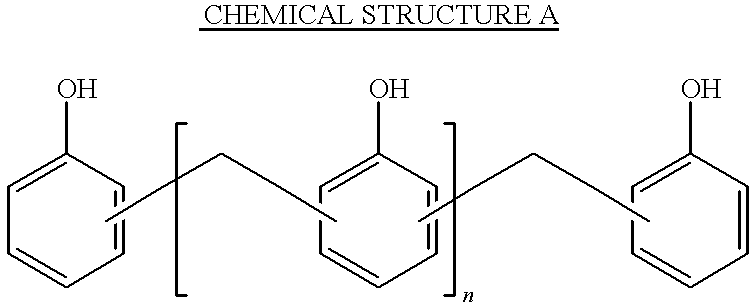

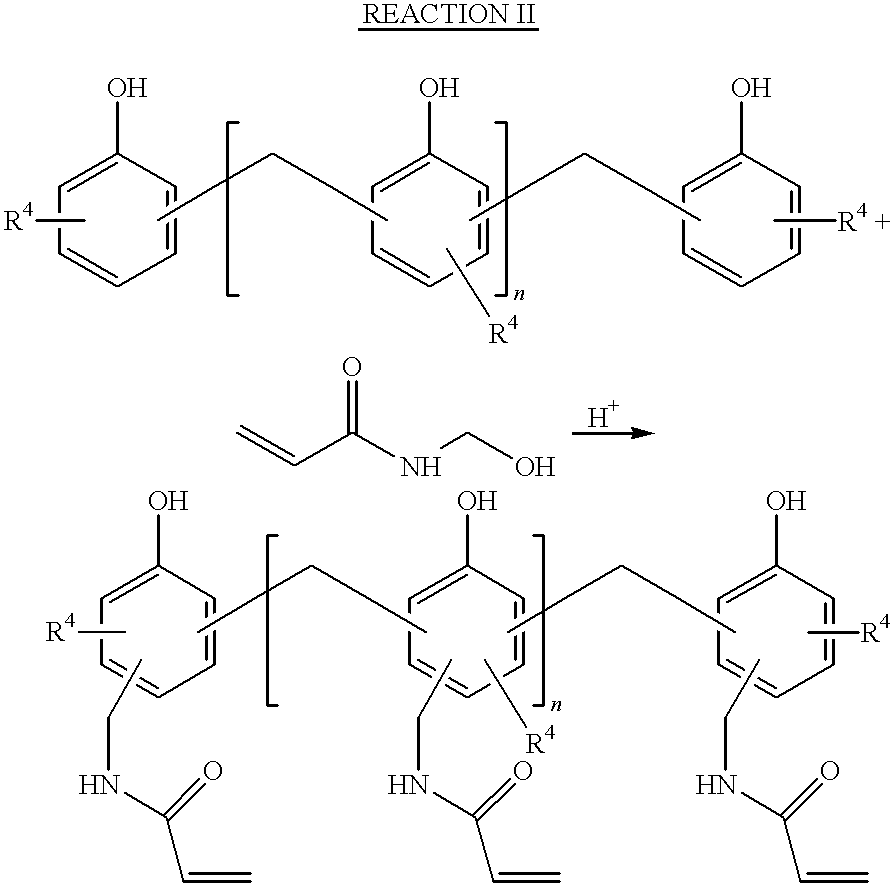
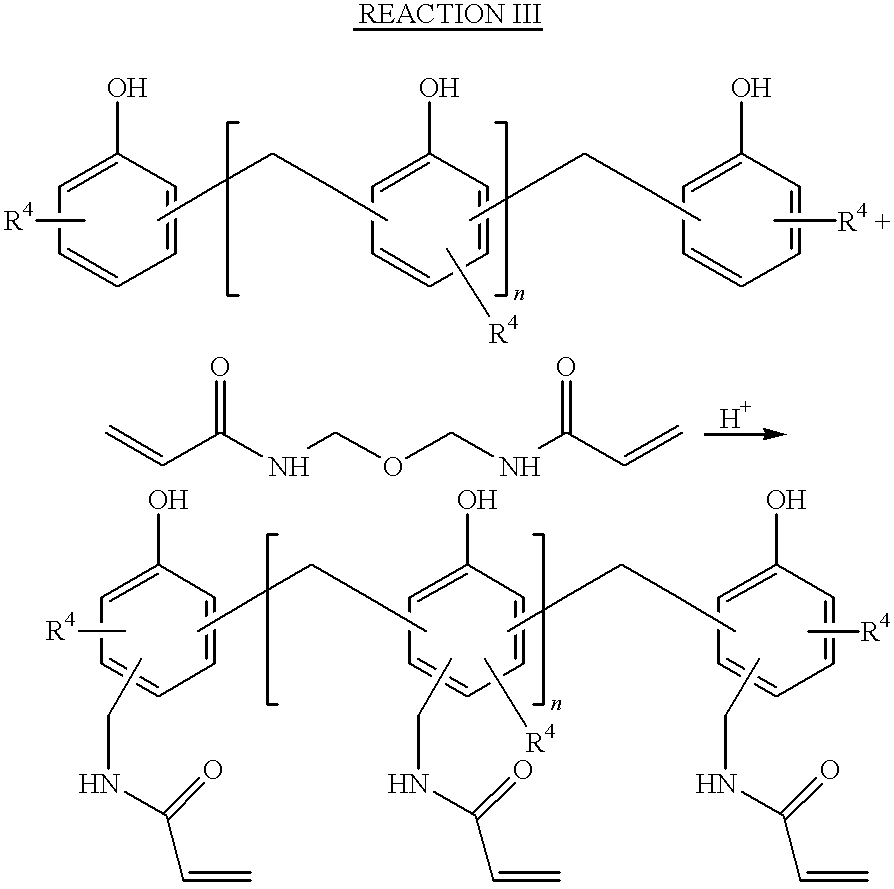
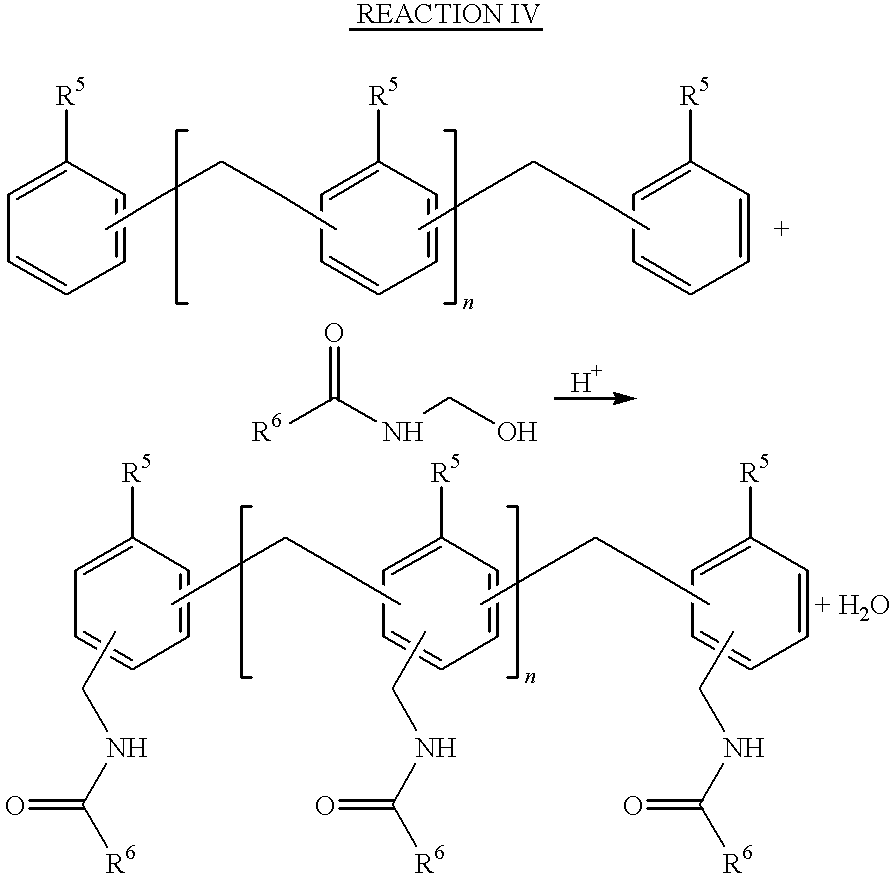
| Glossary |
| AMN 1.5 and 2.0 | acrylamidomethyl-novolak resin (1.5 and 2.0 mole of N- |
| methylolacrylamide/mole of aromatic ring in the resin) made | |
| according to the procedure of U.S. Pat. No. 5,236,472, | |
| Preparation C, incorporated herein by reference | |
| AMP | acrylamidomethyl-phenolic resin made according to the procedure |
| of U.S. Pat. No. 4,903,440, Preparation 4 | |
| CB | Carbon black |
| CD-1010 | cationic triaryl sulfonium salt photoinitiator, available from |
| Sartomer under the designation CD-1010 | |
| DVE-3 | a vinyl ether monomer available from ISP Co, Wayne, NJ, |
| under the trade designation RAPICURE DVE-3 | |
| EP1 | a bisphenol A epoxy resin, available from Shell Chemical, Houston |
| TX, under the trade designation EPON 828 and having an epoxy | |
| equivalent weight of 185-192 g/eq | |
| E-826 | Amine curing agent available from Shell Chemical, Houston, TX |
| under the trade designation EPICURE 826 | |
| FE2O3 | Iron oxide filler |
| H-1581 | 46 percent solids acrylonitrile latex available from B. F. Goodrich, |
| under the trade designation, HYCAR 1581 | |
| I-651 | 2,2-dimethoxy-2-phenyl acetophenone photoinitiator, available |
| from Ciba Geigy, under the trade designation IRGACURE 651 | |
| NR-9030 | 40 percent solids waterborne urethane dispersion available from |
| Zeneca Resins, Wilmington, MA, under the trade designation | |
| NEOREZ R-9030 | |
| PETA | pentaerythritol triacrylate, SARTOMER SR 444, available from |
| Sartomer, Exton, PA | |
| RP-1 | a resole phenolic resin having 75 percent solids (non-volatiles) |
| RP2 | a resole phenolic resin having 76 percent solids (non-volatile) |
| RP3 | a resole phenolic having 55 percent solids (non-volatile) |
| TATHEIC | triacrylate of tris(hydroxyethyl) isocyanurate, available from |
| Sartomer, under trade designation SR368 | |
| TMPTA | trimethylolpropane triacrylate, available from Sartomer, under the |
| trade designation SARTOMER 351 | |
| UVI-6990 | cationic triaryl sulfonium salt photoinitiator, available from Union |
| Carbide | |
| V-732 | polyamide thermoplastic pellet, having melting point = 105° C., |
| available from Creanova, Inc. | |
| V-4020 | a vinyl ether oligomer available from Allied Signal, Morristown, |
| NJ, under the trade designation VECTOMER 4020 | |
| Cloth | |
| Hydro | hydroenhanced polyester fabric treated by a process described in |
| U.S. Pat. No. 4,967,456, available from Interspan Division of | |
| BBA Nonwovens | |
| KURALON K-II | polyvinyl alcohol fill yarns, available from Kuraray America, Inc., |
| New York, NY, and ring-spun polyester warp yarns, available from | |
| Milliken | |
| PCF | filament polyester fill yarns and ring-spun polyester warp yarns, |
| available from Milliken | |
| PF | polyester cloth woven with ring-spun yarns, available from |
| Milliken | |
| Y-weight Cotton | is 292 g/m2 sateen weave Y-weight cotton fabric, available from |
| Milliken | |
| Paper | |
| D Weight | 180 g/m2 high tear cylinder paper, available from FiberMark |
| E Weight | 220 g/m2 high tear cylinder paper, available from FiberMark |
| F Weight | 280 g/m2 cylinder paper, available from FiberMark, Inc., |
| Fitchburg, MA | |
| H Weight | 400 g/m2 paper, available from Arjo Wiggins USA Inc., |
| Greenwich, CT | |
| Nonwoven/Netted Fabrics | |
| REEMAY | 70 g/m2 spunbonded polyester mat, available from Typar/Reemay |
| TYPAR | 66 g/m2 spunbonded polypropylene mat, available from |
| Typar/Remay | |
| STABILON 0447 | 4 × 4 G-150 fiberglass filaments bonded to 17.5 g/m2 carded |
| polyester mat, available from Milliken | |
| STABILON 7172 | 6 × 6 G-75 fiberglass filaments bonded to 31.5 g/m2 carded |
| polyester mat, available from Milliken | |
| TABLE 1 | ||
| Example | Avg F | Adhesion, N/cm |
| 1 | 0.8 | 34.2 |
| 2 | 1.3 | 43.0 |
| 3 | 1.5 | 54.8 |
| 4 | 1.7 | 47.0 |
| 5 | 2.0 | 47.0 |
| 6 | 2.5 | 36.2 |
| TABLE 2 |
| Stripback Adhesion |
| (118 W/cm) |
| Elevated | |||
| Temp(250° F.) | |||
| Room Temp | (121° C.) | ||
| Example | Cloth | (N/cm) | (N/cm) |
| 7 | Std PF | 42.1 | 35.2 |
| 8 | PCF | 36.2 | 32.3 |
| 9 | KURALON K-II | 62.6 | 49.9 |
| TABLE 3 |
| Stripback Adhesion |
| (118 W/cm and 157 W/cm) |
| Elevated | |||
| Temp(250° F.) | |||
| Room Temp | (121° C.) | ||
| Example | Cloth | (N/cm) | (N/cm) |
| 10 | Std PF | 42.1 | 32.3 |
| 11 | PCF | 33.3 | 30.3 |
| 12 | KURALON K-II | 66.5 | 64.6 |
| TABLE 4 |
| Pressure Pac Shelling Test |
| Avg # | ||||
| Lot | Treatment | Cloth | Bars | % Comparative A |
| Comparative A | Phenolic | PF | 33 | 100 |
| Example 13 | 60/40 | PF | 29 | 88 |
| V-732/AMN | ||||
| Example 14 | 60/40 | HYDRO | 30 | 91 |
| V-732/AMN | ||||
| TABLE 5 |
| Wet Thompson, Shelling Endpoint |
| Avg | ||||
| Cut | ||||
| Lot | Treatment | Cloth | (g) | % Comparative B |
| Comparative B | Phenolic | PF | 1600 | 100 |
| Example 15 | 60/40 | PF | 2290 | 143 |
| V-732/AMN | ||||
| Example 16 | 60/40 | HYDRO | 2649 | 166 |
| V-732/AMN | ||||
| TABLE 6 |
| Pressure Pac Shelling Test: Dry, constant rate (7.6 × 335 centimeters belt) |
| Example | Backing | # Bars | |||
| Description | Type | Cut | % Comparative C | ||
| Comparative C | PF | 35 | 100 | ||
| Example 17 | HYDRO | 55 | 157 | ||
| TABLE 7 |
| Room Temperature Tensile Data |
| Tensiles | % Stretch | ||
| (N/cm, (LbF/in)) | (at break) | Backing | |
| Material | (MD/CD) | (MD/CD) | Construction |
| Example 18 | 264, 142 | 2.6, 6.2 | E Weight |
| (151), (81) | Paper/Coating/ | ||
| TYPAR | |||
| Example 19 | 208, 82 | 2.6, 1.9 | E Weight |
| (119), (46.9) | Paper/Coating/ | ||
| STABILON | |||
| 0447 | |||
| Example 20 | 268, 113 | 2.0, 2.2 | E Weight |
| (153), (64.8) | Paper/Coating | ||
| Comparative D | 415, 175.1 | 2.2, 6.2 | H Weight |
| (237), (100) | Paper | ||
| Comparative E | 502, 186 | 5.2, 11.7 | Y Weight |
| (287), (106) | Cotton | ||
| TABLE 8 |
| Elevated Temperature (250° F.) Tensile Data |
| Tensile | % Stretch | ||||
| (N/cm, (LbF/in)) | (at break) | Backing | |||
| Material | (MD/CD) | (MD/CD) | Construction | ||
| Example 21 | 142, 77 | 2.2, 5.4 | E Weight | ||
| (81), (44.1) | Paper/Coating/ | ||||
| TYPAR | |||||
| Example 22 | 169, 80 | 2.5, 2.6 | E Weight | ||
| (96.7), (45.8) | Paper/Coating/ | ||||
| STABILON | |||||
| 0447 | |||||
| Example 23 | 128, 60 | 2.0, 4.1 | E Weight | ||
| (73.2), (34.1) | Paper/Coating | ||||
| Comparative | 243, 111 | 1.5, 1.9 | H Weight | ||
| F | (139), (63.7) | Paper | |||
| Comparative | 245, 104 | 3.6, 11.6 | Y Weight | ||
| G | 140), (59.2) | Cotton | |||
| TABLE 9 | |||||
| Backing | Passes at | ||||
| Belt | Construction | 1.8 mm | Fn(N) | ||
| Comparative H | Y weight cotton | 160 | 356 | ||
| 780 | 1334 | ||||
| Example 24 | E Weight | 160 | 271 | ||
| Paper/Coating/ | 800 | 302 | |||
| STABILON 0447 | 2387 | 1312 | |||
| Fn(N) is defined as Normal Force expressed in Newtons. | |||||
| TABLE 10 | |||||
| Example 27; | Example 28; | Example 29; | Example 30; | Example 31; | |
| CE I | CE J | CE K | CE L | CE M | |
| Component | (wt %) | (wt %) | (wt %) | (wt %) | (wt %) |
| EP-1 | 53.5 | 61.8 | |||
| V-4020 | 35.6 | ||||
| TMPTA | 50.0 | ||||
| TATHEIC | 50.0 | ||||
| NR-9030 | 53.5 | ||||
| H-1581 | 46.5 | ||||
| E-826 | 33.2 | ||||
| RP-2 | 42.1 | ||||
| DVE-3 | 8.9 | ||||
| CD-1010 | 2.0 | ||||
| I-369 | 1.0 | ||||
| 2-ethoxyethanol solvent | 5.0 | ||||
| CaCO3 | 48.0 | ||||
| Water | 9.9 | ||||
| TABLE 11 | ||||
| Dry Coating Weight | ||||
| Sample | Cloth | (g/m2) | ||
| Example 27 | Hydro PF | 136 | ||
| Comparative Example I | PF | 135 | ||
| Example 28 | Hydro PF | 152 | ||
| Comparative Example J | PF | 168 | ||
| Example 29 | Hydro PF | 110 | ||
| Comparative Example K | PF | 110 | ||
| Example 30 | Hydro PF | 150 | ||
| Comparative Example L | PF | 150 | ||
| Example 31 | Hydro PF | 187 | ||
| Comparative Example M | PF | 150 | ||
| TABLE 12 | |||
| Peel Adhesion | |||
| SAMPLE | (N/cm) | ||
| Example 27 | 30.8 | ||
| Comparative Example I | 28.9 | ||
| Example 28 | 30.6 | ||
| Comparative Example J | 16.1 | ||
| Example 29 | 36.2 | ||
| Comparative Example K | 27.3 | ||
| Example 30 | 56.9 | ||
| Comparative Example L | 38.0 | ||
| Example 31 | 66.8 | ||
| Comparative Example M | 32.9 | ||
Claims (18)
Priority Applications (5)
| Application Number | Priority Date | Filing Date | Title |
|---|---|---|---|
| US09/218,387 US6239049B1 (en) | 1998-12-22 | 1998-12-22 | Aminoplast resin/thermoplastic polyamide presize coatings for abrasive article backings |
| EP99917620A EP1141125B1 (en) | 1998-12-22 | 1999-04-19 | Aminoplast resin/thermoplastic polyamide presize coatings for abrasive article backings |
| DE69904366T DE69904366T2 (en) | 1998-12-22 | 1999-04-19 | AMINOPLAST RESIN / THERMOPLASTIC POLYAMIDE PRE-GLUE COATING FOR ABRASIVE CARRIER |
| PCT/US1999/008563 WO2000037561A1 (en) | 1998-12-22 | 1999-04-19 | Aminoplast resin/thermoplastic polyamide presize coatings for abrasive article backings |
| US09/828,058 US6635719B2 (en) | 1998-12-22 | 2001-04-06 | Aminoplast resin/thermoplastic polyamide presize coatings for abrasive article backings |
Applications Claiming Priority (1)
| Application Number | Priority Date | Filing Date | Title |
|---|---|---|---|
| US09/218,387 US6239049B1 (en) | 1998-12-22 | 1998-12-22 | Aminoplast resin/thermoplastic polyamide presize coatings for abrasive article backings |
Related Child Applications (1)
| Application Number | Title | Priority Date | Filing Date |
|---|---|---|---|
| US09/828,058 Division US6635719B2 (en) | 1998-12-22 | 2001-04-06 | Aminoplast resin/thermoplastic polyamide presize coatings for abrasive article backings |
Publications (1)
| Publication Number | Publication Date |
|---|---|
| US6239049B1 true US6239049B1 (en) | 2001-05-29 |
Family
ID=22814903
Family Applications (2)
| Application Number | Title | Priority Date | Filing Date |
|---|---|---|---|
| US09/218,387 Expired - Fee Related US6239049B1 (en) | 1998-12-22 | 1998-12-22 | Aminoplast resin/thermoplastic polyamide presize coatings for abrasive article backings |
| US09/828,058 Expired - Lifetime US6635719B2 (en) | 1998-12-22 | 2001-04-06 | Aminoplast resin/thermoplastic polyamide presize coatings for abrasive article backings |
Family Applications After (1)
| Application Number | Title | Priority Date | Filing Date |
|---|---|---|---|
| US09/828,058 Expired - Lifetime US6635719B2 (en) | 1998-12-22 | 2001-04-06 | Aminoplast resin/thermoplastic polyamide presize coatings for abrasive article backings |
Country Status (4)
| Country | Link |
|---|---|
| US (2) | US6239049B1 (en) |
| EP (1) | EP1141125B1 (en) |
| DE (1) | DE69904366T2 (en) |
| WO (1) | WO2000037561A1 (en) |
Cited By (13)
| Publication number | Priority date | Publication date | Assignee | Title |
|---|---|---|---|---|
| US20040067703A1 (en) * | 2002-10-03 | 2004-04-08 | Grunden Bradley L. | Electrostatic charge dissipating hard laminate surfaces |
| US20050282029A1 (en) * | 2004-06-18 | 2005-12-22 | 3M Innovative Properties Company | Polymerizable composition and articles therefrom |
| US20050279029A1 (en) * | 2004-06-18 | 2005-12-22 | 3M Innovative Properties Company | Coated abrasive article with composite tie layer, and method of making and using the same |
| US20050279028A1 (en) * | 2004-06-18 | 2005-12-22 | 3M Innovative Properties Company | Coated abrasive article with tie layer, and method of making and using the same |
| US20060261523A1 (en) * | 2003-05-28 | 2006-11-23 | Van Benthem Rudolfus Antonius | Thermosetting material; process and apparatus for forming thermosetting material |
| US20060288647A1 (en) * | 2005-06-27 | 2006-12-28 | 3M Innovative Properties Company | Coated abrasive article, and method of making and using the same |
| US20060288648A1 (en) * | 2005-06-27 | 2006-12-28 | Thurber Ernest L | Composition, treated backing, and abrasive articles containing the same |
| US20080006062A1 (en) * | 2006-07-07 | 2008-01-10 | Gerald Thomas Lien | Sleeve bearing assembly and method of construction |
| US20110151046A1 (en) * | 2008-08-20 | 2011-06-23 | Electro Scientific Industries, Inc. | Method and apparatus for optically transparent via filling |
| US8778039B2 (en) | 2010-07-21 | 2014-07-15 | Bamberger Kaliko Textile Finishing Gmbh | Composite material for further processing into sheet-like abrasive products and process for the production thereof |
| US20160074998A1 (en) * | 2014-09-17 | 2016-03-17 | Saint-Gobain Abrasives, Inc. | Polymer impregnated backing material, abrasive articles incorporating same, and processes of making and using |
| KR20170133400A (en) * | 2015-03-30 | 2017-12-05 | 쓰리엠 이노베이티브 프로퍼티즈 컴파니 | Coated abrasive article and method of making same |
| US9908214B2 (en) * | 2010-12-14 | 2018-03-06 | 3M Innovative Properties Company | Self-contained fibrous buffing article |
Families Citing this family (7)
| Publication number | Priority date | Publication date | Assignee | Title |
|---|---|---|---|---|
| DE102008004112A1 (en) | 2008-01-11 | 2009-07-16 | Saertex Gmbh & Co. Kg | Semifinished textile product with at least one surface provided with an adhesive |
| CN102107400B (en) * | 2009-12-29 | 2013-08-21 | 圣戈本磨料股份有限公司 | Coated abrasive material substrate with cloth processed by using colloidal silica |
| EP2978802A1 (en) * | 2013-03-28 | 2016-02-03 | Basf Se | Flexible foams having an abrasive surface |
| JP6640193B2 (en) * | 2014-08-27 | 2020-02-05 | スリーエム イノベイティブ プロパティズ カンパニー | Method for producing abrasive article and abrasive article |
| DE102015226418A1 (en) | 2015-12-22 | 2017-09-07 | Robert Bosch Gmbh | Process for the dry production of a sliding layer |
| CN110283350A (en) * | 2019-08-07 | 2019-09-27 | 泉州市鼎九环保科技有限公司 | A kind of preparation method of unsaturation Dai Mu |
| CN113583591A (en) * | 2021-08-20 | 2021-11-02 | 河南农业大学 | Method for manufacturing formaldehyde-free phenol-free artificial board by means of eliminating formaldehyde through light/wave catalyst |
Citations (65)
| Publication number | Priority date | Publication date | Assignee | Title |
|---|---|---|---|---|
| US2492143A (en) | 1948-11-17 | 1949-12-27 | Minnesota Mining & Mfg | Abrasive disk and method of making same |
| US2881064A (en) | 1955-11-07 | 1959-04-07 | Minnesota Mining & Mfg | Fill-resistant abrasive articles |
| US2931089A (en) | 1956-05-02 | 1960-04-05 | Deering Milliken Res Corp | Methods and apparatus for producing yarn |
| US2958593A (en) | 1960-01-11 | 1960-11-01 | Minnesota Mining & Mfg | Low density open non-woven fibrous abrasive article |
| US3256075A (en) | 1961-10-20 | 1966-06-14 | Minnesota Mining & Mfg | Abrasive sponge |
| US3296022A (en) | 1962-08-13 | 1967-01-03 | Norton Co | Polymer saturated backing material |
| US3401491A (en) | 1965-03-25 | 1968-09-17 | Armour & Co | Binder of an epoxy resin, polyamide resin and polyester for fibrous abrasive articles |
| US3537121A (en) | 1968-01-17 | 1970-11-03 | Minnesota Mining & Mfg | Cleaning and buffing product |
| US3605349A (en) | 1969-05-08 | 1971-09-20 | Frederick B Anthon | Abrasive finishing article |
| US3772136A (en) * | 1971-04-20 | 1973-11-13 | Gen Mills Inc | Fibrous products from thermoplastic polyamide polymers |
| US4047903A (en) | 1972-09-26 | 1977-09-13 | Hoechst Aktiengesellschaft | Process for the production of abrasives |
| US4170481A (en) | 1976-11-08 | 1979-10-09 | Toray Industries, Inc. | Photosensitive polymer composition |
| US4255164A (en) | 1979-04-30 | 1981-03-10 | Minnesota Mining And Manufacturing Company | Fining sheet and method of making and using the same |
| US4289683A (en) | 1979-04-23 | 1981-09-15 | The General Tire & Rubber Company | Adhesion of polyamide or polyester cords to rubber |
| US4457766A (en) | 1980-10-08 | 1984-07-03 | Kennecott Corporation | Resin systems for high energy electron curable resin coated webs |
| US4481280A (en) | 1980-03-13 | 1984-11-06 | Toray Industries, Inc. | Photosensitive polyamide resin composition |
| US4547204A (en) | 1980-10-08 | 1985-10-15 | Carborundum Abrasives Company | Resin systems for high energy electron curable resin coated webs |
| US4588419A (en) | 1980-10-08 | 1986-05-13 | Carborundum Abrasives Company | Resin systems for high energy electron curable resin coated webs |
| US4652274A (en) | 1985-08-07 | 1987-03-24 | Minnesota Mining And Manufacturing Company | Coated abrasive product having radiation curable binder |
| US4735632A (en) | 1987-04-02 | 1988-04-05 | Minnesota Mining And Manufacturing Company | Coated abrasive binder containing ternary photoinitiator system |
| US4751138A (en) | 1986-08-11 | 1988-06-14 | Minnesota Mining And Manufacturing Company | Coated abrasive having radiation curable binder |
| US4773920A (en) | 1985-12-16 | 1988-09-27 | Minnesota Mining And Manufacturing Company | Coated abrasive suitable for use as a lapping material |
| JPS644667A (en) | 1987-06-28 | 1989-01-09 | Nippon Oils & Fats Co Ltd | Underwater antifouling coating agent |
| US4836832A (en) | 1986-08-11 | 1989-06-06 | Minnesota Mining And Manufacturing Company | Method of preparing coated abrasive having radiation curable binder |
| US4845162A (en) | 1987-06-01 | 1989-07-04 | Allied-Signal Inc. | Curable phenolic and polyamide blends |
| US4903440A (en) | 1988-11-23 | 1990-02-27 | Minnesota Mining And Manufacturing Company | Abrasive product having binder comprising an aminoplast resin |
| US4914165A (en) | 1988-02-03 | 1990-04-03 | Minnesota Mining And Manufacturing Company | Radiation crosslinkable compositions |
| US4950696A (en) | 1987-08-28 | 1990-08-21 | Minnesota Mining And Manufacturing Company | Energy-induced dual curable compositions |
| US4967456A (en) | 1987-04-23 | 1990-11-06 | International Paper Company | Apparatus and method for hydroenhancing fabric |
| US4985340A (en) | 1988-06-01 | 1991-01-15 | Minnesota Mining And Manufacturing Company | Energy curable compositions: two component curing agents |
| US5015266A (en) | 1987-12-28 | 1991-05-14 | Motokazu Yamamoto | Abrasive sheet and method for manufacturing the abrasive sheet |
| US5014468A (en) | 1989-05-05 | 1991-05-14 | Norton Company | Patterned coated abrasive for fine surface finishing |
| US5055113A (en) | 1988-11-23 | 1991-10-08 | Minnesota Mining And Manufacturing Company | Abrasive product having binder comprising an aminoplast resin |
| US5109097A (en) | 1990-09-07 | 1992-04-28 | Minnesota Mining And Manufacturing Company | Radiation curable coating |
| US5152917A (en) | 1991-02-06 | 1992-10-06 | Minnesota Mining And Manufacturing Company | Structured abrasive article |
| US5178646A (en) | 1992-01-22 | 1993-01-12 | Minnesota Mining And Manufacturing Company | Coatable thermally curable binder presursor solutions modified with a reactive diluent, abrasive articles incorporating same, and methods of making said abrasive articles |
| US5236472A (en) | 1991-02-22 | 1993-08-17 | Minnesota Mining And Manufacturing Company | Abrasive product having a binder comprising an aminoplast binder |
| US5256170A (en) | 1992-01-22 | 1993-10-26 | Minnesota Mining And Manufacturing Company | Coated abrasive article and method of making same |
| WO1994004738A1 (en) | 1992-08-24 | 1994-03-03 | Minnesota Mining And Manufacturing Company | Melt bonded nonwoven articles and methods of preparing same |
| US5304224A (en) | 1992-10-01 | 1994-04-19 | Minnesota Mining And Manufacturing Company | Coated abrasive article having a tear resistant backing |
| EP0592942A1 (en) | 1992-10-12 | 1994-04-20 | Kishimoto Sangyo Co., Ltd. | Flame retardant polyamide composition |
| EP0592941A2 (en) | 1992-10-12 | 1994-04-20 | Kishimoto Sangyo Co., Ltd. | Polyamide composition and the use |
| US5378252A (en) | 1993-09-03 | 1995-01-03 | Minnesota Mining And Manufacturing Company | Abrasive articles |
| WO1995007797A1 (en) | 1993-09-13 | 1995-03-23 | Minnesota Mining And Manufacturing Company | Abrasive article, method of manufacture of same, method of using same for finishing, and a production tool |
| US5417726A (en) | 1991-12-20 | 1995-05-23 | Minnesota Mining And Manufacturing Company | Coated abrasive backing |
| US5435816A (en) | 1993-01-14 | 1995-07-25 | Minnesota Mining And Manufacturing Company | Method of making an abrasive article |
| WO1995022436A1 (en) | 1994-02-22 | 1995-08-24 | Minnesota Mining And Manufacturing Company | Abrasive article, a method of making same, and a method of using same for finishing |
| US5453312A (en) | 1993-10-29 | 1995-09-26 | Minnesota Mining And Manufacturing Company | Abrasive article, a process for its manufacture, and a method of using it to reduce a workpiece surface |
| US5454844A (en) | 1993-10-29 | 1995-10-03 | Minnesota Mining And Manufacturing Company | Abrasive article, a process of making same, and a method of using same to finish a workpiece surface |
| US5490878A (en) | 1992-08-19 | 1996-02-13 | Minnesota Mining And Manufacturing Company | Coated abrasive article and a method of making same |
| US5492980A (en) | 1992-10-12 | 1996-02-20 | Kishimoto Sangyo Co., Ltd. | Thermoplastic molding resin composition |
| WO1996021539A1 (en) | 1995-01-10 | 1996-07-18 | Norton Company | Fining abrasive materials |
| WO1996033841A1 (en) | 1995-04-28 | 1996-10-31 | Minnesota Mining And Manufacturing Company | Abrasive article having a bond system comprising a polysiloxane |
| WO1996037644A2 (en) | 1995-05-25 | 1996-11-28 | Minnesota Mining And Manufacturing Company | Undrawn, tough, durably melt-bondable, macrodenier, thermoplastic, multicomponent filaments |
| US5580647A (en) | 1993-12-20 | 1996-12-03 | Minnesota Mining And Manufacturing Company | Abrasive articles incorporating addition polymerizable resins and reactive diluents |
| US5609706A (en) | 1991-12-20 | 1997-03-11 | Minnesota Mining And Manufacturing Company | Method of preparation of a coated abrasive belt with an endless, seamless backing |
| WO1997014720A2 (en) | 1995-10-17 | 1997-04-24 | The University Of North Carolina At Chapel Hill | Heterogeneous polymerizations in carbon dioxide |
| US5624471A (en) | 1996-07-22 | 1997-04-29 | Norton Company | Waterproof paper-backed coated abrasives |
| US5650226A (en) | 1987-05-25 | 1997-07-22 | Atochem | Metal substrate coated with polyamide-based coating powders |
| WO1997031078A1 (en) | 1996-02-23 | 1997-08-28 | Ici Americas Inc. | Polyamide based laminating, coverlay, and bond ply adhesive with heat activated cure component |
| US5681612A (en) | 1993-06-17 | 1997-10-28 | Minnesota Mining And Manufacturing Company | Coated abrasives and methods of preparation |
| US5700302A (en) | 1996-03-15 | 1997-12-23 | Minnesota Mining And Manufacturing Company | Radiation curable abrasive article with tie coat and method |
| GB2314791A (en) | 1996-07-04 | 1998-01-14 | Evode Ltd | Polymeric coatings containing embedded particles |
| US5766277A (en) | 1996-09-20 | 1998-06-16 | Minnesota Mining And Manufacturing Company | Coated abrasive article and method of making same |
| WO1999065352A1 (en) | 1998-06-19 | 1999-12-23 | Kimberly-Clark Worldwide, Inc. | Loop substrate for releasably attachable abrasive sheet material |
Family Cites Families (1)
| Publication number | Priority date | Publication date | Assignee | Title |
|---|---|---|---|---|
| US3861921A (en) * | 1973-01-12 | 1975-01-21 | Horst Hoffmann | Subbing layers comprising polyamide and phenolic resin for metal bases of photopolymerizable elements |
-
1998
- 1998-12-22 US US09/218,387 patent/US6239049B1/en not_active Expired - Fee Related
-
1999
- 1999-04-19 EP EP99917620A patent/EP1141125B1/en not_active Expired - Lifetime
- 1999-04-19 WO PCT/US1999/008563 patent/WO2000037561A1/en not_active Ceased
- 1999-04-19 DE DE69904366T patent/DE69904366T2/en not_active Expired - Fee Related
-
2001
- 2001-04-06 US US09/828,058 patent/US6635719B2/en not_active Expired - Lifetime
Patent Citations (70)
| Publication number | Priority date | Publication date | Assignee | Title |
|---|---|---|---|---|
| US2492143A (en) | 1948-11-17 | 1949-12-27 | Minnesota Mining & Mfg | Abrasive disk and method of making same |
| US2881064A (en) | 1955-11-07 | 1959-04-07 | Minnesota Mining & Mfg | Fill-resistant abrasive articles |
| US2931089A (en) | 1956-05-02 | 1960-04-05 | Deering Milliken Res Corp | Methods and apparatus for producing yarn |
| US2958593A (en) | 1960-01-11 | 1960-11-01 | Minnesota Mining & Mfg | Low density open non-woven fibrous abrasive article |
| US3256075A (en) | 1961-10-20 | 1966-06-14 | Minnesota Mining & Mfg | Abrasive sponge |
| US3296022A (en) | 1962-08-13 | 1967-01-03 | Norton Co | Polymer saturated backing material |
| US3401491A (en) | 1965-03-25 | 1968-09-17 | Armour & Co | Binder of an epoxy resin, polyamide resin and polyester for fibrous abrasive articles |
| US3537121A (en) | 1968-01-17 | 1970-11-03 | Minnesota Mining & Mfg | Cleaning and buffing product |
| US3605349A (en) | 1969-05-08 | 1971-09-20 | Frederick B Anthon | Abrasive finishing article |
| US3772136A (en) * | 1971-04-20 | 1973-11-13 | Gen Mills Inc | Fibrous products from thermoplastic polyamide polymers |
| US4047903A (en) | 1972-09-26 | 1977-09-13 | Hoechst Aktiengesellschaft | Process for the production of abrasives |
| US4170481A (en) | 1976-11-08 | 1979-10-09 | Toray Industries, Inc. | Photosensitive polymer composition |
| US4289683A (en) | 1979-04-23 | 1981-09-15 | The General Tire & Rubber Company | Adhesion of polyamide or polyester cords to rubber |
| US4255164A (en) | 1979-04-30 | 1981-03-10 | Minnesota Mining And Manufacturing Company | Fining sheet and method of making and using the same |
| US4481280A (en) | 1980-03-13 | 1984-11-06 | Toray Industries, Inc. | Photosensitive polyamide resin composition |
| US4457766A (en) | 1980-10-08 | 1984-07-03 | Kennecott Corporation | Resin systems for high energy electron curable resin coated webs |
| US4547204A (en) | 1980-10-08 | 1985-10-15 | Carborundum Abrasives Company | Resin systems for high energy electron curable resin coated webs |
| US4588419A (en) | 1980-10-08 | 1986-05-13 | Carborundum Abrasives Company | Resin systems for high energy electron curable resin coated webs |
| US4652274A (en) | 1985-08-07 | 1987-03-24 | Minnesota Mining And Manufacturing Company | Coated abrasive product having radiation curable binder |
| US4773920A (en) | 1985-12-16 | 1988-09-27 | Minnesota Mining And Manufacturing Company | Coated abrasive suitable for use as a lapping material |
| US4773920B1 (en) | 1985-12-16 | 1995-05-02 | Minnesota Mining & Mfg | Coated abrasive suitable for use as a lapping material. |
| US4751138A (en) | 1986-08-11 | 1988-06-14 | Minnesota Mining And Manufacturing Company | Coated abrasive having radiation curable binder |
| US4836832A (en) | 1986-08-11 | 1989-06-06 | Minnesota Mining And Manufacturing Company | Method of preparing coated abrasive having radiation curable binder |
| US4735632A (en) | 1987-04-02 | 1988-04-05 | Minnesota Mining And Manufacturing Company | Coated abrasive binder containing ternary photoinitiator system |
| US4967456A (en) | 1987-04-23 | 1990-11-06 | International Paper Company | Apparatus and method for hydroenhancing fabric |
| US5650226A (en) | 1987-05-25 | 1997-07-22 | Atochem | Metal substrate coated with polyamide-based coating powders |
| US4845162A (en) | 1987-06-01 | 1989-07-04 | Allied-Signal Inc. | Curable phenolic and polyamide blends |
| JPS644667A (en) | 1987-06-28 | 1989-01-09 | Nippon Oils & Fats Co Ltd | Underwater antifouling coating agent |
| US4950696A (en) | 1987-08-28 | 1990-08-21 | Minnesota Mining And Manufacturing Company | Energy-induced dual curable compositions |
| US5015266A (en) | 1987-12-28 | 1991-05-14 | Motokazu Yamamoto | Abrasive sheet and method for manufacturing the abrasive sheet |
| US4914165A (en) | 1988-02-03 | 1990-04-03 | Minnesota Mining And Manufacturing Company | Radiation crosslinkable compositions |
| US4985340A (en) | 1988-06-01 | 1991-01-15 | Minnesota Mining And Manufacturing Company | Energy curable compositions: two component curing agents |
| US5055113A (en) | 1988-11-23 | 1991-10-08 | Minnesota Mining And Manufacturing Company | Abrasive product having binder comprising an aminoplast resin |
| US4903440A (en) | 1988-11-23 | 1990-02-27 | Minnesota Mining And Manufacturing Company | Abrasive product having binder comprising an aminoplast resin |
| US5014468A (en) | 1989-05-05 | 1991-05-14 | Norton Company | Patterned coated abrasive for fine surface finishing |
| US5109097A (en) | 1990-09-07 | 1992-04-28 | Minnesota Mining And Manufacturing Company | Radiation curable coating |
| US5152917A (en) | 1991-02-06 | 1992-10-06 | Minnesota Mining And Manufacturing Company | Structured abrasive article |
| US5304223A (en) | 1991-02-06 | 1994-04-19 | Minnesota Mining And Manufacturing Company | Structured abrasive article |
| US5152917B1 (en) | 1991-02-06 | 1998-01-13 | Minnesota Mining & Mfg | Structured abrasive article |
| US5236472A (en) | 1991-02-22 | 1993-08-17 | Minnesota Mining And Manufacturing Company | Abrasive product having a binder comprising an aminoplast binder |
| US5609706A (en) | 1991-12-20 | 1997-03-11 | Minnesota Mining And Manufacturing Company | Method of preparation of a coated abrasive belt with an endless, seamless backing |
| US5580634A (en) | 1991-12-20 | 1996-12-03 | Minnesota Mining And Manufacturing Company | Coated abrasive backing |
| US5417726A (en) | 1991-12-20 | 1995-05-23 | Minnesota Mining And Manufacturing Company | Coated abrasive backing |
| US5256170A (en) | 1992-01-22 | 1993-10-26 | Minnesota Mining And Manufacturing Company | Coated abrasive article and method of making same |
| US5178646A (en) | 1992-01-22 | 1993-01-12 | Minnesota Mining And Manufacturing Company | Coatable thermally curable binder presursor solutions modified with a reactive diluent, abrasive articles incorporating same, and methods of making said abrasive articles |
| US5490878A (en) | 1992-08-19 | 1996-02-13 | Minnesota Mining And Manufacturing Company | Coated abrasive article and a method of making same |
| WO1994004738A1 (en) | 1992-08-24 | 1994-03-03 | Minnesota Mining And Manufacturing Company | Melt bonded nonwoven articles and methods of preparing same |
| US5304224A (en) | 1992-10-01 | 1994-04-19 | Minnesota Mining And Manufacturing Company | Coated abrasive article having a tear resistant backing |
| US5492980A (en) | 1992-10-12 | 1996-02-20 | Kishimoto Sangyo Co., Ltd. | Thermoplastic molding resin composition |
| EP0592941A2 (en) | 1992-10-12 | 1994-04-20 | Kishimoto Sangyo Co., Ltd. | Polyamide composition and the use |
| EP0592942A1 (en) | 1992-10-12 | 1994-04-20 | Kishimoto Sangyo Co., Ltd. | Flame retardant polyamide composition |
| US5435816A (en) | 1993-01-14 | 1995-07-25 | Minnesota Mining And Manufacturing Company | Method of making an abrasive article |
| US5681612A (en) | 1993-06-17 | 1997-10-28 | Minnesota Mining And Manufacturing Company | Coated abrasives and methods of preparation |
| US5378252A (en) | 1993-09-03 | 1995-01-03 | Minnesota Mining And Manufacturing Company | Abrasive articles |
| WO1995007797A1 (en) | 1993-09-13 | 1995-03-23 | Minnesota Mining And Manufacturing Company | Abrasive article, method of manufacture of same, method of using same for finishing, and a production tool |
| US5453312A (en) | 1993-10-29 | 1995-09-26 | Minnesota Mining And Manufacturing Company | Abrasive article, a process for its manufacture, and a method of using it to reduce a workpiece surface |
| US5454844A (en) | 1993-10-29 | 1995-10-03 | Minnesota Mining And Manufacturing Company | Abrasive article, a process of making same, and a method of using same to finish a workpiece surface |
| US5549961A (en) | 1993-10-29 | 1996-08-27 | Minnesota Mining And Manufacturing Company | Abrasive article, a process for its manufacture, and a method of using it to reduce a workpiece surface |
| US5580647A (en) | 1993-12-20 | 1996-12-03 | Minnesota Mining And Manufacturing Company | Abrasive articles incorporating addition polymerizable resins and reactive diluents |
| WO1995022436A1 (en) | 1994-02-22 | 1995-08-24 | Minnesota Mining And Manufacturing Company | Abrasive article, a method of making same, and a method of using same for finishing |
| WO1996021539A1 (en) | 1995-01-10 | 1996-07-18 | Norton Company | Fining abrasive materials |
| WO1996033841A1 (en) | 1995-04-28 | 1996-10-31 | Minnesota Mining And Manufacturing Company | Abrasive article having a bond system comprising a polysiloxane |
| WO1996037644A2 (en) | 1995-05-25 | 1996-11-28 | Minnesota Mining And Manufacturing Company | Undrawn, tough, durably melt-bondable, macrodenier, thermoplastic, multicomponent filaments |
| WO1997014720A2 (en) | 1995-10-17 | 1997-04-24 | The University Of North Carolina At Chapel Hill | Heterogeneous polymerizations in carbon dioxide |
| WO1997031078A1 (en) | 1996-02-23 | 1997-08-28 | Ici Americas Inc. | Polyamide based laminating, coverlay, and bond ply adhesive with heat activated cure component |
| US5700302A (en) | 1996-03-15 | 1997-12-23 | Minnesota Mining And Manufacturing Company | Radiation curable abrasive article with tie coat and method |
| GB2314791A (en) | 1996-07-04 | 1998-01-14 | Evode Ltd | Polymeric coatings containing embedded particles |
| US5624471A (en) | 1996-07-22 | 1997-04-29 | Norton Company | Waterproof paper-backed coated abrasives |
| US5766277A (en) | 1996-09-20 | 1998-06-16 | Minnesota Mining And Manufacturing Company | Coated abrasive article and method of making same |
| WO1999065352A1 (en) | 1998-06-19 | 1999-12-23 | Kimberly-Clark Worldwide, Inc. | Loop substrate for releasably attachable abrasive sheet material |
Non-Patent Citations (1)
| Title |
|---|
| Hüls A VEBA Group Company Brochure, "VESTAMELT Copolyamide and Copolyester Hot Melt Adhesives", pp. 1-6. |
Cited By (26)
| Publication number | Priority date | Publication date | Assignee | Title |
|---|---|---|---|---|
| US20040067703A1 (en) * | 2002-10-03 | 2004-04-08 | Grunden Bradley L. | Electrostatic charge dissipating hard laminate surfaces |
| US20060261523A1 (en) * | 2003-05-28 | 2006-11-23 | Van Benthem Rudolfus Antonius | Thermosetting material; process and apparatus for forming thermosetting material |
| US20110180207A1 (en) * | 2003-05-28 | 2011-07-28 | Dsm Ip Assets B.V. | Process and apparatus for forming thermosetting material |
| US7951323B2 (en) * | 2003-05-28 | 2011-05-31 | Rudolfus Antonius Theodorus Maria Van Benthem | Thermosetting material; process and apparatus for forming thermosetting material |
| AU2004242613B2 (en) * | 2003-05-28 | 2010-11-11 | Oci Nitrogen B.V. | Thermosetting material; process and apparatus for forming thermosetting material |
| US20050282029A1 (en) * | 2004-06-18 | 2005-12-22 | 3M Innovative Properties Company | Polymerizable composition and articles therefrom |
| US20050279029A1 (en) * | 2004-06-18 | 2005-12-22 | 3M Innovative Properties Company | Coated abrasive article with composite tie layer, and method of making and using the same |
| US20050279028A1 (en) * | 2004-06-18 | 2005-12-22 | 3M Innovative Properties Company | Coated abrasive article with tie layer, and method of making and using the same |
| WO2006007036A1 (en) * | 2004-06-18 | 2006-01-19 | 3M Innovative Properties Company | Coated abrasive article with composite tie layer, and method of making and using the same |
| US7150771B2 (en) | 2004-06-18 | 2006-12-19 | 3M Innovative Properties Company | Coated abrasive article with composite tie layer, and method of making and using the same |
| US7150770B2 (en) | 2004-06-18 | 2006-12-19 | 3M Innovative Properties Company | Coated abrasive article with tie layer, and method of making and using the same |
| US7344575B2 (en) | 2005-06-27 | 2008-03-18 | 3M Innovative Properties Company | Composition, treated backing, and abrasive articles containing the same |
| US20060288648A1 (en) * | 2005-06-27 | 2006-12-28 | Thurber Ernest L | Composition, treated backing, and abrasive articles containing the same |
| US7344574B2 (en) | 2005-06-27 | 2008-03-18 | 3M Innovative Properties Company | Coated abrasive article, and method of making and using the same |
| US20060288647A1 (en) * | 2005-06-27 | 2006-12-28 | 3M Innovative Properties Company | Coated abrasive article, and method of making and using the same |
| US8152380B2 (en) * | 2006-07-07 | 2012-04-10 | Federal-Mogul World Wide, Inc. | Sleeve bearing assembly and method of construction |
| US20080006062A1 (en) * | 2006-07-07 | 2008-01-10 | Gerald Thomas Lien | Sleeve bearing assembly and method of construction |
| US8729404B2 (en) * | 2008-08-20 | 2014-05-20 | Electro Scientific Industries, Inc. | Method and apparatus for optically transparent via filling |
| US20110151046A1 (en) * | 2008-08-20 | 2011-06-23 | Electro Scientific Industries, Inc. | Method and apparatus for optically transparent via filling |
| US8778039B2 (en) | 2010-07-21 | 2014-07-15 | Bamberger Kaliko Textile Finishing Gmbh | Composite material for further processing into sheet-like abrasive products and process for the production thereof |
| US9908214B2 (en) * | 2010-12-14 | 2018-03-06 | 3M Innovative Properties Company | Self-contained fibrous buffing article |
| US20160074998A1 (en) * | 2014-09-17 | 2016-03-17 | Saint-Gobain Abrasives, Inc. | Polymer impregnated backing material, abrasive articles incorporating same, and processes of making and using |
| US9751192B2 (en) * | 2014-09-17 | 2017-09-05 | Saint-Gobain Abrasives, Inc. | Polymer impregnated backing material, abrasive articles incorporating same, and processes of making and using |
| KR20170133400A (en) * | 2015-03-30 | 2017-12-05 | 쓰리엠 이노베이티브 프로퍼티즈 컴파니 | Coated abrasive article and method of making same |
| US20190240810A1 (en) * | 2015-03-30 | 2019-08-08 | 3M Innovative Properties Company | Coated abrasive article and method of making the same |
| US10836015B2 (en) * | 2015-03-30 | 2020-11-17 | 3M Innovative Properties Company | Coated abrasive article and method of making the same |
Also Published As
| Publication number | Publication date |
|---|---|
| EP1141125A1 (en) | 2001-10-10 |
| WO2000037561A1 (en) | 2000-06-29 |
| EP1141125B1 (en) | 2002-12-04 |
| DE69904366T2 (en) | 2003-10-16 |
| US20010023158A1 (en) | 2001-09-20 |
| DE69904366D1 (en) | 2003-01-16 |
| US6635719B2 (en) | 2003-10-21 |
Similar Documents
| Publication | Publication Date | Title |
|---|---|---|
| US6239049B1 (en) | Aminoplast resin/thermoplastic polyamide presize coatings for abrasive article backings | |
| US4903440A (en) | Abrasive product having binder comprising an aminoplast resin | |
| KR100372204B1 (en) | Abrasive Articles Comprising a Make Coat Transferred by Lamination | |
| EP0500369B1 (en) | Abrasive product having a binder comprising an aminoplast binder | |
| US5055113A (en) | Abrasive product having binder comprising an aminoplast resin | |
| EP0696945B1 (en) | Abrasive articles comprising a grinding aid dispersed in a polymeric blend binder | |
| US6056794A (en) | Abrasive articles having bonding systems containing abrasive particles | |
| US5551961A (en) | Abrasive articles and methods of making same | |
| JP3626506B2 (en) | Abrasive articles formed from paintable thermosetting binder precursor solutions modified with reactive diluents | |
| AU715923B2 (en) | Coated abrasive article and method of making same | |
| JP2008544073A (en) | Composition, treated backing, and abrasive article containing the same | |
| EP1144515A1 (en) | Acrylated oligomer/thermoplastic polyamide presize coatings for abrasive article backings | |
| US20220001513A1 (en) | Coated abrasives having aggregates | |
| US20260027675A1 (en) | Curable composition, treated backing, coated abrasive articles including the same, and methods of making and using the same |
Legal Events
| Date | Code | Title | Description |
|---|---|---|---|
| AS | Assignment |
Owner name: MINNESOTA MINING AND MANUFACTURING COMPANY, MINNES Free format text: ASSIGNMENT OF ASSIGNORS INTEREST;ASSIGNORS:FOLLENSBEE, ROBERT A.;TEETZEL, MICHAEL L.;DEVOE, ROBERT J.;AND OTHERS;REEL/FRAME:009677/0105 Effective date: 19981222 |
|
| AS | Assignment |
Owner name: 3M INNOVATIVE PROPERTIES COMPANY, MINNESOTA Free format text: ASSIGNMENT OF ASSIGNORS INTEREST;ASSIGNOR:MINNESOTA MINING AND MANUFACTURING COMPANY;REEL/FRAME:011526/0417 Effective date: 20010202 |
|
| CC | Certificate of correction | ||
| REMI | Maintenance fee reminder mailed | ||
| LAPS | Lapse for failure to pay maintenance fees | ||
| STCH | Information on status: patent discontinuation |
Free format text: PATENT EXPIRED DUE TO NONPAYMENT OF MAINTENANCE FEES UNDER 37 CFR 1.362 |
|
| FP | Lapsed due to failure to pay maintenance fee |
Effective date: 20050529 |