US6225305B1 - Substituted urea and isothiorea derivatives as no synthase inhibitors - Google Patents
Substituted urea and isothiorea derivatives as no synthase inhibitors Download PDFInfo
- Publication number
- US6225305B1 US6225305B1 US09/514,525 US51452500A US6225305B1 US 6225305 B1 US6225305 B1 US 6225305B1 US 51452500 A US51452500 A US 51452500A US 6225305 B1 US6225305 B1 US 6225305B1
- Authority
- US
- United States
- Prior art keywords
- group
- alkyl
- ethyl
- hydrogen
- isothiourea
- Prior art date
- Legal status (The legal status is an assumption and is not a legal conclusion. Google has not performed a legal analysis and makes no representation as to the accuracy of the status listed.)
- Expired - Fee Related
Links
- 239000003112 inhibitor Substances 0.000 title description 15
- 150000003672 ureas Chemical class 0.000 title description 3
- 239000004202 carbamide Substances 0.000 title description 2
- 238000000034 method Methods 0.000 claims abstract description 28
- 102000008299 Nitric Oxide Synthase Human genes 0.000 claims abstract description 27
- 108010021487 Nitric Oxide Synthase Proteins 0.000 claims abstract description 27
- 238000011282 treatment Methods 0.000 claims abstract description 12
- 201000006474 Brain Ischemia Diseases 0.000 claims abstract description 6
- 206010008120 Cerebral ischaemia Diseases 0.000 claims abstract description 6
- 206010008118 cerebral infarction Diseases 0.000 claims abstract description 6
- 239000001257 hydrogen Substances 0.000 claims description 31
- 229910052739 hydrogen Inorganic materials 0.000 claims description 31
- 125000004435 hydrogen atom Chemical group [H]* 0.000 claims description 28
- 125000004178 (C1-C4) alkyl group Chemical group 0.000 claims description 20
- 150000003839 salts Chemical class 0.000 claims description 20
- 229960003104 ornithine Drugs 0.000 claims description 19
- 125000001997 phenyl group Chemical group [H]C1=C([H])C([H])=C(*)C([H])=C1[H] 0.000 claims description 19
- 125000005843 halogen group Chemical group 0.000 claims description 17
- 125000001183 hydrocarbyl group Chemical group 0.000 claims description 17
- 150000002148 esters Chemical class 0.000 claims description 15
- 150000001408 amides Chemical class 0.000 claims description 13
- 230000005764 inhibitory process Effects 0.000 claims description 11
- 125000004169 (C1-C6) alkyl group Chemical group 0.000 claims description 9
- NINIDFKCEFEMDL-UHFFFAOYSA-N Sulfur Chemical compound [S] NINIDFKCEFEMDL-UHFFFAOYSA-N 0.000 claims description 9
- 239000005864 Sulphur Substances 0.000 claims description 8
- QVGXLLKOCUKJST-UHFFFAOYSA-N atomic oxygen Chemical group [O] QVGXLLKOCUKJST-UHFFFAOYSA-N 0.000 claims description 8
- 239000001301 oxygen Substances 0.000 claims description 8
- 229910052760 oxygen Inorganic materials 0.000 claims description 8
- 230000001537 neural effect Effects 0.000 claims description 7
- 125000005913 (C3-C6) cycloalkyl group Chemical group 0.000 claims description 6
- 125000001797 benzyl group Chemical group [H]C1=C([H])C([H])=C(C([H])=C1[H])C([H])([H])* 0.000 claims description 6
- 125000004093 cyano group Chemical group *C#N 0.000 claims description 6
- 150000002542 isoureas Chemical class 0.000 claims description 6
- 125000004430 oxygen atom Chemical group O* 0.000 claims description 6
- 125000000449 nitro group Chemical group [O-][N+](*)=O 0.000 claims description 5
- CDVZELZMBIPIBJ-UHFFFAOYSA-N 1-[[3-(aminomethyl)phenyl]methoxy]ethylurea Chemical compound NCC=1C=C(COC(C)NC(O)=N)C=CC=1 CDVZELZMBIPIBJ-UHFFFAOYSA-N 0.000 claims description 4
- 125000002373 5 membered heterocyclic group Chemical group 0.000 claims description 4
- 125000004070 6 membered heterocyclic group Chemical group 0.000 claims description 4
- 241000124008 Mammalia Species 0.000 claims description 4
- 125000001931 aliphatic group Chemical group 0.000 claims description 4
- 125000000623 heterocyclic group Chemical group 0.000 claims description 4
- 125000000843 phenylene group Chemical group C1(=C(C=CC=C1)*)* 0.000 claims description 4
- 125000001424 substituent group Chemical group 0.000 claims description 4
- 208000030507 AIDS Diseases 0.000 claims description 3
- 208000000094 Chronic Pain Diseases 0.000 claims description 3
- 206010012289 Dementia Diseases 0.000 claims description 3
- 206010020710 Hyperphagia Diseases 0.000 claims description 3
- 208000008589 Obesity Diseases 0.000 claims description 3
- 208000002193 Pain Diseases 0.000 claims description 3
- 125000003118 aryl group Chemical group 0.000 claims description 3
- 230000001684 chronic effect Effects 0.000 claims description 3
- 206010015037 epilepsy Diseases 0.000 claims description 3
- ASNZSDOIWIQVED-UHFFFAOYSA-N methyl n'-[4-(trifluoromethyl)phenyl]carbamimidate Chemical compound COC(=N)NC1=CC=C(C(F)(F)F)C=C1 ASNZSDOIWIQVED-UHFFFAOYSA-N 0.000 claims description 3
- 230000004770 neurodegeneration Effects 0.000 claims description 3
- 208000015122 neurodegenerative disease Diseases 0.000 claims description 3
- 235000020824 obesity Nutrition 0.000 claims description 3
- 201000011264 priapism Diseases 0.000 claims description 3
- 125000000229 (C1-C4)alkoxy group Chemical group 0.000 claims description 2
- 125000000051 benzyloxy group Chemical group [H]C1=C([H])C([H])=C(C([H])=C1[H])C([H])([H])O* 0.000 claims description 2
- 125000002619 bicyclic group Chemical group 0.000 claims description 2
- AEWBYYCVHKXPLA-UHFFFAOYSA-N ethyl n'-[4-(trifluoromethyl)phenyl]carbamimidate Chemical compound CCOC(=N)NC1=CC=C(C(F)(F)F)C=C1 AEWBYYCVHKXPLA-UHFFFAOYSA-N 0.000 claims description 2
- 125000002887 hydroxy group Chemical group [H]O* 0.000 claims description 2
- 208000014674 injury Diseases 0.000 claims description 2
- 230000008733 trauma Effects 0.000 claims description 2
- 241000383675 Trama Species 0.000 claims 1
- 238000002360 preparation method Methods 0.000 abstract description 25
- -1 N-substituted urea Chemical class 0.000 abstract description 24
- 238000004519 manufacturing process Methods 0.000 abstract description 8
- 239000003814 drug Substances 0.000 abstract description 5
- 230000008901 benefit Effects 0.000 abstract description 4
- 239000008194 pharmaceutical composition Substances 0.000 abstract description 4
- 230000002401 inhibitory effect Effects 0.000 abstract description 3
- 230000008569 process Effects 0.000 abstract description 2
- OKKJLVBELUTLKV-UHFFFAOYSA-N Methanol Chemical compound OC OKKJLVBELUTLKV-UHFFFAOYSA-N 0.000 description 93
- 239000000243 solution Substances 0.000 description 66
- RTZKZFJDLAIYFH-UHFFFAOYSA-N Diethyl ether Chemical compound CCOCC RTZKZFJDLAIYFH-UHFFFAOYSA-N 0.000 description 61
- 150000001875 compounds Chemical class 0.000 description 51
- XEKOWRVHYACXOJ-UHFFFAOYSA-N Ethyl acetate Chemical compound CCOC(C)=O XEKOWRVHYACXOJ-UHFFFAOYSA-N 0.000 description 48
- YMWUJEATGCHHMB-UHFFFAOYSA-N Dichloromethane Chemical compound ClCCl YMWUJEATGCHHMB-UHFFFAOYSA-N 0.000 description 42
- MWUXSHHQAYIFBG-UHFFFAOYSA-N Nitric oxide Chemical compound O=[N] MWUXSHHQAYIFBG-UHFFFAOYSA-N 0.000 description 37
- 239000000203 mixture Substances 0.000 description 37
- 239000007787 solid Substances 0.000 description 34
- VEXZGXHMUGYJMC-UHFFFAOYSA-N Hydrochloric acid Chemical compound Cl VEXZGXHMUGYJMC-UHFFFAOYSA-N 0.000 description 25
- 238000001819 mass spectrum Methods 0.000 description 22
- 102000004190 Enzymes Human genes 0.000 description 20
- 108090000790 Enzymes Proteins 0.000 description 20
- PEDCQBHIVMGVHV-UHFFFAOYSA-N Glycerine Chemical compound OCC(O)CO PEDCQBHIVMGVHV-UHFFFAOYSA-N 0.000 description 20
- XLYOFNOQVPJJNP-UHFFFAOYSA-N water Substances O XLYOFNOQVPJJNP-UHFFFAOYSA-N 0.000 description 20
- LFQSCWFLJHTTHZ-UHFFFAOYSA-N Ethanol Chemical compound CCO LFQSCWFLJHTTHZ-UHFFFAOYSA-N 0.000 description 18
- 239000003921 oil Substances 0.000 description 17
- 230000002829 reductive effect Effects 0.000 description 17
- CSCPPACGZOOCGX-UHFFFAOYSA-N Acetone Chemical compound CC(C)=O CSCPPACGZOOCGX-UHFFFAOYSA-N 0.000 description 15
- VYPSYNLAJGMNEJ-UHFFFAOYSA-N Silicium dioxide Chemical compound O=[Si]=O VYPSYNLAJGMNEJ-UHFFFAOYSA-N 0.000 description 14
- 239000000872 buffer Substances 0.000 description 14
- 238000009472 formulation Methods 0.000 description 14
- DTQVDTLACAAQTR-UHFFFAOYSA-N Trifluoroacetic acid Chemical compound OC(=O)C(F)(F)F DTQVDTLACAAQTR-UHFFFAOYSA-N 0.000 description 13
- 230000000694 effects Effects 0.000 description 13
- VHUUQVKOLVNVRT-UHFFFAOYSA-N Ammonium hydroxide Chemical compound [NH4+].[OH-] VHUUQVKOLVNVRT-UHFFFAOYSA-N 0.000 description 12
- 239000004472 Lysine Substances 0.000 description 12
- OFBQJSOFQDEBGM-UHFFFAOYSA-N Pentane Chemical compound CCCCC OFBQJSOFQDEBGM-UHFFFAOYSA-N 0.000 description 12
- 238000010898 silica gel chromatography Methods 0.000 description 12
- UMGDCJDMYOKAJW-UHFFFAOYSA-N thiourea Chemical class NC(N)=S UMGDCJDMYOKAJW-UHFFFAOYSA-N 0.000 description 12
- VLKZOEOYAKHREP-UHFFFAOYSA-N n-Hexane Chemical compound CCCCCC VLKZOEOYAKHREP-UHFFFAOYSA-N 0.000 description 11
- 239000000741 silica gel Substances 0.000 description 11
- 229910002027 silica gel Inorganic materials 0.000 description 11
- RYHBNJHYFVUHQT-UHFFFAOYSA-N 1,4-Dioxane Chemical compound C1COCCO1 RYHBNJHYFVUHQT-UHFFFAOYSA-N 0.000 description 10
- CSNNHWWHGAXBCP-UHFFFAOYSA-L Magnesium sulfate Chemical compound [Mg+2].[O-][S+2]([O-])([O-])[O-] CSNNHWWHGAXBCP-UHFFFAOYSA-L 0.000 description 10
- PMZURENOXWZQFD-UHFFFAOYSA-L Sodium Sulfate Chemical compound [Na+].[Na+].[O-]S([O-])(=O)=O PMZURENOXWZQFD-UHFFFAOYSA-L 0.000 description 10
- FAPWRFPIFSIZLT-UHFFFAOYSA-M Sodium chloride Chemical compound [Na+].[Cl-] FAPWRFPIFSIZLT-UHFFFAOYSA-M 0.000 description 10
- WYURNTSHIVDZCO-UHFFFAOYSA-N Tetrahydrofuran Chemical compound C1CCOC1 WYURNTSHIVDZCO-UHFFFAOYSA-N 0.000 description 10
- WEVYAHXRMPXWCK-UHFFFAOYSA-N Acetonitrile Chemical compound CC#N WEVYAHXRMPXWCK-UHFFFAOYSA-N 0.000 description 9
- HEMHJVSKTPXQMS-UHFFFAOYSA-M Sodium hydroxide Chemical compound [OH-].[Na+] HEMHJVSKTPXQMS-UHFFFAOYSA-M 0.000 description 9
- ZMANZCXQSJIPKH-UHFFFAOYSA-N Triethylamine Chemical compound CCN(CC)CC ZMANZCXQSJIPKH-UHFFFAOYSA-N 0.000 description 9
- 239000004480 active ingredient Substances 0.000 description 9
- 239000000908 ammonium hydroxide Substances 0.000 description 9
- 239000002904 solvent Substances 0.000 description 9
- HEDRZPFGACZZDS-UHFFFAOYSA-N Chloroform Chemical compound ClC(Cl)Cl HEDRZPFGACZZDS-UHFFFAOYSA-N 0.000 description 8
- 210000004556 brain Anatomy 0.000 description 8
- 239000006260 foam Substances 0.000 description 8
- 239000007788 liquid Substances 0.000 description 8
- BPICBUSOMSTKRF-UHFFFAOYSA-N xylazine Chemical compound CC1=CC=CC(C)=C1NC1=NCCCS1 BPICBUSOMSTKRF-UHFFFAOYSA-N 0.000 description 8
- 0 C#*C(=N)NC Chemical compound C#*C(=N)NC 0.000 description 7
- 102100029438 Nitric oxide synthase, inducible Human genes 0.000 description 7
- 101710089543 Nitric oxide synthase, inducible Proteins 0.000 description 7
- 210000004027 cell Anatomy 0.000 description 7
- 235000011187 glycerol Nutrition 0.000 description 7
- 239000000047 product Substances 0.000 description 7
- 238000003756 stirring Methods 0.000 description 7
- IJGRMHOSHXDMSA-UHFFFAOYSA-N Atomic nitrogen Chemical group N#N IJGRMHOSHXDMSA-UHFFFAOYSA-N 0.000 description 6
- 102000004127 Cytokines Human genes 0.000 description 6
- 108090000695 Cytokines Proteins 0.000 description 6
- ZMXDDKWLCZADIW-UHFFFAOYSA-N N,N-Dimethylformamide Chemical compound CN(C)C=O ZMXDDKWLCZADIW-UHFFFAOYSA-N 0.000 description 6
- ISWSIDIOOBJBQZ-UHFFFAOYSA-N Phenol Chemical compound OC1=CC=CC=C1 ISWSIDIOOBJBQZ-UHFFFAOYSA-N 0.000 description 6
- XSQUKJJJFZCRTK-UHFFFAOYSA-N Urea Chemical class NC(N)=O XSQUKJJJFZCRTK-UHFFFAOYSA-N 0.000 description 6
- 239000002253 acid Substances 0.000 description 6
- 238000006243 chemical reaction Methods 0.000 description 6
- 229960004132 diethyl ether Drugs 0.000 description 6
- 125000001495 ethyl group Chemical group [H]C([H])([H])C([H])([H])* 0.000 description 6
- 229910052757 nitrogen Chemical group 0.000 description 6
- 238000000746 purification Methods 0.000 description 6
- 238000010992 reflux Methods 0.000 description 6
- 239000006228 supernatant Substances 0.000 description 6
- 239000000725 suspension Substances 0.000 description 6
- 239000003826 tablet Substances 0.000 description 6
- 230000001225 therapeutic effect Effects 0.000 description 6
- GYTROFMCUJZKNA-UHFFFAOYSA-N triethyl triethoxysilyl silicate Chemical compound CCO[Si](OCC)(OCC)O[Si](OCC)(OCC)OCC GYTROFMCUJZKNA-UHFFFAOYSA-N 0.000 description 6
- UXVMQQNJUSDDNG-UHFFFAOYSA-L Calcium chloride Chemical compound [Cl-].[Cl-].[Ca+2] UXVMQQNJUSDDNG-UHFFFAOYSA-L 0.000 description 5
- NTNWOCRCBQPEKQ-YFKPBYRVSA-N N(omega)-methyl-L-arginine Chemical compound CN=C(N)NCCC[C@H](N)C(O)=O NTNWOCRCBQPEKQ-YFKPBYRVSA-N 0.000 description 5
- 125000000217 alkyl group Chemical group 0.000 description 5
- 238000003556 assay Methods 0.000 description 5
- 230000015572 biosynthetic process Effects 0.000 description 5
- 239000001110 calcium chloride Substances 0.000 description 5
- 229910001628 calcium chloride Inorganic materials 0.000 description 5
- 208000037265 diseases, disorders, signs and symptoms Diseases 0.000 description 5
- 238000001914 filtration Methods 0.000 description 5
- 230000001939 inductive effect Effects 0.000 description 5
- 239000004615 ingredient Substances 0.000 description 5
- 229910052943 magnesium sulfate Inorganic materials 0.000 description 5
- 235000019341 magnesium sulphate Nutrition 0.000 description 5
- FNKQXYHWGSIFBK-RPDRRWSUSA-N sapropterin Chemical compound N1=C(N)NC(=O)C2=C1NC[C@H]([C@@H](O)[C@@H](O)C)N2 FNKQXYHWGSIFBK-RPDRRWSUSA-N 0.000 description 5
- 229960004617 sapropterin Drugs 0.000 description 5
- 239000011780 sodium chloride Substances 0.000 description 5
- 229910052938 sodium sulfate Inorganic materials 0.000 description 5
- 235000011152 sodium sulphate Nutrition 0.000 description 5
- YLQBMQCUIZJEEH-UHFFFAOYSA-N tetrahydrofuran Natural products C=1C=COC=1 YLQBMQCUIZJEEH-UHFFFAOYSA-N 0.000 description 5
- 238000002560 therapeutic procedure Methods 0.000 description 5
- UTHOTQDPKFKRKG-UHFFFAOYSA-N 5-methyl-2-(1,3-thiazol-2-ylamino)phenol Chemical compound OC1=CC(C)=CC=C1NC1=NC=CS1 UTHOTQDPKFKRKG-UHFFFAOYSA-N 0.000 description 4
- 229920000936 Agarose Polymers 0.000 description 4
- QGZKDVFQNNGYKY-UHFFFAOYSA-N Ammonia Chemical compound N QGZKDVFQNNGYKY-UHFFFAOYSA-N 0.000 description 4
- 102000000584 Calmodulin Human genes 0.000 description 4
- 108010041952 Calmodulin Proteins 0.000 description 4
- KCXVZYZYPLLWCC-UHFFFAOYSA-N EDTA Chemical compound OC(=O)CN(CC(O)=O)CCN(CC(O)=O)CC(O)=O KCXVZYZYPLLWCC-UHFFFAOYSA-N 0.000 description 4
- UFHFLCQGNIYNRP-UHFFFAOYSA-N Hydrogen Chemical compound [H][H] UFHFLCQGNIYNRP-UHFFFAOYSA-N 0.000 description 4
- NTNWOCRCBQPEKQ-UHFFFAOYSA-N NG-mono-methyl-L-arginine Natural products CN=C(N)NCCCC(N)C(O)=O NTNWOCRCBQPEKQ-UHFFFAOYSA-N 0.000 description 4
- KDLHZDBZIXYQEI-UHFFFAOYSA-N Palladium Chemical compound [Pd] KDLHZDBZIXYQEI-UHFFFAOYSA-N 0.000 description 4
- 206010040070 Septic Shock Diseases 0.000 description 4
- OKJPEAGHQZHRQV-UHFFFAOYSA-N Triiodomethane Natural products IC(I)I OKJPEAGHQZHRQV-UHFFFAOYSA-N 0.000 description 4
- ISKQADXMHQSTHK-UHFFFAOYSA-N [4-(aminomethyl)phenyl]methanamine Chemical compound NCC1=CC=C(CN)C=C1 ISKQADXMHQSTHK-UHFFFAOYSA-N 0.000 description 4
- XJLXINKUBYWONI-DQQFMEOOSA-N [[(2r,3r,4r,5r)-5-(6-aminopurin-9-yl)-3-hydroxy-4-phosphonooxyoxolan-2-yl]methoxy-hydroxyphosphoryl] [(2s,3r,4s,5s)-5-(3-carbamoylpyridin-1-ium-1-yl)-3,4-dihydroxyoxolan-2-yl]methyl phosphate Chemical compound NC(=O)C1=CC=C[N+]([C@@H]2[C@H]([C@@H](O)[C@H](COP([O-])(=O)OP(O)(=O)OC[C@@H]3[C@H]([C@@H](OP(O)(O)=O)[C@@H](O3)N3C4=NC=NC(N)=C4N=C3)O)O2)O)=C1 XJLXINKUBYWONI-DQQFMEOOSA-N 0.000 description 4
- 150000001412 amines Chemical class 0.000 description 4
- 239000012043 crude product Substances 0.000 description 4
- ATDGTVJJHBUTRL-UHFFFAOYSA-N cyanogen bromide Chemical compound BrC#N ATDGTVJJHBUTRL-UHFFFAOYSA-N 0.000 description 4
- 230000001419 dependent effect Effects 0.000 description 4
- 238000010828 elution Methods 0.000 description 4
- 230000003511 endothelial effect Effects 0.000 description 4
- XAEUDEGRGXDPHH-UHFFFAOYSA-N ethyl n'-[2-(trifluoromethyl)phenyl]carbamimidothioate Chemical compound CCSC(=N)NC1=CC=CC=C1C(F)(F)F XAEUDEGRGXDPHH-UHFFFAOYSA-N 0.000 description 4
- 238000002347 injection Methods 0.000 description 4
- 239000007924 injection Substances 0.000 description 4
- HVTICUPFWKNHNG-UHFFFAOYSA-N iodoethane Chemical compound CCI HVTICUPFWKNHNG-UHFFFAOYSA-N 0.000 description 4
- INQOMBQAUSQDDS-UHFFFAOYSA-N iodomethane Chemical compound IC INQOMBQAUSQDDS-UHFFFAOYSA-N 0.000 description 4
- 125000002496 methyl group Chemical group [H]C([H])([H])* 0.000 description 4
- ZDTZYERMPNBWSH-UHFFFAOYSA-N methyl n'-[[3-(aminomethyl)phenyl]methyl]carbamimidothioate Chemical compound CSC(=N)NCC1=CC=CC(CN)=C1 ZDTZYERMPNBWSH-UHFFFAOYSA-N 0.000 description 4
- HQBIBCVWMJAUDA-UHFFFAOYSA-N methyl n'-[[4-(aminomethyl)phenyl]methyl]carbamimidothioate Chemical compound CSC(=N)NCC1=CC=C(CN)C=C1 HQBIBCVWMJAUDA-UHFFFAOYSA-N 0.000 description 4
- 125000002950 monocyclic group Chemical group 0.000 description 4
- 229930027945 nicotinamide-adenine dinucleotide Natural products 0.000 description 4
- 239000012044 organic layer Substances 0.000 description 4
- FDJABJJEKWDNQO-UHFFFAOYSA-N pentane;propan-2-one Chemical compound CC(C)=O.CCCCC FDJABJJEKWDNQO-UHFFFAOYSA-N 0.000 description 4
- YBYRMVIVWMBXKQ-UHFFFAOYSA-N phenylmethanesulfonyl fluoride Chemical compound FS(=O)(=O)CC1=CC=CC=C1 YBYRMVIVWMBXKQ-UHFFFAOYSA-N 0.000 description 4
- LAXNJIWNBHHMDO-UHFFFAOYSA-N s-ethyl-n-phenyl-isothiourea Chemical compound CCS\C(N)=N\C1=CC=CC=C1 LAXNJIWNBHHMDO-UHFFFAOYSA-N 0.000 description 4
- 238000005160 1H NMR spectroscopy Methods 0.000 description 3
- JKMHFZQWWAIEOD-UHFFFAOYSA-N 2-[4-(2-hydroxyethyl)piperazin-1-yl]ethanesulfonic acid Chemical compound OCC[NH+]1CCN(CCS([O-])(=O)=O)CC1 JKMHFZQWWAIEOD-UHFFFAOYSA-N 0.000 description 3
- 239000004475 Arginine Substances 0.000 description 3
- 208000001953 Hypotension Diseases 0.000 description 3
- 229930006000 Sucrose Natural products 0.000 description 3
- CZMRCDWAGMRECN-UGDNZRGBSA-N Sucrose Chemical compound O[C@H]1[C@H](O)[C@@H](CO)O[C@@]1(CO)O[C@@H]1[C@H](O)[C@@H](O)[C@H](O)[C@@H](CO)O1 CZMRCDWAGMRECN-UGDNZRGBSA-N 0.000 description 3
- 206010044248 Toxic shock syndrome Diseases 0.000 description 3
- 231100000650 Toxic shock syndrome Toxicity 0.000 description 3
- 125000003342 alkenyl group Chemical group 0.000 description 3
- ODKSFYDXXFIFQN-UHFFFAOYSA-N arginine Natural products OC(=O)C(N)CCCNC(N)=N ODKSFYDXXFIFQN-UHFFFAOYSA-N 0.000 description 3
- 235000009697 arginine Nutrition 0.000 description 3
- CPEKAXYCDKETEN-UHFFFAOYSA-N benzoyl isothiocyanate Chemical compound S=C=NC(=O)C1=CC=CC=C1 CPEKAXYCDKETEN-UHFFFAOYSA-N 0.000 description 3
- 239000000969 carrier Substances 0.000 description 3
- 239000003054 catalyst Substances 0.000 description 3
- 239000003795 chemical substances by application Substances 0.000 description 3
- 238000001816 cooling Methods 0.000 description 3
- 239000010779 crude oil Substances 0.000 description 3
- NALBLJLOBICXRH-UHFFFAOYSA-N dinitrogen monohydride Chemical compound N=[N] NALBLJLOBICXRH-UHFFFAOYSA-N 0.000 description 3
- 201000010099 disease Diseases 0.000 description 3
- 210000003038 endothelium Anatomy 0.000 description 3
- 239000000066 endothelium dependent relaxing factor Substances 0.000 description 3
- OAYLNYINCPYISS-UHFFFAOYSA-N ethyl acetate;hexane Chemical compound CCCCCC.CCOC(C)=O OAYLNYINCPYISS-UHFFFAOYSA-N 0.000 description 3
- SCOVSJJZHMKKNB-UHFFFAOYSA-N ethyl n'-pyridin-3-ylcarbamimidothioate Chemical compound CCSC(=N)NC1=CC=CN=C1 SCOVSJJZHMKKNB-UHFFFAOYSA-N 0.000 description 3
- FVTCRASFADXXNN-SCRDCRAPSA-N flavin mononucleotide Chemical compound OP(=O)(O)OC[C@@H](O)[C@@H](O)[C@@H](O)CN1C=2C=C(C)C(C)=CC=2N=C2C1=NC(=O)NC2=O FVTCRASFADXXNN-SCRDCRAPSA-N 0.000 description 3
- 125000001153 fluoro group Chemical group F* 0.000 description 3
- 239000008187 granular material Substances 0.000 description 3
- 230000036543 hypotension Effects 0.000 description 3
- 210000002826 placenta Anatomy 0.000 description 3
- 239000000843 powder Substances 0.000 description 3
- 239000002244 precipitate Substances 0.000 description 3
- 238000001953 recrystallisation Methods 0.000 description 3
- 239000011347 resin Substances 0.000 description 3
- 229920005989 resin Polymers 0.000 description 3
- 239000005720 sucrose Substances 0.000 description 3
- 238000003786 synthesis reaction Methods 0.000 description 3
- 230000009885 systemic effect Effects 0.000 description 3
- NUANLVJLUYWSER-UHFFFAOYSA-N tert-butyl n-[[4-(aminomethyl)phenyl]methyl]carbamate Chemical compound CC(C)(C)OC(=O)NCC1=CC=C(CN)C=C1 NUANLVJLUYWSER-UHFFFAOYSA-N 0.000 description 3
- JZPQJLQRCSOFMP-SECBINFHSA-N (2r)-2-amino-5-[(2-methylpropylsulfanylamino)methylideneamino]pentanoic acid Chemical compound CC(C)CSNC=NCCC[C@@H](N)C(O)=O JZPQJLQRCSOFMP-SECBINFHSA-N 0.000 description 2
- QNRHLYFXEASKAR-SSDOTTSWSA-N (2r)-2-amino-5-[(ethylsulfanylamino)methylideneamino]pentanoic acid Chemical compound CCSNC=NCCC[C@@H](N)C(O)=O QNRHLYFXEASKAR-SSDOTTSWSA-N 0.000 description 2
- LAHNHKUQFZBWQG-ZCFIWIBFSA-N (2r)-2-amino-5-[(methylsulfanylamino)methylideneamino]pentanoic acid Chemical compound CSNC=NCCC[C@@H](N)C(O)=O LAHNHKUQFZBWQG-ZCFIWIBFSA-N 0.000 description 2
- DVOYRXSXZJNUFM-SSDOTTSWSA-N (2r)-2-amino-5-[[amino(propan-2-ylsulfanyl)methylidene]amino]pentanoic acid Chemical compound CC(C)SC(N)=NCCC[C@@H](N)C(O)=O DVOYRXSXZJNUFM-SSDOTTSWSA-N 0.000 description 2
- JIICMIFKASJLSB-QVDQXJPCSA-N (2r)-2-amino-6-[(butan-2-ylsulfanylamino)methylideneamino]hexanoic acid Chemical compound CCC(C)SNC=NCCCC[C@@H](N)C(O)=O JIICMIFKASJLSB-QVDQXJPCSA-N 0.000 description 2
- SIDJPUCPMCEURP-MRVPVSSYSA-N (2r)-2-amino-6-[(ethylsulfanylamino)methylideneamino]hexanoic acid Chemical compound CCSN=CNCCCC[C@@H](N)C(O)=O SIDJPUCPMCEURP-MRVPVSSYSA-N 0.000 description 2
- OFROPACLCBEPMY-SSDOTTSWSA-N (2r)-2-amino-6-[(methylsulfanylamino)methylideneamino]hexanoic acid Chemical compound CSN=CNCCCC[C@@H](N)C(O)=O OFROPACLCBEPMY-SSDOTTSWSA-N 0.000 description 2
- BZPIXEQMKGAAPV-SECBINFHSA-N (2r)-2-amino-6-[(propan-2-ylsulfanylamino)methylideneamino]hexanoic acid Chemical compound CC(C)SN=CNCCCC[C@@H](N)C(O)=O BZPIXEQMKGAAPV-SECBINFHSA-N 0.000 description 2
- 125000006274 (C1-C3)alkoxy group Chemical group 0.000 description 2
- VYMPLPIFKRHAAC-UHFFFAOYSA-N 1,2-ethanedithiol Chemical compound SCCS VYMPLPIFKRHAAC-UHFFFAOYSA-N 0.000 description 2
- MNGZPBQSTWILEV-UHFFFAOYSA-N 3-[[amino(ethylsulfanyl)methylidene]amino]benzoic acid Chemical compound CCSC(=N)NC1=CC=CC(C(O)=O)=C1 MNGZPBQSTWILEV-UHFFFAOYSA-N 0.000 description 2
- VUQBYLKYCWWTRS-UHFFFAOYSA-N 4-[[amino(ethylsulfanyl)methylidene]amino]benzoic acid Chemical compound CCSC(=N)NC1=CC=C(C(O)=O)C=C1 VUQBYLKYCWWTRS-UHFFFAOYSA-N 0.000 description 2
- AEOBEOJCBAYXBA-UHFFFAOYSA-N A2P5P Natural products C1=NC=2C(N)=NC=NC=2N1C1OC(COP(O)(O)=O)C(O)C1OP(O)(O)=O AEOBEOJCBAYXBA-UHFFFAOYSA-N 0.000 description 2
- VTYYLEPIZMXCLO-UHFFFAOYSA-L Calcium carbonate Chemical compound [Ca+2].[O-]C([O-])=O VTYYLEPIZMXCLO-UHFFFAOYSA-L 0.000 description 2
- XZMCDFZZKTWFGF-UHFFFAOYSA-N Cyanamide Chemical compound NC#N XZMCDFZZKTWFGF-UHFFFAOYSA-N 0.000 description 2
- ODKSFYDXXFIFQN-BYPYZUCNSA-N L-arginine Chemical compound OC(=O)[C@@H](N)CCCN=C(N)N ODKSFYDXXFIFQN-BYPYZUCNSA-N 0.000 description 2
- 229930064664 L-arginine Natural products 0.000 description 2
- 235000014852 L-arginine Nutrition 0.000 description 2
- RHGKLRLOHDJJDR-BYPYZUCNSA-N L-citrulline Chemical compound NC(=O)NCCC[C@H]([NH3+])C([O-])=O RHGKLRLOHDJJDR-BYPYZUCNSA-N 0.000 description 2
- 240000007472 Leucaena leucocephala Species 0.000 description 2
- 235000010643 Leucaena leucocephala Nutrition 0.000 description 2
- KCWZGJVSDFYRIX-YFKPBYRVSA-N N(gamma)-nitro-L-arginine methyl ester Chemical compound COC(=O)[C@@H](N)CCCN=C(N)N[N+]([O-])=O KCWZGJVSDFYRIX-YFKPBYRVSA-N 0.000 description 2
- RHGKLRLOHDJJDR-UHFFFAOYSA-N Ndelta-carbamoyl-DL-ornithine Natural products OC(=O)C(N)CCCNC(N)=O RHGKLRLOHDJJDR-UHFFFAOYSA-N 0.000 description 2
- 102000006538 Nitric Oxide Synthase Type I Human genes 0.000 description 2
- 108010008858 Nitric Oxide Synthase Type I Proteins 0.000 description 2
- UIIMBOGNXHQVGW-UHFFFAOYSA-M Sodium bicarbonate Chemical class [Na+].OC([O-])=O UIIMBOGNXHQVGW-UHFFFAOYSA-M 0.000 description 2
- UIIMBOGNXHQVGW-DEQYMQKBSA-M Sodium bicarbonate-14C Chemical compound [Na+].O[14C]([O-])=O UIIMBOGNXHQVGW-DEQYMQKBSA-M 0.000 description 2
- 102100040247 Tumor necrosis factor Human genes 0.000 description 2
- 230000029936 alkylation Effects 0.000 description 2
- 238000005804 alkylation reaction Methods 0.000 description 2
- 125000000304 alkynyl group Chemical group 0.000 description 2
- HTKFORQRBXIQHD-UHFFFAOYSA-N allylthiourea Chemical compound NC(=S)NCC=C HTKFORQRBXIQHD-UHFFFAOYSA-N 0.000 description 2
- 229910021529 ammonia Inorganic materials 0.000 description 2
- BFNBIHQBYMNNAN-UHFFFAOYSA-N ammonium sulfate Chemical compound N.N.OS(O)(=O)=O BFNBIHQBYMNNAN-UHFFFAOYSA-N 0.000 description 2
- 229910052921 ammonium sulfate Inorganic materials 0.000 description 2
- 235000011130 ammonium sulphate Nutrition 0.000 description 2
- MMCTXRRCXKQHEN-UHFFFAOYSA-N benzyl n'-[4-(trifluoromethyl)phenyl]carbamimidothioate Chemical compound C1=CC(C(F)(F)F)=CC=C1NC(=N)SCC1=CC=CC=C1 MMCTXRRCXKQHEN-UHFFFAOYSA-N 0.000 description 2
- 125000002618 bicyclic heterocycle group Chemical group 0.000 description 2
- 230000017531 blood circulation Effects 0.000 description 2
- 125000001246 bromo group Chemical group Br* 0.000 description 2
- 235000013877 carbamide Nutrition 0.000 description 2
- 210000003169 central nervous system Anatomy 0.000 description 2
- 235000013477 citrulline Nutrition 0.000 description 2
- 229960002173 citrulline Drugs 0.000 description 2
- 230000006957 competitive inhibition Effects 0.000 description 2
- 230000002939 deleterious effect Effects 0.000 description 2
- 208000035475 disorder Diseases 0.000 description 2
- 239000000839 emulsion Substances 0.000 description 2
- PSLIMVZEAPALCD-UHFFFAOYSA-N ethanol;ethoxyethane Chemical compound CCO.CCOCC PSLIMVZEAPALCD-UHFFFAOYSA-N 0.000 description 2
- DQZFMLXKFXWTBT-UHFFFAOYSA-N ethyl 4-[[amino(ethylsulfanyl)methylidene]amino]benzoate Chemical compound CCOC(=O)C1=CC=C(NC(=N)SCC)C=C1 DQZFMLXKFXWTBT-UHFFFAOYSA-N 0.000 description 2
- KJISTPSTZFIXDN-UHFFFAOYSA-N ethyl n'-(2-bromophenyl)carbamimidothioate Chemical compound CCSC(=N)NC1=CC=CC=C1Br KJISTPSTZFIXDN-UHFFFAOYSA-N 0.000 description 2
- NYQYZAGLRCILFP-UHFFFAOYSA-N ethyl n'-(2-chlorophenyl)carbamimidothioate Chemical compound CCSC(=N)NC1=CC=CC=C1Cl NYQYZAGLRCILFP-UHFFFAOYSA-N 0.000 description 2
- LWLQJNKPRCWFQK-UHFFFAOYSA-N ethyl n'-(2-methoxyphenyl)carbamimidothioate Chemical compound CCSC(N)=NC1=CC=CC=C1OC LWLQJNKPRCWFQK-UHFFFAOYSA-N 0.000 description 2
- CYTGYYHWIKQBLO-UHFFFAOYSA-N ethyl n'-(2-propan-2-ylphenyl)carbamimidothioate Chemical compound CCSC(=N)NC1=CC=CC=C1C(C)C CYTGYYHWIKQBLO-UHFFFAOYSA-N 0.000 description 2
- HMNQTNJWGZVRNG-UHFFFAOYSA-N ethyl n'-(3-chlorophenyl)carbamimidothioate Chemical compound CCSC(=N)NC1=CC=CC(Cl)=C1 HMNQTNJWGZVRNG-UHFFFAOYSA-N 0.000 description 2
- QNJCDLIOQIVDBY-UHFFFAOYSA-N ethyl n'-(3-methoxyphenyl)carbamimidothioate Chemical compound CCSC(=N)NC1=CC=CC(OC)=C1 QNJCDLIOQIVDBY-UHFFFAOYSA-N 0.000 description 2
- QVIRIPNWWMETQS-UHFFFAOYSA-N ethyl n'-(4-cyclohexylphenyl)carbamimidothioate Chemical compound C1=CC(NC(=N)SCC)=CC=C1C1CCCCC1 QVIRIPNWWMETQS-UHFFFAOYSA-N 0.000 description 2
- IKMURRHSVREPAW-UHFFFAOYSA-N ethyl n'-(4-hydroxyphenyl)carbamimidothioate Chemical compound CCSC(=N)NC1=CC=C(O)C=C1 IKMURRHSVREPAW-UHFFFAOYSA-N 0.000 description 2
- NOKUUQSEHGNKQI-UHFFFAOYSA-N ethyl n'-(4-methoxyphenyl)carbamimidothioate Chemical compound CCSC(N)=NC1=CC=C(OC)C=C1 NOKUUQSEHGNKQI-UHFFFAOYSA-N 0.000 description 2
- DAWBUMLQTSZJRL-UHFFFAOYSA-N ethyl n'-(4-methylphenyl)carbamimidothioate Chemical compound CCSC(=N)NC1=CC=C(C)C=C1 DAWBUMLQTSZJRL-UHFFFAOYSA-N 0.000 description 2
- XSNPPIZOLBBHOM-UHFFFAOYSA-N ethyl n'-(4-phenoxyphenyl)carbamimidothioate Chemical compound C1=CC(NC(=N)SCC)=CC=C1OC1=CC=CC=C1 XSNPPIZOLBBHOM-UHFFFAOYSA-N 0.000 description 2
- OEJATAQTYJAWAB-UHFFFAOYSA-N ethyl n'-(4-phenylmethoxyphenyl)carbamimidothioate Chemical compound C1=CC(NC(=N)SCC)=CC=C1OCC1=CC=CC=C1 OEJATAQTYJAWAB-UHFFFAOYSA-N 0.000 description 2
- CPYMJFKWKBUVLI-UHFFFAOYSA-N ethyl n'-(4-propan-2-ylphenyl)carbamimidothioate Chemical compound CCSC(=N)NC1=CC=C(C(C)C)C=C1 CPYMJFKWKBUVLI-UHFFFAOYSA-N 0.000 description 2
- IHBQCIFFNUJOBZ-UHFFFAOYSA-N ethyl n'-[3-(trifluoromethyl)phenyl]carbamimidothioate Chemical compound CCSC(=N)NC1=CC=CC(C(F)(F)F)=C1 IHBQCIFFNUJOBZ-UHFFFAOYSA-N 0.000 description 2
- IJTOEDSMBVFTHY-UHFFFAOYSA-N ethyl n'-[4-(dimethylamino)phenyl]carbamimidothioate Chemical compound CCSC(=N)NC1=CC=C(N(C)C)C=C1 IJTOEDSMBVFTHY-UHFFFAOYSA-N 0.000 description 2
- LDRUFSWQOURAKN-UHFFFAOYSA-N ethyl n'-[4-(trifluoromethoxy)phenyl]carbamimidothioate Chemical compound CCSC(=N)NC1=CC=C(OC(F)(F)F)C=C1 LDRUFSWQOURAKN-UHFFFAOYSA-N 0.000 description 2
- CUAQVKOYTIJFNX-UHFFFAOYSA-N ethyl n'-[[3-(aminomethyl)phenyl]methyl]carbamimidothioate Chemical compound CCSC(=N)NCC1=CC=CC(CN)=C1 CUAQVKOYTIJFNX-UHFFFAOYSA-N 0.000 description 2
- OEGSZIQVHRPRFJ-UHFFFAOYSA-N ethyl n'-[[4-(aminomethyl)phenyl]methyl]carbamimidothioate Chemical compound CCSC(=N)NCC1=CC=C(CN)C=C1 OEGSZIQVHRPRFJ-UHFFFAOYSA-N 0.000 description 2
- RWIMHUMRXXTFHB-UHFFFAOYSA-N ethyl n'-pyridin-2-ylcarbamimidothioate Chemical compound CCSC(=N)NC1=CC=CC=N1 RWIMHUMRXXTFHB-UHFFFAOYSA-N 0.000 description 2
- OTSGOBZNZFGSTE-UHFFFAOYSA-N ethyl n'-pyridin-4-ylcarbamimidothioate Chemical compound CCSC(=N)NC1=CC=NC=C1 OTSGOBZNZFGSTE-UHFFFAOYSA-N 0.000 description 2
- 239000012458 free base Substances 0.000 description 2
- 238000001990 intravenous administration Methods 0.000 description 2
- 208000028867 ischemia Diseases 0.000 description 2
- 239000000314 lubricant Substances 0.000 description 2
- 238000000465 moulding Methods 0.000 description 2
- LNYSDVNUHNCFPP-UHFFFAOYSA-N n'-[[3-(aminomethyl)phenyl]methyl]-n-methylsulfanylmethanimidamide Chemical compound CSN=CNCC1=CC=CC(CN)=C1 LNYSDVNUHNCFPP-UHFFFAOYSA-N 0.000 description 2
- 210000000653 nervous system Anatomy 0.000 description 2
- 239000008188 pellet Substances 0.000 description 2
- 230000003169 placental effect Effects 0.000 description 2
- 239000002798 polar solvent Substances 0.000 description 2
- 229920000136 polysorbate Polymers 0.000 description 2
- 230000003389 potentiating effect Effects 0.000 description 2
- 102000005962 receptors Human genes 0.000 description 2
- 108020003175 receptors Proteins 0.000 description 2
- 230000004044 response Effects 0.000 description 2
- 239000002002 slurry Substances 0.000 description 2
- 230000000638 stimulation Effects 0.000 description 2
- UCSJYZPVAKXKNQ-HZYVHMACSA-N streptomycin Chemical compound CN[C@H]1[C@H](O)[C@@H](O)[C@H](CO)O[C@H]1O[C@@H]1[C@](C=O)(O)[C@H](C)O[C@H]1O[C@@H]1[C@@H](NC(N)=N)[C@H](O)[C@@H](NC(N)=N)[C@H](O)[C@H]1O UCSJYZPVAKXKNQ-HZYVHMACSA-N 0.000 description 2
- 238000007920 subcutaneous administration Methods 0.000 description 2
- DYHSDKLCOJIUFX-UHFFFAOYSA-N tert-butoxycarbonyl anhydride Chemical compound CC(C)(C)OC(=O)OC(=O)OC(C)(C)C DYHSDKLCOJIUFX-UHFFFAOYSA-N 0.000 description 2
- 125000000999 tert-butyl group Chemical group [H]C([H])([H])C(*)(C([H])([H])[H])C([H])([H])[H] 0.000 description 2
- GQAUPTTUSSLXPS-UHFFFAOYSA-N tert-butyl n-[[3-(aminomethyl)phenyl]methyl]carbamate Chemical compound CC(C)(C)OC(=O)NCC1=CC=CC(CN)=C1 GQAUPTTUSSLXPS-UHFFFAOYSA-N 0.000 description 2
- LWIISHWUAOAMOB-UHFFFAOYSA-N tert-butyl n-[[3-[(carbamothioylamino)methyl]phenyl]methyl]carbamate Chemical compound CC(C)(C)OC(=O)NCC1=CC=CC(CNC(N)=S)=C1 LWIISHWUAOAMOB-UHFFFAOYSA-N 0.000 description 2
- CBDKQYKMCICBOF-UHFFFAOYSA-N thiazoline Chemical compound C1CN=CS1 CBDKQYKMCICBOF-UHFFFAOYSA-N 0.000 description 2
- HNKJADCVZUBCPG-UHFFFAOYSA-N thioanisole Chemical compound CSC1=CC=CC=C1 HNKJADCVZUBCPG-UHFFFAOYSA-N 0.000 description 2
- 125000002813 thiocarbonyl group Chemical group *C(*)=S 0.000 description 2
- ZWZVWGITAAIFPS-UHFFFAOYSA-N thiophosgene Chemical compound ClC(Cl)=S ZWZVWGITAAIFPS-UHFFFAOYSA-N 0.000 description 2
- 230000002792 vascular Effects 0.000 description 2
- QYYCZJUFHDLLOJ-AWEZNQCLSA-N (2s)-2-[(2-methylpropan-2-yl)oxycarbonylamino]-5-(phenylmethoxycarbonylamino)pentanoic acid Chemical compound CC(C)(C)OC(=O)N[C@H](C(O)=O)CCCNC(=O)OCC1=CC=CC=C1 QYYCZJUFHDLLOJ-AWEZNQCLSA-N 0.000 description 1
- LOGFVTREOLYCPF-KXNHARMFSA-N (2s,3r)-2-[[(2r)-1-[(2s)-2,6-diaminohexanoyl]pyrrolidine-2-carbonyl]amino]-3-hydroxybutanoic acid Chemical compound C[C@@H](O)[C@@H](C(O)=O)NC(=O)[C@H]1CCCN1C(=O)[C@@H](N)CCCCN LOGFVTREOLYCPF-KXNHARMFSA-N 0.000 description 1
- SSZWMEWZRURHTK-UHFFFAOYSA-N (4-phenoxyphenyl)thiourea Chemical compound C1=CC(NC(=S)N)=CC=C1OC1=CC=CC=C1 SSZWMEWZRURHTK-UHFFFAOYSA-N 0.000 description 1
- IVYOVCFCGLUEHA-UHFFFAOYSA-N 1,3-dinitrosooxypropan-2-yl nitrite Chemical compound O=NOCC(ON=O)CON=O IVYOVCFCGLUEHA-UHFFFAOYSA-N 0.000 description 1
- ZUWFBQUHBOUPFK-UHFFFAOYSA-N 1-chloro-2-isothiocyanatoethane Chemical compound ClCCN=C=S ZUWFBQUHBOUPFK-UHFFFAOYSA-N 0.000 description 1
- XUJFOSLZQITUOI-UHFFFAOYSA-N 4-(trifluoromethoxy)aniline Chemical compound NC1=CC=C(OC(F)(F)F)C=C1 XUJFOSLZQITUOI-UHFFFAOYSA-N 0.000 description 1
- ODGIMMLDVSWADK-UHFFFAOYSA-N 4-trifluoromethylaniline Chemical compound NC1=CC=C(C(F)(F)F)C=C1 ODGIMMLDVSWADK-UHFFFAOYSA-N 0.000 description 1
- 241000416162 Astragalus gummifer Species 0.000 description 1
- BVKZGUZCCUSVTD-UHFFFAOYSA-M Bicarbonate Chemical compound OC([O-])=O BVKZGUZCCUSVTD-UHFFFAOYSA-M 0.000 description 1
- 108091003079 Bovine Serum Albumin Proteins 0.000 description 1
- KXDHJXZQYSOELW-UHFFFAOYSA-M Carbamate Chemical compound NC([O-])=O KXDHJXZQYSOELW-UHFFFAOYSA-M 0.000 description 1
- OKTJSMMVPCPJKN-UHFFFAOYSA-N Carbon Chemical compound [C] OKTJSMMVPCPJKN-UHFFFAOYSA-N 0.000 description 1
- 201000009030 Carcinoma Diseases 0.000 description 1
- 206010008089 Cerebral artery occlusion Diseases 0.000 description 1
- 208000017667 Chronic Disease Diseases 0.000 description 1
- 206010052360 Colorectal adenocarcinoma Diseases 0.000 description 1
- LHQIJBMDNUYRAM-AWFVSMACSA-N D-erythro-biopterin Chemical compound N1=C(N)NC(=O)C2=NC([C@H](O)[C@H](O)C)=CN=C21 LHQIJBMDNUYRAM-AWFVSMACSA-N 0.000 description 1
- LYCAIKOWRPUZTN-UHFFFAOYSA-N Ethylene glycol Chemical compound OCCO LYCAIKOWRPUZTN-UHFFFAOYSA-N 0.000 description 1
- 108010010803 Gelatin Proteins 0.000 description 1
- 244000068988 Glycine max Species 0.000 description 1
- 235000010469 Glycine max Nutrition 0.000 description 1
- 239000007995 HEPES buffer Substances 0.000 description 1
- 241000282412 Homo Species 0.000 description 1
- 101000611183 Homo sapiens Tumor necrosis factor Proteins 0.000 description 1
- 206010062016 Immunosuppression Diseases 0.000 description 1
- 102000008070 Interferon-gamma Human genes 0.000 description 1
- 108010074328 Interferon-gamma Proteins 0.000 description 1
- 108010002352 Interleukin-1 Proteins 0.000 description 1
- 102000000589 Interleukin-1 Human genes 0.000 description 1
- 102000003777 Interleukin-1 beta Human genes 0.000 description 1
- 108090000193 Interleukin-1 beta Proteins 0.000 description 1
- 108010002350 Interleukin-2 Proteins 0.000 description 1
- 102000000588 Interleukin-2 Human genes 0.000 description 1
- AHLPHDHHMVZTML-BYPYZUCNSA-N L-Ornithine Chemical compound NCCC[C@H](N)C(O)=O AHLPHDHHMVZTML-BYPYZUCNSA-N 0.000 description 1
- 125000002059 L-arginyl group Chemical class O=C([*])[C@](N([H])[H])([H])C([H])([H])C([H])([H])C([H])([H])N([H])C(=N[H])N([H])[H] 0.000 description 1
- LHQIJBMDNUYRAM-UHFFFAOYSA-N L-erythro-Biopterin Natural products N1=C(N)NC(=O)C2=NC(C(O)C(O)C)=CN=C21 LHQIJBMDNUYRAM-UHFFFAOYSA-N 0.000 description 1
- ZDXPYRJPNDTMRX-VKHMYHEASA-N L-glutamine Chemical compound OC(=O)[C@@H](N)CCC(N)=O ZDXPYRJPNDTMRX-VKHMYHEASA-N 0.000 description 1
- 229930182816 L-glutamine Natural products 0.000 description 1
- GDBQQVLCIARPGH-UHFFFAOYSA-N Leupeptin Natural products CC(C)CC(NC(C)=O)C(=O)NC(CC(C)C)C(=O)NC(C=O)CCCN=C(N)N GDBQQVLCIARPGH-UHFFFAOYSA-N 0.000 description 1
- 241000699670 Mus sp. Species 0.000 description 1
- 238000005481 NMR spectroscopy Methods 0.000 description 1
- AHLPHDHHMVZTML-UHFFFAOYSA-N Orn-delta-NH2 Natural products NCCCC(N)C(O)=O AHLPHDHHMVZTML-UHFFFAOYSA-N 0.000 description 1
- UTJLXEIPEHZYQJ-UHFFFAOYSA-N Ornithine Natural products OC(=O)C(C)CCCN UTJLXEIPEHZYQJ-UHFFFAOYSA-N 0.000 description 1
- 229930182555 Penicillin Natural products 0.000 description 1
- JGSARLDLIJGVTE-MBNYWOFBSA-N Penicillin G Chemical compound N([C@H]1[C@H]2SC([C@@H](N2C1=O)C(O)=O)(C)C)C(=O)CC1=CC=CC=C1 JGSARLDLIJGVTE-MBNYWOFBSA-N 0.000 description 1
- 239000002202 Polyethylene glycol Substances 0.000 description 1
- 239000012980 RPMI-1640 medium Substances 0.000 description 1
- 241000700159 Rattus Species 0.000 description 1
- 101710151387 Serine protease 1 Proteins 0.000 description 1
- 102000007637 Soluble Guanylyl Cyclase Human genes 0.000 description 1
- 108010007205 Soluble Guanylyl Cyclase Proteins 0.000 description 1
- FZWLAAWBMGSTSO-UHFFFAOYSA-N Thiazole Chemical compound C1=CSC=N1 FZWLAAWBMGSTSO-UHFFFAOYSA-N 0.000 description 1
- 229920001615 Tragacanth Polymers 0.000 description 1
- 239000007983 Tris buffer Substances 0.000 description 1
- 101710162629 Trypsin inhibitor Proteins 0.000 description 1
- 229940122618 Trypsin inhibitor Drugs 0.000 description 1
- 101710119665 Trypsin-1 Proteins 0.000 description 1
- 108060008682 Tumor Necrosis Factor Proteins 0.000 description 1
- FDLQZKYLHJJBHD-UHFFFAOYSA-N [3-(aminomethyl)phenyl]methanamine Chemical compound NCC1=CC=CC(CN)=C1 FDLQZKYLHJJBHD-UHFFFAOYSA-N 0.000 description 1
- JPLBDGJNYCWRGZ-UHFFFAOYSA-N [C-]#[N+]NC Chemical compound [C-]#[N+]NC JPLBDGJNYCWRGZ-UHFFFAOYSA-N 0.000 description 1
- UVJQIYZYQQKIAC-UHFFFAOYSA-N [amino(ethylsulfanyl)methylidene]-[4-(trifluoromethyl)phenyl]azanium;chloride Chemical compound Cl.CCSC(N)=NC1=CC=C(C(F)(F)F)C=C1 UVJQIYZYQQKIAC-UHFFFAOYSA-N 0.000 description 1
- PQLVXDKIJBQVDF-UHFFFAOYSA-N acetic acid;hydrate Chemical compound O.CC(O)=O PQLVXDKIJBQVDF-UHFFFAOYSA-N 0.000 description 1
- OIPILFWXSMYKGL-UHFFFAOYSA-N acetylcholine Chemical compound CC(=O)OCC[N+](C)(C)C OIPILFWXSMYKGL-UHFFFAOYSA-N 0.000 description 1
- 229960004373 acetylcholine Drugs 0.000 description 1
- 230000004913 activation Effects 0.000 description 1
- 239000002671 adjuvant Substances 0.000 description 1
- 230000002411 adverse Effects 0.000 description 1
- 125000004450 alkenylene group Chemical group 0.000 description 1
- 125000002947 alkylene group Chemical group 0.000 description 1
- 235000001014 amino acid Nutrition 0.000 description 1
- 150000001413 amino acids Chemical class 0.000 description 1
- 229960003116 amyl nitrite Drugs 0.000 description 1
- 239000003963 antioxidant agent Substances 0.000 description 1
- 235000006708 antioxidants Nutrition 0.000 description 1
- 239000008346 aqueous phase Substances 0.000 description 1
- 206010003246 arthritis Diseases 0.000 description 1
- 230000001363 autoimmune Effects 0.000 description 1
- 230000009286 beneficial effect Effects 0.000 description 1
- KDGYVBUIWDEWHZ-UHFFFAOYSA-N benzyl n'-phenylcarbamimidothioate Chemical compound C=1C=CC=CC=1N=C(N)SCC1=CC=CC=C1 KDGYVBUIWDEWHZ-UHFFFAOYSA-N 0.000 description 1
- 239000011230 binding agent Substances 0.000 description 1
- 230000008238 biochemical pathway Effects 0.000 description 1
- 230000004071 biological effect Effects 0.000 description 1
- 230000031018 biological processes and functions Effects 0.000 description 1
- 239000008280 blood Substances 0.000 description 1
- 210000004369 blood Anatomy 0.000 description 1
- 230000036772 blood pressure Effects 0.000 description 1
- 230000036770 blood supply Effects 0.000 description 1
- 239000012267 brine Substances 0.000 description 1
- 229910000019 calcium carbonate Inorganic materials 0.000 description 1
- 235000011148 calcium chloride Nutrition 0.000 description 1
- 239000002775 capsule Substances 0.000 description 1
- 229910052799 carbon Inorganic materials 0.000 description 1
- 125000004432 carbon atom Chemical group C* 0.000 description 1
- 125000002915 carbonyl group Chemical group [*:2]C([*:1])=O 0.000 description 1
- 125000003178 carboxy group Chemical group [H]OC(*)=O 0.000 description 1
- 230000008568 cell cell communication Effects 0.000 description 1
- 230000003727 cerebral blood flow Effects 0.000 description 1
- 125000001309 chloro group Chemical group Cl* 0.000 description 1
- 210000001136 chorion Anatomy 0.000 description 1
- 229940110456 cocoa butter Drugs 0.000 description 1
- 235000019868 cocoa butter Nutrition 0.000 description 1
- 239000007891 compressed tablet Substances 0.000 description 1
- 238000007906 compression Methods 0.000 description 1
- 230000006835 compression Effects 0.000 description 1
- 238000013270 controlled release Methods 0.000 description 1
- 238000005859 coupling reaction Methods 0.000 description 1
- 239000000287 crude extract Substances 0.000 description 1
- 239000013058 crude material Substances 0.000 description 1
- 238000002425 crystallisation Methods 0.000 description 1
- 230000008025 crystallization Effects 0.000 description 1
- 150000001923 cyclic compounds Chemical class 0.000 description 1
- 125000004122 cyclic group Chemical group 0.000 description 1
- 125000000753 cycloalkyl group Chemical group 0.000 description 1
- 125000000113 cyclohexyl group Chemical group [H]C1([H])C([H])([H])C([H])([H])C([H])(*)C([H])([H])C1([H])[H] 0.000 description 1
- 231100000433 cytotoxic Toxicity 0.000 description 1
- 230000001472 cytotoxic effect Effects 0.000 description 1
- 231100000135 cytotoxicity Toxicity 0.000 description 1
- 230000003013 cytotoxicity Effects 0.000 description 1
- 230000003247 decreasing effect Effects 0.000 description 1
- 238000010511 deprotection reaction Methods 0.000 description 1
- 239000003085 diluting agent Substances 0.000 description 1
- LOKCTEFSRHRXRJ-UHFFFAOYSA-I dipotassium trisodium dihydrogen phosphate hydrogen phosphate dichloride Chemical compound P(=O)(O)(O)[O-].[K+].P(=O)(O)([O-])[O-].[Na+].[Na+].[Cl-].[K+].[Cl-].[Na+] LOKCTEFSRHRXRJ-UHFFFAOYSA-I 0.000 description 1
- 239000002270 dispersing agent Substances 0.000 description 1
- 238000010494 dissociation reaction Methods 0.000 description 1
- 230000005593 dissociations Effects 0.000 description 1
- 239000002552 dosage form Substances 0.000 description 1
- 239000003937 drug carrier Substances 0.000 description 1
- 230000002500 effect on skin Effects 0.000 description 1
- 210000002889 endothelial cell Anatomy 0.000 description 1
- 239000002158 endotoxin Substances 0.000 description 1
- LJQKCYFTNDAAPC-UHFFFAOYSA-N ethanol;ethyl acetate Chemical compound CCO.CCOC(C)=O LJQKCYFTNDAAPC-UHFFFAOYSA-N 0.000 description 1
- MDKXBBPLEGPIRI-UHFFFAOYSA-N ethoxyethane;methanol Chemical compound OC.CCOCC MDKXBBPLEGPIRI-UHFFFAOYSA-N 0.000 description 1
- JMIAPORGEDIDLT-UHFFFAOYSA-N ethyl ethanimidate Chemical compound CCOC(C)=N JMIAPORGEDIDLT-UHFFFAOYSA-N 0.000 description 1
- JYEHTSZGEPZFGR-UHFFFAOYSA-N ethyl n'-(3,4-dichlorophenyl)carbamimidothioate Chemical compound CCSC(=N)NC1=CC=C(Cl)C(Cl)=C1 JYEHTSZGEPZFGR-UHFFFAOYSA-N 0.000 description 1
- MJDLBZHDSFGFJB-UHFFFAOYSA-N ethyl n'-(4-chlorophenyl)carbamimidothioate Chemical compound CCSC(N)=NC1=CC=C(Cl)C=C1 MJDLBZHDSFGFJB-UHFFFAOYSA-N 0.000 description 1
- CMJTUOKYBWPKPX-UHFFFAOYSA-N ethyl n'-(4-nitrophenyl)carbamimidothioate Chemical compound CCSC(=N)NC1=CC=C([N+]([O-])=O)C=C1 CMJTUOKYBWPKPX-UHFFFAOYSA-N 0.000 description 1
- QXXWMUYPVPRHHR-UHFFFAOYSA-N ethyl n'-(4-phenoxyphenyl)carbamimidothioate;hydroiodide Chemical compound I.C1=CC(NC(=N)SCC)=CC=C1OC1=CC=CC=C1 QXXWMUYPVPRHHR-UHFFFAOYSA-N 0.000 description 1
- DBDODJJXHTZFQJ-UHFFFAOYSA-N ethyl n'-(5-chloropyridin-2-yl)carbamimidothioate Chemical compound CCSC(=N)NC1=CC=C(Cl)C=N1 DBDODJJXHTZFQJ-UHFFFAOYSA-N 0.000 description 1
- BPYHKZAKYWOBAS-UHFFFAOYSA-N ethyl n'-[2-chloro-5-(trifluoromethyl)phenyl]carbamimidothioate Chemical compound CCSC(=N)NC1=CC(C(F)(F)F)=CC=C1Cl BPYHKZAKYWOBAS-UHFFFAOYSA-N 0.000 description 1
- HZZDCJJJXOZMJX-UHFFFAOYSA-N ethyl n'-[4-(trifluoromethoxy)phenyl]carbamimidothioate;hydrochloride Chemical compound Cl.CCSC(N)=NC1=CC=C(OC(F)(F)F)C=C1 HZZDCJJJXOZMJX-UHFFFAOYSA-N 0.000 description 1
- ZYCLJDHCZVSDRY-UHFFFAOYSA-N ethyl n'-[4-chloro-3-(trifluoromethyl)phenyl]carbamimidothioate Chemical compound CCSC(=N)NC1=CC=C(Cl)C(C(F)(F)F)=C1 ZYCLJDHCZVSDRY-UHFFFAOYSA-N 0.000 description 1
- 239000000284 extract Substances 0.000 description 1
- 239000012091 fetal bovine serum Substances 0.000 description 1
- 239000000706 filtrate Substances 0.000 description 1
- 239000000796 flavoring agent Substances 0.000 description 1
- 235000013355 food flavoring agent Nutrition 0.000 description 1
- 125000004005 formimidoyl group Chemical group [H]\N=C(/[H])* 0.000 description 1
- 238000004108 freeze drying Methods 0.000 description 1
- 239000008273 gelatin Substances 0.000 description 1
- 229920000159 gelatin Polymers 0.000 description 1
- 235000019322 gelatine Nutrition 0.000 description 1
- 235000011852 gelatine desserts Nutrition 0.000 description 1
- 239000011521 glass Substances 0.000 description 1
- 125000005842 heteroatom Chemical group 0.000 description 1
- 230000007062 hydrolysis Effects 0.000 description 1
- 238000006460 hydrolysis reaction Methods 0.000 description 1
- 230000001506 immunosuppresive effect Effects 0.000 description 1
- 239000003701 inert diluent Substances 0.000 description 1
- 230000004968 inflammatory condition Effects 0.000 description 1
- 229960003130 interferon gamma Drugs 0.000 description 1
- 125000002346 iodo group Chemical group I* 0.000 description 1
- 208000037906 ischaemic injury Diseases 0.000 description 1
- SUMDYPCJJOFFON-UHFFFAOYSA-N isethionic acid Chemical class OCCS(O)(=O)=O SUMDYPCJJOFFON-UHFFFAOYSA-N 0.000 description 1
- 150000002540 isothiocyanates Chemical class 0.000 description 1
- 150000002541 isothioureas Chemical class 0.000 description 1
- 239000010410 layer Substances 0.000 description 1
- GDBQQVLCIARPGH-ULQDDVLXSA-N leupeptin Chemical compound CC(C)C[C@H](NC(C)=O)C(=O)N[C@@H](CC(C)C)C(=O)N[C@H](C=O)CCCN=C(N)N GDBQQVLCIARPGH-ULQDDVLXSA-N 0.000 description 1
- 108010052968 leupeptin Proteins 0.000 description 1
- 239000007937 lozenge Substances 0.000 description 1
- 230000001050 lubricating effect Effects 0.000 description 1
- 150000002668 lysine derivatives Chemical class 0.000 description 1
- 210000002540 macrophage Anatomy 0.000 description 1
- 239000000463 material Substances 0.000 description 1
- 230000007246 mechanism Effects 0.000 description 1
- 125000002816 methylsulfanyl group Chemical group [H]C([H])([H])S[*] 0.000 description 1
- 244000005700 microbiome Species 0.000 description 1
- 201000007309 middle cerebral artery infarction Diseases 0.000 description 1
- 150000007522 mineralic acids Chemical class 0.000 description 1
- 230000004048 modification Effects 0.000 description 1
- 238000012986 modification Methods 0.000 description 1
- 210000002464 muscle smooth vascular Anatomy 0.000 description 1
- DQMWMUMCNOJLSI-UHFFFAOYSA-N n-carbamothioylbenzamide Chemical compound NC(=S)NC(=O)C1=CC=CC=C1 DQMWMUMCNOJLSI-UHFFFAOYSA-N 0.000 description 1
- CSDTZUBPSYWZDX-UHFFFAOYSA-N n-pentyl nitrite Chemical compound CCCCCON=O CSDTZUBPSYWZDX-UHFFFAOYSA-N 0.000 description 1
- 210000005036 nerve Anatomy 0.000 description 1
- 239000012740 non-selective inhibitor Substances 0.000 description 1
- 230000001129 nonadrenergic effect Effects 0.000 description 1
- 230000002536 noncholinergic effect Effects 0.000 description 1
- XULSCZPZVQIMFM-IPZQJPLYSA-N odevixibat Chemical compound C12=CC(SC)=C(OCC(=O)N[C@@H](C(=O)N[C@@H](CC)C(O)=O)C=3C=CC(O)=CC=3)C=C2S(=O)(=O)NC(CCCC)(CCCC)CN1C1=CC=CC=C1 XULSCZPZVQIMFM-IPZQJPLYSA-N 0.000 description 1
- 150000007524 organic acids Chemical class 0.000 description 1
- 238000012261 overproduction Methods 0.000 description 1
- 238000007911 parenteral administration Methods 0.000 description 1
- 235000010603 pastilles Nutrition 0.000 description 1
- 230000001575 pathological effect Effects 0.000 description 1
- 230000007170 pathology Effects 0.000 description 1
- 229940049954 penicillin Drugs 0.000 description 1
- 229950000964 pepstatin Drugs 0.000 description 1
- 108010091212 pepstatin Proteins 0.000 description 1
- FAXGPCHRFPCXOO-LXTPJMTPSA-N pepstatin A Chemical compound OC(=O)C[C@H](O)[C@H](CC(C)C)NC(=O)[C@H](C)NC(=O)C[C@H](O)[C@H](CC(C)C)NC(=O)[C@H](C(C)C)NC(=O)[C@H](C(C)C)NC(=O)CC(C)C FAXGPCHRFPCXOO-LXTPJMTPSA-N 0.000 description 1
- YPJUNDFVDDCYIH-UHFFFAOYSA-N perfluorobutyric acid Chemical compound OC(=O)C(F)(F)C(F)(F)C(F)(F)F YPJUNDFVDDCYIH-UHFFFAOYSA-N 0.000 description 1
- 210000001539 phagocyte Anatomy 0.000 description 1
- 230000000144 pharmacologic effect Effects 0.000 description 1
- 239000012071 phase Substances 0.000 description 1
- 239000002953 phosphate buffered saline Substances 0.000 description 1
- 230000006461 physiological response Effects 0.000 description 1
- 229920001223 polyethylene glycol Polymers 0.000 description 1
- 238000011321 prophylaxis Methods 0.000 description 1
- 235000018102 proteins Nutrition 0.000 description 1
- 102000004169 proteins and genes Human genes 0.000 description 1
- 108090000623 proteins and genes Proteins 0.000 description 1
- 239000011541 reaction mixture Substances 0.000 description 1
- 238000004366 reverse phase liquid chromatography Methods 0.000 description 1
- 238000004007 reversed phase HPLC Methods 0.000 description 1
- 230000002441 reversible effect Effects 0.000 description 1
- 238000012552 review Methods 0.000 description 1
- 229920006395 saturated elastomer Polymers 0.000 description 1
- 238000007790 scraping Methods 0.000 description 1
- 238000006748 scratching Methods 0.000 description 1
- 230000002393 scratching effect Effects 0.000 description 1
- 238000007493 shaping process Methods 0.000 description 1
- HPALAKNZSZLMCH-UHFFFAOYSA-M sodium;chloride;hydrate Chemical compound O.[Na+].[Cl-] HPALAKNZSZLMCH-UHFFFAOYSA-M 0.000 description 1
- 239000012258 stirred mixture Substances 0.000 description 1
- 229960005322 streptomycin Drugs 0.000 description 1
- 239000000126 substance Substances 0.000 description 1
- 239000000829 suppository Substances 0.000 description 1
- 239000004094 surface-active agent Substances 0.000 description 1
- 239000000375 suspending agent Substances 0.000 description 1
- 238000010257 thawing Methods 0.000 description 1
- 125000002769 thiazolinyl group Chemical group 0.000 description 1
- 239000002562 thickening agent Substances 0.000 description 1
- 210000001519 tissue Anatomy 0.000 description 1
- 230000000451 tissue damage Effects 0.000 description 1
- 231100000827 tissue damage Toxicity 0.000 description 1
- 238000011200 topical administration Methods 0.000 description 1
- 230000000699 topical effect Effects 0.000 description 1
- 239000000196 tragacanth Substances 0.000 description 1
- 235000010487 tragacanth Nutrition 0.000 description 1
- 229940116362 tragacanth Drugs 0.000 description 1
- 230000026683 transduction Effects 0.000 description 1
- 238000010361 transduction Methods 0.000 description 1
- 239000002753 trypsin inhibitor Substances 0.000 description 1
- 210000004881 tumor cell Anatomy 0.000 description 1
- 238000000108 ultra-filtration Methods 0.000 description 1
- XGOYIMQSIKSOBS-UHFFFAOYSA-N vadimezan Chemical compound C1=CC=C2C(=O)C3=CC=C(C)C(C)=C3OC2=C1CC(O)=O XGOYIMQSIKSOBS-UHFFFAOYSA-N 0.000 description 1
- 230000024883 vasodilation Effects 0.000 description 1
- 229940124549 vasodilator Drugs 0.000 description 1
- 239000003071 vasodilator agent Substances 0.000 description 1
- 238000010792 warming Methods 0.000 description 1
- 238000005406 washing Methods 0.000 description 1
- 239000008215 water for injection Substances 0.000 description 1
Classifications
-
- C—CHEMISTRY; METALLURGY
- C07—ORGANIC CHEMISTRY
- C07D—HETEROCYCLIC COMPOUNDS
- C07D213/00—Heterocyclic compounds containing six-membered rings, not condensed with other rings, with one nitrogen atom as the only ring hetero atom and three or more double bonds between ring members or between ring members and non-ring members
- C07D213/02—Heterocyclic compounds containing six-membered rings, not condensed with other rings, with one nitrogen atom as the only ring hetero atom and three or more double bonds between ring members or between ring members and non-ring members having three double bonds between ring members or between ring members and non-ring members
- C07D213/04—Heterocyclic compounds containing six-membered rings, not condensed with other rings, with one nitrogen atom as the only ring hetero atom and three or more double bonds between ring members or between ring members and non-ring members having three double bonds between ring members or between ring members and non-ring members having no bond between the ring nitrogen atom and a non-ring member or having only hydrogen or carbon atoms directly attached to the ring nitrogen atom
- C07D213/60—Heterocyclic compounds containing six-membered rings, not condensed with other rings, with one nitrogen atom as the only ring hetero atom and three or more double bonds between ring members or between ring members and non-ring members having three double bonds between ring members or between ring members and non-ring members having no bond between the ring nitrogen atom and a non-ring member or having only hydrogen or carbon atoms directly attached to the ring nitrogen atom with hetero atoms or with carbon atoms having three bonds to hetero atoms with at the most one bond to halogen, e.g. ester or nitrile radicals, directly attached to ring carbon atoms
- C07D213/72—Nitrogen atoms
- C07D213/75—Amino or imino radicals, acylated by carboxylic or carbonic acids, or by sulfur or nitrogen analogues thereof, e.g. carbamates
-
- A—HUMAN NECESSITIES
- A61—MEDICAL OR VETERINARY SCIENCE; HYGIENE
- A61K—PREPARATIONS FOR MEDICAL, DENTAL OR TOILETRY PURPOSES
- A61K31/00—Medicinal preparations containing organic active ingredients
-
- A—HUMAN NECESSITIES
- A61—MEDICAL OR VETERINARY SCIENCE; HYGIENE
- A61K—PREPARATIONS FOR MEDICAL, DENTAL OR TOILETRY PURPOSES
- A61K31/00—Medicinal preparations containing organic active ingredients
- A61K31/13—Amines
- A61K31/135—Amines having aromatic rings, e.g. ketamine, nortriptyline
-
- A—HUMAN NECESSITIES
- A61—MEDICAL OR VETERINARY SCIENCE; HYGIENE
- A61K—PREPARATIONS FOR MEDICAL, DENTAL OR TOILETRY PURPOSES
- A61K31/00—Medicinal preparations containing organic active ingredients
- A61K31/13—Amines
- A61K31/155—Amidines (), e.g. guanidine (H2N—C(=NH)—NH2), isourea (N=C(OH)—NH2), isothiourea (—N=C(SH)—NH2)
-
- A—HUMAN NECESSITIES
- A61—MEDICAL OR VETERINARY SCIENCE; HYGIENE
- A61K—PREPARATIONS FOR MEDICAL, DENTAL OR TOILETRY PURPOSES
- A61K31/00—Medicinal preparations containing organic active ingredients
- A61K31/185—Acids; Anhydrides, halides or salts thereof, e.g. sulfur acids, imidic, hydrazonic or hydroximic acids
- A61K31/19—Carboxylic acids, e.g. valproic acid
- A61K31/195—Carboxylic acids, e.g. valproic acid having an amino group
-
- A—HUMAN NECESSITIES
- A61—MEDICAL OR VETERINARY SCIENCE; HYGIENE
- A61K—PREPARATIONS FOR MEDICAL, DENTAL OR TOILETRY PURPOSES
- A61K31/00—Medicinal preparations containing organic active ingredients
- A61K31/33—Heterocyclic compounds
- A61K31/395—Heterocyclic compounds having nitrogen as a ring hetero atom, e.g. guanethidine or rifamycins
- A61K31/41—Heterocyclic compounds having nitrogen as a ring hetero atom, e.g. guanethidine or rifamycins having five-membered rings with two or more ring hetero atoms, at least one of which being nitrogen, e.g. tetrazole
- A61K31/425—Thiazoles
-
- A—HUMAN NECESSITIES
- A61—MEDICAL OR VETERINARY SCIENCE; HYGIENE
- A61K—PREPARATIONS FOR MEDICAL, DENTAL OR TOILETRY PURPOSES
- A61K31/00—Medicinal preparations containing organic active ingredients
- A61K31/33—Heterocyclic compounds
- A61K31/395—Heterocyclic compounds having nitrogen as a ring hetero atom, e.g. guanethidine or rifamycins
- A61K31/435—Heterocyclic compounds having nitrogen as a ring hetero atom, e.g. guanethidine or rifamycins having six-membered rings with one nitrogen as the only ring hetero atom
- A61K31/44—Non condensed pyridines; Hydrogenated derivatives thereof
-
- C—CHEMISTRY; METALLURGY
- C07—ORGANIC CHEMISTRY
- C07C—ACYCLIC OR CARBOCYCLIC COMPOUNDS
- C07C275/00—Derivatives of urea, i.e. compounds containing any of the groups, the nitrogen atoms not being part of nitro or nitroso groups
- C07C275/70—Compounds containing any of the groups, e.g. isoureas
-
- C—CHEMISTRY; METALLURGY
- C07—ORGANIC CHEMISTRY
- C07C—ACYCLIC OR CARBOCYCLIC COMPOUNDS
- C07C335/00—Thioureas, i.e. compounds containing any of the groups, the nitrogen atoms not being part of nitro or nitroso groups
- C07C335/30—Isothioureas
- C07C335/32—Isothioureas having sulfur atoms of isothiourea groups bound to acyclic carbon atoms
-
- C—CHEMISTRY; METALLURGY
- C07—ORGANIC CHEMISTRY
- C07D—HETEROCYCLIC COMPOUNDS
- C07D277/00—Heterocyclic compounds containing 1,3-thiazole or hydrogenated 1,3-thiazole rings
- C07D277/02—Heterocyclic compounds containing 1,3-thiazole or hydrogenated 1,3-thiazole rings not condensed with other rings
- C07D277/08—Heterocyclic compounds containing 1,3-thiazole or hydrogenated 1,3-thiazole rings not condensed with other rings having one double bond between ring members or between a ring member and a non-ring member
- C07D277/12—Heterocyclic compounds containing 1,3-thiazole or hydrogenated 1,3-thiazole rings not condensed with other rings having one double bond between ring members or between a ring member and a non-ring member with hetero atoms or with carbon atoms having three bonds to hetero atoms with at the most one bond to halogen, e.g. ester or nitrile radicals, directly attached to ring carbon atoms
- C07D277/18—Nitrogen atoms
Definitions
- the present invention relates to N-substituted urea derivatives, to methods for their manufacture, to pharmaceutical compositions containing them and to their use in therapy, in particular their use as inhibitors of nitric oxide synthase, and in particular neuronal nitric oxide synthase.
- endothelium-derived relaxing factor a labile humoral factor termed endothelium-derived relaxing factor (EDRF).
- NO nitric oxide
- NO is the endogenous stimulator of the soluble guanylate cyclase and is involved in a number of biological actions in addition to endothelium-dependent relaxation including cytotoxicity of phagocytic cells and cell-to-cell communication in the central nervous system (see Moncada et al, Biochemical Pharmacology, 38, 1709-1715 (1989) and Moncada et al, Pharmacological reviews, 43, 109-142 (1991)). It is now thought that excess NO production may be involved in a number of conditions, particularly conditions which involve systemic hypotension such as toxic shock and therapy with certain cytokines.
- L-NMMA L-arginine analogue N G -monomethyl-L-arginine
- L-NMMA L-arginine analogue N G -monomethyl-L-arginine
- the therapeutic use of certain other NO synthase inhibitors apart from L-NMMA for the same purpose has also been proposed in WO 91/04024 and in EP-A-0446699.
- Other potent NO synthase inhibitors are described in Narayannan et al., J. Med. Chem. 37, 885-887 (1994).
- the NO released by the constitutive enzyme acts as a transduction mechanism underlying several physiological responses.
- the function of the NO produced by the inducible enzyme is as a cytotoxic molecule for tumour cells and invading microorganisms. It also appears that the adverse effects of excess NO production, in particular pathological vasodilation and tissue damage, may result largely from the effects of NO synthesised by the inducible NO synthase.
- NO synthesis plays an important part in the pathology of a range of diseases of the nervous system, eg. ischemia.
- non-selective inhibitors of NO synthases cause profound changes in blood pressure and blood flow, including cerebral blood flow.
- ischemic injury inherently reduces the blood supply to the brain and any further decrease in blood flow caused by a non-selective NO synthase inhibitor would have a deleterious effect, potentially opposing any beneficial effect of decreased NO production within the brain.
- studies of middle cerebral artery occlusion in both rats and mice have demonstrated a substantial protection effect of low doses of NO synthase inhibitors (see for example Nowicki et al, Eur.
- urea derivatives when used herein means “isothiourea derivatives” and “isourea derivatives”.
- the present invention provides the use of an N-substituted urea derivative or a salt, ester or amide thereof, other than N-(2,6-dimethylphenyl)-5,6-dihydro-4H-1,3-thiazin-2-amine, for the manufacture of a medicament for the treatment of a condition where there is an advantage in inhibiting the neuronal NO synthase enzyme with less inhibition of the endothelial or inducible NO synthase enzymes.
- the present invention provides a method of treatment of a condition where there is an advantage in inhibiting the neuronal NO synthase enzyme with less inhibition of the endothelial or inducible NO synthase enzyme comprising administering to a mammal in need thereof a therapeutically effective amount of an N-substituted urea derivative or a salt, ester or amide thereof, other than N-(2,6-dimethylphenyl)-5,6-dihydro-4H-1,3-thiazin-2-amine.
- the present invention provides the use of a N-substituted urea derivative or salt, ester or amide thereof, other than N-(2,6-dimethylphenyl)-5,6-dihydro-4H-1,3-thiazin-2-amine for the manufacture of a medicament for the treatment of a disease of the nervous system due to over production of the neuronal nitric oxide synthase enzyme.
- diseases include cerebral ischemia, CNS trauma, epilepsy, AIDS dementia, chronic neurodegenerative disease and chronic pain, and conditions in which non-adrenergic non-cholinergic nerve may be implicated such as priapism, obesity and hyperphagia, particularly cerebral ischemia.
- the N-substituted urea derivative is an N-substituted isothiourea derivative, other than N-(2,6-dimethylphenyl)-5,6-dihydro-4H-1,3-thiazin-2-amine, preferably an N,S-disubstituted isothiourea derivative.
- the N-substituted urea derivative is an N-substituted isourea, preferably an N,O-disubstituted isourea derivative.
- Preferred urea derivatives include those of the formula (I)
- Q is oxygen or sulphur
- R 1 is hydrogen or C 1-8 hydrocarbyl
- R 1 may be linked to the imino nitrogen to form a monocyclic heterocyclic ring; with the exception of N-(2,6-dimethylphenyl)-5,6-dihydro-4H-1,3-thiazin-2-amine.
- a preferred group of compounds are those of formula (I) with the proviso that when Q is sulphur and R 1 is hydrogen or C 1-5 alkyl, R 2 is not an ornithine or lysine derivative optionally substituted by a C 1-6 alkyl group on either the ⁇ -, ⁇ - or ⁇ -carbon atoms, or a tautomer thereof.
- One embodiment of the present invention provides compounds of formula (I) as hereinbefore defined with the proviso that R 1 is not linked to the imino nitrogen to form a monocyclic heterocyclic ring.
- Q is oxygen
- Q is sulphur
- R 1 is hydrogen, C 1-4 alkyl, C 2-5 alkenyl or benzyl; preferably R 1 is C 1-4 alkyl for example ethyl;
- R 2 is a 5- or 6-membered heterocyclic ring or a 9- or 10-membered bicyclic heterocyclic ring, a phenyl ring, or a C 2-8 alkyl chain which optionally contains a group S(O) n as hereinbefore defined, or a C 2-4 alkyl chain which contains a phenylene ring, each group R 2 optionally being substituted by one to five groups independently selected from
- R 6a and R 7a are independently selected from hydrogen, methyl or ethyl or one of R 6a and R 7a is a group
- R 1 may be linked to the imino nitrogen in the compound of formula (I) to form a thiazole or thiazoline ring.
- Formula (I) includes compounds of formula (IA) to (IF)
- Z is oxygen or suphur;
- R 1 is as hereinbefore defined;
- X is a C 2-9 hydrocarbyl group which may optionally contain an oxygen atom, a group S(O) n as hereinbefore defined, or a group NR 3 as hereinbefore defined;
- T is a C 1-8 hydrocarbyl group optionally containing a 5- or 6-membered heterocyclic ring, or T is a C 2-4 hydrocarbyl group containing a phenylene ring;
- Ar is a mono- or bicyclic aromatic ring system optionally substituted by one to five groups selected from
- R 1 is a C 1-6 hydrocarbyl group, preferably a C 1-4 alkyl group, e.g. ethyl.
- X is a C 2-6 hydrocarbyl group and preferably a C 3-5 alkylene or alkenylene group.
- T is C 1-8 hydrocarbyl containing a 5- or 6-membered heterocyclic ring; or a C 2-4 hydrocarbyl group containing a phenylene ring.
- Ar is phenyl optionally substituted by one to three substituents which may be the same or different and are selected from C 1-4 alkyl or C 3-6 cycloalkyl groups each optionally substituted by one to three halo atoms; C 1-4 alkoxy groups; hydroxy groups, benzyloxy groups; halo atoms; CO 2 R 5 groups wherein R 5 is hydrogen or C 1-4 alkyl; groups NR 6 R 7 wherein R 6 and R 7 are independently selected from hydrogen or C 1-4 alkyl.
- Ar is phenyl substituted by one or two substituents, preferably one substituent.
- Ar is phenyl substituted by C 1-3 alkoxy, hydroxy, benzyloxy, halo atoms or C 1-4 alkyl optionally substituted by one to three fluoro atoms, C 1-3 alkoxy, hydroxy, benzyloxy, or halo atoms.
- One preferred embodiment of the present invention includes compounds of formula (IA) wherein X is a C 2-9 hydrocarbyl group which contains an oxygen atom, a group S(O) n or NR 3 wherein n and R 3 are as hereinbefore defined, and compounds of formulae (IB) to (IF) as hereinbefore defined.
- Suitable compounds of the formula (I) include:
- hydrocarbyl group is meant a group that contains only carbon and hydrogen atoms and may contain double and/or triple bonds and which may be cyclic or aromatic in nature.
- An oxygen atom, or a group S(O) n or NR 3 as hereinbefore defined, may optionally intersperse the carbon atoms in the hydrocarbyl chain.
- aliphatic is meant an alkyl, alkenyl, alkynyl or cycloalkyl group.
- alkyl, alkenyl and alkynyl are intended to include both straight and branched chain variants.
- heterocyclic ring a cyclic compound containing one to three heteroatoms selected from oxygen, sulphur and nitrogen, and preferably nitrogen and sulphur.
- the compounds of formula (I) may include a number of asymmetric centres in the molecule depending on the precise meaning of the various groups and the present invention is intended to include all possible isomers.
- R 1 is hydrogen
- compounds of formula (I) may exist in tautomeric form and the present invention includes all such forms.
- Certain compounds of formula (I) have also been found to have activity against the inducible NO synthase enzyme and may be of use in the treatment of systemic hypotension associated with septic and/or toxic shock induced by a wide variety of agents, therapy with cytokines such as TNF, IL-1 and IL-2 and therapy with cytokine-inducing agents such as 5,6-dimethylxanthenone acetic acid, as an adjuvant to short term immunosuppression in transplant therapy, and in the treatment of autoimmune and/or inflammatory conditions affecting the joints, for example arthritis.
- cytokines such as TNF, IL-1 and IL-2
- cytokine-inducing agents such as 5,6-dimethylxanthenone acetic acid
- the present invention further provides the use of a compound of formula (I) other than 5-methyl-2-(2-thiazolylamino)phenol and S-ethyl-N-phenylisothiourea for the manufacture of a medicament for the treatment of a condition requiring inhibition of the inducible NO synthase enzyme.
- the present invention provides a N-substituted urea derivative of formula (I) other than S-ethyl-N-phenylisothiourea, S-ethyl-N-(2-chlorophenyl) isothiourea, S-ethyl-N-(2-trifluoromethylphenyl)isothiourea, 2-propenylthiourea, N-(2,6-dimethylphenyl)-5,6-dihydro-4H-1,3-thiazin-2-amine and 5-methyl-2-(2-thiazolyl amino)phenol, or a pharmaceutically acceptable salt, ester or amide thereof for use in medicine.
- formula (I) other than S-ethyl-N-phenylisothiourea, S-ethyl-N-(2-chlorophenyl) isothiourea, S-ethyl-N-(2-trifluoromethylphenyl)isothiourea, 2-propen
- the present invention also provides a N-substituted urea derivative of formula (I) or a salt, ester or amide thereof, with the proviso that:
- R 1 is methyl
- R 2 is not a phenyl ring substituted by 3-chloro, 2-ethyl, 2-chloro-5-trifluoromethyl, 3-trifluoromethyl, 3-methyl, 3-bromo, 4-nitro, 4-chloro, 3,4-dichloro or CO 2 H; or R 2 is not a group 5-chloro-2-pyridyl;
- R 1 is ethyl
- R 2 is not a phenyl ring or a phenyl ring substituted by 4-methoxy, 2-chloro, 4-hydroxy, 2-methoxy, 4-methyl, 2-trifluoromethyl or 3-trifluoromethyl; or
- the present invention includes N-substituted urea derivatives in the form of salts, esters or amides, in particular acid addition salts.
- Suitable salts include those formed with both organic and inorganic acids.
- Such acid addition salts will normally be pharmaceutically acceptable although salts of non-pharmaceutically acceptable salts may be of utility in the preparation and purification of the compound in question.
- preferred salts include those formed from hydrochloric, hydrobromic, sulphuric citric, tartaric, phosphoric, lactic, pyruvic, acetic, trifluoroacetic, succinic, oxalic, fumaric, maleic, oxaloacetic, methanesulphonic, ethanesulphonic, ⁇ -toluenesulphonic, benzenesulphonic and isethionic acids.
- Salts of N-substituted urea derivatives can be made by reacting the appropriate compound in the form of the free base with the appropriate acid.
- Esters are pharmaceutically acceptable esters, for example C 1-4 alkyl esters.
- treatment of a patient is intended to include prophylaxis.
- the present invention provides a pharmaceutical formulation comprising a compound of formula (I) or a pharmaceutically acceptable salt, ester or amide thereof, other than S-ethyl-N-phenylisothiourea, S-ethyl-N-(2-chlorophenyl)isothiourea, S-ethyl-N-(2-trifluoro methylphenyl)isothiourea, 2-propenyl thiourea, N-(2,6-dimethylphenyl)-5,6-dihydro-4H-1,3-thiazin-2-amine and 5-methyl-2-(2-thiazolylamino)phenol, together with one or more pharmaceutically acceptable carriers therefor and optionally one or more other therapeutic ingredients.
- the carrier(s) must be “acceptable” in the sense of being compatible with the other ingredients of the formulation and
- the formulations include those suitable for oral, parenteral (including subcutaneous, intradermal, intravenous and intraarticular), rectal and topical (including dermal, buccal, sublingual and intraocular) administration although the most suitable route may depend upon for example the condition and disorder of the recipient.
- the formulations may conveniently be presented in unit dosage form and may be prepared by any of the methods well known in the art of pharmacy. All methods include the step of bringing into association a compound of formula (I) or a pharmaceutically acceptable salt, ester or amide thereof (“active ingredient”) with the carrier which constitutes one or more accessory ingredients.
- active ingredient a pharmaceutically acceptable salt, ester or amide thereof
- the formulations are prepared by uniformly and intimately bringing into association the active ingredient with liquid carriers or finely divided solid carriers or both and then, if necessary, shaping the product into the desired formulation.
- Formulations of the present invention suitable for oral administration may be presented as discrete units such as capsules, cachets or tablets each containing a predetermined amount of the active ingredient; as a powder or granules; as a solution or a suspension in an aqueous liquid or a non-aqueous liquid; or as an oil-in-water liquid emulsion or a water-in-oil liquid emulsion.
- the active ingredient may also be presented as a bolus, electuary or paste.
- a tablet may be made by compression or moulding, optionally with one or more accessory ingredients.
- Compressed tablets may be prepared by compressing in a suitable machine the active ingredient in a free-flowing form such as a powder or granules, optionally mixed with a binder, lubricant, inert diluent, lubricating, surface active or dispersing agent.
- Moulded tablets may be made by moulding in a suitable machine a mixture of the powdered compound moistened with an inert liquid diluent.
- the tablets may optionally be coated or scored and may be formulated so as to provide slow or controlled release of the active ingredient therein.
- Formulations for parenteral administration include aqueous and non-aqueous sterile injection solutions which may contain anti-oxidants, buffers, bacteriostats and solutes which render the formulation isotonic with the blood of the intended recipient; and aqueous and non-aqueous sterile suspensions which may include suspending agents and thickening agents.
- the formulations may be presented in unit-dose or multi-dose containers, for example sealed ampoules and vials, and may be stored in a freeze-dried (lyophilised) condition requiring only the addition of the sterile liquid carrier, for example, saline, or water-for-injection, immediately prior to use.
- Extemporaneous injection solutions and suspensions may be prepared from sterile powders, granules and tablets of the kind previously described.
- Formulations for rectal administration may be presented as a suppository with the usual carriers such as cocoa butter or polyethylene glycol.
- Formulations for topical administration in the mouth include lozenges comprising the active ingredient in a flavoured basis such as sucrose and acacia or tragacanth, and pastilles comprising the active ingredient in a basis such as gelatin and glycerin or sucrose and acacia.
- Preferred unit dosage formulations are those containing an effective dose, as hereinbelow recited, or an appropriate fraction thereof, of the active ingredient.
- the compounds of the invention may be administered orally or via injection at a dose of from 0.1 to 500 mg/kg per day.
- the dose range for adult humans is generally from 5 mg to 35 mg/day, preferably 5 mg to 2 g/day and most preferably 10 mg to 1 g/day.
- Tablets or other forms of presentation provided in discrete units may conveniently contain an amount of compound of the invention which is effective at such dosage or as a multiple of the same, for instance, units containing 5 mg to 500 mg, usually around 10 mg to 200 mg.
- the compounds of formula (I) are preferably administered orally or by injection (intravenous or subcutaneous).
- the precise amount of compound administered to a patient will be the responsibility of the attendant physician. However the dose employed will depend on a number of factors, including the age and sex of the patient, the precise disorder being treated, and its severity. Also the route of administration may vary depending on the condition and its severity.
- the invention further includes a process for the preparation of the novel compounds of formula (I), analagous to those known in the art for preparing N-substituted ureas.
- R 2 is as hereinbefore defined, with a compound having a thiocarbonyl group, followed if necessary by hydrolysis to give a compound of formula (I) wherein R 1 is hydrogen or a tautomer thereof, and thereafter the optional conversion to a compound of formula (I) wherein R 1 is other than hydrogen by alkylation of the sulphur atom of the isothiourea.
- the coupling reaction may be carried out between a compound of formula (II) and a compound having a thiocarbonyl group, for example thiophosgene followed by ammonia as described in Tet. Lett. 1991, 32 (7) 875-878 or a compound of formula (II) and an isothiocyanate, such as benzoyl isothiocyanate.
- a polar solvent such as dichloromethane, chloroform, ethanol or acetone at a non-extreme temperature of from ⁇ 78° C. to 200° C., for example ⁇ 5° C to 100° C. and preferably room temperature.
- the intermediate thiourea e.g. benzoylthiourea, may be hydrolysed in a polar solvent such as 10% sodium hydroxide solution at a non-extreme temperature of from ⁇ 20° C. to 100° C., such a refluxing solvent temperature.
- the alkylation is generally carried out using a compound of formula R 1 —L, wherein R 1 is as hereinbefore defined other than hydrogen and L is a suitable leaving group.
- Suitable leaving groups include a halo atom, for example iodo.
- R 2 is as hereinbefore defined, followed by deprotection where necessary.
- the acid catalysed addition is suitably carried out using the alcohol (R 1 —OH or water) as the solvent, at a non-extreme temperature of 0° C. to 100° C., and preferably room temperature, in the presence of an acid, e.g. hydrochloric acid, conveniently in solution in ether.
- the alcohol R 1 —OH or water
- an acid e.g. hydrochloric acid
- the thiazoline foam was taken up into a mixture of trifluoroacetic acid (9.5 ml), water (0.5 ml), thioanisole (0.5 ml), phenol (0.75 g) and 1,2-ethanediol (0.25 ml) at 0° C.
- the solution was stirred for two hours at 20° C and concentrated to a volume of 3 ml.
- the solution was rapidly stirred and diethyl ether (50 ml) was added.
- N 2 -Tertbutoxycarbonyl-L- thiocitrulline tert-butyl ester (Tett. Lett. (1991) 32(7), 875-878) (4 g, 12.0 mmol) was treated with 7.5 mL (120 mmol) iodomethane in 30 mL anhydrous acetonitrile at 20° C. with stirring for 4 hours.
- the solution was concentrated to a yellow foam and stirred with a 0° C. mixture of trifluoroacetic acid (30 mL), phenol (2.25 g), water (1.0 mL), thioanisole (1.0 mL), and 1,2-ethanedithiol (0.5 mL) for 1.5 hours.
- N 2 -tert-butoxycarbonyl-L-thiocitrulline tert-butyl ester (1.3 g, 3.89 mmol) in 20 mL anhydrous acetonitrile was stirred with 1.21 g (7.75 mmol) iodoethane at 20° C. for 60 hours.
- the solution was concentrated to a tan-coloured foam (1.75 g).
- This crude solid was treated at 0° C. with stirring for 2 hours with a solution of 14 mL trifluoroacetic acid, 2.25 g phenol, 1.5 mL water, and 0.75 mL 1,2-ethanedithiol. The mixture was partially concentrated and 100 mL diethylether was added.
- N 5 -(iminomethoxymethyl)-L-ornithine dihydrochloride 0.78 g (1.97 mmol) N 2 -(tert-butoxycarbonyl)-N 5 -(ethoxyiminomethyl)-L-ornithine tert-butyl ester hydrochloride was deprotected to yield 0.51 g (94%) N 5 -(ethoxyiminomethyl)-L-ornithine dihydrochloride monohydrate.
- N 6 -((benzloxy)carbonyl)-N 2 -tert-butoxycarbonyl)-L-lysine tert-butyl ester was hydrogenated at 20° C. under 50 psi hydrogen in 100 mL ethyl acetate for 1 h.
- the catalyst was removed by filtration through celite and the amine intermediate isolated without further purification as an oil (3.05 g).
- the amine intermediate was taken into 40 mL ether and the solution added over 10 min to a solution of 1.1 g (10.0 mmol) of cyanogen bromide in 50 mL ether at 0° C.
- N 2 -(tert-butoxycarbonyl)-N 6 -(cyano)-L-lysine tert-butyl ester was prepared 0.95 g (91%) N 2 -(tert-butoxycarbonyl)-N 6 -(iminomethoxymethyl)-L-lysine tert-butyl ester hydrochloride as a foamy-solid by the method described for the preparation of N 2 -(tert-butoxycarbonyl)-N 5 -(iminomethoxymethyl)-L-ornithine tert-butyl ester hydrochloride.
- TLC methanol:dichloromethane/1:9
- N 2 -(tert-butoxycarbonyl)-N 6 -(cyano)-L-lysine tert-butyl ester was prepared 1.5 g (75%) of foamy solid N 2 -(tert-butoxycarbonyl)-N 6 -(ethoxyiminomethyl)-L-lysine tert-butyl ester hydrochloride by the method described for N 2 -(tert-butoxycarbonyl)-N 5 -(iminomethoxymethyl)-L-ornithine tert-butyl ester hydrochloride.
- TLC methanol:dichloromethane/1:9
- N 2 -(tert-butoxycarbonyl)-N 6 -(ethoxyiminomethyl)-L-lysine tert-butyl ester hydrochloride was prepared 0.82 g (89%) N 6 -(ethoxyiminomethyl)-L-lysine dihydrochloride by the method described above for the preparation of N 5 -(iminomethoxymethyl)-L-ornithine dihydrochloride.
- TLC 4% ammonium hydroxide:methanol
- Rf 0.24.
- the crude material was purified by silica gel chromatography eluting with methanol/methylene chloride/ammonium hydroxide (5/95/0.5 to 15/85/0.5) to yield 5.28 g (30%) of a thick, viscous yellow oil.
- Amion and chorion were removed from fresh placenta, which was then rinsed with 0.9% NaCl.
- the tissue was homogenized in a Waring blender in 3 volumes of HEDS buffer (20 mM Hepes pH 7.8, 0.1 mM EDTA, 5 mM DTT, 0.2 M sucrose) plus 0.1 mM PMSF.
- the homogenate was filtered through cheesecloth and then centrifuged at 1000 g for 20 min.
- the supernatant was recentrifuged at 27500 g for 30 min. Solid ammonium sulfate was added to the supernatant to give 32% saturation.
- Precipitated protein was pelleted at 25,000 g and then redissolved in a minimal volume of HEDS buffer plus 0.1 mM PMSF, 10 ⁇ g/ml leupeptin and soybean trypsin inhibitor, and 1 ⁇ g/ml pepstatin. The redissolved pellet was centrigued at 15000 g for 10 min. To the supernatant was added 1/20 volume of 2′,5′ ADP agarose resin (Sigma), and the slurry was mixed slowly overnight. In morning, slurry was packed into a column. The resin was sequentially washed with HEDS, 0.5 M NaCl in HEDS, HEDS, and then NOS was eluted with 10 mM NADPH in HEDS. The enzyme could be concentrated by ultrafiltration and quick frozen and stored at ⁇ 70° C. without loss in activity for at least 6 months.
- NOS was assayed for the formation of citrulline following the procedure of Schmidt et al ( PNAS 88 365-369, 1991) with these modifications: 20 mM Hepes, pH 7.4, 10 ⁇ g/ml calmodulin, 2.5 mM CaCl 2 2.5 mM DTT, 125 ⁇ M NADPH 10 ⁇ M H4 Biopterin, 0.5 mg/ml BSA, and 1 ⁇ M L-[14C] arginine (New England Nuclear). Linearity of NOS-catalyzed rate was confirmed prior to kinetic studies that used single time point determination of rate.
- DLD-1 (ATCC No. CCL 221) were grown at 37° C., 5% CO 2 in RPMI 1640 medium supplemented with L-glutamin, penicillin, streptomycin, and 10% heat-inactivated fetal bovine serum. Cells were grown to confluency and then the following cocktail of cytokines were added: 100 units/ml interferon-gamma, 200 units/ml interluekin-6, 10 ng/ml tumor necrosis factor, and 0.5 ng/ml interleukin-1 ⁇ . At 20-24 hr post-induction, cells were harvested by scraping and washed with phosphate-buffered saline. Pelleted cells were stored at ⁇ 70° C.
- citrulline was assayed as described above except that 10 ⁇ M FAD was included and calmodulin and CaCl2 were excluded from the assay mix.
- Human brain NOS Human brain NOS was prepared using variations of the procedures of Schmidt et al. ( PNAS 88 365-369, 1991), Mayer et al. ( Fed. Eur. Biochem. Soc. 288 187-191, 1991), and Bredt and Snyder, (PNAS 87 682-685, 1990). Briefly, frozen human brain (1050 gm) was homogenized in cold buffer A (50 mM HEPES, pH 7.5 (pH at RT) and 0.5 mM EDTA, 10 mM DTT, 3.6 L total volume) with a polytron. The mixture was centrifuged at 13,000 g for 1 hour and the supernatant was removed (about 2050 ml).
- cold buffer A 50 mM HEPES, pH 7.5 (pH at RT) and 0.5 mM EDTA, 10 mM DTT, 3.6 L total volume
- the mixture was thawed and passed through a 2′,5′ ADP-agarose column (0.4 g swelled in buffer A) at 4 ml/min.
- the column was washed with 100 ml buffer A, 200 ml buffer A with 500 mM NaCl, 100 ml Buffer A, then 30 ml buffer A with 5 mM NADPH.
- To the enzyme eluted from the column was added glycerol to 15%, CaCl 2 to 1 mM, tetrahydrobiopterin to 10 ⁇ M, tween to 0.1% and FAD, FMN to 1 ⁇ M each.
- the enzyme was then passed through a 1 ml calcodulin-agarose column which had been equilibrated in Buffer A, 15% glycerol and 1 mM CaCl 2 .
- the column was washed with 15 ml Buffer A, 15% glycerol and 1 mM CaCl 2 , 15 ml of Buffer A, 15% glycerol and 5 mM EDTA, and then enzyme activity was eluted with 3 ml of Buffer A, 15% glycerol and 5 mM EDTA, 1 M NaCl.
- To the enzyme was added tetrahydrobiopterin to 10 ⁇ M, FAD and FMN to 1 ⁇ M, and tween to 0.1%.
- Inhibition constant was calculated by dividing the steady state inhibited rate by the control uninhibited rate; percent inhibition was then used to calculate the inhibition constant assuming competitive inhibition with respect to arginine.
- b Value obtained from measuring percent inhibition at three or more concentrations of inhibitor at a single time point and assuming competitive inhibition with respect to arginine.
- c The progress curve was an exponential decay of the rate. Value is a K d determined by measuring association and dissociation rate constants for the slow onset of inhibition, as previously described (Furfine E. S., Harmon, M. F., Paith, J. E., and Garvey, E. P. (1993) Biochemistry 32, 8512-8517).
Landscapes
- Health & Medical Sciences (AREA)
- Chemical & Material Sciences (AREA)
- Organic Chemistry (AREA)
- Medicinal Chemistry (AREA)
- Pharmacology & Pharmacy (AREA)
- Epidemiology (AREA)
- Life Sciences & Earth Sciences (AREA)
- Animal Behavior & Ethology (AREA)
- General Health & Medical Sciences (AREA)
- Public Health (AREA)
- Veterinary Medicine (AREA)
- Pharmaceuticals Containing Other Organic And Inorganic Compounds (AREA)
Abstract
The use of an N-substituted urea derivative for the manufacture of a medicament for the treatment of a condition where there is an advantage in inhibiting the NO synthase enzyme, in particular cerebral ischemia, and pharmaceutical formulations therefor are disclosed. Novel N-substituted urea derivatives and processes for the preparation thereof are also described.
Description
This application is a continuation of U.S. patent application Ser. No. 08/615,291, filed Mar. 28, 1996, now U.S. Pat. No. 6,090,846, which is a 371 Application of PCT/GB94/02138, filed Oct. 3, 1994, which claims priority to GB Application Serial No. 94303939., filed Jun. 1, 1994, abandoned, and U.S. patent application Ser. No. 08/131,794, filed Oct. 4, 1993, abandoned.
The present invention relates to N-substituted urea derivatives, to methods for their manufacture, to pharmaceutical compositions containing them and to their use in therapy, in particular their use as inhibitors of nitric oxide synthase, and in particular neuronal nitric oxide synthase.
It has been known since the early 1980's that the vascular relaxation brought about by acetylcholine is dependent on the presence of the endothelium and this activity was ascribed to a labile humoral factor termed endothelium-derived relaxing factor (EDRF). The activity of nitric oxide (NO) as a vasodilator has been known for well over 100 years and NO is the active component of amyl nitrite, glyceryltrinitrite and other nitrovasodilators. The recent identification of EDRF as NO has coincided with the discovery of a biochemical pathway by which NO is synthesised from the amino acid L-arginine by the enzyme NO synthase.
NO is the endogenous stimulator of the soluble guanylate cyclase and is involved in a number of biological actions in addition to endothelium-dependent relaxation including cytotoxicity of phagocytic cells and cell-to-cell communication in the central nervous system (see Moncada et al, Biochemical Pharmacology, 38, 1709-1715 (1989) and Moncada et al, Pharmacological reviews, 43, 109-142 (1991)). It is now thought that excess NO production may be involved in a number of conditions, particularly conditions which involve systemic hypotension such as toxic shock and therapy with certain cytokines.
The synthesis of NO from L-arginine can be inhibited by the L-arginine analogue NG-monomethyl-L-arginine (L-NMMA) and the therapeutic use of L-NMMA for the treatment of toxic shock and other types of systemic hypotension has been proposed (WO 91/04024 and GB-A-2240041). The therapeutic use of certain other NO synthase inhibitors apart from L-NMMA for the same purpose has also been proposed in WO 91/04024 and in EP-A-0446699. Other potent NO synthase inhibitors are described in Narayannan et al., J. Med. Chem. 37, 885-887 (1994).
It has recently become apparent that there are at least three types of NO synthase enzymes as follows:
(i) a constitutive, Ca++/calmodulin dependent enzyme, located in the endothelium, that releases NO in response to receptor or physical stimulation.
(ii) a constitutive, Ca++/calmodulin dependent enzyme, located in the brain, that releases NO in response to receptor or physical stimulation.
(iii) a Ca++ independent enzyme which is induced after activation of vascular smooth muscle, macrophages, endothelial cells, and a number of other cells by endotoxin and cytokines. Once expressed this inducible NO synthase synthesises NO for long periods.
The NO released by the constitutive enzyme acts as a transduction mechanism underlying several physiological responses. The function of the NO produced by the inducible enzyme is as a cytotoxic molecule for tumour cells and invading microorganisms. It also appears that the adverse effects of excess NO production, in particular pathological vasodilation and tissue damage, may result largely from the effects of NO synthesised by the inducible NO synthase.
It is believed that NO synthesis plays an important part in the pathology of a range of diseases of the nervous system, eg. ischemia. However, non-selective inhibitors of NO synthases cause profound changes in blood pressure and blood flow, including cerebral blood flow. Unfortunately, ischemic injury inherently reduces the blood supply to the brain and any further decrease in blood flow caused by a non-selective NO synthase inhibitor would have a deleterious effect, potentially opposing any beneficial effect of decreased NO production within the brain. Nevertheless, studies of middle cerebral artery occlusion in both rats and mice have demonstrated a substantial protection effect of low doses of NO synthase inhibitors (see for example Nowicki et al, Eur. J Pharmacol., 1991, 204, 339-340). At high doses, or in models of global ischemia, these inhibitors fail to provide protection. Thus, there is a need for a potent inhibitor of neuronal NO synthase with preferably little or no activity against the vascular endothelial NO synthase.
The NO synthase inhibitors proposed for therapeutic use so far, such as L-NMMA and L-NAME (L-nitroarginine methyl ester), are non-selective in that they inhibit all NO synthase enzymes identified to date. Use of such a non-selective NO synthase inhibitor would require great care to be taken in order to avoid the potentially serious consequences of over-inhibition of the other enzymes. Thus, whilst non-selective NO synthase inhibitors have therapeutic utility provided that appropriate precautions are taken, NO synthase inhibitors which are selective in the sense that they inhibit one NO synthase enzyme to a considerably greater extent compared to one or more of the other enzymes would be of even greater therapeutic benefit and much easier to use.
Unpublished PCT patent application PCT/GB93/02437 discloses a class of S-substituted isothiourea derivatives which inhibit the NO synthase enzymes, showing a slight selectivity of the inducible enzyme over the constitutive enzymes.
It has been found that a class of N-substituted urea derivatives or salts, esters or amides thereof are NO synthase inhibitors, showing selectivity of the neuronal NO synthase enzyme over the endothelial and inducible NO synthase enzymes. The term “urea derivatives” when used herein means “isothiourea derivatives” and “isourea derivatives”.
In one aspect the present invention provides the use of an N-substituted urea derivative or a salt, ester or amide thereof, other than N-(2,6-dimethylphenyl)-5,6-dihydro-4H-1,3-thiazin-2-amine, for the manufacture of a medicament for the treatment of a condition where there is an advantage in inhibiting the neuronal NO synthase enzyme with less inhibition of the endothelial or inducible NO synthase enzymes.
In another aspect, the present invention provides a method of treatment of a condition where there is an advantage in inhibiting the neuronal NO synthase enzyme with less inhibition of the endothelial or inducible NO synthase enzyme comprising administering to a mammal in need thereof a therapeutically effective amount of an N-substituted urea derivative or a salt, ester or amide thereof, other than N-(2,6-dimethylphenyl)-5,6-dihydro-4H-1,3-thiazin-2-amine.
More specifically, the present invention provides the use of a N-substituted urea derivative or salt, ester or amide thereof, other than N-(2,6-dimethylphenyl)-5,6-dihydro-4H-1,3-thiazin-2-amine for the manufacture of a medicament for the treatment of a disease of the nervous system due to over production of the neuronal nitric oxide synthase enzyme. Such diseases include cerebral ischemia, CNS trauma, epilepsy, AIDS dementia, chronic neurodegenerative disease and chronic pain, and conditions in which non-adrenergic non-cholinergic nerve may be implicated such as priapism, obesity and hyperphagia, particularly cerebral ischemia.
In one embodiment of the present invention the N-substituted urea derivative is an N-substituted isothiourea derivative, other than N-(2,6-dimethylphenyl)-5,6-dihydro-4H-1,3-thiazin-2-amine, preferably an N,S-disubstituted isothiourea derivative. In a second embodiment of the present invention the N-substituted urea derivative is an N-substituted isourea, preferably an N,O-disubstituted isourea derivative.
Preferred urea derivatives include those of the formula (I) 
wherein
Q is oxygen or sulphur
R1 is hydrogen or C1-8 hydrocarbyl;
R2 is a mono- or bicyclic heterocyclic ring system, a C1-10 hydrocarbyl group which may optionally contain an oxygen atom, a group S(O)n wherein n is 0, 1 or 2, or a group NR3 wherein R3 is hydrogen or a C1-6 aliphatic group, each group R2 optionally being substituted by one to five groups independently selected from
(i) C1-6 alkyl or C3-6 cycloalkyl each optionally substituted by one to three halo atoms;
(ii) a group OR4 wherein R4 is hydrogen, C1-6 alkyl, phenyl or benzyl;
(iii) a halo atom;
(iv) a group CO2R5 wherein R5 is hydrogen or C1-4 alkyl;
(v) a group NR6R7 wherein R6 and R7 are independently selected from hydrogen, C1-4 alkyl or a group 
wherein Q and R1 are as hereinbefore defined;
(vi) nitro; or
(vii) cyano;
or R1 may be linked to the imino nitrogen to form a monocyclic heterocyclic ring; with the exception of N-(2,6-dimethylphenyl)-5,6-dihydro-4H-1,3-thiazin-2-amine.
A preferred group of compounds are those of formula (I) with the proviso that when Q is sulphur and R1 is hydrogen or C1-5 alkyl, R2 is not an ornithine or lysine derivative optionally substituted by a C1-6 alkyl group on either the α-, β- or γ-carbon atoms, or a tautomer thereof.
One embodiment of the present invention provides compounds of formula (I) as hereinbefore defined with the proviso that R1 is not linked to the imino nitrogen to form a monocyclic heterocyclic ring.
In one preferred embodiment, Q is oxygen.
In a second preferred embodiment, Q is sulphur.
When Q is either oxygen or sulphur:
suitably R1 is hydrogen, C1-4 alkyl, C2-5 alkenyl or benzyl; preferably R1 is C1-4 alkyl for example ethyl;
suitably, R2 is a 5- or 6-membered heterocyclic ring or a 9- or 10-membered bicyclic heterocyclic ring, a phenyl ring, or a C2-8 alkyl chain which optionally contains a group S(O)n as hereinbefore defined, or a C2-4 alkyl chain which contains a phenylene ring, each group R2 optionally being substituted by one to five groups independently selected from
(i) a C1-4 alkyl group optionally substituted by one to three fluoro atoms;
(ii) a cyclohexyl ring;
(iii) a group OR4a wherein R4a is hydrogen, methyl, ethyl, phenyl or benzyl;
(iv) fluoro, chloro or bromo;
(v) a group CO2R5a wherein R5a is hydrogen, methyl or ethyl;
(vi) a group NR6aR7a wherein R6a and R7a are independently selected from hydrogen, methyl or ethyl or one of R6a and R7a is a group 
as hereinbefore defined and the other is hydrogen;
(vii) nitro; or
(viii) cyano;
or R1 may be linked to the imino nitrogen in the compound of formula (I) to form a thiazole or thiazoline ring.
Formula (I) includes compounds of formula (IA) to (IF) 
wherein Z is oxygen or suphur; R1 is as hereinbefore defined; X is a C2-9 hydrocarbyl group which may optionally contain an oxygen atom, a group S(O)n as hereinbefore defined, or a group NR3 as hereinbefore defined; T is a C1-8 hydrocarbyl group optionally containing a 5- or 6-membered heterocyclic ring, or T is a C2-4 hydrocarbyl group containing a phenylene ring; and Ar is a mono- or bicyclic aromatic ring system optionally substituted by one to five groups selected from
(i) C1-6 alkyl or C3-6 cycloalkyl each optionally substituted by one to three halo atoms;
(ii) a group OR4 wherein R4 is hydrogen, C1-6 alkyl, phenyl or benzyl;
(iii) a halo atom;
(iv) a group CO2R5 wherein R5 is hydrogen or C1-4 alkyl;
(v) a group NR6R7 wherein R6 and R7 are independently selected from hydrogen, C1-4 alkyl or a group 
wherein Q and R1 are as hereinbefore defined;
(vi) nitro; or
(vii) cyano;
In the formulae (IA) to (IF);
Suitably, R1 is a C1-6 hydrocarbyl group, preferably a C1-4 alkyl group, e.g. ethyl.
Suitably, X is a C2-6 hydrocarbyl group and preferably a C3-5 alkylene or alkenylene group.
Suitably, T is C1-8 hydrocarbyl containing a 5- or 6-membered heterocyclic ring; or a C2-4 hydrocarbyl group containing a phenylene ring.
Suitably Ar is phenyl optionally substituted by one to three substituents which may be the same or different and are selected from C1-4 alkyl or C3-6 cycloalkyl groups each optionally substituted by one to three halo atoms; C1-4 alkoxy groups; hydroxy groups, benzyloxy groups; halo atoms; CO2R5 groups wherein R5 is hydrogen or C1-4 alkyl; groups NR6R7 wherein R6 and R7 are independently selected from hydrogen or C1-4 alkyl. Most suitably Ar is phenyl substituted by one or two substituents, preferably one substituent.
Preferably Ar is phenyl substituted by C1-3 alkoxy, hydroxy, benzyloxy, halo atoms or C1-4 alkyl optionally substituted by one to three fluoro atoms, C1-3 alkoxy, hydroxy, benzyloxy, or halo atoms.
One preferred embodiment of the present invention includes compounds of formula (IA) wherein X is a C2-9 hydrocarbyl group which contains an oxygen atom, a group S(O)n or NR3 wherein n and R3 are as hereinbefore defined, and compounds of formulae (IB) to (IF) as hereinbefore defined.
Suitable compounds of the formula (I) include:
S-Ethyl-N-(4-phenoxyphenyl)isothiourea
S-ethyl-N-(3-methoxyphenyl)isothiourea
S-ethyl-N-[4-(benzyloxy)phenyl]isothiourea
S-ethyl-N-[4-(ethoxycarbonyl)phenyl]isothiourea
S-ethyl-N-(4-carboxyphenyl)isothiourea
S-ethyl-N-(3-carboxyphenyl)isothiourea
S-ethyl-N-(2-bromophenyl)isothiourea
S-ethyl-N-(4-dimethylaminophenyl)isothiourea
S-ethyl-N-(4-cyclohexylphenyl)isothiourea
S-ethyl-N-(4-hydroxyphenyl)isothiourea
S-ethyl-N-(4-methoxyphenyl)isothiourea
S-ethyl-N-(2-pyridyl)isothiourea
S-Ethyl-N-[4-trifluoromethyl)phenyl]isothiourea
S-Benzyl-N-[4-(trifluoromethyl)phenyl]isothiourea
S-Ethyl-N-(3-chlorophenyl)isothiourea
S-Ethyl-N-(2-isopropylphenyl)isothiourea
S-Ethyl-N-(4-isopropylphenyl)isothiourea
S-Ethyl-N-[3-(trifluoromethyl)phenyl]isothiourea
S-Ethyl-N-[2-(trifluoromethyl)phenyl]isothiourea
S-Ethyl-N-[2-(chlorophenyl)isothiourea
S-Ethyl-N-(2-methoxyphenyl)isothiourea
S-Ethyl-N-(4-methylphenyl)isothiourea
S-Ethyl-N-(3-pyridyl)isothiourea
S-Ethyl-N-(4-chloro-3-(trifluoromethyl)phenyl)isothiourea
S-Ethyl-N-(2-chloro-5-(trifluoromethyl)phenyl)isothiourea
S-Ethyl-N-(3-pyridyl)isothiourea
S-Ethyl-N-(4-pyridyl)isothiourea
O-Methyl-N-(4-trifluoromethyl)phenyl)isourea
O-Ethyl-N-(4-trifluoromethyl)phenyl)isourea
S-Ethyl-N-[4-(trifluoromethoxy)phenyl]isothiourea
N5-(2-thiazolin-2-yl)-L-ornithine
N6-(2-thiazolin-2-yl)-L-lysine
N,N′-((methylthio)iminomethyl)-m-xylylenediamine
N,N-((methylthio)iminomethyl)p-xylylenediamine
N5-(imino(methylthio)methyl-L-ornithine
N5-((ethylthio)iminomethyl)-L-ornithine
N6-(imino(methylthio)methyl)-L-lysine
N6-((ethylthio)iminomethyl)-L-lysine
N5-(imino(1-methylethylthio)methyl)-L-ornithine
N6-(imino(1-methylethylthio)methyl)-L-lysine
N5-(imino(2-methylpropylthio)methyl)-L-ornithine
N6-(imino(2-methylpropylthio)methyl)-L-lysine
N5-((methylthio)iminomethyl)-D-ornithine
N6-((methylthio)iminomethyl)-D-lysine
N5-((ethylthio)iminomethyl)-D-ornithine
N6-((ethylthio)iminomethyl)-D-lysine
N5-(imino(1-methylethylthio)methyl)-D-ornithine
N6-((1-methylethylthio)iminomethyl)-D-lysine
N5-((2-methylpropylthio)iminomethyl)-D-ornithine
N6-((methylpropylthio)iminomethyl)-D-lysine
N5-(iminomethoxymethyl)-L-ornithine
N5-(ethoxyiminomethyl)-L-ornithine
N5-(iminoisopropoxymethyl)-L-ornithine
N6-iminomethoxymethyl)-L-lysine
N6-(ethoxyiminomethyl)-L-lysine
1-(3-(Aminomethyl)benzyl)-O-ethylisourea
1-(3-(Aminomethyl)benzyl)-S-methylisothiourea
1-(3-(Aminomethyl)benzyl)-S-ethylisothiourea
1-(4-(Aminomethyl)benzyl)-S-methylisothiourea
1-(4-(Aminomethyl)benzyl)-S-ethylisothiourea
S-ethyl-N-(4-diethylamino)phenyl)isothiourea
S-ethyl-N-(5-chloro-2-pyridyl)isothiourea
S-ethyl-N-(4-nitrophenyl)isothiourea
S-ethyl-N-(4-chlorophenyl)isothiourea
S-ethyl-N-(3,4-dichlorophenyl)isothiourea
S-benzyl-N-phenyl isothiourea
S-ethyl-N-phenyl isothiourea
and salts, esters or amides thereof.
By the term “hydrocarbyl” group is meant a group that contains only carbon and hydrogen atoms and may contain double and/or triple bonds and which may be cyclic or aromatic in nature. An oxygen atom, or a group S(O)n or NR3 as hereinbefore defined, may optionally intersperse the carbon atoms in the hydrocarbyl chain.
By the term “aliphatic” is meant an alkyl, alkenyl, alkynyl or cycloalkyl group. The terms alkyl, alkenyl and alkynyl are intended to include both straight and branched chain variants.
By the term “heterocyclic ring” is meant a cyclic compound containing one to three heteroatoms selected from oxygen, sulphur and nitrogen, and preferably nitrogen and sulphur.
The compounds of formula (I) may include a number of asymmetric centres in the molecule depending on the precise meaning of the various groups and the present invention is intended to include all possible isomers.
When R1 is hydrogen, compounds of formula (I) may exist in tautomeric form and the present invention includes all such forms.
Certain compounds of formula (I) have also been found to have activity against the inducible NO synthase enzyme and may be of use in the treatment of systemic hypotension associated with septic and/or toxic shock induced by a wide variety of agents, therapy with cytokines such as TNF, IL-1 and IL-2 and therapy with cytokine-inducing agents such as 5,6-dimethylxanthenone acetic acid, as an adjuvant to short term immunosuppression in transplant therapy, and in the treatment of autoimmune and/or inflammatory conditions affecting the joints, for example arthritis. Accordingly, the present invention further provides the use of a compound of formula (I) other than 5-methyl-2-(2-thiazolylamino)phenol and S-ethyl-N-phenylisothiourea for the manufacture of a medicament for the treatment of a condition requiring inhibition of the inducible NO synthase enzyme.
In a further aspect the present invention provides a N-substituted urea derivative of formula (I) other than S-ethyl-N-phenylisothiourea, S-ethyl-N-(2-chlorophenyl) isothiourea, S-ethyl-N-(2-trifluoromethylphenyl)isothiourea, 2-propenylthiourea, N-(2,6-dimethylphenyl)-5,6-dihydro-4H-1,3-thiazin-2-amine and 5-methyl-2-(2-thiazolyl amino)phenol, or a pharmaceutically acceptable salt, ester or amide thereof for use in medicine.
The present invention also provides a N-substituted urea derivative of formula (I) or a salt, ester or amide thereof, with the proviso that:
(a) when Q is sulphur and
(i) R1 is methyl, R2 is not a phenyl ring substituted by 3-chloro, 2-ethyl, 2-chloro-5-trifluoromethyl, 3-trifluoromethyl, 3-methyl, 3-bromo, 4-nitro, 4-chloro, 3,4-dichloro or CO2H; or R2 is not a group 5-chloro-2-pyridyl;
(ii) R1 is ethyl, R2 is not a phenyl ring or a phenyl ring substituted by 4-methoxy, 2-chloro, 4-hydroxy, 2-methoxy, 4-methyl, 2-trifluoromethyl or 3-trifluoromethyl; or
(b) the compound of formula (I) is not
2-propenylthioure
N-(2,6-dimethylphenyl)-5,6-dihydro-4H-1,3-thiazin-2-amine
5-methyl-2-(2-thiazolylamino)phenol.
The present invention includes N-substituted urea derivatives in the form of salts, esters or amides, in particular acid addition salts. Suitable salts include those formed with both organic and inorganic acids. Such acid addition salts will normally be pharmaceutically acceptable although salts of non-pharmaceutically acceptable salts may be of utility in the preparation and purification of the compound in question. Thus, preferred salts include those formed from hydrochloric, hydrobromic, sulphuric citric, tartaric, phosphoric, lactic, pyruvic, acetic, trifluoroacetic, succinic, oxalic, fumaric, maleic, oxaloacetic, methanesulphonic, ethanesulphonic, ρ-toluenesulphonic, benzenesulphonic and isethionic acids. Salts of N-substituted urea derivatives can be made by reacting the appropriate compound in the form of the free base with the appropriate acid. Esters are pharmaceutically acceptable esters, for example C1-4 alkyl esters.
As used herein, reference to “treatment” of a patient is intended to include prophylaxis.
The activity of compounds of formula (I) as inhibitors of isolated NO synthase enzymes has been demonstrated against NO synthase enzymes isolated from the human placenta, the human brain and carcinoma cells.
Whilst it may be possible for the compounds of formula (I) to be administered as the raw chemical, it is preferable to present them as a pharmaceutical formulation. According to a further aspect, the present invention provides a pharmaceutical formulation comprising a compound of formula (I) or a pharmaceutically acceptable salt, ester or amide thereof, other than S-ethyl-N-phenylisothiourea, S-ethyl-N-(2-chlorophenyl)isothiourea, S-ethyl-N-(2-trifluoro methylphenyl)isothiourea, 2-propenyl thiourea, N-(2,6-dimethylphenyl)-5,6-dihydro-4H-1,3-thiazin-2-amine and 5-methyl-2-(2-thiazolylamino)phenol, together with one or more pharmaceutically acceptable carriers therefor and optionally one or more other therapeutic ingredients. The carrier(s) must be “acceptable” in the sense of being compatible with the other ingredients of the formulation and not deleterious to the recipient thereof.
The formulations include those suitable for oral, parenteral (including subcutaneous, intradermal, intravenous and intraarticular), rectal and topical (including dermal, buccal, sublingual and intraocular) administration although the most suitable route may depend upon for example the condition and disorder of the recipient. The formulations may conveniently be presented in unit dosage form and may be prepared by any of the methods well known in the art of pharmacy. All methods include the step of bringing into association a compound of formula (I) or a pharmaceutically acceptable salt, ester or amide thereof (“active ingredient”) with the carrier which constitutes one or more accessory ingredients. In general the formulations are prepared by uniformly and intimately bringing into association the active ingredient with liquid carriers or finely divided solid carriers or both and then, if necessary, shaping the product into the desired formulation.
Formulations of the present invention suitable for oral administration may be presented as discrete units such as capsules, cachets or tablets each containing a predetermined amount of the active ingredient; as a powder or granules; as a solution or a suspension in an aqueous liquid or a non-aqueous liquid; or as an oil-in-water liquid emulsion or a water-in-oil liquid emulsion. The active ingredient may also be presented as a bolus, electuary or paste.
A tablet may be made by compression or moulding, optionally with one or more accessory ingredients. Compressed tablets may be prepared by compressing in a suitable machine the active ingredient in a free-flowing form such as a powder or granules, optionally mixed with a binder, lubricant, inert diluent, lubricating, surface active or dispersing agent. Moulded tablets may be made by moulding in a suitable machine a mixture of the powdered compound moistened with an inert liquid diluent. The tablets may optionally be coated or scored and may be formulated so as to provide slow or controlled release of the active ingredient therein.
Formulations for parenteral administration include aqueous and non-aqueous sterile injection solutions which may contain anti-oxidants, buffers, bacteriostats and solutes which render the formulation isotonic with the blood of the intended recipient; and aqueous and non-aqueous sterile suspensions which may include suspending agents and thickening agents. The formulations may be presented in unit-dose or multi-dose containers, for example sealed ampoules and vials, and may be stored in a freeze-dried (lyophilised) condition requiring only the addition of the sterile liquid carrier, for example, saline, or water-for-injection, immediately prior to use. Extemporaneous injection solutions and suspensions may be prepared from sterile powders, granules and tablets of the kind previously described.
Formulations for rectal administration may be presented as a suppository with the usual carriers such as cocoa butter or polyethylene glycol.
Formulations for topical administration in the mouth, for example buccally or sublingually, include lozenges comprising the active ingredient in a flavoured basis such as sucrose and acacia or tragacanth, and pastilles comprising the active ingredient in a basis such as gelatin and glycerin or sucrose and acacia.
Preferred unit dosage formulations are those containing an effective dose, as hereinbelow recited, or an appropriate fraction thereof, of the active ingredient.
It should be understood that in addition to the ingredients particularly mentioned above, the formulations of this invention may include other agents conventional in the art having regard to the type of formulation in question, for example those suitable for oral administration may include flavouring agents.
The compounds of the invention may be administered orally or via injection at a dose of from 0.1 to 500 mg/kg per day. The dose range for adult humans is generally from 5 mg to 35 mg/day, preferably 5 mg to 2 g/day and most preferably 10 mg to 1 g/day. Tablets or other forms of presentation provided in discrete units may conveniently contain an amount of compound of the invention which is effective at such dosage or as a multiple of the same, for instance, units containing 5 mg to 500 mg, usually around 10 mg to 200 mg.
The compounds of formula (I) are preferably administered orally or by injection (intravenous or subcutaneous). The precise amount of compound administered to a patient will be the responsibility of the attendant physician. However the dose employed will depend on a number of factors, including the age and sex of the patient, the precise disorder being treated, and its severity. Also the route of administration may vary depending on the condition and its severity.
The invention further includes a process for the preparation of the novel compounds of formula (I), analagous to those known in the art for preparing N-substituted ureas.
Thus:
(a) Compounds of formula (I) wherein Q is S may be prepared by the reaction of a compound of formula (II)
wherein R2 is as hereinbefore defined, with a compound having a thiocarbonyl group, followed if necessary by hydrolysis to give a compound of formula (I) wherein R1 is hydrogen or a tautomer thereof, and thereafter the optional conversion to a compound of formula (I) wherein R1 is other than hydrogen by alkylation of the sulphur atom of the isothiourea.
The coupling reaction may be carried out between a compound of formula (II) and a compound having a thiocarbonyl group, for example thiophosgene followed by ammonia as described in Tet. Lett. 1991, 32 (7) 875-878 or a compound of formula (II) and an isothiocyanate, such as benzoyl isothiocyanate. Suitably the reaction is carried out in a polar solvent, such as dichloromethane, chloroform, ethanol or acetone at a non-extreme temperature of from −78° C. to 200° C., for example −5° C to 100° C. and preferably room temperature. The intermediate thiourea, e.g. benzoylthiourea, may be hydrolysed in a polar solvent such as 10% sodium hydroxide solution at a non-extreme temperature of from −20° C. to 100° C., such a refluxing solvent temperature.
The alkylation is generally carried out using a compound of formula R1—L, wherein R1 is as hereinbefore defined other than hydrogen and L is a suitable leaving group. Suitable leaving groups include a halo atom, for example iodo.
Compounds of formula (II) are commercially available or may be prepared by methods known in the art.
(b) Compounds of formula (I) wherein Q is O may be prepared by the acid catalysed addition of
(i) an alcohol of formula R1—OH or prepare a compound wherein R1 is as hereinbefore defined other than hydrogen; or
(ii) water to prepare a compound wherein R1 is hydrogen
to a compound of formula (III) 
or a protected derivative thereof, wherein R2 is as hereinbefore defined, followed by deprotection where necessary.
The acid catalysed addition is suitably carried out using the alcohol (R1—OH or water) as the solvent, at a non-extreme temperature of 0° C. to 100° C., and preferably room temperature, in the presence of an acid, e.g. hydrochloric acid, conveniently in solution in ether.
Compounds of formula (III) may be prepared by the reaction of a compound of formula (II) as hereinbefore defined with a compound of formula L′—CN wherein L′ is a leaving group, for example a halo atom such as bromo. The reaction may be carried out in ether as a solvent at a non-extreme temperature of from −20° C to 100° C., suitably 0° C.
The present invention will now be illustrated by way of example only.
Proton (1H) NMR analysis was consistent with the proposed structure in all cases.
To a stirred solution of 1-(4-phenoxyphenyl)-2-thiourea (2.00 g, 8.19 mmol) in acetone (20 ml) was added iodoethane (7.61 g, 48.7 mmol). The mixture was heated to reflux for three hours, cooled to room temperature and concentrated at reduced pressure. The resulting viscous oil was crystallized from acetone-pentane to afford S-ethyl-N-(4-phenoxyphenyl)isothiourea hydroiodide as a beige solid. Mp=140-143° C.
The following compounds were made by an analagous method:
| Ex. No. | Compound | MP ° C. |
| 1A | S-ethyl-N-(3-methoxyphenyl)isothiourea | 75-77a |
| 1B | S-ethyl-N-[4-(benzyloxy)phenyl]isothiourea | 172-174b |
| 1C | S-ethyl-N-[4-(ethoxycarbonyl)phenyl]isothiourea | 80-85a |
| 1D | S-ethyl-N-(4-carboxyphenyl)isothiourea | 214-215a |
| 1E | S-ethyl-N-(3-carboxyphenyl)isothiourea | 149-215c |
| 1F | S-ethyl-N-(2-bromophenyl)isothiourea | 89-100d |
| 1G | S-ethyl-N-(4-dimethylaminophenyl)isothiourea | 138-141e |
| 1H | S-ethyl-N-(4-cyclohexylphenyl)isothiourea | 174-175a |
| 1I | S-ethyl-N-(4-hydroxyphenyl)isothiourea | 135e |
| 1J | S-ethyl-N-(4-methoxyphenyl)isothiourea | 127-128f |
| 1K | S-ethyl-N-(2-pyridyl)isothiourea | 161-163g |
| a= Recrystallized from acetone-pentane | ||
| b= Triturate with pentane | ||
| c= Triturated with pentane, followed by hot ethyl acetate | ||
| d= Triturated with hot ethyl acetate | ||
| e= Recrystallized from acetone-pentane, and then from ethanol-ethyl acetate | ||
| f= Recrystallized from ethyl acetate-hexane | ||
| g= Recrystallized from methanol-ether | ||
To a stirred suspension of 1-[4-trifluoromethyl)phenyl]-2-thiourea (3.00 g, 13.6 mmol) in acetone (50 mL) was added iodoethane (6.63 g, 42.5 mmol). The mixture was heated to reflux and stirred overnight. After cooling to room temperature, the mixture was concentrated at reduced pressure. The resulting red viscous oil was poured into saturated NaHCO3 and extracted with ether. The organic layer was dried over magnesium sulphate and filtered. The filtrate was acidified in 1N hydrochloric acid in ether, diluted with pentane and stirred for 20 minutes. The yellow solid was collected and recrystallized from ethanol-ether to afford S-ethyl-N-[4-(trifluoromethyl)phenyl]isothiourea hydrochloride (2.71 g, 70%) as a white solid. Mp=127° C. Anal. Calcd for C10H11N2SF3.HCl:C, 42.18; H,4.25; N, 9.84; S, 11.26; Cl, 12.45. Found: C, 42.22; H, 4.20; N, 9.85; S, 11.20; Cl, 12.43.
The following compounds were made by an analagous method:
| Ex. No. | Compound | MP ° C. |
| 2A | S-Benzyl-N-[4-(trifluoromethyl)phenyl]isothiourea | 71-72a |
| 2B | S-Ethyl-N-(3-chlorophenyl)isothiourea | 95-96b |
| 2C | S-Ethyl-N-(2-isopropylphenyl)isothiourea | 66-68a |
| 2D | S-Ethyl-N-(4-isopropylphenyl)isothiourea | 113-116a |
| 2E | S-Ethyl-N-[3-(trifluoromethyl)phenyl]isothiourea | 102a |
| 2F | S-Ethyl-N-[2-(trifluoromethyl)phenyl]isothiourea | 75-77a |
| 2G | S-Ethyl-N-[2-(chlorophenyl)isothiourea | 87-90a |
| 2H | S-Ethyl-N-(2-methoxyphenyl)isothiourea | 75-78b |
| 2I | S-Ethyl-N-(4-methylphenyl)isothiourea | 138-141a |
| 2J | S-Ethyl-N-(3-pyridyl)isothiourea | 180-182c |
| 2K | S-Ethyl-N-(4-chloro-3-(trifluoromethyl)phenyl) | 143a |
| isothiourea | ||
| 2L | S-Ethyl-N-(2 chloro-5-(trifluoromethyl)phenyl) | 155-156d |
| isothiourea | ||
| 2M | S-Ethyl-N-(4-pyridyl)isothiourea | 151-152e |
| a= Triturated with pentane | ||
| b= Recrystallised from acetone-pentane | ||
| c= Recrystallised from ethanol-ether | ||
| d= Recrystallisation not required | ||
| e= Free base purified by silica gel chromatography | ||
To a stirred, cooled (0° C.) solution of 4-aminobenzotrifluoride (1.61 g, 10.0 mmol) in methanol (10 ml) was added a solution of cyanogen bromide (1,17 g, 11.0 mmol) in methanol (10 ml) dropwise. The mixture was allowed to warm to room temperature and stirred for 5 days. The solvent was removed at reduced pressure and the residue was partitioned between diethyl ether and water. The organic layer was dried over sodium sulphate and filtered. Solvent was removed at reduced pressure. The residue was chromatographed on silica gel eluting with 20% ethyl acetate in hexane to give 660 mg of a solid (mp=117-126° C.).
To a stirred, cooled (0° C.) solution of the above solid (172 mg, 0.93 mmol) in methanol (10 ml) was added 1N hydrochloric acid in diethyl ether (0.93 ml, 0.93 mmol). After 20 minutes the mixture was warmed to room temperature, stirred for 10 hours, and concentrated at reduced pressure. The residue was triturated with diethyl ether and filtered to afford 149 mg (63%) of O-Methyl-N-(4-(trifluoromethyl)phenyl)isourea as a light beige solid. Mp=121-123° C.
The following compound was prepared by an analagous method:
| 3A | O-Ethyl-N-(4-(trifluoromethyl)phenyl)isourea | 117-119° C. |
To a stirred solution of 4-(trifluoromethoxy)aniline (5.24 g, 29.6 mmol) in acetone (100 ml) was added benzoyl isothiocyanate (5.46 g, 33.5 mmol). After stirring overnight at room temperature, the mixture was concentrated at reduced pressure giving a yellow solid. Recrystallization from ethyl acetate-hexane afforded 9.29 g (92%) of a pale yellow solid. Mp=124-125° C.
To a stirred solution of the above solid (7.80 g, 22.9 mmol) in tetrahydrofuran (100 ml) was added 2.0N aqueous sodium hydroxide (25 ml, 50.0 mmol). The mixture was heated to reflux for 3 h, cooled to room temperature and then concentrated at reduced pressure. The residue was suspended in water and extracted repeatedly with dichloromethane. The combined organic layers were washed with brine and dried over magnesium sulphate. Solvent was removed at reduced pressure giving a solid. Recrystallization from ethyl acetate-hexane afforded 3.77 g (70%) of a white solid. Mp=136-137° C.
To a stirred solution of the above white solid (3.00 g, 12.7 mmol) in acetone (100 ml) was added iodoethane (5.85 g, 37.5 mmol). The mixture was heated to reflux and stirred overnight. After cooling to ambient temperature, the mixture was concentrated at reduced pressure giving an oil. The oil was dissolved in water and washed with pentane. The aqueous layer was poured into saturated aqueous odium hydrogen carbonate (75 ml) and extracted with ether. The organic layer was dried over magnesium sulphate, concentrated at reduced pressure to a volume of 200 mL and treated with 1 N hydrochloric acid (15 ml, 15.0 mmol) in ether. This mixture was stirred for 20 minutes, concentrated at reduced pressure and placed in vacuo overnight to give a gummy foam. Tituration of the foam with pentane gave a solid which was collected and dried in vacuo to afford S-ethyl-N-[4-(trifluoromethoxy)phenyl]isothiourea hydrochloride (3.35 g, 88%) as a white solid. Mp=96-97° C.
To a solution of N5-carbonylbenzyloxy-N2-tert-butyloxycarbonyl-L-ornithine tert-butyl ester (2.2 g, 5,2 mmol) (Feldman, Tet. Lett. 1991, 32 (7), 875-878) in ethyl acetate (50 ml) was added 10% palladium on carbon (1.0 g). The suspension was shaken at 22° C under 50 psi H2 for 30 minutes in a 500 ml Parr bottle. The catalyst was removed by filtration through celite. The resulting solution was concentrated to yield the amine intermediate (1.5 g) as a crude oil. To a solution of the amine intermediate in tetrahydrofuran (20 ml) and triethylamine (1 ml) was added chloroethylisothiocyanate (650 mg, 5.35 mmol) as a solution in tetrahydrofuran (10 ml) at 20° C. The mixture was stirred for 16 hours, filtered, concentrated, and purified by silica gel chromatography eluting with ethyl acetate to yield the thiazoline intermediate (1.2 g, 62%) as a white foamy solid. The thiazoline foam was taken up into a mixture of trifluoroacetic acid (9.5 ml), water (0.5 ml), thioanisole (0.5 ml), phenol (0.75 g) and 1,2-ethanediol (0.25 ml) at 0° C. The solution was stirred for two hours at 20° C and concentrated to a volume of 3 ml. The solution was rapidly stirred and diethyl ether (50 ml) was added. After decanting and washing with ether, the residue was purified by silica gel chromatography (ammonium hydroxide:methanol, gradient, 0:100 to 3:97) to yield N5-(2-thiazolin-2-yl)-L-ornithine (480 mg, 69%) as a white solid, 1H NMR (300 MHz, D2O)δ3.36 (t, J=7.4 Hz, 2H), 3.54 (m, 1H), 3.38 (t,J=7.4 Hz, 2H), 3.27 (t, J=6.7 Hz, 2H), 1.8-1.55 (m,4H).
The following compound was made by an analagous method:
5A N6-(2-thiazolin-2-yl)-L-lysine
1H NMR (200 MHz, D2O)δ3.85(t, J=7.3 Hz, 2H) 3.53 (m, 1H), 3,37 (t, J=7.4 Hz, 2H), 3.24 (t,J=6.8 Hz, 2H), 1.8-1.65(m,2H), 1.65-1.5 (m, 2H), 1.45-1.3 (m, 2H)
To a stirred solution of p-xylylene diamine (3.3 ml, 25 mmol) in dichloromethane (100 ml) at 0° C. was added benzoylisothiocyanate (7.0 ml, 52.0 mmol). The reaction mixture was stirred for 16 hours with a gradual warming to room temperature. The solvent was removed under reduced pressure and the yellow-coloured solid slurried in hot ethanol to yield a pale yellow solid. This solid was suspended in 100 mL of 10% sodium hydroxide solution and heated to reflux for exactly five minutes. The solution was acidified with concentrated hydrochloric acid, then made basic with concentrated ammonium hydroxide. As the solution cools, an off-white, granular solid forms that is washed with hot 95% ethanol and dried to give a bis-thiourea intermediate (4.82 g). The bis-thiourea intermediate (2.54 g, 10 mmol) was stirred at 22° C. in dimethyl formamide (25 ml) with iodomethane (5.0 ml, 80.0 mmol) for 72 hours. The solution was concentrated to a thick oil and purified by preparative C18 reverse phase chromatography. Elution with 95:5:0.1 water:methanol:trifluoroacetic acid gave an oil. The oil was taken up into a hot absolute ethanol and ethyl acetate. Upon cooling, N,N′-((methylthio)iminomethyl)-m-xylyenediamine (4.28 g) was isolated as a white solid (m.p.=164-167° C.).
The intermediate bis-thiourea (5.92 g) was prepared from p-xylylenediamine (3.4G, 25 mmol) as described in Example 5. To a solution of the bis-thiourea intermediate (1.27 g, 5 mmol) in dimethylformamide (25 ml) was added iodomethane (2.5 ml, 40 mmol). The solution was stirred at 22° C. for 72 hours, and the solvent was removed under reduced pressure to yield a crude, amber-coloured oil. The crude product was taken up into hot ethanol (40 mL) and treated with 160 mL of ethyl acetate with scratching to induce crystallization. The solution was cooled overnight, filtered, and dried in vacuo at 60° C. for 48 hours to yield N,N-((methylthio)iminomethyl)-p-xylylenediamine (2.9 g, 87%) as a light yellow solid (m.p.=209-212° C.).
N2-Tertbutoxycarbonyl-L- thiocitrulline tert-butyl ester (Tett. Lett. (1991) 32(7), 875-878) (4 g, 12.0 mmol) was treated with 7.5 mL (120 mmol) iodomethane in 30 mL anhydrous acetonitrile at 20° C. with stirring for 4 hours. The solution was concentrated to a yellow foam and stirred with a 0° C. mixture of trifluoroacetic acid (30 mL), phenol (2.25 g), water (1.0 mL), thioanisole (1.0 mL), and 1,2-ethanedithiol (0.5 mL) for 1.5 hours. The mixture was concentrated under reduced pressure to a volume of 5 mL and 80 mL ether was added with rapid stirring. The resulting gummy residue was washed with ether several times and then dissolved into a minimum amount of methanol (10 mL). A 50/50 solution of ammonium hydroxide and methanol was added until initial spotting on litmus paper indicated on a pH of 8. Upon standing at 20° C. for 16 hours, a white precipitate was collected by filtration and dried under reduced pressure at 100 C. to yield N5-(imino(methylthio)methyl-L-ornithine (2.15 g, 56%) as a white solid as the mono-trifluoroacetic acid salt (m.p.=207-208, dec.).
N2-tert-butoxycarbonyl-L-thiocitrulline tert-butyl ester (1.3 g, 3.89 mmol) in 20 mL anhydrous acetonitrile was stirred with 1.21 g (7.75 mmol) iodoethane at 20° C. for 60 hours. The solution was concentrated to a tan-coloured foam (1.75 g). This crude solid was treated at 0° C. with stirring for 2 hours with a solution of 14 mL trifluoroacetic acid, 2.25 g phenol, 1.5 mL water, and 0.75 mL 1,2-ethanedithiol. The mixture was partially concentrated and 100 mL diethylether was added. The resulting residue was washed with ether several times and purified by silica gel chromatography eluting with methanol followed by a 1% ammonium hydroxide in methanol solution. The pooled product fractions were concentrated and passes through a reverse phase C18 column eluting with methanol/water mixtures containing 0.1% heptafluorobutyric acid. After freeze-drying, the material was passed through a second C18 column eluting with methanol/water mixtures containing 0.1% trifluoroacetic acid. Concentration of the pooled product fraction gave 336 mg of the bis-TFA salt (19% overall yield) as a hygroscopic glass. 1H NMR (300 MHz, F2O)δ3.92 (t, J=6.1 Hz, 1H), 3.41 (t, J=6.6 Hz, 2H), 3.09 (q, J=7.3 Hz, 2H), 1.95 (m, 2H), 1.75 (m, 2H), 1.32 (t, J=7.3 Hz, 3H).
The following compound were prepared by an analogous method:
9A N6-(imino(methylthio)methyl)-L-lysine prepared from N2-tert-butoxy-carbonyl-L-homothiocitrulline tert-butyl ester
Mass spectrum (CI) 220 (MH+, 100%)
9B N6-((ethylthio)iminomethyl)-L-lysine
Mass spectrum (CI) 234 (MH+, 70%)
9C N5-(imino(1-methylethylthio)methyl)-L-ornithine
Mass spectrum (FAB) 234.2 (MH+)
9D N6-(imino(1-methylethylthio)methyl)-L-lysine
Mass spectrum (FAB) 248.2 (MH+)
9E N5-(imino(2-methylpropylthio)methyl)-L-ornithine
Mass spectrum (FAB) 248.2 (MH+)
9F N6-(imino(2-methylpropylthio)methyl)-L-lysine
Mass spectrum (FAB) 262.3 (MH+)
9G N5-((methylthio)iminomethyl)-D-ornithine
Mass spectrum (CI) 205.9 (MH+, 79%)
9H N6-((methylthio)iminomethyl)-D-lysine
Mass spectrum (CI) 220.0 (MH+, 97%)
9I N5-((ethylthio)iminomethyl)-D-ornithine
Mass spectrum (FAB) 220.0 (MH+, 100%)
9J N6-((ethylthio)iminomethyl)-D-lysine
Mass spectrum (FAB) 234.0 (MH+, 100%)
9K N5(imino(1-methylethylthio)methyl)-D-ornithine
TLC: 2% NH4OH/MeOH on silica gel, Rf=0.34
9L N6-((1-methylethylthio)iminomethyl)-D-lysine
TLC: 2% NH4OH/MeOH on silica gel, Rf=0.34
9M N5-((2-methylpropylthio)iminomethyl)-D-ornithine
Mass spectrum (FAB) 248.1 (MH+, 100%)
9N N6-((methylpropylthio)iminomethyl)-D-lysine
TLC: 2% NH4OH/MeOH on silica gel, Rf=0.38
To a solution of 6.1 g (14.4 mmol) N5-((Benzyloxy)carbonyl)-N2-(tert-butoxycarbonyl)-L-ornithine tert-butyl ester in 100 mL ethyl acetate was added 1.0 g 10% palladium on carbon. The suspension was shaken at 22° C. under 50 psi H2 for 45 minutes in a 500 mL Parr bottle. The catalyst was removed by filtration through celite. The resulting solution was concentrated to yield a crude oil. The oil was dissolved into 50 mL of diethyl ether and added dropwise to a 0° C. stirred solution of 1.52 g (14.3 mmol) of cyanogen bromide in 30 mL ether. The solution was stirred for 2 h, poured into aqueous sodium bicarbonate, and extracted with ether. The ether solution was dried (magnesium sulfate), concentrated, and purified by silica gel chromatography (100 g, 130-400 mesh silica gel). Elution with a gradient of ethyl acetate in hexanes (30%-60%) gave 3.0 g (67% yield) N2-(tert-butoxycarbonyl)-N5-cyano-L-ornithine tert-butyl ester as an oil.
To a solution of 1.05 g (3.35 mmol) N2-(tert-butoxycarbonyl)-N5-cyano-L-ornithine tert-butyl ester in 25 mL methanol at 0° C. was added 3.35 mL of 1.0 M hydrochloric acid in ether solution. The solution was stirred overnight (14 h), concentrated, and purified by silica gel chromatography. Elution with a gradient of methanol in dichloromethane (0%-15%) gave 0.95 g (74% yield) N2-(tert-butoxycarbonyl)-N5-(iminomethoxymethyl)-L-ornithine tert-butyl ester hydrochloride.
By a method described above for the preparation of N2-(tert-butoxycarbonyl)-N5-(iminomethoxymethyl)-L-ornithine tert-butyl ester hydrochloride, 1.05 g (3.35 mmol) of N2-(tert-butoxycarbonyl)-N5-cyano-L-ornithine tert-butyl ester produced 0.95 g (75%) N2-(tert-butoxycarbonyl)-N5-(ethoxyiminomethyl)-L-ornithine tert-butyl ester hydrochloride (TLC, silica gel, methanol:dichloromethane/1:4, Rf=0.61) and 1.195 g (3.2 mmol) of N2-tert-butoxycarbonyl)-N5-cyano-L-ornithine tert-butyl ester produces 0.63 g (63%) N2-(tert-butoxycarbonyl)-N5-(iminoisopropoxymethyl)-L-ornithine tert-butyl ester hydrochloride (TLC, silica gel, methanol:dichloro methane/1:4, Rf=0.53). Mass Spectrum (CI) 360 (MH+, 100%).
A solution of 0.75 g (1.96 mmol) N2-(tert-butoxycarbonyl)-N5-(iminomethoxymethyl)-L-ornithine tert-butyl ester hydrochloride in 2 mL dioxane at 0° C. was treated with 15 mL of 4N hydrochloric acid in dioxane solution. The solution was stirred overnight at 22° C., concentrated to a crude paste, and freeze-dried from 8 mL of water. The product was freeze-dried a second time to yield 0.53 g N5-(iminomethoxymethyl)-L-ornithine dihydrochloride. The product analyzed solvated with an additional 0.2 molar hydrochloric acid, 0.1 molar water, and 0.3 molar dioxane.
By the method described above for the preparation of N5-(iminomethoxymethyl)-L-ornithine dihydrochloride, 0.78 g (1.97 mmol) N2-(tert-butoxycarbonyl)-N5-(ethoxyiminomethyl)-L-ornithine tert-butyl ester hydrochloride was deprotected to yield 0.51 g (94%) N5-(ethoxyiminomethyl)-L-ornithine dihydrochloride monohydrate. TLC (silica gel, ammonium hydroxide:methanol/1/25) Rf=0.24. Mass spectrum (CI) 204 (MH+, 74%).
To a 0° C. stirred solution of 0.54 g (1.32 mmol) N2-(tert-butoxycarbonyl)-N5-(iminoisopropoxymethyl)-L-ornithine tert-butyl ester hydrochloride in 2 ml dioxane was added 10 mL of 4N hydrochloric acid in dioxane solution. The solution was stirred 14 h leaving a pale yellow precipitate. The dioxane was removed under reduced pressure and the residue suspended in ether. After stirring for 3 h, the ether was decanted and the solids dried under vacuum to give 0.52 g N5-(iminoisopropoxymethyl)-L-ornithine dihydrochloride. TLC (silica gel, ammonium hydroxide:methanol/1:25)Rf=0.27.
N6-((benzloxy)carbonyl)-N2-tert-butoxycarbonyl)-L-lysine tert-butyl ester was hydrogenated at 20° C. under 50 psi hydrogen in 100 mL ethyl acetate for 1 h. The catalyst was removed by filtration through celite and the amine intermediate isolated without further purification as an oil (3.05 g). The amine intermediate was taken into 40 mL ether and the solution added over 10 min to a solution of 1.1 g (10.0 mmol) of cyanogen bromide in 50 mL ether at 0° C. The solution was stirred for 2 h, poured into aqueous sodium bicarbonate, dried over magnesium sulfate, and concentrated to give an oil. The crude product was purified by silica gel chromatography eluting with ethyl acetate in hexanes (30%-50%). Concentration gave 2.7 g (80%) of N2-(tert-butoxycarbonyl)-N6-(cyano)-L-lysine tert-butyl ester as a colorless, viscous oil. TLC (silica gel, ethyl acetate:hexanes/1:1)Rf=0.5. IR (neat film) 2222 cm−1 (CN). Mass Spectrum (CI 328 (MH+, 44%).
From 0.86 g (2.63 mmol) N2-(tert-butoxycarbonyl)-N6-(cyano)-L-lysine tert-butyl ester was prepared 0.95 g (91%) N2-(tert-butoxycarbonyl)-N6-(iminomethoxymethyl)-L-lysine tert-butyl ester hydrochloride as a foamy-solid by the method described for the preparation of N2-(tert-butoxycarbonyl)-N5-(iminomethoxymethyl)-L-ornithine tert-butyl ester hydrochloride. TLC (methanol:dichloromethane/1:9) Rf=0.36. Mass spectrum (CI) 360 (MH+, 60%).
From 1.6 g (4.89 mmol) N2-(tert-butoxycarbonyl)-N6-(cyano)-L-lysine tert-butyl ester was prepared 1.5 g (75%) of foamy solid N2-(tert-butoxycarbonyl)-N6-(ethoxyiminomethyl)-L-lysine tert-butyl ester hydrochloride by the method described for N2-(tert-butoxycarbonyl)-N5-(iminomethoxymethyl)-L-ornithine tert-butyl ester hydrochloride. TLC (methanol:dichloromethane/1:9) Rf=0.36. Mass spectrum (CI) 360 (MH+, 60%).
From 0.70 g (1.77 mmol) N2-(tert-butoxycarbonyl)-N6-(iminomethoxymethyl)-L-lysine tert-butyl ester hydrochloride was prepared 0.38 g (78%) N6-(iminomethoxymethyl)-L-lysine dihydrochloride by the method described above for the preparation of N5-(iminomethoxymethyl)-L-ornithine dihydrochloride TLC (silica gel, ammonium hydroxide:methanol/1:25) Rf=0.24.
From 1.3 g (3.17 mmol) N2-(tert-butoxycarbonyl)-N6-(ethoxyiminomethyl)-L-lysine tert-butyl ester hydrochloride was prepared 0.82 g (89%) N6-(ethoxyiminomethyl)-L-lysine dihydrochloride by the method described above for the preparation of N5-(iminomethoxymethyl)-L-ornithine dihydrochloride. TLC (4% ammonium hydroxide:methanol) Rf=0.24. Mass spectrum (CI) 218 (MH+, 92%).
10 g (73.42 mmol) of m-xylenediamine was added to 5.1 ml (36.71 mmol) of triethylamine (Kodak) and 200 ml of anhydrous methanol. To this solution at 0° C. was added a solution of 8.0 g (36.71 mmol) of di-t-butyldicarbonate in 60 ml of tetrahydrofuran dropwise over 60 minutes. The solution was stirred and additional two hours at 0° C., filtered, and concentrated to dryness. The crude material was purified by silica gel chromatography eluting with methanol/methylene chloride/ammonium hydroxide (5/95/0.5 to 15/85/0.5) to yield 5.28 g (30%) of a thick, viscous yellow oil.
1.2 g (5.08 mmol) of tert-butyl N-(3-(aminomethyl)benzyl)carbamate in 20 ml ether was cooled to 0° C. and 538 mg (5.08 mmol of cyanogen bromide was added. The mixture was stirred for two hours, poured into saturated sodium bicarbonate solution, and extracted with ether (2×100 ml) and ethyl acetate (100 ml). The organic solutions were dried (sodium sulphate), concentrated, and the resulting crude product was purified by silica gel chromatography. Elution with methylene chloride followed by 5% to 10% methanol in methylene chloride and concentration of the product fractions gave cyanamide intermediate as a white solid (91.08 g, 82% yield). To a solution of 1.0 g (3.83 mmol) of the cyanamide intermediate in 10 ml of ethanol at 0° C. was added 3.83 ml (3.83 mmol) of 1.0M hydrochloric acid solution in anhydrous ether. The solution was stirred for 16 hours, concentrated, and the resulting crude oil was purified by silica gel chromatography eluting with methylene chloride followed by 5% to 20% methanol in methylene chloride to yield 1.22 g (92%) of ethyl acetimidate intermediate as a white coloured foam. To 1.0 g (2.9 mmol) of this foam in 5 ml dioxane chilled to 10° C. was added 10 ml (40 mmol) of 4N hydrochloric acid in dioxane solution. After stirring for 6 hours, most of the solvent was removed under reduced pressure and the residue remaining was treated with 20 ml of ether with rapid stirring. The resulting white solids were collected by filtration to yield 0.73 g (89%) of 1-(3-(Aminomethyl)benzyl)-O-ethylisourea. Mass spectrum (CI) 208.0 (MH+, 68%).
A solution of 0.96 g (4.06 mmol) of tert-butyl N-(3-(aminomethyl)benzyl) carbamate in 20 ml chloroform was added to a 0° C. stirred mixture of 0.975 g (9.75 mmol) calcium carbonate, 0.37 ml (4,87 mmol) thiophosgene, 10 ml water, and 10 ml chloroform. After three hours the mixture was filtered and the aqueous phase was washed with chloroform. The organics were dried (sodium sulphate), concentrated to an oil, and dissolved into 50 ml of anhydrous methanol cooled to 0° C. ammonia was bubbled for 5 minutes and the solution was stirred for two hours. After concentration to an oil, the crude product was dissolved into 50 ml ethyl acetate, washed with 50 ml water, dried (sodium sulphate), concentrated, and purified by silica gel chromatography eluting with 50% to 80% ethyl acetate in hexanes to provide 0.96 g (80%) of Tert-butyl N-(3-((thioureido)methyl)benzyl)carbamate as a white foam.
A solution of 0.34 g (1.15 mmol) tert-butyl N-(3-((thioureido)methyl)benzyl) carbamate in 25 ml acetonitrile was treated with 0.72 ml (11.51 mmol) iodomethane. The solution was stirred for 22 hours and concentrated to yield 0.49 g (98%) of isothiourea as a foamy solid. This isothiourea intermediate (0.49 g) in 30 ml dioxane was treated with 1.4 ml (5.6 mmol) of 4N hydrochloric acid in dioxane solution. The reaction was stirred for five hours at 20° C. and concentrated. The residue was freeze-dried from water (25 ml) and then purified by preparative reverse phase HPLC eluting with methanol/water/trifluoroacetic acid (5/95/0.1) to yield 260 mg of clear colourless 1-(3-(Aminomethyl)benzyl)-S-methylisothiourea (46% yield, trifluoroacetic acid salt). Mass Spectrum (CI) 210.0 (MH+, 71.4%)
The following compound was made by an analogous method:
13A 1-(3-(Aminomethyl)benzyl)-S-ethylisothiourea
Mass Spectrum (CI) 224.0 (MH+, 74.6%)
To a 0° C. stirred solution of 5.0 g (36.71 mmol) p-xylenediamine in 50 ml tetrahydrofuran and 10 ml triethylamine was added 8.01 g (36.71 mmol) di-t-butyldicarbonate. The solution was stirred for six hours, concentrated, and extracted from water with ethyl acetate. The organics were dried (sodium sulphate) and purified by silica gel chromatography eluting with methanol in methylene chloride (0-60%). Concentration of the product fractions gave 0.96 g (11% yield) of tert-butyl N-(4-(aminomethyl)benzyl)carbamate as a yellow solid.
From 2.31 g (9.77 mmol) of tert-butyl N-(4-(aminomethyl)benzyl)carbamate was prepared 0.43 g of 1-(4-(Aminomethyl)benzyl)-S-methylisothiourea by the method described in example 13. Mass Spectrum (CI) 209.9 (MH+, 41%).
The following compound was prepared by an analagous method:
14A 1-(4-(Aminomethyl)benzyl)-S-ethylisothiourea
Mass Spectrum (CI) 224.0 (MH+, 60%)
The activity of representative compounds of the present invention was determined in accordance with the assay herein described.
Purification of NOS from human placenta.
Amion and chorion were removed from fresh placenta, which was then rinsed with 0.9% NaCl. The tissue was homogenized in a Waring blender in 3 volumes of HEDS buffer (20 mM Hepes pH 7.8, 0.1 mM EDTA, 5 mM DTT, 0.2 M sucrose) plus 0.1 mM PMSF. The homogenate was filtered through cheesecloth and then centrifuged at 1000 g for 20 min. The supernatant was recentrifuged at 27500 g for 30 min. Solid ammonium sulfate was added to the supernatant to give 32% saturation. Precipitated protein was pelleted at 25,000 g and then redissolved in a minimal volume of HEDS buffer plus 0.1 mM PMSF, 10 μg/ml leupeptin and soybean trypsin inhibitor, and 1 μg/ml pepstatin. The redissolved pellet was centrigued at 15000 g for 10 min. To the supernatant was added 1/20 volume of 2′,5′ ADP agarose resin (Sigma), and the slurry was mixed slowly overnight. In morning, slurry was packed into a column. The resin was sequentially washed with HEDS, 0.5 M NaCl in HEDS, HEDS, and then NOS was eluted with 10 mM NADPH in HEDS. The enzyme could be concentrated by ultrafiltration and quick frozen and stored at −70° C. without loss in activity for at least 6 months.
Assay for human placental NOS
NOS was assayed for the formation of citrulline following the procedure of Schmidt et al (PNAS 88 365-369, 1991) with these modifications: 20 mM Hepes, pH 7.4, 10 μg/ml calmodulin, 2.5 mM CaCl2 2.5 mM DTT, 125 μM NADPH 10 μM H4 Biopterin, 0.5 mg/ml BSA, and 1 μM L-[14C] arginine (New England Nuclear). Linearity of NOS-catalyzed rate was confirmed prior to kinetic studies that used single time point determination of rate.
Purification of NOS cytokine-induced human colorectal adenocarcinoma DLD-1 cells.
DLD-1 (ATCC No. CCL 221) were grown at 37° C., 5% CO2 in RPMI 1640 medium supplemented with L-glutamin, penicillin, streptomycin, and 10% heat-inactivated fetal bovine serum. Cells were grown to confluency and then the following cocktail of cytokines were added: 100 units/ml interferon-gamma, 200 units/ml interluekin-6, 10 ng/ml tumor necrosis factor, and 0.5 ng/ml interleukin-1β. At 20-24 hr post-induction, cells were harvested by scraping and washed with phosphate-buffered saline. Pelleted cells were stored at −70° C. Purification of the induced NOS was performed at 4° C. Crude extract was prepared by three cycles of freeze/thawing cells in TDGB (20 mM tris pH 7.5, 10% glycerol, 1 mM DTT, 2 μM tetrahydrobiopterin). Extract was applied directly onto a column of 2′,5′ ADP sepharse (Pharmacia). Resin was sequentially washed with TDGB, 0.5 M NaCl in TDGB, TDGB. NOS was eluted with 2 mM NADPH in TDGB. BSA was immediately added to give a final concentration of 1 mg/ml. NOS could be quick frozen and stored at −70° C. without loss in activity for at least 2 months.
Assay for inducible human NOS.
The formation of citrulline was assayed as described above except that 10 μM FAD was included and calmodulin and CaCl2 were excluded from the assay mix.
Purification of NOS from human brain
Human brain NOS was prepared using variations of the procedures of Schmidt et al. (PNAS 88 365-369, 1991), Mayer et al. (Fed. Eur. Biochem. Soc. 288 187-191, 1991), and Bredt and Snyder, (PNAS 87 682-685, 1990). Briefly, frozen human brain (1050 gm) was homogenized in cold buffer A (50 mM HEPES, pH 7.5 (pH at RT) and 0.5 mM EDTA, 10 mM DTT, 3.6 L total volume) with a polytron. The mixture was centrifuged at 13,000 g for 1 hour and the supernatant was removed (about 2050 ml). To the supernatant, solid ammonium sulfate (365 gm, about 30% of saturation)was added and stirred slowly for a total of 30 minutes. The precipitate was pelleted at 13,000 g for 30 minutes and the pellet was resuspended in ˜400 mls of buffer A with 4 μM tetrahydrobiopterin, 1 μM FAD (Sigma), 1 μM FMN (Sigma). The solution was centrifuged t 41,000 g for 60 minutes. The supernatant was removed, frozen by pouring into liquid nitrogen, and stored overnight at −70° C. The mixture was thawed and passed through a 2′,5′ ADP-agarose column (0.4 g swelled in buffer A) at 4 ml/min. The column was washed with 100 ml buffer A, 200 ml buffer A with 500 mM NaCl, 100 ml Buffer A, then 30 ml buffer A with 5 mM NADPH. To the enzyme eluted from the column was added glycerol to 15%, CaCl2 to 1 mM, tetrahydrobiopterin to 10 μM, tween to 0.1% and FAD, FMN to 1 μM each. The enzyme was then passed through a 1 ml calcodulin-agarose column which had been equilibrated in Buffer A, 15% glycerol and 1 mM CaCl2. The column was washed with 15 ml Buffer A, 15% glycerol and 1 mM CaCl2, 15 ml of Buffer A, 15% glycerol and 5 mM EDTA, and then enzyme activity was eluted with 3 ml of Buffer A, 15% glycerol and 5 mM EDTA, 1 M NaCl. To the enzyme was added tetrahydrobiopterin to 10 μM, FAD and FMN to 1 μM, and tween to 0.1%. This solution was concentrated by centriprep-30 to a volume of approximately 500 μl. Human NOS was prepared completely analogously except the calmodulin-agarose column was not used. Enzyme activity was determined as described by Schmidt et al. 1991, except that 10 μM tetrahydrobiopterin was included in the assay. The results are given in Table 1.
| TABLE 1 | |||
| Human | Human | Human | |
| Inducible | Placental | Brain | |
| Example | Ki/μM | Ki/μM | Ki/μM |
| 1 | 3.1 | 4.0 | 0.19 ± 0.01 |
| 1A | 3.2 | 3.1 | 0.56 ± 0.02 |
| 1B | 6.6 | 2.8 | 0.21 ± 0.01 |
| 1C | >25 | 12 | 1.6 |
| 1D | 0 | 14% @ 25 μm | 30% @ 25 μm |
| 1E | 44 | 14 | 11 |
| 1F | 4.7 | 2.0 | 0.25 ± 0.02 |
| 1G | 29 | 9.0 | 1.4 ± 0.01 |
| 1H | 28 | 14 | 1.5 ± 0.07 |
| 1I | 2.5 | 2.7 | 0.34 |
| IJ | 4.9 | 2.7 | 0.29 ± 0.04 |
| IK | 48% @ 25 μM | 48% @ 25 μM | 4.8 |
| 2 | 36% @ 25 μM | 9.4 | 0.32 ± 0.02 |
| 2A | 0 | 0 | 11% @ 25 μM |
| 2B | 2.4 | 1.8 | 0.45 |
| 2C | 10 | 6.5 | 1.13 ± 0.02 |
| 2D | 25 | 7.7 | 0.33 |
| 2E | 3.2 | 28 | 1.1 ± 0.01 |
| 2F | 22 | 1.8 | 1.4 ± 0.01 |
| 2G | 2.9 | 1.8 | 0.17 |
| 2H | 1.4 | 1.6 | 0.17 ± 0.02 |
| 2I | 1.9 | 1.0 | 0.18 ± 0.04 |
| 2J | 47% @ 25 μM | 6.9 | 1.0 |
| 2K | 17 | 8.2 | 4.2 |
| 2L | 20% | 6% | 40% |
| 2M | 23 | 6.9 | 1.0 ± 0.2 |
| 2N | 22 | 16 | 0.8 ± 0.2 |
| 3 | 4% | 14% | 24% |
| 3A | 12% | 35% | 1.9 ± 0.1 |
| 5 | 3.3 | 5.5 | |
| 5A | 11 | 21 | |
| 6 | 2.3 | 17 | 0.5 |
| 7 | 45 | 22 | 3.2 |
| 8 | 0.034a | 0.07b | 0.001c |
| 9 | 0.028b | 0.030a | 0.0005c |
| 9A | 1.7 | 4.1 | 0.09 |
| 9B | 0.69 | 3.3 | 3.0 |
| 9C | 0.15 | 2.1 | 0.9 |
| 9D | 22.6 | 23.2 | 28 |
| 9E | 5.3 | 14 | 5.5 |
| 9F | 79 | 61 | |
| 9G | 3.6 | 3.7 | 0.2 |
| 9H | 5.3 | 1.2 | 0.4 |
| 9I | 15 | 11 | 11 |
| 9J | 7.0 | 1.3 | 0.56 |
| 9K | 40 | 30 | 61 |
| 9L | 19 | 23 | 108 |
| 9M | 13 | 19.5 | |
| 9N | 99 | 61 | |
| 10c(i) | 0.22b | 0.12b | 0.10b |
| 10c(ii) | 0.10b | 0.006a | 0.002c |
| 12 | 1.7 | 4.1 | 0.09 |
| 13 | 0.69 | 3.3 | 3.0 |
| 13A | 0.15 | 2.1 | 0.9 |
| 14 | 22.6 | 23.2 | 28 |
| 14A | 5.3 | 14 | 5.5 |
| aThe progress curve was an exponential decay followed by a linear steady state rate. Inhibition constant was calculated by dividing the steady state inhibited rate by the control uninhibited rate; percent inhibition was then used to calculate the inhibition constant assuming competitive inhibition with respect to arginine. | |||
| bValue obtained from measuring percent inhibition at three or more concentrations of inhibitor at a single time point and assuming competitive inhibition with respect to arginine. | |||
| cThe progress curve was an exponential decay of the rate. Value is a Kd determined by measuring association and dissociation rate constants for the slow onset of inhibition, as previously described (Furfine E. S., Harmon, M. F., Paith, J. E., and Garvey, E. P. (1993) Biochemistry 32, 8512-8517). | |||
Claims (5)
1. A method of treatment of a condition requiring selective inhibition of the neuronal NO synthase enzyme, said condition being selected from the group consisting of cerebral ischemia, CNS trama, epilepsy, AIDS dementia, chronic neurodegenerative disease, chronic pain, priapism, obesity, hyperphagia and combinations thereof; comprising administering to a mammal in need thereof a therapeutically effective amount of an N,O-disubstituted isourea derivative of formula (I), or a salt, ester or amide thereof 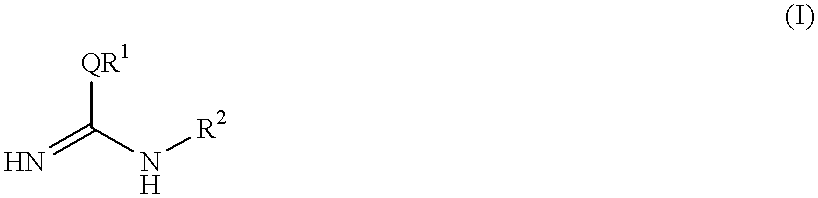
wherein:
Q is oxygen;
R1 is C1-8 hydrocarbyl;
R2 is a mono- or bi-cyclic heterocyclic ring system, C1-14 hydrocarbyl group which may optionally contain an oxygen atom, a group S(O)n wherein n is 0, 1 or 2, or a group NR2 wherein R3 is a C1-6 aliphatic group,
each group R2 optionally being substituted by one to five groups independently selected from:
(i) C1-6 alkyl or C3-6 cycloalkyl each optionally substituted by one to three halo atoms;
(ii) a group OR4 wherein R4 is hydrogen, C1-6 alkyl, phenyl or benzyl;
(iii) a halo atom;
(iv) a group CO2R5 wherein R5 is hydrogen or C1-4 alkyl;
(v) a group NR6R7 wherein R6 and R7 are independently selected from hydrogen, C1-4 alkyl or a group 
wherein Q and R1 are as defined above;
(vi) nitro; or
(vii) cyano.
2. A method as claimed in claim 1 wherein the condition is cerebral ischemia.
3. A method of treatment of a condition requiring selective inhibition of the neuronal NO synthase enzyme, said condition being selected from the group consisting of cerebral ischemia, CNS trauma, epilepsy, AIDS dementia, chronic neurodegenerative disease, chronic pain, priapism, obesity, hyperphagia and combinations thereof; comprising administering to a mammal in need thereof a therapeutically effective amount of an N,O-disubstituted isourea derivative of formula (IB, (ID), or (IF), or a salt, ester or amide thereof: 
wherein Z is oxygen or sulphur;
R1 is C1-8 hydrocarbyl;
X is C2-10 hydrocarbyl group which may optionally contain an oxygen atom, a group S(O)n wherein n is 0, 1 or 2, or a group NR3 wherein R3 is a C1-6 aliphatic group;
T is a C1-8 hydrocarbyl group optionally containing a phenylene ring or a 5- or 6-membered heterocyclic ring; and
Ar is a mono- or a bicyclic aromatic ring system; and wherein each Ar is optionally substituted by one to five groups independently selected from:
(i) C1-6 alkyl or C3-6 cycloalkyl each optionally substituted by one to three halo atoms;
(ii) a group OR4 wherein R4 is hydrogen, C1-6 alkyl, phenyl or benzyl;
(iii) a halo atom;
(iv) a group CO2R5 wherein R5 is hydrogen or C1-4 alkyl;
(v) a group NR6R7 wherein R6 and R7 are independently selected from hydrogen, C1-4 alkyl or a group 
wherein Q is oxygen and R1 is as defined above;
(vi) nitro; or
(vii) cyano.
4. The method according to claim 3, wherein Ar is phenyl optionally substituted by one to three substituents which are the same or different and are selected from the group consisting of C1-4 alkyl groups optionally substituted by one to three halo atoms; C3-6 cycloalkyl groups optionally substituted by one to three halo atoms; C1-4 alkoxy groups; hydroxy groups; benzyloxy groups; halo atoms; CO2R5 groups wherein R5 is hydrogen or C1-4 Alkyl; and NR6R7 groups wherein R6 and R7 are independently selected from hydrogen or C1-4 alkyl.
5. A method of treatment of a condition requiring selective inhibition of the neuronal NO synthase enzyme comprising administering to a mammal in need thereof a therapeutically effective amount of an N,O-disubstituted isourea derivative, or a salt, ester or amide thereof, wherein the N,O-disubstituted isourea derivative is:
O-Methyl-N-(4-(trifluoromethyl)phenyl)isourea,
O-Ethyl-N-(4-(trifluoromethyl)phenyl)isourea,
N5-(iminomethoxymethyl)-L-ornithine,
N5-(ethoxyiminomethyl)-L-ornithine,
N5-(iminomisopropoxymethyl)-L-ornithine,
N6-iminomethoxymethyl)-L-lysine,
N6-(ethoxyiminomethyl)-L-lysine,
1-(3-(Aminomethyl)benzyl)-O-ethylisourea.
Priority Applications (2)
| Application Number | Priority Date | Filing Date | Title |
|---|---|---|---|
| US09/514,525 US6225305B1 (en) | 1993-10-04 | 2000-02-28 | Substituted urea and isothiorea derivatives as no synthase inhibitors |
| US09/770,583 US6297276B1 (en) | 1993-10-04 | 2001-01-26 | Substituted urea and isothiourea derivatives as no synthase inhibitors |
Applications Claiming Priority (2)
| Application Number | Priority Date | Filing Date | Title |
|---|---|---|---|
| US13179493A | 1993-10-04 | 1993-10-04 | |
| US09/514,525 US6225305B1 (en) | 1993-10-04 | 2000-02-28 | Substituted urea and isothiorea derivatives as no synthase inhibitors |
Related Parent Applications (2)
| Application Number | Title | Priority Date | Filing Date |
|---|---|---|---|
| PCT/GB1994/002138 Continuation WO1995009619A2 (en) | 1944-06-01 | 1994-10-03 | Substituted urea and isothiourea derivatives as no synthase inhibitors |
| US08/615,291 Continuation US6090846A (en) | 1993-10-04 | 1994-10-03 | Substituted urea and isothiourea derivatives as no synthase inhibitors |
Related Child Applications (1)
| Application Number | Title | Priority Date | Filing Date |
|---|---|---|---|
| US09/770,583 Division US6297276B1 (en) | 1993-10-04 | 2001-01-26 | Substituted urea and isothiourea derivatives as no synthase inhibitors |
Publications (1)
| Publication Number | Publication Date |
|---|---|
| US6225305B1 true US6225305B1 (en) | 2001-05-01 |
Family
ID=22451052
Family Applications (1)
| Application Number | Title | Priority Date | Filing Date |
|---|---|---|---|
| US09/514,525 Expired - Fee Related US6225305B1 (en) | 1993-10-04 | 2000-02-28 | Substituted urea and isothiorea derivatives as no synthase inhibitors |
Country Status (1)
| Country | Link |
|---|---|
| US (1) | US6225305B1 (en) |
Cited By (1)
| Publication number | Priority date | Publication date | Assignee | Title |
|---|---|---|---|---|
| US20080114021A1 (en) * | 2006-11-09 | 2008-05-15 | University Of Maryland Baltimore | Use Of 5,6-Dimethylxanthenone-4-Acetic Acid as an Antimicrobial Agent |
Citations (14)
| Publication number | Priority date | Publication date | Assignee | Title |
|---|---|---|---|---|
| US2849306A (en) | 1954-03-19 | 1958-08-26 | Du Pont | Herbicidal method and composition employing aryl pseudoureas |
| US3202660A (en) | 1961-10-09 | 1965-08-24 | Boehringer Sohn Ingelheim | Process for the preparation of 3-arylamino-1, 3-diazacycloalkenes |
| FR1532212A (en) | 1963-07-05 | 1968-07-12 | Bayer Ag | Process for manufacturing 2-phenylamino-4h-5, 6-dihydro-1, 3-thiazine derivatives |
| GB1178242A (en) | 1966-02-05 | 1970-01-21 | Wellcome Found | Novel Biologically Active Bis-Isothioureas |
| US3935266A (en) | 1970-10-28 | 1976-01-27 | Taiho Pharmaceutical Company, Limited | N-substituted guanidino acid derivatives |
| NL7703011A (en) | 1976-03-19 | 1977-09-21 | Mcneilab Inc | PROCESS FOR PREPARING 1-AZACARBOCYCLICAL 2-YLIDEEN DERIVATIVES OF GUANIDINE, PROCEDURE FOR PREPARING A PHARMACEUTICAL PREPARATION USING IT AND SUCH PREPARATION. |
| EP0202157A1 (en) | 1985-04-30 | 1986-11-20 | Laboratoires Chauvin S.A. | N-substituted 2-amino-thiazoles, process for their preparation and their therapeutical use |
| EP0392802A2 (en) | 1989-04-11 | 1990-10-17 | Beecham Group p.l.c. | Preparation of urea analogues and their use in bronchial, cerebrovascular and neuronal disorders |
| EP0411615A1 (en) | 1989-08-02 | 1991-02-06 | Warner-Lambert Company | 4-(N-substituted amino)-2-butynyl-1-ureas and thioureas and derivatives thereof as centrally acting muscarinic agents |
| WO1991004024A1 (en) | 1989-09-13 | 1991-04-04 | Board Of Regents, The University Of Texas System | Arginine antagonists for inhibition of systemic hypotension associated with nitric oxide production or endothelial derived relaxing factor |
| GB2240041A (en) | 1989-12-22 | 1991-07-24 | Scras | Agents for blocking endothelin derived relaxing factor |
| EP0446699A1 (en) | 1990-02-26 | 1991-09-18 | Merrell Pharmaceuticals Inc. | Inhibitors of nitric oxide biosynthesis |
| WO1993013055A1 (en) | 1991-12-24 | 1993-07-08 | The Wellcome Foundation Limited | Amidino derivatives and their use as nitric oxide synthase inhibitors |
| US5364881A (en) | 1993-11-15 | 1994-11-15 | The Medical College Of Wisconsin Research Foundation, Inc. | S-alkyl-isothioureido-amino acids and use thereof |
-
2000
- 2000-02-28 US US09/514,525 patent/US6225305B1/en not_active Expired - Fee Related
Patent Citations (14)
| Publication number | Priority date | Publication date | Assignee | Title |
|---|---|---|---|---|
| US2849306A (en) | 1954-03-19 | 1958-08-26 | Du Pont | Herbicidal method and composition employing aryl pseudoureas |
| US3202660A (en) | 1961-10-09 | 1965-08-24 | Boehringer Sohn Ingelheim | Process for the preparation of 3-arylamino-1, 3-diazacycloalkenes |
| FR1532212A (en) | 1963-07-05 | 1968-07-12 | Bayer Ag | Process for manufacturing 2-phenylamino-4h-5, 6-dihydro-1, 3-thiazine derivatives |
| GB1178242A (en) | 1966-02-05 | 1970-01-21 | Wellcome Found | Novel Biologically Active Bis-Isothioureas |
| US3935266A (en) | 1970-10-28 | 1976-01-27 | Taiho Pharmaceutical Company, Limited | N-substituted guanidino acid derivatives |
| NL7703011A (en) | 1976-03-19 | 1977-09-21 | Mcneilab Inc | PROCESS FOR PREPARING 1-AZACARBOCYCLICAL 2-YLIDEEN DERIVATIVES OF GUANIDINE, PROCEDURE FOR PREPARING A PHARMACEUTICAL PREPARATION USING IT AND SUCH PREPARATION. |
| EP0202157A1 (en) | 1985-04-30 | 1986-11-20 | Laboratoires Chauvin S.A. | N-substituted 2-amino-thiazoles, process for their preparation and their therapeutical use |
| EP0392802A2 (en) | 1989-04-11 | 1990-10-17 | Beecham Group p.l.c. | Preparation of urea analogues and their use in bronchial, cerebrovascular and neuronal disorders |
| EP0411615A1 (en) | 1989-08-02 | 1991-02-06 | Warner-Lambert Company | 4-(N-substituted amino)-2-butynyl-1-ureas and thioureas and derivatives thereof as centrally acting muscarinic agents |
| WO1991004024A1 (en) | 1989-09-13 | 1991-04-04 | Board Of Regents, The University Of Texas System | Arginine antagonists for inhibition of systemic hypotension associated with nitric oxide production or endothelial derived relaxing factor |
| GB2240041A (en) | 1989-12-22 | 1991-07-24 | Scras | Agents for blocking endothelin derived relaxing factor |
| EP0446699A1 (en) | 1990-02-26 | 1991-09-18 | Merrell Pharmaceuticals Inc. | Inhibitors of nitric oxide biosynthesis |
| WO1993013055A1 (en) | 1991-12-24 | 1993-07-08 | The Wellcome Foundation Limited | Amidino derivatives and their use as nitric oxide synthase inhibitors |
| US5364881A (en) | 1993-11-15 | 1994-11-15 | The Medical College Of Wisconsin Research Foundation, Inc. | S-alkyl-isothioureido-amino acids and use thereof |
Non-Patent Citations (20)
| Title |
|---|
| Boucher, et al., Endothelium 1 (supp):s17 #65 (1993). |
| Bredt et al., Proc. Natl. Acad. Sci. USA, 87:682 (1990). |
| Database WPI, Week 9238, Derwent Publications Ltd., London, GB; AN 92-315914, Sep. 3, 1992. |
| Dawson, et. al., Proceedings National Academy of Sciences USA, vol. 88, Jul. 1991, 6368-6371. |
| Feldman, Tetra Lttrs., 32(7):875 (1991). |
| Griffith, Enothelium, 1 (supp):s17 #64 (1993). |
| Joshua et al., Indian Chem. Soc. 67(9): 759 (1990). |
| Loev et al., J. Med. Chem. 15(10): 1024 (1972). |
| MacAllister, et al., Endothelium 1 (supp):s17 #63 (1993). |
| Manley, et al., Journal of Medicinal Chemistry, vol. 35, 1992, 2327-2340. |
| Mayer, et al., Febs Letters 288 (1.2): 187 (1991). |
| Moncada, et al., Biochemical Pharmacology 38(11): 1709 (1989). |
| Moncada, et al., Pharmacological reviews 43 (2):109 (1991). |
| Narayanan et al., J. Med Chem. 37:885 (1994). |
| Nowicki et al., European J. Pharmocology 204:339 (1991). |
| Rasmussen et al., Synthesis, vol. 6, Jun. 1988, 460-466. |
| Schmidt et al., Proc. Natl. Acad. Sci. USA 88:365 (1991). |
| Schmind, et al., Endothelium 1 (supp):s17 #66 (1993). |
| Science & Technology Concertrates, C&EN, Apr. 4, 1994, p. 24. |
| Ziegler et al., Mh. Chem., 99:1499-1506 (1968). |
Cited By (3)
| Publication number | Priority date | Publication date | Assignee | Title |
|---|---|---|---|---|
| US20080114021A1 (en) * | 2006-11-09 | 2008-05-15 | University Of Maryland Baltimore | Use Of 5,6-Dimethylxanthenone-4-Acetic Acid as an Antimicrobial Agent |
| US20110218239A1 (en) * | 2006-11-09 | 2011-09-08 | University Of Maryland Baltimore | Use of 5,6-Dimethylxanthenone-4-Acetic Acid as an Antiviral Agent |
| US8957108B2 (en) | 2006-11-09 | 2015-02-17 | University Of Maryland, Baltimore | Use of 5,6-dimethylxanthenone-4-acetic acid as an antiviral agent |
Similar Documents
| Publication | Publication Date | Title |
|---|---|---|
| WO1995009619A2 (en) | Substituted urea and isothiourea derivatives as no synthase inhibitors | |
| US9708255B2 (en) | (bis)urea and (bis)thiourea compounds as epigenic modulators of lysine-specific demethylase 1 and methods of treating disorders | |
| DE69529101T2 (en) | Intermediates usable in the manufacture of enzyme inhibitors | |
| DE69408988T2 (en) | AMINO ACID DERIVATIVES AS NO-SYNTHASE INHIBITORS | |
| EP0670720A1 (en) | Enzyme inhibitors | |
| SU1400508A3 (en) | Method of producing derivatives of arylthiazole | |
| ES2269240T3 (en) | USEFUL AMINOTETRAZOL DERIVATIVES AS INHIBITORS OF NITRICO SINTASA OXIDE. | |
| IL110643A (en) | Amidine derivatives their preparation and pharmaceutical compositions containing them | |
| CZ20012150A3 (en) | Sulfonamide of hydroxydiphenylurea functioning as IL-8 receptor antagonist | |
| USRE37438E1 (en) | Acetamidine derivatives and their use as inhibitors for the nitric oxide synthase | |
| US5721247A (en) | Isothiourea derivatives useful in therapy | |
| NZ233252A (en) | Thiourea and guanidine derivatives and pharmaceutical compositions | |
| US6197797B1 (en) | Cyanoguanidines as cell proliferation inhibitors | |
| EP0861231B1 (en) | L-n6-(1-iminoethyl)lysine derivatives useful as nitric oxide synthaseinhibitors | |
| CZ20023192A3 (en) | Antagonists of IL-8 receptor | |
| US6090846A (en) | Substituted urea and isothiourea derivatives as no synthase inhibitors | |
| US6225305B1 (en) | Substituted urea and isothiorea derivatives as no synthase inhibitors | |
| US6297276B1 (en) | Substituted urea and isothiourea derivatives as no synthase inhibitors | |
| SU1364240A3 (en) | Method of obtaining derivatives of 4,5,6,7-tetrahydrothiazolo-(5,4-c)-pyridine or pharmaceutically acceptable salts thereof | |
| CZ20023075A3 (en) | IL-8 receptor antagonists | |
| HUP0201302A2 (en) | IL-8 receptor antagonist cyclic guanidine derivatives | |
| JPH11500711A (en) | Acetamidine derivatives and their use as NO synthase inhibitors | |
| NZ200923A (en) | Cystine derivatives and pharmaceutical compositions containing such | |
| CZ20023076A3 (en) | Antagonists of IL-8 receptor | |
| MXPA94004663A (en) | Aminoaci derivatives |
Legal Events
| Date | Code | Title | Description |
|---|---|---|---|
| REMI | Maintenance fee reminder mailed | ||
| LAPS | Lapse for failure to pay maintenance fees | ||
| STCH | Information on status: patent discontinuation |
Free format text: PATENT EXPIRED DUE TO NONPAYMENT OF MAINTENANCE FEES UNDER 37 CFR 1.362 |
|
| FP | Lapsed due to failure to pay maintenance fee |
Effective date: 20050501 |