US6214592B1 - Enzymes and microorganisms having amidase activity for hydrolysing polyamides - Google Patents
Enzymes and microorganisms having amidase activity for hydrolysing polyamides Download PDFInfo
- Publication number
- US6214592B1 US6214592B1 US09/000,064 US6498A US6214592B1 US 6214592 B1 US6214592 B1 US 6214592B1 US 6498 A US6498 A US 6498A US 6214592 B1 US6214592 B1 US 6214592B1
- Authority
- US
- United States
- Prior art keywords
- enzyme
- substrates
- oligomers
- ala
- gly
- Prior art date
- Legal status (The legal status is an assumption and is not a legal conclusion. Google has not performed a legal analysis and makes no representation as to the accuracy of the status listed.)
- Expired - Fee Related
Links
- 102000004190 Enzymes Human genes 0.000 title claims abstract description 76
- 108090000790 Enzymes Proteins 0.000 title claims abstract description 76
- 230000000694 effects Effects 0.000 title claims abstract description 36
- 244000005700 microbiome Species 0.000 title claims abstract description 28
- 108700023418 Amidases Proteins 0.000 title claims abstract description 24
- 102000005922 amidase Human genes 0.000 title claims abstract description 23
- 239000004952 Polyamide Substances 0.000 title claims description 34
- 229920002647 polyamide Polymers 0.000 title claims description 34
- 230000003301 hydrolyzing effect Effects 0.000 title description 6
- 239000000758 substrate Substances 0.000 claims abstract description 57
- 238000000034 method Methods 0.000 claims abstract description 21
- 230000002255 enzymatic effect Effects 0.000 claims abstract description 16
- 230000007062 hydrolysis Effects 0.000 claims abstract description 16
- 238000006460 hydrolysis reaction Methods 0.000 claims abstract description 16
- 150000001408 amides Chemical class 0.000 claims abstract description 14
- 108090000765 processed proteins & peptides Proteins 0.000 claims abstract description 10
- 229920001184 polypeptide Polymers 0.000 claims abstract description 7
- 102000004196 processed proteins & peptides Human genes 0.000 claims abstract description 7
- 239000000178 monomer Substances 0.000 claims description 30
- 108090000623 proteins and genes Proteins 0.000 claims description 21
- 239000002243 precursor Substances 0.000 claims description 17
- 239000000539 dimer Substances 0.000 claims description 13
- 239000013638 trimer Substances 0.000 claims description 10
- 239000008363 phosphate buffer Substances 0.000 claims description 9
- 241000589565 Flavobacterium Species 0.000 claims description 8
- 150000004985 diamines Chemical class 0.000 claims description 8
- 238000006068 polycondensation reaction Methods 0.000 claims description 8
- 102000004169 proteins and genes Human genes 0.000 claims description 8
- 238000006116 polymerization reaction Methods 0.000 claims description 7
- 125000004432 carbon atom Chemical group C* 0.000 claims description 6
- 229910052739 hydrogen Inorganic materials 0.000 claims description 6
- 239000001257 hydrogen Substances 0.000 claims description 6
- 238000003760 magnetic stirring Methods 0.000 claims description 5
- UFHFLCQGNIYNRP-UHFFFAOYSA-N Hydrogen Chemical compound [H][H] UFHFLCQGNIYNRP-UHFFFAOYSA-N 0.000 claims description 4
- 125000002947 alkylene group Chemical group 0.000 claims description 4
- 229910052751 metal Inorganic materials 0.000 claims description 4
- 239000002184 metal Substances 0.000 claims description 4
- 239000012429 reaction media Substances 0.000 claims description 4
- 125000000217 alkyl group Chemical group 0.000 claims description 3
- 230000009089 cytolysis Effects 0.000 claims description 3
- 150000002739 metals Chemical group 0.000 claims description 3
- 239000000126 substance Substances 0.000 claims description 3
- 229910052783 alkali metal Inorganic materials 0.000 claims description 2
- 150000001340 alkali metals Chemical class 0.000 claims description 2
- 229910052784 alkaline earth metal Inorganic materials 0.000 claims description 2
- 150000001342 alkaline earth metals Chemical class 0.000 claims description 2
- 125000000732 arylene group Chemical group 0.000 claims description 2
- 150000002431 hydrogen Chemical class 0.000 claims description 2
- 125000003275 alpha amino acid group Chemical group 0.000 claims 1
- 238000006911 enzymatic reaction Methods 0.000 claims 1
- 229920002292 Nylon 6 Polymers 0.000 abstract description 15
- FWMNVWWHGCHHJJ-SKKKGAJSSA-N 4-amino-1-[(2r)-6-amino-2-[[(2r)-2-[[(2r)-2-[[(2r)-2-amino-3-phenylpropanoyl]amino]-3-phenylpropanoyl]amino]-4-methylpentanoyl]amino]hexanoyl]piperidine-4-carboxylic acid Chemical compound C([C@H](C(=O)N[C@H](CC(C)C)C(=O)N[C@H](CCCCN)C(=O)N1CCC(N)(CC1)C(O)=O)NC(=O)[C@H](N)CC=1C=CC=CC=1)C1=CC=CC=C1 FWMNVWWHGCHHJJ-SKKKGAJSSA-N 0.000 abstract description 6
- 229940088598 enzyme Drugs 0.000 description 52
- 229920002401 polyacrylamide Polymers 0.000 description 19
- 229920002302 Nylon 6,6 Polymers 0.000 description 17
- 229920000642 polymer Polymers 0.000 description 17
- 239000013612 plasmid Substances 0.000 description 13
- NAQMVNRVTILPCV-UHFFFAOYSA-N hexane-1,6-diamine Chemical compound NCCCCCCN NAQMVNRVTILPCV-UHFFFAOYSA-N 0.000 description 12
- 241000588724 Escherichia coli Species 0.000 description 9
- 239000002253 acid Substances 0.000 description 8
- WNLRTRBMVRJNCN-UHFFFAOYSA-N adipic acid Chemical compound OC(=O)CCCCC(O)=O WNLRTRBMVRJNCN-UHFFFAOYSA-N 0.000 description 8
- AVKUERGKIZMTKX-NJBDSQKTSA-N ampicillin Chemical compound C1([C@@H](N)C(=O)N[C@H]2[C@H]3SC([C@@H](N3C2=O)C(O)=O)(C)C)=CC=CC=C1 AVKUERGKIZMTKX-NJBDSQKTSA-N 0.000 description 8
- 229960000723 ampicillin Drugs 0.000 description 8
- 101150017040 I gene Proteins 0.000 description 6
- YXFVVABEGXRONW-UHFFFAOYSA-N Toluene Chemical compound CC1=CC=CC=C1 YXFVVABEGXRONW-UHFFFAOYSA-N 0.000 description 6
- 125000003368 amide group Chemical group 0.000 description 6
- 108010069205 aspartyl-phenylalanine Proteins 0.000 description 6
- 230000007071 enzymatic hydrolysis Effects 0.000 description 6
- 238000006047 enzymatic hydrolysis reaction Methods 0.000 description 6
- 239000012634 fragment Substances 0.000 description 6
- VPZXBVLAVMBEQI-UHFFFAOYSA-N glycyl-DL-alpha-alanine Natural products OC(=O)C(C)NC(=O)CN VPZXBVLAVMBEQI-UHFFFAOYSA-N 0.000 description 6
- 0 *C(=O)CC(=O)N(C)CN(C)[Y] Chemical compound *C(=O)CC(=O)N(C)CN(C)[Y] 0.000 description 5
- KOWXKIHEBFTVRU-UHFFFAOYSA-N CC.CC Chemical compound CC.CC KOWXKIHEBFTVRU-UHFFFAOYSA-N 0.000 description 5
- 150000001875 compounds Chemical class 0.000 description 5
- 238000004519 manufacturing process Methods 0.000 description 5
- 239000002609 medium Substances 0.000 description 5
- SLXKOJJOQWFEFD-UHFFFAOYSA-N 6-aminohexanoic acid Chemical compound NCCCCCC(O)=O SLXKOJJOQWFEFD-UHFFFAOYSA-N 0.000 description 4
- BLIMFWGRQKRCGT-YUMQZZPRSA-N Ala-Gly-Lys Chemical compound C[C@H](N)C(=O)NCC(=O)N[C@H](C(O)=O)CCCCN BLIMFWGRQKRCGT-YUMQZZPRSA-N 0.000 description 4
- WNGVUZWBXZKQES-YUMQZZPRSA-N Leu-Ala-Gly Chemical compound CC(C)C[C@H](N)C(=O)N[C@@H](C)C(=O)NCC(O)=O WNGVUZWBXZKQES-YUMQZZPRSA-N 0.000 description 4
- XMBSYZWANAQXEV-UHFFFAOYSA-N N-alpha-L-glutamyl-L-phenylalanine Natural products OC(=O)CCC(N)C(=O)NC(C(O)=O)CC1=CC=CC=C1 XMBSYZWANAQXEV-UHFFFAOYSA-N 0.000 description 4
- 108091028043 Nucleic acid sequence Proteins 0.000 description 4
- SEPNOAFMZLLCEW-UBHSHLNASA-N Phe-Ala-Val Chemical compound N[C@@H](CC1=CC=CC=C1)C(=O)N[C@@H](C)C(=O)N[C@@H](C(C)C)C(=O)O SEPNOAFMZLLCEW-UBHSHLNASA-N 0.000 description 4
- FAPWRFPIFSIZLT-UHFFFAOYSA-M Sodium chloride Chemical compound [Na+].[Cl-] FAPWRFPIFSIZLT-UHFFFAOYSA-M 0.000 description 4
- 239000001361 adipic acid Substances 0.000 description 4
- 235000011037 adipic acid Nutrition 0.000 description 4
- 108010047495 alanylglycine Proteins 0.000 description 4
- 239000003795 chemical substances by application Substances 0.000 description 4
- JBKVHLHDHHXQEQ-UHFFFAOYSA-N epsilon-caprolactam Chemical compound O=C1CCCCCN1 JBKVHLHDHHXQEQ-UHFFFAOYSA-N 0.000 description 4
- 108010049041 glutamylalanine Proteins 0.000 description 4
- CXMXRPHRNRROMY-UHFFFAOYSA-N sebacic acid Chemical compound OC(=O)CCCCCCCCC(O)=O CXMXRPHRNRROMY-UHFFFAOYSA-N 0.000 description 4
- 108010061238 threonyl-glycine Proteins 0.000 description 4
- 229920001817 Agar Polymers 0.000 description 3
- DBMJMQXJHONAFJ-UHFFFAOYSA-M Sodium laurylsulphate Chemical compound [Na+].CCCCCCCCCCCCOS([O-])(=O)=O DBMJMQXJHONAFJ-UHFFFAOYSA-M 0.000 description 3
- 239000008272 agar Substances 0.000 description 3
- 229960002684 aminocaproic acid Drugs 0.000 description 3
- 239000000872 buffer Substances 0.000 description 3
- 238000005119 centrifugation Methods 0.000 description 3
- 230000000295 complement effect Effects 0.000 description 3
- BPHPUYQFMNQIOC-NXRLNHOXSA-N isopropyl beta-D-thiogalactopyranoside Chemical compound CC(C)S[C@@H]1O[C@H](CO)[C@H](O)[C@H](O)[C@H]1O BPHPUYQFMNQIOC-NXRLNHOXSA-N 0.000 description 3
- 239000000203 mixture Substances 0.000 description 3
- 235000019333 sodium laurylsulphate Nutrition 0.000 description 3
- PBLZLIFKVPJDCO-UHFFFAOYSA-N 12-aminododecanoic acid Chemical compound NCCCCCCCCCCCC(O)=O PBLZLIFKVPJDCO-UHFFFAOYSA-N 0.000 description 2
- QKNYBSVHEMOAJP-UHFFFAOYSA-N 2-amino-2-(hydroxymethyl)propane-1,3-diol;hydron;chloride Chemical compound Cl.OCC(N)(CO)CO QKNYBSVHEMOAJP-UHFFFAOYSA-N 0.000 description 2
- JJMDCOVWQOJGCB-UHFFFAOYSA-N 5-aminopentanoic acid Chemical compound [NH3+]CCCCC([O-])=O JJMDCOVWQOJGCB-UHFFFAOYSA-N 0.000 description 2
- JBGSZRYCXBPWGX-BQBZGAKWSA-N Ala-Arg-Gly Chemical compound OC(=O)CNC(=O)[C@@H](NC(=O)[C@@H](N)C)CCCN=C(N)N JBGSZRYCXBPWGX-BQBZGAKWSA-N 0.000 description 2
- JAMAWBXXKFGFGX-KZVJFYERSA-N Ala-Arg-Thr Chemical compound [H]N[C@@H](C)C(=O)N[C@@H](CCCNC(N)=N)C(=O)N[C@@H]([C@@H](C)O)C(O)=O JAMAWBXXKFGFGX-KZVJFYERSA-N 0.000 description 2
- HXNNRBHASOSVPG-GUBZILKMSA-N Ala-Glu-Leu Chemical compound [H]N[C@@H](C)C(=O)N[C@@H](CCC(O)=O)C(=O)N[C@@H](CC(C)C)C(O)=O HXNNRBHASOSVPG-GUBZILKMSA-N 0.000 description 2
- VWEWCZSUWOEEFM-WDSKDSINSA-N Ala-Gly-Ala-Gly Chemical compound C[C@H](N)C(=O)NCC(=O)N[C@@H](C)C(=O)NCC(O)=O VWEWCZSUWOEEFM-WDSKDSINSA-N 0.000 description 2
- CWEAKSWWKHGTRJ-BQBZGAKWSA-N Ala-Gly-Met Chemical compound [H]N[C@@H](C)C(=O)NCC(=O)N[C@@H](CCSC)C(O)=O CWEAKSWWKHGTRJ-BQBZGAKWSA-N 0.000 description 2
- OBVSBEYOMDWLRJ-BFHQHQDPSA-N Ala-Gly-Thr Chemical compound C[C@@H](O)[C@@H](C(O)=O)NC(=O)CNC(=O)[C@H](C)N OBVSBEYOMDWLRJ-BFHQHQDPSA-N 0.000 description 2
- PNALXAODQKTNLV-JBDRJPRFSA-N Ala-Ile-Ala Chemical compound C[C@H](N)C(=O)N[C@@H]([C@@H](C)CC)C(=O)N[C@@H](C)C(O)=O PNALXAODQKTNLV-JBDRJPRFSA-N 0.000 description 2
- FOHXUHGZZKETFI-JBDRJPRFSA-N Ala-Ile-Cys Chemical compound CC[C@H](C)[C@@H](C(=O)N[C@@H](CS)C(=O)O)NC(=O)[C@H](C)N FOHXUHGZZKETFI-JBDRJPRFSA-N 0.000 description 2
- CCDFBRZVTDDJNM-GUBZILKMSA-N Ala-Leu-Glu Chemical compound [H]N[C@@H](C)C(=O)N[C@@H](CC(C)C)C(=O)N[C@@H](CCC(O)=O)C(O)=O CCDFBRZVTDDJNM-GUBZILKMSA-N 0.000 description 2
- MNZHHDPWDWQJCQ-YUMQZZPRSA-N Ala-Leu-Gly Chemical compound C[C@H](N)C(=O)N[C@@H](CC(C)C)C(=O)NCC(O)=O MNZHHDPWDWQJCQ-YUMQZZPRSA-N 0.000 description 2
- XRUJOVRWNMBAAA-NHCYSSNCSA-N Ala-Phe-Ala Chemical compound OC(=O)[C@H](C)NC(=O)[C@@H](NC(=O)[C@@H](N)C)CC1=CC=CC=C1 XRUJOVRWNMBAAA-NHCYSSNCSA-N 0.000 description 2
- PEIBBAXIKUAYGN-UBHSHLNASA-N Ala-Phe-Arg Chemical compound NC(N)=NCCC[C@@H](C(O)=O)NC(=O)[C@@H](NC(=O)[C@@H](N)C)CC1=CC=CC=C1 PEIBBAXIKUAYGN-UBHSHLNASA-N 0.000 description 2
- MAZZQZWCCYJQGZ-GUBZILKMSA-N Ala-Pro-Arg Chemical compound [H]N[C@@H](C)C(=O)N1CCC[C@H]1C(=O)N[C@@H](CCCNC(N)=N)C(O)=O MAZZQZWCCYJQGZ-GUBZILKMSA-N 0.000 description 2
- BVLPIIBTWIYOML-ZKWXMUAHSA-N Ala-Val-Asp Chemical compound [H]N[C@@H](C)C(=O)N[C@@H](C(C)C)C(=O)N[C@@H](CC(O)=O)C(O)=O BVLPIIBTWIYOML-ZKWXMUAHSA-N 0.000 description 2
- OAIGZYFGCNNVIE-ZPFDUUQYSA-N Ala-Val-Asp-Pro Chemical compound C[C@H](N)C(=O)N[C@@H](C(C)C)C(=O)N[C@@H](CC(O)=O)C(=O)N1CCC[C@H]1C(O)=O OAIGZYFGCNNVIE-ZPFDUUQYSA-N 0.000 description 2
- 102000004092 Amidohydrolases Human genes 0.000 description 2
- 108090000531 Amidohydrolases Proteins 0.000 description 2
- UPKMBGAAEZGHOC-RWMBFGLXSA-N Arg-His-Pro Chemical compound C1C[C@@H](N(C1)C(=O)[C@H](CC2=CN=CN2)NC(=O)[C@H](CCCN=C(N)N)N)C(=O)O UPKMBGAAEZGHOC-RWMBFGLXSA-N 0.000 description 2
- YBZMTKUDWXZLIX-UWVGGRQHSA-N Arg-Leu-Gly Chemical compound [H]N[C@@H](CCCNC(N)=N)C(=O)N[C@@H](CC(C)C)C(=O)NCC(O)=O YBZMTKUDWXZLIX-UWVGGRQHSA-N 0.000 description 2
- COXMUHNBYCVVRG-DCAQKATOSA-N Arg-Leu-Ser Chemical compound [H]N[C@@H](CCCNC(N)=N)C(=O)N[C@@H](CC(C)C)C(=O)N[C@@H](CO)C(O)=O COXMUHNBYCVVRG-DCAQKATOSA-N 0.000 description 2
- JCROZIFVIYMXHM-GUBZILKMSA-N Arg-Met-Ser Chemical compound OC[C@@H](C(O)=O)NC(=O)[C@H](CCSC)NC(=O)[C@@H](N)CCCN=C(N)N JCROZIFVIYMXHM-GUBZILKMSA-N 0.000 description 2
- FKQITMVNILRUCQ-IHRRRGAJSA-N Arg-Phe-Asp Chemical compound [H]N[C@@H](CCCNC(N)=N)C(=O)N[C@@H](CC1=CC=CC=C1)C(=O)N[C@@H](CC(O)=O)C(O)=O FKQITMVNILRUCQ-IHRRRGAJSA-N 0.000 description 2
- LRPZJPMQGKGHSG-XGEHTFHBSA-N Arg-Ser-Thr Chemical compound C[C@H]([C@@H](C(=O)O)NC(=O)[C@H](CO)NC(=O)[C@H](CCCN=C(N)N)N)O LRPZJPMQGKGHSG-XGEHTFHBSA-N 0.000 description 2
- VHQSGALUSWIYOD-QXEWZRGKSA-N Asn-Pro-Val Chemical compound [H]N[C@@H](CC(N)=O)C(=O)N1CCC[C@H]1C(=O)N[C@@H](C(C)C)C(O)=O VHQSGALUSWIYOD-QXEWZRGKSA-N 0.000 description 2
- UXHYOWXTJLBEPG-GSSVUCPTSA-N Asn-Thr-Thr Chemical compound [H]N[C@@H](CC(N)=O)C(=O)N[C@@H]([C@@H](C)O)C(=O)N[C@@H]([C@@H](C)O)C(O)=O UXHYOWXTJLBEPG-GSSVUCPTSA-N 0.000 description 2
- VTYQAQFKMQTKQD-ACZMJKKPSA-N Asp-Ala-Gln Chemical compound [H]N[C@@H](CC(O)=O)C(=O)N[C@@H](C)C(=O)N[C@@H](CCC(N)=O)C(O)=O VTYQAQFKMQTKQD-ACZMJKKPSA-N 0.000 description 2
- NECWUSYTYSIFNC-DLOVCJGASA-N Asp-Ala-Phe Chemical compound OC(=O)C[C@H](N)C(=O)N[C@@H](C)C(=O)N[C@H](C(O)=O)CC1=CC=CC=C1 NECWUSYTYSIFNC-DLOVCJGASA-N 0.000 description 2
- NYLBGYLHBDFRHL-VEVYYDQMSA-N Asp-Arg-Thr Chemical compound [H]N[C@@H](CC(O)=O)C(=O)N[C@@H](CCCNC(N)=N)C(=O)N[C@@H]([C@@H](C)O)C(O)=O NYLBGYLHBDFRHL-VEVYYDQMSA-N 0.000 description 2
- OMMIEVATLAGRCK-BYPYZUCNSA-N Asp-Gly-Gly Chemical compound OC(=O)C[C@H](N)C(=O)NCC(=O)NCC(O)=O OMMIEVATLAGRCK-BYPYZUCNSA-N 0.000 description 2
- JNNVNVRBYUJYGS-CIUDSAMLSA-N Asp-Leu-Ala Chemical compound [H]N[C@@H](CC(O)=O)C(=O)N[C@@H](CC(C)C)C(=O)N[C@@H](C)C(O)=O JNNVNVRBYUJYGS-CIUDSAMLSA-N 0.000 description 2
- LIVXPXUVXFRWNY-CIUDSAMLSA-N Asp-Lys-Ala Chemical compound [H]N[C@@H](CC(O)=O)C(=O)N[C@@H](CCCCN)C(=O)N[C@@H](C)C(O)=O LIVXPXUVXFRWNY-CIUDSAMLSA-N 0.000 description 2
- JSNWZMFSLIWAHS-HJGDQZAQSA-N Asp-Thr-Leu Chemical compound C[C@H]([C@@H](C(=O)N[C@@H](CC(C)C)C(=O)O)NC(=O)[C@H](CC(=O)O)N)O JSNWZMFSLIWAHS-HJGDQZAQSA-N 0.000 description 2
- YCVIWXUOLQPKLT-UHFFFAOYSA-N C#C=NCN(C)C Chemical compound C#C=NCN(C)C YCVIWXUOLQPKLT-UHFFFAOYSA-N 0.000 description 2
- OKTJSMMVPCPJKN-UHFFFAOYSA-N Carbon Chemical compound [C] OKTJSMMVPCPJKN-UHFFFAOYSA-N 0.000 description 2
- 108020004414 DNA Proteins 0.000 description 2
- KCXVZYZYPLLWCC-UHFFFAOYSA-N EDTA Chemical compound OC(=O)CN(CC(O)=O)CCN(CC(O)=O)CC(O)=O KCXVZYZYPLLWCC-UHFFFAOYSA-N 0.000 description 2
- IOFDDSNZJDIGPB-GVXVVHGQSA-N Gln-Leu-Val Chemical compound [H]N[C@@H](CCC(N)=O)C(=O)N[C@@H](CC(C)C)C(=O)N[C@@H](C(C)C)C(O)=O IOFDDSNZJDIGPB-GVXVVHGQSA-N 0.000 description 2
- QZQYITIKPAUDGN-GVXVVHGQSA-N Gln-Val-His Chemical compound CC(C)[C@@H](C(=O)N[C@@H](CC1=CN=CN1)C(=O)O)NC(=O)[C@H](CCC(=O)N)N QZQYITIKPAUDGN-GVXVVHGQSA-N 0.000 description 2
- VYOILACOFPPNQH-UMNHJUIQSA-N Gln-Val-Pro Chemical compound CC(C)[C@@H](C(=O)N1CCC[C@@H]1C(=O)O)NC(=O)[C@H](CCC(=O)N)N VYOILACOFPPNQH-UMNHJUIQSA-N 0.000 description 2
- UTKUTMJSWKKHEM-WDSKDSINSA-N Glu-Ala-Gly Chemical compound OC(=O)CNC(=O)[C@H](C)NC(=O)[C@@H](N)CCC(O)=O UTKUTMJSWKKHEM-WDSKDSINSA-N 0.000 description 2
- BRKUZSLQMPNVFN-SRVKXCTJSA-N Glu-His-Arg Chemical compound [H]N[C@@H](CCC(O)=O)C(=O)N[C@@H](CC1=CNC=N1)C(=O)N[C@@H](CCCNC(N)=N)C(O)=O BRKUZSLQMPNVFN-SRVKXCTJSA-N 0.000 description 2
- LGYCLOCORAEQSZ-PEFMBERDSA-N Glu-Ile-Asp Chemical compound [H]N[C@@H](CCC(O)=O)C(=O)N[C@@H]([C@@H](C)CC)C(=O)N[C@@H](CC(O)=O)C(O)=O LGYCLOCORAEQSZ-PEFMBERDSA-N 0.000 description 2
- ZSWGJYOZWBHROQ-RWRJDSDZSA-N Glu-Ile-Thr Chemical compound [H]N[C@@H](CCC(O)=O)C(=O)N[C@@H]([C@@H](C)CC)C(=O)N[C@@H]([C@@H](C)O)C(O)=O ZSWGJYOZWBHROQ-RWRJDSDZSA-N 0.000 description 2
- CBEUFCJRFNZMCU-SRVKXCTJSA-N Glu-Met-Leu Chemical compound [H]N[C@@H](CCC(O)=O)C(=O)N[C@@H](CCSC)C(=O)N[C@@H](CC(C)C)C(O)=O CBEUFCJRFNZMCU-SRVKXCTJSA-N 0.000 description 2
- PYTZFYUXZZHOAD-WHFBIAKZSA-N Gly-Ala-Ala Chemical compound OC(=O)[C@H](C)NC(=O)[C@H](C)NC(=O)CN PYTZFYUXZZHOAD-WHFBIAKZSA-N 0.000 description 2
- GQGAFTPXAPKSCF-WHFBIAKZSA-N Gly-Ala-Cys Chemical compound NCC(=O)N[C@@H](C)C(=O)N[C@@H](CS)C(=O)O GQGAFTPXAPKSCF-WHFBIAKZSA-N 0.000 description 2
- QSDKBRMVXSWAQE-BFHQHQDPSA-N Gly-Ala-Thr Chemical compound C[C@@H](O)[C@@H](C(O)=O)NC(=O)[C@H](C)NC(=O)CN QSDKBRMVXSWAQE-BFHQHQDPSA-N 0.000 description 2
- JRDYDYXZKFNNRQ-XPUUQOCRSA-N Gly-Ala-Val Chemical compound CC(C)[C@@H](C(O)=O)NC(=O)[C@H](C)NC(=O)CN JRDYDYXZKFNNRQ-XPUUQOCRSA-N 0.000 description 2
- JXYMPBCYRKWJEE-BQBZGAKWSA-N Gly-Arg-Ala Chemical compound [H]NCC(=O)N[C@@H](CCCNC(N)=N)C(=O)N[C@@H](C)C(O)=O JXYMPBCYRKWJEE-BQBZGAKWSA-N 0.000 description 2
- LURCIJSJAKFCRO-QWRGUYRKSA-N Gly-Asn-Tyr Chemical compound [H]NCC(=O)N[C@@H](CC(N)=O)C(=O)N[C@@H](CC1=CC=C(O)C=C1)C(O)=O LURCIJSJAKFCRO-QWRGUYRKSA-N 0.000 description 2
- BYYNJRSNDARRBX-YFKPBYRVSA-N Gly-Gln-Gly Chemical compound NCC(=O)N[C@@H](CCC(N)=O)C(=O)NCC(O)=O BYYNJRSNDARRBX-YFKPBYRVSA-N 0.000 description 2
- ULZCYBYDTUMHNF-IUCAKERBSA-N Gly-Leu-Glu Chemical compound NCC(=O)N[C@@H](CC(C)C)C(=O)N[C@@H](CCC(O)=O)C(O)=O ULZCYBYDTUMHNF-IUCAKERBSA-N 0.000 description 2
- NNCSJUBVFBDDLC-YUMQZZPRSA-N Gly-Leu-Ser Chemical compound NCC(=O)N[C@@H](CC(C)C)C(=O)N[C@@H](CO)C(O)=O NNCSJUBVFBDDLC-YUMQZZPRSA-N 0.000 description 2
- GLACUWHUYFBSPJ-FJXKBIBVSA-N Gly-Pro-Thr Chemical compound C[C@@H](O)[C@@H](C(O)=O)NC(=O)[C@@H]1CCCN1C(=O)CN GLACUWHUYFBSPJ-FJXKBIBVSA-N 0.000 description 2
- GNNJKUYDWFIBTK-QWRGUYRKSA-N Gly-Tyr-Asp Chemical compound [H]NCC(=O)N[C@@H](CC1=CC=C(O)C=C1)C(=O)N[C@@H](CC(O)=O)C(O)=O GNNJKUYDWFIBTK-QWRGUYRKSA-N 0.000 description 2
- GJHWILMUOANXTG-WPRPVWTQSA-N Gly-Val-Arg Chemical compound [H]NCC(=O)N[C@@H](C(C)C)C(=O)N[C@@H](CCCNC(N)=N)C(O)=O GJHWILMUOANXTG-WPRPVWTQSA-N 0.000 description 2
- ZVXMEWXHFBYJPI-LSJOCFKGSA-N Gly-Val-Ile Chemical compound [H]NCC(=O)N[C@@H](C(C)C)C(=O)N[C@@H]([C@@H](C)CC)C(O)=O ZVXMEWXHFBYJPI-LSJOCFKGSA-N 0.000 description 2
- VSLXGYMEHVAJBH-DLOVCJGASA-N His-Ala-Leu Chemical compound [H]N[C@@H](CC1=CNC=N1)C(=O)N[C@@H](C)C(=O)N[C@@H](CC(C)C)C(O)=O VSLXGYMEHVAJBH-DLOVCJGASA-N 0.000 description 2
- ZIMTWPHIKZEHSE-UWVGGRQHSA-N His-Arg-Gly Chemical compound [H]N[C@@H](CC1=CNC=N1)C(=O)N[C@@H](CCCNC(N)=N)C(=O)NCC(O)=O ZIMTWPHIKZEHSE-UWVGGRQHSA-N 0.000 description 2
- OVPYIUNCVSOVNF-KQXIARHKSA-N Ile-Gln-Pro Chemical compound CC[C@H](C)[C@@H](C(=O)N[C@@H](CCC(=O)N)C(=O)N1CCC[C@@H]1C(=O)O)N OVPYIUNCVSOVNF-KQXIARHKSA-N 0.000 description 2
- OVPYIUNCVSOVNF-ZPFDUUQYSA-N Ile-Gln-Pro Natural products CC[C@H](C)[C@H](N)C(=O)N[C@@H](CCC(N)=O)C(=O)N1CCC[C@H]1C(O)=O OVPYIUNCVSOVNF-ZPFDUUQYSA-N 0.000 description 2
- IITVUURPOYGCTD-NAKRPEOUSA-N Ile-Pro-Ala Chemical compound CC[C@H](C)[C@H](N)C(=O)N1CCC[C@H]1C(=O)N[C@@H](C)C(O)=O IITVUURPOYGCTD-NAKRPEOUSA-N 0.000 description 2
- YKZAMJXNJUWFIK-JBDRJPRFSA-N Ile-Ser-Ala Chemical compound CC[C@H](C)[C@@H](C(=O)N[C@@H](CO)C(=O)N[C@@H](C)C(=O)O)N YKZAMJXNJUWFIK-JBDRJPRFSA-N 0.000 description 2
- OMDWJWGZGMCQND-CFMVVWHZSA-N Ile-Tyr-Asp Chemical compound CC[C@H](C)[C@@H](C(=O)N[C@@H](CC1=CC=C(C=C1)O)C(=O)N[C@@H](CC(=O)O)C(=O)O)N OMDWJWGZGMCQND-CFMVVWHZSA-N 0.000 description 2
- KFKWRHQBZQICHA-STQMWFEESA-N L-leucyl-L-phenylalanine Natural products CC(C)C[C@H](N)C(=O)N[C@H](C(O)=O)CC1=CC=CC=C1 KFKWRHQBZQICHA-STQMWFEESA-N 0.000 description 2
- QIVBCDIJIAJPQS-VIFPVBQESA-N L-tryptophane Chemical compound C1=CC=C2C(C[C@H](N)C(O)=O)=CNC2=C1 QIVBCDIJIAJPQS-VIFPVBQESA-N 0.000 description 2
- 241000880493 Leptailurus serval Species 0.000 description 2
- RFUBXQQFJFGJFV-GUBZILKMSA-N Leu-Asn-Gln Chemical compound [H]N[C@@H](CC(C)C)C(=O)N[C@@H](CC(N)=O)C(=O)N[C@@H](CCC(N)=O)C(O)=O RFUBXQQFJFGJFV-GUBZILKMSA-N 0.000 description 2
- BABSVXFGKFLIGW-UWVGGRQHSA-N Leu-Gly-Arg Chemical compound CC(C)C[C@H](N)C(=O)NCC(=O)N[C@H](C(O)=O)CCCNC(N)=N BABSVXFGKFLIGW-UWVGGRQHSA-N 0.000 description 2
- QNBVTHNJGCOVFA-AVGNSLFASA-N Leu-Leu-Glu Chemical compound CC(C)C[C@H](N)C(=O)N[C@@H](CC(C)C)C(=O)N[C@H](C(O)=O)CCC(O)=O QNBVTHNJGCOVFA-AVGNSLFASA-N 0.000 description 2
- CSNNHWWHGAXBCP-UHFFFAOYSA-L Magnesium sulfate Chemical compound [Mg+2].[O-][S+2]([O-])([O-])[O-] CSNNHWWHGAXBCP-UHFFFAOYSA-L 0.000 description 2
- HDNOQCZWJGGHSS-VEVYYDQMSA-N Met-Asn-Thr Chemical compound CSCC[C@H](N)C(=O)N[C@@H](CC(N)=O)C(=O)N[C@@H]([C@@H](C)O)C(O)=O HDNOQCZWJGGHSS-VEVYYDQMSA-N 0.000 description 2
- FJVJLMZUIGMFFU-BQBZGAKWSA-N Met-Asp-Gly Chemical compound CSCC[C@H](N)C(=O)N[C@@H](CC(O)=O)C(=O)NCC(O)=O FJVJLMZUIGMFFU-BQBZGAKWSA-N 0.000 description 2
- HNQXYIVNRUXQLU-BPUTZDHNSA-N Met-Trp-Asp Chemical compound CSCC[C@H](N)C(=O)N[C@@H](Cc1c[nH]c2ccccc12)C(=O)N[C@@H](CC(O)=O)C(O)=O HNQXYIVNRUXQLU-BPUTZDHNSA-N 0.000 description 2
- 108010006519 Molecular Chaperones Proteins 0.000 description 2
- YBAFDPFAUTYYRW-UHFFFAOYSA-N N-L-alpha-glutamyl-L-leucine Natural products CC(C)CC(C(O)=O)NC(=O)C(N)CCC(O)=O YBAFDPFAUTYYRW-UHFFFAOYSA-N 0.000 description 2
- KZNQNBZMBZJQJO-UHFFFAOYSA-N N-glycyl-L-proline Natural products NCC(=O)N1CCCC1C(O)=O KZNQNBZMBZJQJO-UHFFFAOYSA-N 0.000 description 2
- 239000004677 Nylon Substances 0.000 description 2
- ULECEJGNDHWSKD-QEJZJMRPSA-N Phe-Ala-Lys Chemical compound NCCCC[C@@H](C(O)=O)NC(=O)[C@H](C)NC(=O)[C@@H](N)CC1=CC=CC=C1 ULECEJGNDHWSKD-QEJZJMRPSA-N 0.000 description 2
- OXUMFAOVGFODPN-KKUMJFAQSA-N Phe-Asn-His Chemical compound C1=CC=C(C=C1)C[C@@H](C(=O)N[C@@H](CC(=O)N)C(=O)N[C@@H](CC2=CN=CN2)C(=O)O)N OXUMFAOVGFODPN-KKUMJFAQSA-N 0.000 description 2
- NAXPHWZXEXNDIW-JTQLQIEISA-N Phe-Gly-Gly Chemical compound OC(=O)CNC(=O)CNC(=O)[C@@H](N)CC1=CC=CC=C1 NAXPHWZXEXNDIW-JTQLQIEISA-N 0.000 description 2
- BVHFFNYBKRTSIU-MEYUZBJRSA-N Phe-His-Thr Chemical compound [H]N[C@@H](CC1=CC=CC=C1)C(=O)N[C@@H](CC1=CNC=N1)C(=O)N[C@@H]([C@@H](C)O)C(O)=O BVHFFNYBKRTSIU-MEYUZBJRSA-N 0.000 description 2
- CZQZSMJXFGGBHM-KKUMJFAQSA-N Phe-Pro-Gln Chemical compound C1C[C@H](N(C1)C(=O)[C@H](CC2=CC=CC=C2)N)C(=O)N[C@@H](CCC(=O)N)C(=O)O CZQZSMJXFGGBHM-KKUMJFAQSA-N 0.000 description 2
- MMJJFXWMCMJMQA-STQMWFEESA-N Phe-Pro-Gly Chemical compound C([C@H](N)C(=O)N1[C@@H](CCC1)C(=O)NCC(O)=O)C1=CC=CC=C1 MMJJFXWMCMJMQA-STQMWFEESA-N 0.000 description 2
- AFNJAQVMTIQTCB-DLOVCJGASA-N Phe-Ser-Ala Chemical compound OC(=O)[C@H](C)NC(=O)[C@H](CO)NC(=O)[C@@H](N)CC1=CC=CC=C1 AFNJAQVMTIQTCB-DLOVCJGASA-N 0.000 description 2
- UUHXBJHVTVGSKM-BQBZGAKWSA-N Pro-Gly-Asn Chemical compound [H]N1CCC[C@H]1C(=O)NCC(=O)N[C@@H](CC(N)=O)C(O)=O UUHXBJHVTVGSKM-BQBZGAKWSA-N 0.000 description 2
- VYWNORHENYEQDW-YUMQZZPRSA-N Pro-Gly-Glu Chemical compound OC(=O)CC[C@@H](C(O)=O)NC(=O)CNC(=O)[C@@H]1CCCN1 VYWNORHENYEQDW-YUMQZZPRSA-N 0.000 description 2
- DXTOOBDIIAJZBJ-BQBZGAKWSA-N Pro-Gly-Ser Chemical compound [H]N1CCC[C@H]1C(=O)NCC(=O)N[C@@H](CO)C(O)=O DXTOOBDIIAJZBJ-BQBZGAKWSA-N 0.000 description 2
- KBUAPZAZPWNYSW-SRVKXCTJSA-N Pro-Pro-Val Chemical compound CC(C)[C@@H](C(O)=O)NC(=O)[C@@H]1CCCN1C(=O)[C@H]1NCCC1 KBUAPZAZPWNYSW-SRVKXCTJSA-N 0.000 description 2
- GZNYIXWOIUFLGO-ZJDVBMNYSA-N Pro-Thr-Thr Chemical compound [H]N1CCC[C@H]1C(=O)N[C@@H]([C@@H](C)O)C(=O)N[C@@H]([C@@H](C)O)C(O)=O GZNYIXWOIUFLGO-ZJDVBMNYSA-N 0.000 description 2
- WWXNZNWZNZPDIF-SRVKXCTJSA-N Pro-Val-Arg Chemical compound NC(N)=NCCC[C@@H](C(O)=O)NC(=O)[C@H](C(C)C)NC(=O)[C@@H]1CCCN1 WWXNZNWZNZPDIF-SRVKXCTJSA-N 0.000 description 2
- IMNVAOPEMFDAQD-NHCYSSNCSA-N Pro-Val-Glu Chemical compound [H]N1CCC[C@H]1C(=O)N[C@@H](C(C)C)C(=O)N[C@@H](CCC(O)=O)C(O)=O IMNVAOPEMFDAQD-NHCYSSNCSA-N 0.000 description 2
- YDTUEBLEAVANFH-RCWTZXSCSA-N Pro-Val-Thr Chemical compound C[C@@H](O)[C@@H](C(O)=O)NC(=O)[C@H](C(C)C)NC(=O)[C@@H]1CCCN1 YDTUEBLEAVANFH-RCWTZXSCSA-N 0.000 description 2
- YQHZVYJAGWMHES-ZLUOBGJFSA-N Ser-Ala-Ser Chemical compound OC[C@H](N)C(=O)N[C@@H](C)C(=O)N[C@@H](CO)C(O)=O YQHZVYJAGWMHES-ZLUOBGJFSA-N 0.000 description 2
- HQTKVSCNCDLXSX-BQBZGAKWSA-N Ser-Arg-Gly Chemical compound [H]N[C@@H](CO)C(=O)N[C@@H](CCCNC(N)=N)C(=O)NCC(O)=O HQTKVSCNCDLXSX-BQBZGAKWSA-N 0.000 description 2
- OHKFXGKHSJKKAL-NRPADANISA-N Ser-Glu-Val Chemical compound [H]N[C@@H](CO)C(=O)N[C@@H](CCC(O)=O)C(=O)N[C@@H](C(C)C)C(O)=O OHKFXGKHSJKKAL-NRPADANISA-N 0.000 description 2
- HHJFMHQYEAAOBM-ZLUOBGJFSA-N Ser-Ser-Ala Chemical compound [H]N[C@@H](CO)C(=O)N[C@@H](CO)C(=O)N[C@@H](C)C(O)=O HHJFMHQYEAAOBM-ZLUOBGJFSA-N 0.000 description 2
- AABIBDJHSKIMJK-FXQIFTODSA-N Ser-Ser-Met Chemical compound [H]N[C@@H](CO)C(=O)N[C@@H](CO)C(=O)N[C@@H](CCSC)C(O)=O AABIBDJHSKIMJK-FXQIFTODSA-N 0.000 description 2
- PURRNJBBXDDWLX-ZDLURKLDSA-N Ser-Thr-Gly Chemical compound C[C@H]([C@@H](C(=O)NCC(=O)O)NC(=O)[C@H](CO)N)O PURRNJBBXDDWLX-ZDLURKLDSA-N 0.000 description 2
- KKEYFWRCBNTPAC-UHFFFAOYSA-N Terephthalic acid Chemical compound OC(=O)C1=CC=C(C(O)=O)C=C1 KKEYFWRCBNTPAC-UHFFFAOYSA-N 0.000 description 2
- GKMYGVQDGVYCPC-IUKAMOBKSA-N Thr-Asp-Ile Chemical compound CC[C@H](C)[C@@H](C(=O)O)NC(=O)[C@H](CC(=O)O)NC(=O)[C@H]([C@@H](C)O)N GKMYGVQDGVYCPC-IUKAMOBKSA-N 0.000 description 2
- ZTPXSEUVYNNZRB-CDMKHQONSA-N Thr-Gly-Phe Chemical compound [H]N[C@@H]([C@@H](C)O)C(=O)NCC(=O)N[C@@H](CC1=CC=CC=C1)C(O)=O ZTPXSEUVYNNZRB-CDMKHQONSA-N 0.000 description 2
- YGCDFAJJCRVQKU-RCWTZXSCSA-N Thr-Pro-Val Chemical compound CC(C)[C@@H](C(O)=O)NC(=O)[C@@H]1CCCN1C(=O)[C@@H](N)[C@@H](C)O YGCDFAJJCRVQKU-RCWTZXSCSA-N 0.000 description 2
- YRJOLUDFVAUXLI-GSSVUCPTSA-N Thr-Thr-Asp Chemical compound C[C@@H](O)[C@H](N)C(=O)N[C@@H]([C@@H](C)O)C(=O)N[C@H](C(O)=O)CC(O)=O YRJOLUDFVAUXLI-GSSVUCPTSA-N 0.000 description 2
- QIVBCDIJIAJPQS-UHFFFAOYSA-N Tryptophan Natural products C1=CC=C2C(CC(N)C(O)=O)=CNC2=C1 QIVBCDIJIAJPQS-UHFFFAOYSA-N 0.000 description 2
- IYHNBRUWVBIVJR-IHRRRGAJSA-N Tyr-Gln-Glu Chemical compound OC(=O)CC[C@@H](C(O)=O)NC(=O)[C@H](CCC(N)=O)NC(=O)[C@@H](N)CC1=CC=C(O)C=C1 IYHNBRUWVBIVJR-IHRRRGAJSA-N 0.000 description 2
- WVRUKYLYMFGKAN-IHRRRGAJSA-N Tyr-Glu-Glu Chemical compound OC(=O)CC[C@@H](C(O)=O)NC(=O)[C@H](CCC(O)=O)NC(=O)[C@@H](N)CC1=CC=C(O)C=C1 WVRUKYLYMFGKAN-IHRRRGAJSA-N 0.000 description 2
- COYSIHFOCOMGCF-UHFFFAOYSA-N Val-Arg-Gly Natural products CC(C)C(N)C(=O)NC(C(=O)NCC(O)=O)CCCN=C(N)N COYSIHFOCOMGCF-UHFFFAOYSA-N 0.000 description 2
- PFNZJEPSCBAVGX-CYDGBPFRSA-N Val-Arg-Ile Chemical compound CC[C@H](C)[C@@H](C(=O)O)NC(=O)[C@H](CCCN=C(N)N)NC(=O)[C@H](C(C)C)N PFNZJEPSCBAVGX-CYDGBPFRSA-N 0.000 description 2
- QPZMOUMNTGTEFR-ZKWXMUAHSA-N Val-Asn-Ala Chemical compound C[C@@H](C(=O)O)NC(=O)[C@H](CC(=O)N)NC(=O)[C@H](C(C)C)N QPZMOUMNTGTEFR-ZKWXMUAHSA-N 0.000 description 2
- XQVRMLRMTAGSFJ-QXEWZRGKSA-N Val-Asp-Arg Chemical compound CC(C)[C@@H](C(=O)N[C@@H](CC(=O)O)C(=O)N[C@@H](CCCN=C(N)N)C(=O)O)N XQVRMLRMTAGSFJ-QXEWZRGKSA-N 0.000 description 2
- XKVXSCHXGJOQND-ZOBUZTSGSA-N Val-Asp-Trp Chemical compound CC(C)[C@@H](C(=O)N[C@@H](CC(=O)O)C(=O)N[C@@H](CC1=CNC2=CC=CC=C21)C(=O)O)N XKVXSCHXGJOQND-ZOBUZTSGSA-N 0.000 description 2
- KNYHAWKHFQRYOX-PYJNHQTQSA-N Val-Ile-His Chemical compound CC[C@H](C)[C@@H](C(=O)N[C@@H](CC1=CN=CN1)C(=O)O)NC(=O)[C@H](C(C)C)N KNYHAWKHFQRYOX-PYJNHQTQSA-N 0.000 description 2
- LYERIXUFCYVFFX-GVXVVHGQSA-N Val-Leu-Glu Chemical compound CC(C)C[C@@H](C(=O)N[C@@H](CCC(=O)O)C(=O)O)NC(=O)[C@H](C(C)C)N LYERIXUFCYVFFX-GVXVVHGQSA-N 0.000 description 2
- WMRWZYSRQUORHJ-YDHLFZDLSA-N Val-Phe-Asp Chemical compound CC(C)[C@@H](C(=O)N[C@@H](CC1=CC=CC=C1)C(=O)N[C@@H](CC(=O)O)C(=O)O)N WMRWZYSRQUORHJ-YDHLFZDLSA-N 0.000 description 2
- LTTQCQRTSHJPPL-ZKWXMUAHSA-N Val-Ser-Asp Chemical compound CC(C)[C@@H](C(=O)N[C@@H](CO)C(=O)N[C@@H](CC(=O)O)C(=O)O)N LTTQCQRTSHJPPL-ZKWXMUAHSA-N 0.000 description 2
- PGQUDQYHWICSAB-NAKRPEOUSA-N Val-Ser-Ile Chemical compound CC[C@H](C)[C@@H](C(=O)O)NC(=O)[C@H](CO)NC(=O)[C@H](C(C)C)N PGQUDQYHWICSAB-NAKRPEOUSA-N 0.000 description 2
- PQSNETRGCRUOGP-KKHAAJSZSA-N Val-Thr-Asn Chemical compound CC(C)[C@H](N)C(=O)N[C@@H]([C@@H](C)O)C(=O)N[C@H](C(O)=O)CC(N)=O PQSNETRGCRUOGP-KKHAAJSZSA-N 0.000 description 2
- PMKQKNBISAOSRI-XHSDSOJGSA-N Val-Tyr-Pro Chemical compound CC(C)[C@@H](C(=O)N[C@@H](CC1=CC=C(C=C1)O)C(=O)N2CCC[C@@H]2C(=O)O)N PMKQKNBISAOSRI-XHSDSOJGSA-N 0.000 description 2
- RTJPAGFXOWEBAI-SRVKXCTJSA-N Val-Val-Arg Chemical compound CC(C)[C@H](N)C(=O)N[C@@H](C(C)C)C(=O)N[C@H](C(O)=O)CCCN=C(N)N RTJPAGFXOWEBAI-SRVKXCTJSA-N 0.000 description 2
- JSOXWWFKRJKTMT-WOPDTQHZSA-N Val-Val-Pro Chemical compound CC(C)[C@@H](C(=O)N[C@@H](C(C)C)C(=O)N1CCC[C@@H]1C(=O)O)N JSOXWWFKRJKTMT-WOPDTQHZSA-N 0.000 description 2
- 150000007513 acids Chemical class 0.000 description 2
- 108010076324 alanyl-glycyl-glycine Proteins 0.000 description 2
- 108010005233 alanylglutamic acid Proteins 0.000 description 2
- 108010070944 alanylhistidine Proteins 0.000 description 2
- 108010087924 alanylproline Proteins 0.000 description 2
- 125000001931 aliphatic group Chemical group 0.000 description 2
- 150000001413 amino acids Chemical group 0.000 description 2
- 108010038633 aspartylglutamate Proteins 0.000 description 2
- 108010068265 aspartyltyrosine Proteins 0.000 description 2
- 229910052799 carbon Inorganic materials 0.000 description 2
- 239000006285 cell suspension Substances 0.000 description 2
- 229920001577 copolymer Polymers 0.000 description 2
- 108010069495 cysteinyltyrosine Proteins 0.000 description 2
- TVIDDXQYHWJXFK-UHFFFAOYSA-N dodecanedioic acid Chemical compound OC(=O)CCCCCCCCCCC(O)=O TVIDDXQYHWJXFK-UHFFFAOYSA-N 0.000 description 2
- 238000001035 drying Methods 0.000 description 2
- BTCSSZJGUNDROE-UHFFFAOYSA-N gamma-aminobutyric acid Chemical compound NCCCC(O)=O BTCSSZJGUNDROE-UHFFFAOYSA-N 0.000 description 2
- 230000002068 genetic effect Effects 0.000 description 2
- 108010027668 glycyl-alanyl-valine Proteins 0.000 description 2
- 108010037850 glycylvaline Proteins 0.000 description 2
- 238000004128 high performance liquid chromatography Methods 0.000 description 2
- 108010040030 histidinoalanine Proteins 0.000 description 2
- 108010018006 histidylserine Proteins 0.000 description 2
- QQVIHTHCMHWDBS-UHFFFAOYSA-N isophthalic acid Chemical compound OC(=O)C1=CC=CC(C(O)=O)=C1 QQVIHTHCMHWDBS-UHFFFAOYSA-N 0.000 description 2
- 108010044056 leucyl-phenylalanine Proteins 0.000 description 2
- 108010017391 lysylvaline Proteins 0.000 description 2
- 239000000463 material Substances 0.000 description 2
- 108010063431 methionyl-aspartyl-glycine Proteins 0.000 description 2
- LWGJTAZLEJHCPA-UHFFFAOYSA-N n-(2-chloroethyl)-n-nitrosomorpholine-4-carboxamide Chemical compound ClCCN(N=O)C(=O)N1CCOCC1 LWGJTAZLEJHCPA-UHFFFAOYSA-N 0.000 description 2
- BDJRBEYXGGNYIS-UHFFFAOYSA-N nonanedioic acid Chemical compound OC(=O)CCCCCCCC(O)=O BDJRBEYXGGNYIS-UHFFFAOYSA-N 0.000 description 2
- 239000002773 nucleotide Substances 0.000 description 2
- 125000003729 nucleotide group Chemical group 0.000 description 2
- 229920001778 nylon Polymers 0.000 description 2
- 108010074082 phenylalanyl-alanyl-lysine Proteins 0.000 description 2
- 108010082795 phenylalanyl-arginyl-arginine Proteins 0.000 description 2
- 108010070409 phenylalanyl-glycyl-glycine Proteins 0.000 description 2
- KIDHWZJUCRJVML-UHFFFAOYSA-N putrescine Chemical compound NCCCCN KIDHWZJUCRJVML-UHFFFAOYSA-N 0.000 description 2
- HNJBEVLQSNELDL-UHFFFAOYSA-N pyrrolidin-2-one Chemical compound O=C1CCCN1 HNJBEVLQSNELDL-UHFFFAOYSA-N 0.000 description 2
- 238000005215 recombination Methods 0.000 description 2
- 230000006798 recombination Effects 0.000 description 2
- 230000001172 regenerating effect Effects 0.000 description 2
- 238000011160 research Methods 0.000 description 2
- 150000003334 secondary amides Chemical class 0.000 description 2
- 108010026333 seryl-proline Proteins 0.000 description 2
- 239000011780 sodium chloride Substances 0.000 description 2
- 239000001509 sodium citrate Substances 0.000 description 2
- 229940083575 sodium dodecyl sulfate Drugs 0.000 description 2
- 108010015385 valyl-prolyl-proline Proteins 0.000 description 2
- XAUQWYHSQICPAZ-UHFFFAOYSA-N 10-amino-decanoic acid Chemical compound NCCCCCCCCCC(O)=O XAUQWYHSQICPAZ-UHFFFAOYSA-N 0.000 description 1
- GUOSQNAUYHMCRU-UHFFFAOYSA-N 11-Aminoundecanoic acid Chemical compound NCCCCCCCCCCC(O)=O GUOSQNAUYHMCRU-UHFFFAOYSA-N 0.000 description 1
- XDOLZJYETYVRKV-UHFFFAOYSA-N 7-Aminoheptanoic acid Chemical compound NCCCCCCC(O)=O XDOLZJYETYVRKV-UHFFFAOYSA-N 0.000 description 1
- VWPQCOZMXULHDM-UHFFFAOYSA-N 9-aminononanoic acid Chemical compound NCCCCCCCCC(O)=O VWPQCOZMXULHDM-UHFFFAOYSA-N 0.000 description 1
- NLXLAEXVIDQMFP-UHFFFAOYSA-N Ammonia chloride Chemical compound [NH4+].[Cl-] NLXLAEXVIDQMFP-UHFFFAOYSA-N 0.000 description 1
- VTAOFKXQIDUFMU-UHFFFAOYSA-N C.C.CC(=O)CC(C)=O Chemical compound C.C.CC(=O)CC(C)=O VTAOFKXQIDUFMU-UHFFFAOYSA-N 0.000 description 1
- QIPDMUZKOWLDDI-UHFFFAOYSA-N C.C.CNC(=O)CCCCCNC(C)=O Chemical compound C.C.CNC(=O)CCCCCNC(C)=O QIPDMUZKOWLDDI-UHFFFAOYSA-N 0.000 description 1
- AYJLQFHIKBUOQC-UHFFFAOYSA-N CC.CC.CN([V])CC(=O)[U].II Chemical compound CC.CC.CN([V])CC(=O)[U].II AYJLQFHIKBUOQC-UHFFFAOYSA-N 0.000 description 1
- NWEUCBKQHSGMEN-UHFFFAOYSA-N CCCCCCC.NCCCCCC(=O)NCCCCCC(=O)O.O=C1CCCCCNC(=O)CCCCCN1 Chemical compound CCCCCCC.NCCCCCC(=O)NCCCCCC(=O)O.O=C1CCCCCNC(=O)CCCCCN1 NWEUCBKQHSGMEN-UHFFFAOYSA-N 0.000 description 1
- LGEKKDFQCKPWKZ-UHFFFAOYSA-N CN([V])CC(=O)[U].II Chemical compound CN([V])CC(=O)[U].II LGEKKDFQCKPWKZ-UHFFFAOYSA-N 0.000 description 1
- UXVMQQNJUSDDNG-UHFFFAOYSA-L Calcium chloride Chemical compound [Cl-].[Cl-].[Ca+2] UXVMQQNJUSDDNG-UHFFFAOYSA-L 0.000 description 1
- OKTJSMMVPCPJKN-NJFSPNSNSA-N Carbon-14 Chemical compound [14C] OKTJSMMVPCPJKN-NJFSPNSNSA-N 0.000 description 1
- 101800004419 Cleaved form Proteins 0.000 description 1
- 108020004705 Codon Proteins 0.000 description 1
- 241000186216 Corynebacterium Species 0.000 description 1
- 241000701959 Escherichia virus Lambda Species 0.000 description 1
- 241000282326 Felis catus Species 0.000 description 1
- WQZGKKKJIJFFOK-GASJEMHNSA-N Glucose Natural products OC[C@H]1OC(O)[C@H](O)[C@@H](O)[C@@H]1O WQZGKKKJIJFFOK-GASJEMHNSA-N 0.000 description 1
- 102000004157 Hydrolases Human genes 0.000 description 1
- 108090000604 Hydrolases Proteins 0.000 description 1
- 239000007836 KH2PO4 Substances 0.000 description 1
- JHWNWJKBPDFINM-UHFFFAOYSA-N Laurolactam Chemical compound O=C1CCCCCCCCCCCN1 JHWNWJKBPDFINM-UHFFFAOYSA-N 0.000 description 1
- 229920000571 Nylon 11 Polymers 0.000 description 1
- 229920000299 Nylon 12 Polymers 0.000 description 1
- 229920001007 Nylon 4 Polymers 0.000 description 1
- 229920000572 Nylon 6/12 Polymers 0.000 description 1
- 108090000526 Papain Proteins 0.000 description 1
- 239000004365 Protease Substances 0.000 description 1
- 241000589516 Pseudomonas Species 0.000 description 1
- 241000589774 Pseudomonas sp. Species 0.000 description 1
- 108091006629 SLC13A2 Proteins 0.000 description 1
- 108091081024 Start codon Proteins 0.000 description 1
- CZMRCDWAGMRECN-UGDNZRGBSA-N Sucrose Chemical compound O[C@H]1[C@H](O)[C@@H](CO)O[C@@]1(CO)O[C@@H]1[C@H](O)[C@@H](O)[C@H](O)[C@@H](CO)O1 CZMRCDWAGMRECN-UGDNZRGBSA-N 0.000 description 1
- 229930006000 Sucrose Natural products 0.000 description 1
- 102000004142 Trypsin Human genes 0.000 description 1
- 108090000631 Trypsin Proteins 0.000 description 1
- 108010027597 alpha-chymotrypsin Proteins 0.000 description 1
- -1 amide compounds Chemical class 0.000 description 1
- 125000003277 amino group Chemical group 0.000 description 1
- YDLSUFFXJYEVHW-UHFFFAOYSA-N azonan-2-one Chemical compound O=C1CCCCCCCN1 YDLSUFFXJYEVHW-UHFFFAOYSA-N 0.000 description 1
- 239000002585 base Substances 0.000 description 1
- WPYMKLBDIGXBTP-UHFFFAOYSA-N benzoic acid Chemical compound OC(=O)C1=CC=CC=C1 WPYMKLBDIGXBTP-UHFFFAOYSA-N 0.000 description 1
- 239000001110 calcium chloride Substances 0.000 description 1
- 229910001628 calcium chloride Inorganic materials 0.000 description 1
- 150000001720 carbohydrates Chemical class 0.000 description 1
- 235000014633 carbohydrates Nutrition 0.000 description 1
- 125000003178 carboxy group Chemical group [H]OC(*)=O 0.000 description 1
- 238000012512 characterization method Methods 0.000 description 1
- 238000006243 chemical reaction Methods 0.000 description 1
- 238000010367 cloning Methods 0.000 description 1
- 238000010276 construction Methods 0.000 description 1
- 238000007796 conventional method Methods 0.000 description 1
- 125000004122 cyclic group Chemical group 0.000 description 1
- 230000007423 decrease Effects 0.000 description 1
- 125000004427 diamine group Chemical group 0.000 description 1
- 125000004989 dicarbonyl group Chemical group 0.000 description 1
- BNIILDVGGAEEIG-UHFFFAOYSA-L disodium hydrogen phosphate Chemical compound [Na+].[Na+].OP([O-])([O-])=O BNIILDVGGAEEIG-UHFFFAOYSA-L 0.000 description 1
- 229910000397 disodium phosphate Inorganic materials 0.000 description 1
- 238000001962 electrophoresis Methods 0.000 description 1
- 230000009483 enzymatic pathway Effects 0.000 description 1
- 229960003692 gamma aminobutyric acid Drugs 0.000 description 1
- 239000000499 gel Substances 0.000 description 1
- 239000008103 glucose Substances 0.000 description 1
- 239000006481 glucose medium Substances 0.000 description 1
- 239000001963 growth medium Substances 0.000 description 1
- 238000009396 hybridization Methods 0.000 description 1
- 125000001183 hydrocarbyl group Chemical group 0.000 description 1
- 238000011534 incubation Methods 0.000 description 1
- 239000000411 inducer Substances 0.000 description 1
- 230000001939 inductive effect Effects 0.000 description 1
- 238000002955 isolation Methods 0.000 description 1
- 229930027917 kanamycin Natural products 0.000 description 1
- 229960000318 kanamycin Drugs 0.000 description 1
- SBUJHOSQTJFQJX-NOAMYHISSA-N kanamycin Chemical compound O[C@@H]1[C@@H](O)[C@H](O)[C@@H](CN)O[C@@H]1O[C@H]1[C@H](O)[C@@H](O[C@@H]2[C@@H]([C@@H](N)[C@H](O)[C@@H](CO)O2)O)[C@H](N)C[C@@H]1N SBUJHOSQTJFQJX-NOAMYHISSA-N 0.000 description 1
- 229930182823 kanamycin A Natural products 0.000 description 1
- 150000003951 lactams Chemical class 0.000 description 1
- 229910052943 magnesium sulfate Inorganic materials 0.000 description 1
- 238000005259 measurement Methods 0.000 description 1
- 229910000402 monopotassium phosphate Inorganic materials 0.000 description 1
- 108020004707 nucleic acids Proteins 0.000 description 1
- 102000039446 nucleic acids Human genes 0.000 description 1
- 150000007523 nucleic acids Chemical class 0.000 description 1
- 229940055729 papain Drugs 0.000 description 1
- 235000019834 papain Nutrition 0.000 description 1
- 229920001308 poly(aminoacid) Polymers 0.000 description 1
- GNSKLFRGEWLPPA-UHFFFAOYSA-M potassium dihydrogen phosphate Chemical compound [K+].OP(O)([O-])=O GNSKLFRGEWLPPA-UHFFFAOYSA-M 0.000 description 1
- 238000003825 pressing Methods 0.000 description 1
- 238000000746 purification Methods 0.000 description 1
- 238000004064 recycling Methods 0.000 description 1
- 150000003335 secondary amines Chemical group 0.000 description 1
- 238000012163 sequencing technique Methods 0.000 description 1
- NLJMYIDDQXHKNR-UHFFFAOYSA-K sodium citrate Chemical compound O.O.[Na+].[Na+].[Na+].[O-]C(=O)CC(O)(CC([O-])=O)C([O-])=O NLJMYIDDQXHKNR-UHFFFAOYSA-K 0.000 description 1
- 238000002415 sodium dodecyl sulfate polyacrylamide gel electrophoresis Methods 0.000 description 1
- 238000001228 spectrum Methods 0.000 description 1
- 239000007858 starting material Substances 0.000 description 1
- 239000005720 sucrose Substances 0.000 description 1
- 238000003786 synthesis reaction Methods 0.000 description 1
- 238000012360 testing method Methods 0.000 description 1
- 229960003495 thiamine Drugs 0.000 description 1
- DPJRMOMPQZCRJU-UHFFFAOYSA-M thiamine hydrochloride Chemical compound Cl.[Cl-].CC1=C(CCO)SC=[N+]1CC1=CN=C(C)N=C1N DPJRMOMPQZCRJU-UHFFFAOYSA-M 0.000 description 1
- 239000012588 trypsin Substances 0.000 description 1
- 238000011144 upstream manufacturing Methods 0.000 description 1
Images


Classifications
-
- C—CHEMISTRY; METALLURGY
- C12—BIOCHEMISTRY; BEER; SPIRITS; WINE; VINEGAR; MICROBIOLOGY; ENZYMOLOGY; MUTATION OR GENETIC ENGINEERING
- C12N—MICROORGANISMS OR ENZYMES; COMPOSITIONS THEREOF; PROPAGATING, PRESERVING, OR MAINTAINING MICROORGANISMS; MUTATION OR GENETIC ENGINEERING; CULTURE MEDIA
- C12N9/00—Enzymes; Proenzymes; Compositions thereof; Processes for preparing, activating, inhibiting, separating or purifying enzymes
- C12N9/14—Hydrolases (3)
- C12N9/78—Hydrolases (3) acting on carbon to nitrogen bonds other than peptide bonds (3.5)
- C12N9/80—Hydrolases (3) acting on carbon to nitrogen bonds other than peptide bonds (3.5) acting on amide bonds in linear amides (3.5.1)
-
- C—CHEMISTRY; METALLURGY
- C12—BIOCHEMISTRY; BEER; SPIRITS; WINE; VINEGAR; MICROBIOLOGY; ENZYMOLOGY; MUTATION OR GENETIC ENGINEERING
- C12N—MICROORGANISMS OR ENZYMES; COMPOSITIONS THEREOF; PROPAGATING, PRESERVING, OR MAINTAINING MICROORGANISMS; MUTATION OR GENETIC ENGINEERING; CULTURE MEDIA
- C12N1/00—Microorganisms, e.g. protozoa; Compositions thereof; Processes of propagating, maintaining or preserving microorganisms or compositions thereof; Processes of preparing or isolating a composition containing a microorganism; Culture media therefor
- C12N1/20—Bacteria; Culture media therefor
- C12N1/205—Bacterial isolates
-
- C—CHEMISTRY; METALLURGY
- C12—BIOCHEMISTRY; BEER; SPIRITS; WINE; VINEGAR; MICROBIOLOGY; ENZYMOLOGY; MUTATION OR GENETIC ENGINEERING
- C12R—INDEXING SCHEME ASSOCIATED WITH SUBCLASSES C12C - C12Q, RELATING TO MICROORGANISMS
- C12R2001/00—Microorganisms ; Processes using microorganisms
- C12R2001/01—Bacteria or Actinomycetales ; using bacteria or Actinomycetales
- C12R2001/15—Corynebacterium
Definitions
- the present invention relates in general terms to the enzymatic hydrolysis of amides, especially secondary amides.
- the invention relates more precisely to enzymes and/or microorganisms which are capable of being used in the enzymatic hydrolysis of amide groups, preferably on substrates containing at least one amide group, for example polyamides (PA).
- PA polyamides
- the invention further relates to the genetic material in their production and to the microorganisms which contain this genetic material and exhibit this amidase activity.
- Flavobacterium sp KI 72 is able to produce a first enzyme (E 1 ) which catalyzes the hydrolysis of cyclic dimers of 6-aminohexanoic acid to linear dimers of this same acid, and a second enzyme (E 2 ) which is capable of converting this linear dimer to two molecules of 6-aminohexanoic acid or aminocaproic acid.
- E 1 first enzyme
- E 2 second enzyme
- the activity of the linear amidase E 2 is optimal for the dimers and decreases as the degree of polymerization increases, no longer being significant beyond oligomers with a degree of polymerization (DP n ) of 7.
- TSUCHIYA et al. teach that a high degree of homology exists between the enzymes E 1 from Flavobacterium sp KI 72 and one of the enzymes derived from Pseudomonas sp NK 87. These enzymes E 1 and homologs, and the enzymes E 2 , more particularly the latter, are said to be active on oligomers or polyamides (PA 6) of the formula
- strain Flavobacterium sp KI 72 was at the center of the discovery of another gene, called nyl-c, coding for a polyamidase E 3 active towards substrates of the PA 6 type.
- One of the essential objects of the present invention is thus to propose novel enzymes with amidase activity, genetic material for producing them, and microorganisms containing this genetic material, said enzymes and microorganisms being simultaneously characterized by satisfactory yields in the hydrolysis of amides from substrates of the co-oligomer and homo-oligomer type and by a pronounced specificity towards co-oligomers (e.g. PA 66).
- Such an activity is capable of providing access to an industrially valuable method of regenerating monomers, especially of PA 66 (recycling).
- the Applicant succeeded in isolating and characterizing a novel enzyme of the amidase type formed by one or more polypeptides which, in particular, can be derived from novel microorganisms isolated from the biotype and/or novel recombinant microorganisms obtained from these natural microorganisms.
- This enzyme is used either as such or, preferably, in the form of recombinant microorganisms which generate them.
- the present invention consequently relates to an enzyme with amidase activity, particularly towards substrates of the polyamide type having at least one of the following formulae:
- a and B are monomer units
- R 1 and R 3 are identical or different—preferably different—divalent radicals representing a substituted or unsubstituted, linear or branched (cyclo)alkylene, an arylene or an arylalkylene, the aromatic radicals optionally being polycondensates and the number of carbons in the alkylenes being greater than or equal to 4, preferably between 4 and 12,
- R 2 corresponds to identical or different—preferably identical—radicals selected from hydrogen and/or alkyl radicals advantageously having from 1 to 6 carbons,
- X is:
- X 1 OH, OM or OR 4 , where M is selected from metals, preferably alkali metals and alkaline earth metals, and R 4 is a linear or branched alkyl containing from 1 to 6 carbon atoms,
- R 2 and R 3 are as defined above and R 5 and R 6 , which are identical or different, have the same definition as that given above for R 2 ,
- Y is:
- R 1 is as defined above and Z is hydrogen, M 1 defined in the same way as M, or R 4 ,
- p is between 1.5 and 10, preferably between 1.5 and 5;
- R 2 and R 3 are as defined above,
- One very advantageous feature of the enzyme according to the invention is the fact that its specific enzymatic activity (U s ) is much greater towards the co-oligomers of formula (I) than towards the homo-oligomers of formula (II).
- the enzymatic activity is expressed in mol of hydrolyzed substrate x h ⁇ 1 ⁇ g ⁇ 1 of enzyme or dry cells producing the enzyme used.
- reaction medium 100 mM phosphate buffer
- the enzyme according to the invention is also characterized by its primary structure, which is given by the attached amino acid sequence SEQ ID NO: 2.
- the primary or even quaternary structure of the enzyme according to the invention constitutes one of its numerous novel characteristics.
- the latter are polyamides and, more precisely, oligomers whose repeat units have formulae (I) and/or (II) mentioned above.
- the repeat units (I) are advantageously formed of two monomer units, A and B, which are respectively dicarbonyl and diamine units and are joined together by a secondary amine group.
- the monomer A is a residue
- r is between 4 and 12 and is preferably equal to 4,
- s is between 4 and 12 and is preferably equal to 6.
- a preferred example of a dimer is that formed by
- the corresponding polyamide is PA 6.6.
- the repeat units (II), on the other hand, are preferably formed by monomer units denoted as
- c is a skeleton of the amino acid type whose end groups â ; and ⁇ circle around (b) ⁇ are carboxyl and amino groups respectively.
- PA 6 polyamide 6
- polyamide oligomers obtained by the polycondensation of saturated aliphatic carboxylic diacids having from 6 to 12 carbon atoms with saturated aliphatic primary diamines having from 6 to 12 carbon atoms,
- polyamino acid oligomers obtained either by the direct homopolycondensation of an ⁇ -aminoalkanoic acid containing a hydrocarbon chain having from 4 to 12 carbon atoms, or by the hydrolytic opening and polymerization of the lactams derived from these acids,
- copolyamide oligomers obtained from the starting monomers of the above-mentioned polyamides, it also being possible for the acid component of these copolyamides to consist partly of an aromatic acid such as terephthalic acid and/or isophthalic acid,
- polyamide 4,6 polymer of tetramethylenediamine and adipic acid
- polyamide 6,6 (polymer of hexamethylenediamine and adipic acid) (PA 6.6)
- polyamide 6,9 (polymer of hexamethylenediamine and azelaic acid),
- polyamide 6,10 polymer of hexamethylenediamine and sebacic acid
- polyamide 6,12 polymer of hexamethylenediamine and dodecanedioic acid.
- polyamide 4 (polymer of 4-aminobutanoic acid or ⁇ -butyrolactam)
- polyamide 5 (polymer of 5-aminopentanoic acid or ⁇ -amylolactam)
- polyamide 6 (polymer of ⁇ -caprolactam)
- polyamide 7 (polymer of 7-aminoheptanoic acid),
- polyamide 8 (polymer of capryllactam)
- polyamide 9 (polymer of 9-aminononanoic acid),
- polyamide 10 (polymer of 10-aminodecanoic acid),
- polyamide 11 (polymer of 11-aminoundecanoic acid),
- polyamide 12 (polymer of 12-aminododecanoic acid or laurolactam).
- copolyamides The following may be mentioned as illustrative examples of copolyamides:
- polyamide 6,6/6,10 (copolymer of hexamethylenediamine, adipic acid and sebacic acid),
- polyamide 6,6/6 (copolymer of hexamethylenediamine, adipic acid and caprolactam).
- the preferred substrates according to the invention are polyamide oligomers obtained by the polycondensation of diacids A and diamines B. particularly oligomers of PA 6.6.
- the substrates (I) and (II) according to the invention is advantageously between 3 and 8, preferably between 2 and 6. It should be pointed out that this number of monomer residues in the oligomer or polymer molecules will also be called DP n in the remainder of the present disclosure.
- Characteristic substrates (I) are e.g. advantageously water-soluble oligomers such as BAB and ABAB, excluding the trimers ABA.
- substrates (I) and (II) which can be hydrolyzed, with a very high performance, by the enzyme of the invention and/or its biological precursors.
- the final hydrolysis products can be dimers AB and monomers B.
- the final hydrolysis products can be monomers
- the enzyme according to the invention can also be characterized through its activity and/or its affinity towards some of the above-mentioned substrates (I) and (II).
- amidase in question is:
- the enzymatic activity of the pure amidase is measured under the following conditions:
- the use of the enzyme of the invention in the enzymatic hydrolysis of amides can consist in using either only the enzyme per se, or only biological precursors (wild-type or recombinant microorganisms) which produce said enzyme, or a mixture of both.
- the enzyme according to the invention was isolated in particular from a natural microorganism of the genus Corynebacterium.
- a further subject of the invention is a DNA sequence coding for an enzyme with amidase activity, particularly towards substrates (I) and (II) as defined above, characterized in that it is selected from the following sequences:
- the (hyper)expression can be obtained within recombinant microorganisms (e.g. those including one or more plasmids) by selecting an appropriate expression cassette comprising one or more promoters and one or more ribosome binding sites which induce (hyper)expression.
- recombinant microorganisms e.g. those including one or more plasmids
- one of the preferred recombinant microorganisms according to the invention is the one consisting of the E. coli strain which contains plasmid pXL2564, a derivative of the strain referenced and deposited in the Collection Nationale de Cultures de Microorganismes under no. I 1495 on Nov. 29, 1994.
- This E. coli strain contains plasmid pXL2564, said plasmid carrying SEQ ID NO: 1 and an expression cassette which can be for example the one shown in FIG. 2 attached: Ptrp-RBSCII.
- the present invention relates to all the novel recombinant or non-recombinant microorganisms which are capable of producing the atidase according to the invention and advantageously possess the genetic information contained in the above-defined sequence or sequences forming subjects of the invention.
- amidases produced by these microorganisms are wholly covered by the present invention.
- the particular characteristics of these microorganisms are a capacity to hydrolyze the amide groups of a polyamide compound comprising at least one amide group. and, more precisely, a specific selectivity and hydrolytic activity towards the substrates (I) and (II) defined above and, even more particularly, towards the substrates (I) relative to the substrates (II).
- these oligomers are for example the water-soluble oligomers mentioned above: ABAB and/or BAB, inter alia.
- the microorganisms according to the invention are capable of hydrolyzing at least one substrate formed by a polyamide oligomer and, more particularly, by a tetramer ABAB and/or a trimer BAB, which are destined to be converted to monomers B and dimers AB, the microorganisms being capable of performing the hydrolysis with an activity which is:
- This activity is measured at a temperature of the order of 30° C., at a pH of 7 in a phosphate buffer (100 mM), with magnetic stirring, in a volume of reaction medium of 400 ⁇ l and at a substrate concentration of 2.5 g/l.
- This agent is present in an amount greater than that corresponding to the base level of the microorganism in question.
- the agent is preferably the GroE chaperone of E. Coli or its homolog of eukaryotic or prokaryotic origin.
- the present invention further relates to a process for the hydrolysis of substrates which are at least partly formed by the substrates (I) and/or (II) as defined above, characterized in that it consists in using at least one enzyme and/or at least one of the microorganisms as presented above.
- one of the variants of the above-mentioned process can be to have the use of at least one other type of enzyme and/or at least one of its wild-type and/or recombinant and/or analogous biological precursors.
- the substrates consist at least partly of oligomers whose DP, is less than 40, preferably 20 and particularly preferably 12, and which are derived from polyamides at least originating from polycondensation between diacid monomers (A) and diamine monomers (B).
- oligomers with a degree of polymerization (DP n ) less than or equal to 8, preferably 4, and particularly preferably produces monomers A and B,
- said enzyme preferably being an enzyme E 2 produced under the control of the nyl-B gene of Flavobacterium sp KI 72.
- the complementary enzyme E 2 produced by nyl-B is described in KINOSHITA et al. (Eur. J. Biochem. 116, 547-551, 1981) or in TSUCHIYA et al. (“Journal of Bacteriology, June 1989, p. 3187-3191, vol. 171 no. 6”).
- Oligomers hydrolyzable by the above enzymes can be obtained by thermal and/or chemical (acid) lysis of the groups of the amide type, especially by the lysis of polymers or oligomers of high DP n .
- a carbon source preferably comprising at least one compound containing at least one amide group, said carbon source optionally comprising a complement advantageously selected from carbohydrates, sucrose being particularly preferred,
- a compound capable of inducing enzyme production without being( consumed by the biological precursors said compound preferably being selected from amides.
- the process according to the invention for the enzymatic hydrolysis of amides can have numerous applications, for example in organic synthesis for the manufacture of compounds from amide compounds or for the treatment of materials containing polyamide.
- sequence listing established according to WIPO standard ST 23, comprises the following sequences:
- SEQ ID NO: 1 DNA coding for the amidase according to the invention
- SEQ ID NO: 2 polypeptide forming the amidase according to the invention.
- FIG. 1 shows the restriction map of plasmid pXL2297 containing the gene coding for the amidase according to the invention and accommodated by the strain deposited in the CNCM under no. I 1495 on Nov. 29, 1994.
- FIG. 2 shows the restriction map of plasmid pXL2564 containing the pam I gene coding for the amidase according to the invention, a gene conferring ampicillin resistance and the Ptrp-RBScII expression cassette controlling the amidase gene.
- SDS-PAGE electrophoresis gel based on sodium dodecylsulfate and polyacrylamide
- IPTG isopropyl- ⁇ -D-thiogalactopyranoside
- HPLC high performance liquid chromatography
- a construction was produced in which the pam I gene (coding for the enzyme PAM I), preceded by the ribosome binding site of the phage ⁇ Cll gene, is expressed from the E. coli tryptophan operon promoter. To do this, an Ndel restriction site was created at the pam I initiation codon by the PCR technique using, as template, plasmid pXL2297 (FIG. 1) accommodated by the strain I 1495 deposited in the CNCM on Nov. 29, 1994.
- the 208 bp Ndel-Apal fragment containing the 5′ end of the pam I gene was amplified by PCR, care being taken to introduce a Hindlll site upstream of the Ndel site by means of the pair of nucleotide primers (5′-AGCAAGCTTGGAGGCCATATGAATACGAC-3′) and (5′-CACCGGTGGGCCCCTC-3′).
- the amplified Hindlll-Apal fragment was cloned into pUC29 (Benes et al. (1993), Gene 130: 151-152) digested by Hindlll and Apal, and the pam I gene was reconstituted by introducing the 867 bp Apal fragment of pXL2297 at the Apal site.
- Ncol site is thus located about thirty nucleotides downstream of the pain I stop codon.
- the adjacent 500 bp Ndel-EcoRl and 600 bp EcoRI-Ncol fragments of this plasmid were inserted into pXL2158 (patent FR 92-09 882) digested at the Ndel site located immediately downstream of the tryptophan promoter.
- plasmid pXL2564 (described in FIG. 2) is a derivative of pBR322 (Sucliffe (1978), Nucleic Acid Res. 5: 2721) containing a gene conferring ampicillin resistance and the pam I gene under the control of the Ptrp-RBScll expression cassette.
- Plasmid pXL2564 was introduced into the E. coli strain TG1, the microorganisms being selected on ampicillin LB.
- a clone containing pXL2564 (called strain PAM I) was transferred twice onto agar dishes and cultured at 37° C. in M9 glucose medium containing 100 ⁇ g/ml of ampicillin, according to the procedure described in patent FR 2 694 571.
- the strain expressing PAM I was cultivated as indicated in Example I.
- the strain expressing E 3 is obtained by introducing plasmid pUCL3 into the E. coli strain TGI described in the reference “NEGORO et al. (1992)—Journal of Bacteriology, vol. 174, p. 7948-7953”.
- This strain was cultured at 37° C. in M9 medium supplemented with 100 mg/l of ampicillin and inoculated at 1% (v/v) with a preculture.
- An inducer IPTG 1 mM
- the preculture is composed of 10 ml of the same M9 medium supplemented with 100 mg/l of ampicillin and inoculated with colonies originating from an agar dish.
- the M9 medium is composed of:
- the cell residues obtained as indicated above, are taken up with a 0.1 M Tris-HCl, 5 mM EDTA buffer, pH 8.0, containing 1% (v/v) of toluene, and incubated for 1 hour at 0° C. After centrifucation, the treated residues are resuspended in a 0.1 M phosphate buffer, pH 7.
- amidase activity of the cell suspensions of the strains expressing E 3 and PAM I was tested on the oligomers of DP n 2 to 6 for PA 6 and those of DP n 2 to 4 for PA 66.
- the PA 6 oligomers of DP n 2 to 6 are called CAP 2 to CAP 6 respectively.
- the activity is expressed in mmol of hydrolyzed substrate/hour/g of dry cells.
- the kinetics were measured over 1 hour for hydrolysis of the nylon 6 oligomers and over 15 minutes for hydrolysis of the nylon 66 oligomers.
- PAM I is more specific for the nylon 66 oligomers than for the nylon 6 oligomers:
- the present Example utilizes their biological precursors, namely:
- the strain expressing PAM I was cultivated as indicated in Example I.
- the strain expressing E 2 is obtained by the procedure described for obtaining the strain expressing E 3 , but by introducing plasmid pHK4 described in the reference “NEGORO et al.—Journal of Biol. Chem. (1984) 259: 13648-13651”.
- This strain was cultured at 37° C. in M9 medium supplemented with 100 mg/l of ampicillin and inoculated at 1% (v/v) with a preculture.
- the preculture is composed of 10 ml of the same M9 medium supplemented with 100 mg/l of ampicillin and inoculated with colonies originating from an agar dish.
- the cell production is determined via a dry extract obtained by the drying, overnight at 105° C., of a cell residue obtained after centrifugation (10 min at 12,000 g).
- the cell residues obtained as indicated above, are taken up with a 0.1 M Tris-HCl, 5 mM EDTA buffer, pH 8.0, containing 1% (v/v) of toluene, and incubated for 1 hour at 0° C. After centrifugation, the treated residues are resuspended in a 0.1 M phosphate buffer, pH 7.
- amidase activity of the cell suspensions of the strains expressing E 2 and PAM I was tested on the oligomers ABAB, BAB, ABA and AB.
- the activity is expressed in mmol of hydrolyzed substrate/hour/g of dry cells.
Landscapes
- Health & Medical Sciences (AREA)
- Life Sciences & Earth Sciences (AREA)
- Chemical & Material Sciences (AREA)
- Engineering & Computer Science (AREA)
- Organic Chemistry (AREA)
- Zoology (AREA)
- Bioinformatics & Cheminformatics (AREA)
- Wood Science & Technology (AREA)
- Genetics & Genomics (AREA)
- Biotechnology (AREA)
- Microbiology (AREA)
- Biomedical Technology (AREA)
- Biochemistry (AREA)
- General Engineering & Computer Science (AREA)
- General Health & Medical Sciences (AREA)
- Medicinal Chemistry (AREA)
- Molecular Biology (AREA)
- Tropical Medicine & Parasitology (AREA)
- Virology (AREA)
- Enzymes And Modification Thereof (AREA)
- Micro-Organisms Or Cultivation Processes Thereof (AREA)
Abstract
The present invention relates to an enzyme with amidase activity, particularly towards substrates of the oligomer type derived from PA 6.6 (formula I) and/or PA 6 (formula II), said enzyme being characterized by a ratio 
which is greater than 2, preferably greater than or equal to 10 and particularly preferably greater than or equal to 50.
More precisely, this enzyme consists of the peptide sequence corresponding to the attached sequence SEQ ID NO: 2.
The invention further relates to the DNA which codes for this polypeptide SEQ ID NO: 2 and whose sequence corresponds to the attached sequence SEQ ID NO: 1.
The invention further relates to the microorganisms capable of producing this enzyme and to the hydrolysis process in which this enzyme and/or these microorganisms are applied.
Description
The present invention relates in general terms to the enzymatic hydrolysis of amides, especially secondary amides.
The invention relates more precisely to enzymes and/or microorganisms which are capable of being used in the enzymatic hydrolysis of amide groups, preferably on substrates containing at least one amide group, for example polyamides (PA). The invention further relates to the genetic material in their production and to the microorganisms which contain this genetic material and exhibit this amidase activity.
In this field, SMITH R. et al. are the authors of an article published in “Journal of Biomedical Materials Research (1987), vol. 21, p. 991-1003” and disclose the bringing of samples of polyamide 66 labeled with carbon 14 into contact with enzymes of the papain, trypsin and α-chymotrypsin type. These known polypeptides degrade polyamide 66 slightly, but the hydrolysis is not sufficiently significant to be able to be exploited on the industrial scale.
It is also known, through the article by KINOSHITA et al. (Eur. J. Biochem. 116, 547-551, 1981), that Flavobacterium sp KI 72 is able to produce a first enzyme (E1) which catalyzes the hydrolysis of cyclic dimers of 6-aminohexanoic acid to linear dimers of this same acid, and a second enzyme (E2) which is capable of converting this linear dimer to two molecules of 6-aminohexanoic acid or aminocaproic acid. The enzymatic pathway in question is summarized below. 
The activity of the linear amidase E2 is optimal for the dimers and decreases as the degree of polymerization increases, no longer being significant beyond oligomers with a degree of polymerization (DPn) of 7.
In their article published in “Journal of Bacteriology, June 1989, p. 3187-3191, vol. 171 no. 6”, TSUCHIYA et al. teach that a high degree of homology exists between the enzymes E1 from Flavobacterium sp KI 72 and one of the enzymes derived from Pseudomonas sp NK 87. These enzymes E1 and homologs, and the enzymes E2, more particularly the latter, are said to be active on oligomers or polyamides (PA 6) of the formula 
where: 2≦n≦20.
The disadvantage of these enzymes derived from Flavobacterium or Pseudomonas is that they have relatively low specific activities towards oligomers, said activities amounting to at most only 1.05 micromol of amninocaproic acid produced per minute and per milligram of protein from a substrate consisting of a trimer. Furthermore, these enzymes are specific for homo-oligomers and are found to have a poor activity towards co-oligomers.
Moreover, the strain Flavobacterium sp KI 72 was at the center of the discovery of another gene, called nyl-c, coding for a polyamidase E3 active towards substrates of the PA 6 type.
The following is one of the literature references referring to E3 produced under the control of nyl-c: “NEGORO et al. (1992)—Journal of Bacteriology, vol. 174, p. 7948-7953”.
It appears that E3 has a relatively low specificity for oligomers of nylon PA 66 compared with oligomers of nylon PA 6. The resulting ratio 
is of the order of 2, the activities being expressed as the amount of substrate hydrolyzed per unit time and per unit amount of hydrolyzing substance used. Examples of the substrates in question are tetramers and trimers of PA 66 and PA 6.
It is thus apparent that the prior art does not comprise means for the enzymatic hydrolysis of amide groups which have a high performance, are viable and can be applied to amides, including especially secondary amides, of a variety of types, particularly of the co-oligomer type.
One of the essential objects of the present invention is thus to propose novel enzymes with amidase activity, genetic material for producing them, and microorganisms containing this genetic material, said enzymes and microorganisms being simultaneously characterized by satisfactory yields in the hydrolysis of amides from substrates of the co-oligomer and homo-oligomer type and by a pronounced specificity towards co-oligomers (e.g. PA 66). Such an activity is capable of providing access to an industrially valuable method of regenerating monomers, especially of PA 66 (recycling).
Therefore, after lengthy and laborious research, the Applicant succeeded in isolating and characterizing a novel enzyme of the amidase type formed by one or more polypeptides which, in particular, can be derived from novel microorganisms isolated from the biotype and/or novel recombinant microorganisms obtained from these natural microorganisms.
This enzyme is used either as such or, preferably, in the form of recombinant microorganisms which generate them.
The present invention consequently relates to an enzyme with amidase activity, particularly towards substrates of the polyamide type having at least one of the following formulae: 
in which:
A and B are monomer units,
R1 and R3 are identical or different—preferably different—divalent radicals representing a substituted or unsubstituted, linear or branched (cyclo)alkylene, an arylene or an arylalkylene, the aromatic radicals optionally being polycondensates and the number of carbons in the alkylenes being greater than or equal to 4, preferably between 4 and 12,
R2 corresponds to identical or different—preferably identical—radicals selected from hydrogen and/or alkyl radicals advantageously having from 1 to 6 carbons,
X is:
either X1=OH, OM or OR4, where M is selected from metals, preferably alkali metals and alkaline earth metals, and R4 is a linear or branched alkyl containing from 1 to 6 carbon atoms,
or X2= 
where R2 and R3 are as defined above and R5 and R6, which are identical or different, have the same definition as that given above for R2,
Y is:
either Y1=hydrogen,
or Y2= 
where R1 is as defined above and Z is hydrogen, M1 defined in the same way as M, or R4,
with the following conditions:
a—if X=X1, then Y=Y1,
b—if X=X2, then Y=Y2 or Y1,
and, finally, p is between 1.5 and 10, preferably between 1.5 and 5;
or 
in which:
R2 and R3 are as defined above,
U and V respectively have the same definitions as those given above for X1 and Y1 in formula (I),
and q=1 to 20.
One very advantageous feature of the enzyme according to the invention is the fact that its specific enzymatic activity (Us) is much greater towards the co-oligomers of formula (I) than towards the homo-oligomers of formula (II).
Thus the enzyme according to the invention—also called PAM I—is characterized by a ratio 
which is:
greater than 2;
preferably greater than or equal to 10;
and particularly preferably greater than or equal to 50.
In the ratio Ra, the enzymatic activity is expressed in mol of hydrolyzed substrate x h−1×g−1 of enzyme or dry cells producing the enzyme used.
The conditions of measurement of these activities are given below:
reaction medium=100 mM phosphate buffer,
volume=400 μl,
temperature=30° C.,
pH=7,
concentration of dry cells=2.5 g/l.
The enzyme according to the invention is also characterized by its primary structure, which is given by the attached amino acid sequence SEQ ID NO: 2.
This also embraces any polypeptide having a degree of homology of at least 50% with this sequence SEQ ID NO: 2.
The primary or even quaternary structure of the enzyme according to the invention constitutes one of its numerous novel characteristics.
In addition to this structural characterization, however, it is possible to envisage the enzyme according to the invention through its activity towards some of its specific substrates.
As described above, the latter are polyamides and, more precisely, oligomers whose repeat units have formulae (I) and/or (II) mentioned above. The repeat units (I) are advantageously formed of two monomer units, A and B, which are respectively dicarbonyl and diamine units and are joined together by a secondary amine group.
In one preferred modality of the invention:
the monomer A is a residue 
where r is between 4 and 12 and is preferably equal to 4,
and the monomer B is a residue
where s is between 4 and 12 and is preferably equal to 6.
Thus, for the substrates (I), a preferred example of a dimer is that formed by 
The corresponding polyamide is PA 6.6.
The repeat units (II), on the other hand, are preferably formed by monomer units denoted as 
in which c is a skeleton of the amino acid type whose end groups â ; and {circle around (b)} are carboxyl and amino groups respectively.
A typical example of 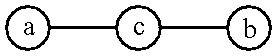
is a derivative of ε-aminocaproic acid, the monomer of polyamide 6 (PA 6).
The following may be mentioned among the oligomers of the polyamide type which are suitable for the invention:
the polyamide oligomers obtained by the polycondensation of saturated aliphatic carboxylic diacids having from 6 to 12 carbon atoms with saturated aliphatic primary diamines having from 6 to 12 carbon atoms,
the polyamino acid oligomers obtained either by the direct homopolycondensation of an ω-aminoalkanoic acid containing a hydrocarbon chain having from 4 to 12 carbon atoms, or by the hydrolytic opening and polymerization of the lactams derived from these acids,
the copolyamide oligomers obtained from the starting monomers of the above-mentioned polyamides, it also being possible for the acid component of these copolyamides to consist partly of an aromatic acid such as terephthalic acid and/or isophthalic acid,
and mixtures of these polyamide oligomers.
The following may be mentioned as illustrative examples of the polyamides obtained by the polycondensation of diacids and diamines:
polyamide 4,6 (polymer of tetramethylenediamine and adipic acid),
polyamide 6,6 (polymer of hexamethylenediamine and adipic acid) (PA 6.6),
polyamide 6,9 (polymer of hexamethylenediamine and azelaic acid),
polyamide 6,10 (polymer of hexamethylenediamine and sebacic acid),
polyamide 6,12 (polymer of hexamethylenediamine and dodecanedioic acid).
The following may be mentioned as illustrations of suitable polyamino acids:
polyamide 4 (polymer of 4-aminobutanoic acid or γ-butyrolactam),
polyamide 5 (polymer of 5-aminopentanoic acid or δ-amylolactam),
polyamide 6 (polymer of ε-caprolactam),
polyamide 7 (polymer of 7-aminoheptanoic acid),
polyamide 8 (polymer of capryllactam),
polyamide 9 (polymer of 9-aminononanoic acid),
polyamide 10 (polymer of 10-aminodecanoic acid),
polyamide 11 (polymer of 11-aminoundecanoic acid),
polyamide 12 (polymer of 12-aminododecanoic acid or laurolactam).
The following may be mentioned as illustrative examples of copolyamides:
polyamide 6,6/6,10 (copolymer of hexamethylenediamine, adipic acid and sebacic acid),
polyamide 6,6/6 (copolymer of hexamethylenediamine, adipic acid and caprolactam).
Without implying a limitation, the preferred substrates according to the invention are polyamide oligomers obtained by the polycondensation of diacids A and diamines B. particularly oligomers of PA 6.6.
The number of monomers A and B, on the one hand, or 
on the other, in the substrates (I) and (II) according to the invention is advantageously between 3 and 8, preferably between 2 and 6. It should be pointed out that this number of monomer residues in the oligomer or polymer molecules will also be called DPn in the remainder of the present disclosure.
Characteristic substrates (I) are e.g. advantageously water-soluble oligomers such as BAB and ABAB, excluding the trimers ABA.
These particular substrates are among the substrates (I) and (II) which can be hydrolyzed, with a very high performance, by the enzyme of the invention and/or its biological precursors.
When the enzymatic substrates are oligomers containing monomers A and B, the final hydrolysis products can be dimers AB and monomers B.
When the substrates are oligomers (B) (II) 
the final hydrolysis products can be monomers 
The enzyme according to the invention can also be characterized through its activity and/or its affinity towards some of the above-mentioned substrates (I) and (II).
Thus, according to a first advantageous characteristic, the amidase in question is:
firstly active towards a substrate (I) formed by a tetramer of the type ABAB,
and secondly capable of converting this substrate to two dimers AB with a specific enzymatic activity (Us)—expressed in μmol of AB produced x h−1 x mg−1 of protein and measured under given conditions—which is greater than 60, preferably greater than or equal to 100 and particularly preferably greater than or equal to 1000.
A second advantageous characteristic of this amidase is that it is:
active towards a substrate (I) formed by a trimer BAB,
and capable of converting this trimer to a dimer AB and a monomer B with a specific enzymatic activity (Us)—expressed in μmol of AB produced/h.mg of enzyme and measured under given conditions—which is greater than 100 and preferably greater than or equal to 500.
A third advantageous characteristic of this amidase is that it is:
active towards substrates (I) formed by oligomers whose DPn is between 3 and 20, preferably between 3 and 10,
and capable of converting these oligomers to a monomer B, a dimer AB and a trimer ABA.
The enzymatic activity of the pure amidase is measured under the following conditions:
phosphate buffer
temperature=30° C.
substrate concentration=1.4 g/l
pH=7.5.
As already indicated above, the use of the enzyme of the invention in the enzymatic hydrolysis of amides can consist in using either only the enzyme per se, or only biological precursors (wild-type or recombinant microorganisms) which produce said enzyme, or a mixture of both.
As far as its origin is concerned, the enzyme according to the invention was isolated in particular from a natural microorganism of the genus Corynebacterium.
From that starting point, it was also to the Applicant's credit to have identified the gene under whose control the amidase according to the invention is synthesized, it being precisely this technical advance which enables recombinant microorganisms to be used.
Consequently, a further subject of the invention is a DNA sequence coding for an enzyme with amidase activity, particularly towards substrates (I) and (II) as defined above, characterized in that it is selected from the following sequences:
the DNA sequence corresponding to the attached sequence SEQ ID NO: 1 and coding for an enzyme with amidase activity,
an analog of this sequence which results from the degeneracy of the genetic code, and
a DNA sequence which:
hybridizes with one of these sequences or with a fragment thereof,
possesses an identity of more than 50% with one of these sequences or with a fragment thereof,
and codes for an enzyme with amidase activity.
The enzymes resulting from the (hyper)expression of a DNA sequence of the type defined above are naturally included in the field of the invention.
The (hyper)expression can be obtained within recombinant microorganisms (e.g. those including one or more plasmids) by selecting an appropriate expression cassette comprising one or more promoters and one or more ribosome binding sites which induce (hyper)expression.
On the subject of recombination, one of the preferred recombinant microorganisms according to the invention is the one consisting of the E. coli strain which contains plasmid pXL2564, a derivative of the strain referenced and deposited in the Collection Nationale de Cultures de Microorganismes under no. I 1495 on Nov. 29, 1994.
This E. coli strain contains plasmid pXL2564, said plasmid carrying SEQ ID NO: 1 and an expression cassette which can be for example the one shown in FIG. 2 attached: Ptrp-RBSCII.
In more general terms, the present invention relates to all the novel recombinant or non-recombinant microorganisms which are capable of producing the atidase according to the invention and advantageously possess the genetic information contained in the above-defined sequence or sequences forming subjects of the invention.
It is self-evident that the amidases produced by these microorganisms are wholly covered by the present invention.
The particular characteristics of these microorganisms are a capacity to hydrolyze the amide groups of a polyamide compound comprising at least one amide group. and, more precisely, a specific selectivity and hydrolytic activity towards the substrates (I) and (II) defined above and, even more particularly, towards the substrates (I) relative to the substrates (II).
In the case of the substrates (I), these oligomers are for example the water-soluble oligomers mentioned above: ABAB and/or BAB, inter alia.
Advantageously, the microorganisms according to the invention are capable of hydrolyzing at least one substrate formed by a polyamide oligomer and, more particularly, by a tetramer ABAB and/or a trimer BAB, which are destined to be converted to monomers B and dimers AB, the microorganisms being capable of performing the hydrolysis with an activity which is:
expressed in g of hydrolyzed substrate/h.g of dry cells and measured under given conditions, and
greater than or equal to 50, preferably 80 and particularly preferably 100.
This activity is measured at a temperature of the order of 30° C., at a pH of 7 in a phosphate buffer (100 mM), with magnetic stirring, in a volume of reaction medium of 400 μl and at a substrate concentration of 2.5 g/l.
To optimize the performance characteristics of these microorganisms, they are advantageously equipped, according to the invention, with:
at least one protein agent for assisting the folding of the polypeptides which they synthesize, and particularly the enzymes as defined above,
and/or genes coding for such an agent.
This agent is present in an amount greater than that corresponding to the base level of the microorganism in question.
The agent is preferably the GroE chaperone of E. Coli or its homolog of eukaryotic or prokaryotic origin.
The present invention further relates to a process for the hydrolysis of substrates which are at least partly formed by the substrates (I) and/or (II) as defined above, characterized in that it consists in using at least one enzyme and/or at least one of the microorganisms as presented above.
It may be advantageous, according to the invention, to have several enzymes with complementary spectra. Therefore, one of the variants of the above-mentioned process can be to have the use of at least one other type of enzyme and/or at least one of its wild-type and/or recombinant and/or analogous biological precursors. In this variant, the substrates consist at least partly of oligomers whose DP, is less than 40, preferably 20 and particularly preferably 12, and which are derived from polyamides at least originating from polycondensation between diacid monomers (A) and diamine monomers (B).
The hydrolysis process according to this variant is characterized in that:
it produces oligomers with a degree of polymerization (DPn) less than or equal to 8, preferably 4, and particularly preferably produces monomers A and B,
and the following are used:
at least one enzyme and/or at least one microorganism as defined above,
and at least one other type of enzyme and/or to at least one of its wild-type and/or recombinant biological precursors, said enzyme preferably being an enzyme E2 produced under the control of the nyl-B gene of Flavobacterium sp KI 72.
The complementary enzyme E2 produced by nyl-B is described in KINOSHITA et al. (Eur. J. Biochem. 116, 547-551, 1981) or in TSUCHIYA et al. (“Journal of Bacteriology, June 1989, p. 3187-3191, vol. 171 no. 6”).
In the absence of enzyme E2, the process would preferentially lead in practice to oligomers of DPn≦4 and very particularly to dimers AB.
Oligomers hydrolyzable by the above enzymes can be obtained by thermal and/or chemical (acid) lysis of the groups of the amide type, especially by the lysis of polymers or oligomers of high DPn.
Other advantageous modalities of the process according to the invention use especially biological precursors of the enzyme (or enzymes) and a culture medium comprising, for example:
a carbon source preferably comprising at least one compound containing at least one amide group, said carbon source optionally comprising a complement advantageously selected from carbohydrates, sucrose being particularly preferred,
and optionally a compound capable of inducing enzyme production without being( consumed by the biological precursors, said compound preferably being selected from amides.
The process according to the invention for the enzymatic hydrolysis of amides can have numerous applications, for example in organic synthesis for the manufacture of compounds from amide compounds or for the treatment of materials containing polyamide.
In particular, it could be of value within the framework of regenerating the starting materials of polyamide polymers.
The Examples which follow provide an illustration of the characteristics, variants and advantages of the present invention without however limiting its scope.
The sequence listing, established according to WIPO standard ST 23, comprises the following sequences:
SEQ ID NO: 1 DNA coding for the amidase according to the invention,
SEQ ID NO: 2: polypeptide forming the amidase according to the invention.
FIG. 1 shows the restriction map of plasmid pXL2297 containing the gene coding for the amidase according to the invention and accommodated by the strain deposited in the CNCM under no. I 1495 on Nov. 29, 1994.
FIG. 2 shows the restriction map of plasmid pXL2564 containing the pam I gene coding for the amidase according to the invention, a gene conferring ampicillin resistance and the Ptrp-RBScII expression cassette controlling the amidase gene.
The meanings of the abbreviations used in the remainder of the description are given below:
SSC: buffer commonly used for hybridizations, containing sodium citrate and NaCl (20×SSC=NaCl 3M−sodium citrate pH 7, 0.3 M),
SDS: sodium dodecylsulfate,
SDS-PAGE: electrophoresis gel based on sodium dodecylsulfate and polyacrylamide,
IPTG: isopropyl-β-D-thiogalactopyranoside,
HPLC: high performance liquid chromatography.
The isolation of the original strains, the purification and peptide sequencing of the polyamide hydrolase according to the invention (PAM I=SEQ ID NO: 2), and the cloning of the pam I gene coding for PAM I, were carried out by the current conventional techniques.
Recombination: Expression of PAM I in E. Coli
A construction was produced in which the pam I gene (coding for the enzyme PAM I), preceded by the ribosome binding site of the phage λ Cll gene, is expressed from the E. coli tryptophan operon promoter. To do this, an Ndel restriction site was created at the pam I initiation codon by the PCR technique using, as template, plasmid pXL2297 (FIG. 1) accommodated by the strain I 1495 deposited in the CNCM on Nov. 29, 1994. The 208 bp Ndel-Apal fragment containing the 5′ end of the pam I gene was amplified by PCR, care being taken to introduce a Hindlll site upstream of the Ndel site by means of the pair of nucleotide primers (5′-AGCAAGCTTGGAGGCCATATGAATACGAC-3′) and (5′-CACCGGTGGGCCCCTC-3′). The amplified Hindlll-Apal fragment was cloned into pUC29 (Benes et al. (1993), Gene 130: 151-152) digested by Hindlll and Apal, and the pam I gene was reconstituted by introducing the 867 bp Apal fragment of pXL2297 at the Apal site. An Ncol site is thus located about thirty nucleotides downstream of the pain I stop codon. The adjacent 500 bp Ndel-EcoRl and 600 bp EcoRI-Ncol fragments of this plasmid were inserted into pXL2158 (patent FR 92-09 882) digested at the Ndel site located immediately downstream of the tryptophan promoter.
Thus plasmid pXL2564 (described in FIG. 2) is a derivative of pBR322 (Sucliffe (1978), Nucleic Acid Res. 5: 2721) containing a gene conferring ampicillin resistance and the pam I gene under the control of the Ptrp-RBScll expression cassette.
Plasmid pXL2564 was introduced into the E. coli strain TG1, the microorganisms being selected on ampicillin LB. A clone containing pXL2564 (called strain PAM I) was transferred twice onto agar dishes and cultured at 37° C. in M9 glucose medium containing 100 μg/ml of ampicillin, according to the procedure described in patent FR 2 694 571.
The efficacy of the coexpression of the GroE chaperone to obtain a soluble form of polyamidase I was tested by introducing plasmid pXL2035 (patent FR 2 694 571) into the strain TG1 (pXL2564). The resulting strain was cultivated under the same conditions in the presence of 50 mg/l of kanamycin.
The results show that, with this novel recombinant strain, polyamidase I is produced essentially in soluble and cleaved form.
Comparison of the Amidase Activities of the Recombinant Strain Expressing E3 and the Recombinant Strain Expressing PAM I, as Obtained in Example I
II.1 Culture of the Strains:
The strain expressing PAM I was cultivated as indicated in Example I.
The strain expressing E3 is obtained by introducing plasmid pUCL3 into the E. coli strain TGI described in the reference “NEGORO et al. (1992)—Journal of Bacteriology, vol. 174, p. 7948-7953”. This strain was cultured at 37° C. in M9 medium supplemented with 100 mg/l of ampicillin and inoculated at 1% (v/v) with a preculture. An inducer (IPTG 1 mM) was added after 4 hours 30 minutes of incubation. The preculture is composed of 10 ml of the same M9 medium supplemented with 100 mg/l of ampicillin and inoculated with colonies originating from an agar dish. When culture is complete, the cell production is determined via a dry extract obtained by the drying, overnight at 105° C., of a cell residue obtained after centrifugation (10 min at 12,000 g). The M9 medium is composed of:
| glucose | 4 | g/l | ||
| KH2PO4 | 3 | g/l | ||
| Na2HPO4 | 7 | g/l | ||
| MgSO4 | 1 | m/M | ||
| NH4Cl | 1 | g/l | ||
| NaC1 | 0.5 | g/ | ||
| CaCl | ||||
| 2 | 1 | mM | ||
| casamino acids | 4 | g/l | ||
| thiamine HCl | 10 | mg/l | ||
II.2 Activity of the Strains:
The cell residues, obtained as indicated above, are taken up with a 0.1 M Tris-HCl, 5 mM EDTA buffer, pH 8.0, containing 1% (v/v) of toluene, and incubated for 1 hour at 0° C. After centrifucation, the treated residues are resuspended in a 0.1 M phosphate buffer, pH 7.
The amidase activity of the cell suspensions of the strains expressing E3 and PAM I was tested on the oligomers of DPn 2 to 6 for PA 6 and those of DPn 2 to 4 for PA 66.
The PA 6 oligomers of DPn 2 to 6 are called CAP 2 to CAP 6 respectively.
The results are listed in Table I below.
The activity is expressed in mmol of hydrolyzed substrate/hour/g of dry cells.
| TABLE I | |||
| Activity of | Activity of | ||
| the strain ex- | the strain | ||
| Substrate | Reaction | pressing PAM I | expressing E3 |
| ABAB | ABAB → AB + AB | 117 | 0.263 |
| BAB | BAB → AB + B | 131 | 0.067 |
| ABA | ABA → | 0 | 0 |
| AB | AB → | 0 | 0 |
| CAP 2 | CAP 2 → | 0 | 0 |
| CAP 3 | CAP 3 → CAP 2 + |
0.29 | 0.040 |
| CAP 4 | CAP 4 → CAP 2 + CAP 2 | 1.79 | 0.140 |
| CAP 5 | CAP 5 → CAP 3 + CAP 2 | 0.92 | 0.089 |
| CAP 6 | CAP 6 → CAP 3 + CAP 2 | 0.49 | 0.024 |
Operating conditions: [strain expressing E3]=2.5 g/l of dry extract; [strain expressing PAM I]=2.5 g/l of dry extract for the nylon 6 oligomers and 0.125 g/l of dry extract for the nylon 66 oligomers; [oligomers] #2.5 g/l; 0.1 M phosphate buffer, pH=7; volume 400 μl; T=30° C.; magnetic stirring.
For the strain expressing E3, the kinetics were measured over 3 hours for hydrolysis of the nylon 6 and 66 oligomers.
For the strain expressing PAM I, the kinetics were measured over 1 hour for hydrolysis of the nylon 6 oligomers and over 15 minutes for hydrolysis of the nylon 66 oligomers.
The hydrolytic activities of the strain expressing E3 towards the nylon 6 and 66 substrates are of the same order of magnitude:
0.263 mmol of hydrolyzed ABAB/h/g of dry cells and 0.140 mmol of hydrolyzed CAP 4/h/g of dry cells (a factor of 2 between these activities).
PAM I is more specific for the nylon 66 oligomers than for the nylon 6 oligomers:
117 mmol of hydrolyzed ABAB/h/g of dry cells and 1.79 mmol of hydrolyzed CAP 4/h/g of dry cells (a factor of 65 between these activities).
This characteristic demonstrates the novelty of the enzyme according to the invention compared with the known enzyme produced under the control of nyl C.
Enzymatic Hydrolysis of PA 66 Oligomers with the Aid of a Mixture of PAM I Enzymes According to the Invention and Amidases E2 Expressed by the nyl-B Gene
Instead of the enzymes, the present Example utilizes their biological precursors, namely:
the recombinant strain of Example I expressing PAM I
and the recombinant strain containing the nyl-B gene of Flavobacterium sp KI 72 and expressing E2.
III.1 Culture of the Strains:
The strain expressing PAM I was cultivated as indicated in Example I.
The strain expressing E2 is obtained by the procedure described for obtaining the strain expressing E3, but by introducing plasmid pHK4 described in the reference “NEGORO et al.—Journal of Biol. Chem. (1984) 259: 13648-13651”. This strain was cultured at 37° C. in M9 medium supplemented with 100 mg/l of ampicillin and inoculated at 1% (v/v) with a preculture. The preculture is composed of 10 ml of the same M9 medium supplemented with 100 mg/l of ampicillin and inoculated with colonies originating from an agar dish. When culture is complete, the cell production is determined via a dry extract obtained by the drying, overnight at 105° C., of a cell residue obtained after centrifugation (10 min at 12,000 g).
III.2 Activity of the Strains:
The cell residues, obtained as indicated above, are taken up with a 0.1 M Tris-HCl, 5 mM EDTA buffer, pH 8.0, containing 1% (v/v) of toluene, and incubated for 1 hour at 0° C. After centrifugation, the treated residues are resuspended in a 0.1 M phosphate buffer, pH 7.
The amidase activity of the cell suspensions of the strains expressing E2 and PAM I was tested on the oligomers ABAB, BAB, ABA and AB.
The results are listed in Table II below.
The activity is expressed in mmol of hydrolyzed substrate/hour/g of dry cells. Operating conditions: [strain expressing PAM I]=0.125 g/l of dry extract; [oligoiners]=2.5 g/l; 0.1 M phosphate buffer, pH=7; volume 400 μl; T=30° C.; magnetic stirring.
| TABLE II | |||
| Starting oligomers and | |||
| Test | | Activity | |
| 1 | AB → A + B | 0.11 |
| 2 | ABA → AB + A | 0.04 |
| 3 | BAB → AB + B | 131 |
| 5 | ABAB → 2 AB | 117 |
Claims (17)
1. An isolated enzyme with amidase activity towards substrates of the amide type having at least one of the following formulae: 
in which:
A and B are monomer units,
R1 and R3 are identical or different divalent radicals representing a substituted or unsubstituted, linear or branched alkylene, an arylene or an arylalkylene, and the number of carbons in the alkylene being greater than or equal to 4,
R2 corresponds to identical or different radicals selected from hydrogen and alkyl radicals having from 1 to 6 carbons,
X is:
either X1=OH, OM or OR4, where M is selected from metals, and R4 is a linear or branched alkyl containing from 1 to 6 carbon atoms,
or X2= 
where R2 and R3 are as defined above and R5 and R6, which are identical or different, have the same definition as that given above for R2,
Y is:
either Y1=hydrogen,
or Y1= 
where R1 is as defined above and Z is hydrogen, a radical selected from metals or a radical which is a linear or branched alkyl containing from 1 to 6 carbon atoms,
with the following conditions:
if X=X1, then Y=Y1,
if X=X2, then Y=Y2 or Y1,
and p is between 1.5 and 10;
or 
in which:
R2 and R3 are as defined above,
U and V respectively have the same definitions as those given above for X1 and Y1 in formula (I),
and q=1 to 8,
said enzyme being characterized by a ratio
Ra=(enzymatic activity towards amide substrates of formula (I)(E.A.(I)))/(enzymatic activity towards amide substrates of formula (II)(E.A.(II))) which is greater than 2.
2. The isolated enzyme of claim 1, wherein Z is a metal selected from the group consisting of alkali metals and alkaline earth metals.
3. An isolated enzyme according to claim 1, comprising: the peptide sequence given by the attached sequence SEQ ID NO:2, or a polypeptide having a degree of amino acid sequence homology of at least 50% with this sequence.
4. An isolated enzyme according to claim 1 which is:
active towards a substrate (I) formed by a tetramer of the type ABAB,
and capable of converting this substrate to two dimers AB with a specific enzymatic activity (Us) greater than 60, which is expressed in μmol AB produced x h−1 x mg−1 of protein and measured at a temperature of the order of 30° C. at a pH of 7 in a phosphate buffer (100 mM), with magnetic stirring, in a volume of reaction medium of 400 μl and at a substrate concentration of 2.5 g/l.
5. An isolated enzyme according to claim 1, which is:
active towards a substrate (I) formed by a trimer BAB,
and capable of converting this trimer to a dimer AB and a monomer B with a specific enzymatic activity (Us) greater than 100, which is expressed in μmol of AB produced/h.mg of enzyme and measured at a temperature of the order of 30° C., at a pH of 7 in a phosphate buffer (100 mM), with magnetic stirring, in a volume of reaction medium of 400 μl and at a substrate concentration of 2.5 g/l.
6. An isolated enzyme according to claim 1, which is:
active towards substrates (I) formed by oligomers whose degree of polymerization (DPn) is between 3 and 20,
and capable of converting these oligomers to monomers B, dimers AB and trimers ABA.
7. An isolated microorganism capable of producing at least one enzyme according to claim 1.
8. A process for the hydrolysis of substrates which comprise the substrates (I) or (II), or (I) and (II) as defined in claim 1 comprising using at least one enzyme according to claim 1.
9. A process for the hydrolysis of substrates comprised of oligomers whose DPn is less than 40 and which are derived from polyamides originating from polycondensation between diacid monomers (A) and diamine monomers (B), and eventually from polyamides which are not derived from polycondensation between diacid monomers (A) and diamine monomers (B), comprising:
producing oligomers with a degree of polymerization (DPn) less than or equal to 8,
and using:
at least one enzyme according to claim 1,
and at least one other type of enzyme or at least one of said enzyme's biological precursor.
10. A process according to claim 8 comprising thermal and/or chemical lysis for obtaining substrates whose DPn is such that they are hydrolyzable by the enzymatic method.
11. The process of claim 9, wherein said at least one other type of enzyme is E2 produced under the control of the nyl-B gene of Flavobacterium sp KI72.
12. The process of claim 9, wherein said biological precursor is a wild-type biological precursor.
13. The process of claim 9, wherein said biological precursor is a synthetic biological precursor.
14. A process for the hydrolysis of substrates consisting at least partly of oligomers whose DPn is less than 40 and which are derived from polyamides originating from polycondensation between diacid monomers (A) and diamine monomers (B), and eventually from polyamides which are not derived from polycondensation between diacid monomers (A) and diamine monomers (B), comprising:
producing oligomers with a degree of polymerization (DPn) less than or equal to 8,
and using:
at least one enzyme according to claim 1;
and at least one other type of enzyme and at least one of said enzymes biological precursor.
15. The process of claim 14, wherein said at least one other type of enzyme is E2 produced under the control of the nyl-B gene of Flavobacterium sp KI72.
16. The process of claim 14, wherein said biological precursor is a wild-type biological precursor.
17. The process of claim 14, wherein said biological precursor is a synthetic biological precursor.
Applications Claiming Priority (3)
| Application Number | Priority Date | Filing Date | Title |
|---|---|---|---|
| FR9508916A FR2736927B1 (en) | 1995-07-18 | 1995-07-18 | ENZYMES HAVING AMIDASE ACTIVITY, GENETIC TOOLS AND HOST MICROORGANISMS FOR OBTAINING SAME AND HYDROLYSIS PROCESS USING THE SAME |
| FR9508916 | 1995-07-18 | ||
| PCT/FR1996/001119 WO1997004084A1 (en) | 1995-07-18 | 1996-07-17 | Enzymes and microorganisms having amidase activity for hydrolysing polyamides |
Publications (1)
| Publication Number | Publication Date |
|---|---|
| US6214592B1 true US6214592B1 (en) | 2001-04-10 |
Family
ID=9481277
Family Applications (1)
| Application Number | Title | Priority Date | Filing Date |
|---|---|---|---|
| US09/000,064 Expired - Fee Related US6214592B1 (en) | 1995-07-18 | 1996-07-17 | Enzymes and microorganisms having amidase activity for hydrolysing polyamides |
Country Status (8)
| Country | Link |
|---|---|
| US (1) | US6214592B1 (en) |
| EP (1) | EP0839189A1 (en) |
| JP (1) | JPH10513366A (en) |
| CN (1) | CN1193347A (en) |
| AU (1) | AU6618996A (en) |
| BR (1) | BR9611100A (en) |
| FR (1) | FR2736927B1 (en) |
| WO (1) | WO1997004084A1 (en) |
Cited By (32)
| Publication number | Priority date | Publication date | Assignee | Title |
|---|---|---|---|---|
| US20040082046A1 (en) * | 2000-06-30 | 2004-04-29 | Olivier Favre-Bulle | Coated enzyme-containing catalyst |
| US20040144919A1 (en) * | 2002-10-19 | 2004-07-29 | Bruker Daltonik Gmbh | Compact very high resolution time-of-flight mass spectrometer |
| US20080199926A1 (en) * | 2007-01-22 | 2008-08-21 | Burgard Anthony P | Methods and Organisms for Growth-Coupled Production of 3-Hydroxypropionic Acid |
| US20090155866A1 (en) * | 2007-08-10 | 2009-06-18 | Burk Mark J | Methods for the synthesis of olefins and derivatives |
| US20090191593A1 (en) * | 2008-01-22 | 2009-07-30 | Genomatica, Inc. | Methods and organisms for utilizing synthesis gas or other gaseous carbon sources and methanol |
| US20090275097A1 (en) * | 2008-03-05 | 2009-11-05 | Jun Sun | Primary alcohol producing organisms |
| US20090305364A1 (en) * | 2008-03-27 | 2009-12-10 | Genomatica, Inc. | Microorganisms for the production of adipic acid and other compounds |
| US20100009419A1 (en) * | 2008-06-17 | 2010-01-14 | Burk Mark J | Microorganisms and methods for the biosynthesis of fumarate, malate, and acrylate |
| US20100021978A1 (en) * | 2008-07-23 | 2010-01-28 | Genomatica, Inc. | Methods and organisms for production of 3-hydroxypropionic acid |
| US20100184173A1 (en) * | 2008-11-14 | 2010-07-22 | Genomatica, Inc. | Microorganisms for the production of methyl ethyl ketone and 2-butanol |
| WO2010129936A1 (en) * | 2009-05-07 | 2010-11-11 | Genomatica, Inc. | Microorganisms and methods for the biosynthesis of adipate, hexamethylenediamine and 6-aminocaproic acid |
| US20100304453A1 (en) * | 2008-12-16 | 2010-12-02 | Genomatica, Inc. | Microorganisms and methods for conversion of syngas and other carbon sources to useful products |
| US20100330635A1 (en) * | 2009-04-30 | 2010-12-30 | Genomatica, Inc. | Organisms for the production of 1,3-butanediol |
| US20110008858A1 (en) * | 2009-06-10 | 2011-01-13 | Osterhout Robin E | Microorganisms and methods for carbon-efficient biosynthesis of mek and 2-butanol |
| US20110014668A1 (en) * | 2009-05-15 | 2011-01-20 | Osterhout Robin E | Organisms for the production of cyclohexanone |
| US20110097767A1 (en) * | 2009-10-23 | 2011-04-28 | Priti Pharkya | Microorganisms for the production of aniline |
| US20110129904A1 (en) * | 2009-12-10 | 2011-06-02 | Burgard Anthony P | Methods and organisms for converting synthesis gas or other gaseous carbon sources and methanol to 1,3-butanediol |
| US20110201089A1 (en) * | 2010-02-23 | 2011-08-18 | Burgard Anthony P | Methods for increasing product yields |
| US20110207185A1 (en) * | 2010-01-29 | 2011-08-25 | Osterhout Robin E | Microorganisms and methods for the biosynthesis of p-toluate and terephthalate |
| US20110207189A1 (en) * | 2010-02-23 | 2011-08-25 | Burgard Anthony P | Methods for increasing product yields |
| US8241877B2 (en) | 2008-05-01 | 2012-08-14 | Genomatica, Inc. | Microorganisms for the production of methacrylic acid |
| US8377666B2 (en) | 2009-10-13 | 2013-02-19 | Genomatica, Inc. | Microorganisms for the production of 1,4-butanediol, 4-hydroxybutanal, 4-hydroxybutyryl-coa, putrescine and related compounds, and methods related thereto |
| US8580543B2 (en) | 2010-05-05 | 2013-11-12 | Genomatica, Inc. | Microorganisms and methods for the biosynthesis of butadiene |
| US8715971B2 (en) | 2009-09-09 | 2014-05-06 | Genomatica, Inc. | Microorganisms and methods for the co-production of isopropanol and 1,4-butanediol |
| US8715957B2 (en) | 2010-07-26 | 2014-05-06 | Genomatica, Inc. | Microorganisms and methods for the biosynthesis of aromatics, 2,4-pentadienoate and 1,3-butadiene |
| US8993285B2 (en) | 2009-04-30 | 2015-03-31 | Genomatica, Inc. | Organisms for the production of isopropanol, n-butanol, and isobutanol |
| US9023636B2 (en) | 2010-04-30 | 2015-05-05 | Genomatica, Inc. | Microorganisms and methods for the biosynthesis of propylene |
| US9562241B2 (en) | 2009-08-05 | 2017-02-07 | Genomatica, Inc. | Semi-synthetic terephthalic acid via microorganisms that produce muconic acid |
| WO2024056584A1 (en) | 2022-09-12 | 2024-03-21 | Solvay Specialty Polymers Usa, Llc | Method for recycling a polyamide with a molecular weight reduction pretreatment |
| EP4349895A1 (en) | 2022-10-03 | 2024-04-10 | Solvay Specialty Polymers USA, LLC | Method for recycling a polyamide with a molecular weight reduction pretreatment |
| WO2024121309A1 (en) | 2022-12-08 | 2024-06-13 | Solvay Specialty Polymers Usa, Llc | Method for recycling a polyamide comprising a pretreatment step |
| WO2024156025A1 (en) * | 2023-01-23 | 2024-08-02 | Samsara Eco Pty Limited | Enzyme variants and uses thereof |
Families Citing this family (1)
| Publication number | Priority date | Publication date | Assignee | Title |
|---|---|---|---|---|
| CN110983851A (en) * | 2019-11-20 | 2020-04-10 | 山鹰华南纸业有限公司 | Method for improving operation efficiency of drying part of paper machine |
-
1995
- 1995-07-18 FR FR9508916A patent/FR2736927B1/en not_active Expired - Fee Related
-
1996
- 1996-07-17 US US09/000,064 patent/US6214592B1/en not_active Expired - Fee Related
- 1996-07-17 BR BR9611100-3A patent/BR9611100A/en not_active Application Discontinuation
- 1996-07-17 EP EP96925806A patent/EP0839189A1/en not_active Withdrawn
- 1996-07-17 CN CN96196379A patent/CN1193347A/en active Pending
- 1996-07-17 AU AU66189/96A patent/AU6618996A/en not_active Abandoned
- 1996-07-17 WO PCT/FR1996/001119 patent/WO1997004084A1/en not_active Ceased
- 1996-07-17 JP JP9506361A patent/JPH10513366A/en active Pending
Non-Patent Citations (8)
| Title |
|---|
| Amino Acid Nucleic Acid, vol. 33, 1976, pp. 129-139, XP000605985, Fukumura et al, "Microbial Conversion of Some Synthetic Cyclic Amides". |
| Biodegradation, vol. 5, No. 3-4, Dec. 1994, pp. 185-194, Negoro et al, "The Nylon Oligomer Biodegradation System of Flavobacterium and Pseudomonas". |
| Database WPI, Week 6800, Derwent Publications Ltd., London, GB, XP002015967 & JP 44 017 992 (Toyo Rayon KK) (no date given). |
| J. Bacteriol., vol. 174, No. 24, (1992), pp. 7948-7953, Negoro et al, "A New Nylon Oligomer Degradation Gene (nylC) on Plasmid pOAD2 from Flavobacterium sp". |
| Kinoshita, S., et al. (1981) Eur. J. Biochem. 116, 547-551.* |
| Nature, vol. 301, Nov. 10, 1983, pp. 203-206, Okada et al, "Evolutionary Adaptation of Plasmid-Encoded Enzymes for Degrading Nylon Oligomers". |
| Negoro, S., et al. (1984) J. Biol. Chem. 259 (22), 13648-13651.* |
| Tsuchiya, K. et al. (1989) J. Bacteriol. 171, 3187-3191. * |
Cited By (77)
| Publication number | Priority date | Publication date | Assignee | Title |
|---|---|---|---|---|
| US20040082046A1 (en) * | 2000-06-30 | 2004-04-29 | Olivier Favre-Bulle | Coated enzyme-containing catalyst |
| US7247462B2 (en) * | 2000-06-30 | 2007-07-24 | Adisseo Ireland Ltd | Coated enzyme-containing catalyst |
| US20040144919A1 (en) * | 2002-10-19 | 2004-07-29 | Bruker Daltonik Gmbh | Compact very high resolution time-of-flight mass spectrometer |
| US6828553B2 (en) * | 2002-10-19 | 2004-12-07 | Bruker Daltonik Gmbh | Compact very high resolution time-of flight mass spectrometer |
| US20080199926A1 (en) * | 2007-01-22 | 2008-08-21 | Burgard Anthony P | Methods and Organisms for Growth-Coupled Production of 3-Hydroxypropionic Acid |
| US8673601B2 (en) | 2007-01-22 | 2014-03-18 | Genomatica, Inc. | Methods and organisms for growth-coupled production of 3-hydroxypropionic acid |
| US8026386B2 (en) | 2007-08-10 | 2011-09-27 | Genomatica, Inc. | Methods for the synthesis of olefins and derivatives |
| US20090155866A1 (en) * | 2007-08-10 | 2009-06-18 | Burk Mark J | Methods for the synthesis of olefins and derivatives |
| US8323950B2 (en) | 2008-01-22 | 2012-12-04 | Genomatica, Inc. | Methods and organisms for utilizing synthesis gas or other gaseous carbon sources and methanol |
| US20090191593A1 (en) * | 2008-01-22 | 2009-07-30 | Genomatica, Inc. | Methods and organisms for utilizing synthesis gas or other gaseous carbon sources and methanol |
| US9051552B2 (en) | 2008-01-22 | 2015-06-09 | Genomatica, Inc. | Methods and organisms for utilizing synthesis gas or other gaseous carbon sources and methanol |
| US20110223637A1 (en) * | 2008-01-22 | 2011-09-15 | Genomatica, Inc. | Methods and organisms for utilizing synthesis gas or other gaseous carbon sources and methanol |
| US20110195461A1 (en) * | 2008-01-22 | 2011-08-11 | Butk Mark J | Methods and organisms for utilizing synthesis gas or other gaseous carbon sources and methanol |
| US8691553B2 (en) | 2008-01-22 | 2014-04-08 | Genomatica, Inc. | Methods and organisms for utilizing synthesis gas or other gaseous carbon sources and methanol |
| US7803589B2 (en) | 2008-01-22 | 2010-09-28 | Genomatica, Inc. | Methods and organisms for utilizing synthesis gas or other gaseous carbon sources and methanol |
| US20090275097A1 (en) * | 2008-03-05 | 2009-11-05 | Jun Sun | Primary alcohol producing organisms |
| US7977084B2 (en) | 2008-03-05 | 2011-07-12 | Genomatica, Inc. | Primary alcohol producing organisms |
| US9260729B2 (en) | 2008-03-05 | 2016-02-16 | Genomatica, Inc. | Primary alcohol producing organisms |
| US10208320B2 (en) | 2008-03-05 | 2019-02-19 | Genomatica, Inc. | Primary alcohol producing organisms |
| US11613767B2 (en) | 2008-03-05 | 2023-03-28 | Genomatica, Inc. | Primary alcohol producing organisms |
| US7799545B2 (en) | 2008-03-27 | 2010-09-21 | Genomatica, Inc. | Microorganisms for the production of adipic acid and other compounds |
| US8592189B2 (en) | 2008-03-27 | 2013-11-26 | Genomatica, Inc. | Microorganisms for the production of adipic acid and other compounds |
| US10415042B2 (en) | 2008-03-27 | 2019-09-17 | Genomatica, Inc. | Microorganisms for the production of adipic acid and other compounds |
| US20110195466A1 (en) * | 2008-03-27 | 2011-08-11 | Genomatica, Inc. | Microorganisms for the production of adipic acid and other compounds |
| WO2009151728A3 (en) * | 2008-03-27 | 2010-05-27 | Genomatica, Inc. | Microorganisms for the production of adipic acid and other compounds |
| US11293026B2 (en) | 2008-03-27 | 2022-04-05 | Genomatica, Inc. | Microorganisms for the production of adipic acid and other compounds |
| US9382556B2 (en) | 2008-03-27 | 2016-07-05 | Genomatica, Inc. | Microorganisms for the production of adipic acid and other compounds |
| US8216814B2 (en) | 2008-03-27 | 2012-07-10 | Genomatica, Inc. | Microorganisms for the production of adipic acid and other compounds |
| US8088607B2 (en) | 2008-03-27 | 2012-01-03 | Genomatica, Inc. | Microorganisms for the production of adipic acid and other compounds |
| US20090305364A1 (en) * | 2008-03-27 | 2009-12-10 | Genomatica, Inc. | Microorganisms for the production of adipic acid and other compounds |
| US8062871B2 (en) | 2008-03-27 | 2011-11-22 | Genomatica, Inc. | Microorganisms for the production of adipic acid and other compounds |
| US8241877B2 (en) | 2008-05-01 | 2012-08-14 | Genomatica, Inc. | Microorganisms for the production of methacrylic acid |
| US8129154B2 (en) | 2008-06-17 | 2012-03-06 | Genomatica, Inc. | Microorganisms and methods for the biosynthesis of fumarate, malate, and acrylate |
| US20100009419A1 (en) * | 2008-06-17 | 2010-01-14 | Burk Mark J | Microorganisms and methods for the biosynthesis of fumarate, malate, and acrylate |
| US20100021978A1 (en) * | 2008-07-23 | 2010-01-28 | Genomatica, Inc. | Methods and organisms for production of 3-hydroxypropionic acid |
| US20100184173A1 (en) * | 2008-11-14 | 2010-07-22 | Genomatica, Inc. | Microorganisms for the production of methyl ethyl ketone and 2-butanol |
| US20100304453A1 (en) * | 2008-12-16 | 2010-12-02 | Genomatica, Inc. | Microorganisms and methods for conversion of syngas and other carbon sources to useful products |
| US8129155B2 (en) | 2008-12-16 | 2012-03-06 | Genomatica, Inc. | Microorganisms and methods for conversion of syngas and other carbon sources to useful products |
| US8993285B2 (en) | 2009-04-30 | 2015-03-31 | Genomatica, Inc. | Organisms for the production of isopropanol, n-butanol, and isobutanol |
| US20100330635A1 (en) * | 2009-04-30 | 2010-12-30 | Genomatica, Inc. | Organisms for the production of 1,3-butanediol |
| US9017983B2 (en) | 2009-04-30 | 2015-04-28 | Genomatica, Inc. | Organisms for the production of 1,3-butanediol |
| US9458480B2 (en) | 2009-05-07 | 2016-10-04 | Genomatica, Inc. | Microorganisms and methods for the biosynthesis of adipate, hexamethylenediamine and 6-aminocaproic acid |
| US11208673B2 (en) | 2009-05-07 | 2021-12-28 | Genomatica, Inc. | Microorganisms and methods for the biosynthesis of adipate, hexamethylenediamine and 6-aminocaproic acid |
| US8377680B2 (en) | 2009-05-07 | 2013-02-19 | Genomatica, Inc. | Microorganisms and methods for the biosynthesis of adipate, hexamethylenediamine and 6-aminocaproic acid |
| US11834690B2 (en) | 2009-05-07 | 2023-12-05 | Genomatica, Inc. | Microorganisms and methods for the biosynthesis of adipate, hexamethylenediamine and 6-aminocaproic acid |
| WO2010129936A1 (en) * | 2009-05-07 | 2010-11-11 | Genomatica, Inc. | Microorganisms and methods for the biosynthesis of adipate, hexamethylenediamine and 6-aminocaproic acid |
| US10150977B2 (en) | 2009-05-07 | 2018-12-11 | Genomatica, Inc. | Microorganisms and methods for the biosynthesis of adipate, hexamethylenediamine and 6-aminocaproic acid |
| US8663957B2 (en) | 2009-05-15 | 2014-03-04 | Genomatica, Inc. | Organisms for the production of cyclohexanone |
| US20110014668A1 (en) * | 2009-05-15 | 2011-01-20 | Osterhout Robin E | Organisms for the production of cyclohexanone |
| US8420375B2 (en) | 2009-06-10 | 2013-04-16 | Genomatica, Inc. | Microorganisms and methods for carbon-efficient biosynthesis of MEK and 2-butanol |
| US20110008858A1 (en) * | 2009-06-10 | 2011-01-13 | Osterhout Robin E | Microorganisms and methods for carbon-efficient biosynthesis of mek and 2-butanol |
| US10415063B2 (en) | 2009-08-05 | 2019-09-17 | Genomatica, Inc. | Semi-synthetic terephthalic acid via microorganisms that produce muconic acid |
| US9562241B2 (en) | 2009-08-05 | 2017-02-07 | Genomatica, Inc. | Semi-synthetic terephthalic acid via microorganisms that produce muconic acid |
| US10041093B2 (en) | 2009-08-05 | 2018-08-07 | Genomatica, Inc. | Semi-synthetic terephthalic acid via microorganisms that produce muconic acid |
| US8715971B2 (en) | 2009-09-09 | 2014-05-06 | Genomatica, Inc. | Microorganisms and methods for the co-production of isopropanol and 1,4-butanediol |
| US8377666B2 (en) | 2009-10-13 | 2013-02-19 | Genomatica, Inc. | Microorganisms for the production of 1,4-butanediol, 4-hydroxybutanal, 4-hydroxybutyryl-coa, putrescine and related compounds, and methods related thereto |
| US20110097767A1 (en) * | 2009-10-23 | 2011-04-28 | Priti Pharkya | Microorganisms for the production of aniline |
| US10612029B2 (en) | 2009-10-23 | 2020-04-07 | Genomatica, Inc. | Microorganisms and methods for the production of aniline |
| US10167477B2 (en) | 2009-10-23 | 2019-01-01 | Genomatica, Inc. | Microorganisms and methods for the production of aniline |
| US20110129904A1 (en) * | 2009-12-10 | 2011-06-02 | Burgard Anthony P | Methods and organisms for converting synthesis gas or other gaseous carbon sources and methanol to 1,3-butanediol |
| US8268607B2 (en) | 2009-12-10 | 2012-09-18 | Genomatica, Inc. | Methods and organisms for converting synthesis gas or other gaseous carbon sources and methanol to 1,3-butanediol |
| US10385344B2 (en) | 2010-01-29 | 2019-08-20 | Genomatica, Inc. | Microorganisms and methods for the biosynthesis of (2-hydroxy-3methyl-4-oxobutoxy) phosphonate |
| US20110207185A1 (en) * | 2010-01-29 | 2011-08-25 | Osterhout Robin E | Microorganisms and methods for the biosynthesis of p-toluate and terephthalate |
| US8445244B2 (en) | 2010-02-23 | 2013-05-21 | Genomatica, Inc. | Methods for increasing product yields |
| US20110201089A1 (en) * | 2010-02-23 | 2011-08-18 | Burgard Anthony P | Methods for increasing product yields |
| US20110212507A1 (en) * | 2010-02-23 | 2011-09-01 | Burgard Anthony P | Methods for increasing product yields |
| US8637286B2 (en) | 2010-02-23 | 2014-01-28 | Genomatica, Inc. | Methods for increasing product yields |
| US20110207189A1 (en) * | 2010-02-23 | 2011-08-25 | Burgard Anthony P | Methods for increasing product yields |
| US8048661B2 (en) | 2010-02-23 | 2011-11-01 | Genomatica, Inc. | Microbial organisms comprising exogenous nucleic acids encoding reductive TCA pathway enzymes |
| US9023636B2 (en) | 2010-04-30 | 2015-05-05 | Genomatica, Inc. | Microorganisms and methods for the biosynthesis of propylene |
| US8580543B2 (en) | 2010-05-05 | 2013-11-12 | Genomatica, Inc. | Microorganisms and methods for the biosynthesis of butadiene |
| US10793882B2 (en) | 2010-07-26 | 2020-10-06 | Genomatica, Inc. | Microorganisms and methods for the biosynthesis of aromatics, 2,4-pentadienoate and 1,3-butadiene |
| US8715957B2 (en) | 2010-07-26 | 2014-05-06 | Genomatica, Inc. | Microorganisms and methods for the biosynthesis of aromatics, 2,4-pentadienoate and 1,3-butadiene |
| WO2024056584A1 (en) | 2022-09-12 | 2024-03-21 | Solvay Specialty Polymers Usa, Llc | Method for recycling a polyamide with a molecular weight reduction pretreatment |
| EP4349895A1 (en) | 2022-10-03 | 2024-04-10 | Solvay Specialty Polymers USA, LLC | Method for recycling a polyamide with a molecular weight reduction pretreatment |
| WO2024121309A1 (en) | 2022-12-08 | 2024-06-13 | Solvay Specialty Polymers Usa, Llc | Method for recycling a polyamide comprising a pretreatment step |
| WO2024156025A1 (en) * | 2023-01-23 | 2024-08-02 | Samsara Eco Pty Limited | Enzyme variants and uses thereof |
Also Published As
| Publication number | Publication date |
|---|---|
| FR2736927B1 (en) | 1997-10-17 |
| JPH10513366A (en) | 1998-12-22 |
| BR9611100A (en) | 1999-12-28 |
| CN1193347A (en) | 1998-09-16 |
| FR2736927A1 (en) | 1997-01-24 |
| WO1997004084A1 (en) | 1997-02-06 |
| AU6618996A (en) | 1997-02-18 |
| EP0839189A1 (en) | 1998-05-06 |
Similar Documents
| Publication | Publication Date | Title |
|---|---|---|
| US6214592B1 (en) | Enzymes and microorganisms having amidase activity for hydrolysing polyamides | |
| US5935831A (en) | Mutated β-lactam acylase genes | |
| EP1142997B1 (en) | Novel rhodococcus, rhodococcus-origin nitrilase gene, nitrilehydratase gene and amidase gene and process for producing carboxylic acids by using the same | |
| US6180388B1 (en) | Enzymes and micro organisms with amidase activity which hydrolyze polyamides | |
| EP0780471B1 (en) | Novel nitrilase gene | |
| US9212356B2 (en) | Modified ethylenediamine-N,N′-disuccinate:ethylenediamine lyase | |
| US7098020B2 (en) | DNA encoding hydantoinase, DNA encoding N-carbamyl-L-amino acid hydrolase, recombinant DNA, transformed cell, method of producing protein, and method of producing optically active amino acid | |
| EP0665889A1 (en) | Enzymes with a nitrile-hydratase activity, genetic tools and host micro-organisms for their production and method of hydrolysis using said enzymes | |
| JP4676627B2 (en) | Modified amino acid amidase and method for producing D-amino acid using the same | |
| US6168940B1 (en) | Protein having ethylenediamine-N,N′-disuccinic acid:ethylenediamine lyase acitivity and gene encoding the same | |
| US20010044141A1 (en) | Novel Rhodococcus bacterium, nitrilase gene, nitryl hydratase gene and amidase gene from Rhodococcus bacterium, and process for producing carboxylic acids using them | |
| JP2001069978A (en) | Nitrile hydratase gene and amidase gene which are derived from phodococcus | |
| KR100941304B1 (en) | New Nucleoside Hydrolase I | |
| JP2706223B2 (en) | Use of DNA having genetic information of pyruvate oxidase | |
| KR20010047310A (en) | Gene coding for nitrile hydratase from Rhodococcus rhodochrous M33 VKM Ac-1515D and transformant containing the same | |
| KR100942133B1 (en) | New Nucleoside Hydrolase II | |
| Cerbelaud et al. | Enzymatic hydrolysis of adiponitrile into 5-cyano valeric acid, an intermediate for nylon 6 | |
| JPH08256771A (en) | New protein having amidase activity and gene coding the same | |
| JPH099973A (en) | Nitrile hydratase gene and amidase gene derived from rhodococcus bacterium | |
| JP2000125882A (en) | Novel X-prolyl dipeptidyl aminopeptidase and gene encoding the same | |
| JPH08242863A (en) | Gene capable of coding new glutamate dehydrogenase and production of glutamate dehydrogenase using the same gene | |
| JPH0870871A (en) | DNA fragment containing a gene encoding tryptophan synthase |
Legal Events
| Date | Code | Title | Description |
|---|---|---|---|
| AS | Assignment |
Owner name: RHONE-POULENC FIBRES ET POLYMERES S.A., FRANCE Free format text: ASSIGNMENT OF ASSIGNORS INTEREST;ASSIGNORS:CROUZET, JOEL;FAVRE-BULLE, OLIVIER;JOURDAT, CATHERINE;AND OTHERS;REEL/FRAME:009154/0010;SIGNING DATES FROM 19980128 TO 19980214 |
|
| FEPP | Fee payment procedure |
Free format text: PAYOR NUMBER ASSIGNED (ORIGINAL EVENT CODE: ASPN); ENTITY STATUS OF PATENT OWNER: LARGE ENTITY |
|
| REMI | Maintenance fee reminder mailed | ||
| LAPS | Lapse for failure to pay maintenance fees | ||
| STCH | Information on status: patent discontinuation |
Free format text: PATENT EXPIRED DUE TO NONPAYMENT OF MAINTENANCE FEES UNDER 37 CFR 1.362 |
|
| FP | Lapsed due to failure to pay maintenance fee |
Effective date: 20050410 |